/


Author: Nicolaou K.C. Sorensen E.J.
Tags: chemistry organic chemistry synthetic chemistry
ISBN: 3-527-29312-4
Year: 1996

Text
                    К. С. NICOLAOU, E. J. SORENSEN
CLASSICS IN
TOTAL
SYNTHESIS
TARGETS, STRATEGIES, METHODS
VCH

Classics in Total Synthesis к. с. Nicolaou and
E. J. Sorensen
VCH

Other successful books in organic chemistry from VCH:
J.M. Lehn
Supramolecular Chemistry
Concepts and Perspectives
1995. X, 271 pages with 51 figures.
Hardcover. ISBN 3-527-29312-4.
Softcover. ISBN 3-527-29311-6.
J. Fuhrhop, G. Penzlin
Organic Synthesis - Concepts, Methods, Starting Materials
Second, Revised and Enlarged Edition
With a Foreword by E. J. Corey
1994. XVI, 432 pages with 16 figures and 37 tables.
Hardcover. ISBN 3-527-29086-9.
Softcover. ISBN 3-527-29074-5.
M. Nogradi
Stereoselective Synthesis - A Practical Approach
Second, Thoroughly Revised and Updated Edition
With a Foreword by A. I. Meyers
1994. XVI, 452 pages with 171 figures and 23 tables.
Hardcover. ISBN 3-527-29242-X.
Softcover. ISBN 3-527-29243-8.
D.P. Curran, N.A. Porter, B. Giese
Stereochemistry of Radical Reactions - Concepts, Guidelines
and Synthetic Applications
1995. XII, 280 pages with 31 figures and 2 tables.
Hardcover. ISBN 3-527-29372-8.
H. Waldmann (Ed.)
Organic Synthesis Highlights II
1995. XIII, 407 page's with 318 figures and 3 tables.
Hardcover. ISBN 3-527-29200-4.
) VCH Verlagsgesellschaft mbH, D-69451 Weinheim (Federal Republic of Germany), 1996
Distribution:
VCH, P.O. Box 101161, D-69451 Weinheim, Federal Republic of Germany
Switzerland: VCH, P.O. Box, CH-4020 Basel, Switzerland
United Kingdom and Ireland: VCH, 8 Wellington Court, Cambridge CB1 1HZ,
United Kingdom
USA and Canada: VCH, 220 East 23rd Street, New York, NY 10010-4606, USA
Japan: VCH, Eikow Building, 10-9 Hongo 1-chome, Bunkyo-ku, Tokyo 113, Japan
ISBN 3-527-29284-5 ISBN 3-527-29231 -4

Classics in Total
Synthesis
К. С Nicolaou and
. Sorensen
Targets, Strategies, Methods
With a Foreword by
E. J. Corey
VCH
Weinheim
New York
Basel
Cambridge
Tokyo

К. С. Nicolaou, Ph. D.
Erik J. Sorensen, Ph. D.
Department of Chemistry and Department of Chemistry and Biochemistry
The Scripps Research Institute University of California, San Diego
10666 North Torrey Pines Road 9500 Gilman Drive
La Jolla, CA 92037 La Jolla, CA 92093
USA USA
This book was carefully produced. Nevertheless, authors and publisher do not warrant the information contained therein to be free
of errors. Readers are advised to keep in mind that statements, data, illustrations, procedural details or other items may inadver-
inadvertently be inaccurate.
Published jointly by
VCH Verlagsgesellschaft mbH, Weinheim (Federal Republic of Germany)
VCH Publishers, Inc., New York, NY (USA)
Copy Editor: Dr. Rachel Schmidt-Radde
Production Manager: Dipl.-Ing. (FH) Hans Jorg Maier
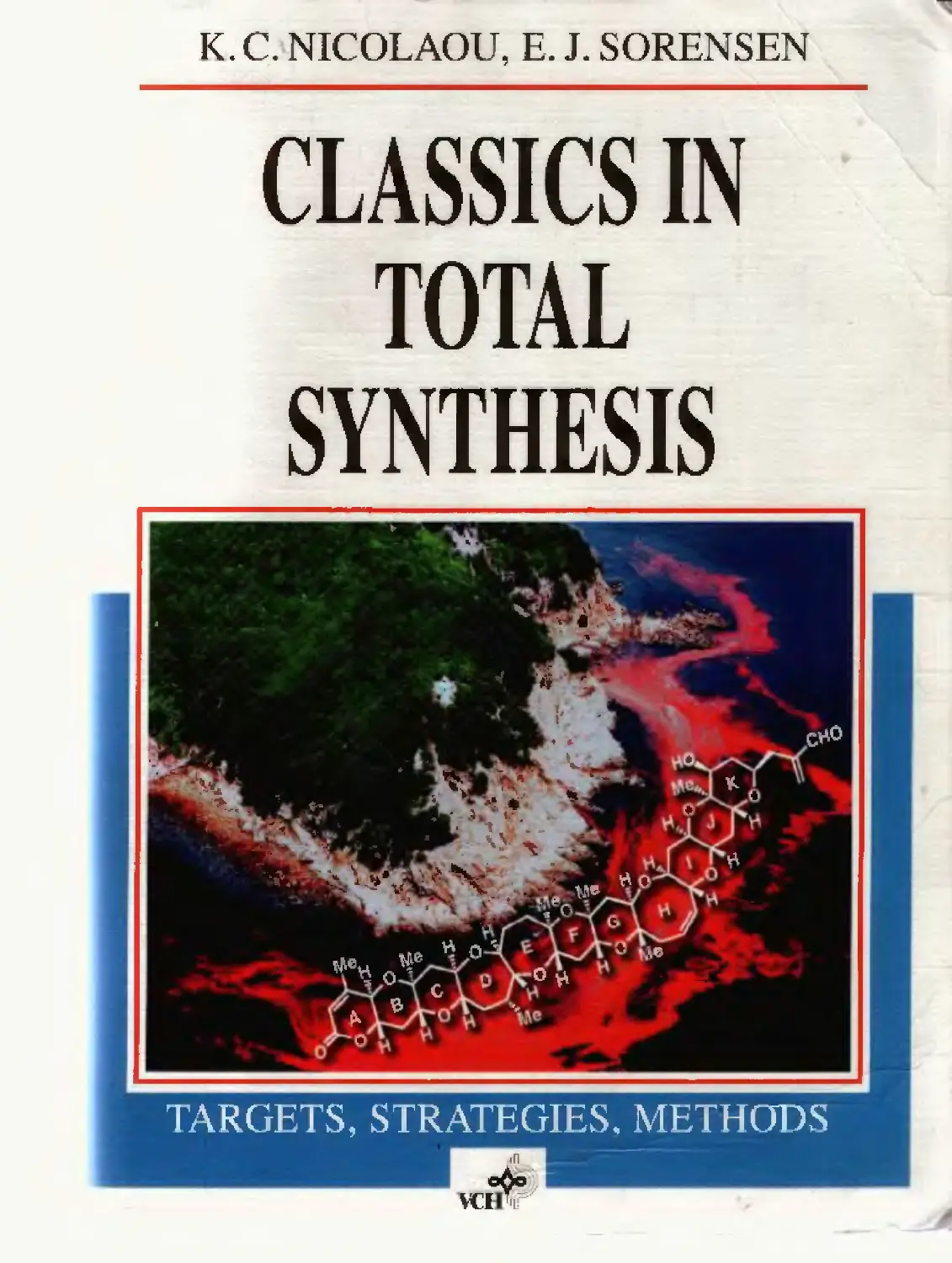
Front cover: A red-tide incident that occurred on 8th May 1976, off Matsushima Island, in Hyogo Prefecture, Japan. The structure
shown is that of brevetoxin B, a neurotoxin-produced by algae that proliferate during red-tide incidents. Brevetoxin В
is believed to have been responsible for massive fish killings and poisoning of humans who ate affected seafood. The
total synthesis of brevetoxin В is described in Chapter 37 of this book.
Back cover: Structure of vitamin В12.
Library of Congress Card No. applied for.
A catalogue record for this book is available from the British Library.
Deutsche Bibliothek Cataloguing-in-Publication Data:
Nicolaou, К. С
Classics in total synthesis / К. С Nicolaou and Erik J.
Sorensen. - Weinheim ; New York ; Basel ; Cambridge ; Tokyo
: VCH, 1996
ISBN 3-527-29284-5 Pp.
ISBN 3-527-29231-4 brosch.
NE: Sorensen, Erik J.:
© VCH Verlagsgesellschaft mbH, D-69451 Weinheim (Federal Republic of Germany), 1996
Printed on acid-free and chlorine-free paper.
All rights reserved (including those of translation in other languages). No part of this book may be reproduced in any form - by photo-
printing, microfilm, or any other means - nor transmitted or translated into machine language without written permission from the
publishers. Registered names, trademarks, etc. used in this book, even when not specifically marked as such, are not to be considered
unprotected by law.
Composition: Fa. Hagedornsatz GmbH, D-68519 Viernheim.
Printing: Zechnersche Buchdruckerei, D-67346 Speyer.
Bookbinding: Wilhelm Osswald & Co, D-67433 Neustadt.
Printed in the Federal Republic of Germany.

Foreword
If a definitive history of twentieth century science is ever written, one
of the highlights may well be a chapter on the chemical synthesis of
complex molecules, especially the total synthesis of naturally occur-
occurring substances. I state this, while trying to be as objective as possible,
because it is not easy to find an area of scientific work that encom-
encompasses so many interesting elements. I shall name just a few: great com-
complexity and variety; challenge verging on impossibility; demand for
both mental and manipulative rigor, and for dedication, persistence,
and hard work; never-ending frontiers for discovery and never-ending
advances in sophistication; unlimited opportunities for intellectual
excitement and satisfaction; strong coupling not only with all areas of
chemistry, but also with biology and medicine; relevance, at a very fun-
fundamental level to human well-being, health, and education.
As I read a prepublication draft of "Classics in Total Synthesis",
all of these general characteristics of synthetic research assumed a
reality and sharpness that I had not expected, partly because I was
already familiar with each of the thirty-seven classics in this collec-
collection. It was a sheer delight to revisit each of these triumphs guided
by the wise insights and analyses found throughout this book.
There is a nice balance between the underlying historical material
and the design and execution aspects of each synthesis. In addition,
the broad perspectives on synthesis, supplemented in each section
by detailed explanations of the key features of each synthesis, lead
to a presentation that is both clear and stimulating. The pedagogy is
effective.
As mentioned by the authors in their preface, the achievements in
total synthesis have been so numerous and so important that it is
clearly impossible to include them all in a single volume. My hope is
that "Classics in Total Synthesis'" will be successful and that it will
be followed by a continuing series. Such a collection will add to our
reading pleasure and further encourage and inspire new generations
of chemists to dare the impossible (or even the unfashionable). There
is much still to be learned and to be discovered. Humanity will be
enriched beyond measure if the twenty-first century is a period of
continued vigorous development of synthetic chemistry.
I would like to congratulate Professor Nicolaou and Dr. Sorensen
on this fine addition to the literature of synthetic chemistry and to
wish them well in their further work as scientists and as authors. May
the journey in total synthesis follow the Ithaca model (page 16).
E. J. Corey
Harvard University
30 October 1995

Abbreviations,
Ac acetyl
acac acetylacetonyl
AD asymmetric dihydroxylation
AIBN 2,2'-azobisisobutyroriitrile
BBEDA jV,jV'-bis(benzylidene)ethylenediamine
9-BBN 9-bOrabicyclo[3.3.1]nonane
BINAL-H 2,2'-dihydroxy-l,r-binaphthylaluminum
hydride
BIN AP 2,2'-bis(diphenylphosphino)-1,1 '-binaphthyl
Bn benzyl
BOC (f-BOC) ferf-butoxycarbonyl
BOM benzyloxymethyl
BTMSA bis(trimethylsilyl)acetylene
Bz benzoyl
18-C-6 18-crown-6
Cbz benzyloxycarbonyl
CHD coronary heart disease
. CoA coenzyme A
COD 1,5-cyclooctadiene
Cp cyclopentadienyl'
CSA 10-camphorsulfonic acid
Cy (Су-Hex) cyclohexyl
DAIB 3-eJCO-(dimethylamino)isoborneol
DAST diethylaminosulfur trifhioride
dba trans, t rans-dibenzylideneacetone
DBN l,5-diazabicyclo[4.3.0]non-5-ene
DBS 5-dibenzosuberyl
DBU l,8-diazabicyclo[5.4.0]undec-7-ene
DCBI МЛ^'-dicyclohexyl-O-benzylisourea
DCC 1,3-dicyclohexylcarbodiimide
DDQ 2,3-dichloro-5,6-dicyano-1,4-benzoquinone
de diastereomeric excess
DEAD diethyl azodicarboxylate
DEIPS diethylisopropylsilyl
DET diethyl tartrate
DHP 3,4-dihydro-2#-pyran
DHQ dihydroquinine
DHQD . dihydroquinidine
DIAD diisopropyl azodicarboxylate
Dibal-H diisobutylaluminum hydride
DIOP 2,3-0-isopropylidene-2,3-dihydroxy-l,4-
bis(diphenylphosphino)butane
DiPAMP 1,2-bis(fl-ahisylphenylphosphino)ethane
DIPT diisopropyl tartrate
DMA yV.jV-dimethylacetamide
4-DMAP 4-dimethylaminopyridine
(DMAP)
DME ethylene glycol dimethyl ether
DMF TV, TV-dime thy lformamide
DMS dimethyl sulfide
DMSO dimethyl sulfoxide
DNA deoxyribonucleic acid
l-DOPA 3-C,4-dihydroxyphenyl)-L-alanine
DPC dipyridine chromium(vi) oxide
DTBMS di(ferf-butyl)methylsilyl
EDC (EDCI) l-C-dimethylaminopropyl)-3-ethylcarbodii-
mide hydrochloride
e • electron
ее enantiomeric excess
ЕЕ ' 1-ethoxyethyl
Et-DuPHOS 1,2-bisB',5'-diethylphospholano)ethane
Fmoc ¦ 9-fluorenylmethoxycarbonyl
FPP famesyl pyrophosphate
GC
HETE
hfc
HMPA
HMG
HPLC
HWE
Im (imid.)
IND
Ipc
KHMDS
LDA
LHMDS
raCPBA
MEM
MOM
Ms
NaHMDS
NB
pNB
NBS
NCS
NIS
NMM
NMO
NMP
NMR
Nu
PCC
PDC
PG
Ph
PHAL
Phth
Piv
PMB
PNNP
PPTS
psi
pyr. (pyr, py)
PYR
Ra-Ni
Red-Al
SAE
SEM
Sia
TBAF
TBAI
TBS
TEOC
TES
Tf
TFA
TFAA
THF
THP
TIPS
TMEDA
TMS
TPAP
TPS
trityl
Ts
gas chromatography
hydroxyeicosatetraenoic.
3-(heptafluoropropylhydroxymethylenci
camphorato
hexamethyrphosphoramide
hydroxymethylglutaryl
high-pressure liquid chromatography
Homer- Wadsworth-Emmons
imidazole
indoline
isopinocampheyl
potassium bis(trirQethylsilyl)amide
lithium diisopropylamide
lithium bis(trimethylsilyl)amide
3-chloroperoxybenzoic acid
2-methoxyethoxymethyl
methoxymethyl
methanesulfqnyl
sodium bis(trimethylsilyl)amide
2-nitrobenzyl
4-nitrobenzyl
/V-bromosuccinimide
jV-chlorosuccinimide
/V-iodosuccinimide
4-methylmorpholine
4-теЛу1тофЬоНпе TV-oxide
1 -methyl-2-pyrrolidinone
nuclear magnetic resonance
nucleophile
pyridinium chlorochromate
pyridinium dichromate
prostaglandin
phenyl
phthalazine
phthalimido
pivaloyl
4-methoxybenzyl
N, /V'-bis( 1 -phenylethyl)-/V, iV'-bis-(diphe
nylphosphino)ethylenediamine
.pyridinium 4-toluenesulfonate
pounds per square inch
pyridine
diphenylpyrimidine
Raney nickel
sodium bisB-methoxyethoxy)aluminum
hydride
5Ьаф1е88 Asymmetric Epoxidation
2-(trimethylsilyl)ethoxymethyl
siamyl
tetra-n-butylammonium fluoride
tetra-n-butylammonium iodide
ferf-butyldimethylsilyl
2-(trimethylsilyl)ethoxycarbonyl
triethylsilyl
trifluoromethanesulfonyl
trifluorOacetic acid
trifluoroacetic anhydride
tetrahydrofuran
tetrahydropyranyl '
triisopropylsilyl
/V,jV,jV',/V'-tetramethylethylenediamine
trimethylsilyl
tetra-n-propylammoniu'm perruthenate
ferf-butyldiphenylsilyl
triphenylmethyl
4-toluenesulfonyl

Preface
This book is intended, to be an historical record of some of the
greatest total syntheses of all time. We also hope that it will serve
as a teaching and learning tool for teachers, students, and practi-
practitioners of organic synthesis. In Chapter 1, the reader will find a dis-
discussion on the philosophy, purpose, and use of total synthesis. In
each of the remaining 36 chapters, we describe the total synthesis
of a natural product. Through the examples chosen, an effort was
made to trace the evolution of the science of total synthesis to its
present state and to demonstrate the utility of important chemical
reactions in the construction of target organic molecules. Despite
the diversity of structures, each total synthesis is presented in a uni-
unifying pedagogical format, which hopefully distinguishes this book
from any other.
In the Introduction section of each chapter, the background and
biological action of the target molecule is discussed, and the impor-
important synthetic reactions involved in the synthesis are presented.
Following the introduction is the Retrosynthetic Analysis and
Strategy section, in which the target molecule is analyzed retro-
synthetically to show and explain the evolution of the synthetic
strategy. In the Total Synthesis section, the execution of the syn-
synthesis is discussed, with special emphasis placed on tactics, effi-
efficiency, selectivity, stereochemistry, and synthetic maneuvering. The
Conclusion section summarizes in a concise manner the main find-
findings and impact of the total synthesis.
Throughout each chapter, clear structures, schemes, and figures
accompany the text. Mechanism, reactivity, selectivity, and stereo-
stereochemistry are especially addressed. Special emphasis is also placed
on introducing both the logic of total synthesis and the rationale for
the invention and use of important synthetic methods. In particular,
we amplify the most important developments in asymmetric synthe-
synthesis, catalysis, cyclization reactions, and organometallic chemistry.
This volume is based partly on the lecture notes of К. С N. that
were used for teaching courses at the University of Pennsylvania,
the University of California, San Diego, and The Scripps Research
Institute. We apologize sincerely to those whose brilliant works
have been left out owing to the inevitable closing of the curtain and
hope that in the event of a second volume we can rectify these
omissions. We also apologize in advance for the inevitable errors
that a volume of this size may contain, and welcome constructive
comments from our readers in order to correct such errors in future
editions.
It is our hope that this book will find its way into the hands of
every student of organic synthesis and that it will serve both to edu-

VIII Preface
cate and inspire. If we can excite and stimulate a new generation of
chemists in the direction of organic synthesis, then we will be satis-
satisfied that a major part of our goal has been reached.
We wish to thank Janise L. Petrey for her tenacity, skill, and
patience in processing the many and fragmentary versions of this
book. We would also like to thank Alan Nadin for his thoughtful
comments and useful suggestions on various aspects of the manu-
manuscript. We are grateful to Chris F. Claiborne, Otto Grather, R. Kip
Guy, John I. Trujillo, and Eddy W. Yue for their assistance and for
checking the references. We thank Professors Charlie L. Perrin, Jay
S. Siegel, and Emmanuel A. Theodorakis for useful discussions and
suggestions, and Vicky Nielsen for her managerial skills in keeping
us all together. We owe our many thanks to Georgette, Colette,
Alex, Chris, and P. J. Nicolaou and Karla Sorensen for their support
and patience during this odyssey, and we offer our apologies for
not being there when we should have been ...
Our sincere appreciation goes to all the members of the
K. C.N. group whose dedication, brilliance, and diverse ethnic
background have made this group's contributions both possible and
enjoyable.
Finally, we would like to dedicate this book to Professor
E. J. Corey, whose teachings and research have helped shape the
science of organic synthesis and the art of total synthesis as we
know it today.
La Jolla К. С Nicolaou
October 1995 E.J. Sorensen

About the Authors
К. С Nicolaou was born in
1946 in Cyprus. He studied
chemistry at the University of
London (B.Sc, 1969; Ph.D.,
1972), Columbia University
(postdoctoral research) and
Harvard University (postdoc-
(postdoctoral research). Between 1976
and 1989 he was a faculty
member at the University of
Pennsylvania. He currently
holds joint appointments at The
Scripps Research Institute,
where he is the Darlene Shiley
Professor of Chemistry and
Chairman of the Department of
Chemistry, and at the Univer-
University of California, San Diego,
where he is Professor of Chem-
Chemistry. His research interests
span the areas of synthetic
organic chemistry, bioorganic
chemistry, molecular design,
and the chemistry and biology
of natural products.

About the Authors
Erik J. Sorensen was born in
1966 in Oneida, New York. He
graduated from Syracuse Uni-
University with a B. A. in chemis-
chemistry. He received his Ph. D.
degree in chemistry from the
University of California, San
Diego in 1995 working under
the guidance of Professor К. С
Nicolaou. His research interests
are in the areas of total syn-
synthesis and reaction engineering.

Contents Overview
1. Introduction: Constructing the
Molecules of Nature
2. Strychnine
3. Penicillin V
4. Reserpine
5. Prostaglandin F2a (PGF2a) and
Prostaglandin E2 (PGE2)
6. Progesterone
7. Carpanone
8. Vitamin Bi2
9. Prostaglandin A2 (PGA2) and
Prostaglandin F2a (PGF2a)
10. Estrone
11. Erythronolide В
12. Monensin
13. Periplanone В
14. Isocomene
15. Monensin
16. Thienamycin
17. Endiandric Acids
18. Biotin
19. L-Hexoses
20. Asteltoxiri
21. Periplanone В
22. Menthol
23. Hirsutene and A9A2)-Capnellene
24. Amphoteronolide В and
Amphotericin В
25. Ginkgolide В
26. Methyl Homosecodaphniphyllate
27. Indolizomycin
28. Cytovaricin
29. Gilvocarcin M and Gilvocarcin V
30. Calicheamicin y\
31. Rapamycin
32. Paeoniflorigenin and Paeoniflorin
33. Strychnine
34. Taxol
35. Zaragozic Acid A/Squalestatin SI
36. Palytoxin
37. Brevetoxin В
(R. B. Woodward)
(J. C. Sheehan)
(R. B. Woodward)
(E. J. Corey)
(W. S. Johnson)
@. L. Chapman)
(R. B. Woodward and
A. Eschenmoser)
(G. Stork) A976,
(К. P. С Vollhardt)
(E. J. Corey)
(Y Kishi)
(W. С Still)
(M. C. Pirrung)
(W. C. Still)
(Merck)
(К. С Nicolaou)
(Hoffmann-La Roche)
(S. Masamune and
K. B. Sharpless)
(S. L. Schreiber)
(S. L Schreiber)
(Takasago)
(D. P. Curran)
(К. С Nicolaou)
(E. J. Corey)
(С. Н. Heathcock)
(S. J. Danishefsky)
(D. A. Evans)
(K. Suzuki) A992,
(К. С Nicolaou)
(К. С Nicolaou)
(E. J. Corey)
(L. E. Overman)
(К. С Nicolaou)
(К. С Nicolaou)
(Y. Kishi)
(К. С Nicolaou)
A954)
A957)
A958)
A969)
A971)
A971)
A973)
1978)
A977)
A978)
A979)
A979)
A979)
A980)
A980)
A982)
A982)
A983)
A983)
A984)
A984)
A986)
A987)
A988)
A988)
A990)
A990)
1994)
A992)
A993)
A993)
A993)
A994)
A994)
A994)
A995)

Table of Contents
Chapter 1
Introduction: Constructing the
Molecules of Nature
1.1 Synthetic Chemistry and Total Synthesis 2
1.2 The Scope of Organic Synthetis 3
1.3 A Brief History of Organic Synthesis 5
1.4 The Practice of Total Synthesis 7
1.5 Target Molecules 8
1.6 Natural Products as Synthetic Targets 9
1.7 Designed Molecules as Synthetic Targets 12
1.8 Synthetic Strategy 13
1.9 Retrosynthetic Analysis 14
1.10 Classics in Total Synthesis 17
Chapter 2
Strychnine
R. B. Woodward A954)
2.1 Introduction 21
2.2 Retrosynthetic Analysis and Strategy 22
2.3 Total Synthesis 27
2.4 Conclusion 40
Chapter 3
Penicillin V
J. C. Sheehan A957)
3.1 Introduction 41
3.2 Retrosynthetic Analysis and Strategy 44
3.3 Total Synthesis 45
3.4 Conclusion 50

XIV Table of Contents
Chapter 4
Reserpine
R.B. Woodward A958)
4.1 . Introduction 55
4.2 " Retrosynthetic Analysis and Strategy 56
4.3 Total Synthesis 57
4.4 Conclusion 63
Chapter 5
Prostaglandin F2a (PGF2J
and Prostaglandin E2 (PGE2)
E.J. Corey A969)
5.1 Introduction 65
5.2 Retrosynthetic Analysis and Strategy -. 67
5.3 Total Synthesis 71
5.4 Conclusion 81
Chapter 6
Progesterone
W. S. Johnson A971)
6.1 Introduction 83
6.2 Retrosynthetic Analysis and Strategy 85
6.3 Total Synthesis 88
6.4 Conclusion 92
Chapter 7
Carpanone
O.L Chapman A971)
7.1 Introduction 95
7.2 Retrosynthetic Analysis and Strategy 95
7.3 Total Synthesis 96
7.4 Conclusion 97

Table of Contents XV
Chapter 8
Vitamin En
R.B. Woodward and A. Eschenmoser A973)
8.1 Introduction 99
8.2 Retrosynthetic Analysis and Strategy 100
8.3 Total Synthesis 105
8.3.1 The Woodward Synthesis of Cyanobromide 6 105
8.3.2 The Eschenmoser Synthesis of В-Ring Intermediate 8 . 113
8.3.3 The Woodward Synthesis of C-Ring Intermediate 9 ... 115
8.3.4 The Eschenmoser Synthesis of C-Ring Intermediate 9 . 115
8.3.5 The Eschenmoser Synthesis of Thiodextrolin G) 117
8.3.6 The Woodward-Eschenmoser Macrocyclization
Strategy 121
8.3.7 The Eschenmoser Synthesis of A-Ring Intermediate 24
and D-Ring Intermediate 25 123
8.3.8 The Eschenmoser Cyclization Strategy 126
8.3.9 Completion of the Woodward-Eschenmoser Total
Synthesis of Cobyric Acid and Vitamin Bi2 . 130
8.4 Conclusion • 134
Chapter 9
Prostaglandin A2 (PGA2)
and Prostaglandin F2a (PGF2a)
G. Stork A976, 1978)
9.1 Introduction 137
9.2 Retrosynthetic Analysis and Strategy for PGA2 138
9.3 Total Synthesis of PGA2 140
9.4 Retrosynthetic Analysis and Strategy for PGF2a 144
9.5 Total Synthesis of PGF2a 146
9.6 Conclusion 151
Chapter 10
Estrone
К. Р. С Vollhardt A977)
10.1 Introduction 153
10.2 Retrosynthetic Analysis and Strategy 160
10.3 Total Synthesis 162
10.4 Conclusion 165

XVI Table of Contents
Chapter 11
Erythronolide В
E.J. Corey A978)
11.1 Introduction 167
11.2 . Retrosynthetic Analysis and Strategy 169
11.3 Total Synthesis 172
11.4 Conclusion 183
Chapter 12
Monensin
Y. Kishi A979)
12.1 Introduction 185
12.2 Retrosynthetic Analysis and Strategy 187
12.3 Total Synthesis 194
12.4 Conclusion .' 207
Chapter 13
Periplanone В
W. C. Still A979)
13.1 Introduction 211
13.2 Retrosynthetic Analysis and Strategy 212
13.3 Total Synthesis 215
13.4 Conclusion 219
Chapter 14
Isocomene
M. C. Pirrung A979)
14.1 Introduction 221
14.2 Retrosynthetic Analysis and Strategy 221
14.3 Total Synthesis 223
14.4 Conclusion 225

Table of Contents XVII
Chapter 15
Monensin
W. C. Still A980)
15.1 Introduction 227
15.2 Retrosynthetic Analysis and Strategy 230
15.3 Total Synthesis 235
15.4 Conclusion 246
Chapter 16
Thienamycin
Merck A980)
16.1 Introduction 249
16.2 Retrosynthetic Analysis and Strategy 250
16.3 Total Synthesis 251
16.4 Conclusion 262
Chapter 17
Endiandric Acids A-D
К. С Nicolaou A982)
17.1 Introduction 265
17.2 Retrosynthetic Analysis and Strategy 267
17.3 Total Synthesis 270
17.3.1 Stepwise, Stereocontrolled Total Synthesis Of
Endiandric Acids A-D (and E-G) 270
17.3.2 "Biomimetic", One-Step Total Synthesis of
Endiandric Acids A-D (and E-G) 275
17.4 Conclusion 283
Chapter 18
Biotin
Hoffmann-La Roche A982)
18.1 Introduction 285
18.2 Retrosynthetic Analysis and Strategy 286
18.3 Total Synthesis 288
18.4 Conclusion 291

XVIII Table of Contents
Chapter 19
L-Hexoses
S. Masamune and К. В. Sharpless A983)
19.1 Introduction 293
19.2' Retrosynthetic Analysis and Strategy 298
19.3 Total Synthesis 310
19.4 Conclusion 313
Chapter 20
Asteltoxin
S. L Schreiber A983)
20.1 Introduction 317
20.2 Retrosynthetic Analysis and Strategy 322
20.3 Total Synthesis 324
20.4 Conclusion 331
Chapter 21
Periplanone В
S. L. Schreiber A984)
21.1 Introduction 333
21.2 Retrosynthetic Analysis and Strategy 336
21.3 Total Synthesis 337
21.4 Conclusion 340
Chapter 22
Menthol
Takasago A984)
22.1 Introduction 343
22.2 Retrosynthetic Analysis and Strategy 354
22.3 Total Synthesis 355
22.4 Conclusion 357
22.5 Appendix: Catalytic Asymmetric Reactions,
an Overview 358

Table of Contents XIX
Chapter 23
Hirsutene and
A9A2)-Capnellene
D.P. CurranA986)
23.1 Introduction 381
23.2 Retrosynthetic Analysis and Strategy 409
23.3 Total Synthesis 410
23.4 Conclusion 416
Chapter 24
Amphoteronolide В and
Amphotericin В
К. С. Nicolaou A987)
24.1 Introduction 421
24.1.1 Degradation Studies 421
24.2 Retrosynthetic Analysis and Strategy 425
24.3 Total Synthesis 429
24.3.1 Construction of Building Blocks 16 and 19 429
24.3.2 Construction of Building Blocks 17 and 18:
The Carbohydrate Approach 432
24.3.3 Construction of Building Blocks 17 and 18:
The Sharpless Asymmetric Epoxidation Approach . . . 434
24.3.4 Completion of the Synthesis of
Amphoteronolide В 438
24.3.5 Completion of the Synthesis of
Amphotericin В 444
24.4 Conclusion 448
Chapter 25
Ginkgolide В
E.J. Corey A988)
25.1 Introduction 451
25.2 Retrosynthetic Analysis and Strategy 452
25.3 Total Synthesis 456
25.4 Conclusion '. . 463

XX Table of Contents
Chapter 26
Methyl
Homosecodaphniphyllate
С. Н. Heathcock A988)
26.1' Introduction 465
26.2 Retrosynthetic Analysis and Strategy 465
26.3 Total Synthesis 467
26.4 Conclusion 469
Chapter 27
Indolizomycin
S. J. Danishefsky A990)
27.1 Introduction 471
27.2 Retrosynthetic Analysis and Strategy 472
27.3 Total Synthesis 475
27.4 Conclusion 483
Chapter 28
Cytovaricin
D.A. EvansA990)
28.1 Introduction 485
28.2 Retrosynthetic Analysis and Strategy 487
28.3 Total Synthesis 491
28.3.1 Synthesis of Spiroketal Subunit 6 491
28.3.2 Synthesis of Polyol Glycoside Subunit 7 497
28.3.3 Synthesis of Seco Acid 4 and Completion of the
Total Synthesis of Cytovaricin 503
28.4 Conclusion 506

Table of Contents XXI
Chapter 29
Gilvocarcin M and
Gilvocarcin V
K. Suzuki A992, 1994)
29.1 Introduction 509
29.2 Retrosynthetic Analysis and Strategy 510
29.3 Total Synthesis 512
29.4 Conclusion 519
Chapter 30
Calicheamicin y]
К. С Nicolaou A992)
30.1 Introduction 523
30.2 Retrosynthetic Analysis and Strategy 525
30.3 Total Synthesis 535
30.3.1 Synthesis of Oligosaccharide 8 535
30.3.2 Synthesis of Aglycon 5 548
30.3.3 Coupling of Intermediates 8 and 9 and Completion of
the Total Synthesis of Calicheamicin y\ 556
30.4 Conclusion 562
Chapter 31
Rapamycin
К. С Nicolaou A993)
31.1 Introduction 565
31.1.1 The Heck Reaction 566
31.1.2 Palladium-Catalyzed Cycloisomerizations 578
31.1.3 The Stephens-Castro and the Sonogashira Couplings . . 582
31.1.4 The Suzuki Coupling 586
31.1.5 The Stille Coupling 591
31.2 Retrosynthetic Analysis and Strategy 599
31.3 Total Synthesis 607
31.3.1 Synthesis of Intermediates 147 and 158-160 607
31.3.2 Coupling of Key Intermediates 147 and 158-160 620
31.3.3 Final Stages and Cyclization to Rapamycin 624
31.4 Conclusion 626

XXII Table of Contents
Chapter 32
Paeoniflorigenin and
Paeoniflorin
E.J. Corey A993)
32.1 Introduction 633
32.3 Retrosynthetic Analysis and Strategy 633
32.3 Total Synthesis 636
32.4 Conclusion 640
Chapter 33
Strychnine
L E. Overman A993)
33.1 Introduction 641
33.2 Retrosynthetic Analysis and Strategy ¦ 643
33.3 Total Synthesis 646
33.4 Conclusion 652
Chapter 34
Taxol
К. С Nicolaou A994)
34.1 Introduction 655
34.2 Retrosynthetic Analysis and Strategy 656
34.3 Total Synthesis 660
34.4 Conclusion 671
Chapter 35
Zaragozic Acid A/
Squalestatin SI
К. С Nicolaou A994)
35.1 Introduction 673
35.1.1 The Asymmetric Dihydroxylation 675
35.2 Retrosynthetic Analysis and Strategy 691
35.3 Total Synthesis 694
35.3.1 Degradation and Reconstitution Chemistry 694
35.3.2 Synthesis of Key Intermediate Aldehyde 68 695
35.3.3 Model Studies 699

Table of Contents XXIII
35.3.4 Synthesis of the Side Chains 702
35.3.5 Coupling of Key Intermediates and Completion of the
Total Synthesis of Zaragozic Acid A/Squalestatin SI . 704
35.4 Conclusion 707
Chapter 36
Palytoxin
Y. Kishi A994)
36.1 Introduction 711
36.1.1 The NiCl2/CrCl2 Coupling Reaction 712
36.2 Retrosynthetic Analysis and Strategy 717
36.3 Total Synthesis 719
36.4 Conclusion 729
Chapter 37
Brevetoxin В
К. С. Nicolaou A995)
37.1 Introduction 731
37.1.1 The Invention and Development of
New Synthetic Methods 733
a. Tetrahydropyran Systems 733
b. Didehydrooxocane 735
с Oxepane Systems 737
37.2 Retrosynthetic Analysis and Strategy 748
37.2.1 The Triply Convergent Approach:
The First-Generation Strategy 750
37.2.2 Stepwise Bis(oxepane) Synthesis Approach:
The Second-Generation Strategy 752
37.2.3 The Doubly Convergent Approach with
Stepwise Formation of the Bis(oxepane) System:
The Third-Generation Strategy 755
37.3 Total Synthesis 762
37.3.1 Synthesis of UK Framework 86 762
37.3.2 Synthesis of ABCDEFG Framework 87 768
37.3.3 Final Stages and Completion of the Total Synthesis of
Brevetoxin В 781
37.4 Conclusion 784
Author Index 787
Subject Index 789

1
Introduction: Constructing the
Molecules of Nature
The world is made of two parts, the full (pleres, stereon) and
the empty, the vacuum (cenon, manon). The fullness is divid-
divided into small particles called atoms (atomon, that cannot be
cut, indivisible). The atoms are infinite in number, eternal,
absolutely simple; they are all alike in quality but differ in
shape, order, and position. Every substance, every single
object, is made up of those atoms, the possible combinations
of which are infinite in an infinity of ways. The objects exist
as long as the atoms constituting them remain together; they
cease to exist when their atoms move away from one
another. The endless changes of reality are due to the con-
continual aggregation and disaggregation of atoms.
Democritus, fifth century B.C.'
With remarkable accuracy, Democritus in the fifth century B.C. set
the stage for modern chemistry. His atomic theory of matter, which
he formulated without experimental verification, still stands, more
or less intact, and encapsulates the profound truth that nature's
stunning wealth boils down to atoms and molecules. As science
uncovers the mysteries of the world around us, we stand ever more
in awe of nature's ingenious molecular designs and biological sys-
systems: nucleic acids, saccharides, proteins, and secondary metabo-
metabolites are four classes of wondrous molecules that nature synthesizes
with remarkable ease, and uses with admirable precision in the
assembly and function of living systems.
Democritus

1 Introduction: Constructing the Molecules of Nature
The chemical synthesis of nature's molecules without the aid of
enzymes often presents formidable challenges to human ingenuity
and skill. While chemical processes for the synthesis of oligonu-
cleotides and peptides are now well developed and quite routine,
nature's secondary metabolites, commonly known as natural pro-
products, are not always easy to construct in the laboratory. Their
structures exist in an almost infinite range of complexity and stabi-
stability and, therefore, often present distinct synthetic problems which
require unique strategies and tactics for their solution. It is this
almost unlimited variation in structure and the constant discovery
of new molecular constructs that keeps the field of natural products
synthesis so attractive and vibrant. The dazzling biological proper-
properties exhibited by many natural products and the attendant opportu-
opportunities these molecules offer for probing biological questions also
serve as major attractions in this field of investigation. The con-
constructing of nature's molecules in the laboratory from atoms and/or
simple molecules, a process often known as total synthesis, is one
of the most demanding human practices. For this reason, training in
this field is considered highly valuable, attractive, and rewarding,
particularly to those who enjoy challenge and those who wish to
acquire the awesome power of creating new chemical entities. In
order to put total synthesis into proper perspective, a brief overview
of synthetic chemistry would be instructive.
1.1 Synthetic Chemistry and
Total Synthesis
Synthetic chemistry (from the Greek word synthesis = the process
of putting together) is the science of constructing molecules from
atoms and/or (usually) simpler molecules. The discipline may be
subdivided, according to the molecules involved, into synthetic
organic chemistry and synthetic inorganic chemistry. The term
organic synthesis is often used - maybe incorrectly in strict terms
despite common usage and history2 - to mean the same as synthetic
organic chemistry. Even the phrase chemical synthesis is some-
sometimes used to designate the science of synthetic chemistry, although
strictly speaking chemical synthesis is the process by which a parti-
particular molecule is synthesized in the laboratory.
Total synthesis is the chemical synthesis of a molecule, usually a
natural product, from relatively simple starting materials and is to
be distinguished from partial synthesis or semisynthesis which
designates the synthesis of a given molecule from an advanced pre-
precursor related to it, which may or may not be a natural product
itself. Again, the term total synthesis has evolved to commonly
also mean the science of constructing molecules from simple frag-
fragments. For the purposes of this book we will use the broader mean-
meanings of these terms.

1.2 The Scope of Organic Synthesis
1.2 The Scope of Organic Synthesis
"There is excitement, adventure, and challenge, and there
can be great art in organic synthesis." R. B. Woodward-1
"The organic chemist is more than a logician and strategist;
he is an explorer strongly influenced to speculate, to imag-
imagine, and even to create. These added elements provide the
touch of artistry which can be included in a cataloging of
the basic principles of synthesis but they are very real and
extremely important." E. J. Corey4
With these words, Woodward and Corey, arguably the two undis-
undisputed masters of the art and science of organic synthesis, describe
the heart and soul of the subject. The practice and advancement of
the field of organic synthesis requires and cultivates some of the
most sophisticated virtues and talents of human nature: knowledge,
creativity, geometric and artistic perception, stamina, and courage.
The centrality of the field of organic synthesis to chemistry in
particular, and to the other sciences in general, lies not only in its
capacity to deliver substances for further studies and usage, but
more significantly in its capacity to create new entities that have
not been seen before. The beneficial impact of this field on the
health and welfare of society is beyond question, particularly when
we make the connection between science and civil progress, as we
know it, via technology. Several of the millions of organic com-
compounds made over the last century and a half through chemical
synthesis are directly linked to important applications in everyday
life: Pharmaceuticals that can cure or prevent diseases, antifertility
agents for population control, insecticides, pesticides, plant and ani-
animal hormones to increase food production and nutritional quality,
polymers, fabrics, dyes, cosmetics, detergents, photographic and
electronic items, and other high-technology materials used in auto-
automobile, aircraft, and computer industries, are but some examples of
such marvelous inventions.
The impact of this science on biology and medicine in particular
merits special mention and is becoming more evident as we
approach the next century and as the power of organic synthesis
increases with new advances in the field.
The ultimate goal of organic synthesis is to assemble a given
organic compound (target molecule, usually a combination of
atoms from the following group of elements: C. H, O, N, S, P, halo-
halogens, and B) from readily available starting materials and reagents
in the most efficient way. This process usually begins with the
design of a synthetic plan (strategy, vide infra) which calls upon
various synthetic reactions to address individual synthetic objec-
objectives in a certain sequence. If a transformation or a strategic maneu-
maneuver required by the synthetic plan has not been demonstrated
before, the plan must rely on the development of a suitable syn-
R.B. Woodward
E.J. Corey

1 Introduction: Constructing the Molecules of Nature
thetic method or tactic to solve the particular problem at hand.
Thus, the science of organic synthesis is constantly enriched by
new inventions and discoveries pursued deliberately for their own
sake or as subgoals within a program directed towards the synthesis
of a target molecule.
Despite great strides, organic synthesis should still be viewed as
a youthful science. It is also a powerful tool for several other disci-
disciplines, including biology, physics, materials science, and medicine.
As a field, organic synthesis can be divided into two major areas
with further subdivisions as illustrated in Figure 1. The invention,
discovery, and development of new synthetic reactions, reagents,
and catalysts are grouped under the area of synthetic methodology,
or methods-oriented synthesis, whereas the synthetic pursuit of a
defined molecule, natural or designed, is classified under target-
oriented synthesis (total synthesis is included in this category).
Target Oriented
(Total Synthesis)
Natural
Products
Materials Science
Interesting
Molecules
ORGANIC SYNTHESIS
Methods Oriented
Designed
Molecules
Reagents
Catalysts
Synthetic
Strategies
Synthetic
Tactics
Biologically
Interesting
Molecules
Theoretically
Interesting
Molecules
Medically
Interesting
Molecules
Figure 1. Organic synthesis in perspective.

1.3 A Brief History of Organic Synthesis
1.3 A Brief History of Organic Synthesis
Organic synthesis has a long history that can be traced back to
ancient times, although at first it was not recognized as such,
because it was practiced randomly and strictly heunstically. As a
science, organic synthesis is relatively young, its beginning being
marked by the rational synthesis of urea [CO(NH2J] by Wohler in
18285 (see Figure 2). This synthesis was followed by other mile-
milestones such as the synthesis of acetic acid6 (Kolbe, 1845), glucose7
(Fischer, 1890), a-terpineol8 (Perkin, 1904), camphor9 (Komppa,
1903; Perkin, 1904), tropinone10 (Robinson, 1917), haemin11
(Fischer, 1929), equilenin12 (Bachmann, 1939), pyridoxine hydro-
chloride13 (Folkers, 1939), and quinine14 (Woodward and Doering,
1944).
Me
О
x
urea
(Wohler, 1828)
о
I
Me"'^OH
acetic acid
(Kolbe, 1845)
glucose
(Fischer, 1890)
(Perkin, 1904)
Me Me
N...
camphor
(Komppa, 1903;
Perkin, 1904)
tropinone
(Robinson, 1917)
но2с
haemin
(Fischer, 1929)
Me,?
HO
equilenin
(Bachmann, 1939)
•HCI
pyridoxine hydrochloride
(Folkers, 1939)
MeO.
(Woodward & Doering, 1944)
Figure 2. Selected landmark total syntheses of natural products from 1828 to 1944.

6 1 Introduction: Constructing the Molecules of Nature
Table 1. Nobel Prize winners in organic synthesis and related fields.15
Year Nobel Laureate(s)
Work
1902 . Emil Fischer
1905 Adolf von Baeyer
1910 OttoWallach
1912 Victor Grignard and
Paul Sabatier
1928 Adolf Windaus
1930 Hans Fischer
1937 Walter Haworth and
Paul Karrer
1939 Leopold Ruzicka
1947 Robert Robinson
1950 Otto Diels and Kurt Alder
1955 Vincent du Vigneaud
1963 Karl Ziegler and Giulio Natta
1965
1968
1969
1975
1979
1981
1984
1987
1990
1994
Robert Burns Woodward
H. Gobind Khorana (medicine)
Derek H.R. Barton and
Odd Hassel
Vladimir Prelog and
John W. Cornforth
Herbert С Brown and
Georg Wittig
Roald Hoffmann and
Kenichi Fukui
R. Bruce Merrifield
Donald J. Cram, Jean-Marie Lehn
and Charles J. Pedersen
Elias J. Corey
George A. Olah
sugars and purine syntheses
advancement of organic chemistry and the chemical industry,
through his work on organic dyes and hydroaromatic compounds
pioneering work in the field of alicyclic compounds
(V G.) discovery of the Grignard reagent, (P. S.) hydrogenating
organic compounds in the presence of finely disintegrated metals
research into the constitution of the sterols and the connection
with the vitamins
research into the constitution of haemin and chlorophyll and
especially for his synthesis of haemin
(W. H.) investigations on carbohydrates, vitamin С and (P. K.)
investigation of carotenoids, flavins, and vitamins A and B2
work on polymethylenes and higher terpenes
investigations on plant products of biological importance,
especially the alkaloids
discovery and development of the diene synthesis
work on biochemically important sulfur compounds, especially for
the first synthesis of a polypeptide hormone
discoveries in the field of the chemistry and technology of high
polymers
achievements in the art of organic synthesis
interpretations of the genetic code and its function in protein
synthesis
development of the concept of conformation and its application
in chemistry
(V P.) stereochemistry of organic molecules and reactions,
(J. C.) stereochemistry of enzyme-catalyzed reactions
development of boron (H. С. В.) and phosphorus (G. W.) com-
compounds into important reagents in organic synthesis
development of theories concerning the course of chemical
reactions
development of methodology for chemical synthesis on a solid
matrix
development and use of molecules with structure-specific
interactions of high selectivity
development of the theory and methodology of organic synthesis
contributions to carbocation chemistry

1.4 The Practice of Total Synthesis
It was, however, after World War II that organic synthesis and
the total synthesis of natural products, in particular, flourished, and
many impressive achievements were recorded in rapid succession.
With the arrival of R. B. Woodward and his foresight, complex
structures fell one after another, total synthesis progressed enorm-
enormously, and the discipline enjoyed unparalleled respect among the
sciences. The theme was taken to even higher levels of sophistica-
sophistication and power by the Corey school. This was achieved by the
introduction, on a systematic footing, of the concepts of retrosyn-
thetic analysis (vide infra) and the emphasis on new synthetic
technology as part of the synthetic program.
The importance of organic synthesis to chemistry and its periph-
peripheral sciences is clearly evidenced by the frequency with which
Nobel Prizes have been awarded to practitioners of this and related
fields (Table I).15
The drive towards higher levels of achievement in organic syn-
synthesis, both in terms of methodology and in terms of complexity of
targets, remains unabated. The science is driven by the continuous
discovery of novel and complex structures from nature that fasci-
fascinate and challenge synthetic organic chemists, and by the need to
improve our ability to synthesize organic molecules in more effi-
efficient and economical ways. Given the almost infinite molecular
structures that chemists are likely to discover or imagine and the
ever-increasing need for new chemical entities, these driving forces
are likely to persist for some time to come. Refinements in analyti-
analytical, chromatographic, and spectroscopic techniques also contribute
to and facilitate the advancement of the science of organic syn-
synthesis. Several texts, serial publications, treatises, and journals are
dedicated to extensively monitoring the field and no doubt will
continue to do so.
1.4 The Practice of Total Synthesis
With its share of glorious moments, setbacks, and frustrations, total
synthesis can be compared to the game of chess. The object of this
game is to capture the opponent's king by a series of allowed
moves played out in such a combination and order as to outmaneu-
outmaneuver the opponent. Similarly, in total synthesis the object is to reach
the target molecule by a series of reactions (allowed by nature)
which have to be carried out in the right sequence to outmaneuver
natural barriers. Studying and applying the moves (reactions) to
capture the king (make the molecule) then becomes the object of
total synthesis.

8
1 Introduction: Constructing the Molecules of Nature
The practice and elegance of total synthesis involves and depends
on the following stages:
1. Selection of the target molecule: natural product, designed
molecule
2. Design of the synthetic strategy: retrosynthetic analysis
3. Selection of the reagents and conditions: tactics
4. Experimental execution of the synthesis: dexterity, stamina
Depending on the degree of difficulty encountered in the execution
of the synthesis, there is often considerable interplay and readjust-
readjustment of strategy and tactics before eventual success can be
achieved. Thus, one should really add the often inevitable fifth
stage - redesign of strategy and tactics - to the above four phases
of total synthesis. The elegance and aesthetic appeal of the resulting
total synthesis heavily depends on these five stages.
7.5 Target Molecules
S. J. Danishefsky
"There is no denying (nor should there be any need to
deny!) that the sheer sense of challenge posed by a complex
molecular target serves to stimulate the creative impulses of
the synthetic chemist." S. J. Danishefsky16
Unless the target molecule is predefined, the selection of such a
compound is not a trivial matter, for the selected molecule will
determine and direct the path of discovery of new synthetic strate-
strategies and methods and new chemical entities. In other words, the
target molecule defines to a large extent the research program that
lies ahead and the opportunities to be encountered and exploited.
Depending on the setting and specific goals of the synthetic
chemist, different criteria are used for selecting target molecules.
Thus, in academically oriented laboratories where the quest for
basic science, competitiveness in the pursuit of excellence, and
peer recognition are of primary concern, the target molecules are
often selected for their potential to offer opportunities for the
development of new synthetic technologies and strategies, to
explore and probe biological questions, and to deliver interesting
and impressive substances. In industrial laboratories, on the other
hand, where emphasis is on commercial exploitation, the target
molecules are selected for their potential to lead to practical and
profitable applications. Synthetic targets are usually either natural
products or designed molecules.

1.6 Natural Products as Synthetic Targets
1.6 Natural Products as Synthetic Targets
"The synthesis of substances occurring in Nature, perhaps
in greater measure than activities in any other area of or-
organic chemistry, provides a measure of the condition and
power of the science." R. B. Woodward17
"Nature continues to be exceedingly generous to the synthet-
synthetic chemist in providing ample opportunity for discovery and
creative endeavor of highest magnitude and in surrounding
him with an incredible variety of fascinating and complicat-
complicated structures." E.J. Corey18
"Natural product synthesis poses the challenge to consider
and develop new pathways of structural transformation.
Natural products as targets for synthetic research possess a
special fertility in this regard, because the structural chan-
channels of biosynthesis are not necessarily the conduits of or-
organic synthesis." A. Eschenmoser19
Ever since synthetic organic chemists realized their ability to
assemble molecules from the elements and other simple starting
materials, natural products served to fascinate and challenge them.
In the classical era, the purpose of a total synthesis was to confirm
the molecular structure of a natural product, but as powerful ana-
analytical techniques emerged, especially X-ray crystallography and
NMR spectroscopy, this is now rarely necessary. In the meantime,
however, other reasons for total synthesis have evolved. Amongst
the most important are: (a) the challenge, which is often irresistible
to those who appreciate and practice the art of synthesizing a natu-
naturally occurring substance of novel architecture; (b) the opportunity
to discover and develop new synthetic chemistry that will solve,
not only the problem under consideration, but also problems of
broader interest; (c) the ability to make contributions in biology by
providing not only the natural substance when supply is an issue,
but also by making available designed molecules that may mimic
or inhibit the action of the natural product; (d) the need to develop
a process for the large-scale production of the natural product when
utility and natural abundance dictate it; and (e) the sheer excitement
of the endeavor!
There is wisdom and truth in the statement that natural products,
and not designed molecules, provide the ultimate challenges to syn-
synthetic chemists. The designer can always adjust his designed targets
to fit existing synthetic methods, whereas nature has no mercy on
the synthetic chemist. If, for example, a methyl group is present in
a molecule in a certain configuration, that group has to be installed
in its proper place! Often a seemingly trivial structural feature
forces the practitioner to imagine and create new science, for there
are no compromises in the science of total synthesis.
A. Eschenmoser

10
1 Introduction: Constructing the Molecules of Nature
D. H. R. Barton
К. В. Sharpless
Since the syntheses of urea and acetic acid in 1828 and 1845,
respectively, synthetic chemists have come a long way in terms of
the complexity of the target molecules they can reach. Progress was
at first steady, but became rather dramatic in the second half of the
20th century. Vitamin Bi2, ginkgolide B, calicheamicin уД taxol,
palytoxin, and brevetoxin В (Figure 3) are arguably six of the most
impressive molecules to be synthesized to date.
Such accomplishments prompt comments such as "given enough
manpower and money, synthetic chemists can make any complex
molecule"; with such statements, attempts are made to criticize
research in this field by declaring it mature and even dead! How
unwise these statements are, for one only has to compare our syn-
synthetic power with that of nature in order to recognize the rather pri-
primitive state of the art. One message is clear: more expedient and
economical processes are still needed to construct complex mole-
molecules, and this status will not change for some time to come. Asym-
Asymmetric synthesis and catalysis are frontiers of enormous potential.
Natural products provide wonderful opportunities for the develop-
development of new synthetic technologies and strategies for chemical
synthesis. The following quotations from three masters of the
science of inventing new reactions are appropriate here.
"When we have been faced with a problem of effecting a
chemical synthesis we have sought known methods. We have
not paused to think why we do not invent a new method
every time. If we adopt this philosophy we are going to be
extremely busy till the end of the century (a) trying to equal
the enzymes, and (b) thinking of new ways of synthesis."
Sir Derek H. R. Barton20
"I believe that, for those who seek to discover new reac-
reactions, the most insightful lessons come from trying to trace
important reactivity principles back to their origins. "
К. В. Sharpless21
"In defining strategies and reactions to construct complex
molecules we require synthetic methods that can (i) perform
a wanted structural change and none other (that is be
chemoselective), (ii) orient the reacting partners in a correct
fashion (be regioselective), (Hi) create the correct orienta-
orientations of the various parts of the molecule with respect to
each other (be diastereoselective), and (iv) enable the for-
formation of a molecule of one handedness or a mirror image
isomer (be enantioselective). Such extraordinary demands
are exciting challenges. " В. М. Trost22
B.M. Trost

1.6 Natural Products as Synthetic Targets
11
H2N
NH,
I HO f
Me
H^SJ
VOH
vitamin B12 A973)
OH MeO
calicheamicinYi'A992)
OH
,он
он
OH
cytovaricin A990)
он
palytoxin A994)
А<Ю о
CHO
I
Ptv^NH о
Taxol™ A994)
OBz
OAC
y H H Me
brevetoxin В A995)
Figure 3. Some of the most complex natural products synthesized to date.

12
1 Introduction: Constructing the Molecules of Nature
Nonetheless, the standards and expectations for a total synthesis are
different today than they were years ago, and an important new era
for this field seems to be on the horizon. Thus, today we witness
novel natural products providing unique opportunities for the devel-
development of new synthetic strategies and new synthetic technologies,
and associated programs of molecular design, chemical synthesis,
and biological investigation of synthetic molecules related to the
natural products at hand. The interface of the chemistry and biology
of natural products with chemical synthesis as the bridging tool
between the two disciplines provides a major new area of research.
Medicine will no doubt be a major beneficiary of this practice.
J.-M. Lehn
1.7 Designed Molecules as
Synthetic Targets
"This opens wide the door to the creative imagination of the
chemist at the meeting point of chemistry with biology and
physics, in order not only to discover but above all to invent,
to create: the score of chemistry is not just to be played but
to be composed/
The essence of chemical science thus finds its full expression
in the words of Leonardo da Vinci: 'Where nature finishes
producing its own species, man begins, using natural things
and in harmony with this very nature, to create an infinity of
species.'" J.-M. Lehn23
The heart and the beauty of chemistry lies in its creative nature. On
the basis of simple structural principles, the organic chemist is free
to imagine and design unlimited numbers of new molecules never
seen before either in nature or in the laboratory. This molecular
design process is often guided by the particular interests of the
chemist and can be aided by computer or manual molecular model-
modeling studies. Depending on the area, the designed molecules can be
of theoretical, physical, materials science, or biological interest.
These designed molecules then become potential targets for the
synthetic chemist, and although some may look deceptively simple,
they regularly present formidable challenges. Examples of designed
molecules of theoretical interest (which may eventually attract a
more practical interest depending on their properties) that have
been synthesized in the laboratory are: tetrahedrane, prismane,
cubane, dodecahedrane, [18]-annulene, heptahelicene, and various
other 'aesthetically pleasing molecular constructs. Undoubtedly,
however, the most fertile area of molecular design for the organic
chemist is that of biologically interesting molecules. The fascina-
fascination of biological action and of how living systems work, coupled
with the potential for biomedical breakthroughs has prompted an
avalanche of molecular design in academia and in the pharmaceuti-

1.8 Synthetic Strategy 13
cal industry, a trend that is continuously aided by the isolation and
structural elucidation of both new biological receptors and of novel
biologically active natural products. Frequently, the new molecular
designs are based on- the structures of bioactive natural products, or
simply on principles of organic chemistry. It is thus hoped that their
structure and chemical reactivity is translated into a specific biolog-
biological action. Chemical synthesis followed by biological evaluation
may then confirm or disprove the design hypothesis thus leading to
useful information for further studies. Today, the interplay of mole-
molecular design, chemical synthesis, and biological evaluation is a
powerful multidisciplinary approach to research at the chemistry-
biology interface and to drug discovery and development. Numer-
Numerous clinically useful drugs were discovered through this approach,
including antibiotics, antiulcer drugs, and anticancer agents. Mole-
Molecules for molecular recognition studies also fall into the category of
designed molecules. They include cryptands, spherands, self-repli-
self-replicating systems, self-assembling systems, DNA-binding molecules,
nanotubes, and artificial molecular receptors.
Combinatorial chemistry, a new chapter of organic synthesis, is
now developing rapidly. This new approach to synthesizing large
designed or random chemical libraries through application of solid
phase synthetic methods, promises to revolutionize the process of
drug discovery in the pharmaceutical industry.24
1.8 Synthetic Strategy
Faced with a target molecule, how does a synthetic chemist go
about devising a synthetic plan for its construction? For a chemist
considering a complex molecule containing many sensitive func-
functional groups, rings, elements of stereochemistry, and unusual bond
connectivities, this question presents a challenge requiring logical
analysis and intellectual input of the highest order. In the early days
of the science, when relatively simple targets were considered, the
chemist would try to connect potential starting materials with the
target molecule by known reactions. The starting materials were
often closely related to the final products. As the target molecules
became more complex, this process became impractical. Higher
levels of intellectual planning and skill in execution were
demanded. Synthetic chemists rose to the challenge by devising a
new armory of methods and novel strategies. As the field of total
synthesis developed and its intellectual demands were recognized,
the science was received with much excitement and euphoria. The
contributions of R.B. Woodward and the developments in the elec-
electronic theory and mechanisms of organic reactions, conformational
analysis, analytical and chromatographic techniques, crystallo-
graphic and spectroscopic methods, and new synthetic technology
that took place after World War II greatly facilitated this outburst of

14 1 Introduction: Constructing the Molecules of Nature
activity in the field and placed synthesis on center stage. As a strat-
strategist, the synthetic chemist quickly became a master of the art
with formidable targets falling one after the other, and each new
., accomplishment pushing the envelope further and further in terms
of complexity and efficiency. Landmark syntheses such as strych-
strychnine (Woodward, 1954),25 reserpine (Woodward, 1956),26 penicillin V
(Sheehan, 1957),27 colchicine (Eschenmoser, 1959),28 and chloro-
chlorophyll (Woodward, I960J9 are monuments to the ingenuity and
character of the chemists of this era. Thinking about synthetic strat-
strategy, however brilliant as it was, was not formulated into a system-
systematic and universal approach until E. J. Corey introduced retrosyn-
thetic analysis in the 1960s.
1.9 Retro synthetic Analysis
"Retrosynthetic (or antithetic) analysis is a problem-solving
technique for transforming the structure of a synthetic target
(TGT) molecule to a sequence of progressively simpler
structures along a pathway which ultimately leads to simple
or commercially available starting materials for a chemical
synthesis. The transformation of a molecule to a synthetic
precursor is accomplished by the application of a transform,
the exact reverse of a synthetic reaction, to a target struc-
structure. Each structure derived antithetically from a TGT then
itself becomes a TGT for further analysis. Repetition of this
process eventually produces a tree of intermediates having
chemical structures as nodes and pathways from bottom to
top corresponding to possible synthetic routes to the TGT. "
E. J. Corey30
With these words, E. J. Corey defines for us the concept of retro-
synthetic analysis for which he received the Nobel Prize in chemis-
chemistry in 1990. Nowadays, it has become routine to think about a tar-
target molecule in terms of its retrosynthetic analysis. Furthermore, it
is hard to imagine how chemists developed synthetic strategies
prior to the formulation of these concepts in the 1960s, without
thinking, at least subconsciously, in these terms about complex
organic structures.
Typically the synthetic strategist when faced with a new chal-
challenge focuses on the target, pondering and analyzing the proposed
structure and identifying strategic bonds that may be advanta-
advantageously disconnected in the retrosynthetic sense. Several such
bonds and disconnections may become apparent either as a
sequence to simplify the structure, or as alternative approaches to
such simplification. In a parallel mental process, the synthetic
chemist also asks and attempts to answer the question of how to
construct, in the synthetic direction, each bond broken by retro-

1.9 Retrosynthetic Analysis 15
synthesis, and how, if possible at all, to convert the simpler inter-
intermediates so generated to the more advanced targets in the retrosyn-
retrosynthetic scheme. This can be an exhilarating experience, particularly
at moments of brilliant flashes of inspiration, as perceived, of
course, by the practitioner. The key to success at this stage is to be
quite thorough and to uncover subtle features of the structure under
consideration that may lead to elegant and efficient synthetic
schemes. Hastiness and compromise have no place in such planning
and should be avoided. Instead, forcing oneself to upgrade and
refine the retrosynthetic analysis, always aiming to apply novel dis-
disconnections and unprecedented maneuvers, frequently proves
rewarding.
Having exhausted all retrosynthetic possibilities, the strategist is
then in a position to evaluate the possible paths uncovered and
devise the most attractive synthetic strategy for the construction of
the target molecule. The strategy may dictate the invention of new
reactions, reagents, and tactics, and may require model studies
before synthesis of the real target can start. This is usually a good
practice, for it is destined, more often than not, to result in new
synthetic technology, a vital feature of a novel total synthesis, and
to pave the way for a projected total synthesis. Other attractive fea-
features of a planned synthetic strategy are: (a) efficient synthetic reac-
reactions; (b) brevity; (c) readily available and inexpensive starting
materials; (d) practical and convenient conditions; (e) flexibility of
modification in case of pitfalls; (f) adaptability to the synthesis of
other members of the structural family, be they naturally occurring
or designed molecules; and (g) novelty, elegance, and artistry!
It is of paramount importance to recognize that in total synthesis
the achievement itself is not always the prize or the most significant
advance. Rather, it is the journey towards the target molecule that
becomes the essence and significance of the exercise. The invention
and development of new synthetic technology and strategies, and
the molecular design, chemical synthesis, and biological investiga-
investigation of bioactive compounds structurally related to the target are
two emerging and important aspects of modern total synthesis.
Chemists and biologists will no doubt be busy for a long time har-
harvesting the benefits of this newly emerging field of investigation
that combines the best of chemistry and biology.
The following quotes from R. B. Woodward and С P. Cavafy, a
contemporary Greek poet, amplify the real essence of total syn-
synthesis in a chemical and more general sense, respectively.
"Chemical synthesis always has some element of planning
in it. But, the planning should never be too rigid. Because,
in fact, the specific objective which the synthetic chemist
uses as the excuse for his activity is often not of special
importance in the general sense; rather, the important
things are those that he finds out in the course of attempting
to reach his objective." R. B. Woodward31

16
1 Introduction: Constructing the Molecules of Nature
С. Р. Cavafy
Ithaca
When you start on your journey to Ithaca,
Then pray that the road is long,
Full of adventure, full of knowledge,
Do not fear the Lestrygonians
And the Cyclopes and the angry Poseidon.
You will never meet such as these on your path,
If your thoughts remain lofty, if a fine
Emotion touches your body and your spirit.
You will never meet the Lestrygonians,
The Cyclopes and the fierce Poseidon,
If you do not carry them within your soul,
If your soul does not raise them up before you.
Then pray the road is long.
That the summer mornings are many,
That you will enter ports seen for the first time
With such pleasure, with such joy!
Stop at Phoenician markets,
And purchase fine merchandise,
Mother-of-pearl and corals, amber and ebony,
And pleasurable perfumes of all kinds,
Buy as many pleasurable perfumes as you can;
Visit hosts of Egyptian cities,
To learn and learn from those who have knowledge
Always keep Ithaca fixed in your mind.
To arrive there is your ultimate goal.
But do not hurry the voyage at all.
It is better to let it last for long years;
And even to anchor at the isle when you are old,
Rich withal that you have gained on the way,
Not expecting that Ithaca will offer you riches.
Ithaca has given you the beautiful voyage.
Without her you would never have taken the road.
But she has nothing more to give you.
And if you find her poor, Ithaca has not defrauded you.
With the Great Wisdom you have gained, with so much experience,
You must surely have understood by then what Ithacas mean.
С. Р. Cavafy32

1.10 Classics in Total Synthesis 17
1.10 Classics in Total Synthesis
One of the most difficult tasks we faced in writing this book was the
selection of what we considered to be "classics" in the art of total
synthesis, particularly under the pressure of space and time. With so
much wealth and so many brilliant accomplishments it was hard to
come to the inevitable close. We sincerely apologize to those whose
elegant work could not be included owing to the limitations of this
undertaking; and we can offer the hope, that in the event of a second
volume, their masterpieces will be there. The chosen syntheses repre-
represent both the Woodward and Corey eras, and project into the future in
terms of the new criteria for target selection and expectations of the
exercises. Each following chapter in this book describes a total syn-
synthesis of a natural product and is divided into the following sections:
Introduction, Retrosynthetic Analysis and Strategy, Total Synthesis,
and Conclusion; references are given separately in each chapter.
Even though the natural products discussed are structurally distinct,
the discussions of their syntheses revolve around similar themes: nat-
natural origin and biological activity of the molecules, the concept of
retrosynthetic analysis and the evolution of the synthetic strategy,
important synthetic reactions and reagents, mechanistic concepts
behind the reactions and stereoselectivities, and conclusions drawn
from the experience of the syntheses are all presented in a unified
approach. This presentation style reflects not only today's systematic
approach to total synthesis but also facilitates understanding of the
basic principles involved in the synthesis of complex molecules. It is s
hoped that this approach will well serve those who wish to pursue the
art of total synthesis and those who are destined to go beyond the
boundaries set by the examples included in this book.
An important objective of our undertaking was identifying and pro-
projecting the important synthetic reactions in each total synthesis dis-
discussed. Thus, considerable space has been devoted to presenting and
analyzing important methodology. Amongst the reactions and con-
concepts discussed are: the Woodward-Hoffmann rules, the cation-я
cyclization, the Diels-Alder reaction, the intramolecular nitrone and
nitrile oxide/olefin cyclization, the Cope, oxy-Cope, aza-Cope, and
Claisen [3,3] sigmatropic rearrangements, radicals in organic synthe-
synthesis, the cobalt-mediated cyclization of acetylenic compounds, macro-
lactonization reactions, Wittig and Homer-Wadsworth-Emmons reac-
reactions, the Evans aldol reaction, chelation-controlled carbonyl addition
reactions, the Sharpless asymmetric epoxidation and asymmetric di-
hydroxylation reactions, other catalytic asymmetric reactions, the
Bergman cycloaromatization reaction of conjugated enediynes, the
McMurry and Shapiro reactions, the Stille and related palladium-catal-
palladium-catalyzed C-C bond forming reactions, the hydroxyepoxide-opening reac-
reactions for cyclic ether formation, [2+2] photo- and thermal cycloaddi-
tions, NiCb/CrCb-mediated C-C bond forming reaction, the bridging
of macrocycles to bicycles, glycoside bond forming reactions, and a
variety of novel cascade sequences and rearrangement reactions.

18
1 Introduction: Constructing the Molecules of Nature
It should be emphasized that, for pedagogic purposes and in
order to avoid long discussions and possible confusion, the Retro-
synthetic Analysis and Strategy sections do not always present the
original analysis and thoughts of the synthetic strategists involved.
Rather, the final plan for the total synthesis is used to illustrate the
retrosynthetic analysis. On occasion, mechanistic interpretations are
offered, which are not found in the original papers and are, there-
therefore, speculations on our part. These are solely our responsibility,
and we apologize in advance to the original authors for any misin-
misinterpretations of their results.
We will now begin our journey in total synthesis from the 1950s
to the 1990s. As you read through these pages we hope your jour-
journey to "Ithaca" will be as adventurous, educational, and enjoyable
as was our odyssey of putting together this book on "Classics in
Total Synthesis".
This forty-year exposition of the state of the art should serve to
put total synthesis in perspective as the 20th century draws to a
close.
References
1. Sarton, G. In Ancient Science Through the Golden
Age of Greece, Dover Publications: New York, 1980,
p. 253.
2. Corey, E.J.; Cheng, X.-M. The Logic of Chemical
Synthesis, John Wiley & Sons: New York, 1989.
3. Woodward, R. B. In Perspectives in Organic Chem-
Chemistry, Todd, A. R., Ed., Interscience: New York, 1956,
pp. 155-184.
4. Corey, E. J. Pure & Appl. Chem. 1967, 14, 19.
5. Wohler, F. Ann. Phys. Chem. 1828, 12, 253.
6. Kolbe, H. Ann. Chem. Pharm. 1845, 54, 145.
7. Fischer, E. Ber. Dtsch. Chem. Ges. 1890, 23, 799.
8. (a) Perkin, W. H. J. Chem. Soc. 1904, 654; (b) See
also, Fleming, I. Selected Organic Syntheses, John
Wiley & Sons: New York, 1973.
9. See, Thomas, A.F, In The Total Synthesis of Natural
Products, ApSimon, J.. Ed., John Wiley & Sons:
New York, 1973, Vol. 2, pp. 149-154.
10. Robinson, R. J. Chem. Soc. 1917, 762.
11. (a) Fischer, H.; Kirstahlcr, A. Justus Liebigs Ann.
Chem. 1928, 466, 178; (b) Fischer, H.; Zeile, K. ibid.
1929, 468, 98.
12. Bachmann, W.E.; Cole, W.; Wilds, A.L. J. Am.
Chem. Soc. 1939, 61, 974.
13. Harris, S.A.; Stiller, E.T.; Folkers, K. J. Am. Chem.
Soc. 1939, 61, 1242; Harris, S.A.; Folkers, K. ibid.
1939, 61, 1245; Harris, S.A.; Folkers, K. ibid. 1939,
61, 3307.
14. (a) Woodward, R.B.; Doering, W.E. J. Am. Chem.
Soc. 1944, 66, 849; (b) Woodward, R.B.; Doering,
W. E. ibid. 1945, 67, 860.
15. See brochure of Nobel Committees for Physics and
Chemistry, The Royal Swedish Academy of Sciences,
List of the Nobel Prize Laureates 1901-1994, Alm-
quist & Wiksell Tryckeri: Uppsala, Sweden, 1995.
16. Danishefsky, S. J. Aldrichimica Ada 1986, 19, 59.
17. Woodward, R. B. In Perspectives in Organic Chem-
Chemistry, Todd, A.R., Ed., Interscience: New York, 1956,
p. 155.
18. Corey, E.J. In Bindra, J. S.; Bindra, R. Creativity in
Organic Synthesis, Academic Press: San Francisco,
1975, Vol. 1, vii.
19. Eschenmoser, A.; Wintner, C.E. Science (Washing-
(Washington, D.C.) 1977, 196, 1410.
20. Barton, D.H.R. Chem. Br. 1973, 9, 149.
21. Sharpless, К. В. Proc. Robert A. Welch Foundation
Conf. Chem. Res. 1983, 27, 59.
22. Trost, B.M. Science (Washington, D.C.) 1985, 227,
908.

References
19
23. Lehn, J.-M. Angew. Chem. Int. Ed. Engl. 1990, 29,
1304; Lehn, J.-M. Supramolecular Chemistry, VCH:
Weinheim, 1995.
24. Nicolaou, K.C.; Xiao, X.-Y.; Parandoosh, Z.; Senyei,
A.; Nova, M.P. Angew. Chem. Int. Ed. Engl. 1995,
34, 2289 and references cited therein.
25. (a) Woodward, R.B.; Cava, M.P.; Ollis, W.D.; Hun-
Hunger, A.; Daeniker, H.U.; Schenker, K. J. Am. Chem.
Soc. 1954, 76, 4749; (b) Woodward, R.B.; Cava,
M.P; Ollis, W.D.; Hunger, A.; Daeniker, H.U.;
Schenker, K. Tetrahedron 1963, 19, 247.
26. (a) Woodward, R.B.; Bader, F.E.; Bickel, H.; Frey,
A.J.; Kierstead, R.W. / Am. Chem. Soc. 1956, 78,
2023, 2657; (b) Woodward, R.B.; Bader, RE.;
Bickel, H.; Frey, A.J.; Kierstead, R.W. Tetrahedron
1958,2, 1.
27. Sheehan, J.C.; Henery-Logan, K.R. J. Am. Chem.
Soc. 1957, 79, 1262; (b) Sheehan, J.C.; Henery-
Logan, K.R. ibid. 1959, 81, 3089.
28. Schreiber, J.; Leimgruber, W,; Pesaro, M.; Schudel,
P.; Threlfall, Т.; Eschenmoser, A. Helv. Chim. Acta
1961, 44, 540.
29. (a) Woodward, R.B. Pure & Appl. Chem. 1961, 2,
383; (b) Woodward, R.B.; Ayer, W.A.; Beaton, J.M.;
Bickelhaupt, F; Bonnett, R.; Buchschacher, P.; Closs,
G.L.; Dutler, H.; Hannah, J.; Hauck, F.P.; Ito, S.;
Langemann, A.; LeGoff, E.; Leimgruber, W.;
Lwowski, W.; Sauer, J.; Valenta, Z.; Volz, H. / Am.
Chem. Soc. 1960, 82, 3800; (c) Woodward, R.B.;
Aycr, W. A.; Beaton, J.M.; Bickelhaupt, F.; Bonnet,
R.; Buchschacher, P.; Le Goff, E.; Leimgruber, W.;
Lwowski, W.; Sauer, J.; Valenta, Z.; Volz, H.
Tetrahedron 1990, 46, 7599.
30. Reference 2, p. 6.
31. Woodward, R.B. Proc. Robert A.Welch Foundation
Conf. Chem. Res. 1969, 12, 3.
32. Cavafy, С. Р. In The Complete Poems of Cavafy,
Translated by Rae Dalven, Harcourt, Brace & World:
New York, 1961, p. 36.

2
R.B.WoodwardA954)
Strychnine
2.1 Introduction
The Strychnos species, indigenous to the rain forests of the South-
Southeast Asian archipelagos and the Coromandel Coast of India, harbor
the notorious poison strychnine A). The poisonous properties of
the Strychnos species were recognized in Europe as early as the
sixteenth century, and in 1818 Pelletier and Caventou reported the
isolation of strychnine, in pure form, from the beans of Strychnos
ignatii.1 Before the advent of modern spectroscopic techniques and
due principally to the independent and brilliant researches of Sir
Robert Robinson and Herman Leuchs, a forty-year period of exten-
extensive study culminated in the elucidation of strychnine's structure in
1946.2 In the early 1950s, two independent X-ray crystallographic
investigations confirmed the gross structure of strychnine,3 and in
1956 X-ray crystallographic results revealed that the absolute con-
configuration of strychnine is that shown in structure 1.4
Strychnine, the most celebrated member of the Strychnos alka-
alkaloids, possesses a complex polycyclic structure which is assembled
from only twenty-four skeletal atoms. In addition to its obvious
architectural complexity, strychnine's structure contains a contigu-
contiguous array of six unsymmetrically substituted tetrahedral (asym-
(asymmetric) carbon atoms of which five are included within one satu-
saturated six-membered ring. The intimidating structure of the
strychnine molecule elicited the following remark by Sir Robert
Robinson in 1952: "For its molecular size it is the most complex
substance known.
The strychnine molecule presented an unparalleled challenge to
anyone interested and skilled in the art of constructing complex
molecules in the 1950s. The establishment of strychnine's exceed-

22 2 Strychnine
ingly complex structure through chemical degradation is an out-
outstanding achievement of classical structural chemistry which is
equalled by the landmark chemical synthesis of strychnine by R. B.
Woodward and his colleagues at Harvard.6 Only eight years inter-
intervened between the disclosure of strychnine's structure in 1946 and
the first chemical synthesis of this substance by Woodward et al?
The employment of only the simplest of reagents to carry out im-
impressive structural transformations is perhaps the most distinguish-
distinguishing feature of Woodward's elegant and instructive strychnine syn-
synthesis.
2.2 Retro synthetic Analysis and Strategy
The general features of Woodward's strychnine synthesis are out-
outlined retrosynthetically in Scheme 1. It was known at the time that
isostrychnine I C), a strychnine degradation product, could be
reconverted to strychnine in a single step. In the synthetic direction,
the action of potassium hydroxide on 3 induces its conversion to
the corresponding a,/?-unsaturated isomer B) with concomitant
creation of the stereogenic center at C-13. Once formed, intermedi-
intermediate 2 can either revert back to isostrychnine I or it can participate in
an intramolecular Michael addition reaction to give strychnine.
With this precedent in hand, it was logical to defer the assembly of
the seven-membered ether ring to the last stage in the synthesis.
The synthetic objective now becomes isostrychnine I C), and it
was anticipated that this substance could be derived from inter-
intermediate 4 through a straightforward isomerization or allylic rear-
rearrangement reaction. Removal of the vinyl appendage from inter-
intermediate 5, the projected precursor of 4, furnishes dehydrostrychni-
none F). With adjacent carbonyl groups at positions 20 and 21,
intermediate 6 would be expected to react readily with nucleophilic
species at C-21. Moreover, the two diastereotopic faces of the C-21
ketone carbonyl are significantly different, and a nucleophilic
attack on the C-21 ketone carbonyl should proceed in a highly dia-
stereoselective manner from the much less hindered convex face of
6 (see insert, Scheme 1).
Retrosynthetic simplification of intermediate 6 is rather straight-
straightforward, furnishing cw-glyoxal 7 as a potential precursor. In the
forward sense, an attack of Nb upon the C-20 aldehyde carbonyl
could occur to give ring VI of strychnine in the form of a cyclic
hemiaminal which can then undergo oxidation to 6. cis-Glyoxal 7
could be formed through oxidation of methyl ketone 8, followed by
epimerization at C-14. Through some straightforward functional
group manipulations, amino ketone 8 could conceivably be derived
from carboxylic acid 9.
Although "retrosynthetic simplification" of intermediate 9 intro-
introduces functionality and would appear to complicate matters, retro-

2.2 Retrosynthetic Analysis and Strategy
23
C-12 - О
cleavage
Conjugate addition
1: strychnine
allylic
rearrangement
но
Organometallic
addition
convex face
concave face
HO-
3: isostrychnine I
Lactam
formation
н о
6: dehydrostrychninone
JN" -C-20
cleavage
c/s-glyoxal 7
Scheme 1. Retrosynthetic analysis of strychnine A).

24
2 Strychnine
NAc
CO2Me
11
NSO2Ar
Lactam
formation
C-16 epimerization
CO2H
ь Dieckmann
NAc condensation
H
13a
Ar = C6H4-p-Me
Scheme 1. Retrosynthetic analysis of strychnine A) (continued).

2.2 Retrosynthetic Analysis and Strategy
25
16
C-C bond
formation
OMe
кгоме
OMe
Imine formation
sOMe
18b
Ar = C6H4-p-Me
О
x
ЕКГХНО
21: ethyl glyoxylate
OMe
C-C bond
formation
OMe
OMe
23: 2-veratrylindole
20: 2-veratryltryptamine
Fischer indole
synthesis
NHNH2
OMe
24: phenylhydrazine
25: acetoveratrone
Scheme 1. Retrosynthetic analysis of strychnine A) (continued).

26
2 Strychnine
'COjEt
CO2Me
21
synthetic cleavage of the indicated bond in 10 disassembles ring IV
and achieves significant structural simplification. It was anticipated
that intermediate 10 could be derived from diester 12 through a
Dieckmann condensation.8 Thus, in the synthetic direction, expo-
exposure of 12 to a competent base could conceivably induce epimeriza-
tion at C-16 to give epimer 11. Deprotonation at position 14 would
then afford an ester enolate anion which would find itself in spatial
proximity to the electrophilic C-15 methyl ester group. In such a
favorable setting, the crucial Dieckmann condensation (see arrows)
should proceed with reasonable facility to give, after expulsion of a
molecule of methanol and keto-enol tautomerization, intermediate
10.
Intermediate 13a, a potential precursor of intermediate 12, could
be fashioned in a single step from intermediate 16. Under condi-
conditions suitable for the removal of the acetate grouping from Na, it
seems likely that spontaneous lactamization would also occur (see
intermediate 15) to give aromatic pyridone 13a, after isomerization
of 14. The intramolecular attack upon the C-10 carbomethoxyl
group by Na in 15 is a process that ought to be facilitated by
the cis Д11 12 double bond. Intramolecular attack of Na on the
C-21 carbomethoxyl group is prohibited by the trans Д13-14 double
bond.
The recognition that the reactive array of atoms in 16 (see num-
numbered atoms) could evolve from a very stable, substituted aromatic
ring demonstrates great insight. It was anticipated that oxidative
cleavage of the electron-rich veratryl ring in intermediate 17
between positions 10 and 21 (strychnine numbering) would afford
diester 16. Thus, in only two synthetic steps, it is conceivable that
17 could be transformed into 13a, a molecule that possesses rings
I, II, III, and V of strychnine and functionality suitable for the ela-
elaboration of ring IV. Retrosynthetic cleavage of the C7-C16 bond in
18b, the retrosynthetic precursor of 17, provides substituted indole
19 as a potential precursor. With nucleophilic character at C-7 and
electrophilic character at C-16, it is conceivable that the action of
pyridine and /?ara-toluenesulfonyl chloride on 19 would lead to the
formation of ring V (see arrows). Intermediate 19 is simply a Schiff
base and it could be derived in one step from the reaction of 2-ve-
ratryltryptamine B0) with ethyl glyoxylate B1). Intermediate 20
could, in turn, be fashioned through homologation of intermediate
22.
During the planning stages, the aromatic veratryl ring was
expected to serve two important roles in the synthesis. Not only
would it serve as as stable precursor for the reactive, unsaturated
bismethyl ester moiety in intermediate 16, but it would also guide
the functionalization of the indole nucleus in 23. The veratryl ring,
appended as it is to the a position in 2-veratrylindole B3), should
direct the attack of an electrophilic species upon the electron rich
indole nucleus to the /? position. The aromatic veratryl ring in 23
thus serves as a masking group for the inherently reactive indole a
carbon and yet it could conceivably be modified, at some later

2.3 Total Synthesis
27
stage, in a manner that will permit the elaboration of rings III, IV,
and VI of strychnine. 2-Veratrylindole B3) thus provides a logical
starting point for the synthesis and it could be prepared from simple
building blocks (intermediates 24 and 25) through a Fischer indole
synthesis.9
2.3 Total Synthesis
Woodward's strychnine synthesis commences with a Fischer indole
synthesis using phenylhydrazine B4) and acetoveratrone B5) as
starting materials (see Scheme 2). In the presence of polyphosphor-
ic acid, intermediates 24 and 25 combine to afford 2-veratrylindole
B3) through the reaction processes illustrated in Scheme 2. With
its a position suitably masked, 2-veratrylindole B3) reacts
smoothly at the fi position with the Schiff base derived from the
action of dimethylamine on formaldehyde to give intermediate 22
in 92% yield. 7V-Methylation of the dimethylamino substituent in
22 with methyl iodide, followed by exposure of the resultant qua-
quaternary ammonium iodide to sodium cyanide in DMF, provides
nitrile 26 in an overall yield of 97%. Condensation of 2-veratryl-
tryptamine B0), the product of a lithium aluminum hydride reduc-
reduction of nitrile 26, with ethyl glyoxylate B1) furnishes Schiff base
19 in a yield of 92%.
Having witnessed the expedient synthesis of intermediate 19, we
are now in a position to address the construction of strychnine's
ring V (see Scheme 3). It is interesting to note that only three
atoms intervene between the nucleophilic indole Д-carbon (C-7)
and the electrophilic C-16 position. A close spatial relationship
between sites that have complementary reactivity would normally
favor a pathway leading to their union. In the event, treatment of
19 with pyridine and /?ara-toluenesulfonyl chloride induces a
smooth cyclization reaction to give the spiroannulated molecule,
intermediate 18b (see arrows), as the only product in 64% yield.
Although an examination of models of 18a and 18b certainly did
not reveal a strong preference for either C-16 epimer, it seemed
likely, on steric grounds, that the reaction pathway leading to 18b
would be favored. Reduction of indolenine 18b with sodium boro-
borohydride, followed by acetylation, provides intermediate 17 in an
overall yield of 84%. The newly created stereogenic center at C-8
in 17 most likely possesses the configuration shown, since attack
by borohydride ion is most likely to occur from the more accessible
face of trigonal C-8 in 18b. Ultimately, however, it is of no conse-
consequence which C-8 epimer of 17 is formed because the C-8 stereo-
center is destroyed at a later stage in the synthesis.
In the early stages of the synthesis, the stable, aromatic veratryl
group had served admirably as a masking device for the a-carbon
of the indole nucleus. It permitted the processes leading to the for-
OMe
NSO2Ar
CO2Et
.OMe
OMe
18b
Ar = C6H4-p-Me

28
2 Strychnine
NHNH2
OMe
polyphosphoric
id
Fischer indole
OMe synthesis
24: phenylhydrazine 25: acetoveratrone
OMe
OMe
OMe
OMe
OMe
-NH3
OMe
OMe
23: 2-veratrylindole
CH2O, Me2NH,
H2O-dioxane,
AcOH
(92%)
1. Mel
NMe2
OMe
"•OMe
20: 2-veratryltryptamine
2. NaCN, DMF
(97% overall)
О
x
EtO'^
21: ethyl glyoxylate
PhH (92%)
OMe
OMe
22
оме
19
Scheme 2. Synthesis of intermediate 19.

2.3 Total Synthesis
29
2. Ac2O, pyr.
(84% for 2 steps)
13a
Scheme 3. Synthesis of intermediate 13a.

30
2 Strychnine
оме
«ГОМе
COjEt
CO2Me
CO2Me
10
16
13a
Ar = C6H4-p-Me
mation of ring V of strychnine to proceed without incident, and it
was tolerant of the reaction conditions to which it was subjected.
Although the veratryl group is just one of three aromatic rings in
intermediate 17, the Woodward group anticipated at the outset that
the veratryl group could be modified in a selective and productive
fashion at some stage in the synthesis. In particular, the veratryl
group, substituted as it is with two methoxyl groups, is appreciably
more electron rich than the other two aromatic rings and it should,
therefore, be possible to modify selectively the veratryl ring with
some electron-deficient reagent. In the event, when 17 is subjected
to ozone in aqueous acetic acid, the site of unsaturation flanked by
the two electron-donating methoxyl groups is oxidatively cleaved
in a completely selective manner to give ester 16.
With its veratryl ring cleaved, intermediate 16 enjoys even
greater rotational freedom than its predecessor 17. With free rota-
rotation about the C12-C13 bond, it is entirely possible that cleavage of
the acetyl group affixed to Na would be followed by an intramole-
intramolecular attack by Na upon the C-10 carbomethoxyl group six atoms
away. This lactamization process would culminate in the forma-
formation of ring III of strychnine and would likely benefit from the cis
C11-C12 double bond (see 16a). It is important to note that a simi-
similar cyclization involving the C-21 carbomethoxyl group is pre-
precluded by the trans C13-C14 double bond (see 16b).
Provided that such a cyclization reaction could be brought about,
it is important to note that the initially formed six-membered lactam
(see 14 in Scheme 1) would be unstable with respect to its aromatic
isomer 13a. A straightforward olefin isomerization reaction would
accomplish the conversion of 14 to 13a. Of course, a prerequisite
for the sequence of reactions just outlined is cleavage of the acetyl
group at Na, and it was very gratifying to observe that the desired
cleavage could be brought about with boiling methanolic hydrogen
chloride to give, after lactamization and olefin isomerization, inter-
intermediate 13a in 75% yield. In one step, all three transformations
take place smoothly. It is interesting to note that transesterification
of the C-15 ethyl ester does not occur under these rather vigorous
conditions.
All of the processes that we have addressed thus far have pro-
proceeded smoothly and have resulted in the synthesis of intermediate
13a, a tetracyclic molecule which is adorned with functionality that
could permit the construction of ring IV of strychnine. With an acti-
activated methylene group at position 14 and an electrophilic ester car-
bonyl at position 15, intermediate 13a would appear to be a viable
substrate for a Dieckmann condensation.8 It is, however, important
to recognize that the two groups between which a bond must be
formed are oriented on opposite sides of the molecular plane
defined by ring V in intermediate 13a, a circumstance which prohi-
prohibits the desired Dieckmann condensation. Thus, a prerequisite for
the desired bond-forming event is inversion of the stereogenic cen-
center at C-16 to give the epimer 13b (Scheme 4a). In 13b, the acti-
activated methylene at C-14 and the electrophilic C-15 ester carbonyl

2.3 Total Synthesis
31
13a
epimerization at C-16
Ar = C6H4-p-Me
v NSO2Ar
H
'CO2Et
CO2Me
13b
NSO2Ar
CO2Me
13a
HI, red phosphorous,
Д G2%)
"CO2H
CO2H
27
1. AC2O, pyr.
2. CH2N2, MeOH
11
CO2Me
NaOMe
(88%)
CO2Me
OMe
0O
NAc
NaOMe,
MeOH, A
CO2Me
12
CO2Me
Scheme 4. Epimerization of intermediate 13a (a) and synthesis of intermediate 10 (b).

32
2 Strychnine
NSO2Ar
CO2Me
13a
Ar = C6H4-p-Me
CO2Me
occupy proximal regions of space and the prospects for achieving
the formation of a bond between these two groups through a Dieck-
mann condensation seem excellent.
Woodward actually anticipated all along that the ethoxycarbonyl
group at position 15, the electrophile in the projected Dieckmann
condensation, could, through a base-induced epimerization reac-
reaction, allow such an inversion to take place. However, it was not
anticipated that exposure of 13a to a base would result in destruc-
destruction of the carefully constructed ring V! In the presence of sodium
methoxide, intermediate 13a suffers ready Д-elimination of the
stable toluene sulfinate anion, an event that is followed by a
sequence of other destructive processes. It was thus necessary to
remove the offending toluenesulfonyl group prior to the Dieckmann
condensation. Treatment of 13a with hot hydriodic acid and red
phosphorous results in removal of the toluenesulfonyl group and
hydrolysis of both the methyl and ethyl ester moieties of 13a to
give diacid 27 in 72 % yield (see Scheme 4b). Subjection of 27 to
sequential acetylation and esterification reactions then provides
7V-acetyl dimethyl ester 12 in an overall yield of 79 %.
In its present form, intermediate 12 is not a viable substrate for
the crucial Dieckmann condensation; it must undergo prior epimer-
epimerization at C-16. When intermediate 12 is treated with sodium meth-
methoxide in hot methanol, enolization at C-16 occurs and an equili-
equilibrium is established between 12 and a diastereomeric substance,
intermediate 11. Once formed, 11 can either revert back to 12
through the planar enolate form, or it can participate in a productive
cyclization reaction to give a new six-membered ring. Under these
conditions, the desired transformations take place with exceptional
facility to give, after acidification of the reaction medium, enol
ester 10.
Enol ester 10 was found to be a very stable substance with
respect to its keto ester tautomer, and it produced a distinctive UV
spectrum. The stability of enol ester 10 is likely a consequence of
the electron-withdrawing pyridone ring, and it was gratifying to
find that 10 could be smoothly transformed into enol tosylate 28
upon treatment with /?ara-toluenesulfonyl chloride in pyridine (see
Scheme 5). This particular transformation constitutes the first step
of a straightforward sequence of reactions that accomplishes the
necessary deoxygenation at C-15. When a solution of 28 in metha-
methanol is treated with sodium benzylmercaptide at room temperature,
/J-benzylmercaptoester 29 forms smoothly through a transformation
that can be formulated as an addition/elimination reaction. That is
to say, benzylmercaptide ion initiates the event by adding in a
Michael fashion to unsaturated ester 28 to give an ester enolate
which subsequently collapses with concomitant /9-elimination of the
toluenesulfonyloxy group. The final step in the C-15 deoxygenation
sequence requires a reduction of the carbon-sulfur bond in 29. This
objective is achieved easily with deactivated Raney nickel in hot
ethanol to give unsaturated ester 30. Saturation of the electron-defi-
electron-deficient Д1415 double bond in 30 with hydrogen in the presence of

2.3 Total Synthesis
33
CO2Me
p-TsCI, pyr.
(95%)
OTs
CO2Me
NaSCH2Ph,
MeOH, 25 С
G7%)
Raney Ni,
ЕЮН, Л (84%)
CO2Me
''CO2Me
21
H2, Pd-C
G3%)
CH2N2,
Et2O
CO2Me
c/s-31
KOH,
H2O-MeOH,
reflux (87%)
frans-31
Scheme 5. Synthesis of intermediate 9.

34
2 Strychnine
со,н
palladium on charcoal provides, as the major product, cis ester 31
and a small amount of the isomeric trans ester.
It is instructive to address an interesting stereochemical issue.
The production of ci.s-31 as the major diastereoisomer in the hydro-
genation reaction is certainly not surprising; the biased framework
of 30 enforces the addition of hydrogen to proceed across the much
less hindered face of the Д14-15 olefin to give cis ester 31. But,
nevertheless, cis ester 31, with a crowded disposition of functional-
functionality, should be unstable relative to the corresponding trans ester
(i.e. the C-14 epimer of 31). Under conditions suitable for the
saponification of the methyl ester in cis-3~\, it seems likely that epi-
merization at C-14 would also occur. Indeed, alkaline hydrolysis of
сй-31, followed by treatment of the resultant carboxylic acid 9
with diazomethane, furnishes a methyl ester identical to the minor
isomer formed in the hydrogenation of 30. It was well known at the
time that the hydrolysis of hindered, epimerizable esters, such as
m-31, is often preceded by inversion to the more stable and more
readily hydrolyzed stereoisomer. Of course, the epimerization pro-
process proceeds through the intermediacy of an ester enolate and, in
the context of 31, removal of the C-14 methine hydrogen as a pro-
proton should be a facile process.
The processes that we have described thus far have culminated in
the synthesis of racemic acid 9, an intermediate which contains
five of strychnine's seven rings. The same substance, albeit in
enantiomerically pure form, was available through degradation of
the strychnine molecule and it was possible, at this stage, to con-
confirm that the preceding steps in the synthesis had taken the
expected and desired course. In particular, the infrared spectrum of
the racemic synthetic acid 9 and that of the derived methyl ester
were identical to those of the corresponding enantiomerically pure
compounds obtained through degradation of strychnine. It was also
found that racemic acid 9 can be readily resolved with quinidine to
give enantiomerically pure material which was identical in all
respects to the corresponding substance in the natural series. A for-
fortunate consequence of having access to optically pure carboxylic
acid 9 through the synthetic sequence described above and through
degradation of strychnine is that sufficient quantities of this key
pentacyclic intermediate could be procured for further advance-
advancement.
With the C-16 nitrogen atom (Nb) and a carboxyl group four car-
carbon atoms removed, intermediate 9 would appear to be well suited
for the elaboration of ring VI of strychnine. The construction of
ring VI would require inversion of the stereogenic center at C-14
and installation of a methylene bridge between Nb and C-21. Treat-
Treatment of iV-acetyl acid 9 with acetic anhydride and pyridine at reflux
provides enol acetate 35 in 42 % yield (see Scheme 6). This inter-
interesting transformation undoubtedly involves the initial formation of
mixed anhydride 32. Flanked by the electron-withdrawing pyridone
ring and the C-21 carbonyl group, the C14-H bond is labile and,
under these conditions, deprotonation can occur to give 33. This

2.3 Total Synthesis
35
-CO2
Ac2O, pyr.,
reflux D2%)
Scheme 6. Synthesis of intermediate 35.

36
2 Strychnine
species, containing as it does an enolate anion and an electrophilic
carbonyl in spatial proximity, can then undergo conversion to
methyl ketone 34 in the manner illustrated in Scheme 6. Finally,
enolization of ketone 34, followed by acetylation of the enolate
oxygen atom with acetic anhydride, would give enol acetate 35.
When 35 is exposed to aqueous hydrochloric and acetic acids"
under vigorous conditions, its enol acetate and N-acetyl moieties
undergo hydrolysis to give amino ketone 8 (Scheme 7). Interest-
Interestingly, oxidation of 8 with selenium dioxide in ethanol provides
dehydrostrychninone F), a substance found to be identical with a
sample derived from natural sources. It was presumed that the
action of selenium dioxide on 8 leads to the formation of trans-
glyoxal 36. With a 1,2-dicarbonyl grouping, frans-glyoxal 36
would be expected to undergo ready enolization towards C-14, an
event that would permit an equilibrium to be established between
trans-36 and the corresponding cis epimer, intermediate 7.
Although such an equilibrium would likely be shifted in favor of
OAc
c/s-glyoxal 7
cyclization
HCI, AcOH, H2O, Д
CHO
он
frans-glyoxal 36
oxidation
37
6: dehydrostrychninone
Scheme 7. Synthesis of intermediate 6.

2.3 Total Synthesis
the less crowded tazns-glyoxal stereoisomer C6), it is important
to note that cw-glyoxal 7 can, once formed, participate in a prod-
productive cyclization reaction to give 37. The close spatial relation-
relationship between Nb and the aldehydic C-20 carbonyl in 7, and the
tendency of 1,2-dicarbonyl systems to achieve the tetrahedral
condition would drive the cyclization event. Finally, under the reac-
reaction conditions, oxidation of 37 occurs to give dehydrostrychninone
F).
We have reached an advanced stage in Woodward's synthesis.
We have retraced the elegant and straightforward sequences of reac-
reactions that have led to the synthesis of intermediate 6, a molecule
possessing six rings and functionality suitable for the elaboration of
the seventh and final ring of strychnine. It is important to note that
when Woodward's synthesis began, it was already known that the
strychnine degradation product, isostrychnine I C), could be recon-
reconverted to strychnine A) upon treatment of the former substance
with potassium hydroxide in ethanol (see Scheme 8a).10 Ethanolic
37
3: Isoetrychnine I
1: (-)-strychnine
6: dehydrostrychninone
38
Lindlar
catalyst
(86%)
Scheme 8. Base-induced conversion of 3 to 1 (a) and synthesis of intermediate 5 (b).

38
2 Strychnine
6: dehydrostrychninone
if
HO
39
potassium hydroxide initiates an equilibration of isostrychnine I C)
with its a,/?-unsaturated isomer B). With an electrophilic carbon
atom at position 12 and with a nucleophilic alkoxide ion confined
to a neighboring region of space by the A21'22 double bond, 2 is
poised for an intramolecular Michael addition reaction to give
strychnine A). The overall process accomplishes the stereoselective
creation of the vicinal stereocenters at C-12 and at C-13, and the
formation of the seven-membered ether ring. The synthetic problem
is thus reduced to the preparation of isostrychnine I C) because the
path to strychnine from this substance had already been laid down
in 1948.10
In order to achieve the goal of synthesizing isostrychnine I C)
from dehydrostrychninone F), the C-20 lactam carbonyl and the
aromatic a-pyridone ring must both be reduced, and the C-21
ketone must be homologated (see Scheme 8b). With respect to the
latter objective, it was found that treatment of a solution of 6 in
THF with sodium acetylide results in the formation of propargylic
alcohol 38 E3 % yield) (see Scheme 8b). As expected, the addition
of acetylide ion to the reactive C-21 ketone carbonyl takes place
selectively from the relatively unhindered convex face of the mole-
molecule to give the C-21 /Miydroxyl diastereoisomer. The conversion
of 38 to allylic alcohol 5 is achieved smoothly (86 % yield) with
hydrogen in the presence of Lindlar catalyst, and sets the stage for
the crucial pyridone ring reduction step. *•"
In a most impressive transformation, the C-20 amide carbonyl
and the a-pyridone ring are both reduced in the desired manner
by lithium aluminum hydride in refluxing ether to give 4 (see
Scheme 9b). A consequence of the reduction of the a-pyridone
ring to the desired A12>13-dihydro-a-pyridone oxidation level is
the creation of a stereogenic center at C-8. The observation that
the newly introduced C-8 hydrogen atom occupies the much more
hindered side of the molecule, and that the pyridone ring carbonyl
is not reduced by lithium aluminum hydride are both striking
aspects of this reduction process. With reference to Scheme 9a, it
was reasoned that the mechanism of the pyridone reduction
involves prior coordination of the C-10 amide carbonyl oxygen
with a Lewis acid (i.e. R3AI or Li+) to afford a cationic inter-
intermediate which is susceptible to reduction through hydride deliv-
delivery at C-8 (strychnine numbering). Ample precedent for this type
of reduction process was available at the time, and it is important
to recognize that the C-10 amide carbonyl, protected as it is in
the form of an enolate, would be expected to survive the reduc-
reduction. To account for the stereoselectivity exhibited in the reduc-
reduction of 5, it was proposed that the C-21 aluminum alkoxide,
which forms when 5 is treated with lithium aluminum hydride, is
positioned such that it can enforce an intramolecular delivery
of hydride to C-8 (see intermediate 39); the intramolecular deliv-
delivery of hydride would thus proceed across the more hindered con-
concave face of the molecule to give the observed and desired C-8
epimer.

2.3 Total Synthesis
39
LiAIH4
XO
HO
UAIH4,
Et2O, A
C0%)
39
1. HBr, AcOH,
120°C
2. H2SO4, H2O,
A3%
overall)
KOH, EtOH
3: Isostrychnine I
Scheme 9. Pyridone ring reduction (a) and synthesis of (-)-strychnine A) (b).
The structural homology between intermediate 4 and isostrych-
isostrychnine I C) is obvious; intermediates 3 and 4 are simply allylic iso-
mers and the synthetic problem is now reduced to isomerizing the
latter substance into the former. Treatment of 4 with hydrogen bro-
bromide in acetic acid at 120°C results in the formation of a mixture
of isomeric allylic bromides which is subsequently transformed into
isostrychnine I C) with boiling aqueous sulfuric acid. Following
precedent established in 194810 and through the processes outlined
in Scheme 8a, isostrychnine I C) is converted smoothly to strych-
strychnine A) upon treatment with potassium hydroxide in ethanol.
Woodward's landmark total synthesis of strychnine A) is now com-
complete.

40
2 Strychnine
2.4 Conclusion
The chemical synthesis of strychnine by Woodward et al. is a spec-
spectacular achievement of organic synthesis. It displays brilliant inge-
ingenuity and it ushered in the dawn of the golden era of organic syn-
synthesis. Furthermore, it gave chemists the confidence that nature's
most complicated molecules could be made by total synthesis. The
most striking feature of this landmark feat is its enforced reliance
on only simple reagents to carry out nontrivial structural transfor-
transformations. The oxidative cleavage of the veratryl ring in intermediate
17 is particularly interesting. This daring transformation can prob-
probably be traced to Woodward's novel proposal that the oxidative
scission of an aromatic ring may constitute a key step in the bio-
biosynthesis of the Strychnos alkaloids.11
References
1. (a) Pelletier, P.J.; Caventou, J.B. Ann. Chim. Phys.
1818, 8, 323; (b) ibid. 1819, 10, 142.
2. (a) Briggs, L.H.; Openshaw, H.T.; Robinson, R.
J. Chem. Soc. 1946, 903; (b) Robinson, R. Ex-
perientia 1946, 2, 28; (c) For a comprehensive survey,
see: Smith, G.F. Alkaloids (Academic Press) 1965, 8
591.
3. (a) Bokhoven, C; Schoone, J.C.; Bijvoet, J. M.
Proc.K. Ned. Akad. Wet. 1948, 51, 990; (b) ibid.
1949, 52, 120; (c) Ada Crystallogr. 1951, 4, 275;
(d) Robertson, J.H.; Beevers, С A. Nature (London)
1950, 165, 690; (e) Acta Crystallogr. 1951, 4, 270.
4. Peerdeman, A. F. Acta Crystallogr. 1956, 9, 824.
5. Robinson, R. Prog. Org. Chem. 1952, 1, 2.
6. (a) Woodward, R.B.; Cava, MR; Ollis, W.D.; Hun-
Hunger, A.; Daeniker, H.U.; Schenker, K. J. Am. Chem.
Soc. 1954, 76, 4749; (b) Woodward, R.B.; Cava,
M.P.; Ollis, W.D.; Hunger, A.; Daeniker, H.U.;
Schenker, K. Tetrahedron 1963, 19, 247.
7. Since the report of the first total synthesis of strych-
strychnine by Woodward et al. in 1954, the following
syntheses have been disclosed: (a) Magnus, P.; Giles,
M.; Bonnert, R.; Kim, C.S.; McQuire, L.; Merritt,
A.; Vicker, N. J. Am. Chem. Soc. 1992, 114, 4403;
(b) Stork, G. Disclosed at the Ischia Advanced
School of Organic Chemistry, Ischia Porto, Italy, Sep-
September 12, 1992; (c) Kuehne, M.E.; Xu, F. Abstracts
of Papers, 205th National Meeting of the American
Chemical Society, Denver, CO, March 28 - April 2,
1993; American Chemical Society: Washington, DC,
1993, ORGN 187; (d) Knight, S.D.; Overman, L.E.;
Pairaudeau, G. J. Am. Chem. Soc. 1993, 115, 9293;
(e) Kuehne, M.E.; Xu, F. J. Org. Chem. 1993, 58,
7490; (f) Rawal, V.H.; Iwasa, S.; J. Org. Chem.
1994, 59, 2685; see also, (g) Beifuss, U. Angew.
Chem. Int. Ed. Eng. 1994, 33, 1144.
8. Schaefer, J. P; Bloomfield, J.J. Org. React. (N.Y.)
1967, /5, 1.
9. Robinson, B. Chem. Rev. 1969, 69, 227.
10. Prelog, V.; Battegay, J.; Taylor, W.I. Helv. Chim.
Acta 1948, 31, 2244.
11. Woodward, R.B. Nature (London) 1948, 162, 155.

1: penicillin V
/. С. Sheehan A957)
Penicillin V
3.1 Introduction
The fascinating history of the /Mactam antibiotics began in the late
1920s with Sir Alexander Fleming's historic discovery of a sub-
substance capable of destroying pathogenic bacteria. This substance is
produced in nature by the mold Penicillium notatum and it was
aptly named penicillin.1 Approximately ten years after Fleming's
discovery, Chain, Florey and coworkers reported that penicillin
displays remarkable in vivo activity against a variety of pathogens.2
In recognition of their pioneering contributions to the development
of the wonder drug, penicillin, Fleming, Florey, and Chain shared
the Nobel Prize for medicine and physiology on December 11,
1945.
We are in no position to address the many significant events con-
constituting penicillin's colorful past. This monumental task was
accepted by Professor J. Sheehan, an eminent organic chemist and
a major figure in the penicillin field.3 Nevertheless, it is interesting
to note that the promising chemotherapeutic potential of penicillin
motivated the institution of a massive, cooperative British-Ameri-
British-American program during the Second World War which had as its princi-
principal objectives the elucidation of the molecular structure of penicil-
penicillin, the development of a practical path for its production by
chemical synthesis, and the large-scale production of penicillin by
fermentation methods. Approximately one thousand chemists repre-
representing both academic and industrial institutions participated in this
unprecedented British-American scientific venture.4 Despite con-
concentrated efforts by some of the greatest organic chemists ever
known and substantial investments by both countries, the goal of
achieving a practical synthesis of penicillin before the end of the

42
3 Penicillin
СО2Н
penicillin nucleus
Л? V
CO2H
penicillin G
war could not be reached.5 By contrast, the procurement of suffi-
sufficient quantities of penicillin by fermentation was found to be feas-
feasible and this led to the practical use of penicillin to combat infec-
infection before the end of the war. Many, many lives were saved as a
result and penicillin would forever occupy a very important place
in medicine.
Even at the end of World War II, there was considerable uncer-
uncertainty in the scientific community regarding the structure of penicil-
penicillin. The controversy surrounding the constitution of this molecule
raged on until Professor Dorothy Crowfoot-Hodgkin of Oxford
University elucidated the structure of penicillin G by X-ray crystal-
crystallography.6 When addressing penicillin, it is sometimes more appro-
appropriate to use the plural term "penicillins" because nature provides a
family of closely related substances which differ only with respect
to the acyl grouping attached to the nitrogen atom that is a to the
lactam carbonyl. Thus, unless we refer to a particular member of
the penicillin family, the word "penicillin" actually includes each
member.
Before Professor Crowfoot-Hodgkin's major contribution in
1945, few chemists had faith in the proposal that penicillin's
structure is distinguished by a /?-lactam ring even though consider-
considerable evidence had been accumulated during the Anglo-American
penicillin project that was consistent with the /Mactam structure.
Of course it is now well known that the /Mactam moiety is respon-
responsible for penicillin's chemical lability and biological activity.
Destruction of penicillin's /2-lactam ring, a feat that can be easily
achieved, deprives penicillin of its potent antibacterial properties.
By virtue of penicillin's marked lability, and given the limitations
of organic synthesis methodology in the 1940s, it is certainly not
surprising that successes in its synthesis were few and far between.
The development of a practical laboratory synthesis of the peni-
penicillin molecule was eventually regarded as the "impossible prob-
problem".3
The most striking and challenging structural feature of penicillin
is its four-membered /Mactam ring; this strained substructure is the
locus of penicillin's unstable and reactive nature and is responsible
for its potent antibacterial properties. However, the strain inherent
in a four-membered /Mactam ring is not enough to account for the
fragility of penicillin's ring because simpler, monocyclic /Mactams
are, in many cases, rather stable substances. For example, whereas
simple /Mactams are not readily susceptible to hydrolysis, the /?-
lactam ring of the penicillins is easily cleaved in either acidic or
basic media. Indeed, many attempts to form the /?-lactam ring of
the penicillins through lactamization protocols using acid halide
and acid anhydride forming reagents (e. g. phosphorous trichloride,
thionyl chloride, acetyl chloride, and acetic anhydride) failed miser-
miserably because of the instability of the penicillin /Hactam ring under
acidic conditions.7 To achieve the formation of the penicillin /Mac-
/Mactam ring through lactamization would require the development of
new, mild methods.

3.1 Introduction 43
It was R. B. Woodward who, in the early 1940s, accounted for
the marked lability of the /?-lactam ring of the penicillins.8 In the
case of a typical amide, the lone electron pair on nitrogen can delo-
calize into the adjacent carbonyl (see 2 <-> 3, Scheme 1). This favor-
favorable interaction confers a great deal of stability to amides and
attenuates the electrophilic character of the amide carbonyl group.
An amide is the beneficiary of substantial stabilization energy only
if the attached groups a, b, c, and d can reside in a common plane.
Woodward reasoned that the /Mactam ring of the penicillins does
not exhibit the stability of a typical amide because it is fused to a
five-membered ring (see intermediate 4) and, as a result, it cannot
accommodate the requisite parallel alignment of the carbonyl n sys-
system and nitrogen's unshared electron pair. The inherent acylating
potential of the /Mactam ring of the penicillins approximates that of
a carboxylic acid chloride.8a
do
a^N'
"b
2
Scheme 1. Amide resonance.
Over the course of approximately ten years and in the face of
great difficulties, Professor J. Sheehan and his group at MIT per-
persevered, and their efforts culminated in the first rational total syn-
synthesis of penicillin V A) in 1957.9-10 This impressive feat stands as
a great achievement in organic synthesis. The daunting challenge со2н
that penicillin presented to organic synthesis is evident in the fol- 1: penicillin V
lowing analogy made by J. Sheehan: "At the time of my successful
synthesis of penicillin V in 1957, I compared the problem of trying
to synthesize penicillin by classical methods to that of attempting
to repair the mainspring of a fine watch with a blacksmith's anvil,
hammer, and tongs".11
Sheehan's concentrated attack upon the penicillin synthesis prob-
problem began in 1948 and was conducted on a broad front. It was
anticipated at the outset that the formidable penicillin V molecule
would succumb to organic synthesis only in the event that new
powerful and selective methods of organic synthesis are brought to
bear on the problem. But, in addition, and perhaps more importantly,
these new synthetic methods must be mild enough to contend with

44
3 Penicillin
the "diabolic concatenations of reactive groupings2 that are charac-
characteristic of the penicillins. The remainder of this chapter is devoted to
Sheehan's classic synthesis of penicillin V A) as its potassium salt.
Its general features are outlined retrosynthetically in Scheme 2.
3.2 Retro synthetic Analysis and Strategy
The sensitivity of the /Mactam ring of 1 mandates that its construc-
construction be deferred to a late, preferably the last, stage of the synthesis.
Thus, retrosynthetic cleavage of the /Mactam ring, in the manner
illustrated in Scheme 2, furnishes penicilloic acid 5 as a potential
precursor. This retrosynthetic maneuver introduces the interesting
possibility of creating the strained four-membered ring of penicillin
V by a direct cyclization or lactamization reaction. Interestingly,
during the early stages of Sheehan's fruitful penicillin project, a
number of novel strategies for /Mactam formation were developed
which did not involve lactamization.13 Sheehan's early work was
most likely guided by the assumption that lactamization protocols
would not serve well in the context of a penicillin synthesis. After
all, the consistent failures of traditional lactamization strategies
were well documented during the wartime penicillin project. Suf-
Suffice it to say, a new and mild lactamization method would have to
be developed before the attractive and direct conversion of 5 to 1
could be achieved; the lactamization protocols available at the out-
outset of Sheehan's penicillin studies were simply too harsh for this
objective.
н н
PhO
Lactamization
но2с
CO2H
1: penicillin V
CO2H
Ring
formation
CHO
"CO2H
8: f-butyl phthalimido- 7: D-penicillamine
malonaldehydate hydrochloride
Scheme 2. Retrosynthetic analysis of penicillin V A).

3.3 Total Synthesis 45
Penicilloic acid 5, the substrate for the projected lactamization
reaction, could be derived from the suitably protected intermediate
6. Retrosynthetic disassembly of 6, in the manner illustrated, pro-
provides D-penicillamine hydrochloride G) and ferf-butyl phthalimido-
malonaldehydate (8) as potential building blocks. In the synthetic
direction, it is conceivable that the thiol and amino groupings in 7
could be induced to converge upon the electrophilic aldehyde car-
bonyl in 8 to give thiazolidine 6 after loss of a molecule of water.
The details of Sheehan's convergent penicillin synthesis strategy
are presented in Schemes 3-5.
3.3 Total Synthesis
The reactions employed to achieve the synthesis of intermediates 7
and 8 are presented in Schemes 3 and 4, respectively. It was known ме
at the time that both enantiomers of penicillamine hydrochloride I co H
G) could be obtained in pure form by the route illustrated in w>^^
Scheme 3. The starting material for this interesting sequence is
racemic valine (9), and the first step is a straightforward iV-acyla-
tion using chloroacetyl chloride to give 10. The action of acetic
anhydride on 10 could conceivably generate, as a transient inter-
intermediate, a mixed anhydride that subsequently undergoes conver-
conversion to oxazolone 11 through the processes illustrated in Scheme 3. Me
By virtue of its constitution, 11 is a competent Michael acceptor
and it undergoes ready conversion to intermediate 12 upon treat- \ _/
ment with hydrogen sulfide and sodium methoxide. The thiol reacts ~~м
in a chemoselective fashion with the electrophilic fi carbon of 11 11
(see arrows) and the heterocyclic ring suffers cleavage by methox-
methoxide ion to give'the observed product. After hydrolytic cleavage of
both iV-acetyl and methoxycarbonyl groupings with aqueous HC1,
the contiguous thiol and amino functions can be simultaneously ..- Me
protected in the form of a thiazolidine ring with acetone. Treatment
of isopropylidene-DL-penicillamine A3) with formic acid and acetic
anhydride results in the formation of iV-formyl isopropylidene-DL-
penicillamine A4), a substance that can be readily resolved with 12
bracine. Indeed, reaction of brucine with racemic 14 in water fur-
furnishes a diastereomeric mixture of salts. The brucine salt of iV-for-
myl isopropylidene-D-penicillamine selectively crystallizes from Me
the reaction mixture and can be collected by filtration. Treatment Me s
of an aqueous solution of this bracine salt with concentrated HC1 ^X
provides iV-formyl isopropylidene-D-penicillamine A5). Further Me У со2н
treatment of this substance with hot 2 N HC1 liberates enantiomeri- сно
cally pure D-penicillamine hydrochloride G). The identity of 7 was 14. ^огту1 iSOpropyliclene-
established by comparison of its physical properties with those of DL-penicillamine
D-penicillamine hydrochloride derived from natural penicillin.
tert-Butyl phthalimidomalonaldehydate (8) can be prepared in
one step from tert-butyl phthalimidoacetate A6) (see Scheme 4).15

46
3 Penicillin
Me
CO2H
Me
NH2
9: (+)-vaiine
G2-80% yield)
Me
Me
согн АС2°;
60 °С
° G5% yield)
10
Me
Cl
Me O0
C|
Me
S»
4
isomerizatlon
,"Ч/"'
T-..
Me
COjMe
12
J
Me
-Cl
11
Meo
H2S, NaOMe,
MeOH
Me G5% yield)
A00% I 1. HCI, H2O, reflux
overall) I 2. (CH3JCO
Me
e s / HCO2H, Me
X ' """Me
Me
-Me
1. brucine
2. resolution
3. cone. HCI,
Me
Me
-Cl
Me
к
Me
Michael
addition
Me
HS
©OMe
CHO
Mev s
Me'
Me
Me
"Me
13: isopropylldene-DL- 14: Af-formyl isopropylidene-
penlclllamine DL-peniclllamlne
HS.
Me
Me
CHO
15
2 N HCI
(99% yield)
COaH
HCI-H2N *'CO2H
7: D-peniclllamlne
hydrochloride
Scheme 3. Synthesis of intermediate 7.

3.3 Total Synthesis
47
1. f-BuONa
2. tBuOCHO
16: f-butyl phthalimldo-
acetate
Scheme 4. Synthesis of intermediate 8.
CHO
8: f-butyl phthalimido-
majonaldehydate
Exposure of compound 16, a substance that can be obtained in a
straightforward manner from glycine, to sodium terf-butoxide fur-
furnishes an enolate that undergoes conversion to 8 upon treatment
with terr-butyl formate. It was anticipated that the phthalimido and
tert-butyl ester protecting groups in 8 could be removed easily and
selectively under anhydrous conditions at a later stage in the syn-
synthesis.
The convergent union of intermediates 7 and 8 can be brought
about smoothly by combining these two substances in aqueous
ethanol buffered with sodium acetate (see Scheme 5). In this simple
reaction, the adjacent amino and thiol functions of 7 converge upon
the electrophilic aldehyde carbonyl of intermediate 8; a molecule of
water is expelled and a mixture (ca. 1:1) of diastereomeric thiazoli-
dines, epimeric at C-6, is produced. In this reaction, racemic alde-
aldehyde 8 is joined with enantiomerically pure 7 to give a molecule
that contains three stereocenters. Although the configuration of the
carboxyl-bearing stereocenter in 7 is conserved during the course
of this reaction, the convergent union of intermediates 7 and 8
could, in theory, result in the formation of four distinct thiazolidine
stereoisomers. In the event, however, only two diastereomers, epi-
epimeric at C-6, are produced. The desired thiazolidine stereoisomer,
intermediate 6, is referred to as the D-a isomer; it corresponds, in
absolute configuration, to natural penicillin. Interestingly, heating a
pyridine solution of the undesired т>-у isomer 17 establishes an
equilibrium between the n-y isomer and the D-a isomer; the desired
D-a-6 crystallizes upon cooling, and the filtrate containing D-y-17
can be recycled. In this reaction, pyridine induces epimerization at
C-6 in 17 and the desired D-a isomer is produced to the extent of
25 %. This equilibration/recycling process permits the productive
utilization of the undesired D-y isomer and therefore enhances over-
overall synthetic efficiency.
Intermediate D-a-6 must now be converted into a form amenable
to the crucial lactamization reaction. To this end, treatment of D-a-6
with hydrazine accomplishes the removal of the phthalimide pro-
protecting group and'provides D-a-18 (Scheme 5) after acidification
with dilute aqueous HC1. It is noteworthy that the acid-labile tert-
butyl ester function withstands the latter step. Introduction of the
D-a-6
f-BuO2C
D-a-18

48
3 Penicillin
сно
8: f-butyl phthalimido-
malonaldehydate
NaOAc,
ЕЮН, H2O
H H
f-BuO2C
D-a-6
1"
''Me
CO2H
(82% overall) ! 2; нВДЬ
H H
HCI-H2N^f
f-BuO2C HN / "Me
CO2H
D-a-18
PhOCH2COCI,
*-
Et3N G0% yield)
Me
Me
HCI«H2N "CO2H
7: D-penicillamine
hydrochloride
H H
Sv Me
f-BuO2C HN—/t "'Me
CO2H
N »
f-BuO2C
"Me
CO2H
19
OPh
VH H H
"Me
CO2K
©H^
20
1. HCI, CH2CI2, 0 °C
2. pyr., (CH3JCO, H2O
OPh
1. KOHAequiv.)
2.
^ V-N=C=N—/ J
D equiv.), dioxane,
H2O, 25 °C
VH H H
"Me
CO2H
A0-12% yield)
Scheme 5. Synthesis of the potassium salt of (+)-penicillin V A).

3.3 Total Synthesis 49
phenoxyacetyl side chain, a characteristic feature of penicillin V, is
achieved easily at this stage by treatment of D-a-18 with phenoxy-
phenoxyacetyl chloride and triethylamine (see D-a-18—» 19).
It is instructive to preface the next reaction with a few remarks
about tert-butyl esters. In synthesis, it is common practice to
achieve the conversion of an ester to the corresponding carboxylic
acid through basic hydrolysis (e.g. LiOH, THF-НгО). The basic
hydrolysis of an ester is a process that is known as saponification
and it generally works very well. Although the action of hydroxide
ion on a tert-butyl ester could conceivably accomplish its hydroly-
hydrolysis, the terf-butoxycarbonyl function undergoes facile conversion to
a carboxyl group in the presence of anhydrous Br0nsted acids. The
susceptibility of tert-b\xty\ esters to cleavage with anhydrous
Br0nsted acids was first exploited by Sheehan et al. during the
early stages of their penicillin synthesis program.16 In the case at
hand, a-terf-butyl D-phenoxymethylpenicilloate A9) undergoes
near-quantitative conversion to the key lactamization substrate 5
upon treatment with anhydrous HCl, followed by recrystallization
of the resultant carboxylic acid ammonium salt from aqueous ace-
acetone containing one equivalent of pyridine. As expected, the tert-
butyl ester grouping in 19 suffers ready cleavage in the presence of
anhydrous HCl. Incidentally, the hydrogenolysis of a benzyl ester
to the corresponding carboxylic acid17 is a very efficient transfor-
transformation that serves well when neither basic nor acidic reaction con-
conditions are tolerated.
It is appropriate, at this juncture, to acknowledge an important
advance in the state of the art for forming amide bonds. In 1955,
Sheehan's group reported that amide linkages form smoothly upon
treatment of a mixture of a carboxylic acid and an amine in water
at room temperature with iV,iV'-dicyclohexylcarbodiimide (DCC).18
The use of an aliphatic carbodiimide for the construction of an
amide bond was unprecedented when Sheehan et al. disclosed, in
1955, the facility with which the amino group of one amino acid
derivative can be coupled with the free carboxyl group of another
using DCC as a dehydrating agent. The overall process involving
initial in situ activation of a carboxyl group with DCC followed by
subsequent reaction with an amine to give an amide can be con-
conducted under very mild conditions (i.e. room temperature, neutral
pH) and, usually, in excellent yield.19 For these reasons, it was
anticipated that DCC might permit the construction of the reactive
/Mactam ring of the penicillin V molecule. In the event, addition of
four equivalents of DCC to a dilute solution of the monopotassium
salt of 5 in dioxane-water at 25 °C results in the formation of peni-
penicillin V potassium salt in 10-12% yield. Although the mechanism
for this step could conceivably involve the intramolecular attack of
the thiazolidine nitrogen atom upon a symmetrical anhydride, the
proximity of the reacting groups and more recent mechanistic stud-
studies20 favor the intramolecular addition of the thiazolidine nitrogen
to the activated carbonyl of an O-acylisourea (see intermediate 20,
Scheme 5). In spite of the low yield for the crucial lactamization

50 3 Penicillin
step, the first rational synthesis of a natural penicillin has been
achieved. Indeed, the synthetic crystalline potassium salt of penicil-
penicillin V A) was found to be identical to the potassium salt of natural
penicillin V with respect to physical properties and biological assay
comparisons.
It would be instructive to inquire about the factors that under-
undermine the success of the lactamization step. If we examine the struc-
structure of intermediate 5, we find that this substance contains the phe-
noxyacetyl side chain that distinguishes penicillin V from the other
natural penicillins. The amide function of this side chain, the amide
oxygen atom in particular, possesses nucleophilic properties. Upon
activation of the free carboxyl function at position 7 in 5 with
DCC, the Lewis-basic amide oxygen atom can, by virtue of its
proximity to the activated carbonyl, compete as a nucleophile with
the thiazolidine ring nitrogen (see 5—»21 —»22, Scheme 6a). The
intramolecular interception of an activated C-7 carbonyl by the side
chain amide oxygen atom is a process that is known as azlactoni-
zation. Azlactone formation is one reason why the numerous war-
wartime attempts to close the penicillin /Mactam ring through lactami-
lactamization failed.21 Azlactone formation at any stage of a penicillin
synthesis would constitute a serious setback because the conversion
of an oxazolone such as 22 to the isomeric /Mactam structure with
base is not feasible. It seems reasonable to expect that the yield for
the cracial lactamization reaction might increase substantially if the
propensity for azlactone formation can be attentuated or, better still,
eliminated all together.
In subsequent studies,22 Sheehan et al. demonstrated that the
action of diisopropylcarbodiimide on penicilloate 24, prepared by
protection of the free primary amino group in 23 with trityl chlor-
chloride (see Scheme 6b), results in the formation of the desired /Mac-
/Mactam 25 in a very respectable yield of 67 %. In this most successful
transformation, the competing azlactonization reaction is prevented
by the use of a trityl group (РЬзС) to protect the C-6 amino func-
function. Hydrogenolysis of the benzyl ester function in 25, followed
by removal of the trityl protecting group with dilute aqueous HC1,
furnishes 6-aminopenicillanic acid B6), a versatile intermediate for
the synthesis of natural and unnatural penicillins.
3.4 Conclusion
During the course of the British-American wartime penicillin pro-
project, a large body of information relevant to the constitution and
chemistry of the penicillins was uncovered. It was recognized at an
early stage that the penicillins are assembled from a relatively small
number of atoms, and this observation spurred hopes that a practi-
practical path for a chemical synthesis of the penicillins could be found
before the end of the war. Although the atoms that constitute the

3.4 Conclusion
51
a
OPh
V
H H
"i-tv
IO2C HN-^y '
S ме 1. KOHAequiv.)
HO2C
2.
CO2H
о—о
D equiv.), dioxane,
H20,25 "C
PhO
н н
о
22
S. ме
Ме
СО2Н
Н Н
HN—/ 'Me
СО2К
21
aziactonization
н н
НО2С HN^/ "Me
CO2Bn
23
H H
1
Me
CO2H
26: 6-aminopenicillanic
acid
Ph3CCI,
Et2NH
1. H2, Pd
(
2. HCI, H2O
Me
Me'
H H
j f
CO2Bn
24
; Me
\— N=C=N—/
Me ,
H H
F7% yield)
-N^y "Me
СО2Вп
25
Scheme 6. Aziactonization of intermediate 5 (a) and synthesis of 6-aminopenicillanic acid (b).

52
3 Penicillin
penicillin V molecule account for a molecular mass of only 350, a
pathway for total synthesis was by no means easy to find. Roughly
twelve years intervened between the end of World War II and the
disclosure of the first chemical synthesis of a natural penicillin by
Sheehan and Henery-Logan. To solve what was once regarded as
the "impossible problem," Sheehan et al. developed and utilized
several synthetic methods of general utility. The employment of
readily cleavable phthalimide and tert-bwiyl ester protecting groups,
and the use of an aliphatic carbodiimide to close the recalcitrant
penicillin /Mactam ring are noteworthy features of this synthesis.
The total synthesis of penicillin V by Sheehan and his group must
be regarded as a milestone in organic synthesis.
References
1. Fleming, A. Brit.J. Exp. Path. 1929, 10, 226.
2. Chain, E.; Florey, H. W.; Gardner, A.D.; Heatley,
N. G.; Jennings, M. A.; Orr-Ewing, J.; Sanders, A. G.
Lancet 1940, 239, 226.
3. Sheehan, J. С The Enchanted Ring: The Untold Story
of Penicillin, The MIT Press: Cambridge,
Massachusetts, 1982.
4. (a) For a detailed account of the British-American
penicillin project, see: The Chemistry of Penicillin,
Clarke, H.T.; Johnson, J. R.; Robinson, R., Eds., Prin-
Princeton University Press: Princeton, New Jersey, 1949;
(b) For a review, see: Cook, A. H. Quart. Rev. 1948,
2, 203.
5. During the course of the prodigious wartime effort to
synthesize penicillin, a Merck group succeeded in
synthesizing minute quantities of penicillin G, see: (a)
Folkers, K. In Perspectives in Organic Chemistry,
Todd, A., Ed., Interscience Publishers: New York,
N.Y., 1956, p. 409; (b) duVigneaud, V.; Carpenter,
F.H.; Holley, R. W.; Livermore, A.H.; Rachele, J.R.
Science 1946, 104, 431; (c) duVigneaud, V.; Wood,
J. L.; Wright, M. E. In The Chemistry of Penicillin,
Clarke, H.T.; Johnson, J.R.; Robinson, R., Eds., Prin-
Princeton University Press: Princeton, New Jersey, 1949,
Ch. 23, p. 893-894.
6. Crowfoot, D.; Bunn, C.W.; Rogers-Low, B.W.;
Turner-Jones, A. In The Chemistry of Penicillin,
Clarke, H. Т.; Johnson, J.R.; Robinson, R., Eds., Prin-
Princeton University Press: Princeton, New Jersey, 1949,
Ch. 11, p. 310.
7. Bachmann, W. E.; Cronyn, M. W. In The Chemistry
of Penicillin, Clarke, H.T.; Johnson, J.R.; Robinson,
R., Eds., Princeton University Press: Princeton, New
Jersey, 1949, Ch. 22, p. 861.
8. (a) Johnson, J. R.; Woodward, R. В.; Robinson, R. in
The Chemistry of Penicillin, Clarke, H.T.; Johnson,
J.R.; Robinson, R., Eds., Princeton University Press:
Princeton, New Jersey, 1949, Ch. 15, p. 443-449;
(b) Woodward, R.B. Special Publication No. 28, the
Chemical Society, London, 1977, Ch. 18, p. 167; (c)
Woodward, R.B. Science 1966, /53, 487.
9. (a) Sheehan, J.C.; Henery-Logan, K.R. / Am.
Chem. Soc. 1957, 79, 1262; (b) Sheehan, J.C.; Hen-
Henery-Logan, K.R. ibid. 1959, 81, 3089.
10. For summaries of Sheehan's penicillin synthesis and
related work, see: (a) Fleming, I. Selected Organic
Syntheses: A Guidebook for Organic Chemists,
John Wiley & Sons: New York, 1973, p. 80; (b)
Johnson, F. In The Total Synthesis of Natural Prod-
Products, Vol. 1, ApSimon, J., Ed., Wiley-Interscience:
New York, 1973, p. 331; (c) Holden, K.G. In Chem-
Chemistry and Biology of fi-Lactam Antibiotics, Morin,
R. В.; Gorman, M., Eds., Academic Press: New York,
1982, Ch. 2, p. 99.
11. Sheehan, J. С The Enchanted Ring: The Untold
Story of Penicillin, The MIT Press: Cambridge,
Massachusetts, 1982, p. 7.
12. Woodward, R.B. In Perspectives in Organic Chem-
Chemistry, Todd, A., Ed., Interscience Publishers: New
York, 1956, p. 160.

References
53
13. (a) Sheehan, J.C.; Izzo, P.T. J. Am. Chem. Soc.
1948, 70, 1985; (b) Sheehan, J.C.; Izzo, P.T. ibid.
1949, 71, 4059; (c) Sheehan, 1С; Bose, A.K. ibid.
1950, 72, 5158; (d) Sheehan, J.C.; Buhle, E.L.;
Corey, E.J.; Laubach, G.D.; Ryan, J.J. ibid. 1950,
72, 3828; (e) Sheehan, J.C.; Laubach, G.D.; ibid.
1951, 73, 4376; (f) Sheehan, J.C.; Hoff, D. R. гШ.
1957, 79, 237; (g) Sheehan, J.C.; Corey, E.J. ibid.
1951, 73, 4756.
14. (a) Leach, B.E.; Hunter, J.H. Biochem. Preps. 1953,
J, 111; (b) Crooks, H.M., Jr., In The Chemistry of
Penicillin, Clarke, H. Т.; Johnson, J.R.; Robinson,
R., Eds., Princeton University Press: Princeton, New
Jersey, 1949, Ch. 16,455.
15. Sheehan, J. C; Johnson, D. A. /. Am. Chem. Soc.
1954, 76, 158.
16. Sheehan, J.C.; Laubach, G.D. / Am. Chem. Soc.
1951, 73, 4752.
17. Sheehan, J.C.; Corey, E.J. J. Am. Chem. Soc. 1952,
74, 4555.
18. (a) Sheehan, J.C.; Hess, G.P. J. Am. Chem. Soc.
1955, 77, 1067; (b) Sheehan, J.C.; Goodman, M.;
Hess, G.P. ibid. 1956, 78, 1367.
19. (a) Khorana, H.G. Chem. Rev. 1953, 53, 145; (b)
Khorana, H.G. Chem. Ind. (London) 1955, 1087; (c)
Albertson, N.F.; Org. React. (N.Y.) 1962, 12, 157;
(d) Kurzer, F.; Douraghi-Zadeh, K. Chem. Rev. 1967,
67, 107; (e) Klausner, Y. S.; Bodansky, M. Synthesis
1972, 453.
20. (a) Rebek, J.; Feitler, D. J. Am. Chem. Soc. 1973, 95,
4052; (b) Rebek, J.; Feitler, D. ibid. 1974, 96, 1606.
21. Bachmann, W. E.; Cronyn, M.W. In The Chemistry
of Penicillin, Clarke, H.T.; Johnson, J. R.; Robinson,
R., Eds., Princeton University Press: Princeton, New
Jersey, 1949, Ch. 22, p. 851.
22. Sheehan, J. C; Henery-Logan, K. R. /. Am. Chem.
Soc. 1962,54,2983.

MeO
4
ОМе
1: reserpine
R. В. Woodward A958)
Reserpine
4.1 Introduction
Contained within the extracts of the Indian snakeroot Rauwolfia
serpentina Benth. is an alkaloid that exerts a profound effect on
the central nervous system. It was first isolated in 1952 by Schlitt-
Schlittler et al. and given the name reserpine.1 When exposed to reser-
reserpine, postganglionic adrenergic neurons containing norepinephrine
are altered in an irreversible manner resulting in a depletion of the
neurotransmitter substance.2 This unique mode of action is respon-
responsible for reserpine's effectiveness in the treatment of hypertensive,
nervous, and mental disorders. A year after their initial report,
Schlittler and his colleagues disclosed the basic structure of reser-
reserpine and demonstrated its relationship to a large class of alkaloids
of which yohimbine (of which there are several stereoisomers) is
the prototype.3 Thus, in 1953, the constitution of reserpine was
known. However, the problem of defining the stereochemical
details inherent in reserpine's structure remained elusive until the
Ciba group and a number of other investigators independently
reported, in 1955, their studies which permitted the structure of
reserpine A) to be fully characterized.4 In 1955, the stage was
therefore set for serious synthetic studies. In the subsequent year,
the first total synthesis of reserpine was disclosed by the late
Professor R. B. Woodward and his colleagues at Harvard.5 Consid-
Considered by some to be one of Woodward's greatest contributions to
organic synthesis, the total synthesis of reserpine A) by the
Woodward group is particularly striking in the way that it manipu-
manipulates molecular conformations to achieve important synthetic objec-
objectives.
MeO2C
yohimbine

56
4 Reserpine
4.2 Retro synthetic Analysis and Strategy
The general features of the synthesis of reserpine by Woodward are
illustrated, in retrosynthetic format, in Scheme 1. Examination of
reserpine's structure reveals that five out of a total of six stereo-
genie centers are contiguous and are concentrated in the E-ring of
the alkaloid. Arranged around the six-membered ring of intermedi-
intermediate 5, a fully functionalized representative of reserpine's E-ring, are
five substituents properly oriented in space and suitably differen-
differentiated with respect to function. By skillfully manipulating the con-
conformations of cis-decalin derivatives of 6, it was projected that a
short sequence of substrate-stereocontrolled transformations could
accomplish the synthesis of key intermediate 5. As a means of
assembling highly functionalized cyclohexane derivatives, the
Diels-Alder reaction is unmatched in terms of productivity; up to
four contiguous asymmetric centers can be created in a single,
stereospecific and usually regio- and diastereoselective (i. e. endo
vs exo), operation.6 The Diels-Alder reaction is stereospecific
because relative stereochemical relationships present in the diene
and the dienophile are preserved throughout the course of the reac-
reaction. It was projected that intermediate 6 could be formed in a sin-
single operation through a Diels-Alder reaction between para-henzo-
quinone G) and methyl vinylacrylate (8). The combination of
dienophile 7 and diene 8 was expected to furnish, through a pre-
щ
C-Cbond |H %.....
formation H |?
OMe
1: reserpine
+ k<^
CO2Me
7: p-benzo- 8
quinone
Lactamization
Meo—<C A
/mine
formation
MeO2C ,.T c
OAc MeOjC^Y'^OAc
OMe
Diels-Alder
MeO2C =
MeO2C"^ >
МеО2СГ: Yi OAc MeO
H : П
OMe
4: 6-methoxytryptamine
Scheme 1. Retrosynthetic analysis of reserpine A).

4.3 Total Synthesis
57
ferred endo transition state geometry, intermediate 6. The six-mem-
bered ring in intermediate 6 that will eventually be expressed in
ring E of reserpine is already decorated with three stereogenic cen-
centers, and it possesses an appropriately placed n bond which can
support the introduction of the remaining two stereogenic centers.
The assembly of intermediate 5 would mark the achievement of the
first synthetic objective. Contained within intermediate 5 is an alde-
aldehyde, and it was anticipated that in the presence of 6-methoxytrypt-
amine D), Schiff base intermediate 3 would form. A chemoselec-
tive reduction of the imine in 3 with sodium borohydride, followed
by intramolecular cyclization, could then afford lactam 2. As we
shall see later in the synthesis, during the course of the conversion
of intermediate 2 to reserpine A), a clever tactic was employed
which enforced the adoption of an unfavorable conformation and
set the stage for a thermodynamically favored isomerization reac-
reaction; it provided an elegant solution to a serious stereochemical
problem, and it is the most spectacular maneuver in the synthesis
(vide infra).
Imine
formation
4.3 Total Synthesis
During the early stages in the synthesis of key intermediate 5,
important observations were made which formed the basis for an
exceedingly efficient approach to the synthesis of this compound.
Our journey begins with a Diels-Alder reaction between para-
benzoquinone G) and methyl vinylacrylate (8) (Scheme 2). This
reaction proceeds smoothly in a solution of refluxing benzene and
it gives, through, a preferred endo transition state geometry, inter-
intermediate 6. As we have already stated, the Diels-Alder reaction
is stereospecific, and this most useful property ensures that the
two rings in 6 are cis-locked. As a general rule, the endo adduct of
a Diels-Alder reaction can be easily recognized as the one in which
there is a cis relationship between the electron-withdrawing group
in the dienophile and the substituent that is trans in the diene. By
contrast, the exo adduct possesses a trans relationship between the
dienophile electron-withdrawing group and the trans diene substi-
substituent. Thus, in this example, para-benzoquinone G) possesses two
electron-withdrawing groups in a cis relationship and, in endo
adduct 6, both are cis to the methyl ester that used to be trans in
diene 8. It is noteworthy that intermediate 6, prepared in one step
from simple starting materials, already possesses three out of the
required five contiguous stereocenters. Meerwein-Pondorff-Verley
reduction7 of 6 accomplishes the reduction of both ketone carbonyl
groups and gives, after lactonization, intermediate 9.
A stereochemical issue of great importance presents itself here.
In the chemoselective reduction of the two ketone carbonyls at C-5
and C-8 in 6, the addition of hydride takes place on the same side

58
4 Reserpine
° CO2Me
7: p-benzo- 8
quinone
НОгСГ i T = OH
H i H
Scheme 2. Synthesis of intermediate 16.

4.3 Total Synthesis
59
of the molecule on which the two bridgehead hydrogens at C-9 and
C-10 are located. It was known from the work of Barton et a/.8 that
hydride reductions of relatively unhindered carbonyl groups, afford,
as the major product, equatorial alcohols. Thus, on the basis of this
precedent, the selective formation of 9 is not so surprising. But, in
addition and to the extent that steric factors influence the course of
the reduction, intermediate 6, like all cis-decalin derivatives, pos-
possesses a folded carbon framework to which access is very hindered
on the concave face (see Figure 1). In this case, a stereoelectronic
preference and the biased carbon framework of 6 mutually rein-
reinforce the indicated stereochemical course for the Meerwein-Pon-
dorff-Verley reduction.
During the course of a related model study, it was found that the
A6 7 double bond is markedly resistant to attack by bromine at
room temperature. This information was useful in devising the next
tactic. Exposure of 9 to bromine in an inert solvent or even in
methanol at room temperature induces a smooth intramolecular
etherification reaction and gives intermediate 11. In this stereo-
specific reaction, bromine engages the A23 double bond in 9 from
its less hindered convex face, and elicits an intramolecular attack
by the proximal C-5 hydroxyl group (see intermediate 10). In the
presence of sodium methoxide, a dehydrobromination reaction
occurs to give the presumed intermediate 12. The intermediacy of
12 is brief; it readily participates in a Michael addition reaction
with methoxide to give intermediate 13. In intermediate 13, we
now have a compound which possesses all five contiguous stereo-
genie centers found in the corresponding part of reserpine's E-ring
and which is available in only three straightforward steps from
intermediate 6! Whereas the remaining carbon-carbon double bond
in 13 resists attack by bromine at room temperature, it undergoes
ready conversion to bromohydrin 14 in the presence of aqueous
Af-bromosuccinimide and sulfuric acid at 80 °C. In the preferred
conformation of 13, the ring bearing the carbon-carbon double
bond assumes a quasi-chair form and the other ring a slightly
distorted boat form (see 13a). Convex face attack of electro-
philic-bromine upon the A67 double bond, followed by interception
of the bromonium ion by a molecule of water, leads to the forma-
formation of the diaxial fraws-bromohydrin 14. Oxidation of the second-
secondary alcohol in 14 with chromic acid in acetic acid furnishes ketone
15. When ketone 15 is treated with zinc metal in glacial acetic
acid, two important events take place. The C-8-oxygen bond is
reductively cleaved to give a free carboxyl group at C-l. In
addition, the carbon-bromine bond in the other a position (C-6)
and the 3,5-ether bridge are cleaved concomitantly to give inter-
intermediate 16. It is interesting to note that the ether oxygen at C-5,
which used to belong to para-benzoquinone G), has been smoothly
transferred to C-3 where it will eventually be expressed in ring E of
reserpine.
The completion of the synthesis of key intermediate 5 now only
requires a few modifications of 16 (see Scheme 3). Esterification of
Figure 1. Convex and concave
faces of a generic bicyclic system.
MeO,C
OAc

60
4 Reserpine
^*>
1. CH2N2
2. Ac2O
3. OsO4, и"! I 2. CH2N2
HO2C^Y^OH gCKb, меО2С^ГЬоАс
OMe
16
OMe
17
MeO
1. PhH (Schlff base
formation, see 3,
Scheme 1)
MeO
4: 6-methoxytryptamine
^ OAc 2. NaBH4, MeOH
: п
OMe
OAc
MeO
20: (±)-methyl-O-acetyl-
isoreserpate
MeO
Scheme 3. Synthesis of (±)-methyl-O-acetyl-isoreserpate B0).
the carboxyl group in 16 with diazomethane gives, after acetylation
of the C-3 hydroxyl group and dihydroxylation of the carbon-carbon
double bond, intermediate 17. Oxidative cleavage of the vicinal diol
in 17 with periodic acid gives, after concomitant excision of a carbon
atom and esterification of the acetic acid side chain with diazo-
diazomethane, key intermediate 5. An elegant and efficient solution to the
construction of reserpine's E-ring has now been found. At first
glance, it may seem as though the stereogenic center adjacent to the
aldehyde group in 5 would or should be susceptible to epimerization.
However, intermediate 5 is just a functionalized cyclohexane ring,

4.3 Total Synthesis
61
and it adopts the familiar chair conformation wherein four of its five
substituents can be oriented equatorially (see Scheme 3). The asym-
asymmetric carbon atom next to the aldehyde carbonyl in 5 is thus config-
urationally stable.
When a solution of intermediate 5 in benzene is treated with
6-methoxytryptamine D), Schiff base intermediate 3 (see Scheme 1)
is formed and it is reduced directly with sodium borohydride in
methanol to give lactam 2. In this step, sodium borohydride reduces
the imine in 3 to the corresponding secondary amine, which then
attacks the proximal acetic ester side chain to give lactam 2. In
practice, the four steps leading from diol 17 to intermediate 2 were
performed without the isolation of intermediates. When 2 is treated
successively with boiling phosphorus oxychloride and sodium
borohydride, (±)-methyl-0-acetyl-isoreserpate, intermediate 20, is
formed through a cascade of reactions involving intermediates 18
and 19 (Scheme 3). Phosphorus oxychloride accomplishes the con-
conversion of the lactam moiety in 2 into iminochloride 18 which sub-
subsequently reacts intramolecularly with the electron-rich indolyl
nucleus to give 19. Reduction of the iminium ion in 19 with
methanolic sodium borohydride completes the conversion to 20.
The relationship between 20 and reserpine A) is close; like
reserpine, intermediate 20 possesses the linear chain of all five
rings and all six stereocenters. With the exception of the 3,4,5-tri-
methoxybenzoate grouping, 20 differs from reserpine A) in one
very important respect: the orientation of the ring С methine hydro-
hydrogen at C-3 in 20 with respect to the molecular plane is opposite to
that found in reserpine. Intermediate 20 is a reserpate stereoisomer,
epimeric at position 3, and its identity was secured by comparison
of its infrared spectrum with that of a sample of (-)-methyl-O-
acetyl-isoreserpate, a derivative of reserpine itself.9 Intermediate 20
is produced by the addition of hydride to the more accessible con-
convex face of 19, and it rests comfortably in a conformation that
allows all of the large groups attached to the D/E ring skeleton to
be equatorially disposed.
One requirement for the completion of the synthesis of reserpine
is that the newly created stereocenter (C-3) at the junction between
rings С and D be inverted (Scheme 4). This task could conceivably
be achieved simply by treating 20 with acid (see plausible mechan-
mechanism in Scheme 5). However, at equilibrium, conformer 20a is
expected to be heavily favored over 20b. In 20a, the ring E substi-
substituents and the large indolyl nucleus are all oriented equatorially,
and the prospects for epimerizing the errant stereocenter at position
3 with acid seem grim. If, on the other hand, intermediate 20 could
somehow be induced to adopt the alternative and much less stable
conformation, 20b, then there ought to be a substantial thermody-
namic driving force for epimerization at position 3; in 20b, the
large indolyl nucleus is axial, and it interacts unfavorably with the
two axial substituents (X and Y) in ring E. Thus, if 20 could be
locked into conformer 20b, or one very analogous to it, then in the
presence of acid it should undergo, through the cascade of events
MeO
MeO2C
OMe
20: (±)-methyl-O-acetyl-
isoreserpate

62
4 Reserpine
1. КОН,
MeOH
2. DCC,
руг.
MeO
MeO
MeO
22: (±)-reserpic acid lactone
OMe
21: (i)-isoreserpic acid lactone
1. NaOMe, MeOH, Д
2. 3,4,5-(MeOKC6H2COCI,
pyr.
MeO
1. MeOH/CHCI3 C/1),
(+)-CSA
2. resolution
3. 1 N NaOH
MeO,C^ i ^T i "o
н i н
OMe
1: (-)-reserpine
MeO
MeO
Scheme 4. Total synthesis of (-)-reserpine A).
Scheme 5. Presumed mechanism of acid-induced epimerization at C-3.

4.4 Conclusion 63
presented in Scheme 5, ready isomerization to an even closer rela-
relative of reserpine.
An assessment of the structural features in 20 reveals a straight-
straightforward and elegant way to accomplish this seemingly formidable
task. In 20b, the acetoxy and carbomethoxy groups are disposed in
such a way that it might be possible to achieve the formation of a
lactone ring. By freezing the molecular framework into an other-
otherwise unfavorable conformation, this tactic would create a very
favorable setting for the desired isomerization reaction. In the
event, hydrolysis of both carbomethoxy and acetoxy groups in 20
with potassium hydroxide in methanol, followed by treatment of
the resulting hydroxy acid with AT,A^'-dicyclohexylcarbodiimide in
pyridine, furnishes (±)-isoreserpic acid lactone, intermediate 21.
The lactone ring in 21 enforces the adoption of a conformation
wherein the large indolyl group and the E-ring subsituents are all
axial and are all very close in space. When 21 is exposed to pivalic
acid in boiling xylene, it is quantitatively epimerized to (±)-reserpic
acid lactone, intermediate 22 (see Scheme 5 for presumed mechan-
mechanism). Cleavage of the lactone ring in 22 with methoxide ion, fol-
followed by acylation of the secondary hydroxyl group with 3,4,5-tri-
methoxybenzoyl chloride in pyridine, gives racemic reserpine
t(±)-1]. By taking advantage of the high crystallinity and low solu-
solubility of (-)-reserpine (+)-camphorsulfonate in methanol, racemic
reserpine could be readily resolved. The elegant total synthesis of
(-)-reserpine A) by the Woodward group is complete.
4.4 Conclusion
In this chapter,.we have witnessed one of Woodward's most brilli-
brilliant achievements, and perhaps one of the most remarkable total
syntheses of all time. The strategy is brilliant and the tactics even
more spectacular. Memorable highlights include the demonstration
of the Diels-Alder reaction as an efficient method to construct
highly functionalized six-membered rings, the use of a variety of
substrate-stereocontrolled reactions by which the various stereocen-
ters can be introduced around the six-membered E ring, and,
finally, the ingenious maneuver that enforced the adoption of an
unfavorable conformation, thus setting the stage for a facile epimer-
ization.
The Woodward total synthesis of reserpine is an inspirational
accomplishment that will, no doubt, remain a classic in the history
of total synthesis.10

64
4 Reserpine
References
1. Miiller, J.M.; Schlittler, E.; Bein, H.J. Experientia
1952, 8, 338.
2. Scriabine, A. In Pharmacology of Antihypertensive
Drugs; Scriabine, A., Ed., Raven Press: New York,
1980, p. 119.
3. (a) Dorfman, L.; Huebner, C.F.; MacPhillamy, H.B.;
Schlittler, E.; St. Andre, A.F. Experientia 1953, 9,
368; (b) Dorfman, L.; Furlenmeier, A.; Huebner, C.F.;
Lucas, R.; MacPhillamy, H.В.; Mueller, J.M.; Schlitt-
Schlittler, E.; Schwyzer, R.; St. Andre, A.F. Helv. Chim.
Acta 1954, 37, 59.
4. (a) Huebner, C.F.; MacPhillamy, H.B.; Schlittler, E.;
St. Andre, A.F. Experientia 1955, //, 303; (b) Wen-
kert, E.; Liu, L.H. ibid. 1955, 11, 302; (c) Huebner,
C.F.; Wenkert, E. J. Am. Chem. Soc. 1955, 77, 4180;
(d) Diassi, P.A.; Weisenborn, F.L.; Dylion, СМ.;
Winterseiner, O. ibid. 1955, 77, 4687; (e) Van Tame-
len, E.E.; Hance, P.D. ibid. 1955, 77, 4692.
5. (a) Woodward, R.B.; Bader, F.E.; Bickel, H.; Frey,
A.J.; Kierstead, R.W. J. Am. Chem. Soc. 1956,
78, 2023, 2657; (b) Woodward, R.B.; Bader, F.E.;
Bickel, H.; Frey, A.J.; Kierstead, R.W. Tetrahedron
1958,2, 1.
6. (a) For an excellent review, see: Oppolzer, W. In
Comprehensive Organic Synthesis; Trost, B.M.,
Fleming, I., Eds., Pergamon Press: New York, 1991,
Vol. 5, p. 315; (b) Sauer, J. Angew. Chem. Int. Ed.
Engl. 1967, 6, 16; (c) Carruthers, W. In Tetrahedron
Organic Chemistry Series: Cycloaddition Reactions
in Organic Synthesis; Pergamon Press: New York,
1990, Vol. 8, p. 7.
7. Wild, A.L. Org. React. (TV. Y.) 1944, 2, 178.
8. (a) Barton, D.H.R. J. Chem. Soc. 1953, 1027; (b)
Nace, H.R.; O'Conner, G.L. J. Am. Chem. Soc.
1951, 73, 5824; (c) Umland, J.B.; Jefraim, M.I. ibid.
1956, 78, 2788.
9. MacPhillamy, H.B.; Huebner, C.F.; Schlittler, E.;
St. Andre, A.F.; Ulshafer, P.R. J. Am. Chem. Soc.
1955, 77, 4335.
10. For other total syntheses of reserpine, see: (a) Pearl-
man, B.A. J. Am. Chem. Soc. 1979, 101, 6398,
6404; (b) Wender, P. A.; Schaus, J.M.; White, A.W.
ibid. 1980, 102, 6157; Heterocycles 1987, 25, 263;
(c) Martin, S.F.; Rueger, H.; Williamson, S.A.;
Grzejszczak, S. J. Am. Chem. Soc.1987, 109, 6124;
(d) Stork, G. Pure & Appl. Chem. 1989, 61, 439.

но
но
СО2Н
Me
НО н
1: PGF2a
СО2Н
Me
НО
но' н
2: PGE2
E.J.Corey A969)
Prostaglandin
and Prostaglandin E2 (PGE2)
5.1 Introduction
Using unsaturated fatty acids such as arachidonic acid as biosyn-
thetic building blocks, prostaglandin synthetase assembles a num-
number of structurally homologous hydroxylated compounds which are
ubiquitous in mammalian tissues. Collectively known as the prosta-
glandins, these carbocyclic oxygenated C-20 molecules are hor-
hormones that elicit an unusually diverse array of physiological
responses.1 Although virtually all animal tissues contain small
quantities of various members of the prostaglandin family, it
appears that, in most instances, prostaglandins are biosynthesized
on demand from their unsaturated fatty acid precursors. The thera-
therapeutic potential of the natural prostaglandins and the challenging
task of identifying prostaglandin analogs with selective biological
activity have stimulated a substantial multidisciplinary research
effort in both academia and industry.2
The prostaglandins were discovered by von Euler in the early
1930s,3 and by 1966, the structures of the first family of prosta-
prostaglandins were known as a result of the extensive and brilliant
investigations of Bergstrom et al?A Contained within each member
of the prostaglandin family is the C-20 carbon framework of prosta-
noic acid C) (see Figure 1). The numbering and nomenclature for
all the prostaglandins is based on this parent skeleton.
The prostaglandin family comprises several distinct structural
types (see Figure 2). The various members of the prostaglandin
family are distinguished by the nature of the functionality present
in the five-membered ring and by the degree of unsaturation in the
8
„ те то ._
Н 13 17 1!
3: prostanoic acid
Figure 1. Parent skeleton of the
prostaglandin family.

66
5 Prostaglandin F2a (PGF2a) and Prostaglandin E2 (PGE2)
...Ra
HO
HO
НО* RM
HO" Rm
F-
НО н
1: PGF
'2a
CO2H
Me
но н ноАн
2: PGE2
Figure 2. Prostaglandin structural types.
two side-chain appendages. Thus, in the case of PGF2a A), the two
hydroxyl groups affixed to positions 9 and 11 on the cyclopentane
ring are characteristic of the F series. The numeral subscript 2 indi-
indicates that the side-chain appendages accommodate a total of two
carbon-carbon double bonds and the subscript a indicates that the
C-9 hydroxyl group is oriented below the plane defined by the satu-
saturated five-membered ring. PGF2P is a diastereoisomer of PGF2K and
its C-9 hydroxyl group is oriented above the plane of the five-mem-
five-membered ring; it is epimeric to PGF2« at C-9. The /?-hydroxyketo
moiety, the characteristic structural feature of the D and E series of
prostaglandins, is particularly unstable in both acidic and basic
media. In fact, outside of the pH range 5 to 8, E-type prostaglan-
prostaglandins undergo facile dehydration to give A-type prostaglandins.5
Further exposure of A-type prostaglandins to base results in isomer-
ization to the more stable B-type prostaglandins through the inter-
mediacy of C-type prostaglandins.
As targets for total synthesis, the prostaglandins present numer-
numerous challenges. Members of the F-series possess a total of five
asymmetric carbon atoms and four of these are disposed in a consec-
consecutive chain in the cyclopentane ring. The task of securing correct
relative stereochemical relationships between the stereocenters on
the cyclopentane ring is rendered even more formidable by virtue
of the fact that five-membered rings do not adopt predictable con-
conformations. Moreover, the hydroxyl-bearing stereocenter at position
15, remote as it is to the contiguous stereocenters in the five-mem-
five-membered ring, presents a special challenge. The prospects for control-
controlling the formation of the C-15 stereocenter by taking advantage of
preexisting asymmetry do not seem favorable. In addition, a pre-
prerequisite for a total synthesis of the prostaglandins is the develop-
development and/or application of complimentary methodology for the
stereoselective construction of cis- and rra/is-disubstituted olefins.
Finally, the difficulties inherent in a projected total synthesis of the
E-type prostaglandins must not be overlooked. The pronounced

5.2 Retrosynthetic Analysis and Strategy 67
lability of the /?~hydroxyketo moiety in either acidic or basic media
affords little latitude with regard to a final deprotection step.
Not since the fruitful era of the jff-lactam antibiotics and the ste-
steroids had a class of compounds generated so much research activity
in organic synthesis. Indeed, the discovery of the prostaglandins as
potent pharmaceutical agents and the complex pattern of stereo-
stereochemistry that characterizes their structures motivated the develop-
development of a large number of ingenious strategies and synthetic
methods of general utility.6 One of the most successful and general
strategies for the synthesis of prostaglandins emerged from E. J.
Corey's laboratory at Harvard. Corey's elegant and practical strat-
strategy for prostaglandin synthesis permits the assembly of the entire
prostaglandin family in optically active form from a common pre-
precursor. Although Corey's basic strategy was disclosed in 1969,7
numerous improvements and modifications of the original strategy
have been made in Corey's laboratory and in industry. By virtue of
its overall efficiency and because optical resolution can be per-
performed at an early stage, Corey's synthesis has been adapted for
pilot-plant production.
In this chapter, we present Corey's strategy for the synthesis of
PGF2a A) and PGE2 B). Because a thorough and concise summary
of Corey's prostaglandin synthesis including the numerous
improvements disclosed up to the mid-1970s has already been pub-
published,63 we have opted to address here the original strategy and the
more recent refinements which have been reported up to 1992.
5.2 Retrosynthetic Analysis and Strategy
Corey's strategy is commonly referred to as the bicycloheptane
approach because it entails the assembly of a substituted bicy-
clo[2.2.1]heptane ring framework that possesses, in latent form, the
functionalized cyclopentane nucleus of the prostaglandins (see
Scheme 1). Cleavage of the generic bicycloheptane ring system, in
the indicated way, would unveil a substituted five-membered ring
with key appendages oriented properly in space. The general fea-
features of Corey's strategy are outlined retrosynthetically, for the spe-
specific case of PGF2O A), in Scheme 2.
.CD
Scheme 1. Corey's bicycloheptane synthesis strategy.

68
5 Prostaglandin F2a (PGF2a) and Prostaglandin E2 (PGE2)
Wittig
. reaction
Horner-Wadsworth-
Emmons reaction
AcO
i
OMe
AcO
9: Corey lactone
lodolactonization
OMe
HO 10
MeO
12
OMe
Baeyer-Villiger
oxidation
HO
11
Diels-Alder reaction
MeO
MeO
CN
13
14
15
16
Scheme 2. Retrosynthetic analysis of PGF2a A)-

5.2 Retrosynthetic Analysis and Strategy
The A56 double bond in PGF2K A) provides a convenient oppor-
opportunity for molecular simplification. Retrosynthetic scission of the
cis C5-C6 double bond in 1 furnishes lactol 4 and phosphonium
ylide 5 as potential precursors. Lactol 4 is an interesting molecule
which exists in equilibrium with an isomeric hydroxy aldehyde.
Although it is likely that the closed lactol form would be heavily
favored at equilibrium, the free aldehyde form of 4, as scarce as it
may be at equilibrium, is reactive and it should participate in a ther-
modynamically favorable Wittig reaction8 in the presence of phos-
phosphorous ylide 5. Thus, by stressing the equilibrium that naturally
exists between the closed lactol and hydroxy aldehyde forms of 4 in
this way, it ought to be possible to achieve a smooth union of inter-
intermediates 4 and 5 to give a protected derivative of 1. Of course, an
important stereochemical issue presents itself here. It is conceivable
that the convergent union of intermediates 4 and 5 through a Wittig
reaction could occur with little or no preference for a particular ole-
fin stereoisomer. However, on the basis of strong literature prece-
precedent,8 it was anticipated that a Wittig reaction between the free alde-
aldehyde form of 4 and the nonstabilized phosphorous ylide 5 would
proceed stereoselectively to give the desired cis C5-C6 olefin.
Through some conventional functional group manipulations, inter-
intermediate 4 could conceivably be derived from enone lactone 6. As
we have already remarked, the stereogenic center at C-15 presents a
significant challenge. The introduction of the C-15 stereocenter
through a 1,2-reduction of the enone in 6 is very logical and would
appear to constitute a viable solution to this problem. The enone
carbonyl at C-15 in 6 is, however, situated at such distance from
other elements of asymmetry that it may be impossible to control
the stereochemical course of the reduction step by exploiting pre-
preexisting chirality in the substrate. Although an ingenious substrate-
stereocontrolled enone reduction process was eventually developed
in Corey's group,9 it was recently discovered by Corey that a cata-
catalytic asymmetric reduction protocol can accomplish a highly stereo-
selective reduction of a C-15 enone carbonyl (vide infra). Suffice it
to say, an efficient method now exists which is equal to the task of
establishing the A55) stereocenter in the prostaglandins through a
straightforward reduction of a C-15 enone carbonyl group.
Retrosynthetic cleavage of the A13-14 double bond in 6 signifi-
significantly simplifies the side-chain appendage attached to C-12 and
affords aldehyde 7 and ketophosphonate 8 as potential precursors.
In the synthetic direction, a Horner-Wadsworth-Emmons reaction10
would appear to provide a very simple means of joining intermedi-
intermediates 7 and 8 with concomitant formation of the requisite trans
C13-C14 olefin. Retrosynthetic simplification of aldehyde 7 pro-
provides intermediate 9, a molecular assembly commonly known as
the Corey lactone.
The retrosynthetic maneuvers that we have addressed thus far
have only resulted in simplification of the vicinal side-chain substi-
tuents appended to carbons 8 and 12; we have yet to address the
marked stereochemical complexity of the cyclopentane nucleus of
THP° "fflPO*" H
4: lactol form
ring-chain
tautomeric
equilibrium
4: hydroxy aldehyde form

70
5 Prostaglandin F2a (PGF2a) and Prostaglandin E2 (PGE2)
Acd
9: Corey lactone
lodolactonization
OMe
HO
10
HO
10
1\Г 12
H° 11
MeO
OMe
12
MeO
PGF2a- The cyclopentane ring of the Corey lactone (9) is the host
of four contiguous stereogenic centers. Retrosynthetic "simplifica-
"simplification" of 9 provides 10, a construct which is more complex than 9!
Nevertheless, intermediate 10 possesses structural features that
satisfy the requirement for the iodolactonization transform. The
iodolactone in 10 constitutes the retron for the iodolactonization
transform.'1 Cleavage of the indicated bonds in 10 sacrifices two of
the five stereocenters and provides unsaturated carboxylic acid
11 as a retrosynthetic precursor. A most useful consequence of
the close spatial relationship between the carboxyl group and the
C9-C10 double bond in 11 is that it should be possible to create,
through iodolactonization,12 the key oxygen-bearing stereocenter at
C-9. In the event, iodine would be expected to engage the C9-C10
double bond diastereoface in 11 opposite to the acetic acid side
chain. The iodonium ion intermediate thus formed would then elicit
an intramolecular attack by the carboxyl group to give intermediate
10. The stereoelectronic preference for a trans addition across the
alkene and the strong inherent preference for the formation of a cis-
fused bicyclo[3.3.0]octane framework would guide the assembly of
10. Thus, the iodolactonization reaction could allow stereochem-
stereochemistry to be communicated from the stereocenter already present at
C-8 to C-9.13 Acetylation of the C-ll hydroxyl group, followed by
reductive removal of the iodine atom in 10, would then complete
the synthesis of the Corey lactone (9).
To clarify the relationship between intermediate 11 and its prede-
predecessor, intermediate 12, it is instructive to recognize the correspon-
correspondence between the C-ll hydroxyl group and the C-6 carboxyl
group in 11. Thus, even though the structural relationship between
intermediates 11 and 12 may not appear to be close, subjection of
12 to a straightforward lactone hydrolysis reaction could furnish
hydroxy acid 11. An elegant feature of Corey's design is the recog-
recognition that lactone 12, with its key oxygen-bearing stereocenter at
C-ll, could be formed in a single step from bicyclo[2.2.1]hepte-
none 13 through a Baeyer-Villiger oxidation.14 The Baeyer-Villiger
oxidation can accomplish the conversion of cyclic ketones to lac-
tones with concomitant expansion of the ring by one atom. If an
unsymmetrical cyclic ketone is employed in a Baeyer-Villiger reac-
reaction (i.e. ketone 13), an oxygen atom is inserted regioselectively
between the carbonyl group and the more electron-releasing site
(usually the more substituted site). If the migrating carbon is
unsymmetrically substituted, stereochemistry is retained in the oxi-
oxidation process. As a tool in organic synthesis, the Baeyer-Villiger
oxidation is very valuable because it is stereospecific and fre-
frequently highly regioselective.
Bicyclic ketone 13 is a pivotal intermediate in Corey's approach
to the prostaglandins. Buried within 13 is the five-membered ring
of PGF2a, albeit in an undeveloped form. It would appear that a
particularly direct approach to the synthesis of 13 would involve a
[4+2] cycloaddition reaction between substituted cyclopentadiene
15 and ketene. Unfortunately, however, ketene itself is not a suit-

5.3 Total Synthesis
71
able dienophile in Diels-Alder reactions. Ketene instead partici-
participates in [2+2] cycloaddition reactions with 1,3-dienes to give func-
tionalized cyclobutanones. Thus, the development and use of
reagents that are synthetically equivalent to ketene as dienophiles
in [4+2] cycloaddition reactions constitutes an important advance
in organic synthesis.15 One such ketene equivalent is 2-chloroacry-
lonitrile A6). Numerous successful applications of 2-chloroacrylo-
nitrile as the dienophilic component in Diels-Alder reactions and
the straightforward conversion of the chloronitrile adduct into the
corresponding unsaturated ketone through basic hydrolysis attest to
the value of 16 as a ketene equivalent in [4+2] cycloaddition reac-
reactions.15 Ketone 13 could thus be derived, retrosynthetically, from
chloronitrile 14. In the synthetic direction, exposure of 14 to aque-
aqueous potassium hydroxide could accomplish its hydrolysis to give
ketone 13.16 Intermediate 14 could be formed in one step through a
Diels-Alder reaction15b>c between the 5-substituted cyclopentadiene
15 and commercially available 2-chloroacrylonitrile A6).
H2C='=O
ketene
Diels-Alder reaction
MeO
MeO.
16
5.3 Total Synthesis
Corey's original prostaglandin synthesis commences with the alky-
lation of cyclopentadienylsodium, derived from the action of sodium
hydride on cyclopentadiene A7), with chloromethyl methyl ether
(M0MC1) in THF at -55°C to give 5-methoxymethyl-l,3-cyclo-
pentadiene A5) (see Scheme 3). Intermediate 15 is itself a rather
unstable substance. Under acidic or basic conditions and even at
temperatures as low as 0°C, 15 readily undergoes a 1,5-hydrogen
shift to give isomeric 1- and 2-substituted cyclopentadienes. To
compensate for. the instability of 15, it was found necessary
to remove the solvent below 0 °C and to use crude 15 immediately.
Intermediate 15 is to serve as the 4n component in a Diels-
Alder reaction with the ketene equivalent 2-chloroacrylonitrile A6).
Treatment of freshly prepared 15 with 16 in the presence of a cata-
catalytic amount of cupric tetrafluoroborate at 0°C results in smooth
[4+2] cycloaddition to give 14 as a racemic mixture of epimeric
chloronitriles in a yield exceeding 90 %. The powerful Lewis acid,
cupric tetrafluoroborate, is an essential additive because it acceler-
accelerates the rate of the Diels-Alder reaction between 15 and 16 and it
allows the reaction to be performed at 0°C. If the union of inter-
intermediates 15 and 16 required thermal assistance, it is very likely that
diene 15 would undergo isomerization prior to cycloaddition.
The action of aqueous potassium hydroxide on chloronitrile 14
in DMSO at 25-30°C accomplishes the hydrolysis of the chloroni-
chloronitrile moiety and furnishes ketone 13 in a yield of 80%. Treatment
of a solution of ketone 13 in CH2CI2 with mCPBA and sodium
bicarbonate results in a selective Baeyer-Villiger oxidation to give
bicyclic lactone 12 in >95% yield. It is noteworthy that the
Baeyer-Villiger oxidation is completely regioselective and that the
„OMe
1,5-hydrogen
shift
.OMe

72
5 Prostaglandin F2a (PGF2a) and Prostaglandin E2 (PGE2)
MeO
17
NaH, THF;
MeOCH2CI,
THF, -55 °C
NaOH, H2O,
f
0 °C; then CO2
MeO
HO
11
12
(80%)
Kl3, NaHCO3,
H2O, 0 °C
о
1. Ac2O, pyr.
^>
„OMe 2. n-Bu3SnH,
AIBN, PhH, A
H° (99% overall) Ac°
10 9: Corey lactone
1. BBr3,CH2CI2,
0 °C (>90%)
a
.OMe 2. CrO3«2pyr.,
CH2CI2, 0 °C
. A H 13
AcO
Zn(BH4J, DME
Me (>97%ofa1:1
mixture of C-15
eplmers)
l?|, NaH, DME, 25 С
G0% for oxidation &
Wittig reactions)
о
Л
Scheme 3. Synthesis of intermediate 18.

5.3 Total Synthesis
73
disubstituted C9-C10 double bond (PG numbering) is not epox-
idized under these conditions. Saponification of the lactone ring in
12 with aqueous sodium hydroxide at 0°C, followed by neutraliza-
neutralization of the reaction mixture with carbon dioxide, provides hydroxy
acid 11 which is directly subjected to iodolactonization12 with
aqueous potassium triiodide solution to give the crystalline iodo-
lactone 10 in 72 % overall yield. Acetylation of the C-11 secondary
hydroxyl group in 10 with acetic anhydride, followed by reductive
cleavage of the carbon-iodine bond with tri-n-butyltin hydride and
a catalytic amount of azobisisobutyronitrile (AIBN), provides inter-
intermediate 9, the Corey lactone, in 99 % overall yield.
With the four requisite stereocenters embedded within its cyclo-
pentane ring, intermediate 9 must now be converted into a form that
can accommodate the introduction of the side-chain appendages at
carbons 8 and 12. Cleavage of the methyl ether in 9 with boron tri-
bromide affords a primary alcohol (>90 %), which is oxidized with
Collins reagent to give aldehyde 7. The instability of 7 required that
it be taken forward immediately in crude form. Horner-Wadsworth-
Emmons reaction8d-10 between aldehyde 7 and the sodium salt of
dimethyl-2-oxoheptylphosphonate (8) in 1,2-dimethoxyethane at
25 °C provides enone lactone 6 in 70 % overall yield from the pri-
primary alcohol. Intermediate 6 possesses all of the carbon atoms of
the lower side chain of PGF2a and it is noteworthy that the desired
trans C13-C14 double bond is formed in a completely stereoselec-
tive fashion in the olefination step. A chemoselective reduction of
the C-15 enone carbonyl in 6 with zinc borohydride provides an
equimolar mixture of diastereomeric allylic alcohols, epimeric at
C-15, in >97% yield. Intermediate 18 is obtained in diastereomeri-
cally pure form after preparative thin-layer chromatography. The
undesired 15/? epimer can be oxidized to enone 6 with activated
МпОг and recycled. Solvolysis of the acetate in 18 with basic
methanol affords a diol which is smoothly converted into the bis-
tetrahydropyranyl derivative 19 with excess dihydropyran and a
catalytic amount of para-toluenesulfonic acid (see Scheme 4).
With the со side chain at C-12 in place, we are now in a position
to address the elaboration of the side chain appended to C-8 and
the completion of the syntheses. Treatment of lactone 19 with di-
isobutylaluminum hydride (Dibal-H) accomplishes partial reduction
of the C-6 lactone carbonyl and provides lactol 4. Wittig conden-
condensation8 of 4 with nonstabilized phosphorous ylide 5 proceeds
smoothly and stereoselectively to give intermediate 20, the bistetra-
hydropyranyl ether of (+)-1, in a yield of -80% from 18. The con-
convergent coupling of compounds 4 and 5 is attended by the comple-
completely selective formation of the desired cis C5-C6 olefin.
Compound 20 is a key intermediate, for it is the precursor to
both PGF201 and PGE2. Hydrolytic removal of the tetrahydropyranyl
protecting groups from (±)-20 under mild conditions with aqueous
acetic acid provides racemic PGF2a A) in >90% yield. Alterna-
Alternatively, a mild chromic acid oxidation of the C-9 secondary hydroxyl
group in 20 to the corresponding ketone, followed by cleavage of
thpo" H
thpo
но н
CO2H
Me
wo' Hthpo' н
20

74
5 Prostaglandin F2a (PGF2a) and Prostaglandin E2 (PGE2)
AcO
• п .Л
ТНРО HTHPtf" н
DMSO
(-80% from 18) THp(j H
20
AcOH,
H2O, 37 °C
(90%)
1. H2Cr207, PhH/H2O
2. AcOH, H2O, 37 °C
G0% for 2 steps)
thpo н
4
HO
r
V
HO
H
X
H
V—
но' н
(-1: (+)-PGF2a
4CO2H
Scheme 4. Synthesis of (±)-PGF2a [(±)-1] and (±)-PGE2 [(±)-2].
the tetrahydropyranyl protecting groups, again with aqueous acetic
acid, furnishes racemic PGE2 B) in an overall yield of 70%.
During the latter half of the 1980s, some very successful cata-
catalysts were developed by the Corey group for the purpose of con-
controlling the absolute stereochemical course of several fundamental
reaction types.17 Carbonyl reductions,18 Diels-Alder reactions,19
aldol condensations,20 carbonyl allylations,21 and Claisen rearran-
rearrangements22 can all be carried out efficiently and enantioselectively
under the influence of one of Corey's catalysts. In 1987, Corey's
group disclosed numerous examples of remarkably efficient and
enantioselective reductions of unsaturated ketones to give the corre-
corresponding unsaturated alcohols using borane and an enantiomeri-
cally pure oxazaborolidine catalyst.18b Among these exciting exam-
examples was an enantioselective reduction of an important intermediate

5.3 Total Synthesis
75
in Corey's prostaglandin synthesis (see Scheme 5). Treatment of
the enone 219 with 0.6 equivalents of borane in THF at 23 °C for
two minutes in the presence of 10 mole % of Corey's oxazaboroli-
dine catalyst (/?)-22 provides a 90:10 mixture of the A5S) alcohol
23 and the A5/?) diastereoisomer 24. In the presence of (S)-22
and under the same reaction conditions, enone 21 is again reduced
in a stereoselective fashion to give a 91:9 ratio of allylic alcohol
diastereoisomers in favor of the A5/?) alcohol 24. Changing the
handedness of the oxazaborolidine catalyst changes the preferred
stereochemical course of the ketone reduction. It would appear that
the long-standing problem of defining the stereocenter at C-15 in
prostaglandin synthesis finds a most elegant and practical solution
in Corey's catalytic asymmetric ketone reduction protocol.
A key transformation in Corey's prostaglandin synthesis is a
Diels-Alder reaction between a 5-(alkoxymethyl)-l,3-cyclopenta-
diene and a ketene equivalent such as 2-chloroacrylonitrile A6). As
we have already witnessed in Scheme 3, it is possible to bring
about a smooth [4+2] cycloaddition reaction between 5-substituted
cyclopentadiene 15 and 2-chloroacrylonitrile A6) to give racemic
14 as a mixture of epimeric chloronitriles. Under these conditions,
the diastereomeric chloronitriles are both produced in racemic form
because one enantiotopic face of dienophile 16 will participate in a
Diels-Alder reaction with the same facility as the other enantiotopic
face. In subsequent work, Corey's group demonstrated that racemic
hydroxy acid 11, derived in three steps from racemic 14 (see
Scheme 3), could be resolved in a classical fashion with (+)-ephe-
|A0 mol %),
Me BH3»THF @.6 equiv.),
23 °C, 2 min.
Me.
Scheme 5. Corey's diastereoselective catalytic reduction of ketone 21.

76 5 Prostaglandin F2ct (PGF2a) and Prostaglandin E2 (PGE2)
° drine.7b After acid treatment, 11 could be obtained in enantiomeri-
HO-gC cally pure form so that optically active prostaglandins could be pre-
/-^" pared. Of course, if the objective is to prepare prostaglandins in
10\ T* OMe enantiomerically pure form, a flaw inherent in a strategy such as
"^V this is that 50% of the material obtained by synthesis is wasted! On
не) ^ the other hand, an elegant and practical solution to the problem of
preparing the natural prostaglandins could be realized if the initial
Diels-Alder step could be induced to proceed enantioselectively.
Such an approach was forthcoming.
In 1975, the Corey group disclosed that enantiomerically pure
bicyclo[2.2.1Jheptenone 30, prepared in a few steps from an asym-
asymmetric Diels-Alder reaction, could be transformed into enantiomeri-
enantiomerically pure iodolactone 32 (see Scheme 6).23 In the event, treatment
of a solution of enantiomerically pure acrylate 25 and aluminum
chloride in methylene chloride at -55 °C with 5-(benzyloxymethyl)-
1,3-cyclopentadiene 26 affords, through an asymmetric Diels-
Alder reaction,24 en do adduct 27 in 89 % yield. It is assumed that
coordination of the acrylate ester carbonyl in 25 with aluminum
trichloride favors the adoption of an s-trans conformation and that
the proximal aromatic ring confers stability to the electron-deficient
carbonyl carbon in both the complex and the transition state, n-
Facial selectivity in the Diels-Alder reaction with diene 26 is then
a consequence of steric screening of one of the two diastereotopic
faces of the dienophile. Exposure of the ester enolate derived from
the action of lithium diisopropylamide (LDA) on 27 to an oxygen-
oxygenated solution of THF containing two equivalents of triethylpho-
sphite results in the formation of 28 as a 2:1 mixture of exo- and
endo-\\ydxoxy\ diastereoisomers. Triethylphosphite is used to
reduce the mixture of a-hydroperoxy esters that forms initially in
this reaction. Reductive removal of the 8-phenylmenthyl chiral
auxiliary with lithium aluminum hydride affords 29 as a mixture
of exo and endo diols, and it is important to note that the
8-phenylmenthol could be recovered for reuse. The production of
29 as a mixture of diastereoisomers is inconsequential because both
diol stereoisomers are converted smoothly into optically active
bicyclic ketone 30 in the presence of sodium metaperiodate. Expo-
Exposure of ketone 30 to basic hydrogen peroxide accomplishes, in one
step, the crucial Baeyer-Villiger oxidation to the corresponding lac-
tone and the hydrolytic cleavage of the lactone ring to give the
acid-sensitive hydroxy acid 31. Direct treatment of 31 with potas-
potassium triiodide in aqueous NaHCOs at 0°C induces iodolactoniza-
tion and provides iodolactone 32 in enantiomerically pure form
(89 % from 30).
Although the successful asymmetric Diels-Alder based strategy
outlined in Scheme 6 would appear to provide a practical route to
optically active prostaglandins, an even more impressive advance
in the evolution of Corey's prostaglandin synthesis was reported in
1991. On the basis of exciting precedent established previously in
Corey's group,19a it was anticipated that a catalytic quantity of the
C2-symmetric aluminum-containing chiral ligand 33 could bring

5.3 Total Synthesis
77
28
B:1 mixture of
diastereoisomers)
(95%) I LiAiH4 (excess)
BnO
он
он
AiCi3, CH2Ci2,
1
-55 °C
1. LDAA.1 equiv.)
-78 -*0°C
t
2. O2, THF, (EtOKP
B equiv.), -78 °C
(90%)
NaiO4, H2O/f-BuOH,
pH 7 (97%)
AiCi,
26
(89%)
BnO
27
(diastereoseiectivity: 97:3)
29
О
30
H2O2, OH
e
¦"СО0-
HO
32
[a]f-33.3
Kl3, NaHCO3, H2O, 0 °C
t
(89% from 30)
ю-"\
СО
HO
31
Scheme 6. Asymmetric Diels-Alder approach to enantiomerically pure iodolactone 32.

78 5 Prostaglandin F2a (PGF2a) and Prostaglandin E2 (PGE2)
about an enantioselective union of 5-(benzyloxymethyl)-l,3-cyclo-
pentadiene 26 and 3-acrylyl-l,3-oxazolidin-2-one 34 through a
Diels-Alder reaction (see Scheme 7). Indeed, in the presence of 10
mole % of the (S,5)-catalyst 33, achiral diene 26 and achiral dieno-
phile 34 combine smoothly and enantioselectively in methylene
chloride at -78 °C to give Diels-Alder adduct 35 in an excellent
yield of 93% (>95% ee).l9b The chiral, C2-symmetric bissulfon-
amide used to prepare catalyst 33 is recovered easily from the reac-
reaction mixture. The action of aqueous lithium hydroxide/hydrogen
peroxide25 on 35 accomplishes hydrolysis of the imide to give the
corresponding acid in quantitative yield. Fischer esterification of
this substance with ethanol, triethyl orthoformate, and methanesul-
fonic acid provides ethyl ester 36 in 95 % yield. By virtue of its
disposition relative to the electron-withdrawing ester carbonyl
group, the indicated carbon-hydrogen bond in 36 is labile, and, in
the presence of LDA, a smooth deprotonation reaction takes place
to give an ester enolate. Although this enolate possesses nucleo-
philic potential at oxygen and at the a-carbon (i.e. an ambident
nucleophile), it reacts regio- and stereoselectively with MeSSMe on
carbon to give intermediate 37 in quantitative yield. Treatment of
ethyl ester 37 with potassium ?erf-butoxide in DMSO affords, in
87 % yield, carboxylic acid 38, a suitable substrate for an oxidative
decarboxylation reaction. In the presence of ./V-chlorosuccinimide
(NCS), the thiomethyl sulfur atom is chlorinated to give chlorosul-
fonium ion 39 as a transient intermediate.26 This reactive species
provides the impetus for a spontaneous decarboxylation reaction
leading to the formation of a new sulfonium ion 40. Rapid solvoly-
sis of sulfonium ion 40 with methanol then furnishes dimethylketal
41, a substance which undergoes ready hydrolysis to the desired,
enantiomerically pure bicyclic ketone 30 upon treatment with 1 N
aqueous HC1 G8 % yield from 38). Finally, Baeyer-Villiger oxida-
oxidation of 30, followed sequentially by lactone hydrolysis and iodolac-
tonization reactions, provides, after recrystallization, enantiomeri-
enantiomerically pure iodolactone 32 in an overall yield of 83 % from 30.
The discovery that the 8-phenylmenthyl group is an effective
chiral auxiliary for Diels-Alder reactions of acrylate esters stands
as an event of some historical significance (see Scheme 6). In par-
particular, the observation that the acrylate ester of 8-phenylmenthol
Me 25 reacts with cyclopentadiene (AICI3 catalysis) in a manner that is
V~——Vt"P|1 significantly more stereoselective than the reaction between the
Me—л^-^^Л^-О-^;:^ acrylate ester of (-)-menthol (i. e. intermediate 25 with H in place
Me 0 of phenyl) and cyclopentadiene (SnCl4 catalysisI9a-23 suggests that
25 the aromatic ring in 25 plays a very important role in the cycloaddi-
tion reaction. This observation provided the foundation for the idea
that "neighboring aromatic тг-groups could influence transition state
energies in such a way as to enforce high stereoselectivity.7
Armed with this precedent, Corey's group discovered and disclosed
the preparation and use of yet another extremely successful catalyst
for the purpose of conducting catalytic asymmetric Diels—Alder
reactions.19d>f

5.3 Total Synthesis
79
Ph Ph
К
CF3O2SN NSO2CF3
Al
1
Me
33
ВПО.
1
\J
26
и
OBn
Hd'
32
1. LDA
34
BnO
2. MeSSMe
A00%)
HC(OMeK,
MeOH, 23 C,
Bn(MeKN©MeO©;
then NCS,
CH3CN, 0 °C
1. mCPBA, CH2Ci2,
0 °C, NaHCO3
2. 2 N KOH, 23 °C;
then CO2
i
3. i2, Kl, K2CO3, 0 °C
(83% for 3 steps)
I °
¦^У CH2Ci2, -78 °C
(93% yieid; >95% ее)
base-labiie bond
1. H2O2)
LiOH,H2O
BnO
2. EtOH,
(EtOKCH,
CH3SO3H
(95% 2 steps)
CO2
-Ci
9
©S-Me
40
MeOH
JNHCI.
o°c
30 G8% from 38)
OMe
OMe
41
Scheme 7. Catalytic asymmetric Diels-Alder approach to enantiomerically pure iodolactone 32.

80
5 Prostaglandin F2a (PGF2a) and Prostaglandin E2 (PGE2)
An expedient and stereoselective synthesis of bicyclic ketone 30
exemplifies the utility and elegance of Corey's new catalytic system
(see Scheme 8). Reaction of the (/?)-tryptophan-derived oxazaboro-
lidine 42 E mol %), 5-(benzyloxymethyl)-l,3-cyclopentadiene 26,
and 2-bromoacrolein D3) at -78 °C in methylene chloride gives,
after eight hours, diastereomeric adducts 44 in a yield of 83 %
(95:5 exo:endo diastereoselectivity; 96:4 enantioselectivity for the
exo isomer). After reaction, the iv"-tosyltryptophan can be recovered
for reuse. The basic premise is that oxazaborolidine 42 induces the
Diels-Alder reaction between intermediates 26 and 43 to proceed
through a transition state geometry that maximizes attractive
donor-acceptor interactions. Coordination of the dienophile at the
face of boron that is cis to the 3-indolylmethyl substituent is thus
favored.19df Treatment of the 95:5 mixture of exolendo diastereo-
mers with 5 mol % aqueous AgNCb selectively converts the minor,
but more reactive, endo aldehyde diastereomer into water-soluble
OBn
Br
E 1
CH2CI2, -78 °С
1
(83%)
43
BnO—'"
NH2OH*HCi,
THF/H2O,
pH4,
-5 -> 5 °C v
CH0
5 moi%
aq. AgNO3
Br
exo-44
(95%; 92% ее)
1 М aq. NaOH
E4% yieid from
95:5 exo/endo
mixture)
46
30
(92% ее)
Scheme 8. Catalytic asymmetric Diels-Alder approach to ketone 30.

5.4 Conclusion
81
products, and provides the exo aldehyde adduct 44 in pure form.
Treatment of hydroxy oxime 45, derived in one step from the
action of hydroxylamine hydrochloride on exo-44, with para-tolu-
enesulfonyl chloride and pyridine affords cyanohydrin 46. In the
presence of 1 n aqueous sodium hydroxide, 46 is readily trans-
transformed into optically active ketone 30, a key intermediate for
prostaglandin synthesis.
5.4 Conclusion
It was in 1969 when Corey disclosed his elegant and versatile bicy-
cloheptane prostaglandin synthetic strategy. Over the course of the
ensuing two and a half decades, Corey's original strategy has
evolved in a manner that closely parallels the development of the
science of organic synthesis. In fact, it may actually be more appro-
appropriate to state that Corey's masterful achievements in the prosta-
prostaglandin field have contributed many impressive developments in
organic synthesis, particularly with respect to catalytic asymmetric
synthesis.
References
1. (a) Bergstrom, S. Science (Washington, D.C.) 1967,
157, 382; (b) Horton, E.W. Chem. Soc. Rev. 1975, 4,
589; (c) Horton, E.W. Prostaglandins, Monographs
on Endrocrinology, Vol. 7, Springer-Verlag: Heidel-
Heidelberg, 1972; (d) Chemistry, Biochemistry and Pharma-
Pharmacological Activity of Prostanoids, Roberts, S.M.;
Scheinmann, F., Eds., Pergamon Press: Oxford, 1979;
(e) Prostaglandins Research, Crabbe, P., Ed., Organic
Chemistry: A Series of Monographs 36, Academic
Press: New York, 1977; (f) Prostaglandins: Biology
and Chemistry of Prostaglandins and Related Eico-
sanoids, Curtis-Prior, P. В., Ed., Churchill Living-
Livingstone: New York, 1988.
2. Collins, P.W.; Djuric, S.W. Chem. Rev. 1993, 93,
1533.
3. For an informative discussion and a compilation of
leading references, see: Bindra, J.S.; Bindra, R. Pros-
Prostaglandin Synthesis, Academic Press: New York,
1977, p. 7.
4. (a) Bergstrom, S.; Sjovall, J. Acta Chem. Scand. 1957,
11, 1086; (b) Bergstrom, S.; Sjovall, J. ibid. 1960, 14,
1693; (c) Bergstrom, S. Sjovall, J. ibid. 1960, 14,
1701; (d) Bergstrom, S.; Ryhage, R.; Samuelsson, В.;
Sjovall, J. ibid. 1962, 16, 501; (e) Bergstrom, S.;
Ryhage, R.; Samuelsson, В.; Sjovall, J. J. Biol. Chem.
1963, 238, 3555.
5. (a) Andersen, N.H. J. Lipid Res. 1969, 10, 320;
(b) Andersen, N. Ann.N. Y. Acad. Sci. 1971, 180, 14.
6. (a) Bindra, J. S.; Bindra, R. Prostaglandin Synthesis,
Academic Press: New York, 1977; (b) Mitra, A. The
Synthesis of Prostaglandins, Wiley-Interscience: New
York, 1977; (c) New Synthetic Routes to Prostaglan-
Prostaglandins and Thromboxanes, Roberts, S. M.; Scheinmann,
F., Eds., Academic Press: San Diego, 1982; (d) Caton,
M.P.L. Tetrahedron 1979, 35, 2705; (e) Nicolaou,
K.C.; Gasic, G.P.; Barnette, W.E. Angew. Chem. Int.
Ed. Engl. 1978, 17, 293; (f) Newton, R.F.; Roberts,
S.M. Tetrahedron 1980, 36, 2163; (g) Noyori, R.
Suzuki, M. Angew. Chem. Int. Ed. Engl. 1984, 23,
847.
7. (a) Corey, E.J.; Weinshenker, N.M.; Schaaf, Т.К.;
Huber, W. J. Am. Chem. Soc. 1969, 91, 5675; (b)
Corey, E.J.; Schaaf, Т.К.; Huber, W.; Koelliker, U.;
Weinshenker, N.M. ibid. 1970, 92, 397; (c) Corey,
E.J.; Noyori, R.; Schaaf, Т.К. ibid. 1970, 92, 2586;
(d) Corey, E.J. Ann. N. Y. Acad. Sci. 1971, 180, 24;
(e) Corey, E.J.; Cheng, X.-M. The Logic of Chemical
Synthesis, John Wiley & Sons: New York, 1989,
p. 250-266.
8. (a) Trippett, S. Q. Rev. Chem. Soc. 1963, 17, 406; (b)
Maercker, A. Org. React. (N. Y) 1965, 14, 270; (c)
Schlosser, M. Top. Stereochem. 1970, J, 1; (d) Mary-
anoff, B.E.; Reitz, A.B. Chem. Rev. 1989, 89, 863.

82
5 Prostaglandin F2a (PGF2a) and Prostaglandin E2 (PGE2)
9. (a) Corey, E.J.; Albonico, S.M.; Koelliker, U.;
Schaaf, Т.К.; Varma, R.K. J. Am. Chem. Soc. 1971,
93, 1491; (b) Corey, E.J.; Becker, K.B.; Varma, R.K.
ibid. 1972, 94, 8616.
10. (a) Wadsworth, W.S., Jr. Org. React. (N.Y.) 1977,
25, 73; (b) Walker, B.J. In Organophosphorous
Reagents in Organic Synthesis, Cadogan, J. I.G.,
Ed., Academic Press: New York, 1979, p. 155; (c)
Wadsworth, W.S., Jr.; Emmons, W.D. J. Am. Chem.
Soc. 1961, 83, 1733.
11. Corey, E. J.; Cheng, X.-M. The Logic of Chemical
Synthesis, John Wiley & Sons, Inc.: New York, 1989.
12. (a) Mulzer, J. In Organic Synthesis Highlights, Mul-
zer, J.; Altenbach, H.-J.; Braun, M.; Krohn, K.; Reis-
sig, H.-U., VCH Publishers: Weinheim, New York,
1991, p. 158; (b) Dowle, M.D.; Davies, D.I. Chem.
Soc. Rev. 1979, 171; (c) Bartlett, PA. In Asymmetric
Synthesis, Morrison, J. D., Ed., Academic Press: New
York, 1984, Vol. 3B, p. 411; (d) Bartlett, PA.
Tetrahedron 1980, 36, 2.
13. Danishefsky, S. J. Aldrichimica Acta 1986, 19, 56.
14. (a) Hassall, C.H. Org. React. (N. Y.) 1957, 9, 73; (b)
Krow, G. R. In Comprehensive Organic Synthesis,
Trost, B.M.; Fleming, I., Eds., Pergamon Press: New
York, 1991, Vol. 7, 671; (c) House, H.O. Modern
Synthetic Reactions, Second edition, W. A. Benjamin:
Menlo Park, CA, 1972, p. 325.
15. (a) For a review of ketene equivalents, see: Ranga-
nathan, S.; Ranganathan, D.; Mehrota, A.K.
Synthesis 1977, 289; (b) Oppolzer, W. In Compre-
Comprehensive Organic Synthesis, Trost, B.M.; Fleming, I.,
Eds., Pergamon Press: New York, 1991, Vol. 5,
p. 315; (c) Carruthers, W. In Tetrahedron Organic
Chemistry Series: Cycloaddition Reactions in
Organic Synthesis; Pergamon Press: New York, 1990,
Vol. 8.
16. Shiner, C. S.; Fisher, A.M.; Yacoby, F. Tetrahedron
Lett. 1983, 24, 5687.
17. Corey, E. J. Pure & Appl. Chem. 1990, 62, 1209.
18. (a) Corey, E.J.; Bakshi, R.K.; Shibata, S. J. Am.
Chem. Soc. 1987, 109, 5551; (b) Corey, E. J.; Bakshi,
R.K.; Shibata, S.; Chen, СР.; Singh, V.K. ibid.
1987, 109, 7925; (c) Corey, E.J.; Shibata, S.; Bakshi,
R.K. J. Org. Chem. 1988, 53, 2861; (d) Corey, E.J.;
Bakshi, R.K. Tetrahedron Lett. 1990, 31, 611.
19. (a) Corey, E.J.; Imwinkelried, R.; Pikul, S.; Xiang,
Y.B. J. Am. Chem. Soc. 1989, 111, 5493; (b) Corey,
E.J.; Imai, N.; Pikul, S. Tetrahedron Lett 1991, 32,
7517; (c) Corey, E.J.; Imai, N.; Zhang, H.Y. J. Am.
Chem. Soc. 1991, 113, 728; (d) Corey, E.J.; Loh,
T.P. ibid. 1991, 113, 8966; (e) Corey, E.J.; Sarshar,
S.; Bordner, J. ibid. 1992, 114, 7938; (f) Corey, E.J.;
Loh, T.P; Roper, T.D.; Azimioara, M.D.; Noe, M.C.
ibid. 1992, 114, 8290.
20. Corey, E.J.; Imwinkelried, R.; Pikul, S.; Xiang, Y.B.
J. Am. Chem. Soc. 1989, 111, 5493.
21. Corey, E.J.; Yu, СМ.; Kim, S.S. J. Am. Chem. Soc.
1989, 111, 5495.
22. Corey, E. J.; Lee, D.H. J. Am. Chem. Soc. 1991, 113,
4026.
23. Corey, E.J.; Ensley, H. E. J. Am. Chem. Soc. 1975,
97, 6908.
24. For excellent reviews of asymmetric Diels-Alder
reactions and insightful discussions, see: (a) Helm-
chen, G.; Karge, R.; Weetman, J. In Modern Syn-
Synthetic Methods, Scheffold, R., Ed., Springer-Verlag:
Berlin, Heidelberg, 1986, Vol. 4, p. 262-306; (b)
Oppolzer, W. Angew. Chem. Int. Ed. Engl. 1984, 23,
876; (c) Paquette, L. A. In Asymmetric Synthesis,
Morrison, J.D., Ed., Academic Press: New York,
1984, Vol. 3, p. 455; (d) Masamune, S.; Choy, W.;
Petersen, J. S.; Sita, L. R. Angew. Chem. Int. Ed.
Engl. 1985, 24, 1; (e) Charlton, J.L.; Alauddin,
M.M. Tetrahedron 1987, 43, 2873; (f) Narasaka, K.;
Inouye, M.; Okada, N. Chem. Lett. 1986, 1109; (g)
Evans, D.A.; Chapman, К. Т.; Bisaha, J. J. Am.
Chem. Soc. 1988, 110, 1238; (h) For a review of cat-
catalytic asymmetric Diels-Alder reactions, see: Kagan,
H.B.; Riant, O. Chem. Rev. 1992, 92, 1007.
25. Evans, D.A.; Britton, T.C.; Ellman, J.A. Tetrahe-
Tetrahedron Lett. 1987, 28, 6141.
26. (a) Trost, B.M.; Tamura, Y. J. Am. Chem. Soc. 1975,
97,3528; (b) 1977, 99, 3101.
27. Corey, E.J. Abstracts, 33rd National Organic Sym-
Symposium, June 13-17, Bozeman, Montana, ACS Divi-
Division of Organic Chemistry, 1993, p. 30.

о'
1: progesterone
W.S.Johnson A971)
Progesterone
6.1 Introduction
A popular approach to the synthesis of the linearly fused cyclohex-
anoid frameworks characteristic of the ubiquitous steroids and poly-
cyclic triterpenoids has involved multistep annulations wherein
each new six-membered ring is built onto a preexisting ring in a
stepwise fashion.1 The Robinson annulation and the successful
annulation methods developed by G. Stork and his group at Colum-
Columbia have figured prominently in the application of this strategy to
the synthesis of numerous polycyclic natural products. In marked
contrast to this controlled, stepwise approach to the synthesis of
polycyclic natural products, the biomimetic approach can fashion a
complex polycyclic array in a single step through a stereospecific
cyclization of an appropriately constituted polyunsaturated chain.2
The biomimetic approach to total synthesis draws inspiration
from the enzyme-catalyzed conversion of squalene oxide B) to
lanosterol C) (through polyolefinic cyclization and subsequent
rearrangement), a biosynthetic precursor of cholesterol, and the
related conversion of squalene oxide B) to the plant triterpenoid
dammaradienol D) (see Scheme la).3 The dramatic productivity of
these enzyme-mediated transformations is obvious; in one impres-
impressive step, squalene oxide B), a molecule harboring only a single
asymmetric carbon atom, is converted into a stereochemically com-
complex polycyclic framework in a manner that is stereospecific. In
both cases, four carbocyclic rings are created at the expense of a
single oxirane ring.
An additional impetus for the development of biomimetic poly-
polyolefinic cyclizations was provided by the historically significant
Stork-Eschenmoser hypothesis,4 a postulate that rationalizes the

84
6 Progesterone
(several enzymatic steps)
2: squaiene oxide
*~ но
4: dammaradienoi
2: squaiene oxide
trans-anti-parallel addition of
C-2 and C-11 across the A6>7oiefin
produces trans ring fusion stereo-
stereochemistry. The stereochemical
course of the conversion of 2 to 4
is consistent with a concerted cycli-
zation event
4: dammaradienoi
Scheme 1. Enzyme-induced cyclizations of squaiene oxide B) (a) and the Stork-Eschenmoser hypo-
hypothesis (b).

6.2 Retrosynthetic Analysis and Strategy
85
stereochemical course of the biochemical cyclization of squalene
oxide on stereoelectronic grounds. In 1955, Stork and Eschenmoser
independently proposed that polyunsaturated molecules with trans
olefinic linkages, such as squalene oxide B), should exhibit an
inherent preference for cyclizing in a stereospecific fashion to give
a polycyclic molecule which possesses trans,anti,trans ring fusion
stereochemistry. The important features of the Stork-Eschenmoser
hypothesis can be illustrated by using the cyclization of squalene
oxide B) to dammaradienol D) as an example (see Scheme lb).
We will assume that protonation of the oxygen of squalene oxide
induces opening of the oxirane ring to give a transient tertiary car-
bonium ion at C-2. Once formed, this electrophilic species would
find itself in proximity to the C6-C7 trans olefinic linkage and, in
such a setting, it is conceivable that this cation could initiate an
electrophilic attack upon the A6*7 double bond. A Markovnikov
addition of a C-2 cation to the proximal A6-7 double bond would
result in the formation of a a bond between C-2 and C-7, and the
creation of a carbocation at C-6 which could initiate an electrophi-
electrophilic attack upon the C10-C11 trans olefin, and so on. According to
the Stork-Eschenmoser hypothesis, the addition of the C-2 cation
and C-ll to the A6-7 double bond occurs in an antiparallel fashion
and is analogous to the stereospecific trans addition of bromine to
alkenes. This elegant hypothesis explains how the all-trans stereo-
stereochemistry of the olefinic bonds in squalene oxide is translated into
the trans,anti,trans ring fusion stereochemistry characteristic of
polycyclic triterpenes such as 4. A corollary to the Stork-Eschen-
Stork-Eschenmoser hypothesis is that a cis double bond will lead to the forma-
formation of a cis-fused ring system.
Unambiguous experimental support for the Stork-Eschenmoser
hypothesis was provided by W. S. Johnson's group at Stanford dur-
during the early stages of a brilliant research program directed toward
the development of biomimetic polyolefinic cyclizations into viable
synthetic strategies.2a~c'5 In this chapter, we will address Johnson's
elegant synthesis of progesterone A ),6 a hormone that prepares the
lining of the uterus for implantation of an ovum.
6.2 Retrosynthetic Analysis and Strategy
The general features of this synthesis are outlined retrosynthetically
in Scheme 2. The enone of progesterone A) can be regarded as the
retron for the intramolecular aldol/dehydration transform;7 retro-
retrosynthetic scission of the C4-C5 double bond (steroid numbering)
furnishes intermediate 5, and it is important to recognize that a sim-
simple aldol cyclodehydration maneuver could convert 5 into proges-
progesterone. Triketone 5, containing as it does two ketone carbonyls in a
1,5 relationship, could conceivably be derived in one step from
intermediate 6 through oxidative cleavage of the A3-5 tetrasubsti-
—_ Intramolecular
aldol/dehydration
1: progesterone

86
6 Progesterone
4 -^—Intramolecular °
aldol/dehydration
1: progesterone
5 ^^> Intramolecular
o aldol/ Me' OH
9 dehydration 8
10
13
Scheme 2a. Retrosynthetic analysis of progesterone A).
tuted double bond. Substituted cyclopentene rings, like the one pres-
present in 6, are useful progenitors for cyclohexenones; the combina-
combination of oxidative cleavage and aldol cyclodehydration reactions can
accomplish the conversion of a methyl substituted cyclopentene
nucleus into a cyclohexenone.
The retrosynthetic operations that we have addressed thus far
have not resulted in significant structural simplification. After all,
intermediate 6 still possesses a linear fusion of four rings and six
contiguous asymmetric carbon atoms. But, nevertheless, intermedi-
intermediate 6 could potentially be derived in one step from intermediate 8,
a polyunsaturated monocyclic compound containing only one
stereogenic center. Under conditions that would be conducive to a
heterolytic cleavage of the C-OH bond in 8, it is conceivable that
the resultant tertiary allylic carbonium ion 7 would participate in a

6.2 Retrosynthetic Analysis and Strategy 87
polyolefinic cyclization reaction to give, after workup, intermediate
6. At one fell swoop, three rings and six contiguous stereogenic
centers could be created! Tertiary carbinol 8 could be fashioned
from enone 9 through a straightforward carbonyl addition reaction.
We are once again faced with the challenge of constructing a
cyclic enone. The substituted cyclopentenone moiety in 9 is a con-
conspicuous structural feature that can be unraveled through cleavage
of the Д5'10 double bond to give diketone 10. In the synthetic direc-
direction, exposure of 10 to a sufficiently basic medium could, under
equilibrating conditions, result in deprotonation at C-5 to give an
enolate. In the context of intermediate 10 such an enolate would be
confined to a region of space proximal to an electrophilic carbonyl
at C-10. In such a favorable setting, an intramolecular aldol con-
condensation would be expected to be facile. The subsequent dehydra-
dehydration step to complete the assembly of 9 does not require special
comment.
Retrosynthetic cleavage of the trans A8-9 disubstituted double
bond in intermediate 11, the projected precursor of diketone 10,
provides phosphorus ylide 12 and aldehyde 13 as potential precur-
precursors. In the forward sense, a Wittig reaction could conceivably
achieve a convergent coupling of intermediates 12 and 13 with
concomitant formation of the requisite trans C8-C9 olefin. Ordi-
Ordinarily, the union of a nonstabilized ylide, such as 12, with an alde-
aldehyde would be expected to afford an alkene with a cis geometry.8
Fortunately, however, the Schlosser modification of the Wittig reac-
reaction permits the construction of trans olefins from aldehydes and
nonstabilized phosphorus ylides.9
It would be expected that a few straightforward steps could
accomplish the transformation of alkyl bromide 14 into phosphorus
ylide 12 (Scheme 2b). On the other hand, the evolution of 14 from
substituted aromatic furan ring 15 may not be obvious. It is, in fact,
conceivable that the action of ethylene glycol on substituted furan
15 could, in the presence of an acid catalyst, result in the formation
of 14. The versatile furan nucleus can be regarded as a stable surro-
surrogate for a 1,4-dicarbonyl. Retrosynthetic cleavage of the indicated
bond in 15 provides 2-methylfuran A6) and 1,4-dibromobutane
A7) as potential precursors. In the synthetic direction, exposure of
16 to a strong base would be expected to result in deprotonation at
C-5 to give a reactive carbon nucleophile which could subsequently
be alkylated by 17.10
A salient structural feature of intermediate 18 (Scheme 2b), the
retrosynthetic precursor of aldehyde 13, is its y,c5-unsaturated ester
moiety. As it turns out, the Johnson ortho ester variant of the Clai-
sen rearrangement is an excellent method for the synthesis of y,d-
unsaturated esters.11 In fact, the Claisen rearrangement, its many
variants included, is particularly valuable in organic synthesis as a
method for the stereocontrolled construction of trans di- and tri-
substituted carbon-carbon double bonds.12'13 Thus, it is conceiva-
conceivable that intermediate 18 could be fashioned in one step from allylic
alcohol 20 through a Johnson ortho ester Claisen rearrangement. In

88
6 Progesterone
PPh3
Me
Me
Me
В Me
EtO2C
Johnson
ortho ester
Claisen
rearrangement
13
18
Me
Y
CHO
22
Me
BrMg,
VMe
Carbonyl
"—— addition
21
Scheme 2b. Retrosynthetic analysis of progesterone A) (continued).
the synthetic direction, treatment of 20 with triethyl orthoacetate in
the presence of a catalytic quantity of propionic acid could lead,
through the intermediacy of mixed-ketene acetal 19, to the forma-
formation of y,E-unsaturated ethyl ester 18. Alcohol 20 could be derived
in one step through alkylation of methacrolein B2) with Grignard
reagent 21.
6.3 Total Synthesis
Johnson's classic synthesis of progesterone A) commences with the
reaction of 2-methacrolein B2) with the Grignard reagent derived
from l-bromo-3-pentyne to give ally lie alcohol 20 (see Scheme
3a). It is inconsequential that 20 is produced in racemic form
because treatment of 20 with triethyl orthoacetate and a catalytic
amount of propionic acid at 138 °C furnishes 18 in an overall yield
of 55 % through a process that sacrifices the stereogenic center cre-
created in the carbonyl addition reaction. In the presence of propionic
acid, allylic alcohol 20 and triethyl orthoacetate combine to give

6.3 Total Synthesis
89
Me
Y"* +
CHO BrMg,
Me
HO
22
21
20
Me
Me
EtO2C
Johnson-
Claisen
EtO
18
G7% for
2 steps)
1. LiAIH4, Et2O,
0°C
2. CrO3*2pyr.,
CH2CI2, 23 °C
CH3C(OEtK,
C2H5CO2H @.3%),
1
138°CE5%for2
Me steps)
Me
19
Me
Me
13
Me
Me 1. n-BuLi,THF,
-30 ~> -20 °C
16
17
B.9 equiv.),
-20 -»23 °C
G5%)
15
ГЛ
о. о
24
НО(СН2JОН C.2 equiv.), О о
p-TsOH @.026 equiv.),
Br hydroquinone (trace),
PhH, reflux [- H2O]
О О
©'
PPh3
G1%)
14
Nal A.4 equiv.),
MgO (trace),
СгН5СОСН3, 80 °C
Br
(99%)
ГЛ
o o
Ph3P A.4 equiv.),
i
PhH, 80 °C (94%)
^o
4 Me
О О
23
Scheme 3. Synthesis of intermediates 13 (a) and 24 (b).

90 6 Progesterone
mixed-ketene acetal 19, an intermediate which participates in a
Claisen rearrangement to give y,c5-unsaturated ester 18. Reduction
of the ethyl ester in 18 with lithium aluminum hydride furnishes a
primary alcohol which, in crude form, is oxidized with Collins
reagent to aldehyde 13 in a yield of 77 % from 18.
The synthesis of phosphonium iodide 24, the precursor of phos-
Br phorus ylide 12, begins with the alkylation of 5-lithio-2-methyl-
furan,10 derived from the action of n-butyllithium on 2-methylfuran
17 A6), with 1,4-dibromobutane A7) to give 15 in 75% yield (see
Scheme 3b). It is instructive at this point to reiterate that the furan
nucleus can be used in synthesis as a progenitor for a 1,4-dicarbo-
nyl. Whereas the action of aqueous acid on a furan is known to pro-
provide direct access to a 1,4-dicarbonyl compound, exposure of a
furan to an alcohol and an acid catalyst should result in the forma-
formation of a 1,4-diketal. Indeed, when a solution of intermediate 15 in
15 benzene is treated with excess ethylene glycol, a catalytic amount
of /?ara-toluenesulfonic acid, and a trace of hydroquinone at reflux,
bisethylene ketal 14 is formed in a yield of 71 %. The azeotropic
removal of water provides a driving force for the ketalization reac-
reaction, and the presence of a trace of hydroquinone suppresses the
formation of polymeric material. Through a Finkelstein reaction,14
the action of sodium iodide on primary bromide 14 results in the
formation of primary iodide 23, a substance which is then treated,
in crude form, with triphenylphosphine to give crystalline phospho-
phosphonium iodide 24 in a yield of 93 % from 14.
We are now in a position to address the union of intermediates
24 and 13 (see Scheme 4). Although we will not discuss issues
relevant to the mechanism of the Wittig reaction here,8d>15 it is
important to recall that it is possible to achieve the formation of
trans alkenes through Wittig reactions between aldehydes and non-
stabilized phosphorus ylides.9 Thus, according to Schlosser's pro-
procedure, treatment of phosphonium iodide 24 with one equivalent of
phenyllithium furnishes phosphorus ylide 12 which is immediately
treated, at -70 °C, with aldehyde 13. After warming of the solution
to -30 °C, a second equivalent of phenyllithium is added, followed
by excess methanol. The convergent union of intermediates 12 and
13, in this manner, results in the formation of a 97:3 mixture of
C8-C9 olefin stereoisomers in favor of the desired trans olefin 11.
Exposure of this mixture to 0.1 n aqueous HC1 in methanol at
40 °C accomplishes the hydrolysis of both ketal protecting groups
and provides diketone 10. Treatment of crude diketone 10 with
aqueous sodium hydroxide in ethanol at reflux induces aldol cyclo-
dehydration and affords, after purification, enone 9 in a yield of
40% from 13.
The stage is now set for the crucial polycyclization event. Ter-
Tertiary carbinol 8, derived from the action of methyllithium on enone
9, is a rather unstable substance, and it was submitted to the poly-
polycyclization reaction without purification. When intermediate 8 is
treated with trifluoroacetic acid (TFA) and the vinyl cation trapping
agent ethylene carbonate in 1,2-dichloroethane at 0°C, the desired

6.3 Total Synthesis
91
гл
о. о
©
i Et2O)
0 0
24
ГЛ
о. о
PPh3
12
Me
Me
1.
13
-70 -» -30 °С
2. PhLi A equiv.);
then excess
MeOH, -30 С
О3, МеОН/СН2С12,
-70 °С; then Zn, AcOH,
Н2О,-15^23 °С
H2O/5% KOH E:2), 23 °C
E1%)
Scheme 4. Synthesis of (±)-progesterone [(±)-1].

92
6 Progesterone
tricyclization reaction takes place with impressive facility and pro-
provides a 5:1 mixture of 17/? (intermediate 6) and 17a diastereomers
after workup with aqueous potassium carbonate in methanol. It is
presumed that exposure of 8 to TFA induces a heterolytic cleavage
of the C-O bond to give tertiary allylic cation 7 which subse-
subsequently participates in a cation-п tricyclization reaction. Intercep-
Interception of the resultant linear vinyl cation with ethylene carbonate
affords 25 which undergoes facile conversion to methyl ketone 6
during workup.
The final two stages are very straightforward. Oxidative scission
of the C3-C5 double bond in 6 with ozone provides triketone 5
which, without purification, is subjected to a base-induced intramo-
intramolecular aldol/dehydration reaction. The crystalline product obtained
from this two-step sequence D5 % overall yield) was actually an
85:15 mixture of (±)-progesterone and a diastereomeric substance,
epimeric at C-17. Two recrystallizations afforded racemic proges-
progesterone [(±)-A)] in diastereomerically pure form.
6.4 Conclusion
Ever since the elucidation of the elaborate yet simple pathway by
which the cholesterol molecule is assembled in nature, organic
chemists have been captivated by the impressive productivity of
polyolefinic cyclizations. The emergence of biomimetic polyolefin-
ic cyclizations as viable synthetic strategies is due to the pioneer-
pioneering efforts of the groups of W. S. Johnson2a~c 16 and E. E. Van
Tamelen.2d~' The extensive and brilliant contributions of these two
groups have enriched the total synthesis field and have provided
the foundation for some elegant recent achievements.17
The development of novel strategies for initiating and terminat-
terminating the polyolefin cascade is a particularly noteworthy contribution
by Johnson et al. that has expanded the scope of polyolefinic cycli-
cyclizations. In this synthesis, we witnessed the facility with which the
polyolefin cascade can be executed using the tertiary allylic alcohol
function as an initiator. As shown by Johnson et al., acetals are
also very capable initiators of polyolefinic cyclizations in the pres-
presence of Lewis acids. With regard to the termination event, the
methylacetylenic function is an effective cyclization terminator that
permits the formation of a trans-fused five-membered ring,18 and
that performs admirably in the synthesis of 20-keto steroids.6b In
more recent studies, Johnson et al. have demonstrated the viability
of propargylic silanes,19 allylic silanes,20 and vinyl fluorides21 as
terminating groups for biomimetic polyene cyclizations. In addi-
addition, during the course of studies aimed at the development of a
unified strategy for the synthesis of the hypocholesterolemic mev-
inic acids (e. g. Mevacor®), S. D. Burke and his group at Wisconsin
have also demonstrated that vinylsilanes are very effective termina-
terminators of cationic polyene cyclizations.17'22

References
93
References
1. (a) For reviews of annulation methods, see: Jung,
M.E. Tetrahedron 1976, 32, 3; (b) Akhrem, A. A.;
Titov, Y. A. Total Steroid Synthesis, Plenum Press:
New York, 1970; (c) The Total Synthesis of Natural
Products, ApSimon, J., Ed., John Wiley & Sons: New
York, 1973, Vol. 2, p. 641; (d) Blickenstaff, R.T.;
Ghosh, A.C.; Wolf, G.C. Total Synthesis of Steroids,
Academic Press: New York, 1974; (e) Stork, G. Pure
& Appl. Chem. 1964, 9, 131; (f) Stork, G.;
Danishefsky, S.; Ohashi, M. J. Am. Chem. Soc. 1967,
89, 5459; (g) Stork, G.; McMurry, J. E. ibid. 1967, 89,
5463; (h) Stork, G.; McMurry, J.E. ibid. 1967, 89,
5464. (i) Woodward, R. В.; Sondheimer, F.; Taub, D.;
Heusler, K.; McLamore, W.M. ibid. 1952, 74, 4223.
2. (a) Johnson, W.S. Ace. Chem. Res. 1968, /, 1; (b)
Johnson, W. S. Angew. Chem. Int. Ed. Engl. 1976, /5,
9; (c) Johnson, W.S. Bioorg. Chem. 1976, 5, 51; (d)
Van Tamelen, E.E. Ace. Chem. Res. 1975, 8, 152; (e)
Van Tamelen, E. E.; Milne, G. M.; Suffness, M.I.;
Rudler Chauvin, M.C; Anderson, R.J.; Achini, R.S.
J. Am. Chem. Soc. 1970, 92, 7202; (f) Van Tamelen,
E.E.; Freed, J.H. ibid. 1970, 92, 7206; (g) Van Tame-
Tamelen, E.E.; Anderson, R.J. ibid. 1972, 94, 8225; (h)
Van Tamelen, E.E.; Holton, R. A.; Hopla, R.E.; Konz,
W.E. ibid. 1972, 94, 8228; (i) Van Tamelen, E.E.; Sei-
ler, M.P.; Wierenga, W. ibid. 1972, 94, 8229; (j)
Sharpless, K.B. ibid. 1970, 92, 6999; (k) Bartlett,
P. A. In Asymmetric Synthesis; Morrison, J.D., Ed.,
Academic Press: New York, 1984, Vol. 3, p. 341.
3. (a) Clayton, R.B. Q. Rev. Chem. Soc. 1965, 19, 168;
(b) Woodward, R.B.; Bloch, K. J. Am. Chem. Soc.
1953, 75, 2023; (c) Van Tamelen, E.E.; Willet, J.D.;
Clayton, R.B.; Lord, K.E. ibid. 1966, 88, 4752; (d)
Van Tamelen, E.E. ibid. 1982, 104, 6480; (e) Corey,
E.J.; Russey, W.E.; Ortiz de Montellano, PR. ibid.
1966, 88, 4750; (f) Corey, E.J.; Virgil, S.C. ibid.
1991, 113, 4025; (g) Corey, E.J.; Virgil, S.C; Sarshar,
S. ibid. 1991, 113, 8171; (h) Corey, E.J.; Virgil, S.C;
Liu, D.R.; Sarshar, S. ibid. 1992, 114, 1524.
4. (a) Stork, G.; Burgstahler, A.W. J. Am. Chem. Soc.
1955, 77, 5068; (b) Eschenmoser, A.; Ruzicka, L.;
Jeger, O.; Arigoni, D. Helv. Chim. Ada 1955, 38,
1890; (c) Stadler, P. A.; Eschenmoser, A.; Schinz, H.;
Stork, G. Helv. Chim. Ada 1957, 40,2191.
5. (a) Johnson, W.S.; Bailey, D.M.; Owyang, R.; Bell,
R.A.; Jaques, В.; Crandall, J.K. J. Am. Chem. Soc.
1964, 86, 1959; (b) Johnson, W.S.; Crandall, J.K.
J. Org. Chem. 1965, 30, 1785.
6. (a) Johnson, W.S.; Gravestock, M.В.; McCarry, B.E.
J. Am. Chem. Soc. 1971, 93, 4332; (b) Gravestock,
M. В.; Johnson, W.S.; McCarry, B.E.; Parry, R. J.;
Ratcliffe, B.E. ibid. 1978, 100, 4274.
7. Corey, E.J.; Cheng, X.-M. The Logic of Chemical
Synthesis; John Wiley & Sons: New York, 1989.
8. (a) Trippett, S. Q. Rev. Chem. Soc. 1963, 17, 406; (b)
Maercker, A. Org. React. (TV. Y.) 1965, 14, 270; (c)
Schlosser, M. Top. Stereochem. 1970, 5, 1; (d) Mar-
yanoff, B.E.; Reitz, A.B. Chem. Rev. 1989, 89, 863.
9. (a) Schlosser, M.; Christmann, K. F. Angew. Chem.
Int. Ed. Engl. 1966, 5, 126; (b) Schlosser, M.; Christ-
Christmann, K.F. Liebigs Ann. Chem. 1967, 708, 35;
(c) Schlosser, M.; Christmann, F.K.; Piskala, A.; Cof-
finet, D. Synthesis 1971, 29.
10. For example, see: Biichi, G.; Wuest, H. J. Org. Chem.
1966, 31, 977.
11. Johnson, W. S.; Werthemann, L.; Bartlett, W. R.;
Brocksom, T. J.; Li, Т. Т.; Faulkner, D.J.; Petersen,
M.R. J. Am. Chem. Soc. 1970, 92, 741.
12. Faulkner, D. J. Synthesis 1971, 175.
13. For some excellent reviews of the Claisen rearrange-
rearrangement, see: (a) Rhoads, S.J.; Raulins, N. R. Org.
React. (N.Y.) 1975, 22, 1; (b) Ziegler, F.A. Ace.
Chem. Res. 1977, 10, 227; (c) Bennett, G.B.
Synthesis 1977, 589; (d) Hill, R.K. In Asymmetric
Synthesis; Morrison, J.D., Ed., Vol. 3, Academic
Press: New York, 1984, p. 503; (e) Ziegler, F.A.
Chem. Rev. 1988, 88, 1423; (f) Kallmerten, J.; Witt-
man, M.D. Stud. Nat. Prod. Chem. 1989, 3, 233;
(g) Wipf, P. In Comprehensive Organic Synthesis;
Trost, B.M.; Fleming, I., Eds., Pergamon Press: New
York, 1991, Vol. 5, p. 827.
14. March, J. Advanced Organic Chemistry; John Wiley
& Sons: New York, 1985, 3rd Ed., p. 381.
15. For some important mechanistic studies and insight-
insightful discussions, see: (a) Vedejs, E.; Snoble, K. A.J.
J. Am. Chem. Soc. 1973, 95, 5778; (b) Vedejs, E.;
Snoble, K. A.J.; Fuchs, PL. J. Org. Chem. 1973, 38,
1178; (c) Vedejs, E.; Fuchs, PL. J. Am. Chem. Soc.
1973, 95, 822; (d) Vedejs, E.; Meier, G.P.; Snoble,
K.A.J. ibid. 1981, 103, 2823; (e) Vedejs, E.; Marth,
C.F.; Ruggeri, R. ibid. 1988, 110, 3940; (f) Vedejs,
E.; Marth, C.F., ibid. 1988, 110, 3948.
16. For some noteworthy recent achievements by W.S.
Johnson et al., see: (a) Johnson, W.S.; Telfer, S.J.;
Cheng, S.; Schubert, U. J. Am. Chem. Soc. 1987,
109, 2517; (b) Johnson, W.S.; Lindell, S.D.; Steele,
J. ibid. 1987, 109, 5852; (c) Johnson, W.S.; Chenera,
В.; Tham, F.S.; Kullnig, R.K. ibid. 1993, 115, 493;
(d) Johnson, W. S.; Fletcher, V.R.; Chenera, В.; Bart-
Bartlett, W.R.; Tham, F.S.; Kullnig, R.K. ibid. 1993,
115, 497 (e) Johnson, W.S.; Buchanan, R.A.; Bart-
Bartlett, W.R.; Tham, F.S.; Kullnig, R.K. ibid. 1993,
115, 504; (f) Johnson, W.S.; Plummer, M.S.; Reddy,
S.P.; Bartlett, W.R. ibid. 1993, 115, 515.
17. (a) Burke, S.D.; Saunders, J.O.; Oplinger, J. A.; Mur-
tiashaw, C.W. Tetrahedron Lett. 1985, 26, 1131; (b)
Burke, S.D.; Takeuchi, K.; Murtiashaw, C.W.; Liang,
D.W.M. ibid. 1989, 30, 6299; (c) Burke, S.D.;
Strickland, S.M. S.; Organ, H.M.; Silks, L.A., III.,
ibid. 1989, 30, 6303; (d) Burke, S.D.; Deaton, D.N.
ibid. 1991, 32, 4651; (e) Burke, S.D.; Shankaran, K.;
Jones Helber, M. ibid. 1991, 32, 4655.

94
6 Progesterone
18. Johnson, W.S.; Gravestock, M.B.; Parry, R.J.;
Myers, R.F.; Bryson, T.A.; Miles, D.H. J. Am.
Chem. Soc. 1971, 93, 4330.
19. (a) Johnson, W.S.; Yarnell, T.M.; Myers, R.R; Mor-
Morton, D.R. Tetrahedron Lett. 1978, 2549; (b) Johnson,
W.S.; Yarnell, T.M.; Myers, R.R; Morton, D.R.;
Boots, S.G. J. Org. Chem. 1980, 45, 1254.
20. Johnson, W.S.; Chen, Y.Q.; Kellogg, M.S. J. Am.
Chem. Soc. 1983, 105, 6653.
21. Johnson, W.S.; Daub, G.W.; Lyle, T.A.; Niwa, M.
J. Am. Chem. Soc. 1980, 102, 7800.
22. For reviews of electrophilic substitutions of vinyl-
silanes, see: (a) Blumenkopf, T. A.; Overman, L. E.
Chem. Rev. 1986, 86, 857; (b) Fleming, I.; Duno-
gues, J.; Smithers, R. Org. React. (N. Y.) 1989, 37,
57.

Me..
О. L. Chapman A971)
Carpanone
7.1 Introduction
The structure of carpanone A) was revealed by Australian scientists
in 1969.! Carpanone, a hexacyclic molecule and host of five contig-
contiguous stereogenic centers, is a lignan found in the bark of the car-
pano tree.
7.2 Retrosynthetic Analysis and Strategy
Although carpanone's complex structure possesses no element of
symmetry, it was suggested1 that carpanone could form in nature
through an intramolecular cycloaddition of a C2-symmetric bis(qui-
Me
Intramolecular \
Diels-Alder
Me
Oxidative phenolic coupling
1: carpanone 2
Scheme 1. Presumed biosynthesis and retrosynthetic analysis of carpanone A).

96
7 Carpanone
P~\
Me
Me,,
2 (C2-symmetric)
C-C bond
rotation
V-0
nodimethide) (see 2, Scheme 1). An internal cycloaddition of this
type would be particularly productive, for it would simultaneously
create two rings and three contiguous stereocenters. C2-symmetric
bis(quinodimethide) 2 could conceivably be produced by an oxida-
oxidative dimerization (/?/?-phenolic coupling) of intermediate 3. Based
on this intriguing biosynthetic proposal, Chapman et al. disclosed,
in 1971, a remarkable two-step synthesis of the lignan carpanone.2
7.3 Total Synthesis
The elegant biomimetic synthesis of carpanone by Chapman and
coworkers commences with the base-induced isomerization of
2-allyl-4,5-methylenedioxyphenol DK to 2-(/ran.s-l-propenyl),-4,5-
methylenedioxyphenol C) (see Scheme 2). Compound 3, as simple
as it is, is actually the key intermediate in this synthesis; oxidative
dimerization of 3 could result in the formation of carpanone A)
through the intermediacy of the C2-symmetric and highly reactive
bis(quinodimethide) 2.
Palladium dichloride (PdCh) was carefully chosen to effect the
desired oxidative coupling reaction. Although phenolic couplings
have traditionally been achieved with one-electron oxidants, it was
anticipated that PdCb, containing as it does a divalent metal, could
facilitate the crucial oxidative coupling step by bringing two pheno-
phenolic units together (see intermediate 5). By rendering the phenolic
Scheme 2. Synthesis of (±)-carpanone [(±)-1].

7.4 Conclusion
coupling reaction intramolecular, it might also be possible to con-
control the stereochemical course of the carbon-carbon bond forming
event (see 5—»2).
In the event, treatment of a rapidly stirred solution of 3 and
sodium acetate in MeOH-H2O at 38 °C with PdCl2 results in the
fomation of carpanone A) in 46% yield. The ordered unimolecular
transition state for the oxidative coupling reaction furnishes puta-
putative bis(quinodimethide) 2 stereoselectively. Once formed, 2 readily
participates in an intramolecular Diels-Alder reaction4 to give car-
carpanone A). Two new rings and all five contiguous stereocenters are
created in this spectacular sequential transformation.5
97
7.4 Conclusion
Organic syntheses based on biosynthetic proposals are often ex-
extremely concise and elegant.6 Although the constitution and stereo-
chemical complexity of carpanone may seem formidable, the se-
sequential application of the Diels-Alder and oxidative phenolic
coupling transforms7 to the natural product provides an exceedingly
efficient solution. Chapman's striking synthesis of carpanone typi-
typifies the power of biomimetic synthetic strategies.
References
1. Brophy, G.C.; Mohandas, J.; Slaytor, M.; Sternhell,
S.; Watson, T. R.; Wilson, L.A. Tetrahedron Lett.
1969,5159.
2. Chapman, O.L.; Engel, M.R.; Springer, J.P.; Clardy,
J.C. J. Am. Chem. Soc. 1971, 93, 6696.
3. Alexander, B.H.; Gertler, S.I.; Brown, R.T.; Oda,
T. A.; Beroza, M. J. Org. Chem. 1959, 24, 1504.
4. (a) Oppolzer, W. Angew. Chem. Int. Ed. Engl. 1977,
16, 10; (b) Oppolzer, W. Synthesis 1978, 793; (c)
Ciganek, E. Org. React. (TV. Y.) 1984, 32, 1; (d) Fallis,
A.G. Can.]. Chem. 1984, 62, 183.
5. (a) Tietze, L.F.; Beifuss, U. Angew. Chem. Int. Ed.
Engl. 1993, 32, 131; (b) Hoffmann, H.M.R. ibid.
1992, 31, 1332; (с) Но, T.-L. Tandem Organic Reac-
Reactions, John Wiley & Sons: New York, 1992.
6. Braun, M. In Organic Synthesis Highlights, Mulzer,
J.; Altenbach, H.-J.; Braun, M.; Krohn, K.; Reissig,
H.-U., VCH Publishers: Weinheim, New York, 1991,
p. 232.
7. Corey, E.J.; Cheng, X.-M. The Logic of Chemical
Synthesis, John Wiley & Sons: New York, 1989.

1: vitamin В,2
R. В. Woodward and A. Eschenmoser A973)
Vitamin В12
8.1 Introduction
The total synthesis of vitamin Bi2, the result of a close collaboration
between the late Professor R.B.Woodward and his group at Harvard
and Professor Albert Eschenmoser and his group at ETH Zurich,
stands as one of the greatest achievements of synthetic organic
chemistry.la~d Few natural product syntheses can match the perva-
pervasive impact that the total synthesis of vitamin В12 has had on the
science of organic chemistry. Novel bond-forming strategies, inge-
ingenious solutions to formidable synthetic problems, elegant applica-
applications of organic synthesis methodology, intriguing hypotheses about
the biogenesis of vitamin B^,2 and the principles of orbital symme-
symmetry conservation3 all issued from this landmark achievement.
The vitamin В12 story began in 1956 with the impressive X-ray
crystallographic studies of Dorothy Crowfoot-Hodgkin and her colla-
collaborators which culminated in the elucidation of the complete struc-
structure of vitamin В12 A).4 By virtue of the stereochemical and constitu-
constitutional complexity of the structure of vitamin В12, these studies
constituted, at the time, a great achievement in X-ray crystallography,
and they provided a firm footing for serious synthetic studies*. There
is an interesting homology between the structures of vitamin В12 A),
the blood pigment heme B), and the leaf pigment chlorophyll a C).
Each molecule possesses a macrocyclic nucleus comprising four five-
membered heterocyclic rings A, B, C, and D, and organized around a
central metal atom. As we shall see later, the binding of a metal atom
by the corrin nucleus of vitamin В12 is a very useful property shared
by precorrinoid structures (i.e. uncyclized corrin precursors). The
binding of a metal atom by linear precorrinoid intermediates pre-
organizes their structure and facilitates cyclization reactions.
но2с
Me
CO2H
2: heme
3: chlorophyll a

100
8 Vitamin B12
H2N
NH2
OH
1: vitamin B12
4: cobyric acid
Although there are gross structural similarities between these
three molecules, there is an important difference. Unlike the more
modestly functionalized relatives heme and chlorophyll a, vitamin
B12 is rich in stereochemical detail. Organized around the periphery
of the nucleus of vitamin В12 A) are nine asymmetric carbon
atoms. Six of these are contiguous and are concentrated in the left
wing, or A-D sector, of the molecule, while the remaining three are
distributed between rings В and C. The spatial relationships among
the various sectors of vitamin В12 are such that it would be very
difficult to use preexisting stereocenters in one sector to direct the
stereochemical course of reactions that create new stereocenters in
any of the other sectors. This situation mandates the adoption of a
synthetic strategy wherein each sector or building block is prepared
in enantiomerically pure form first and then joined with neighbor-
neighboring sectors. This convergent approach to the synthesis of vitamin
В12 could be highly efficient, and it could secure correct relative
stereochemical relationships. Another point of interest is the obser-
observation that six out of seven side chains attached to the periphery of
the vitamin В12 nucleus terminate in a simple amide group, while
the seventh accommodates a sequence of isopropanolamine, phos-
phosphate, ribose, and dimethylbenzimidazole groups. The last of these
groups is also coordinated to the central cobalt atom.
When the Woodward-Eschenmoser synthesis began, it was
known from the work of Bernhauer et al.5 that cobyric acid D), a
naturally occurring substance, could be converted directly into vita-
vitamin В12. Thus, the synthetic problem was reduced to the prepara-
preparation of cobyric acid, a molecule whose seventh side chain termi-
terminates in a carboxylic acid group and is different from the other side
chains. Two strategically distinct and elegant syntheses of the coby-
cobyric acid molecule evolved from the combined efforts of the Wood-
Woodward and Eschenmoser groups and both will be presented.
Although there is naturally some overlap, the two variants differ
principally in the way in which the corrin nucleus is assembled.
8.2 Retro synthetic Analysis and Strategy
Scheme 1 outlines the retrosynthetic analysis of the Woodward-
Eschenmoser A-B variant of the vitamin B12 A) synthesis. The
analysis begins with cobyric acid D) because it was demonstrated
in 1960 that this compound can be smoothly converted to vitamin
B12.5 In two exploratory corrin model syntheses to both approaches
to the synthesis of cobyric acid,6 the ability of secocorrinoid struc-
structures (e. g. 5) to bind metal atoms was found to be central to the
success of the macrocyclization reaction to give intact corrinoid
structures. In the Woodward-Eschenmoser synthesis of cobyric
acid, the cobalt atom situated in the center of intermediate 5 organ-
organizes the structure of the secocorrin, and promotes the cyclization

8.2 Retrosynthetic Analysis and Strategy
101
H2NOC
нгмос *in9 closure
—v I Me Me /—CONH-,
MeO2C
Me
H I M^CONMe2
10: (+)-camphor-
quinone
12
Scheme 1. Retrosynthetic analysis of the Woodward-Eschenmoser synthesis of cobyric acid D).

102
8 Vitamin B12
MeO2C
CO2Me
МеОгС
MeO2C
Me1'
CO2Me
CO2Me
6: cyanobromide 7: thiodextrolin
MeO2C
13
CO2Me
Me i
H Me
14: p -corrnorsterone
reaction by bringing into spatial proximity the reactive functional
groups contained within rings A and В of intermediate 5. Retrosyn-
thetic disconnection of 5 is most productive, for it furnishes two
fragments of comparable complexity representing the left and right
wings of the molecule. Fragment 6, the left wing or A-D sector, is
referred to as cyanobromide, and it contains the six contiguous
asymmetric carbon atoms. This intermediate was the conquest of
Woodward's group at Harvard. The bromine atom in this intermedi-
intermediate is to serve as a leaving group in a reaction that will allow the
two halves of the molecule to be joined. In addition, it is interesting
to note that the side chain that is destined to terminate in a car-
boxylic acid group is differentiated from the others. It is historically
significant that important observations were made during the course
of the synthesis of compound 6 that provided the impetus for the
development of the Woodward-Hoffmann rules for orbital symme-
symmetry conservation.3
Thiodextrolin G), an intermediate that was prepared by the
Eschenmoser group at ETH, represents the right-wing portion of
cobyric acid, and it contains rings В and C. An interesting struc-
structural feature of thiodextrolin is the thioamide grouping; this con-
conspicuous function imparts nucleophilic character to intermediate 7.
In the synthetic direction {vide infra), the electrophilic cyano-
cyanobromide 6 and the nucleophilic thiodextrolin G) are joined by an
alkylative Eschenmoser suffide contraction reaction.7 Retrosyn-
thetic simplification of thiodextrolin G) is rather straightforward
furnishing rings В (8) and С (9). In contrast to the nucleophilic
thioamide in thiodextrolin, the thioamide present in B-ring inter-
intermediate 8 is to be used as an electrophile in an interesting oxidative
Eschenmoser coupling reaction7 with the nucleophilic enamide
present in C-ring intermediate 9. A clever sequence of reactions
commencing with a Diels-Alder reaction8 between butadiene A1)
and /?-methyl-/?-acetylacrylic acid A2) could potentially furnish
intermediate 8, and a concise sequence starting from (+)-camphor-
quinone A0) could give intermediate 9.
A retro synthetic analysis of cyanobromide 6 is much less
straightforward. The structural relationship between cyanobromide
6 and its predecessor, intermediate 13, is close. An oxidative scis-
scission of the thioenol ether double bond in 13 would furnish an S-
phenyl thioate at one terminus and an aldehyde at the other. A
straightforward sequence of functional group interconversions
could then complete the synthesis of cyanobromide 6. /?-Corrnor-
sterone A4), a key intermediate which derives its name from its
structural relationship to corrins and steroids, carries the six contig-
contiguous stereogenic centers present in the corresponding part of vita-
vitamin В12. Although the homology between intermediate 13 and /?-
corrnorsterone may seem vague, compound 13 could conceivably
be formed in one step from 14. In the event that methanol and thio-
phenol could be induced to react with 14 in a completely chemose-
lective fashion, then 13 would form after loss of a water molecule.
By far the most productive single-step transformation in the synthe-

8.2 Retrosynthetic Analysis and Strategy
103
sis of cyanobromide 6 is the conversion of oxime mesylate 15 into
a stereoisomeric mixture of a- and /?-corrnorsterones. These two
diastereomeric substances are epimeric at the stereocenter adjacent
to the ring A lactam carbonyl and, for clarity, only the desired iso-
mer 14 is indicated. In this amazing transformation, the five-mem-
bered ring that bears the oxime mesylate is converted into a six-
membered lactam ring through a Beckmann rearrangement.9 It is
important to note that the stereochemistry of the oxime mesylate in
15 would ensure that the carbon-carbon bond trans to the mesylate
will migrate during the Beckmann rearrangement. Once the six-
membered lactam ring is formed, its nitrogen atom would find itself
in proximity to the ketone carbonyl group. This nitrogen atom
could then attack the ketone carbonyl group, and, at some point,
the active methyl group of the ketone could attack the methoxycar-
bonyl group. Three new rings could potentially be formed in this
very productive transformation. Ozonolytic scission of both car-
carbon—carbon double bonds in intermediate 17, followed sequentially
by esterification, intramolecular cyclodehydration, and mesylation
reactions could conceivably furnish intermediate 16. Cleavage of
the carbon-carbon double bond in 16, again with ozone, followed
by treatment with diazomethane, was projected to give intermediate
15.
A sequence of straightforward functional group interconversions
leads from 17 back to compound 20 via 18 and 19. In the synthetic
direction, a base-induced intramolecular Michael addition reaction
could create a new six-membered ring and two stereogenic centers.
The transformation of intermediate 20 to 19 would likely be stereo-
selective; substrate structural features inherent in 20 should control
the stereochemical course of the intramolecular Michael addition
reaction. Retrosynthetic disassembly of 20 by cleavage of the indi-
indicated bond provides precursors 21 and 22. In the forward sense,
acylation of the nitrogen atom in 22 with the acid chloride 21
could afford amide 20.
Scheme 2 outlines the retrosynthetic analysis of the Eschenmo-
ser variant of the synthesis of cobyric acid D). The approach out-
outlined in Scheme 1 represents the A-B variant; it accomplishes the
assembly of the macrocyclic corrin nucleus of cobyric acid by a
cyclization reaction that creates a carbon-carbon bond between
rings A and B. An unconventional and equally elegant approach,
the A-D variant, was developed in Zurich by the Eschenmoser
group. The distinguishing feature of the A-D variant is the ring
closure joining rings A and D via a metal template assisted,
photo-induced cycloisomerization of secocorrin metal complex
23.ld It is noteworthy that this reaction is quite facile and it cre-
creates the natural configuration at the A-D junction with 95 %
stereoselectivity. Since the Eschenmoser strategy solves both the
trans A-D junction and the macrocyclization problems in one
impressive step, the synthetic problem is reduced to the synthesis
of the four heterocyclic rings A B4), В (8), С (9), and D B5),
each one in enantiomerically pure form, and the development of
CO2Me
MsO
OMe
МеОгС
H , Me /—CONMe2

104
8 Vitamin B12
H2NOC
Ring closure
CONH2
4: cobyric acid
CONH'
MeO2C
Н , Me. r— CONMe2
MeO2C
MeO2C
X, i
12 11
Scheme 2. Retrosynthetic analysis of the Eschenmoser synthesis of cobyric acid D).
Me
(")-27

8.3 Total Synthesis
105
efficient coupling strategies. An elegant feature of the A-D var-
variant is the recognition that all four heterocyclic rings could be
elaborated from a single racemic precursor! Rings A B4), В (8),
and С (9) could potentially be synthesized from dextrorotatory
dilactone (+)-26, while ring D B5) could be obtained from levo-
rotatory dilactone (-)-26. Compound 27, the projected product of
a Diels-Alder reaction between butadiene A1) and /?-methyl-/?-
acetylacrylic acid A2), is to be prepared in racemic form. The
enantiomers of 27 could then be obtained, in pure form, through
a classical resolution. Incidentally, the absolute configuration of
(+)-27 was established by the Eschenmoser group through correla-
correlation of a derivative with a degradation fragment obtained from
vitamin Bi2.la Independent treatment of both antipodes of 27 with
chromic acid could then furnish both enantiomers of dilactone 26.
As we will see later in the synthesis, both groups adopted the
same strategy for the synthesis of the B-ring of cobyric acid D).
8.3 Total Synthesis
8.3.1 The Woodward Synthesis of Cyanobromide 6
Schemes 3-7 describe the synthesis of cyanobromide 6, the A-D
sector of vitamin В12. The synthesis commences with an alkylation
of the magnesium salt of methoxydimethylindole 28 to give inter-
intermediate 29 (see Scheme 3a). The stereocenter created in this step
plays a central role in directing the stereochemical course of the
next reaction. Thus, exposure of 29 to methanol in the presence of
BF3 and HgO results in the formation of tricyclic ketone 22 pre-
presumably through the intermediacy of the derived methyl enol ether
30. It is instructive to point out that the five-membered nitrogen-
containing ring in 22, with its two adjacent methyl-bearing stereo-
centers, is destined to become ring A of vitamin В12. A classical
resolution of racemic 22 with a-phenylethylisocyanate C1) fur-
furnishes tricyclic ketone 22 in enantiomerically pure form via diaster-
eomer 32.
Intermediate 22 possesses several nucleophilic sites. Acylation of
the nitrogen atom in 22 with acid chloride 21, a substance that can
be prepared in enantiomerically pure form from (-)-camphor
according to Scheme 3b, furnishes ketone amide 20, and sets the
stage for an intramolecular Michael addition reaction (Scheme 4).
Treatment of 20 with potassium te/Y-butoxide affords a ketone eno-
late which reacts intramolecularly with the a,/?-unsaturated amide
to give intermediate 19 as a single diastereomer. The diastereose-
lection exhibited in this reaction is thought to be a consequence of
the concave nature of intermediate 20a, and the minimization of
nonbonding interactions in the transition state for the carbon-car-
carbon-carbon bond forming reaction.
OMe
.OMe
COCI
OMe

106
8 Vitamin B12
Me
OMe
1. MeMgl
Me
Me
NH
28
2. propargyl
bromide
OMe
MeOH,
BF3, HgO
MeO
O'"^/ Me
«-22
[a]D + 54.4
m.p. 93-94
°C
1.
2.
separation
pyrolysis
Me
OMe
Me
O=C=N—p-Ph
H
31: a-phenyiethyl-
Me | isocyanate о
NH
OMe
OMe
32
Me
+
Ph
(±)-22
+ diastereomer
(-)-camphor
Mev ,Me
Г
NOH
CONH2
Mev ,Me
CO2Me
,Me
"Me
CO2Me
Me
Me
Me. ,CO2Me
,Me
"Me
N2
Me CHO
1. LiAIH4
2. CrO3
1. ph,P=
CO2Me
Me
2. OH©
3. SOCI2
Me
f
M
21
I
NO
COCI
-Me
e
Scheme 3. The Woodward synthesis of intermediates 22 (a) and 21 (b).

8.3 Total Synthesis
107
OMe
Me
! 1. NaOMe, dry MeOH
2. PhCH3, Д
Me
OMe
С
f-BuOH
Me
О
.OMe
OMe
Me
H3O®(mild)
Me
18: pentacyclenone
Me
HO.
oxime formation о
17
37
36
Scheme 4. The Woodward synthesis of intermediate 17.

108
8 Vitamin B12
Me
OMe
18: pentacyclenone
Me
36
37
Wfien stable substitutes for senstive functional groups are used in
a synthesis, it is certainly advantageous to modify them in a useful
way rather than destroy them. Up to this point, the electron-rich
aromatic ring has served as a stable surrogate for a carbonyl group
and a propionate ester side chain. In order to make use of the car-
carbon atoms that constitute the stable aromatic ring, it is obvious that
a reduction needs to be performed. A dissolving-metal or Birch
reduction9 can accomplish this task, but intermediate 19 is not a
suitable substrate for such a reduction because it possesses other
easily reducible functional groups. After a conventional ketalization
of the ketone in 19, the oxygen atom of the amide carbonyl is
alkylated selectively with Meerwein's salt (Et3OBF4) to give imi-
noester 33. A simple two-step sequence of reactions then gives
intermediate 34, a suitably protected molecule which is now a
viable substrate for a Birch reduction. In the event, the aromatic
ring in 34 is reduced to the dihydro level (see 35) with lithium
metal in a solution of liquid ammonia and tert-butanol. Interest-
Interestingly, the hydrolysis of two of the three acid-labile functional
groups in 35 with mild aqueous acid is attended by migration of
the tetrasubstituted C-C double bond into conjugation with the car-
carbonyl (see intermediate 18). Note also that a new stereogenic center
is created in this step.
Pentacyclenone, the trivial name given to intermediate 18, con-
contains a single nitrogen atom which will eventually be expressed in
the A-ring of vitamin B12. The synthesis of the targeted A-D sector
requires incorporation of one more nitrogen atom which is intro-
introduced, in the form of an oxime, through a straightforward three-
step sequence of reactions. Not surpisingly, the action of aqueous
acid on pentacyclenone A8) induces cleavage of the dioxolane ring
and provides ketone 36. At this stage in the synthesis, it was hoped
that 36 could be converted directly into the desired monoxime 17.
Although oximation of 36 unavoidably leads to the formation of
dioxime 37, the unwanted oximino group can be readily and selec-
selectively cleaved with nitrous acid in acetic acid under mild condi-
conditions to give the desired monoxime 17.
An important stereochemical issue requires comment at this time.
It was anticipated that the oxime nitrogen in compound 17, which
is destined to become the D-ring nitrogen of vitamin В12, could be
introduced in proper relation to the A-ring nitrogen through a Beck-
mann rearrangement.9 As such is the case, the exclusive formation
of the indicated oxime stereoisomer in the oximation reaction is
significant because it ensures that migration of the desired carbon-
carbon bond situated trans to the leaving group will occur during
the Beckmann rearrangement.
Scheme 5 details the synthesis of /?-corrnorsterone A4) from 17.
Oxidative scission of both carbon-carbon double bonds in 17 with
ozone, followed by two straightforward operations, furnishes inter-
intermediate 38. The stability of the oxime in these systems is note-
noteworthy, and is attributed to its hindered nature. At this juncture, it
is instructive to note that substituted cyclopentene rings, like the

8.3 Total Synthesis
109
Me
HO.
1. O3, MeOH,-80 °C
2. HIO4
0 3. CH2N2
17
CO2Me
CO2Me
MsO
MeO2C
1. mesylation
2. O3, MeOAc, H2O
3. НЮ4
4. CH2N2
I MeOH, polystyrenesulfonic acid,
|17O°C
CO2Me
CO2Me
41
CO2Me
42: a - corrnorsterone
(major product)
Me
HO
CO2Me
CO2Me
Me
CO2Me
14: р - corrnorsterone
(desired)
Scheme 5. The Woodward synthesis of /?-corrnorsterone A4).
one present in 17, can be regarded as latent cyclohexenones; the
application of oxidative cleavage and aldol cyclodehydration reac-
reactions can accomplish the conversion of a substituted cyclopentene
nucleus into a cyclohexenone. Although oxidative scission of the
cyclopentene ring in 17 provides a methyl ketone at both ends of
the point of cleavage, it is possible to selectively convert the less
hindered of the two methyl ketones in 38 into an enamine with pyr-
rolidinium acetate. The close spatial relationship between the
nucleophilic enamine grouping and the electrophilic, but hindered,
methyl ketone function in 39 favors the desired cyclodehydration
reaction leading to 40. Mesylation of the oxime hydroxyl in 40,

110
8 Vitamin B12
MsO
CO2Me
CO2Me
Ме> \\ н
МеОгСГ^ ме
41
С
18: pentacyclenone
followed sequentially by ozonolysis of the enone double bond,
treatment with periodic acid, and esterification with diazomethane,
provides compound 15.
Although it was anticipated all along that the latent reactivity of
the oxime could be unveiled in a Beckmann rearrangement, the dra-
dramatic productivity of the next reaction was not. When a solution of
15 and polystyrenesulfonic acid in methanol is heated to 170 °C,
several useful transformations take place (see intermediate 41). As
expected, the Beckmann rearrangement proceeds in the desired way
to give a six-membered lactam ring. Located only five atoms away
from the lactam nitrogen atom is the electrophilic carbonyl group
of the methyl ketone, and only four atoms intervene between the
ketone methyl group and the electrophilic ester carbonyl. Under
these conditions, and owing to the proximity of these reactive
groups, the lactam nitrogen cannot resist attacking the neighboring
carbonyl group (the aldol reaction may precede the Beckmann rear-
rearrangement). Methanol and water are expelled during this remark-
remarkable transformation giving a- and /?-corrnorsterone, compounds 42
and 14, respectively.
a-Corrnorsterone D2), the undesired diastereoisomer, is by far
the major product formed in the acid-catalyzed transformation of
oxime mesylate 15. The configuration of the methyl propionate-
bearing stereocenter constitutes the only difference between 42 and
14. It was observed at an earlier stage in the synthesis that the
action of alkaline reagents on pentacyclenone A8) results in facile
cleavage of its six-membered lactam ring. Under the same condi-
conditions, however, a very similar six-membered lactam in 42 was
found to resist hydrolysis. It was reasoned that if a-corrnorsterone's
lactam ring were to be opened, then the resultant acetate chain
would occupy a much larger volume of space relative to the lactam
ring. This would introduce significant destabilizing steric interac-
interactions with the proximal propionate chain. Thus, to avoid such
interactions, a-corrnorsterone need only resist hydrolysis. An
important breakthrough in the synthesis was achieved when a-corr-
a-corrnorsterone D2) was treated with a large excess of concentrated
base (Scheme 6). Under these conditions, the six-membered lactam
ring in 42 is cleaved, and the stereogenic center next to the A-ring
amide carbonyl is epimerized. The equilibrium between compounds
43 and 44 in Scheme 6 is shifted strongly in favor of 44. Acidifica-
Acidification of the reaction mixture, followed by treatment with diazo-
diazomethane furnishes pure /?-corrnorsterone A4) in 90% yield together
with 6 % of recyclable a-corrnorsterone. Interestingly, direct equili-
equilibration of the stereoisomeric corrnorsterones using methoxide ion
in dry methanol provides a 1:1 mixture of the two substances
(Scheme 6).
In Д-corrnorsterone A4), we have an intermediate that possesses
all six contiguous stereogenic centers occupying the left-hand por-
portion of vitamin В12. Scheme 7 presents the straightforward and ele-
elegant sequence of reactions that led to the synthesis of cyanobro-
mide 6, and the observations that formed the basis for this

8.3 Total Synthesis
111
CO2Me
CO2Me
Me ,
NaOMe, MeOH
CO2Me
42: a - corrnorsterone
concentrated base (excess), A
CO2Me
14: p - corrnorsterone (desired)
1. H3O©
2. CH2N2
©o,c
43
44
Scheme 6. Base-induced conversion of 42 to 14.
expedient route. The carbonyl group highlighted by the arrow is
part of an unusual /?-acylamino a,/?-unsaturated system and is,
therefore, rather reactive. During the course of studies relevant to
the chemistry of ^-corrnorsterone A4), it was observed that this
reactive carbonyl group can be readily converted into hemithioketal
47 (see lower right-hand portion of Scheme 7). What is very inter-
interesting is that in the presence of trace quantities of trifluoroacetic
acid, a strikingly intense long-wavelength absorption at 388 nm is
observed in the UV spectrum. Such an absorption is characteristic
of the unusual acylamino a,/?-unsaturated thioketone onium salt
present in 48. This experiment demonstrates that the carbon-oxy-
carbon-oxygen bond of the hemithioketal moiety is cleaved selectively in the
presence of acid. An oxonium ion intermediate, which would have
formed in the event that the carbon-sulfur bond had cleaved, could
not be detected spectroscopically; its presence would have been
revealed by a characteristic absorption at 325 nm. The implication
of this experiment is that it should be possible to maintain a car-
carbon-sulfur bond at that position while creating a carbon-oxygen
bond in another position. In a most impressive transformation,
treatment of /?-corrnorsterone A4) with HC1 and a mixture of
methanol and thiophenol results in the completely selective attack
upon the <5-lactam carbonyl by a molecule of methanol, and the
completely selective addition of the thiophenol to the reactive car-

112
8 Vitamin B12
MeOH
PhSH
reactive
CO2Me
CO2Me
MeOH,
PhS
PhSH, HCI
i." H
carbonyl group Me
14: C - corrnorsterone
MeO2C MeO2C
H
NH3(I)
MeO2C
CHO
H2NOC
46
-90 °C
CHO
O3,MeOH, "^Ме'-Ч-МН
Me"
H«
МеО2(Г X^*1
13
SPh
1. NaBH4
2. Ms2O, руг., О °C
3. LiBr, DMF
CO2Me
racifirc / = н I
carbonyl group ме со2ме
14: p - corrnorsterone
HS(CH2JOH,
CO2Me
•hSI
CO2Me
CO2Me
IX = 388 nm in UV spectrum]
48
CO2Me
47
Scheme 7. The Woodward synthesis of cyanobromide 6.

8.3 Total Synthesis 113
bonyl group to give 13 (Scheme 7). When redrawn, the homology
between intermediate 13 and the left wing of vitamin В12 is
obvious. Although the ozonolytic cleavage of the vinyl sulfide
function in 13 proceeds efficiently and gives 45, this reaction
deserves comment. A step earlier, we learned that, under acidic
conditions, the combined action of methanol and thiophenol on /?-
corrnorsterone A4) results in the smooth formation of compound
13. This reaction is, as it turns out, very general; a variety of thiols
can be substituted for thiophenol to produce compounds very simi-
similar to 13. Unfortunately, however, when ethane-, methane-, 2-
methyl-2-propane-, or phenylmethanethiol is used, the subsequent
ozonolysis reaction produces significant quantities of a sulfur oxi-
oxidation by-product. Only in the case of thiophenol does the ozono-
ozonolysis reaction proceed cleanly and in the desired way to give the
formyl thioester (i. e. 45).
Contained within 45 is one side chain that terminates in a phe-
nylthioester group. It was known, at the time, that whereas oxygen-
based nucleophiles react with esters and thioesters with roughly
equal facility, nitrogen-based nucleophiles react more readily with
thioesters. Thus, treatment of 45 with liquid ammonia results in the
completely selective replacement of the thiophenol grouping by
ammonia to give formyl amide 46 in nearly quantitative yield.
Although the inherently reactive aldehyde grouping in 45 is
remarkably impervious to the action of liquid ammonia, it is readily
reduced by sodium borohydride to the corresponding primary alco-
alcohol. Treatment of this substance with methanesulfonic anhydride
and pyridine, followed by displacement of the resulting mesylate
with bromide ion, completes the synthesis of cyanobromide 6, a
suitably differentiated left-wing building block. It is important to
note that the employment of methanesulfonic anhydride in this
sequence is not arbitrary; the use of the more conventional metha-
nesulfonyl chloride or bromide to achieve the desired mesylation is
attended by the production of significant amounts of a halide by-
byproduct. This complicating path can be easily circumvented through
the use of methanesulfonic anhydride. It will also be noted that the
terminal nitrile function in 6 is formed through dehydration of the
primary amide grouping with methanesulfonic anhydride.
8.3.2 The Eschenmoser Synthesis of B-Ring Intermediate 8
Scheme 8 presents the sequence of reactions that led to the syn-
synthesis of the B-ring of vitamin В12 by the Eschenmoser group. An
important virtue of the Diels-Alder reaction is that it is a stereospe-
cific process wherein relative stereochemical relationships present
in the diene and/or the dienophile are preserved throughout the
course of the reaction.8 Thus, when the doubly activated dienophile
12 (Scheme 8) is exposed to butadiene 11 in the presence of stan-
stannic chloride, a stereospecific reaction takes place to give compound
27 in racemic form. As expected, the trans relationship between

114
8 Vitamin B12
Me
PhH, SnCI4 G3% yield)
COjH
12
11:1,3-butadiene
Me-
,CO2H
CO2H
(±)-27
a - phenylethyiamine I
CrO3,
H2SO4,
(CH3JCO
G5% yield)
CO2H
1. SOCI2
2. CH2N2
3. MeOH, Ag2O, 65 °C
F9% overall)
NH3, MeOH, 25 °C О
Me-)—b-Me »- Me--)—( Me
О. Л. E5% yield) HN
CO2Me
[a]D +85.7
m.p. 51-52 °C
Scheme 8. The Eschenmoser synthesis of B-ring intermediate 8.
the keto and carboxyl groups in 12 is reflected in Diels-Alder
adduct 27. The carboxyl group in 27 is an important feature
because it provides a simple means whereby this compound can be
resolved. Treatment of racemic (+)-27 with optically active a-phen-
ylethylamine gives a readily separable mixture of diastereomeric
ammonium salts. Reconstitution of the enantiomeric carboxylic
acids furnishes both in enantiomerically pure form. To reach vita-
vitamin В i2, it is the dextrorotatory carboxylic acid (+)-27 which is
required. Oxidative cleavage of the carbon-carbon double bond in
(+)-27 with chromic acid produces an intermediate with a carboxyl
group on both sides of the point of cleavage (see 49). The spatial
proximity of two of the three carboxyl groups and the ketonic car-
bonyl group results in a facile intramolecular reaction to give dilac-
tone (+)-26. Arndt-Eistert homologation11 of the acetic acid side
chain in (+)-26 furnishes the dilactone propionic ester 50. The
selective formation of lactam 51 when dilactone 50 is treated with
ammonia is very interesting. Although ammonia reacts with both
lactonic carbonyl groups indiscriminately, it is possible to achieve
the selective formation of the desired lactam 51 through a simple

8.3 Total Synthesis
115
equilibration process. The selective action of phosphorus penta-
sulfide (P2S5) on lactam 51 affords enantiomerically pure thio-
lactam 8, a latent electrophile representing the B-ring of vitamin
B12.
8.3.3 The Woodward Synthesis of C-Ring Intermediate 9
It was known from the work of Manasse and Samuel that a tri-
methylcyclohexanone carboxylic acid is formed when camphorqui-
none A0, Scheme 9) is exposed to acidic reagents. Subsequent
studies by Simonsen and Chakravarti revealed the structure of the
trimethylcyclohexanone carboxylic acid, and it was Cornforth12
who recognized the structural relationship between this substance
and ring С of vitamin В12. In the face of such precedent, the
approach to the C-ring building block logically begins with an
acid-induced conversion of (+)-camphorquinone A0) into enantio-
enantiomerically pure carboxylic acid 52 (Scheme 9). This interesting
BF3-induced skeletal reorganization presumably proceeds through
the cascade of reactions illustrated in Scheme 9. Sequential treat-
treatment of carboxylic acid 52 with oxalyl chloride and ammonia fur-
furnishes amide 53 and sets the stage for an unusual ozonolysis reac-
reaction. Oxidative cleavage of the enol acetate in 53 (dotted line) with
ozone affords a mixed anhydride at one terminus and a ketone
oxide at the other. This mixed anhydride is, of course, quite electro-
philic, and it suffers attack by the primary amide nitrogen to give a
succinimide. One of the carbonyl groups of the succinimide is suit-
suitably disposed with respect to the ketone oxide, and an intramole-
intramolecular cycloaddition reaction takes place to give the observed prod-
product 54 (see presumed mechanism in Scheme 9). Reduction of 54
with zinc in methanol gives keto succinimide 55. Treatment of 55
with methanolic hydrogen chloride results in the formation of 56,
which, when pyrolyzed, gives unsaturated lactam 9, a latent nucleo-
phile representing ring С of vitamin В12.
8.3.4 The Eschenmoser Synthesis of C-Ring Intermediate 9
From intermediate 51 (Scheme 10), the precursor of B-ring inter-
intermediate 8, the Eschenmoser synthesis of the C-ring building
block requires only three synthetic steps. Treatment of 51 with
diazomethane and a catalytic amount of sodium methoxide in a
mixture of ether and methanol leads to the formation of inter-
intermediate 57. In the presence of sodium methoxide, the amide
hydrogen in 51 is removed as a proton, and the delocalized anion
thus formed initiates opening of the y-lactone ring. Esterification
of the liberated acetic acid side chain with diazomethane and
simple enamide tautomerization then gives intermediate 57. When
57 is treated with hydrogen sulfide and trifluoroacetic acid, a
new thiolactone ring is formed, and the bicyclor3.3.0]octane
10: (+)-camphorquinone
OAc
Me
52
HN
CO2Me
CO2Me
MeO2C
MeO2C

116
8 Vitamin B12
Мб. Мб
BF3«OEt2,
,
Ас2О
10: (+)-camphorquinone
ОАс
co2
52
I*
OAc
Me
^¦¦¦Me
Me
H
(COCIJ
NH3
^,Me
^••¦¦Me
H-T ^Me
CONH2
53
NaOAc,
H2O
OAc
H'
Me
•Me
Me
R = F or OAc
O3
©o_n®
MeOH, HCI
CO2Me
pyrolysis
55
0
HN
J
H
-4
с \
V
9
1
Me
Me
л
\
CO2Me
OAc
FGorAcOQ
Me
¦Me
Me
'©
Zn, MeOH
Me
54
Scheme 9. The Woodward synthesis of C-ring intermediate 9.

8.3 Total Synthesis
117
MeO2C
MeO2C
CH2N2, Et2O,
MeOH, NaOMe (cat.)
(92% yield)
MeO2C
H2S, TFA, 25 °C
G8% yield)
MeO2C
(Ph3PKRhCI, PhCH3,110 °C
Scheme 10. The Eschenmoser synthesis of C-ring intermediate 9.
framework is reconstituted, giving intermediate 58. In refluxing
toluene solution and in the presence of Wilkinson's catalyst, 58
is transformed into C-ring intermediate 9. Although the Eschen-
Eschenmoser synthesis of the C-ring building block is only three steps
from an intermediate already being used for the preparation
of the B-ring of vitamin В12, both groups found the camphor-
based route summarized in Scheme 9 to be more preparatively
useful.
8.3.5 The Eschenmoser Synthesis of Thiodextrolin G)
It is instructive to digress at this point. Inherent in any venture with
the synthesis of a corrin as its objective is the challenge of con-
constructing the vinylogous amidine system, the characteristic struc-
structural unit of the corrin chromophore (see Scheme 11). On its own,
the vinylogous amidine system is simply the diaza analogue of the
/?-keto enol system, a grouping that is very familiar and very acces-
accessible. However, in the context of a corrin chromophore, the vinylo-
vinylogous amidine system can present a significant synthetic challenge.
During the course of extensive model studies relevant to the syn-
synthesis of vitamin В12, Eschenmoser and his group at ETH devel-
developed a very elegant and general method for the synthesis of vinylo-
vinylogous amidines which has had a lasting influence on the corrin field.
The method is known as the Eschenmoser sulfide contraction reac-
reaction,7 and its development was motivated by a very important prin-
principle in organic synthesis which is enunciated in the following quo-
quotation by Eschenmoser: "Whenever in the synthesis of complex
organic molecules one is confronted with a situation where the sue-

118
8 Vitamin B12
vinylogous amidine system
The sulfide contraction method via alkylative precoupling
M >
Br
59
и 60
base
61
R3P
- [R3P=S]
YY
RNH,
YY -
R3OBF4
OR
64
63
YY-
^NH О
62
The sulfide contraction method via oxidative precoupling
Ts
+
benzoyl
peroxide
59 65
Y
YLv-
X = oxygen
YY
S
II
PR,
R3P
67
,8-
/ V
о
66
yV
О
Scheme 11. The Eschenmoser sulfide contraction.

8.3 Total Synthesis
119
cess of an intermolecular synthetic process is thwarted by any type
of kinetically controlled lack of reactivity, one should look out for
opportunities of altering the structural stage in such a way that the
critical synthetic step can proceed intramolecularly rather than
intermolecularly.d
The key features of both alkylative and oxidative versions of the
Eschenmoser sulfide contraction are presented in Scheme 11. In
both versions, one of the two coupling partners is a thioamide. In
the alkylative Eschenmoser sulfide contraction, the nucleophilic
sulfur atom of generic thioamide 59 initiates an Sn2 displacement
of a suitable leaving group (i.e. the bromide in intermediate 60) to
give thioiminoester 61. In the presence of an enolizing base, the
nucleophilic character of the carbon atom situated between the sul-
sulfur atom and the carbonyl group in 61 is unveiled, and it obligingly
attacks the proximal electrophilic thioiminoester carbon (see
arrows). It is presumed that this event leads to the formation of an
episulfide which subsequently collapses in the presence of a phos-
phine or a phosphite thiophile to give vinylogous amide 62. O-
Alkylation of 62 with a trialkyloxonium salt (Meerwein's salt), fol-
followed by treatment with an amine, leads to the formation of vinylo-
vinylogous amidine system 64. The latter transformation F3—»64) can
be formulated as a Michael addition/elimination reaction.
In the oxidative Eschenmoser sulfide contraction (Scheme 11),
thioamide 59 is oxidized by benzoyl peroxide to give either a sym-
symmetrical disulfide or the O-benzoate of the thiolactam-S-oxide. In
any event, the once-nucleophilic thioamide sulfur atom is now
forced to adopt the role of electrophile; a reactivity umpolung has,
in effect, been achieved.13 The nucleophilic enamide 65 attacks the
sulfur atom leading to the formation of sulfur-bridged intermediate
66. The action of a phosphine or a phosphite thiophile on the puta-
putative episulfide then gives vinylogous amidine 67.
Schemes 8 through 10 describe the syntheses of two key inter-
intermediates representing rings В and C. We now have the good for-
fortune to witness the elegant means by which these intermediates
were combined to give the entire right-wing portion of vitamin В12
(see Scheme 12). When a solution of the thiolactam 8 and the
enamide 9 in CH2CI2 is treated with benzoyl peroxide and a catalyt-
catalytic amount of hydrogen chloride, the sulfur-bridged compound 69 is
formed. In this most interesting reaction, the thiolactam moiety in 8
is oxidized with benzoyl peroxide to give bisimidoyl disulfide 68
which reacts with enamide 9, in the expected way, to give 69. In
this reaction, a new carbon-sulfur bond is created at the expense of
a weak sulfur-sulfur bond, while an equivalent of thiolactam 8 is
returned to the reaction. The carbon-sulfur bond contained within
intermediate 69 is a valuable structural feature. Its existence is tran-
transient but nevertheless crucial to the success of the synthesis of thio-
dextrolin G); it permits the union of rings В and С of vitamin В12
by bringing into proximity the two carbon atoms between which a
bond must be formed. When a solution of 69 in xylene is heated in
the presence of the thiophile triethylphosphite, the sulfur atom,
..„Me
CO2Me
CO2Me
CO2Me
69
CO2Me

120
8 Vitamin B12
Me
HN
CO2Me
...¦Me benzoyl peroxide,
Me HCI, CH2CI2
CO2Me
Me
о
Me
H©
Me 68
0
Me-'T
N
HN
S i
H
\
...Me
CO2Me
...Me
NCO2Me
7: thiodextrolin
1.
2.
3.
MeHgO/-Pr
Me3OBF4
H2S
...Me
H CO2Me
, xylene,
...Me 125°C
Me (85% overall)
CO2Me
CO2Me
70
69
CO2Me
Scheme 12. The Eschenmoser synthesis of thiodextrolin G).
which facilitates the carbon-carbon bond forming event by making
it intramolecular, is removed to give intermediate 70. Although the
mechanistic details of this reaction were not examined, the forma-
formation of a transitory episulfide which is subsequently collapsed by
triethylphosphite is presumed. The completion of the synthesis of
thiodextrolin G) only requires the selective conversion of the
amide function in 70 into a thioamide. To accomplish this task, the
methylmercury complex of the free amide in 70 is prepared first.
This provides sufficient activation of the amide grouping, and
allows a smooth and specific O-alkylation with Meerwein's salt.
Exposure of the resulting iminomethylester to hydrogen sulfide
then gives thiodextrolin G). The synthesis of the right-wing por-
portion, the B-C sector, of vitamin В12 is now complete.

8,3 Total Synthesis
121
8.3.6 The Woodward-Eschenmoser Macrocyclization Strategy
We have now reached a pivotal stage in the synthesis. We have
retraced the elegant sequences of reactions that have led to synthe-
syntheses of both the left- and right-wings of vitamin В12 in their correct
absolute stereochemical forms. We are now in a position to address
the union of cyanobromide 6 and thiodextrolin G) (see Scheme
13). The reactivity potential of these two molecules complement
each other. Cyanobromide 6 is, in its most basic form, an alkylating
agent, albeit a very elaborate one. Thiodextrolin G), on the other
hand, is a nucleophile by virtue of the presence within its structure
of the thioamide group. Under carefully controlled conditions and
in the presence of potassium tert-butoxide, it is possible to bring
about a quantitative union of intermediates 6 and 7 through the for-
formation of a carbon-sulfur bond. In the event, the thioamide proton
in 7 is removed by a base to give a nucleophilic thiolate ion which
subsequently attacks the bromine-bearing carbon in 6 in an inter-
molecular SN2-type reaction. The product formed from the direct
MeO2C
MeO2C
Me
H CO2Me
MeO2C
NC CO2Me
6: cyanobromide 7: thiodextrolin
MeO2C
CO2Me
CN CO2Me
73: cyanocorrigenolide
t-BuOK,
f-BuOH '
MeO2C
MeO2Cr ,.
Me
MeO2C
MeO2
TFA, CH3NO2
CO2Me
Me
NC CO2Me
71: thloether type I
CO2Me
NC CO2Me
72: thioether type II
Scheme 13. The Woodward-Eschenmoser A-B cyclization strategy.

122
8 Vitamin B12
МеО2С
МеО2С
МеО2С
СО2Ме
СО2Ме
72: thioether type II
union of 6 and 7 is referred to as thioether type I, intermediate 71.
Upon purification and under a variety of conditions, it was found
that this substance undergoes ready conversion to a closely related
substance, thioether type II, intermediate 72. This facile and seem-
seemingly sinister transformation destroys the stereocenter in ring C,
and it presented a formidable stumbling block on the road to vita-
vitamin B12. Although many attempts to join the A-D and B-C sectors
in 72 through a carbon-carbon bond were completely unsuccessful,
it was discovered that the combined action of tris-/?-cyanoethyl-
phosphine and trifluoroacetic acid (TEA) on 72 effects a smooth
conversion to cyanocorrigenolide G3). In this reaction, it is pre-
presumed that the C-ring iminothioether is reconstituted, thereby set-
setting the stage for the Eschenmoser sulfide contraction. As in the
synthesis of thiodextrolin G), the sulfur atom in 72 serves as a tem-
temporary bridge between the A-D and B-C sectors; it brings the two
relevant carbon atoms together in space and allows the bond-form-
bond-forming process to proceed intramolecularly. After sulfur extrusion,
cyanocorrigenolide G3) is obtained.
In 73, we have an intermediate that contains both halves of vita-
vitamin В i2- Before the synthesis of the corrin nucleus can be
addressed, 73 must be converted into a form amenable to cycliza-
tion. The conversion of the lactam carbonyl in ring A into a thio-
carbonyl and the concomitant conversion of the lactone attached
to ring В into a thiolactone can be achieved with phosphorus penta-
sulfide (see Scheme 14). Selective alkylation of the thiolactam sul-
sulfur atom in ring A with trimethyloxonium tetrafluoroborate then
furnishes S-methyldithiocyanocorrigenolide G4). Exposure of 74 to
dimethylamine in methanol results in smooth cleavage of the thio-
thiolactone ring to give a dimethylamide at one terminus and a carbon
atom which is now part of an exocyclic methylene group at the
other terminus. Direct treatment of this labile intermediate with
cobalt chloride in THF then furnishes intermediate 5.
The stage is now set for the crucial cyclization event. There are
three structural features contained within 5 that are vital to this
transformation. First, the exocyclic methylene in ring В is special
because it is expressed in the form of an enamine, and it is there-
therefore nucleophilic. Second, the iminothioester in ring A possesses
electrophilic potential that compliments the B-ring enamine. Third,
the central cobalt atom preorganizes the structure of the secocorrin
in a way that should facilitate the cyclization event. When a solu-
solution of 5 in dimethylacetamide is treated with diazabicyclononane
(DBN) at 60 °C, the key intramolecular cyclization reaction takes
place and furnishes compound 75 in high yield (Scheme 14). In
this reaction, a new carbon-carbon bond linking rings A and В is
formed and the methylthio group is displaced.

8.3 Total Synthesis
123
MeO2C
MeO2C
MeO2C
O2Me
1. PZS5, ^plcoline,
toluene
2. Me3OBF4
CO2Me
73: cyanocorrigenolide
CO2Me
MeO2C
Me'
CO2Me
74: S-methyldithiocyano-
corrigenolide
MeO2C
Me
MeO2C
MeOjC
1. Me2NH, MeOH, 25 С
2. CoCI2, charcoal,
THF then aq. KCN,
air
MeO2C
MeO2C
CO2Me
DBN,
CH3CON(CH3J,
60 °C
CO2Me
75: bisnorcobyrinic acid
abdeg pentamethyl ester
.c dimethylamide f nitrite
DBN
¦со
CO2Me
CO2Me
Scheme 14. The Woodward synthesis of intermediate 75.
8.3.7 The Eschenmoser Synthesis of A-Ring Intermediate 24
and D-Ring Intermediate 25
Schemes 15 and 16 summarize the syntheses of intermediates that
represent rings A and D of vitamin В12 by the Eschenmoser group.
Treatment of lactam/lactone 51, the precursor to B-ring intermedi-
intermediate 8 (whose synthesis has already been described, see Scheme 8),
with potassium cyanide in methanol induces cleavage of the y-lac-
tone ring and furnishes intermediate 76 after esterification of the
newly formed acetic acid chain with diazomethane. Intermediate 76
is produced as a mixture of diastereomers, epimeric at the newly
formed stereocenter, in a yield exceeding 95 %. Selective conver-
conversion of the lactam carbonyl in 76 into the corresponding thiolactam
Me
CO2Me
MeO2C
Me
MeO2C

124 8 Vitamin B12
0
x
0 }
51
1.
2.
"C02
KCN,
CH2N
Me
MeOH,
2. Et2O,
MeO2C
I
25 °C,
, MeOH y—±
NC
^ .H P2S5, THF, 25 °C
(f E7% after
kV-NH separation)
: Me
76
(>95% as diastereoisomers,
epimeric at С ,
in favor of 76.)
MeO2C
A
MeO2C .
NC
24
A/
C-NH
Me
Scheme 15. The Eschenmoser synthesis of A-ring intermediate 24.
with P2S5 completes the synthesis of intermediate 24, an appropri-
appropriately functionalized representative of the A-ring of vitamin В12-
The path to D-ring intermediate 25 starts with levorotatory car-
boxylic acid (-)-27 (see Scheme 16). This molecule is one enantio-
enantiomer of a substance readily assembled in racemic form from a Diels-
Alder reaction between butadiene A1) and /?-methyl-/?-acetyl-
acrylic-acid A2), and it is easily obtained in stereochemically pure
form through a resolution of the racemate with enantiomerically
pure a-phenylethylamine (see Scheme 8). At this juncture, a digres-
digression is in order. Those engaged in the synthesis of complex organic
molecules are frequently presented with situations requiring only
one enantiomer of a compound that can be prepared easily in race-
racemic form. Once the desired stereoisomer is obtained through reso-
resolution, it is common practice to discard the unwanted enantiomer.
Although wasteful, this practice is certainly acceptable. Neverthe-
Nevertheless, it is most gratifying when a carefully planned synthesis uti-
utilizes both enantiomers of a racemic starting material. Here, in the
Eschenmoser approach to the synthesis of vitamin В12, the two-mir-
two-mirror-image forms of a simple racemic starting material are used to
assemble all four rings of the natural product, each in its correct
absolute stereochemical form (see Scheme 2). It should also be
noted that in the Woodward synthesis of cyanobromide 6, the avail-
availability of the "unnatural" enantiomer of key intermediate 19
(Scheme 4) permitted the exploration of a number of alternative
synthetic pathways for further advance. In fact, almost all of the
transformations that were employed in the synthesis of the left-
wing sector were first discovered using substances that belong to
the enantiomeric or "unnatural" series. Thus, even though only one
enantiomer of intermediate 19 was ultimately incorporated into the
vitamin B12 synthesis, the "unnatural" enantiomer of 19 was not
really wasted!14
As in the synthesis of (+)-26 (Scheme 8), treatment of (-)-27
with chromic acid accomplishes oxidative scission of the carbon-
carbon double bond, and provides (-)-26 after an intramolecular
bislactonization reaction (Scheme 16). By analogy to the conver-
conversion of 50 into 51 (see Scheme 8), treatment of (-)-26 with ammo-

8.3 Total Synthesis
125
Me
*CO2H
Me
CrO3, H2SO4,
>
(CH3JCO, 25 °C
G5% yield)
1. NH3, MeOH,
25 °C
»
2. CH2N2, Et2O,
MeOH
о5 н со2н F4% overall)
MeO2C
Me
1. HCI, dioxane,
90 °C
i
2. CH2N2, Et2O,
MeOH
. (CH2OHfe, CH(OMeK, /»-TsOH,
MeOH, 80 С G6%)
2. P2S5,THF,25°C(81%)
Me , CO2Me
'.„H 1. Ra-Ni, MeOH, 25 °C
2. Ac2O, pyr., 25 °C (86%)
1. SOCI2, THF, 25 °C
Me 2. CH2N2, THF, 25 °C
HN. >^ з Ag2O MeOH, 65 °C HO2C
О н co2Me F8% overall)
KCN, MeOH,
25 °C G2%)
79
78
Me p~- CO2Me
с H 1. HCI, MeOH, 65 °C
3. 40% AcOH, 60 °C
4. Ac2O, pyr., 25 °C (94%)
81
N
\
О Me Ac
82
2. NH2OH*HCI, NaOAc, ^-T~n
MeOH, 65 °C (>95%) n'/ I H
HON Me
83
1. HCI(g),CHCI3
2. SOCI2, 25 С
3. piperidinomethyl-
polystyrene, CHCI3,
25 °C
G4%
overall)
MeO2C
Br2, MeOH, phosphete buffer,
1
pH7.5,-10°CF9%)
Scheme 16. The Eschenmoser synthesis of D-ring intermediate 25.

126
8 Vitamin B12
Me
78
MeO2C
H2N
CO2Me
79
CO,Me
'Me
81
О Me Ac
82
nia leads, through an equilibration process, to the formation of
intermediate 77 after esterification of the acetic acid side chain
with diazomethane. When a solution of 77 in methanol is treated
with potassium cyanide, the y-lactone ring is opened, and a mole-
molecule of hydrogen cyanide is incorporated giving intermediate 78.
The next three-step sequence of reactions is very interesting. After
Arndt-Eistert homologation11 of the acetic acid side chain in 78,
the active methylene group of the newly formed methyl propionate
side chain condenses intramolecularly onto the cyano group. To be
more precise, the propionate ester, in its enolic form, attacks the
electrophilic carbon of the nitrile group intramolecularly to give
intermediate 79. The action of acid on 79 accomplishes the hydro-
hydrolysis of the vinylogous amide and methyl ester groupings, and
induces a decarboxylation reaction. Intermediate 80 is produced
after reesterification of the acetic acid side chain adjacent to the
lactam carbonyl with diazomethane. After protection of the .ketone
carbonyl in 80 in the form of a 1,3-dioxolane, the lactam carbonyl
is smoothly and selectively converted into the corresponding thio-
carbonyl group with P2S5 to give 81. Complete reduction of the
thiocarbonyl moiety in 81 with Raney nickel, followed sequentially
by acetylation of the nitrogen atom, hydrolysis of the 1,3-dioxo-
1,3-dioxolane, and reacetylation of the nitrogen atom, results in the forma-
formation of ketone 82. Assembly of oxime 83 in two steps from 82 sets
the stage for an interesting variant of the Beckmann fragmentation
reaction.9 Treatment of 83 with gaseous hydrogen chloride, fol-
followed successively by thionyl chloride and piperidinomethylpolys-
tyrene induces a Beckmann fragmentation and furnishes intermedi-
intermediate 84 in 74 % yield. Bromination of the allylic methyl group in 84
using bromine in buffered methanol solution completes the syn-
synthesis of D-ring intermediate 25.
8.3.8 The Eschenmoser Cyclization Strategy
One of the crowning achievements that emanated from the total
synthesis of vitamin В12 was the development of the principles of
orbital symmetry conservation by R.B.Woodward and R.Hoff-
R.Hoffmann.3 In Cambridge, MA, it was the observations made during the
synthesis of the left-wing of vitamin В12 that provided the seeds for
this new theoretical advance, and, in Zurich, it was the recognition
by Eschenmoser that a new approach to the synthesis of the macro-
cyclic corrin nucleus of vitamin В12 could provide a stringent test
of a theoretical prediction made by the Woodward-Hoffmann rules.
It was under these circumstances that the A-D variant, the efficient
and elegant contribution of the Eschenmoser group, was
born.ld>6b-7d The A-D variant subjects a secocorrin structure, which
is organized in a helical fashion around a central metal atom, to
visible light and accomplishes both the crucial macrocyclization
reaction and the creation of the natural trans configuration at the
junction between rings A and D (see Scheme 2). The recognition

8.3 Total Synthesis
that the four optically active building blocks representing rings A
B4), В (8), С (9), and D B5) can be synthesized from the two
enantiomers of a single starting compound is most impressive, and
it seems to reflect underlying regularities in the biosynthesis of the
natural corrinoids.7d Schemes 17 and 18 present the synthetic
details of this approach.
The Eschenmoser A-D variant begins with the conversion of
intermediate 70, the precursor of thiodextrolin G), into the corre-
corresponding thiolactam thiolactone 85 with P2S5. The sulfur atom of
the thiolactam in 85 is to serve as a nucleophile in a coupling reac-
reaction with D-ring building block 25. This reaction is analogous to
the coupling of cyanobromide 6 with thiodextrolin G) (see Scheme
13), a key operation in the Woodward/Eschenmoser A-B variant.
Treatment of 85 with ?err-butoxide produces a thiolate ion which
subsequently displaces the ring D-bromide to give a sulfur-bridged
intermediate. As we have already seen in analogous systems, the
sulfur atom serves as a disposable tether; it forces rings С and D
into neighboring regions of space and facilitates the key carbon-
carbon bond forming event by making it intramolecular. After it
has served its purpose, the sulfur atom is smoothly excised by the
phosphine thiophile. In the presence of dimethylamine, intermedi-
intermediate 86 is converted into exocyclic enamine 87. This intermediate is
not isolated; it is treated directly with AModosuccinimide to give
vinyl iodide 88. By employing a modified sulfide contraction pro-
procedure,70 the iodinated enamine 88 is coupled with the A-ring
building block 24 to give, after complexation with cadmium, the
sulfur-bridged complex 89. On the basis of observations made dur-
during the synthesis of metal-free corphin derivatives,15 it is likely that
metal complexation assists the subsequent sulfide contraction.
Treatment of intermediate 89 (Scheme 18) with triphenylphosphine
and trifluoroacetic acid induces sulfide contraction, giving inter-
intermediate 90 after recomplexation with cadmium.
In the Eschenmoser synthesis of A-ring intermediate 24 (see
Scheme 15), a cyano substituent was introduced as a means of
masking the strongly nucleophilic enamide double bond so that the
thioamide function could adopt the role as nucleophile in the cou-
coupling reaction with intermediate 88. Having served its purpose as a
protecting group, the cyano substituent in intermediate 90 is elimi-
eliminated in the presence of DBU giving, after recomplexation with
cadmium, key intermediate 23. The stage is now set for the crucial
macrocyclization event. Secocorrin complex 23, with its newly
formed exocyclic methylene group, is not isolated; upon irradiation
with visible light, it readily participates in an antarafacial sigmatro-
pic 1,16-hydrogen shift from the methylene group in ring D to the
exocyclic methylidene group in ring A, followed by an antarafacial
electrocyclic 1Д57Г —хт isomerization to corrin 75. This reaction
was studied in detail in the context of a simpler model system,6b'7d
and it is presumed that the path presented in Scheme 19 is taken.
The rate-limiting step in this process is the photo-induced shift of a
hydrogen atom from the D-ring methylene in 91 to the A-ring
127
MeO2C
MeO2C
CO,M.'
CO,Me
CO2Me
MeO2C
CO2Me
86
MeO2C
CO2Me
CO2Me
88
MeO2C
MeO2C
MeO3C
CO2Me
CO2Me

128
8 Vitamin B12
CO2Me
P2S5,4-methylpyridine,
xylene, 130 °C (84%)
CO2Me
MeO2C H
CO2Me
Me'
AModosuccin-
imide, CH2CI2,
0°C
Me2NH,
MeOH, 25 С
I
MeO2C H
Me*
CO2Me
85
CO2Me
1. f-BuOK, f-BuOH,
THF, 25 °C
2. [25|
3. [NC(CH2J]3P,
TFA, sulfolane,
60 °C
F4% overall'
yield)
MeO2C
CO2Me
CO2Me
CONMe2
...¦Me
H CO2Me
|, NaHMDS,
^ PhH, 25 С (А/В coupling)
Me 2. Cd(CIO4J, MeOH, 25 °C
(complexation)
MeO2C
,CO2Me
CN
88
CO2Me
Scheme 17. The Eschenmoser A-D cyclization strategy.

8.3 Total Synthesis
129
CONMe2
MeO2C
. Ph3P,TFA,
phH 80 oC MeO2C
(sulfide contraction) Me-"
__ ^ Me-yi
2. Cd(CIO4J, *-Pr2NEt,
PhH, MeOH, 25 °C; MeOjC
then NaCI workup н
(recompiexation) Me'
D6% overall from 86)
=00
1. DBU, sulfolane, 60 °C
2. AcOH, Cd(CIO4J, MeOH,
25 °C; then NaCI workup
MeO2C
CONMe2
H cOjMe
1. hv (visible), 60 °C
2. CoCI2,58°C
3. KCN.air, H2O,
CH2CI2, О С
D6% from 90)
C02Me
75: blsnorcobyrlnlc acid
abdeg pentamethyl ester
с dlmethylamlde f nltrlle
co2Me
CO2Me
MeO2C
MeO2C
Me'
CO2Me _
23
Scheme 18. The Eschenmoser synthesis of intermediate 75.
91
92
93
Scheme 19. Photochemical A-D cycloisomerization: presumed reaction path.

130
8 Vitamin B12
91
methylidene carbon sixteen atoms away. Studies carried out on the
secocorrin palladium complex (91; • = M = Pd) revealed that the
cyclization displays an isotope effect of about 7 when the D-ring
methylene hydrogens in 91 are replaced with deuteriums. Dunitz
and his group at ETH contributed X-ray crystallographic results
which revealed that the secocorrin structure (91; • = M = CdCl) is
coiled around the central metal atom in a helical manner.ld The
juxtaposition of the D-ring methylene group and the A-ring methyl-
methylidene is a most gratifying consequence of such an arrangement; the
helical arrangement of the secocorrin structure around the metal
places the D-ring methylene group beneath (or above) the A-ring
methylidene n system and guides the stereochemical course of the
cycloisomerization event. Provided that the central metal ion is
inert with respect to the quenching of the excitation of the chromo-
phore, the photo-induced cycloisomerization proceeds very
smoothly and provides corrin complexes possessing the necessary
trans configuration between rings A and D. The trans A-D config-
configuration found in cobyric acid D) is thermodynamically more stable
than the alternative trans configuration. The macrocyclization
event described in Scheme 18 provides the natural stereochemical
arrangement almost exclusively. You will note that both paths to
cobyric acid D) have now converged on a common intermediate.
From bisnorcobyrinic acid abdeg pentamethylester с dimethylamide
f nitrile G5), the journey to cobyric acid D) was completed collab-
oratively by both groups.
8.3.9 Completion of the Woodward-Eschenmoser
Total Synthesis of Cobyric Acid and Vitamin В12
To complete the synthesis of cobyric acid D) and therefore vitamin
В12 A) from 75, three significant challenges remain: two methyl
groups, one at position 5 and the other at position 15, must some-
somehow be introduced; the three-carbon side chain attached to position
17 in ring D must eventually terminate in a carboxyl group; and the
remaining side chains must be made to terminate in primary amide
groups. Scheme 20 presents the solution to the first of these three
problems. By taking advantage of the nucleophilic character of an
amide oxygen atom, intermediate 75 is readily transformed into lac-
tone 94 on treatment with iodine and acetic acid, presumably
through the intermediacy of a C-8 allylic iodide. At this juncture, it
was anticipated that the fully substituted carbon atoms at positions 8
and 12 would shield position 10 from attack by alkylating agents.
Treatment of 94 with chloromethyl benzyl ether in sulfolane at
75 °C, followed by exposure to thiophenol, results in the completely
selective incorporation of phenylthiomethyl groups at carbons 5 and
15; no attack on the hindered C-10 position is observed. It is
thought that this reaction affords a bis(benzyloxymethyl) ether
which is subsequently converted into a bis(chloromethylated) inter-
intermediate by hydrogen chloride. Displacement of both chloride substi-

8.3 Total Synthesis
131
MeO2C
Me
MeO2C
MeO2C
CO2Me
AcOH
MeO2C
Me°2CM».-
МеО2С ..
Me'
CO2Me
75: bisnorcobyrinic acid
abdeg pentamethyl ester
с dimethylamlde f nitrile
MeO2C
MeO2C
CO2Me
...•*** sterlc shielding
MeOfC-10.
CO2Me
94
MeOX
1. CICH2OCH2Ph
sulfolane, 75 С
2. PhSH
CO2Me
CO2Me
96: cobyrinic acid abcdeg
hexamethyiester f nitrile
95
CO2Me
CO2Me
Scheme 20. Synthesis of cobyrinic acid abcdeg hexamethyiester f nitrile 96.
tuents by thiophenol then furnishes intermediate 95. Reductive re-
removal of both phenylthio groups with Raney nickel is accompanied
by reduction of the lactone ring. Finally, esterification of the free
carboxyl group with diazomethane affords cobyrinic acid abcdeg
hexamethyiester f nitrile (96). The task of introducing the requisite
methyl groups at positions 5 and 15 has now been accomplished.
Scheme 21 presents the successful sequence of reactions that
solved the remaining two problems and led to the completion of the
synthesis of cobyric acid. Exposure of 96 to concentrated sulfuric
acid for one hour brings about a clean conversion of the nitrile
grouping to the corresponding primary amide grouping. The stabil-
stability of the corrin nucleus under these rather severe conditions is
noteworthy. This new substance, intermediate 97, is identified as
cobyrinic acid abcdeg hexamethyiester f amide and it is produced
along with a very similar substance which is epimeric to 97 at
C-13. The action of sulfuric acid on 96 produces a diastereomeric
MeO2C
MeO2C
MeO2C
Me
CO2Me
CO2Me
97: cobyrinic acid abcdeg
hexamethyiester f amide

132
8 Vitamin B-|2
MeO2C
MeO2C
MeO2C
CO2Me
cone. H2SO4
CO2Me
96: cobyrinic acid abedeg
hexamethylester f nitrile
NH2
Bernhauer et al.
[ref. 5]
MeO2C
MeO2(T ..
H'"
Me'
CO2Me
CONH2
CO2Me
97: cobyrinic acid abedeg
hexamethylester f amide
MeO2C
MeO2C
MeO2C ..-
H'*
Me'
N2O4, ССЦ,
NaOAc
Me Me
CO2Me
CO2H
CO2Me
98: cobyrinic acid abedeg
hexamethylester f acid
но V
Me- -0 ^ H
%
7о4
он
OH
1: (-)-vitamin B12
Scheme 21. Synthesis of (-)-vitamin B12 A).

8.3 Total Synthesis 133
mixture of primary amides in a ratio of 72:28 in favor of the unde-
sired isomer. These stereoisomeric substances are, however, very
readily separable by high-pressure liquid chromatography and it is
possible to obtain the desired isomer (compound 97) in pure form.
Two problems stand between intermediate 97 and the target
cobyric acid D). It is instructive at this point to closely examine the
structure of 97. Arranged around its periphery are six side chains
which terminate in methoxycarbonyl groups and one side chain
which terminates in a primary amide group. One problem requiring
a solution is the selective hydrolysis of the primary amide grouping
in this compound. At first glance, this problem may seem insur-
insurmountable by virtue of the fact that an amide is inherently less elec-
trophilic and, therefore, less susceptible to attack by nucleophilic
reagents than esters. Nevertheless, deaminations of amides using
nitrous acid or some other nitrous derivative were well known, and
both the Woodward and Eschenmoser camps were certainly mindful
of these precedents. Although initial model experiments were uni-
uniformly unsuccessful, the Cambridge group eventually discovered
that when a solution of 97 in carbon tetrachloride is treated with
dinitrogen tetraoxide, in the presence of sodium acetate, the pri-
primary amide can be smoothly deaminated to cobyrinic acid abcdeg
hexamethylester f acid (98). This is one solution to the amide
hydrolysis problem.
In Zurich, however, Eschenmoser and his group developed an
alternative method that permits the selective hydrolysis of the pri-
primary amide function in 97 - a method that, in our opinion, is
among the most brilliant in this synthesis. Scheme 22 presents the
elegant series of transformations that constitute Eschenmoser's
solution to the amide hydrolysis problem. For clarity, only the rele-
relevant portion of intermediate 97 is illustrated. In the Eschenmoser
method, the cyclohexylnitrone 99 derived from chloroacetaldehyde
is treated, in the presence of amide 97, with silver tetrafluoroborate.
This reaction produces the highly electrophilic species 100 which
reacts rapidly and selectively with the oxygen atom of the primary
amide to give 101. Mild acid hydrolysis of both carbon-nitrogen
double bonds then furnishes formyl ester 102. The desired car-
boxylic acid 98 is produced in good yield when this formyl ester
is treated with dimethylamine in isopropanol. Dimethylamine
attacks the more electrophilic aldehyde carbonyl and then, after an
equilibrium transfer of the acyl group, a situation is created that can
result in an irreversible release of carboxylic acid 98 (see
104—» 98). The six methoxycarbonyl groups are impervious to
these conditions.
To complete the arduous journey to cobyric acid D), all that
remains is the conversion of all six ester groups in 98 into primary
amide groups (Scheme 21). Although this functional group trans-
transformation is seemingly straightforward, it required a good deal of
careful experimentation. When a solution of 98 in liquid ammonia
and ethylene glycol is heated to 75 °C in the presence of a catalytic
amount of ammonium chloride, cobyric acid D) is obtained in

134
, 8 Vitamin B12
ч~
MeO2C
MeO2C
H2N.>
97: cobyrinic acid abcdeg
hexamethylester f amide
Cl
pn H3O©(mild)
LA z—-
MeO2C ...
98: cobyrinic acid abcdeg
hexamethylester f acid
(i) H
101
N
I
°©
MeO2C
H * *
102 HNMe2
Me \
/o©
NMe2
103
Scheme 22. Eschenmoser's method for amide hydrolysis.
nearly quantitative yield. You will recall that, in 1960, Bernhauer
et al. demonstrated that cobyric acid D) is readily transformed into
vitamin Bi2 A).5 The formal total synthesis of vitamin B^ A) is
now, therefore, complete.1'16
8.4 Conclusion
In this chapter, we have attempted to address one of the most sig-
significant achievements in organic chemistry. Indeed, the total synthe-
synthesis of vitamin В12, the culmination of 12 years of extensive research
by two groups, has profoundly influenced the science of organic
chemistry. Although we have presented the salient accomplishments
recorded during the course of this remarkable synthesis, we strongly
encourage students of organic synthesis to consult the original writ-
writings of Professors Woodwardla"c and Eschenmoserld>f'«-7d for more
detailed and certainly more pedagogical accounts.

References
135
From the perspective of the vitamin В12 synthesis, it would be
appropriate to contrast the traditional and contemporary roles of
organic synthesis.1*1 Before the advent of sophisticated physical
methods, X-ray crystallography in particular, organic synthesis
assumed the important role of confirming a constitutional hypo-
hypothesis which originated from a degradative assault on a natural pro-
product. Indeed, during the classical period of natural products chem-
chemistry, an unambiguous synthesis played a decisive role in the
elucidation of a natural product's structure. In addition, knowledge
about the chemical properties of new structures was obtained, in
many instances, as a result of chemical degradative studies. As phy-
physical methods matured, the importance of degradative work as a
means of elucidating new structures faded. Contemporary natural
products and synthetic organic chemists are the beneficiaries of
powerful spectroscopic, crystallographic, and other physical meth-
methods. As impressive and necessary as these technological develop-
developments have been, we have had to pay a substantial price. By dis-
disposing of the archaic endeavor of chemical degradation, we have
sacrificed an important source of information. Today, studies in nat-
natural product total synthesis most often commence with an estab-
established structure, but with an ignorance of its chemical properties.
This fact confers much importance to synthetic work because it is
through synthesis that we are able to achieve an intimate familiarity
with the chemical properties of new molecules;1*1 synthesis must
shoulder the burden of acquiring the information that was once a
fortuitous by-product of chemical degradation studies. Of course,
even greater importance is conferred upon synthetic work in those
cases where a new substance is not amenable to chemical degrada-
degradation; vitamin В12 is a conspicuous example. We contend that target-
directed studies in organic synthesis are as important and perhaps
even more so today than they have been in the past.17
References
1. (a) Woodward, R.B. Pure & Appl. Chem. 1968, 17,
519; (b) Woodward, R.B. ibid. 1971, 25, 283; (c)
Woodward, R.B. ibid. 1973, 33, 145; (d) Eschenmo-
ser, A.; Wintrier, C.E. Science (Washington, D.C.)
1977, 196, 1410; (e) Woodward, R.B. In Vitamin Bl2,
Proceed. 3rd European Symposium on Vitamin B12
and Intrinsic Factor, Zagalak, В.; Friedrich, W., Eds.,
Walter de Grayter: Berlin, 1979, p. 37; (f) Eschenmo-
ser, A. Pure & Appl. Chem. 1963, 7, 297; (g) Eschen-
moser, A. ibid. 1971, Suppl. Special Lectures XXIII.
IUPAC Int. Congress, Boston, Vol. 2, p. 69;
(h) Eschenmoser, A. Naturwissenschaften 1974, 61,
513.
2. Eschenmoser, A. Angew. Chem. Int. Ed. Engl. 1988,
27,5.
3. (a) Woodward, R.B. Spec. Publ. Chem. Soc. 1967,
21, 217; (b) Woodward, R.B.; Hoffmann, R. Angew.
Chem. Int. Ed. Engl. 1969, 8, 781.
4. (a) Crowfoot-Hodgkin, D.; Johnson, A.W.; Todd,
A.R. Spec. Publ. Chem. Soc. 1955, 3, 109; (b)
Crowfoot-Hodgkin, D.; Kamper, J.; MacKay, M.;
Pickworth, J.; Trueblood, K.N.; White, J.G. Nature
(London) 1956, 178, 64; (c) Crowfoot-Hodgkin, D.;
Kamper, J.; Lindsey, J.; MacKay, M.; Pickworth, J.;
Robertson, J.H.; Shoemaker, СВ.; White, J.G.; Pro-
sen, R. J.; Trueblood, K.N. Proc. R. Soc. London A
1957, 242, 228; (d) Bonnett, R. Chem. Rev. 1963, 63,
573.
5. Friedrich, W.; Gross, G.; Bernhauer, K.; Zeller, P.
Helv. Chim. Ada 1960, 43, 704.

136
8 Vitamin B12
6. (a) Bertele, E.; Boos, H.; Dunitz, J.D.; Elsinger, R;
Eschenmoser, A.; Felner, I.; Gribi, H.P.; Gschwend,
H.; Meyer, E.F.; Pesaro, M.; Scheffold, R. Angew.
Chem. Int. Ed. Engl. 1964, 3, 490; (b) Yamada, Y.;
Miljkovic, D.; Wehrli, P.; Golding, В.; Loliger, P.;
Keese, R.; Miiller, K.; Eschenmoser, A. ibid. 1969, 8,
343.
7. (a) Dubs, P.; Gotschi, E.; Roth, M.; Eschenmoser, A.
Chimia 1970, 24, 34; (b) Roth, M.; Dubs, P.; Gotschi,
E.; Eschenmoser, A. Helv. Chim. Ada 1971, 54, 710;
(c) Gotschi, E.; Hunkeler, W.; Wild, H.J.; Schneider,
P.; Fuhrer, W.; Gleason, J.; Eschenmoser, A. Angew.
Chem. Int. Ed. Engl. 1973, 12, 910; (d) Eschenmoser,
A. Q. Rev. 1970, 24, 366; (e) Eschenmoser, A. Pure &
Appl. Chem. 1969,20, 1.
8. For reviews of the Diels-Alder reaction, see: (a) Sauer,
J. Angew. Chem. Int. Ed. Engl. 1966, 5, 211; (b)
Sauer, J. ibid. 1967, 6, 16; (c) Martin, J. G.; Hill, R. K.
Chem. Rev. 1961, 61, 537; (d) Oppolzer, W. In Com-
Comprehensive Organic Synthesis, Trost, B.M.; Fleming,
I., Eds., Pergamon Press: New York, 1991, Vol. 5,
p. 315; (e) Carruthers, W. Tetrahedron Organic
Chemistry: Cycloaddition Reactions in Organic
Synthesis, Pergamon Press: New York, 1990, Vol. 8;
(f) Kahn, S.D.; Pau, C.F.; Overman, L.E.; Hehre,
W.J. J. Am. Chem. Soc. 1986, 108, 7381.
9. (a) Donarama, L.G.; Heldt, W.Z. Org. React. (N.Y.)
1960, 11, 1; (b) Gawley, R.E. ibid. 35, 1.
10. (a) Kaiser, E.M. Synthesis 1972, 391; (b) Harvey,
R.G. ibid. 1970, 161; (c) Birch, A. J.; Subba Rao, G.
Adv. Org. Chem. 1972, 8, 1; (d) Caine, D. Org.
React. (N.Y.) 1976, 23, 1.
11. Bachmann, W.E.; Strave, W.S. Org. React. (N.Y.)
1942, 1, 38.
12. (a) de la Mare, P.B.D. Nature (London) 1962, 195,
441; (b) For a review of this work, see: Jackson,
A.H.; Smith, K.M. In The Total Synthesis of Nat-
Natural Products, ApSimon, J., Ed., Wiley-Interscience:
New York, 1973, Vol. 1, p. 261.
13. (a) Grobel, B.T.; Seebach, D. Synthesis 1977, 357;
(b) Seebach, D. Angew. Chem. Int. Ed. Engl. 1979,
18, 239.
14. Woodward, R.B. Pure & Appl. Chem. 1968, 17,
529.
15. (a) Gotschi, E.; Hunkeler, W.; Wild, H.J.; Schneider,
P.; Fuhrer, W.; Gleason, J.; Eschenmoser, A. Angew.
Chem. Int. Ed. Engl. 1973, 12, 911; (b) Fischli, A.;
Eschenmoser, A. ibid. 1967, 6, 866.
16. In March 1976, M.A. Wuonola and R.B. Woodward
accomplished the conversion of cobyric acid D) to
vitamin B12 A). The total synthesis of vitamin B12
can thus be claimed, see: reference Id, footnote 11,
p. 1420. The formal total synthesis of 1 had been
accomplished in 1973.
17. We are grateful to Prof. A. Eschenmoser for helpful
comments on this chapter.

CO2H
Me
но
PGA2
G. Stork A976, 1978)
Prostaglandin A2 (PGA2) and
Prostaglandin
9.1 Introduction
The Claisen rearrangement and its many variants constitute a group
of pericyclic reactions that is extremely valuable in organic synthe-
synthesis.1 In its most basic form, the Claisen rearrangement is the [3,3]
sigmatropic rearrangement of allyl vinyl ether C) to give 4-pente-
nal D) (see Scheme la); it accomplishes the homologation of an
allylic system through a process that creates a new carbon-carbon
bond and, in substituted cases, it can create vicinal stereochemical
relationships in an extremely efficient and controlled fashion by
virtue of its highly organized transition state geometry. In this chap-
chapter, we address the total syntheses of PGA2 A) and PGF2a B) by
Gilbert Stork and his group at Columbia.2 These two syntheses
exemplify the value of the Claisen rearrangement as a tool for the
elaboration of multifunctional organic molecules.
The Stork group accomplished elegant enantiospecific syntheses
of both of these natural prostaglandins from simple and readily
available carbohydrates using strategies that take advantage of the
powerful and predictable Claisen rearrangement. In each synthesis,
a carbohydrate-derived secondary allylic alcohol is employed as a
substrate for a Johnson ortho ester Claisen rearrangement3 (see
Scheme lb) which accomplishes a smooth 1,3-transfer of asymme-
asymmetry with concomitant creation of a key carbon—carbon bond. The
general features of the Stork synthesis of PGA2 A) are outlined
below.

138
9 Prostagiandin A2 (PGA2) and Prostagiandin F2a (PGF2a)
0°
HO H
CH3C{OCH3K,
1
CH3CH2CO2H,
Д
[3,3]
Johnson ortho
ester Claisen
rearrangement
mixed-ketene
acetal
Scheme 1. Parent Claisen rearrangement (a) and the Johnson ortho ester variant (b).
9.2 Retro synthetic Analysis and Strategy
for PGA2
Standard retrosynthetic manipulation of PGA2 A) converts it to 5
(see Scheme 2). A conspicuous feature of the five-membered ring
of intermediate 5 is the /?-keto ester moiety. Retrosynthetic cleavage
of the indicated bond in 5 furnishes triester 6 as a potential precur-
precursor. Under basic conditions and in the synthetic direction, a Dieck-
mann condensation4 could accomplish the formation of a bond
between carbon atoms 9 and 10 in 6 to give intermediate 5. The
action of sodium hydroxide on intermediate 5 could then accom-
accomplish saponification of both methyl esters, decarboxylation, and epi-
merization adjacent to the ketone carbonyl to establish the neces-
necessary, and thermodynamically most stable, trans relationship
between the two unsaturated side-chain appendages.
Intermediate 7, a viable precursor of intermediate 6, possesses a
y,<5-unsaturated ester, the structural prerequisite, or retron, for the
ortho ester Claisen transform.5 In the synthetic direction, the con-
convergent union of intermediates 9 and 10 could give mixed-ketene
acetal 8; the intermediacy of 8 should be brief, for it should readily

9.2 Retrosynthetic Analysis and Strategy
139
Dieckmann
condensation
*> MeO2C
1: PGA2
Me Me
MeO2C
Johnson ortho ester
Clalsen rearrangement
MeO2C
MeO2C
Mlxed-ketene acetal
formation -i
MeO2C
Mlxed-ketene acetal
formation
MeO2c
(MeOKC—v > f
formation
,CO2Me
C-C bond
formation
MeO2C
[3,3]
О ОМе
Johnson ortho
ester Clalsen
rearrangement
Carbonate bond
formation
13
но. о
V
Me Me
14: 2,3-isopropylidene-
L-erythrose
Scheme 2. Retrosynthetic analysis of PGA2 A).

140 9 Prostaglandin A2 (PGA2) and Prostaglandin F2a (PGF2a)
participate in a Claisen rearrangement to give 7. In acyclic systems,
a hallmark of the Claisen rearrangement is its highly organized,
chairlike, transition state geometry6 which, in this application, per-
permits stereochemistry to be transferred across the allylic system
from C-14 to C-12 (relative asymmetric induction). In intermediate
8, the carbonate ring adopts the favored pseudoequatorial orienta-
orientation and induces the Johnson-Claisen rearrangement to proceed
across the indicated diastereoface of the allylic (C12-C13) double
bond. The relative orientation of the two unsaturated appendages in
7 would stem directly from the geometries of the two olefins in 8
(internal asymmetric induction).7 It is interesting to note that even
if 7 is produced as a stereoisomeric mixture, epimeric at C-8, it
should be possible to correctly establish that stereocenter through
epimerization after formation of the five-membered ring (see inter-
intermediate 5).
Intermediate 11, the projected precursor of 9, could be derived
in one step from allylic alcohol 13 through a Johnson ortho ester
Claisen rearrangement. In addition to its ability to create vicinal
stereochemical relationships in a predictable fashion, the Claisen
rearrangement provides a very reliable and powerful method for the
construction of trans di- and even trisubstituted carbon-carbon
double bonds from secondary allylic alcohols.3b The trans double
bond selectivity exhibited by the Claisen rearrangement is a natural
consequence of its organized chairlike transition state conformation
(for example, see intermediate 12). Finally, 13 can easily be traced
to a derivative of L-erythrose, compound 14. Based on the above
analysis, a strategy for the total synthesis of PGA2 and PGF2a was
thus evolved.
9.3 Total Synthesis ofPGA2
The Stork synthesis of PGA22a (see Scheme 3) commences with the
reaction of 2,3-isopropylidene-L-erythrose A4) with three equiva-
equivalents of vinyl magnesium chloride to give diol 15 in 96% yield.
Allylic alcohol 13 is formed smoothly (90% yield) after selective
protection of the primary hydroxyl group (C-16, PG numbering) as
a methyl carbonate. In the presence of excess trimethyl orthoacetate
and a catalytic amount of propionic acid, intermediate 13 is easily
transformed into the y,<5-unsaturated methyl ester 11 in a yield of
83 % through a Johnson-Claisen rearrangement (see intermediate
12). The selection of a methyl carbonate as a protecting group for
the C-16 primary hydroxyl group is not arbitrary; it was reasoned
that its proximity to the adjacent oxygen atom at C-15 could pro-
provide the basis for a very simple solution to a hydroxyl group differ-
differentiation problem. Hydrolysis of the acetonide ring in 11 affords a
diol which is smoothly transformed into cyclic carbonate 9 on treat-
treatment with triethylamine. In this way, the C-14 allylic hydroxyl

9.3 Total Synthesis of PGA2
141
s 1
MeAMe
-л ОН CiCO2Me,
C equiv.), ^—^ 15—он руг.,
СН2С!2П-НРC:1), * -
О °С °-v°
14: 2,3-isopropylidene-
L-erythrose
15
Johnson ortho
rearrangement
MeO2C
У .. \ 15
MeO2C
1. 25%AcOH,
H2O,120X
2. Et3N A equiv.),
CH2CI2,25°C
C02Me
(МеОЬС
MeO2C
Ц0| B equiv.),
xylene, 160 С
CH3C(OCH3K A0 equiv.),
CH3CH2CO2H @.1 equiv.),
CO2Me
Johnson ortho ester
Claisen rearrangement
CO2Me
OH
K2CO3 @.1 equiv.),
•
MeOH, 25 С
E9% from 11)
MeO2C. j. =
MeO2C
" h:h
G9%
overail)
1. H2, 5% Pd-BaSO4,
MeOH, quinoilne
2. p-TsCi A.1 equiv.),
pyr., -20 °C
CO2Me n-Bu2CuLi,
OTs
Et2O, -40 °C
F7%)
Scheme 3. Synthesis of intermediate 6.

СО2Ме
(МеО)зС-
МеО2С
10
МеО2С
СО2Ме
МеО2С
МеО2С
МеО2С
СО2Ме
СО,Ме
OTs
9 Prostaglandin A2 (PGA2) and Prostaglandin F2a (PGF2a)
group can be selectively unveiled for the next Claisen rearrange-
rearrangement.
When a solution of ally lie alcohol 9 and trimethyl ortho ester 10
in xylene is heated to 160 °C, a Johnson-Claisen rearrangement pro-
proceeds, through the intermediacy of mixed-ketene acetal 8, to give
intermediate 7 as a mixture of C-8 epimers. Although a number of
interesting and effective protocols have been developed for the pur-
purpose of controlling the geometry of the vinyl ether portion of Clai-
Claisen rearrangement substrates,1 it is generally difficult to define
ketene acetal stereochemistry using the Johnson variant. Neverthe-
Nevertheless, it is important to keep in mind that the production of 7 as a
mixture of C-8 epimers is ultimately of no consequence because
this stereocenter can be defined at a later stage through a thermody-
namically controlled epimerization. It is also interesting to note that
although the stereogenic center at C-14 in 8 is sacrificed during the
course of the [3,3] sigmatropic event, it nevertheless controls the
emergence of new asymmetry at C-12, a process that Mislow has
referred to as "self-immolative" asymmetric induction.8 After puri-
purification of 7 and solvolysis of the cyclic carbonate with basic
methanol, diol 16 is formed in an overall yield of 59 % from 11.
Among the tasks remaining is the replacement of the C-16
hydroxyl group in 16 with a saturated butyl side chain. A partial
hydrogenation of the alkyne in 16 with 5% Pd-BaSO4 in the pre-
presence of quinoline, in methanol, followed sequentially by selective
tosylation of the primary hydroxyl group and protection of the sec-
secondary hydroxyl group as an ethoxyethyl ether, affords intermediate
17 in 79% overall yield from 16. Key intermediate 6 is formed in
67 % yield upon treatment of 17 with lithium di-n-butylcuprate.
In the context of intermediate 6, a Dieckmann condensation4
should proceed with reasonable facility by virtue of the close spa-
spatial relationship between the active methylene at C-10 and the elec-
trophilic ester carbonyl at C-9. When intermediate 6 is subjected to
the action of excess potassium terf-butoxide, the desired cyclization
proceeds to give /?-keto ester 5 as a mixture of stereoisomers
(Scheme 4). Exposure of this mixture to 0.5 n sodium hydroxide at
reflux accomplishes the conversion of 5 to 18 after acidification
with phosphate buffer. In this highly productive step, both methyl
esters are saponified with concomitant decarboxylation at C-10,
and the side chain bearing stereocenter at C-8 is epimerized to the
natural configuration. To complete the synthesis, it is necessary
to introduce unsaturation into the cyclopentanone ring and unmask
the hydroxyl group at C-15. Successive treatment of 18 with
2.2 equivalents of lithium diisopropylamide (LDA) and 3 equiva-
equivalents of phenylselenenyl chloride provides a-phenylselenoketone
19. The action of 2.2 equivalents of LDA on 18 produces a dianion
which subsequently reacts with phenylselenenyl chloride at C-10.
Oxidative syn-elimination of the phenylseleno substituent with
NaIO4, followed by hydrolytic removal of the ethoxyethyl protect-
protecting group in 20, furnishes (±)-PGA2 A) in an overall yield of 46 %
from 18.

9.3 Total Synthesis of PGA2
143
MeO2C
f-BuOK A0 equiv.),
THF, 25 °C
CO2Me
Me
PhSe
LDA B.2 equiv.),
THF, -78 °C; then
PhSeCI C equiv.)
ЕЕОГ н
5
0.5 N NaOH, reflux; I mo. . .
then phosphate buffer I G7% from 6)
О
^
NaiO4, H2O/MeOH,
25 °C
CO2H
Me
EEO н
syn-elimination
о
\,
H
1/
H
HO'"
1:
^\z"m"
H
(+)-PGA2
H
18
CO2H
Me
EEO H
20
D6% from 18)
Scheme 4. Synthesis of (±)-PGA2 A).

144 9 Prostaglandin A2 (PGA2) and Prostaglandin F2a (PGF2a)
Two years after the disclosure of the total synthesis of PGA2
from a carbohydrate derivative, the Stork group reported the enan-
tiospecific assembly of PGF2a from D-glucose.2b In direct analogy
to the PGA2 synthesis,2a the Stork group cleverly manipulated the
asymmetry of a sugar and accomplished the stereospecific forma-
formation of a key carbon-carbon bond through a diastereoselective John-
Johnson ortho ester Claisen rearrangement. The Stork synthesis of
is outlined retrosynthetically in Scheme 5.
9.4 Retro synthetic Analysis and Strategy
for PGF2a
The PGF2a molecule is more complex, particularly with respect to
stereochemistry, than its relative PGA2. The saturated five-mem^,
bered ring of PGF2a is the host of four contiguous asymmetric car-
carbon atoms, two of which accommodate the same unsaturated side-
chain appendages as those found in PGA2. Retrosynthetic scission
of the C9-C10 bond in 2 (see Scheme 5) provides protected cyano-
hydrin 21 as a potential precursor and key synthetic intermediate.
Protected cyanohydrins are versatile functional groups; in addition
to their traditional role as a carbonyl protecting group, protected
cyanohydrins can alter the reactivity profile of a molecule. For
example, when a protected cyanohydrin is used to mask an aldehyde
carbonyl, as it is in intermediate 21, the electron-withdrawing cyano
substituent imparts nucleophilic character to a carbon atom that was
formerly electrophilic. When intermediate 21 is subjected to the
action of a competent base, it should be possible to achieve depro-
tonation at C-9 to afford a resonance-stabilized carbanion or, to be
more precise, an acyl anion equivalent.9 Thus, through the use of a
protected cyanohydrin, a reactivity umpolung10 can be achieved.
In the context of 21, it is instructive to note that a stabilized C-9
carbanion would find itself in proximity to a carbon atom bearing a
suitable leaving group. Thus, it is conceivable that the action of
base on 21 could induce an intramolecular SN2-type reaction with
concomitant formation of the requisite five-membered ring. To clar-
clarify the relationship between 21 and its projected precursor, inter-
intermediate 22, it is instructive to recognize the correspondence
between the oxygen atom at C-ll and C-9. The recognition that
the cyclopentane ring of PGF2a could originate from a substituted
y-lactone ring is an elegant feature of Stork's design.
Removal of the unsaturated side-chain appendage from C-8 in 22
provides diol lactone 23 and allylic bromide 24 as potential precur-
precursors. In the synthetic direction, a diastereoselective alkylation of a
hydroxyl-protected lactone enolate derived from 23 with allylic
bromide 24 could accomplish the assembly of 22, an intermediate
that possesses all of the carbon atoms of PGF2a- It was anticipated
that preexisting asymmetry in the lactone enolate would induce the

9.4 Retrosynthetic Analysis and Strategy
145
C-C bond formation
OSiPh2f-Bu
<=
но
C-C bond
23 formation
[3,3]
±>
TsO'
C-C bond
formation
Johnson ortho
ester Claisen
rearrangement
он
12
HO'
HO-
13 OH |
OH
28: a-D-glucose
EEO
22
Scheme 5. Retrosynthetic analysis of PGF2a B).

146 9 Prostaglandin A2 (PGA2) and Prostaglandin F2a (PGF2a)
alkylation to proceed across the less congested a face. Intermediate
25, the retrosynthetic precursor of lactone 23, possesses a y,S-\m-
saturated ester and could conceivably be elaborated in one step from
allylic alcohol 27 through a diastereoselective Johnson ortho ester
Claisen rearrangement via 26. Allylic alcohol 27 is readily avail-
available in enantiomerically pure form from a-D-glucose B8).
9.5 Total Synthesis ofPGF2a
The journey to PGF2a from D-glucose B8) commences with the
treatment of the latter substance with hydrogen cyanide to give the
commercially available D-glycero-D-guloheptano-l,4-lactone B9)
(see Scheme 6). Reduction of the lactone carbonyl to the corre-
corresponding lactol is easily achieved (-90 %) with sodium borohydride
in an aqueous medium maintained at a pH of about 3 — 3.5. The
reaction of this polyhydroxylated material with acetone in the pre-
presence of acid results in the simultaneous protection of four out of
six hydroxyl groups, and provides the desired 2,3,6,7-diisopropyli-
dene-D-glycero-D-guloheptose C0) in 75 % yield. Further reduction
of lactol 30 with sodium borohydride, followed by selective acety-
lation of the resulting primary hydroxyl group, gives diol 31.
As we have seen in Scheme 5, a crucial transformation in the
elaboration of PGF2« from D-glucose is the diastereoselective and
stereospecific Johnson-Claisen rearrangement of the mixed-ketene
acetal 26 derived from allylic alcohol 27. By virtue of the facility
with which a similar Claisen rearrangement was performed during
the course of Stork's PGA2 synthesis, the prospects for the conver-
conversion of 27 into 25 seem excellent. As such is the case, it is inter-
intermediate 27 which constitutes the first synthetic objective.
Obviously, at some stage during the course of the synthesis of inter-
intermediate 27, unsaturation must be introduced between carbons 12
and 13 (PGF2a numbering).
In 1970, it was disclosed that it is possible to achieve the conver-
conversion of dimethylformamide cyclic acetals, prepared in one step
from vicinal diols, into alkenes through thermolysis in the presence
of acetic anhydride." In the context of 31, this two-step process
performs admirably and furnishes the desired trans alkene 33 in an
overall yield of 40 % from 29. In the event, when diol 31 is heated
in the presence of /v^N-dimethylformamide dimethyl acetal, cyclic
dimethylformamide acetal 32 forms. When this substance is heated
further in the presence of acetic anhydride, an elimination reaction
takes place to give trans olefin 33. Although the mechanism for
the elimination step was not established, it was demonstrated in the
original report that acetic acid, A^N-dimethylacetamide, and carbon
dioxide are produced in addition to the alkene product.''
The completion of the synthesis of intermediate 27 now only
requires a few straightforward functional group manipulations.

9.5 Total Synthesis of PGF2a
147
он
ОН
он)
он
28: a-D-glucose
1. NaBH4, H2O,
рН 3-3.5
2. (СН3JСО,
' Ьн 0.1NH2SO4,
но он 25°C;thenNH3 Me
29
F8% overall)
Me Me
30
1. NaBH4, MeOH,
10 °C
2. Ac2O, pyr.,
CHCI3,-7°C
D0% from
29)
1. OH©
2. CICO2MeA.5equlv.),
рут., О °С
HC(OMeJNMe2,
¦* о
Me
32
OMe
1. CuSO4, MeOH, H2O, reflux
2. (CH3JCO, H2SO4, 25 С
E4% from 33)
OAc
Me 27
Me
1. NaOMe
2. p-TsCI, pyr.
,OTs
Johnson ortho ester
Claisen rearrangement
t
(80%)
1. n-Bu2CuLi A0 equiv.),
Et2O, -40 °C
______ ^
THF, 25 °C
C5% from 25)
СН3С(ОСН3K,
СН3СН2СО2Н
Me
12 OMe l14 16
н
26
НО Н
23
Scheme 6. Synthesis of intermediate 23.

148
9 Prostaglandin A2 (PGA2) and Prostaglandin F2a (PGF2a)
МеЛ-° °i
Me 27 С
Me
Me\L „ /CO*MeOEE
•V-o/'
OTs
Saponification of the acetate, followed by conversion of the newly
formed primary hydroxyl group to a mixed carbonate in the con-
conventional way with methyl chloroformate and pyridine, provides
intermediate 34. At this juncture, it is instructive to draw attention
to the fact that the oxygen atom at C-15 and the mixed carbonate in
34 occupy neighboring regions of space. Under conditions suitable
for the removal of the isopropylidene groups in 34, it seems un-
unlikely that the liberated C-15 hydroxyl group would resist attacking
the adjacent carbonate carbonyl to give, after expulsion of a mole-
molecule of methanol, a terminal five-membered cyclic carbonate.
Indeed, exposure of 34 to cupric sulfate in refluxing aqueous
methanol accomplishes the hydrolysis of both isopropylidene
groups and the formation of a five-membered cyclic carbonate.
After simultaneous protection of the vicinal hydroxyl groups, again
in the form of an acetonide, intermediate 27 is obtained in an over-
overall yield of 54 % from 33. In this manner, and as we have already
witnessed in the synthesis of PGA2, this straightforward sequence
of functional group manipulations allows the secondary hydroxyl
group at C-14 to be made selectively available for the crucial sig-
matropic event.
When intermediate 27 is treated with trimethyl orthoacetate and
propionic acid, a Johnson ortho ester Claisen rearrangement takes
place, through the intermediacy of mixed-ketene acetal 26, to give
intermediate 25. This suprafacial sigmatropic event accomplishes a
smooth C-0 to C-C transfer of chirality and it is noteworthy that
the newly formed stereogenic center at C-12 and the trans С13—
C14 double bond are both expressed in the natural product. Cleav-
Cleavage of the cyclic carbonate in 25 with sodium methoxide, followed
sequentially by selective tosylation of the primary hydroxyl group
and protection of the C-15 secondary hydroxyl group, provides 35,
an intermediate that is properly functionalized for the introduction
of the saturated four-carbon chain encompassing carbons 17-20.
The selection of methoxide ion to cleave the cyclic carbonate in 25
is not arbitrary; although a host of other metal alkoxides would
probably perform the task of cleaving the cyclic carbonate in 25
with the same facility that sodium methoxide does, it is also very
probable that transesterification at C-9 would also occur to give a
mixture of esters.
Replacement of the tosylate group in 35 with a saturated butyl
chain is achieved with an excess of lithium di-n-butylcuprate and,
after hydrolytic cleavage of the isopropylidene and ethoxyethyl
(ЕЕ) protecting groups, lactone 23 is obtained in an overall yield of
35 % from 25. Acid-catalyzed hydrolysis of the isopropylidene fur-
furnishes a free hydroxyl group at C-ll, which subsequently initiates
lactonization by attacking the proximal methyl ester. After simulta-
simultaneous protection of the two hydroxyl groups in 23 in the form of
ethoxyethyl acetals (see Scheme 7), advantage is taken of the labi-
lability of the C-H bonds adjacent to the lactone carbonyl. In the pre-
presence of lithium bis(trimethylsilyl)amide (LHMDS), one of the two
a-methylene hydrogens is removed as a proton to afford a lactone

9.5 Total Synthesis of PGF2a
149
Q H
Me 2. LHMDS, THF, -78 °C;
EEO
, THF/HMPA,
-40 -» -20 °C
G1%)
Н Н ЕЕо' Н
22
1. Dibal-H
2. HCN, EtOH
TsO
2. p-TsCI,
руг. ЕЕО' д н
НО EEO H
C7% from 22)
36
OSiPh2f-Bu
TsO
EEO " EEO' H
21
HO.
CN.
HO H
НО н
40
Me
KHMDS, PhH,
reflux G2%)
EEO.
EEO H
EEO H
38
1. F0,THF
2. CrO3«2pyr. (Collins's reagent)
3. AgNO3, H2O, EtOH, KOH
(83% overall)
EEO.
CO2H 50% AcOH-THF, 40 °C
EEO H
L-Selectrfde,
THF, -78 °C
G3% from 39)
Scheme 7. Synthesis of (+)-PGF2a B).

150
EEO
НО.
OSIPh2f-Bu
EEO
OSiPh2f-Bu
36
EEO.
TsO
OSiPh2f-Bu
EEO.
EEO
OSIPh2f-Bu
HO
CN.
CO,H
HO H
HO
40
9 Prostaglandin Аг (PGA2) and Prostaglandin F2a (PGF2a)
enolate which subsequently is alkylated with cis allylic bromide 24
to give exclusively intermediate 22. Contained within 22 are all of
the carbon atoms of PGF2«, and it is noteworthy that the newly
introduced unsaturated side-chain at C-8 is oriented correctly with
respect to the molecular plane.
To create a setting that is favorable for the elaboration of the
saturated five-membered ring, intermediate 22 is modified in the
following way. Reduction of the y-lactone carbonyl in 22 is
achieved smoothly with diisobutylaluminum hydride (Dibal-H) to
give an intermediate lactol which is then converted into cyano-
hydrin 36 with ethanolic hydrogen cyanide. A virtue of the cyano-
hydrin function is its stability to mild acids. It is thus possible to
remove the two ethoxyethyl protecting groups with aqueous acetic
acid in THF to give, after selective tosylation of the primary hydro-
hydroxyl group, intermediate 37. Intermediate 21 is obtained easily after
protection of the remaining three hydroxyl groups in the form of
ethoxyethyl acetals.
In 1971, the Stork group reported that aldehyde-derived pro-
protected cyanohydrins react smoothly with competent bases to give
a-cyano-stabilized carbanions, or acyl anion equivalents, which can
be alkylated with various alkyl halides to produce, in high yields,
the protected cyanohydrin of a ketone.9 When the alkylating agent
is tethered to the protected cyanohydrin, such a process could result
in the formation of a carbocycle, and it is interesting to note that
Stork and Takahashi had previously demonstrated that the five-
membered ring of PGEi can be constructed in a very efficient man-
manner through an intramolecular displacement of a tosylate by the car-
banion derived from a protected cyanohydrin.12 When intermediate
21 is subjected to the action of potassium bis(trimethylsilyl)amide
(KHMDS) in refluxing benzene, cyclization proceeds to give inter-
intermediate 38 in a yield of 72 %. After removal of the terf-butyldiphe-
nylsilyl protecting group with fluoride ion, a Collins oxidation of
the liberated primary hydroxyl group affords an aldehyde which is
oxidized further with silver nitrate to give carboxylic acid 39 in an
overall yield of 83 % from 38. The protected cyanohydrin at C-9 is
completely stable under these conditons. Hydrolytic cleavage of the
three ethoxyethyl protecting groups furnishes cyanohydrin 40. In
the context of 40, the cyanohydrin function is particularly valuable
because it masks a ketone that is rather unstable. Treatment of
cyanohydrin 40 with lithium tri-sec-butylborohydride (L-Selec-
tride) effects the conversion of the cyanohydrin functionality in 40
to a C-9 ketone, which is then reduced immediately under the reac-
reaction conditions to give, stereoselectively, (+)-PGF2tt B) in a yield
of 73% from 39. Stork's elegant total synthesis of PGF2a from
D-glucose is now complete.

9.6 Conclusion
151
9.6 Conclusion
The elaboration of enantiomerically pure PGA2 A) and PGF2a B)
from simple carbohydrate precursors by the Stork group exempli-
exemplifies the value of the Claisen rearrangement for the synthesis of mul-
multifunctional organic molecules. In both syntheses, carbohydrate-
derived secondary allylic alcohols are subjected to Johnson ortho
ester Claisen rearrangements. The organized, chairlike transition
state geometry for the sigmatropic event permits a smooth and pre-
predictable C-0 to C-C transfer of asymmetry across the allylic sys-
system.
Stork's elegant use of a protected cyanohydrin function in the
synthesis of PGF2a B) is also noteworthy. The electron-withdraw-
electron-withdrawing cyano substituent in intermediate 21 (Scheme 7) confers
nucleophilic potential to C-9 and permits the construction of the
saturated cyclopentane nucleus of PGF2a B) through intramolecular
alkylation. In addition, the C-9 cyanohydrin function contained
within 40 is stable under the acidic conditions used to accomplish
the conversion of 39 to 40 (see Scheme 7), and it thus provides
suitable protection for an otherwise labile /?-hydroxy ketone.
References
1. For some excellent reviews, see: (a) Rhoads, S.J.;
Raulins, N.R. Org. React. (N.Y.) 1975, 22, 1; (b)
Ziegler, F.E. Ace. Chem. Res. 1977, 10, 227; (c) Ben-
Bennett, G.B. Synthesis 1977, 589; (d) Hill, R. K. In
Asymmetric Synthesis, Morrison, J. D., Ed., Academic
Press: New York, 1984, Vol. 3, p. 503; (e) Ziegler,
F.E. Chem. Rev. 1988, 88, 1423; (f) Kallmerten, J.;
Wittman, M.D. Stud. Nat. Prod. Chem. 1989, 3, 233;
(g) Wipf, P. In Comprehensive Organic Synthesis,
Trost,.B.M.; Fleming, I., Eds., Pergamon Press: New
York, 1991, Vol. 5, p. 827.
2. (a) Stork, G.; Raucher, S. J. Am. Chem. Soc. 1976,
98, 1583; (b) Stork, G.; Takahashi, Т.; Kawamoto, I.;
Suzuki, T. ibid. 1978, 100, 8272.
3. (a) Johnson, W.S.; Werthemann, L.; Bartlett, W. R.;
Brocksom, T.J.; Li, T.T.; Faulkner, D.J.; Petersen,
M.R. J. Am. Chem. Soc. 1970, 92, 741; (b) Faulkner,
D.J. Synthesis 1971, 175.
4. Schaefer, J.P.; Bloomfield, J.J. Org. React. (N.Y.)
1967, 15, 1.
5. Corey, E. J.; Cheng, X.-M. The Logic of Chemical
Synthesis, John Wiley & Sons: New York, 1989.
6. (a) Vittorelli, P.; Hansen, H.J.; Schmid, H. Helv.
Chim. Ada 1975, 58, 1293; (b) Vittorelli, P.; Wink-
ler, Т.; Hansen, H.J.; Schmid, H. ibid. 1968, 57,
1457.
7. Bartlett, P. A. Tetrahedron 1980, 36, 2.
8. Mislow, K. Introduction to Stereochemistry, Benja-
Benjamin Press: New York, 1965, p. 131.
9. Stork, G.; Maldonado, L. J. Am. Chem. Soc. 1971,
93, 5286.
10. Seebach, D. Angew. Chem. Int. Ed. Engl. 1979, 18,
239.
11. Eastwood, F. W.; Harrington, K.J.; Josan, J. S.; Рига,
J. L. Tetrahedron Lett. 1970, 5223.
12. Stork, G.; Takahashi, T. J. Am. Chem. Soc. 1977, 99,
1275.

но
1: estrone
K.P.C.VollhardtA977)
Estrone
10.1 Introduction
Reaction processes that can bring about significant increases in
molecular complexity from simple building blocks occupy a special
place in organic chemistry. In this regard, the venerable Diels-
Alder reaction is noteworthy because it accomplishes the union of a
4я electron system with a 2rc electron system, creating two new car-
carbon-carbon bonds, a six-membered ring, and up to four contiguous
stereocenters in one efficient step (see 2 + 3—»4, Scheme 1). The
С
intermolecular
Diels-Alder
a,
intramolecular
Diels-Alder

5 6
Scheme 1. Inter- and intramolecular Diels-Alder reactions.

154 10 Estrone
impressive scope and utility of this intermolecular [4+2] cycloaddi-
tion process for the construction of stereochemically complex six-
membered rings is well recognized.1 It is interesting to note that an
even more substantial structural change can be brought about sim-
simply by connecting the two unsaturated reaction partners (see 5 —» 6,
Scheme 1). In 5, the diene Dя е) and dienophilic Bя е) compo-
components are part of the same molecule. In such a setting, the probabil-
probability that the two unsaturated moieties will react with each other can
be enhanced, and the structural change that attends the intramolecu-
intramolecular [4+2] cycloaddition event is impressive.2 In a single operation,
a rather complex bicyclic framework can be fashioned from a com-
comparatively simple polyunsaturated acyclic molecule. The Diels-
Alder cycloaddition is indeed a most productive process because it
involves a simple summation of the reaction partners; all of the
atoms that constitute the diene and dienophilic components are
expressed in the [4+2] cycloadduct, none are wasted.3
The Diels—Alder reaction accomplishes the formation of two car-
carbon-carbon cj bonds at the expense of two carbon-carbon я bonds,
and is among the most atom-economical3 and reliable carbon-car-
carbon-carbon bond forming methods known in organic chemistry. Nonethe-
Nonetheless, a potentially more powerful bond-forming strategy would be
based on the [2+2+2] cycloaddition of three unsaturated entities
(see Scheme 2).4 In these striking cyclotrimerizations, three new
carbon—carbon bonds and a new carbocyclic ring with varying
degrees of unsaturation would be produced in a single step. The
efficiency of these general transformations is obvious. For example,
the cyclotrimerization of three simple achiral alkenes could, in prin-
principle, furnish a saturated six-membered ring with six contiguous
stereocenters! As in the case of the Diels-Alder reaction, these
[2+2+2] cycloadditions would furnish products that are simply the
sum of the starting materials.3
[2+2+2] Cycloaddition reactions would appear to hold great
promise for the facile construction of carbocyclic systems. Never-
Nevertheless, examples of purely thermal [2+2+2] cycloadditions are
rare. In 1866, Berthelot reported that benzene can be formed by the
cyclotrimerization of acetylene at ca. 400 °C.5 Although thermal
[2+2+2] cycloaddition reactions are symmetry-allowed and, in most
cases, highly exothermic, it is likely that the significant decrease in
entropy disfavors such transformations. On the other hand, [2+2+2]
cycloadditions can be performed with much greater success by
using transition metal complexes. In these transformations, the tran-
transition metal serves as a template upon which a variety of unsatu-
unsaturated molecules can undergo mutual bond formation. It was Reppe
et al. who, in 1948, described the first transition metal mediated
cyclooligomerization of acetylene.6 In this pioneering work, it was
shown that nickel catalysts can induce the cyclooligomerization of
acetylene to benzene, cyclooctatetraene, and styrene. It is now
known that a large number of transition metal systems can promote
[2+2+2] cycloadditions between alkynes, even functionalized
alkynes, to give a variety of benzene derivatives.413-7

10.1 Introduction
155
R R1
R2 R2
R R1
R2 R
/
R y
R2
/
R
R
R
t
R
/
t
R2
R1
4
R
4
R
R2
R1
R1
V
R R1
\
R R1
/ Ri
/ \,
R R1
R2—= R2
r2
Scheme 2. Prototypical [2+2+2] cycloadditions.
Of the transition metal complexes capable of effecting the cyclo-
trimerization of alkynes to benzene derivatives, low-valent cobalt
complexes such as the commercially available (^5-cyclopentadie-
nyl)cobalt dicarbonyl, СрСо(СО)г, are among the most efficient.8
In 1975, Vollhardt et al. reported the important observation that a
catalytic amount of СрСо(СО)г can effect a cyclotrimerization
reaction between 1,5-hexadiyne G) and bis(trimethylsilyl)acetylene
(BTMSA) (8) to give 4,5-bis(trimethylsilyl)benzocyclobutene 9 in
>60% yield (see Scheme 3).9 In organic synthesis, benzocyclobu-
tenes are very attractive substances because they undergo reversible
opening of the four-membered ring on heating to give orf/io-quino-
dimethanes (огйо-xylylenes) (see 10, Scheme 3); the latter species
are highly reactive and participate in facile [4+21 cycloaddition
reactions with a wide variety of dienophiles.10 In fact, compound
11 can be produced in nearly quantitative yield from the reaction of
9 with maleic anhydride at 200 °C.
SiMe,
SiMe,
SiMe3
SiMe,
o-quinodimethane
10

156
10 Estrone
ШМе3
SIMe3
(cat.), Д
(>60% yield)
7: 1,5-hexadiyne 8: bis(trlmethylsilyl)-
acetylene (BTMSA)
(Diels-Alder)
(ca. 100% yield)
SiMe3
SiMe3
2. E2©
12
200 °C
SiMe,
SiMe3
o-quinodimethane
10
Scheme 3. CpCo(COJ-catalyzed cyclotrimerization of 7 with 8, and subsequent reactions of benzo-
cyclobutene 9.
The employment of BTMSA (8) in the cobalt-mediated cyclotri-
cyclotrimerization described above is significant for three reasons. First, it
was reasoned that the two trimethylsilyl substituents would confer
sufficient steric bulk to 8 such that autocyclization (homooligomer-
ization) would not occur. But in contrast to di-te?t-butylacetylene, a
compound too hindered either to autocyclize or to cyclotrimerize,
BTMSA (8) might participate in cyclotrimerizations^ with a,co-
diynes because the carbon(sp)-silicon bond (ca. 1.9 A) is longer
than the carbon(sp)-carbon(sp3) bond A.46 A). As shown in
Scheme 3, BTMSA (8) indeed undergoes cyclotrimerization with
an a,a>-diyne in the presence of a catalytic amount of СрСо(СО)г.
At least on the time scale of the cyclization experiment, BTMSA
(8) does not react with itself. Second, because compound 8 is sym-
symmetrical, regiochemical problems would not arise in cyclotrimeriza-
tions with unsymmetrical a,co-diynes. And third, the silylbenzene
products that emerge from cyclotrimerizations of silylated alkynes
are amenable to a variety of electrophilic aromatic substitution
reactions.11 For example, the two trimethylsilyl groups in benzocy-
clobutene 9 can be replaced by electrophiles, selectively and step-
wise (see 9—>12, Scheme 3).9 Interestingly, the rate associated
with the replacement of the first trimethylsilyl group is ca. 40 times
greater than that for the second. Differentially substituted benzene
derivatives are thus readily available.
With respect to reaction mechanism, it is likely that CpCo(COJ-
mediated alkyne cyclotrimerizations proceed through discrete orga-
nometallic intermediates and are therefore not concerted.12 A plau-
plausible mechanistic pathway for the CpCo(COJ-catalyzed cyclotri-

10.1 Introduction
157
merization of BTMSA (8) with 1,5-hexadiyne G) is presented in
Scheme 4. After rate-determining dissociation of one molecule of
carbon monoxide from СрСо(СО)г, the resulting coordinatively
unsaturated cobalt complex [CpCoCOJ associates with an alkyne,
probably BTMSA (8); it is likely that BTMSA functions as the first
new ligand because BTMSA is used as the solvent in most of these
reactions. At this point, the coordination site created upon dissocia-
dissociation of the remaining CO ligand can be occupied by one of the
alkyne moieties of 1,5-hexadiyne to give the bisalkyne complex A.
It is currently believed that the formation of complex A is followed
by an oxidative coupling to give metallacyclopentadiene B. The
conversion of A to В is described as an oxidation because the for-
CpCo(COJ
CpCoCO + BTMSA
8
CpCoCO(BTMSA)
CpCo(BTMSA) 4-
CpCoCO + CO
CpCoCO(BTMSA)
CpCo(BTMSA) 4- CO
Me3Si,
'SiMe3
Me3Si
SiMe3
1. Diels-Alder
2. demetalation
- "CpCo"
Scheme 4. Presumed mechanism of the CpCo(COJ-catalyzed
cocyclization of 7 with 8.

158
10 Estrone
BnO
Me

mal oxidation state of cobalt in В is two units higher than it is in A.
Insertion of the remaining alkyne into the vinyl-cobalt bond would
then give the metallacycloheptatriene C, after which ring contrac-
contraction (reductive elimination) and extrusion of CpCo would furnish
the final product. Alternatively, complex В could undergo conver-
conversion to the benzocyclobutene product through an intramolecular
Diels-Alder reaction, followed by demetalation.
With a new method for the construction of benzocyclobutenes in
hand, it was of interest to determine if a 1,5-hexadiyne substituted
with a potential dienophile would take part in cobalt(i)-induced
cyclotrimerization reactions. If so, then the initially formed benzo-
benzocyclobutene product could, in principle, be converted/ in situ to a
highly reactive orfAo-quinodimethane through canrotatory ring
opening and thence to a polycyclic ring system via an intramolecu-
intramolecular Diels-Alder reaction. Indeed, intramoleculaj/ cycloadditions to
reactive orf/io-quinodimethanes are powerful and elegant transfor-
transformations that can expedite the synthesis of a myriad of complex
polycyclic systems. Wolfgang Oppolzer stands foremost among the
developers of this efficient strategy for polycycle construction.
Oppolzer was the first to demonstrate that reactive orf/io-quinodi-
methanes, generated by thermally-induced opening of the four-
membered ring of benzocyclobutenes, serve admirably as dienes in
intramolecular [4+2] cycloaddition reactions with pendant dieno-
philes.13 This important work laid the foundation for an elegant
synthesis of (±)-chelidonine (see Scheme 5).I3c Not surprisingly,
the efficiency of this methodology soon captured the attention of
o-xylene,
i
120 °C
G3% yield)
BnO
' intramolecular
Diels-Alder
(±)-cheiidonine
Scheme 5. Oppolzer's synthesis of (±)-chelidonine.

10.1 Introduction
159
numerous groups; impressive achievements in the arena of natural
products total -synthesis soon followed, and these successes have
been documented in several excellent reviews.10 But in spite of
these achievements, the paucity of simple and effective methods for
the synthesis of functionalized benzocyclobutenes has diminished
the scope of this otherwise very attractive strategy for polycycle
construction. The efficient cobalt-mediated alkyne cyclotrimeriza-
tion methodology developed by Vollhardt et al. and the results
summarized in Scheme 6 are thus particularly noteworthy. To bring
about these productive transformations, a readily accessible 1,5-
hexadiyne is simply added slowly to a refluxing solution of
CpCo(COJ E mol %) in neat BTMSA.14 The resulting benzo-
cyclobutene cyclotrimerization products are then converted in situ
to the indicated polycyclic compounds via the intermediacy of
orf/io-quinodimethanes. These elegant tandem transformations15
accomplish the formation of five new carbon-carbon or carbon-
nitrogen bonds and two contiguous stereocenters, and require only
a catalytic amount of the cobalt(i) catalyst.
CpCo(COJ E mol%),
BTMSA, reflux
F0% yield)
CpCo(COJ E
BTMSA, reflux
D5% yield)
Me3Si
MeaSi
CpCo(COJ E mol%),
BTMSA, reflux
(90% yield)
CpCo(COJ E mol%),
BTMSA, refiux
(80% yield)
Me3Si
Me3Si
Me3Si
Me3Si
OMe
Scheme 6. Vollhardt's tandem alkyne cyclotrimerization/o-quinodimethane cycloaddition strategy
for polycycle synthesis.

160 10 Estrone
The homology of the tricyclic products in Scheme 6 to the ABC-
ring portion of the steroid nucleus is obvious. In fact, the facility
with which these tricyclic materials can be constructed from simple
building blocks provided the impetus for the development of an
exceedingly efficient synthesis of the female sex hormone, estrone
A). This important biomolecule has stimulated the development of
numerous synthetic strategies and these have been amply
reviewed.16 The remainder of this chapter is devoted to the brilliant
synthesis of racemic estrone by К. Р. С Vollhardt et al.12-11
10.2 Retro synthetic Analysis and Strategy
The tetracyclic steroidal framework of the estrone molecule com-
comprises four contiguous stereocenters and is distinguished by trans-
anti-trans ring fusion stereochemistry. Compound 13 could serve
as a retrosynthetic precursor for the natural product provided, of
course, that the former compound can be manipulated in a regio-
selective manner (Scheme 7). Although direct precedent for the
regioselective conversion of bis(trimethylsilyl)estratrienone 13 to
estrone was not available, it was known that arylsilanes can be sub-
substituted with a variety of electrophiles.'' Compound 13 presented
itself as a very attractive synthetic intermediate because it could, in
principle, be assembled in one pot from compounds 16 and 8. In
the synthetic direction and on the basis of the results summarized
in Schemes 3 and 6, it was anticipated that cobalt-catalyzed cycloo-
ligomerization of 1,5-diyne 16 and BTMSA (8) would furnish ben-
zocyclobutene 15. On heating, the strained benzocyclobutene 15
would be expected to participate in a conrotatory electrocyclic ring-
opening reaction to give the highly reactive orrto-quinodimethane
(orrto-xylylene) 14 as a transient intermediate. Although 14 could
undergo electrocyclic ring closure back to benzocyclobutene 15, it
could also participate in a very productive intramolecular Diels-
Alder reaction to give tetracycle 13. Driven thermodynamically by
the restoration of aromaticity, the intramolecular [4+2] cycloaddi-
tion event would accomplish the formation of two carbon-carbon a
bonds and rings В and С of the natural product. This particular
strategy for the construction of estrone's polycyclic framework was
guided by the assumption that the crucial intramolecular Diels-
Alder reaction would proceed through an exo transition state geo-
geometry. Of the two possibilities, exo transition state A, in which the
vinyl grouping engages the /? face of the orf/io-quinodimethane,
was deemed more favorable than В on steric grounds; molecular
models show that exo transition state A closely resembles the ener-
energetically more favorable chair conformation, while exo transition
state В adopts a boatlike conformation and is destabilized by non-
bonding interactions. You will note that intramolecular [4+2]
cycloaddition through exo transition state A would furnish tetra-

10.2 Retrosynthetic Analysis and Strategy
161
1: estrone
Me3Si
Me3Si
Intramolecular Diels-Alder
exo transition state A
exo transition state В
SiMe3
Alkylation
+ =¦
SiMe3
8: bis(trlmethylsilyl)-
acetylene (BTMSA)
Alkylation
Cycioollgomerization
. Me3Si
Me3Si
14
16
OTMS
Me
/t
17
Michael addition
18
15
Me
19: 2-methylcyclo-
pentenone
7:1,5-hexadiyne
20: ethylene oxide
Scheme 7. Retrosynthetic analysis of estrone A).

162
10 Estrone
16
cycle 13 with the requisite trans-anti-trans ring fusion stereo-
stereochemistry. Thus, through cobalt-catalyzed cyclotrimerization and
intramolecular Diels-Alder reactions, monocycle 16 could conceiv-
conceivably be converted to tetracycle 13 without the isolation of any
intermediates; if successful, this elegant consecutive reaction pro-
process15a would accomplish the formation of five carbon-carbon
bonds and two contiguous stereocenters!
The synthetic problem is now reduced to cyclopentanone 16.
This substance possesses two stereocenters, one of which is qua-
quaternary, and its constitution permits a productive retro synthetic
maneuver. Retrosynthetic disassembly of 16 by cleavage of the
indicated bond furnishes compounds 17 and 18 as potential precur-
precursors. In the synthetic direction, a diastereoselective alkylation of
the thermodynamic (more substituted) enolate derived from 18 with
alkyl iodide 17 could afford intermediate 16. While trimethylsilyl
enol ether 18 could arise through silylation of the enolate oxygen
produced by a Michael addition of a divinyl cuprate reagent to 2-
methylcyclopentenone A9), iodide 17 can be traced to the simple
and readily available building blocks 7 and 20. The application of
this basic plan to a synthesis of racemic estrone [(±)-1] is described
below.
10.3 Total Synthesis
The efficient synthesis of estrone by Vollhardt and coworkers com-
commences with the conjugate or Michael addition of the divinyl cup-
rate reagent derived from vinylmagnesium bromide (two equiva-
equivalents) and Cul (one equivalent) to 2-methylcyclopentenone A9)
(see Scheme 8). Trimethylsilylation of the resulting enolate oxygen
then gives silyl enol ether 18 in 89% yield. In a parallel sequence
of reactions, exposure of 1,5-hexadiyne G) to three equivalents of
и-butyllithium and one equivalent of tetramethylethylenediamine
(TMEDA) results in the formation of a trilithiated compound. In
the presence of ethylene oxide B0), a completely regioselective
alkylation of the more nucleophilic propargylic position occurs to
give the desired 3-substituted diynol 21 in 65 % yield. Quantitative
conversion of 21 to the corresponding para-toluenesulfonate ester,
followed by a simple Finkelstein exchange, then provides iodide 17
in 96 % overall yield.
An important stage in the synthesis has been reached. It was
anticipated that cleavage of the trimethylsilyl enol ether in 18 using
the procedure of Binkley and Heathcock18 would regiospecifically
furnish the thermodynamic (more substituted) cyclopentanone eno-
enolate, a nucleophilic species that could then be alkylated with iodo-
diyne 17. To secure what is to become the trans CD ring junction
of the steroid nucleus, the diastereoisomer in which the vinyl and
methyl substituents have a cis relationship must be formed. In the

10.3 Total Synthesis
163
OTMS
Me
19:2-methylcyclo-
pentenone
1.
, Cul
Me
2. Me3SiCi
(89% yield)
1. n-BuLi C.0 equiv.),
TMEDA
LiNH2, NH3(I),
»
THF
H
18
7:1,5-hexadiyne 20: ethylene
oxide
F5% yield)
21
1. p-TsCI, pyr. =
2. Nal, (CH3JCO =
(96% overall yield)
17
decane,
reflux
G1% yield)
15
Me3Si =—SiMe3
8: BTMSA
4
CpCo(COJ E mol%) —- ¦ и н
16
intramolecular Dieis-Alder
Me3Si
Me3S
14
1. TFA, ССЦ,-30 °C
2. Pb(OCOCF3L
13
(ca. 90% overall
yield)
Scheme 8. Synthesis of (+)-estrone t(±)-1].

164
10 Estrone
OTMS
16
Me,Si
Me,Si
15
14
13
Me ,?
HO
1: (±)-estrone
event, exposure of trimethylsilyl enol ether 18 to the action of
lithium amide in liquid NH3-THF furnishes the corresponding eno-
late. When the latter is then treated with iodide 17, an enolate alky-
lation reaction takes place to give a 2:1 mixture of trans A6) and
cis diastereomers, each as a mixture of C-9 (steroid numbering)
epimers F4% total yield). Although the diastereoselectivity exhib-
exhibited in this step is disappointing, the major product 16 (as a mixture
of C-9 epimers) possesses the requisite C13-C14 relative stereo-
relationship and can be separated chromatographically from the
undesired cis stereoisomers. It should be noted that although the
enolate produced in the initial conjugate addition step could, in
principle, be alkylated directly with iododiyne 17, it was found that
the copper salts present in the reaction mixture interfered with the
unprotected alkyne functions. Trimethylsilyl enol ether 18 is an
attractive precursor for the requisite enolate because it can be easily
purified by distillation.
We are now in a position to address the crucial and exciting
cobalt-catalyzed cyclotrimerization of 16 with BTMSA (8). From
the outset, the configuration at the benzylic position (C-9) in 15
was of no concern because both benzocyclobutene diastereomers
should undergo conversion to the same orrto-quinodimethane 14
by a conrotatory opening of the four-membered ring. Gratifyingly,
cocyclization of diyne 16 with BTMSA (8) in the presence of
СрСо(СО)г E mol %) under oxygen-free conditions furnishes a
single estratrienone 13 in 18% yield and a mixture of epimeric
benzocyclobutenes 15 E6% yield). When a solution of the stereo-
isomeric benzocyclobutenes in decane is heated to reflux, the
desired ring opening and intramolecular Diels^Alder reactions take
place smoothly, providing the desired estratrienone 13 in 95 %
yield; the total yield of 13 is thus raised to 71%. The diastereo-
diastereoselectivity of the conversion of 16 to 13 is truly remarkable, indi-
indicating that the crucial intramolecular Diels-Alder step proceeds
preferentially through exo transition state A (Scheme 7).
The journey to estrone A) is almost complete. In the event that a
regioselective oxidative aryl-silicon bond cleavage could be
achieved, 2,3-bis(trimethylsilyl)estratrienone 13 could serve as a
potential precursor to estrone. Somehow, the trimethylsilyl group
attached to C-3 has to be replaced by a hydroxyl group, while the
C-2 trimethylsilyl group has to be replaced by a hydrogen atom.
During the course of the synthesis, interesting and very useful
observations suggested that the 2-position of 2,3-bis(trimethyl)silyl-
ated A-ring aromatic steroids is actually more susceptible to an
electrophilic attack than the 3-position.17c The increased reactivity
of the 2-position in 13 can, in fact, be exploited to achieve the total
synthesis of the estrone molecule. Under carefully controlled condi-
conditions, exposure of 2,3-bis(trimethylsilyl)estratrienone 13 to the
action of trifluoroacetic acid (TFA) in CC14 at -30 °C results in the
formation of a 9:1 mixture of regioisomeric monotrimethylsilylated
compounds in favor of the desired C-3 silylated steroid (90%
yield). A regioselective protodesilylation of 13 was thus achieved.

10.4 Conclusion
165
Finally, oxidative cleavage of the remaining aryl-silicon bond with
lead tetrakis(trifluoroacetate), [Pb(OCOCF3L]19, furnishes (±)-
estrone [(±)-1 ] in nearly quantitative yield.
10.4 Conclusion
The total synthesis of (±)-estrone [(±)-1] by Vollhardt et al. is a
novel extension of transition metal mediated alkyne cyclotrimeriza-
tion technology. This remarkable total synthesis is achieved in only
five steps from 2-methylcyclopentenone A9) in an overall yield of
22%. The most striking maneuver in this synthesis is, of course,
the construction of tetracycle 13 from the comparatively simple
diyne 16 by combining cobalt-mediated and orr/io-quinodimethane
cycloaddition reactions. This achievement bodes well for future
applications of this chemistry to the total synthesis of other natural
products.
References
1. For reviews of the Diels-Alder reaction, see: (a)
Sauer, J. Angew. Chem. Int. Ed. Engl. 1966, 5, 211;
(b) Sauer, J. ibid. 1967, 6, 16; (c) Martin, J.G.; Hill,
R.K. Chem. Rev. 1961, 61, 537; (d) Oppolzer, W. In
Comprehensive Organic Synthesis, Trost, B.M.;
Fleming, I., Eds., Pergamon Press: New York, 1991,
Vol. 5, p. 315; (e) Carruthers, W. Tetrahedron Organ-
Organic Chemistry Series: Cycloaddition Reactions in
Organic Synthesis, Pergamon Press: New York, 1990,
Vol. 8; (f) Kahn, S.D.; Pau, C.F.; Overman, L.E.;
Hehre, W. J. J. Am. Chem. Soc. 1986, 108, 7381.
2, For reviews of the intramolecular Diels-Alder reac-
reaction, see: (a) Carlson, R.G. Annu. Rep. Med. Chem.
1974, 9, 270; (b) Oppolzer, W. Angew. Chem. Int. Ed.
Engl. 1977, 16, 10; (c) Brieger, G.; Bennett, J.N.
Chem. Rev. 1980, 80, 63; (d) Ciganek. E. Org. React.
(N.Y.) 1984, 32, 1; (e) Fallis, A.G. Can.]. Chem.
1984, 62, 183; (f) Taber, D. F. Intramolecular Diels-
Alder and Alder Ene Reactions, Springer-Verlag:
Berlin, 1984; (g) Craig, D. Chem. Soc. Rev. 1987, 16,
187; (h) Roush, W. R. In Advances in Cycloaddition,
Curran, D. P., Ed., Jai Press: Greenwich, Connecticut,
1990, Vol. 2, p. 91.

166
10 Estrone
3. For excellent discussions of atom economy, see: (a)
Trost, B.M. Science (Washington, D. C.) 1991, 254,
1471; (b) Trost, B.M. Pure & Appl. Chem. 1992, 64,
315; (c) Trost, B.M. ibid. 1994, 66, 2007; (d) Trost,
B.M. Angew. Chem. Int. Ed. Engl. 1995, 34, 259.
4. (a) Vollhardt, K.P.C. Ace. Chem. Res. 1977, 10, 1;
(b) Vollhardt, K.P.C. Angew. Chem. Int. Ed. Engl.
1984, 23, 539.
5. (a) Berthelot, M.C.R. Hebd. Seances Acad. Sci.
1866, 62, 905; (b) Nieuwland, J.A.; Vogt, R.R. The
Chemistry of Acetylene, Reinhold: New York, 1945;
(c) Badger, G. M.; Lewis, G.E.; Napier, I. M.
J. Chem. Soc. 1960, 2825.
6. Reppe, W.; Schlichting, O.; Klager, K.; Toepel, T.
Justus Liebigs Ann. Chem. 1948, 560, 1.
7. (a) Bird, C.W. Transition Metal Intermediates in
Organic Synthesis, Logos Press: London, 1967; (b)
Bowden, F. L.; Lever, A. B.P. Organomet. Chem.
Rev. 1968, 3, 227; (c) Hiibel, W. In Organic Synthe-
Synthesis via Metal Carbonyls, Wender, I.; Pino, P., Eds.,
John Wiley & Sons: New York, 1968, Vol. 1, p. 273;
(d) Yur'eva, L.P. Лив. Chem. Rev. (Engl. Transl.)
1974, 43, 48; (e) Dickson, R.S.; Fraser, P.J. Adv.
Organomet. Chem. 1974, 12, 323.
8. (Tollman, J.P.; Hegedus, L.S.; Norton, J.R.; Finke,
R. G. Principles and Applications of Organotransi-
tion Metal Chemistry, University Science Books:
Mill Valley, California, 1987, p. 870.
9. (a) Aalbersberg, W.G.L.; Barkovich, A.J.; Funk,
R.L.; Hillard, R.L., III; Vollhardt, K.P.C. J. Am.
Chem. Soc. 1975, 97, 5600; (b) Hillard, R.L., III;
Vollhardt, K.P.C. ibid. 1977, 99, 4058.
10. (a) Oppolzer, W. Synthesis 1978, 793; (b) Kametani,
T. Pure & Appl. Chem. 1979, 5/, 747; (c) Funk,
R.L.; Vollhardt, K.P.C. Chem. Soc. Rev. 1980, 9, 41;
(d) Vollhardt, K.P.C. Ann. N.Y. Acad. Sci. 1980,
333, 241; (e) Oppolzer, W. Heterocycles 1980, 14,
1615; (f) Kametani, Т.; Fukumoto, K. ibid. 1977, 8,
465; (g) Kametani, Т.; Nemoto, H. Tetrahedron
1981, 37, 3; (h) Charlton, J.L.; Alauddin, M.M. ibid.
1987, 43, 2873.
11. Colvin, E.W. Silicon in Organic Synthesis, Butter-
worths: London, 1981.
12. Vollhardt, K.P.C. In Strategies and Tactics in
Organic Synthesis, Lindberg, Т., Ed., Academic
Press: San Diego, 1984, Vol. 1, p. 299.
13. (a) Oppolzer, W. J. Am. Chem. Soc. 1971, 93, 3833;
(b) Oppolzer, W. ibid. 1971, 93, 3834; (c) Oppolzer,
W.; Keller, K. ibid. 1971, 93, 3836.
14. (a) Funk, R.L.; Vollhardt, K.P.C. J. Am. Chem. Soc.
1976, 98, 6755; (b) Funk, R.L.; Vollhardt, K.P.C.
ibid. 1980, 102, 5245.
15. (a) Tietze, L. F.; Beifuss, U. Angew. Chem. Int. Ed.
Engl. 1993, 32, 131; (b) Ho, T.-L. Tandem Organic
Reactions, John Wiley & Sons: New York, 1992; (c)
Hoffmann, H. M. R. Angew. Chem. Int. Ed. Engl.
1992,31, 1332.
16. (a) Fieser, L.F.; Fieser, M. Steroids, Reinhold: New
York, 1959; (b) Wiechert, R. Angew. Chem. Int. Ed.
Engl. 1970, 9, 321; (c) Akhrem, A. A.; Titov, Y.A.
Total Steroid Synthesis, Plenum Press: New York,
1970; (d) Blickenstaff, R.T.; Ghosh, A.C.; Wolf,
G.C. Total Synthesis of Steroids, Academic Press:
New York, 1974; (e) Quinkert, G.; Stark, H. Angew.
Chem. Int. Ed. Engl. 1983, 22, 637.
17. (a) Funk, R.L.; Vollhardt, K.P.C. J. Am. Chem. Soc.
1980, 102, 5253; (b) Funk, R. L.; Vollhardt, K.P.C.
ibid. 1977, 99, 5483; (c) Funk, R.L.; Vollhardt,
K.P.C. ibid. 1979, 101, 215.
18. Binkley, E.S.; Heathcock, C.H. J. Org. Chem. 1975,
40, 2156.
19. (a) Partch, R.E. J. Am. Chem. Soc. 1967, 89, 3662;
(b) Kalman, J.R.; Pinhey, J.T.; Sternhell, S. Tetrahe-
Tetrahedron Lett. 1972, 5369; (c) Bell, H.C.; Kalman, J.R.;
Pinhey, J.T.; Sternhell, S. ibid. 1974, 853; (d) West-
phal, D.; Zbiral, E. Justus Liebigs Ann. Chem. 1975,
2038.

Me
Me
1: erythronolide В
11
E.J.Corey A978)
Erythronolide В
11.1 Introduction
The fungus Streptomyces erythreus is the source of a number
of structurally related macrolide antibiotics that are collectively
known as the erythromycins. The erythromycins occupy a promi-
prominent position in medicine by virtue of their useful antibacterial
properties. Their use in therapy over the course of the last three
decades has been widespread, and has resulted in the saving of
many human lives. In this chapter, we address the landmark total
synthesis of erythronolide В A), the biosynthetic precursor of all
the erythromycins, by E.J.Corey and his coworkers which was
carried out at Harvard in the 1970s.1
Erythronolide В A) is an exceedingly complex target molecule.
Organized around the periphery of its 14-membered lactone ring
are ten asymmetric carbon atoms, five of which are arranged conse-
consecutively in a single chain. In response to the synthetic challenge
presented by erythromycin A B), R.B. Woodward wrote, character-
characteristically, in 1956, "Erythromycin, with all our advantages, looks at
present quite hopelessly complex, particularly in view of its
plethora of asymmetric centers. Although the structure of 1 and
its relatives were known for some time,3 progress in the arena of
organic synthesis was severely hampered by a shortage of efficient
synthetic methodology for the construction of large ring lactones.
Thus, even if one could cope with the wealth of asymmetric carbon
atoms contained within erythronolide B, the state of the art in
organic synthesis methodology was not equal to the task of con-
constructing large-ring lactones before the mid 1970s.
Challenged and inspired by the complex structures of the eryth-
erythromycins, Corey's group developed a novel, efficient, and general
Me
2: erythromycin A

168
11 Erythronolide В
method for the synthesis of large-ring lactones which has had a sti-
stimulating and lasting influence on the macrolide field.4 This
method, known as the Corey-Nicolaou double activation method,
permits the lactonization of hydroxy acids under mild conditions,
and it has performed admirably in the context of partial and total
syntheses of a number of complex natural products.5 The develop-
development of this cyclization procedure was guided by the following
considerations: (a) since the rate of lactone ring formation slows
markedly as the length of the tether connecting the terminal hydro-
hydroxyl and carboxyl groups increases, undesirably high temperatures
and/or excessively high dilutions would be required unless some
means were to be found to activate the reacting groups; (b) one
way of simultaneously activating both the carboxyl and hydroxyl
groups for mutual interaction would be to utilize a carboxylic acid
derivative that would favor a proton transfer from the hydroxyl
group to the carboxylic oxygen. This event would afford a more
nucleophilic oxygen, and, at the same time, enhance the electrophi-
lic character of the carbonyl carbon of the carboxylic acid deriva-
derivative. Scheme 1 illustrates, for the specific case of a 2-pyridinethiol
ester of a hydroxy acid 3, the general features of the Corey-Nico-
Corey-Nicolaou double activation method. The basic premise is tha^ the pyri-
dine nitrogen atom in 3 would facilitate a proton transfer from the
hydroxyl group to the carbonyl group to give dipolar intermediate
4 (or its hydrogen-bonded equivalent). With a nucleophilic alkoxide
and an activated carbonyl group, intermediate 4 could participate in
a facile, electrostatically driven cyclization to 5, which then would
collapse yielding lactone 6 and 2-pyridinethione. Although inter-
molecular oligomerizations are possible, it was found that high-
dilution procedures permit the formation of medium- and large-ring
lactones in good to excellent yields from 2-pyridinethiol esters of a
a
„A
(CH2)n
OH
&
0O
4
2-pyridinethione
Scheme 1. The Corey-Nicolaou macrolactonization strategy.

11.2 Retrosynthetic Analysis and Strategy
169
series of cohydroxy acids. Interestingly, thiolesters that have no
opportunity to form hydrogen-bonded intermediates of the type
illustrated in 4 (i. e. when the pyridine nucleus is replaced by a phe-
nyl ring) do not cyclize on heating in the absence or presence of
base.6
The first total synthesis of erythronolide В A) by Corey stands
as an event of great historical significance in synthetic chemistry;
it provides a powerful illustration of the utility of Corey's meth-
methods of macrolactonization and it demonstrates, in a particularly
insightful way, the value of using readily accessible six-membered
ring templates for the assembly of contiguous arrays of stereo-
genie centers.
11.2 Retrosynthetic Analysis and Strategy
The general features of Corey's erythronolide В synthesis are sum-
summarized in Scheme 2. We begin our analysis with intermediate 7, a
substance which is closely related to erythronolide В A). This key
intermediate possesses the requisite 14-membered lactone ring and
an appropriately placed к bond which can support the introduction
of the remaining two stereocenters at carbons 10 and 11. Retrosyn-
Retrosynthetic cleavage of the indicated bond in 7 furnishes seco acid 8 as a
viable predecessor. In the forward sense, simultaneous activation of
the terminal hydroxyl and carboxyl groups could, in principle,
induce an internal esterification or lactonization reaction to give the
requisite 14-membered lactone ring. An oxidation of the C-9 hydro-
hydroxyl group would then complete the formation of 7 from 8. Inter-
Intermediate 8 could be derived from 9 through a straightforward
sequence of reactions. In the forward sense, cleavage of the lactone
ring in 9, followed by a few functional group manipulations, could
secure the formation of 8.
There is an interesting relationship between intermediates 9 and
10. A chemoselective reduction of the ketone carbonyl at C-9 in 10
would afford a secondary hydroxyl group which would find itself
in proximity to the carbonyl group of the lactone ring, and it is con-
conceivable that this hydroxyl group could initiate a translactonization
reaction to give intermediate 9. Retrosynthetic disassembly of inter-
intermediate 10 by cleavage of the indicated carbon-carbon bond fur-
furnishes intermediates 11 and 12 as potential precursors, and allows
considerable structural simplification. Intermediate 11 possesses
significant electrophilic potential by virtue of the presence within
its structure of a thiopyridyl ester. Intermediate 12, on the other
hand, is a suitable precursor for a nucleophilic organometallic
reagent. A halogen-metal exchange reaction would allow conver-
conversion of 12 into a vinyl organometallic reagent which could react
chemoselectively, in the forward sense, with the more reactive thio-
thiopyridyl ester carbonyl group to give intermediate 10.
Me
1: erythronolide В
Me
Lactonization
Me-
OBz
C-C bond formation

170
11 Erythronolide В
Me
Me
Me
Me
1: erythronolide В
Me
BzO- E
OBz
Me—^—O о
Me
11
Me
П Baeyer-
Jl WHiger
OBz
Me
¦'OTBS
Me
12
C-C bond formation
OBz
"О
Л
Me
X
13
Br
V
Alkylation
Me
x
14
Me^lJ Me
Me'
л Г Вгото-
1Ъ lactonlzation
17
Me
Me
19
Me
CO2H
II J
¦r
Me- - / * C-aliylatlon
20
15
¦•Me
lactonization
16
Scheme 2. Retrosynthetic analysis of erythronolide В A).

11.2 Retrosynthetic Analysis and Strategy 171
The synthetic problem is now reduced to the preparation of two
key intermediates, 11 and 12. The thiopyridyl ester moiety in 11
will serve as the electrophile in a coupling reaction with a nucleo-
philic derivative of 12, and it can be derived in one step from a car-
boxyl group. Another salient structural feature of 11 is the ?-lactone
ring. Whenever faced with the challenge of constructing a lactone
ring, one should always be mindful of the Baeyer-Villiger trans-
transform.7 When cyclic ketones are subjected to a Baeyer-Villiger reac-
reaction, they undergo oxidation to lactones with concomitant expan-
expansion of the ring by one atom.8 If an unsymmetrical cyclic ketone is
employed in a Baeyer-Villiger reaction, an oxygen atom is, in
many instances, inserted regioselectively between the carbonyl
group and the carbon most able to bear a positive charge with
retention of configuration. The Baeyer-Villiger reaction is, there-
therefore, a very valuable method in organic synthesis because it is both
regioselective and stereospecific. Application of this transform to
the seven-membered lactone 11 furnishes the unsymrnetrically sub-
substituted six-membered cyclic ketone 13 as a potential precursor.
Intermediate 13 is still very complex, particularly with respect
to stereochemistry; all of the sp3-hybridized carbon atoms that
compose the six-membered ring in 13 are stereogenic, and one is
quaternary. On the basis of a cursory examination of its structure, it
would appear that a synthesis of 13 would impose great demands
on the methods of stereoselective synthesis. The development of an
exceedingly efficient and elegant strategy for the diastereoselective
assembly of 13 is one of the most outstanding features of Corey's
synthesis. It was projected that intermediate 13 could be elaborated
in a straightforward way from lactone 14. In the synthetic direction,
hydrolytic cleavage of the ^-lactone ring in the methylated form of
14, followed by oxidation of the secondary hyroxyl group could
give 13. If we work our way back to intermediate 16, via com-
compound 15 we find that the stereochemical situation has hardly been
simplified. After all, intermediate 16 possesses five contiguous
asymmetric carbon atoms, three of which are fully substituted.9
There is, however, in intermediate 16, an interesting functional
group relationship that satisfies the prerequisite for the well-known
and productive halolactonization transform. Retrosynthetic discon-
disconnection of the indicated bonds in 16 furnishes intermediate 17 as a
potential precursor. In the forward sense, exposure of 17 to bro-
bromine could induce a bromolactonization reaction10 to give inter-
intermediate 16. In this reaction, bromine would likely engage the ole-
fin diastereoface that is opposite to the propionic acid side chain to
give a transient bromonium ion which could then be intercepted
intramolecularly by the proximal carboxyl group. The strong
stereoelectronic preference for a stereospecific, trans diaxial addi-
addition to the carbon-carbon double bond11 would guide the formation
of 16. Interestingly, intermediate 17 could conceivably be obtained
in one step from intermediate 18. Saponification of the <5-lactone
ring in 18 would afford a secondary alkoxide at one terminus
which could attack the adjacent C-4 position with concomitant dis-

172
11 Erythronolide В
placement of bromide and inversion of configuration to give 17. It
will be noted that intermediate 18 possesses the requisite structural
features for a second bromolactonization reaction. The vicinal bro-
bromine and lactone groups in 18 constitute the retron for the bromo-
bromolactonization transform.7 Thus, cleavage of the indicated bonds in
18 gives prochiral dienone acid 19 as a potential precursor. Subjec-
Subjection of 19 to a bromolactonization reaction would convert both sp2-
hydridized carbon atoms of one of the two n bonds into asymmetric
carbon atoms. Through the application of successive bromolactoni-
bromolactonization transforms and straightforward functional group manipula-
manipulations, a very complex stereochemical problem can be simplified in
a most dramatic fashion. Through simple functional group
transformations, intermediate 19 could originate from 20, the pro-
projected product of a C-allylation of commerically available 2,4,6-tri-
methylphenol B1).
11.3 Total Synthesis
..Me
1: erythronolide В
The Corey synthesis of erythronolide В A) commences with a
regioselective C-alkylation of 2,4,6-trimethylphenol B1) (see
Scheme 3). Employing a known procedure,12 treatment of a solu-
solution of 21 in benzene with sodium methoxide and allyl bromide
results in a regioselective allylation of the para position to give
dienone 20 in a yield of 60%. Selective hydroboration of the
monosubstituted vinyl group in 20 with borane gives, after oxida-
tive workup and Jones oxidation of the primary hydroxyl group,
dienone acid 19 in an overall yield of 72%. Intermediate 19, an
interesting symmetrical molecule, participates in a smooth bromo-
bromolactonization reaction in the presence of bromine and potassium
bromide to give racemic bromolactone 18 as a crystalline solid in
an excellent yield of 96 %. In this reaction, bromine reacts with one
of the two enantiotopic n bonds to afford a transient bromonium
ion which is then intercepted by the proximal propionate side
chain. During the course of the bromolactonization reaction, the
symmetry of 19 is broken, resulting in the creation of three
stereogenic centers. Saponification of the <5-lactone ring in 18 with
potassium hydroxide furnishes a carboxylate at one end of the point
of cleavage and an a-disposed secondary alkoxide at the other. The
alkoxide at C-5 is ideally situated, with respect to the adjacent car-
carbon-bromine bond, for an internal Sn2 displacement reaction to
give epoxy keto acid 17 after acidification. It was possible, at this
stage, to obtain intermediate 17 in enantiomerically pure form
through a resolution of the 1:1 mixture of diastereomeric ammo-
ammonium salts that forms when (±)-17 is treated with (/?)-(+)-l-a-
naphthylethylamine. Although enantiomerically pure 17 with the
absolute configuration required for a synthesis of natural erythrono-
erythronolide В could be obtained after recrystallization and acidification,

11.3 Total Synthesis
173
он
Me
21
NaOMe, PhH,
F0%)
Me
Me 1. BH3»THF, 0°C;
H2O2, NaOH, 0 °
2. CrO3, H2SO4,
(CH3JCO
G2% overall)
20
Me,
Me
Me'i
4,/СОгН
Br"
Me
CM
co2(
.©
1. {Я>(+)-1 -a-naphthylethylamine:
2. recrystallization H2n
3. CH3SO3H, Et2O
Me
CO2H
19
Br2,
KBr,
H2O
Br
(96%)
KOH, H2O, M(
THF (98%) o-
Me
j Me
18
Me,
Me
•MeT =
Me.
o:;'
Br
'—Me
. 'O
absolute configuration confirmed
by X-ray crystallography.
Scheme 3. Synthesis and resolution of compound 17.

174 11 Erythronolide В
it was found to be more convenient to proceed with the synthe-
synthesis using racemic intermediates and defer a resolution to a later
stage.
Of course, intermediate 17 is suitably functionalized for a sec-
second bromolactonization reaction (see Scheme 4). In the event,
when an aqueous solution of the potassium salt of (±)-17 is treat-
treated with bromine and potassium bromide, bromolactonization takes
place, again with impressive facility, giving (+)-16 in a yield of
91 %. This reaction creates two additional stereogenic centers, and
also achieves the oxygenation of C-l. When a solution of 16 in
benzene is treated with tri-n-butyltin hydride and a catalytic
amount of the radical initiator azobisisobutyronitrile (AIBN),
reductive cleavage of the carbon-bromine bond occurs to give
intermediate 15 as an 87:13 mixture of diastereomers, epimeric at
the indicated center, in a yield of 93%. Separation of the stereo-
isomeric mixture was not necessary at this stage. The action of
excess aluminum amalgam on crude 15 induces cleavage of the
a-carbon-oxygen bond and furnishes racemic hydroxy ketone 22
as a diastereomerically pure crystalline solid after recrystallization
from ethyl acetate. Hydrogenation of the carbon-oxygen к bond
in 22 using neutral Raney nickel (Ra-Ni) in dry dimethoxyethane
in an atmosphere of hydrogen affords, in quantitative yield, diol
23 together with a small amount (ca. 14%) of the undesired dia-
stereomer, epimeric at the newly formed stereocenter (C-3). Treat-
Treatment of a solution of crude 23 in pyridine with excess benzoyl
chloride gives, after recrystallization from ether, pure bisbenzoate
14 to the extent of 75%. The evolution of a saturated cyclohex-
ane ring which accommodates six substituents (see intermediate
14), arranged properly in space, from a simple and readily avail-
available aromatic compound is a remarkable achievement. In only a
handful of steps, all of the carbon atoms that constitute the planar
aromatic ring in 21 are converted into unsymmetrically substituted
tetrahedral carbon atoms in a manner that secures correct relative
stereochemical relationships for an eventual synthesis of erythrono-
erythronolide В A).
An important task remaining is the stereocontrolled introduction
of a methyl group at C-8. When a cold (-78 °C) solution of 14 in
THF is treated successively with LDA and methyl iodide and then
warmed to —45 °C, intermediate 24 admixed with minor amounts of
the C-8 epimer is formed in a yield of 95 %. The action of LDA on
14 generates a lactone enolate which is alkylated on carbon in a
diastereoselective fashion with methyl iodide to give 24. It is of no
consequence that 24 is contaminated with small amounts of the
unwanted C-8 epimer because hydrolysis of the mixture with
lithium hydroxide affords, after Jones oxidation of the secondary
alcohol, a single keto acid A3) in an overall yield of 80%. Appar-
Apparently, the undesired diastereoisomer is epimerized to the desired
one under the basic conditions of the saponification step.
To complete the synthesis of key intermediate 11, the ?-lactone
ring must be formed and the carboxyl group must be converted into

11.3 Total Synthesis
175
Me.
Me
Br2, KBr,
H2O(91%)'
Me.
,CO2H
Br
...Me n-Bu3SnH, AIBN,
PhH, 75 °C (93%)
Me
17
16
(87:13 mixture at C-2)
Al/Hg, THF-H2O,
OBz
OH
"o
14
BzCI, pyr.
G5%)
но°" >r 'о
Me*
0 ->-10°C
H2, Ra-Ni,
DIME, -20 °C HO"
A00%)
G6%)
о
23
22
(95%)
LDA THF -78 °C* (86:14 epimeric mixture at C-3)
Ме1,НМРА,
-78 -> -45 °C
OBz
1. LiOH, H2O
OBz
OBz
25% CH3CO3H,
BzO'
Me
Me
(80% overall)
G0%)
Me
24
13
Me
25
Me
BzO- <
Me"
OBz
Me
11
.Me
S
J
QUO
Ph3P, THF
F5%)
Scheme 4. Synthesis of intermediate 11.

176 11 Erythronoiide В
the more electrophilic 2-pyridinethiol ester. After some careful
experimentation, it was discovered that an excess of 25 % peracetic
acid in ethyl acetate can, after a period of about six days at 55 °C,
accomplish a Baeyer-Villiger oxidation of 13 to ?-lactone 25 in a
yield of 70 %. Treatment of a solution of 25 in THF at 20 °C with
1.1 equivalents of 2,2'-dipyridyldisulfide and 1.2 equivalents of tri-
phenylphosphine13 gives, after removal of solvent and silica gel
chromatography at 5 °C, racemic thiol ester 11 in a yield of 65 %.
The synthesis of key intermediate 12, in optically active form,
commences with the resolution of racemic frans-2,3-epoxybutyric
acid B7), a substance readily obtained by epoxidation of crotonic
acid B6) (see Scheme 5). Treatment of racemic 27 with enantio-
merically pure (S)-(-)-1 -a-napthylethylamine affords a 1:1 mixture
of diastereomeric ammonium salts which can be resolved by recrys-
tallization from absolute ethanol. Acidification of the resolved dia-
diastereomeric ammonium salts with methanesulfonic acid and extrac-
extraction furnishes both epoxy acid enantiomers in eantiomerically pure
form. Because the optical rotation and absolute configuration of
one of the antipodes was known, the identity of enantiomerically
pure epoxy acid, (+)-27, with the absolute configuration required
for a synthesis of erythronoiide B, could be confirmed. Sequential
treatment of (+)-27 with ethyl chloroformate, excess sodium boro-
hydride, and 2-methoxypropene with a trace of phosphorous oxy-
chloride affords protected intermediate 28 in an overall yield of
76%. The action of ethyl chloroformate on carboxylic acid (+)-27
affords a mixed carbonic anhydride which is subsequently reduced
by sodium borohydride to a primary alcohol. Protection of the
primary hydroxyl group in the form of a mixed ketal is achieved
easily with 2-methoxypropene and a catalytic amount of phospho-
phosphorous oxychloride.
Although intermediate 28 possesses electrophilic potential at
positions 12 and 13, carbon 13 is flanked by a sterically encum-
encumbered mixed ketal grouping and is, therefore, more hindered than
C-12. When 28 is treated with lithium acetylide-ethylenediamine
complex in DMSO at 25 °C, its oxirane ring is opened, and a new
carbon-carbon bond is formed with inversion of configuration at
C-12, giving 1,2-diol 29 after solvolysis of the mixed ketal group-
grouping with Amberlite IRC-50 resin in methanol. The mixed ketal
grouping in 28 thus fulfills the role of protecting group and guides
the regiochemical course of the acetylide addition reaction.
Although a small amount (-10%) of the regioisomer arising from
attack by acetylide at the more hindered C-13 position is obtained,
it was found to be more convenient to carry the mixture forward
and purify at a later stage. Selective conversion of the primary
hydroxyl group in 29 into the corresponding mesitylsulfonate with
mesitylenesulfonyl chloride and pyridine followed by treatment of
the monosulfonate ester with lithium dimethylcuprate furnishes,
after chromatographic purification on silica gel, intermediate 30 in
a yield of 75 % from 29. After protection of the secondary hydroxyl
group in the form of a ferf-butyldimethylsilyl ether, deprotonation

11.3 Total Synthesis
177
H2O2, Na2WO4,
я
pH 5, 55 С
2. recrystallization
3. CH3SO3H, Et2O
1. CICO2Et, Et3N, THF
2. NaBH4, H2C(OMeJ
3. OMe, POCI3, ССЦ
1.
SO2CI
A.05eq.)
pyr., -20 °C
'••он 2. Me2CuLi, Et2O, -15 °C
Me OH
30
G5% overall)
G6% overall)
1. =—L>H2N(CH2JNH2,
DMSO
"OH 2. Amberlite IRC-50,
MeOH
(90% overall)
29
1. f-BuMe2SiCI, imidazole,
DMF
2. LDA, THF,-78 °C;
Mel, -78 -> 25 °C
(88% overall)
Me
1. Cp2ZrHCI, PhH, 43 °C
2. l2, CCI4
(84% overall)
Scheme 5. Synthesis of intermediate (+)-12.
of the terminal alkyne with LDA, followed by quenching with
methyl iodide, affords intermediate 31 in an overall yield of 88 %.
A single isomeric vinyl iodide, the required intermediate 12, is
formed in 84% yield through sequential alkyne hydrozirconation'4
and iodination reactions.
Having retraced the efficient and elegant sequences of reactions
that have led to the synthesi\of key intermediates 11 and 12, we
are now in a position to address their union and the completion of
the total synthesis of erythronolide B. Taken together, intermediates
11 and 12 contain all of the carbon atoms of erythronolide B, and
although both are available in optically active form of the required
absolute configuration, racemic 11 and enantiomerically pure 12

178
11 Erythronolide В
OBz
were employed in the synthesis. When a cold (-78 °C) solution of
vinyl iodide 12 in THF is treated with two equivalents of tert-
butyllithium, a halogen-metal exchange reaction takes place and
furnishes a vinyllithium reagent which undergoes smooth conver-
conversion to a Grignard reagent after treatment with anhydrous magne-
magnesium bromide at -50 °C (see Scheme 6). When this Grignard
reagent is treated with 2-pyridinethiol ester (±)-11, it selectively
attacks the thiol ester carbonyl group, affording ketone 10 after
quenching with pH 7 buffer. Ketone 10 is produced as a 1:1 mix-
mixture of two diastereoisomers in an excellent yield of 90 %.
It is instructive to digress and discuss this coupling reaction
further. At first glance, the selective action of the Grignard reagent
derived from vinyl iodide 12 on 11 may seem somewhat myster-
mysterious. After all, intermediate 11 possesses four carbonyl groups and
each could potentially react with a strong nucleophile like a
Grignard reagent. It is, however, important to recall that thiol esters
are among the most electrophilic of the carboxylic acid derivatives.
The inherent acylating potential of thral esters closely approximates
that of carboxylic acid anhydrides.15 Thus, on this basis, the selec-
selective action of a Grignard reagent on 11 would be expected. It is
also interesting to note that a thiopyridyl ester can, 'in the presence
of a Lewis acid like magnesium ion, participate in the formation of
a six-membered cyclic chelate (see intermediate 32). An internally
chelated intermediate such as this should activate, even further, the
thiol ester carbonyl for attack by a carbon nucleophile to give coor-
coordinated tetrahedral intermediate 33. The reaction of 2-pyridinethiol
esters with Grignard reagents to give ketones is very efficient and
was originally developed by Mukaiyama and his coworkers.16
Mukaiyama's ketone synthesis is based on the premise that stabili-
stabilization of a tetrahedral intermediate like 33 through coordination
with magnesium ion should prevent further addition, and thus the
formation of a tertiary alcohol by-product, by deferring the forma-
formation of the desired ketone product until aqueous workup.
The convergent union of intermediates 11 and 12 has accom-
accomplished the assembly of a molecule that possesses all of the carbon
atoms of erythronolide B. Like intermediate 11, compound 10 is
the host of four carbonyl groups which could conceivably compete
with each other for reaction with a nucleophilic reagent. Inherently,
the ketone carbonyl at C-9 should be more reactive than the ?-lac-
tone carbonyl and the two benzoate carbonyls. However, with the
goal of achieving a selective reduction of the C-9 ketone carbonyl
group, it was observed that most reducing agents either do not dis-
discriminate between the ketone and ?-lactone carbonyl groups, or
exhibit a pronounced preference for a 1,4-reduction of the enone in
10. Thus, it was only after a good deal of experimentation that it
was eventually discovered that zinc borohydride will reduce the
ketone carbonyl group at C-9, in a completely selective fashion and
over the course of 72 hours, to give intermediate 9 in a 70 % yield.
The 1,2-reduction of the C-9 ketone carbonyl with zinc borohydride
is completely stereoselective, and it affords a secondary alkoxide in

11.3 Total Synthesis
179
¦'OTBS
t-BuLi, pentane,
-78 ->-50°C;
MgBr2, THF, -50 °C;
I, -20 °C
(90%)
OBz
Me Me Me
9
1. AcOH, THF/H2O,
G8%) 55 °C
' 2. 1 N LiOH
,, 30% H2O2, THF
Zn(BH4J,
DME/Et2O, 5 С
G0%)
Me
1. KOH, DME/H2O,
45 °C
2. CH2N2, Et2O
(86%)
1. OMe , HBr, CH2CI2, 0 С
2. Amberlite IRC-50, MeOH
G5% overall)
Me
Me
Me
0.1 N KOH,
MeOH/H2O
(95%)
Me
Me,..
Me
Me
Scheme 6. Synthesis of intermediate 8,

180
11 Erythronolide В
Me ме Me
spatial proximity to the ?-lactone carbonyl. The alkoxide attacks the
e-lactone carbonyl group and initiates a translactonization or lac-
tone migration reaction to give intermediate 9. Removal of the
C-13 ferf-butyldimethylsilyl protecting group in 9 with acetic acid/
water/THF C:1:1) at 55 °C, followed by saponification of the ten-
membered lactone ring with 30% hydrogen peroxide and In
lithium hydroxide in THF at 20 °C, furnishes intermediate 34 in an
overall yield of 78 %. Hydrolytic cleavage of the two benzoate
esters in 34 using excess potassium hydroxide in wet DME at
45 °C gives, after esterification of the carboxyl group with diazo-
methane, intermediate 35 and its diastereoisomer in a yield of
86%. It will be recalled that the coupling of intermediates (±)-11
and (+)-12 produced a 1:1 mixture of diastereoisomers which were
taken forward and separated at this stage by silica gel chromatogra-
phy. Intermediate 35 possesses the correct absolute configuration
for a synthesis of 1, and its identity was secured through compari-
comparison of its physical and spectroscopic properties with the same sub-
substance derived from natural erythronolide В A). Simultaneous pro-
protection of the hydroxyl groups at carbons 3 and 5 in intermediate
35 in the form of an acetonide ring can be achieved easily with an
excess of 2-methoxypropene and 0.5 equivalents of dry hydrogen
bromide in methylene chloride at 0 °C. After selective solvolysis of
the mixed ketal groupings, which formed at the other free hydroxyl
groups, with Amberlite IRC-50 resin in methanol at 20 °C, aceto-
acetonide ester 36 is obtained in a yield of 75 % from 35.
We have now reached a critical stage in the synthesis. The action
of 0.1 n potassium hydroxide in 3:1 methanol:water on intermediate
36 at 45 °C induces smooth saponification of the methyl ester and
gives acetonide hydroxy acid 8 in an excellent yield of 95 %. Using
Mukaiyama's procedure,13 8 can be converted to thiol ester 37 with
triphenylphosphine and 2,2'-bis-D-terf-butyl-iV-isopropyl)imida-
zoyl disulfide (see Scheme 7).17 Syringe pump addition of 37 to
dry toluene at reflux over the course of 12 hours results in macro-
lactonization, affording intermediate 38 in 50% yield. It is note-
noteworthy that-this cyclization was achieved without prior protection
of the hydroxyl groups at C-6 and C-9, and that the imidazoyl
reagent proved superior, in this instance, to the dipyridyl disulfide
reagent discussed earlier.
It is interesting to speculate about the role of the C3-C5 aceton-
acetonide ring of intermediate 37 in the cyclization reaction. This cyclic
protecting group was selected with the hope that it would preorga-
nize the open-chain hydroxy acid and thus facilitate ring closure.
During the course of Woodward's elegant synthesis of erythromy-
cin A B),18 it was also found that cyclic protecting groups in the
hydroxy acid cyclization substrate (seco acid) are required for effi-
efficient lactonization.18b It was reasoned that such groups may induce
the seco acid substrate to adopt a conformation resembling that of
the corresponding lactone; such an event would have a very favor-
favorable impact on the lactonization reaction. With regard to Corey's
synthesis of erythronolide В A), it is interesting to note that the

11.3 Total Synthesis
181
f-Bu
Me
Me
f-Bu
N S—S N
i-Pr
i-Pr
Ph3P, PhCH3
MnO2, CH2CI2
Me,
о'
Т ю
Me,
О
V
I
Me
41
...Me
Г ..Me
^^ОН
г "о
Me
2. H2O2, NaOH, MeOH
(98% overall)
1. H2, Pd-C, MeOH
2. K2CO3, MeOH (epimerization at C-10)
1 N HCI,
H2O-THF
Me
Me
Me
Ме^
1:
О
'у ч>н
1
Me
...Me
.Me
4Si-OH
¦^"'OH
'•он
erythronolide В
Scheme 7. Total synthesis of erythronolide В A).

182
11 Erythronolide В
conversion of the ten-membered ring lactone 39 into 34, followed
by relactonization, affords 39 in high yield (see Scheme 8). No
appreciable amount of the 14-membered ring lactone could be
detected. Of course, intermediate 34 possesses benzoate esters at
positions 3 and 5; its carbon backbone is not rigidified by any cy-
cyclic protecting groups. Thus, it is likely that the C3-C5 acetonide
ring in 37 not only serves as a protecting group but also reduces
rotational/conformational freedom of the carbon backbone and
influences, in a favorable way, the desired lactonization to form the
14-membered ring lactone, as predicted.
The completion of the total synthesis of 1 only requires a few
straightforward functional group manipulations.53 Oxidation of the
C-9 allylic alcohol in 38 with МпОг, followed by epoxidation of
the С10-C11 enone double bond with basic hydrogen peroxide,
gives epoxy ketone 40 in an overall yield of 98 %. It is likely that a
strong preference for peripheral attack on the С10-C 11 double
bond by the oxidant enforces the formation of the desired epoxide
40.19 Reduction of the oxirane ring with hydrogen over Pd-C cata-
catalyst in methanol furnishes, after epimerization at C-10 with potas-
potassium carbonate in methanol, intermediate 41. Acid-catalyzed
hydrolysis of the C3-C5 acetonide completes the total synthesis of
erythronolide В A).
OH
OBz
„Me
Me.
НО
loB;
о'
Me
zL
V^
1
Me
39
9
OH
Me
1 N LiOH,
30%H2O2, I
Ле THF
Me
OBz
Me cycll- Mev>4>^.Me
zatlon un T.OBzT
OH
OBz
но
'OBz
Scheme 8. Macrolactonization of intermediate 34.

References
183
11.4 Conclusion
Corey's synthesis of erythronolide В A) is a beautiful illustration
of the traditional approach to the creation of consecutive arrays of
stereogenic centers. Through a short sequence of reactions in which
the bromolactonization reaction plays a commanding role, a simple,
symmetrical aromatic ring is molded into a saturated six-membered
ring which is laden with six contiguous asymmetric carbon atoms
(see intermediate 14). In addition, the formation of the oxygenated
stereogenic center at C-6 through a regioselective and stereospecific
Baeyer-Villiger oxidation, and the efficient coupling of intermedi-
intermediates 11 and 12, an exercise in stereochemical correlation,20 are
both noteworthy transformations in this synthesis.
Natural product total syntheses are particularly valuable when
they are attended by the development of general utility methods of
synthesis. In some instances, the successful completion of a natural
product total synthesis requires the development and application of
a new synthetic method. The total synthesis of erythronolide В by
Corey et al. is one of these instances. The double activation macro-
lactonization method was a fruitful innovation that was introduced
in response to the challenge presented by the macrocyclic structures
of the erythromycins. Several other methods to achieve the same
objective, and numerous applications followed.
References
1. (a) Corey, E.J.; Trybulski, E.J.; Melvin, L.S., Jr.;
Nicolaou, K.C.; Secrist, J.A.; Lett, R.; Sheldrake,
P.W.; Falck, J.R.; Branelle, D.J.; Haslanger, M.F.;
Kim, S.; Yoo, S. J. Am. Chem. Soc. 1978, 100, 4618;
(b) Corey, E.J.; Kim, S.; Yoo, S.; Nicolaou, K.C.;
Melvin, L.S., Jr.; Branelle, D.J.; Falck, J.R.; Try-
Trybulski, E.J.; Lett, R.; Sheldrake, P.W. ibid. 1978, 100,
4620.
2. Woodward, R.B. In Perspectives in Organic Chemis-
Chemistry, Todd, A., Ed., Interscience Publishers; New York
1956, p. 155 (see p. 160).
3. (a) Perun, T. J. In Drug Action and Drug Resistance
in Bacteria, Vol. /, Mitsuhashi, S., Ed., University of
Tokyo Press: Tokyo, 1971, pp. 123-152; (b) Flynn,
E.H.; Sigal, M. V., Jr.; Wiley, P.P.; Gerzon, K. J. Am.
Chem. Soc. 1954, 76, 3121; (c) Gerzon, K.; Flynn,
E.H.; Sigal, M.V., Jr.; Wiley, P.P.; Monahan, R.;
Quarck, U.C. ibid. 1956, 78, 6396; (d) Sigal, M.V..
Jr.; Wiley, P.F.; Gerzon, K.; Flynn, E.H.; Quarck.
U.C; Weaver, O. ibid. 1956, 78, 388; (e) Wiley, PR:
Gerzon, K.; Flynn, E.H.; Sigal, M.V., Jr.; Weaver, O.;
Quarck, U.C; Chauvette, R.R.; Monahan, R. ibid.
1957, 79, 6062; (f) Wiley, P.P.; Sigal, M. V., Jr.; Wea-
Weaver, O.; Monahan, R.; Gerzon, K. ibid. 1957, 79,
6070; (g) Harris, D.R.; McGeachin, S;G.; Mills, H.H.
Tetrahedron Lett. 1965, 679; (h) Djerassi, C; Halpern,
O.; Wilkinson, D.I.; Eisenbraun, E. J. Tetrahedron
1958, 4, 369.
4. Corey, E.J.; Nicolaou, K.C J. Am. Chem. Soc. 1974,
96, 5614.
5. (a) Corey, E.J.; Nicolaou, K.C; Melvin, L. S., Jr.
J. Am. Chem. Soc. 1975, 97, 653; Corey, E.J.; Nico-
Nicolaou, K.C; Melvin, L.S., Jr. ibid. 1975, 97, 654; (b)
Nicolaou, К. С Tetrahedron 1977, 33, 683; (c) Masa-
mune, S.; Bates, G. S.; Corcoran, J. W Angew. Chem.
Int. Ed. Engl. 1977, 16, 585; (d) Paterson, I., Mansuri,
M.M. Tetrahedron 1985, 41, 3569.
6. Corey, E.J.; Branelle, D.J.; Stork, P.J. Tetrahedron
Lett. 1976, 3405.

184
11 Erythronolide В
7. Corey, E. J.; Cheng, X.-M. The Logic of Chemical
Synthesis, John Wiley & Sons: New York, 1989.
8. Krow, G.R. In Comprehensive Organic Synthesis,
Trost, B.M.; Fleming, I., Eds., Pergamon Press: New
York, 1991, Vol. 7,671.
9. For a review of methodology for the construction
of quaternary carbon centers, see: Martin, S.F.
Tetrahedron 1980, 36, 419.
10. (a) Mulzer, J. In Organic Synthesis Highlights, Mul-
zer, J.; Altenbach H.-J.; Braun, M.; Krohn, K.; Reis-
sig, H.-U., Eds., VCH Publishers: Weinheim, New
York, 1991, p. 158; (b) Dowle, M.D.; Davies, D.I.
Chem. Soc. Rev. 1979, 171; (c) Bartlett, PA. In
Asymmetric Synthesis, Morrison, J.D., Ed., Aca-
Academic Press: New York, 1984, Vol. 3, p. 411; (d) Bar-
Bartlett, PA. Tetrahedron 1980, 36, 3.
11. Barton, D.H.R.; Cookson, R. С Quart. Rev. 1956,
10, 44.
12. Miller, B. J. Am. Chem. Soc. 1970, 92, 6246.
13. Mukaiyama, Т.; Matsueda, R.; Suzuki, M. Tetrahe-
Tetrahedron Lett. 1970,22, 1901.
14. (a) Hart, D.W.; Blackburn, T.R; Schwartz, J. J. Am.
Chem. Soc. 1975, 97, 679; (b) Schwartz, J.; Labin-
ger, J.A. Angew. Chem. Int. Ed. Engl. 1976, 75,
333.
15. Voss, J. In Comprehensive Organic Synthesis, Trost,
B.M.; Fleming, I., Eds., Pergamon Press: New York,
1991, Vol. 6, p. 435.
16. Mukaiyama, Т.; Araki, M.; Takei, H. J. Am. Chem.
Soc. 1973, 95, 4763.
17. Corey, E.J.; Brunelle, D.J. Tetrahedron Lett. 1976,
3409.
18. (a) Woodward, R.B. et al. J. Am. Chem. Soc. 1981,
103, 3210; (b) Woodward, R.B. et al. ibid. 1981,
103, 3213; (c) Woodward, R.B. et al. ibid. 1981,
103, 3215.
19. Still, W.C.; Galynker, I. Tetrahedron 1981, 37, 3981.
20. Danishefsky, S. J. Aldrichimica Ada 1986, 19, 59.

H Me
Monensin
12.1 Introduction
Ionophores constitute a large collection of structurally diverse sub-
substances that share the ability to complex cations and to assist in the
translocation of cations through a lipophilic interface.1 Using
numerous Lewis-basic heteroatoms, an ionophore organizes itself
around a cationic species such as an inorganic metal ion. This
arrangement maximizes favorable ion-dipole interactions, while
simultaneously exposing a relatively hydrophobic (lipophilic) ex-
exterior.
A salient subgroup of the naturally occurring ionophores is
the polyether antibiotics.2 This subgroup comprises a large number
of structurally related molecules produced by various strains of
Streptomyces organisms. Assembled principally from the elements
carbon, hydrogen, and oxygen, the structures of the polyether anti-
antibiotics are very complex. These unique structures terminate at one
end in a carboxyl group, and are further distinguished by a concate-
concatenation of cyclic ether rings (г. e. tetrahydrofuran and tetrahydro-
pyran) and numerous stereocenters. In addition, many members of
the polyether class contain one or more rigid spiroketal substruc-
substructures.
In 1967 Agtarap et al. disclosed the isolation and structure of
monensic acid A).3 Compound 1, now known as monensin, is pro-
produced by a strain of Streptomyces cinamonensis, and exhibits
broad-spectrum anticoccidial activity. Since its introduction on the
market in 1971, monensin has been used very successfully to com-
combat coccidial infections in poultry and as an additive in cattle feed.4
In the polyether family, monensin occupies a position of some his-
historical significance. Although monensin was the fifth polyether
12
Y.KishiA979)

186
12 Monensin
antibiotic to be reported, it was the first member to be structurally
characterized. The monensin molecule bears all of the structural
features that distinguish the polyether class of antibiotics; it pos-
possesses the characteristic terminal carboxylic acid group, a 1,6-di-
oxaspiro[4.5Jdecane substructure, two tetrahydrofuran rings, and a
functionalized tetrahydropyran ring. From the stereochemical point
of view, the monensin molecule is particularly complex. Of the
twenty-six carbon atoms constituting the backbone of the natural
product, seventeen are stereogenic and six of these are contiguous.
Interestingly, in both crystalline and solution states, the monensin
molecule assumes a cyclic structure which is maintained by two
strong intramolecular hydrogen bonds between the terminal C-l
carboxyl group and the hydroxyl groups affixed to carbons 25 and
26 (monensin numbering see Figure 1). While monensin's exterior
is almost completely hydrocarbon-like, its interior is lined with
numerous Lewis-basic oxygen atoms. Monensin's unique cyclic
conformation would thus appear to be ideally suited for the com-
plexation of metal ions and the transportation of such ions into a
lipophilic medium. Indeed, monensin and its relatives are high-affi-
high-affinity binders of inorganic cations, and they exert their biological
effects by altering the distribution of cations across biological
membranes.
It would be difficult to overestimate the role that the polyether
antibiotics have played in the development of organic synthesis,
particularly in the area of acyclic stereocontrol. These molecules
have inspired many spectacular achievements in organic synthesis,
achievements that have dramatically expanded the power and scope
of the science. In fact, it would not be inaccurate to attribute much
of our understanding about the factors controlling acyclic stereo-
selectivity for such fundamental processes as hydroboration,5 epox-
Figure 1. X-ray crystal structure of the monensin-Ag1 complex
(reprinted with permission from the American Chemical Society:
J. Am. Chem. Soc. 1967, 89, 5737).

12.2 Retrosynthetic Analysis and Strategy
187
idation,6 and halocyclization7 of olefins, the Ireland enolate Claisen
rearrangement,8 carbonyl addition reactions,9 and asymmetric aldol
condensations10 to synthetic studies in the polyether field.11 Less
than one year after Kishi and coworkers disclosed their landmark
synthesis of lasalocid A,12-13 the first synthesis of a polyether anti-
antibiotic, the Kishi group reported the first total synthesis of monensin
A).1415 The latter achievement is noted for its convergency, and
for the manner in which it exploits acyclic conformational control
elements, allylic 1,3-strain in particular, to achieve stereochemical
control in acyclic systems. The remainder of this chapter addresses
Kishi's elegant chemical synthesis of the monensin molecule.
CO2H
12.2 Retrosynthetic Analysis and Strategy
It would be instructive to begin by introducing two fundamentally
distinct and frequently used strategies for the management of
stereochemical relationships. The principle of absolute asymmetric
synthesis,16 also known as stereochemical correlation,11 entails
the coupling of prefabricated optically active building blocks. Pro-
Provided that each building block is of the properly specified absolute
configuration, then the relative stereochemical relationships that
arise when these optically active fragments are joined must neces-
necessarily be the desired ones. On the other hand, when addressing the
synthesis of a molecule that contains multiple stereocenters in
proximity, it is often possible to exploit preexisting asymmetry for
the purpose of establishing new asymmetry. Stereochemical control
in this sense is referred to as relative asymmetric induction1*
because a stereocenter(s) already present in the substrate molecule
guides the introduction of a new stereocenter(s); the newly intro-
introduced asymmetric elements bear a specific relationship to pre-
previously existing ones. It is relevant to introduce these two strategies
at this point because the Kishi group utilized both to cope with the
wealth of stereogenic centers found in monensin A).
The general features of the monensin synthesis conducted by
Kishi et al. are outlined, in retrosynthetic format, in Scheme 1. It
was decided to delay the construction of monensin's spiroketal sub-
substructure, the l,6-dioxaspiro[4.5Jdecane framework, to a very late
stage in the synthesis (see Scheme 1). It seemed reasonable to
expect that exposure of the keto triol resulting from the hydrogen-
olysis of the C-5 benzyl ether in 2 to an acidic medium could,
under equilibrating conditions, result in the formation of the spiro-
spiroketal in 1. This proposition was based on the reasonable assump-
assumption that the configuration of the spiroketal carbon (C-9) in monen-
monensin corresponds to the thermodynamically most stable form, as is
the case for most spiroketal-containing natural products.19 Spiro-
ketals found in nature usually adopt conformations in which steric
effects are minimized and anomeric effects are maximized.
Spiroketalization
Aidoi condensation
н Me

188
12 Monensin
10 11 14 15
7)—л I—V I—V .Et Me
Spiroketalization
Aldol condensation
1: monensin Ho Me
OMe OH
i Го'; Го'1 ri
MeH Et H H H OMe
13
Me
OH
H It H H H OMe
14
Scheme 1. Retrosynthetic analysis of monensin A).

12.2 Retrosynthetic Analysis and Strategy
189
«4 Me
Me
H Et H H H I ОМе
.ОН
н н н |
-1 14 I
Аг = -?-^ Л— ОМе
Horner-Wadsworth-
Emmons reaction
Mev Me.
д
Ring closure
Me Me CO2Me
7
ОМе
^ТоТТо-ГКо^^^""
Н Et Н Н Н 9 <1
J^ О
15
OBn
Wltti9 reaction
Bromide
displacement
Bromoetherification
Ar—
= О i •
H Et H
17 ^ Wittig reaction
Hydroxy epoxide
cyclization | Me
^CN
Scheme 1. Retrosynthetic analysis of monensin A) (continued).

190
12 Monensin
Ar".
Carbonyl
addition 21
OBn
16. Et
EtO2C 17
OBn
Carbonyl
addition
23
Johnson ortho ester
Clalsen rearrangement
J L
OBn
22
25
Scheme 1. Retrosynthetic analysis of monensin A) (continued).
C26-C1:
• „Me
C1-C3
Me Me
Figure 2. The monensin spiro-
ketal moiety.
The prevailing situation in the case of monensin is interesting
(see Figure 2). As expected, the C-0 bond in the five-membered
ring is axial to the six-membered ring, while the C-O bond of
the pyran ring is roughly axial with respect to the five-membered
ring; anomeric stabilization is thus maximized. With reference to
Figure 2, it will be noted that although the C1-C4 side chain rests
comfortably in an equatorial position, the C-6 methyl and C-7
hydroxyl groups are both axially disposed. The seemingly unfavor-
unfavorable axial orientation of the latter two groupings is, however,
compensated by a stabilizing intramolecular hydrogen bond
between the C-7 hydroxyl and the axial C-O spiroketal bond (see
Figure 2).2-13c'20
Key intermediate 2 (Scheme 1), complicated though it may be, is
amenable to a retrosynthetic maneuver that significantly simplifies
the synthetic problem. The /?-hydroxy ketone unit in 2 constitutes

12.2 Retrosynthetic Analysis and Strategy
191
the retron for the aldol condensation transform.21 Thus, retrosyn-
retrosynthetic cleavage of the indicated carbon-carbon bond provides com-
compounds 3 and 4 as plausible precursors. In the synthetic direction, a
convergent, intermolecular aldol condensation between the kinetic
enolate derived from methyl ketone 4 and aldehyde 3 could accom-
accomplish the simultaneous creation of the C7-C8 bond and the hydrox-
yl-bearing C-7 stereocenter. Although key intermediate 3, the left
wing of the natural product, terminates at both ends with electro-
philic functional groups, the C-7 aldehyde function is inherently
more reactive, more susceptible to a nucleophilic attack than the
C-l methoxycarbonyl group. As a result, the convergent union of
compound 3 and the kinetic enolate derived from 4 would be
expected to take place chemoselectively through an aldol conden-
condensation, not through a Claisen condensation.
The issue of stereochemistry, on the other hand, is more ambigu-
ambiguous. A priori, an aldol condensation between compounds 3 and 4
could proceed with little or no selectivity for a particular aldol dia-
stereoisomer. For the desired C-7 epimer (compound 2) to be pro-
produced preferentially, the crucial aldol condensation between com-
compounds 3 and 4 would have to exhibit Cram-Felkin-Anh
selectivity22-23 (see 3 + 4—» 2, Scheme 9). In light of observations
made during the course of Kishi's lasalocid A synthesis,12 there
was good reason to believe that the preferred stereochemical course
for the projected aldol reaction between intermediates 3 and 4
would be consistent with a Cram-Felkin-Anh model. Thus, on the
basis of the lasalocid A precedent, it was anticipated that compound
2 would emerge as the major product from an aldol coupling of
intermediates 3 and 4.
Compound 3, the left-wing sector, possesses carbons 1-7 of the
natural product and five contiguous stereocenters. In 3, the proxi-
proximity of many asymmetric carbon atoms could provide a worthy test
for the principle of stereo specific synthesis by induction - "that is
to say, the creation of new centres in a desired stereochemical sense
under the directive influence of chiral factors present in prior inter-
intermediates.4 Kishi et al. recognized that the relative stereochemical
relationships and the particular arrangement of oxygenated group-
groupings in 3 could be established by using two substrate-stereocon-
trolled hydroboration reactions. Through a short sequence of func-
functional group manipulations, compound 3 could be derived from
intermediate 5. The conspicuous furan nucleus in 5 is to serve as a
stable substitute for a terminal carboxyl group; the furan nucleus is,
in fact, an effective surrogate for a carboxyl group because it is
inert to many reaction processes, and yet it can be smoothly con-
converted to a carboxyl group by a straightforward oxidative cleavage
reaction.25-26
Application of the hydroboration transform to intermediate 5 pro-
provides unsaturated alcohol 6 as a potential precursor. In the synthetic
direction, a regio- and stereocontrolled hydroboration/oxidation of
the A5-6 double bond in 6 could accomplish the simultaneous intro-
introduction of the adjacent C-5 hydroxyl- and C-6 methyl-bearing
7сно
Me /
У овп
Me /«
)—OMe
Me—/
CO2Me
Me-:
Carbonyl
addition
MeO Me
Aldol condensation
но
Et Me
OMe OH

192
12 Monensin
Horner-Wadsworth-
Emmons reaction
- tWft/g reaction
Me Me
10
stereocenters. As a method for the functionalization of alkenes, the
hydroboration/oxidation process is extremely valuable for the fol-
following reasons: A) it is, in many instances, highly regioselective;
B) the hydroboration step is stereospecific (syn addition); and C)
stereochemistry is retained in the oxidation step. A most important
consequence of the stereospecific nature of the hydroboration/oxi-
hydroboration/oxidation process is that it is possible to define relative stereochemical
relationships in the product simply by controlling the geometry of
the substituted alkene in the starting material; stereochemical con-
control in this sense is referred to as internal asymmetric induction.1*1
The cis geometry of the double bond in 6 is, therefore, crucial
because it determines the syn C5-C6 stereorelationship in 5. If, on
the other hand, the olefin geometry in 6 were trans, the hydrobora-
hydroboration/oxidation reaction would furnish a product in which the rela-
relative orientation of hydroxyl and methyl groups is anti. The hydro-
hydroboration/oxidation of 6 would thus constitute an example of a
stereospecific transformation because there would be a correspon-
correspondence between product stereochemistry and starting material stereo-
stereochemistry. In other words, stereoisomeric starting materials would
afford stereoisomeric products.
Unsaturated ester 7, the projected precursor of 6, could be
formed in one step from aldehyde 8 through a eis-selective Hor-
ner-Wadsworth-Emmons reaction. Aldehyde 8, a substance with
three contiguous stereocenters, could, in principle, be fashioned in
a straightforward manner from compound 9. It was presumed that
compound 9 would adopt a reasonably well-defined conformation
in the vicinity of the Л3'4 double bond, a conformation that mini-
minimizes destabilizing ally lie 1,3-strain (see 9a, Scheme 2).27 In con-
former 9a, the A3A double bond is flanked by two different substi-
tuents, and it was anticipated that a hydroboration reaction would
take place across the more accessible olefin diastereoface, the face
opposite to the furan ring. In this manner, the C-2 stereocenter in 9
would guide the stereochemical course of the hydroboration event
(relative asymmetric induction), whereas the anti C3-C4 relative
stereorelationship in the product would be dictated by the trans ole-
olefin geometry in 9 (internal asymmetric induction). A few conven-
conventional functional group manipulations could then complete the
synthesis of 8 from 9.
Because the olefin geometry in compound 9 will most certainly
have a bearing on the stereochemical outcome of the hydroboration
step, a reliable process for the construction of the trans trisubsti-
tuted olefin in 9 must be identified. A priori, the powerful and pre-
predictable Wittig reaction28 could be used to construct E a,p*-unsatu-
rated ester 10 from aldehyde 11. Reduction of the ethoxycarbonyl
grouping in 10, followed by benzylation of the resulting primary
alcohol, would then complete the synthesis of 9. Aldehyde 11 is a
known substance that can be prepared from 2-furylacetonitrile A2).
Methyl ketone 4 (Scheme 1), the right-wing sector of monensin
A), possesses nineteen of the twenty-six carbon atoms that consti-
constitute the backbone of the natural product. Compound 4 is distin-

12.2 Retrosynthetic Analysis and Strategy
193
guished by ten stereocenters and a linear arrangement of two tetra-
hydrofuran rings and one tetrahydropyran ring - a very impressive
structure. In principle, this substance could be derived in one step
from compound 13. The C-9 y-lactone carbonyl in 13 is electrophi-
lic and would undergo addition in the presence of a reactive orga-
nometallic reagent such as methyllithium. The targeted methyl
ketone 4 would then be revealed after collapse of the tetrahedral
intermediate. Although it may not be obvious at this stage, the y-
lactone ring in 13 could be fashioned from an electron-rich aro-
aromatic nucleus (see intermediate 14).
Retrosynthetic disassembly of the tetrahydropyran ring in 14, a
mixed cyclic ketal, provides ketone 15 as a plausible precursor. In
the synthetic direction, the solvolytic cleavage of the ester functions
in 15 would likely be attended by the formation of a cyclic hemi-
ketal. On treatment with acidic methanol, this substance could then
be converted to mixed ketal 14.
Compound 16, the projected precursor of 15, could conceivably
be assembled from bishomoallylic alcohol 17 via a pathway that
features the oxidative functionalization of the Д20-21 double bond
with participation by the C-17 secondary hydroxyl. Compound 17
is an attractive retrosynthetic precursor for compound 16 because
the Д20-21 double bond, which could permit the introduction of the
adjacent C-20 and C-21 stereocenters in 16, provides a convenient
opportunity for significant molecular simplification. Thus, retrosyn-
retrosynthetic cleavage of the Д20-21 double bond in 17 furnishes com-
compounds 18 and 19 as potential building blocks. The convergent
union of the latter two compounds through a Wittig reaction would
be expected to afford 17 stereoselectively.
Although the constitution of compound 18 differs markedly from
that of 20, the transformation of the latter substance to the former
would require nothing more than an acid-induced hydroxy epoxide
cyclization and an oxidative cleavage of the terminal alkene.
Hydroxy epoxide 20, a substance that possesses four stereocenters,
could conceivably be derived in short order from an intermediate
with only one. It is reasonable to expect that the conformation
around the C17-C18 bond in 21 would be controlled by allylic 1,3-
strain (see conformer 21b, Scheme 5). With an appropriately posi-
positioned primary hydroxyl group, it might be possible to carry out a
hydroxyl-directed,29 p face selective epoxidation of the more elec-
electron-rich Д1617 double bond using an electron-deficient oxidant
such as /neta-chloroperbenzoic acid (znCPBA). Reductive removal
of the stereocontrolling hydroxyl function (or a derivative thereof)
and reduction of the C-13 keto group would then complete the con-
conversion of 21 to 20.
A prominent structural feature of 21 and its precursor 22 is the
trans C16-C17 trisubstituted double bond. The particular relation-
relationship between the ethoxycarbonyl function and the A16-17 double
bond in 22 is significant because it satisfies the structural prerequi-
prerequisite for the Johnson ortho ester Claisen rearrangement trans-
transform.21-30 Mixed ketene acetal 23 thus emerges as the immediate
Carbonyi
addition Q
но.
MeO Me
• о ¦ \ о I I Л
Н Et Н Н Н I ОМе
Ring closure
^oT^or
Н Et Н Н Н
15
Bromide
displacement
Ar ?, ,, ,, ..
• О i 10
H Et H
Bromoetherificatton
Wittig reaction
Hydroxy epoxide
cyclization ¦ Ме
Ring closure
Carbonyi
addition 21

194
12 Monensin
ЕЮ2С
Carbonyi
addition
precursor of 22. In the synthetic direction, treatment of allylic alco-
alcohol 24 with triethyl orthoacetate and an acid catalyst would be
expected to afford mixed ketene acetal 23 as a transitory intermedi-
intermediate. Once formed, 23 would participate in a [3,3] sigmatropic rear-
rearrangement, a Claisen rearrangement, to give y,<5-unsaturated ester
22. It is important to note here that the trans Д16-17 double bond
geometry in 22 would arise naturally from a chairlike transition
state geometry for the sigmatropic event. The Claisen rearrange-
rearrangement and its many variants are, in fact, among the most reliable
methods for the construction of trans di- and trisubstituted
alkenes.31
The synthetic problem has now been substantially simplified.
Retrosynthetic cleavage of the indicated carbon-carbon bond in 24
provides aldehyde 25 as a potential precursor. A simple carbonyi
addition reaction could bring about the conversion of the latter sub-
substance to the former. Compound 25 could, in turn, be fashioned in
a few straightforward steps from prochiral diol 26.
12.3 Total Synthesis
The stereocontrolled synthesis Kishi et al. designed for monensin's
left wing, intermediate 3, is detailed in Schemes 2 and 3. 2-Furyl-
acetonitrile A2), a known substance, can be conveniently converted
to 2-B-furyl)propionaldehyde A1) in four straightforward steps.
Thus, methylation of the nitrile-stabilized anion derived from 12,
followed by basic hydrolysis of the nitrile function, provides car-
boxylic acid 27. Although the (R) enantiomer of 27 is illustrated in
Scheme 2, this substance is produced in racemic form. From 27,
the synthesis of 11 simply requires adjustment of the oxidation
state at C-3. To this end, complete reduction of the carboxyl group
with lithium aluminum hydride produces a primary alcohol which
can subsequently be converted to 11 through oxidation with pyri-
dinium chlorochromate (PCC). As expected, a Wittig reaction28
between aldehyde 11 and the stabilized ylide, (carbethoxyethyl-
idene)triphenylphosphorane, takes place smoothly in refluxing ben-
benzene and gives trans a,/?-unsaturated ester 10 in 70% yield (E:Z
> 95:5). In the presence of lithium aluminum hydride, the ethoxy-
carbonyl function undergoes reduction to give a primary allylic
alcohol which can be protected subsequently in the form of a ben-
benzyl ether (see intermediate 9).
An important stage in the synthesis has been reached. The reac-
reaction processes described thus far have proceeded uneventfully and
have culminated in the synthesis of compound 9. The stage is now
set for an evaluation of the first of two hydroboration reactions.
Treatment of 9 with diborane in THF, followed by standard alkaline
hydrogen peroxide workup, furnishes an 8:1 stereoisomeric mixture
of alcohols in favor of 28 (85 % total yield). On the basis of some
important precedent,32 it is presumed that compound 9 preferen-

12.3 Total Synthesis
195
CN
1. n-BuLI,THF,
Mel,-78-^ 25 °C
2. KOH, MeOH-H2O,
reflux
12
BH3 —N
OBn
B2H6, THF,
0 C; then
•
KOH,H2O2
(85%)
1|fu Mai
¦ rVrlj Hid,
DMF-THF, 0 °C
»-
2. H2,10% Pd-C,
MeOH, 25 С
(88% overall)
(8:1 mixture of
diastereoisomers
in favor of 28)
OMe
Me
27
BnO
// V
4
; I
Me Me
9
1. LiAIH4, Et2O,
0°C
*
2. PCC, CH2Ci2,
25 °C
Me
11
Ph3P;
Y
CO2Et
Me
РпН,ДG0%) г
LIAIH4,
25 °C
2. BnBr, KH,
DMF-THF, 0 °C
(95% overall)
Me
/
1. Ph—С
NCO
OMe OH fSK-)-a-methyI-
benzyiisocyanate,
Et3N, 50 °C
2. resolution
3. LiAIH4
PCC, CH2CI2,
25 °C (88%)
OMe О
Me
Me Me
6
OH
Me Me CO2Me
7
THF, -78 -> -50 °C
G3%)
Scheme 2. Synthesis of intermediate 6.
dally adopts the eclipsed conformation 9a. To minimize destabiliz-
destabilizing allylic 1,3-strain,27 the C-4 methyl group in 9a resides in a
common plane with the C-2 hydrogen, not with the bulkier methyl
or furanyl groups. The hydroboration reaction then takes place
across the sterically less hindered a-face to give 28. The single
stereogenic center in 9 imparts facial selectivity to the hydrobora-
hydroboration reaction, while the anti C3-C4 relative stereorelationship in 28
arises naturally from the trans olefm geometry in 9. This impres-
impressive transformation thus proceeds with both relative and internal
asymmetric induction.18 It should be noted here that although this
steric model adequately rationalizes the observed stereochemical

196
12 Monensin
OH OBn
// V
OMe ОН
Me Me
OMe О
OMe
Me Me CO2Me
7
outcome, Houk et al. have advanced a modified model in which
the Lewis-basic furan oxygen plays an important role by conferring
stability (anchimeric assistance) to the transition state leading to the
major product 28.33
From intermediate 28, the construction of aldehyde 8 only
requires a few straightforward steps. Thus, alkylation of the newly
introduced C-3 secondary hydroxyl with methyl iodide, followed
by hydrogenolysis of the C-5 benzyl ether, furnishes primary alco-
alcohol (±)-29. With a free primary hydroxyl group, compound (±)-29
provides a convenient opportunity for optical resolution at this
stage. Indeed, separation of the equimolar mixture of diastereo-
meric urethanes (carbamates) resulting from the action of (S)-(—)-a-
methylbenzylisocyanate on (±)-29, followed by lithium aluminum
hydride reduction of the separated urethanes, provides both enantio-
mers of 29 in optically active form. Oxidation of the levorotatory
alcohol (-)-29 with PCC furnishes enantiomerically pure aldehyde
8 (88 % yield).
Extensive studies of the Wittig and the related Horner-Wads-
worth-Emmons reaction have shown that the structural features of
the carbonyl component and/or the ylide component, the solvent,
and the reaction temperature can all significantly influence the
stereochemical outcome of the olefination event.28 Interestingly,
when aldehyde 8 is condensed with the stabilized anion derived
from (MeOJP(O)CH(CH3)CO2Me in THF at -78->-50°C, см
a,/?-unsaturated ester 7 is produced in stereoisomerically homoge-
homogeneous form G3 % yield). Reduction of the methoxycarbonyl func-
function in 7 using lithium aluminum hydride then furnishes allylic
alcohol 6, setting the stage for the second hydroboration step. As
before, it was anticipated that the conformation around the C4-C5
bond in 6 would be controlled by allylic 1,3-strain (see conformer
6a, Scheme 3), and that a hydroboration/oxidation of the A56 dou-
double bond would take place regio- and diastereoselectively across
the less hindered /?-face to give compound 5. In the event, treat-
treatment of 6 with diborane in THF at 0°C affords, after standard oxi-
dative workup, a 12:1 mixture of diastereoisomers in favor of the
desired compound 5 (80% total yield). The C-4 stereocenter in 6
imparts a significant degree of facial selectivity to this hydrobora-
hydroboration reaction A,2-asymmetric induction), and the syn C5-C6
stereorelationship in 5 arises stereospecifically from the Z olefin
geometry in 6 (internal asymmetric induction).
The construction of the five contiguous stereocenters required for
a synthesis of compound 3 is now complete; you will note that all
of the substituents in compound 5 are positioned correctly with
respect to the carbon backbone. From intermediate 5, the comple-
completion of the synthesis of the left-wing sector 3 requires only a few
functional group manipulations. Selective protection of the primary
hydroxyl group in 5 as the corresponding methoxymethyl (MOM)
ether, followed by benzylation of the remaining secondary hydro-
hydroxyl, provides intermediate 30 in 68 % overall yield. It was antici-
anticipated all along that the furan nucleus could serve as a stable substi-

12.3 Total Synthesis
197
OMe
I I
Me Me Me
3
B2H6, THF, 0 °
then H2O2,
10% aq. KOH,
THF, 25 °C
(80%)
MeOH
2. PCC,
CH2CI2
(89%overali)
OMe OH OH
diastereoisomers
in favor of 5)
1. BrCH2OCH3, PhNMe2, CH2CI2
2. BnBr, KH, DMF-THF
F8% overall)
1. 03>
OMe OBn ОМОМ MeOH,
-78 °C // \\
2. CH2N2
E5% overall)
OMe OBn ОМОМ
ll
Me Me Me
31
I I
Me Me Me
30
MOM = CH2OCH3
Scheme 3. Synthesis of intermediate 3.
tute for a carboxyl group.25-26 Gratifyingly, the furan ring has been
impervious to all of the reactions described thus far, and it has even
served as a stereocontrolling group in a crucial transformation (see
9—>28, Scheme 2). Nonetheless, it is now time to effect the oxida-
tive cleavage of the furan ring. As an electron-rich entity, a furan
ring would be expected to react smoothly with an electrophilic oxi-
dant such as ozone. Indeed, exposure of a solution of compound 30
in methanol to ozone at -78 °C furnishes a carboxylic acid which
undergoes conversion to methyl ester 31 in the presence of diazo-
methane E5 % overall yield). Subjection of 31 to concentrated HC1
in methanol accomplishes the solvolysis of the MOM ether, provid-
providing a primary alcohol which can be oxidized to aldehyde 3 with
PCC (89 % overall yield).
The synthesis of the right-wing sector, compound 4, commences
with the prochiral diol 26 (see Scheme 4). The latter substance is
known and can be conveniently prepared in two steps from diethyl
malonate via C-allylation, followed by reduction of the two ethoxy-
carbonyl functions. Exposure of 26 to benzaldehyde and a catalytic
amount of camphorsulfonic acid (CSA) under dehydrating condi-
conditions accomplishes the simultaneous protection of both hydroxyl
groups in the form of a benzylidene acetal (see intermediate 32,
Scheme 4). Interestingly, when benzylidene acetal 32 is treated
with lithium aluminum hydride and aluminum trichloride A:4) in
ether at 25 °C, a Lewis acid induced reduction takes place to give

198
12 Monensin
но
он
PhCHO,
CSA, PhH
t-H2O]
26
Et
MgBr
THF, 0 °C
24
CH3C(OEtK,
CH3CH2CO2H,
140 °C
OBn
LiAIH4-AICI3A:4), HO
Et2O, 25 °C
(93% from 26)
OBn
(±)-33
OBn
4N=c=O
(S>(+)-1-A-naphthyl)
ethyl isocyanate,
Et3N, 25 °C
2. resolution
3. LiAIH4
PCC, CH2CI2,
25 °C
25
OBn
[3,3]
Johnson ortho ester
Claisen rearrangement
EtO2C
rtEt
OBn
23
22
1. MeO
MgBr
Et2O, 0 °C
21
2. CrO3, H2SO4,
H2O-(CH3JCO
3. BCI3
[31%fromfSH-)-33]
1. UAIH4, Et2O, 25 °C
2. PCC, CH2Ci2, 25 °C
OHC 17
OBn
АГ:
-OMe
Scheme 4. Synthesis of intermediate 21.

12.3 Total Synthesis 199
the monobenzyl ether (±)-33 (93% overall yield from 26). Com-
Compound (±)-33 is a chiral, racemic substance that can be conveni-
conveniently resolved at this stage. As expected, (±)-33 condenses
smoothly with E)-(+)-l-(l-naphthyl)ethyl isocyanate, giving an
equimolar mixture of separable diastereomeric urethanes. Lithium
aluminum hydride reduction of the separated urethane diastereo-
mers then furnishes the levorotatory and dextrorotatory monobenzyl
ethers, (-)-33 and (+)-33, respectively. It was found that (-)-33 can
be converted in a few steps to (-)-2-methylpentanoic acid, the abso-
absolute configuration of which is known. The configuration of the
stereocenter in (-)-33 is, therefore, assigned as (S).
In the presence of PCC, (-)-33 undergoes oxidation to aldehyde
25. The latter substance is naturally electrophilic, and it combines
smoothly with the Grignard reagent derived from 2-bromo-1 -butene
to give allylic alcohol 24 as a mixture of diastereoisomers. It is,
however, of no consequence that 24 is produced as a stereoisomeric
mixture because both allylic alcohol diastereomers undergo conver-
conversion to the same trans y,d-unsaturated ester 22 on treatment with
triethyl orthoacetate and propanoic acid at 140 °C. The conversion
of 24 to 22, in this manner, constitutes an example of the Johnson
ortho ester Claisen rearrangement,30 a most powerful and reliable
method for the construction of trans alkenes,31 and it proceeds
through the intermediacy of the mixed ketene acetal 23. It is impor-
important to note that the stereocenter that could not be defined in the
carbonyl addition reaction is destroyed during the course of the
[3,3] sigmatropic rearrangement.
The homology between 22 and 21 is obviously very close. After
lithium aluminum hydride reduction of the ethoxycarbonyl function
in 22, oxidation of the resultant primary alcohol with PCC fur-
furnishes aldehyde 34. Subjection of 34 to sequential carbonyl addi-
addition, oxidation, and deprotection reactions then provides ketone 21
C1% overall yield from (-)-33). By virtue of its symmetry, the
dextrorotatory monobenzyl ether, (/?)-(+)-33, can also be converted
to compound 21, with the same absolute configuration as that
derived from (S)-(-)-33, by using a synthetic route that differs only
slightly from the one already described.
Although compound 21 contains two potentially oxidizable car-
carbon-carbon double bonds, the Д16-17 olefin is more electron-rich
than the monosubstituted terminal olefin and should, therefore, be
more susceptible to oxidation in the presence of an electron-
deficient oxidant such as /этСРВА. Moreover, the tetrasubstituted
C16-C17 double bond is closer in space to the free primary hydro-
xyl group, a function well known for its capacity to direct the
course of olefin epoxidations.29 On these grounds, a site-selective,
hydroxyl-directed epoxidation of the Д1617 double bond would be
expected. A hydroxyl-directed wCPBA epoxidation of the Д1617
double bond would also be expected to be diastereoselective, for
compound 21 would preferentially adopt a conformation that
minimizes destabilizing allylic 1,3-strain (see conformer 21b,
Scheme 5). In conformer 21b, the C-16 ethyl group resides in a

200
12 Monensin
common plane with the smallest substituent attached to C-18,
namely hydrogen. The /?-oriented hydroxymethyl group could then
guide the epoxidation of the /?-face of the Д16-17 double bond. In
the event, treatment of a solution of 21 in CH2Ch/aqueous
NaHCCh with mCPBA at 25 °C results in the formation of a single
epoxide stereoisomer, compound 35, in near quantitative yield; you
will note that the transition state leading to the epoxidation of the
a-face would be significantly destabilized by ally lie 1,3-strain.
Although the free primary hydroxyl group in compound 35 has
served a most important function in this synthesis, it is not
expressed in the natural product, and it must therefore be removed.
To this end, treatment of 35 with /?ara-toluenesulfonyl chloride and
pyridine furnishes a keto sulfonate ester which can be converted to
epoxy alcohol 20 in one step on treatment with lithium aluminum
hydride. The action of lithium aluminum hydride on the keto sulfo-
sulfonate ester results in the reductive removal of the tosylate function
and the reduction of the C-13 keto group. It is interesting to note
that the reduction of the ketone is diastereoselective. On treatment
with CSA in CH2CI2, epoxy alcohol 20 participates in an acid-
induced 5-exo epoxide-opening reaction with inversion of config-
configuration at C-16, giving a separable 7:2 mixture of diastereomeric
tetrahydrofurans, epimeric at C-13, in favor of the desired stereoi-
stereoisomer 36. Oxidative cleavage of the terminal olefin in 36 with
osmium tetroxide and sodium periodate then provides lactol 18
C6 % overall yield from 35).
21b
mCPBA,
CH2CI2,
^~
он aq. NaHCO3,
25 °C
[OH-directed
epoxidation]
[destabilized by
allylic 1,3-strain]
OsO4, NalO4,
Ar ""^О = h0^~OH "H20-dioxane,
H Et H 25 °C
18 C6% from 35)
35
H Et H OH
1. p-TsCI, pyr., 0 °C
2. UAIH4, Et2O, 0 °C
CSA, 13.
"• Ar
CH2CI2, H
Et
25 °C
36
G:2 mixture of C-13
epimers in favor of 36)
Me
20
Scheme 5. Synthesis of intermediate 18.

12.3 Total Synthesis
201
The synthesis of phosphonium bromide 43, the immediate pre-
precursor of phosphorous ylide 19, is summarized in Scheme 6. A
logical starting material for a synthesis of 42 is achiral cis-3,5-
dimethylcyclohexanone C7) because this compound already con-
contains all of the carbon atoms found in 43, including the requisite
syn-l,3-dimethyl system. In the presence of mCPBA, 37 partici-
participates in a Baeyer-Villiger oxidation,34 giving a ring-expanded
seven-membered lactone (see 38). Basic hydrolysis of the latter
substance C8) then furnishes the racemic hydroxy acid (+)-39,
which can be resolved by fractional crystallization of the derived
(+)-a-methylbenzylamine salt. Subjection of the dextrorotatory
hydroxy acid (+)-39 to a Fischer esterification affords, after protec-
protection of the free hydroxyl group as a MOM ether, compound 40. A
complete reduction of the ethoxycarbonyl function in 40 can be
achieved with lithium aluminum hydride, and the resulting primary
alcohol can be converted, via the intermediacy of the corresponding
mesylate, to sulfide 41. It is, of course, well known that sulfides
are rapidly oxidized in the presence of peroxy acids; compound 41
is no exception. Indeed, treatment of 41 with peracetic acid
furnishes a sulfoxide which on heating obligingly participates in
о
37
Me Me
mCPBA,
CH2CI2
(Baeyer-Villiger
oxidation)
38
aq. KOH
Me Me
U
(±)-39
1. (+)-a-methylbenzylamine
2. resolution
1. LiAIH4, Et2O
2. MsCI, pyr., Me Me
o°c ¦ ¦
SPh 3. PhSNa,
ОМОМ DMF
CO2Et
1. ЕЮН,
H2SO4, Д
Me Me
ОМОМ
41
40
1. CH3CO3H, NaOAc,
AcOH-CH2Ci2, 0 °C
2. Д, СаСОз, decalin
2. BrCH2OCH3,
PhNMe2, он
CH2CI2, 25 С
CO2H
W-39
Me Me
омом н o
rvPh
омом
42
1. HCI, ЕЮН.Д
2. MsCI, pyr., 0 С
*-
3. LiBr, DMF, 100 °C
4. Ph3P, DMF, 120 °C
C6% from (+У-ЗЩ
Me Me
43
Scheme 6. Synthesis of phosphonium bromide 43.

202
12 Monensin
Го v Го
H EtH
18
Me
a syn-elimination reaction to give 42. Acid-induced solvolysis of
the MOM ether in 42 then provides a primary alcohol which can be
transformed to phosphonium bromide 43, the precursor to ylide 19,
in three straightforward steps C6 % overall yield from (+)-39).
It was anticipated that phosphorus ylide 19 could be joined with
compound 18, through a Wittig reaction (Scheme 7). It is important
to recognize that lactol 18 is a latent aldehyde; lactol 18 is a parti-
participant in a ring-chain tautomeric equilibrium35 with the open-chain
hydroxy aldehyde tautomer. Even though this tautomeric equili-
equilibrium strongly favors the closed lactol form, the hydroxy aldehyde
tautomer is a reactive electrophile and could be intercepted, as it is
produced at equilibrium, with a suitable nucleophile. As expected,
when phosphorus ylide 19, generated in situ by the action of dim-
syl anion (CH3S(O)CH2Na) on phosphonium bromide 43, and lac-
lactol 18 are combined in DMSO at 25 °C, a stereoselective Wittig
reaction takes place, affording the desired cis olefln 17 in 78%
yield together with a small amount (< 2 %) of the stereoisomeric
trans olefin. The close spatial relationship between the C-17 sec-
secondary hydroxyl and the newly introduced site of unsaturation in
compound 17 provides a convenient opportunity for the elaboration
of the tetrahydrofuran D-ring of monensin. To this end, treatment
of bishomoallylic alcohol 17 with yV-bromosuccinimide (NBS) in
acetonitrile furnishes bromide 46 E7 % yield). The action of NBS
on 17 diastereoselectively produces a transient bromonium ion
which is immediately captured by the proximal hydroxyl group in a
manner which is both regioselective and stereospecific. The stereo-
chemical course of this kinetically controlled bromoetherification
reaction is consistent with transition state 45; destabilizing steric
interactions in transition state 44 discourage the formation of the
alternative diastereomer.
Although the action of electrophilic bromine on 17 effects the
desired cyclization reaction, the bromine atom in the product must
be replaced by oxygen with inversion of configuration. It was
known from the work of Corey et al. that superoxide anion can
serve as an effective oxygen nucleophile in a variety of contexts.36
When a solution of bromide 46 in DMSO is treated with potassium
superoxide (KO2) and 18-crown-6, the desired Sn2 displacement
reaction takes place, giving alcohol 16 in 47 % yield; the success of
this transformation is diminished to some extent by competing
dehydrobromination reactions. After protection of the newly intro-
introduced hydroxyl group as a trichloroacetate ester, sequential dihy-
droxylation, monobenzoylation, and oxidation reactions provide
ketone 15. Cleavage of both ester groupings in 15 using sodium
methoxide in methanol is attended by the formation of a single cy-
cyclic hemiketal, a substance that undergoes smooth conversion to
mixed cyclic ketal 14 on treatment with CSA and trimethyl ortho-
formate in MeOH-CH2Cl2 E3 % overall yield from 16).
It will be recalled that the methoxy-substituted aromatic ring was
intended to serve as a stable surrogate for the y-lactone ring con-
contained within compound 13 (see Scheme 1). This electron-rich aro-

12.3 Total Synthesis
203
Me Me
©PPh3
Br©
C13-C16
CH3S(O)CH2Na,
»
DMSO, 25 °C
43
C13-C16
45
\bromoetherification
Me. Me.
iVi 10'
H Et H H
46
KO2,18-crown-6, DMSO
D7%)
io! Го 1 1 -он
H Et H H H
16
1. CI3CCOCI, руг., О С
2. OsO4, pyr., THF, 25 °C
3. PhCOCi, pyr., CH2Ci2, 25 °C
4. CrO3, H2SO4, Н2О-(СНзJСО
Me
.Me 1. NaOMe,
OH MeOH, 25 °C
Me. Me.
H Et H H H OMe
14
2. (CH3OKCH,
MeOH, CSA,
CH2CI2, 25 °C
E3% overall)
Ar
Го'= Го'1 /\ 0-
H Et H H H
15
Scheme 7. Synthesis of intermediate 14.

204
12 Monensin
Et Me
matic nucleus was introduced at an early stage in the synthesis (see
34—>21, Scheme 4), and it exhibited exceptional stability, with-
withstanding all of the chemical transformations that allowed the assem-
assembly of the three contiguous cyclic ether rings of the natural product.
Nevertheless, in the presence of lithium metal and ethanol in liquid
ammonia, the aromatic ring in compound 14 suffers a Birch re-
reduction,37 and undergoes conversion to methyl enol ether 47
(Scheme 8). Not surprisingly, the methyl enol ether function in
compound 47 is transformed to a dimethyl ketal on treatment with
acidic methanol. After ozonolytic cleavage of the remaining car-
carbon-carbon double bond, exposure of the resulting ketoaldehyde
ketal to magnesium bromide in wet methylene chloride then pro-
provides compound 48.
On the basis of Cram's pioneering studies22a-38 and the previous
synthesis of lasalocid A by the Kishi group,12 the C-12 keto func-
function in 48, situated adjacent to an oxygen-bearing stereocenter,
might be expected to undergo a highly diastereoselective, a-chela-
tion-controlled, carbonyl addition reaction in the presence of an
appropriate organometallic reagent. Tertiary alcohol 49 is, in fact,
produced smoothly, with the desired configuration at C-12, on
treatment of 48 with methylmagnesium bromide. The production of
49 is consistent with a chelated transition state in which the nucleo-
phile adds to the less hindered Re diastereoface of the ketone.
Although it was not reported, the aldehyde carbonyl in 48 presum-
presumably reacts with the Grignard reagent as well.
The degradation of the y-lactone ring surrogate is complete upon
oxidative cleavage of the vinyl ether function in 49 with ozone.
Exposure of the resulting y-hydroxy ester to HC1 in MeOH at 25 °C
then affords y-lactone 13 B2% overall yield from 14). As expected
the electrophilic C-9 lactone carbonyl in 13 reacts smoothly with
methyllithium, giving methyl ketone 4 after workup in nearly quan-
quantitative yield. The synthesis of the right-wing sector of monensin is
now complete.
A critical stage in the synthesis of monensin has been reached.
Having witnessed the syntheses of key intermediates 3 and 4, each
in optically active form and with the specified absolute configura-
configuration, we are now in a position to address their union and the com-
completion of the total synthesis of 1 (Scheme 9). It is instructive to
recall that the monensin molecule conceals a potential aldol bond
construction (see 1 —>2—>3 + 4, Scheme 1). The convergent union
of the left- and right-wing sectors through an aldol reaction, a pro-
process that would simultaneously create the C7-C8 bond and the
hydroxyl-bearing C-7 stereocenter, is the cornerstone of Kishi's
strategy. Observations made during the course of the synthesis of
lasalocid A fueled hopes that the crucial aldol coupling of com-
compounds 3 and 4 would furnish the desired C-7 epimer (compound
2) as the major product. After considerable experimentation, it was
found that the addition of bromomagnesium diisopropylamide to a
solution of compounds 3 and 4 in THF at -78 °C can bring about
the crucial aldol reaction, affording a >8:1 mixture of diastereo-

12.3 Total Synthesis
205
Me.
MeO-
.Me
Li, ЕЮН,
=J Toi Pol Го^-ч Nh3(i)
H Et H H H MeO \.. ЗК>
MeO
OH
Го'= Го'| I o\ i
H Et H H H MeO '
OH
14
47
1. (CH3OKCH, MeOH, CSA,
CH2CI2, 25 °C
2. O3, MeOH, -78 °C
3. MgBr2, CH2CI2-H2O,
25 °C
MeMgBr,
25 X ОНС ° ° Н Et Н Н А „ео он
Me
48
Re face addition
ОН ме
49
B2% from 14)
13
Scheme 8. Synthesis of intermediate 4.

206
12 Monensin
сно
OBn
OMe
H Me
Med Me
1. Н2, 10%Pd-C,
MeOH-AcOH A00:5), 25 °C
2. CSA, H2O,
CH2CI2-Et20C:1), 25 °C
Et Me
H Me
*Pr2NMgBr,
THF, -78 °C
B1% yield; 92% yield
based on recovered 4)
Nu
\
H-+
W^Me
T
C5-C,
3
1 N NaOH-MeOHA:5),
60 °C
aldol condensation
H Me
CO2Me
1
(>8:1 mixture of C-7
epimers in favor of 2)
sodium salt of 1: (+)-monensin sodium salt
Scheme 9. Synthesis of (+)-monensin sodium salt (sodium salt of 1).

12.4 Conclusion 207
meric aldol adducts in favor of 2 B1 % yield; 92% based on con-
consumed ketone 4). The production of 2 as the major product is con-
consistent with a Cram-Felkin-Anh model.2223 Although the yield for
this aldol coupling can be improved by conducting the reaction at
higher temperatures, stereoselectivity is compromised. For exam-
example, the two aldol diastereomers are formed in a combined yield of
71 % at 0°C, but the ratio is 1:1.
Aldol adduct 2 possesses all 26 of the backbone carbon atoms of
the natural product, including 16 of the requisite 17 stereogenic
centers. To complete the synthesis of monensin A) from compound
2, all that remains is the construction of the l,6-dioxaspiro[4.5]de-
cane framework and the execution of a few functional group
manipulations (Scheme 9). Kishi's approach to the monensin spiro-
ketal problem was guided by the assumption that the configuration
at the spirane juncture (C-9) in 1 is that which is thermodynami-
cally most stable. It might, therefore, be possible to construct mon-
ensin's spiroketal by intramolecular ketalization of a dihydroxy
ketone under equilibrating conditions.1939 Interestingly, when com-
compound 2 is subjected to hydrogenolysis in MeOH-AcOH A00:5) at
25 °C, a mixture of two stereoisomeric spiroketals is formed. When
these two isomers are subsequently exposed to a catalytic amount
of CSA in wet CH2Cl2-Et20 at 25 °C, equilibration of the labile
spiroketal occurs and the more stable compound 50, the desired
compound, is ultimately produced exclusively. You will note that
these reaction conditions also bring about the hydrolysis of the
mixed-ketal function at C-25. All that remains is the saponification
of the C-l methoxycarbonyl function, a task smoothly accom-
accomplished by using 1 n aqueous NaOH in methanol at 60 °C. Kishi's
elegant synthesis of monensin is now complete.
12.4 Conclusion
The first total synthesis of the highly oxygenated and stereochemi-
cally complex monensin molecule by Kishi et al. is one of the
great achievements in the area of acyclic stereocontrol. Through
careful retrosynthetic analysis, a highly convergent strategy
emerged. The adoption of a convergent crossed aldol coupling strat-
strategy allowed the complex natural product to be divided into two
sectors. Compound 3, the left-wing sector, possesses only vicinal
stereochemical relationships. In 3, the concatenation of asymmetric
carbon atoms encouraged the application of a strategy based on the
principle of stereospecific synthesis by induction or stereochemi-
stereochemical communication; under the guiding influence of preexisting
stereogenic elements, two hydroboration reactions established four
of the five contiguous stereocenters in 3. By contrast, compound 4,
the right-wing sector, possesses vicinal as well as remote stereorela-
tionships, and its synthesis was achieved through a combination of
two fundamentally distinct strategies for controlling stereochemical

208
12 Monensin
relationships - stereochemical communication and stereochemical
correlation. Kishi's elegant synthesis of monensin also provides an
instructive demonstration of allylic 1,3-strain as an element for
acyclic conformational control. Indeed, allylic 1,3-strain controlled
the stereochemical course of several crucial epoxidation reactions.
References
1. (a) Dobler, M. Ionophores and Their Structures,
John Wiley & Sons: New York, 1981; (b) Westley,
J.W. Adv. Appl. Microbiol. 1977, 22, 177; (c) Press-
Pressman, B.C. Annu. Rev. Biochem. 1976, 45, 501; (d)
Westley, J.W. Annu. Rep. Med. Chem. 1975, 10,
246.
2. Polyether Antibiotics: Naturally Occurring Acid
Ionophores, Westley, J. W., Ed., Marcel Dekker: New
York, 1982, Vol. 1-2.
3. Agtarap, A.; Chamberlin, J. W.; Pinkerton, M.; Stein-
rauf, L. J. Am. Chem. Soc. 1967, 89, 5737.
4. Stark, W. M. In Fermentation Advances, Perlman,
D., Ed., Academic Press: New York, 1969, 517.
5. Kishi, Y. Aldrichimica Acta 1980, 13, 23.
6. (a) Fukuyama, Т.; Vranesic, В.; Negri, D.P.; Kishi, Y.
Tetrahedron Lett. 1978, 2741; (b) Johnson, M.R.;
Nakata, Т.; Kishi, Y. ibid. 1979, 4343; (c) Johnson,
M.R.; Kishi, Y ibid. 1979, 4347; (d) Hasan, I; Kishi,
Y. ibid. 1980, 21, 4229.
7. (a) Rychnovsky, S.D.; Bartlett, PA. J. Am. Chem.
Soc. 1981, 103, 3963; (b) Bartlett, PA. In Asym-
Asymmetric Synthesis, Morrison, J. D., Ed., Academic
Press: New York, 1984, Vol. 3, p. 411.
8. (a) Ireland, R.E.; Thaisrivongs, S.; Vanier, N.; Wil-
cox, С S. J. Org. Chem. 1980, 45, 48; (b) Ireland,
R. E.; Anderson, R.C.; Badoud, R.; Fitzsimmons,
B.J.; McGarvey, G.J.; Thaisrivongs, S.; Wilcox, C. S.
J. Am. Chem. Soc. 1983, 105, 1988; (c) Ireland,
R.E.; Norbeck, D.W. ibid. 1985, 107, 3279; (d) Ire-
Ireland, R.E.; Norbeck, D.W.; Mandel, G.S.; Mandel,
N.S. ibid. 1985, 107, 3285; (e) Ireland, R.E. Aldri-
Aldrichimica Acta 1988, 21, 59; (f) Kallmerten, J.; Witt-
man, M.D. Stud. Nat. Prod. Chem. 1989, 3, 233.
9. (a) Nakata, T; Kishi, Y Tetrahedron Lett. 1978,
2745; (b) Still, W.C.; McDonald, J.H., III ibid. 1980,
21, 1031; (c) Still, W.C.; Schneider, J.A. ibid. 1980,
21, 1035; (d) Reetz, M.T. Angew. Chem. Int. Ed.
Engl. 1984, 23, 556.
10. (a) Evans, D.A.; Nelson, J.V.; Taber, T.R. Top.
Stereochem. 1982, 13, 1; (b) Evans, D.A. Aldrichi-
Aldrichimica Acta 1982, 75, 23; (c) Heathcock, C.H. In
Asymmetric Synthesis, Morrison, J. D., Ed., Aca-
Academic Press: New York, 1984, Vol. 3, p. Ill; (d)
Heathcock, С. Н. Aldrichimica Acta 1990, 23, 99.
11. Evans, D.A.; Bender, S.L.; Morris, J. J. Am. Chem.
Soc. 1988, 110, 2506.
12. Nakata, Т.; Schmid, G.; Vranesic, В.; Okigawa, M;
Smith-Palmer, Т.; Kishi, Y J. Am. Chem. Soc. 1978,
100, 2933.

References
209
13. For reviews of synthetic achievements in the poly-
ether field, see: (a) Kishi, Y. In Polyether Antibiot-
Antibiotics: Naturally Occurring Acid lonophores, Westley,
J. W., Ed., Marcel Dekker: New York, 1982, Vol. 2,
Ch. 1; (b) Wierenga, W. In The Total Synthesis of
Natural Products, ApSimon, J., Ed., Wiley-Inter-
science: New York, 1981, Vol. 4, p. 263; (c) See also,
Walba, D.M.; Thurmes, W.N.; Haltiwanger, R.C.
J. Org. Chem. 1988, 53, 1046, and references cited
therein.
14. (a) Schmid, G.; Fukuyama, Т.; Akasaka, K.; Kishi, Y.
J. Am. Chem. Soc. 1979, 101, 259; (b) Fukuyama,
Т.; Wang, C.-L.J.; Kishi, Y. ibid. 1979, 101, 260; (c)
Fukuyama, Т.; Akasaka, K.; Karanewsky, D. S.;
Wang, C.-L. J.; Schmid, G.; Kishi, Y. ibid. 1979,
101, 262.
15. For other total syntheses of monensin, see: (a) Col-
lum, D.B.; McDonald, J.H., III; Still, WC. J. Am.
Chem. Soc. 1980, 102, 2117; (b) Collum, D.B.;
McDonald, J.H., Ш.; Still, W.C. ibid. 1980, 102,
2118; (c) Collum, D.B.; McDonald, J.H., HI.; Still,
W.C. ibid. 1980, 102, 2120; (d) Ireland, R.E.; Arm-
Armstrong, J.D., III.; Lebreton, J.; Meissner, R. S.; Rizza-
casa, M.A. ibid. 1993, 115, 7152; (e) Ireland, R.E.;
Meissner, R. S.; Rizzacasa, M.A. ibid. 1993, 115,
7166.
16. Woodward, R.B. Pure & Appl. Chem. 1968, 17, 519
(see pp. 520-521).
17. Danishefsky, S. J. Aldrichimica Acta. 1986, 19, 59.
18. Bartlett, P. A. Tetrahedron 1980, 36, 2.
19. For a review of the chemistry of spiroketals, see:
Perron, F.; Albizati, K.F. Chem. Rev. 1989, 89, 1617.
20. Ireland, R.E.; Habich, D.; Norbeck, D.W J. Am.
Chem. Soc. 1985, 107, 3271.
21. Corey, E.J.; Cheng, X.-M. The Logic of Chemical
Synthesis, John Wiley and Sons: New York, 1989.
22. (a) Cram, D. J,; Abd Elhafez, F. A. J. Am. Chem. Soc.
1952, 74, 5828; (b) Cherest, M.; Felkin, H.; Prudent,
N. Tetrahedron Lett. 1968, 2199; (c) Anh, N.T.;
Eisenstein, O. Nouv. J. Chim. 1977, 1, 61; (d) Anh,
N.T. Top. Curr. Chem. 1980, 88, 145.
23. For some informative discussions, see: (a) Morrison,
J. D.; Mosher, H. S. Asymmetric Organic Reactions,
Prentice-Hall: Englewood Cliffs, New Jersey, 1971,
Ch. 3; (b) Eliel, E.L. In Asymmetric Synthesis, Mor-
Morrison, J.D., Ed., Academic Press: New York, 1983,
Vol. 2, p. 125; (c) reference 18, p. 15-16; (d) Mul-
zer, J. In Organic Synthesis Highlights, Mulzer, J.;
Altenbach, H.-J.; Braun, M.; Krohn, K.; Reissig,
H.-U., VCH Publishers: Weinheim, New York, 1991,
p. 3.
24. Reference 16, p. 521.
25. (a) Danishefsky, S.J.; Kerwin, J.F.; Kobayashi, S.
J. Am. Chem. Soc. 1982, 104, 358; (b) Larson, E.R.;
Danishefsky, S.J. ibid. 1983, 705, 6715; (c)
Danishefsky, S.J.; Pearson, W.H.; Segmuller, B.E.
ibid. 1985, 107, 1280; (d) Danishefsky, S. J.; Harvey,
D.F. ibid. 1985, 107, 6647; (e) Danishefsky, S.J.;
Maring, С ibid. 1985, 107, 7762; (f) Mukaiyama, Т.;
Tsuzuki, R.; Kato, J. Chem. Lett. 1985, 837; (g) Carl-
sen, P.H.J.; Katsuki, Т.; Martin, V.S.; Sharpless,
K.B. J. Org. Chem. 1981, 46, 3936.
26. Lipshutz, B.H. Chem. Rev. 1986, 86, 795.
27. (a) Johnson, F. Chem. Rev. 1968, 68, 375; (b) Hoff-
Hoffmann, R.W Chem. Rev. 1989, 89, 1841.
28. For an excellent review of the Wittig and related
reactions, see: Maryanoff, B.E.; Reitz, A. B. Chem.
Rev. 1989, 89, 863.
29. For an excellent review of substrate-directed chemical
reactions, see: Hoveyda, A. H.; Evans, D.A.; Fu,
G.C. Chem. Rev. 1993, 93, 1307.
30. Johnson, W.S.; Werthemann, L.; Bartlett, W.R.;
Brocksom, T.J.; Li, T.T.; Faulkner, D.J.; Petersen,
M. R. J. Am. Chem. Soc. 1970, 92, 741.
31. (a) Faulkner, D.J. Synthesis 1971, 175; (b) Hill, R.K.
In Asymmetric Synthesis, Morrison, J. D., Ed., Aca-
Academic Press: New York, 1984, Vol. 3, p. 503.
32. (a) Kilb, R.W.; Lin, C.C.; Wilson, E.B., Jr. J. Chem.
Phys. 1957, 26, 1695; (b) Herschbach, D.R.; Krisher,
L.C. ibid. 1958, 28, 728; (c) Bothner-By, A.A.;
Naar-Colin, C; Giinther, H. J. Am. Chem. Soc. 1962,
84, 2748.
33. (a) Paddon-Row, M.N.; Rondan, N.G.; Houk, K.N.
J. Am. Chem. Soc. 1982, 104, 7162; (b) Houk, K.N.;
Rondan, N. G.; Wu, Y.-D.; Metz, J.T.; Paddon-Row,
M.N. Tetrahedron 1984, 40, 2257.
34. Krow, G. R. In Comprehensive Organic Synthesis,
Trost, B.M.; Fleming, I., Eds., Pergamon Press: New
York, 1991, Vol. 7, p. 671.
35. (a) Valters, R. Russ. Chem. Rev. (Engl. Transl.)
1974, 43, 665; (b) Valter, R.E. ibid. 1973, 42, 464.
36. Corey, E. J.; Nicolaou, K.C.; Shibasaki, M.; Machida,
Y; Shiner, C.S. Tetrahedron Lett. 1975, 3183.
37. (a) Kaiser, E.M. Synthesis 1972, 391; (b) Harvey,
R.G. ibid. 1970, 161; (c) Caine, D. Org. React.
(N Y.) 1976, 23, 1.
38. (a) Cram, D.J.; Kopecky, K.R. J. Am. Chem. Soc.
1959, 81, 2748; (b) Cram, D.J.; Wilson, D.R. ibid.
1963, 85, 1245.
39. Evans, D.A.; Sacks, C.E.; Whitney, R.A.; Mandel,
N. G. Tetrahedron Lett. 1978, 727.

Me
1: periplanone В
Periplanone В
13.1 Introduction
In 1952, it was reported that a constituent of excretions from
female American cockroaches of the species Periplaneta ameri-
cana is an extraordinarily potent sex pheromone.' Early attempts to
isolate and characterize the active compounds were hampered
because individual cockroaches store only minute amounts of the
pheromone (« 1 ug), and a full 25 years elapsed before Persoons
et al. reported the isolation of two extremely active compounds,
periplanones A and B.2 The latter substance is present in larger
relative measure and its germacranoid structure A, without stereo-
stereochemistry) was tentatively assigned on the basis of spectroscopic
data. Thus, in 1976, the constitution of periplanone В was known
but there remained a stereochemical problem of a rather serious na-
nature. Roughly three years intervened between the report of the
gross structure of periplanone В and the first total synthesis of this
substance by W. C. Still at Columbia.3
In the classical era of organic chemistry, before the advent of X-
ray crystallographic and sophisticated spectroscopic techniques, an
unambiguous synthesis of a natural product played a decisive role
in the determination of its structure.4 The total synthesis of peripla-
periplanone В by Still is a rare gem of organic synthesis; its flexibility
allowed the preparation of three different diastereoisomers of peri-
periplanone В and conclusively established that 1 correctly depicts the
gross structure and relative stereochemistry of this molecule.5 From
the standpoint of strategy and synthetic design, Still's periplanone
В synthesis provides a striking demonstration of the power of the
anionic oxy-Cope rearrangement for the synthesis of cyclodecanoid
frameworks6 and, equally noteworthy, it demonstrates how insights
W. С Still A979)

212
13 Periplanone В
into conformational preferences of ten-membered rings can lead to
exceedingly simple and elegant solutions to nontrivial stereochemi-
cal problems. In fact, this total synthesis may be regarded as repre-
representative of a general strategy in synthesis which exploits confor-
conformational properties of medium- or large-sized rings for the purpose
of achieving stereochemical control.7 This elegant substrate-con-
substrate-controlled approach to stereoinduction is applicable to the synthesis of
both functionalized cyclic and acyclic molecules.
13.2 Retro synthetic Analysis and Strategy
Since the relative stereochemistry of periplanone В A) was not
known at the outset of this synthesis, and an important objective of
the synthetic work was to establish the precise structure of the
molecule by spectroscopic and bioassay comparisons, it was neces-
necessary to design a flexible strategy allowing for the eventual forma-
formation of all possible stereoisomers. The logic for Still's design was
based on the retrosynthetic analysis shown in Scheme 1. It was
anticipated that the epoxides in structure 1 could be stereoselec-
tively and chemoselectively introduced in the final stages, and that
the conformation of the epoxide precursor would impose strict con-
control over reaction stereoselectivity. In turn, the conformation of the
cyclodecanoid ring would depend heavily on the number of sp2
centers on its periphery, and thus a provision was made for altering
this parameter. With these considerations in mind, functional group
manipulations on 1 lead to the cyclodecadienone 2 (racemic). On
recognizing the l-ene-6-one function in the ten-membered ring, one
can rapidly identify an anionic oxy-Cope rearrangement6 as a poten-
potential process for building this system.
selective
Me functionalization
Me
P
1: periplanone В ЕЕ = ' о
ЕЕО
ЕЕО
selective appendage
' introduction
ЕЕО
anionic
oxy-Cope
rearrangement
Scheme 1. Retrosynthetic analysis of periplanone В A).

13.2 Retrosynthetic Analysis and Strategy
213
The thermal isomerization of a 1,5-diene through a [3,3] sigma-
sigmatropic rearrangement is known as the Cope rearrangement;8 it is the
all-carbon variant of the Claisen rearrangement, and it was first
reported in 1940 by A.C. Cope.9 Although the Cope rearrangement
can accomplish impressive structural transformations in a variety of
contexts, its utility in synthesis is, in some cases, diminished by an
unfavorable equilibrium between isomeric 1,5-dienes. For example,
when c«-l,2-divinylcyclopentane (I) is heated to 220°C, it parti-
participates in a [3,3] sigmatropic equilibrium with cw,cw-cyclonona-
1,5-diene (II) that strongly favors I (I:II / 95:5 at 220°CI0 (see
Scheme 2a). The preparation of II via Cope rearrangement of I is
obviously not a viable option. By contrast, the oxy-Cope rearrange -
220 °C
c/'s-1,2-divinylcyclo-
pentane
II: c/s,c/s-cyclonona-
1,5-diene
OH
H
III
220 °C, 3 h
enol
tautomerization
(90% yield)
IV
KH, THF,
18-crown-6,
18 h, 25 °C
Scheme 2. Representative Cope (a), oxy-Cope (b), and anionic oxy-Cope (c) rearrangements.

214
13 Periplanone В
EEO
ment6a,e,8,i] js a particularly valuable tool in synthesis because, in
this case, the Cope rearrangement is driven thermodynamically by
product isomerization to an unsaturated ketone (see conversion of
III to IV, Scheme 2bI2; the formation of the carbonyl through enol
tautomerization provides a thermodynamic impetus for the oxy-
Cope rearrangement and renders the [3,3] sigmatropic process irre-
irreversible.
It is important to note that oxy-Cope rearrangements are usually
more competent kinetically than Cope rearrangements and can be
conducted at lower temperatures. But, nevertheless, the oxy-Cope
process can be rendered even more facile simply through deproto-
nation of the hydroxyl group.'3 Treatment of oxy-Cope substrate V
with potassium hydride and 18-crown-6 A8-C-6) generates alkox-
ide ion VI which subsequently participates in an irreversible,
charge-accelerated anionic oxy-Cope rearrangement to give VIII
after protonation of VII14 (see Scheme 2c). During the course of
the conversion of V to VIII, alkoxide ion VI is transformed,
through an anionic oxy-Cope rearrangement, into a delocalized
(more stable) enolate ion (see VII). Theoretical calculations suggest
that the alkoxide in VI could exert a significant effect on the rate of
the sigmatropic process by weakening the allylic 'carbon-carbon
bond.15 It is likely that charge delocalization in the transition state
and alkoxide-induced allylic bond cleavage both contribute to the
dramatic rate accelerations observed in anionic oxy-Cope rearrang-
ments.
The observation that the oxy-Cope rearrangement can be facili-
facilitated by deprotonating the oxy-Cope substrate was first made by
D. A. Evans and his group.13 Indeed, impressive rate accelerations
(e.g. by as much as 1017) can be accomplished simply by convert-
converting the oxy-Cope rearrangement substrate into the corresponding
alkoxide; the incorporation of a negative charge into the rearrange-
rearrangement array significantly reduces the energy requirements for the
[3,3] sigmatropic event.16 The surprisingly low temperatures at
which anionic oxy-Cope rearrangements can be induced are tolerant
of a wide variety of organic functional groups, a property which
greatly enhances the utility of these reactions for the synthesis of
multifunctional organic molecules.
The irreversibility of the anionic oxy-Cope rearrangement and
the predictable stereochemical consequences of its highly ordered
six-membered transition state geometry (i.e. chair or boatNbc make
this process ideally suited for the construction of functionalized,
unsaturated ten-membered ring ketones. The anionic oxy-Cope
rearrangement is among the most reliable processes for the syn-
synthesis of functionalized cyclodecanoid frameworks, and, as demon-
demonstrated below, served its purpose in Still's periplanone В synthesis
admirably. Referring back to Scheme 1, removal of the two unsatu-
unsaturated appendages from intermediate 3a provides enone 4 as a sim-
simple starting material. As we will soon see, this strategy proved
superbly suited for the production of the desired target isomers and
the solution of the problem at hand.

13.3 Total Synthesis
215
13.3 Total Synthesis
Compound 2 was regarded as a versatile intermediate from which
each possible diastereomer of 1 could be assembled. The synthesis
of 2 begins with the ethoxyethyl ether (ЕЕ) of 5-(hydroxymethyl)-
cyclohexenone D, Scheme 3). The first three steps were performed
without the isolation of any intermediates. Thus, an aldol reaction
between the kinetic lithium enolate derived from 4 and crotonalde-
hyde furnishes a diastereoisomeric mixture of alcohols which is
directly acetylated in the conventional way to give 5. A conjugate
addition of lithium trimethylstannane to the enone function in 5,
followed by trapping of the intermediate enolate with trimethylsilyl
chloride, gives intermediate 6. This form of enone protection is
noteworthy since /?-stannyl silyl enol ethers are relatively unreac-
tive to most nucleophilic reagents and yet are easily converted back
to the starting enone by mild oxidation with mCPBA.17 Treatment
of an ethereal solution of 6 with lithium dimethylcuprate induces
Sn2' displacement18 of the ally lie acetoxy substituent and furnishes,
EEO
1. LDA,THF,O°C
2. crotonaldehyde, -78 С
3. Ac2O, -78 °C
.0 Me3Sn
Me 1. LiSnMe3
EEO
OTMS
OAc
2. Me3SiCi
Me
EEO
OAc
EEO' 8
KH, 18-C-6,
THF, 70 °C
EEO
1. Me2CuLi, Et2O, О С
2. mCPBA
LICH=CH2,
G4%
from 4)
Et2O
EEO
Me
E7% from 7)
EEO' 9
EEO
Scheme 3. Synthesis of key intermediate 2.

216
13 Periplanone В
EEO
Me
ЕЕСГ 3
Me
OTMS
Me
i I
^" 9 Me
EEO 2
after an oxidative workup with mCPBA, enone 7. The overall yield of
intermediate 7 from 4 is 74 %. A large coupling constant G=10 Hz)
between the two methine protons at C-5 and C-6 is indicative of
a diaxial relationship, and a large coupling constant (J = 16 Hz)
between the vinyl hydrogens at C-7 and C-8 indicates that their rela-
relationship is trans. A 1,2-addition of vinyllithium to enone 7 proceeds
in a stereoselective fashion to give divinylcyclohexenol 3. When a
solution of 3 in THF is heated to 70 °C in the presence of potassium
hydride and 18-crown-6, a smooth anionic oxy-Cope rearrangement6
takes place to give the ring-expanded enolate 8. In this reaction, the
active hydrogen in 3 is removed as a proton by KH/18-C-6 and the
resultant alkoxide accelerates the oxy-Cope ring expansion process to
give 8.13 The solution containing enolate 8 is then cooled to -78 °C
and treated with trimethylsilyl chloride to give silyl enol ether 9
which is subjected to a Rubottom oxidation19 with mCPBA to give
key intermediate 2 via intermediate 10 in 57 % yield from 7. Stereo-
chemical assignments for 2 were made on the basis of NMR spectro-
scopic data and the known preference for a chair-like transition state
geometry for the oxy-Cope rearrangement.6b>c
The expedient synthesis of intermediate 2 marked the achieve-
achievement of the first synthetic objective. The recognition that it should
be possible to functionalize the periphery of intermediate 2 in a
controlled and selective fashion by taking advantage of conforma-
tional preferences of cyclodecanoid intermediates is an elegant and
central feature of Still's strategy. To minimize destabilizing transan-
nular interactions, 1,4- and 1,5-cyclodecadienes adopt well-defined
and predictable conformations wherein the planes of the olefinic
groups and the plane of the ring are perpendicular.73 This confor-
mational preference renders the exterior face of a medium-ring dou-
double bond much more accessible and enforces a peripheral attack by
reagents (see Figure 1). The synthesis of the first diastereomer of 1
commences with the conversion of the secondary alcohol in 2 to
the corresponding teTt-butyldimethylsilyl ether in the conventional
way (see Scheme 4). As expected, the protected C-5 hydroxymethyl
substituent in 11 adopts an equatorial orientation preferentially,
defines the local conformation76'8 of the ten-membered ring (see
structure 11a), and enforces a stereoselective, peripheral epoxida-
Peripheral attack
Figure 1. Peripheral attack by external reagents.

13.3 Total Synthesis
217
EEO
OTBS
f-BuMe2SiCi,
Me imidazole, DMF
н н н
EEO
EEO'' 11
Me
о
11а
TBS = Sif-BuMe2
Triton В = /V-benzyltrimethyl-
ammonium hydroxide
f-BuOOH,
Triton B,
THF
F6% from 2)
Me
Me
OTBS
1. АсОН-Н2О, 25 °С
2. o-NO2C6H4SeCN, Y
п-Ви3Р, THF, О °С
4. />-Bu4NF, THF
5. CrO3»2pyr., EEO
CH2CI2
(-66% overaii yield)
0 ©
CH2SMe2,
DMSO-THF
OTBS
EEO' 12
Scheme 4. Synthesis of isomer 14.
tion of the C2-C3 enone double bond with basic ?er?-butylhydro-
peroxide20 to give 12. In the event, cw-epoxy ketone 12 is obtained
exclusively in 66% yield from 2. Ketone 12 adopts a conformation
very similar to 11a, and, in the presence of dimethylsulfonium
methylide, the more accessible peripheral ketone diastereoface is
attacked in a completely selective manner to give diepoxide 13
G5 % yield) after intramolecular displacement of dimethylsulfide.21
Mild acidic hydrolysis of the ethoxyethyl protecting group, fol-
followed sequentially by selenenylation,22 selenoxide elimination,
desilylation, and Collins oxidation, affords compound 14 (in ca.
66% overall yield), thereby completing the synthesis of one dia-
stereoisomer of periplanone B. Spectral comparison of this syn-
synthetic compound with an authentic sample of periplanone В
revealed that the two compounds are non-identical.
In search of the correct isomer of 1, a second diastereomer was
targeted. This compound was prepared from intermediate 12 as
described in Scheme 5. Exposure of ketone 12 to trimethylsilyl-
methylmagnesium chloride gives, after successive treatment with
potassium hydride and tetra-«-butylammonium fluoride, allylic
alcohol 15. The sequential action of trimethylsilylmethylmagne-
sium chloride and potassium hydride on 12 gives the exocyclic car-
carbon-carbon double bond23 F2% yield) and fluoride treatment
accomplishes the removal of the terf-butyldimethylsilyl group.
Intermediate 15 possesses two sites of unsaturation and the pro-
prospects for selectively functionalizing just one may seem grim at
first glance. By virtue of the proximal secondary hydroxyl group at
C-10, however, the C-l exocyclic olefin can be regio- and stereo-
EEO' 15
Me

218
13 Periplanone В
OTBS
1. Me3SiCH2MgCI, Et2O 9...
2. KH, THF F2% overall)
OH
3. />-Bu4NF,THF
EEO' 12
EEO
f-BllOOH,
VO(acacJ,
PhH
(95% overall)
1. CrO3*2pyr., CH2CI2
2. AcOH-H2O
3. o-NO2C6H4SeCN,
/>-Bu3P, THF
4. H2O2, THF
Scheme 5. Synthesis of isomer 17.
selectively functionalized through the application of the Sharpless
procedure24 to give epoxy alcohol 16 in 95% yield. The C-10
hydroxyl group directs the oxidation of the C-l exocyclic olefin.25
Collins oxidation of 16, followed by reiteration of the same three-
step reaction sequence for the construction of the exocyclic methy-
lene at C-5 (as in the synthesis of 14), furnishes compound 17, a
second diastereomer of 1. As in the case of isomer 14, the spectro-
scopic properties of 17 did not match those of natural periplanone
B, and thus the synthesis of a third isomer was undertaken.
In the third sequence, the diastereomer with a /?-epoxide at the
C2-C3 site was targeted (compound 1, Scheme 6). As we have
seen, intermediate 11 is not a viable starting substrate to achieve
this objective because it rests comfortably in a conformation that
enforces a peripheral attack by an oxidant to give the undesired
C2-C3 epoxide (Scheme 4). If, on the other hand, the exocyclic
methylene at C-5 was to be introduced before the oxidation reac-
reaction, then given the known preference for an s-trans diene confor-
conformation, conformer 18a (Scheme 6) would be more populated at
equilibrium. The A2-3 olefin diastereoface that is interior and hin-
hindered in the context of 18b is exterior and accessible in 18a. Sub-
Subjection of intermediate 11 to the established three-step olefination
sequence gives intermediate 18 in 54% overall yield. On the basis
of the rationale put forth above, 18 should exist mainly in confor-
conformation 18a. Selective epoxidation of the C2-C3 enone double
bond with potassium fert-butylperoxide furnishes a 4:1 mixture of
diastereomeric epoxides favoring the desired isomer 19; 19 arises
from a peripheral attack on the enone double bond by ter/-butylper-
oxide, and it is easily purified by crystallization. A second peri-
peripheral attack on the ketone function of 19 by dimethylsulfonium
methylide gives intermediate 20 exclusively, in a yield of 69%.

13.4 Conclusion
219
OTBS
ЕЕСГ 11
OTBS
1. AcOH-H2O
2. o-NO2C6H4SeCN, 2
/>Bu3P, THF з
3. H2O2,THF
E4% overall)
0 ©
CH2SMe2)
DMSO-THF
OTBS
Me
Me
F9%)
1. n-Bu4NF,
THF
2. CrO3»2pyr.,
CH2CI2
D:1 mixture of epoxide
diastereomers)
(81% overall)
18a
Scheme 6. Synthesis of (±)-periplanone В [(±)-1].
Desilylation of 20, followed by oxidation of the secondary hydro-
xyl group furnishes racemic 1 in a yield of 81 %. Spectroscopic and
bioassay characteristics of synthetic (±)-1 matched natural peripla-
none В in every detail. The constitution and relative stereochemis-
stereochemistry of the elusive American cockroach sex excitant periplanone В
A) has been secured in a very elegant way.5
13.4 Conclusion
In this beautiful synthesis of periplanone B, Still demonstrated a
classical aspect and use of total synthesis - the unambiguous estab-
establishment of the structure of a natural product. More impressively,
he demonstrated the usefulness of the anionic oxy-Cope rearrange-
rearrangement in the construction of ten-membered rings and the feasibility
of exploiting conformational preferences of these medium-sized
rings to direct the stereochemical course of chemical reactions on
such templates.

220
13 Periplanone В
References
1. Roth, L.M.; Willis, E.R. Am. Midi. Nat. 1952, 47, 65.
2. (a) Persoons, C.J.; Verwiel, P.E.J.; Ritter, F.J.; Tal-
man, F. E.; Nooijen, P. F. J.; Nooijen, W. J, Tetrahedron
Lett. 1976, 2055; (b) Talman, E.; Verwiel, J.; Ritter,
F.J.; Persoons, C.J. hr. J. Chem. 1978, 17, 227; (c)
Persoons, C.J.; Verwiel, P.E.J.; Talman, E.; Ritter,
F. J. J. Chem. Ecol. 1979, 5, 219.
3. Still, W.C. J. Am. Chem. Soc. 1979, 101, 2493.
4. For some insightful discussions, see: (a) Eschenmoser,
A.; Wintner, C.E. Science (Washington DC.) 1977,
196, 1410; (b) Woodward, R.B. In Perspectives in
Organic Chemistry, Todd, A., Ed., Interscience Pub-
Publishers: New York,'1956, p. 155.
5. The absolute configuration of periplanone В was also
determined, see: Adams, M.A.; Nakanishi, K,; Stiii,
W.C; Arnold, E.Y.; Clardy, J.; Persoons, C.J. J. Am.
Chem. Soc. 1979, 101, 2495.
6. (a) Hill, R. K. In Asymmetric Synthesis, Morrison,
J.D., Ed., Academic Press: New York, 1984, Vol. 3,
p. 503; (b) Paquette, L.A. Synlett 1990, 67; (c)
Paquette, L. A. Angew. Chem. Int. Ed. Engl. 1990, 29,
609; (d) Wilson, S.R. Org. React. (N.Y.) 1993, 43,
93; (e) Hill, R. K. In Comprehensive Organic Synth-
Synthesis, Trost, B.M.; Fleming, I., Eds., Pergamon Press:
New York, 1991, Vol. 5, p. 785; (f) Hesse, M. Ring
Enlargement in Organic Chemistry, VCH Publishers:
Weinheim, New York, 1991.
7. (a) Still, W.C; Galynker, I. Tetrahedron 1981, 37,
3981; (b) Still, W.C; MacPherson, L.J.; Harada, Т.;
Cailahan, J.F.; Rheingold, A.L. ibid. 1984, 40, 2275;
(c) Still, W. С In Selectivity - A Goal for Synthetic
Efficiency, Bartmann, W.; Trost, B.M., Eds., Verlag
Chemie: Weinheim, 1984, p. 263; (d) Still, W.C. In
Current Trends in Organic Synthesis, Nozaki, H.,
Ed., Pergamon Press: Elmsford, New York, 1983, 233;
(e) Vedejs, E.; Dolphin, J.M.; Gapinski, D.M.; Masta-
lerz, H. In Current Trends in Organic Synthesis,
Nozaki, H., Ed., Pergamon Press: Elmsford, New
York, 1983, p. 221; (f) Vedejs, E.; Dent, W.H., III;
Gapinski, D.M.; McClure, C.K. J. Am. Chem. Soc.
1987, 109, 5437; (g) Vedejs, E.; Gapinski, D.M. ibid.
1983, /05, 5058.
8. Rhoads, S.J.; Raulins, N.R. Org. React. (N Y.) 1975,
22, 1.
9. Cope, A.C; Hardy, E.M. J. Am. Chem. Soc. 1940,
62,441.
10. Vogel, E.; Grimme, W.; Dinne, E. Angew. Chem. Int.
Ed. Engl. 1963, 2, 739.
11. Berson, J. A.; Jones, M., Jr. J. Am. Chem. Soc. 1964,
86, 5019.
12. Marveii, E.N.; Whalley, W. Tetrahedron Lett. 1970,
7, 509.
13. Evans, D.A.; Golob, A.M. J. Am. Chem. Soc. 1975,
97, 4765.
14. Still, W.C. J. Am. Chem. Soc. 1977, 99, 4186.
15. (a) Evans, D.A.; Baillargeon, D.J. Tetrahedron Lett.
1978, 36, 3315; (b) Evans, D.A.; Baillargeon, D.J.
ibid. 1978, 36, 3319; (c) Steigerwald, M.L.; God-
dard, W. A., Ill; Evans, D.A. ibid. 1979, 101, 1994.
16. For some insightful discussions, see: (a) Overman,
L.E. Ace. Chem. Res. 1992, 25, 352; (b) Overman,
L. E. Abstracts, 33rd National Organic Symposium,
June 13-17, Bozeman, Montana, ACS Division of
Organic Chemistry, 1993, 96.
17. (a) Still, W.C. J. Am. Chem. Soc. 1977, 99, 4836;
(b) Still, W.C. ibid. 1977, 99, 418&.
18. (a) Magid, R. M. Tetrahedron 1980, 36, 1901; (b)
Paquette, L.A.; Stirling, C.J.M. ibid. 1992, 48,
7383.
19. (a) Rubottom, G.M.; Gruber, J. M.; Juve, H.D., Jr.
Org. Synth. 1985,64, 118.
20. Grieco, P. A.; Nishizawa, M.; Oguri, Т.; Burke, S.D.;
Marinovic, N. J. Am. Chem. Soc. 1977, 99, 5773.
21. (a) Corey, E.J.; Chaykovsky, M. J. Am. Chem. Soc.
1965, 87, 1353; (b) Trost, B.M.; Melvin, L.S., Jr.
Sulfur Ylides, Academic Press: New York, 1975; (c)
Block, E. Reactions of Organosulfur Compounds,
Academic Press: New York, 1978.
22. (a) Grieco, P. A.; Gilman, S.; Nishizawa, M. J. Org.
Chem. 1976, 41, 1485.
23. (a) Peterson, D.J. J. Org. Chem. 1968, 33, 780; (b)
Peterson, D.J.; Chan, Т.Н.; Chang, E.; Vinokur, E.
Tetrahedron Lett. 1970, 1139; (c) Ager, D.J. Org.
React. (N. Y.) 1990, 38, 1.
24. (a) Sharpless, K.B.; Michaelson, R.C J. Am. Chem.
Soc. 1973, 95, 6136; (b) Sharpless, K.B.; Verhoeven,
T.R. Aldrichimica Acta 1979, 12, 63.
25. Hoveyda, A.H. Evans, D.A.; Fu, G.C Chem. Rev.
1993, 93, 1307.

14
мё
1: isocomene
M.C.PirrungA979)
Isocomene
14.1 Introduction
One of the constituents of the rayless golden rod, Isocoma
wrightii, is the novel tricyclic sesquiterpene isocomene A). Its
structure was first revealed in 1977 by Zalkow and coworkers1 and
is distinguished by an angular fusion of three cyclopentane rings
(angular triquinane). For a molecule that possesses only fifteen car-
carbon atoms, isocomene is very interesting. Its compact molecular
framework is the host of four contiguous stereogenic centers, and
the situation is complicated further by the fact that three of these
are fully substituted (i.e. quaternary). The expedient and elegant
total synthesis of isocomene A) by Michael C. Pirrung2 demon-
demonstrates, in a dramatic way, the value of intramolecular [2+2] photo-
cycloaddition3 and cation-induced skeletal rearrangement processes
for the synthesis of stereochemically and architecturally complex
polycyclic molecules.
14.2 Retro synthetic Analysis and Strategy
The key features of Pirrung's synthesis of isocomene are outlined
retrosynthetically in Scheme 1. Working one step back from 1
gives the tertiary carbocation intermediate 2. The intermediacy of 2 bicycio[3.3.0] system
should be brief, for it should readily participate in an Ei-type reac- ^^
tion, in the forward sense, to give isocomene A). Inspired by the Г | |
observation that bicyclo[3.3.0] frameworks can be accessed from ^-^
bicyclo[4.2.0] frameworks through cyclobutyl carbinyl cation rear- bicyclo[4.2.0] system

222
14 Isocomene
Me skeletal Me
Me / rearrange-
rearrangement
1: isocomene
BrMg
[2*2]
Photocycloaddltlon
Scheme 1. Retrosynthetic analysis of isocomene A).
rangements,4 it was anticipated that intermediate cation 2 would
form upon rearrangement of the isomeric tertiary cation, intermedi-
intermediate 3. Like intermediate 2, cation 3 is expected to be a transient
species; once formed, its carbon skeleton could rearrange in the
indicated way to give 2. In the context of bicyclo[4.2.0] frame-
frameworks, the facility with which cyclobutyl carbinyl cations rearrange
to isomeric bicyclo[3.3.0] frameworks was known.4 This skeletal
rearrangement benefits from the thermodynamic driving force
provided by the relief of ring strain inherent in the cyclobutane
system.
It was projected that intermediate 3 could be derived in a
straightforward manner from ketone 4. Retrosynthetic dissection of
4 by cleavage of the indicated carbon-carbon bonds leads to inter-
intermediate 5. It is here, in this retrosynthetic step, that we witness sig-
significant structural simplification. In the synthetic direction, enone
olefin 5 could participate in a photo-induced intramolecular enone-
olefin [2+2] cycloaddition reaction to give intermediate 4. If suc-
successful, this single transformation would create two new carbon-
carbon bonds and three contiguous, quaternary stereogenic centers5
and, from intermediate 4, the completion of the synthesis would
require only two operations. Cleavage of the indicated bond in
5 leads back to simple and readily available starting materials 6
and 7.

14.3 Total Synthesis
223
14.3 Total Synthesis
The synthesis of key intermediate 4 is presented in Scheme 2. The
synthesis commences with the C-methylation of vinylogous ester 8
to give intermediate 6. In the presence of Grignard reagent 7,
derived from 5-bromo-2-methyl-l-pentene, the ketone carbonyl in
6 undergoes ready attack to give a labile tertiary alcohol. Enone 5
is obtained in a yield of 90 % when this alcohol is exposed to aqu-
aqueous HC1. The preparation of intermediate 5 sets the stage for the
crucial enone-olefin [2+2] photocycloaddition reaction. In the
event, irradiation of a 0.01 м solution of 5 in hexane with light
C50 nm) induces a regio- and stereospecific intramolecular [2+2]
cycloaddition reaction to give key intermediate 4. To avoid destabi-
destabilizing steric interactions, the disubstituted, terminal olefin engages
the enone diastereoface opposite to the secondary methyl substitu-
ent, and it is noteworthy that photo adduct 4 is produced in 77 %
yield. This reaction creates, in one step, a tricyclo[6.3.0.01>6] unde-
canone framework and three contiguous stereocenters all of which
are quaternary! Single-crystal X-ray analysis of a derivative of 4
established its relative stereochemistry.
It was predicted, a priori, that isocomene could be formed sim-
simply by treating 4 with methyllithium, followed by exposure of the
resultant tertiary carbinol to acid.2b However, many attempts to
effect the addition of a variety of nucleophilic methyl derivatives to
ketone 4 were unsuccessful. It was revealed by deuterium quench-
quenching experiments that ketone 4 undergoes ready enolization in the
presence of nucleophilic methyl derivatives. Despite its hindered
nature, however, the ketone carbonyl in 4 reacts with methylenetri-
Me
Scheme 2. Synthesis of intermediate 4.

224
14 Isocomene
phenylphosphorane (see Scheme 3). In DMSO at 70 °C, 4 is con-
converted to intermediate 9 through a Wittig reaction.6 When 9 is dis-
dissolved in benzene and heated to reflux in the presence of para-
toluenesulfonic acid, the newly formed exocyclic methylene is pro-
tonated to give the putative tertiary cation 3. The carbocation in 3
could conceivably react in several different ways; however, by vir-
virtue of its spatial relationship to the cyclobutane ring, the prerequi-
prerequisites for a thermodynamically driven skeletal rearrangement are
satisfied. If bond a migrates, the isomeric tertiary cation 2 is
formed. Loss of a proton from 2 would then complete the synthesis
of isocomene A). If, on the other hand, bond b in intermediate 3
migrates, then bridged tertiary cation 10 is formed. Although the
homology with isocomyl cation 2 is not obvious, intermediate 10
can be converted into 2 after a second bond migration. Thus, either
or both rearrangement pathways can lead to the formation of isoco-
Ph3P=CH2,
DMSO, 70 °C
G7%)
Bond b migration
Bond a migration
4®
Scheme 3. Synthesis of (±)-isocomene [(±)-1].

References
myl cation 2 and thence isocomene. The action of para-toluenesul-
fonic acid on intermediate 9 furnishes racemic isocomene [(±)-1 ] in
a most elegant way and in a yield of 98 %!
225
14.4 Conclusion
In this synthesis, we have witnessed the dramatic productivity of
the intramolecular enone-olefin [2+2] photocycloaddition reaction.
This single reaction creates three contiguous and fully substituted
stereocenters and a strained four-membered ring that eventually
provides the driving force for a skeletal rearrangement to give iso-
isocomene.
References
1. Zalkow, L.H.; Harris, R.N.; Van Derveer, D.; Ber-
trand, J. /. Chem. Soc, Chem. Commun. 1977, 456.
2. (a) Pirrung, M.C. J. Am. Chem. Soc. 1979, 101, 7130;
(b) Pirrung, M.C. ibid. 1981, 103, 82.
3. (a) Crimmins, M.T. Chem. Rev. 1988, 88, 1453; (b)
Crimmins, M.T. In Comprehensive Organic Synth-
Synthesis; Trost, B.M.; Fleming, I.; Eds., Pergamon Press:
New York, 1991, Vol. 5, p. 123; (c) Crimmins, M.T.;
Reinhold, T.L. Org. React. (N. Y.) 1993, 44, 297.
4. (a) Hayano, K.; Ohfune, Y; Shirahama, H.; Matsumo-
to, T. Chem. Lett. 1978, 1301; (b) Due, K.; Fetizon, M.;
Копе, М. Tetrahedron 1978, 34, 3513; (c) Mahn, D.;
Fetizon, M.; Flament, J.P. ibid. 1975, 31, 1897;
(d) Ohfune, Y; Shirahama, H.; Matsumoto, T.
Tetrahedron Lett. 1976, 2869.
5. For reviews of methodology for the construction of
quaternary carbon centers, see: (a) Martin, S.F.
Tetrahedron 1980, 36, 419; (b) Fuji, K. Chem. Rev.
1993, 93, 2037.
6. (a) Trippett, S. Q. Rev. Chem. Soc. 1963, 17, 406; (b)
Maercker, A. Org. React. (N. Y.) 1965, 14, 270; (c)
Maryanoff, B.E.; Reitz, A.B. Chem. Rev. 1989, 89,
863.

Et
Me
H Me-
Monensin
15.1 Introduction
The addition of a carbon nucleophile to a carbonyl group constitut-
constitutes one of the most powerful and reliable methods for carbon-car-
carbon-carbon bond formation known in organic chemistry. The basis for this
effective process is the inherent polarization of the carbonyl group.
The more electronegative carbonyl oxygen atom withdraws electron
density away from the carbonyl carbon, thereby rendering it sus-
susceptible to attack by a nucleophile. In a reaction of a carbonyl-con-
taining compound with an organometallic reagent (see I—» II,
Scheme 1), complexation between the metal counterion and the
Lewis-basic carbonyl oxygen atom precedes the carbon-carbon
bond forming event. Complexation enhances the electron-deficient
character of the carbonyl carbon, and is an important feature of this
type of reaction.
In reactions of Grignard reagents with ketones, the simplicity of
the overall process (i.e. ketone—»tertiary alcohol product) belies
the complexity of the mechanistic pathways involved.1 Grignard
reagents form complex mixtures in solution. While some carbonyl
addition reactions proceed via a conventional ionic mechanism
involving the attack of the Grignard reagent on a precomplexed car-
carbonyl group, others are more consistent with an electron-transfer
mechanism. The contributions of E. C. Ashby and others1 have
shown that the important question as to which mechanistic pathway
(i.e. ionic or electron transfer) is operative in a particular instance
depends on the nature of the ketone, the R group in the Grignard
reagent, the purity of the magnesium metal, and the solvent.
Mechanistic issues notwithstanding, the addition of a carbon
nucleophile to the carbonyl group of an aldehyde or a ketone can
W. С Still A980)

228
15 Monensin
.8"
R"M
H3O©
OH
ffe—
/
№ /
/
ill: acetaidehyde
Me о
Ph Me
V: 3-phenyi-2-
butanone
-S, 1"
2.
1. LiAIH4
2. H3O+
EtMgBr
workup
Et ft»
Me^H +
IVa
Me OH
HJ, fJA
^S r J-
/\ +
Ph Me
VI
(Vi:Vii/2.5:1)
Me
H<
HO.. .E
IVb
H
Me
Vii
R'M
Viii
L>M>S
in order of decreasing
steric bulk
x p
R'MY
Xi
X = heteroatom function
L = large substituent
S = small substituent
?Hi5 "Me л-BuMgBr^
7 THF.-78X
(>95% yield)
MEM = СН2О(СН2JОСНз
R
iX
XII
H Me
H
MEMO. .0
Mg
L/NL
M OH
x .он
-Hr"
XIII
H Me
MEMO 'OH
XV
diastereoseiectivity: >99:1
Scheme 1. Representative carbonyl addition reactions.

15.1 Introduction
229
accomplish the formation of a new center of chirality. For example,
the action of ethylmagnesium bromide on acetaldehyde (III) pro-
produces, after aqueous workup, a racemic mixture of secondary alco-
alcohols IVa and IVb (see Scheme 1). A new stereocenter is introduced
in this reaction, and the secondary alcohol product is furnished in
racemic form because the Re and Si enantiotopic faces of the carbo-
nyl group of acetaldehyde are equally vulnerable to attack by the
Grignard reagent.
The situation becomes more complicated when one considers
the addition of an organic nucleophile to an aldehyde or a ketone
that contains a stereocenter in the a position. For example, by vir-
virtue of the stereocenter at C-3 in 3-phenyl-2-butanone (V), the two
faces of the ketone carbonyl are diastereotopic. As a result, the
energy barrier associated with a nucleophilic addition to one dia-
stereoface will be larger than that for addition to the other diaster-
eoface, and unequal amounts of products will be formed. Indeed,
treatment of V with lithium aluminum hydride, followed by an
aqueous workup furnishes a 2.5:1 mixture of diastereomeric alco-
alcohols VI and VII. This particular example has historical signifi-
significance because it was included in Cram's seminal 1952 paper
which offered the following postulate, now known as Cram's
rule:2 "In non-catalytic reactions of this type, that diastereomer
will predominate which would be formed by the approach of the
entering group from the least hindered side of the double bond
when the rotational conformation of the C-C bond is such that
the double bond is flanked by the two least bulky groups attached
to the adjacent asymmetric center."
The conversion of VIII to X shown in Scheme 1 illustrates
Cram's open-chain model. Cram reasoned that nucleophiles such as
Grignard reagents and lithium aluminum hydride probably coordi-
coordinate with the carbonyl group of the substrate as well as with sol-
solvent. As a result, the coordinated carbonyl oxygen becomes the
most sterically encumbered group and tends to orient itself between
the two least bulky groups attached to the vicinal stereocenter.3 The
nucleophile then adds to the more accessible carbonyl diastereo-
face.- Although Cram's open-chain model clearly recognizes the
importance of carbonyl complexation and correctly predicts the pre-
preferred stereochemical course of many carbonyl addition reactions,
the premise that the addition reaction proceeds through a conforma-
conformation analogous to IX is questionable.4 Nonetheless, Cram's pioneer-
pioneering contribution in 1952 provided the inspiration for the important
subsequent studies of Cornforth,5 Karabatsos,6 Felkin,7 and Ann.8
Cram's rule has contributed greatly to the maturation of our under-
understanding of 1,2-acyclic stereoinduction.4
In his original paper,2 Cram disclosed an alternative model that
rationalizes the preferred stereochemical course of nucleophilic
additions to chiral carbonyl compounds containing an a heteroatom
that is capable of forming a complex with the organometallic
reagent. This model, known as the Cram cyclic or Cram chelate
model, has been extensively studied by Cram9 and by others,4'10
Re—
ii: acetaldehyde
М
L' R
iX

230
15 Monensin
Л
Xil
and is illustrated in Scheme 1 (see XI—> XIII). If we assume substi-
tuent X in generic ketone XI to be a heteroatom function (e. g. OH,
OR, NR, NR2, etc.), then the action of an organometallic reagent
on XI should lead to the initial formation of a five-membered cyclic
intermediate or chelate (see intermediate XII). Chelation of the type
illustrated in XII not only enhances the electrophilic character of
the carbonyl carbon, but it also prevents free rotation about the
C(a)-C(b) bond and compels the organic nucleophile to add to the
least hindered carbonyl diastereoface. Rigid chelate XII can be
regarded as an ideal, albeit transient, cyclic template that permits
efficient 1,2-asymmetric induction. Indeed, the degree of diaste-
reoselectivity that attends a-chelation-controlled carbonyl addition
reactions is often exceptional (for example, see XIV->XV,
Scheme 1).
The highly stereoselective conversion of XIV to XV shown in
Scheme 1 is but one of several examples that were disclosed in
1980 by W.C. Still and his group at Columbia.11 These important
studies defined experimental conditions under which consistently
high values of a-asymmetric induction can be obtained in a-chela-
a-chelation-controlled carbonyl addition reactions. Chelation-controlled
processes would appear to be particularly well suited for the crea-
creation of many of the vicinal stereochemical relationships found in
the polyether antibiotics. The complex pattern of stereochemistry
characteristic of this important class of natural products offers a for-
formidable, yet irresistible, challenge to synthetic chemistry. Shortly
after Kishi and coworkers disclosed the first total synthesis of the
polyether antibiotic monensin,12 W.C. Still et al. reported a second
elegant synthesis of this naturally occurring substance.13 Below we
discuss the general features of Still's convergent and enantiospeci-
fic monensin synthesis.
15.2 Retro synthetic Analysis and Strategy
Monensin's highly oxygenated structure is distinguished by 17 ste-
reocenters and a contiguous arrangement of a l,6-dioxaspiro[4.5]-
decane ring system, two tetrahydrofuran rings, and a functionalized
tetrahydropyran ring. Retrosynthetic disassembly of monensin A),
in the manner illustrated in Scheme 2, provides intermediates 2 and
3 as potential precursors. Intermediate 2, the left-wing fragment,
contains carbons 1-7 of monensin and all of its stereochemical rela-
relationships are vicinal. On the other hand, intermediate 3, the right-
wing fragment, contains carbons 8-26 of the target molecule and it
possesses vicinal as well as remote stereochemical relationships.
Although intermediate 2 is terminated at both ends by electro-
electrophilic carbonyl groups, the aldehydic function at C-7 is inherently
more reactive, and thus more susceptible to a nucleophilic attack,
than the methoxycarbonyl group at C-l. As a result, it should be
possible to selectively engage the aldehyde carbonyl of intermedi-

15.2 Retrosynthetic Analysis and Strategy
231
—Aldol
10 „ 14 15
,Et Me
Spiroketalization
Me
1: monensin
Carbonyl addition
CHO
Carbonyl
Me-'
Lactonization
C-C bond
formation Me.
11
5 / Гi
S
OMe
4
Л
OMe
PyrS
Me
Me Me
Scheme 2. Retrosynthetic analysis of monensin A).

232
15 Monensin
ОМе
OHC. 4 1 2 .CO2Me
л
OBn
SO OMe
Carbonyl addition . otbs
Hie « j\ • ^H
/^CO2Me ^ НО МвЬ^
OBn
Me Me
9
12
* /'5
lodolactonization
16 о
Me
OBn
Carbonyl addition
Л
V
Me
з
CHO
10
OH
Me
11:(+)-p-hydroxy-
isobuiyric acid
OTBS
OBn
Me
Lactonization
13
H
17
17
Me
о Ь
Г
Me
CHO
<
OBn
Me
Me
14
18
Л
19
-CO2H
но2с—
он
\ СО2Н
е^Мв
ОН
Мв
15: (SH-)-maiic acid 20: (H>citroneliic 11: (+)-p-hydroxy-
acid isobutyric acid
Scheme 2. Retrosynthetic analysis of monensin A) (continued).

15.2 Retrosynthetic Analysis and Strategy
233
ate 2 in an aldol condensation with the kinetic enolate derived from
methyl ketone 3. The convergent union of intermediates 2 and 3, in
this manner, would accomplish the formation of a carbon-carbon
bond between positions 7 and 8, and would afford a Д-hydroxy
ketone that contains all of the atoms found in monensin (see inter-
intermediate 43 in Scheme 7).
An important stereochemical issue presents itself here. A priori,
an aldol condensation between intermediates 2 and 3 could result
in the formation of a mixture of diastereomeric aldol adducts, epi-
meric at C-7, with little or no preference for a particular stereo-
isomer. Cram's rule2-4 predicts the formation of aldol adduct 43.
This intermediate possesses the correct absolute configuration at
C-7, and it should be noted that Kishi et al. had demonstrated dur-
during the course of their monensin synthesis that a similar aldol con-
condensation produced the desired C-7 epimer as the major product.12
From intermediate 43, the path to monensin would seemingly be
straightforward. A significant task which would remain would be
the construction of the l,6-dioxaspiro[4.5]decane substructure of
monensin. You will note that the oxygen atoms affixed to carbons 5
and 12 in 43 reside in proximity to the ketone carbonyl at C-9. In
such a favorable setting, it is conceivable that the action of acid on
43 could induce cleavage of both triethylsilyl ethers to give a keto
triol which could then participate in a spontaneous, thermodynami-
cally controlled spiroketalization reaction. Saponification of the
C-l methyl ester would then complete the synthesis of monensin.
Intermediate 2 could conceivably be derived from «Mactone 4
(see Scheme 2). In the synthetic direction, saponification of the lac-
tone ring in 4 followed by a short sequence of functional group
manipulations could secure the formation of 2. Retrosynthetic
cleavage of the indicated bonds in 4 provides 5 as a plausible pre-
precursor. Like intermediate 2, compound 5 is terminated at both ends
by electrophilic carbonyl groups and both of these groupings could,
in principle, react with a nucleophilic reagent. Nevertheless, the
C-5 aldehyde carbonyl in 5 is the more competent electrophile and
it would be expected to react more quickly with an external nucleo-
phile than the C-l methoxycarbonyl group. Subjection of inter-
intermediate 5 to a chemo- and stereoselective crotylation reaction
could accomplish the introduction of carbons 6 and 7 of the target
and the formation of the vicinal stereocenters at C-5 and at C-6.
The initial products of the aldehyde addition step (i. e. intermediates
23 and 24 in Scheme 3), containing as they do a potentially nucleo-
nucleophilic aluminum alkoxide at C-5 and an electrophilic methoxycar-
methoxycarbonyl group six atoms removed, are poised for a lactonization reac-
reaction to give the desired d-lactone 4 and its diastereomer, lactone 25
(Scheme 3).
Through some conventional functional group manipulations,
intermediate 5 could be derived from compound 9. Retrosynthetic
disassembly of intermediate 9, in the manner illustrated in Scheme
2, furnishes the benzyloxymethyl ether of (/?)-/Miydroxyisobutyral-
dehyde A0) as a potential precursor and introduces the interesting
CHO
OTES
OMe
Me
8
Me
Carbonyl addition
Me
C02Me
MeO
43
Carbonyl
addition
Lactonization
OMe

234
15 Monensln
Carbonyl addition
Et Me
Ring closure BnO. i-.\2_/24
C-C bond
formation Me
11 \ 15
13/
Me
Carbonyl addition
12
otbs
OBn
OTBS
13
Me
PyrS
Me
Me
lodolactonization
16 о
possibility of creating the C2-C3 syn stereochemical relationship
through an intermolecular aldol condensation with a propionate
enolate or some equivalent. In turn, intermediate 10 can be traced
to (+)-/Miydroxyisobutyric acid A1), and it was anticipated that
a /?-chelation-controlled addition process (see 21+10—> 22 in
Scheme 3) could guide the formation of the C-3 stereocenter in 9.
Since the geometry of the enolate derived from 21 would determine
the configuration of the C-2 stereocenter in 9, it is imperative that
21 be converted into a Z enolate.14
Still's synthesis of intermediate 3, the right wing of monensin,
was designed to be highly convergent (Scheme 2). Retrosynthetic
cleavage of the indicated bonds in 3 provides keto lactone 6 as a
viable precursor. The constitution of intermediate 6 is such that it
ought to permit an a-chelation-controlled addition10 of ethylmagne-
sium bromide to the C-16 ketone carbonyl (see 6—>38—>39 in
Scheme 6b). This stereocontrolled process would establish the
stereogenic center at C-16 in 3. An interesting sequence of func-
functional group manipulations and an intramolecular etherification
reaction with inversion of configuration at C-13 (see 40—>41 in
Scheme 7) could then complete the synthesis of intermediate 3. The
disconnection illustrated in intermediate 6 (see Scheme 2) is parti-
particularly productive. In the synthetic direction, treatment of bromide
7 with magnesium metal, followed by acylation of the resultant
Grignard reagent with thiopyridyl ester 8, could furnish ketone 6.
Retrosynthetic cleavage of the C11-C12 bond in intermediate
12, the projected precursor of 7, furnishes methyl ketone 13. The
Lewis-basic oxygen substituent at C-13 is a valuable structural fea-
feature of this intermediate. On the basis of Cram's pioneering work in
the late 1950s9 and Still's important studies in the late 1970s11 it
was anticipated that a-alkoxy ketone 13 would be an excellent sub-
substrate for an a-chelation-controlled carbonyl addition reaction. In
particular, it was projected that treatment of 13 with 3-methyl-3-
butenylmagnesium bromide (see 13—>12 in Scheme 4) would
result in the stereoselective formation of 12 through the intermedi-
acy of a rigid, five-membered chelate. The chelated ketone illu-
illustrated in Scheme 4 is distinguished by a hindered Re diastereoface
and a much more accessible Si diastereoface. There is good reason
to believe that an organic nucleophile would add selectively to the
less hindered Si face of the chelated ketone carbonyl (see arrow in
Scheme 4) to give an adduct with the desired relative stereochemi-
stereochemical relationship at carbons 12 and 13. Differentiated methyl ketone
13 could be fashioned in two steps from y-lactone 14, which is
readily available in enantiomerically pure form from (S)-(-)-malic
acid A5) (see Scheme 2).
Intermediate 8, the projected electrophile in a coupling reaction
with intermediate 7, could conceivably be derived from iodolactone
16. In the synthetic direction, cleavage of the acetonide protecting
group in 16 with concomitant intramolecular etherification could
result in the formation of the functionalized tetrahydrofuran ring of
8 (see 16->37 in Scheme 6a). A Jones oxidation followed by con-

15.3 Total Synthesis
235
version of the resultant carboxyl group into a thiopyridyl ester
would then complete the synthesis of intermediate 8.
The adjacent iodine and lactone groupings in 16 constitute the
structural prerequisite, or retron, for the iodolactonization trans-
transform.15 It was anticipated that the action of iodine on unsaturated
carboxylic acid 17 would induce iodolactonization16 to give iodo-
lactone 16. The cis C20-C21 double bond in 17 provides a conve-
convenient opportunity for molecular simplification. In the synthetic
direction, a Wittig reaction17 between the nonstabilized phosphorous
ylide derived from 19 and aldehyde 18 could result in the formation
of cis alkene 17. Enantiomerically pure (Z?)-citronellic acid B0) and
(+)-/?-hydroxyisobutyric acid A1) are readily available sources of
chirality that could be converted in a straightforward manner into
optically active building blocks 18 and 19, respectively.
It is instructive to note that intermediates 2,7, and 18 contain only
vicinal stereogenic centers, and that all three can be traced to opti-
optically active precursors that are available in abundance from the
chiral pool.18 Although the prospects for securing correct vicinal
stereochemical relationships through the use of a preexisting stereo-
center seem excellent, the task of establishing remote stereochemi-
stereochemical relationships in monensin seems much less straightforward.
Still's total synthesis of monensin provides a brilliant illustration of
the principle of stereochemical correlation.19 Stereochemical cor-
correlation establishes remote stereochemical relationships through the
union of optically active building blocks. Provided that each chiral
building block is prepared in its correct absolute stereochemical
form, then the relative stereochemical relationships created when
these chiral intermediates are joined must necessarily be the
required ones.
18
19
TESO OMe
OHC.
CO,Me
Me Me Me
15.3 Total Synthesis
Still's synthesis of monensin A) is based on the assembly and
union of three advanced, optically active intermediates 2, 7, and 8.
It was anticipated that substrate-stereocontrolled processes could
secure vicinal stereochemical relationships and that the coupling of
the above intermediates would establish remote stereorelationships.
Scheme 3 describes Still's synthesis of the left wing of monensin,
intermediate 2. This construction commences with an aldol reaction
between the (Z) magnesium bromide enolate derived from 2-
methyl-2-trimethylsilyloxy-3-pentanone B1) and benzyloxymethyl-
protected (Z?)-/?-hydroxyisobutyraldehyde A0).20 The use of inter-
intermediate 21 in aldol reactions was first reported by Heathcock21
and, in this particular application, a 5:1 mixture of syn aldol
diastereoisomers is formed in favor of the desired aldol adduct 22
(85 % yield). The action of lithium diisopropylamide (LDA) and
magnesium(n) bromide on 21 affords a (Z) magnesium enolate that
Et
Me
H Me
CO2H
1: monensin
OBn
L
OH 0
Me Me Me
22
OTMS
Me

236
15 Monensin
Me
JO
Me Me
.OTMS
1. LDA, THF;
then MgBr2,
-110 °C
2.
OBn
21
о
сно
10
(85% yield)
Nu
Me
OBn
L
OH 0
.OTMS
;'Т1^Ме
Me Me Me
22
E:1 mixture of C2-C3
syn aldol dlastereomers
in favor of 22)
1. H5IO6, MeOH
2. KN(SiMe3J;
th (CH)
Me
-AlEtj
OHC
OMe
THF, -78 °C
CO2Me
C3-C1
ad=C-4— Н
Nu
Me Me
5
1. H2,10%Pd-C
2. CrO3*2pyr.,
CH2CI2
(90% overall yield)
then (CH3JSO4
OBn
О OMe
E0%
overall)
CO2Me
?
Me Me
9
Cram-Felkin-Anh
»
addition gives
intermediate 23
Et2AIO OMe
Et2AIO OMe
7
OHC
TESO
Y«
Me
V
:
Me
2
OMe
1
Me
,CO2Me
1. silica gel
chromatography
2. LiOH, THF, H2O;
then CH2N2
3. Et3SiOCIO3,
CH3CN>Pyr. Me-4T2
4. O3,MeOH,-78°C; 0Me
Me2S, pyr.
4
(>95% yield from 4) C-i)
Scheme 3. Synthesis of intermediate 2.

15.3 Total Synthesis
237
preferentially adds to the less hindered diastereoface of the chelated
aldehyde carbonyl of 10 (see Scheme 3). Exposure of the mixture
of aldol diastereomers to periodic acid in methanol results in the
formation of a mixture of /?-hydroxy acids that is subsequently
methylated to give intermediate 9 in a yield of 50% from 22. It
was convenient to purify intermediate 9 at this stage by medium
pressure liquid chromatography on silica gel. Hydrogenolysis of the
benzyloxymethyl protecting group in 9, followed by oxidation of
the resultant primary alcohol with Collins reagent, furnishes alde-
aldehyde 5 in 90 % overall yield.
As we have alluded to earlier, molecules that possess more than
one electrophilic site, such as intermediate 5, could potentially
react indiscriminately with a nucleophilic species. The electron-
deficient aldehyde carbonyl at C-5 in intermediate 5 is, however,
more reactive than the C-l methoxycarbonyl group. In the presence
of cw-2-butenyldiethylaluminum, a completely chemo- and mod-
modestly stereoselective crotylation reaction takes place, providing a
3:1 mixture of diastereomeric d-lactones 4 and 25 after cyclization
of the initial addition products 23 and 24. It is important to note
that the aluminum reagent employed in this reaction is incapable of
bisligation (i. e. /?-chelation not possible), and that the formation of
the major diastereomer 23 is consistent with a Cram-Felkin-Anh
model4 (see Scheme 3). After flash chromatographic purification,22
sequential treatment of a sample of 4 with ozone and Jones reagent
provided a lactonic acid that was found to be identical with a mon-
ensin degradation product. In this manner, the structure and stereo-
stereochemistry of d-lactone 4 was confirmed.
The final stages in the synthesis of the left wing of monensin
proceeded smoothly as follows. Saponification of the d-lactone ring
in 4 with lithium hydroxide, followed by esterification of the ter-
terminal carboxyl group with diazomethane, provides an open-chain
hydroxy ester.' Interestingly, during the course of monensin degra-
degradation studies,13a it was found that the hindered free hydroxy 1
group at C-5 could not be protected by using trialkylsilyl chlorides
under standard conditions. However, treatment of a solution of the
open-chain hydroxy ester in acetonitrile with pyridine and triethyl-
silyl perchlorate23 results in facile protection of the hindered sec-
secondary hydroxyl at C-5. Finally, oxidative cleavage of the terminal
olefin with ozone provides key intermediate 2, the left wing of
monensin, in >95 % yield from 4.
Scheme 4 outlines the synthesis of key intermediate 7 in its cor-
correct absolute stereochemical form from readily available (S)-(-)-
malic acid A5). Simultaneous protection of the contiguous car-
carboxyl and secondary hydroxyl groups in the form of an acetonide
proceeds smoothly with 2,2'-dimethoxypropane and para-toluene-
sulfonic acid and provides intermediate 26 as a crystalline solid in
75-85 % yield. Chemoselective reduction of the terminal carboxyl
group in 26 with borane-tetrahydrofuran complex (ВНз»ТНЁ)
affords a primary hydroxyl group that attacks the proximal carbonyl
group, upon acidification, to give a hydroxybutyrolactone. Treat-
COoH
V
Me Me
26

238
15 Monensin
/—CO2H (CH3JC(OCH3Jl
но2с—s— и •>
\ p-TsOH oo
G5-85% yield) Ме'ме
15:(S>(-)-malicacld 26
со2н 1- BH3.THF;
thenH3O©
a-chelation-
controlled
addition
OTBS
12
E0:1 mixture C-12
epimers in favor of 12)
2. BnOCH2CI,
f-Pr2NEt
G5% overall yield)
о о
OBn
14
1. MeMgBr, THF, -78 °C
2. f-BuMe2SICI, DMF,
imldazole
/-pen
„A-
MgBr Me
THF, -78 °C
OTBS
о—^
O
(CH2JOTBS
SI face attack
Li, NH3 (I), -78 °C, G0% from 14) e
»- Me
13-
OBn
OTBS
но Меон
27
О
6
p-TsOH, CuSO4
2. NBS, Ph3P
G1% overall yield)
Scheme 4. Synthesis of intermediate 7.

15.3 Total Synthesis
239
ment of this substance with benzyloxymethyl chloride and Hiinig's
base provides intermediate 14 in 75 % yield from 26.
When y-lactone 14 is treated with methylmagnesium bromide in
THF at -78 °C, a carbonyl addition reaction takes place and gives,
after aqueous workup, a hemiketal that is subsequently converted to
13 on treatment with ferf-butyldimethylsilyl chloride. It is note-
noteworthy that a tertiary alcohol by-product resulting from the attack
of a second equivalent of Grignard reagent is not produced. Evi-
Evidently, the tetrahedral intermediate that forms on addition of one
equivalent of methylmagnesium bromide to the lactone carbonyl in
14 is sufficiently stable at -78 °C, thereby preventing the addition
of a second equivalent of the reagent.
Ketone 13 possesses the requisite structural features for an a-
chelation-controlled carbonyl addition reaction.9'11 Treatment of
13 with 3-methyl-3-butenylmagnesium bromide leads, through the
intermediacy of a five-membered chelate, to the formation of inter-
intermediate 12 together with a small amount of the C-12 epimer. The
degree of stereoselectivity (ca. 50:1 in favor of the desired com-
compound 12) exhibited in this substrate-stereocontrolled addition reac-
reaction is exceptional. It is instructive to note that sequential treatment
of lactone 14 with 3-methyl-3-butenylmagnesium bromide and tert-
butyldimethylsilyl chloride, followed by exposure of the resultant
ketone to methylmagnesium bromide, produces the C-12 epimer of
intermediate 12 with the same 50:1 stereoselectivity.
From intermediate 12, the path to key intermediate 7 is straight-
straightforward. Reductive removal of the benzyloxymethyl protecting
group in 12 with lithium metal in liquid ammonia provides diol 27
in an overall yield of 70% from 14. Simultaneous protection of the
vicinal hydroxyl groups in 27 in the form of a cyclopentanone ketal
is accompanied by cleavage of the ferf-butyldimethylsilyl ether.
Treatment of the resultant primary alcohol with Af-bromosuccini-
mide (NBS) arid triphenylphopshine accomplishes the formation of
bromide 7, the central fragment of monensin, in 71 % yield from 27.
A cursory inspection of key intermediate 8 (see Scheme 1)
reveals that it possesses both vicinal and remote stereochemical
relationships. To cope with the stereochemical challenge posed by
this intermediate and to enhance overall efficiency, a convergent
approach featuring the union of optically active intermediates 18
and 19 was adopted. Scheme 5a illustrates the synthesis of inter-
intermediate 18. Thus, oxidative cleavage of the trisubstituted olefin of
(Z?)-citronellic acid benzyl ester B8) with ozone, followed by oxi-
oxidative workup with Jones reagent, affords a carboxylic acid which
can be oxidatively decarboxylated to 29 with lead tetraacetate and
copper(n) acetate. Saponification of the benzyl ester in 29 with
potassium hydroxide provides an unsaturated carboxylic acid which
undergoes smooth conversion to trans iodolactone 30 on treatment
with iodine in acetonitrile at -15 °C (89% yield from 29).24 The
diastereoselectivity of the thermodynamically controlled iodolacto-
nization reaction is approximately 20:1 in favor of the more stable
trans iodolactone 30.
PyrS
Me
Me
18
CO2Bn
19
Me
rS
CO2Bn
29
Me
30

240
15 Monensin
JL then CrO3, H2SO4, H2O, Me
р ] -78^0°С 1^ 1.
|] С°2ВП 2. Pb(OAcL, Cu(OAcJ, * \\ \ 2.
I PhH,80»C С0>В" (й
Me
KOH, MeOH, H2O
28
Me
J-нп
G2% yield based on
80% conversion)
1. LIAIH4,Et20
2. (СНзЬСО,
CuSO4, p-TsOH
-*
3- CrO3»pyr..HCI,
CHC'
I2,CH3CN,-15X
(89% overall yield)
29
30
Me
но
BnOK, THF, -20 °C
H2,10%Pd/C,
Et2O (84% from 30)
CO2Bn
Me
18
(80% overall yield)
32
31
Г
33
1- CH3CH2CO2Et,
2. p-TsOH (excess),
PhH'reflUX
E0% overall yield)
34
H2,5%Rh/AI2O3,
Et2O, -10 °C *~
A00% yield) 35
cone. HI, 130 °С,
10 min.
Ph3PA.2equiv.)
i
130 °С, 3h
19
36
Scheme 5. Synthesis of intermediates 18 (a) and 19 (b).

15.3 Total Synthesis
241
You will note that the configuration of the newly created oxy-
oxygen-bearing stereocenter at C-17 (monensin numbering) in 30 is
opposite to the corresponding stereocenter in intermediate 18.
Therefore, at some stage during the course of the conversion of 30
to 18, an inversion of stereochemistry at position 17 must be
achieved. Treatment of iodolactone 30 with the potassium salt of
benzyl alcohol results in the formation of epoxy benzyl ester 31.
Interestingly, hydrogenolysis of the benzyl ester moiety in 31 is
accompanied by spontaneous lactonization to give hydroxy lactone
32 with the correct configuration at C-17 and in 84% yield from
30. Treatment of 32 with lithium aluminum hydride accomplishes a
complete reduction of the lactone function and provides a triol. The
presence of three hydroxyl groups in a synthetic intermediate could
conceivably create serious differentiation problems. In this context,
however, two of the three hydroxyl groups are affixed to adjacent
carbons and can thus be simultaneously protected in the form of an
acetonide ring by using acetone and an acid catalyst. Finally, oxida-
oxidation of the C-20 primary hydroxyl group with pyridinium dichro-
mate in CH2CI2 provides key intermediate 18 (80% from 32).
The synthesis of intermediate 19 commences with aldehyde 33
(see Scheme 5b), a substance readily available in enantiomerically
pure form from (+)-/?-hydroxyisobutyric acid A1J0. Exposure of
33 to the lithium enolate of ethyl propionate, followed by treatment
of the resultant aldol condensation product with excess para-tolue-
nesulfonic acid in refluxing benzene, results in the formation of un-
saturated lactone 34 in 50 % overall yield. Although a ratio of aldol
stereoisomers was not reported, the stereogenic center created in
the aldol condensation is destroyed during the course of the next
step through dehydration.
Unsaturated ^-lactone 34 adopts a well-defined conformation and
provides a suitable platform for the introduction of the stereogenic
center at C-24 (monensin numbering). Catalytic hydrogenation of
the carbon-carbon double bond in 34 takes place preferentially
from the less hindered side of the molecule and provides an 8:1
mixture of stereoisomers in favor of 35 A00% yield). Cleavage of
d-lactone 35 with concentrated hydriodic acid at 130°C, followed
by treatment of the resultant iodide 36 with triphenylphosphine,
completes the synthesis of intermediate 19.
Intermediates 18 and 19 are comparable in complexity and com-
complementary in reactivity. Treatment of a solution of phosphonium
iodide 19 in DMSO at 25 °C with several equivalents of sodium
hydride produces a deep red phosphorous ylide which couples
smoothly with aldehyde 18 to give cis alkene 17 accompanied by
~20 % of the undesired trans olefin (see Scheme 6a). This reaction
is an example of the familiar Wittig reaction,17 a most powerful car-
carbon-carbon bond forming process in organic synthesis.
Unsaturated carboxylic acid 17 possesses the requisite structural
features for an iodolactonization reaction.16 A source of electrophil-
ic iodine could conceivably engage either diastereoface of the
д 20,21 doub]e bond in 17. The diastereomeric iodonium ion inter-
Me
Me
17

242
15 Monensin
a ©| Me
Ph,® JL NaH,DMSO,25°C;
Me
then Ц2|G0% b*15811 м! 21
и on 18) но
Me
19
Kl3, NaHCO3,
H2O
(87% yield)
17b
AgCO2CF3, CH2CI2,25 °C
, E0% yield)
17a
[destabilized by
allylic 1,3-strain]
1. CrO3, H2SO4, H2O
2. 2-pyrSH, COCI2, Et3N
37 О
PyrS
о'
Me
\
)
/is :
H
1Я
л
20^
чо
н'
8
н
хо
Me
1
0
Me
Scheme 6. Synthesis of intermediates 8 (a) and 39 (b).

15.3 Total Synthesis 243
mediates thus formed would then elicit an intramolecular, backside
attack by the proximal carboxylate ion to give a mixture of diaste-
reomeric iodolactones. However, of the two relevant conformations
for intermediate 17, conformer 17a is significantly destabilized by
allylic 1,3-strain.25 The conformational equilibrium should there-
therefore lie substantially in favor of 17b, resulting in a highly diaste-
reoselective iodolactonization reaction (see arrows in Scheme 6a).
In the event, treatment of 17 with aqueous potassium triiodide and
sodium bicarbonate induces iodolactonization and furnishes a
single iodolactone stereoisomer, intermediate 16, in 87% yield.
Activation of the carbon-iodine bond in 16 with silver(i) ion is
accompanied by rupture of the acetonide ring and spontaneous
intramolecular attack at C-20, with inversion of configuration, to
give tetrahydrofuran lactone 37 in 50 % yield. Intermediate 37 was
found to be identical with authentic material obtained by degrada-
degradation of monensin. Finally, Jones oxidation of 37, followed by
conversion of the resultant carboxyl function to the corresponding teso оме
thiopyridyl ester through the application of Corey's procedure,26 Онс Л 4 I 2 согме
provides key intermediate 8. I 5 i 3 j^
We have retraced the elegant sequences of reactions leading to Me Me Me
enantiospecific syntheses of intermediates 2, 7, and 8. We are now 2
in a position to address the union of these intermediates and the
completion of the total synthesis of monensin A). Bromide 7 is a
versatile synthetic intermediate that can either be used as an alkyl-
ating agent or, alternatively, as a precursor for a nucleophilic orga-
nometallic reagent. Reduction of the carbon-bromine bond in 7
with magnesium metal furnishes a Grignard reagent, a competent
carbon nucleophile, which couples smoothly with thiopyridyl ester
8 in the presence of cuprous iodide tri-n-butylphosphine complex
to give ketone 6 (see Scheme 6b). One might approach a coupling
reaction- of this type with some trepidation because intermediate 8
possesses two electrophilic carbonyl groups, and both could react
with a strong nucleophile. The thiopyridyl ester moiety in 8 is,
however, more susceptible to nucleophilic attack than the lactone
carbonyl. The inherent acylating potential of a thioester closely
approximates that of a carboxylic acid anhydride.27 Developed by
Mukaiyama et al. in the early 1970s,28 the reaction of a Grignard
reagent with a thiopyridyl ester to give a ketone is an effective
process in organic synthesis.
The Lewis-basic ether oxygen attached to C-17 in 6 is a valuable
structural feature. In the presence of an organometallic reagent, the
ether oxygen at C-17 and the adjacent ketone carbonyl oxygen can
simultaneously associate with the metal counterion to give a rigid,
five-membered chelate (see intermediate 38, Scheme 6b). Chelation
of the type illustrated in 38 serves two important functions. First, it
enhances the electrophilic character of the ketone carbonyl carbon
and facilitates an attack by a nucleophile. Second, it prevents free
rotation about the C16-C17 bond and creates a strong diastereo-
facial bias. Treatment of a solution of intermediate 6 in THF at
-78 °C with ethylmagnesium bromide results in the formation of

244
15 Monensin
Me e
NBS, p-TsOH, Me
Me
CH2CI2, 0 °C
Br
1. CH3SO2CI, Et3N, CH2CI2, 0 °C F7% overall
2. CF3CH2OH, NaOAc, 60 °C I yield from 39)
Me
Br
42
(85% overall
yield)
1. BnOCH2Li, 8
THF, -78 °C Me
2. HC(OCH3K,
Me p-TsOH Br
Bn0—* Ъме (80% overail yield)
1. Zn(Cu), Nal, DMF, 60 °C
2. Et3SiOCIO3, pyr., CH3CN, 25 С
3. O3, CH2CI2, -78 °C; then Me2S, pyr.
Me
Et Me
1. LDA.THF,
-78 °C; MgBr2
" 2. |2|(i.2equiv.)
0 ) 4— Me
G5% yield)
26 / \
MeO Me
TESO OMe
C:1 mixture of C-7 epimers
in favor of 43)
Me Me Me
2
1. H2,10%Pd-C, Et2O
2. p-TsOH, CH2CI2, Et2O, H2O
3. NaOH, H2O, MeOH
sodium salt of 1: (+)-monensin sodium salt
Scheme 7. Synthesis of (+)-monensin sodium salt (sodium salt of 1).

15.3 Total Synthesis
245
tertiary alcohol 39 through the intermediacy of chelate 38 G0%
yield from 8). In this a-chelation-controlled carbonyl addition reac-
reaction, complete 1,2-asymmetric induction is observed; intermediate
39 is the only stereoisomer formed.
Interestingly, treatment of a solution of 39 in CH2CI2 with para-
toluenesulfonic acid and iV-bromosuccinimide induces cleavage of
the ketal protecting group with concomitant bromoetherification
and provides intermediate 40 (see Scheme 7). In this manner, the
tertiary hydroxyl groups at C-12 and at C-16 can be easily differen-
differentiated. Selective mesylation of the less hindered secondary hydroxyl
group in 40, followed by intramolecular etherification, with inver-
inversion of configuration at C-13, furnishes intermediate 41 in 67%
yield from 39. The spectroscopic properties and chromatographic
behavior of intermediate 41 were found to be identical with those
of authentic material derived from the natural product.
The C-25 lactone carbonyl group is worthy of special comment.
The electron-deficient nature of a carbonyl carbon atom predisposes
a lactone to a nucleophilic attack and confers lability to adjacent
carbon-hydrogen bonds. Lactones that contain a stereogenic center
in the a position are thus susceptible to racemization/epimerization,
provided, of course, that reprotonation of the lactone enolate occurs
with no facial selectivity. Despite the properties of the carbonyl
group which make the lactone function susceptible to destructive
reaction processes, the C-25 lactone carbonyl in intermediate 8
does not induce any undesirable reaction during the course of the
convergent coupling of intermediates 7 and 8 (see Scheme 6b);
neither nucleophilic attack at C-25 nor epimerization at C-24 occurs
during this crucial coupling reaction. Likewise, the action of ethyl-
magnesium bromide on intermediate 6 smoothly accomplishes the
formation of tertiary alcohol 39 without disturbing either the lac-
lactone function or the C-24 stereocenter.
As inert as the C-25 lactone carbonyl has been during the course
of this synthesis, it can serve the role of electrophile in a reaction
with a nucleophile. For example, addition of benzyloxymethyl-
lithium29 to a cold (-78 °C) solution of 41 in THF, followed by
treatment of the intermediate hemiketal with methyl orthoformate
under acidic conditions, provides intermediate 42 in 80% overall
yield. Reduction of the carbon-bromine bond in 42 with concomi-
concomitant ^-elimination of the C-9 ether oxygen is achieved with Zn-Cu
couple and sodium iodide at 60 °C in DMF. Under these reaction
conditions, it is conceivable that the bromine substituent in 42 is
replaced by iodine, after which event reductive elimination occurs.
Silylation of the newly formed tertiary hydroxyl group at C-12 with
triethylsilyl perchlorate, followed by oxidative cleavage of the ole-
fin with ozone, results in the formation of key intermediate 3 in
85 % yield from 42.
We have reached a critical stage in the synthesis. Intermediates 2
and 3 represent the left- and right-wing sectors of monensin,
respectively. Taken together, these two key building blocks account
for 15 of monensin's 17 stereogenic centers, and both are suitably
18 .. Me
Me

246
15 Monensin
сно
OTES
OMe
Me
со2н
1: monensin
differentiated and are amenable to further advance. It was antici-
anticipated at the outset that intermediates 2 and 3 could be joined by
means of an aldol condensation. This operation would simulta-
simultaneously create the C7-C8 bond and the hydroxyl-bearing stereo-
center at C-7. As inviting as this possibility was, the stereochemical
course of the crucial aldol condensation could not be predicted with
certainty. Nevertheless, it seemed reasonable to suppose that the
branched nature of C-5 and the steric bulk of the C-5 triethylsilyl
ether would prevent a chelation-controlled process. The preferred
and desired stereochemical course of the aldol reaction would then
be consistent with a Cram-Felkin-Anh model. Moreover, it is im-
important to note that Kishi et al. demonstrated in their synthesis of
monensin12 that a similar aldol condensation gave, as the major
product, a /?-hydroxy ketone that possessed the requisite (R) config-
configuration at C-7. In the event, when the kinetic magnesium enolate
derived from 3 is exposed to 1.2 equivalents of 2, the crucial.inter-
molecular aldol condensation occurs and provides a 3:1 mixture
of diastereomeric aldol adducts in favor of 43 G5 % yield)
(Scheme 7).
You will note that the oxygen atoms attached to carbons 5 and
12 in 43 reside in proximity to the C-9 ketone carbohyl. Under suf-
sufficiently acidic conditions, it is conceivable that removal of the
triethylsilyl protecting groups would be attended by a thermodyna-
mically controlled spiroketalization reaction.30 Indeed, after hydro-
genolysis of the C-26 benzyl ether in 43, subjection of the organic
residue to the action of para-toluenesulfonic acid in a mixture of
methylene chloride, ether, and water accomplishes the desired pro-
processes outlined above and provides monensin methyl ester. Finally,
saponification of the methyl ester with aqueous sodium hydroxide
in methanol furnishes the sodium salt of (+)-monensin [(+)-"!].
Still's elegant synthesis of monensin is now complete.13
15.4 Conclusion
The instructive total synthesis of monensin by Still and coworkers
employs a wealth of chemo- and stereoselective operations, and
utilizes two powerful, yet distinct, strategies for solving stereo-
stereochemical problems. The daunting task of establishing remote
stereochemical relationships in monensin is mastered by coupling
prefabricated optically active building blocks (i.e. stereochemical
correlation19). By contrast, the vicinal stereochemical relationships
in monensin are secured through purely substrate-stereocontrolled
processes (i.e. stereochemical communication1^). Interestingly, of
the 17 stereocenters found in monensin, only the methyl-bearing
stereocenters at carbons 4, 18, and 22 are derived from the chiral
pool. The other 14 stereocenters are fashioned through substrate-
stereocontrolled reactions.

References
247
In one instance (see 2 + 3—> 43 in Scheme 7), the convergent
coupling event is attended by the formation of a new stereocenter
at C-7. Although the formation of this new stereocenter is guided
by preexisting asymmetry in one of the coupling partners, the man-
management of remote stereorelationships is accomplished through
stereochemical correlation. The judicious choice of optically active
starting materials and the extensive use of chelation-controlled
reactions are both noteworthy features of this impressive synthesis.
References
1. (a) Blomberg, C; Mosher, H.S. J. Organomet.
Chem. 1968, 13, 519; (b) Ashby, E.C.; Laemmle, J.;
Neumann, H. M. Ace. Chem. Res. 1974, 7, 272; (c)
Ashby, E.C. Pure & Appl. Chem. 1980, 52, 545; (d)
Holm, T. Ada Chem. Scand., Ser. В 1983, B37, 567;
(e) Ashby, E.C. Ace. Chem. Res. 1988, 21, 414; (f)
Walling, С J. Am. Chem. Soc. 1988, 110, 6846; (g)
Han, R.; Looney, A.; Parkin, G. ibid. 1989, 111,
7276.
2. Cram, D.J.; Abd Elhafez, F.A. J. Am. Chem. Soc.
1952, 74, 5828.
3. See footnote 13 in reference 2.
4. For some informative discussions, see: (a) Morrison,
J.D.; Mosher, H.S. Asymmetric Organic Reactions
Prentice-Hall: Englewood Cliffs, 1971; (b) Eliel,
E.L. In Asymmetric Synthesis, Morrison, J. D., Ed.,
Academic Press: New York, 1983, Vol. 2, p. 125; (c)
Bartlett, P. A. Tetrahedron 1980, 36, 2; (d) Mulzer, J.
In Organic Synthesis Highlights, Mulzer, J.; Alten-
bach, H.-J.; Braun, M.; Krohn, K.; Reissig, H.-U.,
VCH Publishers: Weinheim, New York, 1991, p. 3.
5. Cornforth, J.W.; Cornforth, R.H.; Matthew, К. К.
J. Chem. Soc. 1959, 112.
6. Karabatsos, G.J. J. Am. Chem. Soc. 1967, 89, 1367.
7. Cherest, M.; Felkin, H.; Prudent, N. Tetrahedron
Lett. 1968, 2199.
8. (a) Anh, N.T.; Eisenstein, O. Nouv. J. Chim. 1977, i,
61; (b) Anh, N.T. Top. Curr. Chem. 1980, 88, 145;
(c) Biirgi, H.B.; Lehn, J.M.; Wipff, G. J. Am. Chem.
Soc. 1974, 96, 1956; (d) Biirgi, H.; Dunitz, J.D.;
Lehn, J.M.; Wipff, G. Tetrahedron 1974, 30, 1563.
9. (a) Cram, D.J.; Kopecky, K.R. J. Am. Chem. Soc.
1959, 81, 2748; (b) Cram, D.J.; Wilson, D.R. ibid.
1963, 85, 1245.
10. Reetz, M.T. Angew. Chem. Int. Ed. Engl. 1984, 23,
556.
11. (a) Still, W.C.; McDonald, J.H., III Tetrahedron
Lett. 1980, 21, 1031; (b) Still, W.C.; Schneider, J.A.
ibid. 1980, 27, 1035.
12. (a) Schmid, G.; Fukuyama, Т.; Akasaka, K., Kishi, Y.
J. Am. Chem. Soc. 1979, 101, 259; (b) Fukuyama,
Т.; Wang, C.L.J.; Kishi, Y. ibid. 1979, 101, 260; (c)
Fukuyama, Т.; Akasaka, K.; Karanewsky, D. S.;
Wang, C.L.J.; Schmid, G.; Kishi, Y. ibid. 1979, 101,
262; (d) Kishi, Y. In Polyether Antibiotics: Natu-
Naturally Occurring Acid lonophores, Westley, J. W.,
Ed., Marcel Dekker: New York, 1983, Vol. 2, p. 1
13. (a) Collum, D.B.; McDonald, J.H., III; Still, W.C.
J. Am. Chem. Soc. 1980, 102, 2117; (b) Collum,
D.B.; McDonald, J.H., III; Still, W.C. ibid. 1980,
102, 2118; (c) Collum, D.B.; McDonald, J.H., III;
Still, W.C. ibid. 1980, 102, 2120.
14. For some excellent discussions of stereoselective
aldol reactions, see: (a) Evans, D.A.; Nelson, J.V.;
Taber, T.R. Top. Stereochem. 1982, 13, 1; (b) Heath-
cock, C.H. In Asymmetric Synthesis, Morrison, J.D.,
Ed., Academic Press: New York, 1984, Vol. 3,p. 111.
15. Corey, E. J.; Cheng, X.-M. The Logic of Chemical
Synthesis, John Wiley & Sons: New York, 1989.
16. (a) Dowle, M.D.; Davies, D.I. Chem. Soc. Rev.
1979, 171; (b) Bartlett, PA. Tetrahedron 1980, 36,
2; (c) Bartlett, P. A. In Asymmetric Synthesis, Morri-
Morrison, J. D., Ed., Academic Press: New York, 1984,
Vol. 3, p. 411; (d) Mulzer, J. In Organic Synthesis
Highlights, Mulzer, J.; Altenbach, H.-J.; Braun, M.;
Krohn, K.; Reissig, H.-U., VCH Publishers: Wein-
Weinheim, New York, 1991, p. 158.

248
15 Monensin
17. (a) Trippett, S. Q. Rev. Chem. Soc. 1963, 17; 406;
(b) Maercker, A. Org. React. (TV. Y.) 1965, 14, 270;
(c) Schlosser, M. Top. Stereochem. 1970, 5, 1; (d)
Maryanoff, B.E.; Reitz, A.B. Chem. Rev. 1989, 89,
863.
18. Scott, J. W. In Asymmetric Synthesis, Morrison, J. D.;
Scott, J. W., Eds., Academic Press: New York, 1984,
Vol. 4, p. 1.
19. (a) Danishefsky, S.J. Aldrichimica Acta 1986, 19,
59; (b) Woodward, R.B. Pure & Appl. Chem. 1968,
17, (see pp. 520-521).
20. Goodhue, СТ.; Schaeffer, J.R. Biotechnol. Bioeng.
1971, 13, 203.
21. Buse, СТ.; Heathcock, C.H. J. Am. Chem. Soc.
1977, 99, 8109.
22. Still, W. C; Kahn, M.; Mitra, A. /. Org. Chem. 1978,
43, 2923.
23. Barton, T.J.; Tully, C.R. J. Org. Chem. 1978, 43,
3049.
24. Bartlett, P. A.; Myerson, J. J. Am. Chem. Soc. 1978,
100, 3950.
25. (a) Johnson, F. Chem. Rev. 1968, 68, 375; (b) Hoff-
Hoffmann, R.W. ibid. 1989, 89, 1841.
26. Corey, E.J.; Clark, D.A. Tetrahedron Lett. 1979,
2875.
27. Voss, J. In Comprehensive Organic Synthesis, Trost,
B.M.; Fleming, I., Eds., Pergamon Press: New York,
1991, Vol. 6, p. 435.
28. Mukaiyama, Т.; Araki, M.; Takei, H. /. Am. Chem.
Soc. 1973, 95, 4763.
29. Still, W.C. /. Am. Chem. Soc. 1978, 100, 1481.
30. Perron, F.; Albizati, K.F. Chem. Rev. 1989, 89, 1617.

но ©
н
Me'
N
0' x f
co2
Thienamycin
16.1 Introduction
In the late 1970s, scientists at Merck disclosed the potent antibac-
antibacterial properties1 and the structure2 of the /Mactam antibiotic thie-
thienamycin A). This compound is a constituent of fermentation broths
of the soil microorganism, Streptomyces cattleya, and it displays
activity against Pseudomonas and /Mactamase-producing species.
Thienamycin is a zwitterionic compound, and its novel carbapenem
structure, including absolute stereochemistry, was deduced on the
basis of chemical, spectroscopic, and X-ray crystallographic stud-
studies.
In this chapter, we address the Merck synthesis of (+)-thienamy-
cin A).3 The development of this elegant synthesis was guided by
the following realizations: (a) it is necessary to defer construction
of thienamycin's carbapenem framework to a late stage in the
synthesis by virtue of its rather unstable and reactive nature; (b) it
would be advantageous to append the cysteamine and hydroxyethyl
side chains at carbons 2 and 6, respectively, to a preformed ring
system so that analogs could be readily prepared; and (c) it is desir-
desirable to develop an enantiospecific synthesis of thienamycin from a
readily available, enantiomerically pure starting material. With
these objectives in mind, the Merck group developed a highly effi-
efficient, novel, and enantiospecific synthesis of thienamycin. We
begin with a discussion of the general strategy outlined retrosynthe-
tically below.
1: thienamycin
Merck A980)

250
16 Thienamycin
16.2 Retro synthetic Analysis and Strategy
The strained bicyclic carbapenem framework of thienamycin is the
host of three contiguous stereocenters and several heteroatoms
(Scheme 1). Removal of the cysteamine side chain affixed to C-2
furnishes /?-keto ester 2 as a possible precursor. The intermolecular
attack upon the keto function in 2 by a suitable thiol nucleophile
could result in the formation of the natural product after dehydra-
dehydration of the initial tetrahedral adduct. In a most interesting and pro-
productive retrosynthetic maneuver, intermediate 2 could be traced in
one step to a-diazo keto ester 4. It is important to recognize that
diazo compounds, such as 4, are viable precursors to electron-defi-
electron-deficient carbenes. In the synthetic direction, transition metal catalyzed
decomposition of diazo keto ester 4 could conceivably furnish elec-
electron-deficient carbene 3; the intermediacy of 3 is expected to be
brief, for it should readily insert into the proximal N-H bond to
но
rv5 4 1\ •——Conjugate
C03Q addition-
elimination
1: thienamycin
C-Cbond
formation
0 1 '
4 COjpNB
2 Carbene insertion
pNB a CH2C6H4-p-NO2
но
н H
-N
6: acetaldehyde но
i
T'H H
vC-Cbond
HO formation
H H
Aidoi --
condensation °
R a SiMe2f-Bu
Diazo
group
Insertion
i Lactam
10 formation
n
bXOjBn
ГТ
BnO2C NHSIMe,
12: L-aspartic acid
Scheme 1. Retrosynthetic analysis of thienamycin A).

16.3 Total Synthesis
give 2. This approach to the bicyclic nucleus of thienamycin is
novel, and is strategically very different from Merck's first-genera-
first-generation synthesis of thienamycin which relied on the creation of a
bond between C-2 and C-3 to achieve bicycle formation.4 It is
instructive to draw attention to the /?-hydroxy carbonyl moiety in
intermediate 5, the projected precursor of diazo keto ester 4. This
functional group relationship constitutes the retron for the aldol
condensation transform.5 Thus, cleavage of the indicated bond in 5
furnishes monosubstituted /Mactam 7 and acetaldehyde F) as
potential precursors. In the synthetic direction, deprotonation of 7
at the site adjacent to the electron-withdrawing lactam carbonyl
with a suitable base would furnish a lactam enolate which could be
employed in an intermolecular aldol condensation with acetalde-
acetaldehyde F). This event would result in the formation of the C6-C8
bond and would accomplish the introduction of the remaining two
contiguous stereocenters.
The trimethylsilyl dithiane moiety is a conspicuous feature of
intermediate 7. In addition to its role as a stable surrogate for a car-
boxyl function, this group provides a convenient opportunity for
molecular simplification. Retrosynthetic cleavage of the indicated
carbon-carbon bond in 7 furnishes intermediates 8 and 9 as poten-
potential precursors. The anion-stabilizing properties of the dithiane
group in 9 should permit the formation of the corresponding carb-
anion, the conjugate base of 9. The carbanion formed by deprotona-
deprotonation of 9 could then be used as a nucleophile in a coupling reaction
with alkyl iodide 8, a suitable electrophile. The convergent union
of intermediates 8 and 9, in this manner, would result in the forma-
formation of the C1-C2 bond of thienamycin. Through some straightfor-
straightforward functional group manipulations, iodide 8 could be formed
from lactam ester 10. Amino diester 11 is derived retrosynthetically
from 10 and could conceivably be elaborated in short order from
inexpensive and readily available L-aspartic acid A2). .
251
16.3 Total Synthesis
Merck's thienamycin synthesis commences with mono iV-silylation
of dibenzyl aspartate A3, Scheme 2), the bis(benzyl) ester of aspar-
tic acid A2). Thus, treatment of a cooled @°C) solution of 13 in
ether with trimethylsilyl chloride and triethylamine, followed by fil-
filtration to remove the triethylamine hydrochloride by-product, pro-
provides 11. When 11 is exposed to the action of one equivalent of
?e/t-butylmagnesium chloride, the active hydrogen attached to
nitrogen is removed, and the resultant anion spontaneously con-
condenses with the electrophilic ester carbonyl four atoms away. After
hydrolysis of the reaction mixture with 2 N HC1 saturated with
ammonium chloride, enantiomerically pure azetidinone ester 10 is
formed in 65-70% yield from 13. Although it is conceivable that
гГ
BnO2C NH2
CO2Bn
13

252
16 Thienamycin
гС
ВпО2С NH2
13
Me3SiCI,
Et20,0 °C BnOzC
" CO,Bn g(
I—у Et2O,0->25°C
2. 2 N HCI, NH4CI
11 F5-70% yield from 13) 10
№BH4, MeOH
NH
NR
8
R = Sif-BuMe2
M3uMe2SiCI, Et3N, DMF
«
E0% overall yield from
L-aspartic acid A2))
u
THF, -78 °C
G0-80% yield)
LDA, THF, -78 °C;
then [в\(97%yield)
О
15
Me'e
1. CH3SO2CI, Et3N,
CHCC
2. Nal, (CH3JCO, Д
14
LDA, THF, 6: acetaldehyde
-78 °C; then
О
(82% yield)
16
17
A6:17 ca. 1:1)
TFAA, DMSO, CH2CI2, -78 °C;
then Et3N (88% yield)
-NR If"
0' SiMe3
18
K-Selectride, Kl,
1
Et2O, 25 °C
(87% yield)
16
(9:1 mixture of C-8 epimers
in favor of 16)
Scheme 2. Synthesis of intermediate 16.

16.3 Total Synthesis
253
racemization at C-5 could have occurred during the course of the
conversion of 11 to 10, it was found by chemical correlation that
no such event takes place during this transformation.
Intermediate 10 must now be molded into a form suitable for
coupling with the anion derived from dithiane 9. To this end, a che-
moselective reduction of the benzyl ester grouping in 10 with
excess sodium borohydride in methanol takes place smoothly and
provides primary alcohol 14. Treatment of 14 with methanesulfonyl
chloride and triethylamine affords a primary mesylate which is sub-
subsequently converted into iodide 15 with sodium iodide in acetone.
Exposure of 15 to tert-butyldimethylsilyl chloride and triethyl-
triethylamine accomplishes protection of the /Mactam nitrogen and leads
to the formation of 8. Starting from L-aspartic acid A2), the overall
yield of 8 is approximately 50%, and it is noteworthy that this
reaction sequence can be performed on a molar scale.
The dithiane moiety is a familiar protecting group for the car-
carbonyl function.6 When it is used to mask the carbonyl group of an
aldehyde, the dithiane function can actually alter the reactivity
potential of the molecule. The sulfur atoms of a dithiane confer
lability to the hydrogen atom that was formerly aldehydic; in the
presence of a strong base (e. g. n-butyllithium), this hydrogen can
be removed as a proton leaving behind a carbanion which is stabi-
stabilized by the polarizable sulfur atoms.7 Dithiane-stabilized carban-
ions are valuable carbon nucleophiles in organic synthesis, and are
synthetically equivalent to acyl anions because the carbonyl group
can be easily regenerated from the dithiane after the key bond-
forming event. The use of an aldehyde-derived dithiane as a precur-
precursor for a carbanion permits a reactivity umpolungf the formerly
electrophilic aldehyde carbonyl carbon is converted into a compe-
competent nucleophile through the intermediacy of a dithiane. It is as if
the inherent polarization of the aldehyde carbonyl has been
reversed.
When 2-lithio-2-(trimethylsilyl)-l,3-dithiane,9 formed by depro-
tonation of 9 with an alkyllithium base, is combined with iodide 8,
the desired carbon-carbon bond forming reaction takes place
smoothly and gives intermediate 7 in 70-80% yield (Scheme 2).
Treatment of 7 with lithium diisopropylamide (LDA) results in the
formation of a lactam enolate which is subsequently employed in
an intermolecular aldol condensation with acetaldehyde F). The
union of intermediates 6 and 7 in this manner provides a 1:1 mix-
mixture of diastereomeric trans aldol adducts 16 and 17, epimeric at
C-8, in 97 % total yield. Although stereochemical assignments
could be made for both aldol isomers, the development of an alter-
alternative, more stereoselective route for the synthesis of the desired
aldol adduct A6) was pursued. Thus, enolization of /Mactam 7
with LDA, as before, followed by acylation of the lactam enolate
carbon atom with iV-acetylimidazole, provides intermediate 18 in
82% yield. Alternatively, intermediate 18 could be prepared in
88% yield, through oxidation of the 1:1 mixture of diastereomeric
aldol adducts 16 and 17 with trifluoroacetic anhydride (TFAA) in
н
9
18

254
16 Thienamycin
17
DMSO/triethylamine.10 It was recognized that a potential solution
to the problem of establishing the (R) configuration at C-8 of thien-
thienamycin would be the diastereoselective reduction of a trigonal
carbonyl group at C-8. Gratifyingly, the action of excess potassium
tri-sec-butylborohydride (K-Selectride) and potassium iodide on
intermediate 18 results in the formation of a 9:1 mixture of C-8 epi-
mers in favor of the desired C-8 /?-OH isomer 16. The undesired
C-8 epimer 17 could be recovered and converted back to 18 by
oxidation. This two-step reaction sequence G—И8—H6) provides
an adequate and simple solution to the challenge presented by the
C-6 side chain of thienamycin, and the contiguous stereocenters at
C-6 and C-8. It should be noted at this point that the task of secur-
securing the correct absolute configurations at positions 5, 6, and 8 of
thienamycin has been accomplished.
We are now in a position to address the elaboration of the C-5
side chain in 16 into a form suitable for the crucial cyclization
event. Exposure of intermediate 16 to HgCb and HgO in aqueous
methanol results in hydrolysis of the dithiane moiety and furnishes
acyl silane 19 in 93% yield (see Scheme 3). On warming in the
presence of a slight excess of hydrogen peroxide in aqueous metha-
methanol, intermediate 19 is converted into carboxylic acid 5 in 76%
yield after crystallization. To achieve the synthesis of thienamycin,
it is obvious that a two-carbon chain must be appended to C-2 at
some stage. Although the C-2 carboxyl group in 5 could conceiv-
conceivably be used to acylate a reactive organic nucleophile, its inherent
acylating potential is low. It is, therefore, necessary to convert the
carboxyl group of intermediate 5 into a more reactive carboxylic
acid derivative. By way of a modification of Masamune's pro-
protocol,11 5 can be converted into imidazolide 20 with 1,l'-carbonyl-
diimidazole in THF at 25 °C. Imidazolide 20 is not isolated; it is
treated directly with the magnesium salt of the mono para-nitro-
benzyl ester of malonic acid B1), and is converted into /?-keto ester
22 in 86 % yield after decarboxylation. Removal of the tert-butyldi-
methylsilyl protecting group from the lactam nitrogen atom in 22
with methanolic HC1 (>90 % yield), followed by introduction of the
diazo functionality with para-carboxybenzenesulfonyl azide (90 %
yield) affords the requisite cyclization substrate, intermediate 4.
The diazo function in compound 4 can be regarded as a latent
carbene. Transition metal catalyzed decomposition of a diazo keto
ester, such as 4, could conceivably lead to the formation of an elec-
electron-deficient carbene (see intermediate 3) which could then insert
into the proximal N-H bond. If successful, this attractive transition
metal induced ring closure would accomplish the formation of the
targeted carbapenem bicyclic nucleus. Support for this idea came
from a model study12 in which the Merck group found that rhodi-
um(n) acetate is particularly well suited as a catalyst for the carbe-
noid-mediated cyclization of a diazo azetidinone closely related to
4. Indeed, when a solution of intermediate 4 in either benzene or
toluene is heated to 80 °C in the presence of a catalytic amount of
rhodium(n) acetate (substrate: catalyst, ca. 1000:1), the processes

16.3 Total Synthesis
255
но
Me**
О
H H
HO
HgCI2, HgO,
Me
н н Н2О2,
>0 МеОН,
HO
и* МеОН,Н29,Д
(93% yield)
16
R = Slf-BuMe2
19
SIMe3 H2O
G6% yield)
0H
HO
H H
Me
CO2PNB
Mg(O2CCH2CO2pNBJ, THF, 25 °C
21
«c
(86% overall from 5)
22
pNB = CH2C6H4-p-NO2
1. HCI, MeOH (>90% yield)
2. p-HO2CC6H4SO2N3,Et3N,
CH3CN, 0 -> 20 °C (90% yield)
HO
H H
Me
NH
Rh(OAcJ (cat),
PhH or PhCH3,
80 °C A00% yield)
lm2CO,
THF, 25 °C
HO
н н
Me
\ •
н
N-H insertion
NHCOapNB 1. CIP(OKOPhJ,4-DMAP (cat.), HO
KJ
Et, CH3CN, 0 "C
H H
2-
,NHCO2pNB
:, CH3CN, -5 °C
G0% overall yield)
Scheme 3. Synthesis of (+)-thienamycin A).

256
16 Thienamycin
CO2pNB
CO2pNB
OPO(OPhJ
NHCO2pNB
23
CO2pNB
1: thienamycin
just outlined occur smoothly, and culminate in the formation of
bicyclic /Mactam 2. Although the bicyclic framework of intermedi-
intermediate 2 is highly strained, it is formed in quantitative yield from
a-diazo keto ester 4!
The /?-keto ester moiety is a prominent structural feature of inter-
intermediate 2. A priori, the keto function in 2 could suffer an attack by
a thiol nucleophile to give, under dehydrating conditions, a vinyl
sulfide. /?-Keto esters can, however, exhibit a strong tendency to
enolize, an event that would effectively attenuate the electrophilic
character of the keto group. One might expect the /?-keto ester moi-
moiety in 2 to exist largely in its enolic form, and it may be a simple
matter to derivatize the enolic form of 2 in a manner that affords a
more reactive electrophile. As it turns out, a bicyclic keto ester anal-
analogous in structure to compound 2 was found to exist exclusively in
the keto ester tautomeric form.12 Nevertheless, treatment of 2 with
diphenyl phosphorochloridate, Hiinig's base O'-Pr2NEt), and a cata-
catalytic amount of 4-dimethylaminopyridine smoothly produces vinyl
phosphate 42 which subsequently undergoes conversion to vinyl
sulfide 23 upon exposure to A4(/?ara-nitrobenzyl)-oxycarbonyl]
cysteamine G0% overall yield). The attack of the thiol nucleophile
on the vinyl phosphate can be formulated as a Michael addition/
elimination reaction.
The reactions that accomplished the conversion of intermediate
16 into intermediate 23 have taken place very smoothly. It is worth
acknowledging that the Д-hydroxy lactam moiety did not, at any
stage, participate in any undesirable side reaction processes. The
stability of the Д-hydroxy lactam substructure in the presence of
basic reagents is particularly noteworthy since a destructive retro-
aldol cleavage reaction could have conceivably occurred on several
occasions. The stability of this potentially labile moiety permits all
of the desired transformations leading from 16 to 23 to be con-
conducted without prior protection of the C-8 hydroxyl group.
To complete the synthesis of thienamycin, it only remains to
cleave the carbamate and ester functions in 23. Catalytic hydroge-
nation of 23 accomplishes both of these objectives, and furnishes
(+)-thienamycin A). Synthetic (+)-thienamycin, prepared in this
manner, was identical in all respects with natural thienamycin.
In 1980, a Merck group disclosed the results of a model study
which amply demonstrated the efficiency with which the strained
bicyclic ring system of thienamycin can be constructed by the
carbene insertion cyclization strategy.12 Armed with this important
precedent, Merck's process division developed and reported, in
the same year, an alternative route to carbene precursor 4.13
Although this alternative approach suffers from the fact that it
provides key intermediate 4, and ultimately thienamycin, in race-
mic form, it is very practical and is amenable to commercial scale
production. The details of this interesting route are presented in
Schemes 4-6.
The starting material for this synthesis is diethyl 1,3-acetonedi-
carboxylate B4, Scheme 4), an inexpensive and commercially

16.3 Total Synthesis
257
о
л
NHBn
Bn
BnNH2, PhCH3,
Eto2c co2Et 4Amol.sleves
24
A
25
ketene gas,
PhCH3
Me
ЕЮ2С CO2Et
26
NaCNBH3, AcOH
F1% from 24)
A
Pd(OHfe/C,
С02н
29
cone. HCI,
со2н
28
reflux
(lactonlzation)
D0% from 24) (±)-27
BnOH,
AcOH (cat.), 70 °C,
16 h, C0:29/3:1)
HO
; н н
DCC, Et3N,
CO2Bn •> Me
CH3CN,
HO
; H H
1. f-BuMe2SICI,
: H H
HO2C NH2*HCI 60 °C
30
CO,Bn *" M
NH 2. Pd/C,H2D0psi),
N MeOH
(92% yield) 31
O.
32
R = Slf-BuMe2
lm2CO,
CH2CI2
Me
34: Meldrum's acid
«
4-DMAP
RO
! H н
Me
p-NB-OH, CH3CN, Л
F0-72% from 31)
RO
H H
-CO2
-(CH3JCO
CO2pNB
36
pNB = CH2C6H4-p-NO2
Scheme 4. Synthesis of intermediate 36.

258
16 Thienamycin
VN' О
BnHN „ он
EtO2C.
Н.„
Н
EtO2C CO2Et
26
Me
H CO2Et
/\^"\ M /\^4,
CO2H
28
CO2H
29
HO
M.
HO2C
30
HO
? H
NH2-HCI
H
Me'
CO2Bn
31
[-BuMe2SiO
? H H
Me
CO2H
A— NSif-BuMe2
О
32
available substance. Treatment of a solution of 24 in toluene with
benzylamine and molecular sieves results in the formation of enamine
25. After filtration of the reaction mixture, treatment of the toluene fil-
filtrate with ketene gas accomplishes a smooth mono-C-acetylation of
the nucleophilic enamine function in 25, and provides keto enamine
26. A salient and important feature of intermediate 26 is its intra-
intramolecular hydrogen bond. It was anticipated that this hydrogen
bond would, by conferring conformational rigidity to 26, permit the
execution of a highly stereoselective reduction process. Indeed,
exposure of 26 to sodium cyanoborohydride results in the diaster-
eoselective reduction of both keto and enamine functions, and pro-
provides racemic 27 in an overall yield of 61 % from diethyl acetone-
dicarboxylate B4). For clarity, only the desired enantiomer is
shown in Scheme 4. This simple reduction protocol creates three
contiguous stereocenters from an achiral molecule. Although inter-
intermediate 27 can be purified by chromatography on silica gel,, it is
more convenient to lactonize it, and then purify the carboxylic acid
that forms upon acid-induced hydrolysis of the ethyl ester function.
Interestingly, the action of concentrated HC1 on 27 at reflux accom-
accomplishes both of these objectives, and furnishes, after cooling of the
reaction mixture, crystalline, diastereomerically 'pure lactone
ammonium salt 28 in 40 % yield from 24.
It is important to note that the one-step conversion of 27 to 28
(Scheme 4) not only facilitates purification, but also allows differ-
differentiation of the two carbonyl groups. After hydrogenolysis of the
iV-benzyl group (see 28—»29), solvolysis of the <5-lactone" ring in
29 with benzyl alcohol and a catalytic amount of acetic acid at
70°C provides a 3:1 equilibrium mixture of acyclic ester 30 and
starting lactone 29. Compound 30 can be obtained in pure form
simply by washing the solid mixture with isopropanol; the material
in the filtrate can be resubjected to the solvolysis reaction.
Intermediate 30 is depicted in a manner suggestive of a key
transformation in this synthesis. Treatment of a solution of 30 in
acetonitrile at 60 °C with 1,3-dicyclohexylcarbodiimide (DCC) and
triethylamine results in the formation of crystalline /Mactam 31
(92 % yield). In this step, DCC reacts with the free carboxyl group
in 30 to give an activated ester which subsequently suffers an intra-
intramolecular attack by the primary amino group four atoms removed.
Gratifyingly, /Mactam 31 can be obtained from this reaction in a
form that is sufficiently pure for further advance. Thus, silylation of
the /Mactam ring nitrogen atom and the C-8 hydroxyl group with
terr-butyldimethylsilyl chloride, followed by hydrogenolysis of the
benzyl ester, provides protected carboxylic acid 32.
To set the stage for the crucial carbene insertion reaction, the
acetic acid side chain in 32 must be homologated. To this end,
treatment of 32 with 1,1 '-carbonyldiimidazole furnishes imidazo-
lide 33, a competent acylating agent, which subsequently reacts
with the conjugate base of Meldrum's acid C4) to give 35. Solvo-
Solvolysis of this substance with para-nitrobenzyl alcohol in acetonitrile
at reflux provides Д-keto ester 36 after loss of one molecule of ace-

16.3 Total Synthesis
259
tone and one molecule of carbon dioxide (see Scheme 4). This
method for achieving the desired homologation is based on a
known procedure.14 Д-Keto ester 36 is easily purified by crystalli-
crystallization from isopropanol, and is obtained in 60-72 % yield from 31.
You will note that the relative stereochemical relationships
between the three contiguous stereocenters in 36 do not match
exactly those found in thienamycin. Although the trans disposition
of the two side-chain appendages at carbons 5 and 6 in /Mactam 36
(Scheme 5) is correct, the configuration of the chirality center at
C-8, relative to the other two, is incorrect. To secure correct relative
stereochemical relationships, the errant configuration at C-8 must
be inverted at some stage in the synthesis. When faced with the
challenge of inverting the configuration of a hydroxyl-bearing
stereocenter, one process that immediately comes to mind is the
Mitsunobu reaction.15 After removal of the silyl protecting groups
from 36 with HC1 in aqueous methanol (see Scheme 5), subjection
of the resultant secondary alcohol to a variant of the Mitsunobu
reaction16 using triphenylphosphine, diisopropyl azodicarboxylate
(DIAD), and formic acid results in the formation of secondary alco-
alcohol 37 after acid-induced hydrolysis of the inverted C-8 formate
ester. It will be noted that the relative stereochemical relationships
found in 37 now agree with those found in thienamycin.
As an alternative to the intermolecular Mitsunobu inversion
strategy illustrated in Scheme 5, the Merck group subsequently
described the use of an intramolecular Mitsunobu reaction to cor-
correct, eaMier in the synthesis, the configuration of the C-8 hydroxyl-
bearing stereocenter17 (see Scheme 6). Treatment of a solution of
—compound 27 in CH2C12 with anhydrous HC1 at 25 °C induces lac-
tonization and provides <5-lactone ester 38. In contrast to the rather
vigorous conditions employed to accomplish the conversion of 27
to 28 in Scheme 4, the action of HC1 on 27 under anhydrous condi-
conditions at room temperature permits lactone ring formation without
concomitant hydrolysis of the ethyl ester function. In spite of the
presence of two potentially reactive carbonyl groups in compound
38, selective hydrolysis of the newly formed lactone ring with one
equivalent of sodium bicarbonate in water produces acyclic
hydroxy acid 39, and sets the stage for the key intramolecular Mit-
Mitsunobu reaction. Interestingly, exposure of 39 to 1.3 equivalents
each of triphenylphospine and diethyl azodicarboxylate (DEAD)
results in the formation of a new lactone, compound 40, presum-
presumably through the processes illustrated in Scheme 6. During the
course of the conversion of 39 to 40, the configuration of the
hydroxyl-bearing stereocenter is cleanly inverted. Although com-
compound 40 can be purified by column chromatography, it is more
convenient to hydrolyze the ethyl ester function with aqueous acid,
and then to purify the resultant carboxylic acid ammonium salt 41
by crystallization from acetone E3 % overall yield from 38). Inter-
Intermediate 41, a diastereoisomer of 28, can be transformed into 37
through a sequence of reactions that closely parallels the one illus-
illustrated in Scheme 4.17
RO
? H H
.0 '
CO2pNB
36
R = Sif-BuMe2
Me"
HO2C.
HO
Me" у 'NHBn
CO2Et
39

260
16 Thienamycin
RO
? H H
1. HCI, MeOH, H20
2. Ph3P, DIAD,
HCO2H, THF, 25 °C
3. HCI, MeOH, H2O,
CO2pNB 25 °C
HO
H H
36
R = Sif-BuMe2 DIAD = >-PrO2CN=NCO2/-Pr
О' СОгрИВ
37
P-CH3-C6H4SO2N3, I ,
Et,N. EtOAc F5% from 36>
HO
H H
Et3N, EtOAc
HO
Rh2(OAcL (cat),
t
PhCH3,80 °C
H H
Me
NH
N-H insertion
но
H H
-N
CIP(O)(OPhb, *-Pr2NEt,
CH3CN, 0 °C
OPO(OPhJ
CO2pNB
H2,Pt02,THF,
с '
H2O, pH 7.0
(90% yield)
Scheme 5. Synthesis of (+)-thienamycin [(+)-"!].

16.3 Total Synthesis
261
EtOjC,
H CO2Et
(±)-27
00
HO
/ Me"
CO2Et
N—NHCOjEt
Ph3P©
Go N
Us
Me
CO2Et
EtO2C
НО
Me1"' T "NHBn
CO2Et
HCI, CH2CI2, 25'
Me""
CO2Et
38
HO
CO2Et
NaHCO3
H2O
Ph3P,
DEAD,
THF
HO2C
H0
CO2Et
39
'pN—
NHCO2Et
".о
PO
CO2Et
-Ph3P=O о
Me
CO2Et
40
cone,
reflux
.HCI, 1
NHBn-HCI
CO2H
41
E3% yield from 38)
Scheme 6. Intramolecular Mitsunobu strategy for the inversion of the C-8 stereocenter C9->41).

262 16 Thienamycin
но Intermediate 37 can be transformed into (±)-thienamycin [(±)-1)]
/lNi_=-sv^o through a sequence of reactions nearly identical to that presented in
Me jTj [^ Scheme 3 (see 22-И). Thus, exposure of Д-keto ester 37 to tosyl
0-^~ ^co onb azide and triethylamine results in the facile formation of pure, crys-
37 talline diazo keto ester 4 in 65 % yield from 36 (see Scheme 5).
Rhodium(n) acetate catalyzed decomposition of 4, followed by
intramolecular insertion of the resultant carbene 3 into the proximal
N-H bond, affords [3.2.0] bicyclic keto ester 2. Without puri-
purification, 2 is converted into enol phosphate 42 and thence into
vinyl sulfide 23 G6% yield from 4).18 Finally, catalytic hydro-
genation of 23 proceeds smoothly (90 %) to afford (±)-thienamycin
16.4 Conclusion
The unprecedented structure and potent antibiotic properties of
thienamycin A) motivated the development of many interesting
synthetic strategies.19-20 In this chapter, we have witnessed two
variants of a most elegant and conceptually novel approach to the
synthesis of thienamycin. Both variants were developed by Merck
scientists, and both feature the use of an intramolecular carbene
insertion reaction21 to construct the strained bicyclic nucleus of the
natural product. The development of this novel cyclization strategy
can be traced to some earlier work at Merck which culminated in
the synthesis of (±)-l-oxabisnorpenicillin G, a biologically active
penicillin G analog.22 The synthesis of the latter substance has his-
historical significance since it provides the first example of an
intramolecular insertion of a carbenoid species into the N-H bond
of a /Mactam.
The noteworthy successes of a relevant model study12 provided
the foundation for Merck's thienamycin syntheses. In the first
approach (see Schemes 2 and 3), the journey to the natural product
commences from a readily available derivative of aspartic acid; this
route furnishes thienamycin in its naturally occurring enantiomeric
form, and is noted for its convergency. During the course of this
elegant synthesis, an equally impressive path to thienamycin was
under parallel development (see Schemes 4 and 5). This operation-
operationally simple route is very efficient (>10% overall yield), and is well
suited for the production of racemic thienamycin on a commercial
scale. ~\

References
263
References
1. (a) Tally, F.P.; Jacobus, N.V.; Gorbach, S.L. Antimi-
crob. Agents Chemother. 1978, 14, 436; (b) Weaver,
S.S.; Bodey, G.P.; LeBlanc, B.M. ibid. 1979, 15,
518; (c) Kahan, J.S.; Kahan, F.M.; Goegelman, R.;
Currie, S.A.; Jackson, M.; Stapley, E. O.; Miller,
T.W.; Miller, A.K.; Hendlin, D.; Mochales, S.; Her-
Hernandez, S.; Woodruff, H. В.; Birnbaum, J. /. Antibiot.
1979, 32, 1.
2. Albers-Schonberg, G.; Arison, B.H.; Hensens, O.D.;
Hirshfield, J.; Hoogsteen, K.; Kaczka, E.A.; Rhodes,
R.E.; Kahan, J.S.; Kahan, F.M.; Ratcliffe, R.W.;
Walton, E.; Ruswinkle, L.J.; Morin, R.B.; Christen-
sen, B.G.J. Am. Chem. Soc. 1978, 100, 6491.
3. Salzmann, T.N.; Ratcliffe, R.W.; Christensen, B.G.;
Bouffard, F. A. /. Am. Chem. Soc. 1980, 102, 6163.
4. Johnston, D.B.R.; Schmitt, S.M.; Bouffard, F.A.;
Christensen, B.G. /. Am. Chem. Soc. 1978, 100,
313.
5. Corey, E.J.; Cheng, X.-M. The Logic of Chemical
Synthesis, John Wiley & Sons: New York, 1989.
6. Greene, T.W.; Wuts, P. G.M. Protective Groups in
Organic Synthesis, Second Edition, John Wiley &
Sons: New York, 1991.
7. Bernardi, F.; Csizmadia, I.G.; Mangini, A.; Schlegel,
H.B.; Whangbo, M.-H.; Wolfe, S. /. Am. Chem. Soc.
1975, 97, 2209.
8. (a) Seebach, D. Angew. Chem. Int. Ed. Engl. 1979,
18, 239; (b) Grobel, B.T.; Seebach, D. Synthesis
1977, 357.
9. (a) Brook, A.G.; Duff, J.M.; Jones, P.F.; Davis, N.R.
/. Am. Chem. Soc. 1967, «9, 431; (b) Corey, E.J.;
Seebach, D.; Freedman, R. ibid. 1967, 89, 434.
10. Tidwell, T.T. Org. React. (N. Y.) 1990, 39, 297.
11. Brooks, D.W.; Lu, L.D.-L.; Masamune, S. Angew.
Chem. Int. Ed. Engl. 1979, 18, 72.
12. Ratcliffe, R.W.; Salzmann, T.N.; Christensen, B.G.
Tetrahedron Lett. 1980, 21, 31.
13. Melillo, D.G.; Shinkai, I.; Liu, Т.; Ryan, K.; Sletzin-
ger, M. Tetrahedron Lett. 1980, 21, 2783.
14. Oikawa, Y.; Sugano, K.; Yonemitsu, O. /. Org.
Chem. 1978, 43, 2087.
15. (a) Mitsunobu, O. Synthesis 1981, 1; (b) Hughes, D.
L; Reamer, R.A.; Bergan, J. J.; Grabowski, E. J.J.
/. Am. Chem. Soc. 1988, 110, 6487; (c) Varasi, M.;
Walker, K.A.M.; Maddox, M.L. J. Org. Chem.
1987, 52, 4235; (d) Camp, D.; Jenkins, I.D. ibid.
1989, 54, 3045.
16. Mitsunobu, O.; Kimura, J.; Iiizumi, K.; Yanagida, N.
Bull. Chem. Soc. Jpn. 1976, 49, 510.
17. Melillo, D.G.; Liu, Т.; Ryan, K.; Sletzinger, M.;
Shinkai, I. Tetrahedron Lett. 1981, 22, 913.
18. Sletzinger, M.; Liu, Т.; Reamer, R. A.; Shinkai, I.
Tetrahedron Lett. 1980, 21, 4221.
19. For additional syntheses of thienamycin in both opti-
optically active and racemic forms, see: (a) Ponsford,
R.J.; Southgate, R. /. Chem. Soc, Chem. Commun.
1979, 846; (b) Shiozaki, M.; Hiraoka, T. Tetrahedron
Lett. 1980, 21, 4473; (c) Kametani, Т.; Huang, S.-P;
Yokohama, S.; Suzuki, Y.; Ihara, M. /. Am. Chem.
Soc. 1980, 102, 2060; (d) Shibasaki, M.; Nishida, A.;
Ikegami, S. /. Chem. Soc, Chem. Commun. 1980,
1324; (e) Hanessian, S.; Desilets, D.; Rancourt, G.;
Fortin, R. Can. J. Chem. 1982, 60, 2292; (f) Shiba-
Shibasaki, M.; Nishida, A.; Ikegami, S. Tetrahedron Lett.
1982, 23, 2875; (g) Miyashita, M.; Chida, N.; Yoshi-
kohsi, A. /. Chem. Soc, Chem. Commun. 1982,
1354; (h) Ikota, N.; Yoshino, O.; Koga, K. Chem.
Pharm. Bull. 1982, 30, 1929; (i) Grieco, PA.; Flynn,
D.L.; Zelle, R.E. /. Am. Chem. Soc. 1984, 106,
6414; (j) Hodgson, S.T.; Hollinshead, D.M.; Ley,
S.V. Tetrahedron 1985, 41, 5871; (k) Iimori, Т.;
Shibasaki, M. Tetrahedron Lett. 1985, 26, 1523;
A) Hart, D.J.; Ha, D.-C. Tetrahedron Lett. 1985,
26, 5493; (m) Maruyama, H.; Hiraoka, T. J. Org.
Chem. 1986, 57, 399; (n) Buynak, J.D.; Mathew, J.;
Narayana Rao, M. /. Chem. Soc, Chem. Commun.
1986, 941 (o) Evans, D.A.; Sjogren, E.B. Tetrahe-
Tetrahedron Lett. 1986, 27, 4961; (p) Fleming, I.; Kilburn,
J.D. / Chem. Soc, Chem. Commun. 1986, 1198; (q)
Georg, G.I.; Kant, J.; Gill, H.S. /. Am. Chem. Soc.
1987, 109, 1129; (r) Hatanaka, M.; Nitta, H. Tetrahe-
Tetrahedron Lett. 1987, 28, 69; (s) Kaga, H.; Kobayashi, S.;
Ohno, M. Tetrahedron Lett. 1988, 29, 1057.
20. For reviews of synthetic work, see: (a) Kametani, T.
Heterocycles 1982, 17, 463; (b) Labia, R.; Morin, C.
/. Antibiot. 1984, 37, 1103; (c) Ratcliffe, R.W.;
Albers-Schonberg, G. In Chemistry and Biology of
P-Lactam Antibiotics, Morin, R. В.; Gorman, M.,
Eds., Academic Press: San Diego, 1982, Vol. 2, p. 227.
21. Burke, S.D.; Grieco, PA. Org. React. (N.Y.) 1979,
26, 361.
22. Cama, L.D.; Christensen, B.G. Tetrahedron Lett.
1978, 4233.

CO2H
СО2Н
1: endiandric acid A
2: endiandric acid В
17
3: endiandric acid С
4: endiandric acid D
K.C.NicolaouA982)
Endiandric Acids A-D
17.1 Introduction
The endiandric acids comprise a most notable class of secondary
metabolites. Isolated in the early 1980s from the Australian plant
Endiandra introrsa (Lauraceae) by D.St.C. Black's group,1 these
natural products are striking for their novel molecular architecture
and their intricate structural interrelationships. Endiandric acids A
A), В B), and С C) contain four fused carbocyclic rings, a phenyl
substituent and a carboxyl group. Despite containing eight stereo-
genie centers, the endiandric acids are found in nature as racemates,
which is very 'unusual for chiral natural products. To explain this
rather curious observation, Black proposed an intriguing hypothesis
for the "biosynthesis" of these molecules from achiral polyunsatu-
rated precursors through a series of nonenzymatic electrocycliza-
tions,(see Schemes 1 and 2). The Black hypothesis postulates the
cascade of reactions shown in Scheme 1 as the pathway by which
endiandric acids A-D are formed in nature. Thus endiandric acids
E E), F F), and G G) were proposed as immediate precursors to
tetracyclic endiandric acids A A), В B), and С C) respectively; the
conversion being effected by an intramolecular Diels-Alder reac-
reaction. Endiandric acid D D) cannot undergo an intramolecular
Diels-Alder reaction, and so it does not form a corresponding tetra-
cycle. An additional striking feature of the hypothesis of Black and
coworkers is that endiandric acids D-G D-7) could arise from
sequential electrocyclizations of achiral polyenes I—IV through the
intermediacy of 1,2-frans-disubstituted cyclooctatrienes (Scheme 1).
The molecular frameworks of the endiandric acids were unprece-
unprecedented at the time of their discovery. Intrigued by these unique
structures and Black's hypothesis for their biogenetic origin, the

о
ф
а
ю'
а.
о'
В
О
а.
ш
13
п
X
ф
Ph
CO2R
СО2Н
НО2С
4: endiandric acid D
н
S: endiandric acid E
6: endiandric acid F
a: conrotatory 8 к electron
electrocycllzation
to: disrotatory 6 n electron
electrocyciization
CO2H
7: endiandric acid G
DIels-Alder
н
со2н
m
Q.
о.
о"
CO
1: endiandric acid A
2: endiandric acid В
3: endiandric acid С

17.2 Retrosynthetic Analysis and Strategy
267
or
X Y
conrotatory 8 ж electron ss
electrocyclizatlon ^^
^
dlsrotatory 6 n electron
electrocyclization
conformational switch
dlsrotatory 6 к electron
electrocyclizatlon
Scheme 2. Thermally allowed 8 n electron and 6 n electron electro-
cyclizations (Woodward-Hoffmann rules).
Nicolaou group initiated a program directed towards their total
synthesis.2
17.2 Retrosynthetic Analysis and Strategy
The elegant and provocative biosynthetic hypothesis proposed by
Black and coworkers guided the retrosynthetic analysis of the
endiandric acids. The most logical and productive retrosynthetic
disconnection of endiandric acids A A), В B), and С C) appeared
to be the one suggested by the biosynthetic hypothesis involving a
retro Diels-Alder reaction as shown in Scheme 3. The forward
transformation, the intramolecular Diels-Alder reaction, is, of
course, well documented in the literature.3 A potential advantage of
this strategy is that it leads to bicyclic endiandric acids E E), F F),
and G G). These compounds are closely related to a fourth end-
endiandric acid unknown at the time of this planning, but anticipated
to be a naturally occurring member of the family, namely endian-
endiandric acid D D). Thus, the first subtargets became the four structu-

268
17 Endiandric Acids A-D
Wittig
I
H ^Wittig
1: endiandric acid A, n = 0
2: endiandric acid В, п = 1
Dlels-Alder
Wittig
HO2C
Wittig 4: endiandric acid D
3: endiandric acid С
Dlels-Alder
Wittig
5: endiandric acid E, n = 0
6: endiandric acid F, л = 1
RO2C
7: endiandric acid G
side-chain x
differentiation
6 к electron
disrotatory
electro-
H cyclization x—"
10
11
Acetylene
coupling
8 к electron
conrotatory
electro-
cyclization
14
13
Scheme 3. Retrosynthetic analysis of endiandric acids A-G.

17.2 Retrosynthetic Analysis and Strategy 269
rally related endiandric acids D-G, all of which could conceivably
arise from a common intermediate, dialdehyde 8 (Scheme 3) or its
equivalent. Wittig-type or other olefination reactions would be
required to achieve the construction of 4-7 from 8. Differentiation
of the two aldehyde functions in 8 would almost certainly be
needed to achieve selectivity. Generalized intermediate 9 presents
itself as a more practical precursor (one of the two substituents X
and Y is an aldehyde and the other is a masked aldehyde). At this
point, it was recognized that some degree of symmetry could be
introduced into the precursor intermediates. Symmetry has always
been a fascinating feature of many human endeavors, organic
synthesis included. Symmetry can enhance the aesthetic appeal of a
synthesis and can increase its efficiency, provided, of course, that
differentiation of the symmetrical functionalities can be achieved at
the appropriate point in the sequence. In the present case, inter-
intermediate 9 was considered as a differentiated derivative of com-
compound 10, a generic structure in which both appendages are termi-
terminated by the same group X. Two electrocyclization reactions
operating on 10 in the retro direction lead to conjugated tetraene 12
via cyclooctatriene 11. Further functional group manipulation pro-
provides 13 as a plausible precursor which, in addition to maintaining
the same symmetry, is amenable to a direct synthesis from the com-
commercially available enyne 14 (X=OH). In the synthetic direction,
the conversion of intermediate 12 to the endiandric acids entails
three tandem pericyclic reactions, two of which are electrocycliza-
tions (8яе~ and 6яе~) and one which is an intramolecular [4+2]
cycloaddition. The two electrocyclic reactions are thermally
allowed by the Woodward-Hoffmann rules4 and proceed in a
stereospecific manner as shown in Scheme 2. Thus, in order to
obtain the desired trans disubstituted [4.2.0] bicyclic product, the
translcislcisltrans or the cislcislcislcis tetraenes must be used.
When the two substituents (X and Y) are the same, the two bicyclic
products are, of course, the same.
Although the above-mentioned electrocyclization reactions were
well studied prior to the discovery of the endiandric acids, their uti-
utilization in the total synthesis of complex molecules had not been
demonstrated. The endiandric acids, therefore, offered an irresistible
opportunity to explore the utility of electrocyclization reactions in
synthesis. The successful studies disclosed below demonstrate that
these reactions can provide concise solutions to the challenge pre-
presented by complex polycyclic frameworks.

270 17 Endiandric Acids A-D
17.3 Total Synthesis
17.3.1 Stepwise, Stereocontrolled Total Synthesis of
Endiandric Acids A-D (and E-G)
From the retrosynthetic analysis discussed above, a plan for a step-
wise and stereocontrolled total synthesis of all the endiandric acids
was evolved. The execution of the synthesis proceeded smoothly
and delivered the target molecules efficiently and stereospecifically
(see Schemes 4-7). Thus, subjection of commercially available
Jrans-pent-2-en-4-yn-l-ol A5) to a classical Glaser acetylene cou-
coupling5 provides diacetylene 16 in 90% yield (see Scheme 4). Partial
hydrogenation of 16 (Lindlar catalyst, quinoline) results in the for-
formation of tetraene 17. The intermediacy of 17 is, however, only
brief, for it participates in sequential 8яе~ conrotatory and 6ne~ dis-
rotatory electocyclizations to give bicyclic [4.2.0] system 19 in
45-55% overall yield (see 17-*18->19). Unfortunately, the two
hydroxyl groups in 19 could not be differentiated even with bulky
reagents, and a special maneuver had to be devised for their
sequential manipulation. You will note that the endo-otiented
hydroxyl group in 19 resides in proximity to one of the n bonds in
the six-membered ring. It was, therefore, anticipated that this
unique spatial relationship could permit a facile iodoetherification
reaction, thereby allowing a selective internal protection of the endo
hydroxyl. Indeed, treatment of diol 19 with iodine and potassium
carbonate provides, in quantitative yield, iodo ether 20. Silylation
of the remaining hydroxyl group in 20 with ferf-butyldiphenylsilyl
chloride under standard conditions, followed by reductive opening
of the ether ring with Zn dust in acetic acid, gives the desired
monoprotected hydroxy silyl ether 21 in 70-80% overall yield
from diol 19. Treatment of alcohol 21 with СВгд and PI13P, fol-
followed by displacement of the resulting bromide with sodium cya-
cyanide in HMPA affords the nitrile 22 in 93 % yield. This nitrile B2)
served admirably as a common intermediate for the stepwise and
stereocontrolled total synthesis of all the endiandric acids (A-G).
The key intermediate 25 was prepared efficiently from aldehyde
23, obtained by reduction of nitrile 22 with Dibal-H. Treatment of
23 with the lithium salt of frans-diethyl cinnamylphosphonate fur-
furnishes compound 24 in 75 % yield and with a 20:1 ratio of E:Z ole-
fin stereoisomers. The stage is now set for the final and crucial
operations to complete the molecular skeletons of endiandric acids
A andB.
Gratifyingly, when compound 24 is refluxed in a solution of
toluene at 110°C, it undergoes quantitative [4+2] cycloaddition to
polycyclic system 25. The indicated stereochemistry of 25 was
anticipated on the basis of the trans, trans geometry of the phenyl-
diene system in precursor 24 and the presumed preference for an
exo transition state geometry. These assumptions were vindicated by
the eventual conversion of 25 to endiandric acids A A) and В B).

17.3 Total Synthesis
271
(90%)
H2, Llndlar
catalyst,
^-
qulnollne,
CH2CI2-Me0H,
25 °C D5-55%)
н он
12, К2СОз,
i
CH2CI2, н0
-20-»0°С
A00%)
н
Н ПН
1. t-BuPh2SICi, imld.,
DMF, 25 °С
2. Zn, AcOH, 25 °С
G0-80% overall)
1. Ph3P,
CBr4,
СН2С12, /=\
0°С 4, >—Н Dibal-H, <\
*. \-Д-н ,OSifrBuPh2 „ чч
21
2. NaCN,
НМРА, "
25 °С
(93% overall)
,OSi(-BuPh2
22
25 OSifrBuPhj
.OSif-BuPh2
CHzClz,
-78 "С
(95%) 23
РИ'^:^/ЧчРО(ОНЬ
LDA, THF,
-78 -> 25 °С
PhCH3>
G5%)
H OSi(-BuPh2
Scheme 4. Synthesis of intermediate 25.

272
17 Endiandric Acids A-D
н
со2н
1: endiandric acid A
Ph
H
CO2H
2: endiandric acid В
н
3: endiandric acid С
HO2C
4: endiandric acid D
H OSir-BuPh2
22
MeO2C
H ,OH
32
The final drive towards the target molecules proceeded as fol-
follows (see Scheme 5a). The silyl group is removed with fluoride ion
and the resulting alcohol is converted to the corresponding bromide
and then to the nitrile 26 (95 % overall yield). Finally, hydrolysis of
the nitrile grouping in 26 with basic hydrogen peroxide at 25-50 °C
furnishes, in 95 % yield, endiandric acid A A). For the synthesis of
endiandric acid В B), nitrile 26 is taken through a different route.
First, it is reduced with Dibal-H to afford the aldehyde which is
then treated with РЬзР=СНСО2Ме to afford the methyl ester of
endiandric acid В in 81 % overall yield. Finally, endiandric acid В
B) was obtained from its methyl ester in quantitative yield by sapo-
nification with lithium hydroxide.
Endiandric acid С C) can be synthesized from aldehyde 23
according to Scheme 5b. In contrast to the construction of
endiandric acids A and B, only an isolated olefin is needed on the
endo side chain of the molecule that can engage the 1,3-cyclohexa-
diene moiety in an intramolecular Diels-Alder reaction.3 Treat-
Treatment of the anion derived from the action of sodium hydride on
(МеОJР(О)СН2СОгМе with aldehyde 23 gives, stereoselectively
and in 80% yield, the E a,/?-unsaturated ester 27. Refluxing com-
compound 27 in toluene solution accomplishes the formation of the
endiandric acid С framework 28 via the expected [ji4s + ji2s]
cycloaddition reaction in 92 % yield. Completion of the synthesis
requires a series of steps by which the side chain on the cyclobu-
tane ring can be homologated through an olefmation reaction.
Thus, desilylation of 28 with fluoride ion generates the correspond-
corresponding alcohol (98 %) which can then be converted to bromide 29 by
the action of РЬзР-СВгд (90%), and then to the corresponding
nitrile by displacement of the bromide with cyanide ion (92%
yield). In order to provide protection for the carboxyl group during
the impending Dibal-H reduction of the nitrile, the methyl ester is
hydrolyzed to the corresponding carboxylic acid C0) with lithium
hydroxide in 87 % yield. The reduction of 30 with excess Dibal-H
proceeds smoothly in methylene chloride at low temperature and
affords, upon workup, the desired aldehyde in 95 % yield. Finally,
condensation of this substance with the anion derived from depro-
tonation of trans diethyl cinnamylphosphonate with LDA affords
endiandric acid С C) in 75 % yield.
Although the "biosynthetic" cascade hypothesis predicts the
co-occurrence of endiandric acids D D) and A A) in nature, the
former compound was not isolated until after its total synthesis
was completed in the laboratory (see Scheme 6). Our journey
to endiandric acid D D) commences with the desilylation of
key intermediate 22 to give alcohol 31 in 95% yield. The endo
side chain is then converted to a methyl ester by hydrolysis of
the nitrile to the corresponding acid with basic hydrogen per-
peroxide, followed by esterification with diazomethane to afford
intermediate 32 in 92% overall yield. The exo side chain is
then constructed by sequential bromination, cyanide displacement,
ester hydrolysis C3), reduction, and olefmation D) in a straight-

17.3 Total Synthesis
273
1. n-Bu4NF, THF, 25 °C
2. Ph3P, CBr4, CH2CI2, 0 °C
3. NaCN, HMPA, 25 С
(95% overall)
OSif-BuPh2
KOH, H2O2,
EtOH, H2O
(95%)
(81%
overall)
1. Dlbal-H, CH2CI2,
-78 °C
2. Ph3P=CHCO2Me,
PhH, 25 °C
3. LiOH, THF, H2O
bc
3^\x4H
H OSi*-BuPh2
(MeOJP(O)CH2CO2Me,
NaH, THF, 25 °C (80%) '
23
PhCH3,110°C(92%)
1. n-Bu4NF, THF,
25 °C (98%)
s r-
2. Ph3P, CBr4,
CH2CI2, 0 °C (90%)
H .OSiJ-BuPh2
,OSif-BuPh2
1. NaCN, HMPA, 25 °C (92%)
2. LiOH, THF, H2O, 25 °C (87%)
H 1. Dlbal-H, CH2CI2, -78 °C (95%)
CN
2. (EtOJP(O)CH2-^
LDA, THF, -78 -» 25 °C
G5%)
-Ph
Scheme 5. Syntheses of endiandric acids A A) and В B) (a), and С C) (b).

274
17 Endiandric Acids A-D
22
n-Bu4NF,
1. KOH, H20o,
THF, H2O,
25 °C
(95%)
32
. Ph3P,CBr4,
CH2CI2,0 °C
2. NaCN, HMPA,
25 °C
3. LiOH.THF,
H2O, 25 °C
1. Dlbal-H, CH2CI2, -78 "С
с—,
2. (ЕЮJР(О)СН2—
-Ph
LDA, THF, -78 -> 25 °C
G5% overall)
overall)
HO2C
33 .
Ph
24
1. n-Bu4NF, THF, 25 °С
2. Ph3P, CBr4, CH2CI2,0 °С
3. NaCN, HMPA, 25 °C
Dibai-H, CH2CI2> -78 °C
(90% from 24)
Ag2O, NaOH,
THF, H2O, 25 °С
(90%)
1. (MeObP(O)CH2CO2Me,
NaH, THF, 25 °C (85%)
2. LIOH, THF, H2O, 25 °C (90%)
,сно
Seheme 6. Syntheses of endiandric acids D D), E E) and F F), and G G).

17.3 Total Synthesis
275
HO2C.
4:
Он
endiandric acid
s .
D
CH2N2, Et2O, 0 °C
•
(98%)
MeO2C
1. Dlbal-H, CH2CI2>
-78 DC
2. (MeOJP(O)CH2CO2Me,
NaH, THF, 25 °C
3. LiOH, THF, H20,25 °C
E9% overall)
Scheme 6. Syntheses of endiandric acids D D), E E) and F F), and G G) (continued).
forward manner as already discussed for similar intermediates
above.
The "biogenetic" scheme for endiandric acids also predicts the
plausible existence in nature of endiandric acids E E), F F), and G
G). Even though they are still undiscovered, their synthesis has
been achieved (Scheme 6). For endiandric acids E and F, key inter-
intermediate 24 is converted, by conventional means, to aldehyde 35
via intermediate 34. Oxidation of 35 with silver oxide in the pre-
presence of sodium hydroxide results in the formation of endiandric
acid E E) in 90 % yield, whereas elaboration of the exo side chain
by standard olefination (85 % yield) and alkaline hydrolysis (90 %
yield) furnishes endiandric acid F F). The construction of the
remaining compound, endiandric acid G G), commences with the
methyl ester of endiandric acid D C6) and proceeds by partial
reduction to the corresponding aldehyde, followed by olefination
and hydrolysis with aqueous base as shown in Scheme 6.
17.3.2 "Biomimetic", One-Step Approach to
Endiandric Acids A-D (and E-G)
Through a display of a series of electrocyclization reactions, the
Nicolaou group demonstrated the "biomimetic", one-step synthesis
of the endiandric acids involving the cascade of reactions proposed
by Black. The polyunsaturated compounds 37 and 38 (Scheme 7)
were designed for their relative stability and potential to serve as Ph'
Acetylene coupling
37: n = 0
38: л=1
CO2Me

276 17 Endiandric Acids A-D
precursors to the required polyolefinic substances upon mild hydro-
genation over Lindlar catalyst. Scheme 7 outlines, in retrosyn-
thetic format, the general features of the strategy for the synthesis
of these polyunsaturated molecules. Thus, disconnection of the car-
carbon-carbon bond between the two acetylenic groups in 37 and 38
and functional group interchange by converting the two adjacent
double bonds to single bonds carrying phenylthio groups leads to
the terminal acetylenes 39-41. In the synthetic direction, oxidation
of sulfur to the corresponding sulfoxide followed by .ryn-elimina-
tion is expected to generate the desired E double bond in each com-
compound. Two important reactions for carbon-carbon bond formation
are then called upon to allow tracing of these intermediates C9-41)
to simple starting materials as shown in Scheme 7. The use of
heteroatoms (sulfur and phosphorus) in organic synthesis is amply
demonstrated in these constructions. Alkylations of sulfur-stabilized
anions and sulfoxide s}>n-eliminations are used to form, sequen-
sequentially, single and double carbon-carbon bonds; phosphonate-alde-
hyde condensations are used to form olefinic bonds.
Scheme 8 summarizes the construction of the requisite building
blocks 40, 41, and 50. Alkylation of the lithio derivative of l-(tri-
methylsilyl)-3-phenylthio-l-propyne D2) with 3-iodo-l-(tert-butyl-
dimethylsilyloxy)propane in the presence of HMPA affords com-
compound 43 in 90% yield. Selective desilylation of the protected
alcohol is achieved by warming 43 to 40 °C in AcOH-THF-H2O
Acetylene coupling
* 37:n = 0 CO2Me
38: n = 1
PhS V sph
Alkylation /("'(")„
Phosphonate co2i
39 condensation 40, л = О
41,n=1
PhS
(EtOfeP(O)CH2
^(MeOfcP(O)CH2CO2Me
Scheme 7. Retrosynthetic analysis of polyunsaturated precursors 37
and 38.

17.3 Total Synthesis
277
SPh
Me3SI—=-
42
1. LDA A.1 equiv.),
THF, -78 °C
\' v "OSI*-BuMe2
HMPA B.0 equiv.)
(90%)
1. CrO3, H2SO4,
(CH3JCO,-10°C
2. CH2N2, Et2O, 0 °C
3. KF, 18-crown-6, DMF,
25 °C F8% overall)
Me3SI—=-
SPh
43 N OSIf-BuMe2
AcOH-THF-H2O
C:2:2), 40 °C
Me3Si—=
SPh
PCC, CH2CI2, 25 °C G6%)
or SO3*pyr., Et3N, DMSO,
25°C(80%)
PhS
=—SIMe3
SPh
47
LDA, THF,
-78 -» 25 °C
G8%)
Me3SI
I mCPBA, CH2Ci2,
(MeOJP(O)CH2CO2Me
NaH, THF, 25 °C
I
^—SlMe3
SPh
Me3SI—^
49
AgNO3,
KCN,
(98%) EtOH-H2O,
PCC =
0
1
H
©
CiCrO30
KF,
18-crown-6,
DMF,
25 °C
Scheme 8. Syntheses of intermediates 40, 41, and 50.

278
17 Endiandric Acids A-D
SPh
Me3Si—^
SPh
Me3Si—=
Me3S
PhS
CO2Me
=—SIMe3
Ph
=—SiMe3
=—siMe3
49
C:2:2), affording alcohol 44 in 75 % yield. Jones oxidation of 44
to the corresponding carboxylic acid is possible under carefully
controlled conditions leading, after esterification (CH2N2) and
deprotection of the acetylene (KF/18-crown-6), to terminal acety-
acetylene methyl ester 40 in 68 % overall yield. Taken in a slightly dif-
different direction, primary alcohol 44 can be oxidized with pyridi-
nium chlorochromate (PCC) in methylene chloride G6%) or
alternatively with SO3»pyr/Et3N in DMSO (80%) to the corre-
corresponding aldehyde 45, a common precursor to both key intermedi-
intermediates 41 and 50. Thus, standard olefination of 45 with the appropri-
appropriate phosphonate reagent furnishes the E a,/?-unsaturated methyl
ester 46 stereoselectively and in 76 % yield. Finally, removal of the
silyl group from 46 with fluoride ion results in the formation of
terminal acetylene 41 in high yield. On the other hand, reaction of
45 with the appropriate cinnamyl phosphonate reagent produces,
stereoselectively and in 78 % yield, diene 47, the phenylthio group
of which can be smoothly oxidized with mCPBA to afford the cor-
corresponding sulfoxide D8) in 98 % yield as a 1:1 diastereoisomeric
mixture. The anticipated .ryn-elimination is accomplished when 48
is heated in a solution of toluene at 50 °C, furnishing a mixture of
E and Z olefins (ca. 1:1) in 95 % total yield. The pure E isomer 49
can be desilylated with AgNCh-KCN in aqueous ethanol to afford
the desired terminal acetylene 50 in 98 % yield.
With the required building blocks in hand, the targeted precursors
37 and 38 can be assembled as follows (see Scheme 9). A classical
Glaser acetylene coupling reaction [Си(ОАс)г/руг.-МеОН] is uti-
utilized to join compound 50 with the more readily available 40 (five-
(fivefold excess), leading to diacetylene 51 in 70 % isolated yield (based
on 50). Selective oxidation of the sulfur atom in 51 with mCPBA
affords the corresponding sulfoxide E2) as a mixture of diastereo-
isomers in 90% total yield. Thermally induced syn-elimmation
introduces the necessary unsaturation leading to a mixture of E and
Z geometrical isomers, in 78 % total yield, from which the pure E
compound 37 is obtained after silica gel chromatography. In a simi-
similar fashion, and in similar yields, compound 38 can be synthesized
from 50 and 41 (Scheme 9), setting the stage for the much antici-
anticipated triggering of the endiandric acid cascade and its experimental
verification.
With the availability of suitable precursors, a systematic study of
the endiandric acid cascade now became possible (see Scheme 10).
The first experiment to be undertaken was the mild hydrogenation
of the diacetylenic precursor 37 under carefully monitored condi-
conditions employing Lindlar catalyst and quinoline, followed by brief
heating of the resulting mixture at 100°C in toluene. Gratifyingly,
it was possible to isolate endiandric acid A methyl ester E5) from
this mixture in 30 % yield. The power of this cascade can only be
fully appreciated when one recognizes that in a single operation, a
simple achiral polyene is converted into the complex tetracyclic fra-
framework of endiandric acid A methyl ester with complete control
over eight stereogenic centers! The apparent absence of endiandric

17.3 Total Synthesis
SPh
40
Cu(OAcb B.0 equiv.),
pyr., MeOHA:1), 25°C
G0% based on 50)
Ph 50
SPh
CO2Me
51
\\
SPh
CO2Me
52
PhCH3,50°C,
G8%; e>ZA1:1)
CO2Me
37
Ph
Ph
SPh
41 CO2Me
Cu(OAcJ B.0 equiv.),
pyr., MeOHA:1),25°C
G2% based on 50)
SPh
53
CO2Me
(85%)
mCPBA, CH2CI2,
-78 °C
SPh
f/
CO2Me
54
PhCH3,50°C,
I G5%;?;Z/1:1)
CO2Me
38
Scheme 9. Syntheses of intermediates 37 and 38.

280
17 Endiandric Acids A-D
CO2Me
1. H2, Lindlar
cataiyst, quinoiine,
CH2Ci2,25 °C
2. PhCH3,1(Ю°С
н
CO2Me
55: endiandric acid A
methyl ester
C0% yield)
MeO2C
36: endiandric acid D
methyl ester
A2% yield before
heating)
Ph
COjMe
38
1. H2, Lindiar
catalyst, quinoiine,
CH2CI2,25 °C
2. PhCH3,100 °C
CO2Me
57: endiandric acid В 58: endiandric acid С
methyl ester methyl ester
B8% yield; 57:58/4.5:1)
H
CO2Me
59: endiandric acid F
methyl ester
A5% yield before
heating)
CO2Me
56: endiandric acid E
methyl ester
A0% yield before
heating)
Meo2c.
60: endiandric acid G
methyl ester
A2% yield before
heating)
Scheme 10. "Biomimetic" syntheses of endiandric acids A-G.

17.3 Total Synthesis
281
acid D methyl ester C6) in this reaction mixture is puzzling at first,
but easily explained (and experimentally confirmed) on further
reflection as discussed below. Examination of the reaction mixture
in the above experiment before heating revealed the presence of
both endiandric acids D and E methyl esters C6 and 56, respec-
respectively) which were isolated in 12 and 10% yields, respectively.
Under these conditions, however, the conjugated tetraenes and
cyclooctatrienes postulated in this cascade (see Scheme 1) were not
observed, presumably due to their rapid conversion to the bicyclo
[4.2.0] systems at ambient temperatures.
In a similar fashion, the selective hydrogenation of the extended
diacetylene 38, followed by brief heating at 100°C, allowed the
isolation of endiandric acid В methyl ester E7) and endiandric acid
С methyl ester E8) in a combined yield of 28 % and in a ratio of
ca. 4.5:1 (see Scheme 10). Once again, in this remarkable sequence
we witness the generation of the two seemingly unrelated and com-
complex polycyclic structures of endiandric acids В and С by assembly
of four new rings and eight stereocenters from a prochiral, open-
chain precursor in a stereospecific manner. Endiandric acid F and G
methyl esters (compounds 59 and 60) respectively, could be iso-
isolated in ca. 15 and 12% yield, provided the complete operation was
conducted at ambient temperature. As expected, the postulated con-
conjugated tetraene and cyclooctatriene systems were not observed,
apparently due to their rapid conversion to bicyclic compounds
even at ambient temperatures (see Scheme 1).
With the demonstration of the pathways described above it
became abundantly clear that the formation of endiandric acids in
nature from polyunsaturated achiral precursors is quite feasible
without the participation of enzymes, as Black had so insightfully
suggested in 1980.
The kinetics of certain paths of this fascinating cascade were
further studied by NMR spectroscopy. Thus, thermally induced
transformations of the methyl esters of endiandric acids D-G were
conveniently observed in [D8]-toluene at 70 °C by following the 'H
NMR signal corresponding to the methyl ester group in these sys-
systems. Under these conditions, endiandric acid E methyl ester E6)
was observed to undergo: (a) reversible isomerization to endiandric
acid D methyl ester C6); and (b) irreversible intramolecular [7t4s +
7t2s] cycloaddition (Diels-Alder reaction) to endiandric acid A
methyl ester E5) with a half-life {ty2) of ca. 1.3 h (at 70 °C)
(Figure la). Eventually, all the material is transformed, and en-
endiandric acid A methyl ester E5) is formed in high yield. Similar
observations were made with endiandric acid D methyl ester C6)
as shown in Figure lb. Its half-life at 70 °C was determined to be
ca. 3.8 h, endiandric acid A being formed essentially in quantitative
yield. This finding explains the absence of endiandric acid D
methyl ester C6) in the hydrogenation-thermolysis experiment dis-
discussed above.
The thermally induced reactions of endiandric acids F and G
methyl esters E9 and 60) were followed in a similar fashion
55: endiandric acid A
methyl ester

282
17 Endiandric Acids A-D
CO2Me
Figure 1. Thermolysis of the methyl esters of endiandric acids E E6) (a), D C6) (b), F E9) (c), and G F0)
(d) at 70°C in [D8]toluene. Data obtained by 1H NMR spectroscopy (COOCH3) at 250 MHz. (from ref. 2d)
(Figure lc,d)- It was found that 59 and 60 are mutually intercover-
tible, and that both are eventually converted into compounds 57
(endiandric acid В methyl ester) and 58 (endiandric acid С methyl
ester), respectively. Interestingly, compound G F0) was completely
consumed with a half-life (ti/2) of ca. 1.7 h G0 °C) producing en-
endiandric acids В and С methyl esters (B and C) in a ratio of ca.
4.5:1, while compound F E9) was transformed to the same com-
compounds (B and C, ca. 3.7:1 ratio) also in high yield and with a half-
life (fi/2) of ca. 1.7 h G0 °C). Apparently, the observed isomeriza-
tions E<->D and F<->G proceed by thermally allowed openings of
the bicyclo[4.2.0] systems to cyclooctatriene systems, which undergo
rapid conformational changes and reclose back to a mixture of the
bicyclo[4.2.0] frameworks (see Scheme 1). It was, therefore, con-
58: endiandric acid С eluded by extrapolation of these results, that these chemical phe-
methyi ester nomena could take place in nature, albeit at slower rates.
57: endiandric acid В
methyl ester

17.4 Conclusion
283
17.4 Conclusion
The studies on the total synthesis of endiandric acids demonstrated
a number of important principles of organic chemistry and provided
experimental support for the rather daring hypothesis by Black re-
regarding to their natural origin. Thus, the evolution of a highly
challenging bicyclo[4.2.0] system by consecutive electrocyclizations
(8те~ and 6ле~) demonstrates the power of such reactions in
organic synthesis. The use of phosphonate condensation reactions
proved quite powerful in constructing, in a stereocontrolled fashion,
the required olefins, which provided the precursors to the final
intramolecular [4+2] cycloaddition reactions en route to the target
molecules. The "one-pot" construction of these targets through the
endiandric acid cascade represents a remarkable and encouraging
achievement in synthesis, particularly if one considers the stereo-
specificity of the chemical events which is, of course, encoded in
the geometry of the double bonds involved in these remarkable,
stereocenter-generating processes.
References
1. (a) Bandaranayake, W.M.; Banfield, J.E.; Black,
D.St.C; Fallon, G.D.; Gatehouse, B.M. J. Chem.
Soc, Chem. Commun. 1980, 162; (b) Bandaranayake,
W.M.; Banfield, J.E.; Black, D.St.C. ibid. 1980, 902;
(c) Bandaranayake, W.M.; Banfield, J.E.; Black,
D.St.C; Fallon, G.D.; Gatehouse, B.M. Aust.J.
Chem. 1981, 34, 1655; (d) Bandaranayake, W.M.;
Banfield, J.E.; Black, D.St.C. ibid. 1982, 35, 557; (e)
Bandaranayake, W.M.; Banfield, J.E.; Black, D.St.C;
Fallon, G.D.; Gatehouse, B.M. ibid. 1982, 55, 567;
(f) Banfield, J.E.; Black, D.St.C; Johns, S.R.; Wil-
Willing, R.I. ibid. 1982, 55, 2247.
2. (a) Nicolaou, K.C.; Petasis, N.A.; Zipkin, R.E.;
Uenishi, J. J. Am. Chem. Soc. 1982, 104, 5555; (b)
Nicolaou, К. С; Petasis, N. A.; Uenishi, J.; Zipkin,
R.E. ibid. 1982, 104, 5557; (c) Nicolaou, K.C.; Zip~
kin, R.E.; Petasis, N.A. ibid. 1982, 104, 5558; (d)
Nicolaou, K.C.; Petasis, N.A.; Zipkin, R.E. ibid.
1982, 104, 5560; (e) Nicolaou, K.C; Petasis, N.A. In
Strategies and Tactics In Organic Synthesis, Lind-
berg, Т., Ed., Academic Press; San Diego, 1984, Vol.
l,p. 155.
3. For reviews of intramolecular Diels-Alder reactions,
see: (a) Carlson, R.G. Annu. Rep. Med. Chem. 1974,
9, 270; (b) Oppolzer, W. Angew. Chem. Int. Ed. Engl.
1977, 16, 10; (c) Oppolzer, W. Synthesis 1978, 793;
(d) Brieger, G.; Bennett, J.N. Chem. Rev. 1980, 80,
63; (e) Ciganek, E. Org. React. (N. Y.) 1984, 32, 1; (f)
Funk, R.L.; Vollhardt, K.P.C Chem. Soc. Rev. 1980,
9, 41; (g) Fallis, A.G. Can. J. Chem. 1984, 62, 183;
(h) Taber, D. F. Intramolecular Diels-Alder and Alder
Ene Reactions, Springer-Verlag; Berlin, 1984; (i)
Craig, D. Chem. Soc. Rev. 1987, 16, 187; (j) Kame-
tani, Т.; Nemoto, H. Tetrahedron 1981, 37, 3; (k)
Oppolzer, W. Heterocycles 1980, 14, 1615; A) Roush,
W.R. In Advances in Cycloaddition, Curran, D.P.,
Ed., JAI Press: Greenwich, Connecticut, 1990, Vol. 2,
p. 91.
4. (a) Woodward, R.B. Spec. Publ. Chem. Soc. 1967,
21, 217; (b) Woodward, R.B.; Hoffmann, R. Angew.
Chem. Int. Ed. Engl. 1969, 8, 781.
5. (a) Haynes, L.J.; Heilbron, I.; Jones, E.R.H.; Sond-
heimer, F. J. Chem. Soc. 1947, 1583; (b) Heilbron, I.;
Jones, E.R.H.; Sondheimer, F. ibid. 1947, 1586.

Hoffmann-La Roche A982)
Biotin
18.1 Introduction
In 1982, scientists at Hoffmann-La Roche disclosed an elegant,
enantiospecific total synthesis of biotin A).1 Biotin A) is an essen-
essential vitamin that functions as an indispensable coenzyme in a range
of biocarboxylation reactions related to crucial physiological pro-
processes such as gluconeogenesis and fatty acid biosynthesis. Today,
biotin is widely used in human nutrition and therapy, and in animal
health. Although the biotin molecule is relatively small, its struc-
structure is interesting. Biotin A) possesses three contiguous stereocen-
ters, and its unusual tetrahydrothiophene ring accomodates a cyclic
urea and a five-carbon-atom side chain terminating in a carboxyl
group. The cyclic urea and the carboxylic side chain are oriented
on the same side of the tetrahydrothiophene nucleus.
Several elegant synthetic strategies have been devised for biotin
A); this chapter describes one of the total syntheses developed at
Hoffmann-La Roche. This insightful synthesis employs a derivative
of L-cysteine, a readily available member of the chiral pool,2 as the
starting material, and showcases the powerful intramolecular
nitrone-olefin [3+2] cycloaddition reaction.
The class of 1,3-dipolar cycloadditions embraces a variety of
reactions that can accomplish the synthesis of a diverse array of
polyfunctional and stereochemically complex five-membered
rings.3 The first report of a 1,3-dipolar cycloaddition of a nitrone (a
1,3-dipole) to phenyl isocyanate (a dipolarophile) came from Beck-
mann's laboratory in 1890,4 and a full 70 years elapsed before
several investigators simultaneously reported examples of nitrone-
olefin [3+2] cycloadditions.5 The pioneering and brilliant investiga-
investigations of Huisgen and his coworkers6 have deepened our under-

286
18 Biotin
standing of the mechanism of 1,3-dipolar cycloaddition reactions,
and it was LeBel7 who first demonstrated the ease with which intra-
intramolecular nitrone-olefin cycloadditions can be induced. Indeed,
intramolecular nitrone-olefin [3+2] cycloadditions have emerged as
powerful bond- and ring-forming strategies for the synthesis of cyc-
cyclic molecules and natural products.8
18.2 Retro synthetic Analysis and State gy
The elegant, enantiospecific synthesis of biotin A) by Hoffmann-
La Roche1 is based on a strategy that takes advantage of the power-
powerful intramolecular nitrone-olefin cycloaddition reaction. Our analy-
analysis begins with model studies in which the straightforward conver-
conversion of L-cysteine B) into aldehyde 3 (see Scheme 1) constitutes
H3N* CO,"
2: L-cysteine
Ph-
Ph,
[3+2] МвОгСНН. Y
25 °C (s>...
MeOj.CHN, -CHO
Ph
BnNHOH MeO2CHN..
[3+2]
25 °C
Ph
MeO2CHN 1
\
Scheme 1. Model studies for the total synthesis of biotin A).

18.2 Retrosynthetic Analysis and Stategy
287
the first step. Significantly, nitrone 4, an intermediate that is readily
prepared from aldehyde 3, participates in a spontaneous intramole-
intramolecular [3+2] cycloaddition reaction at room temperature to give a
mixture of the desired all-cis cycloadduct 6 and the diastereomer 8
in excellent yield. This particular intramolecular nitrone-olefin
[3+2] cycloaddition reaction accomplishes the formation of a sub-
substituted tetrahydrothiophene ring and the creation of three new
stereogenic centers, and it would appear to be particularly well
suited for a total synthesis of biotin A). Unfortunately, however,
the ratio of 6 to 8 is only 1.9:1 and the situation is further compli-
complicated by the fact that cycloadducts 6 and 8 are both a mixture of
diastereoisomers, epimeric at C-3. Thus, it was clear at a very early
stage that an intramolecular nitrone-olefin [3+2] cycloaddition
reaction, in the structural context of 4, does not appear to constitute
a viable strategy for a total synthesis of the biotin molecule.
As we have seen, cycloadduct 6 is the major product formed in
this reaction. The preferred formation of this stereoisomer was
attributed to the guiding influence of an intramolecular hydrogen
bonding interaction between the nitrone oxygen and the urethane
hydrogen on the course of the cycloaddition event (see 5, Scheme
1). It was reasoned that the hydrogen bond in 5 confers stability to
this transition state geometry and guides the formation of [3+2]
cycloadduct 6. This insight provided the foundation for the propo-
proposal that it should be possible to secure the formation of the desired
[3+2] cycloadduct by enforcing the adoption of a transition state
geometry that closely resembles 5. An important and elegant fea-
feature of this synthesis is the recognition that this objective could be
achieved by confining the thioenol ether to a ten-membered ring.
The use of rings as templates to achieve important synthetic objec-
objectives is a very important and general strategy in organic synthesis
which is exemplified, in a particularly elegant way, by the Hoff-
Hoffmann-La Roche synthesis of biotin A).
The Hoffmann-La Roche synthesis of biotin is outlined retro-
synthetically in Scheme 2. Interestingly, the first retrosynthetic step
actually introduces functionality. The introduction of a secondary
hydroxyl group, and thus a new stereocenter, into structure 1 would
appear to complicate the synthetic problem even further. In addition,
"retrosynthetic simplification" of 9 affords intermediate 10, a pre-
predecessor which is even more structurally complicated than inter-
intermediate 9! It is certainly not obvious how the objective of synthe-
synthesizing biotin A) is being simplified on the basis of the first two
retrosynthetic operations. However, the homology between inter-
intermediates 10 and 9 becomes very clear if we envision cleaving both
isoxazolidine and lactam rings in 10. Reduction of the isoxazoli-
dine N-0 bond, in the synthetic direction, affords a hydroxyl group
at one terminus and a free secondary amino group at the other,
while cleavage of the lactam ring furnishes a carboxyl group at one
end of the point of cleavage and a free primary amino group at the
other. A straightforward functional group manipulation would then
secure the formation of 9 from 10. Removal of the unwanted
о
x
HN NH
CO2H
X.
CO2H
OH

288
18 Biotin
deoxygenatlon HN N
=>
CO2H
Nitrone-olefln
cycloaddition
reductive \ н \HV
cleavage °4^
MeO2C
NH2
13: L-cystine
dimethyl ester A
12
Amide bond
formation
Nitrons
formation
Scheme 2. Retrosynthetic analysis of biotin A).
secondary hydroxyl group in 9 would complete the synthesis of
biotin.
The isoxazolidine ring in intermediate 10 is a most important
structural feature; its presence satisfies the structural prerequisite
for the intramolecular nitrone-olefin [3+2] cycloaddition trans-
transform.9 Cleavage of the indicated bonds in 10 furnishes nitrone-ole-
nitrone-olefin 11 as a potential precursor and key synthetic intermediate. It is
in this retrosynthetic step that we witness significant structural sim-
simplification. In the forward sense, and in a single step, an intramole-
intramolecular nitrone-olefin cycloaddition reaction could convert intermedi-
intermediate 11, a monocyclic compound which possesses one stereocenter,
into intermediate 10, a tricyclic molecule which is decorated with
four contiguous stereogenic centers! By dismantling intermediate
11 in the indicated way, we arrive at 12 as a potential precursor.
Cleavage of the amide bond in 12 provides L-cystine dimethyl ester
A3) and acid chloride 14 as simple starting materials.
18.3 Total Synthesis
The synthesis commences with a straightforward acylation of the
primary amino group of L-cystine dimethyl ester A3) with 5-hexy-
noyl chloride A4) to give amide 12 in 90% yield (see Scheme 3).
The action of zinc dust in acetic acid on intermediate 12 accom-

18.3 Total Synthesis
289
MeO2C
13: L-cystlne
dimethyl ester
12
HOo
1. Zn, AcOH-H2O,
70 °C
NH 2. CICO2Me,THF,
Na2CO3,0 С
F5% overall)
16
(87%)
Ba(OHJ
dioxane-H2O, A
о
1
SOCI2, Et2O
CO2H
OH
II
X ** J .NH
9:1,65%) A"~^lf
О
15
1. Dibal-H, PhCH3,-78 °C
2. BnNH(OH)*HCI, CH2CI2
F8% overall yield)
coci
o>
о
-civ
COCI
cr
о
HN NH
jj4AA
1: (+)-biotin
HBr-H2O
(85%)
О
ry
18
"^^COjMe
NaBH4, DMF,
80 °C F8%
from 9)
О
Л
г
V
MeOH
CO2Me
Cl
17
Scheme 3. Synthesis of (+)-biotin A).

290 18 Biotin
У\ plishes the reduction of the disulfide bond and, if the reaction is
[меогс Y carried out in the presence of air, the newly formed thiol reacts
I I spontaneously with the terminal acetylene in an intramolecular
A.—-~~/ fashion to give a 9:1 mixture of the Z ten-membered cyclic sulfide
o 15 and the corresponding E isomer in a yield of 65 %. A selective
15 partial reduction of the methyl ester in 15 with diisobutylaluminum
hydride (Dibal-H), followed by treatment of the newly formed alde-
aldehyde with benzylhydroxylamine hydrochloride, furnishes nitrone
11 in an overall yield of 68 %.
The stage is now set for the crucial intramolecular [3+2] cyclo-
cycloaddition. The tactic of forming the Z ten-membered cyclic sulfide
is very significant because it restricts the mobility of the carbon-
carbon double bond in space, and forces the ensuing intramolecular
nitrone-olefin cycloaddition reaction to proceed through a transi-
transition state leading directly to the desired substituted isoxazolidine
10. In the event, when a solution of 11 in toluene is heated at
reflux, a smooth and stereospecific intramolecular cycloaddition
, ^ takes place to give intermediate 10 in 63 % yield. In this impressive
' Dh ,nh reaction, a new carbon-carbon bond is formed and three contiguous
stereogenic centers are created, two of which will eventually be
о expressed in the final product. An X-ray crystallographic analysis
10 confirmed the structure of 10.
Reductive cleavage of the relatively weak N-0 bond in 10 with
zinc dust in aqueous acetic acid, followed by selective acylation of
the secondary amine with methyl chloroformate, provides bicyclic
intermediate 16 in an overall yield of 65 %. The ten-membered cyc-
,nh lie sulfide has played a crucial, but temporary, role in this synthesis.
After having served its purpose of controlling the stereochemical
о course of the intramolecular [3+2] cycloaddition reaction, it is dis-
16 mantled in a way that allows all of the carbon atoms of the connect-
connecting chain to be utilized in a productive fashion. Selective hydroly-
° sis of the lactam in 16 with barium hydroxide in refluxing aqueous
hn N^Ph dioxane gives, after the nitrogen atom of the newly formed primary
amino group attacks the proximal urethane carbonyl group, inter-
intermediate 9 in 87 % yield. The carbon atoms that formerly belonged
Ч'Ху v^^v"co2h to the ten-membered cyclic sulfide ring are now distributed
н он between the tetrahydrothiophene ring and the alkane side chain,
g and both of these structural elements are found in the final product.
To complete the synthesis of biotin, all that remains is the
о removal of the nitrogen protecting group and the superfluous
JK ^ч secondary hydroxyl group. When intermediate 9 is treated succes-
successively with thionyl chloride and methanol, chloro ester 17 is
formed in 68 % yield. Interestingly, X-ray crystallographic analysis
4s"TV^V4v/^co2Me of 17 revealed that the secondary hydroxyl group in 9 was replaced
H ' by chloride with net retention of configuration. It is likely that
anchimeric assistance by the tetrahydrothiophene sulfur atom in the
reaction of 9 with thionyl chloride produces a transient episulfo-
nium ion which subsequently reacts with chloride ion (Scheme 3).'°
Of course net retention of stereochemistry should result under these
circumstances. Reductive cleavage of the carbon-chlorine bond in

References
291
17 can be achieved easily with an excess of sodium borohydride to
give intermediate 18 in 76 % yield. The action of aqueous hydro-
bromic acid on 18 accomplishes the concomitant removal of the
benzyl protecting group and the hydrolysis of the methyl ester to
give (+)-biotin A) in a yield of 85%. For convenience, (+)-biotin
produced in this way was isolated and characterized as the corre-
corresponding methyl ester. The spectroscopic properties of synthetic
(+)-biotin methyl ester were identical with those of the methyl ester
prepared from natural biotin.
18.4 Conclusion
COjMe
The total synthesis of biotin A) described in this chapter provides
an impressive example of the intramolecular nitrone-olefin [3+2]
cycloaddition reaction. Aiming for a practical process, the Hoff-
Hoffmann-La Roche group utilized relatively simple and inexpensive
starting materials, and ingeniously controlled the crucial [3+2]
cycloaddition reaction to give only one stereoisomer by confining
the cycloaddition precursor to a ten-membered ring.
References
1. Baggiolini, E.G.; Lee, H.L.; Pizzolato, G.; Uskokovic,
M.R. J. Am. Chem. Soc. 1982,104, 6460.
2. Scott, J.W. In Asymmetric Synthesis, Morrison, J. D.;
Scott, J. W., Eds., Academic Press: San Diego, 1984,
Vol. 4, p. 1.
3. Huisgen, R. In 1,3-Dipolar Cycloaddition Chemistry,
Padwa, A., Ed., John Wiley & Sons: New York, 1984,
pp. 1-176.
4. Beckmann, E. Ber. Dtsch. Chem. Ges. 1890, 23,
1680,3331.
5. (a) Grashey, R.; Huisgen, R.; Leitermann, H. Tetra-
Tetrahedron Lett. 1960, 9; (b) Brown, C.W.; Marsden, K.;
Rogers, M.A.T.; Tylor, СМ.В.; Wright, R. Proc.
Chem. Soc. (London) 1960, 254; (c) LeBel, N.A.;
Whang, J.J. J. Am. Chem. Soc. 1959, 81, 6334; (d)
Cope, A.C.; LeBel, N. A. ibid. 1960, 82, 4656.
6. (a) Huisgen, R. Angew. Chem. Int. Ed. Engl. 1968, 7,
321; (b) Huisgen, R. J. Org. Chem. 1968, 33, 2291;
(c) Huisgen, R. In Advances in Cycloaddition,
Curran, D.P., Ed., JAI Press: Greenwich, Connecticut,
1988, Vol. 7, p. 1-31.
7. LeBel, N. A. Trans. N. Y. Acad. Sci. 1965, 27. 858.
8. (a) Tufariello, J.J. Ace. Chem. Res. 1979. 12. 396:
(b) Padwa, A, Angew. Chem. Int. Ed. Engl. 1*7*.
/5, 123; (c) Oppolzer, W. ibid. 1977, 16. 10; «d»
Padwa, A.; Schoffstall, A.M. In Advances in
Cycloaddition, Curran D. P., Ed., JAI Press: Green-
Greenwich, Connecticut, 1990, Vol. 2, pp. 1-89.
9. Corey, E.J.; Cheng, X.-M. The Logic of Chemical
Synthesis, John Wiley & Sons: New York, 1989.
10. The intermediacy of an episulfonium cation was
invoked to explain the facility of a Beckmann frag-
fragmentation during the course of another elegant
nitrone-olefin [3+2] cycloaddition based approach to
the synthesis of biotin, see: Confalone, P. N.; Pizzo-
Pizzolato, G.; Confalone, D.L.; Uskokovic, M.R. J. Am.
Chem. Soc. 1980, 102, 1954, For a review, see
Capon, B. Q. Rev. Chem. Soc. 1964, 18, 45.

он он он
он он он
он он
5: L-gulose
он он он
он он
2: L-altrose
он он он
он он
6: L-ldose
он он он
он он
3: L-mannose
он он он
он он
7: L-talose
он он он
он он он
он он
8: L-galactose
S. Masamune and
К. В. Sharpless A983)
L-Hexoses
19.1 Introduction
"If carbonyl compounds have been said to be 'virtually the back-
backbone of organic synthesis,' the epoxides correspond to at least 'one
of the main muscles.' This informative metaphor offered by Pro-
Professor Seebach acknowledges the important role of epoxides in
organic synthesis. Indeed, epoxides are ubiquitous in organic chem-
chemistry; they are salient structural features of many natural products,
and they constitute one of the most valuable classes of functional
groups in organic synthesis.2 By virtue of strain energy inherent in
the three-menibered oxirane ring, epoxides react readily with a
wide variety of nucleophiles. It is important to note that epoxides
possess two electrophilic carbon atoms, either one of which can
participate in the formation of a bond with a suitable nucleophile.
When presented with an unsymmetrical epoxide, a nucleophile thus
has the option of reacting with two different sites. Nevertheless, it
is often possible to control which epoxide carbon reacts with a
nucleophile simply by controlling reaction conditions. For example,
in basic media, a nucleophile will react selectively, in some cases
exclusively, with the less sterically hindered epoxide carbon. In
acidic media, on the other hand, a nucleophilic species can exhibit
a strong preference for reacting with the more substituted (more
hindered) carbon. In the latter case, the association of a protic or
<Lewis acid with the Lewis-basic epoxide oxygen affords an oxo-
nium ion which seeks stabilization by withdrawing electron density
from the carbon that can more easily accommodate electron-defi-
electron-deficient character (i.e. the more substituted site); in the transition
state, the nucleophile will react preferentially with the more electro-
electrophilic, more substituted, carbon.

294
19 i_-Hexoses
Epoxides are conveniently formed through oxidation of alkenes,
and a variety of oxidants can be used to accomplish this important
transformation.2 When a carbon-carbon double bond is present in a
molecule that contains one or more stereocenters, the two faces of
the olefin are usually diastereotopic. Provided that the resident
stereocenter(s) and the double bond are in reasonable proximity, it
is often possible to achieve a diastereoselective epoxidation. The
stereochemical course of the epoxidation reaction is thus guided by
preexisting asymmetry in the substrate molecule, and the stereocen-
ter(s) produced in the epoxidation reaction bear a specific relation-
relationship to those already present in the substrate (relative asymmetric
induction).3 This is the essence of the substrate-control strategy
for the achievement of stereochemical control. It is instructive to
note that prior to the 1980s synthetic chemists relied extensively on
a substrate's unique structural features to achieve stereochemical
control, and many ingenious, albeit substrate-specific, solutions to
stereochemical problems have been recorded using this traditional
strategy. Indeed, some of the most spectacular achievements in
organic synthesis feature the substrate-control paradigm.
The diastereoselective addition of CtbMgX to norcamphor (9)
constitutes a simple, yet instructive, example of substrate control
over the introduction of a new stereocenter (see Scheme I).4'5 In
this example, the action of methyl Grignard reagent on 9 results in
the formation of a >50:l mixture of endo- and ejco-alcohol diaste-
reoisomers in favor of endo-dXcohol 10. The biased geometry of
norcamphor (9) enforces an exo-selective addition of the Grignard
reagent to the ketone carbonyl. To be more precise, norcamphor (9)
is a crural molecule and the two faces of its keto function are dia-
diastereotopic. As a result, the transition state for the addition of
CHsMgX to the less crowded exo diastereoface is of lower energy,
resulting in the preferential formation of endo-alcohol 10. This is
о СН3МдХ
9: norcamphor
| Ph3P=CH2
t
сн2
endo-10
exo-11
[encto-10:exo-11
i LIAIH4
mCPBA
(substrate-stereocontrolled epoxidation)
Scheme 1. Substrate-controlled diastereoselection.

19.1 Introduction 295
an example of asymmetric induction through substrate control be-
because preexisting chirality in 9 controls the stereochemical course
of the reaction producing the new stereocenter.
As simple as the example in Scheme 1 may be, it does highlight
a fundamental weakness of the substrate-control strategy. Indeed, a
limitation inherent in this approach to asymmetric induction is that
in most cases direct access to only one diastereoisomer is feasible.
What does one do if a chiral substrate molecule enforces the forma-
formation of the unwanted diastereoisomer? Faced with this dilemma, a
synthetic chemist using a substrate-control strategy would have to
redesign the synthetic pathway, selecting a different starting mate-
material and/or synthetic intermediates. Although challenges of this sort
can seem irresistible to the intellect, they can also breed circuitous
synthetic pathways. For example, let us assume that exo-alcohol 11
is the desired product. The one-step production of 11 through a car-
bonyl addition reaction with achiral CH3MgX is obviously not a
viable option because the inherent diastereofacial preference of nor-
camphor (9) guides the formation of the endo-alcohol 10.
Nevertheless, exo-alcohol 11 could, in principle, be produced by
the three-step reaction sequence presented in Scheme 1 (see dotted
arrows). Even though the conversion of norcamphor (9) to exo-
alcohol 11 could be dealt with in this manner, this solution, and
others like it, are necessarily indirect.
The 1980s witnessed the emergence of a new strategy capable of
addressing the challenges outlined above. This new strategy, the
reagent-control strategy, employs powerful enantiomerically pure
catalysts and auxiliaries for the purpose of constructing chiral mole-
molecules in a diastereo- and enantioselective fashion. The development
of the reagent-control strategy has been the subject of some excel-
excellent discussions and reviews.56 The Sharpless asymmetric epoxida-
tion (SAE) reaction, discovered in 1980,7'8 is exemplary of this
new strategy for the achievement of stereochemical control. Using
titanium(iv) tetraisopropoxide, tert-hutyl hydroperoxide, and an
enantiomerically pure dialkyl tartrate, the SAE reaction accom-
accomplishes the epoxidation of allylic alcohols with excellent stereose-
lectivity. This powerful reaction is very predictable (see Figure 1).
When the (-)-tartrate ligand is used in the SAE reaction, the oxy-
oxygen atom is delivered to the top face of the olefin when the allylic
alcohol is depicted as in Figure 1 (i.e. OH group in lower right-
hand corner). The (+)-tartrate ligand, on the other hand, allows the
bottom face of the olefin to be epoxidized. When achiral allylic
alcohols are employed, the SAE reaction exhibits exceptional
enantiofacial selectivity (ca. 100:1), and provides convenient access
to synthetically versatile epoxy alcohols.8a91° The procedure
originally disclosed by Katsuki and Sharpless in 1980 has been
modified. Although we will not discuss these modifications here, it
is important to note that the SAE reaction can be conducted very
successfully with a catalytic amount of the titanium-tartrate com-
complex, provided that molecular sieves are added to the reaction
medium.

296
19 L-Hexoses
D-(-)-diethyl tartrate (unnatural)
МЗиООН, Ti(OAPrL,
*
CH2CI2, - 20 °С
70-90% yield;
> 90% ее
L-(+)-diethyl tartrate (natural)
Figure 1. Stereofacial selectivity rule for the Sharpless asymmetric epoxidation.
In light of the previous discussions, it would be instructive to
compare the behavior of enantiomerically pure allylic alcohol 12 in
epoxidation reactions without and with the asymmetric titanium-
tartrate catalyst (see Scheme 2). When 12 is exposed to the com-
combined action of titanium tetraisopropoxide and tert-h\xty\ hydroper-
oxide in the absence of the enantiomerically pure tartrate ligand, a
2.3:1 mixture of a- and Д-ероху alcohol diastereoisomers is pro-
produced in favor of a-13. This ratio reflects the inherent diastereo-
facial preference of 12 (substrate-control) for a-attack. In a different
experiment, it was found that SAE of achiral allylic alcohol 15 with
the (+)-diethyl tartrate [(+)-DET] ligand produces a 99:1 mixture of
P- and a-epoxy alcohol enantiomers in favor of Д-16 (98% ее).
TI(Of-PrLl
f-BuOOH
12 (substrate control)
Ti(Of-PrL,
OH
15
a-13 p-14
(a-13:p-14 = 2.3:1)
(+)-DET
(reagent control)
p-16 a-17
(p-16:a-17 = 99:1)
Scheme 2. Substrate-controlled epoxidation of 12 and reagent-controlled epoxidation of 15.

19.1 Introduction
This result reveals the capacity of (+)-DET to direct an allylic
epoxidation (reagent control). But what will happen if we mix
enantiomerically pure 12 with enantiomerically pure (+)-DET in an
SAE reaction (Scheme 3)? You will recall that the stereocenter in
12 directs the formation of the a-epoxide 13 to the extent of 2.3:1,
whereas the chiral reagent (+)-DET enforces an epoxidation of the
Д-face with a selectivity of 99:1. In this interesting double asym-
asymmetric induction experiment56 the chiral reagent (+)-DET wins out
and /?-epoxy alcohol 14 is preferentially produced in a 22:1 ratio
with the diastereoisomeric a-epoxide 13. The pairing of substrate
12 with (+)-DET constitutes a mismatched6 case because the two
components have opposite stereofacial preferences. This instructive
example highlights the following virtue of the reagent-control
strategy: through the application of powerful enantiomerically
pure reagents or catalysts, it is often possible to overwhelm the
modest diastereofacial preferences exhibited by a chiral substrate
molecule.5
The example also underscores the important fact that only the
most powerful reagents or catalysts will be successful in the
reagent-control strategy. For example, let us assume that (+)-DET
exhibits а Д:а preference of 95:5 instead of 99:1, and that the asym-
asymmetric substrate 12 has a preference of 5:1 to 10:1 in the opposite
direction. If these two components are pitted against each other in
the crucial mismatched pairing, then the desired diastereoisomer
Д-14 would be formed with a selectivity of less than 4:1. By con-
contrast, the mismatched combination of a highly selective reagent
(99:1) with the same moderately selective substrate E:1 to 10:1
preference) would afford the desired product with useful margins
of selectivity (i.e. > ca. 10:1). Incidentally, when allylic alcohol 12
297
он
(matched)
SAE = Sharpless asymmetric epoxidation
о
а-13 р-14
(а-13ф-14 са. 90:1)
Scheme 3. Asymmetric epoxidation of allylic alcohol 12: double asymmetric induction.

19 i-Hexoses
B.3:1 a-selectivity) is subjected to SAE with (-)-DET (high
a-selectivity) as the chiral reagent, a-epoxy alcohol a-13 is pro-
produced with excellent selectivity (ca. 90:1) (Scheme 3). The pairing
of substrate 12 with (-)-DET constitutes a matched6 case because
the two components have the same stereofacial preference; the
diastereofacial preference of the titanium-tartrate complex derived
from Ti(O/-PrL and (-)-DET is reinforced by the chiral substrate's
own intrinsic diastereofacial preference. Very good diastereoselec-
tivity is expected in this case.
The results summarized in Scheme 3 illustrate that the Sharpless
12 asymmetric epoxidation reaction does indeed satisfy the stringent
demand placed upon it by the reagent-control strategy; because the
chiral titanium-tartrate complex exhibits a much larger diastereo-
diastereofacial preference than the asymmetric substrate, the influence of the
former dominates. As a result, the titanium-tartrate reagent will
exert substantial control in both mismatched and matched cases.
"In summary, diastereossleetivity, not enantioselectivity, is the cru-
crucial issue here. Many/reagents are enantioselective, but only a few
such reagents are powerful enough to be also diastereoselective in
both the matched and mismatched sense.
The examples addressed thus far adequately convey the utility of
the SAE reaction as a tool for the reagent-control strategy. Nonethe-
Nonetheless, the power of the SAE reaction and the capabilities of the new
reagent-control strategy are demonstrated even more forcefully in
the total synthesis of all eight L-hexoses (compounds 1-8) by the
groups of Masamune and Sharpless.11 The remainder of this chap-
chapter is devoted to this elegant joint venture.
19.2 Retro synthetic Analysis and Strategy
The hexoses support a concatenation of four contiguous hydroxyl-
bearing stereocenters. By virtue of the fact that each stereoisomeric
form A6 stereoisomers in all) is known, the hexoses were consid-
considered to be ideal targets to demonstrate the utility of the new
reagent-control strategy. To cope with the wealth of oxygenation
that characterizes the hexoses, it was deemed prudent to employ a
synthetic strategy featuring the powerful SAE reaction. It was,
however, recognized that a strategy based on the iterative applica-
application of the SAE reaction would require the development and
employment of methodology that would allow the intermediate 2,3-
epoxy alcohols to be manipulated in a regio- and stereocontrolled
fashion.
The essential features of the Masamune-Sharpless hexose syn-
synthesis strategy are outlined in a general way in Scheme 4. The strat-
strategy is based on the reiterative- application of a two-carbon ex-
extension cycle. One cycle comprises the following four key
transformations: (I) homologation of an aldehyde to an allylic alco-
alcohol; (II) Sharpless asymmetric epoxidation of the allylic alcohol;

19.2 Retrosynthetic Analysis and Strategy
299
OR OR
I I
R CH—CH—CH=CH —CHjOH
""«. reiterate
OR1 OR1
I I
R CH—CH—CHO
R—CH=CH —CH2OH
ii
I
R—CHO
о
/\
R CH—CH—CH2OH
IV
OR1 OR'
I I
R CH—CH—CH2OH
Scheme 4. The Masamune-Sharpless reiterative two-carbon extension cycle.
(Ill) stereospecific and regioselective opening of the oxirane ring;
and (IV) oxidation of the primary alcohol/to the corresponding
aldehyde, thereby setting the stage for another cycle. This concise
and flexible strategy thus provides several opportunities for control-
controlling stereochemical relationships. With respect to stage I of the
cycle, it ought to be possible to define the geometry of the allylic
alcohol via ah E- or Z-selective Wittig reaction.12 In stage II, the
stereo-directing influence of the appropriate tartrate ligand deter-
determines which enantioface of the allylic alcohol is epoxidized. But
even if the first two stages proceed with exceptional stereoselectiv-
ity ¦¦- and there is good reason to believe that they will - correct
relative stereochemical relationships can be secured only in the
event that the intermediate epoxy alcohol can be manipulated in a
regio- and stereoselective manner (stage III).
It is appropriate at this juncture to address some of the more use-
useful transformations of 2,3-epoxy alcohols.913 A 2,3-epoxy alcohol
such as compound 14 possesses two obvious electrophilic sites:
one at C-2, and the other at C-3. But in addition, C-l of a 2,3-
epoxy alcohol also has latent electrophilic reactivity. For example,
exposure of 14 to aqueous sodium hydroxide solution results in the
formation of triol 19 in 79% yield (see Scheme 5). In this interest-
interesting transformation, hydroxide ion induces the establishment of an
equilibrium between 2,3-epoxy-l-ol 14 and the isomeric 1,2-
epoxy-3-ol 18. This reversible, base-induced epoxide migration
reaction is a process known as the Payne rearrangement.14
7-
©он
-о
о. У у
14
ОН ^— СОН
18

300 19 L-Hexoses
,©OH
NaOH,
(Payne rearrangement)
14 18 19
(erythro)
[2,3-anti]
Scheme 5. Payne rearrangement/epoxide opening reaction: hydroxide nucleophile.
Although compound 14 may be preferred at equilibrium, C-l in
isomer 18 is particularly susceptible to nucleophilic attack because
it is much less hindered than either C-2 or C-3 in 14. Once 18 is
produced, it reacts selectively with hydroxide ion to give triol 19.
The irreversible conversion of 18 to triol 19 drives the equilibrium
process forward.
At first glance, the Payne rearrangement/epoxide opening reac-
reaction presented in Scheme 5-would appear to be ideally suited for
the production of polyhydroxylated materials such as the hexoses.
However, triol 19 contains three free hydroxyl groups and would
most certainly be difficult to manipulate selectively; indeed, the
employment of an intermediate such as triol 19 in the reiterative
cycle (Scheme 4) would necessitate the execution of awkward pro-
tection-deprotection steps. Another drawback of the triol route is
that the regioselectivity for attack at C-l by hydroxide ion is not
always acceptable. You will note that opening of the epoxide ring
through attack at C-2 in 18 and/or C-3 in 14 would afford two dif-
different diastereoisomers of 19.
Ihg discovery by the groups of Masamune and Sharpless that the
addition of a suitable nucleophile to the equilibrating mixture of
epoxy alcohols can result in the selective interception of the less
hindered l,2-epoxy-3-ol isomer (i.e. 18) has significantly extended
the synthetic utility of the Payne rearrangement.913 For example,
addition of thiophenol to an equilibrating mixture of compounds 14
and 18 in refluxing aqueous sodium hydroxide/tert-butanol results
/ NaOH, PhSH, / /
-/-О H2O/f-BuOH,A ~У~О Ok T~°t 9
SPh
(Payne rearrangement)
14
Scheme 6. Payne rearrangement/epoxide opening reaction: thiolate nucleophile.

19.2 Retrosynthetic Analysis and Strategy
301
in the formation of l-phenylthio-2,3-diol 20 (see Scheme 6). In this
reaction, once l,2-epoxy-3-ol 18 is produced via a Payne rearrange-
rearrangement, it is regioselectively and irreversibly captured by the thiolate
nucleophile to give 20. The net conversion of 14 to 20 can thus be
smoothly accomplished because compound 18 is continuously
regenerated via Payne rearrangement of 14. It is important to note
that the regioselectivity exhibited for attack at C-l by the thiolate
nucleophile is usually very good, provided that the epoxy alcohol
substrate possesses an oxygen substituent at C-4.13de In the case of
epoxy alcohol 14, branching (steric hindrance) at C-4 and the elec-
electron-withdrawing inductive effect of the C-4 acetonide oxygen dis-
discourage nucleophilic attack at the adjacent C-3 position.
For the Payne rearrangement/epoxide opening reaction to be suc-
successful, the nucleophile must obviously be compatible with an alka-
alkaline aqueous medium. Although this prerequisite significantly
reduces the number of potential nucleophiles, Sharpless et al.
found that l-alkylthio-2,3-diols (e.g. see 21, Scheme 7) can be
converted to isolable l,2-epoxy-3-ols (see 23) via a two-step
sequence that includes selective alkylation of the sulfur atom <with
Meerwein's salt (Me3OBF4) (see 21 —> 22), followed by base-
induced ring closure (see 22—>23).9ai3d Isolable l,2-epoxy-3-ols
such as 23 can subsequently be employed in regioselective epoxide
ring opening reactions with a variety of nucleophiles in an organic
solvent (for examples, see 23—»24; 25; 26, Scheme 7). It is note-
noteworthy that the latter three transformations can be conducted with-
without prior protection of the free hydroxyl group in 23.
Some of the more popular transformations of 2,3-epoxy alcohols
in organic synthesis are presented in Scheme 8. In each transforma-
transformation,9 a function with nucleophilic properties is affixed to the free
C-l hydroxyl group. In this manner, the C-l oxygen atom can
direct the regiochemical course of the subsequent epoxide ring
opening reaction. The reaction types presented in Scheme 8 are, in
fact, highly regioselective, affording products from intramolecular
nucleophilic attack at C-2.
With respect to the total synthesis of the hexoses, the transforma-
transformation presented in Scheme 6 is particularly promising. In contrast to
the three free hydroxyl groups in intermediate 19 (see Scheme 5),
compound 20 has only two free hydroxyl groups. Moreover, the
sulfur substituent in 20 can be regarded as a latent carbonyl group.
After protection (i. e. acetonation) of the vicinal hydroxyl groups in
20, oxidation of the sulfur atom to the corresponding sulfoxide, fol-
followed by the execution of a Pummerer rearrangement15 could pro-
provide ready access to the targeted C-l aldehyde. Of course, if suc-
successful, this reaction sequence would obviate the need for tedious
protecting group manipulations. It is important to emphasize that a
Pummerer rearrangement would constitute a mild and effective
method for the establishment of the requisite aldehyde oxidation
level at C-l. In contrast to conventional alcohol oxidation proto-
protocols, a Pummerer rearrangement is less likely to lead to epimeriza-
tion of the a C-2 stereocenter.
Ph^ ^°
St-Bu
он
21
HO
Ph^ ^0
2,3-epoxy
alcohol

302
19 L-Hexoses
OH
24
OH
OH
17
NaOH, f-BuSH,
H20/t-BuOH, Д
Sf-Bu
OH
21
I Me3OBF4, CH2CI2
HO
OH f-Bu
22
I NaH, CH2CI2
T
OH
LiAIH4,
EtjO, 0 °C
(83%)
23
''О
OTHP
Me2CuLi,
Et2O,
-40 °C
Et2O, -40 -» 25 °C F3%)
OH
G4%)
OH
OTHP
OH
25
Scheme 7. Synthesis and selected transformations of 1,2-epoxy-3-ol 23.

19.2 Retrosynthetic Analysis and Strategy
303
2,3-epoxy
alcohol
1. ROC@)Clor
RNCO
2. acid
1. RNCO
2. base
Red-AI
он
он
Red-AI = NaAIH2(OCH2CH2OCH3J
OH
Scheme 8. Selected transformations of 2,3-epoxy alcohols.
During the course of the Masamune-Sharpless hexose project, an
important problem arose. As we have, already seen, asymmetric
epoxidation of enantiomerically pure trans allylic alcohol 12-?
(see Scheme 9) with (+)-DET affords 2,3-epoxy alcohol 14 with
22:1 diastereoselectivity. When 14 is subsequently subjected to the
action of sodium benzenethiolate under Payne rearrangement
conditions, erythro 2,3-diol 20 is produced stereospecifically and
with high regioselectivity. The stereoisomeric cis allylic alcohol
12-Z, on the other hand, is not a viable substrate for SAE with
(-)-DET. Z Allylic alcohols bearing a stereocenter in proximity to
the olefin are, in fact, notoriously poor substrates for SAE, reacting
slowly and often with low stereoselectivity. Compound 12-Z can,
however, be epoxidized with mefa-chloroperbenzoic acid (mCPBA)
to give a mixture of epoxy alcohol 27 and its diastereoisomer in
excellent chemical yield (91 %), but with essentially no diastereo-
diastereoselectivity. Thus, even if compound 27 could be isolated in pure
form and subsequently converted to threo 2,3-diol 28 via the Payne
rearrangement/opening process, the inability to oxidize 12-Z in a
stereoselective fashion undermines the viability of this pathway to
the requisite threo diastereomer 28. This problem is particularly
serious because the development of a unified strategy for the syn-
synthesis of the hexoses requires the discovery of an effective solution
to the threo 2,3-diol problem.
A careful analysis of this problem led to the identification of an
exceedingly simple solution (see Scheme 10). The Masamune-
Sharpless solution to the threo 2,3-diol problem actually takes
advantage of the ready availability of the erythro 2,3-diol diaste-
diastereoisomer. As we have seen in Scheme 9, erythro 2,3-diols such as
20 can be conveniently assembled from trans allylic alcohols via
sequential SAE and Payne rearrangement/epoxide opening reac-
OH
20
2,3-erythro [2,3-anfi ]
12-Z
ОН
V-
OH
27
о он
]
SPh
он
28
2,3-threo [2,3-syn ]

304 19 L-Hexoses
V-
.он
12-E 12-Z
Ti(O/-PrL, I I rnCPBA, CH2CI,
f-BuOOH, (+)-DET I (91%)
OH
14 27
(diastereoselectlvity: ca. 22:1) (diastereoselectivity: ca. 1.1:1)
"-•/-о он Г~
°Л4 °
0H
ОН ОН
20 28
2,3-erythro [2,3-anti ] 2,3-threo [2,3-syn ]
Scheme 9. The threo 2,3-diol problem. The erythro/threo notation is based on Fischer projection for-
formulas. For example, if fhreo 2,3-diol 28, shown here in a staggered zigzag conformation, was depicted
in an eclipsed Fischer projection, the adjacent hydroxyls attached to carbons 2 and 3 would reside on
opposite sides of the carbon chain. An alternative, perhaps less ambiguous, descriptor is the syn/anti
notation.6a
tions. After simultaneous protection of the vicinal hydroxyl groups
in erythro 20 in the form of a cyclic ketal, oxidation of the sulfur
atom to the corresponding sulfoxide with mCPBA, followed by
Pummerer rearrangement,15 affords geminal acetoxy sulfide 29
(Scheme 10). The acetoxythioacetal function in 29 is simply a
latent aldehyde carbonyl, and it was anticipated that the conversion
of the former function to the latter could be brought about with
potassium carbonate in methanol. But in addition to this desired
and expected change, it was hoped that mutual steric repulsion
between the newly formed C-l aldehyde and the C-3 substituent in
erythro 30 would provide the impetus for a base-induced epimeri-
zation at C-2 to give the more stable (less congested) trans or threo
diastereoisomer 32. Gratifyingly, exposure of 29 to the action of
basic methanol accomplishes both the solvolytic cleavage of the
acetoxythioacetal function and the desired epimerization at C-2 to
give a 95:5 mixture of compounds 32 and 30 in favor of threo
aldehyde 32 (ca. 98 % total yield). The C2-C3 cyclic ketal (isopro-

19.2 Retrosynthetic Analysis and Strategy
305
OMe
1.
SPh POCI3
2. fflCPBA
II
'Ч ,н Кн ac2o,
¦*- о. Л:" zl-- »-
30
¦4-0 "¦
31
32
C2:30/95:5)
H'"
NaOAc
(Pummerer
rearrangement)
K2CO3, MeOH 99 Dibal-H, -78 С
(98%) ^^ _(86%)
H'"
AcO
© Ph
2l--r
7е-
CHO
.•Л О
"V
30
C0:32/99:1)
CHO
32
2,3-threo
[2,3-syn ]
30
2,3-erythro
[2,3-anti]
Scheme 10. Acetoxythioacetal cleavage with and without epimerization at C-2.

306
19 L-Hexoses
p-eiimination
H-.
R
CHO
CHO
i
-~/~o CH0
32
OH
12-Z
Figure 2. Orthogonality between the enolate n system and the C3-0
a bond prevents a destructive ^-elimination.
pylidene ketal) thus serves several important functions in the reac-
reaction sequence presented in Scheme 10; in addition to its obvious
role as a protecting group, the C2-C3 cyclic ketal in compound 30
creates an ideal setting for the desired epimerization at C-2.
At first glance, it may seem surprising that enolate 31, produced
on deprotonation of the a carbon (C-2) in 30, does not initiate a /?-
elimination of the C-3 alkoxy substituent. After all, enolates con-
containing alkoxy groups or other heteroatom functions in the /? posi-
position are, in many instances, prone to a destructive ^-elimination
pathway. In the context of 31, however, the C2-C3 cyclic ketal pre-
prevents a destructive ^-elimination by maintaining orthogonality
between the enolate n system and the C3-0 с bond (see
Figure 2).13c-16 To summarize, the threo 2,3-diol problem is solved
simply by conducting the cleavage of the acetoxythioacetal func-
function in a sufficiently basic medium, so that epimerization at C-2
can also take place.
But how susceptible is erythro aldehyde 30 to epimerization at
C-2? Can the conversion of acetoxythioacetal 29 to erythro alde-
aldehyde 30 be accomplished in a manner that does not compromise
the integrity of the stereocenter at C-2? These two questions are
critical because the acquisition of both threo and erythro diastereo-
meric forms is a necessary precondition for the total synthesis of
the eight L-hexoses A-8). On the basis of the observations pre-
presented in Scheme 10, it is clear that a basic reagent in a hydroxylic
solvent can induce facile epimerization at C-2 in 30 to give a mix-
mixture enriched in the diastereoisomeric threo aldehyde 32. Thus, the
conversion of 29 to 30 would have to be brought about by using a
reagent that is not basic. In the event that a reductive cleavage of
the C-l acetoxy grouping in 29 could be achieved, then the desired
aldehyde 30 would be revealed simply upon collapse of the tetrahe-
dral alkoxide intermediate with concomitant expulsion of benze-
nethiolate anion. Gratifyingly, exposure of acetoxythioacetal 29 to
the action of diisobutylaluminum hydride (Dibal-H) brings about
the desired cleavage, affording erythro aldehyde 30 in 86% yield;
essentially no epimerization at C-2 occurs under these conditions.
The simple and elegant tactic of cleaving the acetoxythioacetal
function in 29 either with or without concomitant epimerization at
C-2 effectively avoids the problematic (nonstereoselective) epoxi-
dation of chiral Z allylic alcohols such as 12-Z (see Scheme 9).

19.2 Retrosynthetic Analysis and Strategy
307
RCHO
SAE
[(+)-tartrate]
HO
OH
RS^rSPh
OAc
SAE
[(-)-tartrate]
HO
ОН
Scheme 11. General strategy for the achievement of stereochemical control in the synthesis of the
hexoses 1-8.

308
19 L-Hexoses
он он он
4Y2 сно
он он
1: L-allose
33
R = CHPh2
The general strategy presented in Scheme 11 could, therefore, per-
permit the construction of any given saccharide stereoisomer from a
common trans allylic alcohol. It was anticipated that the SAE reac-
reaction with either (+)- or (-)-DET, and the acetoxythioacetal cleavage
step with either basic methanol or Dibal-H would allow the config-
configurations of the newly formed hydroxyl-bearing stereocenters to be
established with full control. It is important to note that the aldehyde
stereoisomers to the left and to the right of the dotted line in Scheme
11 have a true mirror image relationship when group R is achiral. In
subsequent turns through the cycle (Scheme 4), however, group R is
chiral and each pair of aldehydes to the left and to the right of the
dotted line are diastereomeric. As a result, the success of a reaction
to the right of the dotted line does not guarantee the success of the
corresponding reaction to the left of the line or vice versa.
The Masamune-Sharpless synthesis of L-allose A) is outlined
retrosynthetically in Scheme 12. Through a straightforward se-
sequence of deprotections, L-allose A) could be derived from com-
compound 33. An important step in the conversion of 33 to 1 is the
cleavage of the C-l acetoxythioacetal function. As we have already
witnessed in Scheme 10, there are at least two different ways in
which the cleavage of an acetoxythioacetal function can be brought
about. These two methods are, in fact, complementary. In this parti-
particular case, the absolute configuration at C-2 in 33 is the same as
the configuration at C-2 in L-allose A): both are S. Therefore, the
cleavage of the C-l acetoxythioacetal function in 33 must be
accomplished without compromising the adjacent stereocenter at C-
2. On the basis of Scheme 10, the action of Dibal-H on 33 should
induce the desired cleavage without disturbing the C-2 stereocenter.
With the aldehyde oxidation state at C-l, compound 33 could, in
the synthetic direction, be fashioned through a Pummerer rearran-
rearrangement of the sulfoxide derived from sulfide 34. The latter com-
compound could, in turn, be derived in two steps from epoxy alcohol
35. Although 35 has electrophilic potential at carbons 1, 2, and 3,
benzenethiolate anion will react selectively with C-l in a strongly
basic medium. As shown in Scheme 6, the action of hydroxide ion
on a 2,3-epoxy-l-ol such as 35 would result in the establishment of
a Payne rearrangement equilibrium with the isomeric l,2-epoxy-3-
ol. The oxirane ring of the latter substance can then be opened in a
regioselective fashion through attack at C-l by the thiolate nucleo-
phile. Simultaneous protection of the vicinal hydroxyl groups in the
form of an isopropylidene ketal (cyclic ketal) would then complete
the synthesis of 34.
From a stereochemical point of view, compound 35 is rather com-
complex, for it possesses four contiguous oxygen-bearing stereocenters.
Nonetheless, compound 35 is amenable to a very productive retro-
synthetic maneuver. Indeed, removal of the epoxide oxygen from
35 furnishes trans allylic alcohol 36 as a potential precursor. In the
synthetic direction, SAE of 36 with the (+)-dialkyl tartrate ligand
would be expected to afford epoxy alcohol 35, thus introducing
two of the four contiguous stereocenters in one step.

19.2 Retrosynthetic Analysis and Strategy
309
OH OH OH
CHO
он он
1: L-allose
SPh
39
40
Scheme 12. Retrosynthetic analysis of L-allose A).
Retrosynthetic cleavage of the carbon-carbon double bond in 36
provides aldehyde 37 as a potential precursor. At this stage of the
synthesis, the venerable Wittig reaction12 could be relied upon to
establish the requisite trans double bond geometry in 36. Through
sequential oxidation, Pummerer rearrangement, and acetoxythioac-
etal cleavage reactions, aldehyde 37 could be fashioned from sul-
fide 38, the projected product of a Payne rearrangement/epoxide
opening reaction of epoxy alcohol 39, followed by acetonation.
Finally, epoxy alcohol 39 could be derived in one step from trans
allylic alcohol 40. The latter compound, a simple, prochiral four-
carbon building block, could serve as the common starting material
for all sixteen hexoses (l and d). Although a retrosynthetic analysis
for only one of the hexoses is illustrated, it is important to note that
all of the hexose stereoisomers could, in principle, be assembled in
short order from compound 40 via pathways employing the same
fundamental reaction processes.

310
19 L-Hexoses
19.3 Total Synthesis
The Masamune-Sharpless synthesis of the L-hexoses commences
with the asymmetric epoxidation of 4-benzhydryloxy-(?)-but-2-en-
l-ol D0) with (+)-diisopropyl tartrate [(+)-DIPT] as the chiral
ligand (see 40—>39, Scheme 13). Incidentally, compound 40 can
be conveniently prepared from commercially available (Z)-2-buten-
1,4-diol through sequential monoprotection, PCC oxidation/isomer-
ization, and reduction reactions. Because the synthetic sequence
commences with a trans allylic alcohol, step I of the reiterative
cycle (Scheme 4) is unnecessary. The asymmetric epoxidation of
40 thus constitutes the initial step. It is instructive to note at this
stage that the four carbon atoms in 39 correspond to C-3 through
C-6 of the hexoses. In particular, the stereogenic center at position
3 in 39 corresponds to the C-5 stereocenter in the L-hexoses. $ince
the configuration of the C-3 stereocenter in 39 is conserved
throughout the synthetic sequence, the sense of chirality of the tar-
tartrate ligand dictates the handedness of the carbohydrate products.
Therefore, the use of the (+)-tartrate ligand in the initial asymmetric
epoxidation step will permit the synthesis of the L-hexoses. Of
course, the D-hexoses could be prepared via the same synthetic
scheme simply by using the (-)-tartrate ligand in the initial asym-
asymmetric epoxidation step. The selection of the appropriate tartrate
40
Ti(o;-PrL,
(+J-DIPT,
ЧОН f-BuOOH
(92% yield)
(>95% ее)
R = CHPh2
39
PhSH, NaOH,
2 OH H2O/f-BuOH, Д
G1%)
1. 2,2-dimethoxypropane,
POCi3 (cat.)
2. mCPBA,-78°C
3. AC2O, NaOAc, Д
HO
4SPh
OH
41
D:1 mixture of
regloisomers
in favor of 41)
<M% overall>
Dibal-H, CH2CI2,
-78 °C (91%)
RO
SPh
K2CO3, MeOH,
25°C(ca.100%)
CHO
43
(threo)
Scheme 13. Synthesis of intermediates 37 and 43.

19.3 Total Synthesis
311
ligand in subsequent asymmetric epoxidations, and the employment
of the appropriate acetoxythioacetal cleavage protocol could then
secure the requisite diastereomeric relationships.
2,3-Epoxy alcohol 39 is produced with >95 % ее by SAE of 40,
and is poised for a Payne rearrangement/epoxide opening reaction.
In the event, exposure of 39 to thiophenol in a basic medium
results in the formation of a 4:1 mixture of regioisomeric diol sul-
fides in favor of the desired C-l opened product 41. Recrystalliza-
tion of the 4:1 mixture furnishes compound 41 in 71 % yield. As
we have seen in Schemes 5 and 6, the action of hydroxide ion on a
2,3-epoxy-l-ol, such as 39, induces the establishment of a Payne
rearrangement equilibrium between 39 and an isomeric 1,2-epoxy-
3-ol. The Payne rearrangement process is stereospecific; the ini-
initially formed C-l alkoxide initiates opening of the adjacent oxirane
ring by attacking C-2 with inversion of configuration. There is thus
a correspondence between the stereochemistries of the starting 2,3-
epoxy-l-ol and the isomeric l,2-epoxy-3-ol that is produced in the
Payne rearrangement. Due largely to steric factors, the l,2-epoxy-3-
ol isomer is particularly susceptible to a nucleophilic attack at C-l.
After protection of the contiguous hydroxyls in 41 in the form of
a cyclic ketal, sequential oxidation and Pummerer rearrangement
reactions furnish acetoxythioacetal 42. Treatment of 42 with Dibal-
H accomplishes the reductive cleavage of the acetoxythioacetal
function and affords, virtually without epimerization at C-2, eryth-
erythro aldehyde 37 (91 % yield). If, on the other hand, compound 42
is exposed to K2CO3 in methanol, a solvolytic cleavage of the acet-
acetoxythioacetal function occurs and the aldehyde thus formed under-
undergoes facile epimerization at C-2 to give threo aldehyde 43, the C-2
epimerof 37 (ca. 100% yield).
Compounds 37 and 43 are pivotal synthetic intermediates from
which all eight of the L-hexose diastereoisomers can be derived (see
Scheme 14). The C2-C3 erythro stereochemistry of 37 corresponds
to the C4-C5 erythro stereochemistry of L-allose A), L-altrose B),
L-mannose C), and L-glucose D), whereas the C2-C3 threo stereo-
stereochemistry of 43 corresponds to the C4-C5 threo stereochemistry of
L-gulose E), L-idose F), L-talose G), and L-galactose (8). The syn-
synthesis of intermediates 37 and 43 marked the completion of the first
turn of the cycle and set the stage for the second turn. Independent
treatment of compounds 37 and 43 with formylmethylenetriphenyl-
phosphorane smoothly achieves the desired two-carbon extension,
furnishing the corresponding E a,p-unsaturated aldehydes in excel-
excellent yields and with >20:l stereoselectivity in each case (see Scheme
14). It is noteworthy that epimerization at C-2 does not occur during
the course of these Wittig reactions. As expected, sodium boro-
hydride reduction of the two-carbon extended aldehydes, derived
respectively from 37 and 43, proceeds uneventfully and gives the
corresponding E allylic alcohols, compounds 36 and 44.
The most crucial stage in the synthesis has been reached. The
goal of constructing the L-hexoses from allylic alcohols 36 and 44
can be achieved only in the event that the two diastereotopic olefin
R = CHPh2
RO
о" ,
44
R = CHPh2

312
19 i_-Hexoses
5 J.
Scheme 14. Syntheses of the i-hexoses A-8).

19.4 Conclusion 313
faces in each compound can be selectively epoxidized. At the out-
outset, there was little doubt that the asymmetric epoxidation of achiral
allylic alcohol 40 would exhibit exceptional stereoselectivity.
Allylic alcohols 36 and 44, on the other hand, are chiral molecules
possessing an inherent diastereofacial preference. For the reagent-
control strategy to be successful, the stereofacial preference of the | R = CHPh2
asymmetric titanium-tartrate reagent would have to be high enough
to enhance (matched case) or override (mismatched case) any pre-
preexisting diastereofacial preference in compounds 36 and 44. Grati-
fyingly, the four asymmetric epoxidation reactions extending from
E allylic alcohols 36 and 44 all exhibit excellent diastereo-
selectivities (>20:l) (Scheme 14). Subjection of the four diastereo-
meric epoxy alcohols 35,45,46, and 47 to the Payne rearrangement/
epoxide opening reaction with benzenethiolate as the nucleophile,
followed by protection of the resulting diol sulfides provides
compounds 34, 48, 49, and 50, respectively. Although the regios-
electivity exhibited in the Payne rearrangement/epoxide opening of
compound 45 is a disappointing 7:3 in favor of the desired regio-
isomer, the regioselectivities displayed in the other three cases are
quite good.
From thioethers 34, 48, 49, and 50, the synthesis of each of the
eight L-hexoses only requires a few steps. As anticipated, sequential
sulfur oxidation (mCPBA) and Pummerer rearrangement (АсгО,
NaOAc) reactions smoothly convert the latter four compounds to
the corresponding C-l acetoxythioacetals. With reference to the
pathways leading to L-allose A), L-mannose C), L-gulose E), and
L-talose G), reductive cleavage of the acetoxythioacetal functions
with Dibal-H (no C-2 epimerization), followed sequentially by tri-
fluoroacetic acid (TFA)-induced hydrolysis of the isopropylidene
ketals and hydrogenolysis of the benzhydryl protecting groups
completes the synthesis of L-hexoses 1, 3, 5, and 7. On the other
hand, solvolytic cleavage of the acetoxythioacetal functions with
concomitant epimerization at C-2 using NaOMe in methanol, fol-
followed by the execution of straightforward deprotection reactions
completes the syntheses of L-altrose B), L-glucose D), L-idose F),
and Lrgalactose (8). The total synthesis of the eight L-hexoses via a
reagent-control strategy has thus been achieved.
19.4 Conclusion
The stereoselective syntheses described in this chapter reveal the
power of the reagent-control strategy, demonstrating that the con-
concept of matching and mismatching is valid for the Sharpless asym-
asymmetric epoxidation as it is for other important reactions such as the
aldol condensation and the Diels-Alder cycloaddition.6 The syn-
synthetic pathways extending from the monoprotected, achiral four-
carbon building block 40 to each of the eight L-hexoses take advan-

314
19 L-Hexoses
tage of the high double asymmetric induction exhibited in the tita-
titanium—tartrate catalyzed epoxidation reaction. The simple yet crucial
tactic of cleaving an acetoxythioacetal function either with or with-
without C-2 epimerization is also noteworthy. The latter two reaction
processes constitute the two elements of stereocontrol that allow
the stereoselective and predictable creation of two contiguous oxy-
oxygen-bearing stereocenters in any desired relative arrangement.
Since the mirror-image forms of each of the L-hexoses can be pre-
prepared simply by using the enantiomeric tartrate ligand in the initial
asymmetric epoxidation step, this elegant work also constitutes a
formal synthesis of the D-hexoses.
References
1. Seebach, D.; Weidmann, В.; Wilder, L. In Modern
Synthetic Methods 1983, Scheffold, R., Ed., Otto
Salle Verlag: Frankfurt, 1983, p. 324.
2. For reviews concerned with the synthesis and reactions
of epoxides, see: (a) Rao, A.S.; Paknikar, S.K.; Kir-
tane, J. G. Tetrahedron 1983, 39, 2323; (b) Sharpless,
K.B.; Verhoeven, T.R. Aldrichimica Acta 1979, 12,
63; (c) Berti, G. Top. Stereochem. 1973, 7, 93; (d)
Buchanan, J.G.; Sable, H.Z. In Selective Organic
Transformations, Thyagarajan, B.S., Ed., John Wiley
& Sons: New York, 1972, Vol. 2, p. 1; (e) Yandovskii,
V.N.; Ershov, B.A. Russ. Chem. Rev. (Engl. Transl.)
1972, 41, 403; (f) Swern, D. In Organic Peroxides,
Swern, D., Ed., Wiley-Interscience: New York, 1971,
Vol. 2, Ch. 5; (g) Parker, R.E.; Isaacs, N.S. Chem.
Rev. 1959, 59,1Ъ1.
3. For excellent discussions, see: Bartlett, P. A. Tetra-
Tetrahedron 1980, 36, 2.
4. Eliel, E.L.; Wilen, S.H.; Mander, L.N. Stereochem-
Stereochemistry of Organic Compounds, John Wiley & Sons:
New York, 1994, pp. 736, 789, 838-839.
5. Sharpless, K.B. Chem. Scr. 1985, 25, 71.
6. (a) Masamune, S.; Choy, W.; Petersen, J.S.; Sita, L.R.
Angew. Chem. Int. Ed. Engl. 1985, 24, 1; (b) Masa-
Masamune, S. Heterocycles 1984, 21, 107.
7. Katsuki, Т.; Sharpless, K.B. J. Am. Chem. Soc. 1980,
102, 5974.
8. For excellent reviews of the Sharpless asymmetric
epoxidation reaction, see: (a) Rossiter, B.E. In Asym-
Asymmetric Synthesis, Morrison, J.D., Ed.; Academic
Press: New York, 1985, Vol. 5, 193; (b) Finn, M.G.;
Sharpless, K.B. In Asymmetric Synthesis, Morrison,
J.D., Ed., Academic Press: New York, 1985, Vol. 5,
247; (c) Pfenniger, A. Synthesis 1986, 89; (d) Johnson,
R.A.; Sharpless, K.B. In Comprehensive Organic
Synthesis, Trost, B.M.; Fleming, I., Eds., Pergamon
Press: New York, 1991, Vol. 7, p. 389; (e) Johnson,
R. A.; Sharpless, K.B. In Catalytic Asymmetric Syn-
Synthesis, Ojima, I., Ed., VCH: Weinheim, New York,
1993, 103; (f) Katsuki, Т.; Martin, V.S. Org. React.
(N. Y.), in press.

References
315
9. (a) Behrens, C.H.; Sharpless, K.B. Aldrichimica
Ada 1983, 16, 67; (b) Sharpless, K.B.; Behrens,
C.H.; Katsuki, Т.; Lee, A.W.M.; Martin, V.S.; Taka-
tani, M.; Viti, S.M.; Walker, F.J.; Woodard, S.S.
Pure & Appl. Chem. 1983, 55, 589; (c) Masamune,
S.; Choy, W. Aldrichimica Acta 1982, 15, 47.
10. Hanson, R.M. Chem. Rev. 1991, 91, 437.
11. (а) Ко, S.Y.; Lee, A.W.M.; Masamune, S.; Reed,
L.A., III; Sharpless, K.B.; Walker, F.J. Science
(Washington, D.C.) 1983, 220, 949; (b) Ко, S.Y.;
Lee, A.W.M.; Masamune, S.; Reed, L.A., III.;
Sharpless, K.B.; Walker, F.J. Tetrahedron 1990, 46,
245; (c) McGarvey, G.J.; Kimura, M.; Oh, Т.; Wil-
Williams, J.M. J. Carbohydr. Chem. 1984, 3, 125.
12. For an excellent review of the Wittig reaction, see:
Maryanoff, B.E.; Reitz, A.B. Chem. Rev. 1989, 89,
863.
13. (a) Katsuki, Т.; Lee, A.W.M.; Ma, P.; Martin, V.S.;
Masamune, S.; Sharpless, К. В.; Tuddenham/»D.;
Walker, F.J. J. Org. Chem. 1982, 47, 1373; (b)
Ma, P.; Martin, V. S.; Masamune, S.; Sharpless, K.B.;
Viti, S.M. ibid. 1982, 47, 1378; (c) Lee, A.W.M.;
Martin, V. S.; Masamune, S.; Sharpless, К. В.;
Walker, F.J. J. Am. Chem. Soc. 1982, 104, 3515; (d)
Behrens, C.H.; Ко, S.Y.; Sharpless, K.B.; Walker,
F.J. J. Org. Chem. 1985, 50, 5687; (e) Behrens,
C.H.; Sharpless, K.B. ibid. 1985, 50, 5696.
14. Payne, G.B. J. Org. Chem. 1962, 27, 3819.
15. For reviews, see: (a) DeLuchi, O.; Miotti, U.; Mod-
ena, G. Org. React. (N. Y.) 1991, 40, 157; (b) Moi-
seenkov, A.M.; Dragan, V.A.; Veselovskii, V.V.
Russ. Chem. Rev. (Engl. Transl.) 1991, 60, 643.
16. Naef, R.; Seebach, D. Angew. Chem. Int. Ed. Engl.
1981, 20, 1030.

1: asteltoxln
Me OMe
S.LSchreiberA983)
Asteltoxin
20.1 Introduction
The photo-induced union of two sites of unsaturation to give a
four-membered ring is a powerful and general process in organic
synthesis. A photochemical [2+2] cycloaddition of two alkenes pro-
produces a cyclobutane ring,1 a strained and valuable substructure that
can either be incorporated directly into a natural product or can be
employed in subsequent, thermodynamically favored transforma-
transformations.2 The stereochemical potential of [2+2] photocycloadditions
of alkenes is evident from the observation that the cyclobutane
product can host up to four contiguous asymmetric carbon atoms.
Ciamician's discovery, in 1908, that exposure of carvone (I) to Ita-
Italian sunlight for one year results in the formation of carvonecam-
phor (II) constitutes the first example of a [2+2] photocycloaddition
reaction (see Scheme I).3 Soon after this important discovery, Cia-
Ciamician's colleague, Paterno, disclosed the first example of a [2+2]
photocycloaddition of an aldehyde to an alkene to give an oxetane4
(i. e. a four-membered cyclic ether, see III + IV -> V, in Scheme 1).
Interestingly, these promising transformations went largely unno-
unnoticed until G. Biichi and his group at MIT confirmed the four-
membered ring containing products for both processes in the
1950's.5 Buchi's important studies confirmed the impressive struc-
structural transformations that could be achieved in a single step through
irradiation of a suitably unsaturated molecule.
Not surprisingly, light was soon featured in syntheses of numer-
numerous complex molecules. In fact, in 1958, only one year after
Buchi's confirmation of Ciamician's discovery, Cookson et al.
reported the facility with which complex cage structures (see VII,
Scheme 1) can be constructed through intramolecular [2+2] photo-
I: carvone
II: carvonecamphor

318
20 Asteltoxin
A
I: carvone
sunlight (hv),
ons yesr
II: carvonecamphor
III: benzaldehyde
Me
hv
IV
hv
VI
IX
X: cubane
Scheme 1. Representative [2+2] photocycloaddition reactions.
cycloadditions.6 Irradiation of VI, the endo Diels-Alder adduct
derived from cyclopentadiene and para-benzoquinone, produces
cage structure VII through an internal [2+2] photocycloaddition;
two five-membered rings, one four-membered ring, and four new
stereogenic centers are created in this elegant and productive pro-
process. A key transformation in Eaton's synthesis of the platonic
solid, cubane (X), is the intramolecular enone-olefin [2+2] photo-
photocycloaddition of intermediate VIII to give compound IX.7
The [2+2] photocycloaddition of an aldehyde or a ketone to an
alkene to form an oxetane (e. g. Ill + IV —> V, Scheme 1) is a pro-
process that is known as the Paterno-Biichi reaction;8 it is a reaction
that was first reported by Paterno in 19094 and was confirmed
approximately forty-five years later by Biichi.5a A particularly
interesting variant of the Paterno-Biichi reaction is illustrated in

20.1 Introduction 319
н 0Et hv
A
OEt
н • /0Et hv ?f
A.+ r ii^r ЧН
„A.
Me Me
XI: acetone XII: ethyl vinyl XIII XIV
ether [XllhXIV ca. 3:7]
ОН н
H2O, 25 °C
о
Me
XV XIV
Scheme 2. The Paterno-Biichi reaction as a photochemical aldol equivalent.
Scheme 2. Irradiation of a mixture of acetone (XI) and ethyl vinyl
ether (XII) is known to result in the formation of two regioisomeric
oxetanes, intermediates XIII and XIV9 Although a chemical yield
of 60-70 % is very respectable, the regioselectivity for this transfor-
transformation is low, as oxetanes ХШ and XIV are produced in a ratio of
approximately 3:7. Nevertheless, it is important to recognize that
regioisomer XIII is simply a mixed cyclic acetal and should, there-
therefore, be susceptible to hydrolysis. Indeed, exposure of the mixture
of XIII and XIV to water at 25 °C accomplishes facile and selective
hydrolytic opening of the four-membered heterocyclic ring of XIII
and affords ^-hydroxy aldehyde XV, together with unchanged XIV
Although the ubiquitous /?-hydroxy carbonyl moiety is usually
created through an aldol condensation, it is interesting to note that
the combination of the Paterno-Biichi and hydrolysis reactions can
provide an effective alternative. In certain contexts, the Paterno-
Biichi reaction can be regarded as a photochemical aldol equiva-
equivalent.
In.the early 1980s, S.L. Schreiber and his group disclosed stu-
studies which provided the foundation for some elegant natural pro-
product syntheses.10 Encouraged by some important precedent pro-
provided by Sakurai in 1965,n Schreiber et al. reevaluated Paterno-
Biichi photocycloaddition reactions between aldehydes and furans,
and demonstrated that the resultant dioxabicyclo[3.2.0]heptene
adducts are amenable to a variety of functionalization schemes12 ^J^ ^
(see Scheme 3). In a representative example, irradiation of a mix- °
ture of 2,5-dimethylfuran (XVI) and benzaldehyde (III) results in XVI: 2,5-dimethylfuran
the regio- and stereoselective formation of head-to-head exo photo-
adduct XVII. In all cases examined, the furan-aldehyde photo- /^; / <ph
cycloaddition step furnished only head-to-head regioisomers and Me—(if
exhibited a >20:l preference for the exo diastereoisomer. Subjec- o"i °
tion of XVII to the action of 0.01 n HC1 results in hydrolysis of the Me
acid-labile internal ketal grouping and furnishes hydroxy diketone XVII

320
20 Asteltoxin
OH
XVI: 2,5-dimethylfuran
¦°01NHC''
III: benzaldehyde
hv
г
н н
THFA:4)
(88-92%)
H2, 5% Rh/AI2O3
XVIII
Me
XVII
(head-to-head,
exo photoadduct)
Me
H H
....Ph
concave
face
\
Ph
Me
XVII
\
convex
face
Me
XVII
BH3«THF
" И Н
Me—\jZo©
Me A
Me. Me H
H
XXII
BH3«THF; H2O2, NaOH
(82%)
R^ / Ph
4 H !
mCPBA,
NaHCO3,
CH2CI2, 25 °C
(80-84%)
Me
H H
....Ph
Me
IXX
wet
Celite
OH
Me
HO „•^h»
XX
HO H
1 H
Me
Ph
XXI
H2O2) T
NaOH
Me
'Me
Me
НО,. «
H
XXIII
Sqheme 3. Stereoselective functionalizations of furan-aldehyde photoadducts.

20.1 introduction 321
XVIII in a yield of 88 to 92%. It is here that the relationship
between the Paterno-Biichi photocycloaddition process and the
aldol reaction is most readily apparent.
It is convenient, at this juncture, to address an important stereo-
chemical issue. The suprafacial nature of the furan-aldehyde photo-
photocycloaddition event results in the formation of cis-fused photoad-
ducts. An important consequence of a cis ring fusion within a
structure is that molecules such as dioxabicyclo[3.2.0]heptene XVII
possess a folded molecular framework that is distinguished by a
hindered concave face and a relatively unhindered convex face (see
insert in Scheme 3).13 The folded or cup-shaped geometry of XVII
would thus be expected to impose strict control over the stereo-
chemical course of operations carried out on its periphery. Indeed,
under an atmosphere of hydrogen and in the presence of 5%
Rh/АЬОз, the enol ether double bond in XVII is saturated in a
completely diastereoselective manner producing compound XX via
the labile ketal oxetane IXX. The stereochemical course of the
hydrogenation step is consistent with a convex face addition of a
molecule of hydrogen to XVII.
Stereoselective oxidations of the dioxabicyclo[3.2.0]heptene
adducts were also found to be feasible. For example, treatment of
XVII with borane-THF complex affords, after oxidative workup
with basic hydrogen peroxide, intermediate XXI in 82 % yield (see
Scheme 3). Interestingly, reduction of the internal ketal, with reten-
retention of configuration, occurs in addition to double bond hydrobora-
tion. As expected, hydroboration/oxidation of the enol ether double
bond in XVII, the equivalent of an anti-Markovnikov hydration
reaction,14 takes place from the less hindered convex face of the
molecule and results in the formation of two additional stereocen-
ters. To account for the observed ketal reduction, it is important to
recall the Lewis-acidic properties of borane (ВНз). It is conceivable
that borane induces opening of the internal ketal grouping, in the
manner illustrated in Scheme 3, and affords intermediate XXI after
a directed internal delivery of hydride15 and oxidative workup. It is
most impressive that intermediate XXI, a substance which harbors
five-contiguous stereocenters, is created in only two steps from
simple, achiral starting materials.
The enol ether double bond contained within the m-fused dioxa-
bicyclo[3.2.0]heptene photoadducts can also be oxidized, in a com-
completely diastereoselective fashion, with mCPBA. Treatment of inter-
intermediate XXII, derived in one step from a Paterno-Biichi reaction
between 3,4-dimethylfuran and benzaldehyde, with mCPBA results
in the formation of intermediate XXIII. Once again, consecutive
photocycloaddition and oxidation reactions furnish a highly oxy-
oxygenated system that possesses five contiguous stereocenters, one of
which is quaternary. Intermediate XXIII is particularly interesting
because its constitution and its relative stereochemical relationships
bear close homology to a portion of a natural product known as
asteltoxin.

322 20 Asteltoxin
The toxic maize cultures of Aspergillus stellatus contain a
mycotoxin that exerts a potent inhibitory effect on the adenosinetri-
phosphatase activity of Escherichia coli BFi.16 This mycotoxin
was isolated by Vleggaar et al. in the late 1970s and was given the
name asteltoxin. On the basis of spectroscopic data and an X-ray
crystallographic analysis, these investigators were able to establish
that structure 1 correctly depicts the constitution and relative
stereochemistry of asteltoxin. Asteltoxin A) is a trienic a-pyrone
that bears a close structural relationship to aurovertin17 and citre-
oviridin,18 known inhibitors of oxidative phosphorylation.
The asteltoxin molecule is highly oxygenated and complex; its
dioxabicyclo[3.3.0]octane frame is distinguished by six contiguous
stereogenic centers, one of which is quaternary. Interestingly, it has
been demonstrated that this highly oxygenated bicyclic substructure
is responsible for the inhibition and binding properties of astel-
asteltoxin.19 The remainder of this chapter will be devoted to Schrei-
ber's total synthesis of asteltoxin A).10-20
20.2 Retrosynthetic Analysis and Strategy
The general features of this elegant and efficient synthesis are illus-
illustrated, in retrosynthetic format, in Scheme 4. Asteltoxin's structure
presents several options for retrosynthetic simplification. Disassem-
Disassembly of asteltoxin in the manner illustrated in Scheme 4 furnishes
intermediates 2-4. In the synthetic direction, attack on the aldehyde
carbonyl in 2 by anion 3 (or its synthetic equivalent) would be
expected to afford a secondary alcohol. After acid-catalyzed skele-
skeletal reorganization, the aldehydic function that terminates the doubly
unsaturated side chain could then serve as the electrophile for an
intermolecular aldol condensation with a-pyrone 4. Subsequent
dehydration of the aldol adduct would then afford asteltoxin A).
The synthetic challenge is now reduced to the preparation of
intermediates 2-4. Although intermediates 3 and 4 could poten-
potentially be derived in short order from very simple precursors (see
Scheme 4), intermediate 2 is rather complex, particularly with
respect to stereochemistry. Through a short sequence of conven-
conventional functional group manipulations, it is conceivable that alde-
aldehyde 2 could be derived from intermediate 9. Hydrolysis and keta-
lization reactions could then permit the formation of 9 from
intermediate 11, the cyclic hemiaminal of the highly stereo-defined
acyclic molecule, intermediate 12.
Although it may not be obvious, putative intermediate 12 could
conceivably be fashioned in one step from lactol 13. Of course, 13
can be regarded as a latent aldehyde that should be amenable to
an a-chelation-controlled carbonyl addition reaction21 with ethyl-
magnesium bromide. This event could secure the formation of the
indicated stereocenter in intermediate 12. It seems reasonable to
suppose that the sequential action of aqueous acid and 1,1-

20.2 Retrosynthetic Analysis and Strategy
323
C-C bond
H9 Me PH ^ formation
Me-l I J /
Intermolecular aldol/dehydratlon
Me"' **"
1: asteltoxin Me OMe
Pummerer
rearrangement
Ring X*
closure
/¦?
5: ftans-1-phenylsulflnyl- Enolate - Enolate
methyl-1,3-butadiene methylation 7 carboxy-
П [2,3] slgmatropic П /ef/on
rearrangement
Me'
О О
AX
Me
он
6: divinyl carbinol
8: 2,4-pentanedione
OBn
11
OH Me
Carbonyl NNMe2
addition
12
OH
Me-i
NNMe2
13
OBn
Scheme 4. Retrosynthetic analysis of asteltoxin A).

20.3 Total Synthesis
325
Me
benzene, Et2O,
hv, 6h F3%)
Me
Me
OBn
19: 3,4-dimethyl- 18: Hbenzyloxy)-
furan propanal
HO
OBn
HO
Me...
3 N HCI,
«« ArCO2-
THFC:1)
15
lactol formation
I
, MgSO4,
^H CH2Cl2 Me- .
. '¦—ч G2% from 16) {. ''•-
OBn
14
NNMe2
13
OBn
17
(head-to-head,
exo photoadduct)
/nCPBA,
NaHCO3,
CH2CI2
(80%)
О Me
H-PC^B
.Me
H-O^^^OBn
HO
Me^l/*
OH
Me-H-H
\ыме2 0B"
HO Me H 0H
Nu
Mevbf0H
h^y^oh
R
MeH° МеГ ^
EtMgBr, THF, 25 C;
then hydrolytlc workup
Nu
Me
h—Нсз=о'
R
XXIV
L
MO,
OH
(СНзЬСО,
CuSO4, CSA Me.
E5% from 13)
-? ^ ^°ВП
10
Scheme 5. Synthesis of intermediate 9.

324
20 Asteltoxin
OBn
Lactol
formation
OBn
14
Hydrazone
formation
ArCO2-
19: 3,4-dimethyl- 18: p-(benzyloxy)-
furan propanal
Paterno-Buchl
reaction
OBn
OBn
Scheme 4. Retrosynthetic analysis of asteltoxin A) (continued).
Me
i
Me
X
:
H
XXIi
H
/...
0
.Ph
HO..
ArCO2—¦<
Me
f Me
Cf
H
XXIII
H
/...
0
.Ph
dimethylhydrazine on dioxabicyclo[3.2.0]heptane 16 would result
in the formation of lactol hydrazone 13 via intermediates 15 and
14 (see Scheme 4). On the basis of the model studies illustrated in
Scheme 3, and the conversion of intermediate XXII to XXIII, in
particular, the prospects for achieving a completely diastereoselec-
tive oxidation of 17 to give 16 seem excellent. Dioxabicy-
clo[3.2.0]heptene 17, the host of three contiguous stereocenters,
could conceivably be derived in a single step through a Paterno-
Biichi photocycloaddition between /?-(benzyloxy)-propanal A8) and
3,4-dimethylfuran A9).
20.3 Total Synthesis
Me
concave
face
OBn
17
Our journey begins with the photo-induced union of 3,4-dimethyl-
3,4-dimethylfuran A9) and /?-(benzyloxy)-propanal A8) (see Scheme 5). Irra-
Irradiation of a solution of these two simple, achiral compounds in
benzene with a 450 W Hanovia lamp equipped with a vycor filter
results in the exclusive formation of head-to-head, exo photoadduct
17 in 63% yield. As a cw-fused dioxabicyclo[3.2.0]heptene system,
intermediate 17 possesses a folded molecular framework to which
access is obstructed on the concave face. In the presence of
mCPBA, the less hindered convex face of the enol ether double
bond is oxidized in a completely diastereoselective fashion, afford-
affording intermediate 16 in 80% yield after regioselective opening of

326
20 Asteltoxin
Me"? Me
ArCO2-
OBn
10
OBn
OBn
the oxirane ring with meta-chlorobenzoate. For convenience, the
mCPBA oxidation reaction was performed immediately after the
photocycloaddition step. It is noteworthy that multigram quantities
of 16, a functionalized and stereochemically complex substance, can
be procured by this simple two-step reaction sequence.
Subjection of intermediate 16 to the action of 3 n aqueous HC1
in THF results in the formation of monocyclic lactol 14. In the
presence of aqueous acid, the internal acetal grouping in intermedi-
intermediate 16 is hydrolyzed and lactol 14 is produced after the liberated
secondary hydroxyl group attacks the terminal aldehyde carbonyl
positioned five atoms away (see intermediate 15). Protection of the
free aldehyde function in 14 with 1,1-dimethylhydrazine proceeds
smoothly under dehydrating conditions and affords intermediate 13
in an overall yield of 72 %.
Although the intramolecular attack of a hydroxyl group on a
proximal aldehyde carbonyl effects the virtual saturation of the lat-
latter, it is important to recognize that the lactol grouping is really just
a latent aldehyde; the lactol and the open hydroxy aldehyde forms
are active participants in a ring-chain equilibrium. Treatment of
lactol 13 with several equivalents of ethylmagnesium bromide
results in the formation of 10 after hydrolytic worktip, and presum-
presumably through the processes illustrated in Scheme 5. This interesting
stereocontrolled transformation begins with an acid-base reaction
between 13 and ethylmagnesium bromide that affords a tertiary
magnesium alkoxide which can participate in the formation of a
five-membered chelate with the adjacent aldehyde carbonyl (see
intermediate XXIV in Scheme 5). Internal chelation of the type il-
illustrated in XXIV activates the aldehyde carbonyl for a nucleophilic
attack by an additional equivalent of ethylmagnesium bromide, an
event which takes place with preference for the more accessible Si
diastereoface, affording 12 as a transient intermediate after aqueous
quenching. Inspection of the constitution of intermediate 12 reveals
that only three atoms intervene between the newly formed second-
secondary hydroxyl group (see C*) and a suitably electrophilic carbon-
nitrogen double bond, a circumstance that should permit sponta-
spontaneous cyclization to intermediate 11. The conversion of 11 to 10
during aqueous workup is unexceptional and does not merit special
comment. On the other hand, it is conceivable that the dimethylhy-
drazone group in 12 undergoes conversion to the corresponding
aldehyde during hydrolytic workup, after which cyclization occurs
to give 10.
The completion of the synthesis of key intermediate 2 requires
only a straightforward sequence of functional group manipulations.
In the presence of acetone, cupric sulfate, and camphorsulfonic acid
(CSA), the lactol and secondary hydroxyl groups in 10 are simulta-
simultaneously protected as an acetonide (see intermediate 9). The overall
yield of 9 is 55 % from 13. Cleavage of the benzyl ether in 9 with
lithium metal in liquid ammonia furnishes a diol (98 % yield)
which is subsequently converted to selenide 20 according to Grie-
co's procedure22 (see Scheme 6a). Oxidation of the selenium atom

20.3 Total Synthesis
327
OBn
HO
1. LI, NH3 (I), Et2O (98%)
O3, CH2CI2,
MeOH, Me2S
(92%) Me'
SeAr
2. ArSeCN, n-Bu3P, THF
n-BuLi, THF, -78 °C;
я
6н PhSCI, -50 -> 0 °C
6: divinyl carbinol
-SPh
[2,3] slgmatropic
*
rearrangement
sPh
5: frans-1-phenylsu Ifinyl-
methy 1-1,3-butadiene
Me'
О О
XX
1. Mel, K2CO3,
p. P
ДА
Me 2, NaNH2 (excess), Me
NH3) EtzO, CO2
8: 2,4-pentanedione
Me
7
1. lm2CO,THF
*
2. Me2SO4,
K2CO3,
(CH3JCO
OMe
Scheme 6. Synthesis of intermediates 2 (a), 5 (b), and 4 (c).
in 20 with hydrogen peroxide furnishes the corresponding selenox-
ide which undergoes conversion to alkene 21 through .ryn-elimina-
tion (81 % yield for two steps). Oxidative cleavage of the monosub-
stituted double bond in 21 with ozone affords key intermediate 2 in
an excellent yield of 92 %.
The elaboration of the polyunsaturated side chain of asteltoxin
requires a stereoselective coupling of aldehyde 2 with a suitable
synthetic equivalent for the anion of 4-formyl-l,3-butadiene (see
intermediate 3 in Scheme 4). Acid-induced skeletal reorganization
of the aldehyde addition product, followed by an intermolecular

328
20 Asteltoxin
OMe
Me
О О
АЛ
Me
8: 2,4-pentanedione
о о
Me'
Me
7
.Ph
25
aldol condensation between the resultant dienic aldehyde and py-
rone 4 and dehydration would complete the synthesis of asteltoxin.
During the course of a total synthesis of 5-desoxyleukotriene D,
Corey and coworkers discovered that the conjugate base of trans-l-
phenylsulfinylmethyl-l,3-butadiene E) is a valuable synthetic
equivalent for the anion of 4-formyl-l,3-butadiene C).23 Alkylation
of the sulfoxide-stabilized anion derived from 5 with a suitable
electrophile, followed sequentially by two consecutive [2,3] sigma-
tropic rearrangements (for example, see 2 —»25 in Scheme 7) and a
Pummerer rearrangement24 (see 26-» 28 in Scheme 7), could result
in the formation of the desired dienal. The synthesis of sulfoxide 5
could be achieved in a single step from divinyl carbinol F) through
a sulfenate-to-sulfoxide rearrangement25 (see Scheme 6b).
The straightforward construction of substituted pyrone 4 pro-
proceeded as follows (see Scheme 6c). Alkylation of the monoanion of
2,4-pentanedione (8) with methyl iodide furnishes 3-methyl-2,4-
pentanedione. Conversion of this substance into the corresponding
dianion with sodium amide followed by selective carboxylation of
the more basic site provides intermediate 7. Pyrone 4 is obtained
after cyclization with 1, Г-carbonyldiimidazole and methylation of
the resulting enol with dimethyl sulfate.
Now that key intermediate 2 and a suitable synthetic equivalent
of anion 3 are available, the stage is set for the elaboration of the
unsaturated side chain of asteltoxin (see Scheme 7). Treatment of
aldehyde 2 with the resonance-stabilized carbanion derived from
the action of n-butyllithium on sulfoxide 5 at -78 °C results in the
formation of a key carbon-carbon bond. After quenching of the
reaction mixture with aqueous ammonium chloride, the resultant
suspension is allowed to warm to 25 °C during which time the /?-
hydroxy sulfoxide addition product 23 undergoes conversion to
intermediate 25 through consecutive [2,3] sigmatropic rearrange-
rearrangements (see 23—> 24—»25, Scheme 7). Intermediate 25 is produced
in 88% yield as a 3:1 mixture of diastereoisomers, epimeric at C*,
in favor of the /Msomer. Intermediate 25 could be obtained in pure
form after silica gel chromatography. The preferred stereochemical
course for the carbonyl addition step is consistent with an a-chela-
tion-controlled21 addition of the sulfoxide-stabilized carbanion to
the Si diastereoface of the aldehyde carbonyl (see intermediate 22,
Scheme 7).
Contained within intermediate 25 is an acid-labile mixed acetal
group and it was found that treatment of 25 with camphorsulfonic
acid (CSA) results in the formation of dioxabicyclo[3.3.0]octane
26 in 77 % yield. Acid-induced cleavage of the mixed cyclic acetal
function in 25, with loss of acetone, followed by intramolecular
interception of the resultant oxonium ion by the secondary hydro-
xyl group appended to C* leads to the observed product. Intermedi-
Intermediate 26 clearly has much in common with the ultimate target mole-
molecule. Indeed, the constitution and relative stereochemistry of the
dioxabicyclo[3.3.0]octane framework in 26 are identical to the cor-
corresponding portion of asteltoxin.

20.3 Total Synthesis
329
но
Me Г
Н Me
2
n-BuLI, THF, -78 °C;
then 2
(88%)
22
aq. NH4CI,
25 °C
SPh
HO.
[2,3] sigmatropic
i
rearrangement
24
23
/2,3/ sigmatropic
rearrangement
HQ „„ он
25
C:1 mixture of В/а С -epimers)
SOPh
CF3CO-O-COCH3, (Pummerer
Ac20,2,6-lutidine [rearrangement)
HO Me он
H0 Me ?H
HgCl2, CaCO3,
^.
,OAc CH3CN/H2OC:1) Me
F0% overall
lSPh from 26)
CHO
Scheme 7. Synthesis of intermediate 28.

330
20 Asteltoxin
но Ме рн
26
SOPh
5: frans-1-phenylsulfinyl-
methyl-1,3-butadiene
SPh
It is instructive, at this stage, to draw attention to the sulfoxide
grouping in intermediate 26. As we have already witnessed, the
versatile sulfoxide functional group permitted the conversion of
intermediate 5 into a resonance-stabilized carbanion which was
used to form a key carbon-carbon bond, and it permitted the ela-
elaboration of a significant portion of asteltoxin's unsaturated side
chain through sequential [2,3] sigmatropic rearrangements. In addi-
addition, the sulfoxide function is a viable precursor for an electrophilic
carbonyl group. Acetylation of the sulfoxide oxygen in 26, under
the conditions illustrated in Scheme 7, initiates a Pummerer rearran-
rearrangement24 and leads to the formation of acetoxy sulfide 27, a sub-
substance which was taken forward in crude form. The combined
action of mercury(n) chloride and calcium carbonate on a solution
of 27 in aqueous acetonitrile unveils the reactive dienal moiety
(see 28) and sets the stage for the crucial intermolecular aldol con-
condensation with substituted pyrone 4. Deprotonation of the indicated
methyl group (C*) in 4 with lithium diisopropylamide (LDA) fur-
furnishes a delocalized anion, an extended enolate, which reacts
smoothly with aldehyde 28 to give aldol adduct 29 in a yield of
80% (see Scheme 8). Tosylation of the less hindered secondary
allylic hydroxyl group in 29 with concomitant elimination com-
completes Schreiber's elegant synthesis of (±)-asteltoxin [(±)-1].
HO „_ OH
LDA, HMPA, THF, -78 °C;
1
°Me then j^8|, -78 °C (80%)
4 HO
29
Me OMe
j3642
4-DMAP, Et3N, CH2CI2
(82%)
Scheme 8. Synthesis of (±)-aste!toxin A) [(+)-!].

20.4 Conclusion 331
20.4 Conclusion
Since its discovery in 1909,4 the process now known as the
Paterno-Biichi reaction has evolved into a powerful tool for the ela-
elaboration of highly oxygenated and stereochemically complex mole-
molecules. The relationship of the Paterno-Biichi reaction to the classic
aldol condensation is particularly interesting. In certain circum-
circumstances, the use of the Paterno-Biichi reaction as a photochemical
aldol equivalent can provide access to /?-hydroxy carbonyl com-
compounds that could not be efficiently prepared through a direct aldol
condensation.912 The feasibility of conducting Paterno-Biichi
photocycloaddition reactions between furans and aldehydes was
first demonstrated by Sakurai in the 1960s.11 Inspired by the
impressive regio- and diastereoselectivities that typically attend
such photocycloaddition reactions,1126 Schreiber and his colleagues
dramatically extended the utility of furan-aldehyde Paterno-Biichi
reactions for the synthesis of complex natural products.10 The
photo-induced union of simple, achiral furans and aldehydes fur-
furnishes a dioxabicyclo[3.2.0]heptene photoadduct that can serve as a
valuable template for the creation of stereogenic centers. As we
have seen, the formation of cw-fused dioxabicyclo[3.2.0]heptene
photoadducts is a natural consequence of the suprafacial nature of
the furan-aldehyde [2+2] cycloaddition. The folded or cup-shaped
molecular frameworks of these photoadducts are distinguished by a
convex face and a considerably more hindered concave face (see
Scheme 3). As demonstrated by Schreiber et ai, this valuable sub-
substrate structural feature permits highly diastereoselective operations
to be carried out on the remaining site of unsaturation. Perhaps the
most impressive feature of Schreiber's synthesis of asteltoxin is
the speed with which vicinal stereochemical relationships are
secured, in short order, through a sequence of reactions in which
the furan-aldehyde Paterno-Biichi photocycloaddition plays a com-
commanding role.

332
20 Asteltoxin
References
1. (a) Dilling, W.L. Chem. Rev. 1966, 66, 373; (b)
Bauslaugh, P.G. Synthesis 1970, 287; (c) Sammes,
P.G. ibid. 1970, 636; (d) Sammes, P.G. Q. Rev.
Chem. Soc. 1970, 24, 37; (e) Kossanyi, J. Pure &
Appl. Chem. 1979, 51, 181; (f) Baldwin, S.W Org.
Photochem. 1981, 5, 123; (g) Wender, P. A. In
Photochemistry in Organic Synthesis, Coyle, J. D.,
Ed., Royal Society of Chemistry: London, 1986,
p. 163; (h) Horspool, W. M. In Photochemistry in
Organic Synthesis, Coyle, J. D., Ed., Royal Society
of Chemistry: London, 1986, p. 210; (i) Crimmins,
M.T. Chem. Rev. 1988, 88, 1453; (j) Crimmins,
M.T. In Comprehensive Organic Synthesis, Trost,
B.M.; Fleming, I., Eds., Pergamon Press: New York,
1991, Vol. 5, p. 123; (k) Crimmins, M.T.; Reinhold,
T.L. Org. React. (N. Y.) 1993, 44, 297.
2. Oppolzer, W. Ace. Chem. Res. 1982, 75, 135.
3. Ciamician, G.; Silber, P. Ber. Dtsch. Chem. Ges.
1908, 41, 1928.
4. Paterno, E.; Chieffi, G. Gazz. Chim. Ital. 1909, 39,
341.
5. (a) Buchi, G.; Inman, C.G.; Lipinsky, E. S. J. Am.
Chem. Soc. 1954, 76, 4327; (b) Buchi, G.; Goldman,
I.M. ibid. 1957, 79,4741.
6. Cookson, R. C; Crundwell, E.; Hudec, J. Chem. Ind.
(London) 1958, 1003.
7. (a) Eaton, P.E.; Cole, T.W., Jr. /. Am. Chem. Soc.
1964, 86, 962; (b) Eaton, P.E.; Cole, T.W., Jr. ibid.
1964, 86, 3157.
8. For reviews of the Paterno-Buchi reaction, see: (a)
Arnold, D.R. Adv. Photochem. 1968, 6, 301; (b)
Jones, G., II Org. Photochem. 1981, 5, 1; (c) Carless,
H.A.J. Synthetic Organic Photochemistry, Hors-
Horspool, W.M., Ed., Plenum Press: New York, 1984,
p. 425; (d) Braun, M. Nachr. Chem. Tech. Lab.
1985, 33, 213; (e) Porco, J. A., Jr.; Schreiber, S.L. In
Comprehensive Organic Synthesis, Trost, B.M.;
Fleming, I., Eds., Pergamon Press: New York, 1991,
Vol. 5, p. 151; (f) Braun, M. In Organic Synthesis
Highlights, Mulzer, J.; Altenbach, H.-J.; Braun, M.;
Krohn, K.; Reissig, H.-U.; VCH Publishers: Wein-
heim, New York 1991, p. 105.
9. (a) Schroeter, S.H.; Orlando, СМ., Jr. /. Org. Chem.
1969, 34, 1181; (b) Schroeter, S.H. ibid. 1969, 34,
1188.
10. Schreiber, S.L. Science (Washington, D.C.) 1985,
227, 857.
11. (a) Toki, S.; Shima, K.; Sakurai, H. Bull. Chem. Soc.
Jpn. 1965, 38, 760; (b) Shima, K.; Sakurai, H. ibid.
1966, 39, 1806.
12. Schreiber, S.L.; Hoveyda, A.H.; Wu, H.-J. J. Am.
Chem. Soc. 1983,105, 660.
13. For insightful discussions, see: Woodward, R. В.;
Bader, F.E.; Bickel, H.; Frey, A.J.; Kierstead, R.W.
Tetrahedron 1958,2, 1.
14. Zweifel, G.; Plamondon, J. J. Org. Chem. 1970, 35,
898.
15. For an excellent review of substrate-directed chemical
reactions, see: Hoveyda, A. H.; Evans, D. A.; Fu, G. C.
Chem. Rev. 1993, 93, 1307.
16. Satre, M. Biochem. Biophys. Res. Commun. 1981,
700, 267.
17. Kruger, G.J.; Steyn, PS. Vleggaar, R. /. Chem. Soc,
Chem. Commun. 1979, 441.
18. Mulheirn, L.J.; Beechey, R.B.; Leworthy, D.P.;
Osselton, M. D. J. Chem. Soc, Chem. Commun.
1974, 874.
19. Sakabe, N.; Goto, Т.; Hirata, Y. Tetrahedron Lett.
1964, 1825.
20. (a) Schreiber, S.L.; Satake, K. J. Am. Chem. Soc
1983, 105, 6723; (b) Schreiber, S.L.; Satake, K. ibid.
1984, 706, 4186.
21. (a) Cram, D.J.; Abd Elhafez, F. A. /. Am. Chem. Soc.
1952, 74, 5828; (b) Cram, D.J.; Kopecky, K.R. ibid.
1959, 81, 2748; (c) Cram, D.J.; Wilson, D.R. ibid.
1963, 85, 1245; (d) Eliel, E.L. In Asymmetric Syn-
Synthesis, Morrison, J.D., Ed., Academic Press: New
York, 1983, Vol. 2, p. 125; (e) For a review, see:
Reetz, M.T. Angew. Chem. Int. Ed. Engl. 1984, 23,
556; (f) Mulzer, J. In Organic Synthesis Highlights,
Mulzer, J.; Altenbach, H.J., Braun, M.; Krohn, K.;
Reissig, H.U., VCH Publishers, Weinheim, New
York, 1991, p. 3; (g) Still, W.C.; McDonald, J.H., III
Tetrahedron Lett. 1980, 21, 1031; (h) Still, W.C.;
Schneider, J. A. ibid. 1980, 21, 1035.
22. Grieco, P. A.; Gilman, S.; Nishizawa, M. J. Org.
Chem. 1976, 41, 1485.
23. Corey, E.J.; Hoover, D.J. Tetrahedron Lett. 1982,
23, 3463.
24. (a) De Lucchi, O.; Miotti, U.; Modena, G. Org.
React. (N. Y.) 1991, 40, 157; (b) Moiseenkov, A.M.;
Dragan, V. A.; Veselovskii, V. V. Russ. Chem. Rev.
(Engl. Transl.) 1991, 60, 643.
25. Evans, D.A.; Andrews, G.C. Ace Chem. Res. 1974,
7, 147.
26. Whipple, E.B.; Evanega, G.R. Tetrahedron 1968,
24, 1299.

Me
1: perlplanone В
S.LSchreiberA984)
Periplanone В
21.1 Introduction
In 1981, Schreiber and Santini disclosed the application of a conse-
consecutive oxy-Cope rearrangement/cyclobutene ring opening sequence
to the synthesis of a cyclodecadienone (see intermediate 8, Scheme
1) that bears a close resemblance to the parent framework of germa-
cranoid natural products such as periplanone В A).1 Schreiber's
elegant strategy commences with a [2+2] photocycloaddition reac-
reaction2 between allene and a cyclohexenone. In the particular case
illustrated in Scheme 1, irradiation of a mixture of allene B) and
cyclohexenone C) results in the completely regioselective forma-
formation of head-to-head photoadduct (±)-4 (for clarity only one enan-
tiomer is illustrated). The observed regiochemical course for this
reaction was actually anticipated on the basis of Corey's pioneering
studies.3 Using light, one of the simplest means of effecting a che-
chemical reaction, this [2+2] cycloaddition process accomplishes the
simultaneous introduction of two contiguous stereocenters and a
new four-membered ring.
By virtue of its cis ring fusion, bicyclic /?,}>-unsaturated ketone 4
possesses a folded molecular framework which is distinguished by
a hindered concave face and a more accessible convex face.4 This
architectural feature offers unique opportunities for controlling the
stereochemical course of reactions carried out on 4. For example,
the attack of vinylmagnesium bromide upon the ketone carbonyl in 4
proceeds diastereoselectively, providing divinylcyclohexanol 5 in
79 % yield; the folded geometry of 4 compels the Grignard reagent to
add to the less hindered side of the molecule.
As shown by Marvell and Whalley in 1970,5 divinylcyclohexa-
nols, resulting from the reaction of a vinyl organometallic reagent
trans-8
2: aliene
3: cyclohexenone

334
21 Periplanone В
X)
2: allene 3: cyclohexenone
(±H
PhCH3,180 °С
(95%)
electrocyclic
ring opening
KH, 18-crown-6,
25 °C G1%)
[3,3]
„ oxy-Cope
н rearrangement)
c/»-7 trans-%
{cis-7:trans-b 15:1)
hv
»
(81%)
c/s-7 trans-S
(c/s-7:frans-8/1:10)
Scheme 1. Schreiber's oxy-Cope rearrangement/cyclobutene ring opening strategy for the synthesis of
cyclodecadienone 8.
enol
10
tautomerization
(90% yield)
11
Scheme 2. Oxy-Cope rearrangement of trans 1,2-divinylcyclohexanol (9).

21.1 Introduction 335
with a /?,y-unsaturated cyclohexenone, can serve as viable sub-
substrates for thermally induced oxy-Cope rearrangements (see Scheme
2). In organic synthesis, this particular type of transformation is
very valuable, for it provides efficient access to strained cyclodece-
nones. It is important to note that the ring of oxy-Cope substrate 9
is expanded by four carbon atoms on [3,3] sigmatropic rearrange-
rearrangement, and that facile tautomerization of the ring-expanded enol 10
to the corresponding ketone renders the process irreversible. The
exclusive formation of trans 5-cyclodecen-l-onp A1) is a natural
consequence of a chairlike transition state geometry for the sigma-
sigmatropic event.
In the case at hand, it was anticipated that divinylcyclohexanol 5
could be induced to undergo an oxy-Cope rearrangement to give the
isomeric cyclobutene bridgehead olefin 6 (see Scheme 1). Although
attempts to accomplish this transformation thermally were comple-
completely unsuccessful, it was found that compound 6 can be produced in
71 % yield simply by treating divinylcyclohexanol 5 with potassium
hydride and 18-crown-6 in THF at 25 °C. Under these conditions, the
deprotonation of 5 by KH affords the corresponding alkoxide which
subsequently participates in a charge-accelerated, anionic oxy-Cope
rearrangement.6*7 The induction of a [3,3] sigmatropic rearrangement
by deprotonating an oxy-Cope substrate was first demonstrated by
Evans and Golob.6 The facility of the sigmatropic isomerization of 5
to 6 is remarkable in view of the fact that the geometry of 5 does not
appear to permit efficient orbital overlap.
Compound 6 is a pivotal intermediate in Schreiber's synthesis. It
was hoped that the conspicuous and strained bridgehead cyclobu-
cyclobutene substructure in 6 would undergo a conrotatory electrocyclic
ring opening upon thermolysis to give an isomeric 1,3-diene (8,
Scheme 1). In the event, when a solution of cyclobutene 6 in
toluene is confined to a sealed tube and heated to 180°C for 12 h, a
stereoisomeric mixture of 1,3-dienes 7 and 8 is produced in an
excellent yield of 95% G:8 ca. 5:1). Finally, irradiation of the 5:1
mixture of cis-7 and trans-8, or of each independently, establishes
a photostationary state in which the desired trans isomer 8 predo-
predominates (8:7 ca. 10:1).
Based on the successful series of transformations summarized in
Scheme 1, Schreiber and Santini developed an efficient and elegant
synthesis of periplanone В A),8 the potent sex pheromone of the
American cockroach, Periplaneta americana. This work constitutes
the second total synthesis of periplanone B, and it was reported
approximately five years after the landmark periplanone В synthesis
by W.C. Still9 (see Chapter 13). As in the first synthesis by Still,
Schreiber's approach to periplanone В takes full advantage of the
facility with which functionalized 5-cyclodecen-l-one systems can
be constructed via anionic oxy-Cope rearrangements of readily avail-
available divinylcyclohexanols.5*7 In addition, both syntheses of peri-
periplanone В masterfully use the conformational preferences of cyclo-
decanoid frameworks to control the stereo- and regiochemical course
of reactions carried out on the periphery of such ring systems.10

336
21 Periplanone В
21.2 Retro synthetic Analysis and Strategy
The key features of Schreiber's total synthesis of periplanone В A)
are outlined retrosynthetically in Scheme 3. Cyclodecadienone 12
presents itself as a key synthetic intermediate; it was projected that
a synthesis of periplanone В could be achieved in the event that 12
can be oxidatively functionalized in a regio- and stereocontrolle4
fashion. You will note that compound 12 possesses the basic skele-
skeleton characteristic of the germacrane class of natural products and
that its structure is very similar to the trans cyclodecadienone pre-
prepared previously in the model study described in Scheme 1. A most
elegant feature of Schreiber's strategy is the recognition that a
bridgehead cyclobutene can serve as a masking device for the con-
conjugated 1,3-diene moiety of the natural product. It was anticipated
that thermolysis of bicyclic bridgehead olefin 13 would induce ele-
trocyclic ring opening to give compound 12. The strained bridge-
bridgehead cyclobutene ring of 13 can thus be regarded as a latent 1,3-
diene.
The 1,5 relationship between the olefin and keto groups in 13
satisfies the structural prerequisite for the oxy-Cope transform,11
and, like the first synthesis of periplanone В by Still,9 Schreiber's
strategy recognizes that an anionic oxy-Cope rearrangement could
provide a powerful and direct method for the assembly of cyclode-
cenone 13. On the basis of the model study described previously, it
was projected that deprotonation of the free hydroxyl group in 14
н
14
2: allene
hotocycloaddltlon
Scheme 3. Schreiber's retrosynthetic analysis of periplanone В A).

21.3 Total Synthesis
337
would initiate the desired sigmatropic ring expansion process to
give 13; with a felicitously placed carbon-carbon double bond, 13
could then serve as the immediate precursor of key intermediate
12. Retrosynthetic cleavage of the indicated bond in 14 provides
cw-fused bicyclic ketone 15a as a potential precursor. The latter
substance could, in turn, be fashioned in one step by an intermole-
cular [2+2] photocycloaddition reaction between substituted cyclo-
hexenone 16 and allene B). The reduction of this promising plan to
practice is addressed in Schemes 4 and 5.
21.3 Total Synthesis
Schreiber's synthesis of periplanone В commences with a [2+2]
photocycloaddition reaction between racemic 4-isopropyl-2-cyclo-
hexen-1-one A6) and allene B) to give approximately a 2:1 mix-
mixture of the anti A5a) and syn A5b) head-to-head3 photoadducts in
a combined yield of 72% (see Scheme 4). This productive transfor-
transformation creates two new carbon-carbon bonds and an appropriately
functionalized four-membered ring. Although compounds 15a and
15b can be obtained in pure form, careful purification at this stage
was deemed unnecessary because both 15a and 15b can be con-
converted into the same trans butadiene 12. The formation of diaster-
eomeric photoadducts in this reaction is of no consequence since
the two ring-fusion stereocenters in 15a and 15b are eventually
converted to achiral, trigonal centers. As expected, a completely
diastereoselective 1,2-addition of vinylmagnesium bromide to the
ca. 2:1 mixture of 15a and 15b affords a ca. 2:1 mixture of allylic
alcohols 14 in a yield of 63%. In this reaction, vinylmagnesium
bromide adds in a completely diastereoselective fashion to the less
congested convex faces of 15a and 15b.
When a solution of 14 in THF is heated to 60 °C in the presence
of potassium hydride and 18-crown-6, the hydroxyl group is depro-
tonated and the resultant alkoxide accelerates an oxy-Cope ring-
expansion process to give the expected 2:1 mixture of bicyclic
bridgehead olefins 13 in a very satisfactory yield of 75 %. Thermo-
Thermolysis A75 °C) of 13 induces electrocyclic ring opening and fur-
furnishes a mixture of the desired trans diene 12 and the undesired
cis diene isomer. Although these substances can be isolated in pure
form, irradiation of the mixture of isomeric dienes establishes a
photostationary equilibrium consisting of a 15:1 mixture enriched
in the trans isomer. In this way, the desired trans diene 12 can be
obtained in a yield approaching 75 %.
From intermediate 12, the path to periplanone В A) is short but
interesting. Enolization of 12 with lithium bis(trimethylsilyl)amide
at -78 °C, followed by sulfenylation using Trost's reagent,12 affords
a 16:1 mixture of regioisomeric monosulfenylated ketones favoring
intermediate 17. The regioselectivity displayed in this reaction is
PhS

338
21 Periplanone В
,.,H /iv, Et2O
G2%)
Me
2: allene
Me +
1!5а A5a:15b ca. 2:1)
F3%)
[3,3]
13
Me (anlonic
, oxy-Cope
Me rearrangement)
175 °C,
PhCH3 G7%)
/iv, PhH (82%)
KH, 18-crown-6,
HO
60 °C G5%)
14
Me
PhS
1. LiN(SiMe3J
»
2. PhSSO2Ph
1. NalO4, H2O, MeOH 2
G1% from 12)
2. PhCH3,110 °C
D5%)
A6:1 mixture of regioisomers
infav
f-BuOOH,
KH, THF (83%)
•
[peripheral
attack]
18a
Scheme 4. Synthesis of intermediate 19.
interesting and no doubt intimately related to the conformational
properties of intermediate 12.910 Separation of 17 from the regio-
isomeric impurity is not necessary because the sulfoxide derived
from 17 is eliminated readily on heating to give cis enone 18,
while the sulfoxide derived from the minor regioisomer of 17 is
recovered unchanged. In the event, oxidation of the 16:1 regioiso-
meric mixture of sulfides with sodium periodate, followed by pyro-
lysis A10°C), results in the formation of cis enone 18 in 32%
yield based on intermediate 12.
On the basis of precedent established previously by Still,9 the
C2-C3 enone double bond in 18 is stereoselectively oxidized with
potassium ferf-butylperoxide to give a 4:1 mixture of stereoiso-

21.3 Total Synthesis
339
meric epoxides, favoring intermediate 19. It is instructive to recall
that the preference for an s-trans diene configuration favors the
adoption of conformation 18a (Scheme 4). This conformational
preference, together with the established tendency for a peripheral
attack by the oxidant, leads to the formation of 19.9
An important task remaining is the introduction of a ketone at
C-10. To this end, sequential treatment of 19 with lithium bis(tri-
methylsilyl)amide and phenylselenenyl bromide accomplishes the
formation of selenide 20 in 83 % yield (see Scheme 5). Selenium-
based reagents are extremely versatile in organic synthesis,13 and,
in this context, the phenylselenide grouping in 20 serves as a latent
carbonyl group; a selena-Pummerer rearrangement accomplishes
the conversion of an organoselenide to a ketone.14 Thus, oxidation
of the selenium atom in 20 with hydrogen peroxide furnishes selen-
oxide 21. Acylation of the selenoxide oxygen with acetic anhy-
1. LiN(SiMe3J
2. PhSeBr (83%)
PhSe
О \
Me
K2CO3,
MeOH,
H2O
F0% from 20)
9. о
© ©
CH2SMe2,
DMSO-THF
[peripheral
Me attack]
F2%)
Scheme 5. Synthesis of (±)-periplanone В [(±)-1].

340
21 Periplanone В
±)-1: (±)-periplanone В
15а
dride, followed by treatment with basic methanol, furnishes,
through the cascade of reactions illustrated in Scheme 5, a-diketone
22 in an overall yield of 60% from 20. When 22 is exposed to
dimethylsulfonium methylide, racemic periplanone В [(±)-1] is
formed as the major product in a yield of 62 %.
21.4 Conclusion
It is incumbent upon us to emphasize that the most productive and
impressive transformations in Schreiber's periplanone В synthesis
are initiated simply by light and heat. The model study and the
total synthesis discussed in this chapter reaffirm the utility of the
anionic oxy-Cope ring-expansion process for the construction of
5-cyclodecen-l-one frameworks. The carbon-carbon double bond
and keto functions of such frameworks provide convenient opportu-
opportunities for further functionalization, thereby allowing the elaboration
of a variety of complex cyclodecanoid systems. In only two steps,
bicyclic /?,y-unsaturated ketone 15a, the product of a completely
regioselective [2+2] photocycloaddition reaction between simple
starting materials, is converted into cyclodecenone 13. The position
of the carbon-carbon double bond in the cyclobutene 13 permits a
thermally allowed conrotatory electrocyclic ring opening15 to give
the conjugated 1,3-diene moiety. Of course, this conjugated diene
unit is not only expressed in the natural product, but it also imposes
a marked influence on the conformation of the ten-membered ring
in which it is contained. As we have seen, this feature was master-
masterfully exploited by Schreiber and Santini to control the stereochemi-
cal course of a crucial oxidation step. We have now witnessed two
independent and elegant total syntheses89 of periplanone B, the
potent sex pheromone of the American cockroach, and both illus-
illustrate the preparative value of synthetic organic chemistry. The utili-
utilization of synthetic periplanone В for the control of the population
of the American cockroach has been explored.

References
341
References
1. Schreiber, S.L.; Santini, С Tetrahedron Lett. 1981,
22,4651,
2. For reviews, see: (a) Dilling, W.L. Chem. Rev. 1966,
66, 373; (b) Bauslaugh, P.G. Synthesis 1970, 287; (c)
Sammes, P.G. ibid. 1970, 636; (d) Sammes, P.G.
Q. Rev. Chem. Soc. 1970, 24, 37; (e) Baldwin, S.W.
In Organic Photochemistry, Padwa, A., Ed., Marcel
Dekker: New York, 1981, p. 123; (f) Wender, P. A. In
Photochemistry in Organic Synthesis, Coyle, J.D.,
Ed., Royal Society of Chemistry: London, 1986,
p. 163; (g) Horspool, W. M. In Photochemistry in
Organic Synthesis, Coyle, J.D., Ed., Royal Society of
Chemistry: London, 1986, p. 210; (h) Crimmins,
M.T.; Reinhold, T.L. Org. React. (N.Y.) 1993, 44,
297.
3. (a) Corey, E.J.; Bass, J.D.; LeMahieu, R.; Mitra, R.B.
J. Am. Chem. Soc. 1964, 86, 5570; (b) Eaton, P.E.
Tetrahedron Lett. 1964, 3695.
4. For insightful discussions, see: Woodward, R. В.;
Bader, F.A.; Bickel, H.; Frey, A.J.; Kierstead, R.W.
Tetrahedron 1958, 2, 1.
5. Marvell, E.N.; Whalley, W. Tetrahedron Lett. 1970,
509.
6. Evans, D.A.; Golob, A.M. J. Am. Chem. Soc. 1975,
97, 4765.
7. For some excellent reviews of the anionic oxy-Cope
rearrangement, see: (a) Hill, R. K. In Asymmetric
Synthesis, Morrison, J.D., Ed., Academic Press: New
York, 1984, Vol. 3, p. 503; (b) Paquette, L.A. Synlett
1990, 67; (c) Paquette, L.A. Angew. Chem. Int.
Ed. Engl. 1990, 29, 609; (d) Wilson, S.R. Org.
React. (N.Y.) 1993, 43, 93; (e) Hill, R.K. In
Comprehensive Organic Synthesis, Trost, B.M.;
Fleming, I., Eds., Pergamon Press: New York, 1991,
Vol. 5, p. 785; (f) Hesse, M. Ring Enlargement in
Organic Chemistry, VCH Publishers: Weinheim,
New York, 1991.
8. (a) Schreiber, S.L.; Santini, C. J. Am. Chem. Soc.
1984, 706, 4038; (b) Schreiber, S.L. Science
(Washington D. C.) 1985, 227, 857.
9. Still, W.C. J. Am. Chem. Soc. 1979, 101, 2493.
10. (a) Still, W.C; Galynker, I. Tetrahedron 1981, 37,
3981; (b) Still, W.C; MacPherson, L.J.; Harada, Т.;
Callahan, J.F.; Rheingold, A.L. ibid. 1984, 40, 2275;
(c) Still, W. С In Selectivity - A Goal for Synthetic
Efficiency, Bartmann, W.; Trost, B.M., Eds., Verlag
Chemie: Weinheim, 1984, p. 263. (d) Still, W.C. In
Current Trends in Organic Synthesis, Nozaki, H.,
Ed., Pergamon Press: Elmsford, New York, 1983,
p. 233.
11. Corey, E.J.; Cheng, X.-M. The Logic of Chemical
Synthesis, John Wiley & Sons: New York^ 1989.
12. Trost, B.M.; Salzmann, T.N.; Hiroi, K. J. Am.
Chem. Soc. 1976, 98, 4887.
13 (a) Nicolaou, К. С; Petasis, N. A. Selenium in Nat-
Natural Products Synthesis, CIS: Philadelphia, 1984; (b)
Organoselenium Chemistry, Liotta, D., Ed., John
Wiley & Sons: New York, 1987.
14. Marshall, J.A.; Royce, R.D. Jr. J. Org. Chem. 1982,
47, 693.
15. Woodward, R.B.; Hoffmann, R. Angew. Chem. Int.
Ed. Engl. 1969, 8, 781.

1: menthol
Takasago A984)
Menthol
22.1 Introduction
Menthol A), a major constituent of peppermint and other mint oils,
is a widely utilized terpene, finding use in confectionery, perfum-
perfumery, liqueurs, cough drops, cigarettes, toothpaste, and nasal in-
inhalers. In organic synthesis, this naturally occurring substance is a
convenient source of chirality, serving as a chiral auxiliary for sev-
several asymmetric reactions.1 Menthol can also be used to esterify
racemic carboxylic acids;2 after separation of the resulting diaste-
reomeric mixture of menthol esters, a simple ester hydrolysis step
can provide both enantiomers of the carboxylic acid in enantiomeri-
cally pure form. In another important process, reaction of diastereo-
merically pure sulfinate esters of menthol with organometallic
reagents results in the formation of optically active sulfoxides.3
Introduced by Andersen in 1962, this method is still among the
most popular for the preparation of optically active sulfoxides.
With so many uses, menthol is a very popular commercial item;
approximately 3500 tons of menthol are produced per year.
Perhaps the most successful industrial process for the synthesis
of menthol is employed by the Takasago Corporation in Japan.4
The elegant Takasago Process uses a most effective catalytic
asymmetric reaction - the (S)-BINAP-Rh(i)-catalyzed asymmetric
isomerization of an allylic amine to an enamine - and furnishes
approximately 30% of the annual world supply of menthol. The
asymmetric isomerization of an allylic amine is one of a large and
growing number of catalytic asymmetric processes. Collectively,
these catalytic asymmetric reactions have dramatically increased
the power and scope of organic synthesis. Indeed, the discovery
that certain chiral transition metal catalysts can dictate the stereo-

344
22 Menthol
chemical course of fundamental reactions such as hydrogenations,
isomerizations, epoxidations, dihydroxylations, cyclopropanations,
and aziridinations of alkenes, carbonyl reductions, carbonyl addi-
additions, aldol condensations, and pericyclic reactions has revolution-
alized organic synthesis (see Schemes A1-A18 in the Appendix to
this chapter for representative examples and references).55
In a catalytic asymmetric reaction, a small amount of an enantio-
merically pure catalyst, either an enzyme or a synthetic, soluble
transition metal complex, is used to produce large quantities of an
optically active compound from a precursor that may be chiral or
achiral. In recent years, synthetic chemists have developed numer-
numerous catalytic asymmetric reaction processes that transform prochiral
substrates into chiral products with impressive margins of enantio-
selectivity, feats that were once the exclusive domain of enzymes.56
These developments have had an enormous impact on academic
and industrial organic synthesis. In the pharmaceutical industry,
where there is a great emphasis on the production of enantiomeri-
cally pure compounds, effective catalytic asymmetric reactions are
particularly valuable because one molecule of an enantiomerically
pure catalyst can, in principle, direct the stereoselective formation
of millions of chiral product molecules. Such reactions are thus
highly productive and economical, and, when applicable, they
make the wasteful practice of racemate resolution obsolete.
An early success story in the field of catalytic asymmetric syn-
synthesis is the Monsanto Process for the commercial synthesis of
l-DOPA D) (see Scheme 1), a rare amino acid that is effective in
the treatment of Parkinson's disease.57 The Monsanto Process, the
first commercialized catalytic asymmetric synthesis employing a
chiral transition metal complex, was introduced by W. S. Knowles
and coworkers and has been in operation since 1974. This
large-scale process for the synthesis of l-DOPA D) is based on
catalytic asymmetric hydrogenation, and its development can be
AcO
NHAc
[Rh((fl,fl>DiPAMP)COD] © BF40(cat.),
H2 A00%) '
(catalytic asymmetric hydrogenation)
ДсО
3 (95% ее)
Н3О
©
4: L-DOPA
Scheme 1: The Monsanto synthesis of l-DOPA D) using catalytic asymmetric hydrogenation.

22.1 Introduction
345
traced to Wilkinson's pioneering discovery of the homogeneous
hydrogenation catalyst, tris(triphenylphosphine)rhodium chloride
[(Ph3PKRhCl], in 1966.58 Wilkinson's catalyst is a soluble transi-
transition metal complex that catalyzes the hydrogenation of unhindered
olefins with rates that compare favorably to those obtained with the
familiar heterogeneous catalysts. Soon after this important discov-
discovery, several groups, including the Monsanto group, demonstrated
that replacement of the achiral triphenylphosphine ligands of Wilk-
Wilkinson's catalyst with chiral phosphines afforded optically active
hydrogenation catalysts that could effect enantioselective olefin
hydrogenations, albeit with rather low enantiomeric excesses.
Nonetheless, during the course of this work, Knowles and cowor-
kers at Monsanto discovered that a cationic rhodium complex bear-
bearing DiPAMP (see Scheme 1), a chelating diphosphine with two
chiral phosphorus atoms, can catalyze highly enantioselective
hydrogenations of enamides such as 2. Enamides are, in fact,
exceptional substrates for catalytic asymmetric hydrogenation. In
the key step of the synthesis of l-DOPA by Monsanto, enamide 2 is
hydrogenated in the presence of a catalytic amount of [Rh((/?,/?)-
DiPAMP)COD]+BF4~ affording protected amino acid 3 in quantita-
quantitative yield and in 95 % ее. A simple acid-catalyzed hydrolysis step
completes the synthesis of l-DOPA D).
The spectacular success of the commercial l-DOPA synthesis by
Monsanto has significantly contributed to the explosive growth of
research aimed at the development and application of other catalytic
asymmetric reactions in ensuing years. Since the introduction of the
Monsanto Process in the early seventies, several other commercial
syntheses based on powerful catalytic asymmetric reactions have
emerged as a result of a productive interplay between academic and
industrial research. For example, the acetamide of (S)-phenylalanine
methyl ester F) (see Scheme 2) is available in bulk by a two-step
reaction sequence that features a Rh-catalyzed enantioselective
hydrogenation of enamide 5. The key asymmetric hydrogenation
step is conducted in ethanol at a substrate:catalyst ratio of 15000:1.
Although the enantiomeric excess for the hydrogenation step is only
83 %, a simple recrystallization of amino ester 6 raises the enantio-
enantiomeric purity to 97%. The acetamide of (S)-phenylalanine methyl
ester F) is a key intermediate in the commercial synthesis of the
non-nutritive sweetener aspartame G) by Anic andEnichem.4b5r
The emergence of the powerful Sharpless asymmetric epoxida-
tion (SAE) reaction in the 1980s has stimulated major advances in
both academic and industrial organic synthesis.14 Through the
action of an enantiomerically pure titanium/tartrate complex, a myr-
myriad of achiral and chiral allylic alcohols can be epoxidized with
exceptional stereoselectivities (see Chapter 19 for a more detailed
discussion). Interest in the SAE as a tool for industrial organic
synthesis grew substantially after Sharpless et al. discovered that
the asymmetric epoxidation process can be conducted with catalytic
amounts of the enantiomerically pure titanium/tartrate complex
simply by adding molecular sieves to the epoxidation reaction mix-
CO2Me
7: aspartame

346
22 Menthol
1. (R,R>PNNP-Rh(l) (cat.),
H2, EtOH (83% ее)
(catalytic aaymmetric
hydrogenation)
«
2. H©, MeOH
CO2Me
H NHAc
6: E>phenylalanlne
methyl ester (97% ее
after recrystalllzatlon)
но'
Н 'NH2
aspartic acid
MeO2C 0
^ у. ~со2н
н 'nh2
7: aspartame
Scheme 2. Anic and Enichem's commercial synthesis of aspartame G) using catalytic asymmetric hydro-
hydrogenation.
ture.59 Using this practical and reproducible catalytic variant, the
ARCO chemical company developed an industrial process for ton-
scale productions of (S)- and (/?)-glycidol (see 8 and 9, Scheme 3)
and (S)- and (#)-methylglycidol (see 10 and 11, Scheme 3). These
low molecular weight epoxy alcohols are versatile building blocks
for the syntheses of a number of chiral molecules.60 It has been
reported413 that the commercial production of optically active
glycidols in this manner is more viable financially than the com-
competitive route to glycidols based on the porcine pancreatic lipase
catalyzed hydrolysis of glycidyl butyrate.61 In another success-
successful industrial application of the SAE, the J. T. Baker Company
adapted Sharpless's synthesis of G/?,85)-disparlure A5N2 (see
12-ИЗ-И4-И5, Scheme 4), the pheromone of the gypsy moth,
to the commercial production of this valuable compound.
The catalytic asymmetric cyclopropanation of an alkene, a reac-
reaction which was studied as early as 1966 by Nozaki and Noyori,63 is
used in a commercial synthesis of ethyl (+)-A5)-2,2-dimethylcyclo-
propanecarboxylate A8) by the Sumitomo Chemical Company (see
Scheme 5).64 In Aratani's Sumitomo Process, ethyl diazoacetate is
decomposed in the presence of isobutene A6) and a catalytic
amount of the dimeric chiral copper complex 17. Compound 18,
c°2Na produced in 92 % ее, is a key intermediate in Merck's commercial
19: cilastatin(MK-079i) synthesis of cilastatin A9). The latter compound is a reversible
CO2Et
18
CO2H

22.1 Introduction
347
OH
Sharpless asymmetric epoxidation
[H+)-dialkyl tartrate]
Sharpless asymmetric epoxidation
[H-Hialkyi tartrate]
8: (S>glycldol
9: 0?>glycldol
Sharpless asymmetric epoxidation
[L-(+)-dialkyl tartrate]
10: fS>methylglycidol
Sharpless asymmetric epoxidation о
*
[D-(-)-dialkyl tartrate]
11:^>methylglycidol
Scheme 3. The ARCO Chemical Company's commercial synthesis of the glycidols using the Sharpless
asymmetric epoxidation reaction.
*-BuOOH,
D-(-)-diethyl tartrate
(Sharpless asymmetric epoxidation) H 13
CrO3«2pyr.
1. РИ3Р=СНСН2СН2СН(СНзJ
(Wittig reaction)
2. H2
15: GR, 8S>dlsparlure
14
Scheme 4. The Sharpless asymmetric epoxidation in the J.T. Baker Company's commercial synthesis of
GR,8S)-disparlure A5).

348
22 Menthol
N2CHCO2Et,
CO,*
Л/-И
CO2H
16: isobutene
18: ethyl (+)-A S)-2,2-dimethyl-
cyclopropanecarboxylate
(92% ее)
CO2Na
19: cilastatin (MK-0791)
И^н
CO2H
20: imipenem
Scheme 5. The Sumitomo Chemical Company's catalytic asymmetric synthesis of ethyl (+)-A S)-2,2-
dimethylcyclopropanecarboxylate A8), an intermediate in Merck's commercial synthesis of cilastatin A9).
35: diethylgeranylamine
NEt2
44: citronellal
(?>diethylenamine
inhibitor of the renal enzyme dehydropeptidase I and serves as an
in vivo stabilizer of the /Mactam antibiotic, imipenem B0, Scheme
5); a combination of cilastatin A9) and imipenem B0) is a success-
successful pharmaceutical marketed by Merck.
At the present time, the world's largest application of homoge-
homogeneous asymmetric catalysis is the Takasago Process for the com-
commercial synthesis of (-)-menthol A) (vide infra).4-5d In the key step
of this synthesis, a rhodium(i) catalyst containing the enantiomeri-
cally pure ligand (S)-BINAP effects the enantioselective isomeriza-
tion of diethylgeranylamine C5) to the isomeric enamine 44 (see
35—>44, Scheme 12). The chemical yield for this asymmetry-
inducing step is essentially quantitative and the enantiomeric excess
of the enamine product is >98%. The remainder of this chapter
will address the BINAP-Rh(i)-catalyzed asymmetric isomerization
of allylic amines to enamines in greater detail, including the elegant
asymmetric synthesis of (-)-menthol by the Takasago Corporation.
The isomerization of an allylic amine to an enamine by means of
a formal 1,3-hydrogen shift constitutes a relatively small structural
change. However, this transformation could be extremely valuable
if it could be rendered stereoselective. In important early studies,
Otsuka and Tani showed that a chiral cobalt catalyst, prepared in
situ from a Co(ii) salt, a chiral phosphine, and diisobutylaluminum
hydride (Dibal-H), can bring about the conversion of certain pro-
chiral olefins to chiral, isomeric olefins by double bond migra-

22.1 Introduction
349
tion.65 Using Kagan's historically significant C2-symmetric (+)-
DIOP ligand (see Scheme 6),66 Otsuka et al. prepared a (+)-DIOP-
Co complex and demonstrated its ability to catalyze an enantiose-
lective isomerization of diethylnerylamine B1) to the (/?^-enamine
22 in ca. 32% ее but in only 23% yield. This transformation is
undermined by the production of significant amounts of the unde-
sired conjugated dienamine 23. Under milder reaction conditions
and in the presence of the same (+)-DIOP-Co catalyst, the second-
secondary amine, cyclohexylgeranylamine B4) undergoes conversion to
the (S)-imine 25 with an improved 46 % ее and in 95 % yield. Inci-
Incidentally, when secondary amines are used, the initially formed
enamine tautomerizes to the more stable imine. Although the enan-
tioselectivities of these two processes are too low to be of practical
use, they represented an important first step in the development of
an efficient asymmetric allylic amine isomerization process.
The disclosure, in 1982, that cationic, enantiopure BINAP-Rh(i)
complexes can induce highly enantioselective isomerizations of
allylic amines in THF or acetone, at or below room temperature, to
afford optically active enamines in >95 % yield and >95 % ее, thus
constituted a major breakthrough.6768 This important discovery
emerged from an impressive collaborative effort between chemists
representing Osaka University, the Takasago Corporation, the Insti-
Institute for Molecular Science at Okazaki, Japan, and Nagoya Univer-
University. BINAP, 2,2'-bis(diphenylphosphino)-l,l'-binaphthyl (Scheme
7), is a fully arylated, chiral diphosphine which was introduced in
(+)-DIOP-Co (cat.),
THF, 60 °C B3%)
NEt2
21: diethylnerylamine
22
{ca. 32% ее)
23
(+)-DIOP-Co (cat.)
(95%)
24: cyclohexylgeranylamine
25
D6% ее)
Scheme 6. Otsuka and Tani's (+)-DIOP-Co-catalyzed asymmetric isomerization of diethylnerylamine B1)
and cyclohexylgeranylamine B4). ' .

350
22 Menthol
1980 by Noyori and his colleagues at Nagoya University.69 BINAP
is a very effective chelating diphosphine chiral ligand for numerous
transition metals and is available in both (R) and E) enantiomeric
forms. In the BINAP-Rh(i)-catalyzed asymmetric isomerization of
allylic amines, there is an interesting correlation between the chiral-
ity of the BINAP ligand, the configuration of the starting allylic
amine (i. e. E or Z), and the configuration at C-3 in the (?)-enamine
product (see Scheme 7). For example, in the presence of the E)-
BINAP-Rh(i) catalyst, stereochemically pure samples of (Z)-allylic
amine 26 and (?)-а11уНс amine 28 are isomerized to enantiomeric
(?)-enamines; with the (S)-BINAP-Rh(i) catalyst, (Z)-allylic amine
26 is smoothly isomerized to (S.Zs^-enamine 27, while the stereo-
isomeric (?)-allylic amine 28 is isomerized to (/?,?)-enamine 29. If
one had access to a particular allylic amine stereoisomer, it would
still be possible to obtain, at will, either enamine enantiomer simply
by choosing the appropriate BINAP-Rh(i) complex. To .obtain
excellent enantioselectivities, it is therefore imperative that enan-
tiomerically pure BINAP and configurationally uniform allylic
amines be employed. The BINAP-Rh(i)-catalyzed asymmetric iso-
isomerization of an allylic amine is a stereospecific process, since
there is a relationship between starting materials and product
stereochemistries.
FT ^1 (Sj-BINAP-Rh(l)
NEt2
(Z)-26
(E)-2B
(R&29
E>BINAP fR>BINAP
(Noyori era/.N9
Scheme 7. Stereochemical outcome of BINAP-Rh(i)-catalyzed
asymmetric isomerization of allylic amines.

22.1 Introduction
351
The general picture illustrated in Scheme 7 indicates that an
enantiopure BINAP-Rh(i) complex can efficiently recognize
the enantiotopic hydrogens at C-l or the enantiofaces of the
A2-3 double bond. The mechanism of the BINAP-Rh(i)-catalyzed
asymmetric isomerization of an allylic amine is shown in
Scheme 8.6s.68c,70 ^his reaction commences with a simple ligand
exchange between the bis-solvent complex 30 and the allylic amine
substrate, generating the nitrogen-coordinated Rh+ complex 31.
Loss of a solvent molecule from the square-planar complex 31
initiates a /?-hydride elimination reaction to give the transient imi-
V
Sol
©
30
* = enantlomerically
pure BINAP ligand
Sol = solvent
ligand exchange
(-Sol)
Sol
/5-hydride elimination
s-trans
imlnium-RhH
я complex
suprafacial transfer
of H from Rh to C-3
Scheme 8. Catalytic cycle for the BINAP-Rh(i)-catalyzed asymmetric isomerization of allylic amines.

352
22 Menthol
a
•sh-NR°
p/ >R2
34
©
nium-RhH n complex 32. A suprafacial delivery of the hydrogen
atom from Rh to C-3 via an s-trans conformer then gives the
?/3-enamine complex 33. The aza-allyl type complex 33 can be iso-
isolated and characterized by NMR spectroscopy, and functions as the
chain-carrying species; isolated 33 catalyzes the isomerization of
the allylic amine substrate. The replacement of the enamine product
in 33 with a new molecule of substrate is the rate-determining step
and presumably occurs via the mixed substrate-product complex
34. Liberation of the enamine product from the mixed-ligand com-
complex 34 produces the reactive 14-electron species 31 and thence
iminium-RhH complex 32 through ^-hydride elimination, thereby
completing the catalytic cycle. The (S)-BINAP-Rh catalyst trans-
transfers the pro-S hydrogen from C-l to C-3 to give the C/?,?)-en-
amine product, whereas the (/?)-BINAP-Rh catalyst transfers the
pro-R C-l hydrogen to C-3, affording the C5,?)-enamine product.
These isomerizations produce only (Q-enamines regardless. of the
configuration of the allylic amine substrate. The chiral, Сг-sym-
metric BINAP ligand permits efficient differentiation between the
enantiotopic C-l hydrogens of a prochiral allylic amine.
An elegant application of this catalytic enantioselective isomer-
isomerization process can be found in the synthesis of trie side chain of
a-tocopherol (vitamin E) by Noyori et al. (see Scheme 9).10>71 This
work actually features two powerful catalytic asymmetric reactions.
In the first step, diethylgeranylamine C5) is enantioselectively
isomerized under the influence of the (S)-BINAP-Rh(i) catalyst.
Hydrolysis of the resulting (?)-enamine product then furnishes (/?)-
citronellal C6) in 98 % ее. It is important to note that only the
C2-C3 double bond in 35 is isomerized; a virtue of BINAP-Rh(i)-
catalyzed asymmetric isomerizations of allylic amines is that
remote double bonds are not affected. The presence of a remote
free hydroxyl group is also tolerated (see 41—»42, Scheme 10).
Homologation of (/?)-citronellal C6) (Scheme 9) in the manner
shown provides frans-trisubstituted allylic alcohol 39 (see
36-> 37-4> 38-»39, Scheme 9). Hydrogenation of the latter sub-
substance in the presence of a catalytic amount of (S)-BINAP-Ru(n)
creates the second methyl-bearing stereogenic center, affording
alcohol 40 stereoselectively (96 % de\ 98 % ее).
We now turn to the Takasago Process for the commercial syn-
synthesis of (-)-menthol A),4 one of the most successful industrial
applications of catalytic asymmetric synthesis. This exquisite syn-
synthesis is based on the BINAP-Rh(i)-catalyzed enantioselective
isomerization of allylic amines, and has been in operation for the
commercial production of (-)-menthol since 1984.

22.1 Introduction
353
1. (S>BINAP-Rh(l) (cat.)
(asymmetric isomerization)
"NEtj 2. H30® (enamine hydrolysis)
„CHO
35: diethylgeranylamine
36: (ff>citronellal
(98% ее)
Remote olefins are maintained in
BINAP-Rh(l)-catalyzed allylic amine
isomerizations
1. (CH3JCO, aq. NaOH
(aldol condensation/dehydration)
2. H2, PVC
CH2=CHMgCI, THF
38
1. PCI3
2. NaOAc
3. aq. NaOH
4. fractional distillation
39
(98% ее)
G/?:7S=99:1)
fS>BINAP-Ru(li) (cat), H2
4OH (asymmetric
hydrogenation)
37
OH
40
(96% de; 98% ее)
a-tocopherol (vitamin E)
Scheme 9. Synthesis of the side chain of a-tocopherol by Noyori et al.
41
1. fS>BINAP-Rh(l) (cat.)
(asymmetric isomerization)
NEta 2. H3O® (enamine hydrolysis)
Remote hydroxyl groups are compatible with
BINAP-Rh(l)-catalyzed allylic amine isomerizations
42: fff>7-hydroxydlhydro-
citronellal
(the odor of iiiy
of the valley)
Scheme 10. Catalytic asymmetric synthesis of (ft)-7-hydroxydihydrocitronellal D2).

354
48
22 Menthol
22.2 Retro synthetic Analysis and Strategy
The cyclohexane framework of (-)-menthol A) is distinguished by
three stereogenic centers, two of which are contiguous (see Scheme
11). At the time that the Takasago Process was developed, it was
well known that (-)-menthol A) could be produced in one step
from isopulegol D3) through hydrogenation of the carbon-carbon
double bond, and that the latter substance could arise from a Lewis
acid induced carbonyl ene cyclization of (/?)-citronellal C6).72 Like
(-)-menthol A), isopulegol D3) and (/?)-citronellal C6) are both
naturally occurring substances. The cycloisomerization of com-
compound 36 to isopulegol D3) is particularly productive because it
simultaneously creates the requisite six-membered ring and the two
contiguous stereogenic centers through an ordered transition state
structure (see 48, Scheme 12).
The synthetic problem is now reduced to the development of a
feasible, large-scale preparation of enantiomerically pure (/?)-citro-
nellal C6), which has a single stereogenic center. One way in
which the aldehyde function in 36 could be introduced is through
the hydrolysis of a terminal enamine. (/?)-CitronelIal C6) can thus
be traced to citronellal (?')-diethylenamine D4), the projected prod-
product of an enantioselective isomerization of prochiral diethylgera-
hydrogenation
carbonyl ene
reaction
1: (-)-menthol
43: isopulegol
36: (R>citronellal
enamine
hydrolysis
V
teiomerlzation
Et2NH <J=
asymmetric
NEt2 Isomerization
45: myrcene
35: dlethylgeranylamine
NEt2
44: citronellal
f?>dlethylenamlne
SjCheme 11. Retrosynthetic analysis of menthol A).

22.3 Total Synthesis
355
nylamine C5). Qn the basis of some known chemistry, there was
good reason to believe that diethylgeranylamine C5), with its
frans-trisubstituted allylic amine moiety, could be constructed
stereoselectively from myrcene D5) and diethylamine. Using this
elegant plan, the Takasago Corporation developed a highly practical
and economically feasible commercial process based on catalytic
asymmetric synthesis.
22.3 Total Synthesis
The Takasago synthesis of (-)-menthol commences with the ther-
thermal cracking of /?-pinene D6), a constituent of cheap turpentine, to
give myrcene D5) (see Scheme 12). Although a conjugated 1,3-
diene construct may, at first glance, seem an unlikely precursor to a
frans-trisubstituted allylic amine, it was known from the work of
Takabe and his colleagues73 that n-butyllithium can catalyze the
reaction of 1,3-dienes with secondary amines to give allylic amines
with very good stereoselectivities. In the chemical literature, this
type of addition process is frequently referred to as telomerization.
In the case at hand, myrcene D5) and diethylamine join regio-
and stereoselectively in the presence of a catalytic amount of n-
butyllithium to give diethylgeranylamine C5). It is presumed that
this addition reaction proceeds by way of the N-chelated intermedi-
intermediate 47.
The stage is now set for the crucial catalytic asymmetric isomer-
ization reaction. When diethylgeranylamine C5) is treated at
100°C with a small quantity of the catalyst presursor, [Rh(E)-
BINAP)(COD)]+C1O4 , citronellal (fl,?)-diethylenamine D4) is
formed in quantitative yield and with an enantiomeric excess of
>98%. The catalyst precursors, [Rh((S)-BINAP)(THFJ]+ClO<r
and [Rh((S)-BINAP)(MeOHJ]+ClO4- can also be used with equal
effectiveness. Process refinements now permit this catalytic asym-
asymmetric reaction to be conducted on a 9 ton scale at substrate xata-
lyst ratios of 8000:1 to 10000:1. The enantiomerically enriched
(nearly enantiomerically pure) enamine product can be distilled
directly from the reaction mixture at low pressure, and the (S)-
BINAP-Rh(i) catalyst can be recycled. Using this effective catalytic
asymmetric reaction as the central step, the Takasago Corporation
produces approximately 1500 tons of (-)-menthol and other ter-
penic substances annually. From Scheme 7, it should be recognized
that citronellal (/?,?)-diethylenamine D4) could just as easily be
fashioned from the stereoisomeric (Z)-allylic amine [i. e. diethylner-
ylamine B1)] by switching to the enantiomeric (i?)-BINAP-Rh(i)
catalyst. This catalytic asymmetric process is thus not only eco-
economical and efficient, but also very flexible. It is also important to
note that the remote Д6-7 double bond is impervious to the asym-
asymmetric isomerization reaction.
45: myrcene
46: [5-pinene
NEt2
47
NEt2
21: diethylnerylamine

356
22 Menthol
(thermal
cracking)
л-BuLi (cat.),
Et2NH
(telomerization)
NEt2
NEtj
46: C-pinene
45: myrcene
47
-r
35: diethyl-
geranylamine
ZnBr2
[Rh((S>BINAP)(COD)] ® CIO4Q(cat.),
100°C(ca. 100%)
(asymmetric isomerization)
aq. H2SO4
(carbonyl ene
reaction)
(enamine
hydrolysis)
NEt2
36: ffl>citronellal
(>98%ee)
44: citronellal
(W,?>-diethylenamine
(>98% ее)
H2)Ni
(hydrogenatlon)
Scheme 12. The Takasago process for the asymmetric synthesis of (-)-menthol A).
With compound 44 in hand, the completion of the synthesis only
requires three straightforward operations. As expected, enamine 44
can be converted to (/?)-citronellal C6) by the action of mild aque-
aqueous acid. It is of interest that (R)-citronellal C6), produced in this
manner, is of a much higher enantiomeric purity (i. e. 98-99 % ее)
than the same substance obtained from its natural source! Indeed,
the enantiomeric purity of natural (i?)-citronellal is at best 80%. On
the basis of well-established precedent,72 it was anticipated all
along that the methyl-bearing C-3 stereocenter in citronellal would
guide the stereochemical course of a carbonyl ene cyclization74 to
give the isomeric isopulegol molecule D3). Gratifyingly, treatment
of (i?)-citronellal C6) with either ZnCb or ZnBr2, both active

22.4 Conclusion
357
Lewis acids, results in the formation of isopulegol D3) with greater
than 98% diastereoselectivity; isopulegol D3), wherein all of the
ring substituents are equatorially oriented, arises naturally from a
chairlike transition state structure in which the C-3 methyl group,
the coordinated C-l aldehyde carbonyl, and the A6'7 double bond
are all equatorial (see 48). A low-temperature crystallization raises
the chemical and enantiomeric purity of isopulegol D3) close to
100%. Finally, hydrogenation of the double bond in 43 completes
the synthesis of (-)-menthol A).
48
22.4 Conclusion
There can be no doubt that the scope of academic and industrial
organic synthesis has been profoundly extended by developments
in the field of catalytic asymmetric synthesis. The wide variety of
reaction processes that can be catalyzed by soluble transition metal
complexes, and the ease with which such complexes can be modi-
modified with chiral ligands creates manifold opportunities for the
development of new, stereocontrolled reaction processes. In this
chapter, some of the most significant recent developments in the
field of catalytic asymmetric synthesis were addressed; and the
industrial production of (-)-menthol A) by the Takasago Process,
a prime example of these developments, was described. Advances
in this field are among the most exciting and useful in all of organic
synthesis. This field is currently considered a major frontier in
chemistry, and many new developments are certain to emerge in
the future.

358
22 Menthol
22.5 Appendix: Catalytic Asymmetric
Reactions, an Overview
X.
EtO2C OAc
CR,R;-Et-DuPHOS-Rh(l)
@.1 mol%),
H2, MeOH, 25 С
(catalytic asymmetric
hydrogenation)
л..
(99% ее)
(BurkN
MeO
CO2H
(S>BINAP-Ru(OCOCH3J
@.5 mol%),
H2, MeOH A00%)
(catalytic asymmetric
hydrogenation)
MeO
CO2H
naproxen
(an anti-inflammatory
agent) (92% yield; 97% ее)
(Noyoriefa/.O
f-BuMe2Si0
NH
BINAP-Ru(ll)
ОН @.2 mol%), H2,
MeOH
(96-100% yield)
(catalytic
asymmetric
hydrogenation)
f-BuMe2Si0
H H
-NH
a
(Noyoriefa/.)8
BINAP-Ru(ll) = Ru(OCOCH3J[fR>-tolBINAP] C:a = 99.9:0.1 (matched diastereoselectivity)
BINAP-Ru(ll) = Ru(OCOCH3J[fS>tolBINAP] C:a = 22:78 (mismatched diastereoselectivity)
substrate stereofacial preference: C:a = 17:1
catalyst stereofacial preference: fl*:S*= 59:1
CR>tolBINAP
fS>tolBINAP
Scheme A1. Representative catalytic asymmetric reactions (references on scheme).

22.5 Appendix: Catalytic Asymmetric Reactions, an Overview
359
D-(-)-diethyl tartrate [D-(-)-DET]
L-(+)-DET =
HO'"' CO2Et
BЯ, ЗЯ)
DET, Ti(O/-PrL,
)»-
f-BuOOH, CH2CI2,
4 A mol. sieves, - 20 °С
(Sharpless asymmetric epoxidation)
(Sharpless et a/.14; see also
Chapter 19)
L-(+)-diethyl tartrate [L-(+)-DET]
geranlol
L-(+)-DET, Ti(O*-PrL)
№»
f-BuOOH, CH2Ci2,
4 A mol. sieves, - 20 °C
HO... ^CO2Et
BS, 3S)
?leld;
NaOCI (aq.)
The bulky f-butyl groups
strongly disfavor approaches
a, b, and с
catalyst D mol%),
*-
CH2CI2
(Jacobsen epoxidation)
(Jacobsen et a/.)
15
catalyst =
*Bu—i
'-^ Cl ~\=
f-Bu f-Bu
V—frBu
=/
$*%ylel d;
The larger phenyl substituent
Is directed away from the
axial hydrogen on the bridge
Scheme A2. Representative catalytic asymmetric reactions.

360
22 Menthol
MeO
MeO
OMe
OMe
Ru(OCOCH3J[fff>BINAP]
@.5-1 mol%), H2, EtOH/CH2CI2,
23 °C A00% yield)
(catalytic asymmetric
hydrogenatlon)
(Noyori ef a/.)9
MeO
MeO
NCOCH3
OMe
OMe
(>99.5% ее)
geraniol
(S>BINAP-Ru(ll), H2
"OH *•
OH
ffl>citronellol
fff>BINAP-Ru(il), H2 (ca. 100% yield; 96-99% ее)
(S>BINAP-Ru(ll), H2
(Takaya and Noyori ef al.)
nerol "" (S>citronellol
(catalytic asymmetric hydrogenatlon)
H2, fff>BINAP-RuCI2
(substrate:catalyst = 2000:1),
оме МеОН, 19-30 °C (99% yield)
(catalytic asymmetric
hydrogenation)
(Noyori et a/.I1
H2, fS;-BINAP-RuBr2
@.1 mol%), ЕЮН,
OEt 100 °C (97% yield)
(catalytic asymmetric i97o/o gg\
hydrogenatlon)
(Noyori et al.)
12
он о
АЛ
(99% ее)
OMe
он о
^OEt
R = CH3: carnitine
R = H: Y-amlno-p-hydroxy-
butyric acid
.COoEt
NaBH4, CoCI2 A mol%), EtOH/DMF, 25 °C
OSIMezf-Bu
A.2 mol%)
(catalytic asymmetric conjugate reduction)
CO2Et
(84% yield;
96% ее)
(Pfaltz eta/.I3
Scheme A3. Representative catalytic asymmetric reactions.

22.5 Appendix: Catalytic Asymmetric Reactions, an Overview
361
io
catalyst =
catalyst B.5 moi%),
pyridine W-oxlde,
CH3CN (96% yieid)
(KatsukI epoxidatlon)
(Katsukiefa/.I6
Ph Ph
(92% ее)
R = Ph
©
©OAc
SW
NW
C-face
"HO OH"
AD-mlx-C
f-BuOH/H2OA:1)
0°C
SE
AD-mix-a
"HO OH"
a-face
(Sharpless asymmetric
dlhydroxylatlon)
(Sharpless et al.17; see also Chapter 35)
Ri H
\
HO OH
Scheme A4. Representative cataiytic asymmetric reactions.

362
22 Menthol
Ph
= +
N2CHC02f-Bu
A mol%)
CN
R = C(CH3JOH
CICH2CH2CI
(catalytic asymmetric
cyclopropanatlon)
(Pfaitzefa/.I3"'18
H'>/V"c°2*-Bu+Phv
...CO2*Bu
H
trans
(93% ее)
els
(92% ее)
(trans.clsl 84:16)
+ N2CHCO2Et
catalyst @.1 mol%)
(catalytic asymmetric
cyclopropanatlon)
...,CO2Et
H
(Evans et al.)
(91% yield;
>99% ее)
(see also Masamune etal.)
chiral ligand A2 mol%),
kJ^^\^0H + Ch|2'2 + ZnEt2 *-
f?>cinnamyl alcohol
chiral ligand =
NHSO2C6H4-O-NO2
CHjClj/hexane, -23 С
(catalytic asymmetric
cyclopropanatlon)
(Kobayashiefa/.)'
,21.
(91% yield;
75% ее)
Scheme A5. Representative catalytic asymmetric reactions.

22.5 Appendix: Catalytic Asymmetric Reactions, an Overview
363
Ph"
+ Phl=NTs
Cu(l)OTf (S ),
chlral ilgand F mol%),
_______________
(catalytic asymmetric
azirklination)
Ph.... /\ ,,.H
H CO2Ph
(97% ее)
(Evans efa/.I9a-22
H-
Ci
N N=
Ci Ci
Ci
PhbNTs, Cu(l)OTf G5% yield)
(catalytic asymmetric
azirldinatlon)
NTs
(>98% ее)
(Jacobsenefa/.J3
Scheme A6. Representative catalytic asymmetric reactions.

364
22 Menthol
OBn
acetophenone oxime
O-benzyl ether
BH3*THFA.0equlv.),
Ph
•¦Ph
E>valine derived
oxazaborolidine
fSJ-1-phenylethylamlne
(90% ее)
(Itsuno era/.)'
.24
@.25 equlv.)
(catalytic asymmetric oxime ether reduction)
A. ¦
Rs = smaller group
RL = larger group
E>cat.
\ E-10 mol%),
BH »-
•f toluene
(catalytic asymmetric
carbonyl reduction)
(SJ-cat. = /S>oxazaborolidine =
(>95% yield;
>90% ее)
(Corey et al.J5
ffi>cat. A0 mol %),
BH3*THF @.6 equlv.),
23 °C
(catalytic asymmetric
carbonyl reduction)
fflj-cat. = №>oxazaborolldine =
= 90:10)
(Corey era/.J5
Scheme A7. Representative catalytic asymmetric reactions.

22.5 Appendix: Catalytic Asymmetric Reactions, an Overview
365
Et2Zn
NH2
B mol%),
toluene, 0 °C
(catalytic asymmetric
carbonyl addition)
(96% yield;
49% ее)
(Oguniefa/.)
,27
но н
Et2Zn
(-)-DAIB B mol%),
»~
toluene, О С
(catalytic asymmetric
carbonyl addition)
H-DAIB =
(-)-3-exo-(dimethylamino)-
isoborneol
(97% yield;
98% ее)
(Noyoriefa/.J8
Me2BBr, -78 C,
Ph'—==;—Snn-Bu3 »«¦ Ph—==—BMe2
toluene
(Corey and Cimprlch)
он
29
oxazaborolidlne
catalyst
Ph
HCI/MeOH,
-78 -» 23 °C
Ph
OBMe2
^••••с^бНц
H
A
yield;
;%ee)
Scheme A8. Representative catalytic asymmetric reactions.

366
22 Menthol
нв
(hydroboration)
aq. NH4CI R1
EtzZn
(-)-DAIB
"ZnEt
О
н он
G9-98% ее)
(Oppolzer and Radlnov)
30
(catalytic asymmetric
carbonyl addition)
Zn-chelated
catalyet
H *OZnEt
nucleophilic addition to the
SHace of aldehyde carbonyl
1. HB(c-C6HuJ, hexane, 0 °C
^.
2. add to Et2Zn, (+)-DAIB A mol%)
3. aq. NH4CI G5% overall yield)
(Oppolzer'a total syntheeis of fff>muscone)
(92% ее)
1. Et2Zn, CICH2I, CICHZCH2CI, 0 °C
(hydroxyl-directed Slmmons-Smlth
reaction) 31
2. cryetallization
1. (COCIJ, DMSO; then Et3N
(Swern oxidation)
k
2. Li, NH3 (I), -78 °C
(82% overali yield)
fff>muscone
(Oppolzer and Radinov)
32
(91% yield)
НО
Scheme A9. Representative catalytic asymmetric reactions.

22.5 Appendix: Catalytic Asymmetric Reactions, an Overview
367
CHO + CNCH2CO2Nle
[L Au(c-C6H11NC)Z]BF4
A mol%),
CH2CI2 (85-100% yield)
(catalytic asymmetric
aldol-type reaction)
Me2HC CO2Me
Me2HC CO2Me
trans cis
(92% ее)
(frans.c/s = 99:1)
(Ito and HayashiK3
,OMe
Transition state is stabilized by
ammonium ion/enolate ion
hydrogen bond
о
A
FT 'H
л: * Xм;
B0 mol%),
-78 °C, C2H5CN; then
H3O©
(catalytic asymmetric
Mukalyama-aldol reaction)
R = C6H5, c-C6Hu, П-С3Н7,2-furyl
R1 = C6H5, Л-С4Н9
Ts = SO2C6H4-p-CH3
(SMace of the aldehyde
carbonyl is shielded)
v-
Ho-
F7-100 yield;
86-93% ее)
(Corey era/.)
,34
OSiMe3
fS>oxazaborolldlne
B0 mol%),
OMe -78OC,C2H5CN
Me3SiO, H
TFA
OMe
(Corey ef a/.)
,34
Ph
A00% yield;
82% ее)
Scheme A10. Representative catalytic asymmetric reactions.

368
22 Menthol
А.
OSiMe3 L*TI(IV) B
OMe Et2O,-10°C
(catalytic asymmetric
Mukalyama aldol)
/>Bu4NF, НО,
OMe THF
OMe
G2-98% overall yield;
94-97% ее)
(Carrelra ef a/.)
35
HOjC-y
н M
(S>(-)-proline
C mol%), CH3CN
(Hajos-Wlechert
reaction)
-H2O
(Hajos ef a/, and Wiechert ef a/.K5
-'CO©
(catalytic asymmetric
enamine-aldol)
H2O
он
A00% yield;
93.4% ее)
Scheme A11. Representative catalytic asymmetric reactions.

22.5 Appendix: Catalytic Asymmetric Reactions, an Overview
369
CHO
OAiCI2
toluene, -78 °C
F9% yield)
(catalytic asymmetric
Dlels-Alder)
exo-adduct
G2% ее)
(Kogaefa/.K7'38
Ot-Bu
Me3Si0
1. Eu(hfcKA mol%)
(catalytic asymmetric
hetero-Dlels-Alder)
2. TFA
Eu(hfcK =
n-C3F7
O-
Eu
E8% ее)
(Danishefsky ef a/.K9
О О
NO
chlral llgand A0 mol%),
TiCi2(O/-PrJ,4 A mol. sieves,
toluene/petroleum ether A:1)
(87% yleid)
(catalytic asymmetric
Dlels-Alder)
Me
endo-adduct (94% ее)
(endo.exo = 87:3)
(Narasakaefa/.L0
vPh
Ph
л
A0 mol%),
4 A mol. sieves,
toluene/petroleum ether
(catalytic asymmetric
Intramolecular Dlels-Alder)
G0% yield; >95% ее)
(Narasakaefa/.L1
Scheme A12. Representative catalytic asymmetric reactions.

370
22 Menthol
"OMe
ОН
BH3»THF,
«
CH2CI2I
-40 °С
-OMe
A0mol%)
(catalytic asymmetric
intramolecular DIels-Alder)
(84% yield)
онс
CHO
(Yamamotoefa/.)'
42
endo-adduct (92% ее)
(endo:exo = 99:1)
Bno
Bn = CH2Ph
BnO
NSO2CF3
Ai
Me
CH2CI2, -78 °C
(catalytic asymmetric
Diels-Alder)
(Key intermediate for
Согеу'в synthesis of the
prostaglandins, see Chapter 5)
BnO
endo-adduct
(93% yield; >95% ее)
(Corey ef a/.)
,43
S#ieme A13. Representative catalytic asymmetric reactions.

22.5 Appendix: Catalytic Asymmetric Reactions, an Overview
371
BnO
I
¦y
Bn = CH2Ph
catalyst E mol%),
*-
CH2CI2, -78 °C
(83% yield)
(catalytic asymmetric
Diels-Alder)
BnO
CHO
Br
exo-adduct (>92% ее)
(exo)endo = 95:5)
(Corey and LohL4
Y
CHO
0Si/-Pr3
н I н
SO2C6H4-p-Me
B5 mol%),
CH2Ci2AolueneA:1),
-78 С (83% yield)
(catalytic asymmetric
ricaiaiyiic as
Diels-Alder)
OSi*-Pr3
OHC
(97% ее)
(exo-diastereomer
not detected)
(Corey et a/.L5
casslol
Scheme A14. Representative catalytic asymmetric reactions.

372
22 Menthol
y\H
Ci/j\Ci
A0 mol%),
CH2CI2, -50 С (85% yield)
(catalytic asymmetric
Diels-Alder)
(Corey era/.)
,46
endo-adduct (80% ее)
(endo:exo = 97:3)
/
Ph ,/
A0 mol%),
AgSbF6 B0 mol%),CH2CI2,
-80 С (84% yield)
(catalytic asymmetric
Diels-Alder)
(Corey and IshiharaL7
endo-adduct(91%ee)
(endo:exo = 98:2)
chiral llgand A0 mol%),
Cu(OTfJ (8 )
CH2CI2, -15 °C (85% yield)
(catalytic asymmetric
Diels-Alder)
(Evans el a/.L8
chiral ligand A0 mol%),
Me
endo-adduct (97% ее)
(endo:exo = 96:4)
Cu(OTfJ (8 ),
CH2CI2, -45 С (85% yield)
(catalytic asymmetric
Diels-Alder)
endo-adduct (94% ее)
Scheme A15. Representative catalytic asymmetric reactions.

22.5 Appendix: Catalytic Asymmetric Reactions, an Overview
373
i
Et3N,
toluene/
hexane,
¦78 °C
f-Pr2NEt,
i
CH2CI2,
-78 °C
-20 °C
Ar
Ph
}—О
Ar
(enantfoselective
Ireland-Claisen
rearrangement)
R2BO
H20
у
о
но'
(erythro)
(96% ее)
OBR
o
u
Ph Ph
H
ArO2SN
h P
H
N
4 ^
В
Br
fS,S>R*2BBr
A stoichlometric
amount of fS,S>R 2BBr
is employed
(Corey and LeeL
-20 °C
Ar
I q
Ph
W
Ar
(enantioselectlve
Ireland-Claisen
rearrangement)
H
о Jss\
R ,B0 H
H2O
HO
(threo)
(>97% ее)
Scheme A16. Representative catalytic asymmetric reactions.

374
22 Menthol
C6F5CHO
SPh
I
AIL B0 mol%),
CH2CI2, 4 A mol. sieves
(catalytic asymmetric
ene reaction)
(88% yield; 88% ее)
(Yamamotoefa/.M0'51
TiL A0mol%),
MeO2C
CH2CI2, 4 A mol. sieves
(catalytic asymmetric
ene reaction)
YY
он
G2-87% yield; 95% ее)
(Mlkamiefa/.M2
OSiMe3
^ MeLI-LiBr,
Et2O
+ LiBr
Ph
Г\
П tie
E mol%)
Me2N(CH2KNMe2
B.0 equiv.), PhCH2Br,
toluene, -45 С
(catalytic asymmetric
enolate alkylation)
(Kogaefa/.)
,53
G6% yield; 96% ее)
Scheme A17. Representative catalytic asymmetric reactions.

22.5 Appendix: Catalytic Asymmetric Reactions, an Overview
375
.OPIv
.OPIv
Pd2(dbaK(9mol%),
(fl)-BINAPA1 l%)
1,2-dichloroethane,
f-BuOH G6% yield)
{catalytic asymmetric
Heck reaction)
steps
H
(86% ее)
(Shlbasakl etal.f
(+)-vernolepin
HON
14
catalyst A0 mol%),
THF, -40 °C, 163 h
_____ „
{catalytic asymmetric
Henry reaction)
OH
Me.
(Shlbaaakl etal.)
,55
+ anti-adduct
NO2
(97% ее) (9.6 :1)
H2, Pd-C,
EtOH
OH
Me :
NH2
f/ireo-dlhydrosphingosine
Scheme A18. Representative catalytic asymmetric reactions.

376
22 Menthol
References
1. (a) Morrison, J.D.; Mosher, H.S. Asymmetric Organic
Reactions, 2nd ed., American Chemical Society:
Washington, D.C., 1976; (b) Nogradi, M. Stereoselec-
tive Synthesis, 2nd ed., VCH Publishers: Weinheim,
New York, 1995; (c) Eliel, E.; Wilen, S.H. Stereo-
Stereochemistry of Organic Compounds, John Wiley &
Sons: New York, 1994.
2. (a) Eisenbraun, E.J.; Adolphen, G.H.; Schorno, K. S.;
Morris, R.N. J. Org. Chem. 1971, 36, 414; (b) Allen,
S.D.; Schnepp, O. J. Chem. Phys. 1973, 59, 4547; (c)
Jacques, J.; Collet, A.; Wilen, S.H. Enantiomers,
Racemates and Resolutions, John Wiley & Sons: New
York, 1981, p. 329.
3. (a) Andersen, K.K. Tetrahedron Lett. 1962, 93; (b)
Andersen, K.K.; Gaffield, W; Papanikolaou, N.E.;
Foley, J.W.; Perkins, R.I. J. Am. Chem. Soc. 1964,
56, 5637; (c) Sharpless, K.B.; Klunder, J.M. J. Org.
Chem. 1987, 52, 2598; (d) Drabowicz, J.; Bujnicki,
В.; Mikolajczyk, M. ibid. 1982, 47, 3325.
4. (a) Kagan, H. B. Bull. Soc. Chim. Fr. 1988, 846;
(b) Scott, J.W. Top. Stereochem. 1989, /9, 209; (c)
Crosby, J. Tetrahedron 1991, 47, 4789; (d) Akuta-
gawa, S. In Organic Synthesis in Japan, Past, Pre-
Present, and Future, Tokyo Kagaku Dozin: Tokyo, 1992,
p. 75.
5. For some excellent monographs and reviews that deal
with catalytic asymmetric synthesis, see: (a) Asym-
Asymmetric Synthesis, Morrison, J. D., Ed., Academic
Press: New York, 1985, Vol. 5; (b) Bosnich, B. Asym-
Asymmetric Catalysis, Martinus Nijhoff: Dordrecht, 1986;
(c) Catalytic Asymmetric Synthesis, Ojima, I., Ed.,
VCH Publishers: Weinheim, New York, 1993;
(d) Noyori, R. Asymmetric Catalysis in Organic
Synthesis, John Wiley & Sons: New York, 1994; (e)
Kagan, H. B. In Comprehensive Organometallic
Chemistry, Wilkinson, G.; Stone, F.G. A.; Abel, E.W.,
Eds., Pergamon Press: Oxford, New York, 1982, Vol.
8, Ch. 53, p. 463; (f) Asymmetric Synthesis - Meeting
the Challenge, Chem. Br. 1989, 25 C); (g) Brunner,
H. Top. Stereochem. 1988, 18, 129; (h) Brunner, H.
Synthesis 1988, 645; (i) Brown, J.M.; Davies, S.G.
Nature (London) 1989, 342, 631; (j) Noyori, R.
Chem. Soc. Rev. 1989, 18, 187; (k) Evans, D.A.
Science (Washington, D.C.) 1988, 240, 420; A)
Ojima, I.; Clos, N.; Bastos, С Tetrahedron 1989, 45,
6901; (m) Blystone, S.L. Chem. Rev. 1989, 59, 1663;
(n) Noyori, R.; Kitamura, M. In Modern Synthetic
Methods, Springer-Verlag: Berlin, 1989, Vol. 5, p. 115;
(o) Noyori, R. Science (Washington, D.C.) 1990,
248, 1194; (p) Seebach, D. Angew. Chem. Int. Ed.
Engl. 1990, 29, 1320; (q) Tomioka, K. Synthesis
1990, 541; (r) Noyori, R. CHEMTECH 1992, 22, 360;
(s) Chem. Rev. 1992, 92 E); (t) Sharpless, K.B.
Tetrahedron 1994, 50, 4235; (u) Noyori, R. ibid.
1994, 50, 4259; (v) Kagan, H.B.; Fiaud, J.-C. Top.
Stereochem. 1978, /0, 175.
6. Burk, M. J. J. Am. Chem. Soc. 1991, 113, 8518.
7. (a) Ohta, Т.; Takaya, H.; Kitamura, M.; Nagai, K.;
Noyori, R. J. Org. Chem. 1987, 52, 3174; (b)
Takaya, H.; Ohta, Т.; Mashima, K.; Noyori, R. Pure
& Appl. Chem. 1990, 62, 1135.
8. Kitamura, M.; Nagai, K.; Hsiao, Y; Noyori, R. Tet-
Tetrahedron Lett. 1990, 31, 549.
9. (a) Noyori, R.; Ohta, M.; Hsiao, Y.; Kitamura, M.;
Ohta, Т.; Takaya, H. J. Am. Chem. Soc. 1986, 108,
7117; (b) Kitamura, M.; Hsiao, Y; Noyori, R.;
Takaya, H. Tetrahedron Lett. 1987, 28, 4829; (c)
Kitamura, M.; Hsiao, Y; Ohta, M.; Tsukamoto, M.;
Ohta, Т.; Takaya, H.; Noyori, R. J. Org. Chem. 1994,
59, 297.
10. Takaya, H.; Ohta, Т.; Sayo, N.; Kumobayashi, H.;
Akutagawa, S.; Inoue, S.; Kasahara, I.; Noyori, R.
J. Am. Chem. Soc. 1987, 109, 1596.
11. (a) Noyori, R.; Ohkama, Т.; Kitamura, M.; Takaya,
H.; Sayo, N.; Kumobayashi, H.; Akutagawa, S. J.
Am. Chem. Soc. 1987, 109, 5856; (b) Kitamura, M.;
Ohkama, T; Inoue, S.; Sayo, N.; Kumobayashi, H.;
Akutagawa, S.; Ohta, Т.; Takaya, H.; Noyori, R. ibid.
1988, 7/0, 629; (c) Mashima, K.; Kusano, K.; Ohta,
Т.; Noyori, R.; Takaya, H. J. Chem. Soc, Chem.
Commun. 1989, 1208; (d) Ohkuma, Т.; Kitamura,
M.; Noyori, R. Tetrahedron Lett. 1990, 31, 5509; (e)
Kitamura, M.; Tokunaga, M.; Ohkuma, T; Noyori, R.
ibid. 1991, 32, 4163; (f) Kitamura, M.; Tokunaga,
M.; Ohkuma, Т.; Noyori, R. Org. Synth. 1993, 71, 1.
12. Kitamura, M.; Ohkuma, Т.; Takaya, H.; Noyori, R.
Tetrahedron Lett. 1988, 29, 1555.
13. (a) Leutenegger, U.; Madin, A.; Pfaltz, A. Angew.
Chem. Int. Ed. Engl. 1989, 28, 60; (b) Pfaltz, A. In
Modern Synthetic Methods, Springer-Verlag: Berlin,
Heidelberg, 1989, Vol. 5, p. 199.
14. (a) Katsuki, Т.; Sharpless, K.B. J. Am. Chem. Soc.
1980, 102, 5974; For excellent reviews of the Sharp-
Sharpless asymmetric epoxidation reaction, see: (b) Rossi-
ter, B.E. In Asymmetric Synthesis, Morrison, J. D.,
Ed., Academic Press: New York, 1985, Vol. 5, p. 193;
(c) Finn, M.G.; Sharpless, K.B. In Asymmetric
Synthesis, Morrison, J. D., Ed., Academic Press: New
York, 1985, Vol. 5, p. 247; (d) Johnson, R. A.; Sharp-
Sharpless, K.B. In Comprehensive Organic Synthesis,
Trost, B.M.; Fleming, I., Eds., Pergamon Press: New
York, 1991, Vol. 7, p. 389; (e) Johnson, R. A.; Sharp-
Sharpless, K.B. In Catalytic Asymmetric Synthesis,
Ojima, I., Ed., VCH Publishers: Weinheim, New
York, 1993, p. 103; (f) Pfenniger, A. Synthesis 1986,
89; (g) Katsuki, Т.; Martin, V. S. Org. React. (N. Y.),
in press.
15. (a) Zhang, W.; Loebach, J.L.; Wilson, S.R.; Jacob-
sen, E.N. J. Am. Chem. Soc. 1990, 112, 2801; (b)
Zhang, W.; Jacobsen, E.N. J. Org. Chem. 1991, 56,
2296; (c) Jacobsen, E.N.; Zhang, W.; Muci, A.R.;
Ecker, J.R.; Deng, L. J. Am. Chem. Soc. 1991, 113,

References
377
7063; (d) Schurig, V.; Betschinger, F. Chem. Rev.
1992, 92, 873; (e) Jacobsen, E.N.; Deng, L.; Furu-
kawa, Y.; Martinez, L.E. Tetrahedron 1994, 50,
4323; (f) Jacobsen, E.N. In Catalytic Asymmetric
Synthesis, Ojima, I., Ed., VCH Publishers: Wein-
heim, New York, 1993, Ch.4.2.
16. (a) Irie, R.; Noda, K.; Ito, Y; Matsumoto, N.; Kat-
suki, T. Tetrahedron Lett. 1990, 31, 7345; (b) Irie,
R.; Ito, Y; Katsuki, T. Synlett 1991, 265; (c) Irie, R.;
Noda, K.; Katsuki, T. Tetrahedron Lett. 1991, 32,
1055; (d) Irie, R.; Noda, K.; Ito, Y.; Matsumoto, N.;
Katsuki, T. Tetrahedron: Asymmetry 1991, 2, 481;
(e) Reference 15d, p. 883; (f) Hatayama, A.; Hosoya,
N.; Irie, R.; Ito, Y; Katsuki, T. Synlett 1992, 407; (g)
Hosoya, N.; Hatayama, A.; Irie, R.; Sasaki, H.; Kat-
Katsuki, T. Tetrahedron 1994, 50, 4311.
17. (a) For an excellent review of the Sharpless asym-
asymmetric dihydroxylation reaction, see: Kolb, H.C.;
VanNieuwenhze, M.S.; Sharpless, К.В. Chem. Rev.
1994, 94, 2483; (b) Berrisford, D.J.; Bolm, C;
Sharpless, K.B. Angew. Chem. Int. Ed. Engl. 1995,
34, 1059.
18. Fritschi, H.; Leutenegger, U.; Pfaltz, A. Angew.
Chem. Int. Ed. Engl. 1986, 25, 1005.
19. (a) Evans, D.A.; Woerpel, K.A.; Hinman, M.M.;
Faul, M.M. J. Am. Chem. Soc. 1991, 113, 726; (b)
Evans, D.A.; Faul, M.M.; Bilodeau, M.T. J. Org.
Chem. 1991, 56, 6744; (c) Evans, D.A.; Woerpel,
K.A.; Scott, M.J. Angew. Chem. Int. Ed. Engl.
1992, 31, 430.
20. (a) Lowenthal, R. E.; Abiko, A.; Masamune, S. Tetra-
Tetrahedron Lett. 1990, 31, 6005; (b) Lowenthal, R.E.;
Masamune, S. ibid. 1991, 32,1Ъ1Ъ.
21. Takahashi, H.; Yoshioka, M.; Ohno, M.; Kobayashi,
S. Tetrahedron Lett. 1992, 33, 2575.
22. Evans, D. A.; Faul, M.M.; Bilodeau, M.T.; Anderson,
B.A.; Barnes, D.M. J. Am. Chem. Soc. 1993, 115,
5328.
23. (a) Li, Z.; Conser, K.R.; Jacobsen, E.N. J. Am.
Chem. Soc. 1993, 115, 5326; (b) Li, Z.; Quan, R.W.;
Jacobsen, E.N. ibid. 1995, 117, 5889.
24. (a) Itsuno, S.; Sakurai, Y; Ito, K.; Hirao, A.; Naka-
hama, S. Bull. Chem. Soc. Jpn. 1987, 60, 395; see
also (b) Itsuno, S.; Ito, K.; Hirao, A.; Nakahama, S.
J. Chem. Soc, Chem. Commun. 1983, 469; (c)
Itsuno, S.; Nakano, M.; Miyazaki, K.; Masuda, H.;
Ito, K.; Hirao, A.; Nakahama, S. J. Chem. Soc, Per-
kin Trans. 1 1985, 2039; (d) Itsuno, S.; Ito, K.;
Hirao, A.; Nakahama, S. J. Org. Chem. 1984, 49,
555; (e) Itsuno, S.; Nakano, M.; Ito, K.; Hirao, A.;
Owa, M.; Kanda, N.; Nakahama, S. J. Chem. Soc,
Perkin Trans. 11985, 2615.
25. (a) Corey, E.J.; Bakshi, R.K.; Shibata, S. J. Am.
Chem. Soc. 1987, 109, 5551; (b) Corey, E. J. Pure &
Appl. Chem. 1990, 62, 1209; (c) For a review of
asymmetric synthesis using chiral oxazaborolidines,
see: Wallbaum, S.; Martens, J. Tetrahedron:
Asymmetry 1992, 3, 1475; see also (d) Mathre, D. J.;
Jones, Т.К.; Xavier, L.C.; Blacklock, T.J.; Reamer,
R.A.; Mohan, J.J.; Turner Jones, E. Т.; Hoogsteen;
K.; Baum, M.W.; Grabowski, E.J.J. J. Org. Chem.
1991, 56, 751; (e) Jones, Т.К.; Mohan, J.J.; Xavier,
L.C.; Blacklock, T. J.; Mathre, D. J.; Sohar, P.; Turner
Jones, E.T.; Reamer, R.A.; Roberts, F.E.; Grabow-
Grabowski, E.J.J. ibid. 1991, 56, 763; (f) Corey, E.J.; Link,
J.O. J. Am. Chem. Soc. 1992, 114, 1906.
26. Corey, E.J.; Bakshi, R.K.; Shibata, S.; Chen, C.-P;
Singh, V. K. J. Am. Chem. Soc. 1987, 109, 7925.
27. (a) Oguni, N.; Omi, Т.; Yamamoto, Y.; Nakamura, A.
Chem. Lett. 1983, 841; (b) Oguni, N.; Omi, T. Tetra-
Tetrahedron Lett. 1984, 25, 2823; (c) For a review of
enantioselective additions of organozinc reagents to
aldehydes, see: Soai, K.; Niwa, S. Chem. Rev. 1992,
92, 833.
28. (a) Kitamura, M.; Suga, S.; Kawai, K.; Noyori, R. J.
Am. Chem. Soc. 1986, 108, 6071; (b) Noyori, R.; Kita-
Kitamura, M. Angew. Chem. Int. Ed. Engl. 1991, 30, 49.
29. Corey, E.J.; Cimprich, K.A. J. Am. Chem. Soc.
1994, 776,3151.
30. Oppolzer, W.; Radinov, R.N. Helv. Chim. Ada 1992,
75, 170.
31. For an excellent review of substrate-directed chemical
reactions, see: Hoveyda, A.H.; Evans, D.A.; Fu,
G.C. Chem. Rev. 1993, 93, 1307.
32. Oppolzer, W.; Radinov, R.N. J. Am. Chem. Soc.
1993, 115, 1593.
33. (a) Ito, Y; Sawamura, M.; Hayashi, T. J. Am. Chem.
Soc. 1986, 108, 6405; (b) Hayashi, Т.; Sawamura,
M.; Ito, Y. Tetrahedron 1992, 48, 1999; (c) Pastor,
S.D.; Togni, A. J. Am. Chem. Soc. 1989, 111, 2333.
34. Corey, E.J.; Cywin, C.L.; Roper, T.D. Tetrahedron
Lett. 1992, 33, 6907.
35. Carreira, E.M.; Singer, R.A.; Lee, W. J. Am. Chem.
Soc. 1994,116, 8837.
36. (a) Hajos, Z.G.; Parrish, D.R. J. Org. Chem. 191 A,
39, 1615; (b) Eder, U.; Sauer, G.; Wiechert, R.
Angew. Chem. Int. Ed. Engl. 1971, 10, 496; (c)
Hajos, Z.G.; Parrish, D.R. J. Org. Chem. 1973, 38,
3239; (d) Sauer, G.; Eder, U.; Haffer, G.; Neef, G.;
Wiechert, R. Angew. Chem. Int. Ed. Engl. 1975, 14,
417; see also, (e) Hiroi, K.; Yamada, S. Chem.
Pharm. Bull. 1975, 23, 1103; (f) Danishefsky, S.J.;
Cain, P. J. Am. Chem. Soc. 1976, 98, 4975; (g) Tera-
shima, S.; Sato, S.; Koga, K. Tetrahedron Lett. 1979,
3469; (h) Takano, S.; Kasahara, C; Ogasawara, K. J.
Chem. Soc, Chem. Commun. 1981, 635; (i) ApSi-
mon, J.W.; Seguin, R.P. Tetrahedron 1979, 35,
2797; (j) For important mechanistic studies, see:
Brown, K. L.; Damm, L.; Dunitz, J.D.; Eschenmoser,
A.; Hobi, R.; Kratky, С Helv. Chim. Acta 1978, 61,
3108; (k) Agami, С Bull Soc. Chim. Fr. 1988, 499.
37. (a) Hashimoto, S.; Komeshima, N.; Koga, K. J.
Chem. Soc, Chem. Commun. 1979, 437; (b) Take-
mura, H.; Komeshima, N.; Takahashi, I.; Hashimoto,
S.; Ikota, N.; Tomioka, K.; Koga, K. Tetrahedron
Lett. 1987, 28, 5687.

378
22 Menthol
38. For reviews of catalytic asymmetric Diels-Alder
reactions, see: (a) Kagan, H. В.; Riant, O. Chem. Rev.
1992, 92, 1007; (b) Narasaka, K. Synthesis 1991, 1;
(c) Togni, A.; Venanzi, L. M. Angew. Chem. Int. Ed.
Engl. 1994, 33, 497; (d) Pindur, U.; Lutz, G.; Otto,
C. Chem. Rev. 1993, 93, 741; (e) Deloux, L.; Sreb-
nik, M. ibid. 1993, 93, 763; (f) Oh, Т.; Reilly, M.
Org. Prep. Proced. Int. 1994, 131.
39. (a) Bednarski, M.; Maring, C; Danishefsky, S. Tetra-
Tetrahedron Lett. 1983, 24, 3451; (b) Danishefsky, S.J.;
DeNinno, M. P. Angew. Chem. Int. Ed. Engl. 1987,
26, 15.
40. (a) Narasaka, K.; Iwasawa, N.; Inoue, M.; Yamada,
Т.; Nakashima, M.; Sugimori, J. J. Am. Chem. Soc.
1989, 111, 5340; (b) Narasaka, K. Pure & Appl.
Chem. 1992, 64, 1889; (c) Narasaka, K. In Organic
Synthesis in Japan, Past, Present, and Future,
Tokyo Kogaku Dozin: Tokyo, 1992, p. 283.
41. (a) Iwasawa, N.; Sugimori, J.; Kawase, Y.; Narasaka, K.
Chem. Lett. 1989, 1947; (b) Narasaka, K.; Saitou, M.;
Iwasawa, N. Tetrahedron: Asymmetry 1991, 2, 1305.
42. Furuta, K.; Kanematsu, A.; Yamamoto, H.; Takaoka,
S. Tetrahedron Lett. 1989, 30, 7231.
43. (a) Corey, E.J.; Imwinkelried, R.; Pikul, S.; Xiang,
Y.B. J. Am. Chem. Soc. 1989, 111, 5493; (b) Corey,
E.J.; Imai, N.; Pikul, S. Tetrahedron Lett. 1991, 32,
7517; (c) Corey, E.J.; Sarshar, S.; Bordner, J. J. Am.
Chem. Soc. 1992, 114, 7938; (d) Corey, E.J.; Sar-
Sarshar, S.; Lee, D.-H. ibid. 1994, 116, 12089.
44. (a) Corey, E.J.; Loh, T.-P. J. Am. Chem. Soc. 1991,
113, 8966; (b) Corey, E.J.; Loh, T.-R; Roper, T.D.;
Azimioara, M.D.; Noe, M.C. ibid. 1992, 114, 8290.
45. Corey, E.J.; Guzman-Perez, A.; Loh, T.-P. J. Am.
Chem. Soc. 1994, 116,3611.
46. Corey, E.J.; Imai, N.; Zhang, H.-Y. J. Am Chem.
Soc. 1991, 113, 728.
47. Corey, E.J.; Ishihara, K. Tetrahedron Lett. 1992, 33,
6807.
48. (a) Evans, D.A.; Miller, S.L; Lectka, T. J. Am.
Chem. Soc. 1993, 115, 6460; (b) Evans, D.A.;
Lectka, Т.; Miller, S.J. Tetrahedron Lett. 1993, 34,
7027; (c) Evans, D.A.; Murry, J.A.; von Matt, P.;
Norcross, R.D.; Miller, S.J. Angew. Chem. Int. Ed.
Engl. 1995, 34, 798.
49. (a) Corey, E.J.; Lee, D.-H. J. Am. Chem. Soc. 1991,
113, 4026; (b) Corey, E.J.; Roberts, B.E.; Dixon,
B.R. ibid. 1995, 117, 193.
50. Maruoka, K.; Hoshino, Y.; Shirasaka, Т.; Yamamoto,
H. Tetrahedron Lett. 1988, 29, 3967.
51. For reviews of catalytic asymmetric ene reactions,
see: (a) Mikami, K.; Shimizu, M. Chem. Rev. 1992,
92, 1021; (b) Mikami, K.; Terada, M.; Narisawa, S.;
Nakai, T. Synlett 1992, 255.
52. (a) Mikami, K.; Terada, M.; Nakai, T. J. Am. Chem.
Soc. 1989, 111, 1940; (b) Mikami, K.; Terada, M.;
Nakai, T. ibid. 1990, 112, 3949; (c) Mikami, K.; Nar-
Narisawa, S.; Shimizu, M.; Terada, M. ibid. 1992, 114,
6566.
53. Imai, M.; Hagihara, A.; Kawasaki, H.; Manabe, K.;
Koga, K. J. Am. Chem. Soc. 1994, 116, 8829.
54. Kondo, K.; Sodeoka, M.; Mori, M.; Shibasaki, M.
Tetrahedron Lett. 1993, 34, 4219.
55. Sasai, H.; Tokunga, Т.; Watanabe, S.; Suzuki, Т.;
Itoh, N.; Shibasaki, M. J. Org. Chem. 1995, in press.
56. For some excellent discussions on enzymes in
organic synthesis, see (a) Wong, C.-H.; Whitesides,
G. M. In Enzymes in Synthetic Organic Chemistry,
Tetrahedron Organic Chemistry Series, Pergamon
Press: Oxford, New York, 1994, Vol. 12; (b) Wong,
C.-H.; Halcomb, R.L.; Ichikawa, Y; Kajimoto, T.
Angew. Chem. Int. Ed. Engl. 1995, 34, 412; (c)
Enzyme Catalysis in Organic Synthesis - A Com-
Comprehensive Handbook, Drauz, K.; Waldmann, H.,
Eds., VCH Publishers: Weinheim, New York, 1995.
57. (a) Knowles, W.S.; Sabacky, M.J.; Vineyard, B.D.;
Weinkauff, D.J. J. Am. Chem. Soc. 1975, 97, 2567;
(b) Knowles, W.S. Ace. Chem. Res. 1983, K, 106;
(c) Knowles, W. S. J. Chem. Educ. 1986, 63, 222.
58. (a) Osborn, J. A.; Jardine, F.H.; Young, J.F.; Wilkin-
Wilkinson, G. J. Chem. Soc. A 1966, 1711; (b) Brown,
J.M. Angew. Chem. Int. Ed. Engl. 1987, 26, 190.
59. Gao, Y; Hanson, R.M.; Klunder,- J.M.; Ко, S.Y.;
Masamune, H.; Sharpless, К. В. J. Am. Chem. Soc.
1987, 109, 5765.
60. For an excellent review of synthetic applications of
nonracemic glycidol and related 2,3-epoxy alcohols,
see: Hanson, R.M. Chem. Rev. 1991, 9/, 437.
61. Ladner, W.E.; Whitesides, G.M. J. Am. Chem. Soc.
1984, 106, 7250.
62. Rossiter, B.E.; Katsuki, Т.; Sharpless, К. В. J. Am.
Chem. Soc. 1981, 103, 464.
63. (a) Nozaki, H.; Moriuti, S.; Takaya, H.; Noyori, R.
Tetrahedron Lett. 1966, 5239; (b) Nozaki, H.;
Takaya, H.; Moriuti, S.; Noyori, R. Tetrahedron
1968, 24, 3655; (c) Bogdanovic, B. Angew. Chem.
Int. Ed. Engl. 1973, 12, 954.
64. Aratani, T. Pure & Appl. Chem. 1985, 57, 1839.
65. (a) Otsuka, S.; Tani, K. Synthesis 1991, 665; (b)
Otsuka, S.; Tani, K. In Asymmetric Synthesis, Morri-
Morrison, J. D., Ed., Academic Press: New York, 1985,
Vol. 5, Ch. 6; (c) Kumobayashi, H.; Akutagawa, S.;
Otsuka, S. J. Am. Chem. Soc. 1978, 100, 3949.
66. (a) Kagan, H.B.; Dang, T.-P. J. Am. Chem. Soc.
1972, 94, 6429; (b) Kagan, H.B. In Asymmetric
Synthesis, Morrison, J. D., Ed., Academic Press: New
York, 1983, Vol. 2, p. 1; for discussions of the value
of Сг symmetry in asymmetric synthesis, see: (c)
Noyori, R.; Takaya, H. Chem. Scr. 1985, 25, NS83;
(d) Whitesell, J.K. Chem. Rev. 1989, 89, 1581; (e)
Rosini, C; Franzini, L.; Raffaelli, A.; Salvador!, P.
Synthesis 1992, 503.
67. Tani, K.; Yamagata, Т.; Otsuka, S.; Akutagawa, S.;
Kumobayashi, H.; Taketomi, Т.; Takaya, H.; Miya-
shita, A.; Noyori, R. J. Chem. Soc, Chem. Commun.
1982, 600.

References
379
68. (a) Tani, K.; Yamagata, Т.; Akutagawa, S.; Kumo-
bayashi, H.; Taketomi, Т.; Такауа, Н.; Miyashita, A.;
Noyori, R.; Otsuka, S. J. Am. Chem. Soc. 1984, 106,
5208; (b) Tani, K.; Yamagata, Т.; Tatsuno, Y; Yama-
Yamagata, Y; Tomita, K.; Akutagawa, S.; Kumobayashi,
H.; Otsuka, S. Angew. Chem. Int. Ed. Engl. 1985,
24, 217; (c) Inoue, S.; Takaya, H.; Tani, K.; Otsuka,
S.; Sato, Т.; Noyori, R. J. Am. Chem. Soc. 1990,
112, 4897.
69. (a) Miyashita, A.; Yasuda, A.; Takaya, H.; Toriumi,
K.; Ito, Т.; Souchi, Т.; Noyori, R. J. Am. Chem. Soc.
1980, 102, 7932; (b) Noyori, R.; Takaya, H. Ace.
Chem. Res. 1990, 23, 345.
70. Tani, K. Pure & Appl. Chem. 1985, 57, 1845.
71. Takabe, K.; Uchiyama, Y.; Okisaka, K.; Yamada, Т.;
Katagiri, Т.; Okazaki, Т.; Oketa, Y.; Kumobayashi,
H.; Akutagawa, S. Tetrahedron Lett. 1985, 26, 5153.
72. Nakatani, Y; Kawashima, K. Synthesis 1978, 147.
73. (a) Takabe, K.; Katagiri, Т.; Tanaka, J. Tetrahedron
Lett. 1972, 4009; (b) Takabe, K.; Katagiri, Т.;
Tanaka, J. Bull. Chem. Soc. Jpn. 1973, 46, 222; (c)
Fujita, Т.; Suga, K.; Watanabe, S. Chem. Ind.
(London) 1973, 231; (d) Takabe, K.; Katagiri, Т.;
Tanaka, J.; Fujita, Т.; Watanabe, S.; Suga, K. Org.
Synth. 1989, 67, 44.
74. Snider, B.B. Ace. Chem. Res. 1980, 13, 426.

н н
1: hirsutene 2: Д9A2)-сарпе11епе
Hirsutene and
A9A2)-Capnellene
23.1 Introduction
The central activity of organic synthesis is the construction of the
carbon-carbon bond. For this purpose, a number of reaction pro-
processes have been developed, many of which feature the union of
carbon nucleophiles (e. g. organometallic reagents) with carbon
electrophiles (e. g. alkyl halides, alkyl sulfonates, epoxides, cyclic
sulfates, carbonyl derivatives, and electrophilic olefins). Carbon-
carbon bond constructions in the laboratory and in nature are, in
fact, accomplished predominantly by polar reaction processes. In
this regard, the central role of the carbonyl group as an electrophile
and as an activator for the generation of nucleophilic enolate ions is
particularly noteworthy. But in addition to polar processes, there
are many nonpolar reactions that are indispensable as methods for
carbon-carbon bond formation in organic synthesis. These include
pericyclic reactions (i. e. electrocyclizations, sigmatropic rearrange-
rearrangements, and cycloadditions), photochemical reactions, and free radi-
radical reactions.1
Although the value of polar processes and pericyclic reactions
in the synthesis of carbon-containing molecules has long been
recognized, synthetic organic chemists have been much more
hesitant in the use of radical reactions for the construction of car-
carbon-carbon bonds. It appears that much of this disinclination can
be attributed to the notion that free radicals, because of their high
reactivity, react in unselective, unpredictable ways. In most applica-
applications, the desired reaction course is but one of several competing
paths. In radical chain processes, premature chain terminations
D.RCurran A986)

382 23 Hirsutene and A9A2>-Capnellene
such as radical-radical couplings and hydrogen atom transfers
are obvious • alternative pathways by which a radical inter-
intermediate can react. The reaction pathway taken by a transient free
radical intermediate is determined by a subtle balance of reaction
rates.
Nonetheless, the pioneering contributions of Walling, Ingold,
Beckwith, Barton, Julia, Giese, and Stork, amongst others, have
done much to debunk the myth that free radical reactions are too
unmanageable to be of use in the synthesis of complex organic
molecules.2 Indeed, these pioneers have stimulated an explosive
growth in the number of applications of radical-mediated carbon-
carbon bond forming processes in organic synthesis.1-3 Although
many intermolecular radical addition processes are successful and
very useful, intramolecular radical additions or radical cyclizations
have been shown to be of particular value in the arena of natural
product total synthesis. Intermolecular radical addition processes
that are plagued by rate problems can often be conducted, with
much success, in the intramolecular mode. For example, intramo-
intramolecular additions of carbon-centered radicals to substituted carbon-
carbon, carbon—oxygen, and carbon—nitrogen multiple bonds can
all be performed efficiently since the activation entropies of intra-
intramolecular radical additions are less negative than those of their
intermolecular counterparts.33 A decisive advantage of the intramo-
intramolecular reaction mode is that highly hindered carbon—carbon bonds
and quaternary stereogenic centers can be constructed through radi-
radical chemistry. In this chapter, the utility of radical reactions for the
synthesis of structurally complex organic molecules is addressed,
with an emphasis on some of the elegant synthetic work by
D. P. Curran and his group at the University of Pittsburgh. Although
only a few of the many noteworthy achievements in synthetic
radical chemistry are discussed, we direct the readers' attention
to some excellent, more substantial reviews of this important
subject. !'3a-b'd
An early example of a free radical cyclization in natural product
synthesis is found in the synthesis of the sesquiterpenes sativene
(8) and copacamphene (9) by Bakuzis et al. (see Scheme I).4 In
the event, subjection of bromoketone 3 to the tin hydride method
for radical generation results in the formation of a separable 3:2
mixture of diastereomeric tricyclic ketones 6 and 7 F2% total
yield). In this transformation, the tri-n-butyltin radical (n-Bu3Sn*)
generated in situ abstracts the bromine atom (Br*) from 3 to give
the transitory carbon-centered radical 4. With a suitable radical
acceptor six atoms removed, 4 can participate in a 6-exo-trig radi-
radical cyclization to give a new carbon-centered radical 5, after which
a terminating hydrogen atom transfer affords the two stereoisomeric
products and regenerates n-Bu3Sn*. Although the stereoselectivity
of the radical cyclization is poor, it is noteworthy that a rather
crowded carbon-carbon bond is constructed under mild, neutral
reaction conditions. Ketone olefinations allowed the conversion of
6 and 7 to sativene (8) and copacamphene (9), respectively.

23.1 Introduction
383
ft-Bu3SnH,
PhCO3f-Bu,
/iv F2%)
6-exo-trig
1
radical
cyclization
n-Bu3SnH
9: copacamphene
8: sativene
о о
7 6
F:7 / 3:2)
= O-
15: dihydroagarofuran
Scheme 1. Radical cyclization strategy for the synthesis of sativene (8) and copacamphene (9) by
Bakuzis and coworkers.
A challenging bond construction was also achieved in Biichi's
synthesis of dihydroagarofuran A5), a constituent of galbanum
resin (see Scheme 2).5 The action of phosphorus pentachloride on
hydroxy ketone 10 in carbon tetrachloride results in the formation
of bicyclic chioroether 11 in 64 % yield. With a catalytic amount of
2,2'-azobisisobutyronitrile (AIBN) as the radical initiator and tri-n-
butyltin hydride A.13 equiv), 11 is converted to a 3:7 mixture of
diastereoisomeric substances, dihydroagarofuran A5) and isodi-
hydroagarofuran A6) F7% total yield). Uncyclized reduction pro-
product 13 is formed to the extent of 20%. Under the reaction condi-
conditions, AIBN decomposes to two isobutyronitrile radicals
[(СНзJС*СЫ] that abstract a hydrogen atom from tri-n-butyltin
hydride, thus giving и-ВизБп*; this is the initiation step. Once
formed, n~Bu3Sn* abstracts the chlorine atom from 11 to give the
putative bridgehead radical 12. The latter species has two options
available: 12 can abstract a hydrogen atom from tri-n-butyltin
hydride to give the uncyclized reduction product 13, or it can
engage the pendant alkene in a radical cyclization to give a new
carbon-centered radical 14. Abstraction of a hydrogen atom from
tri-n-butyltin hydride by 14 then affords the epimeric tricyclic pro-
products 15 and 16 and regenerates n-Bu3Sn*. Not surprisingly, the
ratio of uncyclized reduction product 13 to the cyclized products
increases with increasing tri-n-butyltin hydride concentration.
HO
10
16: isodihydroagarofuran

384
23 Hirsutene and A9^12>-Capnellene
PCl5, CCI4
F4%)
n-Bu3SnH,
AIBN (cat.),
cyclohexane,
reflux, /iv
6-exo-trig
radical cyclization
n-Bu3SnH
F7%)
16: isodihydroagarofuran 15: dihydroagarofuran
A5:16/3:7)
AIBN = 2,2-azobisisobutyronltrile =
Me3Si
n-Bu3SnH,
AIBN (cat.),
>
cyclohexane,
reflux, /iv G2%)
Me3Si
n-Bu3SnH
X
P-CH3C6H4SO2H,
CH3CN/H2O (92%)
(protodesilylation)
i О
[HN=NH] (diimide)
(92%)
15: dihydroagarofuran
(>95% diastereoselectivity)
Scheme 2. Buchi's radical cyclization strategy for the synthesis of dihydroagarofuran A5).
In an effort to identify a more stereoselective route to dihydro-
dihydroagarofuran A5), trimethylsilylated alkyne 17 was utilized as a sub-
substrate for radical cyclization (Scheme 2). Treatment of 17 with a
catalytic amount of AIBN and tri-n-butyltin hydride A.25 equiv)
furnishes a mixtnre of stereoisomeric vinyl silanes 18 G2% com-
combined yield) along with an uncyclized reduction product A3%
yield). The production of stereoisomeric vinyl silanes in this cycli-
cyclization is inconsequential because both are converted to the same
alkene 19 upon protodesilylation. Finally, a diastereoselective di-
diimide reduction of the double bond in 19 furnishes dihydroagaro-

23.1 Introduction
385
МеО2С,
CO2Me МеО2С
n-Bu3SnH, AIBN (cat.),
PhH, /IV G5%)
СО2Ме МеО2С,
n-Bu3SnH, AIBN (cat.),
PhH,/iv G5%)
,CO2Me
22
21
Stereochemistry of the vinyl bromide is inconsequential due to
the high rate of inversion of the intermediate vinyl radical
Scheme 3. Selected vinyl radical cyclizations developed by Stork and coworkers.
furan A5) in 92 % yield, contaminated with less than 5 % of epimer
16. The impressive stereoselectivity exhibited in this reduction was
attributed to the directing effect of the proximal ether oxygen.6
Vinyl radicals can also participate in 6-exo cyclizations. In pio-
pioneering work, Stork and his group at Columbia University showed
that stereoisomeric vinyl bromides 20 and 21 (see Scheme 3) can be
converted to cyclohexene 22.7 The significance of this finding is
twofold: first, the stereochemistry of the vinyl bromide is inconse-
inconsequential since both stereoisomers converge upon the same product;
and second, the radical cyclization process tolerates electrophilic
methoxycarbonyl groups. The observation that the stereochemistry
of the vinyl bromide is inconsequential is not surprising because the
barrier for inversion of most vinyl radicals is very low.8 This impor-
important feature of vinyl radical cyclization chemistry is also exemplified
in the conversion of vinyl bromide 23 to tricycle 24, the key step in
Stork's synthesis of norseychellanone B5) (see Scheme 4).9 As in
n-Bu3SnH, AIBN (cat),
PhH, reflux, /iv G0%)
6-exo-trig
„
vinyl radical
cyclization
23
n-Bu3SnH
...H
H2, Pd-C,
[
Et2O, 25 °C
25: norseychellanone
(85:15 mixture of
stereoisomers in
favor of 25)
24
Scheme 4. Stork's vinyl radical cyclization strategy for the synthesis of norseychellanone B5).

386
23 Hirsutene and Д9<12)-Сарпе11епе
23
the cyclizations shown in Scheme 3, the stereochemistry of the
vinyl bromide function in 23 is irrelevant. It is also noteworthy that
an electrophilic keto group is compatible with the radical cycliza-
tion. By contrast to ionic processes, radical reactions display
remarkable chemoselectivities. Although carbon-centered radicals
can, in certain contexts, add efficiently to aldehyde carbonyls,10 the
rates at which carbon radicals react with the carbonyl groups of
ketones and esters tend to be very slow owing to the strength of the
carbon—oxygen к bond. Such functional groups can, therefore, be
tolerated in most radical reactions in marked contrast to polar pro-
processes. Although carbon-centered radicals are highly reactive inter-
intermediates, high levels of chemo-, regio-, and even stereoselectivity
can be achieved because radical additions proceed under mild reac-
reaction conditions.311
The reactions of carbon-centered radicals are also tolerant of free
hydroxyl or amino groups. In a historically significant example, the
Stork group demonstrated that vinyl bromide 26 (see Scheme 5),
on treatment with tri-ra-butyltin hydride and a catalytic amount of
AIBN in refluxing benzene, is converted to methyleneindanol 27 in
70 % yield. In this transformation, the vinyl radical derived from 26
engages the double bond in the proximate ring in a radical cycliza-
tion; a crowded carbon-carbon bond and a quaternary stereocenter
are formed smoothly. Indeed, one of the most valuable assets of
radical cyclization methodology is that hindered carbon-carbon
bonds and quaternary stereocenters can be constructed efficiently. It
is also noteworthy that the carbon-carbon double bond of the
newly formed ring occupies a predefined position and is poised for
further elaboration if desired. Moreover, neither the electrophilic
nitrile function, nor the free hydroxyl group interferes with the
desired radical cyclization. Free hydroxyl and amino groups are
preserved in radical reactions due to the strong resistance of O-H
and N-H bonds to homolytic cleavage. On the basis of the exam-
examples surveyed so far, it may be concluded that radical addition
processes are compatible with a diversity of functional groups and
are thus ideally suited for the synthesis of multifunctional mole-
molecules.
n-Bu3SnH,
AIBN (cat.),
PhH, reflux
G0%)
5-exo-trig
»
radical
cyclization
n-Bu3SnH
Radical cyclizations are well suited for the construction of hindered
carbon-carbon bonds and quaternary stereocenters. Note also that
a free hydroxyl group and an electrophilic nitrile function are tolerated
Scheme 5. Stork's construction of methyleneindanol 27.

23.1 Introduction
387
Although vinyl radicals are conveniently generated by reaction
of a vinyl halide with a stannyl radical, the Stork group reported an
intriguing alternative that features the intramolecular addition of a
carbon-centered radical to an alkyne. In an elegant example, treat-
treatment of mixed acetal 28 (see Scheme 6) with tri-ra-butyltin hydride
and a catalytic amount of AIBN in refluxing benzene furnishes tri-
tricycle 32 in 75% yield.11 In this transformation, ra-Bu3Sn* selec-
selectively abstracts the bromine atom from 28. The resulting transient
carbon-centered radical 29 then adds regioselectively to the proxi-
proximate alkyne function, generating vinyl radical 30. Despite the hin-
hindered nature of its cyclohexene double bond, 30 participates in a 5-
exo-trig radical cyclization to give cyclohexyl radical 31. Finally,
abstraction of a hydrogen atom from tri-n-butyltin hydride by 31
produces tricycle 32 and regenerates ra-Bu3Sn*. Two carbon-carbon
bonds, two rings, and a congested quaternary stereocenter are cre-
created in this productive tandem radical bicyclization. Reductive clea-
cleavage of the chloroethyl protecting group in 32 with sodium in
od
ir-Bu3SnH,
AIBN (cat.),
»
PhH, reflux
G5%)
28
Vinyl radical formation by intramolecular addition
of a carbon-centered radical to an alkyne
5-exo-trig
«
radical
cyclization
1. Na, THF/NH3(I),
Cl -78 °C (98%)
2. PCC, CH2CI2
•
3. DBU, THF, 25 °C
E0% for 2 steps)
29
15-exo-dig
radical cyclization
30
Scheme 6. Stork's synthesis of butenolide 33.

388
23 Hirsutene and A9A2'-Capnellene
THF/liq. NH3, followed sequentially by oxidation and base-induced
double bond isomerization, provides butenolide 33, a compound
that possesses the lactone system of the steroidal cardiac aglycones.
The finding that a carbon-centered radical produced by a radical
cyclization can be intercepted intermolecularly by an entity other
than hydrogen constitutes a major development in synthetic radical
chemistry. In many cases, it would be desirable to terminate a radi-
radical chain process with a grouping that would be amenable to future
synthetic manipulations. In a pioneering example, Stork and Sher
demonstrated that carbon-centered radical 35 (see Scheme 7), the
product of a 5-exo-trig radical cyclization of bromoacetal 34, can
be trapped with terf-butylisocyanide.12 As expected, tert-hutyl iso-
cyanide engages the less hindered convex face of bicyclic radical
35. Presumably in the manner shown, a chemically versatile cyano
group is introduced and tert-butyl radical is eliminated. The overall
process accomplishes a tandem vicinal difunctionalization of an
alkene, and its productivity is analogous to the familiar conjugate
addition of a carbon nucleophile to an enone, followed by trapping
of the resulting enolate ion by a suitable electrophile.13 Inciden-
Incidentally, if tri-ra-butyltin hydride is used as the tin radical precursor
instead of hexaphenylditin, a hydrogen atom transfer from tri-ra-
butyltin hydride to 35 is the exclusive pathway; no trapping of 35
by terf-butylisocyanide occurs.
The promising transformation shown in Scheme 7 and some sub-
subsequent studies14 provided the basis for an elegant synthesis of (+)-
prostaglandin F2a [(+)-PGF2al D5 in Scheme 8).15 In the crucial
OEt
О
Ph3SnSnPh3,
(CH3KC-N=C:,
PhH, /iv E8%)
34
35
f-Butyl isocyanide reacts with
the less hindered convex face
of bicyclic radical 35
intermolecular
[trapping
Et
-(CH3KC«
OEt
37
Scheme 7. Stork's tandem vicinal difuctionalization strategy.

23.1 Introduction
389
EtO
q'
О
TBSO
38
OEt
л
TBSO
fbBu3SnCI @.1 equiv.),
NaCNBH3 B.0 equiv.),
hv, THF, 25 °C,
SJM^
2-(trimethylsilyl)-
1-octen-3-one G.0 equiv.)
Г
TBSO
5-exo-trig
radical
cyclization
OEt
o:
TBSO
39
40
in situ formation
of n-Bu3SnH
TBS = Si/-BuMe2
140 °C
(neat)
Me3SIO TBSO'
43 (Brook rearrangement) 42
Pd(OAcJ, CH3CN,
25 С E8% from 38)
(Saegusa oxidation)
n-Bu3SnH
CsHt
intermolecular
trapping
OEt
TBSO
41
OEt
TBSO
1. fS>BINAL-H, THF, -100 °C (89%)
(Noyori asymmetric reduction)
2. aq. HCimiF, 25 °C (98%)
3.
THF, 25 °C F2%)
(Wittig reaction)
ho" h ho" h
45: (+)-PGF2a
Scheme 8. Stork's tandem radical cyclization/trapping strategy for the synthesis of (+)-prostagIan-
din F2a D5).
step, iodoacetal 38, readily available in optically active form, is
converted to a-trimethylsilylated ketone 42 by way of a tandem
radical cyclization/intermolecular trapping process. In one step, two
differentiated carbon appendages are added across a carbon—carbon
double bond in a completely regio- and stereoselective manner. The
allylic acetal oxygen of the initial radical 39 controls the regio- and
stereochemical course of the radical cyclization to 40. Once
formed, 40 reacts efficiently and diastereoselectively with 2-(tri-
methylsilyl)-l-octen-3-one, a reactive radical acceptor, to give 41;
the cup-shaped structure of bicyclic radical 40 and the a-disposed

390
23 Hirsutene and A9A2'-Capnellene
OEt
SiMe3
CM,
TBSO
TBSO
Me3SiO
43
OEt
TBSO
f-BuO2C.
CO2f-Bu
ferf-butyldimethylsilyl ether mutually reinforce the indicated (and
desired) stereochemical outcome of the intermolecular radical alkyl-
ation step. A terminating hydrogen atom transfer then completes
the construction of 42.
The trimethylsilyl grouping is a valuable feature of 42 because it
allows the trans-Ai3'14 double bond of PGF2a to be introduced
regiospecifically. To this end, a thermally induced Brook rearrange-
rearrangement16 converts 42 to trimethylsilyl enol ether 43, a substance
which undergoes conversion to a,/?-unsaturated ketone 44 on treat-
treatment with palladium(n) acetate in acetonitrile (Saegusa oxidationI7
E8% overall yield from 38). After a stereoselective Noyori reduc-
reduction18 of the C-15 ketone carbonyl in 44, treatment with aqueous
acid hydrolyzes the cyclic acetal moiety and cleaves the tert-buty\-
dimethylsilyl ether. Finally, a cis-stereoselective Wittig reaction
between the newly formed lactol and the indicated phosphorus
ylide introduces the remaining carbons of the C-8 side chain and
completes the total synthesis of (+)-PGF2a D5).
Radical reactions can create carbon-carbon bonds that would be
very difficult or impossible to construct using traditional polar pro-
processes. For example, using Giese's reductive mercury method,3a19
Danishefsky et al. demonstrated that organomercury* compound 47
(see Scheme 9), the product of an acetoxymercuration of dienone
46, can be converted to bicyclo[3.3.0]octane 52 E8% yield from
46).20 According to the accepted mechanism, sodium trimethoxy-
borohydride reduces organomercuric acetate 47 to give mercuric
hydride 48. Homolytic cleavage of the mercury-hydrogen bond
then produces organomercury radical 49, which fragments to give
/?-acetoxy radical 50. With a reactive enone double bond and a
carbon-centered radical in proximity, 50 undergoes radical cycliza-
tion to a new carbon-centered radical 51. The latter intermediate
abstracts a hydrogen atom from 48, affording the bicyclic product
52 and regenerating organomercury radical 49. This process com-
combines the simplicity of alkene solvomercuration with an efficient
reductive radical cyclization. It is worth emphasizing that any
attempt to construct the same carbon-carbon bond through a polar
process involving the hypothetical carbanion 53 (Scheme 9) would
most likely by thwarted by a destructive, irreversible /^-elimination
of the newly introduced acetoxy function to give 46. A valuable
attribute of radical reactions is that OR and NR2 groups in the
/^-position are not eliminated.
The success of intramolecular conjugate additions of carbon-cen-
carbon-centered radicals in multifunctional contexts is noteworthy. Compound
57 (see Scheme 10), prepared by an interesting sequence starting
from meta-toluic acid E4) (see 54 —» 55 —» 56 —» 57), can be con-
converted to the highly functionalized perhydroindane 58 through an
intramolecular conjugate addition of a hindered secondary radi-
radical.21'22 This radical cyclization actually furnishes a 6:1 mixture of
perhydroindane diastereoisomers, epimeric at C-7, in favor of 58
(96 % total yield). It should be noted that a substantially less strained
cw-fused bicyclo[4.3.0] substructure is formed in this cyclization.

23.1 Introduction
391
Hg(OAcJl
AcOH
)
A
НдОДс
NaBH(OMeK,
»
CH2CI2
E8% from 46)
46
it
OAc
47
^-elimination
О
5-exo-trig
radical cyclization
-Hg°
¦¦- H
н -t- |49|
In contrast to carbanions, carbon-centered
radicals tolerate oxygenated functionality in
the ^-position
Scheme 9. Danishefsky's synthesis of bicyclo[3.3.0]octane 52 using Giese's reductive mercury method.

392
23 Hirsutene and A9A2>-Capnellene
„OMe
Birch reduction
CO2H
54: m-toluic acid
f-BuO,C
f-BuO2C.
/>Bu3SnH,
AIBN (cat.),
PhH, reflux
(96%)
5-exo-trig
radical cyclizatlon
n-Bu3SnH
OMe
(91%)
l2, NaHCO3/H2O/Et2O F1%)
(iodolactonizatlon)
OMe
H3O®(90%)
2. Ph3P=CHCO2/-Bu
(Wittlg reaction)
(93%)
OMe
CO2f-Bu
F:1 mixture of stereoisomers,
epimeric at C-7, in favor of 58)
Scheme 10. Intramolecular free radical conjugate addition in Hart's synthesis of perhydroindane 58.
More recently, Pattenden and his group utilized a 6-exo-trig
intramolecular conjugate addition of a carbon-centered radical in a
synthesis of the tetracyclic lactone alliacolide F1) (see Scheme
II).23 Although compound 59 has two carbon—carbon double bonds
in proximity to the iodine-bearing carbon, the lactone-activated
double bond is much more reactive as a radical acceptor (lower
lying LUMOJ4 than the unconjugated double bond. On treatment
with tri-n-butyltin hydride and AIBN in benzene at 85 °C, com-
compound 59 is converted diastereoselectively to deoxyalliacolide F0)
D5 % yield). Interestingly, compound 62 cyclizes much more
smoothly than 59, affording tricyclic lactone 63 as a single diaste-
reoisomer in 95 % yield. It is noteworthy that lactone activation of
the rather hindered double bond permits the smooth formation of a
fully substituted stereogenic center in this transformation. Moreover,
the neutral reaction medium tolerates oxygenated functionality and
does not induce a destructive /^-elimination of the methoxyl group.

23,1 Introduction
393
n-Bu3SnH, AIBN,
•
PhH, 85 °C D5%)
F-exo-trlg
radical cyclization)
m-CPBA
OH
60: deoxyalliacolide
61: alliacolide
n-Bu3SnH, AIBN,
•
PhH, 85 °C (95%)
F-exo-trig
radical cyclization)
OMe
Scheme 11. Intramolecular free radical conjugate addition in Pattenden's synthesis of alliacolide F1).
о
I
N—Br
Э
/V-bromosuccinimide
OH CH2CI2, 0 °C (83%)
B.0 equiv.),
AIBN (cat.),
PhH, reflux
(88%)
Trialkyltin groups E to a carbon-centered
radical are readily eliminated
(-n-Bu3Sn.)
p-ellminatlon
(±)-69: (±)-perhydro-
histrionicotoxin
68
(obtained as a
single stereoisomer)
Scheme 12. Intermoiecular radical trapping-fragmentation in Keek's synthesis of (±)-perhydrohistrionico-
toxin [(±)-69].

394
23 Hirsuteneand A9A2)-Capnellene
(±)-69: (±)-perhydro-
histrionicotoxin
68
The tolerance of carbon-centered radicals for OR and NR2 groups
in the /^-position is a virtue of radical reactions. Nonetheless, some
groupings (e. g. halogens, thiols, sulfoxides, sulfones, and trialkyl-
stannanes) are readily eliminated. An elegant example is found
in Keek's synthesis of (+)-perhydrohistrionicotoxin [(+)-69] (see
Scheme 12).25 In a key step, bromide 65, produced by the action of
7V-bromosuccinimide on compound 64, is stereoselectively con-
converted to the allylated tricycle 68 in 88 % yield. In this interesting
transformation, и-ВизБп* generated in situ, abstracts Br* from 65,
affording transitory carbon-centered radical 66. Intermolecular addi-
addition of 66 to allyl tri-ra-butylstannane then gives a new carbon radi-
radical 67 which spontaneously fragments, expelling и-ВизБп* and gen-
generating the C-allylated product 68. The extruded tri-n-butyltin
radical is available for reaction with bromide 65 (chain propaga-
propagation). Gratifyingly, allylation of neopentyl radical 66 is not under-
undermined by a destructive ^-elimination of either oxygen or nitrogen.
An interesting free radical carbon—carbon bond formation with
concomitant elimination of a Д-thio substituent was achieved during
the course of Boger's impressive synthesis of CC-1065.2627 In the
event, treatment of aryl bromide 70 (see Scheme 13) with tri-n-
PhS
NSO2Ph
n-Bu3SnH,
AIBN (cat.),
PhH, 80 °C
(95%)
Bz =C(O)Ph
Bn = CH2Ph
PhS
NSO2Ph
OBn
5-exo-trlg
•
radical
cyclizatlon
PhS,
NSO2Ph
OBn
OH
(-PhS.)
^-elimination
OMe
OMe
Thiols, sulfoxides, and sulfones
p to a carbon-centered radical
are readily eliminated
NSO2Ph
(+)-CC-1065
Scheme 13. Intramolecular radical addition/fragmentation in Boger's synthesis of (+)-CC-1065.

23.1 Introduction
395
butyltin hydride and AIBN results in the formation of vinyl indo-
line 71 in 95 % yield by a radical addition/fragmentation mecha-
mechanism.28 A valuable feature of this type of bond-forming strategy is
that the newly fashioned carbon-carbon double bond in the product
provides convenient opportunities for further elaboration.
The ^-elimination of a thiyl radical (RS*) terminated a remark-
remarkably productive tandem radical bicyclization in Parker's formal
total syntheses of (±)-codeine and (±)-morphine (see Scheme 14).29
Subjection of aryl bromide 72 to the conditions indicated generates
transient aryl radical 73, an intermediate which engages the substi-
SPh
n-Bu3SnH, AIBN, PhH,
130 С (sealed tube) C5%)
MeO
72
73
Ts = p-CH3C6H4SO2
S-exo-trlg
radical cyclization
MeO
-Me
SPh
74
-Me
Scheme 14. Tandem radical bicyclization-f rag mentation in Parker's synthesis of intermediate 76 en route
to codeine G7) and morphine G8).

396
23 Hirsutene and A9A2>-Capne!lene
MeO
MeO
SPh
74
tuted cyclohexene double bond in a stereo- and regioselecth с
5-exo-trig radical cyclization. This event creates a new carbon-
centered radical 74 which then participates in a 6-endo-trig cycli-
cyclization with the pendant styryl double bond to give benzylic radical
75. Finally, spontaneous ^-elimination of PhS* occurs, affording
key intermediate 76 C5 % yield). Two rings, a critical quaternan
stereocenter, and a strategically placed carbon-carbon double bond
are all formed in this elegant sequential transformation.
Sequential radical cyclizations are also featured in an efficient
and clever synthesis of the cedrane framework 83 (see Scheme
15).30 Compound 81, the product of a regioselective Diels-Alder
reaction between isoprene G9) and nitroethylene (80), participates
in a nitroaldol reaction (Henry reaction) with 5-methyl-4-hexenal in
the presence of a basic resin to give 82. Because the nitro group in
82 is attached to a tertiary carbon atom, it can serve as a precursor
to a carbon-centered radical. Thus, on treatment with tri-n-butyltin
hydride and AIBN, 82 is converted to tricyclo[5.3.1.01>5]undecane
83 by the tandem radical cyclizations shown E2 % yield). Conven-
Conventional manipulations then complete the synthesis of (±)-A2-8-epice-
X
NO2
f
[4+2]
,сно
(Diels-Alder)
79: isoprene 80: nitroethylene
Amberlyst A-21
resin (basic),
25 °C F2%)
/j-Bu3SnH, AIBN
PhH, 80 °C E2%)
(tandem radical cyclizations)
(±)-84: (+)-A2-8-epicedrene
Scheme 15. Tandem radical cyclizations in Chen's synthesis of (±)-A2-8-epicedrene [(±)-84].

23.1 Introduction
397
drene [(±)-84]. This impressively short synthesis of a small, yet
complicated, tricycle (see 83) takes full advantage of the versatile
nitro group.31 In the first step, isoprene G9) and nitroethylene (80)
combine smoothly in a Diels-Alder reaction32 to give adduct 81; in
this pericyclic reaction, the nitro group activates the dienophile
(nitroethylene) and guides the regioselective formation of the para-
substituted [4+2] adduct 81. The second step (see 81 —> 82) takes
advantage of the capacity of the nitro group to stabilize an adjacent
negative charge; by way of a base-induced nitroaldol or Henry
reaction,33 compound 81 is joined through a carbon-carbon bond
with the indicated y,<5-unsaturated aldehyde (a polar reaction).
Finally, the nitro grouping in 82 can serve as a convenient precur-
precursor to a carbon-centered radical since it is affixed to a tertiary car-
carbon atom.34 This work cleverly exploits the properties of a single
functional group.35
The wide variety of methods available for the synthesis of orga-
noselenides,36 and the observation that the carbon-selenium bond
can be easily cleaved homolytically to give a carbon-centered radi-
radical creates interesting possibilities in organic synthesis. For exam-
example, Burke and coworkers have shown that phenylselenolactone 86
(see Scheme 16), produced by phenylselenolactonization of y,S-
unsaturated acid 85, can be converted to free radical intermediate
87 with triphenyltin hydride. In the presence of excess methyl
acrylate, 87 is trapped stereoselectively, affording compound 88 in
70% yield;37 it is noteworthy that the intermolecular carbon-
carbon bond forming event takes place on the less hindered convex
face of bicyclic radical 87.
PhSeCI
но
85
(phenylselenolactonization)
c/s-Fused bicyclic radical 87 is
stereoselectively trapped on
the convex face by methyl acrylate
PhSe H
86
"CO2Me
A0equiv.),
Ph3SnH C.0 equiv.),
PhCH3 @.18 M in 86),
110°CG0%)
МеО,С
intermolecular
t
radical trapping
87
Scheme 16. Burke's two-step carbolactonization process.

398
MeO,
MeO
SePh
AcO Snn-Bu3
91
MeO.
MeO
OAc
92
NBOC
вомо
OH
H,C-
CH,
TBSO
95
Homolytic cleavage
O=N-;-O
ПЛ'
99
HO
N—OH
103
23 Hirsutene and A9<12>-Capnellene
During the course of Danishefsky's elegant synthesis of the
erythrina. alkaloid (±)-3-demethoxyerythratidinone (93) (see
Scheme 17), it was found that organoselenide 90, prepared by
reductive alkylation of amine 89, can be converted to allylic gem-
inal acetoxystannane 91 in two straightforward steps.38 This tactic
is noteworthy because radical cyclization of 91, with concomitant
fragmentation, furnishes enol acetate 92 regiospecifically, thereby
allowing a controlled introduction of the requisite enone double
bond in the natural product (see 92 —> (±)-93).
A novel organoselenide radical precursor is the key intermediate in
convergent syntheses of the tunicamycin antibiotics (e. g. 97) by
A. G. Myers and his group at the California Institute of Technology
(see Scheme 18).39 In this elegant work, two functionalized sectors are
united through a mixed-silaketal (see intermediate 94), a group that
serves as a temporary tether.40 Homolysis of the carbon-selenium
bond in 94 with tri-rc-butyltin hydride and the low-temperature radical
initiator triethylborane brings about a 1-endo-trig ring closure. Fluo-
Fluoride-induced cleavage of the silaketal then furnishes a 7.5:1 mixture of
C-5' epimers in favor of 96. This radical cyclization establishes the
C5'-C6' bond and the C-5' stereocenter of the tunicamycins. The pref-
preferential formation of 96 is consistent with the hydrogen-bonded tran-
transition structure 95. The silicon bridge brings the carbon-centered radi-
radical and the carbon-carbon double bond into proximity, and the
indicated hydrogen bond stabilizes transition structure 95; the desired
configuration at C-5' emerges from this arrangement. Incidentally, if
the radical cyclization of 94 is conducted in a protic solvent such as
methanol, compound 96 is obtained with significantly diminished
stereoselectivity A.6:1). This observation supports the hypothesis that
transition state hydrogen bonding is crucial to the desired stereochemi-
cal outcome. The total synthesis of (+)-tunicamycin V (97) can be
achieved in four additional steps.
The reactivity of free radicals, heteroatom-centered radicals in
particular, can be exploited to accomplish the formidable task of
functionalizing unactivated hydrocarbons. In the early 1960s, Sir
Derek Barton, a pioneer in the development of free radical reactions
for use in organic synthesis, described a valuable photochemical
reaction which comprises the general processes shown in Scheme
J9 4i,42 jfcs reaction, known as the Barton reaction, is based on
the premise that photolysis of nitrite ester 99, derived from the
reaction of alcohol 98 with nitrosyl chloride, furnishes a highly
reactive oxygen-centered radical 100. If such a species possesses
an accessible E-carbon-hydrogen bond, then intramolecular hydro-
hydrogen atom abstraction can take place via a six-membered transition
state to give a less reactive carbon-centered radical 101. Nitrosoal-
cohol 102 can then be formed through the combination of 101 with
the nitric oxide that was liberated in the photolysis step. It will be
noted that intermediate 102 can tautomerize to oxime 103, a con-
convenient precursor for an aldehyde (see 103—»104).
Barton devised this interesting photoinitiated method for func-
functionalizing unactivated carbon—hydrogen bonds in response to a

23.1 Introduction
399
MeO
MeO
MeO
MeO
MeO
MeO
MeO
MeO
OHC SePh
NaBH3CN,
THF/MeOHA:1)
(reductive aikyiation)
1. n-Bu3SnLi, Et2O, -78 °C
2. Ac2O, 4-DMAP, CH2CI2, Et3N
(83% overall)
SePh
AcO Snn-Bu3
n-Bu3SnH,
AIBN (cat.),
i
PhH, reflux
F5%)
MeO
MeO
5-exo-trig
radical cyclizatton
AcO Snn-Bu3
MeO.
MeO
(-n-Bu3Sn •)
p-eiimination
MeO
MeO'
SePh
OAc
92
'1. MeLi.THF
2. PhSeCI, -78 °C
3. NalO4, H2O^HF
F4% overall)
(±)-93: (±)-3-demethoxyerythratidinone
Scheme 17. Danishefsky's radical addition/fragmentation process in a synthesis of (±)-3-demethoxyery-
thratidinone [(±)-93].

400
23 Hirsutene and A9A2)-Capnellene
»3C^ f
о
CH
CH3
SePh
CbzHN
AcHN
BOMO |
--V^-—\ н
OH OH
61
94
n-Bu3SnH, Et3B,
PhCH3, 0 °C
CH,
1. 7-endo-trig
radical cyclization
2. KF»2H2O, MeOH
(silaketal cleavage)
NBOC
BOMO,
он
H3C
н3с
зС I
Г ^СНз
TBSO
95
но
BOMO.
CbzHN
96
G.5:1 mixture of C-5' epimers
from which pure 96 was obtained
in 60% yield)
4 steps
TBS - Sif-BuMe2
Cbz = C(O)OCH2C6H5
BOM = CH2OCH2C6H5
BOC = C(O)OC(CH3K
97: (+)-tunicamycln V
Scheme 18. Silicon-directed radical cyclization in Myers's synthesis of (+)-tunicamycin V (97).

23.1 Introduction
401
Homolytic cleavage
CINO
"V I (nitrosyl chloride)
98
.OH
HO
100
° H3O© HO
N—OH
H-atom
abstraction
"U
101
NO
(nitric oxide)
tautomerization
104
103
но
N=O
102
Scheme 19. Nitrite ester photolysis: the Barton reaction.
very difficult problem that emerged in the steroid field. In 1954, the
structure of aldosterone A12 see Scheme 20) was revealed as a
result of the brilliant research of Reichstein and his colleagues.43 A
novel feature of aldosterone A12) is the masked aldehyde function
at C-18. Although it would have been desirable to devise a feasible
synthetic pathway to aldosterone starting from an abundant steroid
precursor (partial synthesis), the state of the art in organic synthesis
methodology at the time was not equal to the task of functionalizing
an angular C-18 methyl group, a characteristic feature of many ste-
steroids. It was in this context that Barton conceived of the clever solu-
solution shown in Scheme 20. In 1960, Barton and his group reported
that corticosterone acetate A05), a readily available steroid, can be
converted to aldosterone 21-acetate A11) through application of the
Barton reaction.44 This interesting transformation commences with
the conversion of corticosterone acetate A05) into the correspond-
corresponding nitrite ester 106 with nitrosyl chloride in pyridine. When a solu-
solution of 106 in toluene is irradiated, alkoxyl radical 107 is generated.
In 107, the oxygen-centered radical and the C-18 angular methyl
group occupy neighboring regions of space, a circumstance which
favors an intramolecular hydrogen atom abstraction to give carbon-
centered radical 108. The latter intermediate then captures nitric
oxide (NO), the other photolysis product, furnishing a nitroso alco-
alcohol (see 109), which finally tautomerizes to the crystalline oxime
110. Aldosterone 21-acetate A11) is produced upon treatment of
oxime 110 with nitrous acid [ca. 20% yield from corticosterone
acetate A.05)]. Competitive hydrogen atom abstraction from the
similarly placed C-19 methyl group in 107 decreases the efficiency
of the desired pathway. Although the overall yield is not high, it is
noteworthy that this photoinitiated free radical reaction allowed the
synthesis of approximately 60 grams of aldosterone 21-acetate
A11), thus permitting the biological activity of this compound to be
fully studied. It should be noted that an improved synthesis of
но q ,OH
112: aldosterone
OAC
105: corticosterone acetate
о
111: aldosterone 21-acetate

402
23 Hirsutene and A9<12)-Capnellene
OAC
О ОАО
CINO (excess),
pyr., 25 °C
105: corticosterone acetate
106
hv, PhCH3, 32 X I ,NO)
(nitrite ester photolysis) \y '
109
H-atom abstraction
tautomerization
OAc
107
OAc
110: aldosterone acetate
oxime
HNO2 I (ca. 20%
(nitrous acid) from 105)
но o%
он
112: aldosterone
но 9
OAc
111: aldosterone 21-acetate
Scheme 20. The Barton synthesis of aldosterone 21-acetate A11).

23.1 Introduction
403
aldosterone featuring the Barton reaction was subsequently reported
by Barton et al.45
The use of the Barton reaction is not restricted to steroidal struc-
structures. For example, during the course of Magnus's total synthesis of
grandisol A17) (see Scheme 21), it was found that alcohol 113 can
be converted to lactol 116 in 51 % yield through the application of
Barton's nitrite photolysis method (see 113^114-^115^116,
Scheme 21).46'47 A good substrate for a Barton reaction is one hav-
having a rigid framework with a carbon—hydrogen bond situated in
proximity to an oxygen radical precursor (e. g. a nitrite ester);
hydrogen atom abstraction occurs via a six-center transition state.
The affinity of a trialkyltin radical for the sulfur atom of a thiocar-
bonyl forms the basis of a particularly useful reaction in organic
synthesis: the Barton-McCombie reaction (see Scheme 22).4849 In
two steps, the Barton-McCombie reaction accomplishes the replace-
replacement of the hydroxyl group of an alcohol with a hydrogen, a func-
functional group transformation of immense importance in organic syn-
synthesis. The popularity of this method derives from the facility with
which secondary alcohols, even hindered secondary alcohols, can be
deoxygenated. Scheme 22 illustrates the key features of the Barton-
McCombie reaction. The first step is the production of a thioxoester
derivative 118 through thioacylation of an alcohol with a suitable
thiocarbonyl compound; a virtue of the Barton-McCombie reaction
is that a variety of thioxoesters can be utilized.50 In the second step,
118 is exposed to tri-rc-butyltin hydride in refluxing toluene (xylene
or para-cymene can also be used). Tri-w-butyltin radical, generated
in situ, selectively attacks the thiocarbonyl sulfur atom of 118,
.A.
118
,он
OH
O—N=O
1. hv, n-hexane, 25 °C
2. APrOH, reflux
он
113
114
115
2% aq. HCI,
Et2O/(CH3JC0
E1% from 113)
117: grandisol
116
Scheme 21. The Barton reaction in Magnus's synthesis of grandisol A17).

404
23 Hirsutene and A9<12>-Capnellene
R1
2,4,6-CI3C6H2OC(S)CI,
pyr., W-hydroxy-
succinimide (cat.),
PhCH3, 80 °C
[X = 2,4,6-CI3C6H2O]
C6F5OC(S)CI, pyr.,
W-hydroxysuccinimide
(cat), PhCH3, 80 °C
[X = C6F5O]
lm2CS, THF, reflux
^ —N
w
118
n-Bu3SnH,
PhCH3, reflux
• Snn-Bu3
S V
x
•Snn-Bu3 +
R2-^
PhOC(S)CI, pyr.,
W-hydroxysuccinimide
(cat.), PhCH3, 80 °C
[X = PhO]
• H
1. NaH, CS2
s I
2. Mel n1
[X = SMe] R
S—Snn-Bu3
119
n-Bu3SnH
S—Snn-Bu3
R* "H
120
o^-x
121
Scheme 22. The Barton-McCombie reaction [R1R2CHOH->R1R2CH2].

23.1 Introduction
405
affording radical 119 which dissociates into two fragments, radical
intermediate 120 and carbonyl compound 121. Finally, carbon radi-
radical 120 abstracts a hydrogen atom from tri-n-butyltin hydride to give
the reduced product 122 and и-ВизБп*. The affinity of the tin radical
for the thiocarbonyl sulfur atom in 118, the overall conversion of a
carbon-sulfur double bond to a stronger carbon-oxygen double
bond, and the increase in entropy resulting from the dissociation of
the intermediate radical 119 into two fragments are all driving forces
for this valuable reaction.
In more recent studies, the Barton group has shown that 0-acyl
thiohydroxamates (thiohydroxamate esters) are convenient sources
of alkyl radicals.490-51'52 Barton's thiohydroxamate ester chemistry
is mild and easily executed, and the intermediate organic radicals
are amenable to a wide variety of useful transformations. A thiohy-
thiohydroxamate ester of the type 125 (see Scheme 23) can be formed
123
124: W-hydroxypyridine-
2-thione sodium salt
DMFor
PhCH3
CO2
125
(thiohydroxamate ester)
PhCH3,
Д or hv
126
S R
Thermodynamic driving forces-
enthalpicr. 1. conversion of a thiocarbonyl to a stronger carbonyl (CO2);
2. aromatization of the pyridine nucleus
entropic 1. production of three product molecules from one substrate molecule A25)
Scheme 23. Barton's thiohydroxamate ester chemistry: synthesis of alkyl pyridyl sulfides A27).

406
23 Hirsutene and A9<12>-Capnellene
from the reaction of an activated carboxylic acid derivative, such as
acid chloride-123, with the commercially available sodium salt of
./V-hydroxypyridine-2-thione A24). If a solution of 125 in toluene
is simply heated to reflux or irradiated with a tungsten lamp, an
alkyl pyridyl sulfide of the type 127 can be produced in excellent
yields. In this transformation, an alkyl radical (R*) formed by ther-
molytic or photolytic decomposition of thiohydroxamate ester 125
attacks the thiocarbonyl sulfur atom of 125 to give a new radical
intermediate 126. Concerted or stepwise fragmentation of 126 then
results in the formation of CO2, the alkylpyridyl sulfide 127, and
an alkyl radical (R*) which is available for reaction with another
molecule of 125. The formation of a strong carbon-oxygen n bond
(CO2) in exchange for a weaker carbon-sulfur n bond, and aromati-
zation to the pyridine nucleus A27) provide powerful enthalpic
driving forces for this fragmentation. The reaction is also favored
entropically because three entities are formed from one substrate
molecule.
If the reaction just described is conducted in the presence of a
suitable hydrogen atom donor such as tri-n-butyltin hydride or tert-
butyl hydrosulfide, reductive decarboxylation occurs via a radical
chain mechanism to give an alkane (see 125—И28, Scheme 24).
Carboxylic acids can thus be decarboxylated through the intermedi-
acy of their corresponding thiohydroxamate esters in two easily
executed steps. In this reductive process, one carbon atom, the car-
bonyl carbon, is smoothly excised:
The scope of Barton's thiohydroxamate ester chemistry has been
significantly expanded by the finding that the intermediate alkyl
radicals (R*) can be intercepted by a host of neutral molecules (see
Scheme 25).42b-49c>52-53 Several different classes of compounds can
thus be prepared from a common thiohydroxamate ester precursor.
PhH, Д or hv,
/j-Bu3SnH or
f-BuSH
125
s—x
X = n-BUqSn or f-BuS
•X + H—R -*-
128
CO2
Scheme 24. Barton's thiohydroxamate ester chemistry: reductive decarboxylation.

23.1 Introduction
407
R—Cl
R—SePh -*
R—SPh
125
02
or f-BuSH
R—H R—OH
Scheme 25. Barton's thiohydroxamate ester chemistry: use of neutral molecule radical traps.
Carbon-centered radicals generated by Barton's thiohydroxamate
method can also participate in ring-forming reactions (see Scheme
26).52b>53 For example, irradiation of 129 results in the formation
of compound 130 (82% yield). The outcome of this transformation
is reminiscent of Stork's elegant radical cyclization/trapping pro-
processes (see Schemes 7 and 8), in that /fjotnx alkene carbon atoms
have become functionalized. / I
On the basis of the examples addressed thus far, it is clear that
radical reactions can accomplish manifold transformations in
organic synthesis. One of the outstanding achievements of synthetic
radical chemistry is the development of synthetic strategies based
on controlled, tandem radical cyclizations. The efficiency of such
strategies is exemplified in the substantial and elegant synthetic
work of D. P. Curran and his group.54 The remainder of this chapter
will address the concise total syntheses of (±)-hirsutene [(±)-1]55
and (±)-A9A2'-capnellene [(±)-2]56 by the Curran group.
A relatively large class of natural products is distinguished by a
fusion of three cyclopentane rings. These tricyclopentanoid or tri-
quinane natural products derive from various sources and are classi-
classified according to ring fusion as linear, angular, or propellane (see
Figure 1 for representative examples). Triquinane natural products,
many of which possess significant antibiotic and/or antitumor activ-
activity, occupy an important place in organic synthesis, for they have
stimulated the development of numerous methods for the construc-
construction of condensed cyclopentanoids.57 Although synthetic strategies
that construct each ring of the tricyclic framework in a stepwise (
fashion have proven successful, those that employ tandem radical
cyclizations are particularly powerful because they can accomplish
the formation of more than one ring in a single step. As shown by
D. P. Curran and his group, tandem radical or radical-initiated poly-
olefinic cyclizations are ideally suited for the synthesis of triqui-
129
130
H H
)-1: (±)-hirsutene
(+)-Д9A2)-сарпе11епе

408
23 Hirsutene and A9<12)-Capnellene
5-exo-trig
radical cyclization
CO,
130
Scheme 26. Barton's thiohydroxamate ester chemistry: construction of a carbon-carbon bond.
н н
hirsutene
(a linear triquinane)
pentalenene
(an angular triquinane)
modhephene
(a propellane)
Figure 1. Representative linear, angular, and propellane triquinane natural products.

23.2 Retrosynthetic Analysis and Strategy
409
nane natural products. In the sections below, the details of the
synthesis of (±)-hirsutene [(+)-1] and (±)-Д9A2'-сарпе11епе [(±)-2]
by Curran et al. are described.
23.2 Retrosynthetic Analysis and Strategy
Hirsutene A) and Д9A2)-сарпе11епе B), the parent members of the
hirsutane and capnellane families of triquinane natural products,
respectively, are isomeric molecules that possess four contiguous
stereogenic centers, one of which is quaternary. The linearly fused
tricyclopentanoid frameworks of compounds 1 and 2 are obviously
very similar, differing only with respect to the positions of the three
methyl groups. An asset of Curran's tandem radical cyclization
strategy is that it provides a unified entry into a wide variety of lin-
linear condensed cyclopentanoid natural products. As a result, it is
possible to devise nearly identical retrosynthetic pathways for these
structurally related molecules.
The key features of Curran's productive and elegant tandem radi-
radical cyclization strategy are illustrated in a retrosynthetic analysis for
hirsutene A) (see Scheme 27). The final synthetic event was pro-
projected to be an intermolecular transfer of a hydrogen atom from tri-
rc-butyltin hydride to the transitory tricyclic vinyl radical 131. The
latter can then be traced to bicyclic tertiary radical 132 and thence to
monocyclic primary radical 133 through successive hex-5-enyl-like
radical cyclizations. It was anticipated that the initial radical 133
could be generated through the abstraction of the iodine atom from
134 by tri-n-butyltin radical. According to this strategy, primary
iodide 134, a rather simple frans-disubstituted cyclopentene could
be transformed 'directly into hirsutene by a radical-initiated tandem
bicyclization process and a terminating hydrogen atom transfer. Two
carbon-carbon bonds, two contiguous stereogenic centers, and two
carbocyclic rings would be formed in this elegant transformation.
It is important to note here that both of the 5-exo radical cycliza-
cyclizations A33—И 32—> 131, Scheme 27) must proceed in a cis fash-
fashion; the transition state leading to a strained trans-fused bicy-
clo[3.3.0]octane does not permit efficient overlap between the
singly occupied molecular orbital (SOMO) of the radical and the
lowest unoccupied molecular orbital (LUMO) of the alkene. The
relative orientation of the two side chains in the monocyclic radical
precursor 134 is thus very significant because it dictates the rela-
relationship between the two outer rings (i. e. syn or anti) in the tricy-
tricyclic product. The cis-anti-cis ring fusion stereochemistry of hirsu-
hirsutene would arise naturally from a cyclization precursor with trans-
disposed side chain appendages (see 134).
frans-Disubstituted cyclopentene 134, the projected radical pre-
precursor, can be traced retrosynthetically to organometallic reagent
135 and cw-fused bicyclic lactone 136. In the synthetic direction,
H H
1: hirsutene
2: A^'-capnellene
н н
C-Cbond 134
formation

410
23 Hirsutene and Д9A2)-Сарпе11епе
=>
н н
1: hirsutene
5-exo-dlg
radical
cyclization
н III
5-exo-trig
radical
cyclization
C-Cbond 134
formation
Scheme 27. Retrosynthetic analysis of hirsutene A).
introduction of the left-hand side chain 135 by S^2'-anti opening
of vinyl lactone 136, followed by standard manipulations, could
furnish the penultimate intermediate 134. The left-hand side chain
in 134 possesses the initiating terminus for the tandem radical
cyclization, while the terminal alkyne in the right-hand side chain
constitutes the cascade terminator. The execution of Curran's total
synthesis of (±)-hirsutene [(±)-1] and (±)-Д9A2)-сарпе11епе [(±)-2]
based on this strategy is described below.
23.3 Total Syntheses
Schemes 28 and 29 illustrate Curran's synthesis of (±)-hirsutene
[(±)-1]. Luche reduction58 of 2-methylcyclopentenone A37), fol-
followed by acetylation of the resulting allylic alcohol, furnishes
allylic acetate 138. Although only one allylic acetate stereoisomer
is illustrated in Scheme 28, compound 138 is, of course, produced
in racemic form. By way of the powerful Ireland ester enolate Clai-
sen rearrangement,59 compound 138 can be transformed to y,3-
unsaturated ferr-butyldimethylsilyl ester 140 via the silyl ketene
acetal intermediate 139. In 140, the silyl ester function and the
methyl-substituted ring double bond ocqupy neighboring regions of
space, a circumstance that favors a phenylselenolactonization reac-

Total Synthesis
411
1. NaBH4, CeCI3
(Luche reduction)
2. Ac2O, Et3N
137: 2-methylcyclo-
pentenone
PhSe
H2O2,
THF
F2% from н
138)
OAc
J
138
OTBS
A
LDA, THF, -78 °C;
then f-BuMe2SiCI,
HMPA
139
(silyl ketene acetal)
CHCI3, reflux
(Ireland ester enolate
Claisen rearrangement)
[3,3]
PhSeCI, CH2CI2, -78 °C
О
о -*-
(phenylselenolactonization)
OTBS
TBS = Sif-BuMe2
140
(selenoxlde
syn-elimination)
н
136
THPO
142
Li naphthalenide, THF, -78 С
(organolithium formation);
».
then CuBr*SMe2 (organocuprate
formation); then 1 | E0-75%)
(Sn2'-anti lactone opening)
THPO
=/ СО2н
1. Me3Si ^ Li I,
(LOequiv.),
THF, 0 °C
"*2. CsF
G8% overall)
1. PPTS, ЕЮН
2. LiAIH4(ca.
64% overall)
1. (CF3SO2JO,
РУ-.
I CH2CI2, -10 °C
.^
2. n-Bu4NI,
PhH, reflux
F4% overall)
OH
The neopentyl iodine-bearing
carbon is not attacked
Scheme 28. Curran's synthesis of (+)-hirsutene [(+)-!]: construction of intermediate 134.

412
PhSe
H
141
Н
136
23 Hirsutene and A9<12'-Capnellene
tion to give bicyclic lactone 141. In practice, unsaturated silyl ester
140 is converted directly to 141 with phenylselenenyl chloride.36
Oxidation of selenide 141 to the corresponding selenoxide by
hydrogen peroxide with concomitant syn elimination provides vinyl
lactone 136 F2% overall yield from ally lie acetate 138).
After considerable experimentation, it was found that the action
of two equivalents of lithium naphthalenide on neopentyl bromide
142 in cold (-78 °C) THF produces, through reductive lithiation,
the corresponding organolithium reagent. Sequential treatment of
the latter species with CuBr»SMe2 complex and vinyl lactone 136
then affords carboxylic acid 143 in variable yields ranging from 50
to 75%. It is noteworthy that 143 is produced as a single regio-
and stereoisomer. The in situ generated organocuprate reagent
reacts with the less hindered convex face of 136 in the Sn2' lactone
opening.60 This crucial transformation creates a key carbon-carbon
bond, introduces necessary functionality, and establishes the requi-
requisite trans relationship between the left- and right-hand side chains.
From mws-3,5-disubstituted cyclopentene 143, the pivotal tan-
tandem radical cyclization precursor 134 can be constructed in
straightforward fashion. After acid-catalyzed solvolysis of the THP
ether in 143, lithium aluminum hydride reduction of the carboxyl
terminus affords diol 144 in ca. 64% overall yield. When the latter
is exposed to several equivalents of trifluoromethanesulfonic (tri-
flic) anhydride and pyridine in CH2CI2 at -10 °C, a ditriflate is pro-
produced. When a solution of this substance in benzene is treated with
excess tetra-n-butylammonium iodide and heated to reflux, diiodide
145 is formed in 64% overall yield. Although both iodine-bearing
carbons in 145 could conceivably undergo nucleophilic attack in
the presence of a reactive nucleophile, the neopentyl iodine-bearing
carbon is considerably more hindered than the other. Consequently,
the prospects for effecting a selective displacement of the less hin-
hindered iodide with an acetylide nucleophile seemed very favorable.
Indeed, exposure of a solution of diiodide 145 in THF at 0°C to
lithium trimethylsilylacetylide A equiv.), followed by removal of
the trimethylsilyl group with fluoride ion, furnishes key inter-
intermediate 134 G8% overall yield). As expected, only the non-neo-
pentyl primary iodide is displaced.
The stage is now set for the tandem radical bicyclization event.
Remarkably, when a solution of iodide 134 in benzene @.02 м) is
treated with tri-rc-butyltin hydride A.3 equiv.) and a catalytic
amount of AIBN and heated to reflux for 1 h, (±)-hirsutene [(±)-1]
is produced in ca. 80 % yield (see Scheme 29). In this transforma-
transformation, tri-n-butyltin radical, generated in situ, reacts with iodide 134
to give the putative primary radical 133. The intermediacy of 133
is brief, for it participates in a facile 5-exo-trig radical cyclization
to give a new carbon-centered radical 132. With an effective alkyne
radical acceptor only five atoms removed, 132 takes part in a
5-exo-dig radical cyclization to give the reactive tricyclic vinyl
radical 131; the action of tri-n-butyltin radical on iodide 134 brings
about successive chain^to-ring and ring-to-chain cyclizations to

23.3 Total Synthesis
413
n-Bu3SnH, AIBN (cat.),
*
PhH @.02 M in 134),
reflux (80%)
5-exo-trig
•
radical
cyclization
132
5-exo-dig
radical
cyclization
n-Bu3SnH
Scheme 29. Synthesis of (±)-hirsutene [(±)-1] by tandem radical cyclizations.
give 131. Finally, abstraction of a hydrogen atom from tri-n-butyl-
tin hydride affords (±)-hirsutene [(±)-1] and regenerates tri-n-butyl-
tin radical. As expected, both 5-exo radical cyclizations proceed in
a cis fashion. The cis-anri-c/s-stereochemistry present in hirsutene
thus arises naturally from the ?rans-3,5-disubstituted cyclopentene
radical precursor. It should also be noted that although tertiary radi-
radicals are more stable than vinyl radicals, the 5-exo-dig cyclization
of 132 is still exothermic and fast, because a carbon-carbon a
bond is formed at the expense of a weaker carbon-carbon n bond.
Curran's synthesis of (±)-Д9A2)-сарпе11епе [(±)-2] is detailed in
Schemes 30 and 31. This synthesis commences with the preparation
of racemic bicyclic vinyl lactone 147 from (±)-norbornenone [(±)-
145] by a well-known route.61 Thus, Baeyer-Villiger oxidation of
(+)-145 provides unsaturated bicyclic lactone 146, a compound
that can be converted to the isomeric fused bicyclic lactone 147 by
acid-catalyzed rearrangement. Reaction of 147 with methylmagne-
sium bromide/CuBr«SMe2 in THF at -20 °C takes the desired
course and affords unsaturated carboxylic acid 148 in nearly quan-
quantitative yield. Iodolactonization of 148 to 149, followed by base-
induced elimination, then provides the methyl-substituted bicyclic
vinyl lactone 150 as a single regioisomer in 66% overall yield
from 147.
Although the methyl-bearing sp2-hybridized carbon in 150 is
more hindered than the corresponding carbon in 136 (see Scheme
28), 150 participates in a regio- and stereoselective Sn2'-anti lac-
lactone opening reaction with the organocuprate reagent formed from
the indicated Grignard reagent and CuBr«SMe2.62-63 This SN2'
addition accomplishes the introduction of the left-hand side chain
and the requisite quaternary stereocenter. The desired unsaturated
(±)-145: (±)-norbornenone
О

414
23 Hirsutene and A9<12)-Capnellene
Baeyer-Villiger
oxidation
acid-catalyzed
rearrangement
(±)-145: (±)-norbornenone
146
H
147
CuBr«SMe2> THF, -20 °C;
i
(Sn2'-anti lactone opening)
MeMgBr,
CuBr*SMe2,
THF, -20 °C
(iodolactonization)
151
152
. MeSO2CI
2. Nal
3. =—Li»H2N(CH2JNH2,
DMSO, 25 С
D3% from 152)
153
1. CrO3, aq. H2SO4, (CH3JCO
2. CH2N2 G0% overall)
155
1. MeMgBr (excess)
*2. Me3SiBr
(90% overall)
CO2Me
154
Scheme 30. Curran's synthesis of (±)-A9<12)-capnellene [(±)-2]: construction of intermediate 155.

23.3 Total Synthesis
415
n-Bu3SnH, AIBN (cat.),
PhH @.02 M in 155),
80 С (80% GC yield)
5-exo-trig
»
radical
cyclization
155
156
157
5-exo-dig
radical
cyclization
-2: (±)-Д9A2)-сарпе11епе
n-Bu3SnH
158
Scheme 31. Synthesis (±)-Д9A2'-сарпе11епе [(±)-2] by tandem radical cyclizations.
carboxylic acid 151 is obtained in high yield together with a small
amount (ca. 10%) of a regioisomeric substance produced by
nucleophilic attack at the carbon bearing the lactone ring oxygen
(Sn2 opening). To facilitate isolation, the crude mixture of regioiso-
regioisomeric acids was directly reduced with lithium aluminum hydride
and the resulting alcohols were separated chromatographically. In
this way, the desired alcohol 152 can be obtained in 80% yield
from vinyl lactone 150.
From 152, the synthesis of the tandem radical cyclization precur-
precursor 155 only requires a few manipulations of the two side chains.
To this end, treatment of primary alcohol 152 with methanesulfonyl
chloride, followed by displacement of the resulting mesylate with
iodide ion, provides the corresponding primary iodide. Reaction of
the latter substance with lithium acetylide/ethylene diamine com-
complex in DMSO at 25 °C then furnishes alkyne 153 in 43% yield
from 152. Under the conditions of a Jones oxidation, the dioxane
acetal is hydrolyzed and the resulting aldehyde is oxidized to the
corresponding carboxylic acid. Esterification of the newly formed
carboxyl group with diazomethane (CH2N2) then gives methyl ester
154 in 70% overall yield. In the presence of excess methylmagne-
sium bromide, 154 undergoes conversion to a tertiary alcohol that
can subsequently be converted to tertiary bromide 155 with tri-
methylsilyl bromide (90% overall yield). Since compound 155 was
difficult to purify by chromatography, it was used in the next step
in crude form.
A most attractive feature of radical reactions that recommends
their use in the synthesis of complex molecules is that steric crowd-
crowding, particularly on the radical center, is tolerated in many
instances. Indeed, radical reactions are ideally suited for the con-

416
23 Hirsutene and A9A2)-Capnellene
155
(+)-A9A2)-capnellene
struction of crowded carbon-carbon bonds because radical inter-
intermediates, in contrast to organometallic species, are not encumbered
with counterions or aggregation spheres.3d Carbon-centered radicals
are also highly reactive intermediates that add to carbon-carbon n
bonds via early, reactant-like transition states. It is, therefore, not
surprising that compound 155 undergoes conversion to (±)-A9A2)-
capnellene [(±)-2] on treatment with tri-n-butyltin hydride A.2
equiv.) and AIBN (catalytic amount) in benzene at 80 °C. (+)-
A9A2)-Capnellene [(±)-2] is produced in 61% yield (80% GC
yield), and is the only tricyclic substance observed. It is presumed
that reduction of the carbon-bromine bond in 155 with tri-n-butyl-
tin radical generates a transient tertiary radical that undergoes con-
conversion to (±)-2 through successive 5-exo radical cyclizations
A56-И57-И58).
23.4 Conclusion
Fundamental research in physical organic chemistry uncovered
many of the characteristics of radical reactions and stimulated
impressive advances in organic synthesis in the 1980s. In this chap-
chapter, an attempt has been made to highlight some of the features of
radical reactions that make them ideally suited for applications in
organic synthesis. Through the application of radical chemistry,
valuable functional group transformations and challenging carbon-
carbon bond constructions can be achieved under unusually mild
reaction conditions. The elegant contributions of D. P. Curran and
others demonstrate that a prudent sequence of elementary radical
reactions can create powerful, one-pot strategies for the synthesis
of complex polycyclic molecules. Indeed, tandem or sequential
radical cyclizations can offer exceedingly concise solutions to chal-
challenging problems in organic synthesis.64

References
417
References
1. Hart, D. J. Science (Washington, D. C.) 1984 223, 883.
2. (a) Mayo, F.R. J. Chem. Educ. 1986, 63, 97; (b)
Walling, C. ibid. 1986, 63, 99; (c) Walling, С Chem.
Br. 1987, 23, 767.
3. (a) Giese, B. Radicals in Organic Synthesis: Forma-
Formation of Carbon—Carbon Bonds, Pergamon Press:
New York, 1986; (b) Ramaiah, M. Tetrahedron 1987,
43, 3541; (c) Curran, D.P. Synthesis 1988, 417 (Part
1); 489 (Part 2); (d) Jasperse, C.P.; Curran, D.P;
Fevig, T.L. Chem. Rev. 1991, 91, 1237; (e) Curran,
D. P. In Comprehensive Organic Synthesis, Trost,
B.M.; Fleming, I., Eds., Pergamon Press; New York,
1991, Vol. 4, pp. 715, 779; (f) Walling, C.
Tetrahedron 1985, 41, 3887; (g) Motherwell, W.E.;
Crich, D. Best Synthetic Methods, Free Radical
Chain Reactions in Organic Synthesis, Academic
Press: London, 1991; (h) Dowd, P.; Zhang, W. Chem.
Rev. 1993, 93, 2091; (i) Iqbal, J.; Bhatia, В.; Nayyar,
N.K. ibid. 1994, 94, 519; (j) Braun, M. In Organic
Synthesis Highlights, Mulzer, J.; Altenbach, H.-J.;
Braun, M.; Krohn, K.; Reissig, H.-U., VCH Publish-
Publishers: Weinheim, New York, 1991, p. 126; (k) Curran,
D.P.; Porter, N. A.; Giese, B. Stereochemistry of
Radical Reactions - Concepts, Guidelines, and Syn-
Synthetic Applications, VCH Publishers: Weinheim,
New York, 1996.
4. Bakuzis, P.; Campos, O.O.S.; Bakuzis, M. L.F.
J. Org. Chem. 1976, 41, 3261.
5. Buchi, G.; Wuest, H. J. Org. Chem. 1979, 44, 546.
6. For an excellent review of substrate-directed chemical
reactions, see: Hoveyda, A.H.; Evans, D.A.; Fu,
G.C. Chem. Rev. 1993, 93, 1307.
7. (a) Stork, G.; Baine, N.H. J. Am. Chem. Soc. 1982,
104, 2321; (b) Stork, G. In Current Trends in
Organic Synthesis, Nozaki, H., Ed., Pergamon Press:
Oxford, 1983, p. 359.
8. Fessenden, R.W.; Schuler, R.H. J. Chem. Phys.
19«, 39, 2147.
9. Stork, G.; Baine, N.H. Tetrahedron Lett. 1985, 26,
5927.
10. The studies of B. Fraser-Reid are noteworthy, see:
(a) Fraser-Reid, В.; Vite, G.D.; Yeung, B.-W. A.;
Tsang, R. Tetrahedron Lett. 1988, 29, 1645; (b)
Tsang, R.; Fraser-Reid, B. J. Am. Chem. Soc. 1986,
108, 2116; (c) Tsang, R.; Fraser-Reid, B. ibid. 1986,
108, 8102; (d) Tsang, R.; Dickson, J.K., Jr.; Рак, Н.;
Walton, R.; Fraser-Reid, B. ibid. 1987, 109, 3484.
11. (a) Stork, G.; Mook, R., Jr. J. Am. Chem. Soc. 1983,
105, 3720; (b) Stork, G.; Mook, R., Jr.; Biller, S.A.;
Rychnovsky, S.D. ibid. 1983, 105, 3741.
12. Stork, G.; Sher, P.M. J. Am. Chem. Soc. 1983, 105,
6765.
13. For an excellent review of tandem vicinal difunc-
tionalizations, see: Chapdelaine, M.J.; Hulce, M.
Org. React. (N. Y.) 1990, 38, 225.
14. Stork, G.; Sher, P. M. J. Am. Chem. Soc. 1986, 108, 303.
15. Stork, G.; Sher, P.M.; Chen, H.-L. J. Am. Chem.
Soc. 1986, 108, 6384.
16. (a) Brook, A.G. Ace. Chem. Res. 1974, 7, 77; (b)
Matsuda, Т.; Sato, S.; Hattori, M.; Izumi, Y. Tetra-
Tetrahedron Lett. 1985, 26, 3215.
17. Ito, Y; Hirao, Т.; Saegusa, T. J. Org. Chem. 1978,
43, 1011.
18. (a) Noyori, R.; Tomino, I.; Tanimoto, Y.; Nishizawa,
M. J. Am. Chem. Soc. 1984, 106, 6709; (b) Noyori,
R.; Tomino, I.; Yamada, M.; Nishizawa, M. ibid.
1984, 106,6717.
19. (a) Giese, В.; Heuck, K. Chem. Ber. 1979, 112, 3759;
(b) Giese, G.; Heuck, K. Tetrahedron Lett. 1980, 21,
1829; (c) Giese, В.; Heuck, K. Chem. Ber. 1981, 114,
1572; (d) Giese, В.; Horler, H.; Zwick, W. Tetrahe-
Tetrahedron Lett. 1982, 23, 931; (e) Giese, B. Angew.
Chem. Int. Ed. Engl. 1985, 24, 553; (f) For a review
of radical reactions of organomercury compounds,
see: Barluenga, J.; Yus, M. Chem. Rev. 1988, 88, 487.
20. Danishefsky, S.J.; Chackalamannil, S.; Uang, B.-J.
J. Org. Chem. 1982, 47, 2231.
21. Hart, D.J.; Chuang, C.-P. J. Org. Chem. 1983, 48,
1782.
22. The elegant contributions of the Hart group in the
alkaloid field are also noteworthy, see: (a) Burnett,
D.A.; Choi, J.-K.; Hart, D.J.; Tsai, Y.-M. J. Am.
Chem. Soc. 1984, 106, 8201; (b) Hart, D.J.; Tsai,
Y.-M. ibid. 1984, 106, 8209; (c) Choi, J.-K.; Hart,
D.J. Tetrahedron 1985, 41, 3959; (d) Dener, J.M.;
Hart, D.J.; Ramesh, S. J. Org. Chem. 1988, 53,
6022.
23. (a) Ladlow, M.; Pattenden, G. Tetrahedron Lett.
1985, 26, 4413; (b) Ladlow, M.; Pattenden, G.
J. Chem. Soc, Perkin Trans. 1 1988, 1107.
24. Giese, B. Angew. Chem. Int. Ed. Engl. 1983, 22, 753.
25. (a) Keck, G.E.; Yates, J.B. J. Org. Chem. 1982, 47,
3590; (b) Keck, G.E.; Enholm, E.J.; Yates, J.B.;
Wiley, M.R. Tetrahedron 1985, 41, 4079.
26. (a) Boger, D.L.; Coleman, R. S. J. Am. Chem. Soc.
1988, 110, 4796; (b) Boger, D.L.; Ishizaki, Т.;
Wysocki, R.J., Jr.; Munk, S.A. ibid. 1989, 111,
6461; (c) Boger, D.L.; Wysocki, R.J., Jr.; Ishizaki, T.
ibid. 1990, 112, 5230.
27. The Boger group has also made important contribu-
contributions to the development of acyl radical reactions,
see: (a) Boger, D.L.; Mathvink, R. J. J. Am. Chem.
Soc. 1990, 112, 4003; (b) Boger, D.L.; Mathvink,
R.J. ibid. 1990, 112, 4008; (c) Boger, D.L.; Math-
Mathvink, R. J. J. Org. Chem. 1992, 57, 1429.
28. Ueno, Y; Chino, K.; Okawara, M. Tetrahedron Lett.
1982, 23, 2575.
29. (a) Parker, K. A.; Fokas, D. J. Am. Chem. Soc. 1992,
114, 9688; see also: (b) Parker, K.A.; Spero, D.M.;
Inman, K.C. Tetrahedron Lett. 1986, 27, 2833;
(c) Parker, K.A.; Spero, D.M.; Van Epp, J. J. Org.
Chem. 1988, 53, 4628.

418
23 Hirsutene and A9<12>-Capnellene
30. Chen, Y.-J.; Lin, W.-Y. Tetrahedron Lett. 1992, 33,
1749.
31. For a review of nitro compounds in organic synthesis,
see: Tamura, R.; Kamimura, A.; Ono, N. Synthesis
1991, 423.
32. For reviews of the Diels-Alder reaction, see: (a)
Sauer, J. Angew. Chem. Int. Ed. Engl. 1966, 5, 211;
(b) Sauer, J. Angew. Chem. Int. Ed. Engl. 1967, 6,
16; (c) Martin, J.G.; Hill, R.K. Chem. Rev. 1961, 61,
537; (d) Oppolzer, W. In Comprehensive Organic
Synthesis, Trost, B.M.; Fleming, I., Eds., Pergamon
Press: New York 1991, Vol. 5, p. 315; (e) Carruthers,
W. Tetrahedron Organic Chemistry Series: Cyclo-
addition Reactions in Organic Synthesis, Pergamon
Press: New York, 1990, Vol. 8.
33. Rosini, G. In Comprehensive Organic Synthesis,
Trost, B.M.; Fleming, I., Eds., Pergamon Press: New
York, 1991, Vol. 2, p. 321.
34. (a) Ono, N.; Miyake, H.; Kamimura, A.; Hamamoto,
I.; Tamura, R.; Kaji, A. Tetrahedron 1985, 41, 4013;
(b) Ono, N.; Fujii, M.; Kaji, A. Synthesis 1987, 532;
(c) Dupuis, J.; Giese, В.; Hartung, J.; Leising, M.;
Korth, H.-G.; Sustmann, R. J. Am. Chem. Soc. 1985,
107, 4332; (d) Korth, H.-G.; Sustmann, R.; Dupuis,
J.; Giese, B. Chem. Ber. 1987, 120, 1197.
35. Hoffmann, H.M.R. Angew. Chem. Int. Ed. Engl.
1992, 31, 1332.
36. Nicolaou, K.C.; Petasis, N. A. Selenium in Natural
Products Synthesis, CIS: Philadelphia, 1984.
37. Burke, S.D.; Fobare, W.F.; Armistead, D.M. J. Org.
Chem. 1982, 47, 3348.
38. Danishefsky, S.J.; Panek, J.S. J. Am. Chem. Soc.
1987, 109, 917.
39. (a) Myers, A.G.; Gin, D.Y.; Widdowson, K.L. J.
Am. Chem. Soc. 1991, 113, 9661; (b) Myers, A.G.;
Gin, D.Y.; Rogers, D.H. ibid. 1993, 775, 2036; (c)
Myers, A.G.; Gin, D.Y.; Rogers, D.H. ibid. 1994,
116, 4691.
40. For some representative examples of silicon-tethered
radical cyclizations, see: (a) Stork, G.; Kahn, M. J.
Am. Chem. Soc. 1985, 707, 500; (b) Stork, G.; Sofia,
M. J. ibid. 1986, 108, 6826; (c) Koreeda, M.; George,
I. A. ibid. 1986, 708, 8098; (d) Nishiyama, H.; Kita-
jima, Т.; Matsumoto, M.; Itoh, K. J. Org. Chem.
1984, 49, 2298; (e) Crimmins, M.T.; O'Mahoney, R.
ibid. 1989, 54, 1157; (f) Tamao, K.; Maeda, K.;
Yamaguchi, Т.; По, Y J. Am. Chem. Soc. 1989, 777,
4984; (g) Tamao, K.; Nagata, K.; Ito, Y; Maeda, K.;
Shiro, M. Synlett 1994, 257.
41. (a) Barton, D.H.R.; Beaton, J.M.; Geller, L.E.;
Pechet, M. M. /. Am. Chem. Soc. 1960, 82, 2640; (b)
Barton, D. H. R.; Beaton, J.M.; Geller, L.E.; Pechet,
M.M. ibid. 1961, 83, 4076.
42. (a) Barton, D.H.R. Pure & Appl. Chem. 1968, 16, 1;
(b) Barton, D.H.R. Aldrichimica Ada 1990, 23, 3.
43. Simpson, S. A.; Tait, J.F.; Wettstein, A.; Neher, R.;
v. Euw, J.; Schindler, O.; Reichstein, T. Helv. Chim. /
Acta 1954,37, 1163, 1200.
44. (a) Barton, D.H.R.; Beaton, J.M. J. Am. Chem. Soc.
I960, 82, 2641; (b) Barton, D.H.R.; Beaton, J.M.
ibid. 1961, 83, 4083.
45. Barton, D.H.R.; Basu, N.K.; Day, M.J.; Hesse.
R. H.; Pechet, M.M.; Starratt, A.N. J. Chem. Soc,
Perkin Trans. 1 1975, 2243.
46. Hobbs, P.D.; Magnus, P.D. J. Am. Chem. Soc. 1976.
98, 4594.
47. The studies of Burke et al. are also noteworthy, see:
Burke, S.D.; Silks, L.A., III; Strickland, S.M.S.
Tetrahedron Lett. 1988, 29, 2761.
48. Barton, D.H.R.; McCombie, S.W. J. Chem. Soc,
Perkin Trans. 1 1975, 1574.
49. (a) Barton, D.H.R.; Motherwell, W.B. Pure & Appl.
Chem. 1981, 53, 15; (b) Hartwig, W. Tetrahedron
1983, 39, 2609; (c) Barton, D.H.R.; Zard, S.Z.
Pure & Appl. Chem. 1986, 58, 675.
50. (a) Barton, D.H.R.; Jaszberenyi, J.Cs. Tetrahedron
Lett. 1989, 30, 2619; (b) Robins, M.J.; Wilson, J.S.
J. Am. Chem. Soc. 1981, 103, 932; (c) Robins, M. J.;
Wilson, J.S.; Hansske, F. ibid. 1983, 705, 4059; (d)
Prisbe, E.J.; Martin, J. С Synth. Commun. 1985, /5,
401.
51. Barton, D.H.R.; Crich, D.; Motherwell, W.B. J.
Chem. Soc, Chem. Commun. 1983, 939.
52. (a) Barton, D.H.R.; Crich, D.; Motherwell, W.B.
Tetrahedron 1985, 41, 3901; (b) Crich, D. Aldri-
Aldrichimica Acta 1987, 20, 35.
53. Barton, D.H.R.; Crich, D.; Kretzschmar, G. J. Chem.
Soc, Perkin Trans. 1 1986, 39.
54. (a) Curran, D. P. In Advances in Free Radical Chem-
Chemistry, Tanner, D. Ed., JAI Press: Greenwich,
Connecticut, 1990, Vol. 1, pp. 121-158; (b) Curran,
D.P.; Sisko, J.; Yeske, P.E.; Liu, H. Pure & Appl.
Chem. 1993,65, 1153.
55. (a) Curran, D.P.; Rakiewicz, D.M. J. Am. Chem.
Soc. 1985, 707, 1448; (b) Curran, D.P.; Rakiewicz,
D.M. Tetrahedron 1985, 41, 3943.
56. Curran, D.P.; Chen, M.-H. Tetrahedron Lett. 1985,
26,4991.
57. For some excellent reviews and discussions, see: (a)
Paquette, L. A. Top. Curr. Chem. 1979, 79, 41; (b)
Paquette, L. A. ibid. 1984, 119, 1; (c) Trost, B.M.
Chem. Soc. Rev. 1982, 82, 141; (d) Ramaiah, M.
Synthesis 1984, 529; (e) Paquette, L.A.; Doherty,
A.M. Polyquinane Chemistry Springer-Verlag:
Berlin, 1987.
58. Luche, J.-L. J. Am. Chem. Soc. 1978, 700, 2226.
59. (a) Ireland, R.E.; Mueller, R.H. J. Am. Chem Soc.
1972, 94, 5897; (b) Ireland, R.E.; Mueller, R.H.;
Willard, A.K. ibid. 1976, 98, 2868; (c) Ireland, R.E.
Aldrichimica Acta 1988, 27, 59; (d) Ziegler, F.E.
Chem. Rev. 1988, 88, 1423; (e) Kallmerten, J.; Witt-
man, M.D. Stud. Nat. Prod. Chem. 1989, 3, 233; (f)
Wipf, P. In Comprehensive Organic Synthesis, Trost,
. B.M.; Fleming, I., Eds., Pergamon Press: New York,
1991, Vol. 5, p. 827; (g) Pereira, S.; Srebnik, M.
Aldrichimica Acta 1993, 26, 17.

References
419
60. For reviews of Sn2' reactions, see: (a) Magid, R. M.
Tetrahedron 1980, 36, 1901; (b) Paquette, L. A.; Stir-
Stirling, С J.M. ibid. 1992, 48, 7383.
61. (a) Meinwald, L; Seidel, M.C.; Cadoff, B.C. J. Am.
Chem. Soc. 1958, 80, 6303; (b) Freeman, P. K.;
Balls, D.M.; Brown, D.J. J. Org. Chem. 1968, 33,
2211.
62. Curran, D.P.; Chen, M.-H.; Leszczweski, D.; Elliott,
R.L.; Rakiewicz, D.M. J. Org. Chem. 1986/5/,
1612.
63. For an excellent review of organocopper reagents and
their reactions, see: Lipshutz, B.H.; Sengupta, S.
Org. React. (N. Y.) 1992, 41, 135.
64. Ho, T.-L. Tandem Organic Reactions, John Wiley &
Sons: New York, 1992.

Me. О,
1: amphotericin В °2^S2I^lfe 2: amphoteronolide В он
Hfm2
К. С. Nicolaou A987)
Amphoteronolide В and
Amphotericin В
24.1 Introduction
Amphotericin В A) and amphoteronolide В B) are amongst the most
prominent members of the clinically important polyene macrolide1
family of natural products. Named for their large macrolactone ring and
conjugated all-trans polyolefinic region, the polyene macrolides com-
comprise one of the most intriguing and challenging areas of natural prod-
products chemistry.. Amphotericin В A),2 a widely used antifungal agent, is
produced by Streptomyces nodosus and remains the only member of
the polyene macrolides whose structure has been established by X-ray
crystallographic analysis.3
With its seven contiguous trans double bonds, macrolactone ring,
numerous stereogenic centers and /?-glycoside, amphotericin В A) and
its aglycon B) presented a serious challenge to the state of the art of
asymmetric synthesis and acyclic stereocontrol. Thus the Nicolaou
group embarked in the early 1980s on a program directed towards the
total synthesis of these formidable targets. In order to acquire a more inti-
intimate familiarity with the chemistry of amphotericin В A) and to facili-
facilitate the final stages of a projected total synthesis, studies were first
undertaken which included the derivatization and degradation of ampho-
amphotericin В A L and the preparation of its aglycon, amphoteronolide В B).5
24.1.1 Degradation Studies
The insolubility of amphotericin В A) in common organic solvents
necessitated the preparation of tractable intermediates that were more

422
24 Amphoteronolide B and Amphotericin В
amenable to chromatographic purification and spectroscopic identifi-
identification. Previous studies6 had shown that selective acetylation of the
amino group, followed by methylation of the carboxylic acid function,
results in the formation of jV-acetylamphotericin В methyl ester C,
Scheme 1), a derivative with improved physical properties over 1.
Further protection and differentiation of the various hydroxyl groups
was sought. The first breakthrough was recorded when exposure of
derivative 3 (Scheme 1) to МегС@МеJ and a catalytic amount of
camphorsulfonic acid (CSA) in methanol produced diacetonides 4ab
in 66% yield A:1 to 5:1 ratio, depending on reaction time). Persilyla-
tion of 4ab with ?erf-BuMe2SiOTf in the presence of 2,6-lutidine fur-
furnishes the pentasilyl ether derivatives 5ab in 75 % yield (ca. 3:1 ratio).
Having established this important key intermediate Eab), it was then
decided to devise a method for deglycosidation of amphotericin В A)
to enable the exploration of the chemistry of amphoteronolide В B)
and other projected key intermediates.
Conventional methods of deglycosidation, when applied to
amphotericin В A), failed to produce the intact aglycon owing to
the high stability of the aminosugar, and to the high sensitivity of
the aglycon towards strongly acidic conditions. In order to circum-
circumvent these difficulties, a new method for deglycosidation applicable
to amphotericin В A) was devised based on oxidative removal of
the carbohydrate unit under neutral conditions. Scheme 2 outlines
the mechanistic rationale upon which this novel reaction is based. It
was anticipated that the polyolefinic system of an amphotericin В
derivative would permit radical formation at C-19 by hydrogen
atom abstraction under appropriate conditions (e. g. jV-bromosucci-
nimide homolysis). The radical thus formed (II) could then proceed
to the labile bromo derivative III, or directly collapse via /^-cleavage
to form enone IV and a mycosaminyl radical, which would lead to
the oxonium species V upon electron transfer/oxidation. These
same species IV and V would also be expected to result from col-
collapse of bromide III with participation by the ring oxygen as shown
in Scheme 2. The highly reactive oxonium species V could then
OR,
Me...
Me2C(OMeJ,
CSA (cat.),
MeOH. 25 С
F6%)
Ac2O, DMSO/MeOH A:1), 0 °C;
then CH2N2, Et2O, 0 °C
1:H = R1 = H
3: Я = Me; R1 = Ac
t-BuMejSi
2.6-lutidin
0 °C G5%)
RONHAc
I 4a: R1, R2 = acetonide; R = R3 = H
jSiOTf, I I 4Ь: Я = Я1 = H; R2, R3 = acetonide
'%e' I, 5a: R1, R2 = acetonide; R3 = R = Sit-Budi
' ' ^П 5b: R = R1 = Sif-BuMe2; R2, R3 = aceton
Me
OR
iMe,
ide
Scheme 1. Protection of amphotericin В A).

24.1 Introduction
423
О,, о ...Me H'abstraction
RO
' S^^O
NHAc
RO
..Me
NHAc
l
@...C6
.C6 н
RO •
1. (i-cleavage
2. e" transfer
RO
-HBr
но о. ...Me
R0... 4
NHAc
OR
VII VI :X = (а): \-ме ;[(Ь): N CMe]
N
IV
Scheme 2. Mechanistic rationale for the oxidative deglycosidation of amphotericin В A).
undergo intramolecular capture by the acetamide group leading to
bicyclic system Via (or Vlb), a potential precursor to mycosamine
derivative VII. Indeed, this scenario proved to be quite viable as
jV-bromosuccinimide (NBS) in ССЦ was shown to be an effective
cleaving agent, furnishing enone IV and bicyclic compound Via
from derivative I. The novel heterocycle Via is susceptible to facile
hydrolysis to monocyclic system VII, although it can be isolated by
careful chromatographic procedures and characterized.
A demonstration of the usefulness of this deglycosidation reac-
reaction in the preparation of amphotericin В aglycon derivatives is
shown in Scheme 3. Exposure of amphotericin В derivatives 5ab
to NBS and СаСОз in ССЦ results in the formation of heptaenones
6ab in 18-30% yield (two isomers) together with bicyclic system
7 A0 %) and mycosamine derivative 8 (9 %).
Following the successful removal of the aglycon from the carbo-
carbohydrate fragment, the reduction of the resulting heptaenone 6 was
examined. Molecular models of this compound suggested two
preferred yet distinct conformations (with the carbonyl group point-
pointing ft or a with respect to the plane of the paper). However, in the
absence of meaningful calculations, it was not possible to define
the thermodynamically most stable conformer.7 It was, nonetheless,
expected that peripheral attack of a reducing agent on the carbonyl
of 6 would deliver one stereoisomer in a highly, if not completely,
stereoselective manner. In practice, this expectation was fully met.
Not only is the NaBH4 reduction of 6ab efficient (98 %), it also
produces a single stereoisomer. The configuration of the newly gen-
generated hydroxyl group at C-19 was established at this stage by
6а Ь A8-30%)

424
24 Amphoteronolide B and Amphotericin В
Me
TBSO,
TBS = Sit-BuMej I 7<10%>
6ab A8-30%)
8(9%)
NaBH4, MeOH,
0 °C (98%)
OR
a: R\ R2 = acetonide; R3 = Slf-BuMe2
b: R1 = Slf-BuMe2; R2, R3 = acetonide
9ab
он 1. p-NO2C6H4COCI,
4-DMAP, CH2CI2,
0 -» 25 °C
2. O3, MeOH/CH2CI2,
-78 °C; then Ph3P,
-78 -» 25 °C
OR1
OMe
TBSO,
11a
Scheme 3. Preparation of amphoteronolide В derivatives.
employing Nakanishi's circular dichroism (CD) method.8 Specifi-
Specifically, compound 11a (Scheme 3), prepared from 9a by esterifica-
tion, followed sequentially by ozonolysis and Wittig condensation,
exhibits a negative Cotton effect in its CD spectrum indicating a
A9/?) configuration for the series 9a-11a. It was also established
at this stage that intermediates 9a b could serve as precursors to
amphoteronolide В B) via fluoride-induced desilylation, followed
by acid treatment (acetonide hydrolysis) and exposure to aqueous
base (methyl ester saponification). These results established a
sequence for the final stages of a projected total synthesis of
amphoteronolide В B) and demonstrated the potential of intermedi-
intermediates 9ab as precursors to amphotericin В A).

24.2 Retrosynthetic Analysis and Strategy
425
The body of chemistry described above for amphotericin В A)
allowed, for the first time, the preparation of a series of novel de-
derivatives of this polyene macrolide antibiotic and set the stage for a
total synthesis of this target molecule. Below we unfold the adven-
adventure that led to the accomplishment of this goal.910
24.2 Retrosynthetic Analysis and Strategy
The general strategy for the construction of amphotericin В A) and
its aglycon B) is based on the retrosynthetic analysis shown in
Scheme 4. The strategy identifies heptaenone 6 as the central inter-
intermediate from which both 1 and 2 may be generated. Thus, it was
anticipated that stereocontrolled reduction of the ketone carbonyl in
6, or of a compound derived from 6, would lead to an amphotero-
nolide В derivative from which target 2 could be obtained. On the
other hand, glycosidation of amphoteronolide В derivatives derived
from 6 with a suitable mycosamine equivalent, followed by func-
functional group manipulations, was expected to provide a viable path-
pathway towards amphotericin В A). Despite the many macrolide-
forming reactions available at the time of inception of these
plans,11 the construction of heptaenone 6, due to its size and com-
complexity, presented a formidable problem. Inspection of 6 reveals
two obvious strategic bonds for disconnection that are suitable for
macrocyclization - the lactone linkage and the C20-C21 double
bond. On the basis of previous successes in the macrolide field,
particularly in the series of 16-membered ring compounds exempli-
exemplified by tylosin12 (Scheme 5), a ketophosphonate-aldehyde conden-
condensation seemed suitable as the key macrocyclization step for a syn-
synthesis of 6. Thus, ketophosphonate aldehyde 12 presented itself as
a potential precursor to 6. The rigid polyene system, the numerous
substituents, and the pyran and acetonide ring systems in 12 were
expected to play a positive role in the cyclization of this precursor
by decreasing the degrees of rotational freedom of the open chain
(seco aldehyde). Key intermediate 12 lends itself to several structur-
structurally simplifying retrosynthetic maneuvers. Disconnection of 12 at
the central ester bond furnishes the two advanced intermediates 13
and 14, uncovering a rather convergent strategy. Additional conver-
gency can be introduced into the scheme by the remaining discon-
disconnections indicated in Scheme 4, leading to key building blocks
15-19 as starting points. It was anticipated that compounds 13 and
14 could be elaborated from these five building blocks via path-
pathways featuring the Horner—Wadsworth—Emmons (HWE) modifica-
modification of the Wittig reaction.13 The synthesis of 13 could conceivably
be achieved through a sequence that employs two equivalents of 15
and one equivalent of 16. In the synthetic direction, the union of
intermediates 15 and 16 through a phosphonate-aldehyde conden-
condensation, followed by an ester reduction/oxidation sequence could
Ketophosphonate-aldehyde
condensation (Horner-Wadsworth-
Emmons reaction)
Ester bond formation
Horner~Wadsworth-Emfnons;
hydrogenatlon » gTBS
si
Phosphonate-aldehytte
condensation
Phosphonate-aldehyde
condensation; ring
closure

426
24 Amphoteronolide B and Amphotericin В
Me'
Eatar bond formation
Me.
OMe
Ketophosphonate-aldehyda
condenaation (Horner-Wadeworth-
Emmons reaction)
.OTBS
COOMe
Phoaphonate-aldehyde
condenaation; ring
11 Horner-Wadsworth-Emmons; closure
" hydrogenation ^ 0TBS
но^ ^ ^ jj./ JL ^ лИч ,otbs
Phosphonate-aldahyde
condensation
Phoephonate-aldehyde
condensation
'COOMe
15
Me.. ,OTHP
0^,0 otbs
tbso
16
17
18
THP = . I J TBS = Sif-BuMe2
Scheme 4. Retrosynthetic analysis of amphotericin В A) and amphoteronolide B).

24.2 Retrosynthetic Analysis and Strategy 427
K2CO3,
18-crown-6,
PhCH3, 70 °C TBSO'
(80% yield)
^ '-otbs
Scheme 5. Ketophosphonate-aldehyde condensation in the total synthesis of atylosin system.
furnish a triene aldehyde. Subsequent conversion of this substance
to 13 could then be achieved through a second phosphonate-alde-
hyde condensation with 15 followed by standard functional group
manipulations.
The HWE reaction was also expected to play a pivotal role in the
construction of compound 14. It will be noted that HWE coupling
of compounds 17 and 18 would furnish an a,/?-unsaturated ketone
(see intermediate 64, Scheme 14). Although the trans A6-7 double
bond contained within this substance is not present in key inter-
intermediate 14, the adoption of a HWE bond construction to unite
compounds 17 and 18 was considered desirable because the Wittig-
type reaction is among the most reliable and mild carbon-carbon
bond forming processes in organic synthesis. A sequence of func-
functional group manipulations would then set the stage for another
convergent HWE coupling reaction using aldehyde 19 as the elec-
trophilic component. Appropriate modifications could then com-
complete the synthesis of key intermediate 14. Further retrosynthetic
analysis of 14 is presented in Scheme 13 and will be discussed
later in the chapter. Finally, the desire to deliver the target mole-
molecules in their naturally occurring enantiomeric forms influenced the
synthetic plan.
In'the selection of suitable chiral starting materials for the total
synthesis of amphotericin В A) and amphoteronolide В B), the
recognition of subtle symmetry in the targets played a crucial role.
The retrosynthetic analysis presented in Scheme 6 (for 1, 2, and
16-19) focuses on these symmetry elements, and leads to the
design of a strategy that utilizes the readily available enantiomers
of xylose and tartaric acid as starting materials and/or chiral auxil-
auxiliaries to secure optically active materials.14 Thus by following
the indicated disconnections in Scheme 6, the initially generated
key intermediates 16-19 can be traced to epoxide 23 A6,19=>23),
(+)-xylose 20a A7=> 20a), and (-)-xylose 20b A8 => 20b). Alter-
Alternatively, intermediates 17 and 18 can be traced to the enantiomeric
tetraol derivatives 21a and 21b, respectively. In the synthetic direc-
direction, readily available (-)-diethyl D-tartrate [(^)-DET] and (+)-
diethyl L-tartrate [(+)-DET] may be used as chiral ligarids to build

428
24 Amphoteronolide B and Amphotericin В
HO'
<?
22
он он он
21а
or
з
ОН
^|И
ОН ОН ОН
21Ь
or
он
HO
20a: |(+)-xylose [ enantiomers 20b: |(-)-xyloss^
IT fl
17
б 6 OTBS
18
Me... з
HO^3gJ
Me1" 4s5
''Me
I
ОН
OH
1,
OH
OH
2
OH
OH
'6-r
|ie
OR
Л.ОН
Г^согн
tbso,
19
Scheme 6. Symmetry recognition and retrosynthetic analysis of
amphotericin В A) and amphoteronolide В B).

24.3 Total Synthesis 429
the requisite absolute stereochemistry in intermediates 21a and
21 b, respectively, from achiral allylic alcohol 22 by means of the
powerful Sharpless asymmetric epoxidation technology.15 The read-
readily available (+)-DET could also be utilized to synthesize Сг-sym-
metric epoxide 23 in enantiomerically pure form. The numbering
on the structures in Scheme 6 indicates the origin of selected
stereocenters in amphotericin В A) and amphoteronolide В B).
With a general strategy in hand, the total synthesis of 1 and 2 were
undertaken.
24.3 Total Synthesis
24.3.1 Construction of Building Blocks 16 and 19
The construction of key intermediate 16 is summarized in Scheme
7. It was recognized that compound 16 could be fashioned from the
versatile chiral building block 23. Through a previously established
synthetic pathway,16 epoxide 23 can be prepared in enantiomeri-
enantiomerically pure form from (+)-diethyl L-tartrate B4). Thus, the combined
action of glacial acetic acid and triethyl orthoformate on 24 in
refluxing toluene permits the simultaneous protection of the contig-
contiguous secondary hydroxyls in the form of a cyclic orthoformate Et
(intermediate 25). Reduction of both ester functions in 25 with
lithium aluminum hydride furnishes a diol which can subsequently Et°
be converted to bis(benzyl ether) 26 in the conventional way with
benzyl bromide and sodium hydride (87 % overall yield from 24). 25
Interestingly, when cyclic orthoformate 26 is treated with phos- ^^
phorous pentachloride, a ring-opening reaction, with inversion of ? H
configuration, takes place to give chloroformate 27 in 86 % yield. кЛ^
Enantiomerically pure epoxide 23 can then be formed in 88 % yield ^-т
by treatment of 27 with potassium carbonate in methanol. In this Г н
reaction, the alkoxide ion formed by solvolysis of the formate func- P ^°
tion in 27 displaces the chloride in an intramolecular Sn2 reaction 27
with inversion of configuration (see arrows). ^^
The Ca-symmetric epoxide 23 (Scheme 7) reacts smoothly with ph ?
carbon nucleophiles. For example, treatment of 23 with lithium M
dimethylcuprate proceeds with inversion of configuration, resulting J
in the formation of alcohol 28. An important consequence of the Ph о
Сг symmetry of 23 is that the attack of the organometallic reagent v
upon either one of the two epoxide carbons produces the same 28
product. After simultaneous hydrogenolysis of the two benzyl
ethers in 28, protection of the 1,2-diol as an acetonide ring can be
easily achieved by the use of 2,2-dimethoxypropane and camphor-
sulfonic acid (CSA). It is necessary to briefly expose the crude
product from the latter reaction to methanol and CSA so that the
mixed acyclic ketal can be cleaved (see 29—>30). Oxidation of
alcohol 30 with pyridinium chlorochromate (PCC) provides aide-

430
24 Amphoteronolide B and Amphotericin В
2С. ,.
0Н
(EtOKCH, AcOH,
PhCH3, reflux
24: (+)-diethyl-L-tartrate
Ph"^O
EtO2C
0
OEt
н
25
BnO
1. LiAIH4, THF, 0 °C
2. BnBr, NaH, THF,
0->65°C
(87% from 24)
K2CO3, MeOH,
«
25 С (88%)
23
)—OEt
Ph
PCIS, CH2CI2, |
0 °C (86%)
OCHO
Me2CuLi, Et2O,
1-78 -> -40 °C
1. H2,10%Pd-C,
EtOH, 25 °C
2. Me2C(OMeJ,
Me CSA, PhH, 25 "C
28
SPh
'I
"Me
Me'"' ^
OCOf-Bu
35
/ P
29
CSA,
MeOH,
25 °C
1. AcOH-THF-H2O,
45 °C G2%)
•
2. PhSSPh, n-Bu3P
0 -> 25 °C (95%)
X""
Me" >
OCOfrBu
34
1. Raney Nl, EtOH, 25 °C (98%)
2. DHP, CSA (cat.), CH2CI2, 0 °C (96%)
3. Dlbal-H, CH2CI2, -78 °C (98%)
Me,.. .OTHP
TBSO
/ fi
OH
PCC, 4 A moi.
sieves,
.—^
CH2CI2
(94% overall)
л-
°
'Me
30
31
О О
n-Bu2BOTf, 1Ц Д^
/-Pr2NEt, f \?
CH2CI2 Me f~\
Me Ph
32
G2%)
1. LiBH4,THF,
-40 ^ -30 "С
2. *-BuCOCI, руг.,
О -^ 25 "С
2,6-lutIdine, CH2CI2, Me--
О -^ 25 "С
(87% overall)
T>-"
он
PCC, NaOAc,
»-
4 A mol. sisves,
CH2CI2, 25 °C G5%)
36
Scheme 7. Preparation of key building block 16.

24.3 Total Synthesis
431
hyde 31 and sets the stage for a crucial carbon-carbon bond form-
forming reaction.
It is instructive to note that the C34-C35 bond (amphotericin
numbering) in key intermediate 16 (Scheme 7) could, in principle,
be conveniently constructed through an aldol condensation. The
execution of an Evans asymmetric aldol reaction17 at this stage of
the synthesis would be particularly productive, for it could secure
the stereochemical relationships at C-34 and C-35. In the event,
exposure of aldehyde 31 to the (Z)-boron enolate derived from oxa-
zolidinone 32 results in the formation of an 11:1 mixture of diaster-
eomeric aldol adducts in favor of 33 G2 % yield). Compound 33
possesses the required absolute stereochemistry, and it can be easily
separated from the undesired diastereomer on silica gel. Reductive
removal of the chiral auxiliary in 33 with lithium borohydride
(LiBFLO provides a diol that can be converted to intermediate 34 in
two straightforward steps (87 % overall yield). After hydrolytic
cleavage of the acetonide ring in 34, subjection of the resulting diol
to the combined action of diphenyl disulfide and tri-n-butylphos-
phine results in the formation of phenyl sulfide 35 F8 % overall
yield). Taking advantage of the ease with which carbon-sulfur
bonds are known to be reduced, exposure of 35 to Raney nickel
readily accomplishes desulfurization. Protection of the free second-
secondary hydroxyl in the form of a tetrahydropyranyl (THP) ether, fol-
followed by reductive cleavage of the pivaloate ester using diisobutyl-
aluminum hydride (Dibal-H), provides alcohol 36 F3 % overall
yield from 34). Finally, oxidation of primary alcohol 36 with PCC
furnishes key intermediate 16.
Epoxide 23 also serves as a precursor to building block 19 as
shown in Scheme 8. The key intermediate 38 can be synthesized by
either of two alternative pathways. The first approach involves
opening of the oxirane ring in 23 with Et2AlC=CCH2OSi-f-BuPh2
to afford, after standard protecting group chemistry, derivative 37.
Stereoselective reduction of 37 with sodium bisB-methoxyethoxy)
aluminum hydride (Red-Al) then gives the trans allylic alcohol 38
in high overall yield. The second approach to intermediate 38 com-
commences with opening of the oxirane ring in 23 with vinylmagne-
sium bromide/cuprous iodide to afford, after conventional
manipulations, trans a,/?-unsaturated ester 39 as the major geomet-
geometrical isomer G2 % overall yield). Intermediate 38 is then formed
upon reduction of 39 with Dibal-H (93 % yield). Sharpless asym-
asymmetric epoxidation15 of 38 [(-)-DET] furnishes epoxide 40, which
is subsequently converted to derivative 41 by standard methods
as outlined in Scheme 8. Selective formation of the six-mem-
bered benzylidene18 acetal to give 42 is easily achieved with
PhCH(OMeJ and CSA in benzene solution (80% yield). Finally,
compound 42 can be smoothly oxidized with SO3»pyr. complex to
provide key intermediate 19 (94% yield).
TBSO
19

432
24 Amphoteronolide B and Amphotericin В
Ph
1. Et2AIC=CCH2OSi*-BuPh2,
hexane/toluene, -78 -> 0 °C
2. NaH, PhCH2Br, THF,
0 -> 25 °C
3. TBAF, THF, 0 -> 25 °C
G0% overall)
1. CH2=CHMgBr, Cul
2. NaH, PhCH2Br
».
3. O3,-78 °C; then Me2S
ph3p Et2oc
4. Ph3P=CHCO2Et
G2% overall)
39
Et2O, 0 °C
(-)-DET,
TI(O*-PrL,
f-BuOOH,
CH2CI2, -20 °C
G5% yield)
38
Dlbal-H (93%)
1. Red-AI, THF, 0 °C
0 2. f-BuMe2SICI,
„0. .Ph imld., DMF,
v 0 -> 25 °C
40
3. H2, Pd(OHJ-C,
ЕЮН, 25 С
(84% overall)
PhCH(OMe),, CSA (cat),
PhH, 25 °C (80%)
TBSO.
OH
SO3«pyr., DMSO, Et3N,
"CH2CI2, 25 °C (94%)
TBSO
42
Scheme 8. Preparation of key building block 19.
24.3.2 Construction of Building Blocks 17 and 18:
The Carbohydrate Approach
With (+)- and (-)-xylose B0a and 20b, respectively) as enantio-
merically pure starting materials, building blocks 17 and 18 can be
constructed (see Scheme 9). This requires proper functionalization
of the carbohydrate framework and deoxygenation at C-3. Thus,
20a is converted to monoacetonide derivative 42a by standard pro-
protections, followed by deoxygenation as indicated in Scheme 9.
Alternatively, the requisite reduction of C-3 can be achieved via
reduction of a C3-iodine bond with superhydride (LiEt3BH). Lactol
43, liberated from 42a by the action of BCI3, can be converted to
45, via 44, by standard olefination and acetonide formation proce-
procedures. Finally, functional group manipulation leads sequentially to
46 and 17 in high overall yield as outlined in Scheme 9. The con-
construction of key intermediate 18 from (-)-xylose B0b) proceeds

24.3 Total Synthesis
433
TPSO
TPSO,
HO
MeO
SO3*pyc, DMSO,
Et3N, CH2CI2 B:1)
(92%)
TPSO
OH
OH
43
NaH; then
Ph3P=CH2, HO
THF, -20 -> 25 °C
F7-70%) 44
OH
Me2C(OMefe,
^_
CSA (cat.),
25 °C (90%)
v
45
50
Г BCI3, CH2Cl2/hexane A:2
| -78°C(90%)
1. acetonide formation
2. f-BuPh2SICI, imld.,
DMF, 0 -> 25 °C
3. PhOC(S)CI, pyr.,
4-DMAP (cat.),
CH2CI2
4. n-Bu3SnH, AIBN
(cat.), PhCH3, 80 °C
F8% for 3 steps)
1. Sla2BH, THF, 0 °C; Bn°
then H2O2, NaOH
-^
2. f-BuMe2SICI, Imld.,
OTBS DMF 0 _> 25 °C
3. H2, Pd-C, EtOH, 25 °C
(84% overall)
TPS = SIPh2f-Bu
OH
20a: (+)-xylose
TPSO 1- Sia2BH, THF, 0 °C;
thsn H2O2, NaOH
2. KH, PhCH2Br, Bn0
THF, 0 -> 25 °C
3. TBAF.THF,
0 -» 25 °C
G3% overall)
1. acetonide formation
2. *-BuPh2SICI, Imld.,
DMF, 0 -> 25 °C
OH
V
46
HO
20b: (-)-xylose
3. PhOC(S)CI, pyr.,
4-DMAP (cat),
CH2CI2
4. n-Bu3SnH, AIBN 42b
(cat.), PhCH3, 80 °C
OTPS
1. TBAF, THF, 0 -+ 25 °C
2. NaH, PhCH2Br, THF, 0 -» 25 °C
3. HCI, DME-H2O, Л
(83% overall)
CSA (cat.),
25 °C (88-90%)
BnO
, III JlaH;
I • Dk a
then
49
OH OH
48
РПзР=СН2,
THF,
F7-70%)
OBn
H0
NalO4, RuO4 (cat.),
CH3CN-CCI4-H2O;
I then CH2N2 G6% overall)
V
51
OTBS
(MeOJP(O)CH2LI,
*,
THF, -78 -» 0 °C
(96%)
Scheme 9. Preparation of key building blocks 17 and 18: The carbohydrate approach.

434
24 Amphoteronolide B and Amphotericin В
initially along similar lines as described above for 17 through inter-
intermediate 42b. Exchange of the silyl protecting group for a benzyl
ether, followed by cleavage of the isopropylidene ketal leads to
intermediate 47, which is carried through to the subtarget 18 in
straightforward fashion via intermediates 48-51 as described in
Scheme 9.
OR1 OR2 OR3
XV: Bn+1)polyol
D-(-)-diethyl tartrate (unnatural)
'?.'¦
L-(+)-diethyl tartrate (natural)
24.3.3 Construction of Building Blocks 17 and 18:
The Sharpless Asymmetric Epoxidation Approach
A glance at the structures of several macrolide antibiotics of the
polyene class, including amphotericin В A), reveals the presence of
fragments belonging to the series 1,3,5 ...Bn+l) polyols. Aiming
for a general and flexible solution to the problem of constructing
such compounds, we set out to develop a procedure based upon the
powerful asymmetric epoxidation reaction developed by Sharpless.15
Reported in 1980 by Katsuki and Sharpless,I5a the Sharpless
asymmetric epoxidation (SAE) reaction (see Scheme 10 and also
Chapter 19) accomplishes the stereoselective epoxidation of a wide
variety of allylic alcohols, and ranks among the most valuable reac-
reactions in organic synthesis. The SAE reaction subjects an allylic alco-
alcohol to the combined action of titanium tetraisopropoxide, terf-butyl
hydroperoxide, and (+)- or (-)-DET and provides direct access to
synthetically versatile epoxy alcohols of high stereoisomeric purity.
An important attribute of the SAE reaction is that the stereochemical
outcome is very predictable. For example, when a generic achiral
allylic alcohol (e.g. VIII) (see Scheme 10) is depicted in the manner
illustrated (i. e. OH group in the lower right-hand corner), the oxy-
oxygen atom is delivered to the top face of the alkene when unnatural d-
(-)-DET is used as the chiral ligand. On the other hand, when l-(+)-
DET is employed as the chiral ligand, an oxygen atom is delivered
to the bottom face of the alkene. In either case, the SAE reaction
exhibits exceptional enantiofacial selectivity (often ca. 100:1), and
tolerates of a wide variety of functional groups. For example, if an
allylic alcohol possesses more than one double bond, only that of the
allylic alcohol is oxidized.
Interestingly, even when a chirality center (or centers) is in the
vicinity of the allylic alcohol, delivery of the oxygen atom to either
alkene diastereoface is possible with good selectivity simply by
choosing the appropriate tartrate ligand; even in the crucial "mis-
"mismatched" case,19 the titanium-tartrate complex is often capable of
overwhelming the inherent diastereofacial preference of the sub-
substrate molecule. The procedure originally reported by Katsuki and
Sharpless15a has been modified. These modifications and the syn-
synthetic utility of the SAE reaction have been addressed in several
excellent reviews15bg and will not be discussed here. It is important
to note that the SAE reaction can be successfully conducted with a
catalytic amount of the titanium-tartrate complex provided that
molecular sieves are added to the reaction medium.

24.3 Total Synthesis
435
D-(-)-diethyl tartrate (unnatural)
t-BuOOH, Ti(OAPrL,
CH2CI2, - 20 °C
». »¦
70-90% yield
г 90% ее
'¦?.'•
L-(+)-diethyl tartrate (natural)
IX
H—-M
J \ 1. Sharpless
гЖ О АЕ
-*
reduction
XIV
XIII
reiterate
OR1 OR2 OR3
XV: B/7+ 1)polyol
Scheme 10. General approach to Bn + 1) polyol systems.
The- incorporation of the powerful SAE reaction into an iterative
strategy for the synthesis of 1,3,5 ...Bn+l) polyols is outlined in
Scheme 10. The designed sequence employs readily available trans
allylic alcohols of the type IX, and utilizes reliable reaction
sequences. Thus, subjection of IX to SAE would afford X (or, if R
is achiral, its enantiomer, if so desired). Oxidation of epoxy alcohol
X to the corresponding aldehyde, followed by a stereoselective
two-carbon Wittig homologation, could then give unsaturated ester
XI. The basic plan relies on the premise that the C-0 bond adjacent
to the olefinic site would suffer preferential cleavage under reduc-
reductive conditions. It was thus anticipated that regioselective reductive
opening of the oxirane ring in XI, with concomitant reduction of
the ester function, would result in the formation of diol XII. After
protection of the secondary hydroxyl group, execution of a second
SAE using (+)-DET as the chiral ligand could afford /?-epoxy alco-

436 24 Amphoteronolide B and Amphotericin В
н"т-м hoi XIII. An important reason why epoxy alcohols are so useful as
в^° synthetic intermediates is that they are amenable to a variety of
T , о> selective transformations.20 For example, it is known that the action
of Red-Al on a 2,3-epoxy alcohol such as XIII (-M) can accomplish
a regioselective (OH-directed) reductive cleavage of the C2-O
bond to give a 1,3-diol (see XIV; R2, R3 = H).21-22 It is proposed
that the free hydroxyl group of the epoxy alcohol reacts with Red-
Al [NaAlH2(OCH2CH2OMeJ] to give an aluminate, and that an
internal delivery of hydride permits a regioselective oxirane ring
cleavage. Reiteration of the reaction sequence described above
or1 or2 or3 could provide access to higher homologues (XV) as desired. This
xv: Bn + i)poiyoi SAE-based strategy for the synthesis of 1,3,5 .. .Bn+l) polyols is
concise and very flexible. It is important to note that absolute and
relative stereochemistry can be secured simply by employing the
appropriate tartrate ligand in the SAE reaction.
Scheme 11 summarizes the syntheses of key intermediates 17
and 18 according to this general strategy. Thus, trans allylic alco-
alcohol 22 serves as the common starting material for the synthesis
of both 17 and 18. Sharpless asymmetric epoxidation of 22 with
(-)-DET furnishes epoxy alcohol 52a G5 % yield), which can sub-
subsequently be converted to epoxy ester 53a via sequential Swern
oxidation and Wittig reaction G5 % overall). Treatment of 53a with
Dibal-H accomplishes the desired cleavage of the oxirane ring and
the reduction of the methyl ester, giving a 1,5-diol. Selective pro-
protection of the less hindered primary hydroxyl in the form of a
pivaloate ester, followed sequentially by silylation of the secondary
hydroxyl and reductive cleavage of the pivaloate ester, provides
allylic alcohol 54a F8 % from 53a). The latter substance is poised
for an SAE reaction. Indeed, asymmetric epoxidation of 54a with
(-)-DET affords epoxy alcohol 55a F0 % yield). Hydroxyl-directed
cleavage of the oxirane ring in 55a with Red-Al, followed by acyl-
ation of the less hindered primary hydroxyl with pivaloyi chloride
results in the formation of diol pivaloate 56a G5 % overall). Inci-
Incidentally, during the course of the Red-Al reduction of 55a, the tert-
butyldiphenylsilyl ether is cleaved. Simultaneous protection of the
secondary hydroxyl groups in 56a in the form of an isopropylidene
ketal is easily achieved in the conventional way with 2,2-
dimethoxypropane and a catalytic amount of CSA. A trivial pro-
protecting group exchange sequence, followed by reductive cleavage
of the pivaloate ester with Dibal-H then provides alcohol 57 F3 %
yield from 56a). Finally, protection of the primary hydroxyl group
as a benzyl ether, followed sequentially by fluoride-induced cleav-
cleavage of the silyl ether and oxidation, completes the synthesis of
aldehyde 17 G2 % overall yield).
The construction of key intermediate 18 can be conducted along
similar lines. Sharpless asymmetric epoxidation of allylic alcohol
22 using (+)-DET furnishes epoxy alcohol 52b (Scheme 11). Sub-
Subjection of the latter substance to the same six-step reaction
sequence as that leading to 54a provides allylic alcohol 54b and
sets the stage for a second SAE reaction. With (+)-DET as the

24.3 Total Synthesis
437
53a
1. KH, PhCH2Br,
THF, 0 -> 25 °C
2. TBAF, THF,
0 -> 25 °C
3. SO3-pyr., DMSO, H0
CH2CI2, Et3N, 25 С
G2% overall)
1. Dibal-H, CH2Clj/
hexane, -78 °C
2. (-BuCOCI, руг., О С
)
3. f-BuPlbSICI, imid.,
DMF, 25 С
4. Dlbal-Н, CH2C12/
hexane, -78 °C
F8% overall)
1. (COCIfe, DMSO, CH2CI2,-78 С;
then Et3N
2. Ph3P=CHCO2Me, PhH
G5% overall)
(-)-OET, Ti(O/-PrL,
52a
OTPS OH
55b
(-BuOOH, CH2CI2,
-23 °C G5%)
(+)-DET, Ti(OH>rL,
/-виоон, ch2ci2,
-20 °C
1. Me2C(OMeJ,
CSA (cat.), 25 С
OTPS 2. H2, Pd-C,
CH2CI2, 25 "C
3. (-BuPh2SiCI, imid., , - .
DMF, 25 °C ^BuOCO "O OH
4. Dibai-H, CH2Cl2/hexane,
-78 °C (83% overall) 5ga
1. Red-Al, THF, 25 °C
2. f-BuCOCI, pyr.,
4-DMAP (cat.), 25 °C
G5% overall)
(-)-DET,
1. Red-Al, THF, 25 °C
2. (-BuMe2SiCI, imid., DMF, 25 С
G7% overall from 52b)
Me2C(OMeb
- °™s 2Ж,
58
54a
TPS
TBS
= SiPh2(-Bu
SIMe2(-Bu
Ti(O*-Pr).,
(-BuOOH,
CH2Ci2. -20 °C
F0%)
55a
(-BuOOH, CH2CI2,
-23 °C
1. (COCIJ, DMSO, CH2Ci2, -78 C; then Et3N
2. Ph3P=CHCO2Me, PhH
1. Dibal-H, СНгСУ
hexane, -78 °C
2. (-BuCOCI, pyr., 0 °C
54b
3. (-BuPh2SICi, imid.,
DMF, 25 С
4. Dibal-H, СН2С1г/
hexane, -78 С
CO2Me
53b
X
59
1. Нг, Pd-C, EtOH, 25 X
2. NalO4, RuO4 (cat.),
CH3CN-CCIj-H2O,
25 X; then CH2N2
»-
OTBS 3. (MeObP(O)CH2Li,
THF, -78 -» 0 X
G2% overall)
Scheme 11. Preparation of key building blocks 17 and 18: The SAE approach.
chiral ligand, asymmetric epoxidation of 54b affords epoxy alcohol
55b, a substance that can easily be converted to diol 58 upon
sequential treatment with Red-Al and ?er?-butyldimethylsilyl chlo-
chloride. Simultaneous protection of the free secondary hydroxyl
groups in 58 in the form of an isopropylidene ketal gives inter-
intermediate 59 (95 % yield). Hydrogenolysis of the benzyl ether in 59,
followed by stepwise oxidation and esterification, then provides a
methyl ester, which reacts smoothly with (MeOJP(O)CH2Li to
give key intermediate 18 G2% yield from 59).
The described chemistry leading to the synthesis of key building
blocks 16—19 sets the stage for the completion of the total synthesis
of both amphotericin В A) and its aglycon, amphoteronolide В B).

438
24 Amphoteronolide B and Amphotericin В
Me., о
'CO2Me
24.3.4 Completion of the Synthesis of Amphoteronolide В
With the key building blocks 16-19 secured, attention can now be
turned to their coupling and elaboration to the cyclic heptaenone 6
(Scheme 4), from which both amphoteronolide В B) and amphoter-
amphotericin В A) could be generated. To this end, the advanced intermedi-
intermediates, hydroxy aldehyde 13 and ketophosphonate carboxylic acid 14
(Scheme 4), were synthesized as outlined below.
The strategy for the construction of 13 from aldehyde 16 with
two units of phosphonate 15 is summarized in Scheme 12. As
expected, aldehyde 16 condenses smoothly with the anion derived
from 15 to give, as the major product, the corresponding E,E,E-tn-
ene ester. Reduction of the latter substance to the corresponding
primary alcohol with Dibal-H, followed by oxidation with МпОг,
then furnishes aldehyde 60 in 86 % overall yield. Reiteration of this
tactic and a simple deprotection step completes the synthesis of the
desired intermediate 13 in good overall yield and with excellent
stereoselectivity.
The synthetic strategy for the construction of ketophosphonate
carboxylic acid 14 was designed on the basis of the retrosynthetic
analysis presented in Scheme 13. Subtarget 14 could, in principle,
be derived from 61 by appropriate functional group interchange
and introduction of a Ci unit carrying the phosphonate functional-
functionality. With the focus on the phosphonate-aldehyde condensation as
the potential coupling reaction, the following steps were devised.
The tetrahydropyran system in 61 can be dismantled by rupture
of the indicated bond, providing vinyl sulfide 62. The design of
this key intermediate allows the possibility of regioselective ring
closure to 61, and provides a convenient site for molecular sim-
tbso.
Me'"
16
1. Ц5|, LDA, THF,
-78 -¦ 0 X
»-
2. DibBl-H
3. MnO2
(86% overall)
1- Уй|, LDA, THF,-78 ~~> 0 X
D8% overall) / 2. MeOH, PPTS (cat.), 45 X
3. Dibal-H, CH2CI2, -78 X
4. MnO2, CH2CI2, 25 X
Scheme 12. Synthesis of advanced intermediate 13.

24.3 Total Synthesis
439
OTBS
л
BnO.
BnO
OMe
(MeOJP^.-v
II I I
О I О
14 I
C-Cbond
formation
Otps
О™ OMe
...О. ,-Ph
b o_.o 6_.6 I o... ^^o
Cyclization
Phosphonate-aldehyde
condensation
BnO.
0^-0 SMe
63
П functional group
I \ manipulations
BnO
O. .0 OTBS
Horner-Wadsworth-Emmons
reaction
64
(MeOJP.
0^.0 OTBS
17
18
Scheme 13. Retrosynthetic analysis of ketophosphonate carboxylic acid 14.
plification. Retrosynthetic cleavage of the trisubstituted double
bond in 62 reveals phosphonate 63 (Scheme 13) and aldehyde 19
(Scheme 8) as potential precursors. It was then reasoned that the
/^-disposed C-8 hydroxyl group could be generated by stereoselec-
tive reduction of a C-8 ketone, and that introduction of a double
bond in conjugation with this carbonyl would permit the reliable
HWE reaction (ketophosphonate-aldehyde condensation) to be
used in the coupling process. Thus, intermediate 63 can be traced
to enone 64. Finally, disection of enone 64, in the manner illus-
illustrated in Scheme 13, furnishes intermediates 17 and 18 as starting
points for the synthesis.
The synthesis of ketophosphonate carboxylic acid 14 commences
with the convergent union of intermediates 17 and 18 (see Scheme
14). You will note that the electron-withdrawing phosphonate and
keto functions in 18 confer considerable lability to the C7-H
bonds. It is, therefore, not surprising that the action of sodium
hydride on 18 easily brings about the deprotonation of 18 to give a
resonance-stabilized C-7 carbanion, the conjugate base of 18. Now,
when this stabilized anion is treated with aldehyde 17, an intermo-
lecular HWE reaction takes place smoothly, giving a,/?-unsaturated
ketone 64 in 94% yield. Although the newly introduced site of
unsaturation is deleted during the course of the conversion of 64 to
14, the HWE coupling reaction provides a most effective and mild
solution to the task of constructing the key C6-C7 bond. Saturation
0TBS
64

440
24 Amphoteronolide B and Amphotericin В
ВпО
о
и
(МеОJР.
18
otbs
18, NaH, DME;then
|W|,-65->-10°C
О
otbs
64
1. H2, Pd-C, EtOAc, 25 °C
2. L-Selectride, THF, -110 °C
3. f-BuPh2SiCI, imid., DMF, 50 С
4. TBAF, THF, 0 °C (TBS cleavage)
5. MbCI, Et3N, CH2CU, -15 С *"
i. (MeOJP(O)H, NaH, DME/
DMF C:2), 45 °C
G5% overall)
BnO
SMe
BnO
онс.,
tbso.
TBSO^J
v°
19
...
0
Ph
...O. .....Ph 1. LDA, THF,-78 °C;
then [i9|,25oC
2. TBAF, THF, 25 °C
(86% overall)
1. PPTS, CH2CI2 (cycllzation)
2. NBS, CH2CI2-MeOH, 0 °C
(-BuOCO
66a: R1, R2 = acetonide, R3 = H
66b: R1 = H, R2, R3 = acetonide
OMe
imid., DMF, 45 С
2. Dibal-H, CH2CI2, -78 С
Ph 3. PDC, DMF, 25 С
N •" 4. CH2N2, Et2O, 0 °C
5. H2, Pd-C, EtOH, 25 °C AcO
6. AC2O, 4-DMAP, CH2CI2
E4% overall)
a: R\ R2 = acetonide, R ¦¦
b: R1 = Slf-BuMe2, R2, R3
: Sif-BuMe2
i acetonide
AcO
...OTBS
1. imid., CH3CN, 25 С
(lactonlzatlon)
2. *-BuMe2SiOTf, .__
2,6-lutldine, CH2CI2,
0 С F1% overall)
69ab
1. LiOH, THF,0°C
2. CH2N2
3. PDC, DMF
ногс
4. CH2N2
5. K2CO3, MeOH E6% overall)
6. PDC, DMF
OMe
.„OTBS
CO2Me
(MeOJP(O)CH2LI
B equlv)
F2% for 2 steps)
OTPS
LDA, THF, -78 °C;
then MeSSMe, -78 С
G8%)
OTPS
О
P(OMeb
O^ ^O SMe
63
.он
70ab
HOS
II
0
0.
.0
OR1
л-
OR2
(MeOb
14ab
OR3
P
II
OMe
Oy
II
0
'...otbs
CO2Me
Spheme 14. Synthesis of advanced key intermediate 14ab.

24.3 Total Synthesis 441
of the A6'7 carbon-carbon double bond in 64, followed by diaster-
eoselective reduction of the C-8 ketone carbonyl with lithium tri-
sec-butylborohydride (L-Selectride) produces the desired C-8
^-alcohol. After protection of this alcohol as a гегг-butyldiphenyl-
silyl ether, the execution of a conventional sequence of functional
group manipulations permits the assembly of phosphonate 65 G5 %
yield from 64). The action of lithium diisopropylamide (LDA) on
65 results in the formation of a phosphonate-stabilized carbanion,
which can subsequently be quenched with dimethyl disulfide to
give 63 as an equimolar mixture of epimeric sulfides G8% yield).
Deprotonation of 63 with LDA, followed by condensation of the
resulting a-lithiophosphonate with aldehyde 19 furnishes, after
fluoride-induced cleavage of the three silyl ethers, vinyl sulfide 62
(86 % overall yield).
A crucial stage in the synthesis of key intermediate 14 has been
reached. It was hoped that the vinyl sulfide function in 62 (Scheme
14) would permit a regioselective cyclization to give the requisite
pyran ring. Gratifyingly, treatment of 62 with pyridinium para-
toluenesulfonate (PPTS) accomplishes the desired cyclization to
give a monothioketal. It is presumed that the action of PPTS on 62
results in the formation of a transitory thionium ion intermediate
which is captured by the proximal C-17 hydroxyl group. Oxidative
solvolysis of the monothioketal with iV-bromosuccinimide (NBS) in
СНгС12-МеОН, followed by selective acylation of the primary
hydroxyl with pivaloyl chloride, provides a mixture of isomeric
acetonides 66a and 66b (ratio variable). Evidently, acid-induced
acetonide migration occurs under the conditions of the ring closure
reaction. The subsequent stages of the synthesis were developed on
the mixture of isomeric acetonides 66a and 66b because the two
components were not easily separated.
You will note that 66ab and key intermediate 14 possess very
similar structures. Intermediates 66ab harbor the nine requisite
stereocenters and can be converted to 14 through a series of con-
conventional functional group manipulations. Exposure of 67ab, the
product of a straightforward six-step reaction sequence starting
from 66ab, to hydrogen and Pd-C for an extended period of time
accomplishes the hydrogenolysis of the benzylidene acetal, provid-
providing diol 68ab in 76% yield. The differentiation of the two free
hydroxyl groups in 68ab is a prerequisite for the synthesis of
compound 14. A cursory examination of the structure of 68ab
reveals that the primary hydroxyl and methoxycarbonyl functions
are in proximity. A useful consequence of this spatial relationship
is that it ought to be possible to temporarily protect the free
primary hydroxyl group in the form of a J-lactone ring. The free
secondary hydroxyl could then be protected as desired, after which
the primary hydroxyl could be unveiled upon saponification of the
lactone ring. Reduction of this plan to practice was achieved
without incident. Thus, treatment of 68ab with imidazole in aceto-
nitrile induces the desired lactonization. Intermediates 69ab can
then be formed upon silylation of the remaining secondary hydrox-

442
24 Amphoteronolide B and Amphotericin В
AcO
OTBS
69ab
HO2C
...otbs
CO,Me
70ab
yl group with гт-butyldimethylsilyl triflate F1 % yield from
68ab).
Although acetate esters can be susceptible to cleavage in the
presence of aqueous base, it is possible to bring about a smooth
and selective hydrolysis of the J-lactone function in 69ab with
aqueous lithium hydroxide in THE This hydrolytic lactone-opening
reaction furnishes a free hydroxyl group at one end of the point of
cleavage and a carboxyl group at the other. Esterification of the lat-
latter function with diazomethane (CH2N2) produces a hydroxy
methyl ester, which can be converted to a bis(methyl ester) through
sequential oxidation (PDC, DMF) and esterification (СНг^)- reac-
reactions. The terminal acetate ester can then be cleaved with basic
methanol, and the resulting primary alcohol can be oxidized with
PDC in DMF to give carboxylic acids 70ab E6% yield from
69ab) Finally, treatment of 70ab with three equivalents of
(МеОJР(О)СНг1л results in the formation of key intermediates
14ab F2% yield). In this reaction, one equivalent of the a-.lithio-
phosphonate reagent is consumed in an acid-base reaction with the
terminal C-l carboxyl group. This seemingly unproductive reaction
is actually very important, for it furnishes a C-1 carboxylate anion,
the carbonyl group of which is protected from nucleophilic addi-
addition. Although the remaining a-lithiophosphonate' reagent could,
in principle, react indiscriminately with the two electrophilic
methoxycarbonyl groups, it was most gratifying to find that the
C-l9 ester carbonyl is attacked selectively. The reluctance of the
C-l6 methoxycarbonyl group to react under these conditions is
attributed to its hindered nature.
The retrosynthetic analysis summarized in Scheme 4 identifies
heptaenone 6 as a crucial intermediate from which amphotericin В
A) and amphoteronolide В B) could be generated. Although the
macrocyclic structure of 6 could conceivably be assembled through
lactonization of a suitably constituted seco acid,11 the option
afforded by an intramolecular ketophosphonate-aldehyde condensa-
condensation appeared particularly attractive in view of prior experiences in
the group.12 A task implicit in this strategy is the convergent union
of key intermediates 13 and 14 through an ester linkage. As shown
in Scheme 15, the coupling of compounds 13 and 14аЬ can be
achieved with the dehydrating agent dicyclohexylcarbodiimide
(DCC) G0% yield). It was anticipated that the conformational
rigidity conferred on 12ab by the pyran ring, the two acetonide
rings, and the polyunsaturated sector would facilitate the macrocy-
clization step. Indeed, the crucial intramolecular ketophosphonate-
aldehyde condensation can be performed successfully under mildly
basic conditions [(K2CO3, 18-crown-6, toluene, 65 °CI2 or (DBU-
LiCl, CH3CN, 25 °CJ3], furnishing heptaenone 6ab in 70 % yield.
From this point on, the total synthesis of amphotericin В A) and of
amphoteronolide В B) diverge. The total synthesis of the aglycon
can be achieved in a few straightforward steps from the major ace-
acetonide isomer 6a (see Scheme 15). Thus, fluoride-induced cleavage
of the three ?er/-butyldimethylsilyl ethers in compound 6a, fol-

24.3 Total Synthesis
443
Me..
tbso
Me''
13
a: R1, R2 = acetonide; R3 = S!f-BuMe2
b: R1 = Slt-BuMe2; R2, R3 = acetonide
14ab
DCC, 4-DMAP (cat.),
ICH2CI2, 25°CG0%)
OMe
TBSO,
Me'
12ab
K2CO3,18-crown-6,
PhCH3, 65 °C or
DBU, LiCI, CH3CN, 25 °C S^ G0%)
WOMefe
О
OMe
6ab
.OTBS 1" "^У- Me,
MeOH
2. CSA, " HO,
C02Me
OMe
Me...
OH
¦•..'° он он он он
Me
2: (+)-amphoteronolide В
он
4^
r
он
...OH
B8% overall)
1. NaBH4, MeOH, 0 °C
2. CSA, MeOH-H2O, 0 » 25 С
3. LiOH, H2O, 0 ™> 25 °C
G4% for 3 steps)
Scheme 15. Completion of the synthesis of (+)-amphoteronolide В B).
lowed by acid-catalyzed solvolysis of the acetonide protecting
groups, provides intermediate 71. As was expected, based on the
early degradation studies, reduction of the C-19 ketone in 71 with
sodium borohydride proceeds both chemo- and stereoselectively
(see Scheme 3). Finally, hydrolysis of the mixed-ketal function
with CSA in aqueous methanol, followed by saponification of the
methyl ester attached to C-16, provides (+)-amphoteronolide В B).

444
24 Amphoteronolide B and Amphotericin В
24.3.5 Completion of the Synthesis of Amphotericin В
The final stages of the synthesis of amphotericin В require attach-
attachment of an appropriate mycosamine unit to a suitably protected
derivative of the aglycon 2. The glycosidation process was recog-
recognized from the outset as a formidable problem, primarily due to the
following three concerns: (a) the rather unstable character of
amphotericin В A) and its derivatives; (b) the presence of the basic
nitrogen in the carbohydrate unit; and (c) the requirement for a /?-
glycoside bond in a 1,2-cis relationship with the C-2 hydroxyl
group of the carbohydrate fragment. It should be noted that the last
requirement is still a particularly difficult one to fulfill in the area
of oligosaccharide synthesis.24 These requirements presented a sig-
significant challenge that was addressed with systematic glycosidation
studies.
A number of mycosamine equivalents were synthesized and uti-
utilized in glycosidation attempts with the amphoteronolide В deriva-
derivative 9 (Scheme 16). Of those examined, most failed. However, the
mycosamine derivatives 7 and 72 proved interesting in that both
reacted with 9 under suitable conditions to give the coupled prod-
products in reasonable yields, but unfortunately with' the undesired
a-linkage (Scheme 16). A conceptually new approach that ulti-
ultimately led to a successful solution to the problem was therefore
developed.
OMe
Me..
R1, R2 = acetonide; R3 = Sif-BuMe2 = TBS
О TBS
TBSO
a-glycoside bond
. HS(CH2KSH, Et3N
Me
О TBS
2. Ac2O, 4-DMAP
73
74
Scheme 16. Early glycosidation attempts.

24.3 Total Synthesis
According to the new, rational approach to the glycosidation prob-
problem, a glycosyl donor equipped with an appropriately positioned
C-2 stereocontrolling group (e.g. acetoxy) would be employed so
that the requisite ^-configuration at the anomeric position could be
secured through neighboring group participation. Although this gly-
glycosyl donor would necessarily possess the unnatural configuration
at C-2, it was hoped that stereochemical inversion at C-2 could be
achieved after the key glycosidation step. Scheme 17 outlines the
general features of this strategy. It was anticipated that exposure of
a suitably activated glycosyl donor of the general type XVI to a
Lewis acid would induce the formation of transitory acetoxonium
ion XVIII. This reactive intermediate could then glycosylate an
aglycon equivalent in a stereoselective fashion. Indeed, on the basis
of abundant precedent,24-25 it was assumed that the attack of an
aglycon equivalent upon acetoxonium ion XVIII would occur with
inversion of configuration at the anomeric carbon, thereby securing
the formation of the desired /?-glycoside XIX. It is, nonetheless,
important to stress that even if the requisite /?-glycosidic bond can
be constructed in this manner, the overall strategy would be suc-
successful only in the event that the errant configuration at C-2 of XIX
could be inverted. A potentially viable solution to this problem is
presented in Scheme 17. Thus, cleavage of the C-2 acetate ester in
XIX, followed by oxidation of the resulting alcohol would be
expected to furnish ketone XX. A stereocontrolled reduction of the
ketone in XX could then establish the requisite 1,2-cis stereorela-
tionship in XVII. Subsequent functional group manipulations were
445
у
lMe catalVst
Y
XVI
Y
XVIII
X = leaving group
Y = protected amlno group
V
XIX
1. acetate
cleavage
2. oxidation
ketone reduction
Y
XVII
.Me
Y
XX
Scheme 17. Strategy for the stereocontrolled introduction of the mycosamine residue.

446 24 Amphoteronolide B and Amphotericin В
then envisioned to lead to amphotericin В A). In the final scheme,
a C-l (anomeric) trichloroacetimidate25 and a C-2 acetate were
selected as the leaving and stereocontrolling groups, respectively,
whereas an azido group (i. e. Y = N3) was employed as a masked
primary amine. Glycosyl donor 80 was, therefore, synthesized from
the readily available26 glucose derivative 75 through a multistep
reaction sequence (see Scheme 18).
The final stages of the successful drive towards amphotericin В
A) are presented in Scheme 19. Thus, compound 9 is obtained
stereoselectively by sodium borohydride reduction of heptaenone
6a as previously described. The formation of the desired glycosida-
tion product 81 could be achieved in dilute hexane solution in the
presence of a catalytic amount PPTS. The by-product ortho ester
85 was also obtained in approximately an equimolar amount. De-
acetylation of 81 at C-2, followed sequentially by oxidation and
reduction leads, stereoselectively, to the desired hydroxy compound
83 via ketone 82. The configuration of each of the two hydroxyl-
bearing stereocenters generated by reduction of carbonyls as shown
in Scheme 19 F^9 and 82—>83) were confirmed by conversion
of 83 to amphotericin В derivative 5 and comparison with an
o
o^,-OMe PDC, 4 A mol. sieves, -^ -°- -0Me
Ph- O" >T -OAc CH2CI2,25 °C (98%) Ph1' O'" ]f "OAc
ОН О
75 76
1. NaBH4> THF/MeOH (9:1), -15 °C (96%)
2. DHP, TsOH (cat.), CH2CI2, 0 °C (91%)
1. H2, Pd(OHJ, EtOAc, 25 °C
2. Ph3P, imid., l2, PhH, 45 °C
3. t-BuMe2SIOTf,
.OMe 2,6-lutidine, CH2CI2 -"s^.°^,.°Me
e^O
h'
TBSO""'" t"^ -OAc 4. n-Bu3SoH, AIBN (cat.), Ph'
OSO2CF3 PhCH3, Д oTHP
5. MeOH, PPTS (cat.), 50 С
76 6. (CF3SO2JO, pyr., CHjCIj, ^
-10->25°C
NaN3,
15-crown-5
(83%)
1. Ac2O, H2SO4 (cat.), 0 -> 25 °C
..OMe 2. CI2CHOMe, ZnCI2 (cat.), CH2CI2
TBSO" "Y' 'OAc 3. HgBr2, CaCO3, TBSO" ' Y "OAc
,Ji3 CH3CN/H2O (9:1); then silica gel
4. NaH, CI3CCN, CH2CI2, 0 °C
F5% overall)
Scheme 18. Preparation of glycosyl donor 80.

24.3 Total Synthesis
447
Me..
?Ме ™ NaBH4,MeOH,
О -> 25 °С ме-
R\ R2 = acetonlde; R3 = Sif-BuMe, = TBS
OMe
TBSO'"''^p '¦•OAc
N, 80
ОМе
1. К2СО3, MeOH/THF, 25 °С
2. (CF3COJO, DMSO,
OTBS E13N,CH2CI2 Me
»- о
OTBS
C02Me
PPTS (cat.),
hexane, 25 °С
D0%)
OMe
Me-"
THF, 25 °C Me'
82
О^ N,
1. HF«pyr., MeOH, 50 °C
2. HS(CH2KSH, Et3N
(azlde reduction)
3. Ac2O,CH2CI2
81: Х = ОАс, Y = H
83: X = Н, Y = ОН
OR1
overall)
1. f-BuMe2SIOTf,
2,6-lutidine, CH2CI2
2. HS(CH2KSH, Et3N
3. Ac2O, 4-DMAP, CH2CI2
G9% overall)
Me
OMe
Me..
84 но"
1. МеОН, CSA, I
МеОН/Н2О, 25 °С (80% overall)
Me,
HOvJ
Ме--^
т
он
nil 1
'•••|У1«Г ОН ОН ОН
1: (+)-amphotericin В
Г
он
он
HONH2
TBSON
OMe
85
.OTBS
СО2Ме
o-jS-t^-otbs
Scheme 19. Completion of the total synthesis of (+)-amphotericin В A).

448 24 Amphoteronolide B and Amphotericin В
authentic sample derived from natural amphotericin В A). The fol-
following sequence was utilized to achieve the final goal of arriving at
amphotericin В A). Fluoride-induced desilylation of 83, followed
sequentially by reduction of the azide to the amino group, hydroly-
hydrolysis of the acetonide and mixed-ketal groups, and alkaline hydroly-
hydrolysis, produces synthetic 1 via methyl ester 84. Thus the total synthe-
synthesis of (+)-amphotericin В A) was accomplished.
24.4 Conclusion
The total synthesis of amphotericin В A) described demonstrates
the power of organic synthesis as it stood in the early 1980s. The
ideas proposed within the original strategy were, for the mos,t part,
carried through to the completion of the synthesis. Noteworthy fea-
features of this strategy are: (i) the recognition and utilization of subtle
symmetry elements in the target molecule by careful retrosynthetic
analysis; (ii) the employment of the powerful Sharpless asymmetric
epoxidation reaction; and (iii) the value of the chifal pool in pro-
providing enantiomerically pure starting materials for asymmetric
synthesis. The Horner-Wadsworth-Emmons reaction emerged as
perhaps the most useful carbon-carbon bond forming reaction in
this synthesis, being utilized efficiently five times in the construc-
construction of the basic skeleton of amphoteronolide В B). Particularly
remarkable was the application of the intramolecular ketophospho-
nate-aldehyde version of this reaction to construct efficiently the
38-membered polyene macrolide ring of amphotericin В A). The
restriction of rotational freedom by the numerous substituents, dou-
double bonds, and rings on the backbone of the open-chain precursor
proved to be instrumental in the success of this macroring-forming
reaction. From this and other studies, it is clear that the intramo-
intramolecular ketophosphonate-aldehyde condensation reaction is a highly
effective method for the construction of macrorings and should,
therefore, be placed high on the list of choices for such operations
when applicable.
Other concepts successfully utilized in this synthesis include the
stereocontrolled installation of hydroxyl-bearing stereocenters by
reduction of carbonyl groups on either appropriately designed
open-chain precursors or rings of common or large sizes. In particu-
particular, molecular modeling was found to be useful in the design and
guidance of these studies. Additionally, a number of chemoselec-
tive reactions were observed in this sequence, demonstrating subtle
conformational and/or functional group interactions in the rather
complex intermediates involved.
Finally, although ultimately successful, the glycosidation studies
on amphotericin В A) reemphasize the difficulties encountered in
this important area of synthesis. Of course, the /?-glycosidic bond
linking the aglycon with the mycosamine, in combination with the

References
449
requisite 1,2-cis stereorelationship, presented a stringent test for
contemporary glycosidation technology; however, the technology
failed to provide a direct solution, and it was only after the design
of an indirect strategythat the problem was finally solved. General,
efficient, and stereoselective glycosidation methods will certainly
have implications far beyond improving the present synthesis of
amphotericin В A).27-28
References
1. For reviews on this subject, see: (a) Macrolide Anti-
Antibiotics, Chemistry, Biology and Practice, Omura,
S., Ed., Academic Press: New York, 1984; (b) Ryley,
J. F.; Wilson, R.G.; Gravestock, M.B.; Poyser, J. P.
Adv. Pharmacol. Chemother. 1981, 18, 49; (c) Ham-
Hammond, S.M. Prog. Med. Chem. 1977, 14, 105;
(d) Tereshin, I. M. Polyene Antibiotics - Present
and Future, University of Tokyo: Tokyo, 1976; (e)
Hamilton-Miller, J. M.T. Bacteriol. Rev. 1973, 37,
166.
2. Vandeputte, J.; Wachtel, J.L.; Stiller, E.T. Antibiot.
Ann. 1956, 587.
3. (a) Mechlinski, W.; Schaffner, С P.; Ganis, P.; Avita-
bile, G. Tetrahedron Lett. 1970, 3873; (b) Ganis, P.;
Avitabile, G.; Mechlinski, W.; Schaffner, С P. J. Am.
Chem. Soc. 1971, 93, 4560.
4. (a) Nicolaou, K. C; Chakraborty, Т. К.; Daines, R. A.;
Simpkins, N. S. J. Chem. Soc, Chem. Commun.
1986, 413; (b) Nicolaou, K.C.; Chakraborty, Т.К.;
Ogawa, Y.; Daines, R. A.; Simpkins, N.S.; Furst,
G. T. J. Am. Chem. Soc. 1988, 110, 4660.
5. Nicolaou, K.C.; Chakraborty, Т.К.; Daines, R.A.;
Ogawa, Y J. Chem. Soc, Chem. Commun. 1987,
686. See also 4b.
6. (a) Mechlinski, W.; Schaffner, С. Р. J. Antibiot. 1972,
25, 256; (b) Pandey, R.C.; Rinehart, K.L., Jr. ibid.
1977, 30, 158.
7. The complexity of this molecular framework pre-
prevented MM2 calculations from being carried out.
8. Gonella, N.C.; Nakanishi, K.; Martin, V.S.; Sharp-
less, K.B. /. Am. Chem. Soc. 1982, 104, 3775.
9. (a) Nicolaou, K.C.; Daines, R. A.; Uenishi, J.; Li,
W. S.; Papahatjis, D. P.; Chakraborty, Т.К. J. Am.
Chem. Soc. 1987, 109, 2205; (b) Nicolaou, K.C.;
Daines, R.A.; Chakraborty, Т.К. ibid. 1987, 109,
2208; (c) Nicolaou, K.C.; Chakraborty, Т.К.;
Daines, R. A.; Simpkins, N. S. J. Chem. Soc, Chem.
Commun. 1986, 413; (d) Nicolaou, K.C.; Daines,
R. A.; Chakraborty, Т.К.; Ogawa, Y J. Am. Chem.
Soc. 1987, 709,2821.
10. (a) Nicolaou, K.C.; Daines, R.A.; Uenishi, J.; Li,
W.S.; Papahatjis, D.P.; Chakraborty, Т.К. J. Am.
Chem. Soc. 1988, 110, 4672; (b) Nicolaou, K.C.:
Daines, R.A.; Chakraborty, Т.К.; Ogawa, Y. ibid.
1988, 110, 4685; (c) Nicolaou, K.C.; Daines, R.A.;
Ogawa, Y; Chakraborty, Т. К. ibid. 1988, 110, 4696.
11. For reviews of methods for constructing macrolac-
tones, see: (a) Nicolaou, К. С Tetrahedron 1977, 33,
683; (b) Back, T.G. ibid. 1977, 33, 3041; (c) Masa-
mune, S.; Bates, G. S.; Corcoran, J.W. Angew. Chem.
Int. Ed. Engl. 1977, 16, 585; (d) Paterson, I.; Man-
suri, M.M. Tetrahedron 1985, 41, 3569.
12. Nicolaou, K.C.; Seitz, S.P.; Pavia, M.R. J. Am.
Chem. Soc 1982, 104, 2030.
13. For reviews, see: (a) Wadsworth, W. S., Jr. Org.
React. (N.Y.) 1977, 25, 73; (b) Maryanoff, B.E.;
Reitz, A.B. Chem. Rev. 1989, 89, 863.
14. For excellent discussions of the use of optically
active starting materials in synthesis, see: (a) Hanes-
sian, S. The Total Synthesis of Natural Products.
The Chiron Approach, Pergamon Press: New York,
1983; (b) Scott, J.W. In Asymmetric Synthesis, Mor-
Morrison, J. D.; Scott, J. W., Eds., Academic Press: San
Diego, 1984, Vol. 4, p. 1.
15. (a) Katsuki, T; Sharpless, K.B. J. Am. Chem. Soc.
1980, 102, 5974; For excellent reviews of the Sharp-
less asymmetric epoxidation reaction, see: (b) Rossi-
ter, B.E. In Asymmetric Synthesis, Morrison, J.D.,
Ed., Academic Press: New York, 1985, Vol. 5, p. 193;
(c) Finn, M.G.; Sharpless, K.B. In Asymmetric
Synthesis, Morrison, J. D., Ed., Academic Press: New
York, 1985, Vol. 5, p. 247; (d) Johnson, R.A.; Sharp-
Sharpless, K.B. In Comprehensive Organic Synthesis,
Trost, B.M.; Fleming, I., Eds., Pergamon Press: New
York, 1991, Vol. 7, p. 389; (e) Johnson, R.A.; Sharp-
Sharpless, K.B. In Catalytic Asymmetric Synthesis,
Ojima, I., Ed., VCH: Weinheim, New York, 1993,
p. 103; (f) Pfenniger, A. Synthesis 1986, 89; (g) Kat-
Katsuki, Т.; Martin, V. S. Org. React. (N. Y.), in press.
16. Nicolaou, K.C.; Papahatjis, D. P.; Claremon, D.A.;
Magolda, R.L.; Dolle, R.E. J. Org. Chem. 1985, 50,
1440.
17. (a) Evans, D.A.; Bartroli, J.; Shih, T.L. J. Am.
Chem. Soc. 1981, 103, 2127; (b) Evans, D.A.; Nel-
Nelson, J.V.; Vogel, E.; Taber, T.R. ibid. 1981, 103,
3099; (c) Evans, D.A.; Takacs, J.M.; McGee, L.R.;

450
24 Amphoteronolide B and Amphotericin В
Ennis, M.D.; Mathre, D.J.; Bartroli, J. Pure & Appi
Chem. 1981, 53, 1109; (d) Evans, D.A.; Nelson,
J.V.; Taber, T.R. Top. Stereochem. 1982, 13, 1; (e)
Evans, D. A. Aldrichimica Ada 1982, 15, 23.
18. For previous selective formation of benzylidene ace-
tals, see: (a) Sinclair, H.B. Carbohydr. Res. 1969,
12, 150; (b) Ziegler, F.E.; Gilligan, P. J.; Chakraborty,
U.R. Tetrahedron Lett. 1979, 20, 3371; (c) Schubert,
Т.; Welzel, P. Angew. Chem. Int. Ed. Engl. 1982, 21,
137.
19. (a) Masamune, S. Heterocycles 1984, 21, 107; (b)
Masamune, S.; Choy, W.; Petersen, J. S.; Sita; L.R.
Angew. Chem. Int. Ed. Engl. 1985, 24, 1.
20. (a) Sharpless, K.B.; Behrens, C.H.; Katsuki, Т.; Lee,
A.W.M.; Martin, V.S.; Takatani, M.; Viti, S.M.;
Walker, F.J.; Woodard, S.S. Pure & Appl. Chem.
1983, 55, 589; (b) Behrens, C.H.; Sharpless, K.B.
Aldrichimica Ada 1983, 16, 67; (c) Behrens, C.H.;
Ко, S.Y.; Sharpless, K.B.; Walker, F.J. /. Org.
Chem. 1985, 50, 5687; (d) Behrens, С. Н.; Sharpless,
K.B. ibid. 1985,50,5696.
21. (a) Minami, N.; Ко, S.S.; Kishi, Y. /. Am. Chem.
Soc. 1982, 104, 1109; (b) Ma, P.; Martin, V.S.; Masa-
Masamune, S.; Sharpless, K.B.; Viti, S.M. J. Org. Chem.
1982, 47, 1378; (c) Finan, J.M.; Kishi, Y. Tetra-
Tetrahedron Lett. 1982, 23, 2719; (d) Viti, S.M. ibid.
1982, 23, 4541; (e) Mubarak, A.M.; Brown, D.M.
J. Chem. Soc, Perkin Trans. 1 1982, 809; (f) Masa-
Masamune, S.; Choy, W. Aldrichimica Ada 1982, 75, 47.
22. For an excellent review of substrate-directed chemi-
chemical reactions, see: Hoveyda, A. H.; Evans, D. A.;
Fu, G.C. Chem. Rev. 1993, 93, 1307.
23. Blanchette, M.A.; Choy, W.; Davis, J.T.; Essenfeld,
A. P.; Masamune, S.; Roush, W.R.; Sakai, T. Tetra-
Tetrahedron Lett. 1984, 25, 2183.
24. For the utilization of the acetate group in controlling
stereochemistry in glycosidation reactions, see: Paul-
sen, H. Angew. Chem. Int. Ed. Engl. 1982, 21, 155
and references cited therein. For some recent applica-
applications, see: (a) Dolle, R. E.; Nicolaou, К. С /. Am.
Chem. Soc. 1985, 107, 1695; (b) Nicolaou, K.C.;
Randall, J.L.; Furst, G.T. ibid. 1986, 108, 5556;
(c) Nicolaou, K.C.; Caulfield, T.J.; Kataoka, H.;
Stylianides, N. A. ibid. 1990, 112, 3693.
25. (a) Schmidt, R. R. Angew. Chem. Int. Ed. Engl.
1986, 25, 212 and references cited therein; (b)
Toshima, K.; Tatsuta, K. Chem. Rev. 1993, 93, 1503;
(c) Nicolaou, K. C; Bockovich, N.J. In Bioorganic
Chemistry: Carbohydrates, Rogers, R. E., Ed.,
Oxford University Press: New York, 1996, Vol. 3,
Ch. 4.
26. Eby, R.; Webster, K.T.; Schuerch, С Carbohydr.
Res. 1984, 129, 111.
27. For a separate synthesis of 19-dehydroamphoterono-
lide B, see: Kennedy, R. M.; Abiko, A.; Takemasa,
Т.; Okumoto, M.; Masamune, S. Tetrahedron Lett.
1988,451.
28. For some more recent degradation studies on ampho-
amphotericin B, see: Driver, M.J.; MacLachlan, W. S.; Mac-
Pherson, D.T.; Readshaw, S.A. /. Chem. Soc,
Chem. Commun. 1990, 636.

Ginkgolide В
25.1 Introduction
Fossil records reveal that the ginkgo tree, Ginkgo biloba, has
existed on earth since the Liassic period, 280 million years ago,
and that its population was greatest during the Jurassic period, 150
million years ago.1 Also known as the maidenhair tree, Ginkgo
biloba has probably existed on Earth longer than any other living
tree.2 The ginkgo tree is aptly referred to as a "living fossil", or
"fossil tree", because it does not appear to have undergone any
changes over the course of the last one million years.2-3 Although
the order ginkgoales was once widespread throughout the world,
all species except Ginkgo biloba are now extinct. Before the 18th
century, the ginkgo tree was unknown outside the Orient; however,
it is now widely distributed in Europe, America, and other conti-
continents/
For centuries, the beneficial effects of crude extracts from the
ginkgo tree were well known in China and India. In traditional
Chinese medicine, a boiled-down extract of ginkgo leaves is inhaled
to alleviate asthmatic symptoms, and, in India, ginkgo extracts con-
constitute a key ingredient of Soma, a mystical liquid that is thought
to increase life span.5 The Japanese know it as the Itcho tree and
they frequently use its edible fruit, the ginkgo nut, in cooking.
The isolation of four terpenes from the bitter principles of
Ginkgo by Furukawa in 19326 marked an important advance in the
quest for the identification of the active constituents of Ginkgo
extracts. A second major milestone was reached in 1967 when
Nakanishi and his group reported their extensive and brilliant stud-
studies which permitted the structures of these compounds to be fully
defined.4 On the basis of spectroscopic data and chemical reactivity
E.J.Corey A988)

452
25 Ginkgolide В
ginkgolide В A): R1 = OH; R2 = OH; R3 = H
ginkgolide A B): R1 = OH; R2 = H; R3 = H
ginkgolide С C): R1 = OH; R2 = OH; R3 = OH
ginkgolide M D): R1 = H; R2 = OH; R3 = OH
profiles, Nakanishi and his group correctly deduced the extremely
complex structures of the four active principles of Ginkgo extracts
and named them ginkgolides A B), В A), С C), and M D). At
about the same time, Sakabe and his colleagues disclosed their
X-ray crystallographic studies which confirmed the gross structures
and absolute stereochemistry of the ginkgolides.7
The unique cage structures of the ginkgolides comprise a central
spiro[4.4]nonane carbon framework, three y-lactone rings, one tet-
rahydrofuran ring, a ter/-butyl group, and (for gingkolide B) eleven
stereogenic centers. The ginkgolides are truly impressive natural
products and the de novo chemical synthesis of ginkgolide В A)
by E. J. Corey and his coworkers at Harvard stands as one of the
great achievements of contemporary organic synthesis.8 The Corey
synthesis of ginkgolide В A) is a brilliant illustration of how
sophisticated the science of organic synthesis has become, but at
the same time it highlights gaps still existing in synthetic methodol-
methodology, particularly with regard to selective oxidative functionaliza-
tions.9
In addition to its obvious architectural complexity, ginkgolide В
A) is also very complex from the stereochemical point of view. Of
the twenty carbon atoms contained within ginkgolide B, eleven are
asymmetrically substituted. Rings A and E are sites of an unusually
heavy concentration of asymmetry; all five carbon atoms in the
A-ring of ginkgolide В are tetrahedral and unsymmetrically substi-
substituted, and the same is true for the four carbon atoms of ring E.
Moreover, the B-ring of 1 accommodates a consecutive chain of
four stereogenic centers, two of which are quaternary.
The ten-butyl group attached to ring В of ginkgolide В A) is a
highly unusual structural feature. In fact, before 1967 there was no
precedent for the presence of a terr-butyl group in natural pro-
products.4 A subtle and brilliant feature of Corey's design is the early
introduction of this substituent. The disposition of the B-ring tert-
butyl group is used to control the formation of three stereogenic
centers. The key features of Corey's synthesis of ginkgolide В A)
are outlined retrosynthetically in Scheme 1.
25.2 Retro synthetic Analysis and Strategy
Before significant, structurally simplifying transforms can be
applied to 1, it is first necessary to conceal the reactive function-
functionality contained within ring F of ginkgolide B. Intermediate 5, the
product of the first retrosynthetic maneuver, contains a stable ring
F surrogate which no longer possesses electrophilic potential. The
ring F enol ether in 5 is, however, amenable to a straightforward
sequence of functional group transformations to secure the forma-
formation of the F-ring of ginkgolide B. Of the six five-membered
rings that constitute the cage framework of ginkgolide B, the

25.2 Retrosynthetic Analysis and Strategy
453
HOvi Jx.1- Epoxide opening
Me"
1: ginkgolide В
MeO
Ло
Oxidation A^-
.f-Bu
o' " Ring closure
10
MeO.
оме
о 8 о Z4?
н epoxidation )'\ \J--H
-f-Bu г1 i 2r\/X....wu
Ч1
¦Л н
MeO.
hydroxylation
¦ 4
Intramolecular
ketene-olefin о
[2ф2] cyclo- 1J
addition
17 MeO.
Meo^ formation
C-Cbond V*c
18
Tandem vicinal
difunctionallzation
CO2H
15
f-Bu
f-Bu
f-Bu
14
Scheme 1. Retrosynthetic analysis of ginkgolide В A).

454
25 Ginkgolide В
Epoxide opening
f-BuO
y-lactone representing ring С of the natural product is joined to
only one ring. Ring С can thus be regarded as a substituent
appended to ring A; it possesses an electrophilic carbonyl group
that could potentially react in undesirable ways, and it is therefore
necessary to defer its introduction to a late stage in the synthesis.
Included within the C-A substructure of intermediate 5 is a
hydroxyl group at C-1 and a proximal y-lactone ring at carbons 2
and 3. Together, these structural elements constitute the retron for
an oxylactonization transform,10 which reveals intermediate 6 as a
potential precursor. Under suitably acidic conditions, and in the
forward sense, cleavage of the tert-butyl ester in 6, followed by
intramolecular opening of the oxirane ring, could conceivably
give intermediate 5. Of course the /?-hydroxy ester in 6 is itself a
retron for a structurally simplifying aldol transform. Thus, clea-
cleavage of the indicated carbon-carbon bond in 6 leads back to
epoxy ketone 7 and tert-butyl propionate 8. A straightforward
aldol condensation between the (Z)-enolate derived from 8 and
the electrophilic A-ring ketone carbonyl in 7 would appear to be
particularly well suited for the formation of this key carbon-
carbon bond and the creation of functionality that will eventually
be present in ginkgolide В A).
At this juncture, it is necessary to address some very important
stereochemical issues. It is difficult to predict, a priori, which
ketone diastereoface in 7 would experience attack by a propionate
enolate. However, it seems reasonable to suppose that by virtue of
the a-face disposition of the oxirane ring in 7, a steric approach
controlled addition of the enolate derived from 8 could very well
lead to the predominant formation of the desired aldol adduct. It is
also important to recognize that during the course of the addition of
the enolate of 8 to the ketone carbonyl in 7, a trigonal enolate car-
carbon atom is converted into a tetrahedral carbon atom. The geometry
of the enolate determines the configuration of the tetrahedral carbon
atom at position 14 in 6, and the inherent tendency to minimize
destabilizing nonbonding interactions in the transition state deter-
determines which enolate enantioface will participate in the aldol addition
reaction. The aldol condensation process is stereospecific with re-
respect to the enolate, and, to achieve the selective formation of 6, it
is imperative that 8 be converted into a Z-propionate enolate. Fortu-
Fortunately, the pioneering studies of Ireland and his coworkers demon-
demonstrate that it is possible to define the geometry of ester enolates
simply by controlling the nature of the solvent for the enolization
reaction.''
The next logical target for retrosynthetic disassembly is the oxi-
oxirane ring in 7. The oxygen atom of the epoxide will eventually be
expressed in the form of a C-1 hydroxyl group in ginkgolide В and
it could conceivably be introduced through a straightforward epoxi-
dation of the enone carbon-carbon double bond in 9. It is note-
noteworthy that the combination of oxylactonization, aldol, and epoxi-
dation transforms allows for dramatic structural and stereochemical
simplification E —> 6 —> 7 —» 9).

25.2 Retrosynthetic Analysis and Strategy
455
The relationship between 9 and its predecessor 10 is close. Oxi-
Oxidation of the allylic C-3 methylene group in 10 and elimination of
the methoxy group could furnish enone 9. Retrosynthetic disassem-
disassembly of ring E in 10 furnishes tertiary alcohol 11 as a viable precur-
precursor. That treatment of 11 with a catalytic amount of acid will induce
the formation of a transient oxonium ion at C-12 which is then
intercepted by the appropriately placed C-4 tertiary hydroxyl group
is a very reasonable proposition. As we will see, the introduction of
the requisite C-4 hydroxyl group is straightforward from intermedi-
intermediate 12.
We are now in a position to address the origin of the y-lactone
ring D. The Baeyer-Villiger oxidation is a very valuable reaction in
organic synthesis;12 it allows cyclic and acyclic ketones to be oxi-
oxidized in a regioselective and stereospecific manner to lactones and
esters, respectively. When applied to cyclic ketones, the Baeyer-
Villiger oxidation expands the size of the ring by one atom. Appli-
Application of the Baeyer—Villiger transform to 12 furnishes cyclobuta-
none 13 as a potential precursor. In the structural context of 13, it
is difficult to predict, a priori, the regiochemical course of a
Baeyer-Villiger oxidation of the cyclobutanone ring. It was anti-
anticipated, however, that the desired y-lactone ring could be formed
selectively through a judicious choice of reagents and reaction con-
conditions.
A central and elegant feature of Corey's synthesis is the use of
the spiro[4.4]nonane framework, formed from rings A and B, as a
template upon which rings C, D, and E are assembled. The angu-
angularly fused cyclobutanone 13 is a key synthetic intermediate;
although it is a complicated molecular assembly, it possesses the
structural prerequisite for the dramatically simplifying intramolecu-
intramolecular ketene-olefin [2+2] cycloaddition transform. Thus, retrosyn-
retrosynthetic disassembly of 13 by cleavage of the indicated carbon-car-
carbon-carbon bonds leads back to ketene olefin 14. The intermediacy of 14
would be brief; once formed, it should participate in a facile intra-
intramolecular [2+2] cycloaddition reaction13 to give intermediate 13.
Ketene olefin 14 could be obtained in a straightforward manner
from carboxylic acid 15. In the forward sense, intermediate 15
could be converted into the corresponding acid chloride and subse-
subsequently exposed to an amine base in refluxing toluene. Under these
conditions, the acid chloride derived from 15 should undergo con-
conversion into intermediate 13 through the intermediacy of the puta-
putative ketene olefin 14. Thus, in two operationally straightforward
steps, a complex, angularly fused tetracyclic framework could be
fashioned from a comparatively simple bicyclic carboxylic acid. If
viable, this reaction sequence could create two new rings and three
key stereocenters.
It is instructive to note that the intramolecular [2+2] cycloaddi-
cycloaddition process should benefit from the presence of the ей С1-С2
double bond in 14. Indeed, the ей С1-С2 double bond is expected
to facilitate the key [2+2] cycloaddition event by bringing into
proximity the reactive ketene moiety and the C5-C6 olefin and by
OMe
...f-Bu
MeO.
...t-Bu
Intramolecular
ketene-olefin о
[2+2] су do- 13
addition
MeO,
f-Bu
14
MeO
C-C bond >—°-
formation ^
...f-Bu
15

456
MeO.
ID
Tandem vicinal
difunctionalization
18
25 Ginkgolide В
reducing rotational freedom of the tether linking the two reacting
groups (see intermediate 14). Of course, the unsaturation between
positions 1 and 2 also provides for the eventual elaboration of ring
С and the secondary hydroxyl group at C-l in ginkgolide B.
Through the application of powerful bond-forming strategies, the
intimidating structural and stereochemical complexity of ginkgolide
В A) has been significantly simplified. The synthetic problem is
now reduced to the preparation of intermediate 15, a spirocyclic
molecule harboring only two asymmetric carbon atoms. Retrosyn-
thetic cleavage of the indicated carbon-carbon bond in 15 furnishes
intermediates 16 and 17 as potential precursors. Removal of the
indicated appendages from 16 furnishes achiral enone 18, a simple
and readily available starting material. During the course of the
conversion of 18 into 16, the tert-butyl group at position 8 is intro-
introduced. At the outset of this synthesis, it was anticipated that the
bulky tert-butyl substituent at C-8 could, by exerting control over
the conformation of intermediate 14, direct the stereochemical
course of the key intramolecular ketene-olefin [2+2] cycloaddition
reaction.
25.3 Total Synthesis
OMe
electrophilic
carbon
electrophilic
carbon
18
[ambident eiectrophiie]
Corey's elegant synthesis of ginkgolide В A) commences with the
reaction of the morpholine enamine 19, derived from cyclopenta-
none, with dimethoxyacetaldehyde in toluene (see Scheme 2).
Treatment of the stereoisomeric condensation products with 6 n
HC1 accomplishes reconstitution of the ketone carbonyl group,
dehydration of the secondary alcohol, and olefin isomerization to
give intermediate 18 in an overall yield of 75%. The stability of
the dimethyl acetal protecting group under these conditions is note-
noteworthy. This simple two-step reaction sequence employs readily
accessible starting materials and permits intermediate 18 to be pre-
prepared in multigram quantities. Enone 18 is an ambident eiectro-
eiectrophiie; it is endowed with electrophilic potential at carbons 5 and 8
and it can react with nucleophilic species at one or both of these
sites. A most useful consequence of a 1,4-, or conjugate, addition
to an a,/?-unsaturated carbonyl derivative is the formation of an
enolate that can be employed as a nucleophile in a subsequent reac-
reaction. In principle, the conjugate addition and subsequent function-
alization of the enolate carbon atom can be carried out in one pot.
Also known as a tandem vicinal difunctionalization reaction, this
process can create two new vicinal carbon-carbon bonds and has
emerged as a powerful tool in organic synthesis.14
In this synthesis, a tandem vicinal difunctionalization of enone
18 provides an exceedingly simple solution to the task of synthesiz-
synthesizing spirocyclic intermediate 16. When 18 is treated with the or-
ganocuprate reagent, ?-Bu2Cu(CN)Li2, a smooth 1,4- or Michael ad-

25.3 Total Synthesis
457
OMe
19
PhCH3
2. 6 N HCI
G5%)
OMe
1. f-Bu2Cu(CN)Li2,
'0Me Et2O,-78->-45 °C
2. TMSCI, Et3N,
-45->-10°C
TiCI4 CH2CI2,
-78 °C
MeO.
MeOv
Pd(PPh3L, Cul, Tf°—<\
n-PrNH2, PhH, 16 °C
G6 - 84%) 21
MeO
F5% from
18)
t-Bu
LOA, OME,
-78 -> 0 °C;
then PhNTfz °
О -»23 °C
(80%)
V
16
(86%)
MeO.
1. (Cy-HexJBH, THF, 0 °C
2. AcOH; H2O2, pH 10
3. 1 N HCI, pH 3
4. pH11,4h;pH3
¦••- X ,.Ви 1. (COCIJ, PhH
2. n-Bu3N, PhCH3) Д
(80%)
MeO.
.f-Bu
Intramolecular
ketene-olefin
[2+2] cyclo-
addition
...t-Bu
PDC, AcOH, CH2CI2,
4 A mol. sieves, 0 С
G5%)
,t-Bu
(86%)
...at-Bll
Scheme 2. Synthesis of intermediate 25.

458
25 Ginkgoiide В
20
ОМе
ОМе
MeO.
...f-Bu
MeO.
ТЮ
...f-Bu
MeO.
dition takes place to give, after silylation of the enolate oxygen atom
with trimethylsilyl chloride, intermediate 20. This straightforward
reaction sequence accomplishes the introduction of the requisite
tert-butyl substituent at C-8 and the formation of a latent nucleo-
philic TMS enol ether. When a cold (-78 °C) solution of 20 in
methylene chloride is treated with 1,3,5-trioxane and titanium(iv)
chloride, intermediate 16 is formed in an overall yield of 65 % from
18. The orientation of the bulky tert-butyl substituent in 20 shields
one of the two diastereotopic faces of the silyl enol ether and
induces the Mukaiyama condensation15 to proceed across the more
accessible face to give, exclusively, intermediate 16 as the kinetic
product. The absence of an NOE between the C-8 tert-butyl group
and the methylene protons at C-12 was used to provide support for
the assignment of stereochemistry in 16. Although 16 is obtained
as a 2:1 mixture of diastereoisomers, epimeric at C-ll, correct rela-
relative stereochemistry at positions 8 and 9 is secured by this reaction
sequence. The formation of a mixture of C-ll epimers is ultimately
of no consequence because this stereocenter is destroyed later in
the synthesis. It is instructive to note that the facile, titanium(iv)
chloride-promoted formation of the mixed cyclic acetal prevents
the kinetic product from equilibrating through a retroaldol/aldol
process.8b
Concealed within spirocyclic intermediate 16 are rings В and F
of ginkgolide B. Intermediate 16 is readily formed in two steps
from a readily available starting material and it contains a strategi-
strategically placed ketone carbonyl group which provides several options
for further advance. A particularly straightforward route to 15
includes the conversion of ketone 16 into enol triflate 21 by means
of McMurry's protocol.16 Thus, enolization of 16 with LDA in
dimethoxyethane at -78 °C followed by triflation of the enolate
oxygen atom with iV-phenyltrifluoromethanesulfonimide furnishes
enol triflate 21 in a yield of 80%.
A synthetically useful virtue of enol triflates is that they are
amenable to palladium-catalyzed carbon-carbon bond-forming
reactions under mild conditions. When a solution of enol triflate 21
and tetrakis(triphenylphosphine)palladium(o) in benzene is treated
with a mixture of terminal alkyne 17, n-propylamine, and cuprous
iodide,17 intermediate 22 is formed in 76-84% yield. Although a
partial hydrogenation of the alkyne in 22 could conceivably secure
the formation of the cis C1-C2 olefin, a chemoselective hydrobora-
tion/protonation sequence was found to be a much more reliable
and suitable alternative. Thus, sequential hydroboration of the
alkyne 22 with dicyclohexylborane, protonolysis, oxidative work-
up, and hydrolysis of the oxabicyclo[2.2.2]octyl ester protect-
protecting group gives dienic carboxylic acid 15 in a yield of 86% from
22.
During the course of the conversion of intermediate 18 into inter-
intermediate 16, the imposing tert-butyl substituent at C-8 guides the
formation of the adjacent stereocenter at C-9 and it is now called
upon to guide, or at least influence in a favorable way, the stereo-

25.3 Total Synthesis
459
chemical course of the crucial intramolecular [2+2] cycloaddition
event. When the acid chloride derived from the action of oxalyl
chloride on carboxylic acid 15 is treated with tri-n-butylamine in
refluxing toluene, it undergoes smooth conversion to tetracycle 13
via ketene 14. It is noteworthy that this intramolecular ketene-
olefin [2+2] cycloaddition reaction is stereospecific, and it furnishes
the architecturally complex intermediate 13 in an excellent yield of
80%. Interestingly, at some point during the course of the cyclo-
cycloaddition event, the tri-n-butylamine hydrochloride that is formed
in this reaction promotes the elimination of the anomeric C-ll
methoxy group. This fortuitous event proved very useful in the
final stages of the synthesis when it was necessary to remove the
anomeric methoxy group.
An important feature of Corey's design is the recognition that the
y-lactone D-ring of ginkgolide В could conceivably be derived
from the cyclobutanone ring in 13. A Baeyer-Villiger oxidation12
of 13, with retention of configuration at C-6, would appear to be
particularly well-suited for this task. It is likely that the action of an
electron-deficient oxidant, such as mCPBA, on 13 could achieve
the oxidation of the cyclobutanone ring to the corresponding y-lac-
tone ring. However, in addition to an oxidizable cyclobutanone
ring, intermediate 13 possesses two n bonds, one of which is appre-
appreciably electron rich, and it is likely that one or both of these sites
would compete with the cyclobutanone ring for reaction with
mCPBA. Fortunately, the desired oxidation could be achieved with
a nucleophilic oxidant. Treatment of 13 with triphenylmethyl
(trityl) hydroperoxide and sodium hydroxide in acetone at -30 °C
furnishes intermediate 23, exclusively, in a yield of 86 %. It is note-
noteworthy that the use of less bulky oxidants, such as basic hydrogen
peroxide, led to the formation of a 1:1 mixture of regioisomeric y-
lactones.
To create a setting favorable for the formation of the E-ring of
ginkgolide B, it is first necessary to modify the reactivity potential
of ring F in 23. Exposure of a solution of 23 in methylene chloride
to 1,3-propanedithiol and titanium(iv) chloride at 0°C results in the
formation of dithiane 24 in quantitative yield. Oxidation of the pri-
primary alcohol with PDC in the presence of acetic acid gives alde-
aldehyde 25 in a yield of 75 %.
When a solution of 25 in a 1:1 mixture of methanol and methy-
methylene chloride is exposed to periodic acid, the dithiane group
is cleaved oxidatively to give, after treatment of the crude prod-
product with camphorsulfonic acid (CSA) in methanol, bisacetal 12 as a
2:1 mixture of C-12 anomers in a yield of 80% (Scheme 3).
Although the conversion of 12 into 10 could be carried out on the
mixture of anomers, it was found to be more convenient to carry
each isomer forward separately. When 12 is treated with lithium
diethylamide, the methine hydrogen adjacent to the lactone carbo-
nyl is removed as a proton to give an enolate which is then oxidized
in a completely diastereoselective fashion with Davis's oxaziridine18
to afford 11.
MeO.
f-Bu
.f-Bu
¦ f-Bu
MeO.
MeO.
OMe
11

460
25 Ginkgolide В
Г)
>-S -30->23°C ""\
—0 МеОН, СН2С12, У"
\*><^L.. H2O (trace) . 1
1. НЮ4,
-30 -> 23 °С
МеО.
(trace)
2. CSA, МеОН
(80%)
ОМе 1. LiNEt2)THF
.^вu -25->0°С
2.
PhO2S
Ph
CSA, G5o/o
CH2CI2 I from 12)
H. OMe
1. Zn, AcOH
2. PDC,CH2CI2
1. 20 eq. DBU, 20 eq. H2O,
PhH/MeOH
2. PDC, CH2CI2
Scheme 3. Synthesis of intermediate 9.

25.3 Total Synthesis 461
The hydroxylation reaction, whose stereochemical course is con-
controlled by the strong inherent preference for the formation of a ef-
effused 5,5 ring system, creates a molecule which would appear to be
well suited for an intramolecular etherification reaction to give ring
E of ginkgolide В A). Indeed, when a solution of 11 in methylene
chloride is exposed to camphorsulfonic acid (CSA), a smooth cycli-
zation reaction takes place to give intermediate 10 in an overall
yield of 75 % from 12. The action of CSA on 11 produces a tran-
transient oxonium ion at C-12 which is intercepted intramolecularly by
the proximal hydroxyl group at C-4.
The synthesis of pentacycle 10 with its six contiguous asym-
asymmetric carbon atoms is, in itself, a noteworthy achievement. That
six grams of this substance have been prepared is striking testi-
testimony to the remarkable efficiency of Corey's strategy. In order to
achieve the formation of the sixth and final five-membered ring
of ginkgolide B, it is necessary to modify ring A in intermediate
10. As in the case of the tert-butyl group at C-8, the C1-C2 ole-
fin plays several important roles in this synthesis: (a) it facilitates
the intramolecular [2+2] cycloaddition by bringing the ketene and
the C5-C6 olefin into proximity and by imparting conformational
rigidity to the tether linking the two reacting groups; (b) it labil-
izes the two allylic carbon-hydrogen bonds at C-3 so that this
carbon can be functionalized; and (c) it provides a suitable plat-
platform upon which requisite functionality can be introduced. When
intermediate 10 is irradiated in the presence of ZV-bromosuccini-
mide, a 6:3:1 mixture of allylic bromides B6, 27, and 28) is
produced in a combined yield of 80%. Treatment of this mixture
with 10 м AgNC>3 in acetonitrile gives enone 31, a product
formed from dibromide 28, and the two regioisomeric allylic
nitrate esters 29 and 30. After separation and characterization, the
two allylic nitrate esters 29 and 30 could be converted indepen-
independently into the same allylic alcohol and then into enone 31
through the sequence of reactions illustrated in Scheme 3. From
intermediate 10, this sequence of reactions furnishes enone 31 in a
yield of 50 %.
During the planning stages of this synthesis, the task of achiev-
achieving an allylic oxidation of intermediate 10 was probably not
regarded as being too difficult. After all, oxidations of allylic
methylene groups are routinely carried out in organic synthesis.
Unfortunately, however, the seemingly straightforward oxidation of
10 to 31 proved to be the most difficult transformation in the
synthesis. Many of the more conventional oxidation protocols were
examined and were found to be unsuccessful.8b This example illu-
illuminates a weakness still existing in organic synthesis methodology
for C-H activation and it emphasizes the importance of basic
research in organic synthesis. Although the science of assembling
complex organic molecules has already reached an impressive level
of sophistication, deficiencies that obviously still exist in synthetic
methodology must be remedied before organic synthesis can uni-
universally be regarded as a practical endeavor.19

462
25 Ginkgolide В
ОМе
Now that the allylic oxidation problem has been solved ade-
adequately, the next task includes the introduction of the epoxide at
C-l and C-2. When a solution of 31 and pyridinium para-tolu-
enesulfonate in chlorobenzene is heated to 135 °C, the anomeric
methoxy group at C-ll is eliminated to give intermediate 9 in 80%
yield. After some careful experimentation, it was found that epoxy
ketone 7 forms smoothly when enone 9 is treated with triphenyl-
methyl hydroperoxide and benzyltrimethylammonium isopropoxide
(see Scheme 4). In this reaction, the bulky oxidant adds across the
more accessible convex face of the carbon framework defined by
rings A, E, and F, and leads to the formation of 7 as the only
stereoisomer in a yield of 72%.
Ph3COOH, o .
н BnMe3Ni-PrO, :>* L-У н
...f-Bu THF,-10°C; 2Г V^X-.f-Bu
then (MeOKP О
G2%)
Me
f-BuO
8
LDA, THF,
HMPA,
-78 -» -30 °C
F8%)
CSA,
СЙГС12 <92%)
f-Bu
TBSOTf, o^ .H0-,,HW...H
. . -f-Bu
«O
TBSOTf,
2,6-lutidine,
CH3CN
32
l2, CaCO3,
MeOH
(lactol oxidation)
f-Bu
TBS = Slf-BuMe2
HO
[34:35 = 1:2]
35
Scheme 4. Synthesis of (±)-ginkgolide В [(±)-1].

25.4 Conclusion
463
The oxirane ring in 7 is an essential structural feature. First, its
oxygen atom, which is destined to rest in ginkgolide В in the form
of a C-l hydroxyl group, is positioned correctly in space. Second,
its orientation in space should shield the a-face of the C-3 ketone
carbonyl in 7, thereby favoring a /?-face addition of a propionate
enolate. Third, its inherent electrophilic character could, in a suit-
suitable setting, enable the formation of the sixth and final ring of
ginkgolide B. When intermediate 7 is exposed to the enolate anion
derived from the action of LDA on tert-butyl propionate 8 in a
mixture of THF and HMPA, an 8:1 mixture of diastereoisomeric
aldol adducts is formed in a yield of 68 %. Fortunately, the desired
aldol adduct, intermediate 6, is produced in larger relative measure
and it is equally significant that the relative stereochemical relation-
relationship between the two newly created stereocenters at C-14 and C-3
in 6 is identical to that found in ginkgolide В A).
We have now reached a pivotal stage in the synthesis. We have
retraced the elegant sequences of reactions that have led to the
synthesis of the architecturally and stereochemically complex pen-
tacyclic intermediate 6. The intermolecular aldol condensation that
we have just witnessed accomplishes the simultaneous formation of
a key bond between carbons 3 and 14 and the introduction of two
key stereogenic centers. An additional consequence of the aldol
condensation, which has important strategic implications, is that the
tert-butyl ester and epoxide groups are forced into neighboring
regions of space. When a solution of 6 in methylene chloride is
treated with camphorsulfonic acid, a smooth lactonization reaction
takes place with concomitant opening of the oxirane ring to give
intermediate 5 in an excellent yield of 92 %. During the course of
the lactonization reaction, a new carbon-oxygen bond is created at
C-2 with complete inversion of stereochemistry. The introduction
of the sixth and final five-membered ring of ginkgolide В is now
accomplished, and the completion of the total synthesis only
requires a few straightforward functional group manipulations on
intermediate 5. After silylation of the C-l hydroxyl group in 5 (to
afford, 32), dihydroxylation of the C10-C11 olefin furnishes a
stereoisomeric mixture of diols 33 which gives, after selective oxi-
oxidation of the lactol, a 1:2 mixture of a-hydroxy lactones 34 and 35.
Treatment of 35 with an excess of boron trifluoride etherate effects
desilylation of the C-l secondary hydroxyl group and furnishes (±)-
ginkgolide В [(±)-1] in a yield of 89%. The total synthesis of gink-
ginkgolide В is now complete.20
Aldo'
reaction
25.4 Conclusion
Of the many interesting and productive stages in Corey's synthesis
of ginkgolide B, it is the intramolecular ketene-olefin [2+2]
cycloaddition step that is perhaps the most impressive (see
14—>13). The conversion of 14 to 13 is attended by the formation

464
25 Ginkgolide В
of two new rings and three contiguous stereocenters. The rigid spiro-
cyclic nucleus constructed in this step represents rings A and B,
and the cyclobutane ring serves as a suitable progenitor for the D-
ring of ginkgolide B. The early introduction of the target molecu-
molecule's encumbered tert-butyl substituent affixed to C-8 in intermedi-
intermediate 20 guides the formation of the adjacent quaternary stereocenter
at C-9, and it directs the stereochemical course of the crucial [2+2]
cycloaddition step.
Corey's solution to the intimidating structural and stereochemical
complexities of ginkgolide В features an impressive collection of
powerful bond-forming strategies. The first total synthesis of gink-
ginkgolide В by the Corey group is a major achievement of contempo-
contemporary organic synthesis.
References
1. Max, B. Trends Pharmacol. Sci. 1987, 8, 290.
2. (a) Major, R.T. Science (Washington, D.C.) 1967,
157, 1270; (b) Lutz, H. J. Am. Forests 1931, 37, 475.
3. Prideux-Brune, H. /. R. Hortic. Soc. 1947, 72, 446.
4. Nakanishi, K. Pure & Appl. Chem. 1967, 14, 89.
5. Wilford, J.N. In The New York Times: Medical
Science, March 1, 1988, L, p. C3.
6. Furukawa, S. Sci. Pap. Inst. Phys. Chem. Res. (Jpn.)
1932, 19, 27; Furukawa, S. ibid. 1933, 21, 273;
Furukawa, S. ibid. 1934, 24, 304.
7. (a) Sakabe, N.; Takada, S.; Okabe, K. /. Chem. Soc,
Chem. Commun. 1967, 259; (b) Okabe, K.; Yamada,
K.; Yamamura, S.; Takada, S. ibid. 1967, 2201.
8. (a) Corey, E.J.; Kang, M.-C; Desai, M.C.; Ghosh,
A.K.; Houpis, I.N. /. Am. Chem. Soc. 1988, 110,
649; (b) Desai, M.C.; Ghosh, A.K.; Kang, M.-C;
Houpis, I. N. In Strategies and Tactics in Organic
Synthesis, Lindberg, Т., Ed., Academic Press: New
York, 1991, Vol. 3, p. 89.
9. Corey, E.J. Chem. Soc. Rev. 1988, 17, 111.
10. Corey, E.J.; Cheng, X.-M. The Logic of Chemical
Synthesis, John Wiley & Sons: New York, 1989.
11. (a) Ireland, R.E.; Willard, A. K. Tetrahedron Lett.
1975, 3975; (b) Ireland, R.E.; Mueller, R.H.; Wil-
Willard, A.K. J. Am. Chem. Soc. 1976, 98, 2868; (c)
Ireland, R.E.; Wipf, P.; Armstrong, J.D., III /. Org.
Chem. 1991, 56, 650; (d) Wipf, P. In Comprehensive
Organic Synthesis, Trost, B. M.; Fleming, I., Eds., Per-
gamon Press: New York, 1991, Vol. 5, p. 827.
12. Krow, G.R. In Comprehensive Organic Synthesis,
Trost, B.M.; Fleming, I., Eds., Pergamon Press: New
York, 1991, Vol. 7, p. 671.
13. Snider, B.B. Chem. Rev. 1988, 88, 793.
14. For an excellent review, see: Chapdelaine, M.J.;
Hulce, M. Org. React. (TV. Y.) 1988, 38, 225.
15. (a) Mukaiyama, Т.; Banno, K.; Narasaka, K. J. Am.
Chem. Soc. 1974, 96, 7503; (b) Mukaiyama, T. Org.
React. (N. Y.) 1982, 28, 203.
16. (a) McMurry, J.E.; Scott, W.J. Tetrahedron Lett.
1983, 24, 979; (b) Scott, W.J. McMurry, J.E. Ace.
Chem. Res. 1988, 21, 47.
17. Sonogashira, K.; Tohda, Y; Hagihara, N. Tetrahe-
Tetrahedron Lett. 1975, 4467.
18. (a) Davis, F.A.; Stringer, O.D. J. Org. Chem. 1982,
47, MIA; (b) Davis, F. A.; Vishwakarma, L.C.; Bill-
mers, J.M.; Finn, J. ibid. 1984, 49, 3241.
19. For an interesting discussion, see: Heathcock, С. Н.
Angew. Chem. Int. Ed. Engl. 1992, 31, 665.
20. Soon after the disclosure of the total synthesis of (±)-
gingkolide B, (see ref. 8a) Corey reported a concise,
enantioselective synthesis of tetracyclic lactone 23,
see: Corey, E. J.; Gavai, A. V. Tetrahedron Lett.
1988, 29, 3201. Thus, in principle, gingkolide В
could be synthesized in its naturally occurring enan-
tiomeric form.

CO2Me
1: methyl homoseco-
dsphniphyllate
C.H.HeathcockA988)
Methyl Homosecodaphniphyllate
26.1 Introduction
The oriental tree, Yuzuriha (Daphniphyllum macropodum), is the
source of an impressive family of alkaloids that are derived bio-
synthetically from squalene. For centuries, extracts from the bark
and leaves of Yuzuriha have been used for the treatment of asthma,
but it was not until the 1960s that modern methods of structural
analysis permitted the elucidation of the intricate structures of sev-
several members of this family. The structure of methyl homoseco-
homosecodaphniphyllate. A) was revealed by an X-ray crystallographic ana-
analysis and was disclosed in 1971 by Sasaki and Hirata.1 The
pentacyclic framework of 1 accommodates eight contiguous asym-
asymmetric carbon atoms, three of which are fully substituted (i. e. qua-
quaternary). In spite of its complex structure, an exceedingly concise
and elegant total synthesis of methyl homosecodaphniphyllate was
achieved by Heathcock and coworkers at U. C. Berkeley.2 This ele-
elegant strategy evolved from considerations of a plausible biosyn-
thetic path from squalene to the pentacyclic skeleton of 1.3 Its gen-
general features are outlined retrosynthetically below.
26.2 Retro synthetic Analysis and Strategy
Guided by the desire to preserve the squalene chain for as long as
possible, Heathcock's strategy for the synthesis of methyl homo-
homosecodaphniphyllate A) defers the formation of a carbon-carbon
bond between positions 2 and 3 to a late stage in the synthesis

466
26 Methyl Homosecodaphniphyllate
(Scheme 1). Introduction of а я bond into the molecular structure
of 1 furnishes homoallylic amine 2 and satisfies the structural pre-
prerequisite for an aza-Prins transform.4 Thus, disconnection of the
bond between C-2 and C-3 affords intermediate 3 as a viable pre-
precursor. In the forward sense, a cation rc-type cyclization, or aza-
Prins reaction, could achieve the formation of the C2-C3 bond and
complete the assembly of the complex pentacyclic skeleton of the
target molecule A). Reduction of the residual n bond in 2, hydro-
genolysis of the benzyl ether, and adjustment of the oxidation state
at the side-chain terminus would then complete the synthesis of 1.
Although intermediate 3 is still an imposing molecular assembly,
it can be dismantled in a way that greatly simplifies the synthetic
problem. Thus, retrosynthetic cleavage of the C6-C7 and C15-C16
bonds leads back to intermediate 4. In a single event, an intramole-
intramolecular Diels-Alder reaction between the protonated form of the aza-
diene moiety in 4 and the trisubstituted olefin four atoms away
could accomplish the formation of two key carbon-carbon bonds
and two new rings. Azadiene 4 could conceivably be formed in a
very straightforward manner from the action of ammonia on dialde-
hyde 5. An. elegant and distinguishing feature of this synthesis is
the recognition that all of the carbon atoms of intermediate 5 could
be introduced in one triply convergent step through a tandem
Michael addition/enolate alkylation reaction employing intermedi-
intermediates 6, 7, and 8. In fact, with the exception of the carbomethoxy
methyl group, this productive, three-component coupling process
CO2Me
BnO
aza-Prins
BnCL
BnO..
1: methyl homoseco-
homosecodaphniphyllate
OBn
Scheme 1. Retrosynthetic analysis of methyl homosecodaphniphyllate A).

26.3 Total Synthesis
467
introduces all of the carbon atoms of the natural product. It was
anticipated that the enolate anion derived from 6 should react selec-
selectively with the electrophilic ^-carbon atom of Michael acceptor 7 to
afford a new enolate, which can then participate in a C-alkylation
reaction with homogeranyl iodide 8. For steric reasons, the relative
disposition of the two side-chain appendages (see intermediate 5)
should be trans. The synthetic strategy derived from this analysis
was smoothly executed as described below.
26.3 Total Synthesis
When a cold (-78 °C) solution of the lithium enolate derived from
amide 6 is treated successively with a,/?-unsaturated ester 7 and
homogeranyl iodide 8, intermediate 9 is produced in 87% yield
(see Scheme 2). All of the carbon atoms that will constitute the
complex pentacyclic framework of 1 are introduced in this one-pot
operation. After some careful experimentation, a three-step reaction
sequence was found to be necessary to accomplish the conversion
of both the amide and methyl ester functions to aldehyde groups.
Thus, a complete reduction of the methyl ester with diisobutylalu-
minum hydride (Dibal-H) furnishes hydroxy amide 10 which is
then hydrolyzed with potassium hydroxide in aqueous ethanol.
After acidification of the saponification mixture, a 1:1 mixture of
diastereomeric 5-lactones 11 is obtained in quantitative yield.
Under the harsh conditions required to achieve the hydrolysis of
the amide in 10, the stereogenic center bearing the benzyloxypropyl
side chain epimerized. Nevertheless, this seemingly unfortunate cir-
circumstance is ultimately of no consequence because this carbon will
eventually become part of the planar azadiene.
A complete reduction of the <5-lactone in 11 with lithium alumi-
aluminum hydride affords an equimolar mixture of stereoisomeric diols
12 in an excellent yield of 96%. A Swern oxidation then completes
the task of synthesizing intermediate 5. Dialdehyde 5 is itself a
rather labile intermediate; it was found to be susceptible to a retro-
Michael fragmentation which opens the five-membered ring and
destroys all three stereogenic centers in 5. As a result, dialdehyde 5
is not isolated. It is treated directly with gaseous ammonia to give
azadiene 13, the unprotonated form of 4. In this reaction, a mole-
molecule of ammonia most likely first attacks the less hindered of the
two aldehyde carbonyls in 5. After imine-enamine tautomerization,
the nitrogen atom can then attack, in an intramolecular fashion, the
neopentyl aldehyde, giving azadiene 13 after expulsion of a mole-
molecule of water. After concentration of the reaction mixture, the crude
residue is dissolved in acetic acid at 25 °C and then warmed to
70 °C over a period of 1.5 h to give intermediate 2 in an overall
yield of 77% from 12 (see Schemes 2 and 3). In this impressive
polycyclization process, azadiene 13 is protonated by acetic acid to
OBn
OBn
OBn

468
26 Methyl Homosecodaphniphyllate
„OBn
OBn
О ^
OBn,
Scheme 2. Synthesis of key intermediate 3.
give 4 as a transient intermediate. At room temperature, this sub-
substance participates in a facile intramolecular Diels-Alder reaction5
to give intermediate 3. Although intermediate 3 is a stable sub-
substance at 25 °C, it obligingly participates in an intramolecular cation
тг-type, or aza-Prins cyclization at 70 °C to afford pentacycle 2
through the intermediacy of tertiary cation 14 (Scheme 3). Thus,
without isolating any intermediates, it is possible to achieve the
conversion of diol 12 into a very close relative of methyl homose-
homosecodaphniphyllate in short order through a sequence of reactions
employing inexpensive and readily available reagents. Along the
path from diol 12 to intermediate 2, it was found that azadiene 13
is, in the absence of acetic acid, a stable substance. However, in
refluxing toluene 13 will participate in an intramolecular [4+2]

26.4 Conclusion
469
BnO
AcOH,
70 °C
1
aza-
prins
BnO
BnO
-H
,©
G7% from 12)
CO2Me
(±)-1: (+)-methyl homoseco-
homosecodaphniphyllate
1. CrO3, H2SO4,
H2O, (CH3JCO
2. MeOH, H2SO4
(89%)
(96%)
Scheme 3. Synthesis of (±)-methyl homosecodaphniphyllate [(±)-1].
cycloaddition reaction to give the unprotonated form of 3 with a
half-life of about two hours. Remarkably, in the presence of acetic
acid, the intramolecular Diels-Alder step is dramatically acceler-
accelerated and is complete at 25 °C in less than five minutes!
With a secure route to pentacyclic amine 2, the completion of the
total synthesis of 1 requires only a few functional group manipula-
manipulations. When- a solution of 2 in ethanol is exposed to Pd-C in an
atmosphere of hydrogen, the isopropenyl double bond is saturated.
When a small quantity of HC1 is added to this mixture, the hydro-
genolysis of the benzyl ether is accelerated dramatically, giving
alcohol 15 in a yield of 96%. Oxidation of the primary alcohol in
15 with an excess of Jones reagent, followed by Fischer esterifica-
tion, gives (±)-methyl homosecodaphniphyllate [(±)-1] in an overall
yield of 85 % from 2.
26.4 Conclusion
Tandem reaction strategies can accomplish several synthetic objec-
objectives in a single step.6 The rapidity with which they can build up
molecular complexity is a most useful and impressive virtue. For
example, cation-induced, biomimetic polyolefinic cyclizations7 are
among the most productive and atom-economical8 single-step trans-
transformations known in organic chemistry. In one of the most spectac-

470
26 Methyl Homosecodaphniphyllate
ular examples, a tetracyclic steroidal framework possessing seven
stereogenic centers is assembled in one dramatic step from a flat
polyolefin chain9 (see Chapter 6) in the absence of an enzyme! In
the present synthesis, a tandem vicinal difunctionalization10 of a,fi-
unsaturated ester 7 introduces all of the carbon atoms that will con-
constitute .the complex pentacyclic framework of 1. After a few con-
conventional functional group manipulations, compound 5 is molded
into an intermediate that can accommodate sequential intramolecu-
intramolecular Diels-Alder and cation тс-type reactions. It is noteworthy that
this strategy accomplishes the total synthesis of (±)-methyl homo-
homosecodaphniphyllate [(±)-1] in nine steps and proceeds in 48 % overall
yield from readily accessible starting materials. More than 3.5 g of
racemic 1 have been prepared in short order by this elegant and
powerful sequence.
References
1. (a) Sasaki, K.; Hirata, Y. J. Chem. Soc. В 1971, 1565;
(b) Toda, M.; Hirata, Y.; Yamamura, S. Tetrahedron
1972, 28, 1477.
2. Rugged, R.B.; Hansen, M.M.; Heathcock, C.H.
J. Am. Chem. Soc. 1988, 110, 8734.
3. For an insightful and entertaining account of this and
related work, see: Heathcock, C.H. Angew. Chem. Int.
Ed. Engl. 1992, 31, 665.
4. Corey, E.J.; Cheng, X.-M. The Logic of Chemical
Synthesis, John Wiley & Sons: New York, 1989.
5. For examples of Diels-Alder reactions involving
2-azadienes, see: (a) Boger, D.L.; Weinreb, S.M. In
Hetero Diels-Alder Methodology in Organic Synthe-
Synthesis, Academic Press: San Diego, 1987, p. 255; (b)
Boger, D. L. Tetrahedron 1983, 39, 2869.
6. (a) Tietze, L. F.; Beifuss, U. Angew. Chem. Int. Ed.
Engl. 1993, 32, 131; (b) Ho, T.-L. Tandem Organic
Reactions, John Wiley & Sons: New York, 1992.
7. For some excellent reviews, see: (a) Johnson, W. S.
Angew. Chem. Int. Ed. Engl. 1976, 75, 9; (b) John-
Johnson, W. S. Bioorg. Chem. 1976, 5, 51.
8. Trost, B.M. Science (Washington, D. C.) 1991, 254,
1471.
9. (a) Johnson, W. S.; Weidhaup, K.; Brady, S.F.; Olson,
G.L. /. Am. Chem. Soc. 1968, 90, 5277; (b) John-
Johnson, W.S.; Wiedhaup, K.; Brady, S.F.; Olson, G.L.
ibid. 1974, 96, 3979.
10. Chapdelaine, M.J.; Hulce, M. Org. React. (N.Y.)
1990, 38, 225.

?v ОН
27
Me
1: indollzomycin
S. J. Danishefsky A990)
Indolizomycin
27.1 Introduction
In Japan, the interesting discovery was made that the union, by pro-
protoplast fusion, of two inactive Streptomyces strains, Streptomyces
tenjimariensis NM16 and Streptomyces grisline NP1-1, afforded a
particularly active clone (termed SK2-52) that produces the antibi-
antibiotic indolizomycin A).1 Although this novel strategy for generating
an antibiotic-producing clone from inactive parental strains does
not reveal the genetic origin of 1, it has stimulated some interesting
proposals.2 For example, it is tempting to entertain the hypothesis
that the biosynthesis of indolizomycin features one or more
enzymes that have arisen from recombinant genes. On the other
hand, the daughter strain, SK2-52, may possess the appropriate
mechanism(s) to express silent genes already present in one of the
parents. The unusual structure of indolizomycin is likely due, in no
small part, to its unconventional lineage.
It was on the basis of spectroscopic data and an X-ray crystallo-
graphic analysis of compound 3 (see Scheme 1) that the constitu-
constitution of the indolizomycin molecule was revealed. Although the
configuration at C-8a (see Scheme 1) remains unknown, these stu-
studies established the stereochemical relationships shown in 1. The
bicyclic indolizidine substructure of indolizomycin accommodates
an array of interesting functional groups. Indeed, the oxiranyl and
cyclopropyl rings, the hemiaminal linkage, and the conjugated tri-
ene moiety are all prominent structural features. As it turns out, by
virtue of the particular arrangement of these groups, the indolizo-
indolizomycin molecule is very labile, decomposing rapidly at 25 °C under
neutral conditions.
Me'

472
27 Indolizomycin
Me
1: indolizomycin
Scheme 1. Selected transformations of indolizomycin A).
The fragility of this natural product notwithstanding, S.J.
Danishefsky and his group at Yale disclosed, in 1-990, the first
chemical synthesis of racemic indolizomycin A).2 The construction
of such a vulnerable substance in the laboratory is a most admi-
admirable achievement. The remainder of this chapter is devoted to
Danishefsky's elegant total synthesis of (±)-indolizomycin [(±)-1].
27.2 Retro synthetic Analysis and Strategy
Although the unstable nature of indolizomycin was well document-
documented at the outset, the pathway(s) by which it decomposes were
never elucidated. Moreover, there was a lack of information regard-
regarding the compatibility of indolizomycin's functional groups with
potential synthetic steps. It was known, however, that the action of
sodium borohydride on 1 can bring about the reduction of the
hemiaminal linkage to give compound 2 (see Scheme l).la Interest-
Interestingly, relative to indolizomycin, compound 2 is a more stable, more
manageable substance, and it was surmised on this basis that the
confluence of the hemiaminal linkage with the remaining functional
groups renders indolizomycin susceptible to destructive processes.
To achieve a total synthesis of indolizomycin, it would therefore be
necessary to delay the introduction of the hemiaminal linkage to a
late stage of the synthesis, preferably the very last stage. Key inter-
intermediate 4 (see Scheme 2) thus emerged as a potential precursor to
indolizomycin. In the synthetic direction, it was anticipated that
fluoride-induced deprotection of the azoninone nitrogen in 4 would
be followed by a transannular carbonyl addition reaction to give 1.
This interesting maneuver is predicated on the assumption that the
configuration of the C-8a stereocenter in the natural product is a

27.2 Retrosynthetic Analysis and Strategy
473
P. он
hemiamlnal
formation
Me
1: indolizomycin
Me3Si
О PTBS
SO2Ph
Li
> Julia
coupling
Me Me TEOC
CHO
Me
TEOC=
о
OH
Wharton
fragmentation
TEOC I
1
TEOC
vinylogous
McCiuskey
fragmentation
TEOC
О
"aza-Roblnson
annulatlon"
4
11
MeO2C
14
13
12
Scheme 2. Retrosynthetic analysis of indolizomycin A).

474
27 Indolizomycin
Me3Si
Julia
coupling
он
ТЕОС
MeO
Me3Si
"aza-Robinson
annulation"
consequence of thermodynamic control, and that the crucial trans-
annular cyclization would deliver the more stable (natural) hemiam-
inal stereoisomer.
Although its role in the decomposition of indolizomycin has not
been defined, the conjugated triene moiety probably contributes to
the instability of the natural product. It was, therefore, decided to
defer the introduction of this grouping to an advanced stage of the
synthesis. The conjugated triene in 4 could, in principle, be fash-
fashioned in a variety of ways; nonetheless, the option afforded by ret-
rosynthetic cleavage of the indicated bond in 4 appeared partic-
particularly attractive. It was anticipated that the convergent union of
compounds 5 and 6 through a trans-selective Julia coupling3
would complete the construction of the labile triene side chain of
the target compound (Scheme 2).
Through a short sequence of functional group manipulations,
compound 6 could be elaborated from allylic alcohol 7, the pro-
projected product of a Wharton fragmentation4 of epoxy ketone 8
(vide infra). In turn, compound 8 could be derived from enone 9.
In the synthetic direction, a Michael addition5 of hydroperoxide
anion to enone 9 would be expected to take place from the less hin-
hindered side of the molecule. Epoxy ketone 8 would fhen form upon
collapse of the intermediate enolate with concomitant expulsion of
hydroxide ion (see arrows, Scheme 2).
A careful analysis of the constitution of compound 9 revealed
the intriguing possibility of constructing its azonine ring system
through fragmentation of an indolizidine such as intermediate 11.
In the synthetic direction, alkylation of the Lewis-basic vinylogous
amide oxygen in 11 with Meerwein's salt (МезОВЕД followed
immediately by metal hydride reduction of the resulting iminium
ion could furnish 10. The hope was that 10 could serve as a viable
substrate for an interesting vinylogous McCluskey fragmentation.6
In principle, the action of a chloroformate on 10 could bring about
the transformations illustrated (see arrows, Scheme 2) to give com-
compound 9; although a concerted sequence is shown, it is presumed
that a transient ammonium ion resulting from the acylation of the
nitrogen atom in 10 would initiate the desired ring fragmentation.
By contrast to azoninone 9, tricyclic indolizidine 11 was consid-
considered to be a more readily accessible synthetic intermediate.-Ip fact,
the anticipated facility with which compound 11 could be
assembled was an important factor that guided the adoption of the
novel vinylogous McCluskey fragmentation strategy for the con-
construction of azoninone 9. Retrosynthetic disassembly of vinylogous
amide 11 in the manner illustrated in Scheme 2 reveals diazo
ketone 12 as a potential precursor. The projected conversion of
compound 12 to 11 is equivalent to an aza-Robinson annulation
and is related to the Eschenmoser sulfide contraction.7 Diazo
ketone 12 could be derived in a few steps from substituted imide
13, and the latter substance could in turn be fashioned from the
well-known anhydride 14.8 The selection of compound 14 as the
starting compound is very logical, for it possesses the cyclopropane

27.3 Total Synthesis
475
function that will eventually reside in the natural product. The
application of this basic plan to the first total synthesis of (±)-indo-
lizomycin [(±)-1] is presented in Schemes 3-7.
27.3 Total Synthesis
Danishefsky's synthesis of indolizomycin commences with the con-
conversion of anhydride 14 to imide 13 (see Scheme 3).9 This interest-
interesting transformation includes the reaction of triphenylphosphine with
methyl 3-azidopropionate A5) to give iV-(triphenylphosphoranyli-
dene)-/?-alanine methyl ester A6). The latter substance then reacts
efficiently with anhydride 14 to give imide 13. Exposure of 13 to
the action of sodium borohydride results in a chemoselective reduc-
reduction of one of the imide carbonyls and furnishes a hydroxy amide
which subsequently undergoes conversion to 17 in the presence of
acidic methanol. On treatment with titanium tetrachloride and allyl-
trimethylsilane, methoxy aminal 17 is transformed into an electro-
philic N-acyliminium ion which is immediately captured in an
intermolecular reaction with allyltrimethylsilane to give allyl lactam
18;10 with the /? face of the N-acyliminium ion blocked by the
cyclopropane ring, the allylation reaction takes place from the less
hindered a face and furnishes 18 as a single diastereoisomer.
It should be noted that the C-3 allyl substituent is a convenient
and stable precursor for the labile triene side chain of the natural
product.
Although neither of the two carbonyl groups in 18 is immune to
the action of Lawesson's reagent,11 it is possible to bring about the
selective conversion of the more Lewis-basic lactam carbonyl to
the corresponding thiocarbonyl. Thus, treatment of 18 with Lawes-
Lawesson's reagent results in the formation of thiolactam 19 in 85%
overall yield from 13.
To set the stage for the crucial aza-Robinson annulation, a reac-
reaction in which the nucleophilic character of the newly introduced
thiolactam function is expected to play an important role, it is
necessary to manipulate the methyl propionate side chain in 19. To
this end, alkaline hydrolysis of the methyl ester in 19, followed by
treatment of the resulting carboxylic acid with isobutyl chlorofor-
mate, provides a mixed anhydride. The latter substance is a reactive
acylating agent that combines smoothly with diazomethane to give
diazo ketone 12 G7% overall yield from 19).
In the context of 12, the diazo keto function and the thiolactam
are in proximity. This circumstance would seem to favor any pro-
process leading to the union of these two groupings. It is conceivable
that decomposition of the diazo function in 12 with rhodium(n) acet-
acetate would furnish a transitory electron-deficient carbene which
would be rapidly intercepted by the proximal thiolactam sulfur
atom (see 20, Scheme 4). After spontaneous ring contraction of the
MeO2C
MeO2C
MeO2C
18
MeO2C
19
1

476
27 Indolizomycin
,СОгМе
15
Ph3P
PhH,
0 ->25 °C
Ок
MeO2C
MeO2C
-N2
14 О
16
- Ph3P=O
MeO2C
1. NaBH4,
MeOH, -10 °C
2. HC. MeOH, * МеОгС.
,SiMe3
MeO2C
TiCI4, CH2CI2,
13
17
18
1
Lawesson's
reagent
MeO
s—p
I I
p—s
II
s
-OMe
Lawesson's
reagent
(85% yield
from 13)
1. 1 NNaOH-MeOH
*
2. °
12
N-methylmorpholine
3. CH2N2, Et2O
G7% overall)
MeO2C
19
Scheme 3, Synthesis of intermediate 12.

27.3 Total Synthesis
477
Rh(OAcJ,
N~-Z_H PhH, reflux
12
20
21
HS
23
W-2 Raney Ni,
(CH3JCO
,, F6% from 12)
CH2CI2, 0 °C
11
MeO
24
Y
22
NaBH4,
»»
0 -> 25 °C
.1
C0% from 11)
vinylogous
t
McCluskey
fragmentation
MeO
Me3Si
Scheme 4. Synthesis of intermediate 9.

478
27 Indolizomycin
newly formed sulfur-bridged intermediate 21, the putative episul-
fide (thiirane) 22 could then isomerize to vinylogous amide 23.
This productive and novel transformation is synthetically equiva-
equivalent to an aza-Robinson annulation,12 and is analogous to the al-
kylative version of the Eschenmoser sulfide contraction.7 Although
the identity of the sulfur-containing compound 23 was not con-
confirmed, treatment with W-2 Raney nickel afforded a new compound
which was shown to be the desired vinylogous amide 11. The yield
of 11 from 12 is 66%.
The relationship between indolizidine 11 and the targeted azoni-
none 9 is actually very close; the conversion of the former sub-
substance to the latter can be accomplished in the event that the N-
C8a bond can be cleaved. It will be noted that the carbonyl oxygen
atom in 11 is part of a vinylogous amide system and is, therefore,
reasonably nucleophilic. Thus, it is not surprising that the action of
trimethyloxonium tetrafluoroborate (Meerwein's saltI3 on 11- can
effect a smooth methylation of the vinylogous amide carbonyl oxy-
oxygen to give 24. The latter substance is not isolated; the iminium
function in 24 is reduced with sodium borohydride to give enol
ether 10. Gratifyingly, treatment of a solution of 10 in benzene
with 2-(trimethylsilyl)ethyl chloroformate at 25 °C accomplishes
the desired vinylogous McCluskey fragmentation and furnishes
azoninone 9 in 30% yield from 11. Although the yield for this
three-step sequence is modest, the azoninone product contains a
valuable enone function which could be used in the elaboration of
the requisite C7-C8a functionality.
Enone 9 is an ambident electrophile; it possesses electrophilic
potential at C-7 and at C-8a (see Scheme 5). One of the more
obvious reactions in which enone 9 can participate is a conjugate
or Michael addition reaction.5 Indeed, in the presence of alkaline
hydrogen peroxide, the electrophilic Д-carbon atom of 9 suffers a
nucleophilic attack by hydroperoxide anion from the less hindered
side of the molecule, giving rise to enolate 25. Although this
Michael addition reaction is reversible, enolate 25 can participate
in an irreversible, intramolecular etherification reaction (see arrows)
to give a,/?-epoxy ketone 8. This reaction actually affords a mixture
of epoxy ketone diastereoisomers epimeric at C-8 (97% yield).
Internal bond rotation followed by trapping of the enolate could
account for the production of C-8 epoxy ketone epimers. It is note-
noteworthy that the formation of diastereomeric substances at this stage
in the synthesis does not present a problem because the pending
Wharton epoxy ketone fragmentation will destroy the very stereo-
center that could not be defined in the previous step. Indeed, expo-
exposure of the mixture of epimeric epoxy ketones to the action of hy-
drazine in MeOH-AcOH at 25 °C furnishes a transient epoxy
hydrazone which subsequently participates in a Wharton fragmenta-
fragmentation4 (see arrows) to give allylic alcohol 7 in stereoisomerically
pure form. Although an ionic mechanism for the decomposition of
the intermediate epoxy hydrazone is shown in Scheme 5, the for-
formation of a vinyl radical which subsequently reacts with hydrogen

27.3 Total Synthesis
479
TEOC
30% H2O2,
NaOH-MeOH
(97% yield)
) — ОН
-N-н
TEOC
25
H2NNH2, MeOH,
AcOH, 25 °C
E2% yield) J
OH
-N2
TEOC
Wharton
H fragmentation
mCPBA, CH2CI2,
0 °C (84% yield)
AcO
TBSOTf,
Et3N, СН2С1а,
0 °C (95%)
TBS = Sif-BuMe2
OTBS
Ph3P
TEOC
F9% yield)
CHO
OTBS
OTBS
1. O3) NaHCO3,
CH2CI2-MeOH
2. MeOCH=PPh3
(80% overall)
TEOC
28 оме
C:2 mixture of olefin
stereoisomers)
OTBS
OTBS
r
Oo
OMe
Scheme 5. Synthesis of intermediate 6.

480
27 Indolizomycin
radical may be operative.14 You will note that this outcome would
not have been possible had the precursor epoxy ketones differed in
configuration at C-8a.
A digression is in order at this stage. From the pioneering work
of Henbest and Wilson,15 it is known that cyclic allylic alcohols
such as 29 and 31 (see Scheme 6) can be diastereoselectively
epoxidized with peroxybenzoic acid or m^ta-chloroperoxybenzoic
acid (mCPBA) to give the corresponding cw-epoxy alcohol diaster-
eomers, compounds 30 and 32, respectively. In these peracid oxida-
oxidations, it is currently believed that a pseudo-equatorial hydroxyl
group directs the stereochemical course of the epoxidation event
(see 31 —>32, Scheme 6).16 Interestingly, exposure of medium-ring
allylic alcohol 33 to the same oxidant results in the stereoselective
formation of trans-epoxy alcohol 34.17 The preferred transition
state conformation for the epoxidation of 2-cycloocten-l-ol C3)
with mCPBA is characterized by an equatorially oriented hydro-
hydrogen-bonded complex. In this arrangement, which is favored on
f-Bu
31
mCPBA
(diastereoselectivity: 10:1)
OH
f-Bu
32
(diastereoselectivity: 24:1)
mCPBA
33
34
(diastereoselectivity: >99:1)
Scheme 6. Hydroxyl-directed epoxidations.

27.3 Total Synthesis
481
steric grounds, the hydroxyl group directs the oxidation of the
much less hindered peripheral alkene diastereoface, giving trans-
epoxy alcohol 34 with exceptional stereoselectivity (> 99:1). On
the basis of this precedent, it was anticipated that the action of
mCPBA on medium-ring allylic alcohol 7 (see Scheme 5) would
accomplish the formation of the corresponding trans-epoxy alcohol
stereoisomer. Gratifyingly, treatment of a solution of 7 in CH2CI2
with mCPBA at 0°C provides the desired trans-epoxy alcohol 26
in 84% yield; the stereoisomeric cz\s-epoxy alcohol is not observed
in this reaction. Protection of the free C-8a secondary hydroxyl as a
terf-butyldimethylsilyl (TBS) ether then furnishes compound 27 in
41 % overall yield from 8.
We have reached a critical stage in the synthesis. We have
retraced the elegant reaction sequences that have allowed the con-
construction of much of indolizomycin's functionality, and we are now
in a position to address the introduction of the sensitive triene side
chain. A prerequisite for an evaluation of the Julia coupling strat-
strategy described previously in Scheme 2 is the conversion of the C-3
allyl side chain in 27 to the a,/?-unsaturated aldehyde side chain
found in 6. To this end, oxidative cleavage of the carbon-carbon
double bond in 27 with ozone furnishes an aldehyde that reacts
smoothly with (methoxymethylene)triphenylphosphorane to give
the one-carbon homologated enol ether 28 (80% overall yield). It
is of no consequence that this Wittig reaction provides a 3:2 mix-
mixture of stereoisomeric enol ethers because both substances react
with singlet oxygen1819 and undergo conversion to the same enal 6
F9% yield) after reduction of the intermediate hydroperoxides
with triphenylphosphine (see Scheme 5). This transformation is
often referred to as the Conia photooxygenation.
Although the C-3 stereocenter in 6 may be susceptible to epimer-
ization in the presence of a basic organolithium reagent, enal 6 con-
condenses smoothly in the desired and expected way with lithio sul-
fone 5 at -78 °C to give, after quenching with acetic anhydride, a
stereoisomeric mixture of acetoxy sulfones (see 35, Scheme 7).
(E,E,E)-Triene 36 is then unveiled on reduction of the stereoiso-
stereoisomeric acetoxy sulfones with 5% sodium amalgam G7% overall
yield from 6).3
With the C-3 triene side chain and the two three-membered rings
positioned correctly in space, there remain only a few obstacles on
the path to indolizomycin. The goal at this advanced stage of the
synthesis was to create a C-8a ketone; indolizomycin could then, in
principle, be revealed on deprotection of the azoninone nitrogen
atom. During the course of their work, the Danishefsky group
found that the simultaneous liberation of the C-8a secondary hydrox-
hydroxyl and the amino group produced an amino alcohol that could not
be converted to the natural product by oxidation. It would therefore
be necessary to bring about a selective cleavage of the C-8a TBS
ether so that the crucial oxidation could be performed on a sub-
substance in which the amine functionality was still protected.
Although it is customary to cleave silyl ethers with fluoride ion,20
OH
TEOC
OH
OTBS
OTBS
SO2Ph
TEOC
CHO
OTBS
SO2Ph
OTBS

482
27 Indolizomycin
o^ /
OTBS
OTBS
TEOC
CHO
Me3Si
SO,Ph
Li
1. THF, -78 °C
2. Ac2O
1. 1 NHIO4,THF
«
2. TPAP, CH2CI2,
25 °C
G4% overall)
SO2Ph
5% Na-Hg I
G7% from 6) I
OTBS
TBAF, THF
B9% yield)
О. О
о o>
Me,Si
Scheme 7. Synthesis of (±)-indolizomycin [(±)-1].

27.4 Conclusion 483
it is very likely that the trimethylsilylethoxycarbonyl (TEOC) pro-
protecting group attached to the nitrogen atom would also be cleaved
in the presence of fluoride ion. After a good deal of experimenta-
experimentation, it was fortuitously discovered that the action of 1 n aqueous
periodic acid in THF on compound 36 can accomplish the com-
completely selective cleavage of the C-8a TBS ether. Oxidation of the
resulting alcohol with tetra-w-propylammonium perrathenate
(TPAPJ1 then provides the penultimate intermediate, ketone 4, in
74 % overall yield from 36. The supposition that the TEOC carba-
mate would be cleaved in the presence of fluoride ion was in fact
validated when it was found that treatment of 4 with tetra-w-butyl-
ammonium fluoride (TBAF) resulted in the formation of (+)-indo-
lizomycin [(+)-1]. As expected, the unveiling of the azoninone
nitrogen is attended by a facile transannular carbonyl addition reac-
reaction to give the natural product. The total synthesis of the sensitive
indolizomycin molecule is now complete.
27.4 Conclusion
Danishefsky's creative and instructive synthesis of indolizomycin
features a number of very interesting transformations. The intra-
intramolecular interception of an electron-deficient carbene by a nucleo-
philic thioamide and concomitant sulfide contraction constitutes
an effective aza-Robinson annulation method.12 This method, the
synthetic equivalent of the cyclodehydration of a keto amide, play-
played a key role in a short and efficient synthesis of tricyclic dihydro-
pyridone 11. Although indolizomycin A), like intermediate 11,
possesses a bicyclic indolizidine frame, it was shown that a nine-
membered azoninone skeleton can provide a very favorable setting
for the introduction of the remaining functional groups. In a most
impressive transformation, a vinylogous McCluskey fragmentation
of an indolizidine (see 10—»9, Scheme 4) provided a convenient
entry into the azoninone series. The Wharton fragmentation of an
epoxy ketone (see 8->7, Scheme 5), and the application of the
Conia photooxygenation process are also noteworthy maneuvers in
this synthesis. The Danishefsky synthesis of the labile, bioengi-
neered alkaloid indolizomycin is a masterful achievement of con-
contemporary organic synthesis.

484
27 Indolizomycin
References
1. (a) Gomi, S.; Ikeda, D.; Nakamura, H.; Naganawa,
H.; Yamashita, R; Hotta, K.; Kondo, S.; Okami, Y.;
Umezawa, H.; Iitaka, Y /. Antibiot. 1984, 37, 1491;
(b) Yamashita, R; Hotta, K.; Kurasawa, S.; Okami,
Y; Umezawa, H. ibid. 1985, 38, 58.
2. (a) Kim, G.; Chu-Moyer, M.Y.; Danishefsky, S.J.
/. Am. Chem. Soc. 1990, 112, 2003; (b)-Kim, G.;
Chu-Moyer, M.Y; Danishefsky, S.J.; Schulte, G. K.
ibid. 1993, 115, 30.
3. (a) Julia, M.; Paris, J.-M. Tetrahedron Lett. 1973,
4833; (b) Kocienski, P. Phosphorous Sulfur 1985,
24, 97; (c) Kocienski, P.; Lythgoe, В.; Waterhouse, I.
J. Chem. Soc, Perkin Trans. 1 1980, 1045.
4. Wharton, P.S.; Bohlen, D.H. /. Org. Chem. 1961,
26, 3615.
5. (a) Bergmann, R. D.; Ginsburg, D.; Pappo, R. Org.
React. (N. Y.) 1959, 10, 179; (b) Oare, D. A.; Heath-
cock, C.H. Top. Stereochem. 1989, 19, 227; (c)
Ihara, M.; Pukumoto, K. Angew. Chem. Int. Ed.
Engl. 1993, 32, 1010.
6. (a) Hobson, J.D.; McCluskey, J.G. /. Chem. Soc.
1967, 2015; (b) Por a review of amine dealkylations,
see: Cooley, J.H.; Rvain, R.J. Synthesis 1989, 1.
7. (a) Roth, M; Dubs, P.; Gotschi, R.; Rschenmoser, A.
Helv. Chim. Ada 1971, 54, 710; (b) Eschenmoser, A.
Pure & Appl. Chem. 1969, 20, 1; (c) Rschenmoser,
A. Q. Rev. Chem. Soc. 1970, 24, 366; (d) For a
review, see: Shiosaki, K. In Comprehensive Organic
Synthesis, Trost, B.M.; Fleming, I., Eds., Pergamon
Press: New York, 1991, Vol. 2, p. 865.
8. (a) McCoy, L. L. J. Am. Chem. Soc. 1958, 80, 6568;
(b) Majchrzak, M.W.; Kotelko, A.; Lambert, J.B.
Synthesis 1983, 469.
9. Garcia, J.; Vilarrasa, J.; Bordas, X.; Banaszek, A.
Tetrahedron Lett. 1986, 27, 639.
10. (a) Hiemstra, H.; Speckamp, W. N. In Comprehensive
Organic Synthesis, Trost, B.M.; Fleming, I., Eds.,
Pergamon Press: New York, 1991, Vol. 2, p. 1047;
(b) Por a review of intramolecular reactions of N-
acyliminium ions, see: Speckamp, W.N.; Hiemstra, H.
Tetrahedron 1985, 41, 4367.
11. (a) Sheibye, S.; Pederson, B.S.; Lawesson, S.-O.
Bull. Soc. Chim. Belg. 1978, 87, 229; (b) For a
review on the use of Lawesson's reagent, see: Cava,
M.; Levinson, M. I. Tetrahedron 1985, 41, 5061.
12. (a) Fang, P.G.; Prato, M.; Kim, G.; Danishefsky, S.J.
Tetrahedron Lett. 1989, 30, 3625; (b) Fang, P.G.;
Feigelson, G.B.; Danishefsky, S.J. ibid. 1989, 30,
2743; (c) Fang, F.G.; Danishefsky, S.J. ibid. 1989,
30, 2747.
13. Meerwein, H.; Borner, P.; Fuchs, O.; Sasse, H.J.;
Schrodt, H.; Spille, J. Chem. Ber. 1956, 89, 2060.
14. Stork, G.; Williard, P.G. / Am. Chem. Soc. 1977,
99, 7067.
15. Henbest, H.B.; Wilson, R. A.L. / Chem. Soc. 1957,
1958.
16. For an excellent review of substrate-directed chemi-
chemical reactions, see: Hoveyda, A.H.; Rvans, D.A.;
Fu, G.C. Chem. Rev. 1993, 93, 1307.
17. Itoh, Т.; Jitsukawa, K.; Kaneda, K.; Teranishi, S.
J. Am. Chem. Soc. 1979, 101, 159.
18. (a) Rousseau, G.; Le Perchec, P.; Conia, J.M.
Synthesis 1978, 67; (b) Rousseau, G.; Le Perchec, P.;
Conia, J.M. Tetrahedron Lett. 1977, 45; (c) Rous-
Rousseau, G.; Le Perchec, P.; Conia, J.M. ibid. 1977,
2517; (d) Huet, F; Lechevallier, A.; Conia, J.M.
ibid. 1977,2521.
19. (a) Foote, C.S. Ace. Chem. Res. 1968, 1, 104; (b)
Kearns, D. R. Chem. Rev. 1971, 71, 395.
20. Greene, T.W.; Wuts, P. G. M. Protective Groups in
Organic Synthesis, 2nd ed., John Wiley & Sons:
New York, 1991.
21. (a) Griffith, W.P.; Ley, S. V. Aldrichimica Ada 1990,
23, 13; (b) Ley, S.V.; Norman, J.; Griffith, W.P.;
Marsden, S.P. Synthesis 1994, 639.

1: cytovaricin D. A. EvuTIS A990)
Cytovaricin
28.1 Introduction
Acyclic stereochemical control has traditionally been achieved
through the assembly of a cyclic template and the use of a preexisting
center(s) of asymmetry to guide the introduction of new asymmetry.
Through relative asymmetric induction, a stereochemically defined
cyclic framework is formed and then opened to reveal a stereodefined
acyclic molecule. The impressive achievements of the Corey,1 Wood-
Woodward,2 and Stork3 groups in the erythromycin field exemplify the
merits of this strategy.4 Nevertheless, the early 198O's witnessed the
emergence of a new strategy for the achievement of acyclic stereo-
chemical control. Central to this new approach is the use of enantio-
merically pure reagents and auxiliaries for the purpose of elaborating
stereochemically complex acyclic molecules. Drawing inspiration
from the complex structures of the macrolide and ionophore antibiot-
antibiotics, several groups focused on the development of stereoselective
variants of the aldol condensation. The pioneering efforts of Evans,5
Masamune,6 Heathcock,7 and Mukaiyama8 have deepened our un-
understanding of the factors which govern aldol stereoselection and
have extended the utility of the aldol condensation as a tool in natural
product synthesis. The work of D. A. Evans and his group, in particu-
particular, has had a profound impact on organic synthesis. The asymmetric
aldol and enolate alkylation methodologies developed by Evans
rank among the most reliable stereoselective bond construction
methods and have performed admirably in total syntheses of some
exceedingly complex natural products.9 This chapter features the
convergent, asymmetric total synthesis of the antineoplastic macro-
macrolide antibiotic cytovaricin A) by D. A. Evans and his group at Har-
Harvard.10

486
28 Cytovaricin
In 1981, Isono and coworkers reported the isolation and antineo-
plastic activity of cytovaricin.11 The spiroketal macrolide cytovari-
cytovaricin produced by Streptomyces diastatochromogenes, displays sig-
significant inhibitory activity against Yoshida sarcoma cells in vitro.
Two years after their initial report, Isono et al. disclosed the results
of an X-ray crystallographic analysis which confirmed the consti-
constitution and relative stereochemistry of cytovaricin.12 It was also
demonstrated that the previously known glycoside, methyl-/?-D-
cymaroside, is produced by degradation of cytovaricin A) with
methanol and acid, thereby securing the absolute configuration of
the macrolide.13
The cytovaricin molecule is extremely complex. Its highly oxy-
oxygenated 22-membered lactone ring is the host of a contiguous array
of seven stereogenic centers, one of which is distinguished by
a /Hinked cymarosyl sugar moiety (see position 8). Perhaps its
most salient structural feature is its l,7-dioxaspiro[5.5]undecane
framework. Cytovaricin is one of many spiroketal containing nat-
natural products which benefit from maximum anomeric stabilization
due to a bisaxial arrangement of the two spiro carbon-oxygen
bonds.14 The lactol moiety (position 17) is also an interesting struc-
structural feature. Cytovaricin crystallizes in its lactol form. Although
the macrolide possesses the potential for ring-chain tautomerism,
NMR studies in a number of solvents reveal that cytovaricin ex-
exhibits a large equilibrium preference for the closed lactol form. Dur-
During the course of studies which were carried out to assess the stabi-
stability of cytovaricin under a variety of reaction conditions, it was
discovered that the lactol portion of the natural product undergoes
facile and irreversible dehydration to UV-active dienol ether 2
under mildly acidic conditions (see Scheme 1). It is likely that the
OH
1: cytovaricin
Scheme 1. Acid-catalyzed dehydration of cytovaricin A).
site of unsaturation between carbons 14 and 15 provides the seed
for the destruction of the lactol structure by labilizing the adjacent
C16-H bond. Lactol dehydration at any stage in the synthesis
would constitute a serious setback because all efforts to rehydrate
the dienol ether were uniformly unsuccessful.

28.2 Retrosynthetic Analysis and Strategy
487
When addressing polyhydroxylated natural products as targets
for total synthesis, it is common to employ silicon protecting
groups. Silyl ethers are formed easily, are tolerant to a wide range
of reaction conditions, and are usually removed easily with fluoride
ion.15 Thus, it was gratifying to discover that the lactol functional-
functionality in cytovaricin is sufficiently stable to pyridinium hydrofluoride,
provided that the medium is buffered with excess pyridine. Expo-
Exposure of the natural product to tetra-n-butylammonium fluoride in
THF resulted in rapid decomposition. On the basis of the pro-
pronounced acid lability of the lactol functionality in cytovaricin, it
was decided to defer lactol formation to a very late stage in the
synthesis and to employ silicon protecting groups which can be
removed at room temperature with buffered pyridinium hydro-
fluoride.
28.2 Retrosynthetic Analysis and Strategy
The cytovaricin lactol is simply an internal hemiketal; it forms
uneventfully from an intramolecular attack on a C-17 ketone carbo-
nyl by a C-24 primary hydroxyl group. As we have seen, this lactol
must be handled very carefully, for it exhibits a propensity to dehy-
dehydrate even under mildly acidic conditions. It is, therefore, necessary
to postpone its introduction to the final step of the synthesis. Retro-
Retrosynthetic disassembly of the sensitive lactol of cytovaricin A)
furnishes the reduced and protected intermediate 3 as a potential
precursor (see Scheme 2). In the synthetic direction, selective
deprotection and oxidation of the C-17 secondary hydroxyl group
to the corresponding ketone, followed by a final deprotection step,
would complete the synthesis of cytovaricin. At the outset, it was
recognized that cytovaricin presents several viable options for
macrocyclization.16 Seco acid 4 is derived from retrosynthetic scis-
scission of the O-Cl bond, and could conceivably be induced to
undergo, in the synthetic direction, a macrolactonization reaction.
Alternatively, retrosynthetic cleavage of the C2-C3 double bond
affords seco aldehyde 5 and introduces the interesting possibility of
achieving macrocyclization through an intramolecular Horner-
Wadsworth-Emmons reaction. It is interesting to note that inter-
intermediates 4 and 5 could originate from common precursors. Retro-
Retrosynthetic disassembly of 4 and 5 in the indicated way furnishes two
intermediates of comparable complexity. Intermediates 6 and 7 re-
represent the left- and right-hand sectors of cytovaricin, respectively,
and it was projected that the C14-C15 double bond could be- con-
constructed during the course of a convergent union of these two inter-
intermediates through a trans-selective Julia olefination sequence.17
The synthetic problem is now reduced to the enantioselective
construction of the two sectors of cytovaricin, intermediates 6 and
7, and it was anticipated that this objective could be achieved
through the application of asymmetric aldol, alkylation, and epoxi-
TBSO
OTES
Mopmb
otbs „O
Julia olefination
OTES
Me
OTES
4: seco acid
P(O)OR2
OTBS
Julia olefination OTES
5: seco aldehyde
OTES

488
28 Cytovaricin
1: cytovaricin C2-C3 cleavage
(Homer- Wadsworth-
P(O)OR2 ЕттОП8)
П 0-С1 cleavage
(macrolactonization)
OTES
OTBS
" j~^ ~—у
Julia olefination OTES
5: seco aldehyde
I
OTBS
Julia olefination
¦Me
OTES
4: seco acid
Me
Me
DEIPSO H
Me 15CHO
I
HO Me
HO.
f-Bu
OCH2OCH2CCI3
Me
Me'
PhO2S TESO_,
MeO
Asymmetric —
6: spiroketal subunit
Carbonyi addition ——¦ OTES
7: polyol glycoside subunit
Scheme 2. Retrosynthetic analysis of cytovaricin A).

28.2 Retrosynthetic Analysis and Strategy
489
Me Me
Glycosidation
' MeO
functional group
manipulations
Asymmetric aldol
/
О /OTES
Asymmetric
OBn
24
A.
-Ph
20
Scheme 2. Retrosynthetic analysis of cytovaricin A) (continued).

490
28 Cytovaricin
|СН2ОСНгСС1з
DEIPSO
Me
H
5CH0
Asymmetric —' i"
aldol 0PMB
6: spiroketal subunit
8: lactol subunit
1СНгОСН2СС13
Carbonyl addition —• OTES
7: polyol glycoside subunit
•о. У
10
dation methodology. It is interesting to note that with the exception
of the glycoside, all of the chirality in the natural product is ulti-
ultimately obtained from the (LS',27?)-norephedrine-derived oxazoli-
done auxiliary. Disassembly of the spiroketal subunit 6 by cleavage
of the indicated bond furnishes oxazolidone 8 and spiroketal alde-
aldehyde 9 as potential precursors. In the synthetic direction, a stereo-
controlled aldol condensation between a (Z)-boron enolate derived
from 8 and aldehyde 9 could achieve the formation of the C16-C17
bond. A few straightforward functional group modifications would
then complete the assembly of 6. The stereochemically complex
linear molecule, intermediate 13, is derived from retrosynthetic
simplification of spiroketal 9. Compound 13 is a vinylogous amide
which could be assembled in a single step through acylation of the
metalloenamine derived from hydrazone 14 with Weinreb amide
15; compound 13 possesses electrophilic potential at C-26 and,
under suitably acidic conditions, could participate in a spiroketali-
zation reaction. Of course, acid catalyzed hydrolysis of both the
acetonide and C-19 triethysilyl ether protecting groups are prerequi-
prerequisites for this process. Methyl ketone 16, the retrosynthetic precur-
precursor of dimethylhydrazone 14, can be simplified in a very straight-
straightforward manner as shown in Scheme 2. It was projected that a syn
aldol bond construction using chiral imide enolate methodology
B0+21) could secure the formation of the stereogenic centers at
carbons 29 and 30. The relative and absolute stereochemical rela-
relationships in intermediate 15 could also be secured through the use
of Evans's asymmetric aldol methodology B1+22)
Asymmetric aldol methodology was also expected to play a key
role in the synthesis of the polyol glycoside subunit, intermediate
7, which can be traced to compound 10 (Scheme 2). Retrosynthetic
cleavage of both the glycosidic and C8-C9 bonds in 10 affords the
glycolate derived imide 11 and aldehyde 12 as potential precursors.
In the synthetic direction and on the basis of precedent established
in Evans's laboratory,921 it was anticipated that a syn aldol bond
construction between the chiral glycolate enolate derived from 11
and aldehyde 12 would create the two stereogenic centers at car-
carbons 8 and 9 in the desired sense. Glycosidation of the free C-8
hydroxyl group and a few functional group manipulations would
then afford 10. The absolute configuration of the hydroxyl-bearing
stereocenter at C-9 is such that it could be possible to define the
stereocenter at C-10 in 7 through an a-chelation controlled18 addi-
addition of 4-(phenylthio)-n-butylmagnesium bromide to the ketone car-
carbonyl in 10 (see 51, Scheme 10). After protection of the vicinal
hydroxyl groups as triethylsilyl ethers, simultaneous oxidation of
the geminally disubstituted olefin and the phenylthio group would
then complete the synthesis of 7.
It was anticipated that two of the three stereochemical relation-
relationships required for intermediate 12 could be created through reaction
of the boron enolate derived from imide 21 with a-(benzyloxy)ace-
taldehyde 24. After conversion of the syn aldol adduct into enone
23, a substrate-stereocontrolled 1,2-reduction of the C-5 ketone car-

28.3 Total Synthesis
491
bonyl would then accomplish the introduction of the third and final
stereogenic center in 12. The execution of this elegant and conver-
convergent strategy is described below.
28.3 Total Synthesis
28.3.1 Synthesis of Spiroketal Subunit 6
The synthesis of key intermediate 6 begins with the asymmetric syn-
synthesis of the lactol subunit, intermediate 8 (see Scheme 3). Alkylation
of the sodium enolate derived from carboximide 21 with allyl iodide
furnishes intermediate 26 as a crystalline solid in 82 % yield and in
>99 % diastereomeric purity after recrystallization. Guided by tran-
transition state allylic strain conformational control elements5d (see
Scheme 4), the action of sodium bis(trimethylsilyl)amide on 21
affords chelated (Z)-enolate 25. Chelation of the type illustrated in
25 prevents rotation about the nitrogen-carbon bond and renders
Me
H
CHO
Me
DEIPSO
Me
TBSO
OPMB
6: spiroketai subunit
OCH2OCH2CCI3
-Me
Ph
THF, -78 °C
21
,Na ,...Si face
о' О / (hindered)
Ph*
NaHMDS = [(CH3KSi]2NNa
TBS = Sif-BuMe2
1. RuCI3e3H2O (cat),
K2S2O8) H2O, f-BuOH, 25 °C
[CH2OH -» CO2H]
2. f-BuCOCI, Et3N, Et2O,
-78 ->0°C (mixed
anhydride)
3. XNLi, THF, -78 -» 0 °C
OTBS
Me
Me
Re face
1. LiOOH.THF,
H2O, 0 °C
2. UAIH4,THF-
Et2O, 0 -» 25 °C
OTBS OH 1t f-BuMe2SiC!, Et3N, °H
4-DMAP, CH2C!2, 25 °C
-*
28
2. 9-BBN, THF, 0 °C;
H2O2
(88% from 26)
Me
27
G4% overall)
Me
Ph
Scheme 3. Synthesis of lactol subunit 8.

492 28 Cytovaricin
i /
\
NaHMDS
NaHMDS
[TSi [TS1
ONa ONa
N
H L Me L
B>enolate (strongly favored) (E>enolate (disfavored)
Scheme 4. Amide deprotonation allylic strain.
the Re enolate diastereoface substantially less hindered than the Si
face. Hydrolytic removal of the norephedrine-derived chiral auxili-
auxiliary in 26 with lithium hydroperoxide, followed by reduction of the
resultant carboxylic acid with lithium aluminum hydride, furnishes
primary alcohol 27. After protection of this alcohol in the form of a
teJt-butyldimethylsilyl ether, hydroboration of the terminal olefin
with 9-borabicyclo[3.3.1]nonane (9-BBN) gives 28 in an overall
i S j yield of 88 % from 26. The task of oxidizing the primary alcohol in
^V -^ 28 to the corresponding carboxylic acid proved to be somewhat
M problematic because of the propensity of the product to lactonize
28 under both acidic and basic conditions. Nevertheless, the action of
potassium ruthenate in dilute potassium hydroxide on 28 accom-
accomplishes the desired oxidation and affords the desired carboxylic
otbs о Me acid in a yield of 79 %. Treatment of this acid with pivaloyl chloride
results in the formation of a mixed pivaloyl anhydride. This mixed
' anhydride is quite competent as an acylating agent and, in the pre-
presence of the lithiated norephedrine oxazolidone, it undergoes
8 smooth conversion to the targeted lactol subunit, intermediate 8
G4% from 28).
Scheme 5 details the asymmetric synthesis of dimethylhydrazone
14. The synthesis of this fragment commences with an Evans asym-
asymmetric aldol condensation between the boron enolate derived from
21 and trans-2-pentena\ B0). Syn aldol adduct 29 is obtained in
diastereomerically pure form through a process which defines both
the relative and absolute stereochemistry of the newly generated
stereogenic centers at carbons 29 and 30 (92 % yield). After reduc-
reductive removal of the chiral auxiliary, selective silylation of the pri-
primary alcohol furnishes 30 in 71 % overall yield. The method
employed to achieve the reduction of the C-28 carbonyl is interest-
interesting and worthy of comment. The reaction between tri-n-butylbor-

28.3 Total Synthesis
493
Me
Me
1. n-Bu2BOTf, Et3N,
СН2С12, 0 °C
Me О 9Н
2.
21
Ph
Me
20
-78 °C; then H2OZ
(92%)
Me
29
1. AcOH, n-Bu3B, THF,
25 °C; LIBH4, 0 °C;
H2O2
2. ^PrзSiCI, 4-DMAP,
CH2CI2, 25 °C
G1% overall)
1. n-Bu3SnH,
PhCH3, 25 °C
2. Me2C(OMeJ,
p-TsOH (cat),
25 °C
F7% from
30)
TIPSO OH OH
Me I Me
31
0.25 M KH2PO4, TIPSO OH
l2, THF, 4 °C
Me
30
Me Me
TIPSO OO
4M
1. n-Bu4NF»3H2O,
THF, 0 °C
2. (COCIfe, DMSO,
CH2CI2, -78 °C;
Et3N, -78 -» -30 °C
(98% overall)
Ме^ме
О О меч
Me
L 33
c+ л t\ of* I (Ofc/O
tToU U v I
Me ме
0 ?
Me^^32^^30SV^4^'
Me
16
Me
О
1. H2,5%Pd/C,
EtOAc
2. MeLi, Et2O-THF,
-78 °C
TMSCi, NH2NMe2,
CHzCi2, 0 -» 25 °C
(99%)
Me. Me
CH2CI2,
25 °C
Me Me
26 Me
Me
14
Scheme 5. Synthesis of intermediate 14.

494
28 Cytovaricin
Me
OH
Ph-
TIPSO OH
Me
29
TIPSO
Me
Me Me
0 0
Me
Me
Me
Me
30
32
ane and glacial acetic acid affords dibutylboryl acetate which reacts
with intermediate 29 to form a boron aldolate.9b Internal coordina-
coordination between the C-28 carbonyl oxygen and the Lewis acidic boron
atom provides sufficient activation of the C-28 carbonyl for a
reduction with lithium borohydride. Iodohydration19 of the C31-
C32 double bond in 30, followed sequentially by reductive cleav-
cleavage of the carbon-iodine bond with tri-n-butyltin hydride and for-
formation of the acetonide ring, affords intermediate 32 in an overall
yield of 67 %. The iodohydration reaction exhibits impressive dia-
stereoselectivity (96:4) and accomplishes the introduction of the
third and final stereocenter present in intermediate 14. A straight-
straightforward two-step sequence of reactions accomplishes the formation
of aldehyde 18 which undergoes homologation to 17 through a
Wittig reaction with 19. After saturation of the C27-C28 double
bond in the conventional way with hydrogen over Pd-C, treatment
with methyllithium accomplishes the formation of methyl, ketone
16 through the intermediacy of the relatively stable complex 33.
The targeted hydrazone 14 forms smoothly when methyl ketone 16
is exposed to 1,1-dimethylhydrazine in the presence of trimethyl-
silyl chloride as a dehydrating agent.
In general, the reaction of alkyllithium reagents with amides to
give ketones is not particularly effective because the product ketone
is more electrophilic than the amide starting material and, therefore,
more susceptible to nucleophilic attack. Once formed, the ketone
would react much more quickly than the amide starting material
with any remaining alkyllithium reagent. However, N-methoxy-N-
methylamides, also known as Weinreb amides,20 are special. The
addition of an alkyllithium reagent to the carbonyl of a Weinreb
amide affords a coordinated tetrahedral intermediate which is stable
at low temperatures (see intermediate 33). The desired ketone pro-
product 16 is revealed only after aqueous workup.
Scheme 6a presents the synthesis of fragment 15. Intermediate
15 harbors two vicinal stereogenic centers, and is assembled in a
very straightforward manner through the use of asymmetric aldol
methodology. Treatment of the boron enolate derived from 21 with
3-[(p-methoxybenzyl)oxy]propanal B2) affords crystalline syn
aldol adduct 34 in 87 % yield as a single diastereomer. Transamina-
tion to the 7V-methoxy-7V-methylamide,20 followed by silylation of
the secondary hydroxyl group at C-19 with triethylsilyl chloride,
provides intermediate 15 in 91 % yield.
Having retraced the remarkably efficient sequences of reactions
which led to syntheses of key intermediates 14 and 15, we are now
in a position to address their union and the completion of the syn-
synthesis of the spiroketal subunit (Scheme 6b). Regiocontrolled
deprotonation of hydrazone 14 with lithium diisopropylamide
(LDA), prepared from diisopropylamine and halide-free methyl-
lithium in ether, furnishes a metalloenamine which undergoes
smooth acylation when treated with Af-methoxy-Af-methylcarboxa-
mide 15 to give the desired vinylogous amide 13 in 90% yield. It
is instructive to take note of the spatial relationship between the

28.3 Total Synthesis
495
a
Me О
21
1-
CH2CI2, 0 °C
Me О
2. О
»
OPMB
22
-78 °C; then H2O2, 0 °C
(87%)
TES = SiEt3
PMB = CH2C6H4-p-OCH3
OPMB
Me
34
(91%
overall)
1. AIMe3, MeONHMe'HCI,
THF, 0 °C
2. Et3SICI, imidazole, DMF
о OTES
Me Me
15
1. LDA, Et2O-THF, 0 °C O"
~32^~^30>
OTES
2.[T?l,-45°C(90%)
Me
Me,.
9/1 [95/5 CH3CN: 47% aq. HF] / H2O, 25 °C I (92%)
Me.
i°C I |
PMBO
DEIPSO ^
h3j°;
Me
36
(98%) I
Me. '
DEIPSO" ^|
|21
Me
37
H
M— Me
О
Sml2 @.1
/^PrOH A
H
Г4-Ме
0
OH
Et2f-PrSICI, Imidazole,
CH2CI2, 0 -»25 °C ,
(98%)
DEIPS = SI/-PrEt2
eq),
0 eq.), THF
1. BrCH2OCH2CCI3,
proton sponge, CH3CN,
0 -> 25 °C
2. DDQ, H2O, CH2CI2,
5 -* 25 °C
3. (COCIJ, DMSO, CH2CI2,
-78 °C; Et3N, -78 -» 0 °C
(87% overall)
HO' >
H3
H
M— Me
H oi
'MBO-^X^L-^SIA
H—\*^\
| 21
Me
35
Me.
DEIPSO'''^1
h-^
17 H
Me
9
о
H
t
С~т—Me
о
OCH2OCH2CCI3
Scheme 6. Synthesis of intermediates 15 (a) and 9 (b).

496
28 Cytovaricin
OTES
OPMB
PMBO
PMBO
two oxygen atoms at positions 19 and 30 and C-26 of the vinylo-
gous amide in intermediate 13. In a suitably acidic medium, it is
conceivable that cleavage of both the acetonide ring and the
triethylsilyl ether would occur to give a triol wherein the structural
prerequisites for a spiroketalization reaction are satisfied. In the
event, treatment of 13 with hydrofluoric acid in acetonitrile, buf-
buffered with a sufficient amount of water to reduce the acidity of the
medium, unveils free hydroxyl groups at positions 19 and 30 which
spontaneously converge, in an intramolecular fashion, on C-26 to
give spiroketal keto alcohol 35 in 92% yield. In one step, inter-
intermediate 13 is converted into 35 without recourse to a circuitous
deprotection scheme.
Among the tasks remaining for the synthesis of the spiroketal
subunit is the introduction of the C-21 equatorial hydroxyl group
through reduction of the C-21 ketone carbonyl. Reduction of the
keto group in 35 would afford a diol which may be difficult to
differentiate. Thus, before 35 is reduced, the C-32 secondary hy-
hydroxyl group is protected in the form of a diethylisopropylsilyl
(DEIPS) ether to give 36. After a systematic survey of a number of
reduction protocols, it was observed that an exceptionally diastereo-
selective reduction F5:1) of 36 to 37 could be achieved with a pro-
procedure developed by Kagan.21 Treatment of a solution of ketone 36
in THF with a catalytic amount of samarium diiodide22 and 10 equi-
equivalents of isopropanol effects a highly diastereoselective reduction
of the C-21 ketone and furnishes the desired equatorial alcohol 37
in nearly quantitative yield (98 %). Kagan's procedure is a mild
variant of the Meerwein-Ponndorf-Verley23 reduction and, in this
particular application, it is thought that the transannular axial spiro-
spiroketal ether oxygen controls the sterochemical course of the reduc-
reduction by assisting reagent delivery.
The synthesis of intermediate 9 from 37 (Scheme 6b) com-
commences with the protection of the newly formed C-21 equatorial
hydroxyl group in the form of a B,2,2-trichloroethoxy)methoxy
ether. The selection of this rather unusual protecting group is not
arbitrary; it was ancticipated that during the reductive elimination
step in the Julia-Lythgoe17 coupling of the spiroketal subunit with
the polyol glycoside subunit (see Scheme 2), sodium amalgam
would also reductively cleave this protecting group. Treatment of a
solution of 37 in acetonitrile with bromomethyl 2,2,2-trichloroethyl
ether in the presence of proton sponge, followed sequentially by
oxidative removal of the /7-methoxybenzyl protecting group with
DDQ and a Swern oxidation,24 gives aldehyde 9 in an overall yield
of 87 %.
A key step in the synthesis of the spiroketal subunit is the conver-
convergent union of intermediates 8 and 9 through an Evans asymmetric
aldol reaction (see Scheme 2). Coupling of aldehyde 9 with the boron
enolate derived from imide 8 through an asymmetric aldol condensa-
condensation is followed by transamination with an excess of aluminum amide
reagent to afford intermediate 38 in an overall yield of 85 % (see
Scheme 7). During the course of the asymmetric aldol condensation

28.3 Total Synthesis
497
OTBS
,e о
M
DEIPSO1* > н
1. /»-Bu2BOTf, Et3N, CH2CI2, Н-Л— Me
-78->0°C OTBS ОН н О
Me
8
И 2-
- Ph 3. АЖе3, MeONHMe«HCI,
THF, 0 °C
(85% overall)
OCH2OCH2CCI3
OMe 38
1. CI3CC(NH)(OPMB),
CF3SO3H, CCI4-C6H12,
25 °C
2. Dlbal-H, THF,-78 °C
G1% overall)
Me^^
DEIPSO
Me
Me
i
CHO A7~
6: spiroketal
OPMB
subunit
OCH2OCH2CCI3
-Me
Scheme 7. Synthesis of spiroketal subunit 6,
between intermediates 8 and 9, a key bond between positions 16 and
17 is created and it is noteworthy that the desired aldol adduct is the
only diastereoisomer formed. The completion of the synthesis of the
spiroketal subunit now requires only two synthetic operations. Treat-
Treatment of alcohol 38 with /j-methoxybenzyl trichloroacetimidate in the
presence of a catalytic amount of triflic acid, followed by reduction
of the N-methoxy-/v*-methylamide with diisobutylaluminum hydride
(Dibal-H), provides the key spiroketal subunit 6 in an overall yield of
71 %. An important virtue of /7-methoxybenzyl protecting groups is
that they are easily cleaved under mild conditions with DDQ.25
28.3.2 Synthesis of Polyol Glycoside Subunit 7
The synthesis of the polyol glycoside subunit 7 commences with an
asymmetric aldol condensation between the boron enolate derived
from imide 21 and a-(benzyloxy)acetaldehyde B4) to give syn
adduct 39 in 87% yield and in greater than 99% diastereomeric
purity (see Scheme 8a). Treatment of the Weinreb amide,20 derived
in one step through transamination of 39, with 2-lithiopropene fur-
furnishes enone 23 in an overall yield of 92 %. To accomplish the for-
formation of the syn 1,3-diol, enone 23 is reduced in a chemo- and
HO
PhO2S
OTES
7: polyol glycoside subunit

498
28 Cytovaricin
Me О
Чл
21
f-Bu f-Bu
o's(o
Me Me О
12
1. /)-Bu2BOTf, Et3N,
CH2CI2,0°C
Me
OH
.OBn
24
-78 °C; then H2O2
(87%)
1. Ca,NH3(l),THF,
-63 -»-45 °C
2. (COCIJ, DMSO,
CH2CI2, -78 °C;
Et3N, -78 -> -22 °C
(82% for 2 steps)
30 1. .Me3AI, MeONHMe'HCI,
THF, 0 °C
2. 2-lithlopropene, Et2O-
THF, -78 °C
f-Bu /f-Bu
^Si4 1. Et2BOMe,
Me L
Me Me
40
THF-MeOH,
-70 C; then NaBH4
2. f-Bu2Si(OTfJ,
2,6-1 utldlne,
CH2CI2, 65 °C
(96% for 2 steps)
(92%
overall)
OH
Me Me OBn
23
Me
1. n-Bu2BOTf, Et3N, PhCH3, -50 °C
Me
44
43
Scheme 8. Synthesis of intermediates 12 (a) and 44 (b).

28.3 Total Synthesis
499
stereoselective fashion through the use of the Sandoz procedure
(NaBH4, Et2BOMe).26 It is presumed that the action of methoxy-
diethylborane on 23 furnishes a boron chelate and that pre-existing
asymmetry guides the stereochemical course of the reduction of the
C-5 carbonyl with sodium borohydride. The desired syn 1,3-diol is
formed with >100:l diastereoselectivity. Simultaneous protection of
both hydroxyl groups in the form of a cyclic di-terf-butylsilylene
ketal (see 40) followed by removal of the benzyl protecting group
and a Swern oxidation provides aldehyde 12 in a overall yield of
79 % from intermediate 23.
A digression is in order at this juncture. An elegant feature of
Evans's design is the recognition that it could be possible to facili-
facilitate the key macrocyclization event by constraining the ring torsion
angles of the macrocycle to those found in the X-ray structure of
cytovaricin A). It was recognized that such conformational order-
ordering could be achieved through the application of cyclic protecting
groups in the elaboration of the C4-C10 polypropionate region of
the macrolide (see Scheme 2). Although the 1,2- and 1,3-diol rela-
relationships present in this portion of cytovaricin offer several bridg-
bridging options, it was decided to bridge only those pairs of hydroxyl
groups which are oriented away from the interior of the ring and
are as close to syn planarity as possible. An analysis of the X-ray
structure of cytovaricin revealed that the C5-C7 and C8-C10 1,3-diol
relationships appear to satisfy these two requirements; the other
1,2- and 1,3-diol dihedral relationships deviate too significantly
from syn planarity. The decision to glycosidate the C-8 hydroxyl
group prior to macrocyclization sacrificed the C8-C10 bridging
option, and the decision to employ silicon-based protecting groups
led to the use of a di-fe?t-butylsilylene protecting group bridging
theC5-C7 1,3-diol.
A distinguishing attribute of the Evans asymmetric aldol process is
that reaction sterebselection is, with few exceptions, completely con-
controlled by the enolate chirality, regardless of the chirality of the alde-
aldehyde. Even when pitted against the inherent diastereofacial prefer-
preference of an aldehyde substrate, the chiral auxiliary of the enolate
prevails and dictates the stereochemical course of the aldol reaction.
The latter observation has naturally expanded the scope of the Evans
asymmetric aldol reaction and it highlights the following virtue of
the reagent-control strategy for stereochemical control. Through the
application of powerful enantiomerically pure reagents or cata-
catalysts, it is often possible to overwhelm the modest diastereofacial
preferences exhibited by a chiral substrate molecule.4b It was,
therefore, very surprising to find that the asymmetric aldol condensa-
condensation between aldehyde 12 and the boron enolate derived from 11 pro-
proceeds with complete stereocontrol to yield the anti aldol adduct 41 as
a single diastereomer in 78% yield (see Scheme 8b)! The unantici-
unanticipated reversal of stereochemistry in this reaction was unprecedented
with this chiral enolate reagent. It appears that the chiral auxiliary
defines the stereocenter at C-9, while the inherent Felkin-Anh27 dia-
diastereofacial bias of the chiral aldehyde guides the formation of the
он

500
28 Cytovaricin
Me
Me'
PMBO.
Mes
f-Bu
OMe
43
C-8 stereocenter. This obstacle was not trivial because all efforts to
override the inherent diastereofacial preference of aldehyde 12
through an aldol bond construction were thwarted. One solution to
this problem would take full advantage of the inherent diastereofacial
bias of a trigonal carbon atom at C-8. Accordingly, Dess-Martin oxi-
oxidation28 of the transaminated and aldol adduct 42, followed immedi-
immediately by in situ reduction of the newly formed yff-ketoamide 43 with
lithium tri-sec-butylborohydride (L-Selectride), gives the desired
alcohol 44 as a single diastereomer in an excellent overall yield of
95 %. Despite the intermediacy of an oxygenated 1,3-dicarbonyl spe-
species (see 43), epimerization at C-9 is not observed. It is presumed
that allylic 1,3-strain29 sufficiently reduces the acidity of the C-9
OH OMe
1. p-MeO-C6H4CH(OMeJ, PMBO OMe
CSA, DMF
-*- Me'
Me
SL
>Bu
•*-Bu
Me'
PMBO
Me
OMe
AcO
OH
2. Dibal-H, CH2CI2,
-70-^-10°C
(81% overall)
1. TESOTf, Et3N,
CH2CI2, 0 С
2. O3, MeOH-CH2CI2,
-78 °C; Me2S, -78 -> 25 °C
3. DDQ, CH2C!2> H2O,
10 °C
Ac2O, pyr., CH2CI2
OTES
49
OMe
44
Ph3CCIO4,
PhCH3,
-20 °C
Temperature
-20 °C
-3°C
-20 -> -3 °
pVa 1
13
41
С
OH
47
G3%
overall)
(99%)
'OMe
OTES
50a
Scheme 9. Synthesis of /?-acetoxy glycoside 49 and glycosidation of 44 to give 50/?.

28.3 Total Synthesis
501
methine hydrogen to the extent that epimerization at C-9 does not
occur (see Figure 1).
Scheme 9 presents the synthesis of the D-cymarose sugar derivative
49. Exposure of epoxy alcohol 45 (the product of a Sharpless asym-
asymmetric epoxidation30 of the corresponding allylic alcohol) to methanol
and camphorsulfonic acid (CSA) at 50 °C provides diol methyl ether
46 in 86% yield. Simultaneous protection of the vicinal hydroxyl
groups in the form of a /7-methoxybenzylidene acetal, followed
by regioselective (8:1) acetal cleavage with diisobutylaluminum
hydride (Dibal-H), gives the desired />-methoxybenzyl (PMB) ether
alcohol 47 in an overall yield of 81%. Triethylsilylation of the
secondary hydroxyl group is followed sequentially by oxidative cleav-
cleavage of the terminal olefin with ozone and removal of the PMB pro-
protecting group with DDQ to give crystalline lactol 48 as a mixture of
anomers in 73 % yield. Finally, acetylation of the anomeric hydroxyl
group with acetic anhydride affords, in a yield of 99 %, /?-acetoxy gly-
glycoside 49. It is noteworthy that the desired equatorial glycoside 49 is
formed exclusively and is suitably activated for a glycosidation reaction.
The manner in which the stereochemical course of glycosidation
reactions is customarily controlled involves the use of neighboring
group active glycosyl donors. After activation of the anomeric carbon
atom, a suitable heteroatom substituent in the 2-position of the glyco-
glycosyl donor guides the stereochemical course of the glycosidation
event. Several efficient protocols have been developed for the pur-
purpose of achieving sterecontrolled glycosidic bond constructions and
these have been amply reviewed.31 D-Cymarose is a 2-deoxysugar
and acetoxy glycoside 49 does not possess a heteroatom substituent
of any kind in the 2-position. Nevertheless, a /?-selective glycosidation
of the C-8 hydroxyl group in intermediate 44 can be achieved using a
modification of Mukaiyama's protocol32 (Scheme 9). In the event, treat-
treatment of a cooled (-20 °C) solution of alcohol 44 and acetoxy glycoside
49 (see Scheme 9) in toluene with a catalytic amount of trityl perchlo-
rate, followed by warming of the heterogeneous mixture to -3 °C, pro-
provides a 4:1 equilibrium mixture in favor of the desired /?-glycoside 50/?.
If the temperature is maintained at -20 °C, a rapid reaction takes place
to afford a 1:3 mixture of glycosides favoring the undesired axial
anomer 50a. Interestingly, warming of the reaction mixture to -3 °C
induces an anomer equilibration to give 50/? in a 4:1 mixture with 50a.
The undesired axial anomer 50a can be recovered and resubmitted to
the reaction conditions to give a 4:1 mixture of glycosides favoring 50/?.
In this manner, 50/? can be obtained in a yield of 70 %.
Although trityl perchlorate is used to accomplish the glycosida-
glycosidation of the C-8 hydroxyl in 44 with acetoxy glycoside 49, control
experiments have demonstrated that no reaction takes place in the
presence of 4 A molecular sieves or 2,6-di-terf-butylpyridine. This
observation suggests that the actual catalyst is not trityl perchlorate,
but perchloric acid. Consistent with this conclusion is the observa-
observation that catalytic amounts of a strong Br0nsted acid such as triflic
or perchloric acid can catalyze the glycosidation of 44 with 49 in
the absence of trityl perchlorate.
Figure 1. Attenuation of C-H
acidity by allylic 1,3-strain.

502
28 Cytovaricin
1. MeLi, THF,-78 °C
OMe 2. DDQ, CH2CI2, H2O,
OTES 10->25°C
н (83% overall)
OMe
50P
PhS
a • chelation-
con trolled addition
52
(93% overall)
1. n-BuLi, THF,-40 °C;
Et3SiOTf, -40->-10 °C
2. OsO4 (cat), NMO, H2O,
THF, (CH3JCO, 25 °C
но. ме
но
f-Bu
PhO2S
OTES
7: polyol glycoside subunit
PhS(CH2LMgBr, THF,
-40 -> -25 °C
Scheme 10. Synthesis of polyol glycoside subunit 7.
The completion of the synthesis of the polyol glycoside subunit
7 requires construction of the fully substituted stereocenter at C-10
and a stereocontrolled dihydroxylation of the C3-C4 geminally-disub-
stituted olefiji (see Scheme 10). The action of methyllithium on
Af-methoxy-Af-methylamide 50/? furnishes a methyl ketone which is
subsequently converted into intermediate 10 through oxidative
removal of the /7-methoxybenzyl protecting group with DDQ. Inter-
Intermediate 10 is produced in an overall yield of 83 % from 50/?, and is
a suitable substrate for an a-chelation-controlled carbonyl addition
reaction.18 When intermediate 10 is exposed to three equivalents of

28.3 Total Synthesis
503
the Grignard reagent derived from 1-bromo-4-phenylthio-butane, a
smooth a-chelation-controlled addition to the C-10 ketone carbonyl
takes place and provides diol 52 as the only detectable diastereo-
mer in 91 % yield. After consumption of one equivalent of the
Grignard reagent through an acid-base reaction with the free hydro-
xyl group at C-9 in 10, a five-membered chelate E1) is formed. It
is instructive to note that one ketone diastereoface in 51 is consid-
considerably more hindered than the other. The rigid five-membered che-
chelate in 51 induces the nucleophilic addition to proceed across the
less hindered Re face to give intermediate 52. In this way, the
stereogenic center at C-9 controls the emergence of a new stereo-
genie center at C-10; stereogenicty at C-9 is communicated,^
through the intermediacy of a rigid chelate, to the adjacent C-10
position. After protection of both hydroxyl groups in 52 in the
form of triethylsilyl ethers, the C3-C4 olefin is dihydroxylated, in a
completely diastereoselective fashion, with a catalytic amount of
OsO4 and excess N-methylmorpholine Л^-oxide (NMO) to give the
polyol glycoside subunit 7 in 93 % yield. Usefully, dihydroxylation
of the C3-C4 olefin is accompanied by oxidation of the thiophenyl
moiety to the corresponding sulfone.
Sulfone 7 is a versatile synthetic intermediate. Through a Julia-
Lythgoe coupling reaction,17 it ought to be possible to bring about
a convergent union of 7 and aldehyde 6 with concomitant forma-
formation of a double bond between carbons 14 and 15 (see Scheme 2).
Seco acid 4 and seco aldehyde 5 could then be elaborated in short
order so that both macrolactonization and carbomacrocyclization
options could be tested, respectively.16 Because the desired 22-
membered lactone could never be obtained in a yield greater than
35 % from a Horner-Wadsworth-Emmons cyclization of seco alde-
aldehyde 5, all efforts were devoted to the development of the macro-
macrolactonization option.
Me
Me
DEIPSO
Asymmetric ——' i"
aldot 0PMB
6: spiroketal subunit
.IJOPMB
Julia olefination
Me
OTES
P(O)OR2
OTBS
¦ ¦ J-^ ~*—'
Julia olef/nation OTES
5: seco aldehyde
OTES
28.3.3 Synthesis of Seco Acid 4 and Completion
of the Total Synthesisof Cytovaricin
In the interest of convergency, it was decided to construct the afi-
unsaturated acid moiety prior to the Julia coupling with aldehyde 6
(see Scheme lla). Swern oxidation of the primary hydroxyl group
at C-3 in 7 to the corresponding aldehyde, followed immediately
by triethylsilylation of the C-4 tertiary hydroxyl group, gives sul-
sulfone aldehyde 53 in an overall yield of 87 %. The desired a,/?-un-
saturated acid 54 could then be obtained in an excellent yield of
93 % through Wittig homologation of 53. Treatment of sulfone acid
54 with 2.1 equivalents of lithium diethylamide results in the for-
formation of a dianion which reacts smoothly with aldehyde 6 to give
a nearly equimolar mixture of /?-hydroxy sulfones (see Scheme lib).
Acetylation of the mixture of /Miydroxy sulfones with acetic anhy-
anhydride then furnishes a mixture of acetoxy sulfones in quantitative
yield. Treatment of the mixture of acetoxy sulfones with an excess
TESO. Me
PhO2S'
PhO2S
OTES
OTES

504
28 Cytovaricin
a HO Me
\ .' f-Bu
но^ V о /
4 1 Sl—f-Bu
3 1 1
JL О
TESO.. J-., -^"ot^-Me
|»Me \»»-*~-a—-O
PhO2s^^^TES
7: polyol glycoside subunit
1. (COCIJ, DMSO,
CH2CI2, -78 °C; Et3N,
-78 ч> -30 °C
2. Et3SiOTf,
¦ES 2,6-lutidine,
2> PhOjS1^4
(87% overall)
TESO4 Me
Me^N^
TESO.. J.
L»Me
ч/\/%10
OTES
53
(EtOJPOCH2CO2TMS,
n-BuLI, THF, 25 °C; then
0.1 N NaHSO4
HO .
У
О
PhO2S/V
\
f-Bu
-f-Bu
MeO
\n м--—p^***-i Л i — ^ f | CO
H
(93%)
r
TESO Me
f-Bu
^^V Y-'-Bu
JL .o
Me*^>r
TESO.. J..o.
s/\^vio
OTES
54
MeO
¦^¦Oj^VMe
H
TESO Me
Me
DEIPSO н "O
Me CHO AV—Me
TBSO
OCH2OCH2CCI3
OPMB
PhO2S
1. LiNEt2, THF,-78 ^ 55 °C;
2. Ac2O, 4-DMAP, CH2CI2, 25 °C
3. NaHCO3, MeOH-THF, -40 С
(carboxylate formation}-, then
6% Na-Hg, -40 -> -30 °C
Me
OTBS
•Me
OTES
4: seco acid
OTES
Scheme 11. Synthesis of intermediate 54 (a) and coupling of Intermediates 6 and 54 (b).

28.3 Total Synthesis
505
OTBS
~\°OT!
OTES
4-DMAP*HCI,
4-DMAP, DCC,
CHCI3, 61 °C
4: secoacid
1. DDQ, CH2CI2, Н20, 25 °С
2. Dess-Martin perlodinane,
pyr., CH2CI2, 25 °C
Me
(93% overall)
OTES
G4%)
OTES
HRpyr,
pyr., THF,
25 °C
M ^'^^N
OH 1
H
Me
4 H
/
\ J
J17
|OH
1
?7o ^ /0H
>*\Q Me JL,
H [
HO4^_y^"OH H
OH H
: (-)-cytovaricin
Scheme 12. Synthesis of (-)-cytovaricin A).

506
28 Cytovaricin
JJOPMB
OTBS „O
Julia olefination
OTES
OTES
4: secoacid
OTES
TBSO
он
1: cytovaricin
of sodium bicarbonate in a mixture of methanol and THF at -40 °C
accomplishes the conversion of the carboxylic acid moiety to the
sodium carboxylate. This reaction was performed to prevent decon-
jugative cleavage of the C4-oxygen bond under the strongly reduc-
reducing conditions necessary to effect elimination of the /?-acetoxy sul-
sulfone. When the mixture of /?-acetoxy sulfones is exposed to a large
excess of pulverized 6 % sodium amalgam, reductive elimination of
the acetoxy sulfone to the requisite trans double bond (C14-C15)
and.cleavage of the C-21 B,2,2-trichloroethoxy)methoxy protecting
group both take place to afford the desired seco acid 4 in an overall
yield of 66%.
We have reached a critical stage in the synthesis. Through a
Julia-Lythgoe trans olefination reaction,17 two intermediates repre-
representing the "left- and right-hand" sectors of cytovaricin have been
joined to give the key macrolactonization substrate, seco acid 4.
Gratifyingly, in situ activation of the C-l carboxyl group in 4 using
Keek's carbodiimide macrocyclization methodology33 is attended
by smooth internal esterification of the C-21 equatorial hydroxyl
group to give macrocycle 3 in an excellent yield of 92% (see
Scheme 12). Oxidative cleavage of the C-l7 p-methoxybenzyl
ether followed by Dess-Martin oxidation of the resultant secondary
hydroxyl group provides /?,y-unsaturated ketone 55 in an overall
yield of 93%. It is noteworthy that neither epimerization at C-16
nor olefin conjugation occurs under these conditions. Finally, treat-
treatment of 55 with buffered pyridinium hydrofluoride at 25 °C for
60 hours accomplishes the removal of all seven silicon protecting
groups and provides (-)-cytovaricin A) in a yield of 74%. It is
interesting to note that partially desilylated intermediates which are
produced during the course of the conversion of 55 to 1 are signifi-
significantly more polar than the natural product. This observation
suggests that a hydrogen-bonding network may be present in cyto-
cytovaricin which is disrupted in partially protected intermediates. The
elegant asymmetric total synthesis of the macrolide, cytovaricin, is
now complete.
28.4 Conclusion
This highly convergent synthesis amply demonstrates the utility of
Evans's asymmetric aldol and alkylation methodology for the
synthesis of polypropionate-derived natural products. By virtue of
the molecular complexity and pronounced lability of cytovaricin,
this synthesis ranks among the most outstanding synthetic achieve-
achievements in the macrolide field.

References
507
References
1. (a) Corey, E.J.; Trybulski, E.J.; Melvin, L.S., Jr.;
Nicolaou, К. С; Secrist, J.A.; Lett, R.; Sheldrake,
P.W.; Falck, J.R.; Brunelle, D.J.; Haslanger, M.F.;
Kim, S.; Yoo, S. J. Am. Chem. Soc. 1978, 100, 4618;
(b) Corey, E.J.; Kim, S.; Yoo, S.; Nicolaou, K.C.;
Melvin, L.S., Jr.; Brunelle, D.J.; Falck, J. R.; Try-
Trybulski, E. J.; Lett, R.; Sheldrake, P.W. ibid. 1978, 100,
4620; (c) Corey, E. J.; Hopkins, P. В.; Kim, S.; Yoo, S.;
Nambiar, K.P.; Falck, J.R. ibid. 1979, 101, 7131.
2. (a) Woodward, R. B. et al. J. Am. Chem. Soc. 1981,
103, 3210; (b) Woodward, R.B. et al. ibid. 1981, 103,
3213; (c) Woodward, R.B. et al. ibid. 1981. 103, 3215.
3. (a) Stork, G.; Rychnovsky, S.D. J. Am. Chem. Soc.
1987, 109, 1564, 1565; (b) Stork, G.; Rychnovsky,
S.D. Pure & Appl. Chem. 1986, 58, 767.
4. For some insightful discussions, see: (a) Danishefsky,
S.J. Aldrichimica Ada 1986, 19, 59; (b) Sharpless,
K.B. Chem. Scr. 1985, 25, NS71.
5. (a) Evans, D.A.; Nelson, J.V.; Vogel, E.; Taber, T.R.
J. Am. Chem. Soc. 1981, 103, 3099; (b) Evans, D.A.;
Takacs, J.M.; McGee, L.R.; Ennis, M.D.; Mathre,
D.J.; Bartroli, J. Pure & Appl. Chem. 1981, 53, 1109;
(c) Evans, D.A.; Nelson, J. V.; Taber. T.R. Top.
Stereochem. 1982, 13, 1; (d) Evans, D. A. Aldrichi-
Aldrichimica Acta 1982, 15, 23.
6. (a) Masamune, S.; Ali, Sk.A.; Snitman, D. L.; Garvey,
D.S. Angew. Chem. Int. Ed. Engl. 1980. 19, 557; (b)
Masamune, S.; Choy, W.; Kerdesky, F. A. J.; Imperiali,
B. J. Am. Chem. Soc. 1981, 103, 1566; (c) Masa-
Masamune, S.; Hirama, M.; Mori, S.; Ali, Sk.A.; Garvey,
D.S. ibid. 1981, 103, 1568; (d) Masamune, S.; Kaiho,
Т.; Garvey, D.S. ibid. 1982, 104, 5521; (e) Masa-
Masamune, S.; Lu, L.D.-L.; Jackson, W.P.; Kaiho, Т.;
Toyoda, T. ibid. 1982, 104, 5523; (f) Masamune, S.;
Ellingboc, J.W.; Choy, W.; ibid. 1982, 104, 5526; (g)
Masamune, S.; Imperiali, В.; Garvey, D.S. ibid. 1982,
104, 5528; (h) Masamune, S.; Choy, W.; Petersen,
J. S.; Sita, L. R. Angew. Chem. In!. Ed. Engl. 1985,
24, 1; (i) Masamune, S. Heterocycles 1984, 21, 107.
7. (a)'Heathcock, C.H.; White, C.T. J. Am. Chem. Soc.
1979, 101, 7076; (b) Heathcock, C.H.; Pirrung, M.C.;
Buse, СТ.; Hagen, J.R; Young, S. D.; Sohn, J. E. ibid.
1979, 101, 7077; (c) Heathcock, C.H.; Pirrung, M.C.;
Lampe, J.; Buse, СТ.; Young, S.D. J. Org. Chem.
1981, 46, 2290; (d) Heathcock, C.H. In Comprehen-
Comprehensive Carbanion Chemistry, Durst, Т.; Buncel, E., Eds..
Elsevier: Amsterdam, 1983, Vol. 2, p. 177; (e) Heath-
cock, C.H. In Asymmetric Synthesis, Morrison, J.D.,
Ed., Academic Press: New York, 1984, Vol. 3, p. Ill;
(f) Heathcock, С Н. Aldrichimica A eta 1990. 23, 99.
8. Mukaiyama, T. Org. React. (TV. Y.) 1982, 28, 203.
9. For some other selected synthetic achievements by the
Evans group, see: (a) X-206: Evans, D. A.; Bender,
S.L.; Morris, J. J. Am. Chem. Soc. 1988, 110, 2506;
(b) Ionomycin: Evans, DA.; Dow, R.L.; Shih. T. L.;
Takacs, J.M.; Zahler, R. ibid. 1990, 112. 5290:
(c) Ferensimycin B: Evans. D.A.; Polniaszek, R.P.;
DeVries, K.M.; Guinn, D.E.; Mathre, D.J. ibid.
1991, 113, 7613; (d) (+)-A83543A (Lepicidin) Agly-
con: Evans, D.A.; Black, W.C ibid. 1992, 114,
2260; (e) (+)-Calyculin A: Evans, D.A.; Gage, J.R.;
Leighton, J.L. ibid. 1992, 114, 9434; (f) Macbecin I:
Evans, D. A.; Miller, S.J.; Ennis, M.D.; Ornstein,
PL. J. Org. Chem. 1992, 57, 1067; (g) Lonomycin
A: Evans, D. A.; Ratz, A.M.; Huff, B.E.; Sheppard,
G.S. J. Am. Chem. Soc. 1995, 117, 3448.
10. Evans, D. A.; Kaldor, S.W.; Jones, Т.К.; Clardy, J.;
Stout, T.J. J. Am. Chem. Soc. 1990, 112, 7001.
11. Kihara, Т.; Kusakabe, H.; Nakamura, G.; Sakurai, Т.;
Isono, K. J. Antibiot. 1981, 34. 1073.
12. Sakurai, Т.; Kihara, Т.; Isono, K. Ada Crystallogr.
Sen С 1983, 39, 295.
13. Kihara, Т.; Isono, K. J. Antibiot. 1983, 36, 1236.
14. Perron, F.; Albizati, K.F. Chem. Rev. 1989, 89, 1617.
15. Greene, T. W.; Wuts, P. G. M. Protective Groups in
Organic Synthesis, 2nd ed., John Wiley & Sons:
New York, 1991
16. (a) Paterson, I.; Mansuri, M.M. Tetrahedron 1985,
41, 3569; (b) Nicolaou, K.C ibid. 1977. 33, 683; (c)
Masamune, S.; Bates, G. S.; Corcoran, J. W. Angew.
Chem. Int. Ed. Engl. 1977, 16, 585; (d) Back, T.G.
Tetrahedron 1977, 33, 3041.
17. (a) Julia, M.; Paris, J.-M. Tetrahedron Lett. 1973,4833;
(b)Kocienski, P. Phosphorous Sulfur 1985, 24, 97.
18. (a) Cram, D.J.; Kopecky, K.R. J. Am. Chem. Soc.
1959, 81, 2748; (b) Cram, D.J.; Wilson, D.R. ibid.
1963, 85, 1245; (c) Eliel, E. L. In Asymmetric Synthe-
Synthesis, Morrison, J. D., Ed., Academic Press: New York,
1983, Vol. 2, p. 125; (d) For a review, see: Reetz, M.T.
Angew. Chem. Int. Ed. Engl. 1984, 23, 556; (e) Mul-
zer, J. In Organic Synthesis Highlights, Mulzer, J.;
Altenbach, H.-J.; Braun. M.; Krohn, K.; Reissig,
H.-LJ., VCH Publishers: Weinhcim, New York, 1991,
p. 3; (f) Still, W.C; McDonald, J.H., HI Tetradedron
Lett. 1980, 21, 1031; (g) Still, W.C; Schneider, J.A.
ibid. 1980,2/. 1035.
19. (a) Chamberlin, A.R.; Mulholland, R.L., Jr. Tetra-
Tetrahedron 1984, 40. 2297; (b) Chamberlin, A.R.; Mul-
Mulholland, R.L., Jr.; Kahn, S.D.; Hehre, W.J. J. Am.
Chem. Soc. 1987, 109, 672.
20. (a) Basha, A.; Lipton, M.; Weinreb, S. M. Tetra-
Tetrahedron Lett. 1977, 4171; (b) Levin, J.I.; Turos, E.;
Weinreb, S:M. Synth. Commun. 1982, 12, 989.
21. Collin, J.; Namy, J.L.; Kagan, H.B. Nouv. J. Chim.
1986. 10, 229.
22. For some excellent reviews of the utility of samarium
diiodide in organic synthesis, see: (a) Molander,
G.A. Chem. Rev. 1992, 92, 29; (b) Soderquist, J.A.
Aldrichimica Ada 1991, 24, 15.
23. Wilds, A.L. Org. React. (N. Y.) 1944, 2, 178.
24. For a review, see: Tidwell, T.T. Org. React. (N. Y.)
1990, 39, 297.

508
28 Cytovaricin
25. For a review, see: Horita, K.; Yoshioka, Т.; Tanaka,
Т.; Oikawa, Y.; Yonemitsu, O. Tetrahedron 1986, 42,
3021.
26. Chen, K.-M.; Hardtmann, G.E.; Prasad, K.; Repic,
O.; Shapiro, M.J. Tetrahedron Lett. 1987, 28, 155.
27. Anh, N.T.; Eisenstein, O. Nouv. J. Chim. 1977, 1,
61.
28. Dess, D.B.; Martin, J.C. J. Org. Chem. 1983, 48,
4155.
29. (a) Johnson, F. Chem. Rev. 1968, 68, 375; (b) Evans,
D.A.; Ennis, M.D.; Le, Т.; Mandel, N.; Mandel, G.
J. Am. Chem. Soc. 1984, 106, 1154; (c) Hoffmann,
R.W. Chem. Rev. 1989, 89, 1841.
30. Gao, Y; Hanson, R.M.; Klunder, J.M.; Ко, S.Y;
Masamune, H.; Sharpless, К. В. J. Am. Chem. Soc.
1987, 109, 5765.
31. Toshima, K.; Tatsuta, K. Chem. Rev. 1993, 93, 1503.
32. Mukaiyama, Т.; Kobayashi, S.; Shoda, S. Chem. Lett.
1984, 907.
33. Boden, E.P.; Keck, G.E. J. Org. Chem. 1985, 50,
2394.

МеО ОН
MeO
1: gilvocarcin M
2: gilvocarcin V
K. Suzuki A992, 1994)
Gilvocarcin M and
Gilvocarcin V
29.1 Introduction
Various strains of Streptomyces produce a large number of natural
products distinguished by a carbon-carbon bond between a tetra-
tetracyclic aromatic sector and a unique carbohydrate domain.' The nat-
natural products constituting the gilvocarcin family of aryl C-glyco-
C-glycosides2 have engendered much interest by virtue of their novel
structures and because some of the members exhibit remarkable
antitumor activity with exceptionally low toxicity. For example,
gilvocarcin V" B) is a competent DNA intercalator that induces
single-strand cleavage of duplex DNA upon activation with low-
energy light.3 Interestingly, the potent antitumor activity of gilvo-
gilvocarcin V B) is not shared by the closely related gilvocarcin M A).
Although the tetracyclic aromatic substructures of both compounds
are very similar, the vinyl substituent attached to C-8 (gilvocarcin
numbering) in 2 plays an indispensable role in the DNA cleavage
process.
The aglycon of gilvocarcin V, defucogilvocarcin V, itself a natu-
naturally occurring compound, has been the target of numerous success-
successful and very interesting synthetic studies.4-5 However, the develop-
development of viable synthetic pathways to the intact aryl C-glycosides
has been hampered by difficulties associated with the regio- and
stereoselective construction of the crucial C-glycosidic bond.6
Indeed, the necessity of effecting a contrasteric (i.e. l',2'-cis and
l',4'-cis) C-glycosylation is a most intimidating prerequisite for a
gilvocarcin total synthesis.
In 1992, Suzuki and со workers disclosed the total synthesis of
(+)-gilvocarcin M, the enantiomer of naturally occurring (-)-gilvo-

510 29 Gilvocarcin M and Gilvocarcin V
carcin M A).7a This outstanding synthesis was praised for its brev-
brevity and elegance,8 and it unequivocally established the absolute
configuration of natural gilvocarcin M as shown in 1. This syn-
synthesis can probably be regarded as the crowning achievement
of a very successful research program which also demonstrated
the utility of the hafnocene dichloride/silver perchlorate system
(Cp2HfCl2-AgClO4) as a promoter for aryl C-glycosylation reac-
reactions.9 A few years after their original disclosure, Suzuki et al.
reported total syntheses of gilvocarcins M A) and V B), each in its
naturally occurring stereochemical form.7b This chapter addresses
Suzuki's elegant syntheses of these two molecules.
29.2 Retro synthetic Analysis and Strategy
The general features of Suzuki's synthesis of (-)-gilvocarcin M A)
are outlined retrosynthetically in Scheme 1. On the basis of the ele-
elegant synthesis of the gilvocarcin aglycon by Martin et al.,4h it was
projected that the carbon-carbon bond joining rings В and D of the
aromatic sector in 1 could be constructed through a palladium-
mediated cyclization of aryl iodide 3. This particular cyclization
strategy is very attractive because it could simultaneously create the
crucial B-D bond and complete the annulation of ring С in a single
operation. In addition, the requisite cyclization substrate 3 is also
amenable to a very productive retrosynthetic maneuver: Cleavage
of the ester linkage in 3 provides compounds 4 and 5 as potential
precursors. Thus, in the synthetic direction, the combination of con-
convergent acylation and Pd-induced cyclization reactions could
accomplish the introduction of rings С and D of the natural prod-
product.
Acid chloride 5 is readily available from the known benzylic
alcohol 6,4e but intermediate 4 is still rather complex. It was recog-
recognized that compound 4 could conceivably be formed in one step
from 2-methoxyfuran (9I0 and iodotriflate 10. The latter com-
compound was designed with the expectation that it could be converted
to benzyne 8," a highly reactive species that could be intercepted
in an intermolecular Diels-Alder reaction with 2-methoxyfuran (9)
to give 7. The intermediacy of 7 is expected to be brief, for it
should undergo facile conversion to the aromatized isomer 4 either
in situ or during workup.
Retrosynthetic cleavage of the aryl C-glycosidic bond in 11, the
projected precursor of 10, reveals the known D-fucose derived ace-
acetate 1212 and phenol 13 as potential starting materials for the syn-
synthesis. Compound 12, equipped with an anomeric acetoxy function,
could serve as a glycosyl donor in a C-glycosylation reaction with
13. This concise synthetic strategy is thus highly convergent.
Schemes 2-8 detail the execution of this plan and the achievement
of the first total synthesis of gilvocarcins M A) and V B).

29.2 Retrosynthetic Analysis and Strategy
511
Pd-catalyzed coupling
MeO OH
MeO OBn
OBn
10
triflate П
formation
OBn
но
H ..OBn
AcO
HO
OBn
OBn
.OBn
Me
OBn
13
12
C-glycosylation
11
OBn
Scheme 1. Retrosynthetic analysis of gilvocarcin M A).

512
29 Gilvocarcin M and Gilvocarcin V
29.3 Total Synthesis
AcO
OBn
-O
,°Bn
Me
12 OBn
The two building blocks for the synthesis, compounds 12 and 13,
are both readily available. Benzyl protected D-fucofuranosyl acetate
A2) can be prepared via a known protocol,12 and the iodoresorcin-
ol derivative 13 can be synthesized in short order from commer-
commercially available resorcinol monobenzoate A4) (see Scheme 2). The
latter compound is an ideal starting material because the two oxy-
oxygens are already differentiated. The reaction sequence employed to
achieve the conversion of 14 to 13 is very straightforward and does
not warrant any special comment. It is, however, instructive to
address the important role that the iodine atom will play in this
synthesis; although the iodine atom in compound 13 is not
expressed in the gilvocarcins, it will, at a later stage, permit the
generation of the reactive benzyne 8.
The convergent union of compounds 12 and 13 through a C-gly-
cosidic bond is the most challenging step of the synthesis. As we
have already mentioned, a contrasteric C-glycosylation of 13 must
be achieved. In the event, treatment of a solution of compounds 12
and 13 in CH2CI2 with the Cp2HfCl2-AgC104 glycosylation pro-
promoter at -78—>-20°C (condition a) results in the formation of the
desired a-C-glycoside a-11 in 86% yield (a:/? ca. 8.2:1) (see
Scheme 3). At first glance, it might appear that the position ortho to
0Bz 1. CH3OCH2Ci, *-Pr2NEt,
CH2CI2, reflux A00%)
^ ^ 2. 3NNaOH(aq.)/MeOH,
H0 0->25°CA00%)
14: resorcinol
monobenzoate
OTHP
0H 1. DHP, PPTS (cat.),
CH2CI2, 25 °C
(95%)
2. n-BuLi, hexane,
0 °C; then l2, EJ2O, M0M0
0°C 16
Bz = COPh
MOM = CH2OCH3
DHP
-0
OBn
4 N HCI (aq.), MeOH,
1,4-dioxane,
50 °C (97%)
PPTS (cat.), EtOH, 70 °C
(81% for 2 steps)
NaH, PhCH2Br,
n-Bu4NI (cat.), THF,
25 °C (98%) MOMO
17
Scheme 2. Synthesis of intermediate 13.

29.3 Total Synthesis
513
OBn
OBn
HO
AcO
OBn
-O
13
12 OBn
a or b, AgCIO4,
CH2CI2,4 A mol.
sieves, -78-> 7"°C
a: Cp2HfCI2,7'=-20oC,
(a:p/8.2:1) (86%)
SlMeCI2
19
T=-10°C,(a:p/26:1)
(86%)
OBn
a-11
Tf2O, /-Pr2NEt,
CH2CI2, -78 °C
(99%)
OBn
OBn
л-BuLI, THF,
\ Diets-Alder
MeO OBn
OBn
OBn
MeO OBn
HO
Me
5, О
J-Pr2NEt,
.OBn 4-DMAP,
Me
THF, Г D
25 °C
(91%)
MeO OBn
OBn
OBn
OBn
(Ph3PJPdCI2 B6 mol %)
NaOAc, DMA, 125 С (90%)
MeO OH
MeO
1: (-)-gilvocarcin M
l%) I
DMA = Me2NCOCH3 | MeO OBn
MeO
H2,10%Pd-C,
MeOH-THF, 25 °C
(90%) Me
20 OBn
Scheme 3. Synthesis of (-)-gilvocarcin M A).

514
29 Gilvocarcin M and Gilvocarcin V
OBn
a-11
OBn
OBn
.OBn
Me
12 OBn
the hydroxyl group in 13 is glycosylated directly in this reaction.
As it turns out, however, it is the free phenolic hydroxyl in 13 that
is glycosylated first at -78 °C; upon warming to -20°C, the initi-
initially formed <9-glycoside participates in an О —> C-glycoside rear-
rearrangement9 (see Scheme 4) to give a-aryl C-glycoside a-11 as the
major stereoisomer. It is also noteworthy that the desired ortho
C-glycosylated adduct is produced with complete regioselectivity.
Silver perchlorate is an essential additive in this reaction. The
chlorophilic silver ion converts hafnocene dichloride into an, elec-
electron-deficient hafnocene complex.9f Achievement of high a-stereo-
selectivity in the glycosylation reaction critically depends on the
use of AgClO4 in this reaction. Interestingly, the combination of
the novel silane 19 and AgC104 (condition b, Scheme 3) effects a
highly stereoselective and completely regioselective coupling of
compounds 12 and 13, providing a 26:1 ratio of stereoisomeric gly-
cosides in favor of the desired a-11 (86 % yield).
Although the stereo- and regioselective attachment of the carbo-
carbohydrate sector to compound 13 constitutes a significant achieve-
achievement in this synthesis, the configurational stability of the a-C-gly-
cosidic bond in a-11 and in subsequent intermediates is a matter of
much concern. You will note that the D-fucose sugar ring in a-11
supports a concatenation of sterically hindered groupings, a circum-
circumstance that could provide the driving force for a destructive anom-
erization process. Indeed, the glycosidic linkage in the gilvocarcins
is known to be susceptible to anomerization and/or ring-enlarge-
ring-enlargement reactions under acidic conditions, presumably through the
intermediacy of a quinone methide species (see 21 in Scheme
5) 2g,3v j^g production of a transient quinone methide at any stage
in the synthesis would likely result in the formation of an equili-
equilibrium mixture of furanoside/pyranoside anomers. Thus, the intro-
(RO)n
-c—\ +
X = F or OAc
Cp2HfCl2-AgCiO4,
)k>
CH2CI2, 4 A mol.
sieves, -78 °C
(RO)n-
-78 -> -20 °C
(O -> C-glycoside
rearrangement)
(RO)n"
Scheme 4. Suzuki's О-^C-glycoside rearrangement strategy.

29.3 Total Synthesis
515
н. /
Н©,Д
21
i—Me
ОН
furanoside
pyranoside
Scheme 5. Acid-induced anomerization of the gilvocarcin-type glycosidic linkage.
duction of the carbohydrate domain at such an early stage in the
synthesis must be regarded as a very daring move because the acid
lability of the gilvocarcin-type glycosidic linkage imposes a signifi-
significant constraint on potential pathways for the synthesis of the rest of
the molecule.
As it turns out, the elaboration of gilvocarcins M A) and V B)
from intermediate a-11 (see Scheme 3) only requires a handful of
steps. Conversion of the free phenolic hydroxyl group in a-11 to
the corresponding triflate A0) can be brought about by trifluoro-
methanesulfonic anhydride and Hiinig's base. Exposure of a cold
(-78 °C) solution of orr/io-iodotriflate 10 and 2-methoxyfuran (9)
in THF to w-butyllithium B equiv) results in the formation of
naphthol 4 in 88 % yield together with 7 % of a regioisomeric
naphthol. In this most productive transformation, w-butyllithium
effects an iodine-lithium exchange reaction to give, after elimi-
elimination of the adjacent triflate function, benzyne 8. The latter
substance is highly reactive and it participates in a facile, regio-
selective, intermolecular [4+2] cycloaddition reaction with 2-meth-
2-methoxyfuran (9) to give 7 as the initial adduct. Once formed, inter-
intermediate 7 suffers C-O bond cleavage and undergoes conversion to
naphthol 4. The regioselectivity displayed in the [4+2] cycloaddi-
cycloaddition step is noteworthy. It was anticipated that the benzyloxy sub-
stituent in benzyne 8 would, through an electron-withdrawing
inductive effect, guide the formation of the desired head-tb-head
regioisomer 7. Support for this prediction was obtained from a
model study designed to assess the feasibility of the benzyne-furan
cycloaddition approach to the synthesis of differentially protected
naphthols.13
Acid chloride 5, prepared in two straightforward steps from the
known benzylic alcohol 64e (see Scheme 6). reacts smoothly with
naphthol 4 to give ester 3 in 91 % yield (see Scheme 3). With an
MeO OBn
HO
OBn
MeO
OBn
OBn
OBn

516
29 Gilvocarcin M and Gilvocarcin V
MeO
MeO
n-Bu4NMn04, pyr.
(COC!J,
DMF (cat.),
)
CH2CI2
Scheme 6. Synthesis of intermediate 5.
MeO OBn
MeO
MeO OBn
MeO
MeO
1:(-)-gilvocarcinM
MeO OH
MeO
2: (-)-gilvocarcin V
appropriately placed iodine atom, intermediate 3 seems poised for a
Pd-mediated cyclization reaction.411 Indeed, treatment of 3 with
bis(triphenylphosphine)palladium(ii) chloride (Ph3PJPdCl2 B6 mol
%) and sodium acetate C equiv.) in A'.A'-dimethylacetamide (DMA)
at 125 °C effects the crucial intramolecular biaryl coupling and
affords tetracycle 20 in 90% yield (see Scheme 3). Finally, hydro-
genolysis of the four benzyl groups furnishes (-)-gilvocarcin M A)
in 90 % yield. The synthetic material was found to be identical in
all respects to natural gilvocarcin M.
Due, in large part, to the promising antitumor activity of gilvo-
gilvocarcin V B), it was of interest to modify the approach outlined
above so that a total synthesis of 2 could also be achieved. Not sur-
surprisingly, the gilvocarcin V synthesis exercised the same basic
strategy that was so successful in the synthesis of gilvocarcin M
A). Compounds 1 and 2 differ only with respect to the substituent
attached to C-8 of the aromatic sector; whereas gilvocarcin M A)
possesses a C-8 methyl group, gilvocarcin V B) is distinguished by
a C-8 vinyl group. Thus, the synthesis of 2 requires the elaboration
of a D-ring acylating agent that carries the C-8 vinyl group either
directly or in latent form.
Schemes 7 and 8 detail Suzuki's synthesis of (-)-gilvocarcin V
B). It was decided to construct a D-ring acylating agent bearing a
latent C-8 vinyl group. To this end, benzylation of the known 5-
bromo-orr/io-vanillin B2),14 followed by protection of the aldehyde
carbonyl in the form of a cyclic acetal A,3-dioxane), affords com-
compound 23 in 88 % overall yield (see Scheme 7). When 23 is sub-
subjected to the action of n-butyllithium at -78 °C, a halogen-lithium
exchange reaction takes place to give a reactive aryllithium reagent
which could, in principle, be intercepted by a host of electrophiles.
When ethylene oxide is used as the electrophile, alcohol 24 forms
smoothly (82%). Sequential protection and deprotection reactions
afford a phenol which is subsequently converted to triflate 25 with
trifluoromethanesulfonic anhydride and Hiinig's base (89 % overall
yield). Unfortunately, acid hydrolysis of the dioxane ring is
attended by cleavage of the methoxymethyl (MOM) protecting
group. It was, therefore, necessary to reprotect the primary hydrox-
yl. Aldehyde 26, prepared in this manner, can be easily oxidized to
the desired carboxylic acid 27 with sodium chlorite.15

29.3 Total Synthesis
517
OMe
, PhCH2Br, K2CO3,
EtOH, reflux
*
OMe
OMe
омом
27
.OTf
OBn
2. HO'
-он
p-TsOH (cat.),
PhH, reflux
(88% overall)
NaCIO2, NaH2PO4,
2-methyl-2-butene,
'(CH3JCO, H2O,
25 °C (90%)
OMe
OTf
n-BuLi, THF,
-78 °C; then
ethylene oxide,
Et2O, -78 -> 0 °C
(82%)
OMe
OBn
HO
1. CH3OCH2CI, *-Pr2NEt,
CH2CI2, 0 -> 25 °C (99%)
2. 10% Pd-C, HCO2NH4,
MeOH, 25 С
3. Tf2O, *-Pr2NEt, CH2CI2,
-78 С (90% for 2 steps)
1. 8 N H2SO4 (aq.),
THF, 50 °C
*2. CH3OCH2CI,
APr2NEt, CH2CI2,
0 -> 25 °C
(95% overall)
OMe
OTf
Scheme 7. Synthesis of intermediate 27.
Although intermediate 27 is not a competent acylating agent, it
combines smoothly, in the desired and expected way, with naphthol
4 in the presence of the water-soluble l-ethyl-3-[3-(dimethylami-
no)propyl]carbodiimide (EDCI) and 4-dimethylaminopyridine D-
DMAP) to give ester 28 (83 % yield) (see Scheme 8). The lability
of the MOM ether thwarted all attempts to convert 27 into the cor-
corresponding acid chloride. The acquisition of ester 28, with its con-
conspicuous triflate grouping, set the stage for the internal biaryl cou-
coupling reaction. In contrast to the ease with which aryl iodide 3 can
be induced to cyclize (see Scheme 3), aryl triflate 28 does not
cyclize efficiently under the same reaction conditions. After a good
deal of careful experimentation, it was found that the crucial biaryl
coupling can be effected in acceptable yields when sodium pivalo-
ate is used in place of sodium acetate. Thus, treatment of a solution
of triflate 28 in A'.A'-dimethylacetamide (DMA) with (Ph3PJPdCl2
B7 mol %) and sodium pivaloate at 80 °C affords 29 in 65 % yield
together with 21 % recovered starting material. It is noteworthy that
this cyclization reaction can be effected at a temperature 45 К lower
than that used in the cyclization of aryl iodide 3.
The completion of the synthesis of gilvocarcin V B) only
requires a few functional group manipulations. Hydrogenolysis of
the four benzyl groups, followed by acetylation of the liberated
hydroxyl groups, provides 30 in 68% overall yield. After cleavage
of the MOM ether in 30 with bromotrimethylsilane, application
OMe
OBn
MeO
OBn
MeO
MeO
OBn

518
29 Gilvocarcin M and Gilvocarcin V
MeO OBn
OMe
MeO OBn
OTf
EDCI,
4-DMAP,
•OBn Et2O
Me (83%)
OMe Г
•I. | OTf L
ИАР, J^/ Ч
), 25 °C .A^Jk^^
HO
I II
омом °
OBn
28
OBn
(Ph3PJPdCI2 B7 mo! %),
NaOCOC(CH3K, DMA,
80 °C F5%)
MeO OAc
MeO OBn
MeO
MOMO
PAc
1. H2, RaneyNI,
EtOH-Et2O, 25 °C Meu
30
OAc
Me 2. Ac2O, 4-DMAP,
pyr., 25 °C
F8% overall)
MOMO
29
OBn
1. Me3SIBr, CH2CI2, -78 -> -10 °C (94%)
2. o-NO2C6H4SeCN, n-Bu3P, THF, 25 °C
MeO OAc
MeO
ArSe
2: (-)-gilvocarcln V
OAc
Scheme 8. Synthesis of (-)-gilvocarcin V B).

29.4 Conclusion 519
of Grieco's orf/w-nitrophenylselenenylation procedure16 permits
the synthesis of orrto-nitrophenylselenide 31. Oxidation of the
selenium atom in 31 with hydrogen peroxide produces transient
selenoxide 32, which undergoes facile elimination to alkene 33.
Finally, treatment of 33 with sodium methoxide in metha-
nol accomplishes the cleavage of all four acetate esters and gives
(-)-gilvocarcin V B) in 71 % yield.
29.4 Conclusion
The syntheses of gilvocarcins M A) and V B) by Suzuki and co-
workers rely on an exceedingly concise and elegant general strat-
strategy. Starting from readily available building blocks, Suzuki's gilvo-
carcin M synthesis requires only six steps! The basic strategy
comprises four crucial bond constructions: aryl C-glycosylation,
benzyne-furan [4+2] cycloaddition, convergent acylation, and Pd-
induced biaryl coupling.
During the course of model studies,9 an effective solution to the
nontrivial problem of constructing aryl C-glycosides emerged. In
particular, it was found that the combined action of СргШСЬ and
AgCKX can induce the formation of a carbon-carbon bond
between the ortho position of a phenol and the anomeric carbon of
a carbohydrate. Interestingly, this process includes a temperature
dependent О —» C-glycoside rearrangement, and, in the context of
the gilvocarcin synthesis, it accomplishes a contrasteric aryl C-gly-
C-glycosylation. This gilvocarcin synthesis showcases the utility of the
novel Cp2HfCl2-AgClO4 aryl C-glycosylation promoter.
The annulation of ring В through a regioselective benzyne-furan
[4+2] cycloaddition reaction (see 9+10-» 4, Scheme 3) is also
noteworthy. This elegant tandem transformation17 includes three
distinct reactions. Subjection of iodotriflate 10 to a halogen-lithium
exchange reaction produces the highly reactive benzyne 8, which
subsequently participates in a facile and regioselective Diels-Alder
reaction with 2-methoxyfuran (9). The intermediacy of [4+2]
adduct 7 is transitory, for it suffers C-O bond cleavage in situ and
undergoes conversion to naphthol 4. Through its free hydroxyl
group, naphthol 4 can be conveniently linked to suitably
functionalized D-ring acylating agents. And then, in an exceedingly
simple and striking maneuver, the crucial bond joining aromatic
rings В and D can be fashioned through a Martin-type Pd-mediated
cyclization reaction.411 A virtue of Suzuki's convergent gilvocarcin
synthesis strategy is that it seems ideally suited for the elaboration
of D ring modified analogs.

520
29 Gilvocarcin M and Gilvocarcin V
References
1. Hacksell, U.; Daves, G.D., Jr. Prog. Med. Chem.
1985, 22, 1.
2. For isolation and structure determination of the gilvo-
carcins, see: (a) Hatano, K.; Higashide, E.; Shibata,
M.; Kameda, Y.; Horii, S.; Mizuno, K. Agric. Biol.
Chem. 1980, 44, 1157; (b) Horii, S.; Fukase, H.;
Mizuta, E.; Hatano, K.; Mizuno, K. Chem. Pharm.
Bull. 1980, 28, 3601; (c) Nakano, H.; Matsuda, Y.;
Ito, K.; Ohkubo, S.; Morimoto, M.; Tomita, F.
J. Antibiot. 1981, 34, 266; (d) Takahashi, K.; Yoshida,
M.; Tomita, F; Shirahata, K. ibid. 1981, 34, 271; (e)
Hirayama, N.; Takahashi, K.; Shirahata, K.; Ohashi,
Y.; Sasada, Y. Bull. Chem. Soc. Jpn. 1981, 54, 1338;
(f) Balitz, D.M.; O'Herron, F.A.; Bush, J.; Vyas,
D.M.; Nettleton, D.E.; Grulich, R.E.; Bradner, W.T.;
Doyle, T.W.; Arnold, E.; Clardy, J. J. Antibiot. 1981,
54, 1544; (g) Jain, T.C.; Simolike, G.C.; Jackman,
L.M. Tetrahedron 1983, 39, 599; (h) Frolova, V.I.;
Kuzovkov, A.D.; Chernyshev, A.I. Antibiotiki
(Moscow) 1984, 29, 329.
3. For studies on the biological activity of the gilvocar-
cins, see: (a) Morimoto, M.; Okubo, S.; Tomita, F.;
Marumo, H. J. Antibiot. 1981, 34, 701; (b) Wei, T.T.;
Chan, J.A.; Roller, P.P.; Weiss, U.; Stroshane, R.M.;
White, R.J.; Byrne, K.M. ibid. 1982, 35, 529; (c)
Wei, T.T.; Byrne, K.M.; Warnick-Pickle, D.; Green-
stein, M. ibid. 1982, 35, 545; (d) Tomita, R; Takaha-
Takahashi, K.; Tamaoki, T. ibid. 1982, 55, 1038; (e) Takaha-
Takahashi, K.; Tomita, F. ibid. 1983, 36, 1531; (f) Rakhit, S.;
Eng, C; Baker, H.; Singh, K. ibid. 1983, 36, 1490; (g)
Singh, K. ibid. 1984, 57, 71; (h) Carter, G.T.; Fantini,
A. A.; James, J.C.; Borders, D.B.; White, R.J. Tetra-
Tetrahedron Lett. 1984, 25, 255; (i) Elespuru, R. K.;
Gonda, S. K. Science (Washington, D.C.) 1984, 223,
69; (j) Carter, G.T.; Fantini, A. A.; James, J.C.; Bor-
Borders, D.B.; White, R.J. J. Antibiot. 1985, 38, 242; (k)
Byrne, K.M.; Greenstein, M. ibid. 1986, 39, 594; A)
Greenstein, M.; Monji, Т.; Yeung, R.; Maiese, W. M.;
White, R. J. Antimicrob. Agents Chemother. 1986, 29,
861; (m) Elespuru, R.K.; Hitchins, V.M. Photochem.
Photobiol. 1986, 44, 607; (n) Shishido, K.; Joho, K.;
Uramoto, M.; Isono, K.; Jain, T. Biochem. Biophys.
Res. Commun. 1986, 756, 885; (o) Tse-Dinh, Y.-C;
McGee, L.R. ibid. 1987, 143, 808; (p) Yamashita, Y;
Nakano, H. Nucleic Acids Symp. Sen 1988, 20, 65;
(q) Gasparro, F.P.; Knobler, R.M.; Edelson, R.L.
Chem.-Biol. Interact. 1988, 67, 255; (r) Peak, M.J.;
Peak, J.G.; Blaumueller, СМ.; Elespuru, R.K. ibid.
1988, 67, 267; (s) Alegria, A.E.; Krishna, СМ.;
Elespuru, R. K.; Riesz, P. Photochem. Photobiol.
1989, 49, 257; (t) Matson, J.A.; Rose, W.C.; Bush,
J.A.; Myllymaki, R; Bradner, W.T.; Doyle, T.W
J. Antibiot. 1989, 42, 1446; (u) Keyes, R.F; Kings-
Kingston, D.G.I. J. Org. Chem. 1989, 54, 6127; (v)
McGee, L.R.; Misra, R. J. Am. Chem. Soc. 1990, 112,
2386; (w) Bockstahler, L. E.; Elespuru, R. K.; Hitchins,
V.M.; Carney, P.G.; Olvey, K.M.; Lytle, CD.
Photochem. Photobiol. 1990, 57, 477; (x) Eguchi,
Т.; Li, H.-Y; Kazami, J.; Kakinuma, K.; Otake, N. J.
Antibiot. 1990, 43, 1077; (y) Knobler, R.M.; Radl-
wimmer, F.B.; Lane, M. J. Nucleic Acids Res. 1992,
20, 4553; (z) Kikuchi, O.; Eguchi, Т.; Kakinuma, K.;
Koezuka, Y; Shindo, K.; Otake, N. J. Antibiot. 1993,
46, 985.
4. For total syntheses of defucogilvocarcins, see: (a)
Findlay, J.A.; Daljeet, A.; Murray, P.J.; Rej, R.N.
Can.]. Chem. 1987, 65, 427; (b) Macdonald, S.J.F.;
McKenzie, T.C; Hassen, W.D. J. Chem. Soc,
Chem. Commun. 1987, 1528; (c) McKenzie, T.C;
Hassen, W; Macdonald, S.J. F. Tetrahedron Lett.
1987, 28, 5435; (d) Patten, A.D.; Nguyen, N.H.;
Danishefsky, S.J. J. Org. Chem. 1988, 53, 1003; (e)
Jung, M.E.; Jung, YH. Tetrahedron Lett. 1988, 29,
2517; (f) McGee, L.R.; Confalone, P.N. J. Org.
Chem. 1988, 53, 3695; (g) Hart, D.J.; Merriman,
G.H. Tetrahedron Lett. 1989, 30, 5093; (h) Desh-
pande, P.P.; Martin, O.R. ibid. 1990, 31, 6313; (i)
Parker, K.A.; Coburn, С A. J. Org. Chem. 1991, 56,
1666; (j) Hua, D.H.; Saha, S.; Roche, D.; Maeng,
J.C; Iguchi, S.; Baldwin, С ibid. 1992, 57, 399.
5. For studies on the stereoselective synthesis of aryl C-
glycosides related to the gilvocarcins, see: (a) Martin,
O.R.; Rao, S.P.; Kurz, K.G.; El-Shenawy, H.A.
J. Am. Chem. Soc. 1988, 110, 8698; (b) Martin,
O.R.; Hendricks, C.A.V.; Deshpande, P.P.; Cutler,
А. В.; Kane, S.A.; Rao, S.P. Carbohydr. Res. 1990,
796, 41; (c) Parker, K.A.; Coburn, С A. J. Am.
Chem. Soc. 1991, 113, 8516; (d) Parker, K.A.;
Coburn, С A. J. Org. Chem. 1992, 57, 5547; (e)
Hart, D.J.; Leroy, V.; Merriman, G. H; Young,
D.G.J. ibid. 1992, 57, 5670.
6. For a review of methodology for the synthesis of aryl
C-glycosides, see: (a) Jaramillo, C; Knapp, S. Syn-
Synthesis 1994, 1; (b) Postema, M.H.D. C-Glycoside
Synthesis, CRC Press: Ann Arbor, Michigan, 1995.
7. (a) Matsumoto, Т.; Hosoya, Т.; Suzuki, K. J. Am. Chem.
Soc. 1992, 774, 3568; (b) Hosoya, Т.; Takashiro, E.;
Matsumoto, Т.; Suzuki, K. ibid. 1994, 776,1004.
8. Borman, S. Chem. Eng. News 1992, 70A9), 56.
9. (a) Matsumoto, Т.; Katsuki, M.; Suzuki, K. Tetra-
Tetrahedron Lett. 1988, 29, 6935; (b) Matsumoto, Т.; Hos-
Hosoya, Т.; Suzuki, K. ibid. 1990, 31, 4629; (c) Matsu-
Matsumoto, Т.; Katsuki, M.; Jona, H.; Suzuki, K. ibid.
1989, 30, 6185; (d) Matsumoto, Т.; Katsuki, M.;
Jona, H.; Suzuki, K. J. Am. Chem. Soc. 1991, 113,
6982; (e) Matsumoto, Т.; Hosoya, Т.; Suzuki, K.
Synlett 1991, 709; (f) Suzuki, K. Pure & Appl.
Chem. 1994,66, 1557.
10. For reviews of the synthetic utility of furan and sub-
substituted furans, see: (a) Lipshutz, B.H. Chem. Rev.
1986, 86, 795; (b) Tsubuki, M. J. Syn. Org. Chem.
Jpn. 1993, 57, 399.

29.4 Conclusion
521
11. For general reviews of aryne species, see: (a) Hoff-
Hoffmann, R.W. Dehydrobenzene and Cycloalkynes.
Academic Press: New York, 1967; (b) Reinecke,
M. G. Tetrahedron 1982, 38, All; (c) Kessar, S. V. In
Comprehensive Organic Synthesis, Trost, B.M.;
Fleming, I., Eds., Pergamon Press: New York, 1991,
Vol. 4, p. 483.
12. Kinoshita, Т.; Miwa, T. Carbohydr. Res. 1985, 143,
249.
13. (a) Matsumoto, Т.; Hosoya, Т.; Katsuki, M.; Suzuki,
K. Tetrahedron Lett. 1991, 32, 6735; see also: (b)
Giles, R.G.F.; Hughes, А. В.; Sargent, M.V. ./.
Chem. Soc, Perkin Trans. 1 1991, 1581.
14. Comber, M.F.; Sargent, M.V. Aust. J. Chem. 1985,
38, 1481.
15. (a) Lindgren, B.O.; Nilsson, T. Ada Chem. Scand.
1973, 27, 888; (b) Hudlicky, M. Oxidations in
Organic Chemistry, ACS Monograph 186: Washing-
Washington, D. C, 1990.
16. Grieco, P. A.; Gilman, S.; Nishizawa, M. J. Org.
Chem. 1976, 41, 1485.
17. (a) Tietze, L. F; Beifuss, U. Angew. Chem. Int. Ed.
Eng. 1993, 32, 131; (b) Hoffmann, H.M.R. ibid.
1992, 31, 1332; (с) Но, T.-L. Tandem Organic Reac-
Reactions, John Wiley & Sons: New York, 1992.

Me
Me-7"-O-7
НО-
МеО
1:ca!Icheamic!nYi' K. C.NicoldOU A992)
Calicheamicin y\
30.1 Introduction
The story of calicheamicin y\ A), the most prominent member of
the enediyne class of natural products, began in the early 1980s,
when a touring scientist collected chalky rocks (caliche in Greek)
from a site near a Texas highway. Contained within these rocks
were bacteria (Micromonospora echinospora ssp calichensis)
which, when grown in laboratory cultures, produced calicheamicin
y\ A) along with a series of related compounds. The phenomenally
high potency of calicheamicin y\ A) against tumor cells provided
the impetus for its structural elucidation,' thereby revealing the sin-
sinister weaponry used by the organism against its enemies. Calichea-
micin's structure was completely unprecedented at the time of its
discovery. It is composed of three main domains: A) the enediyne
segment ("molecular warhead"); B) the trisulfide moiety ("trigger-
("triggering device"); and C) the oligosaccharide chain ("recognition
device" or "delivery system"). The molecular structure of calichea-
calicheamicin у i A) is a masterful piece of molecular design by nature. To
appreciate its sophistication and beauty one has only to look at its
mechanism of action (see Scheme 1) which involves: (a) activation
by a nucleophilic attack upon the trisulfide triggering device; (b)
intramolecular conjugate addition of the generated thiolate nucleo-
phile to the enone functionality; and (c) a Bergman cycloaromatiza-
tion reaction2 to form a highly reactive 1,4-benzenoid diradical,
which attacks DNA, causing lethal double-strand cuts to the genetic
material and conversion of the diradical to a benzenoid system. In
engineering this ingenious molecular assembly, nature made use of
the Bergman reaction2 (Scheme 2) and fine-tuned its reactivity by a
series of clever moves and devices, including: (a) lowering the

524
30 Calicheamicin y\
Sugar
SSSMe
1: calicheamicin y1l
NHCO2Me
Sugar
DNA diradical
O2
DNA damage
HO...J
Scheme 1. Proposed mechanism of action of calicheamicin y\ A).
V 200 °C (?
f1/2 = 30 в
2[H«]
Scheme 2. The Bergman cycloaromatization reaction.

30.2 Retrosynthetic Analysis and Strategy 525
reaction's energy of activation by confining the enediyne moiety to
a ten-membered ring; (b) endowing the molecule with chemical sta-
stability prior to activation by building a locking device in the form of
a double bond at a strategic site (cyclohexenone) within its frame-
framework; and (c) installing in its structure an allylic double bond with
the proper geometry as a carrier for the trisulfide triggering device
in order to allow interaction of the generated thiolate nucleophile
with the enone functionality upon activation. In addition to these
strategic architectural features, calicheamicin y\ A) possesses a
novel oligosaccharide binding domain that serves as a delivery sys-
system.3 The iodine atom on the phenyl ring may seem an unusual
addition at first glance, but it plays an important role: it enhances
the binding affinity of the molecule to its target, DNA.4 All told,
calicheamicin y\ A) is a highly sophisticated molecule that displays
extraordinary efficiency in seeking and destroying DNA, thus in-
inducing cell death. Another remarkable feature of this molecule is
its ability to selectively bind and cut specific sequences of double-
stranded DNA such as TCCT, TCTC, and TTTT.5
As one of nature's most extraordinary non-polymeric, molecular
assemblies, calicheamicin y\ A) offers a formidable challenge to
synthetic organic chemists. Its molecular architecture combined
with its important biological activity and fascinating mechanism of
action provided a unique and rare opportunity for creative adven-
adventures in organic synthesis, molecular design, and biology.6 The
highly strained ten-membered ring enediyne moiety, the trisulfide
unit, the novel NH-0 glycosidic bond, and the fully substituted
aromatic ring are challenging features of this molecule. Even more
formidable is the task of assembling these functionalities together
and in the right order so as to achieve a total synthesis. Below we
describe the evolution of the strategy that led to the first successful
total synthesis.of calicheamicin y\ A).7
30.2 Retrosynthetic Analysis and Strategy
The complex structure of calicheamicin y\ is composed of two
distinct domains that are revealed by retrosynthetic cleavage of
the indicated glycosidic bond in 1 (see Scheme 3). The elaborate
oligosaccharide domain 6 confers remarkable sequence specificity
to the binding of 1 within the minor groove of double-stranded
DNA, while the aglycon 7, with its unique pattern of unsaturation
and appropriately placed trisulfide triggering device, is responsible
for calicheamicin's potent DNA-cleaving properties. At an early
stage of the analysis, we decided to commit ourselves to the pursuit
of a highly convergent strategy for the synthesis of this multifunc-
multifunctional and sensitive natural product. Indeed, the convergent union
of suitably differentiated representatives of the oligosaccharide and
aglycon sectors constitutes the cornerstone of this strategy.

526
30 Calicheamicin y\
но
Me О
Ме-Г-0-7 0Me
MeO
МеГ07
НО—Н^Ч
MeO I
I
Ме-^_
MeO
1: calicheamicin/т'
Me О
OR
ОН МеО
6: oiigosaccharide
Glycosidation
NHCO2Me
HO»..!
MeSSS
7: calicheamicinone
Me 0
Me
Me
0SiEt3
NH
0Me
MeO
OSiEt3
FMOC J6—^
Me^^N^°7 CCI3
MeO
NHCO2Me
Et3Si0...,\ И
Scheme 3. Retrosynthetic analysis of calicheamicin y\ A).

30.2 Retrosynthetic Analysis and Strategy 527
Before we commence with a more complete retrosynthetic analy-
analysis of calicheamicin y\ A), some further comments regarding the
structure of this remarkable natural product are in order. The consti-
constitution of calicheamicin's aryl tetrasaccharide substructure 6 is very
unusual and intimidating. At the outset, it was surmised that the fi-
firing of 6 would probably present the most difficult challenge to any
synthesis of the oligosaccharide sector. Pyran ring В supports two
conspicuous and novel structural features. Connected to the 4-posi-
tion of ring В is a hexasubstituted thiobenzoate ester, and inter-
interposed between rings A and В is an unusual and easily reduced N-
O linkage. The N-0 link is attached through its nitrogen atom to
the 4-position of ring A, while its oxygen atom is appended to the
anomeric carbon atom of ring B. A closer examination of the cen-
central B-ring reveals that the configuration of the anomeric carbon is
P and that the 2- and 6-positions lack oxygen substituents.
Although 2,6-dideoxy-/?-glycosides are expressed in several biolog-
biologically active natural products, the development of efficient meth-
methodology for the synthesis of Д-linked 2-deoxy sugars has been a
long-standing problem in the field of oligosaccharide synthesis.8
Traditionally, Д-selective glycosidations have been achieved by
using neighboring group active glycosyl donors. After activation of
the anomeric carbon of the glycosyl donor, an appropriately placed
heteroatom substituent in the 2-position guides, through anchimeric
assistance, the stereochemical course of the glycosidation reaction.
After the desired /?-glycosidic bond has been formed stereoselec-
tively, the superfluous C-2 heteroatom substituent can then be
reductively cleaved to give a Д-linked 2-deoxy sugar. Thus, through
the use of a neighboring group active glycosyl donor, it ought to be
possible to define the requisite Д configuration of the anomeric
center in ring В of intermediate 6. However, the prospects for
effecting the reductive removal of a C-2 stereocontrolling group
from a molecule that already contains a relatively weak and easily
reducible N-0 bond did not seem favorable. In fact, early experi-
experiments demonstrated that the reductive removal of a C-2 substituent
in the presence of an N-0 linkage would be troublesome.
As impressive as the oligosaccharide domain is, calicheamici-
none, the aglycon sector 7 (see Scheme 3) is the most striking sub-
substructure of calicheamicin y\. The rigid bicyclic framework of
7 accommodates an unusual allylic methyl trisulfide and a novel
pattern of unsaturation that had not been encountered in natural
products before.
A few more comments regarding the fascinating mode of action
of this remarkable molecule are in order here. With respect to cali-
calicheamicin's potent DNA-cleaving properties, the oligosaccharide
domain, the trans allylic trisulfide, the a,/?-unsaturated ketone, and
the conjugated l,5-diyn-3-ene moiety all participate in a remarkable
cascade of reactions leading to the production of a highly reactive
and short-lived species that is lethal to the genetic material (see
Scheme 1). In the presence of double-stranded DNA, the oligosac-
oligosaccharide domain of the intact natural product anchors the molecule

528
30 Calicheamicin y\
NHCOjHc
NHCOjMe
Sugar
NHCOjHe
Sugar
EtjSIO
CCI3
OSIEt3
r\
^,NHCO2Me
Et3Si0.,.\ ||
within the minor groove, after which the allylic trisulfide residue
undergoes reduction to give an allylic thiolate ion (see intermediate
2, Scheme 1). By virtue of the trans carbon-carbon double bond
geometry, this newly formed nucleophilic thiolate finds itself in
proximity to the electrophilic Д carbon atom of the cyclohexenone.
In such a favorable setting, a facile intramolecular Michael addition
reaction takes place to give 3 as a transient intermediate. Evidently,
the conformational change which attends the C-9 sp2—>C-9 sp3
hybridization change is sufficient to induce Bergman cycloaromati-
zation2 of the enediyne system, generating the highly reactive ben-
zenoid diradical 4; it is this aggressive diradical that initiates cleav-
cleavage of duplex DNA by abstracting hydrogen atoms from the
phosphate sugar backbone. With respect to the trisulfide cleavage
step, Myers et al. demonstrated, in an elegant series of experi-
experiments,9 that reduction of the trisulfide moiety can occur by an
attack of glutathione, the putative nucleophile in this process, upon
either one of the three sulfur atoms in 1. Nevertheless, each of the
discrete trisulfide cleavage products ultimately converge upon the
same dihydrothiophene intermediate 3 via different reaction paths
and at different rates.
Although our group had previously described syntheses of both
domains of calicheamicin уь7а-М,е each in its naturally occurring
stereochemical form, projections regarding the compatibility of the
numerous functional groups in 1 with the final stages of the syn-
synthesis led to the definition of intermediates 8 and 9 as suitable sur-
surrogates for the oligosaccharide and aglycon sectors of the natural
product, respectively (Scheme 3). It was hoped that the Schmidt tri-
chloroacetimidate glycosidation protocol8*1'10 could accomplish the
union of intermediates 8 and 9 through a glycosidic bond. The
FMOC and triethylsilyl protecting groups were selected for use in
this synthesis because they represent the best balance between sta-
stability and ease of removal. Schemes 4 and 5 present detailed retro-
synthetic analyses of key intermediates 8 and 9, respectively.
A conspicuous structural feature of key intermediate 8 is the
oxime ether function (see Scheme 4). It was anticipated that this
group could serve as a stable precursor for the labile NH-0 link-
linkage; in the synthetic direction, a stereoselective reduction of the
C-N n bond, preferably at a late stage in the synthesis, could com-
complete the introduction of the unstable NH-0 moiety. By virtue of
its multifunctional nature, intermediate 8 presents several conveni-
convenient opportunities for molecular simplification. Nevertheless, the
option afforded by retrosynthetic cleavage of the indicated bonds
appeared particularly attractive. In the forward sense, acylation of
the free thiol function in 11 with acid chloride 10, followed by a
short sequence of functional group manipulations, was expected to
furnish intermediate 8. Compound 10 comprises rings С and D of
the targeted oligosaccharide sector, and it can be traced to inter-
intermediates 12 and 13 by cleavage of the a-glycosidic bond. On the
basis of the well-documented success of the Schmidt trichloro-
acetimidate glycosidation method,8d-e it was anticipated that upon

30.2 Retrosynthetic Analysis and Strategy
529
Me О
Thioester bond formation
Me
OSiEt3
MeO
Glycosidation
Me О
Trlchloroacetimidate
formation
Cl
Me... ^O^,«.O
OMe
NB =
10
FMOC=
Me
1^ ^4^ ^,CO2Me
NB OMe FMOC
Et
OSif-BuMe2
OSiEt3
11
[3,3] sigmatropic П
rearrangement И 'j18 оме fmoc
Me
-f "OAc HO-^^OMe
OMe OMe
12
13
NB
I
OMe
y°
О 19
20
C-O bond formation
Ме„ ^0
О
HO
16
OSiEt3
^Oxime ether formation
0Me FMOC
Mitsunobu
reaction
NH2
Me2f-BuSi0
15
Glycosidation
Me. o^OMe
VBr^S "он
OH
Cl
Mev ^o^ rfOH
^
f-BuMe2Si0
21: D-fucose 22: L-serine
methyl ester
17
HO—N
Cl 18: W-hydroxy-
phthalimide
Scheme 4. Retrosynthetic analysis of aryl tetrasaccharide 8.

530
30 Calicheamicin y\
Me...
0
D 1
OMe
12
T
"OAc
HO''
Me
OMe
13
,CO2Me
-OMe
OSK-BuMe;
M.*.*/
7s
.*.*/ ±. >s°
7s V'
ormatlon
C-0 bond formation
w
0*4
Figure 1. Stereospecific [3,3]-
Sigmatropic rearrangement
strategy for the construction of
ring B. R = Sif-BuMe2.
NB pMe FMOC
Mev ,0^ ^O J^ ^N_
Glycoaidation
activation of the anomeric position in 12 with a Lewis acid such as
BF3»OEt2, the C-2 acetoxy function would guide the stereochemi-
cal course of a glycosidation reaction employing hexasubstituted
phenol 13 as the glycosyl acceptor. Through anchimeric assis-
assistance," the axially disposed C-2 acetoxy function in 12 was
expected to guide the formation of the requisite a-glycosidic bond
(see intermediate 49, Scheme 8). A short sequence of functional
group manipulations could then secure the formation of key inter-
intermediate 10.
In marked contrast to the seemingly straightforward manner in
which the C-D substructure could potentially be constructed, trisac-
charide 11 presents a more formidable challenge to synthesis. It is
during the course of the synthesis of 11 that we would have to con-
contend with the В-ring problem. In particular, some method would
have to be developed that would permit the formation of the В-ring
Д-glycosidic linkage. In addition, a strategy for the incorporation of
the sulfur atom at C-4 would have to be devised. With respect to
the former objective, we were cognizant of the difficulty inherent in
any approach based on the reductive cleavage of a C-2 stereocon-
trolling heteroatom function in the presence of a reducible N-0
linkage. As matters transpired, our predictions regarding the recal-
recalcitrance of the B-ring pyran were justified. Nevertheless, a great
deal of persistent experimentation and a careful analysis of the
problem led to the formulation of the straightforward and efficient
strategy depicted in Scheme 4. It was hoped that intermediate 14
could be induced to participate in a [3,3] sigmatropic rearrangement
to give the isomeric S-bound imidazolethiocarboxylate (see Fig. 1
and 14-» 69-» 70, Scheme 14). Sulfide 11 could then be formed
after a simple sulfur deprotection step. This allylic transposition
strategy appeared particularly attractive because it could simulta-
simultaneously accomplish the necessary deoxygenation of the 2-position
in ring В and the stereospecific introduction of the requisite sulfur
atom at the 4-position. With an oxygen atom at the 2-position of
ring В in 14, it might also be possible to establish, at some stage,
the requisite Д configuration at the adjacent anomeric center
through neighboring group participation. Incidentally, during the
course of our synthetic studies, the orf/io-nitrobenzyl function (NB)
presented itself as a useful protecting group for the A-ring anomeric
hydroxyl; this protecting group is stable under a wide range of
reaction conditions and yet it can be removed photolytically under
mild conditions.
Compound 14 can be dismantled in a productive fashion by ret-
rosynthetic cleavage of the indicated bonds (see Scheme 4). The
intermolecular attack of the amino group in 15 upon the keto func-
function in 16 would be expected to result in the formation of the
desired oxime ether after loss of a water molecule. A few functional
group manipulations would then complete the synthesis of inter-
intermediate 14. A valuable structural feature of 15 is the C-2 oxygen
substituent. Although this oxygen atom is not expressed in the nat-
natural product, it would certainly play an important role in our

30.2 Retrosynthetic Analysis and Strategy
531
approach to the synthesis of the oligosaccharide sector. In particu-
particular, the oxygen atom affixed to C-2 in 15 is part of a benzoate
ester, a function known to strongly influence the stereochemical
course of glycosidation reactions.8d~f Thus, on the basis of substan-
substantial precedent, it was anticipated that intermediates 17 and 18 could
be stereoselectively joined through a glycosidic bond. Much confi-
confidence was invested in the proposition that the appropriately placed
C-2 benzoate ester function in 17 would guide the formation of the
desired Д-glycosidic bond upon activation of the anomeric position.
After the C-2 benzoate ester has served its purpose as a stereocon-
trolling group for the construction of the /?-glycosidic linkage of
ring B, it was our plan to induce, via intermediate 14, a 1,3-transfer
of asymmetry from the 2- to the 4-position. As we have already stat-
stated, this productive [3,3] sigmatropic process could simultaneously
accomplish the necessary deoxygenation at C-2 and the stereospe-
cific introduction of a sulfur substituent at C-4.
To complete the retrosynthetic analysis of aryl tetrasaccharide 8,
the synthetic challenge posed by disaccharide ketone 16 needs to
be addressed. Of course, the glycosidic bond linking the two func-
tionalized pyran rings in 16 provides a logical site for retrosyn-
retrosynthetic disassembly. This maneuver unveils glycosyl acceptor 19 and
glycosyl donor 20 as potential precursors. An analysis of the
stereochemical pattern of 19 immediately suggested the use of
D-fucose B1) as a starting material, while 20 could potentially be
derived from the methyl ester of L-serine B2) (Scheme 4).
It is instructive to reiterate that our strategy for the total synthesis
of calicheamicin y\ A) is based on the convergent union of suitably
differentiated representatives of the oligosaccharide and aglycon
domains of the natural product. It was projected that aryl tetrasac-
tetrasaccharide 8, equipped with an A-ring anomeric trichloroacetimidate
function, could serve as the glycosyl donor in a Schmidt coupling
reaction with the free secondary hydroxyl group of intermediate 9;
it was hoped that the glycosidating potential of 8 could be unveiled
upon treatment with a Lewis acid, and that, in the presence of 9,
the crucial Д-glycosidic bond joining the C-8 oxygen in 9 with the
A-ring anomeric carbon in 8 would form smoothly. As attractive as
this convergent approach seemed, the development of an efficient
strategy for the synthesis of aglycon 9 was far from straightfor-
straightforward. From the beginning, all efforts were devoted to the develop-
development of an aglycon synthesis strategy that was both diastereo- and
enantioselective. In the event that 9 could be prepared in enantio-
merically pure form, then the subsequent coupling reaction with 8,
a substance that is of course enantiomerically pure, would furnish,
at most, only two diastereomeric glycosides. Scheme 5 outlines, in
retrosynthetic form, the general features of our enantioselective
route to key intermediate 9.
Retrosynthetic cleavage of the indicated bond in 9 provides ace-
tylenic aldehyde 23 as a potential precursor. It was anticipated that
the action of a suitable base on 23 would result in the formation of
an acetylide anion, a competent carbon nucleophile that could
18: N-hydroxy-
phthalimide
NB
20
- THiO0St0r bond formation
Trichloroacetimidate
formation
МНСОгМе
Et,SIO.,..\ || _
Carbonyl addition
EI,SiO....\
СОгМе

532
30 Calicheamicin y\
BzO Carbonyl addition
9
o
HO
/ OMEM
Me3Si Carbonyl addition
28
II
NPhth
Et3Si0....\_ L=
AcO
Me,Si
27
0. .0
Et3Si0
formation
24
J
o. .o
Et3SIO
SiMe3
/// H
/It
ГЛ
о о
I н 1
OMEM 1
ГЛ
30 Nitrile oxlde-olefin
[3+2] cycloaddition
OMEM
31
26
Wittig
reaction
25
Oxime formation
OMEM
32
HO
36: tetronic acid
35
OMEM
34
Asymmetric
allylboration
OMEM
33
Scheme 5. Retrosynthetic analysis of aglycon 9.

30.2 Retrosynthetic Analysis and Strategy 533
effect ring closure by an intramolecular attack on the C-8 aldehyde
carbonyl.
The protected /?-amino-a,/?-unsaturated aldehyde is a distinguish-
distinguishing structural feature of 23. Our approach to the synthesis of the
calicheamicin aglycon is based on the recognition that the 1,5-rela-
1,5-relationship between the phthalimide-protected nitrogen atom and the
aldehyde carbonyl oxygen could conceivably evolve from an isoxa-
zole precursor (see intermediate 24). The task of achieving the con-
conversion of isoxazole 24 to 23 would require reduction of
the relatively weak N-0 bond, tautomerization, protection of the
nitrogen atom, and deprotection of the terminal acetylene carbon.
Retrosynthetic disassembly of 24 in the indicated way provides
intermediates 25 and 26 as potential building blocks. This
retrosynthetic maneuver appeared particularly attractive owing to
the facility with which the conjugated 1,5-diyn-3-ene substructure
can be assembled by a Pd-catalyzed coupling reaction. 12~~14 This
reaction is well suited for the construction of a bond between sp-
and sp2-hybridized carbon atoms, and has proven to be particularly
valuable in the enediyne field.
Through an intermolecular Wittig reaction and a short sequence
of protecting group manipulations, intermediate 25 could poten-
potentially be derived from keto isoxazole 27. It seemed reasonable to
expect that the fully substituted and hindered tetrahedral carbon
atom adjacent to the ketone carbonyl in 27 would enforce the for-
formation of the desired geometrical isomer in the Wittig reaction.
Although the susceptibility of isoxazole rings to reduction was a
matter of some concern, it was anticipated that the reagents and
conditions that could bring about the conversion of 27 to 24 would
not compromise the isoxazole ring in these systems. It was hoped
that the reactive /?-amino-a,/?-unsaturated aldehyde B3) that would
eventually be needed for the crucial ring closure reaction could be
concealed in the form of an isoxazole ring.
You will note that intermediate 27 possesses a single, fully sub-
substituted stereogenic center at C-l (calicheamicin numbering). To
achieve an enantioselective synthesis of key intermediate 9, a strat-
strategy would have to be devised that would permit the enantioselec-
enantioselective formation of this stereocenter. Although this problem could
conceivably be mastered in several different ways, it was projected
that the intermolecular attack of an acetylide ion on the keto func-
function in 29 would furnish intermediate 28 with acceptable dia-
stereoselectivity. In this reaction, a preexisting stereocenter at C-13
(calicheamicin numbering) in 29 is used to direct the addition of
trimethylsilyl acetylide to the more accessible diastereoface of the
C-1 ketone. Cleavage of the methoxyethoxymethyl (MEM) protect-
protecting group in 28, followed by oxidation of the resultant secondary
alcohol, could then furnish 27. Incidentally, the isoxazoline ring in
28 can be converted into an isoxazole by oxidation. The transfer of
chirality from C-13 to C-l in this sequence B9—>28—>27) is
worth noting.

534
30 Calicheamicln
BzO"
H
OMEM
30 Nitrile oxide-olefin
[3+2] cycioaddition
32
Asymmetric
allylboration
33
B[dlpc]2
OMEM
34
он
35
но
36: tetronic acid
Through some conventional functional group manipulations, 2&
could be elaborated from compound 30. With three contiguous
stereocenters included within a bicyclic frame, intermediate 30
poses a significant synthetic challenge. The isoxazoline ring in 30
is a conspicuous structural feature that can be regarded as the retron
for the intramolecular nitrile oxide-olefin [3+2] cycioaddition
transform.15 Thus, retrosynthetic disassembly of the isoxazoline
ring in 30 in the manner illustrated provides 31 as a potential,
albeit transient, precursor. On the basis of much precedent,16 it was
projected that oxidation of the oxime function in 32 with bleach
(NaOCl) would result in the formation of isoxazoline 30 through
the intermediacy of nitrile oxide 31. Although this productive trans-
transformation could potentially furnish a diastereomeric mixture of iso-
xazolines, both epimers could, in theory, be used in this synthesis
because the new stereogenic center created in the [3+2] cycioaddi-
cycioaddition reaction is ultimately destroyed upon oxidation of the isoxazo-
isoxazoline ring to the isoxazole (see 28 —> 27).
The synthetic problem has now been significantly simplified; an
evaluation of the strategy outlined above only requires the identifi-
identification of an enantioselective route for the synthesis of aldoxime
32. The oxime function in 32 could be fashioned in a straightfor-
straightforward manner from the corresponding aldehyde which, in turn,
could be derived from 33. With two contiguous oxygenated stereo-
centers, compound 33 could conceivably be formed in one step
through a diastereo- and enantioselective coupling of intermediates
34 and 35 through application of Brown's allylboration technol-
technology. '7 It is important to recognize that lactol 35, the projected elec-
trophile in this reaction, is a participant in a ring-chain tautomeric
equilibrium18 with the open hydroxy aldehyde form. Although this
tautomeric equilibrium would likely be shifted substantially in
favor of the closed lactol form 35, the open-chain hydroxy alde-
aldehyde tautomer is quite electrophilic and can be intercepted by 34.
Thus, by stressing the equilibirum that exists between lactol 35 and
the tautomeric hydroxy aldehyde in this manner, it ought to be pos-
possible to bring about a smooth union of intermediates 34 and 35 to
give 33. The relationship between compound 35 and commercially
available tetronic acid C6) is obvious. In the synthetic direction,
subjection of 36 to sequential protection and lactone reduction
reactions could provide a simple route to lactol 35. In the sections
which follow, the reaction sequences which culminated in the first
total synthesis of calicheamicin y\ A) are presented.

30.3 Total Synthesis
535
30.3 Total Synthesis
30.3.1 Synthesis of Oligosaccharide 8
One of the more unusual structural features of calicheamicin's oli-
oligosaccharide domain is the hexasubstituted aromatic C-ring. This
highly functionalized substructure is attached, through a carbonyl
bridge, to the C-4 sulfur atom of ring B; and one of its oxygen
atoms is joined, through an a-glycosidic bond, to a monosaccharide
derived from L-rhamnose. The degree of difficulty associated with
the synthesis of an aromatic nucleus that accommodates six contig-
contiguous substituents can be significant. Nonetheless, calicheamicin's
hexasubstituted aromatic nucleus conceals a subtle element of sym-
symmetry, and this recognition led to the development of a concise syn-
synthetic route. Scheme 6 illustrates the synthesis of the hexasubsti-
hexasubstituted aromatic C-ring intermediate 13.
Treatment of commercially available and symmetrical 3,4,5-tri-
methoxytoluene C7) with iodine, periodic acid, and acetic acid
under the conditions of Suzuki19 results in the formation of symmet-
symmetrical diiodide 38 in 93 % yield. Although only one of these newly
introduced iodine atoms is present in intermediate 13, both play an
important role in this synthesis. Selective monodemethylation of 38
with boron trichloride furnishes phenol 39 in 53 % yield together
with 13% of a regioisomer. Evidently, one of the Lewis-basic
iodine substituents coordinates with the Lewis-acidic boron
trichloride and directs the cleavage of the adjacent methyl ether
MeO ^T OMe
OMe
37
l2, HIO4»2H2O,
AcOH, 53 °C
(93%)
BC13, CH2CI2,
1^ ^ ^CO2Me *-BuLi, Et2O,
-108 °C; then
MeOCOCI,
-78->-40X
(87%)
Scheme 6. Construction of oligosaccharide 8: synthesis of intermediate 13.

536
30 Calicheamicin y\
f-BuMe2Si0
(i. e. at C-3 or at C-5) to give the desired regioisomer as the major
product. In the absence of the iodine atoms, the C-4 methyl ether is
cleaved preferentially. Protection of the liberated phenolic hydroxyl
group as a terf-butyldimethylsilyl (TBS) ether with TBS chloride
proceeds smoothly (96 % yield) and sets the stage for a regioselec-
tive halogen-metal exchange reaction. Indeed, subjection of TBS
ether 40 to the action of ter?-butyllithium, followed by acylation of
the resultant C-2 aryllithium reagent with methyl chloroformate,
regioselectively furnishes methyl ester 41 in 87 % yield. Finally,
cleavage of the TBS ether with tetra-n-butylammonium fluoride
(TBAF) and acetic acid completes the synthesis of C-ring inter-
intermediate 13.
The synthesis of D-ring intermediate 12 logically employs l-
rhamnose D2) as a starting material (see Scheme 7). Peracetylation
of 42 followed by treatment of tetraacetate 43 with thiophenol in
the presence of stannic chloride (SnCU) furnishes a-thiophenyl gly-
glycoside 44 as a single anomer in 93 % yield. Addition of a catalyt-
catalytic quantity of potassium carbonate to a solution of 44 in methanol
and THF induces solvolysis of the acetate groups and furnishes a
triol which undergoes smooth and regioselective methylation
on treatment with «-Bu2SnO/CsF/MeI.20 This two-step reaction
sequence conveniently furnishes diol 45 in an overall yield of
77%. Quantitative bisacetylation of 45, followed by oxidative
hydrolysis of the thiophenyl glycoside with N-bromosuccinimide in
aqueous acetone provides intermediate 46 as a mixture of a- and
/?-anomers. Activation of the anomeric position in 46 in the form of
Ac2O, Et3N,
он
42: L-rhamnose
4-DMAP (cat.),
СНЛ.0-25-С
Ci3CCN
(excess),
PhSH, SnCI4,
1
OAc CH2CI2, 0 °C
OAc <93%>
43
Me,.
oac
44
1. K2CO3 (cat.), THF, MeOH, 25 °C A00%)
2. n-Bu2Sn0, MeOH, Д; then CsF, Mel, DMF,
0 -»25 °C G7%)
Me О
1. Ac2O, Et3N,
4-DMAP (cat.),
CH2CI2,25 °C M
A00%) Me
NaH, CH2CI2, acO^^T "OAc 2. NBS,
25 °C
OMe
46
(CH3JCO, H2O,
25 °C G0%)
HO
OH
OMe
45
Scheme 7. Construction of oligosaccharide 8: synthesis of intermediate 12.

30.3 Total Synthesis
537
a tnchloroacetimidate is easily achieved by using Schmidt's proce-
dure.8d-10 In the event, the combined action of sodium hydride and
excess trichloroacetonitrile on 46 in CH2CI2 results in the forma-
formation of D-ring intermediate 12 in high yield, and sets the stage for
an important glycosidation reaction.
It was projected that compound 13 could be stereoselectively
linked, through its free phenolic hydroxyl group, with the anomeric
carbon of intermediate 12 under suitably acidic conditions (see
Scheme 8). Gratifyingly, the action of boron trifluoride etherate on
a mixture of 12 and 13 in CH2CI2 at -50 °C induces a completely
stereoselective glycosidation reaction, providing the desired a-ano-
mer 48 in an excellent yield of 95 % from 46. It is presumed that
boron trifluoride initiates cleavage of the anomeric trichloroacetimi-
Me,.
Me BF3K>Et2, 4 А
¦СО2Ме mO|_ sieves,
оме
CH2Ci2, -50 °C
(95% from 46)
"'OSIEt3
OMe
1. K2CO3(cat.),
25 °С (93%)'
\ Et3SIOTf,
2,6-lutidine,
CH2CI2, -20 -> 0 °С
(90%)
49
1. Dibal-H, CH2CI2,
-78 °C (83%)
2. PDC, CH2Ci2,
25 °C (80%)
CHO
1. KMnO4, (CH3JCO,
H2O,25°CG5%)
2. (COCiJ,25°C
(-100%)
Et3!
Me,,
3iO^
W
OMe
"OSIEt3
10
Me
j
OMe
0
и
Cl
'OMe
Scheme 8. Construction of oligosaccharide 8: synthesis of intermediate 10.

538
30 Calichearnicin у'
Me,.
С
HOAr
OMe
47
"OAc
OMe
48
Me,.
m/
Me,,.
.0.
OMe
'•OSiEt3
49
4
Л
Me
?
OMe
Me
s^4
OMe
,CO2Me
OMe
^CHO
4OMe
XX
OMe
OSiEt3
50
Mev°>^
,^J,
OMe
OSiEt3
OMe
10
date function in 12 to give the transient acetoxonium ion 47, which
subsequently reacts with phenol 13 in a stereoselective fashion. It
is important to note that the configuration of the anomeric carbon
in 12 is immaterial to the stereochemical course of the glycosida-
tion step; both anomers of 12 couple stereoselectively with 13 to
give a-glycoside 48.
At this point in the synthesis, it is necessary to exchange hydrox-
yl protecting groups for protecting groups compatible with sub-
subsequent stages of the synthesis. Thus, solvolysis of the acetate
groups in 48, followed by exposure of the resultant diol to triethyl-
silyl triflate provides intermediate 49. The completion of the' syn-
synthesis of the CD-ring system only requires a few functional group
manipulations. Although the methoxycarbonyl function in 49 is
resistant to hydrolysis, the carboxylic acid can be obtained by
reduction of 49 with diisobutylaluminum hydride (Dibal-H) to the
corresponding primary alcohol, followed sequentially by oxidation
with pyridinium dichromate (PDC) to 50 and thence with potas-
potassium permanganate (KMnCu). Finally, treatment of the newly
formed carboxylic acid with oxalyl chloride results in the formation
of acid chloride 10, the requisite CD substructure of the oligosac-
charide domain.
The synthesis of the E-ring intermediate 20 commences with the
methyl ester of enantiomerically pure L-serine hydrochloride B2)
(see Scheme 9). The primary amino group of 22 can be alkylated in
a straightforward manner by treatment with acetaldehyde, followed
by reduction of the intermediate imine with sodium borohydride
(see 22—»51). The primary hydroxyl and secondary amino groups
in 51 are affixed to adjacent carbon atoms. By virtue of this close
spatial relationship, it seemed reasonable to expect that the simulta-
simultaneous protection of these two functions in the form of an oxazolidi-
none ring could be achieved. Indeed, treatment of 51 with 1,1'-car-
bonyldiimidazole in refluxing acetonitrile, followed by partial
reduction of the methoxycarbonyl function with one equivalent of
Dibal-H provides oxazolidinone aldehyde 52.
With a heteroatom-bearing stereogenic center in the a-position,
aldehyde 52 might be expected to react with carbon nucleophiles in
a diastereoselective manner. Although achiral organic nucleophiles
will add to the aldehyde carbonyl of 52, they do not discriminate
between the two diastereotopic faces of the carbonyl. On the other
hand, Brown's diisopinocampheylallyl borane, allyl-B(dIpcJ,17b a
useful asymmetric allylating reagent, reacts in a completely dia-
diastereoselective fashion with 52 to give allylic alcohol 53 after
hydrolysis of the intermediate alkoxy borane using Evans' buffered
hydroperoxide/methanol protocol.21 Methylation of the newly
formed secondary hydroxyl group with silver oxide and methyl
iodide, followed by exposure of the resultant unsaturated ether to
the action of ozone, results in the formation of aldehyde 54 (86 %
overall yield). Although this compound is rather labile, it undergoes
ready conversion to the stable dimethyl acetal 55 upon treatment
with Amberlyst resin in methanol.

30.3 Total Synthesis
539
Et3N' МвСНО,
HO
J
NaBH4, 0 °C F4%)
22: L-serine methyl
ester hydrochloride
OMe
Et
Amberlyst-15
(ion-exchange
resin), MeOH,
АР '25°c<94%1
MeO
HO
51
1. lm2C=O, CH3CN,
Д, 2 h G8%) OHC
2. Dibai-H, CH2CI2,
-78 °C
OMe
Et
MeO "OMe
55
54
1. NaOH, MeOH, H2O, Д (96%)
2. HCI, MeOH, Et2O, 25 С (95%)
OMe H 1- K2CO3, FMOC-CI,
! I THF, H20,0 °C
Et
52
allyl-B(dlpcJ, THF, -78 °C
E7% overall)
1. Ag2O, Mel, DMF,
40 °C
(
2. O3 (excess),
MeOH, -78 °C;
then Me2S
(86% overall)
Et2NSF3,
A
?H Et
N
О
53
23,
OMe FMOC 4Amol.
E1
(96%)
56
2. AcOH, H2O, 95 °C Hn
(85%)
*x sieves, THF,
57
-78 -> 0 °C
(91%)
Scheme 9. Construction of oligosaccharide 8: synthesis of intermediate 20.
With the aldehyde carbonyl in suitably protected form, the oxa-
zolidinone ring in 55, which had served so well as a protecting
group for the contiguous amino and hydroxyl functions, can be
cleaved hydrolytically with sodium hydroxide under vigorous con-
conditions (96% yield). Exposure of a solution of the newly formed
amino alcohol in methanol-ether to one equivalent of HCI results
in the formation of stereoisomeric lactol methyl ethers 56 (95 %).
Fortunately, both diastereomers can be obtained in pure form,
thereby allowing verification of the configuration of the stereo-
center formed during the allylboration reaction by 'H NMR spec-
troscopy. The observation of large coupling constants between the
axial protons on the pyran ring of the /?-anomer indicates that the
ring substituents are all equatorially disposed, proving that the
allylboration reaction had, as predicted, created the desired config-
configuration at the 4-position.
At this stage of the synthesis, it was convenient to protect the
secondary amino function in 56 as the base-labile FMOC deriva-
derivative22 through the use of the corresponding chloroformate (96%
yield). In the planning phase, the selection of an FMOC protecting

540
30 Calicheamicin y\
OMe H
4Et
56
OMe FMOC
57
OMe FMOC
20
group for the E-ring amino function seemed ideal. Although it was
potentially too labile, this concern was outweighed by the need for
a protecting group that could be easily removed in the final stages
of the synthesis. While the use of the FMOC protecting group
proved to be a good choice, it had the drawback that slow rotation
about the C-N bond afforded a mixture of rotational isomers and
complicated the NMR spectra; the best spectra were obtained in
[D6]DMSO at temperatures of about 340 K.
After protection of the secondary amino group in intermediate
56, the acid-labile lactol methyl ether function is hydrolyzed at
95 °C with aqueous acetic acid, producing 57 as a mixture of lactol
diastereomers in 85 % yield. It is instructive to reiterate that the E-
ring building block is to serve as a glycosyl donor in a glycosyla-
tion reaction with a suitably differentiated A-ring intermediate (see
Scheme 4). Lactol 57 can therefore be regarded as a versatile syn-
synthetic intermediate; by virtue of its free anomeric hydroxyl group,
57 could serve as a common precursor for several active glycosy-
lating agents. Thus, if necessary, a number of glycosylation proto-
protocols could be evaluated. One particularly attractive option is
afforded when lactol 57 is treated with diethylaminosulfur trifluo-
ride (Et2NSF3 = DASTJ3 (see Scheme 9). This efficient reaction
provides glycosyl fluoride 20, a suitably activated E-ring glycosyl
donor in high yield (91 %).
Scheme 10 details the synthesis of A-ring glycosyl acceptor 19.
The stereochemical relationship of 19 to D-fucose B1) is obvious.
Peracetylation of D-fucose provides tetraacetate 58 in nearly quanti-
OH
21: D-fucose
Me^
1
У
0
a|
0
19
Ас2О,
4-DMAP (cat.),
CH2CI2, 0 -> 25 °С
(99%)
1. НВг-АсОН, CH2Ci2-Ac2O, 0 °С
2 o-NO2C6H4CH2OH, Ag2CO3,
4 A moi. sieves, CH2CI2, 25 С
(87% for 2 steps)
OAc
1. NaOMe (cat.), MeOH,
25 °C A00%)
*
2. lm2C=O, CH3CN,
100°C;then5%HCi,
75 °C F6%)
^у^ "ОАс
ОАс
59
NB = oN02C6H4CH2
Scheme 10. Construction of oligosaccharide 8: synthesis of
intermediate 19.

30.3 Total Synthesis
541
tative yield. Of the four acetate groups present in 58, the anomeric
acetate is particularly susceptible to cleavage. Indeed, treatment of
58 in a solution of CtkCh/acetic anhydride with HBr in acetic acid
furnishes a transient glycosyl bromide that is subsequently con-
converted, in a completely stereoselective manner, into ortho-nitroben-
zyl glycoside 59 under the conditions shown in Scheme 10. As
expected, the C-2 acetate function guides the formation of the
desired /?-glycoside. In the triol revealed by solvolytic cleavage of
the three acetate groups in 59, two of the three contiguous hydroxyl
groups reside on the same side of the pyran ring. On treatment with
1, Г-carbonyldiimidazole, these two hydroxyls can be simulta-
simultaneously protected in the form of a five-membered cyclic carbonate,
providing the targeted A-ring intermediate 19. In this manner, the
hydroxyl group at the 2-position can be made available for cou-
coupling with E-ring intermediate 20.
Now with the two requisite coupling partners available, the next
step is the elaboration of the AE ring system (see Scheme 11).
Through the application of previously developed conditions for
activation of glycosyl fluorides,24 the convergent union of com-
compounds 19 and 20 can be achieved, giving a 4.5:1 mixture of axial
and equatorial isomers in favor of the desired axial glycoside 60
(ca. 70 % yield).
To complete the synthesis of keto disaccharide 16, the cyclic car-
carbonate must be cleaved and the C-4 hydroxyl group must be oxi-
oxidized selectively. With respect to the former objective, it is well
known that a metal alkoxide (e. g. sodium methoxide) can easily
OMe FMOC
20
AgCIO4, SnCi2,
»>
4 Л mol. sieves,
THF, -78 -> -15 °C
NaH (cat.), THF-(CH2OHJ B0:1),
0 °C F3% overall)
n-Bu2SnO, MeOH,
reflux; then Br2,
Et
OMe
FMOC
I
n-Bu3Sn0Me, CH2CI2, НО
25 °С (93%)
Scheme 11. Construction of oligosaccharide 8: synthesis of intermediate 16.

542
30 Calichearnicin у-.
Чв OMe FMOC
60
OH
61
рМе FMOC
но
16
Et
(-BuMe2SIO
bring about the cleavage of a carbonate. In this context, however,
the carbonate ring to be cleaved is contained within a molecule that
also possesses the base-labile FMOC protecting group. Initial
experiments with sodium methoxide in methanol demonstrated that
the cyclic carbonate and FMOC protecting groups are removed
with essentially equal facility. In contrast, treatment of a solution of
60 in THF-(CH2OHJ B0:1) with a catalytic amount of sodium
hydride at 0 °C results in the completely selective cleavage of the
cyclic carbonate to give diol 61; under these conditions, the poten-
potentially labile FMOC protecting group is not lost. It is presumed that
the base-induced inlermolecular attack of ethylene glycol upon the
cyclic carbonate in 60 is followed by a facile intramolecular acyl
migration reaction to give the diol product. Finally, regioselective
oxidation of the C-4 hydroxyl group in ring A of 61 to the cor-
corresponding ketone A6) can be efficiently achieved using the
David-Thieffry procedure.25 This interesting regioselective trans-
transformation entails the formation of a stannylene ketal which is sub-
subsequently converted into the desired product by oxidation with bro-
bromine. Incidentally, tri-w-butyltin methoxide is added to quench the
HBr liberated in the reaction.
The elaboration of B-ring intermediate 15 is presented in Scheme
12. Epoxidation of the known glycal 6226 with meta-chloroper-
benzoic acid (mCPBA) with concomitant opening of the oxirane
ring by 3-chlorobenzoic acid, generated in situ, provides intermedi-
intermediate 63 as a single stereoisomer. The yield for this transformation can
be increased simply by adding small quantities of 3-chlorobenzoic
acid to the reaction mixture. The benzylidene acetal moiety of 63
undergoes ready conversion to bromobenzoate 64 on treatment with
N-bromosuccinimide (NBS), barium carbonate, and a catalytic
amount of azobisisobutyronitrile (AIBN).27 Reductive removal of
the superfluous bromine atom in the conventional way with tri-и-
butyltin hydride and a catalytic amount of AIBN, followed by a
Swern oxidation29 furnishes enone 65. In the latter reaction, the oxi-
oxidation of the C-2 alcohol to the corresponding ketone is attended by
Д-elimination of the C-4 benzoate ester function. Multigram quanti-
quantities of enone 65 can be prepared by this four-step sequence.
A key feature of the oligosaccharide synthesis strategy outlined
in Scheme 4 is the projected [3,3] sigmatropic rearrangement of
O-bound imidazolethiocarboxylate 14; if successful, this transfor-
transformation would accomplish the stereospecific introduction of sulfur
at position 4 in ring В and the necessary deoxygenation at C-2. A
priori, the critical oxygen-bearing stereocenter at the 2-position of
ring В in 14 could be created by reduction of the keto group in
enone 65 (Scheme 12). Actually, it would be imperative to achieve
a diastereoselective ketone reduction because asymmetry is trans-
transferred from the 2-position of ring В to the 4-position during the
course of the suprafacial sigmatropic process discussed previously.
To accomplish the task of reducing enone 65 stereoselectively, a
number of reagents were surveyed. For example, Luche reduction
(NaBH4, CeCl3»7H2O, MeOH) of enone 65 furnishes lactol 17 as a

30.3 Total Synthesis
543
..CO
..C
Ph" O
OSINBuMe2
/nCPBA, 3-chiorobenzoic acid,
CH2CI2, 0 C; then Ca(OHJ (excess),
0 °C (-80%)
62
OSif-BuMe2
66
1. n-Bu3SnH,
Zn(BH4J, «4^0 ...0 Ar AIBN (cat.),
T T PhHA
f-BuMe2Si6
63
NBS, BaCO3,
AIBN (cat.),
CCi4, A
NH4Ci,
*
Et2O, 0°C
PhH'A
Br
О
OSif-BuMe2
65
2. DMSO, (COCIJ, BzO
Je^780
-78 -» 25 °C
E3% from 63)
64
HO—
O>. ...O^ ^Ar
Y
о
Меу°уг°Н о 18: W-hydroxy-
A
phthaiimide,
»
Ph3P, DIAD, THF
OSif-BuMe2 E3-56%
*j from 65)
(ot:p ca. 6-8:1)
(p:a ca. 5-7:1)
DIAD = FPrO2CN=NCO2FPr
Scheme 12. Construction of oligosaccharide 8: synthesis of intermediate 15.
1:1 stereoisomeric mixture of a- and //-anomers F9 % yield).
Although intermediate 66 can be detected by TLC analysis, it is
not isolable; once formed, 66 participates in an acyl migration
reaction to give, after epimerization of the anomeric center, com-
compound 17. Since it has a C-2 benzoate ester arranged properly in
space, 17 would appear to be an ideal candidate for a /?-selective
glycosidation reaction, provided of course that the anomeric posi-
position can be activated. Surprisingly, subjection of the equimolar
mixture of lactol isomers to a Mitsunobu glycosidation with
N-hydroxyphthalimide A8) as the glycosyl acceptor provides a 1:1
mixture of a- and /?-glycosides 67 in 92 % yield. If a 3:1 mixture of
a- and /Mactols 17 is employed in the same reaction, a ratio of
products corresponding to inversion of the anomeric center is
obtained. This result suggests that the intermediate oxyphospho-
nium ion does not dissociate to form an oxonium ion prior to attack
by the nucleophile. Under these circumstances, the adjacent ester

544
30 Calicheamicin
function would not have the opportunity to control the stereochemi-
cal course of the glycosidation reaction through anchimeric assis-
assistance.
If it is assumed that the Mitsunobu glycosidation reaction
described above proceeds through an SN2-type process with inver-
inversion of configuration at the anomeric position, then it follows that
the desired /?-glycoside can be formed selectively if pure a-lactol
17 is used in the reaction. Unfortunately, the /Mactol isomer of 17
is thermodynamically more stable than the a-diastereoisomer and is
formed almost exclusively if the system is allowed to fully equili-
equilibrate. In the protic medium used for the Luche reduction, a signifi-
f OMe ™OC
4V Л
A +
f-BuMe2SIO
15
I PPTS (cat.), PhH,
125°CGO%)
Г
OMe
Mev_Ov
| В
^^
I
f-BuMe2Si0
MeN
[
''О
.A.
0.
TTaJ
T
HO
xo
'0
Ar
68
1. Et3Si0Tf, 2,6-lutidine, CH2Ci2,
-78 °C (93%)
2. Dibat-H, CH2CI2, -78 °C (99%)
3. lm2C=S, CH3CN, 25 °C (92%)
7-BuMe2Si0
Scheme 13. Construction of oligosaccharide 8: synthesis of
intermediate 14.

30.3 Total Synthesis
545
cant proportion of the a-lactol isomer, which forms initially from
the acyl migration reaction (see 66—> 17a, Scheme 12), undergoes
conversion to the unwanted /Mactol isomer. On the other hand,
treatment of enone 65 with zinc borohydride in diethyl ether at
0°C furnishes 17 as a 6:1 to 8:1 mixture of a- and Д-lactols in
favor of the desired a-isomer (see Scheme 12). Apparently, when
ether is used as the solvent for the reduction, the configuration of
the anomeric position can be more easily preserved. Incidentally,
ammonium chloride is added to the reaction mixture to inhibit silyl
group migration. With the stereochemistry of lactol 17 well pre-
preserved (a:/? ca. 6:1 to 8:1), the ratio of the /?-glycoside 67 formed
in the Mitsunobu glycosidation can be increased to between 5:1
and 7:1, with an overall yield of 53-56% from enone 65 (see
Scheme 12). The completion of the synthesis of B-ring intermediate
15 only requires cleavage of the phthalimide function, a task easily
achieved by treatment of 67 with hydrazine A00% yield).
With key intermediates 15 and 16 in hand, we are now in a posi-
position to address their union and the elaboration of imidazolethio-
carboxylate 14 (see Scheme 13). You will note that compounds 15
and 16 possess complementary sites of reactivity. It was anticipated
that the free amino function in 15 could be induced to converge
upon the electrophilic ketone carbonyl in 16 under sufficiently mild
conditions to give, after loss of a water molecule, a functionalized
tricyclic oxime ether. Indeed, exposure of a mixture of compounds
15 and 16 in benzene at 25 °C to a catalytic amount of pyridinium
/>ara-toluenesulfonate (PPTS) results in the formation of oxime
ether 68. This convergent coupling reaction furnishes a single
oxime stereoisomer; although a particular geometrical isomer is illu-
illustrated in Scheme 13, this assignment was not confirmed. Quantita-
Quantitative triethylsilylation of the free hydroxyl group in 68 with triethyl-
silyl triflate, followed sequentially by reductive cleavage of the fi-
firing benzoate with Dibal-H and acylation of the liberated hydroxyl
group with lj'-thiocarbonyldiimidazole, completes the synthesis of
key intermediate 14. It is noteworthy that the FMOC protecting
group is not cleaved at any point along the path from 68 to 14.
A critical stage in the synthesis of the oligosaccharide domain of
calicheamicin y\ A) has been reached. Having retraced the
sequences of reactions that have culminated in the synthesis of key
intermediate 14, we are in a position to address the crucial [3,3]
sigmatropic rearrangement (see Scheme 14). Although Ferrier's
demonstration that allylic xanthates can be induced to undergo
[3,3] sigmatropic rearrangements provides important precedent for
this type of transformation,28 the [3,3] sigmatropic rearrangement
of an allylic imidazolethiocarboxylate system containing a silyl
enol ether had, to the best of our knowledge, not been previously
demonstrated. Nevertheless, on the basis of some successful model
studies,7d a good deal of confidence was invested in the proposition
that allylic O-bound imidazolethiocarboxylate 14 could be con-
converted into the S-bound isomer 70 via a [3,3] sigmatropic rearran-
rearrangement. Indeed, when a solution of 14 in toluene is heated to reflux
Me
О
о
A
s"'
Me,
OSit-BuMe2
0Me ™OC
sosr-
OSiEt,
70

546
30 Calicheamicin y\
Me
NB 0Me" FMOC
OSiEt3
,-BuMe2S,O
14
JPI1CH3, Д(82%)
69: PG = Sif-BuMe2
I [3,3] sigmatropic
I rearrangement
«в оме
Me
4Et
N' T 'O" "O
OSiEt3
OSU-BuMe2
70
NaSMe,
EtSH, CH2CI2,
0 °C (95%)
Scheme 14. Construction of oligosaccharide 8: synthesis of
intermediate 11.

30.3 Total Synthesis
547
Me О
NB
MeY°yo
OSiEt3
OMe
10
T
OSiN3uMe2
4-DMAP, CH2CI2,
0°CG8%) NB
Et
Me
Me о
Ме
OMe
1. TBAF, AcOH, THF,-23 °C
2. K-Selectride, DME-THF, -78 С
, F9% for 2 steps)
72
OMe
FMOC
1. Et3SIOTf, ^Pr2NEt, CH2CI2, 0 °C (97%)
2. ftv,THF-H2OA0:1), 0 °C
(82%, a:P ca. 1:1)
3. NaH (cat.), CI3CCN (excess), CH2CI2,0 С
(аф ca. 2:1)
Me
i JL
w
Me-T^oy OMe
Et3SiO—'Tl
MeO OSiEt3
0
1.1
"OMe
Me
Me^
8
О *^. »j _--^\^ О
Et3SiO-^^T^
FMOC ?
MeO
t. NH
-4
CCI3
Scheme 15. Synthesis of oligosaccharide 8.

548
30 Calicheamicin y\
оме fmoc
CCI,
for about 45 minutes, the desired rearrangement takes place
smoothly, giving 70 in 82 % yield. In one productive step, the sul-
sulfur atom at position 4 of ring В is introduced stereospecifically and
the necessary deoxygenation at position 2 is achieved. Cleavage of
the imidazolethiocarboxylate with sodium methanethiolate in the
presence of ethanethiol provides thiol 11 in nearly quantitative
yield. Multigram quantities of trisaccharide 11 can be prepared by
the reaction sequences described.
Although it is likely that the electron-rich aromatic ring in com-
compound 10 reduces the electrophilic character of the carbonyl carbon,
acid chloride 10 and thiol 11 combine smoothly and in the expected
way to give intermediate 71 in 78% yield (see Scheme 15). This
convergent acylation reaction accomplishes the formation of a mole-
molecule that possesses all five rings of the targeted oligosaccharide. The
potentially difficult task of achieving the stereoselective formation of
the oxygen-bearing stereocenter at the 3-position of ring В must be
mastered before the synthesis of key intermediate 8 can be accom-
accomplished. To this end, cleavage of the tert-butyldimethylsilyl enol
ether in 71 with tetra-«-butylammonium fluoride (TBAF) and acetic
acid furnishes an unstable ketone that can be reduced in a stereose-
stereoselective fashion with potassium tri-iec-butylborohydride (K-Selec-
tride) to give the desired alcohol 72 F9% overall yield). Triethyl-
silylation of the hydroxyl groups in 72 with triethylsilyl triflate,
followed by photolytic cleavage of the огйо-nitrobenzyl protecting
group, furnishes a 1:1 mixture of A-ring lactols. Finally, treatment of
the equimolar mixture of lactols with excess trichloroacetonitrile in
the presence of a catalytic amount of sodium hydride according to
Schmidt's procedure8d10 furnishes key intermediate 8 as a 2:1 mix-
mixture of a- and /?-anomers in high yield.
30.3.2 Synthesis ofAglycon 9
Schemes 16-19 present the details of the enantioselective synthesis
of key intermediate 9. The retrosynthetic analysis outlined in
Scheme 5 identified aldoxime 32 as a potential synthetic intermedi-
intermediate; the construction of this compound would mark the achievement
of the first synthetic objective, for it would permit an evaluation of
the crucial 1,3-dipolar cycloaddition reaction. As it turns out, an
enantioselective synthesis of aldoxime 32 can be achieved in a
straightforward manner by a route employing commercially avail-
available tetronic acid C6) and the MEM ether of allyl alcohol G4) as
starting materials (see Scheme 16).
Ketal 73 can be formed in a yield of about 60 % by refluxing a
solution of tetronic acid C6), ethylene glycol, and a catalytic
amount of /?ara-toluenesulfonic acid in benzene for approximately
12 hours. With only one electrophilic site, 73 reacts smoothly with
Dibal-H to give lactol 35 in 84% yield. Compound 35, a partici-
participant in a ring-chain tautomeric equilibrium process,18 should be
regarded as a latent aldehyde. This substance can, in fact, serve as

30.3 Total Synthesis
549
an electrophile in an intermolecular coupling reaction with enantio-
merically pure (Z) y-alkoxyallylborane 34. The latter intermediate
can be fashioned in only two steps from the MEM ether of allyl
alcohol (see Scheme 16) by means of Brown's procedure,17 and it
combines smoothly and stereoselectively with the open-chain alde-
aldehyde form of 35 to give intermediate 33 in 87 % yield after oxida-
tive workup. This coupling reaction exhibits exceptional syn dia-
stereoselectivity (>98% as determined by 'H NMR analysis) and
can be conducted on a large scale.
It will be noted that intermediate 33 contains all of the carbon
atoms and the two stereocenters of the targeted aldoxime 32. At the
outset, it was anticipated that the terminal oxime function in 32
could be formed by the condensation of hydroxylamine with the
°y*0 (CH2OHJ, p-TsOH (cat.),
PhH, Д F0%)
но
36: tetronic
acid
Dibal-H, CH2CI2,
-78°C(84%)
73
35
sec-BuLi, THF,
-78 °C
flpcfeBOMe
74
MEMO—-Lij -78^25°C
75
f
OMEM
34
MEM = CH2OCH2CH2OCH3
, -95 -> 25 °C
2. 30% H2O2, NaOH (cat.),
25 °C
OMEM
TBSO
1. f-BuMe2S!CI, imid.,
CH2CI2,25 °C
2. PhCOCI, pyr.,
4-DMAP (cat), CH2CI2,
25 °C
(87% from
77
1. TBAF,
AcOH, THF,
50 X
2. (COCIJ, DMSO,
-78 X; Et3N, -60 -> 25 X;
then NH2OH*HCI,
NaOAc, EtOH-H2O B:1), 25 X
33
(88% from 33)
OMEM
32
Scheme 16. Construction of aglycon 9: synthesis of intermediate 32.

550
30 Calicheamicin y\
OMEM
33
OMEM
77
aldehyde derived through oxidation of the primary alcohol in 33.
Although a selective oxidation of the primary alcohol in 33 can be
performed, the production of a five-membered lactol and/or lactone
cannot be avoided. It is, therefore, necessary to protect the second-
secondary hydroxyl group so that the desired oxidation can be achieved.
Selective silylation of the primary hydroxyl group in 33 with tert-
butyldimethylsilyl chloride, followed by benzoylation of the sec-
secondary hydroxyl, furnishes intermediate 77. The desired primary
alcohol can then be produced by cleavage of the terr-butyldi-
methylsilyl ether with TBAF buffered with acetic acid. Although
this three-step diprotection-deprotection sequence may seem circu-
circuitous, the yield for each step is essentially 100%, and there is no
need for chromatographic purification of intermediates. With the
secondary hydroxyl group suitably protected in the form of a
benzoate ester, the desired oxidation can be effected by the Swern
procedure.29 For convenience, addition of hydroxylamine hydro-
chloride to the Swern mixture during workup results in the forma-
formation of aldoxime 32 as a single geometrical isomer (geometry not
determined) in an overall yield of 88 % from diol 33.
The intramolecular cycloaddition of a nitrile oxide (a 1,3-dipole)
to an alkene is ideally suited for the regio- and stereocontrolled
synthesis of fused polycyclic isoxazolines.16 The simultaneous
creation of two new rings and the synthetic versatility of the isoxa-
zoline substructure contribute significantly to the popularity of this
cycloaddition process in organic synthesis. In spite of its high
degree of functionalization, aldoxime 32 was regarded as a viable
substrate for an intramolecular 1,3-dipolar cycloaddition reaction.
Indeed, treatment of 32 (see Scheme 17) with sodium hypochlorite
OMEM
но
NaOCI,
nitrile oxide-olefin
[3+2] cycloaddition
Bzo
BzO'
OMEM
30
E1%)
OMEM
О OBz
80
B0%)
Scheme 17. Construction of aglycon 9: intramolecular nitrile oxide-olefin cycloaddition of intermediate 31.

30.3 Total Synthesis
551
at 0 °C results in the formation of two fused bicyclic isoxazolines,
30 and 78, in 65% overall yield C0:78 ca. 3.5:1) together with
20 % of acyclic unsaturated ester 80. It is presumed that the action
of sodium hypochlorite on 32 generates, through the intermediacy
of an a-chloroaldoxime, unsaturated nitrile oxide 31. This substance
is not isolated; once formed, it readily participates in the desired
1,3-dipolar cycloaddition reaction to give a ca. 3.5:1 diastereomeric
mixture of isoxazolines 30 and 78. Unsaturated ester 80 presumably
arises from the decomposition of nitrile oxide 31, a process that is
likely induced by one of the adjacent ketal oxygen atoms (see
31 —»79—»80, Scheme 17). A priori, both bicyclic isoxazoline epi-
mers could be utilized in this synthesis because the newly formed
stereocenter is eventually destroyed. Nevertheless, the two isoxazo-
isoxazoline diastereomers were separated, and the subsequent stages of the
synthesis were defined using the major isomer 30.
Solvolytic cleavage of the benzoate ester in 30 with sodium
methoxide in methanol, followed by Jones oxidation of the result-
resulting secondary alcohol 81, provides ketone 29 in 95 % overall yield
(see Scheme 18). Ketone 29 is a rather fragile substance that under-
undergoes facile /?-elimination in the presence of basic reagents and even
silica gel. The /?-disposed MEM ether at C-13 in 29 is a valuable
structural feature; it was hoped that the steric bulk of this substitu-
ent would direct the addition of an acetylide anion to the less con-
congested diastereoface of the ketone. In the event, addition of lithium
(trimethylsilyl)acetylide (82) to a cold (-78 °C) solution of ketone
29 in THF, followed by treatment of the carbonyl addition product
with acetic anhydride, provides tertiary acetate 83. The Д-disposed
MEM ether evidently creates a strong diastereofacial bias because
83 is the only stereoisomer formed. Having served its dual purpose
as a protecting group and as a stereocontrolling device, the MEM
ether at C-13 must now be cleaved. Although compound 83 con-
contains functionality that could be compromised in the presence of
strong Lewis acids, the desired cleavage can be brought about with
zinc bromide30 at 25 °C (see 83->84, Scheme 18). Not surpris-
surprisingly, alcohol 84 must be handled carefully in order to prevent
migration of the tertiary acetyl group onto the adjacent secondary
hydroxyl. With the fully substituted stereocenter at C-1 correctly in
place, the next major task to be addressed is the construction of the
exocyclic <z,/?-unsaturated ester at C-13. It was envisioned that this
objective might be achieved via an intermolecular Wittig reaction
between a stabilized phosphorus ylide and the ketone derived
through oxidation of secondary alcohol 84. Reduction of this gen-
general plan to practice was not without incident, however. For exam-
example, under the conditions of a Swern oxidation, the secondary alco-
alcohol in 84 undergoes ready conversion to the corresponding ketone.
But in addition to this desired and expected change, the isoxazoline
ring undergoes isomerization to a putative vinylogous amide (see
85), which could conceivably be converted to isoxazole 27 through
aerial oxidation. Although this productive transformation was not
predicted entirely, it is nonetheless very useful. You will note that
но'"'
AcO,
Me,Si
/ OMHE
OMEM
83
Me3Si
AcO

552
30 Calicheamicin y\
BzO1"
NaOMe (cat.),
MeOH, 0 С
A00%)
CrO3, H2SO4,
H2O, (CH3JCO,
0 °C (95%)
Li—C=C-SiMe3
82 F9%)
THF, -78 °C; then Ac2O, -78 -»25 °C
AcO
Me3Si
AcO
Me3S
ГЛ
(COCIJ, DMSO,
«
CH2CI2, -78 °C;
Et3N, -78 -> -20 °C
E4% overall) Me3Si
25 °C
84
Me,Si '
Ph3P=CHCO2Me,
PhCH3,90 °C (84%)
AcO
Me3Si
CO2Me
1. K2CO3,
MeOH-CH2CI2,
o°c
2. Et3SIOTf,
2,6-lutidine,
CH2CI2,0 °C
(86% overall)
A.5equlv.),
Pd(PPh3L (cat.), Cul (cat.), Вз8Ю
n-BuNH2, PhH,0°C(91%)
Scheme 18. Construction of agiycon 9: synthesis of intermediate 24.

30.3 Total Synthesis
553
the isoxazole ring in 27 harbors, in latent form, the amine, alde-
aldehyde, and double bond functions that are required for the projected
cyclization substrate 23 (see Scheme 5).
Despite its hindered nature, keto isoxazole 27 (Scheme 18) reacts
smoothly with methyl (triphenylphosphoranylidene)acetate at 90 °C
in toluene solution to give the desired a,/?-unsaturated ester 86 in
84 % yield. Gratifyingly, 86 is formed as a single geometrical iso-
mer. It was anticipated that the newly introduced methoxycarbonyl
function would serve as a convenient handle for the later introduc-
introduction of the trisulfide moiety.
With the exocyclic alkylidene at C-13 properly in place, the ela-
elaboration of the l,5-diyn-3-ene moiety can now be addressed.
Cleavage of both acetate and trimethylsilyl functions in 86 with
basic methanol, followed by triethylsilylation of the newly formed
tertiary hydroxyl group, efficiently affords alkyne 25 (86 % overall
yield). This substance was regarded as a viable candidate for a Pd-
catalyzed coupling reaction.12 Indeed, treatment of 25 with (Z)-
chloroenyne 26 in the presence of a catalytic amount of Pd(PPh3L
and Cu1 results in the formation of enediyne 24 in 91 % yield.
Although a number of reagents can be used to reduce an isoxa-
isoxazole ring, molybdenum hexacarbonyl3' was selected for use in this
synthesis. The action of this reagent on 24 reduces the weak N-0
bond of the isoxazole ring and produces a /?-amino-a,/?-unsaturated
aldehyde (i.e. a vinylogous formamide) (see Scheme 19). Inter-
Intermediate 87 forms smoothly upon deprotection of the terminal ace-
acetylene carbon with basic methanol-THF.
At first glance, compound 87 might appear to be well suited for
the crucial intramolecular carbonyl addition reaction; after all, it
possesses an electrophilic aldehyde carbonyl and a potentially
nucleophilic alkyne moiety. However, the primary amino group in
87, itself a strong electron-releasing substituent, is conjugated with
the aldehyde carbonyl. Delocalization of the lone pair on the nitro-
nitrogen atom would be expected to attenuate the electrophilicity of the
aldehyde carbonyl, thereby reducing its susceptibility to an attack
by a nucleophile. The action of a basic reagent on 87 would most
likely result in rapid deprotonation of the enamino function, and
delocalization of the resulting anion would reduce, even further, the
electrophilic character of the aldehyde carbonyl. Thus, before the
crucial cyclization reaction can be performed, the free amino func-
function in 87 must be masked. Protection of this group in the form of
a phthalimide appeared particularly attractive because it would
allow both of the acidic amino hydrogens to be replaced. Moreover,
as a phthalimide, the enamino nitrogen atom would be expected to
be a much weaker electron donor. This task could, in principle, be
achieved by treatment of 87 with phthaloyl chloride. Although
small quantities of the desired iV-protected compound (see 23) can
be obtained in this manner, by far the major product formed is the
novel nine-membered heterocycle 88. Fortunately, this compound
is labile and undergoes ready hydrolysis on silica gel to give a
phthalic acid derivative 89. Activation of the free carboxyl function
Et3SiO,
NH2
CHO
88

554
30 Calicheamicin y\
о.
Et3SiO.
1. Mo(CO)e,
CH3CN-H2OE:1),
80 °C (82%)
2. K2CO3,
MeOH-THFB:1),
0 °C (92%)
NPhth
NPhth MsCI, pyr.,
4-DMAP (cat.), Et3SlO....
=—^ ch2ci2, о °c
SiO2,
pyr., PhH, Et3SiO....
NPhth
— 25 °C
(90% from 90)
triphosgene =
92
1. MeNHNH2, PhH, 25 С (99%)
2. triphosgene, pyr.,
CH2CI2, 25 °C; then pyr.,
MeOH (excess), 0 °C (82%)
гл
Г\
NHCO2Me 1- Dibal-H,
CH2CI2,
-78 °C
-*
2. NaBH4
(excess),
MeOH, 0 °C
(84% overall)
93
Scheme 19. Synthesis of aglycon 9.

30.3 Total Synthesis 555
in 89 in the form of a mixed anhydride is attended by cyclization to
give the desired phthalimide protected compound 23 G8 % yield
from 87).
With the /?-amino function in a suitably protected form, the con-
construction of calicheamicin's strained, polyunsaturated ten-mem-
bered ring can be addressed. On the basis of previous results32-33
(see Scheme 20), it was projected that ring closure could be
induced by treatment of 23 with a strong nonnucleophilic base, and
that a 1,2-addition of the acetylide to an s-trans enal would result
in the formation of the desired C-8 epimer. In the event, exposure
of 23 to freshly prepared potassium bis(trimethylsilyl)amide (from
KH and HN(SiMe3J) results in the formation of compounds 90
and 92 in a ratio of approximately 3.8:1 D8% total yield). This
unexpected result is consistent with a preferred intramolecular
attack of the acetylide upon an s-cis, rather than an s-trans, enal.
The production of 90 as the major product was, at first, regarded as
disastrous because all attempts to invert the errant stereocenter at
C-8 through the use of traditional intermolecular inversion tech-
techniques such as the Mitsunobu reaction were wholly unsuccessful.
When faced with a problem of this type, one should be mindful of
an important principle in organic synthesis enunciated in the fol-
following quotation by Albert Eschenmoser: "Whenever in the syn-
synthesis of complex organic molecules one is confronted with a situa-
situation where the success of an intermolecular synthetic process is
thwarted by any type of kinetically controlled lack of reactivity,
one should look out for opportunities of altering the structural stage
in such a way that the critical synthetic step can proceed intramo-
lecularly rather than intermolecularly.4 Analysis of the structure
of 90 reveals that the methoxycarbonyl group and the hydroxyl-
bearing carbon (C-8) reside in neighboring regions of space by
virtue of the trans Д1314 double bond geometry. In the event that
the C-8 secondary hydroxyl group in 90 can be converted into a
more suitable leaving group, it may be possible to coax the Lewis-
basic methoxycarbonyl group to initiate an intramolecular SN2-type
s-trans enal
conformer Me4
KN(SiMe3Jl PhCH3, tmsoX^V/Uh
-78 °C D3%)
(9:1 mixture of C-8 epimers
in favor of the indicated
diastereoisomer)
Scheme 20. The intramolecular carbonyl addition reaction used by Danishefsky and coworkers to
construct a 10-membered ring enediyne system.

556
30 Calicheamicin
NPhth
Et,SiO...
92
93
' ^
HO
94
NHCO2Me
OH
BzO g
displacement with inversion of configuration at C-8. Despite its
hindered nature, the C-8 hydroxyl group in 90 can be converted
into mesylate 91 on treatment with methanesulfonyl chloride and
pyridine; it was hoped that the propargylic mesylate in 91 could be
induced to depart with assistance by the proximal methoxycarbonyl
group. As it turns out, if a solution of 91 in benzene is simply treat-
treated with silica gel and pyridine at 25 °C, the desired lactonization
takes place with exceptional facility to give lactone 92, the same
substance produced as the minor product in the intramolecular car-
bonyl addition reaction (see 23—> 90+92, Scheme 19). It is note-
noteworthy that the crucial intramolecular displacement reaction pro-
proceeds with complete inversion of configuration at C-8. It should
also be noted that pyridine is an essential additive in this reaction;
pyridine functions as a base to scavenge the methanesulfonic acid
that is produced as a by-product. Partial hydrolysis of the silyl
ether and the ethylene ketal takes place if pyridine is not added to
the reaction mixture.
The completion of the synthesis of key intermediate 9 only
requires a few straightforward functional group manipulations.
Thus, cleavage of the phthalimide protecting group in 92 with
methyl hydrazine provides, in nearly quantitative yield, a primary
enamine that can be converted to methyl carbamate 93 by the
sequential action of triphosgene and methanol. Reduction of the
5-lactone carbonyl with Dibal-H furnishes a mixture of lactol dia-
stereomers, both of which undergo conversion to diol 94 on treat-
treatment with NaBFLt. Finally, selective benzoylation of the less hin-
hindered primary hydroxyl group in 94 with benzoyl chloride
proceeds smoothly and gives key intermediate 9 in 71 % overall
yield from 93. Although small amounts of a dibenzoate are formed
in the latter reaction, this compound can be converted back to diol
94 for recycling, by reduction with excess Dibal-H.
30.3.3 Coupling of Intermediates 8 and 9 and Completion
of the Total Synthesis of Calicheamicin y\
Another critical stage in the synthesis has been reached. The pre-
previous sections have summarized the reactions leading to the syn-
synthesis of both domains of calicheamicin y\, each with the correct
absolute stereochemistry and in a form suitable for further advance.
We are now in a position to describe the union of key intermediates
8 and 9 (see Scheme 21).
It will be recalled that the retrosynthetic analysis outlined in
Scheme 3 identified the Schmidt glycosidation reaction as a poten-
potential process for joining fragments 8 and 9. Schmidt's protocol is
ideally suited for the construction of glycosidic bonds, and its util-
utility has been amply demonstrated in a variety of contexts.8d"e-35-36
Gratifyingly, treatment of a cooled {-AG°C) solution of 8 A equi-
equivalent) and 9 A.4 equivalents) in dry CH2CI2 with BF3»OEt2
C equivalents) affords the desired /?-glycoside 95 in 40% yield

30.3 Total Synthesis
557
Me О
Me
MeO
О' у "OMe OS!Et3
Mf^J OMe ™<*
"^isiEt3
8
(P:a ca. 1:2)
BF3»OEt2, CH2CI2,
-40 °C G6% from
lactol precursor of
8, Scheme 15)
Me О
NH
CCI3
NHCO2Me
BzO
NHCO2Me
OSiEt,
MeO
95: R = Si
96
: R = SiEt3 D0%) -«-, Et3Si0Tf, ^Pr2NEt,
: R = HC6%) 1 CH2CI2, 0 °C (99%)
1. Dibal-H, CH2CI2,
-78°C(91%)
2. Ph3P, DEAD, AcSH,
THF, 0 °C (96%)
Me О
О
NHCO2Me
OSiEt3
MeO
97
Scheme 21. Synthesis of intermediate 97.

558 30 Calicheamicin y\
together with the monodesilylated /?-glycoside 96 C6 % yield). It is
significant that none of the undesired a-glycoside could be detected
in this crucial coupling step. Fortunately, compound 96 can be con-
converted quantitatively to 95 through silylation under standard condi-
conditions raising the total yield of 95 to 76%.
With the two domains of the natural product joined through a
/?-glycosidic bond, attention can now be turned to the nontrivial
tasks of reducing the oxime ether function stereoselectively and
installing the sensitive trisulfide moiety. Careful treatment of 95
with Dibal-H accomplishes the reductive cleavage of the benzoate
ester, furnishing a free allylic alcohol (91 % yield). The stability of
the thiobenzoate function in the presence of Dibal-H is noteworthy
and is attributed to its highly hindered nature. Now, when this
newly formed allylic alcohol is subjected to a Mitsunobu reaction
with thioacetic acid, the allylic hydroxyl group is smoothly
replaced by a thioacetate group to give intermediate 97. This effi-
efficient transformation was known from the work of Danishefsky and
his group at Yale,32 and it performed admirably in this synthesis.
The introduction of the first of the three sulfur atoms of the trisul-
trisulfide moiety has been accomplished.
At this stage of the synthesis, it was decided to contend with the
oxime ether reduction problem (see Scheme 22). After cleavage of
all five triethylsilyl ethers in 97 with excess HF»pyridine, exposure
to sodium cyanoborohydride and BF3»OEt2 results in a completely
chemo- and modestly stereoselective reduction of the A-ring car-
carbon-nitrogen double bond, providing a 2:1 mixture of stereo-
isomers in favor of the desired C-4 a-epimer 98. Chromatography
of the crude reaction mixture on silica gel allows the separation of
98 from the stereoisomeric /?-epimer, but not from unreduced
oxime pentol starting material. This unfortunate circumstance
necessitated a careful purification step at a later stage in the synthe-
synthesis. To minimize the occurrence of undesired side reactions during
subsequent transformations, it was deemed necessary to protect the
free hydroxyl groups in intermediate 98. To this end, treatment of
98 with excess quantities of triethylsilyl triflate and Hiinig's base
accomplishes the silylation of the five free hydroxyl groups. This
seemingly straightforward modification is, however, not without
intrinsic interest. When the reaction mixture was examined by thin
layer chromatography, a long streak was observed. It was surmised
that during the course of the persilylation reaction, the A-ring N
atom attached to C-4 in 98 undergoes silylation as well, and that
the resulting /У-silyl compound decomposes slowly on silica gel.
Fortunately, the N-Si bond is labile and can be easily cleaved upon
treatment of the crude product with aqueous acetic acid in ethyl
acetate.
With the free hydroxyl groups in a suitably protected form, the
introduction of the reactive allylic trisulfide triggering device can
be addressed. When this advanced stage of the synthesis was
reached, it was already known from the work of Magnus37 that the
calicheamicin-type allylic methyl trisulfide can be formed upon

30.3 Total Synthesis
559
OSiEt3
1. HF»pyr. (excess), THF-CH2Ci2 F:1),
0 -»25 °C (94%)
2. NaCNBH3, BF3»OEt2,
THF, -40 °C (96% based on 83%
conversion)
Me О
MeO
97
MeO
98
B:1 mixture of C-4 epimers in favor of 98)
1. Et3SiOTf, A-Pr2NEt,
CH2Ci2, 0 °C; then
AcOH (excess), EtOAc-H2O B00:1),
25 °C G5%)
2. Dlbal-H, CH2CI2,-90 С
Me О
1
Ме-Г-071 OMe
Et3SiO—С^Г~Ч
MeO OSIEt3
О
NHCO2Me
Me
MeO
99
Scheme 22. Synthesis of intermediate 99.

560
30 Calicheamicin y\
treatment of the corresponding allylic thiol with Harpp's
yV-(methyldithio)phthalimide38 (see 100, Scheme 23). Subsequent
studies by Danishefsky32 and by our group7b'e provided additional
precedent for this important transformation. Thus, reductive cleav-
cleavage of the thioacetate function with Dibal-H furnishes an allylic
Me О
MeO
99
NSSMe
100
CH2CI2, 0 -» 25 °С
E7% overall)
Et3SiO
OSiEt3
MeO
101
HF«pyr., THF-CH2CI2 E:1),
0 -> 25 °C (90%)
Me О
ОН
102
Scheme 23. Synthesis of intermediate 102.

30.3 Total Synthesis
561
thiol (see 99, Scheme 22), which can subsequently be converted
into the desired methyl trisulfide 101 on treatment with Harpp's
reagent 100 (see Scheme 23). Fortunately, it is possible, at this
stage, to remove impurities from compound 101 by silica gel chro-
matography and proceed with the synthesis with pure compound.
The completion of the total synthesis only requires a few depro-
tection steps. It was gratifying to find that the final deprotections
could be conducted smoothly and without compromising the newly
introduced and potentially labile trisulfide residue. In particular,
exposure of intermediate 101 to the action of HF»pyridine results
in the cleavage of all five triethylsilyl ethers, providing 102 in
90% yield (Scheme 23). Finally, hydrolytic cleavage of the ethy-
lene ketal with aqueous />ara-toluenesulfonic acid in THF, followed
by removal of the FMOC protecting group with diethylamine fur-
furnishes calicheamicin y\ A) (see Scheme 24). Synthetic calicheami-
cin y\, produced in this manner, exhibited physical and spectro-
scopic properties identical to those of an authentic sample.
Me-r-071 OMe
но—^7—/
MeO он
102
1. TsOH»H2O,
THF-H2O E0:1),
25 °C F9%)
2. Et2NH-THF-H2O E:25:1),
25 °C (90%)
о
NHCO2Me
HO.,
Me О
MeSSS
Me
О' у -ОМе он
Ме-Г-0-7 ОМе
но—*T-f
МеО ОН
Me.
MeO
1: (-)-calicheamicin yi
Scheme 24. Synthesis of (-)-calicheamicin y\ A).

562 30 Calicheamicin y\
30.4 Conclusion
On the basis of chemical degradation studies and spectroscopic
data, scientists at Lederle elucidated the structure of calicheamicin
y\ A), the prototype of an unprecedented class of naturally occur-
occurring antitumor agents.1 During the course of that landmark effort,
the Lederle group also performed informative experiments that
demonstrated calicheamicin's proclivity for undergoing conversion
to a reactive aromatic diradical; this aggressive diradical, produced
through the cascade of reactions illustrated in Scheme 1, induces
double-strand cleavage of duplex DNA by abstracting hydrogen
atoms from the phosphate sugar backbone, thereby causing cell
death. The synthetic organic chemistry community was thus pre-
presented with a natural product whose molecular architecture is as
striking and novel as its mode of action. Not surprisingly, the
unique features of the calicheamicin y\ molecule stimulated a flurry
of research activities aimed at: (a) the development of a total
synthesis of the natural product, and (b) the design and synthesis of
nonnatural analogs that might also exhibit useful antitumor activity.
With respect to the latter endeavor, many nonnatural enediyne-con-
taining molecules have already been synthesized and have been
found to exhibit significant DNA-cleaving properties and potential
in cancer chemotherapy.6-39 On the other hand, progress with
respect to the former endeavor has, understandably, been much
slower. In addition to the total synthesis described in this chapter,
the Danishefsky group has also disclosed a successful total synthe-
synthesis.36 It would not be fair to view these two syntheses as isolated
achievements, for both have been influenced, in important ways, by
the efforts and accomplishments of others in the field, and even by
each other.

References
563
References
1. (a) Lee, M.D.; Dunne, T.S.; Siegel, M.M.; Chang,
C.C.; Morton, G.O.; Borders, D. B. J. Am. Chem.
Soc. 1987, 109, 3464; (b) Lee, M.D.; Dunne, T.S.;
Chang, C.C.; Ellestad, G.A.; Siegel, M.M.; Morton,
G.O.; McGahren, W.J.; Borders, D.B. ibid. 1987,
109, 3466; (c) Lee, M.D.; Dunne, T.S.; Chang, C.C.;
Siegel, M.M.; Morton, G.O.; Ellestad, G.A.; McGah-
McGahren, W.J.; Borders, D.B. ibid. 1992, 114, 985.
2. (a) Bergman, R. G. Ace. Chem. Res. 1973, 6, 25; (b)
Jones, R.R.; Bergman, R.G. J. Am. Chem. Soc. 1972,
94, 660; (c) Lockhart, T.P.; Bergman, R.G. ibid. 1981,
103, 4091; (d) Darby, N.; Kim, C.U.; Salaun, J.A.;
Shelton, K.W.; Takada, S.; Masamune, S. J. Chem.
Soc, Chem. Commun. 1971, 1516; (e) Wong,
H.N.C.; Sondheimer, F. Tetrahedron Lett. 1980, 21,
217; (f) Nicolaou, К. С Chem. Br. 1994, 30, 33.
3. (a) Zein, N.; Sinha, A.M.; McGahren, W.J.; Ellestad,
G.A. Science (Washington, D.C.) 1988, 240, 1198;
(b) Zein, N.; Poncin, M.; Nilakantan, R.; Ellestad,
G.A. ibid. 1989, 244, 697; (c) Zein, N.; McGahren,
W.J.; Morton, G.O.; Ashcroft, J.; Ellestad, G.A.
J. Am. Chem. Soc. 1989, ///, 6888; (d) Walker, S.;
Landovitz, R.; Ding, W.-D.; Ellestad, G. A.; Kahne, D.
Proc. Nat. Acad. Sci. U.S.A. 1992, 89, 4608.
4. Hawley, R.C.; Kiessling, L. L.; Schreiber, S.L. Proc.
Natl. Acad. Sci. U.S.A. 1989, 56, 1105.
5. (a) De Voss, J.J.; Townsend, С A.; Ding, W.-D.; Mor-
Morton, G.O.; Ellestad, G.A.; Zein, N.; Tabor, А. В.;
Schreiber, S.L. J. Am. Chem. Soc. 1990, 112, 9669;
(b) Hangeland, J.J.; De Voss, J.J.; Heath, J. A.; Town-
send, С A.; Ding, W.-D.; Ashcroft, J.S.; Ellestad,
G.A. ibid. 1992, 114,9200.
6. For a review, see: Nicolaou, К. С; Dai, W.-M. Angew.
Chem. Int. Ed.,Engl. 1991, 30, 1387.
7. (a) Nicolaou, k.C; Groneberg, R. D.; Miyazaki, Т.;
Stylianides, N.A.; Schulze, T.J.; Stahl, W. J. Am.
Chem. Soc. 1990, 112, 8193; (b) Smith, A.L.; Hwang,
C.-K.; Pitsinos, E.; Scarlato, G.R.; Nicolaou, K.C.
ibid. 1992, 114, 3134; (c) Nicolaou, K.C; Hummel,
C.W.; Pitsinos, E.N.; Nakada, M.; Smith, A.L.; Shi-
bayama, K.; Saimoto, H. ibid. 1992, 114, 10082; (d)
Groneberg, R. D.; Miyazaki, Т.; Stylianides, N. A.;
Schulze, T.J.; Stahl, W.; Schreiner, E. P.; Suzuki, Т.;
Iwabuchi, Y.; Smith, A.L.; Nicolaou, K.C. ibid. 1993,
115, 7593; (e) Smith, A.L.; Pitsinos, E.N.; Hwang,
C.-K.; Mizuno, Y.; Saimoto, H.; Scarlato, G.R.;
Suzuki, Т.; Nicolaou, K.C. ibid. 1993, 115, 7612; (f)
Nicolaou, K.C; Hummel, C.W.; Nakada, M.; Shi-
bayama, K.; Pitsinos, E. N.; Saimoto, H.; Mizuno, Y;
Baldenius, K.-U.; Smith, A.L. ibid. 1993, //5, 7625;
(g) Nicolaou, K.C. Angew. Chem. Int. Ed. Engl.
1993,32, 1377.
8. (a) Thiem, J.; Klaffke, W. Top. Curr. Chem. 1990,
154, 285; (b) Paulsen, H. Angew. Chem. Int. Ed.
Engl. 1982, 21, 155; (c) Paulsen, H. Chem. Soc. Rev.
1984, 13, 15; (d) Schmidt, R.R. Angew. Chem. Int.
Ed. Engl. 1986, 25, 212; (e) Toshima, K.; Tatsuta, K.
Chem. Rev. 1993, 93, 1503; (f) Krohn, K. In Organic
Synthesis Highlights, Mulzer, J.; Altenbach, H.-J.;
Braun, M.; Krohn, K.; Reissig, H.-U. VCH Publish-
Publishers: Weinheim, New York, 1991, p. 277.
9. Myers, A.G.; Cohen, S.B.; Kwon, B.M. J. Am.
Chem. Soc. 1994, 116, 1255.
10. Grundler, G.; Schmidt, R.R. Carbohydr. Res. 1985,
135, 203.
11. Capon, B. Q. Rev. Chem. Soc. 1964, 18, 45.
12. Stephens, R.D.; Castro, C.E. J. Org. Chem. 1963,
28, 3313.
13. Sonogashira, K.; Tohda, Y.; Hagihara, N. Tetrahe-
Tetrahedron Lett. 1975, 4467.
14. (a) Ratovelomanana, V.; Linstrumelle, G. Tetrahe-
Tetrahedron Lett. 1981, 22, 315; (b) Guillerm, D.; Linstru-
Linstrumelle, G. ibid. 1985, 26, 3811.
15. Corey, E. J.; Cheng, X.-M. The Logic of Chemical
Synthesis, John Wiley & Sons: New York, 1989.
16. For excellent reviews of intramolecular nitrile oxide
cycloaddition reactions, see (a) Caramella, P.; Griin-
anger, P. In 1,3-Dipolar Cycloaddition Chemistry,
Padwa, A., Ed., Wiley-Interscience: New York, 1984,
Vol. 1, pp. 291-392; (b) Padwa, A. Angew. Chem.
Int. Ed. Engl. 1916, 15, 123; (c) Oppolzer, W. ibid.
1977, 16, 10.
17. (a) Brown, H.C.; Jadhav, P. K.; Bhat, K.S. J. Am.
Chem. Soc. 1988, 110, 1535; (b) Jadhav, P. K.; Bhat,
K.S.; Perumal, Т.; Brown, H.C. J. Org. Chem. 1986,
5/, 432.
18. For reviews of ring-chain isomeric transformations,
see: (a) Valters, R. Russ. Chem. Rev. (Engl. Transl.)
1974, 43, 665; (b) Valter, R.E. ibid. 1973, 42, 464.
19. Suzuki, H. Org. Synth. 1971, 5/, 94.
20. Nagashima, N.; Ohno, M. Chem. Lett. 1987, 141.
21. Evans, D.A.; Nelson, J.V.; Vogel, E.; Taber, T.R.
J. Am. Chem. Soc. 1981, 103, 3099.
22. Carpino, L.A.; Han, G. Y. J. Org. Chem. 1972, 37,
3404.
23. Card, P.J. J. Carbohydr. Chem. 1985, 4, 451.
24. (a) Mukaiyama, Т.; Murai, Y; Shoda, S. Chem. Lett.
1981, 431; (b) Nicolaou, K.C; Dolle, R.E.; Papahat-
jis, D.P.; Randall, J.L. J. Am. Chem. Soc. 1984, 106,
4189.
25. David, S.; Thieffry, A. J. Chem. Soc, Perkin Trans. 1
1979, 1568.
26. Halcomb, R. L.; Danishefsky, S.J. J. Am. Chem. Soc.
1989, 111,6661.
27. Hanessian, S. Carbohydr. Res. 1966, 2, 86.
28. (a) Ferrier, R. J.; Vethaviyasar, N. J. Chem. Soc,
Chem. Commun. 1970, 1385; (b) Nakai, Т.; Ari-
Izumi, A. Tetrahedron Lett. 1976, 27, 2335.
29. Tidwell, T.T. Org. React. (N. Y.) 1990, 39, 297.
30. Corey, E.J.; Gras, J.-L.; Ulrich, P. Tetrahedron Lett.
1976, 809.

564
30 Calicheamicin y\
31. Nitta, M.; Kobayashi, T. J. Chem. Soc, Chem.
Commun. 1982, 877.
32. (a) Paz Cabal, M.; Coleman, R. S.; Danishefsky, S.J.
J. Am. Chem. Soc. 1990, 112, 3253; (b) Haseltine,
J.N.; Paz Cabal, M.; Mantlo, N.B.; Iwasawa, N.;
Yamashita, D.S.; Coleman, R.S.; Danishefsky, S.J.;
Schulte, G.K. ibid. 1991, 113, 3850.
33. Kende, A.S.; Smith, С A. Tetrahedron Lett. 1988,
29,4217.
34. Eschenmoser, A. Q. Rev. Chem. Soc. 1970, 24, 380.
35. (a) Nicolaou, K. C; Schreiner, E. P.; Stahl, W. Angew.
Chem. Int. Ed. Engl. 1991, 30, 585; (b) Nicolaou,
K. C; Schreiner, E.P.; Iwabuchi, Y.; Suzuki, T. ibid.
1992, 31, 340; (c) Halcomb, R.L.; Boyer, S.H.;
Danishefsky, S.J. ibid. 1992, 31, 338.
36. Hitchcock, S.A.; Boyer, S.H.; Chu-Moyer, M. Y;
Olson, S.H.; Danishefsky, S.J. Angew. Chem. Int.
Ed. Engl. 1994, 33, 858.
37. Magnus, P.; Lewis, R.Т.; Bennett, F. J. Chem. Soc,
Chem. Commun. 1989, 916.
38. (a) Harpp, D.N.; Ash, D.K. Int.]. Sulfur Chem. Part
A 1971, /, 57; (b) Sullivan, А. В.; Boustany, K. ibid.
1971, /, 207; (c) Harpp, D.N.; Ash, D.K. ibid. 1971,
/,211.
39. Nicolaou, K.C.; Smith, A.L.; Yue, E.W. Proc. Natl.
Acad. Sci. U.S.A. 1993, 90, 5881.

lite
Me OMe Me Me
1: rapamycin
К. С Nicolaou A993)
Rapamycin
31.1 Introduction
Streptomyces hygroscopicus, a bacterial species indigenous to the
soil of Rapa Nui (Easter Island) in the South Pacific, produces a
complex organic molecule that displays powerful immunosuppres-
sive, antibiotic, and cytotoxic properties. Isolated in the early 1970s
by Vezina and coworkers,1 this naturally occurring substance was
given the name rapamycin. Roughly three years after the initial dis-
disclosure, Findlay and coworkers deduced, on the basis of spectro-
scopic and X-ray crystallographic data, the constitution and stereo-
stereochemistry of the rapamycin molecule A).2
The aesthetic appeal and biological properties of compound 1
notwithstanding, rapamycin did not attract serious attention from
the chemical and biomedical communities until the advent of the
cyclosporins and FK-506, two powerful immunosuppressant
drags, in the 1980s. Rapamycin's striking resemblance to the struc-
structure of FK-506 and its potent immunosuppressive properties pro-
propelled it to the forefront of chemical, biological, and medical
research as a challenging synthetic target, as a probe of immunolog-
ical function, and as a potential drag candidate in organ transplant
therapy.3-4
The imposing structure and potential medicinal importance of
rapamycin provide a strong impetus for the development of an effi-
efficient path by which a total synthesis can be achieved. At present,
the chemical literature is replete with interesting synthetic studies
that focus on various features of the rapamycin molecule. These
undertakings provide salient testimony to the excitement that this
natural product has generated. Rapamycin has already succumbed
to four distinct and instructive total syntheses;5"8 this chapter will
'OH
FK506

566 31 Rapamycin
address the efforts that culminated in the first total synthesis of this
natural product by the Nicolaou group.5
A distinguishing feature of the Nicolaou synthesis of rapamycin
is the use of a palladium-mediated tandem inter-/intramolecular
Stille coupling to construct rapamycin's 31-membered macrolide
ring and conjugated triene moiety. This maneuver was unprece-
unprecedented in the macrolide field,9 and it can be applied to a fully
deprotected seco substrate (vide infra).
In recent years, dramatic advances in organic synthesis have
accrued from developments in organotransition metal chemistry.10
Although many transition metals have provided fertile ground for
the development of chemo-, regio-, and stereoselective transforma-
transformations, various complexes of the Group 10 transition metal, palla-
palladium, are among the most valuable. Indeed, palladium complexes
can catalyze a number of selective transformations that would
either be difficult or impossible by conventional methodologies.
Even after a casual survey of the current chemical literature, one is
left with the impression that the already important role of palladium
in organic synthesis is expanding even further. In view of the
increasing importance of palladium in organic synthesis, we will, at
this juncture, digress from the main subject of this chapter and dis-
discuss some of the more useful palladium-mediated carbon-carbon
bond forming reactions. Our treatment of this copious and rapidly
developing field is intended to be illustrative rather than compre-
comprehensive, and we sincerely apologize beforehand to those whose
work has not been included. In the sections below, we address the
following reactions in which palladium plays a central role: the
Heck reaction, palladium-catalyzed cycloisomerizations, the Sono-
gashira reaction, the Suzuki reaction, and the Stille reaction.
31,1.1 The Heck Reaction
The palladium-catalyzed arylation or alkenylation of alkenes is a
process known as the Heck reaction (see Scheme 1). This reaction,
discovered in the late 1960s by R.F. Heck," received scant atten-
attention in the ensuing decade, but has experienced a renaissance in the
late 1980s.12 Using only a catalytic amount of a palladium(o) com-
complex, the Heck reaction can bring about unprecedented structural
changes, particularly when conducted intramolecularly. By virtue of
the achievements recorded thus far, it would appear that the Heck
reaction is ideally suited for the construction of exceedingly com-
complex molecular frameworks, often in a single step, from compara-
comparatively simple polyunsaturated precursors. The utility of this process
for the efficient construction of quaternary stereogenic centers has
also been demonstrated.13 Although the potential of this palladium-
mediated process has barely been tapped, it would be fair to say,
even at this early stage, that the Heck reaction is one of the true
"power tools" of contemporary organic synthesis.

31.1 Introduction
567
The current belief regarding the sequence of events involved in
the Heck reaction is summarized in Scheme 1. A coordinatively
unsaturated 14-electron palladium(o) complex (A) is believed to be
the catalytically active species. Once formed, bis(triphenylphosphi-
ne)palladium(o) (A) initiates the first step in the catalytic cycle by
taking part in an oxidative addition reaction with an alkenyl halide
or an aryl halide (RXX) to give the 16-electron complex B. Although
intermediate В possesses an available coordination site which could
be occupied by an olefin, it is possible that loss of a neutral donor
phosphine ligand from В precedes the olefin coordination step. In
any event, olefin complexation is followed by an insertion of the
olefin into the a-alkenyl or a-aryl C-Pd bond, generating intermedi-
intermediate С via a four-center transition state. It is noteworthy that the cru-
crucial olefin insertion step occurs as a syn addition and that the
organic ligand from the palladium complex becomes bonded to the
less hindered carbon of the olefin; the regiochemistry of the olefin
insertion is determined primarily by steric effects.
From intermediate C, the next step in the catalytic cycle involves
a simple bond rotation to give D. This event is essential because it
establishes the necessary syn relationship between a /?-hydrogen
and the palladium atom. With a /?-hydrogen and the transition metal
R1 = aryl or vinyl
X = I or Br
Pd(O) |
base
(Heck reaction)
base»HX
-PPh3
Pd(PPh3L ^ Pd(PPh3b
-PPh
reductive elimination
base
syn p-hydride elimination
H-Pd(PPh3fe-X
F
alkene insertion
H Pd(PPh3bX R1 Pd(PPh3feX
rotation
Scheme 1. Catalytic cycle for the Heck reaction.

568
31 Rapamycin
in a common plane, the reaction-terminating /?-hydride elimination
can take place to give the coupling product E and the hydridopalla-
dium complex F. Finally, a base-assisted reductive elimination of
HX from the latter regenerates the palladium(o) catalyst, thus per-
permitting a subsequent turn through the cycle. It is important to note
that R1 in complex В (see Scheme 1) must not contain any sp3-
bonded hydrogen atoms at the /^-position, otherwise a premature
/?-hydride elimination can compete with the desired coupling reac-
reaction.
An important virtue of the Heck reaction is that it can be applied
with much success to essentially every type of olefin, although
electron-deficient olefins are particularly well-suited. Moreover, the
Heck reaction tolerates a variety of functional groups, and often
does not require rigorous exclusion of oxygen and water.llb In fact,
many alkene arylations proceed very efficiently in water.14
To illustrate the utility of the Heck reaction in organic synthesis,
we will address a few of the many spectacular achievements
reported thus far. For a much more thorough treatment of this
important subject, we direct the reader's attention to a recent review
by de Meijere and Meyer.I2a
In 1987, de Meijere et al. reported that a modified Heck reaction
can be used to effect an impressive multicomponent coupling of
one molecule of the [2.2]-paracyclophanediene tetrabromide 2 with
four molecules of styrene C) (see Scheme 2).15 Under the indicated
conditions, the four bromine substituents in 2 are replaced by four
styryl. groups through consecutive Heck couplings, affording com-
compound 4 in 50 % yield. Interestingly, when a solution of the latter
compound and Pd-C in xylene is heated in the presence of air or
with sulfur, two disrotatory бя-electrocyclizations take place to
give, after aromatization, the benzoannulated product 5 E5 %
yield). Compound 5 is a striking polyaromatic assembly that con-
contains eight orthogonal biphenyl moieties.
Br
Pd(OAcJ, n-Bu4NBr,
K2CO3> DMF, 70 °C
E0%)
Ph
3: styrene
Ph
Pd-C, sulfur,
xylene, 150 °C
(disrotatory 6л-
electrocyclizatlons)
E5%)
Scheme 2. de Meijere's fourfold Heck coupling-electrocyclization process.

31.1 Introduction
Although its potential in the realms of industrial and academic
organic synthesis is just beginning to be recognized, the intramolec-
intramolecular Heck reaction is especially suited for the construction of con-
congested polycyclic frameworks and quaternary stereogenic centers.
This is amply demonstrated in the elegant synthetic studies of
L. E. Overman and his group at UC Irvine.16 During the course of a
concise synthesis of (-)-morphine (9) (see Scheme 3), it was found
that exposure of 6 to 10 mol % of the active catalyst derived from
Pd(OCOCF3J(PPh3J and 1,2,2,6,6-pentamethylpiperidine (pempi-
dine) in refluxing toluene results in the formation of the unsaturated
morphinan 7 in 60% yield.17 A new carbocyclic ring and a crucial
quaternary stereocenter are formed in this intramolecular process.
After cleavage of the benzyl ether in 7, peracid oxidation of the
C-C double bond followed by trans diaxial opening of the oxirane
ring furnishes 8, a compound that can then be transformed into
(-)-morphine (9) in a few straightforward steps. Interestingly, when
the modified substrate 10 is subjected to a nearly identical reaction,
pentacycle 12 is produced in 56% yield.I6b This productive trans-
transformation is initiated by an intramolecular Heck insertion to form
the tetracyclic я-allylpalladium intermediate 11; pentacycle 12,
which possesses the complete skeleton of the opium alkaloids, is
then revealed after an intramolecular nucleophilic attack by the free
phenolic hydroxyl group on the electrophilic я-allylpalladium
moiety. From 12, only a short sequence of modifications was
required to complete the total synthesis of (-)-morphine (9).
A most convincing demonstration of the utility of the intramole-
intramolecular Heck cyclization can be found in the racemic syntheses of the
scopadulcic acid diterpenes18 by Overman et al. (see Scheme 4).
Overman's concise synthesis plan reduces the formidable scopa-
scopadulcic acid problem to a transitory intermediate of the general type
15. The C-Pd b.ond in 15, formed in the initial oxidative addition
step, was expected to engage the proximal exocyclic C-C double
bond, generating a new organopalladium intermediate after olefin
insertion. The latter intermediate would then be poised for a second
olefin insertion, this time with the trisubstituted cycloheptene dou-
double bond. If successful, this double Heck cyclization would accom-
accomplish the formation of rings В, С, and D of the scopadulcic acids,
including the two critical quaternary stereogenic centers.
The successful implementation of this strategy is shown in
Scheme 4. In the central double cyclization step, the combined
action of palladium(n) acetate A0 mol %), triphenylphosphine
B0 mol %), and silver carbonate B equiv.) on trienyl iodide 16
in refluxing THF results in the formation of tricycle 20 (ca. 83 %
yield). Compound 20 is the only product formed in this spectacular
transformation. It is noteworthy that the stereochemical course of
the initial insertion (see 17—И 8) is guided by an equatorially dis-
disposed г-butyldimethylsilyl ether at C-6 in a transition state having a
preferred eclipsed orientation of the C-Pd a bond and the exocyclic
double bond (see 17). Insertion of the trisubstituted cycloheptene
double bond into the C-Pd bond in 18 then gives a new organopal-
MeN
9: (-)-morphine
DBS
MeO
OH
OMe
OBn
DBS—N

570
31 Rapamycin
DBS
Pd(OCOCF3J(PPh3J
A0 mol%), pempidine,
*
PhCH3,120°CF0%)
DBS—N
MeN
1. BF3OEt2, EtSH G9%)
2. ArCO3H, CSA,
CH2CI2, 0 °C F0%)
DBS—N
9: (-)-morphine
.OMe
MeO,C
10
MeN
9: (-)-morphine
Pd(OCOCF3J(PPh3J
B0 mol%), pempidine,
PhCH3,120°CE6%)
OMe
MeO2C—N
11
tandem intramolecular Heck insertion/
jc-allylpalladium-lnducedcyclization
MeO2C—N
OMe
12
Scheme 3. Overman's intramolecular Heck strategies for the synthesis of (-)-morphine (9).

31.1 Introduction
571
Sequential Heck
reaction
13: scopadulcic acid A
но2с
14: scopadulcic acid В
ГЛ
p-hydride
elimination
H (ca. 83%)
OTBS
20
(produced as a
single stereoisomer)
Pd(OAcJA0mol%),
Ph3P B0
Ag2CO3, THF, 65
TBS = Sif-BuMe2
OTBS
H
17
intramolecular
Heck insertion
intramolecular
Heck insertion
\
OTBS
18
Scheme 4. Overman's sequential Heck cyclization approach to the synthesis of the scopadulcic acids.
ladium intermediate (see 19) which undergoes conversion to tri-
tricycle 20 through a syn /?-hydride elimination. By way of this strat-
strategy, multigram quantities of 20 could be procured, and the first
total synthesis of (±)-scopadulcic acid A A3) could be achieved in
17 additional steps.18b
Sequential Heck couplings also figure prominently in an interest-
interesting variant of the three-component coupling strategy for prostaglan-
prostaglandin synthesis. Indeed, Larock and Lee disclosed, in 1991, an
appealing synthesis of the versatile prostaglandin precursor 25 (see
Scheme 5) based on a one-pot, palladium-mediated union of three
alkenes.19 In the crucial trimolecular coupling event, chiral allylic
alcohol 21, ethyl vinyl ether, and l-octen-3-one are simply com-
combined in the presence of Pd(OAcJ, NaOAc, and a catalytic amount
OEt
<x
TBSO

572
31 Rapamycin
но
TBSO
21
Pd(OAcJA.5equiv.),
EtOCH=CH2Dequiv.),
NaOAc B equiv.),
Nal @.2 equiv.), 25 °C,
1 -octen-3-one
B0 equiv.)
OEt
OEt
A
PdX
OEt
intramolecular
carbopailadation
o:
PdX
TBSO
TBSO
22
23
TBS = Sif-BuMe2
intermolecular
carbopailadation
OEt
/5-hydride elimination
s
- HPdX G2% yield)
<X
PdX
TBSO
24
Me
Scheme 5. Larock's palladium-promoted, three-component coupling strategy for prostaglandin synthesis.
of Nal. After approximately three hours at 25 °C, bicyclic enone 25
is produced in 72% yield as a mixture of acetal stereoisomers. This
elegant, one-pot transformation commences with a palladium(n)-
induced oxypalladation of the electron-rich ethyl vinyl ether to give
organopalladium intermediate 22. The latter can then undergo iso-
merization to 23 through an intramolecular Heck insertion. It is
instructive to note that 23 cannot undergo an undesirable syn
/?-hydride elimination because there is no hydrogen atom with a
syn orientation with respect to the metal center. Intermediate 23 is
thus available for an intermolecular Heck coupling with l-octen-3-
one, an event which gives organopalladium intermediate 24. A
/?-hydride elimination completes the construction of bicyclic enone
25.
Although the terminating syn /?-hydride elimination step in the
Heck reaction is ordinarily a rather facile process, intramolecular
Heck insertions may compete successfully with /^-elimination in
some settings. Oppolzer's palladium-catalyzed tricyclization pro-
process is an impressive and elegant example20 (see Scheme 6). In the
event, subjection of monocycle 26 to the indicated conditions pre-
presumably affords a transient я-allylpalladium intermediate 27
which undergoes conversion to 0-alkylpalladium intermediate 28
through a suprafacial palladium-ene cyclization. Intramolecular
Heck insertion of the coordinated alkene in 28 into the C-Pd bond,
. with retention of configuration, closes ring С and gives a new
0-alkylpalladium intermediate B9). Although the cyclization cas-
cascade could be terminated at this stage through a /?-hydride elimina-

31.1 Introduction
573
Pd(dbaJ
@.1 mol equiv.),
trifurylphosphine
@.4 mol equiv.),
AcOH,110°C
E0% yield)
intramolecular
Heck insertion
intramolecular
Heck insertion
cO2Me
27
suprafacial palladium-ene
cyclizatlon
30
31
Scheme 6. Oppolzer's tandem palladium-ene/twofold Heck insertion process.
tion of 29, a second intramolecular Heck insertion takes place
instead to give intermediate 30. This event is not so surprising
because a Dreiding model of 29 exhibits a rather rigid conforma-
conformation that enforces proximity of the metal center and the vinyl
group. Tetracycle 31 is finally revealed after /?-hydride elimination
of 30 E0% yield).
The electrophilic character of the palladium atom in the com-
complexes formed by oxidative addition of aryl halides and alkenyl
halides to palladium(o) complexes can be exploited in useful ways.
For example, Piers and Marais demonstrated that keto iodo alkene
32 can be converted to bicyclic keto alkene 35 in one pot21 (see
Scheme 7). In this interesting methylenecyclopentane annulation
method, it is presumed that intermediate 33, produced by sequential
oxidative addition and deprotonation reactions, undergoes conver-
Me
Me
35

574
31 Rapamycin
Pd(PPh3L @.2 equiv.),
THF; then f-BuOK,
I THF/f-BuOH
PdL2l
intramolecular nucieophilic
substitution
reductive elimination
35
34
Scheme 7. Piers's palladium-catalyzed methylenecyclopentane annulation method.
sion to the six-membered palladacycle 34 through intramolecular
nucieophilic substitution. Bicycle 35 is then produced after a sim-
simple reductive elimination.
The intramolecular Heck reaction presented in Scheme 8 is also
interesting and worthy of comment. Rawal's potentially general
strategy for the stereocontrolled synthesis of the Strychnos alka-
alkaloids is predicated on the palladium-mediated intramolecular Heck
reaction. In a concise synthesis of (±)-dehydrotubifoline [(±)-40],22
Rawal et al. accomplished the conversion of compound 36 to the
natural product under the conditions of Jeffery.23 In this ring-form-
ring-forming reaction, the 0-alkenylpalladium(n) complex formed in the
initial oxidative addition step engages the proximate cyclohexene
double bond in a Heck cyclization, affording enamine 39 after syn
/?-hydride elimination. The latter substance is a participant in a tau-
tomeric equilibrium with imine (±)-40, which happens to be shifted
substantially in favor of (±)-40.
During the course of an elegant synthesis of the multifunctional
FR-900482 molecule [(±)-43, Scheme 9], the Danishefsky group
accomplished the assembly of tetracycle 42 using an intramolecular
Heck arylation as a key step.24 In the crucial C-C bond forming
reaction, exposure of aryl iodide 41 to a catalytic amount of tetra-
kis(triphenylphosphine)palladium(o) and triethylamine in acetoni-
trile at 80 °C effects the desired Heck arylation, affording 42 in an
excellent yield of 93 %. The impressive success of this cyclization
reaction is noteworthy in view of the potentially sensitive function-
functionality contained within 41.
(±)-40: (+)-dehydrotubifoline
OCONH,
OHC
(±)-43: (±)-FR-900482

31.1 Introduction
575
Pd(OAcJ E
K2CO3, n-Bu4NCI,
DMF, 60 °C G9%)
H н
37
intramolecular
Heck insertion
syn [1-hydride
Me
(±)-40: (±)-dehydrotubifoline
39
38
Scheme 8. Rawal's Heck cyclization strategy for the synthesis of (±)-dehydrotubifoline [(±)-40].
OMe
.OMe
MeO.
Pd(PPh3L(cat.),Et3N,
CH3CN, 80 °C (93%)
он /
.он
ОНСГ
(±)-43: (+)-FR-900482
OMe
,OMe
MeO.
NCO2Me
Scheme 9. Danishefsky's intramolecular Heck arylation approach to the synthesis of
(±)-FR-900482 [(±)

576
31 Rapamycin
53
52
Interestingly, the asymmetric palladium(o) catalyst generated
in situ from Pd(OAcJ, cyclohexene, and G?)-BINAP can accom-
accomplish an enantiotopic group selective Heck cyclization of the pro-
chiral monocyclic compound 44 (see 44—>47, Scheme 10). This
exciting transformation, disclosed by Shibasaki and his group
in Japan,25 represents the first application of the Heck reaction to
catalytic asymmetric synthesis. Under the indicated conditions,
prochiral vinyl iodide 44 is converted to the cw-decalin derivative
47 in 70% yield and with 44% enantiomeric excess (ее). The
silver salt is an essential additive that presumably induces the for-
formation of the 16-electron Pd+ complex 45; the ability of the metal
center to discriminate between the two enantiotopic double bonds
is a function of the asymmetric environment created by the biden-
tate G?)-BINAP ligand. In the absence of a silver salt, the iodide
remains attached to the metal center and partial dissociation of
the optically active bidentate ligand occurs, thereby lowering the
enantioselectivity of the overall process. In the progression from 45
to the final product, it is presumed that insertion of the coordinated
alkene in 45 into the C-Pd bond takes place to give intermediate
46. Finally, a terminating syn ^-hydride elimination affords m-dec-
alin derivative 47, and a base-induced reductive elimination of HI
returns the asymmetric palladium(o) catalyst to the reaction. It is
noteworthy that subsequent to the initial disclosure, Shibasaki et al.
reported that the action of Cl2Pd-(/?)-BINAP A0 mol %), Ag3PO4
B equiv.), and СаСОз B.2 equiv.) in l-methyl-2-pyrrolidinone
at 60 °C on the same prochiral vinyl iodide 44 can bring about
the formation of m-decalin derivative 47 in an improved 80 % ее
(see Scheme 10).25b
In an extension of this work, the Shibasaki group developed the
novel transformation 48—>51 shown in Scheme 10.25c To rationa-
rationalize this interesting structural change, it was proposed that oxidative
addition of the vinyl triflate moiety in 48 to an asymmetric palla-
palladium^) catalyst generated under the indicated conditions affords
the 16-electron Pd+ complex 49. Since the weakly bound triflate
ligand can easily dissociate from the metal center, a silver salt is
not needed. Insertion of the coordinated alkene into the vinyl C-Pd
bond then affords a transitory я-allylpalladium complex 50 which
is captured in a regio- and stereocontrolled fashion by acetate ion
to give the optically active bicyclic diene 51 in 80% ее (89%
yield). This catalytic asymmetric synthesis by a Heck cyclization/
anion capture process is the first of its kind.
Any discussion of the Heck reaction in organic synthesis would
be incomplete without mention of the elegant contributions of
E. Negishi and his group at Purdue.20d-26 One particularly striking
contribution is presented in Scheme 11. Compound 53 possesses a
tetracyclic carbon skeleton characteristic of the steroids, and it can
be constructed in a single operation from the polyunsaturated acy-
acyclic molecule 52 using a "domino" Heck cyclization strategy.26 In
the event, an oxidative addition of the C-I bond in 52 to a palla-
palladium^) complex initiates a cascade of cyclic carbopalladations ulti-

31.1 Introduction
577
OTBS
44
TBS = Sif-BuMe2
Pd(OAcJ C ),
cyclohexene, (R)-B\NAP,
Ag2CO3,1-methyl-2-pyrrol-
idinone, 40 °C G0% yield)
syn p-hydride
*
elimination
OTBS
i©
16-electron Pd complex
45
alkene
insertion
.OTBS
44
CI2Pd-0?>BINAP
Ag3PO4, CaCO3,
1-methyl-2-pyrrolidinone,
60 °C, 84 h F7% yield)
OTf
Pd(OAcJA.7mol%),
fS>BINAP B.1 mol%),
n-Bu4NOAc, DMSO, 20 С
(89% yield; 80% ее)
OTf
e
OAc
Me
51
nucleophilic attack upon the
less hindered carbon of
eiectrophilic complex 50
alkene
insertion
Me
Scheme 10. Shibasaki's asymmetric Heck cyclization process.

578 31 Rapamycin
Pd(PPh3L C mol%),
Et3N B equiv.), Et°2CN
>
CH3CN, reflux G6%)
52 53
Scheme 11. Negishi's palladium-catalyzed "zipper" tetracyclization process.
mately affording 53; four new C-C bonds and four carbocyclic
rings are created in this impressive "zipper" polycyclization pro-
process.
31.1.2 Palladium-Catalyzed Cycloisomerizations
The discovery that suitably constituted polyunsaturated molecules
can undergo mono- or polycyclizations in the presence of a cata-
catalytic amount of a palladium complex is among the most exciting
developments in contemporary organic synthesis. Palladium-cata-
Palladium-catalyzed cycloisomerizations are simple additions, and are highly atom
economical because all of the atoms in the starting material are
expressed in the product.27 The growing popularity of such reac-
reactions is due, in large part, to their simplicity and to the dramatic
increases in molecular complexity that typically attend their
employment.
В. М. Trost and his group at Stanford stand foremost among the
discoverers and developers of this emerging technology. In an early
contribution, Trost and Jebaratnam reported the efficient palladium-
catalyzed Alder ene reaction shown in Scheme 12.28 This transfor-
transformation features the simultaneous construction of a five-membered
ring and a quaternary stereogenic center and can be brought about
simply by exposing a solution of compound 54 in 1,2-dichloro-
ethane to palladium(n) acetate E mol %) and iV,iV-bis(benzyl-
idene)ethylenediamine F mol %) and heating the resulting mixture
to 50 °C. Under these conditions, bicycle 58 is produced in 100%
yield, presumably via the organopalladiurn intermediates shown
(see 55—> 56—> 57, Scheme 12). It is noteworthy that bicycle 58
has much in common with the picrotaxane terpenes, and that all
attempts to induce the Alder ene cyclization of 54 thermally were
unsuccessful.
Another useful class of palladium-catalyzed cycloisomerizations
is based on the general mechanistic pathway shown in Scheme 13.
In this chemistry, a hydridopalladium acetate complex is regarded
as the catalytically active species.27b-29 According to this pathway,
coordination of a generic enyne such as 59 to the palladium metal
center facilitates a hydropalladation reaction to give intermediate
60. With a pendant alkene, 60 can then participate in a ring-form-

31.1 Introduction
579
f
TBSO'
f
Ph
N N
Ph
BBEDA F mol%).
Pd(OAcJ E
CI(CH2)aCI, 50 °C
A00%yleid)
BBEDA = N,W-b/s-(benzyiidene)ethylenediamine
TBS = Sif-BuMea
TMS = SiMe3
TBSO
reductive
elimination
PdIVLnH
-tfr,
OTMS К
OTMS
57
TBSO
TBSO
OTMS
55
Pd'v
56
(metallacyclopentene)
Scheme 12. Trost's palladium(n)-catalyzed Alder ene cyclization process.
HPdOAc
R ¦ (alkyne hydropalladation)
59
60
intramolecular
carbopalladation
p-hydride elimination
(- HPdOAc)
PdOAc
62
61
Scheme 13. Trost's hydridopalladium acetate catalyzed cycloisomer-
ization chemistry.

580
31 Rapamycin
PdOAc
ing carbopalladation to give 61. The hydrogen atom attached to C*
in the latter intermediate is important because it permits a /?-hydride
elimination, which generates a potentially valuable 1,3-diene (see
62) and regenerates the hydridopalladium acetate catalyst.
A careful analysis of the catalytic cycle described above engen-
engenders the idea that if the terminating /?-hydride elimination step (see
61 —» 62) can be avoided, or at least suppressed, then organopalla-
dium intermediate 61 could, in principle, initiate further cycliza-
tions.27b Indeed, dienyne 63 can be converted in one step to
[3.3.3]propellane 67 under the conditions given in Scheme 14
G7 % yield).30 It is presumed that hydridopalladium acetate
(HPdOAc), generated in situ through oxidative addition of AcOH
to the palladium(o) complex, reacts with 63 to give 64. [3.3.3]Pro-
pellane 67 is then formed after sequential carbopalladations and a
terminating /?-hydride elimination (see 64 —> 65 —» 66 —> 67). It is
instructive to note that bicyclic organopalladium intermediate 65
cannot take part in an undesirable /?-hydride elimination.
Although the conversion of 63—>67 adequately expresses the
utility of palladium-catalyzed cycloisomerizations for the construc-
construction of complex polycycles, the single-step, palladium-mediated
conversion of compound 68 to the novel polyspirocycle 6930-31
(Scheme 15) can perhaps be regarded as the paragon of this chem-
chemistry. In this striking transformation, chemo- and regioselective
TBS = Sif-BuMe2 I
(dbaKPd2«CHCI3 B.5 m
Ph3PA0moi%), AcOH
PhH,
53 c
dba =
С G7% yieid)
О
ol°/«
A0
mol%),
Ph
intramolecular
carbopalladation
p-hydride
elimination
t
(- HPdOAc)
H PdOAc
TBSO
intramolecular
carbopalladation
PdOAc
66
Scheme 14. Trost's approach to [3.3.3]propellane 67 by hydridopalladium acetate-catalyzed sequential
cycloisomerization.

31.1 Introduction
581
ОМе
(dbaKPd2«CHCI3 B.5
Ph3Sb A0 mol%), AcOH,
PhH, 50 °C G7% yield)
MeO
PhO2S
PhO2S
69
Scheme 15. Trost's hydridopalladium acetate-catalyzed "zipper" polycyclization.
hydropalladation of the alkyne function in 68 is the first event in a
polycyclization cascade that results in the formation of seven carbo-
cyclic rings! In palladium-catalyzed "zipper" reactions such as this
one, the nature of the polycycle formed depends only on the
arrangement of the various sites of unsaturation in the acyclic pre-
precursor.
Palladium complexes can also induce macrocyclizations.32 For
example, compound 73, a 26-membered macrolide, can be pro-
produced in an excellent yield of 92 % upon treatment of vinyl epoxide
70 with tnisopropylphosphite and palladiurn(n) acetate (see Scheme
16).33 In this efficient transformation, palladium(o), which forms
in situ through reduction of palladium(n) acetate with triisopropyl-
phosphite, reacts with vinyl epoxide 70 to give intermediate 71; the
latter is interesting because it possesses an electrophilic я-allylpal-
ladium complex and a basic alkoxide ion. For the desired cycliza-
tion to occur, the carbon bearing the two anion-stabilizing sulfone
moieties must be deprotonated. This prerequisite could be fulfilled
if this terminal carbon and the basic alkoxide ion can be brought
into proximity, thereby allowing the desired proton transfer. An
interesting consequence of an internal proton transfer such as this
(see 71 —>72, Scheme 16) is that the newly formed carbanion finds
itself in proximity to the electrophilic я-allylpalladiurn complex
(see 72). In a nonpolar reaction medium, charge-charge attraction
prevents the nucleophile and electrophile from diffusing away from
each other; the desired macrocyclization is thus driven by charge
neutralization.
PhO2S
OTPS
73
PhO2S
OTPS
70

582
31 Rapamycin
Pd(OAcJ,
P(O/-PrK,
THF.A
(92%)
ring closure
PhO2S
OTPS
73
PhO*S Pd OTPS
i/©\
72
Intramolecular nucleophiiic attack
occurs at the carbon atom distal to
the electronegative hydroxyl group
Scheme 16. Trost's palladium-mediated macrocyclization process.
31.1.3 The Stephens-Castro and the Sonogashira Couplings
In 1963, Stephens and Castro disclosed the interesting observation
summarized in Scheme 17. They found that diarylacetylenes can be
produced in good yield upon treatment of aryl iodides with cop-
per(i) acetylides in refluxing pyridine.34 To rationalize this poten-
potentially valuable metathesis reaction, a concerted path via a four-cen-
four-center transition state of the type 74 was proposed. Soon after this
discovery, it was shown that iodoalkenes are also suitable coupling
partners in this type of transformation.35 Considering the obvious
utility of a process that forms a bond between sp- and sp2-hydri-
dized carbon atoms, the impetus for finding milder reaction condi-
conditions for such a coupling was significant. Roughly twelve years
after the pioneering report by Stephens and Castro, Sonogashira
and his colleagues in Japan demonstrated that terminal alkynes
react smoothly with bromoalkenes, iodoarenes, and bromopyridines
in the presence of catalytic amounts of bis(triphenylphosphine)pal-
Iadium dichloride and cuprous iodide in diethylamine at room tem-
temperature (see Scheme 18).3637 This mild process has significantly

31.1 Introduction
583
О
Ari + Си—=—Ar'
AK Си
Ч
С
I
Ar'
74
Ar—=—Ar1 + Cul
Scheme 17. The Stephens-Castro coupling reaction.
R1-X +
R1 = aryl, vinyl, or
pyridyl
X = halogen
HC=CR2
(Ph3PJPdCI2 (cat.),
Cul (cat.), Et2NH, 25 С
(Sonogashira coupling)
R1C=CR2
HC=CR2
Cul (cat.), Et2NH
Et2NH2CI
R2C=C—C=CR2
R1C=CR2
F
reductive elimination
Et2NH2X
HC=CR2
Scheme 18. Catalytic cycle for the Sonogashira coupling.

584
31 Rapamycin
extended the utility of the Stephens-Castro-type reaction, and has
performed very well in a variety of contexts in organic synthesis. In
recognition of the valuable contribution of Sonogashira et al., the
Pd'VCu^catalyzed coupling of sp- and sp2-hydridized carbon atoms
is often referred to as the Sonogashira coupling reaction.
The presumed catalytic cycle for the Sonogashira coupling is
shown in Scheme 18.36 Bis(triphenylphosphine)palladium(o) (see
C), the putative active catalyst, could conceivably be formed in situ
through sequential copper(i) iodide-catalyzed bis-alkynylation and
reductive elimination reactions (see A—»B—»C, Scheme 18). Once
formed, the highly coordinatively unsaturated 14-electron palla-
palladium^) complex С participates in an oxidative addition reaction
with the aryl or vinyl halide to give the 16-electron palladium(n)
complex D. A copper(i)-catalyzed alkynylation of D then furnishes
an aryl- or vinylalkynyl palladium(n) complex E. Finally, a termi-
terminating reductive elimination step reveals the coupling product (F)
and regenerates the active palladiurn(o) catalyst.
Because the Sonogashira coupling process outlined in Scheme 18
is initiated by the in situ reduction of palladium(n) to palladium(o),
it would be expected that palladium(o) catalysts could be utilized
directly. Indeed, a catalytic amount of tetrakis(triphenylphosphine)-
THPO,
75
76
(Sonogashira
coupling)
Pd(PPh3L (cat.),
Cul (cat.), n-PrNH2 (88%)
77
1. p-TsOH, EtOH
2. Lindlar catalyst, H2
3. LiOH
Scheme 19. The Sonogashira coupling in Nicolaou's synthesis of A2S)-HETE G8).

31.1 Introduction
585
palladium(o) is frequently used with much success in Sonogashira
couplings. It should also be noted that Pd°/CuI-catalyzed couplings
of configurationally defined vinyl halides with terminal alkynes
are stereospecific, proceeding with retention of alkene stereochem-
stereochemistry. For example, during the course of a convergent synthesis of
A25)-hydroxyeicosatetraenoic acid A25)-HETE G8) (see Scheme
19), Nicolaou et al. demonstrated that (?)-vinyl bromide 75 and
terminal alkyne 76 can be joined efficiently and stereospecifically
by means of a Sonogashira coupling.38 Trienyne 77, the only
coupling product observed, can be converted to 78 by a straight-
straightforward three-step reaction sequence that includes a chemo- and
stereoselective Lindlar hydrogenation of the alkyne function.
In organic synthesis, the Sonogashira coupling reaction is par-
particularly valuable as a method for the construction of the 1,5-diyn-
3-ene moiety, the characteristic structural feature of the enediyne
anticancer antibiotics.39 In an early contribution by Magnus et al.,40
two Sonogashira couplings were used to construct compound 81
(see Scheme 20), a key intermediate in a synthesis of a model sys-
system related to calicheamicin and esperamicin (see 79—> 80—> 81,
Scheme 20). A Sonogashira coupling also figured prominently in a
synthesis of a model system of dynemicin A by Nicolaou et al. (see
82->83, Scheme 21).41
omem
79
1. Cl
Cl
Pd(PPh3L (cat.),
Cul (cat.),
BNH (8
(),
№BuNH2 (80%) TBSO,
2. f-BuMe2SIOTf,
Et3N G0%)
OMEM
MeO
OMe
Pd(PPh3L (cat.),
Cul (cat.),
n-BuNH2 (88%)
OMEM
80
81
Scheme 20. Sonogashira couplings in Magnus's calicheamicin/esperamicin model study.
PhO
Cl
SIMe3
Pd(OAcJ (cat.),
Ph3P, Cul (cat.),
n-BuNH2(88%)
4SIMe3
83
Scheme 21. The Sonogashira coupling reaction in Nicolaou's dynemicin A model study.

586
31 Rapamycin
ОМе
84
MeO
Me
Pd(PPh3L B ),
Cul B0 mol%), PhCH3,
25 °C B5%)
(intramolecular Sonogashira
coupling)
__ (transannular Dlels-Alder)
OMe
MeO
OMe
86
85
Scheme 22. Schreiber's approach to dynemicin A system 86 by a tandem Sonogashira coupling/Diels-
Alder reaction.
The Pd°/CuI-catalyzed union of sp- and sp2-hybridized carbon
atoms can also be attended by ring formation. In a recent example,
Schreiber et al. found that subjecting 84 (see Scheme 22) to a
Sonogashira reaction results in the formation of dynemicin A sys-
system 86.42 In this spectacular transformation, intramolecular Sono-
Sonogashira coupling of the terminal alkyne carbon with the bromine-
bearing carbon in 84 affords tricycle 85 as a transitory intermedi-
intermediate. In 85, the positioning of the conjugated 1,3-diene moiety and
the trans disubstituted enoate function creates a very favorable set-
setting for a transannular Diels-Alder reaction (see 85—»86). Three
rings and four contiguous stereocenters are formed in this elegant
tandem Sonogashira cyclization/transannular Diels-Alder transfor-
transformation.
31.1.4 The Suzuki Coupling
Another very valuable palladium-mediated coupling reaction,
which bears the name of its discoverer, is the Suzuki reaction.43 In
organic synthesis, the Suzuki reaction is particularly useful as a
method for the construction of conjugated dienes of high stereoiso-
meric purity, although it can accomplish other important transfor-
transformations as well. Using a palladium(o) catalyst and a base such as
NaOEt or NaOH, the Suzuki reaction accomplishes a cross-coupling
of a 1-alkenylboron compound with an organic electrophile. This
effective cross-coupling combines two facile reaction processes:

31.1 Introduction
587
R—C=CH
87
HBY2 />ydfObOfaffon > r
BY2
R—C=CX
89
X = halogen
HBY,
hydroboration
Y2 = disiamyl =
BY2
or
Y2 = catechol =
90
f-BuLi
¦+~ R
X (configuratlonal BY
' teomerlzation)
(gu
teomerlzation)
Scheme 23. Synthesis of vinyl boranes by hydroboration of alkynes.
A) the often regiospecific hydroboration of alkynes, and B) the oxi-
dative addition of carbon-heteroatom bonds to palladium(o). The
reaction of a diorganoborane such as disiamylborane or catechol-
borane with a terminal alkyne of the general type 87 (see Scheme
23) provides convenient access to (f)-vinylboranes [see (?)-88]
by a syn addition of the B-H bond to the alkyne. Stereoisomeric
(Z)-vinylboranes [see (Z)-91], on the other hand, can be smoothly
prepared by a two-step sequence that commences with the hydro-
hydroboration of a 1-halo-1-alkyne (see 89-» 90). The desired (Z)-vinyl-
borane (Z)-91 can then be formed upon exposure of the halo-
genated hydroboration product 90 to the action of f-butyllithium.
The transformations presented in Scheme 24 amply demonstrate
the utility of the Suzuki coupling process for the synthesis of con-
conjugated dienes and trienes. Stereoisomeric vinylboranes 92 and 95
combine with (Z)-1-octenylbromide [(Z)-93] under the indicated
conditions to give (?,Z)-diene (?,Z)-94 and (Z,Z)-diene (Z,Z)-96 in
yields of 88 and 49%, respectively. The stereoisomeric purity of
compounds (?,Z)-94 and (Z,Z)-96 exceeds 98%. In an analogous
manner, compound 98, derived in one step through hydroboration
of 1-cyclohexenylethyne (97) with catecholborane, can be joined
with (Z)-y5-styryl bromide to give triene 99, also of greater than
98% stereoisomeric purity (87% yield). It is noteworthy that in
each of these palladium-catalyzed alkenyl-alkenyl cross-coupling
reactions, the configurations of the vinylborane and vinyl halide
coupling partners are retained.
The Suzuki coupling of compounds 100 and 101 (see Scheme
24) is especially interesting because it provides an efficient and ele-
elegant path for the synthesis of the indole nucleus. Exposure of the
Suzuki coupling product 102 to the action of a mild acid induces

588
31 Rapamycin
Br'
(Z>93
Pd(PPh3L
A mol%),
NaOEt, EtOH,
PhH, 80 °C
(88%)
(Suzuki coupling)
(E,Z№
(>98%
stereolsomeric
purity)
97
catecholborane
(hydroboration)
fZ>93
Pd(PPh3L
C mol%),
98
NaOEt, EtOH,
PhH, 80 °C
D9%)
(Suzuki coupling)
BrwPh
fZ,Z>96
(>98%
stereoisomeric
purity)
Pd(PPh3L
A mol%),
NaOEt, EtOH,
PhH, 80 °C
(87%)
(Suzuki coupling)
Ph
99
(>98%
stereoisomeric
purity)
100
Pd(PPh3L
(cat.),
NaOH,
THF (91%)
(Suzuki coupling)
OEt
4©
(99%)
103
Scheme 24. Representative Suzuki couplings.

31.1 Introduction
589
R—X
R = alkenyl, aryl,
or allylic
X = halogen
'V\
BY,
Pd@) (cat.),
NaOR2 or NaOH,
PhH, Д
(Suzuki coupling)
R—X
oxldative addition
R2ONa
NaX
Scheme 25. Catalytic cycle for the Suzuki coupling.
the formation of indole 103 in nearly quantitative yield. Similar
chemistry could conceivably be used to prepare a wide variety of
benzoheterocyclic compounds.
The postulated steps that constitute the Suzuki coupling process
are shown in Scheme 25. After oxidative addition of the organic
halide to the palladium(o) catalyst, it is presumed that a metathetical
displacement of the halide substituent in the palladium(n) complex
A by ethoxide ion (or hydroxide ion) takes place to give an alkoxo-
palladium(ff) complex B. The latter complex then reacts with the
alkenylborane, generating the diorganopalladium complex C.
Finally, reductive elimination of С furnishes the cross-coupling pro-
product (D) and regenerates the palladium(o) catalyst.
The utility of the Suzuki reaction in the challenging arena of nat-
natural product total synthesis has been explored. The constitution of
bombykol A06) (see Scheme 26), a well-known pheromone, lends
itself to a Suzuki coupling. Indeed, in a short stereospecific syn-
synthesis of 106, Suginome et al. demonstrated that (f)-vinylboronic
acid (?)-104 can be smoothly cross-coupled with (Z)-l-pentenyl
bromide [(Z)-105];44 the configurations of both coupling partners
are preserved in the C-C bond forming process.
A stereospecific Suzuki coupling is also the key step in the
synthesis of trisporol В benzyl ether A11) by Suzuki et al. (see
,B(OHJ
f?>104
Me
Br
fZ>105
106: bombykol

590
31 Rapamycin
Br
(ZJ-ViS
Pd(PPh3L,
NaOEt,
PhH, reflux
(82%)
(Suzuki
coupling)
106: bombykol
Scheme 26. The Suginome-Suzuki synthesis of bombykol A06).
ГЛ
-Vi
dlsiamylborane
(hydroboration)
______
1
BnO
108
H3O'
,©
Me
Me
end
111: trisporol В benzyl ether
Me
109
Pd(PPr.3L,
NaOEt E2%
overall)
(Suzuki
coupling)
Scheme 27. Suzuki's synthesis of trisporol В benzyl ether A11).
Scheme 27).43b A regiospecific monohydroboration of enyne 107
with disiamylborane furnishes (?)-vinylborane 108, a substance
that combines stereospecifically with vinyl iodide 109 under the
indicated conditions to give conjugated triene 110 E2% overall
yield). Trisporol В benzyl ether A11) is obtained after acid-induced
hydrolysis of the dioxolane ketal functions.
Using Kishi's modification of the Suzuki coupling procedure,45
Nicolaou et al. accomplished the convergent union of compounds
112 and 113 (see Scheme 28).38b-46 This coupling is the key step
in a synthesis of ES,6/?)-dihydroxyeicosatetraenoic acid [E5,6/?)-
diHETE] methyl ester A15). Importantly, the configurations of the
two coupling partners are reflected in the Suzuki coupling product
114.

31.1 Introduction
591
OTBS
„COjMe
Pd(PPh3L(cat.),
TIOH E5%)
112
Me
OTBS
COjMe
113 TBS = Sif-ВиМег
n-Bu4NF
(Suzuki
coupling)
OTBS
.COjMe
115: ES,6fl)-diHETE methyl ester
Scheme 28. Nicolaou's synthesis of ES,6fi)-diHETE methyl ester A15).
114
116
Pd(PPh3L B0 mol%),
4 N aq. NaOH, PhH,
reflux C2%)
. с
Me
117:
\_f
f
humulene
Me
Scheme 29. The Suginome-Suzuki synthesis of humulene A17).
To illustrate the breadth of the Suzuki coupling process, it would
be instructive' to address the Suginome-Suzuki synthesis of humu-
humulene A17), a sesquiterpene found in the oil of hops (see Scheme
29).47 Compound 117, distinguished by a triply unsaturated eleven-
membered cyclic framework, can be constructed by a palladium-
catalyzed cyclization of compound 116. In the event, a slow addi-
addition of 116 to a refluxing solution of benzene containing Pd(PPri3L
B0 mol %) and 4 N aqueous NaOH brings about the desired intra-
intramolecular cross-coupling reaction and furnishes humulene 117 in
32% yield.
57.7.5 The Stille Coupling
The late Professor J. K. Stille pioneered the development of a very
effective and versatile palladium-mediated C-C bond forming
method - the palladium-catalyzed cross-coupling of organic elec-
trophiles with organostannanes.48 This process continues to enjoy
much success in organic synthesis because it proceeds in high
yields under mild reaction conditions and because it tolerates a

592
31 Rapamycin
variety of functional groups (e. g. CO2R, CN, OH, and even CHO)
on either coupling partner. An additional virtue of. this palladium-
catalyzed coupling process is that a wide variety of organic electro-
philes and organotin reagents can be utilized.
The Stille coupling process actually comprises two general reac-
reaction types. In one case, a direct union of an organic electrophile.
and an organotin reagent can be achieved through the agency of
a palladium catalyst, usually tetrakis(triphenylphosphine)palla-
dium(o) or benzylchlorobis(triphenylphosphine)palladium(n). In the
other case, if the coupling reaction is simply conducted in the pre-
presence of carbon monoxide, the two coupling partners become
linked through a carbonyl bridge, giving rise to a ketone. The
catalytic cycles presented in Schemes 30 and 31 serve as working
models for these two coupling variants.
In the direct coupling reaction (Scheme 30), it is presumed that a
coordinatively unsaturated 14-electron palladium(o) complex such
as bis(triphenylphosphine)palladium(o) serves as the catalytically
active species. An oxidative addition of the organic electrophile,
RX, to the palladium catalyst generates a 16-electron palladium(n)
complex A, which then participates in a transmetalation with the
organotin reagent (see A—>B). After facile trans—^cis isomeriza-
tion (see B—>C), a reductive elimination releases the primary
organic product D and regenerates the catalytically active palla-
palladium^) complex.
R-X + R1-Sn(R2K Pd@)» R-R1 + X—
(Stille reaction: direct coupling)
Sn(R2K
R—R1
D X
reductive elimination
*nW
R—Pd—L
L2Pd°
/
L
^ R—X
n/ oxidative addition
\
L
I
R—Pd—X
I
trans -> els
isomerlzatlon
I
R_pd_R
L
В
L- R1—Sn(R2K
>^T transmetalation
1 4
Scheme 30. Catalytic cycle for the Stille reaction: direct coupling.

31.1 Introduction 593
Although analogous to the direct coupling reaction, the catalytic
cycle for the carbonylative coupling reaction is distinguished by an
insertion of carbon monoxide into the C-Pd bond of complex A
(see A—>B, Scheme 31). The transmetalation step-then gives trans
complex С which isornerizes to the cis complex D. The ketone pro-
product E is revealed after reductive elimination.
The Stille coupling process can be regarded as the feature reac-
reaction of this chapter. In the first total synthesis of rapamycin (vide
infra), the conjugated triene moiety and the 31-membered macrolide
ring were fashioned in one operation by way of a tandem inter-/
intramolecular Stille coupling strategy. Before we commence with a
detailed discussion of this work, we will briefly address a few of the
many exciting applications of the Stille coupling in synthesis.
The finding that vinyl triflates (also known as enol triflates) are
effective electrophiles in palladium-catalyzed cross-couplings with
organostannanes has significantly expanded the scope of the Stille
reaction.49 Vinyl triflates are conveniently formed by the trapping
of enolate oxygens with reactive triflating agents such as УУ-phenyl-
trifluoromethanesulfonimide (PhNTf2).49c>5° The problem of gener-
O
R—X + R1—Sn(R2K 1*- R—C—R1 + X—Sn(R2K
CO
(Stille reaction: carbonylative coupling)
R—С—R1
reductive elimination \ _ L2Pd°
oxidative addition
fl i
R—C—Pd—X
С
X Sn(R2K R1—Sn(R2K
transmetalation
Scheme 31. Catalytic cycle for the Stille reaction: carbonylative coupling.

594
31 Rapamycin
118
OTf
1. LDA
(regloselectlvity: 95:5)
Me3Sn
Pd(PPh3LA.6mol%),
LiCI A00% yield)
SiMe3
SiMe3
,SiMe3
2. PhNTf2
Pd(PPh3L(i.6mol%),
UCI (90% yield)
via thermodynamic
etiolate
120
122
(regioselectivity: 97:3)
Scheme 32. Stille couplings of regioselectively generated enol triflates with a vinyistannane.
ating a vinyl triflate in a regio- and stereocontrolled fashion is thus
one of defining the regio- and stereochemistry of the precursor eno-
late ion. In Stille applications, vinyl triflates offer a distinct advan-
advantage because effective methodology for the regio- and stereocon-
stereocontrolled enolization of carbonyl compounds is available.51-52 For
example, 2-methylcyclohexanone A18) (see Scheme 32) can easily
be converted to the corresponding kinetic (less substituted) lithium
enolate by treatment with lithium diisopropylamide (LDA) and sub-
subsequently trapped with PhNTf2 to give vinyl triflate 119 with 95:5
regioselectivity. On the other hand, the effective thermodynamic
enolization procedure of Krafft and Holton53 allows 118 to be con-
converted, after enolate triflation, to vinyl triflate 120 with excellent
(97:3) regioselectivity.
An important feature of the Stille reaction is that it is not particu-
particularly susceptible to steric effects. Indeed, vinyl triflate 120, despite
its somewhat hindered nature, couples smoothly with the indicated
vinyistannane in the presence of a catalytic amount of Pd(PPh3L
and UCI to give 1,3-diene 122 in 90% yield (see Scheme 32).49a
As expected, vinyl triflate 119 is converted to the regioisomeric
1,3-diene 121 under identical conditions.
The key step in a short and efficient synthesis of pleraplysillin-1
A27) is the palladium-catalyzed cross-coupling of vinyistannane
125 with vinyl triflate 126 (see Scheme 33). This synthesis is note-
noteworthy in two respects. First, vinyl triflate 126 is generated regio-
specifically from the kinetic enolate arising from a conjugate reduc-
reduction of enone 124; the conjugate reduction of an enone is, in fact, a

31.1 Introduction
595
о
123
G3%)
SnrhBu3
LiCu
(93%)
\_У~
1. L-Selectride
2. PhNTf2
тю.
125
Pd(PPh3L(cat.),
I LiCI G5%)
Me' Me
127: pleraplysillin-1
Scheme 33. Stille's synthesis of pleraplysillin-1 A27).
reliable method for the regiocontrolled formation of an enolate
ion.51-54 Second, the trans stereochemistry of the vinylstannane
coupling partner 125 is maintained in the Stille coupling.
The facility with which organic electrophiles can be cross-
coupled with organostannanes under the influence of a palladium(o)
catalyst creates numerous productive possibilities in synthesis. For
example, during the course of an asymmetric synthesis of the com-
complex macrolide (+)-A83543A (lepicidin) aglycon A31), Evans and
Black accomplished the convergent union of (?)-vinylstannane 128
and (?)-vinyl iodide 129 by a palladium(o)-catalyzed Stille reaction
(see 128 + 129-^130, Scheme 34).55 This union establishes a cru-
crucial C-C bond, and it should be noted that the configurations of
both coupling partners are preserved in the cross-coupling reaction;
the Stille coupling of 128 and 129 is thus stereospecific. The palla-
palladium-catalyzed intermolecular cross-coupling of vinyl triflate 132
with (Z)-vinylstannane 133 is also noteworthy (see Scheme 35).
This nearly quantitative union constitutes a key step in Wiemer and
Han's asymmetric total synthesis of (+)-jatrophone A35).56
131: (+)-A83543A (lepicidin) aglycon
Me...
135: (+)-jatrophone

596
31 Rapamycin
OTBS О Bn
129
Snn-Bu3
128
Et...
TBS = Sif-BuMe2
TES = SiEt3
TIPS = S№Pr3
Bn = CH2Ph
131: (+)-A83543A (lepicidin) aglycon
Pd2(dbaK, CdCI2,
(/-PrJNEt,
/V-methylpyrrolidinone,
40 °C F5%)
(Stille
coupling)
Bn
Scheme 34. The Stille reaction in Evans's synthesis of (+)-A83543A (lepicidin) aglycon A31).
Me..
otbs Pd(PPh3L (cat.),
OTf
132
"Me LiCI, THF (96%)
(Stille coupling)
133
Me....
Me О
135: (+)-jatrophone
Scheme 35. The Stille reaction in Wiemer and Han's synthesis of (+)-jatrophone A35).

31.1 Introduction
597
The Stille reaction is also effective as a ring-forming method. In
an early contribution, Piers et al.'demonstrated that novel bicyclic
dienes such as 137 (see Scheme 36) can be efficiently constructed
through a short reaction sequence in which an intramolecular Stille
coupling constitutes the key step.57 In the event, treatment of enol
triflate vinylstannane 136 with a catalytic amount of Pd(PPh3L in
refluxing THF induces an efficient ring closure, affording bicyclic
diene 137 in 82% yield. This novel intramolecular coupling pro-
process was successfully applied to a number of enol triflate vinylstan-
nanes, and would appear to be a general method for the annulation
of five- and six-membered rings. Prior to this work, there were no
recorded examples of intramolecular Stille couplings.
OTf
''CO2Me
Me
136
Pd(PPh3L
THF, reflux (82%)
(intramolecular
Stiila coupling)
137
Scheme 36. Piers's annulation strategy based on the intramolecular Stille reaction.
As a cyclization method, the Stille reaction is not limited to the
construction of five- and six-membered rings. Indeed, the intramo-
intramolecular version of the Stille reaction is a versatile and most power-
powerful method for the synthesis of medium-ring and macrocyclic struc-
structures. The impressive success of the Stille reaction in this regard is
likely due, in iarge part, to the templating effect of the palladium
metal center. In this reaction, the palladium catalyst serves as a .
template, bringing into proximity the two ends of a bifunctional
chain. Expulsion of the palladium(o) catalyst in the terminating
reductive elimination step is attended by the formation of a bond
between the terminal carbon atoms, thus giving rise to a new cyclic
molecule; strained medium rings can thus be formed through ring
contraction of larger, less strained transitory palladacycles.
The palladium-catalyzed cyclization of compound 138 amply
demonstrates the utility of the Stille reaction as a macrocyclization
method (see Scheme 37). This efficient ring closure is just one
of many examples disclosed by J. E. Baldwin and his group at
Oxford.58 Interestingly, compound 138 can be employed as a
stereoisomeric mixture of vinylstannanes because both stereoi-
somers converge on the same cyclized product. To rationalize this
result, it was suggested that the configuration of the vinylstannane
moiety is conserved in the cyclization, but that the macrocycle
resulting from the (Z)-vinylstannane stereoisomer isomerizes to the
thermodynamically favored trans product under the reaction condi-
Me
Cl-
in
О Snn-Bu3
138

598 31 Rapamycin
"Pd°" (cat.),
PhCH3,100 °C,
i
3 atm. CO G0%)
(intramolecular
Stille coupling)
139
Scheme 37. Baldwin's approach to y-oxo-a,y?-unsaturated macrocycles by intramolecular Stille coupling.
tions. This methodology was used to prepare a series of у-охо-аф-
unsaturated macrolides ranging in size from 10-20 members with
good efficiency. Incidentally, although Stille couplings of acid
chlorides with vinylstannanes can be accomplished in the absence
of carbon monoxide, the cyclization of 138 to give 139 was found
to be more efficient in an atmosphere of carbon monoxide; the pre-
presence of CO may suppress the decarbonylation of the acid chloride
in the Stille cyclization event.
An intramolecular palladium(o)-catalyzed cross-coupling of an
aryl iodide with a trans vinylstannane is the penultimate maneuver
in the Stille-Hegedus total synthesis of (S)-zearalenone A42) (see
Scheme 38).59 In the event, exposure of compound 140 to
Pd(PPri3L catalyst on a 20% cross-linked polystyrene support in
refluxing toluene brings about the desired macrocyclization, afford-
affording the 14-membered macrolide 141 in 54% yield. Acid-induced
hydrolysis of the two methoxyethoxymethyl (MEM) ethers com-
completes the total synthesis of 142.
It is fitting to conclude this short treatise on the use of the Stille
reaction in organic synthesis with an elegant contribution from the
groups of Stille and Hegedus.60 The palladium-catalyzed cycliza-
cyclization of compound (±)-143 (see Scheme 39) with interpolation of a
molecule of carbon monoxide can accomplish the construction of
e/>/-jatrophone's macrocyclic ring. Under the indicated conditions,
vinyl triflate vinylstannane (±)-143 is transformed to (±)-epi-jatro-
phone [(±)-144] in 53% yield. (t)-Jatrophone [(±)-135] can be pre-
prepared from the C-2 epimer of (±)-143 by the same palladium-cata-
palladium-catalyzed carbonylative cross-coupling reaction, although in lower
yield.
Our general survey of palladium in organic synthesis must now
come to an end. At the very least, we hope that our brief foray into
this fascinating area conveys some of the vitality that characterizes
research in this area. The remainder of this chapter will address the
first total synthesis of rapamycin by the Nicolaou group. This work
is predicated on a novel variant of the Stille reaction.

31.2 Retrosynthetic Analysis and Strategy
599
MEMO
140
Snn-Bu*
0—Pd(PPh3L (cat.),
PhCH3, reflux E4%)
(intramolecular
Stllle coupling)
142: fS>zearalenone
THF/5% HCI B:1),
25 °C (80%)
141
Scheme 38. The Stille-Hegedus synthesis of (S)-zearalenone A42).
Pd(CH3CNJCI2, DMF,
CO, LiCI E3%)
...Me
Me О
(±)-144: (±)-ep/-jatrophone
Scheme 39. The Stille-Hegedus synthesis of (±)-ep/-jatrophone |(±)-144].
31.2 Retrosynthetic Analysis and Strategy
Rapamycin A), is a striking molecular assembly comprising fifty-
one carbons, seventy-eight hydrogens, thirteen oxygens, and one
nitrogen. Its 31-membered macrocyclic structure conceals a vicinal
tricarbonyl moiety, and is further distinguished by fifteen stereo-
genie centers, numerous electrophilic functional groups, and a con-
conspicuous all-trans conjugated triene. It is interesting to note that the
C-10 carbonyl is engaged as an internal hemiketal with the hydro-
xyl group attached to C-14. Although the macrolide has the poten-
potential for ring-chain tautomerism, rapamycin exhibits a large equili-
equilibrium preference for the closed hemiketal form in both solution and
solid states. There is, however, an equilibrium in solution between
Me
,OMe
Me OMe Me
1: rapamycin

600
Me
Me,.
.OMe
'OH
OMe Me
1: rapamycin
MeO,
MeO,
Me,.
'OH
FK506
31 Rapamycin
the pyrano hemiketal shown in 1 and an isomeric seven-membered
hemiketal involving the C-9 carbonyl and the C-14 hydroxyl
group.61 The natural product is also susceptible to an equilibrium
between two amide bond rotamers.
The X-ray crystal structure of rapamycin reveals the constitution
of the major isomer, compound 1, although in solution at least four
isomers are detectable. The most abundant isomers are 1 (major)
and the isomeric seven-membered hemiketal (mixture of stereo-
isomers). For the purposes of this chapter, we will restrict ourselves
to structure 1.
The rapamycin molecule, with its numerous electrophilic and
potentially labile functional groups, is prone to several destructive
pathways in a basic medium. Indeed, kinetic enolization of the
C-32 ketone with concomitant /^-elimination of the C-34 lactone
oxygen, C9-C10 benzilic acid rearrangement,64 and retroaldol
cleavage of the C27-C28 bond can all take place when 1 is
exposed to basic reagents. Of these three destructive processes, the
first is particularly facile; the action of even mildly basic reagents
such as Et3N or NaHCCb in methanol on 1 causes rupture of the
macrocycle through /^-elimination of the C-34 lactone oxygen.
Interestingly, in the X-ray crystal structure of rapamycin, the C-34
lactone oxygen is roughly perpendicular to the C-32 carbonyl
я-system, a circumstance that would favor /^-elimination.
A conspicuous structural feature of rapamycin is the /Miydroxy
ketone moiety at positions 26-28. /?-Hydroxy ketones are familiar
groupings that can participate in destructive retroaldol cleavage
and/or dehydration reactions in the presence of strong base.54a
Rapamycin's /?-hydroxy ketone moiety is no exception, for it suf-
suffers ready retroaldol cleavage upon exposure to competent
bases.62-63 Interestingly, a retroaldol cleavage of the C27-C28 bond
in 1 can also be effected by the Lewis acid ZnCl2.62a In THF, the
action of ZnCb on rapamycin causes a selective retroaldol cleavage
of the C27-C28 bond, whereas ZnCb in MeOH accomplishes both
C27-C28 retroaldol cleavage and a C9-C10 benzilic acid rearran-
rearrangement.64 In light of all these observations, it would be prudent for
any total synthesis plan to avoid exposing the natural product to
strongly basic or Lewis acidic species.
In considering a retrosynthetic analysis of rapamycin A), it is
instructive to recall two independent total syntheses of the related
natural product FK506 by two groups: one from Merck65 and one
from Harvard.66 In both cases, the macrocyclic ring (a 21-mem-
bered system containing a very similar C1-C14 segment) was
constructed from an open-chain precursor by lactamization, an
option also available for rapamycin's construction (N7-C8 bond
formation). But in addition to this productive possibility, the
O-Cl and C27-C28 bonds in rapamycin are also attractive as sites
for retrosynthetic disassembly. In the synthetic direction, a macro-
lactonization reaction to form the O-Cl ester bond or an intra-
intramolecular aldol reaction to form the C27-C28 bond could, in
theory, be applied to the task of constructing rapamycin's 31-mem-

31.2 Retrosynthetic Analysis and Strategy
601
bered ring. Conformational rigidity conferred to the backbone of
the seco substrate (the open-chain precursor) by the conjugated
triene moiety would likely benefit all three of these macrocycliza-
tion options.
At this preliminary stage of our analysis, we were thus mindful
of three different macroring forming strategies, one of which, the
macrolactamization option, appreared to rest on strong precedent.
Nevertheless, in a deliberate effort to advance a new concept for
the construction of polyene macrolides, yet another possibility was
considered. One of rapamycin's most salient structural features is
the all-trans conjugated triene segment encompassing carbons
17-22. Prior experiences in our laboratory provided a basis for con-
concerns regarding the stability of conjugated polyenic arrays, and we,
therefore, decided that it would be wise to defer the installation of
the rapamycin triene to a late stage in the synthesis. In an ideal
situation, it would be possible to construct the conjugated triene
and the macrocycle in the same step under mild reaction conditions.
Although an intramolecular Wittig-type reaction seemed well suited
to this goal, the notion of inserting a C19-C20 ethylene unit
between carbons 18 and 21 by a tandem inter-/intramolecular Stille
coupling strategy was particularly attractive (see Scheme 40); the
Stille reaction is an effective C-C bond forming method that
proceeds under mild reaction conditions. Thus, retrosynthetic dis-
disassembly of the rapamycin molecule in the manner illustrated in
Scheme 40 furnishes frans-l,2-bis-(tri-n-butylstannyl)ethylene
A46) and bis(vinyl iodide) 145 as potential precursors. It was
anticipated that under the influence of a palladium catalyst, the
two-carbon linker 146 would participate in an intermolecular Stille
coupling with the less hindered vinyl iodide grouping in 145 (i.e.
at C-21). The resulting C-18 vinyl iodide/C-19 vinylstannane
would then be poised for an intramolecular Stille coupling to give
rapamycin. This "stitching cyclization" strategy would thus be
applied to a fully deprotected seco substrate 145, and, if successful,
would represent a new approach to the construction of polyene
macrolides.
Of all the bonds contained within intermediate 145, the O-Cl
ester and N-C8 amide bonds are among the most logical sites for
retrosynthetic disassembly. Retrosynthetic simplification of 145 by
cleavage of these two bonds furnishes, after some functional group
and oxidation state adjustments, fragments 147, 148, and 149. In
the forward sense, it seemed reasonable to expect that activation of
the carboxyl function of ЛЧ-BOC-L-pipecolic acid 148, in the pres-
presence of intermediate 149, would permit the construction of the
O-Cl ester bond. The amide bond could then be formed after
removal of the ter?-butylcarbamate (t-ЪОС) protecting group, fol-
followed by acylation of the liberated nitrogen with an activated ester
derived from 147. While intermediate 148 is easily derived from
commercially available L-pipecolic acid, intermediates 147 and 149
are rather complex and would have to be synthesized from simpler
building blocks.
Amide bond formation
Ester bond formation
145
146
MeO OTIPS
IH О
149

602
31 Rapamycin
Stille
couplings
OMe
Me OMe Me Me
1: rapamycin
Me
19
,Snn-Bu3
If
20
146
Me...
Amide bond formation
Ester bond formation
OMe
''OH
Me OMe Me Me
145
Me OH
N^COOH
MeO OTIPS ОН О
147
f-BOC
148
TIPS
f-BOC
PUB
TPS
= Si/-Pr3
= f-BuOCO
= p-MeOC6H4CH2
= Sif-BuPh2
TIPS
PMBO О PMBO OH
OMe
Me Me OMe Me Me
149
Scheme 40. Retrosynthetic analysis of rapamycin A).

31.2 Retrosynthetic Analysis and Strategy
603
It is worth pointing out that the stereochemistry of intermediate
147 at C-9 and C-10 is inconsequential since both positions will
eventually bear trigonal carbonyl groups in the final product. The
synthetic problem is thus significantly simplified by virtue of the
fact that any or all C9-C10 diol stereoisomers could be utilized. A
particularly attractive means for the construction of the C9-C10
bond and the requisite C8-C10 functionality in 147 is revealed by
the disconnection shown in Scheme 41. It was anticipated that the
venerable intermolecular aldol reaction could be relied upon to
accomplish the union of aldehyde 150 and methyl glycolate A51)
through a bond between carbons 9 and 10.
Aldehyde 150, distinguished by a trans vinyl iodide moiety and
three stereogenic centers, can be traced retrosynthetically to com-
compounds 152 and 153 by disassembly of the C12-C13 bond and
functional group manipulations. There is good reason to believe
that iodide 153 could be converted to an organometallic species
and that the latter would then attack the less hindered terminal car-
carbon of epoxide 152 to give the requisite С12-C13 bond. A note-
noteworthy feature of our approach to the synthesis of the C8-C18 frag-
fragment 147 is the use of a vinyl silane as a surrogate for a vinyl
iodide; vinyl silanes can be transformed to vinyl iodides with reten-
retention of geometry through reaction with various sources of electro-
philic iodine.67
A retrosynthetic analysis of fragment 152 can be completed
through cleavage of the C16-C17 bond in enone 155, the projected
precursor of epoxide 152. This retrosynthetic maneuver furnishes
intermediates 156 and 157 as potential building blocks. In the for-
forward sense, acylation of a vinyl metal species derived from 156
with Weinreb amide 157 could accomplish the construction of
enone 155. Iodide 153, on the other hand, can be traced retro-
retrosynthetically to the commercially available, optically active build-
building block methyl (S)-(+)-3-hydroxy-2-methylpropionate A54).
Compound 149, the host of twelve stereogenic centers, a trisub-
stituted cyclohexane ring, a trans trisubstituted double bond, and
numerous differentiated oxygen atoms, is very complex. Its consti-
constitution is, however, amenable to two very productive retrosynthetic
maneuvers (Scheme 42). Disassembly of the indicated C-C bonds
in 149 provides three fragments, 158, 159, and 160, of roughly
equal complexity. Collectively, these three building blocks account
for nine of the twelve stereogenic centers found in 149; it was our
hope that the remaining three could be introduced during the course
of stereocontrolled coupling reactions. In particular, the oxygen-
bearing C-28 stereocenter and the C28-C29 bond in 149 could
conceivably be fashioned simultaneously by a Nin/Crn-mediated
Nozaki-Takai-Hiyama-Kishi coupling68 of compounds 158 and
159. The required stereochemistry at C-28 would prevail if the car-
carbonyl addition exhibits either Cram-Felkin-Anh or /?-chelation-
controlled diastereoselectivity. The C34-C35 bond, on the other
hand, was projected to arise from an Evans asymmetric aldol con-
condensation69 between a C-34 aldehyde and a boron enolate derived
Epoxide
opening
150
Me3Si
152
Vinyllithium
addition
to carbonyl
Me
Me,SI
13
о
155
PMBO
Asymmetric aldol
158 reaction
PMBO OTBS
Horner-Wadsworth-Emmons;
double bond reduction
о
Ph" Me
OMe
'"OTPS
160

604
31 Rapamycin
MeO OTIPS HO I O
147 Aldol reaction
Epoxide
opening
он
150
Me3Si
Vinyllithlum
addition
to carbonyl
Mel
18 /
о
155
u
Me
Me3Si
VOM>
151: methyl
glycolate
Me
I OPMB
153
Me
154: methyl f>()
hydroxy-2-methyl-
13 propionate
Me
156
О О
157
Scheme 41. Retrosynthetic analysis of the C8-C18 fragment 147.

31.2 Retrosynthetic Analysis and Strategy
605
PMBO OPG PMBO OH
34^ .' У
,OMe
Me Me OMe Me Me Me «Ч^--
Nt'/Ci" Coupling Aldol reaction
149
Horner-Wadsworth-Emmons;
double bond reduction
PMBO о
Me Me бме
Asymmetric aldol
15B reaction
""otps
О 9
О OTPS
Me
H T
рмво otbs go
ОМе
Me Ph
161
OMe
162
Me
Me
165
N
¦¦ "¦* p(°H°Etb
h. M
169
170
OH OH OH
OH OTBS
Me Me OH OH OH
163: (+)-B-cftro- 164: D-mannitol
nellene
^¦^ Asymmetric
Me crotylboration
Me2N
171
166
(+ИРС2В.,
Eschenmoser -Claisen
rearrangement
OTBS
167
168
PMB = p-MeOC6H4CH2
PG = Si^Pr3
TPS = Sif-BuPh2
TBS = в^ВМ
.OMe
9>
OBn
175
172
Д
OMe
OTBS
<^
OMe
"•OTBS
174
OH
173
Scheme 42. Retrosynthetic analysis of the C21-C42 fragment 149.

606
31 Rapamycin
Horner-Wadsworth-Emmons;
double bond reduction
OMe
M 3S
\ Me
160
PMBO о
t
Me Me| оме
Asymmetric aldol
158 reaction
PMBO OTBS
Me. PMBO OTBS
Me
165
\ I I
Ph" Me
169
P(O)<OEtfe
OTBS
170
OMe
"OTBS
from oxazolidinone 160 (see 209+160—> 210, Scheme 51). On the
basis of substantial precedent, there was good reason to believe that
such a coupling would exhibit excellent syn diastereoselectivity
and that the norephedrine-derived chiral auxiliary would define the
absolute stereochemistry at carbons 34 and 35. After it has served
its purpose as a stereocontrolling device, the chiral auxiliary in
aldol adduct 210 (Scheme 51) would have to be reductively
cleaved. Further reduction of the resulting hydroxy methyl group
could furnish the requisite C-35 methyl group.
A similar Evans asymmetric aldol/reduction sequence could also
serve well in a synthesis of fragment 158. Compounds 161 and
162 thus emerge as potential precursors to 158. In theory, building
blocks 161 and 162 could be procured in optically active form
from commercially available and enantiomerically pure (+)-/?-citro-
nellene A63) and D-mannitol A64), respectively (see Scheme 42).
A valuable feature of the Ni'VC^'-mediated Nozaki-Takai-
Hiyama-Kishi coupling of vinyl iodides and aldehydes is that the
stereochemistry of the vinyl iodide partner is reflected in the allylic
alcohol coupling product, at least when disubstituted or trans tri-
substituted vinyl iodides are employed.68 It is, therefore, imperative
that the trans vinyl iodide stereochemistry in 159 be rigorously
defined. Of the various ways in which this objective could be
achieved, a regioselective syn addition of the Zr-H bond of
Schwartz's reagent (Cp2ZrHCl) to the alkyne function in 165, fol-
followed by exposure of the resulting vinylzirconium species to
iodine, seemed to constitute a distinctly direct solution to this
important problem. Alkyne 165 could conceivably be derived in
short order from compound 166, the projected product of an asym-
asymmetric crotylboration of achiral aldehyde 168.
Carboximide 160, the C35-C42 fragment, can be traced retro-
synthetically to phosphonate 169 and aldehyde 170. In the syn-
synthetic direction, the C35-C36 bond in 160 could be constructed by
an intermolecular Horner-Wadsworth-Emmons (HWEO0 coupling
of intermediates 169 and 170. Reduction of the unsaturated
coupling product and exchange of silyl protecting groups would
then furnish compound 160.
With three stereogenic centers and two differentiated oxygens,
compound 170 poses a worthy synthetic challenge. Aldehyde 170
is the cyclohexane sector and it comprises carbons 36-42 of the
natural product. In principle, 170 could be derived from unsatu-
unsaturated amide 171. This retrosynthetic maneuver may seem strange in
that it introduces functionality and would appear to complicate the
synthetic problem. Nevertheless, compound 171 possesses a func-
functional group relationship that satisfies the structural prerequisite for
a reliable transformation in organic synthesis. Indeed, the conspicu-
conspicuous 7,^-unsaturated amide in 171 constitutes the retron for the
powerful Eschenmoser-Claisen rearrangement transform.71 Amide
171 can thus be traced retrosynthetically to allylic alcohol 173. In
the synthetic direction, subjection of 173 to the conditions of an
Eschenmoser-Claisen rearrangement72 could furnish, via the ketene

31.3 Total Synthesis
607
iV,0-acetal intermediate 172, y,<5-unsaturated amide 171. It is
important to note that there is a correspondence between the stereo-
stereochemistry at C-41 of the allylic alcohol substrate 173 and at C-37
of the amide product 171. Provided that the configuration of the
hydroxyl-bearing carbon in 173 can be established as shown, then
the subsequent suprafacial [3,3] sigmatropic rearrangement would
ensure the stereospecific introduction of the C-37 side chain; during
the course of the Eschenmoser—Claisen rearrangement, stereochem-
stereochemistry is transferred from C-41 to C-37. Ketone 174, a potential
intermediate for a synthesis of 173, could conceivably be fashioned
in short order from epoxide 175.
The retrosynthetic analysis described above provides a highly
convergent strategy towards rapamycin A). While the coupling pro-
processes chosen to assemble the molecule are powerful enough to
inspire a high degree of confidence, a number of stereochemical
issues remain to be determined experimentally. The successful
execution of this general strategy is discussed below.
Me2N
171
31.3 Total Synthesis
31.3.1 Synthesis of Intermediates 147 and 158-160
The construction of dihydroxy acid 147, the C8-C18 fragment,
commences with a regioselective molybdenum-catalyzed c/s-hydro-
stannylation of commercially available 1 -trimethylsilylpropyne
A76), affording compound 177 (Scheme 43). Although either the
vinylsilyl or the vinylstannyl grouping in 177 could, in principle,
be replaced with a suitable electrophile, compound 177 reacts
smoothly and chemoselectively with iodine to give the versatile
two-carbon synthon 156 (81% yield from 176). In a parallel
experiment, carboxylic acid 178, a readily available derivative
of L-ascorbic acid, can be easily converted to Weinreb amide
15773 by treatment with 1,3-dicyclohexylcarbodiimide (DCC) and
NHMe(OMe)»HCl G0% yield). It was our hope that vinyl iodide
156 could serve as a precursor to a nucleophilic vinyllithium
reagent and that the latter species would attack the electrophilic car-
bonyl carbon of Weinreb amide 157. In the event, subjection of
156 to the action of ?er?-butyllithium (> 2 equiv.) brings about an
iodine-lithium exchange reaction, generating the putative organo-
metallic species. Now, when a cold (-78 °C) solution of the newly
formed vinyllithium reagent is exposed to Weinreb amide 157, the
desired C-acylation reaction takes place and enone 155 is produced
in 70 % yield.
With an oxygen-bearing stereocenter in proximity to the C-16
ketone carbonyl in 155, the prospects for achieving a diastereose-
lective ketone reduction seemed favorable. From the work of Mori
and Suzuki, it was known that similarly constituted ketones are
amenable to /?-chelation-controlled reductions with lithium alumi-
MeO
147
Me3Si
HO
Me
Snn-Bu3
177
Me
Me
Me,Si
MeO
156
О
157
Me3Si
155

608 31 Rapamycin
num hydride, provided that a suitable Lewis acid such as lithium
iodide is also present.74 Gratifyingly, treatment of enone 155 with
lithium iodide and lithium aluminum hydride in ether at -100 °C
furnishes a single allylic alcohol diastereoisomer, the desired
stereoisomer, in 86 % yield. Alkylation of the newly formed sec-
secondary hydroxyl with sodium hydride and methyl iodide thenpro-
vides methyl ether 179 in 94% yield. The observed stereochemical
course of the 1,2-reduction of 155 is consistent with yS-chelation
control.
Having established the requisite oxygen-bearing stereocenter at
position 16, we then found ourselves faced with the task of convert-
converting the iSopropylidene ketal (acetonide) in 179 to an oxirane ring.
For this purpose, the standard three-step sequence shown in
Scheme 43 was found to be convenient. As expected, addition of a
catalytic amount of camphorsulfonic acid (CSA) to a solution of
179 in methanol at 25 °C causes solvolytic cleavage of the ace-
acetonide protecting group, providing the corresponding diol in good
yield. In the presence of a stoichiometric amount of trifluorometh-
anesulfonyl chloride and triethylamine, the less hindered primary
hydroxyl is converted smoothly and selectively to the correspond-
corresponding triflate. The latter substance, a hydroxy sulfonate ester, partici-
participates in an intramolecular etherification reaction upon treatment
with potassium carbonate to give epoxide 152. The electrophilic
character of the newly formed oxirane ring will play a key role in
the elaboration of the C8-C18 intermediate 147.
The optically active iodide 153 (Scheme 43) can be conve-
conveniently prepared from commercially available methyl (S)-(+)-3-
hydroxy-2-methylpropionate A54) (see Scheme 41). At this stage
of the synthesis, our plan called for the conversion of 153 to a
nucleophilic organometallic species, with the hope that the latter
would combine with epoxide 152. As matters transpired, we found
that the mixed higher order cuprate reagent derived from 153 reacts
in the desired and expected way with epoxide 152, affording alco-
alcohol 180 in 88% yield; this regioselective union creates the
C12-C13 bond of rapamycin.
It was anticipated all along that the vinylsilane residue could
serve as a vinyl iodide surrogate. After protection of the C-14 sec-
secondary hydroxyl in 180 in the form of a triisopropylsilyl ether, the
vinyltrimethylsilyl function can indeed be converted to the requisite
vinyl iodide with iV-iodosuccinimide (NIS) (see 180—»181,
Scheme 43). Vinyl iodide 181 is produced stereospecifically with
retention of the Д1718 double bond geometry. This transformation
is stereospecific since the stereochemistry of the starting vinylsilane
and the vinyl iodide product bear a definite relationship to each
other.67b-75
A short digression is in order at this juncture. The electrophilic
substitution of a vinylsilane is a very useful process because it is
generally both regio- and stereospecific. The carbon-silicon bond is
strongly polarized due to the high electronegativity of carbon
B.35) relative to silicon A.64).67b A unique and important conse-

31.3 Total Synthesis
609
Me3SI = Me
n-Bu3SnH, THF, 25 °C
Mo(allyl)Br(COJ(CH3CNJ
176:1-trimethylsllyl- *cat)
propyne
Me
HO
DCC,
(MeO)MeNH'HCI,
О *
C
О О-L Et3N, CH2CI2,
178
25 °C G0%)
Me
I2, CH2CI2,
*-
Snn-Bu3 25 °C
177 (81% from 176)
Me
Me3SI
О O-
157
18
156
f-BuLI, Et2O, -78 °C;
then h57|, -78 °C
G0%)
Me3SI
1. Lil, LiAIH4, Et2O,-100 С (86%)
2. NaH, Mel, DMF, 25 С (94%)
1. CSA (cat.), MeOH, 25 °C
2. CF3SO2Ci A.0 equiv.), Et3N B.0 equiv.),
CH2CI2,0 °C
3. K2CO3, MeOH, 25 °C
F4% from 179)
Me3SI
^| , f-BuLi, Et2O, -100 °C;
then 2-thienylCu(CN)Li,
—*
-100->0°C;then |152J,
-30 -> 0 °C (88%) S1"
MejSI
fl.,Me
h
С
60° bond
(
rotation
Me3Sl...
H
155
Me
Me3Sl
180
1. ^Pr3SIOTf,
2,6-lutidlne,
CH2CI2, 0 °C (98%)
2. W-iodosuccinimide,
THF, 25 °C (97%)
cie"cio
hyperconjugatlve
stabilization ofji-cation
В
H Cie-C10
A
18 i : 12
MeO OTIPS OPMB
181
TIPS = Sif-Ргз
PMB = j>MeOC6H4CH2
Scheme 43. Synthesis of intermediate 181.

610
31 Rapamycin
Me3si, Me
¦C16-C10
quence of this bond polarization is that a positive charge /? to sili-
silicon is stabilized by overlap of the carbon-silicon a bond with the
vacant p orbital of the adjacent carbocation; this hyperconjugative
stabilization of a /?-cation by a carbon-silicon a bond is known in
the literature as the fi-effect. When a configurationally defined
vinylsilane such as A (Scheme 43) is treated with a suitable electro-
phile (e.g. iV-iodosuccinimide), a regioselective bond formation
occurs between the electrophile, I+, and the silicon-bearing carbon
(see A—>B). For maximal stabilization of the positive charge in B,
the carbon—silicon a bond and the vacant p orbital must reside in a
common plane. Intermediate В thus isomerizes, through a 60 ° bond
rotation, to intermediate C. It is important to note that a 120° bond
rotation in the opposite direction is disfavored because the carbon-
silicon bond would have to rotate through a conformation in which
the carbon-silicon a bond and the vacant p orbital are perpendicu-
perpendicular. The stabilizing overlap between the vacant p orbital and the
carbon-silicon a bond in С induces facile cleavage of the carbon-
silicon bond to give vinyl iodide 181.
With the iodine atom in its proper place, provisions for construc-
construction of the C9-C10 bond by an aldol reaction could be made (see
Scheme 44). To this end, oxidative cleavage of the /?ara-methoxy-
benzyl ether in 181 with 2,3-dichloro-5,6-dicyano-l,4-benzoqui-
none (DDQ) in CH2Q2-H2O furnishes a primary alcohol that can
18 i i 12
MeO OTIPS OPMB
181
1. DDQ, CH2Ci2-H2O A9:1),
25 °C (94%)
2. (COCIJ, DMSO, CH2CI2,
•78 -> 0 C; then Et3N (98%)
18 i i « II
MeO OTIPS О
150
.OMe
151: methyl glycolate
LDA, THF, -78 -> 0 °C;
then ЕШ| > THF/HMPA
C:1),-7FCG2%)
IB
Me
MeO
OTIPS
147
Me OH
он о
Me
Me
LiOH, THF/MeOH/H2O
C:1:1), 0°C (95%)
OMe
MeO OTIPS ОН О
182
Scheme 44. Synthesis of the C8-C18 fragment 147.

31.3 Total Synthesis
611
be oxidized to aldehyde 150 using the Swern procedure. It is, at
this juncture, instructive to recall that carbons 9 and 10 of fragment
147 are destined to become part of carbonyl groups. As a result, it
is not necessary to define the configurations of these two hydroxyl-
bearing carbons. An intermolecular aldol condensation between
aldehyde 150 and a simple glycolate enolate would thus constitute
an acceptable solution to the problem at hand, and it would not
matter if the union proceeded nonstereoselectively. In the event,
reaction of aldehyde 150 with the dianion of methyl glycolate in a
mixture of THF and HMPA at -78 °C provides the expected mix-
mixture of diastereomeric aldol adducts (see 182) G2% total yield).
Alkaline hydrolysis of the terminal methyl ester group in 182
proceeds smoothly (95 % yield) and completes the synthesis of the
C8-C18 fragment 147.
We now turn our attention to the C21-C28 fragment 158. Our
retrosynthetic analysis of 158 (see Scheme 42) identifies an expedi-
expedient synthetic pathway that features the union of two chiral pool
derived building blocks A61+162) through an Evans asymmetric
aldol reaction. Aldehyde 162, the projected electrophile for the
aldol reaction, can be crafted in enantiomerically pure form from
commercially available 1,3,4,6-di-O-benzylidene-D-mannitol A83)
(see Scheme 45). As anticipated, the two free hydroxyls in the latter
substance are methylated smoothly upon exposure to several
equivalents each of sodium hydride and methyl iodide. Tetraol 184
can then be revealed after hydrogenolysis of both benzylidene acet-
als. With four free hydroxyl groups, compound 184 could conceiv-
conceivably present differentiation problems; nevertheless, it is possible
to selectively protect the two primary hydroxyl groups in 184 in
pmbo о
Me
161
OH
Ph
I ТГ IT
Ph
1. NaH, DMF, 25 С;
then Mel, 25 С (93%)
2. 10%Pd-C, H2,
EtOH/EtOAcA:1)
A00%)
183:1,3,4,6-di-O-benzyiidene-
D-mannitol
OMe OH OH
rVV
OH OH OMe
184
f-BuPh2SiCI, imidazole,
DMF, 25 С (95%)
О OTPS
V
OMe
162
РЬ(ОАсL, Na2CO3,
CH2CI2, 0 -> 25 °С (90%)
I TPS = Sif-BuPh2 I
OMe ОН OTPS
TPSO OH OMe
185
Scheme 45. Synthesis of aldehyde 162.

612 31 Rapamycin
0 0Tps the form of ferf-butyldiphenylsilyl ethers with ferf-butyldipheny-
ll^J silyl chloride B.2 equiv.) and imidazole D.5 equiv.) A84—»185).
j Finally, oxidative cleavage of the vicinal diol 185 with lead tetra-
оме acetate furnishes aldehyde 162 in 90% yield.
1S2 An equally straightforward sequence can be used to fashion N-
acyloxazolidinone 161 from commercially available (+)-/?-citronel-
lene A63) (see Scheme 46). Although 163 possesses two oxidiz-
able sites of unsaturation, the trisubstituted olefin is more electron
rich and thus more susceptible to oxidation by an electron deficient
oxidant than the monosubstituted olefin. A selective epoxidation of
the trisubstituted olefin in 163 can indeed be brought about with
meta-chloroperoxybenzoic acid (mCPBA). Acid-catalyzed hydroly-
hydrolysis of the newly formed oxirane ring then furnishes vicinal diol
186. Sodium periodate induced oxidative cleavage of 186, fol-
followed by Jones oxidation of the resulting aldehyde, provides unsa-
turated carboxylic acid 187 in good overall yield. This four-step
conversion of (+)-/?-citronellene A63) to carboxylic acid 187 was
developed by D.R.Williams et al.,76 and it can be conducted easily
without the isolation and purification of intermediates. On treat-
treatment with pivaloyl chloride and triethylamine, carboxylic acid 187
is converted to a mixed pivalOate anhydride, a reactive acylating
agent that combines smoothly with the lithiated oxazolidinone
derived from (lS,2/?)-norephedrine to give iV-acyloxazolidinone
161 (90% overall yield).
он
ме 1. ШСРВА, СН2С12,25 °С I Me
2. НСЮ4, НгОЯНР, 25 °С i р-~Ме
Me Me Me ОН
163: (+)-p-cltronellene 186
1. NalO4, H2O/THF A:1), 25 °C I G5%
2. CrO3, aq. H2SO4, (СНз^СО I from 163)
(СН3)зССОС1,
Et3N, EtaO, -78 -> 0 °C
(mixed anhydride
formation); then
A
M
Me Ph
(90%)
Scheme 46. Synthesis of /V-acyloxazolidinone 161.

31.3 Total Synthesis
613
A valuable feature of the Evans asymmetric aldol process is that
the stereoselectivity of the reaction is, with few exceptions, comple-
completely controlled by the oxazolidinone chiral auxiliary of the enolate
component. Even in cases where the stereofacial preference of a
chiral aldehyde opposes that of the chiral enolate, the latter usually
prevails and dictates the stereochemical course of the aldol reac-
reaction. The Evans asymmetric aldol reaction is a powerful tool for the
reagent-control strategy for achieving stereochemical control
because the stereodirecting influence of the oxazolidinone chiral
auxiliary can override the comparatively modest diastereofacial pre-
preference of a chiral aldehyde.77 It was thus on the basis of substan-
substantial precedent that we invested much confidence in the proposition
that the stereochemical course of an Evans aldol reaction employ-
employing 161 and 162 would be controlled by the norephedrine-derived
chiral auxiliary (see Scheme 47). In the event, treatment of 161
with di-«-butylboron triflate and triethylamine furnishes a (Z)-
boron enolate69 that reacts stereoselectively with chiral aldehyde
162 in CH2C12 at -78->0°C, affording syn aldol adduct 188 after
workup with hydrogen peroxide G3 % yield; > 98 % diastereoselec-
tivity). This asymmetric aldol reaction defines the absolute stereo-
stereochemistry at carbons 25 and 26.
Having served its purpose as a stereocontrolling device, the
chiral auxiliary in aldol adduct 188 must be removed. At this stage,
it is necessary to bring about the conversion of the carboximide
moiety in 188 to the corresponding methyl group. To this end, sub-
subjection of 188 to the action of lithium borohydride accomplishes a
reductive cleavage of the chiral imide function, furnishing 1,3-diol
189 in 98% yield. By virtue of its less hindered nature, the primary
hydroxyl group in 189 can be selectively converted to the corre-
corresponding para-toluenesulfonate ester with para-toluenesulfonyl
chloride A.2 equiv.) and triethylamine G8% yield). The desired
C-25 methyl group can then be generated upon exposure of the
monotosylate to lithium triethylborohydride (super hydride) (92%
yield) leading to 190.
From alcohol 190, the construction of the C21-C28 fragment
158 only requires a few functional group manipulations. Fluoride-
induced cleavage of the terf-butyldiphenylsilyl ether in 190 fur-
furnishes a diol that reacts smoothly with para-anisaldehyde dimethyl
acetal in the presence of a catalytic amount of CSA to give benzyl-
benzylidene acetal 191 (89% yield from 190). Interestingly, when a solu-
solution of 191 in CH2CI2 is exposed at -78 °C to the Lewis-acidic
reducing agent diisobutylaluminum hydride (Dibal-H), followed by
warming to 25 °C, a regioselective reductive cleavage of the
benzylidene acetal takes place to give primary alcohol 192 (96%
yield).66-78 A Swern oxidation of the latter substance completes the
synthesis of fragment 158.
The C29-C34 fragment, trans vinyl iodide 159, is distinguished by
two contiguous stereogenic centers, and it was surmised that both could
be introduced in a single step through the application of Brown's effec-
effective asymmetric crotylboration methodology (see Scheme 48).79 Depro-
OH OTPS
OH OTPS
. \ OMe
OH
189
OMe
РМВО о
Me Me 0Me
158

614
31 Rapamycin
n-Bu2BOTf, CH2CI2, -78 "С;
then Et3N, -78 -» О °С; then
then 30% H2O2 G3%;>98%
diastereoselectivity)
Ph
о
O^N
C24-C21
Evans asymmetric
aldol reaction
он otps
LiBH4, H20/Et20,
0 -> 25 °C, (98%)
?H OTPS
189
1. p-TsCi A.2 equiv.), Et3N C.0 equiv.),
4-DMAP (cat.), CH2CI2, 0 °C G8%)
2. LiEt3BH, THF, 0 -> 25 °C (92%)
OH OTPS
Me
190
1. TBAF, THF, 25 °C (92%)
2. p-anisaldehyde dimethyl
ecetal, CSA (cat.), CH2CI2,
25 °C (97%)
Dlbal-H, CH2CI2,
-78 -> 25 °C (96%)
(COCIJ,
DMSO,
CH2CI2,
-78 °C;
then Et3N,
-78 -> 0 °C
(97%)
PMBO OH
OMe
Me Me OMe
Scheme 47. Synthesis of the C21-C28 fragment 158.

31.3 Total Synthesis
615
Me'
193: trana-2-butene
n-BuLi, f-BuOK, -78 °C;
then (+НрсгВОМе,
BF3«OEt2
OH OTBS
OH
Me
166
(>9S% enentiomeric
excess)
30% H2O2
G5%
from 193)
1. NaN(SIMe3J, PMBBr, THF/DMF B:1),
0 °C (90%)
2. O3, CHjCla/MeOH/pyridine E:5:1),
-78 °C; then Me2S, -78 -»25 °C (80%)
PMBO OTBS
34
Me
194
PMBO OTBS
CBr4, Ph3P, Zn dust,
j
CH2CI2, 25°CA00%)
OTBS
167
-78 -> 25 °C
TBSO
168
(+Hpc
PMBO OTBS
я-BuLi, THF, -78 -» -20 °C;
then Mel, -20 -> 0 °C (98%)
CfeZrHCI, 25 °C;
then l2,0 °C (85%)
Me.
PMBO OTBS
165
Scheme 48. Synthesis of the C29-C34 fragment 159.

PMBO OTBS
4
Me
194
PMBO OTBS
31 Rapamycin
tonation of /rans-2-butene A93) using Schlosser's super base proce-
procedure (n-BuLi + f-BuOK),80 followed by reaction of the resulting anion
with (+)-1рсгВОМе and BF3»OEt2, produces chiral boron reagent 167.
When the latter is exposed to achiral aldehyde 168, an asymmetric
crotylboration reaction takes place, affording optically active secondary
alcohol 166 (>95% enantiomeric excess) after workup G5% overall
yield). This intermolecular union establishes the requisite C31/C32
stereorelationship and can be conducted on large scale.
Having introduced the two unsymmetrically substituted carbon
atoms, we then needed to convert 166 into a form amenable to the
introduction of the conspicuous trans vinyl iodide grouping. Since
a free secondary hydroxyl group would not be compatible with
some of the operations that we planned, it was necessary to protect
the hydroxyl group attached to C-32 in 166. To this end, exposure
of alcohol 166 to sodium bis(trimethylsilyl)amide [NaN(SiMe3J]
and para-methoxybenzylbromide (PMBBr) results in the formation
of the corresponding para-methoxybenzyl ether (90% yield). Alde-
Aldehyde 194, revealed upon ozonolytic cleavage of the terminal C-C
double bond, undergoes quantitative conversion to dibromo olefin
195 on treatment with carbon tetrabromide, triphenylphosphine,
and zinc dust.81 In the presence of 2.1 equivalents of n-butyl-
lithium, compound 195 participates in sequential dehydrobromina-
tion and halogen-lithium exchange reactions, affording a lithium
acetylide that reacts efficiently with methyl iodide to give alkyne
165 (98% yield). A regioselective syn addition of the Zr-H bond
of Schwartz's reagent to the alkyne function in 165 produces, after
quenching with iodine, trans vinyl iodide 159 (85 % yield).82
The synthesis of the trisubstituted cyclohexane sector 160 com-
commences with the preparation of optically active G?)-2-cyclohexen-l-
ol A99) (see Scheme 49). To accomplish this objective, the deci-
decision was made to utilize the powerful catalytic asymmetric reduc-
reduction process developed by Corey and his colleagues at Harvard.83
Treatment of 2-bromocyclohexenone A96) with ВНз'БМег in the
presence of 5 mol % of oxazaborolidine 197 provides enantiomeri-
cally enriched allylic alcohol 198 (99% yield, 96% ее). Reductive
cleavage of the C-Br bond in 198 with lithium metal in ter/-butyl
alcohol and THF then provides optically active G?)-2-cyclo-
hexen-1-ol A99). When the latter substance is treated with
wCPBA, a hydroxyl-directed Henbest epoxidation84 takes place to
give an epoxy alcohol which can subsequently be protected in the
form of a benzyl ether (see 175) under standard conditions.
The oxirane ring in 175 is a valuable function because it pro-
provides a means for the introduction of the ^-disposed C-39 methoxy
group of rapamycin. Indeed, addition of CSA @.2 equivalents) to a
solution of epoxy benzyl ether 175 in methanol brings about a
completely regioselective and stereospecific solvolysis of the oxi-
oxirane ring, furnishing the desired hydroxy methyl ether 200 in 90 %
yield. After protection of the newly formed C-40 hydroxyl in the
form of a ter/-butyldimethylsilyl (TBS) ether, hydrogenolysis of the
benzyl ether provides alcohol 201 in 89 % overall yield.

31.3 Total Synthesis
617
Br
196: 2-bromo-
cyclohexenone
...ph
у0
Me
197
E mol%)
BH3*SMe2, THF,
-15°C(99%)
OH
201
1. f-BuMe2Si0Tf,
OM. 2,6-lutidlne,
CH2CI2, 0 X
OTBS *2. H2,10%Pd-C,
ЕЮН, 25 °C
(89% overell)
Li, THF,
f-BuOH,
Br
reflux (95%)
О
OH
198
(96% ее)
OH
199: ffl>2-cyclohexen-1-ol
1. /n-CPBA, CH2CI2, 25 X
2. NaH, BnBr, n-Bu4Ni (cat.),
OMe
OH
THF, 0 X
CSA (cat.), MeOH,
-*
25 X (90%)
OBn
200
G0%
overall)
0>
OBn
175
(COCIfe, DMSO, CH2CI2, -78 °C;
then Et3N, -78 -> -10 X (92%)
LDA, THF, -78 X;
m
отнч then MeoSICI,
-78->25X
О
174
OMe
Pd(OAcJ, CH3CN,
»
otbs 50 X (83% from 174)
OTMS
202
Me2N
Eschenmoser -
Clalsen
rearrangement
OTBS
171
OMe
OTBS
О
203
LiBH4, CeCI3*7H2O,
THF/MeOHA:1),
-78 X (95%)
MeO_ .OMe
xylenes,
reflux (98%)
1. LiEt3BH, THF, 0 X
2. H2,10%Pd-C, ЕЮН, 25 X
(95% overall)
o-NO2C6H4SeCN,
OMe n-Bu3P, THF, 25 X;
172
(ketene N,O-aceta\)
204
0TBS then30%H2O2,
THF, 25 X (88%)
OMe MeOH/CH2CI2,
-78 X; then
0TBS Me2S,
-78 -* 25 X
(88%)
OMe
OTBS
он
173
OMe
OTBS
170
Scheme 49. Synthesis of aldehyde 170.

618
31 Rapamycin
ОМе
"•OTBS
ОМе
¦'OTBS
ОМе
OTBS
172
О
Me2N
•OTBS
171
HO.
OMe
OTBS
204
To set the stage for the crucial Eschenmoser-Claisen rearrange-
rearrangement, it is necessary to introduce unsaturation into the six-mem-
bered ring and invert the configuration of the hydroxyl-bearing
C-41 stereocenter. Both of these tasks can be mastered straightfor-
straightforwardly. Thus, ketone 174, the product of a Swern oxidation of
alcohol 201, can be converted into the corresponding kinetic eno-
late by treatment with lithium diisopropylamide (LDA), and thence
to silyl enol ether 202 by trimethylsilylation of the enolate oxygen.
Oxidation of the latter substance with palladium(u) acetate in aceto-
nitrile at 50 °C85 introduces the requisite C-C double bond, afford-
affording enone 203 in 83 % yield from 202. At this stage, it was hoped
that the desired equatorial C-41 hydroxyl group could be intro-
introduced through axial delivery of hydride to the C-41 ketone carbo-
nyl in 203. Gratifyingly, 1,2-reduction of enone 203 by lithium
borohydride in the presence of СеС1з»7Н2О86 proceeds diastereose-
lectively and provides allylic alcohol 173 in 95 % yield.
Having established the C-41 hydroxyl-bearing stereocenter as
shown in 173, we were confident that the C-37 appendage could be
introduced by way of a stereospecific [3,3] sigmatropic rearrange-
rearrangement. Although one of many Claisen rearrangement variants could
have been selected to accomplish the desired [3,3] sigmatropic
shift,87 we chose the Eschenmoser variant.72 In the event, when
allylic alcohol 173 is reacted with yV",iV"-dimethylacetamide dimethyl
acetal in refluxing xylenes, it undergoes conversion to ketene N,0-
acetal 172 and thence to y,<5-unsaturated amide 171 by an Eschen-
Eschenmoser-Claisen rearrangement; this stereospecific [3,3] sigmatropic
rearrangement accomplishes the formation of a key C-C bond and
a 1,3-transfer of stereochemistry from C-41 to C-37.
Although the newly fashioned side chain attached to C-37 in 171
,is oriented correctly relative to the other two ring substituents, it
n5s one- carbon too many. A synthesis of aldehyde 170 from amide
171 (see Scheme 49) requires the removal of this extra carbon
atom. Of the various multistep sequences that one could consider
for the conversion of 171 to 170, we found the pathway shown in
Scheme 49 to be reasonably efficient. This four-step sequence is
initiated by a complete reduction of the iV,iv*-dimethylamide func-
function in 171 to the corresponding primary alcohol with super
hydride. Hydrogenation of the ring double bond then gives alcohol
204 (95 % overall yield). Subjection of 204 to Grieco's ortho-mtro-
phenylselenenylation procedure88 affords, after oxidative .ryn-elimi-
nation, alkene 205 (86% yield). Finally, ozonolysis of the C-C
double bond in 205 reveals the targeted aldehyde 170. Although
the susceptibility of 170 to epimerization at C-37 was cause for
some concern, it should be noted that all three of the substituents in
170 can adopt favorable equatorial positions.
Aldehyde 170 is to serve as the electrophile in an intermolecular
Horner-Wadsworth-Emmons (HWE) reaction70 with enantiomeri-
cally pure phosphonate 169. Compounds 169 and 170 can in fact
be joined efficiently under the mild reaction conditions shown in
Scheme 50 to give a,/?-unsaturated imide 206 (96 % yield). The use

31.3 Total Synthesis
619
о о
Ph' Me
169
л*+
P(OMOEt),
0Ме LICI, *-Pr2NEt,
О О
(An
VJ
CH3CN, 25 °С (96%)
"OTBS (Horner-Wadsworth- pi/ ме
170 Emmons) 206
(Ph3PKRhCI @.05 equiv.), I
Et3SIH, 50 °C
OMe
'OTBS
Me
OMe
•OTPS
160
1. aq. HF, CH3CN, 25 °C
2. f-BuPh2SiCI, imidazole,
DMF, 25 С G5% from 206) ph"' Me
OMe
'OTBS
207
Scheme 50. Synthesis of the C35-C42 fragment 160.
of lithium chloride and a mild amine base such as diisopropyl-
ethylamine (Hiinig's base) to bring about the union of phosphonates
and aldehydes was developed by Masamune and Roush.89 A virtue
of this mild method is that base-sensitive aldehydes and phospho-
phosphonates can be coupled smoothly without competing epimerizations
and/or other destructive reaction processes. In the HWE coupling
of 169 and 170, it is presumed that the Lewis-acidic lithium cation
coordinates both the imide carbonyl and the phosphonate oxygen in
169, thereby lowering the pKa of the C-35 a-methylene hydrogens.
A mild amine base can therefore be used to effect the necessary
phosphonate deprotonation. Complexation of the Lewis-basic car-
carbonyl oxygen in 170 by Li® is also important because it enhances
the electrophilic character of the C-36 carbonyl carbon and facili-
facilitates the nucleophilic addition step.
When 206 is exposed to the action of triethylsilane and a
catalytic amount of tris(triphenylphosphine)rhodium chloride
t(Ph3PKRhCl], the A3536 double bond is saturated and compound
207 is produced. Unfortunately, subsequent operations dictated the
exchange of the terf-butyldimethylsilyl protecting group for the
more robust ferf-butyldiphenylsilyl (TPS) protecting group at this
stage. This objective is easily achieved by fluoride-induced cleav-
cleavage of the C-40 terf-butyldimethylsilyl (TBS) ether in 207, fol-
followed by teft-butyldiphenylsilylation of the resulting C-40 alcohol.
In this manner, building block 160 can be prepared in 75 % overall
yield from unsaturated imide 206.

620 31 Rapamycin
31.3.2 Coupling of Key Intermediates 147 and 158-160
The coupling of compounds 158 and 159 can be achieved by a
Nozaki-Takai-Hiyama-Kishi reaction68 as shown in Scheme 51.
Thus, treatment of a mixture of 158 and 159 in DMSO with chro-
mium(n) chloride containing 0.1 % nickel(n) chloride at 25 °C fur-
furnishes a 2:1 mixture of allylic alcohol diastereoisomers in favor of
the desired compound 208 (83 % total yield). Although the degree
of diastereoselectivity is poor, the epimeric allylic alcohols can be
separated chromatographically, and the undesired C-28 epimer
can be converted to compound 208 by an oxidation-reduction
sequence. In preparation for the second coupling, the C-28 hydro-
xyl in 208 is protected in the form of a triisopropylsilyl ether with
triisopropylsilyl triflate and 2,6-lutidine (98% yield). After selec-
selective fluoride-induced cleavage of the tert-butyldimethylsilyl ether, a
Swern oxidation of the resultant primary alcohol provides aldehyde
209 (94% yield for two steps). As planned, aldehyde 209 combines
smoothly with the (Z)-boron enolate derived from the C35-C42
fragment 160 to give syn aldol adduct 210 in 86% yield. This con-
convergent Evans asymmetric aldol reaction establishes the necessary
stereochemical relationships at C-34 and C-35, and it- is noteworthy
that compound 210 is the only aldol adduct observed.
The chiral oxazolidinone auxiliary in 210, which had served so
well in its capacity as a stereocontrolling device, must, at this
stage, be removed from the molecule. To advance further into the
synthesis, it would be necessary to reduce the carboximide moiety
in 210 completely (i.e. to the corresponding methyl group), and it
will be recalled that this type of transformation had already been
accomplished during the course of the synthesis of fragment 158
(see 188-^189-^190, Scheme 47). Gratifyingly, the same three-
step reaction sequence that permitted the carboximide —»methyl
group transformation in the synthesis of 158 is also successful in
this context. Thus, exposure of carboximide 210 to lithium boro-
hydride gives rise to a 1,3-diol, the primary hydroxyl group of
which can be selectively derivatized with para-toluenesulfonyl
chloride. The desired C-35 methyl group can then be generated
upon reduction of the monosulfonate ester with lithium triethyl-
borohydride (super hydride).
Two reliable bond constructions - a Nozaki-Takai-Hiyama-
aKishi reaction and an Evans asymmetric aldol reaction - have
cooh allowed the union of three advanced, optically active building
woe blocks. The introduction of the remaining C8-C18 fragment, com-
148 pound 147, would follow the attachment of the L-pipecolic acid
residue to intermediate 149 (see Scheme 52). In the presence
of 1,3-diisopropylcarbodiimide, Hunig's base, and 4-pyrrolidino-
pyridine, iV-r-BOC-L-pipecolic acid A48) undergoes conversion to
a reactive acylating agent, presumably an O-acylisourea, which
' reacts with alcohol 149 to give ester 211 (85% yield). A selective
ме ом» ме ме Me \^ ...oTps dihydroxylation of the less hindered terminal double bond in 211
using a catalytic amount of osmium tetroxide and stoichiometric

31.3 Total Synthesis
621
PMBO
PMBO
CrCI2-0.1% NiCI2
A0.0equiv.),
DMSO, 25 °C (83%)
(Nozakl-Takai-Hlyama-
Klshl reaction)
PMBO OH PMBO
1. *-Pr3SlOTf, 2,6-lutidine,
CH2CI2,0 С (98%)
2. HRpyridlne, THF, 25 °C (97%)
3. (COClfe, DMSO, CH2CI2, -78 °C;
then Et3N, -78 -»-10 °C (97%)
Me Me OMe Me Me
208
B:1 mixture of diastereoisomers
In favor of 208)
OMe
209
Me
'OTPS
T1PS =
PMB =
TPS<=
TBS =
SiM>r3
p-MeOC6K
Sif-BuPh2
Slf-BuMe2
I4CH?
42
160
160, n-Bu2BOTf, Et3N,
CH2CI2, -78 -»0 °C;
then i522l,-78^-5°C;
then 30% H2O2 (86%)
(Evans asymmetric aldol
reaction)
TIPS
PMBO
1. LiBH4, H2O, Et2O, 21
0 -»25 °C (98%)
2. p-TsCIA.2equlv.),
Et3N, 4-DMAP (cat.),
CH2CI2, 25 °C (91%)
3. LiEt3BH, THF, 0 -» 25 °C (91%)
Me Me OMe Me
149
Scheme 51. Synthesis of the C21-C42 fragment 149.

622
31 Rapamycin
TIPS
N
COOH
PMBO
PMBO OH
Me Me OMe Me Me
149
OMe
-OTPS
f-BOC
148: W-BOC-L-pipecoiic
acid
A,3-diisopropylcarbodiimide),
/-Pr2NEt, 4-pyrrolidlnopyrldine,
CH2CI2, -20 °C (85%)
PMBO О PMBO О
1. OsO4 @.2 equlv.),
W-methylmorpholine Me Me OMe Me Me
-N-oxide (NMO) C.5 equiv.),
(CH3JCO/H2O B:1), 25 °C
2. Pb(OAcL, Na2CO3, PhH,
0 -»25 °C
G5% overall)
f-BOC
-TIPS
PMBO О PMBO О
211
Me Me OMe Me Me
212
CHl3, CrCi2,
THF/dioxane D:1),
25 °C (94%)
f-BOC =
PMB =
TIPS =
TPS =
f-BuOCO
p-MeOC6H4CH2
Si/-Pr3
Sif-BuPh2
Me Me OMe
213
(>20:1 stereoselectivlty)
OMe
OTPS
Spheme 52. Synthesis of intermediate 213.

31.3 Total Synthesis
623
1
Me Ml OMe
213
Ц471.
N
OH
1-hydroxy-
benzotriazole,
1,3-dlisopropyl-
carbodllmlde,
CH2CI2,0 °C; then [214
0°C(95%)
''OTPS
Me OMe Me Me TES
215
TIPS = SIM>r3
f-BOC = f-BuOCO
PMB = p-MeOCeH4CH2
TPS =
TES = SIEt3
OMe
1. DDQ, СНС1э/Н2О
A9:1), 25 °C (98%)
2 ^i^^g^m^
2,6-lutldlne B0 equlv.),
CH2CI2,0 °C; then silica
gei, CH2CI2, 25 °C (94%)
MeO OT1PS ОН О
147
(COCIJ, DMSO,
CH2CI2, -78 °C;
then Et3N,
-78 -^ 0 °C
OMe Me Me TES
216
Scheme 53. Synthesis of intermediate 216.

624
31 Rapamycin
214
amounts of iV-methylmorpholine-,/V-oxide (NMO) (the "Upjohn"
process),90 followed by Pb(OAcL-induced oxidative cleavage of
the intermediate diol, provides aldehyde 212 in 75% overall yield.
When the latter compound is subjected to Takai's CrCb-mediated
iodoolefination process,68f91 the desired trans vinyl iodide 213 is
produced in >20:l stereoselectivity and in excellent yield.
It was considered prudent at this stage to replace the para-meth-
oxybenzyl ethers in 213 with silicon protecting groups that could
be removed easily at a subsequent stage with fluoride ion. As
expected, the action of DDQ in CHC13/H2O A9:1) on 213 causes
oxidative cleavage of both para-methoxybenzyl ethers (Scheme
53). The resulting diol can then be converted to compound 214 on
treatment with excess quantities of triethylsilyl triflate and 2,6-luti-
dine, followed by exposure of the crude product to silica gel in
CH2CI2. In this transformation, the two hydroxyl groups, liberated
by the action of DDQ on 213, are protected in the form of triethyl-
triethylsilyl ethers, and the tert-butyl carbamate (t-BOC) is cleaved.65a92
Treatment of the crude product with a slurry of silica gel in CH2CI2
causes decomposition of the triethylsilyl carbamate and affords the
free amine 214 (92 % yield from 213).
It was anticipated that fragments 147 and 214 could be united
through an amide bond linking the nitrogen atom of the latter with
C-8 of the former. Indeed, the active ester formed by treatment of
carboxylic acid 147 with 1,3-diisopropylcarbodiimide and 1-hydro-
xybenzotriazole reacts efficiently with amine 214 to afford dihy-
droxy amide 215 in 95 % yield. This convergent union creates
a molecule that possesses all but two carbon atoms of the natural
product.
n-Bu3Sn"'
146
31.3.3 Final Stages and Cyclization to Rapamycin
Our strategy is based on the premise that the 31-membered ring and
the conjugated triene array of the natural product could be fash-
fashioned simultaneously by a tandem inter-/intramolecular Stille cou-
coupling. Moreover, the mild conditions under which Stille couplings
can be performed fueled hopes that the crucial "stitching cycliza-
cyclization" could be conducted on a fully deprotected seco bis(vinyl
iodide) (see 145, Schemes 40 and 54); the "stitching cyclization"
would thus be the final operation in the synthesis.
Prior to the twofold Stille coupling with trans-1,2-bis-(tri-n-
butylstannyl)ethylene A46), the long-chain bis(vinyl iodide) 215
must be appropriately manipulated in order to bring it to the correct
oxidation state and rigidify it. Through the use of the Swern proce-
procedure, diol 215 (mixture of stereoisomers) can be oxidized to the
vicinal tricarbonyl compound 216 (Scheme 53). Selective cleavage
of the triethylsilyl ethers attached to C-26 and C-32 in compound
216 with HF»pyridine in THF, followed by Swern oxidation of the
resulting diol, provides compound 217 in good yield (Scheme 54).
Fluoride-induced removal of the remaining three silyl protecting

31.3 Total Synthesis
625
Me....
1. HF«pyr., THF, 0 -> 25 °C
2. (COCIJ, DMSO, CH2CI2,
-78 °C; then Et3N,
,OMe -78 -> 0 "C
"OTPS
Me OMe Me Me TES
216
TIPSO,
Me
aq. HF, CH3CN, 25 °C
G0% overall yield from 215,
Scheme 53)
Me....
Me..,
Me OMe Me Me
217
OMe
Me OMe Me Me
145
.OMe
"OTPS
Scheme 54. Synthesis of intermediate 145.

626 31 Rapamycin
groups, with concomitant formation of an internal hemiketal,
affords compound 145 in 70% overall yield from 215. Compound
145 is produced as a mixture of two major diastereoisomers, pre-
presumed to be lactol epimers.
The stage is now set for an evaluation of the most crucial maneu-
maneuver in the synthesis. Gratifyingly, the much anticipated reaction
between bis(vinyl iodide) 145 and enedistannane 146 proceeds suc-
successfully in dilute DMF/THF @.01 м) in the presence of Hiinig's
base and Pd(CH3CNJCl2 B0 mol %) at ambient temperature to
afford (-)-rapamycin A) in 27% yield (Scheme 55). This produc-
productive transformation is presumably initiated by an intermolecular
Stille coupling between 146 and the less hindered C-21 vinyl
iodide terminus of 145 (see 145+146—>218, Scheme 55). A sec-
second Stille coupling, this time in an intramolecular fashion, estab-
establishes the C18-C19 bond and completes the total synthesis (see
218—И). Unchanged starting material (ca. 30% yield) and a vinyl
iodide/vinylstannane intermediate (ca. 30% yield), both of which
can be recycled, were isolated from this tandem Stille reaction.
Although its identity was not established, the vinyl iodide/vinyl-
iodide/vinylstannane intermediate was assumed to be 218. In solution, synthetic
rapamycin exists, just as natural rapamycin does, as a mixture of
two major isomeric substances, presumably the six- and seven-
membered ring lactols formed from the C-14 hydroxyl group and
the C-10 and C-9 carbonyl groups, respectively. Synthetic rapamy-
rapamycin produced in this manner exhibited identical physical and spec-
troscopic properties to those of an authentic sample.
31.4 Conclusion
The first asymmetric total synthesis of rapamycin A) described in
this chapter is distinguished by a high degree of convergency. It is
also distinctly direct in that the penultimate open-chain precursor,
although highly functionalized, contains no protecting groups. The
twofold Stille cyclization strategy ("stitching cyclization"), first
developed during this synthesis, is already finding other applica-
applications in organic synthesis.9395 Finally, by virtue of its flexibility,
the synthetic strategy described herein is ideally suited for the con-
construction of rapamycin analogs with potential applications in biol-
biology and medicine.

31.4 Conclusion
627
Me...
Me OMe Me Me
145
(Intramolecular
Stille coupling)
n-Bu-iSn
Snn-Bu3
146
Pd(CH3CNJCI2 B0 mol
OMe *"Pr2NEt, DMF/THF B:1),
0.01 M, 25 °C B7%)
(intermolecular
Stille coupling)
Me..
Me OMe Me Me
Me..
м
If
л
II
Me
1 н но
ОН |
1 1 :
OMe Me Me
Me
. / v
О
ЧМе ^-он
1: (-)-rapamycin
218
OMe
'ОН
Scheme 55. Synthesis of (-)-rapamycin A).

628
31 Rapamycin
References
1. Isolation: (a) Vezina, C; Kudelski, A.; Sehgal, S.N.
/. Antibiot. 1975, 28, 111; (b) Sehgal, S.N.; Baker,
H.; Vezina, С ibid. 1975, 28, 727.
2. Structure: (a) Swindells, D.C.N.; White, P.S.; Find-
lay, J. A. Can. J. Chem. 1978, 56, 2491; (b) Findlay,
J. A.; Radics, L. ibid. 1980, 58, 579.
3. (a) Rosen, M. K.; Schreiber, S.L. Angew. Chem. Int.
Ed. Engl. 1992, 31, 384; (b) Schreiber, S. L. Science
(Washington, D. C.) 1991, 251, 283; (c) Schreiber,
S.L.; Liu, J.; Albers, M.W.; Karmacharya, R.; Koh,
E.; Martin, P.K.; Rosen, M.K.; Standaert, R.F.;
Wandless, T. J. Transplant. Proc. 1991, 23, 2839.
4. Snyder, S.H.; Sabatini, D.M. Nature Medicine,
1995, /, 32.
5. (a) Nicolaou, K.C.; Chakraborty, Т.К.; Piscopio,
A. D.; Minowa, N.; Bertinato, P. / Am. Chem. Soc.
1993, 115, 4419; (b) Piscopio, A.D.; Minowa, N.;
Chakraborty, Т.К.; Koide, K.; Bertinato, P.; Nico-
Nicolaou, K.C. J. Chem. Soc, Chem. Commun. 1993,
617; (c) Nicolaou, K.C; Bertinato, P.; Piscopio,
A.D.; Chakraborty, Т.К.; Minowa, N. ibid. 1993,
619.
6. Romo, D.; Meyer, S.D.; Johnson, D. D.; Schreiber,
S. L. /. Am. Chem. Soc. 1993, 115, 7906.
7. Hayward, СМ.; Yohannes, D.; Danishefsky, S.J. J.
Am. Chem. Soc. 1993, 7/5, 9345.
8. Smith, А. В., Ill; Condon, S.M.; McCauley, J.A.;
Leazer, J.L., Jr.; Leahy, J.W.; Maleczka, R.E., Jr. J.
Am. Chem. Soc. 1995, 117, 5407.
9. For reviews of methods for constructing macrolac-
tones, see: (a) Nicolaou, K.C. Tetrahedron 1977, 33,
683; (b) Back, T.G. ibid. 1977, 33, 3041; (c) Masa-
mune, S.; Bates, G.S.; Corcoran, J. W. Angew.
Chem. Int. Ed. Engl. 1977, 16, 585; (d) Paterson, I.;
Mansuri, M.M. Tetrahedron 1985, 41, 3569.
10. (a) Comprehensive Organometallic Chemistry,
Wilkinson, G.; Stone, F.G.A; Abel, E.W., Eds.,
Pergamon Press: Oxford, 1982; (b) Green, M.L.H.;
Davies, S. G. Philos. Trans. R. Soc. London A 1988,
326, 501; (c) Collman, J.P.; Hegedus, L.S.; Norton,
J.R.; Finke, R. G. Principles and Applications of
Organotransition Metal Chemistry, University
Science Books: Mill Valley, California, 1987; (d)
Hegedus, L. S. Transition Metals in the Synthesis of
Complex Organic Molecules, University Science
Books: Mill Valley, California, 1994; (e) Harrington,
P. J. Transition Metals in Total Synthesis, Wiley:
New York, 1990; (f) Pearson, A.J. Synlett 1990, 10;
(g) Seebach, D. Angew. Chem. Int. Ed. Engl 1990,
29, 1320.
11. (a) Heck, R.F. /. Am. Chem. Soc. 1968, 90, 5518;
(b) Heck, R.F. Ace. Chem. Res. 1979, 12, 146; (c)
Heck, R.F. Org. React. (N.Y.) 1982, 27, 345; (d)
Hegedus, L.S. Tetrahedron 1984, 40, 2415; (e)
Heck, R.F. Palladium Reagents in Organic Syn-
Syntheses, Academic Press: New York, 1985, p. 179;
(f) Tsuji, J. Organic Synthesis with Palladium Com-
Compounds, Springer: Berlin, 1980; (g) Heck, R.F. In
Comprehensive Organic Synthesis, Trost, B.M.;
Fleming, I., Eds., Pergamon Press: New York, 1991,
Vol.4, p. 833; (h) Hegedus, L.S. In Organometallics
in Synthesis, Schlosser, M., Ed., Wiley: Chichester,
United Kingdom, 1994, p. 383.
12. (a) de Meijere, A.; Meyer, F E. Angew. Chem. Int.
Ed. Engl. 1994, 33, 2379; (b) Mulzer, J.; Altenbach,
H.-J.; Braun, M.; Krohn, K.; Reissig, H.-U. Organic
Synthesis Highlights, VCH Publishers: Weinheim,
New York, 1991, pp. 174-180.
13. Fuji, K. Chem. Rev. 1993, 93, 2037.
14. (a) Bumagin, N. A.; More, P. G.; Beletskaya, I. P. /.
Organomet. Chem. 1989, 371, 397; (b) Casalnuovo,
A.L.; Calabrese, J.C /. Am. Chem. Soc. 199Л, 112,
4324; (c) Genet, J. P.; Blart, E.; Savignac, M. Synlett
1992, 715; (d) Jeffery, T. Tetrahedron Lett. 1994, 35,
3051.
15. Reiser, O.; Reichow, S.; de Meijere, A. Angew.
Chem. Int. Ed. Engl. 1987, 26, 127.7.
16. (a) Overman, L. E.; Abelman, M.M.; Kucera, D.J.;
Tran, V.D.; Ricca, D.J. Pure & Appl. Chem. 1992,
64, 1813; (b) Overman, L.E. ibid. 1994, 66, 1423;
(c) Madin, A.; Overman, L.E. Tetrahedron Lett.
1992, 33, 4859.
17. Hong, C.Y.; Kado, N.; Overman, L.E. /. Am. Chem.
Soc. 1993, 115, 11028.
18. (a) Overman, L.E.; Ricca, D.J.; Tran, YD. J. Am.
Chem. Soc. 1993, 115, 2042; (b) Kucera, D.J.;
O'Connor, S. J.; Overman, L.E. J. Org. Chem. 1993,
58, 5304.
19. (a) Larock, R.C; Lee, N.H. J. Am. Chem. Soc.
1991, 113, 7815; (b) Larock, R.C; Lee, N.H. /. Org.
Chem. 1991, 56, 6253.
20. (a) Oppolzer, W.; De Vita, R.J. J. Org. Chem. 1991,
56, 6256; (b) Oppolzer, W. Pure & Appl. Chem.
1990, 62, 1941; (c) Oppolzer, W ibid. 1988, 60, 39;
(d) Tietze, L. F; Beifuss, U. Angew. Chem. Int. Ed.
Engl. 1993,52, 131.
21. Piers, E.; Marais, P. С /. Org. Chem. 1990, 55,
3454.
22. Rawal, V.H.; Michoud, C; Monestel, R.F. J. Am.
Chem. Soc. 1993, 115, 3030.
23. (a) Jeffery, T. J. Chem. Soc, Chem. Commun. 1984,
1287; (b) Jeffery, T. Tetrahedron Lett. 1985, 26,
2667; (c) Jeffery, T. Synthesis 1987, 70.
24. (a) McClure, K.F.; Danishefsky, S.J. J. Am. Chem.
Soc. 1993, 115, 6094; (b) Schkeryantz, J.M.;
Danishefsky, S.J. ibid. 1995, 117, 4722; (c) See also:
Masters, J. J.; Jung, D. K.; Bornmann, W. G.;
Danishefsky, S.J.; de Gala, S. Tetrahedron Lett.
1993, 34, 7253.
25. (a) Sato, Y; Sodeoka, M.; Shibasaki, M. J. Org.
Chem. 1989, 54, 4738; (b) Sato, Y; Sodeoka, M.:
Shibasaki, M. Chem. Lett. 1990, 1953; (c) Kage-

References
629
chika, К.; Shibasaki, M. /. Org. Chem. 1991, 56,
4093; (d) Sato, Y.; Watanabe, S.; Shibasaki, M. Tet-
Tetrahedron Lett. 1992, 33, 2589; (e) Shibasaki, M.
Organic Synthesis in Japan, Past, Present, and
Future, Tokyo Kagaku Dozin: Tokyo, 1992, p. 355.
26. (a) Zhang, Y.; Negishi, E. /. Am. Chem. Soc 1989,
111, 3454; (b) Negishi, E. Pure Appl. Chem. 1992,
64, 323; (c) Zhang, Y; Wu, G.; Agnel, G.; Negishi,
E. /. Am. Chem. Soc. 1990, 112, 8590.
27. (a) Trost, B.M. Angew. Chem. Int. Ed. Engl. 1995,
34, 259; (b) Trost, B.M. Science (Washington,
D.C.) 1991, 254, 1471; (c) Trost, B.M. Pure &
Appl. Chem. 1992, 64, 315; (d) Trost, B.M. ibid.
1994, 66, 2007; (e) Trost, B.M. Ace. Chem. Res.
1990, 23, 34.
28. Trost, B.M.; Jebaratnam, D.J. Tetrahedron Lett.
1987,28, 1611.
29. Trost, B.M.; Lee, D.C; Rise, F. Tetrahedron Lett.
1989,50,651.
30. Trost, B.M.; Shi, Y. J. Am. Chem. Soc. 1991,113, 701.
31. See reference 27a, p. 272.
32. Trost, B.M. Angew. Chem. Int. Ed. Engl. 1989, 28,
1173.
33. Trost, B.M.; Hane, J.T.; Metz, P. Tetrahedron Lett.
1986, 27, 5695.
34. Stephens, R.D.; Castro, C.E. J. Org. Chem. 1963,
28,3313.
35. Burdon, J.; Сое, P.L.; March, C.R.; Tatlow, J.C.
Chem. Commun. 1967, 1259.
36. (a) Sonogashira, K.; Tohda, Y; Hagihara, N. Tetrahe-
Tetrahedron Lett. 1975, 4467; (b) Sonogashira, K. In Com-
Comprehensive Organic Synthesis, Trost, B.M.; Fleming,
I., Eds., Pergamon Press: New York, 1991, Vol. 3,
p. 521.
37. (a) Cassar, L. J. Organomet. Chem. 1975, 93, 253;
(b) Dieck, H.A.; Heck, F.R. ibid. 1975, 93, 259; (c)
Ratovelomana, V.; Linstrumelle, G. Synth. Commun.
1981, 77,917.
38. (a) Nicolaou, K.C.; Ladduwahetty, T; Taffer, I.M.;
Zipkin, R.E. Synthesis 1986, 344; (b) Nicolaou,
K.C.; Ramphal, J.Y; Petasis, N.A.; Serhan, C.N.
Angew. Chem. Int. Ed. Engl. 1991, 30, 1100.
39. For reviews of the chemistry and biology of the ene-
diyne anticancer antibiotics, see: (a) Nicolaou, К. С;
Dai, W.-M. Angew. Chem. Int. Ed. Engl. 1991, 30,
1387; (b) Nicolaou, K.C.; Smith, A. L. Ace. Chem.
Res. 1992, 25, 497; (c) Nicolaou, K.C.; Smith. A.L.;
Yue, E.W. Proc. Natl. Acad. Sci. U.S.A. 1993, 90,
5881.
40. (a) Magnus, P.; Carter, P. A. J. Am. Chem. Soc. 1988,
110, 1626; (b) Magnus, P.; Lewis, R.T.; Huffman,
hC.ibid. 1988,110,6921.
41. (a) Nicolaou, K.C.; Hwang, C.-K.; Smith, A.L.;
Wendeborn, S.V. J. Am. Chem. Soc. 1990, 112,
1A\6; (b) Nicolaou, K.C.; Smith, A. L.; Wendeborn,
S. V.; Hwang, C.-K. ibid. 1991, 113, 3106.
42. Porco, J. A., Jr.; Schoenen, F.J.; Stout, T. J.; Clardy, J.;
Schreiber, S.L. /. Am. Chem. Soc. 1990, 112, 7410.
43. (a) Suzuki, A. Ace. Chem. Res. 1982, /5, 178; (b)
Suzuki, A. Pure & Appl. Chem. 1985, 57, 1749; (c)
Suzuki, A. ibid. 1986, 58, 629; (d) Suzuki, A. ibid.
1991, 63, 419; (e) Suzuki, A. Organic Synthesis in
Japan, Past, Present, and Future, Tokyo Kagaku
Dozin: Tokyo, 1992, p. 441, (f) Miyaura, N.;
Yamada, K.; Suginome, H.; Suzuki, A. J. Am. Chem.
Soc. 1985, 107, 972; (g) Miyaura, N.; Ishiyama, Т.;
Sasaki, H.; Ishikawa, M.; Satoh, M.; Suzuki, A. ibid.
1989, 111,314.
44. (a) Miyaura, N.; Suginome, H. Tetrahedron Lett.
1983, 24, 1527; (b) Miyaura, N.; Suginome, H.;
Suzuki, A. Tetrahedron 1983, 39, 3271.
45. Uenishi, J.; Beau, J.-M.; Armstrong, R.W.; Kishi, Y
/. Am. Chem. Soc. 1987, 109, 4756.
46. Nicolaou, K.C.; Ramphal, J.Y.; Palazon, J. M.; Spa-
nevello, R. A. Angew. Chem. Int. Ed. Engl. 1989, 28,
587.
47. Miyaura, N.; Suginome, H.; Suzuki, A. Tetrahedron
Lett. 1984,25,761.
48. (a) Stille, J. K. Pure & Appl. Chem. 1985, 57, 1771;
(b) Stille, J. K. Angew. Chem. Int. Ed. Engl. 1986,
25, 508; (c) Mitchell, T.N. Synthesis 1992, 803.
49. (a) Scott, W.J.; Crisp, G.T.; Stille, J.K. J. Am.
Chem. Soc. 1984, 106, 4630; (b) Crisp, G.T.; Scott,
W.J.; Stille, J.K. ibid. 1984, 106, 7500; (c) Ritter, K.
Synthesis 1993, 735.
50. (a) Scott, W.J.; McMurry, J.E. Ace. Chem. Res.
1988, 21, 47; (b) McMurry, J.E.; Scott, W.J. Tetra-
Tetrahedron Lett. 1983, 24, 979.
51. d'Angelo, J. Tetrahedron 1976, 32, 2979.
52. (a) Ireland, R.E.; Mueller, R.H.; Willard, A.K. J.
Am. Chem. Soc. 1976, 98, 2868; (b) Ireland, R.E.;
Wipf, P.; Armstrong, J.D., III J. Org. Chem. 1991,
56, 650; (c) Evans, D. A. In Asymmetric Synthesis,
Morrison, J. D., Ed., Academic Press: New York,
1984, Vol. 3, p. 1, (d) Heathcock, C.H. In Asym-
Asymmetric Synthesis, Morrison, J. D., Ed., Academic
Press: New York, 1984, Vol. 3, p. 111.
53. Krafft, M.E.; Holton, R.A. Tetrahedron Lett. 1983,
24, 1345.
54. (a) House, H. O. Modern Synthetic Reactions, 2nd
ed., Benjamin/Cummings: Menlo Park, California,
1972; (b) Stork, G.; Rosen, P.; Goldman, N.;
Coombs, R. V.; Tsuji, J. /. Am. Chem. Soc. 1965, 87,
275; (c) Caine, D. Org. React. (N. Y.) 1976. 23, 1.
55. Evans, D.A.; Black, W.C. J. Am. Chem. Soc. 1992,
114, 2260.
56. Han, Q.; Wiemer, D.F. J. Am. Chem. Soc. 1992, 114,
7692.
57. (a) Piers, E.; Friesen, R.W.; Keay, B.A. J. Chem.
Soc, Chem. Commun. 1985, 809, (b) Piers, E.; Frie-
Friesen, R.W.; Keay, B.A. Tetrahedron 1991, 47, 4555.
58. (a) Baldwin, J.E.; Adlington, R.M.; Ramcharitar,
S.H. J. Chem. Soc, Chem. Commun. 1991, 940; (b)
Baldwin, J.E.; Adlington, R.M.; Ramcharitar, S.H.
Tetrahedron 1992, 48, 2957.

630
31 Rapamycin
59. Kalivretenos, A.; Stille, J.K.; Hegedus, L.S. J. Org.
Chem. 1991, 56, 2883.
60. Gyorkos, A.C.; Stille, J.K.; Hegedus, L.S. J. Am.
Chem. Soc. 1990, 112, 8465.
61. Hughes, P.; Musser, J.; Conklin, M.; Russo, R. Tetra-
Tetrahedron Lett. 1992, 33, 4739.
62. (a) Luengo, J. I.; Konialian, A. L.; Holt, D. A. Tetra-
Tetrahedron Lett. 1993, 34, 991; (b) Yohannes, D.; Myers,
CD.; Danishefsky, S.J. ibid. 1993, 34, 2075; (c)
Steffan, R.J.; Kearney, R.M.; Hu, D.C.; Failli, A. A.;
Skotnicki, J. S.; Schiksnis, R.A.; Mattes, J.F.; Chan,
K.W.; Caufield, C.E. ibid. 1993, 34, 3699.
63. (з) Yohannes, D.; Danishefsky, S.J. Tetrahedron
Lett. 1992, 33, 7469; (b) Skotnicki, J.S.; Kearney,
R.M.; Smith, A. L. ibid. 1994, 35, 197.
64. For reviews of benzilic acid rearrangements, see: (a)
Rubin, M.B. Chem. Rev. 1975, 75, 177; (b) Gill,
G. B. In Comprehensive Organic Synthesis, Trost,
B.M.; Fleming, I., Eds., Pergamon Press: New York,
1991, Vol. 3, p. 821.
65. (a) Jones, Т.К.; Mills, S.G.; Reamer, R.A.; Askin,
D.; Desmond, R.; Volante, R.P.; Shinkai, I. J. Am.
Chem. Soc. 1989, 111. 1157; (b) Volante, R. P.
In Strategies and Tactics in Organic Synthesis,
Lindberg, Т., Ed., Academic Press: San Diego, 1991,
Vol. 3, p. 463.
66. (a) Nakatsuka, M.; Ragan, J. A.; Sammakia, Т.;
Smith, D.B.; Uehling, D.E.; Schreiber, S.L. J. Am.
Chem. Soc. 1990, 112, 5583: (b) Schreiber, S.L.;
Ragan, J.A.; Standaert, R. F. In Strategies and Tac-
Tactics in Organic Synthesis, Lindberg, Т., Ed., Aca-
Academic Press: San Diego, 1991, Vol. 3, p. 417.
67. (a) Koenig, K.E.; Weber, W.P. J. Am. Chem. Soc.
1973, 95, 3416; (b) Blumenkopf, T.A.; Overman,
L. E. Chem. Rev. 1986, 86, 857.
68. (a) Okude, Y; Hirano, S.; Hiyama, Т.; Nozaki, H. /.
Am. Chem. Soc. 1977, 99, 3179; (b) Takai, K.; Kimura,
K.; Kuroda, Т.; Hiyama, Т.; Nozaki, H. Tetrahedron
Lett. 1983. 24, 5281; (c) Jin, H.; Uenishi, J.; Christ,
W.J.; Kishi, Y J. Am. Chem. Soc. 1986, 108, 5644;
(d) Takai, K.; Tagashira, M.; Kuroda, Т.; Oshima, Т.;
Utimoto, K.; Nozaki, H. ibid. 1986, 108, 6048; (e)
Kishi, Y. Pure & Appl. Chem. 1992, 64, 343;
For reviews, see: (f) Cintas, P. Synthesis 1992, 248;
(g) Saccomano, N. A. In Comprehensive Organic Syn-
Synthesis, Trost, B.M.; Fleming, I., Eds., Pergamon Press:
New York, 1991, Vol. 1, p. 173.
69. (a) Evans, D. A.; Nelson, J. V.; Vogel, E.; Taber, T.R.
J. Am. Chem. Soc. 1981, 103, 3099; (b) Evans,
D.A.; Takacs, J.M.; McGee, L. R.; Ennis, M.D.;
Mathre, D.J.; Bartroli, J. Pure & Appl. Chem. 1981,
53, 1109; (c) Evans, D.A.; Nelson, J.V.; Taber, T.R.
Top. Stereochem. 1982, 13, 1; (d) Evans, D. A. Aldri-
chimica Acta 1982, /5, 23.
70. For reviews, see: (a) Wadsworth, W. S., Jr. Org.
React. (N.Y.) 1977, 25, 73; (b) Maryanoff, B.E.:
Reitz, A.B. Chem. Rev. 1989, 89, 863.
71. Corey, E.J.; Cheng, X.-M. The Logic of Chemical
Synthesis, John Wiley & Sons: New York, 1989.
72. (a) Wick, A.E.; Felix, D.; Steen, K.; Eschenmoser, A.
Helv. Chim. Acta 1964, 47, 2425; (b) Felix, D.;
Gschwend-Steen, K.; Wick, A.E.; Eschenmoser, A.
ibid. 1969, 52, 1030; (c) Meerwein, H.; Florian, W.;
Schon, N.; Stopp, G. Justus Liebigs Ann. Chem.
1961, 641, 1.
73. (a) Basha, A.; Lipton, M., Weinreb, S.M. Tetrahe-
Tetrahedron Lett. 1977, 4171; (b) Levin, J. I.; Turos, E.;
Weinreb, S.M. Synth. Commun. 1982, 12, 989.
74. (a) Mori, Y; Suzuki, M. Tetrahedron Lett. 1989, 30,
4383; (b) Mori, Y; Suzuki, M. ibid. 1989, 30, 4387.
75. (a) Reference 54a, pp. 307-308; (b) Bartlett, P. A.
Tetrahedron 1980, 36, 3.
76. Williams, D.R.; Barrier, B.A.; Nishitani, K.; Phillips,
J.G. /. Am. Chem. Soc. 1982, 104, 4708.
77. (a) Masamune, S.; Choy, W.; Petersen, J. S.; Sita,
L. R. Angew. Chem. Int. Ed. Engl. 1985, 24, 1; (b)
Masamune, S. Heterocycles 1984, 21, 107; (c) Sharp-
less, K.B. Chem. Sen 1985, 25, NS 71.
78. (a) Noyori, R.; Ohkuma, Т.; Kitamura, M.; Takaya,
H.; Sayo, N.; Kumobayashi, H.; Akutagawa, S. J.
Am. Chem. Soc. 1987, 109, 5856; (b) Takano, S.;
Akiyama, M.; Sato, S.; Ogasawara, K. Chem. Lett.
1983, 1593; (c) Hatakeyama, S.; Salcurai, K.; Saijo,
K.; Takano, S. Tetrahedron Lett. 1985, 26, 1333.
79. (a) Brown, H.C.; Bhat, K.S. /. Am. Chem. Soc.
1986, 108, 5919; (b) Brown, H.C.; Bhat, K.S.; Ran-
dad, R. S. J. Org. Chem. 1989, 54, 1570; (c) Brown,
H.C.; Racherla, U.S.; Liao, Y; Khanna, V.V. ibid.
1992, 57, 6608; (d) Brown, H.C.; Randad, R.S.
Tetrahedron 1990, 46, 4457.
80. Fujita, K.; Schlosser, M. Helv. Chim. Acta 1982, 65,
1258.
81. Corey, E.J.; Fuchs, PL. Tetrahedron Lett. 1972,
3769.
82. (a) Hart, D.W.; Blackburn, T.F.; Schwartz, J. J. Am.
Chem. Soc. 1975, 97, 679; (b) Negishi, E.; Takaha-
shi, T. Aldrichimica Acta 1985, 18, 31.
83. (a) Corey, E.J.; Link, J.O. Tetrahedron Lett. 1989,
30, 6275; (b) Corey, E.J.; Bakshi, R.K.; Shibata, S.;
Chen, C.-R; Singh, V.K. J. Am. Chem. Soc. 1987,
109, 7925; (c) Corey, E.J. Pure & Appl. Chem.
1990, 62, 1209; (d) Jones, Т.К.; Mohan, J.J.; Xavier,
L.C.; Blacklock, T.J.; Mathre, D.J.; Sohar, P.;
Turner-Jones, E. Т.; Reamer, R. A.; Roberts, F. E.;
Grabowski, E. J.J. /. Org. Chem. 1991, 56, 763.
84. (a) Henbest, H.B.; Wilson, R.A.L. J. Chem. Soc.
1957, 1958; (b) Hoveyda, A.H.; Evans, D.A.; Fu,
G. С Chem. Rev. 1993, 93, 1307.
85. Ito, Y; Hirao, Т.; Saegusa, T. /. Org. Chem. 1978,
43, 1011.
86. Luche, J.-L. J. Am. Chem. Soc, 1978, 100, 2226.
87. For some excellent reviews, see: (a) Rhoads, S.J.;
Raulins, N.R. Org. React. (N.Y.) 1975, 22, 1; (b)
Ziegler, FE. Ace. Chem. Res. 1977, 10, 227; (c)
Bennett. G.B. Synthesis 1977, 589; (d) Hill, R. K. In
Asymmetric Synthesis, Morrison, J. D., Ed., Aca-
Academic Press: New York, 1984, Vol. 3, p. 503; (e)
Ziegler, F.E. Chem. Rev. 1988, 88, 1423; (f) Kail-

References
631
merten, J.; Wittman, M. D. Stud. Nat. Prod. Chem.
1989, 3, 233; (g) Wipf, P. In Comprehensive Organic
Synthesis, Trost, B.M.; Fleming, I., Eds., Pergamon
Press: New York, 1991, Vol. 5, p. 827.
88. (a) Grieco, P. A.; Gilman, S.; Nishizawa, M. J. Org.
Chem. 1976, 41, 1485; (b) Nicolaou, K.C.; Petasis,
N.A. Selenium in Natural Products Synthesis, CIS:
Philadelphia, 1984.
89. Blanchette, M.A.; Choy, W.; Davis, J.T.; Essenfeld,
A. P.; Masamune, S.; Roush, W.R.; Sakai, T. Tetra-
Tetrahedron Lett. 1984, 25, 2183.
90. VanRheenen, V.; Kelly, R.C.; Cha, D. Y. Tetrahedron
Lett. 1976, 1973.
91. Takai, K.; Nitta, K.; Utimoto, K. J. Am. Chem. Soc,
1986, 108,7408.
92. Greene, T.W.; Wuts, P.G.M. Protective Groups in
Organic Synthesis, John Wiley & Sons: New York,
1991, p. 329.
93. Shair, M.D.; Yoon, Т.; Danishefsky, S.J. J. Org.
Chem. 1994, 59, 3755.
94. Takahashi, Т.; Sakamoto, Y; Yamada, H.; Usui, S.;
Fukazawa, Y. Angew. Chem. Int. Ed. Engl. 1995, 34,
1345.
95. Shair, M.D.; Yoon, Т.; Danishefsky, S.J. Angew.
Chem. Int. Ed. Engl. 1995, 34. 1721.

он он
1: paeoniflorin 2: paeoniflorigenin
E.J.Corey A993)
Paeoniflorigenin and
Paeoniflorin
32.1 Introduction
The root of the Chinese peony, Paeonia lactiflora, is the source of
a structurally novel monoterpene that bears the name paeoniflorin
A).1 Paeoniflorin exhibits sedative, anticoagulant, and anti-inflam-
anti-inflammatory activity, and it occupies an important place in traditional
Chinese medicine.2 The structure of 1 is very complex. Its strained,
cagelike pinane framework is highly oxygenated and contains
numerous stereogenic centers. In fact, with the exception of the
/?-glucose sugar and benzoate ester moieties, six of the remaining
ten carbon atoms are tetrahedral and unsymmetrically substituted
and one is quaternary. In this chapter, we address the elegant sub-
strate'-stereocontrolled total synthesis of paeoniflorin A) and its
aglycon, (±)-paeoniflorigenin [(±)-2], by E.J.Corey and his group
at Harvard.3 The general features of Corey's synthesis of paeoni-
paeoniflorin and of paeoniflorigenin are presented in Scheme 1.
32.2 Retrosynthetic Analysis and Strategy
The homology between compounds 1 and 2 is obvious. Paeoni-
Paeoniflorin A) can be formed in the event that a /?-glycosidation of a suit-
suitably protected derivative of paeoniflorigenin B) can be achieved.
Retrosynthetic cleavage (see Scheme 1) of the glycosidic bond in 1
furnishes intermediate 3 as a potential precursor and key synthetic

634 32 Paeoniflorigenin and Paeoniflorin
intermediate. In the forward sense, a /J-selective glycosidation of
the tertiary hydroxyl group in 3, followed by deprotections, could
furnish paeoniflorin A), while cleavage of the triisopropylsilyl
ether in 3 could give paeoniflorigenin B). Through a straightfor-
straightforward sequence of functional group manipulations, 3 could be
derived from intermediate 4. Retrosynthetic cleavage of the indi-
indicated carbon-carbon bond in 4 dismantles the strained, four-mem-
bered ring, accomplishes significant structural simplification, and
provides ketochloronitrile 5 as a potential precursor. A crucial
transformation in this synthesis is the construction of the four-mem-
bered ring through a samarium(ii)-mediated intramolecular Barbier
reaction.4 In the synthetic direction, exposure of ketochloronitrile 5
to the action of the powerful reducing agent, samarium diiodide,5 is
expected to accomplish reduction of the carbon-chlorine bond with
concomitant cyclization to give 4. In the context of intermediate 5,
the spatial proximity between the chlorine-bearing carbon and the
ketone carbonyl would likely have a very favorable impact on the
cyclization event. This clever intramolecular bond-forming process
could achieve the simultaneous formation of the strained cyclobu-
tane ring of paeoniflorigenin and two contiguous stereogenic cen-
centers.
Retrosynthetic disassembly of the ether bridge in 5 leads back to
intermediate 6. In the synthetic direction, suitable activation of the
oxirane ring in 6 could conceivably initiate an internal etherifica-
tion reaction to give, after an oxidation reaction, the oxa-bridged
ketone 5. Intermediate 6 could be derived in a straightforward man-
manner from bicyclic lactone 7. Epoxidation of the trisubstituted olefin
in 7 and a partial reduction of the lactone carbonyl could secure the
formation of 6 from 7. Intermediate 8, a viable precursor of 7,
could conceivably be fashioned in a very productive manner
through a chemo- and regioselective Mnni-mediated carbolactoniza-
tion reaction between cyanoacetic acid A0) and dihydro-meta-cre-
sol triisopropylsilyl ether (9), the product of a Birch reduction6 of
the triisopropylsilyl ether of meta-creso] A1). Thus, through a see-
seemingly straightforward sequence of reactions, paeoniflorigenin B)
and its close relative, paeoniflorin A), could ultimately be derived
from a modestly functionalized, planar aromatic compound A1)!

32.2 Retrosynthetic Analysis and Strategy
635
он
1: paeoniflorin
Glycoside bond \\.
formation \j
н
BzO' "
HO-
OH
2: paeoniflorigenin
Me
H (// H
C-C bond NC,
О formation ^^y у* о
HO
O/
OTIPS
Я .Me
OTIPS
Chlorination
О Me
Epoxide opening
> H
NC
Me
¦-v\
OTIPS
о Carbo-
lactonlzation
о
9
-I-
«or
о
10
Me Birch
reduction
OTIPS
11
Me
OTIPS
OH
Scheme 1. Retrosynthetic analysis of paeoniflorin A) and paeoniflorigenin B).

636
32 Paeoniflorigenin and Paeoniflorin
32.3 Total Synthesis
Me
NC
•OTIPS
О
8
base
convex face
(accessible)
concave face
(hindered)
CF3SO2CI
(convex face attack)
OTIPS
NC
Corey's synthesis of paeoniflorigenin B) commences with a Birch
reduction6 of the triisopropylsilyl ether of meta-cresol A1) to
give intermediate 9, the substrate for the crucial carbolactoniza-
tion reaction (see Scheme 2). It is interesting to note that inter-
intermediate 9 already contains seven out of a total of ten carbon
atoms that constitute the pinane carbon frameworks of 2 and 1,
and it provides a suitable platform upon which the remaining
three carbon atoms can be introduced. On the basis of some en-
encouraging precedents established previously by the Corey group,7
it was projected that intermediate 9 could serve as a substrate for
a Mnin-promoted carbolactonization reaction with cyanoacetic
acid A0). In the event, treatment of a solution of dihydro-meta-
cresol triisopropylsilyl ether (9) in acetonitrile with four equiva-
equivalents of Mn3O(OAcO and twenty equivalents of cyanoacetic acid
A0) at room temperature produces a-cyano-y-lactone 8 in a yield
of 48%. Aromatization of 9 to 11 is the major side reaction in
this step. Intermediate 8 is an interesting bicyclic molecule which
can be manipulated in a stereocontrolled fashion .by virtue of its
folded molecular framework. For example, removal of the active
methine hydrogen adjacent to the electron-withdrawing cyano and
lactone carbonyl groups in 8 with base would afford a resonance-
stabilized enolate which possesses two diastereotopic faces. It is
instructive to note that one enolate diastereoface, the concave
face, is considerably more hindered than the convex face8 (see
insert in Scheme 2). It is thus possible to achieve a completely
diastereoselective a-chlorination of the enolate derived from 8
with trifluoromethanesulfonyl chloride to give intermediate 7 in
70 % yield. The source of electrophilic chlorine engages the more
accessible convex face of the enolate. The folded framework of
intermediate 7 also permits a completely diastereoselective oxida-
oxidation of the trisubstituted olefin. In the presence of mCPBA, the
more accessible convex olefin diastereoface in 7 is oxidized to
give epoxide 12 in diastereomerically pure form. A chemoselec-
tive partial reduction of the lactone carbonyl in 12 with diiso-
butylaluminum hydride (Dibal-H) provides a mixture of epimeric
lactols 13 and 6 in a combined yield of 78%. Not surprisingly,
both of these substances are rather unstable and decompose read-
readily in the presence of base or silica gel to give an unstable keto
aldehyde. The unstable, stereoisomeric lactols 13 and 6 were,
therefore, neither separated nor interconverted. Interestingly, the
action of trimethylsilyl triflate on the mixture induces the selec-
selective conversion of lactol 6 to hydroxy tricyclic ether 14. Tri-
Trimethylsilyl triflate provides suitable activation of the oxirane ring
in 6 and induces a transannular etherification reaction to give 14.
Oxidation of the secondary hydroxyl group in 14 with pyridinium
chlorochromate (PCC) results in the formation of ketochloronitrile
5 in quantitative yield.

32.3 Total Synthesis
637
NC
Me
Me
Li, NH3(I),
// ЕЮН
0TIPS
10
OH
Mn3O(OAcODequiv.),
KOAc, MeCN, 25 °C
OTIPS D8%)
TIPS = Si*-Pr3
TMS = SiMe3
OTIPS
OTIPS
Oibal-H
C equiv.),
СН2С12,-78°С С|„ / о
G8%) NC
H
OTIPS
CF3SO2CI B equiv.),
Et3N C equiv.), CH2CI2,
0 °C, 10 min.
/nCPBA
C equiv.)
G0%)
NaHCO3,
CH2CI2, 25 °C
(81%)
НО Me о. Me
РСС,
TMSOTf (excess), ( о' ) 4 А mo1- sieves, \ о-
-OTIPS »- н-Vl-f-OTIPS *> H-V|-( ¦¦OTIPS
CH2CI2, -78 °C
C5%)
NC
1. TMSCN (excess),
CH2CI2,415h
TMSO-Tj=fKMe 2- Dibal-H но
rvn ™ B equiv.),
OTIpS CH2CI2,-78OC,
15 0.5 h
G1% overall)
25°CA00%) Cl-yU.O
NC
H
slow addition
of Sml2
G equiv.),
THF, -45 °C,
Scheme 2. Synthesis of intermediate 15.

638
32 Paeoniflorigenin and Paeoniflorin
Within the compact structure of intermediate 5, the ketone carbon-
carbonyl and the chlorine-bearing carbon atom occupy proximal regions
of space, and the prospects for achieving the formation of a bond
between carbons a and b through some reductive process seem
excellent. When a cold (-45 °C) solution of ketochloronitrile 5 in
THF is treated with samarium diiodide, the carbon-chlorine bond is
reduced and a new bond is formed between carbons a and b to give
intermediate 4 in an excellent yield of 93%! In retrospect, this par-
particular strategy for creating the key a-b bond seems rather daring
because a-oxygenated ketones are known to be susceptible to
reduction in the presence of samarium diiodide.9 In fact, a wide
range of a-heterosubstituted ketones can be reduced under mild
conditions with samarium diiodide to give unsubstituted ketones.5
The mechanism for the transformation of 5 to 4 was not
addressed. However, it seems plausible that samarium diiodide
accomplishes a reduction of the carbon-chlorine bond to give a
transient, resonance-stabilized carbon radical which then adds to a
Smm-activated ketone carbonyl or combines with a ketyl radical.
Although some intramolecular samarium(n)-promoted Barbier reac-
reactions do appear to proceed through the intermediacy of an organo-
samarium intermediate (i.e. a Smin carbanion),10 if is probable that
a /^-elimination pathway would lead to a rapid destruction of inter-
intermediate 5 if such a species were formed in this reaction. Neverthe-
Nevertheless, the facile transformation of intermediate 5 to 4, attended by
the formation of the strained four-membered ring of paeoniflori-
paeoniflorigenin, constitutes a very elegant example of an intramolecular
samarium-mediated Barbier reaction.
Д-Hydroxynitrile 4 is a rather unstable substance and undergoes
a rapid retro aldol-type cleavage of the cyclobutane ring in the pre-
presence of even mild bases. Fortunately, however, it was found that
the action of trimethylsilyl cyanide (without added base) on inter-
intermediate 4 could accomplish the protection of the bridgehead ter-
tertiary hydroxyl group to give, after reduction of the nitrile group
with Dibal-H, aldehyde 15 in an overall yield of 71 % from 4.
Further reduction of the aldehyde with Dibal-H, followed by ben-
zoylation of the neopentyl primary hydroxyl with benzoyl chloride,
provides intermediate 16 in 78 % overall yield (see Scheme 3).
An important task still remaining to be completed for the syn-
synthesis of paeoniflorin is the selective glycosidation of the tertiary
hydroxyl group which is protected in the form of a trimethylsilyl
ether in intermediate 16. Thus, it is significant that exposure of 16
to 1 n HC1 in THF at 0 °C results in the completely selective and
quantitative cleavage of the trimethylsilyl ether to give intermediate
3, a suitably differentiated molecule for the projected glycosidation
reaction. On the other hand, exposure of either 16 or 3 to 1:9 50%
aqueous hydrofluoric acid/acetonitrile at 23 °C brings about the
removal of both silyl protecting groups to give (±)-paeoniflorigenin
[(±)-2]. Synthetic (±)-paeoniflorigenin [(±)-2] was isolated as the
bistrimethylsilyl derivative and was found to be identical to the bis-
trimethylsilyl ether of natural paeoniflorigenin B).

32.3 Total Synthesis
639
TMSO
1. Dlbal-H
B equiv.),
CH2CI2, -78 °C BzO
Me 2. BzCI B equiv.), TMSO
otips pyr-CHzCl2
15 G8% overall)
1 N HCI-THF
A:100), 0°C, 6 h
A00%)
±)-2: (±)-paeoniflorlgenln
OP(OMeJ
17
OBn
ZnCI2 A.2 equiv.),
AgCI04 B.4 equiv.),
4 Д mol. sieves, PhH,
6h, 25°CA8%)
HF-CH3CN A:9), 25 °C, 10 h
(92%)
BnO
BnO
18
H2Aatm), I
Pd(OHJ/C, A00%)
MeOH,2h I
19
Scheme 3. Synthesis of paeoniflorin A) and (±)-paeoniflorigenin [(±)-2].
With its free tertiary hydroxyl group, intermediate 3 seems
poised for the crucial glycosidation reaction and the completion of
the synthesis of paeoniflorin A). After a good deal of systematic
study, it was found that the method of Watanabe et al.11 could
achieve the glycosidation of 3 with intermediate 17, the 1-di-
methylphosphite derivative of the tetrabenzyl ether of glucose, to
give a 1:1 mixture of 18 and its a anomer, and the corresponding
1:1 mixture of a and /? anomers from the enantiomer of 3 in a total
yield of 71 %. After careful purification, intermediate 18 could be
obtained in stereoisomerically pure form in 18 % yield. Despite the
impressive array of methods that have been developed for the pur-
purpose of achieving stereocontrolled glycosidic bond constructions,12
the inefficiency of the conversion of 3 to 18 reveals a deficiency
that still exists in methodology for the /^-glycosidation of tertiary
and other hindered alcohols.

640
32 Paeoniflorigenin and Paeoniflorin
The completion of the synthesis of 1 only requires two deprotec-
tion steps. Hydrogenolysis of the four benzyl ethers, followed by
cleavage of the triisopropylsilyl ether with hydrofluoric acid in
acetonitrile, provides paeoniflorin A) in an overall yield of 92%.
32.4 Conclusion
References
Although paeoniflorin is not a large molecule, it is very complex.
Corey's instructive synthesis of this natural product employs a
number of novel and stereoselective transformations. Starting from
a readily available aromatic compound, the strained, cagelike
pinane framework of paeoniflorin is constructed by an eight-step
reaction sequence that features regioselective carbolactonization and
intramolecular samarium Barbier reactions. The former reaction
produces a сй-fused bicyclic y-lactone. The folded molecular fra-
framework of this substance is distinguished by a hindered concave
face and a relatively unhindered convex face. This useful property
was exploited by Corey for the purpose of achieving a completely
diastereoselective oxidation reaction (see 7—>12, Scheme 2). The
Smb-induced cyclization reaction is also noteworthy. This reduc-
reductive cyclization reaction is remarkably efficient and constitutes an
elegant example of a samarium Barbier reaction; it accomplishes
the formation of a key carbon-carbon bond and completes the
synthesis of the strained molecular skeleton of paeoniflorin.13
1. (a) Aimi, N.; Inaba, M.; Watanabe, M.; Shibata, S.
Tetrahedron 1969, 25, 1825; (b) Kaneda, M.; Iitaka,
Y.; Shibata, S. ibid. 1972, 28, 4309.
2. Tang, W.; Eisenbrand, G. Chinese Drugs of Plant
Origin: Chemistry, Pharmacology, and Use in Tradi-
Traditional and Modern Medicine, Springer-Verlag: Berlin,
Heidelberg, 1992, p. 703.
3. Corey, E.J.; Wu,.Y.-J. J. Am. Chem. Soc. 1993, 115,
8871.
4. (a) Kagan, H.B.; Namy, J.L. Tetrahedron 1986, 42,
6573; (b) Molander, G.A.; Etter, J.B. Tetrahedron
Lett. 1984, 25, 3281; (c) Molander, G.A.; Etter, J.B.
J. Org. Chem. 1986, 5/, 1778; (d) Suginome, H.;
Yamada, S. Tetrahedron Lett. 1987, 28, 3963; (e) Lan-
noye, G.; Sarnbasivarao, K.; Wehrli, S.; Cook, J.M.;
Weiss, U. J. Org. Chem. 1988, 55, 2327; (f) Lannoye,
G.; Cook, J.M. Tetrahedron Lett. 1988, 29, 171; (g)
Barner, B.A.; Liu, Y.; Rahman A., Md. Tetrahedron
1989,45,6101.
5. For some excellent recent reviews of the utility of
samarium diiodide in organic synthesis, see: (a)
Molander, G. A. Chem. Rev. 1992, 92, 29; (b) Soder-
quist, J. A. Aldrichimica Ada 1991, 24, 15.
6. (a) Kaiser, E.M. Synthesis 1972, 391; (b) Harvey,
R.G. ibid. 1970, 161; (c) Birch, A. J.; Subba Rao, G.
Adv. Org. Chem. 1972, 8, 1; (d) Caine, D. Org.
React. (TV. Y.) 1976, 23, 1.
7. (a) Corey, E.J.; Gross, A.W. Tetrahedron Lett. 1985,
26, 4291; (b) Corey, E.J.; Ghosh, A. Chem. Lett.
1987, 223.
8. For an insightful discussion, see: Woodward, R.B.;
Bader, F.E.; Bickel, H.; Frey, A.J.; Kierstead, R.W.
Tetrahedron 1958, 2, 1.
9. (a) Pratt, D.V.; Hopkins, P.B. Tetrahedron Lett.
1987, 28, 3065; (b) Kusuda, K.; Inanaga, J.; Yamagu-
chi, M. ibid. 1989, 30, 2945.
10. (a) Molander, G.A.; McKie, J.A. J. Org. Chem.
1991, 56, 4112; (b) Curran, D.P.; Totleben, M.J.
J. Am. Chem. Soc. 1992, 114, 6050; (c) Curran, D.P.;
Fevig, T.L.; Jasperse, СР.; Totleben, M.J. Synlett
1992, 943.
11. Watanabe, Y.; Nakamoto, C; Ozaki, S. Synlett 1993,
115.
12. For a recent review, see: Toshima, K.; Tatsuta, K.
Chem. Rev. 1993, 93, 1503.
13. For another synthesis of paeoniflorin, See: Hata-
keyama, S.; Kawamura, M.; Takano, S. J. Am. Chem.
Soc. 1994, 7/6,4081.

L. E. Overman A993)
Strychnine
33.1 Introduction
A most impressive transformation in the biosynthesis of cholesterol
is the enzyme-catalyzed conversion of the squalene oxide molecule
into lanosterol and the related conversion of squalene oxide into the
plant triterpenoid dammaradienol (see Scheme 1 a in Chapter 6). In
one dramatic step, a complex tetracyclic framework possessing no
less than seven stereogenic centers is assembled from a flat poly-
olefin chain.1 Although 128 stereoisomeric substances could con-
conceivably be produced, only one is formed! In R, Robinson's ele-
gant biomimetic synthesis of (±)-tropinone [(±)-5],2 the combination (+)-5: (+)-tropinone
of succindialdehyde B), methylamine C), and either acetone or a
salt of acetone dicarboxylic acid D) results in the formation of
tropinone through consecutive inter- and intramolecular Mannich
reactions (see Scheme 1). These impressive examples illustrate, in
a particularly striking way, the marked increase in molecular com-
complexity that can attend the employment of tandem (or sequential)
transformations.3 A tandem transformation pertains to any sequence
of reaction steps in which several bonds are formed or broken with-
without the isolation of any intermediates.33 In addition to their aes-
aesthetic appeal, tandem or sequential transformations can be highly
atom economical.4 In an ideal situation, all of the atoms contained
within a starting material are expressed in some form in the desired
product. In this chapter, we present a beautiful application of a tan-
tandem cationic aza-Cope rearrangement/Mannich cyclization strategy
to an enantioselective synthesis of (-)-strychnine A) by L. E. Over-
Overman and his group at U. С Irvine.5
Overman's cationic aza-Cope/Mannich strategy is predicated on
the observation that the presence of a charged atom in a molecular

642
33 Strychnine
хно
сно
2: succin-
dialdehyde
MeNH2
3
Me.
\
HCI
-2CO2
(±)-5: (+)-tropinone
CO2H
Mannich
reaction
COjH
CO2H
CO2H
CO2H
Scheme 1. Robinson's synthesis of (±)-tropinone [(+)-5].
assembly undergoing bond reorganization can substantially reduce
the free energy of activation for the process.6 As a result, reactions
of charged species can be performed at lower temperatures, often
with enhanced selectivity.7 The aza-Cope/Mannich reaction devel-
developed by the Overman group has performed admirably in a variety
of contexts,8 and has been employed as the key operation in the
synthesis of a number of structurally complex alkaloids.6a>9 The
parent cationic aza-Cope/Mannich cyclization is illustrated in
Scheme 2.
The aza-Cope/Mannich reaction takes advantage of the facility
with which a y,S-unsaturated iminium ion, such as 6, participates
in a [3,3] sigmatropic rearrangement to give an isomeric species
which is suitably functionalized for an intramolecular and irrever-
irreversible Mannich cyclization (see intermediate 7). The aza-Cope rear-
rearrangement substrate 6 is simply an unsaturated iminium ion
which can be fashioned in a number of ways from a homoallylic
но
nucleophilic enol
[3,3]
R
6
aza-Cope
rearrangement
R
7
-H
0
Mannich
reaction
N
R
3-formylpyrrolidine
8
Scheme 2. The aza-Cope/Mannich reaction.

33.2 Retrosynthetic Analysis and Strategy
643
amine containing a hydroxyl group in the 2-position. It is note-
noteworthy that the cationic aza-Cope rearrangement/Mannich cycliza-
tion process can be induced under extremely mild conditions (i.e.
neutral pH and ambient temperature). Once intermediate 7 is pro-
produced, it can obviously revert back to 6 through a Cope rearrange-
rearrangement or it can participate in an irreversible and highly exothermic
Mannich cyclization to give 3-formylpyrrolidine (8). Thus, by
stressing the equilibrium between intermediates 6 and 7 in this
way, it is possible to bring about a smooth conversion of a simple
unsaturated iminium ion to a 3-acylpyrrolidine, a common sub-
substructure of a diverse collection of alkaloids. The asymmetric total
synthesis of (-)-strychnine A) by the Overman group provides a
powerful illustration of the utility of the tandem aza-Cope/Mannich
reaction as a tool for the construction of complex alkaloids.
1: strychnine
33.2 Retrosynthetic Analysis and Strategy
The general features of this impressive synthesis are outlined retro-
synthetically in Scheme 3. Retrosynthetic disassembly of ring III of
strychnine A) leads back to Wieland-Gumlich aldehyde 9, a key
intermediate which had already been converted to strychnine in a
single step by Anet and Robinson in 1953.10 Intermediate 10,
derived retrosynthetically from intermediate 9, can be traced to
ketone 11 by cleavage of the indicated bonds. In the synthetic
direction, carboxylation of C-13 in intermediate 11 with methyl
cyanoformate, followed by removal of the 1,3-dimethylhexahydro-
2-oxo-1,3,5-triazine (triazone) protecting group from the aniline
nitrogen atom, could conceivably produce intermediate 10 after
intramolecular condensation with attendant dehydration.
With three stereocenters, one of which is quaternary," intermedi-
intermediate 11 is still rather imposing. However, as complex as 11 may
appear, its 3-acylpyrrolidine substructure (see insert, Scheme 3)
satisfies the structural prerequisite for the elegant and productive
tandem aza-Cope/Mannich transform.12 It is conceivable that inter-
intermediate 11 could be elaborated from azabicyclo[3.2.1]octanol 14
in one impressive step. On the basis of relevant precedent,9 it was
anticipated that exposure of 14 to paraformaldehyde and a dehy-
dehydrating agent would furnish iminium ion 13. The intermediacy of
13 is expected to be brief, for it should undergo a facile cationic
aza-Cope rearrangement to give the isomeric iminium ion 12 (see
arrows). With a nucleophilic enol and an electrophilic iminium ion
in spatial proximity, 12 should obligingly participate in a highly
exothermic Mannich cyclization to give intermediate 11 (see
arrows).
The trans relationship between the ring nitrogen appended to
C-16 (strychnine numbering) and the C-8 tertiary hydroxyl group
in 14 could conceivably be secured through an intramolecular Sn2

644
33 Strychnine
1: strychnine
Lactone formation
9: Wieland-Gumlich aldehyde
20
aza-Cope
rearrangement
Carboxymethylation;
imine formation;
tautomerization
f-BuO
f-BuO-'X
Epoxide —— //
opening
R2N
Of-Bu
15
Scheme 3. Retrosynthetic analysis of strychnine A).

33.2 Retrosynthetic Analysis and Strategy
645
15
Of-Bu
Carbonylative
Stille coupling
16
TIPSO
17
Palladium-catalyzed
coupling
TIPS = SIAPr3
AcO'
AcO'
TIPSO
HO
Of-Bu
20
kcO
Carbonate formation
24
Me,Sn
Of-Bu
Of-Bu
19
AcO
25
Scheme 3. Retrosynthetic analysis of strychnine A) (continued).
opening of a C8-C16 epoxide by a suitably disposed nitrogen sub-
stituent. Intramolecular aminolysis of the oxirane ring in 15
(Scheme 3), followed by cleavage of the N-trifluoroacetyl group-
grouping, would appear to constitute a very straightforward approach to
the synthesis of the key azabicyclo[3.2.l]octanol 14. Intermediate
16 (Scheme 3), the retrosynthetic precursor of 15, is functionalized
in a manner which should permit a diastereoselective epoxidation
of the C8-C16 double bond. In particular, the attack of a nucleophi-
lic oxidant, such as tert-hvXyl hydroperoxide, upon enone 16
should take place at the less hindered a face of the enone carbon-
carbon double bond. Exposure of the resultant a,/?-epoxy ketone to
(methylene)triphenylphosphorane, followed by a few functional
group transformations at C-20, could then give 15. Enone 16 could
itself be formed through a palladium-catalyzed carbonylative cross-
coupling13 of the triazone-protected огйо-iodoaniline 17 with
vinylstannane 18 (Scheme 3).
Through a straightforward sequence of functional group manipu-
manipulations, intermediate 18 could ultimately be derived from inter-
intermediate 21. Retrosynthetic cleavage of the indicated carbon-carbon

646
33 Strychnine
AcO
Palladium-catalyzed
coupling
t
,CO2Et
21
AcO'
Of-Bu
OAc
bond in 21 provides intermediates 22 and 23 as potential precur-
precursors. In the synthetic direction, a chemo- and stereoselective palla-
palladium-catalyzed displacement of the ally lie carbonate group14 in 22
with sodium ethyl a-ferf-butoxyacetoacetate could furnish inter-
intermediate 21. The use of enzymes to accomplish the asymmetrization
of meso diols or their derivatives constitutes an important and prac-
practical development in organic synthesis.15 Through the agency of an
enzyme and on the basis of sound precedent,16 it is entirely pos-
possible that prochiral meso 1,4-diacetoxycyclopent-2-ene B5) could
be converted to intermediate 24 with high stereoselectivity. A triv-
trivial functional group transformation would then complete the prepa-
preparation of 22 in enantiomerically enriched form.
33.3 Total Synthesis
f-BuO
HO
Figure 1. Presumed transition
state for reduction of C-keto
ester 21. Only one C-21 epimer
is shown for clarity.
The first objective is the enantioselective synthesis of unsaturated
azabicyclo[3.2.1]octanol 14, the key aza-Cope/Mannich rearrange-
rearrangement substrate (see Schemes 4 and 5). Reaction of methyl chloro-
formate with (l/?,4S)-(+)-4-hydroxy-cyclopent-2-en-4-yl acetate
B4), a substance readily available in high enantiomeric purity from
the action of electric eel acetylcholinesterase on cis-1,4-diacetoxy-
cyclopent-2-ene B5),16 provides intermediate 22 in 97% yield. On
the basis of relevant precedent,14 it was anticipated that the ally lie
carbonate in 22 could be displaced in a completely chemo- and
stereoselective manner with a carbon nucleophile. Indeed, treatment
of a solution of 22 in THF with sodium ethyl a-terf-butoxyaceto-
acetate, 1 % Pdi(dbaK, and 15 % triphenylphosphine provides,
through the intermediacy of a п-allyl palladium species, cis adduct
21 as a 1:1 mixture of diastereoisomers in 91 % yield. Reduction of
the 1:1 mixture of /?-keto esters with excess sodium cyanoboro-
hydride in the presence of 1.1 equivalents of titanium(iv) chloride
affords, with high stereoselectivity (>20:l), the corresponding anti
/?-hydroxy esters 26 in nearly quantitative yield. The observed
stereochemical course of the reduction of 21 is consistent with a
Felkin-Anh model (see Figure I).17 The action of 1,3-dicyclohexyl-
carbodiimide (DCC) and cuprous chloride on the mixture of anti
jS-hydroxy esters induces a smooth syn dehydration18 to give, after
chromatographic purification, (?)-butenoate 27 in an overall yield
of 89 % from 21. It is noteworthy that this simple sequence of reac-
reactions permits the construction of the requisite trans C21-C22 dou-
double bond (strychnine numbering). Treatment of 27 with excess di-
isobutylaluminum hydride (Dibal-H) accomplishes the reduction of
the ethyl ester to the corresponding alcohol and the removal of the
acetyl group to give diol 28 in an excellent yield of 98 %. Selective
silylation of the primary allylic hydroxyl group with triisopropylsi-
lyl chloride and 1,1,3,3-tetramethylguanidine at -10 °C in 1-methyl-
2-pyrrolidinone (NMP) provides intermediate 20, which is subse-

33.3 Total Synthesis
647
OH
MeOCOCI, pyr.,
^
CH2CI2,23°C(97%)
Y
OMe
24
22
AcO
,CO2Et
Of-Bu
DCC, CuCI,
" PhH, 80 °C AcO
(89% from 21)
23
NaH, Pd2(dbaKA%),
Ph3PA5%),THF,23°C
NaCNBH3, TiCI4,
(91%)
¦OH THF, -78 °C AcO'
Of-Bu
27
(98%)
Dibal-H, CH2CI2,
-78 °C
26
(antl:syn> 20:1)
HO
HO
TIPSCI, tetramethyl-
guanidine, NMP, -10 °C
TIPSO
F5%)
Of-Bu
Of-Bu
CrO3, H2SO4,
H20,
-5°C
(97%)
TIPSO
Of-Bu
28
20
19
NMP = 1-methyl-2-pyrrolidinone
1. L-Selectride, PhNTf2,
THF, -78 -> 0 °C
2. MeeSn2, Pd(Ph3PLA0%),
LiCI, THF, 60 °C
(80%)
R,N
|,Pd2(dbaKB.5%),
Ph3As B2%),
CO, LiCI, NMP, Me3Sn
70 °C (80%)
TIPSO
Of-Bu
dba:
18
Scheme 4. Synthesis of intermediate 16.

648
33 Strychnine
TIPSO
f-BuOOH, Triton-B,
)
THF,-15°C(91%)
Of-Bu
16
Тгй„ а W-benzyltrimethyl-
Tnton-B = ammon|Um hydroxide
F3COCHN
1. Ph3P=CH2, THF,
0 -> 23 °C (92%)
2. TBAF, THF,
-15°CA00%)
Of-Bu
1. MsCI, M»r2NEt, CH2CI2,
¦23 °C
2. LICI, DMF, 23 °C
3. NH2COCF3, NaH,
DMF, 23 °C
(83% overall)
15
F2%
overall)
1. NaH, PhH, 100 °C
2. KOH, EtOH-H2O, 60 °C
Of-Bu
30
f-BuO
HO
(CH2O)n,
Na2SO4,
MeCN, 80 С
NR2 (98%)
f-BuO
[3,3]
10
OH
aza-Cope
rearrangement
1. LDA,NCCO2Me,
THF, -78 °C
t
2. 5%HCI-MeOH,
reflux
G0% overall)
O№u
Scheme 5. Synthesis of intermediate 10.

33.3 Total Synthesis
649
quently oxidized with Jones reagent to give enone 19 in an overall
\ieldof 63%.
A key transformation in the elaboration of azabicyclo[3.2.1]-
octanol 14 is a palladium-catalyzed carbonylative cross-coupling13
of intermediates 17 and 18 to give 16 (see Scheme 3). Intermediate
17 is available from ort/zo-iodoaniline,19 and vinylstannane 18 is
obtained in an overall yield of 80 % through conjugate reduction of
enone 19 with L-Selectride, triflation of the enolate oxygen with
V-phenyltriflimide,20 and palladium-catalyzed coupling of the
resultant enol triflate with hexamethylditin21 (see Scheme 4). Using
conditions that were optimized for a related transformation,9 it was
found that aryl iodide 17 and vinylstannane 18 can be joined con-
vergently through a carbonyl bridge to give enone 16 in a yield of
80%.
A second crucial transformation in the synthesis of azabi-
cyclo[3.2.1]octanol 14 is the intramolecular aminolysis of the oxi-
rane ring in intermediate 15 (see Scheme 3). It was anticipated at
the outset that the appendage attached to C-14 (strychnine number-
numbering) in 16 should block access to the fi face of the enone carbon-
carbon double bond. In the company of a suitable oxidant, it ought
to be possible to bring about a diastereoselective epoxidation of the
much less hindered a face of the A8>16 double bond. Indeed, when
enone 16 is subjected to the action of basic tert-butyl hydroperox-
ide at -15 °C in THF, the A816 enone double bond is oxidized in a
chemo- and stereoselective fashion to give a,/?-epoxy ketone 29 in
91 % yield (see Scheme 5). Wittig methylenation of the ketone car-
carbonyl in 29, followed sequentially by fluoride-induced cleavage of
the C-20 triisopropylsilyl ether, Sn2 displacement of the derived
allylic mesylate with chloride ion, and Sn2 displacement of the
resultant allylic chloride with sodium trifluoroacetamide, results in
the synthesis of intermediate 15 in excellent overall yield.
The hydrogen atom bound to the amide nitrogen in 15 is rather
acidic and it can be easily removed as a proton in the presence of
some competent base. Naturally, such an event would afford a delo-
calized anion, a nucleophilic species, which could attack the proxi-
proximal epoxide at position 16 in an intramolecular fashion to give the
desired azabicyclo[3.2.1]octanol framework. In the event, when a
solution of 15 in benzene is treated with sodium hydride at 100 °C,
the processes just outlined do in fact take place and intermediate
14 is obtained after hydrolytic cleavage of the trifluoroacetyl
group with potassium hydroxide. The formation of azabi-
cyclo[3.2.1]octanol 14 in an overall yield of 43% from enone 16
underscores the efficiency of Overman's route to this heavily func-
tionalized bicycle.
The prerequisite for an evaluation of the utility of the aza-Cope/
Mannich strategy for a synthesis of strychnine has now been satis-
satisfied. Using unsaturated azabicyclo[3.2. l]octanols closely related to
14, the Overman group had previously demonstrated the impressive
facility with which the aza-Cope/Mannich reaction can construct
the complex molecular frameworks of (±)-dehydrotubifoline and
R2N
Me3Sn
Of-Bu
Of-Bu
(±)-dehydrotubifoline

Of-Bu
MeN
33 Strychnine
(±)-akuammicine.9 These ^wo examples provide striking testimony
to the value of Overman's tandem aza-Cope/Mannich reaction for
the construction of complex Strychnos alkaloids. The combination
of intermediate 14, excess paraformaldehyde, and anhydrous
sodium sulfate in hot acetonitrile leads, through the intermediacy of
isomeric iminium ions 13 and 12 (Scheme 5), to the formation of
crystalline 11 in 98% yield! Interestingly, this reaction was per-
performed on an 800 mg scale without any added acid. Presumably,
trace amounts of formic acid in the paraformaldehyde are sufficient
to catalyze the formation of the iminium ion.9
From intermediate 11, the path to strychnine is a straightforward
one. Carboxylation of the lithium enolate derived from ketone 11
with methyl cyanoformate,22 followed by exposure of the resultant
/?-keto ester to 5 % HC1 in refluxing methanol, results in the forma-
formation of vinylogous carbamate 10 (see Scheme 5) in an overall yield
of 70%. Under these acidic conditions, the terf-butyl ether attached
to C-23 is hydrolyzed, and the aniline nitrogen is freed from its
triazone protecting group. The unveiled primary amino group can
then attack the proximal electrophilic carbon at position 8 in an
intramolecular fashion to give intermediate 10 after expulsion of a
molecule of water. Saturation of the vinylogous carbamate in 10
with zinc dust in acidic methanol23 provides intermediate 31 as a
mixture of C-13 epimers, presumably through the processes illu-
illustrated in Scheme 6. Exposure of intermediate 31 to sodium meth-
oxide in methanol at 23 °C induces epimerization at C-13 to give
the known ft ester which is subsequently reduced with diisobutyla-
luminum hydride to give Wieland-Gumlich aldehyde (9J4 in a
yield of 65 % for the two steps. It had been demonstrated that this
substance could, when subjected to the action of malonic acid,
acetic acid, and acetic anhydride at 110°C, be converted directly to
strychnine.10 It was also known from some important work by
Robinson and Saxton25 that treatment of the Wieland-Gumlich
aldehyde (9) with malonic acid, pyridine, and piperidine results in
the formation of isostrychnic acid C3), a substance with inverted
configurations at C-12 and at C-13. This transformation probably
proceeds through the intermediacy of 32 and it has been suggested
that the inverted configuration at C-13 represents a thermodynami-
cally more stable situation.26 Although the configuration at C-13 in
isostrychnic acid C3) prevents an intramolecular acylation of Na
with the C-10 carboxyl group (or an activated derivative), iso-
isostrychnic acid can, under the conditions illustrated in Scheme 6 and
via intermediate 32, undergo isomerization to strychnic acid C4).
The action of acetic anhydride on strychnic acid then leads to the
formation of (-)-strychnine A) through the intermediacy of mixed-
anhydride 35. Overman's elegant synthesis of strychnine is now
complete.

33.3 Total Synthesis
651
10%H2SO4>
MeOH, reflux
1. NaOMe, MeOH, 23 °C (85%)
2. Dibal-H, CH2CI2, -78 °C G6%)
H H [ H
HO' o
9: Wieland-Gumlich aldehyde
F5%)
CH2(CO2HJ, Ac2O,
NaOAc, AcOH, 110 °C
33: isostrychnic acid
G
__N
H
(-)-strychnine
34: strychnic acid
Ac2O
Scheme 6. Synthesis of (-)-strychnine A).

652
33 Strychnine
33.4 Conclusion
A hallmark of tandem or sequential reaction strategies is the
impressive enhancement in molecular complexity that can result
when such strategies are employed.3 In this spectacular synthesis of
strychnine, advantage was taken of the facility with which a
charged molecular framework can undergo bond reorganization.
Through the combination of cationic aza-Cope and intramolecular
Mannich reactions, a formidable molecule (intermediate 11) was
synthesized in short order and under extremely mild conditions.
Overman's tandem cationic aza-Cope rearrangement/Mannich
cyclization strategy is a sophisticated and powerful tool ideally
suited for the construction of structurally complex, multifunctional
alkaloids. This synthesis also demonstrates a variety of new re-
reagents and reactions and the long way organic synthesis has. come
since the days of the Woodward synthesis27 of strychnine (Chapter
2). The latter, of course, is to be admired for the sheer fact that it
was done at that time and with the rather limited armamentarium
then available to synthetic chemists.
References
1. (a) Clayton, R.B. Q. Rev. Chem. Soc. 1965, 19, 168;
(b) Van Tamelen, E.E.; Willet, J.D.; Clayton, R.B.;
Lord, K.E. J. Am. Chem. Soc. 1966, 88, 4752; (c)
Van Tamelen, E.E. ibid. 1982, 104, 6480; (d) Corey,
E.J.; Russey, W.E.; Ortiz de Montellano, P.R. ibid.
1966, 88, 4750; (e) Corey, E.J.; Virgil, S.C. ibid.
1991, 113, 4025; (f) Corey, E.J.; Virgil, S.C; Sar-
shar, S. ibid. 1991, 113, 8171; (g) Corey, E.J.; Virgil,
S.C; Liu, D.R.; Sarshar, S. ibid. 1992, 114, 1524.
2. Robinson, R. J. Chem. Soc. 1917, 762.
3. (a) Tietze, L.R; Beifuss, U. Angew. Chem. Int. Ed.
Engl. 1993, 32, 131; (b) Ho, T.L. Tandem Organic
Reactions, John Wiley & Sons: New York, 1992; (c)
Hoffmann, H. M.R. Angew. Chem. Int. Ed. Engl.
1992,31, 1332.
4. Trost, B.M. Science (Washington, D.C.) 1991, 254,
1471.
5. Knight, S. D.; Overman, L. E.; Pairaudeau, G. J. Am.
Chem. Soc. 1993, 115, 9293.
6. For excellent recent discussions, see: (a) Overman,
L.E. Ace. Chem. Res. 1992, 25, 352; (b) Overman,
L.E. Abstracts, 33rd National Organic Symposium,
June 13-17, Bozeman, Montana, ACS Division of
Organic Chemistry, 1993, p. 96; (c) For a general
review of charge-accelerated [3,3] sigmatropic rear-
rearrangements, see: Lutz, R. P. Chem. Rev. 1984, 84,
205.
7. a) Seebach, D.; Hidber, A. Chimia 1983, 37, 449;
(b) Giese, B. Angew. Chem. Int. Ed. Engl. 1977,
16, 125.
8. a) Overman, L. E.; Kakimoto, M. J. Am. Chem. Soc.
1979, 101, 1310; b) Overman, L.E.; Kakimoto, M.;
Okawara, M. Tetrahedron Lett. 1979, 4041; c) Over-
Overman, L.E.; Kakimoto, M.; Okazaki, M.E.; Meier,
G.P. J. Am. Chem. Soc. 1983, 105, 6622; (d) Over-
Overman, L. E.; Mendelson, L. Т.; Jacobsen, E.J. ibid.
1983, 105, 6629.
9. Angle, S. R.; Fevig, J. M.; Knight, S. D.; Marquis, Jr.,
R.W.; Overman, L.E. J. Am. Chem. Soc. 1993, 775,
3966.
10. Anet, FA.; Robinson, R. Chem Ind. (London) 1953,
245.
11. For a review of methodology for the construction of
quaternary carbon centers, see: Martin, S.F. Tetra-
Tetrahedron 1980, 36, 419.
12. Corey, E.J.; Cheng, X.-M. The Logic of Chemical
Synthesis, John Wiley & Sons: New York, 1989.
13. Stille, J.K. Angew. Chem. Int. Ed. Engl. 1986, 25,
508.
14. Tsuji, J.; Shimizu, I.; Minami, I.; Ohashi, Y. Tetra-
Tetrahedron Lett. 1982, 23, 4809.
15. (a) Whitesides, G. M.; Wong, C.-H. Angew. Chem.
Int. Ed. Engl. 1985, 24, 617; (b) Simon, H.; Bader, J.;
Gunther, H.; Neumann, S.; Thanos, J. ibid. 1985, 24,
539; (c) Jones, J.B. Tetrahedron 1986, 42, 3351; (d)
Yamada, H.; Shimizu, S. Angew. Chem. Int. Ed.
Engl. 1988, 27, 622; (e) Wong, C.-H. Science
(Washington, D. C.) 1989, 244, 1145; (f) Chen, C.S.;
Sih, С J. Angew. Chem. Int. Ed. Engl. 1989, 28, 695;
(g) Klibanov, A.M. Ace. Chem. Res. 1990, 23, 114.

References
653
16. Deardorff, D.R.; Matthews, A.J.; McMeekin, D.S.;
Craney, C.L. Tetrahedron Lett. 1986, 27, 1255.
17. Anh, N.T.; Eisenstein, O. Nouv. J. Chim. 1977,
7,61.
18. Alexandre, C; Rouessac, F. Bull. Soc. Chim. Fr.
1971, 1837.
19. (a) Knapp, S.; Hale, J.J.; Bastos, M; Gibson, F. S.
Tetrahedron Lett. 1990, 31, 2109; (b) Knapp, S.;
Hale, J.J.; Bastos, M; Molina, A.; Chen, K.Y.
J. Org. Chem. 1992, 57, 6239.
20. Crisp, G.T.; Scott, W.J. Synthesis 1985, 335.
21.Wulff, W.D.; Peterson, G.A.; Bauta, W.E.; Chan,
K.S.; Faron, K.L.; Gilbertson, S.R.; Kaesler, R.W.;
Yang, D.C.; Murray, C.K. J. Org. Chem. 1986, 5/,
277.
22. Mander, L.N.; Sethi, S.P. Tetrahedron Lett. 1983,
24, 5425.
23. Edwards, P.N.; Smith, G.F. J. Chem. Soc. 1961, 152.
24. (a) Wieland, H.; Gumlich, W. Justus Liebigs Ann.
Chem. 1932, 494, 191; (b) Wieland, H.; Kaziro, K.
ibid. 1933, 506, 60; (c) Hymon, J.R.; Schmid, H.;
Karrer, P.; Boiler, A.; Els, H.; Fahrni, P.; Furst, A.
Helv. Chim. Ada 1969, 52, 1564.
25. Robinson, R.; Saxton, J.E. J. Chem. Soc. 1952, 982.
26. Smith, G. F. Alkaloids (Academic Press) 1965, 8,
591.
27. (a) Woodward, R.B.; Cava, M.P.; Ollis, W.D.; Hun-
Hunger, A.; Daeniker, H.U.; Schenker, K. J. Am. Chem.
Soc. 1954, 76, 4749; (b) Woodward, R.B.; Cava,
M.P.; Ollis, W.D.; Hunger, A.; Daeniker, H.U.;
Schenker, K. Tetrahedron 1963, 19, 247.

АсО О
о и. о \ // он
K.C.NicolaouA994)
Taxol
34.1 Introduction
The story of taxol A), a molecule that received much publicity in
the early 1990s, goes back to ancient times. Julius Caesar mentions
in his "Gallic Wars" that Catuvolcus, a chieftain of the Eburones,
committed suicide by taking extracts from the yew tree.1 Several
other accounts report more recent uses of such extracts as poison or
as a cancer-healing folk medicine. The modern history of this nat-
natural product began in 1962, when A. Barclay collected bark from
Taxus brevifolia, the Pacific Yew tree, from forests in the north-
northwestern United States, as part of a joint project between the U.S.
Department of Agriculture and the National Cancer Institute aimed
at the discovery of new anticancer agents.2 An intense search for
the cytotoxic principle led to the isolation of taxol in minute quan-
quantities-. It has been estimated that the sacrifice of one 100-year-old
yew tree would result in approximately only 300 mg of taxol, just
about enough for one single dose for a cancer patient. In a seminal
paper published in 1971,3 Wall, Wani, and coworkers reported the
molecular structure of taxol on the basis of an X-ray crystallo-
graphic analysis.
Taxol's journey to the clinic was slow and arduous. Initial diffi-
difficulties with aqueous solubility and lack of knowledge regarding its
mechanism, of action delayed its development until 1979 when, in
another seminal paper in the field, S.B.Horwitz and her collabora-
collaborators disclosed their findings on the interaction of taxol with micro-
tubules.4 Taxol's unique biological action, which includes promo-
promotion of microtubule formation and microtubule stabilization,
stimulated a renewed interest in taxol as a potential drug candidate.
The problem of procuring adequate supplies of taxol became even

656
34 Taxol
more acute when environmentalists, concerned about the endan-
endangered spotted owl that lives in the northwestern United States,
raised objections to the destruction of the ancient forests. A poten-
potential solution was found when 10-deacetylbaccatin III, a precursor of
taxol lacking the C-10 acetoxy group and the C-13 side chain, was
discovered in the needles and twigs of Taxus baccata, the Eur-
European Yew tree. Harvesting this renewable source, followed by
scmisynthesis,5 allows the production of taxol on a relatively large
scale. In the meantime, synthetic chemists around the world
embarked on different schemes to synthesize taxol. In 1992, taxol
was approved for the treatment of ovarian cancer by the U. S. Food
and Drug Administration, and it held promise for the treatment of
several other types of cancer including breast, lung, and melanoma.
By the fall of 1995, three distinct total syntheses of taxol had been
disclosed.6-7-8 In this chapter, we discuss the synthesis developed in
the Nicolaou laboratories, which was reported first in the journal
Nature.
34.2 Retro synthetic Analysis and Strategy
Esterification
О ?h 9
McMurry coupling
он
Oxygenation
Shapiro coupling
1: taxol
Although taxol's unique mode of action and potential as an anti-
cancer agent underlie much of the intense interest in this cele-
celebrated diterpene, synthetic chemists were most impressed with
taxol's structure. The taxol molecule A) is distinguished by a
6-8-6 tricyclic carbon framework, by a characteristic ester side
chain, and by a dense pattern of oxygenated functionality. Inspec-
Inspection of 1 reveals that of the fourteen carbon atoms defining the
boundary of the molecule, nine are asymmetric and seven of these
bear some form of oxygenation. Taxol's saturated six-membered
C-ring is the site of an unusually heavy concentration of asymme-
asymmetry; this imposing substructure contains five contiguous stereogenic
centers, and it supports the unusual and potentially electrophilic
oxetane ring.
Interestingly, the stereochemical challenge that would beset any
synthetic approach is matched, and perhaps eclipsed, by the poten-
potentially serious problem presented by the central eight-membered
carbocycle. On the basis of unfavorable entropy, bond angle defor-
deformations, and destabilizing transannular interactions, the eight-mem-
eight-membered ring has traditionally been regarded as one of the most diffi-
difficult to construct,915 and the development of general methods for its
synthesis has received a great deal of attention.913 The powerful
combination of the eight-membered ring and the array of oxy-
oxygenated functionality decorating the periphery of the molecule make
taxol an extremely challenging target for synthesis.
Not surprisingly, taxol has motivated the development of many
synthetic strategies, and much fascinating science has emerged
from research in this area.2-10 Attracted by the formidable challenge

34.2 Retrosynthetic Analysis and Strategy
657
posed by the structural complexity of taxol A) and by the need
for a synthetic entry into the taxoid class of compounds, the
Nicolaou group embarked, in early 1992, on a total synthesis of
this molecule.
Scheme 1 shows the structure of taxol A) and the strategic bonds
identified for retrosynthetic disconnection. Taking advantage of
precedent in the field regarding the attachment of the ester side
chain to the taxoid framework, the ester bond is first disconnected
to provide, after suitable protections, the baccatin III derivative 2
and the /Mactafti derivative 3 as potential precursors. The union of
compounds 2 and 3, followed by elaboration to the target molecule
is a matter of following published protocols. To further simplify the
taxoid skeleton, the C-13 oxygen is excised retrosynthetically from
structure 2, giving compound 4 as the precursor. At this point, se-
serious consideration was given to the selection of a cyclic carbonate
to protect the C1-C2 diol system. In addition to its role as a pro-
protecting group, the carbonate ring could conceivably provide the pre-
organization necessary to facilitate a projected ring closure to form
taxol's eight-membered ring (see below). Moreover, it was antici-
anticipated that a cyclic carbonate could serve as a potential precursor to
the desired Cl-hydroxy, C2-benzoate system of taxol (see Figure 1).
Thus, compound 5 presented itself as a key intermediate in the
synthesis. In the synthetic direction, it was our hope that phenyl-
lithium would react chemoselectively with the carbonate carbonyl
in 5 to give 4 upon collapse of the tetrahedral intermediate (see
Figure 1). As attractive as this transformation seemed, we were not
unaware of the presence of several other electrophilic functional
groups in addition to the carbonate carbonyl in 5. Indeed, the car-
carbon framework of 5 supports a variety of electrophilic groups and
each could, in principle, react with a strong nucleophile such as
phenyllithium. Nevertheless, this simple transformation was found
to be feasible during the course of our taxol degradation/reconstitu-
tion studies."
Proceeding with the retrosynthetic analysis, it is now timely to
address the issue of the rather sensitive oxetane ring. Disconnection
of the C5-O bond as indicated in structure 5 and engagement of
AcO О
OTES
TESO Ph
n
AcO О
OSiEt,
PhLi
AcO О
AcO О
OSiEt,
HO
Figure 1. The cyclic carbonate -» hydroxybenzoate transformation.

658
34 Taxol
McMurry coupling
Esteriflcation S
\ AcO\ ¦ /? он Oxetane
"- " \ ч 10V:4, ?" formation teso. Ph
n
Ph
AcO О
о rn и 1
H OH 1
Oxygenation HO jBzO AcO
Shapiro coupling
McMurry
coupling 1: taxol
AcO
OTES
^ = V4o esterbona'
i н i v° formation
AcO О
V-^. ?TES carbonate
opening
allylic П
oxidation II
AcO о
\ //
о i AVi ' Oxetane
V° formaffon
5
14: 2-chloroacrylonitrile
Bz = COPh
TPS = Sif-BuPh2
TBS = Sif-BuMe2
TES = SIEt3
skeletal П
rearrangement 11
.CO2Et
Г
Diels-Alder
OH
OH
17 16:3-hydroxy-2-pyrone
Scheme 1. Strategic bond disconnections and retrosynthetic analysis of taxol A).

34.2 Retrosynthetic Analysis and Strategy
659
the tertiary and primary hydroxyl groups extending from C-4 in a
five-membered acetonide ring, reveals olefin 6 as a potential pre-
precursor. In the synthetic direction, introduction of an oxygen atom at
C-5 to the desired face of the double bond in 6, followed by an
SN2-type displacement, or a direct ring closure of the primary
hydroxyl on the double bond could accomplish the desired goal of
forming the oxetane ring. The issue of constructing the C9-C10
functionality could conceivably be addressed from a C9-C10 diol
system. As shown in Figure 2, the regio- and stereochemical out-
outcome of manipulating the C9-C10 diol system to the desired C-9
keto, C-10 /?-acetoxy system of taxol is left open, but with the pos-
possibility of correction via the indicated mechanism in the event that
the wrong isomer is formed initially. Specifically, it was hoped that
the presumed greater thermodynamic stability of the natural isomer
would drive the equilibrium in the desired direction. With this
expectation in mind, the eight-membered ring of compound 6 can
be disassembled by a retro-pinacol coupling, providing dialdehyde
7 as a possible progenitor.
A conspicuous and valuable structural feature of 7 is the five-
membered cyclic carbonate ring bridging the vicinal oxygen atoms
attached to C-l and C-2 (taxol numbering). An analysis of molecu-
molecular models of compound 7 revealed that this cyclic protecting group
might influence the projected pinacol coupling reaction in a favor-
favorable way by restricting rotational freedom. In fact, this analysis
seemed to suggest that a cyclic protecting group bridging the C-l
and C-2 oxygen atoms would favor the adoption of a conformation
HO OH
OBn
но'
лш- .лпл н
<лл/*
Figure 2. The C9-C10 regiochemistry problem.

660
34 Taxol
Ph
OH
17
16: 3-hydroxy-2-pyrone
in which the two aldehyde functions are positioned in neighboring
regions of space, which would clearly facilitate any process leading
to their union. Although a host of cyclic protecting groups could
conceivably provide the preorganization necessary to induce the
crucial ring closure reaction, we were particularly interested in the
cyclic carbonate because it can serve as a direct precursor to the
C-l hydroxy, C-2 benzoate system of the natural product (see
Figure 1).
Removal of the carbonate ring from 7 (Scheme 1) and further
functional group manipulations lead to allylic alcohol 8 which can
be dissected, as shown, via a retro-Shapiro reaction to give vinyl-
lithium 9 and aldehyde 10 as precursors. Vinyllithium 9 can be
derived from sulfonyl hydrazone 11, which in turn can be traced
back to unsaturated compounds 13 and 14 via a retro-Diels-Alder
reaction. In keeping with the Diels-Alder theme, the cyclohexene
aldehyde 10 can be traced to compounds 16 and 17 via sequential
retrosynthetic manipulations which defined compounds 12 and 15
as possible key intermediates. In both Diels-Alder reactions, the
regiochemical outcome is important, and special considerations had
to be taken into account for the desired outcome to. prevail. These
and other regio- and stereochemical issues will be discussed in
more detail in the following section.
34.3 Total Synthesis
The general strategy outlined in Scheme 1 is predicated on the
convergent union of two prefabricated building blocks represent-
representing rings A and C, followed by the execution of an intramolec-
intramolecular bond-forming process to complete the tricyclic carbon frame-
framework of taxol. You will note that key intermediates 10 and 11 are
simply functionalized cyclohexene rings. It, therefore, seemed pru-
prudent to devise a strategy for the construction of these two inter-
intermediates based on the powerful and predictable Diels-Alder reac-
reaction.12
The synthesis of hydrazone 11 commences with an intermolecu-
lar Diels-Alder reaction between diene 13 and the commercially
available ketene equivalent, 2-chloroacrylonitrile A4) (see Scheme
2).13 When these simple starting materials are confined to a sealed
tube and heated at 130°C for three days, crystalline cyclohexene
18 is produced in 85% yield. Interestingly, and perhaps somewhat
surprisingly, 18 is the only regioisomer formed in this reaction. On
the basis of the substitution pattern of diene 13, it was anticipated
that 18 ought to be the major product formed in this process. How-
However, considering that the Diels-Alder reaction is susceptible to
steric effects, we were concerned that destabilizing nonbonding
interactions in the transition state leading to the desired regioisomer
18 might prohibit, or at least hinder its formation. Nonetheless,

34.3 Total Synthesis
661
OAc
Cl
CN
130 °C
CN
13 14:2-chloroacrylonitrile
CN
[4+2]
(Diels-Alder)
OAc
KOH, f-BuOH,
70 °C F5%)
OTBS » i—OH
TBSCI, imidazole, /=\
CH2CI2,25 °C (85%)
20
TBS = Sif-BuMe2
19
Scheme 2. Synthesis of hydrazone 11.
compounds 13 and 14 combine smoothly under the indicated con-
conditions to give, after silica gel chromatography, the desired adduct
18. It was not possible to establish the structure of 18 by [H NMR
spectroscopy because the chemical shifts for the two sets of ring
methylene hydrogens are coincident. Compound 18 is, however, a
beautifully crystalline solid, and its constitution could be confirmed
by X-ray crystallography. It is instructive to note that the product
from this easily executed Diels—Alder reaction already has much in
common with the targeted A-ring intermediate 11.
It was recognized at an early stage that a C-l keto function
would permit an evaluation of a number of possibilities for joining
A- and C-ring intermediates. At this stage in the synthesis, it was
therefore necessary to address the problem of achieving the hydro-
hydrolysis of the chloronitrile moiety in 18 to the corresponding ketone.
Although several methods, including Evans's sodium sulfide
method,14 were examined for this purpose, Shiner's protocol15 was
found to be the most satisfactory. Thus, subjection of 18 to the
action of five equivalents of potassium hydroxide in /erf-butyl alco-
alcohol at 70 °C results in the formation of hydroxyketone 19 in 65%
yield. Under these conditions, the hydrolysis of the chloronitrile
moiety is accompanied by cleavage of the primary acetate group.
Although the yield for this transformation is somewhat low and
occasionally capricious, multigram quantities of hydroxyketone 19
can be prepared via this straightforward two-step sequence.

662
34 Taxol
OTBS
20
=0
CN
14: 2-chloroacrylonitrile
11
OTBS
NNHSO2Ar
OTBS
A digression is in order at this point. A fruitful by-product of
research in organic synthesis has been the development of reagents
that are synthetically equivalent16 to chemical species that are
either inaccessible or are susceptible to undesirable reaction path-
pathways. For example, a particularly direct approach to the synthesis
of unsaturated ketone 20 would feature an intermolecular [4+2]
cycloaddition reaction between a suitably protected diene and
ketene. Unfortunately, however, ketene itself is not a viable dieno-
phile in Diels-Alder reactions, because instead it participates in
[2+2] cycloaddition reactions with 1,3-dienes to give substituted
cyclobutanones. Thus, the identification of reagents that can serve
as synthetic equivalents of ketene17 and can participate in Diels-
Alder reactions with 1,3-dienes has significantly expanded the
repertoire of organic synthesis. The ketene equivalent featured in
Scheme 2 is 2-chloroacrylonitrile A4). This substance was selected
for use in this synthesis because it has been shown to undergo
highly regioselective cycloadditions with 1,3-dienes14*17-18 and
because it is commercially available. Compound 14 is synthetically
equivalent to ketene because the carbonyl group can be unveiled
upon hydrolysis of the chloronitrile adduct (see 18—>19). It is as if
ketene were employed in the Diels-Alder reaction.
Ketone 20, derived in one uneventful step from hydroxyketone
19 (see Scheme 2), is a versatile synthetic intermediate. By virtue
of its keto group, compound 20 could, in principle, serve as an
electrophile in conventional carbonyl addition reactions with var-
various C-ring nucleophiles. On the other hand, the keto function in
20 could provide a convenient handle for the elaboration of an A-
ring nucleophile that could subsequently be joined with C-ring
electrophiles. As matters transpired, many attempts to utilize 20 as
an electrophile were thwarted by its pronounced tendency to
enolize in the presence of nucleophilic (and basic) organometallic
reagents. The latter option (A-ring as a nucleophile) was, however,
found to be feasible. Despite its highly hindered (neopentyl) nature,
the ketone carbonyl group in 20 reacts smoothly with 2,4,6-triiso-
propylbenzenesulfonylhydrazine19 to give crystalline hydrazone 11.
This substance is particularly interesting because it could conceiv-
conceivably be converted into vinyllithium reagent 9 (see Scheme 1) via
a Shapiro reaction.20 Indeed, during the course of relevant model
studies,21 it was found that putative vinyllithium reagent 9, de-
derived from the action of rc-butyllithium on hydrazone 11, can be
intercepted by model C-ring aldehydes.
Of the two cyclohexenoid sectors of taxol, C-ring intermediate
10 is clearly the more complex (see Scheme 1). The cyclohexene
ring in 10 includes four contiguous asymmetric carbon atoms, one
of which is quaternary.22 When confronted with a highly stereode-
fined six-membered ring, one should be mindful of opportunities
afforded by the powerful Diels-Alder reaction. Indeed, an impor-
important virtue of the Diels-Alder reaction is that it can create, in
a single stereospecific step, a cyclohexene ring containing up to
four contiguous stereogenic centers.12 The Diels—Alder reaction is

34.3 Total Synthesis
663
considered stereospecific because relative stereochemical relation-
relationships contained within the diene and/or the dienophile are reflected
in the [4+2] adduct; this is the familiar cis principle. In addition to
its stereospecificity, the Diels-Alder reaction, in many instances,
can be highly regio- and stereoselective.
A careful assessment of the constitution of compound 10 led to
the development of a rather efficient strategy featuring the Diels-
Alder reaction (see Scheme 3). Although the unassisted intermole-
cular reaction between 3-hydroxy-2-pyrone A6J3 and a,/?-unsatu-
rated ester 17 is unacceptable in terms of both regioselectivity and
chemical yield, compounds 16 and 17 combine smoothly in reflux-
ing benzene and in the presence of phenylboronic acid to give
fused bicyclic lactone 12 F1% yield) after workup with 2,2-
PhB(OHb,
PhH, 90 °C,
17 16:3-hydroxy-2-
pyrone
EtO2C
1. TBSOTf, 2,6-lutldine,
4-DMAP (cat),
CH2CI2, 0 °C
. LiAIH4, Et20,0 °C
(89% overall)
22
1. CSA (cat.), MeOH, CH2CI2,25 °C
2. TPSCI, Imldazole, DMF, 25 С
3. KH, n-Bu4NI (cat.), BnBr, Et2O, 25 °C
G6% overall)
OBn
TPSO
"'OTBS
23
TPS = SiPhjf-Bu
1. LiAIH4, Et2O,
25 °C TPSO
>
2. MeO OMe
/\
CSA (cat),
CH2CI2, 25 °C
F6% overall)
24
Scheme 3. Synthesis of aldehyde 10.

664
34 Taxol
ЕЮ,С
°1ч о
15
12
OTBS
22
OBn
TPSO
но
24
OBn
i T'"o
10
dimethyl-1,3-propanediol.24 In this most productive reaction, which
is based on the brilliant work of Narasaka,25 these two simple
achiral starting materials become linked to the boron atom of phen-
ylboronic acid to give mixed boronate ester 21 after expulsion of
two water molecules. The boron atom thus serves as a template and
brings the diene and dienophilic components together to enable an
intramolecular Diels-Alder reaction, thereby allowing the regio-
chemical course of the cycloaddition to be rigorously controlled.
This transformation is among a diverse collection of reactions that
are facilitated and controlled through the use of a disposable tether
or atom.26 Interestingly, bicyclo[2.2.2]lactone 15, the expected
product from this reaction, participates in a lactone migration
reaction to give bicyclo[4.3.0]lactone 12. It is noteworthy that
Narasaka's boron template methodology enforces the union of
compounds 16 and 17 and permits the construction of a molecule
already possessing four of the requisite five contiguous stereogenic
centers. In addition, the cycloaddition process exhibits complete
endo stereoselectivity. Although 12 is prepared in racemic form, it
possesses all the desired relative stereochemical relationships.
Bis(silylation) of 12 with excess ferf-butyldimethylsilyl triflate
(see Scheme 3), followed by a chemoselective reduction with
lithium aluminum hydride (L1AIH4) unexpectedly affords alcohol
22 in 89 % overall yield. Exposure of 22 to a catalytic amount of
camphorsulfonic acid (CSA) in methanol-CH2Cl2 selectively
cleaves one the terf-butyldimethylsilyl ethers, providing a y-lactone
1,3-diol in 94% yield. Sequential protection of the primary hydro-
xyl group as a ter/-butyldiphenylsilyl ether (92% yield) and the
secondary hydroxyl group as a benzyl ether (88 % yield) proceeds
smoothly under standard conditions without complications to fur-
furnish y-lactone 23. Reduction of the y-lactone function in 23 with
LiAlH4 is accompanied by cleavage of the tertiary tert-butyl-
dimethylsilyl ether to give the corresponding triol which can sub-
subsequently be converted to 24 on treatment with 2,2-dimethoxy-
propane and a catalytic amount of CSA F6% overall yield).
Finally, oxidation of primary alcohol 24 with tetrapropylammonium
perruthenate (TPAP)/7V-methylmorpholine-./V-oxide (NMOJ7 takes
place smoothly to give the desired C-ring aldehyde 10 (95 % yield).
The development of the efficient reaction sequences summarized
in Schemes 2 and 3 accomplished the first goal of the project. With
appropriately functionalized and differentiated surrogates of taxol's
A- and C-rings in hand, it was then necessary to contend with the
potentially difficult task of effecting their union. You will note that
compounds 10 and 11 are complementary with respect to reactivity.
By virtue of the Shapiro reaction,20 A-ring hydrazone 11 can be
regarded as a latent carbon nucleophile. It was anticipated at the
outset that the action of rc-butyllithium on 11 would furnish vinyl-
lithium reagent 9 (see Scheme 1), and that this reactive carbon
nucleophile might then participate in a carbonyl addition reaction
with aldehyde 10. If successful, this convergent coupling reaction
would accomplish the formation of the C1-C2 bond of taxol. In the

34.3 Total Synthesis
665
event, treatment of a solution of hydrazone 11 in THF with 2.1
equivalents of л-butyllithium at -78 °C produces, after warming to
25 °C, putative vinyllithium reagent 9 (see Scheme 4).28 Exposure
of this reactive species to C-ring aldehyde 10 then results in the
formation of allylic alcohol 8 (82 % yield). Remarkably, compound
8 is the only stereoisomer observed in this reaction. This most grati-
gratifying result certainly was not predicted. The exclusive production
of 8 in this manner is consistent with the addition of nucleophile 9
to the less hindered Re face of a chelated aldehyde carbonyl (see
25); presumably the disposition of the C-8 methyl group would sig-
significantly hinder an addition to the Si diastereoface.
ores
я-BuLi, THF, >=
-78 -» 25 °C
NNHSO2Ar
11
ores
О -» 25 °C
(82%)
TBS = Si(-BuMe2
TPS = Sif-BuPh2
OTPS
h—Y"H
н
Si lace
25
5/ face approach is hindered
TBSO TBSO
OTPS ft*?*0*2 . \ PTPS
,OBn Su'OOH,
OBn
PhH, 25
(87%)
27
KH, HMPA-Et2O,
COCI2, 25 °C G7%)
TBSO OTPS
OBn I- TBAF
(excess),
THF, 25 °C
2. TPAP(cat-),
О NMO, CH3CN,
JL^ CH2Ci2,25°C О ' \>JL-
» G4%overaii) if »
Zn-Cu, DME,
й/"о 70ХB3%)
но он
OBn
\
(±)-29
Scheme 4. Synthesis of intermediate (±)-29.

26
TBSO
27
TBSO OTPS
OBn
34 Taxol
This coupling reaction is noteworthy for two reasons. First, it
permits the union of the two sectors of taxol through a carbon-car-
carbon-carbon bond between positions 1 and 2. Second, it affords an allylic
alcohol, the hydroxyl group of which provides a convenient oppor-
opportunity to selectively functionalize the A14-1 double bond. Treatment
of a solution of 8 in benzene at 25 °C with ferf-butyl hydroperoxide
and a catalytic amount of VO(acacJ affords, as the sole product,
epoxy alcohol 26 (87 % yield). In this successful Sharpless oxida-
oxidation reaction,29 the C-2 hydroxyl group in 8 directs, via a con-
conformation that minimizes destabilizing nonbonding interactions
between the two heavily substituted six-membered rings, a comple-
completely regio- and stereoselective epoxidation of the C14-C1 double
bond.30 The subsequent reductive opening of the oxirane ring in 26
with lithium aluminum hydride is also regioselective, affording vic-
vicinal diol 27 in 76 % yield. It is important to note that this three-step
reaction sequence (i.e. coupling, oxidation, reduction) permits the
construction of a key carbon-carbon bond and allows the vicinal
oxygens at carbons 1 and 2 to be correctly positioned in space.
As discussed previously, the use of a cyclic protecting group
bridging the vicinal hydroxyls at C-l and C-2 is an important fea-
feature of this synthesis. It was hoped that this device would facilitate
the pending pinacol coupling reaction by conferring conformational
rigidity to the cyclization precursor (see intermediate 7, Scheme 1).
This tactic, together with the discovery that the C-l hydroxy, C-2
benzoate system of the natural product can be unveiled in one step
upon treatment of a simple cyclic carbonate with phenyllithium
(see Figure 1), led to the selection of a carbonate as the cyclic pro-
protecting group. Treatment of a solution of diol 27 in HMPA-Et2O at
25 °C with potassium hydride and phosgene results in the formation
of carbonate 28 G7 % yield). Cleavage of both silicon protecting
groups with excess tetra-n-butylammonium fluoride then furnishes
a diol that can be easily oxidized to key intermediate 7 with TPAP-
NMO27 G4 % overall yield).
A critical stage in the synthesis has been reached. The constitu-
constitution of dialdehyde 7 would seem to lend itself to a reductive carbon-
yl coupling reaction. If feasible, such a process would accomplish
the construction of taxol's strained eight-membered ring, and it was
hoped that carbons 9 and 10 would not, at any stage during the
course of their union, be deprived of their valuable oxygen atoms. A
Ti°-mediated pinacol coupling, also known as the McMurry cou-
coupling reaction, appeared particularly attractive. It is appropriate at
this point to acknowledge important precedent that encouraged
the selection of this particular cyclization reaction. In 1986, Kende
and his collaborators disclosed a convergent synthesis of a rather
advanced tricyclic taxane triene via a strategy that features a
McMurry coupling reaction.31 Although the yield for the crucial
cyclization step was modest B3 % yield), it was encouraging that
the congested taxane carbon framework could be assembled through
direct closure of the eight-membered B-ring. Moreover, refinements
of and further insights into the McMurry coupling reaction were

34.3 Total Synthesis
667
reported after Kende's disclosure, including several exciting uses of
low valent Ti-induced ring closures in the context of natural product
syntheses.32 For example, the final step in Dauben's elegant synth-
synthesis of (±)-kempene-233 is a McMurry cyclization of a keto alde-
aldehyde that possesses other potentially reducible functional groups. In
retrospect, the successful applications of the McMurry coupling
reaction for the construction of a taxane derivative by Kende31 and
in numerous natural product total syntheses32-33 reinforced the deci-
decision to utilize the McMurry cyclization in this synthesis.
Through the reaction sequences described, gram quantities of
dialdehyde 7 could be procured. As a result, the crucial McMurry
pinacol coupling could be evaluated carefully so that optimum con-
conditions for ring closure could be defined. After a good deal of sys-
systematic study, it was found that addition of dialdehyde 7 (in DME)
by syringe pump to a solution of TiCh»(DME)i.5 A1 equivalents)
and Zn-Cu couple B6 equivalents) in DME at 70 °C results in the
formation of cis-diol (±)-29 in 23 % yield. The rather low yield in
this reaction reflects the inherent difficulties in forming highly
functionalized and strained medium rings. Fortunately, sufficient
quantities of (±)-29 could be accumulated so that the synthesis
could continue.
Although the diastereoselective transformations summarized in
Scheme 4 have secured correct relative stereochemical relation-
relationships, all of the chiral intermediates described thus far are racemic.
We were cognizant of the possibility that our racemic synthetic
material could be resolved after the introduction of an enantiomeri-
cally pure taxol side chain. Nonetheless, the vicinal hydroxyl
groups in (±)-29 presented a very convenient opportunity to carry
out a resolution at this stage of the synthesis. To this end, addition
of (lS)-(-)-camphanic chloride C0J1b-34 to a solution of (±)-29
and triethylamine in CH2CI2 affords an equimolar mixture of C-9
camphanate diastereomers C1 + diastereoisomer, 86% total yield)
(see Scheme 5). The selective derivatization of the apparently more
hindered C-9 hydroxyl in this reaction is somewhat surprising.
Gratifyingly, the 1:1 mixture of monocamphanate diastereoisomers
can be resolved chromatographically and, on the basis of an X-ray
crystallographic analysis, it was possible to assign absolute stereo-
stereochemistry to both isomers. The action of basic methanol on cam-
camphanate ester 31 cleaves the ester linkage and liberates stereoisom-
erically pure diol (+)-29 (90% yield).
Whereas treatment of (±)-29 with camphanic chloride achieves
the selective esterification of the hindered C-9 hydroxyl group, the
action of acetic anhydride on (+)- 29 results in the equally selective
acetylation of the C-10 hydroxyl group! It is not clear to what this
discrepancy should be attributed, so we will not offer a rationaliza-
rationalization here. This unexpected result is, however, most gratifying
because TPAP-NMO oxidation27 of the remaining C-9 hydroxyl
furnishes keto acetate 6 (88 % overall yield). You will note that the
contiguous keto and acetate functions in 6 are both expressed in the
natural product.
HO OH
OBn
(±)-29

668
34 Taxol
но
OBn
(±)-29
(J9
30: A S)-(-)-camphanic chioride
Et3N (excess), 4-DMAP (cat.),
CH2CI2, 25 °C (86%)
1. resoiution
2. K2CO3, MeOH, 25 °C (90%)
1. Ac2O, 4-DMAP,
CH2Ci2, 25 °C
2. TPAP (cat), NMO,
CH3CN, 25 °C
(88% overaii)
AcO
OBn
AcO
BH3»THF, THF,
6 0 °C; then H2O2,
9
5 aq. NaHCO3
•O E5%)
OBn
+ diastereoisomer
1. HCi,
MeOH,
H2O, 25 °C
2. Ac2O,
4-DMAP,
CH2Ci2
_____
OH overaii)
(-3:1 mixture of C-5 and C-6
regioisomers)
OBn
Scheme 5. Resolution of intermediate (±)-29 and synthesis of intermediate 33.
With an adequate solution to the B-ring problem, the unresolved
issues associated with ring С can now be addressed. Intermediate 6,
containing an appropriately placed double bond, seems poised for
the requisite oxetane annulation. As it turns out, the C-ring problem
was approached from many different vantage points, and many
unsuccessful experiments were performed. Nonetheless, it was
eventually found that intermediate 6 could be converted into 32
through an intermolecular hydroboration/oxidation reaction (see
Scheme 5). In the event, treatment of 6 with excess BFb'THF, fol-
followed by a standard oxidative workup, furnishes a 3:1 mixture of
C-5 and C-6 alcohol regioisomers in favor of the desired alcohol
32 E5 % total yield + recovered starting material). While the
stereochemistry of the C-6 regioisomer remains unassigned, that of

34.3 Total Synthesis
669
the C-5 a isomer was established by conversion to and correlation
with a degradation product. From intermediate 32, the construction
of the oxetane ring only requires a few functional group manipula-
manipulations. Cleavage of the isopropylidene ketal in 32 with HC1 in
methanol, followed by selective acetylation of the primary hydrox-
yl group, furnishes intermediate 33 in 76 % overall yield.
Hydrogenolysis of the C-7 benzyl ether, followed sequentially by
selective triethylsilylation of the newly liberated C-7 hydroxyl and
mesylation of the C-5 secondary hydroxyl, provides compound 34
in 60% overall yield (see 33—>34, Scheme 6). On the basis of
Potier's studies,35 it was hoped that the C20 hydroxyl group,
AcO
AcO
OAc
AcO
OTES
1. H2,10% Pd(OHJ-C (cat.),
EtOAc, 25 °C
2. TESCi, pyr., 25 °C
3. MsCI, 4-DMAP,
CH2Ci2, 25 X
F0% overali)
5
refiux
1. Ac2O, 4-DMAP,
CH2Ci2, 25 °C (94%)
2. PhLi, THF, -78 X (80%)
1. PCC, NaOAc, Ceiite,
PhH, refiux G5%)
2. NaBH4, MeOH, 25 X
,, (83%)
AcO
OTES
HO--
1. NaN(SiMe3J, bj
THF, 0 X
(86% based on
89% conversion)
2. HF«pyr.,THF,
25 X (80%)
Bz6
OTES
OMs
AcO
Ph О
OH
OH
BzO AcO
1: (-)-taxoi
Scheme 6. Synthesis of taxol A).

OTES
AcO О
OAc
OTES
AcO О
OTES
AcO О
OTES
34 Taxol
derived from cleavage of the C-20 acetate in 34, could be induced
to displace the proximal C-5 mesylate in an intramolecular fashion.
To this end, selective cleavage of the C-20 acetate in 34 can be
brought about with basic methanol at 0°C to give the desired diol
mesylate. When a solution of the latter substance and excess tetra-
n-butylammonium acetate in butanone is heated to reflux, the
desired intramolecular etherification reaction takes place, with
inversion of configuration at C-5, to give hydroxy oxetane 35 in
72% yield. Despite its hindered nature, the C-4 tertiary hydroxyl
group in 35 can be acetylated smoothly with acetic anhydride and
4-dimethylaminopyridine D-DMAP) to give compound 5 (see
Scheme 1) in 94% yield.
Throughout the course of this synthesis, the five-membered car-
carbonate ring has served several important functions. In addition to
its passive role as a protecting group, the carbonate ring confers
rigidity to pinacol cyclization precursor 7 and forces the two alde-
aldehyde carbonyls into reasonably close proximity; although an exami-
examination of molecular models suggested that this should have a very
favorable effect on the cyclization event, there is certainly room for
improvement in this most crucial stage. It was also anticipated, on
the basis of chemical degradation/reconstitution studies, that the
carbonate ring could also serve as a direct precursor to taxol's C-l
hydroxy and C-2 benzoate functions (see Figure 1). Indeed, treat-
treatment of compound 5 with phenyllithium at -78 °C in THF fur-
furnishes, in 80 % yield, the desired hydroxybenzoate ester 4 (Scheme
6). It is certainly noteworthy that the other three carbonyl groups
and the oxetane ring are impervious to the action of phenyllithium
under these conditions. The compatibility of the C-9 keto function,
the two acetate esters, and the oxetane ring with this transformation
presumably reflects the highly effective steric shielding that these
groups experience within the crowded taxoid framework.
All that remains before the final destination is reached is the
introduction of the C-13 oxygen and attachment of the side chain.
A simple oxidation of compound 4 with pyridinium chlorochro-
mate (PCC) provides the desired A-ring enone in 75 % yield via a
regioselective allylic oxidation. Sodium borohydride reduction of
the latter compound then leads to the desired 13a-hydroxy com-
compound 2 (83 % yield). Sequential treatment of 2 with sodium
bis(trimethylsilyl)amide and /Mactam 3 according to the Ojima-
Holton method36 provides taxol bis(triethylsilyl ether) (86 % yield,
based on 89% conversion) from which taxol A) can be liberated,
in 80 % yield, by exposure to HF»pyridine in THF at room tempera-
temperature. Thus the total synthesis of (-)-taxol A) was accomplished.

References
671
34.4 Conclusion
Taxol stood for more than two decades as a challenge to synthetic
chemists, pointing out the weakness of the science of organic
synthesis to construct highly oxygenated and congested polycyclic
frameworks. With this synthesis and those reported by the Holton7
and Danishefsky8 groups a major barrier has been overcome and
new vistas opened. A large number of designed taxol analogs were
synthesized through application of the technology developed in this
synthesis, and new strategies and tactics for chemical synthesis
were established. Amongst the most interesting features of this
route to taxol are: (a) the boron-mediated Diels-Alder reaction to
provide an entry into the highly functionalized C-ring framework;
(b) application of Shapiro and McMurry reactions to couple the two
ring systems and effect closure of the eight-membered ring; and (c)
the regio- and stereocontrolled incorporation of the oxygen func-
functionalities in the eight-membered ring of taxol.
Of course, one should realize that, while the approach described
above appears to have proceeded smoothly, much unsuccessful but
often interesting work remains untold in this chapter. For a number
of unsuccessful attempts, the reader is referred to the original pa-
pers>6,u,i3,2ia,b,24 ^ut even there much of the drama and excitement
remains obscure. Only those who were there at the time will ever
know the entire story.
References
1. Mann, J. Nature (London) 1994, 367, 594.
2. For reviews, see: (a) Kingston, D.G.I.; Molinero,
A. A.; Rimoldi, J.M. Prog. Chem. Org. Nat. Prod.
1993, 61, 1; (b) Nicolaou, K.C.; Dai, W.-M.; Guy,
R.K. Angew. Chem. Int. Ed. Engl. 1994, 33, 15.
3. Wani, M.C.; Taylor, H.L.; Wall, M.E.; Coggon, P.;
McPhail, A.T. J. Am. Chem. Soc. 1971, 93, 2325.
4. Schiff, P. В.; Fant, J.; Horwitz, S.B. Nature (London)
1979, 277, 665.
5. Denis, J.-N.; Correa, A.; Greene, A.E. J. Org. Chem.
1990, 55, 1957.
6. Nicolaou, K.C.; Yang, Z.; Liu, J.J.; Ueno, H.; Nartter-
met, P. G.; Guy, R. K.; Claiborne, C.F.; Renaud, J.;
Couladouros, E. A.; Paulvannan, K.; Sorensen, E. J.
Nature (London) 1994, 367, 630. See also: Nicolaou,
K.C.; Guy, R.K. Angew. Chem. Int. Ed. Engl. 1995, 34,
2079.
7. (a) Holton, R.A.; Somoza, C; Kim, H.-B.; Liang, F;
Biediger, R.J.; Boatman, P. D.; Shindo, M.; Smith,
C.C.; Kim, S.; Nadizadeh, H.; Suzuki, Y.; Tao, C;
Vu, P.; Tang, S.; Zhang, P.; Murthi, К. К.; Gentile,
L.N.; Liu, J.H. J. Am. Chem. Soc. 1994, 116, 1597;
(b) Holton, R.A.; Kim, H.-B.; Somoza, C; Liang, E;
Biediger, R.J.; Boatman, P.D.; Shindo, M.; Smith,
C.C.; Kim, S.; Nadizadeh, H.; Suzuki, Y; Tao, C;
Vu, P.; Tang, S.; Zhang, P.; Murthi, К. К.; Gentile,
L.N.; Liu, J.H. ibid. 1994, 116, 1599.
8. Masters, J. J.; Link, J.T.; Snyder, L.B.; Young, W.B.;
Danishefsky, S. J. Angew. Chem. Int. Ed. Engl. 1995,
34, 1723.
9. (a) Illuminati, G.; Mandolini, L. Ace. Chem. Res.
1981, 14, 95; (b) For an excellent review, see: Peta-
sis, N. A.; Patane, M.A. Tetrahedron 1992, 48, 5757.
10. (a) Swindell, С S. Org. Prep. Proced. Int. 1991, 23, 465;
(b) Blechert, S.; Miiller, R.; Beitzel, M. Tetrahedron
1992, 48,6953.
11. Nicolaou, K.C.; Nantermet, P.G.; Ueno, H.; Guy,
R. K. J. Chem. Soc, Chem. Commun. 1994, 295.
12. For reviews of the Diels-Alder reaction, see: (a)
Sauer, J. Angew. Chem. Int. Ed. Engl. 1966, 5, 211;
(b) Sauer, J. ibid. 1967, 6, 16; (c) Martin, J.G.; Hill,
R.K. Chem. Rev. 1961, 61, 537; (d) Oppolzer, W. In
Comprehensive Organic Synthesis, Trost, B.M.;
Fleming, I., Eds., Pergamon Press: New York, 1991,
Vol. 5, p. 315; (e) Carruthers, W. Tetrahedron
Organic Chemistry Series: Cycloaddilion Reactions
in Organic Synthesis, Baldwin, J. E.; Magnus, P. D.,
Eds., Pergamon Press: New York, 1990, Vol. 8; (f)
Kahn, S.D.; Pau, C.F.; Overman, L.E.; Hehre, W.J.
J. Am. Chem. Soc. 1986, 108, 7381.

672
34 Тахо!
13. Nicolaou, К.С; Hwang, C.-K.; Sorensen, E. J.; Clai-
bome, С. F. J. Chem. Soc, Chem. Commun. 1992,
1117.
14. Evans, D.A.; Scott, W.L.; Truesdale, L. K. Tetrahe-
Tetrahedron Lett. 1972, 121.
15. Shiner, C.S.; Fisher, A.M.; Yacobi, F. Tetrahedron
Lett. 1983, 24, 5687.
16. (a) Corey, E.J.; Cheng, X.-M. The Logic of Chem-
Chemical Synthesis, John Wiley & Sons: New York, 1989,
pp. 30, 62-66; (b) Hase, T.A. Umpoled Synthons,
John Wiley & Sons: New York, 1987.
17. For a review of ketene equivalents, see: (a) Ranga-
nathan, S.; Ranganathan, D.; Mehrotra, A. K.
Synthesis 1977, 289; (b) See also, De Lucchi, O.;
Pasquato, L. Tetrahedron 1988, 44, 6755.
18. For some selected examples, see: (a) Corey, E. J.;
Weinshenker, N.M.; Schaaf, Т.К.; Huber, W. J. Am.
Chem. Soc. 1969, 91, 5675; (b) Corey, E.J.; Schaaf,
Т.К.; Huber, W.; Koelliker, U.; Weinshenker, N.M,
ibid. 1970, 92, 397; (c) Corey, E.J.; Noyori, R.;
Schaaf, Т.К. ibid. 1970, 92, 2586; (d) Scott. W.L.;
Evans, D.A. ibid. 1972, 94, 4779; (e) Monti, S.A.;
Chen, S.-C; Yang, Y.-L.; Yuan, S.-S.; Bourgeois,
O. P. J. Org. Chem. 1978, 43, 4062.
19. (a) Cusack, N.J.; Reese, СВ.; Risius, A.C.; Rooz-
peikar, B. Tetrahedron 1976, 32, 2157; (b) Adling-
ton, R.M.; Barrett, A.G.M. Ace. Chem. Res. 1983,
16, 55.
20. (a) Shapiro, R.H. Org. React. (N. Y.) 1976, 23, 405;
(b) Chamberlin, A.R.; Bloom, S.H. ibid. 1991, 39, 1.
21. (a) Nicolaou, K.C.; Yang, Z.; Sorensen, E.J.;
Nakada, M. J. Chem. Soc, Chem. Commun. 1993,
1024; (b) Nicolaou, K.C.; Claiborne, C.F.; Nanter-
met, P. G.; Couladouros, E. A.; Sorensen, E. J. J. Am.
Chem. Soc. 1994, 116, 1591; (c) Di Grandi, M.J.;
Jung, D.K.; Krol, W.J.; Danishefsky, S.J. J. Org.
Chem. 1993, 58, 4989; (d) Masters, J.J.; Jung, D.K.;
Bornmann, W.G.; Danishefsky, S.J. Tetrahedron
Lett. 1993, 34, 7253.
22. For some excellent reviews of methodolgy for the
construction of quaternary carbon centers, see: (a)
Martin, S.F. Tetrahedron 1980, 36, 419; (b) Fuji. K.
Chem. Rev. 1993, 93, 2037.
23. For an informative review of Diels-Alder cycloaddi-
tions of 2-pyrones, see: Afarinkia, K.; Vinader, V.;
Nelson, T.D.; Posner, G.H. Tetrahedron 1992, 48,
9111.
24. Nicolaou, K.C.; Liu, J. J.; Hwang, C.-K.; Dai, W.-M.;
Guy, R. K. J. Chem. Soc, Chem. Commun. 1992,
1118.
25. (a) Narasaka, K.; Shimada, S.; Osoda, K.; Iwasawa,
N. Synthesis 1991, 1171; (b) Shimada, S.; Osoda, K.;
Narasaka, K. Bull. Chem. Soc. Jpn. 1993, 66, 1254.
26. For selected examples, see: (a) Tamao, K.; Maeda,
K.; Yamaguchi, Т.; Ito, Y J. Am. Chem. Soc. 1989,
///, 4984; (b) Craig, D.; Reader, J.C. Tetrahedron
Lett. 1990, 31, 6585; (c) Shea, K.J.; Zandi, K.S.;
Staab, A.J.; Carr, R. ibid. 1990, 31, 5885; (d) Shea,
K.J.; Staab, A.J.; Zandi, K.S. ibid. 1991, 32, 2715;
(e) Gillard, J.W.; Fortin, R.; Grimm, E.L.; Maillard,
M.; Tjepkema, M.; Bernstein, M. A.; Glaser, R. ibid.
1991, 32, 1145; (f) Hutchinson, J.H.; Daynard, T.S.;
Gillard, J.W. ibid. 1991, 32, 573; (g) Journet, M.;
Malacria M. J. Org. Chem. 1992, 57, 3085; (h)
Craig, D.; Reader, J.C. Tetrahedron Lett. 1992, 33,
6165; (i) Stork, G.; Kim, G. J. Am. Chem. Soc. 1992,
114, 1087; (j) Stork, G.; Chan, T.Y; Breault, G.A.
ibid. 1992, 114, 7578; (k) Tamao, K.; Nagata, K.; Ito,
Y; Maeda, K.; Shiro, M. Synlett 1994, 257; A) Crim-
mins, M.T.; Guise, L. E. Tetrahedron Lett. 1994, 35,
1657; (m) Myers, A.G.; Gin, D.Y; Rogers, D.H.
J. Am. Chem. Soc. 1994, 116, 4697.
27. (a) Griffith, W.P.; Ley, S. V. Aldrichimica Acta 1990,
23, 13; (b) Ley, S.V.; Norman, J.; Griffith/W. P.;
Marsden, S.P. Synthesis 1994, 639.
28. Martin, S.F.; Daniel, D.; Cherney, R.J.; Liras, S.
J. Org. Chem. 1992, 57, 2523.
29. (a) Sharpless, K.B.; Michaelson, R.C. J. Am. Chem.
Soc. 1973, 95, 6136; (b) Sharpless, K.B.; Verhoeven,
T. R. Aldrichimica Acta 1979, 12, 63.
30. For an excellent review of substrate-directed chemical
reactions, see: Hoveyda, A.H.; Evans, D.A.; Fu,
G.C. Chem. Rev. 1993, 93, 1307.
31. Kende, A. S.; Johnson, S.; Sanfilippo, P.; Hodges,
J.C; Jungheim, L. N. J. Am. Chem. Soc. 1986, 108,
3513.
32. (a) McMurry, J.E. Chem. Rev. 1989, 89, 1513; (b)
McMurry, J.E. Ace Chem. Res. 1983, 16, 405; (c)
Lenoir, D. Synthesis 1989, 883; (d) Kahn, B.E.;
Rieke, R.D. Chem. Rev. 1988, 88, 733; (e) Pons,
J.-M.; Santelli, M. Tetrahedron 1988, 44, 4295; (f)
McMurry, J. E.; Lectka, Т.; Rico, J.G. J. Org. Chem.
1989, 54, 3748; (g) McMurry, J.E.; Rico, J.G. Tetra-
Tetrahedron Lett. 1989, 30, 1169; (h) McMurry, J.E.;
Dushin, R.G. J. Am. Chem. Soc. 1989, ///, 8928; (i)
McMurry, J.E.; Dushin, R.G. ibid. 1990, 112, 6942.
33. Dauben, W.G.; Farkas, I.; Bridon, D.P.; Chuang, C.-P;
Henegar, К. Е. J. Am. Chem. Soc. 1991, 113, 5883.
34. Gerlach, H. Helv. Chim. Acta 1978, 61, 2773.
35. Ettouati, L.; Ahond, A.; Poupat, C; Potier, P.
Tetrahedron 1991, 47, 9823.
36. (a) Holton, R.A. Eur. Pat. Appl. EP400.97I, 1990;
(b) Holton, R.A. Chem. Abstr. 1991, 114, 164568q;
(c) Ojima, I.; Habus, I.; Zhao, M.; Georg, G.I.; Jaya-
singhe, L.R. J. Org. Chem. 1991, 56, 1681; (d)
Ojima, I.; Habus, I.; Zhao, M.; Zucco, M.; Park,
Y.H.; Sun, СМ.; Brigaud, T. Tetrahedron 1992, 48,
6985; (e) Ojima, I.; Sun, СМ.; Zucco, M.; Park,
Y. H.; Duclos, O.; Kuduk, S. Tetrahedron Lett. 1993,
34, 4149.

он со*н
1: zaragozic acid A / squaiestatin S1
К. С. Nicolaou A994)
Zaragozic Acid A /
Squaiestatin SI
35.1 Introduction
In most industrialized nations, coronary heart disease (CHD) is the
largest single cause of death, causing more fatalities than all forms
of cancer combined.' As such, it is a very expensive disease, with
an estimated annual cost in the U. S. alone of $20 billion from
health care costs, disability, and lost productivity A991 figures).1
Consequently, in recent years intensive efforts have been funded by
many governments to search for ways of reducing coronary ill-
illnesses. One of the main causes of CHD is atherosclerosis, a disease
commonly known as "hardening of the arteries", which is charac-
characterized by the formation of fatty plaques of cholesterol, lipids, and
other-cellular debris in the arteries. In much the same fashion as
water pipes in a heating system "fur-up" with old age, the cross-
sectional area of the artery is reduced, the flexibility of the artery
wall is diminished, and the heart is forced to work much harder as
a consequence. Although the exact pathogenesis of atherosclerosis
is not known, there is a clear positive correlation between the inci-
incidence of CHD and elevated serum cholesterol levels.2 Many West-
Western nations have embarked on extensive educational programs to
encourage people to eat healthier foods, but this provides only a
partial, if very effective, solution. This is because the human body
obtains only about half of its requirement for cholesterol from the
diet: the rest is biosynthesized endogenously, mainly in the liver.
The biosynthetic pathways for sterol biosynthesis have been
known for a long time and a brief summary is presented in
Scheme I.3 Starting from acetyl CoA B), acetoacetyl CoA, and

674
35 Zaragozic Acid A/Squalestatin S1
о
но
ЛХ1
HMG CoA
reductase
SCoA
2: acetyl CoA
3: hydroxymethyigiutaryl
CoA (HMG CoA)
но
4: mevaionic Acid
Mevacor
other
biomolecules
5: farnesyi pyrophosphate (FPP)
zaragozic
acid A
squaiene
synthase
7: squaiene
NADPH
squaiene
synthase
•.¦•*v
O(P)
'H
6: presquaiene pyrophosphate
squaiene
epoxidase
8: 2,3-oxidosqualene
9: choiesteroi
Scheme 1. Sites of inhibition of cholesterol biosynthesis by Mevacor and zaragozic acid A.
water, 3-hydroxy-3-methylglutaryl CoA (HMG CoA) C) is synthe-
synthesized by an aldol-type condensation. Under the influence of the
enzyme HMG CoA reductase, HMG CoA is reduced to mevaionic
acid D). A series of steps transform mevaionic acid into farnesyi
pyrophosphate (FPP) E). FPP is an important biosynthetic building
block and is used to farnesylate proteins and synthesize other bio-
biomolecules such as ubiquinone and the dolichols. However, FPP can
also be reductively dimerized under the influence of squalene
synthase to give squalene G) via the cyclopropane intermediate 6,
presquaiene pyrophosphate. A further series of enzyme-catalyzed
steps then converts squalene to cholesterol (9) via squalene epoxide
(8) (Scheme 1).

35.1 Introduction
675
The search for inhibitors of this pathway began with the first key
regulatory enzyme, HMG CoA reductase. Several clinically useful
inhibitors of HMG CoA reductase are now known. One of the most
successful, Mevacor, produced by Merck, is one of the pharmaceu-
pharmaceutical industry's best selling products. However, the problem with
inhibiting a branched biosynthetic pathway at an early point is that
the biosynthesis of other crucial biomolecules may also be inhib-
inhibited. Indeed, there is some evidence that levels of ubiquinone and
the dolichols are affected by some HMG CoA reductase inhibitors.
Consequently, efforts have recently been directed towards finding
inhibitors of squalene synthase, the enzyme controlling the first
step on the route to cholesterol after the FPP branch point.
Medicinal chemistry has frequently drawn inspiration and impor-
important new leads from the examination of natural products, and this
was proven to be the case once more. In 1992, researchers at Merck
and Glaxo announced, almost simultaneously, the independent dis-
discovery of the same new class of natural products from two different
fungi. As a consequence, the same family of natural products has
two names - the zaragozic acids (MerckL or the squalestatins
(Glaxo).5 A typical member of the family, zaragozic acid A (squa-
lestatin SI) A) was shown to have a tremendous affinity for squa-
squalene synthase (K, = 79 рм for rat microsomal squalene synthase)
and could even lower serum cholesterol levels in vivo in a popula-
population of marmosets.6
From a structural standpoint the central tricarboxylic acid "core"
is the most interesting portion of the zaragozic acids; it is common
to all members: the others differ only in the nature of the alkyl side
chain at C-l and the ester side chain at C-6. The core is very heavi-
heavily oxygenated, quite unprecedented, and offered a significant syn-
synthetic challenge. This, together with their amazing biological activ-
activity, made the zaragozic acids exciting targets for synthesis in the
early 1990s. Later in this chapter, we describe the Nicolaou syn-
synthesis of zaragozic acid A A).7 The keynote of this synthesis was
the use of the Sharpless Asymmetric Dihydroxylation (AD) reac-
reaction,8 a process still in its infancy but which promises to be a
powerful tool for the synthesis of complex oxygenated molecules.
In the following sections and before we describe the synthesis
of zaragozic acid A, we give a brief historical introduction to the
dihydroxylation reaction, then describe the development of the
Sharpless AD and some of its recent applications.
1: zaragozic acid A
35.1.1 The Asymmetric Dihydroxylation
The cis dihydroxylation of olefins A0—И1, Scheme 2), one of
organic chemistry's most venerable reactions, was first reported by
Makowaka in 1908.9 It is also one of the most useful reactions,
since it converts an olefin, itself a pivotal functional group, to a
vicinal diol, another pivotal functional group present in many nat-
natural products and unnatural molecules. The original dihydroxyl-

676 35 Zaragozic Acid A/Squalestatin S1
1. OsO4 HO OH
2. H2SorNs2SO3 \ /
/=\ *- /—\
r' r reduction r' r
r reduction r'
10 11
Scheme 2. The osmium tetroxide mediated dihydroxylation reaction.
ation10 used stoichiometric amounts of osmium tetroxide (OSO4),
which is expensive, volatile, and toxic, with the result that even
small-scale reactions were far from convenient. However, its speci-
specificity for double bonds - only double bonds but all double bonds -
was quickly recognized and remains the reaction's most commen-
ted-upon feature. Furthermore, the dihydroxylation has no particu-
particular substrate requirements (e.g. the directing effect of an adjacent
heteroatom), which increases its applicability still further.
Over the years, the original dihydroxylation procedure has been
modified to operate catalytically, more rapidly, and in better yield.
However, the last remaining task, making the dihydroxylation of a
prochiral olefin enantioselective without losing all the other desir-
desirable features of the reaction, has only recently become a reality.
It is perhaps surprising that methods for the conversion of olefins
to diols with only catalytic amounts of osmium tetroxide and a
stoichiometric cooxidant have been known almost as long as the
reaction itself.1112 The stoichiometric dihydroxylation of olefins
with OSO4 has always been reliable; even tetrasubstituted double
bonds react reasonably well. Criegee first observed that the addition
of amines, such as pyridine, to the dihydroxylation reaction in-
increases its rate,13 presumably by formation of an electron-rich coor-
coordination complex with the osmium atom. A simple mechanistic ra-
rationale for the stoichiometric dihydroxylation is shown in Scheme 3;
an alternative proposal by Sharpless will be discussed briefly later
(Scheme 12). It was postulated that the olefin (e.g. 12) undergoes a
[3+2] cycloaddition with OSO4 to give the osmate(vi) glycolate
ester 13. The glycolate 13 is stable and can be isolated and charac-
characterized. Reduction, usually with H2S or Na2SO3, gives the diol 14.
Although this is generally an excellent reaction, the expense
incurred in stoichiometric dihydroxylation reactions has precluded
its use in all but the most crucial situations. One of these is repre-
represented in Corey's synthesis of the ginkgolide compound, (±)-bi-
lobalide [(±)-17] (see 15-И6, Scheme 4).14
The first OsO4^cooxidant combinations appear to be the Hof-
mann reagent, OSO4-MCIO3 (M = Na, K),10 and later improve-
improvements (M = Ag, Ba) by Braun.15 Although there have been substan-
substantially better methods for some time, these conditions are still
occasionally used in undemanding situations. The other classical
method, Milas's reagent (OSO4-H2O2), is also still used, but over-
oxidation is frequently a problem and yields are sometimes low.

35.1 Introduction
677
с- о
X
\Г [3+2]
Ocycloaddition
O
12
OS
/ \
°v /° H2Sor НО ОН
Na2s°3
\—/
13
reduction
О О
\ /
14
Scheme 3. The Criegee mechanism for the osmium tetroxide mediated dihydroxyiation reaction.
OAc OsO4>
pyridine,
15
(+)-17: (±)-bilobalide
Scheme 4. Corey's synthesis of (±)-bilobalide [(±)-17], employing a stoichiometric osmium tetroxide
mediated dihydroxyiation reaction.
In the first significant improvement in the nature of the stoichio-
stoichiometric oxidant, Sharpless16 employed ?er?-butyl hydroperoxide
(TBHP) and a base such as tetraethylammonium hydroxide or tetra-
ethylammonium acetate in tert-hutanol or acetone. These condi-
conditions minimized over-oxidation and yields were frequently superior
to those obtained with the Hoffman or Milas reagents. However,
the best stoichiometric oxidant, and certainly the one most widely
used at present, is iV-methylmorpholine N-oxide (NMO), discov-
discovered by workers at Upjohn during the synthesis of a prostaglandin
(see 18—И9, Scheme 5).17 The Upjohn process, as it is now often
referred to, uses similarly modest amounts of osmium tetroxide
@.2-1 %), over-oxidation is almost completely suppressed, and
yields are frequently quantitative. Consequently, it has been used in
many natural product syntheses including Corey's synthesis of gib-
berellic acid GA3 B2) (see 20—>21, Scheme 6I8 and Nicolaou's
synthesis of zaragozic acid A7 (see 82—»84, Scheme 20). The most
recent addition to the list of secondary cooxidants is potassium fer-
ricyanide/potassium carbonate [КзРе(СМ)б-К2СОз], introduced by
Yamamoto in 1991.19 This reagent combination had a profound
effect on the development of the Sharpless AD (vide infra).

678
35 Zaragozic Acid A/Squalestatin S1
OsO4 @.2 %), О
NMO, "¦
j
acetone-water,
25°C(>95%)
A
18
Scheme 5. Upjohn's catalytic dihydroxylation process with OsCU and 4-methylmorpholine /V-oxide (NMO).
OsO4 @.05 equiv),
NMOA.3equiv),
^-
acetone-H2O B.5:1)
23 °C, 80 h (89%)
¦OMEM
-OH
22: gibberellic acid GA3
Scheme 6. Corey's synthesis of gibberellic acid GA3 B2) employing the Upjohn catalytic dihydroxylation
procedure.
The interest in asymmetric synthesis that began at the end of the
1970s did not ignore the dihydroxylation reaction. The stoichio-
metric osmylation had always been more reliable than the catalytic
version, and it was clear that this should be the appropriate starting
point. Criegee had shown that amines, pyridine in particular, accel-
accelerated the rate of the stoichiometric dihydroxylation, so it was
understandable that the first attempt at nonenzymatic asymmetric
dihydroxylation was to utilize a chiral, enantiomerically pure pyri-
pyridine and determine if this induced asymmetry in the diol. This prin-
principle was verified by Sharpless (Scheme 7).20 The pyridine 25,
derived from menthol, induced ee\ of 3-18% in the dihydroxyla-
dihydroxylation of ?ra/is-stilbene B3). Nonetheless, the ee's were too low and
clearly had to be improved.
In the same paper, Sharpless20 disclosed that the presence of the
large chiral group close to the pyridine nitrogen (the site of coordi-
coordination) reduced the affinity of the pyridine for the osmium, which
meant that the ligand probably was absent from the osmium atom
for many of the dihydroxylations. Griffith21 had shown that
tertiary amines (e.g. quinuclidine) have a much higher affinity
for osmium than pyridines, so chiral quinuclidines 26 and 27
(Scheme 7), derived from the family of naturally occurring cinch-

35.1 Introduction
679
23
1. OsO4A.1 equiv),
PhCH3> 25 °C, 8-24 h
2. LiAIH4, Et2O
ligand =
OH HO,
24a
3-18% ее
24b
25
MeO
ligand =
82% ее
(85% yield)
83.2% ее
(90% yield)
Scheme 7. The first enantioselective dihydroxylation reactions (developed by Sharpless).
ona alkaloids, were tried instead. There are a large number of ter-
tertiary amines in the chiral pool, and fortunately it was recognized to
be important to choose one for which the enantiomer was also readi-
readily available. Because the dihydroquinine (DHQ) alkaloid 26 and
the dihydroquinidine (DHQD) alkaloid 27 are not exactly enantio-
meric, having the same configuration at the relatively remote C-3
and C-4 stereocenters, they are often called pseudo-enantiomers.
These two alkaloids have a chiral center directly adjacent to the site
of coordination - one atom closer than the pyridine 25 - which
augured well for asymmetric induction. These projections proved
correct; dihydroxylation of ?ra/is-stilbene B3) with ligand 26 gave,
after reduction of the osmate ester with LiAlH4 in ether, diol 24a in
82% ее20-22 (Scheme 7). The other enantiomer, 24b, could be
obtained in similar yield and ее simply by utilizing ligand 27
instead of 26. Other olefins representing four of the six possible
substitution patterns were tested and gave diols with ee\ ranging
from 6-83 % and yields of 62-90 %.

680
35 Zaragozic Acid A/Squalestatin S1
MeO
MeO
A logical extension of this idea, and an extension of the success
of the C2-symmetric bidentate ligands used in other asymmetric
applications, was to create bidentate amine ligands to chelate the
Osmium(vin) species. A number of research groups23 adopted this
approach - Narasaka's was the first23a in 1986 - with considerable
success. In most instances, the ee% ranged up to 99 % ее for trans-
stilbene, one of the most favorable substrates for the dihydroxyla-
tion reaction. Some of the ligands are shown in Figure 1.
The next development was of course to make the dihydroxylation
catalytic with respect to osmium tetroxide (and ideally the ligand).
Although the bidentate ligands generally induced higher ee's than
Sharpless's monodentate cinchona alkaloid ligands 26 and 27, mak-
making them apparently more suitable for investigation of the catalytic
asymmetric dihydroxylation, the reason for the success of the
bidentate ligands also proved to be the reason for their demise. The
chelate effect24 meant that the bidentate ligands bound very
strongly to the osmium atom, causing the osmium(vi) glycolate
intermediate to be quite resistant to hydrolysis, and preventing its
reentry into the catalytic cycle. The corollary is, of course, that a
more weakly binding ligand (such as the cinchona alkaloid type) is
more likely to result in greater turnover, but with lower ее, through
dihydroxylation of the olefin with an uncomplexed osmium atom.
н н.
Narasaka A986)
Ph Ph
SnyderA986) Hirama A989)
Corey A989)
Fuji A992)
TomiokaA993)
-NH HN-
Hanessian A993)
Figure 1. Selected bidentate ligands used in the stoichiometric
asymmetric dihydroxylation (AD).

35.1 Introduction
681
This is all neatly summed up in the concept of "ligand-acceler-
"ligand-accelerated catalysis":22 if a chiral ligand can activate a catalyst so that it
is only significantly active when bound as a catalyst-ligand com-
complex, then all the product from the reaction will have arisen through
reaction with this complex and asymmetric induction will have
been maximized. Thus, the best solution is a compromise: a cata-
catalyst-ligand complex that is tight enough to accelerate reaction with
the substrate, but one that is not too tight to slow down subsequent
steps in the catalytic cycle. The original pyridine ligand 25 failed
the first criterion; the bidentate ligands in Figure 1 fulfilled the
first, but failed the second; the cinchona alkaloid ligands 26 and 27
(Scheme 7) appear to be just right.
It is not surprising, therefore, that in the very same paper in
which the concept of ligand-accelerated catalysis was introduced,22
the results of the first catalytic asymmetric dihydroxylation were
also disclosed. The seemingly trivial marriage of the Sharpless
cinchona alkaloid stoichiometric dihydroxylation process, now
optimized with ligand 28, with the practical qualities of the Upjohn
NMO procedure resulted in good yields (8-95 %) for a range of
diols in moderate to good enantiomeric excesses B0-88 %) with as
little as 0.2 % of the osmium catalyst (Scheme 8). Over the next
four years, four substantial improvements were made to the AD:
A) the change of the stoichiometric oxidant from NMO to
K3Fe(CNN-K2CO3; B) a method for effecting a general increase in
the rate of reaction; C) a new class of "dimeric" ligands combining
two alkaloid units linked by an aromatic "spacer" unit; and D) a
more convenient source of osmium(vm).
The reason for the decrease in the enantiomeric excess observed
in changing from stoichiometric to catalytic conditions was demon-
demonstrated to be due to a second catalytic cycle in which the chiral
23
28@.13equiv),
NMOA.2equiv),
OsO4 @.2%),
acetone-water,
0°C, 15h(89%)
24a [94% ее]
Scheme 8. The first catalytic asymmetric dihydroxylation (developed
by Sharpless).

682 35 Zaragozic Acid A/Squalestatin S1
ligand is not involved (see Scheme 9).25 This involved oxidation (in
the homogenous reaction mixture) of the initially formed OsVI glyco-
late 29 to the OsVI11 glycolate 30, with the loss of the chiral ligand
L. This could then perform another, virtually nonenantioselective
dihydroxylation to give the diglycolate 31. However, when the cata-
catalytic system K3Fe(CNN-K2CO3 in ?-BuOH-H2O is used,19 the oxi-
dant is confined to the aqueous phase, allowing the osmium(vi) gly-
glycolate 29 to hydrolyze in the organic layer before being reoxidized.
In practice, the ee's obtained with K3Fe(CNN were uniformly higher
than with NMO as the stoichiometric oxidant.
The low rate of reaction for trisubstituted olefins was shown to
be a result of slow hydrolysis of the osmium glycolate 29. How-
However, this hydrolysis can be accelerated by a factor of up to 50 sim-
simply by the addition of methanesulfonamide.26 This modification
permits the AD to be performed at lower temperature, which nearly
always results in an increase in the stereoselectivity of the reac-
reaction.27
The third and very valuable discovery that the new phthalazine
(PHAL) and pyrimidine (PYR) ligand classes C2-35, Figure 2)
out-perform the monomeric ligands under identical conditions
emerged from a heuristic screening process. The PHAL class in
particular has become the first choice for most olefin classes. The
PYR class is usually superior for terminal olefins, while the IND
class is ideally suited for cw-disubstituted olefins. These ligands
are commercially available or can be made easily from relatively
inexpensive starting materials.
From a consideration of models of the reaction and knowledge of
the absolute configuration of a number of products, an empirical
"mnemonic device" has been proposed (see Figure 3).26 This can
be used to predict which pseudo-enantiomeric ligand should be
used to obtain the desired enantiomer of the diol. So far, no excep-
exceptions have been found for simple olefins. To use the device, one
evaluates which of the substituents on the olefin is the larger or lar-
largest. The olefin is then drawn in the device such that for example,
the largest substituent is in the southwest corner. To dihydroxylate
the bottom or a-face of the olefin, the (DHQJPHAL ligand should
be used; to construct the enantiomeric diol, (DHQDJPHAL is the
choice. For olefins with substituents of comparable steric bulk, the
prediction may be quite difficult. It is clear from the mnemonic
device why the dihydroxylation does not work well with сй-disub-
stituted olefins, particularly when the two substituents are of similar
size. In the limit, when the two substituents are the same size, the
two faces of the olefin are identical, and the catalyst cannot distin-
distinguish between them.
Finally, it was discovered that dipotassium osmate dihydrate
(K2OsO4»2H2O) is a suitable replacement for OSO4.26 Gratifyingly,
all of the necessary ingredients in the AD (catalyst system, oxidant,
and ligand) are now solids and can be preformulated as two "cake
mixes", one for each enantiomer. It is now possible to buy "AD-
mix a" (which contains (DHQJPHAL, K2OsO4«2H2O, K3Fe(CNN,

35.1 Introduction
683
30: trloxoosmium(VIII)
L glycolate
L = chiral ligand
NMM = 4-methyl-
morpholine
Scheme 9. The two catalytic cycles for the Sharpless AD with NMO as a cooxidant.

684
35 Zaragozic Acid A/Squalestatin S1
MeO
N N
32: (DHQJPHAL
OMe MeO.
33: (DHQDJPHAL
OMe
Et
OMe
36: (DHQ)IND
OMe MeO.
OMe
37: (DHQD)IND
OMe
reagents
AD-mix a
AD-mix p
(DHQfePHAL
5.52 g
-
(DHQDJPHAL
-
5.52 g
K2OsO2(OHL
0.52 g
0.52 g
K3Fe(CNN
700.0 g
700.0 g
K2CO3
294.0 g
294.0 g
Figure 2. Structures of phthalazine C2,33), pyrimidine C4,35), and indoline C6,37) ligands used in the
Sharpless AD and composition of AD-mix a and AD-mix p.
and K2CO3), and "AD-mix P" (the same, but with (DHQDJPHAL
instead of (DHQJPHAL, Figure 2). The formulation is such that
all one has to do is to stir equal amounts of water and ter?-butanol,
1.4 g of AD-mix per mmol of olefin, and the olefin itself at 0 °C
until the reaction is complete (usually overnight). This straightfor-
straightforward recipe is beginning to reduce the commonly perceived "black
art" of organic chemistry to a nearly embarrassing level of simpli-
simplicity.
As discussed in Chapter 19, the concept of reagent control has
revolutionized chemistry in the latter part of the 20th century. By

35,1 Introduction
685
NW
SW
P-face
"HO OH"
SE
"HO OH"
a-face
Figure 3. Mnemonic device for the AD of olefins [Ref, 8].
utilizing a powerful external source of enantiomerically pure chiral-
ity, it is possible, in principle at least, to overwhelm the inherent
diastereofacial bias of a chiral substrate molecule. There are cur-
currently not many such examples of doubly diastereoselective AD,
but one example that illustrates the principle and practice perfectly
is shown in Scheme 10. Castanospermine D0), a glycosidase inhi-
EtO2C
K2OSO2(OHL>
K3Fe(CNN,
K2CO3, MeSO2NH2,
f-BuOH-H2OA:1),
25 °C, 12 h
EtO2C
39a
OH
39b
no ligand — 0sO4 used "I
ligand = 33 [(DHQDJPHAL] <
ligand = 32 [(DHQJPHAL]
10
2
20
1
HO,
HO
OH
40: (+)-castanospermine
Scheme 10. Cha's synthesis of (+)-castanospermine D0).

686
35 Zaragozic Acid A/Squalestatin S1
EtO2C'
EtO2C
39a
EtO2C
OH
39b
bitor and long a benchmark test for new synthetic methodologies,
was synthesized by Cha28 from enantiomerically pure epoxide 38.
The substrate has a weak intrinsic bias C9a:39b = 1:2) that favors
the production of diastereoisomer 39b as evidenced from its reac-
reaction under standard dihydroxylation conditions. This preference is
augmented to a ratio of 20:1 by the use of AD-mix C. The pairing
of substrate 38 with (DHQDJPHAL constitutes a matched case,
because the two components have the same stereofacial preference.
However, AD-mix a is sufficiently powerful to overhelm the intrin-
intrinsic preference of 38 for 39b, giving а 1:10 ratio of products in
favor of 39a (the mismatched case). The latter substance could
then be converted to the natural product. This is an important
feature, because it allows stereoselective syntheses to be planned
with some confidence. One example where the AD is not diastereo-
selective is found in Carreira's synthesis29 of zaragozic acid С D3)
(Scheme 11). The olefin 41 gives almost equimolar mixtures of
diols 42a and 42b with standard non-AD conditions, and with both
AD-mixes. The major isomer 42b was subsequently converted to
zaragozic acid C.
A noteworthy feature of the Sharpless Asymmetric Epoxidation
(SAE) is that kinetic resolution of racemic mixtures of chiral sec-
secondary allylic alcohols can be achieved, because the chiral catalyst
reacts much faster with one enantiomer than with the other. A mix-
mixture of resolved product and resolved starting material results
which can usually be separated chromatographically. Unfortunately,
for reasons that are not yet fully understood, the AD is much less
effective at kinetic resolution than the SAE.
Et
ЧО ОН
но2с-^.о
ho2c-V"
он с0*н
43: zaragozic acid С
OsO4 @.1 equiv), gt
(DHQDJPHAL or H *_ />н
(DHQJPHAL, 7^9 < ..OH?
OH
NMO, acetone,
OPiv H2O (> 95%)
[42a:42b ca. 1:1.7]
OAc
Ph
OBn ОН О OPiv
42b [desired isomer]
Scheme 11. Carreira's synthesis of zaragozic acid С D3).

35.1 Introduction
687
The mechanism and the precise origin of the enantioselectivity of
the AD remains an ongoing issue.8 The first mechanistic proposal
for the dihydroxylation advanced by Criegee in 193613 (Scheme 3)
can be applied, in slightly revised form, to the AD (Scheme 12,
pathway A). This suggestion initially involves a [3+2] cycloaddi-
tion of OsCU with an olefin to give directly the Osvi glycolate
ester 45, which is then hydrolyzed, either as part of a catalytic
cycle or stoichiometrically, to give the diol 46. This postulate,
appealing in its simplicity, accounts for the formation of the iso-
lable Osvi glycolate 45, and has not yet been disproven.
However, in 1977 Sharpless30 suggested the possibility that the
OsVI glycolate can be formed in a two-step process (pathway B,
Scheme 12) via the osmaoxetane intermediate 44. Initially a [2+2]
cycloaddition occurs, followed in a second step by a stereospecific
rearrangement to give the glycolate ester 45. Despite efforts at
determining which of these pathways is operating, no definite con-
conclusions have yet been drawn. Nevertheless, recent analyses of the
temperature dependence of the ее, and high level ab initio calcula-
calculations suggest that the osmaoxetane pathway may be operating. The
osmaoxetane pathway also has the intuitive appeal that the reaction
of the olefin with the osmium-ligand complex occurs closer to, and
directly with, the osmium atom, rather than solely with the oxygens
on the periphery of the complex.
Since the 1992 publication by Sharpless,26 more investigators
have had the courage to try the AD. Many of the following exam-
examples are quite simple, but serve to illustrate certain important
aspects of the AD. In many instances, the AD has shortened an
pathway A
R
A
l
[3+2]
о*
OsO4
+
L
H2Sor
Na2SO3
reduction R
OH
46
[2+2]
k> 1 El
chiral ligand
pathway В ^
44: osmaoxetane
Scheme 12. Mechanistic alternatives: [2+2] vs. [3+2] cycloaddition of OsO4 and an olefin.

688
35 Zaragozic Acid A/Squalestatin S1
existing synthetic sequence by many steps; in others, the remark-
remarkable regioselectivity has been an important feature. In all the exam-
examples, the practical convenience has been emphasized. At present,
there are few natural product syntheses that utilize the AD; one
exception is the Nicolaou synthesis of zaragozic acid A AO which
is discussed in the next section. There can be no doubt, however,
that many more applications of the AD are certain to follow in the
years ahead.
The total synthesis of taxol E2) has been described in Chap-
Chapter 34. Clearly, total synthesis cannot hope to meet the demand for
taxol at the present time, and supplies are currently procured by
semisynthesis. This approach uses baccatin III (derived from yew
tree needles) and the C-13 side chain 51, made synthetically
(Scheme 13). A practical synthesis of the side chain is necessary,
OMe
47
AcHN О
OH
so
1. (DHQfePHAL @.5%), ОН О
K2OsO2(OHL @.2%),
NMOA.45equiv), лн
f-BuOH, 25 °C, 23 h G2%)
2. recrystallize from PhCH3 48 [99% ее]
1. MeC(OMeK, p-TsOH,
CH2CI2> 25 °C, 5 h
2. MeCOBr,CH2CI2,-15°C,
2 h F0%, 2 steps)
1. NaN3, DMF, 50 °C, 19 h
i
2. H2,10% Pd-C, MeOH,
25 °C G4%, 2 steps)
Br О
OAc
49
1. 10% HCI (aq.), Д, 2 h
2. PhCOCI, 25 C, 2 h G2%, 2 steps)
OBz OAc
52: taxol
Scheme 13. Sharpless's asymmetric synthesis of the C-13 side chain 51 of taxol E2).

35.1 Introduction
689
and the AD rises magnificently to the occasion.31 Starting with
methyl cinnamate D7) ($0.08 / g), AD furnishes the diol 48 in
72 % yield and 99 % ее after recrystallization. Although the original
secondary oxidant, NMO, was used instead of КзРе(СМ)б-КгСОз,
which resulted in a slightly lower ее, the much higher concentration
at which the reaction could be run more than compensated. Differ-
Differentiation of the two hydroxyl groups of the diol - a potential prob-
problem in any application - can be achieved by forming a mixed
ortho ester which can subsequently be opened regioselectively at
the benzylic position by bromide ion to give the anti bromo acetate
49 (regioselectivity 6:1). Displacement of the bromide by Sn2
attack of azide with inversion of configuration, followed sequen-
sequentially by reduction of the azide to the amine and transacylation
affords acetamide 50. Hydrolysis of the acetamide, benzoylation,
and hydrolysis of the ester then gives the C-13 side chain 51 of
taxol E2) in 23 % overall yield from 47. In this manner, several
moles of 51 can be made through a straightforward, cheap, and
relatively environmentally safe process.
Camptothecin E5, Scheme 14) is an important anticancer agent.
Researchers at Glaxo32 required large amounts of enantiomerically
pure lactone 54, which Comins33 had previously shown could be
converted to 55 in an efficient three-step procedure. This applica-
application of the AD not only illustrates the utility of the AD, but reminds
us that the magic AD-mix powders do not always work the first
time! Starting with 2-methoxypyridine, a series of standard manip-
manipulations provides the enol ether 53. Standard AD with AD-mix P
[which contains (DHQDJPHAL C3) as the chiral ligand] and
MeSChNtb gave a slight preference for the desired enantiomer, but
only in 26 % ее. However, by changing the ligand from
(DHQDJPHAL C3) to (DHQDJPYR C5), the ее was increased
to 94 %! At a stroke, large amounts of enantiomerically pure 54, a
crucial building block for camptothecin analogs, became available
immediately.
Squalene epoxidase, a key enzyme in the biosynthesis of choles-
cholesterol (9), epoxidizes one face of one of the three different olefins in
squalene G) to give squalene epoxide (8), which then cyclizes even-
eventually to give cholesterol (9) (Scheme 1). The AD of squalene G)
MeO
.OMe
33: (DHQDJPHAL
MeO.
35: (DHQDJPYR
OMe
1. (DHQDfePYR,
K3Fe<CNN,
K2OsO2(OHL>
K2CO3, MeSO2NH2,
1
f-BuOH-H2OA:1),
0 °C, 24 h G0%)
2. l2, CaCO3
ОН О
SS: camptothecin
Scheme 14. Glaxo's formal asymmetric synthesis of camptothecin E5).

690
35 Zaragozic Acid A/Squalestatin S1
is not as regioselective, giving a mixture of diols, which are virtu-
virtually enantiomerically pure. This feature was exploited in a synthesis
of the perhydroxysqualene 56 (Scheme 15).34 By treating squalene
successively with three rounds of AD, followed by acetonide for-
formation (to aid solubility), the enantiomerically pure dodecanol 56
was produced in 78.9 % yield. Of the 36 possible isomers (includ-
(including enantiomers) only one is formed; without the ligand, all iso-
isomers are formed in a statistical mixture. The six AD events (the
first enantioselective, the rest diastereoselective) required to give
perhydroxysqualene must each proceed with an average of 98 % ее
or de to give the observed yield of 78.9 %. While not of immediate
use, this example shows a transformation that would be virtually
impossible to carry out by traditional chemical or enzymatic meth-
methods.
One way of inhibiting tumor growth is to cut off the tumor's
blood supply by preventing angiogenesis, the process of new
growth of blood vessels. Ovalicin F3, Scheme 16) inhibits angio-
angiogenesis, and this important biological finding prompted Corey and
coworkers to resynthesize ovalicin, previously prepared as a race-
mate,35 via optically active intermediate 62.36 Starting from p-
methoxybenzyl (PMB) alcohol, 58 can be synthesized in three
steps (Scheme 16). However, AD of 58 with (DHQDJPHAL as
the chiral ligand, affords 59 in only 18% ее. Simply attaching a
PMB group to the alcohol, to give ether 60, dramatically increases
the ее of the AD to >99 %. This interesting result was attributed to
attractive interactions between the PMB group and the aromatic
units on the ligand. Enantiomerically pure 61 can be converted to
intermediate 62 and thence to (-)-ovalicin F3) by using a pre-
previously established pathway.35
7: squalene
1. AD-mix a
2. acetonide formation
3. repeat steps 1 and 2
three times
4. aq. HCI-MeCN
G9% overall)
но но но
: OH i OH : OH
HO i HO i HO i
OH OH OH
56 [100% ее]
Scheme 15. Sharpless's perhydroxylation of squalene G).

35.2 Retrosynthetic Analysis and Strategy
691
'0H (DHQJPHAL @.01 equiv),
K2OsO4 @.01 equiv), I^oh
K3Fe(CNN C equiv),
K2CO3 C equiv),
. . MeSO2NH2 A equiv),
MeO OMe *.BuOH-H2O A1)
58 0°C,4h
„ лАл„
Me0 0Me
59 [18% ее]
PMBCI, Et3N,
4-DMAP, 23 °C,
3 h (98%)
OMe
same
conditions
as above
(93%)
OMe
MeO OMe
61 [>99% ее]
—о
63: (-)-ovalicin
Scheme 16. Corey's synthesis of (-)-ovalicin F3).
35.2 Retrosynthetic Analysis and Strategy
Zaragozic acid A A) contains three distinct domains: the C-6 acyl
side chain, the C-l alkyl side chain, and the bicyclic "core", its
most striking feature. At the outset, it was clear that the key to a
successful synthesis of zaragozic acid A lay in finding an effective
synthesis of the highly oxygenated bicyclic core. A logical syn-
synthetic strategy would defer the introduction of the two side chains
to a late stage in the synthesis, so that, in principle, a common
intermediate representing the core could be used to assemble a
range of zaragozic acids and analogs. The retrosynthetic analysis of
the Nicolaou synthesis of compound 1 is shown in Scheme 17. Ret-
Retrosynthetic removal of the C-6 acyl side chain 64 from zaragozic
1: zaragozic acid A

692
35 Zaragozic Acid A/Squalestatin S1
1: zaragozic acid A
= oxygen atom
впо2с p
\ 4>CO2Bn
но2с
но/ он о
Intramolecular
55 ketalization
OAc
HO2C
67
П oxidation state
11 adjustments
P = protecting group
DTBMS = Sif-Bu2Me
со?нН он \
66 ^ Dithiane anion
addition
dihydroxylations
OP с
Stille coupling
71
72
Scheme 17. Retrosynthetic analysis of zaragozic acid A/squalestatin S1 A).
acid A, the first disconnection, furnishes unsaturated carboxylic
acid 64 and intermediate 65 as potential precursors.
The bicyclic core looks deceptively complicated. By imagining
an acid-catalyzed ketalization, it was hoped that the bicyclic core
might spontaneously self-assemble from the open-chain form 66.
This strategy is predicated on the notion that bicyclic ketal 65 is
preferred on thermodynamic grounds, and that the required config-
configuration at C-l in 65 would arise naturally from an acid-catalyzed
ketalization of 66 under equilibrating conditions. Such thermody-
namically controlled ketalizations are commonplace in organic syn-
synthesis, particularly in the spiroketal field. The open-chain form 66
now looks rather less intimidating than its ketalized form and more
like a familiar problem of acyclic stereocontrol. Cleavage of the
C1-C7 bond in 66 yields two fragments of approximately equal
size. The C-l alkyl side chain is conveniently excised as the acyl
anion equivalent, dithiane 67, thus providing an excellent opportu-
opportunity for late-stage convergency. It was also anticipated that the

35.2 Retrosynthetic Analysis and Strategy 693
a-alkoxy aldehyde 68, which represents the bicyclic core structure,
would impart some selectivity in the formation of the C-7 stereo-
center, and that this could be achieved by fine-tuning the experi-
experimental conditions.
The next retrosynthetic task was to arrange for suitable protec-
protection of all the hydroxyl and carboxyl groups in 68 as economically
as possible. By employing two cyclic protecting groups, the lactone
and the acetonide, the protecting group strategy was simplified.
Aldehyde 68 could conceivably derive from a general precursor of
the type 69, in which all the oxidation states have been reduced to
the level of an alcohol. The intermediate 69 possesses two adjacent
and central 1,2-diol functionalities (C3-C4 and C5-C6). The next
disconnection, which seemed rather brave at the time, was to
remove both of these dihydroxy groups to give the prochiral diene
70. In the synthetic direction, it was planned to perform two dihy-
droxylations on diene 70, the first enantioselective and the second
diastereoselective. This double dihydroxylation strategy reduces the
intimidating problem of the four contiguous stereocenters in 69 to
the much easier problem of controlling the configuration of the
double bonds in the diene 70. Note that if the diene is appropriately
presubstituted with oxygens at C-7, C-8, C-9, and C-10, then the
two dihydroxylations introduce the remaining carbon-oxygen con-
connectivity in only two simple steps. The synthesis is thus reduced to
a technical matter of revealing the alcohols and the carboxyls at the
appropriate times in the synthetic sequence to secure the correct
oxidation states at all the right positions.
The constitution of diene 70 permits a powerful retrosynthetic
maneuver. Retrosynthetic cleavage of the C4-C5 bond furnishes
vinylstannane 71 and vinyl iodide 72 (see Scheme 17). This retrosyn-
retrosynthetic step divides the eight backbone carbon atoms equally between
two fragments, and takes advantage of the facility with which conju-
conjugated dienes can be constructed by the palladium-catalyzed Stille
coupling reaction. It should be noted that the vinyl iodide and the
vinylstannane both contain trisubstituted double bonds, which are
notoriously difficult to construct with a high degree of stereo-
selectivity. Fortunately, the vinylstannane 71 contains two identical
cis substituents and could potentially be assembled by a m-hydro-
stannylation of the corresponding (symmetrical) alkyne. The advan-
advantage here is that a hydrostannylation of a symmetrical alkyne would
not be plagued by regiochemical problems. With respect to com-
compound 72, it was our hope that a Wittig reaction between the stabi-
stabilized ylide, Ph3P=C(I)CO2Me, and a simple two-carbon aldehyde
could be used to establish the configuration of the trisubstituted Л5 6
double bond in 72. This strategy has the advantage that by having
the C-10 carbon atom in 70 at a higher oxidation state, a "handle" is
attached to an otherwise highly symmetrical molecule.
The retrosynthetic analysis described above outlines a triply con-
convergent strategy towards the synthesis of zaragozic acid A A). The
most pleasing aspect of the retrosynthetic strategy is the rapid and
enantioselective manner in which the "two-dimensional" molecule

694 35 Zaragozic Acid A/Squalestatin S1
70 is transformed into the complex, three-dimensional structure 68.
Nevertheless, the anticipated and aesthetically pleasing conversion
of 66 to 65 also had the distinct possibility of catastrophic failure,
and had to be investigated first on an appropriate model system.
The successful execution of this strategy is outlined below.
35.3 Total Synthesis
35.3.1 Degradation and Reconstitution Chemistry
With a triply convergent strategy, the arithmetic demon is defeated
and progress on the synthesis can be made on three fronts at once.
However, as in many other instances, the natural product is avail-
available in sufficient quantity for progress to be made on a fourth front
- the final stages of the synthesis. The practice of degrading a nat-
natural product to a projected synthetic intermediate and then convert-
converting it back to the natural product is known as a relay synthesis. It
has the distinct practical advantage of providing information about
incompatible protecting groups and other transformations before
that stage is reached synthetically - a kind of "welcome home"
party for precious synthetic material. Degradation and reconstitu-
reconstitution studies7cd on the natural product established that zaragozic
acid A A) could be assembled from the triol 73 (Scheme 18), and
this was targeted for synthesis. The construction of 73 and its con-
conversion to 1 are discussed below.
reconstitution
degradation
Scheme 18. Synthesis of zaragozic acid A A) from key intermediate 73.

35.3 Total Synthesis
695
35.3.2 Synthesis of Key Intermediate Aldehyde 68
The synthesis of the key intermediate aldehyde 68 is outlined
in Schemes 19—21. The two hydroxyls of butyne-l,4-diol G4,
Scheme 19), a cheap intermediate in the industrial synthesis of
THF, can be protected as 4-methoxybenzyl (PMB) ethers in 94%
yield. The triple bond is then czs-hydrostannylated with tri-«-butyl-
tin hydride and a catalytic amount of Pd(PPh3JCl238 to give the
vinylstannane 76 in 98 % yield. Note that the stereospecific nature
of the cz's-hydrostannylation absolutely guarantees the correct rela-
relative stereochemistry of C-3 and C-4 in the natural product. The
other partner for the Stille coupling, vinyl iodide 78, is prepared by
BnO,C PTMS
Bn
CHO
0 0
°x
68
HO,
OH
PMBO
74
1. PMBCI, n-Bu4NI (cat),
NaH, DMF, 22 °C,
8 h (94%)
2. n-Bu3SnH, THF,
Pd(PPh3bCI2,
22 °C, 2 h (98%)
OPMB
OSEM
75
PhH, 22 °C, 24 h G8%)
76
I
C02Me
77
Sn-n-Bu3
SEM = CH2OCH2CH2Si(CH3K
OSEM
Pd(CH3CNJCI2,
DMF, 22 °C, 3 d G0%)
pmbo osem "Super" AD-mix p
pmbo^ ^osem A.4g/mm0|dJene)i pmbo^ QH
MeSO2NH2
PMBO
JJ/б^ОМе л О °С, 24-72 h
1 C0%, plus 44%
79 recovered 79)
B.0-3.0 equiv), pmbo'
*- MeO2C OH
OSEM
80 [83% ее]
"Super" AD-mix 0: K3Fe(CNN: K2CO3: (DHQDJPHAL :
K2OsO2(OHL in the molar ratio
Of 3.0: 3.0: 0.10: 0.01
Scheme 19. Synthesis of aldehyde 68: the Sharpless AD of diene 79 and synthesis of 80.

696
35 Zaragozic Acid A/Squalestatin S1
PMBO
OPMB
OSEM
76
PMBO
CO2Me
78
PMBO
OSEM
OMe
79
PMBO
OH
PMBO
OSEM
MeO2C
80
a Wittig reaction between the aldehyde 75 and methyl iodo(triphe-
nylphosphoranylidene) acetate39 G7) in 78 % yield. The Z/E selec-
selectivity exhibited in this Wittig reaction is greater than 30:1; it is
instructive to note here that the C5-C6 relative stereorelationship in
68 will stem from the stereochemistry of 78. The first of the two
crucial C-C bond forming reactions (the other is the union of the
C-l side chain with the aldehyde) is the Stille coupling of 76 and
78. With the standard conditions of Pd(CH3CNJCl2 catalysis,
diene 79 is formed in 75 % yield as a single isomer.
The keynote of the synthesis is the AD of diene 79 to give diol
80 (Scheme 19). In a subsequent paper,7d we reported that a num-
number of combinations of protecting groups were surveyed before
the AD worked; optimum results were obtained using diene 79.
When "super" AD-mix p" [(DHQDJPHAL A0 mol %), K2OsO2(OHL
A mol %), and methanesulfonamide C.0 equiv.)] was employed, a
modest 30 % yield of diol 80 was obtained, accompanied by unchang-
unchanged starting material D4%). There are many possible outcomes of the
dihydroxylation: eight possible products may result from the reaction,
including tetraols and enantiomers but excluding starting material. It
was thus gratifying to find that only two are formed,. 80 and its enan-
tiomer (in the approximate ratio of 9.5:1, equivalent to 83 % ее). The
AD, even on a substrate of this complexity, is still highly regio- and
enantioselective! The absolute and relative configurations were estab-
established by X-ray crystallographic analysis of later intermediates. The
origin of the high regioselectivity of the AD is an interesting issue.
At first glance, it would appear that the C3-C4 double bond, not the
C5-C6 double bond in 79, would be the first to react, as it is further
away from the ester and therefore more electron-rich. The dihydroxy-
dihydroxylation is known to favor reaction with electron-rich olefins.8 This sur-
surprising result was rationalized by considering the probable conforma-
conformations of the diene calculated by molecular dynamics. These studies
show that although the C3-C6 diene system is approximately planar,
the ester in 79 is twisted almost into an orthogonal plane, and out of
conjugation. Although loss of conjugation between a double bond and
an ester by twisting carries a significant energetic penalty (estimated
to be about 7.4 kcal mol1 for methyl acrylate),40 the diene 79 can pre-
presumably avoid unfavorable allylic strain interactions41 between the
ester and H-3 and H-6 (see 79, Scheme 19). Also apparent from the
modeling studies is that the C-0 bond of each of the hydroxymethyl
substituents is approximately perpendicular to the plane of the diene,
which maximizes hyperconjugative electron withdrawal from each of
the double bonds.42 The C3-C4 double bond has two of these effects;
the C5-C6 double bond only one. It is thus quite likely that the
C3-C4 double bond, contrary to superficial expectations, is actually
less electron-rich than the C5-C6 double bond, and therefore more
resistant to AD.
Steric factors also play an important role in determining the
regiochemistry of the dihydroxylation, and the modeling studies
appear to show that the C3-C4 double bond is more hindered than
the C5-C6 double bond, although this is often a rather subjective

35.3 Total Synthesis
697
judgment. Experimental evidence for the hindered nature of the
C3-C4 double bond was obtained when the second dihydroxylation
(on 81, Scheme 20) proved possible only when the PMB groups
were first removed. Although the inability to predict which double
bond of the diene system would undergo the AD is unsettling, so
long as only one double bond reacts selectively the net result of the
two dihydroxylations would, in principle, be the same regardless of
the order in which they occurred. It was also not possible to predict
beforehand, with confidence, which enantiomer of AD-mix to use,
because of the complexity of the diene. In principle, however, this
last issue is less important, since the other enantiomer could be pre-
prepared easily by using the other AD-mix. Having worked out satis-
satisfactory conditions for the AD, we are now in a position to address
the diastereoselective dihydroxylation.
The next key step, the second dihydroxylation, was deferred
until the lactone 82 had been formed from compound 80 (Scheme
20). This tactic would alleviate some of the steric hindrance around
the C3-C4 double bond, and would create a cyclic molecule which
was predicted to have a greater diastereofacial bias. The lactone
can be made by first protecting the diol 80 as the acetonide 81
(88 % yield), followed by oxidative cleavage of the two PMB
groups with DDQ (86 % yield).43 Dihydroxylation of 82 with the
standard Upjohn conditions17 furnishes, not unexpectedly, a quanti-
quantitative yield of the triol 84 as a single diastereoisomer. The triol 84
is presumably fashioned from the initially formed triol 83 by a
spontaneous translactonization (see Scheme 20), an event which
proved to be a substantial piece of luck, as it simultaneously freed
the C-8 hydroxyl from the lactone and protected the C-3 hydroxyl
in the alcohol oxidation state.
With the required carbon-oxygen connectivity established, a
series of standard functional group and protecting group inter-
interchanges eventually gave the aldehyde 68 (see Schemes 20 and 21).
Attempts to oxidize simultaneously the C-3 and C-4 hydroxymethyl
groups were unsuccessful, affording complex mixtures of lactones
and other products. Consequently, the decision was made to protect
one of the primary hydroxyls in the form of a silyl ether, and it was
found that the less hindered C-8 hydroxyl can be protected as a
ferf-butyldiphenylsilyl (TPS) ether with very high selectivity. Step-
wise oxidation of the C-4 hydroxymethyl group (Dess-Martin
reagent44 and Pinnick oxidation45), followed sequentially by esteri-
fication with jV,jV'-dicyclohexyl-O-benzylisourea (DCBIL6 and
desilylation with TBAF provides the benzyl ester 86, via 85.
Unfortunately, repeating the same sequence of oxidations on the
C-3 hydroxymethyl group frequently gave poor yields, a result that
was attributed to cleavage of the C3-C4 bond by a destructive
retro-aldol reaction. Fortunately, however, once the offending C-4
tertiary hydroxyl is protected as a TMS ether [by a convenient
bissilylation procedure with Ar-methyl-Af-(trimethylsilyl)trifluoro-
acetamide (CH3N(TMS)COCF3), followed by monodesilylation],
the stepwise oxidation and esterification processes proceed
PMBO^ ^OSEM
PMBO
^4
0v*n 0SEM
По.
82
OSEM
c°x
83
H0 8 OH
\3 ^.CH2OH
TPSO^ OH
'. .^CHO
85
HO—. PI
¦3 I
°°x°
86

698
35 Zaragozic Acid A/Squalestatin S1
PMBO.
он
PMBO
2-methoxypropene,
PPTS, CH2CI2, 0 °C,
12h(88%)
PMBO
PMBO
OSEM
MeO2C
81
:°-f.
PPTS s pyrldlnium
p-toluenesulfonate
OSEM
c°x
83
DDQ, CHCI3,
H2O, 22 °C,
12 h (86%)
OsO4 @.05 equiv), NMO
C equiv), f-BuOH-THF-H2O
A:1:1),0°C, 18h(83%)
82
\s> овп 4^
но—8 он
V3_J
4
OSEM
°x
84
TPSO он
1. TPSCI, imidazole, 4-DMAP, \ ^CHO
DMF, 22 °C, 12h(89%)
2. Dess-Martin periodinane,
CH2CI2, 22 C, 24 h (89%)
OSEM
10 О
°x
85
Dess-Martin ¦.
periodinane = [[
. _>\ OAc
AcO оде
1. NaCIO2, NaH2PO4,2-methyl-
2-butene, f-BuOH-H2O D:1),
22 °C, 3 h
ohc ores
:^CO
87
1. CH3N(TMS)COCF3,
100 °C, 2h
2. PPTS, CH2CI2-Me0H
*OSEM <10:1). 22 °c. 5 min
-* .
3. Dess-Martin periodinane,
CH2CI2, 22 C, 2 h
(97% 3 steps)
2. DCBI, PhCH3,
100 °C, 1 h
(96% 2 steps)
3. TBAF, AcOH,
THF, 0 °C, 2 h
(97%)
HO—, OH
OSEM
86
Scheme 20. Synthesis of aldehyde 68: the diastereoselective dihydroxylation of 82 and synthesis of 87.

35.3 Total Synthesis
699
онс p™s
*^CO
1. NaCIO2, NaH2PO4,
2-methyl-2-butene,
OSEM frBuOH-H2OD:1),
22 °C, 3 h
BnO2C
-
PTMS
CHO
°°X°
68
BnO2C
2. DCBI, PhCH3,
100 °C, 1 h
Dess-Martin
periodinane,
i
CH2CI2, 22 °C,
30 mln (93%)
Bno2c
°X
88 F0%, 2 steps)
°X
89A6%, 2 steps)
TFA, CH2CI2, [91 D2%)] TFA, CH2CI2, [90 (88%)]
0°C, 1-2 h I [90 B5%)] 0°C, 1-2 h I
BnO2C
BnO2C
PH
°x
91
OH
°X
90
1. CH3N(TMS)COCF3, 80 °C, 2 h
2. PPTS, CH2CI2-MeOHA0:1),
22 °C, 5 min A00%, 2 steps)
Scheme 21. Synthesis of aldehyde 68: final oxidations.
smoothly to give a mixture of 88 and 89 via aldehyde 87 (Schemes
20 and 21). The partial desilylation that occurs during the esterifi-
cation is completed when the SEM protecting group is removed
with trifluoroacetic acid in dichloromethane. After a two-step repro-
tection of the C-4 hydroxyl in the form of a trimethylsilyl ether
(see 90—>91), an efficient Dess-Martin oxidation of the remaining
primary alcohol completes the synthesis of key intermediate alde-
aldehyde 68. If the tertiary hydroxyl is left unprotected, an intractable
five-membered lactol is formed instead. Although the sequence of
oxidations appears circuitous, it is simple to perform, and effi-
efficiently gives multigram quantities of the aldehyde 68.
35.3.3 Model Studies
In total synthesis, model studies are frequently performed on sim-
simpler systems prior to the final assault on the target molecule. In the
synthesis of zaragozic acid A A), 2-methyl-l,3-dithiane (92) was
employed as a simple model for the more elaborate dithiane 67.
Deprotonation of 92 with и-butyllithium under standard condi-
conditions47 and addition of the aldehyde provides a mixture of two
diastereoisomers, 93 and 94 (Scheme 22), in approximately equal
amounts. One of the diastereoisomers (93) lacks the TMS group,
92: 2-methyl-1,3-dithiane
CS ODTBMS
67

700
35 Zaragozic Acid A/Squalestatin S1
BnO2C OTMS
• ^COB
BnO,C HpCO2Bn
9H
92
68
n-BuLI, THF, -40 °C;
then I 68 I, -78 C, 5 min.
TMSO
BnO2C I
93 C0%)
94 C4%)
1. 2% HCI in MeOH, CH2CI2,
22 °C, 5 min G6%)
2. Hg(CIO4J, CaCO3, THF-H2O
E:1), 22 °C, 2 h G2%)
BnO2C CO2Bn
HO OH
•6 7/
OH C0*»
101
98
1. LiOH, THF-HZOA:1),
22 °C, 19h(90%)
2. H2, Pd-C, MeOH,
22 °C, 5hA00%)
99
95
100
Scheme 22. Synthesis of model compound 101 via a thermodynamically driven rearrangement of 95.

35.3 Total Synthesis 701
presumably as a result of intramolecular transfer to the C-7 hy-
hydroxyl group and subsequent desilylation. The ratio of diastereo-
isomers was disappointing and could not be improved by changing
the reaction conditions. This was the first, and remained the only,
time in the synthesis that strict control over diastereoselectivity
could not be achieved. It is notable that additions to a-heteroatom-
substituted aldehydes are frequently accompanied by high stereo-
selectivities, although glyceraldehyde type acetonides (as present in
68) are notorious for undergoing unselective addition reactions.
The problem was later partially solved by changing the protecting
groups on the aldehyde F8),7d but discussion of this work is
beyond the scope of this chapter.
The two diastereoisomers (93 and 94) can be separated by chroma-
tography and taken forward separately [for clarity, only the sequence
for the G7?) diastereoisomer is shown in Scheme 22]. Desilylation
with 2 % HCl-MeOH, followed by removal of the dithiane protecting
group with HgC104-CaC03, affords the lactol 95 in good yield. The
dithiane protecting group has a reputation for being rather robust, and
several syntheses have failed simply because a dithiane protecting
group could not be removed. The ease with which the dithiane in 94
is hydrolyzed in this instance may be attributed to the C-4 hydroxyl
group facilitating the hydrolysis of the intermediate thionium ion and
the relative entropic benefit of forming an additional ring.
Inspection of lactol 95 reveals that it contains the correctly oxy-
oxygenated framework of the core of the zaragozic acids. All that is
required to complete the core is opening of the three cyclic protec-
protecting groups (lactone, lactol, and acetonide) and internal ketalization
in the proper sense. Fortunately, refluxing 95 with 2 % HCl-MeOH
overnight effected all the desired transformations, in some undeter-
undetermined order, to give the core structure 100 in 40% yield. The only
unexpected event was that the less hindered benzyl ester at C-3 had
been transesterified by the solvent. During the reaction large num-
numbers of intermediates were observed, but these eventually all con-
converged to 100, a presumed minimum in the energy surface. The
mechanism shown in Scheme 22 is intended only for illustrative
purposes; there are likely to be hundreds of nonproductive pathways
and possibly many other productive ones in addition to the one
shown. However, the mechanism shown is consistent with the isola-
isolation of the unprotonated form of 98 when the reaction is incomplete.
Furthermore, an intermediate analogous to the seven-membered ring
oxonium ion 99 is a likely intermediate in a synthesis of a related
molecule.48 Comparison of the spectroscopic data of 100 (and of its
C-7 epimer) with the data reported for zaragozic acid A provided
clear evidence for the constitution of the bicyclic core and the con-
configuration at C-7 of the diastereoisomers 93 and 94. Finally, the
characteristic tricarboxylic acid portion was revealed by stepwise
cleavage of the methyl and benzyl esters to give 101 in almost
quantitative yield. With the successful demonstration of the ketaliza-
ketalization strategy completed, attention is now returned to the synthesis of
the natural product.

702 35 Zaragozic Acid A/Squalestatin S1
35.3.4 Synthesis of the Side Chains
At the time that the work on the AD was being completed, another
catalytic asymmetric reaction (the Sharpless AE; see Chapter 19)
was being used to prepare the C-l alkyl side chain. The synthesis is
shown in Scheme 23. Allylic alcohol 105 was initially prepared
from 102 and 103 by a Still-Gennari phosphonate reaction,49 fol-
followed by reduction of the methoxycarbonyl group. Later, a more
cost-effective sequence to 105 involving a Wittig reaction between
106 and 107, followed by desilylation was devised. Sharpless
epoxidation50 of 105 affords, as expected, the corresponding
a-epoxide in 83% yield and 81 % ее. Despite some precedent,51 it
was not possible to open the a-epoxide at C-5' with good regio-
selectivity. As a result, the primary hydroxyl was protected in the
form of a PMB ether to furnish 108. This approach allowed the use
of an "ate" complex (AlMe3 and и-BuLiM2 to open the epoxide
108 regioselectively at C-5' (regioselectivity >95:5 by 'H NMR
analysis) giving 109, and to take advantage of the PMB group in
subsequent manipulations. Oxidation of the PMB ether 109 with
DDQ in the absence of water53 results in the formation of an
unstable acetal which can be immediately reduced'with Dibal-H to
give the primary alcohol 110 as a single regioisomer. Swern oxida-
oxidation54 of the alcohol 110 then provides the corresponding aldehyde
in 98% yield. When this substance is treated with 2-(l,3-dioxolan-
2-yi)ethylrnagnesium bromide A11), acetal 112 is produced as a
1:1 mixture of diastereoisomers in 73 % yield. A series of standard
manipulations and a recrystallization (to increase the ее to 98 %)
then furnishes dithiane 113 as shown in Scheme 23. For a number
of reasons that became evident in later stages, it was necessary to
replace the PMB group in 113 with the robust di(ter?-butyl)methyl-
silyl (DTBMS) protecting group.55 Dithiane 67 is in a form suitable
for coupling with the aldehyde 68.
The C-6 acyl side chain 64 can be synthesized very efficiently
from the commercially available and enantiomerically pure iodide
(S)-l-iodo-2-methylbutane A15) (Scheme 24). Unfortunately,
alkylation with the Evans56 and Oppolzer57 chiral auxiliaries did
not give good control over the C-4" stereocenter, presumably due
to mismatched double diastereoselection. However, alkylation
using Enders's hydrazone58 114 and the iodide 115 proceeds with
excellent stereocontrol to give, after cleavage of the auxiliary, the
aldehyde 117 in 92% de. The aldehyde can then be homologated
by a Wittig reaction, after which hydrolysis of the ester provides
trie requisite acid 64 in 27 % overall yield from 114.

35.3 Total Synthesis
703
Ш81ЭД1Ю. МеОг9
102
103
TBSO
106
30 min (87%)
1. NaN(SIMe3J, i^J
CH2CI2-THF A:1.2),
-78 °C, 30 min (87%)
2. TBAF, THF, 0 °C,
30 min (90%)
104
Dibal-H, CH2CI2,
-78 °C, 15 min (99%)
105
DIT = (-)-diisopropyl-D-tartrate
PMBO
1. f-BuOOH, Ti(O/-PrL,
DIT, 4 A mol. sieves,
CH2CI2, -20 °C
(83%, 81% ее)
PMBO
2. PMBCI, NaH,
n-Bu4NI (cat.),
THF, Д, 30 min
G3%)
AIMe3, n-BuLi, PhCH3,
-20 C, 20 h (89%)
109
1. DDQ, CH2CI2,4 Д mol. sieves,
22 °C, 5 h E3%)
2. Dibal-Н, CH2CI2,
-78 н> 22 °C, 2 h (81%)
110
1. (COCIJ, DMSO,CH2CI2 r-,
-78 °C; then Et3N, /
2 h (98%) 40-
2- [ТГГ|. THF, 35 °C,
6 h G3%)
Tebbe reagent =
= Sif-Bu2Me
1. Dess-Martin
periodinane,
CH2Ci2, 22 °C,
20 min (92%)
О
ODTBMS
67
DDQ, CH2CI2-
H2O B0:1), 22 °C,
30 min G0%)
2. DTBMSOTf, 2,6-lutidine,
4-DMAP, 70 °C, 8 h (87%)
2. Tebbe reagent,
THF, 22 X, 1 h (85%)
3. HSCH2CH2CH2SH,
Dibal-H,PhH, 22 C,
20 h F4%)
OPMB
113
Scheme 23. Synthesis of the C-1 alkyl side chain 67.

704
35 Zaragozic Acid A/Squalestatin S1
114
hPT2NH, л-BuLi, THF, 0 °C,
15min;then i ь,0°С, 4 h;
114 1
then n-BuLi, -20 °C, 2 h;
0Me then | h,-100^-50°C, 1.25 h
115 I
H OMe
OH
64
116
O3, CH2CI2,
-78 °C, 30 S
1. Ph3P=CHCO2Me,
CH2CI2, 22 °C, 3 h
2. LiOH, MeOH-H2O B:1),
!
22 °C, 3 h
B7% overall from 114,
92% de)
117
Scheme 24. Synthesis of C-6 acyl side chain 64.
35.3.5 Coupling of Key Intermediates and Completion of the
Total Synthesis of Zaragozic Acid A/Squalestatin SI
The last remaining carbon-carbon bond construction for the synthe-
synthesis of zaragozic acid A A), the union of 67 and 68, could now be
attempted (see Scheme 25). Using conditions established on the
model system (Scheme 22), the dithiane 67 is deprotonated and
added to the aldehyde 68 (Scheme 25). As before, a mixture of dia-
stereoisomers, 118 and 119 A18:119 = 40:32), is formed and con-
conditions to improve this could not be found. The desired diastereo-
isomer 118 can be isolated in pure form by chromatography and
desilylated. Hydrolytic cleavage of the dithiane group then gives
lactol 120. Rearrangement occurs on refluxing with 1.8% HC1-
MeOH for 16 h to give the zaragozic acid A skeleton 121 in 45 %
yield. Methanolysis of the C-3 benzyl ester also takes place in this
reaction, but this can be easily corrected at a later stage (vide
infra). The DTBMS group is then removed with 49% aqueous
HF in nitromethane (l:10).59 This proved to be a difficult transfor-
transformation and all the other deprotection conditions investigated (e. g.
TBAF, TBAF on silica gel, HF«pyr., CsF, HF-MeCN, HC1, HF-
urea, BF3 in CH2CI2,55 BF3»OEt2) either failed to remove the
DTBMS group or caused varying degrees of decomposition. The
two methyl esters present in 121 (one introduced by nucleophilic
opening of the lactone, the other by transesterification of the C-3
benzyl ester) are then hydrolyzed with lithium hydroxide and
replaced with benzyl esters using DCBI. This was necessary to
avoid concomitant hydrolytic cleavage of the C-6 acyl side chain at
the end of the synthesis. The resulting tetraol 122 is then treated

35.3 Total Synthesis
705
о
ODTBMS
n-BuLi, l^jjj , THF, -25 °C, 1.5 h;
then | 68 |, THF, -78°C,5min
ODTBMS
118 D0% yield)
119 C2% yield)
1. 2%HCI,
MeOH/CH2CI2
B:3), 22 °C, 5 min
(99%)
2. Hg(CIO4J, CaCO3,
THF-H2O E:1), 22 °C,
2.5 h (83%)
МеОгС
BnO2C CO2Bn
1.8%HCI-MeOH,
78 °C, 21 h D5%) q | | ODTBMS
"OH
121
120
1. 49% aq. HF-MeNO2 A:10), 0 °C, 24 h C0%)
2. LiOH, THF-H2O B:1), 22 °C, 1 h
3. DCBI, THF, 55 °C, 1.5 h
F8%, 2 steps)
HO OH
¦6 7'
OH
BnO2C
BnO2C
CI3CC(OPMB)=NH,
CSA,CH2CI2,22°C
45 min B1%, plus
36% recovered 122)
OPMB
73
Scheme 25. Synthesis of key intermediate 73.

706
35 Zaragozic Acid A/Squalestatin S1
with PMB trichloroacetimidate and a small amount of camphorsul-
fonic acid (CSA) to give predominantly compound 73 in which the
allylic hydroxyl is protected as a PMB ether. Other isomers in
which the C-6 and C-7 positions are protected can be conveniently
separated by flash column chromatography and recycled. Compari-
Comparison of the spectral data of 73 with a sample obtained by degrada-
degradation of the natural product indicated that the two samples were
indistinguishable*
Introduction of the C-6 acyl side chain proceeded with only mod-
modest selectivity in the presence of l-C-dimethylaminopropyl)-3-
ethylcarbodiimide hydrochloride (EDC) and 4-DMAP, giving a 3:2
mixture of C-6 and C-7 acylated products (Scheme 26).60 However,
HO OH
OPMB
73
1. EDC, Цн1, 4-DMAP, CH2CI2,
22 °C, 10.5 h D7%, 3:2
mixture of C-6/C-7 esters)
2. TESOTf, pyr., CH2CI2,
22 °C, 20 min G9%)
3. DDQ, CH2CI2-H2O B0:1),
22 °C, 1 h (98%)
1. Ac2O, pyr., 4-DMAP,
CH2CI2, 22 °C, 4 h (99%)
2. TBAF, THF, 0 °C, 15 min (85%)
10%Pd-C,
1,4-cyclohexadiene,
1,4-dioxsne,
110 °C,
2 h E0%)
EDC=
N
H
1-{3-dimethylaminopropyl)-
3-ethylcarbodiimide
hydrochloride
1: (+)-zaragozic scld A
Scheme 26. Completion of the synthesis of (+)-zaragozic acid A A).

References
707
the С-7 acylated product could be readily separated by flash col-
column chromatography, hydrolyzed, and recycled. A TES protecting
group is then introduced at the C-7 position and the PMB group on
the C-4' hydroxyl is removed by exposure to DDQ to give 123.
Finally, acetylation, desilylation, and transfer hydrogenolysis of the
three benzyl esters provides (+)-zaragozic acid A A) via tribenzyl
ester 124.
35.4 Conclusion
The asymmetric synthesis of zaragozic acid A A) described in this
chapter is distinguished by the use of the AD to introduce the first
two stereocenters enantioselectively and regioselectively into a
complex prochiral diene. A further, completely diastereoselective
dihydroxylation established the entire oxygen-carbon connectivity
required for the natural product. A series of oxidations then gave
the aldehyde 68. The C-l side chain of zaragozic acid A, 67, was
then joined to the aldehyde 68, by a dithiane anion mediated cou-
coupling reaction. A multievent, acid-catalyzed rearrangement then
produced the basic bicyclic core structure 121, which was finally
converted into the natural product by a series of standard reactions.
The described synthesis was soon to be joined by three others,
one61d of zaragozic acid A A) and two6la"c of the simpler zaragozic
acid С D3).62-63
Rew, D.J.; Amend,
R.G.; Bansal, V.S.;
References
1. American Heart Association. 1991 Heart and Stroke
Facts. American Heart Association, Dallas, 1991.
2. (a) Lipid Research Clinics Program, J. Am. Med.
Assoc. 1984, 251, 351; (b) Lipid Research Clinics
Program, ibid. 1984, 251, 365.
3. Stryer, L. Biochemistry, 3rd ed., W. H. Freeman: New
York, 1988.
4. Bergstrom, J.D.; Kurtz, M.M.;
A.M.; Karkas, J.D.; Bostedor,
Dufresne, C; VanMiddiesworth, F. L.; Hensens. O. D.;
Liesch, J.M.; Zink, D.L.; Wilson, K.E.; Onishi, J.;
Milligan, J. A.; Bills, G.; Kaplan, L.; Nallin Omstead,
M.; Jenkins, R.G.: Huang, L.; Meinz, M.S.; Quinn,
L.; Burg, R.W.; Kong, Y.L.; Mochales, S.; Mojena,
M.; Martin, I.; Pelaez, R; Diez, M.T.; Alberts, A.W.
Proc. Natl. Acad. Sci. U.S.A. 1993, 90, 80.
5. (a) Dawson, M.J.; Farthing, J.E.; Marshall, P.S.;
Middleton, R. F; O'Neill, M.J.; Shuttleworth, A.; Stylli,
C; Tait, R. M.; Taylor. P. M.; Wildman, H. G.; Buss, A. D.;
Langley, D.; Hayes, M.V. J. Antibiot. 1992, 45, 639;
(b) Sidebottom, P. J.; Highcock, R.M.; Lane, S. J.; Proco-
piou, P. A.; Watson, N. S. ibid. 1992,45, 648.
6. Baxter, A.; Fitzgerald, B.J.; Hutson, J.L.; McCarthy,
A.D.; Motteram, J.M.; Ross, B.C.; Sapra, M.; Snow-
den, M.A.; Watson, N.S.; Williams, R.J.; Wright, С
/. Biol. Chem. 1992, 267, 11705.
7. (a) Nicolaou, K.C.; Nadin, A.; Leresche, J.E.; La
Greca, S.; Tsuri, Т.; Yue, E.W.; Yang. Z. Angew.
Chem. Int. Ed. Engl. 1994, 33, 2187; (b) Nicolaou,
K.C.; Nadin, A.; Leresche, J.E.; Yue. E.W.; La
Greca, S. ibid. 1994, 33, 2190; (c) Nicolaou, K.C.;
Yue, E. W.; Naniwa, Y; De Riccardis, R; Nadin, A.;
Leresche, J.E.; La Greca, S.; Yang, Z. ibid. 1994, 33,
2184; (d) Nicolaou, K.C.; Yue, E.W.; La Greca, S.;
Nadin, A.; Yang. Z.; Leresche, J.E.; Tsuri, Т.;
Naniwa, Y; De Riccardis, F. Chem. Eur. J., 1995, 1,
467.
8. For a review of the AD, see; Kolb, H.C.; VanNieu-
wenhze, M.S.; Sharpless, K.B. Chem. Rev. 1994, 94,
2483.
9. Makowaka, O. Ber. Dtsch. Chem. Ges. 1908, 41,
943.
10. For a review of the early literature, see: Schroder, M.
Chem. Rev. 1980, 80, 187.

708
35 Zaragozic Acid A/Squalestatin S1
11. Hofmann, K.A. Век Dtsch. Chem. Ges. 1912, 45,
3329.
12. Hofmann, K.A.; Ehrhart, O.; Schneider, О. Век
Dtsch. Chem. Ges. 1913, 46, 1657.
13. Criegee, R. Justus Liebigs Ann. Chem. 1936, 522,
75.
14. Corey, E.J.; Su, W.G. J. Am. Chem. Soc. 1987, 109,
7534.
15. Braun, G. /. Am. Chem. Soc. 1930, 52, 3188.
16. Sharpless, K.B.; Akashi, K. /. Am. Chem. Soc. 1976,
98, 1986.
17. VanRheenen, V.; Kelly, R.C.; Cha, D. Y. Tetrahedron
Lett. 1976,25, 1973.
18. Corey, E.J.; Cheng, X.-M. The Logic of OKganic
Synthesis, John Wiley & Sons: New York, 1989,
p. 205.
19. Minato, M.; Yamamoto, K.; Tsuji, J. /. Org. Chem.
1990, 55, 766.
20. Hentges, S.G.; Sharpless, K.B. J. Am. Chem. Soc.
1980, 102, 4263.
21.Cleare, M.J.; Hughes, P.C.; Griffith, W.P.; Wright,
M. J. /. Chem. Soc, Dalton Tmns. 1977, 941.
22. Jacobsen, E.N.; Marko, I.; Mungall, W.S.; Schroder,
G.; Sharpless, K.B. /. Am. Chem. Soc. 1988, 110,
1968. For a review of ligand-accelerated catalysis,
see: Berrisford, D.J.; Bolm, C; Sharpless, K.B.
Angew. Chem. Int. Ed. Engl. 1995, 34, 1059.
23. (a) Yamada, Т.; Narasaka, K. Chem. Lett. 1986, 131;
(b) Tokles, M.; Snyder, Т.К. Tetrahedron Lett. 1986,
27, 3951; (c) Oishi, Т.; Hirama, M. /. Org. Chem.
1989, 54, 5834; (d) Nakajima, M.; Tomioka, K.;
Iitaka, Y.; Koga, K. Tetrahedron 1993, 49, 10793;
(e) Corey, E.J.; Jardine, P.D.; Virgil, S.; Yuen, P.-W.;
Connell, R.D. J. Am. Chem. Soc. 1989, 111, 9243;
(f) Hanessian, S.; Meffre, P.; Girard, M.; Beaudoin,
S.; Sanceau, J.-Y; Bennani, YL. /. Org. Chem.
1993,58, 1991.
24. Cotton, F. A.; Wilkinson, G. Advanced Inorganic-
Chemistry, 5th ed., Wiley-lnterscience: New York,
1988.
25. Wai, J.S.M.; Marko, I.; Svendsen, J.S.; Finn, M.G.;
Jacobsen, E.N.; Sharpless, K.B. /. Am. Chem. Soc.
1989, 111, 1123.
26. Sharpless, K.B.; Amberg, W.; Bennani, Y.L.; Cris-
pino, G. A.; Hartung, J.; Jeong, K.-S.; Kwong, H.-L.;
Morikawa, K.; Wang, Z.-M.; Xu, D.; Zhang, X.-L. J.
Org. Chem. 1992, 57, 2768.
27. Jones, R. A. Y Physical and Mechanistic Organic
Chemistry, 2nd ed., Cambridge University Press:
Cambridge, 1984.
28. Kim, N.-S.; Choi, J.-R.; Cha, J.K. J. Org. Chem.
1993, 58, 7096.
29. Carreira, E. M; Du Bois, J. J. Am. Chem. Soc. 1994,
116, 10825.
30. Sharpless, K.B.; Teranishi, A. Y; Backvall, J.-E. /.
Am. Chem. Soc. 1977, 99, 3120.
31. Wang, Z.-M.; Kolb, H.C.; Sharpless, K.B. /. Org.
Chem. 1994,59,5104.
32. Fang, F.G.; Xie, S.; Lowery, M.W. /. Org. Chem.
1994,59,6142.
33. Comins, D.L.; Baevsky, M.F.; Hong, H. /. Am.
Chem. Soc. 1992, 114, 10971.
34. Crispino, G.A.; Но, Р.Т.; Sharpless, K.B. Science
(Washington, D.C.) 1993, 259, 64.
35. Corey, E.J.; Dittami, J.P. J. Am. Chem. Soc. 1985,
107, 256.
36. Corey, E. J.; Guzman-Perez, A.; Noe, M. C. /. Am.
Chem. Soc. 1994, //6, 12109.
37. Stille, J.K.; Groh, B.L. /. Am. Chem. Soc. 1987,
109, 813.
38. Zhang, H.X.; Guibe, F.; Balavoine, G. /. Org. Chem.
1990,55, 1857.
39. Shevchuk, M.I.; Tolochko, A.F.; Dombrovskii, A.V.
/. Gen. Chem. USSR (Engl. Transl.) 1970, 40, 54.
40. The rotational barrier of the C-Ca bond in methyl
acrylate has been calculated to be around 7.4 kcal-
mol-1 (Loncharich, R.J.; Schwartz, T.R.; Houk, K.N.
J. Am. Chem. Soc. 1987, 109, 14).
41. Hoffmann, R.W. Chem. Rev. 1989, 89, 1841.
42. Fleming, I. Frontier Orbitals and Organic Chemical
Reactions, Wiley-lnterscience: New York, 1976.
43. Horita, K.; Yoshioka, Т.; Тапака,- Т.; Oikawa, Y;
Yonemitsu, O. Tetrahedron 1986, 42, 3021.
44. (a) Dess, D.B.; Martin, J.C. J. Org. Chem. 1983, 48,
4155; (b) Dess, D.B.; Martin, J.C. /. Am. Chem.
Soc. 1991, 113, 7277; (c) Ireland, R.E.; Liu, L.
/. Org. Chem. 1993, 58, 2899.
45. Bal, B.S.; Childers, W.E.; Pinnick, H.W. Tetra-
Tetrahedron 1981,37,2091.
46. For a discussion of this undeservedly neglected
method of esterification, see: Mathias, L. J. Synthesis
1979, 11, 561.
47. (a) Seebach, D.; Corey, E.J. /. Org. Chem. 1975, 40,
231; (b) For a recent review on the synthetic uses of
1,3-dithianes see: Bulman Page, PC; van Niel,
M.B.; Prodger, J.C. Tetrahedron 1989, 45, 7643.
48. Beauhaire, J.; Ducrot, P.-H.; Malosse, C; Rochat, D.;
Ndiege, I.O.; Otieno, D.O. Tetrahedron Lett. 1995,
36, 1043.
49. Still, W.C.; Gennari, С Tetrahedron Lett. 1983, 24,
4405.
50. (a) Katsuki, Т.; Sharpless, K.B. J. Am. Chem. Soc.
1980, 102, 5974; (b) Gao, Y; Hanson, R.M.; Klun-
der, J.M.; Ко, S.Y.; Masamune, H.; Sharpless, K.B.
ibid. 1987, 109, 5765.
51. For example: Roush, W. R.; Adam, M.A.; Peseckis,
S.M. Tetrahedron Lett. 1983, 24, 1377.
52. Pfaltz, A.; Mattenberger, A. Angew. Chem. Suppl.
1982, 161.
53. Nakatsuka, M.; Ragan, J.A.; Sammakia, Т.; Smith,
D.B.; Uehling, D.E.; Schreiber, S.L. /. Am. Chem.
Soc. 1990, 112, 5583.
54. Mancuso, A.J.; Huang, S.-L.; Swern, D. /. Org.
Chem. 1978, 43, 2480.
55. Bhide, R. S.; Levinson, B.S.; Sharma, R.B.; Ghosh,
S.; Salomon, R.G. Tetrahedron Lett. 1986, 27, 671.

References
709
56. Evans, D.A.; Ennis, M.D.; Mathre, D.J. /. Am.
Chem. Soc. 1982, 104, 1737.
57. Oppolzer, W.; Moretti, R.; Thomi, S. Tetrahedron
Lett. 1989, 30, 5603.
58. (a) Enders, D. In Asymmetric Synthesis, Morrison,
J. D., Ed., Academic Press: New York, 1984, Vol. 3,
p. 275; (b) Enders, D.; Tiebes, J.; DeKimpe, N.; Kep-
pens, M.; Stevens, C; Smagghe, G.; Betz, O. /. Org.
Chem. 1993,58,4881.
59. (a) Newton, R.F.; Reynolds, D.P.; Finch, M.A.W.;
Kelly, D. R.; Roberts, S.M. Tetrahedron Lett. 1979,
20, 3981; (b) Newton, R.F.; Reynolds, D.P.; Webb,
C.F.; Roberts, S.M. /. Chem. Soc, Perkin Trans. 1
1981, 2055; (c) Ogawa, Y.; Nunomoto, M.; Shiba-
saki, M. J. Org. Chem. 1986, 51, 1625.
60. A particularly convenient method to differentiate the
C-6 and C-7 hydroxyl groups has recently been
reported: ref. 61b.
61. (a) Carreira, E.M.; Du Bois, J. J. Am. Chem. Soc.
1994, 116, 10825; (b) Carreira, E.M.; Du Bois, J.
ibid. 1995, 117, 8106; (c) Evans, D. A.; Barrow, J. C;
Leighton, J.L.; Robichaud, A. J.; Sefkow, M.J. ibid.
1994, 116, 12111; (d) Heathcock, C.H.; Caron, S.;
Stoermer, D. Presented at the 209th National Meeting
of the American Chemical Society, Anaheim, CA,
April 1995; paper ORGN 170. (e) For a discussion of
the published syntheses see: Kelly, M.J.; Roberts,
S.M. Nature (London) 1995, 373, 192; Koert, U.
Angew. Chem. Int. Ed. Engl. 1995, 34, 111.
62. For a review of the chemistry and biology of the
zaragozic acids, see: Nadin, A.; Nicolaou, К. С
Angew. Chem. Int. Ed. Engl. 1996, in press.
63. The substantial contributions of Alan Nadin and
Eddy Yue to the preparation of this chapter are grate-
gratefully acknowledged.

1: palytoxin
Y. Kishi A994)
Palytoxin
36.1 Introduction
Palytoxin AI has been claimed to be the most poisonous non-pep-
tidic substance currently known to man, although this distinction
may now belong to maitotoxin,2 a more complex and even larger
marine natural product. Isolated from certain soft corals of the
genus Palythoa, palytoxin provided formidable challenges to both
structure elucidation and synthetic chemists alike. Indeed, it was
not until 1981, and after long campaigns, that the gross structure of
palytoxin was simultaneously and independently reported by two
groups. The Hirata group from Japan reported their work in Tetra-
Tetrahedron Letters,3 while the Moore team in Hawaii disclosed their
results in the Journal of the American Chemical Society.4
Kishi and his coworkers completed the total synthesis of paly-
palytoxin in 1994. Before this feat could be achieved, however, it was
necessary to unambiguously establish the relative and absolute
stereochemical relationships within the reported gross structure.
Through the use of a combination of degradation, synthetic, and
spectroscopic techniques, a single isomer among the 271 stereo-
isomers allowed by the 71 stereochemical elements F4 stereogenic
and 7 geometrical) of the palytoxin structure was defined. The con-
constitution and absolute stereochemistry of the palytoxin molecule is
thus as shown in 1. In this chapter, we outline the monumental
endeavor that culminated in the completion of the total synthesis of
palytoxin by the Kishi group in 1994.5 This landmark achievement

712
36 Palytoxin
was accompanied by the discovery and development of a number
of important reactions. Among these, the most important ones are:
(a) the development of the NiCb/CrCb-catalyzed coupling reaction
between vinyl iodides and aldehydes originally discovered by the
Nozaki group; (b) the Pd(o)-catalyzed and thallium hydroxide
(T1OH) assisted synthesis of cis-trans conjugated dienes from
vinyl iodides and vinyl boronic acids; and (c) new methods for the
construction of iV-acyl vinylogous ureas. Before proceeding with
the retrosynthetic analysis and total synthesis of palytoxin, it would
be instructive to describe the NiCb/CrCb-catalyzed coupling of
vinyl iodides and aldehydes in some detail.
36.1.1 The NiCh/CrCh-Mediated Coupling Reaction
In 1983, Nozaki, Takai, Hiyama, and their coworkers disclosed that
vinyl and aryl iodides or bromides are reduced with chromium(n)
chloride, and that the resulting organochromium(in) species react
smoothly with a host of aldehydes to give allylic or benzylic alco-
alcohols in excellent yields.6 As shown in Scheme 1, the chromium(n)
chloride-mediated carbonyl addition can be conducted efficiently at
X = I, Br
он
CrCI2, DMF,
»-
(Nozaki, Takai, and Hiyama etBl.f
Y
Me
Br
CrCI2, DMF,
25 °C (94%)
CrCI2, DMF,
25 °C (96%)
CrCl2, DMF,
1
25 °C (86%)
CrCI2, DMF,
25 °C (81%)
Scheme 1. The chromium(n) chloride-mediated carbonyl addition process of Nozaki, Takai, and Hiyama.

36.1 Introduction
713
room temperature in the dipolar aprotic solvent dimethylformamide
(DMF). It is very significant that this carbon-carbon bond forming
reaction is highly chemoselective; aldehyde carbonyls are attacked
selectively, even in the presence of other electrophilic functional
groups such as ketones, esters, and nitriles. The ability of organo-
chromium(ni) reagents to discriminate between inherently electro-
electrophilic functional groups is an asset that bodes well for uses in
multifunctional contexts.
Allylic bromides can also serve as progenitors for nucleophilic
organochromium reagents. An elegant example is found in Still and
Mobilio's synthesis of the 14-membered cembranoid asperdiol D)
(see Scheme 2).7 In the key step, reduction of the carbon-bromine
bond in 2 with chromium(ii) chloride in THF is attended by intra-
intramolecular carbonyl addition, affording a 4:1 mixture of cembranoid
diastereoisomers in favor of the desired isomer 3. Reductive cleav-
cleavD:1 mixture of
diastereoisomers
in favor of 3)
4: asperdiol
(Still and MobllioO
СОгМе
CrCI2, THF,
25 °C,
•¦
4 A mol.
sieves
B5%)
(Paquetteefa/.)8
CO2Mb
СОгМв
он
6: dlhydropseudopterolide
Swern oxidation
epimerization
CO2Me
7: gorgiacerone
Scheme 2. Use of allylic bromides in CrCb-mediated bond formations.

714
36 Palytoxin
OTf
CrCI2, NiCI2 (cat.),
!
DMF, 25 °C (87%)
(Takaiefa/.I0
CrCI2, NiCl2 (cat.),
DMF, 25 С D1%)
(Takaiefa/.I0
он
When cc.p-unsaturated aldehydes are
employed, 1,2-addltlon products are
produced preferentially
PivO
CrCI2,NiCI2(cat.), Me
DMF, 25 "C, TBSO
?H
OBn
ultrasound
(ca. 70%)
PivO'
Vinyl triflates derived from lactone enolates are also
viable coupling partners In Ni(M)/Cr(M)-mediated
carbon-carbon bond forming reactions
OBn
(Nicolaou efa/.)
CrCI2, NiCI2 (cat.),
THF, 25 °C C4%)
(Beau efa/.I3
(-BuC(O)O
(-BuC(O)O
CrCI2, NICI2 (cat.),
THF, 25 °C G5%)
(Nicoiaou etBl.)"
*-BuC(O)O
^BuC(O)O
Scheme 3. Examples of Ni(ii)/Cr(n)-mediated bond forming reactions.

36.1 Introduction
715
age of the benzyloxymethyl ether in 3 unveils asperdiol D). In
more recent studies, Paquette et al. disclosed the remarkable chro-
mium(n) chloride mediated cyclization of 5, the pivotal step in
stereocontrolled total syntheses of dihydropseudopterolide F) and
gorgiacerone G)8 (see Scheme 2).
Following the pioneering 1983 report of Nozaki et al.,5 Kishi and
coworkers used the chromium(n) chloride mediated coupling of
vinyl iodides and aldehydes, and soon discovered that the outcome
of this type of coupling reaction mysteriously depended on the
source and batch of the chromium(n) chloride used. Suspecting a
crucial role of an unknown impurity in certain batches of chro-
mium(n) chloride, the Kishi group systematically examined the
effect of transition metal salts on the reaction and found that
nickel(n) chloride has a dramatic and beneficial effect.9 In the mean-
meantime, the Takai group had been doing some exploratory work of
their own, and independently arrived at the same discovery at about
the same time.10 In recent years, the NiCb/CrCb-mediated carbon-
carbon bond forming reaction has enjoyed widespread use for the
coupling of vinyl iodides and other related substrates with alde-
aldehydes.11 Indeed, in addition to vinyl iodides (and bromides), vinyl
triflates (also known as enol triflates) and acetylenic iodides are also
viable precursors for nucleophilic organochromium(m) reagents (for
examples, see Scheme 3).'012~14 Vinyl triflates are conveniently
formed by the trapping of enolate oxygens with reactive inflating
agents, such as jV-phenyltrifluoromethanesulfonimide, and are partic-
particularly attractive as substrates in this Ni(ii)/Cr(n)-mediated coupling
process because several methods are available for their regioselec-
tive generation.15 Acetylenic iodides are also capable of participat-
participating in this type of coupling reaction as exemplified by the intramo-
intramolecular examples shown in Scheme 3.
The Ni(ii)/Cr(n)-mediated coupling reaction employs an excess
of chromium(n) chloride and a catalytic amount of nickel(n) chlo-
chloride @.1 %). The preferred solvent for this reaction is usually DMF,
although THF, DMF/THF, or DMF/Me2S may also be used. The
ability to activate the vinyl iodide (or related) substrate at ambient
2 Cr(lll)
N1A1) + 2 Cr(ll)
Only a catalytic amount
of N1A1) is needed
(see Takal etal.f
Ni(O)
X = I, Br, OTf
oxidative addition
transmetalation
Cr(lll)
N1A1)
RCHO
OH
carbonyl addition
Scheme 4. Presumed mechanism for the Ni(n)/Cr(n)-mediated coupling reaction.

716
36 Palytoxin
онс
(-BuPhjSiO.
(Kishi eta/.)
H
HO Me
(+)-ophiobolin С
oc(O)t-Bu
TBSO.
TBSO.
' н йнн! н
TBS = Slf-BuMe2
РМВ = СН2С6Н4-р-ОМе
(Kishi eta/.I
но
hallchondrln В
сно
О Me
CrCI2, но...
, Nl(acacJ@.i%) н... 'ft
DMF F0%)
(Schreiber and MeyersI1
Q Me
(+)-brefeldin С
4-epf-brefeldln С
[(+H>refeldln С : 4-epf-brsfeldin С = 1:4]
Scheme 5. Applications of the Ni(n)/Cr(ii)-mediated coupling reaction to total synthesis.

36.2 Retrosynthetic Analysis and Strategy 717
temperature and in the presence of the aldehyde coupling partner
offers an attractive advantage over conventional carbonyl addition
processes that use organometallic reagents such as Grignard
reagents, organolithium reagents, or organocuprates. It is important
to note that molecular oxygen is detrimental to the Ni(ii)/Cr(n)-
mediated coupling reaction and should be rigorously excluded.
A plausible mechanism accounting for the catalytic role of
nickel(n) chloride has been advanced (see Scheme 4).10 The process
may be initiated by reduction of nickel(n) chloride to nickel(o) by
two equivalents of chromium(n) chloride, followed by oxidative
addition of the vinyl iodide (or related substrate) to give a vinyl
nickel(n) reagent. The latter species may then undergo transmetala-
tion with a chromium(ni) salt leading to a vinyl chromium(m)
reagent which then reacts with the aldehyde. The nickel(n) pro-
produced in the oxidative addition step reenters the catalytic cycle.
Numerous applications of the Ni(n)/Cr(ii)-mediated coupling
reaction in total synthesis have already been reported.11 Some of
the more noteworthy examples derive from Kishi's laboratories and
played a role in the syntheses of such complex molecules as
(+)-ophiobolin C16 and halichondrin B17 (see Scheme 5). Another
elegant application can be found in the enantioselective total syn-
syntheses of (+)-brefeldin С and 4-e/?/-brefeldin С by Schreiber and
Meyers (see Scheme 5).18
36.2 Retrosynthetic Analysis and Strategy
The palytoxin molecule (see 1) possesses a richly functionalized and
substituted 115 carbon atom chain. In palytoxin, one finds ten rings,
each containing one oxygen atom, seven carbon-carbon double
bonds, and an N-acy\ vinylogous urea. Owing to the size and com-
complexity of the molecule, a convergent approach is required. With a
view toward maximizing convergency, the palytoxin structure can be
retrosynthetically disassembled as shown in Scheme 6. Disconnection
of the strategic bonds indicated on structure 1 by the retroversions of
the reactions shown at each position, reveals key intermediates 8-16
as potential building blocks. In the synthetic direction, the plan will
entail construction of the C1-C115 skeleton f paly toxin carboxylic
acid C2)], followed by attachment of the unusual iV-acyl vinylogous
urea moiety. Palytoxin carboxylic acid C2) was projected to be
formed by a ketophosphonate-aldehyde coupling reaction (a Horner-
Wadsworth-Emmons reaction) joining intermediates 24 and 30, fol-
followed by reduction of the C-53 carbonyl group and complete depro-
tection. The requisite fragments, aldehyde 24 (C1-C51) and ketophos-
phonate 30 (C52-C115) are to be constructed through the union and
elaboration of intermediates C1-C7 A5), C8-C22 A4), C23-C37
A3) and C53-C75 A1), C76 (LiCH[B(OCH2CH2CH2O)]2), C77-
C84 A0), C85-C98 (9), C99-C115 (8), respectively. The overall

718
36 Palytoxin
NiCi2/CrCi2 coupling
OH
Amide bond
formation .
>s О Me
NiCI2/CrCI2 Me
coupling
Wlttig reactions;
hydrogenation
""OH
Horner-Wadsworth-
Emmona reaction
TBS = Slf-BuMe2
PMB = СН2СбН4-р-ОМе
Bz = C(O)C6H5
THP
1: palytoxin
TBS
'otbs
11
Scheme 6. Retrosynthetic analysis of palytoxin A).

36.3 Total Synthesis
719
strategy requires a prudent choice of suitable protecting groups and
formation of the indicated strategic bonds in the following order: (a)
for segment C1-C51: C22-C23 (Wittig reaction followed by hydro-
genation), C37-C38 (Wittig reaction followed by hydrogenation),
and C7-C8 (NiCl2/CrCl2-mediated coupling); (b) for segment
C52-C115: C98-C99 (Wittig reaction), C84-C85 (NiCl2/CrCl2-
mediated coupling), C76-C77 (Matteson reactionJ2 and C75-C76
(palladium(o)-catalyzed Suzuki couplingJ0; (с) С51-С52 (keto-
phosphonate-aldehyde coupling); and (d) Cl-N (amide bond forma-
formation).
The execution of this brilliant strategy, culminating in the total
synthesis of palytoxin A) is described below.
36.3 Total Synthesis
Our journey to palytoxin A) begins with the enantiomerically pure
building blocks 8-15 shown in Scheme 6. We will first address the
construction of the requisite aldehyde fragment 24 (see Scheme 7).
The aldehyde, which is generated from the primary alcohol 14 by
Swern oxidation, reacts smoothly with the phosphorus ylid formed
by treatment of phosphonium salt 13 in THF with n-butyllithium at
-78 °C, affording a mixture of cis and trans alkenes (88 % yield
from 14). Catalytic hydrogenation of the newly formed C22-C23
double bond, followed by fluoride-induced desilylation of this pro-
product leads to compound 17 in 88% overall yield from 14. The
C-37 primary hydroxyl in 17 is then converted by standard chemis-
chemistry (mesylation, iodide displacement, and reaction with triphenyl-
phosphine) to. phosphonium salt 18 in high yield. Reaction of the
phosphorus ylid generated from 18 and и-butyllithium in THF with
aldehyde 19, formed in quantitative yield by Swern oxidation of
alcohol 12, followed by hydrogenation of the resulting double
bond, provides the desired fragment 20 in 62 % overall yield from
12. Selective removal of the tetrahydropyranyl (THP) group from
20 by exposure to methanolic pyridinium /?-toluenesulfonate
(PPTS) at 42 °C, followed by Swern oxidation of the resulting alco-
alcohol, affords aldehyde 21.
The NiCb/CrCb-mediated coupling of the iodoolefin 15 with
aldehyde 21 proceeds smoothly to afford, in 64 % yield, the desired
allylic alcohol 22 together with a diastereomeric substance A8%),
epimeric at C-8. The latter compound can be converted to the
desired isomer 22 by way of an oxidation/reduction sequence (91 %
overall yield and 8:1 stereoselectivity). Acetylation of 22, followed
by removal of the acetonide protecting group with PPTS in metha-
nol-ether at 40 °C, results in the formation of the diol 23 (97 %
overall yield). Finally, selective oxidation of the C-51 primary alco-
alcohol in compound 23 with RuCl2(PPh3K19 leads to the targeted
C1-C51 aldehyde fragment 24 G2-81 % yield, Scheme 7).
..OPMB

720
36 Palytoxin
TBS = Sit-BuMe2
PMB = CH2C6H4-p-OMe
Bz = C(O)CeH5
THP
-JO
, (COCIJ, DMSO; then Et3N
, n-BuLI, THF, -78 "C; then aldehyde from 14
2. Nal, 2-butanone, 60 С
OPMB •
3. Ph3P, DMF, 110 С Me
1. 18, n-BuLi, THF,
-78 °C; then
add
Л then
Et3N
A00%)
2. H2,10% Pd/C
F2% overall from 12)
PPTS = pyrldlnium
p-toluensulfonate
1. PPTS, MeOH/Et2O, 42 °C
2. (COCIb, DMSO; then Et3N
OBz
Scheme 7. Construction of C1-C51 aldehyde 24: synthesis of intermediate 21.

36.3 Total Synthesis
721
PMBO
TBS
О Me О Me
4JAA
,0PMB
.opmb
MeO'
opmb
TBS = Slt-BuMe2
PMB = CH2C6H4-p-OMe
Bz = C(O)C6H5
MeO'
CrCI2, NICI2@.11%),
DMSO/THFA:3), 32 °i
F8-82%) 1 TBS PMBO
°\ r < Г-Г-^-0PMB
MeO''
1. AC2O, 4-DMAP, pyr.
2. PPTS, MeOH/Et2O 40 °C
Scheme 7. Synthesis of C1-C51 aldehyde 24: final stages.

722
36 Palytoxin
TEOC-HN
TBSO CH(SEth
¦®@ JL ja.
I (COCIJ, DMSO; then Et3N
TEOC = C(O)CH2CH2SiMe3
TBS = Sif-BuMe2
LDA @.4 M THF)
F0-80%) I THF/HMPAE:1)
25 °C (ylid formation)
у'» / TBSO CH(SEtJ
J X ¦rosso.. I I l2,NaHCO3,
J-0 N <^*^ (CH3JCO/H2OA9:1)
'¦otbs
0—ми
s/ OTBS TBSO''
TEOC-HN OTBS
26
CrCI2,NiCI2@.11%),
dMSO/THFC:1)
PDC = pyridinium
dichromate
OCPh2D-Me0Ph)
2. Ph3P=CH2, hexanesttHF B:1), 0 °C
3. PPTS, MeOH/CH2CI2
4. (COCIJ, DMSO; then Et3N
.otbs
Scheme 8. Construction of C52-C115 ketophosphonate 30: synthesis of intermediate 28.

36.3 Total Synthesis
723
OTBS
TEOC-HN
OTBS
28
LiCH[B(OCH2CH2CH2O)]2-TMEDA,
THF, 0 C; then EtOAc, brine/1 N HCI
OTBS
115,
/
TEOC-HN
0-
114
..otbs
otbs tbso'' у ''otbs
otbs
29
(Suzuki coupling)
TEOC = C(O)CH2CH;SiMe3
TBS = Si(-BuMe2
TMEDA = Me2NCH2CH2NMe2
1- l29i , Pd(PPh3L (cat), TIOH;
then add
.OTBS
2. LICH2P(O)(OMeJ,
THF, -78 °C
OTBS
...otbs
iTBS
•otbs
MeO,
OTBS
iTBS
otbs
о о
Scheme 8. Synthesis of C52-C115 ketophosphonate 30; final stages.

724
36 Palytoxin
ОСИ1г(С,н,-р-ОМе)
¦•OTBS
The synthesis of the C52-C115 ketophosphonate fragment 30
(see Scheme 8) commences with the union of the aldehyde derived
from alcohol 8 by Swern oxidation with the ylid generated from
phosphonium salt 9 and lithium diisopropylamide (LDA) in THF/
HMPA at 25 °C to yield the cis olefin 25 in 60-80 % yield from 8.
It is important to note at this juncture that these coupling conditions
were identified only after systematic study, and are necessary in
order to avoid epimerization at С-97. This initially observed epi-
merization proceeds by a process involving ring opening and clos-
closing adjacent to the ylid site (tetrahydropyran system C93-C97).
The cis-trans stereoselectivity of this Wittig coupling reaction is
>8:1 in favor of the desired cis double bond.
The aldehyde function at C-85 in 25 is unmasked by oxidative
hydrolysis of the thioacetal group (I2, NaHCO3) (98 % yield), and
the resulting aldehyde 26 is coupled to Z-iodoolefin 10 by a
NiCl2/CrCl2-mediated process to afford a ca. 3:2 mixture of diaste-
reoisomeric allylic alcohols 27, epimeric at C-85 (90 % yield). The
low stereoselectivity of this coupling reaction is, of course, incon-
inconsequential, since the next operation involves oxidation [pyridinium
dichromate (PDC)] to the corresponding enone and plefination with
methylene triphenylphosphorane to furnish the desired diene sys-
system G0-75 % overall yield from dithioacetal 9). Deprotection of
the C-77 primary hydroxyl group by mild acid hydrolysis (PPTS,
MeOH-CH2Cl2), followed by Swern oxidation, then leads to the
C77-C115 aldehyde 28 in excellent overall yield.
The next task in the synthesis is the coupling of intermediates 28
and 11 and construction of the C74-C77 cis-trans diene system of
palytoxin. To this end, the Kishi group focused on a palladium-cat-
palladium-catalyzed C-C bond forming reaction - the Suzuki coupling of a bo-
ronic acid and an iodoolefin.20 Early experiments based on the
addition of catecholborane to a terminal alkyne to form the required
boronic acid under the usual reaction conditions were discouraging.
In the face of these initial failures, the Harvard researchers pro-
proceeded to develop alternative and improved procedures for the
Suzuki coupling process. First, they observed the beneficial effect
of thallium hydroxide (T1OH) on the coupling process,2' and, sec-
second, they utilized Matteson's reagent,22 LiCH[B(OCH2CH2.
CH2O)]2, to prepare the requisite vinylboronic acid. Thus, reaction
of aldehyde 28 with LiCH[B(OCH2CH2CH2O)]2, followed by acid
workup, yields the desired frans-vinylboronic acid 29 with 8:1 to
10:1 stereoselectivity. The mixture of vinylboronic acids 29 is then
allowed to react with the (ZJ-iodoolefin 11 in the presence of a cat-
catalytic amount of Pd(PPh3L and ТЮН to yield the desired Д7475-
cis/AlbJ1-trans diene in 70 % overall yield from the alcohol precur-
precursor of aldehyde 28. Despite the stereoisomeric mixture of boronic
acids used, the isolated diene, at this stage, was found to be iso-
merically pure and could be converted to the targeted ketophospho-
ketophosphonate 30, in essentially quantitative yield, by exposure to the lithio
derivative of dimethyl methylphosphonate [MeP(O)(OMeJ]. It is
worth mentioning here that C-76 and C-52 of palytoxin are intro-

36.3 Total Synthesis 725
duced during this construction as individual units from the Matte-
son and the phosphonate reagents, respectively.
We have now reached a crucial stage in the palytoxin synthesis:
the union of two large fragments and the problems usually asso-
associated with such relatively high molecular weight organic com-
compounds. It is a testimony to the power of the ketophosphonate-alde-
hyde condensation reaction23 and the experimental skills of the
Kishi group that the coupling of ketophosphonate 30 and aldehyde
24 proceeds efficiently. Under standard basic conditions (NaH,
THF), the desired /ra/M-a,/?-unsaturated ketone was obtained in
75-80% yield as a single geometrical isomer (see Scheme 9).
Reduction (NaBH4-EuCl3, MeOH-ether) of the C-53 ketone car-
bonyl, followed by acetylation, results in the formation of allylic
acetate 31. The reduction of the C-53 ketone under the specified
conditions proceeds in quantitative yield and with better than 5:1
stereoselectivity in favor of the indicated and desired isomer. The
acetylation step proceeds in 90% yield.
The next major obstacle is the successful deprotection of the
fully protected palytoxin carboxylic acid. With 42 protected func-
functional groups and eight different protecting devices, this task is by
no means trivial. After much experimentation, the following
sequence and conditions proved successful in liberating palytoxin
carboxylic acid 32 from its progenitor 31 (see Scheme 10): (a)
treatment with excess 2,3-dichloro-5,6-dicyano-l,4-benzoquinone
(DDQ) in te/t-butanol/methylene chloride/phosphate buffer pH 7.0
A:8:1) under sonication conditions, followed by peracetylation (for
convenience of isolation); (b) exposure to perchloric acid in aque-
aqueous tetrahydrofuran for eight days; (c) reaction with dilute lithium
hydroxide in H2O-MeOH-THF A:2:8); (d) treatment with tetra-и-
butylammonium fluoride (TBAF) in tetrahydrofuran first, and then
in THF-DMF; and (e) exposure to dilute acetic acid in water
A:350) at 22 °C. The overall yield for the deprotection sequence
C1 ^>32) is ca. 35%.
The final stages of Kishi's palytoxin synthesis involve the attach-
attachment of the N-acyl vinylogous urea side chain to C-l of palytoxin
carboxylic acid C2), a task that proved quite challenging and
required the development of special methods. Among these, the
most applicable to this synthesis involved the introduction of a side
chain carrying a latent double bond in the form of a phenylselene-
nyl group. Thus, reaction of a mixture of palytoxin carboxylic acid
and palytoxin <5-lactone, easily formed from palytoxin carboxylic
acid by the action of acetic acid, with the Ca-Cf amine 16 (see
Scheme 11) in pyridine at ambient temperature furnishes the corre-
corresponding C-l amide in 36% yield F2% based on recovered paly-
palytoxin carboxylic acid). Oxidation of the phenylselenenyl group by
Davis's (camphorsulfonyl)oxaziridine24 (see (A), Scheme 11) is
accompanied by spontaneous .sy/t-elimination of the resulting selen-
oxide, affording a 3:2 mixture of trans- and cis-N-acyl vinylogous
ureas in 43 % total yield. The major isomer (trans-Aa-b) of this mix-
mixture is palytoxin, and is identical to the authentic natural product.

726
36 Paiytoxin
OTBS
..OTBS
О Me 0Х Mi.™В0-. А ,-°™В
otbs
•OTBS
TEOC
TBS
PMB
Bz
= C(O)CH2CH2SiMe3
= Sif-BuMe2
= CH2C6H4-p-OMe
= C(O)C6H5
1. LiBH4, EuCi3, MeOH/Et2O A:1)
2. Ac2O, 4-DMAP, руг., О С
, G5-80%)
OTBS
..OTBS
OTBS
TBS
/ Me PMBO., I >0PMB
1 ' PMBO Y^
15 ^OPMB
¦otbs
Scheme 9. Coupling of key intermediates 24 and 30 and synthesis of fully protected paiytoxin carboxylic
acid 31.

36.3 Total Synthesis
727
OTBS
...otbs
.OTBS
Me
.OTBS
•OTBS
¦otbs
31
TEOC
TBS
PMB
Bz
= C(O)CH2CH2SiMe3
= Si*-BuMe2
= CH2C6H4-p-OMe
= C(O)C6H5
(ca. 35%
overall)
1. DDQ. f-BuOH/CHjClj/pH 7 phosphata buffer, 25 C;
then Ac2O, 4-DMAP, pyr., 25 °C
2. HCIO4 A.18 N)/THF A:12), 25 °C
3. LiOH @.08 N), H2O/MeOH/THF A:2:8), 25
4. TBAF, THF, 22 °C; then in DMF^HF A:1),
5. AcOH/H2O A:350), 22 °C
25OC
22 °C
OH
OH
.OH
OH
OH
32: palytoxin carboxyiic acid
Scheme 10. Deprotection of 31 and synthesis of palytoxin carboxylic acid 32.

728
36 Palytoxin
32: palytoxin carboxylic acid|
AcOH
он
..он
,он
'он
1.
2.
3.
V
о'чо
руг.
F2%)
oxaziridine A D3%;
hv (els-> trans Аа-Ь
Isomerlzation)
'o
A: camphor sulfonyl
oxaziridine
115 «^^
H2N
33: palytoxin S-lactone
J
он
..он
HO
Н ь Н
он
1: palytoxin
Scheme 11. Construction of the /V-acyl vinylogous urea and synthesis of natural palytoxin A).

References
729
Photochemical equilibration of the 3:2 stereoisomeric mixture of N-
acyl vinylogous ureas in DMF by irradiation at 300 nm in a Ray-
onet reactor equipped with a stannous chloride filter solution at
37 °C for 4 h leads to a 6:1 mixture of trans-Да>ь and cw-Aa>b paly-
toxins. The total synthesis of palytoxin A) is now complete.
36.4 Conclusion
The total synthesis of palytoxin A) is a landmark scientific
achievement. It not only extended the frontiers of target-oriented
synthesis in terms of the size and complexity of the molecules, but
also led to new discoveries and developments in the areas of syn-
synthetic methodology and conformational analysis. Among the most
useful synthetic developments to emerge from this synthesis
include the refinement of the NiCb/CrCb-mediated coupling reac-
reaction between iodoolefins and aldehydes, the improvements and
modifications of Suzuki's palladium-catalyzed diene synthesis, and
the synthesis of N-acyl vinylogous ureas.
References
1. For reviews of palytoxin, see: (a) Moore, R. E. Prog.
Chem. Org. Nat. Prod. 1985, 48, 81; (b) Hirata, Y.;
Uemura, D.; Ohizumi, Y. Handbook of Natural Tox-
Toxins, Tu, А. Т., Ed., Marcel Dekker: New York, 1988,
Vol. 3, p. 241.
2. Murata, M.; Naoki, H.; Matsunaga, S.; Satake, M.;
Yasumoto, T. J. Am. Chem. Soc. 1994, 116, 7098.
3. Uemura, D.; Ueda, K.; Hirata, Y; Naoki, H.; Iwashita,
T. Tetrahedron Lett. 1981, 22, 2781.
4. Moore, R.E.; Bartolini, G. /. Am. Chem. Soc. 1981,
103; 2491.
5. (a) Armstrong, R.W.; Beau, J.-M.; Cheon, S.H.;
Christ, W.J.; Fujioka, H.; Ham, W.-H.; Hawkins,
L.D.; Jin, H.; Rang, S.H.; Kishi, Y; Martinelli, M.J.;
McWhorter, W.W., Jr.; Mizuno, M.; Nakata, M.; Stutz,
A.E.; Talamas, F.X.; Taniguchi, M.; Tino, J.A.; Ueda,
K.; Uenishi, J.; White, J.B.; Yonaga, M. J. Am. Chem.
Soc. 1989, 111, 7525; (b) Armstrong, R.W.; Beau,
J.-M.; Cheon, S.H.; Christ, W.J.; Fujioka, H.; Ham,
W.-H.; Hawkins, L.D.; Jin, H.; Kang, S.H.; Kishi, Y;
Martinelli, M.J.; McWhorter, W.W., Jr.; Mizuno, M.;
Nakata, M.; Stutz, A. E.; Talamas, F. X.; Taniguchi,
M.; Tino, J.A.; Ueda, K.; Uenishi, J.; White, J.B.;
Yonaga, M. ibid. 1989, 111, 7530; (c) Suh, E.M.;
Kishi, Y ibid. 1994, 116, 11205; (d) Kishi, Y Chem.
Scr. 1987, 27, 573; (e) Kishi, Y Pure & Appl. Chem.
1989, 61, 313.
6. Takai, K.; Kimura, K.; Kuroda, Т.; Hiyama, Т.;
Nozaki, H. Tetrahedron Lett. 1983, 24, 5281.
7. Still, W.C.; Mobilio, D. J. Org. Chem. 1983, 48,
4785.
8. Rayner, СМ.; Astles, P.C; Paquette, L.A. J. Am.
Chem. Soc. 1992, 114, 3926.
9. (a) Jin, H.; Uenishi, J.; Christ, W.J.; Kishi, Y. J. Am.
Chem. Soc. 1986, 108, 5644; (b) Kishi, Y. Pure &
Appl. Chem. 1992, 64, 343.
10. Takai, K.; Tagashira, M.; Kuroda, Т.; Oshima, K.;
Utimoto, K.; Nozaki, H. J. Am. Chem. Soc. 1986,
108, 6048.
11. For reviews of Ni(n)/Cr(n)-mediated coupling reac-
reactions, see: (a) Cintas, P. Synthesis 1992, 248; (b) Sac-
comano, N. A. In Comprehensive Organic Synthesis,
Trost, B.M.; Fleming, I.; Schreiber, S.L., Eds., Per-
gamon Press: New York, 1991, Vol. 1, p. 173.
12. (a) Nicolaou, K. C; Theodorakis, E. A.; Rutjes,
F.P.J.T.; Tiebes, J.; Sato, M.; Untersteller, E.; Xiao,
X.-Y J. Am. Chem. Soc. 1995, 117, 1171; (b) Nico-
Nicolaou, K.C.; Rutjes, F. P.J.T.; Theodorakis, E.A.;
Tiebes, J.; Sato, M.; Untersteller, E. ibid. 1995, 117,
1173.
13. Crevisy, C; Beau, J.-M. Tetrahedron Lett. 1991, 32,
3171.
14. Nicolaou, K.C.; Liu, A.; Zeng, Z.; McComb, S. J.
Am. Chem. Soc. 1992, 114, 9279.

730
36 Palytoxin
15. For a review of vinyl triflate chemistry, see; Ritter,
K. Synthesis 1993, 735.
16. Rowley, M.; Tsukamoto, M.; Kishi, Y. J. Am. Chem.
Soc. 1989, 111, 2735.
17. Aicher, T.D.; Buszek, K.R.; Fang, F.G.; Forsyth,
C.J.; Jung, S.H.; Kishi, Y.; Matelich, M.C.; Scola,
P.M.; Spero, D.M.; Yoon, S.K. J. Am. Chem. Soc.
1992,114,3162.
18. Schreiber, S.L.; Meyers, H.V. J. Am. Chem. Soc.
1988, /70,5198.
19. Tomioka, H.; Takai, K.; Oshima, K.; Nozaki, H. Tet-
Tetrahedron Lett. 1981, 22, 1605.
20. (a) Suzuki, A. Ace. Chem. Res. 1982, 75, 178; (b)
Suzuki, A. Pure & Appl. Chem. 1985, 57, 1749; (c)
Suzuki, A. ibid. 1986, 58, 629; (d) Suzuki, A. ibid.
1991, 63, 419; (e) Suzuki, A. Organic Synthesis in
Japan, Past, Present, and Future, Tokyo Kagaku
Dozin: Tokyo, 1992, p. 441; (f) Miyaura, N.;
Yamada, K.; Suginome, H.; Suzuki, A. J. Am. Chem.
Soc. 1985, 707, 972; (g) Miyaura, N.; Ishiyama, Т.;
Sasaki, H.; Ishikawa, M.; Satoh, M.; Suzuki, A. ibid.
1989, 777,314.
21. Uenishi, J.; Beau, J.-M.; Armstrong, R.W.; Kishi, Y.
J. Am. Chem. Soc. 1987, 709, 4756.
22. Matteson, D.S.; Moody, R.J. Organometallics 1982,
7,20.
23. For some excellent reviews, see: (a) Wadsworth,
W.S., Jr. Org. React. (TV. Y.) 1977, 25, 73; (b) Mar-
yanoff, B.E.; Reitz, A.B. Chem. Rev. 1989, 89, 863.
24. (a) Davis, F.A.; Towson, J.C.; Weismiller, M. C; Lai,
S.; Carroll, P.J. J. Am. Chem. Soc. 1988, 770, 8477;
(b) Davis, F. A.; Stringer, O. D.; Billmers, J.M. Tetra-
Tetrahedron Lett. 1983, 24, 1213; (c) Davis, F.A.; Chen,
B.-C. Chem. Rev. 1992, 92, 919; (d) Davis, F.A.
Pure & Appl. Chem. 1993, 65, 633.

K.C.NicolaouA995)
Brevetoxin В
37.1 Introduction
Brevetoxin В A) is a marine neurotoxin associated with the "red
tide" catastrophes that periodically occur along coastal areas around
the world and are responsible for massive killings of fish and other
marine life, as well as human poisoning.14 The term red tide
describes seawater discolored by vast blooms of monocellular algae
(phytoplankton), which constitute the base of the marine food chain.
The name derives from the red coloration usually accompanying
such occurrences, although the red tides may often be brown, green,
or even colorless. The story of brevetoxin В A) may be as old as
1000 B.C., for a passage in the Bible mentions an event that some
believe might have been the first recorded incident of a red tide:
"... and the waters that were in the river were turned to
blood. And the fish that were in the river died; and the river
stank and the Egyptians could not drink of the water of the
river ..." Exodus 7:20-21
In more recent times, red tide incidents and poisonings have
been recorded with an alarming increase in frequency. In 1793,
Captain George Vancouver and his crew suffered poisoning during
a red tide episode in British Columbia after consuming seafood
from an area now known as Poison Cove; they then learned that
the native Indians considered it forbidden to eat fish during such
red tide phenomena. In 1972, a huge red tide was observed along
the New England coast stretching from Maine to Massachusetts
shortly after a major hurricane that presumably carried the
poisonous algae from the Gulf of Mexico to the northeast coast

732 37 Brevetoxin В
where favorable conditions allowed their rapid growth. During the
same year, a costly red tide catastrophe occurred off the coast of
Japan near the Seto Inland Sea, killing over 500 million dollars
worth of caged yellowtail fish. In another episode, a massive
human poisoning incident was recorded in Canada in 1987, during
which victims complained of vomiting, diarrhea, disorientation, and
abdominal cramps. The incident was later traced to poisoned mus-
mussels from Prince Edward Island where a red tide was in full bloom.
In the same year, another disastrous event linked to red tide phe-
phenomena took place in which 14 humpback whales died suddenly
and unexpectedly in Cape Cod, Massachusetts. In 1991, a bizarre
incident was observed in which hundreds of sick and dying peli-
pelicans were found on the beaches of California near Monterey.
Again, this tragedy was later traced to a red tide occurrence.
A most striking disaster took place off the east coast of the
United States from 1987 to 1988 (right after the humpback whale
episode) in which 760 bottlenose dolphins were found dead along
the beaches stretching from New Jersey to Florida. This poisoning
was traced to red tides caused by blooms of the dinoflagellate
Ptycodiscus brevis Davis (Gymnodynium breve Davis), the alga
responsible for the secretion of brevetoxins, a family of neuro-
neurotoxins. Such incidents provide clear evidence of the dangers to the
marine environment posed by these organisms, whose rapid and
uncontrollable growth has been linked to oceanic pollution by
humans.
Within the brevetoxin family, brevetoxin В A) occupies a posi-
position of some historical significance, for it was the first member to
be discovered.5 Brevetoxin В and its relatives are potent, lipid-
soluble neurotoxins that exert their biological effects by binding to
sodium channels of neurons, keeping them open, thereby causing
depolarization of the cell membrane. Using a combination of spec-
troscopic and X-ray crystallographic methods, the groups of Lin,
Nakanishi, and Clardy uncovered the remarkable structure of the
brevetoxin В molecule in 1981.5 The complex molecular frame-
framework of compound 1 arises from the folding of a single carbon
chain into a web of eleven rings fused together with interesting reg-
regularity. This regularity allows each ring to include an oxygen atom
and each fusion to consist of a C-C bond separating two adjacent
ring oxygens. All substituents on the ring junctions flanking the
oxygens are syn to each other with the exception of the last one on
ring K, which is anti. Brevetoxin В is composed of only carbon,
hydrogen, and oxygen, and is distinguished by twenty-three stereo-
centers, three carbon-carbon double bonds, and two carbonyl
groups. Interestingly, the polycyclic skeleton of brevetoxin B,
which comprises a J-lactone ring, seven tetrahydropyran rings, two
oxepane rings, and a didehydrooxocane ring, is reminiscent of a
ladder, a consequence of the ?ra/«-fusion of the eleven contiguous
ether rings. Although the bis(oxepane) region (see rings D and E in
structure 1) confers some degree of flexibility to the natural prod-
product, brevetoxin В is a rather rigid molecule.

37.1 Introduction
733
The striking constitution of brevetoxin B, unprecedented at the
time of its discovery in 1981, presents a formidable challenge to
organic synthesis. The unique and fascinating molecular architec-
architecture of brevetoxin В A), its association with the red tide cata-
catastrophes, its potent biological activity, and the prospects for
expanding the arsenal of synthetic methods all contributed in
roughly equal measure to our decision to pursue a total synthesis of
1. This chapter addresses the efforts that culminated in the total
synthesis of brevetoxin В A ).6
37.1.1 The Invention and Development
of New Synthetic Methods
In order to follow and better appreciate the logic of the retrosyn-
thetic analysis of brevetoxin В A), we will discuss first the inven-
invention and development of new synthetic methods specifically
designed for the total synthesis of brevetoxin B. We will then
address the evolutionary process of retrosynthetic analysis and
strategy design that led to the successful approach to brevetoxin В
A). We shall discuss separately, and in the following order, the
methods developed for the construction of six-membered ring
ethers (tetrahydropyrans), eight-membered ring ethers with a dou-
double bond (didehydrooxocanes), and seven-membered ring ethers
(oxepanes) of the type found in brevetoxin В A).
a. Tetrahydropyran Systems
In order to overcome the special problems posed by brevetoxin B's
tetrahydropyran systems, the decision was made to develop and test
regio- and stereoselective ring closures employing two types of
substrates: hydroxy epoxides and hydroxy a,/?-unsaturated esters.
The basic concepts of these reactions are shown in Schemes 1 and 2,
respectively.
The opening of an oxirane ring by an internal oxygen nucleo-
phile is an effective process for the construction of 0-hetero-
cycles;7 the facility of this process is intimately related to the abil-
ability of the cyclization substrate to assume a conformation in which
the attacking nucleophile and the breaking oxirane C-0 bond are
collinear.89 This process is stereospecific, proceeding with in-
inversion of configuration, at the oxirane carbon, and can be highly
regioselective. For instance, if side chain R in generic epoxy alco-
alcohol 2 (Scheme 1) is saturated, a 5-exo cyclization leading to the
formation of the smaller five-membered O-heterocycle 3 is gener-
generally preferred.9 Nevertheless, the hydroxy epoxide cyclization strat-
strategy can be effective in the synthesis of pyran rings if a carbon-car-
carbon-carbon double bond is simply placed at the site adjacent to the oxirane
ring (see 4, Scheme 1), and if the cyclization reaction is conducted
in the presence of an acid catalyst. This simple strategy is based on

734
37 Brevetoxin В
5-exo cyclization
(preferred)
он
path a
6-endo ring closure
(favored)
OH
H
©
pathb
5-exo ring closure
(disfavored)
Developing electron-deficient
orbital is stabilized by conjugation
with n-orbital in a planar arrangement
H....
6
он
8
Scheme 1. 6-endo-Activated hydroxy epoxide cyclization for the construction of tetrahydropyrans.
the premise that the oxonium ion resulting from protonation of the
epoxide oxygen will seek stabilization by withdrawing electron
density from the site that can better accommodate electron-deficient
character, namely the site adjacent to the electron-rich n bond. The
transition state associated with path a (see structure 5, Scheme 1)
would thus be expected to be of lower energy than the transition
state for path b (see structure 6, Scheme 1), thereby favoring the
formation of the desired six-membered ring system 7 by means of a
6-endo cyclization. This pyran ring forming strategy has been stud-
studied in some detail;10 it is noteworthy that the cyclization event
proceeds with inversion of configuration at carbon a and that selec-
selectivity for the 6-endo pathway is usually excellent.
The intramolecular Michael addition11 of a nucleophilic oxygen
to an a,/?-unsaturated ester constitutes an attractive alternative strat-
strategy for the synthesis of the pyran nucleus, a strategy that could
conceivably be applied to the brevetoxin problem (see Scheme 2).
For example, treatment of hydroxy a,/?-unsaturated ester 9 with
sodium hydride furnishes an alkoxide ion that induces ring forma-
formation by attacking the electrophilic /?-carbon of the unsaturated ester
moiety. This base-induced intramolecular Michael addition reaction
is a reversible process, and it ultimately affords the thermodynami-
cally most stable product 10 (92% yield).

37.1 Introduction
735
BnO
MeO2C'
OTPS
BnO
HO-
^7
TPSO
Me
9
0
NaH, THF,
25
TPS
Bn
°C (92%) Me(j2C-
= Sif-BuPh2
= CH2Ph
0-
¦—~~t~~7
TPSO
4-
|-
Me
10
Scheme 2. Intramolecular conjugate addition for the construction of tetrahydropyrans affords the
thermodynamically most stable isomer.
b. Didehydrooxocane Systems
The difficulties inherent in the construction of seven-membered
oxepane and eight-membered didehydrooxocane rings were recog-
recognized at the outset. When strategies for the synthesis of the breve-
toxins were considered, there was a paucity of general synthetic
methodology for the construction of medium-sized cyclic ethers.
Our brevetoxin synthetic studies were thus motivated, to a signifi-
significant extent, by the expectation that these novel natural products
would inspire creative and general solutions to the synthesis of
medium-ring ethers.
Of the medium rings (seven- to eleven-membered), the eight-
membered ring is one of the most strained and difficult to construct
owing primarily to the following factors:12 A) entropic disfavor,
B) bond opposition forces because of imperfectly staggered confor-
conformations (Pitzer strain), C) bond angle deformations (Baeyer strain),
and D) destabilizing transannular interactions (i.e. repulsive inter-
interactions between atoms across the ring that develop when such
groupings are forced into proximity). Although much effort has, in
recent years, been devoted to the development of general strategies
for the synthesis of eight-membered oxacycles13 and carbocycles,14
precedent for the assembly of the didehydrooxocane system (i. e.
ring H in 1) was clearly lacking when our studies began.
To those engaged in the synthesis of medium-rings, it is well
known that the construction of eight-membered rings through the
direct cyclization of acyclic molecules can be very difficult. None-
Nonetheless, it was postulated that an eight-membered oxacycle could
conceivably be produced through the intramolecular capture of a
highly electrophilic function by an appropriately placed hydroxyl
group, provided that sufficient conformational rigidity could be
conferred upon the cyclization substrate. After a good deal of care-
careful experimentation, it was found that treatment of hydroxy dithio-
ketal 11 (see Scheme 3) with N-chlorosuccinimide (NCS) and
AgNO3 in the presence of 2,6-lutidine, dry silica gel, and 3 A
molecular sieves in acetonitrile at 25 °C results in the formation of
didehydrooxocane 13 in 92% yield.15 It is presumed that the com-
HO
EtS
13

736
37 Brevetoxin В
но
EtS
AgNO3, NCS, SiO2,
»
2,6-lutidine, CH3CN,
3 A mol. sieves (92%)
Ph3SnH, AIBN (cst.),
t
PhCH3>110°C(95%)
13
Scheme 3. Construction of didehydrooxocane systems by the
hydroxy dithioketal cyclization.
bined action of NCS and AgNCb on 11 induces the formation of a
transitory hydroxy thionium ion (see intermediate 12), a highly
reactive species that undergoes facile ring closure to oxocene 13. It
is important to note that the cis double bond plays a crucial role in
the cyclization event by reducing rotational freedom in the cycliza-
cyclization substrate; in the absence of a cis double bond, ring closure
does not occur. It is also noteworthy that silica gel is an important
additive in this reaction; it brings about a roughly threefold
increase in the rate of cyclization. A reasonable proposition is that
adsorption of the cyclization substrate onto silica gel induces a con-
formational change that favors the cyclization event.
It is important to emphasize that the hydroxy dithioketal cycliza-
cyclization can be conducted under mild reaction conditions and can be
successfully applied to a variety of substrates.15 However, the uti-
utility of this method for the synthesis of didehydrooxocane-contain-
ing natural products requires the diastereoselective, reductive
removal of the ethylthio group. Gratifyingly, treatment of 13 with
triphenyltin hydride and a catalytic amount of the radical initiator,
azobisisobutyronitrile (AIBN), accomplishes a homolytic cleavage
of the C-S bond and furnishes didehydrooxocane 14 in diastereo-
merically pure form (95 % yield), after hydrogen atom transfer.

37.1 Introduction
737
с. Охерапе Systems
With methods that performed so well in the construction of tetrahy-
dropyran and didehydrooxocane rings in hand, it was natural to
consider if these methods could also be applied to the synthesis of
seven-membered oxepane rings. Although model studies revealed
that seven-membered ether rings can be constructed in reasonable
yields by means of the hydroxy epoxide16 and hydroxy dithioketal
cyclization strategies, the opportunity to develop alternative ring-
forming technologies was too tempting to pass by. It was therefore
decided to defer a concentrated attack upon the brevetoxin В mole-
molecule until efficient and general strategies for the synthesis of seven-
membered oxacycles could be developed.
One of the more salient and synthetically challenging substruc-
tural features of the brevetoxin В molecule is the trans-fused
[5.5.0] bicyclic ring framework, the bis(oxepane) system (see rings
D and E in 1). Careful consideration of this problem ultimately led
to the rather daring, yet very attractive, proposal that it might be
possible to construct a bis(oxepane) system by bridging a macro-
cyclic structure.17 This concept is simple and very appealing
because the formation of one bond would result in the simultaneous
formation of both oxepane rings. According to this proposal, both
oxepane rings could be constructed in a single operation provided
that a bond could be formed between the two sp2-hybridized carbon
atoms of a macrocyclic bis(lactone) A5; X = O) or a macrocyclic
bis(thiolactone) A6; X = S) (see Scheme 4); it was anticipated that
these two carbon atoms could be joined under reducing (electron
transfer) conditions. As matters transpired, application of this
macrocycle bridging strategy to readily available macrodiolides
A5; X = O), a process reminiscent of the classical acyloin conden-
condensation,18 proved unsuccessful, presumably due to the susceptibility
of the intermediate vicinal alkoxides to destructive ring opening by
C-0 bond rupture. On the basis of this result, attention was turned
to macrocyclic bis(thiolactones) A6: X = S). Relative to the C=O
bond, the C=S bond possesses a lower reduction potential.19 More-
Moreover, the stability and nucleophilicity of the thiolate ion, coupled
with the versatility of organosulfur compounds with respect to
further chemical manipulations, encouraged the employment of
macrocyclic bis(thiolactones) in the conceptualized bridging reac-
reaction (Scheme 4). It was postulated that electron transfer to a thio-
carbonyl group of a bis(thiolactone) A6) would furnish a radical
anion A7) and that this species would then undergo conversion to a
bridged product 19 as shown in Scheme 4. Alkylation of dianion
19 with methyl iodide was then expected to give the stable disul-
fide 20 which could subsequently be transformed to a variety of
systems including cis- and trans-fused bicycles 21 and 22 and
olefinic compound 23.
In the event, macrocyclic bis(thiolactones) perform admirably in
the macrocycle-to-bicycle bridging reaction (see Scheme 5).17 For
example, the ей-fused tetracycle 25 can be produced, in 80%
о s
Ф 0
15
16
SMe
CO
MeS
20

738
37 Brevetoxin В
x
15:X = 0
16:X = S
p s
Lawesson's
О reagent
о
15
V 4° Ч;
s
16
зЬ
s
17
18
SMe
reductive
desulfurization
г CO
1. coupling I
coupling
MeS
20
se
19
cb
н
21
H
22
CD
23
Scheme 4. Bridging macrocycles to bicycles: the concept.

37.1 Introduction
739
s 7 0
о l4--~s H
24
sodium naphthalenide B.2 equiv.),
THF, -78 C; then Mel (excess),
-78 -> 25 °C (80%)
SMe
n-Bu3SnH, AIBN (cat.),
PhCH3, reflux (99%),
or hv, PhCH3,25 °C
(99%)
H2, Pd(OHJ (cat),
EtOAc, 25 °C G0%) or
TFA, NaCNBH3,
CH2CI2, 0 °C (90%)
AgBF4, Et3SiH,
CH2CI2, 25 °C
(95%)
Scheme 5. Bridging macrocycles to form bicycles: the first successful experiments with bis(thiolactone)
24. The terms bis(thiolactone) and dithiolactone are used in this chapter to describe compounds of
type 24 even though such systems are sometimes referred to as dithionolactones or dithioxolactones.

740
37 Brevetoxin В
SMe
yield, on treatment of bis(thiolactone) 24 with sodium naphthalene
in THF at -78 °C, followed by quenching with methyl iodide. The
sequence of events leading from 24 to tetracycle 25 is initiated by
a one-electron reduction of one or both of the C=S bonds in 24
with sodium naphthalene. Interestingly, exposure of disulfide 25
to the action of tri-n-butyltin hydride and a catalytic amount of
AIBN results in the formation of didehydrobis(oxepane) 26 in 99 %
yield. Compound 26 could also be formed, in nearly quantitative
yield, upon photolysis of disulfide 25.
To enhance the utility of this ring-forming technology, conditions
for the generation of the saturated derivatives 27 and 28 were
sought. To this end, exposure of didehydrobis(oxepane) 26 to hydro-
hydrogen and palladium hydroxide (Pearlman's catalyst) or to anhydrous
trifluoroacetic acid (TFA) and excess sodium cyanoborohydride
accomplishes the reduction of 26, affording си-fused bis(oxepane)
27 in yields of 70 and 90 %, respectively. To account for the reduc-
reduction of 26 with sodium cyanoborohydride and TFA, it is proposed
that an exo-selective reduction (i. e. syn to the hydrogen at the adja-
adjacent ring junction) of a transitory oxonium ion by the reducing agent
takes place. Although it was originally reported that the action of
triethylsilane and silver tetrafluoroborate on disulfide 25 affords
trans-fused bis(oxepane) 28,17a it was later found that the interesting
ring-contracted tetracycle 29 is, in fact, the only reduction product
formed in this reaction. Despite several attempts, the desired trans-
transfused bis(oxepane) 28 could not be produced from either disulfide
25 or didehydrobis(oxepane) 26; our search for a viable approach to
the challenging ?ra«s-fused bis(oxepane) system continued.
The productive transformation of a macrocycle to a bicycle can
also be executed simply by irradiating a bis(thiolactone). For exam-
example, irradiation of a solution of bis(thiolactone) 24 in toluene for
hv, PhCH3,0.5 h
я
F5%)
hv, PhCH3
(-S2) (90%)
31: dithiatopazine
Scheme 6. Photo-induced bridging of bis(thiolactones): synthesis of dithiatopazine C1), the first stable
1,2-dithietane.

37.1 Introduction
741
0.5 h furnishes the beautifully crystalline 1,2-dithietane 31 in 65%
yield (see Scheme 6).20 This substance, termed dithiatopazine, is
surprisingly stable and was the first of its kind to be isolated. For
convenience, the intermediacy of the transitory species 30 was
invoked to rationalize the transformation of bis(thiolactone) 24 to
dithiatopazine C1); from 30, compound 31 would form by a trans-
annular coupling of radicals. A transannular reaction between
excited and ground state thiocarbonyls is, however, a more plausi-
plausible mechanistic pathway. Interestingly, further irradiation of dithi-
dithiatopazine C1) induces the extrusion of disulfur to give didehydro-
bis(oxepane) 26 (90% yield). The conversion of 31 to 26 can also
be accomplished thermally or with a variety of reagents.20 Dithi-
Dithiatopazine C1) participates in a variety of novel skeletal rearrange-
rearrangements and reactions, some of which are shown in Scheme 7.20
Ph3P,
PhH, 50 °C
Ph3P,
PhH, 50 °C
1.NaBH4,
EtOH; Mel
2. Ac2O, Et3N,
4-DMAP
;l1.NaBH4,
EtOH; Mel
2. Ac2O, Et3N,
4-DMAP
O3,
/n-CPBA,
H2O, CH2CI2
Scheme 7. Novel chemistry of dithiatopazine C1).

742
37 Brevetoxin В
As attractive as the transannular bridging of bis(thiolactones) to
bicyclic bis(oxepane) frameworks is, our inability to convert the
disulfide bridging product (see 25, Scheme 5) to a ?rans-fused bre-
vetoxin-type bis(oxepane) (see 28) necessitated the development of
a modified, stepwise strategy. This new stepwise approach actually
comprises two very effective methods for the construction of cyclic
ethers: the first of these is the intramolecular photo-induced cou-
coupling of dithioesters, and the second is the reductive cyclization of
hydroxy ketones. We will first address the important features of
both cyclization strategies, and then show how the combination of
the two can provide an effective solution to the problem posed by
^rans-fused bis(oxepanes).
The photo-induced cyclization of a dithioester (see Scheme 8) is
less productive than, but conceptually similar to, the chemistry out-
outlined in Schemes 5 and 6. Diesters constitute the starting materials
for this version of the photo-induced bridging strategy. Although
there are several methods available to convert diesters or dilactones
to the corresponding dithio counterparts, we have found Lawes-
son's reagent21 to be the most satisfactory; the thionation of die-
diesters or dilactones with Lawesson's reagent is, in many contexts, an
effective and reliable process. When diester 38 is treated with Law-
Lawesson's reagent in refluxing xylene, dithioester 39 is produced,
albeit in modest yield (Scheme 8).22 Relative to bis(thiolactone) 24
(Scheme 6), dithioester 39 is certainly more conformationally flex-
flexible. Nevertheless, irradiation of a solution of 39 in toluene at
70 °C results in the formation of enol ether 41 (ca. 1:1 mixture of
methyl epimers; 63 % yield). It is presumed that irradiation of com-
compound 39 affords a transitory diradical which undergoes rapid con-
conversion to 1,2-dithietane 40; under the reaction conditions, the lat-
Lawesson's
reagent,
((CH3JNJC=S,
xylene, 160 °C
D7%)
39
1. 2MHCI, 25 С
2. NaH.THF
G6% overall)
Scheme 8. Oxepane synthesis by photo-induced ring closure of dithioesters. The term dithioester
is used in this chapter to describe compounds of type 39 even though such systems are sometimes
referred to as dithionoesters or dithioxoesters.

37.1 Introduction
743
ter compound suffers irreversible loss of disulfur to give didehy-
drooxepane 41. Although acid-induced hydrolysis of the methyl
enol ether function in 41 provides ketone 42 as a ca. 1:1 mixture of
methyl epimers, subsequent treatment of the epimeric kctoncs with
sodium hydride in THF furnishes 42 as a single diastereoisomer
G6% overall yield); the alkyl substituents flanking the ketone car-
bonyl in 42 are both equatorially disposed.
On the basis of model studies, it appears that a preexisting
ring(s) in the cyclization substrate (e. g. 39) is necessary for the
success of this reaction type. Moreover, irradiation at elevated tem-
temperatures leads to cleaner reactions and higher yields, suggesting
that thermal energy may be necessary to achieve the proper confor-
conformation for coupling to occur.22
The reaction processes shown in Scheme 8 not only accomplish
the construction of an oxepane system but also furnish a valuable
keto function. The realization that this function could, in an appro-
appropriate setting, be used to achieve the annulation of the second oxe-
oxepane ring led to the development of a new strategy for the synthesis
of cyclic ethers: the reductive cyclization of hydroxy ketones (see
Schemes 9 and 10).23 The development of this strategy was
inspired by the elegant work of Olah;24 the scenario depicted in
Scheme 9 captures its key features. It was anticipated that activa-
activation of the Lewis-basic keto function in 43 with a Lewis acid, per-
perhaps trimethylsilyl triflate, would induce nucleophilic attack by the
proximal hydroxyl group to give an intermediate of the type 44.
46
Et3SiH
Scheme 9. The reductive hydroxy ketone cyclization.

744
37 Brevetoxin В
Me
XX
он
47
Ph
Et3SiH,
TMSOTf,
*-
CH2CI2,
0 °C (90%)
Et3SiH
Scheme 10. Synthesis of compound 49 by the reductive hydroxy ketone cyclization method.
Under the reaction conditions, it is conceivable that the oxygen
atom of the newly formed ring could initiate the formation of an
oxonium ion such as 45. Provided that this process is conducted in
the presence of a reducing agent (e. g. triethylsilane), the reactive
oxonium ion 45 could then undergo reduction to 46. To test the
feasibility of this reductive cyclization strategy, the reactions shown
in Scheme 10 were carried out. Gratifyingly, exposure of hydroxy
ketones 47 and 48 to excess triethylsilane and trimethylsilyl triflate
in CH2CI2 at 0 °C results in the formation of oxepane 49 in excel-
excellent yield (88-90%) and with complete syn diastereoselectivity.23
This reductive cyclization strategy would thus appear to be ideally
suited for the construction of cyclic ethers of the type found in
brevetoxin B.
Having developed effective synthetic methodology for the con-
construction of seven-membered cyclic ethers, we were confident that
the problem of the ^rans-fused bis(oxepane) system could now be
addressed on a solid foundation. It was our hope that the breve-
toxin-type bis(oxepane) system could be assembled by a stepwise
strategy utilizing both photochemical dithioester and reductive
hydroxy ketone cyclization methods.
Dithioester 50 (see Scheme 11) was thus designed with the
expectation that it could serve as a relevant model system to test
the feasibility of this new stepwise approach.23 In the event, irradia-
irradiation of 50 in toluene at 75 °C brings about the desired cyclization,
affording didehydrooxepane 51 in 66% yield. Simultaneous clea-
cleavage of the two silicon protecting groups with tetra-n-butylammo-
nium fluoride (TBAF) then furnishes hydroxy ketone 52 (95%
yield), thus setting the stage for the reductive hydroxy ketone cycli-
cyclization. On treatment of 52 with trimethylsilyl triflate and diphenyl-
methylsilane, the desired ring closure takes place, providing a 4:1
mixture of trans and cis ring fusion stereoisomers in favor of the
desired trans-fused bis(oxepane) 28 (88 % total yield). At last, a
strategy equal to the task of constructing the brevetoxin-type trans-
transfused bis(oxepane) substructure had been found.
The assembly of medium-ring ethers using C-0 or C-C bond
forming protocols can be a profitable enterprise;13 nevertheless, it
was of interest to determine if medium-ring ethers could be derived

37.1 Introduction
745
hv, PhCH3,
75 °C F6%)
(photochemical
dithioester
cyclization)
TBAF B.2 equiv.),
THF, 45 °C (95%)
TMSOTf, Ph2MeSiH,
CH2CI2, 0 °C (88%)
(reductive hydroxy
ketone cyclization)
D:1 mixture of trans and cis
diastereoisomers in favor of trans 28)
Scheme 11. Bis(oxepane) synthesis using a photochemical dithioester cyclization and a reductive
hydroxy ketone cyclization.
from the corresponding lactones. The latter substances are extre-
extremely attractive as precursors to medium and large ring ethers
because an abundance of effective methods are available for the
synthesis of medium- and large-ring lactones:25 the difficult issue
of ring closure has already been resolved. The problem of trans-
transforming a medium-ring lactone to a medium-ring ether is one of
reducing the oxidation state of the former.
When a medium-ring lactone is exposed to a nucleophile, an
organolithium reagent for example, the electrophilic lactone carbo-
nyl suffers a nucleophilic attack to give a tetrahedral alkoxide inter-
intermediate (see 54—»55, Scheme 12). Although 55 could, in princi-
principle, be trapped by various electrophiles and converted in a
subsequent step to the corresponding cyclic ether 53, medium- and
large-ring tetrahedral alkoxides of type 55 are notoriously unstable
species that collapse rapidly to give acyclic keto alkoxides. On
the other hand, the tetrahedral intermediate that forms upon treat-,
ment of a thiolactone with a suitable nucleophile (see 56—>57,
Scheme 12) is relatively stable, particularly at low temperatures. It
is therefore possible to capture the tetrahedral thiolate ion with
electrophiles such as methyl iodide to give a monothio ketal (see
58). Reductive desulfurization would then reveal the desired cyclic
ether 53.
Go ,R
о
55
57

746
37 Brevetoxin В
=>
Nu = RLi
0O
reductive
desulfurization
53
Nu = RLi
MeS Л
ь
Mel
55
58
0s.
Ь
57
Scheme 12. Construction of cyclic ethers from thiolactones.
As amply demonstrated in Scheme 13, this strategy for the syn-
synthesis of seven- and eight-membered cyclic ethers is indeed an
effective one. Treatment of thiocaprolactone E9), derived from the
action of Lawesson's reagent on caprolactone, with methyllithium
at -78 °C in THF produces a tetrahedral thiolate ion which can be
successfully trapped with methyl iodide to give monothio ketal 60
in 83 % yield.26 In the presence of triphenyltin hydride and AIBN,
the methylthio grouping in 60 is reductively cleaved, giving oxe-
pane 61 in 85 % yield via a carbon-centered radical. Interestingly,
when certain chiral thiolactones are subjected to this three-stage
reaction sequence, the nucleophilic addition step and the sub-
subsequent reductive desulfurization proceed diastereoselectively. For
example, only one monothio ketal diastereoisomer is observed after
sequential treatment of racemic thiolactone 62 with ethyllithium
and methyl iodide (see Scheme 13). Reductive removal of the
methylthio group with triphenyltin hydride and a catalytic amount
of AIBN also proceeds diastereoselectively, affording the natural
product (±)-lauthisan [(±)-63] in 80 % overall yield.
The conversion of a thiolactone to a cyclic ether can also be used
as a key step in the synthesis of functionalized, stereochemically
complex oxacycles (see 64—>66, Scheme 13). Nucleophilic addition
of the indicated higher order cuprate reagent to the C-S double
bond in thiolactone 64 furnishes a tetrahedral thiolate ion which
undergoes smooth conversion to didehydrooxepane 65 upon treat-
treatment with 1,4-diiodobutane and the non-nucleophilic base 1,2,2,6,6-
pentamethylpiperidine (pempidine).27 Regio- and diastereoselective
hydroboration of 65 then gives alcohol 66 in 89 % yield after oxida-
tive workup. Versatile vinylstannanes can also be accessed from
thiolactones.28 For example, treatment of bis(thiolactone) 67 with

37.1 Introduction
747
59
(±)-62
MeLi, THF,
-78 °C; then
Mel, -78 -> 0 °C
(83% yield)
MeS.
Me
О
Ph3SnH,
AIBN (cat.),
»-
PhCH3,110 °C
(85% yield)
Me
Me
60
1. EtLi, THF,-78 X;
then Mel, -78 -> 0 °C
2. Ph3SnH, AIBN (cat.),
PhCH3,100 °C
(80% overall yield)
61
Me •
(+)-63: (i)-lauthisan
Me
TBSO
Me н
OBn
OBn
TBSO(CH2LB-thienyl)CuCNLi2,
Et2O,-78->10°C;then
*-
I(CH2LI, pempidine (85% yield)
TBS = Sif-BuMe2
OBn
pempidine = Me~
Me' I Me
Me
BH3«THF,
THF, 0 °C;
then NaOH,
H2O2
OBn (89% yield) TBSO-
OBn
OTBS
OBn
OBn
BnO
n-Bu3SnLi C equiv.),
THF, -78 °C;
then Mel (excess)
OBn
(CuOTfJ, pernpid
D5% overall)
1. n-Bul_i, THF, -78 °C
(tin-lithium exchange)
(
2. (benzyloxy)ethyl triflate,
HMPA, Et3N, THF, -78 °C
F5% yield) n-Bu3Sri
lne|
Snn-Bu3
Scheme 13. Synthesis of cyclic ethers from thiolactones.

748
37 Brevetoxin В
BnO
OBn
three equivalents of lithium tri-«-butylstannane29 furnishes com-
compound 68 after quenching with excess methyl iodide. Elimination of
the methylthio functions with cuprous triflate and pempidine then
affords bis(vinylstannane) 69 D5 % yield). Compound 70 can be
produced in 65 % yield through alkylation of the bis(vinyllithium)
reagent derived from 69 with (benzyloxy)ethyl triflate.
With a collection of methods for the construction of tetrahydro-
pyran, oxepane, bis(oxepane), and didehydrooxepane frameworks
at our disposal, we were confident that an assault upon the impos-
imposing brevetoxin В molecule could be mounted. In the sections
that follow, we describe our first-, second-, and third-generation
approaches to the synthesis of brevetoxin В A). Although the first
two approaches did not accomplish the total synthesis of the target,
a number of effective reactions were developed, and the important
information garnered helped to shape the development of the
successful third-generation strategy.6 Because of its instructive
nature, the chemistry of the unsuccessful approaches will also be
addressed; however, we will only highlight important features of
the first- and second-generation approaches. Only the third-genera-
third-generation approach will be discussed in detail.
37.2 Retro synthetic Analysis and Strategy
The structure of brevetoxin В A) is distinguished by a ladderlike
array of eleven trans-fused six- to eight-membered cyclic ethers.
The constitution of 1 may be formidable, but the particular arrange-
arrangement of the contiguous ether rings is very interesting because the
entire structure could conceivably arise in one dramatic event from
the polyepoxide precursors 71a or 71b shown in Scheme 14.30
Although these hypothetical biosynthetic pathways bear a close
resemblance to Cane, Celmer, and Westley's unified proposal for
the biosynthesis of the polyether ionophores such as monensin,31
the question as to whether nature employs any of these productive
polycyclization cascades in the biosynthesis of brevetoxin В has
not yet been experimentally answered.32 In spite of their productiv-
productivity and aesthetic appeal, these concerted polycyclizations would be
very difficult to execute in the laboratory. In addition to the diffi-
difficulties inherent in the stereoselective synthesis of the requisite
polyepoxides, there would be no way to enforce the desired regio-
chemical course of the individual ring closures. A more prudent
and conservative pathway for a synthesis of brevetoxin В was,
therefore, sought. Although the development of general utility
methods for the construction of cyclic ethers provided a persistent
driving force for our investigations, the total synthesis of breve-
brevetoxin В was always the primary objective. In the following subsec-
subsections, we describe the evolution of synthetic studies which ulti-
ultimately led to the first total synthesis of brevetoxin В A).

37.2 Retrosynthetic Analysis and Strategy
749
Me
71a: hypothetical polyepoxide precursor
Me
H H H
1: brevetoxin В
Me
71 b: hypothetical polyepoxide precursor
Scheme 14. Structure of brevetoxin В A) and hypothetical polyepoxide precursors 71a and 71b.

750 37 Brevetoxin В
37.2.1 The Triply Convergent Approach:
The First-Generation Strategy
Given the complexity of the brevetoxin В molecule, it was natural
to consider various ways in which the natural product could be
assembled in a convergent manner. Indeed, the desire to maximize
convergency motivated the development of the strategy outlined
retrosynthetically in Scheme 15. This strategy, the first-generation
strategy, is based on the following three reaction processes, which
were developed for the purpose of synthesizing brevetoxin В A):
A) the bridging of macrocycles to form bicycles (see Schemes
4-6), B) the facile cyclization of hydroxy dithioketals to form dide-
hydrooxocane frameworks (see Scheme 3), and C) the regio- and
stereospecific cyclization of hydroxy epoxides for the construction
of tetrahydropyran systems (see Scheme 1).
As shown in Scheme 15, retrosynthetic removal of the .electro-
philic groupings attached to the terminal rings of the natural pro-
product and retrosynthetic disassembly of the bis(oxepane) system pro-
provides bis(thiolactone) 72 as a potential precursor. It was anticipated
that transannular bridging of the 12-membered bis(thiolactone) 72
would result in the formation of the carbon-carbon bond common
to rings D and E. If successful, this maneuver would accomplish
the simultaneous formation of two of the three medium-sized rings
contained within brevetoxin В A). A short sequence of functional
group manipulations could then complete the synthesis of 1. An
attractive feature of this strategy is that compound 72 could, in
principle, be assembled in short order from building blocks 73 and
74. Compound 73 comprises rings A, B, and С of the natural pro-
product, and it derives from the corresponding <5>-lactone (ring A).33 It
can be disconnected as indicated in Scheme 15. Compound 74, the
FGHIJK fragment, is an impressive molecular assembly. Although
we feared that the strained didehydrooxocane ring in 74 would hin-
hinder any effort to construct this compound, we also had much confi-
confidence in the hydroxy dithioketal cyclization method (see Scheme
3). Indeed, the results of numerous cyclization experiments under-
underscore the utility of this method for the construction of didehydroox-
didehydrooxocane rings.15 Hydroxy dithioketal 75 thus emerges as a plausible
precursor to compound 74. It is important to note that the cis car-
carbon-carbon double bond in 75 is a structural prerequisite for the
crucial hydroxy dithioketal cyclization and is expressed in the nat-
natural product. The selection of this cyclization method is thus very
logical because the structural element permitting the desired ring
closure, namely the cis double bond, does not require subsequent
modification. But in addition to its role in the construction of the
didehydrooxocane ring of brevetoxin B, the cis double bond in
compound 75 also provides a convenient opportunity to achieve
significant structural simplification. Retrosynthetic cleavage of the
cis double bond in 75 provides compounds 76 and 77 as potential
precursors. In the synthetic direction, the convergent union of 76
and 77 by a czs-selective Wittig reaction could furnish hydroxy

37.2 Retrosynthetic Analysis and Strategy
751
Bridging reaction
Me
34 Extension
о - • и |"| о | >-^.. н н н Ме 27
\ н н н 'Ме
I Вп°»
Oxygenation 1: brevetoxin В Ме
Lactonization
Me
Horner-
Wadsworth-
Emmons MeO
MeO
OTPS
OPMB
Н Н ;Н
73
Hydroxy epoxide
cyclization
Esterification
72
BnO^
Me,.
Hydroxy dithioketal H, u" \^,o
/ cyclization
TPS = Stf-BuPh2; TBS = Slf-BuMe2
TMS = SiMe3; Bn = CH2Ph
PMB = p-methoxybenzyl
BOM = CH2OCH2Ph
OTPS
TBSO
Hydroxy epoxide
cyclization
OTPS
-6
H
.6 'H
н H W ме"^ Ч Wittig coupling
75
Conjugate
addition
\ „ OBn
EtS H. M-e I HOk X ..OH
Me HO BOMO
78: geraniol
H H <Me
76 ^ Hydroxy epoxide ' 77
cyclization
TPSO
79: D-mannose
Scheme 15. Retrosynthetic analysis of brevetoxin В A): the first-generation approach.

752
37 Brevetoxin В
Hydroxy epoxide
cyclization
• Me
^Hydroxy epoxide
cyclizetton
Hydroxy epoxide
cyclization
Horner-
Wadsworth-
Emmons
I
Л
Hydroxy ерохШе
cyclization
Esterification
72
dithioketal 75, after cleavage of the TMS ether. Syntheses of com-
compounds 76 and 77 from the indicated precursors G8 and 79,
respectively) by pathways utilizing intramolecular conjugate addi-
addition and hydroxy epoxide cyclization reactions could finally be en-
envisioned.34-35 The synthetic problem is thus reduced to three build-
building blocks of comparable complexity, compounds 73, 76, and 77.
These three building blocks account for eight of the eleven cyclic
ethers found in brevetoxin B, and it was our hope that the remain-
remaining three oxacycles, rings D, E, and H, could be constructed by
using a collection of reliable coupling and ring-forming reactions.
Efforts to implement this highly convergent strategy were initi-
initially rewarding. For example, the requisite building blocks, com-
compounds 73,33 76,34 and 77,35 could all be synthesized in optically
active form by pathways that featured the effective 6-endo acti-
activated hydroxy epoxide cyclization method (see Scheme I).10 In
addition, the convergent Wittig reaction joining compounds 76 and
77, the crucial hydroxy dithioketal cyclization forming the didehy-
drooxocane unit, and the construction of the polycyclic macrodilac-
tone corresponding to 72 all proceeded relatively smoothly. Thus, a
rather advanced stage in the synthesis could be reached virtually
without incident. Unfortunately, however, all attempts to achieve
the bis(thionation) of the macrodilactone precursor of compound
72 failed. In the presence of a large excess of Lawesson's reagent
and at high temperatures, the C-15 (brevetoxin numbering) lactone
carbonyl can be thionated. The lactone carbonyl flanked by the
methyl group (C-14), on the other hand, defiantly resists the action
of Lawesson's reagent, presumably due to its hindered nature. A
variety of other Lawesson-type reagents were likewise unable to
bring about the formation of the requisite bis(thiolactone) 72, and
we were thus forced to abandon this otherwise very attractive
strategy.
37.2.2 Stepwise Bis(oxepane) Synthesis Approach:
The Second-Generation Strategy
Having been unable to construct the fused oxepane rings in breve-
brevetoxin В simultaneously with the macrocycle bridging reaction, we
elected to adopt a stepwise approach to the synthesis of the bis(ox-
epane) region (see Scheme 16). Like the first-generation approach,
this new strategy defers the construction of oxepane rings D and E
to an advanced stage in the synthesis and is highly convergent. On
the basis of the successful transformations summarized in Scheme
11, it was our hope that the challenging bis(oxepane) substructure
of the natural product could be assembled by a strategy that com-
combines the effective dithioester cyclization reaction with the reduc-
reductive hydroxy ketone cyclization reaction. Thus, retrosynthetic disas-
disassembly of the oxepane ring E in 1 in the indicated way provides
hydroxy ketone 80 as a potential precursor (Scheme 16). In spite of
its somewhat hindered nature, the D-ring keto function in 80 was

37.2 Retrosynthetic Analysis and Strategy
753
Me
Me
1: brevetoxin В
Hydroxy ketone BnOv
cyclization Me.
н h h
Photochemical ring closure
OTPS
OTPS
OTPS
TPS = Slf-BuPh2
TBS = Sif-ВиМег
Bn = CH2Ph
Me3Si 82
H Me H
H H H
83
CO2(CH2JSiMe3 TBSO
H H Me
OTPS
84
Scheme 16. Retrosynthetic analysis of brevetoxin В A): the second-generation approach.

754
37 Brevetoxin В
Photochemical ring closure
M..SI 82
expected to participate in a reductive cyclization reaction with the
F-ring secondary hydroxyl group, seven atoms removed, on treat-
treatment with trimethylsilyl triflate and triethylsilane (see Schemes
9-11). Annulation of the unsaturated <5-lactone representing ring A,
elaboration of the unsaturated aldehydic side chain attached to ring
K, and a deprotection step would then complete the synthesis of the
natural product.
The D-ring keto group in 80, the electrophile in the projected
hydroxy ketone cyclization, could be unveiled upon fluoride-
induced cleavage of the enol ether function in 81 (see 51 —>52,
Scheme 11). The latter compound is poised for a productive retro-
synthetic maneuver; disassembly of ring D in 81 in the manner illu-
illustrated uncovers dithioester 82. Although the carbon chains bearing
the two thiocarbonyl moieties are rather flexible, it was anticipated
that irradiation of 82, perhaps with some thermal assistance, would
effect the desired ring closure to didehydrooxepane 81. Our confi-
confidence in this transformation could be attributed to the successful
ring closures presented in Schemes 8 and 11. An attractive feature
of this ring-forming strategy is that the requisite dithioester is itself
amenable to a productive retrosynthetic operation. For example,
cleavage of the indicated C-0 bond in 82 furnishes compounds 83
and 84 as potential precursors. In the synthetic direction, acylation
of the free secondary hydroxyl in 83 with an activated ester derived
from 84, followed by bis(thionation) of the resulting diester, could
give dithioester 82. It will be noted that hexacyclic carboxylic acid
84 is very similar to compound 74, a substance that we encoun-
encountered previously (see Scheme 15). Convergent Wittig and hydroxy
dithioketal cyclization reactions could be used to fashion compound
84 from two building blocks representing the FG and UK sectors.
It was gratifying to find that much of this strategy could be
implemented without incident. The construction of key intermedi-
intermediates 83 and 84 proceeded rather smoothly as did the DCC-mediated
acylation of 83 with 84. Bis(thionation) of the diester then furn-
furnished dithioester 82, setting the stage for the construction of the
first oxepane ring. As expected, irradiation of 82 brought about the
union of the two thiocarbonyl carbon atoms and furnished didehy-
didehydrooxepane 81 F3 % yield) after expulsion of disulfur. In the pre-
presence of tetra-«-butylammonium fluoride (TBAF), two of the three
silicon protecting groups in 81 were cleaved, giving rise to hydroxy
ketone 80 after diastereoselective protonation of the intermediate
enolate. Although the reductive hydroxy ketone cyclization per-
performed quite well in a variety of contexts,23 all attempts to cyclize
hydroxy ketone 80 in an analogous manner were unsuccessful;
reduction of the D-ring keto function to the corresponding second-
secondary alcohol was the only transformation observed. This most unfor-
unfortunate result, in conjunction with the pitfall encountered during the
first-generation campaign, required the development of a strategy
that addressed the recalcitrant bis(oxepane) region at an earlier
stage. As unpalatable as it was, we eventually realized that conver-
gency would have to give way to linearity, at least partially.

37.2 Retrosynthetic Analysis and Strategy
755
37.2.3 The Doubly Convergent Approach with
Stepwise Formation of the Bis(oxepane) System:
The Third-Generation Strategy
A third retrosynthetic analysis of brevetoxin В A) will now be dis-
discussed in which a certain degree of convergency is sacrificed in
order to circumvent the problems imposed by the bis(oxepane)
region of the molecule. Schemes 17a-c outline this last retrosyn-
retrosynthetic analysis. The reliability of the hydroxy dithioketal cyclization
method (see Scheme 3) for the synthesis of didehydrooxocane
frameworks fostered the proposal to reserve the anchor position for
this process. The didehydrooxocane ring in brevetoxin В (ring H)
was thus designated as the final ring to be constructed. Retrosyn-
Retrosynthetic cleavage of the indicated C-O bond in 1 and removal of the
terminal electrophilic groupings reveal hydroxy dithioketal 85 as a
plausible precursor. Conversion of the dithioketal function in 85 to
a highly electrophilic thionium ion was expected to induce an intra-
intramolecular etherification reaction; this process would complete the
assembly of the polycyclic framework of brevetoxin В and would
unquestionably be aided by the cis carbon—carbon double bond
(vide supra). Excision of the superfluous ethylthio grouping from
the cyclization product and a few straightforward manipulations
would then complete the total synthesis. As previously discussed,
the cis double bond in 85 provides a convenient opportunity for
significant molecular simplification. Tricyclic aldehyde 86 and hep-
tacyclic phosphonium salt 87 can thus be defined as potential pre-
precursors to 85. The reliable and usually stereoselective Wittig reac-
reaction would be employed to accomplish the union of compounds 86
and 87 (Scheme 17a).
Tricyclic aldehyde 86 is closely related to compound 77 (see
Scheme 15), a substance whose synthesis has been previously
described,35 and, like 77, can ultimately be traced retrosynthetically
to D-mannose G9). If one examines the constitution of compound
86 carefully, the homology between pyran ring К and D-mannose
G9) becomes apparent. It was our hope that D-mannose G9) could
be molded into ring К by a sequence of controlled modifications
and that pyran rings J and I could subsequently be annulated in a
stepwise fashion through the application of the effective intramole-
intramolecular Michael addition (Scheme 2) and 6-endo activated hydroxy
epoxide cyclization reactions (Scheme 1). As shown in Scheme 17a,
retrosynthetic disassembly of ring I furnishes hydroxy epoxide 88
as a plausible precursor. Although the ct,/?-unsaturated ester moiety
in 88 is not present in key intermediate 86, it was expected to play
a commanding role in the construction of ring I. On the basis of
model studies, it was predicted that the carbon—carbon double bond
adjacent to the oxirane ring in 88 would, by stabilizing the incipi-
incipient positive charge ensuing from protonation of the epoxide oxy-
oxygen, guide a 6-endo hydroxy epoxide cyclization. After it had
served its purpose as a regiocontrolling device, the unsaturated
ester grouping would then be cleaved. Through a short sequence of
Methyienatlon
Hydroxy epoxide
cyclization
Intramolecular phosphonate-ketone
condensation (Horner-Wadsworth-Emmons)
MeOjC

756
37 Brevetoxin В
Me.
Yioketal н 0*^4" о /"'"'"
cyclization ^ jJ J f\ /
Me H
H Me н А
Hydroxy dithioketal н
" af/on -
Me Me
в
o*'. o'
", н
7 о-
Н Me
Methylenation
I I I
н н н
Oxygenation 1: brevetoxin В TBSO
TPSO
Me
н н н
. н
\.) н
Н Н Me Wittig coupling
Me 85
Intramolecular phosphonate-ketone
condensation (Homer- Wadsworth-Emmons)
Hydroxy epoxide
cyclization
(MeOJP<js
EtS н Me
Side chain
otbs extension
~ EtS
©|0 + нн
PPh3 H.
Hydroxy epoxide 86
cyclization
OBn
Sharpless € н Me
IV/tt/g
OBn
OTPS
TMS = SiMe3
TPS = S^BuPh2
TBS = Sif-BuMe2
Bn = CH2Ph
MeO2C
OBn
H H
Me 93
Scheme 17a. Retrosynthetic analysis of brevetoxin В A): the third-generation approach.

37.2 Retrosynthetic Analysis and Strategy
757
Me Me н Intramolecular
н ,—\? oj ^ = -OBn
OBn
conjugate addition ^JJT Me
MeO2C
OBn
Intramolecular
conjugate addition
TBSO
MeO2C
Homer- Wadsworth-
Emmons
OBn
OBn
91
OBn
PivO
ОН ОН ОН Me
VVS
он он он Plv0
99: D-mannitol 97
^^ CHO
TfO^
J
Г
^ E
\~O'
\
: H
Me
Me
I4
H
hon
HO''
79:
Me
H
98
OH
^А|,"он
D-mannose
H
'T^^^o
Me
OTPS
Wittig. , , л . -
reaction K^o-L '°TPS
н
90
C-glycosidation
Me
HO. ¦
OH
Scheme 17b. Retrosynthetic analysis of brevetoxin В A): the third-generation approach (continued).

758
37 Brevetoxin В
Lactonization
ТЮ.
Me Me H
¦. H
Me
H H Me
98
OBn
•. H
Me
H H Me
100
OBn
OBn
102
Hydroboration/
oxidation —.
103
HO2C Me
Murai coupling
101
W/tt/g coupling;
у hydrogenation
.Me Me H
Me Me H
Homologation
Hydroxy epoxide
cyclization _
Me !ме
Lactonization
104
H Me
J OH v co2Et
Me
р,лсМ'\
н Wittig coupling
109
H
HO
Ph%-
Me н Н Me
105 ——Hydroxy epoxide 106
cyclization
Carbonyl \y
addition v Me ме
I Jv J-'°
H H
108 107
OH
HO
110: 2-deoxy-D-ribose
Scheme 17c. Retrosynthetic analysis of brevetoxin В A): the third-generation approach (continued).

37.2 Retrosynthetic Analysis and Strategy
manipulations, compound 88 could be fashioned from methyl ester
89. The relationship between the methoxycarbonyl function and the
pyran oxygen of ring J in 89 encouraged the productive possibility
revealed by retrosynthetic cleavage of the indicated bond. It was
anticipated that the action of a suitable base on 90 would induce
an intramolecular conjugate addition reaction (see Scheme 2).
Although a stereoisomeric mixture of cyclization products could
potentially be formed in such a reaction, compound 89, in which
the methyl acetate side chain is equatorially disposed, was expected
to emerge as the major product under thermodynamically-controlled
conditions. Compound 91, the projected precursor of 90, could, in
turn, be derived from D-mannose G9) (Scheme 17b).
In contrast to the UK system 86, compound 87 (Scheme 17a)
poses a much steeper synthetic challenge; it is during the course of
the synthesis of 87 that the diabolical bis(oxepane) problem would
have to be dealt with. At this phase of the project, we had benefited
from a good deal of experience with the bis(oxepane) problem, and
this experience provided the foundation for a conservative solution.
Starting from FG ring system 105, it was hoped that rings E, D, C,
B, and A could be annulated sequentially and in that order (Scheme
17c).
Keto phosphonate ester 92, revealed by retrosynthetic disassem-
disassembly of ring A in 87, could conceivably participate in an intramole-
intramolecular Horner-Wadsworth-Emmons (HWE) reaction36 on treatment
with a suitable base (Scheme 17a). If successful, this reaction
would accomplish the annulation of the A-ring of brevetoxin B.
Deoxygenation of the A-ring lactone and a sequence of conven-
conventional functional group manipulations would then complete the
synthesis of 87. Compound 92 can be dismantled in a productive
fashion by cleavage of the indicated C-0 bond. In the synthetic
direction, a 6-endo activated hydroxy epoxide cyclization of 93
could accomplish the construction of pyran ring B. Manipulation of
the substituents attached to the newly formed ring could then fur-
furnish compound 92, the substrate for the A-ring forming HWE reac-
reaction. Retrosynthetic disassembly of the C-ring in compound 93 in
the manner illustrated reveals ct,/?-unsaturated hydroxy ester 94 as a
potential precursor (Scheme 17b). In the context of 94, the free sec-
secondary hydroxyl group attached to ring D and the electrophilic
/?-carbon of the unsaturated ester moiety are in proximity. In such a
favorable setting, the alkoxide ion resulting from deprotonation of
the hydroxyl group in 94 would be expected to take part in a conju-
conjugate addition reaction to give pyran ring C. Under equilibrating
conditions, this base-induced intramolecular conjugate addition
reaction would be expected to afford the desired, more stable
C-ring pyran diastereoisomer as the major product. Compound 94,
the requisite substrate for the Michael addition can be traced, in a
straightforward manner, to aldehyde 95. It seemed reasonable to
expect that homologation of the aldehyde function in 95 through a
?ran,s-selective Wittig reaction would, after cleavage of the triethyl-
silyl ether, afford compound 94.
759
Intramolecular
OBn
conjugate addition H, Me I
'J I K I лтрэ
89
MeOX
к но j
Wlttig ¦
tpso''
Me Me H
1У
I H H ;
з 105 •^—Hydroxyepoxide
cyclization
Hydroxy epoxide
cyclization
Me Me H
Intramolecular
conjugate addition
мео,с
Homer- Wadsworth-
Emmons

760
37 Brevetoxin В
Me Me H
Ni"/Cr" coupling
o^; c
Lactonlzatlon
100
Hydroboratlon/
oxidation — Me Me H
HO2C Me
Murai coupling
Me Me H
101
102
103
Continuing with the retrosynthetic analysis, we still face, in 95, a
rather difficult synthetic problem. Compound 95 possesses a stereo-
chemically and architecturally complex tetraoxacyclic framework
consisting of two oxepane and two tetrahydropyran rings. It was
projected that compound 95 could be derived from compound 96.
Although this retrosynthetic maneuver does not accomplish appre-
appreciable structural simplification, it does reduce, to some extent, the
magnitude of the stereochemical problem. In the synthetic direc-
direction, a regio- and diastereoselective hydroboration of the enol ether
moiety in 96, followed by oxidative workup, could accomplish the
introduction of the adjacent C-10 and C-ll stereocenters in com-
compound 95. A straightforward sequence of functional group manipu-
manipulations would then complete the path from 96 to 95 (Scheme 17b).
During the course of our work, it was found that enol triflates
derived from lactones can be coupled smoothly with aldehydes in
the presence of chromium(n) chloride and a catalytic amount of
nickel(n) chloride in DMF. Compound 96 can thus be traced to
intermediates 97 and 98 by cleavage of the indicated C-C bond.
Although the immediate product of a Nin/Crn-mediated coupling of
97 and 98 would contain a superfluous secondary allylic hydroxyl
group, compound 96 could be formed, in principle,' after a simple
Barton deoxygenation sequence. While chiral building block 97
could conceivably be derived from commercially available D-manni-
tol (99), enol triflate 98 could be fashioned in short order from tet-
racyclic lactone 100 (Scheme 17c). In the context of 100, ring D is
in the form of a lactone which can be conveniently dismantled retro-
synthetically to give hydroxy acid 101. In the forward sense, con-
conversion of the carboxyl function in 101 to a competent acylating
agent could be attended by an intramolecular nucleophilic attack by
the free hydroxyl attached to ring E; the desired D-ring lactone
would then form after collapse of the tetrahedral intermediate. Alter-
Alternatively, lactone ring formation could occur by the attack of the free
hydroxyl group upon a transient and highly electrophilic acylium
ion.
The E-ring substituents in 101, which permit the annulation of
ring D, can be removed retrosynthetically to give compounds 102
and 103 as potential precursors. On the basis of Murai's proce-
procedure,37 it was anticipated that the carbon side chain attached to oxe-
oxepane ring E in 101 could be introduced in one step by coupling the
higher order organocuprate reagent derived from 103 with enol tri-
triflate 102. The substituted didehydrooxepane thus formed (see 146,
Scheme 25) could then be subjected to a regio- and diastereoselec-
diastereoselective hydroboration/oxidation sequence. The hydroboration/oxida-
tion of 146, the equivalent of an anti-Markovnikov hydration of the
enol ether, would accomplish the introduction of the adjacent
C-14 and C-15 stereogenic centers in 101. The conspicuous ortho
ester function in compound 103 serves an important purpose; this
trioxabicyclo[2.2.2]octane group is a useful protecting group for
the carbonyl of a carboxyl group and is stable to both basic and
nucleophilic reagents.38 At some stage after the Murai coupling of

37.2 Retrosynthetic Analysis and Strategy
761
compounds 102 and 103, the ortho ester function can be converted
to an ester with mild aqueous acid and thence to the requisite
carboxyl group with aqueous base.
As we have previously witnessed, enol triflate 102 can be traced
to the corresponding lactone (see 104). In the synthetic direction,
enolization of the E-ring lactone in 104 with a strong, non-nucleo-
philic base, followed by trapping of the lactone enolate oxygen
with Af-phenyltrifluoromethanesulfonimide (РпШТг), could give
enol triflate 102. In principle, compound 104 could be derived
from FG bicyclic ring system 105 with intermolecular Wittig and
lactonization reactions as key synthetic operations. Bis(tetrahydro-
pyran) 105 possesses six stereocenters, and its constitution would
seem to lend itself to the powerful 6-endo activated hydroxy epox-
ide cyclization strategy. Although a stereocontrolled synthesis of
the FG substructure of brevetoxin В starting from geraniol G8) had
been achieved,34 a more efficient second-generation synthesis of
the FG system from 2-deoxy-D-ribose A10) was subsequently
developed.39 This second-generation approach to the FG framework
is the pathway of choice, and its key features are illustrated in
Scheme 17c. Thus, retrosynthetic simplification of 105 as indicated
reveals epoxy alcohol 106 as a plausible precursor. On the basis of
numerous model experiments, much confidence was invested in the
proposition that protonation of the epoxide oxygen in 106 would
elicit a regioselective and stereospecific 6-endo ring closure to give
the desired pyran ring G. Compound 106 can be dismantled in a
similar fashion, furnishing epoxy alcohol 107 as a viable precursor.
A chemo- and diastereoselective carbonyl addition reaction and
standard manipulations could be used to fashion compound 107
from ketone 108, a substance that can ultimately be traced retro-
synthetically to enantiomerically pure 2-deoxy-D-ribose A10) (see
108-И09-И10, Scheme 17c).
The first two campaigns (see Schemes 15 and 16) could not over-
overcome the difficulties inherent in the synthesis of the bis(oxepane)
region of brevetoxin B. Nonetheless, the bis(oxepane) problem sti-
stimulated the development of several novel oxepane-forming meth-
methods that are, in many contexts, very effective (see Schemes 5-13).
In the sections that follow, the application of the third-generation
strategy outlined above (Schemes 17a-c) to the first total synthesis
of brevetoxin В A) is described. This doubly convergent approach
reduces the synthetic problem to three readily available and enan-
enantiomerically pure building blocks, D-mannose G9), D-mannitol
(99), and 2-deoxy-D-ribose A10). Although the third-generation
path to brevetoxin В features several of the oxacycle-forming stra-
strategies already described, the decision was made to utilize reliable
lactonization methodology to accomplish the construction of the
contiguous oxepane rings in compound 1.
Wittig coupling;
у hydrogenation
.Me Me H
О'I Н Н Me
Lactonization
104
Me Me H
t
I н н
TBS ^_ Hydroxy epoxide
1US cyclization
Homologation
Hydroxy epoxide
cyclization —
Me I Me
H H
106
Carbonyl
addition v м
о
Ph"" О
„Ме
0 \ COjEt
н
108
110: 2-deoxy-D-riboee

762 37 Brevetoxin В
37.3 Total Synthesis
37.3.1 Synthesis of the UK Framework 86
Our enantiospecific synthesis of UK aldehyde 86 commences with
D-mannose G9) (see Scheme 18). Peracetylation of 79 under stan-
standard conditions affords the corresponding pentaacetate. Of all the
acetoxy functions in D-mannose pentaacetate, the one attached to
the anomeric position is particularly susceptible toward displace-
displacement. For example, in the presence of boron trifluoride diethyl
etherate (BF3»OEt2), trimethylsilyl triflate (TMSOTf), and allyltri-
methylsilane, the anomeric acetoxy group is selectively replaced
with an allyl substituent. It is presumed that the action of a Lewis
acid on D-mannose pentaacetate induces the formation of a highly
electrophilic acetoxonium ion, which subsequently reacts in a dia-
stereoselective fashion with allyltrimethylsilane to give the desired
ct-C-allylated glycoside (a:/? ca. 7:1).40 Solvolytic cleavage of the
four remaining acetate esters with sodium methoxide in methanol
then furnishes tetraol 111 in 75% overall yield from 79. After
selective silylation of the primary hydroxyl group"in 111, it is pos-
possible to accomplish, in situ, the simultaneous protection of the two
hydroxyl groups residing on the same side of the pyran ring in the
form of an acetonide (isopropylidene ketal). Thus, addition of
2-methoxypropene and CSA directly to the silylation reaction mix-
mixture results in the formation of compound 112 in 82 % overall yield
from 111.
It is important to note, at this juncture, that pyran 112 is destined
to become ring К of brevetoxin В A). The free hydroxyl group
affixed to the 4-position (carbohydrate numbering) in 112 is not
expressed in the natural product and must, therefore, be removed.
To this end, reaction of 112 with 1,1 '-thiocarbonyldiimidazole in
refluxing toluene furnishes a thioimidazolide which can subse-
subsequently be reduced to 113 with tri-n-butyltin hydride and a cata-
catalytic amount of AIBN/F6% overall yield). Exposure of 113 to
amberlyst-15 (H+) in methanol at 60 °C brings about the solvolysis
of the acetonide protecting group, affording a 1,2-cis diol which
reacts smoothly with di-n-butyltin oxide to give the corresponding
di-n-butylstannylene ketal. On the basis of Nashed's protocol,41 it
was anticipated that the stannylene ketal oxygen attached to C-3
(carbohydrate numbering) could be benzylated regioselectively. To
accomplish this important transformation, it is first necessary to
replace the original solvent, methanol, with the dipolar aprotic sol-
solvent, dimethylformamide (DMF). The desired monobenzylation can
then be accomplished on treatment of the stannylene ketal in DMF
at 100 °C with benzyl bromide G4% yield). With the necessary dif-
differentiation accomplished, compound 114 can be oxidized, in quan-
quantitative yield, to the corresponding ketone A15) by application of
the Swern procedure. It was our hope that compound 115 would
serve as a substrate for a carbonyl addition reaction and permit the

37.3 Total Synthesis
763
79: D-mannose
1. Ac2O (excess),
pyr., 25 °C
2. allyltrimethyl-
silane, BF3«OEt2,
TMSOTf, CH3CN, 0 °C
3. NaOMe,
MeOH, 25 °C
0H G5% overall).
OH
H0
_„ f-BuPh2SiCI, imid.,
•OH DMF, 0 °C; then
2-methoxypropene,
CSA (cat.), 0 °C
(82% yield)
,.OH
OTPS
112
TPS = Sif-BuPh2
Bn = CH2Ph
OTPS
OBn
(COCIJ, DMSO,
*CH2CI2,-78°C;
п ° | then Et3N, 0 °C
H otps A00% yield)
115
AIMe3,
MgBr2*OEt2,
CH2CI2, -50 °C
, F1% yield of 91)
»..l
OBn
QTps
OBn
1. lm2C=S, PhCH3,110 °C
2. /T-Bu3SnH, AIBN (cat),
PhCH3,110 °C
1. amberlyst-15 (H+), ~-/-Q
MeOH, 60 °C G2%) о
2. n-Bu2SnO, MeOH,
60 C; then BnBr,
DMF, 100 °C G4%)
1. TBAF.THF,
25 °C
2. p-TsCI,
4-DMAP,
CH2CI2, 0 °C
F6%
overall)
OTPS
113
3. NaOMe, MeOH
80 °C
otps F0% overall)
116
(ca. 3:1 mixture of
diastereoisomers in favor of 91)
1. O3, CH2CI2,-78 °C;
then Me2S, Ph3P
2. CH2=CHMgBr, THF, 0
D4% yield of 117)
OBn
OTPS
(ca. 1:1 mixture of
diastereoisomers)
1. f-BuPh2SiCI, imid.,
DMF, 25 °C
2. O3, CH2CI2, -78 °C;
then Me2S, Ph3P
3. Ph3P=CHCO2Me,
PhH,25 °C
G8% overall)
MeO2C
TPSO
OBn
OTPS
Scheme 18. Construction of the UK ring system (86): synthesis of intermediate 90.

764
37 Brevetoxin В
OBn
OTPS
115
OBn
OTPS
116
OBn
H H
117
OTPS
MeO,C OBn
Me ¦
TPSO
H H
90
OTPS
introduction of the fully substituted stereocenter corresponding to
C-36 in the natural product. Considering the chiral environment of
the keto group, it seemed reasonable to expect that a source of
nucleophilic methyl would discriminate between the two diastereo-
topic faces of the ketone carbonyl. Predicting from which side of
the molecule the addition would occur was difficult, however. After
some careful experimentation, it was found that when ketone 115
is subjected to the combined action of MgBr2»OEt2 and trimethyl-
aluminum, it reacts in the expected way, undergoing conversion to
a ca. 3:1 mixture of epimeric tertiary alcohols in favor of the
desired epimer 91 (81 % total yield). The diastereoselective produc-
production of 91 is consistent with a nucleophilic attack upon the ct-dia-
stereoface of a chelated ketone carbonyl (see Scheme 18). Interest-
Interestingly, in the absence of MgBr2«OEt2, compound 91 is produced
with poorer diastereoselectivity (ca. 5:4). At this juncture, the
stereochemistry assigned to 91 could be confirmed chemically. For
example, compound 91 can be converted to bridged bicycle 116 in
three steps by fluoride-induced cleavage of the tert-butyldiphenyl-
silyl (TPS) ether, selective tosylation of the primary hydroxyl, and
base-induced cyclic ether formation (see Scheme 18). This success-
successful transformation proves the syn relative stereochemical relation-
relationship between the tertiary hydroxyl and hydroxymethyl groups in
91. As expected, the hydroxy tosylate derived from the C-2 epimer
of 91 does not cyclize upon treatment with base.
To create a setting favorable for the annulation of ring J, it is
obviously necessary to manipulate the allylic side chain. To this end,
ozonolytic cleavage of the carbon-carbon double bond in 91 fur-
furnishes an aldehyde which reacts smoothly with vinylmagnesium bro-
bromide to give an equimolar mixture of diastereomeric allylic alcohols
(89% total yield). Fortunately, these stereoisomeric substances can
be separated chromatographically, and the desired epimer, compound
117, can be obtained in 44% yield from 91. The stereochemistry
assigned to 117 was confirmed at a subsequent stage by X-ray crys-
crystallography. Of the two free hydroxyl groups in 117, the secondary
allylic hydroxyl is the less hindered. It is, therefore, possible to
selectively protect the secondary hydroxyl in the form of a tert-
butyldiphenylsilyl ether. Oxidative cleavage of the terminal carbon-
carbon double bond, again using ozone, produces an aldehyde which
can be converted to the corresponding a,/?-unsaturated ester (90)
through an (Zs)-stereoselective Wittig reaction with methyl (triphe-
nylphosphoranylidene)acetate G8% overall yield from 117).
It will be recalled that one of the key operations in the synthesis
of UK ring system 86 is the intramolecular conjugate addition reac-
reaction (see 90—»89, Scheme 17b) to form ring J. In the context of
compound 90, the electrophilic ct,/?-unsaturated ester moiety and
the potentially nucleophilic tertiary hydroxyl group reside in proxi-
proximal regions of space, a circumstance that would seem to favor the
desired cyclization event (see Scheme 19). Indeed, exposure of a
solution of 90 in THFto sodium hydride A equiv.) for one hour at
25 °C results in the formation of compound 89 in 92 % yield. In

37.3 Total Synthesis
765
MeO,C
I
TPSO
OBn
NaH, THF, 25 °C
OTPS
OTPS
H Me
OBn
= MeO2C
Ме°гС | Me OTPS
Ha
OBn
1. Dibal-H, CH2CI2,-78 °C
*2. mCPBA, CH2CI2, 0 °C
G7% overall)
(ca. 10:1 mixture of epoxide
stereoisomers in favor
of 119)
1. (COCIJ, DMSO, CH2CI2, -78 °C; then Et3N
2. Ph3P=CHCO2Me, PhH, 25 °C
3. TBAFA.2equiv.),THF,25°C
,, G5% overall)
H Mel
OBn
MeO2C
CSA (cat.), CH2CI2, 25 С
G1%) '
OTPS
TPS = Sif-BuPh2
Bn = CH2Ph
TPSO
Dibal-H, CH2CI2,
-78 °C; then
Ph3P=CHCO2Me
G5% overall)
OTPS
OBn
TPS
OTPS
118
BnO
.OTPS
CO2Me
(ring junction substltuents
omitted for clarity)
OBn
OTPS
121
6-endo hydroxy epoxide
cydization
1. O3, CH2CI2,-78 °C;
then PI13P; then
NaBH4, MeOH, 25 С
2. 2-methoxypropene,
CSA (cat.), CH2CI2, 25 °C
(85% overall)
OBn
OTPS
120
Scheme 19. Construction of the UK ring system (86): synthesis of intermediate 121.

766
37 Brevetoxin В
OBn
МеО2С
OTPS
89
H Mel
OBn
MeO2C
1 H H
TPS OTPS
118
OBn
OTPS
TPS
119
OBn
H Mel
MeO2C
OTPS
OBn
MeO2C
OTPS
120
this reaction, the alkoxide ion generated by deprotonation of the
tertiary hydroxyl in 90 initiates ring formation by attacking the
electrophilic /?-carbon of the unsaturated ester. It is important to
note that compound 89, in which the C-32 side chain is equatorially
oriented, is the only stereoisomer observed; even if the undesired
C-32 epimer of 89 is formed in this reaction, it equilibrates in situ
to the desired compound. The observation of a 10.5 Hz НаНь cou-
coupling constant in the 'H NMR spectrum for 89 is indicative of a
trans diaxial relationship between these protons, and supports the
indicated stereochemistry. A Dreiding model of 89 reveals that the
two substituents attached to the newly formed J ring rest comfort-
comfortably in equatorial positions (see Scheme 19).
The methyl ester side chain in 89 provides a convenient handle
for the elaboration of ring I. Although diisobutylaluminum hydride
(Dibal-H) is often employed to reduce an ester to the corresponding
alcohol, it is possible to partially reduce the methyl ester in 89 to the
corresponding aldehyde with Dibal-H A.5 equiv.) at -78 °C. It is
presumed that coordination of the tetrahedral alkoxide aluminum
complex with the J-ring pyran oxygen contributes to the success of
this transformation. Now, when the crude aldehyde from the reaction
just described is treated with methyl (triphenylphosphoranylide-
ne)acetate, a stereoselective Wittig reaction takes place, affording the
(E) a,/?-unsaturated ester 118 in 75% overall yield from 89. Reduc-
Reduction of the methyl ester in 118 with 2.2 equivalents of Dibal-H pro-
provides an allylic alcohol, the double bond of which can be epoxidized
in a surprisingly diastereoselective fashion with mCPBA to give a
ca. 10:1 mixture of epoxide diastereoisomers in favor of 119 G7%
overall yield). Incidentally, Sharpless asymmetric epoxidation42 of
the allylic alcohol under various conditions gave poor selectivity.
Swern oxidation of 119 affords an epoxy aldehyde which can be
smoothly homologated through a Wittig reaction (see Scheme 19).
Interestingly, when this compound, a bis(silyl ether), is exposed to
1.2 equivalents of TBAF in THF at 25 °C, the apparently more
hindered secondary silyl ether can be cleaved with good selectivity
(ca. 18:1) to give key intermediate 88 G5 % yield from 119).
The stage is now set for the annulation of the third and final
pyran ring of UK ring system 86. Compound 88 is activated for a
6-endo hydroxy epoxide cyclization (see Scheme 1). Indeed, if a
methylene chloride solution of 88 at 25 °C is simply treated with a
catalytic amount of camphorsulfonic acid (CSA), the desired ring
closure takes place in a completely regioselective and stereospecific
fashion, giving tricycle 120, presumably via a chairlike transition
state as indicated in Scheme 19 G1 % yield). Oxidative cleavage of
the carbon-carbon double bond in 120 with ozone affords, after
reductive workup, a 1,3-diol which can be protected in the form of
an acetonide (see 121) under standard conditions (85 % from 120).
Fluoride-induced cleavage of the tert-butyldiphenylsilyl ether, fol-
followed sequentially by Swern oxidation and Wittig reactions, fur-
furnishes a,/?-unsaturated ester 122 (E:Z ca. 4:1) in 93 % overall yield
(see Scheme 20). The acquisition of a ca. 4:1 mixture of stereoiso-

37.3 Total Synthesis
767
OBn
n n
¦YiTi
OTPS
1. TBAF, THF, 25 °C
2. (COCIJ, DMSO,
CH2CI2, -78 °C;
then Et3N
3. Ph3P=CHCO2Me,
CH2CI2, 25 °C
(93% overall)
H H Me
OBn
н н н
122
(?;2ca.4:1)
C02Me
1. H2, Pd(OHJ, EtOAc, 25 °C I lnno, ,,.
2. LiAIH4;THF,0oC (92% overall)
2, (J
2. LiAIH4;THF,0oC
OTBS
OTPS
124
1. f-BuPhjSiCI,
Et3N, 4-DMAP,
CH2CI2, 25 °C
*
2. f-BuMe2Si0Tf,
2,6-lutidine,
CH2CI2, 0 °C
(95% overall)
G9%
overall)
1. CSA, CH2CI2:MeOH
A:1), 0°C
2. TBSCI, imid.,
DMF, 0 °C
3. NMO, TPAP (cat.), CH3CN, 25 °C
OTBS
TBSO
125
TPSO
1. EtSH, Zn(OTfJ,
CH2CI2) 25 °C
2. CSA, MeOH, 25 °C
».
3. SO3»pyr., Et3N,
DMSO, CH2CI2, О С
F8% overall)
H H
Mel
OH
l
о
H H
OH
123
EtS
EtS-V
II H
0
1
'О
н
т
н
,os
J
86
OTBS
TNo^^^'
H
^OTPS
Scheme 20. Synthesis of the UK ring system (86): final stages.
meric unsaturated esters is of no consequence because both isomers
converge upon the same intermediate. Thus, hydrogenation of the
stereoisomeric unsaturated esters produces a single hydroxy ester;
saturation of the carbon-carbon double bond is attended by hydro-
genolysis of the benzyl ether. Reduction of the methyl ester func-
function with lithium aluminum hydride then provides diol 123 in 92%
overall yield.
The completion of the synthesis of key intermediate 86 only
requires some straightforward manipulations. Differential protection
of the two hydroxyl groups in 123 can be easily achieved. Selective
silylation of the primary hydroxyl with /er/-butyldiphenylsilyl
chloride provides, after ter/-butyldimethylsilylation of the remain-
remaining secondary hydroxyl, compound 124 (95% overall yield). Acet-
onide protecting groups can usually be removed under acidic con-
conditions, and the one present in 124 is no exception. Treatment
of a solution of 124 in CH2Cl2:MeOH A:1) at 0°C with CSA

768
37 Brevetoxin В
OTBS
125
otps
@.2 equiv.) induces the solvolysis of the acetonide to give a
1,3-diol. Selective silylation of the less hindered primary hydroxyl,
followed by oxidation of the remaining secondary alcohol with
tetra-rt-propylammonium perruthenate (TPAP),43 provides ketone
125 in 79% overall yield from 124. The I-ring keto group in 125
reacts smoothly with ethanethiol in the presence of zinc triflate to
give the corresponding dithioketal. Selective cleavage of the pri-
primary tert-butyldimethylsilyl ether with methanolic CSA then fur-
furnishes the corresponding primary alcohol, which can be converted
to key intermediate 86 through oxidation with SCb'pyridine com-
complex F8 % overall yield from 125).
37.3.2 Synthesis of the ABCDEFG Framework 87
The path to the complex heptacycle 87 (Scheme 17a) commences
with a stereoselective Wittig reaction between 2-deoxy-D-ribose
A10) and (ethoxycarbonylethylidene)triphenylphosphorane (see
Scheme 21). This reaction takes advantage of a ring-chain tauto-
HO
но
110: 2-deoxy-
D-ribose
1. Ph3P=CMeCO2Et,
O. THF,80°C
OH »-
2. PhCH(OMe>2, Ph"
CSA,CH2CI2,
25 °C
(93% overall)
OH
Me Me
F.OR!
OH
128: R = SiMe3
1. TMS-imidazole,
CH2CI2, 25 °C
*
2. Dibal-H, CH2CI2,
-78 °C
(96% overall)
(-)-DET, Ti(O/-PrL,
f-BuOOH,
CH2CI2, -25 °C
Ю9
Me Me
OH\
127
Me Me
I
(COCIJ,
DMSO,
CH2CI2,
-78 °C;
then Et3N
H
108
AIMe3,
G5% from
, CH2CI2, -20 °C I
from 109) I
CO2Et
Nu
Nu
126:
R = (?)-CH2CHC(Me)CO2Et
129:R = SiMe3
1. SO3»pyr., DMSO,
CH2CI2, -78 °C
2. Ph3P=CH2,
THF, 0 °C Ph -
G3% overall H
from 128) 130: R = SiMe3
1. TBAF,
THF, 25 °C
2. PPTS,
CH2CI2,
0 -> 25 °C
(89% overall)
L
h-^
н H
131
Scheme 21. Construction of the FG ring system A05): synthesis of intermediate 131.

37.3 Total Synthesis
769
meric equilibrium that naturally exists between lactol 110 and the
open-chain aldehyde tautomer.44 The terminal aldehydic function of
the latter substance is electrophilic, and it obligingly participates in
an (?)-stereoselective Wittig reaction with the indicated phosphorus
ylide to give an a,/?-unsaturated ester triol. The presence of three
free hydroxyl groups in the product of the above Wittig reaction
would, at first glance, appear to present significant differentiation
problems. Nonetheless, it is possible to selectively protect the
1,3-diol in the form of a six-membered benzylidene acetal (see 109)
under equilibrating conditions (93% yield from 110); relative to
the isomeric five-membered benzylidene acetal, the six-membered
acetal is thermodynamically more stable. Treatment of ketone 108,
the product of a Swern oxidation of 109, with trimethylaluminum
at -20 °C in CH2CI2 accomplishes the formation of tertiary alcohol
127 G5% overall yield from 109). This ketone addition reaction
deserves a few comments. Although trimethylaluminum could have
reacted with the carbonyl of the ethyl ester, it did not; the action of
trimethylaluminum on keto ester 108 is thus chemoselective.45 It is
also important to note that compound 127 is the only diastereo-
isomer detected. The stereochemical outcome of this reaction is
consistent with an axial attack of the nucleophile upon the less
hindered, bottom face of the ketone (see 126). It is likely that
an equatorial nucleophilic attack from the top face would be
disfavored46 due to the presence of the axial hydrogens at positions
2 and 6.
Having accomplished the important task of creating the fully
substituted C-18 stereocenter of brevetoxin В A), we could now
embark on the construction of pyran ring F. After protection of the
tertiary hydroxyl group in 127 as a trimethylsilyl ether with l-(tri-
methylsilyl)imidazole, a complete reduction of the ethyl ester with
Dibal-H affords allylic alcohol 128 in 96% overall yield. Sharpless
asymmetric epoxldation of the latter compound with the (-)-diethyl
tartrate [(-)-DET] chiral ligand proceeds smoothly in the desired
and expected way to give an epoxy alcohol A29) which can subse-
subsequently be converted to the 6-endo activated epoxide 130 through
straightforward oxidation and Wittig reactions G3 % yield from
128). Exposure of the epoxy alcohol resulting from fluoride-
induced cleavage of the trimethylsilyl ether to the mild acid, pyridi-
nium /?ara-toluenesulfonate (PPTS) @.8 equiv.), in CH2CI2 results
in the formation of the desired pyran 131 by a regioselective and
stereospecific 6-endo hydroxy epoxide cyclization (89% overall
yield from 130).
The 6-endo activated epoxy alcohol cyclization process was also
expected to play a central role in the annulation of pyran ring G of
the natural product (see Scheme 22). Silylation of the free second-
secondary hydroxyl group in compound 131 furnishes, after hydrobora-
tion/oxidation of the double bond, compound 132. Swern oxidation
of alcohol 132 produces an aldehyde which reacts efficiently with
(ethoxycarbonylethylidene)triphenylphosphorane in the presence of
a catalytic amount of benzoic acid in benzene at 50 °C, furnishing
Me Me
Ph°'
H н
131
Me Me
132

770
37 Brevetoxin В
Ph-
Me Me
н н
131
2- 9-BBN, THF, 25 °C;
then NaOH, H2O2,0 °C
(88% overall)
1. f-BuMe2SICI, imid., Me Me
DMF, 50 °C о
H H
132
1. (COCIJ, DMSO, CH2CI2,
-78 °C; then Et3N
OH
; 3
2. Ph3P=CMeCO2Et, PhCO2H (cat.),
Me Me
J
OH
4\,
H |Me
TBS
134
PhH,50 °C
1. Dibal-H, CHZCI2,-78 °C
с
2. mCPBA, CH2CI2, 0 °C
(94% overall)
(86%
overall)
Me Me
CO2Et
133
1. 5O3*pyr., Et3N, DMSO,
CH2CI2, 0 °C
2. Ph3P=CH2, THF, 0 °C
(81% overall)
Me Me
1. TBAF, THF, 25 °C
*•
2. PPTS, CH2CI2, 0 -> 25 °C
(86% overall)
Ph
Me Me H
|
TBS
135
H H Me
136
1. KH, BnBr, THF, 45 °C
2. 9-BBN, THF, 25 °C;
then NaOH, H2O2,0 С
3. KH, BnBr, THF, 45 °C
G5% overall)
Me Me H
H H Me
138
CSA (cat.),
MeOH, 0 С
(95%)
Me Me H
137
1. t-BuMe2SiCI B.5 equiv.),
imld., DMF, 50 С
2. CSA, MeOH, 0°C
3. (COCIJ, DMSO, CH2Ci2,
-78 C; then Et3N
(81% overall)
Me
TBSO^N
H
Me
H
105
Me
Scheme 22. Synthesis of the FG ring system A05): final stages.

37.3 Total Synthesis
771
trans a,/?-unsaturated ester 133 in 86% overall yield. Reduction of
the ethyl ester in 133 with Dibal-H provides an (?) trisubstituted
allylic alcohol which can be epoxidized in a highly diastereoselec-
tive fashion with mCPBA; compound 134 is, in fact, the only
epoxide diastereoisomer observed (94% yield from 133). This
impressive diastereoselectivity is presumably a consequence of a
conformationally rigid F-ring, caused by the benzylidene acetal. It
is worth noting that epoxidation of the allylic alcohol derived from
133 using the Sharpless procedure [(-)-DET] afforded an unfavor-
unfavorable mixture of the two diastereomeric epoxides. Wittig olefination
of the epoxy aldehyde resulting from oxidation of compound 134
with SCh'pyridine provides 6-endo activated epoxide 135 in 81 %
overall yield. The epoxy alcohol revealed upon cleavage of the
?er?-butyldimethylsilyl ether in 135 with TBAF undergoes smooth
acid-induced cyclization to give the desired bicyclic compound 136
in 86 % overall yield.
With ring G in place, the construction of key intermediate 105
requires only a few functional group manipulations. To this end,
benzylation of the free secondary hydroxyl group in 136, followed
sequentially by hydroboration/oxidation and benzylation reactions,
affords compound 137 in 75% overall yield. Acid-induced solvoly-
sis of the benzylidene acetal in 137 in methanol furnishes a diol
A38) the hydroxy groups of which can be easily differentiated.
Although the action of 2.5 equivalents of ?er/-butyldimethylsiryl
chloride on compound 138 produces a bis(silyl ether), it was found
that the primary TBS ether can be cleaved selectively on treatment
with a catalytic amount of CSA in MeOH at 0 °C. Finally, oxidation
of the resulting primary alcohol using the Swern procedure fur-
furnishes key intermediate 105 (81 % yield from 138).
According to the third-generation strategy (see Schemes 17a-c),
rings E, D, С, В, and A of brevetoxin В are to be annulated sequen-
sequentially, and in that order, starting from the bicyclic FG system 105.
This linear design relies on the premise that seven-membered ring
lactones could serve as progenitors for the oxepane rings of the
natural product. The task of constructing the E-ring lactone com-
commences with a (Z)-stereoselective Wittig reaction between bicyclic
aldehyde 105 and the indicated phosphorus ylide (see Scheme 23).
This coupling reaction furnishes compound 139 in nearly quantita-
quantitative yield, and it accomplishes the introduction of the remaining
carbon atoms needed for the annulation of the E-ring. Interestingly,
even though the two benzyl ethers in 139 are certainly susceptible
to hydrogenolysis, it is possible to selectively hydrogenate the
newly formed cis C-C double bond in the presence of 10% Pd/C
and a catalytic amount of NaiCCb. Selective acid-induced solvolyt-
ic cleavage of the primary TBS ether then furnishes primary alco-
alcohol 140 (95% yield from 139). Although compound 140 could, in
principle, be oxidized to the corresponding carboxylic acid in one
step, it proved more reliable to effect this functional group transfor-
transformation in a stepwise fashion. Thus, Swern oxidation of 140 fur-
furnishes an aldehyde which can be oxidized to the desired carboxylic
Me Me
Ph
A
Me
TBS
135
Ph
0
Ц,
Me
H
Me
у
4
H
G
40'
H
I
Me
OH
136
Me Me
OBn
TBSO
H
105
Me
TBSO
-OBn
OBn
TBSO
139
Me
OBn
OBn
TBSO
OBn
140

772
37 Brevetoxin В
Me Me H
Me Me H
PPh3
TBSO
H H Me
105
THF,0°C(99%)
TBSO
1 "
H Me
OBn
139
1. H2,10% Pd/C (cat.),
Na2CO3, EtOAc
2. CSA A equiv.), CH2CI2,
MeOH, 0 °C
(95% overall yield)
но
Me Me H
H H Me
141
1. (COCIJ, DMSO,
CH2Ci2, -78 °C;
then Et3N
ORn 2. NaCIO2, NaH2PO4
3. TBAF, THF, 65 °C
(88% overall yield)
2,4,6-Ci3C6H2COCI,
Et3N, THF, 0 "С;
then 4-DMAP, PhH, 80 С
(90%)
Me Me H
OBn
LIN(SiMe3J,
HMPA, THF, -78 'C;
then PhNTf2, *
-78 -> 25 °C
(93%)
HO.
Me Me н
н н Me
140
OBn
Scheme 23. Construction of the ABCDEFG ring system (87): synthesis of intermediate 102.
acid by using Pinnick's sodium chlorite (NaClO2) procedure.47
Fluoride-induced cleavage of the silyl ether then furnishes hydroxy
acid 141 in 88% overall yield.
The intramolecular esterification of a carboxylic acid results in
the formation of a lactone. To conduct this common-place transfor-
transformation, the carboxyl function is usually converted into a reactive
acylating agent. This carboxyl group activation step is crucial
because it enhances the electrophilic character of the carbonyl
group, thereby increasing its susceptibility to a nucleophilic attack
by a pendant hydroxyl group. Although numerous methods have
been developed for the purpose of cyclizing open-chain hydroxy
acids,25*48 we found that the lactonization of hydroxy acid 141 can
be best performed with Yamaguchi's protocol.49 In the event, treat-
treatment of 141 with 2,4,6-trichlorobenzoyl chloride and triethylamine
in THF furnishes a mixed anhydride. When a dilute solution of the
latter compound and 4-dimethylaminopyridine D-DMAP) in ben-
benzene is heated to 80 °C, the desired cyclization takes place to give

37.3 Total Synthesis
773
lactone 104 (90% yield). Enolization of the newly formed lactone
with the strong non-nucleophilic base, lithium bis(trimethyl-
silyl)amide, affords, after trapping of the lactone enolate oxygen
with ,/V-phenyltrifluoromethanesulfonimide (PhNTf2), cyclic ketene
acetal triflate 102 (93 % yield).
It will be recalled that lactone-derived enol triflate 102 was
expected to serve as a substrate for a Murai coupling37 with the
mixed cuprate reagent derived from iodo ortho ester 103 (see
Scheme 17c). If successful, this C-C bond forming process would
accomplish the introduction of the remaining carbon atoms needed
for the annulation of the seven-membered D-ring lactone.
Compound 103 possesses a single stereocenter, and it can be
conveniently prepared, in racemic form, from y-valerolactone A42)
(see Scheme 24). It is presumed that the combined action of thionyl
bromide and zinc bromide on 142 results in the formation of acyl
bromide 143; the latter substance, a highly reactive acylating agent,
then reacts with 3-methyl-3-hydroxymethyl oxetane in the expected
way to give oxetane ester 144. Under these conditions, the Lewis
acid induced conversion of acyl bromide 143 to a highly reactive
acylium ion which is subsequently captured by 3-methyl-3-
hydroxymethyl oxetane is also plausible. Compound 145, the pro-
product of a simple Finkelstein exchange reaction, can then be con-
converted to iodo ortho ester 103 upon exposure to BF3«OEt2 G0%
yield).50
With compounds 102 and 103 in hand, we are now in a position
to address the crucial Murai coupling. In the presence of two
equivalents of terf-butyllithium, iodide 103 participates in a halo-
halogen-lithium exchange reaction, and the resulting organolithium is
converted to a higher order organocuprate reagent on treatment
with lithium thienylcyanocuprate51 (see Scheme 25). When this
mixed cuprate reagent is reacted with cyclic ketene acetal triflate
SOBr2,
ZnBr2, 55 С
Me
142: y-valerolactone
Y
Me
143
Me
„.
Et3N, 4-DMAP
(cat.), CH2CI2,
25 °C
Nal (excess), 18-crown-6
(CH3JCO, 25 °C
Me
144
4
BF3«OEt2, CH2CI2, -30 °C Me
145
Scheme 24. Synthesis of iodo ortho ester 103.

774
37 Brevetoxin В
Me
f-BuLi, Et2O, -120 -> -78 °C;
then B-thienyl)(CN)CuLi,
Et2O:THF:HMPA A:1:1);
then |1Q2|, -78 °C (85%)
103
тю'
г
\
-—s
E
-o
Me Me
Tf Tg
H H
102
H
i
г
Me
OBn
4OBn
Me Me H
HO2C Me
1. BH3«THF,
THF, 0 DC;
then NaOH,
H2O2, 0 °C
-*
OBn 2. LiOH,
MeOH, H2O
G3% overall)
2,4,6-CI3C6H2COCI,
Et3N, THF, 0 °C;
then 4-DMAP, PhH, 80 С
(85%)
OBn
OBn
100-P
OBn
B.4:1 mixture of stereoisomers
in favor of 146)
PPTS, DIME, H2O,
25°C(ca. 100%)
Me Me H
OBn
OBn
Me
1. UN(SiMe3J, HMPA,
PhSeBr, THF, -78 °C
2. mCPBA, THF, 25 °C
(91% overall)
1. H2, [lr(COD)(py)P(CyK](PF6),
CH2CI2, 25 °C (80%; 1:1
mixture of diastereoisomers)
2. LiOH, MeOH, H2O, 25 °C A00%)
3. 2,4,6-CI3C6H2COCI, Et3N, THF;
then 4-DMAP, PhH, 60 С (90%)
Me Me н
LOf i
LiN(SiMe3J, HMPA, THF,
„ -78 °C; then MeOH
0Bn (94%)
OBn
MeO2C Me
148
149
Scheme 25. Construction of the ABCDEFG ring system (87): synthesis of lactone 100.

37.3 Total Synthesis 775
102, the desired union takes place, affording 146 as a 2.4:1 mixture
of C-13 epimers in favor of the desired stereoisomer (85% total
yield). The observed diastereoselectivity, as modest as it is, was not
anticipated, and it should be noted at this point that the desired epi-
mer is produced as the major product provided that the solvent sys-
system Et2O:THF:HMPA A:1:1) is employed in the coupling reaction.
Unfortunately, it was not possible to separate the two diastereo-
isomers at this stage.
With the side chain comprising carbons 10-13 of the natural pro-
product in its proper place, the task of annulating lactone ring D could
be addressed. At this stage, our plan called for the hydroboration/
oxidation of the E-ring didehydrooxepane double bond in 146.
This oxidative transformation, the equivalent of an anti-Markovni-
kov hydration of the enol ether, could accomplish the simultaneous
introduction of the contiguous C14-C15 stereogenic centers, and it
was one with which we had some familiarity. Interestingly,
attempts to hydroborate compound 146 with BH3«THF were
attended by reduction of the ortho ester function. It is presumed
that hydroboration of the double bond takes place first, followed by
a boron-assisted intramolecular reductive cleavage of the proximal
ortho ester. To circumvent this problem, ortho ester 146 is con-
converted, through the action of mild aqueous acid, to dihydroxy ester
147 (ca. 100% yield). Gratifyingly, when the latter compound is
exposed to six equivalents of BH3«THF, the desired hydroboration
takes place regio- and diastereoselectively, affording the required
secondary alcohol after oxidative workup. Basic hydrolysis (sapo-
nification) of the ester function then provides hydroxy acid 101
G3% overall yield). As expected, lactonization of 101 through the
application of the Yamaguchi procedure49 provides a 2.4:1 mixture
of diastereomeric lactones, epimeric at C-13, in favor of the desired
compound 100; both lactone diastereoisomers could be obtained in
pure form after silica gel chromatography.
In an effort to make productive use of the undesired C-13
epimer, 100-/?, a process was developed to convert it into the
desired isomer 100. To this end, reaction of the lactone enolate
derived from 100-/? with phenylselenenyl bromide produces an
a-selenated lactone which can subsequently be converted to a,/?-un-
saturated lactone 148 through oxidative syn elimination (91 % over-
overall yield). Interestingly, when 148 is treated sequentially with
lithium bis(trimethylsilyl)amide and methanol, the double bond of
the unsaturated lactone is shifted, the lactone ring is cleaved, and
/?,y-unsaturated methyl ester alcohol 149 is formed in 94% yield.
In light of the constitution of compound 149, we were hopeful that
a hydroxyl-directed hydrogenation52 of the trisubstituted double
bond might proceed diastereoselectively in the desired direction: In
the event, however, hydrogenation of 149 in the presence of
[Ir(COD)(py)P(CyK](PF6M3 produces an equimolar mixture of
C-13 epimers in 80 % yield. Sequential methyl ester saponification
and lactonization reactions then furnish a separable 1:1 mixture of
lactones 100 and 100-/? G2% overall yield from 149).

776
37 Brevetoxin В
A rather advanced stage in the synthesis of the ABCDEFG frag-
fragment 87 has been reached. Having surmounted the barrier posed by
the seven-membered rings in brevetoxin B, we were faced with the
task of devising some means of annulating pyran rings С, В, and A.
At this phase of the project, we were mindful of the important work
of Nozaki54 and Kishi55 that demonstrated the facility with which
ketone-derived enol triflates can be coupled with aldehydes in the
presence of chromium(n) chloride and nickel(n) chloride.56 On the
basis of this precedent, it was projected that lactone-derived enol tri-
triflates (cyclic ketene acetal triflates) might also perform well in Ni11/
Crn-mediated coupling reactions with aldehydes. To test the feasi-
feasibility of this proposition, cyclic acetal ketene triflate 98 (Schemes
17b,c) was prepared by triflation of the enolate oxygen formed on
deprotonation of 100 with LiN(SiMe3J (see Scheme 26). When a
Me Me H
i
100
1. LiN(SiMe3fe, HMPA,
THF, -78 °C;
then Tf2NPh, 25 °C
2- tbsoJ>cho
Me Me H
OBn
.OBn
PivO
OBn
PivO
CrCi2, NiCi2(cat.),
DMF, 25 °C,
ultrasound
(84% overaii)
150
1. KH, CS2, Et2O, 25 °C;
then Mel
2. n-Bu3SnH, AIBN,
PhH,80 °C
F0% overaii)
. BH3»THF,
THF, -30 °C;
then NaOH, Me
н2о2,о°с TbsoJ
TBSO
2. Et3Si0Tf,
2,6-iutidine, PivO
OBn CH2Ci2,0°C
G9% yieid)
1.Dibal-H,CH2Ci2,-78°C
2. Dess-Martin periodinane,
CH2CI2,25 °C
3. (MeOJP(O)CH2CO2Me,
KN(SiMe3J,18-crown-6, THF, О С
(82% overaii)
TBSO
OBn
OBn
2. KH, Et2O,
25 °C
(90% overall) CO2Me
'OBn
153
Scheme 26. Construction of the ABCDEFG ring system (87): synthesis of intermediate 153.

37.3 Total Synthesis
777
solution of cyclic ketene acetal triflate 98 A equiv.) and the alde-
aldehyde 97 derived from D-mannitol F equiv.) in DMF at 25 °C is
sonicated in the presence of СгСЬ F equiv.) and a catalytic amount
of NiCh, the desired coupling takes place and compound 150 is
formed as a mixture of epimers F4 % from 100). It is of no conse-
consequence that compound 150 is produced as a mixture of diastereo-
isomers because the newly formed hydroxyl group is not expressed
in the natural product; it must, furthermore, be removed. To accom-
accomplish this objective, Barton's two-stage deoxygenation procedure57
was selected. Thus, reaction of alcohol 150 with potassium hydride
and carbon disulfide provides, after quenching with methyl iodide,
the corresponding xanthate. Exposure of the latter substance to tri-
«-butyltin hydride and a catalytic amount of AIBN then accom-
accomplishes the desired reduction to give compound 96 in 60 % yield. As
straightforward as it appears, this two-step reduction sequence is
worthy of special comment. When attempts were made to convert
alcohol 150 to the corresponding xanthate, it was found that the alk-
oxide ion formed upon deprotonation of the secondary alcohol initi-
initiates a silyl group migration. This event places the congested tert-
butyldimethylsilyl group on the less hindered oxygen and generates,
concomitantly, a tertiary alkoxide. Although favored at equilibrium,
the tertiary alkoxide, due to its hindered nature, does not react with
carbon disulfide. Furthermore, even though the secondary alkoxide
ion is the minor component of the alkoxide equilibrium, it reacts
with carbon disulfide in the desired way. It is also noteworthy that
the «-Bu3SnH/AIBN-induced C-O bond cleavage is accompanied
by migration of the adjacent carbon-carbon double bond, leading to
a regioisomeric mixture of enol ethers. Fortunately, Wilkinson's cat-
catalyst, [(РЬзР)з1111С1], can bring about the isomerization of the unde-
sired exocyclic enol ether to compound 96, thus increasing the yield
to 82 %.
From compound 96, the construction of ring С of brevetoxin В
can be accomplished smoothly as shown in Scheme 26. Regio- and
diastereoselective hydroboration/oxidation of the D-ring double
bond provides, after triethylsilylation of the newly introduced
hydroxyl group, compound 151 in 79% overall yield. Reductive
cleavage of the pivaloate ester in 151 with Dibal-H furnishes a
primary alcohol which can be oxidized with Dess-Martin period-
inane58 to aldehyde 95 (see Scheme 17b). Subjection of the latter
compound to a HWE reaction with the potassium salt of (МеО)г-
P(O)CH2CO2Me then furnishes trans a,/?-unsaturated ester 152 in
82 % overall yield from 151. On treatment with CSA in methanol
at 25 °C, the triethylsilyl ether in 152 is cleaved selectively, afford-
affording hydroxy ester 94 (see Scheme 17b) in quantitative yield. In 94,
the secondary hydroxyl group attached to C-11 and the electrophilic
/?-carbon of the unsaturated ester occupy neighboring regions of
space. It is therefore not surprising that compound 94 participates
in an intramolecular conjugate addition reaction upon exposure to
potassium hydride. Interestingly, if this pyran ring forming reaction
is quenched shortly after the addition of potassium hydride, then a
TBSO. f
MeO2C

778
37 Brevetoxin В
OBn
92
mixture of stereoisomeric cyclization products, epimeric at C-7, is
produced. On prolonged reaction time, however, the undesired C-7
epimer undergoes conversion to the desired stereoisomer 153, pre-
presumably through a retro-Michael/Michael process; compound 153
thus emerges as the product of a thermodynamically controlled ring
closure.
The methyl ester in pentacycle 153, which played such a crucial
role in the formation of the C-ring, provides a convenient handle
and an opportunity to accomplish the annulation of pyran ring B. It
was our hope that ring В could be formed by the 6-endo activated
hydroxy epoxide cyclization method. The implementation of this
plan commences with a partial reduction of the methyl ester in 153
with Dibal-H (Scheme 27). Wittig reaction of the resulting alde-
aldehyde with the indicated stabilized ylide provides an (E) a,/?-unsatu-
rated ethyl ester which can be reduced to the corresponding primary
alcohol 154 with Dibal-H. Sharpless asymmetric epoxidation of
154 with (+)-diethyl tartrate [(+)-DET] as the chiral ligand fur-
furnishes, after sequential oxidation and Wittig reactions, 6-endo acti-
activated epoxide 155 in 79% overall yield. Compound 93 (see
Scheme 17b), obtained by fluoride-induced cleavage of the silyl
ether in 155, participates in the desired 6-endo cyclization upon
treatment with PPTS in CH2C12. Silylation of the newly formed
secondary hydroxyl group then furnishes compound 156 G6%
yield from 155).
Having served its purpose as a regiocontrolling device, the
carbon-carbon double bond in compound 156 must be modified in
a manner conducive to the construction of ring A in brevetoxin B.
According to the general plan outlined in Scheme 17a, it would be
necessary to convert this monosubstituted olefin into a methyl
ketone. To this end, oxidative cleavage of the carbon-carbon
double bond in 156 with ozone produces an aldehyde which reacts
smoothly with methylmagnesium chloride in THF to give a mixture
of epimeric secondary alcohols. Oxidation of this mixture with
Dess-Martin periodinane58 then furnishes methyl ketone 157 in
91 % overall yield (Scheme 27).
The construction of ring A and the completion of the synthesis
of the ABCDEFG fragment 87 is detailed in Scheme 28. It seemed
reasonable to propose that if a suitable phosphonate-containing side
chain could be attached to the C-5 oxygen atom, then it might be
possible to construct ring A through an intramolecular HWE reac-
reaction. Keto phosphonate ester 92 can in fact be elaborated in short
order from 157. Thus, fluoride-induced cleavage of the C-5 silyl
ether in 157 affords a secondary alcohol which can be smoothly
acylated with bromoacetyl chloride in the presence of pyridine to
give a bromoacetate ester. The latter compound, on treatment with
trimethyl phosphite, participates in an Arbuzov reaction59 and
undergoes conversion to the desired phosphonate 92 G3 % yield
from 157). In 92, the enforced proximity of groupings having com-
complementary reactivity creates a very favorable setting for the desired
annulation. Indeed, when compound 92 is exposed to lithium chlor-

37.3 Total Synthesis
779
Me H 1
TBSO^ ! ¦ " ¦
МеО2С
1. Dibai-H, CH2Ci2,-78 °C
2, Ph3P=CHCO2Et, CH2CI2,
25 °C
OBn
3. Dibal-H, CH2CI2,-78 °C
(91% overall)
Me Me н
1. (+)-DET,Ti(O/-PrL,
f-BuOOH, CH2CI2, -20 °C
2. SO3«pyr., DMSO,
Et3N, CH2Ci2, 0 С
3. Ph3P=CH2, THF, 0 °C
G9% overall)
OBn
H H
'OBn
154
TBS
Me Me
OBn
1. TBAF, THF, 25 °C
2. PPTS, CH2CI2, 0 °C
H H
3. f-BuMe2Si0Tf, 2,6-lutidine,
CH2CI2, 0 °C
OBn G6% overall)
155
Me Me
H Me H
1. O3, CH2CI2, -78 °C;
then Ph3P, 25 °C
2. MeMgCi, THF, 0 °C
3. Dess-Martin periodlnane,
CH2CI2, 25 °C
(91% overall)
Me Me н
; O= "
OBn
TBSO
OBn
OBn
Dess-Martin
periodinane =
AcO
OAc
Scheme 27. Construction of the ABCDEFG ring system (87): synthesis of intermediate 157.

780
37 Brevetoxin В
H Me H
0'
TBSO"'
1
t
н
в
1—
4
н
с
"о"
t
н
D V-
Ч--< н
Me
157
Ме Me
Н Н Me
OBn
, LiCI,
CH3CN, 25 °C
(89% yieid)
Me Me н
OBn
158
1. Li, NH3(I),-78 °C
2. p-TsCi, pyr.,
CH2Ci2, 25 С
G3% overaii)
OTs
1. TBAF, THF, 25 °С
2. BrCH2COCI, руг.,
CH2CI2, 0 °С
3. (МеОKР, 90 °С
G3% overaii)
Me
OBn
1. Dibal-H,
CH2Ci2, -78 °C
2. BF3«OEt2, Et3SiH,
CH2Ci2, -10 °C
Me
(93% overaii)
OBn
1. Nai, (CH3JCO, 60 °C
2. TMS-imidazoie,
CH2CI2,25 °C
3. Ph3P, CH3CN, 80 °C
(92% overaii)
Me
Н
,0.
в
Me
T"o'
н
н
т
н
V
0-i/
о \
Е
н
м«
н
87
;
О,
F
ч^
Ml
I
f
н
s
^s
G
Ч>'
н
X
Me
,OTMS
^^<
PPh3
Scheme 28. Construction of the ABCDEFG ring system (87): final stages.

37.3 Total Synthesis
781
ide and Hiinig's base in acetonitrile at 25 °C,60 the desired intramo-
intramolecular HWE reaction proceeds efficiently, affording a,/?-unsatu-
rated lactone 158 in 89 % yield.
Although the A-ring lactone carbonyl in compound 158 is also
found in the natural product, the electrophilic character of this func-
function interferes with subsequent stages of the synthesis. The decision
was thus made to reduce the A-ring lactone to the corresponding
ether. To this end, treatment of 158 with Dibal-H provides the cor-
corresponding lactol, a compound that undergoes further reduction to
159 in the presence of BF3«OEt2 and triethylsilane. After construc-
construction of the poly cyclic framework of brevetoxin B, the A-ring lac-
lactone carbonyl could then, in principle, be reintroduced through oxi-
oxidation of the C-l methylene group. The final stages in the synthesis
of key intermediate 87 are rather straightforward (see Scheme 28).
When compound 159 is subjected to the action of lithium metal in
liquid ammonia at -78 °C, the two benzyl ethers are cleaved and a
diol is formed. Selective tosylation of the less hindered primary
hydrosyl then furnishes hydroxy tosylate 160, a compound that
reacts smoothly with iodide ion to give the corresponding hydroxy
iodide. After protection of the free C-24 hydroxyl in the form of a
trimethylsilyl ether, the iodide can be easily displaced by triphenyl-
phosphine to give the desired phosphonium salt 87 (92% yield
from 160).
37.3.3 Final Stages and Completion of the
Total Synthesis of Brevetoxin В
A crucial stage in the synthesis of brevetoxin В has been reached.
The reactions described thus far have culminated in the syntheses of
key building blocks 86 and 87, each in enantiomerically pure form
and of the correct absolute configuration. Taken together, these two
fragments comprise ten of the eleven oxacycles contained within the
natural product. The synthetic objective is now the convergent
union of these two building blocks and the construction of the final
ring, namely didehydrooxocane ring H. It will be recalled that the
retrosynthetic analysis presented in Scheme 17a identified an inter-
molecular Wittig reaction366 as a potential method for joining com-
compounds 86 and 87. The cis carbon-carbon double bond that would
result from a (Z)-stereoselective Wittig reaction between 86 and 87
is found in the natural product and would play a central role in the
didehydrooxocane-forming hydroxy dithioketal cyclization. The
decision to employ a Wittig reaction to achieve the coupling of frag-
fragments 86 and 87 was further reinforced by the well-appreciated fact
that the Wittig reaction is a most effective and mild method for the
construction of carbon-carbon bonds. In the event, exposure of the
phosphorus ylide resulting from the action of n-butyllithium on
phosphonium iodide 87 to aldehyde 86 at -78 °C in THF-HMPA,
followed by warming of the reaction mixture to 25 °C, provides the
desired coupling product; the stereoisomeric trans alkene is not

782
37 Brevetoxin В
OTBS
.OTPS
1.n-BuLi, HMPA,
THF, -78 °C
2. PPTS, MeOH, 25 °C
G5% overall)
H H H
1. AgCiO4, NaHCO3, SiO2,
4 A mol. sieves, CH3NO2, 25 °C
2. Ph3SnH, AiBN, PhCH3,110 °C
(85% overall)
Me
TBSOL
1. PCC, PhH,80°C
2. TBAF, THF, 25 °C
3. Dess-Martin periodinane,
CH2CI2,25 °C
D9% overali)
Me
OTPS
OTPS
Et3N, CH2CI2 .
2. HF«pyr., CH2Ci2, 0 °C overa") н
H H H
1: (+)-brevetoxin В
Scheme 29. Completion of the total synthesis of (+)-brevetoxin В A).

37.3 Total Synthesis 783
observed in this reaction (Scheme 29). Compound 85 is then
revealed after selective acid-induced solvolytic cleavage of the tri-
methylsilyl ether G5 % overall yield). Incidentally, the (Z) stereo-
selectivity observed in the Wittig reaction described above depends
on the use of HMPA.
With the two oxepane rings and the eight six-membered oxa-
cycles in their proper places, the task of assembling the complex
polycyclic framework of brevetoxin В is reduced to the construc-
construction of only one C-O bond. At this stage of the synthesis, tension
was high because we had never accomplished the construction of
an intact brevetoxin В skeleton. As matters transpired, the decision
to defer the construction of the didehydrooxocane ring to such an
advanced stage in the synthesis proved to be beneficial. Exposure
of compound 85 to the conditions of a hydroxy dithioketal cycliza-
tion accomplishes the desired ring closure to give, after homolytic
reductive cleavage of the ethylthio group with triphenyltin hydride
and AIBN, compound 161 in an overall yield of 85%. It is note-
noteworthy that the Ag+-induced hydroxy dithioketal cyclization and
the subsequent reductive cleavage of the C-S bond proceed diaster-
eoselectively. The success of the C-S bond cleavage under the mild
conditions employed reflects the beneficial effect of the adjacent
oxygen in stabilizing the incipient carbon-centered radical involved
in this process. The stereochemical outcome of the ring closure and
of the reduction (with retention of stereochemistry) are consistent
with the results of related model studies15 (see Scheme 3) and can
be explained on kinetic as well as thermodynamic grounds.
With the polycyclic framework of the natural product intact, the
completion of the total synthesis only requires a short sequence of
reactions. At this juncture, the decision was made to address the
problem of reconstituting the A-ring lactone. It was hoped that a
selective oxidation of the A-ring allylic ether could be achieved.
As a class, ethers are distinguished by their stability under a wide
range of reaction conditions; ethers are, in fact, relatively inert to
most reagents. A conspicuous exception to this generalization is the
finding that strong oxidants such as the oxides of the transition
metals chromium, manganese, and ruthenium can oxidize ethers to
esters and lactones.61 In recent years, such transformations have
been conducted with much success, even in the challenging arena of
natural products total synthesis. In contrast to saturated ethers,
allylic and benzylic ethers are more susceptible to oxidation, an
observation that provided a basis for the proposition that it might be
possible to achieve a selective oxidation of the A-ring allylic ether
in 161 to the corresponding unsaturated lactone. Despite the attrac-
attractiveness of this oxidation, a careful examination of compound 161
reveals the following problem: compound 161 possesses not one,
but two allylic ethers, both of which could be oxidized. A poten-
potentially serious regiochemical problem thus presents itself. In the
event, however, when compound 161 is exposed to pyridinium
chlorochromate (PCC) in benzene at 80 °C, the crucial A-ring oxida-
oxidation takes place regioselectively to give the desired unsaturated lac-

784
37 Brevetoxin В
tone; products corresponding to an undesired oxidation at C-29 are
not observed, presumably due to the steric congestion of this center.
Aldehyde 162 can then be formed after selective fluoride-induced
cleavage of the terr-butyldiphenylsilyl ether, followed by Dess-Mar-
tin oxidation of the resulting primary alcohol.
Only two operations remain. Reaction of the enolic form of alde-
aldehyde 162 with Eschenmoser's reagent (H2C=NMe2+I~N2 in the pre-
presence of triethylamine provides the desired enal after a simple
/^-elimination. Finally, cleavage of the remaining terf-butyldi-
methylsilyl ether with HF«pyridine completes the total synthesis of
(-f-)-brevetoxin В A).
37.4 Conclusion
The total synthesis of brevetoxin В AN-63 is a major advance in
total synthesis, particularly as it is the first synthesis of a highly
complex molecule of the brevetoxin class. The necessity for the
development of new synthetic technologies for the construction of
brevetoxin's ether rings stimulated the invention of several new
methods for the synthesis of cyclic ethers of various sizes. Among
these are the regio- and stereoselective tetrahydrofuran, tetrahydro-
pyran, and oxepane systems using specifically designed hydroxy
epoxides, the hydroxy dithioketal cyclization approach to dide-
hydrooxocanes, the bridging of bis(thiolactones) to bicycles, partic-
particularly bis(oxepanes), the bridging of dithioesters to oxepanes, and
the TMSOTf-induced hydroxy ketone cyclization to oxepanes.
In addition to the discovery and development of new synthetic
methods and strategies, the total synthesis of brevetoxin В A)
opened the way for the construction of designed brevetoxins for
biological investigations of these fascinating neurotoxins. Further-
Furthermore, strategies towards the total synthesis of the more complex
relatives of brevetoxin B, ciguatoxin64 and maitotoxin65 can now
be confidently devised.
' M. M. H
maitotoxin

References
785
References
1. Anderson, D.M. Sci. Am. 1994, 271(8), 62 and refer-
references cited therein.
2. Anderson, D.M.; White, A.W. Oceanus 1992, 35, 55.
3. (a) International Symposium on Red Tides, Okaichi,
Т.; Anderson, D.M.; Nemoto, Т., Eds., Elsevier: New
York, 1989; (b) Trainer, V.L.; Edwards, R.A.;
Szmant, A.M.; Stuart, A.M.; Mende, T.J.; Baden,
D. G. In Marine Toxins: Origin, Structure and Mo-
Molecular Pharmacology, Sherwood, H.; Strichartz, G.,
Eds., ACS Symp. Ser. 418; Am. Chem. Soc:
Washington, D.C., 1990, p. 166.
4. Trainer, V.L.; Baden, D. G.; Catterall, W.A. J. Biol.
Chem. 1994, 269, 19904.
5. (a) Lin, Y.-Y.; Risk, M; Ray, S.M.; Van Engen, D.;
Clardy, J.; Golik, J.; James, J.C.; Nakanishi, K. J.
Am. Chem. Soc. 1981, 103, 6773; (b) Lee, M.S.;
Repeta, D. J.; Nakanishi, K.; Zagorksi, M.G. ibid.
1986, 108, 7855.
6. (a) Nicolaou, K. C; Theodorakis, E.A.; Rutjes,
F.P.J.T.; Tiebes, J.; Sato, M.; Untersteller, E.; Xiao,
X.-Y. J. Am. Chem. Soc. 1995,117, 1171; (b) Nicolaou,
K.C.; Rutjes, F.P.J.T.; Theodorakis, E. A.; Tiebes, J.;
Sato, M; Untersteller, E. ibid. 1995, // 7, 1173.
7. Boivin, T.L.B. Tetrahedron 1987. 43, 3309.
8. (a) Stork, G.; Cama, L.D.; Coulson, D.R. J. Am.
Chem. Soc. 1974, 96, 5268; (b) Stork. G.; Cohen,
J.F. ibid. 1974,96,5270.
9. (a) Baldwin, J.E. J. Chem. Soc, Chem. Commun.
1976, 734; (b) Tenud, L.; Farooq, S.; Seibl, J.;
Eschenmoser, A. Helv. Chim. Ada. 1970, 53, 2059.
10. (a) Nicolaou, K.C.; Duggan, M.E.; Hwang, C.-K.;
Somers, P. K. ./. Chem. Soc, Chem. Commun. 1985,
1359; (b) Nicolaou, K.C.; Prasad, C.V.C.: Somers,
P. K.; Hwang, C.-K. J. Am. Chem. Soc. 1989, ///, 5330.
11. (a) Bergman; E. D.; Ginsburg, D.; Pappo, R. Org.
React. (N.Y.) 1959, 10, 179; (b) Oare, D.A.; Heath-
cock, C.H. Top. Stereochem. 1989. 19. 227; (c)
Ihara, M.; Fukumoto, K. Angew. Chem. Int. Ed.
Engl. 1993, 32, 1010; See also, (d) Palazon, J.M.;
Soler, M.A.; Ramirez, M.A.; Martin, V. S. Tetrahe-
Tetrahedron Lett. 1993, 34, 5467.
12. (a) Illuminati, G.; Mandolini, L. Ace. Chem. Res.
1981, 14, 95; (b) Braun, M. Nachr. Chem. Tech.
Lab. 1985, 33, 1066.
13. (a) Moody, C.J.; Davies, M.J. Stud. Nat. Prod.
Chem. 1992, 10, 201; (b) Altenbach, H.-J. In
Organic Synthesis Highlights, Mulzer, J.; Altenbach,
H.-J.; Braun, M; Krohn, K.; Reissig, H.U., VCH
Publishers: Weinheim, New York. 1991, p. 151.
14. Petasis, N. A.; Patane, M. A. Tetrahedron 1992,48, 5757.
15. (a) Nicolaou, K.C.; Duggan, M.E.; Hwang, C.-K. J.
Am. Chem. Soc. 1986, 108, 2468; (b) Nicolaou,
K.C.; Prasad, C.V.C.; Hwang, C.-K.; Duggan, M.E.;
Veale, С A. ibid. 1989, 111, 5321.
16. Nicolaou, K.C.; Prasad, C.V.C.; Somers, P.K.;
Hwang, C.-K. J. Am. Chem. Soc. 1989, ///, 5335.
17. (a) Nicolaou, K.C.; Hwang, C.-K.; Duggan, M.E.;
Reddy, К. В.; Marron, B.E.; McGarry, D.G. J. Am.
Chem. Soc. 1986, 108, 6800; (b) Nicolaou, K.C.;
Hwang, C.-K.; Marron, B.E.; DeFrees, S.A.; Coula-
douros, E.; Abe, Y; Carroll, P.J.; Snyder, J.P. ibid.
1990, 112, 3040.
18. (a) McElvain, S. M. Org. React. (TV. Y.) 1948, 4, 256; (b)
Bloomfield, J. J.; Owsley, D.C.; Nelke, J.M. ibid. 1976,
23, 259; (c) Finley, K.T. Chem. Rev. 1964, 64, 573.
19. Ohno, A. In Organic Chemistry of Sulfur, Oae, S.,
Ed., Plenum Press: New York, 1977, p. 189.
20. Nicolaou, K.C.; DeFrees, S.A.; Hwang, C.-K.; Sty-
lianides, N.; Carroll, P.J.; Snyder, J.P. J. Am. Chem.
Soc. 1990, 112, 3029.
21. (a) Sheibye, S.; Pederson, B.S.; Lawesson, S.-O.
Bull. Soc. Chim. Belg. 1978, 87, 229; (b) Lajoie, G.;
Lepine, E; Maziaki, L.; Belleau, B. Tetrahedron
Lett. 1983, 3815; For reviews on the use of Lawes-
son's reagent, see: (c) Cava, M.P.; Levinson, M.I.
Tetrahedron 1985, 41, 5061; (d) Jones, B.A.; Brad-
shaw, J.S. Chem. Rev. 1984, 84, 17.
22. Nicolaou, K.C.; Hwang, C.-K.; Nugiel, D. A. Angew.
Chem. Int. Ed. Engl. 1988, 27, 1362.
23. Nicolaou, K.C.; Hwang, C.-K. Nugiel, D.A. J. Am.
Chem. Soc. 1989, ///,4136.
24. (a) Sassaman, M.B.; Kotian, K. D.; Surya Prakash,
G.K.; Olah, G. A. J. Org. Chem. 1987, 52, 4314; (b)
Sassaman, M.B.; Surya Prakash, G. K.; Olah, G.A.
Tetrahedron 1988, 44, 3771.
25. For reviews of methods for constructing macrolac-
tones see: (a) Nicolaou, К. С Tetrahedron 1977, 33,
683; (b) Back, T.G. ibid. 1977, 33, 3041; (c) Masa-
mune, S.; Bates, G. S.; Corcoran. J.W. Angew. Chem.
Int. Ed. Engl. 1977, 16, 585; (d) Paterson, I.; Man-
suri, M.M. Tetrahedron 1985, 41, 3569.
26. (a) Nicolaou, K.C.; McGarry, D.G.; Somers, P.K.;
Veale, С.Л.; Furst, G.T. J. Am. Chem. Soc. 1987,
109, 2504; (b) Nicolaou, K.C.; McGarry, D.G.; Som-
Somers, P. K.; Kirn, B.H.; Ogilvie, W. W.; Yiannikouros,
G.; Prasad, C.V.C.; Veale, С A.; Hark, R.R. ibid.
1990, 112, 6263.
27. (a) Nicolaou, K.C.; Reddy, K. R.; Skokotas, G.; Sato,
F.; Xiao, X.-Y. J. Am. Chem. Soc. 1992, 114, 7935;
(b) Nicolaou, K.C.; Reddy, K. R.; Skokotas, G.; Sato,
F. Xiao, X.-Y; Hwang, C.-K. ibid. 1993, //5, 3558;
(c) Nicolaou, K.C.; Prasad, C.V.C.; Ogilvie, W.W.
ibid. 1990, 112, 4988.
28. Nicolaou, K.C.; McGarry, D.G.; Somers, P.K. J.
Am. Chem. Soc. 1990, 112, 3696.
29. Still, W.C. J. Am. Chem. Soc. 1978, 100, 1481.
30. (a) Krishna Prasad, A.V.; Shimizu, Y. J. Am. Chem.
Soc. 1989, ///, 6476; (b) Nakanishi, K. Toxicon
1985, 23, 473; (c) Lee, M.S.; Qin, G.; Nakanishi, K.;
Zagorski, M.G. J. Am. Chem. Soc. 1989, ///, 6234;
(d) Townsend, C. A.; Basak, A. Tetrahedron 1991,
47,2591.

786
37 Brevetoxin В
31. Cane, D.E.; Celmer, W.D.; Westley, J.W. J. Am.
Chem. Soc. 1983, 105, 3594.
32. For additional references regarding the biosynthesis
of brevetoxins, see: Garson, M.J. Chem. Rev. 1993,
93, 1699.
33. Compound 73 was derived from the corresponding
lactone, see: Nicolaou, K. C; Duggan, M. E.; Hwang,
C.-K. J. Am. Chem. Soc. 1989, 111, 6666.
34. For a synthesis of the FG framework from geraniol,
see: Nicolaou, K. C; Duggan, M. E.; Hwang, C.-K. J.
Am. Chem. Soc. 1989, ///, 6676.
35. For a synthesis of the UK framework from D-man-
nose, see: Nicolaou, К. С; Hwang, C.-K.; Duggan,
M.E. J. Am. Chem. Soc. 1989, 111, 6682.
36. For reviews, see: (a) Wadsworth, W. S., Jr. Org.
React. (N.Y.) 1977, 25, 73; (b) Maryanoff, B.E.;
Reitz, A.B. Chem. Rev. 1989, 89, 863.
37. (a) Tsushima, K.; Araki, K.; Murai, A. Chem. Lett. 1989,
1313; (b) Tsushima, K.; Murai, A. ibid. 1990,761.
38. Greene, T.W.; Wuts, P. G.M. Protective Groups in
Organic Synthesis, 2nd ed., John Wiley & Sons:
New York, 1991, pp. 267-269.
39. Nicolaou, K.C.; Nugiel, D. A.; Couladouros, E.;
Hwang, C.-K. Tetrahedron 1990, 46, 4517.
40. For excellent discussions of C-glycosidation metho-
methodology, see: (a) Postema, M.H.D. Tetrahedron 1992,
48, 8545; (b) Postema, M.H.D. C-Glycoside Syn-
Synthesis, CRC Press: Ann Arbor, MI, 1995.
41. Nashed, M. Carbohydr. Res. 1978, 60, 200.
42. (a) Katsuki, Т.; Sharpless, K.B. J. Am. Chem. Soc.
1980, 102, 5974; For excellent reviews of the Sharp-
less asymmetric epoxidation reaction, see: (b) Rossi-
ter, В. Е. In Asymmetric Synthesis, Morrison, J. D.,
Ed., Academic Press: New York, 1985, Vol. 5, p.
193; (c) Finn, M.G.; Sharpless, K.B. In Asymmetric
Synthesis, Morrison, J.D., Ed., Academic Press: New
York, 1985, Vol. 5, p. 247; (d) Johnson, R. A.; Sharp-
Sharpless, К. В. In Comprehensive Organic Synthesis,
Trost, B.M.; Fleming, I., Eds., Pergamon Press: New
York, 1991, Vol. 7, p. 389; (e) Johnson, R.A.; Sharp-
Sharpless, К. В. In Catalytic Asymmetric Synthesis,
Ojima, I., Ed., VCH Publishers: Weinheim, New
York, 1993, p. 103; (f) Pfenniger, A. Synthesis 1986,
89; (g) Katsuki, Т.; Martin, V.S. Org. React. (N. Y),
in press.
43. (a) Griffith, W.P.; Ley, S. V. Aldrichimica Acta 1990,
23, 13; (b) Ley, S.V.; Norman, J.; Griffith, W.P.;
Marsden, S. P. Synthesis 1994, 639.
44. For reviews of ring-chain isomeric transformations,
see: (a) Valters, R. Russ. Chem. Rev. (Engl. Transl.)
1974, 43, 665; (b) Valter, R. E. ibid. 1973, 42, 464.
45. (a) Smith, M.B. Organic Synthesis, McGraw-Hill:
San Francisco, 1994, p. 42; (b) Trost, B.M. Science
(Washington, D. C.) 1985, 227, 908.
46. Cherest, M.; Felkin, H.; Frajerman, C. Tetrahedron
Lett. 1971, 12, 379.
47. (a) Bal, B.S.; Childers, W.E., Jr.; Pinnick, H.W.
Tetrahedron 1981, 37, 2091; (b) Hudlicky, M. Oxi-
Oxidations in Organic Chemistry, ACS Monograph
186; Am. Chem. Soc: Washington, D.C., 1990.
48. Mulzer, J. In Comprehensive Organic Synthesis,
Trost, B.M.; Fleming, I., Eds., Pergamon Press: New
York, 1991, Vol. 6, p. 323.
49. Inanaga, J.; Hirata, K.; Saeki, H.; Katsuki, Т.; Yama-
guchi, M. Bull. Chem. Soc. Jpn. 1979, 52, 1989.
50. Corey, E.J.; Raju, N. Tetrahedron Lett. 1983, 24,
5571.
51. (a) Lipshutz, B.H.; Koerner, M.; Parker, D.A. Tetra-
Tetrahedron Lett. 1987, 28, 945; (b) For a review on orga-
nocopper reagents, see: Lipshutz, B.H.; Sengupta, S.
Org. React. (N.Y.) 1992, 41, 135.
52. For an excellent review of substrate-directed chemical
reactions, see; Hoveyda, A.H.; Evans, D.A.; Fu,
G.C. Chem. Rev. 1993, 93, 1307.
53. Crabtree, R.H.; Morris, G.E. J. Organomet. Chem.
1977, 135, 395.
54. For examples of this coupling reaction involving enol
triflates derived from ketones, see: Takai, K.; Taga-
shira, M.; Kuroda, Т.; Oshima, K.; Utimoto, K.;
Nozaki, H. J. Am. Chem. Soc. 1986, 108, 6048.
55. Kishi, Y. Pure & Appl. Chem. 1989, 61, 313.
56. For a review of vinyl triflate chemistry, see: Ritter,
K. Synthesis 1993, 735.
57. Barton, D.H.R.; McCombie, S.W. J. Chem. Soc,
Perkin Trans. 1 1975, 1574.
58. Dess, D.M.; Martin, J.C. J. Org. Chem. 1983, 48,
4155.
59. Arbusow, B. A. Pure & Appl. Chem. 1964, 9, 307.
60. Blanchette, M.A.; Choy, W.; Davis, J.T.; Essenfeld,
A. P.; Masamune, S.; Roush, W.R.; Sakai, T. Tetra-
Tetrahedron Lett. 1984, 25, 2183.
61. Godfrey, C.R. A. In Comprehensive Organic Synth-
Synthesis, Trost, B.M.; Fleming, I., Eds., Pergamon Press;
New York, 1991, Vol. 7, p. 235.
62. For a similar example, see: Bonadies, F.; Di Fabio,
R.; Bonini, С J. Org. Chem. 1984, 49, 1647.
63. (a) Nicolaou, K.C.; Hwang, C.-K.; Duggan, M.E.;
Nugiel, D.A.; Abe, Y; Bal Reddy, K.; DeFrees,
S.A.; Reddy, D. R.; Awartani, R.A.; Conley, S.R.;
Rutjes, F.P.J.T.; Theodorakis, E.A. J. Am. Chem.
Soc. 1995, 117, 10227; (b) Nicolaou, K.C.; Theo-
Theodorakis, E.A.; Rutjes, F.P.J.T.; Sato, M.; Tiebes, J.;
Xiao, X.-Y; Hwang, C.-K.; Duggan, M.E.; Yang, Z.;
Couladouros, E.A.; Sato, F.; Shin, J.; He, H.-M.;
Bleckman, T. ibid. 1995, 117, 10239; (c) Nicolaou,
K.C.; Rutjes, F.P. J.T.; Theodorakis, E. A.; Tiebes, J.;
Sato, M.; Untersteller, E. ibid. 1995, 117, 10252; (d)
For a personal account, see: Nicolaou, К. С Angew.
Chem. Int. Ed. Engl. 1996, in press.
64. Murata, M.; Legrand, A.M.; Ishibashi, Y; Fukui, M.;
Yasumoto, T. J. Am. Chem. Soc. 1990, 112, 4380.
65. Satake, M.; Ishida, S.; Yasumoto, Т.; Murata, M.;
Utsumi, H.; Hinomoto, T. J. Am. Chem. Soc. 1995,
117, 7019.

Author Index
Agtarap, A. 185
Alder, K. 6
Andersen, К. К. 343
Anet, R A. 643
Anh, N. T. 229
Aratani, T. 346
Arbuzov, B. A. 778
Ashby, E. С 227
В
Bachmann, W. E. 5
Baeyer, A. von 6
Bakuzis, P. 382
Baldwin, J. E. 597 f.
Barclay, A. 655
Barton, D. H. R. 6, 10, 59,
382, 398, 401, 405, 777
Beckmann, E. 285
Beckwith, A. L. J. 382
Bergstrom, S. 65
Bernhauer, K. 100, 132,
134
Berthelot, M. С R. 154
Binkley, E.S. 162
Black, D. St. С 265, 275
Black, W. С. 595
Boger, D. L. 394
Braun, G. 676 ¦
Brown, H. С 6,534,538
Buchi, G. 317 f., 383
Burk, M.J. 358
Burke, S. D. 92, 397
Cane, D. E. 748
Carreira, E. M. 368, 686
Castro, С. Е. 582
Cavafy, C.P. 15f.
Caventou, J. B. 21
Celmer, W. D. 748
Cha, J. K. 685 f.
Chain, E. 41
Chapman, O. L. 95
Chen, Y.-J. 396
Ciamician, G. 317
Cimprich, K. A. 365
Clardy, J. 732
Comins, D. L. 689
Cookson, R.C. 317
Cope, A. C. 213
Corey, E.J. 3, 6f., 9, 14,
65, 167, 202, 317 f., 328,
333, 364f., 367, 370, 451,
485, 616, 633, 677, 691
Cornforth, J. W. 6,115,
229
Cram, D. J. 6, 204, 229,
234
Criegee, R. 676, 678
Crowfoot-Hodgkin, D.
42,99
Curran, D.P. 381
Danishefsky, S. J. 8,
369, 390, 398 f., 471,
555, 558, 560, 563, 574,
671
Dauben, W. G. 667
de Meijere, A. 568
Diels, O. 6
Doering, W. E. 5
Dunitz, J. D. 130
du Vigneaud, V. 6
Eaton, P. E. 318
Eschenmoser, A. 9, 14,
85, 100, 555
Evans, D. A. 214, 335,
362 f., 372, 485, 538,
595 f.
Felkin, J. 229
Ferrier, R. J. 545
Fischer, E. 5 f.
Fischer, H. 5 f.
Fleming, A. 41
Florey, H.W. 41
Folkers, K. 5
Fukui, K. 6
Furukawa, S. 451
Giese, B. 382
Golob, A. M. 335
Griffith, W. P. 678
Grignard, V. 6
H
Hajos, Z. G. 368
Han, Q. 595 f.
Harworth, W. 6
Hassel, O. 6
Hayashi, T. 367
Heathcock, С. Н. 162,
235, 465, 485
Heck, R. F. 566
Hegedus, L.S. 598
Henbest, H.B. 480
Henery-Logan, K. R. 52
Hirata, Y. 465,711
Hiyama, T. 712
Hoffmann, R. 6, 126
Hoffmann-La Roche 285
Hofmann, K. A. 676
Holton, R.A. 594,671
Horwitz, S.B. 655
Houk, K.N. 196
Huisgen, R. 285
Ingold, K. U. 382
Ireland, R. E. 454
Ishihara, K. 372
Isono, K. 486
Ito, Y 367
Itsuno, S. 364
Jacobsen, E.N. 359,363
Jebaratnam, D. J. 578
Jeffery, T. 574
Johnson, W. S. 83
Julia, M. 382
К
Kagan, H. B, 349, 496
Karabatsos, G.J. 229
Karrer, P. 6
Katsuki, T. 295, 361, 434
Keck, G. E. 394, 506
Kende, A.S. 666 f.
Khorana, H. G. 6
Kishi, Y. 185, 230, 233,
246,590,711,776
Knowles, W. S. 344
Kobayashi, S. 362
Koga, K. 369, 374
Kolbe, H. 5
Krafft, M. E. 594
Larock, R.C. 571
LeBel, N. A. 286
Lederle 562
Lee, D.-H. 373
Lee, N. H. 571
Lehn, J.-M. 6,12
Leuchs, H. 21
Lin, Y.-Y 732
Loh, T.-P. 371
M
Magnus, P. 403, 558, 585
Makowaka, O. 675
Marais, P. С 573
Martin, О. R. 510
Marvell, E. N. 333
Masamune, S. 254, 293,
362,485,619
McMurry, J.E. 458
Merck Chemical
Company 249
Merrifield, R.B. 6
Meyer, F. E. 568
Meyers, H.V. 717
Mikami, K. 374
Mislow, K. 142
Moore, R.E. 711
Mori, Y. 607
Mukaiyama,T. 178, 180,
243, 485, 501
Myers, A. G. 398, 400, 528
N
Nakanishi, K. 424,451,
453, 732
Narasaka, K. 369, 664
Natta, G. 6
Negishi, E. 576
Nicolaou, K.C. 265,421,
523,565,655,673,731
Noyori, R. 346, 350,
352 f., 358, 360, 365
Nozaki, H. 346, 712, 776
Oguni, N. 365

788
Olah, G. A. 6, 743
Oppolzer, W. 158, 366,
572
Otsuka, S. 348
Overman, L.E. 569,641
P
Parker, K. A. 395
Patemo, E. 317f.
Pattenden, G. 392 f.
Pedersen, С J. 6
Pelletier, P. J. 21
Perkin, W.H. 5
Persoons, С J. 211
Pfaltz, A. 360, 362
Piers, E. 573 f., 597
Pirrung, M. С 221
Potier, P. 669
Prelog, V. 6
R
Radinov, R. N. 366
Rawal, V. H. 574
Reichstein, T. 401
Reppe, W. 154
Robinson, R. 5f., 21,
641,643,650
Author Index
Roush, W.R. 619
Ruzicka, L. 6
S
Sabatier, P. 6
Sakabe, N. 453
Sakurai, H. 319,331
Samuel, E. 115
Santini, С 333
Sasaki, K. 465
Saxton, J. E. 650
Schlittler, E. 55
Schmidt, R.R. 528,556
Schreiber, S. L. 317,333,
586, 717
Seebach, D. 293
Sharpless, K.B. 10,
293, 359, 361, 434,
677 f.
Sheehan, J.C. 14,41
Sher, P. M. 388
Shibasaki, M. 375, 576 f.
Sonogashira, K. 582
Stephens, R. D. 582
Still, W. С 211,227,
335, 338
Stille, J.K. 591,598
Stork, G. 83, 85, 137,
382, 385 f., 388,485
Suginome, H. 589
Sumitomo Chemical
Company 346
Suzuki, A. 586, 589
Suzuki, H. 535
Suzuki, K. 509
Suzuki, M. 607
T
Takabe, K. 355
Takahashi, T. 150
Takai, K. 712
Takasago 343
Takaya, H. 360
Tani, K. 348
Trost, B.M. 10, 578 ff.
V
Vezina, С 565
Van Tamelen, E. E. 92
Vleggaar, R. 322
Vollhardt, К. Р. С 153
W
Wall, M. E. 655
Wallach, O. 6
Walling, С 382
Wani, M. С 655
Watanabe, Y. 639
Westley, J. W. 748
Whalley, W. 333
Wiechert, R. 368
Wiemer, D. F. 595 f.
Wilkinson, G. 345
Williams, D. R. 612
Wilson, R. A. L. 480
Windaus, A. 6
Wittig, G. 6
Wohler, F. 5
Woodward, R. B. 3, 5 ff.
9, 13 ff., 21,43, 55, 99,
167, 180, 485
Y
Yamaguchi, M. 772
Yamamoto, H. 370, 374
Yamamoto, K. 677
Z
Zalkow, L.H. 221
Ziegler, K. 6

Subject Index
(+)-A83543A aglycon 595 f.
acetic acid 5
acetoxonium ion 538, 762
acetoxymercuration 390
acetylene coupling 268, 275 f.
active ester 624
P-acylamino a,p-unsaturated
system 111
acyl anion equivalent 145,150
C-acylation 607
O-acylisourea 620
acyl migration 542 f., 545
acyloin condensation 737
O-acyl thiohydroxamates 405
yV-acyl vinylogous urea 712, 717,
725, 728 f.
AD-mix a 681, 685, 690
AD-mix p 681,685, 689, 695 f.
AIBN 383 ff., 399, 412 ff., 542,
736, 746
akuammicine 650
Alder-ene reaction
-, palladium-catalyzed 578 f.
aldol condensation 188, 191, 206,
233,241,246, 251, 319,485
-, intermolecular 251,253,463,
611
aldol cyclodehydration 85 f., 90, 92,
109
aldol reaction 204, 235, 452, 454,
610
-, intermolecular 603 ff.
-, intramolecular 600
aldosterone 401 ff.
aldosterone 21-acetate 401 f.
alkene solvomercuration 390
alkenyl-alkenyl cross-coupling 587
alkyne hydrozirconation 177
alkynylation
-, copper(I)-catalyzed 584
alliacolide 392 f.
L-allose 293, 308, 31 Iff.
C-allylation 170, 172
allyl tri-«-butylstannane 393 f.
allylboration, asymmetric 538 f.
allylic 1,3-strain 192 ff., 208, 242 f.,
491 f., 500, 696
allylic amines
-, asymmetric isomerization 348 f.
-,-, BINAP-Rh(I)-catalyzed 348,
350 ff.
-,-, stereospecific synthesis 350
allylic oxidation 658, 670
allylic rearrangement 22 f.
allylic trisulfide 558
allylic xanthates
-, [3,3] sigmatropic rearrange-
rearrangement 545
я-allylpalladium 569, 572, 646
я-allylpalladium complex 576, 581
allyltrimethylsilane 762 f.
L-altrose 293, 311 ff.
Amberlyst resin 538
Amberlyst-15 (H+) 762 f.
ambident electrophile 456, 478
ambident nucleophile 78
amides
-, deamination 133
-, formation 49
-.hydrolysis 133f.
-, resonance 43
6-aminopenicillanic acid 50 f.
ammonium chloride 545
amphotericin В 421 ff.
-, deglycosidation 422 f.
-, retrosynthetic analysis 425 ff.
-, total synthesis 429 ff.
amphoteronolide В 421 ff.
-, glycosidation 444 f., 448 f.
anchimeric assistance 290, 527,
530, 544
angular triquinane 221
Anic 345 f.
[18J-annulene 12
anomerization 514 f.
antarafacial
- electrocylic 1,15я—>ст isomerization
127
- sigmatropic 1,16-hydrogen
shift 127
arachidonic acid 65
Arbuzov reaction 778
ARCO Chemical Company 346 f.
Arndt-Eistert homologation 114,
126
aryl C-glycosides 509,514
aryl C-glycosylation 510, 519
L-ascorbic acid 607
aspartame 345 f.
L-aspartic acid 251, 253
asperdiol 713, 715
asteltoxin 3 17
-, retrosynthetic analysis 322 ff
-, total synthesis 324 ff.
asymmetric induction
-, double 297
-, internal 140, 192, 195 f.
-.relative 140, 187, 192, 195, 294,
485
-, self-immolative 142
1,2-asymmetric induction 196,230,
245
asymmetric reactions
- aldol reaction 485, 487 ff., 494,
497, 605
- alkylation 487
- allylboration 532, 534, 538 f.
-.catalytic 17
- crotylboration 605 f., 613, 615 f.
- cyclopropanation, catalytic 346
- dihydroxylation 675 ff., 686 f.,
696, 702, 707
-,-, catalytic 682
-,- doubly diastereoselective 685
- enolate alkylation 485
- epoxidation 345, 487
- isomerization, catalytic 355 f.
-,- (S)-BINAP-Rh(I)-catalyzed 343
- hydrogenation 344 ff.
- reduction, catalytic 69, 616
asymmetric synthesis
-, absolute 187
-, catalytic 357, 576
asymmetry, 1,3-transfer 531
atherosclerosis 673
aza-Cope rearrangement 17, 642 ff.
-, cationic 643, 652
aza-Prins reaction 466, 468 f.
aza-Robinson annulation 473 ff.,
478, 483
azlactonization 50 f.
2,2'-azobisisobutyronitrile see
AIBN
В
baccatin III 657, 688
Baeyer-Villiger oxidation 68, 70 f.,
76,78, 170f, 176, 183,201,
413 f., 455, 459

790
Subject Index
J. T. Baker Company 346 f.
Barbier reaction
-, intramolecular Sm(n)-mediated
633, 638, 640
Barton
- deoxygenation 760, 777
-reaction 398, 40 Iff.
Barton-McCombie reaction 403 f.
Beckmann
- fragmentation 126
- rearrangement 103, 108, 110
benzilic acid rearrangement 600
benzocyclobutenes 155, 158 ff.,
164
/j-benzoquinone 56ff., 318
benzylidene acetal
-, reductive cleavage 613
benzyne-furan cycloaddition 515,
519
Bergman cycloaromatization 17,
523 f.( 528
biaryl coupling
-, intramolecular 516 f., 519
bicyclic system
-, concave face 59
-, convex face 59
bicyclo[3.3.0] system 221 f.
bicyclo[4.2.0] system 221 f.
bidentate ligands 680 f.
- (DHQJPHAL 681, 684
- (DHQDJPHAL 681, 684
- (DHQJPYR 681,684
- (DHQDJPYR 681, 684, 689
- (DHQ)IND 681
- (DHQD)IND 681
bilobalide 676 f.
BINAP 349 ff.
(fl)-BINAP 576
(S)-BINAP 348
(tf)-BINAP-Rh(I) catalyst 355
(S)-BINAP-Rh(I) catalyst 352, 355
biomimetic cyclizations
-, polyolefinic 83 ff., 92, 470
biotin 285 ff.
-, retrosynthetic analysis 286 ff.
-, total synthesis 288 ff.
Birch reduction 108, 204, 392,
633 ff.
N, W-bis(benzylidene)-ethylene-
diamine 578 f.
bis(oxepane) 737, 744 f., 748, 750,
752, 754 f. 759, 761,784
bis(thiolactone) 740, 750
trans-1,2-bis-(tri-«-butyl-stannyl)-
ethylene 601, 624
bislactonization
-, intramolecular 124
bisquinodimethide 95 ff.
Black hypothesis 265, 283
bleach (NaOCl) 534
N-f-BOC-L-pipecolic acid 601, 620,
622
f-BOC protecting group 624
bombykol 589f.
boron trichloride 535
(+)-brefeldin С 716 f.
4-ep;-brefeldin С 716f.
brevetoxin В 10f., 731 ff,
-, retrosynthetic analysis 748 ff.
-, total synthesis 762
bridging reaction 737 ff., 750 ff.
- bis(thiolactones) 739 f., 784
- dithioesters 784
- macrocycles 752
bromoetherification 189, 193, 202 f.
bromolactonization 170 ff., 183
N-bromosuccinimide 393 f., 536,
542 f.
5-bromo-o-vanillin 516
Brook rearrangement 389 f.
г-butanethiol 406
f-butyl carbamate see f-BOC
protecting group
f-butyl hydroperoxide 645, 648 f.,
666, 677
f-butyl isocyanide 388
cage structure 317 f.
calicheamicin y'i 10f., 523 ff.
^aglycon 525, 527f.,533
-,-, total synthesis 548 ff.
-, enediyne system 555
-, mode of action 523 f., 527, 562
-, oligosaccharide unit 523, 525 ff.,
531, 535 ff.
-,-, total synthesis 535 ff.
-, retrosynthetic analysis 525 ff.
-, total synthesis 535 ff.
-, trisulfide moiety 523, 527, 558 f.
calicheamicinone 526 f.
(lS)-(-)-camphanic chloride 667 f.
camphor 5
camphorquinone 115 f.
(+)-camphorquinone 102
camptothecin 689
A9<12>-capnellene 381,407
-, retrosynthetic analysis 409 f.
-, total synthesis 413 ff.
carbapenem system 249 f.
carbene 250, 254, 475, 483
carbene insertion 256, 258, 260,
262
carbolactonization 634, 636, 640
-, Mn(m)-mediated 633 f.
carbomacrocyclization 503
carbon-centered radicals 386 ff.,
394, 416
-, intramolecular conjugate addi-
addition 392
carbonyl addition 227 ff. 239, 715,
761
-, a-chelation-controlled 17,204,
230, 234, 238 f., 242, 245, 490,
502 f.
-, chromium(II)-mediated 712 f.
-.intramolecular 553, 555f.
carbonyl coupling
-, reductive 666
1,1'^carbonyldiimidazole 254, 258,
538, 541
carbonyl ene cyclization
-, Lewis acid induced 354,356
carbopalladation 579 f.
-, intermolecular 572
-, intramolecular 579 f.
-, sequential 580
carpanone 95 ff.
-, retrosynthetic analysis 95 f.
-, total synthesis 96 f.
carvone 317 f.
carvonecamphor 317 f.
cassiol 371
castanospermine 685
catalytic asymmetric reac-
reactions 358-ff.
-, aldol-type reaction 367
-, aziridination 363
-, carbonyl addition 365 f.
-, carbonyl reduction 363
-, conjugate reduction 360
-, cyclopropanation 362
-, Diels-Alder reaction 369 ff.
-, enamine-aldol reaction 368
-, ene reaction 374
-, enolate alkylation 374
-, Heck reaction 375
-, Henry reaction 375
-, hetero-Diels-Alder reaction 369
-, hydrogenation 358,360
-, hydroxyl-directed Simmons-Smith
reaction 366
-, intramolecular Diels-Alder
reaction 369 f.
-, Jacobsen epoxidation 359
-, Katsuki epoxidation 361
-, Mukaiyama-aldol reaction 367 f.
-, oxime ether reduction 363
-, Sharpless asymmetric dihydroxyla-
tion 361
-, Sharpless epoxidation 359
catecholborane 587 f.
cation-я cyclization 17, 86, 91 f.,
466, 470

Subject Index
791
CC-1065 394
CeCl3-7H2O 618
chelate effect 680
P-chelation-control 607 f.
chelidonine 158
2-chloroacrylonitrile 71, 75, 660 ff.
chloroethyl protecting group 387
chlorophyll 14
chlorophyll a 99 f.
cholesterol 674, 689
chromium(II) chloride 620, 712 f.,
715, 717, 721 f.
ciguatoxin 784
cilastatin 346, 348
cinchona alkaloid 679
- ligands 680 ff.
cis principle 663
ris-hydrostannylation 693, 695
-, molybdenum-catalyzed 607
(tf)-citronellal 352 ff.
citronellal (/?,?>diethylen-
amine 354 ff.
(+)-P-citronellene 605 f., 612
(tf)-citronellic acid 232, 235
(/?)-citronellol 360
Claisen rearrangement 17, 87, 90,
137 f., 140, 142, 194
-, Johnson ortho ester variant see
Johnson ortho ester Claisen
rearrangement
cobalt-mediated cyclization
- of acetylenic compounds 17
cobyricacid lOOff., 130ff.
cocyclization 164
codeine 395
colchicine 14
combinatorial chemistry 13
concave face 59, 320 f., 324, 331,
333, 636 f., 640
Conia photooxygenation 481, 483
conjugate addition
-, intramolecular 523, 735, 757,
759, 764, 777
conjugate reduction 594, 649
convergent асуlation 519
convergent coupling 73, 545, 664
convergent strategy 607, 693
convex face 59, 320 f., 324, 331,
333, 388, 397, 412, 636f., 640
copacamphene 382 f.
Cope rearrangement 17, 213 f., 643
Corey catalysts 74 f., 80
-, aldol condensations with 74
-, carbonyl allylations with 74
-, carbonyl reductions with 74 f.
-, Claisen rearrangements with 74
-, Diels-Alder reactions with 74
-, enantioselective reactions 74
Corey procedure 243
Corey lactone 68 ff., 72 f.
Corey-Nicolaou
- double activation 168
- macrolactonization 168
coronary heart disease 673
corphins 127
corrin 99f., 103, 117, 126, 130f.
corrinoids, natural 127
a-corrnorsterone 109 ff.
P-corrnorsterone 101 f., 108 ff.
corticosterone acetate 401 f.
coupling reactions
-, Ni(u)/Cr(ii)-mediated 712 ff., 757,
760, 776
-,- of vinyl iodides and aldehydes
715
Cram's open-chain model 229
Cram's rule 229, 233
Cram chelate model 229
Cram cyclic model 229
Cram-Felkin-Anh model 191, 207,
236 f., 246
cubane 12,318
cyanoacetic acid 636 f.
cyanohydrin, protected 145, 150 f.
cyclic carbonate protection 541 f.,
657, 659 f., 666, 670
cyclization
-, 6-endo 734
-, 5-exo 733 f.
-, polyolefinic 87
cycloaddition
-.intramolecular 95, 115
[2+2] cycloaddition 17,71, 662,
687
-, enone-olefin 222 ff., 318
-, intramolecular 221 ff., 317
-, photochemical 221,317,333,
336 f., 340
-, thermal 17
[3+2] cycloaddition 676 f., 687
[2+2+2] cycloaddition 154 f.
-.thermal 154
[4+2] cycloaddition 154 f., 269
-, intermolecular 154,515,662
-intramolecular 154,158,269,
283
cyclobutyl carbinyl cation
rearrangement 221 f.
(/?)-2-cyclohexen-l-ol 616
cyclohexylgeranylamine 349
cycloisomerization
-, palladium-catalyzed 566, 578 ff.
-, photochemical 129 f.
cyclooligomerisation
-, transition metal mediated 154,
160f.
(r|5-cyclopentadienyl)cobalt
dicarbonyl 155 f.
cyclosporins 565
cyclotrimerization 154 f.
-, cobalt-catalyzed 156, 158 f., 162,
164
D-cymarose 501
L-cysteine 285 f.
L-cystine dimethyl ether 288 f.
cytovaricin 11, 485 ff.
-, dehydration 486
-, retrosynthetic analysis 487 ff.
-, total synthesis 491 ff.
dammaradienol 83 ff.
DAST 540
David-Thieffry oxidation 542
Davis's (camphorsulfonyl)-oxa-
ziridine 725,728
Davis's oxaziridine 459
DCBI 697 f.
DDQ 610, 623 f., 702 f., 707, 725
decarboxylation 78, 126, 254
-, oxidative 78, 239
defucogilvocarcin V 509
dehydrobromination 59, 616
dehydropeptidase I 348
dehydrostrychninone 22 f., 36 ff.
dehydrotubifoline 574 f., 649
3-demethoxyerythratidinone 398 f.
deoxyalliacolide 392 f.
2-deoxy-D-ribose 758, 761, 768
Dess-Martin oxidation 500, 505 f.
Dess-Martin periodinane 697 ff.,
703, 777 ff.
diazabicyclononane 122
1,3,4,6-di-O-benzylidene D-mannitol
611
di-n-butylboron triflate 613 f.
di-(f-butyl)methylsilyl protecting
group 702 ff.
di-n-butylstannylene ketal 762
di-«-butyltin oxide 762 f.
2,3-dichloro-5,6-dicyano-1,4-benzo-
quinone see DDQ
yV,iV'-dicyclohexyl-O-benzylisourea
697 f.
1,3-dicyclohexylcarbodiimide 49,
63, 258, 442, 607, 609, 646
didehydrooxepane 743 f., 748, 754,
760
didehydrooxocane 732 ff., 750, 752,
755, 783 f.
2,6-dideoxy-P-glycosides 527
Dieckmann condensation 24, 26,
30,32, 138 f., 142

792
Subject Index
Diels- Alder reaction 17, 56, 68, 71,
75, 78, 102, 105, 113, 124, 153 f.,
396 f., 658, 660 ff.
-, asymmetric 76 ff.
-, boron-mediated 671
-, intermolecular 153, 510 ff., 519,
660
-.intramolecular 95 ff., 153, 158,
160 ff., 265, 267, 272, 282, 466,
468 ff., 664
- of/7-benzoquinone 56 f.
-, transannular 586
diethyl 1,3-acetonedicarboxylate
256, 258
diethylaminosulfur trifluoride 540
diethylgeranylamine 348, 352 ff.
-, enantioselective isomeriza-
tion 348
diethylnerylamine 349
-, enantioselective isomerization
349
(-)-diethyl D-tartrate 427 f., 432,
434 f.
(+)-diethyl L-tartrate 427 ff., 434 f.
dihydroagarofuran 383 f.
dihydropseudopterolide 713, 715
dihydroquinidine (DHQD) 679
dihydroquinine (DHQ) 679
f/ireo-dihydrosphingosine 375
ES,6/?)-dihydroxyeicosatetraenoic
acid 590 f.
dihydroxylation 60
-, OsO4-mediated 676 f.
diimide reduction 384
diisopinocampheylallyl borane
538 f.
1,3-diisopropylcarbodiimide 620,
622 ff.
N,./V-dimethylacetamide dimethyl
acetal 618
l-C-dimethylaminopropyl)-3-ethyl-
carbodiimide hydrochloride see
EDC
(+)-A S)-2,2-dimethylcyclopropane-
carboxylate 346
dimethyl methylphosphonate 724
dimethylsulfonium methylide
217 ff., 340
(+)-DIOP 349
(+)-DIOP-Co complex 349
dioxabicyclo[3.2.0]heptene 319 ff.,
324,331
-, concave face 320 f., 324, 331
-, convex face 320 f., 324, 331
-, functionalization 320
DiPAMP 345
1,3-dipolar cycloaddition
-, intramolecular 550 f.
2,2'-dipyridyldisulfide 176
disiamylborane 587,590
G/?,8S)-disparlure 346 f.
dithiane protecting group 701,704
dithiatopazine 740 f.
1,2-dithietane 741 f.
dithioester cyclization 742, 745,
752
dodecahedrane 12
l-DOPA 344 f.
DTBMS group 702 ff.
E
EDC 706
P-effect 610
electric eel acetylcholinesterase 646
electrocyclic ring-opening 334ff.
-, conrotatory 160,335,340
6rc-electrocyclization
—, disrotatory 568
electrocyclizations 266 ff., 275,
281,283
P-elimination 245, 306, 390 ff.,
542,551,600,638
s-cis enal 555
s-trans enal 555
enamides
-, catalytic asymmetric hydro-
genation 345
enamine 109
T|3-enamine complex 352
enantioselective hydrogenation
-, Rh-catalyzed 345
enantioselective isomerization
-, diethylgeranylamine 348
-, diethylnerylamine 349
Enders's hydrazone 702
endiandric acid cascade 280, 283
-, kinetics 280
endiandric acids 265 ff.
-, biomimetic synthesis 275 ff.
-, retrosynthetic analysis 267 ff.
-, stepwise synthesis 270 ff.
enediyne antibiotics 585
Enichem 345 f.
enol triflate 593, 760
A2-8-epicedrene 396
epimerization 304 f., 311, 650, 724
epoxidation 294 ff., 454
-, hydroxyl-directed 480
-, substrate-controlled 294, 296
-, reagent-controlled 295 ff.
equilenin 5
erythromycin 485
erythromycin A 167,180
erythronolide В 167ff.
-, retrosynthetic analysis 169 ff.
-, total synthesis 172 ff.
Eschenmoser reagent 784
Eschenmoser coupling
-, oxidative 102
Eschenmoser sulfide "contrac-
"contraction 102, 117ff., 122, 474, 478
-,alkylative 119
-, oxidative 119
Eschenmoser-Claisen rearrange-
rearrangement 605 ff, 617 f. .
estrone 153 ff.
-, retrosynthetic analysis 160 ff.
-, total synthesis 162 ff.
etherification
-, intramolecular 59
Evans's asymmetric aldol conden-
condensation 490, 603, 605 f.
Evans's asymmetric aldol reaction
431,496, 499, 506, 611, 613 f.,
620 f.
farnesyl pyrophosphate 674
Felkin-Anh model 646
Finkelstein exchange 90, 162, 773
Fischer esterification 78,201,469
Fischer indole synthesis 25, 27 f.
FK-506 600
FMOC protecting group 539 f., 542,
545, 561
FR-900482 574 f.
free radical reactions 382
D-fucofuranosyl acetate 512
D-fucose 510,514,529,531,540
L-galactose 293, 31 Iff.
geraniol 360, 761
gibberellic acid GA3 677 f.
Giese reductive mercury method
390 f.
gilvocarcin M 509 ff.
-, retrosynthetic analysis 510 f.
-, total synthesis 512 ff.
gilvocarcin V 509 ff.
-, retrosynthetic analysis 510 f.
-, total synthesis 512 ff.
Ginkgo biloba 451
ginkgolideB 10f., 451 ff.
-, retrosynthetic analysis 453 ff.
-, total synthesis 456 ff.
ginkgolides А, В, С, D 453
-, cage structure 453
Glaser acetylene coupling 270, 278
glucose 5
a-D-glucose 146 f.
L-glucose 293, 31 Iff.
(/?)-glycidol 346 f.
(S)-glycidol 346 f.

Subject Index
793
glycosidation 17, 489, 501, 526,
529 ff., 537 f., 544
-, P-selective 527, 531, 543, 633,
638
C-glycosidation 757
P-glycoside 558
O—>C-glycoside rearrangement 514,
519
C-glycosylation 509 ff.
glycosyl fluorides 541
gorgiacerone 713, 715
grandisol 403
Grieco o-nitrophenyl-selenenylation
519,618
L-gulose 293, 31 Iff.
H
haemin 5
Hajos-Wiechert reaction 368
halichondrin В 716 f.
halogen-lithium exchange 516, 616,
773
halogen-metal exchange 536
halolactonization 171
Harpp reagent 560 f.
Heck cyclization/anion capture
process 576
Heck reaction 566 ff.
-.asymmetric 576 f.
-, catalytic cycle 567 f.
-, domino 576
-, intermolecular 572
-, intramolecular 569 ff.
-, intramolecular arylation 574 f.
-, intramolecular insertion 575
heme 99 f.
hemiaminal formation 473
Henbest epoxidation 616
Henry reaction 396 f.
heptahelicene 12
heteroatom-centered radicals 398
hexaphenylditin 388
L-hexoses 293 ff.
-, retrosynthetic analysis 298ff.
-, total synthesis 310 ff.
5-hexynoyl chloride 288 f.
hirsutene 381 ff., 407
-, cis-anti-cis ring fusion stereo-
stereochemistry 409
-, retrosynthetic analysis 409 f.
-,total synthesis 410ff.
HMG CoA 674
HMG CoA reductase 674 f.
homogeranyl iodide 467
Horner-Wadsworth-Emmons
reaction 17, 68 f. 73, 189, 192,
196, 425 ff., 439, 448, 488, 605 f.,
618 f., 71 f., 751, 756 f., 777 f.
-.intramolecular 487,503,759,
781
humulene 591
Hunig'sbase 239, 256, 515 f.,
558f., 619f., 622, 626, 781
P-hydride elimination 351 f., 572 f.,
579 f.
hydridopalladium acetate
complex 578
hydroboration 172, 191 f., 194 f.,
321,. 366, 458, 492, 587 f., 590,
746, 775
hydroboration/oxidation 191 f., 196,
321, 758, 760, 769, 771, 775, 777,
-, intermolecular 668
hydrogen atom abstraction 422
-, intramolecular 398, 401 ff.
hydropalladation 578 ff.
1-hydroxybenzotriazole 623 f.
hydroxy dithioketal cycli-
zation 750 ff., 781,783 f.
A2S)-hydroxyeicosatetraenoic
acid 585
hydroxy epoxide cyclization 193,
751 f., 756, 758 ff.
-, 6-endo activated 752, 755,
759 ff., 769, 778
hydroxy epoxide-opening 17
(+)-P-hydroxyisobutyric acid 232,
234 f., 241
hydroxy ketones
-, reductive cyclization 743 ff.,
752 ff., 784
3-hydroxy-3-methylglutaryl CoA
see HMG CoA
N-hydroxyphthalimide 543
3-hydroxy-2-pyrone 663
hyperconjugative stabilization
609 f.
L-idose 293, 311 ff.
imine formation 57
imine-enamine tautomerization 467
iminium-RhH n complex 351 f.
imipenem 348
indoline ligands 681, 684
indolizomycin 47 Iff.
-.retrosynthetic analysis 472ff.
-, total synthesis 475 ff.
iodine-lithium exchange 515, 607
iodoetherification 270
iodohydration 494
iodolactonization 68, 79, 73, 76,
78, 235, 239, 241, 243, 392, 413 f.
(S)-l-iodo-2-methylbutane 702
iodoolefination 624
yV-iodosuccinimide 608 ff.
ionophore antibiotics 485
ionophores 185
(+)-Ipc2BOMe 616
[Ir(COD)(py)P(CyK](PF6) 775
Ireland-Claisen rearrangement 373,
410 f.
isobutyronitrile radical 383
isocomene 221 ff.
-, retroynthetic analysis 221 f.
-, total synthesis 223 ff.
isodihydroagarofuran 383
isoprene 396 f.
isopulegol 354, 357
isoreserpic acid lactone 62
isostrychnic acid 650 f.
isostrychnine I 22 f., 37 ff.
isoxazole 533, 55If.
isoxazolines 534, 550 f.
Jacobsen epoxidation 359
jatrophone 598
(+)-jatrophone 595 f.
е/л'-jatrophone 598 f.
Johnson ortho ester Claisen
rearrangement 87 ff., 137 ff., 190,
193, 198 f.
Julia coupling 473 f., 481
Julia olefination 487 f.
Julia-Lythgoe coupling 503, 506
К
K-Selectride 548
K2OsO42H2O 685
K3Fe(CNN 677,682
Katsuki epoxidation 361
kempene-2 667
ketalization 692, 701
ketene 70 f.
-, [4+2] cycloaddition 70 f.
ketene acetal triflates, cyclic 776 f.
ketene equivalent 71,75,660,662
ketene N.O-acetal 606 f., 617 f.
ketene-olefin [2+2] cycloaddition
-, intramolecular 452, 455 ff.
ketophosphonate-aldehyde conden-
condensation 425 ff., 439, 442, 725
-, intramolecular 448
kinetic enolate 618
L-Selectride 500,649
P-lactam 42, 44, 50, 256, 657
lactamization 42, 44, 47, 49 f., 600
- of penicilloic acid 45
8-lactone
-, saponification 172
E-lactone 171

794
Subject Index
lactone migration 180, 664
lactonization 169 f., 231 ff., 241,
556,751,758,761,772,775
lanosterol 83 f.
large-ring lactones 167 f.
lasalocid A 187, 204
-, synthesis 191
lauthisan 746 f.
Lawesson's reagent 475 f., 738,
742, 746, 752
Lederle 562
lepicidin aglycon 595 f.
ligand-accelerated catalysis 681 f.
lignane 95
lithium acetylide/ethylene diamine
complex 415
lithium naphthalenide 41 If.
lithium thienylcyanocuprate 773
lithium tri-w-butylstannane 748
lithium tri-sec-butylborohydride see
L-Selectride
lithium triethylborohydride see super
hydride
lithium (trimethylsilyl)acetylide
412,551
Luche reduction 41 Of. 542, 544
M
macrocycles
-.bridging of 737f., 750
macrocyclic bis(lactone) 737
macrocyclic bis(thiolactone) 737
macrocyclization 100, 103, 126f.,
130, 425, 442, 487, 499, 597 f.
-.palladium-catalyzed 581 f.
macrodiolides 737
macrolactamization 601
macrolactonization 17, 180, 182,
488, 503, 506, 600 f.
macrolide antibiotics 167, 485
macrolides 486, 506, 598 f.
-.polyene 601
maitotoxin 784
(SM-)-malic acid 232, 234, 237 f.
Mannich reaction 642 ff.
-, intermolecular 641
-.intramolecular 641 ff., 652
D-mannitol 605 f., 760 f., 777
D-mannose 751,755, 757, 759,
761 ff.
L-mannose 293, 31 Iff.
Markovnikov addition 85
Matteson reaction 718 f.
Matteson's reagent 724 f.
McMurry coupling 17, 658, 666f.,
671
medium rings 735, 750
medium-ring
- ethers 744
- lactones 168, 745
Meerwein's salt 108, 119f., 301,
474, 478
Meerwein-Pondorff-Verley reduction
57, 59, 496
Meldrum's acid 258
menthol 343 ff.
(-)-menthol 348, 352, 354 ff.
-, retrosynthetic analysis 354 f.
-. total synthesis 355 ff.
Merck Chemical Company 346,
348
methanesulfonamide 684
metathesis 582
/7-methoxybenzyl see PMB
yV-methoxy^yV-methylamides 494
6-methoxytryptamine 56, 60 f.
(+)-a-methylbenzylamine 201
(S)-(-)-a-methylbenzylisocyanate
195f.
methyl cinnamate 689
2-methyl-l,3-dithiane 699 f.
yV-(methyldithio)phthalimide 560 f.
(/?)-methylglycidol 346 f.
(S)-methylglycidol 346 f.
methyl glycolate 603 f., 611
methyl (S)-(+)-3-hydroxy-2-methyl-
propionate 603 f., 608
Af-methylmorpholine-yV-oxide see
NMO
Af-inethyl-A'-(trimethylsilyl)-tri-
fluoroacetamide 697 f.
methyl (triphenylphosphoranylidene)-
acetate 553
methyl homosecodaphni-
phyllate 465 ff.
-, retrosynthetic analysis 465 f.
-, total synthesis 466 ff.
methyl iodo(triphenyl-phosphor-
anylidene)acetate 696
methyl trisulfide 560
methylenecyclopentane annulation
573 f.
Mevacor 675
mevalonic acid 674
mevinic acids 92
Michael addition 32, 46, 59, 161,
458, 474, 478, 759
-.intramolecular 22,38,103,105,
528, 734, 755
Michael addition/elimination 256
Mitsunobu glycosidation 543 ff.
Mitsunobu reaction 259, 529 f.,
555, 558
-, intermolecular 259
-.intramolecular 259,261
mixed anhydride 772
-, pivaloyl 492
mixed-ketene acetal 90, 138 f., 142,
146, 148
mixed-silaketal 398
molybdenum hexacarbonyl 553 f.
monensin 185 ff., 227 ff., 748
-, retrosynthetic analysis 187 ff,
230 ff.
-, sodium salt 206, 244
-, spiroketal substructure 185,187,
190, 207
-, total synthesis 194 ff., 235 ff.
monensin-Ag(i) complex 186
-, crystal structure 186
mono-C-acetylation 258
Monsanto Process 344 f.
morphine 395
(-)-morphine 569 f.
Mukaiyama condensation 458
Murai coupling 758, 760, 773
(/?)-muscone 366
mycosamine 444 f., 448
myrcene 354 ff.
N
(/?)-(+)-1 -a-naphthylethy lamine
172f.
(?)-(-)-1 -a-naphthylethy lamine
176f.
(?)-(+)-1A -naphthyl)ethyl isocyanate
199
naproxen 358
neighboring group
- active glycosyl donors 527
- participation 445, 530
nerol 360
nickel(n) chloride 620,715,717,
721 f.
nitric oxide 398, 401
nitrile oxide 534, 550
nitrile oxide-olefin [3+2] cyclo-
addition 17, 532, 534, 550
nitrite ester photolysis 401 ff.
nitro group 397
nitroaldol reaction 396 f.
o-nitrobenzyl protecting group 530
nitroethylene 396 f.
nitrone-olefin [3+2] cycloaddition
17, 285 ff.
o-nitrophenylselenenylation 519
nitrosyl chloride 398, 401 ff.
NMO 622, 624, 664, 677, 682 f.,
689
norbornenone 413 f.
norcamphor 294 f.
(lS,2/?)-norephedrine 612
norseychellanone 385
Noyori asymmetric reduction 389 f.

Subject Index
795
Nozaki-Takai-Hiyama-Kishi coupling
-, Ni(n)/Cr(ii)-mediated 603, 605 f.,
620 f.
Ojima-Holton method 670
olefin insertion 569
(+)-ophiobolin С 716 f.
organoselenides 397
ort/io-quinodimethane 155 f.,
158 ff., 164
osmaoxetane 687
osmate(vi) glycolate ester 676
osmium(vi) glycolate 680, 682,
687
osmium (vm) glycolate 682
(-)-ovalicin 690 f.
1-oxabisnorpenicillin G 262
oxazaborolidine 80
oxazaborolidine catalyst 74 f.,
364 f., 367, 616 f.
oxazolidinone chiral auxiliary 613
oxepane 732 f., 742 ff., 754, 760,
771,784
oxetane 317, 319, 657, 659, 668 ff,
-, annulation 668
oxidative addition 567, 569, 573 f.,
576, 580, 583 f., 587, 589, 592 f.,
715,717,
oxidative dimerization 96
oxidative phenolic coupling 95 ff.
oxime ether 545
oxy-Cope rearrangement 17, 211,
213ff.,334f.
-.anionic 212 ff., 334 f.
oxy-Cope rearrangement/cyclobutene
ring opening 334
oxygen-centered radical 401
oxylactonization 454
oxypalladation, palladium(n)-
induced 572
ozonolysis 103, 108, 113, 115, 204,
237^.424
paeoniflorigenin 633 ff.
-, retrosynthetic analysis 633 f.
-, total synthesis 636 ff.
paeoniflorin 633 ff.
-, retrosynthetic analysis 633 f.
-.total synthesis 636ff.
palladium(n) acetate 390, 618
palladium catalysts
- asymmetric Pd(o) 576
- Cl2Pd-(/?)-BINAP 576
- hydridopalladium acetate complex
578 ff. •
- Pd@) 584, 586 ff., 595, 597
- Pd(OAcJ 569, 571, 576, 578 f.,
581 f.
- Pd(OCOCF3J(PPh3J 569 f.
- Pd(PPh3J 567, 583 f., 592
- Pd(PPh3L 458, 574 f., 584 f.,
592, 724
- (PPh3JPdCl2 582 f., 695
- (Ph3PJPdCl(-CH2Ph) 592
palladium(o) complexes 566 f., 573,
576, 580 f., 592
palladium-catalyzed reactions
- alkenyl-alkenyl cross-coupling
587
- carbonylative cross-coupling 645,
649
- coupling 532 f., 553, 566 ff.
- cyclization 510f., 516
- macrocyclizations 581
- zipper reactions 581
palladium-ene cyclization, supra-
facial 572 f.
palytoxin 10f., 71 Iff.
-, retrosynthetic analysis 717 ff.
-, total synthesis 719 ff.
palytoxin 8-lactone 725, 728
palytoxin carboxylic acid 717, 725,
727 f.
partial synthesis 2, 401
Paterno-B iichi reaction 318 f., 3 21,
324, 331
Payne rearrangement 299 ff., 308,
311
Payne rearrangement/epoxide
opening 300 f., 309, 311, 313
Pearlman's catalyst 740
pcmpidine 569 f., 746 ff.
D-penicillamin hydrochloride 44 ff.
penicillin 41 f.
penicillin G 42
penicillin V 14, 41 ff.
-, potassium salt 48, 50
-, retrosynthetic analysis 44
-, total synthesis 45 ff.
penicilloic acid 44
1,2,2,6,6-pentamethylpiperidine
see pempidine
perhydrohistrionicotoxin 393 f.
perhydroxysqualene 690
periplanone A 211
periplanone В 211 ff., 333 ff.
-, germacranoid structure 211
-, retrosynthetic analysis 212 ff.,
336 f.
-, total synthesis 215 ff., 337 ff.
PGA2 see prostaglandin A2
PGE2 see prostaglandin E2
PGF2a see prostaglandin F2a
PGF2p see prostaglandin F2p
PP-phenolic coupling 96
(S)-phenylalanine methyl ester 345
phenylboronic acid 663 f.
a-phenylethylamine 114, 124
phenylselenenyl chloride 412
phenylselenolactonization 397,
410f.
/V-phenyltrifluoro-methanesulfoni-
mide 458, 593 f., 715, 761, 773,
phosphonate condensation 276
phosphonate-aldehyde condensation
425 ff., 438 f.
phosphorus pentachloride 383
phthalazine ligands 681,684
phthalimide protecting group 553,
555 f.
phthaloyl chloride 553 f.
pinacol coupling 659, 666 f.
-. Ti(o)-mediated 666
P-pinene 355 f.
Pinnick oxidation 697
L-pipecolic acid 601, 620
pleraplysillin-1 594 f.
PMB trichloroacetimidate 705 f.
polycyclization 90, 468, 748
polyene macrolide antibiotics 425,
434, 448
polyene macrolides 421
polyether antibiotics 185 ff., 230
polyether ionophore 748
Bn+l)polyols 434 ff.
potassium permanganate 538
potassium ;<?r?-butylperoxide 218 f.,
338
potassium tri-.sw-butylborohydride
see K-Sclcctride
presqualene pyrophosphate 674
primary radical 409
prismane 12
progesterone 83 ff.
-.retrosynthetic analysis 85
-, total synthesis 88
[3.3.3]propellane 580
prostaglandin A2 137 ff.
-, retrosynthetic analysis 138 ff.
-, total synthesis 140 ff.
prostaglandin E2 65 ff.
-, retrosynthetic analysis 67 ff.
-.synthesis 71
prostaglandin F2a 65 ff., 137 ff.
-, bicycloheptane strategy 67 f.
-.retrosynthetic analysis 67ff.,
145f.
-, synthesis 71
-, total synthesis 146 ff.
(+)-prostaglandin F2a 388 ff.
prostaglandin F2p 66
prostaglandins 65

796
Subject Index
-, optically active 76
-, structural types 66
prostanoic acid 65
protodesilylation 384
pseudo-enantiomers 679
Pummerer rearrangement 301, 304 f..
308 f., 311,313, 323, 328 f., 331
2-pyridinethiol esters
see thiopyridyl esters
a-pyridone reduction 38 f.
pyridoxine hydrochloride 5
pyrimidine ligands 681, 684
Q
quinine 5
quinuclidine 678
radical addition/fragmentation 395
radical chain processes 381
radical cyclization 382, 386 ff.,
412ff.
-,5-ejco-dig 412 ff.
-, 5-exo-trig 386 ff., 395 f, 408 ff.
-, 6-endo-trig 395 f.
-,6-exo-aig 382ff.,392f.
-, l~endoAx\g 398, 400
-, reductive 390
rapamycin 565 ff.
-, retrosynthetic analysis 599 ff.
-, total synthesis 607 ff.
reactivity umpolung 145, 253
reagent control 685
reagent-control strategy 295, 297 f.,
313 f., 499, 613
Red-Al 431 f, 436 f.
reductive alkylation 398 f.
reductive cyclization 640, 743 ff.,
754
- of hydroxy ketones 743 ff.,
752 ff.
reductive decarboxylation 406
reductive desulfurization 738, 745 f.
reductive elimination 568, 574,
579, 583 f., 589, 592 f., 597
-, base-induced 576
reductive lithiation 412
relay synthesis 694
reserpic acid lactone 62
reserpine 14, 55 ff.
-, retrosynthetic analysis 56 f.
-, total synthesis 57 ff.
retro-aldol reaction 600, 638, 697
retrosynthetic analysis 7, 14 ff.
L-rhamnose 535 f.
rhodium catalysts
- [Rh(E)-BINAP)(C0D)]+C104-
355 f.
- [Rh((S)-BINAP)(MeOHJ]+Cl<V
355
- [Rh((S)-BINAP)(THFJ]+Cl<V
355
- [Rh((/?,/?)-DiPAMP)COD]+BF4-
345
- Rh(OAcJ 254 f., 262
- Rh(PPh3KCl 345, 619
ring-chain tautomerism 69, 202,
326, 486, 534, 548, 599, 768 f.
Robinson annulation 83
Rubottom oxidation 215 f.
RuCl2(PPh3J 719,721
SAE reaction see Sharpless
asymmetric epoxidation
Saegusa oxidation 390
samarium diiodide 496, 633, 638
saponification 49, 207
sativene 382 f.
Schlosser's super base 615 f.
Schmidt trichloroacetimidate glyco-
sidation 528,531,537,556
Schwartz's reagent 606, 616
scopadulcic acid A 571
scopadulcic acid diterpenes 569
secocorrin 100, 122, 126f., 130
- metal complex 103
- palladium complex 130
selena-Pummerer rearrangement
339
selenenylation 217
semisynthesis 2
L-serine methyl ester 529,531
- hydrochloride 538 f.
Shapiro reaction 17,658,662,664,
671
Sharpless
- asymmetric dihydroxylation 17,
361, 675, 677, 681 ff.
- asymmetric epoxidation 17,
295 ff., 310ff., 345, 347, 359, 429,
434 ff., 448, 501, 686, 702, 766,
771,778
- epoxidation 218
- oxidation 666
[2,3] sigmatropic rearrangement
327 ff.
[3,3] sigmatropic rearrangement
137, 529 f., 542, 545 f., 607, 618,
642
silica gel 556, 735 f.
silyl ketene acetal 410
Simmons-Smith reaction
-, hydroxyl-directed 366
singly occupied molecular orbital
409
SN2'addition 413
Sn2' displacement 215
Sn2'lactone opening 412ff.
sodium bisB-methoxyethoxy)-
aluminium hydride see Red-Al
sodium chlorite 516
- oxidation 772
sodium hypochlorite 550 f.
sodium naphthalenide 739 f.
sodium trimethoxyborohydride 390
SOMO 409
Sonogashira coupling 566, 582 ff.
-.catalytic cycle 583f.
-.intramolecular 586
spiroketalization 188,231,233,
246, 489 f., 496
squalene 674, 690
squalene epoxidase 689
squalene epoxide 689
squalene oxide 83 f.
-, cyclizations 84 f.
squalene synthase 674 f.
squalestatin SI 673ff.
squalestatins 675 •
stannylene ketal 542
P-stannyl silyl enol ethers 215
Stephens-Castro coupling 582 f.
stereochemical communication
207 f., 246
stereochemical correlation 187,
208, 235, 246
stereospecific synthesis by induction
191, 207
stereospecificity 608
sterol biosynthesis 673
frans-stilbene 678 ff.
-, dihydroxylation 679
Still-Gennari reaction 702
Stille reaction 17, 566, 591 ff.,
601 f., 692 f., 695 f.
-, carbonylative coupling 593 .
-, catalytic cycle 592 f.
-, direct coupling 592
-, intermolecular 601, 626 f.
-, intramolecular 597 ff, 601,
626 f.
stitching cyclization 601, 624, 626
Stork-Eschenmoser hypothesis
83 ff.
strychnic acid 650 f.
strychnine 11, 14, 21 ff., 641 ff.
-, retrosynthetic analysis 22 ff.,
643 ff.
-, total synthesis 27 ff., 646 ff.
substrate-control strategy 294 f.
sulfide contraction 127, 129
Sumitomo Process 346
super hydride 613f., 618, 620f.

Subject Index
797
Suzuki coupling 566, 586 ff., 718 f.,
723 f., 729
-, catalytic cycle 589
syn P-hydride elimination 567 f.,
' 571 f., 574, 576 f.
.syn-elimination 142 f., 328, 411 f.,
725
-, oxidative 618,775
synthetic strategy 13 ff,
synthetically equivalent 662
Takasago Process 343, 348, 352,
354, 356
i.-talose 293, 31 Iff.
tandem reactions 470, 641, 652
- cationic aza-Cope rearrangement/
Mannich cyclization 641 ff.
- inter-/intramolecular Stille cou-
coupling 566,593,601,624,626
- intramolecular Heck insertion/
л-allylpalladium-induced
cyclization 570
- Michael addition/enolate alkylation
467
- radical bicyclization 387, 395, 412
- radical cyclizationMntermolecular
trapping 389
- radical cyclizations 397, 407,
409 f., 415
- Sonogashira cyclization/
Diels-Alder reaction 586
tandem vicinal difunctionalization
388, 452, 456, 470
target molecules 8 ff.
-, natural products 9
-, designed molecules 12
tartaric acid 427
tautomerization 398, 401 f.
-, enamine-imine 349, 574
-, lactol-hydroxy aldehyde 69
taxol 10f., 655 ff., 688 f.
-, mode of action 655
-, oxetane ring 657, 659, 668 ff.
-, retrosynthetic analysis 656 ff.
-, semisynthesis 656
-, total synthesis 660 ff.
Taxus baccata 656
Taxus brevifolia 655
Tebbe reagent 703
telomerization 354 ff.
a-terpineol 5
tertiary radicals 409, 413
tether, disposable 664
tetrahedrane 12
tetrahydropyrans 732 ff., 748, 760
tetra-n-propylammonium perruthenate
see TPAP
tetronic acid 534, 548 f.
thallium hydroxide 724
thienamycin 249 ff.
-, retrosynthetic analysis 250 f.
-, total synthesis 251 ff.
thiocaprolactone 746
1,1 '-thiocarbonyldiimidazole 545,
762 f.
thiodextrolin 101 f., 117, 119 ff.,
127
-, vitamin Bi2 intermediate 117
thiohydroxamate esters 405
thionium ion 736
thiopyridyl esters 168 ff., 176, 178,
243
thiyl radical 395
TiCl3(DME)i 5 666
tin hydride method 382
a-tocopherol 352 f.
ra-toluic acid 390
total synthesis 2
TPAP 483,664,768
TPAP/NMO oxidation 664, 666 ff.
transamination 496 f.
transesterification 148,704
translactonization 169,180,697
tri-n-butyltin hydride 383 ff.,
398 ff., 403, 405 f., 409, 412 ff.,
542 f., 695
tri-n-butyltin radical 382 f., 387,
394, 399, 403, 409, 412f., 416
trialkyltin radical 403
triazone protecting group 643, 650
trichloroacetimidate glycosidation
528,531,537
tricyclo[6.3.0.01>6]undecanone system
223
triethylborane 398, 400
triethylsilane 619
triflic anhydride 412
trifluoromethanesulfonic
anhydride 412
2,4,6-triisopropylbenzene-sulfonyl-
hydrazine 662
3,4,5-trimethoxytoluene 535
trimethylaluminum 763 f., 769
trimethylsilyl bromide 415
trimethylsilyl cyanide 638
2-(trimethylsilyl)-1 -octen-3-one 389
1 -trimethylsilylpropyne 607, 609
trioxabicyclo[2.2.2]octane 760
triphenylmethyl hydroperoxide 459,
462
triphenyltin hydride 397
triquinane natural products 407 ff.
trisporol В benzyl ether 589 f.
trityl hydroperoxide 459
tropinone 5, 641 f.
-, biomimetic synthesis 641
Trost's reagent 337
(+)-tunicamycin V 398, 400
tunicamycin antibiotics 398
tylosin 425, 427
U
Upjohn process 624, 677 f., 682,
697
urea 5
y-valerolactone 773
2-veratrylindole 25 ff.
2-veratryltryptamine 25 ff.
(+)-vernolepin 375
vinyl boranes 587
vinyl iodide surrogate 608
vinyl radical 385, 387, 409, 412f.
-, cyclizations 385
vinyl silane 603, 608, 610
vinyl triflate 593 ff.
vinylogous amide 478
vinylogous amidine 117 ff.
vinylogous formamide 553
vinylogous McCluskey fragmenta-
fragmentation 473 f., 477 f., 483
vitamin В12 10 f., 99 f.
-, C-ring lactam intermediate 115 ff.
-, cyanobromide intermediate 101 f.,
105, 110, 112 f., 121, 124, 127
-, cyanocorrigenolide intermediate
121 ff.
-, cyclization strategy 115 ff.
-, macrocyclization strategy 121 ff,
-, pentacyclenone intermediate 101,
107 f., 110
-, retrosynthetic analysis 100 ff.
-, thioether intermediates 121 f.
-, thiolactam intermediate 114 f.,
119, 123
-, total synthesis 105 ff.
vitamin E 352 f.
VO(acacJ catalyst 666
W
Weinreb amide 494, 497, 490, 603,
607
Wharton fragmentation 473 f.,
478 f., 483
Wieland-Gumlich aldehyde 643 f.,
650
Wilkinson's catalyst 117,345,777
Wittig condensation 73
Wittig homologation 503
Wittig methylenation 649
Wittig reaction 17, 68 f., 86 f.,
192ff., 224, 235, 268 f., 299, 309,

-798
Subject Index
347, 389 f., 424 ff., 481, 494, 532,
693, 702, 718 f., 750ff., 764 ff., 778
-, intermolecular 533,551,761,781
-.intramolecular 601
-, Schlosser modification 87,90
Woodward-Hoffmann rules 17,102,
126,267,269
X
(+)-xylose
(-)-xylose
427 f., 432 f.
427 f., 432 f.
yohimbine 55
Yuzuriha 465
zaragozic acid A 673 ff., 677
-, model studies 699 ff.
- retrosynthetic analysis 691
-¦ total synthesis 694 ff.
- triply convergent strategy 693 f.
zaragozic acid С 686
zaragozic acids 675
(S)-zearalenone 598 f.
zinc borohydride 545
zinc bromide 551
zipper polycyclizations 578
zipper reactions
-, palladium-catalyzed 581
Zn-Cu couple 667

Get the Best of Organic Synthesis!
New Handbooks
New Textbooks
A. Furstner (Ed.)
Active Metais
Preparation • Characterization • Applications
1996. Ca 480 pages with ca 480 figures
and ca 95 tables. Hardcover. DM 248.00.
Subscription price: DM 198.00 (valid until
Dec. 31st, 1995). ISBN 3-527-29207-1
Active Metals is a single source of 'hands-on'
information about the large repertoire of
preparation methods and syntheses possible
with active metals. This book will help chemists
and materials scientists to fully benefit from the
recent advances in the field.
RJ. Stang, F. Diederich (Eds.)
Modern Acetylene Chemistry
1995. XXI, 506 pages with 109 figures 4 in color
and 25 tables. Hardcover. DM 168.00.
ISBN 3-527-29084-2
Internationally renowned authors, among them
К. С Nicolaou, H. Iwamura, R. H. Grubbs and
H. Hopf, present the full potential of acetylene
chemistry, from organic synthesis through
materials science to bioorganic chemistry.
D.P. Curran, N.A. Porter, B. Giese
Stereochemistry of Radical
Reactions
Concepts, Guidelines, and Synthetic
Applications
With a Foreword by Ernest L. Eliel
1996. XII, 280 pages with 31 figures
and 2 tables. Hardcover. DM 148.00.
ISBN 3-527-29372-8
Recent results show that radicals have an
enormous potential for applications in stereo-
selective reactions. The authors have combined
their expertise and here present the concepts
needed to understand and even to predict the
course of stereoselective radical reactions.
E.C. Constable
Metals and Ligand Reactivity
An Introduction to the Organic Chemistry of
Metal Complexes
1996. Ca 350 pages with ca 405 figures and .
ca 5 tables.
Hardcover. DM 128.00. ISBN 3-527-29278-0
Softcover. DM 68.00. ISBN 3-527-29277-2
This book is a highly readable introduction to the
reactions of coordinated ligands. Bridging the
gap between the traditional fields, this text
presents the basic concepts of ligand reactivity
as well as many synthetic applications of these
reactions.
J.-M. Lehn
Supramolecular Chemistry
Concepts and Perspectives
1995. X, 271 pages with 51 figures.
Hardcover. DM 128.00. ISBN 3-527-29312-4
Softcover. DM 58.00. ISBN 3-527-29311-6
Supramolecular chemistry is a central theme not
only in chemistry, but in neighboring disciplines
as well. The author, who has been awarded the
Nobel Prize for his achievements in this area,
describes the concepts, lines of development
and perspectives of this highly interdisciplinary
and burgeoning field of research.
K.C. Nicolaou, E.J. Sorensen
Classics in Total Synthesis
1996. Ca XX, 792 pages with ca 250 figures.
Hardcover. DM 128.00. ISBN 3-527-29284-5
Softcover. DM78.00. ISBN 3-527-29231-4
This book is a must for every synthetic
chemist. With didactic skill and clarity, K.C.
Nicolaou and E.J. Sorensen present the most
remarkable and ingenious total syntheses from
outstanding synthetic organic chemists.
To order please contact your bookseller or:
¦ VCH, RO.Box101161,D-69451 Weinheim, Telefax @) 62 01 -606184
¦ VCH, Hardstrasse 10, P.O. Box, CH-4020 Basel
¦ VCH, 8 Wellington Court, Cambridge CB1 1 HZ, UK
¦ VCH, 303 N.W. 12th Avenue, Deerfield Beach, FL 33442-1788, USA
toll free 1-800-367-8249 or fax: 1-800-367-8247
¦ VCH, Eikow Building, 10-9Hongo 1-chortle, Bunkyo-ku, Tokyo 113
VCH

ORGANIC
SR
Concise
Mattay, J. /Griesbeck, A. (eds.)
Photochemical Key Steps in
Organic Synthesis
An Experimental Course Book
1994. XI, 350 pages with
5 figures and 2 tables.
Softcover. DM 68.00.
ISBN 3-527-29214-4
VCH Weinheim
This textbook contains a collection of
multistep experiments that all feature
one or two photochemical key steps.
More than 40 researchers active in the
field of organic photochemistry have
contributed their favorite experiments
to this unusual and modern textbook.
Fuhrhop, J. /Penzlin, G.
Organic Synthesis
Concepts, Methods, Starting Materials
Second, Revised and Enlarged Edition
1994. XVI, 432 pages with
16 figures and 37 tables.
Hardcover. DM 148.00.
ISBN 3-527-29086-9
Softcover. DM 78.00.
ISBN 3-527-29074-5
VCH Weinheim
With a Foreword by E.J. Corey.
The second edition of this extremely
successful guidebook for planning
organic syntheses is addressed to
advanced undergraduate, graduate and
research chemists. Retrosynthetic
analysis and the synthon approach are
presented. This new, extensively
revised and enlarged edition takes
account of recent developments, such
as nanometer-size architecture, while
emphasizing the essentials.
Friebolin, H.
Basic One- and Two-
Dimensional NMR
Spectroscopy
Second, Enlarged Edition
1993. XXI, 368 pages with
161 figures and 48 tables.
Softcover. DM 58.0G.
ISBN 3-527-29059-1
VCH Weinheim
With a foreword by J.D. Roberts.
Written by an NMR expert with long-
longstanding teaching experience, the first
edition of this textbook has been a
huge success. New features of this
thoroughly revised and substantially
enlarged second edition include NMR
spectroscopy of nuclides other than 'H
and i3C and 'reverse' procedures for
recording spectra. Chemists, biolo-
biologists, physicians, pharmacists and
technical assistants will find this new
edition even more useful for their datly
work.
From reviews of the first edition:
'This book is a pleasure to read, and if
it does not arouse the student's
interest, then it is difficult to see what
could. It is clearly written and
illustrated ... good value and essential
reading for anyone wanting to know
more about NMR.'
Chemistry in Britain
'Another paperback that I would
advise students to buy ... [it] can be
recommended for general purchase by
all chemists.'
iVfH- Scientist
Nogradi, M.
Stereoselective Synthesis:
A Practical Approach
Second, Thoroughly Revised and
Updated Edition
1994. XVIII, 368 pages with
171 figures and 23 tables.
Hardcover. DM 148.00.
ISBN 3-527-29242-X
Softcover. DM 68.00
ISBN 3-527-29243-87
VCH Weinheim
With a foreword by A.I. Meyers.
This thoroughly revised and updated
new edition is a must for every
synthetic organic chemist. New
material has been added on homogene-
homogeneous diastereoselective hydrogenations,
enantioselective oxidations, and novel
chiral auxiliaries.
Elschenbroich. С /Salzer, A.
Organometallics
A Concise Introduction
Second, Revised Edition
1992. XIII, 495 pages with 57 tables.
Hardcover. DM 148.00.
ISBN 3-527-28J65-7
Softcover. 58.00.
ISBN 3-527-28164-9
VCH Weinheim
'The authors are to be congratulated on
presenting an excellent overview of the
field of Organometallic Chemistry. The
book provides a broad perspective of
the field. The clear presentation of the
material is very pleasing. ... The book
is thus easy to use as a guide to
Organometallic Chemistry. It could
well be useful as a text for advanced
undergraduate and beginning graduate
students.'
Organomeiaiiics
To order please contact your bookseller or:
• VCH, P:O. Box 10 11 61, D-69451 Weinheim, Telefax @) 62 01 - 60 61 84 • VCH, Hardsrrasse 10,
p.О Box. CH-4020 Basel • VCH, 8 Wellington Court, Cambridge CB1 1HZ, UK
• VCH, 303 N.W. 12th Avenue, Deerfieid Beach, FL 33442-1788, USA toll-free: t-800-367-8249
or fax: 1-800-367-8247 • VCH. Eikow Building, 10-9 Hongo 1-chome, Bunkyo-ku, Tokyo 113

К. С. NICOLAOU, E. J. SORENSEN
CLASSICS IN
TARGETS, STRATEGIES, METHODS
This book is avnust fur every synthetic organic chpnist.-Witfi didactic skill and clarity,
К. С Nicolaou and & J. Sorcnaen prc.sfciii the most remarkable and ingenious total
syntheses from the laboratories of some of the world's-greatesi synthetic organic
chemists. To make the strategics more understandable and accessible, especially to the
novice, each total synthesis is first analyzed retrosyntheticall)-.*f\)e authors then carefully
describe each step and Comment on аВепмюуе methods ertd potcnthil.ptUiills. When
appropriate, key-chemical reactions arc discussed in ihe wider context of the chemical
literature, giving the reader a lesson in both totdtsynthexis and synthetic methods.
Diverse structural types of natural products and important organic transformations
including pericyelfc; ironic, radical, ajid photochemical Reactions are covered. Catalysis,
asymmetric syniftcsis, urganometaJlic chemistry, and«yt1izatinu reactions arc especially
highlighted. Mechanism, reactivity, selectivtry. Had.stereochemistry are presented clearly
and discussed analytically. Numerous references to useful reviews and the original liter-
literature will make this book the first point of entry into the vast field of synthetic organic
chemistry. Special emphasis is plauakdn the skillful use of graphics and schemes.
Retrosynthctic analyses, reaction sequences and crucial synthetic steps arc presented in
boxed, blue background sections within the text. For easy reference, key intermediates
are also shown in the margins Gtuduaie students, teachers, and researchers alike will
find this book to bt a gokj jnimiof иШч! information. Every synthetic chemist will have
a copy on his or her desk.
ISBN 3-527-29231-4
78352792318"