/




Text
                    Men-at-Arms

Osprey

PUBLISHING

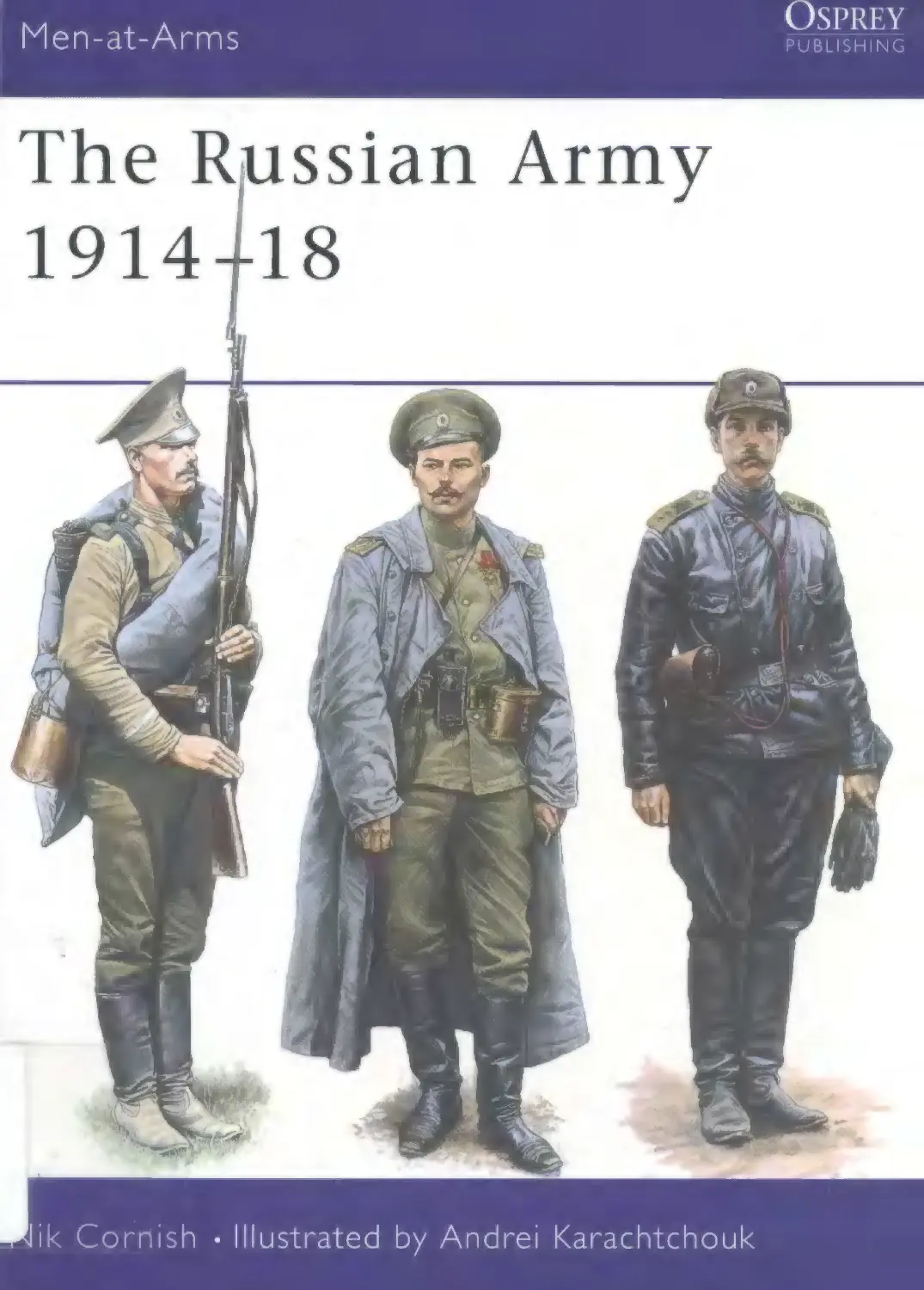
I he Russian Army

19144-18

J

ik Cornish • Illustrated by Andrei Karachtchouk
CONTENTS

NIK CORNISH was born in
Cardiff in 1954, and currently
lives and works in the south of
England. Formerly a teacher,
he founded STAVKA Military
Research, specialising In
eastern European conflicts at
the end of the last century.
This is his first book for the
Osprey Men-at-Arms series.

ANDREI KARACHTCHOUK was
born in 1966 in the town of
Mitishi, not far from Moscow
where he now lives and works.
He is a well-known artist of
military subjects in Russia,
and is active in re-enactment
circles. He is also a sculptor
who makes, among other
projects, master models for
the UK-based Anglo-Russian
Toy Soldier (ARTS) Company
His previous work for Osprey
appears in Men-at-Arms 293 &
305, Russian Civil War Armies
(1) Red Army, and (2) White
Armies.

INTRODUCTION	3

•	Russia's strategic position

CHRONOLOGY	5

ORGANISATION OF THE ARMED FORCES	11

•	Regional organisation - conscription & terms of service

•	infantry - corps, divisions, regiments, battalions
of Line, Grenadiers and Rifles; Russian, Finnish,
Caucasian, Turcoman, Siberian, Cossack

•	cavalry - Line, Cossack, ‘Alien’ • artillery

•	technical branches • wartime innovations

ELITE UNITS	15

•	Guards Corps/Special Army • St George’s Battalions

•	‘Storm’ and ‘Death’ Battalions • the ‘Savage’ Division

NON-RUSSIAN UNITS	19

•	Belgian • British • Polish • Latvian • Serbian • Czech

UNIFORMS & PERSONAL EQUIPMENT	21

•	Service dress • winter clothing • insignia tables

•	personal equipment • wartime innovations • flags

TACTICS	36

•	Infantry • cavalry • artillery • wartime innovations

•	the Brusilov Offensive • training

WEAPONS	39

•	Smail arms • artillery • armoured fighting vehicles

•	aircraft

SELECT BIBLIOGRAPHY	42

THE PLATES	43

INDEX	48
First published in Great Britain in 2001 by Osprey Publishing,
Elms Court, Chapel Way, Botley, Oxford 0X2 9LP, United Kingdom
Email: infoeospreypublishing.com

© 2001 Osprey Publishing Ltd.

All nghts reserved. Apart from any fair dealing for the purpose of pnvate study,
research, criticism or review, as permitted under the Copyright, Designs and
Patents Act- 1988 no part of this publication may be reproduced, stored in a
retrieval system, or transmitted in any form or by any means, electronic,
electrical, chemical, mechanical, optical, photocopying, recording or otherwise,
without the prior written permission of the copyright owner. Enquiries should be
addressed to the Publishers.

ISBN 1 84176 303 9

Editor: Martin Windrow

Design: Alan Hamp

Index by Alan Ruttter

Originated by Magnet Harlequin, Uxbridge, UK
Pnnted in China through World Print Ltd.

01 02 03 04 05 10 9 8 7 6 5 4 3 2 1

FOR A CATALOGUE OF ALL BOOKS PUBLISHED BY

OSPREY MILITARY AND AVIATION PLEASE CONTACT:

Dedication

The author dedicates this book to Elizabeth,
and to his children James, Alex and Charlotte.

The artist dedicates his paintings for this book to the memory of
Vladimir Zweguintzow, a Russian patriot, who devoted his life to
popularising the history of the Russian Imperial Army.

Acknowledgements

The author wishes to extend sincere thanks for tneir assistance
to Dmitry BeianovsK.. Steohen Connolly Andrei Simonov and
Stephen Perry, and to Col.A К Nikonov, Director of the Central
Museum of the Armed Forces Moscow, and to his staff,
particularly Ms H A Gmyrya

The artist wisnes to acknowledge the kind help of A Deryabin
M.Khvostov, S Laptev, R Palasios Fernandes and A Valkovich

All photographs not specifically creaited otherwise are the
property от STAVKA Military Research The credit (CMAF) indicates
.mages kindly supplied by the Central Museum ot the Armed
Pomes Moscow.

The Marketing Manager, Osprey Direct UK

PO Box 140, Wellingborough

Northants, NN8 4ZA, United Kingdom

Emad. info@ospreydirecLco.uk

The Marketing Manager, Osprey Direct USA
c/o Motorbooks International

PO Box 1, Osceola, Wl 54020-0001, USA

Email info@ospreydirectusa.com

www.ospreypublishing.com
THE RUSSIAN ARMY 1914-18

This relaxed image of an
infantryman in 1914 clearly
shows the summer shirt-tunic,
service cap, water bottle and
mess tin. Lacking only ammu-
nition pouches to complete his
field kit, Pte.Pavel Zherdev has
his greatcoat rolled across his
cnest in the distinctive Russian
manner. During Stalin's purges of
the 1930s Zherdev. by then tn.
First Commissar ot a legion on
the Volga, was executed.

INTRODUCTION

The Russian Armv of die First World War has loi decades suffered an
nnage problem compounded by politics, secrecy and ignorance.
The memoirs of those commanders who survived to write them
often tend to be apologist or self-seeking. Russia’s withdrawal from the
war is blamed upon politicians of varying shades of opinion. Shell
shortages, lack of Western support, traitors in high places, Russia’s
sacrifices in the interests of France in 1914 and Italy in 1916 - all these
factors have credibility, but none tells the whole story.

Many Western historians tended to fall in with one or other of these
schools of thought, until the publication of Professor Norman Stone’s
The Eastern Front J9l4-17in 1975. Slone demonstrates that by late 1916
Russia was producing sufficient munitions; but that her inability to adapt
to wartime imperatives such as feeding the urban population and
developing a viable supply system led to her collapse into revolution

* * *

At the beginning of the 2()th century the Russian empire covered eight
million square miles, with a population of some 170,0(10,000 people, and
was ruled over by one man: Tsar Nicholas II, whose Romanov dynasty
had celebrated 300 years of power in 1913. The authority of the Tsar was
absolute but, as the revolution of 1905-06 had shown, it rested on the
support of the army. Japan’s victory in the Russojapanese War (1904-05)
led to a review of Russia’s armed forces during the years leading up to
1914. When Gen.V.A.Sukhomlinov was appointed Minister of War in
March 1909, reform became a matter of priority.

It became clear that reform of the armed forces and industrialisation
would have to proceed together. Domestic production of small arms and
field artillery was sufficient, but for heavier artillery, communications
equipment and other modern necessities it was woefully inadequate.
It was necessary to import these items until Russian industry could
produce what was required. The period 1910-14 saw change on a scale
unprecedented during peacetime: rates of pay were increased to
encourage the Detention of experienced men, hundreds of officers were
retired as incompetent, conscription was expanded to create a larger
reserve pool, and the military budget was increased.

Inevitably there was opposition to these reforms, which polarised into
hostility between those who supported Sukhomlinov’s modernisation
programme and the more traditionalist adherents of the Grand Duke
Nicholas, uncle of the Tsar, Commander of the Imperial Guard and the
Sr Petersburg Military District. Consequently reform was implemented
only slowly; and in the matter of artillery it was complicated by strategic
as well as industrial problems.
Russia’s western defences were based on the assumption of an
invasion from Germany or Austria-Hungary. Mobilisation at the
outbreak of war would be slow, due to Russia’s vast size and under-
developed rail system. To buy time for mobilisation a line of colossal
fortresses, bristling with artillery, was built during the latter part of
the 19th century at key points throughout Russian Poland.
However, the range and power of 20th century field artillery
outclassed the fortress artillery; which required up-grading.
During the five years before 1914 a large percentage of the
artillery budget was invested in modernising the fortress guns -
 at the expense of the mobile heavy artillery of which Russia wits
I particularly in need.

However, war seemed a long way off; and the ‘Great
Programme' of modernisation approved in 1914 was due for
completion in mid-1917. Russia and France had been allies since
1893, and through the Anglo-French treaty this also linked Russia
to Britain. A French loan was arranged, specifically to construct
railways in Poland to speed up mobilisation. It was anticipated that
when all the pieces of the Great Programme were in place the armed
rces of Russia would be prepared for any scale of international conflict.

Tsar Nicholas II appointed his
uncle the Grand Duke Nicholas
Nicholaevitch Supreme
Commander of the Armed Forces
of Russia on 2 August 1914. The
Grand Duke is pictured here at
STAVKA - Supreme Headquarters
- at Baranovitchi during 1915.
Effective command was in the
hands of Nicholas' various
chiefs-of-staff

The strategic situation

Both Germany and Austria-Hungary were, by early 1914, extremely
concerned about the modernisation of Russia’s forces. The necessity for
action before Russia’s investments bote fruit was becoming critical, as
Germany’s plan for European war rested on the prerequisite of Russia’s
mobilisation being slower than Germany's conquest of Fiance. Germany
planned to commit the greater part of her army in the West to over-
running France, leaving some two army corps and local forces to defend
her eastern border. These troops, combined with the Austro-Hungarian
armies, were thought to be sufficient to hold Russia until victory in the
West released the bulk of Germany’s forces to turn against her.

Reality dictated that Russia would face Germany and Austria-Hungary
to the west and the Ottoman Turks to the south; it was therefore essential
to decide where to place the main weight of the Russian army during the
mobilisation period. The Army of the Caucasus was deemed capable of
dealing with the Ottoman threat; thus it was a choice between Germany
and Austria Hungary. Clearly Austria-Hungary'was temptingly the weaker,
but Germany posed the greater threat. Two plans had been drawn up:
Plan 19 gave greater weight to an offensive into East Prussia, and Plan 19
Revised, drawn up in May 1912, reduced the forces committed to East
Prussia, stressing Austria-Hungary as the main target.

Plan 19 Revised necessitated the creation, at the outbreak of war, of
two ‘Fronts’, one to command each operation - the North-Western and
the South-Western, both to be overseen by a supreme headquarters
known as STAVKA. The Austi ia/Germany dilemma was one that the
Russians never fully resolved. To further complicate the issue the
Russians had given an assurance to their French partners that they would
launch an offensive into East Prussia during the early weeks of any war.

Following the assassination of the heir to the Austro-Hungarian
throne in June 1914 and the intense political activity that ensued
throughout Europe, Russia’s mobilisation was carried out according to
This painting of the 3rd
Squadron of the Horse Guards
capturing a German battery on

Plan 19 Revised, resulting in the invasion of both East Prussia and
Austria-Hungary. Despite the distances involved and the incomplete
rail network near the western borders the mobilisation was carried
out with remarkable efficiency, much to the horror of the Central
Powers.

Unsurprisingly, the weather was to play an important part in the war
on the Eastern Front. The severity of the winters and the incredible mud
generated by the thaws limited the campaigning season to the period
May-October. The sheer scale of this front dominated the thinking of
the Central Powers, as they did not wish to repeal Napoleon's failure by
advancing too far into Russia. The plains of Poland ended at the
Carpathian Mountains to the south, providing a natural defence for
Austria-Hungary. To the east of the Carpathians lay the endless steppes
of the Ukraine and the almost impassable Pripyat Marshes. Russia's
Baltic provinces, bordering East Prussia, were scantily developed, flat
and largely featureless, but provided the shortest route to the capital
Petrograd (as St Petersburg was renamed at the outbreak of war), and
the bases of the Baltic Fleet.

19 August 1914 quite accurately
reproduces the uniforms, the

tactics and the elan of this elite
unit. The cap and shirt-tunic are
light summer khaki, the breeches
are blue-grey striped with red,
the cross belts white and the
shoulder straps black piped with
red. All non-Cossack cavalry
slung their carbines over the left
shoulder; half of each regiment
carried the lance and in action
formed the front rank. Bayonets
were Issued for dismounted
fighting. The Horse Guards rode
black horses and used the
standard dark brown horse
furniture.

CHRONOLOGY A’B: The Western calendar is used.

1914:

1 August Germany declares war on Russia; mobilisation gal hers
momentum. 2 August Grand Duke Nicholas Nicholaevitch appointed
Supreme Commander-in-Chief with Yanushkevitch as Chief of Staff
and Danilov as Quartermaster General. STAVKA established at railway
junction of Baranovitchi. 7 August Russian 9th Army begins to assemble
at Warsaw to invade Silesia. 15 August Russian 1st Army crosses into
East Prussia from the cast. 20 August Russian 2nd Army crosses into
East Prussia from the south. 1st Army defeats German 1st
Corps at Gumbinnen; German commander panics and is replaced
by Hindenburg and Ludendorff. Russian 3rd Army crosses into

Austria-H u ngary. Aust ri a n
and Russian cavalry clash
at Jaroslawice. 21 August
Russian 8th Army cross-
es into Austria-Hungary.
23-24 August Russian 4th
Army defeated by Austrians
at Krasnik in southern
Poland; 9th Army moves
south; Silesian invasion
postponed. 25-30 August:
Battle of Tannenberg Russ-
ian 2nd Army encircled and
destroyed in East Prussia.
26-28 August Austro-
Hungarian 3rd Anny'
defeated on River Zlota
Lipa. 29-30 August Austro-
Hungarian 4th Army
Trencn warfare a forward
arttilery observation post
The officer viewing the enemy
Unes through stereoscopic
binoculars passes the
information to his colleagues
who relay the information
to the gun position by field
telephone. The landlines were
naturally vulnerable to artillery
fire, but were more secure - and
available - than wireless sets.
The telephone equipment was
usually manufactured abroad.

defeated at Gnila Lipa. 30-3) August Russian 4th and 5th Annies
defeated at Zamosc-Komarow.

3 September Lemberg (Lvov) falls to Russian 3rd Amiv. Situation on
Austro-Hungarian eastern flank becomes critical; to the north their
advance towards Lublin stalls. 11 September Austro-Hungarian forces
retreat towards Przemysl; bad weather slows Russian pursuit. Germans
send troops to support Austria-Hungary. Mid-September: Battle of the
Masurian I.akes in East Prussia defeat and withdrawal of Russian 1st
\imv. 16 September First siege of Przemysl begins. 25 September
German advance following Masurian Lakes victory is checked.

October German advance on Warsaw begins; Russian counter-attacks
succeed. Gentians begin to retreat on 20 October. At the same time
Austro-Hungarians advance across River San, but bv 26 October they are
defeated and driven back. 14 October Siege of Przemysl raised. Late
October By now Russia has deployed 82 infantry divisions against the
Central Powers, with a further 16 defending Baltic and Black Sea coasts.
November Declaration of war on Turkey; Caucasian Front prepares for
Turkish invasion. 11 November Russia’s planned invasion of East Prussia,
betrayed bv German breaking of wireless codes, is pre-empted by
German attacks, but these are held Invasion of Silesia indefinitely
postponed First serious discussions at STAVkA regarding withdrawal
from Poland J 2 November Russian SW From defeats \ustro-Hungarians
in Carpathian Mountains; advances on Cracow but is held on Riser
Dunajec. Przemysl, with cl20,000 Austro-IInngarian troops inside, is
besieged again.

Early December Lodz falls to Germans, who are again held before
Warsaw. First entrenching begins as weather deteriorates. Austro-
Hungarian attempt to relieve Przemysl fails. Turkish invasion of the
Caucasus ends in disaster at battle of Sakrimash.

1915:

Early January First recorded use of gas al Bolimov
in Poland (effects negligible). 23 January Austro-
Hungarians recapture Carpathian passes.

7 February German attack from East Prussia
develops into Second Battle of the Masurian
Lakes; Russian 10th Army destroyed. Germans
begin siege of Osowiec, which is raised after a
month. Russian counter-offensive in Carpathians
and along the Dniester River pushes Austro-
Hungarians back m snowstorms.

Early March Counter-offensive bx remains of
Russian IOth & 12th armies drives Germans back
into East Prussia. NW Front stabilises but its
commander, Gen Ruzski, resigns as he is allowed
neither to invade East Prussia nor to withdraw
from Poland. 22 March Przemysl falls to Russians
who take over 100,000 prisoners. End March
Gen.M.V.Alexeyev replaces Ruzski and adopts his
ideas.

April Continuing success of Ivanov’s SW Front
renders Austria-Hungary’s situation critical. To
relieve pressure Germans advance against thinly defended Courland
(western Latvia). 10 April Ivanov halts SW Front’s progress and calls for
reinforcements.

2 May Germans open major offensive between Gorlice and Tarnow with
(fot the Eastern Front) unprecedented weight of artillery support Brunt
of German attack directed at Russian 3rd Army - short of artillery
ammunition and poorly entrenched. 10 May After losing nearly 200,000
men and 140 guns, 3rd Army is given permission to retire to River San.
16-19 May Austro-German troops attack River San positions. Russian 9th
Army attacks and overruns much of the Bukovina. 23 May Italy joins the
Allies (this does not immediately affect Austria-Hungary's strategy) 20-25
May Russians hold on the San, but 9th Army retreats to River Dniester.

4 June Przemysl recaptured by Austro-Hungarians. Gen.Alexeyev
ordered by STAVKA to defend Courland; German advance stopped.
Mid-June Central Powers resume offensive which, because of artillery
tactics employed, is known as ‘Mackenson’s wedge’. Russian Minister of
War Gen.V.A.Sukhomlinov arrested for ‘treasonable negligence’ and
replaced by Gen.A.A.Polivanov. 20 June STAVKA orders retreat from
Galicia. 22 June Lemberg recaptured by Austro-Hungarians. The
six-week Gorlice-Parnow offensive has cost Russia c300,00l) men and 224
guns. STAVKA decides to defend Polish fortress line.

13 July German attacks in Courland and northern Poland make slow
progress for heavy casualties. 15 July Premature Austro-Hungarian
advance beaten at second battle of Krasnik. Third battle of Krasnik
brings Austrian success; Lublin and Cholm fall by end of July. 19 July
Gen.Alexeyev given permission to abandon Warsaw, and on the 22nd the
Russians begin to retire from both northern and southern Poland.

5 August Warsaw occupied by Central Powers. 7 August With Osowiec
fortress as the hinge, Russian forces retire towards Bresl-Litovsk, pursued
by Germans under Falkenhayn. Accompanied by hundreds of thousands
of refitgees the Russians retreat, ‘scorching the earth as thev do so.
Appeals lor help to Western

The realities of war: wounded
men are being helped aboard a
hospital tram The battered
appearance of their dress is a far
cry from the studio portraits of
1914. The medical attendant on
the train is wearing a fleece cap
with cuckade: the side flaps
could be let down to protect the
ears - cf Plate D3. The second
ana fourth casualties from thn
left are wearing peakless field
caps, the third a black fleece
cap, possibly of natuial wool.
The majority of medical
personnel wore Aed Cross
brastards Wealthy Individuals
privately supported many
hospital trains.

Allies are ignored. 15
August Under political
pressure to defend Baltic
coastline and route to
Russia's capital Petrograd,
Guards ,\rmv is moved to
defend this area from
se aborne attack. 17 August
STAVKA divides war zone
into three Fronts: North-
ern, North-Western and
South-Western. 18 August
Kovno fortress falls to
Germans with loss of 1,300
guns. 20 August N’ovo-
Georgievsk fortress falls
with loss of 1,680 guns. 21
August Osowiec and Kovel
tall. STAVKA relocates to
Mogilev. 24 August Brest-
Litovsk fortress abandoned. End August Austro-
Hungarian ‘Black-Yellow’ offensive takes railway
junction of Lutsk.

1 September The Tsar takes the role of Supreme
Commander-in-Chief and appoints Grand Duke
Nicholas to the Viceroyalty of the Caucasus.
Gen.Alexeyev becomes Tsar’s Chief of Staff,
and effective commander of Russian armed
forces. 18 September Vilna falls to Germans.
22 September ‘Black-Yellow’ offensive halted by
Gen.Brusilov’s Russian 8th Army; SW Front
stabilises. 26 September On North and NW Fronts
Russian resistance hardens and Gentian attacks
are called off. Both sides entrench as Central
Powers consolidate then gains.

October Russians lose the first battle of Lake
Narotch. Mid-October Central Powers, aided by
Bulgaria, invade Serbia. Russians reorganise. The
length of the Eastern Front has been cut from

1,700 to 1,000 miles; domestic production of munitions is growing and
supply is improving. 1,000,000 refugees have moved into the Russian
heartland, as have strategic industrial concerns.

November .STAVKA discusses possible seaborne invasion of Bulgaria
When the admirals refuse, Gen.Alexeyev threatens to turn Black Sea
Fleet into ‘an infantry brigade'. His threat has no effect, and he proceeds
to create ‘Army of Descent’ around core of 7th Army based near Odessa,
December Measures to replace heavy losses among officer corps lead to
recruitment of many disaffected men, who are frequently put in charge
of depot units in Kiev, Moscow and Petrograd. Russia extracts promises
that during 1916 Western Allied efforts will be synchronised and support
given at limes of crisis. 27 December Russia launches limited offensive in
the Bukovina in support of Serbia. Although a failure, it is carefully
analysed by staff officers of SW Front with a view to incorporating lessons
into new tactical doctrine.

Following the loss of Poland and
the advance of the Austro-
Germans Tsar Nicholas took
personal command, Effectively
the power rested with his
Chlef-of-Staff Gen.M.V.AIexeyev,
between September 1915 and
May 1917 when he was replaced
by Brusilov. Alexeynv came from
a very humble background, and
his father had risen from serf to
officer; a gifted administrator,
he had 'only the good of Russia
at heart'. During the summer
of 1915 STAVKA relocated to
Mogilev, where it was to remain
until the end uf the war.

1916:

January Gen. Mexeyev announces a front line strength of 2,000,000 men.
February Turkish city-fortress of Erzurum falls to Russians. 21 February
Start of German offensive at Verdun. France. 24 February STAVKA
considers Lake Narotch as site of next offensive, to take place in April.

March Trabzon taken by Russians following combined land and sea
operations. 18-19 March Russians attack al Lake Narotch in response to
French requests for diversion. Results of bombardment poor due to
saturated ground; infantry attack as weather deteriorates. End March
Narotch operation called off after 120,000 casualties.

April Germans recapture ground lost at Lake Narotch. Gen.A.A.Bi usilov
becomes commander of SW Front. 14 April STAVKA decides main
offensive of 1916 to be carried out by W Front with subsidiary operations
by SW Front.

20 May Success of Austro-Hungarian offensive in Italy leads Italian king
to appeal to Tsar for help. Western Front’s preparations are incomplete
8 but Brusilov agrees to attack early.
4 June Start of the ‘Brusilov Offensive’. All four armies of SW Front -
8th, 9th, 7th & 11th - bombard Austro-Hungarian lines; innovative
Russian artillery fire plan causes chaos as Russians breach first and
second Austro-Hungarian lines. 5 June 8th Army breaks Austro-
Hungarian third line. 6 June Xustro-Hungarian 4th &• 7th Armies near to
collapse. 9 June \nstro-l Itingai ian 7th Army retreats into the Bukovina.
12 June Brusilov halts advance after taking c200,000 prisoners and 216
guns. 24 June Austro-Hungarian offensive in Italy is called off; Central
Powers counter-attacks on River Stokhid fail.

1 July In France, British offensive on the Somme begins. 2 July Main
Russian attacks by W Front begin; bv 8 July Russian casualties reach
80,000 for negligible gains. 3 July Cen.Brusilov attacks again, driving
back German Sud \rmec.

Mid-July In France, Germans cal) oil Verdun attacks. Gen.Brusilov is
given more troops but, due to court intrigue, does not have authority’
over the Guards Xrmy. 28 July Start of series of suicidal attacks through
marshes and swamps neat Kovel in which Guards Army is decimated.

August Russian 8th Xrmy continues advance westwards, but supply lines
grow longer and resistance hardens. 9th Army drives into the Bukovina;
8th and 9th Armies take Halicz. End August Romania declares war on
Central Powers and invades Transylvania. Bv this time Central Powers
losses stand at over 500,000, and Xustro-Hungarian troops are being
transferred from Italv. However Brusilov’s ‘Bro,id Front’ approach has
been discontinued in favour of the ‘Narrow Front’ as used with such
disastrous consequences at Kovel.

September Gen. Xlexeyev sends one cavalry and two infantry divisions to
support Romania. 6 September Central Powers move against Romania
from the south. 15 September Romanians move troops from Transylvania
to the south.

3 October Russo-Romanian offensive against Bulgaria fails. 6 October
Central Powers re-occupy Transylvania; end of Russian offensive in the
Bukovina. 21 October Central Powers, mainly Bulgarian and Turkish
units, drive back Romanian and Russian troops in southern Romania.
End October Gen.Alexeyev sends Russian reinforcements to Romania;
Bulgarian-Turkish advance halted.

November Xustro-Gernran troops break through Carpathian passes.
23 November Central Powers cross the River Danube.

December Romanian counter-attack fails and army falls back into

High In the mountains on the
Caucasus front a group of
officers discuss the situation.
The landscape varied from
bleak and barren to verdant
and wooded nearer the Black
Sea coast.

Moldavia. 7 December Romanian capital
Bucharest falls to Central Powers. End December
Romanian line stabilises along River Siret.

1917:

Early January Russians in de fatlo control of
Romanian Army; Romanian Front created.
January Russian NW Front launches successful
operation near Milan on Baltic Sea. Discussions al
STAVKA regarding offensive on SW Front and
radical reorganisation of at med forces. Inter-Allied
conference reiterates policv of mutual support and
promises delivery of munitions, including heavy
artillerv and aircraft.
Another photograph from the
Caucasus, though It could be
anywhere on the Eastern Front:
a group of troops, dressed for
the bitter weather, brew tea.
Greatcoats and fleece caps
are clearly essential in these
conditions.

February-March Strikes and demonstrations in Petrograd arc supported
by replacement units in city; military and civilian authorities lose control.
Councils known as Soviets spring up across Russia, acting as alternative,
radical form of leadership.

12 March Provisional Government established in Petrograd; revolution
accomplished with little bloodshed 14 March Order No.l issued by the
Petrograd Soviet, dramatical!' reducing powers of officers, influences
whole armed forces and leads to breakdown in discipline.15 March Tsar
abdicates in favour of his brother Mikhail, who rejects the throne The
Petrograd Soviet calls for an end to the war, and world revolution.

April Regimental revolutionary committees exert increasing power over
military operations and appointments. The front remains quiet as the
Central Powers observe the situation. 16 Ipril V.I.Lenin, leader of the
Bolshevik party, returns from exile to Petrograd and calls for Bread,
Peace and Land'. 30 April Го secure financial and military aid from the
West Miliukov, for the Provisional Government, declares intention to
continue fighting. (He is forced to resign on 18 Mav.) Russian activity on
the Caucasian Front ceases tine to supply crisis.

May Ihe charismatic Alexander Kerenski becomes Minister of War.
Fighting again breaks out at the front Brusilov replaces Alexeyev as
Supreme Commander-in-Chief. Russians withdraw in Anatolia.

June Preparations for summer offensive on SW Front stepped up in
attempt to emulate success of ‘Brusilov Offensive’ of previous year.

1 July Start of Russian summer offensive, which becomes known as the
‘Kerenski Offensive’ July Under the greatest weight of shells used by
Russian artillery during the war the defences of forces facing SW Front
crumble. Russian 7th & 11th Armies advance through 30km breach
toward-. Lemberg. Both W & NW Front.-, attack in support. However,
within a few days morale erodes; when facing anything but negligible
opposition troops refuse to attack, or withdraw. 19 July German counter*
offensive; Russian troops fall back, losing cohesion and discipline.

1 August Gen.L.G.Kornilov replaces Brusilov as Supreme Commander-
in-Chief with intention of restoring discipline.

August Ihe front line stabilises as Genual Powers encounter firmer

resistance, particularly' on
Romanian Front

3 September Russian 12th
Army abandons Riga on
Baltic coast. 7-9 September
Failure of ‘Kornilov’s
Coup’, bungled attempt to
overthrow Provisional
Government; Kornilov
imprisoned with other
senior officers. 14
September Russia declares
itself a republic.

12-19 October ‘Operation
Albion' - Germans take
control of Gulf of Riga bv
capturing Moon and Oesel
islands.
The image of the frontovik, the
typical front line soldier; he has
a worn greatcoat and ragged

7 November Lenin leads Bolshevik-inspired coup in Petrograd which
ousts the Provisional Government. Mid-November Kerenski fails to
rally support for Provisional Government, and goes into exile.

18 November Declaration of Soldier’s Rights includes abolition
of ranks and election of commanders. 20 November Trotski,
Commissar for Foreign Affairs, formally notifies Allied
Powers of change of government and Decree of Peace. 21
November Fraternisation on all fronts is authorised by
Krylenko, Commissar for War. 23 November Gradual
demobilisation of the army is declared. 26 November
Trotski formally approaches Central Powers for an
armistice.

3 December Gen.N.Dukhonin, last Supreme Commander-
in Chief of Russian Armed Forces, is murdered at Moghilev
by Red Guards. With authority collapsing, the army begins to
drift home. 15 December Russia signs 30-dav armistice with
Central Powers.

1918:

January Peace talks with Central Powers begin at Brest Litovsk. 28
January Formation ol Red Army announced.

18 February Frustrated by Russian negotiators, Central Powers advance

along entire Eastern Front, occupying vast tracts of western Russia.

3 March Russia signs Treaty of Brest Litovsk and withdraws from the war.

bashlyk (cowl) wrapped across

the chest and tucked into the
belt, with the hood hanging
down the back. The cowl was

ORGANISATION OF THE ARMY

issued to all ranks and branches
of service; many units piped the
seams in regimental colours.
Beards were permitted in most
units. The shoulder straps are
plain khaki. The service cap
seems to be the parade
version, which would have
been dark green, with a red
band and red crown piping
for the first regiment in each
infantry division; the others
had blue, white and green
bands respectively.

In peacetime the empire was divided into 12 military districts, each
under a commander-in-chief: Si Petersburg, Vilna, Warsaw, Kiev, Odessa,
Moscow, Kazan, the Caucasus, Turkestan, Omsk, Irkutsk, and the
Pri-Amur. Russian land forces consisted of the Standing Army and the
Imperial Militia (Opolihenie). The Standing Army comprised the regular
army and its reserve; the Cossacks; and the ‘Alien’ troops (fnorodlsi) -
these latter being non-Slavic Imperial subjects. The strength of the
armed forces immediately prior to mobilisation was officially estimated
at 1,423,000 men; af ter mobilisation was complete this would increase to
some 5,000,000 - the Russian steamroller’ which was relied upon to
crush any opponent by sheer weight of numbers.

Liability for conscription began at the age of 21 and lasted until 43.
The first three years (for the infantry and artillery) or four years (for
other blanches of service) were served with the colours; the next seven
years were spent in the first class reserves, and the final eight in the
second class. Men could also volunteer, in which case their conditions
of service were privileged. Recruitment was in the main from the
Russian, Christian population of the empire, thus excluding Moslems,
who paid a tax in lieu. (Units referred to as ‘Finnish’ were Russian
formations based in Finland, as the Finns themselves were exempted
from conscription.) Generally 50 per cent of those called up in any year
were exempted on physical, personal, economic or educational
grounds; and retention of experienced men who could provide the
NCO class was poor.
Cossacks served from 20 until 38, doing 12 years in the ‘field class’ -
lour years each in the first, second and third category regiments - and
the remaining time in the reserve. Ihe ‘Alien’ troops were volunteer
irregular cavalry units recruited from Moslem tribes.

I he Imperial Militia comprised the majority of the men granted
exemption from the regular army between the ages of 21 and 43. Ihe first
category was used to strengthen or complete the Standing Army and was
divided according to age. The second less physically capable group, was
used to form non-combatant units. Provision existed foi the organisation
of 640 battalions (dnizhina) of militia. During the veal’s preceding the
revolution of March 1917 several million militiamen of all classes
were mobilised.

Cossacks crossing a river in
East Prussia in summer 1914 -
not a method to be used under
fire, but one that is obviously
effective for men who were
raised in the saddle from infancy.
Support for the rider was given
by crossing the stirrups over the
saddle. Cossack horses were
renowned for their stamina and
ability to live on short rations;
they were specially bred on
government stud farms out on
the steppe. The Cossacks were
regarded as irregular troops,
which allowed them a degree
of freedom not available in the
Guard and Line cavalry (e.g.
the quiff or ‘lovelock’ hairstyle
favoured by the Don Cossacks,
as in Plate B3).

Infantry

The 208 recruiting areas in Russia provided men for the 208 line infantry
regiments. The Guard, Grenadiers, Rilles, artillery, cavalry, and
engineers drew recruits from any district. The minimum height
requirement was 5 feet and half an inch.

I he field army was divided into 37 army corps: the Guard, the
Grenadier, I to XXV, I to III Caucasian, I and II Turkestan, and I to V
Siberian. These included all the infantry divisions with their attached
artillery. I lie normal composition of an army' corps was two infantry
divisions, one divizion of light howitzers (two 6-gun batteries), and a
battalion of sappers; the term divizion refers here to a half-regiment. An
infantry division consisted of four regiments each of four battalions, and
a field artillery brigade of six 8-gun batteries.

Of the 236 infantry regiments 12 were Guards and 16 Grenadiers.
Ihe Guards regiments were named, the Grenadiers numbered I-16,
and the Line named and numbered. The 4th or Caucasian Grenadier
Division was permanently stationed in the Caucasus.

An infantry' regiment was made up of four battalions each of four com-
panies, plus a non-combatant company. Infantry regiments were allotted
serially to divisions; thus the 17th Infantry Division would include the
65th to 68th Regiments inclusively. A wartime company would number
240 men and four or five officers. At regimental level machine gun, com-
munications and scouting detachments, known as kommnndos, brought

total regimental strength
up to about 4,000 men. In
1911 each regiment had
eight machine guns; 14
mounted messengers and
21 telephonists in ihe com-
munications detachment:
and 61 specially trained
scouts including four
cyclists.

Infantry regiments from
Siberia and Turkestan were
known as Rilles, but org-
anised like olhei infantry
regiments with four bat-
talions. The Rifle regiments
‘proper’ had only two
battalions each. There were
four Guards Rille regiments
forming the Guards Rifle
Brigade; 20 Line Rifle
regiments numbered 1-20,
forming the 1st to 5th Rifle
Brigades, 12 'Finnish' Rifle
regiments numbered 1-12,
forming the 1st to 3rd
Finland Rifle Brigades;
and eight Caucasian Rifle
regiments numbered 1-8,
forming the 1st and 2nd

Caucasian Rifle Brigades. The 22 Turkestan Rifle regiments were
numbered 1-22; the 1st to 4th Turkestan Rifle Brigades had four
battalions each, the 5th and 6th three. Each Rifle brigade contained a
Rifle Artillery Brigade of three 8-gun batteries. Bv 1914 the title Rifle
signified nothing more than the unit's historical role.

On mobilisation, 35 reserve infantry divisions were formed
numbered 53rd to 84th, and 12th to 1 1th Siberian. The establishment
of these divisions was identical to that of the regulars, though their
artillery was often equipped with less modern ordnance.

Cossack infantry were known as plastuni. Initially only the Kuban
Cossack Host raised infantry', but the practice later spread to others.
They were organised into brigades each of six battalions, without
artillery. In 1914 three brigades were assigned to the Caucasian Front.

The crew of this Ml902 Putilov
7.62cm field gun wear the dark
green pre-war breeches striped
red, with summer khaki service
cap and shirt-tunic. The shoulder
straps are worn coloured side
up, showing scarlet with crossed
cannon barrels stencilled in
yellow.

While the field artillery was
adequate, the lack of heavier
artillery in the field armies was
serious. At the outbreak of war
some 2,813 modem guns plus
3,000 older ones were confined
to the fortresses, while the army

Cavalry

Russia had the largest cavalry establishment of all I he belligerent nations
in 1914. There were four groups: the Guard (see below under ‘Elite
Units’), the Line, the Cossacks and the Alien troops. Line cavalry and
Cossack regiments were all composed of six squadrons, giving a combat
strength of about 850 men; a Cossack squadron was known as a sotnia.
Although the historical lancer, hussar and dragoon titles were retained
they had no tactical significance. Specialist detachments for scouting,
communications and demolition were as per the infantry. Attached to
each division was a machine gun detachment of eight guns.

In 1914 there were 20 dragoon, 17 lamer and 18 hussar regiments
of the line. On mobilisation 24 cavalry and Cossack divisions were
formed, and an additional 11 independent cavalry and Cossack
brigades. Cavalry divisions were formed of two brigades, the first
grouping a dragoon and a lancer regiment, the second a hussar and a
Cossack regiment. The regiments were organised serially; thus the 3rd
Cavalry Division would include the 3rd Dragoon, Lancer and Hussar
Regiments. There was also a dragoon division with the Army of the
Caucasus, the Caucasian Cavalry Division.

in the field had only 240 heavy
guns and howitzers between
them.

Cossacks

The Cossacks were divided into two broad groups: those of the steppe.
Stepnoy, and those of the Caucasus, Kavkas. The Caucasians split into two
voisko.s (‘Hosts’), the Kuban and the Terek; the Steppe, into the Don,
This brother and sister are

Cavalry Division was

pictured in January 1916. The
lady holds the rank of praporshik
(ensign) in the 9th Siberian
Rifles, her brother that of captain
in the same regiment; he wears
an award of the Cross of St
Stanislaus. Female soldiers
were not common but were an
accepted part of military life.
Note that his ‘French'-style
tunic has a stand-and-fall collar,
while she wears a gymnastiorka
buttoning the female way, right
to left.

Siberia, Orenburg, Ural, Astrakhan, Trans-Baikal,
Semiretchi, Amur and Ussurski voiskos. The
largest Host was that of the Don.

The first category regiments were maintained
in peacetime, the second and third categories
being activated when the need arose. The Don
Host raised 54 regiments, the Kuban 33, the
Orenburg 16, and the others in proportion to
their populations. Cossack divisions were created
in the main from a single Host, but Combined
Divisions formed from different Hosts were raised
during the war. Second category' squadrons were
allotted to infantry divisions for use as escorts,
messengers, local security troops, etc. Some 50
batteries of Cossack horse artillery were raised,
mainly from the Don Host.

The Alien cavalry were volunteers: the
Daghestan Native Cavalry Regiment, the
Ossetian Cavalry Divizion (half-regiment), and
the Turcoman Cavalry Divizion. The first two
were Moslem tribesmen from the Caucasus, the
latter from the Tekin tribe of Turkestan. During
Xugust 191 I it was decided to raise a new cavalry
division of six regiments among the Moslem
peoples of the Caucasus: this Caucasian Native
nicknamed the ‘Savage' or ‘Wild’ Division, and

earned a high reputation (see below undei Elite Units’).

Artillery

I he artillery was divided into specialist types: field and mountain; horse
and horse-mountain; field howitzer and heavy.

Field artillery was grouped into brigades of two divizions each with
three 8-gun batteries. A brigade was allocated to each infantry division;
this gave three Guard brigades, four Grenadier (1-3 and the Caucasian),
52 line brigades, 11 Siberian Rifle, five Rifle, three Finnish Rille, two
Caucasian Rifle and six Turkestan Rifle brigades.

Mountain batteries were distributed to the Caucasus, Siberia,
Finland, Turkestan and Kiev for use in the Carpathian Mountains. The
mountain guns could be drawn or broken down for pack transportation.

Horse and horse-mountain artillery was organised into divizions of
two 6-gun batteries, other than in the Guard, and were attached one to
each cavalry division. The three horse-mountain units were distributed
one each to the Caucasus (Caucasian Cavalry Division), Siberia (Ussuri
Cavalry Brigade) and Kiev (IXth Anny Corps).

There were 35 divizions of field howitzers (mortimie) each of two 6-gun
batteries. One each was allotted to the Guard, the Grenadiers, each of
the 25 numbered army cotps, lst-3rd Caucasian, 1st—5th Siberian, and
one battery with the 1st Turkestan Rifle Artillery Divizion.

What heavy artillery there was was organised into seven divizions each
of three 6-gun batteries. Divizions 1-5 were stationed in the west and the
Siberian 1st and 2nd in the east. The first and second batteries in each
unit were equipped with bin. howitzers and the third with 4.2in. guns.
The establishment of fortress artillery was determined by the size of
the fortress and the guns it mounted. A large base such as Vladivostock
had two brigades, a smaller one a single company.

Technical branches included sapper, railway, and pontoon battalions,
field and siege engineer parks, and wireless telegraph companies. The
field engineers numbered 39 battalions, one for each army corps and
two extra for the Siberian establishment. Other than the Guard engineer
battalion (which had four), each battalion had three companies - one or
two telegraph companies and a searchlight section.

Wartime innovations

The experience gained during the war caused organisational changes
throughout the armed forces. Across the board technical equipment
such as telephones became common at all levels. The number of
machine guns was hugely increased by imports, captures and expanded
domestic production, to the point where MG units organised themselves
at almost local level.

Reform of the cavalry divisions was undertaken at the beginning of
1916, when each had attached to it an infantry' battalion of three
dismounted squadrons, latter in 1916 a reduction in the mounted
strength of each cavalry' and Cossack regiment from six to four
squadrons was approved. The dismounted men were used to increase
the infantry element to a three-battalion regiment. Artillery support for
the cavalry was to be increased by the provision of howitzer battalions of
eight guns - several hundred British 4.5in. howitzers were imported
during that year with the promise of more to follow.

During wintet 1916/17 STAVKA began reorganising the infantry,
reducing the divisional establishment from 16 to 12 battalions and using
the surplus to create some 60 new divisions, which were attached to
existing corps as a third division. However, the major problem was
shortage of divisional artillery; and to overcome this it was decided to
reduce the numbers of field guns in passive areas and allocate the surplus
to the new divisions. The artillery was to be provided with more heavy
guns and these were to be assembled into a 46th Corps, to be known as
TAON - the Cyrillic initials for Heavy Artillery' on Special Duties. 4 AON
was to be at the disposal of the Supreme Commander-in-Chief;
equipment consisted of weapons of varying calibres, including many from
France and Britain, which had agreed to give priority to their supply.
These were scheduled to arrive during the early months of 1917.

ELITE UNITS

Guards Corps/Special Army

At the outbreak of the war the elite force of the army was the Guards
Corps, a self-contained formation including units of all branches, with
their own jealously guarded traditions. (Not all of these were based on
their fighting record over 300 years - the Pavlovski Guards Regiment was
notable for its recruitment of men with snub noses...)

The Guards infantry were divided into three divisions each of four
regiments brigaded in pairs, the Guards Rifle Brigade of the 1st to 4th
Regiments.
1st Guards Infantry Disision

1st Brigade Prcobrazhenski & Semenovski Guards Regts;
2nd Brigade Izinailovski &• Egerski Guards Regts
2nd Guards Infantry Division

1st Brigade Moskovski & Grenadier Guards Regts;

2nd Brigade Pavlovski & Finlandski Guards Regts

3rd Guards Infantry Division

1st Brigade Lilovski & Kexholmski Guards Regts;
2nd Brigade St Petersburg (Petrograd, 1914) &
Volynski Guards Regts.

The two Guards cavalry divisions each had
three brigades. The Guards cavalry regiments
were organised in four squadrons each of 1.50
men, other than the Horse Grenadiers and the
Cossacks, which had six squadrons.

1st Guards Cavalry Division

1st Brigade Chevalier Guards Regt; Horse Guards

Regt. 2nd Brigade His Majesty’s Cuirassier Guards
Regt; Her Majesty’s Cuirassier Guards Regt.
3rd Brigade His Majesty’s Cossack Guards Regt; 1’he
Ataman’s, I II I the Tsarevitch's Cossack Guards Regt

(both these regiments recruited from the Don Host);

Combined Cossack Guards Regt (this unit was drawn
from all the smaller Cossack Hosts in proportion to theii
populations).

2nd Guards Cavalry Division

1st Brigade Horse-Grenadier Guards Regt; 1 ler Majesty’s Lancer (’.uat ds Regt
2nd Brigade Dragoon Guards Regt; His Majesty’s Hussar Guards Regt
3rd Brigade I lis Majesty ’s Lancer Guards Regt; (frodno I lussai Guards Regt.

His Majesty's Personal Escort, the Kmivoi, recruited font squadrons,
two each from the Kuban and the Terek Cossack Hosts.

Hie 1st to 3rd Guard Artillery Brigades were attached to the
appropriate infantry divisions, the Rifle Artillery Brigade to the Guards
Rifle Brigade. There were six 6-gun Guard Horse Artillery batteries, the
sixth being the Don Cossack Guard Batters. The Guards Howitzer
Divizion (of two 6-gun batteries) completed the artillery.

1'he Guard Equipageov Crew, naval personnel drawn from the fleet to
man the royal vessels, was expanded at the outbreak of wat to form two
battalions each of two companies; these were given infantry training and
sent to the front.

By the summer of 1916 the 1st and 2nd Guards Infantry Divisions had
been united to form the 1st Guard Corps, and the 3rd, the Rilles and the
Equipage, the 2nd Guard Corps. Each corps had an aviation detachment
anti a heavy artillery divizion. These corps were to be known, from 21 July
1916, as the Guards Anny. However, following the losses sustained by the
Guards during the Bmsilov Offensive then numbers were supplemented
with line army corps and the whole became in Septembei 1916 the
‘Special Anny’.

The military muscle behind the March 1917 revolution was provided
bv the reserve battalions of the Guard in Petrograd. Indeed, the
Equipage, led by its commander the Grand Duke Cyril Romanov,
marched through Petrograd sporting ted revolutionary cockades. The

In the summer of 1914 there was
one aviation company for each of
the 25 army corps, one each for
the Guard and Gienadier corps,
three Siberian companies and
eight allocated to the fortresses.
The number of aircraft available
to the army was 244, the navy
having only 20 or so. However,
according to some estimates the
Air Service had lost some 140
planes by the autumn of 1914,
the inventory of the SW Front
alone being reduced from 99 to
a aircraft. By the end of 1914
Russia had established the
so-called Air-Ships Squadron
to operate the four-engined
heavy bomber known as the
Iliya Muromets.

Although the air war over
the Eastern Front was active
and fierce it was a somewhat
one-sided affair, dominated by
the Central Powers. Russian
production and repair facilities
were limited; and between 1915
and the end of 1917 Russia
imported, mainly from France,
1,800 aircraft and 4,000 engines.
To ease production difficulties
(continued opposite)
the Russians resorted to the
expedient of using captured
enemy aircraft; at one stage
the XVIII Corps Aviation
Company was operating
exclusively with captured
machines. On 9 December
1917 the Air Service had 579
operational aircraft.

OPPOSITE A typical imported
scout type, a Morane Parasol’
monoplane Russia’s leading
ace, Staff Capt.A.A.Kazakov (17
confirmed victories, but possibly
as many as 32), flew an MS5 as
commander of the XIX Corps air
squadron, and later a Nieuport
17 as CO of the 1st Fighter
Group of four squadrons.

The pilot officer is dressed in
the flying kit issued from 1913:
cf Plate F4. The helmet Is brown
leather with the usual officer's
pattern cockade, the leather
jacket is black, and the breeches
are black piped red, indicating
the Air Service's origin as a
part of the Engineers. A double-
headed eagle of the Engineer
pattern with a bronzed metal
twin-bladed propeller was the
shoulder strap badge for pilots;
it was worn in gilt metal by
observers. Other ranks had the
same badge stencilled in brown
on their shoulder straps.

personal bodyguard of the Tsar, the Konvoi, declared their allegiance to
the new regime within days of the abdication, symbolically removing the
Imperial monogram from their shoulder straps.

Grenadier platoons

By the end of 1915 trench warfare led to the development of units which
became known as ‘grenadiers’; but note that these had no connection
with the traditional Grenadier Corps itself. The XXV Vrmv Corps raised
the original unit in late 1915. Such detachments were to be a fourth
platoon in each company, consisting of‘brave and energetic men’ armed
with ten hand grenades, a shovel and wire-cutters. Other detachments
were armed with revolvers, carbines, swords or short lances. The purpose
of the grenadiers was to lead intelligence-gathering raids, assaults and
counter-attacks. During assaults they were to be found operating with the
sappers, infiltrating and expanding the gaps in the wire. The extent to
which the grenadier platoon system was instituted throughout the army
is difficult to gauge, but they were certainly established in the Special
Army, the Grenadier Corps and the XXV Arms' Corps.

St George’s Battalions

Although not front line units, these hand-picked battalions were
regarded as elite troops in that all ranks had to have been highly
decorated: enlisted men with the St George’s Cross or Medal, officers with
the Order of St George. Formed as part of the guard at STAVKA in 1916,
the original battalion was increased to live during July 1917, stationed at
Minsk, Kiev, Pskov and Odessa and at STAVKA. Their task evolved into
that of instructors to the Storm Battalions and other volunteer units.

Their uniform was the standard field dress with distinctions in the
colours of the Order of Si George, orange and black, based on the
uniform of the 13th Dragoons (itself named the ‘Military Order
Regiment’). Officers had orange-piped breast pockets, breeches and
cuffs; other ranks had orange-piped cuffs and breeches and also the
front edge of the tunic. The officer's cockade had the officers’ St
George’s Cross superimposed, and other ranks' their cross.

‘Storm’ and ‘Death’ Battalions

In the wake of the March Revolution the armed forces became a hotbed
of political discussion, active warfare taking a back seat. However, this did
not apply to all and by May 1917 several proposals had been put to
STAVKA to prevent ihe further deterioration of the forces. The impetus
behind this movement came from the lower echelons and their
suggestions were not always greeted with enthusiasm by higher command.
However, it was decided to harness this enthusiasm, and various units
were recruited during the build-up to the 1917 summer offensive.

There were two identifiable sources of such volunteers: troops
already serving in combat units, and men either not in uniform or
posted in rear areas. The second group was inspired to harness the
revolutionary fervour of the population in support of what Kerenski
called (he freest army in the world’. Recruiting was carried out l>\
members of the fabulously titled ‘Executive Committee for the
Formation of Revolutionary Battalions from the Rear', and enjoyed the
support of some leading generals - notably, Brusilov. During the next six
months 39 such battalions were formed. Some, such as those organised
by cadet schools 01 combat formations (e.g. the 2nd Orenburg from
Siberia), performed with great valour. Broadlv speaking they were called
‘Storm Battalions’, "Shock Battalions' or ‘Battalions of Death'. Their
purpose was to group together volunteers who were prepared to attack,
and so inspire their comrades to follow.

The 1st Storm or Shock Detachment was formed on the South-
Western Front commanded by Gen.L.G.Kornilov. The unit consisted of
two 1,000-man battalions with three machine gun teams of eight guns
apiece, and one foot and one mounted scout detachment of 16 men
each. It performed well during the summer offensive but sustained vers
heavy casualties. When Kornilov became Supreme Commander-in-Chief
one of his first actions was to reorganise the 1st Shock Detachment into
tile Kornilov Storm Regiment of four battalions (see Plate 112). I he
combat record of the regiment was such that for an action on 16 August
evers man in its ranks was recommended for the St George’s Cross.
Following the failure of Kornilov’s so-called putsch the regiment was
renamed the 1st Russian Shock, and later the Slav Shock Detachment, the
latter possibh in honour ol the number of Czech members of the unit.

Women’s ‘Battalions of Death were also raised, but they were mainly
a propaganda exercise. However. the remains of the 1st Women’s
Battalion (see plate 114) provided the Provisional Goveitunent's last line
of defence outside the Winter Palace in November 1917 on the night of
the Bolshevik coup. Nasal ‘Battalions of Death' (including one of
women) were also raised, but details are scant.

The ‘Savage Division’

Following the success of native volunteer cavalry units during the Russo-
Japanese War it was decided in August 1914 to recruit a six-regiment
cavalrv division f rom amongst the Moslem tribesmen of the Caucasus and
the Tartars of Baku. The official title was the Caucasian Native Cavalrv
Division, but it was also known as the ‘Wild’ or "Savage Division' — both
for its ferocity in battle, and also because many Russians regarded

The founder and commander of
the 1st Russian Women's
Battalion of Death, Lt.Maria
Botchkareva, reviewing the
battalion in July 1917. Raised
with the intention of shaming the
male soldiers into adopting a
more aggressive attitude to the
war following the take-over by
the Provisional Government, this
battalion took part in the
Kerenski Offensive of July 1917;
see Plate H4. Similar women's
units were formed, but only this
first, from Petrograd, saw action.

Caucasians in that light.
The Tsar’s brother, (he
Grand Duke Mikhail, com-
manded the division from
1914 lo 1916. I he organi-
sation was onlv changed bv
the addition of a battalion
of Ossetian rifle-men early
in 1917.

1st Brigade Daghestan Regt,
Kabardian Regi

2nd Brigade Chechen Regt,
Tat tai Regt

3rd Brigade ( ircassian Regt,
Ingush Regt

\ divizion of mountain
horse artillery (two 6-gun
batteries) provided support
until 1916. when three
batteries of Don Cossack horse artillery were added. The machine gun
detachment was drawn from sailors of the Black Sea Fleet, who wore the
kaftan and fur or fleece cap but with naval badges of rank. The signallers,
transferred from the engineers, wore the standard army field dress. 1'he
officers had transferred from other cavalry regiments and were allowed to
wear the cap of their original regiment when off-duty.

The ‘Sasages’ fought on the South-Western and Romanian Fronts
until transferred to take part in the Kerenski Offensive of summer 1917
as part of the 3rd Cavalry Corps, \fter participating in the abortive
Kornilov coup the division did not return to the front, and was finally
sent home to demobilise later that year.

NON-RUSSIAN UNITS

The Navy was a hotbed of
political activity following the
abdication of the Tsar in spring
1917, in part due to their
secondary role during the war.
The Baltic Fleet, based at
Kronstadt, was largely limited
to coastal operations under
command of Nortnem Front. Its
sailors were among the most
fervent supporters of the
Bolsheviks in November 1917
(and their most courageous
opponents in 1921). The Black
Sea Fleet, based at Sebastopol,
saw slightly more wide-ranging
action against the Turks.
Combined operations in April
1916 at Trabzon on the coast of
Anatolia were successful, but
the scope for more ambitious
operations was limited.

This member of the crew of
the Diana, sister ship of the
cruiser Aurora of revolutionary
fame, is dressed in the
traditional naval manner. Of
particular interest is the black
and white telniashka vest worn
under the blue jumper; when
stripped to this vest in battle,
the man could not retreat or
surrender.

Belgian

The stagnation on the Western Front made the armoured car units of
both Britain and Belgium surplus to requirements. During summer 1915
the Russians requested that the Belgians transfer a unit to the Eastern
Front, where there was a pressing need for such weapons. Bv December
1915 the Corps des Autos-Canons-iMilrailleuses Russie were parading for
Nicholas II at Tsarskoe Selo. The vehicles were organised into a battery' of
two sections, each of five armoured cars - three Mors and two Peugeots -
armed with 8mm machine guns and 37mm short guns. The men of all
ranks were dressed in a mixture of Belgian and Russian uniform with
rank distinctions worn on the shoulder straps. The other ranks wore
volunteer cords on their shoulder straps, which entitled them to certain
privileges. Contemporary photographs show that the Belgian stable-cap
was commonly worn. The Corps fought on the South-Western Front under
9th Army until summer 1917. The majority of the 360 men returned to
Belgium via Vladivostock during summer 1918.

British

Shortly after the arrival of the Belgians a British armoured car unit landed
at Alexandrovsk (Murmansk) on New Year's Dav 1916. Known as the
Russian Armoured Car Division, Royal Naval Air Service, it was led by
Commander Locker-Lampson MP. During the summer and autumn of
1916 it served on the Caucasian Front fighting the Turks, and gained
valuable experience before being transferred to the South-Western Front
in Romania, where it went into action in December. Relocated in June
1917 as part of the build-up for the Russian summer of fensive, the RNAS
unit participated in both the advance and the retreat. The vehicles were
mostly machine gun-armed Lanchesters, supplemented by Pierce-Arrow
armoured lot ties mounting 3-pounder guns. Following the debacle of the
Kerenski Offensive the British vehicles were supplemented with Fiat
armoured cars and lorries. In autumn 1917 the majority of the men were
withdrawn via Kursk and Archangel to Britain.

During 1917 a mission was sent by the Royal Flying Corps to train
Russian air and ground crews in the use ot British aircraft supplied to
Russia. Allocated to the South-Western Front in time for the Kerenski
Offensive, they were withdrawn in December 1917. (A French aviation
training mission was also operating in the same area at the time.)	19
A number of privately funded, voluntary
medical units from Britain were active with the
Russian armv until the end of 1917.

Я:	*	*

The units formed from Russia’s subject races
rarely wore anything to distinguish them from
other Imperial troops. The grudging manner in
which they were raised typified the Imperial
government’s distrust of antthing that hinted at
nationalist aspirations. The majority of these
formations were no more than tokens until the
March Revolution ushered in a more liberal
atmosphere. Even units formed Irom prisoners
taken from die Austro-Hungarian irm} were
treated in the same manner.

Polish

Russia ruled the greater part of Poland, and in
October 1914 unenthusiastic permission was
given to raise a Polish Legion for service with the
Russian army. However, it was relegated to the
status of a reserve infantry battalion and two
squadrons of lancers. Due to the manpower
shortage it was agreed, in January 1917, to
expand these units to a Ride division and a lancer
regiment. During the summer offensive ol 1917
they were held in reserve and some elements
were used to control the retreat that followed.

This lieutenant of the Air Service
is an artillery observer, as shown
by the crossed cannons on his
shoulder straps. He is wearing
the 1916 woollen shirt-tunic with
the Officer's Cross of St George
and the Cross of St Vladimir 4tn
Class. The St Georges Cross
was Russlas highest award for
valour. It came in two categories
- one for officers, one tor other
ranks - each of tour classes.

The Provisional Government furl her upgraded ihe Poles to an army
corps, which became I Polish Gorps in September 1917. The corps was
based in Byelorussia when the treaty ol Brest-1 itovsk was signed in
March 1918. The majority of the Polish troops surrendered to die
Germans, though some fought with the anti-Soviet forces in southern
Russia during 1918.

Latvian

As part of Russia’s Baltic territories Latvia was directly in the line of
Germany’s advance up the Baltic coast in 1915. On 1 August 1915 nine
Latvian Rille battalions were raised with Latvian officers. During 1916 the
battalions were grouped first into a single brigade and then into two,
each of two regiments. By the beginning of 1917 the brigades were
consolidated into a division as part of VI Siberian Gorps on the Northern
Front. Throughout then service in the Russian army the Latvians fought
on their home territory. However, the division fell undei the influence of
Bolshevik agitators and played a significant role during the Civil War as
part of the R< d Army.

Serbian

During late 1915 and early 1916 permission was granted to form a
Serbian infantry division from among the Slavs captured from the
Austro-Hungarian army. The division was assembled near Odessa and
numbered some 10,900 men and officers.
Czech

Probably the most famous of the ‘foreign’ units, the Czech Legion was
raised in \ugust 1914. Initially consisting of four companies, the unit
was commuted to the Galician theatre. The Tsarist government did not
encourage its expansion until late 1915, when it became the
Czechoslovak Rille Regiment with eight rifle companies and a trench
mortar company, some 1,600 men in total Following the March
Revolution the Provisional Government authorised the expansion of
the regiment to divisional strength by recruiting from amongst Austro-
Ilungarian prisoners oi war lb the lime it went into action during the
Kerenski Offensive the ‘Czechoslovak Arniv Corps' numbered 7,000.

This posed group portrait of
three privates of the 67th
Infantry Regt is interesting in
showing three variants of the
shirt tunic. From left to right
they are the M19:^ In wool, the
M1912 in wool and the M1914 in
cotton. Both the buttons and the
position of the fastening vary
from style to style The pnvate in
tne centre is wearing a peakless
cap with a chinstrap, indicating a
mounted role of some sort. The
breeches were cut to fit snugly
into the boots.

UNIFORMS & PERSONAL EQUIPMENT

Until the early years of the 20th century boots and clothing had been
made by the troops themselves from materials provided by the
government. This ‘regimental economy led to the waste of mudi time
that should have been used in training; and poor quality control had left
many soldiers cominced that the government was indifferent towards
them. Following the Russo-Japanese War it was decided to phase this
system out Bv 1909 some 50 per cent ol production had been taken ovei
by contractors theoretically supervised by ihe Quartermaster’s
Department. Officers provided for themselves from military outfitters in
die large cities, and the quality of their uniforms was consequently much
belter than that of die men’s.

Cossacks were also expected to provide their
own uniforms, as were the other irregular cavalry
formations. The service dress of Caucasian
Cossacks was based on their traditional clothing,
more native Caucasian than Russian in style (see
Plate E3).

Clothing the Imperial Militia was the
responsibility of the local government in the
relevant district. The onlv regulations were that
the men had to be uniformly dressed; anti that
scarlet shoulder straps and the ‘militia cross’ on
the service cap (furashka) were compulsory.
Consequently, certainly dining the early months
of the wai mam men were dressed in obsolete
clothing such as the white shirt-tunic and dark
green breeches (sharovari).

Parade uniforms and other orders of dress
would occupy volumes in themselves, therefore
any reference to them will be limited to those
items that were worn by the combat troops - e.g..
it was common for officers, and not only in 191 1.
to wear their parade caps in the field.

Service dress

In 1907 khaki oi a light olive-green shade was
intiodiu ed as the service dress colour for all ranks
and branches of the regular army. After washing
and hard wear the khaki would fade — almost to
white, tn the heat of summer on the South-
Western and Caucasian Fronts.

Officers’ service dress consisted of a tunic,
kilieh breeches, knee-high boots and peaked cap
The khaki tunic was single-breasted, in cotton for
summer and wool for winter, with five buttons
either of metal 01 leather. Il had two inside skirt
and two outside breast pockets, the flaps of the
latter cut to a point m accolade. The tunic had a
stand collar 15mm high, fastened with two hooks;
the cuffs were round for foot and curved to a
point lor mounted branches. Guards infantry
officers’ breast pocket Haps were piped to indicate
the number of the regiment within the division,
and cuff piping identified the division - see Table
A. this page.

Officers' shoulder boards or pogoni - such a
potent symbol of their privileged status that the
Revolutionary regime banned them in 1918 -
were at first stiff, detachable items, faced with

Siberian infantry regiments were all termed Rifles. The
private shown here is dressed for cold weather In the
shinel greyish-brown greatcoat with the bashllk cowl neatly
arranged across his chest. The headgear is the Siberian
fleece hat, much 'woollier' than the рарапа. Collar patches,
cowl piping and shoulder strap piping all show well in this
excellent portrait.

Table A:	Guards tunic piping & lace

All ranks wore cufl piping or lace, officers pocket Paos were piped
in tne same coiouis as tne lace down the opening front edge of
othei ranks shirt-tunics.

1st Division cuffs - white

Pocket & front. 1 st Regt - scarlet; 2nd - l.ght blue

3rd - white. 4th - dark green

2nd Division. cuffs - red

Pocket & front 1st Hegt - scariet, 2nd - lignt blue.

3rd - white. 4th - darr green

3rd Division: cuffs - yellow

Pocket & front 1 st Regt yellow, 2nd  light blue;

3rd - white; 4th - dark green

Guards Rifles:

Cuffs	1 st Regt - crimson. 2nd - white

Pocket & front: 1 st to 4th Regts crimson

Guard Foot Artillery

Cuffs only:	1st Bde - white 2nd - blue. 3rd - yellow

Guar a Horse Adv: all piping blacx

lAmong Guard Cossact units only tne Combined Cossack Regt
had cuff lace, in yellow.)

Table B:	Cavalry breeches stripes

Guard cavalry- Scarlet, except
i-ii issars - wnite

His Majesty a Cuirassiers  yellow

Her Majesty's Cuirassiers - light blue

Line cavairy

Dragoons

Scarlet 1st, 3rd, 4th 9th 10th, 13th 15th, 16th, 17th,
18tn, 19th Regts

Lignt blue 6tn, 11 tn, 12th Regts

Yeliuw Sth 7th, 8th 20th Regts

Light green 14th Regt

Pink	2nd Regt

Lancers

Scarlet	1st, 5th, 9th, 15th 16th, 17th Regts

Light blue 2nd, 6th 12th, 14tn Regts

Yellow 4th 8’h 10th, 13th Regts

White 3rd 7th, 11 th Regts

Hussars

Yellow 1st, 2nd, 3rd. 4tn 9tn, 10th 11th, 12th <6tti
17th Regts

Wh.te 5th, 6th, 7th, 8th, 13th, 14th 15th 18t" Regts

Daghestan Cavalry Regt - biuu breeches with scarlet stripe

Ossetian Divizion - plain

Turcoman Division - yellow stripe
bright metallic lace. The ranks were distinguished hv a svstem of
metallic stars and lengthways lines of die base colour, and the unit
and branch of service by additional insignia - see Tables F, G &
H, pages 33 & 35.

The breeches were cut to 111 comfortably inside the boots;
they were dark ‘Tsar’s green' for infantry and other
dismounted troops. Cavalry officers wore blue-grey, or
sometimes regimentally coloured breeches - crimson for
hussars and dark blue for all others. Cavalry breeches were
striped in the regimental colours - see Table B, page 22.
Unstriped khaki breeches were clearlv more practical in the
field and became almost universalis wot n as the war dragged
on. Mountain artillerymen wore plain black leather breeches.

Each Steppe Cossack I lost wore a distinguishing colour; this

was particularly noticeable as a broad stripe on their dark blue
breeches. See Table C, this page.

Other ranks had been issued a soldier’s version of the officer s

tunic, without breast pockets, until 1912. Officially discontinued, it was,
however, seen in use throughout the war. The almost universal wartime
garment was a pull-over shirt-tunic, the gymnasliorka, based on the smock-
like shirt of the Russian peasant and worn untucked over the breeches,
with knee-high boots and peaked cap.

There were several versions of the shirt-tunic, produced both by
outside contractors and the regimental economies. Usualh such
variations took the form of the addition of one or two breast pockets, and
the position of the front fastening - either vertically from the centre of

A very young member of the
23rd Engineer Bn; the number
and the arm-of-service badge
can be seen on the shoulder
straps. His gymnastiorka is the
cotton Ml914 pattern.

the collai or off-set to either side. There were

normally live small front buttons of horn ot metal.
Summer and winter shirt-tunics were produced in
cotton or wool respectively. Cuffs were either
plain, or shirt-fashion with two buttons. The only
line infantry who wore cuff lace were the machine
gunners and the scouts, in crimson and green
respectively. Guards infantry wore cuff lace to
identify their division, and lace down the front
opening to identify the regiment within the
division - the colours followed those of their
officers' cuff and pocket flap piping respectively, as
in Table A.

Shoulder straps indicated rank, branch of
service, unit number and other information. The'
shoulder straps were reversible, one side khaki
and the other appropriately coloured. They were
worn on both greatcoat and tunic. See Tables E &
F, pages 24 & 33, for basic details.

In bad weather all ranks and most branches
wore the greatcoat, shine/: a cap of natural fleece
or artificial astrakhan lambswool, рара/иг, and a
shawl-like cowl, bashlyk. In addition the Cossacks
and other irregular cavalry of the Caucasus wore a
sleeveless black cloak of felted goat or camel hair,
the burka.

Table C: Cossack distinctions

Host	trouser stripe	shoulder strap/ piping	collar patch/ piping
Don	scarlet	dk.blue/ scarlet	scarlet
Orenburg	light blue	light blue	light blue
Ural	crimson	crimson	crimson
Siberian	scarlet	scarlet	scarlet
Astrakhan	yellow	yellow	yellow
Amur	yellow	green/ yellow	green/ yellow
Semirechensk	crimson	crimson	crimson
Ussuri	yellow	yellow/ green	yelrow
Trans-BaiKal	yellow	yellow	yellow
Foot Artillery	-	scarlet	black/ scarlet
Horse Arty	-	dark blue	dark blue?
Kuban"	scarlet	scarlet	scarlet
Terek"	light blue	light blue	light blue
Kuban int.	-	crimson	black' crimson

( Inch wioe stripes only)

Each regiment had an individual monogram worn on the shoulder
straps; to list them all here would be impossible, but some
examples (of the Latin letters which resemble the Cyrillic initials)
are:

Kb = Kuban О = Orenburg, у = Ussurski, A = Amur,

Cm = Semiretchi. 3b = Trans-Baikal, Br = Terek. The Don units
displayed a Cyrillic D. to distinguish them tram Dragoons, which
used the Latin initial.


The greatcoat was made of blue-grey cloth for officers and coarse grev-
brown wool for other ranks, li was double-breasted, with a fall collar,
fastening on the right with hooks-and-eyes. An earlier model had a single
row of six metal buttons down the front; although manufacture was
discontinued before the war they were worn as long as stocks lasted. The
coal was generously cut, and gathered at the back by a half-belt and two
buttons. Foi dismounted men the greatcoat reached halfway between
knee and ankle, with a loosely sewn turn-back hem which could be turned
down in extreme weather. Mounted troops wore a longer type, with cuffs
cursing to a point at front and back; one of these was rniditionallv worn
unsewn, to carry messages. Coloured collar patches were applied to the
greatcoat; in some units these were edged with coloured piping to
identify the regiment and branch of service - see Table D. this page.
Officers’ and NCOs’ patches bore a button tn regimental metal

1 he peaked (visored) cap was available in both coloured and service
versions. The service type- was khaki with a black peak - this was painted
green in the field Officers and mounted personnel had chin straps,
others did not.

The basic shade ot the coloured version for dismounted units was
dark green. In the Guards the band was coloured in regimental
sequence within the division - red, blue, white
and green for the 1st to 4th Regiments. The
Grenadiers anil Line infantry used the same
system. The band and crown seam were piped in
red The artillery' anil technical branches had a
black band, and scarlet piping around the band

Table D: Greatcoat collar patches

Unit	patch	edging
1st Guards Inf Div:
1st Reqt	scanet	-
2nd Beat	blue	scarlet
3rd Regt	white	scarlet
4th Regt	green	scarlet
2nd Guards Inf Div:
1st Reg'	scanet	green
2nd Reg1	blue	—
3rd Regt	wnrte	-
4th Regr	green	-
3rd Guards inf Div.
1st Pteyt	yehow	-
2nd Regt	blue	yellow
Зга Regt	white	veilow
4th Regt	green	yellow
Guard Rifles:
1st Regt	crimson	—
2nd Regt	green	crimson
3rd Regt	green	crimson
4th Regt	green	crimson
Guard Cavalry	iregimei ita) colours'
Gu :rd Cossacks	(regimental colours;
Guard Artillery	black	scarlet
Guard Fngineerr	black	scanet
1st-4th Grenaaiei Divs. & all Une Inf Divs
1st Regt	scarlet	-
2nd Regt	blue	—
3rd Regi	white	-
4th Regt	green	-
Line Rifles	green	enmson
Une Cavaky	(regimental colours;
Une Artillery	olacK	scarlet
Line Engineers	black	scarlet

Table E: Other ranks’ shoulder strap colours
Unit	coloured side	piping, khaki side
Guard Infantry	scarlet	regimental (Table A)
Guard Rifles	crimson	-
Guara Canary	as oreeches stripe regimental piping
Guard Cossacks	regimental colours
Guard Arty	scarlet	—
Guard Engr.	scarlet	-
1st Greri Div	yellow	-
2nd Gren Div	yellow	—
3rd Gren Div	yellow	—
4th Gren Div	yellow	-
Line inf Divs:
1st Bde	scarlet	-
2nd Bde	blue	—
Une Rifles	crimson	-
Une Cavalry	as breeches stripe, pioed-
Dragoons		darr gree" or white
Lancers		dark blue
Hussars		-
Ui ю Arty.	seanet	-
Une Engr.	scarlet	-
Gren.Arty	scanet	-
Gren Fnqr	scare'	-
Cossacks	(Table C)
Daghestan Cav	scarlet	-
Turcoman Cav	yellow	•
STAFF

1 Captain. General Staff, 1917

2: General of Artillery Irmanov, 1914

3: Adjudant Gt neral of Cavalry Brusilov, 1916

4- Colonel, medical service 1915-16


GUARDS

1:	Staff Captain. Grodno Life Guard Hussar Hegt,
1915

2:	Private Semenovski Life Guard Inf Regt, 1914

3:	Cossack Ataman s (Tsarevitch S)

Life Guard Cossack Regiment 1917

4	Volunteer. Her Maiesty’s

Lite Guard Lancer Regt. 1916

jl ilHi,

?/7iU
IN FANT Rv

1:	Lieutenant-Colonel, 94th Yeniseiski Regt. 1914

2	Private 404th Kamyshinskly Regt lOpolchenle), 1915

3:	Senior NCO, machine gun kommando. Btr Moscow Grenadier Regt, 1917

4:	Senior private grenadier platoon,

4th Rifle Bde (‘Iron Brigade'), 1916

c
LINF CAVALPY

1: Bombardier Layer, 20th Horse Artillery, 1915

2: Captain, 5th Alexandnyski Hussar Regt
('Immortal Hussars'), 1916-17

3: Trooper, 16th Tverskoi Dragoon Regt, 1915-17


D
COSSACKS

1: Cossack, 1st Argun Regt, Trans-Baikal Host

2: Cossack, Kuban Cossack infantry

3: Lieutenant, 2nd Volgski Regiment, Terek Host

4: Warrant Officei, 17th Don Cossack Regt

General Baklanov, 1914

E
SPECIAL TROOPS

1 Armoured car driver, 7th Automobile Machine Gun Platoon, 1915

2:	Stretcher bearer, 1915-17

3:	Regimental Orthodox priest

4	Pilot officer, Aviation Service, 1914

5:	Cyclist, 3rd Bicycle Company, 1915-17
NATIONAL TROOPS

1 Private 5th Latvian Rifle Reqt. 1916-17

2:	Trooper, Turkmen Horse Half-Regt, 1914-15

3:	Trooper, ‘Savage Division', 1914-17

4:	Lieutenant, Polish Lancers, 1917

G
ELITE UNITS "917-18

1	Lieutenant, Shock Bn of Rear Echelon Volunteers, 1917

2	- NCO, 1st (Kornilov’s) Shock Regt, 1917

3	: Russian Legion of Honour’; France, 1917-18

4:1st Women’s Death Bn, 1917

5:	2nd Vol.Det of Crippled Warriors-1917

1A. Shock Bn of Rear Echelon Volunteers

5A Committee foi Recruiting Disaoleo Soldiers
e Reval Naval Shock Bn

7,	St George s Bn, STAVKA

8:	1 st St George's Bn, Kiev

9:	Death Bns

10:	Shock Bns
and crown. The permutations of the coloured cap in the cavahy branch
were virtually endless, based on individual regimental colours; for
instance, in Line lancer regiments the base colour was blue with the
band and crown piping as the trouser stripe.

Pressed metal cockades were worn al the front centre of the cap
band. There were three qualities, for officers. NCOs and enlisted men;
the colours were the Romanov orange, black and while. Militia units
wore the ‘Opolchenie cross’ above the cockade. I he cockade was also
worn on fleece caps which
were the standard winter
headgeat for the army.
Siberian units and other
groups wore variations on it
- sometimes huger, darker
and shaggier, or smaller
like the kubanka of the
Kuban Cossacks, which
came into use due to a
shortage of material.

Personal equipment
In 1912 the officer’s field
kit was designed around a
brown Sam Browne-style
belt, with two braces worn
vertically at the front and
crossed at the back. The
sword hung from the left
hip in the Oriental manner.
On the left strap was a
whistle, on die right side a
pistol holster. Map cases and
binoculars, often privately
purchased, completed the
outfit. When mounted the
greatcoat was strapped to
the front of the saddle.
Haversacks were usually
carried with the baggage.

Other ranks’ equipment
consisted of a leather waisl
belt, white for the Guards
and brown for all other
troops, supporting on
each side of the belt
plate 30-round ammu-
nition pouches, and on the
right side the Linnemann
entrenching tool slung
with the handle clown.
Suspended over the right
shoulder was a waterproof

Table F: Shoulder strap devices

Officers had metal or embroidered bullion devices, for foot units in the same metal as buttons and
lace, for mounted units in the opposite metal. Other ranks wore the same devices stencilled in
coloured paint. The colours listed below appeared on the khaki side of the straps: infantry wore
yellow stencilling on the coloured side, unless this was white, yellow or dark blue, when the
stencilling was scarlet.

The straps bore a range of devices: al the outer end, unit numbers, often with Cyrillic initial letters

of categories of troops, or where appropriate, regimental monograms referring to the colonels-in-
chief; and nearer the neck, for specialist branches, branch-of-service badges. Sometimes
combinations were worn: e.g..		the 5th Rifle Artillery wore crossed scarlet cannons above crimson
‘5.C.' - the C being the Cyrillic S for Streltsi, Rifles
There were many permutations of category initial letters; some examples, again using the Latin
letters most resembling the actual Cyrillic forms, were: T = hussars, у = lancers, Latin D =
dragoons (to avoid confusion with the Don Cossacks, who used the Cyrillic form), К = Caucasian,
T = Turcoman, Cb =	Sibenan. Militia units wore M preceded by the letter of the distnct, but
identification was problematic since so many distncts began with the same initials.
Branch	colour	device
Corps staff	orange	Corps no., Roman numerals
Line inf.	yellow	unit no. or monogram
Cyclists	yellow	unit no., & badge of crossed nfles on bicycle
Machine guns	yellow	unit no., & machine gun
Gren.inf.	scarlet	monogram only
Gren.arty.	scarlet	grenade on crossed cannons, unit no.
Rifles	crimson	unit no. or monogram
Rifle Arty,	crimson	(as Artillery)
Cavalry	lt.blue	category initial, unit no. or monogram
Cossacks	dk.blue	Voisko initial, unit no. or monogram (see Table C)
Artillery	scarlet	crossed cannons, bde.no. in Roman numerals,
		monogram if appropriate
Fortress arty.	orange	crossed cannons above fortress Initial
Horse arty.	lt.blue	crossed cannons, unit no.
Horse mtn.arty.	lt.blue	(as Horse Artillery)
Engineers	brown	crossed pick & shovel, unit no. or monogram
Gren.engrs.	brown	grenade on crossed pick & shovel, unit no.
Pontoneers	brown	crossed pick, axe, saw & shovel on anchor
Odessa Naval Bn	green	crossed axe. shovel & anchor
Armoured cars:
1914-15	green	machine gun over winged wheels, steering wheel, unit no.
1916-17	scarlet
Aviation	brown	winged propellei
Signals'	brown	two entwined lightning bolts
Signals (radio)	brown	winged foudre on entwined lightning bolts
Railway troops	green	crossed axe & anchor, unit no.
Supply & Trspt	white
(inc.hospital trains)
Field hospitals	orange	Cyrillic L above unit no.
Intendance	black	Cyrillic 1
' Artillery signallers showed their specialism by a cloth badge of crossed signal flags in red worn

above the left elbow, artillery telephonists - later all telephonists - by a similar badge of entwined
lightning bolts.
One of the variations of cotton

canvas haversack (replaced bv a knapsack slung behind the shoulders in
the Guards), which contained clothes, Food and other personal items.
The greatcoat was rolled and carried horseshoe-fashion over the left
shoulder, with a spare pair of boots and the cowl rolled up in it. An
aluminium water bottle and the oval mess tin were suspended ovei
the right shoulder, though the latter is often seen with the
greatcoat ends tucked into it. Each man carried one-sixth part of
a tent and its poles attached to the coat roll. I he weight of ill kit
including ammunition was some 5614 pounds.

Wartime innovations

The functional design of the field service dress in use in 191 1
meant that ven little alteration was necessary dining the war; the
changes introduced were not nearly as sweeping as those in other

European armies. A system of wound stripes was introduced in 1916.
and some other insignia such as those marking the ‘grenadier platoons
(see Plate C4).

Officers in the field made themselves less conspicuous by modifying

their shoulder straps. During the war a fashion developed replacing the

stiff defat liable shoulder boards with soft straps that were sewn into the
shoulder seams. The conspicuous metallic lace was replaced bv a subdued
khaki equivalent; or rank insignia were even drawn onto plain cloth straps
with indelible pencil. It became* common for officers in the field to wear
the soldier’s shut-tunic and to discard their swords; another fad was to


shirt-tunic, In this case the
M1916. The peak of the khaki
service cap has been painted
green to cut down on reflection,
and the shoulder straps are
worn khaki side up. The M1904

remove the stiffener from the cap to give it a softer, more British look
Dining the war years many' officers also pin chased tunics which, while
retaining the stand collar, were otherwise modelled on the British ollieer's
service dress jacket: generously cut, with two large, pleated patch pockets
on the breast and two ven large ‘bellows’-style expand ible рос kets on the
skirt. Ibis was confusingly known as the ‘French’, in reference to Gen Sir
John French, who commanded the British Expeditionary Force in France
in 1914. General Staff officers also began to wear a special black tunic
which, though apparently unofficial, existed in several versions.

At the end of 1916 the army adopted the pilntka, based on the forage
cap of the Aviation Service, to be* worn under steel helmets From the
spring of 1917 they were issued to all officer cadets. Steel helmets of the
French Adrian pattern, with an Imperial eagle badge added to the* front
were imported from 1916 until domestic production facilities could be*
established. Mthough they were available, steel helmets were not popular
and generally seem to have been worn mainly by grenadier units and
‘death battalion’ personnel during 1917.

A shortage of leather necessitated the introduction of ankle boots
worn with puttees. The onlv items of equipment introduced during the
war were a gas mask, a fabric ammunition bag worn suspended form the
shoulder, and a 60-round canvas bandolier.

belt had a metal other ranks'
buckle plate with the Imperial
double-headed eagle for the
infantry, an Imperial eagle with
crossed cannon tor the artillery,
crossed axes tor the engineers,
and a flaming gienade for the
grenadiers. Guard regiments
had their own distinctive pattern.

Following the Revolution of March 1917 men of all ranks, depending
on their political persuasion, removed all Tsarist symbols from their
uniforms - particularly the regimental monograms on the shoulder
straps associated with members of the imperial family. The Provisional
Government introduced an alternative system of rank indicators for
officers similar to the cuff rings of the navy; however, these do not seem
to have enjoyed widespread acceptance (see Plate Hl).
Flags

Each infantry regiment had a colour, which was carried to the front by
the 1st Battalion. Regiments also had a camp colour, measuring 50ins. x
35ins., coloured according to the regiment’s place in (he divisional
sequence and bearing its number in black in the centre. Battalions and
companies also had flags, which were carried on the bayonets of the men
acting as markers. 1’hose of battalions had three horizontal stripes of
black, orange and white with the battalion number on the central stripe.
Company (lags were coloured according to the number of the regiment
within the division, and had a vertical and a horizontal stripe which
crossed centrally. 1 he horizontal stripes were red, blue, white and dark
green for the 1st—4th battalions respectively; the vertical stripe, in the
same colout sequence, identified the lst-4th companies in each
battalion. (For instance, a white flag with a cross formed by a scarlet
vertical and a blue horizontal stripe was that of the 1st Co, 2nd Bn, 3rd
Regiment in its division.)

ЛИ Line Cossack regiments carried two banneroles into action, one to
mark the regimental commander, the other the squadron. The regimental
marker wics a 35m. square in the same colour as the shoulder straps. Those
of (he Siberian, Orenburg, Semiretchi and Trans-Baikal regiments bore a

Table G: Officers’ shoulder strap lace colours
Unit	Gold or Silver
1st Guards Inf Div	G
2nd Guards Inf Div	G
3rd Guards Inf Div	S
Guard Rifles.
1st & 3rd Regts	S
2nd & 4th Regts	G
Guard Cavalry	(regimental)
Guard Foot Artillery	G
Guard Horse Artillery	G
Guard Engineers	S
Guard Cossacks	(regimental)
1st, 2nd, 3rd	G
Gren Divs
4th Gren Div	S
Line Infantry	G
Line Rifles	G
Line Cavalry	(regimental)
Line Artillery	G
Line Engineers	S

Table H: Rank insignia

Rank was shown on the shoulder straps at all levels. (The Cossacks, and in some cases the
cavalry, used the alternative titles shown in the notes below, out the same insignia.) Other ranks
wore strips of lace attached across the top of the shoulder straps; pre-war these were in either
yellow or white, and orange for (he Guards, but at the beginning of the war red replaced the other
colours Officers’ shoulder boards had narrow lengthways stnpes of base colour showing
between the strips of metallic lace facing - central single stripes, and double stripes dividing the
width into thirds - and added five-point metal stars. General officers had metallic lace facing in a
zig-zag pattern, without lengthways stripes of base colour. It was a Russian peculiarity that the
senior, rather than the junior rank within a grade wore no stars.

Russian rank	British equivalent insignia

Ryadovoi (1)	private	-
Yefreitor (2)	lance-corpl.	1 stripe
Mladshi Unteroficier (3)	corporal	2 stripes
Starshi Unteroficier	sergeant	3 stripes
Feldfebel (4)	sgt.major	1 wide transverse metallic stripe
Pod-Praporshchik (5)	warrant officer	1 wide lengthways metallic stripe
Pod-Poruchik (6)	2nd lieutenant	2 stars, 1 stripe
Poruchik (7)	lieutenant	3 stars, 1 stripe
Shtabs-Kapitan (8)	staff captain	4 stars. 1 stripe
Kapitan (9)	captain	1 stripe
Maijor	major	2 stars, 2 stripes
Pod-Polkovnik (10)	lt.col.	3 stars, 2 stripes
Polkovnik	colonel	2 stripes
General-Maior	maj.gen	2 stars
General-Leitnent	lt.gen.	3 stars
General	general	-
General-Feldmarshal	field-marshal	crossed batons
Notes:

(1) Cossacks, Kazak. (2) Cossacks, Prikazni.

(3) Cossacks, Uryadnik. (4) Cossacks and cavalry, Vakhmistr.

(5) Cossacks, Pod-Khorunji. (6) Cossacks, Khorunji; cavalry, Komet. (7) Cossacks, Sotnik.

(8) Cossacks. Pod-Esaul; cavalry, Shtabs-Rotmistr. (9) Cossacks, Esau; cavalry. Rotmistr.

(10) Cossacks, Voiskovoi Starshina.
St Andrew s cross in white, and the Amur Cossacks in yellow; All showed the
regimental number in the centre.

The squadron markers were swallow-tailed, 22'Zins. in the hoist, 35ins.
in the fix to the lips of the tail' and 15ins. in the notch. The uppei half was
in the regimental colour, the lower in that of the squadron, with a white or
yellow median stripe if the regimental bannerole had a St Andrew’s cross.
Squadron colours were scarlet, light blue, white, dark green, yellow and
brown for 1st—(ilh squadrons respectively.

TACTICS

Gas warfare began on the
Eastern Front at Bolimov
during January 1915 Russia
experimented with a variety of
masks. The most commonly
issued was perhaps the
Koumant-Zelinski made from
the second half of 1916, which
is worn by the two right hand
men here- The device consisted
nt a reddish rubber hood and
a rectangular tin respirator
canister suppoited by neck
tapes; when not In use the hood
was stowed Inside one end of
the canister, which was slung
over the right shoulder. Other
respirators were based on mine
rescue equipment. The Russians
used gas themselves, and by the
end of 1916 had 15 chemical
(gas) detachments,

Infantry

Offensive infantry tactics prevalent in most of the armies of Continental
Europe at the outbreak of’ the First World War blissfully ignored the
developments in weapons that had taken place during the previous 50
years. Men and theii officers would line up in close formation and
move at varying speeds across more or less open ground, to drive their
loes before them with elan and the bayonet Russia, with the recent
experience of the Russo-Japanese War to draw' upon, had theoretically
instituted some tactical changes, but these were not in widespread use
by the outbreak of war.

Before I914 Gen.I.esh had developed a system based on platoons
advancing in groups of three men with roughly two metres space between
each man. Each triu moved independently so that no more than Iwo
groups were on their feet at once. The depth was three lines, with other
platoons extending the line on either (lank. Bv contrast, the usual
method of attack in ]914 was the ‘chain’ with some two metres between
each man and some six metres depth between each ‘chain - basically
straight, extended lines. The bayonet charge began at 50 metres from the
enemy line. Lesli's system was slow but efficient; the ‘chain’ was a recipe
fot heavy casualties Machine guns were to be pushed well forward to

support the advancing troops, and hand grenades
were also to be used. However, the firepower
available to defenders — and Russia’s weakness in
artillery support for much of the war - was such as
to rendei all but the most carefully prepared
attacks suicidal, as was so tragically the case across
Europe during 1914—16.

The 1912 cavalry regulations stressed the
impoi lance of‘initiative and resolution'. and that
each trooper ‘must be prepared to fight with his
rifle in his hand as well as any infantryman .
However, the majority of cavalry officers still
dreamed of knee-to-knee charges with sabre and
trumpet. Cavah v-vs-cavalry actions would
commence bv trotting in extended order,
breaking into a charge and closing ranks at
between 100 and 50 metres from the enemy The
‘swarm’, lava, was an old Cossack formation that
had been adopted by the regulars to disrupt the
enemy formation, break through a picket line, or
to envelop an enemy force. A live-metre gap was left between the riders
in the front rank, the second rank filled the gaps some 20 metres
behind. Il was against the Austro-Hungarians that the Russians fought
their last great cavalry-vs-cavalry battle, including knee-to-knee charges,
at Jaroslavice in Galicia on 20 August 1914.

A cavalry squadron attacking infantry or artillery would advance in
single rank extended order. It is interesting to note that several
successful attacks were carried out during the war against advancing
infantry. As Gen.Danilov said, ‘infantry naturally lire al the rider, not
the horse'.

Dismounted action was also noted in the regulations, with one-third
of the men being detailed as horseholders. It very rapidly became
obvious that modern weapons made the old role of cavalrv redundant.
To dismount the men and turn them into infantry was one solution
but, until it began to be adopted in late 1916, the cavalry was generally
kept waiting in anticipation of exploiting a breakthrough that never
really came.

The artillery was supposed to accompany infantry attacks, engage
hostile artillery and machine guns, destroy obstacles and oppose
counter-attacks. Conditions during the war demanded a different
approach, and artillery' turned into a fairly static sledgehammer to
pound enemy defences.

Wartime innovations

The innovative use of the newly' formed

These frontoviki at least have the
benefit of dry weather. The fleece
caps show that it is either autumn
or winter. The man nearest to the
camera is drawing five-round rifle
ammunition clips, some of which
will be kept in the waist pouches,
some in the canvas bandolier
across his chest - an item that
became more common as the war
dragged on. At his right hip can
be seen a gas mask container.
His entrenching tool is near at
hand, and from the shine on its
edge it is well sharpened in
preparation for use as a hatchet
in close combat. The private in
the background has taken the
precaution of covering the breech
of his M1S91 Mosin-Nagant rifle
to protect the mechanism from
mud. This sturdy, simple rifle
was the standard infantry weapon
of both the Imperial and the Red
armies. As the shoulder straps of
all the men in this photo are worn
in the reverse (khaki upward)
fashion it is impossible to tell
their ranks or unit.

grenadier units to spearhead attacks was one of
the ways in which the Russians sought to
overcome the murderous obstacles to the success
of frontal assaults. Another was the use of
partisan warfare, particularly in the primeval
conditions of the Pripyat Marshes; in this area
vast swamps cut by numerous waterways
prevented the Central Powers from establishing a
continuous line. A raid carried out in the early
winter of 1915 attracted attention: a force of
irregulars, guided by sympathetic locals,
launched a night raid on the HQ of a German
infantry division and took prisoner the
commander - who committed suicide - and
several of his staff. '1 his success led the Ataman of
the Cossacks to order the formation of partisan
units from volunteers in every Cossack regiment.
The most famous of these was the ‘Wolves’, so
called because then standard was ihe skin of a
wolf with wolf-tails attached to the pole, and the
men wore wolfskin caps. The unit wits led bv a
young Kuban Cossack officer, A.G.Shkuro, who
was later to become famous as a cavalry leader in
the Civil War.

However, the major innovation was the
method of assault used during the opening
phases of the Brusilov Offensive in 1916.
The Brusilov
Offensive

General A.A.Brusilov was
promoted to the command
of the South-Western Front
in April 1916, and imme-
diately set about preparing
an offensive against the
Vustro-Hungarians, who
were well dug into positions
which they had occupied
for several months. Brusilov
and Ins staff had analysed
the failures of previous
Russian offensives, however.

Artillery preparation
would be co-ordinated
so that the Austrians would
be confused. Apparently

random pauses and resumptions in the bombardment were calc ulated to
throw them off balance ami make them wars about emerging (tom theii
dugouts during a lull 1 Ite entire line would be bombarded in the same
way so as to give no hint of where the main attack would fall, thus
preventing the enemy from placing then reserves effectively for
a counter-attack.

Trenches were sapped forward, m places to within 50 metres of the
enemy, along as much of the line as possible. 1 luge dugouts were built to
house the reserves within a short distance oi the front line, to enable them
to get forward quickly. Models were mack of the Austrian defences in each
sector and the Russian infantry were trained in them so as to become
familial with theii objectives. Careful tierial reconnaissance, including
photography, was carried out, and enemy batteries were pin-pointed.

The South-Western Front’s four armies faced a similar number of
Austrians. Brusilov ordered each army to choose a point to attack

The 5th Battery of an unknown
artillery unit during the winter
ot 1916-17 The two gunners
nearest to the camera are
wearing the pre war dark green
uniform, which was issued at
times ot shortage. The others
are dressed for cold wcathei
in greatcoats and fleece caps.
The piece is the Mt902 7-62cm
Putilov, which was the standard
Russian field gun during the
First World War. By this date the
shell shortages of 1914-15 had
been largely overcome, and the
artillery was able to enhance its
excellent reputation.

depending on the local
conditions. The offensive
was io have begun in July,
but was brought forward to
relieve the Italians, who
were' under huge pressure
from a successful Austrian
offensive. After a relatively
short bombardment along
the whole of the South-
Western Front the Russian
Sth Army attacked on
4 June 1916, meeting with
unparalleled success. The
Austrian defences cased in,
troops being captured in
their dugouts by the
hundred, and Brusilov’s
men rolled forward. B\ 12 June nearly 200,000
officers and men, 216 guns and 645 machine guns
had been captured and the line had been pushed
forward by several miles.

The main Russian summer offensive had been
planned for the northern part of the front,
opposite the German line. However, after a
colossal bombardment and some initial success
that offensive came to a halt in the middle of Jul}
after just Iwo weeks. In July Brusilov’s men again
advanced, but bv this time they were running into
supply problems as the region's transport network
was poorly developed. Russian casualties mounted
and, in a series of hideously miscalculated attacks
employing the methods which Brusilov had
specifically abandoned as worthless, the Guards
Army was decimated near Kovel. August 1916
witnessed further Russian success on the South-
Western Front, but by now the Genital Powers
were bringing in reserves from all fronts,
including two Turkish corps.

Brusilov’s system of methodical preparation
had achieved advances of up to 50 miles bv the
time it was called off in the early autumn - an
effort unsurpassed bv the Western Powers until
the summer of 1918.

The caption to this postcard,
dated 1916, is a greeting to the
1st Royal Scots from the 1st
Caucasian Rifle Regiment. The
crewman of this 90mm mortar,
solidly emplaced in a timber-
revetted pit, is checking the
projectiles.

Training facilities

Russian wartime training facilities were poor. Ijirge numbers of men were
kept in the depots in large cities until they were sent to the from as
replacements. The training they received was little more than drill
and parade ground manoeuvres, due to the lack of instructors with
combat experience. With time on their hands, these men were a prey
to the political agitation and rumour-mongering which were rampant
from the early months of the war; and it was they who supported the
revolutionaries of March 1917.

More worthwhile training was carried out at the front, bin this
depended very much on the resourcefulness of local commanders.
Schools were established to train, in a shortened version of the
peacetime programme, potential officers who were called up during the
war; casualties among the trained, professional officer corps were huge
and suitable replacements were difficult to find.

OPPOSITE Taken early in 1917,
this picture shows a 122mm
Ml909 Schneider-Putilov
howitzer of the 32nd Mortar
Half-Regiment (Divizion). The
gun appears to be brand new.
The bleak landscape, and the
winter dress of the crew, give
a good impression of winter
conditions on the barren plains
of the Eastern Front.

WEAPONS

Small arms

I he standaid infantry rille in use was the Mosin-Nagant Ml891 7.62mm, a
bolt-action weapon with a fixed five-round magazine. Variations on the basic
infantry model were the tlmgoonskaya ('dragoon'), which was shorter and
lighter, and the kazachya (‘Cossack’), which was the dragoon type without a
bayonet. Artillerymen were issued with the Mosin M1908 carbine.	39
It rapidly became clear that domestic production would be
inadequate, resulting in the importation of American rifles from
Westinghouse, Springfield and Winchester; however, the majority of
these orders were not filled until 1916-17. Much use was made of


captured Austro-Hungarian Mannlicher M1895 8mm rifles, and a
factory was turned over to the production of suitable ammunition.
Japanese, Italian and French i dies were also issued, along with Berdans
from the wars of the late 19th century'. The period of acute shortage
was 1915 following the ‘Great Retreat’ from Poland and Galicia, when
many weapons were lost. The cruciform-section M1891 bayonet, 17ins.
long, was always carried fixed when in the line, the scabbard being
left at the depot.

Pistols were issued to artillerymen as well as to officers, the standard
model being the seven-shot Nagant Ml895 of 7.62mm calibre; but
private weapons such as the Colt M1911, Smith & Wesson or Borchardt
Inger were allowed. The Nagant was produced in two versions,
double-action for officers and single-action for NCOs and other ranks, as
it was believed that the enlisted men would waste ammunition if issued

As the fighting settled into the
routine of trench warfare the
need for close-support weapons
became apparent. The Russians
developed two types of trench
mortar, both of which are seen
here with the ‘Special Bombing
Group’ of the 295th Rifle Regt
near Stanislau on the South-
Western Front. The two mortars
in the centre are Likhonin 47mm
M1915 on their trench bases -
broad chunks of wood to spread
recoil and prevent them from
sinking into the mud. Both types
were man-portable, with a range
of some 500 metres. The others
are Russian copies of Austrian
models.

with the double-action model... Captured pieces such as the German
‘broomhandle’ Ml896 7.63mm Mauser, with its wooden holster-stock,
were very popular.

A long, curved knife, the beboui. was carried b\ scouts, machine
gunners and artillerymen. Caucasian Cossacks had their own long,
straight, two-edged knife, the kinjal. Naval and Ail Service officers wore
the korlik, a dirk, in place of the sword. The standard sword for mounted
troops was the Ml881 Dragoon pattern shashka sabre; the Cossack
variant had no hand-guard and a distinctively shaped grip. Dismounted
officers were issued with the 1999 pattern officers’ sabre. Other than the
Caucasian Cossacks, half of every cavalry regiment was armed with the
lance as well as the sword and rille. The M19K) lance was a hollow steel
tube some three metres in length and painted khaki: no pennons were
flown in the field.

fhe standard Russian machine gun was the classic belt-fed M1910
Maxim 7.62mm. originally mounted on a tripod but soon transferred to
the more familiar two-wheeled Sokolov carriage, with or without its

curved-top armour shield.

Artillery

The mainstay of the Tsar’s
field and horse artillery
was the M1902 7.62cm
field gun manufactured
by I’utilov. The Schneider
7.62cm mountain gun
equipped the mountain
and horse-mountain units
and also replaced the field
gun in some army corps.

Medium to heavy guns
came in a variety of sizes
from a catalogue of manu-
facturers, and included the
British M1904 12.7cm (5in., 60pdr) Krupp’s 15.2cm M1910 howitzer,
and the Schneidei M1910 15.2cm howitzer and gun. The Schneider and

Krupp weapons were produced under licence in Russia.

Russia maintained the largest
force of armoured cars of any
of the Allies; the diversity of
types included this Fiat,
Strangely, the tyres are of the
studded KT type, which were
intended for driving on snow
Armament and armour were
usually added to the various
oasic foreign chassis in
Russia, and this twin-turret
superstructure was popular.
The two members of the crew
are botn wearing the issue
leathei suits with tne armoured
troop's cap - see Plate F1.

Wartime innovations

Trench warfare created the need for small calibre, man-portable guns
that could be used in the front hue. In 1915 a 37mm trench gun was
developed and bv 1917 it was planned to equip every infantry regiment
with a four-gun battery of these weapons.

1 he first trench mortars were copied from captured Austrian and
German types, However, the most widely used was the robustly simple
58mm M1915 Likbonin. In time for the Kerenski Offensive of 1917 the
British provided ‘60 tons of 2in. mortars, Stokes guns (3-pdr trench
pieces) and ammunition’. These weapons were operated by men of
Locker-Lampson’s RNAS armoured car force, who also acted as
instructors in their use.

Machine guns were imported in large numbers, including the 8mm
French Hotchkiss M1914, the .303in. Lewis Ml915, and particularly the
,30cal Golt Ml895 ’potato-digger’; indeed, so widespread was the use of
the latter that the units issued with it were simply listed as Kolla
detachments.

Armoured fighting vehicles

Russia had experimented successfully with armoured cars before the
outbreak of war. In 1914 suitable touring cars and lorries were armed and
armoured by the firm of Pnttlov, and the 1st Automobile Machine Gun
Battery was created. The success of these units led to the expansion of
armoured car companies, until in 1916 the entire force became known as
the Armoured Division, with companies allocated to all Fronts. Lacking a
domestic vehicle industry Russia imported chassis, notably from Austin,
and armed and armoured them herself.

A typical armoured car platoon consisted ol two or three twin-tuireted
machine gun cars such as Austins or Fiats, and one or two armoured
lorries - usualh American Gar folds - mounting short-barrelled 75mm

guns. American-manu-
factured Indian motorcycles
provided communications,
and some had Maxim
machine guns mounted to
give anti-aircraft cover. Bi
November 1917 over 200
armoured cars were in
service. (Interestingly, the
Red Army made the first use
of half-tracks as fighting
vehicles in 1920, using
converted Austins.)

Estimates vary as to
the number ol armoured
trains Russia possessed in
1914, between two and
ten. At first the guns
The use of armoured trains
was widespread on the Eastern
Front. The Russian officer at

lacked traverse, but turrets were introduced to
compensate for this, and machine guns to ward off
attackers. However, there was no standard design,
and armament was a case of as much as possible,
ot whatever is available’. Armoured trains came
into their own with the advent of positional
warfare, through their ability to provide mobile
artillery support despite the lack of metalled roads
in much of (hi area of operations.

Ihe vast majority of Russia's aircraft m 1914
were of brent li m inuf.it ture - Nieujrorts, Morane
Type Gs and Deperdussins, plus some Farmans.
Aircraft imported during the war included (he
Spad VII and Nietiport 17 Hie n iw operated
Curtiss Type 1> and E floatplanes. Type F living
boats and Sikorski S-IO floatplanes. Captured
aircraft pressed into service included Aviatiks,

Albatrosses and LVGs. Many were re-armed with the Golt machine gun,
which was very popuku with Russian pilots.

left, wearing the 'duster coat
and goggles often used for
travelling by car, is inspecting
the shell-battered remains of a
typical Austrian train. By March
1916 armoured trains were
organised by weight of artillery
into shock' (7.62cm), 'tire
support' (107mm and 122mm
naval), and heavy fire support'
(162mm and 203mm naval)
groups. All were armed with
plentiful machine guns to
provide close defence against
intantry or cavalry. Men ot the
railway battalions crewed the
trains, sometimes with naval
gunners attached

SELECT BIBLIOGRAPHY

Relet mt English language (ides are as follows:

Mian, VEE.I). (<• Paul Muratoff. Caucasian battlefields, (r/p 1999)

Biuce-I mcoln, Passage through Armagerldon, (Oxford 1986)

Figes, Orlando, Л People's Tragedy, (London 1996)

Golovine, Gen Nicholas N., Ihe Russian Amy in the World llm, (Nett
Haven 1931)

Knox, Maj.Gen.Sir Alfred H uh the Russian Army 1914-17, (London 1921)

Mol Io, Andrew, Army Uniforms of World War I (Poole 1977)

Stone, Norman, The Eastern Front 1914-1917, (London 1975)

(War Office), Handbook of the Russian Army 1914, (r/p 1996)

Wildman Allan К . Ihe End of the Russian Imperial Army, 2 vote
(New Jersey 1987)


Airciaft such as this Nieuport
17c scout from France reached
the Russian aimed forces via
Vladivostock and Archangel,
aloeit slowly. This machine
appears to be factory tiesh.
with only the national roundels -
red, blue ano white, reading
inwards - adoed on the
underside ot both wings.

Brdain and France provided
instructors to familiarise
Russian pilots and ground
crew with imported machines
THE PLATES

A STAFF

A1 Captain of the General Staff A.Afanasyev,
1917

The typical officer’s uniform of the later war The tunic was
known as the French . his breeches and boots are standard
patterns Note that the shoulder ooards are now of
unstiffened matenai and are sewn into the tunic seams to
make them ‘ess prominent Staff aiguillettes were either wnite
or khaki. He is decorated with the Order of St Anne 2na Class
with Swords the O'der of St Stanislaus 2nd Class with
Swords and the Order of St Vladimir 4th Class with Swords,
and wears on his right breast pocket the badge ot the
Nikolaevsk’ Military Academy: he also carries a gilded St
George's Sword for Bravery' All these figures wear the more
elabo'ate officers' version ol tne cap cockade of domed
construction with the rayed edge making a crenellated effect.

A2: Genera) if Artillery V.lrmanov, 1914

This illustrates the officers' greatcoat, in this case with the
scarlet lapels ano cuff piping which distinguished general
officers; his rank is also shown by his shoulder boards, in the
zig-zag patterned lace of general officers The black and red
details on the service cap and collar patches indicate the arm
of service He wears the Order of St George 3rd Class and
the ribbon of tne 4th Class. Hidden Леге by the coat, his
breeches would have scarlet stripes - lampasi. Genera)
Irmanov commanded III Caucasian Corps in 1914 Following
the Maren 1917 Revolution he resigned his commission and
re-enhsted as a private soldier,
A3: Adjudant General of Cavalry A A Brusilov,
1916

Russia's most effective general of the war weais a plain,
regulation officer's service uniform with staff aiguillettes the
general officer s trouser stripes being the only concession to
colour. He displays the Order of St George 3rd and 4th Class
and the baage of the Corps of Pages, ana carries a gilded St
George s Sword for Bravery
A4 Colonel, medical service, 1916-16
The doctor is wearing the Bekesha which was a popular
alternative to the usual greatcoat, this was a long version of
the fleece-lined polushubok worn by Plate B4 His earmuffs
are privately purchased All members ot the medical services
wore the red cross brassard on the left arm

B:	GUARDS

B1 Staff Captain, Grodno Life Guard Hussar
Regiment, 1915

The crimson hussar breeches were commonly seen at this
cany stage of the war The boots are ot the style worn by
hussars throughout Europe, high-fronted and with a white
metal rosette at the front Note the whistle on nis left shoulder
brace On the breast pockets he wears the badges ol his
regiment ana the Officers Cavalry School.

B2 Private, Semenuvski Life Guard Infantry
Regiment, 1914

In full summer service dress this Guardsman typifies what the
British military attache described as tne finest human animals
in Europe On the cufl of his gymnastiorka can be seen the
white lace identifying tne 1st Guards Infantry Division, and on
the chest and shoulder straps the blue iace o< the divis on's
second regiment The Guards were tne only infantry to oe
issued knapsacks for wear on the back. The ends of his roiled
greatcoat are tucked into his mess-tin, a common practice.
B3: Cossack, Ataman’s (Tsarevitch's) Life Guard
Cossack Regiment, 1917

Cossacks always wore their headgear in defiance of gravity,

This typically posed studio shot of Pod-porutchik (2nd Lt)
Mikhail Zheleznyak shows the officer's field equipment for
the campaigns of 1914-15; he was killed in October 1914
Oddly enough, the wearing of the shoulder braces vertical
at the front and crossed at the back was banned, along with
officers' shoulder boards, after the November Revolution of
1917 The Mi881 sword is slung in the 'Oriental' style edg<
upwards; the pistol on the right hip is probably an M1895
Naganl. During the early part of the war shoulder straps
were often worn with the decorated side uppermost; for
officers the lace colour corresponded with that of the
regimental buttons, either gold or silver. Cf Plates В 4 C.
This soldier wearing his greatcoat - fastened by hooks-
and-eyes and with a row of brass buttons for decoration
only - shows his volunteer status by the twist piping on
his shoulder straps in white, orange and black. The collar
patches on the greatcoat were in the arm-of-service colour,
sometimes with appropriate piping. The service cap is worn
in the Russian style, pushed back on the head. The peak is
black but was usually painted green in the field; dismounted
troops did not have chinstraps; and the metal cockade was
in Romanov colours for all enlisted men.

hence the rakish angle of the fleece cap. Longer hair, with
a lovelock just visible, was also a token of the Cossack’s
freebooting past. The final Cossack touch is the slinging of
the rifle over the right shoulder, rather than the usual
left. Note the great length of the cavalry coat, and the
deep pointed cut of the cuff, front and back. White leather
waist and sword belts show that this is a Guardsman.
The M1910 lance has no pennon; these were not used in
the field.

B4: Volunteer, Her Majesty's Life Guard Lancer
Regiment, 1916

This class of short term volunteers provided many of the
reserve officers called up at mobilisation. The Romanovski
polushubok was a popular winter jacket of fleece-lined cloth;
note the fancy ‘lancer plastron' effect on the chest of this
example. Volunteer braid’, of twisted orange white and
black, edges the shoulder straps. These bear a typical
regimental monogram - here that of the Dowager Empress
Maria Fedorovna, the regiment's Colonel-in-Chief, which was

only worn by the Elite Squadron. By this stage of the war
much of the Russian cavalry was out of the line waiting for a
breakthrough, hence the blue breeches and lack of weapons.

C:	INFANTRY

C1: Lieutenant-Colonel, 94th Yeniseiski
Regiment. 1914

A rather crumpled ‘duster’ coat is worn to protect the
uniform; this pod-polkovnik has attached his shoulder boards
of rank to this, identified by two stripes and three stars.
Wearing medals was obligatory, even in combat; this officer
has the Order of St Anne 3rd Class with Swords. As well
as the pistol holster and binocular case he has a torch at
his belt.

C2: Private, 404th Kamyshinskiy Regiment
(Opolchenie), 1915

From his service cap to his boots this man typifies a
frontovik. Above the Romanov cockade on his cap is the
militia cross' of the Opolchenie bearing the Tsar’s monogram
(non-Christian militia wore an octagonal badge instead). The
coloured side of the shoulder straps was red with yellow
paint stencilling in both the regular and militia infantry; the
404th Regt was made up of the 214th, 215th and 216th Bns
from Saratov. His medal is for the Russo-Japanese campaign
in which he fought as a young regular. To supplement the
pouches on his waistbelt he has slung two canvas
bandoliers each holding 60 rounds, over his shoulders.
Hanging at his left hip is the ‘bread bag', the large haversack
that did duty as a knapsack for non-Guard infantry; officially
it was supposed to accommodate two shirts, a pair of
drawers, two pairs of foot clothes (worn by Russians in place
of socks), towel, mittens, sewing kit, 4'/,lbs of biscuit, salt,
rifle cleaning kit, and cup.

C3: Senior NCO, regimental machine gun
kommando, 8th Moscow Grenadier Regt, 1917
The three lines of red lace on his shoulder straps identify a
starshi-unteroficer (roughly, sergeant); the button on his collar
patches, an NCO; and the crimson cuff lace indicates that he
is a member of the machine gun team. From August 1914 ‘M
for Moscow on the shoulder straps replaced the monogram
of the regiment's Colonel-in-Chief, Duke Frederick of
Mecklenburg. This NCO is turned out in regulation winter
dress, and armed with a pistol and bebout knife. The ends of
the bashlyk slip under the shoulder straps and tuck into the
belt - note the brass Grenadier plate.

C4: Senior private, grenadier platoon, 4th Rifle
Brigade (‘The Iron Brigade'), 1916

Wearing the pilotka forage cap, this yefreitor displays his rank
by the red transverse lace stripe on his shoulder straps. On
the upper left sleeve is a flaming grenade badge, the mark of
these picked assault platoons. In 1916 wound stripes were
introduced on the left cuff; for other ranks and NCOs these
were in red, for officers in gold or silver depending on the
regimental button colour. The armament reflects his training
for close combat and infiltration: a hatchet, a carbine and a
bag of grenades He also has a gas respirator slung on his
left hip Knee boots were frequently replaced with ankle
boots and puttees by this stage of the war.

D:	LINE CAVALRY

D1: Bombardier Layer, 20th Horse Artillery, 1915
Very little, other than his shoulder boards, distinguishes this
bomba'tbor from any other mounted soldier. The sword and
pisto are stanoard issue To his left is a Danish manufactured
Mi 904 Madsen light machine gun of the type issued to some
cavalry reg ments before 1914

D2- Captain, 5th Alexandnyski Hussar Regiment
('Immortal Hussars’), 1916-17

The unit was known as the Immortai Hussars' after a line in
its regimental song This officer is very much in the wartime
fashion with his black leather jacket cut like the uniform tunic,
gloves and regimental breeches striped with silver lace. The
blown leather equipment is regulation issue of the 1912
pattern. Again, note the hussar boots with rosettes.

D3 Trooper, 16th Tverskoi Dragoon Regiment,
1915-17

The 16th Dragoons served with the Army of the Caucasus.
This trooper wears a fleece cap cowl and g'oves in coot
weatner h<s greatcoat is strapped to the front ot the saddle
The horse furniture is the standard issue brown leather with
saodleoags at the rear Regular cavalry earned the bayonet
which can be seen attached to the sword seaboard in the
1881 method'

E COSSACKS

E1: Cossack, 1st Argun Regiment,
Trans-Baikal Host

Cossacks were expected to provide then own uniforms and
this man shows the regulation dress tor the Steppe Hosts,
distinguished by the yellow trouser stope of the Trans Baikal
troops. His weapon is tne Cossack model ot the standard
M1891 Mosir,-Nagant '3-line' rifle.

E2 Cossack, Kuban Cossack infantry

Kuban infantry units wore the traditional Caucasian Cossack
dress including the heavy black felted nair burka cape for foul
weather. His weapons include rifle pistol, and a Caucasian
dagger which has its nighly decorated scabbard protected
by cloth bindings. The standard shirt-tunic is worn under a
kaftan coat Kuban ano Terek CossacKs snaved tneir heads.

E3 Lieutenant, 2nd Vctgski Regiment,
Terek Host

The epitome of tne Caucasian Cossack officer the highly
decorated weapons and kaftan are typical of these units
throughout the war. The cartridge pockets on each breast.
gazin were functional as well as decorative The undershirt.
beshmet, was often prvately made and did not always
conform to regulations During the war supply pioblems led
to khaki replacing the grey kaftans The rank of this sotnik or
first lieutenant is identified by the three stars and single stnpe
on his shoulder boards which also bear the regimental
number ‘2 and tne Cyrillic initial of the ferek Cossacks,
wmen resembles 'Br Light blue was the traditional
distinguishing colour o* the Terek Host He wears the Order
o* Vladimir 4tn Class with Swords, tne Order ot St Anne 4th
Ciass with Swords, a Terek Cossack badge and tnat ot the

An evocative shot of an infantry officer amid the aebns
of war. The khaki 1917 pattern shirt-tunic has the soft
shoulder straps stitched into the shoulders The breeches
are dark green; and note that the boots come above the
knee. He wears the officer’s Order of St George In white
enamel, and either his regimental or a military school badge
on his left breast. The coloured parade cap is set well back;
and his sword has been replaced with a walking stick.

Novocherkasx Cossack School His handsome weapon is a
St Annc-’s Sword ‘for Bravery' - note the rosette m the
pommel He carries the Cossack nagaika whip

E4. Warrant Officer, 17th Don Cossack
Regiment General Baklanov, 1914

The 17th Den Reqt wore on their caps the scroll and death’s-
head as a reminder of past glories they were named for
Gen Yakov Baklanov, a hero of the Crimean War This veteran
pod-khorunji's extraordinary collection of decorations
testifies to his personal bravery and skill at arms 1 st 2nd 3rd
and 4th Classes of the St George’s Cross St George’s Medal
4th Class. Russo-Japanese War medal. 300th Anniversary of
tne Romanov Dynasty. 1st 2nd and 3rd Classes ot the
Shai pshooter’s Badge, and tne crossed swords marking
proficiency at swordsmansnip. His jacket is a eon-regulation
nagolny polusnbek cut to a practical length for naing; it is left
in natural sneepskin rather than being covered witn fabric
Note the bashlyk bundled amend h>s neck

F:	SPECIAL TROOPS

F1 Armoured car driver, 7th Automobile
Machine Gun Platoon, 1915

The ‘Swedish kunka leather jacket, gauntlets anu breeches
were issued from the beginning of the war. This style ot


Three Don Cossack cavalrymen photographed out of the
line, wearing tne gymnastiorka and (Centre) the 1912 kittel
tunic. The Cossack swoid held by eacn man is slung by the
pelt over the right shoulder. The Cossack on the right is a
lance-corporal - note the transverse lace on his shoulder
strap; the broad breeches stripe, just visible, is in the red
of the Don Host. Cf Plate El.

M1911 cap was unique to tne motorised branch of the
Engineers tram whom they had developec: a flatter square-
I leaked cap (see Plate F5) was also worn by enlisted men
Fold down padded earflaps cut down the noise inside the
vehicle. Officers wore dark green breeches striped with red.
Shoulder straps and other insignia were worn as usual on the
leather jacket the number 7’ and the branch of-servrce
badge on the shoulder straps identifies his unit Armament
was limited to a revolver for practical reasons.

F2: Stretcher bearer, 1915-17

The prominent red crosses on his brassard, service cap,
shoulder straps and medical bag show tins man's branch ot
service clearly. Note tne method of carrying the stretcher by
tne handles, riot the poles. The breeches are grey-blue with
light blue piping. The tunic is tne M1910 pattern.

F3: Regimental Orthodox priest

In Russia i eligion played a significant part in people’s lives
and this carried over into the armed forces. The regimental
priests, known as Batyushka, were a common sight at the

trant, and ceramomes were observed punctiliously. The
cess'ng of the troops before battle was often carried out by
priests ,n their full reqalia The priest here is wearing the
traditional overaoat and hat of a cleric over his everyday
cassock the Napeis*ny cross is his bauge of office hanging
from a St George's nboon to mark his uravery under fire
F4: Pilot officer, Aviation Service, 1914

C'ad in leather flying clothing, this pdot is armed with the
Mauser Ml89b pistol favoured by many Russian officers On
his chest is the speaking tube with which he communicates
with the observer The flying helmet - note its cockade - was
initially imported from France The breeches and iacket collar
are piped in red

F5: Cyclist, 3rd Bicycle Company, 1915-17

Cyclists seem out of place in Russia, which boasted few
metalled roads. Originally aimed only witn pistols, they were
issued during the war with Japanese Arisaka rifles. During
the last year of the war cyclist battalions were tormed, and
were noted for their bravery during the retreat into Russia
fol owing tne collapse of the 191 7 summer offensive. Their
uniform ano equipment was designed tor practicality, hence
the outtees, canvas ammunirion belt, goggles, and flatter
service cao with a larger peak On his left sieeve is a wound
stripe, he wears the St George's Medal, ana on his nght
b>ace a 3rd Class Sharpshooter’s Badge. The cycle could be
folded and slung on the back.

G:	NATIONAL TROOPS

G1: Private, 5th Latvian Rifle Regiment, 1916-17
Armed with the ,30cai Winchester M1895 nfle this private is
wearing the canvas equipment issued during the war when
leather became scarce The copy of the French Adrian steel
helmet was manufactured in Finnish factories mainly in this
version for Latvian and Czech troops, without holes at the
front tor the attachment of a badge.

G2: Trci.per, Turkmen Horse Half Regiment,
1914-15

This was a two-squadron hall-regiment voluntarily recruited
among the Moslem Tekin tube of Turkestan Over the
regulation shirt tunic the men wore a yellow and orange
striped Kaftan based on then native dress, with yellow
shoulder straps Tney also wore a white bashlyk cowl piped
in pare biue ana black oreeches Officers service caps were
black with a yellow band and crown piping their breeches
wera olue. striped yellow The rleece cap worn by ail
non-commissioned ranks throughout the year was tnis more
shaggy Asiatic type. As Gen.Kornilovs bodyguard durmq
1917, they accompanied him everywhere.

G3: Trooper, 'Savage Division’, 1914-17

The Caucasian Native Cavalry Division serveo on the
Southern, South-Western and Romanian fronts All regiments
are supposed to have worn the cherkesska coat, the
individual units being distinguished by the colour of the
shoulder stiaps arid cowls, the latter being piped with white-
Daghestan Regt - light blue straps red cowls; Kabardian
Regt  light blue straps, white cowls, Tartar Regt - red straps
burgundy rad cowls; Chechen Regt - light blue straps, yellow
cowls; Circassian Regt red straps, white cowls; Ingush
Regt red straps hgnt blue cowls.

One source states that all units wore black kaftans' otheis,
that the Ingusn Regt had shoulder straps piped in white, rad
ano blue twist As volunteers all ranks probably enjoyed
considerable latitude (eg. this rider wears a privately made
kaftan with fleece trim), and all descriptions may well be
correct. The majority of the officers were Russians, as were
the technical troops and gunners The machine gun sections
were sailors from the fleet, who wore Circassian dress with
naval shoulder straps.

G4: Lieutenant, Polish Lancers, 1917

Tne details on this officer's uniform mark him as Polish: the
white Polish eagle on the cap the crimson breeches stripes
and cuff lace, and the eagle badge on the breast pocket.

H:	ELITE UNITS 1917-18

H1: Lieutenant, Shock Battalion of Rear Echelon
Volunteers, 1917

The movement to continue the war after the March
Revolution produced various schemes, including the idea
of forming ‘Shock Revolutionary battalions from rear
volunteers. A good number came forward, mainly from cadet
schools and reserve units. Cuff ring rank insignia were
introduced during the brief period of the Provisional
Government as an alternative to the shoulder straps, which
had Tsarist overtones. The badge on his right arm was issued

Taken in Romania during May 1917, this photo shows two
Aviation Service observers dressed in leather jackets and
trousers, with ankle boots and gaiters. One wears the
coloured service cap, the other the khaki version; such
combinations were not uncommon. Black leather breeches
and jackets were very popular with young officers during
the last year of the war. Cf Plate F4.

to all ranks of these units and was worn on both tunic and
greatcoat: and note the death's-head on the shoulder straps.
A piece of black and red cloth was often substituted for the
Imperial cockade. This officer wears a soldier’s grade St
George’s Cross awarded by his men in recognition of his
bravery, he also displays a university badge.

H2: Senior NCO, 1st (Kornilov’s) Shock
Regiment, 1917

This sergeant wears the shoulder straps and left sleeve
badge of the famous Kornilov regiment. On his right arm is
the chevron of the Shock units, red and black symbolising
revolution and death. Note the death's-head helmet emblem
in cast metal, although these were often painted on in white.
The white belt and cuff piping show that this man was
formerly in the 1st Guards Division.

H3: Private, Russian ‘Legion of Honour'; France,
1917-18

The Russians sent infantry units to serve on both the Western
and Salonika Fronts in token of their solidarity with the
Western Allies. In both cases the French provided clothing
(here, in Colonial khaki) and equipment; these were worn with
Russian shoulder straps and in the case of the troops in
France, a cloth Russian tricolour on the left sleeve of the
tunic or greatcoat. The LR' on the helmet and collar patches
stands for Legion Russe.

H4: Private, 1st Women’s Death Battalion, 1917
The 1st Women’s Battalion of Death was raised in Petrograd
during May 1917 at the instigation of Sgt. (later Lt.) Maria
Botchkareva who, after serving at the front since 1915 and
being disgusted by the condition of the army, was granted
permission to form this unit. Accorded the unique honour ot
carrying a standard featuring Botchkareva's name, the
battalion, numbering 1.000 women, took part in the Kerenski
Offensive of summer 1917, sustaining heavy casualties.
Other women’s battalions were formed, at least one in
Moscow and another glorying in the name of 'The Black
Hussars of Death’. The uniform differed little from that of the
men other than the shoulder straps and the shock unit
chevron (note black-and-red stripe on the former).

H5: Private, 2nd Voluntary Detachment of
Crippled Warriors, 1917

This strangely titled unit was raised in early summer 1917
from volunteers who had been severely wounded and were
now based in Petrograd, organised into two battalions of
some 1,000 officers and men The Cyrillic letters in the sleeve
chevron are the initials of the words 'shock' or storm
detachment’. He wears ribbons of the Order of St Vladimir,
and the regimental badge of the 69th Ryazanski Infantry
Regiment. His sidearm is a regulation issue sword.

(Details:)

1A: Private’s shoulder strap, Shock Battalion of
Rear Volunteers, 1917

5A Cuff title, Committee for Recruiting
Disabled Soldiers, 1917

6:	Sailor’s shoulder strap. Reval Naval Shock
Battalion, 1917

7:	Private’s shoulder strap, St George's
Battalion, STAVKA 1916-17

8-	Private’s shoulder strap, 1st St George's
Battalion, Kiev, 1917

9:	Cap badge, Death Battalions, 1917

10:	Cap badge, Shock Battalions, 1917
Figure* in bold rrtrr «»illiHiracioii*

aerial reumiMhMnrc 38

.Air Servile, wAviaiinn Service

aircraft 15,42. 42

Alcxcvrv. (irnrr.il MA' 8

Alien’ (inop* (Mohm/Ih) G. II, 12, I 4. 20, 4647

ai moored гаг» 10,41,41

drivers Fl, 4,5-46

Arinv ot the Caucasus 4, IЯ

airillcn 12. 13, 13. 11-15,24. 36. 37. 38, 38 1041

(awiacks 14

fonrrss 4. 15

Guard 16

। observation post 6

Savage Division 18’19

small arms 39. 40

imiloims DI, 23, 4-145

Au*tn.i-l lungaiv 4. 5. 38-30

Aviation Service Fl. 15. 19. 20 46. 16, 47

Belgian Hoops 19

bibliography 42

Bolsheviks ihe 10. 11. 18.20

Burulov, General А.Л. A3. 8, 9. 38, 43

BiumIuv OHeiisive, the 9. 16, 38-39

caps 11.21.24.33. 14

Reece 10,22.33,37

('.аисамап (lavairv Division 13

Qiucaviau Grenadier Division 12

Caucasian Native Cavalry Division G3. I I. 18-19, 46-17

('«tucasian Rifle Biigade* 13. 14

cavalry 13. 15» 23. 33, 36-37

distinctions 221 tabic)

Guard Bl. IM. 16.-13,44

irregular G2 3. 12. 18.23. 4447

uniforms D, 4 4-45

weapons 39. 40

chronology 5-11

cockades 33.44

collar patches 21. 24(table)

conscription 3. II

Cossacks 11. 12. 12. 13. 13-14. 15. 19. 3.3. .37, 40

distinctions 23(t.iblc)

flags 35-36

(nianl B3. 16. 13-41

infantry E2, 13, 45

! larries Ж37

uni I arms £.21.23. 45,46

cvc lists F5.46

Oech legion, the 21

Daghestan Native Cavalry Regiment 14

Death Battalions НУ, 17-18. 18

distinctions 22(ublr). 23, 23(table), 2 l(lablr), 33(tablr)

Don Cossacks E4. 13. 14. I ft. 19. 45. 46

East Prussia 4, 5

Eastern Front 5

Eastern Fnmi 1914-1", The (Slone) 3

engineers 15.23

equipment 33-31. 37. 43

exemptions 11

Finland 11

Finland Rille Brigades 13, 14

'Finnish' units II

flags 35-36

France and French troops I. 15. 19

gas masks 36

Gennanv 4

(heal Britain and Biitkh lumps 4, 15. 19-20
greatcoats Л2. 10. 11.23-24. 34, 43. 41

Gienadier C.otps 12. 14, 17.24

grenadier platoons C4. 17, 34. 37. 41

Guard, the 12, 13, 14, 15-17. 24, 33, 34

c.ivaln Bl, B4 5. 13, I ft, 43, 44
distinctions 22(table)
engineer battalion 15
uniforms B. 22, 23. 43-14

hdmcLs 34

image 3

Imperial .Militia [Opokhenir} 11, 12. 21.33

infantry 12-13. 1 L 15. 35, 36. 37 38

Guard B2. 15-16, 13

uniforms С. E2, 3 21,44,15

Irmanov. General V. A2, 7, 13

Jaroslav не. battle of. 26 August 1914 5. 37

Kerenski Offensive, the II). 19, 47

Kornilov. General 1_G 10. 18

Kuban Cossacks E2. 13, I I, 16. 33. 15

ku via and l.uvi.m troops Gl, 20. 4ft

Lenin Madiinir llyiih (1Я71М921) 10

medals and decorations 17. 20

medical services A4, F2. 7. 13. 1ft

military districts 11

mobilisation I. 1-5, 5. 13

Moslems 11. 12. 11. 18

munitions production 3

naval personnel 16, 18, 19, 19, 10

Nicholas, Grand Duke 3, 4

Nicholas 11, Tsar (1868-10181 3

Nim-contmissioned officers C3. 11,24, 40, 44

oflirrrs 111. 3, 9, И. 21. 33, 39, 40. 42 43 17

Cossacks E3, 45

shoulder straps 35(table)

uniforms Al, 17, 21. 22-23. 21, 31. 13. 15

Orenburg Cossacks 14. 35-36

organisation

artillery I LI.5

ravalrv 13, 15

Coss.it ks 13-11,15

infantry 12-13, 15

Storm Battalions 18

te4.hiiH.al branches In

wartime in novations 15

Ossetian Cavalry Dii'uion 1 1

Ottoman Tut ks I

partisans 37

Plan 19 4-5

Poland jnd Polish troops G4, 20, 47

priests F3, 46

rail wavs 4

ranks, insignia of 23. 34, 35t table)

recruits and rrcruiimenl 3, 11, 17, 20

irfonns 3

Revolution, the (1917) ULI I. 16-17. 34. 39, 47

Rifles, the 12-13.14.15,16

Russia and the Russian empire 3. 3-4

Russian Armoured t«ir Division, Rural Naval -Air Service
19

Russo-Japanese War (1901-5) 3. 18, 21. ЗГ»

sappers 12

Savage Division G3, 1 1. 18-19, 46-47

Seihiau troops 20

Shock B.i(Lili<ms H, 47

shoulder tmiaids 22-23. 34

shoulder straps H, 21. 23. 2 Diable), 33(l.ible). 31.

35( table). 17

Siberian lillr regiments 12, 13, 14. 14. 22. 33

Spei nd Army, the 16,17

Si George's Baitahons 17

Staff tifliiers A, 34. -13

Standing Army 11

Stone Noinian 3

Sioitn Battalions 17-18

strength 11

sub|ei i races G, 11, 12, LI, 20, 46-47

Sukhomlinov. General V.A- 3

lailirs 36-37.38-39

tec hint al beam hrs 15, 24, 33

Irrek (osxacks E3, 13, 16.4.5

terms ot service 11-12

training 39

Hains, armouird 41-42. 42

frobkv. Lenti (1879 19401 I I

line Oman Cavalry biviuon G2, 14. 4ft

Fiiikrswi Rifle Biigades 1.3. 14

uniforms 10. 21. 21-22, 23. 34, 34

artillery DI, 11-15

cavalry D. 11-45

Go&*i.t< ks E. 23, 45. 46

Guaid B, 22. 23 IM1

infantry C, 3, 21, 14

oflu er, Al 17.21. 22-23, 24. 34. 43. 45

Voluntary Delarhmcnt ol < jippled Wan ini's 145, 47

weapons 15. 40

mathine guns DI, 12, 13, 15, 36, 40. II, IB

mortars 39.40.41

nlles 37. 39-40

wartime iintovaiions 41

weather 5

western defences 1

Western From 113. 17

women 111 14. 18. 18, 47

Women’s 6,4 fa lion ol Death Hl 18, 17

COMPANION SERIES FROM OSPREY

ESSENTIAL HISTORIES

Concise studies of the motives, methods and repercussions of human
conflict, spanning htstorj from ancient times to the present day. Kach
volume studies one major war or arena of war, providing an indispensable
guide io the fighting itself, the people involved, and its lasting impact on
the world around it.

CAMPAIGN

Accounts of history’s greatest conflicts, detailing the command strategies,
tactics, movements and actions of the opposing forces throughout the crucral
stages of each campaign. Full-colour battle scenes, 3-dimensional ’bird's-eye
views’, photographs and bailie maps guide the reader through tach
engagement from ils origins to its conclusion.

ORDER OF BATTLE

The greatest battles in history, featuring unit-by-unit examinations of the
troops and l heir movements as well as analysis of the commanders’ original
objectives and actual achievements. Colour maps including a large fold-oui
base map, organisational diagrams and photographs help the reader to trace
the course of the fighting in unprecedented detail.

ELITE

This scries focuses on uniforms, equipment, insignia and unit histories in
the same way as Men-at-.\rms but in more extended treatments of larger
subjects, also including personalities and techniques of warfare.

NEW VANGUARD

The design, development, operation and history of the machinery of warfare
through the ages. Photographs, full-colour artwork and cutaway drawings
support detailed examinations of the most significant mechanical innovations
in the history of human conflict.

WARRIOR

Insights into the daily lives of history’s righting men and women, past
and present, detailing their motivation, training, tactics, weaponry and
experiences, Meticulously researched narrative and full-colour artwork,
photographs, and scenes of battle and daily life provide derailed accounts
of the exjKnentes of combatants th rough the ages.

AIRCRAFT OFTHE ACES

Portraits of the elite pilots of the 20th century’s major air campaigns,
including unique interviews with surviving aces. Unit listings, scale plans
and full-colour artwork combine with the best archival photography
available to provide a detailed insight into the experience nf war in the air

COMBAT AIRCRAFT

The world's greatest military aircraft and combat units and their crews,
examined in detail Each exploration of rhe leading technology, men and
machines of aviation history is supported by unit listings and other data,
artwork, scale plans, and archival photography.