/
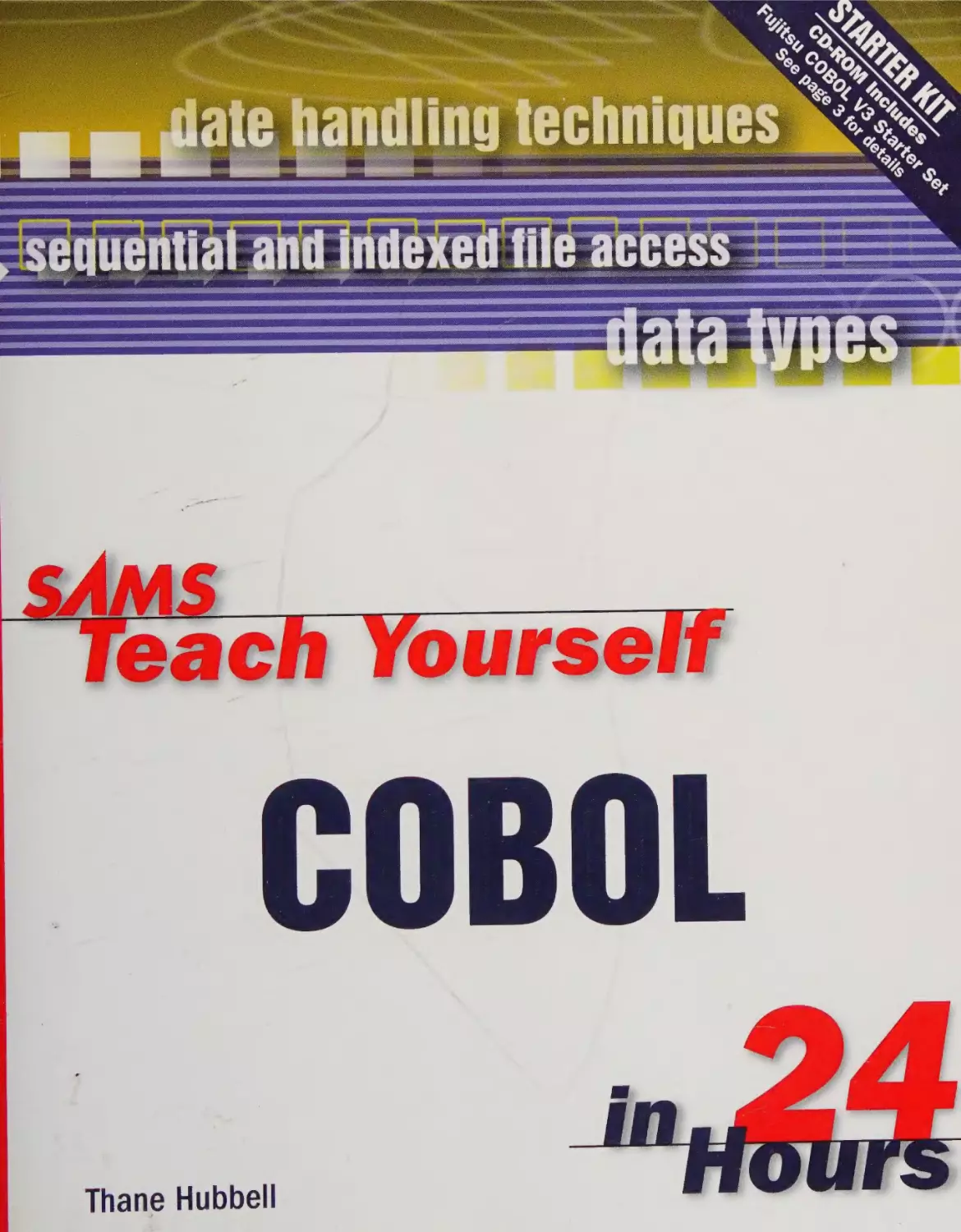


Author: Hubbell T.
Tags: programming languages programming information technology computer technology
ISBN: 0-672-31453-3
Year: 1999



Text
Thane Hubbell
ourself
eac
;OBO
L
‘HOUR 2 Writing Your First
!
Ose
| Create, compile, and run your first program.
Learn the history of COBOL
and install the compiler.
cae _ Program in COBOL
numeric data items.
Hou log ee er Interface Using the COBOL Screen
|
Section to interact with
"| the user.
data types available in COBOL.
Create a basic text-mode
mathematical functions of COBOL.
Use COBOL verbs such as Inspect and Initialize.
‘HOUR 7: Manipulating pase |
Data
:
Handle strings with String and Unstring.
a
40
user
interface by using the
Screen
Division Manipulating data using Move and the various
HOUR 6: Manipulating ba
76
Understand the different
our 3; ‘Different Data Trees Learn about edit patterns and alphanumeric and
HOUR 5: ica
See Page
| History of COBOL and installing the compiler.
=
Section.
62
Learn COBOL data
manipulation techniques,
including various
mathematical statements.
96
Manipulate string data
} Make decisions in programs based on conditions
using the If statement.
HOUR 8: Conditional
Statements
Utilize the powerful verb Evaluate.
‘HOUR 9: The Evaluate
:
‘Statement
using COBOL.
142)
Make decisions in your
programs using conditional
statements.
125
Create and control processing
HOUR 10: Processing Loops ~ Learn the flow of logic within COBOL programs and
use the Perform statement.
| loops within your programs.
HOUR 11: Advanced Perform | Examine
155
Learn how to create and
search tables (arrays).
187
Work with the various types
of data files directly available
using COBOL.
249
Sort data files, including
pre and post sort processing.
286
Update master files from
transactional data.
313
Create reports using data
files as input.
328
Gather and validate transactional data and apply
to master files.
Work with dates, learning
proper and improper
techniques for handling dates.
367
HOUR 19: Reporting
Learn about Print reports, page layout, and page
break concepts.
Create a Graphical User
Interface for your COBOL
HOUR 20: Advanced
Subtotal reports at different levels using Control
Breaks.
programs.
nested and inline Perform Statements.
Statements
HOUR 12:
HOUR 13:
Tables
Create tables and search for data
Sequential Files
Define a file to your program and access it with
Open, Read, Write, and Close.
HOUR 14: Indexed Files
HOUR 15: Reading Indexed
HOUR 16:
Define and create files that are keyed or indexed.
—
File Records
Learn various methods to retrieve data from
indexed files.
Updating Indexed
Update data within an indexed file.
File Records
HOUR 17: Sorting
HOUR
18: Master File
Updating
:
Reporting
Sort files, including pre and post sort processing.
HOUR 21: Date Manipulation
Compute the day of the week, days between dates,
and derivation of the current calendar.
HOUR
Work with intrinsic functions ranging from
22: Other Intrinsic
Functions
mathematical, financial, and statistical to
string-related.
HOUR
23: The Call Interface
HOUR 24: The Graphical User
Interface
Set up and Call other programs using Dynamic
and Static calls.
Create a GUI using Fujitsu COBOL with Flexus
COBOL spll.
|
428
Thane Hubbell
SAMS
800 E. 96th Street, Indianapolis, Indiana, 46240 USA
Sams Teach Yourself COBOL in 24 Hours
Copyright © 1999 by Sams Publishing
All rights reserved. No part of this book shall be reproduced, stored in a
retrieval system, or transmitted by any means, electronic, mechanical, photocopying, recording, or otherwise, without written permission from the publisher. No patent liability is assumed with respect to the use of the information
contained herein. Although every precaution has been taken in the preparation
of this book, the publisher and author assume no responsibility for errors or
omissions. Neither is any liability assumed for damages resulting from the use
of the information contained herein.
International Standard Book Number: 0-672-31453-3
Library of Congress Catalog Card Number: 98-87215
04
03
EXECUTIVE EDITOR
Tracy Dunkelberger
ACQUISITIONS EDITOR
Holly Allender
DEVELOPMENT EDITOR
Fran Hatton
TECHNICAL EDITORS
Jack Voltz
Howard E. Hinman
MANAGING
EDITOR
Jodi Jensen
ProJecT EDITOR
Heather Talbot
Ys 7
Printed in the United States of America
Copy Epitor
June Waldman
FIRST PRINTING—December
1998
Trademarks
All terms mentioned in this book that are known to be trademarks or service
marks have been appropriately capitalized. Sams Publishing cannot attest to
the accuracy of this information. Use of a term in this book should not be
regarded as affecting the validity of any trademark or service mark.
Warning and Disclaimer
INDEXER
Tina Trettin
PROOFREADER
Cindy Fields
SOFTWARE DEVELOPMENT
SPECIALIST
John Warriner
Every effort has been made to make this book as complete and as accurate as
possible, but no warranty or fitness is implied. The information provided is on
an “as is” basis. The authors and the publisher shall have neither liability nor
responsibility to any person or entity with respect to any loss or damages arising from the information contained in this book or from the use of the CD or
TEAM COORDINATOR
programs accompanying it.
CoveR DESIGNER
Michelle Newcomb
Book DESIGNER
Gary Adair
Aren Howell
LAYOUT TECHNICIANS
Ayanna Lacey
Heather Hiatt Miller
Contents at a Glance
Introduction
1
Part | COBOL Proaram Basics
5
Hour 1
Getting Started
Hour 2.
Writing Your First Program in COBOL
21
Hour 3
Different Data Types
39
(
Hour 4 __ Basic User Interface
61
Hour5
81
Procedure
Division
Hour 6 © Manipulating Data
95
Hour 7
Manipulating String Data
111
Hour 8
Conditional Statements
125
Hour9
The Evaluate Statement
141
Hour 10
Processing Loops
155
Hour 11
Advanced Perform Statements
171
Hour 12 =‘Tables
Part Il Fite HANDLING
187
207
Hour 13
Sequential Files
209
Hour 14
Indexed Files
Zo1
Hour 15
Reading Indexed File Records
249
Hour 16
Updating Indexed File Records
269
Hour 17__
Sorting
285
Part Ill Business PROCESSING
303
Hour 18
Master File Updating
305
Hour 19
Reporting
327
Hour 20
Advanced Reporting
343
Part IV MiIscELLANEOUS FUNCTIONS
Hour 21
Date Manipulation
Hour 22
Other Intrinsic
365
367
Functions
Part V ADVANCED ToPIcs
389
407
Hour 23
+The Cali Interface
409
Hour 24
The Graphical User Interface
427
APPENDIX A
Quiz AND EXERCISE QUESTIONS AND ANSWERS
INDEX
SEE CD-ROM
451
Contents
INTRODUCTION
1
WHGISHOULT Read | NISBGOK serene. tere erry tan at en oon es ee, Rian
Speciar bictients Of This BOOK tain ter re Merete
en tie ee een
MORES VVOLRSIIOD mete ere ce tear creer reer tee rere eae
Tse a
ee
COnvenuons Arsea Ml LMS DOOKe mann emma term reser erm, mien
ne eens
1
1
2
3
Part 1 COBOL Proaram Basics
5
Hour 1 GETTING STARTED
7
COBO Purpose and EIistOry ecweseeeetereene
tenet teeeras trMeee Careers cccs, cerenaecaseetee 7
a
RGsiness ata Processing
URL
RA
ee
ahoeslikenlinealeaeeee: 8
COL OF ther saneiac com DUsiess eee
tern emanT tat tt tee tern armen.9
her Oren
COBO Emer tenner
tee nme mn era terete ces 10
Grace HOppetiveccc-.c:cterecenccuresteerscaresice
peusemueumaa i Garant Ge cones eects eases cnceetts 10
The COBOM Standard Maseriree
tetera
me
crt
tenet 11
Installing thei Compileteeccerscscc
ce crccer eters ec ncsreetesccccsct reece sce eseecenease 12
Requiredi Vand watie ann Olt wal Cresent teen ccge ace ee tee cree ee haere sneer eee 13
Wisimcsthevexamap leswimelnts bsOOK. ss. sesserresseesresececee
cecncan scene esrasee aesncenecsee 13
Howitovlnstaltithe Fuyitst Compiler ccsenccte en een cere eects co eeeaeneer essere tence13
Walidating the. Install cts. secsesccatessstensdsscoerascaresss<toavensscusescclescsssescttareastecdoeswesene 15
SUTIMIAT Vareseteres cos tacsanscots anc eenwsa sass scree naascaveoiasae cas ucopstuscs cuec tos vcsapaes scans ters sesdsn covets 19
LOYea 5c rat RR
Pa
aN
ie Be
ee A SB Tn
SY OR
aired een cece 19
DWOLKSIOPikes es cacc stee sessnsok sup tnt suossenats Oustnssipats sbeosoncsranissabelpsscancassoancnesse
tasescdses+gear20
Hour 2 WritinG Your First PROGRAM IN COBOL
21
OREO TOTS aN OU
reese
cerca oe neti sasgretecras sss cauacstoaceteortnanse etn y eres 21
TOentuUCAtTOM UDI
ASUONMercerrectestrnt
cnt senc enn ccurateccreswieseetascaeesteresnce a8)
ENVICONMeNnteDLV1SUOMeet
tee ear eer tre eicicio ua cortcrrectesttoneceencere 24
DALAMOAVIG
LOlei ee nem meron
terete Cte scree: comeaeaereenentas 26
Proc ecugom Da uSdon meats marente test ses he-ctsa cco
nice stccnaraacarenes ee i
Creating a Simple COBOL Program ...........scssssecsserrsssssssssecorsesnssseecssseennarsenees 28
Compiling and Linking...s..cccisisivessersrsssverenssapsrssevsnonsnererssonshapenssovonesisaseenensnadencavona 33
My HOM AC WVONL CMOS a os a sopvareucacrasassstacdapenre
conssnage chsaeupan-rac¥t\ssur@inecenne>=ns 36
SM
.....cc.scssccesssssssseresserecesssesssescenanercesessovonsnssonvsnsnsnsngees
Program
Your
Debugeing
ALY a esteceee ster — tee
SSURETALNL
er
Ya
cc eee Fey che ces tN Grete taza tg sasaas areas ins aeghasntadanegs Gib v=sosecne ead eoihasdae38
ey oreerer eee ee 38
Dey
eee
ee
vi
Sams Teach Yourself COBOL in 24 Hours
Hour 3 DirFERENT DATA TYPES
39
scntqesestvaee
ammo cedecrees 40
teats obackt sateen
The: Picture Clause: :.vsso.cesscassnsasbecastsccevansoucesoina
The Meaning of the Different Level Numbef ............-:esscseesssseseseeseseeseneenens 40
svaesae
ecenversv=nacsansses 41
0tsoers
Reqeaeeteatenarahescent
cacsscaducs sUsveseae svosahueea
NUIMEric FICldS: <.2.c...scc0cs
accasacs43
Decimal: Values: s2icccc.0tseees owls seancexeass- coasts ene semana eesay casce <couvameccnscsscesstaeseese
Handling the Signi «....0:.0.0+-<ssessasseesrerssdusaspanagastensente-nanierauhaunsaensctnssdoniehneateanstens 43
Me Usage: ClauSe:® crss.cov-cosscscscssevatesscesaasetacsnassprasesnaqsersaenseeaenacthcars)orsnscensnensee 44
Adphanumeric Fields ...c....nse-seessetsqepsennuniestnwusacnsvdheseanetnadsinenkasdandadederseseessoosnssnenasd 46
TSICELAlS rcectes sce ceccaceesstet etc succcen:Getctercee st Raat teee de ee tae re acesee ca one nena tne ota emeneternes ence 47
Numeric Edited Fields: .....<c:sec:c.ss:satate teenscensctecee
reese nee nentesace:
anaes 48
xaas
nonsacssetee
aseas 51
Alphanumeric: Edited Field5 .....:scoseccosserosesre
sonsqhenoaiuns
epansnpeansainesennsa
Group and Elementary Level Items: ...........<....debeeutr
seeeokaashvon-etinte
cateueaneavevnpaosyent 52
ccecaceee
Using Datailypes intial Pro gta tie cnccsecctescsncane
ete oeneanaeees aceeneas
eeeeneecereneencs 55
SUMMINGYes. o 5 coats she ca caskets ase soneuwe stses weecdesucaeesgatlhs eacaucoss gemmtca ees soeansaesescccensecemapeemeanste
tees59
QSATE cctsccestaccesacad siscsaseasnabceathh: tosp cuaceaatinaaa a ecadete soot ee ian on <csat econ neces 59
seana
ssacesn
cossteacarsacesc 9
e teeCaaneas esstsva
WOLkSHOP: fetisevssctese
dachehonsovscctetadanat
ventietaccagtttes«cracedec
Hour 4 Basic User INTERFACE
61
r 61
aracceucua
Interfacing: with the Usert.icccsstcaccscasvaceewace
euasscarccans uae n
et ee ees
samte
certcae
aneeetareeeteeess
cve
Batch) Versusiinterac
eTOCES SINS Rececrerencencacaseeeseenenecente
62
necens-saa
ThesSereeni Sectlon.,s.c.s.cscucaasseststa
easester aeTeenie
eee eek ee tavedt
eee 62
eeateree
Blementsiof therSereen, SeCtLOny a cascceccauen eaaueecccece
eee eee 63
eags
Special-Names: Paragraph suscsccworecvaccasss cceasecuassisevscvssseas weet aeteeatranctmnerieteee: 70
Using the Sereen: Sectton 1 & Progra icns<.cccsacpnccea
ness eeecarces 2
SPUDIIIALViccssarsun sunianssiegn chances ones hanleaine ahaa umes vii Oak san On catenrenucahi caneeneeesa meteor nee ee 19
OEE Frsarase Ss sngcesnaessecssaysutuctaceotaguces counesonrceeroxerereeenecceceaeeceeReC RE CEERI
79
WOTESDOD cs cxsesssaea caseinansys dancentauriaiconateeeuak uk ie naeinasi eee ame
ia
ene 19
Hour 5 Procepure
Division
81
Procedure Division Organization \.css<cceusiecuusaccce
oenraecuaceee
meee nee 81
Para grapins :cossicuedsaueicvnstavesstvsvisiso
osmeanefaatetiannincsdhaand
mete eee ae eaars
eee 82
eamneace
SECTORS: car ssavcainrcanaien
Gn Got
echapace Saeco cexansai
STC Rees eRe anans
oe eae 82
ATIUDIME
NG 5 CALE MCD ES. cits isn scsunasayoctcace sors yap tacexe ten esau: Ree eRe
amen
83
The Add Statement ic casa strates ngmnacsnae seater eee aerate
cen 83
The Subtract: Statement s....sccane actamre aman mee Ceeeneenee ee eee 86
The: Multiply Statement ‘aicia.cverseacnn cance cess oe te
87
cscaarn
The Divide Statement ion.cccscrvauc
se peer
eee oie. naua
ke 88
e 89
The Compute Statements vac, siavactsecevcssean
catticrte
teereceve name
ae
ee
ass 90
Sumple Data Manipulation ‘c..tissoc.t
csmuvi
tert ecciat neces
erie eee
The Move Stalement jacisnacustecanectactaennsp
ra eee erceten
eee eee 90
SSUIIELALY sae snians shen sdenanena eos et ageaegs NeGSaR Tae
ee
93
UEC chs snssitosscagltinnapta dant staaneacereA ee Sarde tue aa Rete ee ea
93
Hour 6 MANIPULATING DATA
95
sie ACCG DE SLALCUIGNC secas-ssssseee as
Te
eee Ne
en
ee
re
tinct
RRR
eee een en
ACCEpUNS ImomtNe LISeiceas.tec
Accepling. Data fromthets ystem mans ee emer eM
te
css
hesinieialize.statement: cco ee neste ete eR ert
hesinspectsstatement ec terete,
ReterenceyMOditicationime
metre
I
ee
103
Hour 7 MANIPULATING STRING DATA
cee
Thelunstiingistatements
UnSst pang Oelimitersis
104
108
108
109
111
“THE StPiNG SSCATEMCTIE ..<pecycpanec ee
ISHII CCTS
97
98
eee 100
te cetacean
eee
ne ee)
Using What You Have, Learned anja, Prograrn,.cs-.--..S
Meet eM c.v.sscovovssasstecseed
NSITEGTA Pace Aces Be oe a
7 see
ee
eR
a
A
PP
A)RSet
eee Fee Mee Mee Sen RCE PESat
Medea WR eee cee enter e es
AG 818) beer ie aernsbene ag pacer tReet react ch nee em
a a a
ee
SUING,
96
96
ee
ces vce
cae
Te
ee
eee
ceteccsec ee eee
ee
ee
rns
eee
eo
ee
cert
ee
ee
2
ceccceeaee 114
118
ee
ere 118
RULOU
TDOCEWANYsc scocencina rant ce eeeacbac cree He Bn See eae Nene eR SE et f, S,
e
122
(Beale Neha ps saa abs
ES Or
eae id ae sence PRLona otcac onc RE ae CEE (yn
WVOEK SOD ents cence te ean ireerersunreeetee ethers teres antec tren ercnsie snore ee eee 123
Hour 8 CONDITIONAL STATEMENTS
125
Conuitionalastatententsan, COBO Wg.
Dhes Th SStAlements
x, meee rete eee eae
ee erent
mene
ee
eet
eenre tree eer
ee 126
oc srtace Srieceteescees 126
NEGE USOC LAUSCscraccesececoseacsesrenccs
Tmt tsSee
eee corres Soereceitnceesstornens 131
sine Complexc Conditions ccpescomece terest mttee tee eee ehce sores srescnacaceses tance 132
INTESTINE elifins CALCIICTIIS Secrest: pecess-cboreeteeees estes cee etebee raters snsonesavasaastosassnad 135
88 Levels:andtheiSet) statememtieesec-cysrteremet
cereeeeree ner estteret eeessccnot saNesaremacnc 136
WSimogs
Selevel spTihany i pOVAsCINCI Unsmtaemerasnreneersterttttestescsttsnenea
corners ae 137
SSALT
NAEUN
ADVar saat a oo cea Red cer eee eg eect ncn seca ses PPD A GIP ae nn eaccensncn dyn 139
Bc
cacpnin cc tessa osur oipnoudeseparaienomagesarovancoxsich
en OR Mts faded<otrcacasicanwanis 139
BW nhc Ge
eed ge Besa
A gaa cae
enn nara cee ts rh ecas fvig as can vanes sce Serer 140
Hour 9 THE Evatuate STATEMENT
Wien tOuUSClEVaLUate sa cscs
141
ateacte recess
mere
te eee
Msccetassstetsseser vosces 141
Simple Evaluate Statements «......:..csesssesececerererercccssescscsnovesssssssssssssssesosessacees
More Complex Evaluate USage.........sscssssssesscescsessnsssrsccereereesnoessesssnsnsnsessssssnenes
SGIMe Mans atid onsvresostovsnsgnasasosoaaates
SUUEITALVargrapasonereonsodeands spresnanoaesatonsess BEDE
Ts TERED oh: Bruyn fiers oe erent ae
EN
aR
ae
ON
143
147
ily)
154
Sams Teach Yourself COBOL in 24 Hours
vill
Hour 10 Processinc Loops
155
The Basic Perform Statement......+c.....c-c-s-cerrstconbasssbntaseeareeea@neesesnce-sesesnrcstseseans 156
necns-octvenrers 157
esccces
sacstadsastecestnes-ud¢sn<-<
santseeescercceessc
Sections and ParagmaphSe.s:sscste
Creating Processing Loops Using Perform .......cccsssssceseserseseeesssesesseseseeesensenens 159
oan Petantn sieataenrnsenndeseraanes 163
eoeee ee eae
UIS@LOf GO TO verses ceteevssuccuceds cones astm
SUMAN Y eves tees conch densnssndvosizcved ecco nngodancesel aR MEMO ect eae letterre Mtoe canstrance caapsandant 169
Me agr oe anec nee 169
he Tai else sae Sates dise Rieu ae a eaves cap am
EA ies ees Ses
WVOEK SIO) <achiicansssestys ictteds soe: cds MOMENI Se oS dacens date aes CPt MOMERne A ne oas=cierentneen ademas 170
Hour 11
ADVANCED PERFORM STATEMENTS
171
Polo mmbavvitlns Vat Vil 0 pesest.te <x. sccaceceecaescec<cossceancastssuneenaheust
tuestmtee=soeeeadeere enncaee172
Testing Before ce A fterys. Bence rs. cctstisnncanasaanasionasaatosein
eek eee era 173
The Useiot theslmlines Pe miopmiteccnscctecaceeacceeceescaccntees etaeete<xene-ceennenee serene eeacenns 174
INEStinoP erafioem tate TICIIES eens
eee nee ae et mcg nena 177
MheiMnline: tf, Statement,and. Pemtowmsecsemeeeteteetece
ssare eater cae acre nse 178
Using the. Debug Sr jassc sasvonepennnsazactnssetateteen
ete ate eecae ac acetone seas 181
SUMIMALY axes cisscytsasaccyucaises ocvensetsesoacensccssneds eat ate ce cetens Aatt ark dette ss Stein snencucslased? sauasexe 183
QA orecticg sar sccetesGn sha gael Ne oh ok Mose cneeee eeu Seco e eae eT en
rer eee eee 184
Workshop SRI et. fo 5 Sis lasecde cots Stas ccsCOS SeS eee tcc Sa eae
et
185
Hour 12 TABLES
187
Dehinin :avT ableye
Seti. ASR tas ccccscocercetsctcateatectrecnarceet
eensconeneets arene eee 187
Basics Table; Hand lini pagers
GE, 2k
oe comer ence
cehtetteess 189
Ropulatinerarlablean| Workings Siconageccaecssereceesen,
ese eee ene restern one een 189
@hetRede fines: Clause <cescevsessceen aches ee
oe
cece cee
189
PineRSeanc hiStatement :. vieccvexssceas eee tek ae
CE
ec
195
Multidimensional Tables... sc. chteancas eee
een ae ee
200
Variable-lensth. Tablesx
22.:
eee, cae Crt oe ee
eee
ee 203
SUMIMIALY sssicarasinsinsnilaoncunns ARRON ME c de cE REE GER NIRN, Mee, MMRI Gs cans cence 204
OSEAN setcara ssicsne tes nude ct omeacenmes seers eee Sa cece AS scan
RRA
= beg
205
OPES
ILO Ss a SE g esa
n ac cs ae anes
nea 206
Part Il Fite HANDLING
207
Hour 13 Sequentrat FILES
209
Connecting-Your, Program to... File: eis aite. denen ne eel es ccottvasenareuves 211
The SeLect-Statemeniticcew
ies ARO
eI
RA
hc
cas 20
The Files
Des GPL AWGN cnewacveennmantereen
see
stiereerte
oss ereronnconeee
orecsu os,
Open gthe PRS GAA
owenrnddeunareein Seno teehee IR ater enon eee 214
Closing: thes Pilecatarrikcivinginrvacennkc
vgersievn
eae Ralladiaeeaet
seeps
4te219
NiAeA201 SUC LY Gi CO
ee oR
eae REM
ee
Reeartipotnnt the Biles ec cctraes
rete sneeteh ae tace Ms. 2 och laclnrackte,
Meet PS EN
sa conaeasncrmet ucts oho aceon ck
eis
heed as
PVAGableencth Records <6 awamun ty rekon nc eee kaart dasoedes,
SPUN YeavesachasbevpsepoessacasavavernresGsarcdsuarsunsssceeltt
meena tee eee ee cee
RONG, Meer aed re eh ian canoe then ee
RR re
ee a ye wi es
Wore BR Sie avec
ees
Od occas eseemremeere te cacpechdssien ovis ele
Hour 14 Inpexen Fites
2S
220
225
228
229
229
230
231
Defining thettndexed Pile. .i5. c.g ics. id oe REMI OMe ce Bean ME duapnsseacccnchanenncs 233
The Select StatementiforjI ndexed: Files nad... sauiadewhiascas.:ssecessseonercnenvsics 233;
Creating an Indexed File from a Sequential) Filey, ..ccicsisdeelsccsseccscssnvesssooeossveee 235
Creating Indexed File Records from. User Input....sccsessscaveidsss.seccsascseserseoeaes Uys)
Pecan VicthOCsiOh Mandingo Eile sTLOTS memento
ante senseee, 244
SSSELLEL E11 Gar aOR aS effort
SIRS
ls ric Ne Re ee eR
247
OVREIN, Sh, Boas SNR RPE ECR EROSITERL GALT ERSECY oa aco
E RO AEE
ere Fo 247
WIOEKSIOP wececateacccuqnstens soc cncce ashes suce conta leat tneecae sree hrs mle tecstenstststuse eM Meese croseneisane sas 248
Hour 15 READING INDEXED FILE RECORDS
Vatlous AccesssMethods.persam
Seqventiia WACCESS
249
at nteu. area eete eam Pen sntee hen seseoiciarocosescsnceansaroe 250
nce csc eetee ee. mereee metab seas ete eee IE, 6a 2 oon sc beanstvcencncns 250
RANG OMA CCOSS ter Marea ertinhinvessrnapdecdeaneskensstepsenuercsnssiieuaiats
MAM TaMIAN basvuvacenucenssuseancert 256
DYN AMTCEACCES Sis Meese nis cake tet
cee
enna
nn ee MEM. snc ucscesscwsesnecs 258
SUTIN TIAN pero ence eae nn once ee PN Seb -nnnrieel senna Premcoa CUMIN inna ncaenc sot cavacounern 266
OOSCIA ies ortens Wp al Sette ry, ee Nac
Moar de tea was aks a Sass wp dace aas duel regan cata267
WOtKSINOpierre artsene cen css2 cnnencontonsaesacatshsen severe Veansaaavsch.Sdappebesobdssaatiasesaconsbaedica
sunsets267
Hour 16 UPDATING Inpexeo FILE RECORDS
269
PNSENITN GOEL A cs consjeicacigndh onus cape rauc BENas tip capMERE Se aRDRE NE canteen vanesnsdets cannes 270
Writing Records) Saretens.'.ctterer gtaneenterien ty famtitantse 8: eset tpar ecto -oncycsssysaesenecarrerensss 270
RGWIIUI OMR CC OLAS pe meemente strata peacetennarep sips acapecc ee apeMtSeeemes es Ces sacbaecceaeereecre’ 271
Deletinatiecard ae 8 5! e tees bz cated enn uaa retro ics AOD a niacan en veasoniariesns 274
Reillatalv CultileS is aan. oe. csancs aunesline
eee eee aap teteta oc SPT SEES
ec oane ans ont aodeesancsacne 275
OU iaANAE fet es cee
yA c-0n-<cane Canapne ceseat rosa andr aasmnatsnapansnndarsApiaenseieoineSninassescandes 282
OSA eh eicins re. ties Cheer
Se
IS.
EArt
ae tce Medennded 283
NIN St FARINGUe te A ah eae ns pn donee dante pnearranasapParargaoocualathi nsnstuisnoanpassoannarseasanase 284
285
Hour 17 SORTING
SOrtiiye
FIG), Paice daceeg oe sapnar ores csha ee mg
eaten reters gals ash eavss ey vnesenncepeoroeninsenens 286
e 287
Mhe Using and Giving) ClaUSEs fc... poumees-cgecesisrenesoaryeisedssctcsseseesvuevererese
Manipulating Data During the Sort .......sssessssessesesssresssnessstsnssetssseeesseessseeneentens 292
TS NOU
The Output
PROCSAUIC -csssernsapnnntnazavanstaractaroeRtetgates “Wartiealorasnedeassnacssnesnersseesenee 292
etasded. 296
Dhcvitbedmsnsty span sosssoeeenanvavassnnasesas
PROCODUIG .,cccr<cayssncssacaventu
Sams Teach Yourself COBOL in 24 Hours
Xx
SUIMMALY ......ccsserecsecceoesrssssnscscscasesssesanenenensonessenssesssssatecssnsasuenssensnensecececosancasastenss 300
QA vessssscessenetstastenteorsnengnonsesnsvensnacsoncasecoutaneedssnsadesnteasteratatumniaaadessnseeneanaenesazeeneasas 300
Workshop .......cccecsceccseesecscesecsssesceesesesessscsseccesncncscesssssnssanscssasanscncnencasacrserenssseseres 301
Part Ill Business PROCESSING
Hour 18 MAstTer Fite UPDATING
303
305
Programming for Transaction Entry ............:scscsseeseseeeseeeseseseseeesesesenanensenenenesees 306
asesennrenaan 310
seeteens
sneaeneanene ene tneteae semerenrtenees
ceecsereecesorcee
Data) Validattomieccescecserccccse
Updating a Master File 22c5.i0 itm vcvaevestesncsacstetotereorta
senssabtendtbesttecacsssesnnaeuseaunsandan S15
Updating a Sequential Master Pile ...............cctecccsescecensecenencscceesecsenorerenenees 314
Updating:an Indexed Master Pre 1222. 22.c222.52 Sg elated necescorentnaenseennnces 320
SUaraemnaryin sO TE ea RIL RIPEN a Soe tee aan eee ee eae rcnn cs cma gaaneRaesaania seid325
OSEA catesdecterse Se eet OR EA GED UD AON Ra, Cee
eM eee se eveannn canaasssoae sees 326
IWOLKSHOD wssittewsesst Patios airceens seuweu uaeansve seu eereekens tinct eee RR Sa ene nena eas Soanen 326
Hour 19 REPORTING
327
Creating Reports: .sccc.cscecescus-ccseostes
Secensoneestondenspacene coseesaanckansesenr vast asnaaaneee tuna ee OO
Desioning YOursRepoOrt lay
OU less esecsee secretes eterna
eens eee
a
The: Write statement and. Reports screeseeeeeeesteeeece
see eee teat wecncee cceeeere eer 330
Programming: for;Page Breaksicccce-<.meecee
seer eo see eee -n aceon sa oone sone coeuescone S31
SUMIMAL V-ctebosc teste vans vacsicecebecc ta ectivenaelitenaupeeuacoumeeneeeneee
eeneee
teesac ene eeeeee 340
OSE secs sos deSaiasn veda des tescnisns vstvebons soe ouias Nel eect ie aaa MRI
aces toot eo scan ea 340
WorkShop seissscacs casts sanestscen syempuntsstaeue ess SsRROReRCRE A teens oat naoaea aan esa 341
Hour 20 ADVANCED REPORTING
343
Reporting with: Control Breaks i <.cxs.cescasccscsee ace soe eae eae
eee
Determining the Number and Hierarchy of Control Breaks.................0c0000 344
SUD
tOtaliti gwwvrrcevreagncnnncevevonncetesenienasueereootvnc
tant oer eee eae Meacnntecneconeence reece345
Walking Through a Program with Control Breaks ............c:cccccceccesseseeseeeeeeees 346
SUNIM ALY covcnichvraresieornsienipant extennsessucqvcaawnnaveyeus tte meee meee
reece cea teens 363
QSTA Zersinsistdvonesiqnacessucowedssatyea
dunn yin eehae Ne
eee Laerececcen eee 363
Work shan siasilexisanndcteywnavtasivileevar
etedeAeasrsvvieniuci
feRee ARIS cee CE CUceee
cael 364
Part IV MisceLLANEOUS FUNCTIONS
Hour 21
365
Date MANIPULATION
367
Determining the Current System IDAtG a,nacucccc
carne renee ee
eee
The Current-Date Intrinsie Function.
00a eee
Days Between Dates cain. RCO
ee
ee
ee
a
Determining the Day of the Week for a Particular Date o......cccccccccccccsescseseeceeeses
Validating Dates: wicccanmme
eee siucs
tee en ten
ecae
368
369
371
374
376
Mormavilien Dates)...
aie
Si ae a
ee, ee
LOLaM
Se AEE aR
ht
Wor khcipestoiers sch niei tere
Hour 22
OTHER IntRINSIC
NS ete Pic ie oevcaaoeccas A iti chess ccerse Ms Moacsbsscses
ee i
ee
Beth CR NS orn a
eae esori, ena
Oe
iced ink oe RE
ed
ere Eo ee
FUNCTIONS
383
386
387
387
389
Mathematical. Functions,
gy, ARR. Bs.
0. oe. Sk, A
390
Slatistical PUNClOUsm.,.c..c-chrate
cts mene eens MM alts eto
eee ee ee 393
PN SHCIAL PCI
stcyraseverensisa eer eo eae eae
ecient asa soo
ess E oe 395
SUM MPUNCULOUS wera acter Meierc Poteet ee eR Me aiektsNeisi arene ane ere cee 3h)]/
Dliste lane ous: PunciOnssttts..cccreeet
et eee tee ae cde Roti. ae eects: 403
ULI Seriek a uecee theres acs oe ous aR ae
Lea
AS
ee tee A, 404
A
DECAces, comyseasttin Rotrnciroas Astle AUER. te te ket oonss kittn avevsit terre hae tecreeeahs 405
POURS
OD Boe isis atin ahs esa eaaliniivseneg haus aeteon ss papeas ye suite eo eho eaakeer tiGiacstacs 405
PART V ADVANCED Topics
Hour 23 THE CALL INTERFACE
407
409
Calne Other Drogas, ccc crsereyastcissassscuess
cocea ne antetyaieettre cries tecsesigcsteret: 410
SimplesPro gram Callin ower tess. ctyecrscetpieestes svurtassaucsestassiscsustuectss
specscoaasucieweras apes410
PAassingeoata Belween PrOoTAmSteer
year ree un erecta teeter rristsrccmtecnesess416
Thelsinkage Sectiomuert:
ch ouritevnrts. oaihonaies tar tees cadets. 418
ThesProcedure Division ofthe Called Procramipgn
ses eececs--ciyeeeiesee 418
CalliByaiclerenceland Dyic ONLI ts, aes atte
cetera ey teresa 420
Dumamic Versits latic (Cals 252 somes Oasis aati ocsrat Ocicerdignedtanissniissresakertias! 421
WSU OC OPYDOOKS BM
rerescssetoctisersintertrseemeuntisrtsetet
inenmerteren ctrssectiastereatoecariaesea? 424
SUMUIDIALY erratssece tr nsrecst trues cores ceesapeas esate cast ok teatee at memes Gas Cab es eaDin sg teat = peasants 425
OBcAr St i Parente), se leed eet eas AR Tear
Seria aide Sees PRAM
ae os 426
WOLKSHOD ay, aieraces orc aptet or ads cosets Aiea eme et eeesaah sepa aziaatuess Dh lay tuh acroescan 426
Hour 24
THE GRAPHICAL USER INTERFACE
427
Different Methods of Achieving the Graphical User Interface ............:.cceceseee 428
Using sp2,to Create-a Graphical User Interface vapsrccsssss-sacshss-.-atnecodh
uhilinaotnanes429
Designing Your Patel iss cttrctencerprrtrauaue:secygih
signservteasintennredsbusenss Aphacas 429
Modifying the Generated Programm sirccssscsconsarasssecdesesaeceasectesncataresescduonosasannene 437
he Busure OL. COBOL ner cece tere tsscsececesacesrcesetuseetruysar ssraasvescecstsavetsencosaevarsesss? 449
S RENTLEY SIRI. CUI
SL in AEN eats eon iiwetnsesnsn pants ubunssvetih ldienenceseteeds 450
AppenpDIx A Quiz EXERCISE QUESTIONS AND ANSWERS
INDEX
See CD-ROM
451
Dedication
For my wife Darlene, for her patience, understanding, and love.
Acknowledgments
Writing a book is not unlike the team effort involved in developing a complex software
system. The people at Sams Publishing are consummate professionals. Their input, support, encouragement, and guidance have been invaluable. I want to especially recognize
Holly Allender, Sean Dixon, Fran Hatton, and Heather Talbot.
In the COBOL community, several individuals deserve special recognition. Bob Wolfe is
the individual who first piqued my interest in a book opportunity. His contacts landed me
a spot on the COBOL: Unleashed team, which in turn led to this work.
I had the utmost privilege of historical perspective from an individual who was there and
involved when COBOL began. Warren G. Simmons’s insight and advice proved invaluable to the completion of this book.
Another individual who deserves mention is Don Nelson, current COBOL standards
committee member. Don was heavily involved in the 1985 COBOL standard, and helped
me greatly in areas concerning why things are the way they are, and what really is part
of the present standard. For COBOL syntax, I relied on Don’s excellent book, COBOL85
for Programmers.
The chapter on date manipulation was particularly interesting to write. I want to thank
Judson McClendon for his assistance and advice on those issues, and on COBOL coding
style in general.
Todd Yancy of Fujitsu Software Corporation assisted in securing the compiler for use
with this book. The Fujitsu COBOL compiler is a strong, stable, and accurate compiler.
Todd and Fujitsu have been instrumental in trying to bring the price of COBOL compilers within the reach of the average individual programmer.
Last, but certainly not least, I want to thank my very special partner, friend, and mate—
my wife, Darlene. She supported me throughout this all-consuming process. She gave up
much of her time with me to allow me the time to write this book. Her contribution is
personal, and lovingly appreciated.
Lest I forget from whence this talent springs, I must thank God for granting me the gift of
this talent for programming, and the ability to convey it in some small measure to the reader.
About the Author
THANE HuBBELL has been programming in COBOL for 15 years. He
operations and rapidly moved into programming. He has worked on
forms, from the PC up to the large MVS mainframe systems. Along
the opportunity to develop new systems ranging in size from small,
large, interactive, enterprise-driving systems.
started in computer
a variety of platthe way, he has had
isolated programs to
He has designed and written applications ranging from a full CICS security and menuing
system in COBOL to a VSAM database inquiry and reporting tool. Thane is a pilot and
one of his more interesting projects was a system to translate FAA-formatted Aviation
weather reports into English.
Thane makes his home in Texas and is married to a wonderful woman, Darlene, who
kindly tolerates the spare time he spends programming on his computer after work.
Occasionally he will even take on a custom programming project for her.
Thane can be reached via email at cobol124@softwaresimple.com, and frequents the
comp.lang.cobol Internet newsgroup.
Tell Us What You Think!
As the reader of this book, you are our most important critic and commentator. We value
your opinion and want to know what we’re doing right, what we could do better, what
areas you’d like to see us publish in, and any other words of wisdom you’re willing to
pass our way.
As an associate publisher with Sams Publishing, I welcome your comments. You can email
or write me directly to let me know what you did or didn’t like about this book—as well
as what we can do to make our books stronger.
Please note that I cannot help you with technical problems related to the topic of this
book, and that due to the high volume of mail I receive, I might not be able to reply to
every message.
When you write, please be sure to include this book’s title and author as well as your
name and phone or fax number. I will carefully review your comments and share them
with the author and editors who worked on the book.
Email:
Mail:
feedback@samspublishing.com
Mike Stephens
Executive Editor
Sams Publishing
800 E. 96th Street
Indianapolis, IN 46240 USA
Introduction
Written in a clear, easy to follow format, this book was designed to help you learn
COBOL as quickly as possible.
The numerous real-world examples and exercises in this book will help you to understand computer programming, and COBOL in particular. This book provides a complete
grounding in the COBOL language. After completing this book, you should be able to
write useful and meaningful computer programs using COBOL.
Who Should Read This Book
The lessons in this book assume no previous computer programming experience. The
lessons can be used as an introduction to COBOL specifically, and computer programming in general. Even experienced COBOL programmers, who want to find out the latest
techniques available in the current COBOL
standard, will find this book valuable.
Special Elements of This Book
This book contains the following special elements that make the presentation clearer and
easier to understand:
¢ New Term Boxes
e Notes
e Tips
¢ Cautions
EW
TERM
New terms and definitions are explained in New Term boxes. These are intro;
duced throughout the lessons as required by the material being covered.
Interesting information relating to the discussion is presented in
these notes.
Tips and interesting shortcuts are represented in this manner, for easy
recognition. Tips can help make your coding easier and more accurate.
Sams Teach Yourself COBOL in 24 Hours
2
Z
Common pitfalls and misconceptions are presented as cautions. When a caution appears, you can be assured that the potential problems discussed occur
in the real world of COBOL programming.
Throughout the lessons, full and partial examples from actual programs are listed. When
a complete program is included in the text, it will be signified with a listing heading.
This serves to offset the full program listings from the text. You will often find explanations of the programs embedded in the listings. The listing itself will appear in an easy to
identify, monospace font. A simple listing example follows:
LisTING INTRODUCTION.1
HELLO WorLD
@Q0001
@OPTIONS
@Q0002
@00003
Q00004
@00005
@00006
Q00007
@00008
@000@09
Identification Division.
Program-Id.
Hello.
Environment Division.
Configuration Section.
Source-Computer.
IBM-PC.
Object-Computer.
IBM-PC.
Data Division.
Procedure Division.
@00010
000011
Hello-Start.
Display "Hello
000012
Stop
MAIN
World".
Run.
The lines in the program are numbered so that I can refer to them later in the text,
explaining the different elements of the program. The goal is to prevent the code from
being unwieldy for the user—that’s you!
Q&A and Workshop
Following each chapter, you'll find a “Q & A” section, where issues relating to the material covered in the lesson are discussed. Selected areas are reinforced and explanations
are expanded.
In the Sams Teach Yourself in 24 Hours series, usually after the Q&A section, you will
find a quiz and a programming exercise. However, to conserve pages, in Sams Teach
Yourself
COBOL in 24 Hours, we have opted to move this information to the CD-ROM
accompanying the book. This information is not just extraneous stuff we’re adding to
beef up the CD. Answering the quiz questions correctly assures you that the material
covered has been completely understood. The programming exercises build on the
con-
Introduction
cepts covered in the chapter and require you to make that small, but essential extra leap
in understanding to solve the problem. Some are simple modifications of programs discussed within the chapter, whereas others are completely new programs that need to be
created. For optimum retention and understanding, I urge you to work through the quiz
questions and exercise section as you finish an hour.
Conventions Used in This Book
This book uses special typefaces to help you differentiate between text used to explain
the concepts, and the elements of the COBOL language. Anytime a reserved COBOL
word is used, or a data item is encountered, it will appear in a special monospace font.
The CD-ROM that comes with the book contains the Fujitsu compiler and the third-party
GUI screen design tool, COBOL sp2 from Flexus International. In addition, the source
code for all the examples and exercises is included. To aid you in understanding the
examples, each is accompanied by a Lotus Screencam™ movie, which can be found in
the \CAMS directory of the CD-ROM.
Thane Hubbell
Bryan, Texas
December 1998
2
4
Sams Teach Yourself COBOL in 24 Hours
PART |
COBOL Program Basics
Hour
Getting Started
Writing Your First Program in COBOL
Different Data Types
Basic User Interface
Procedure
Division
Manipulating Data
Manipulating String Data
CON
=
BRWHN
DU Conditional Statements
The Evaluate Statement
Processing Loops
Advanced Perform Statements
Tables
=
a oO
WO
N=—-|
‘ay jut
Hour
|
Getting Started
Welcome to Sams Teach Yourself
learn about the following:
COBOL in 24 Hours. In the first hour, you
¢ The history and purpose of COBOL
¢ The special requirements of business data processing
¢ The mother of modern information technology and COBOL
in particular
¢ Installing and using your compiler
COBOL Purpose and History
COBOL stands for Common Business Oriented Language. It is one of
the oldest high-level computer programming languages. The purpose
of a programming language is to communicate instructions to the computer.
Each type of central processing unit, or CPU, understands a particular set of
instructions. Because these instructions appear cryptic and confusing to
humans, the early pioneers of the computer industry developed programming languages. These languages, which add a layer of comprehension for
the programmer and analyst, are translated into the native instructions of the computer’s
processor, otherwise known as machine language. The process of translating the original
program, or source code, into machine language is called compilation. The compiler program translates (or compiles) the source code, that is, code with instructions that humans
can understand, into machine language.
A high-level language is one that must be converted or translated into
machine language. The closer a language is to machine language, the lower
its level. Languages in which each statement in the source language corresponds to only one or two machine language instructions are very low-level
languages. When source statements are converted, or compiled, into many
machine language statements, as is the case with COBOL, the programming
language is considered a high-level language.
COBOL is essentially a recipe for making a program. You list the ingredients, determine
the amounts and proportions for the mixture, and describe the order and method of their
assembly. You could mix the batter for a cake, including all the proper ingredients in all
the proper proportions, but until it is baked, it can’t be served. The compiler program is
what takes your program recipe and prepares it for the computer’s consumption.
Business Data Processing
Business data processing began long before computers entered the picture. In the interest
of efficiency, businesses found ways to handle the large volume of information necessary
to successfully manage their operation. Computers were initially considered the tools of
scientists and engineers. However, business rapidly recognized the value of computers in
automating tedious and repetitive tasks that were necessary for the success of commerce.
The computing needs of business are unique and are different from those in the scientific
or engineering fields. Programming languages geared toward solving complex engineering or mathematical formulas were ill suited to business processing. Early scientific
computations centered on solving complex mathematical formulas. The computer could
make these calculations with much more speed and accuracy. In contrast, business
typically does not need to solve complex mathematical formulas. Business processing
centers more on large amounts of transactional data and is geared more toward
financial accuracy.
Businesses typically collected transactional data and applied those transactions manually
to books or ledgers. Entire divisions of large companies were dedicated to bookkeeping.
Reports were carefully prepared for management to analyze. Creating and analyzing
Getting Started
these reports was a time-consuming process, and in many cases businesses were harmed
because they were unable to react to events in a timely manner.
The advent of the computer changed all that. Business readily accepted the computer into
its daily operation. Business now demands fast and reliable results. These results help
businesses stay competitive and viable.
COBOL: The Language of Business
COBOL is ideally suited to business processing. Business processing involves data collection, validation, updating, and reporting. The types of data processed are frequently
numbers and amounts. No other computer language is as well equipped to excel at this
type of processing.
COBOL was désigned to be an easy-to-understand and self-documenting language. It
intentionally mirrors common English. As a COBOL programmer, I can testify to the
fact that nearly anyone can look at a section of a COBOL program and see exactly what
is happening. I have had people look over my shoulder as I examine a program and
understand exactly what is occurring and why.
Although COBOL is the language of business, its use has grown over time to include
many other areas. Any organization that follows common business practices can take
advantage of the strengths of the COBOL language. Governments are a prime example.
They operate very much like businesses, and their needs are often satisfied by the use of
COBOL as the primary computer programming language.
Contrary to popular media description, COBOL is far from a dead language. If COBOL
is dead, someone forgot to tell the computer programs that hold businesses together!
COBOL is the dominant computer language for business processing applications. Even
in areas in which COBOL was once considered inappropriate, it has made tremendous
inroads. Client/server development is relying more and more upon COBOL.
Client/server processing has become the watchword of the day. In a nutshell, it involves a
central server, usually holding a repository of information that is accessed by clients that
attach to this server. Large mainframes and COBOL programs have historically carried
out these processes. Many businesses have tried to replace these systems with client/
server processes, only to find the reliability and performance to be lacking.
Consequently, large mainframes frequently become the server in client/server processing,
with the root business logic written in COBOL remaining intact. COBOL is used today
for both the client side and the server side of client/server processes.
At the root of COBOL is a very simple set of instructions. Like any good game, the rules
are simple, but using those rules in combination can make for a very fun and challenging
adventure.
9
This book uses real-world business examples to illustrate and teach programming techniques. The sample business I have chosen is a small consignment or antique store. No
matter what the source of your interest in learning COBOL, these examples will help you
to understand the language and make learning fun.
The Origin of COBOL
The first specification for COBOL was developed in 1959 by the Conference on Data
Systems Language, or CODASYL. Its goal was to define a common business computer
programming language, and COBOL was the result. The design of the language was
heavily influenced by the only business programming language in use at the time,
FLOW-MATIC. FLOW-MATIC was the brainchild of a very interesting and colorful
individual, whose influence on data processing and the use of computers in modern life
is often and frequently understated. That person is Admiral Grace Murray Hopper.
Grace Hopper
Admiral Grace Murray Hopper (1906-1992) is generally considered to be the mother of
business computing and COBOL. Her early insights and ideas have echoed down
through the years and still affect the entire information technology industry. Admiral
Hopper was a strong advocate for the use of computers in business. She was the first to
advocate sharing common libraries of programming code. Throughout her life, she
stressed efficiency in programming, desiring that programmers not waste even a
microsecond of time. She actively participated in demonstrations of COBOL, showing
how the language lent itself to machine independence. COBOL was the first crossplatform, compatible language and remains one of the few programming languages that
can easily be rehosted to other platforms.
Rehosting is changing a program to run on a different platform. For example, you might take a COBOL program written for a mainframe computer
and recompile it, making any necessary changes, and then run it on a
personal computer. This type of change is an example of rehosting.
Grace began her work in computers as a research fellow at Harvard University from 1946
to 1949 in the computing laboratory. While there she developed the first compiler, a program that converted mnemonics into machine language, called A-0. Grace was convinced
that computers could be a great boon to business and, to that end, started working with
the UNIVAC series of computers at a company that later became Sperry. She firmly
Getting Started
believed that computers should be programmed in English, but was admonished that
computers did not understand English. She made sure that they could.
Her first English-like computer language was FLOW-MATIC, which understood 20
English words. The language was geared toward activities such as payroll processing and
automated billing. It took several years for her approach to be accepted, and in 1952, she
published her first compiler paper.
Grace participated in the early CODASYL meetings that defined the standard for
COBOL. She stayed on the committee as one of its two technical advisors. She remained
a strong COBOL advocate. After entering the U.S. Navy, she was instrumental in the
Department of Defense move to make COBOL its first required programming language.
Her work with the Navy on standardization remains one of her most important legacies.
She developed tésts to validate the different COBOL compilers. Her work led directly to
the formation of different international and national standards for programming languages.
Along with her work on computer programming languages and data processing in
general, Admiral Hopper is credited with coining the term computer bug. When a computer problem was traced to a moth stuck in one of the electronic relays, Hopper taped
the offender in her logbook next to the entry “bug.”
A famous quote that is widely used in computer circles is attributed to her: “It’s always
easier to ask forgiveness than it is to get permission.”
The COBOL Standard
In 1968 the American National Standards Institute (ANSI), in an attempt to eliminate the
growing incompatibility between different COBOL compilers, developed a common
standard for the language. This version was called ANS COBOL. Programs written to
this standard will continue to compile 30 years later. Although the language today has
many more features and enhancements, many programs written in the 1960s are still in
use. In the last year, I have maintained programs that were originally written in 1972.
The COBOL standard was revised in 1974, adding many new features. This version
received wide acceptance and was the basis for IBM’s VS COBOL. In 1985 the language
was again revised, further enhancing and enriching COBOL. Several very powerful
features were added to aid in the development of structured programs.
11
This book generally follows the structured programming approach.
Structured programs have small, organized sections of processing. Each area
performs only a single function. Structured programming avoids the GO TO
statement, which branches, or jumps, to another place in the program without returning; structured programs proceed in an organized and orderly
fashion and do not jump from place to place with little rhyme or reason.
Structured programming uses a top-down design approach. Each major
function is made up of smaller functions, each of which is also made up of
smaller functions, and so on until the problem is broken down to individual
programming statements. Structured programs are easy to maintain and
debug.
In 1989 a special modification to the 1985 standard was issued. This modification introduced an item called intrinsic functions. /ntrinsic functions formalized
some of the features most desired by COBOL programmers, including many that relate
to the next century. Prior to the 1989 extensions, COBOL did not have a formally
defined method for determining the current four-digit year. The Current Date intrinsic
function solved that problem in 1989, a full 11 years before problems processing twodigit years would occur, in the year 2000.
The 1985 standard, with the 1989 extensions, is the current standard for COBOL. The
ANSI committee is currently considering the next standard, which will include object
orientation. Several compiler vendors are beginning to support features that are in the
next standard.
This book conforms to the current COBOL standard with one exception. In an effort to
standardize the user interface portion of COBOL, because none was defined in the ANSI
standard, a committee named X/OPEN defined a language extension called the Screen
Section. A form of the Screen Section is included in the pending COBOL standard.
Most compiler vendors already support the Screen Section, and the examples and
exercises in this book should work with those compilers.
Installing the Compiler
The accompanying CD-ROM contains a Windows-based COBOL compiler. Fujitsu
COBOL has been kind enough to provide its free COBOL starter kit for your use with
this book. This compiler has everything you need to learn COBOL and to compile and
run the exercises and examples. Although the examples work with other COBOL compilers, many elements related to writing programs are closely linked to the development
Getting Started
tools used. It is beyond the scope of this book to cover all of the many available COBOL
compilers. All examples and exercises are geared toward the Fujitsu COBOL development environment.
Required Hardware and Software
The following hardware and software are required to run the Fujitsu COBOL compiler:
* 486 or better processor
¢ VGA graphics display monitor
e¢ 25MHz CPU or better (recommended)
¢ Mouse or other pointing device
¢ SMB RAM.
* 48MB of available hard disk space for basic configuration; more to install the ondisk documentation and utilities
¢ CD-ROM
drive
Using the Examples in This Book
All the examples, exercises, and quiz answers are included on the CD-ROM and can be
used with the Fujitsu development environment, also on the CD-ROM. If you are using a
different compiler, you will have to familiarize yourself with the requirements for that
development environment and compiler.
How to Install the Fujitsu Compiler
Take the time now to install and test the Fujitsu COBOL 3.0 Starter Set compiler. You
will use the development environment and compiler very shortly. These steps guide you
through the installation process.
Insert the CD-ROM into your CD-ROM drive.
Click the Start button.
Choose Run.
Choose Browse.
Select the down arrow next to Look In.
Choose your CD-ROM drive.
Double-click the COBOL32 folder.
Choose SETUP.EXE and click the Open button.
Click OK.
CMO
WN
R
NDA
13
14
Hour 1
10. When the required serial number entry appears, type in 99-03811-10092, making
sure to include the dashes. The first portion of the number is provided for you, and
it must remain on the screen. Do not overtype this number; only complete it with
the number above. The full number entered should be 103-2001-1699-0381110092.
Next, you are prompted to select the different options for the install. I suggest
using the default options. However, if you are interested in installing other features
and tools, feel free to do so. The instructions associated with these are presented
during the install. These additional options require significantly more disk space.
11. Follow the onscreen instructions, choosing the default values for all selections.
12. After the setup process is complete, restart your computer.
The following instructions install the 16-bit Windows 3.1 version of the Fujitsu compiler,
also included on the accompanying CD-ROM.
1. Insert the CD-ROM into your CD-ROM drive.
2. From Program Manager, click File, and then click Run.
3. At the command line, type d:\COBOL16\SETUP.EXE.
Replace the d: with the drive letter of your CD-ROM drive.
Click OK to begin the installation process.
Click Next to acknowledge the copyright.
Click Yes to accept the license agreement.
we
Se
SasComplete the serial number displayed so that the entire number reads as follows:
103-2001-1699-03811-10092
See Click Next!
9. Accept the default selections as provided by the install program and click Next.
The next portion of the installation process selects the location for the install and
copies the programs to your computer.
10. Accept the default installation location and click Next.
11. The default action on the next screen is to copy all the books to your hard drive. If
you do not want to do so, and you want to save disk space, click the View Books
from CD check box. You may then deselect the COBOL 85 Books and the
PowerCOBOL Books check boxes. Do not deselect the PowerCOBOL
check box. Click Next.
16-bit
12. Accept the default program folder by clicking Next.
13. Click Next once more to accept the install options. The program files will now be
installed on your computer.
Getting Started
14. After the files are installed, you will be prompted to register the software. You may
complete the registration or cancel that process.
A long delay occurs between completing the registration and the installation of the
Common Ground viewer. Your computer has not locked up, and the program will
eventually proceed with the installation. This delay is upward of 2 minutes and is
related to the launching of the secondary installation of the Common Ground
viewer.
In addition to the Common Ground viewer, you may elect to view the documents
in Adobe™ Acrobat format. These viewers are included on the CD in the SOFTCOPY folder.
15. Continue with the installation of the Common Ground viewer, following the
prompts. ——
16. After the Common Ground installation is complete, click the Return to Windows
button; the installation of the rest of the system will complete.
17. Click OK to acknowledge the changes made to your AUTOEXEC.BAT file, adding
the compiler to your path.
18. Click Finish to complete the installation.
Validating the Install
To make sure the compiler will run on your computer, you need to try to compile a program. The Fujitsu compiler comes with many examples and samples. Perform the following steps to compile and run one of the sample programs. Hour 2, “ Writing Your
First Program in COBOL,” discusses the purpose for each of these steps. Performing
them here ensures that the compiler software has installed properly.
Click the Start button.
Highlight Programs.
Highlight Fujitsu COBOL 3.0.
Click Programming Staff.
Click the Tools menu option.
Click WINCOB[Compile].
Click the Browse button.
The current folder will be the PCOBOL32 folder. Double-click the SAMPLES
oes
emo
folder.
9. Double-click the SAMPLE} folder.
15
At this point, some necessary compiler options must be set. The purpose for these
options is covered in detail in the appropriate hours. To ensure that you can compile the
sample programs and exercises, simply follow these instructions:
1. Single-click the SAMPLE1.COB
item and then click Open.
2. Click the Options button.
3. Click the Add button.
4 - Scroll down the window until you see Main. Single-click Main and then click the
Add button.
5. The Compiler Option window appears. Click the Compile Program as Main
Program radio button and then click the OK button.
6. Close the Compiler Options window by clicking the X in the upper-right corner.
7. Click the OK button.
8. Click the Compile button.
process.
A countdown clock appears during the compilation
9, When the compile is complete, an Editor window displays the results of the compiler diagnostics. The message should be the following:
STATISTICS:
HIGHEST
SEVERITY
CODE=I,
PROGRAM
UNIT=1.
10. Close the Editor window by clicking on the top X in the upper-right corner.
11. Close the WINCOB window by clicking the X in the upper-right corner.
Compiling the program is the first step applied against a source program to get it ready to
run. The second step is to link the program. Linking is covered in more detail in Hour 2.
Click Tools again and select WINLINK[Link].
Click the Browse button.
A Browse Files window shows a single .OBJ file. Select that file and click Open.
Click the Add button.
Click the Link button.
ON
ee
ae
Ne
When the link is finished, close the Link window by clicking the X in the upper-
right corner.
7. Close the WINLINK window by clicking the X in the upper-right corner of the
window.
After successfully compiling and linking the program, it is time to run the program. The
Fujitsu Programming Staff development environment provides a shortcut for running the
programs you have recently compiled and linked.
Getting Started
Select the Tools option again.
Select the WINEXEC[Execute] option.
Click the Browse button.
Choose SAMPLE] and click Open.
Click the Execute button.
When the Runtime Environment Setup window appears, click OK.
ee
RS
ae
This sample program accepts a single lowercase letter and displays a word that
starts with that letter. For this test, type the letter a and press Enter.
8. The word apple appears and a message box tells you that the Console window is
closed. Click OK. Your screen should now appear as illustrated in Figure 1.1.
9. Close the WINEXEC window by clicking the X in the upper-right corner.
10. Close the Programming Staff window by clicking the X in the upper-right corner.
FiGure
1.1
:
Results of running the
Samplel program.
i Console
SAMPLET
ENTER ONE CHARACTER OF ALPHABETIC-LOWER.=>a
apple
If you are using Windows 3.1 and have installed the 16-bit version of the Fujitsu COBOL
compiler, follow these instructions to compile and link the sample program:
1, Open the Fujitsu COBOL Family V2 program group by double-clicking the icon.
2. Start Programming Staff 16 by double-clicking the icon.
3. Click the Utilities menu option.
4. Click WINCOB.
5. Select Browse and double-click the SAMPLES folder.
17
6. Double-click the SAMPLE1
folder.
7. Click SAMPLE1.COB and then click OK to accept your selection.
At this point, some necessary compiler options must be set. The purpose for these
options is covered in the correct context in later hours. To ensure that you can compile
the sample programs and exercises, simply follow these instructions:
1. Click the Options menu item.
2. Click the Add button.
3. Scroll down to the word Main. Select it and then click the Add button.
4 . Toggle on the Compile Program as Main Program option by clicking the radio
button.
. Click OK.
. Click Exit.
. Click OK in the Compiler Options window.
. Click
DW
ON
the Compile button to compile the program. A countdown clock appears
during the compilation process.
9. When the compile is complete, an Editor window appears with the results of the
compiler diagnostics. The message should be the following:
STATISTICS: HIGHEST SEVERITY CODE=I, PROGRAM UNIT=1.
10. Close this window by double-clicking the upper-left corner of the window.
11. Close the WINCOB window by selecting the Exit menu option.
Compiling the program is the first step applied against a source program to get it
ready to run. The second step is to link the program. Linking is covered in more
detail in Hour 2.
12. Click the Utilities menu option.
13. Choose WINLINK.
14. Click the Browse button.
15. Select the Sample1.obj file and click OK.
16. Click the Add button.
17. Click the Build button to link the program.
18. After the program is linked, a message box displays the following message:
Linking files has ended. Click OK.
19. Close the WINLINK window by selecting the Exit menu option.
After successfully compiling and linking the program, it is time to run the program. The
Fujitsu Programming Staff development environment provides a shortcut for running
the programs you have recently compiled and linked.
1. Click the Utilities menu option again.
2. Click WINEXEC.
3. Click the Browse button, select Sample1.EXE, and then click OK.
Getting Started
4. Click the Execute button to run the program.
. When the Runtime Environment Setup:SAMPLE1 window appears, click Run.
. Type the letter a and press Enter.
. Your screen should display the word apple, and a message box states The console window is closed. The screen should look a lot like Figure 1.1.
(Because you are using Windows 3.1, the look of the window border and the message box icon will be slightly different from the figure’s.)
. Click OK to‘close the window. You may exit the WINEXEC utility by
selecting the Exit menu option.
If all the steps completed successfully, you have installed the compiler and it can be used
for all the exercises and examples in this book.
Summary
In this hour, you learned the following:
¢ COBOL is one of the earliest programming languages.
¢ COBOL is an English-like programming language, designed to satisfy the computing needs of business.
¢ The early design of COBOL, and business programming in general, was greatly
influenced by Admiral Grace Hopper.
* Grace Hopper discovered the earliest computer bug, an actual insect in a computer.
Q Why is COBOL such an accepted language?
A COBOL is an English-based language that is self-documenting and easy to understand. COBOL is the first language mandated for use by the U.S. Department of
Defense. A version of COBOL exists for virtually every computing platform, and
programs written for one computer are easy to convert to run on other computers.
Q Is COBOL easy to learn?
A Yes. COBOL is a fairly simple language. The commands and features that make up
the language are in English and are easy to use and comprehend.
19
20
Hour 1
Q What is structured programming, and why is it important?
A Structured programming is a reverse building-block approach. The first element is
a wall, which is made up of rows. Each row is made up of individual bricks, and
each brick is made up of mud being poured into a mold and hardened by heat. In
structured programming, the programmer breaks a large problem—building a wall,
for example—into the next smallest task, which in this analogy is laying the bricks.
This task is further broken down into making the bricks. In structured programming, each task performs one and only one function. The program follows one
orderly path; it doesn’t jump around from within one task, out to an unrelated task,
and back. In contrast, a nonstructured program might jump to one place; then,
depending on a condition, do something else; and then go in a different direction.
This type of program is extremely hard to follow and debug. It’s like following a
piece of spaghetti through a dish, trying not to disturb the other strands of pasta.
That’s why nonstructured programs are sometimes referred to as “spaghetti code.”
Workshop
To help reinforce your understanding of the material presented in this hour, refer to the
section “Quiz and Exercise Questions and Answers” that can be found on the CD. This
section contains quiz questions and exercises for you to complete, as well as the corresponding answers.
Hourd
Writing Your First
Program in COBOL
In Hour 1, “Getting Started,’ you learned about the history of COBOL. You
also installed and tested the compiler. In this hour, you learn the basic layout
of a COBOL program and write your first program. This hour covers the following basics:
¢ The divisions of a COBOL program
¢ How to key a simple program into the editor
¢ Compiling, linking, and running your program
¢ What to do when the program won’t compile
COBOL Program Layout
The layout, or format, of a COBOL program follows certain simple rules,
which originated long ago when programs were punched onto 80-column
punch cards. With COBOL, columns 1-6 are reserved for line numbering.
Line numbers are not mandatory, nor do they have to be in sequence.
However, you can imagine how important these line numbers were if someone accidentally dropped a deck of program cards on the floor!
Column 7 is the continuation or indicator area. When a line is to be continued from a
previous line, a dash — in column 7 indicates the continued line. Column 7 can also contain either an asterisk (*) to indicate a comment line or a slash (/) to cause a page eject,
or new page, when printing a listing of the program.
A comment line contains any comments the programmer wants to put into the
program. Commenting a program is important for many reasons. It helps other
programmers, or even you, figure out what you are trying to accomplish with the programming statements, or code, that you have written. In addition to a - or *, most com-
pilers support Debugging mode. In this mode, a D in column 7 means that the line is to
be included only when the program is compiled in Debugging mode. When Debugging
mode is not selected, these lines are treated as comment lines. The compiler ignores any
other character that appears in column 7.
Code, line, and programming statement are different names that mean the
same thing. The actual programs you write in the COBOL language are considered source code. In other words, they are the main source that you
wrote. Your programs must be translated for the computer, which is why
they are called code. Writing a program is also referred to as coding. A programmer's job is to code a program.
Columns 8-11 are considered Area
A. Area
A contains Division, Section, and
Paragraph headings. If other statements appear in Area A, the program may or may not
compile, depending on your compiler. Having the Paragraph and Section headings
appear in Area A creates a more readable program. The statements under these headings
appear to be indented. Throughout the lessons, you will see this convention in action.
Area B extends from column 12 through column 72. Some COBOL compilers ignore
this right margin. To be safe, you should limit your code to column 72. The main body
of your program appears in Area
B.
Writing Your First Program in COBOL
Many modern compilers allow free-form coding. Free-format source, where
the column numbers no longer matter, is being considered in the next
COBOL standard, and many compiler vendors have implemented this option.
However, a number of them have not. If you have source code that is free
format, ignoring the limits of Area A and Area B, and you try to move this
source to another compiler, the code might not compile. The safest practice
is to follow the current standard and keep your code in Area B within
columns 12-72.
Columns 73-80 are for program identification. When programs were on punch cards, the
program name would typically appear here. This book ignores these columns.
In Hour 1, I compared a COBOL program to a recipe. COBOL programs are broken into
four divisions. Like a recipe, the first sections contain the ingredients and the last section,
the preparation instructions. Each division is further broken into paragraphs. Each division is explained further in the sections that follow. The four divisions of a COBOL program are
*
Identification
¢ Environment
* Data
¢
Division
Division
Division
Procedure
Division
The only required division is the Identification Division; the others
are optional. If you don’t have anything to put under them, you may omit
them. However, | suggest that you at least include the division headers, just
in case you need to add something later.
Identification
Division
The Identification Division identifies the program to the compiler. In the current
defined standard for the COBOL language, the Identification Division consists of
one paragraph: the Program-Id. The Program -Id contains the name of the program. This
name is very important, as it controls the ultimate name of the program during execution.
Any references the operating system makes to the program depend on this name. In Hour
23, “The Call Interface,” you learn about COBOL programs calling and being called by
other programs. The Program-Id is the name that is used when COBOL programs are
called. When looking at older COBOL programs, you might see other paragraphs under
23
the Identification Division. Although these paragraphs are accepted by the current
COBOL standard, they are slated for removal in the next. The Identification
Division is coded as follows:
000001
000002
Identification Division.
Program-Id.
NameOfProgram.
Line numbers are indeed optional. In this book, however, they are included
in all examples for later reference in the text.
The names of the divisions, paragraphs, and statements in COBOL are not
case sensitive. NameOfProgram is exactly the same as NAMEOFPROGRAM and
nameofprogram. Note that each line, or sentence, in the code ends with a
period.
Prior to the 1985 COBOL standard, COBOL was case sensitive. All COBOL had
to be coded with uppercase letters. If you look at older COBOL programs,
you are likely to observe this type of coding.
Environment
Division
The Environment Division contains information relating to the computer on which the
program will run. The Environment Division consists of sections and paragraphs under
those sections. The sections in the Environment Division are
* Configuration
¢
Input-Output
Section
Section
The Configuration Section contains three paragraphs. The first paragraph concerns
the type of computer on which the program is being compiled, that is, the Source Computer. The compiler vendor for the environment in which you are running defines
the name of the computer. The programs in this book use IBM-PC. The Source -Computer
Paragraph has one clause, and it is optional. This clause is the With Debugging Mode
clause. Including this clause activates the lines of code with a D in the indicator column
(column 7) the next time the program is compiled. The word With is optional on the
With
Debugging
Mode clause.
The Object-Computer Paragraph describes the computer on which the program is
designed to run. Rarely will you be compiling on one computer type and running on
another. Again, use IBM-PC for the Object -Computer Paragraph. Only one clause to the
Writing Your First Program in COBOL
Object-Computer
Collating
25
Paragraph is relevant in normal programming, and that is the Program
Sequence
is clause. The Program
Collating
Sequence
is clause
describes the order of the characters for the program. When this clause is omitted, the
collating sequence defaults to the collating sequence native for the computer on which
the program runs. The programs in this book do not need to code the Program
Collating
Sequence
is clause.
Collating sequence is very important. Even when you use the native collating sequence of the computer, you need to understand it. Another way to
think of collating sequence is as a sort sequence, or alphabetic sequence.
You know that ABCDEFGHIJKLMNOPQRSTUVXYZ is the proper sequence of
alphabetic letters. You know that E is greater than A, and the Z is the highst letter of all. This order describes the alphabet's collating sequence. The
character set used by personal computers is ASCII. Each character is assigned
a number in ASCII. The ASCII code for the letter A is 65, and the code for the
letter E is 69. Therefore, the letter
A comes before the letter E in the ASCII
collating sequence. The native alphabet and collating sequence is ASCII. For
other computers, the alphabet is different. In some cases, programmers
working on multiple computers with different alphabets might want to use
the native alphabet, but collate on a specific machine’s alphabet. That is the
purpose of the collating sequence is clause. In typical COBOL programming, the clause is rarely used.
The Special-Names Paragraph can contain numerous clauses. For the most part, this
flexibility enables you to program for specific items that are provided either by the compiler being used or by the computer on which the program runs. The command line from
the execution of the program is one of the items that Fujitsu COBOL lets you retrieve via
a special name. Controlling the cursor position and determining which function keys are
pressed are tasks that are accomplished using Special -Names. These tasks are discussed
in more detail in Hour 4, “Basic User Interface,” and Hour 6, “Manipulating Data.”
Two useful clauses are Currency-Sign
is and Decimal-point
is Comma. They do
exactly what they appear they do. With the Currency-Sign is clause, you can specify
the symbol to be used for currency, and with the Decimal-point is Comma clause, you
can use a comma instead of the decimal point to indicate decimal positions. A typical
Configuration
Section follows.
000001
000002
000003
Identification Division.
Program-Id.
NameOfProgram.
Environment Division.
000004
000005
Q00006
Configuration Section.
IBM-PC With
Source-Computer.
Object-Computer.
IBM-PC.
Debugging
Mode.
Hour 2
26
Q00007
000008
Special-Names.
Currency-sign
Notice the With
Debugging
is $.
Mode clause on the Source -Computer
line (line 0005).
This
clause activates any lines in the program that have a D in column 7. When With
Debugging Mode is specified, the compiler uses these marked lines as if they were regular source code entries. Its use here is just to show you how it is turned on. This book
does not contain any programs that use Debugging mode.
The Input-Output Section contains two paragraphs: File-Control and I-0 Control.
File-Control describes the use of data files in the COBOL program and is covered in
depth throughout Part 2, “File Handling,” and Part 3, “Business Processing.” I -0
Control describes the behavior and internal handling of some of the input and output
with the associated files. The I-0 Control is not often used.
An example of a typical COBOL program Input-Output
Q00001
@00002
000003
000004
Q00005
QQ00006
Q00007
000008
000009
Data
Identification Division.
Program-Id.
NameOfProgram.
Environment Division.
Configuration Section.
Source-Computer.
IBM-PC.
Object-Computer.
IBM-PC.
Input-Output Section.
File-Control.
Select Input-File assign
to
Section follows.
"IN.DAT".
Division
The Data Division describes the data used by the program. The data can come from
input sources such as disk files or from intermediate data fields and working areas in
storage.
The Data Division is broken into the following sections:
* File
Section
¢ Working-Storage
e
Linkage
Section
Section
¢ Communications
¢
Report
Section
¢
Screen
Section
Section
Each section has fairly detailed entries and is discussed in depth in the appropriate hours,
with the exception of the Communications Section and the Report Section. The
Report Section is used by a module of COBOL that is optional in the COBOL standard, called Report
Writer. The Report
Writer is not included in many COBOL
Writing Your First Program in COBOL
implementations and is not included in this book. The Communications Section is used
by another optional module, the Communications Facility, and it too is included here
only in the interest of presenting a complete picture. Its usage is not discussed.
The File Section describes the files being used by the COBOL program. The entries
under the File Section include file descriptions for regular input files, and sort descriptions for sort work files. Sort work files are temporary files used by the sort process
within a COBOL program. Sorting is discussed in depth in Hour 17, “Sorting.” One of
COBOL's strengths is that it describes the contents of each file in great detail.
The Working-Storage Section describes data areas to be used by the program during
its processing. Like the File Section, data areas are described in great detail. All data
items referenced by the program are declared in one of the sections of the Data
Division.
=.—
The Linkage
Section passes data between programs.
The Screen Section describes a screen full of input, output, and update data for the user
interface. In this book, the Screen Section communicates directly with the users of the
programs. Each item is carefully and explicitly defined.
Following is a sample of a typical Data
000001
Q00002
000003
@00004
Q00005
Q00006
Q00007
000008
000009
@00010
@00011
Q00012
@00013
@00014
Q00015
Division in a COBOL program:
Identification Division.
Program-Id.
NameOfProgram.
Environment Division.
Configuration Section.
Source-Computer.
IBM-PC.
Object-Computer.
IBM-PC.
Input-Output Section.
File-Control.
Select Input-File assign
Data Division.
to
"IN.DAT".
File Section.
FD
Input-file.
@1
Input-Record
Pic X(100).
Working-Storage Section.
@1
Work-Field Pic X(20).
Procedure
Division
The Procedure Division is where the program’s processing occurs. In the Procedure
Division, you tell the program how to assemble and use the ingredients you specified in
the other divisions. The Procedure Division is made up of Sections and Paragraphs.
Sections may be omitted if they are not required. For the most part, you will have no
need to program any Sections in your Procedure Division. However, if you do, please
27
remember that each Section entry must be followed by a Paragraph name.
Paragraphs and Sections is discussed in detail in Hour 5.
The use of
The Procedure Division must contain at least one Paragraph. The Paragraph name
begins in Area A starting in column 8. With COBOL, all data, paragraph, and section
names may be up to 30 characters long. You may use any convention you desire. Most
COBOL programmers use the convention of separating words within names by dashes.
For example: Read-The-File, could be a paragraph name, as could ReadTheFile. The
dashed separated words are easier to read and understand.
Programming statements, or sentences, that appear under paragraph headings begin in
Area B. Most of this book discusses areas of the Procedure Division.
Creating a Simple COBOL Program
Now is the time to put all these pieces together and write your first COBOL program.
What would a programming book be without a Hello World program? This first program
displays “Hello World” on the screen and then ends; it uses the Display statement.
The Display statement outputs data to an output device. Normally, this device is a CRT
(monitor) or printer. The Display statement may use the Upon phrase to specify the
device on which the display is to occur. If the Upon phrase is omitted, the default device,
as defined by the specific compiler, is used. On IBM mainframes, this device is the printer. With the Fujitsu compiler, it is the console, which is your monitor. The name specified in the Upon phrase can also be a device name specified in the Special-Names clause.
An example of the Display statement is
@00100
Display
"Hello
World"
Upon
Console.
Console is the main operator console. For programming on a PC, it is the
regular PC's display. Console is a COBOL reserved word. Any word that
makes up the COBOL programming language, or is used for a special extension or enhancement to the language, is considered a reserved word. A
reserved word cannot be used as a variable or data item name in your
COBOL program. A list of reserved words is available in Appendix A of the
Fujitsu COBOL language reference that is on the CD-ROM.
Writing Your First Program in COBOL
29
In addition to the Display statement, you need some way to tell the program to end. This
is done with a Stop Run statement. The Stop Run behaves just as it sounds. When it is
encountered, the program stops running. If you fail to code a Stop Run statement, most
compilers insert it for you. However, it is good practice to always code the Stop Run
statement where you want your program to stop.
If you are using a compiler other than the Fujitsu COBOL compiler that
comes on the CD-ROM, you will need to familiarize yourself with the methods for editing, compiling, and linking your programs with that compiler.
Compiler directives may be different when using other compilers, and the
procedures for compiling, linking, and running your programs will probably
be different.
New Term
Before you start the editor and enter the lines of code for the program, you need
:
ce
to understand one more item. In addition to regular COBOL
statements, the com-
piler may have to deal with compiler directives. Different COBOL compilers understand
different compiler directives. Compiler directives tell the compiler how to behave when
compiling this particular program. They can be used to make the process of compiling
and linking your program much easier. When you compile your program, you have to
tell the provided Fujitsu compiler whether your program is a Main program or a sub-program. For most of the examples and exercises in this book, the programs are Main programs. You indicate to the compiler that your program is a Main program by entering
@OPTIONS MAIN on the first line of the program, before the Identification Division.
You should create a new folder on your computer to hold your source code. There are
two easy ways to create this folder. I suggest you call it \TYCOBOL, which is the name
used in this book.
One method to create the folder follows.
1. Click the Start button.
2. Select Programs.
3. Click the MS-DOS prompt icon.
4. At the prompt, type MD\TYCOBOL and press Enter.
Another method:
1. Double-click the My Computer icon.
2. Double-click the drive where you want to create the folder.
3. Click the File menu.
Hour2
30
4. Select New.
5. Click Folder.
6. The cursor will on the new folder name. Change that name to TYCOBOL
press Enter.
and
7. Close the open windows.
=The following procedure is used to create the TYCOBOL folder under Windows 3.1.
Open the Main program group by double-clicking its icon.
Open File Manager by double-clicking its icon.
Select the File menu option.
Choose the Create Directory option.
SU
aeFor the Name, type \TYCOBOL
The \ is very important. If you forget it, the TYCOBOL directory is not created under
your root directory and may be hard to find.
6. Click the OK button to create the directory.
7. Close File Manager by double-clicking the upper-left corner of the File Manager window.
Start the Fujitsu COBOL development environment, Programming Staff.
1. Click the Start button.
2. Select Programs.
3. Select Fujitsu Cobol 3.0.
4. Click Programming Staff.
Use the following steps under Windows 3.1 to start the Programming Staff development
environment.
1, Open the Fujitsu COBOL Family V2 group by double-clicking its icon.
2. Double-click the Programming Staff 16 to start Programming Staff.
Now you need to create your new program.
1. Select the File menu.
2. Click New.
3. When the Editor window appears, again select the File menu.
Writing Your First Program in COBOL
4.. Click New.
5. When the New dialog box appears, use the selection box to change the extension to
COB and click the OK button.
The window shown in Figure 2.1 should now be displayed.
FIGURE 2.1
The new Editor
window.
Notice that the cursor is in column 7 of the first line. Fujitsu inserts a space between column 6 and column 7 to separate the line numbers from your programming code. The
space does not take up a character position. Before you enter any lines of code, you
should change some of the editor settings. Normally, the editor numbers the lines in
increments of 100. This convention is from the days when programs were on cards and
programmers left a gap in the numbers so that cards could be inserted later without having to renumber the entire deck. The compiler reports errors by their relative line number, so to make finding these errors in your source easier, you should use the Relative
line-numbering option. In addition, the compiler will color COBOL reserved words for
you. This feature will help you tremendously as you start out programming in COBOL.
However, by default, the compiler colors only words that are in all uppercase characters.
You should change that option by deselecting the Match Case of Keyword check box. To
do so, as well to change the line numbering to Relative, perform the following steps:
1 . Select the View menu option.
2 . Click Display Format.
3. Select the Relative radio button next to Line Number Type.
4. Deselect the Match Case of Keyword check box, making sure it is not checked.
31
5. Click the Save Setting check box.
6. Press the OK button.
If you are using the 16-bit version of the compiler, for Windows 3.1, you will
not have the options for Match Case and coloring the source code. Simply
change the Relative radio button, select the Save Setting check box, and
click OK.
You are ready to start entering your program. Start by typing in the necessary compiler
option @OPTIONS MAIN. Make sure that you start in Area A, and that the phrase @OPTIONS
MAIN is all in upper case. Do not terminate the line with a period. Line numbers are
inserted automatically. Press the Enter key to advance to the next line. Next, type in the
Identification Division. Be sure to start at the beginning of Area A (column 8).
On the next line, type the Program-Id Paragraph, again making sure to start in Area A.
Immediately after Program-Id, on the same line type the name of your program. Call
this one Hello. If you are typing the names correctly, Identification Division and
Program-Id will be blue and the rest of the text will be black.
Next, type in the Environment
Division and Configuration
Section lines. You need
to tell the compiler what type of computer will do the compiling and running. Don’t forget to end each line with a period. Next type in the Source-Computer and Object Computer Paragraphs, After each of these, on the same line, type IBM-PC. Be sure to put
a period between Source-Computer and IBM-PC.
This program doesn’t need anything further in the Environment Division. Next, enter
the Data Division. Again, this program does not need anything under the Data
Division, so go ahead and enter the Procedure Division.
The Procedure Division is where you tell the program what you want it to do. Every
program must have at least one paragraph under the Procedure Division. Title the
paragraph Hello-Start. Begin the paragraph title in Area A and make sure to end the
title with a period.
The next step is to enter an actual statement telling the program what to do. Start the
statement in Area B (column 12). Type Display “Hello World"., making sure to
enclose the words Hello World in quotation marks.
Writing Your First Program in COBOL
Zz
The Fujitsu editor will help you find Areas A and B. At the bottom of the
Editing window, the editor displays the line and column number. Remember
that Area A begins in column 8 and Area B begins in column 12. (This feature is not available in the 16-bit Windows 3.1 version.)
Finally, on the next line, in Area
stop execution.
B, enter the Stop Run statement telling the program to
Save your program into the \TYCOBOL directory by selecting the File menu and the
Save As option. Change the filename to Hello.Cob. Use the down arrow next to the Save
In box to find and select the \TYCOBOL folder; then click the Save button.
Your program should appear exactly as illustrated in Figure 2.2. Compare your program
with the figure and correct any obvious differences.
FiGure 2.2
waiEditor - [C:\TYCOBOL\hello.cob]
lit
The Hello.Cob
program.
|
seare
@OPTIONS MAIN
Identification
Division.
Program-Id.
Hello.
Environment Division.
Configuration Section.
Source-Computer.
IBM-PC.
Object-Computer.
IBM-PC.
Data Division.
Procedure Division.
Hello-Start.
Display “Hello World”.
Compiling and Linking
It’s time to compile your program, but before you do, you need to understand the compile process. The compiler is a program that analyzes your source code, which is the program you just entered, performing several functions. The compiler checks your program
for syntax errors. A syntax error occurs when the statement entered does not follow the
defined rules for the language. The compiler checks for required elements, such as the
Identification Division and Program-Id. It checks to make sure that all of your
33
Division headings, Sections, and Paragraphs start in the proper columns. It checks
for dependencies, areas where you must define something before you can reference it
later. Some basic logic errors are also checked. For example, if you define a file to your
program, but never open it, the compiler issues a warning. If your program analyzes correctly, the compiler creates an object module by translating your source code into
machine code. The object module contains all the instructions necessary for the computer
to run your program. However, the machine addresses for these instructions are not yet
assigned—that is the job of the linkage editor or linker.
To compile your program, follow these steps:
1. Click the X in the upper-right corner of the editor window to close the window. (In
Windows 3.1, double-click the upper-left corner.)
Choose the Tools menu option. (In Windows 3.1, choose Utilities.)
Click the WINCOB[Compile] menu item.
Click the Browse button.
Change the Look In to the \TYCOBOL folder. (In Windows 3.1, change to
ih?
(2
eee
Directories.)
nN Select Hello.cob and click Open. (In Windows 3.1, click OK.)
7. Click the Compile button.
A countdown clock appears.
If your compilation was not successful, the countdown clock changes momentarily to an
exclamation point. If successful, the countdown clock counts down to 1 and then shows
the word End. After the compile, an Edit window with the compile results is displayed. If
the compile is successful, the window should say:
STATISTICS:
HIGHEST
SEVERITY
CODE=I,
PROGRAM
UNIT=1
If it says anything else, skip down to the section “When It Won’t Compile.”
After your program is compiled, it must be linked. The link edit process assigns the actual internal addressing to the compiler-generated object. In addition, the linker adds any
supporting machine code necessary to run your program.
Do not attempt to link your program if the compile was not successful;
there will be no object file to link.
Writing Your First Program in COBOL
Follow these steps to link your program:
1. Close the edit window by clicking the top-right X. (For Windows 3.1, double-click
in the upper-left corner.)
2. Close the WINCOB dialog box by clicking the top-right X. (For Windows 3.1,
choose the Exit menu option.)
3. Choose the Tools menu option. (For Windows 3.1, choose Utilities.)
4. Select the WINLINK[Link] menu selection.
5. Click the Browse button.
6. Select the Hello.Obj file and click the Open button. (For Windows 3.1, click OK.)
7 . Click the Add button. C:\TYCOBOL\HELLO.EXE appears in the Target field.
8 . Click the Link button. (For Windows 3.1, click the Build button.)
9 . When the link finishes, close the window.
10. Close the WINLINK window.
Now you are ready to run your first COBOL program! Follow these steps:
1. Choose the Tools menu option again. (For Windows 3.1, choose Utilities.)
2. Select the WINEXEC[Execute] menu item.
3. Click the Browse button.
4 . Select Hello (some settings cause Hello.Exe to show) and click Open. (For
Windows 3.1, click OK.)
ih Click the Execute button.
6. When the Runtime Environment Setup appears, click OK. (For Windows 3.1, select
Run.)
7. Your program will run and display "Hello World"! A message tells you that the
Console window is closed. Click OK, and the display window closes. Close the
WINEXEC window.
Your screen should look like Figure 2.3.
35
FiGURE 2.3
The output from the
Hello program.
It might appear that you have to run your programs from within the development system. That is not the case. The WINEXEC tool is there for convenience. You could also run the program by using the Start button, selecting
Run, and then entering \TYCOBOL\Hello.Exe.
When It Won't Compile
If your program does not compile, you will have to determine the reason by using the
compiler diagnostic messages that are displayed. Don’t let a large number of compiler
error messages discourage you. Sometimes even a single error early on can cascade
down through the program. For example, if you don’t capitalize @OPTIONS MAIN, you
will see the following errors:
** DIAGNOSTIC MESSAGE ** (NOPRGMID)
C:\TYCOBOL\hello.cob @: JMN11021-S
IDENTIFICATION DIVISION HEADER IS
MISSING. HEADER ASSUMED TO BE CODED.
C:\TYCOBOL\hello.cob 1: JMN1@Q@0I-S
CHARACTER EXCLUDED FROM COBOL
CHARACTER SET IS USED. THAT CHARACTER IS IGNORED.
C:\TYCOBOL\hello.cob 1: JMN10@5I-W
CHARACTER STRING ‘'OPTIONS' MUST
START IN AREA B. ASSUMED TO START IN AREA B.
C:\TYCOBOL\hello.cob 1: JMN13561-W
INVALID WORD ‘OPTIONS'
IS SPECIFIED
IN IDENTIFICATION DIVISION. IGNORED UNTIL NEXT PARAGRAPH OR DIVISION.
C:\TYCOBOL\hello.cob 2: JMN1104I1-S
PROGRAM-ID PARAGRAPH IS MISSING.
PROGRAM-NAME GENERATED BY SYSTEM.
C:\TYCOBOL\hello.cob 5: JMN1113I-S
CONFIGURATION SECTION CANNOT BE
SPECIFIED IN INTERNAL PROGRAM.
C:\TYCOBOL\hello.cob 6: JMN1113I-S
CONFIGURATION SECTION CANNOT BE
Writing Your First Program in COBOL
SPECIFIED IN INTERNAL PROGRAM.
C:\TYCOBOL\hello.cob 7: JMN1113I-S
CONFIGURATION SECTION CANNOT BE
SPECIFIED IN INTERNAL PROGRAM.
C:\TYCOBOL\hello.cob 12: JMN1044I-S
PROGRAM CONTAINED WITHIN PROGRAM
‘NOPRGMID' MUST END WITH END PROGRAM HEADER. END PROGRAM HEADER ASSUMED.
STATISTICS: HIGHEST SEVERITY CODE=S, PROGRAM UNIT=1
The reason for so many errors is that the compiler expects either valid compiler options
or the Identification Division to appear on the first line of the program. The numbers immediately after the name of the file are the line numbers where the compiler
found errors. After these are some error message numbers and information that is specific to the compiler being used. If you use a different compiler, you might see different
error messages.
If you place the cursor on the first line that is in error, in the first column,
and press F11, the editor loads your program and sets the cursor on the first
line in error.
In this small program, only a limited number of things could go wrong. Check to see
whether you put dashes between the words where they are required; for example,
Program-Id. Make sure you haven’t inadvertently mistaken column 7 for Area A (column 8). Check to make sure you included the necessary division headers. Make sure you
enclosed Hello World in quotation marks. Make sure that the word Display began in
Area B. Make sure that you included a period after the divisions, sections, and paragraph
headings. Make sure you have a period after your Stop Run statement.
Correct your problems, comparing your program to Figure 2.2 if necessary, and compile
it again. Once you get a clean compile, link the program and run it! Don’t be the least bit
upset; fixing these problems is all part of being a COBOL programmer!
When correcting your errors and recompiling your program, make sure to
close all Edit windows before compiling the program again. The compiler
Il
7)
will not be allowed to open the program or create the error message file
properly if an old one is still open on your desktop.
Debugging Your Program
Sometimes your programs don’t behave the way you think they should. A “broken”
program usually has a bug in it. A bug is something wrong with the program’s logic.
The only bug that could really appear in the first program is if "Hello World" does not
display when you run the program. Perhaps you forgot to put in the Display statement.
3 J.
Perhaps, instead of displaying “Hello World,” the program displayed “Hello Wrld.” Both
of these are examples of bugs. When a bug appears, you need to edit your program and
correct the bug. After fixing your source code, you can’t just run the program again and
expect to have the change in effect. If you change anything in your source code, you
have to recompile and relink your program. Hour 11, “Advanced Perform Statements,”
discusses more advanced debugging procedures.
Summary
|
In this hour, you learned the following:
¢ The general layout of a COBOL program, including the different divisions and the
purpose of each
¢ What a compiler is and how it works
¢ How to use the editor
¢ How to compile, link, and run a program
¢ How to correct problems in your programs if they won’t compile or run properly
Q How many divisions make up a COBOL program, and what are they called?
A A COBOL program has four divisions: Identification, Environment, Data, and
Procedure.
Q What is the minimum item that the Procedure
Division must contain?
A At least one paragraph heading.
Q What is the purpose of the compiler?
A The compiler checks your program for COBOL language syntax errors, missing or
extra items, and basic logic errors. If everything passes the edit, then the compiler
creates the basic machine code that is linked, using the link edit program, or linker,
to create your actually running program.
Q Do all programs work correctly the first time?
A Of course not! According to an old programmers’ superstition, any program that
compiles without errors the first time must have a bug! The compiler is designed to
catch these coding errors and allow you to fix them.
Workshop
To help reinforce your understanding of the material presented in this hour, refer to the
section “Quiz and Exercise Questions and Answers” that can be found on the CD. This
section contains quiz questions and exercises for you to complete, as well as the corresponding answers.
Hour 3
Different Data Types
Before you can write meaningful programs, you must be able to manipulate
data. In this hour, you learn about many different types of data and how to
declare them in a COBOL program. This hour covers the following topics:
¢ The Picture clause
¢ Level numbers in COBOL
¢ Numeric and alphanumeric fields
¢ Defining initial values for data items
¢ Editing fields for an attractive presentation
One of the strengths of COBOL is its explicit definition of various types of
data. In COBOL (as well as other programming languages), data areas are
referred to as fields. A field is a unique and specific piece of data, for example, an address or telephone number. In programming, when you define an
area to contain this data, the area is called a field. Another term used to
reference a field is data item.
7X)
Hour 3
The Picture Clause
In COBOL you must define a field before you can reference it in the program, using an
element called the Picture clause. The word is particularly descriptive of what happens
in COBOL. The Picture clause paints a picture of how a field looks by defining every
detail and characteristic of the field. The Picture clause is abbreviated PIC.
The Meaning of the Different Level Numbers
When a field is defined in the Data Division, a level number precedes the
field. These level numbers separate fields into groups. The higher level is called
a Group Level, and the level where the field’s Picture clause is coded is called the
Elementary Level. A Group Level item contains all the fields under it with higher level
New TERM
numbers.
Q1
Data-Field.
Q@2
Data-Item-1
03
Data-Item-2
matter 2Q(C)))
ales M119)
In the preceding example, Data-Field is a Group Level item. It has the lowest level
number. Data-Item-1 and Data-Item-2 are elementary items because they contain the
Picture clauses, which define the items.
Group Level items are discussed in more detail later this hour in the “Group
and Elementary Level Items” section.
Several level numbers have specific meanings in COBOL. Table 3.1 explains when each
level is used.
TABLE 3.1
Level
a
Q1-49
COBOL
LEVELS AND THEIR Uses
Description
ee
es Mere Poe Sie hs Beet ede ol
May be used to describe data items.
01
May be used to describe a single field or the start of a group of fields. Level 01 is
the only level number that may be used to either begin a group or describe an
independent field.
02-49
Must appear only under a higher Group Level. These level numbers may describe
further groups or individual fields under a group.
66
Reserved for the Renames clause. The Renames clause is rarely used and is not
covered in any detail in this book. The level is included here for reference.
Different Data Types
Level
TATE
41
Description
°
Reserved for individual elementary items that are not part of a group. In practice,
a level 77 item is the same as a level 01 that describes an elementary item.
88
Used for condition names. Level 88 is described in detail in Hour 8, “Conditional
Statements.”
The level numbers and the Picture clause are very closely related. After you examine
the Picture clause, you'll have an opportunity to review the meaning of the level numbers and how to put them together in a meaningful fashion.
Thedifferent level numbers can be coded without their leading digits. In
COBOL, Q1 levels are the same as 1 levels. However, | have never seen a pro-
gram that did not use the leading digits. They facilitate code alignment and
make the program easier to read.
Numeric Fields
COBOL supports three types of data fields: numeric, alphanumeric, and literal. This section considers numeric fields, which are simply fields containing numbers. Numeric
fields are defined in the Data Division as Pic 9 items.
The 9 in the Picture clause defines a field as numeric. In COBOL a numeric field can
be up to 18 digits long. When you code a Picture clause, you use a 9 to represent every
numeric position of your field. If your field is two digits long, you code Pic 99. If your
field is three digits long, you code Pic 999. Very large fields can get confusing, so
COBOL allows you to abbreviate by putting the number of digits within parentheses. For
example, Pic
99999 could be coded as Pic
9(5).
The following code might be in the Working-Storage
Section of the Data
Division
of your program.
000023
000024
@1
@1
Quantity-On-Hand
Quantity-On-Order
Pic. 9 (Sin
Ralcar SZ)ike
000025
@1
Quantity-Sold-To-Date
[Pah sSUG
Line 23 describes a numeric item that can be from @ to 999 in value. Line 24,
Quantity-On-Order, can contain from @ to 99, and line 25, Quantity -Sold-To-Date,
can contain from @ to 999, 999,999,999.
When you use these fields in the Working-Storage Section, you can initialize them
with particular values. These values are set when the program starts. To use this
technique, simply add a Value clause immediately following the Picture clause and
before the period. For example, to initialize your Quantity -On-Hand to 20, your
Quantity -On-Order to 15, and your Quantity -Sold-To-Date to 5021, you would
code the following:
000023
000024
01
01
Quantity-On-Hand
Quantity-On-Order
Pic
Pic
9(3)
9(2)
Value
Value
20.
15
000025
@1
Quantity-Sold-To-Date
Pic
9(12)
Value
5021.
Sk
You should always provide an initial value for numeric data items. Most compilers do not place any special value in numeric data items, and if you use
them for computations later in the program, they may contain invalid data.
When assigning a value to a numeric field, you need not worry about specifying the leading digits. The computer correctly positions the data in the numeric fields. For example,
Value 20 and Value 020 yield exactly the same result.
Numeric fields are right-justified. That is, values proceed from the right side
of the field to the left. Therefore, if you have a value of 100Q in a field with
a Picture definition of three positions, the actual value the field will
contain when run is @@@. Most compilers warn you of this condition.
WS
©
Zz
The formatting of the various lines of field definitions is almost entirely up
to you. What you see in the examples is the most common method, but you
can line up the clauses any way you desire. Nicely formatted source code is
relatively easy to read, and | suggest that you be as consistent as possible. In
reality, the Value clause does not have to follow the Picture clause, and
even can precede it. Remember to terminate each line of field definition
with a period. The field name must always be the first item after the level
number. Remember that field names are limited to 30 characters. Try to
make the names as descriptive as possible; doing so makes your program
that much easier to read and maintain.
Different Data Types
43
Decimal Values
When working with numbers, especially in business, you often need to work
with decimal values. In COBOL specifying the decimal point’s position is
extremely easy. In the Picture clause, a v represents the decimal point. The symbolic v
is called an implied decimal position. The decimal point does not take up any additional
storage space.
@00026
@00027
@00028
01
@1
@1
Cost-of-each-item
Average-cost
Overall-dollars
Line 26 represents a number
in value from @ to 99999.99.
positions. Line 28 represents
however, take up exactly the
Pic 9(5)v9(2)
Pic 9(3)v9(4)
ales Meh(72)
value
value
value
10.00.
10.0000.
10.
that contains two decimal positions. The numbers can range
Line 27 represents a number that contains four decimal
a number that has no decimal positions. All three examples,
same amount of internal storage and, by using the Value
clause, have the same values. Notice how the v splits the Picture clause, and the 9 must
be repeated followed by the number of positions desired.
Remember that the maximum
\
size of a numeric data item in COBOL is 18
digits. Regardless of where you place the decimal point, the field must not
exceed 18 digits.
Z
Handling the Sign
Under many circumstances, you may want to handle numbers that are both positive and
negative, or signed numbers. You specify a signed numeric field by placing an S immediately after the Picture clause and before the 9s that represent the positions of the num-
bers.
@00029
@1
Net-Profit
Pic
S9(5)v9(2)
Value
-10.00.
Like the decimal point, unless explicitly stated otherwise, the sign does not take up any
storage positions. Notice how the negative value is represented in the Value clause.
Different versions of COBOL on different types of computers store the sign with different internal representations. For the most part, the COBOL programmer need not be concerned with this issue. However, if the data is to be shared among different computers or
different programming languages, the programmer might want to make the sign of the
number a separate character, thus eliminating any problems with differences in internal
representation. To do so, add the Sign
Separate clause to the definition of the field.
With this clause, you must specify the position of the sign in relation to the rest of the
number. Both positive and negative signs are represented—the positive with a + character
and the negative with a -.
When Sign
000030
000031
000032
Separate is used, the sign takes up a position of storage.
@1
Monthly-Net-Profit
01
Quarterly-Net-Profit
Pic s9(5)v9(2) Sign
Separate Character.
Pic s9(5)v9(2) Sign
is
Leading
Trailing
Separate.
In line 30, the sign leads the data value; a positive number is represented by a leading +
sign, and a negative with a leading -, for example, +00010.00 and -00010. 00.
Line 32 shows an example with the sign trailing. Notice the omission of the words Is
and Character. Many COBOL statements may be abbreviated in this fashion.
The Usage Clause
The Usage clause tells the computer how to represent numbers internally. You can realize
performance gains in your programs by representing numbers in a way that allows the
computer to use numbers without translating them into a more usable (to the computer!)
format.
The default usage, when none is specified, is Usage Display. Usage Display works
just like it sounds. The numbers are represented in the same format as a normal display
of numbers. All the examples so far have utilized Usage
Display. Each position of a
number takes up a character, or byte, of storage.
000033
000034
000035
01
@1
Yearly-Net-Profit
Yearly-Gross-Profit
Pic s9(5)v9(2)
Pic s9(5)v9(2)
Separate.
Value
Value
Zeros.
Zeros Sign
Leading
Line 33 takes 7 bytes of storage: 5 bytes for the leading digits and 2 bytes for the decimal positions. Notice that the sign and the implied decimal do not take up any extra storage positions. By contrast, line 34 takes 8 bytes of storage. The extra byte is used
because the definition specifies that the sign is a separate character.
In addition to improving performance efficiency, Usage clauses can save storage space.
xa
x6
SL
Compiler vendors determine the actual internal representation associated
with Usage clause values. The most common representations and uses are
discussed here.
The values of the various Usage clauses are
* Computational
¢ Comp
* Display
Different Data Types
45
¢ Binary
¢
Index
¢
Packed -Decimal
Computational and Comp are the same thing. In addition to Comp, most compiler vendors provide Comp-1, Comp-2, Comp -3, and so on as values of the Usage clause. Each
value represents a different internal storage method for numeric data. The actual storage
space used and how each is represented vary with different computers and COBOL compilers. Usage Index passes the value of an index item to other programs or stores an
index item in a file. This clause is seldom used, and often discouraged, as different com-
puters represent index values differently. Index values are discussed in more detail in
Hour 12, “Tables.”
Packed-Decimal and Binary may or may not be supported by the different compiler
vendors, depending on the target computer’s capability to handle these data types.
For example, Packed -Decimal is a way to “pack” numeric values into a smaller area.
Each byte of data is made up of two sets of half-bytes, or nibbles. A number can be represented in a single nibble of data. Packed -Decimal reserves the last nibble of the data
area representing a number for the sign. Each number position in Packed -Decimal
usage takes one nibble.
Table 3.2 shows the internal byte, or character representation, of two Packed -Decimal
defined numbers. The first is positive, and the second is negative. Notice how the sign is
stored as a C in the last half-byte if the number is positive and as a D if the number is
negative. Also, note that five digits are being stored in 3 bytes. If the number had six or
seven digits, it would take 4 bytes.
TABLE 3.2
INTERNAL REPRESENTATION OF PACKED DECIMAL
Picture Clause
Internal
Representation
Byte 1, Byte 2, Byte 3
Pic $9(5)
Packed -Decimal
Value 12345.
12
34
5C
Pic $9(5)
Packed -Decimal
Value -12345.
12
34
5D
Comp fields are also packed in a method similar to Packed -Decimal but with slightly
different rules. Comp fields take up space in 2-byte increments. A single-digit number,
Pic 9 Comp, takes 2 bytes. The sign is stored in the left-most bit of the storage area.
Byte is another word for a single character of data. A byte is made up of 8
bits. Each bit has a value of either 1 or @. A nibble is half a byte. When representing these byte values to humans, the computer uses hexadecimal
notation. The binary 1s and Os are converted into their single-digit base 16
equivalent. These numbers range from 0-9 and then go to A-F.
The beginning programmer needs to understand that there is a difference between these
representations and needs to know how to determine exactly how much space each number is using. Your compiler’s manual has a section on the internal representation of
Usage clauses. Each vendor may differ in its representation and the amount of space
used by the different Usage types.
Alphanumeric Fields
Alphanumeric fields can contain information other than numbers. An alphanumeric field
could contain any data, including numbers. However, when an alphanumeric field does
contain numeric data, it cannot be used as a number. In COBOL,
alphanumeric fields are
indicated in the Picture clause as X items.
000034
01
Customer -Name
Pic
X(3Q).
Line 34 defines an item called Customer -Name that contains 30 characters. Just as with
numeric items and the associated placeholder of 9, the X in the Picture clause of an
alphanumeric item corresponds to one position of the field.
Value clauses may be applied to alphanumeric items. Values assigned to alphanumeric
items are enclosed within quotation marks.
Q00035
01
Customer-Name
Line 35 assigns the value John
Pic
X(30)
Value
"John
Jones".
Jones to the field titled Customer -Name.
You need not specify the trailing spaces when assigning a value to an alphanumeric data
item because COBOL automatically fills the remaining characters of the field with
spaces.
es
«
i
You should remember that, unlike numeric fields where the numbers of the
Value clause are correctly positioned in the field, alphanumeric items are
left-justified. That is, they start from the left-most position in the field and
proceed to the right. If your field is shorter than your value clause, the rightmost characters will be truncated.
Different Data Types
47
If you have an alphanumeric field in which you want to repeat a value, for
instance, "*", you can code the field as either Pic
Wet
or
Pic
X(20)
Value
NRRKKKKK
KKK
KEK KKK
X(20)
KKK
Value
All
KKM
Literals
Literals are items that are specified explicitly by their values. You have already seen literals in action. Any of the Value clause items specified earlier are considered literals. The
"Hello World" in your first COBOL program was a literal. Alphanumeric literals are
enclosed within quotation marks, whereas numeric literals are not.
The following are*some examples of numeric literals:
ON As}
e-em
The following are some examples of alphanumeric literals:
¢
"Uncle"
e
PAC
¢
"Computer"
=
COBOL provides some special-use literals to make programming easier. The values of
these literals are exactly as they sound:
¢ Spaces. Spaces are blank characters and are part of the alphabetic portion of the
character set used by the computer. Space may be used instead of Spaces.
* Zeros. Zeros specifies a numeric literal of the value zero. When used with an
alphanumeric field, all characters in that field are changed to a zero. Zeroes or
Zero may be substituted for Zeros.
* Quote. The Quote literal specifies a quotation mark. Most compilers will accept
to indicate a single quotation mark, but this provided literal is much clearer.
""""
Quotes may be substituted for Quote.
¢ Low-Value. Low-Value is the lowest value of a storage item in the computer’s collating sequence. It is valid only with alphanumeric fields. When compared to any
other field, Low-Value is always less. The internal representation of Low-Value in
most computers is that of all bits in a byte set to zero. Low- Value is not equal to
either zeros or spaces. Low- Values may be substituted for Low- Value.
* High-Value. In contrast to Low-Value, High-Value is the highest value in the
computer’s collating sequence. It is valid only with alphanumeric fields. When
compared to any other field, High-Value is always greater. The internal representation of High-Value in most computers is that of all bits in a byte set to one.
High -Value is not equal to either the letter Z or the number 9 unless those characters are the highest characters in the computer’s collating sequence. High-Values
may be substituted for High-Value.
Literals are used throughout the COBOL language. In this book, you will see numerous
examples of their use.
Numeric Edited Fields
When the computer uses numeric fields internally, their representation does not much
matter to the programmer. However, when these numbers are reported to the user in output from the program, their appearance becomes very important. COBOL provides some
very powerful tools for editing numeric fields for either printing or display.
Numbers that are edited are much easier to read than numbers that aren’t. For example,
123999873. 32 is not as easy to read as 123,999, 873.32. With computers, if you don’t
edit the numbers, a large numeric field might appear to the user as 0000000019.99. In
COBOL you can edit this field to appear as 19.99.
When a number is moved to a numeric edited field, the computer treats that number as
an alphanumeric field. You cannot reference the numeric edited field as a number within
your program except as the object of a move or compute statement (as discussed in Hour
5, “Procedure Division”). Numbers moved to numeric edited items remain right justified. This feature is particularly useful because columns of numbers should remain
aligned on a printed report.
Table 3.3 shows the difference between edited and unedited numbers.
TABLE 3.3.
EDITED AND UNEDITED NumMBERS
Edited Numbers
Unedited Numbers
123,456.78
00012345678
1,000.00
000100000
12.99
000001299
eS
Table 3.4 shows how much easier aligned numbers are to read in a column compared to
nonaligned numbers.
Different Data Types
TABLE 3.4
49
ALIGNED AND NONALIGNED NumBers
Aligned Numbers
Nonaligned Numbers
123,456.78
1,000.00
123,456.78
1,000.00
12.99
12.99
—_—_—_—_—_——::
—,.,.l.l.Y..—_—_—_—_—_—_—_—_—_—————
.:.2:2.:..0.0.
Several Picture clause values can be used to edit a number.
Inserts a decimal point at the position of the implied decimal
point
Z
Indicates zero suppression
M3
aoe
Indicates zero suppression and replaces the zero with an *
- or +
Indicates negative or positive sign
CR or DB
Indicates credit or debit balances
$
Indicates the currency symbol
B
Indicates a blank fill character
/
Inserts a slash character in the representation of a numeric field
)
Inserts a zero character
;
Inserts a comma character
The . Picture item shows the decimal point in a numeric field. When coded, the .
takes the place of the implied decimal point in a numeric field.
The Z Picture item indicates zero suppression of digits. When a Z is used and the number in that position is a zero, a blank or space is placed in the field instead. Once the first
nonzero value is encountered, no further Z characters are replaced with blanks.
@00036
Q00037
@1
@1
Edited-Number
Edited-Number-Also
PAICNZZ
2 cae
Pic Z(5).
Lines 36 and 37 have the same representation. Like the X and 9 items of the Picture
clause, the Z item may be repeated by using the parenthetical notation for the number of
positions to occupy with the Z.
For example, if a numeric field contained 0010.01
as Pic
and it was moved to a field defined
ZZZZZZ.ZZ, the actual value in the field would be "
10.01". Note the four
leading spaces and the fact that the 0s after the initial 1 are not replaced with spaces.
Instead of coding ZZZZZZ.ZZ, you could code Z(6) . ZZ.
The * performs a similar zero suppression. The only difference is that instead of replacing the zeros with spaces, they are replaced with *. An item with a numeric value of
10.00 and a picture of *(5).** would have a value of ***10. 00.
The - item indicates the position of the sign. If the number is negative, then the appears. If the number is positive, the - is not displayed and a space appears instead. You
may use multiple - characters in a single picture clause. This notation will both zero suppress and place the - sign in the right-most position that contains a - sign. Consider the
following:
Q00038
Q00039
Q00040
000041
01
01
@1
@1
Edited-Number
Edited-Number-Also
Edited-Number-Too
Edited-Number-Again
Pac
Pic
Pic
Pic
OCS)
----9.
-(4)9
9(5)-.
If the number 10 were placed in these fields, line 38 would appear as " 00010". Note
the leading space. Line 39 would appear as " 10".
If negative 10 were in these fields, line 38 would appear as "-00010" and line 39 as" 10". Line 40 depicts exactly the same representation as line 39. Line 41 shows the sign
trailing the field. If the field contained a negative 10, it would appear as "00010-".
The + item works similarly to the - item. The + displays a - sign if the field is negative
and a + sign if the field is positive.
The CR and DB items are related. Each takes two positions and must be specified either at
the beginning or at end of the data item. In either case, if the number is negative, the CR
or DB appears. If the number is positive, the CR or DB does not appear. This feature is
especially useful for credit or debit balances. If a person owes a negative amount, he or
she has a credit, or CR. A transaction is applied to that account might be a negative number and show as a debit, or DB.
Table 3.5 illustrates some examples of debit and credit usage.
TABLE 3.5
CREDIT AND Desit EpiTeED FIELDs
Value
Edited Field
Appearance
12345.00
Pic
9(5).99DB
12345 .00
12345 .00-
Pic
9(5).99DB
12345 .@0DB
12345 .00
Pic
9(5).99CR
12345.00
12345 .0-
Pic
9(5).99CR
12345 .Q0CR
Different Data Types
51
The $ Picture item indicates currency. Like the Z, *, and -, the $ performs zero sup-
pression. You may repeat the character at the start of a field to “float” the dollar sign
along with the numbers, or you may code a single $ and have it fixed in position.
Q00042
000043
01
@1
Dollar-Field
Dollar-Field-Too
Pic
Pic
$$$$$.99.
$9999.99.
If each of these fields contained 10.00, the first would appear as"
$10.00" and the
second as "$0010.00". The $ sign appears by default, but if your country uses a different symbol for its currency, you may use the Special -Names paragraph to change the
character that appears. The $ is still used to indicate that currency in your picture clause.
: a
C
\é
Z
|
When using the §, realize that the field is always displayed with at least one
leading $. Consequently, if you define a field as $$$.@@ and move 10@ into
the field, the 1 does not display and the field appears as $00.00.
The B (blank), / (slash), comma (,), and @ characters all behave in the same manner.
They are insertion characters (see Table 3.6) and appear in your numeric field exactly
where coded. They are not replacing values in your numeric field, but are instead insert-
ing characters.
TABLE 3.6
INSERTION CHARACTERS IN NUMERIC FIELDS
Numeric Value
Picture
Appearance
12311999
99/99/9999
12/31/1999
123456
999,999
123,456
1234
999900
123400
4095551212
9(3)B9(3)B9(4)
409
555
1212
Alphanumeric Edited Fields
It is also often useful to apply edit patterns to alphanumeric fields. COBOL provides several edit patterns to make that job easy.
* B to insert a blank character
¢ / to insert a slash
¢ Q to insert a zero
Just as in the numeric data fields, the B, /, and @ insert these characters wherever they are
encountered. See Table 3.7.
INSERTION CHARACTERS IN ALPHANUMERIC FIELDS
TABLE 3.7.
Alphanumeric
Value
Picture
Appearance
MMDDYYYY
XX / XX/XXXX
MM/DD/YYYY
ABCDEFG
XBXBXBXBXBXBX
Ag BieGeDiseeaeG
ABCDEF
XOXO@XOXOXOX
A@BOCODOEOF
Group and Elementary Level Items
These levels are basically two methods of referencing items that are defined in the
Data Division. You may reference either an Elementary or Group level item. Group Level
items have subordinate Elementary Level items. Any item that has items with subordinate
level numbers under it is a Group Level item. The compiler treats Group Level items as
alphanumeric variables. Any item with a final definition, with no further subordinate items,
is an Elementary Item.
@00044
200045
000046
01
Numeric-Fields.
03
03
Field-1
Field-2
Pic 9(5).
Pic 9(5).
In this example, line 44 represents the Group Level item. It is made up of two elementary
items: Field-1 and Field-2. Either the Group Level item or the elementary items may
have a Value clause, but not both. The rules for the Value clause at the Group Level are
the same as those for alphanumeric items.
Z a
Using the Value clause at the Group Level is strongly discouraged. It is an
10}
é
easy way to get nonnumeric data into numeric data fields that appear under
PF)
the Group Level. No examples or exercises in this book assign a value to a
Group Level item.
Notice that subordinate items have higher level numbers. Consider this example:
000047
000048
000049
000050
000051
000052
000053
01
Numeric-Fields.
@3
Amount-Fields.
@3
@5
Amount-1
@5
Amount-2
Quantity-Fields.
@5
Quantity-1
@5
Quantity-2
Pic
Pic
9(5)v99.
9(5)v99.
Buco (Sir
ulfes, L2)((G)))
Different Data Types
Line 47 is a group field composed of four elementary items. Lines 48 and 51 are also
group fields: They are made up of two elementary fields each.
In the preceding example, the level numbers are aligned and indented. This
common practice is highly recommended. The compiler is perfectly capable
of figuring out the levels based solely on the level numbers; however, the
programmer would have trouble reading the program if all the level numbers started in the same column.
Listing 3.1 demonstrates the use of Group and Elementary Levels.
ListiING 3.1
00001
Q00002
@00003
Q00004
Q00005
0200006
@00007
@00008
@00009
000010
000011
000012
@00013
Q00014
000015
000016
000017
000018
DEMONSTRATE GROUP AND ELEMENTARY LEVELS
@OPTIONS MAIN
Identification Division.
Program-Id.
ChaptQ3a.
Environment Division.
Configuration Section.
Source-Computer.
IBM-PC.
Object-Computer.
IBM-PC.
Data Division.
Working-Storage Section.
@1
Hello-Text.
@3
Part-One Pic X(6)
@3
Part-two Pic X(5)
Procedure Division.
Chapt03a-Start.
Display Part-One.
Display Part-Two.
Display Hello-Text.
Stop Run.
Value
Value
"Hello ".
"World".
In Listing 3.1, when the elementary item Part -One is displayed, the word "Hello
appears. When the elementary item Part -Two is displayed, the word "World" appears.
But when the Group Level item, Hello-Text is displayed, you see the entire group,
"Hello World", displayed.
Level numbers 02-49 must define elements under a Group Level. Each can be its own
subgroup level if it has further subordinate elementary items under it. You may skip any
level numbers you desire, so long as each subordinate item starts with a higher level
number than the group that contains it.
53
Gpngale
|CHAPTOIA
FiGure 3.1
The output from
Listing 3.1.
age :CHAPTO3A
Level @1 is unique among the first 49 level numbers in that it can start a group definition
or it may be an elementary item on its own. The first examples earlier in this hour used
level number @1 as an elementary item.
Level 77 items are the same as level @1 elementary items. Level 77 items must be elementary items, may not be part of a group, and may not define a group. They must stand
alone.
When you need to define a data item, but you do not need to directly reference it, or
when you need to just reserve some space for future expansion, COBOL allows you to
use the reserved word Filler. Filler is essentially what it sounds like. It is an area that
is defined and takes up space, but has no associated data name. If you wanted to define a
Group Level item that contained a first and last name separated by a space, you could
use a Filler item.
000020
000021
000022
000023
01
Full-Name.
03
@3
03
First-Name
Filler
Last-Name
Pic
Pic
Pic
X(2Q).
X Value
X(30).
Spaces.
Note that you may assign a value to a Filler item, just as with any other elementary
item.
a
10}
GY
é
(7)
When defining a Filler item, the word Filler is optional. However, |
suggest that you code the word whenever you define Filler area. | find
programs that omit the word very hard to read.
Different Data Types
55
Using Data Types in a Program
The next program uses some of the data types described in this lesson. To use these
items, you must first define them in the Working-Storage Section of the Data
Division.
Working - Storage is an area defined in your COBOL program for use by your program,
only while your program is running. Any data that you want to reference internally in
your program that does not come from an outside source, such as a file, is defined in
Working-Storage.
¥
Fields defined in Working-Storage can be as organized or disorganized as
you allow them to be. However, programming is easier if you place like
fields into groups. Having similarly used fields scattered about Working Storage makes the program harder to maintain later.
Edited fields may have a Value clause associated with them. However, these are rarely
used. Edited fields are treated as alphanumeric items, and thus your Value clause must
consist of an alphanumeric item. If your value does not match the pattern of the edit, the
program will still use the “invalid” Value clause contents.
The edit patterns defined for an edited numeric or alphanumeric data item are applied
when data is moved into the fields with a Move statement. The Move statement is discussed in detail later in the book. This session uses simple Move statements.
The Move statement causes the first data item to be moved into the second data item.
000050
Move
Field-1
To
Field-2.
In this example, the contents of Field-1 are moved into Field-2. If Field-2 is an edited data item, then the edit pattern specified in your picture clause is applied.
Open the Fujitsu COBOL editor, following the same steps outlined in Hour 2, “Writing
Your First Program in COBOL.” Enter the following program shown in Listing 3.2.
ListiING 3.2
000001
@00002
Q00003
000004
DEMONSTRATE EDITED FIELDS
@OPTIONS MAIN
Identification Division.
Program-Id.
Chapt03b.
Environment Division.
continues
ListING 3.2
Q00005
000006
000007
Q00008
00009
Q00010
000011
000012
000013
@00014
Q00015
Q00016
000017
000018
Q00019
000020
000021
000022
000023
000024
000025
Q00026
000027
000028
000029
000030
000031
000032
000033
000034
000035
000036
000037
000038
000039
000040
000041
000042
000043
000044
000045
CONTINUED
Configuration Section.
Source-Computer.
IBM-PC.
Object-Computer.
IBM-PC.
Data Division.
Working-Storage Section.
01
Group-Level-Item.
Elementary -Numeric
@5
Elementary -Numeric -Dec
@5
Elementary-Numeric-Sign
@5
@1
Edited-Group-Item.
@5
Elementary -Zero-Sup
@5
Elementary-Aster-Sup
@5
Elementary -Edited
@1
01
Pic
Pic
Pic
9(7)
9(5)v99
S9(5)v99
Value
Value
Value
12345.
123.45.
-123.45.
Pic Z(6)9:
Pi Cees tesOn
PiGeZ, 23),
Z(3 ice
PlCeZ Ao
Zio eee
@5
Elementary -Edited-Dec
Group-Alphanumeric-Item.
@5
Elementary -Alphanum
Pic X(20)
Value "ABCDEFGHIJKLMNOPQRST".
@5
Elementary -Alphanum-A
Pic X(6)
Value "UVWXYZ".
Group-Alphanumeric-Edited.
@5
Edited-Alphanumeric
Pic X(3)/X(3)/X(3).
Procedure Division.
Chapt®3b-Start.
Move Elementary -Numeric
to Elementary-Zero-Sup.
Move Elementary -Numeric
to Elementary -Edited.
Move Elementary -Numeric
to Elementary-Aster-Sup.
Move Elementary-Numeric-Dec to Elementary -Edited-Dec.
Move Elementary -Alphanum
to Edited-Alphanumeric.
Display "1 Group Alphanumeric="
Group -Alphanumeric-Item.
Display "2 Elementary Alpha="
Elementary -Alphanum.
Display "3 Elementary Alpha A="
Elementary -Alphanum-A.
Display "4 Edited Alphanumeric="
Edited-Alphanumeric.
Display "5 Group Level Item="
Group Level-Item.
Display "6 Elementary Numeric="
Elementary -Numeric.
Display "7 Elementary Numeric Dec="_
Elementary-Numeric-Dec.
Display "8 Elementary Numeric Sign=" Elementary -Numeric-Sign.
Display "9 Elementary Zero Sup="
Elementary -Zero-Sup.
Display "10 Elementary Aster Sup="
Elementary -Aster-Sup.
Display "11 Elementary Edited="
Elementary -Edited.
Display "12 Elementary Edited Dec="
Elementary-Edited-Dec.
Stop Run.
SS
Notice the spacing to align the data names. This type of source formatting is entirely up
to you. In this example, the data items are aligned to make the source easier to read. The
number of spaces between the display literal and the data item does not affect the actual
display. Although at least one space must separate items, the compiler ignores any other
spaces.
Different Data Types
57
Each Display statement in this example actually displays two items. The first is an identifying alphanumeric literal, and the second is the data item.
Save the program as CHAPT03B.COB in your TYCOBOL folder. You might have to
reselect that folder. The name is very important. Make sure that the Program-Id is
CHAPTO3B. After saving the program, close the editor and then compile and link the
program as you did in Hour 2. If you have any compiler error messages, remember that
you can position the cursor at the start of the line in error and press F11 to position the
editor on the actual source line in error. When you get a clean compile and link, run the
program.
When The console window is closed message appears, move it down and to the
right so you can examine the output of your program.
FIGURE 3.2
[ Gansble: CHAP
Output from Listing
IY.
TIRE
Group Alphanumeric=ABCDEFGHI JKLMNOPQRSTUUWXYZ
Elementary Alpha=ABCDEFGHI JKLMNOPQRST
Elementary Alpha A=UUWXYZ
Edited
Alphanumeric=ABC/DEF/GHI
Group Level Item=00123450012345001234U
Elementary Numeric=0012345
Elementary
Elementary
Numeric
Numeric
—
OHDADHAEWN
Dec=0012345
Sign=-0012345
Elementary Zero Sup=
12345
16 Elementary Aster Sup=*x12345
11 Elementary Edited=
12,345
12 Elementary Edited Dec=
123.45
Message
: CHAPT03B
Bes
Refer to your output and take note of the following:
¢ Line 1 shows the entire alphanumeric group item Group -Alphanumeric-Item
made up of the two elementary items Elementary -Alphanum and Elementary Alphanum-A. As you can see from the display, the Group Level is treated as a single alphanumeric variable.
¢ Lines 2 and 3 show the individual elementary items that make up the alphanumeric
group: Elementary -Alphanum and Elementary -Alphanum-A.
¢ Line 4 demonstrates the insertion of the / characters by the edit pattern. Note that
the / does not replace any letters in Elementary -Alphanum. Also, notice that the
entire elementary item that was moved to the edit pattern is not displayed. The
move operation stopped when the field you were moving to, also known as the
receiving field, was full.
* Line 5 is perhaps the most interesting. Notice how all the numbers appear on one
line. The group item is made up entirely of numeric elementary items. No decimal
points appear because the decimal position is implied by the v. Another interesting
observation is that the last character is a U. The computer stores the negative sign
within the same byte as the last number in the numeric item, and when this strange
value is translated into a display character, it ends up being a U. Consequently, you
should be very careful with your references to numeric items and to the groups that
might contain them.
¢ Line 6 shows the first elementary numeric item. The leading zeros are displayed,
even though they were not specified in the Value clause. The computer handles
that for you.
¢ Line 7 shows the second elementary numeric item. This item was specified with a
decimal point, and yet none is displayed. In this case, the decimal point position is
implied and does not take up a storage position.
e Line 8 is the display of the field with a negative value. The Fujitsu compiler converts the item, and the sign is displayed. Other compilers may not be this forgiving.
Some would display the same thing you saw in the display of the Group Level item
containing the numeric fields.
* Line 9 demonstrates your first use of a numeric edited field. The leading zeros are
suppressed, that is, replaced by spaces.
* Line 10 also is an example of a numeric edited field, but this time the leading zeros
are replaced by the * character. Refer to your source code and see why.
* Line 11 shows the insertion of the , edit character. Although you specified other
commas, those that would have appeared between leading zeros have been replaced
with spaces by the compiler. This capability is a very powerful editing feature of
COBOL.
* Line 12 shows the combination of zero suppression and the placement of the decimal point. If you had specified the picture clause to be Pic ZZZZZ.999, the number would have been displayed as"
123.450". The compiler automatically
aligns the decimal point at the position of the implied decimal in the item being
moved to the edited field.
Different Data Types
Summary
In this hour, you learned many things that will be the foundation for your future COBOL
programming.
¢ The meaning of the Picture clause
* The various types of data items: numeric and nonnumeric literals, numeric fields,
alphanumeric fields, numeric edited fields, and alphanumeric edited fields
¢ The Value and Usage clauses
* The meaning of different level numbers
¢ The difference between an Elementary and a Group Level item
* How to apply powerful editing to numeric and alphanumeric fields
* How to handle signs and decimal points
Q What is the purpose of the Picture clause?
A The Picture clause describes the type of data item to be used in a COBOL
program.
Can Group Level items be numeric?
No, Group Level items are always handled as alphanumeric items by the compiler.
What is the maximum size of a numeric item in COBOL?
OO
©
>
- Cobol is limited to 18 digits. It does not matter on which side of the decimal point
these numbers appear. The total number of digits may not exceed 18.
Where are data items defined in a COBOL program?
©
> Data items are always defined in the Data Division. Any item referenced by
your COBOL program must either be a special variable defined by the COBOL
language or declared in the Data Division.
Workshop
To help reinforce your understanding of the material presented in this hour, refer to the
section “Quiz and Exercise Questions and Answers” that can be found on the CD. This
section contains quiz questions and exercises for you to complete, as well as the corresponding answers.
59
i
i
ie
‘pa
<j
ow
a
ale yremneu P
:
os
ag):
vals.
teal
iL
bal
sla
i
anil
tyNRT
jlcreas
pm
Geule! oo igw eiruse thinernie
GW? Vel
oes
;
“TE
eeart ter wher
Opal Sanaa
despre
ee
eee
=
[yagi
apa
er
gi:
Onmecan (ee be
:
Ae ai Seti? “a
Tat
ae ch
e
*
/
JE7TS4i oe
G
wait
Lig *%) ol
Ww
ws
|
mim
tes
}
ig (ONES
FA
rs
od
ert
pair Loy Feuc
p» br
Tegan
a
ng
.
Vx
wie
¢ieseplar
Teta
‘ nee
:
ee
oh Re
ied
e ia ans ow
Mal oe
“_ a
em
ue a)
nt
ve
ra
ar
aA
'
A Set
eave!
Mueted Bin
@peahoem
as
na sa
eo
ee
OO
set
;
;
He tiines of GE
Ramet har nentdnt io
se
| Pe
/
Tic
“hirhset
why
a
:
7
¢8 bone ts Abph i1A OEpratt
ee
&
ie
i=}|
am
bak inlae
Seogiah Ye
Wohl >
‘<
Ms
rm
Ay
et
dD
>.
4 toa
ob oieivt 0D side irmtener sa ‘altoll
iw ¢
eal identi
eda
won J
A
WP CPLR WRT
mMtor:
Gi
te
qgendheracgyyer’ » hyalee. iA epsuelse Srerckaeats
a
rr a
3%
aves sas tnsoag
ad
i<
22:27
itl
ifs
oh Hagan
pt al id 12 “quahyrediasiah crusts
waa
bute: &
afi
Pe.
keel
*
:
erga Olrei 10
7 igs
9
areas
De
aie
vad io ee
‘Jnlery Tnivt adit
jor
hs
th AT; | ea
ho eR “rig aaa
/
‘
a
i
indro aah %
:
ot deaantaly-
F
Basic User Interface
In Hour 3, “Different Data Types,” you learned about the various types of
fields available in a COBOL program and a little bit about how to use them.
The data used by your COBOL programs is useful only when presented to
an end user, the person for whom your program was written. To that end,
some interface with the user must exist. This hour focuses on aspects of the
user interface, including
¢ Definitions of and the differences between batch and interactive
processing
¢ Using the keyboard and screen to interface with the user
¢ Using the COBOL Screen
Section to interact with the user
Interfacing with the User
You cannot create a useful program unless you are able to interact with the
user. Your user may be a person who runs your program, or another program
or process that passes information to your program for processing.
62
Hour 4
Until recently, the COBOL language did not have a built-in method for interfacing with a
human user. By using add-on tools, provided by different vendors, you may add simple
or complex user interfaces to your programs. COBOL, historically used to process large
volumes of business data, did not initially need a way to gather data from a human user.
The invention of the desktop personal computer changed all of that.
Batch Versus Interactive Processing
Traditionally, computers processed data in large batches. The transactions were gathered
together in groups, and then these files of transactions were applied to a master file.
Processes with the sole function of reading input data and writing related output are
called batch processes. Batch processes typically run without any human interaction.
Interactive processing involves a user interacting with a program, somewhat like having a
conversation with the computer. This type of give and take with the user, accepting data
and displaying results, is called interactive processing. In the early days of COBOL
when the language was available only on large mainframe computers, special methods
were developed to communicate between the user and the COBOL program. One of the
more successful and prevalent in the IBM mainframe world is called Customer
Information Control System, or CICS. CICS is still in use; it relies on a special IBM-
defined syntax for the program to communicate with CICS, which communicates with
the user.
The Screen
Section
COBOL compilers were available with the very first PCs. Having no user interface, the
different compilers made use of some vendor-specific extensions to the Display and
Accept verbs.
In reference to COBOL, a verb and a statement are synonymous.
The one revision to the ANSI COBOL standard that has been completed since the invention of the PC did not address the user interface. The different makers of compilers for
the PC used different methods for addressing the user interface problem. Before
graphical user interfaces came on the scene, a normal text mode interface, similar
to that
utilized on large mainframe computers was used. However, the differences among
the
different compilers made it difficult to transition from one COBOL to another. This
Basic User Interface
problem with the user interface is virtually the only issue that prevents COBOL from
being a
truly unrestricted cross-platform-compatible programming language.
COBOL was and is also in heavy use on UNIX systems. The X/Open committee concerned itself heavily with UNIX issues and worked with the different compiler vendors
to develop a standard for the text mode user interface. The result of this standard is the
Screen
Section.
The Screen Section, not being part of the current ANSI standard, is not implemented
exactly the same way among the different compiler vendors, nor do all of them use it.
However, it has gained enough usage to be a part of the new COBOL standard currently
under consideration.
The Screen Section provides a more than adequate user interface for the
programs in this book and for learning COBOL. Most PC compilers support
some minor variation of the Screen Section. Even if you are not using
the Fujitsu compiler that comes with this book, you should be able to
compile and run the examples and exercises with minor modifications.
Elements of the Screen
The Screen Section appears in the Data
Section
Division, after the Working-Storage Section.
A Screen Section may have several screen descriptions. A screen description has several elements. The first is the screen literal, which is where you want textual information to
appear onscreen; no user entry is necessary. Another element is data you want to display,
but not allow the user to change. A third element is data that you want to display and preserve. In this case, the user keys into a field on the screen, corresponding to the same
screen location, but the data is stored in a different location in Working -Storage. The
last element of a screen description is a field that you want to update. In an update field,
an initial value is displayed for the user and is then updated.
The Screen
Section works by using simple Display and Accept statements. A screen is
first displayed, and then the same screen definition is accepted and the input is processed.
The first portion of the screen description is a level 01 group item. This item describes
the name of the screen and any special attributes that are to be applied to the entire
screen. If these are specified, they will be applied to all subordinate items in this screen.
These special attributes are
e
Blank
Screen
* Foreground-Color
63
ee
ae
¢
Background -Color
e
Sign
°
Usage
¢ Auto
O [PU an
e Secure
_¢
Required
The Blank
Screen clause clears the screen.
The Foreground-Color and Background -Color clauses specify the colors for the display.
Valid colors are described with integer values between @ and 7. (See Table 4.1.)
TaBLe 4.1
Display COLOR VALUES
Color
Numeric Value
Black
)
Blue
1
Green
Cyan
Red
Magenta
Brown
White
69
o@
rip.
So
The behavior of the Sign clause was described in Hour 2, “Writing Your First Program in
COBOL.” If used at the group level of a screen description, this clause causes all numeric signed fields to store the sign as specified (Separate,
Leading, or Trailing).
The behavior of the Usage clause was discussed in Hour 3. Applying the Usage at the
group level of a screen description reduces the need for repetitive specification of the
Usage on numeric items.
The Auto clause causes the cursor to
keyed all available data into the field
makes data entry much easier for the
onscreen is filled, the Accept will be
skip to the next field onscreen when you have
where the cursor is located. Using the Auto clause
user. When Auto is specified, if the last field
terminated.
Using the Full clause requires the user to fill the entire field before advancing to the
next field. For alphanumeric items, a character must be input into the first and last
Basic User Interface
positions of the field. For numeric items, zeros or a number must be input into each position of the field. If the field is zero suppressed, only those digits not suppressed are
required entries.
The Full clause is ignored if the Accept operation is terminated with a function key.
Secure allows the screen to accept user input, but does not display the characters that are
entered. It is useful for password entry.
Required forces the user to enter at least one character into each input or update field in
the associated screen description. Like the Full clause, if a function key terminates the
Accept, the Required clause is ignored.
In the following example, a Group Level screen description entry requires the user to
enter a value in each input field and automatically advances to the next field when each
field is full. The foreground color is white, and the background color is blue. The screen
is cleared when this screen description is displayed.
Q00020
000021
000022
000023
000024
Screen Section.
@1
My-Main-Screen
Blank Screen, Auto, Required,
Foreground-Color is 7,
Background-Color is 1.
The commas used as punctuation in the example are optional. The COBOL
compiler ignores them when compiling your program. You may spread the
clauses over multiple lines, terminating the level with a period.
Screen Literals
Screen literals are specified using their values and the Line and Column numbers at
which they are to appear. No Picture clause is coded for a screen literal. A data name
may follow the level number of a literal, or you may use Filler. If no data name is
specified, Filler is assumed. In addition to the Line and Column, the following special
clauses may be applied. The clauses that are the same as those for Group Level screen
description entries follow the previously discussed rules.
¢ Blank
Screen
¢ Blank
Line
¢ Erase
¢ Foreground-Color
¢ Background-Color
65
ee
¢ Blink
° Highlight
¢
Lowlight
¢
Reverse -Video
¢ Underline
e Bell
The Blank Line clause causes the line on which the elementary screen item appears to
be cleared before the screen is displayed.
The Erase clause is followed by one of two values. EOL causes the erase to clear from the
beginning column of the screen item to the end of the line. EOS causes the screen to be
cleared from the beginning of the screen item to the end of the screen.
Blink causes the associated screen item to blink onscreen.
Highlight causes the associated screen item to be highlighted, or brightened, onscreen.
Lowlight causes the associated screen item to be dimmed. If the system does not support
the dimming of an item, standard intensity is used. For a PC, this is the case.
Reverse -Video reverses the values of the foreground and background colors of screen
items.
Underline causes the screen item to appear underlined on systems that support the
underlined display attribute. The Fujitsu compiler on the PC supports the use of the
Underline clause.
The Be11 clause causes a beep or bell to sound when the screen item is displayed. It can
be used to get the attention of the user.
The Line Number and Column Number clauses specify the line and column position of
the first character in the screen item. The first line on the screen is Line 1, and the first
column is Column 1. You may abbreviate the clause by leaving out the word Number,
specifying only Line or Column. The following expanded example shows some screen literals. The first is an underlined heading line. The next is a name field heading that is
highlighted and sounds the bell when displayed. Take special note of the subordinate
level numbers.
Q00020
Screen
Q@0021
000022
000023
01
Section.
My-Main-Screen
Blank Screen, Auto, Required,
Foreground-Color is 7,
000024
Background-Color
000025
@3
Line
01
is
Column
1.
27 Value
"Name
and
Address
En trve
Basic User Interface
@00026
000027
.
@3
Underline.
Line 3 Column
5 Value
"Last
Name
67
" Highlight
Bell.
Using From
An output item is described using From on an elementary level of a Screen Section
screen description entry. From utilizes an item described in the Data Division and
places it on the display in the position specified and using the attributes specified. The
following special clauses may be specified with an output, input, or update item. Clauses
that have already been discussed follow the previously covered rules.
¢ Auto
*
Required
*
Secure
¢
Full
¢
Blank
Line
¢
Blank
Screen
* Erase
*
Foreground-Color
¢
Background-Color
* Highlight
* Lowlight
¢ Underline
¢
Blink
e Bell
¢
Sign
e Usage
e
Picture
e Justified
e Blank
When
Zero
The newly introduced items are Picture, Justified, and Blank
When
Zero. The
Picture clause can be any valid Picture clause. This clause can be extremely useful.
You can specify an edit pattern for field display while having a very different Usage
specified for the field.
Blank When Zero is used for numeric or numeric edited item to cause the screen to display the field as spaces if the value of the item referenced is zero.
The Justified clause
(abbreviated Just) has only one possible value, and that is
Justified Right. This clause positions an alphanumeric field into the screen item that
may be smaller or larger. Normally when an alphanumeric item is moved, if it is larger
than the destination field, the right-most characters are lost. By specifying Justified
Right, if a smaller item is referenced, the characters to the left are truncated. If the item
being referenced is smaller, then the left-most positions are filled with spaces.
Listing 4.1
The first is
The second
Justified
ListiInG 4.1
is an example of a Screen Section using From to display two output fields.
a numeric edited field in which the screen displays spaces if the field is zero.
is a small alphanumeric item. The third is the same alphanumeric item with
Right specified, as an illustration of its behavior.
DEMONSTRATE SCREEN
SECTION WITH JUSTIFIED
RIGHT
@Q0001
Q00002
Q00003
@00004
@OPTIONS MAIN
Identification Division.
Program-Id.
Chapt04a.
Environment Division.
000005
Q00006
@00007
@00008
000009
000010
000011
@00012
000013
000014
Q00015
000016
Q00017
000018
000019
Configuration Section.
Source-Computer.
IBM-PC.
Object-Computer.
IBM-PC.
Data Division.
Working-Storage Section.
@1
Dollar-Amount
Pic 9(5)v99 Value 12.99.
@1
Item-Description
Pic X(1@) Value "Gold Coins".
Screen Section.
@1
Main-Screen
Blank Screen, Auto, Required,
Foreground-Color is 7,
Background-Color is 1.
@3
Line 1 Column 35 Value "Item Entry".
03
Line 3 Column 5 Value “Item Value " Highlight Bell.
03
Line 3 Column 16 Pic $$,$$$.99 From Dollar-Amount.
000020
03
Line
5 Column
5
000021
000022
03
03
Line
Line
5 Column
6 Column
000023
@3
Line
6 Column
22 Pic x(10) From Item-Description.
4 Value “Short Description" Highlight.
22
000024
Value
Pic
"Item
x(5)
Description"
From
Highlight.
Item-Description.
Right.
Justified
Q00025
Procedure
000026
000027
000028
Chapt04a-Start.
Display Main-Screen.
Stop Run.
Division.
The output of this Screen
Section shows the edit pattern applied to the numeric field. It
also shows the action of the Justified Right clause. Notice how with the Short
Description, only the word Coins is displayed, even though the From clause specifies
the same data item in both lines 5 and lines 6 of the display.
Basic User Interface
:
_
FiGURE 4.1
69
Item Entry
Example of aScreen
. Item Value
Section.
|
i
$12.99
Item Description
Short Description
Gold Coins
Coins
e >CHAPTO4A
|
ne
ee
ae
When displaying or accepting a screen description, if no Line and Column
numbers are specified in the Display or Accept statements, then the Line
and Column numbers specified for the elementary items in the Screen
Section are used. However, if Line and Column numbers are specified on
the Display statement, then that Line and Column are the offset for the
screen definition. For example, if an item was defined in a screen description
to reside at Line 2 and Column 10 and the display of the screen description was at Line 5 and Column 15, the item would appear at Line 6,
Column 24.
Using To
Specifying To on a screen description elementary item creates an input field. The same
special clauses that are used with From are available with To. When using To, the contents of the field are not shown on the screen when the screen description is displayed.
As data is keyed into the field, it appears onscreen. However, the next time the screen
description is displayed, it does not appear. Input is accepted into the data items referenced in the screen description by use of an Accept statement.
000055
Accept
Main-Screen.
\
Take special care when using Justified Right with an input field. As
your data is keyed into the input field, it will be left-justified, and will not
be positioned in the field as you might expect when using Justified
Right. Justified Right is only used to position the field in the display.
When the screen description is accepted, the field, exactly as the user keyed
it, will reside in the target field. | suggest that Justified Right clause be
used sparingly, if at all.
Z
To and From can be used together for the same screen description elementary item. Doing
so causes one item from the Data Division to be displayed while accepting data into a
different data item. This approach can be used to preserve the original display field.
000032
000033
@3
Line
6 Column
22
Pic
x(5)
From
To
Item-Description
New-Item-Description.
Using Using
When Using is specified, an update item is created. An update item displays and accepts
input into the same data area. Any changes are shown when the screen description is next
displayed. An update item may have the same special clauses as input and output items.
Using allows you to use a single data item for display and update by the user.
Special-Names Paragraph
When using the Screen Section, you sometimes have to capture and set the cursor location. In addition, specific function keys can be activated that may be detected by your
program. If no function keys are activated, the only key that can terminate the Accept of
a screen description is the Enter key.
To capture the cursor and the function keys, you need to make entries in the
Special -Names paragraph of the Configuration Section. These entries relate the actual
cursor position and function key status to Working -Storage data items that you can reference in the program. The two special names you will assign are Cursor and Crt Status.
Cursor is the position of the cursor. When you make the Special-Names entry, you are
specifying a data item that contains the row and column of the position of the cursor.
When a screen definition is displayed, the cursor appears at the field, with the starting
position closest to, but not less than, the row and column specified in the cursor field.
The field referenced by the Cursor special name must be either four or six characters
long. If four characters, the first two are the row and the last two are the column of the
cursor position. If the field is six characters long, then the first three correspond to the
row and the last three to the column.
Basic User Interface
@00005
@00006
000007
@00008
@00009
@00010
Q00011
@00012
000013
000014
Configuration Section.
Special-Names.
Cursor is Cursor-Position.
Source-Computer.
IBM-PC.
Object-Computer.
IBM-PC.
Data Division.
Working-Storage Section.
@1
Cursor-Position.
@3
Cursor-Row
Pic 9(2)
@3
Cursor-Column Pic 9(2)
value
value
71
1.
1.
Line 6 starts the Special-Names paragraph. Only the last item in the paragraph should be
followed by a period. The Special-Names entry, Cursor, for example, starts in Area B
(column 12).
Some compilers differ in the area of the specifications for the Cursor
Special -Names entry. The cursor position field for the VMS COBOL compiler DEC/Alpha systems may be either four or five positions long. If four positions, the first two positions are the row and the last two the column. If five
positions long, the last three are the column number. If you are not using
the Fujitsu compiler, see the language reference provided with your compiler to determine the proper values for the Cursor Special-Names entry.
The other Special-Names entry associated with the Screen
Section is Crt Status.
The field assigned to the Crt Status special name is three characters long. The first two
positions provide codes that correspond to the reason for the termination of the Accept.
The system uses the third position for internal housekeeping and should not be referenced.
It is useful to define this status value as a Group Level item with three subordinate elementary items corresponding to the three individual return characters.
000013
000014
@00015
000016
@1
Keyboard-Status.
Accept-Status
@3
Function-Key
@3
System-Use
@3
jeumey tS)
Palle) OM
EACEext
The first character, Accept -Status, contains a @ if the Accept is terminated normally,
either by the Enter key being pressed or by the last field in the screen definition being
filled when the Auto clause is specified. In this case, the second character,
Accept -Status, contains either a @ or a 1. A value of @ means that the user terminated
the Accept by pressing Enter. A value of 1 means that the user filled the last field of the
screen and the Accept was terminated because the Auto clause was specified.
Accept -Status has a value of 1 or 2 if the accept statement is terminated by the press of
a function key. In this case, the second field contains a coded value corresponding to the
function key that is pressed. A value of 1 in the Accept -Status field indicates that a
default function key terminated the Accept, whereas a value of 2 indicates a user-defined
function key.
The size and meaning of the Crt Status data item depend on the COBOL
compiler. If you are not using the Fujitsu compiler, check your documentation for the appropriate size and meanings for the different values.
000005
Q00006
Configuration Section.
Special-Names.
000007
000008
@00009
Crt Status is Keyboard-Status
Cursor is Cursor-Position.
Source-Computer.
IBM-PC.
Q00010
Q00011
000012
Q00013
Q00014
Q00015
000016
Q00017
000018
000019
Object-Computer.
IBM-PC.
Data Division.
Working-Storage Section.
01
Keyboard-Status.
@3
Accept-Status Pic 9.
@3
Function-Key
Pic X.
03
System-Use
PaiCeex..
@1
Cursor-Position.
@3
Cursor-Row
Pic 9(2)
@3
Cursor-Column Pic 9(2)
Value
Value
1.
1.
Notice the single period after the statements in the Special -Names paragraph. If you need to specify any other items in the Special -Names paragraph, remember to use a single period after the last item only.
Additionally, some compilers are sensitive to the order of items listed in the
Configuration Section. If you have trouble compiling the program
under a different compiler, try placing the Special-Names paragraph after
the Source -Computer and Object -Computer paragraphs.
Using the Screen
Section in a Program
The simple data entry screen in the following example gathers information about the different sellers in a consignment store. Before designing any screens, you need to consider
the requirements. What kind of data is to be collected? How is it to be displayed? What
do you want the screen to look like? The program displays a screen and then waits for
Basic User Interface
the user to enter the data. Some default values are provided so that the user does not need
to key everything.
First, decide which items you need to track and the size you want to assign to them. Be
very careful to make the fields large enough without being wasteful. COBOL programmers are always mindful of future maintenance needs in their programs. Create yours
with that in mind, and if you or other programmers have to modify the program, the task
will be easy.
The program tracks the following items for each tenant, using the specified field types
and lengths. The default value to assign is also listed.
¢ Last Name—Alphanumeric 25 characters
¢ First Name—Alphanumeric 15 characters
¢ Middle Name—Alphanumeric
10 characters
¢ Address Line 1—Alphanumeric 50 characters
¢ Address Line 2—Alphanumeric 50 characters
¢ City—Alphanumeric 40 characters
¢ State or Country—Alphanumeric 20 characters
¢ Postal Code—Alphanumeric 15 characters
¢ Home Telephone—Alphanumeric 20 characters
¢ Work Telephone—Alphanumeric 20 characters
¢ Other Telephone—Alphanumeric 20 characters
¢ Start Date—Numeric eight digits, formatted MM/DD/YYYY
¢ Last Rent Paid Date—Numeric eight digits, formatted MM/DD/YYYY
¢ Next Rent Due Date — Numeric eight digits, formatted MM/DD/YYYY
¢ Rent Amount — Numeric six digits, two decimal positions, default $50.00
* Consignment Percentage — Numeric three digits, default 40
Take special notice of the extra space in the Postal Code and Telephone Number fields.
Also, notice that the dates are eight digits long, even though with the slashes they fill 10
display positions.
The required fields are First Name, Last Name, Home Telephone, Start Date, Rent
Amount, and Consignment Percentage. Try to format the screen clearly and neatly, using
literals to title the various fields. Make the entry fields reverse video to differentiate them
from the screen literals.
73
Hour 4
74
The screen requires a title describing its purpose and a fancy store name. Use Darlene's
Treasures. Listing 4.2 is one way to code the Screen Section.
Key the following program into the editor and name it Chapt04C.Cob.
ListinG 4.2
@@0001
000002
200003
@00004*
Q00005
000006
@Q00007
000008
000009
Q00010
@00011
Q00012
@00013
Q00014
000015
000016
000017
Q00018
000019
000020
000021
000022
000023
000024
000025
000026
000027
000028
000029
000030
000031
000032
000033
000034
000035
000036
000037
00038
Q00039
000040
000041
000042
Screen
Section DEMONSTRATION
@OPTIONS MAIN
Identification
Division.
Program-Id.
Chapt04c.
Data entry Screen
Environment Division.
Configuration Section.
Special-Names.
Crt Status is Keyboard-Status
Cursor is Cursor-Position.
Source-Computer.
IBM-PC.
Object-Computer.
IBM-PC.
Data Division.
Working-Storage Section.
01
Keyboard-Status.
@3
Accept-Status Pic 9.
@3
Function-key
Pic X.
@3
System-Use
Picex.
01
Cursor-Position.
@3
Cursor-Row
Pic 9(2) Value 1.
@3
Cursor-Column Pic 9(2) Value 1.
01
Screen-Items.
@3
Last-Name
PI GEX(25:)
Q@3
@3
@3
First-Name
Middle-Name
Address-Line-1
PIC
Pic
Pic
@3
Address-Line-2
Q@3
City
@3
State-or-Country
@3
Postal-Code
@3
Home-Phone
03
Work-Phone
@3
Other-Phone
@3
Start-Date
03
Last-Rent-Paid-Date
03
Next-Rent-Due-Date
@3
Rent-Amount
03
Consignment-Percent
Screen Section.
01
Data-Entry-Screen
Blank Screen, Auto
Foreground-Color
Background-Color
is 7,
is 1.
NGO)
X(10)
X(50)
Pic X(50)
Pic X(40)
Pic X(20)
Pic X(15)
Pic X(20)
Pic X(20)
Pic X(20)
Pic 9(8)
Pic 9(8)
Pic 9(8)
Pic 9(4)V99
Pic 9(3)
Value
Value
Value
Value
Value
Value
Value
Value
Value
Value
Value
Value
Value
Spaces.
Spaces.
Spaces.
Spaces.
Spaces.
Spaces.
Spaces.
Spaces.
Spaces.
Spaces.
Spaces.
Zeros.
Zeros.
Value
Value
Value
Zeros.
50.00.
40.
Basic User Interface
000043
Q00044 @00045
000046
@00047*
000048
000049
Q00050
Q00051
@00052
000053
Q00054
Q00055
Q00056
@00057*
Q00058
Q00059
000060
Q00061*
000062
000063
000064
@00065*
000066
000067
000068
@00069*
000070
000071
000072
000073
000074
000075
Q00076*
Q00077
000078
000079
000080
000081
000082
000083*
000084
Q00085
000086
000087*
000088
000089
200090
000091
3
03
75
Line 01 Column 30 Value "Darlene's Treasures"
Highlight Fore ground-Color 4 Background-Color 1.
Line 03 Column 3@ Value "Tenant Entry Program"
Highlight.
Line 5 Column
Line 5 Column
Reverse-Video
Line 5 Column
Line 5 Column
Reverse -Video
Line 5 Column
Line 5 Column
Reverse-Video.
@1
Value "Name, Last: ".
13
Pic X(25) Using Last-Name
Required.
Ce) WCMNUIE! “makipes
46
Pic X(15) Using First -Name
Required.
62
Value "Middle: ".
70
Pic X(1®@) Using Middle-Name
—kine 6 Column Q@1
Line 6 Column 15
Reverse-Video.
Value
Pic
"Address
X(5@)
1:
Using
".
Address-Line-1
Line 7 Column @1
Line 7 Column 15
Reverse-Video.
Value "Address 2: ".
Pic X(5@) Using Address-Line-2
Line 8 Column OT
Line 8 Column 15
Reverse-Video.
Valuer Guty
se:
Pic X(40) Using City
Line 9 Column
Line 9 Column
Reverse-Video.
Line 9 Column
Line 9 Column
Reverse-Video.
Line 11 Column
Line 11 Column
Reverse-Video.
Line 11 Column
Line 11 Column
Reverse-Video.
@1 Value "Country/State:
".
15 Pic X(20) Using State-Or-Country
36 Value "Postal Code:
".
50 Pic X(15) Using Postal-Code
@1
Value
13
Pic
"Phone/Home:
34
41
Value "Work:
".
Pic X(2@) Using Work-Phone
X(2@)
Using
".
Home-Phone
Line 12 Column
Line 12 Column
Reverse-Video.
@6 Value "Other:
".
13 Pic X(20) Using Other-phone
Line 14 Column
Line 14 Column
Reverse-Video.
Line 14 Column
@1
Value
13 Pic
24
"Start
Date:
99/99/9999
Value
"Last
".
Using
Paid
Date:
Start-Date
".
continues
ListiING 4.2
000092
000093
000094
000095
000096
000097
000098
000899
000100
000101
Q00102
Q00103
000104
@00105
000106
000107
CONTINUED
03
Line
14 Column
40
Pic
99/99/9999
Using
Last-Rent -Paid-Date
Reverse -Video.
Line 14 Column 50 Value "Next Rent Due on: "
03
Line 14 Column 68 Pic 99/99/9999 Using Next-Rent-Due-Date
03
Reverse -Video.
".
Line 15 Column 01 Value "Rent Amount:
@3
@3 Line 15 Column 14 Pic Z,ZZZ.99 Using Rent-Amount.
"
Line 16 Column 01 Value "Consignment Percent:
03
Reverse -Video.
Line 16 Column 22 Pic ZZ9 Using Consignment -Percent
@3
Reverse Video.
Procedure Division.
Chapt@4c-Start.
display Data-Entry-Screen.
accept Data-Entry-Screen.
Stop Run.
Notice the comment lines (indicated by an * in column 7) that separate the code and
make the program more readable. COBOL also tolerates plain blank lines. The fields are
grouped so that the text literal appears in the screen definition before its associated field.
Look at the Value clauses in use and the special screen colors. Pay special attention to
the way that the subordinate data items override the attributes of the higher levels. If
most of a screen is to be one color, you can code that color at the major Group Level and
then override that color for individual fields at the subgroup level or even at the
Elementary item Level.
Z
When you key this program and compile it, you are liable to have typographical errors. Now is a good time to get used to correcting these errors
from the compile listing. Remember that you can position the cursor on the
first character of an error line and press F11 to jump to the editor screen,
where you are automatically positioned at the source line that is in error.
Although your compile listing may seem to disappear at this point, it hasn't.
You can make your change, realizing that an error, such as a missing period
on one line, can cause errors to be reported on other lines that, in fact, are
correct. After making the change, you can save the program and then exit
the editor to return to the compile listing, or you can minimize the edit window to see the compile listing. Another method is to click on the Window
menu and select the program file you're working on. Positioning the cursor
on the next error and pressing F11 repositions the cursor in the source edit
window. Maximizing the edit window then displays the line in error.
Alternatively, you can choose to tile the two windows.
Basic User Interface
re
When you save your program for the first time, make sure to specify the
entire name of the program file, including the .COB file extension. If you fail
to do so, you may not see your program when you try to reopen it. If that
happens, rename the file to have the .COB file extension.
FIGURE 4.2
} Screen: CHAPTO4C
Chapt04c screen
image.
Tenant Entry Program
Postal
Phone/Home:
vor:
Code:
ERE
RRs
Other:
Start
Rent
Date:
Amount:
Consignment
A better, less verbose
with the same display
Reverse -Video don’t
shows another way to
([cyAclsysclclels]
Last
Paid
Date:
([oVAclyflhoNext
Rent
Due
on:
ELI
50,90)
Percent:
[EG
way to code the preceding Screen Section is to organize fields
characteristics under a single group. This way, elements such as
need to be coded for each elementary item. The following example
code this Screen Section.
@00038 Screen Section.
000039 @1
Data-Entry-Screen
000040
Blank Screen, Auto
000041
Foreground-Color is 7,
000042
Background-Color is 1.
000043*
000044
@3
Screen-Literal-Group.
000045
@5
Line @1 Column 30 Value "Darlene's Treasures"
000046
Highlight Foreground-Color 4 Background-Color 1.
000047
@5
Line 03 Column 3@ Value "Tenant Entry Program"
000048
Highlight.
000049
@5
Line 5 Column 01
Value "Name, Last: "
Value "First: ".
Line 5 Column 39
@5
000050
Value "Middle: ".
Line 5 Column 62
@5
000051
Value "Address 1: ".
Line 6 Column 01
@5
000052
Value "Address 2: ".
Line 7 Column 01
@5
000053
Value "City: ".
Line 8 Column @1
@5
000054
000057
000058
Q00059
000060
000061
000062
000063
000064
000065
000066
000067
000068*
000069
000070
000071
000072
000073
000074
000075
000076
000077
000078
00079
000080
000081
000082
000083
000084
000085
"
Value "Country/State:
9 Column @1
Value "Postal Code: ".
9 Column 36
".
Value "Phone/Home:
Line 11 Column @1
@5
Value "Work: "
Line 11 Column 34
05
".
Value "Other:
Line 12 Column 06
@5
"
Value "Start Date:
Line 14 Column @1
05
".
Value "Last Paid Date:
Line 14 Column 24
05
Value "Next Rent Due on: "
Line 14 Column 50
@5
Value "Rent Amount:".
Line 15 Column @1
@5
Value "Consignment Percent:
Line 16 Column 01
05
Required-Reverse-Group Reverse-Video Required.
Pic X(25) Using Last-Name.
Line 5 Column 13
@5
Pic X(15) Using First-Name.
Line 5 Column 46
@5
@5
@5
@00055
Q00056
@3
@3
Line
Line
".
Reverse-Video-Group Reverse-Video.
@5
Line 5 Column 7@ Pic X(10) Using Middle-Name.
@5
Line 6 Column 15 Pic X(5@) Using Address-Line-1.
@5
Line 7 Column 15 Pic X(5@) Using Address-Line-2.
@5
Line 8 Column 15 Pic X(4@) Using City.
@5
Line 9 Column 15 Pic X(20) Using State-Or-Country.
@5
Line 9 Column 5@ Pic X(15) Using Postal-Code.
@5
Line 11 Column 13 Pic X(20) Using Home-Phone.
@5
Line 11 Column 41 Pic X(2@) Using Work-Phone.
@5
Line 12 Column 13 Pic X(2@) Using Other-phone.
@5
Line 14 Column 13 Pic 99/99/9999 Using Start-Date.
@5
Line 14 Column 4@ Pic 99/99/9999
Using Last-Rent-Paid-Date.
@5
Line 14 Column 68 Pic 99/99/9999
Using Next-Rent-Due-Date.
@5
Line 15 Column 14 Pic Z,ZZZ.99 Using Rent-Amount.
@5
Line 16 Column 22 Pic ZZ9 Using Consignment-Percent.
Run the program and experiment with it. Notice that you cannot leave the Last Name
field by tabbing or by pressing the Enter key until you key some data. You must enter
some data because Last Name is a required field. However, the Enter key does work after
some data is keyed into the Last Name field, although First Name is also a required field.
The Required attribute is in effect only while the cursor is on a field that is required.
Once the requirement is satisfied for that field, Enter or Tab will work.
Also, note that only numbers may be entered in the date fields. Try to key in some letters
and see what happens. You may key the slashes or omit them as you desire; the fields are
always formatted with the slashes in the proper positions.
Basic User Interface
79
Summary
In this hour, you learned
* About the Screen
Section and its development
¢ How to create a screen definition
* How to apply an edit pattern to a field used in a screen definition
¢ How to use input, output, and update fields
* How to use Special -Names entries to get and control the cursor position and detect
function keys
¢ Efficient ways of coding a screen definition
Q What are the different elements of the Screen
A A Screen
Section?
Section is made up of one or more screen definitions. A screen defini-
tion consists of screen literals and input, output, and update fields.
Q What is the difference between using Using and defining a screen element with
both From and To fields?
A Specifying Using causes a field to be displayed and then updated when the user
keys data into the field. Specifying From and To causes data to be displayed from
one field but accepted into another.
How can the position of the cursor be determined?
©
> As you write more complex programs, you will need to know which field the cursor was on last and how to position it there. When using a Screen Section, you
use the Special-Names paragraph of the Configuration Section
field in Working -Storage for tracking the cursor position.
to specify a
Q Can more than one screen definition be present in a program?
A Yes. You can specify multiple screen definitions in a Screen
new definition with a new level 01 group.
Section. Start each
Workshop
To help reinforce your understanding of the material presented in this hour, refer to the
section “Quiz and Exercise Questions and Answers” that can be found on the CD. This
section contains quiz questions and exercises for you to complete, as well as the corresponding answers.
"wemmue”
:
=
ine! Hy ol
aio
ahddve
~~
on ihe,
fiiu lage
=
ae
rar
«
hia
ne
Dell 0/4
ith PA
mq) 2€ wthtiedA
«
coin or wu
>
ae
‘
Ar
e>S
rae
wy ot aeytine:
Wigs
Waves!
i)
wi
7 el i aa or
,
éy
f
'
=
-
tun ale gar 0) woH
—_
if
sh wh
ai
a
riehiah
7
a
7
“stpqca een
=
» © weet mapang
wih
ere
i
°
‘
/
a
Wb
Fi
;
¥
p
wi
F
‘
gayrat A wire digh=. ae
Salo
‘
ein
pcs iG
ban]
UE fede
»
ie i)
.
uit
—
ape
ug)
4a
&
Ae
..
»
ie
(i.e
“Sires ae
inde Se Wend,rnade
9
fy Reed
th a ar
: on BA
=4
hard GAR
ibs
ae
fone hal? nolrae?
et, Reed© career en Wee
el tae = pee. ee wiy hints
easy — adh Oy! Ls Gamesig
ihtw letclash ih nce
:
te Ws|
“0 otOa
= pon
aga trom Alaetar ponent
eae a eremy anined ouate
iA eer
i
es
a
m
en |
:
am
Veheitinn i
(Mintte AERTS
a
meow o nj) emitay
Toe Oram
wales tr
c apa: capes
of vn el
EY nbs: huPree uly? hgh fs
©
na
ae “airt Tape? iyDitneoeds nape
.
«
ee
ree
en
—
=
A hertiS
ceconti goeem Wo
wi sik arma? emaeuan
nod oh Niet nati aon! ori tt
mabe
oe
-
ner dpe!
»
Bbc
aid
maw anata
cafe: orn Sai Wat li fished
BDnehaisi
de
¥ic4i¢
halt > bay Adoras
yey Veins:
;
r7t ad
tees lo dyew 199A
ae
Ie
°
HOURS
Procedure
Division
In Hour 4, “Basic User Interface,” you learned about the different types of
data declared within a COBOL program. In this hour, you learn how to use
that data in your programs. The main thrust of any programming language is
the manipulation of the input data. This lesson covers the mathematical and
basic data manipulation statements used in COBOL, such as
e The Procedure
Division, where the statements are coded
e Arithmetic statements such as Add, Subtract, Multiply, Divide, and
Compute
¢ Simple data manipulation using the Move statement
Procedure
Division Organization
The Procedure Division is where everything happens. The Procedure
Division contains all of your procedural code. It is like the mixing instructions in the recipe analogy used earlier. The prior divisions in the program
listed the ingredients, and the Procedure Division is where they are all
combined to create a programming masterpiece.
880.
mw =.
—
te
=a
Keeping the Procedure Division organized and structured is paramount to creating a
functioning, efficient, and useful program. Very few real COBOL rules govern the flow
of logic within the Procedure Division. The flow that the program follows is from the
top of the Procedure Division down. The Procedure Division must contain at least
one paragraph, and a paragraph or section name must be the first statement in the
division.
Paragraphs
Remember that COBOL was designed to be as English-like as possible. This similarity is
the source of the term paragraph. Like a good essay, each programming paragraph
should have only one topic.
Paragraphs begin with a name, which starts in Area A (column 8), may be up to 30 characters long, and ends with a period. Under a paragraph, you should have at least one sentence or statement. Groups of programming statements in COBOL are referred to as sentences. The diagnostic messages issued by the compiler refer to your Procedure
Division code as sentences.
COBOL statements tell the computer what to do. They start in Area
B (column 12). Each
statement may end with a period, but the end punctuation is not an absolute requirement.
However, each paragraph must have at least one period. Misplaced periods cause
COBOL programmers no end of headaches. If your programs are structured, you don’t
need more than one period per paragraph.
To enforce the one-period-per-paragraph approach, | suggest that you place
the period in column 12 on a single line at the end of the paragraph. The
remaining examples in this book follow this convention.
Sections
Sections are optional in the COBOL language. A Section in the Procedure Division is
made up of paragraphs. The COBOL standard states that when a section is coded, the
next statement must be a paragraph title. Most compilers, but not all, ignore this standard
and allow sections to be coded without paragraph titles immediately following.
Sections can be used to group paragraphs. A Section is titled in the same manner as a
paragraph except the name is followed by the word Section. Sections and their use are
discussed again in Hour 10, “Processing Loops.”
Procedure
Division
83
Arithmetic Statements
COBOL has a full complement of mathematical functions. These can be used for the
simplest of calculations or for complex, intricate formulas. The five basic arithmetic
statements are Add, Subtract, Multiply, Divide, and Compute. You can combine these
statements to accomplish virtually any arithmetic function you desire.
The Add Statement
The Add statement has three basic formats: You may add a data item or numeric literal to
an existing data item, you may add any combination of numeric data items and numeric
literals together and store the result in a separate data item, or you may add a group of
elementary items to another group of elementary items.
The first format of the Add statement is the most basic:
000078
Add
Data-Item-1
To
Data-item-2.
The computer adds all the numbers or data items on the left of the To and stores the
result in a temporary internal area. The computer then adds that temporary variable to
every elementary item it finds to the right of the To and stores the result in the corresponding field (to the right of the To). Numeric data items or numeric literals may appear
to the left of the To, but only data items may appear to the right. For example, if the
value of Data-Item-1 is 5 and the value of Data-Item-2 is 6, the computer adds the 5 in
Data-Item-1
to the 6 in Data-Item-2 and stores the result in Data-Item-2, which will
then be equal to 11.
Consider this example:
@00079
Add
1 2 3 To Data-Item-2.
The computer adds 1, 2, and 3 together to get 6 and then adds the 6 to the value in Data-
Item-2. If Data-Item-2 contains 4, after the add is performed, it will contain 10.
Here’s another example. Assume that Data-Item-1 contains 10 and Data-Item-2 contains 20:
000082
Add
5 To
Data-Item-1
Data-Item-2.
After the Add is complete, Data-Item-1 will contain 15 and Data-Item-2 will contain
25.
You may also add multiple data items to multiple data items. For this example, DataItem-1 contains 5 and Data-Item-2 contains 10:
000081
Add
10 Data-Item-1
To
Data-Item-1
Data-Item-2.
Oe
——————————
ee
Can you determine the values in Data-Item-1 and Data-Item-2 after the Add is complete? Remember that the items to the left of the To are first added together and then that
result is added to the values in the data items to the right of the To. Data-Item-1 will
contain 20, and Data-Item-2 will contain 25.
There are some other issues to consider when adding. What happens if you are adding
values with differing decimal positions? For example, you could add an item with three
decimal positions to an item with two. In the examples shown thus far, the extra decimal
position would be dropped. If 10.126 is added to 10.08, the result is 20. 12. This outcome may not always be desirable. Rounding may be applied to your Add statement by
coding the word Rounded after the data items to the right of the To.
000082
Add
If Data-Item-1
10.126
to
Data-Item-1
Rounded.
had a value of 10.00, the result of the addition would be 20.13. COBOL
rounds up, or “half adjusts.” Any value of 5 or above is rounded up.
Another problem that can occur with addition happens when
are adding into exceeds the size of the field you have defined
suppose you define a field as Pic 99. If it starts with a value
the new value should be 105, but because the field is defined
order digit (1) is lost. The field would end up having a value
the value of the field you
for the item. For example,
of 60 and you add 45 to it,
as two positions, the highof 5 because numbers are
processed and stored from right to left. If the numeric field overflows, the left-most
positions are lost.
You can detect this condition when performing an Add operation by coding On Size
Error. When you use this clause, the statements you place after the condition are executed. You may also code a Not On Size Error clause. If your Add statement has multiple
data items, the field that caused the size error is not changed, but the other fields are.
The Add statement will be complete when the compiler encounters a period, an End -Add,
or a new programming statement that is not part of a size error clause. You are encouraged to use the End-Add explicit scope terminator portion of the Add statement whenever
you use the Size Error or Not On Size Error clauses.
End-Add is the explicit scope terminator for the Add statement. An explicit scope
terminator is a phrase used to terminate a COBOL statement. Many COBOL
statements allow the use of the explicit scope terminator. Each terminator begins with the
word End followed by a dash and the name of the statement being terminated. Statements
that allow explicit scope terminators are pointed out in the relevant discussions.
The following example adds one number to another and displays the completion status of
the Add statement.
Procedure
000088
000089
0200090
000091
000092
000093
Division
Add
-
Data-Item-1 to Data-Item-2
On Size Error
Display "Field Overflowed on Add"
Not On Size Error
Display "The Field did not Overflow"
End -Add
Notice how the Add statement is coded across multiple lines. If you place a period within
the Add statement, the compiler will issue an error message when you compile the program. In addition to the Add statement, nearly any other valid COBOL mathematical
statement may be coded in the Size Error and Not On Size Error phrases.
The second format of the Add statement allows you to add a list of data items or literals
and store the result in another data item. In contrast to the first format, the Add operation
does not change the values of the items being added. You may place the optional word To
between data items if you desire, but it is not necessary.
000093
000094
Add
Add
1, 2, 3, 4, Data-Item-1 To Data-Item-2 Giving Data-Item-3
1, 2, 3, 4, Data-Item-1, Data-Item-2 Giving Data-Item-3
The results of lines 93 and 94 are the same. Assuming Data-Item-1 contains 10 and
Data-Item-2 contains 5, Data-Item-3 will contain 25 when the Add operation is complete. A temporary variable holds the intermediate results, and that value is moved into
the data item specified after Giving. The result of the Add statement in this format may
be either a numeric data item or a numeric edited data item. The Rounded and Size
Error phrases are available when using this format of the Add statement.
The commas in lines 93 and 94 make the statements easier to read. COBOL
allows you to punctuate your code with commas for readability but ignores
the commas when compiling.
If you need to store the result of the Add statement in multiple data items,
1, 2,
you may specify more than one Giving data item. For example: Add
3, 4 Data-Item-2 Giving Data-Item-3, Data-Item-4.
The third format of the Add statement is perhaps the most interesting. If you define two
groups of elementary numeric items, you can add the values of each of the members in
one group to each of the members in the second group. Consider this portion of code:
000020
Q00021
Working-Storage Section.
@1
Field-Group-1.
85
BG
OU
ee
000022
000023
000024
000025
000026
000027
000028
000029
000030
020931
FG-First
@3
FG-Second
@3
FG-Third
@3
01
Field-Group-2.
FG-First
@3
FG-Second
@3
FG-Third
@3
Procedure Division.
Required-Paragraph.
Add corresponding
000032
Stop
000033
:
Pico (2)eValuerit
Pic 9(2) Value 2.
Pic 9(2) Value 3.
Pic
Pic
Pic
9(2)
9(2)
9(2)
Value
Value
Value
Field-Group-1
To
10.
20.
30.
Field-Group-2
Run
The Add Corresponding causes FG-First to be added to FG-First in the second group,
then FG-Second to FG-Second of the second group, and so on. The results of the operation are that FG-First of Field-Group-2 contains 11, FG-Second of Field-Group-2
contains 22, and FG- Third of Field-Group
-2 contains 33.
How can this be? How can two elementary items have the same name? In COBOL, elementary items can have the same name if the items are under different groups. (Under
the same group level, the elementary items must all have unique names.) If you need to
reference the elementary items in your program, you have to specify the elementary item
name and the group to which it belongs. For example, to display FG-Third in the second
group, you would code Display FG-Third Of Field-Group-2.
If you do not specify a group for the field, the compiler issues an error, reminding you to
do so, as it cannot figure out which field you mean. Because of this extra required coding, | recommend that you keep your data item names unique except when you are using
the Corresponding phrase. Corresponding is also available with statements other than
Add.
When a data name is used in multiple locations in the Data Division, it must be qualified. To qualify a data name, use the word Of (or In) and specify the group under which
the item is declared.
The Rounded and On Size
Error phrases are available with this format of the Add
statement.
The Subtract Statement
The syntax and rules
Add. The differences
mat all data items to
tracted from the data
phrases are available
terminator.
for the Subtract statement are virtually identical to those for the
are that (1) From is used instead of To and (2) that with the first for-
the left of the From are added in a temporary variable and then subitems on the right side of the From. The Rounded and Size Error
with the Subtract statement as is the End-Subtract explicit scope
Procedure
Division
For this example, assume that Data-Item-1
30.
000100
87
contains 20 and that Data-Item-2 contains
‘
Subtract
Data-item-1
From
Data-item-1
After this subtraction is complete, Data-Item-1
contain 10.
Data-Item-2.
will contain @ and Data-Item-2 will
When doing subtraction, keep the sign in mind. If your data item is not a
signed field, the sign will be lost. For example, if Data-Item-2 is defined as
Pic S99 and contains 10 and 20 is subtracted from it, the value of the field
will be -10. However, if Data-Item-2 is defined as Pic 99 and 20 is sub-
tracted, the result will be 10. The sign is lost. Coding for Size
Error does
not capture this condition. Only digit overflow is captured by Size
In the following example, Data-Item-1
000101
Subtract
Error.
contains 1, and Data-Item-2 contains 10.
1, Data-Item-1
From
Data-Item-2
Giving
Data-Item-3.
When this subtraction is complete, Data-Item-1 and Data-Item-2 will still contain their
original values. The value of Data-Item-3 will be 8.
The Multiply Statement
The syntax of the Multiply statement is similar to that of Add and Subtract. Instead of
To and From, the Multiply statement uses By.
000102
Multiply
Data-Item-1
By Data-Item-2.
The result of the multiplication is stored in the data items to the right of the By—
Data-Item-2 in this example.
Only one data item may appear to the left of the By in a Multiply statement; however,
multiple data items may appear to the right. The item to the left of the By is multiplied in
turn by each item on the right, and the result is stored in each data item on the right. In
the next example, Data-Item-1
000103
Multiply
contains 4 and Data-Item-2 contains 5.
4 By Data-Item-1,
Data-Item-2.
The results of this statement are 16 in Data-Item-1
and 20 in Data-Item-2.
The second format for the Multiply statement utilizes the Giving phrase. The two
operands on either side of the By are multiplied and the result is stored in the data items
after the Giving phrase.
000104
Multiply
Data-Item-1,
4 By 5 Giving
Data-Item-2.
Data-Item-1 and Data-Item-2 will both contain 20 after the multiplication is complete.
The Rounded and Size
Error phrases are available with the Multiply statement, as is
the End-Multiply explicit scope terminator.
000105
000106
000107
000198
Multiply Data-Item-1 By Data-Item-2 Giving Data-Item-3 Rounded
On Size Error Display “Multiplication Error"
Not On Size Error Display "No Multiplication Error"
End-Multiply
If multiple fields follow Giving, only the fields that have a Size
unchanged.
There is no Multiply
Corresponding
Error remain
statement.
The Divide Statement
The Divide statement has five formats. As in grade school, division can be tricky!
Examine these formats one at a time and look at the examples. Be certain you understand
each format before proceeding to the next. All formats of the Divide statement allow for
the use of the Rounded and On Size
Error phrases, in addition to the End-Divide
explicit scope terminator.
The first format is the simplest:
000109
Divide
Data-Item-1
Into
Data-Item-2.
In this example, assume that Data-Item-1 is 2 and Data-Item-2 is 10. Data-Item-1 is
divided into Data-Item-2, and the result stored in Data-Item-2. In other words, 10 is
divided by 2, and the 5 that results is stored in Data-Item-2. Multiple data items may
appear to the right of the Into, and each is divided by Data-Item-1 in turn. When On
Size Error is coded, items that cause a Size Error are not changed.
The second format uses the Giving phrase. Like the first format, the data item on the
right of the Into is divided by the data item on the left of the Into, but the result is
stored in a third data item. Multiple data items may be specified after the word Giving.
000110
Divide
5 Into
Data-Item-1
Giving
Data-Item-2.
If Data-Item-1 contains 10, then the result of the division is 2, which is stored in DataItem-2, When using Giving, the contents of the two operands are not changed.
The third format is very similar to the second. However, instead of using the word Into,
the word By is used and the functions of the two operands in the Divide are reversed.
You are free to use the syntax and method you most easily understand.
000111
Divide
Data-Item-1
By 5 Giving
Data-Item-2.
Procedure
Division
89
The results of the Divide statement in the example line 111 are exactly the same as those
of the example given as line 110.
The fourth format provides for the capturing of a remainder from the Divide statement.
In this format, only one field can follow the Giving.
000112
Divide
000113
If Data-Item-1
3 Into
Data-Item-1 Giving
Data-item-3.
Data-Item-2
Remainder
is 10, the result of this division will be a 3 in Data-Item-2 and the
remainder 1 in Data-Item-000113.
The final format for the Divide statement is similar to the fourth. However, By is used
instead of Into, and the order of the operands is reversed.
000112
Divide
000113
Data-Item-1
By 3 Giving
Data-Item-2
Remainder
Data-Item-3.
The results of this division are exactly the same as the previous example.
a=
N
|
2
You must be very careful when performing division to avoid dividing by
zero. The results are undefined, and most systems cause the program to end
abnormally if such a division is attempted.
The Compute Statement
The Compute statement provides a method of performing a complex calculation in more
of an algebraic or mathematical format. Rounding is available with the Compute, as are
the On Size
Error phrase and the End-Compute explicit scope terminator.
Any valid mathematical expression can be used in a Compute statement. For example:
000118
Compute
0000119
Data-Item-1
Rounded
+ (Data-Item-2
=
(Data-Item-2
*
15)
* 7).
Multiplication is handled with the *, and division with the /.
Exponents are coded using two asterisks followed by the power. For example, to find out
what 36 squared is, you would code:
000118
Compute
Data-Item-1
= 36**2.
When using Compute, be mindful of intermediate results. Different compilers store the intermediate results of Compute statements in different size
fields. This disparity is especially evident when using division within the
£53
= 1/3)
Compute statement. If you code Compute Data-Item-1
and Data-Item-1 is defined as a Pic 9 item, the result will not be 1 as you
might expect, but instead will be @. That is because the compiler stores the
result of the division 1/3 in an intermediate one-digit field, the same as your
destination field. When the division is performed, the results are less than 1,
so Q is stored in the intermediate value. When the intermediate field is multiplied by 3, the result is still @. Even declaring the value of your destination
field with several decimal positions is not sufficient to cure the problem. To
help prevent this occurrence, code the division portion of any Compute
= (3 * 1) /
statement alone and last. Coding Compute Data-Item-1
3 yields the correct result of 1.
Simple Data Manipulation
By using the arithmetic functions of COBOL, you are already manipulating some data.
Manipulating data is the main thing that programs do. Input is processed, and results are
produced. Mathematical statements cause the contents of data items to be changed.
Another very frequently used method of manipulating data is to move it from one field to
another. Advanced data manipulation is covered in Hour 6, “Manipulating Data.”
The Move Statement
The Move statement moves data from one field to another. The simplest version of the
statement is as follows:
000119
Move
Data-Item-1
To
Data-Item-2.
This Move transfers the data in Data-Item-1 to Data-Item-2. The field to the left of the
To is the sending field, and the field or fields to the right of the To are the receiving
fields. The receiving field may not be a literal, but the sending field may be. How the
Move actually occurs depends on the types of fields defined.
The simplest Move is from alphanumeric item to alphanumeric item. When this Move is
performed, the individual characters of the sending field are moved one at a time, from
left to right, into the receiving field. If the sending field is longer than the receiving field,
then the extra characters are not moved. The result is said to be “truncated.”
200120
Move
"ABCDE"
To Field-4,
Procedure
Division
91
If Field-4 is defined as Pic X(4), then the result of this Move is "ABCD" in Field-4. As
you can see, you may move literals or data items.
If the receiving alphanumeric field is longer than the sending field, the extra trailing
characters are filled with spaces.
000121
Move
"AB"
To
Field-4.
Assume that before the Move operation Field-4 contains "WXYZ". After the Move,
Field-4 will contain"AB_
".
You may specify more than one receiving field with the Move statement. When you do so,
the sending field is first moved to a temporary area, and then that temporary area is
moved to the individual receiving fields.
000122
Move Field-1 To Field-2,
In this example, the contents of Field-1
Field-3,
Field-4.
are placed into Field-2, Field-3, and Field-4.
Another type of Move is numeric item to numeric item. When this Move occurs, the characters (numeric digits) are moved from the right-most position to the left. That means
that if the receiving field is shorter than the sending field, the digits to the left-most side
of the number will be lost. If the receiving field is longer than the sending field, then the
left-most digits will be padded with zeros. Truncation of digits can occur both on the
right and left side of the decimal point. Consider the moves and results shown in Table
SL:
TABLE 5.1.
TRUNCATION EXAMPLES
Number
Picture Clause
Result
123.45
99.99
23.45
123.456
999.99
123.45
123.456
ae
3.4
Numeric literals or elementary items may be moved to numeric edited items (see Table
5.2). In this case, the edit pattern is applied to the result. Additionally, these numeric
edited items may be moved either to alphanumeric data items or to numeric data items.
When moved to an alphanumeric data item, the sending numeric edited item is treated as
an alphanumeric item and the data is moved from the left to the right. When a numeric
edited item is moved to a numeric item, the rules for a numeric-item-to-numeric-item
Move are observed.
Taste 5.2.
Numeric EpiteD Move EXAMPLES
Edited Number
Numeric Result
Alphanumeric
123,999.99
000123999 .99
123,999.99
12.99
000000012.99
12.99
Alphanumeric data items can be moved to numeric items, but that practice
is strongly discouraged. You cannot be sure what value the computer will
interpret the number to have! On some computers, the operation will cause
the program to end abnormally. Additionally, numeric items may be moved
to alphanumeric data fields. When this Move is performed, the decimal point
and sign are ignored. Moving a field with a value of -12345.67 to an
alphanumeric field results in a field containing 21234567. Some compilers
issue a warning message about this type of Move.
gD
Alphanumeric literals or elementary items may also be moved to edited alphanumeric
data items. In this case, the edit pattern is applied. Data is moved from left to right, and
any “left over” characters are truncated.
WS
When group items are moved to alphanumeric edited or numeric edited
fields, the fields are moved from left to right and no edit pattern is applied.
For example, if a receiving field is defined as Pic XX/XX/XX and the send-
Lk
ing field is a Group Level item having the value of "ABCDEFG", the value of
the receiving field after the move will be "ABCDEFG ", not "AB/CD/EF" as
you might expect. If the elementary item under that group item is moved,
the edit pattern is applied.
In addition to the Move statement from a sending field to one or more receiving fields,
another format of the Move uses the Corresponding phrase. Move
Corresponding moves
fields with the same name under one group into fields with the same name under another
group.
000050
Working-Storage
000051
01
Section.
Group-1.
000052
000053
000054
000055 01
000056
@3 Field-1
03 Field-2
@3 Field-3
Group-2.
@3 Field-1
Pic X(5).
Pic X(6).
Pic X(6).
000057
@3
Pic
Field-2
Pic X(6).
X(6).
Procedure
020058
@00059
Q00060
@3
Field-3
Procedure Division.
Start-Paragraph.
000061
Move Corresponding
000062
000063
Stop
Division
Pic) X(6))-
Group-1
To Group-2
Run
In the preceding example, the contents of Field-1, Field-2, and Field-3 of Group-1 are
moved, one at a time, into Field-1, Field-2, and Field-3 of Group-2.
Summary
In this hour, you learned the following:
¢ That the Procedure
into sections.
Division is made up of paragraphs, which can be organized
* How to use Add, Subtract, Multiply, and Divide to manipulate numeric data
items.
¢ How to use the Compute statement and how to avoid any pitfalls associated with
intermediate results.
¢ How to move data from one field to another.
¢ That when the receiving field is alphanumeric, moves proceed from left to right,
and when the receiving field is numeric, moves are from right to left.
¢ That group items and alphanumeric items are moved in the same manner with one
exception: When group items are moved to edited fields, no edit patterns are
applied.
Can the Procedure
Division be coded without paragraphs?
No. The Procedure
Division must have at least one paragraph title.
Can the Add statement be used to add a single value into multiple fields?
©
OF
r Yes. You simply list the items you want to add the value to on the right side of the
To in the Add statement.
Q Can the Compute statement accept complex formulas with multiple levels of
parentheses?
A. Yes. Any valid arithmetic expression may be coded; however, use caution when
performing division. It is best to code any required division operations at the end of
the Compute statement.
93
94
Hour 5
Q What happens if a numeric field is moved into an alphanumeric field?
A The decimal position is lost as well as the sign. The field is moved from the left to
the right into the alphanumeric field.
Workshop
To help reinforce-your understanding of the material presented in this hour, refer to the
section “Quiz and Exercise Questions and Answers” that can be found on the CD. This
section contains quiz questions and exercises for you to complete, as well as the corresponding answers.
Hour
©
Manipulating Data
You have now learned some simple data manipulation statements. You can
do some basic math and move fields around. You have learned some basic
features to allow you to interface with the user. Now it is time to cover some
more advanced statements used to work with data fields.
In its role at fulfilling the needs of business, COBOL works with myriad
data. It must handle the mathematics of business and be able to process
textual data. Textual data consists of items such as names, addresses, and
telephone numbers. Textual data can also contain descriptions of other
important data, such as medical procedures. COBOL comes with a suite of
very powerful tools to handle and manipulate this type of data. In this hour
you learn about
¢ The Accept statement
¢ The Initialize statement
¢ The Inspect statement
e Reference modification
The Accept Statement
Some uses of the Accept statement, in the area of communicating with the user, have
already been covered. In addition, you can use the Accept statement for more than just
retrieving user input. You may accept data either from the user or from the operating system. You have already seen the method for accepting input from a screen definition.
Accepting from the User
When interfacing with the user, the Accept statement moves data from a specific device
into a data field. In the absence of a specifically coded device, the default device for the
Accept is used. For example:
000033
Accept
Some-Field.
This Accept statement moves data from the default device, normally the console or current user terminal, into the data item Some -Field.
The different items that can be accepted using the Accept statement vary from compiler
to compiler. Different computers have different devices and different requirements.
One of the interesting uses of the Accept with the Fujitsu compiler is to allow the programmer to retrieve command-line arguments. These are the items passed to the program
on the command line. For example, if your program is CHAPTO6A.EXE and you type
CHAPTO6A
MyName, the command-line argument is MyName. Here is an example of how
Fujitsu allows you to use the Accept statement to retrieve the command-line argument.
@00001
@OPTIONS
Q00002
Q00003
@00004*
Q00005
Q00006
@00007
Q00008
000009
000010
Identification Division.
Program-Id.
ChaptQ6a.
Command Line Argument
Environment Division.
Configuration Section.
Source-Computer.
IBM-PC.
Object-Computer.
IBM-PC.
Special-Names.
Argument-Value Is Command-line.
000011
@00012
000013
@@0014
@00015
000016
000017
000018
Data Division.
Working-Storage Section.
@1
Command-Line-Argument Pic X(8Q).
Procedure Division.
Chapt06a-Start.
Accept Command-Line-Argument From Command-Line
Display "Command Line: " Command -Line-Argument
Stop Run
000019
;
MAIN
Manipulating Data
Take special notice of the Special-Names paragraph. The name Argument -Value is a
Fujitsu provided special name. Using this method of assigning a value in the SpecialNames paragraph sets up most of the special items that may be accepted.
Enter and compile this program. When you run it, add an argument after the
Chapt06a.exe on the command line. Notice that if you add more than one word, only the
first is displayed. You may code multiple Accept statements to retrieve all the commandline arguments. In addition, Fujitsu provides a special name, Argument -Number, that can
be used to determine the number of command-line arguments.
Accepting Data from the System
A number of very useful, predefined Accept variables are part of the COBOL standard.
These relate to retrieving the system date, time, and day of the week. Two date formats
are supported. One is the Gregorian date, and the second is the Julian date. The
Gregorian date is the type of date you are used to seeing; its numbers correspond to the
month, day, and year. The Julian date is made up of the year and the number of the days
in the year to the present date. For example, January | is day 1. December 31, during a
year that is not a leap year, is day 365. If the year is a leap year, December 31 is day
366.
The following examples show the syntax for these Accept statements.
000045
000046
000047
000048
Accept
Accept
Accept
Accept
Date-Field
Day-Field
Week -Day
Time-Of-Day
From
From
From
From
Date.
Day.
Day -Of -Week.
Time.
The field that Date is accepted into must be a six-digit numeric data field. The format of
the input is YYMMDD, where YY is the current two-digit year, MM is the current month where
01 is January and 12 is December, and DD is the day of the month.
The field that Day is accepted into must be a five-digit numeric data field. The format of
the input is YYDDD, where is the current two-digit year and DDO is the current Julian day.
\
Z
When working with the current date, try to avoid using the Accept statement with Date and Day. The reason is that only a two-digit year is
returned. To get the current full four-digit year, use the intrinsic function
Current Date, which is discussed in detail in Hour 21, “Date
Manipulation.”
97
The field that Day -Of -Week is accepted into must be a single-digit numeric field. If the
field contains 1, the current weekday is Monday, 2 is Tuesday, and so on.
The field that Time is accepted into must be an eight-digit numeric field. The format of
the time is HHMMSShh, where HH corresponds to the hour in military time format, for
example: 01 is 1 a.m., 13 is 1 p.m. MM corresponds to the minutes, SS corresponds to the
seconds, and hh to the hundredths of seconds.
The Initialize Statement
As you write programs, you may want to reset the values of your fields. If you are accumulating totals for a report, after you print a total you may want to clear your detail
fields. After retrieving a screen from the user, you may want to clear the screen of all
user-entered values. Writing individual Move statements to erase the values in the fields
can be a cumbersome exercise.
The Initialize statement is a very powerful statement for setting the initial values of
your data fields. It can be a very fast and easy way to set the value for a data item or
series of data items.
a
10}
é
Exercise caution when using the Initialize statement against items in
Working Storage to which you have assigned a value with the value
clause. Initialize sets their value as appropriate for the type of field and
does not set their content to that specified in the value clause.
PF)
For example, the following group is defined in the Working-Storage
Section of your
program.
Q00040
000041
000042
000043
000044
000045
000046
01
Working-Variables.
@3
Numeric-Variables.
@5
First-Numeric-Variable
@5
Second-Numeric-Variable
@3
Alphanumeric-Variables.
@5
First-Alphanumeric-Variable
@5
Second-Alphanumeric-Variable
males Ah(ayy
rauey Lei((eyyi-
Pic
Pic
X(20) value
X(2Q).
all
"*".
First, notice line 45. The field contains 20 * characters. The other fields can have any
value that your program has moved into the fields. If you wish to reset all these fields,
there are a couple of choices.
You may move spaces to the Working-Variables field. However, this Move places invalid
data into the numeric fields. Another solution is to code multiple Move statements to
Manipulating Data
99
move zeros to the numeric fields and spaces to the alphanumeric fields. In that case, you
must explicitly move something to each field name. A better option is to code an
Initialize
000101
When the
either set
fields are
ment had
statement.
Initialize
Working-Variables.
Initialize is performed, each field in the group, at its elementary level, is
to zeros or spaces, depending on the type of field. Numeric and numeric edited
set to zeros, and alphanumeric fields are set to spaces, just as if a Move statebeen performed with each field as the receiving field.
The Initialize verb can also target specific field types within a group. If you have a
group defined, do not want to group like field types together, and only want to initialize
the numeric fields in the group, you can still use Initialize if you just add the
Replacing clause.
000102
Initialize
Working-Variables
Replacing
Numeric
Data
By Zeros.
The Replacing clause allows you to specify the type of field, within a group, on which
the Initialize is to operate. In this example, only the numeric elementary fields defined
within the Working-Variables group are set to zero. You may specify Alphanumeric,
Alphanumeric-Edited, Numeric, or Numeric-Edited after the word Replacing.
Another powerful feature is the ability to use Initialize to set fields of various types to
unique values other than spaces and zeros. If you want to change First -Alphanumeric Variable to contain all asterisks again, you can code as follows:
000103
000104
Initialize First-Alphanumeric-Variable
ReplacingeAlphanumerRicyDatal BV ments ts ss te ON Rae eS
An alternative to coding all the asterisks, and potentially miscounting, is to use All
or the Move statement with the Al1 clause. For example:
000105
000106
"*"
Initialize First-Alphanumeric-Variable
Replacing Alphanumeric Data By All "*"
or
000107
Move
All
"*"
To
First-Alphanumeric-Variable
Notice that the Initialize is not restricted for use against Group Level items, although
in this instance, a simple Move will accomplish the same thing. If, however, you wanted
all alphanumeric fields within a group to contain the asterisks, then Initialize makes
more
sense.
When using Initialize with Replacing, remember that the field or literal you specify after the word By is not repeated within the object of the
Initialize. For example, if you code Initialize FirstAlphanumeric-Variable to "*", the result will be "*" and not
iZ <2)
105
:
WK KKKKKKKKKKKKKEKKEKKEKE
as
you
might
expect.
You are not restricted to literals in the Replacing phrase. You may also Initialize a
field with the contents of another field.
000102
Initialize
Working-Variables
Replacing
Numeric
Data
By Field-1.
In this example, every numeric field defined under the group Working -Variables is initialized to the current value of Field-1.
The Inspect Statement
One of the more versatile and powerful COBOL data manipulation verbs is the Inspect
statement. Inspect can be used for anything from testing a field for specific contents to
converting those contents to other values. The Inspect statement may be coded in several formats.
The first usage allows you to count the occurrences of a particular character or characters
within a field. For example, to determine whether a data item contains a comma, you can
use the Inspect statement to count the commas in the field.
000103
Inspect
Data-item
tallying
Work-Counter
For
All
",".
After this statement is executed, Work-Counter contains the number of commas
Item. For example, if Data-Item contains "Hubbell,
Toe)
in Data-
Darlene", Work-Counter’s value
What if you want to count all of the times that the letter b occurs in the last name? You
need to stop counting when the , is encountered. The Inspect statement makes this very
easy by allowing you to add the phrase, Before Initial.
000104
000105
Inspect
Data-item
Tallying
Work-Counter
For
All
"b"
Before
IMgiieaie
In this example, the result stored in Work -Counter is 2. In addition to allowing you to
code the Before Initial clause, Inspect also supports the After Initial clause. You
can use After
comma.
Initial to count the occurrence of a character or characters after the
Manipulating Data
101 |
Instead of counting all occurrences of a single character, you may want to determine the
number of leading characters.
Leading characters precede any other character in a field. For example, if a field contains
"****ABC", it contains four leading asterisks. If you want to determine the number of
leading characters in a field, you might code as follows:
@00105
Inspect
Data-Item
Tallying
Work-Counter
For
Leading
"*".
This format of Inspect also determines the number of total characters in a field that
meet specific conditions. You can determine the number of characters that occur before
or after a comma, for example. Using the earlier example, you can use Inspect to deter-
mine the length of the last name.
000106
000107
Inspect
es
Data-Item
Dna
Tallying
Work-Counter
For
Characters
Before
Tere
If you want to count the number of characters after the comma, you may change the
Before
©
Initial toAfter
Initial.
The word Initial is optional. You may omit it when coding the Before or
After phrases.
A second format of the Inspect statement allows you to replace
with other characters. This tool is very powerful for editing data
mats. For example, if you have a date field that was entered with
ing the values and you needed to replace the "/" with a "-", you
statement. Assume your date field contains "01/04/1999".
000107
Inspect
Data-item
Replacing
All
"/"
characters in a field
fields into specific for"/" characters separatcan use the Inspect
By
You may replace literals or data items with either literals or data items. The statement is
very flexible. The following example uses the Inspect statement to format a telephone
number for display.
ListinG 6.1
@00001
Q00002
Q00003
000004*
000005
Q00006
@00007
Q00008
@00009
TELEPHONE
NUMBER FORMAT
@OPTIONS MAIN
Identification Division.
Program-Id.
Chapt06b.
Telephone Number Format
Environment Division.
Configuration Section.
Source-Computer.
IBM-PC.
Object-Computer.
IBM-PC.
Data Division.
continues
Hour 6
102
LISTING 6.1
000010
000011
000012
CONTINUED
Working-Storage Section.
01
Phone-Number.
Pic
Area-code
03
XXX
Value
"409".
Pic
XXX
Value
"555".
000013
000014
@3
Prefix-Num
@3
Last-Four
Picex (4) pe Vallcmediedi2ae.
Formatted-Number
Formatted-Alternate
Pic
Pic
000015
000016
01
01
000018
Procedure
000019
000020
000021
Start-Of-Program.
Inspect Formatted -Number
Replacing All "XXX"
000017
000027
000028
000029
000030
000031
Value
Value
"(XXX)
"(XXX)
YYY-ZZZZ".
XXX-XXXX".
:
Division.
000022
000023
000024
000025
000026
X(14)
X(14)
All
All
"YYY"
"ZZZZ"
By Area-Code
By Prefix-Num
By Last-Four
Display Formatted-Number
Inspect Formatted-Alternate
Replacing First "XXX"
By Area-Code
Display
Stop Run
:
First "XXX"
By Prefix-Num
First "XXXX" By Last-Four
Formatted-Alternate
Notice that multiple replacing statements may appear within an Inspect statement, and
they are processed in order. The first Inspect in line 21 replaces all occurrences of the
text. The second Inspect statement replaces only the first occurrence of the text: in the
example, "XXX" was used repeatedly, and a single Replacing would have changed all
three sets of "XXX" to the area code.
The Leading phrase may be used instead of All if you need to change only the leading
characters to something else.
The Characters phrase is also valid in this format of the Inspect statement. It can be
used to change every character in a field to another character. You can use Inspect to
change all characters in a field to "*" characters
000035
Inspect
Data-Field
Replacing
Characters
By
"*",
This statement replaces every character in a field, regardless of the length of the field,
with asterisks.
The third format of the Inspect statement allows you to count characters using Tallying
and to replace characters using Replace. This format can be useful to count the number
of characters or occurrences you have changed.
000036
000037
Inspect Data-Field Tallying Character-Count For All
After ©-" Replacing All Spaces After "-"' byaU Xie.
Spaces
Manipulating Data
103
The preceding example converts all spaces that appear after a "-" in a field with the letter Xx. Thé Character -Count field contains the number of spaces that were changed to the
letter X.
The final format of the Inspect statement allows you to convert characters from one
value to another. Although similar to Replacing, the Converting allows you to specify a
string of single characters (data item or literal) that will be converted to the values specified in a second string. This can be used to convert a name, or portion of a name, from
lowercase to uppercase letters. For example, to change "Hubbell, Darlene" to
"HUBBELL,
000038
DARLENE", code the following:
Inspect
Data-Field
Converting
000039
"abcdefghijklmnopqrstuvwxyz"
To
"ABCDEFGHIJKLMNOPWRSTUVWXYZ" .
Every time a character in the string of values on the left of the To is encountered, it is
changed to the matching character on the right of the To. If you want to convert only the
last name from the example and leave the first name alone, code the following:
000038
Inspect
Data-Field
000039
000040
Converting
KPO)
"“abcdefghijklmnopqrstuvwxyz"
To
"ABCDEFGHIUKLMNOPWRSTUVWXYZ"
abpslicakeyl Ns 8
Do you remember playing code games as a kid? Remember the simple substitution
codes? The letters of the alphabet were rearranged to make a code. If you knew which
letters of the alphabet corresponded to the letters in the code, you could solve the puzzle.
The Inspect statement with Converting works in a similar fashion, performing a single
substitution for each character.
In addition to being able to restrict the conversion by specifying the Before
phrase, you may also specify After Initial.
Initial
Reference Modification
Reference modification is a method provided to reference a portion of a data item.
Reference modification allows you to use a portion of a field as if it were its own elementary item. You may use reference modification on alphanumeric fields or on numeric
fields that are Usage Display. The way you specify reference modification in your program is to place a starting position and length in parenthesis separated by a colon, after
your data item.
000041
Display
Data-Item
(1:4).
If the Data-Item field contains "Inventory", this Display statement displays "Inve".
The first number denotes the starting position, and the one after the colon specifies the
Hour 6
104
length. You may use reference modification with virtually any COBOL statement that
references a data item.
The numbers used to define the starting position and length may be in the form of
numeric literals as in the example, data items, or arithmetic expressions. If an arithmetic
expression is used, the values must be positive. The length item after the colon may be
omitted. If it is omitted, then the remaining characters to the end of the data item are
used.
000042
Display
Data-Item
(5:).
Using the same Data-Item value as the previous example, this example displays
mmnit OF: Vee
10)
Goy
é
2
Reference modification is a very powerful feature. It can be used for many
things. However, it can also be abused. Don’t use reference modification to
further divide a data item when it can be more clearly defined as a group
item made up of elementary items. For example, if a data item consists of
last and first name, define a group:
01
Full-Name.
03
Last-Name
Pic X(30).
03
First-Name
Pic X(20).
If you want to display the last name, code the following:
Display Last-Name.
Don't use reference modification. Display
Full-Name
(1:30)
is not
nearly as clear.
Using What You Have Learned in a Program
It is time to put these pieces together and accomplish a programming task. For this example, you develop a program that accepts a full name, with the first name separated from
the last by a comma, and an email address. The first and last names are split into separate
fields, and the email address is converted to lowercase. The results are then displayed.
Open the Fujitsu Editor and create a new file in your TYCOBOL folder. Code the normal
COBOL statements required to identify the program.
Q00001 @OPTIONS MAIN
Q00002 Identification Division.
000003 Program-Id.
Chapt6c.
@00004* Name and E-mail Edit
Manipulating Data
@@0005
@00006
@00007
@00008
105
Environment Division.
Configuration Section.
Source-Computer.
IBM-PC.
Object-Computer.
IBM-PC.
Notice the use of the comment in line 4 to identify the purpose of the program. Now
code the Data Division and the Working-Storage Section. You need fields to hold the
input and to display the output. You also need two numeric fields to contain some numbers that are used in your program.
@00009
Q00010
Data
Division.
000014
Working-Storage Section.
@1
Screen-Items.
@3
Name-Entry
_@3
E-mail
@3- “Last -Name
000015
000016
000017
@1
1
@00011
000012
000013
03
First-Name
Work-Number
Work-Number-1
Pic
Pic
Pic
X(4@)
X(3@)
X(3@)
Value
Value
Value
Spaces.
Spaces.
Spaces.
Pic
Pic
Pic
X(3@) Value Spaces.
99 Value Zeros.
99 Value Zeros.
Take special note of the fact that initial values were assigned to these fields. Otherwise,
the initial display of the screen items might contain junk characters. Also, note that only
one field is defined for E-mail. Because you are not splitting the E-mail field into two
fields, like the name, you need only the one field.
Next, code the Screen
Section for displaying and accepting the entered values.
@00018 Screen Section.
@00019 @1
Name-Entry-Screen
000020
Blank Screen, Auto
000021
Foreground-Color Is 7,
000022
Background-Color Is 1.
000023*
000024
@3
Screen-Literal-Group.
000025
@5
Line @1 Column 30 Value "Name and E-mail Entry"
000026
Highlight Foreground-Color 4 Background-Color 1.
000027
@5
Line @5 Column 05 Value "
Name: ".
Line @6 Column 05 Value "E-mail: ".
@5
000028
000029
@5
Line 08 Column 05 Value "
Last: ".
".
Line 09 Column 05 Value " First:
@5
000030
000031
@3
Reverse-Video-Group Reverse-Video.
Line 05 Column 13 Pic X(4@) Using Name-Entry.
@5
000032
000033
@5
Line
06 Column
000034
000035
@5
@5
Line
Line
08
@9
Column
Column
13 Pic
X(30)
Using
E-mail.
Pic
Pic
X(30)
X(3@)
From
From
Last-Name.
First-Name.
13
13
In the screen definition, note the use of the Using phrase for the Name -Entry and E-mail
but the From phrase for Last -Name and First -Name. Because you will be splitting the
name entered into these two fields, you don’t want the user to enter any data into those
fields.
Hour 6
106
The Procedure
screen.
Division is coded next, up to the point of displaying and accepting the
000036
Procedure
@00037
000038
000039
Chapt@6c-Start.
Display Name-Entry-Screen
Accept
Name-Entry-Screen
Division.
The next step is to determine how many characters in the Name-Entry field appear before
the comma. Then you can move those characters to the new Last -Name field. Notice the
use of the comment in the following code, used to explain what you are trying to do.
000040*
000041
Split the first and last name out into separate
Inspect Name-Entry Tallying Work -Number
000042
000043
Move
For Characters Before ","
Name-Entry
(1:Work-Number)
To
fields
Last-Name
The Inspect statement in lines 41 and 42 counts the number of characters that appear
before the comma. This number is stored in the Work-Number field. Line 43 uses reference modification to move this portion of the Name -Entry field into the Last -Name.
Reference modification causes the characters starting in position | and extending for a
length of the value of Work -Number to be moved into the Last -Name field.
The first part is done; now you need to. move the last name into the Last -Name field. To
do that, you need to make sure that the position you start working on in the Name -Entry
field is the first position after the comma. To do that, add 2 to Work -Number because the
value of Work -Number is the number of characters in the field that appear before the
comma.
Add
2 to Work-Number
The user may have entered the name with a space after the comma, multiple spaces after
the comma, or no spaces. You want the First -Name field to start in the left-most position, also called left-justified, so you need to exclude any leading spaces in the first name
portion of the input field.
000044*
000045
000046
000047
You
need to exclude the leading spaces, after the comma
Inspect Name-Entry (Work-Number: )
Tallying Work-Number-1
For Leading Spaces
Move Name-Entry (Work-Number + Work-Number-1:) To First-Name
The Inspect statement in line 45 uses reference modification on the Name -Entry input
field to count the number of spaces that appear after the comma but before any other
character. Note in the reference modification that only the : is coded, not a length. This
format causes the Inspect to start at the position defined in Work -Number and end at the
end of the field.
Manipulating Data
When you know the number of spaces, you can then move the portion of Name -Entry
that is the first name into the First -Name field. You do so by using reference modification. Within the reference modification, the starting position is determined by a numeric
expression. This expression is the sum of Work -Number, which is now equal to the first
position after the comma, and Work-Number-1, which contains the number of spaces that
appear after the comma. This step positions the starting point for the move on the first
nonblank character that appears after the comma in the input field.
Now that the first and last names are moved, it’s time to convert the email address to
lowercase. This step is accomplished with a simple Inspect statement.
Q@00048*Change the e-mail address to all lower case letters.
000049
Inspect E-mail Converting "ABCDEFGHIJKLMNOPQRSTUVWXYZ"
000050
a
To
"abcdefghijklmnopqrstuvwxyz"
Finally, you need to display the results of the program for the user and then end the program. The screen display output from this program is shown in Figure 6.1.
@00346*
000347
000348
000349
FiGuRE 6.1
Show
the
results
Display
Stop Run
:
Name-Entry-Screen
en: CHAPTOBC
Output from
Chapt06C.
Name: Sipadom
John
(ed)8bee | S@invaliddomain.com
Last:
107
Hour 6
108
Summary
In this hour, you learned the following:
* How to use the Accept statement to get the date and time from the computer
* How to use the Accept statement to find the parameters the user entered on the
command line
¢ How
to use the Initialize statement to reset the values in various fields
¢ How to use the Inspect statement to count characters in a field
¢ How to use the Inspect statement to convert data in a field from one value to
another
¢ How to use reference modification to address a portion of a data field
¢ How to combine these elements in a program to perform a useful function
Q Why do you need to be careful when accepting the date from the system in an
Accept statement?
A The Accept statement returns only the last two digits of the current year. Another
COBOL function that returns the entire year is discussed in Hour 21.
Q Are the special names that accept data from the command line the same for
all COBOL compilers?
A No. Although most are similar, the environments, or computers and operating systems, on which the compilers run have different requirements. The COBOL standard allows implementers some leeway in defining the interface to these special
areas of their environment. You should review your compiler documentation,
specifically the language reference, to determine which special names are available
for your use.
Q Will the Initialize statement reset a data item to contain the value that was
specified as a value in the picture clause definition of the data item?
A No. The Initialize statement, by default, sets alphanumeric data fields to spaces
and numeric data fields to zeros. However, you can specify which values to use
when you code the Initialize statement. Doing so allows you to place specific
values in specific field types.
Q Can inspect count the number of times that more than a single character
appears in a data item? For example the combination "JR"?
A Yes. The Inspect statement is not limited to looking at only a single character. You
may code an Inspect statement as follows: Inspect Data-Item Tallying
Numeric-Work
For
All
"JR".
Manipulating Data
109
Q Can reference modification be used on numeric data fields as well as on
alphanumeric data fields?
A
Yes. However, the numeric data field must be defined as Usage
Display, which is
the default usage. If you have specified any other usage, such as COMP -3 or Binary,
then reference modification may not be used.
Q Can reference modification be used on Group Level items as well as elementary items?
A Yes. Reference modification treats Group Level items as alphanumeric items.
Workshop
To help reinforce your understanding of the material presented in this hour, refer to the
section “Quiz and Exercise Questions and Answers” that can be found on the CD. This
section contains quiz questions and exercises for you to complete, as well as the corresponding answers.
a
lat @
.
»
7
women aw) Gf
uw of otiqliiieew
moni a
Mgtsolt edats Step eoratighp
\
Sot
i!
Wena Biehl
aun
>t
7
wy seeped! af
ap eg 4. mSeod
A
obi ames
.
be ot Wes), oot ailing
sear ageantl ds
‘
gittei!
Wed
oe)
oe Cen
&*
eoligttom merle;
ne?
O
wat
A
“——
_
_
14%
ie
@
UBD
To
eA
IP
elenTeuy
Sewih? gna
e
tat
wer
ILO
yaw
a&
af!
'
BaD
i Peers
Caen
2
:
a
ST
/ awww
iv bs pov
@
a
bw
—<——_ Soe
oe
tyhinae gio
5
ot cond talw ofa
enoilawo
-
qorenow
es TAL
arent’
‘7a
=
-
wie
4
cusinad
a
ae
a
=
i
-
»
TaxGal Chee
og@w.
DS»
:
Sade fectw
Tip age
-
i
rh:
—
Se
5a
On
Saaree
we
At
Saat
uw
Da
i
lin
pupa
Pag
te Oa
J
7
°°?
2.
“at
;
“=
Gea
4
a
One Ga!
“@pernee
Mer COME
Ae
—
>
ee ee
erniahy
oe
a:
eee
et:
i
arate tiatee dutagegtila
ey dace
e Mik P 5 7
byl
ses
a
’
ae
4
tees ets
ee
ae
_
;
i.
‘
ots
wuts *
:
ice
yon
o”
'-
7
w”
©
~<a
4
oer
‘
eS
i tyoee
on
egoeary
i
ee
Ov emis
=:Pao qramal
a
ad
eel
@4
of "ence Yad
eqennple’ Cie Comal
se:
is ne
Sarit
ie
a)
“efi
bs
te
7
>
Hour
Manipulating String
Data
In Hour 6, “Manipulating Data,” you learned some basic methods for manipulating data. However, programming often requires more-complex data
manipulation, especially when working with character strings. In this hour,
you learn about manipulating character strings. The following topics are
covered:
¢ The definition of a string
¢ The String statement
¢ Using delimiters with the String statement
¢ The Unstring statement
¢ Using delimiters with the Unstring statement
A string is a set of characters. It can be described as being all the characters
in any particular field. The field, or data item, can also be referred to as a
string. Working with strings is a common task in all kinds of computer programming. In your programming, you may need to disassemble a field, or
string, of data. On the other hand, you might be required to create a string of
112
Hour7
data for some special use. For example, you might have a file that has first and last
names in separate fields, and you want to print the combined name on an address label.
Some database and spreadsheet systems generate a delimited text file. You may want to
read one of these files and separate the values in the individual delimited records into
different fields. In other cases, you might want to create a comma- or commaquote—delimited file to import into one of these systems.
A delimiter is a field-separation character. When data fields are strung
together by these different systems, the compiler needs some way to distinguish the individual fields that make up the string. Many systems create
what is termed a CSV file, which is a file made up of strings where the individual fields are separated by a comma. CSV stands for “comma-separated
value.” Some systems further separate fields by placing quotation marks
around the alphanumeric fields. This practice is the origin of the term
comma-quote-delimited file. The comma separates the individual fields, and
this separation character is known as a delimiter.
The String functions in COBOL are very robust. The two basic statements for manipulating a string of data are String and Unstring. String combines data into a single
string. Unstring separates a string of data into individual fields.
The String Statement
When you need to merge, or string, multiple data fields into a single field, you should
use the String statement. The simplest form of the String statement uses one or more
input fields and moves them consecutively into an output field, sometimes referred to as
the target field.
000032
String
"ABC"
"123"
Delimited
By Size
Into
Output-Field.
This String statement results in the value "ABC123" being stored in Output -Field. The
Delimited By Size clause indicates that the entire input field is to be used in the
String operation.
There are some important rules to remember when using the String statement.
* The target field cannot be reference modified. That is, you may not String Into
Output-Field
(3:5).
* Numeric fields must be Usage
Display data items.
* You may string into Group Level items. I discourage this practice, however,
because it is too easy to get invalid data into subordinate numeric data fields.
Manipulating String Data
* The target field is not cleared, or padded with spaces, as in a Move statement. Use
caution to ensure that your target field is properly initialized.
If the target of your String operation is too small to contain the characters that are being
strung into it, an overflow condition occurs. You may capture this occurrence by coding
the On Overflow clause. After this clause, you may place any logic that you desire to
execute when an output field overflow occurs. You can also code a corresponding
clause—Not On Ove rflow—to execute any time an overflow condition does not occur.
Ly
An overflow condition does not exist if your String statement fails to fill
the target field.
Examine the following snippet of code:
000025
Q00026
000027
Q00028
000029
000030
000031
000032
000033
000034
000035
000036
000037
000038
Working-Storage Section.
@1
Data-Field
Pic X(20).
@1
Field-1
Pic X(12)
Value "Total".
01
Field-2
PICexX(d2) eValuchuPiicen:,
Procedure Division.
Start-String-Example.
String Field-1 Delimited By Size
Field-2 Delimited By Size
Into Data-Field
On Overflow
Display "String Overflow"
End-String
Stop Run
;
This code contains several notable items. First, the Delimited By clause is repeated on
each field that is being strung into the output field. You may list as many fields as you
desire before any Delimited clause. The next Delimited clause encountered applies to
all prior fields after the preceding Delimited clause. Second, an explicit scope terminator is associated with the String statement. I suggest you use End-String any time you
code an On Overflow or Not On Overflow clause and any time the String statement is
very long or complex. The End-String makes your code easier to understand.
Notice also that this String always triggers the overflow condition. The reason is that
the two fields being strung together are each 12 characters, and the target field is only
20. Because 24 characters cannot fit into 20 positions, the overflow always occurs. In
COBOL the actual values of the fields used in the String statement have no bearing on
the results when Delimited By Size is used. It is not the size of the data within the
field that matters, but the field size itself.
113
Hour 7
114
String Delimiters
Why would anyone code a String statement where the target field cannot hold the full
size of the source fields? Look at a real-world example. Assume that you have two fields
defined: one for a person's first name and one for his or her last name. You want to print
an address label with the full name, and your label is only wide enough for 30 characters. The fields in which you are storing first and last name are 25 characters each. The
potential exists for a complete name to exceed the target field, especially when the single
space separating the names is added. When you print your label and the name is cut off,
or truncated, because it is too long, you want to print only the last name on the label.
This way you avoid any insulting renditions of the person's name. To accomplish this
task, you need to use a delimiter other than Size in your String statement.
You may delimit, or stop, the operation of the String statement using any value you
desire. When the value indicated is encountered, the string operation stops and the delimiter itself is not included in the target field. For the task specified here, you use the space
character to terminate the String for the first and last names.
When working with real-world data, you cannot be sure that the first and
last names contain single words. It is essential to remember that when a character delimiter is specified, the String operation is terminated the first time
that character is encountered. Therefore, if you delimit by space and the field
contains "Bobby Sue", only "Bobby" makes it to the target field. Hour 22,
“Other Intrinsic Functions,” covers an efficient way to handle this situation.
Key Listing 7.1 into the editor.
ListiING 7.1
STRING EXAMPLE
EEE
@00001
@00002
@00003
Q00004*
@00005
Q20006
@Q0007
QQ0008
@00009
000010
Q00011
@00012
@OPTIONS MAIN
Identification Division.
Program-Id.
Chapt07a.
String Example
Environment Division.
Configuration Section.
Source-Computer.
IBM-PC.
Object-Computer.
IBM-PC.
Data Division.
Working-Storage Section.
@1
First-Name
Picex( 25)
01
Last-Name
Pic X(25)
Value
Value
Spaces.
Spaces.
Manipulating String Data
000013
@00014
@00015
000016
000017
000018
000019
000020
000021
01
Combined-Name Pic X(30)
Value Spaces.
Procedure Division.
Chapt07a-Start.
Move "First" To First-Name
Move "Last"
To Last-Name
String First-Name Delimited By Space
pas
Delimited By Size
Last-Name
Delimited By Space
Into
000022
Combined -Name
000023
000024
000025
Q00026
000027
Overflow
Move Last-name To Combined-Name
End-String
Display "1 " Combined-Name
Move "A" to First-Name
000028
000029
000030
000031
000032
000033
000034
000035
- Move "B" to Last-Name
String First-Name Delimited By Space
oH
Delimited By Size
Last-Name
Delimited By Space
Into
Combined -Name
On Overflow
Move Last-name To Combined -Name
000036
000037
000038
000039
000040
000041
000042
000043
000044
000045
000046
000047
000048
000049
000050
Q00051
On
End-String
Display "2 " Combined-Name
Move Spaces To Combined -Name
Move "ReallyLongFirstName" To First-Name
Move "ReallyLongLastName"
To Last-Name
String First-Name Delimited By Space
nee
Delimited By Size
Last-Name
Delimited By Space
Into
Combined -Name
On Overflow
Move Last-name To Combined -Name
End-String
Display "3 " Combined-Name
Stop Run
;
A single alphanumeric literal, space, has been added to the String statements to separate
the two names. For this example, the two input fields, First -Name and Last -Name, are
strung into the target field until a space is encountered. Compile and run the program.
Your output should look like Figure 7.1.
115
FiGure 7.1
a
1 First
Last
Output from Listing
2 A Bst Last
el
3 ReallyLongLastName
Line 1 of the display is what you might expect. However, line 2 looks strange because
the target field, Combined -Name, was not cleared between the String statements. Line 3
contains only the Last -Name because the overflow condition occurred and the Move
statement coded for that condition was executed.
The delimiters used by the String statement need not be single characters only.
Delimiters can be any character or string of characters. Delimiters do not have to be literals, but can instead be data items. Table 7.1 illustrates the results of stringing different
data items using various delimiters.
TABLE 7.1
RESULTS OF StrInc OPERATIONS WITH VARIOUS DELIMITERS
Strings
David
Jr.
Mike
Jr.
John
Sr.
Mike
Jr.
David123
Mark123
Delimiter
Result
Jr
David
Jr
John
123
DavidMark
Mike
Sr.Mike
ss
eeeeeEeeeeSSSSSSSSSSSSSSSSSFSFSFFsese
Manipulating String Data
117
Notice in the second example, when in the first field the delimiter is not encountered, the
entire field contents are moved. Notice also that all characters including and after the
delimiter are omitted.
Occasionally, you may want to String fields into a target field starting from other than
the first position. The obvious answer might be to use reference modification on the target field, but COBOL prohibits that practice. However, there is another way to accomplish this task.
You may add a Pointer clause to the String statement. The Pointer indicates the starting position in the target field for the String operation. When the String operation is
complete, this Pointer is updated to contain the next position in the target field. The
Pointer must be a numeric variable of sufficient size to hold the number of character
positions in the target field. If the field is 100 characters long, a pointer variable with a
Picture of 9(2) is too small. The pointer variable must always have a value greater than
zero.
yy ED
o~
N
Zp
.
’
L
’
When using the String statement with the Pointer clause, you must be
certain that you have initialized the field with the desired value.
Assume that Target -Field is defined with a value of "TEST FIELD", and you want to
change the word "FIELD" to "FILES", using the String statement. You can define a
numeric field named String-Pointer, set its value to 6, and then issue the following
COBOL statement:
000040
000041
000042
String
"FILES"
000043
End-String
Into
With
Delimited By Size
Target-Field
Pointer String-Pointer
After this string operation, the value of String-Pointer is 11.
One common use for the Pointer clause is to format data that requires special edit patterns. Sometimes these edit patterns can change based on the number of positions or values of the specific data items. For example, a telephone number might be formatted
(999) 999-9999, or just 999-9999 if the area code is not provided. The Pointer clause
on the String statement can hold the starting position for the seven-digit number portion
of the telephone number. If the area code exists and is strung first, the value of the pointer will be 6; otherwise, it will be 1. When the rest of the telephone number is strung into
the target field, the number will be properly positioned.
Hour7
118
The Unstring Statement
Sometimes, instead of creating a new string, you need to separate an existing string into
separate fields. You might receive data in a file that contains a first name, middle initial,
and last name. You need to separate these into separate data fields. To handle this task,
COBOL provides a statement called Unstring.
Unstring Delimiters
Unstring, in its simplest form, merely splits a field into parts based on a delimiter. Like
the String statement, the delimiter may be a single character,
a nonnumeric variable, or
a nonnumeric literal. The target field or fields of an Unstring statement are not initialized before the the Unstring statement moves values into them. You must use caution to
ensure that the target fields are properly initialized.
Unstring uses a single source field and one or more target fields. The source field may
not be reference modified. Unstring examines the source field character by character,
moving the data into the first target field. When the specified delimiter is encountered,
the Unstring process begins to fill the next target field. If you have a data item that contains a name, for example, "John
Joe
Jones", that you want to split into separate fields,
code the following Unstring statement:
000044
000045
000046
Z
Unstring
Source-Field Delimited By Space
Into Target-1, Target-2, Target-3
End-Unstring
Unstring supports the use of the End-Unstring explicit scope terminator.
| suggest that you use End-Unstring whenever your String statement
uses any optional clauses or extends over several lines.
What would happen if your source field contained "John Joe Jones", where several
spaces separate the fields you want to unstring? If you use the code example in lines
44-46, you will end up with Target - 1 containing "John", Target -2 containing "Joe",
and Target -3 containing spaces. The Unstring considers only the first space it encounters to be a delimiter. To handle the possible repetition of delimiters, insert the word All
before the delimiter. The following Unstring statement properly handles the input field
example:
000047
Unstring
000048
000049
Into
End-Unstring
Source-Field
Target-1,
Delimited
Target-2,
By All
Space
Target-3
Manipulating String Data
119
When you use Unstring, you may use multiple delimiters. Your source field might contain "Jones, Joe John", and you might want to separate this into three different fields.
If you were restricted to only a single delimiter, you would have to issue two Unstring
statements to handle this input. However, Unstring allows you to use multiple delimiters:
000050
@00051
000052
000053
Unstring
Source-Field
_Into
End-Unstring
Target-1,
Delimited
Target-2,
By All
Space
AlN
Target-3
Or
In this example, if either a space or a comma is encountered, the Unstring proceeds to
the next target field.
In addition, the Unstring statement enables you to count the number of target fields that
it actually changes. For example, you can determine whether the source field has two
names or three by coding the Tallying In clause. When you use this clause, the numeric variable that is specified after Tallying In is incremented by the number of target
fields changed.
s
Y
2
000050
000051
000052
000053
000054
000055
When using Tallying In, you must make sure to reset to zero the numeric
data item being used before each Unstring statement. The tally is incremented by the Unstring statement, but is not set to zero at the start.
Move Zeros To Numeric-Counter
Unstring Source-Field Delimited
By All Space
Ale
Or
Into Target-1, Target-2, Target-3
Tallying In Numeric -Counter
End-Unstring
In this example, if the source field contains "David
Jones", the field Numeric -Counter
has a value of 2 after the Unstring operation.
It might be desirable
were moved into the
the Count In clause.
Count In references
to know the total number of characters from the source field that
different target fields. You can capture this information by coding
Delimiters that are encountered are not included in the count.
a numeric data item.
When using the Count In clause and a delimiter other than spaces, the
result might not be what you expect. If you are not using spaces as a delimiter, any spaces encountered are added to the character count that is stored
in the associated Count In data item.
000050
000051
Q00052
000053
000054
000055
000056
Q00057
Move Zeros To Numeric -Counter
Move Zeros To Character -Counter
Unstring Source-Field Delimited
By All Space
Altes
e
Into Target-1, Target-2, Target-3
Count In Character -Counter
Tallying In Numeric-Counter
End-Unstring
If the source field has a value of "Expect
Or
A Miracle", the value in Numeric -Counter
is
14 after the Unstring is executed; the space character between the words is the delimiter
and is not added to the data item specified by Count In.
If any of the target fields are too small to contain the data from the Unstring operation,
an overflow condition occurs. As with the String statement, you can capture this occurrence by coding the On Overflow clause. However, the On Overflow clause does not
capture which target field overflowed.
The last delimiter encountered can be captured by using the Delimiter
In clause. When
this clause is used, the last delimiter is stored in the associated data item. If the end of
the source field is encountered, the stored delimiter is spaces if alphanumeric or zeros if
numeric.
The Pointer clause can indicate the starting position in the source field where you desire
the Unstring operation to begin. The data item associated with the Pointer clause must
be numeric and have a value greater than zero. You should be sure the field is properly
initialized before the next Unstring statement. Listing 7.2 combines many of the features
discussed so far. This example accepts a simple mathematical expression and dissects it,
displaying the components of the expression. The program requires two Unstring statements.
ListiING 7.2
UNSTRING EXAMPLE
Sw
eee
@00001
@00002
000003
000004*
@@0005
@OPTIONS MAIN
Identification Division.
Program-Id.
Chapt7x.
Unstring Example
Environment Division.
Manipulating String Data
00006
@00007
Q00008
@00009
00010
@00011
000012
000013
000014
@00015
Configuration Section.
Source-Computer.
IBM-PC.
Object-Computer.
IBM-PC.
Data Division.
Working-Storage Section.
@1
Expression-In
Pic X(10)
@1
First-Term
Pacmxi((S))
@1
Second-Term
Palcmxi(d))
@1
Operation
BiCex
@1
Unstring-Pointer Pic 9(2)
000016
QQ@0017
Screen Section.
@1
Main-Screen
000018
000019
000020
000021
000022
000023
000024
000025
@3
Line
@3
Line
@3
Line
@3-Line
@3
Line
@3
Line
@3
Line
@3
Line
@1
01
@3
@4
05
@3
@4
05
Q00026
Procedure
000027
Chapt®7x-Start.
000028
000029
000030
000031
000032
000033
000034
Blank
Column
Column
Column
Column
Column
Column
Column
Column
Value
Value
Value
Value
Value
Spaces.
Spaces.
Spaces.
Spaces.
Zeros.
Screen.
01
19
01
@1
@1
13
13
13
Value “Enter Expression:".
Pic X(1@) Using Expression-In.
Value "First Term ".
Value "Second Term ".
Value "Operation ".
Pic X(5) From First-Term.
Pic X(5) From Second-Term.
Pic X
From Operation.
Division.
Display
Main-Screen
Accept Main-Screen
Unstring Expression-In
DewamUceds BVaente Ol seen Olen
Into First-Term
Delimiter In Operation
Count In Unstring-Pointer
000035
000036
000037
End-Unstring
Add 2 To Unstring-Pointer
Unstring Expression-In
000638
000039
000040
000041
000042
000043
000044
Delimited By "="
Into Second-Term
Pointer Unstring-Pointer
End-Unstring
Display Main-Screen
Stop Run
:
Olimar
It is entirely permissible, and often desirable, to use Unstring to strip off only a single
portion of a source field. The preceding program uses this technique to capture the
delimiter. The delimiter, which is the mathematical symbol of the expression entered, is
stored in the Operation field. The first term of the expression is stored in the First Term field. The length of the first term is stored in the Unstring-Pointer field.
The next step is to position the pointer for the start of the next Unstring. The pointer
needs to be positioned at the first character after the delimiter. If the first term had three
121
characters before the delimiter, the value of String-Pointer is 3. Then 2 is added to
achieve the start position for the next Unstring, which is 5: The delimiter is in the fourth
position, and the first character of the second term is in the fifth.
Enter, compile, and run the program. Experiment with it. Enter various expressions and
examine the results. Try things like "17-6=", and "A*123=".
Summary
In this hour, you learned the following:
¢ You can use the String and Unstring statements to manipulate data fields.
¢ You can use delimiters to determine the action of the statements.
¢ With the String statement, Delimited
By Size causes the entire source field to
be moved into the target field.
¢ The Pointer clause can position the String statement at various points in the target field.
* Unstring can strip characters from a source field into one or more target fields.
Q When using the String statement, is the target field cleared before the String
operation is performed?
A No, so that you can execute multiple string operations into a single target. The
Pointer clause allows you to position the next character in the target field.
Can I string more than two fields together in a single String statement?
Yes. You can list the different fields you want to use in a single String statement.
What if I want to use a different delimiter for each field?
HO
-> You can list the different delimiters with each field you are unstringing. If all the
fields use the same delimiter, you only need to specify the Delimited By clause
once, after all the fields are listed.
Q Must the delimiters always be single characters? Can I use something like
"SEPARATOR" as a delimiter?
A Delimiters can be of any size that can be contained in the source field. The word
"SEPARATOR" can be used as a delimiter.
Manipulating String Data
Q How do I find out how many fields are found when I unstring a field? I don't
know how many to expect.
A You can determine the number of target fields used by an Unstring operation by
specifying the Tallying In clause on your Unstring statement. The tally field is
incremented by the number of fields changed. Be careful that you initialize the
tally field each time it is used, as the Unstring statement does not automatically do
this for you.
Q [already used Unstring to operate on part of a field. I want to Unstring some
more data, but I don't want to start over at the beginning of the field. I know
that reference modification is not allowed. What should I do?
A You may use the Pointer clause of the Unstring statement to indicate a data field
containing the position of the next character that should be included in the
Unstring operation.
Workshop
To help reinforce your understanding of the material presented in this hour, refer to the
section “Quiz and Exercise Questions and Answers” that can be found on the CD. This
section contains quiz questions and exercises for you to complete, as well as the corresponding answers.
123
ae
—
SE
———
—
ee
———_
ot
eee
Cen
Sn
hanae i
edited
ant eee
ee a so tO Oh UNe Meogergals 4 a
kitiee
©) aed jason
beeae
a
oe
= ©
floO.
=
Pade at ine Tab T wl diteh saad
odbte entveiah titan te
wae Vk
an
foay mm Ghorge Stisiatend bee ohne
< bartit few w tunwt bial? a 10
—
ont
aH A
wl a due of © OF pearregne
a
aih)
oh
are
:
gvceer
ne
-—
timatA
6
> Coney ont
;
ea
ea
ee
a
7
an ¢
Seen
ene
Pcohy ay
+
ee
VF‘d
iotaneaean
|
. oh t datangtly Mul i@ ctv, _ in a event
» Or:
Mon aiel « pinviting ~~soy
ell ine fe
lait? of
:
j
}
Arne
iar ) ‘- wesaa) Pa)
(t
nae
oc co wae
rare? UT
YaET a Wesng as
rs
hike:
oe
-_ i tat
a:
af (
_
;
649
Suse
oy ae bauer, Serica
&
*
a
un |
ati C7 wathsanedeuart odjacSeah “eoogaads
ritheeenaas
0 a oot or Twas aaghyrtid of Guy tt &
Vp CawWe tn Serer k ta £0
pe
Bus
tee
‘
;
8
vie
2S Gy
yo
,
ete
Qa 8) 1s (11
ov ity
Ob
at
©
=
@
jiuaeee
C8
¥
“ys
>»
> nie
ee
uh
e4
wes
a
hy
oe
er:
|
efi
wi
¢
=
Ld
woe
="
es @paliakh
7
A
7
wh
7
os
rs
ae
Cement Seeae A
be tags
| oA
fa
Deke pu. ev) eee
@) eee?
2.
=
oF lime
(»h®
ia
ey
sen
ee
Gree
eort
(ADi>a) mapmee
os eer
eo
Rene
Ps
—=——=
pw bs poaities
Ae pe) GRD
oa! & an 9 Cru
=o
eae
ims «Strid
ak
ee)
Hi li
tell
apace
anil
rerd
260 @ lm
cde
Mord -
hee wiley stup,
s4
Ȥ
ut toh
a
ae
7
;
nde
ae
ies)
4
ee
:
-
.
Conditional Statements
Computer programs can perform tasks that range from very simple to very
complex. More complicated tasks require making choices. Under some circumstances, you might want the program to perform one function; but under
other circumstances, you might desire a different function. Conditional statements perform the act of choosing the appropriate function. A conditional is
the statement or question asked in order to make a choice. It is somewhat
like a question you might ask yourself, for example, “If I have enough
money, can I buy an ice cream sundae?” In this hour, you learn about the
various types of conditional statements available in COBOL, such as
¢ The If statement.
¢ Various conditions that can be tested using If.
¢ The Else clause
¢ Evaluating complex conditions
* 88 levels and how they relate to conditions.
126
Hour 8
Conditional Statements in COBOL
Conditional statements control the flow of a program. For the most part, the examples
that have been examined thus far involved statements that were always executed. With
conditional statements, you can decide which statements to execute under different con-
ditions. For example, if the user can enter multiple types of transactions, you need the
program to decide the appropriate action to take based on the type of transaction. A debit
transaetion cannot be processed the same way as a credit transaction. Conditional statements are coded to tell the program what to do when various conditions are encountered.
You have already seen some conditional statements in action. The Size Error phrase
that can be coded with mathematical statements is one example. When a Size Error
occurs, the statements coded with the Size Error phrase are executed. The Size Error
is the condition under which the statements are executed. It is similar to stating, “Do the
add operation; then if there is a size error, do something special.”
The If Statement
The If statement is the most fundamental of the COBOL conditional statements. With
the If statement, you tell the program to make a simple choice. If the condition stated is
true, then do what is specified. It is in stating these conditions that an infinite variety of
possibilities is found. COBOL allows you much freedom in the coding of conditional
statements, They can be as simple or complex as you allow them to be. These conditional
statements are at the heart of computer programming.
When you code an If statement and the condition tested is true, every statement after the
If is executed until an End-If, Else, or period is encountered. (Else is discussed in the
next section; for now concentrate on the different conditions.)
The If statement can be used to test the relationship between two or more data items.
When two data items are compared, one of three things can be determined:
¢ The data items are equal.
¢ The first data item is greater in value than the second.
* The second data item is greater in value than the first.
When writing your conditional statement, you are asking if one or more of these three
conditions is true. If the condition is true, then the If statement is considered to be true.
Conditional Statements
As | look over my programming career, | find that two courses | took in
school contributed most to my success. One is typing. The second, and more
important, is a course | took in symbolic logic. | cannot overstress the value
of such a course to the computer programmer. If your local community college offers such a course, and you are serious about computer programming
in any language, take this course.
The simplest condition is the test for equality. This test can be coded in two ways. You
may use the = sign, or you may spell out Is Equal To. The words, Is and To are optional. Table 8.1 shows a few examples of tests for equality and whether or not they are true.
TABLE 8.1.
TESTING THE EQUALITY CONDITION
Condition
True or False
BAe"
False
Be
[Ag
LSeeQualaiOe.B-
False
"A"
Equal
False
1 =
10
"A
1.0
10 =
"B"
False
PSAs
=1
"Ten"
True
True
False
To properly understand equality, you need to understand how the different data items are
compared. Different types of data items are compared differently.
Alphanumeric data items and literals are compared from left to right, character by character. Trailing spaces in an alphanumeric data item do not affect the comparison. "A" is
the same as "A
". The compiler pads the shorter field with trailing spaces to
make the fields of equal length for the comparison.
Numeric fields are compared based on their values. If a field defined as having one decimal position is compared to a field having three and the numeric values are equal, the
condition is true.
Numeric items may be compared with numeric expressions. That is, you may perform
tests that compare 1 and (3-2). The expressions are evaluated before the comparison is
made.
127,
Hour 8
128
When numeric and alphanumeric items are compared, the comparison proceeds as if it
were an alphanumeric compare.
Numeric edited items are treated as alphanumeric items for the purpose of comparisons.
The If statement tests the truth of these conditions. If the test is true, then the statements
following the If are executed. If the test is false, the statements are not executed.
Consider some examples. For clarity, these use numeric variables and expressions for
comparison.
000027
000028
@00029
Die
ee
Display
End-If
"Condition
True"
This condition is false, because 1 is not equal to 12. The Display statement is not execut-
ed. The End-If is an explicit scope terminator that terminates the If statement. Flow
through the program continues immediately following this End-If.
An If statement may also be terminated with a period. The preceding
If 1 = 12, Display "Condition
True". However, for the structured programming style used in these
lessons, only one period per paragraph is used. The End-If signifies the end
of the statements to be executed if the condition being tested is true.
example could have been coded:
More than one statement may be executed after an If statement’s condition is determined to be true.
000030
000031
000032
000033
000034
@00035
000036
000037
If Data-Item-1 = Data-Item-2
Display "The Data Items are
Unstring Data-Item-1
Delimited By Space
Into Unstring-Field-1
Unstring-Field-2
End-Unstring
End-If
The
Same"
In this example, if the values of Data-Item-1 and Data-Item-2 are true, then two
COBOL statements are executed. The first displays a literal, and the second performs an
Unstring operation. Neither of the statements is executed if the condition is false, that is,
if Data-Item-1 and Data-Item-2 are not equal. However, if the condition is true, both
statements are executed.
In addition to testing for equality, you may test for inequality. There are two ways to
express the condition. You may code Not Equal or Not =. The condition is tested, and if
Conditional Statements
true, that is, the data items compared are not the same, then the statements following the
If are executed.
The If statement may be coded with the word Then. Using Then does nothing special as far as evaluating the If statement, but it can clarify the If
logic, making it a bit easier to understand. For example, you could code: If
1 = 12 Then ... This method is often easier to follow at first. After you are
more comfortable with the If statement, you may find that the word Then
is simply extra typing.
The next condition type is a test to compare the value of two data items to determine
whether the first item is less than the second. Less than is pretty easy to understand when
discussing numbers. It is obvious that 1 is less than 10. What can be confusing is
alphanumeric data items in conditions. Can you see why "Four" is less than "One"?
The testing of relative values of alphanumeric data items is controlled by the collating
sequence of the computer’s character set. A character set is simply the group of characters that the computer understands. For the PC, this character set is called the ASCII
character set. This character set consists of 256 characters. Each character has a ranking
within that set. The character with the lowest ranking is less than one with a higher ranking in any condition.
2
The characters might not compare the way you might expect. Within the
alphabet, "A" is less than "Z", and "@" is less than "9". However, a lowercase "a" is greater than an uppercase "Z". The characters "A" and "a" are
separate and have different values within the ASCII collating sequence. You
must use caution when comparing alphanumeric variables to ensure that
you understand the potential results of your comparisons.
When two alphanumeric items are compared in a less-than condition, each character in
each item is compared one at a time. The comparison proceeds from left to right. When
the first character that determines the condition is either true or false is encountered, the
comparison is terminated. When comparing "APPLE" and "ORANGE", only a single character in each needs be compared to determine which is greater. When "2ZZZZT" and
"2777zZP" are tested, seven characters must be compared before it is decided that
"Z2ZZZZZP" is less than "ZZZZZ2T".
129
Hour 8
130
The less-than comparison may be coded as either < or Less
0200038
If
000039
Data-A
Display
000040
Is
Less
Than
"A less
Than. For example:
Data-B
than
B"
than
B"
End-If
is exactly the same as
000038
If Data-A
000039
Display
000040
< Data-B
"A less
End-If
The Is in the first example is optional. The condition is true only if Data-A is less than
Data-B. If Data-A and Data-B are the same, or equal, the condition is not true. The opposite of Less Than is not Greater Than. Greater Than leaves out the potential for the
items to compare equally. The opposite condition of Less Than is Greater Than Or
Equal
To. If you want to test whether Data-A is not less than Data-B, code the follow-
ing:
000041
000042
000043
If Data-A Not < Data-B
Display "A not less
End-If
than
B"
In this case, if the values of Data-A and Data-B are the same, the condition is true. In
other words, if the values of Data-A and Data-B are the same, then the value of Data-A is
certainly not less than the value of Data-B!
The next condition is a test for whether the first variable is greater than the second. This
test can be coded with > or Greater Than. If the two items being compared are equal,
then the condition is false. The opposite condition may be tested by coding Not in front
of the > symbol.
The Less
Than and Greater
Than conditions can be combined with the Equal. The
combination is coded as <= or Less Than Or Equal, and conversely, >= or Greater
Than Or Equal. For the <= condition, the condition is true if the first data item is either
less than the second or the same as the second. These conditions are sometimes confusing. Here are some examples of If statements that use these conditions.
000044
If
000045
000046
000047
000048
000049
Data-A
Display "A < B"
End-If
If Data-B >= Data-A
Display "B >= A"
End-If
Not
> Data-B
These two If statements are different ways of coding exactly the same thing. Plug in various values for Data-A and Data-B and see that both conditions are true when the same
values for Data-A and Data-B are inserted. Using >= and <= is a way to avoid using the
Conditional Statements
131
Not, which some people find confusing.
Literals may be used in conditions. For example, you can test whether Data-A is Greater
Than
Spaces.
In addition to comparing the values of data items, a condition can test the class of an item.
This test determines whether the item is Numeric, Alphabetic, Alphabetic -Lowercase,
Alphabetic -Uppercase, or some other special condition as provided for in the
Special -Names paragraph by the compiler. You may specify Class in the Special -Names
paragraph and create a new class based on a range of values. For example:
000008
Special-Names.
000009
000010
Class
ABC
is
"A" thru
Space.
"C"
This Special-Names paragraph defines a new class named ABC, which consists of the letters A, B, and C and the space. You may test a field to determine whether it consists of
these values by coding:
000100
000101
000102
If Test-Field ABC
Display "Test-Field
End-If
is of Class
ABC"
If you have an alphanumeric data field that you need to move to a Usage Display
numeric data item, you should test the field first to see whether it is numeric. Moving
nonnumeric data into a numeric field can cause erroneous results or a program crash.
This test may be coded as
000050
000051
If
Data-A Is Numeric
Move Data-A To Number-A
000052
End-If
The word Is in the expression is optional.
The Else Clause
When coding your If statements, you may wish to do one thing if the condition is true
but something else if the condition is false. This option is available to you by using the
Else clause. When you code an If statement and use an Else clause, when the condition
being tested is false, the statements after the Else are executed until an End-If or period
is encountered.
000053
000054
Q00055
Q00056
000057
If Data-A < Data-B
Display "A < B"
Else
Display "A not < B"
End-If
Remember that the statements that are executed when the condition tested
is true stop when the Else is encountered. If the condition is true, the statements after the Else are not executed. Terminating the If statement with
the End-If explicit scope terminator or period is very important. You may
find that many lines of your program are not being executed because they
fall under an Else statement inside an If that was not properly terminated.
As with the If, multiple statements may be executed after the Else.
Using Complex Conditions
If statements can test complex conditions. A complex condition is like a series of conditions combined into a single condition. Complex conditions are created by using And,
Or, and Not.
When And is used, all conditions linked by the And must be true for the entire condition
to be true. It is the true or false state of the entire condition that the If statement is test-
ing. Consider an example:
000058
Q00059
000060
If Data-A = Data-B And Data-C
Display "Condition True"
End-If
= Data-D
In this example, the display only occurs if the values of Data-A and Data-B are the same
and if the values of Data-C and Data-D are the same. For example, if Data-A has a value
of 3, Data-B has a value of 3, Data-C has a value of 5, and Data-D has a value of 5, then
the entire condition is true.
x
You may use parentheses to isolate your conditions when using complex
conditions. Parentheses help to clarify the individual conditions that make
up your complex conditions. The preceding example could have been more
clearly coded as If (Data-A = Data-B) And (Data-C = Data-D).
When Or is used, only a single one of the conditions being tested need be true for the
entire complex condition to be true.
000058
000059
000060
If Data-A = Data-B Or Data-C
Display "Condition True"
End-If
In this case, if either Data-A
=
Data-D
= Data-B or Data-C = Data-Dis true, then the entire condition is true and the Display statement is executed.
Conditional Statements
133 |
The word Not can be used to negate a condition. That is, for a condition preceded by Not
to be true, the condition must be false. When using Not, it is useful to enclose the condi-
tion that is being negated in parentheses. Some examples can help to make this clear.
000061
000062
000063
If Not (Data-A = Data-B)
Display "Condition True"
End-If
This condition first tests Data-A and Data-B for equality. If that condition is false, then
the entire condition is true. It is exactly the same thing as stating If Data-A not =
Data-B. The Not phrase can be very useful but also baffling. Using Not is very similar to
using Else, except the statements normally coded under the Else are coded after the If
statement instead. In the next example, the two If statements perform the same function.
Q00064
@00065
000066
Q00067
000068
000069
000070
000071
000072
000073
°&#&If-Data-A = Data-B
Display "A = B"
Else
Display "A not = B"
End-If
If Not (Data-A = Data-B)
Display "A not = B"
Else
Display "A = B"
End-If
Using Not basically reverses the statements that are executed after the If and Else. If
you want to avoid using Not, you can always code If statements with the Else clause.
The only problem with this approach is what to do when you only have statements to
execute under the Else clause. For this problem, COBOL provides the Continue statement.
Continue performs no activity and can be used as a nonoperational statement. It can be
coded when the COBOL syntax requires a statement to be present, but you have nothing
you want to do, as in this example:
000074
000075
If
Data-A
=
Data-B
Continue
000076
Else
000077
000078
Display
End-If
"A not
= B"
Complex conditions can be abbreviated, but you should be careful. The abbreviated version may be hard to grasp logically. The two If statements in the next example are the
same. The second one is an abbreviated version of the first:
000079
000080
If Data-A = Data-B Or Data-A = Data-C
Display "Condition is True"
000081
End-If
Or Data-A
= Data-D
Hour 8
134
If Data-A = Data-B Or
Display "Condition
End-If
000082
000083
000084
Data-C Or Data-D
is True"
The condition is abbreviated by removing the repeated data item.
Examine a variation on one of the examples previously discussed. In an earlier example,
you were formatting a telephone number in the format (999) 999-9999. If the telephone
number does not include the area code, you want to leave it off. Listing 8.1 is a small
program that shows the use of an If statement to determine the proper formatting logic
for the telephone number.
ListiING 8.1
@Q@Q00
QQ0001
INTELLIGENT TELEPHONE NUMBER FORMAT
@OPTIONS MAIN
Identification
@Q00002
@00003*
Q00004
Q00005
@00006
Q@00007
@00008
@00009
Division.
Program-Id.
Chapt08a.
Intelligent Telephone Number
Environment Division.
Configuration Section.
Source-Computer.
IBM-PC.
Object-Computer.
IBM-PC.
Data Division.
Working-Storage Section.
@00010
000011
000012
Q00013
01
@1
01
01
@00014
@00015
000016
000017
000018
000019
000020
Q00021
000022
000023
000024
@00025*
000026
000027
000028
200029
000030
000031
000032*
000033
000034
Phone-Number
Formatted-Number
Formatted-Alternate
The-Edited-Number
Format
pic
PiG
Pic
Pic
@)
Value
4) Value
) Value
Zeros.
"(XXX) XXX-XXXX".
"XXX-XXXX".
4) Value Spaces.
Screen Section.
01
Phone-Entry Blank Screen.
@3
Line 01 Column 01 Value " Enter Phone Number:
".
@3
Line 01 Column 22 Pic Z(10) Using Phone-Number.
@3
Line @3 Column @1 Value "Edited Phone Number:
".
@3
Line @3 Column 22 Pic X(14) From The-Edited-Number.
Procedure Division.
Chapt08a-Start.
Display Phone-Entry
Accept
Phone-Entry
If Phone-Number > 9999999
Number large enough to contain area code
Inspect Formatted -Number
Replacing
First "XXX"
First "XXX"
First "XXXX"
Formatted-Number To
By Phone-Number (1:3)
By Phone-Number (4:3)
By Phone-Number (7:4)
The-Edited-Number
Move
Else
Number not large enough to contain an area code
Inspect Formatted-Alternate
Replacing First "XXX"
By Phone-Number (4:3)
Conditional Statements
000035
000036
000037
Move
End-If
000038
000039
000040
Display Phone-Entry
Stop Run
;
First "XXXX"
Formatted-Alternate
By Phone-Number (7:4)
To The-Edited-Number
This program has several interesting features. First, note that the If, Else, and End-If
are aligned to make the code easier to follow. Notice also the use of reference modification in the Inspect statements. A numeric data item accepts the telephone number so
that the value can be tested to see whether the number was keyed with an area code.
Additionally, using a numeric data field causes the number to be right-justified. This
technique allows you to know where the specific portions of the telephone number are so
that you may use reference modification. The If statement is used with an Else clause to
determine which of the Inspect and Move statements to execute.
Key the program into the editor. Then compile, link, and run the program. Experiment
with inputting different telephone numbers, and view the results.
Nesting If Statements
If statements may be nested. That is, after the condition, or the Else, another If
statement can occur. One case in which nesting might be useful is when a variable could have three possible values that you need to test.
000085
000086
000087
000088
000089
000090
000091
000092
000093
If Data-Item-1 = "A"
Display "Apple"
Else
If Data-Item-1 = "B"
Display "Berry"
Else
Display "Chocolate"
End -if
End-if
After the Else associated with the test for "A", there is another condition, testing for "B".
You can nest If statements up to the limit of the compiler. Different compilers allow a
different number of levels of nesting.
When coding nested If statements, it is a good idea to always make use of
the End-If explicit scope terminator. Your source code will be easier to follow if you align your If, Else, and associated End-If statements. Hour 9,
“The Evaluate Statement,” and later hours describe alternatives to deeply
nesting If statements.
135 |
Hour 8
136
88 Levels and the Set Statement
In the Data Division, you may define a special level numbered item called a
condition name. This condition name can be tested as a condition. Condition
names may be associated with any elementary data item including a Filler data item.
Another commonly used term to describe these condition names is flag. In your program,
if you want to perform a special operation, you might set a flag. For example, after reading the last item from a file, you might set a flag to indicate that the entire file has been
read. Later in the program, you can test that flag to determine when to stop processing.
Condition names are defined by coding an 88 level with the condition name and the
value or values that cause the condition to be true.
@00020
000021
@1
Flag-Variable
88
Flag-On
Nations:
Palem xt.
lira
The condition Flag-On is true when Flag-Variable has a value of 1. You may code as
many 88 levels under a data item as you want. Additionally, an 88 level may specify a
range of values or even multiple ranges. If the data item that the condition name is coded
for is equal to any of the values, then the condition is true.
@00022
000023
000024
000025
000026
000027
000028
000029
000030
01
Data-Flags.
@3
Filler
88
Test-One
88
Test-Two
@3
Filler
88
.A-Thru-Z
88
-Thru-9
Q@3
Number-Flag
88
Low-Number
Pic X(3) Value Spaces.
Value "ONE" "one" "One".
Value "TWO" "two" "Two",
Pic X Value Spaces.
Value Acs shinic(uae 2am
Value "0" Thru "9".
Pili 9).
Value @ Thru 4.
Test -One is true when the value of the three-character Filler is equal to one of the three
values defined. The condition A-Thru-Z is true when the Filler item has a value of any
letter between "A" and "Z".
Because you cannot move a value directly into a Filler item, you might be curious as to
how the condition can become true. Consider this example:
000031
000032
@1
Filler Pic xX.
88
Letter-A
Value
"A".
You cannot move a value into the Filler or into the condition name Letter-A. However,
with COBOL you can use the Set verb to set a condition name to a true state. When you
code the statement, Set Letter-A To True, an A is moved into the Filler item and the
condition is true. Using Set is a good way to control the state of conditions.
Conditional Statements
137
Presently in COBOL, there is no way to “unset” a condition, or to set a condition to false. In the preceding example, when an A gets into the Filler
item, there is no way to get it out. When using conditions with Filler
items, you should always allow for a second 88 level item that has a different state. For example, in the preceding example you could code another 88
level with a condition name of Space - Item, and then using the Set statement, set that condition true.
- 000031
000032
000033
01
Filler Pic Xx.
Letter-A
88
Space-Item
88
Value
"A".
Value
Space.
When Space - Item becomes true, a space is moved into the Filler. If you
have conditions that you need to set and reset in your program, you should
-“assign a variable name instead of using Filler so that you may either use
Initialize, or move a value directly into the field.
Using 88 Levels in an If Statement
Condition names, or 88 level items, may be used with an If statement. If the condition
name is true, then the statements after the If are executed. To illustrate, look at Listing
8.2. This program unstrings a name entry into three fields. Then, depending on the number of names entered, the code moves the data field to the appropriate name for display.
ListiING 8.2
INTELLIGENT NAME SEPARATION
Q00201
Q00002
@00003
@00004*
000005
000006
@00007
Q00008
@00009
00001@
@OPTIONS MAIN
Identification Division.
Program-Id.
ChaptQ8b.
Intelligent Name Separation
Environment Division.
Configuration Section.
Source-Computer.
IBM-PC.
Object-Computer.
IBM-PC.
Data Division.
Working-Storage Section.
Q00011
000012
@1
@1
@1
@1
@1
000013
000014
000015
000016
000017
000018
Q00019
000020
@1
Name-Entered
First-Name
Middle-Name
Last-Name
Unstring-Fields
@3
First-Field
@3
Second-Field
@3
Third-Field
Number-Of -Fields
88
Last-Name-Only
Pic
Pic
Pic
Pic
X(50@)
X(3@)
X(3@)
X(3@)
Value
Value
Value
Value
Value
Pic
Pic
Pic
abla:
X(30).
X(30).
X(30).
Value
2)
Value
Spaces.
Spaces.
Spaces.
Spaces.
Spaces.
Zeros.
1.
continues
Hour 8
138
ListiING 8.2
CONTINUED
000021
000022
000023
000024
000025
000026
000027
000028
000029
000030
000031
000032
@00033
Value 2.
First-And-Last
88
First-Last-Middle
Value 3.
88
Screen Section.
01
Name-Entry Blank Screen.
@3
Line @1 Column 01 Value “Enter Name:
".
Line 01 Column 13 Pic X(5@) Using Name-Entered.
@3
@3. Line @3 Column 01 Value " First:
".
@3
Line 03 Column @9 Pic X(30) From First-Name.
@3
Line 04 Column @1 Value "Middle:
".
@3
Line 04 Column 09 Pic X(3@) From Middle-Name.
@3
Line @5 Column 01 Value "
Last:
".
@3
Line @5 Column 09 Pic X(30) From Last-Name.
Procedure Division.
Q00034
Chapt08b-Start.
000035
000036
Q00037*
Q00038*
000039
000040
000041
000042
Q00043*
000044
000045
000046
000047
000048
000049
000050
000051
000052
000053
000054
000055
Q00056
000057
000058
Display Name-Entry
Accept
Name-Entry
Unstring into possible 3 fields, allow for multiple
between names
Unstring Name-Entered Delimited By All Space
Into First-Field, Second-Field, Third-Field
Tallying In Number
-Of -Fields
End-Unstring
Now, move as appropriate.
If Last-Name-Only
Move First-Field
To Last-Name
End-If
If First-And-Last
Move First-Field
To First-Name
Move Second-Field To Last-Name
End-If
If First-Last-Middle
Move First-Field
To First-Name
Move Second-Field To Middle-Name
Move Third-Field
To Last-Name
End-If
Display Name-Entry
Stop Run
spaces
TOE
eee
EE
Number -Of -Fields is the field that contains the number of fields that
the Unstring statement is executed. Under that field, three conditions
three If statements follow the Unstring. Notice how much easier the
understand when the conditions are spelled out with condition names.
can be coded as If Number-Of-Fields
are changed when
are defined. Then
statements are to
The If statements
= 1 and so on, but that is not nearly so clear.
Conditional Statements
Summary
In this hour, you learned the following:
* Conditions can be tested to cause the COBOL program to execute different instructions under different circumstances.
* You can test two data items for equality or to determine which of the two is
greater.
* The collating sequence controls how alphanumeric data items are compared.
¢ You can use And, Or, and Not to create complex conditional statements.
¢ The If statement can test these various conditions.
* Else can-execute different statements if a condition is not true.
¢ The Continue statement can be used when a statement is required, but you want
the program to perform no action.
e
If statements
can be nested.
¢ Condition names can be defined in the Data
gram.
Division and then tested in your pro-
Q&A
Q What is the purpose of the If statement?
A The If statement allows the programmer to test for certain conditions and to perform different statements based on the results of those tests.
Q When creating a complex condition using Or, what determines whether the
entire condition is true?
A When using an Or, if one of the conditions coded is true, then the entire complex
condition is true. You may code a string of Or conditions, and if any one of them is
true, then the entire condition is true.
© Can I use And and Or in the same condition?
A Yes. You
syntax is
1 And B
and B are
can code something like, If A = 1 and B = 1 or C = 1. However, this
hard to understand. It is better to code this condition as follows: If (A =
= 1) Or C = 1. When this statement is tested, the condition is true if A
both 1, or if C is 1 regardless of the values in A and B.
© Can I code an If statement under another If statement?
A
Yes. These statements are called nested If statements.
139
140
Hour 8
Q How do I make a condition name defined with an 88 level true?
A You can do so in two ways. Either you can move the appropriate value into the elementary item with which the condition name is associated, or you can use the Set
statement to set the condition to the true state.
Workshop
To help reinforce your understanding of the material presented in this hour, refer to the
section “Quiz and Exercise Questions and Answers” that can be found on the CD. This
section contains quiz questions and exercises for you to complete, as well as the corresponding answers.
The Evaluate Statement
In computer programs, it is often necessary to determine which action to
take based on a complex set of conditions. You may end up coding a significant number of If statements to handle these decisions. As you nest the If
statements deeper and deeper, the code can become very confusing. If you
have to come back later and change the program, you may find yourself
spending a lot of time just trying to figure out what you were attempting to
do with all those If statements.
COBOL comes equipped with a very versatile statement as an alternative to
using complex, highly nested If statements. This statement is the Evaluate
statement.
When to Use Evaluate
After analyzing the decisions you need to make in your program, you will
probably find that some conditions are very simple and can be handled with
a single If statement. Others will be more complex. Evaluate is ideal for
circumstances in which you want to execute different statements based on
142
Hour 9
the value of a single data item. When more than two values are possible, you may find
yourself coding multiple If statements or creating highly nested If structures.
You can use Evaluate to simplify the coding and to help keep your code clear and
concise. Imagine that some of the consignment dealers in your antique store pay you a
percentage of their sales. The percentage may vary from dealer to dealer, but you have
instituted four commission plans. The first plan pays you 10% of every sale. The second
pays you 20%, the third pays you 25%, and the final plan pays you nothing. For each
sale, you must determine the plan being used and pay yourself the proper commission.
Using If statements is one way to write the necessary code:
000040
If
000041
000042
Commission-Plan
Move
Else
1@ To
=
"A"
Commission-Percent
000043
000044
If
Commission-Plan = "B"
Move 20 To Commission-Percent
000045
000046
Else
If Commission-Plan
000047
Move
000048
25
To
= "C"
Commission-Percent
Else
000049
Move
000050
000051
000052
Endenh i
End-If
End-If
Zero
To
Commission-Percent
Another option is to code individual If statements for each commission plan, but that
approach makes the last plan harder to test:
000053
000054
If
000055
000056
000057
000058
000059
000060
000061
000062
000063
000064
End-If
If Commission-Plan = "B"
Move 20 To Commission-Percent
End-If
If Commission-Plan = "C"
Move 25 To Commission-Percent
End-If
If Commission-Plan Not = "A" And
Commission-Plan Not = "B" And
Commission-Plan Not = "C"
000065
000066
Commission-Plan = "A"
Move 1@ To Commission-Percent
Move
Zeros
To
Commission-Percent
End-If
The Evaluate statement makes this situation much easier to write and understand:
000067
000068
000069
000070
000071
Evaluate
When
Commission-Plan
"A"
Move
10
To
Commission-Percent
When “B"
Move 20
To
Commission-Percent
The Evaluate Statement
000072
000073
000074
000075
000076
When
"C"
Move 25
To
When Other
Move Zero
End-Evaluate
Commission-Percent
To
Commission-Percent
The Evaluate statement has only one basic format, but that format has many variations.
The preceding code illustrates the simplest format, but conditions that are more complex
can benefit from the use of the Evaluate statement as well.
Simple Evaluate Statements
The code that immediately follows the word Evaluate defines what you are testing, or
evaluating. You may evaluate an expression, a literal, or a data item, for a true condition,
or for a false condition.
The code that follows the word When within the Evaluate statement does two things.
First, it defines the circumstances under which the statements that follow are to be executed. Second, the statements after the When are those that are executed when the circum-
stances described by the evaluation of code after the word Evaluate, in conjunction with
the code after the When, are evaluated against each other.
The text that follows the word Evaluate is defined as the selection subject. The text that
follows the word When is defined as the selection object. As the Evaluate statement is
executed, each selection object is evaluated against each selection subject. When the
result of this evaluation is true, the statements after the When are executed. The evalua-
tions occur in the order of the coded When items. After a subject and object are evaluated
to be true, the statements after the When are executed and the processing of the Evaluate
statement ends. Statements after the selection object are executed until the next selection
object (When), End-Evaluate, or period, is encountered.
A common mistake in using the Evaluate statement is to assume that once
the statements coded after one When are executed, the other When state-
7)
ments continue to be evaluated. That is not so. After a When selection object
is evaluated with the selection subject and the evaluation is determined to
be true, no further selection objects are evaluated.
The extreme versatility of the Evaluate statement can lead to some confusion. Examine
this example of two different ways to code an Evaluate that do the same thing. When
the condition Data-Item-A = Data-Item-B is true, one thing is to be displayed, but when
it’s not true, different text is to be displayed.
143 |
144
Hour9
000061
000062
000063
000064
@00065
000066
000067
000068
000069
000070
000071
000072
Evaluate Data-Item-A = Data-Item-B
When True
Display "Items are Equal"
When False
Display "Items are not equal"
End-Evaluate
Evaluate True
When Data-Item-A = Data-Item-B
-
Display
"Items
are
Equal"
Display
"Items
are
not
When Data-Item-A not = Data-Item-B
equal"
End-Evaluate
Note the use of the explicit scope terminator, End-Evaluate. I recommend that you
always use this feature of the statement. The first of these statements uses the condition
Data-Item-A = Data-Item-B as its subject. When such a condition is used as a selection
subject, the only selection objects that make sense are True and False. This statement is
equivalent to coding an If statement with an Else clause.
The second Evaluate uses True as its selection subject. The condition to be tested is
then coded as a selection object. The second selection object is the opposite condition.
The output of these two statements is the same.
Evaluate also offers a catchall selection object that is coded after the other selection
objects. The statements that follow are always executed when no other selection objects
are evaluated to be true with the selection subject. This is the selection object Other. In
the preceding example, the second Evaluate could have used this selection object as follows:
000067
000068
Evaluate True
When Data-Item-A
@00069
Display
000070
000071
000072
When
=
Data-Item-B
"Items
are
Equal"
"Items
are
not
Other
Display
End-Evaluate
equal"
Other examples might be helpful in understanding how the Evaluate statement works. If
you have a numeric data item and you want to perform different actions based on its
value, using the Evaluate statement is an excellent choice. For example, you might pay a
different commission based on the price of an item. The more expensive items in your
store might pay a higher commission percentage.
000160
000161
000162
000163
000164
000165
000166
Evaluate
Sale-Price
When 100 Thru
Move 50 To
When 500 Thru
Move 25 To
When 25@ Thru
Move
1@
To
10000
Commission-Percent
1000
Commission-Percent
500
Commission-Percent
The Evaluate Statement
000167
000168:
000169
When
145
Other
Move
5 To
End-Evaluate
Commission-Percent
There are several important considerations in how this Evaluate is coded. First, notice
the order of the selection objects. If the sale price is $1,000, it seems as if the second
selection object should be executed. It is not. The reason is that the first selection object
is true for a sale price of $1,000, so the commission is moved, and no further selection
objects are evaluated. Next, consider the size of the sale price field. The high range of
$10,000 is chosen because the field is hypothetically defined as Pic 9(4)vg99. If the field
were larger, you would need a larger value in the first Thru. If the sale price field had a
larger definition and a sale price greater than $10,000 is encountered, the commission
would be paid at 5%. The logic flow within this Evaluate falls into the Other selection
object.
Another method of coding this Evaluate statement follows. This method makes use of
the True selection subject.
000160
000161
000162
000163
000164
000165
000166
000167
000168
000169
Evaluate True
When Sale-Price >= 1000
Move 5@ To Commission-Percent
When Sale-Price >= 500
Move 25 To Commission-Percent
When Sale-Price >= 250
Move 10 To Commission-Percent
When Other
Move
5 To Commission-Percent
End-Evaluate
In this second example, the order of the selection objects is very important. For example,
if the >=
500 is coded first, the $1,000 items fall under that condition. Remember that
the selection objects are evaluated against the selection subject one at a time, from the
top of the Evaluate down.
More than one statement may be executed as part of the When. You might want to move
the commission percentage to a display field and Compute the actual commission.
000170
000171
000172
000173
000174
000175
000176
Q00177
000178
000179
000180
000181
Evaluate True
When Sale-Price >= 1000
Move 50 To Commission-Percent
Compute Commission Rounded = Sale-Price
When Sale-Price >= 500
Move 25 To Commission-Percent
Compute Commission Rounded = Sale-Price
When Sale-Price >= 250
Move 10 To Commission-Percent
Compute Commission Rounded = Sale-Price
When
Other
Move
5 To
Commission-Percent
*
.5
*
.25
*
.1
Hour 9
146
000182
000183
Compute
End-Evaluate
Commission
Rounded
= Sale-Price
*
.05
This statement is the same as the prior example, with only the added computation.
Another situation in which you can use Evaluate is in separating names into groups
based on the first letter of the last name. You might want to divide a mailing into three
groups. Assume that you want last names starting with A through F in one group, G
through N in the second, and the remaining letters in the third group.
000184
Evaluate
Last-Name
(1:1)
000185
000186
000187
000188
000189
When "A" Thru "F"
Move 1 To Group-Id
When "G" Thru "N"
Move 2 To Group-Id
When Other
000190
000191
Move 3 To Group-Id
End-Evaluate
The use of the Other selection object is very important in this case. If the third selection
object were coded as When "0" Thru "Z" instead and the first character of the name
happened to contain invalid data, such as a number or a space, then no group would be
assigned.
What about the circumstance when a range will not do? What if you wanted to group the
last names based on the first letters, but not in consecutive groups? Perhaps the last
names starting with vowels belong in one group, then those starting with B through J in
the second, and the remaining names in the third group.
You may stack selection objects. If no statements follow the selection object, it is treated
as part of the next selection object. Therefore, if any selection object evaluates with the
selection subject to be true, the statements after the final stacked selection object are executed.
000192
000193
000194
000195
000196
000197
000198
000199
000200
000201
000202
000203
Evaluate
Last-Name
(1:1)
When "A"
When "E"
When "I"
When "0"
When "U"
Move 1 To Group-Id
Minkeka SEV Tile Vell
Move
When
2 To Group-Id
Other
Move 3 To Group-ID
End-Evaluate
In this example, any last name that starts with A, E, I, 0, or U will be assigned a group of 1.
The Evaluate Statement
More Complex Evaluate Usage
Like If statements, you may nest Evaluate statements. Subsequent Evaluate statements
may be coded in the statements that appear after the selection objects. Consider the previous example in which the names were grouped based on the first letter of the last
name. You might further subdivide the names based on the first letter of the first name.
Consider this example, which divides the names into nine groups.
000204
000205
000206
Q00207
000208
000209
000210
000211
000212
000213
000214
000215
000216
000217
000218
000219
000220
000221
000222
000223
000224
000225
000226
000227
000228
000229
000230
000231
000232
.
Evaluate Last-Name (1:1)
When "A" Thru "F"
Evaluate First-Name (1:1)
When "A" Thru "F"
Move 1 To Group-Id
When "G" Thru "N"
vale
Move 2 To Group-Id
When Other
Move 3 To Group-Id
End-Evaluate
When "G" Thru "N"
Evaluate First-Name (1:1)
When "A" Thru "F"
Move
4 To Group-Id
When "G" Thru "N"
Move 5 To Group-Id
When Other
Move 6 To Group-Id
End-Evaluate
When Other
Evaluate First-Name
(1:1)
When "A" Thru "F"
Move 7 To Group-Id
When "G" Thru "N"
Move 8 To Group-Id
When Other
Move 9 To Group-Id
End-Evaluate
End-Evaluate
The Evaluate statement can create complex decision-making structures. More than one
selection subject may be used. If multiple selection subjects are used, the same number
of items must be specified on the selection object (When) lines of the Evaluate statement.
This type of structure gives the Evaluate tremendous power. Multiple selection subjects
and objects are separated with the word Also. Another possible value that can be checked
as a selection object is Any. Any means that the evaluation evaluates to be true no matter
what the value of the selection object. Consider another solution to coding the previous
example.
147
148
Hour 9
000233
000234
000235
000236
000237
000238
000239
000240
000241
000242
000243
000244
@00245
000246
000247
000248
000249
@00250
000251
000252
We
Le
Evaluate Last-Name (1:1) Also
When "A" Thru "F" Also "A"
Move 1 To Group-Id
Whierey AutatpCites pune AULS Clie Giese
Move 2 To Group-Id
When "A" Thru "F" Also Any
Move 3 To Group-Id
When "G" Thru "N" Also "A"
_
Move 4 To Group-Id
When "G" Thru "N" Also "G"
Move 5 To Group-Id
When "G" Thru "N" Also Any
Move 6 To Group-Id
When Any Also "A" Thru "F"
Move 7 To Group-Id
When Any Also "G" Thru "N"
Move 8 To Group-Id
When Other
Move 9 To Group-Id
End-Evaluate
When
jects,
other
Also
First-Name
Thru "F"
(1:1)
(a0) aieNis
Thru
"F"
Thru
"N"
creating complex Evaluate statements using multiple selection subremember that Other is a catchall. You cannot code Other with any
selection object. Instead of using Other for an individual item when
is used, the word Any is provided.
Try to follow the tests that are given in this example. For each selection object, both subjects must be evaluated with the selection objects. If all the different conditions evaluate
to true, then the statements after the selection object line are executed.
Notice that the Other selection object is different from the other selection objects. In the
other selection objects, the number of objects matches the number of selection subjects
coded after the Evaluate statement.
Consider another example. In this example, a commission is calculated based on the
price of the item sold. However, if the commission is less than $1, the commission is
made $1 unless the sale amount is less than $1, in which case the commission is 75% of
the total sale price. Under certain circumstances, the commission is limited to a maximum value.
These rules might seem complex, but this situation is typical in programming. The following Evaluate statement handles these conditions.
The Evaluate Statement
These are the rules:
¢ Items $1,000 and over earn a commission of 50%.
¢ Items $500 and over, but less than $1,000, earn a commission of 25%.
¢ Items $250 and over, but less than $500, earn a commission of 10%.
* Items less than $250 earn a commission of 5%.
* If the commission is less than $1, it is adjusted up to $1 unless the sale price is less
than $1, in which case the commission is 75% of the sale price.
¢ For the items with the 50% commission, the maximum commission is $750.
¢ For the items with the 25% commission, the maximum commission is $150.
¢ For the items with the 10% commission, the maximum commission is $30.
¢ For the items with the 5% commission, there is no maximum commission.
First, try to find some conditions that can be isolated. The first is which of the four regular percentages to test for. Next, you need to know whether the commission is too high.
The minimum $1 commission can occur only with the 5% rate plan, so a separate selection subject is not required. Instead, code an If statement under the appropriate selection
object.
000160
000161
000162
000163
000164
@00165
000166
000167
000168
000169
000170
000171
000172
000173
000174
000175
000176
000177
000178
@00179
000180
Evaluate True Also True
When Sale-Price >= 1000 Also Sale-Price * .5 > 750.00
Move 750.00 To Commission -Amount
When Sale-Price >= 10@@ Also Any
Compute Commission-Amount = Sale-Price * .5
When Sale-Price >= 500
Also Sale-Price * .25 > 150.00
Move 150.00 To Commission-Amount
When Sale-Price >= 5@@
Also Any
Compute Commission-Amount = Sale-Price * .25
When Sale-Price >= 250
Also Sale-Price * .10 > 30.00
Move 30.00 To Commission-Amount
When Sale-Price >= 250
Also Any
Compute Commission-Amount = Sale-Price * .10
When Other
Compute Commission-Amount = Sale-Price * .@5
If Commission-Amount < 1.00
Move 1.00 To Commission-Amount
End-If
If Commission-Amount > Sale-Price
Compute Commission-Amount = Sale-Price * .75
020181
End-Evaluate
End-If
149 |
150
Hour 9
The complex business rules for this example boil down to a straightforward and easy-tofollow Evaluate statement. Note how the test for each of the first three commission
plans is repeated in the Evaluate. This approach allows the maximum to be checked in
the first portion of the selection object, and the rest of the values to fall through the second selection object for each rate.
The two If statements under the Other selection object handle the problem of the minimum commission. The first makes sure that the minimum is applied, and the second
makes sure that the commission does not exceed the sale price of the item. Note also
how the mathematical expressions and condition tests are used. The Evaluate statement
is checking two conditions for truth. The content of those conditions can easily be another condition or arithmetic statement.
One more example demonstrates how an Evaluate statement can simplify coding. Your
store divides merchandise into categories. You have agreements with your vendors to put
some items, but not all, within certain categories on sale during certain times of the year.
The percentage off depends on that time of year. Some sale items are on sale at all times.
The categories are
¢ ANTI - Antiques
¢ CRAF - Crafts
¢ HOLI - Holiday Items
¢ JEWL - Jewelry
¢ MISC - Miscellaneous
¢ XMAS - Christmas Items
Other categories do not have special time frames for their sales. They are discounted
year-round if marked as sale items. The rules for the discount are
¢ Item must be a sale item.
* During January, February, and March, antiques, jewelry, and miscellaneous sale
items are discounted 50%.
* During January, February, and March, Christmas and craft items are discounted
75%. All other sale items receive a 10% discount.
During April, May, and June, Christmas and craft items are discounted 50%.
During April, May, and June, antiques, jewelry, and miscellaneous sale items are
discounted 25%. All other sale items receive a 10% discount.
* During July, August, and September, all items are discounted at 25%.
During October, November, and December, antiques are discounted 50%, and all
other items receive a 10% discount.
The Evaluate Statement
151
First, examine the code necessary to use nested If logic. Check this code carefully and
follow it through different possible conditions. The columns are aligned for easier reading.
000160
000161
000162
If Sale-Item
If Month-Of-Sale = @1 Or 02 Or 03
If Category-Of-Sale = "ANTI" Or
000163
000164
Q00165
000166
*
Or
"MISC"
.5
Else
000167
000168
000169
000170
Q00171
000172
000173
000174
"JEWL"
Move 50 To Discount-Percent
Compute Sale-Price = Full-Price
If Category-Of-Sale =
Move 75 To Discount
Compute Sale-Price
Else
Move 1@ To Discount
ai
Fa
Compute
End-If
End-If
Else
000175
000176
Q00177
000178
000179
000180
000181
000182
000183
000184
000185
000186
000187
000188
200189
000190
000191
000192
000193
000194
000195
000196
000197
000198
000199
000200
000201
000202
000203
000204
End-If
End-If
End-If
End-If
Else
Move Full-Price
000205
End-If
Sale-Price
"XMAS" Or "CRAF"
-Percent
= Full-Price * .25
-Percent
= Full-Price
*
.90
If Month-Of-Sale = 04 Or @5 Or 06
If Category-Of-Sale = "XMAS" Or "CRAF"
Move 5@ To Discount-Percent
Compute Sale-Price = Full-Price * .5
Else
If Category-Of-Sale = "ANTI" Or "JEWL" Or
Move 25 To Discount -Percent
Compute Sale-Price = Full-Price * .75
Else
Move 1@ To Discount -Percent
Compute Sale-Price = Full-Price * .90
End-If
End-If
Else
If Month-Of-Sale = 07 Or @8 Or 09
Move 25 To Discount -Percent
Compute Sale-Price = Full-Price *
.75
Else
If Category-Of-Sale = "ANTI"
Move 5@ To Discount-Percent
Compute Sale-Price = Full-Price * .5
Else
Move 10 To Discount -Percent
Compute Sale-Price = Full-Price * .9
To Sale-Price
"MISC"
Hour 9
152
As you can see, this code accomplishes the task but is hard to read and follow. What if
you had to add another condition later? What would you code to add a new set of months
and a new discount type? Maintaining this program would be difficult.
Now examine the same problem solved with the Evaluate statement:
000208
Evaluate
Sale-Item
Also
Month-Of-Sale
000209
000210
When
When
True
True
Also
Also
1 Thru
1 Thru
3 Also
3 Also
“ANTI*
“JEWL*
000211
When
True Also
1 Thru
3 Also
"MISC"
Q00212
000213
000214
@00215
000216
000217
000218
@00219
000220
@00221
000222
000223
000224
000225
000226
Q00227
000228
@00229
000230
000231
000232
000233
000234
000235
000236
000237
000238
When
When
When
When
When
When
When
When
When
When
When
000239
000240
000241
When
000242
000243
000244
When
Also
Move 5@ To Discount-Percent
Compute Sale-Price = Full-Price
True Also 1 Thru 3 Also “XMAS"“
True Also 1 Thru 3 Also “CRAF*
Move 75 To Discount-Percent
Compute Sale-Price = Full-Price
True Also 1 Thru 3 Also Any
Move 1@ To Discount-Percent
Compute Sale-Price = Full-Price
True
True
Also
Also
4 Thru
4 Thru
6 Also
6 Also
*
.5
*
.25
*
.9
*
.5
*
.75
*
.9@
*
.75
*
.5
*
.9
“XMAS"
“CRAF*
Move 5@ To discount-Percent
Compute Sale-Price = Full-Price
True Also 4 Thru 6 Also “ANTI“
True Also 4 Thru 6 Also "JEWL"
True Also 4 Thru 6 Also "MISC"
Move 25 To Discount-Percent
Compute Sale-Price = Full-Price
True Also 4 Thru 6 Also Any
Move 18 To Discount-Percent
Compute Sale-Price = Full-Price
True Also 6 Thru 9 Also Any
Move 25 To Discount-Percent
Compute Sale-Price = Full-Price
True Also 10 Thru 12 Also "ANTI"
Move 5@ To Discount-Percent
Compute Sale-Price = Full-Price
True Also 1@ Thru 12 Also Any
Move 1@ To Discount-Percent
Compute Sale-Price = Full-Price
Other
Move Full-Price
End-Evaluate
Category-Of-Sale
To Sale-Price
The Evaluate statement coded here is much easier to follow than the earlier example but
accomplishes the same task. It would be much easier to add a new set of months or a
new category. In addition to those benefits, you can easily see where you have redundant
code: 50%, 25%, and 10% discounts are applied in several places. You can easily reposition your When lines and reduce the code further.
The Evaluate Statement
000249
Evaluate
Sale-Item
Also
Month-Of-Sale
153
Also
000250
Q@00251
When
When
True
True
Also
Also
1 Thru
1 Thru
3 Also
3 Also
“ANTI”
“JEWL"
000252
When
True
Also
1 Thru
3 Also
“MISC”
000253
@00254
000255
000256
000257
000258
Q00259
000260
000261
000262
Q@0263
000264
000265
000266
000267
When
When
When
True Also 4 Thru 6 Also *XMAS*
True Also 4 Thru 6 Also “CRAF*
True Also 1@ Thru 12 Also “ANTI*
Move 5@ To Discount-Percent
Compute Sale-Price = Full-Price *
True Also 1 Thru 3 Also *XMAS*
True Also 1 Thru 3 Also “CRAF*
Move 75 To Discount-Percent
Compute Sale-Price = Full-Price *
True Also 4 Thru 6 Also “ANTI”
True Also 4 Thru 6 Also “JEWL*
True Also 4 Thru 6 Also "MISC"
True Also 6 Thru 9 Also Any
Move 25 To Discount -Percent
Compute Sale-Price = Full-Price *
When
When
-
000268
000269
000270
000271
000272
000273
000274
000275
When
When
-~When
When
When
When
When
True
True
True
Also
Also
Also
Move
1@ To
Category
-Of -Sale
.5
.25
.75
1 Thru 3 Also Any
4 Thru 6 Also Any
1@ Thru 12 Also Any
Discount-Percent
Compute Sale-Price = Full-Price
When Other
Move Full-Price To Sale-Price
End-Evaluate
*
.9
As you can see, the complex set of rules required to figure out the discounted price has
become a fairly simple Evaluate statement.
GR
103
When you rearrange your selection objects (When lines) within an Evaluate
statement, you must watch for Any clauses because they will always be evaluated to true. The Any items must appear after all prior selection objects
have been tested. In the preceding example, notice where the 10% discount
selection objects were moved.
Summary
In this hour, you learned the following:
¢ The Evaluate statement can simplify and clarify the conditional logic of your program.
* The code immediately following the word Evaluate is the selection subject.
* The code following the When is the selection object.
SA
ee
* Only one set of statements is executed from within an Evaluate. After a selection
object is evaluated with a selection subject and found true, the subsequent statements are executed. After that, processing of the Evaluate statement ends.
* Selection objects may be stacked so that if any one of them evaluates to true, the
programming statements after the last stacked object are executed.
* Evaluate statements may be nested.
_*-Complex Evaluate statements may be used like decision tables for solving complex
conditions. The word Also adds multiple selection subjects and selection objects.
* Evaluate statements, because of their simplicity and easy-to-read format, should
be used instead of complex nested If statements.
Q What is one condition in which an Evaluate statement is a better choice than
an If statement?
A When a data item is being tested for more than two possible values. For example,
a State field could cause different actions in your program for every state. The
nested If to handle this condition would be very deep and complex. Evaluate is a
better choice.
Q If I want to execute some statements for more than one evaluated condition,
do I have to code the statements over and over?
A No. You may stack your selection objects, and when any one of them is true, the
statements after the last stacked object are executed.
© Can I test several data items for different values in a single Evaluate statement?
A Yes. You have to make sure that the number of selection objects on each When line
matches the number of selection subjects on the Evaluate line. The Other selection object is the only line in which this rule does not apply.
Q Can I nest Evaluate statements?
A Yes. Under a selection object, you may code another Evaluate statement.
Workshop
To help reinforce your understanding of the material presented in this hour, refer to the
section “Quiz and Exercise Questions and Answers” that can be found on the CD.
This section contains quiz questions and exercises for you to complete, as well as the
corresponding answers.
Hour 1 0
Processing Loops
The utility of computer programs is derived from their capability to perform
repetitive tasks accurately and quickly. To do so, a programmer codes a processing loop. A processing loop is simply something in your program that
happens over and over. The word /oop comes from what it looks like in a
flowchart. The flow of your program keeps looping repeatedly until some
specified condition is reached. In this hour, you learn the basic steps you
need to create processing loops in COBOL. The following topics are dis-
cussed:
¢ The Perform statement
¢ COBOL Sections and Paragraphs
¢ Program flow in the Procedure
Division
* The use of Go To in structured programming design
Figure 10.1 shows a simple processing loop. You can follow the arrows for
the direction of flow through the program. The diamond is a decision box. If
the answer to the question it asks is yes, the loop is finished and the program
stops. However, if the answer is no, then the loop is not finished and the program repeats the computing process.
Hour 10
156
A typical computer program will start, perform some function or functions until a specified condition is encountered, then stop.
Ficure 10.1
Flowchart of a processing loop.
Computing
Process
Finished?
The Basic Perform Statement
One way to create a processing loop with COBOL is to use a Perform statement. The
Perform statement executes the code you specify after the Perform and then returns in
your program to the point immediately after the Perform statement.
The simplest format of the Perform statement allows you to Perform a Section or
Paragraph within the Procedure Division of your program.
000020
Procedure
@00021
000022
000023
000024
Start-Of-Program.
Perform Paragraph-1
Display "Return From
Stop Run
Division.
000025
@00026
000027
000028
000029
Paragraph-1.
Display "Paragraph 1"
Display "End of Paragraph
Paragraph
1"
:
The Procedure
of Paragraph
1"
:
Divisi
from thison
example Displays "Paragraph 1" and then "End
1" followed by "Return from Paragraph 1". The Perform statement
jumps to Paragraph-1, executes the statements in the Paragraph, and then jumps back
to the point in the program immediately following the Perform.
Processing Loops
157
Sections and Paragraphs
Remember that in COBOL you can divide the Procedure Division into Sections,
using Section headings. The examples thus far have not used Sections. The COBOL
standard states that a Paragraph title should follow any Section headings. Most compilers ignore this rule and allow you to insert programming statements immediately following Section headings. These lessons are coded according to the standard and use
Paragraph titles after Section headings.
A Section can have many Paragraphs. When you Perform a Section, all the
Paragraphs in the Section are performed from the top down. At the start of the next
Section, the program returns to the next line after the Perform of that Section. This
practice is not often used and is not recommended. It is not obvious when you read the
Perform statement that multiple Paragraphs are going to be executed.
If a Paragraph in a Section is performed, then the program returns to the statement
immediately after the Perform when the next Paragraph or Section is encountered. The
example from Listing 10.1 should clarify this sequence of events.
ListinG 10.1
@00001
Q00002
@00003
@00004*
00005
@00006
@00007
Q00008
Q00009
00010
@00011
000012
@00013
Perrorm EXAMPLE
@OPTIONS MAIN
Identification Division.
Program-Id.
Chapti@a.
Perform Example
Environment Division.
Configuration Section.
Source-Computer.
IBM-PC.
Object-Computer.
IBM-PC.
Data Division.
Working-Storage Section.
Procedure Division.
Chapt10a-Section Section.
Chapt10a-Start.
000014
Perform
000015
000016
000017
Perform Para-2
Stop Run
000018
First-Section
000019
Para-1.
000020
000021
@00022
000023
000024
Q00025
000026
000027
Display
‘
Para-2.
Display
‘
Para-3.
Display
i
First-Section
Section.
"Para
1"
"Para
2"
"Para
3"
ddan
As you can see from the output as shown in Figure 10.2, the first Perform causes each
statement in the entire Section to be executed. The second Perform executes only the
statement under Para-2.
Figure 10.2
Output from Listing
10.1
Aside from performing a Section or a Paragraph, you may Perform a range of
Paragraphs. To do so, state the starting Paragraph, the word Thru (or Through), and the
last Paragraph to be executed. Each Paragraph between the two Paragraph titles specified is executed, and all statements under the last Paragraph are executed. For example,
to execute Para-1 and Para-2 in the example, you may code the following:
000063
Perform
Para-1
Thru
Para-2
The program Displays "Para-1" followed by "Para-2".
The Perform with the Thru clause has been widely used for years. However,
the advances in the COBOL language that were included in the 1985 standard have made its use unnecessary. As you will see in the next section, the
Perform with Thru is often used when a Go To is used to control the processing loop. No exercises in this book require the use of Perform with Thru. |
am presenting it because | am sure that if you do pursue a career in COBOL,
you will see it in use, and you should understand it.
When using Perform with the Thru clause, many programmers code a dummy
Paragraph after the end of the Paragraph. The dummy Paragraph contains only the
Processing Loops
word Exit. Exit does nothing and is coded only because each Paragraph has to contain
at least one statement.
000060
000061
000062
Q00063
000064
000065
Q@Q@0066
000067
Perform Para-1 Thru
Stop Run
:
Para-1.
Display "Para 1"
:
Para-1-Exit.
EXit,
Para-1-Exit
This example performs both Para-1 and Para-1-Exit, but it looks as though only
Para-1 is being performed because Para-1-Exit has no processing statements. It is
important to remember that when Thru is used with a Perform, all statements in the Thru
Paragraph are performed.
Creating Processing Loops Using Perform
You are probably asking yourself how Perform relates to processing loops. If Perform
executes a Paragraph only once, how can it be used to create a loop?
With Perform, you can Perform a Paragraph multiple times. For example, if you want to
count to 10, you can Perform a counting Paragraph 10 times.
000078
000079
000080
000081
000082
000083
000084
@00085
Move Zeros To Num-Counter
Perform Count-By-1 1@ Times
Stop Run
:
Count-By-1.
Add 1 To Num-Counter
Display Num-Counter
:
This Procedure
Division code Performs the Count -By-1 Paragraph 10 times. The pro-
gram does not return to the statement after the Perform until the Perform is executed 10
times.
mys
OR
\
7)
The Stop Run that is coded after the Perform is very important. If you did
not have it, the flow of the program would fall through the Count -By-1
Paragraph and execute it yet again.
The number of times a Perform is to be executed can be specified by a numeric data
item or a numeric literal.
159
160
Hour 10
In addition to performing a Paragraph a certain number of times, you can base a
Perform on a conditional test. You do this by using Until. With Until you tell the program to Perform the Paragraph, testing for your condition before every execution of the
Paragraph, Until the condition is true. All statements under the Paragraph are executed.
The test for your condition occurs before the Paragraph is next executed. If your condition is true, the Paragraph is not executed.
The program in Listing 10.2 uses Perform with Until to control the processing. This
program is a modification of the program used in Hour 6, “Manipulating Data,” to split
up the name and change the email address to lowercase. Listing 10.2 continues to Accept
new input Until the user presses the F1 key.
Listinc 10.2
NAME AND EMAIL EpIT ProcessinG Loop
@Q0001
@00002
Q00003
@00004*
Q00005
@OPTIONS MAIN
Identification Division.
Program-Id.
ChaptiQc.
Name And E-Mail Edit - Processing
Environment Division.
Q00006
@00007
000008
@Q0009
@00010
@00011
@00012
000013
000014
Configuration Section.
Special-Names.
Crt Status Is Keyboard-Status.
Source-Computer.
IBM-PC.
Object-Computer.
IBM-PC.
Data Division.
Working-Storage Section.
01
Keyboard-Status.
@3
Accept-Status Pic 9.
Q00015
200016
000017
@00018
000019
000020
@3
@1
000021
000022
000023
000024
@00025
000026
000027
000028
000029
Q00030
000031
000032
000033
000034*
Function-Key
88 F1-Pressed
@3
System-Use
Screen-Items.
@3
Name-Entry
@3
E-Mail
Q@3
Loop.
Pic X.
Value X"Q1".
allen De
Output-Fields.
Q5
Last-Name
Q@5
First-Name
@5
Error-Message
Pic
Pic
X(4@)
X(30)
Value
Value
Spaces.
Spaces.
Pic
Pic
Pic
X(30)
X(30)
X(60)
Value
Value
Value
Spaces.
Spaces.
Spaces.
Pic
Pic
Pic
99 Value
99 Value
99 Value
@1
Work-Numbers.
@3
Work-Number
@3
Work-Number-1
@3
Work-Number
-2
Screen Section.
01
Name-Entry-Screen
Blank Screen, Auto
Foreground-Color Is 7,
Background-Color Is 1.
Zeros.
Zeros.
Zeros.
Processing Loops
000035
03
000036
000037
000038
000039
000040
000041
000042
000043
Screen-Literal-Group.
@5
@5
@5
@5
@5
@5
03
161
Line @1 Column 30 Value "Name and E-mail Entry"
Highlight Foreground-Color 4 Background-Color 1.
Line 05 Column 05 Value "
Name: ".
Line 06 Column @5 Value "E-mail:
".
Line 08 Column @5 Value "
Last: ".
Line 09 Column @5 Value " First: ".
Line 22 Column 05 Value "Press F1 to Exit".
Reverse-Video-Group
000044
000045
000046
000047
000048
000049
@5
@5
@5
@5
@5
Line
Line
Line
Line
Line
@5 Column
06 Column
08 Column
@9 Column
2@ Column
Highlight
00050
Procedure Division.
Reverse-Video.
13 Pic X(40) Using
13 Pic X(30) Using
13 Pic X(30) From
13 Pic X(30) From
01 Pic X(60)
From Error -Message.
Name-Entry.
E-Mail.
Last-Name.
First-Name.
@00051 Chapt10c-Start.
000052
Perform Display -And-Accept-Screen Until F1-Pressed
000053
Stop Run
@00054
:
Q00055 Display -And-Accept-Screen.
000056
Display Name-Entry-Screen
000057
Accept
Name-Entry-Screen
@00058* Reset The Working Fields
000059
Initialize Output-Fields
000060
Work -Numbers
Q0@0061* Make Sure There Is A Comma In The Name
000062
Inspect Name-Entry Tallying Work-Number-2 For All ","
Q00063* Only Try To Split If There Is One
000064
If Work-Number-2 > Zeros
000065
Perform Process-The-Data
000066
Else
000067
Move "Name must contain a comma" To Error-Message
000068
End
-If
000069
@00070 Process-The-Data.
000071* Split The First And
000072
000073
000074
000075
Q@00076*
000077
000078
000079
@00080*
000081
000082
000083
Inspect
Move
Last
Name
Out
Into
Separate
Fields
Name-Entry Tallying Work-Number
For Characters Before ","
Name-Entry
(1:work-Number)
To
Last-Name
Add 2 To Work-Number
We Need To Exclude The Leading Spaces, After The Comma
Inspect Name-Entry (Work-Number:)
Tallying Work-Number-1
For Leading Spaces
Move Name-Entry (Work-Number + Work-Number-1:) To First-Name
Change The E-Mail Address To All Lower Case Letters.
Inspect E-Mail Converting "ABCDEFGHIJKLMNOPQRSTUVWXYZ2"
"abcdefghijklmnopqrstuvwxyz"
To
ee
Hour 10
162
The first item to examine in this program is the addition of the Special-Names
Paragraph. As you learned in Hour 4, “Basic User Interface,” in relation to the Screen
Section, the Special -Names Paragraph captures the function key pressed by the user. A
conditional (88 level) item corresponds to the value in the field when F1 is pressed.
An error message line has been added to the screen. This message appears if the user
does not enter a comma in the name field. A new numeric data item was added in which
to accumulate the number of commas in the Name -Entry, using the Inspect statement. If
no commas occur, an error message is displayed and the input fields are not processed.
The working fields are initialized between every execution of the logic to split the name.
You don’t need the headache of having any leftover values in these fields. The initialization of these fields is simplified by grouping them and using an Initialize statement
against the two groups.
Notice the use of the Perform with Until. This Perform continues to be executed Until
the Fl key is pressed. The second Perform is coded as part of an If statement. You may
code a Perform anywhere you would normally code any other COBOL statement.
Take note of the general program structure. This style of coding is called structured programming. The program uses what is sometimes referred to as a top-down design. Topdown design takes the highest level and gradually breaks down each function into smaller and smaller parts until you have simple programming statements.
The main Paragraph shows the logic of the program. It is to display and accept a screen
Until the user presses Fl] and then terminate. Using the 88 level for the Fl key makes
the program self-documenting. Liberal use of comments helps to clarify the action.
Within the processing Paragraph, you can easily discern what is happening in the program. There is no jumping around. The only condition that is tested is the one used to
validate the input and determine whether the field should be processed. If so, that single
Paragraph is executed. Its sole function is to process the input data.
This example uses an 88 level item to determine the termination of the performed
Paragraph. Any condition may be coded with the Perform to control the processing
loop. You must remember that the condition that is specified in the Perform statement is
tested before the Perform is executed. If the condition is true upon the first pass, your
Perform is never executed. Look at this example:
000086
000087
Move "A" to Test-Item
Perform Para-1 Until Test-Item
000088
000089
Stop
020090
Para-1.
020092
If
Run
Data-A
+ Data-B
=
25
=
"A"
Processing Loops
000093
000094
000095
Move
End-If
163
"A" to Test-Item
In this example, Para-1 is never executed. (Remember that the test of the condition
occurs before the Paragraph is executed.) It seems obvious when you look at the code,
but once the program is compiled the computer does not really know how many times
processing has passed through this Perform. The tests are always the same, whether this
is the first execution or the one-millionth.
Use of Go To
COBOL, like most other programming languages, has a Go To statement. The Go To
causes the program to jump to the Paragraph title or Section header specified in the
Go To statement. As with Perform ... Thru, the advances in the COBOL language with
the 1985 standard have eliminated any need to use Go To. However, it seems to be the
“easy way out” for many programmers, and I think it is worthwhile to spend some time
explaining its use and abuse.
Go To causes what is referred to as an unconditional branch. The logic of your program
jumps to the point of the Go To and does not return, in contrast to the logic of a Perform.
What follows is an example of a processing loop using Go To.
@00096
000097
000098
@00099
000100
000101
Start-Of-Loop.
If Data-A + Data-B not
Go To Start-Of -Loop
= 25
End-If
Run
-
Stop
This code seems simple enough. The loop continues until Data-A
+ Data-B is equal to
25. In its simplest form, Go To doesn’t appear to be so bad; however, when mixed with
more Go To statements, multiple Paragraphs, and Perform statements, your program
soon becomes unreadable and hard to follow.
In order to demonstrate the differences between using Go To and Perform, consider this
programming problem. You need a processing loop to Accept a screen of data. The
screen has three fields: First Name, Last Name, and E-mail Address. For each field,
check to see whether an entry was made. If entered, convert the first and last names to
uppercase. If the email address was entered, convert it to lowercase. If the fields are
blank, replace them with asterisks. Both approaches are shown in Chapt10d.Cob, as
shown in Listing 10.3.
The first part of the program is the same for both approaches. The differences begin in
the Procedure Division.
Hour 10
164
ListinG 10.3.
@00001
000002
000003
000004*
Q00005
Q00006
Q00007
Go To VERSUS PeRForm LOGIC
@OPTIONS MAIN
Identification
Division.
Program-Id.
Chapti1Qd.
Go To Vs Perform Logic
Environment Division.
Configuration Section.
Special-Names.
000008
Crt
Status
Is Keyboard-Status.
@@0009
Q0001@
@00011
000012
000013
000014
Q00015
000016
000017
000018
000019
000020
000021
Source-Computer.
IBM-PC.
Object-Computer.
IBM-PC.
Data Division.
Working-Storage Section.
@1
Keyboard-Status.
@3
Accept-Status Pic 9.
@3
Function-key
Pic X.
88 F1-Pressed Value X"Q1".
03
System-Use
PC X
@1
Screen-Items.
03
Last-Name
Pic
03
First-Name
Pic
@3
E-mail
Pic
Q00022
Screen
000023
000024
000025
000026
01
X(20)
X(20)
X(30)
Value
Value
Value
Spaces.
Spaces.
Spaces.
Section.
Entry-Screen
Blank Screen, Auto
Foreground-Color Is
Background-Color Is
7,
1.
000027*
000028
000029
000030
000031
@3
000032
000033
000034
000035
000036
000037
000038
Q00039
Screen-Literal-Group.
@5
Line 01 Column 30 Value "Name and E-mail Entry"
Highlight Foreground-Color 4 Background-Color 1.
@5
Line 06 Column @5 Value “E-mail:
".
@5
@5
@5
@3
Line
Line
Line
08 Column
09 Column
22 Column
@5 Value
@5 Value
05 Value
“
Last: ".
"“ First:
".
"Press F1 to
Reverse-Video-Group Reverse-Video.
@5
Line 06 Column 13 Pic X(3@) Using
05
Line 08 Column 13 Pic X(2@) Using
@5
Line 09 Column 13 Pic X(20) Using
Procedure
Exit".
E-mail.
Last-Name.
First-Name.
Division.
Q00040 Chapt10d-Start.
eee
For the Perform version, the main processing loop can be stated in one simple statement:
Perform
Display-And-Accept-Screen
Until
F1-Pressed
Now the next level down in the top-down design is coded. This is the Display -AndAccept -Screen
Paragraph.
Processing Loops
000041
000042
000043
000044
000045
000046
000047
000048
000049
165
Display-And-Accept-Screen.
Display Entry-Screen
Accept
Entry-Screen
If Fi-Pressed
Continue
Else
Perform Process-Data-Fields
End-If
This Paragraph displays and then accepts the entry screen. The If following the Accept
checks for the F1 key. If it was pressed, the data fields are not processed; however, if it
was not pressed, the data fields are processed.
The processing of the data fields is coded simply. Each field is checked to see whether it
was entered. If so, the conversion is performed. If not, asterisks are placed in the field.
000050
000051
000052
000053
000054
000055
000056
000057
000058
000059
000060
000061
020062
000063
000064
000065
000066
Process-Data-Fields.
If
Last-Name
Perform
> Spaces
Process-Last-Name
Else
Move
kkk
KK
KKK
KKK
KKK
KKK
KK
End-If
If First-Name > Spaces
Perform Process-First-Name
Else
NOVGeit
ee Ae Ae ee a ee ee
End-If
If E-Mail > Spaces
Perform Process-E-Mail
Else
Move
Wem
KKK
KKK
KKEKKKKKKAKKKK
I
To
Last-Name
OO umL eS taNale
KKK
KKK
KKK
to
E-Mail
End-If
As each field is checked, any data that was entered into the field is processed in the
appropriate Paragraph.
Q00067
000068
200069
000070
@00071
000072
000073
000074
@00075
000076
Q00077
000078
Process-Last-Name.
Inspect
Last-Name
:
Process-First-Name.
Inspect First-Name
j
Process-E-Mail.
Inspect E-Mail
Converting
To
Converting
To
Converting
To
"abcdefghijklmnopqrstuvwxyz"
"ABCDEFGHIUKLMNOPQRSTUVWXYZ"
"“abcdefghijklmnopqrstuvwxyz"
"ABCDEFGHIUKLMNOPQRSTUVWXYZ"
"ABCDEFGHIJKLMNOPQRSTUVWXYZ"
"abcdefghijklmnopgqrstuvwzyz"
Hour 10
166
Each Paragraph handles conversion of each associated field. Much more could be happening in these Paragraphs, but this example is just for demonstration. Normally, you
would not code a Perform with only a single statement under it.
This program is easy to follow. Each Paragraph performs a function and returns. The
program was easy to design. Each step was broken down into smaller steps until the program was written. This method is top-down, structured programming.
One-interesting feature of this style is that you can rearrange the Paragraphs in any order
you desire. For example, you can put the Process -E-Mail Paragraph before the
Process -Last -Name Paragraph, and everything will function properly. The program will
never fall through a Paragraph name.
Now examine the code and process necessary to produce the same results using the Go
To statement.
000079
000080
000081
000082
000083
000084
000085
000086
000087
Process-Screen.
Display Entry-Screen
Accept Entry-screen
If F1-Pressed
Stop Run
End-If
If Last-Name > Spaces
Go To Process-Last-Name-Goto
Else
0020088
000089
000090
Move
NKR
KKK
KKK
KKK
KKK
KKK
KK
I
to
Last-Name
End-If
Notice lines 82 and 83; the Stop Run statement is coded so that if the user presses the F1
key, the program stops immediately and does not continue to process. Next, the last name
is checked. If it is entered, the Go To Paragraph processes the last name. If it is not
entered, asterisks are moved into the field.
The logic flow of the program falls through the next Paragraph. The only reason for a
Paragraph name is that after the last name is processed, a label is required as a return
point so that the program can continue to process the screen.
000091
000092
000093
000094
000095
@00096
000097
@00098
000099
020100
Check-First-Name.
If
First-Name > Spaces
Go To Process-First-Name-Goto
Else
NOVO) | SSSA
NRA
eM
OME IRS teNaMe
End-If
:
Check-E-Mail.
If E-Mail > Spaces
Go
To
Process-E-Mail-Goto
Processing Loops
000101
167
Else
000102
Move
000103
End-If
000104
Go
To
WRK
KK
KKK
KKK
KKK
KKK
KKKKKKKKKKKK
KE!
to
E-mail
Process-Screen
020105
These two Paragraphs determine whether the first name and email need to be processed.
Again, the Check -E-Mail Paragraph is coded so that there is a place to return to from an
earlier Go To.
The process Paragraphs are coded as follows:
000106
000107
000108
000100
000110
@00111
000112
000113
000114
000115
@00116
000117
000118
000119
000120
Process-Last-Name-Goto.
Inspect
Last-Name
:
Converting
To
"“abcdefghijklmnopqrstuvwxyz"
"ABCDEFGHIUKLMNOPQRSTUVWXYZ"
Go To Check -First-Name
:
Process-First-Name-Goto.
Inspect First-Name Converting
To
Go To Check-E-Mail
:
Process-E-Mail-Goto.
Inspect E-Mail Converting
To
Go To Process-Screen
"“abcdefghijklmnopgqrstuvwxyz"
"ABCDEFGHIJKLMNOPQRSTUVWXYZ"
"ABCDEFGHIJKLMNOPQRSTUVWXYZ"
"abcdefghijkilmnopqrstuvwzyz"
Notice in the first Paragraph, the logic jumps back to Check -First -Name. In the second,
the logic jumps back to Check -E-Mail, and in the third it goes back to the main screen
process. See how hard this logic is to follow? It is also easy to really mess up later. You
have to be aware that you are falling through the Paragraph titles. If you forget, or don’t
realize it, you can corrupt the logic of the program by moving a Paragraph or by inserting a new Paragraph or Go To.
What if you want to add a fourth field? With the Perform method, you it can simply add
one more If statement in the Process -Data-Fields Paragraph and then code that
process Paragraph by itself. Contrast this approach with the modifications needed in the
Go To example.
First, you have to change the Process-E-Mail-Go
To Paragraph to not Go To Process-
Screen, but instead to go back to your new Paragraph. Your new Paragraph would
assume the role of going back to the Process-Screen Paragraph. In addition, you have
to change the Check-E-Mail Paragraph so that it does not go back to Process -Screen
and, instead, falls through another new Paragraph. This new Paragraph would go back
to Process -Screen.
Hour 10
168
What if, for some reason, you wanted this new field to be processed first? Nearly every
Paragraph would require a change. With the Perform version, all you have to do is position the new If statement in the proper place in the Process -Data-Fields Paragraph.
Listing 10.4 shows what happens when you mix Go To with Perform logic.
ListiInG 10.4
2Q0001
Q00002
Q00003
@00004*
Q00005
Q00006
Q00007
Q00008
Q00009
@00010
Q00011
@00012
000013
PerRrorm WITH Go To EXAMPLE
@OPTIONS MAIN
Identification
Division.
Program-Id.
Chapti@e.
Perform With Go To Example
Environment Division.
Configuration Section.
Source-Computer.
IBM-PC.
Object-Computer.
IBM-PC.
Data Division.
Working-Storage Section.
Procedure Division.
Chapt1@a-Section Section.
Chapt1@a-Start.
000014
Perform
000015
000016
Stop
000017
First-Section
Q00018
000019
Para-1.
Display
Para-2
Run
Section.
"Para
1"
Q00021
000022
000023
Para-2.
Display "Para
Go To Para-1
2"
000024
Q00025
000026
000027
:
Para-3.
Display
000020
-
"Para
3"
ee
Try to follow the logic and see what you think this program should do. It appears as if
the program will Display "Para 2", then "Para 1", and then stop. That’s not what happens. The Perform of Para-2 is not going to stop until it encounters the next Paragraph
title, which is Para-3. The Go To prevents this from happening. This program executes
an infinite, or endless, loop. After the Go To, Para-1 is executed. Then the program falls
through the Para-2 label and continues. It then hits the Go To and goes back to Para-1
yet again. If you run the program, you will see endless displays of "Para 1" and "Para
2". You can stop the program by right-clicking the toolbar on the Chapt10e program item
and choosing Close.
Processing Loops
I strongly suggest that you use the structured approach introduced by this book for your
programs. Do not use Go To. Keeping your programming structured leads to programs
that are easy to design, follow, and understand.
Summary
In this hour, you learned the following:
* A processing loop repeats a task until some specified condition is reached.
¢ The Perform statement can execute a Paragraph or Section and then return to the
point in the program immediately after the Perform.
° Perform can execute a Paragraph once, a specified number of times, or until a
condition is satisfied.
* By performing a Section, you can fall through multiple Paragraphs, even though
this approach is not recommended.
¢ By using Thru, you can Perform a range of Paragraphs.
¢ The difference between structured and non-structured programming.
¢ How mixing structured and non-structured programming can lead to problems.
¢ Why Go To causes your programs to be non-structured and should be avoided.
I don’t quite understand the term processing loop. Can you explain it?
©
> A processing loop tells the computer to execute, or Perform, a process multiple
times. The loop is repeated until some specified condition occurs. Think of it like a
race. The cars go round and round until the checkered flag is thrown. The race
track is the loop, and the checkered flag is the condition that causes the loop to
end.
Q
When I Perform an individual Paragraph within a Section, when does the
Perform stop and return?
A
The Perform terminates when the next Paragraph title, also called a label or head-
ing, is encountered. The Perform also ends if another Section is encountered.
Q Besides grouping Paragraphs, is there another purpose for Sections? They
seem unnecessary to me.
A For most of your programming, Sections are unnecessary. Some earlier versions
of COBOL required Sections under certain circumstances, but modern COBOL
doesn’t have that restriction. Sections can also be coded with Section numbers.
169
170
Hour 10
They follow the word Section and cause the compiler to group like numbered
Sections into overlays. Some compilers had limits to the size of a program, and
you needed to divide your code into Sections that could be loaded and unloaded
as memory became available. These overlays were the original purpose for defining Sections as part of the COBOL language. The behavior of Paragraphs within
Sections is largely a byproduct of the actual behavior of overlays. With modern
compilers,
the use of overlays and Sections is no longer an issue.
Q Are you serious when you say I should avoid using Go To? Can’t I just use it
when it’s really convenient?
A Yes, I am serious. You should not use Go To. With structured programming, Go To
is entirely unnecessary. If you find yourself tempted to use it, you might want to
reconsider the design of your program. Some programmers use Go To statements
sparingly to jump either to the start or end of a Paragraph or Section. Even this
use is unnecessary. However, if you end up programming for a living, you will
probably encounter COBOL code that looks like spaghetti when you try to follow
the logic because of all of the Go To usage. You need to know how to maintain that
code, and trying to turn spaghetti code into structured code is not an easy task. For
the most part, when you are maintaining someone else’s program, you are best
advised to follow the style he or she used.
Workshop
To help reinforce your understanding of the material presented in this hour, refer to the
section “Quiz and Exercise Questions and Answers” that can be found on the CD. This
section contains quiz questions and exercises for you to complete, as well as the corresponding answers.
Hour 1 1
Advanced
Perform
Statements
In Hour 10, “Processing Loops,” you learned the basic format for the
Perform statement. In this hour, among other things you learn some
more advanced methods of using Perform, such as
Using inline Perform statements
Using Perform with Varying
Testing before and after the Perform
Nesting Perform statements
Compiling and linking a program for use with the interactive debug
utility
Several other ways to use Perform make it a very powerful looping tool. In
addition to the previously discussed methods of using Perform, you may
code what is called an inline Perform. In this type of Perform, the lines of
code that are to be performed are located immediately after the Perform
verb and not elsewhere in the program. You may have a Perform adjust a
numeric field up or down by a specified amount as it executes. Instead of the
le 2
Hour 11
default behavior of testing for your condition before the Perform is executed, you can
ment
test after the Perform.
have the Perform state
make the
Perform with Varying
When Varying is used with the Perform statement, a numeric data item is specified. This
item will be incremented by the value specified in a second data item or literal each time
the Perform is executed. The starting value of the field before the increment is also specified. If you want the count down, you can vary the data item by a negative number.
When Varying is used, the test for terminating the Perform is usually, but not always,
based on the data item that is being varied. This feature is used often when working with
tables. (Tables are discussedin detailin Hour 12,““Tables.’”)
When using Varying, the field being varied is incremented after the Perform is executed.
The test for the condition that terminates the Perform, specified by the Until phrase, is
made before the Performis executed.
In Listing 11.1, a field is incremented from @ by 1 until that field is greater than 10. In
this case, the computer counts from 1 to 10.
ListiING 11.1
CouNnT To 10
@Q0001
@OPTIONS
Q00002
Identification
MAIN
Q00003
Q00004
000005
@00006
Q00007
@00008
Program-Id.
Chaptiia.
Environment Division.
Configuration Section.
Source-Computer.
IBM-PC.
Object-Computer.
IBM-PC.
Data Division.
Q00009
QQ0010
Q00011
Working-Storage Section.
01
Counter Pic 9(2) value
Procedure Division.
@00012
000013
000014
000015
000016
@00017
000018
000019
Chaptita-Start.
Perform Count-Routine Varying Counter
From 1 by 1 Until Counter > 10
Stop Run
‘
Division.
zeros.
Count-Routine.
Display Counter
eee
When using Varying, you specify first the field you are going to adjust. The next item,
after the word Fron, is the starting value of the variable. The number or data item
that
Advanced
Perform Statements
173
follows the word By is the amount by which you want to adjust the data value for each
execution of the Perform. Any condition may appear after the word Until. When that
condition is true, the Perform stops looping.
Here are some important points to remember about using Varying: First, the initial execution of the Perform is made with the item you decide to vary set at the initial value as
specified with the word From. At the end of the Perform, the counter is adjusted by the
amount specified after the By. The condition is tested before the Perform is executed.
What if you wanted to count by fives? In that case you
data item after the word From in the Perform statement.
instead of up, you could vary from 10 by -1. This adds
time, which is the same as subtracting 1, thus counting
@00015
000016
Perform
would just change the number or
If you wanted to count down
a negative 1 to the counter each
down.
Count-Routine With Test After Varying
From 1@ by -1 Until Counter = 1
Counter
This code displays 10, counts down until 1 is displayed, and then stops. The value in
Counter when the routine is complete is 1.
Testing Before or After
Notice that you Perform Until the counter is greater than 10. Why do you think you
didn’t say Until Counter = 10? The reason is that the Perform is not executed if the
condition is true. If you coded the Counter = 10 condition, the Perform would not execute when the counter’s value is 10 and the loop would stop after displaying 9. When
using Varying this way and testing for a value, you need to remember that the counter
you use will have been incremented to a value beyond that which you might expect.
COBOL provides a way around this problem. Instead of the default behavior of testing
for the condition before the Perform is executed, you can code With Test After. This
option causes the Perform to test the condition immediately after the Perform has been
executed and before any adjustment is made by the use of Varying. This approach
ensures that you can use more understandable looping parameters. It also guarantees that
the Perform will be executed at least once because the condition is not tested until after
the Perform has executed. Listing 11.2 revisits the code from Listing 11.1, this time
coded With
ListING 11.2
Test
After.
CouNT TO 10, REVISED
20001
@OPTIONS
@00002
Identification
MAIN
@00003
Program-Id.
Division.
Chaptita.
continues
ListING 11.2
000004
000005
000006
000007
000008
020009
000010
080011
Q00012
000013
000014
000015
000016
Q00017
000018
000019
CONTINUED
Environment Division.
Configuration Section.
Source-Computer.
IBM-PC.
Object-Computer.
IBM-PC.
Data Division.
Working-Storage Section.
01
Counter Pic 9(2) value zeros.
Procedure Division.
Chapti1a-Start.
Perform Count-Routine With Test After Varying
From 1 by 1 Until Counter = 10
Stop Run
;
Count-Routine.
Display Counter
‘
Counter
The With Test After is coded following the Paragraph to be performed. If you want to
make sure you know which method is being used—the default test before the Perform or
the Test After—you may also code With Test Before.
These examples use numeric literals for the starting value and increment.
You may also use numeric data items for each of these.
The Use of the Inline Perform
Having Perform statements that execute different Paragraphs is an excellent way to
maintain a structured programming design. However, even these statements can be hard
to follow. If you want to find out what is happening in a Perform, you have to jump to
the portion of your source code where the Paragraph being performed is coded. Then
you have to jump back to the place in your source code where the Perform statement is
coded. This approach can be time-consuming and can easily lead you to lose your train
of thought. COBOL allows you to have the best of both worlds. You can have a structured program, performing separate tasks, without having to search through your source
every time you want to find what is happening inside a performed Paragraph. This technique uses an inline Perform.
The inline Perform has all of the characteristics of a regular Perform with two
exceptions. First, it is always terminated with the explicit scope terminator,
End-Perform. Second, it has no Paragraph or Section name to be performed. The
Advanced Perform Statements
statements that are to be performed are coded between the Perform statement and the
End-Perform explicit scope terminator.
The next bit of code modifies the program shown in Listing 11.2. Instead of performing
the single-line Count -Routine, the following code uses an inline Perform.
000013
000014
000017
Q00015
Perform
With Test After Varying Counter
From 1 by 1 Until Counter = 10
_-Display Counter
End-Perform
How do you decide when to use an inline Perform instead of performing a Paragraph?
Here are some very general guidelines. Each programmer has a different style of programming. Programming is sometimes a matter of style and sometimes a question of
which method iseasier for you to understand and follow.
* If only one or two statements are being executed, use an inline Perform.
¢ If you are using this code in only one place in the program, use an inline Perform.
* If the code can be reused and is performed from more than one place in the program, Perform a Paragraph instead. If you end up coding exactly the same statements inside two inline Performs, you should use a common Paragraph instead.
¢ If the Perform is heavily nested or takes up several pages of source code, you
might want to break it down into individual paragraphs. Page after page of inline
Perform code can be as hard or harder to follow than separated paragraphs.
The next example considers a more complex inline Perform and one of the many tasks
that can be accomplished. What if you want to string two names together, but you don’t
want any extra space between the names? You might have a First -Name field that is 20
characters long and a Last -Name field that is 20 characters long that you want to put
together in one field. You can't use the String statement, because the first name might
contain embedded spaces. You really need to know the actual length of the name in the
First -Name field.
One technique is to look at each character of the field until you find the end of the field.
However, if embedded blanks are present, as in a name such as Daisy Mae, how do you
find the end? The answer is to search from the end of the field toward the front looking
for any character with a value greater than spaces. The program in Listing 11.3 accepts
two names and creates one as the result. Each name may contain embedded spaces.
175
Hour 11
176
ListinG 11.3
@Q@001
Q00002
@00003
000004*
@00005
Q00006
@Q0007
INLINE Perrorm EXAMPLE, NAME JOIN
@OPTIONS MAIN
Identification Division.
Program-Id.
Chaptiib.
Inline Perform Example, name
Environment Division.
Configuration Section.
Source-Computer.
IBM-PC.
000008 Object-Computer.
join
IBM-PC.
@@0009
Q00010
@00011
Q00012
@00013
@00014
@00015
@00016
Data Division.
Working-Storage Section.
01
Last-Name
Pic
01
First-Name
Pic
@1
Combined-Name
Pic
01
Name-Length
Pic
Screen Section.
@1
Name-Entry Blank Screen.
000017
000018
000019
000020
000021
000022
000023
@3
Line @1 Column
@3
Line 01 Column
@3
Line 03 Column
@3
Line @3 Column
@3
Line 05 Column
@3
Line 05 Column
Procedure Division.
000024
000025
000026
000027
000028
000029
000030
000031
000032
000033
000034
000035
000036
000037
000038
Chapti1b-Start.
Display Name-Entry
Accept
Name-Entry
Perform Varying Name-Length from 20 By -1
Until First-Name (Name-Length:1) > Space
or Name-Length = Zeros
Continue
End-Perform
If Name-Length = Zeros
Move Last-Name to Combined -Name
Else
String First-Name (1:Name-Length)
Space
Last-Name
Delimited by Size
000039
000040
000041
000042
000043
X(20)
X(20)
X(4@)
99
Value
Value
Value
Value
Spaces.
Spaces.
Spaces.
Zeros.
@1 Value " Last Name:
".
13 Pic X(20) Using Last-Name.
01 Value "First Name:
".
13 Pic X(20) Using First-Name.
01 Value " Full Name:
".
13 Pic X(40) From Combined-Name.
Into Combined-Name
End-If
Display Name-Entry
Stop Run
eee
Examine the Perform statement that starts in line 27. It uses a numeric data
item called
Name -Length to hold the value of Varying. This code does not use Test After,
because
you are starting with a value of 20. If the field is full, then the Perform is
not executed
the first time through and 20 remains in the Length field for the next step.
Advanced Perform Statements
Notice the complex condition for termination of the Perform. You want the Perform to
stop when it finds a character that is greater than a space. The code uses reference modification to examine the field contents one character at a time. Reaching zero means that
there are no characters greater than a space, and the field is empty. The Perform is not
executed when the Name -Length field is zeros. This is essential, because testing the zero
offset with reference modification is invalid.
When the Perform is complete, the Name -Length field contains the length of the first
name that the user entered. If no first name is entered, there is no need to even try to construct a full name. The If statement in line 32 checks for this condition. If there is no
first name, then the last name is just moved into the Combined -Name field. However, if
there is something in the first name, the String statement in line 35 takes care of assembling the name. Only the portion of the First -Name field that is occupied by the first
name the user entered is used, along with a space, and the last name.
Make a special note of the Continue statement used in the inline Perform. A statement
must occur within the Perform. Because the Perform is actually accomplishing all the
necessary testing and data manipulation, nothing actually happens inside the Perform.
The Continue statement does nothing and is coded just to satisfy the compiler requirement that the inline Perform contain at least one statement.
Nesting Perform Statements
You already know that you can Perform another Paragraph inside a Paragraph that is
being performed. These multiple Perform statements can get confusing, especially when
the Paragraphs being performed are scattered throughout your source code. Inline
Performs can be used inside these performed Paragraphs. Additionally, you may also
nest inline Performs.
000050
000051
Perform 10 Times
Perform 20 Times
000052
Add
000053
000054
End-Perform
End-Perform
1 to Data-A
000055
In this example, 1 is added to Data-A 200 times. The exterior Perform in line 50, performs the Perform in line 51 ten times, and this interior Perform adds 1 to Data-A 20
times.
©
x
When nesting Performs, it is a good idea to keep the End-Perform explicit
scope terminator lined up with the Perform statement. Doing so makes the
source code much more readable and easier to follow. This alignment clearly
shows when a nested inline Perform ends.
VWF,
Hour 11
178
The Inline If Statement and Perform
You can create complex processing loops using inline If statements with inline Perform
statements. This technique can handle complex processing without having paragraphs in
far-flung areas of your source code. As an example, Listing 11.4 combines some of the
programs you have recently written. The new program Displays and Accepts a screen. It
Accepts last name, first name and telephone number. You should format the number as
before, using either 10 or 7 digits and using a proper edit pattern. In addition, however,
you want to left-justify the user input for the names. If someone keys in names with
leading spaces, you want the code to remove the spaces. All of this activity occurs in one
paragraph but still maintains a structured design.
ListinG 11.4
INLINE PERFoRM WITH INLINE IF EXAMPLE
@Q0001
@00002
Q00003
Q00004*
Q00005
@OPTIONS MAIN, TEST
Identification Division.
Program-Id.
Chaptiic.
Inline Perform With Inline
Environment Division.
Q00006
Q00007
000008
000009
000010
000011
000012
000013
000014
000015
000016
000017
Q00018
Q00019
Q00020
Q00021
Q00022
Q00023
000024
000025
000026
000027
Configuration Section.
Special-Names.
Crt Status Is Keyboard-Status.
Source-Computer.
IBM-PC.
Object-Computer.
IBM-PC.
Data Division.
Working-Storage Section.
@1
Keyboard-Status.
@3
Accept-Status
PiGr os
@3
Function-Key
Racexn
88 F1-Pressed
Value X"Q1".
03
System-Use
PLGex..
01
Temp-Field
Pic X(20) Value
@1
Formatted-Number
Pic X(14) Value
@1
Formatted-Alternate
Pic X(8)
Value
01
Name-Length
Pic 99
Value
Q1
Counter
Pic 99
Value
01
Input-Output-Fields.
@3
Last-Name
Pic X(20) Value
Q@3
First-Name
Pic X(20) Value
@3
Phone-Number
Pic 9(10) Value
03
The-Edited-Number Pic X(14) Value
000028
000029
000030
000031
000032
000033
Q3
Combined-Name
Screen Section.
01
Phone-Entry
03
Line 01
@3
Line 01
@3
Line 02
If Example
Pic
X(4@)
Value
Spaces.
"(XXX) XXX-XXXX".
"XXX-XXXX".
Zeros.
Zeros.
Spaces.
Spaces.
Zeros.
Spaces.
Spaces.
Blank Screen.
Column 01 Value " Enter Phone Number:
".
Column 22 Pic Z(10) Using Phone-Number.
Column 01 Value "
Enter Last Name:
".
Advanced Perform Statements
000034
000035 ~
000036
000037
000038
000039
000040
000041
03
3
3
3
3
03
3
3
Line
@2 Column
22
Pic
Line
@3
Column
@1
Value
Line
@3 Column
22
Pic
Line
@5
Column
@1
Value
Line
Line
Line
Line
@5
07
07
20
Column
Column
Column
Column
22 Pic X(4@) From Combined-Name.
@1 Value "Edited Phone Number:
".
22 Pic X(14) From The-Edited-Number.
@1 Value "Press F1 to Exit".
Q@0042
Procedure
@00043
Chaptiic-Start.
000044
000045
000046
Perform
000047*
000048
@00049
Q00050*
@00051
@00052
000053
000054
Q00055
000056
@00057
@00058
@00059
Q00060
Q00061
000062
Q00063*
@00064*
Q00065
000066
000067
000068
@00069
@00070*
000071
000072
000073
000074*
Q00075
000076
000077
000078
000079
000080
000081
000082
X(20)
Using
179
Last-Name.
"
Enter
First
X(2@)
Using
First-Name.
"
Full
Name:
Name:
".
".
Division.
Until
F1-Pressed
Display Phone-Entry
Accept Phone-Entry
Prepare To
Move
Format
"(XXX)
The Numbers
XXX-XXXX" To
_-Move "XXX-XXXX"
Format Based On Size
To
Formatted-Number
Formatted-Alternate
If
Phone-Number > 9999999
Inspect Formatted-Number
Replacing First "XXX"
By Phone-Number (1:3)
First "XXX"
By Phone-Number (4:3)
First "XXXX" By Phone-Number (7:4)
Move Formatted-Number To The-Edited-Number
Else
Inspect Formatted-Alternate
Replacing First "XXX"
By Phone-Number (4:3)
First "XXXX" By Phone-Number (7:4)
Move Formatted-Alternate To The-Edited-Number
End-If
Left Justify The First Name
If It's Blank It's A Waste Of Time
If First-Name > Spaces
Perform Varying Counter From 1 By 1 Until
First-Name (Counter:1) > Space
Continue
End-Perform
Counter Contains The Starting Offset
Move First-Name
(Counter:) To Temp-Field
Move Temp-Field To First-Name
End-If
Left Justify The Last Name
If Last-Name > Spaces
Perform Varying Counter From 1 By 1 Until
Last-Name (Counter:1) > Space
Continue
End-Perform
Move
Move
End-If
Last-Name
Temp-Field
(Counter:)
To
To
Temp-Field
Last-Name
continues
ListiING 11.4
CONTINUED
podbean
000083*
000084
000085
Now
.ee
kh
ee
ee
ee
2
SS
Put Them Together
Perform Varying Name-Length From 20 By -1
(Name-Length:1) > Space
Until First-Name
=
Zeros
000086
000087
000088
Or Name-Length
Continue
End-Perform
000089
000090
If Name-Length = Zeros
Move Last-Name To Combined-Name
200091
Else
000092
000093
000094
000095
000096
000097
Q00098*
000099
000100
000101
<2 A
String
First-Name (1:name-Length)
Space
Last-Name
Delimited By Size
Into Combined -Name
End-If
Now We Repeat
End-Perform
Stop Run
Line 44 starts the outermost Perform. All the logic inside will execute until the Fl key is
pressed. After you Display and Accept the user input, you process the fields. First, the
telephone number is processed in exactly the same manner as in the previous code example (Listing 11.3).
The one new element of code introduced here is the /eft-justification routine. The
example uses an inline Perform in line 182 to search for the first character of the
input field that is greater than spaces. You don’t Perform the routine at all if the field has
no data in it. When you know the offset of the first character, you move the data from
that position to the end of the field into a temporary variable. This temporary field now
contains the left-justified name. You then move the data back to its original field. The
same routine is used for the last name.
This move to the temporary field is probably unnecessary. Because COBOL
moves alphanumeric data fields 1 byte at a time from left to right, you
,
Zz;
could move the field in place. Move
First-Name
(Counter:)
to First-Name.
| refer to this type of Move as a “stupid COBOL trick”. It’s pretty neat but also
pretty dangerous. It works on every compiler | tried, but some vendor may
implement the mechanics of the Move statement differently. This technique
is something that is more clever than clear, and | don’t recommend using it.
Advanced Perform Statements
Using the Debugger
It might be interesting to be able to see exactly what is happening inside the program
when you run this example. Most modern compilers include a tool called an interactive
debugging utility. The debugger enables programmers to step through the program one
statement at a time and examine the values of the data fields involved.
This kind of facility can be a very powerful tool when it comes to debugging your programs. As an example, try running Listing 11.4 in debugging mode with the Fujitsu compiler. If you are using a different compiler, you can look at your documentation for
instructions on running a debug session.
First, you need to add a compiler option to the program. Change the options at the top of
the program to read:
@00001
@OPTIONS
MAIN, TEST
Compile the program with these options, but don’t link it. you also have to change some
options on the link step.
Proceed with the link step as you normally would. Before clicking the Link button, click
the Options button. On the Options window, click the Debug button. Click the OK button. Then click the Link button. After the program links, you are ready to run it in debug
mode.
If you are running under Windows 3.1, proceed to the link step normally. Before clicking
the Build button, select the Options menu option. Select the /CO check box and click the
OK button. Click the Build button and then link the program in debug mode.
Select the Tools menu option (Under Windows 3.1, you want the Utilities menu). Choose
WINSVD[Debug], click File, and then click Start Debugging. In the window that
appears, click the Browse button. Choose Chapt01 1c and then click OK. Click the OK
button to start the debug session. Click OK when the Runtime Options window appears.
The screen shown in Figure 11.1 should appear.
The current source line is highlighted in yellow. You can do several things in debug
mode. The right mouse button is active and provides quick access to many functions. To
follow the program, however, click the Step Into button. This executes the highlighted
line of source. Step into each source line until the Accept statement. When you step into
it, the Step Into icon should be grayed out. You need to activate the screen window so
that you can enter the required data.
181
182
Hour 11
FiGuRE 11.1
Debug session opening
screen.
|
we
(m:
or
Bf
;
tap
RPL
:
:000098
:000159
:000160
:600161
: 000162
:000163x
000164
000165
:000166=
:000167
:000168
:000169
:000170
ee
I
BIE
Procedure Division.
Chaptlic-Start.
Perform Until F1-Pressed
Display Phone-Entry
Accept Phone-Entry
Prepare to format the numbers
Move "(XXX) XXX-XXXX" To Formatted-Number
Move "“XXX-XXXX" to Formatted-Alternate
Format based on size
If Phone-Number
> 9999999
Inspect Formatted-Number
Replacing First “XXX"
First "XXX"
AAAI
Firat
“X¥X¥XX"
by Phone-Numbe
by Phone-Numbe_
hit
Phone- Muse a
The Fujitsu debug facility under Windows 3.1 is very different from that provided for
Windows NT and Windows 95/98. Follow these steps to start the debug session under
Windows 3.1:
1. From Programming Staff, choose the Utilities menu option.
2. Choose the WINSVD selection.
3. When the Start Parameter screen appears, leave all the fields blank and click the OK
button.
Select the \TYCOBOL folder from the Directories window.
Select the Chapt11c.exe program and click OK.
Click OK again on the Start Parameter screen.
. When the Runtime Environment Setup appears, click the Run button.
. The current source line is indicated by blue superimposed X characters over the
active COBOL verb.
To step through the program, use the Step L button.
To activate the Screen window, click on the Screen item on the Windows taskbar. (Under
Windows 3.1, use the ALT+TAB key combination to select SCREEN:CHAPT1 1C.) Key
in the input data and space over a bit for each name so that you can see the left-justify
routine in action.
Advanced Perform Statements
As soon as you press Enter, the debug screen is displayed again. Use the Step Into button
and step to the first If statement. Before it is executed, position the mouse pointer over
the Phone -Number field and click the right mouse button. (Under Windows 3.1, select the
Data then Data Control menu options. You have to key the name of the field you want to
view in the Data input field. Then click OK to view the field contents.) From the pop-up
menu, choose the Data menu option. A new window displays the length, format, and
value of data field you selected. If you want to see the internal representation of the data
value, you may select the Hex radio button. (Under Windows 3.1, use the Change Format
button from the Data Control window.) The data value is displayed in hexadecimal notation. To modify a data value, you can key over it and then select the Modify button.
Doing so will allow you to test the program action when a field contains specific data.
Close the data window. Use the Step Into button until you get to the next Perform statement. Because this Performs no statements, the active line remains the End-Perform
until the test condition is satisfied.
Use the scroll bar to scroll down to the If statement at line 89. Position the mouse over
this line, click the right mouse button, and choose Set Breakpoint. (Under Windows 3.1,
use the Break menu option followed by the Set Breakpoint selection.) The selected line
turns red. A breakpoint tells the debugger where to stop while executing. You don’t have
to step through every instruction in the program. You can now click the Go icon. (Under
Windows 3.1, choose the Runto menu option and then select Run.) The debugger stops
on the line you have set for a breakpoint.
Another interesting option is Animate. (Under Windows 3.1, use the Runto menu option
and then select Trace.) This option enables you to watch the program step through its
instructions. It stops on any statements requiring user input or on any breakpoints that
have been set. When user input is accepted and Animate is enabled, you have to use the
taskbar to return the focus to the debugging window. The debugging window does not
automatically appear. While animating, the debugger stops on the last statement prior to a
breakpoint. To step into that breakpoint, click the Breakpoint icon, which will be enabled.
Continue experimenting with the debugging session. Close the debugger when you are
finished.
Summary
In this hour, you learned the following:
* How to use the Perform option Varying to set a counter, increment it by a specified amount for each execution, and stop when the specified condition is reached.
* How to use Test After to change the behavior of the condition testing in a
Perform statement. Normally, your condition is tested before the statements after
the Perform are executed. Using Test After guarantees at least one execution of
the Perform.
183
¢ How to place your program statements between a Perform statement and the EndPerform explicit scope terminator, creating an inline Perform, instead of performing Paragraphs or Sections.
* How to nest Perform statements and include complex If logic, even when using
the inline Perform. This approach maintains program design structure, but the
statements are not scattered about your source code.
¢ How to compile and link a program for use with the interactive debugger. You
found out how to use the debugger and to follow what is happening inside a program.
Q&A
Q When I use the Varying
statement, does the data item I am incrementing have
to be initialized to any particular value?
A No. The word From in the Perform statement specifies the starting value of the data
item. Its value before the Perform does not matter.
Q Iam confused about when I should use an inline Perform versus performing a
Paragraph. Can you give me some insight?
A The decision on using an inline Perform instead of an out-of-line Perform is basically a matter of style. Some people prefer inline Performs, and some do not. The
inline Perform is particularly useful for tasks like the left-justify procedure used
Listing 11.4. If you have programming statements that are repeated in several
inline Perform statements, you might want to change these to be distinct
Paragraphs.
Q When I nest a Perform within an inline Perform, can I Perform a Paragraph, or
must all the Performs be inline?
A You may Performa Paragraph or Section. The inline Perform allows you to use
any valid COBOL statements, which includes performing Paragraphs.
What should I watch for when using an inline Perform?
©
> You should never use a Go To to exit the inline Perform. In addition, you must be
very careful not to terminate any statements inside the Perform, with a period. Use
the End-If explicit scope terminator with every If statement you code inside the
inline Perform. You should also use caution not to Perform the paragraph that contains the inline Perform, from within that inline Perform.
Advanced Perform Statements
Q When I try to debug my program, what should I do if the debugging screen
does not appear?
A Make sure you have compiled your program with the TEST compiler option. Then
make sure you have chosen the Debug option when linking the program. (Under
Windows 3.1, use the /CO option.)
Workshop
To help reinforce your understanding of the material presented in this hour, refer to the
section “Quiz and Exercise Questions and Answers” that can be found on the CD. This
section contains quiz questions and exercises for you to complete, as well as the corresponding answers:
185
{a tag
cansereTi
dime 1h 0% henwiGveA
'
id
-
“twee tcordhbnl
#601
"7
neal
eae rasta (oe gecher ofiew Fam
©
- Cuniqauacarites Hoes
47 Dd ew regeng were
mye!)
ioe
oy
mahiett movie
an a
any
oat
on
2°
Ree
Sr
ot
Se eeerre
; - uh a tes
7
vr
=
dit i Reemmnaery Mala wt) te pv neat
x6
ei atte-
Wee remini ao ~
il ho bel 96 205 lll “eroweA
bith eteutes ( atoreaxal Dima Shui” se
lt ee low? on stoighare@ ony yo) eosbtiogs Lan ataitieup Wepextonna ran
es
;
wy
.
iat
Gib)
Y
i
» &%
how
Nien)
wertur’s
‘
d
i
}
6. 2
09
Ete
ip
Deodeam
i
vPth
gitp
«
alg
ee GR,
>
anh) Ds
te Wihgewy ie
ae
7
atapeelena
bo@
fw pet
arr
-
‘04 Voreae
oa)
, 4d
-
er
Vow
GQial
tearm
Pecaeis Meih
Chews
bie
ar
“
‘
<
is
eres
1 PANG Orem,
¥
@ @
165)tuna
vee © Jetenh
wa
VU
tee mst aan, bap
je ha?
°F
i
59 FOC! GH mw
~~)
.
hla Aree
yeh » “toge
agp ip Seri
Tea,
eee
Pe 6 Ou eaph
Gomi
_
-
=
ee
\
=
nt
sen
=e,
6 eye eet
A
ny
Ge emtiey vl
@22
w* ae
6
is
7
+
Geel
es
:
.
Goted
efi2z@
ine
°
t
oe“)
2
peel
4°
7
"st
1.
sere
neat
et
Tike see Uy a’
8% Qrt
ay
0 @odly 4 Geld
so
eben?
Ta
tS
1 46
feregreah.
Pula
A
7
sm
7
hx
nec
a
one
es
Oe
fe
:
_
iJ
7
as
ait
On Yt
ad?
=
;
i
esi
i
Onliqgnos sed woe onde ole
Dudes al) veld evelnee cue shekon oxtg, :
.
_,
a
ro
ne
ela
Tape 2
Tables
Tables are the COBOL version of an array. Tables have a variety of uses,
from subtotal tracking to data validation. Table handling is an integral part
of many COBOL programs. In this hour, you learn the different aspects of
table handling, including
¢ The definition of a table
¢ Populating a table in Working-Storage
¢ Table searches
¢ Handling variable-length tables
Defining a Table
A table is a set of different data items with identical definitions.
They are defined so that the individual items in the set can be
accessed via a reference, known as a subscript. Tables are also known as
arrays. When a table is defined, the number of individual items, or elements,
in the table is established. You can access the individual elements of the
table by using the proper COBOL syntax.
Hour 12
188
A table is like a box of sequentially numbered index cards. You can locate a particular
card by using its number and then counting the cards until you get to that number. The
computer can perform this process faster than a person can because it can go directly to
that card using the subscript value and because all the elements of the table have the
same definition. The computer uses the subscript value to find the offset in the table and
immediately access the element. This method is similar to what a person might do if the
thickness of each card in the box of index cards is known. The number of the card sought
canbe determined and then, based on the thickness of the cards, the deck can be measured to immediately find the location of the card being sought. With the computer, table
access is very fast.
A table is defined by using the Occurs clause in the Data Division. The Occurs clause
may not be used on a level 01 or level 77 data item. In the following example, a table
stores the names of the months in the year.
000010
200011
@1
Month-Table.
03
Month-Name
Pic
X(9)
Occurs
12 Times.
The Occurs clause in line 11 specifies that this field is repeated 12 times; in other words,
the table has 12 elements. The subscript associated with the first element is 1, and the
subscript associated with the last is 12.
The Occurs clause may also be used at the Group Level to create an array containing
several elementary items. The next example might be used to define a table containing
the different state abbreviations and state names.
000012
01
000013
000014
State-Table.
03
000015
State-Abbrev-Name
05
State-Abbrev
Occurs 51
Ri Cex (ee
@5
Pic
State-Name
Times.
X(30).
Notice that the Occurs clause is specified only at the Group Level above the two associated elementary items. Therefore, the pairing of State-Abbrev and State -Name repeats
51 times. The table can be defined as follows:
000012
000013
000014
000015
@1
State-Table.
@3
State-Abbrev-Name.
05
State-Abbrev
@5
State-Name
Pic
Pic
X(2)
X(30)
Occurs
Occurs
51
51
Times.
Times.
Note that the Occurs clause appears only with the elementary items. In this example, if
you looked at the table in memory within the computer, you would see the 50 state abbreviates listed together, followed by the 50 state descriptions. This arrangement becomes an
important consideration as values are assigned to the individual table elements.
Tables
189
Basic Table Handling
To reference an element within a table, you need to specify the subscript. The first element of the table has a subscript value of 1. Subscripts are specified by stating the subscript, enclosed in parentheses, after the field name. For example:
000060
Display
State-Name
(24)
This line of code displays the 24th occurrence of State -Name.
You may use a table entry in the same way you use any other COBOL data item. You
may move data into it or out if it. If it is a numeric data item, you may perform mathematical functions against the field.
Populating a Table in Working-Storage
Before a table can be of much use, values must be assigned to the table’s individual elements. Consider a table that is to contain the individual month names.
Q@00010
000011
@1
Month-Table.
@3
Month-Name
Pic
X(9)
Occurs
12 Times.
One way to get the individual month names into the table is to move them individually.
000061
000062
Move
Move
"January"
"February"
To
To
Month-Name
Month-Name
(1)
(2)
This code is repeated for each month. The subscript references in this example are
numeric literals. This need not be the case, as a numeric data item can be used instead.
After the table is loaded, the individual fields can be referenced by using the subscript.
000063
Display
Month-Name
(10)
This line displays October.
The Redefines Clause
In some cases, loading a table with individual Move statements makes sense.
However, for the preceding example, in which the values in the table never need
to change, a better way to initialize the table is to use a Data Division feature called the
Redefines clause. In this case, the contents of the table can be defined in WorkingStorage, instead of being loaded in the Procedure
Division.
The Redefines allows you to specify a different Picture clause for a previously defined
data item. An individual item may be the subject of multiple Redefines clauses.
Examine this example:
Hour 12
190
000040
@1
000041
000042
000043
000044
Data-Group.
Pic
9(5)V99.
@3
Numeric-Item
@3
Numeric-Split Redefines Numeric-Item.
@5
Numeric-Whole-Portion
Pico (5)
@5
Numeric-Decimal-Portion Pic 9(2).
The two fields, Numeric-Item and Numeric-Split, reference the same physical location
in storage. The group item Numeric -Split is further defined as two individual fields:
The-first part makes up the whole number, and the second portion makes up the decimal
position of Numeric-Item. If you move 12.99 to Numeric-Item, then Numeric -Whole-
Portion contains 00012 and Numeric -Decimal-Portion contains 99.
When using Redefines, you must make sure that the item you are redefining is the same size as the item in your Redefines clause. The compiler
warns you of a size difference if the Redefines clause does not redefine a
level 01 item. In contrast, level @1 items may redefine items with differing
size; in this case, no compiler warning message is issued or required. Because
this practice can cause problems, | suggest that you do not redefine items at
the 01 level.
2)
You can take advantage of the Redefines clause to populate the month table in Working Storage. First, an area is defined with the different month descriptions listed in order.
Q@0025
000026
@1
Month-Table-Area.
@3
Month-Descriptions.
000027
000028
000029
000030
000031
000032
000033
000034
000035
000036
000037
@5
Filler
Pic
@5
Filler
Pic
Pic
Pic
Pic
Pic
Pic
Pic
Pic
Pic
Pic
X(9)
X(9)
X(9)
X(9)
X(9)
X(9)
X(9)
X(9)
X(9)
X(9)
X(9)
Value
Value
Value
Value
Value
Value
Value
Value
Value
Value
Value
@5
@5
@5
@5
@5
@5
@5
@5
@5
Filler
Filler
Filler
Filler
Filler
Filler
Filler
Filler
Filler
000038
05
Filler
Pic
X(9)
Value
“January".
"February".
"March".
"April".
"May".
"June".
"July".
"August".
"September".
"October".
"November".
"December".
The next step is to redefine this data area with the month table. Then the table is automatically populated, or loaded, with the appropriate data values.
000039
000040
3
Month-Table Redefines
Month-Name
05
Month-Descriptions.
Pic X(9) Occurs 12 Times.
When you use redefines to establish initial values for the elements of a
table, you cannot use the Initialize verb to reset the table to these values.
Initialize moves spaces or zeros, as appropriate, to each element of a
table, thus clearing your predefined values.
There are many ways to put tables to good use. One way to take advantage of a table
involves the program you wrote (see Listing 12.1) as an answer to the exercise problem
in Hour 10, “Processing Loops.” This problem involved accepting a date and then reformatting the date to spell out the month, creating a nicely edited date. You probably used
the Evaluate statement to find and use the correct month name. Using a table simplifies
the program. ——
ListiING 12.1.
@00001
000002
@00003
Q00004
000005
@00006
000007
@00008
@00009
00001
Q00011
@00012
200013
000014
000015
000016
@00017
000018
000019
000020
000021
@00022
000023
000024
@00025
@00026
000027
000028
000029
000030
DispLAY THE NAME OF THE MONTH CORRESPONDING TO THE DATE
@OPTIONS MAIN, TEST
Identification Division.
Program-Id.
Chapti2a.
Environment Division.
Configuration Section.
Special-Names.
Crt Status Is Keyboard-Status.
Source-Computer.
IBM-PC.
Object-Computer.
IBM-PC.
Data Division.
Working-Storage Section.
@1
Keyboard-Status.
@3
Accept-Status
Paice)
@3
Function-Key
Pic X.
88 F1-Pressed
Value X"01".
03
System-Use
ae 2K
@1
Date-Field
Pic 9(8)
Value Zeros.
01
Date-Field-Split
Redefines Date-Field.
@3
Month-Portion
Pic 99.
@3
Filler
Pic X(6)>
@1
Edited-Date-Field
Pic X(2@) Value Spaces.
@1
Error-Flag
Pic X
Value Spaces.
88
Month-Error
Value "Y".
@1
Error-Message
Pic X(5@) Value Spaces.
@1
Month-Table-Area.
@3
Month-Descriptions.
Pic X(9) Value "January".
Filler
@5
Pic X(9) Value "February".
Filler
@5
Pic X(9) Value "March".
Filler
@5
Pic X(9) Value "April".
Filler
@5
continues
Hour 12
192
ListING
12.41
CONTINUED
000031
05)
Faller
Pic
X(9)
Value
"May".
000032
000033
@5
@5
Filler
Filler
Pic
Pic
X(9)
X(9)
Value
Value
"June".
"July".
000034
(ey
|aSuAL Wer
Pic
X(9)
Value
"August".
000035
000036
000037
090038
000039
000040
000041
Q00042
000043
000044
000045
000046
000047
000048
Q2@0049
@00050
000051
000052
000053
@00054*
000055
000056*
Q00057
@00058
@00059
000060
000061
05
Filler
Pic X(9) Value "September".
@5
Filler
Pic X(9) Value "October".
-@5
Filler
Pic X(9) Value "November".
()
[Radlalere
Pic X(9) Value "December".
@3
Month-Table Redefines Month-Descriptions.
@5
Month-Name
Pic X(9) Occurs 12 Times.
Screen Section.
@1
Date-Entry Blank Screen.
@3
Line @1 Column 01 Value " Enter Date:
".
@3
Line @1 Column 14 Pic 99/99/9999 Using Date-Field.
@3
Line @2 Column 01 Value "Edited Date:
".
@3
Line @2 Column 14 Pic X(20) From Edited-Date-Field.
@3
Line @5 Column 01 Pic X(50) From Error-Message.
@3
Line 20 Column @1 Value "Press F1 to Exit".
Procedure Division.
Chapt12a-Start.
Perform Until F1-Pressed
Display Date-Entry
Accept Date-Entry
Clear The Error Message For The Next Display
Move Spaces To Error-Message
If They Did Not Press F1 To Exit,
If Not F1-Pressed
Perform Process- Input
End-If
End-Perform
Stop
It's
Ok To
Process
The
Input
Run
000062
@00063
Q00064*
000065
000066
000067
000068
000069
000070
000071
000072
000073
000074
000075
000076
000077
000078
000079
200080
Process-Input.
Reset The Error Flag.
Move Spaces To Error-Flag
If Month-Portion < @1 Or Month-Portion > 12
Set Month-Error To True
Move "Invalid Month" To Error-Message
Else
Move Spaces To Edited-Date-Field
String Month-Name (Month-Portion) Delimited
Space
Date-Field
By Space
(3:2)
ree
Date-Field (5:4)
Delimited By Size
Into Edited-Date-Field
End-String
End-If
—eeeeeeeeeSSSSSSSSSSSeeSFSSSSSSSSSse
Tables
193
Redefines appears in two places in the listing. The first Redefines clause, in line 18,
handles the user-entered date. This clause allows numeric fields that contain only the
month. This month is first checked to make sure that it is within the bounds, or “limits,”
of the table. The bounds of this table are 1 through 12. Most compilers have an option
that allows you to capture a so-called boundary violation, or to not report the error if
reported by default. If you reference a table element that is outside the bounds of your
table, you receive a boundary violation.
z
| suggest that you always write your programs to check for and eliminate
any possible boundary violations. This does not mean that you have to code
your programs with compares before every table element reference. Simply
make sure that any invalid value that can occupy the field is not used as a
table reference.
The second use of Redefines populates the table. This method requires far less code
than you used in the Procedure Division method. The month is formatted using fewer
instructions. Notice that the String statement uses multiple delimiters. The first is by
spaces, so the end of the month name can be detected, and the rest are by size. This program produces a perfectly formatted date.
The preceding examples have shown the simplest use of a table. Another use for
a table is as a lookup. You can use a small table, with its extremely fast lookup,
to find associated information. For example, you might have a state table. The states,
themselves, do not allow for easy table access. You can’t subscript a table using a state
abbreviation. Instead, you can search the table for the particular value required. Listing
12.2 is one example of a state search against a state table.
Listinc 72.2
@00001
000002
@00003
000004
000005
000006
Q00007
Q00008
000009
000010
000011
STATE NAME Lookup
@OPTIONS MAIN, TEST
Identification Division.
Program-Id.
Chapti2b.
Environment Division.
Configuration Section.
Source-Computer.
IBM-PC.
Object-Computer.
IBM-PC.
Data Division.
Working-Storage Section.
01
State-Table-Area.
@3
State-Table-Data.
continues
Hour 12
194
ListiING
I
12.2
I
CONTINUED
A
A
000012
@5
Filler
Pic
X(22)
Value
"ALAlabama".
000013
000014
Q00015
000016
000017
@5
@5
@5
@5
@5
Filler
Filler
Filler
Filler
Filler
Pic
Pic
Pic
Pic
Pic
X(22)
X(22)
X(22)
X(22)
X(22)
Value
Value
Value
Value
Value
"AKAlaska".
"AZArizona".
"ARArkansas".
"CACalifornia".
"COColorado".
000018
000019
000020
000021
Q00022
@5
@5
@5
@5
@5
Filler
Filler
Filler
Filler
Filler
Pic
Pic
Pic
Pic
Pic
X(22)
X(22)
X(22)
X(22)
X(22)
Value
Value
Value
Value
Value
"CTConnecticut".
"DCDistrict of Columbia".
"DEDelaware".
"FLFlorida".
"GAGeorgia".
000023
000024
000025
000026
000027
000028
000029
000030
000031
000032
000033
000034
000035
000036
000037
000038
000039
000040
000041
000042
000043
@5
@5
@5
@5
@5
@5
@5
@5
@5
@5
@5
@5
@5
@5
@5
@5
@5
@5
@5
@5
@5
Filler
Filler
Filler
Filler
Filler
Filler
Filler
Filler
Filler
Filler
Filler
Filler
Filler
Filler
Filler
Filler
Filler
Filler
Filler
Filler
Filler
Pic X(22)
Pic X(22)
Pic X(22)
Pic X(22)
Pic X(22)
Pic X(22)
Pic X(22)
Pic X(22)
Pic X(22)
Pic X(22)
Pic X(22)
Pic X(22)
Pic X(22)
Pic X(22)
Pic X(22)
Pic X(22)
Pic X(22)
Pic X(22)
Pic X(22)
Pic X(22)
Pic X(22)
Value
Value
Value
Value
Value
Value
Value
Value
Value
Value
Value
Value
Value
Value
Value
Value
Value
Value
Value
Value
Value
"HIHawaii".
"IDIdaho".
"ILIllinois".
"INIndiana".
"IAIowa".
"KSKansas".
"KYKentucky".
"LALouisiana".
"MEMaine".
"MDMaryland".
"MAMassachusetts".
"MIMichigan".
"MNMinnesota".
"MSMississippi".
"MOMissouri".
"MTMontana".
"NENebraska".
"NVNevada".
"NHNew Hampshire".
"NJNew Jersey".
"NMNew Mexico".
000044
000045
000046
@5
@5
@5
Filler
Filler
Filler
Pic
Pic
Pic
X(22)
X(22)
X(22)
Value
Value
Value
"NYNew York".
"NCNorth Carolina".
"NDNorth Dakota".
000047
000048
000049
@5
@5
@5
Filler
Filler
Filler
Pic
Pic
Pic
X(22)
X(22)
X(22)
Value
Value
Value
"OHOhio".
"OKOklahoma".
"OROregon".
000050
000051
000052
000053
000054
@5
@5
@5
@5
@5
Filler
Filler
Filler
Filler
Filler
Pic
Pic
Pic
Pic
Pic
X(22)
X(22)
X(22)
X(22)
X(22)
Value
Value
Value
Value
Value
"PAPennsylvania".
"RIRhode Island".
"SCSouth Carolina".
"SDSouth Dakota".
"TNTennessee".
000055
Q00056
000057
000058
000059
000060
Q5
@5
@5
@5
@5
@5
Filler
Filler
Filler
Filler
Filler
Filler
Pic
Pic
Pic
Pic
Pic
Pic
X(22)
X(22)
X(22)
X(22)
X(22)
X(22)
Value
Value
Value
Value
Value
Value
"TxTexash.
"UTUtah".
"VTVermont".
"VAVirginia".
"WAWashington".
"WVWest Virginia".
Tables
000061
000062
000063
000064
000065
000066
@@0067
@1
@5
Filler Pic X(22) Value "WIWisconsin".
@5
Filler Pic X(22) Value "WYWyoming".
@3
State-Table Redefines State-Table-Data.
@5
State-Table-Occurrences
Occurs 51 Times.
RicCeXxXe
1®@ State-Abbrev
10
State-Name
Pic X(20).
State-Subscript
Pic 99 Value Zeros.
@@0068 Procedure Division.
@00069 Chapti12b-Start.
@00070* Search For Texas, By Abbreviation
000071
Perform Varying State-Subscript From 1 By 1 Until
000072
State-Subscript > 51 Or
000073
State-Abbrev (State-Subscript) = "TX"
000074
Continue
000075
End-Perform
@00076
+
+°#&=If State-Subscript > 51
000077
-—“Display "State Not Found"
000078
Else
000079
Display "TX = "
000080
000081
000082
200083
State-Name
(State-Subscript)
End-If
Stop Run
The Redefines clause allows the table to be loaded in Working-Storage. The search is
an inline Perform that continues until it reaches the end of the table or until it gets a
match. Before displaying the state description found, the subscript field is checked to
ensure it is within the table boundary. If it is not, you know that the abbreviation was not
found in the table.
The Search Statement
COBOL provides a quick way to Search a table for particular values. For you to
use this feature, the table must have an associated index. An index is a system-
assigned data field that references the different elements of a table—you do not define
this field in your program. Although an index behaves like a numeric data item, you cannot adjust it using mathematical statements as you would normal numeric data items. An
index is specified by using the Indexed By clause on the same line as the Occurs clause.
Specify a unique data name after the words Indexed By.
The compiler vendor determines the actual contents of an index. In most
cases, it is an absolute offset in characters to the particular item within the
table. However, you may not reference the item as a number, and the index
195
does not contain an element number, even though it may be tested in perform loops as if it does. The compiler handles the actual interpretation of
the value for you.
000058
000059
Month-Table Redefines Month-Descriptions.
Pic X(9) Occurs 12 Times
Month-Name
@5
@3
000060
Indexed
by
Table -Index.
i
To manipulate the value of an index, you must use the Set statement. You may Set an
index to a particular value or adjust its value up or down by specific amounts.
000061
000062
000063
Set
Set
Set
Table-Index
Table-Index
Table-Index
To 1
Up by 2
Down by 1
Using index values provides faster table access than using a regular numeric
data item or numeric literal. You must remember, however, that you cannot
change an index value using standard mathematical statements. If you need
to adjust an index, use the Set statement.
An indexed table may be searched using the COBOL verb
formats. The first format searches the table from the top to
statement, you specify the condition that causes the Search
specify some statements to perform if the Search does not
that satisfy your test condition.
Search, which has two
the bottom. In the Search
to end. Optionally, you may
find any items in the table
When coding the Search statement, the data item that is specified for the Search is the
one for which the Occurs clause has been coded. The conditions that end the Search are
coded using When, in a manner very similar to that used with the Evaluate statement.
The statements that are executed when the Search fails are coded after the clause At
End. The Search proceeds from the present value of the associated index. Consequently,
you must be careful to Set the value of the table’s index to 1 before the Search begins.
Failing to do so causes the Search to begin at an entry in the table other than the first.
If the state table is defined with the index Table - Index, the following code will perform
the same test as the inline Perform from the earlier example. In fact, the following
Search statement can replace the entire Procedure Division from Listing 12.2.
000215
000216
000217
Search
State-Table-Occurrences
At
End Display "State Not Found"
When State-Abbrev (Table-Index) =
"TX"
Tables
000218
000219
000220
7)
Display
"TX = "
State-Name
197
(Table-Index)
End-Search
When coding the Search statement, the At End condition, if present, must
occur before any When clauses. At End is optional. If not coded, nothing happens when the Search ends without meeting your conditions.
You may use multiple When clauses within the Search statement. If any one of them is
true, the statements after the associated When are executed. As soon as a When condition is
true, the searching stops.
The End-Search explicit scope terminator is valid with the Search statement. I strongly
suggest that you use it with every Search statement to clearly separate the code after the
When from the rest of your program.
Remember that the index of a table has a special internal representation.
The only COBOL statements you can use to address this index are the Set,
z
Search, and Perform
in your
COBOL
Search.
can be
with
Varying statements. If you want to do something
program based on the actual element number of the found item,
provides a method to increment another data item during the
This method involves the Tally clause. The item being incremented
the index for another table or a numeric variable.
The Varying clause specifies the other data item. You should remember that
this item is being adjusted by the Search in addition to the index specified
for the table, not instead of that index.
\
2
000221
000222
000223
000224
Because the data item is incremented separately and independently of the
table’s defined index, it is important to initialize that data item in addition
to the table’s index. For example, if the numeric data item started with a
value of 10 and the table element that satisfied the search was element 5,
the resulting value in the numeric data item is 15, not 5 like you might
expect.
Move Zeros to Numeric-Data-Item
Set Table-Index to 1
Search State-Table-Occurrences
Varying
Numeric-Data-Item
198
Hour 12
End
000225
At
000226
When
000227
000228
000229
"State
Display
Display
"TX
Not
Found"
(Table-Index)
State-Abbrev
=
=
"TX"
"
State-Name
(Table-Index)
End-Search
The Search statement, which starts at the front of the table and searches to the end, is
not very efficient on large tables. COBOL provides another format of the Search statement that allows much faster searching. This format is Search All. For a program to use
Search
All, the table must be indexed and keyed. The elements of the table must be in
ascending or descending key sequence as specified in the field’s definition. The key
fields are defined in the Data
Division, on the same line as the Occurs clause. The pre-
vious example, using the state table, was sorted in ascending state-name sequence.
All can be used against the state name. However, Search
Therefore, Search
All cannot
be used on the state abbreviations because they are not in sequence. The definition of the
state table keyed on state name follows.
000199
000200
000201
@3
State-Table Redefines State-Table-Data.
@5
State-Table-Occurrences
Occurs 51 Times
Indexed By Table-Index
000202
000203
000204
1@
10
Ascending
Pic XX:
Pic X(20).
Here’s how the Search
All statement is coded to find the abbreviation of a state name
State-Abbrev
State-Name
Key State-Name.
such as Texas:
000230
Search
All
State-Table-Occurrences
000231
At
End
000232
000233
000234
000235
When
Display
"State
Not
Found"
State-Name
(Table-Index) = "Texas"
Display "Texas = "
State-Abbrev (Table-Index)
End-Search
The rules governing Search and Search All are not exactly the same. With Search All,
there may be only one When clause. The When clause must reference one of the key fields.
However, the When may be coded with one or more And statements. The And statements
allow you to test for multiple conditions and must also reference one of the key fields in
the table. The key field must immediately follow the word When.
The Search All performs a binary search. A binary search starts around the middle of
the table and determines whether the value is greater or less than the key being searched.
If the value is greater, the search looks in the higher half of the table. The program continues to split the table into smaller and smaller search areas until the Search is satisfied
or until no more items are in the table. Because of the binary search, the setting of the
table index to 1 before the Search is unnecessary. The initial value of the index is
ignored.
Tables
199
Listing 12.3 shows an example of Search All with When and And clauses. The table
being searched contains multiple city and state entries allowing the program to find the
state that corresponds with the city.
ListiInG
EXAMPLE
ssa
AN 12.3.
a eS SearcH
a IE Att
len a Gee ate
@00001
Q00002
@00003
000004
000005
Q00006
Q00007
000008
@00009
@00010
000011
000012
000013
020014
000015
020016
000017
000018
000019
000020
000021
000022
@@0023
000024
000025
000026
000027
000028
000029
000030
000031
000032
000033
a
@OPTIONS MAIN, TEST
Identification Division.
Program-Id.
Chapti2e.
Environment Division.
Configuration Section.
Source-Computer.
IBM-PC.
Object-Computer.
IBM-PC.
Data Division.
Working=Storage Section.
@1
State-Table-Area.
@3
State-Table-Data.
@5
Filler Pic X(37)
@5
Filler Pic X(37)
@3
Value
Value
2
"ALBirmingham
"ALMontgomery
@5
Filler Pic X(37) Value "AZPhoenix
@5
Filler Pic X(37) Value "AZTucson
State-Table Redefines State-Table-Data.
@5
State-Table-Occurrences
Occurs 4 Times
ce
Alabama".
Alabama".
Arizona".
Arizona".
Indexed By Table-Index
Ascending Key State-Abbrev City-Name.
1®@ State-Abbrev
Pic XX.
10
City-Name
PAGe x5)
1®@ State-Name
Pic X(2Q).
Procedure Division.
Chapt12e-Start.
Search All State-Table-Occurrences
At End Display "State Not Found"
When State-Abbrev (Table-Index) = "AZ"
And
City-Name
Display
(Table-Index)
"State = "
State-Name
=
"Phoenix"
(Table-Index)
End-Search
Stop Run
F
First, notice that the table is keyed by two key fields. This technique can be useful in
case two states have cities with the same name. The key sequence, as defined, is city
within state abbreviation. Second, notice the When and the And clauses in the Search All
statement. Each clause refers to a key as defined on the Occurs line. This syntax is
required for the Search All statement. Finally, realize that the Search does not stop
until both conditions, the When and the And, are satisfied.
Hour 12
200
Multidimensional Tables
Thus far, the tables discussed here have been one-dimensional. However, in
COBOL tables can have up to seven dimensions. A two-dimensional table is a
table within a table. You can visualize a two-dimensional table as a file within a drawer
in a file cabinet. The file cabinet is the table. The first dimension is the drawer number,
and the second is the file within the drawer. The table might be described in your data
division as follows:
000040
000041
000042
000043
@1
File-Cabinet.
@3
Drawer-Number Occurs 3 Times Indexed By Drawer-Index.
@5
File-Number Pic 9(3) Occurs 10 Times Indexed By
File-Index.
To reference a particular file number, a two-dimensional table reference is coded. This is
accomplished by coding both index values within the parenthetical reference to the data
item. For example, the following code references the fifth file in the third drawer:
000100
Display
File-Number
(3,5)
The comma is optional but helps to make the table reference more readable. The highest
level index is specified first. Another example might make this syntax clearer.
000101
000102
000103
Set Drawer-Index To 3
Set File-Index To 5
Display File-Number (Drawer-Index,
File-Index)
You may Search a multidimensional table using the Search verb. The higher-level index
values must be Set before the basic, or lowest-level index can be searched. When you
specify the table level to be searched in the Search statement, you do not need to provide
the full reference. However, any When statements must specify the full qualification of the
table entry.
000104
000105
000106
000107
000108
000109
Set Drawer-Index To 2
Search File-Number
At End Display "File Not Found"
When File-Number (Drawer-Index,
Display "File Found"
End-Search
File-Index)
=
123
In this example, File -Number is being searched. It is a table that exists as the second
dimension of the larger table, Drawer -Number. Note that in the Search line the element
of Drawer -Number is not specified. The Search statement uses the current index value
associated with the Drawer -Number for its search. Also note that the When statement specifies the full table reference for the purposes of the test condition.
Now examine a more complex example of multidimensional tables. Consider this classic
logic puzzle: “As I was going to St. Ives, I met a man with seven wives. Every wife had
Tables
201
seven sacks, every sack had seven cats, and every cat had seven kits. Kits, cats, sacks and
wives, how many were going to St. Ives?”
Ignore the basic question being asked by the puzzle. To describe this condition in a table,
you might code:
000040
000041
@1
The-Man-On-The-Road.
03
Wife
Occurs
000042
@5
Wife-Name
000043
000044
000045
Q5 - Sack
1@
Sack-Color
1®
Cat
000046
000047
000048
15
15
7 Times
Indexed
By Wife-Index.
Palceex (20)
Occurs
Occurs
7 Times Indexed By Sack-Index.
Pbgay CKO)
7 Times Indexed By Cat-Index.
Cat-Name
Pic X(20).
Kitten Occurs 7 Times Indexed By Kitten-Index.
20
Kitten-Name
Pic X(2Q).
Notice that the tables are not just tables within tables. The Wife -Name has the same level
number as the Sack table, which allows the tracking of each wife and her associated
sacks. Each Sack-Color has the same level number as the Cat table beneath it, which
allows each sack color to be tracked.
How might you code a COBOL program to find which wife is carrying a kitten named
"Hershey"? You need to search through each and every cat, in every sack, carried by
every wife, until you either find a match or don’t find the kitten in any sack. Listing 12.4
is one way to code the Search.
ListiInG 12.4
@00001
Q00002
@00003
Q00004
000005
@00006
@00007
Q00008
00009
000010
000011
000012
000013
000014
000015
000016
000017
000018
000019
SEARCH A MULTIDIMENSIONAL TABLE
@OPTIONS MAIN, TEST
Identification Division.
Program-Id.
Chapti2g.
Environment Division.
Configuration Section.
Source-Computer.
IBM-PC.
Object-Computer.
IBM-PC.
Data Division.
Working-Storage Section.
@1
The-Man-On-The-Road.
03
Wife
Occurs 7 Times
Indexed By Wife-Index.
@5
Wife-Name
Paes (2A)
Occurs 7 Times
Sack
@5
Indexed By Sack-Index.
ales KCC)
Sack-Color
1@
Occurs 7 Times
1®@ Cat
Indexed By Cat-Index.
Pic X(20).
Cat-Name
15
continues
Hour 12
202
ListING 12.4
CONTINUED
@00025
Kitten Occurs 7 Times
Indexed By Kitten-Index.
Pic X(20).
Kitten-Name
20
01
Found-Flag
Pic X Value Spaces.
88
Kitten-Found Value "Y".
Procedure Division.
000026
Chapti2g-Start.
000020
000021
Q00022
000023
Q00024
15
000027
Move
"Hershey"
To Kitten-Name
000028
Move
"Darlene"
To Wife-Name
000029
000030
Move- "Yellow"
To Sack-Color
Perform With Test After
000031
000032
000033
000034
000035
000036
000037
000038
000039
000040
000041
000042
000043
000044
000045
000046
000047
000048
000049
000050
000051
000052
000053
000054
000055
000056
000057
Q00058
Q00059
000060
000061
(1,
3,
2,
6)
(1)
(1,
Varying Wife-Index
Wife-Index = 7 Or
3)
From
1 By 1 Until
Kitten-Found
Perform
With
Test After
Varying Sack-Index From 1 By 1 Until
Sack-Index = 7 Or
Kitten -Found
Perform With Test After
Varying Cat-Index From 1 By 1 Until
Cat-Index = 7 Or
Kitten -Found
Set Kitten-Index To 1
Search Kitten
When
Kitten-Name
(Wife-Index, Sack-Index,
Cat-Index, Kitten-Index)
=
"Hershey" Set Kitten-Found To True
End-Search
End-Perform
End-Perform
End-Perform
If Kitten-Found
Display "Hershey found in the "
Sack-Color (Wife-Index,
Sack-Index)
"Sack, Being carried by "
Wife-Name (Wife-Index)
Else
Display "Hershey Escaped"
End-If
Stop
Run
ee
es
ee
a
re
ee
Se
eee
Examine this program line by line. The entry to be searched for is first loaded into the
table. In actuality, the full table would be loaded. The specific entry is loaded only as an
example.
Tables
Next, note the use of the inline Perform statements, which allow nested Perform state-
ments to search each dimension of the table. Remember that when using Varying with a
Perform, the data item being varied is incremented before each loop through the
Perform. Therefore, the behavior of the Perform has been changed to Test After. This
change allows the different indices to remain set to the values they are on when the
Search completes successfully. Notice also that no At End clause is coded in the Search
statement. The clause is not necessary. Compile and run the program. Experiment with
setting different locations for "Hershey". Run the program in the debugger and watch
what is happening. Remember to link the program with the debug option enabled.
Variable-Length Tables
Tables do not have to be of fixed length. You can define a table that contains from one to
any number of entries. You might want to have a variable-length table for several reasons. For example, you might choose a variable-length table to shorten the response time
on a Search or Search
All statement.
You might have a table in which you don’t know the maximum number of entries. It
might be loaded from user input or from a data file. It might even be created during the
course of a program’s execution. If you always allow for the table’s maximum size, you
will be wasting time during the Search operations. Additionally, it will be virtually
impossible to provide a sorted table for Search A11. If your table has 1,000 entries, but
you load it with only 100, the other 900 entries in the table must be in ascending
sequence. One solution is to load the remaining entries with High-Values, but that
approach wastes time. Instead, you should use a variable-length table.
You create a variable-length table by specifying Depending On in the Occurs clause on
the item definition. You must have a data item defined that will contain the number of
items in the table. This item is the one that the number of occurrences in the table
depends on and can change during the course of the program. In addition to specifying
the Depending On clause, you must specify the minimum and maximum number of
occurrences in the table.
The following table contains dealer numbers and names from your antique store. You can
have any number of dealers, but the number may fluctuate. You might need a table to
find the dealer name with the associated dealer number.
000040
000041
000042
000043
000044
000045
@1
Dealer-Table.
@3
Times Depending On
r
-Of -Dealers
Numbe
-Index
Indexed By Dealer
Ascending Key Dealer -Number.
Pic 9(4).
Dealer-Number
Dealers
@5
Occurs
1 To
1000
203
204
Hour 12
000046
000047
01
@5
Dealer-Name
Pic
-Of -Dealers
Number
Pic
9(4)
X(20).
Value 1.
A variable-length table must have at least one occurrence. The memory
required to contain the maximum size the table may obtain is usually
reserved by the compiler (some COBOL vendors dynamically allocate the
storage space). You should be aware that some compilers limit the maximum
size of a table. You should refer to your compiler documentation to find out
what limit, if any, is specified for your compiler.
Variable-length tables may be specified only for the highest level of a table.
If your table is multidimensional, the tables that make up the dimensions
under the main table may not be variable length.
When this table is loaded, the Number
-Of -Dealers has to be incremented in the program.
You should not reference an element of the table that is higher in number than the
Depending
On data item. Doing so will cause a table-boundary violation.
Summary
In this hour, you learned the following:
¢ Tables are groups of like items arranged in such a way that individual elements of
the group can be referenced.
* Table elements can be initialized to specific values in Working -Storage by setting
up a data area with the various values and using the Redefines clause.
* Tables elements can be referenced by numeric literals, numeric data items, or index
values.
* Index items may be specified by using Indexed
clause.
By on the same line as the Occurs
¢ Index items are not like normal numeric data items. You must use the Set state-
ment to set or change the values of index items.
* Tables may be searched using the Search verb.
* For Search
A11, the items in the table must be in key sequence.
* Tables may be created with multiple dimensions. COBOL Supports up to seven
dimensions in a table.
Tables
* Tables do not have to contain a fixed number of elements. They can contain a variable number of elements. Variable-length tables are defined by specifying the
Depending
On clause in the table’s definition.
Q When I want to Search a table, how can I remember which part of the table to
code after the Search statement?
A Look for the Occurs clause. All of your Search statements Search the named data
items on the same line as the Occurs clause.
Q I tried to use Search
some pointers?
A11, but I can’t seem to get it right. Can you give me
A Some common mistakes are not specifying the key fields on the table. Other problems come from the data in the table not being in this key sequence. The key values can be either ascending or descending. When your table is created and data is
loaded into it, if you are going to use Search All, you must ensure that the data in
the table is in the proper sequence. Nothing in the COBOL language informs you
that your table is out of sequence.
Q When I run my program, I get some strange results. I think I have a boundary violation, but the program is not reporting it. How do I get it to?
A With the Fujitsu Compiler you need to add the compiler option CHECK(1) to the top
of the program. This option displays an error message the first time a boundary
violation occurs and terminates the program. (See Program Chapt12z.Cob on the
CD-ROM.)
Q What is a boundary violation?
A A boundary violation occurs when you try to access a table element that is out of
the range of the table. If your table has 50 occurrences and you attempt to access
an element with a subscript of 51, you will get a boundary violation. Some compilers report this error by default, and some do not. On those that do not, or where
you have disabled boundary or index/subscript range checking, unpredictable
results may occur.
Q My table searches using the Search verb are taking a long time. What can I do
to speed them up?
A You can try to limit the search time by using Search A11 if it is feasible. If not, try
limiting the table size to the actual number of items you have in the table by making the table variable length. You do this by using the Depending On clause with
the Occurs clause.
205
206
Hour 12
Workshop
To help reinforce your understanding of the material presented in this hour, refer to the
section “Quiz and Exercise Questions and Answers” that can be found on the CD. This
section contains quiz questions and exercises for you to complete, as well as the corresponding answers.
PART Il
File Handling
Hour
13
Sequential Files
14 Indexed Files
15 Reading Indexed File Records
16 Updating Indexed File Records
17 Sorting
HOUR 1 3
Sequential Files
One of the many things that makes COBOL such a rich and powerful language is its ability to clearly, accurately, and quickly handle data files.
Business deals with data files constantly. In this hour, you learn about one
type of commonly used file: the sequential file. You learn
¢ How to define a sequential file in a COBOL program
¢ How to Open and Close the file
¢ How to create records in the file
¢ How to read records from a sequential file
* How to update existing records in a sequential file
In addition, COBOL uses some terms that you need to understand in order
to discuss data file access.
First, a file is made up of individual records. A record is a collection
of individual fields or data items. The format or formats of the
records in the file are defined in your COBOL program. A record is a Group
Level item, made up of elementary data items or groups of elementary data
items. The definition for a record is called a record layout, or record
description. The layouts of the records used by the various files in your COBOL program
are specified in the Data Division.
A file is simply a group of records. A sequential file is one that is accessed sequentially;
that is, the records are retrieved from the file in order, from the first record in the file to
the last. Records cannot be retrieved out of order. You may not jump ahead in the file,
nor may you go backward.
When creating, or writing, a sequential file, you must write the records in order. The
physical order of the records in the file is the order in which they were written.
Most PC-based compilers differentiate between two types of sequential files. The first is
the default type, Record Sequential, and the other is Line Sequential. Line
Sequential files are regular text files, created by Notepad or some other text editor. Your
CONFIG.SYS and AUTOEXEC.BAT files are examples of Line Sequential files.
Line Sequential files contain records of varying length. Trailing space data in
the record is not written (that is, it is truncated), thus saving space. Records are
terminated with a platform-dependent delimiter. Under most PC-based operating systems, this delimiter is a Carriage
Return and Line
On UNIX systems, Line
only; in ASCII, a X"@A".
Feed, in ACSII a X"QDQA".
Sequential files are terminated with a Line
Feed
The hexadecimal, or internal representation, of these characters is X"@D", X"@A". Only
textual data may be written to these files. Many implementations ignore characters less
than spaces when they are written to these files. For example, Low-Values do not appear
in your Line Sequential data file if you attempt to use them in the record.
Line Sequential files are good for reading or writing data that the user may edit with a
standard text editor. If your files are for use only by your COBOL program and are not
to be shared with other systems or if your files contain packed data such as usage COMP
or COMP -3 data items, you should not use Line Sequential files,
The other type of file is a Record
Sequential file, normally referred to simply
as a Sequential file. The records in a Record
Sequential file are not delimited
Each record in the file is adjacent to its immediate neighbors, Table 13.1 illustrates the
difference between Line Sequential and Record
Sequentiai files
Sequential Files
TABLE 13.1
Line
Line
Sequential VERSUS RECoRD
Sequential
SEQUENTIAL ORGANIZATION
Record
Line 1CRLF
Line
Record
RECOPd
1CRLF
This is a Sequential
recordCRLF
This
The CRLF under the Line
211
Sequential
1**KR KK RRR RRR
RK RK
1E*KKKKKK
KKK KK KK KKK
is a Sequential
record
Sequential column demonstrates the delimiters in each
record of aLine Sequential file. The delimiter immediately follows the last character
in the record that is greater than a space. Under the Record Sequential column, imagine that the * characters are actually spaces. With a Record Sequential file, the trailing
spaces are written to the file, and there is no delimiter. The next record in the file starts
immediately after the current record.
Sequential files
a table for use in
used in an update
between systems
have many uses. For example, they can hold the data necessary to load
the COBOL program. Such files often hold transactional data to be
of a master file. You can also use Sequential files to exchange data
and computers. Printers are written to as if they were Sequential files.
A Sequential file might be a disk file or a tape file. It could even be a paper tape or
punch card file. Any device that can be attached to the computer and read from or written
to in a sequential fashion can contain a Sequential file. On the PC, most Sequential
files are located on disk.
Connecting Your Program to a File
To access a Sequential file, you must establish a connection between the file and your
program. This process requires two steps. The first establishes the hardware, file type,
organization, and filename of the file you are accessing. The second defines the layout of
the records in the file.
The Select Statement
The Select statement connects your program to a file. Several clauses can be coded with
the Select statement. This section considers only the clauses that relate to Sequential
files.
The Select statement is coded in the Environment Division, under the Input-Output
Section, in a paragraph titled File-Control.
Hour 13
22\Z2
An internal filename is specified in the Select statement. This name is the name by
which you refer to the file in your COBOL program. The filename may be up to 30 characters long.
The Assign clause associates the file with a named file on your system. The Assign
clause can refer to a symbolic name or, in some cases, as on the PC, an actual physical
filename. The symbolic name can later be associated with a specific file, using runtime
options. In the case of IBM mainframes, these files are associated using Job Control
Language (JCL). In this book, the actual physical filenames to be used are defined. The
Organization clause specifies the type of file you are working with. For Sequential
files, the type can be Sequential or Line
Sequential.
The File Status clause associates the system returned File Status with a field in the
Data Division. This field is two characters long and contains a status value that can be
tested after every operation against the file.
The following example is the Select statement for a file called Name -File in your
COBOL program. The organization is Line Sequential. The actual filename on the PC
is NAME.TXT. The File Status is stored in a field named Name -File-Status. The
Select clause starts in Area
B (column 12).
@00010
@OPTIONS
000020
Q00030
Q00031*
@00043
@00050
Q00051
@00055
@00056
@00059
000060
Identification Division.
Program-Id.
Chapti3a.
File Creation Example
Environment Division.
Configuration Section.
Source-Computer.
IBM-PC.
Object-Computer.
IBM-PC.
Input-Output Section.
File-Control.
Select Name-File Assign
MAIN, TEST
000061
Organization
000062
File
Status
To "NAME.TXT"
Sequential
Is Name-File-Status.
Is Line
This program contains several new elements. Notice the new Section: Input-Output. It
contains the paragraphs pertaining to external file I-O. The File-Control Paragraph is
the heading under which your Select statements are coded.
I-O is shorthand for “Input-Output.” /nput is information that comes into
your program. It might be user input, such as the data that is entered into a
data entry program, or it might be a data file. Output is any information
that your program produces. It can take many forms. Output might be data
displayed on the screen or a data file, among other things.
Sequential Files
The File
The File
Description
Description (FD) describes the attributes of the file and its associated data
;
record or records.
With modern COBOL, the only relevant line is the actual FD line. The FD is coded in the
Data Division of the File Section. The Record Description, or descriptions, immediately follow the FD. The FD contains the same filename as specified in the Select statement. Every file specified with a Select statement requires a File Description entry.
The record description must start with an 01 Group Level item. A file may have more
than one record description, and each must follow the associated FD. Your file has only
one field: Full-Name. The FD is coded as follows:
@00065
Data
Q@0066
000067
Q00068
000069
File Section.
FD
Name-File.
@1
Name-Record.
@3
Full-Name
Division.
Pic
X(3Q).
The 01 level for this record can also be coded as 01
Name-Record Pic X(30)
or as @1 Full-Name Pic X(30). However, as you will see when you start
using this FD, this method is unclear in the program. A better approach is to
name your record descriptions “record” and to name the individual fields
that make up the record with names that are appropriate for their contents.
The rules for coding data items in the Record Description are nearly identical to those
for dealing with Working -Storage. The data records can contain 88 level items and
Redefines clauses. However, a few restrictions do apply. Any Value clauses specified
are considered comments and do not set actual values within the fields. In addition, 77
level items may not be used in a Record
Description. Occurs clauses may be used,
even those that describe variable-length tables. However, the result is a variable-length
record, and certain special rules must be followed. These records are discussed later in
the hour.
alps
a
|
7)
You should be aware that if you specify more than one Record Description
for a file, these Record Descriptions are implicit Redefines. You can think
of them as overlapping each other. Therefore, if you move data into a field
in one Record Description, that data shows in all Record Descriptions for
the file.
213 |
214
Hour 13
Opening the File
Now that the file is defined to the COBOL program, you may use it. The first step is to
Open the file. Sequential files may be opened in four different modes.
Opening the file for Input allows you to read data from the file. If you open the file for
Output, you can write data to the file. Opening the file 1-0 allows you to update records
in the file, and opening the file Extend allows you to add records to the end of the file.
To open a file for Input, code as follows:
000090
Open
Input
Name-File
The Open will be successful if the file exists. The status value of a successful open is 0.
This value is stored in the data item assigned by the File Status clause on the Select
statement. If no File Status is defined, the program may end abnormally, with an error
reported by the runtime system.
Standard File
Status values contain two characters. The status returned under “normal”
circumstances begins with a zero. If your file does not exist and you Open it Input, the
File
Status returned is 35.
If you don’t want your program to report a serious file error when the file does not exist,
you can code the Optional clause on the Select statement. When Optional is coded,
the File
Status reported for the Open of a file that does not exist is @5 and the Open is
successful. The first Read of the file, however, reports that end of file has been reached.
The Optional clause.is coded in the Select statement as follows:
Q00058
Input-Output
@00059
Q00060
000061
000062
File-Control.
Select Optional Name-File Assign To "NAME.TXT"
Organization Is Line Sequential
File Status
Is Name-File-Status.
Section.
File Status values are discussed as you learn the different file operations.
For a complete list of File Status values that can be returned with the
Fujitsu compiler, please see the Cobo! 85 User’s Guide, which is included with
the Fujitsu compiler on the CD. If you prefer to use the Adobe Acrobat reader for viewing this document, the PDF format file is in the \SOFTCOPY\PDF
directory of the CD.
Sequential Files
Closing the File
When you are finished processing a file, you should release that file to the operating system so that other programs can use it. The Close statement syntax closely follows the
Open statement. The filename being closed, as stated in the Select statement and FD,
must be specified.
020100
Close
Name-File
Most programmers do not check the File Status after the Close statement. However,
the File Status values shown in Table 13.2.can be returned from the Close of a
Sequential file.
TABLE 13.2
SEQUENTIAL FILE Status VALUES AFTER A CLose STATEMENT
Status
Meaning
00
Successful completion
30
Physical error, no other information available
42
Close issued for an unopened file
9x
Compiler-vendor defined
The last status, 9x, actually contains a 9 in the first position and a vendor-
defined value in the second position. This value can be just about anything
that the compiler vendor desires.
Writing to the File
Before you can accomplish anything meaningful with a Sequential file, you need to
create it. To create the file, it is opened for Output. When a file that does not exist is
opened for Output, it is created. If it does exist, it is replaced by an empty file. This concept is very important. When you Open a file for Output, you should intend to create a
new file. The statement required to Open the name file for Output is
000091
Open
Output
Name-File
After the Open, the File Status is checked to confirm the Open. Any status other than
00 indicates an error with the Open.
215
216
Hour 13
TABLE 13.3
SEQUENTIAL FILE
Status VALUES FOR OPEN IN OuTPpuT MODE
Status
Meaning
00
Successful completion
30
Physical error, no other information available
9x
Compiler-vendor defined
The only error you are likely to encounter when opening a Sequential file for Output
relates to the name chosen for your file or the media on which you are trying to create
the file. For example, if you have a read-only CD in your CD-ROM drive and you
attempt to Open a file Output on that drive, the File Status returned with the Fujitsu
compiler is 90.
Data records are created in the file by using the Write statement. The only required
operand with the Write statement is a record identifier. The record identifier is one of the
01 Group Level items coded under the FD.
a
i.
10
é
Remember, when writing to a file, never specify the filename, but rather the
record identifier. The reason is that multiple record descriptions may exist
for a particular file. Specifying the record description causes the program to
Write the record in the format desired.
PF)
Several File
iS).
TABLE 13.4
Status
FiILe
Status values can be returned after a Write statement, as shown in Table
Status VALUES FROM THE WrITE STATEMENT
Meaning
00
Successful completion
30
Error, no other information available
34
Boundary error
48
Attempted to write to a file that is either not open or is not open in an
appropriate mode for write
9x
Compiler-vendor defined
File Status 30 is a kind of catchall. Errors that may occur during the Write that are
not captured any other way may report a File Status 30. Status 34 is reported if you
exceed the maximum allowable size for the file on your platform or if the media you are
Sequential Files
27,
writing to fills up. Status 48 is typically encountered when you have failed to Open the
file or when you have opened it Input and are attempting to Write to the file.
The short program in Listing 13.1 demonstrates how to Open a file for Output, Accept
names, and Write them to the file until Fl is pressed, and then Close the file and exit.
ListiING 13.1
ER
Fite CREATION EXAMPLE
LI
a
7 ace AR Lae
a
er
000001
000002
Q00003
@00004*
900005
000006
@OPTIONS MAIN, TEST
Identification Division.
Program-Id.
Chapti3a.
File Creation Example
Environment Division.
Configuration Section.
000007
000008
@00009
@00010
Q00011
Special-Names.
Crt Status Is Keyboard-Status.
Source-Computer.
IBM-PC.
Object-Computer.
IBM-PC.
Input-Output
Section.
000012
000013
000014
@00015
@00016
00017
000018
Q00019
000020
Q00021
File-Control.
Select Name-File Assign To "NAME.TXT"
Organization Is Line Sequential
File Status
Is Name-File-Status.
Data Division.
File Section.
FD
Name-File.
@1
Name-Record.
@3
Full-Name
Pic X(30).
Working-Storage Section.
000022
000023
000024
@1
000025
000026
Q00027
000028
Q00029
000030
000031
@00032
000033
000034
000035
000036
000037
000038
000039
000040
ol
Sc,
Keyboard-Status.
@3
Accept-Status
Palicuols
@3
Function-key
Pic! Xx:
88 F1-Pressed
Value X"01".
03
System-Use
Pic Xe
@1
File-Error-Flag
Pic X Value Space.
88
File-Error
Vallue ways.
@1
Name-File-Status
Pic XX Value Spaces.
88
Name-File-Success Value "QQ".
@1
Error-Message
Pic X(5@) Value Spaces.
Screen Section.
@1
Name-Entry Blank Screen.
Line 01 Column @1 Value " Enter Name: "
@3
Line @1 Column 14 Pic X(3@) Using Full-Name.
@3
Line 05 Column 01 Pic X(5@) From Error-Message.
@3
Line 20 Column 01 Value "Press F1 to Exit".
@3
Procedure Division.
Chapt13a-Start.
Perform Open-File
continues
Hour 13
218
ee
ListiInG 13.1
220041
CONTINUED
If
ee0042
Not File-Error
Perform Process-Input
Perform
End-If
@80046
Stop
Q202050
000051
@@0052
@00056
000057
@@0058
000059
000060
000061
Q00062
020063
000064
@00065
Q00066
@@0067
00068
000069
000070
000071
Q00072
000073
000074
000075
@00076
000077
@00078
000079
000080
000081
000082
@00083
000084
000085
OOO
F1-Pressed
Close-File
Run
-_
Open-File.
Open Output
If
Name-File
Not Name-File-Success
Move Spaces To Error-Message
String “Open Error “ Name-File-Status
000053
000054
@0@@055
Until
File-Error
@20043
eoeods4
@00045
000047
000048
220049
ee
Delimited
By Size
Into Error-Message
Perform Display-And-Accept-Error
End-if
:
Process-Input.
Move Spaces
To
Full-Name
Display Name-Entry
Accept Name-Entry
Move Spaces To Error-Message
If Not Fi-Pressed
Perform Write-Record
End-If
:
Write-Record.
Write Name-Record
If Name-File-Success
Move “Record Written" To Error-Message
Else
String
“Write Error “ Name-File-Status
Delimited By Size
Into Error-Message
Perform Display-And-Accept-Error
End-if
:
Display-And-Accept-Error.
Set File-Error To True
Display Name-Entry
Accept Name-Entry
.
Close-File.
Close Name-File
eC
rl —
Or
Sequential Files
As you read through this program, notice the File Status checks after the Open and the
Write. If an error of any kind occurs, the error flag is set and the status and type of error
are displayed. Records are written to the file until someone presses the F1 key or a file
error occurs.
After a Write, the contents of the file buffer cannot be counted on. The file buffer is the
area described by the record description under the FD. Therefore, if you need to reference
the contents of the data record after a Write, you need to store the record in Working -
Storage. Simply create a Record Description that is a single elementary item, long
enough to hold the data record. Then manipulate and use the record as defined in
Working-Storage. When you Write the record, you can do one of two things. You can
either move the Working -Storage version of the record to the record description and
then issue the Write, or you can use the Write statement with the From clause. Using
From causes the program to do an implied move. The data in Working-Storage is moved
to the file buffer as the Write is processed.
Instead of the FD coded previously, you may use the following:
@00018
@00019
FD
@1
Name-File.
Name-Record
Pie
X(3Q).
Add the following line to Working-Storage.
Q00021
Q00022
Working-Storage
@1
Full-Name
Section.
Pic X(30)
Value
Spaces.
The only other change necessary is to the Write statement:
@00068
Write
Name-Record
From
Full-Name
Now you can reference Full-Name with the Display statement, after the Write is com-
plete, without worrying about the integrity of the data in the file buffer.
Enter, compile, link, and run this program. After entering several names and exiting the
program, use Notepad or some other text editor to open and examine Name.Txt in the
\TYCOBOL folder. You can see that each record appears on a separate line.
What happens if you want to add data to the end of the file? Every time you run the program and the file is opened for Output, the previous data is lost. You can change the
Open statement to Open the file Extend, instead of Output. When the file is opened
Extend, new data records written to the file are added at the end of the file, after the
existing records.
000049
Open
Extend
Name-File
When opening a file Extend, two new File Status values come into play. If the file
does not exist, a File Status value of 35 is returned, which tells you that the file does
219
Hour 13
220
not exist. If you want to always add to the end of a file, this condition makes it difficult.
When running the program, you may not know whether the file exists or not! Changing
the Select clause to include Optional cures this problem. If you Open an Optional file
Extend and the file does not exist, the file is created and a File
Status value of @5 is
returned.
Change the filename that Name -File is assigned to in the sample program to
"NAMES. TXT". Change the Open statement from Output to Extend. Then compile, link, and
run the program. Notice the File Status of 35 that is returned when the program runs.
If you run the program with the Fujitsu compiler, a Non File message
appears before the program actually seems to run. These Fujitsu messages
are nice for diagnosing problems but should be turned off when your program is fully debugged. To turn off this feature, you need to change a runtime option. When you run the program and the runtime options window
appears, in the Environment Variables Information field type in
@NoMessage=YES. Click Set and then click Save. Follow the prompts. Then click
OK to run the program. The error message window is now disabled.
Add the word Optional to the Select statement:
000013
Select
Optional
Name-File
Assign
To
"NAME.TXT"
Now compile and run the program. An 05 error is still reported. You need to change the
88 level conditional item for success to consider @@ and @5 as successful return codes.
Q00029
000030
01
Name-File-Status
88
Name-File-Success
Pic XX Value Spaces.
Value "QQ" "Q5".
When you run the revised program, new records are added to the end of Names.Txt. Try
exiting and running the program multiple times, examining the file created. (You can use
Notepad or another text editor.) Note that new records are added to the end of the file.
Reading from the File
You may retrieve data from a sequential data file. Reading from a sequential data file
requires that you Open the file for Input, or for I-0. Opening the file 1-0 is covered in following section, “Updating the File.” The statement required to Open the file for Input is
000110
Open
Input
Name-File
Sequential Files
When a file is Open for Input, you may only retrieve, or Read, data from the file. You
may not update or write data to the file. A few new File Status values are reported
when a file is opened for Input.
TABLE 13.5
SEQUENTIAL FILE
Status VALUES FOR OPEN IN InpuT MODE
Status
Meaning
00
Successful completion.
05
Successful Open of an optional file that does not exist.
30
Physical error, no other information available.
35
Open failed on a non optional file. The file does not exist.
39
,
The file being opened is defined differently than the definition specified
in this program.
a.
41
The file being opened is already open.
9x
Compiler-vendor defined.
One of the new File
Status values is 5. If a file with Optional coded on the Select
statement is opened for Input and that file does not exist, the Open is successful and a
return code of @5 is returned. The file is not created. This feature is useful when you have
a program that expects input data, but where you may not always have any input data to
provide. By making the file Optional, the Open never fails, and the file is not created
when it is opened. Additionally, you do not have to create an empty file to satisfy the
program’s need for a file.
File
Status
35 means that the file is not defined as Optional and does not exist.
File Status 39 means that the definition of the file being opened differs from that in
the program. This condition usually does not affect Sequential files, but is possible.
File Status
41 means that you are attempting to Open a file that is already open.
You may retrieve data from an open file with the Read statement. Sequential files are
read from the first record to the last. You may not skip forward in the file. Every record
is read in order. Each Read returns the next record in the file.
When you code the Read statement, the filename is specified. You do not read using a
record description. The simplest form of the Read statement is
@00111
Read
Name-File
This Read statement returns the next record in the file and places the contents in the
record description defined for the file under the FD. Several File Status values can be
returned from a Read statement with a Sequential file (see Table 13.6).
ze |
Hour 13
222
SEQUENTIAL Fite
TABLE 13.6
Status
lod abla
STATUS VALUES FOR READ
lel) ee
ee Meaning
a
SS
00
Successful completion.
04
Successful; however, the record read is not the same length as the record
10
The end of the file has been reached.
defined in the FD.
Physical error, no other information available.
ss
30
46
The Read failed because the previous Read failed.
47
A Read was attempted on a file that is not Open for Input or I -0.
9x
Compiler-vendor defined.
File
Status
04 is considered a successful Read. However, the record read has a differ-
ent size than your program’s definition.
File Status 10 means that you have reached the end of your input file and no record is
returned. The previously read record was the last one in the file.
File Status 46 occurs when you attempt to Read a record and the previous Read has
failed. This condition can occur if you happen to have reached end of file and then
attempt to Read another record.
File Status
47 means that you have attempted to Read from a file that is either not
Open or is Open Output or Extend, instead of Input or I-0.
The end-of-file condition can be detected in two ways. One method is to check the File
Status after the Read. If it is 10, then you have reached the end of the file. Another way
is to code the At End clause on the Read statement.
When At End is coded, the statements after the clause are executed when an end-of-file
condition is detected. When using At End, I suggest you use the End-Read explicit terminator. In addition to coding At End, you may also code Not At End. This clause allows
you to perform different statements depending on the status of end of file. If you are at
the end of the file, you may want to do some special processing.
000120
Read
Name-File
000121
At
000122
Not
000123
End
Set
All-Done
At
End
Perform
To True
Process-Data
End-read
You may also store the results of a Read statement in a data item in Working -Storage.
This is similar to the Write statement with From where the record is written from another
data item. For the Read statement, you specify Into and the name of the data item in
which you wish to store the record read.
Sequential Files
000124
Read
Name-File
Into
223
Full-Name
Revise the program that wrote the Names.Txt file (see Listing 13.2). It should now Read
a new record every time the user presses Enter and quit when the end of file is reached or
the user presses F1.
ListinG 13.2
eae
ee
Read EXAMPLE
Serie
ee
ee
ee
ee
ee
Ps ERA
@00001
@00002
00003
@00004*
@00005
000006
@@0007
000008
@00009
@00010
000011
000012
000013
000014
000015
@OPTIONS MAIN, TEST
Identification Division.
Program-Id.
Chapti13d.
Read Example
Environment Division.
Configuration Section.
Special-Names.
Crt Status Is Keyboard-Status.
Source-Computer.
IBM-PC.
Object-Computer.
IBM-PC.
Input-Output
Section.
File-Control.
Select Optional Name-File Assign To "NAMES.TXT"
Organization Is Line Sequential
File Status
Is Name-File-Status.
000016
Data
000017
000018
@00019
File Section.
FD
Name-File.
@®1
Name-Record
Q00020
Q00021
@00022
000023
000024
000025
000026
000027
000028
Q00029
000030
000031
000032
@00033
000034
000035
000036
000037
000038
eS
eee
Division.
Pic X(3Q).
Working-Storage Section.
@1
Full-Name
Pic X(3@) Value Spaces.
@1
Keybcard-Status.
@3
Accept-Status
alle) Vr
03
Function-key
Pica
88 F1-Pressed
Value X"Q1".
03
System-Use
Pic X.
@1
File-Error-Flag
Pic X Value Space.
88
File-Error
Value "Y".
@1
Name-File-Status
Pic XX Value Spaces.
88
Name-File-Success Value "QQ" "Q5".
88
End-of-File
Value "10".
@1
Error-Message
Pic X(5@) Value Spaces.
Screen Section.
@1
Name-Entry Blank Screen.
@3
Line @1 Column 01 Value "
Name: "
@3
Line 01 Column 14 Pic X(3@) Using Full-Name.
Line @5 Column 01 Pic X(5@) From Error-Message.
@3
@3
Line 20 Column 01 Value "Press F1 to Exit".
@00039
Procedure
000040
Chapti3d-Start.
Division.
continues
Hour 13
224
ListING 13.2
000041
000042
000043
000044
000045
000046
000047
000048
000049
Q00050
000051
Q00052
Q00053
@00054
000055
Q00056
000057
000058
Q00059
@Q0060
000061
000062
000063
000064
000065
Q00066
000067
000068
@00069
000070
000071
000072
000073
000074
Q00075
000076
000077
000078
000079
000080
000081
000082
Q00083
000084
000085
000086
Q00087
@00088
@00089
000090
CONTINUED
Perform Open-File
If Not File-Error
Perform Process-File
Until
F1-Pressed Or
File-Error Or
End-Of-File
Perform Close-File
End-If
Stop Run
‘
Open-File.
Open Input Name-File
If Not Name-File-Success
Move Spaces To Error -Message
String "Open Error " Name-File-Status
Delimited By Size
Into Error -Message
Perform Display -And-Accept-Error
End-If
:
Process-File.
Move Spaces To Full-Name
Perform Read-File
If Not File-Error
Display Name-Entry
Accept
Name-Entry
End-If
Move Spaces To Error-Message
:
Read-File.
Read Name-File Into Full-Name
At End Move "End Of File" To Error-Message
End-Read
If Name-File-Success Or End-Of-File
Continue
Else
Move Spaces To Error-Message
String "Read Error " Name-File-Status
Delimited by Size Into Error-Message
End-String
Perform Display-And-Accept-Error
End-If
;
Display-And-Accept-Error.
Set File-Error To True
Display Name-Entry
Accept Name-Entry
:
Close-File.
Close Name-File
EEE
ee
Sequential Files
Make note of the use of the File
Read statement. The Read
Status; also note the At
225
End condition test on the
Into is the Full-Name field, which is used by the Screen
Section.
aes
“6
WEL
When you run the program, you will note that the Full-Name field is cleared
when the At End condition is encountered. This condition may or may not
occur with other compilers. Some compilers leave the value of the last successfully read record in the input buffer, or record description. Most will not.
Updating the File
In addition to reading and writing, you may also update the file. Some very special restrictions apply to updating a Sequential file. Because Line Sequential
File records can be of differing lengths and updated records are written to the original
physical location, you may not update a Line Sequential file. Take a moment now to
change the program that writes the file (Chapt13a.Cob, Listing.13.1) Change the filename from Names.Txt to Names.Seq. Change the Select statement from Line
Sequential to Sequential. Create some records with this program so that you can
update them with the next example (Listing 13.3).
To update the file, you must Open it for 1-0. The File Status values returned by the
Open are the same as those reported for opening the file for Input.
Q00125
Open
I-00 Name-File
After the file is Open, it is processed by Read statements as if it were Open for Input.
However, you may now update a record by coding the Rewrite statement. Rewrite replaces
the last record read with the new data that you have placed in the record description.
Rewrite also supports the use of From to update the record from a data item in WorkingStorage. The File Status values returned from a Rewrite on a Sequential file are the
same as those that are returned as the result of a Write. The Rewrite statement also requires
the record description and not the filename—exactly the same as the Write statement.
000125
Rewrite
Name-Record
From
Full-Name
You may not issue a Write statement against a Sequential file that is
opened 1-0. If you need to Write more records to a Sequential file, you
must open it Extend.
Hour 13
226
The program in Listing 13.3 updates
gram reads the next record. Pressing
record with the name entered by the
Experiment with its operation to see
ListiInG 13.3.
a Sequential file. If the user presses Enter, the proF1 ends the program; pressing F2 updates the last
user. Enter, compile, link, and run this program.
how the Rewrite statement updates records.
UPDATE EXAMPLE
@Q0001
Q@0002
@@0003
@00004*
@00005
Q00006
@00007
200008
@000@09
@OPTIONS MAIN, TEST
Identification Division.
Program-Id.
Chapt13f.
Update Example
Environment Division.
Configuration Section.
Special-Names.
Crt Status Is Keyboard-Status.
Source-Computer.
IBM-PC.
Q00010
Q00011
000012
000013
000014
000015
000016
000017
Object-Computer.
IBM-PC.
Input-Output
Section.
File-Control.
Select Optional Name-File Assign To "NAMES.SEQ"
Organization Is Sequential
File Status
Is Name-File-Status.
Data Division.
File Section.
000018
0200019
Fd
@1
000020
Working-Storage
000021
@1
@00022
000023
000024
000025
000026
000027
000028
000029
Q00030
000031
000032
000033
000034
@00035
000036
000037
01
000038
000039
000040
Name-File.
Name-Record
Pic
X(30).
Pic
X(3@)
Section.
Full-Name
Value
Spaces.
Keyboard-Status.
@3
Accept-Status
P16a OR
@3
Function-Key
PiCmX,
88 F1-Pressed
Value X"Q1i".
88 F2-Pressed
Value X"Q2".
03
System-Use
[il Ke
01
File-Error-Flag
Pic X Value Space.
88
File-Error
Value "Y".
@1
Name-File-Status
Pic XX Value Spaces.
88
Name-File-Success Value "Q@0" "Q5".
88
End-Of-File
Value "10".
01
Error-Message
Pic X(50) Value Spaces.
Screen Section.
01
Name-Entry Blank Screen.
@3
Line 01 Column 01 Value " Enter Name:
".
@3
Line 01 Column 14 Pic X(30) Using Full-Name.
03
@3
Line
Line
05
2@
Value
@00041
Procedure
000042
Chapti3f-Start.
Column
Column
"Press
Division.
Fi
01
01
to
Pic
X(5@)
Exit
From
Press
Error-Message.
F2
to Update".
Sequential Files
000043
000044
000045
000046
000047
000048
000049
000050
000051
@00052
000053
000054
000055
000056
000057
000058
000059
000060
200061
Q00@62
000063
000064
Q00065
000066
Q00067
000068
Q00069
000070
000071
000072
000073
000074
000075
000076
Q00077
000078
000079
000080
000081
000082
000083
000084
000085
000086
000087
000088
000089
000090
000091
Perform
.
Open-File
If Not File-Error
Perform Process-File
Pye |
Until
F1-Pressed
File-Error
Or
Or
End-Of -File
Perform
Close-File
End-If
Stop
Run
;
Open-File.
Open I-O Name-File
If Not Name-File-Success
Move Spaces To Error-Message
String "Open Error " Name-File-Status
Delimited By Size
Into Error-Message
Perform
Display -And-Accept-Error
End-If
;
Process-File.
Move Spaces To Full-Name
Perform Read-File
If Not File-Error
Display Name-Entry
Accept Name-Entry
Move Spaces To Error-Message
If F2-Pressed And Not End-Of-File
Perform Rewrite -Record
End-If
End-If
:
Read-File.
Read Name-File Into Full-Name
At End Move “End Of File" To Error-Message
End-Read
If Name-File-Success Or End-Of-File
Continue
Else
Move Spaces To Error-Message
String
"Read
Error
" Name-File-Status
Delimited By Size Into Error-Message
End-String
Perform Display -And-Accept-Error
End-If
‘
Rewrite-Record.
Rewrite Name-Record From Full-Name
If Name-File-Success
Move "Prior Record Updated" To Error-Message
continues
ListING 13.3.
CONTINUED
@00092
Else
Move
000093
000094
@00095
000096
Q00097
Q00098
@00099
000100
000101
000102
200103
Q00104
000105
000106
Spaces
To
Error-Message
String "Rewrite Error " Name-File-Status
Delimited By Size Into Error -Message
End-String
End-If
:
Display-And-Accept-Error.
Set
File-Error
To True
Display Name-Entry
Accept Name-Entry
:
Close-File.
Close Name-File
Take special note of the check for end of file before the attempt at Rewrite. This test prevents you from trying to Rewrite a record after the end of file has been reached. Read
carefully through the program. If something is not clear, enter, compile, and run the program in Debug mode and watch what is happening.
Variable-Length Records
Sequential data files can contain variable-length records. These data records contain a
table that is defined with an Occurs and Depending
On. The numeric field that deter-
mines the number of occurrences
may or may notappear
in the datarecord.
If it does
appear in the record, it must appear before the table that it helps to define. If it does not,
then the Read of the record will not be successful. If the field that determines the number
of occurrences is not part of the data record, it must be initialized to the proper number
of occurrences before the Read statement is executed. The following example shows a
variable-length record, using a table with Occurs and Depending On. You may be limited
in the absolute size of a data record. If your maximum number of occurrences exceeds
the maximum record size for your system, even if your Depending On number creates a
table that keeps your record under the maximum allowable size, your program will not
compile.
Q00020
Q00021
000022
000023
000024
FD
@1
Name-File.
Name-Record.
@3
Name-Ctr
PLGEO 2).
@3
Name-Table Occurs 1 to 20 Times
Name-Item Pic X(20).
Q@5
Depending
On
Name-Ctr.
Sequential Files
Summary
In this hour, you learned the following:
* COBOL has very powerful and simple methods of handling Sequential file Input
and Output.
* Files are identified to the COBOL program by using the Select statement and a
file description entry, called an FD.
* Before files can be accessed, they must be opened with the Open statement.
* A special field can be defined to capture the status code of any file operation. This
field is called the File Status field.
¢ Records can be created in a file with the use of the Write statement. The file must
be opened Output or Extend to use Write.
¢ When writing to a file, the record description entry is specified, not the filename.
* You can add records to the end of a Sequential file by opening the file Extend
and using the Write statement.
¢ To retrieve data written to a Sequential file, you must Open the file either Input or
I-0, and use the Read statement.
* To update records in a Sequential file, Open the file for 1-0 and use the Rewrite
statement. You cannot update records in a Line Sequential file, because the
records are variable length.
Q&A
What is the difference between a Line
Sequential file and a Sequential file?
©
> A Line Sequential file is one kind of Sequential file and is similar to a regular
text file. Each record in a Line
Sequential file is a line in a file and is delimited
by a carriage return and line feed (or just a line feed in the UNIX world). The lines
may be of various lengths. Each Read against a Line Sequential file returns a single line as a record. With a regular Sequential file, otherwise known as a Record
Sequential file, records are read based on their length. If your records are 80 characters long, every Read returns exactly 80 characters. There are no “lines” and no
delimiters separating the records.
Q When I use Optional in my Select statement and I Open the file Input, is it
automatically created?
A No. To the program, it looks as if the file is there, but it contains no records. The
first Read issued against the file results in an end-of-file condition. The file is not
created.
229
230
Hour 13
Q If I want to always add records to the end of a file, can I Open
Extend even if
the file does not exist?
A Yes, but you must specify that the file is Optional on the Select statement. This
syntax causes any missing file to be created.
Q I tried to create a Line Sequential file and then open it 1-0. The compiler
tells me that I can’t do that with a Line Sequential file. Why not?
A The records in a Line Sequential file can be virtually any length. Updating
~ records may involve shortening or lengthening them, which would mean shifting
the entire remainder of the file forward and backward to adjust for the size difference. Imagine the overhead and time it would take to accomplish that on large
files.
Workshop
To help reinforce your understanding of the material presented in this hour, refer to the
section “Quiz and Exercise Questions and Answers” that can be found on the CD. This
section contains quiz questions and exercises for you to complete, as well as the corresponding answers.
Hour
14
Indexed Files
An Indexed file is a file that allows access to data records by way of a Key
field. The file is said to be “Indexed” by this Key. Indexed files are sometimes referred to as keyed files. In this hour, you learn the basics of Indexed
file handling, such as
¢ Defining an Indexed file
e Handling Primary and Alternate Keys
e Writing records with an Indexed file
e Using File Status values
e Using Declaratives
A record in an Indexed file contains at least one Key field. This field is the
index to the file. There must be at least one Key field that contains a value
that is unique. This Key field is the Primary Key. Each record in the file is
uniquely identified by this Key, which functions like a serial number. With
this Key you can find and access the remainder of the record. The Key field
may be anything from a name to a part number.
232
Hour 14
An Indexed file is similar to the index of a book. You can go to the index of the book,
find a subject, and then go directly to the page on which that subject is discussed. An
Indexed file allows you to go directly to a record based upon its Key.
COBOL is one of the few programming languages that incorporates Indexed file methods. Indexed files are very useful. Accessing Indexed files in COBOL is extremely simple and straightforward.
Different COBOL compilers provide different physical Indexed file structures, with
varying efficiency. However, the definition and statements used to access an Indexed file
are always the same.
Indexed files have many uses. You can use an Indexed file to validate user input. For
example, you might store the account numbers of the different dealers in your store in an
Indexed file. When an item is sold, you can ask the user for a dealer number. If the number is not in the file, you can issue an error message. This approach is much better than
coding each dealer number in the program, where it has to be changed every time you
gain or lose a dealer. Validating against a Sequential file is inefficient. With a
Sequential dealer file, you might have to Read all the records in the file to validate the
dealer number. With an Indexed file, you can determine whether the record is in the file
with a single Read.
In addition to keeping the dealer number in the file, you can keep all of the information
associated with a dealer in the data record. Doing so allows you to store only the dealer
number in the sale transaction data and does not require you to enter or store all the dealer information in each sale record.
Indexed files are ideal for storing any-information that you can identify by some Key
field. The example in Hour 12 used a table of states. Using a table for this information is
very efficient. However, if the number of states or their names chaage frequently, an
Indexed file is a better idea. Always analyze your needs to determine which method
gives the best performance and is easiest to maintain.
Indexed files need not be limited to a single Key field. For example, you might not know
a dealer's number. If you want to find the dealer number in the file, you might have to
Read the entire file, looking for that dealer’s name. Indexed files may have Alternate
Key fields. Unlike the Primary Key field, Alternate Key fields may or may not be
unique. When you define the Key structure of the file in your COBOL program, you must
specify whether any Alternate Key fields may contain duplicates.
Indexed Files
233
Defining the Indexed File
Care should be taken in how you design your Indexed file and its Key structure.
Changing the Key structure of an established Indexed file can be quite an undertaking.
Your main (Primary) Key field must be unique. You should choose something that you
know is not likely to change frequently and that identifies the data record. The Key field
is either a single elementary item in your record description or a single group field. Most
programmers put this Key field at the front of the file, which can facilitate debugging. In
addition, some earlier compilers required this placement in support of the computer’s
native Indexed file structure. As an example, in this hour you create a dealer master file.
The Key is the dealer number, and an Alternate
Key is the dealer name. Both Keys are
unique. Therefore, you can’t have two dealers with the same name, nor can two dealers
share the same dealer number.
You need to decide which information to track for each dealer. The fields used in the
example in Hour 4, “Basic User Interface,’ are good items to track. These are
e Dealer number
e Name: last, first, and middle
e Address lines 1 and 2
e City, state, and postal code
¢ Home telephone
e Work telephone
e Other phone
e Start date (when someone became a dealer in your store)
e Last rent paid date
e Next rent due date
e Rent amount
e Consignment percent
The Select Statement for Indexed Files
The Select statement is where you define the Key data for the Indexed file. Several
items coded on the Select relate to Indexed files.
* Organization
Indexed—Specifies that this file is an Indexed file.
° Access Dynamic, Random, or Sequential—Specifies how the records in the file are
to be retrieved and/or updated.
° Record Key—Specifies the field that is to be the Primary
one Primary Key is allowed.
Key for the file. Only
Hour 14
234
° Alternate Record Key—Specifies a field that is to act as an Alternate Key field
for the file. A single file may have multiple Alternate Key statements.
* With Duplicates—lIf coded, the associated Alternate Record Key may contain
duplicates; it does not have to uniquely identify the record as does the Primary
Key field.
For an Indexed file, Organization Indexed must be included in the Select statement.
One of the three access methods must be chosen. Sequential access causes the Indexed
file to behave as a Sequential file. However, instead of reading records in their physical
sequence in the file, they are returned in Primary Key sequence. Random access means
that every record is retrieved by specifying a Key field. The records may be retrieved in
any order. Dynamic access allows you to have the best of both Sequential and Random
access. Data records may be accessed randomly via a Key, or you may position the data
file at a particular record and then access the file sequentially. You may choose a starting
position based on the Primary Key or Alternate Record Key, depending on which you
have specified when positioning the file.
In this example, the dealer Indexed file uses Sequential access. The Select statement is
coded as follows:
000058
000059
000060
000061
000062
000063
a
10}
We
Select
Dealer-File Assign to "Dealer.Dat"
Organization Indexed
Access Sequential
Record Key Dealer-Number of Dealer-Record
Alternate Record Key Dealer-Name of Dealer-Record
File Status Dealer-Status.
Be careful assigning the physical filename for the file. Some compilers store
Indexed files in two components. The index portion might be stored separately from the data portion of the file. Compilers that use this method use
a special file extension for the index portion of the file, for example .IDX.
Therefore, you should be careful to check your documentation so that you
do not assign a name with this extension to your file. The Fujitsu compiler
stores the index and data in a single file.
Take note of the qualification of the Key fields. This example uses an Input file that has
the same field names, making this qualification necessary.
Indexed Files
235
The FD for your file follows.
Q@0066
Q@0067
Q@0068
@00069
000070
000071
000072
000073
000074
Q00075
000076
000077
000078
000079
000080
000081
000082
000083
000084
@00085
File Section.
FD
Dealer-File.
01
Dealer-Record.
@3
@3
Pac
exe)
@3
@3
03
@3
@3
@3
@3
Q@3
03
@3
@3
@3
Dealer-Number
Dealer-Name.
@5
Last-Name
Q@5
First-Name
@5
Middle-Name
Address-Line-1
Address-Line-2
City
State-or-Country
Postal-Code
Home-Phone
Work-Phone
Other-Phone
Start-Date
Last-Rent-Paid-Date
Next-Rent-Due-Date
Rent-Amount
ales
Pacax
Pic
Pic
Pic
Pic
Pic
Pavcaex
Pace
Pic
Pic
ake;
Pic
Pic
Pic
)4((24S)))
(G5)
X(10).
X(5Q).
X(5Q).
X(40).
X(20).
(GS)
Xi(20))ir
X(2Q).
X(20).
(N(()))=
9(8).
9(8).
9(4)V99.
000086
@3
Consignment-Percent
Pic
9(3).
000087
@3
Filler
PACEX(5O)i:
Notice that the last item in the record description is a 50-character Filler area. This area
is provided for future growth in the file. Some time in the future, you might need to add
or expand other fields in the file. Leaving a Filler area for expansion makes it easier to
modify the layout of the file.
Creating an Indexed File from a Sequential
File
:
To explore the different methods for working with Indexed files, you need to create one.
The CD-ROM contains a data file named DEALER.TXT. It is located in the \Datafile
directory. This file has several records that you can use to create a dealer file.
Listing 14.1 has two files assigned: the Input text file and the Output Indexed file. The
start of the program, Select, and FD statements are coded as follows:
ListiInG 14.1
DEALER FILE CREATION
Q00001
@OPTIONS
Q00002
Identification
MAIN, TEST
000003 Program-Id.
@00004* Dealer File
Division.
Chapti4a.
Creation
continues
Hour 14
236
ListiING 14.1.
000005
000006
000007
Q00008
@00009
000010
Q00011
CONTINUED
Environment Division.
Configuration Section.
Source-Computer.
IBM-PC.
Object-Computer.
IBM-PC.
Input-Output Section.
File-Control.
Select Dealer-File Assign
000012
000013
<
000014
Q00015
000016
Q00017
000018
000019
000020
@00021
3
Data
Q@00022
000023
000024
File Section.
Fd
Dealer-File.
@1
Dealer-Record.
Select
000025
000026
To
"Dealer.Dat"
Organization Indexed
Access Sequential
Record Key Dealer-Number Of Dealer-Record
Alternate Record Key Dealer-Name Of Dealer-Record
File Status Dealer-Status.
Dealer-Text Assign To "Dealer.TXT"
Organization Is Line Sequential
File Status Dealer-Text-Status.
Division.
@3
@3
Dealer-Number
Dealer-Name.
Pilcex(8)).
000027
@5
PLGexi(25iir
000028
000029
000030
000031
000032
000033
000034
000035
000036
000037
000038
000039
@5
First-Name
@5
Middle-Name
Address-Line-1
Address-Line-2
City
State-Or-Country
Postal-Code
Home-Phone
Work-Phone
Other-Phone
Start-Date
Last-Rent-Paid-Date
Pree x(dis)):
Pic X(10).
PUGEN (OO)
PIC (50) =
Pic X(4Q).
Rice x(20)ic
Racal Sire
Pic X(2Q).
Pic X(2Q).
Pic X(2Q).
P2Ge9)('8))%
Pic 9(8).
03
@3
Next-Rent-Due-Date
Rent-Amount
Consignment-Percent
Pic
Pic
Pic
@3
Filler
Pieex (50).
@3
@3
@3
@3
@3
@3
@3
@3
@3
@3
@3
000040
000041
000042
000043
000044
000045
Fd
@1
Last-Name
9(8).
9(4)v99.
9(3).
Dealer-Text.
Text-Record.
000046
@3
Dealer-Number
000047
000048
@3
Dealer-Name.
@5
Last-Name
PtCGeX (25) 5
@5
First-Name
@5
Middle-Name
Address-Line-1
PWC CUS et
Palcrexi(Gi@i\ire
Pic X(5Q).
000049
000050
000051
P2tGex (Si).
000052
@3
@3
Address-Line-2
Pic
000053
@3
City
Pic
X(40).
000054
03
State-Or-Country
Pic
X(2Q0).
@00055
@3
Postal-Code
PLce XS)
X(50).
Indexed Files
000056
000057
000058
Q00059
000060
000061
000062
000063
000064
@00065
@00066
Q00067
Q00068
@00069
@3
@3
03
@3
@3
@3
@3
@3
@3
Home-Phone
Work-Phone
Other-Phone
Start-Date
Last-Rent-Paid-Date
Next-Rent-Due-Date
Rent -Amount
Consignment-Percent
Filler
Working-Storage Section.
01
Dealer-Status
Pic
01
Dealer-Text-Status Pic
01
Record-Counter
Pic
237
Pic X(2Q).
Pacex(20))
Pic X(20)%
P26 9\(8))i
Pic 9(8).
Pic 9(8).
Pic 9(4)v99
Pig 9(3).
Pic: X(50).
XX Value Spaces.
XX Value Spaces.
9(5) Value Zeros.
To create the file you need to Open the Indexed file, you Open it Output for creation.
10:
GY
é
a
A
Creating an Indexed file by opening it output and accessing it sequentially is
normally the most efficient file creation method. In this case, the records
being added must already be in Primary Key sequence. Doing so reduces
the computer's overhead as it creates the index entries for the file. You have
to remember, however, that the data records for the file must be written in
Primary Key sequence. If a record is written out of sequence, an error 21 is
reported. The sample data file provided contains records that are in Primary
Key sequence.
Q20070
Procedure
000071
Chapti4a-Start.
000072
000073
Open
Open
Division.
Input Dealer -Text
Output Dealer-File
The next step is to Read the Sequential file, creating Indexed file records as you go.
000074
000075
Q00076
000077
000078
000079
000080
000081
000082
000083
000084
000085
Q00086
Perform
Until
Dealer-Status Not = "00" Or
Dealer-Text-Status Not = "QQ"
Read Dealer-Text
If Dealer-Text-Status = "00"
Write Dealer-Record From Text-Record
If Dealer-Status Not = "00"
Display
"Write
Else
Add
End-If
End-If
End-Perform
Error
1 To
Dealer-Record
Record-Counter
" Dealer-Status
Hour 14
238
000087
000088
Close Dealer-Text
Display
000089
"File
000090
000091
Stop
‘
Processed
Dealer-File
with
"
Record-Counter
"
Records
Written"
Run
Note the check of the File
Status on the Write. Table 14.1 describes the File
Status
values that might be returned from a Write to an Indexed file opened for Output in
Sequential access mode.
In addition to the File Status check, the code adds 1 to the record counter for every
successful Write. At the end of the program, this value is displayed.
¥
It is always a good idea, especially when there is no special user interaction,
to show the user that the program completed successfully. It is also useful to
provide some accounting information such as the number of records
processed. If a problem develops, a low or high record count could help
diagnose the situation.
TaBLE 14.1
Indexed File
Sequential Access
Status VALUES FOR Writes ON Open FOR Output WITH
Status
Meaning
00
Successful completion.
30
Physical error, no other information available.
21
Primary
Record
Key value not in ascending Key sequence. This condi-
tion can occur when a duplicate record is encountered, or when the
Primary
Key is out of order.
34
Fatal error caused by the inability of the program to Write the record.
Usually occurs because of an inaccurate Key field. Can also be caused by
a hardware problem, such as running out of disk space, or secondary file
allocations of space on some systems.
48
Attempt to Write to a file that is not opened for Output, Extend, or I-0.
9x
Compiler-vendor defined.
eee
Running this program creates an Indexed file from the Sequential Input file. Notice the
Perform loop and how the program terminates when there are no more Input records (as
indicated by a non-zero status value on the Input text file) or an error occurs writing to
the Output file. Any errors writing to the Output file are reported.
When the program is complete, the output should look like that shown in Figure 14.1.
FiGure 14.1
Results of running
Chaptl4a.
[File Processed
with
60904
Records
Written
age : CHAPT1I4A
Creating Indexed File Records from User Input
Another common way to create an
for the data records into a program.
Open the file Output. The program
from that input might be coded as
ListinG 14.2
Q00001
000002
Q00003
Q@00004*
@00005
000006
00007
000008
000009
000010
000011
@00012
000013
000014
000015
000016
Indexed file is to have the user key the information
Again, you want to create a new file, so you must
to accept user input and to Write to the Indexed file
shown in Listing 14.2.
DEALER DATA ENTRY
@OPTIONS MAIN, TEST
Identification Division.
Program-Id.
Chapt14b.
Dealer Data Entry
Environment Division.
Configuration Section.
Special-Names.
Crt Status Is Keyboard-Status
Cursor Is Cursor-Position.
Source-Computer.
IBM-PC.
Object-Computer.
IBM-PC.
Input-Output Section.
File-Control.
Select Dealer-File Assign To "Dealer.Dat"
Organization Indexed
Access Sequential
continues
Hour 14
240
ListiING 14.2
000017
000018
000019
Q00020
Q00021
Q00022
Q00023
000024
CONTINUED
Record Key Dealer-Number Of Dealer-Record
Alternate Record Key Dealer-Name Of Dealer-Record
File Status Dealer-Status.
Data Division.
File Section.
Fd
Dealer-File.
@1
Dealer-Record.
@3
Dealer-Number
PICEX (8)
000025
03
Dealer-Name.
000026
@5
Last-Name
PICe X25 ie
000027
05
First-Name
Pi¢
X15)
000028
@5
Middle-Name
Pic
X(10).
000029
000030
@3
@3
Address-Line-1
Address-Line-2
Pic X(5Q).
PiceX (50).
000031
000032
000033
000034
000035
000036
000037
000038
@3
@3
@3
@3
@3
@3
@3
@3
City
State-Or-Country
Postal-Code
Home-Phone
Work-Phone
Other-Phone
Start-Date
Last-Rent-Paid-Date
Pic X(4Q).
Pic X(20).
DalCey (AME)
Puce Ate
Pic X(20).
Pic=X(20)
Pale’ EG) Pic 9(8).
000039
@3
Next-Rent-Due-Date
Pic
9(8).
000040
@3
Rent-Amount
Pic
9(4)v99.
000041
@3
Consignment-Percent
Pic
9(3).
Pic
X(5Q).
000042
@00043
03
Filler
Working-Storage
@00044
Q@1
Section.
Keyboard-Status.
000045
000046
000047
000048
000049
@00050 @1
000051
000052
000053 01
000054
000055 01
@@0056 01
000057
200058
000059
@00060 @1
000061
00062
0200063
@3
@3
Q00064
Work-Record.
@1
Accept-Status Pic 9.
Function-Key
Pic X.
88
F1-Pressed Value X"Q1".
88
F2-Pressed Value X"Q2".
@3
System-Use
Puce xX:
Cursor-Position.
@3
Cursor-Row
Pic 9(2) Value 1.
@3
Cursor-Column Pic 9(2) Value 1.
Dealer-Status
Pic X(2) Value Spaces.
88
Dealer-Success Value "00".
Error-Message
Pic X(60) Value Spaces.
Open-Error.
@3
Filler
Pic X(26)
Value "Error Opening Dealer File ".
@3
Open-Error-Status
Pic X(2).
Write-Error.
@3
Filler
Pic X(26)
Value “Error Writing Dealer File ".
@3
Write-Error-Status Pic X(2).
Indexed Files
000065
03
Dealer-Number
Q00066
@3
Dealer-Name.
Last-Name
241
alae) ie
000067
05
000068
Q00069
000070
000071
000072
000073
000074
@3
@3
03
@3
@3
@5
First-Name
Pic
@5
Middle-Name Pic
Address-Line-1
Address-Line-2
City
State-Or-Country
Postal-Code
000075
03
Home-Phone
Paice x(20))
000076
000077
000078
000079
000080
000081
000082
000083
@3
@3
@3
@3
@3
@3°
@3
Work-Phone
Other-Phone
Start-Date
Last-Rent-Paid-Date
Next-Rent-Due-Date
~Rent-Amount
Consignment-Percent
Pic
PIC
Pic
Pic
Pic
Pic
Pic
Q00084 Screen Section.
000085 01
Data-Entry-Screen
000086
Blank Screen, Auto
000087
Foreground-Color Is
000088
Background-Color Is
000089*
000090
000091
000092
000093
000094
000095
000096
000097
000098
000099
000100
000101
000102
000103
000104
000105
000106
000107
000108
000109
000110
000111
000112
@3
Pilcex (25) 5
X(15).
X(10).
PiGex(50)):
PICeX (50)
Pic X(4@).
Pic X(2Q).
Pale 6S)
X(2Q).
x20)
=9i(8)).
9(8).
9(8).
9(4)vg99.
9(3).
7,
1.
Screen-Literal-Group.
@5
@5
@5
@5
O5ee
@5
@5
@5
@5
@5
@5
@5
@5
@5
@5
@5
@5
@5
@5
@5
Line
01
Column
3@
Value
"Darlene's
Treasures"
Highlight Foreground-Color 4 Background-Color 1.
Line 03 Column 30 Value "Tenant Entry Program"
Highlight.
Line 4 Column 01
Value "Number:
".
Line 5 Column @1
Value "Name, Last: ".
bane oS Column 39 @Values First:
~.
Line 5
Column 62
Value "Middle:
".
Line 6 Column 01
Value "Address 1: ".
Line 7 Column 01
Value "Address 2: ".
Line 8 Column @1
Value "City: ".
Line 9 Column @1
Value "Country/State:
".
Line 9 Column 36
Value "Postal Code:
"
Line 11 Column @1
Value "Phone/Home:
".
Line 11 Column 34
Value "Work:
".
Line 12 Column @6
Value "Other:
"
Line 14 Column @1
Value "Start Date:
".
".
Value "Last Paid Date:
Line 14 Column 24
Value "Next Rent Due on: "
Line 14 Column 51
".
Value "Rent Amount:
Line 15 Column 01
"
Value "Consignment Percent:
Line 16 Column @1
F2-Save".
Value "F1-Exit
Line 22 Column 01
000113*
continues
242
Hour
ListinG 14.2
@00114
Q00115
Q00116
CONTINUED
@3
000117
000118
000119
000120
000121*
000122
000123
000124
000125
000126
14
@3
Required-Reverse-Group Reverse -Video Required.
Using Dealer-Number
Pic X(8)
Line 4 Column 13
05
Of Work-Record.
@5
Line
13
Pic
X(25)
Using
Last-Name
@5
Of Work-Record.
Line 5 Column 46
Of Work-Record.
Pic
X(15)
Using
First-Name
5 Column
Reverse-Video-Group Reverse-Video.
@5
Line 5 Column 70 Pic X(10) Using
Of Work-Record.
@5
Line 6 Column 15 Pic X(50) Using
Of Work-Record.
7
Column
15
000127
@5
Of Work-Record.
@5
Line 8 Column 15 Pic X(4@) Using City
Of Work-Record.
@5
Line 9 Column 15 Pic X(20@) Using State-Or-Country
Of Work-Record.
@5
Line 9 Column 5@ Pic X(15) Using Postal-Code
Of Work-Record.
@5
Line 11 Column 13 Pic X(2@) Using Home-Phone
Of Work-Record.
@5
Line 11 Column 41 Pic X(2@) Using Work-Phone
Of Work-Record.
@5
Line 12 Column 13 Pic X(2@) Using Other-Phone
Of Work-Record.
@5
Line 14 Column 13 Pic 99/99/9999 Using Start-Date
Of Work-Record.
@5
Line 14 Column 4@ Pic 99/99/9999
Using Last-Rent-Paid-Date Of Work-Record.
@5
Line 14 Column 69 Pic 99/99/9999
Using Next-Rent-Due-Date Of Work-Record.
@5
Line 15 Column 14 Pic Z,ZZZ.99 Using Rent-Amount
Of Work-Record.
@5
Line 16 Column 22 Pic ZZ9 Using Consignment -Percent
Of Work-Record.
Blink-Group Highlight Blink.
@5
Line 20 Column 01 Pic X(60) From Error-Message.
00155
Procedure
Q00156
000157
000158
000159
Chapt14b-Start.
Perform Open-File
If Dealer-Success
Initialize Work-Record
000160
X(5@)
Using
Address-Line-2
Division.
Perform
Process-Screen
000161
000162
Pic
Address-Line-1
000128
000129
000130
000131
000132
000133
000134
@00135
000136
000137
000138
000139
000140
@00141
@00142
000143
000144
@00145
000146
000147
000148
000149
000150
000151
000152
000153*
000154
@3
Line
Middle-Name
Until
Not
Perform
Close-File
F1-Pressed
Or
Dealer-Success
Indexed Files
000163
End-If
000164
Stop Run
000165
;
@00166
Process-Screen.
000167
Display Data-Entry-Screen
000168
Accept Data-Entry-Screen
000169
If F2-Pressed
000170
Perform Save-Record
000171
End-If
000172
:
@00173 Save-Record.
000174
Move Corresponding Work-Record To Dealer-Record
000175
Write Dealer -Record
000176
If Not Dealer-Success
000177
Move Dealer-Status To Write-Error-Status
000178
000179
000180
000181
000182
000183
000184
000185
000186
000187
000188
000189
000190
000191
000192
000193
000194
Q00195
000196
000197
000198
000199
000200
-
Move Write-Error To Error-Message
~~ Perform Display-And-Accept-Error
Else
Initialize Work-Record
Move 1 To Cursor-Row
Cursor-Column
End-If
:
Open-File.
Open Output Dealer-File
If Not Dealer-Success
Move Dealer-Status To Open-Error-Status
Move Open-Error To Error-Message
Perform Display -And-Accept-Error
End-If
.
Close-File.
Close Dealer-File
‘
Display-And-Accept-Error.
Display Data-Entry-Screen
Accept Data-Entry-Screen
:
When you examine this program, notice that it uses the same data names in the record in
Working-Storage and in the data record. Using the same data names allows you to use
Move Corresponding later in the program to fill in the record’s data fields from the
screen input. Because the same data names were used, they must be qualified in the
Using clause by specifying the group of which the data item is a member.
In the program, the data file is Open Output, effectively creating a new file every time the
program runs. Sequential access was chosen for performance reasons. However, try running
the program and note what happens when you enter a record out of sequence. If you do, a
File Status value of 21 is returned. The record was not written in proper Key sequence.
243
244
Hour 14
Indexed files may be opened Extend instead of Output and still use
Sequential access. If this option is coded, records added to the file must still
be in Primary Key sequence, and their Primary Key values must be greater
than the last record
in the file.
One way to avoid this problem is to Open the file with Random access instead of
Sequential access. When Random access is used, records are added based on their Key
value. They do not have to be added in sequence. COBOL and the Indexed file system
work together to ensure that the records are properly added to the file. File Status 21
errors should no longer occur.
A new File
Status value—22—is possible when an Indexed file is Open for Output
with Random access. This File
Status is returned when a record with a duplicate Key is
added to the file. The Key causing the error can be either the Primary Key or the
Alternate Key. This error is caused by duplicate Alternate Key values only when
duplicates are not allowed on Alternate Keys. If duplicates are allowed on Alternate
Keys and a duplicate record is written, the returned File Status is 02. When you code
your programs, you need to allow for this status as a valid and successful status.
Change the program to use Random access, instead of Sequential, and recompile the program. The only thing you need to change is the Select statement.
000014
000015
000016
000017
000018
000019
Select
Dealer-File Assign to "Dealer.Dat"
Organization Indexed
Access Random
Record Key Dealer-Number Of Dealer-Record
Alternate Record Key Dealer-Name of Dealer-Record
File Status Dealer-Status.
Now when you run the program, the order in which the records are added does not
matter. Random access allows you to Write records in any position in the file.
Other Methods of Handling File Errors
Thus far, you have relied on the File
Status values to indicate the success or failure of
the Indexed file operations. In addition, two other methods for capturing error conditions
are available when using Indexed files.
On the Write statement, you may code an Invalid
Key clause. Any statements coded
after this clause are executed when an Invalid Key condition occurs. These File
Status values begin with a 2. When an Invalid Key condition is encountered, the asso-
ciated operation is not successful. In this example, you can replace the code in lines 175
through 184 of Listing 14.2 with the following:
Indexed Files
000175
000176
000177
000178
000179
000180
000181
000182
000183
000184
245
Write Dealer-Record
Invalid Key
Move Dealer-Status To Write-Error-Status
Move Write-Error To Error-Message
Perform Display -And-Accept-Error
Not Invalid Key
Initialize Work-Record
Move 1 To Cursor-Row
Cursor-Column
End-Write
Notice the use of Invalid
Key and Not
Invalid
Key. When you use Invalid
Key, I
suggest that you code the End-Write explicit scope terminator. You should remember
that the Invalid Key condition is triggered only when a File Status value begins with
a 2. I still suggest full and complete File Status value checking as the best way to capture all possible errors, including those for which the File Status value does not begin
with a 2.
Another way to handle file errors is to use Declaratives. The use of
Declaratives is specified in your program immediately after the Procedure
Division by coding the word Declaratives. After the word Declaratives, a Section is
coded for each file that is to have declarative logic executed when an error condition
occurs. These must be Sections, not Paragraphs. Immediately after the Section header
is a Use statement. It tells the program to execute the Declaratives in this section when
a file error is detected for the specified file. A file error is defined as any returned File
Status value in which the first character is not a zero.
You may separate the Sections within the Declaratives into Paragraphs. You need to
remember a few simple rules. You may not Perform any code outside the Declaratives
and End-Declaratives labels. However, you may Perform code from different Sections
within the Declaratives. For example, you might have a common error-display paragraph that is coded in the Declaratives Section for one file and then performed in the
Declaratives Sections for the other files. The Declaratives are not executed for
Invalid Key conditions (that is, File Status values starting with 2) if the Invalid Key
clause is coded for the file operation. Additionally, File Status 10 (end of file) does
not trigger the Declaratives if the At End clause is coded on the Read statement.
The following code shows the Procedure
Division from the previous example coded to
use Declaratives.
Q00155
000156
000157
000158
Procedure Division.
Declaratives.
Input-File-Error Section.
Use After Standard Error
000159
Dealer-File-Error.
Procedure
On Dealer-File.
Hour 14
246
"Error
On
Dealer-File
" Dealer-Status
000160
String
000161
000162
000163
000164
Delimited By Size Into Error-Message
End-String
Display Data-Entry-Screen
Accept Data-Entry-Screen
Q00165
000166
@00167
000168
000169
000170
000171
000172
000173
000174
@00175
000176
@00177
000178
000179
000180
000181
000182
000183
000184
000185
000186
000187
000188
000189
000190
000191
000192
000193
000194
000195
000196
000197
000198
000199
@00200
000201
000202
@00203
000204
000205
End Declaratives.
Chapti4d-Start Section.
Perform Open-File
If Dealer-Success
Initialize Work-Record
Perform Process-Screen
Until
Not
F1-Pressed Or
Dealer-Success
Perform Close-File
End-If
Stop Run
.
Process-Screen.
Perform Display -And-Accept
If F2-Pressed
Perform Save-Record
End-if
;
Save-Record.
Move Corresponding Work-Record to Dealer-Record
Write Dealer-Record
Invalid Key
Move Dealer-Status to Write-Error-Status
Move Write-Error to Error-Message
Perform Display -And-Accept
Not Invalid Key
Initialize Work-Record
Move 1 to Cursor -Row
Cursor-Column
End-Write
:
Display -And-Accept.
Display Data-Entry-Screen
Accept Data-Entry-Screen
;
Open-File.
Open Output Dealer-File
F
Close-File.
Close Dealer-File
In the program, the screen Accept and Display were changed to use a common routine:
Display -And-Accept. However, it is not Performed from the Declaratives Section of
the program. You cannot Perform anything outside the Declaratives from within the
Declaratives.
Indexed Files
247
Notice the use of the Invalid Key clause with the Write statement. Because Invalid
Key is coded the Declaratives will be executed on any file error encountered other than
an Invalid Key condition. Coding for the Invalid Key in addition to using
Declaratives allows you to capture any and all file errors that might occur.
Summary
In this hour, you learned the following:
¢ Indexed files are those files whose records are keyed by specified Key fields.
e The Primary
Key field of an Indexed file must be unique.
e One or more Alternate Key fields may be specified. They are not required. When
specified, they may be defined as allowing duplicate records.
e When an Indexed file is opened for Output and the access mode specified is
Sequential, any records written to the file must be written in Primary
key
sequence order.
¢« When an Indexed file is opened for Output and the access mode specified is
Random, the records may be written in any order.
e File
Status values may be checked to determine the result of Indexed file opera-
tions, such as Open, Close, and Write.
e In addition to File
for the Invalid
Status values, the Invalid
Key clause can be coded to test
Key condition.
¢ Declaratives allow you to code a common error-handling routine for any invalid
File Status values returned for operations against the specified files.
Q When using an Indexed file opened for Output with Sequential access, if I
have to be so careful about adding records in the proper sequence, why would
I ever want to use Sequential access?
A When processing large amounts of data, you will find that adding records in random order is much slower than adding them in Sequential order. For each Add in
random order, the program must check whether the record already exists, add the
record in the proper portion of the data file, and then adjust the index records
accordingly. With Sequential access, the program need only verify that the Key
value currently being written is greater than the last Key value written. All the
records are in sequence and can be added efficiently. Key maintenance is simplified
for the program as well.
248
Hour 14
Q When I run the example program, I get a File Status
mean?
22. What does that
A Either the Primary Key value of the record you are adding is duplicated, or the
Alternate Key is not specified to allow duplicates, and you have duplicated that
Key value.
Q Lunderstand the various File
Status values, but what does Invalid
Key
mean?
>
The Invalid Key clause is an easy way to catch a range of errors in Indexed file
operations. These errors relate to problems associated with the Key values. File
Status values that are associated with the Invalid Key condition begin with a 2.
Q I can see some good uses for Declaratives. But if they are a catch-all, how can
I tell exactly what was happening when the error occurred?
A You are right. Using Declaratives can save a lot of coding. However, because
they will be executed for any error not explicitly coded for with an At End or
Invalid Key clause, they are not very specific. You can compensate by setting up
a common area where you store information like the filename and the type of operation being attempted, for example, Open, Write, Close. You can use this area to be
specific when reporting errors that occur.
Workshop
To help reinforce your.understanding of the material presented in this hour, refer to the
section “Quiz and Exercise Questions and Answers” that can be found on the CD. This
section contains quiz questions and exercises for you to complete, as well as the corresponding answers.
feucel 5
Reading Indexed File
Records
In the previous hour, you learned how to create an Indexed file. In this hour,
you learn different ways to Read the records in the file. You will learn about
¢ The different access methods for Indexed files, such as Sequential,
Random, and Dynamic.
¢ How to position the file using the Start statement.
¢ How to Read records randomly.
¢ How to Read records sequentially from an Indexed file.
Indexed files can provide superior performance and response time in your
programs. Imagine how long the user would have to wait to recall the information for a dealer, when the dealer number is entered, if the program had
to Read through all the records in a large file. Indexed files provide virtually
instant access to the information if the Key field is known. Even if one of the
Key fields in not known, Indexed files can still narrow the search and speed
the location of the information.
250
Hour 15
Various Access Methods
As mentioned briefly in Hour 14, “Indexed Files,’ COBOL offers several ways to access
an Indexed file, depending on the situation. Although these methods have much in common, to a large extent, the efficiency of Indexed file access varies with each COBOL
compiler and the environment upon which it runs. In addition, these different access
methods have specific performance advantages and disadvantages.
Sequential access, for example, allows the file to be processed from front to back, from
lowest Primary Key to highest, using the same programming statements as a normal
Sequential file. Sequential access can be put to good use when the entire file is to be
processed. On the other hand, Random access provides instant access to a specific record
and can be a very fast way to retrieve information from an Indexed file. Dynamic access
allows both Sequential and Random access. Dynamic access offers the best of both
worlds but has the disadvantage of being slightly more cumbersome than either Random
or Sequential access.
Sequential Access
Think of an Indexed file as a book. Each record in the file is a page in the book.
The Key for the records is the page number. Sequential access allows you to
Read through the book, starting at the first page and ending after the last. You cannot
jump ahead in the book. You cannot jump backward in the book. You can only go forward, page by page. You must Read every page, and you cannot skip any pages. If you
close the book and Open it again, you must start over from the front of the book.
Sequential access of an Indexed file works exactly as described in this book analogy.
Sequential access is specified in the Select statement for the file:
000058
000059
000060
000061
000062
000063
Select
Dealer-File Assign To "Dealer.Dat"
Organization Indexed
Access Sequential
Record Key Dealer-Number Of Dealer-Record
Alternate Record Key Dealer-Name Of Dealer-Record
File Status Dealer-Status.
In order to Read data from an Indexed file, it must be opened for Input. The Open statement is very simple:
000101
Open
Input
Dealer-File
When applied against an Indexed file, with Access Sequential, this Open statement
allows you to Read data records from the Indexed file. The Read statement operates
exactly the same way with an Indexed file Open with Sequential access as it does with
a regular Sequential file. Each subsequent Read statement returns the next record in the
Reading Indexed File Records
file, in Primary
2511 |
Key sequence. The At End condition is true if a Read is attempted after
the last record of a file is read. The File
reached.
Status returned is 10 if the end of file is
The program in Listing 15.1 returns a record in the file every time the user presses Enter
until the answer to the question Read another record? is N or the end of file is reached.
Before running this program, you might want to re-run the program in
Listing 14.1 to create the file from the provided DEALER.TXT file.
ListING 15.1
=SEQUENTIALLY READ AN Invexep FILE
000001 @OPTIONS MAIN, TEST
000002 Identification Division.
000003 Program-Id.
Chapt15a.
@00004* Sequentially Read An Indexed
@00005
Q@0006
Q00007
Q00008
Environment Division.
Configuration Section.
Source-Computer.
IBM-PC.
Object-Computer.
IBM-PC.
@00009
@00010
Input-Output Section.
File-Control.
000011
000012
000013
000014
000015
000016
000017
@00018
000019
000020
000021
000022
000023
000024
@00025
000026
000027
000028
000029
000030
000031
000032
000033
Select
File
Dealer-File Assign To "Dealer.Dat"
Organization Indexed
Access Sequential
Record Key Dealer-Number
Alternate Record Key Dealer-Name
File Status Dealer-Status.
Data Division.
File Section.
Fd
Dealer-File.
@1
Dealer-Record.
@3
@3
Dealer-Number
Dealer-Name.
alee 24(3)
@3
@3
@3
@3
@3
@3
@3
@3
@5
Last-Name
Pic X(25).
@5
First-Name
Pic X(15).
@5
Middle-Name Pic X(10).
Address-Line-1
Pic X(5@).
Address-Line-2
Pic X(5Q).
City
Pic X(4Q).
State-Or-Country
Pic X(2Q).
Postal-Code
Ble IE
Home -Phone
Pic X(20) .
Work-Phone
Pile x(20))).
Other-Phone
Paley RAMs
continues
252
Hour 15
ListiING 15.1
CONTINUED
000034
000035
000036
000037
03
@3
@3
@3
Start-Date
Last-Rent-Paid-Date
Next-Rent-Due-Date
Rent-Amount
Pic
Pic
Pic
Pic
000038
@3
Consignment-Percent
Pic
000039
000040
@00041
000042
000043
@00044
000045
@00046
000047
9(8).
9(8).
9(8).
9(4)v99.
9(3).
X(50).
@3
Filler
Pic
Working-Storage Section.
@1
Dealer-Status
Pic X(2) Value Spaces.
88
Dealer-Success Value "QQ".
@1
Show-Next-Record
Pic X Value "Y".
01
Process-Flag
Pic X Value Spaces.
88
End-Process
Value "Y".
Screen Section.
@1
Data-Entry-Screen
000048
Blank
000049
000050
000051*
000052
000053
000054
Q00055
000056
000057
000058
000059
000060
000061
000062
000063
000064
000065
000066
000067
000068
000069
000070
000071
000072
000073
000074
000075
Q00076*
000077
000078
000079
000080
000081
000082
Foreground-Color
Background-Color
@3
Screen,
Is 7,
Is 1.
Screen-Literal-Group.
@5
Line @1 Column 30 Value "Darlene's Treasures"
Highlight Foreground-Color 4 Background-Color 1.
@5
Line 03 Column 30 Value "Tenant Display Program"
Highlight.
@5
Line 4
Column 01
Value "Number:
".
@5
Line 5 Column 01
Value "Name, Last:
".
O5e
Eine 5) COvuniaso= esVaLUuCGm iba
ihSi
amu.
@5
Line 5 Column 62
Value "Middle:
".
@5
Line 6 Column @1
Value "Address 1: ".
@5
Line 7 Column 01
Value "Address 2: ".
@5
Line 8 Column 01
Value "City: ".
@5
Line 9 Column @1
Value "Country/State:
".
@5
Line 9 Column 36
Value "Postal Code:
".
@5
Line 11 Column 01
Value "Phone/Home:
".
@5
Line 11 Column 34
Value "Work:
".
@5
Line 12 Column @6
Value "Other:
".
@5
Line 14 Column @1
Value "Start Date:
".
@5
Line 14 Column 24
Value "Last Paid Date:
".
@5
Line 14 Column 51
Value "Next Rent Due on: ".
@5
Line 15 Column 01
Value "Rent Amount:
".
@5
Line 16 Column 01
Value "Consignment Percent:
".
@5
Line 22 Column 01
Value
@3
Auto
"Display
next
Required-Reverse-Group
@5
Line 4 Column 13
05
Line 5 Column 13
@5
Line 5 Column 46
@5
Line 5 Column 70
@5
Line 6 Column 15
Record?
(Y/N):".
Reverse-Video.
Pic X(8)
From
Pic X(25) From
Pic X(15) From
Pic X(10) From
Pic X(50) From
Dealer-Number.
Last-Name.
First-Name.
Middle-Name.
Address-Line-1.
Reading Indexed File Records
000083
000084.
000085
000086
000087
000088
000089
000090
000091
000092
000093
000094
000095
000096
000097
000098*
000099
@00100
@00101
000102
000103
000104
000105
000106
000107
000108
000109
000110
@00111
000112
000113
000114
000115
000116
000117
@00118
000119
000120
000121
000122
000123
000124
000125
000126
000127
@5
@5
@5
@5
@5
@5
@5
@5
@5
Line
Line
Line
Line
Line
Line
Line
Line
Line
From
Line
From
Line
Line
Line
@5
@5
@5
@5
253
7 Column 15 Pic X(50) From Address-Line-2.
8 Column 15 Pic X(40) From City.
9 Column 15 Pic X(20) From State-Or-Country.
9 Column 5@ Pic X(15) From Postal-Code.
11 Column 13 Pic X(20) From Home-Phone.
11 Column 41 Pic X(20) From Work-Phone.
12 Column 13 Pic X(20) From Other-Phone.
14 Column 13 Pic 99/99/9999 From Start-Date.
14 Column 4@ Pic 99/99/9999
Last-Rent-Paid-Date.
14 Column 69 Pic 99/99/9999
Next -Rent-Due-Date.
15 Column 14 Pic Z,ZZZ.99 From Rent-Amount.
16 Column 22 Pic ZZ9 From Consignment-Percent.
22 Column 29 Pic X Using Show-Next-Record.
Procedure Division.
Chapt15a-Start.
Perform Open-File
If Dealer-Success
Perform
Process-Screen
Perform
Close-File
Until
Show-Next-Record
Show-Next-Record
=
=
"N"
"n"
Or
Or
End-Process
End-If
Stop Run
E
Process-Screen.
Read Dealer-File
At
Not
End
Set
At
End
End-Process
Perform
To
True
Display -And-Accept
End-Read
:
Display-And-Accept.
Display Data-Entry-Screen
Accept Data-Entry-Screen
é
Open-File.
Open Input Dealer-File
:
Close-File.
Close Dealer-File
When you run this program, notice that the records are read in Primary Key sequence.
The names do not appear in alphabetical order; instead you see the lowest account number and progress to the higher ones.
Hour 15
254
The Start Statement
With a book, you can open to any page and begin reading. The same is true of an
Indexed file accessed in Sequential mode. You can Start at any position within the file
and then Read records. You cannot go backward, and if you Close the file, you have to
Start over. But you can begin reading anywhere in the file by using the Start statement.
The Start statement allows you to specify the position in the file where the next Read
will occur. With the Start statement, you specify the file you want to position—and the
location—in reference to the Key field. Before issuing the Start, you place a value in the
Key field to control the positioning. You can Start the file on a record equal to the Key
field, greater than the Key field, greater than or equal to the Key field, or not less than the
Key field. You may not specify less than in the Start statement. For example, if you want
to begin processing on the account numbers beginning with the letter C, you can code the
following statements after the Open and before any Read statements:
000412
000413
Move "C" to Dealer -Number
Start Dealer-File Key Not
“a
Y
Nt
< Dealer -Number
Most compilers allow you to code the Start statement without using the
Invalid Key clause and without having Declaratives associated with the
file. The COBOL standard requires the presence of either Declaratives or an
2
Invalid Key clause. To ensure that your program can compile on standard
COBOL compilers, you should either use Declaratives or specify the Invalid
Key clause.
One new File
Status value (status 23) can be returned when you use the Start state-
ment to position an Indexed file for a Sequential Read. Status 23 means record not
found. This status is returned after a Start statement if a record cannot be found that
matches the requested position in the file. This File Status is returned if there are no
greater keys in the file or the specific Key was not found when Start with Key = is used.
To Start processing the file with account numbers that begin with C, you can use the
following code in the Procedure Division:
@00098
Chapt15b-Start.
000099
Perform
000100
000101
000102
If Dealer-Success
Move "C" To Dealer -Number
Start Dealer-File Key Not
Open-File
000103
000104
Invalid
End-Start
000105
Perform
Key Set
Process-Screen
< Dealer-Number
End-Process To True
Until
Show-Next-Record
=
"N"
Or
Reading Indexed File Records
000106
000107.
000108
000109
000110
000111
Show-Next-Record
End-Process
Perform
End-If
Stop Run
F
255
=
"n"
Or
Close-File
An interesting aspect of the Start statement is that it allows you to begin sequentially
reading the Indexed file based on the Alternate Key field. This approach is like creating a new page-numbering scheme for your book and then rearranging the pages in the
book in the new sequence. COBOL allows you to perform the same task using Indexed
files and the Start statement. Instead of specifying the Primary Key on the Start statement, you may specify an Alternate Key field. The following example shows the
Procedure Division code necessary to Start reading the file on the Alternate Key,
beginning with last names that begin with H.
000098
000099
000100
000101
Chapt15c-Start.
Perform Open-File
If
Dealer-Success
Move "H" To Dealer -Name
000102
000103
000104
Start
000105
000106
Perform
000107
000108
000109
000110
000111
Dealer-File Key Not < Dealer-Name
Invalid Key Set End-Process To True
End-Start
Process-Screen
Until
Show-Next-Record
Show-Next-Record
=
=
"N"
"n"
Or
Or
End-Process
Perform
End-If
Stop Run
F
Close-File
When you run the program with this code inserted, the first name that is displayed begins
with an H. Each subsequent Read returns the records in name sequence, not in account
number sequence as you saw before. The Start statement specifies where to Start in
the file and in which Key sequence to Read the file.
What if you want to Start at the beginning of the file, using the Alternate Key? You
don’t know what the lowest Key value in the file is, and you want to code a Start statement that ensures access to every record in the file. In this case, use the Start statement
but place Low-Values in the Key field. When starting, use the not < phrase, not the >
phrase. Using not < ensures that the next record read is the one with Low-Values or
something greater in it.
The Start statement might be coded as follows:
000099
000100
000101
Move Low-Values To Dealer -Name
Start Dealer-File Key Not < Dealer-Name
Invalid Key Set End-Process To true
Hour 15
256
If you know the specific record Key you want to Start on, you may use Start with Key
= the Key field after it has been filled with the appropriate starting Key, for example:
000099
000100
000101
000102
000103
Move "Jennings" To Last-Name
Move "Shelly" To First-Name
Move "Martin" To Middle-Name
Start Dealer-File Key = Dealer-Name
Invalid Key Set End-Process To True
If the name does not exist, you get a File Status 23 and the Invalid Key condition is
true.Ifthe name does exist, the very next Read contains the record with this Key value.
10)
G 42
é
2
The Start statement does not return the record; it only positions the file for
the next Read. A Read statement must be executed to retrieve a data record,
even after a successful Start.
Random Access
You have learned how to access records sequentially from an Indexed file.
Another method that can be used to Read records from the file is Random access.
Random access is similar to deciding which page of a book to open to, opening exactly on
that page, reading it, and then closing the book. You may not read the next page or the
preceding page without first closing and reopening the book, but only the page you specified.
The Select statement necessary for Random access is
000058
Select
@00059
000060
000061
Dealer-File
Assign
To
"Dealer.Dat"
Organization Indexed
Access Random
Record Key Dealer-Number
Of Dealer-Record
Alternate Record Key Dealer-Name Of Dealer-Record
File Status Dealer-Status.
000062
000063
When reading from the file using Random access, you must place a value in the Key field
of the file being read. A simple Move statement is all you need.
000101
Move
"L3460"
To
Dealer -Number
The next Read statement for the file returns the record identified by dealer number L3460.
000102
Read
Dealer-File
If the file contains no record matching the Key specified, a File Status of 23 is
returned, which is an Invalid Key condition. You may code the Invalid
after the Read to handle these conditions if you desire.
Key clause
Reading Indexed File Records
000102
000103 000104
000105
Read Dealer-File
Invalid Key Display "No
Not Invalid Key Perform
End-Read
Dealer Record Found"
Process-Record
If a Read is not successful, the content of your data record area is not protected. If data was in the area from a previous Read or a value was in the
Key field, it may not be there after an unsuccessful Read attempt.
I suggest the use of the End-Read explicit scope terminator whenever you use the
Invalid
Key clause.
Unless otherwise specified, the Read statement assumes that you are reading via the
Primary Key field. It is entirely permissible to Read records from an Indexed file opened
in Random mode by the Alternate Key field. When you Read via the Alternate Key,
the specific Key field desired must be coded in the Read statement. You must remember
to Move the data value required to identify the desired record into the Alternate Key
field before the Read.
000100
000101
000102
000103
000104
000105
000106
Move "Alan"
To First-Name
Move "Aaron"
To Middle-Name
Move "Holmes" To Last-Name
Read Dealer-File Key Dealer-Name
Invalid Key Display "Record Not Found"
Not Invalid Key Perform Process-Record
End -Read
If a matching record is not found, a File Status of 23 is returned in the File Status
field if one is defined. Declaratives may be specified for the file and will be executed in
case of a Read that is not successful. The Key clause specifies the Key field to be used for
the Random Read.
Some files may be defined with an Alternate Key that allows duplicates. If a Random
Read is attempted against such a Key and a record is identified that has an identical
Alternate Key to another record in the file, a File Status of 02 is returned. The record
returned is the oldest in the file, the first record added with this Alternate Key value.
The At End clause is not valid for use on a Read statement when the file is
Open for Random access. You will never reach the end of the file, the record
being read will exist, or it will not.
257,
Hour 15
258
Random reads are useful when you know the Key information of the record you are trying
to retrieve. Random reads are an extremely fast way to retrieve the data record and can be
handy in programs that are used to retrieve information about a specific item or individual.
Dynamic Access
Dynamic access is the slowest and most versatile of the access methods used to
retrieve records from an Indexed file. This type of access is the slowest because
of the overhead required for the program to keep track of its position in the file. Dynamic
access allows you to retrieve records both randomly and sequentially.
The Select statement used to specify Dynamic access is coded as follows:
000058
000059
000060
000061
000062
000063
Select
Dealer-File Assign to "Dealer.Dat"
Organization Indexed
Access Dynamic
Record Key Dealer-Number of Dealer-Record
Alternate Record Key Dealer-Name of Dealer-Record
File Status Dealer-Status.
When Dynamic access is specified, you can perform Random reads using exactly the same
method as if the file were Open with Random access.
To Read records from the file sequentially from an Indexed file Open with Dynamic
access, you must first position the file at a valid record. Correct positioning can be
accomplished in three ways.
One method is to issue a Random Read using the desired Key field. If the Read is successful, then you may continue to Read subsequent records from the file sequentially in the
order of the Key that was used for the Random Read. Obviously, you need some way to
differentiate between a Random Read and a Sequential Read designed to retrieve the
next record in the file.
To indicate that the next record in sequence should be returned, you issue a Read statement with the Next clause.
000101
Read
Dealer-File
Next
Record
The word record is optional and is specified only to make the code more
readable.
Reading Indexed File Records
The At End clause may be coded to detect the end of file. The Invalid Key clause is
not valid on a Read statement with the Next clause. Some additional File Status values
may be returned after a Read Next statement is executed. In addition to the File Status
values returned as a result of a Read statement, Table 15.1 explains two new File
Status values that may be returned after the Read Next statement.
TaBLE 15.1
ADDITIONAL Fite
Status VALUES RETURNED FROM A READ WITH Next
Status
Meaning
46
The prior Read or Start statement was unsuccessful, and the next record
cannot be determined.
47
The file is not Open for Input.
The second method that can be used to position the file for a Sequential Read is to
issue a Start statement. The Start statement works as previously discussed and sets the
position in the file for the next Read Next statement.
Use caution when reading randomly from an Indexed file that is Open with
Dynamic access. Any previous Start statements do not retain the associated
Key or file positioning. Any subsequent Read Next statements may not
return the record you expect in the Key sequence you expect. A successful
Read repositions the file and possibly changes the Key by which the file is
being read.
The third method to position the file at a valid record is simply to Open the file. When
you Open an Indexed file with Dynamic access, the next record pointer is set to the beginning of the file. Subsequent Read statements with the Next clause return records in
Primary
Key sequence.
The program in Listing 15.2 uses both Sequential and Random access. This program
allows the user to input the information for the Key fields and then choose how to
retrieve the record by using the function keys. The program uses the Start statement to
determine which Key to use for reading sequentially. A function key is provided to clear
the screen input.
This first part of the program identifies it and specifies the Special Names necessary to
capture and set the cursor position and to capture the various function keys you want to
detect.
259
Hour 15
260
Listinc 15.2
Dynamic Access EXAMPLE
QQ0001
000002
@OPTIONS MAIN, TEST
Identification Division.
000003
Q00004*
@00005
Q00006
Q00007
Program-Id.
Chapt15d.
Dynamic Access Example
Environment Division.
Configuration Section.
Special-Names.
000008
Crt Status
000009
Cursor
Q0001@
Q00011
Is Keyboard-Status
Is Cursor-Position.
Source-Computer.
Object-Computer.
IBM-PC.
IBM-PC.
The file is described here. Notice the access mode is Dynamic. This mode allows you to
retrieve records either sequentially or randomly from the file.
Q00012
Q00013
000014
000015
Input-Output Section.
File-Control.
Select Dealer-File Assign To
Organization Indexed
000016
000017
000018
000019
000020
@00021
000022
000023
000024
000025
000026
000027
000028
000029
000030
000031
"Dealer.Dat"
Access Dynamic
Record Key Dealer-Number
Alternate Record Key Dealer-Name
File Status Dealer-Status.
Data Division.
File Section.
Fd
Dealer-File.
@1
Dealer-Record.
@3
@3
Dealer-Number
Dealer-Name.
@5
Last-Name
RUGeN
(2 o)e
@5
Pic
X(15).
First-Name
Pic
X(8).
@5
Middle-Name Pic
Address-Line-1
Address-Line-2
City
State-Or-Country
Postal-Code
Home-Phone
Work-Phone
Other-Phone
Start-Date
Last-Rent-Paid-Date
Next-Rent-Due-Date
Rent-Amount
X(10).
Pic X(50).
Pic X(5Q).
Pic X(40).
000032
000033
000034
000035
000036
000037
000038
000039
000040
@3
@3
@3
@3
@3
@3
@3
@3
@3
03
@3
@3
000041
03
Consignment-Percent
Pic
9(3).
000042
@3
Filler
Pic
X(5Q).
Pic X(2Q).
RACES)
PCa Ae Ole
Pic X(20).
Pic X(20).
jealfes 42)(({3}))i
Pic 9(8).
Pic 9(8).
Pic 9(4)vg99.
Reading Indexed File Records
261
The various working fields are described here in Working-Storage. Notice the File
Status value clause is coded with an 88 level condition. The condition specified for
Dealer -Success to be true is the range of File Status values from 00 through 09. Any
File
Status value that begins with @ indicates a successful operation.
@00043
Q00044
000045
Working-Storage Section.
Q1
Dealer-Status
Pic X(2) Value Spaces.
88
Dealer-Success Value "00" Thru "09".
The Keyboard -Status and Cursor -Position fields allow you to capture the key that was
pressed and to position the cursor on the first field when the screen is cleared.
000046
000047
000048
000049
000050
000051
000052
000053
000054
000055
Q00056
000057
000058
@1
@1
Keyboard-Status.
@3
Accept-Status
@3
Function-Key
_-88
F1-Pressed
88
F2-Pressed
88
F3-Pressed
88
F4-Pressed
88
F5-Pressed
88
F6-Pressed
@3
System-Use
Cursor-Position.
@3
Cursor-Row
@3
Cursor-Column
Pic 9.
Pic X.
Value
Value
Value
Value
Value
Value
PACEXG
X"Q1".
X"Q2".
X"Q3".
X"04".
X"Q5".
X"Q6".
Pic
9(2)
Value
1.
Pic
9(2)
Value
1.
The screen description uses the Error -Message to hold any error messages you might
need to issue.
@00059
@1
Error-Message
Pic
X(5@)
Value
Spaces.
The Screen Section describes the input screen. Notice that the only fields that can be
used as input are the Number and Name fields. Text has been added to describe the functions of the various keys that are captured.
@0006@
000061
000062
000063
000064
000065
000066
000067
Screen Section.
@1
Data-Entry-Screen
Blank Screen, Auto
Foreground-Color
is 7,
Background-Color is 1.
@3
Screen-Literal-Group.
Line @1 Column 30 Value "Darlene's Treasures"
@5
Highlight Foreground-Color 4 Background-Color
000068
000069
@5
Line 03 Column
Highlight.
000070
000071
000072
000073
000074
000075
@5
@5
@5
@5
@5
@5
Line
Line
Line
Line
Line
Line
4
5
5
5
6
7
Column
Column
Column
Column
Column
Column
30 Value
@1
@1
39
62
01
@1
Value
Value
Value
Value
Value
Value
"Tenant
Entry
Program"
".
"Number:
"Name, Last: ".
"
"First:
".
"Middle:
“Address 1: ".
“Address 2: "
1.
262
Hour 15
000076
000077
000078
000079
000080
000081
000082
000083
000084
000085
000086
000087
000088
000089
000090
000091
000092
000093
000094
000095
Q00096
000097
000098
@00099
000100
000101
000102
000103
000104
000105
000106
000107
000108
000109
000110
000111
Line 8 Column 01
@5
Line 9 Column 01
@5
Line 9 Column 36
@5
Line 11 Column @1
@5
Line 11 Column 34
@5
Line 12 Column 06
@5
Line 14 Column 01
@5
Line 14 Column 24
05
Line 14 Column 51
@5
Line 15 Column @1
—@5
@5
Line 16 Column 01
@5
Line 22 Column 01
@5
Line 22 Column 23
@5
Line 22 Column 56
@5
Line 23 Column @1
@5
Line 23 Column 23
@5
Line 23 Column 56
@3
Required-Reverse-Group
@5
Line 4 Column 13
@5
Line 5 Column 13
@5
Line 5 Column 46
@5
Line 5 Column 70
@5
Line 6 Column 15
@5
Line 7 Column 15
@5
Line 8 Column 15
@5
@5
@5
@5
@5
@5
@5
@5
@5
@5
@5
Line
Line
Line
Line
Line
Line
Line
Line
Line
Line
Line
9
9
11
11
12
14
14
14
15
16
20
Column
Column
Column
15
5@
13
Column 41
Column 13
Column 13
Column 4@
Column 69
Column 14
Column 22
Column @1
"City: ".
".
"Country/State:
".
"Postal Code:
"
Value "Phone/Home:
"
Value "Work:
".
Value "Other:
".
Value "Start Date:
"
Value “Last Paid Date:
Value "Next Rent Due on: "
".
Value "Rent Amount:
Value "Consignment Percent:
"
Value "F1-Read Random Number".
Value "F2-Read Random Name".
Value "F3-Read Next Number".
Value "F4-Read Next Name".
Value "F5-Clear".
Value "F6-Exit".
Reverse-Video.
Pic X(8)
Using Dealer-Number.
Pic X(25) Using Last-Name.
Pic X(15) Using First-Name.
Pic X(10) Using Middle-Name.
Pic X(5@) From Address-Line-1.
Pic X(5@) From Address-Line-2.
Pic X(4@) From City.
Value
Value
Value
Pic
Pic
Pic
Pic
Pic
Pic
Pic
Pic
Pic
Pic
Pic
X(2@) From State-Or-Country.
X(15) From Postal-Code.
X(20) From Home-Phone.
X(2@) From Work-Phone.
X(2@) From Other-Phone.
99/99/9999 From Start-Date.
99/99/9999 From Last-Rent-Paid-Date.
99/99/9999 From Next-Rent-Due-Date.
Z,ZZZ.99 From Rent-Amount.
ZZ9 From Consignment-Percent.
X(50) Using Error-Message.
The first portion of the actual program opens the dealer file. If the Open fails, an error
message is displayed and processing stops. If the Open is successful, then the file is
processed until the user presses the F6 key to exit.
Q00112
Procedure
Q00113
000114
Chapt15d-Start.
Perform Open-File
000115
000116
000117
000118
000119
000120
000121
Division.
If Not Dealer-Success
String "Error Opening Dealer
Dealer-Status
Delimited By Size
Into Error-Message
End-String
Perform Display -And-Accept
File
"
Reading Indexed File Records
000122
000123
000124
263
Else
-
Initialize Dealer-Record
Perform Process-File Until
Perform Close-File
000125
000126
000127
000128
F6-Pressed
End-If
Stop Run
;
The Process-File
Paragraph displays the screen and accepts the user input. The
Paragraph tests, via an Evaluate statement, for the different keystrokes that can be
pressed and performs the appropriate function.
000129
Process-File.
000130
Perform
000131
Evaluate
000132
000133
000134
_
Display -And-Accept
True
When
F1-Pressed
When
Perform Read-Random-Number
F2-Pressed
000135
Perform
Read-Random-Name
000136
000137
When
F3-Pressed
Perform Read-Next-Number
000138
When
F4-Pressed
000139
Perform
000140
000141
When
000142
When
000143
000144
000145
000146
Read-Next -Name
F5-Pressed
Perform Clear-Screen
-F6-Pressed
Continue
When
Other
Continue
End-Evaluate
000147
The Read-Random-Number
Paragraph reads the dealer file randomly via the Primary
Key of the file. Notice that no specific Key is specified. If none is specified, then the
Primary Key is used. If an error occurs, the exact error is reported to the user via the
error message. The only error that you should see reported, baring hardware problems, is
23 for record not found. There is no Move of data to the Key field because this step is
automatically handled by the Screen Section.
00148
000149
Q00150
000151
000152
000153
000154
000155
000156
Read-Random-Number.
Read Dealer-File
Invalid Key
String "Error on Random Read
Dealer-Status
Delimited By Size
Into Error-Message
End -Read
Number
"
Hour 15
264
The Read-Random-Name Paragraph is nearly identical to the Read -Random-Number
Paragraph. The only real difference is that the Alternate Key field is specified, so the
Read is attempted using that Key.
000157
000158
Q00159
000160
000161
000162
Read-Random-Name.
Read
Dealer-File Key Dealer-Name
Invalid Key
String "Error on Random Read
,
Dealer -Status
Delimited By Size
000163
000164
Name
"
Into Error-Message
End-Read
000165
The Read-Next-Number
Paragraph does two things. First is does a Start on the file to
position it on the next dealer number. The Key specified is the dealer number. If the
Start fails, the reason for the failure is reported to the user in the error message.
If the Start statement is successful, a Read with the next clause is attempted. If the end
of the file is reached, it is reported to the user.
020166
000167
000168
000169
000170
000171
000172
000173
000174
000175
000176
Q00177
000178
200179
000180
Read-Next-Number.
Start Dealer-File Key > Dealer-Number
Invalid Key
String "Start Error Number "
Dealer -Status
Delimited By Size
Into Error-Message
End-Start
If Dealer-Success
Read Dealer-File Next
At End
Move "End of File, Read by Number"
End-Read
End-If
To
Error-Message
The Read-Next-Name Paragraph performs a similar Start and Read. The Start statement uses the Dealer -Name field instead of the Dealer -Number. The only difference in
the Read with Next statements in the two paragraphs is the text of the error reported. The
Read with Next need not specify the Key being used; it is assumed from the last successful Read or Start operation.
000181
000182
000183
000184
200185
000186
000187
Read-Next-Name.
Start Dealer-File Key > Dealer-Name
Invalid Key
String "Start Error Name "
Dealer-Status
Delimited By Size
Into Error-Message
Reading Indexed File Records
000188
000189
000190
000191
000192
000193
000194
000195
End-Start
If Dealer-Success
Read Dealer-File Next
At End
Move "End of File,
End-Read
End-If
.
Read
by Name"
265
To Error-Message
The Clear-Screen Paragraph clears the dealer record that is used by the screen description and sets the cursor positioning so that the cursor appears in the first field on the
screen.
@00196
@00197
@00198
000199
Clear-Screen.
Initialize Dealer -Record
Move-@1 To Cursor-Row Cursor-Column
The Display-And-Accept Paragraph displays the screen and accepts the user input.
This Paragraph also clears any remaining error messages after accepting the user input.
000200
000201
000202
000203
Display-And-Accept.
Display Data-Entry-Screen
Accept Data-Entry-Screen
Move Spaces To Error-Message
000204
:
The Open and Close statements grant Input access to the file and release the file to the
operating system when the program is finished with the file.
Q00205
000206
000207
Open-File.
Open Input
:
Q00208
000209
000210
Close-File.
Close Dealer-File
Dealer-File
There are some more advanced ways to use the Start statement. For example, imagine
that you are scrolling through the file by name. However, you want to jump to the next
record with a last name that begins with the next letter in the alphabet. The Start statement offers a simple way to accomplish that task.
As you know, with Start you must specify the Key field you want to Start on. You may,
however, use just a portion of that field and not specify the entire field. For example,
change the Record Description of the Dealer -Record to look like this:
000022
000023
FD
01
Dealer-File.
Dealer-Record.
000024
@3
Dealer-Number
000025
03
Dealer-Name.
Palcaexs))ie
Hour 15
266
Q00026
000027
000028
000029
@5
Last-Name.
Last-Name-First-Letter
10
Last-Name-Remainder
10
Pic X(15).
First-Name
000031
@3
000032
@3
000033
@3
@5
@5
Middle-Name
Address-Line-1
Address-Line-2
City
000034
000035
@3
03
State-or-Country
Postal-Code
Pic X(20).
PiGeXGis) 2
000036
@3
Home-Phone
Pic X(20).
000037
@3
Work-Phone
Pic
X(2Q).
000038
@3
Other-Phone
Pic
X(2Q).
000039
@3
Start-Date
Pic
9(8).
000040
000041
@3
@3
Last-Rent-Paid-Date
Next-Rent-Due-Date
Pic
Pic
9(8).
9(8).
000042
@3
Rent-Amount
Pic
9(4)V99.
000043
@3
Consignment-Percent
Pic
9(3).
000044
OSmapi
000030
Pic
X(10).
Pic
ete
PiGexX.
Pic X(24).
X(5Q).
Pic
X(5Q).
Pic
X(40).
PICAX(5O):
Now, when you want to position the file for reading the next record that has a last name
that begins with the next letter of the alphabet, you can issue the following Start statement:
000101
Start
Dealer-File
Key.>
Last-Name-First-Letter
If the current last name is "Berg", the next record returned after a Read with Next will
have a last name of "Colvin".
The only rule you need to remember is that the field you use must Start is in the same
position in the record as the actual Key field.
Summary
In this hour, you learned the following:
* Indexed files can be read randomly or sequentially. Random reads are made directly
with a known Key, and Sequential reads are made serially, one after the other,
based on the Key sequence of the file.
* You can specify the starting position for Sequential reads by using the Start
Statement.
* The Start statement is valid for both Sequential access and Dynamic access.
When a Random Read is issued and a matching record is not found, a File Status
23 is returned. Another way to detect this condition is to use the Invalid Key
clause of the Read statement because any File Status that begins with 2 indicates
an Invalid Key condition.
Reading Indexed File Records
267
* Dynamic access allows you to access an Indexed file randomly or sequentially. The
statement to Read a record sequentially is the Read statement with the Next clause.
* A Start statement does not return the data record contents; it only positions the
file for the next Read.
Q If 1am reading an Indexed file with Access Sequential, how do I ensure that I
am reading from the beginning of the file?
A Simply opening the file positions you at the front of the file. If you want to be certain, you can Move Low-Values to the Key field and issue a Start statement with
Key Not .<-Your-Key. The very next Read Starts at the front of the file.
Q I understand that Sequential access allows me to Read the records in an
Indexed file sequentially. Because Dynamic access is slower, why would I ever
need to use Dynamic access?
A Although both Dynamic access and Sequential access allow you to Read sequentially through an Indexed file, in some cases you may need to execute a Random
Read against the same file that you are reading sequentially. Dynamic access allows
you to do both, I suggest that you evaluate the requirements of your program carefully and choose the most appropriate access method.
Q How can I ensure that Read with Next reads the file in Key sequence by the
Alternate Key field?
A Issue a Start statement that uses the Alternate
the Alternate
Key or do a Random
Read using
Key.
Q If both Start and a Random Read position the file so that a Read with Next performs Sequential reads, why do I need to use Start?
A. The Read statement with the Next clause can work only if the file is positioned on a
record. This condition happens in one of three ways: opening the file, a successful
Random Read, or a successful Start. If you do not know the Key value of a record
that exists in the file, you cannot perform a successful Random Read. If your Read or
Start fails, the Read statement with the Next clause that follows will also fail.
Workshop
To help reinforce your understanding of the material presented in this hour, refer to the
section “Quiz and Exercise Questions and Answers” that can be found on the CD. This
section contains quiz questions and exercises for you to complete, as well as the corresponding answers.
-
bs)
™
4 ta
Oh
nibess
porno
a
lca
,
re
1
7
Abe
:
fF; yall
yay
me
sgt
;
94
i
zy
eongh
tae ea Diy 4
ny
ue
a
|
cod
daisy
aoeanys
©
:
bea ~ nomneicd
bao onsia
Fs
heel jeer
oc 08 Sit
4 ®
7
——
in
moe:
rere
ta
seonsd
iT adlt
hi
Mot
©
ef
Dt?
Oitswe
=
“PRS
if, 1) Sm
eawad, Wire
Lov)
2S
ga of Menage a} L2ga8
NW
goa
¢
O '
uy
A
pig “Ae
padauiber
2
Minn
esyhgy
(Poy
ANT
tT? ort yall
wal gd
vue
Geb gag piel
ood. weet
GOK
sesame iga2cvoubon edt bentmisbaw | o
Ne tevolPOS an
Lath
ieee
en: vp
(on Me
ak. eg C60. eS LA I
enna
ete ong? wi all) veamenat 6 stg
= ete
7. anasiti Ae ‘Py Hele
paid pas
ieee
——
ee
ha 4ihne waies
iin anita if
eo
epeeeo os ey “SAY Gantt es TAS erm
Fe tall p abit att Gating vent aotnen a be
yng ie<crbeahl aeycat
one hunters SitSPY {Pa Asan ae
WiAaenane a Som
x
brits gent
en
wa
tin
*O feos TEAL gregh y oynh
re
th
Ja fag
:
mp
<
ere
pth
oo
SsHee b
a ‘trstis fry
7
a)
or aay
Styne
er
o.
nlp
.
oh
win wore fasit pall opus
VIED OFT <eLSE FW RahOat) oheens fone tlw sesatabsomthin
Us
que
s yw pirenyamauiiet otliniivewpe
of basetnt
s
avila we ee aye, mn aad
rs DG
t! ide
9
al Jewel
vee osewaa
ee
(8 lity, irr) age
tien?
(iw olfduas ain! a etheg mal
Lo geventged afl aust galesy ty
“si wit
a
_
HOUR 1 6
Updating Indexed File
Records
A large part of business programming involves updating records in data
files. Information is constantly changing, and the files containing this information require frequent updates. In the examples using the dealer file, you
are keeping up with information such as address and telephone number that
could change. To keep these files current, records have to be updated.
Updating an Indexed file record is fairly simple. In this hour, you learn
about updating Indexed files and also about working with Relative files.
The following topics are covered:
* Opening a file for 1-0 (simultaneous Input and Output)
¢ Writing records
¢ Rewriting records
¢ Deleting records
¢ Working with Relative files; similarities and differences with
Indexed files
Hour 16
270
Opening for I-0
You know that when you Open a file Output, you are creating a new file. The only
records it contains are those written after the Open statement. Any records that may have
been in the file are lost. If you want to add records to a file, you know that you can Open
the file Extend. To retrieve records from a file, you Open it Input. Updating records in an
Indexed file requires that you be able to Read a record so that you can present its contents to the user for modification. You also need to be able to Write the new record, or
update the existing record if a change has been made. Opening for Output or Extend
won’t accomplish either of these goals.
COBOL provides an Open mode that allows you to Read records from an Indexed file,
Write new records, and update existing records. This Open mode is I-0, meaning Input Output. The File Status values returned when opening a file 1-0 are the same as those
returned when opening the file for Input.
All the statements used when reading from an Indexed file that is Open Input apply
when the file is Open I-0. You may specify Sequential, Random, or Dynamic access. You
may Read records from the file as if it were Open Input. You may Write new records to
the file using Write as if the file were Open Output. (There are some special considera-
tions for writing to an Indexed file Open I-0 when the Organization is Sequential—
these are discussed shortly.) Finally, you may update existing records.
Writing Records
One way to update an Indexed file is to add new records to the file with the Write statement. The way the Write statement works depends on the access method used and Open
mode of the file. Remember that access can be Sequential, Random, or Dynamic.
You may not Open the file 1-0 with Sequential access mode and Write records. If you
attempt to do so, a File Status of 48 is returned. This status is returned because you
cannot Write to an Indexed file with Sequential access that is opened for 1-0. If you
need to add a record to an Indexed file with Sequential access, you should Open the file
for Extend instead of I-0. When writing to the file, you must ensure that the primary Key
of the record being written is greater than the last record in the file. If not, you receive a
File Status 21, record out of sequence, error. The primary Key controls the sequence of
records for Sequential Write operations. Keep in mind that although Sequential access
is pretty fast and has its place, you probably don’t want to try to add records to an
Indexed file Open in Sequential mode.
When you use Random access and have the file Open 1-0, you may Write new records
to the file. The order of the writes does not matter. If a duplicate primary Key is
Updating Indexed
encountered, a File
File Records
Status of 22 is returned. Your new record does not replace the
existing record. If you have Alternate Record Keys and duplicates are not allowed—but
one is encountered during the Write—a File Status 22 is also returned. In this case, it
is not possible to determine which Key is being duplicated by the Write: the primary or
one of the Alternate Key fields. If duplicates are allowed on the Alternate Key and one
is encountered as the result of a Write statement, a File
Status of 02 is returned.
Another potential File Status value that can be returned from this type of operation is
a 24. This value means that you have attempted to Write outside the externally defined
boundary of the file. Focus on the term externally defined. Some systems define Indexed
files outside the program. The files must be defined to the operating system, and specific
size limitations may apply. In this case, if the maximum size of the file is exceeded, a
File Status 24 is returned.
Remember that any File Status that begins with 2, such as 22, is also an Invalid Key
condition and that you may code the Invalid Key clause with the Write. The COBOL
standard requires that you either code the Invalid Key clause or have Declaratives
defined for the file when performing a Write against an Indexed file.
For the Write statement, Dynamic and Random access work the same way. Writes to an
Indexed file that is Open I-O with Dynamic access are identical to writes to a file that is
Open with Random access. You may not Open
an Indexed file with Dynamic access for
Extend.
The Write statement is coded the same as with Sequential files. You specify the record
description to be written, not the file name. The only additional check that may be coded
with Indexed files is the Invalid Key clause.
000101
Write
000102
000103
Dealer-Record
Invalid
End-Write
Key
From
Perform
Dealer -Work
Invalid-Dealer-Write
Remember that the From, when used with Write, moves the contents of Dealer -Work
into the record area defined by Dealer -Record.
Rewriting Records
One very useful feature of Indexed files and COBOL is the capability to update an existing data file record. The Rewrite statement replaces an existing record with a new
record. This statement is especially useful for updating information that is likely to
change or changes frequently. When an address changes for one of your dealers, you
update the dealer file by rewriting that dealer’s record. The behavior of the Rewrite
statement depends on the type of access you have selected for the file. The Rewrite
statement is available only when the file is Open I-0.
27
Hour 16
272
When the file is defined with Sequential access, the Rewrite statement overlays the last
record read with the new data record. You should be aware of some issues.
First, a Rewrite can be performed only if the last statement executed against the file was
a Read statement, and the Read was successful. If you attempt to Rewrite a record when
access is Sequential, without first reading a record, the Rewrite fails. The File
Status
reported for this failure is 43, which simply means that the last statement executed for
the file was not a successful Read. This failure occurs even after a successful Rewrite
statement if you attempt to execute another Rewrite without first performing a Read.
Second, when rewriting a record you may not change the primary Key. For this example,
that means you cannot Read the dealer file, change the dealer’s number, and then
Rewrite the record. Any attempt to do so results ina File Status 21 for record out of
sequence.
When using Indexed files, regardless of the access mode specified, you cannot change the primary Key. Think about the implications for your programs
if this practice were allowed. You might have a purchase file that matches
merchandise to dealers. In this file, rather than keeping all of the information relating to the dealer, you just keep the dealer number (for file maintenance). If a dealer’s address changes, all you have to do is change the dealer
file. Because the purchase file refers only to the dealer number, nothing
needs to change in it. Now imagine what would happen if you were
allowed to change the dealer number in the dealer master file. Your number in the purchase file would not be changed! This condition would break
the link between the dealer file and the purchase file. You might use that
dealer number again, and then the purchase file would point to the wrong
dealer! Any time you feel you must change the primary Key of an Indexed
file, you need to consider all the places in your system that might use the
Key. You may then add the record with your new primary Key and Delete
the one with the old primary Key. (Deleting records is discussed in the
“Deleting Records” section in this hour.)
When Random or Dynamic access is selected for the Indexed file, the Rewrite statement
becomes less restrictive. The Rewrite does not have to be preceded by a successful Read
statement. The primary Key determines the placement of the record in the file. When you
execute the Rewrite statement, if the primary Key does not exist for the record you are
rewriting, then the File
Status is set to 23—record not found—and an Invalid
Key
condition occurs. If you Rewrite a record and cause a duplicate Alternate Key condition, a File
Status of 22 is returned and an Invalid
Key condition occurs.
Updating Indexed
File Records
| suggest that you always Read the record that you are going to Rewrite.
Because the Rewrite statement allows you to replace a record without
regard to its contents, erasing information in your data record with a
Rewrite is relatively easy. Imagine that you want to change a dealer’s phone
number. If you fill in a record with dealer number and phone number and
then Rewrite the record, all of the other information in the record is lost. It
is replaced by the values that you may have had initialized or have left over
from a previous, but unrelated, Read statement. The best practice is to Read
the record, move in the fields being updated, and then Rewrite the record.
The act of rewriting a record does not change the current record positioning
in the file. Therefore, you can change the contents of a record, even changing the Alternate Key value by which you are reading. The next record you
Read is then based on what that Key used to be and not the new value. For
éxample, if you are reading the dealer file by Alternate Key value and you
change a last name from "Smith" to "Jones", your next Read returns the
record after "Smith", not the record after "Jones".
The following snippet of code reads a record, moves in replacement values, and then
rewrites that record. The Invalid Key clause on the Rewrite statement is coded to either
catch records that do not exist and disallowed duplicate Alternate Key values.
000201
000202
000203
000204
000205
000206
000207
000208
000209
000210
000211
000212
000213
000214
Move
Read
"A1366" To Dealer-Number Of Dealer -Record
Dealer-File
Invalid Key Move "Dealer Not Found" To Error-Message
Set File-Error To True
End-Read
if NOtabtle- Error
Move "(909) 555-1212" To Home-Phone Of Dealer-Record
Rewrite Dealer -Record
Invalid Key Move Spaces To Error-Message
String “Error Rewriting Dealer File " Dealer-Status
Delimited By Size Into Error-Message
Set File-Error To True
End-Rewrite
End-If
It should be obvious that you would never code a telephone number update
with a literal in a program, as was done in the preceding example. The
example is for illustration only. In reality, this telephone number would
come from user input or a transaction record. Coding items such as this,
using a literal, is known as hard coding. This term describes something that
is coded in the program to always occur. Imagine the frustration of trying to
273
Hour 16
274
debug the preceding situation if you left this code in a program that actually accepted and updated telephone numbers. No matter what the user
entered, dealer number A1366 would always have the same telephone number!
Deleting Records
On occasion you may wish to remove, or delete, records from your Indexed files. Like
the Rewrite statement, the Delete statement is valid only when the file is Open 1-0. The
Delete statement removes the records from the file. The primary Key of the file is the
determining factor in deleting a record. Unlike the Write and Rewrite statements, when
a Delete statement is coded, the filename is specified, for example:
000215
Delete
Dealer-File
When Organization is Sequential, the record deleted is the last record read. The
Delete statement is valid only when the last operation against the file is a successful
Read statement. If not, the Delete returns a File
Status value of 43. Because a Delete
cannot return File Status values beginning with a 2 when the file is Open with
Sequential access, coding Invalid
Key on such a Delete is not allowed.
When Dynamic or Random access is selected for the file, the Delete statement, like the
Rewrite, becomes a little less restrictive. The record being deleted need not have been
previously read. Simply fill in the primary Key information in the record description for
the file and issue the Delete statement. If the record does not exist, a File Status of 23
is returned and an Invalid Key condition exists. You may code the Invalid Key clause
on a Delete statement if the access mode of the file against which the Delete is being
processed is Random or Dynamic.
Some programmers fall into the trap of thinking that they can Delete
records via the Alternate Key. They fill in the Alternate Key information
and then issue the Delete statement. This technique does not work. The
Delete statement applies only to the record identified by the primary Key of
the data file from which it is to be deleted.
Issuing a Delete statement does not disturb the file positioning if you are reading
sequentially through an Indexed file. The next Read follows the previously issued Read
statement.
Updating Indexed
File Records
215
Relative Files
Relative files are cousins to Indexed files. Relative files behave like Indexed files
except the Primary Key for the file is not part of the data record and there are no
Alternate keys. Relative files are keyed by a Relative record number. The first record
in a Relative file is record 1. A Relative file is like a giant array against which you
may perform Indexed file-type operations. The Select statement for the Relative file
defines its Organization and tells the program the name of the data field in WorkingStorage that contains the record number that is the Key for the file.
Select
Rel-File
Assign To "Relative.Dat"
Organization Relative
Access Dynamic
Relative Key Is Rel-Work-Num
File
Status
Rel-Status.
The field that defines the Key is specified with the Relative
Key clause, not the Record
Key clause as was the case for an Indexed file. The Relative Key can be any unsigned
integer data item.
When using Sequential access for a Relative file and writing records, the Key of the
record just written is stored in the field identified in the Select statement as the
Relative Key. You must take care to make your Relative Key field large enough to handle the greatest number of records you expect to have in the file. If the field is too small
and you attempt to Write a record whose Key value exceeds the maximum for the file, an
Invalid
Key condition occurs and the File
Status is set to 24.
When reading a Relative file with Sequential access, the Relative Key of the record
just read is stored in the Relative Key field. If the Key for the last record read exceeds
the maximum value that your field can hold, an At End condition occurs and the File
Status value is set to 14.
The short program in Listing 16.1 illustrates Relative files and their use.
ListiInG 16.1
@00001
000002
000003
Q00004*
@00005
Q00006
Q00007
000008
9Revative Fite Access EXAMPLE
@OPTIONS MAIN, TEST
Identification Division.
Program-Id.
Chapti6a.
Relative File Access Example
Environment Division.
Configuration Section.
Special-Names.
Crt Status Is Keyboard-Status
continues
Hour 16
276
ListiInG 16.1
000009
000010
@00011
000012
CONTINUED
Cursor Is Cursor-Position.
Source-Computer.
IBM-PC.
Object-Computer.
IBM-PC.
Input-Output Section.
Because the file is assigned using Optional, it will be created if it does not exist. Notice
the use of Organization
Relative and the Relative
Key clause. Note also that
Relative -Key is not a field in the data record. There is nothing special about the name
Relative -Key. It was chosen because the name describes the field’s purpose. You could
easily name the field, Record-Number, Relative -Record-Number, or Field-A.
@00014
000015
000016
000017
000018
Select
Optional Relative-File Assign
Organization Relative
Access Dynamic
Relative Key Relative-Key
File Status Relative-Status.
000019
Data
000020
@00021
Q@0@022
000023
File Section.
Fd
Relative-File.
@1
Relative-Record.
@3
Relative-Data
To
"“Relative.Dat"
Division.
Pic
X(20).
Relative -Key is defined in Working-Storage as a two-character unsigned numeric field.
Because the size is limited to two digits, the maximum Relative Key the file can have is
99.
@00024
000025
000026
000027
000028
000029
000030
000031
000032
000033
000034
000035
000036
000037
000038
000039
000040
000041
000042
000043
Working-Storage Section.
@1
Relative-Key
Pic 99 Value
@1
@1
@1
01
Zeros.
Relative-Status
Pic X(2) Value Spaces.
88
Relative-Success Value "00" Thru "Q@9".
Keyboard-Status.
@3
Accept-Status
@3
Function-Key
88
Fi-Pressed
88
F2-Pressed
88
F3-Pressed
88
F4-Pressed
88
F5-Pressed
88
F6-Pressed
88
F7-Pressed
88
F8-Pressed
@3
System-Use
Cursor-Position.
@3
Cursor -Row
03
Cursor-Column
Error-Message Pic
Pic 9.
Pic X.
Value
Value
Value
Value
Value
Value
Value
Value
PalCu Xe
X"Q1".
X"Q@2".
X"Q3".
X"04".
X"Q5".
X"Q6".
X"Q7".
X"Q8".
Pic 9(2) Value 1.
Pic 9(2) Value 1.
X(5@) Value Spaces.
Updating Indexed
File Records
The following table creates the initial Relative file if the program detects that no such
file exists.
Q00044
000045
000046
000047
000048
000049
000050
000051
000052
@1
Table-Area.
@3
Table-Values.
@5
Filler Pic X(20)
@5
Filler Pic X(20)
@5
Filler Pic X(2@)
@5
Filler Pic X(20)
@5
Filler Pic X(20)
QS
sFailer PiceX(20)
OSs
Filler Pic x(20)))
Value
Value
Value
Value
Value
Value,
Value
“Entry 1".
“Entry 2".
“Entry 3".
"Entry 4".
"Entry 5".
sEntry<6".
"Entry 7).
000053
@5
Filler
Pic
X(20)
Value
"Entry
8".
000054
000055
@5
@5
Filler
Filler
Pic
Pic
X(20)
X(20)
Value
Value
"Entry
“Entry
9".
10".
000056
000057
@3
@00058
Screen
@00059
000060
000061
@1
000062
000063*
000064
000065
000066
000067
000068
000069
200070
000071
000072
000073
000074
000075
000076
000077
000078
000079
000080
000081*
00082
-Load-Table Redefines Table-Values.
@5
Basic-Table Pic X(20) Occurs 10 Times.
Section.
Data-Entry-Screen
Blank Screen, Auto
Foreground-Color Is 7,
Background-Color
@3
Is 1.
Screen-Literal-Group.
Line @1 Column 25 Value "Relative File Example"
Highlight Foreground-Color 4 Background-Color 1.
@5
Line 4 Column @1
Value "Current Relative Key: ".
@5
Line 5 Column @1
Value "Relative Data: ".
@5
Line 22 Column @1
Value "F1-Read Random Number".
@5
Line 22 Column 23
Value "F2-Start Number".
@5
Line 22 Column 56
Value "F3-Read Next Number".
@5
Line 23 Column 01
Value "F4-Delete Record".
@5
Line 23 Column 23
Value "F5-Write Record".
@5
Line 23 Column 56
Value "F6-Rewrite Record".
@5
Line 24 Column @1
Value "F7-Clear".
@5
Line 24 Column 23
Value "F8-Exit".
Required-Reverse-Group Reverse-Video.
@5
Line 4 Column 23
Pic 9(2)
Using Relative-Key.
@5
Line 5 Column 16
Pic X(25) Using Relative-Data.
@5
Line 20 Column @1 Pic X(5@) From
Error-Message.
@5
@3
Procedure
Division.
The Invalid Key clause captures errors whose status value begins with a 2.
Declaratives are coded to capture any other errors that might occur, such as attempting
a sequential Read after the end of file is reached.
000083
Declaratives.
@00084
Relative-File-Error Section.
Use After Standard Error
0200085
000086
Procedure
On
Relative-File
277
Hour 16
278
000087
Relative-Error.
000088
000089
String
"Error on Relative.Dat
Relative-Status
Delimited By Size
Into Error-Message
End-String
000090
000091
000092
000093
000094
End
"
Declaratives.
This next segment of code performs the Open of the file and, if it is successful, continues
to the processing loop, where the user interacts with the program.
Q00095
000096
000097
000098
000099
000100
000101
000102
000103
000104
000105
000106
000107
000108
000109
000110
000111
Chapti6a-Start.
Perform Open-File
If Not Relative-Success
String "Error Opening Relative
Relative-Status
Delimited By Size
Into Error-Message
End-String
Move Spaces To Relative-Data
Perform Display -And-Accept
File
"
Else
Move Spaces To Relative-Data
Perform Process-File Until F8-Pressed
Perform Close-File
End-If
Stop Run
:
The processing loop continues to execute until the user presses the F8 key. Each time
through the loop, the key pressed is tested and the appropriate action is performed.
000112
Process-File.
000113
Perform
000114
000115
000116
000117
000118
000119
000120
000121
000122
000123
000124
Evaluate True
When F1-Pressed
Perform Read-Random-Number
When F2-Pressed
Perform Start -Number
When F3-Pressed
Perform Read-Next-Number
When F4-Pressed
Perform Delete-Number
When F5-Pressed
Perform Write-Record
000125
000126
000127
000128
000129
When
When
When
Display -And-Accept
F6-Pressed
Perform Rewrite-Record
F7-Pressed
Perform Clear-Screen
F8-Pressed
Updating Indexed
000130
000131
File Records
279
Continue
©
000132
When
Other
Continue
000133
000134
End-Evaluate
The Read -Random-Number paragraph performs a random Read against the Relative file.
You can tell that this is a random Read and not a sequential Read because there is no
Next. The record whose Relative record number matches that of the Relative -Key field
is returned.
020135
000136
000137
000138
000139
000140
000141
Q00142
000143
Read-Random-Number.
Read Relative-File
Invalid Key
String "Error on Random Read
an
Relative-Status
Delimited By Size
Into Error-Message
End -Read
Number
"
As with an Indexed file, the Start statement positions the file for the next Read. Start,
Read, Write, Rewrite, and Delete can be used in this program because Dynamic access
was specified on the Select statement. What do you think would happen if you tried to
Start the file with this Start statement and a Relative Key value of zeros? That Key
value can’t exist in a Relative data file. The program will try to position the file on this
Key value but it will fail. An Invalid Key condition will exist with a File Status value
of 23.
@00144
000145
000146
000147
000148
000149
000150
000151
000152
000153
000154
000155
000156
000157
Start-Number.
Start Relative-File
Key = Relative-Key
Invalid Key
String "Start Error Number "
Relative-Status
Delimited By Size
Into Error-Message
Not Invalid Key
String "Start Successful *
Relative-Status
Delimited By Size
Into Error -Message
End-Start
The Read statement with Next returns the next record in the file. If you just did the Start as
coded in this program, the record specified by that Start is returned, not the one after it as
you might expect. Remember that Start only positions the file and does not return a record.
Hour 16
280
000158
000159
000160
000161
000162
000163
Read-Next-Number.
Read
Relative-File Next
At End
Move "End of File
End -Read
" To
Error-Message
Delete removes the Relative record whose Relative record number is set in the
Relative -Key field. Be aware that if the fifth record of the file is deleted in this method,
the-sixth record does not become the fifth, and so on. The result is a missing record in
the Relative file. If you try to do a random Read, Delete, or Rewrite on this record
now, you receive a File Status 23. If you Write the record again, it is created in its
previous physical location in the file.
020164
000165
000166
Q00167
000168
000169
000170
000171
000172
000173
000174
000175
Delete-Number.
Delete Relative-File
Invalid Key
String "Delete Error "“
Relative-Status
Delimited By Size
Into Error-Message
Not Invalid Key
Move “Record Deleted" To Error-Message
Perform Clear-Screen
End-Delete
The Write statement adds a record to the Relative file whose Relative record number
is that of the Relative-Key field. Some performance issues are related to the use of
Relative files. For example, if your Relative file contained records where the highest
Relative record number was 5 and you wrote a record with Relative record number
1,000,050, the system would have to reserve the space for one million records between
Relative record 50 and Relative record 1,000,050. This can take quite a long time.
If the record you are writing already exists, a File
Invalid
000176
000177
000178
000179
000180
000181
000182
000183
000184
000185
000186
000187
Key condition exists.
Write-Record.
Write Relative-Record
Invalid Key
Stplng ssWeLte ehoore:
Relative-Status
Delimited By Size
Into Error-Message
Not Invalid Key
Move "Write Successful"
To Error-Message
End-Write
Status of 22 is returned and an
Updating Indexed
File Records
281 |
The Rewrite statement replaces the record whose Relative record number is the number
in Relative -Key. If you attempt to Rewrite a Relative record number that does not
exist, a File
000188
000189
000190
000191
000192
000193
000194
000195
000196
000197
000198
000199
Status 23 is returned.
Rewrite-Record.
Rewrite Relative-Record
Invalid Key
String "Rewrite Error "
Relative-Status
Delimited By Size
Into Error -Message
Not Invalid Key
Move "Rewrite Successful"
To Error -Message
- End-Rewrite
ee
The Clear -Screen and Display -And-Accept paragraphs help with the interface to the
user. Clear -Screen is executed in two places: after the F7 key is pressed and during the
process of creating the file so that the last Record Key is not left on the display.
000200
Clear-Screen.
000201
000202
000203
000204
@00205
000206
000207
000208
000209
Initialize Relative-Record
Move Zeros To Relative -Key
Move @1 To Cursor-Row Cursor-Column
:
Display-And-Accept.
Display Data-Entry-Screen
Accept Data-Entry-Screen
Move Spaces To Error-Message
:
The Open statement opens the file for Input and Output. Because the file was made
Optional, it is created the first time it is opened if it does not already exist. A File
Status of 05 is returned, which tells the program to create some base records so that you
don’t have to. In this case, the program creates 10 records, using a table defined in
Working -Storage.
Q00210
000211
000212
000213
000214
000215
000216
000217
000218
000219
Open-File.
Open I-O Relative-File
If Relative-Status = "05"
Perform Create-Base-File
Perform
End-If
Varying Relative -Key
From 1 By 1
> 10
Until Relative-Key
Not Relative-Success
Or
Clear-Screen
The Create -Base -File paragraph creates 10 records in the Relative file. This step
gives you a simple file to work with when you run the program.
Hour 16
282
Q00220
Create-Base-File.
Write Relative-Record From Basic-Table
Invalid Key
String "Creation Write Error "
Relative-Status
Delimited By Size
Into Error-Message
Perform Display -And-Accept
End-Write
000221
000222
000223
000224
@00225
000226
000227
000228
000229
(Relative-Key)
The Close is coded to release the file to the operating system.
000230
Close-File.
000231
Close
Relative-File
000232
Enter, compile, link, and try running this program. As you run the program, scroll
forward through the file until you reach the end. Then press the F3 key again to Read
another record. Notice that File Status 46 is returned. This status value means that a
sequential Read was attempted, but no next record is established—the end of the file has
been reached! If Declaratives are not coded to capture this error, you might not know
about it.
Experiment with deleting different Relative record numbers and adding new ones. Try
deleting a record and then writing a new record to the same Relative Key. Try starting
on a Relative record number that you have deleted. Experiment with the different things
you can do and observe the results. Do things happen the way you expect? If not, why
not? If necessary, follow the program with the debugger and observe what is happening
inside the program.
Summary
In this hour, you learned the following:
* You may update an Indexed file by opening the file I-0 or Extend. Opening
Extend limits you to adding new records. To update existing records, you must
Open the file 1-0.
* When using Sequential access, you can Rewrite or Delete a record only when
the last operation for the file is a successful Read statement.
When using Dynamic or Random access, you can Delete or Rewrite a record with-
out first reading it. You must use caution when performing a Rewrite in this manner So as not to erase information in the record that you want to keep.
Updating Indexed
File Records
283
* Write statements return a File Status 22 if a record already exists in the file with
the same primary Key or Alternate Key that does not allow duplicates.
° If a Rewrite or Delete is executed for a record that does not exist, a File
of 23 is returned.
Status
¢ Unlike Write and Rewrite, the Delete statement is coded with the filename, not
the record description name, as the identifier for the operation.
* Relative files are similar to Indexed files. The difference is that the Key is always
a Relative record number, and the field that contains this number is not a part of
the data record. The Key field is identified in the Select statement as a Relative
Key instead of a Record Key.
Deleting Relative records does not cause the remaining records to be renumbered.
Instead, the location where that record was located is cleared, and another record
with the same Relative record number may be written in that place.
* Declaratives can be useful for capturing file errors that are missed by the coding
of the Invalid Key or At End condition.
Q&A
Q When I want to update an Indexed file, can I Open it with Sequential access,
or must I Open it with Random or Dynamic?
A You may Open the file with Sequential access. Depending on the updates being
applied, Sequential may be the most efficient access method. You have to remember that you cannot perform random reads when the file is Open with Sequential
access. Records may be rewritten only after a successful Read.
Q I understand Relative files, but I can’t think of a good use for them. Can you
give me some examples?
A You can use a Relative file as an alternative to a table when you don’t know the
number of records that will be in the table. This use is not always very efficient as
far as access time goes, but is a viable solution. Obviously, you will have to code
your own Search of the file, as you cannot use the Search verb against a
Relative file. I have also used Relative files for storing Key values when paging
through an Indexed file. This method allows me to display a page of data, saving
the Key field for the first item on the screen in a Relative file. Then if the user
wants to page backward or return to a specific page, I use the page number as the
Relative Key to read the Relative file and find the Indexed file Record Key that
last started that page.
284
Hour 16
Q Can I Open a regular Record Sequential file and address it as if it were a
Relative file?
A You must be very careful because only a few compiler vendors allow this technique. Usually, some compiler-dependent internal record identifier is associated
with a Relative file, and becomes part of the record. Opening a Record
Sequential file as a Relative file can cause problems and will most likely result
ina File Status 39.
-Q
When writing to a Relative file Open with Sequential access, I get a File
Status 24. What does that mean?
A It means that your Relative Record Key field is too small. If it is defined as Pic
9(2) and you attempt to write the 100th record, you receive a File Status 24.
Q I know that my Relative file has more than 1,000 records, but I can only Read
the first 999. Then I get an At End condition. How can this be?
A You must be accessing the file with Sequential access. Your Relative Record Key
field is too small. When the maximum value it can hold is reached when reading a
file, a status 14 is returned, which is a valid At
End condition. Increase the size of
your Relative Record Key field.
Workshop
To help reinforce your understanding of the material presented in this hour, refer to the
section “Quiz and Exercise Questions and Answers” that can be found on the CD. This
section contains quiz questions and exercises for you to complete, as well as the corresponding answers.
HOUR 1 7
Sorting
One of the tasks frequently required in business is data file sorting. Reports
are created from data files in different sequences, allowing business professionals to analyze information and make sound business decisions. Sorting
data frequently occurs within the normal business process. In this hour, various aspects of sorting are covered, including topics such as
¢ The Sort Work
File
¢ The Sort Key
¢ The Using and Giving clauses
* Preprocessing Input, using the Input
¢ Post-Sort processing, using the Output
Procedure
Procedure
Sometimes data is sorted prior to being loaded to an Indexed file. As you
found out in Hour 14, “Indexed Files,” you cannot Write records to an
Indexed file Open for Output with Sequential access unless the data is in
primary Key sequence. Sorting the data file can help in the quick creation of
the Indexed file.
Hour 17
286
Data might also be sorted for update purposes. When updating a master file, you might
collect transactional data from many sources. This data is then sorted in the same
sequence as the master file that the data is updating. This process creates an orderly and
fast update sequence. Within the transactions, you might want certain transactions to be
applied before others. For example, you might want all ordering transactions for an item
to be processed before any sales transactions. Sorting can ensure that the input data is in
the proper sequence.
Sorting a File
COBOL provides very easy and efficient sorting methods. You need not write your own
program to sort the data in the desired sequence. With a simple statement, COBOL
allows you to sort a data file. You may even sort the data file in place. That is, you can
take a file, sort it, and not create a separate output file.
Each sort in your program uses a Sort Work File, which contains the records as they are
sorted by the system. You must declare these files in your program with a Select statement, like any other file. File organization and access modes are not specified for the file.
However, you must select a unique filename.
In Fujitsu COBOL, Sort Work Files are not assigned to a physical file. The
physical filename in the Sort Work File Assign statement is for internal
purposes only. When the actual Sort Work File is created, Fujitsu creates it
in the directory defined by your TEMP= environment variable. Other COBOL
compilers may require you to specify a physical filename for the Sort Work
File.
Your Sort Work
000010
File Select might look something like this:
Select
Sort-Work
Assign
to Symbolic-Sort-Name.
Symbolic -Sort-Name is not defined in your program. Fujitsu uses it to keep
track of the file internally, but assigns its own temporary Sort Work File
with a system-determined unique name.
In addition to the Select statement, a special File Section entry is required under the
Data Division. This entry is the Sort Description, or SD. The SD is coded in exactly
the same manner as an FD, but identifies the file as a Sort Work File to the system. A
typical SD is coded as follows:
000020 SD
Sort-Work.
000021
000022
Sort-Record.
03 Sort-Field-1
1
Pic X(20).
Sorting
000023
000024
@3
@3
Sort-Field-2
Filler
Pic
Pic
287
X(20).
X(20).
As you can see, there is no special difference between an SD and an FD. The SD simply
refers to the Sort Work File.
The Using and Giving Clauses
The simplest sort reads an input file, sorts the records, and creates an output file. The
records in the three files have the same record layout. The following program sorts the
Dealer.TXT file that you have used in previous examples. This Line Sequential file is
now in dealer-number sequence, but the sort puts it in last name, first name, and middle
name sequence. This sort sorts in place, meaning that it does not create a new file from
Dealer.TXT, but rather replaces Dealer.TXT with a version of itself, sorted in a different
sequence.
This work is accomplished by the Sort statement, with a Using and Giving clause. The
Sort statement specifies the name of the Sort Work File, which is the file that is actually being sorted, and the data fields that are to be used as the Key fields for sorting. When
sorting, any number of fields may be specified as Key fields—the fields that are used to
control the Sort sequence. The order of the Sort is also specified. The Sort may be in
Ascending or Descending sequence on the various Key data fields involved.
Using specifies the data file to be used as input into the Sort. Giving specifies the data
file that is to be the output of the Sort. When utilizing the Sort statement, the input and
output files cannot be Open by the program. The Sort will take care of all I-O against
these files, including the Open, Close, Read, Write, and Close statements. Listing 17.1 is
a simple program to sort the Dealer.
TXT file in the manner described.
The first part of the program is the normal housekeeping and the Select for the input file
for the sort.
ListinG 17.1
@00001
000002
000003
000004*
@00005
Q00006
00007
000008
000009
Simple Sort EXAMPLE
@OPTIONS MAIN, TEST
Identification Division.
Program-Id.
Chapti7a.
Simple Sort Example
Environment Division.
Configuration Section.
Source-Computer.
IBM-PC.
Object-Computer.
IBM-PC.
Input-Output Section.
continues
288
Hour 17
ListiInGc 17.1
000010
CONTINUED
File-Control.
000011
Q00012
000013
Select
Dealer-Text Assign To "Dealer.TXT"
Organization Line Sequential
Access Sequential.
The next Select is for the Sort Work
File. The name chosen, Sort-Work, is not signifi-
cant. Any valid filename will work as well. Sort -Work is descriptive, and it is a good
programming practice to name your files as descriptively as possible. Note that the physical filename that the Sort Work File is assigned to is not enclosed in quotation marks.
It is not a physical name, but rather is a symbolic name used internally by the compiler.
000014
Select
Sort-Work
Assign
To Dealer-Sort-Work.
The FD for the input file is the regular, normal FD.
Q00015
Data
000016
Q00017
Q00018
File Section.
Fd
Dealer-Text.
@1
Dealer-Record.
Division.
000019
000020
000021
000022
000023
@3
@3
Dealer-Number
Dealer-Name.
@5
Last-Name
@5
First-Name
@5
Middle-Name
000024
000025
@3
@3
Address-Line-1
Address-Line-2
Pic
Pic
X(5Q).
X(5Q).
000026
000027
000028
000029
200030
000031
000032
000033
000034
000035
000036
000037
000038
000039
000040
000041
@3
@3
@3
@3
@3
@3
@3
@3
@3
@3
3
@3
@3
@3
03
@3
City
State-Or-Country
Postal-Code
Home-Phone
Work-Phone
Other-Phone
Start-Date
Last-Rent-Paid-Date
Next-Rent-Due-Date
Rent-Amount
Consignment-Percent
Last-Sold-Amount
Last-Sold-Date
Sold-To-Date
Commission-To-Date
Filler
Pic
Pic
PLC
Pic
Pic
Pic
uae)
Pic
Pic
Pic
Pic
Pic
Pic
Pic
Pic
PCE
X(4Q).
X(2Q).
The SD describes the Sort Work
the input file has been used.
000042
000043
Sd
@1
Sort-Work.
Sort-Record.
PIG
Pic
Pic
Pic
EX(S)i.
%X('25)2
X(15).
X(10).
X(adS)iKe
X(20).
X(2Q).
X(2Q).
LMasi))5
9(8).
9(8).
9(4)vg99.
9(3).
S9(7)v99.
9(8).
S9(7)v99.
$9(7)v99.
X( 1:5)
File record. For convenience, the same record layout as
Sorting
289
000044
000045 .
000046
000047
000048
000049
000050
000051
@3
@3
@3
03
Dealer-Number
Dealer-Name.
@5
Last-Name
@5
First-Name
@5
Middle-Name
Address-Line-1
Address-Line-2
City
000052
@3
State-Or-Country
PaGeX(20))e
000053
000054
@00055
Q00056
000057
000058
@3
@3
@3
03
@3
@3
Postal-Code
Home-Phone
Work-Phone
Other-Phone
Start-Date
Last-Rent-Paid-Date
Poke
Pic
Pic
Pic
PACH
Pic
@00059
@3 Next-Rent-Due-Date
000060
@3
@3
al OmXi) ie
Pic
Pic
X(25)
X(15).
Pic
X(10).
Race
xO)
Pic
Pic
X(5Q).
X(40).
XA).
X(2Q).
X(2Q).
X(20).
O (Sie
9(8).
Pic 9(8).
Rent -Amount
Pic 9(4)vg99.
000061
000062
000063
000064
000065
000066
@00067
@00@068
@3
Consignment-Percent
@3
Last-Sold-Amount
@3
Last-Sold-Date
@3
Sold-To-Date
@3
Commission-To-Date
OS© Filler
Working-Storage Section.
Procedure Division.
Pic 9(3).
Pic S$9(7)v99.
Race (S)e
Pic S9(7)v99.
Pic S9(7)v99.
Palcmexca5ie
@00069
Chapt17a-Start.
The Sort statement is very simply stated. The filename specified after Sort is always the
Sort Work File and must be described with an SD entry in the File Section. The fields
you wish to sort on are specified after either Ascending or Descending Key, depending
on whether you want to have the fields sorted from lowest value to highest or from highest to lowest.
The Using clause specifies the input file to be used by the Sort. Giving specifies the file
that is to be created by the Sort. The files specified with Using and Giving can be the
same.
020070
000071
000072
000073
000074
000075
000076
000077
Sort
Sort-Work
Ascending
Key
Last-Name Of Sort-Record
First-Name Of Sort-Record
Middle-Name Of Sort-Record
Using Dealer -Text
Giving Dealer-Text
Display "Sort Complete"
Stop Run
;
Notice that the program had no Open, Close, Read or Write statements. The Sort performs all of these operations automatically. Sorting files in COBOL is extremely simple!
Hour 17
290
Enter, compile, and run this program. Use a text editor, such as Notepad or WordPad to
edit the Dealer.TXT file after running the program. Notice the sort sequence of the data
file.
Change the program to sort the file in Descending Key sequence instead of Ascending
Key sequence. The Sort statement is the only one that needs to change:
000070
000071
000072
Sort
Sort-Work
Descending
Key
Last-Name Of Sort-Record
First-Name Of Sort-Record
Middle-Name Of Sort-Record
Compile the program with the changes and run it again. Edit the output with WordPad
again and notice how the sort sequence changes.
The Sort statement can sort using complex combinations of Ascending and Descending
Key fields. For example, you can sort the dealer file Descending by state and the names
Ascending under state.
000070
000071
000072
000073
Sort
Sort-Work
Descending
Ascending
Key
Key
State-Or-Country Of Sort-Record
Last-Name Of Sort-Record
First-Name Of Sort-Record
Middle-Name Of Sort-Record
The input and output files from a sort need not be the same file type. In Hour 14, an
Indexed file was created from the Line Sequential file Dealers. TXT. You used a regular COBOL program to handle the Open, Read, Write, and Close statements. This same
task can be accomplished with a Sort. You simply need to specify the Indexed file as the
output in the Giving clause of the Sort statement.
.
7)
When an Indexed file
the Sort Key must be
addition, the SD must
length of the Primary
is specified in the Giving clause of a Sort statement,
the same as the Primary Key of the Indexed file. In
match the FD for record size and the location and
Key field.
Listing 17.2 creates the Indexed Dealer.Dat file from the Line
file, using a Sort.
ListiInG 17.2
000001
Sequential Dealer.TXT
CREATE AN INDEXED FILE FROM A SEQUENTIAL FILE USING Sort
@OPTIONS
MAIN, TEST
Q00002 Identification Division.
00003 Program-Id.
Chapt17d.
000004* Create An Indexed File From
Q00005 Environment Division.
A Sequential
File
Using
Sort
Sorting
@00006
@00007
@@0008
@Q0009
@0001@
291
Configuration Section.
Source-Computer.
IBM-PC.
Object-Computer.
IBM-PC.
Input-Output Section.
File-Control.
The Select statements are provided for all three files: the Lift Sequential input file,
the Indexed output file, and the Sort Work File.
000011
000012
000013
000014
000015
Select
Select
000016
a
000017
i
000018
000019
Select
Dealer-Text Assign To "“Dealer.TXT"
Organization Line Sequential
Access Sequential.
Dealer-File Assign To "Dealer.Dat"
Organization Is Indexed
Record
Key Dealer-Number
Alternate
Key
Dealer-Name
Of Dealer-Record
Of
Dealer-Record
Access Is Sequential.
Sort-Work Assign To Dealer-Sort-Work.
The File Section of the Data Division contains the FD and SD, File and Sort
Definitions. Notice that the record layouts have been simplified to contain only the
essential data to complete the desired Sort operation.
000020
000020
Q@0021
Q@0022
@00023
000024
000025
000026
000027
000028
000029
Q00030
@00031
000032
000033
000034
000035
000036
000037
000038
000039
000040
@00041
000042
Data Division.
Data Division.
File Section.
Fd
Dealer-File.
@1
Dealer-Record.
@3
@3
Fd
@1
Sd
@1
Dealer-Number
Dealer-Name.
@5
Last-Name
@5
First-Name
@5
Middle-Name
@3
Filler
Dealer-Text.
Text-Record
Sort-Work.
Sort-Record.
@3
Dealer -Number
@3
Dealer-Name.
@5
Last-Name
@5
First-Name
@5
Middle-Name
CSmeieLven:
Working-Storage Section.
Procedure Division.
Chapti17d-Start.
alter 9aU(ts))
PCme
Xe) is
Pic X(15).
Pic X(10).
PACE X(S1S)
Pic
X(376).
PIC
X((8)«
Pic X(25).
Pic X(15).
Pic X(10).
PicuX(318)).
The Sort statement is coded so that the Sort Key fields and sequence match the Sort Key
of the output file. If they do not, the compiler issues a warning and the program does not
compile.
292
Hour 17
000043
000044
000045
000046
000047
Sort-Work Ascending
Using Dealer-Text
Giving Dealer-File
Display "Sort Complete"
Stop Run
000048
:
Sort
Key
Dealer-Number
Of
Sort-Record
If you compile and run this program, it creates a new Dealer.Dat file from the Line
Sequential file Dealer.TXT. This method of creating the Indexed file, unlike the version
from-Hour 14, is not sensitive to the order of the data in the input file. The Sort statement takes care of that problem and creates the Indexed file in the proper sequence.
Manipulating Data During the Sort
In addition to the simple sorts discussed in the previous section, COBOL allows you to
manipulate the data going into and coming out of the Sort. This feature allows a single
program to read a data file, manipulate the data to a great degree, sort it, and produce
output based on this data.
This diversity is handled by coding Input and Output procedures on the Sort. These
procedures permit you to create a Sort file from various input sources—not just from a
single input file. When utilizing the Input and Output procedure, the Sort file does not
need to have the same record layout as the input file. The output file does not need to
have the same layout as the Sort file. In fact, in some cases the output file is not created
at all!
The Input
Procedure
The Input Procedure allows you to restrict the records that are used in the Sort. When
an Input Procedure is specified, you are responsible for the file handling necessary to
build the Sort records. However, you do not code any Open, Close, or Write statements
for the Sort Work File.
The Input Procedure specified is performed to create the Sort records, which are
released to the Sort. The Input Procedure is performed only once for each Sort statement coded. You must handle the necessary processing loop. When the Input Procedure
is complete, the Sort Work File is sorted in the sequence specified.
The statement that writes records to the Sort Work File is the Release statement, and its
coding is similar to the Write statement. You may Release a Sort record by using the
From clause to build the Sort record in Working-Storage if desired. As with the Write
statement, the data in the record description area of the Sort record cannot be relied on
after a Release statement is executed.
Sorting
293
By using the Input Procedure, you can create a Sort Work File and output file such
that the record layouts differ, unlike Using and Giving in which the record layouts had to
be the same.
Listing 17.3 illustrates the use of an Input Procedure to select dealer records with a
state of "CA" from the file. Only the name and address information is selected for the
Sort Work File and output file.
ListiING 17.3.
Sort EXAMPLE WITH AN INPUT
Q00001
@00002
Q00003
@00004*
000005
@00006
@OPTIONS MAIN, TEST
Identification Division.
Program-Id.
Chapti7e.
Sort Example With An Input
Environment Division.
Configuration Section.
000007
Q00008
@00009
Source-Computer.
IBM-PC.
Object-Computer.
IBM-PC.
Input-Output Section.
PROCEDURE
Procedure.
Select statements are coded for all three files: the Indexed input file, Dealer.Dat; the
output Line
000010
000014
File.
File-Control.
000011
000012
000013
000015
000016
000017
000018
000019
000020
@00021
@00022
Sequential file, Address. TXT; and the Sort Work
Select
Dealer-File Assign To "Dealer.Dat"
Organization Indexed
Record Key Dealer-Number Of Dealer-Record
Alternate Record Key Dealer-Name Of Dealer-Record
Access Sequential
File Status Dealer-Status.
Select Address-File Assign To "Address.Txt"
Organization Line Sequential
Access Sequential.
Select Sort-Work Assign To Dealer-Sort-Work.
Data Division.
File Section.
Notice that the FD for the dealer file does not match the SD for the Sort Work File. The
FD for the output file simply has the same number of characters reserved in the record as
File. Because the Giving
the Sort Work
clause is being used to create the file, the indi-
vidual fields that make up the record need not be defined.
000023
Q00024
Fd
@1
Dealer-File.
Dealer-Record.
000025
@3
Dealer -Number
000026
000027
03
Dealer-Name.
@5
Last-Name
000028
@5
First-Name
PiGe xa) a
Picex(25))%
Pic X(15).
Hour 17
294
000029
000030
000031
000032
000033
000034
@3
@3
@3
@3
@3
@5
Middle-Name Pic
Address-Line-1
Address-Line-2
City
State-Or-Country
Postal-Code
X(10).
Picex(50))ir
Pic X(50).
Pic X(40).
Pic X(2Q).
Pvcmx (GS)
000035
000036
000037
000038
000039
@3
Home-Phone
Pic
@3
@3
@3
@3
Work-Phone
Other-Phone
-Start-Date
Last-Rent-Paid-Date
Pic X(2Q).
Pic X(20).
Prce9(8)r
Pic 9(8).
000040
@3
Next-Rent-Due-Date
Pic
9(8).
000041
000042
000043
@3
@3
@3
Rent-Amount
Consignment-Percent
Last-Sold-Amount
Pic
Pic
Pic
9(4)v99.
9(3).
S9(7)v99.
000044
@3
Last-Sold-Date
Pic
9(8).
200045
@3
Sold-To-Date
Pic
$9(7)v99.
000046
@3
Commission-To-Date
Pic
S9(7)v99.
@3
Filler
PIcen (15) re
000047
000048
Sd
Sort-Work.
Q00049
@1
Sort-Record.
000050
000051
000052
000053
000054
000055
@00056
000057
000058
@3
@3
@3
@3
@3
@3
Dealer-Name.
@5
Last-Name
Pic
@5
First-Name
Pic
@5
Middle-Name Pic
Address-Line-1
Address-Line-2
City
State-Or-Country
Postal-Code
Q@00059
Fd
Address-File.
@00060
@1
Address-Record
The File
Q00061
@00062
000063
00064
Q00065
X(20).
X25).
X(15).
X(10).
Pic X(5@).
Pic X(5Q).
Pic X(4Q).
Pic X(2Q).
RaGex(Sic
Picex(225)).
Status field and other necessary fields are coded in Working -Storage.
Working-Storage Section.
@1
Done-Flag
Pic X Value Spaces.
88
All-Done
Value "Y".
Q1
Dealer-Status Pic XX Value "00".
Procedure Division.
Declaratives capture any unexpected file errors on the input file. Although none are
expected, it is a good practice to code for them. The All -Done flag is Set to true if any
errors are encountered. This flag status terminates the Input Procedure loop coded later
in the program.
000066
Declaratives.
@00067
000068
Q00069
Dealer-File-Error Section.
Use After Standard Error
Dealer-Error.
000070
Display
"Unhandled
error
Procedure
On
on
File
Dealer
Dealer-File.
" Dealer-Status
Sorting
000071
000072
00073
@00074
.
2 4]5
Set All-Done To True
,
End Declaratives.
Chapti7e-Start.
The Sort statement sorts the Sort Work
File based on the last, first, and middle names.
Because the file was organized to appear in this sequence with a Group Level item, you
could change the Sort Key to Dealer-Name Of Sort-Record and achieve the same
result. The statement as coded is a little more explicit, however.
The Input Procedure name is not significant. You may call it anything that you desire.
One common mistake is to assume that the Input Procedure will be executed repeatedly until the input file has been read. In fact, the Input Procedure is performed only
once.
000075
000076
000077
Sort
000078
Sort-Work
Input
000079
000080
000081
000082
Ascending
Procedure
Key
Last-Name Of Sort-Record
First-Name Of Sort-Record
Middle-Name Of Sort-Record
Sort-In
Giving Address-File
Display "Sort Complete"
Stop Run
:
The Input
Procedure, Sort-In, handles the Open, Read, and Close statements of the
input file. Notice that if the state is not "CA", the Sort record is not released, which lim-
its the Sort to records where the state is "CA". Using an Input Procedure to select the
desired records can speed processing of large volumes of data.
By using the same field names in the Dealer -Record and Sort -Record, you are able to
utilize Move with Corresponding. Notice that more fields are defined in the DealerRecord than in Sort-Record, yet Move with Corresponding correctly moves only those
fields where the field names match.
Note the Close of the input file after processing is complete. No Open or Close statements are coded for the Sort Work File. The only operation relating to the Sort Work
File releases the record to the Sort.
020083
000084
000085
000086
000087
000088
000089
000090
000091
000092
Sort-In.
Open Input Dealer-File
Perform Until All-Done
Read Dealer-File
At End Set All-Done To True
Not At End
If State-Or-Country Of Dealer-Record = "CA"
Move Corresponding Dealer-Record To Sort-Record
Release Sort-Record
End-If
296
Hour 17
000093
000094
000095
End-Read
End-Perform
Close Dealer-File
Q00096
The Output
Procedure
The Input Procedure processed data before the Sort. If you want to process data after
the Sort, you may code an Output Procedure with your Sort statement. The Output
Procedure is responsible for all necessary file access. The Output Procedure is frequently used to create a printed report after input data is sorted. The Output Procedure
does not necessarily have to create a sorted output file.
Like the Input Procedure, the Output Procedure is performed only once. It is executed
immediately after the Sort Work File is sorted into the desired sequence. You are
responsible for coding the processing loop necessary for the Output Procedure to work
properly.
In the Output Procedure, you may Read records from the Sort Work File. You do not
code normal Open, Read, or Close statements. The Sort positions the file properly and
handles any necessary internal Open and Close operations. The Return statement
retrieves records from the sorted Sort Work File. Return behaves the same as a
Sequential Read. You must code an At End clause to detect the end of file. You may
Return the record into another data area, just as you can with Read, by using Return
with an Into clause.
In Hour 16, “Updating Indexed File Records,” the exercise was to modify the record
layout of the dealer file to add four fields: Last -Sold-Amount, Last -Sold-Date,
Sold-To-Date and Commission-To-Date. These fields were to be initialized to zeros.
Running the program in Listing 17.2 (Chap17d) that creates the Indexed Dealer.Dat file
erases that file and eliminates the work you did zeroing those fields. This happens
because the input text file does not include the new fields. You may run the program you
created again to fix the problem, or you may modify the Sort program to include an
Output Procedure that initializes these fields as they are written. The program in Listing
17.4 does just that, and counts the records returned from the Sort. This count is displayed after the Output Procedure is executed.
The program has all of the normal Select and File
Section entries.
Sorting
ListiING 17.4
@00001
@00002
@00003
@00004*
@00005
00006
@00007
@00008
@00009
000010
000011
Sort EXAMPLE WITH AN Output
Organization Line Sequential
Access Sequential.
000014
@00015
000028
000029
000030
000031
000032
000033
000034
000035
000036
000037
000038
000039
000040
000041
000042
000043
000044
000045
000046
000047
PRrocEDURE
@OPTIONS MAIN, TEST
Identification Division.
Program-Id.
Chapti7f.
Sort Example With Output Procedure
Environment Division.
Configuration Section.
Source-Computer.
IBM-PC.
Object-Computer.
IBM-PC.
Input-Output Section.
File-Control.
Select Dealer-Text Assign To "Dealer.TXT"
900012
000013
000016
000017
000018
000019
000020
Q00021
Q00022
000023
000024
000025
000026
000027
297
Select
:
Dealer-File Assign To “Dealer.Dat"
Organization Is Indexed
Select
Record Key Dealer-Number Of Dealer-Record
Alternate Key Dealer-Name Of Dealer -Record
Access Is Sequential
File Status Is Dealer-Status.
Sort-Work Assign To Dealer-Sort-Work.
Data Division.
File Section.
Fd
Dealer-File.
@1
Dealer-Record.
@3
Dealer-Number
@3
Dealer-Name.
@5
Last-Name
@3
@3
@3
@3
@3
@3
@3
@3
@3
@3
@3
@3
@3
@3
@3
@3
@3
O37
Pic
X(8).
Pale: P(E)
@5
First-Name
Pic X(15).
95
Middle-Name Pic X(10).
Address-Line-1
RICTX(50)):
Address-Line-2
PIeex(S0)e
City
Pic X(40).
State-Or-Country
Pa 2.20) 5
Postal-Code
PO 2K(G3))
Home-Phone
Pic X(2Q).
Work-Phone
Pic X(20).
Other-Phone
Pic X(20).
Start-Date
PLACE OS)
Last-Rent-Paid-Date Pic 9(8).
Next-Rent-Due-Date
Pic 9(8).
Rent-Amount
Pic 9(4)vg99.
Consignment-Percent Pic 9(3).
Pic $9(7)v99.
Last-Sold-Amount
Last-Sold-Date
Pic 9(8).
Pic S9(7)vg99.
Sold-To-Date
Pic S9(7)v99.
Commission-To-Date
Pale (EN)
Filter
continues
Hour 17
298
ListiING
17.4
CONTINUED
000048
Fd
Dealer-Text.
000049
000050
01
Sd
Text-Record
Sort-Work.
000051
000052
000053
@1
Sort-Record.
@3
Dealer-Number
@3
Dealer-Name.
000054
000055
000056
000057
@3
Pic
X(376).
Pic
@5
@5
Last-Name
First-Name
Pic
Pic
@5
Middle-Name
Pic X(10).
Filler
Xi(8)e
X(25).
X(15).
PiCexX (sia
Working -Storage contains the flag used to control the processing loop of the Output
Procedure and a field for the record count from the Sort.
@00058
Working-Storage
Q00059
Q00060
@1
01
Record-Count
Dealer-Status
000061
000062
@1
Done-Flag
88
All-Done
Section.
Pic 9(5)
PiG =XX
Pilcex
Value
Value
Zeros.
"QQ".
Value Spaces.
Valuegnyte
Declaratives are coded to handle any errors that might occur when creating the
Indexed file. None are likely to occur; however, coding the Declaratives will make you
aware of any error conditions that occur.
@00063
Procedure
000064
000065
Declaratives.
Dealer-File-Error
000066
@00067
000068
Use After Standard
Dealer-Error.
Display "Unhandled
000069
Set
Division.
All-Done
Section.
To
Error
Procedure
On
error
on
File
Dealer
Dealer-File.
" Dealer-Status
True
000070
000071
End
Declaratives.
This particular Sort does not require an Input
may use an Input
Q00072
000073
000074
000075
000076
000077
000078
Procedure and an Output
Procedure. However, in COBOL you
Procedure in the same Sort statement.
Chapt17f-Start.
Sort Sort-Work Ascending Key Dealer-Number
Using Dealer-Text
Output Procedure Sort-Out
Display "Sort Complete with " Record-Count
Stop Run
:
Of
"
Sort-Record
Records."
The Output Procedure controls the creation of the Indexed Dealer-File. You are
responsible for coding all necessary Open, Write, and Close statements. The Return
statement, like Read, uses the name defined in the FD, not the record description,
to
Sorting
299
describe the data being returned. The At End clause handles the end-of-file processing.
Regular record processing occurs after the Not At End clause. Notice the use of the EndReturn explicit scope terminator.
000079
000080
020081
000082
000083
000084
000085
000086
000087
200088
000089
000090
000091
000092
000093
000094
Sort-Out.
:
Open Output Dealer-File
Perform Until All-Done
Return Sort-Work Into Dealer-Record
At End Set All-Done To True
Not At End
Add 1 To Record-Count
Move Zeros To Last-Sold-Amount
Last -Sold-Date
Sold-To-Date
Commission-To-Date
a
Write Dealer-Record
End-Return
End-Perform
Close Dealer-File
In these Sort examples, the various record sizes and layouts of the input file,
output file, and Sort Work
File have been the same. However, when using
Sort, you may use records of varying sizes. The only restriction is that no
input record may be longer than the Sort work record, and if variablelength records are used, none may be shorter than the shortest allowed
record in the Sort Work File. If you wanted to sort the dealer file into a
text file and shorten the output record to not include some of the extra
information at the end of the file, you could modify the FD on the output
file to terminate after the last desired field.
When sorting a file, you may encounter duplicate Sort Keys. Duplicates are allowed and
will cause no problems. The order of the records with the duplicate Key fields in the Sort
file is undetermined. You can control the order, forcing the duplicates to appear in the
same order as the input file, by adding the word Duplicates, which is short for
Duplicates In Order, to the Sort statement.
000073
000074
000075
000076
Sort
Sort-Work Ascending Key Dealer-Number
With Duplicates
Using Dealer-Text
Output Procedure Sort -Out
Of Sort-Record
Hounel/
300
Summary
In this hour, you learned the following:
¢ Files can be sorted quickly and easily by using the Sort statement.
* The input file can be simply specified with a Using clause, and the output file with
a Giving clause. No Open, Read, Write, or Close statements need to be coded for a
simple sort that utilizes Using and Giving.
* Sort Work
Files must have Select statements under File-Control and entries
under the File
Section. The entry under the File
Section, however, is not the
normal FD, but instead is an SD.
¢ You can use an Input
Procedure to manipulate and select records for the Sort.
¢ When using an Input Procedure, you must handle the Open, Read, and Close
statements associated with the input file or files.
¢ Records are written to the Sort Work
File in the Input
Procedure by coding the
Release statement.
¢ Records can be returned directly from the Sort Work
File by using an Output
Procedure.
¢ The Output Procedure does not necessarily have to create a sorted output file.
Any logic you desire may be executed in the Output Procedure.
¢ The Return statement can read sorted records from the Sort Work
* You can use any combination of Using, Giving, Input
File.
Procedure, and Output
Procedure with a Sort statement.
Q What happens to the Sort Work
File when the Sort is finished?
A On most systems, the Sort Work File is automatically deleted after the processing
associated with the Sort statement is complete.
Q I need to manipulate some fields for the Sort. Should I modify them in the
Input Procedure or in the Output Procedure?
A If any of the fields you are modifying are used as Sort Keys, you should modify
them in the Input Procedure. Remember that records are not sorted as they go
into the Input Procedure, so modifying the Sort Key will not adversely affect the
Sort.
Sorting
Q I noticed that in the examples, there were no performs outside of the Input
and Output Procedures. Am I restricted in what may be performed?
A Only slightly. You may not execute another Sort statement within an Input or
Output Procedure. Also you may not execute a Return within an Input
Procedure, and you may not execute a Release in an Output Procedure.
Otherwise, you are free to code any kind of statements or logic you desire. Just
remember that the Input and Output Procedures are performed only once per sort.
I’m still a little unclear. Which file is actually sorted? Is it the input file?
©
> No, it’s not the input file. The Sort Work File is the one that is sorted, which
explains why you can manipulate data before the sort, using an Input Procedure.
Using a Sort Work File also ensures that records returned from the Sort in the
Output Procedure are in sorted sequence.
Workshop
To help reinforce your understanding of the material presented in this hour, refer to the
section “Quiz and Exercise Questions and Answers” that can be found on the CD. This
section contains quiz questions and exercises for you to complete, as well as the corresponding answers.
301
*
jeemet
)
ath
2°!
delim mime
Hak Ry Neh
Pb
silt
:
=
taal
Toe Siti
'
0?
On BIgw eT! Ashqencen od «Seth Doral
vlortnPy act onan serio od bet
4 hi
.
au
Wy, sh
Goch
f
nyt)
Lobe
feQvH0)1
tis .re phere inree le
LMA Seal allel ed”
Lg,
\f
MOR
ara, HyLary, a
em,
il al ?.)
tu
Pleads
© agra
viens Ds
eye
Fad
ruee
bn
ne,
them
aesyhe: RIN FNaR yO hie
run
PLL TA
Ait
eye ygline> be
tab
betmanrsmia
: aS An
a
Sigel
ARE
7
ans.
ND
hi Wa?
be
sta
ang
ndbas
;
Bnd mi
“atce ghendt «och amecnt: at Oly’ epee gene ott
la egal alt Jone
movi
deg | cue
wi a, 24%
taieer
ertomes «tel slqinion fie Sey vie eclalyas
otiamay Learn alee
“"
7.
=
Riv
et mi
we
sell rier ine pet ee
1
i
we
AR wa!
_
NG So Ohear
°.
faa
1
hae
tu
T's
ro’
&
fi
Peau: SF) thf ober Sy
ait ¢ i ottaelmbotuey tad Set
9
Se,
a 4
$e
a?
tea on netsh
Pra
away
CEI
Sto athiyee ile aeocrtlmisCoPoe YOY asieTavers: Daw nen anti Sieg
~ Te GET! Pte
i VD
Ve ae
i=
ale
=
of cenit rire. Minn wh anos ate
aH
PS
ieity
245e@
“OR
er
ein
9
:
he
)
Cy
oe
\
©
wi
ine
ihe @&-
withhea
we
been
Me ar ¥ OS®
ee °° aes
oy
Paubeaish
¢ ro eeard
ie
rite
TRSinc ives,
1
as Ge mouedtenSeny
Nee W) Oa
wes & hee ee
ut Pcaaire, .
a
v
a
4
See
7°.4e
«
Ce.
/\e wien
Oe Gorele fin
Seat
eid
snindenatl
am ahi
Ht Vg See oust Ycame y he
wr latty Ox4 iBohoreae
bate
ao
=
ee) _
sg
- -
ie pies t
Oy
PP ecm
ea
é
n aese }
ios
:
:
;
ni
=
4
PART Ill
Business Processing
Hour
18
Master File Updating
19
Reporting
20
Advanced Reporting
HOUR 1 i
Master File Updating
Much of business processing is centered on updating a central repository of
information. Transactions that are captured from a variety of locations are
accumulated and applied to a master file. A typical transaction in your little
shop might be a sale transaction. You need to update the dealer master file
with this sale to capture the commission that you are to collect for handling
the sale. In this hour, you learn the basics of transaction entry and master
file update. The following topics are covered:
¢ Collecting transactional data
¢ Data validation
* Sequential file updating
* Indexed file updating
Updating a master file requires you to collect transactional data that is as
accurate as possible. There is an old saying in the computer industry:
GIGO—Garbage In, Garbage Out. The programmer’s job is to ensure that
the transactional data is as accurate as it can be. Having accurate data can
aid in making processing efficient and accurate.
Hour 18
306
Programming for Transaction Entry
To update your master file, you need to capture some transactions. For this example (see
Listing 18.1), you need to design and code a program that allows you to enter sale transactions that can be used to update a master file. You need to capture transaction date, category, dealer, price, and quantity. The category can be ANTI, CRAF, HOLI, JEWL,
MISC, or XMAS. ANTI is for Antiques, CRAF is for Crafts, HOLI is for Holiday items
other than Christmas, JEWL is for Jewelry, MISC is for Miscellaneous items, and
XMAS
is for Christmas items. The Output file is a Line
Sequential file named
Trans.Txt. The program used to create the transaction file is shown in Listing 18.1.
The required Divisions are coded first.
ListiInG 18.1
@Q0001
Q00002
@00003
000004*
Q00005
@00006
@00007
@00008
000009
000010
000011
Q00012
TRANSACTION ENTRY PROGRAM
@OPTIONS MAIN, TEST
Identification Division.
Program-Id.
Chapt18a.
Transaction
Entry
Environment Division.
Configuration Section.
Source-Computer.
IBM-PC.
Object-Computer.
IBM-PC.
Special-Names.
Crt Status Is Keyboard-Status
Cursor Is Cursor-Position.
Input-Output
Section.
The file is selected Optional, which creates the file when it is opened, if it does not yet exist.
@00013
000014
@00015
000016
File-Control.
Select Optional Trans-File Assign To "Trans.Txt"
Organization Is Line Sequential
Is Trans-File-Status.
File Status
000017
@00018
Data
File
Division.
Section.
In the transaction record, 40 characters of Filler area are reserved for future expansion.
000019
200020
FD
@1
Trans-File.
Trans-Record.
000021
000022
000023
@3
3
@3
Transaction-Date
Transaction-Type
Transaction-Dealer
000024
000025
000026
PalGe
(Gh)
Pa Cemex 4i)ie
Pic
X(8).
03
03
03
Transaction-Price
Transaction-Qty
Filler
Pic
Pac
Pic
$9(7)Vg99.
-9(3).
X(4Q).
Master File Updating
In Working-Storage, the necessary data items are stored for use by the program.
00027
@00028
000029
000030
000031
000032
000033
000034
@00035
000036
000037
@00038
000039
000040
000041
000042
000043
000044
000045
000046
000047
000048
000049
000050
Working-Storage Section.
@1
Keyboard-Status.
@3
Accept-Status
Palio)
@3
Function-Key
Paley ke
88 F1-Pressed
Value X"Q@1".
88 F3-Pressed
Value X"03".
88 F4-Pressed
Value X"04".
03
System-Use
PAOD PSE
@1
Cursor-Position.
@3
Cursor -Row
Pic 9(2) Value 1.
@3
Cursor-Column Pic 9(2) Value 1.
@1
File-Error-Flag
Pic X Value Space.
88
File-Error
Value "Y".
@1
Trans-File-Status
Pic XX Value Spaces.
88 -Trans-File-Success Value "@@" Thru "Q@9".
@1
Error-Message
Pic X(5@) Value Spaces.
@1
Open-Error-Message.
@3
Filler
Raromexs(aiin)
Value "Error Opening Transaction File ".
3
Open-Status
Pic XX
Value Spaces.
@1
Write-Error-Message.
@3
Filler
Pic¢eX((31))
Value "Error Writing Transaction File ".
@3
Write-Status
Pic XX
Value Spaces.
The Screen Section contains the screen definition for the data entry program. Notice
the use of color and the different required fields.
@00051 Screen Section.
000052 @1
Data-Entry-Screen
000053
Blank Screen, Auto
000054
Foreground-Color Is 7,
000055
Background-Color Is 1.
000056*
000057
@3
Screen-Literal-Group.
000058
@5
Line 01 Column 30 Value "Darlene's Treasures"
000059
Highlight Foreground-Color 4 Background-Color 1.
Line 03 Column 28 Value "Transaction Entry Program"
@5
000060
000061
Highlight.
".
Value "Date:
Column 01
Line 4
@5
000062
"
Value "Category:
Line 5 Column 01
@5
000063
Value "Dealer Number:".
Line 6 Column @1
@5
000064
".
Value "Price:
Line 7 Column @1
@5
Q00065
"
Value "Quantity:
Line 8 Column @1
@5
000066
Value "F1-Save Record".
Line 22 Column @1
@5
000067
Value "F3-Exit".
Line 22 Column 23
@5
000068
Value "F4-Clear".
56
Column
22
Line
@5
000069
Required-Reverse-Group Reverse-Video Required.
@3
000070
000071
05
Line
4 Column
16
Pic
99/99/9999
307
000072
Q00073
000074
000075
000076
000077
200078
000079
000080
000081
@00082
000083
000084
000085
Using Transaction-Date.
Pic X(4)
Line 5 Column 16
Using Transaction-Type.
@5
Line 6 Column 16
Pic X(8)
Using Transaction-Dealer.
@5
Line 7 Column 16
Pic 2Z,22Z.99Using Transaction-Price
Blank When Zero.
@5
Line 8 Column 16
Pic ZZ9
Using Transaction -Qty
Blank When Zero.
Highlight-Display Highlight.
@5
Line 20 Column 01 Pic X(5@) From Error -Message
Foreground-Color 5 Background-Color 1.
@5
Q@3
After opening the transaction file, the processing loop is performed until the user exits by
pressing F3 or a serious file error occurs.
QQ00086
Procedure
Q00087
000088
000089
000090
Chapt18a-Start.
Perform Open-File
If Not File-Error
Initialize Trans-Record
000091
000092
000093
000094
000095
000096
Division.
Perform
Process-Input
Until
F3-Pressed
Or
File-Error
Perform
End-If
Stop Run
;
Close-File
The Open with Extend allows the user to enter some data and then exit the program.
When the user returns to the data entry task, the new transactions will be added to the
end of the file. By opening the file Extend instead of Output, you prevent the previously
entered transactions from being lost.
000097 Open-File.
000098
000099
000100
000101
000102
000103
000104
Open Extend Trans-File
If Not Trans-File-Success
Move Trans-File-Status To Open-Status
Move Open-Error-Message To Error-Message
Perform Display-And-Accept-Error
End-If
The Process-Input Paragraph displays the screen and accepts the user input.
It then
determines the appropriate action based on the key that is pressed. The Continue statement after the F3 lets the program fall through the end of the Evaluate and thus the
Paragraph. Because the Perform of this Paragraph is testing for F3, you do not need to
Perform any action when F3 is pressed. You may omit checking for the F3 key, and the
program will still function, as it will fall into the Other condition. However, accounting
Master File Updating
for all valid function keys is a good practice. This approach makes it much easier if you
later need to add another function key. By accounting for each function key in the
Evaluate, you can decide which one is still available for use.
000105
000106
000107
000108
000109
000110
Q00111
000112
000113
900114
000115
000116
000117
000118
000119
Process-Input.
Display Data-Entry-Screen
Accept Data-Entry-Screen
Move Spaces To Error -Message
Evaluate True
When F1-Pressed
Perform Write-Record
When F4-Pressed
Initialize Trans-Record
When F3-Pressed
Continue
._-When Other
Continue
End-Evaluate
After a successful Write, the record is cleared so that no leftover data remains on the
screen. The error message on the screen is updated to indicate a successful record Write,
and the cursor is positioned for the next record entry.
@0012@
000121
000122
000123
000124
000125
Q00126
000127
000128
000129
000130
000131
Write-Record.
Write Trans -Record
If Trans-File-Success
Initialize Trans-Record
Move "Record Written" To Error-Message
Move "0101" To Cursor-Position
Else
Move Trans-File-Status To Write-Status
Move Write-Error-Message To Error-Message
Perform Display -And-Accept-Error
End-If
The Display-And-Accept-Error
Paragraph is used whenever a serious error should ter-
minate processing. What the user keys to terminate the Accept does not matter, as the
program will end shortly after executing this paragraph. The File-Error condition is
checked in determining when the processing loop should end.
@00132
000133
000134
000135
000136
000137
000138
000139
Display-And-Accept-Error.
Set File-Error To True
Display Data-Entry-Screen
Accept Data-Entry-Screen
A
Close-File.
Close Trans-File
309
Hour 18
310
Data Validation
This program, as written, has some problems. Although it allows the user to enter the
required data to create a transaction file that can be used for update, there is a lot of
room for input error.
The program will Accept dates that may or may not be dates. The user may key any
number he or she desires into the date field. The dealer number is not converted to uppercase, although the dealer numbers are all in uppercase letters with numbers. The user
may enter any dealer number he or she can imagine, and there is no assurance that the
dealer being entered is in the dealer file.
The category is not checked for validity, nor is it converted to uppercase. All of these
fields are in need of some type of data validation.
Data validation is what the programmer, and thus the program, does to ensure that the
data being entered is as valid and accurate as possible. You can do several things to this
program to ensure that the user enters accurate data.
Although the date entered should be checked for validity, you are not
checking it in this program. Date validation will be covered in Hour 21,
“Date Manipulation.”
I suggest that you code a data validation paragraph after the Accept and before the
Write. You should not Write the data record unless it passes all data validations.
Add the following flag field to Working-Storage:
000040
000041
01
Validate-Flag
Pic
88
Value
Validation-Passed
X Value
Spaces.
"Y".
Then change the Evaluate statement where the save record key is detected to Performa
data validation paragraph and check the status of that validation before carrying out the
record Write.
000104
000105
000106
Evaluate True
When F1-Pressed
Perform Validate-Data
000107
If Validation-Passed
000108
Perform
200109
000110
When
End-If
F4-Pressed
When
Initialize
F3-Pressed
000111
000112
000113
Continue
Write-Record
Trans-Record
Master File Updating
000114
000115
000116
BH
When
Other
Continue
End-Evaluate
|
The first thing you can do to help ensure accurate information is to convert the Pic X
fields to uppercase with an Inspect statement. However, the entire transaction record
does not need to be converted. Inspecting two fields means executing the Inspect twice,
which is wasteful. Instead, change the record description of the transaction file as follows. This code does not change the position or length of any data in the record. It does,
however, group the fields so that a single Inspect can convert them both to uppercase.
000020
000021
000022
000023
000024
000025
01
Trans-Record.
03
@3
@3
Transaction-Date
Pale
YES
Transaction-Text.
@5
Transaction-Type
Pica
xi(4)i
@5
Transaction-Dealer Pic
X(8).
Transaction-Price
Pic S9(7)V99.
03
@3
Transaction-Qty
Filler
;
'
000026
000027
Pica
Pic
9\((3))
X(4@).
Now you may use the Inspect instruction on the field Transaction-Text and convert
both fields to uppercase.
000119
Validate-Data.
000120
000121
000122
Inspect
Transaction-Text Converting
"abcdefghijklmnopqrstuvwxyz"
"ABCDEFGHIJKLMNOPQRSTUVWXYZ"
To
Now that the fields are uppercase, you can validate the category against a list of valid
categories. If the category entered is not on the list, you can issue a warning message to
the user and position the cursor on the field in error.
The starting assumption is that the data is valid. A flag is set if any invalid data is
encountered.
000124
Move
000125
If
@00126
000127
000128
000129
000130
000131
000132
"Y"
Not
to Validate-Flag
(Transaction-Type
=
"ANTI"
Or
"CRAF"
Or
"HOLI"Oor
"JEWL"
Or "MISC" Or "XMAS")
Set Validation-Error To True
Move "0516" to Cursor-Position
Move
"Invalid
Category
Must
be
ANTI
CRAF
HOLI
JEWL
MISC
or
XMAS"
To Error -Message
End-If
This simple validation prevents the user from accidentally entering garbage into the
transaction file.
Hour 18
312
Another field that can be validated is the dealer number. If a copy of the dealer master
file exists on the computer where the data entry is being performed, you can check the
dealer number against the dealer file by doing a Random Read on the dealer file.
First, add the Select and FD for the dealer file. Random access is used because you will
be making a single keyed Read against the file for every dealer number entered.
000017
000018
Select
;
000019
000020
000021
000022
Dealer-File Assign to
Organization Indexed
"Dealer.Dat"
Access Random
Record Key Dealer -Number
Alternate Record Key Dealer-Name
File Status Dealer-Status.
For brevity, in this example the normal COBOL verbiage has been removed
and only the relevant portions of the code are presented.
Q00034
0200035
FD
@1
Dealer-File.
Dealer-Record.
000036
@3
000037
@3
000038
Dealer-Number
Dealer-Name.
@5
Last-Name
HU
PICeA(eS) s
000039
000040
@5
@5
Pic
Pic
First-Name
Middle-Name
9.(3)I
X(15).
X(10).
000041
000042
000043
@3
@3
@3
Address-Line-1
Address-Line-2
City
Pic
Pic
Pic
X(50).
X(5Q).
X(40).
000044
@3
State-or-Country
PLoONXxX(20)).
000045
000046
000047
000048
000049
000050
000051
000052
000053
000054
@00055
000056
Q00057
000058
@3
@3
@3
@3
@3
@3
@3
@3
03
@3
@3
@3
03
@3
Postal-Code
Home-Phone
Work-Phone
Other-Phone
Start-Date
Last-Rent-Paid-Date
Next-Rent-Due-Date
Rent-Amount
Consignment-Percent
Last-Sold-Amount
Last-Sold-Date
Sold-to-Date
Commission-to-Date
Filler
Parcrex
Pic
Pic
Pic
Pic
Pic
Pic
Pic
Pic
Pic
Pic
Pic
Pic
[Palos
(loi.
X(2Q).
X(2Q).
X(2Q).
9(8).
9(8).
9(8).
9(4)V99.
9(3).
S9(7)V99.
9(8).
S$9(7)V99.
S9(7)V99.
Na(CileW
Several fields must be added to Working -Storage to handle the file.
Q00077
000078
®1
Dealer-Status
88
Dealer-Success
Pic
X(2)
Value
Value
"QQ"
Spaces.
Thru
"99".
Master File Updating
000083
Q00084
000085
@1
.
Dealer-Open-Error-Message.
@3
Filler
Pic X(31) Value
@3
Open-Dealer-Status
RiGuexx
B13 |
"Error
Value
Opening
Spaces.
Dealer
File
".
Add the statements necessary to handle opening the file at the beginning of the program
and closing the file at the end. There is no need to Open the file if the transaction file
Open fails.
000121
000122
000123
Perform Open-File
If Not File-Error
Perform Open-Dealer -File
000124
End-If
The paragraph that opens the dealer file is coded as follows:
000142
000143
000144
000145
000146
000147
000148
000149
Open-Dealer-File.
Open Input Dealer-File
If Not Dealer-Success
Move Dealer-Status To Open-Dealer-Status
Move Dealer-Open-Error-Message To Error -Message
Perform Display -And-Accept-Error
End-if
Don’t forget to close the file at the end of the program.
000129
000130
Perform
Perform
Close-File
Close-Dealer-File
Now that you have access to the file, you need to code the logic necessary in the validation paragraph.
000181
000182
000183
000184
000185
000186
000187
Move
Read
Transaction-Dealer
Dealer -File
Invalid
To
Dealer -Number
Key
Set Validation-Error To True
Move "0616" to Cursor-Position
Move
End-Read
"Invalid
Dealer
Number
Entered"
To Error-Message
These validations greatly reduce the chance of erroneous data entering the system. Data
validations such as these are very common in business systems.
Updating a Master File
The two common methods used to update master files with transaction data are
Sequential update and Random update. Each style has advantages and disadvantages.
The Sequential update is easy to recover from if an error occurs during the update
process. The Random update can apply transactions in any order. These update styles are
discussed in detail in the following two sections.
Hour 18
314
Every file update should include some type of control statistics, which you can use to
find and correct any problems that occur with the update. In the following examples, the
dealer master is updated with sales transactions. To save you time, a sample transaction
file has been prepared for each update. The total number of transactions, the number of
rejected transactions, and the commission amount are reported.
Updating a Sequential Master File
Updating a Sequential file involves several elements. The main advantage of such an
update is that transactions are processed against a Sequential Input file, creating a new
master file as Output. If something happens in the update process, the original Input
master file is untouched. Sequential updates require every master file record to be read
and then written to an Output master file. If you are dealing with many transactions, this
approach makes sense. However, if only a single transaction exists, the entire Input master file must still be read and written. Additionally, in a multiuser or network environment, where multiple users might need access to the master file simultaneously, you must
prohibit this access until the update process is complete.
When updating a Sequential file, master and transaction files must be in the same order.
The files must be sorted by the field that identifies the master record to the transaction
record. There might be multiple transactions for a single master record. The programmer
must ensure that all transactions for a master record have been applied before the Output
master file record is written and the next master file Input record is read.
The Sequential update proceeds as follows: A record is read from the transaction file
and the master file. One of three things can be true. If the transaction key matches the
master file key, then an update needs to be applied. If the transaction file key is less than
the master file key, then no matching master file record exists and the transaction is
rejected. If the transaction key is greater than the master file key, then no further transactions, if any, occur for that master record. It should be written to the Output master, and
the next master record Read.
As records are read and processed, one of two things can happen. Either the end of the
master file is reached before the end of the transaction file, or the end of the transaction
file is reached before the end of the master file. When the end of the transaction file is
reached, any remaining master file records can be written directly to the new master file.
If the end of the master file is reached first, then any transactions remaining are rejected,
as no more master file records are available for updating.
In this update, rejected transactions are saved to a file. When the problem with the transactions is corrected, then they can be applied in a later update. As a good programmer,
you should never terminate an update process just because you don’t know what to do.
Master File Updating
Nothing short of a hardware failure should terminate your update. Writing the rejects to
another file isolates the invalid transactions so that the problem can be researched and
repaired. For these examples, the only error that rejects a transaction is when no matching master file record exists.
Walking through a Sequential update program is the best way to understand the
process, as shown in Listing 18.2. The program starts as would any other COBOL
program.
ListinG 18.2
Sequentiat FILE UPDATE
@00001
@00002
@OPTIONS MAIN, TEST
Identification Division.
000003
Program-Id.
@00004*
000005
@00006
@00007
Q00008
Q00009
Sequential File Update
Environment Division.
Configuration Section.
Source-Computer.
IBM-PC.
Object-Computer.
IBM-PC.
Input-Output
Section.
Chapt18c.
The files used by the program are all Line Sequential files. By making the files
Optional, you need not worry about any Open failures. If a file does not exist, it is created. The files Trans.Seq and Dealer.Seq are provided on the CD-ROM, and after you
install the CD-ROM, they will exist in the \DATAFILE directory of your hard drive as
well. Copy these files into the \TYCOBOL folder. These files are properly formatted and
sorted in dealer number sequence. The transaction file contains numerous records, some
duplicate dealer numbers, and some contain invalid data. The Dealer.Out file is the new
master file, and Reject.Txt contains any rejected transactions.
@00010
Q00011
000012
000013
000014
000015
000016
000017
000018
File-Control.
Select Optional
Organization
Select Optional
Organization
Select Optional
Organization
Select Optional
Organization
Trans-File Assign To "Trans.Seq"
Is Line Sequential.
Dealer-File Assign To "Dealer.Seq"
Is Line Sequential.
Dealer-Out Assign To "Dealer.Out"
Is Line Sequential.
Reject-File Assign To "Reject.Txt"
Is Line Sequential.
The record layouts for the Output master and the reject file do not need to be coded.
When the records are written, they will be written from the master and transaction Input
file record areas.
000019
Data
Division.
000020
File
Section.
315
316
Hour
000021
000022
000023
000024
000025
000026
000027
000028
000029
000030
000031
000032
000033
000034
000035
000036
000037
000038
000039
000040
000041
000042
000043
000044
000045
000046
000047
000048
000049
000050
000051
000052
000053
000054
000055
000056
000057
000058
18
Fd
01
Trans-File.
Trans -Record.
03
Transaction-Date
Pic
O(Sir
03
Transaction-Text.
@5
Transaction-Type
Piiceexi(4)e
@5
Transaction-Dealer Pic
X(8).
@3
Transaction-Price
Pic S9(7)v99.
03
Transaction-Qty
Pie 4.9 (3)
@3
Filler
Pic
X(40).
Fd
01
Fd
01
Reject-File.
Fd
01
Reject -Record
PeliCex (ies)
Dealer-File.
Dealer -Record.
@3
Dealer-Number
Pic X(8).
@3
Dealer-Name.
@5
Last-Name
Pacex(25))e
@5
First-Name
Pic X(15).
@5
Middle-Name Pic X(1Q).
@3
Address-Line-1
Pic X(50).
@3
Address-Line-2
Pic X(5Q).
@3
City
Pic X(4Q).
Q@3
State-Or-Country
RIGEX (20) =
@3
Postal-Code
Palcex (isis
@3
Home-Phone
Pic X(20).
@3
Work-Phone
Pic X(20).
@3
Other-Phone
PlcexX (20)
03
Start-Date
PACTS (8):
@3
Last-Rent-Paid-Date Pic 9(8).
@3
Next-Rent-Due-Date
Pic 9(8).
03
Rent-Amount
Pic 9(4)v99.
@3
Consignment-Percent Pic 9(3).
@3
Last-Sold-Amount
Pic S9(7)vg99.
@3
Last-Sold-Date
Pice Oi(Si)x
@3
Sold-To-Date
Pic S9(7)v99.
@3
Commission-To-Date
Pic S9(7)v99.
@3
Filler
BIGEX (Se
Dealer -Out.
Dealer -Out -Record
PICEX(S
7Ee
Working -Storage contains the fields necessary to process the records and to collect the
Statistics.
@00059
Q00060
Q00061
200062
Q00063
Working-Storage Section.
01
Current -Commission
21
Total-Commission
01
Transactions -Read
01
Transactions -Rejected
Pic
Bue
Pic
PG
$9(7)v99 Value Zeros.
$9(7)v99 Value Zeros.
9(5) Value Zeros.
9(5) Value Zeros.
Hour 21 is devoted to the intricacies of date processing. However, for this program the
most recent transaction date is being stored in the master record. Because the dates are
stored in month, day, year format, it is impossible to compare them directly to determine
Master File Updating
which date is the most recent. The value “01042000:” evaluates to less than “08111999”,
when in actuality the former is a later date. Work-Date and Reverse -Date in lines 64
through 71 are provided to allow the formatting of the dates in year, month, day format
for comparison.
00064
000065
000066
000067
@1
@00068
@1
000069
000070
000071
000072
@00073
Work-Date.
@3
Work-MM
@3
Work-DD
@3
Work-YYYY
Reverse-Date.
@3
@3
@3
@1
01
PEON)
Pre 29 (2).
Pic 9(4).
Work-YYYY
Work-MM
Work-DD
Compare-Date-1
.Compare-Date-2
Pic 9(4).
Ful) QA)
Paceg(2)irc
Pic
Pic
9(8).
9(8).
These edit fields are used for formatting the audit counts that are displayed at the end of
the program.
@00074
Q@0075
@1
@1
Edit-Count
Edit-Amt
[Paley PAL PAVAS) =
PUCEZR
ZL Ly Lei
OOla
The program starts by reading a single record from each file. The Read may result in an
At End condition if the files don’t exist. This condition does not terminate the update
process or cause any problems. The absence of transactions becomes apparent when the
counts are displayed at the end of the process. The Read Paragraphs move High-Values
into the data records when the end of file is reached. This value serves a dual purpose.
First, it is the indicator that is used to terminate the update process. When both files have
been completely read, then both data records are High-Values. Second, if one file reaches the end first, any comparisons with the remaining file’s data result in the remaining
data values being less. This status ensures that no attempt is made to read past the end of
the master file or transaction file.
000076
Procedure
@00077
000078
000079
000080
000081
000082
000083
000084
Chapt18c-Start.
Display "Begin Process Chapt18c"
Open Output Reject-File
Dealer -Out
Input
Trans-File
Dealer-File
Perform Read-Dealer
Perform Read-Trans
Division.
The process is performed until both records contain High-Values; that is, each reaches
the end of the file. When both files have been completely read, the update process is
complete. The files may then be closed and the processing statistics displayed.
000085
000086
000087
Perform
Process-Files Until
Trans-Record = High-Values And
Dealer-Record = High-Values
S17
Hour 18
318
000088
000089
000090
Close
Reject-File
Dealer -Out
Trans -File
000091
000092
000093
000094
000095
000096
Dealer -File
Move Transactions-Read To Edit-Count
Display "Processing Complete"
Display "Transactions Read " Edit-Count
Move Transactions-Rejected To Edit-Count
Display "Transactions Rejected " Edit-Count
000097
Move Total-Commission
000098
000099
000100
000101
Display "Total
Stop Run
:
The Process-Files
To Edit-Amt
Commission
" Edit-Amt
Paragraph is where the actual update process occurs. The current
transaction record is compared to the master record. Based on the results of the compare,
one of three things can happen. If the current dealer number is less than that of the transaction file, then the process is finished with the present master record and it can be written to the Output file.
000102
000103
000104
000105
000106
Process-Files.
Evaluate True
When Dealer-Number < Transaction-Dealer
Perform Write-Dealer
-Out
Perform Read-Dealer
If the dealer number in the master file is greater than the current transaction, then this
transaction cannot be applied to a dealer record and is rejected. After each valid transaction is applied, a new one is read. If a dealer number in the master file is greater than the
dealer number in the transaction file, there was no matching dealer number for the transaction.
000107
000108
When
000109
Dealer-Number > Transaction-Dealer
Perform Write-Reject
Perform
Read-Trans
If the dealer number in the master file matches the dealer number in the transaction file,
then the dealer record can be updated. After this transaction is used to update the master
file record, a new transaction is read. Notice that no new master file record is read
because multiple transactions might apply for each master file record. Transactions must
be read and applied until no more match. When a transaction is read that has a higher
dealer number, then the existing master file record can be written to the Output file. It
does not matter in the least if the record has been modified or not. All master records
must be written to the new Output file.
000112
Q00111
When
Dealer-Number
Perform
= Transaction-Dealer
Apply-Transaction
Master File Updating
000112
000113
000114
Perform
©
319
Read-Trans
End-Evaluate
This Paragraph is where the master file fields are updated with the appropriate fields
from the transaction record. First the Sold-To-Date is incremented by the proper
amount. The Compute statement takes care of multiplying the unit price by the quantity
and adding the result to the master field. The second Compute figures the commission on
this item based on the consignment percentage that is stored in the dealer file. The percentage is divided by 100 because it was stored as a whole number. After the consignment amount is computed, it is added to the master file record and to the audit totals.
000115
000116
000117
000118
000119
Apply-Transaction.
Compute Sold-To-Date = Sold-To-Date +
F
(Transaction-Qty * Transaction-Price)
Compute Current-Commission Rounded =
(Transaction-Qty * Transaction-Price)
000120
000121
000122
(Consignment-Percent
Add
Current-Commission
*
/ 100)
To Commission-To-Date
Total-Commission
The last sale date from the master file is reversed so that it can be properly compared.
This step is done simply, and the result is stored in a temporary field that is used in the
comparison. The transaction date is similarly reversed. Then the two dates are compared,
and if the transaction date is after the last sold date in the master file, the transaction date
is moved to the master record. It is very important to remember that the nonreversed date
is moved to the record. This step ensures that all the dates are in the same format.
000123
000124
000125
000126
000127
000128
000129
000130
000131
000132
000133
Move Last-Sold-Date To Work-Date
Move Corresponding Work-Date To Reverse-Date
Move Reverse-Date To Compare-Date-1
Move Transaction-Date To Work-Date
Move Corresponding Work-Date To Reverse-Date
Move Reverse-Date To Compare-Date-2
If Compare-Date-2 > Compare-Date-1
Move
Transaction-Date
Last -Sold-Date
To
End-If
The following Paragraphs are performed from elsewhere in the program. Notice that
when a reject record is written, the count of rejected records is incremented. Note also
that as each file is read, if the end of file is reached, High-Values is moved into the
record area. This step is the key to controlling the process. By having High-Values in the
record, no compare can be greater than that of the value in the data record, and no further
data records will be read. As each transaction record is read, the count of transactions is
incremented. It is important to realize that this counter is incremented only when the
Hour 18
320
Read is successful, not At End of file. A frequent error when accumulating these types of
counts is to increment the counter for the Read that resulted in an end of file condition.
000134
Write-Dealer-Out.
000135
000136
000137
000138
000139
000140
@00141
000142
000143
000144
000145
Q00146
Q00147
000148
00149
000150
@00151
000152
000153
000154
Write Dealer-Out-Record From Dealer -Record
P
Write-Reject.
Add 1 To Transactions-Rejected
Write Reject-Record From Trans -Record
oF
Read-Dealer.
Read Dealer -File
At End
Move High-Values To Dealer-Record
End-Read
F
Read-Trans.
Read Trans-File
At End
Move High-Values To Trans-Record
Not At End
Add 1 To Transactions -Read
End-Read
As you can see, the Sequential update is straightforward and can be written in relatively
few lines of code. After the Sequential update is complete, the original master file must
be replaced with the new Output file. This step can occur after the counts are validated
and the user is satisfied with the results. If the update process is interrupted for any reason, you can restart the Sequential update from the beginning with no ill effects.
Enter, compile, and run the sample program in Listing 18.2. The Output screen from this
program, if it is properly coded, is shown in Figure 18.1.
Updating an Indexed Master File
Random updates are applied against Indexed master files. The update is called Random
because the transactions do not need to be in any particular order. Each transaction is
matched and applied against a master file record. This type of update is much easier to
program than a Sequential file update.
Although a Sequential file update may seem less efficient, as it has to Read and Write
every master file record, in many cases the Indexed file update is less efficient. Because
the transaction records are not in any particular sequence, after each update is applied,
the master file record must be rewritten. If many transaction records exist for a particular
master file record, this process can be very inefficient.
Master File Updating
Figure 18.1
ioe
nee
Results of running the
rogram
pis
Ike 72.
S21
in Listi
sting
Begin
Process
Chapt18c
Processing Complete
ransactions
Transactions
Read
154
Rejected
Total Commission
23
30,336.36
The advantages to this type of update relate to the relative ease of programming such an
update. The process is simple and easy to follow. The transaction file is processed from
beginning to end. As each transaction record is read, the related master file record is
read. If the master file record is not found, then the transaction is rejected and the program moves on to the next transaction. If the master file does exist, the transaction is
applied and the master file record is rewritten. When all transactions have been
processed, the update is complete.
One disadvantage occurs when a problem develops during the update. It is virtually
impossible to back out the transactions that have been applied. You must either determine
the last successful transaction or restore a backup copy of the master file and reapply the
update.
Review the following program that updates the Indexed file Dealer.Dat from Trans. Txt.
These files are included on the CD-ROM in the \DATAFILE directory.
The example in Listing 18.3 uses one less file than the Sequential update did. There is
no Output master file. The Indexed dealer file is accessed in Random mode.
ListiInG 18.3 = Inpexep FILE UPDATE
Q00001
00002
000003
Q00004*
@00005
@OPTIONS MAIN, TEST
Identification Division.
Program-Id.
Chapt18d.
Indexed File Update
Environment Division.
continues
Hour 18
322
ListinG 18.3.
CONTINUED
000006
000007
000008
000009
@00010
000011
000012
000013
000014
000015
000016
000017
000018
000019
000020
Configuration Section.
Source-Computer.
IBM-PC.
Object-Computer.
IBM-PC.
Input-Output
Section.
File-Control.
Select Optional Trans-File Assign To “Trans.Txt"
Organization Is Line Sequential.
Select Optional Dealer-File Assign To "Dealer.Dat"
Organization Indexed
Access Random
Record Key Dealer -Number
Alternate Record Key Dealer-Name
File Status Dealer-Status.
Select Optional Reject-File Assign To "Reject.Txt"
Organization Is Line Sequential.
Q00021
@00022
000023
Q00024
000025
Data Division.
File Section.
Fd
Trans-File.
@1
Trans-Record.
@3
Transaction-Date
000026
000027
000028
000029
000030
000031
@00032
@00033
Fd
@1
PlGweo
Transaction-Text.
Q@5 Transaction-Type
@5
Transaction-Dealer
@3
Transaction-Price
Pic
@3
Transaction-Qty
Pau
@3
Filler
Pic
Reject-File.
Reject-Record
PECUX
Q00034
000035
Fd
@1
Dealer-File.
Dealer-Record.
000036
000037
000038
000039
000040
000041
000042
000043
000044
000045
000046
000047
000048
000049
000050
000051
000052
000053
Q00054
(Sire
@3
@3
@3
@3
@3
@3
@3
@3
@3
@3
Q@3
@3
03
@3
@3
03
@3
Dealer-Number
Dealer-Name.
@5
Last-Name
Pele,
@5
First-Name
Pic
@5
Middle-Name Pic
Address-Line-1
Address-Line-2
City
State-Or-Country
Postal-Code
Home-Phone
Work-Phone
Other-Phone
Start-Date
Last-Rent-Paid-Date
Next-Rent-Due-Date
Rent-Amount
Consignment-Percent
Last-Sold-Amount
PUG we Nae
Pic
X(8).
S9(7)v99.
Oayie
X(40).
(ie).
Pic
X(8).
ACPI X(15).
X(10).
PiceX(50).
Pic X(5Q).
Pic X(40).
Pic X(20).
PaiGexi(C15))
Pic X(20).
Pic X(20).
PlGeX (20)
PaceO8)i
Pic 9(8).
Pic 9(8).
Pic 9(4)v99.
Pic 9(3).
Pic $9(7)v99.
Master File Updating
000055
@3
Last-Sold-Date
Pic
9(8).
Q00056
000057
000058
@@0059
@3
Sold-To-Date
@3
Commission-To-Date
@3
Filler
Working-Storage Section.
Pic S9(7)v99.
Pic $9(7)v99.
RaiGeex (ulSi)e
Q00060
000061
@1
@1
Current-Commission
Total-Commission
Pic
Pic
S9(7)v99
S9(7)v99
@00062
@00063
@1
@1
01
Transactions -Read
Transactions-Rejected
Pic
Pic
9(5)
9(5)
Work-Date.
@3
Work-MM
@3
Work-DD
@3
Work-YYYY
Paice 9i(2)\7
Pre 92)
Pic 9(4).
Reverse-Date.
@3
Work-YYYY
@3
Work-MM
@3
Work-DD
Compare-Date-1
Pic 9(4).
RICe9(2ie
Pace 9(2).
Pace 9i(8))
@1
@1
Compare-Date-2
Used-Transaction-Flag
88
Used-This-Tran
aley LNapy
Pic X Value
Value "Y".
@1
@1
Edit-Count
Edit-Amt
PUCEZLe 2208
GUO ho (PME I PHS N olor
@00064
000065
000066
000067
@00068
000069
000070
000071
@00072
000073
000074
000075
@00076
@00077
.
Sus
@1
Q1
Value
Value
Value
Value
Zeros.
Zeros.
Zeros.
Zeros.
Spaces.
Three new fields are necessary in Working -Storage: one to note when the transaction
file has reached end of file, another to return the File Status value of operations
against the dealer Indexed file, and a flag that is set in case an error occurs on the
Indexed file that is captured by the Declaratives. If such an error exists, processing the
update should terminate. The only error that can occur here is a critical error caused by a
serious problem with the Indexed file, such as a hardware failure.
000078
000079
Q0008@
000081
000082
020083
Q00084
0200085
Q@00086
000087
000088
000089
000090
000091
000092
@1
@1
01
Dealer-Status
88
Dealer-Success
Trans-Flag
88
End-Of-Trans
Dealer-Flag
88
Dealer-Error
Pic XX Value Zeros.
Value "00" Thru "09".
Pic X Value Spaces.
WeeuKey ENO
Pic X Value Spaces.
Value" *Y";
Procedure Division.
Declaratives.
Dealer-File-Error Section.
Use After Standard Error
‘
Dealer-Error-Paragraph.
Display "Error on Dealer
Set Dealer-Error To True
Procedure
File
On
Dealer-File
" Dealer-Status
324
Hour
18
The processing loop is simple. The files are opened, and then the transaction file is read
and processed until the end of file is reached or an error occurs in the Indexed dealer
file.
00093
End
000094
Chapt18d-Start.
@00095
000096
000097
000098
000099
000100
000101
000102
000103
000104
200105
000106
Q00107
000108
000109
000110
000111
000112
@00113
000114
000115
000116
000117
000118
000119
000120
Declaratives.
Display "Begin Process Chapt18d"
Open Output Reject-File
Input
Trans-File
~
ate)
Dealer-File
Perform Process-Files Until End-Of-Trans Or
Close Reject-File
Trans-File
Dealer -File
Move Transactions-Read To Edit-Count
Display "Processing Complete"
Display "Transactions Read " Edit-Count
Move Transactions-Rejected To Edit-Count
Display "Transactions Rejected " Edit-Count
Move Total-Commission To Edit-Amt
Display "Total Commission
" Edit-Amt
Stop Run
,
Dealer-Error
Process-Files.
Read Trans-File
At End Set
Not
End-Of-Trans To True
At End
Add 1 To Transactions -Read
Perform Attempt-Transaction
End -Read
Before a master file record can be updated, the program must use a Read statement to
determine whether the corresponding record exists in the master file. If the Read fails
because of an invalid key, then the record is written to the reject file. If the Read is suc-
cessful, the master file is updated, using the same logic as in the Sequential update, and
then rewritten.
Q00121
000122
000123
000124
@00125
000126
000127
000128
000129
000130
000131
Attempt-Transaction.
Move Transaction-Dealer
Read Dealer-File
To
Dealer-Number
Invalid Key
Perform Write-Reject
Not Invalid Key
Perform Apply-Transaction
End-Read
Apply-Transaction.
Compute Sold-To-Date
= Sold-To-Date
+
Master File Updating
000132
Q00133
000134
000135
000136
000137
000138
Compute
(Transaction-Qty * Transaction-Price)
Current-Commission Rounded =
(Transaction-Qty
* Transaction-Price)
*
(Consignment-Percent / 100)
Add Current-Commission To Commission-To-Date
Total-Commission
Move Last-Sold-Date To Work-Date
Move Corresponding Work-Date To Reverse-Date
Move Reverse-Date To Compare-Date-1
Move Transaction-Date To Work-Date
Move Corresponding Work-Date To Reverse-Date
Move Reverse-Date To Compare-Date-2
If Compare-Date-2 > Compare -Date-1
Move Transaction-Date To
Last-Sold-Date
-End-If
000139
000140
000141
000142
000143
000144
000145
000146
000147
000148
000149
Q00150
000151
000152
000153
325 |
Rewrite
Dealer -Record
;
Write-Reject.
Add 1 To Transactions -Rejected
Write Reject-Record From Trans-Record
:
As you can see, the Indexed file update is very easy to follow and can be efficient.
However, if the potential exists for many transaction records to be applied against a single master file record, this approach can be less efficient than a simple Sequential
update.
Summary
In this hour, you learned the following:
¢ How data validation can eliminate problems that might occur later during an
update process.
¢ Several methods for validating user entered data. These include checking the entry
against an internal table and validating against an Indexed file.
* Two common file update procedures, Sequential and Random, and the advantages
and disadvantages of each.
¢ How each of these updates is coded and data is processed.
¢ The importance of reporting errors, continuing processing when possible, and
accumulating audit totals.
* Why the most efficient update method depends on the types and numbers of transactions being applied.
Hour 18
326
Q When updating a Sequential file, what do I need to watch for?
A Common mistakes include not processing the remaining records in the file that
does not reach end of file first and writing the new master record before all transactions are applied.
Q Can I apply the techniques for master file updating to other updates?
_A-Yes. The Random update, in particular, is very similar to the updates that occur in
interactive programs in which users are entering data and updating a master file
record with each entry.
Q Can’t I just ignore data validation for user input and then take care of the validation in the update program?
A Sure, but it’s not a good idea. Many systems, people, and procedures can come
between you and the input of the transactional data. Tracing problems to their
source can be very difficult, so you are better off having as much up-front data validation as possible. However, if you do encounter an error caused by invalid data in
a transaction record, don’t abort the update process. Store the invalid data for later
problem diagnosis.
Q I really think the Sequential update is confusing. Can I use a Random update
all the time instead?
A Maybe and maybe not. Your master file may not be an Indexed file. Additionally,
you may find that a Sequential update is many times more efficient than a Random
update, depending on the transactions you are processing.
Workshop
To help reinforce your understanding of the material presented in this hour, refer to the
section “Quiz and Exercise Questions and Answers” that can be found on the CD. This
section contains quiz questions and exercises for you to complete, as well as the corresponding answers.
HOUR 7 9
Reporting
Business today relies on computers. More specifically, business today relies
on the reports generated by computers. Computers are fantastic for gathering, storing, sorting, analyzing, and generally processing information.
Ultimately the results of this activity must be made available to the end user.
This hour covers the basics of creating a report, including topics such as
¢ The importance of reports
¢ Report layout design
¢ Defining report records in Working -Storage
¢ Writing Before and After
Advancing
¢ Page breaks
Historically, programs presented output to the user in the form of printed
reports. Even today, the printed report is the primary means of data presentation in business. Nevertheless, reports are not always printed on paper. They
can be saved to files, sent via email, faxed, or displayed on the screen via a
Web browser. Today users receive reports via a nearly infinite variety of
methods.
Hour 19
328
Reports range from large inventory listings that show each and every item to month-end
and year-end summary reports that give a snapshot of a company’s financial status. When
you go shopping and the computer prints your receipts, you are receiving a report. When
you open your bank statement, you are looking at a computer-generated report.
Reporting is extremely fundamental to the business process.
Regardless of the delivery method, the basics of reporting have remained the same. The
result of the data processing must be delivered to the user in a clear, concise, and easyto-understand format.
Creating Reports
An important part of any business-programming task is creating reports. COBOL has
some simple features built into the language to aid in report creation. You are already
aware of the different data-editing capabilities of the language. These play a big part in
the reporting process. To make reports readable and easy to understand, the various data
fields are edited. Instead of representing 12 dollars and 99 cents as 00001299, a good
report will show $12.99. Dates should be displayed in the format that users expect. In the
United States, this format is MM/DD/YYYY or MM/DD/YY. Showing a report-creation date of
990317 is cryptic and hard to understand; 03/17/99 more readily identifies the information as a date to the user. Try to keep your reporting as plain, simple, and clear as possible.
Designing Your Report Layout
The most important step in developing a useful report is planning. Before you can write
a program that creates a report, you must decide how the final report should look. This
planning tool is called the report layout. The report layout can be anything from a loose
sketch on a piece of paper to a tightly controlled formalized report description. Reports
are frequently designed on report layout forms. A report layout form is simply a paper
form with horizontal and vertical lines, corresponding to lines and columns on the page.
A typical page printed on a modern laser printer is 80 columns wide and 60 lines long.
The examples in this book adhere to the 80-by-60 standard. Reports usually have heading
lines that describe the contents of the report and give information about its creation. Page
numbers are usually included. It is a good idea to include information such as the name
of the program that created the report with the date and time the report was produced.
The first reporting example creates a report from the dealer file. This report shows the
dealer name, last rent paid date, next rent due date, and rent amount. One line is printed
per entry. The report has a title, page number, and headings. The layout is as follows:
Reporting
Created
by:
CHAPT19A
Created
At:
on:
MM/DD/YY
HH:MM:SS
Dealer
329
File
Rent
Report
Page
Name
Last Rent
Paid
Next Rent
Due
XXXXXXAXXXXXXXXXXXXXXXXXXXXXXXXXXXXXXAXXAXX
MM/DD/YYYY
MM/DD/YYYY
XXXX
Rent
Amount
$$$, $$$.99
When creating a report, each horizontal print line is represented by a print record. The
records are created in Working-Storage. A typical report has one or more heading lines
followed by detail lines. The detail line contains the report details, hence the name. The
following Working -Storage entries describe the report lines used for this first report.
000050
000051
000052
000053
000054
000055
000056
000057
@00058
000059
000060
000061
000062
000063
000064
@00065
000066
000067
000068
000069
@1
@1
Heading-Line-1.
Q03- Filler
03
Filler
03
Filler
03
Filler
03
Filler
@3
Filler
@3
Page-No
Heading-Line-2.
03
Filler
@3
Date-MM
@3
Filler
@3
Date-DD
Pic
Pic
Pic
Pic
Pic
Pic
Pic
X(12)
X(8)
X(11)
X(23)
X(1@)
X(5)
Z(4)9
Value
Value
Value
Value
Value
Value
Value
"Created by:".
"“CHAPT19A".
Spaces.
"Dealer File Rent
Spaces.
"Page".
Zeros.
Pic
X(12)
Value
"Created
Value
"/".
Value
"/".
Pic 99.
Pic Xx
Pic 99.
RiCux
Pic 99.
on:".
@3
Filler
@3
Date-YY
Heading-Line-3.
@3
Filler
@3
Time-HH
@3
Filler
@3
Time-MM
Pic X(12)
Pic 99.
Paiciex
Pic) 99:
Value
"At:".
Value
":".
000070
03'*
Palicmex
Value
":".
000071
Q00072
@3
Time-SS
Heading-Line-4.
Pic
99.
@3
03
Q@3
Pic
Pic
Pic
X(41)
X(27)
X(4)
Value
Value
Value
Spaces.
"Last Rent
"Rent".
@1
@1
000073
000074
000075
@00076
@1
Q00079
000080
000081
000082
000083
000084
000085
000086
@1
Filler
Filler
Filler
Next
Rent".
Heading-Line-5.
@3
03
000077
020078
Fuller
Report".
Filler
Filler
Pic
Pic
X(44)
X(29)
Detail-Line.
Detail-Name
@3
Filler
@3
Last-Rent-Paid-Date
@3
Eriien
OS
Next-Rent-Due-Date
@3
OSmeetet evele
@3
Rent-Amount
Value
Value
"Name".
"Paid
Pic X(40)
Pulls 4
Pic 99/99/9999.
PalCuex
Pic 99/99/9999.
Fceex
Pic $$$,$$$.99.
Amount".
Due
Value
Value
Spaces.
Spaces.
Value
Spaces.
Value
Spaces.
Hour 19
330
Notice the use of literals and Filler areas in the different print line descriptions. You can
see the print lines as they are described in Working -Storage and how they relate to the
visual representation of the report layout. Edit patterns are used for many of the fields.
Creating a report is accomplished by writing the different heading and detail lines to the
printer. The printer is merely another Sequential file as far as the COBOL program is
concerned. Many compilers use a special name to Assign in the Select statement when
defining a printer-to the program. This name is Printer. The Select statement for
Chapt19a follows.
000011
Select
Report-File
Assign
To
Printer.
The newly defined Report -File must have a corresponding FD in the program.
Q00020
FD
Report-File.
@Q0021
@1
Report-Record
Pic
X(8Q0).
Notice that the report record does not have a special record layout. All records are written to the Report -File using Write with From.
When creating a report, the file assigned to the Printer is opened for Output in the program.
The Write Statement and Reports
The COBOL Write statement has several options that make creating printed reports easy.
These clauses—Before and After—position the print on the page.
The Before and After clauses allow you to Write print records Before and After
Advancing the specified number of print lines. In addition, these clauses allow you to
Write your print records Before or After a Page break.
For example, the normal print logic is to print a line After Advancing a single line. This
clause causes the printer to scroll down a single line and then print the print line. The
corresponding code follows.
000138
Write
Report-Record
from
Detail-Line
After
Advancing
1
The word Advancing is optional and may be omitted. When it is time to print the next
print line, the process is repeated. If you want a double-spaced report, you can Write all
of your print lines After Advancing 2. If you want to Write a print line exactly where
the printer is positioned, without skipping down a line, you can either Write After
Advancing
@,
or
Write
Before
Advancing
1.
Creating a report requires you to control the line spacing of the printer. It’s not the same
as choosing single or double spacing. The programmer is required to control every action
that the printer takes when printing a report. When you Write to the Printer, you send
Reporting
331
the print line that you want to have printed, along with the action you want the printer to
take in reference to that line. If you send every line to the Printer with After
Advancing Q, then all the print lines print on top of one another because the printer does
not advance the paper.
After Advancing causes the printer to advance to the next print line before writing the
record. After the record is written, the printer remains positioned on that same print line.
This clause allows you to print over that line again. You may intend to do so, or it may
happen to you by accident! If you print a line After Advancing 1 and then print another
line After
Advancing
Q, the second line prints over the first.
Before Advancing does just the opposite. When Before is used, the print line is written
to the Printer, and then the specified printer control is performed. When Before
Advancing is used, unless a value of zero is specified, the printer is always positioned on
a blank line.
The number of lines to advance does not need to be a numeric literal. You can also use a
numeric data item. The value must not be a negative number.
000101
Write
Report-Record
After
Advancing
Lines-To-Feed
In addition to Advancing a number of lines, you can execute a Write and cause the print-
er to advance to a new Page. This type of Write is frequently performed when writing a
heading line.
000147
Write
Report-Record
From
Heading-Line-1
After
Page
This statement causes the printer to advance to a new Page and then print your heading
line.
Before Advancing works exactly as you would expect. It first prints the line and then
advances the specified number of lines or Page. As you can see, you would not want to
use Before Advancing when printing a heading line. Consider the following instruction:
000147
Write
Report-Record
From
Heading-Line-1
Before
Page
If you execute line 147, the printer prints your heading line and then advances to a new
Page! This result is not exactly what you had in mind.
If the Before or After is omitted when writing to a Printer, the compiler assumes
After
1.
Programming for Page Breaks
One of the issues that you face when creating reports is the proper printing of the heading and detail lines. Ideally, the headings should be at the top of each page, with a page
number, followed by the detail. When the page is full, you should advance to a new
332
Hour 19
Page, printing a set of headings and then more detail, until the report is complete.
Starting a new page is called a page break.
To control this process, you have to count lines and pages. You need to know how many
lines can be printed on a page. As print lines are written to the Printer, the counter is
incremented. When the maximum number of lines that can be on a page is reached, a new
page with headings is printed. One method programmers use is to Write the first heading
lines when the Printer is opened. I dislike this approach, as it causes a report to be printed_when, in fact, there may be no data to print. Instead, I like the alternative approach.
The second approach involves an initial value in the line counter that is higher than the
maximum number of lines on the page. This method allows the normal program logic to
examine the line counter before printing the detail line and to print a new page and heading lines before printing the report detail if the maximum line count has been exceeded.
The advantage to this approach is that no heading lines will be printed unless there is a
detail record to be printed under them. The page counter starts at zero and is incremented
before each set of report headings is printed.
The following program fulfills the reporting requirements described earlier in the hour.
Notice that the Report -File is assigned to the reserved name Printer. Printer is nota
data item declared anywhere in your program. See Listing 19.1.
ListinG 19.1
A SimpLe REPORT
@00001
@00002
@00003
@OPTIONS MAIN, TEST
Identification Division.
Program-Id.
Chapt19a.
@00004*
@00005
@00006
@00007
@00008
@00009
000010
000011
000012
000013
Simple Report
Environment Division.
000014
000015
000016
000017
@00018
@00019
@00020
000021
@00022
@00023
000024
000025
Configuration
Section.
Source-Computer.
IBM-PC.
Object-Computer.
IBM-PC.
Input-Output
Section.
File-Control.
Select Report-File Assign To Printer.
Select Dealer-File Assign To "Dealer.Dat"
Organization Indexed
Access Sequential
Record Key Dealer -Number
Alternate Record Key Dealer-Name
File Status Dealer-Status.
Data Division.
File Section.
Fd
Report-File.
01
Report-Record Pic X(8Q).
Fd
Dealer-File.
@1
Dealer-Record.
@3
Dealer -Number
Pag xi(8))e
03
Dealer-Name.
Reporting
000026
000027.
000028
000029
000030
000031
@3
@3
@3
@3
@3
@3
@3
03
03
@3
@3
000032
000033
000034
000035
000036
000037
000038
000039
000040
000041
000042
000043
000044
000045
@00046
000047
000048
000049
~-
@3
3
@5
Last-Name
@5
First-Name
@5
Middle-Name
Address-Line-1
Address-Line-2
City
333
PLCeX(25))in
Pic X(15).
Pic X(10).
Picex(50))i
Picex(oO)ir
Pic X(4Q).
State-Or-Country
Piles
x (20)
Postal-Code
Home-Phone
Work-Phone
Other-Phone
PACEX
Picex
Pic
Pice
(15)
(20)
X(20).
X20)
Start-Date
Last-Rent-Paid-Date
Next-Rent-Due-Date
Rent-Amount
Consignment-Percent
Pac
Pic
Pic
Pic
Pic
9\(8))).
9(8).
9(8).
9(4)v99.
9(3).
@3
Last-Sold-Amount
Pic S$9(7)v99.
@3
Last-Sold-Date
PuceSi(Si)is
@3
Sold-To-Date
Pic S$9(7)v99.
@3
Commission-To-Date
Pic S$9(7)v99.
Q@3
Filler
PaeroX (i) ie
Working-Storage Section.
@1
Dealer-Status
Pic XX Value Zeros.
88
Dealer-Success
Value "00" Thru "09".
The heading and detail lines are described here in Working-Storage.
@00050
000051
000052
000053
@1
000054
000055
Heading-Line-1.
03
Filler
@3
Filler
@3
Filler
@3
@3
Filler
Filler
000056
03
Faller
000057
@00058
020059
@3
Page-No
Heading-Line-2.
Filler
03
000060
000061
000062
000063
000064
Q00065
000066
000067
000068
000069
000070
000071
Q00072
000073
@1
@1
@1
@3
Date-MM
muller
Oe
@3
Date-DD
OSmeRuL Lor
@3
Date-YY
Heading-Line-3.
Filler
@3
@3
Time-HH
Filler
@3.
Time-MM
03
Filler
Q@3
Time-SS
@3
Heading-Line-4.
Filler
@3
Pic
Pic
Pic
Pic
Pic
Pic
Pic
X(12)
X(8)
X(11)
X(23)
X(1@)
X(5)
Z(4)9
Value
Value
Value
Value
Value
Value
Value
"Created by:".
"CHAPT19A".
Spaces.
"Dealer File Rent
Spaces.
"Page".
Zeros.
Pic
X(12)
Value
"Created
Pic
Pic
Pre
Pie
Pic
99.
X
99%
Xx
99.
Value
"/".
Value
"/".
Value
"At:"
Value,
oe
Pic X(12)
Pic 99.
[ues oi
Palc 99),
Ric
Pic 99).
Pic
X(41)
VauliCwgn «
Value
Spaces.
on:".
Report".
Hour 19
334
000074
000075
Q00076
@1
000077
000078
@00079
000080
000081
000082
000083
Filler
@3
Teatilaleir
OY
Heading-Line-5.
@3
@3
01
Filler
Filler
Pic
Pic
Pic
Pic
X(27)
X(4)
X(44)
X(29)
Value
Value
Detail-Line.
@3
Detail-Name
@3
Filler
@3
Last-Rent-Paid-Date
@3 Filler
Next
"Last Rent
"Rent".
Value
Value
"Name".
"Paid
Rent".
Amount".
Due
Pic
io
X(40)
Ie
Value
Value
Spaces.
Spaces.
Pic
Pic
99/99/9999.
X
Value
Spaces.
Value
Spaces.
000084
@3
Next-Rent-Due-Date
Pic 99/99/9999.
000085
000086
@3
@3
Filler
Rent -Amount
Palcex
Pic $$$,$$$.99.
The necessary counters for tracking the number of lines printed and the page number are
coded next. Notice that the initial value of Line-Count is 99. The Max-Lines data item
contains the maximum number of lines that is desired per page. Because 99 is greater
than this value, a page break is triggered for the first detail record encountered.
000087
000088
@1
@1
Line-Count
Page-Count
Pic
Pic
99
9(4)
Q@@0089
@1
Max-Lines
Pic
99
Value
Value
Value
99.
Zeros.
60.
Some working fields are set up here to handle date and time formatting for the report
headings.
Q200090
@1
Date-And-Time-Area.
000091
@3
Work-Date
PLE
000092
@3
Work-Date-X
Redefines
000093
000094
@00095
000096
@3
@5
Date-YY
@5
Date-MM
@5
Date-DD
Work-Time
Pic
Pic
Pic
Pale
000097
03
Work-Time-X
Redefines
@5
@5
@5
@5
Pic
Pic
Pic
haley
000098
000099
000100
000101
000102
@00103
@00104
@00105
000108
000111
Work-Date.
99%
99.
99%
CY(E))
Work-Time.
99.
99.
99.
DON
Procedure Division.
Declaratives.
Dealer-File-Error Section.
000106
000107
000109
000110
Time-HH
Time-MM
Time-SS
Filler
(6)
Use
i
After
Standard
Error
Dealer-Error-Paragraph.
Display "Error on Dealer
End
Procedure
File
On
Dealer-File
" Dealer-Status
Declaratives.
The program first opens the files, including the Printer file. If the input file Open is successful, the program retrieves the date and time and places these in the heading lines.
No
Reporting
335
report records are written yet. The Start statement allows the printing of the report in
name sequence. The file is then processed one record at a time until there is no longer a
successful return code on the dealer file.
@00112
000113
000114
000115
000116
000117
000118
000119
000120
000121
@00122
000123
000124
000125
Chapti19a-Start.
Display "Begin Process Chapt19a"
Perform Open-Files
If Dealer-Success
Perform Fill-Initial-Headings
Perform Start -Alternate-Key
Perform Process-File Until Not Dealer -Success
Perform Close-Files
End-If
Stop Run.
Start-Alternate-Key.
Move Low-Values To Dealer-Name
Start Dealer-File Key Not < Dealer-Name
;
The Process-File paragraph merely reads the input data file. If it is not the end of file,
data from the record that was just read is printed. If it is the end of file, nothing happens
in this Paragraph, but because the dealer File
Status is set to 10 for end of file, the
processing loop terminates.
@00126
Process-File.
000127
000128
Read
000129
000130
000131
Dealer-File
At End Continue
Not
At
End
Perform
Print-This-Record
End-Read
000132
The first thing that happens before the detail record can be printed is the formatting of
the name. In the dealer file, the name is split into its three parts—first, last, and middle.
The report requires them to be in a single field. After that, the fields in the dealer record
that are also in the detail line are moved with a simple Move with Corresponding. The
only fields moved from the dealer file are Last -Rent -Paid-Date, Next -Rent -Due-Date
and Rent -Amount. These three fields are the only fields that the two records have in common.
@00133
000134
000135
Print-This-Record.
Perform Format -Name
Move Corresponding Dealer-Record
To Detail-Line
After the detail record is constructed, the line counter is checked to see whether a new
page with a set of headings is necessary. If the line count is reached, or exceeded, the
heading line is printed.
000136
000137
000138
If Line-Count >= Max-Lines
Perform Heading-Routine
End-If
Hour 19
336
Why not just check for = when comparing the line count? The reason is that
not all reporting tasks print a single print line per detail record. In some
cases, multiple print lines are created for a single input record. The user
does not want the detail for a single item to span multiple pages, so the line
counter is checked only before the first detail Write for a particular input
record. The number of actual print lines may exceed the maximum the next
time it is checked, and the equal condition may never occur, causing the program to print multiple pages of report without the appropriate page
breaks.
After checking for a new page, and printing the heading lines if necessary, the detail line
may be printed. Notice that the detail line is printed After Advancing a single line. The
report is single-spaced. Always add the proper number of lines to the line counter after
printing the detail lines.
000139
000140
000141
Write Report-Record
Add 1 To Line-Count
From
Detail-Line
After
1
The heading routine is interesting. The first thing that happens is that the page counter is
incremented and moved to the appropriate field in the heading record for printing.
Remember that the initial value specified in Working-Storage was zero. Notice the
check for page 1. It is executed because the printer is positioned ata new page when the
report starts printing. Sending a page break to the printer on the first page is a waste of
paper, and annoys most users. This check allows the first line to either print after a page
break, if this is not the first page, or on the first line of the current page if it is. After
Zero causes the printer to print only the current line and not change the paper position.
@00142
000143
000144
Heading-Routine.
Add 1 To Page-Count
Move Page-Count To Page-No
000145
000146
000147
000148
000149
If Page-Count = 1
Write Report-Record
Else
Write Report-Record
End-If
From
Heading-Line-1
After
Zero
From
Heading-Line-1
After
Page
The second and third heading lines print After
1 line and follow the first one. However,
an extra space is desired before the fourth heading line. Therefore, it is printed using
After 2. This clause causes the printer to skip two lines and then print the detail line.
000150
Q00151
000152
Write
Write
Write
Report-Record
Report-Record
Report-Record
From
From
From
Heading-Line-2
Heading-Line-3
Heading-Line-4
After
After
After
1
1
2
Reporting
Shei/
Notice the apparently strange printing of heading line 5 (see lines 153 and 154). First, it
is printed After 1 and then again Before 2. What does this coding accomplish? On
older impact printers, before the day of lasers, this common technique was used to overstrike a print line and make the printing appear bold. With Windows-based printing, the
line is physically printed only once. Printing Before 2 inserts a blank line between the
last heading line and the first detail line on the page the second time the line is printed.
An alternative to this approach is to Move spaces to the print record and then print After
1 again.
000153
000154
Write
Write
Report-Record
Report-Record
From
From
Heading-Line-5
Heading-Line-5
After 1
Before 2
When printing your heading lines, you do not have to count lines after every print.
Simply move the total number of lines advanced to the line counter to reset the count.
000155
Move
7 To
Line-Count
000156
The name formatting that occurs here simply strings the three names into one. It is not as
good a routine as it might be. If embedded spaces occur in any of the names, this method
does not properly assemble the full name. A technique for properly handling this type of
situation is discussed in Hour 22, “Other Intrinsic
000157
Functions.”
Format-Name.
000158
000159
Move Spaces To Detail-Name
String First-Name
Delimited
000160
000161
000162
000163
000164
000165
000166
te Me
Delimited
Middle-Name Delimited
ve
Delimited
Last-Name
Delimited
Into Detail-Name
End-String
:
By Space
By Size
By Space
By Size
By Space
This next paragraph is the one that accepts the system date and time and formats them
for the report. Because the formats of the fields are in the reverse order of what people
are used to looking at, the Move Corresponding handles moving the appropriate fields to
the heading record, where they are formatted in a more normal order. Remember that the
date returned has only the last two digits of the year and should not be used in any calculations. However, using the two-digit date for cosmetic purposes on a report is acceptable.
000167
000168
000169
000170
000171
Fill-Initial-Headings.
Accept Work-Date From Date
Accept Work-Time From Time
Move Corresponding Work-Date-X To
Heading-Line-2
Hour 19
338
@00172
000173
000174
000175
Q00176
Q00177
000178
@00179
000180
000181
000182
Move
Corresponding
Work-Time-X To
Heading-Line-3
;
Open-Files.
Open Output
Input
Report-File
Dealer-File
A
Close-Files.
Close
:
Report-File
Dealer -File
Compile, link, and run the program. If you allow the report to finish printing, it will be
nearly 100 pages, so cancel it if you don’t want the whole document to print. As you run
the program, you need to adjust the printer font, which defaults to a small seven dots per
inch. Fujitsu provides a runtime option that you can change to adjust the print size to a
more standard size for the PC. (This option is not available if you installed the 16-bit
version of the compiler.) Selecting the TYPE-PC font results in larger, monospaced print.
¢ Select the program from WINEXEC. The runtime environment setup window
appears.
¢ Choose the Environment Setup menu option.
* Select the Keyword menu item.
¢ Click @CBR_PrinterANK_
Size.
* Click the Selection button.
* Click in the field to the left of the Set button and position the cursor after the =
sign.
* Enter TYPE-PC after the =. The entire line should now say
@CBR_PrinterANK_Size=TYPE
-PC.
* Click the Set button.
* Click the Save button.
* Select OK when asked whether you want to add the entry to the INI file. This setting is in effect only for the execution of this particular program name.
When you next run the program, it will print with a more reasonable font size.
Printing reports usually does not involve this simple one-data-record, one-print-record
approach. Sometimes multiple data records are read from various files to construct a single print line. At other times, reporting programs limit the data records that are being
reported by allowing the user to specify certain selection criteria.
What if you want the program to print only those dealers with numbers that begin
with
Reporting
339
the letter C? When you design and code your programs, remember to keep them clear and
easy to follow. Don’t use strange, inappropriate data names. Try to keep things selfexplanatory. If your program is properly written, using a structured approach, future
modification will be a minor task. What change is necessary to ensure that the program
selects only dealer records with numbers that start with the letter ©? Because of the structured approach used, the change is very simple:
000285
000286
000287
000288
000289
000290
000291
Read
Dealer-File
At End Continue
Not At End
If Dealer-Number
(1:1) = "C"
Perform Print-This-Record
End-If
End-read
For this single-selection, the If statement around the Perform will suffice. If you have
more complex selection logic, you can Perform a Paragraph that sets a switch you can
check to see whether this particular record was selected.
000285
000286
Read
000287
Dealer-File
At End Continue
Not
000288
000289
000290
If
000291
000292
At
End
Perform Check-Record
Use-Record
Perform Print-This-Record
End-If
End -Read
Occasionally, you might want to underline a line on a report. To do so, define a new line
in Working -Storage.
000020
@1
Underline-Line
Pic
X(8@)
Value
all
"_".
Then, when printing the line you wish to underline, make sure not to advance a line
afterward. For example, use After Advancing 9. The printer remains at the beginning of
the last print line printed. Then print the Underline -Line with the normal After
Advancing clause.
000040
Write
Report-Record
From
Underline-Line
After
Advancing
1
Reports are frequently written as the Output Procedure from a Sort. In this situation,
instead of a record Read, you are executing a Return on the Sort record. Functionally,
nothing is really different from coding a program for a report. All the report-printing
logic is contained within the Output Procedure. The exercise at the end of this hour
requires you to write a report in the Output Procedure of a program that uses Sort.
During the development process of a system, you might want to look at a report without
Hour 19
340
actually printing it. Because a report file assigned and written to Printer is just another
Sequential file as far as the compiler is concerned, you can change the Select statement and create a file instead. Instead of assigning the Report -File to Printer, change
the Assign to something similar to "PRINT. IMG". The report is written to the file, instead
of the printer. You can view the file in your favorite text editor, make necessary adjustments, and then run the program again.
Summary
In this hour, you learned the following:
* Reporting is an important programming function.
¢ Reports consist of heading lines and detail lines.
¢ A report is simply another Sequential file as far as the compiler is concerned.
* Reports can be written to the Printer or to another Sequential file.
¢ When printing a report, the programmer is responsible for controlling the printer.
This task is accomplished using Write, with the Before and After clauses.
¢ When creating reports, the programmer must keep track of the number of lines on
a page and the number printed to control the occurrence of page breaks.
¢ Reporting makes extensive use of the data-editing features of COBOL to produce
clear, easy-to-understand documents.
Q Ifa
report file is just a Sequential file, why can’t I just Write
Line
Sequential records to the Printer?
A You can. However, you lose the advantage of being able to simply single, double,
and triple space. You can’t cause a page break, and you can’t do things like over-
printing and underlining. The printer control features of COBOL provide this flexibility.
Q When I execute a Write Print-Record After 1 and then follow it up with a
Write Print-Record Before 1, what happens?
A The first Write advances the printer to the next line and then prints the record. The
next Write prints on top of the last print line and then advances to the next blank
line.
Reporting
Q Can I make the printer advance backward?
A No. All Advancing is in a forward direction. But you can control whether the printer Advancing occurs Before or After your print line is written.
Q When I print to a file and I try to underline something, I still get two records
in the file. Why?
A In actuality you really have two records. By controlling the Advancing when you
Write to a Printer, the result just looks like one line because the printer does not
move after printing the first line.
Workshop
To help reinforee your understanding of the material presented in this hour, refer to the
section “Quiz and Exercise Questions and Answers” that can be found on the CD. This
section contains quiz questions and exercises for you to complete, as well as the corresponding answers.
341
a
Paee
A
/
cewin
Y
counaigaas sabergd col
a
win, | :
afi
hes
ley
“a/is
i)
ed YAY
hig
a
‘gee
retell
«:
iin
ie
tet
=
a
es
eis aa (DA a aa
ae
ed eat) ee Fi pis Lae.
;
wn
vibe,CA,A>.
a
Jno
Ail
owl val (lle ie Gilad
ol Sot
cesta
:
2BetMal
~*
as a
Seow
thel arte
:
“il Feet Sci yocniel wie rear
gor
gum
(12
aie?
20>
De)
fe
Siise tome
hacleh
Oe
ees
lenin
homersie
ee
a
7
@@rea!
€&
ark
a
-
ee
aoe
d
Sec
;
LS
wy
y
>
eye
oo
2s
a
@
poe - .
"Gee
oes
©
ta
Oe
-
a
aS
7
S
42,
i
ae
a
BG fu
‘
ee RP-4 9 penile of
a
Mes
6,
a
Ba
ves
we
we oa lipeb
us
-
|
4
<
OR
~
ric b:
: &
S06 teint aria
© o @meritem
Pa
og tae
othe igh
a
fos)
Te
4Ge
ie
(tager*
0 Ge oe
es
’
ch ie ty oh» pa we
Y Yee | enoee otethe tise
Nes
le)
ae |
Semen,
erpeiiens Cieagbnaaage of
3)
“Fe
(qu
wlt>
a
vee
) Cgc
a & pe « occa
eee
pel
a
= fd O=)
wy
ae (27s
ep Oetne
;
i.
!
Si
ge
TRA
ae
aniWa arti relat
:py
*
=
HOUR 20
Advanced Reporting
To make good use of the data collected on a daily basis, the data must be
analyzed and reported. Quick reactions to trends and activity can lead to
greater profits or prevent disaster. However, simple reports showing detailed
activity do not always help businesses react. Consequently, you frequently
need to produce more than a report of detailed data items.
This hour covers concepts relating to advanced reporting, including topics
such as
¢ The definition of control breaks
¢ Determining the proper hierarchy of control breaks
¢ Subtotaling
¢ Walking through a program with control breaks
Advanced reports often contain summary information that is gathered from
individual transactions. This summary reporting can yield a tremendous
amount of information in a short, concise format, usually in the form of
totals and subtotals. A single report might contain several levels of information. For example, the transactions that are applied to the dealer file might
be analyzed before the update is applied, thus accomplishing several tasks.
344
Hour 20
The business owner can see the impact of the transactions before they are applied. Any
invalid data is exposed, and the problem can be corrected before the actual update is
applied. The totals from the report can be compared with the totals produced by the
update process as an audit to ensure that both processes are operating properly.
The example for this hour reports totals for quantity, amount, and commission for each
transaction type, within each date, for each dealer. It also reports a grand total. There
may be multiple transactions for a particular transaction type for a specific day, and
becalise this report is a summary report, the individual record detail is not printed. This
type of reporting involves control breaks.
A control break is what happens in a program that produces the types of totals
just described. The program branches out and performs the special subtotal processing when a change or break occurs in the sequence of data items being tested. This
break in sequence causes the control break.
Reporting with Control Breaks
Control breaks are directly related to the sequence that is desired for the report. Examine
the report layout designed for the current example.
Created
Created
At:
by:
on:
CHAPT20A
MM/DD/YY
HH: MM:SS
Transaction
Summary
Qty
*
**
Total
Total
by Dealer
Amount
XXXXXXXXXXX Tran Type XXX..XXX ZZZZ9 $$$,$$$.99XXXXXXXXXXX Tran Date XXX..XXX ZZZZ9 $$$,$$$.99-
***TOtal
XXXXXXXXXXX
****Grand
Totals
Dealer
Name
XXX...XXX
Page
2Z2ZZ9
Commission
$$$,$$$.99$$$,$$$.99-
ZZZZ9
$$$ ,$$$.99-
$$$ ,$$$.99-
ZZZZ9
$$$,$$$.99-
$$$,$$$.99-
Determining the Number and Hierarchy of Control
Breaks
The subtotal levels determine the number and hierarchy of control breaks. This sequence
is one of the most fundamental to the process. In this hour’s example, the levels are grand
totals, dealer totals, transaction date totals, and transaction type totals. They are
Advanced Reporting
listed from highest level to smallest level to help explain what is happening in the program.
—
The grand total is the only total not dependent on the contents of the data. It is generated
after all of the data is processed. However, this condition counts as the highest level control break. The next level is the dealer level. Anytime a new dealer is encountered in the
data, this break is triggered. The third break is the transaction date break. If a new transaction date is encountered, then this control break is activated. The final level is the
transaction type level. This break occurs whenever a new transaction type is encountered
in the data. To summarize, the program has four control-break levels. The highest level is
the grand total level. The next level is the dealer level. The level that occurs under the
dealer level is the date level, and the level under that is the type level.
This hierarchy might appear to be reversed. Because transaction type appears on the
report first, you might think that transaction type is the first level. This is a common conceptual error. As you examine the logic in the example program, it will become apparent
why you must think of these levels as proceeding from the highest level to the lowest and
not the lowest to the highest.
One important issue relating to control breaks is the Sort sequence. The data must be
sorted in sequence of the control-break hierarchy. The Sort sequence for the example is
dealer name, transaction date, and then transaction type. As you can see, the control-
break levels required for the report determine this sequence. If you attempt to create
control-break levels that differ from the Sort sequence of the Input data, your report
program will not function properly. The data will be out of order, or items that should be
grouped together will instead appear multiple times.
Subtotaling
When control breaks are used, subtotals are usually associated with each level of control
break. Programmers use several methods to accumulate these subtotals. Some programmers, after retrieving a record, Add the item to every subtotal field defined for the program. This process can be very inefficient. A better approach is to Add the subtotals to
the next highest level of subtotal when the control break for that level is processed.
In the current example, when a type break occurs, the accumulated subtotals for type are
added to the date subtotal field. When a date break occurs, the date field subtotals are
added to the dealer subtotals. When a dealer break occurs, then the dealer subtotals are
added to the grand totals. Each level feeds the preceding level, which makes for very
efficient processing.
345
2
One common mistake relating to subtotals involves the failure of the programmer to reset the value after using the subtotal. After the subtotal is
added to the next highest level, the subtotal field should be cleared—reset
to zero. Another mistake is not initializing the subtotal fields to zero in
Working -Storage to begin with. The best and most efficient method for ini-
tializing these values at the start of the program is to use the Value clause
when the item is defined.
The order of operations should be as follows: Write the subtotal record to the report, Add
the subtotal to the next highest level, and then zero the subtotal field that was just
processed. If this process occurs for every control break, the totals are always correct.
Walking Through a Program with Control Breaks
New Term
On several occasions in the previous hours, segments of a program were intermixed with the text. Most modern programming uses this procedure, called a
program walk through, as a way to explain what a program is doing and why. The walk
through is often used as a peer review of a programmer’s work. Sometimes the walk
through finds programming inefficiencies that can be corrected; other times the activity
uncovers serious programming flaws. Walk-through participants often discover interesting tips and techniques that they can use in other programs.
In this walk through of a program with multiple levels of control breaks, the reasons
behind the code are explained in detail. In addition, tips and cautions that you can use in
your future control break programming are presented.
Start the walk through by examining the initial program setup and the data files used by
the program. As usual with a report program, you have an Input data file and an assignment to the printer file. This program also has a reference to the Indexed file Dealer.Dat
and a Sort Work file. The Dealer.Dat file is required to retrieve the dealer name from the
dealer file. The transaction data, on which the report is based, does not contain the dealer
name. The Sort Work file is used by the Sort. The transaction data cannot possibly be in
the correct sequence for the report, because it does not contain the dealer name. The
Sort is used to prepare the Input file and get it in the same sequence as the control
break hierarchy previously decided on.
@00001
@OPTIONS MAIN, TEST
000002 Identification Division.
000003 Program-Id.
Chapt2Qa.
000004* Control Breaks
@00005
Environment
@00006
Configuration
Division.
Section.
Advanced Reporting
@@0007
00008
Q00009
Q00010
Source-Computer.
IBM-PC.
Object-Computer.
IBM-PC.
Input-Output
Section.
File-Control.
Access to the dealer file is Random. Because the Input data records are out of order, you
need to Read a dealer record for each Input data record to fill in the corresponding dealer name.
000011
000012
000013
000014
000015
000016
000017
Select Dealer-File Assign To "Dealer.Dat"
Organization Indexed
Access Random
Record Key Dealer-Number
Alternate Record Key Dealer-Name Of Dealer-Record
File Status Dealer-Status.
Select Report-File Assign To Printer.
The Input data file for this program is Trans1.Txt. This data file is provided on the CDROM in the \DATAFILE folder.
The file was carefully constructed and contains data for several dealers who are in the
dealer master file. There are multiple dates, but not enough to make the report extremely
large. One dealer in the transaction file does not correspond to an existing dealer in the
dealer master file. The format of the transaction file is the same as that used in previous
hours.
000018
000019
000020
Select
Select
Q00021
Q00022
Data
File
000023
000024
000025
000026
Fd
@1
Division.
Section.
Dealer-File.
Dealer-Record.
@3
Dealer-Number
@3
Dealer-Name.
000027
@5
000028
00029
000030
000031
000032
000033
000034
0200035
000036
000037
000038
000039
000040
000041
Optional Trans-File Assign To "Trans1.TXT"
Organization Is Line Sequential.
Sort-File Assign To Sort-Work.
Last-Name
Pic
First-Name
Pic
@5
Middle-Name Pic
Address-Line-1
Address-Line-2
City
State-Or-Country
Postal-Code
Home-Phone
Work-Phone
Other-Phone
Start-Date
Last-Rent-Paid-Date
Next-Rent-Due-Date
Rent -Amount
@5
@3
@3
@3
@3
@3
@3
@3
@3
@3
@3
@3
@3
Rice x8)
X(25).
X(15).
X(10).
Pic X(5Q).
PICGEX (50):
Pic X(4Q).
Pic X(2Q).
Pics xXi(15))).
Palm Xa(20))irs
PiCeX (20)
Pic X(2Q).
Dis OEY:
Pic 9(8).
Pic 9(8).
Pic 9(4)v99.
347 |
000042
000043
000044
000045
000046
000047
000048
@00049
000050
000051
Fd
01
Fd
01
Consignment-Percent
03
Last-Sold-Amount
@3
Last-Sold-Date
@3
Sold-To-Date
@3
Commission-To-Date
@3
Filler
@3
Report-File.
Report-Record Pic X(8Q).
Trans-File.
Trans-Record.
000052
@3
000053
000054
000055
Q00056
000057
000058
000059
000060
000061
@3
Transaction-Date
Transaction-Date-X
@5
Trans-Month
@5
Trans-Day
@5
Trans-Year
@3
Transaction-Type
@3
Transaction-Dealer
@3
Transaction-Price
@3
Transaction-Qty
OSmaRAaaels
Pic 9(3).
Pic S9(7)v99.
Page S)NGE))
Pic $9(7)v99.
Pic S9(7)vg99.
ais, 26(41G)))
Pic
9(8):
Redefines Transaction-Date.
Rice 99
Pic 99.
Paley LN(Z39)
Pile
9eX.(4),:
Pic
X(8).
Pic S$9(7)v99.
Palcu9)
(Sie
Pic
X(40).
The Sort file is one of the most important areas of the program. It contains a single
record for every record in the transaction file. Several fields in the record do not exist in
the Input file. The record layout of the Sort file is not a copy of the Input file record.
The Sort Key is also very important. Notice that the organization of the Sort Key
matches the hierarchy that was previously discussed for the report.
The names chosen for the elementary items under the date field are significant. They
match the names of the fields in the transaction record; however, they are in a different
order. To Sort by date and to arrange the oldest date first in the file and the newest date
last, you must use the date format as defined in the Sort record. You must use Year,
Month, and then Day to force the Sort into the proper sequence.
Commission is also stored in this field, although that item is not included in the Input
data record. The Commission field is computed during the Input Procedure of the Sort.
Because the dealer record contains the consignment percentage that is used for computing this field and is read to retrieve the dealer name, calculating the commission at this
point makes sense. You could also perform the calculation in the Output Procedure;
however, that would mean an additional special Read of the dealer file, which is inefficient. Because you are already going to Sort on dealer name, the Read must be issued
for the dealer file in the Input Procedure. While the dealer file record is available, the
fields used by the program for calculating the commission are utilized.
@00062
Sd
Sort-File.
@00063
@1
Sort-Record.
000064
000065
@3
Sort-Key.
05
Dealer-Name.
Advanced Reporting
349
000066
10
Last-Name
Paley 2,<((225)))
000067
10
First-Name
000068
000069
DH
Pic
@5
10 Middle-Name
Sort-Trans-Date.
000070
000071
000072
000073
000074
000075
000076
1®
Trans-Year
1®
Trans-Month
10
Trans-Day
@5
Sort-Trans-Type
Sort-Trans-Price
Sort-Trans-Qty
Sort-Commission
03
@3
@3
Pic
Pica
Pic
NEY)
X(10).
Pic 9(4).
Prices
Pulte) iA).
Pic X(4).
$9(6)v99.
9i(3))r
S$9(6)v99.
The various heading lines are coded next.
@00077
@@0078
000079
0200080
000081
000082
000083
000084
000085
000086
Q00087
000088
000089
000090
000091
Q00092
000093
Q00094
@00095
000096
000097
000098
000099
000100
@00101
000102
000103
000104
000105
Working-Storage Section.
@1
Heading-Line-1.
@3° Filler
Pic X(12) Value "Created by:".
@3
Filler
Pic X(8)
Value "CHAPT20A".
@3
Filler
Pic X(8) Value Spaces.
@3
Filler
Pic X(29)
Value "Transaction Summary by Dealer".
@3
Filler
Pic X(7) Value Spaces.
@3
Filler
Pic X(5)
Value "Page".
@3
Page-No
Pic Z(4)9 Value Zeros.
@1
Heading-Line-2.
@3
Filler
Pic X(12) Value "Created on:".
@3
Date-MM
Pic 99.
@3
Filler
Pic ex
ValGma mart
@3
Date-DD
Pic 99.
@3
Filler
Picy xX
Value "/".
@3
Date-YY
Pic 99.
@1
Heading-Line-3.
@3
Filler
Pal Cex2) VaLuemoA ti.
@3
Time-HH
Picea ooe
@3
Filler
PLlCex
Value ":"
03
Time-MM
Pic 99.
Q@3 Filler
[Palter 94
Value ":"
@3
Time-SS
Pic 99.
@1
Heading-Line-4.
Q3. Faller
Pic X(51) Value Spaces.
@3
Filler
Pic X(6)
Value " Qty".
@3
Filler
Pic X(12) Value "
Amount".
@3
Filler
Pic X(1@) Value "Commission".
The Blank -Line data item is coded so that you can place blank lines after certain heading lines and not have to worry about the complexities introduced when Before
Advancing is used with After Advancing on the Write statement.
@00106
@1
Blank-Line
Pic
X(8@)
Value
Spaces.
Hour 20
350
Some programmers use a separate total line description for every total line. This
approach makes sense when the layout of the different columns of data is different. For
example, one technique that makes reports more readable is to offset the totals by one or
more positions from the column of detail data. This simple report does not require an offset, so a single total line is used.
The total here uses numeric edited data items with the $ symbol, which displays the field on the report with a leading dollar sign. This edit pattern
produces at least one dollar sign on the report and thereby limits the size of
your data field to one position less that the total number of $ defined. For
example, the dollar amounts in these examples can contain a maximum
value of 99,999.99, which is one significant position smaller than the
999,999.99 you might expect when you examine the numeric edited data
item Picture clause.
000107
@1
Total-Line.
000108
000109
000110
000111
000112
@3
@3
@3
@3
@3
Total-Description
Total-Qty
Filler
Total-Amt
Filler
RuGexitsit)
Value
Pic -Z(4)9'.
PiGex
Value
Pic $$$,$$$.99-.
PiGex
Value
000113
@3
Total-Commission
Pic $$$,$$$.99-.
Spaces.
Spaces.
Spaces.
Because only a single total line is used, you must have different data items in which to
build the different total descriptions. An alternative to this method is to String the various total descriptions together when required. As much as possible you should avoid this
type of coding. The String statement requires much more computing overhead than the
simple Move required to construct these descriptions.
000114
@1
Desc-Type.
000115
@3
Filler
Pic
000116
@3
Desc-Type-Type
uikey PA((C Sy
X(11)
Value
©*
Oca
Notice the use of Trans -Month, Trans -Day, and Trans-Year in the Desc-Date Group
Level item. These field names are the same as those in the transaction record, the Sort
record, and the save data areas that are defined shortly. This feature allows you to use
Move with Corresponding to reverse the saved date so that it is presented to the users in
a more familiar manner. End users feel more comfortable with reports that present data
as they are used to seeing it; for example, MM/DD/YYYY instead of YYYY /MM/DD.
000117 01
Desc-Date.
000118
@3
Filler
Pie
X(t)
000119
@3
Trans-Month
Pic
99.
000120
@3
Filler
rior 2. Weal
Value
Mp.
** setotals
Advanced Reporting
000121
000122
000123
@00124
000125
000126
@1
@3
Trans-Day
@3
Filler
@3
Trans-Year
Desc-Dealer.
@3
Filler
@3
Desc-Dealer-Name
Pte
Pic
Pic
351
Ce
X Value
9(4).
S/)
BC ex Glil)maVial Ue
PEG C(O)
mle
TiOital leur
The save fields help detect the different control breaks. The High-Values assigned as
values to the alphabetic data items ensure that the first record read causes a control
break. When compared against these fields, the data record will be different. The program uses High-Values to detect the fact that this record is the first record read and that
the save fields are to be initialized with the fields from this data record.
Some programmers handle this condition differently. They code a special Read for the
first data record_and initialize the control break save fields. This method requires two
Read or Sort return statements for a file, instead of a single statement. Although this
approach is conceptually correct, I have found that the single Read leads to programs that
are clearer and easier to maintain. A common mistake that programmers make when
using a special “seed” Read, as it is called, is the failure to process the first record in the
file and Add its data values to the required subtotal. Failure to process the first and last
records in a file are common mistakes programmers make when handling control breaks.
Notice that the save fields are defined in exactly the same order as the Sort Key in the
Sort record. This feature permits an easier Move when initializing the fields the first time.
The entire contents of the Sort Key can be moved instead of individually moving fields.
@00127
000128
000129
000130
000131
000132
@1
Save-Fields.
@3
Save-Dealer-Name
@5
Last-Name
@5
First-Name
@5
Middle-Name
@3
Save-Date-X.
000133
@5
000134
000135
000136
Trans-Year
@5
Trans-Month
@5
Trans-Day
03 Save-Type
Value
High-Values.
Value
High-Values.
PIcexi(25))i.
PICexX( 15)
Pic X(10).
Pic
9(4).
Pic 9(2).
Paley EN((2))
Pic X(4)
The Accumulators group contains the various fields that are used in the different levels
of subtotal. Notice the use of the same name for every total field used. This feature
allows an Add with Corresponding to accumulate the various subtotals. You will have a
group of subtotals for every level of control break identified for the report.
000137
000138
000139
000140
000141
@1
Accumulators.
@3
Grand-Totals.
Total-Qty
@5
Total-Amt
@5
Total-Commission
@5
Pie: 95)
Pic S$9(6)v99
Pic S9(5)v99
Value
Value
Value
Zeros.
Zeros.
Zeros.
Hour 20
352
000142
000143
@3
000144
000145
000146
000147
000148
000149
000150
Dealer-Totals.
Total-Qty
@5
Pic
9(5)
Value
Zeros.
@5
Total-Amt
Pic
$9(6)v99
Value
Zeros.
@5
Total-Commission
Pic
S9(5)v99
Value
Zeros.
Pic
Pic
Pic
9(5)
$9(6)v99
S9(5)v99
Value
Value
Value
Zeros.
Zeros.
Zeros.
9(5)
Value
Zeros.
@3
Date-Totals.
@3
Total-Qty
@5
Total-Amt
@5
@5
Total-Commission
Type-Totals.
000151
@5
Total-Qty
Pic
000152
@5
Total-Amt
Pic $9(6)v99
Value Zeros.
000153
@5
Total-Commission
Pic
Value
S9(5)v99
Zeros.
As it did in Hour 19, “Reporting,” the line count starts at 99, thus causing a page break
and the printing of headings when the first line of print is produced. The different date
and time fields print, in the heading, the date and time the report is produced.
@00154
@00155
Q00156
000157
000158
000159
000160
@00161
000162
000163
000164
000165
000166
000167
000168
@1
@1
@1
@1
Line-Count
Page-Count
Max-Lines
Date-And-Time-Area.
@3
Work-Date
03
Work-Date-X
@5
Date-YY
@5
Date-MM
05
Date-DD
@3
Work-Time
@3
Work-Time-X
@5
Time-HH
@5
Time-MM
@5
Time-SS
@5
Filler
Pic
Pic
Pic
99
9(4)
99
Value
Value
Value
99.
Zeros.
60.
Pic 9(6).
Redefines Work-Date.
Pic 99.
Pic 99.
Pic 99.
P1C0..9\(8)2
Redefines Work-Time.
Pic 99.
Pic 99.
Piceg99i
Pic XX.
The String-Pointer field and the String statements assemble a single name from the
three parts of the name that are stored in the Sort record. The name is assembled in the
Output Procedure so that it can remain in Last, First, Middle name order during the
Sort.
Two separate portions of the program use the Done -Flag field. The first controls the
Input Procedure for the Sort, and the second controls the processing in the Output
Procedure.
@@0169
01
String-Pointer
Pic
99 Value
000170
000171
@1
Done-Flag
88
All-Done
Pic
X Value
Value
000172
000173
@1
Dealer-Status
88
Dealer-Success
Q00174
Procedure
Division.
Zeros.
Spaces.
"Y".
Pic XX Value Zeros.
Value "0" Thru "9".
Advanced Reporting
353
Declaratives catch any unexpected problems that might occur in the Indexed dealer
file.
000175
Declaratives.
000176
Dealer-File-Error
000177
000178
000179
000180
000181
000182
000183
000184
Use
After
Section.
Standard
Error
Dealer-Error-Paragraph.
Display "Error on Dealer
End Declaratives.
Chapt20a-Start.
Display "Begin
Process
Procedure
File
On
Dealer-File
" Dealer-Status
Chapt2QA"
The Sort statement ensures that the Input data is in the same order as the hierarchy of
the control breaks. The Sort -Key Group Level item of Sort -Record defines this hierarchy. The Sort can be coded specifying the individual fields used in the Sort, but the
method shown is slightly more efficient. The Sort needs to handle only the single field
and does not need to compare multiple fields.
000185
000186
000187
Sort
Sort-File Ascending Key Sort-Key
Input Procedure Sort-In
Output Procedure Print-Report
000188
000189
Stop
:
Run
The Input Procedure, Sort -In, handles the Input operations related to the file being
sorted and constructs the Sort -Record that is to be sorted. The Process - Input -Records
Paragraph is performed repeatedly until the All-Done condition is Set to true. This flag
indicates that all records in the Input file have been processed and released to the Sort.
After the Input Procedure is complete, the Input files are closed.
000192
000191
000192
000193
000194
000195
000196
Sort-In.
Open
Input
Trans-File
Dealer-File
Perform Process-Input-Records
Close Trans-File
Dealer-File
Until
All-Done
This Paragraph performs the actual Read of the Input file and, if a record is retrieved,
performs the Paragraph that processes the data and releases it to the Sort. If the end of
file is reached, all records have been processed and the Al1-Done flag is set so that the
Input Procedure will end.
000197
000198
000199
000200
Process-Input-Records.
Read Trans-File
At End Set All-Done
Not At End
To True
354
Hour 20
000201
000202
000203
Perform
Move-And-Release-Input
End-Read
The Move-And-Release-Input Paragraph builds the individual Sort record from the
available Input data. It reads the dealer file to retrieve the name and consignment percentage. The actual consignment amount for this transaction is then computed and
moved to the appropriate Sort record field. This computation is done here instead of in
the Output Procedure so that there can be a single Read of the dealer file for each
record. Because the Sort requires the dealer name, it is read in the Input Procedure. If
the commission were not computed here, another Read of the dealer master would be
required in the Output
Procedure to retrieve the consignment percentage.
Recall that the date format of the transaction date in the Sort record is the “reverse” of
that in the Input record. The Sort record format is YYYYMMDD, and the Input record is
MMDDYYYY.
After the necessary fields are moved, the record is released to the Sort.
@00204
Q0@0205*
000206
000207
@00208*
000209
000210
000211
@00212*
000213
@00214*
000215
000216
000217
000218
000219
@00220*
000221
000222
Move-And-Release-Input.
Reverse
Move
The Date
Corresponding
Transaction-Date-X
Sort-Trans-Date
To
Move The Data
Move Transaction-Price
To Sort-Trans-Price
Move Transaction-Qty
To Sort-Trans-Qty
Move Transaction-Type
To Sort-Trans-Type
Read Dealer File To Retrieve Name And Consignment Percent
Perform Retrieve -Dealer -Record
Move The Name And Compute Consignment
Move Dealer-Name Of Dealer-Record To
Dealer-Name Of Sort-Record
Compute Sort-Commission Rounded =
(Transaction-Qty * Transaction-Price)
*
(Consignment-Percent
/ 100)
Release The Record
Release Sort-Record
The Retrieve -Dealer -Record Paragraph fills in the required information for the Sort.
If the dealer record is not found, the word **UNKNOWN** is moved into the field, and a
default consignment percentage of 10 is applied.
@00223
000224
000225
000226
000227
000228
Retrieve-Dealer-Record.
Move Transaction-Dealer
Read Dealer -File
Invalid
Move
To
Dealer-Number
Key
"**UNKNOWN**" To
Dealer-Name Of Dealer-Record
Of
Dealer-Record
Advanced Reporting
000229
000230:
000231
Move
10 To
355
Consignment -Percent
End-Read
Print-Report is the Output Procedure from the Sort. It contains the meat of the control break program. After some initial housekeeping of opening the report file and filling
in the date and time for the headings, each record from the sorted file is returned and
processed until all records have been processed.
@00232
000233
000234
000235
000236
000237
000238
Print-Report.
Open Output Report-File
Move Space To Done-Flag
Perform Fill-Initial-Headings
Perform Return-Process-Records
Close Report-File
——
The Return-Process-Records
Until
All-Done
Paragraph handles the actual returning of the Sort
records and the decisions made based on the values of the various data fields in the
Input records.
Always include the final processing described here after the At End condition is encountered on your Input file. Programmers frequently fail to
process the final required control breaks and instead terminate the program
when this end-of-file condition occurs. Note the order of the break processing at the end of file. The lowest-level break is processed first, then the next
highest, and so on. This sequence is required so that every subtotal on the
report is properly printed and processed into the next level's subtotal fields.
If the end of file is not reached, the program checks for a change in one of the fields that
defines the control breaks.
Q@@0239
000240
000241
000242
000243
000244
@00245
000246
000247
000248
000249
000250
Return-Process-Records.
Return Sort-File
At
End
Perform
Type-Break
Perform
Date-Break
Perform Dealer -Break
Perform Print-Grand-Totals
Set All-Done To True
Not At End
Perform Check-For-Break
End-Return
Hour 20
356
The Check-For-Break paragraph examines the values of the various data fields, comparing them against the save fields. If a control break occurs, the appropriate break is
processed. The order of the checks is significant. The first check compares the save field
value against High-Values. If it is High-Values, then this data record is the first record
into the Output Procedure. The Key fields from this data record are moved to the save
fields.
Next the different levels that were defined for this report are checked. The levels are
checked in a particular order. The highest level item is checked first.
“A
a
Nt
2
The order of control break checks really is important. Many programmers
check the lowest level of break first. This is a common mistake. In this example, the lowest level of break is the item type. If a new record is read with a
different date but the same item type, a problem could occur if the breaks
are checked from the lowest level. There would be no break at the item
type level, and the program would continue as if there were no control
break, producing erroneous results.
Notice that if a break is detected at a high level, the lower level breaks are performed.
They are performed from lowest level to highest level. This sequence allows the individual lines that make up the report for the data records prior to the current record to be
printed. Each subtotal is executed and accumulated into the next higher level. Performing
each subtotal under the break, in order from lowest to highest, accounts for all accumulated records.
000251
000252
Check-For-Break.
Evaluate True
000253
000254
000255
000256
000257
000258
000259
000260
When
000261
000262
000263
000264
000265
000266
When
When
Save-Dealer-Name = High-Values
Move Sort-Key To Save-Fields
Dealer-Name Of Sort-Record Not = Save-Dealer-Name
Perform Type-Break
Perform Date -Break
Perform Dealer -Break
Sort-Trans-Date Not = Save-Date-X
Perform Type-Break
Perform Date-Break
Sort-Trans-Type Not
Perform Type-Break
When
Other
Continue
End-Evaluate
When
= Save-Type
After any required control break processing, the data for the lowest level is accumulated.
This accumulation occurs any time a valid Input record is returned. The only special
Advanced Reporting
computation at the detail level in this example is that of expanding the total amount
based on the quantity and the individual price.
000267
000268
@00269
000270
000271
000272
000273
000274
000275
Perform Accumulate-Details
:
Accumulate-Details.
Add Sort-Trans-Qty To Total-Qty Of Type-Totals
Add Sort-Commission To Total-Commission Of Type-Totals
Compute Total-Amt Of Type-Totals =
Total-Amt Of Type-Totals +
(Sort-Trans-Qty * Sort-Trans-Price)
When a break occurs, the prior subtotals are printed first. The subtotals from the previous
records are then added to the next higher level.
Using Add with Corresponding on the various subtotals helps to eliminate
coding errors. Programmers have a good habit of copying programming
statements from other areas of code. This coding shortcut can, however,
lead to errors. Imagine that instead of using Add with Corresponding, the
individual subtotals were added. Then the programmer copied this code for
the logic for the next control break but failed to change one of the data
names in the Add statements. The program would compile and run because
all the data names are properly declared, but the results would be wrong.
Using Add with Corresponding also eliminates the possibility of forgetting to
add one of the many subtotals. It also makes future maintenance of the program easier. Suppose the report is modified to add another subtotal. All the
programmer has to do is add the field to the four different Group Level
subtotal items in Working-Storage. The control break logic need not change.
Writing programs for future maintainability is the goal of any good programmer.
After the next level of subtotal is added, the Initialize verb resets the current level of
subtotal fields to zero. The sequence of events works because the last data record
returned has not yet had its values added to any subtotals. That step occurs after any
control break processing.
The final step of any control break logic is to set the value of the save field, which is
used in comparisons to check for control breaks, to the value of the newly returned
record.
All control breaks perform along the same lines. They print their appropriate data lines,
increment the next higher subtotal, initialize their own subtotals, and move the data value
that defines the break into the save area.
357 |
358
Hour 20
Fe
@00276
Q00277
000278
000279
000280
000281
@00282
000283
000284
000285
000286
000287
@00288
000289
000290
000291
000292
000293
Type-Break.
Perform Print-Type-Total
Add Corresponding Type-Totals To Date-Totals
Initialize Type-Totals
Move Sort-Trans-Type To Save-Type
3
Date-Break.
Perform Print-Date-Total
Add Corresponding Date-Totals To Dealer-Totals
Initialize Date-Totals
Move Sort-Trans-Date To Save-Date-X
:
Dealer-Break.
Perform Print-Dealer-Total
Add Corresponding Dealer-Totals To Grand-Totals
Initialize Dealer-Totals
Move Dealer-Name Of Sort-Record To Save-Dealer-Name
In Print -Type-Total, the subtotal line is created and written to the printer. The line
count is checked and the heading lines are printed if necessary. Notice the use of Move
with Corresponding. This statement ensures that all subtotal fields are moved to the
subtotal line.
000294 Print-Type-Total.
000295
000296
000297
000298
000299
000300
000301
000302
200303
Move Corresponding Type-Totals To Total-Line
Move Save-Type To Desc-Type-Type
Move Desc-Type To Total-Description
If Line-Count > Max-Lines
Perform Heading -Routine
End-If
Write Report-Record From Total-Line After 1
Add 1 To Line-Count
The Print -Date-Total
Paragraph
works like the Print-Type-Total
Paragraph with
the exception of the extra print line printed before and after the total. The line count is
checked against two less than the maximum number of lines to allow for the extra lines
and to ensure that no page contains more than 60 lines—the value defined as the maximum number of print lines. The Blank -Line is used to print a blank line after the total
line. This blank line is required because the very next print line could be one of the single-spaced type subtotals, and you do not want that line to appear without spacing immediately after the date subtotal.
000304
000305
000306
000307
000308
Print-Date-Total.
Move Corresponding Date-Totals To Total-Line
Move Corresponding Save-Date-X To Desc-Date
Move Desc-Date To Total-Description
If
Line-Count
> Max-Lines
-
2
Advanced Reporting
020309
000310 000311
000312
000313
000314
Perform Heading-Routine
End-If
Write Report-Record From Total-Line
Write Report-Record
Add 3 To Line-Count
From
Blank-Line
359
After
After
2
1
The Print-Dealer-Total Paragraph must perform the additional task of formatting the
name field for printing. The multiple String statements allow for a normalized name
even in the absence of a middle name in the data record. If the middle name is missing
and a single String statement constructs the name, two spaces—the space that follows
the first name and the one that should follow the middle name—separate the first and
last names. By checking the value of the middle name before issuing the String verb,
you can avoid this problem. String-Pointer controls and contains the position used in
the next String statement.
000315
Print-Dealer-Total.
000316
000317
200318
000319
000320
000321
000322
000323
000324
000325
000326
000327
000328
000329
000330
000331
000332
000333
000334
000335
000336
000337
000338
000339
000340
000341
000342
000343
Move Corresponding Dealer-Totals To Total-Line
Move Spaces To Desc-Dealer-Name
Move 1 To String-Pointer
String First-Name Of Save-Dealer-Name
Delimited By Space
Into Desc-Dealer-Name
With Pointer String-Pointer
End-String
If Middle-Name Of Save-Dealer-Name
> Spaces
String ~~" Delimited By Size
Middle-Name Of Save-Dealer -Name
Delimited By Spaces
Into Desc-Dealer-Name
With Pointer String-Pointer
End-String
End-If
String " " Delimited By Size
Last-Name Of Save-Dealer -Name
Delimited By Spaces
Into Desc-Dealer -Name
With Pointer String-Pointer
End-String
Move Desc-Dealer To Total-Description
If Line-Count > Max-Lines - 1
Perform Heading -Routine
End-If
Write Report-Record From Total-Line After 1
000344
000345
000346
Write Report-Record
Add 2 To Line-Count
From
Blank-Line
After
1
Hour 20
360
The Print-Grand-Totals
Paragraph simply moves and prints the grand totals for the
report.
000347
000348
000349
000350
000351
Print-Grand-Totals.
Move Corresponding Grand-Totals To Total-Line
Move "****Grand Totals" To Total-Description
If Line-Count > Max-Lines - 1
Perform Heading -Routine
000352
End-If
000353
Write
000354
:
Report-Record
The Heading-Routine
From Total-Line
After
2
Paragraph is performed when the maximum line count is
exceeded. The page counter is incremented. If this page is the first page of the report, a
page eject is not coded. For all subsequent pages in the report, a new page is started for
each heading.
The Fill-Initial-Headings
Paragraph is performed at the beginning of the Output
Procedure to fill in the date and time that the report is created.
Q00355
000356
000357
Heading-Routine.
Add 1 To Page-Count
Move Page-Count To Page-No
000358
000359
000360
000361
000362
000363
000364
000365
000366
000367
000368
@00369
000370
000371
000372
000373
000374
000375
If Page-Count = 1
Write Report-Record From Heading-Line-1 After
Else
Write Report-Record From Heading-Line-1 After
End-If
Write Report-Record From Heading-Line-2 After 1
Write Report-Record From Heading-Line-3 After 1
Write Report-Record From Heading-Line-4 After 2
Write Report-Record From Blank-Line
After 1
Move 6 To Line-Count
;
Zero
Page
Fill-Initial-Headings.
Accept Work-Date From Date
Accept Work-Time From Time
Move Corresponding Work-Date-X To
Heading-Line-2
Move Corresponding Work-Time-X To
Heading-Line-3
000376
The first page of the printed output follows.
Created
Created
At:
by:
on:
CHAPT20A
08/23/98
Pi Gkayers}
Transaction
Summary
by Dealer
Page
1
Advanced Reporting
ee
r
Qty
Amount
Commission
*
Total
CRAF
8
$558.88
$55.89
**
Total
01/02/1999
8
$558.88
$55.89
*
*
*
Total
Total
Total
ANTI
CRAF
MISC
3
2
1
555.11
$195.40
$96.25
$55.51
$19.54
$9.63
**
Total
04/30/1999
16
$846.76
$84.68
*
*
*
*
Total
Total
Total
Total
ANTI
CRAF
JEWL
MISC
16
6
9
7
$1,542.11
$587.43
$1,652.13
$711.34
$154.21
$58.74
$165.21
$71.13
**
Total
10/12/1999
38
$4,493.01
$449.29
*
*
Total
Total
HOLI
JEWL
6
1
$244.08
$89.93
$24.41
$8.99
**
Total
01/03/2000
7
$334.01
$33.40
** UNKNOWN* *
69
$6 , 232.66
$623.26
SEO
taL
*
*
ie
*
Total
Total
Total
Total
ANTI
HOLI
MISC
XMAS
12
1
5
3
$1,320.72
$131.19
$383.50
$145.71
$858.46
$85.27
$249.28
$94.71
**
Total
01/02/1999
21
$1,981.12
$1,287.72
361
Hour 20
362
i)
2
3
9
ANTI
Total
*
am Ch Als
Oc
Oita laure EWL
=
XMAS
Total
*
**
Total
04/30/1999
2 ee Ortecl lees Niel
CRAF
Total
*
*
Total
JEWL
$57 fe die
$85.94
$464.37
$751.31
$375.16
$55.86
$301.84
$488.35
Siete
23
$1,878.79
6
5
1
$727.74
$999.20
$97.48
$473.03
$649.48
$63.36
12
$1,824.42
$i, 16000n
**
Total
10/12/1999
*
*
Total
Total
CRAF
XMAS
8
1
$1,291.36
$33.37
$839.38
$21.69
**
Total
01/03/2000
)
$15 324 573
$861.07
*
Total
MISC
13
$1,387.05
$901.58
**
Total
02/07/2000
13
$1,387.05
$901.58
78
$8,396.11
$5,457.45
***Total
Doug
Mitchell
Berg
The final report produced by the program has multiple dealers per page. If your business
keeps a separate file for each dealer, you must start a new page for each new dealer. The
simple solution might seem to be to perform the heading routine after a dealer break.
This solution is not a good one, though, because the dealer being processed might be the
last dealer in the file and you will produce a report where the last page contains headings
only. Instead, after the dealer break, Move 99 to the line count field to cause a page break
when the next line is printed. The result is a clean, clear report.
Control breaks can be a confusing subject for programmers. If the reporting requirements
are not properly analyzed before the program is written, or if the programmer has a poor
Advanced Reporting
understanding of control breaks, these programs can become convoluted and difficult to
debug and maintain.
A program based on properly analyzed reporting requirements, with clear, concise control break logic, produces reliable and accurate results and, compared to a report where
the logic is based on an improper or incomplete analysis, is much easier to maintain.
Summary
In this hour, you learned the following:
* Control breaks occur when the criteria defining the subtotal structure of a report
change.
* Control breaks are a normal part of everyday business reporting.
¢ Proper analysis of the reporting requirements is required up-front to create a reliable reporting program that uses control breaks.
¢ The Input data for a program that uses control breaks must be sorted in the same
hierarchy as that of the control breaks. The Sort proceeds from the highest control
break level to the lowest.
¢ One common mistake is the failure to properly process the first record in the Input
file.
¢ Another common mistake is the failure to properly add the subtotal fields at each
control break. Using Add with Corresponding can help to eliminate this problem.
* Occasionally, programmers fail to program for the required processing that must
occur at the end of the Input file. When the end of the Input file is reached, every
level of control break should be triggered. Each must be processed from lowest
level to highest level.
¢ When a control break occurs at a particular level, all the breaks for the lower levels
must be processed first. They must be processed from lowest level to highest.
Q&A
Q What are some of the important things I need to remember when creating a
control break program?
A The data must be sorted in sequence of the hierarchy of your control breaks. A
subtotal area must be defined for each level of control break. Save fields must be
defined in order to check for a new control break. The subtotal fields must be reset
each time they are printed.
363 |
364
Hour 20
Q How often are programs requiring control breaks used in the business world?
A Nearly every report used in business requires the use of some level of control
break. Many of these reports contain only subtotal data. Some combine detail and
subtotal data on the same report.
Q What are some common mistakes made when writing a program that uses
control breaks?
A Failure to process the first and/or last data records are the most common errors.
Failure to properly add and then initialize the subtotal fields are also common
errors.
Workshop
To help reinforce your understanding of the material presented in this hour, refer to the
section “Quiz and Exercise Questions and Answers” that can be found on the CD. This
section contains quiz questions and exercises for you to complete, as well as the corresponding answers.
PART IV
Miscellaneous Functions
Hour
21
Date Manipulation
22
Other Intrinsic
Functions
YY
HOUR 21
Date Manipulation
An integral part to most business processes is date manipulation. Dates are
important to business for a number of reasons. Virtually everything related
to business is tied in some way to a date. From birth dates to expiration
dates, dates affect business. Transaction dates track when transactions were
created and applied. Payment due dates track when a payment is due or past
due. Birth dates are used to determine age. Accounting systems use dates for
reporting income and expense. In this hour, concepts relating to date manipulation are covered. The topics include
¢ Calendar history and the year 2000 problem
¢ Determining the current system date
¢ The Current-Date
Intrinsic
Function
¢ Finding the number of days between dates
¢ Determining the day of the week
¢ Date validation
¢ Converting to Greenwich mean time
* Calculating the date of Easter
Hour 21
368
Modern COBOL (since 1989) provides a wealth of Functions for working with and
manipulating dates. Before 1989 the only way to determine the system date was to use
the Accept verb with the From Date and Day clauses. This technique returned only a
two-digit date. In 1989 the 1985 COBOL standard was revised to include a new set of
features called Intrinsic Functions. Among these Functions were several relating to
date manipulation. These provided several methods to help solve the problem related to
dates and the year 2000.
The infamous year 2000 problem stems from the fact that most computer programs use
only two digits to represent the year. With the year 2000, this two-digit year is 00. This
representation causes problems when compared to previous years, for example 99. The
logic of programs is affected because this comparison should show that 2000 is greater
than 1999, but 00 compares to be less than 99. The program does not perform correctly in
this case.
The 1989 extension to the COBOL standard provided a solution to the problem of
retrieving the full 4-digit year from the system. Although every program must be checked
and changed, the language provides the necessary tools to accomplish the task.
Determining the Current System Date
One function that many programs require is the capability to determine today’s date.
COBOL
uses three different, but related, clauses with the Accept verb to obtain the date.
The first method returns the Gregorian date, which is the date as you are used to seeing
it. Pope Gregory XIII instituted the Gregorian calendar in 1582, and it was slowly adopted by the entire world. This calendar is a modification of the Julian calendar that had
become incorrect over time. The date correction involved with the change to the
Gregorian calendar did not interrupt the weekly cycle of days, but did adjust the day of
the month. The Julian calendar had been in use since 45 B.C. and used a standard year of
365 days with every fourth year being a leap year. Over the centuries, the extra days that
were slowly added to the calendar caused a problem. When the Gregorian calendar was
introduced, a 10-day adjustment was made to the calendar to account for the extra days
that had been added to the calendar. Pope Gregory’s decree stated that Thursday, October
4, 1582, should be followed by Friday October 15, 1582.
Because of the adjustment in the calendar, any weekday calculations on dates before
1582 must be adjusted, or considered inaccurate. It’s not likely that you will need to calculate a date that far back for normal programming, but it does make for a good trivia
question!
Date Manipulation
At this juncture, the current method of figuring leap years was introduced. Using the
knowledge of the day, it was determined that every fourth year should be a leap year;
however, to avoid the addition of extra days caused by the Julian calendar, every year
that ended in a even century, such as 1800 and 1900, would not be a leap year. Except,
that is, years divisible by 400. Thus the year 2000 is a leap year.
The three different standard Accept statements related to date processing are
000100
000101
000102
Accept
Accept
Accept
The-Date From Date
The-Day
From Day
The-Weekday From Day -Of -Week
The first returns the date in a format known as Year -Month-Day. The field The -Date is
defined as a six-digit numeric field. The first two numbers represent the last two digits of
the current year. The next two represent the month, and the last two the day of the
month. This format has been in use since the early days of COBOL. When adding the
capability for COBOL to retrieve the current date with a four-digit year, the standards
committee had the foresight not to change the behavior of these features. Doing so would
have broken countless programs. Instead, the committee devised another, better way to
handle the situation.
The second format returns the Julian date. The Julian date is a five-digit numeric field. It
contains the two-digit year and a three-digit number corresponding to the day of the year.
January | is day 1; December 31, in a non-leap year, is day 365. In years with a leap
year, the last day is 366. Programmers frequently used this format because it took up little of the precious memory and disk storage that was available in early computing.
The third format returns the current day of the week. The value is a single-digit numeric
field. For example, 1 is returned for Monday, 2 for Tuesday, and 3 for Wednesday. This
format makes it easy to set up a table in working storage that can be referenced to display the name of the present weekday on your screens and on your reports.
The new method for retrieving the current system date and time uses a new feature called
an Intrinsic Function. This hour covers only the date-related Functions. The remainder of these very powerful and useful Functions are covered in Hour 22, “Other
Intrinsic
Functions.”
The Current-Date
Intrinsic
Function
Intrinsic Functions are used like literals. They are invoked by coding the word
Function followed by the name of the Intrinsic Function to be used. The Function
for returning the current system date and time is Current -Date. Function Current Date is one of the few Intrinsic Functions that return an alphanumeric value. This
Function returns a field that is 21 characters long. The first eight positions are the
369
Hour 21
370
current date in Year -Month-Day format, using four digits to represent the year. The next
eight positions represent the current system time in Hour -Minute -Second-Hundredths
format. The final five characters return the offset from Greenwich mean time (GMT) for
time-zone conversion. GMT is the accepted baseline for all time-zone calculations. In
computing environments where this value is not available, it is not returned. In a
Windows NT or Windows 95 environment, the Fujitsu compiler returns the offset from
GMT.
Run the small program in Listing 21.1 and examine the results.
ListinG 21.1
USING THE CurRENT-DATE
@Q0001
@00002
Q00003
@00004
@00005
@OPTIONS MAIN, TEST
Identification Division.
Program-Id.
Chapt21a.
Environment Division.
Configuration Section.
@00006
000007
Source-Computer.
Object-Computer.
000008
Q00009
Q00010
Data Division.
Working-Storage Section.
01
Current-Date-Group.
@3
Todays-Date.
@5
Today-YYYY
@5
Today-MM
@5
Today-DD
000011
Q00012
000013
000014
000015
000016
000017
000018
000019
000020
002021
000022
000023
@00024
@00025
Q00026
000027
000028
000029
000030
000031
INTRINSIC
FUNCTION
IBM-PC.
IBM-PC.
Pic 9(4).
PuceSit2\e
Paice (2s)
@3
Time-Now.
@5
Time-Hour
@5
Time-Minutes
@5
Time-Seconds
@5
Time-Hundredths
@3
GMT-Offset.
@5
GMT-Direction
@5
GMT-Hours
@5
GMT-Minutes
Procedure Division.
Chapt21a.
Pic
Pic
Pic
Pic
99.
99.
99).
99.
PiGExXs
Pic 99.
Pic 99.
Move Function Current-Date To Current -Date-Group
Display "Today = " Todays-Date
Display "Time
= " Time-Now
Display "GMT
Stop Run
;
offset
=
" GMT-Offset
yt
cesienesion
The field Current -Date-Group is further divided into the individual fields. Dividing the
group in this manner gives you access to each field individually. The GMT -Direction is
either a plus sign or a minus sign (+ or -), indicating the conversion that was applied to
Date Manipulation
ST
GMT to achieve local time. Therefore, to convert back to GMT, you must adjust the time
in the opposite direction. If the GMT-Direction field is - and the GMT-Hours field is 5,
you must add 5 hours to the current time to arrive at GMT.
If you want to use the Current -Date Intrinsic Function but require only the date, not
the time values, you can use reference modification. For example, you can code:
000101
Move
Function
Current-Date
(1:8)
to
Date-Only
When using the current date for other than cosmetic reasons, it is best to use the
Current-Date
Intrinsic
Function.
Days Between Dates
One task frequently required when working with dates is computing the number of days
between dates. This value can be useful in a number of applications. For example, you
might require a dealer to bring in new merchandise every 90 days. To derive the next
date that a dealer needs to add merchandise, you can add 90 days to the last date the
dealer did so. When working with a date in Year -Month-Day format, adding days can be
a daunting task.
Adding 90 days might not seem to be a difficult calculation. Simply add 3 months, and
that date should be close enough. But many applications require more precision. For
instance, you might be writing a program for an ice cream factory. The ice cream might
have a shelf life of 37 days. This number of days must be added to the date of manufacture to determine the expiration date.
Another task might be determining the age of an item. Given two dates in Year -MonthDay format, you might need to determine the age of the item.
COBOL provides some date-related Intrinsic Functions that make these types of
computations easy to accomplish. These Functions are Integer
-Of -Date and Date -Of Integer. Integer
-Of -Date accepts a single argument: the date in Year -Month
-Day format, using a four-digit year. The Function returns the number of days since December
31, 1600. Day 1 is January 1, 1601. The standards committee chose this date because
integer day 1, January 1, 1601, is a Monday. Monday is day 1 in the Day -Of -Week format
of the Accept verb.
When arguments are specified with Intrinsic Functions, the argument follows the
Function name and is enclosed in parentheses. The numeric-returning Intrinsic
-Of -Date and Date -Of -Integer, must be used in a matheFunctions, such as Integer
a mathematical expression such as Compute. Unlike the
within
is,
matical statement—that
alphanumeric-returning Current -Date Function, you cannot use these Functions in a
Move statement. Listing 21.2 shows the conversion of 12/31/1999 into an integer date.
ListING 21.2
IntEGER-OF-DATE EXAMPLE
Q00001
Q00002
Q00003
000004
000005
@00006
Q00007
@00008
020009
@OPTIONS MAIN, TEST
Identification Division.
Program-Id.
Chapt2ib.
Environment Division.
Configuration Section.
Source-Computer.
IBM-PC.
Object-Computer.
IBM-PC.
Data Division.
Working-Storage Section.
000010
@00011
@00012
@00013
000014
200015
000016
000017
@1
Integer-Version-Of
-Date
Pic 9(7) Value Zeros.
@1
Date-To-Convert
Pic 9(8) Value 19991231.
Procedure Division.
Chapt21b.
Compute Integer-Version-Of
-Date =
Function Integer-Of-Date
(Date-To-Convert)
Display “Integer Date Version of " Date-To-Convert
"is " Integer-Version-Of
-Date
000018
You can use the opposite procedure to convert a date from an integer date to a regular
Gregorian date in the format YYYYMMDD.
000019
Compute
000020
Function
Date-To-Convert
Date-Of-Integer
=
(Integer-Version-Of
-Date)
Determining the days between particular dates becomes easy. Simply convert each date
to an integer date and compute the difference. Likewise, if you want to compute a date
that is a certain number of days in the future, convert the date to an integer, add the number of days, and reconvert the result to a date.
The program in Listing 21.3 will Accept two dates and reports the number of days
between them. Try compiling it and determining how many days old you are!
ListInG 21.3.
Days BETWEEN DATES
EEE
@00001
000002
@OPTIONS MAIN, TEST
Identification Division.
Q00003
Q00004*
@00005
000006
Q00007
Program-Id.
Chapt2ic.
Days Between Dates
Environment Division.
Configuration Section.
Source-Computer.
IBM-PC.
000008
Q00009
@00010
Q00011
Object-Computer.
IBM-PC.
Data Division.
Working-Storage Section.
@1
First-Date
Value
Zeros.
Date Manipulation
373
000012
000013:
000014
@@0015 @1
000016
@00017
000018
@3
Date-MM
@3
Date-DD
@3
Date-YYYY
Second-Date
@3
Date-MM
@3
Date-DD
@3
Date-YYYY
Pic 99.
Pic 99.
Pic 9(4).
Value Zeros.
ali. SRY,
PIceOgr
Pic 9(4).
000019
000020
@00021
@00022
000023
@1
01
01
01
Days-Between
Integer-First-Date
Integer-Second-Date
Date-Formatting-Items.
@3
YYYYMMDD-Format-Date.
Pic $9(12) Value
Pal
ENCW)
Pehe
ENN)
000024
000025
000026
Q00027
000028
000029
000030
Q00031
000032
000033
000034
000035
000036
000037
000038
000039
000040
@5
Date-YYYY
Pic 9(4).
@5
Date-MM
Pic 99.
@5
Date-DD
maK®. Ee,
# 03...YYYYMMDD-Format-Date-N Redefines
YYYYMMDD-Format-Date
Pic 9(8).
@3
Format-Indicator-F
Pic X(8) Value "MMDDYYYY".
@3
Format-Indicator-S
Pic X(8) Value "MMDDYYYY".
Screen Section.
@1
Date-Entry Blank Screen Auto.
@3
Line 01 Column 01 Value "Enter First Date:".
@3
Line @1 Column 21 Pic X(8) From Format-Indicator-F
To
First-Date.
@3
Line @3 Column 01 Value "Enter Second Date: ".
@3
Line @3 Column 21 Pic X(8) From Format-Indicator-S
To
Second-Date.
@3
Line @5 Column 01 Value "Days between dates: ".
@3
Line @5 Column 21 Pic -Zzz,ZZ9 From Days-Between.
000041
Procedure
@00042
000043
000044
000045
000046
Chapt21c-Start.
Display Date-Entry
Accept Date-Entry
Move Corresponding First-Date
Compute Integer-First-Date =
000047
000048
000049
000050
000051
000052
000053
000054
Q00055
@00056
000057
Zeros.
Division.
To YYYYMMDD-Format
-Date
Function Integer-Of-Date (YYYYMMDD-Format
-Date -N)
Move First-Date To Format -Indicator -F
Move Corresponding Second-Date To YYYYMMDD-Format
-Date
Compute Integer-Second-Date =
Function Integer-Of-Date (YYYYMMDD-Format -Date-N)
Move Second-Date To Format-Indicator-S
Compute Days-Between = Integer-Second-Date Integer-First-Date
Display Date-Entry
Stop Run
;
When you run the program, notice the use of the separate From and To fields in the
screen definition. This syntax allows you to prompt the user for the proper date format.
Determining the Day of the Week for a
Particular Date
The Integer-Of-Date Function can also be used in a calculation to determine the day
of the week for a particular day, Because day 1 in the COBOL calendar, January 1, 1601,
is a Monday, figuring the day of the week for any other, later date is fairly easy. All you
have to do is divide the integer value of the date by 7—the number of days in the week—
and examine the remainder, If the remainder is 1, the day of the week is Monday; 2 is
Tuesday, 3 is Wednesday, and so on. If the day is Sunday, the remainder is zeros. The
modification of Listing 21.3 that appears in Listing 21.4 determines and displays the
weekday of the two dates entered. This program uses a table to reference the descriptions
for the days. Because Sunday is day @ after the division, the program adds 1 to the
remainder to properly reference a table. The number of weeks is computed, but not used.
ListiInG 21.4
Days BETWEEN
DATES, WITH WEEKDAY
QQ00001
@OPTIONS
000002
Identification
000003
Program-Id.
Q00004*
000005
QQ0006
000007
Q00008
QQ00O9
000010
Q00011
Days Between Dates, With Weekday
Environment Division.
Configuration Section.
Source-Computer.
IBM-PC.
Object-Computer.
IBM-PC.
Data Division.
Working-Storage Section.
O1
First-Date
Value Zeros.
000012
000013
000014
QQ00015
Q3
®3
®3
O1
000016
000017
000018
MAIN, TEST
Division.
Chapt2id.
Date-MM
Date-DD
Date-YYYY
Second-Date
®3
Q3
Q@3
Date-MM
Date-DD
Date-YYYY
Pic
Pic
Pic
Value
99.
99%
9(4)
Zeros.
Pier 99",
Pic 99,
Pic 9(4)
Q00019
01
Days-Between
000020
000021
000022
01
01
01
Integer-First-Date
Pic
9(12)
Integer-Second-Date
Pic » 9 (12)
Date-Formatting-Items.
000023
000024
000025
000026
Q00027
000028
000029
000030
®3
Q3
03
Q3
Pic
$9(12)
YYYYMMDD-Format-Date.
@5
Date-YYYY
Pic 9(4).,
®5
Date-MM
Pic 99).
®5
Date-DD
Pic 99.
YYYYMMDD-Format-Date-N
Redefines YYYYMMDD-Format-Date Pic 9(8).
Format-Indicator-F
Pic X(8) Value "MMDDYYYY".
Format-Indicator-s
Pic X(8) Value "MMDDYYYY".
Date Manipulation
000031
000032
000033
000034
000035
000036
000037
000038
000039
000040
000041
000042
000043
000044
000045
000046
000047
000048
000049
000050
000051
000052
000053
®1
@1
®1
Weekday-First
Pic X(9) Value Spaces.
Weekday -Second
Pic X(9) Value Spaces.
Weekday-Table-Area.
@3
Weekday-Table-Values.
@5
Filler Pic X(27) Value "Sunday
Monday
Tuesday".
Filler Pic X(27) Value "WednesdayThursday Friday".
@5
Filler Pic X(9)
Value "Saturday".
@5
@3
Weekday-Table Redefines Weekday-Table-Values.
05
The-Day
Pic X(9) Occurs 7 Times.
®1
Weeks
Pic 9(12) Value Zeros.
®1
Remainder-Days
Pic 9,
Screen Section.
@1
Date-Entry Blank Screen Auto.
@3
Line @1 Column 01 Value “Enter First Date: ".
03
Line 01 Column 21 Pic X(8) From Format -Indicator-F
To
First-Date.
@3
Line 01 Column 30 Pic X(9) From Weekday-First.
03
Line @3 Column @1 Value "Enter Second Date: ".
@3
Line 03 Column 21 Pic X(8) From Format-Indicator-S
To
Second-Date.
@3
Line 3 Column 30 Pic X(9) From Weekday-Second.
@3
Line 95 Column 01 Value “Days between dates:
".
@3
Line @5 Column 21 Pic -Zzz,ZZ9 From Days-Between.
000054
Procedure
000055
000056
000057
000058
000059
Chapt21d-Start.
Display Date-Entry
Accept Date-Entry
Move Corresponding First-Date
Compute Integer-First-Date =
000060
000061
000062
000063
000064
000065
000066
000067
000068
Division.
Function
To
Integer-Of-Date
YYYYMMDD-Format-Date
(YYYYMMDD-Format
-Date-N)
Move First-Date To Format -Indicator-F
Move Corresponding Second-Date To YYYYMMDD-Format-Date
Compute Integer-Second-Date =
Function
Integer-Of-Date
(YYYYMMDD-Format
-Date-N)
Move Second-Date To Format-Indicator-S
Compute Days-Between =
Integer-Second-Date
- Integer-First-Date
Divide Integer-First-Date By 7 Giving Weeks
Remainder
000069
000070
000071
3/5
Add 1 To Remainder -Days
Move The-Day (Remainder-Days)
Remainder -Days
To Weekday -First
Divide Integer-Second-Date By 7 Giving Weeks
000072
Remainder Remainder -Days
000073
000074
Add 1 To Remainder -Days
Move The-Day (Remainder-Days) To Weekday -Second
000075
000076
Display Date-Entry
000077
Stop Run
000078
Fn
dE
Hour 21
376
Determining the weekday of any given date is an easy operation in COBOL. An even
easier method that uses another COBOL-provided Intrinsic Function is demonstrated
later in this hour,
Validating Dates
In Hour 18, “Master File Updating,” you wrote a transaction file data entry program.
This program used transaction dates, No checks were performed on the dates that the
user entered, and invalid data could enter the transaction file.
Whenever possible you should ensure that invalid data cannot enter the systems that you
design and code, Correcting invalid data after it has been accepted can be a very timeconsuming and complex task, Prevention is the order of the day.
Dates are a particularly sensitive area for business. Ensuring that the dates entered are
valid is very important, Date validation is simple to accomplish.
When validating a date, you must first ensure that it has been entered in the proper format by checking the values in the individual fields that make up the date. First, check the
month value to determine whether it is between 1 and 12. Any value outside that range is
obviously invalid,
Then you must check the value of the day to determine whether it falls within the prescribed value for the particular month with which it is associated. Each month, with the
exception of February, has a set number of days, A table of maximum day values is the
simplest method of validating the day.
To properly validate days in February, you must determine whether the year being
checked is a leap year, The rules for determining a leap year are simple. Any year evenly
divisible by 4, except those years evenly divisible by 100 and not evenly divisible by 400,
is a leap year. The year 2000 is a leap year because it is evenly divisible by 400. The year
1900, although evenly divisible by 4, was not a leap year because it was evenly divisible
by 100 and not by 400.
After you determine that the month and day are valid, you can check the full date to
determine whether it falls within your desired range. For example, you might want to
Accept a date and then ensure that it falls within 30 days of the current date. Any date
that falls outside that range is invalid,
After determining that the month and day are valid, you can convert the day to an integer
and check it against the integer value of the current date.
Date Manipulation
We
377
One thing you should do before using the Intrinsic Function for converting the entered date to an integer is ensure that the year entered is 1601 or
greater. Any invalid value passed as an argument to the Intrinsic Function
Integer -Of -Date causes the Function to abnormally terminate your pro-
ke
gram.
The program in Listing 21.5 accepts a date in MM/DD/YYYY format and validates the date.
It then checks to ensure that the date is within 30 days of the current date. The validity
and range are reported on the screen before the program ends.
ListiInG 21.5
Q00001
000002
Q00003
Q000004*
000005
000006
000007
Q00008
00009
000010
Q00011
000012
000013
000014
000015
000016
000017
000018
020019
000020
000021
DATE VALIDATION
@OPTIONS MAIN, TEST
Identification Division.
Program-Id.
Chapt21e.
Validate A Date
Environment Division.
Configuration Section.
Source-Computer.
IBM-PC.
Object-Computer.
IBM-PC.
Data Division.
Working-Storage Section.
01
Date-Validation-Work-Fields.
@3
Date-To-Validate
Pic 9(8) Value Zeros.
@3
Date-To-Validate-X Redefines Date-To-Validate.
05
Date-MM
Pic 99.
05
Date-DD
Puc. 99i;
@5
Date-YYYY
Pic 9(4).
@3
YYYYMMDD-Format-Date
Pic 9(8) Value Zeros.
@3
YYYYMMDD-Format-Date-X Redefines YYYYMMDD-Format-Date.
@5
Date-YYYY
Pic 9(4).
@5
Date-MM
Pic 99.
05
Date-DD
Pic 99.
The Day -Table has an entry containing the number of days in the corresponding month.
Only the second entry, February, requires modification if the year being tested is a leap
year.
000022
000023
000024
000025
@3
@3
Pic X(24) Value
"312831303130313130313031".
Day-Table Redefines Day-Table-Values.
OCCURS
Pic oom
Days-In-Month
@5
Day-Table-Values
sLenines.
Hour 21
SHhs)
The work fields below are used in the process of validating the dates. The remainder
fields are used with division statements to determine whether the year in question is a
leap year.
Q00026
@00027
000028
000029
Q00030
200031
01
01
01
01
01
01
000032 01
X(4@)
9(5)
9(5)
9(5)
9(5)
9(8)
Valid-Status
Work-Number
Work-Remainder
Work-Remainder
- 100
Work-Remainder
-400
Today -Date
Pic
Pic
Pic
Pic
Pic
Pic
Today-Integer
Pic 9(7)
Value
Value
Value
Value
Value
Value
Spaces.
Zeros.
Zeros.
Zeros.
Zeros.
Zeros.
Value
Zeros.
000033
000034
@00035
Q00036
000037
000038
000039
01
Test-Integer
Pic 9(7) Value Zeros.
01
Test-Range
Pic 9(7) Value Zeros.
Screen Section.
01
Date-Entry Blank Screen Auto.
@3
Line 01 Column 01 Value "Enter Date:
".
@3
Line 01 Column 13 Pic 99/99/9999 Using Date-To-Validate.
@3
Line 01 Column 24 Pic X(4@) From Valid-Status.
@00040
000041
000042
000043
Procedure Division.
Chapt21e-Start.
Display Date-Entry
Accept Date-Entry
The first part of the program determines whether the year entered is a leap year. The first
step is to set up the three conditions that must be checked.
000044
000045
000046
000047
000048
000049
000050
000051
000052
Divide
Divide
Divide
Date-YYYY Of Date-To-Validate-X
Giving Work-Number Remainder
Work -Remainder
Date-YYYY Of Date-To-Validate-X
Giving Work-Number Remainder
Work -Remainder
- 100
Date-YYYY Of Date-To-Validate-X
Giving Work-Number Remainder
Work -Remainder
- 400
By 4
By
100
By 400
The conditions are then tested. If Work -Remainder is zeros, the date was divisible by 4,
which it must be to be a leap year. Then if the date is not divisible by 100 or if the date is
divisible by 400, it is a leap year. The appropriate number of days is moved to the table
for February.
000053
If Work-Remainder
000054
000055
000056
Q00057
000058
@00059
= Zeros
(Work-Remainder-10®@
Not
And
=
Zeros
Or
Work -Remainder-400 = Zeros)
(2)
Move 29 To Days-In-Month
Else
Move
28 To Days-In-Month
(2)
End-If
The conditions that make the date an invalid date are checked. If any of these conditions
is true, the date is invalid. To be valid, the month must be between 1 and 12. The
year
Date Manipulation
379
must be greater than 1600 or else the Intrinsic Functions related to Integer -Of -Date
fails. The day must be at least 1 and not greater than the maximum number of days in the
month.
000060
000061
000062
000063
000064
000065
000066
000067
If
Date-MM Of Date-To-Validate-X
> 12 Or
Date-MM Of Date-To-Validate-X
< 01 Or
Date-YYYY Of Date-To-Validate-X < 1601 Or
Date-DD Of Date-To-Validate-X Not > Zero Or
Date-DD Of Date-To-Validate-X >
Days-In-Month (Date-MM Of Date-To-Validate-x)
Move "Invalid Date" To Valid-Status
End-If
If the date was not marked invalid by a message in the Valid-Status field, then the
number of days between the dates can be checked.
When comparing the two dates, you will have no idea which is greater. When you do the
subtraction of the two integer dates, you could end up with either a positive or a negative
number. To make the comparison easy, the result of the subtraction is stored in an
unsigned field. This step causes the value to be stored without a sign and treated in comparisons as a positive number.
000068
000069
000070
000071
000072
000073
000074
000075
000076
000077
000078
If Valid-Status = Spaces
Move Corresponding Date-To-Validate-X To
YYYYMMDD
- Format -Date-X
Move Function Current-Date (1:8) To Today-Date
Compute Test-Range =
Function Integer-Of-Date (YYYYMMDD-Format-Date)
Function Integer-Of-Date
(Today -Date)
If Test-Range > 30
Move "Date Valid, but out of Range" To Valid-Status
End-If
End-If
If there were no errors, a message to that effect is displayed for the user.
Q20079
000080
000081
000082
000083
If Valid-Status = Spaces
Move "Date Valid and Within
End-If
Display Date-Entry
F
Range"
To Valid-Status
The previous examples use the remainder of a division to calculate the day of the week
and to determine whether a year is a leap year. In COBOL a simpler method can achieve
the same results. When you want to use a remainder only and are not concerned about
the whole result of the division, you can use the Intrinsic Function Rem. Rem returns
the remainder of the first argument divided by the second. When you are concerned only
with the remainder, using the Function Rem is more efficient than coding the necessary
Working-Storage and Divide statement.
Hour 21
380
Function Rem simplifies the day of the week calculation so that it consists of only the
following lines of code:
Q00065
000066
000067
Compute
Move
Remainder -Days =
(Function Rem (Integer-First-Date 7) + 1)
The-Day (Remainder-Days) To Weekday-First
Notice that the arguments for the Function are enclosed in parentheses after the
Function name.
©
z
When multiple arguments are specified with an Intrinsic Function, they
may be separated by a comma. This visual clue sometimes makes the arguments easier to pick out when examining source code. For example, the
Function Rem noted above, can be coded as Function
Date,
Rem
(Integer-First-
7).
Another interesting calculation is the conversion from local time to GMT using the values returned from the Current -Date Intrinsic Function. The problem in this conversion comes from the fact that when you subtract or add the time differential, the date
may change. Doing math on time fields is tricky under normal circumstances. With the
added complexity of a possibly changing date, the task can seem rather challenging.
Times are tricky to work with because they are not normal base 10 numbers. When you
add to the minutes, anything over 59 requires the hour to be incremented by 1. If you are
subtracting and need to borrow from the hours, you must add 59 to the minutes, not 10
as in more conventional math, Consequently, normal computational formulas won’t solve
the problem.
One simple way to solve the problem is to convert the current time into seconds since
midnight 12/31/1600. The solution is relatively easy if you use these equivalencies:
86
,400 seconds in a day; 3,600 seconds in an hour; and 60 seconds in a minute.
Multiply the date by 86,400; the hour by 3,600; and the minutes by 60; then add the current time seconds to the result. The current time is now in seconds. Perform the same
type of math against the GMT offset, as reported by the Current-Date Intrinsic
Function, and either add or subtract the amount of seconds from the current date in seconds.
The only remaining difficulty is to return the resulting seconds to a conventional date and
time. Listing 21.6 shows the program required to perform the calculation. Find the number of the day by dividing the resulting seconds by 86,400 and save the remainder, as it
is the time. Convert this integer date to a Gregorian date. Divide the remaining seconds
by 3,600 to find the hour, again saving the remainder. Then divide the remainder of that
Date Manipulation
381 |
calculation by 6@ to find the minutes. The remainder of this computation is the seconds!
Simple.
ListING 21.6
@00001
@00002
@00003
@00004*
@90005
@00006
@00007
@00008
@00009
@00010
000011
000012
000013
000014
000015
CONVERT LOCAL TIME TO GMT
@OPTIONS MAIN, TEST
Identification Division.
Program-Id.
Chapt2ig.
Convert Local Time To Gmt
Environment Division.
Configuration Section.
Source-Computer.
IBM-PC.
Object-Computer.
IBM-PC.
Data Division.
Working-Storage Section.
@1
Current-Date-Group.
@3
Todays-Date.
@5
Today-YYYY
@5
Today-MM
@5
Today -DD
000016
000017
000018
@3
Q@3
000019
000020
000021
000022
000023
000024
@3
000025
@00026
000027
000028
000029
000030
000031
Q00032
@1
Todays-Date-N
Time-Now.
@5
Time-Hour
Pic 9(4).
Pic 9)(2)"
Pico ((2))r
Redefines
Todays-Date
Pic
99.
Pic
Pic
Pic
99.
99.
99.
@5
Time-Minutes
@5
Time-Seconds
@5
Time-Hundredths
GMT-Offset.
05
GMT-Direction
@5
GMT-Hours
PCa
Rice 99:
@5
PiCEIOF
GMT-Minutes
Display -Date.
@3
Today-MM
03% Faller
@3
Today-DD
@3
Filler
@3
Today-YYYY
Display-Time.
aye
Pic
Pic
Pic
Pic
E\WAaiNe
X Value
9(2).
X Value
9(4).
000033
03
Pic
99.
000034
000035
000036
000037
000038
@3
Filler
03
Time-Minutes
@3
Filler
@3
Time-Seconds
Total-Seconds
01
Time-Hour
000039
000040
000041
Q00042
@1
Work-Number
@1
Work-Remainder
@1
GMT-Offset
@1
Procedure Division.
Q00043
Chapt2ig.
Pic
9(8).
"/".
"/".
Pic X Value ":".
Pic 99.
PilcaxeValues. s.
Pic 99.
Pic 9(15) Value Zeros.
Pic
Pic
Pic
9(15)
9(15)
9(15)
Value
Value
Value
Zeros.
Zeros.
Zeros.
continues
Hour 21
382
ListING 21.6
000044
000045*
000046
000047
CONTINUED
Move Function Current-Date To Current-Date-Group
Convert Today To Seconds
Compute Work-Number =
Function Integer-Of-Date (Todays -Date-N)
000048
000049
000050
000051
Q00052
000053
000054*
000055
000056
Q00057
000058
000059
QQ0060*
000061
000062
000063
000064
Compute
Total-Seconds
Compute
Work-Number
(Work-Number * 86400) +
(Time-Hour Of Time-Now * 3600) +
(Time-Minutes Of Time-Now * 6@) +
Time-Seconds Of Time-Now
(GMT-Hours * 3600) +
=
=
(GMT-Minutes * 60)
Need To Change By The Opposite Of The Direction From
If GMT-Direction = "+"
Subtract Work-Number From Total-Seconds
Else
Add Work-Number To Total-Seconds
End-If
Convert The Time In Seconds Back To A Date And Time
Divide Total-Seconds By 86400 Giving Work-Number
Remainder Work-Remainder
Compute Todays-Date-N =
Function Date-Of-Integer (Work-Number)
We
Gmt
This next computation uses the remainder from the last division and stores
the new remainder in Work-Number, which is used in the next calculation.
Although the names don’t match their Function, this technique saves having
to move the fields before the next calculation.
000065
@00066
000067
200068
000069
000070
000071
000072
000073
Divide
Work-Remainder
By 3600 Giving Time-Hour Of Time-Now
Remainder Work-Number
Divide Work-Number By 6@ Giving Time-Minutes Of Time-Now
Remainder Time-Seconds Of Time-Now
Move Corresponding Todays-Date To Display-Date
Move Corresponding Time-Now To Display-Time
Display "Current GMT " Display-Date " " Display-Time
Stop Run
Other Kinds of Dates
Occasionally, you may need to use the Julian date instead of the Gregorian date. The
Intrinsic Functions provide an easy way to convert to and from the Julian date. These
Functions aresimilar
to the Date-O
-Integer
f and Integer-Of-Date
Functions.
Date Manipulation
383
The Functions related to the Julian date are Day -Of -Integer and Integer -Of -Day.
These Functions make conversion to and from the Gregorian date simple. If you want to
convert from Gregorian date, use the Function Integer -Of -Date to find the integer date
of the day in question. Then, using that integer, execute the Function Day-Of-Integer.
The Julian date is returned in YYYYDDD format, where YYYY is the full four-digit year and
DDD is the day of the year.
To convert from Julian date to Gregorian date, use the Function
determine the integer date; then use the Function
Integer -Of -Day to
Date-Of-Integer to find the
Gregorian date.
Fun with Dates
Now that you know how to do nearly everything there is to do with dates,
some fun. You can create your own calendar program. You can determine
and print these on the calendar. Most holidays fall on specific days of the
the closest Monday to that day. The only really tricky holiday to figure is
Easter.
you can have
the holidays
month or on
the date for
In 325 A.D., the Council of Nicaea determined that Easter should be celebrated on the
first Sunday after the first full moon after the vernal equinox. If the full moon fell on a
Sunday, causing it to coincide with the Passover, it would be celebrated the following
Sunday.
Problems soon beset this method because of the difference between the solar year and
the lunar year, known as the epact. Over time, the difference became increasingly pronounced. It was the problem of fixing the date of Easter that ultimately led to the calendar reform of 1582.
The method for calculating the date of Easter is fairly complex. However, because it has
a series of steps that follow a specific set of rules, a program can be created that accurately calculates the date.
The algorithm chosen first appeared in volume 1 of The Art of Computer Programming
by Donald Knuth. The steps are as follows:
¢ First, the current position in the metonic cycle is determined by the remainder of
the full four-digit year divided by 19. Every 19 years, the phases of the moon
repeat on the same calendar days of the year. This cycle is the metonic cycle, and
the result of this computation is known as the “golden number.”
* Next, the century number is determined by dividing the year by 100, disregarding
the remainder, and adding 1.
Hour 21
384
¢ Next, the number of years that the leap year was dropped in the even
determined. Remember that if the century is divisible by 100 and not
year, which is divisible by 4, is not a leap year. The number of years
condition occurs is determined by multiplying the century previously
3, dividing the result by 4, and subtracting 12. The remainder portion
centuries is
by 408, the
in which this
computed by
of the divi-
sion is discarded. After 1900 and until the year 2100, this number is 3—the num-
ber of even centuries without a leap year since calendar reform. (Recall that 1600
was a leap year, 1700 was not, 1800 was not, 1900 was not, and 2000 is.)
¢ A special correction is computed to synchronize Easter with the orbit of the moon.
This value is 8 times the century, plus 5, divided by 25. The remainder is discarded,
and 5 is subtracted from the result of the division.
¢ A factor is determined to adjust the date to the next Sunday. This factor is computed by multiplying the full four-digit year by 5 and dividing the result by 4. Again,
the remainder is discarded. The number of skipped leap years plus 10 is then subtracted from the result.
¢ Next, the epact is computed. It is the remainder of 11 times the golden number,
plus 20, plus the correction factor, minus the number of skipped leap years, all
divided by 30. The epact is always a positive number. If you achieve a negative
result, change the sign to positive. In the COBOL program, you can just compute
the value into an unsigned field.
¢ If the epact is 24, or if the epact is 25 and the golden number is greater than 11, 1
is added to the epact.
* The day of the first full moon in March is then computed. This value is 44 minus
the epact. If the result of this subtraction is less than 21, then 30 is added to it.
* This day is then advanced to the following Sunday by subtracting the remainder of
the sum of this date and the correction factor divided by 7 from the day plus 7.
That is, day plus 7 minus remainder, or ((Day
+ Correction)
/ 7).
* If this resulting day is greater than 31, then Easter falls in April instead of March
and 31 is subtracted from the day.
Taking this type of algorithm and creating a program that performs the task is the
COBOL programmer’s job. Chapt21h.Cob, shown in Listing 21.7, computes the date of
Easter for any given year.
ListiInG 21.7
nn
000001
EAsTER DATE CALCULATION
nee sehrsel Sciekts Sah
@OPTIONS
MAIN, TEST
000002
Identification
000003
Program-Id.
Division.
Chapt2th.
ee
ot ee Oe
a
ee
Date Manipulation
@00004* Compute The Date Of Easter
Q00005 Environment Division.
@00006 Configuration Section.
@00007 Source-Computer.
IBM-PC.
For
The
385
Given
Year
@@0008
Object-Computer.
000009
@00010
000011
000012
000013
000014
000015
000016
000017
Data Division.
Working-Storage Section.
@1
Easter-Work-Fields.
@3
The-Year
Pic 9(4) Value Zeros.
@3
Easter-Date
Pic 9(8) Value Zeros.
@3
Easter-Date-X Redefines Easter-Date.
Q@5
Easter-Month
Pic 99.
@5
Easter-Day
Pic 99.
@5
Easter-Year
Rvewo(4)i.
IBM-PC.
000018
000019
000020
#03 Golden-Number
03-- Century
@3
Skipped-Leap-Year
RLe.9(6)e
Pic 19i\(3i)\.
Pic 9(6).
000021
000022
03
03
Correction
Factor
Pic)
Pic
19\(8))
9(8).
@3
000023
Epact
Pic
9(8).
000024
@1
Temp-Work
Pier
918):
Q00025
@1
Temp-Work-1
Race 9:08)iF
000026
Q00027
020028
000029
000030
000031
Screen Section.
@1
Date-Entry Blank Screen Auto.
03
Line 01 Column 01 Value "Enter Year:".
@3
Line @1 Column 14 Pic 9(4) Using The-Year.
@3
Line 03 Column 01 Value "Easter is: ".
@3
Line @3 Column 15 Pic 99/99/9999 From Easter-Date.
Q00032
Procedure
000033
000034
Chapt21h-Start.
Display Date-Entry
Division.
000035
Accept
000036
Move
Date-Entry
The-Year
To
Easter-Year
000037*
000038
000039
000040*
000041
000042
000043*
000044
000045
000046
Q00047*
000048
000049
000050
Q00051*
000052
Compute Golden-Number =
Add 1 To Golden-Number
Divide The-Year By 100
Add 1 To Century
Function
Giving
Rem
(The-Year
19)
Century
Compute Temp-Work = 3 * Century
Divide Temp-Work By 4 Giving Skipped-Leap-Year
Subtract 12 From Skipped-Leap-Year
Compute Temp-Work = (8 * Century) + 5
Divide Temp-Work By 25 Giving Correction
Subtract 5 From Correction
Compute
Temp-Work
= 5 * The-Year
continues
386
Hour 21
ListING 21.7
CONTINUED
000053
000054
Q00055
Q00056*
000057
000058
000059
QQ0060*
200061
000062
Divide Temp-Work By 4 Giving Factor
Subtract Skipped-Leap-Year From Factor
Subtract 10 From Factor
Compute
Temp-Work
Compute
Epact
If Epact
Epact
000063
Add
=
=
Function
= 25 And
= 24
1 To
(11 * Golden-Number) + 20
+ Correction - Skipped-Leap-Year
Rem
(Temp-Work
Golden-Number
> 11
30)
Or
Epact
000064
Q00065*
End
- If
000066
000067
Compute Temp-Work
If Temp-Work < 21
000068
000069
000070*
000071
000072
Add
End-If
=
44
-
Epact
30 To Temp-Work
Compute
Compute
Temp-Work-1 = Factor + Temp-Work
Easter-Day =
Temp-Work + 7 Function Rem (Temp-Work-1
7)
000073
Q00074*
000075
Q00076
000077
If
000078
000079
000080
000081
000082*
000083
Else
Move
End-If
000084
Easter-Day > 31
Move 4 To Easter-Month
Subtract 31 From Easter -Day
Move
3 To
The-Year
Display
Stop
Easter-Month
To
Easter-Year
Date-Entry
Run
000085
Summary
In this hour, you learned the following:
* COBOL provides several powerful Functions for date processing.
* Today’s date, time, and offset from Greenwich mean time can be determined with
the Intrinsic
Function
Current -Date.
* When using Intrinsic Functions, the argument or arguments are enclosed
in
parentheses after the name of the Function.
Date Manipulation
* The Function
387
Integer -Of -Date returns a value that is the number of days since
December 31, 1600, for the date used as the argument.
* When using the Intrinsic Functions for dates, the Gregorian date format is
YYYYMMDD and the Julian date format is YYYYDDD.
* The current state of the calendar is directly related to the 1582 calendar reform that
corrected the number of days in the year, by adjusting the years that have a leap
year, in an effort to solidify and correct the calculation of Easter.
¢ You can use the Intrinsic
Function Rem instead of the Divide statement to find
the remainder of a division.
Q Why did the standards committee choose January 1, 1601, as day 1 in the
COBOL calendar?
A It was the closest year to calendar reform that began on a Monday. When accepting
the current weekday from the system, 1 is the value returned for Monday.
Q When I want to figure out what the date is 9@ days from now, what is the easiest method?
A Convert the date to an integer, using the Function Integer-Of -Date, and then add
90. Convert that number back to a date using the Function Date-Of -Integer.
Q What happens if I use an invalid date as an argument for one of the date
Intrinsic Functions?
A The Function fails, and in most COBOL implementations your program ends
abnormally.
Q My program won’t compile when I try to code Move
Date
(The-Date)
A Numeric Intrinsic
Function
Integer -Of-
to Integer-Date. Why not?
Functions must be used in mathematical expressions.
Workshop
To help reinforce your understanding of the material presented in this hour, refer to the
section “Quiz and Exercise Questions and Answers” that can be found on the CD. This
section contains quiz questions and exercises for you to complete, as well as the corresponding answers.
PONCHO
:——
=~
i
—
=
a
-
iS
>
2
EM
AP
agp
Si6t)
.
te 6a areas «:
‘
hv
toby |
wnwd.d
-
2
a ooluy # amwizt ored> 1G- tegeint
noltons witi4s9
&
7 Wi ET OT edie
Beau aieb
fa nt
s
1
Tod
j
yn
Df
*
y
area
Facta
Panui
ish i Brus
P
oll wits
rhenanin
e
doolW
=
V¥VY «i butt) “lat teal et Dem CGuatyy® ©
ri)
ort
ek
bawaty
abd
potent tert)
prior
et
ar
rth,
oe TT
tyetele yOaagth+) ebeglea see ame soenas afl +
iy aaip,
im
jevnen@egl
at ie
7 merce
irs
(0
tieval ie axhetia ods terra:
VAS
baw VTi
erly ia deptarkinee feta
-
nl Pwiks ft: rt APY
.
=
a ent ant ort Gan nad UOT ©
pushotott + Yo t9beuererey
sei
Soa
Wit fF uh dl 1008
Ae
at
,
e4@
sett
puonatoprenerres etrabaale act Nh et © B,
Sraboslte JOKOD
grunge -*aw
yer a tio eat font anyten, Yalaralys |on
iette MM:SG] Doshvopaa dgle\ ect2 | Fadiaadage an
tne Om e aul© wig murrt «eebae 4 Ynd HPIte Saal
o in te
saheth
i?
oor)ef
Gay
oh}
~
7
ibe. srewtortany se ant. TOMe
tnt GN OR
ps
PR Rote agate wm od atk sly 5
THERA 10 stad SL AutbellBM’ Waki
OVMsad Yacdeteo
mattm1 or
se
adege
e
enena
ty es
mie Me
Yerr
le
16 Gare
a.
Geto
ani
toc ata
—
TO mage nos
me tomu" even seers
aoolenar 5 ae
Teor
ae
Tiger
+
Sunway
ond AW
Tee
shemnapengeny ty annimuine
Hakama cerolepn
oteq.?
lene
Rescate
r
fe ede
ae
ne
=
-
HOUR 22
Other Intrinsic
Functions
In Hour 21, “Date Manipulation,” you learned about the Intrinsic
Functions associated with date processing. In addition to these functions,
COBOL comes equipped with a wealth of additional Intrinsic Functions
that fill the need for a variety of items such as
¢ Mathematical and statistical Functions
¢ Financial application Functions
¢ String manipulation Functions
¢ Miscellaneous Functions such as random number generation
These functions bring features to COBOL that, prior to their introduction in
1989, had to be designed and coded by programmers, sometimes using complex algorithms. Many of these functions can help make programming much
easier for the COBOL programmer.
Hour 22
390
Mathematical
Functions
The first subset of Functions relates to trigonometric Functions. These Functions can
be used for calculations normally reserved for scientific programming languages such as
FORTRAN. Many governments and universities rely on COBOL as their main programming language. Having these Functions available from COBOL means that these institutions don’t have to develop these processes in other programming languages.
The trigonometric Functions and the square root Function are approxima-
tions. Different compilers can produce different results for these Functions.
Explaining trigonometric Functions is beyond the scope of this book.
However, this section does explain the values returned and the methods
used to obtain those values.
Each trigonometric Function accepts a single argument, which is specified within parentheses following the Function name. These Functions are
¢ Cosine
Function
Cos
e Sin
Function
Sin
¢ Tangent
Function
Tan
e Arcsin
Function
Asin
e Arccosine
Function
Acos
* Arctangent
Function
Atan
The Cosine Function returns a numeric value in the range of plus or minus 1. As with
all numeric Intrinsic Functions, the value is returned by using the Function in an
arithmetic statement such as Compute. The argument used with the Cos Function must
be numeric and is specified in radians. For example, to find the cosine of .785 radians,
you code the following:
000100
Compute
The-Cosine
The value returned is .707388269.
= Function
Cos
(.785)
Other Intrinsic
Functions
391
Because the argument is in radians, you might need to convert an angle to radians. You
may approximate the radians with the following Compute statement (pi is approximated
and is the value that is divided by 180):
000101
Compute
Radians
= Angle
*
(3.14159265358979324
/ 180)
The Sin
Function returns a numeric value in the range of plus or minus 1 that approximates the value of the Sin of the argument. As with Cosine, the argument value is specified in radians. To find’the Sin of .875 radians, code the following:
000102
Compute
The-Sin
=
Function
Sin
(.875)
The Tan Function returns a numeric value that approximates the value of the Tangent of
the argument. The argument value is specified in radians. To find the Tangent of .785
radians, code the following:
000103
Compute
The-Tangent
=
Function
Tan
(.785)
The Asin and Acos Functions return an approximation of the ArcSin and ArcCosine of
the argument. The argument must fall within the range of plus or minus 1. The value
returned is in radians. To figure the Acos of .707388269, code the following:
000104
Compute
The-Arc-Cosine
=
Function
Acos
(.707388269)
The Atan Function returns an approximation of the ArcTangent of the specified argument. The value is returned in radians.
Two different logarithm Functions are provided. These numeric Functions accept a
single numeric argument. The Log Function returns an approximation of the natural logarithm of the specified argument. The Log1® Function returns an approximation of logarithm to base 10 of the argument. The argument must be a positive number.
You can use the Factorial Function to find the factorial of an argument. The argument
specified must be either zero or a positive integer. When the argument specified is zero, a
value of 1 is returned from the Function; otherwise, the factorial is returned. Make sure
that the numeric field you are computing the result into is large enough to contain the
value. To compute the factorial of 7, code the following:
000105
Compute
The-Factorial
= Function
Factorial
(7)
The examples thus far have used numeric literals as the arguments for the
Functions. You may also use any numeric data item defined in the Data
Division of your COBOL program.
The Sqrt Function approximates the square root of the argument. For example, if you
have a number stored in Numeric-Field and you want to determine its square root, you
may code the following:
000106
=
Square-Root
Compute
Function
(Numeric-Field)
Sqrt
COBOL has two Functions that can find the integer portion of a numeric field. The two
Functions differ in how they handle negative numbers. The first Function, IntegerPart, returns the integer portion of the argument. For example:
000107
Compute
The-Integer-Part
=
Function
Integer-Part
(-1.9)
returns negative 1 in The-Integer-Part. Any decimal positions are removed.
If the argument were 1.9, the value returned would be 1.
The sister Function, Integer, returns the greatest integer value that is less than or equal
to the argument. With Integer, the example
000108
Compute
The-Integer-Part
=
Function
Integer
(-1.9)
returns a value of negative 2. Negative 2 is the greatest integer value that is less than or
equal to negative 1.9. For positive numbers, the two Functions, Integer-Part and
Integer, return the same result.
In Hour 21, you learned about the Rem Function. This Function returns the remainder
of the first argument divided by the second. You may be interested to know that the actual calculation performed to return this value is
000109
Compute
000112
(Second-Argument
Remainder
@00111
Function
=
First-Argument
-
*
Integer-Part
(First-Argument/Second-Argument) )
A Function that is very similar to Rem, and often used erroneously instead, is Mod. Mod
accepts two arguments, and returns an integer that is the value of the first argument using
the second argument as the modulus. For positive numbers, the value returned is the
same as that of Rem. However, when negative numbers are involved, the values returned
by Mod and Rem differ because of the slight variation in the calculation used to arrive at
the Mod result. The calculation for Mod uses Integer rather than Integer -Part.
000112
000113
000114
Compute
To find 14 modulus
Q00115
Compute
Mod-Value = First-Argument (Second-Argument *
Function Integer (First-Argument/Second-Argument) )
7, the statement is coded as follows:
Mod-Value
=
Function
Mod
(14
7)
Other Intrinsic
Functions
393
Statistical Functions
The COBOL Intrinsic
Functions
Functions are rich in statistical analysis tools. There are
for Max, Min, Mean, Median, Midrange,
Range, Sum, Variance, and Standard-
Deviation. Two related Functions are Ord-Max and Ord-Min.
The Function
Max returns the maximum value from a list of arguments. For example, if
you have three numeric fields—Field-1, Field-2, and Field -3—you can determine the
minimum value stored in the fields.
For this section, only numeric values are discussed with the statistical
Functions. Many of these Functions accept alphanumeric arguments.
Alphanumeric argument values are covered in the upcoming “String
Functions” section.
000116
Compute
Max-Value
=
Function
Max
(Field-1
Field-2
Field-3)
Similarly, the Min Function returns the minimum value of the arguments specified for
the Function.
Ord-Max and Ord-Min are related to Max and Min. Instead of returning the highest or lowest value, Ord-Max and Ord-Min return the relative position of the argument in the list
that contains the highest or lowest value. Table 22.1 shows the various values returned
from Max, Min, Ord-Max, and Ord-Min when Field-1
is 10, Field-2 is 30, and Field-3
is 15.
TABLE 22.1.
\/ALUES RETURNED BY FUNCTIONS Max, Min, OrD-MAx, AND Orb
-MIN
Function
Value Returned
Function
Max
(Field-1,
Field-2,
Field-3)
30
Function
Min
(Field-1,
Field-2,
Field-3)
10
Function
Ord-Max
(Field-1,
Field-2,
Field-3)
2
Function
Ord-Min
(Field-1,
Field-2,
Field-3)
1
The Functions Mean and Midrange are closely related. Both Functions return numeric
values. The Mean Function returns the average value of all of the arguments specified
for the Function. The Midrange Function returns the average value of the highest and
lowest argument values. Arguments are specified just as for the Max Function.
Hour 22
394
The Median Function sorts the values of the arguments and returns the value of the
argument that is in the middle of the sorted list. If Field-1 has a value of 3, Field-2 has
a value of 300 and Field-3 has a value of 10, the following code returns a value of 10:
000117
Compute
The-Median
= Function
Median
(Field-1
Field-2
Field-3)
If the three fields are arranged in sorted order, the middle value is 10.
The Range Function returns the range of numbers involved in the argument list. The
Function returns a number that is the difference between the highest and lowest value in
the argument list. If you have arguments where the lowest value is 10 and the highest
value is 20, the range is 10.
The Sum Function adds all the arguments specified together and reports that result. The
following two lines of code produce identical results:
000118
000119
Compute The-Result = Function
Add Field-1, Field-2, Field-3
Sum (Field-1 Field-2
Giving The-Result
Field-3)
The Standard-Deviation Function returns an approximation of the standard deviation
of the arguments. If all the arguments have the same value, @ is returned; otherwise, the
algorithm is fairly involved. First, the mean of the arguments is calculated. Then the
square of the difference between the mean and each argument is summed. This sum is
divided by the number of arguments and the absolute value of the square root is the
result.
The Variance Function returns a numeric value that approximates the variance between
the list of arguments specified. It is simply the square of the standard deviation of the list
of arguments.
These Functions can be very useful in statistical calculations. Prior to the introduction
of these Functions, the COBOL programmer had to write the lines of code necessary to
complete these often-complex calculations. If the number of arguments changed, the program required significant modification. These Intrinsic Functions make for much
easier program maintenance.
In addition to accepting a list of data items, you might have a set of items that vary in
number. Sometimes you might need to calculate the Min of three numbers and other
times the Min of five numbers. Obviously, you don’t want to have to code two different
Functions for this purpose.
The statistical Functions, Max, Min, Ord-Max, Ord-Min, Mean, Median, Midrange,
Standard-Deviation, Sum, and Variance, accept a table as the argument. The
Elementary Level of the table must be specified. If the entire table is to be processed, the
subscript specified is the word All. By using a variable-length table defined with the
Other Intrinsic
Depending
Functions
395
On clause, you can process a variable number of items with these Functions.
For example, you might have the following table defined:
@00011
000012
000013
000014
@1
@1
Work-Table.
@3
Work-Entry Pic 9(3) Occurs 1 To 20 Times
Depending On Num-Entries.
Num-Entries
Pic 9(3) Value 3.
Assume that the first element of the table is equal to 5, the second is equal to 20, and the
third 10. The following line finds the minimum value in the table:
Compute
Result
When a Function
= Function
Min
(Work-Entry
(A11))
Ord-Min or Ord-Max is used with a table, the element that is the Min
or the Max is returned. Function
Ord-Min provides a simple method to find the element
of the table that Contains the lowest value.
Financial Functions
Financial institutions are heavy users of COBOL. Many different financial algorithms
have been coded in COBOL over the years. Two of these are now available as Intrinsic
Functions:
Annuity and Present -Value.
The Annuity Function returns the approximate value of the ratio of an annuity paid at
the end of each period for the number of periods specified to an initial investment of 1.
The number of periods is specified in the second argument. The rate of interest is specified by the first argument, and is applied at the end of the period, before payment. The
actual calculation is
When Argument -1 (interest rate) is @, the value is 1/Argument -2.
When Argument-1 is not @, the value is Argument-1/(1
-
(1 + Argument-1)
**
(-
Argument -2) ). (Remember that ** specifies an exponent).
You can use the Annuity
in Listing 22.1.
Function to calculate a monthly payment on a loan, as shown
ListING 22.1
DEMONSTRATE THE ANNUITY
Q00001
000002
Q00003
000004*
Q00005
000006
@OPTIONS MAIN, TEST
Identification Division.
Program-Id.
Chapt22b.
Annuity Example
Environment Division.
Configuration Section.
FUNCTION
continues
Hour 22
396
ListTING 22.1
000007
Q00008
@00009
000010
Q00011
Q00012
Q00013
000014
000015
@00016
Q00017
000018
000019
000020
000021
000022
000023
000024
000025
000026
000027
000028
000029
000030
000031
000032
000033
000034
000035
CONTINUED
Source-Computer.
IBM-PC.
Object-Computer.
IBM-PC.
Data Division.
Working-Storage Section.
Value Zeros.
Pic 9(6)v99
Loan-Amt
@1
@1
Interest-Rate
Pic 9(3)v99
Value Zeros.
Pic 9(3)
Value Zeros.
Loan-Years
@1
Payment -Amt
@1
Pic 9(6)v99
Value Zeros.
@1
Monthly-Interest Pic 9(3)v9(9) Value Zeros.
Screen Section.
@1
Data-Entry Blank Screen Auto.
@3
Line @1 Column 01 Value “Enter Principal:
".
@3
Line 01 Column 18 Pic Z(6).99 Using Loan-Amt.
@3
Line @3 Column 1 Value "Enter Interest Rate: ".
@3
Line @3 Column 22 Pic Z(2)9.99 Using Interest-Rate.
@3
Line 04 Column 1 Value “Number of Years of Loan: ".
@3
Line 04 Column 26 Pic ZZ9 Using Loan-Years.
@3
Line
06 Column
1
Value
"Monthly
Payment:
".
@3
Line 06 Column 18 Pic Z(3),Z(3).99 From Payment-Amt.
Procedure Division.
Chapt22b-Start.
Display Data-Entry
Accept Data-Entry
Compute Monthly-Interest Rounded = (Interest-Rate / 12) / 100
Compute Payment-Amt Rounded = Loan-Amt *
Function Annuity (Monthly-Interest,
Loan-Years * 12)
Display Data-Entry
Stop Run
F
Before the calculation can occur, all the variables must have the same relationship. Since
the monthly payment is to be determined, all items are changed into their monthly equivalents. In line 30, the interest rate is divided by 12 to give the monthly interest rate. It is
again divided by 100 because the Annuity Function accepts the rate as a positive value
and actual rate. When someone says the interest rate of 7.25, he or she means 7.25%,
which is an actual rate of .0725. To keep data entry simple for the user, the rate is
accepted at the percentage level and then changed to an actual rate.
In lines 31 and 32, where the Annuity Function is used, the number of years of the loan
is multiplied by 12 to find the number of months of the loan. You do not have to calculate this value outside the Function. The value is determined as part of the Function calculation.
The other financial Function is Present -Value. Present -Value is the number that the
principal must be to achieve a certain goal value at the end of the period for the specified
Other Intrinsic
Functions
397
interest rate. It is used frequently in bond calculation to determine the initial purchase
price of a bond. Generally, bonds return a fixed specified rate of return monthly before
paying back a specified principal. When deciding whether a bond is worthwhile, the
buyer has to consider what kind of return he or she could make on the investment at a
fixed interest rate. Consider the following example: If you give me a certain amount of
money now, I will give you $1,000.00 at the end of the year. If you can earn 5% on your
money right now, what is the present value of the $1,000.00 I will give you in the future?
The Function to compute this amount is
000100
Compute
Result
=
Function
Present-Value
(.05
1000)
The value returned is $952.38. If I want you to give me any more than this amount, then
the deal is not lucrative for you. You could make more money placing the money in a
regular certificate of deposit.
Consider a more realistic investment situation. If you were to put $100 a year into an
investment fund for 20 years at a rate of return of 4.5%, what is the present value of that
money? In other words, what would you have to invest now as a single value to have the
same amount of money at the end of 20 years? Considering the $100 every year for 20
years, you would put in a total of $2,000. How much would you have to put in today as a
lump sum to achieve the same net value after 20 years?
One way to code the problem is
000017
Compute
000018
000019
000020
000021
Result
100,
100,
100,
100,
=
100,
100,
100,
100,
Function
100,
100,
100,
100,
Present-Value
100,
100,
100,
100,
(.045,
100
100
100
100)
This methods appears cumbersome. The Present-Value Function accepts a table as an
argument. Instead of coding the problem as shown, you can create a table and populate it
with $100.00 in each element. The Function could then be simplified to
000022
Compute
000023
Function
Result
=
Present-Value
(.045,
Value-Element
(All))
Interestingly, rather than put away $100.00 a year for 20 years, you could start with
$1,300.79 and reach the same net value at maturity.
String Functions
Several Intrinsic Functions can be used in string processing. Some of these
Functions were described for numeric usage, but can also be used with alphanumeric
398
Hour 22
arguments for string processing. The Functions related to working with strings are
Length, Min, Max, Ord-Min,
Ord-Max, Char, Ord,
Upper -Case,
Lower -Case,
Reverse,
l,
and Numval-C.
Numva
The Length Function returns a numeric value that corresponds to the length of the argument. It may seem to have limited value, but actually the Function can be quite valuable.
For instance, you might have a routine that centers a field. The method used might count
backward from the end until a character greater than spaces is encountered. Then using
that count, divide it in half and shift the field over to the right by that amount. Coding the
program for a particular field is quite easy. But what if you want to reuse the code in
another program with a different field length? You would have to change the routine for
that field length. Instead, you could use the Length Function in the routine to determine
the field length and never have to change the routine to use it in new programs.
Consider the program in Listing 22.2 for this purpose.
ListING 22.2
CENTER A FIELD
@00001
000002
@OPTIONS MAIN, TEST
Identification Division.
@00003
@00004*
@00005
@00006
@00007
Q00008
@00009
000010
Q00011
@00012
Q00013
000014
000015
Program-Id.
Chapt22d.
Center A String
Environment Division.
Configuration Section.
Source-Computer.
IBM-PC.
Object-Computer.
IBM-PC.
Data Division.
Working-Storage Section.
01
String-Length
@1
Counter
01
String-To-Center
"Teach Yourself COBOL
01
Centered-String
Pic
Pic
Pic
in
Pic
9(6) Value Zeros.
9(6) Value Zeros.
X(6@) Value
24 Hours".
X(6@) Value Spaces.
@00016
Procedure
000017
000018
000019
000020
000021
000022
000023
@00024
000025
000026
@00027
000028
Chapt22d-Start.
If String-To-Center > Spaces
Compute String-Length =
Function Length (String-To-Center)
Perform Varying Counter From
String-Length By -1 Until
String-To-Center (Counter:1) > Spaces
Continue
End-Perform
Compute Counter Rounded = (String-Length Move String-To-Center To
Centered-String (Counter:)
000029
End-If
Division.
Counter)
/ 2
Other Intrinsic
000030
000031.
Display "Centered-String="
Stop Run.
Functions
399
Centered-String
000032
First, notice that the centering attempt is not made unless the field contains some data.
Then the length of the field is calculated using the Length Function.
10)
G
é
a
ay
Some people think the Length Function returns the number of characters in
a field less the trailing blanks. This is not the case. Even if the field contains
spaces, the Length Function returns the full field defined length.
Z
If you need to change the size of the field to be centered, simply modify the two fields in
Working-Storage, String-To-Center and Centered-String, to have a new length.
Because you are using the Length
program needs to change.
Function to find this field length, nothing else in the
Another use for the Length Function is to return the actual length of a variable-length
table. When you use the Function with a table, the actual used length is returned. For
example, if your table is defined as
000011
000012
000013
000014
000015
01
Variable-Table.
@3
@1
Table-Items
Occurs 1 To
Depending On
@5
Table-Element
Raceo
Table-Occurrences
Pic
500 Times
Table-Occurrences.
(3)
93) Valuex2are
You can determine the actual utilized length of the table using the Length Function as
follows:
000019
Compute
Item-Length
The Min, Max, Ord-Min, and Ord-Max
=
Function
Length
(Variable-Table)
Functions work with alphanumeric data items in
the same way that they work with numeric items. You can use the Min and Max
Functions to find the minimum and maximum values in a series of strings stored in a
table. Or you can use Ord-Max and Ord-Min to determine which elements of a table have
the greatest and least value.
The Char Function accepts a numeric argument and returns the character that corresponds with that numeric value in the collating sequence in use by the program. For
example, if the following statement is executed, the letter "X" is returned.
000016
Move
Function
Char
(89)
to Character-Returned
Hour 22
400
The converse Function is the Ord Function. When passed a character, the Ord Function
returns the numeric position of the character in the computer’s collating sequence. The
following line of code returns the position in the collating sequence of the letter "Q".
000017
Compute
Position-Returned
=
Function
Ord
("Q")
Obviously, these Functions do not have to be used with numeric and
alphanumeric literals. You could use these Functions with data items as the
arguments of the Functions—for example, Function
Ord
(Character-Item).
However, with the Ord Function only a single character field is valid.
The Upper-Case Function converts an alphanumeric data item to uppercase. The argument can be any Elementary or Group Level alphanumeric data item. Each character
within the field is converted to all capital letters.
000018
Move
A related Function,
000019
Move
Function
Upper-Case
(Input-Field)
To
Output-Field
Lower -Case, converts a data item to all lowercase characters.
Function
Lower-Case
(Input-Field)
To
Output-Field
A very interesting and useful Function is the Reverse Function. The Reverse
Function reverses the order of the characters in the argument. For example, your program might contain the following Working -Storage entries:
@00010
@00011
@1
01
Input-Field
Output-Field
Pic
Pic
X(15)
X(15)
Value
Value
"COBOL".
Spaces.
If you code the following:
000025
Move
Function
Reverse
(Input-Field)
To Output-Field
Output -Field will contain "
LOBOC". You may be asking yourself how you can use
this Function. In Hour 7, “Manipulating String Data,’ you used the String statement to
construct a full name from a first, middle, and last name. A difficulty arose when the first
name field had more than one name. Names such as Daisy Mae were not correctly used
in the full name, as Delimited
By Space was coded with the String statement. One
way to correct this problem is to know the name within the name field. For example, the
name field might be defined as Pic X(25), and "Daisy Mae" might be the value of the
field. In this case, the field length is 25, but the name within the field is 9 characters
long.
The Inspect statement enables you to easily determine the number of leading spaces,
but determining the number of trailing spaces is not so easy. The Reverse Function
allows you to reverse the order of the characters in Input -Field so that what were
Other Intrinsic
Functions
401
trailing spaces become leading spaces. You may then use the Inspect statement to count
the spaces.
000025
000026
000027
Move Function Reverse (Input-Field)
Inspect Output-Field Tallying
Trailing-Spaces For Leading
To Output-Field
Spaces
The field, Trailing -Spaces, is initialized to Zero in Working -Storage.
You can use this technique, along with the Length Function, to properly assemble
names regardless of the various field lengths as shown in Listing 22.3.
ListiInG 22.3
AsseMmBLe FirsT AND LAST NAME INTO A FULL NAME
000001 @OPTIONS MAIN, TEST
000002 Identification Division.
Q00003 Program-Id.
Chapt22h.
000004*Assemble Full Name From First And Last
000005 Environment Division.
Q00006 Configuration Section.
000007 Source-Computer.
IBM-PC.
000008 Object-Computer.
IBM-PC.
000009 Data Division.
000019 Working-Storage Section.
Q00011 @1
First-Name
Pile =xXt@5))
Value Spaces.
020012 @1
Last-Name
Palcue xt)
Value Spaces.
000013 @1
Work-Field
Pace x(a)
Value Spaces.
Q00014 @1
Full-Name
Pic X(51)
Value Spaces.
000015 @1
Trailing-Spaces
Pic 9(3)
Value Zeros.
Q00016 @1
Field-Length
Pic 9(3)
Value Zeros.
@00017 Screen Section.
000018 @1
Data-Entry Blank Screen Auto.
000019
@3
Line 01 Column 1 Value "First Name:
".
000020
@3
Line @1 Column 13 Pic X(15) Using First-Name.
000021
@3
Line 03 Column 1 Value "Last Name:
".
000022
03
Line @3 Column 13 Pic X(25) Using Last-Name.
000023
@3
Line @6 Column 1 Value "Full Name:
".
000024
@3
Line 06 Column 13 Pic X(51) From Full-Name.
Q00025
Procedure
000026
000027
000028
Chapt22h-Start.
Display Data-Entry
Accept Data-Entry
Division.
Function
000029
Move
000030
000031
000032
Inspect
000033
000034
000035
Compute
String
Reverse
(First-Name)
To Work-Field
Tallying Trailing-Spaces For
Leading Spaces
Field-Length = Function Length (First -Name)
Work-Field
First-Name
pa
Last -Name
(1:Field-Length
- Trailing-Spaces)
continues
402
Hour 22
ListING
See
22.3
Sn
000036
000037
000038
CONTINUED
ee
Sa ge
ee
ee
ee
ee
Into
Delimited By Size,
Display Data-Entry
Stop Run
Full-Name
200039
nn
Lines 29 through 31 determine the number of trailing spaces. Line 32 determines the full
length of the input field. The difference between these two fields is used with the String
statement for assembling the name.
On occasion, you may need to read input data prepared by another system or programming language. As is often the case, the numeric fields passed to you by these systems
are edited fields. That is, instead of numbers such as 0001000, the numbers are passed as
10.00 or"
10.00". You can spend quite some time creating a complex routine using
String and Unstring statements, along with Inspect, to return this field to a proper
numeric value. Fortunately, COBOL provides a much simpler method of converting these
edited fields back into numbers.
Two related Functions handle this type of data conversion. These are Numval and
Numval-C. When passed a valid edited numeric field, Numval returns a numeric value that
is equal to the numeric value of the input field. Numval cannot handle input with currency
symbols, commas, CR, or DB. Numval is simply coded as shown here:
000025
Compute
Converted-Value
=
Function
Numval
(Field-To-Convert)
Numval-C accepts a second argument, which is the currency symbol to expect in the input
field. If this argument is omitted, the currency symbol for the current character set is
used. In addition to handling the currency, Numval-C handles embedded commas and the
CR and DB characters that might appear at the end of a numeric edited field.
000026
Compute
000027
Function
Converted-Value
Numval-C
=
(Field-To-Convert
"$")
If Numval-C is so much more capable than Numval, you may wonder why you
would ever want to use Numval. Because Numval-C can handle many more
types of input characters, it has to do more work and is therefore slower.
Normally, you want the best performance possible from your programs. If
the fields you are converting to numbers do not have commas or currency,
you will see faster results by using Numval instead of Numval-c.
Other Intrinsic
Functions
403
Miscellaneous Functions
The two remaining Intrinsic Functions are When-Compiled and Random. The When Compiled Function returns the date and time the program was compiled. The format of
the value returned is the same as that of the Current -Date Function. This Function can
be useful on a multiuser or complex environment to make sure the version of the program being executed is the one you think it is. The following code displays the compilation date of a program:
000100
Display
Function
When-Compiled
(1:8)
The Random Function returns a pseudo-random value that is less than one but greater
than or equal to zero. The value is not truly random, but is a good approximation. The
Function accepts a single integer argument that is the “seed” value for the random number Function. If you need to reproduce a series of random numbers, simply code the
Random Function with the same starting seed value. After the initial execution of the
Function, the argument should be omitted. Many programmers use the time as the initial
seed value when a random number is desired.
To create a valid, random, whole number from the decimal value returned by the
Random Function, you must multiply the value by your maximum value and then add 1.
For example, to generate a random number, (Random-Number
Pic
9(3)) between 1 and
500, you may code the following:
000100
000101
a
Va
103
Compute
Compute
Random-Generate = Function Random (Seed-Number)
Random-Number = (Random-Generate * 500) + 1
You might be tempted to code a one-step process for random number generation, such as Compute
Number)
* 500)
Random-Number
=
((Function
Random
(Seed-
+ 1. If you do, the highest random number generated is
451. The reason is that the compiler bases the precision of the random generation on the size of the data items used in the Compute statement. Because
Random-Number and all of the other variables used are whole numbers with
no decimal positions, the largest number returned from the Random
Function is .9. Obviously, .9 times 500 is 450, and 450 plus the 1 yields 451.
To avoid this problem, it is best to declare a separate data item with a high
level of precision for the Random Function and then do the multiplication in
The Random Function is frequently used to generate a data file of random selections
from another file. Listing 22.4 uses the time as the seed value and generates a series of
random numbers between 1 and 21.
404
Hour 22
LisTING 22.4
DEMONSTRATE RANDOM
FUNCTION
@00001 @OPTIONS MAIN, TEST
000002 Identification Division.
@00003 Program-Id.
Chapt22j.
@00004*Random Function
000005
Environment
Q00006
@00007
000008
@20009
Q0001®
@00011
Configuration Section.
Source-Computer.
IBM-PC.
Object-Computer.
IBM-PC.
Data Division.
Working-Storage Section.
@1
Random-Seed
Pic 9(8)
Division.
Q00012
Q00013
@00014
@1
Random-Number
@1
Random-Generate
Procedure Division.
000015
000016
000017
Chapt22j-Start.
Move Function Current-Date (9:8) To Random-Seed
Compute Random-Generate = Function Random (Random-Seed)
Pic
Pic
000018
Compute
000019
000020
000021
Display Random-Number
Perform 19 Times
Compute Random-Generate
000022
Random-Number
Compute
000023
000024
@00025
000026
Value
Value
Value
99
V9(18)
=
Random-Number
Zeros.
Zeros.
Zeros.
(Random-Generate
=
=
Function
* 21)
+
1
Random
(Random-Generate
* 21)
+
1
Display Random-Number
End-Perform
Stop Run
5
Summary
In this hour, you learned the following:
* That numerous useful Intrinsic
grammer
Functions are available to the COBOL pro-
¢ How to use advanced mathematFunctions
ical such as Sin, Cos, Tan, Log, and
Log10
* How to use the different statistical Intrinsic
Functions such as Max, Min,
Median, Range, Midrange, and Standard-Deviation
* The purpose and use of the financial Functions, Annuity and Present -Value
How to handle string data with the following Functions: Length, Reverse, Upper Case, and Lower -Case
How to determine when your program was compiled with the When -Compiled
Function
How to generate pseudorandom numbers with the Random
Function
Other Intrinsic
Functions
405
Q&A
© How closely do the trigonometric Functions approximate their real values?
A The answer depends on the compiler vendor. The approximations are very good,
but may be different and accurate to different numbers of decimal positions with
different compilers. You cannot count on identical answers from different compilers.
Q I want to find the standard deviation between a list of values from a data file.
I don’t know how many different items there will be. How can I accomplish
the task?
A You can define a variable-length table with occurrences depending on a data value
that you-increment for each item loaded into the table. You need to know the maximum number of items you will be handling. After the table is loaded, you may use
it with the subscript (All) as the argument for the Standard-Deviation
Function.
Q What can the Annuity
Function help me compute?
A One thing that you can compute with the Annuity
ment of a fixed-rate mortgage.
Q Does the Length
Function
is the monthly pay-
Function return the number of characters in a field or the
field size?
A The Length Function returns the size of the field passed as an argument to the
Function. The contents of the field do not figure in the calculation.
Q The Random Function returns an extremely small number. How do I use this
number to calculate a larger random number?
A You multiply the small number by the maximum number you want to generate and
then add 1 to the result. If Zero is a valid value for your number, instead of adding
1 to the result, simply multiply by 1 more than the highest number you want to
generate. Do not round the result.
Workshop
To help reinforce your understanding of the material presented in this hour, refer to the
section “Quiz and Exercise Questions and Answers” that can be found on the CD. This
section contains quiz questions and exercises for you to complete, as well as the corre-
sponding answers.
stynaagnl
~ -——@®
Moreh
Te
RG?)
sme.
aT
i
Lavi
rou
Fane
@ i
Tel
an
Wiihis
IS
Pa
HM
h ia!
Soni!
i
7
2
3°
Wa
Uery
yop. fF eRe
font
el font Aone! wi)
hort ites Ae
PMg Pawn pall @ Sn
tet
Be
Dn
ore
hea
wee peepee:
‘he % dima
jhe i
a
Tek eatg
ye:
Pane
-
>
:
a
o.
Ph
Whine
a
Mal
acy 4 odhntin
8
:
ia et
1
bengi
Teate
bith
a
e rie
hot
“een ey eck Soton
ars op ben
+ Tew A» ae thy Ar
_ tevbomecseta
efiimne
n:cub
l tani
Biase
Ganer
spiptelenittiesd te
an
uTel@
+
Af,
ne
ty- ant 41 cory? tm) Ob
Bish ack bs cress afl
nop: we
201s we
7
~ 4"
a
vheg
Gr.
A
OMiyii0
268
AHee ten ieytreet ae rele oh ere
ued
ayftekej
vee i Lyne Aes OM LY x
‘t View aaz Ahly outs ei
*
om,
ie
HAA
"
tals wyh) awl
WTI
@agg.t0t ‘erate Wengwih
gated Sa i fs
bigsits; te
ekf
1} mm MeO) ig!
@
Tinewary
Ms
a
Filet ot oe
nt the wih. s dni a gmt
ie exif?
ops Hake weed
auth 1 OMA
"FTP
|
A
ee
Wire ~wafigntay usvvo thal
+ k0fa
oaetadiives 1
‘onietas a i sand ataioe oa
MP
Gis
Sotho
oT
sei gern tay
_
;
: Varhepuds sire gir wetroany
eased a
ger oj Rogrwnars catia att; % : Shin
g iD
e+
—*
cebygure pats yowant
wir 20 Mats Mri
cnet) deer ani wos wend Taob
T
dat
EYP
(0)
a//5 0
a rereintl muftaiealh Mayas wot Lalor
mani
on
Sol eli
er
So)
i
‘Swe
4
@t
OH =) Dewonds
a9 > weer
May
wl
Lerraltit
i
le?
at
(Plamen git - wh qip eto wold’ °:
=
asd
Hi
into
Gest
<7
eee
a
©
PART V
Advanced Topics
Hour
23
The Call Interface
24
The Graphical User Interface
Hour 23
The Call Interface
COBOL programs may execute other COBOL programs or even programs
written in a different source language. The COBOL standard defines a simple method for accomplishing this task: the Call statement. In this hour, you
learn how to write a program that calls another program and how to write
the program that is called. You learn the information necessary to successfully interface and communicate between calling and called programs, such as
¢ How to Call another program
¢ Passing data to a called program from a calling program By
Reference and By Content
¢ Coding the Linkage Section and the Procedure
program to be called
Division to allow a
¢ Static versus dynamic calls
¢ The importance of synchronizing the calling parameters and the
Linkage Section, and how to use Copybooks to accomplish this task
A410
Hour 23
Calling Other Programs
One important necessity of computer programming is the ability to reuse programming
logic. If you have a really neat date-validation routine, you don’t want to have to cut the
paragraph out of one program and paste it into another. The data items used by the routine might have names that conflict with the data items in the new program. You have to
remember to copy not only the routine but also the logic that performs it and the
Working-Storage items used by the routine.
Instead of doing all of this work, COBOL allows you to Call other programs, passing
and returning data values in the process. A Call is similar to a Perform. The called program is executed and then control returns to the calling program immediately after the
Call statement.
The simplest form of calling a program involves the execution of another program without any program-to-program communication. An example of this approach is a menu
program.
A menu is a screen or
the user may choose.
used merely to allow the user
menu choice causes the menu
function.
window that is displayed with a list of items from which
A menu program typically performs little function and is
to choose an option to be executed. Normally, making a
program to call a program that performs the associated
A menu program can be the control center for your application. A normal system is made
up of related programs. A menu allows the user to choose the desired function from a
list.
Simple Program Calling
The menu program being considered is the calling program. The calling program is simply the program that issues the Call statement, causing another program to be executed.
No special setup is required for a calling program in general. With Fujitsu COBOL, the
very first program that issues a Call must be compiled as a Main program, just as all the
programs and examples have been so far.
The menu program in Listing 23.1 calls two of the examples from previous hours. The
programs being called require a few simple changes, so they are given new names for
this example. The first program being called is the telephone-number-formatting program
from Hour 8, “Conditional Statements,” Chapt08a, which appeared in Listing 8.1. It has
been renamed Chapt23b. The second program being called is the days-between-dates
program from Hour 21, “Date Manipulation,’ Chapt21c, which appeared in Listing 21.3.
It has been renamed Chapt23c.
The Call
ListiInG 23.1
Interface
MENU PROGRAM
@00001
@OPTIONS
000002
@00003
000004
000005
@00006
Identification Division.
Program-Id.
Chapt23a.
Environment Division.
Configuration Section.
Source-Computer.
IBM-PC.
@00007
Object-Computer.
Q00008
000009
000010
@00011
Q00012
Q00013
000014
000015
000016
000017
000018
000019
@00020
Special-Names.
Crt Status Is Keyboard-Status.
Data Division.
Working-Storage Section.
01
Dummy-Field
Pic X Value Spaces.
01
Keyboard-Status.
@3
Accept-Status Pic 9.
@3
Function-Key
Pic X.
88
F1-Pressed Value X"Q1".
88
F2-Pressed Value X"Q2".
88
F3-Pressed Value X"Q3".
@3
System-Use
PACE Xs
01
Done-Flag
Pic X Value Spaces.
000021
Q0@022
000023
000024
000025
000026
000027
000028
000029
000030
000031
000032
411
88
MAIN, TEST
All-Done
IBM-PC.
Value
"Y".
Screen Section.
01
Main-Screen
Blank Screen, Auto,
Foreground-Color Is
Background-Color Is
@3
Line 1 Column 29
@3
Line 3 Column 1
@3
Line 5 Column 1
OS™
Eines, Column 1
@3
Line 9 Column 1
Procedure
Required,
7,
1.
Value "Program Selection Menu".
Value "F1
Telephone Number Format".
Value "F2
Days Between Dates".
Values (FS)
Exit.
Pic X To Dummy-Field Secure.
Division.
000033 Chapt023a-Start.
000034
Perform Until All-Done
000035
Display Main-Screen
000036
Accept Main-Screen
000037
Evaluate True
000038
When F1-Pressed
000039
Call "Chapt23b"
000040
When F2-Pressed
000041
Call "Chapt23c"
000042
When F3-Pressed
000043
Set All-Done To True
000044
When Other
000045
Continue
000046
End-Evaluate
000047
End-Perform
000048
Stop Run
000049
5
Siar
en
EEE
412
Hour 23
Notice the definition of Dummy -Field. The program must have some field to use in conjunction with the Accept statement. Dummy -Field is defined not to actually collect any
user information, but simply as a field to Accept so the function key pressed may be captured.
The Call statements that cause the other programs to be executed are in lines 39 and 41.
These called programs are often referred to as subprograms because they are called from
a Main program.
The Call statement demonstrated here is the simplest form of the statement. It causes the
subprogram specified to be executed. When the subprogram finishes its processing, control returns to the calling program at the statement immediately following the Call.
The subprograms require some special setup also. First, copy the original programs to
the new program names. Then you need to make some minor modifications. Remove the
@OPTIONS line at the top of the subprograms. You do not want the subprograms to be
compiled as Main programs as the directive specifies. Omitting the MAIN causes the programs to be compiled as subprograms.
A new statement is required to return from the called program to the calling program.
Replace the Stop
Run in the programs with Exit
Program. Exit
Program causes control
to return immediately to the calling program. Any files that are open in the subprogram
are automatically closed as if a Close statement were executed. The only difference is
that no Declaratives are processed, even if they are coded. Remember also, when
changing the programs, to change the Program-Id to reflect the new names. After making the necessary changes, the two subprograms should appear as shown in Listings 23.2
and 23.3.
ListING 23.2
@00001
Q00002
Q00003*
000004
Q00005
@00006
000007
000008
00009
@00010
Q00011
000012
@00013
@00014
000015
CALLED PHONE NUMBER FORMAT PROGRAM
Identification Division.
Program-Id.
Chapt23b.
Intelligent Telephone Number Format
Environment Division.
Configuration Section.
Source-Computer.
IBM-PC.
Object-Computer.
IBM-PC.
Data Division.
Working-Storage Section.
@1
Phone-Number
Pic 9(10) Value
@1
Formatted-Number
Pic X(14) Value
01
Formatted-Alternate Pic X(8)
Value
01
The-Edited-Number
Pic X(14) Value
Screen Section.
@1
Phone-Entry Blank Screen.
Zeros.
"(XXX) XXX-XXXX".
"XXX-XXXX".
Spaces.
The Call
000016
000017
000018
000019
000020
@3
@3
@3
@3
Procedure
Line
Line
Line
Line
01
01
03
03
Column
Column
Column
Column
Interface
01 Value " Enter Phone Number:
".
22 Pic Z(1®) Using Phone-Number.
@1 Value "Edited Phone Number:
".
22 Pic X(14) From The-Edited-Number.
Division.
Q@00021 Chapt23b-Start.
000022
Display Phone-Entry
000023
Accept
Phone-Entry
000024
If Phone-Number > 9999999
@00025* Number Large Enough To Contain
000026
Inspect Formatted -Number
000027
Replacing First "XXX"
000028
First "XXX"
000029
First "XXXX"
000030
Move Formatted-Number To
000031
Q00032*
000033
000034
000035
000036
000037
000038
000039
000040
000041
413 |
Area
Code
By Phone-Number (1:3)
By Phone-Number (4:3)
By Phone-Number (7:4)
The-Edited-Number
Else
Number Not Large Enough To Contain An Area Code
Inspect Formatted-Alternate
Replacing First "XXX"
By Phone-Number (4:3)
First "XXXX" By Phone-Number (7:4)
Move Formatted-Alternate To The-Edited-Number
End-If
Display Phone-Entry
Accept Phone-Entry
Exit Program
In addition to replacing Stop Run with Exit Program, an Accept is added in
both programs before the Exit Program statement. If you fail to add this
Accept, the program will run, but then return directly to the menu program
without pausing to display its output.
ListiING 23.3.
CALLED DAys BETWEEN DATES PROGRAM
Q00001
@00002
Identification Division.
Program-Id.
Chapt23c.
@00003*
000004
000005
@00006
Q00007
Days Between Dates
Environment Division.
Configuration Section.
Source-Computer.
IBM-PC.
Object-Computer.
IBM-PC.
@00008
00009
000012
000011
Data Division.
Working-Storage
First-Date
01
Date-MM
@3
Section.
Value Zeros.
Pe. CE).
continues
414
Hour 23
ListiInG 23.3
000012
000013
000014
Q00015
Q00016
000017
CONTINUED
01
Pic 99.
Pic 9(4).
Value Zeros.
Pic 99.
Pic 99.
Pic 9(4).
Date-DD
@3
Date-YYYY
@3
Second-Date
@3
Date-MM
@3
Date-DD
@3
Date-YYYY
Value
Zeros.
Q00018
@1
Days-Between
Pic
$9(12)
000019
@1
Integer-First-Date
Pacer
SZ
Q20020
01
Integer-Second-Date
Pilcme
Oia)
@00021
000022
000023
000024
@00025
000026
000027
000028
01
Date-Formatting-Items.
@3
YYYYMMDD-Format-Date.
@5
Date-YYYY
@5
Date-MM
@5
Date-DD
@3
YYYYMMDD-Format-Date-N
YYYYMMDD-Format-Date
@3
Format-Indicator
-F
Pic 9(4).
Pic 99.
Pic 99.
Redefines
Pic 9(8).
Pic X(8) Value
000029
@00030
@00031
000032
000033
@3
Format-Indicator-S
Pic X(8) Value "MMDDYYYY".
Screen Section.
@1
Date-Entry Blank Screen Auto.
@3
Line 01 Column 01 Value "Enter First Date:
".
@3
Line 01 Column 21 Pic X(8) From Format-Indicator-F
000034
To
"MMDDYYYY".
First-Date.
000035
000036
@3
@3
Line
Line
@3 Column
03 Column
@1
21
Value "Enter Second Date:
".
Pic X(8) From Format-Indicator-Ss
000037
000038
000039
@3
@3
Line
Line
05 Column
05 Column
@1
21
To
Second -Date.
Value "Days between dates:
".
Pic -Zzz,ZZ9 From Days-Between.
Q0004@
Procedure
Q00041
000042
Chapt23c-Start.
Display Date-Entry
Division.
000043
Accept
000044
Move
000045
000046
000047
000048
000049
000050
000051
000052
000053
000054
000055
000056
000057
Compute
——_———
Date-Entry
Corresponding
First-Date
To YYYYMMDD-Format-Date
Integer-First-Date =
Function Integer-Of-Date (YYYYMMDD-Format -Date-N)
Move First-Date To Format-Indicator-F
Move Corresponding Second-Date To YYYYMMDD-Format-Date
Compute Integer-Second-Date =
Function Integer-Of-Date (YYYYMMDD-Format -Date-N)
Move Second-Date To Format-Indicator-S
Compute Days-Between = Integer-Second-Date Integer -First-Date
Display Date-Entry
Accept Date-Entry
Exit Program
The Call
Interface
After you alter the programs and have created Chapt23a.Cob (refer to Listing 23.1), you
need to compile the programs. The process for compiling and linking a main program
that calls subprograms can be complex. Fujitsu provides a simple method—called a
Project—to accomplish the task. Follow these steps to create your Project file and compile the programs.
Start Programming Staff.
Choose the Project Menu option and then click Open.
Next to File Name, type \Tycobol\Chapt23a.Prj.
Click the Open button. (Under Windows 3.1, click OK.)
Click the Yes button when asked whether you want to create the file.
eee
ee
eae
A Target Files dialog box is displayed. Click the Add button to add Chapt23a.Exe
to the Project.
7. Click the OK button to accept the Project.
The next few steps select the source files that make up the project. These are the dependencies.
8. Under Dependent Files, type \Tycobol\Chapt23a.Cob and click the Add button.
9. The file is shown in the box under Dependent Files. Highlight the program by
clicking on it. You need to specify that this file is the Main program. After selecting the program, click the Main Program button. The box to the left of the program
name turns from white to red.
10. Change the filename in the Dependent Files field to \Tycobol\Chapt23b.cob and
click the Add button.
11. Do the same for Chapt23c.
12. Click the OK button to accept the dependent files. A window appears onscreen
with a title of Chapt23a.Prj, and several icons appear in the window. (See Figure
23.1.) Click the Build button to compile and link all the files in the project.
13. A message indicates that the Make has ended. Close that window. (Click OK under
Windows 3.1.)
14. If your program has any compile errors, you must fix them and then click the Build
button to compile and link the programs again. If the compile is clean, close the
Edit window. (Under Windows 3.1, a clean compile does not show the Edit window.)
15. You are now ready to run the program. Click the Execute button to run the program. (Under Windows 3.1, the Execute button starts the debugger, so instead
select the Utilities menu, choose Winexec, and type Chapt23a.Exe).
415
416
Hour 23
FiGurE 23.1
The Project window.
(
(]
G\TYCOBOL\CHAPT23B.COB
C\TYCOBOL\CHAPT23C,.COB
Run the program. Try the different menu options. Notice that if you select a program
from the menu more than once, your last input is displayed and the program does not
start in a fresh state. The telephone number reformat program does not function properly,
because Working-Storage is left intact between calls of the subprograms. This condition
can cause problems in many programs, especially if any Value clause items that you are
counting on for proper program function are specified in Working -Storage.
A simple method to correct this problem is to code the clause Is Initial after the name
of the program on the Program-Id line of the called program. Is Initial causes any
Working -Storage items with a Value clause to be reinitialized to that value when the
program is called. The utility provided by the ability to code Is Initial is one reason
that you should always code a Value clause on Working -Storage items. Add the Is
Initial clause after the name of the program on the Program-Id line of Chapt23b and
Chapt23c.
Q00002
Program-Id.
Chapt23b
Is
Initial.
Then rebuild your project and try the programs again. Notice that they operate properly.
To rebuild a project after you have closed the project, select the Project
menu item from Programming Staff. Then choose Open and open the
desired project. Then you can use the previously explained procedure to
build and rebuild the open project. Rebuilding forces a recompile on all programs. Build recompiles only those programs that changed since the last
build.
Passing Data Between Programs
In addition to simply calling a subprogram, you can pass data to and from the subprogram. A good example of this technique appears in the date-validation program coded in
Hour 21. This program is an ideal candidate for a called subprogram. You can pass the
The Call
Interface
417
date to be validated and a status flag that the called program can set to indicate the validity of the date.
When passing data to a subprogram, the Call statement is altered slightly with the addition of the Using clause. The various Call parameters are specified after the Using
clause. COBOL passes the memory address of these data items to the subprogram, which
then has access to those data items. The Call parameters may be any literals or data
items. The program in Listing 23.4 accepts a date and then calls a date-validation program based on the validation program coded in Hour 21 to validate the date.
ListiInG 23.4
Date Entry, CALLING VALIDATION PROGRAM
@00001
000002
@00003
0@0004*
000005
000006
000007
000008
000009
000010
@00011
000012
000013
000014
000015
000016
@00017
Q00018
000019
000020
000021
@OPTIONS MAIN, TEST
Identification Division.
Program-Id.
Chapt23d.
Enter A Date For Validation
Environment Division.
Configuration Section.
Source-Computer.
IBM-PC.
Object-Computer.
IBM-PC.
Data Division.
Working-Storage Section.
@1
Passed-Date.
@3
Date-To-Validate
Pic.9(8));
@3
Date-To-Validate-X Redefines Date-To-Validate.
@5
Date-MM
Pic 99.
@5
Date-DD
Pic 99.
@5
Date-YYYY
Pic 9(4).
@1
Valid-Status
Pic X(4@) Value Spaces.
Screen Section.
@1
Date-Entry Blank Screen Auto.
@3
Line 01 Column @1 Value "Enter Date: ".
@3
Line @1 Column 13 Pic 99/99/9999 Using Date-To-Validate.
000022
000023
@3
Line 01 Column
Procedure Division.
000024
000025
000026
000027
000028
000029
Chapt23d-Start.
Initialize Date-To-Validate
Display Date-Entry
Accept Date-Entry
Call "Chapt23e" Using Passed-Date
Display Date-Entry
24
Pic
X(40)
From
Valid-Status.
Valid-Status
000030
ee
——————————————————————————————————————————————————
Notice the addition in line 28 of the Using clause with two Call parameters being passed
to the called program, Chapt23e (see Listing 23.5). Nothing else is necessary for a calling program to pass data to a called program.
418
Hour 23
The Linkage
Section
The called program must have some way to find the data being passed by the calling program. Remember that the data itself is not passed, but the location or address in memory
of that data is. The data is located in the called program by using what is known as the
Linkage Section. The Linkage Section appears immediately before the Procedure
Division of the called program. Under the Linkage Section, the data description of the
same information that is passed is coded. Each item passed, however, must have a Group
Level definition in the Linkage Section. Each item must match exactly what is passed
in the Call statement of the calling program. The simplest way to meet this requirement
is to ensure that the items defined in Working -Storage of the calling program and passed
to the called program are used exactly the same way in the Linkage Section of the
called program. The Linkage Section of Chapt23e (Listing 23.5) is coded as follows:
@00023
@00024
Q00025
Linkage Section.
01
Passed-Date.
@3
Date-To-Validate
000026
@3
000027
000028
000029
Q0003@
@5
Date-MM
@5
Date-DD
@5
Date-YYYY
Valid-Status
01
Pile
Date-To-Validate-X
The Procedure
OSE
Redefines
Date-To-Validate.
Pilc¢*993
Pie.99%
Pic’ 9 (4),
Pic X(4Q).
Division of the Called Program
In addition to the Linkage Section, the called program must identify the data items
being passed to it on the Procedure Division line. This step is accomplished in a
method that is very similar to the Call statement in the calling program. The Procedure
Division is coded with a Using clause, which references the Call parameters as named
in the Linkage Section. This combination of Linkage Section and Procedure
Division setup allows the called program to reference the passed data in its exact memory location. The called program may modify this data, and when control is passed back
to the calling program, the modified data will be available. The Procedure Division
line for Chapt23e (Listing 23.5) is coded as follows:
Procedure
Division
Using
Passed-Date
Valid-Status.
The full version of Chapt23e, which validates the passed date appears in Listing 23.5.
ListinG 23.5
DATE VALIDATION SUBPROGRAM
EOE
Q00001 Identification Division.
@00002 Program-Id.
Chapt238e Is
Q00003* Validate A Date
@00004 Environment Division.
Initial.
The Call
@00005
@00006.
Configuration Section.
Source-Computer.
IBM-PC.
@00007
@00008
@00009
@00010
Object-Computer.
IBM-PC.
Data Division.
Working-Storage Section.
01
Work-Number
@00011
@00012
Q00013
@00014
Q@00015
@00016
000017
@00018
000019
01
01
01
01
01
01
01
01
000020
000021
Work-Remainder
Work-Remainder-100
Work-Remainder
-400
Today-Date
Today-Integer
Test-Integer
Test-Range
Day-Table-Area.
@3
Day-Table-Values
_
@3
000022
Q00023
Linkage
@00024
01
000025
000026
000027
000028
000029
Q00030
Q00031
000032
000033
000034
000035
000036
000041
000042
000043
000044
000045
000046
000047
000048
000049
000050
000051
000052
000053
9(5)
9(5)
9(5)
9(5)
9(8)
9(7)
9(7)
9(7)
419
Value
Value
Value
Value
Value
Value
Value
Value
Zeros.
Zeros.
Zeros.
Zeros.
Zeros.
Zeros.
Zeros.
Zeros.
Pic X(24) Value
"312831303130313130313031".
Day-Table Redefines Day-Table-Values.
@5
Days-In-Month
Section.
Pic
99
Occurs
12 Times.
Passed-Date.
03
@3
Date-To-Validate
alte: Seles
Date-To-Validate-X Redefines Date-To-Validate.
@5
Date-MM
Pic 99.
@5
Date-DD
Pic 99.
@5
Date-YYYY
Pic 9(4).
@1
Valid-Status
Pic X(4Q).
Procedure Division Using Passed-Date Valid-Status.
Chapt23e-Start.
Divide Date-YYYY Of Date-To-Validate-X By 4
Giving Work-Number Remainder
Work -Remainder
Divide
000037
000038
000039
000040
Pic
Pic
Pic
Pic
Pic
Pic
Pic
Pic
Interface
Date-YYYY
Giving
Of Date-To-Validate-X
By 100
Work-Number Remainder
Work -Remainder
-100
Divide
Date-YYYY Of Date-To-Validate-X By 400
Giving Work-Number Remainder
Work -Remainder
- 400
If Work-Remainder = Zeros And
(Work-Remainder-100 Not = Zeros Or
Work -Remainder-400 = Zeros)
Move 29 To Days-In-Month (2)
Else
Move 28 To Days-In-Month
(2)
End-If
> 12 Or
If Date-MM Of Date-To-Validate-X
< 1 Or
Date-MM Of Date-To-Validate-X
Date-YYYY Of Date-To-Validate-X < 1601 Or
Date-DD Of Date-To-Validate-X Not > Zero Or
Date-DD Of Date-To-Validate-X >
continues
Hour 23
420
ListING 23.5
000054
000055
000056
020057
Q00058
@00059
000060
CONTINUED
(Date-MM Of Date-To-Validate-X)
Days-In-Month
Move “Invalid Date" To Valid-Status
Else
Move "Valid Date" To Valid-Status
End-If
Exit Program
EE
The program is coded with the Is Initial clause on the Program-Id line. This clause
allows you to use the routine multiple times, without worrying about leftover values in
the Working-Storage fields.
Create a new Project named Chapt23d.Prj. Use Chapt23d.cob as your Main program and
Chapt23e.cob as the subprogram. Build the project and run the program. Notice how the
date-validation functions seamlessly?
103
G a
é
4)
The COBOL standard provides no method for a COBOL program to Call
itself or another program that calls a program that in turn issues a Call to
the original program. This type of operation is defined as recursion.
Standard COBOL does not support recursion; however, many COBOL vendors
provide a method for accomplishing recursion. Check your COBOL documentation if you want to use recursion.
Call By Reference and By Content
The method of calling demonstrated thus far, where data values may be changed in the
called program, is referred to as calling By Reference. When a parameter is passed By
Reference, its address is passed to the called program. Another option is to call the subprogram specifying By Content before the data item being passed. You may mix By
Reference and By Content items in the same Call statement. Calling By Content causes the program to copy the data being passed to a temporary area, passing the address of
that temporary area to the called program instead of the address of the actual data item.
This method allows the called program to modify this data, but upon return to the calling
program, the original data is left intact, thus protecting it.
Modify Chapt23d.Cob (refer to Listing 23.4) to call the date-validation program By
Content. The Call statement becomes
000028
Call
"Chapt23e"
Using
By Content
Passed-Date
Valid-Status
The Call
42 1
Interface
Rebuild the project and run the program. Notice that the message about the validity of
the date-is not returned! This is because By Content is specified. If you need a value
returned, you must always issue the call using By Reference or by not specifying By
Content or By Reference and thus defaulting to By Reference.
Under certain circumstances, such as calling a program that needs to manipulate the
input field as part of the validation process, you should specify By Content. This step
allows the called program to manipulate the passed data as necessary without disturbing
the original data. In this case, you still need to be able to return a value. You now have
Call parameters that require different methods of being passed—some By Reference
and some By Content. Modify the Call statement in Chapt23d.Cob (Listing 23.4) once
again, this time adding By Reference before the Valid-Status data item.
@00028
000029
Call
"Chapt23e"
Using
By Content Passed-Date
By Reference Valid-Status
Rebuild the project and run the program again. Notice that it has started working properly again. The Valid-Status field is being properly passed both to and from the called
program.
Dynamic Versus Static Calls
The programs called so far in these examples have been static calls. These programs are
actually linked into and become part of the program that issues the Call. If the subprogram is changed, then the calling program must be recompiled or at least relinked so that
the new called program can be linked with the calling program.
Most compilers also support a feature called dynamic calls. Dynamically called programs
are loaded into memory when the Ca11 is issued. Therefore, these programs can be
changed and recompiled independently of the calling program. The use of dynamic calls
is specified mainly by the method in which the programs are linked.
©
¢
When using dynamic calls, you can very easily change the name of the program being called. Instead of coding the Call statement using a literal for
the program to be called, refer to a data item defined in Working -Storage.
For example, you can define an item in Working-Storage as 01
ProgramTo-Call
Pic
X(8)
Value
“CHAPT23E". Coding Call
Program-To-Call,
issues
a dynamic call for CHAPT23E. To call a different program, simply move its
name into the Program-To-Call field and issue the Call.
Dynamically called programs can be removed from memory and reinitialized upon the
next Call by coding a Cancel statement. The Cancel statement is followed by the name
422
Hour 23
of the program being canceled or the data field containing the name of the program to be
canceled. For example:
000103
Cancel
Program-To-Call
When a Cancel statement is encountered, all files opened by the program are closed as if
a Close statement were issued for each one. No Declaratives that might be coded for
the file are performed with this implied Close.
If for some reason the Call is not successful, either because of a memory problem or
because the called program is not found, an exception occurs. You may capture this
exception by coding the On Exception clause with the Call statement. Similarly, the Not
On Exception clause is also supported. If you choose to use On Exception or Not On
Exception, I suggest that you use the End-Call explicit scope terminator.
000104
000105
000106
Call
Program-To-Call
On Exception Display "The Call Failed"
Not On Exception Display "The Call was
000107
End-Call
Successful"
Copy the programs Chapt23d.Cob (refer to Listing 23.4) and Chapt23e.Cob (refer to
Listing 23.5). Change their names to Chapt23f and Chapt23g. Modify Chapt23f to Call
Chapt23g with a dynamic call. The modified program follows.
@00001
@00002
Q00003
@00004*
@00005
Q00006
@00007
Q00008
@00009
000010
@00011
@OPTIONS MAIN, TEST
Identification Division.
Program-Id.
Chapt23f.
Enter a date for Validation
Environment Division.
Configuration Section.
Source-Computer.
IBM-PC.
Object-Computer.
IBM-PC.
Data Division.
Working-Storage Section.
@1
Passed-Date.
Date-To-Validate
-
Dynamic
Call
000012
@3
000013
000014
Q00015
000016
@00017
Q00018
00019
000020
000021
000022
000023
03
Date-To-Validate-X redefines Date-To-Validate.
@5
Pic 99.
Date-MM
@5
Date-DD
Piice99 3
@5
Date-YYYY
Pic 9(4).
01
Valid-Status
Pic X(40) Value Spaces.
01
Program-To-Call
Pic X(8)
Value "CHAPT23G".
Screen Section.
01
Date-Entry Blank Screen Auto.
03
Line 1 Column @1 Value "Enter Date: ".
03
Line @1 Column 13 Pic 99/99/9999 Using Date-To-Validate.
@3
Line 01 Column 24 Pic X(40) From Valid-Status.
PiGeS(8)r
00024
Q00025
Procedure Division.
Chapt23f-Start.
The Call
000026
Q00027000028
000029
000030
000031
Interface
Initialize Date-To-Validate
Display Date-Entry
Accept Date-Entry
Call Program-To-Call Using Passed-Date
Display Date-Entry
:
423
Valid-Status
Fujitsu COBOL handles dynamic calls by creating DLL files, or dynamic link libraries,
for the programs being called. To do so, some new options must be set within the project
file.
10:
.
GY
é
2
Zi
The calling and called Program-Id are critical. This name is contained internally within the DLL that is the called program. Fujitsu COBOL creates this
program name in all uppercase when the DLL is compiled and linked. If you
are issuing a dynamic Call and you do not specify the program name being
called in all uppercase, an error message tells you that the program is
unable to make the Call. You can correct this problem by using all uppercase letters when you code the called program name in the calling program.
Use the previously discussed steps to create a new project for Chapt23f and then do the
following:
1. Add Chapt23f.Exe.
2. Before proceeding to the Dependencies selection, change the filename displayed
from Chapt23f.Exe to Chapt23g.DIl and click Add.
3. Click OK to proceed to the Dependencies selection. The first target is
Chapt23f.Exe. Add Chapt23f.Cob as a dependent file.
Select the program and click the Main button to make it a main program.
Click the field down arrow in the target field and select Chapt23g.DIl.
Under the Dependent File, type the name Chapt23g.Cob and then click Add.
a
et
se’
Click OK to proceed to the Project Manager. Click Build to compile and link the
programs that are part of the project.
If you fail to change the Program-Id in Chapt23g.Cob from Chapt23e to
Chapt23g, the build issues an Unresolved External message. In this case,
the build routine cannot find the program that you are attempting to Call.
The Program-Id is very important.
A24
Hour 23
Using Copybooks
Another common problem relating to calling subprograms is failure to ensure that the
parameters specified for the Call in the calling program match the parameters coded in
the Linkage Section of the called program.
You can alleviate this problem by ensuring that source code that is included in the calling
program is exactly the same as that coded in the Linkage Section of the called program. COBOL provides a simple method of handling this situation. It uses the Copy
statement.
The Copy statement simply inserts another file containing source code into your program.
When compiled, the compiler assembles the full program by expanding the copy members into the source of the program. These copy members are referred to as Copybooks.
The following Copybook (see Listing 23.6) and modification of the called program,
Chapt23g, (see Listing 23.7) illustrate the concept.
ListiING 23.6
Q00001
000002
DATEVAL.CPY, DATE VALIDATION Copysook
01
Passed-Date.
@3
Date-To-Validate
020003
@3
000004
000005
000006
000007
05
Date-MM
@5
Date-DD
@5
Date-YYYY
Valid-Status
@1
Date-To-Validate-X
ListiING 23.7
DATE VALIDATION PROGRAM
000001
Q00002
Q00003*
@00004
@00005
Q00006
Q00007
000008
00009
Identification Division.
Program-Id.
Chapt23h.
Validate A Date
Environment Division.
Configuration Section.
Source-Computer.
IBM-PC.
Object-Computer.
IBM-PC.
Data Division.
Working-Storage Section.
000010
Q00011
@00012
@00013
000014
000015
000016
000017
@1
@1
@1
@1
@1
Q1
01
01
Work-Number
Work-Remainder
Work-Remainder-100
Work-Remainder
-400
Today-Date
Today-Integer
Test-Integer
Test-Range
PicsS(8).
Redefines
Pic
Pic
Pic
Pic
Date-To-Validate.
99).
99.
9(4).
X(40).
UsinG DATEVAL.CPY Copysook
Pic
Pic
Pic
Pic
Pic
Pic
Pic
Pic
9(5)
9(5)
9(5)
9(5)
9(8)
9(7)
9(7)
9(7)
Value
Value
Value
Value
Value
Value
Value
Value
Zeros.
Zeros.
Zeros.
Zeros.
Zeros.
Zeros.
Zeros.
Zeros.
The Call
Interface
425
@00018 @1
000019.
000020
000021
000022
@00023
00024
@00025
Day-Table-Area.
@3
Day-Table-Values
Pic X(24) Value
"312831303130313130313031".
@3
Day-Table Redefines Day-Table-Values.
@5
Days-In-Month
Pic 99
Occurs 12 Times.
Linkage Section.
Copy "Dateval.Cpy".
Procedure Division Using Passed-Date Valid-Status.
@00026
000027
Chapt23h-Start.
Divide Date-YYYY
000028
000029
000030
000031
000032
000033
000034
000035
000036
000037
000038
000039
000040
000041
000042
000043
000044
000045
000046
000047
000048
000049
000050
000051
000052
000053
000054
Giving
Of Date-To-Validate-X
Work-Number Remainder
Work -Remainder
By 4
Divide
Date-YYYY Of Date-To-Validate-X By 100
Giving Work-Number Remainder
Work -Remainder
- 100
Divide Date-YYYY Of Date-To-Validate-X By 400
Giving Work-Number Remainder
Work -Remainder
- 400
If Work-Remainder = Zeros And
(Work-Remainder-10@ Not = Zeros Or
Work-Remainder-40@ = Zeros)
Move 29 To Days-In-Month (2)
Else
Move 28 To Days-In-Month (2)
End-If
If Date-MM Of Date-To-Validate-X
> 12 Or
Date-MM Of Date-To-Validate-X
< 01 Or
Date-YYYY Of Date-To-Validate-X < 1601 Or
Date-DD Of Date-To-Validate-X Not > Zero Or
Date-DD Of Date-To-Validate-X >
Days-In-Month
Move “Invalid
Else
Move "Valid
End-If
Exit Program
.
(Date-MM Of Date-To-Validate-X)
Date" To Valid-Status
Date"
To Valid-Status
The use of the Copy statement is not limited to the Linkage Section. You can use the
Copy statement anywhere in a program except within Copybooks.
Summary
In this hour, you learned the following:
* The Call statement executes other programs from within your program.
¢ The term that describes these called programs is subprogram.
A426
Hour 23
¢ The Is
Initial clause of the Program
Id reinitializes any Working -Storage
entries with a Value clause every time the subprogram is called.
¢ Programs can be called statically or dynamically.
* Dynamically called programs may be canceled, thus unloading them from memory
and resetting their values for the next Call. The Cancel statement accomplishes
this job.
* The On Exception clause captures errors that occur while making a Ca11.
* You can use the Copy statement to include other files containing source code within
your COBOL programs.
Q Can the Call statement be used to Call programs written in a language other
than COBOL?
A Yes. The various COBOL vendors might use a different syntax for the Call statement to accomplish the task. Check your compiler documentation to be sure.
Q What is one advantage of using a dynamic Call over a static Call?
A If you need to change the called program, you can and you don’t have to recompile
the calling program.
© Why would I want to ever Cancel a called program?
A One reason is good housekeeping. At the end of your program, you should Cancel
any dynamically called programs. Another reason to Cancel a program is to initialize its Working-Storage to a fresh state upon the next Call of the program.
Remember that the Cancel statement closes any open files that the called program
was using.
© Can I use the Copy statement to include FD information for a file?
A Yes. This popular use of the Copy statement ensures consistency of file definitions.
Workshop
To help reinforce your understanding of the material presented in this hour, refer to the
section “Quiz and Exercise Questions and Answers” that can be found on the CD. This
section contains quiz questions and exercises for you to complete, as well as the corresponding answers.
HOUR 24
The Graphical User
Interface
Most modern computer users are very familiar with the graphical user interface, or GUI. This method of interfacing with the user is very different from
the historical approach of the text mode screen. Some argue that the GUI is
not well suited to the tasks of business, and there may be some truth to that
criticism. Business demands streamlined, fast, accurate, and simple-tooperate applications to minimize training costs and ease user operation.
Unlike a text mode screen, where every field is displayed, the GUI relies on
user action to open specific areas of the application. Text mode applications
guide the user through the process, but the GUI allows the user to control
the process. This type of process is often referred to as event driven. Eventdriven logic, relating to a GUI, can be very difficult to handle and code.
However, COBOL is more than adequate to handle the business logic
required behind the scenes in a GUI type of application.
In this hour, you learn about the GUI, concentrating on such items as
¢ Different methods of achieving a GUI in COBOL
A28
Hour 24
¢ Using COBOL
sp2 to generate a complete GUI program
¢ What a panel is, and how to define one using sp2
¢ Using the COBOL Ca11 interface to communicate with the GUI
Different Methods of Achieving the
Graphical User Interface
The Graphical User Interface (GUI) has been used on multiple platforms, from UNIX to
the PC. COBOL itself has no built-in GUI. The multiple platforms and operating systems
that support COBOL make a standard GUI nearly impossible. However, each compiler
vendor supports some form of GUI.
One way to produce a GUI for your application is to use one of these vendor-provided
solutions. However, they may not be portable to another vendor’s compiler and may not
be available on all platforms.
Many of these products use a special scripting language to control the user interface,
requiring the programmer to learn another set of rules and language elements to create
the desired user interface. Some use enhanced Accept and Display statements to actually
create a GUI. Still others use COBOL statements to handle the manipulation of data
from the GUI.
One method that has some following is using a language other than COBOL to create the
interface. Languages such as Visual Basic and Visual C++ handle the user interface,
making calls to COBOL programs to carry out the file access and business processing.
Another method that is very popular is to use a third-party tool designed to work with
COBOL for the user interface. These tools support multiple compilers and platforms. If
at some point you require a different COBOL compiler or are running on a different platform, you do not need to change your COBOL programs. Simply change the version of
the third-party tool in use.
One such third-party tool that supports virtually every COBOL compiler available on the
PC is COBOL
sp2 from Flexus International.
In this hour, you use the COBOL
sp2 product to create a GUI program.
The Graphical User Interface
Using sp2 to Create a Graphical User
Interface
sp2 uses panels to represent each window displayed to the user. Call statements are
issued in your COBOL program to manipulate these panels. sp2 creates a Copybook, containing all of data fields that are passed to and from the panel for the user to modify, for
use with your program. Additionally, sp2 generates a skeleton COBOL program for you
to use with your application. For the demonstration in this hour, you create a GUI interface for the Chaptl5d program in Listing 15.3. The program covers dynamic access to an
Indexed file.
The first step is to install the COBOL
located on the CD-ROM
sp2 evaluation version onto your PC. The file is
that came with this book. To install the Windows 95, 98, and
NT version, run the following, where D: is the drive letter of your CD-ROM drive:
D:\3rdparty\SPFJ3224.EXE. Follow the prompts to install the programs. To install the
Windows 3.1 version, run D:\3rdparty\SPFJ1624.EXE. If you are using a compiler
other than the provided Fujitsu compiler, you may download the version of sp2 that
works with your compiler from the Flexus Web site at http://www.flexus.com.
After installing the software, you should become familiar with the sp2 panel editor. Start
the editor by clicking Start, Programs, Fujitsu 32 Bit Version-COBOL sp2, and COBOL
sp2 60 Day Evaluation. The window shown in Figure 24.1 should be displayed.
Familiarize yourself with the icons available on the toolbar. Their descriptions are shown
in the figure. These buttons are used throughout this hour.
Designing Your Panel
The first step in designing the panel for your GUI is to title the panel and choose a window border style. To do so, select the Panel menu option and click Display. The display
shown in Figure 24.2 appears.
For the title, type Tenant Display Program and enter the same for the description.
Select the radio button next to Main to use a Main Window style display. Click the OK
button to accept the selections.
The next step is to add the various fields to the screen display. The first field to add is the
dealer number. Some text should be added to describe the field. Click the Text button on
the sp2 toolbar. Next, position your mouse at the location on the screen where you want
this text to appear. Start near the upper-left corner of the screen but leave some room at
the edges. Click the location you desire, and the word Text appears.
429
430
Hour
Field group
Horizontal scrollbar
24
Repeat group
Font
Icon
Field edit validation
Combination box
Protection type
Radio button
Required field
— ~Default Sere
Format
Static text
Tab sequence
FiGure 24.1
The COBOL
editor.
sp2 panel
Field
Control
Ribbon
Custom field
Border
Push button
Misc
Check box
Program control
List box
Input type
Vertical scrollbar
Menu bar
Color
Delete
In the second field of the Field Control Ribbon, you will see the word Text. This field is
where you modify the text being displayed on the panel. Click on the field, change the
text to Number:, and press Enter. The text in the panel changes from the word Text to
the word Number:.
Next, you need to add the field for entering the dealer number. Select the System Default
Entry Field icon from the sp2 toolbar. Position the mouse so that the pointer is
The Graphical User Interface
431
immediately after the text added for Number: and click to position the field. If you do not
like the position of the field, double-click the field to select it, drag the field to a new
location, and click to accept the position.
FiGURE 24.2
Display
Selecting panel display
options.
The new field is not long enough to display the entire number, so you need to extend the
field to the right. Double-click the field to select it, position the mouse over the right border, and drag the edge of the field to the right. This step expands the displayed size of
the input field. Make the field approximately the size shown in Figure 24.3.
FiGure 24.3
Adding a system
default entry field.
i
PETE
No name
The size of the data to be placed in the field is defined by entering a Picture clause definition into the third field of the Field Control Ribbon. Select the field again by doubleclicking it. The dealer number is a Pic
X(8) field, so in the third field of the Field
Control Ribbon, where the default value of X(10) is displayed, type X(8) and press
Enter.
The field must have a name attached to it for use in the Copybook generated by sp2. In
addition, your program uses that name to fill in the panel with data. To name the Number
field, type the name Number into the first field of the Field Control Ribbon.
24
432
Hour 24
Follow the same steps to set up the other entry fields on the screen. These fields are for
the dealer name (Last, First, and Middle). The panel should now resemble Figure 24.4.
Remember that Last name is 25 characters, First is 15, and Middle is 10.
1. Click the Text icon and position the field description on the panel.
2. Change the text displayed by modifying the second field of the Field Control
Ribbon.
3. Click the System Default Entry Field icon and position the field where desired,
clicking to place the field.
4. Expand the field to a reasonable length by double-clicking to select it and then
dragging the mouse from the right border of the field.
5. Set the length of the field by selecting it and then changing the value as appropriate
in the third field of the Field Control Ribbon.
6. Name the field by selecting it and then enter the name of the field in the first field
of the Field Control Ribbon.
Figure 24.4
Panel editor after
adding the first few
fields.
The next
fields are
you must
vents the
set of fields is for display only, and no data may be keyed into them. These
added to the screen in the same manner as those described earlier except now
set a field attribute to indicate that the data is display only. This setting preuser from keying any data into the field. The field names and lengths follow:
Address-Line-1
X(50)
Address -Line-2
X(5@)
City
X(40
State -Or-Country
X( 20)
The Graphical User Interface
Postal -Code
XiS))
Home -Phone
X(20)
Work -Phone
X (20)
Other -Phone
X(20)
Add the fields to the panel as described in the earlier steps. After specifying the name of
each field, click the Protection Type icon. The fourth field of the field control ribbon is a
drop-down box. Select the down arrow in the field and then choose the Display Only
option for the field. You do not want users to tab into or key anything in these fields.
Your panel should now resemble Figure 24.5.
Figure 24.5
Panel editor after
adding display-only
fields.
Scroll the display window down a bit so that you can add the remaining display fields.
The three date fields are next. Add them in the manner described above. sp2 knows
about date fields and date formatting. Place MM/DD/YYYYY where the Picture clause
would normally go, in the third field of the Field Control Ribbon. Click the Input
Type icon and use the fourth field of the Field Control Ribbon to select Date as the
field type.
Name the fields as follows: Start -Date, Last -Rent -Paid-Date, and Next -Rent -DueDate. Don’t neglect to set the protection type on these fields to Display Only. The panel
should now resemble Figure 24.6.
The final two display-only entry fields to add are the Rent -Amount and Consignment Percent fields. Use the same method to add these two fields. However, in the Picture
field for the Rent -Amount, enter Z,ZZZ.99, and for Consignment -Percent enter ZZ9.
Click the Input Type icon and select Numeric as the input type. The panel should now
resemble Figure 24.7. Don’t forget to enter the field names.
433
434
Hour
24
Figure 24.6
Panel editor after
adding dates.
FicureE 24.7
Panel editor—panel
nearly complete.
00/00/0000
Finally, it is time to add some push buttons. This program can perform several operations: Read
Random
Number, Read
Random
Name, Read
Next
Number, and Read
Next
Name. In addition, Clear or Exit are valid operations. Rather than add a button for each
read function, add a drop-down box that allows the user to select the desired function.
Scroll the panel down a little so that you can add a drop-down box. Follow these steps to
add the field.
1. Click the Combination Box icon.
2. Position the field immediately under Rent: by clicking once to place the field.
3. Type in the field name Operation-Type in the first field of the Field
Ribbon.
4. Change the Picture
clause to X(18).
Control
The Graphical User Interface
435
5. The second field of the Field Control Ribbon contains the text that is to appear
in the drop-down list. Use a comma to separate the items. The first item is repeated
because it is to appear by default, and the following items are all of the items that
may appear. Change the text to read as follows: Read Random Number, Read
Random
Number,
Read
Random
Name,
Read
Next
Number,
Read
Next
Name.
You must be very careful in your spelling. If an entry is not spelled properly,
it may not show up in the display. Also, make sure you change the Picture
clause to X(18) before entering the text; otherwise, it will be truncated.
Your panel now should resemble Figure 24.8.
Figure 24.8
Panel editor after
adding the drop-down
list.
To complete the panel definition, you need to add three push buttons to the panel. One is
Read, the next is Clear, and the final one is Exit. Follow these steps to add the buttons to
your panel. You complete panel should resemble Figure 24.9.
1. Click the Push Button icon.
2. Place the button next to the drop-down box that you just added by positioning the
mouse and clicking.
3. Change the text that appears on the button by typing Read in the second field of
the Field Control Ribbon, where OK appears by default. Press Enter to accept
the change.
4. sp2 detects push buttons as if they were function keys or other special keys. To
assign a value to a button that can be detected in your program, click in the third
field of the Field Control Ribbon. Then press F2 to activate a feature called
Easy Key. The code for the next keystroke you make is entered into the field for
you. When you press the F3 key, 317 appears in the field.
5. Change the name of the push button to Read, by typing Read into the first field of
the Field Control Ribbon.
6. Repeat these steps to add push buttons for Clear and Exit to the right of the Read
button. Use the F4 key as the Easy Key value for Clear and F5 for Exit. Name the
buttons Clear and Exit.
Figure 24.9
Panel editor—complet-
ed panel.
Sa
fa
Mea
=.
r
pI F2-Eesykoy] MReguierpushbuton
e
To save your work, select File and then Save. Panels are saved into panel files that may
contain more than one panel. When you click Save, you are prompted for a filename.
Enter Chapt24.Pan for the panel filename. Then click Open. (Under Windows 3.1, click
OK.) Choose Yes when asked whether you want to create the file. Type in Chapt24a as
the panel name and then click OK.
COBOL sp2 needs to generate a Copybook for use in your program and, in fact, generates
a skeleton program for your use as a starting point. This skeleton contains the bare basics
required for the interface with sp2 to function. This program is generated in the directory
where sp2 was installed, which is SPFJ3224 under Windows 95, 98, and NT and
SPFJ1624 under Windows 3.1.
To generate these files, select File and then click Generate.
You may now close the sp2 panel editor window. When asked whether you want to save
your work, click Yes.
The Graphical User Interface
437
Modifying the Generated Program
Before changing the program, become familiar with it. The generated program has a file
extension of CBL rather than COB. The Fujitsu COBOL compiler recognizes either
extension as a COBOL source file. Review Listing 24.1.
ListING 24.1
@00001
@@0002
000003
Q00004*
@00005*
Q00006
@00007
@0@008
Q00009
Q00010
000011
Q00012
@00013
000014
@00015
000016
@00017
000018
@0@@19
@000@20
QOQO21
Q00022*
QQOQ23*
sp2 GENERATED PROGRAM
IDENTIFICATION DIVISION.
PROGRAM-ID. chapt24a.
TITLE - Tenant Display Program
DESCRIPTION - Tenant Display Program
ENVIRONMENT DIVISION.
CONFIGURATION SECTION.
SOURCE-COMPUTER.
IBM-PC.
OBJECT-COMPUTER.
IBM-PC.
DATA DIVISION.
WORKING-STORAGE
COPY
"sp2.cpy".
COPY
"chapt24a.cpy".
PROCEDURE
MAINLINE.
RRR
ARKEKEKEK
MAINLINE
FEA
DIVISION.
EKAAE
LOGIC
KES
*
KEAKK
000024
Q00025
000026
000027
000028
000029
000030
000031
000032
000033
000034
000035
000036
000037
@00038
PROC-OPEN-FILE.
OQODOBQ*
AAA
Q00040*
SECTION.
PERFORM PROC -OPEN-FILE
MOVE LOW-VALUES TO chapt24a-DATA
MOVE "chapt24a" TO chapt24a-NEXT -PANEL
MOVE "y" TO chapt24a-NEW-WINDOW
MOVE LOW-VALUES TO chapt24a-FIELDS
MOVE LOW-VALUES TO chapt24a-COLRS
MOVE LOW-VALUES TO chapt24a-TYPES
PERFORM PROC-CON-chapt24a
PERFORM PROC -CLOSE -WINDOW
PERFORM PROC-CLOSE -FILE
PERFORM PROC-END-SESSION
STOP RUN
RARARKKKAKA
OPEN
SP2
FILE
KH
*
continues
438
Hour 24
ListiING 24.1.
CONTINUED
QQQOD41
FERRARA
RKEAEE
000042
000043
000044
@00045
000046
@00047
MOVE
MOVE
CALL
PROC-CON-chapt24a.
DOQDODAB*
AHH
@00049*
LOW-VALUES TO SP2-FI-DATA
"C:\SPFJ3224\chapt24.pan"
"SP2" USING SP2-OPEN-FILE
ARKKAKRAKKKKEKK
CONVERSE
OODO5O*
RH
PANEL
*
RAKAKEAKKRKKEKER
@00051
@00052
000053
@00054
@Q@0055
CALL
MOVE
PROC -CLOSE -WINDOW.
QOQDO5E*
RXR
@00057*
DODDS
"SP2" USING SP2-CONVERSE-PANEL chapt24a-CONVERSE
-DATA
LOW-VALUE TO chapt24a-NEW-WINDOW
AAKAKKKKKKKKKKKKKER
CLOSE
CURRENT
BARRERA
WINDOW
CALL
PROC-CLOSE-FILE.
ODODOKB*
RRA
OQQOODDEH
"SP2"
AAKAK
CLOSE
KKK
USING
KKK
CURRENT
XRRRR
KK
AKKRKKKKKK
CALL
PROC-END-SESSION.
OQQOODOTO*
RRA
DOOD
TORR
000073
000074
03
WS
END
"SP2"
AKKHRK
SP2
KKK
SESSION
KKKKKKKKKK
CALL
KKK
"SP2"
KK
USING
KKK
SP2-CLOSE-WINDOW
SP2-NULL-PARM
RR K
FILE
000066
000067
000068
@00069
@@0071*
*
KKKKKKKKKKKKKKKK
Q00059
000060
Q00061
@@0062
@00064*
TO SP2-FI-NAME
SP2-FILE-DEF
*
HK
SP2-CLOSE-FILE
SP2-NULL-PARM
KK
*
KKK
USING
SP2-END-SESSION
SP2-NULL-PARM
The case (upper versus lower) used for the COBOL statements and variable
names in the generated code is not quite what you are used to seeing in
these lessons. Remember that for the COBOL statements themselves, COBOL
is not case sensitive, and it does not matter whether the letters are in upperor lowercase.
The Proc-Open-File
by the program.
Paragraph makes a call to sp2 to open the panel file that is used
The Graphical User Interface
439 |
Proc-Con-Chapt24a is used to “converse” with the panel and thus the user. When the
Converse -Panel
call is made to sp2, sp2 handles the interaction between the user and
the panel. When the user clicks one of the buttons or closes the window, control returns
to your program. Based on the values of the fields returned, the program can take appropriate action.
The first time a panel is conversed, it must be displayed in a new window. Use the following code:
Q00027
MOVE
"y"
TO chapt24a-NEW-WINDOW
The value "y" is lowercase and is case sensitive when passed to sp2. Notice in line 52
that Low-Values is moved to this field. This step prevents a new window from being created the next time the panel is displayed.
When exiting the program, sp2 must be called for three purposes: first to close the window that is currently open, handled by the PROC-CLOSE-WINDOW Paragraph; second to
close the panel file, handled by the PROC-CLOSE-FILE Paragraph; and last to perform
any necessary housekeeping and unload the sp2 program from memory, handled by the
PROC-END-SESSION
Paragraph.
Working -Storage contains two Copybooks. The first, sp2.Cpy, holds fields and values
that sp2 uses. The second is generated by sp2 (Listing 24.2) and includes data to manipulate the fields that your panel uses.
The sp2 generated Copybook contains many items that are used internally by
sp2, but are not directly referenced in the program. The Copybook in Listing
24.2 is an abbreviated version showing only fields with which you are concerned.
ListiING 24.2
QODOD1
000002*
@00003*
sp2 GENERATED COPYBOOK
8H
HHH
OODOO4A A EA
000005
HR
RR
parameter
parameter
@1
RA
EAHA
KR
KK RK
RK
RK
KK
for CONVERSE-PANEL
for GET-INPUT
ERRAER
AREA
EEEAEEREAE
*
i
RE
chapt24a-CONVERSE
-DATA.
000006
05
000007
000029
@5
000030********
000031
chapt24a-RET-CODE
PIC $9(4) COMP-5.
chapt24a-DATA.
chapt24a-IP-NUM-DATA ********
10 chapt24a-KEY
continues
Hour 24
|440
ListING 24.2
CONTINUED
PIC
000032
000033
000034
000035
000036
000037
000038
chapt24a-Read-HIT
88
chapt24a-Clear-HIT
88
VALUE
chapt24a-Exit-HIT
VALUE
VALUE
Q00114********
Chapt24a-OP-VAR-DATA
000115
000116
000117
chapt24a-FIELDS.
10
chapt24a-Number
000118
@5
X(@025).
PIC
X(@015).
PIC
X(Q010).
chapt24a-First
000121
000122
000123
10
chapt24a-Middle
000124
1@
chapt24a-Address-Line-1
1@
chapt24a-Address-Line-2
1®
chapt24a-City
10
chapt24a-State-Or-Country
10
chapt24a-Postal-Code
10
chapt24a-Home-Phone
10
chapt24a-Work-Phone
10
chapt24a-Other-Phone
10
chapt24a-Start-Date
000125
000151
PIC
10
10
10
319.
PIC
1®@
10
318.
X(@Q08).
000120
@00119
10
317.
PIC
chapt24a-Last
000127
000128
000129
000130
000131
000132
000133
000134
000135
000136
000137
000138
000139
000140
000141
000142
000143
000144
000145
000146
000147
000148
000149
000150
COMP-5.
********
1®
000126
S9(4)
88
X(Q050).
PIC
X(@050).
PIC
X(Q040).
PIC
X(@020).
PIC
X(@015).
PIC
X(0020).
PIC
X(@020).
PIC
X(0020).
PIC 9(Q008).
chapt24a-Last-Rent-Paid-Date
PIC 9(0008).
chapt24a-Next-Rent-Due-Date
PIC 9(0008).
chapt24a-Rent-Amount
PIC 9(04)V9(02).
chapt24a-Consignment-Percent
PIC 9(003).
chapt24a-Operation-Type
PIC X(018).
The Graphical User Interface
When you examine this listing, start by noticing the 88 levels defined in lines 33 through
38. The program checks these conditional fields to determine which button the user
selected.
The second set of important fields starts at line 115. These fields display the user data
and are the fields by which you communicate with the user.
The next step in creating your program is to add the specific logic you need to perform
the functions. Start by adding the Select and FD for the dealer file. In the Select,
because the program is not in the \TYCOBOL directory, specify the full filename of the
dealer file. Add Select, FD, Open, and Close statements for the file.
When you open the file \SPFJ3224\Chapt24a.Cbl with Programming Staff, you receive a
warning message about line numbers being invalid. This message appears because the
generated code has no line numbers. Answer Yes to the question and let the COBOL editor assign the line numbers in the program.
Make sure to specify the whole path to the dealer file in the Select statement. Because
the program does not run from the \Tycobol directory, you need to provide the full path
information.
@00013
000014
000015
000016
000017
000018
Select
Dealer-File Assign to "\Tycobol\Dealer.Dat"
Organization Indexed
Access Dynamic
Record Key Dealer -Number
Alternate Record Key Dealer -Name
File Status Dealer-Status.
When inserting the code for the file access, you will find several places where error messages should be displayed. You should not use the Display statement within a GUI program. Instead, use the facility provided to display a message box. COBOL sp2 accomplishes this by using a special Call to display the message box:
000064
000065
000066
000067
000068
000069
000070
@00071
000072
000073
000074
MOVE LOW-VALUES TO SP2-MS-DATA
MOVE "b" TO SP2-MS-ICON
TO SP2-MS-TITLE
MOVE "File Error"
TO SP2-MS-BUTTON
MOVE "o"
TO SP2-MS-LINE-CNT
MOVE 1
String "Error Opening Dealer File "
Dealer-Status
Delimited by Size
Into Sp2-Ms-Text
End-String
Call "SP2" Using Sp2-Display-Message Sp2-Message-Data
The $P2-MS-ICON field contains a value that corresponds to the value of the icon to
appear in the message box. Valid values are “b” for bang, (the Exclamation point), “s”
for the Stop sign, “i” for Information, and “q’” for Question. The SP2-MS-TITLE field
44 1
442
Hour 24
contains the title for the message box. SP2-MS-BUTTON indicates the type of push button
or buttons to be displayed for termination of the message box. “o” is OK, “y” is Yes/No,
“n” is No/Yes, and “r” is Retry. The SP2-MS-LINE-CNT is the number of lines into which
your message is split. For the purposes of this book, you always use 1. SP2-MS-TEXT is
the error message text. The Call to sp2 using the parameters shown will display a message box, warning the user of the error.
After inserting the Select, FD, file Open, and file Close statements, it’s time to code the
steps necessary to perform the functions. You need to set up a repeating processing loop.
This loop will converse the panel, return to the program, and take appropriate action
based on the values returned by sp2. Then the loop is repeated. Two conditions terminate
the loop. First, the user clicks the Exit button. Second, the user selects the Close option
by clicking the X in the upper-right corner under Windows 95/98 or NT, or the user double-clicks in the upper-left corner under Windows 3.1. One of these conditions is
checked by testing the conditional item, Chapt24a-Exit-Hit. This condition is coded
under a data value named Chapt24a-Key. This field has the value associated with the rea-
son that sp2 returned to your program. The SP2.Cpy Copybook includes a set of fields
that assist you in detecting which key or activity occurred that caused sp2 to return to
your program. The key value associated with closing the window is SP2-KEY-CLOSE.
The main logic in the program revolves around the Proc-Con-Chapt24a
Paragraph. It is
the one modified to handle the testing and performing of the various conditions. Walk
through the entire program, examining each area and the steps required to perform the
operations. The full listing of the program is shown in Listing 24.3.
ListiING 24.3
Q00001
@00002
@00003
000004
000005*
000006*
000007
@Q0008
@@@009
@00010
000011
FINAL DEALER DisPLAY PROGRAM
@OPTIONS MAIN, TEST
IDENTIFICATION DIVISION.
PROGRAM-ID. chapt24a.
TITLE - Tenant Display Program
DESCRIPTION - Tenant Display Program
ENVIRONMENT DIVISION.
CONFIGURATION SECTION.
SOURCE-COMPUTER.
IBM-PC.
OBJECT-COMPUTER.
IBM-PC.
000012
Input-Output
000013
000014
000015
000016
000017
000018
File-Control.
Select Dealer-File Assign to "\Tycobol\Dealer.Dat"
Organization Indexed
Access Dynamic
Record Key Dealer -Number
Alternate Record Key Dealer-Name
000019
Section.
File
Status
Dealer-Status.
The Graphical User Interface
Notice the use of the full path to the Dealer.Dat file. Because this program will not be
executed from that directory, specifying the full path allows the program to find the data
file.
020020
DATA
000021
@00022
000023
File Section.
FD
Dealer-File.
@1
Dealer-Record.
DIVISION.
000024
000025
000026
000027
000028
000029
@00030
000031
000032
000033
000034
000035
000036
000037
000038
000039
000040
@3
@3
Dealer-Number
PiUCex (Se
Dealer-Name.
@5
Last-Name
Pacex(25)\e
@5
First-Name
Pic X(15).
@5
Middle-Name Pic X(10).
@3
Address-Line-1
Pal Gmexd(oO))is
$3
Address-Line-2
Pace x (50).
@3-- City
Pic X(4@).
@3
State-or-Country
Pace xed)
@3
Postal-Code
ae) AS)
@3
Home-Phone
Pile: X(20).
@3
Work-Phone
Pic X(2Q).
@3
Other-Phone
Ricwx (20)
@3
Start-Date
Pre Si(S))ir
@3
Last-Rent-Paid-Date Pic 9(8).
@3
Next-Rent-Due-Date
Pic 9(8).
@3
Rent-Amount
Pic 9(4)Vv99.
000041
@3
000042
@00043
Q00044
000045
Consignment-Percent
000046
@1
@00047
000048
@@0049
COPY
COPY
000050
@1
Error-Message
Pic
Value
Spaces.
"Chapt24a.cpy".
03
Date-YYYYMMDD
@3
Date-YYYYMMDD-X
000053
000054
000055
000056
@3
@5
Date-YYYY
@5
Date-MM
@5
Date-DD
Date-MMDDYYYY
000057
@3
Date-MMDDYYYY-X
PROCEDURE
MAINLINE.
OQDOOG3**
RRR
000064*
MAINLINE
pale) eM ts) he
Redefines
Redefines
DIVISION.
RRRAAAKAAKES
RRA
LOGIC
A RAK
PERFORM
Date-YYYYMMDD.
Pic 9(4).
Picea ir
RLG Oe)
RilcrS (8).
Date-MM
Date-DD
Date-YYYY
@5
05
@5
000058
Q00059
000060
000066
X(6@)
Date-Reverse-Area.
000052
OQOOGS**
9(3).
"sp2.cpy".
000051
@00061
@@0062
Pic
@3
Filler
Pic X(5Q).
WORKING-STORAGE SECTION.
@1
Dealer-Status
Pic X(2) Value Spaces.
88
Dealer-Success Value "00" Thru "9".
*
AAAHKKS
PROC-OPEN-FILE
Date-MMDDYYYY.
PiCEOM2ie
Pic 9(2).
PiG«9.(4.)\2
443
444
Hour 24
000067
000068
000069
000070
000071
000072
000073
000074
@00075*
MOVE
MOVE
MOVE
MOVE
MOVE
MOVE
LOW-VALUES TO chapt24a-DATA
"chapt24a" TO chapt24a-NEXT -PANEL
"y" TO chapt24a-NEW-WINDOW
LOW-VALUES TO chapt24a-FIELDS
LOW-VALUES TO chapt24a-COLRS
LOW-VALUES TO chapt24a-TYPES
Perform Open-File
If not Dealer-Success
message box display!
000076
QQ0077
000078
000079
000080
000081
@00082
000083
000084
000085
000086
MOVE LOW-VALUES TO SP2-MS-DATA
MOVE "b" TO SP2-MS-ICON
MOVE "File Error"
TO SP2-MS-TITLE
MOVE "o"
TO SP2-MS-BUTTON
MOVE 1
TO SP2-MS-LINE-CNT
String "Error Opening Dealer File "
Dealer-Status
Delimited by Size
Into Sp2-Ms-Text
End-String
Call "SP2" Using Sp2-Display-Message Sp2-Message-Data
A message box is shown instead of a Display statement.
000087
Else
@00088* there is no reason to perform these
000089
PERFORM PROC-CON-chapt24a
000090
PERFORM PROC -CLOSE -WINDOW
000091
Perform Close-File
000092
End-if
000093
PERFORM PROC-CLOSE-FILE
000094
PERFORM PROC -END-SESSION
Q00095
STOP RUN
000096
i
@00097 Open-File.
000098
Open Input Dealer-File
000099
:
@00100 Close-File.
000101
Close Dealer-File
000102
@00103 PROC-OPEN-FILE.
QOD1O4%
RK
HAH
@00105*
OPEN
QOOD1OG%
KARR
KKK
FILE
KK
*
KR
PROC-CON-chapt24a.
QOO1
% HH
000114*
MOVE
MOVE
CALL
:
KK
open
KR
SP2
000107
000108
00109
000110
000111
000112
13%
if the
mk
CONVERSE
LOW-VALUES TO SP2-FI-DATA
"C:\SPFJ3224\chapt24.pan"
"SP2" USING SP2-OPEN-FILE
ek
PANEL
*
TO SP2-FI-NAME
SP2-FILE-DEF
fails
The Graphical User Interface
DOD
1H ARK
000116
000117
000118
000119
000120
000121
000122
000123
RAK
-
KAKA
KK
KK KKK
Perform
With Test After Until
Chapt24a-Key = Sp2-Key-Close or
Chapt24a-Exit-Hit
CALL "SP2" USING SP2-CONVERSE-PANEL chapt24a-CONVERSE
-DATA
MOVE LOW-VALUE TO chapt24a-NEW-WINDOW
Perform Determine-Action
End-Perform
The Determine-Action
Paragraph checks the return fields from the Call to sp2 and
performs the appropriate action based on those values.
000124
000125
000126
000127
000128
Determine-Action.
;
Evaluate True
When Chapt24a-Exit-Hit
When Chapt24a-Key = Sp2-Key-Close
Continue
The Continue coded here works because the Perform statement is checking for these
values after performing this routine. These two conditions cause the processing loop to
terminate.
000129
000130
When
000131
000132
000133
000134
000135
000136
000137
000138
000139
Chapt24a-Read-Hit
Evaluate
When
When
When
When
Chapt24a-Operation-Type
"Read Random Number"
Perform Read-Random-Number
"Read Random Name"
Perform Read-Random-Name
"Read Next Number"
Perform Read-Next-Number
"Read Next Name"
Perform Read-Next -Name
End-Evaluate
If the user presses the Read button, the program evaluates the value selected in the dropdown list box to determine which type of Read is desired. The appropriate action is performed based on the value of the field.
000140
000141
000142
When
Chapt24a-Clear-Hit
Initialize Chapt24a-Fields
Move "Read Random Number" To Chapt24a-Operation-Type
The Clear button causes the fields controlled by sp2 to be initialized. The reason for
moving Read Random Number back into the Chapt24a-Operation-Type is that the act of
initializing the field erases its value and prevents the field from functioning properly.
000143
000144
000145
000146
When Other
Continue
End-Evaluate
445
|446
Hour 24
000147
000148
000149
Read-Random-Number.
Move
Read
000150
@00151
@00152
Chapt24a-Number
Dealer-File
Dealer-Number
Invalid Key
String "Error on Random
Dealer -Status
000153
000154
Read
Number
"
Delimited by Size
Into Error -Message
@00155
Q00156
to
End-String
—
Perform
Show-Error-Message
Show-Error-Message
is a common routine that displays the text inError-Message ina
Windows message box.
000157
000158
@00159
000160
@00161
000162
000163
000164
@00165
000166
000167
000168
@00169
0001720
000171
000172
000173
000174
000175
000176
@00177
000178
@00179
000180
000181
000182
000183
000184
Q00185
000186
000187
000188
000189
000190
000191
@00192
000193
Not
Invalid
Key
Perform
Fill-Panel-Data
End -Read
:
Read-Random-Name.
Move
Move
Move
Read
Chapt24a-Last To Last-Name
Chapt24a-First To First-Name
Chapt24a-Middle To Middle-Name
Dealer-File Key Dealer-Name
Invalid
String
Key
"Error on Random
Dealer-Status
Delimited
Into
Read
Name
"
by Size
Sp2-Ms-Text
End-String
Perform Show-Error-Message
Not Invalid Key
Perform Fill-Panel-Data
End-Read
:
Read-Next-Number.
Move Chapt24a-Number to Dealer-Number
Start Dealer-File Key > Dealer-Number
Invalid Key
String "Start Error Number "
Dealer-Status
Delimited by Size
Into Error-Message
End-String
Perform Show-Error -Message
End-Start
If Dealer -Success
Read Dealer-File Next
At End
Move "End of File, Read by Number"
Perform Show-Error-Message
Not At End
To
Error -Message
The Graphical User Interface
000194
Q00195
000196
000197
@00198
000199
447
Perform Fill-Panel-Data
End-Read
End-if
:
Read-Next-Name.
Move Chapt24a-Last To Last-Name
©
000200
000201
Move
Move
Chapt24a-First To First-Name
Chapt24a-Middle To Middle-Name
000202
000203
000204
000205
000206
000207
000208
000209
000210
000211
000212
000213
000214
000215
000216
000217
000218
000219
000220
Start Dealer-File Key > Dealer-Name
Invalid Key
String "Start Error Name "
Dealer -Status
Delimited by Size
Into Error-Message
End-String
Perform Show-Error-Message
End-Start
If Dealer-Success
Read Dealer-File Next
At End
Move "End of File, Read by Name"
Perform Show-Error-Message
Not At End
Perform Fill-Panel-Data
End-Read
End-if
To
Error-Message
Fill-Panel-Data moves the data from the record that was just retrieved to the fields that
are passed to sp2 for displaying the data on the panel.
000221
Fill-Panel-Data.
000222
000223
000224
000225
000226
000227
000228
Move
Move
Move
Move
Move
Move
Move
Dealer-Number
Last-Name
First-Name
Middle-Name
Address-Line-1
Address-Line-2
City
000229
Move
Move
Move
Move
Move
Move
Move
State-or-Country
To Chapt24a-State-or-Country
Postal-Code
To Chapt24a-Postal-Code
Home -Phone
To Chapt24a-Home -Phone
Work-Phone
To Chapt24a-Work-Phone
To Chapt24a-Other-Phone
Other-Phone
To Date-MMDDYYYY
Start -Date
Corresponding Date-MMDDYYYY-X To Date-YYYYMMDD-xX
000230
000231
000232
000233
000234
000235
000236
To
To
To
To
To
To
To
To
Chapt24a-Number
Chapt24a-Last
Chapt24a-First
Chapt24a-Middle
Chapt24a-Address-Line-1
Chapt24a-Address-Line-2
Chapt24a-City
-Date
Chapt24a-Start
Move
Date -YYYYMMDD
Move
Move
Last-Rent-Paid-Date To Date-MMDDYYYY
-X
Corresponding Date-MMDDYYYY-X To Date-YYYYMMDD
000239
Move
Date-YYYYMMDD
000240
Move
Next-Rent-Due-Date
000237
000238
To
To
-Paid-Date
a-Last
Chapt24-Rent
Date -MMDDYYYY
448
Hour 24
Date-MMDDYYYY-X To Date -YYYYMMDD - X
To Chapt24a-Next-Rent -Due-Date
Corresponding
Date-YYYYMMDD
Move
Move
000241
000242
When a field is defined to sp2 as a date field, the assumed format is YYYYMMDD, or Year,
Month, Day. Because the data in the Dealer.Dat file is stored in MMDDYYYY format, the date
must be rearranged before being moved to the display fields.
000243
000244
Move
Move
Rent -Amount
Consignment-Percent
To
To
Chapt24a-Rent -Amount
Chapt24a-Consignment -Percent
000245
@00246
000247
000248
000249
000250
000251
:
Show-Error-Message.
MOVE LOW-VALUES TO SP2-MS-DATA
MOVE "b" TO SP2-MS-ICON
MOVE "File Error"
TO SP2-MS-TITLE
MOVE “o"
TO SP2-MS-BUTTON
MOVE 1
TO SP2-MS-LINE-CNT
000252
Move Error-Message To Sp2-Ms-Text
000253
Move Spaces To Error-Message
@00254* Spaces Are Moved into Error-Message is preparation of the
Q00255* String statement that will occur using the field.
@00256
Call "SP2" Using Sp2-Display-Message Sp2-Message-Data
000257
@00258
PROC-CLOSE -WINDOW.
QOQDQ5QR
RARER
@00260*
DOQDQG1
Q00262
000263
000264
@@0265
OOD2Q6G
KKKAKKKEKKKKKKKEKKE
CLOSE
RRR
CURRENT
WINDOW
*
RRARAKKRKEKKAKKKKKKKKK
CALL
"SP2"
USING
SP2-CLOSE-WINDOW
SP2-NULL-PARM
PROC-CLOSE-FILE.
4 HHA
@00267*
KKK
CLOSE
HK KK KK
KK
CURRENT
KK
Q00269
000270
000271
@00272
CALL
QQODAT HR
"SP2"
*
KKK
USING
SP2-CLOSE-FILE
SP2-NULL-PARM
PROC-END-SESSION.
DOD2T BAX
Q00274*
KKK
FILE
ODODQGBARRKKAKKKKKKKKKKKKK
Q00276
Q00277
next
KKK KKK KK RR
END
SP2
REKKKKKK
CALL
SESSION
KKK
KK
"SP2"
KK
*
KKK
USING
SP2-END-SESSION
SP2-NULL-PARM
The program compiles normally. However, to link the program you need to include the
Sp2.Lib file provided with COBOL sp2. Perform the following steps to link Chapt24a.
1. In the WINLINK window, for the first link file enter \SPFJ3224\Chapt24a.Obj.
(Under Windows 3.1, use \SPFJ1624\Chapt24a.Obj). Click Add.
The Graphical User Interface
2. Then for the next link file, in the same place that you just entered the program
object name, enter \SPFJ3224\SP2.Lib. (Use the appropriate directory if using
Windows 3.1.) Click Add.
3. Then click OK to link the program. Under Windows 3.1, click Build.
When you run the program, it should display a window that looks like Figure 24.10.
Experiment with the operation of the program.
FiGurE 24.10
Chapt24a—display
when the program is
run.
{Read Random Number
This small demonstration only begins to touch on the features of COBOL sp2 and a GUI
with COBOL. If you are interested in further GUI programming, please read the help
file—COBOL sp2 Online Users Guide—that comes with COBOL sp2. It is the complete
user’s manual.
The Future of COBOL
COBOL has a vibrant present and a bright future. The COBOL standards committee is
actively working on the next version of COBOL. This new version promises to build on
the present strengths of COBOL to make the language that has been used since the dawn
of business computing, robust, stable, and useable well into the twenty-first century.
One expected feature is built-in validations using a new verb, Validate, which will
simplify the coding of date validations and the like. Another new feature will specify a
standard for COBOL program recursion. File and record locking, used in multiuser
environments, are being standardized. Currently, COBOL vendors provide different
methods of handling these situations. Numeric fields are being expanded from 18 digits
to 31 digits, which should eliminate any need to use imprecise floating-point math,
One of COBOL’s strengths has always been its capability to accurately handle financial
transactions without relying on the inaccuracies inherent in floating-point arithmetic.
449
450
Hour 24
Several changes in the COBOL language will yield even greater portability. Some complex mathematical operations produce different results on different compilers. In the next
COBOL standard, the programmer will be able to specify the use of a set of arithmetic
rules that will provide predictable and identical results across the different compilers.
The capability to read backward through an Indexed or Relative file is being standardized. Most compiler vendors already have a method to accomplish the read, but each differs slightly from the others.
One of the largest changes evident in the next COBOL standard is object orientation. The
new COBOL standard will provide COBOL with this very powerful programming
method, designed to support easy reuse of code. The COBOL version of object-oriented
programming promises to be a very clean and reliable implementation.
Although it may be several years yet before the standard is approved and implemented
by the different COBOL compiler vendors, the language remains in wide use today with
a rich feature set that makes development a joy. COBOL has been and continues to be a
strong performer in business-related programming.
What should your next COBOL programming book be? For a more advanced view of
COBOL, try COBOL:
Unleashed! (ISBN: 0-672-31254-9; Jon Wessler et al.).
Summary
I would like to thank you for taking the time and energy to work your way through Sams
Teach Yourself COBOL in 24 Hours. | hope that you join me in finding COBOL to be a
strong, rich, and interesting programming language. No matter what your interest in
COBOL, I sincerely hope that this book is your first step in a strong relationship with
this historically colorful language and its very bright future. Welcome to the world of
computer programming, fellow COBOL programmer!
INDEX.
Symbols
A
accessing
Dynamic, 234, 270
$ (currency symbol), 49, 51
( ) (parentheses), 132
* (asterisk), 49
+ (positive), 49
, (comma character), 49, 65
- (negative), 49
. (decimal point), 49
/ (slash), 49, 51
0 (zero character), 49, 51, 89
21 File Status error, 270,
pip)
24 File Status error, 284
39 File Status error, 284
43 File Status error, 272
48 File Status error, 270
88 level items (condition
names), 136-140
A-0 programming language,
11
abbreviating complex conditional statements, 133
Accept statement, 62-63,
96-98
attributes, 64
date, 108
Day clause, 368
Exit Program clause, 413
From Date clause, 368
Gregorian calendar, 97
Julian calendar, 97
screen descriptions, 69
Special-Names paragraph,
97
terminating, 70
values, 71-72
Indexed files, 232
Random, 234, 270
Relative files, 275-283
Sequential, 234, 270, 284
Accumulator statement,
control break program,
subtotals, 351
Add statement, 83-86, 93
compiler options to
programs,
181
data items, 85
end-of-file, 219, 230
files, 270
group-level items, 85
Random access, 270
records, 220
Relative file, 280
Sequential access, 270
subtotals, 345
Add with Corresponding statement
452
Add with Corresponding
statement, 357
add-on tools, user interface,
61
Advancing statement, printers, 341
After clause, 330-331
After Initial clause, 100-103
After Zero clause, 336
alert sounds, screen items,
66
aligned numeric fields, 49
alphanumeric fields, 41
blank characters, 51
comparing, 127-128
edited, 51-52, 55, 92
Initialize statement, 99
Animate option (debugging
utility), 183
Annuity Intrinsic Function,
395-396
ANSI (American National
Standards Institute), 11,
At End clause, 299
Full-Name field, 225
Read statement, 257
Sequential files, 251
audit editing fields, 317
Auto clause, 64, 67
62
Any clause, 153
Arccosine Intrinsic
Function, 390-391
Arcsin Intrinsic Function,
390-391
Arctangent Intrinsic
Function, 390-391
arguments (functions)
average values, 393
B (Blank fill), 49
Background Color clause,
64-67
batch processes, 62
Before clause, 330-331
Before Initial clause,
literals, 47-48
integers, 392
Intrinsic Functions, 371
multiple, 380
moving, 90, 131
numeric literals, 391
Bell clause, 66-67
numeric fields, 94
square root, 392
Picture clause, 46
reference modification,
standard deviation, 394
binary search
Search All statement, 198
Usage clause, 45
blank characters
alphanumeric fields, 51
numeric fields, 49
Blank Erase clause, 65
Blank Line clause, 65, 67,
349, 358
Blank Screen clause, 63,
65, 67
Blank When Zero clause, 67
Blink clause, 66-67
bold printing, 337
bonds, calculating, 397
boundary violations, 193,
204-205
breakpoint (debugging utility), 183
brightening screens, 66
bugs, see debugging
justification, 46
103, 109
slash (/), 51
truncating, 68
Value clause, 46
greater, 130
less than, 129-130
relative, 129
zeros, 98
Alternate Key, 232
beginning-of-file, 255
File Status values, 244
Random access, 257
Select statement, 234
Start statement, 255
American National
Standards Institute
(ANSI), 11, 62
And statement, 39, 132
values, 393
arithmetic statements
add, 83-86
compute, 89-90
divide, 88-89
improvements, 449
multiply, 87-88
reference modification,
104
subtract, 86-87
arrays, see tables
Ascending sorts, 290
Assign clause
data values, 189
numeric fields, 42
Select statement, 212
asterisk (*) in numeric
fields, 49
100-103
beginning-of-file, 255
clauses
built-in validations, 449
business processing
client/server, 9
computing needs, 8
data, 8
By Content, 420-421
By Reference, 420-421
bytes, 45
capturing
errors, 277, 294
function keys, 70
transaction data, 306-309
Carriage Return/Line Feed
(CRLF), 210-211
case sensitivity, 24
central processing unit
(CPU), 7
Char Intrinsic Function,
C
calculating
bonds, 397
Easter dates, 383-386
fields, 123
calendars
COBOL, 387
dates, 368-369
Gregorian, 382-383
Julian, 382-383
Call statement
By Content, 420-421
By Reference, 420-421
canceling, 426
COBOL sp2, 429
dynamic, 421-423, 426
Not On Exception clause,
422
On Exception clause, 422
programming languages,
426
static, 421-423, 426
subprograms, 417
Using clause, 417
called programs, see subprograms
Cancel statement
programs, 422
Call statement, 426
399
characters
converting, 103
counting, 100-101
replacing, 101-102
checking control break
sequence, 356
CICS (Customer
Information Control
System), 62
clauses
After Initial, 100-101
And, 132, 199
Any, 153
Assign, 212
At End, 299
Auto, 64, 67
Background Color, 63, 65,
67
453
decimal position, 43
Delimited By, 122
Delimited By Size, 112
Delimiter In, 120
Depending On, 203
Else, 131
Erase, 67
File Status, 212
Foreground Color, 63,
65, 67
Full, 64, 67
Giving, 287, 290
Highlight, 66-67
Indexed By, 195
Invalid Key, 244-245, 277
Justified, 67
Justified Right, 68, 70
Leading, 102
Line, 65-66
Lowlight, 66-67
Not, 133
numeric fields, 44-46
Occurs, 188
On Overflow, 120
Or, 132
Other, 148
Picture, 40-41, 46-47, 59,
67
Pointer, 117, 123
Before Initial, 100-101
Redefines, 189-193, 195
Bell, 66-67
Blank Erase, 65
Blank Line, 65, 67
Relative Key, 275
Renames, 40
Replacing, 99, 102
Blank Screen, 63, 65, 67
Required, 64-65, 67
Blank When Zero, 67
Blink, 66-67
Count In, 119-120
Currency-Sign is, 25
Decimal-point is Comma,
25
Reverse- Video, 66
Secure, 64-65, 67
Sign, 67
Sign Separate, 43
Tallying In, 102, 119, 123
454
clauses
To, 69-70
Underline, 66-67
Until, 162
Upon, 28
Usage, 67
Using, 70, 287
Value, 42, 98
Varying, 197
When, 145, 199
Clear push button, 435-436
Clear Screen statement, 281
clearing
Full-Name field, 225
lines, 66
screens, 64, 265
target fields, 122
client/server processing, 9
Close statement
COBOL sp? panels, 441
files, 313
Dynamic access, 265
Sequential access, 215
Status values, 215
COBOL (Common Business
Oriented Language), 7
calendar, 387
Data division, 38
ease-of-use, 19
Environment division, 38
future versions, 449
Identification division, 38
industry standards, 11-12
intrinsic functions, 12
Procedure division, 38
recursion, 420
structured programming,
12
COBOL sp2, 428
Call statement, 429
Clear push button,
435-436
Close statement, 441
conversing, 439
designing, 429-436
drop-down boxes, 434-435
editing, 429, 437-449
error message, 441
evaluation version, 429
Exit push button, 435-436,
439
FD statement, 441
fields, 429, 431-433
generated program, 436438
icons, 441
line numbers, 441-442
linking, 448
lowercase, 438
Open statement, 438, 441
panels, 429
Picture clause, 435
processing loops, 442
Read push button, 434436, 441
saving, 436
Select statement, 441
text display, 430
titles, 429, 441
uppercase, 438
CODASYL committee, 11
coding
If statement, 142
Screen_Section program,
77-78
collating sequence, 25
color
screens, 64, 76
toggling, 66
comma character (,) in
numeric fields, 49, 65
command-line arguments
data, 108
retrieving, 96
special names, 108
comment lines, 22, 105
Common Business Oriented
Language, see COBOL
Communications Section
(Data Division), 26
COMP data items, 210
Comp value (Usage clause),
45
comparing
alphanumeric fields,
127-130
Call statement, 421-423
data items, 126, 128
date, 319
Line Sequential, 210, 229
literals, 127-128
master files, 319
numeric fields, 127-129
Perform statement with
Go To statement, 163
compatibility platforms,
GUI, 428
compilers
16-bit version, 32
collating sequence, 25
compute statement, 90
computers, 24
debugging utilities, 181
diagnostic messages,
36-37
control break programs (reports)
directives, 29
division headers, 37
Fujitsu, 71-72
Editing window, 33
error messages, 57
executing, 17-19
hardware requirements, 13
installation, 12-19
object modules, 34
options
adding, 181
configuration, 16, 18
linking, 181
TEST, 185
output devices, 28
Programming Staff, 30,
33-34, 415
recompiling, 37
reporting, 31
software requirements, 13
Special-Names paragraph,
71
statements, 62
syntax errors, 33, 38
text mode, 63
troubleshooting, 36-37
user interface, 62
validating, 15-19
VMS COBOL, 71
Windows 3.1, 14-15
complex conditional statements, 134-135, 139
abbreviating, 133
isolating, 132
compute statement, 89, 90,
93, 156
computers
bugs, 11
compilers, 24
condition names, 136
conditional statements
abbreviating, 133
And clause, 132
comparing data items,
126, 128
complex, 132-135, 139
Continue, 133
Else clause, 131
equal, 127
Evaluate statement,
141, 143
executing, 128
false, 137, 143-144
If, 126-131
isolating, 132
less than values, 129
literals, 131
multiple, 139
names, 137-138
nesting, 135
Not clause, 133
Or clause, 132
Perform statement, 160
resetting, 137
Set, 136-137
Size Error phrase, 126
terminating, 128
testing, 136, 139, 150
Then phrase, 129
true, 126, 128, 140,
143-144, 148-149
unequal, 128
values, 129
variable names, 137
Configuration Section
Fujitsu compilers, 16, 18
Object-Computer paragraph, 24
455
Source-Computer paragraph, 24
Special-Names paragraph,
Psy TAGS, fP2
statements, 72
Console reserved word, 28
Continue statement, 133
control break programs
(reports)
blank lines, 349
checking order, 356
creating, 363
date format, 350
dealer totals, 345, 359
Declaratives statement,
353
end-of-file, 353
errors, 357, 364
grand totals, 345, 360
headings, 362
hierarchy, 345
Initialize statement, 351
Input Procedure, 348
layout, 344
line count, 360-362
master files, 347
Random access, 347
resetting values, 346, 357
save fields, 351, 357
Sort sequence, 345-346,
348, 353-354
String statement, 350
subtotals, 344
Accumulator statement, 351
Add statement, 345
total lines, 350
transaction date, 345-348,
358
usage, 364
walk through, 346-363
456
conversing COBOL sp2 panels
conversing COBOL sp2
panels, 439
converting
characters, 103
Gregorian to/from Julian,
382-383
Copy statement, file definitions (FD), 426
Copybooks statement,
source code, 424-425
correcting errors, 76
corresponding fields, 86, 295
corrupting Perform statement, 167
Cosine Intrinsic Function,
390
credit balance (CR), numeric fields, 49
CRLF (Carriage
Return/Line Feed), 211
cross-platforming, 10
Crt Status data item, 71-72
currency symbol ($), 49, 51
Currency-Sign is clause, 25
current date/time, 12, 97,
369-371, 380
Cursor statement, 261
capturing, 70
length, 71
positioning, 64, 70, 76, 79
Customer Information
Control System (CICS), 62
numeric, 59
Count In clause, 119
counting
characters, 100-101, 119
print lines, 332
records, 298
target fields, 119
CPU (central processing
unit), 7
CR (credit balance), 49
creating
control break programs,
363
folders, 29-30
Indexed files, 290-292
input fields, 69-70
Perform logic, 159-163
processing loops, 30-31
records, 281
Relative file, 277
Sequential files, 210, 215217, 235-238
user input, 239-244
variable-length tables,
203-204
see also writing
decimal limit, 59
defining, 54, 59
elementary-level, 40-41,
53-54
Evaluate statement, 112,
141-143, 146, 154
Filler, 54
formatting, 117
group-level, 40, 53-54, 59,
188
If statements, 126, 128
incrementing, 197
index values, 200
initializing, 197
level numbers, 40-41
moving, 55
D
data
entering in programs,
32-33
moving between fields,
90-93
passing, 27, 410
on-screen, 63
returning, 410
Data Division, 27, 32, 38
Occurs clause, 188
Redefines clause, 189-193
sections, 26
data items
88 levels, 136
accepting, 96
adding, 85
COMP, 210
condition names, 136
Crt Status, 72
Read statement, 351
Redefine clause, 189-193
reference modification,
103-104
sizing limitations, 190
storing, 85
subprograms, 416-417
tables, 187
testing, 154
validation, 310-313
Value clause, 52, 144-145,
172-173, 189
see also fields
data processing, 8
date
Accept statement, 108
comparing, 319
converting from seconds,
380
Current, 97
fields, 78
format, 98, 317
Display statement
Gregorian, 97
Julian, 97
validations, 449
Date-Of-Integer Intrinsic
Function, 371, 387
dates
COBOL
calendar, 387
current days, 369
days, 371-373, 376,
413-414
Easter, 384-386
epact, 384
errors, 379
field values, 376
format, 350, 354
Gregorian calendar, 368,
382-383
headings, 352
history, 368
integers, 372, 377
Intrinsic Functions, 368,
387
Julian calendar, 368-369,
382-383
leap years, 369, 376, 378
months, 376
printing, 337-338
ranges, 377
Sort statement, 348, 350
subprograms, 418-420
two-digit, 368
validation, 376-382
Day clause, 368
Day-Of-Integer Intrinsic
Function, 383
days
between dates, 371-375,
413-414
format, 317
values, 376
weekdays, 374-375
DB (debit balance), 49
dealer totals (reports), 345,
359
debit balance (DB), 49
debugging utility, 11
Animate option, 183
breakpoint, 183
compilers, 181
programs, 37
TEST compiler option,
185
troubleshooting, 185
Windows 3.1, 181-182
decimal limit, numeric
fields, 41, 43, 59
decimal point (.) position
implied, 43
numeric fields, 49, 58
Decimal-point is Comma
clause, 25
Declaratives statement, 248
errors, 245-246, 298
reports, 353
Sections headers, 245
transaction data, 323
default
output devices, 28
sequential files, 210
defining
condition names, 136
data items, 54, 59
fields, 40-41, 55
screens, 79
tables, 188
Delete statement
records, 274, 280
Sort Work File, 300
457
Delimited By clause, 112,
122
Delimiter In clause, 120
delimiters
Carriage Return, 210-211
Count In clause, 120
length, 122
Line Feed, 210-211
multiple, 119
spaces, 114, 118, 120
String statement, 116
Unstring statement, 118
Depending On statement,
203, 228, 395
Descending sorts, 290
designing
COBOL sp2 panels, 429436
fields, 73
layout, 328
programs, 338-339
records, 329
reports, 328-330
Screen_Section program,
72
detail lines (reports), 331,
333-336
diagnostic messages, compilers, 36-37
dimming screens, 66
disabling Fujitsu compiler
messages, 220
Display statement, 57, 62-63
attributes, 64
edited numeric fields, 67
field contents, 69
on-screen, 63, 69, 263,
265
Upon clause, 28
Usage clause, 45
Display-And-Accept statement
458
Display-And-Accept statement, 281
Divide statement
case sensitivity, 24
Data, 26-27, 32, 38
Environment, 24-26, 32,
38
formats, 88-89
headers, 37
Select statement, 258
Sequential Read, 259
Start statement, 259,
264-265
dynamic Call statement,
421-423, 426
dynamic link libraries
(DLLs), 423
Identification, 23-24, 32;
38
Procedure, 27-28, 32, 38,
106
required, 23
sections, 24, 26
statements, 88-89
zero, 89
DLLs (dynamic link
libraries), 423
dollar sign ($), 49, 51
drop-down boxes, COBOL
sp2 panels, 434-435
Duplicate Key (Indexed
files), 248
File Status values, 244
Select statement, 234
Sort Keys sequence, 299
Dynamic access, 270
Indexed files, 234,
258-266, 272, 274
Close statement, 265
error messages, 263
File Status values, 261
Open statement, 259,
262-263, 265
Random Read, 258
Read statement, 264
Relative file, 279
retrieving records, 250
E
Easter, 383-386
edit fields
alphanumeric, 51-52, 55,
92
audit, 317
date, 317
day, 317
displaying as spaces, 67
month, 317
numeric, 48-51, 91-92
zero suppression, 49-50
editing
COBOL sp? panels,
437-449
fields, 55-58
Fujitsu compiler, 33
index values, 196
Line Sequential files, 210
primary Key, 272
screens, 76
subprograms, 412
elementary-level items,
40-41, 53-54
condition names, 136
reference modification,
104, 189
Else clause, 131
End-Compute explicit scope
terminator, 89
End-Evaluate scope terminator, 144
End-If explicit scope terminator, 184
end-of-file condition
adding, 230
Output Procedure, 296
records, 219
report control breaks, 353
Rewrite statement, 228
Sequential files, 222
status, 251
transaction data, 323
End-Read explicit scope terminator, 257
End-Return explicit scope
terminator, 298
End-Search explicit scope
terminator, 197
End-Unstring explicit scope
terminator, 118
entering data in programs,
32-33
Environment Division,
24-26, 32, 38
epact (dates), 384
equal conditions, 127
Erase clause, 66-67
errors
Alternate Key, 244
capturing, 277
COBOL sp? panels, 441
compiler, 57
control break programs,
364
correcting, 76
date validation, 379
File Status, 270, 284
Indexed files, 263, 298
conditional statements,
128
Input Procedure, 294
Primary Key, 244
Procedure Division,
245-246
transaction data, 309
Write statement, 244-245
calculating, 123
statements, 175, 301
Exit Program statement
Evaluate statement, 143, 154
Accept clause, 413
COBOL sp2 panels,
435-436, 439
subprograms, 412
conditions, 141, 143
data items, 143
executing, 154
false, 143-144
format, 143
group-level items, 146
If logic, 151
literals, 143
alphanumeric, 41, 46, 99,
Fujitsu compilers, 17-19
Input/Output Procedure,
296, 301
Perform statement, 160
programs, 35-36
selection objects, 148-149
syntax, 31
explicit scope terminators,
84
End-Compute, 89
End-Evaluate, 144
End-If, 184
multiple, 147-148
End-Read, 257
nesting, 147, 154
End-Return, 298
numeric, 144-145
End-Search,
Other clause, 148
rearranging, 153
scope terminators, 144
selection objects/subjects,
143, 145, 147-148
sequence, 145
197
End-Unstring, 118
exponents, 89
a
127-128
characters, 51, 100-101
COBOL sp2 panels, 429,
431-433
comparing,
127-128
contents, 69
corresponding, 295
counting, 119
creating, 69-70
cursor, 79
data, 90-93
date, 78, 376
decimal positions, 41, 43,
58
defining, 40-41, 55
delimiters, 122
editing, 48-52, 55-58, 67,
91-92
filling, 64
formatting, 42
From, 79
initializing, 118
input/output, 79, 105
Inspect statement, 400
justification, 42, 46
length, 398-400
literals, 41, 47-48
source code, 142, 150,
152-153
stacking, 146
testing, 150
true, 143-145, 148-149
values, 141-143, 154
When clause, 152-153
event-driven logic, 427
executing
aligned, 49
Evaluate statement, 154
multiple, 132, 145
Sequential files, 216
subtotals, 357
fields, 39
Factorial Intrinsic Function,
391
false conditions
Evaluate statement,
143-144
setting to false, 137
FD (File Description) statement, 213
moving, 90-91
multiple, 112, 122
name entries, 137-138
numeric, 40-41, 94
Output Procedure, 296
overflowing, 120
packing, 45
quotation marks, 47
460
fields
receiving, 58
reference modification,
103, 109, 112
Relative-Key, 276
required, 65, 73, 78
resetting, 119
Screen Section program,
Wh, Wo
}
separating, 118-121
signed, 43-44, 87
slash (/), 51
Sort, 300
source, 118
storage, 44-45
stringing, 117
target, 112
To, 79
troubleshooting, 84
truncating, 90-91
unique, 99
Unstring statement, 138
update, 79
Using, 79
validation, 310, 312
Value clause, 42, 46,
98-99, 129-130
zeros, 49-50, 98
see also data items
File Description (FD) statement, 213
COBOL
Dynamic access, 261
Indexed files, 248
Open statement, 214
in Extend, 219
in Output, 216, 219
Random access, 244, 256
Read statement, 222, 259
reports, 335
Rewrite statement, 225
Select statement, 212
Sequential access, 221
Start statement, 254
transaction data, 317, 323
Write statement, 216-217,
219, 238
filenames
physical, 212
Sequential files, 216
symbolic, 212
files
adding, 270
closing, 313
Copy statement, 426
data items, 209
extensions, 77
fields, 209
Indexed files, 231, 292
Line Sequential, 210, 229
opening, 313
reading, 270
sp2 panels, 441
Copy statement, 426
File Section (Data Division),
26-27
File Status clause, 270, 284
Alternate Key, 244
capturing, 277
Close statement, 215
Duplicate Key, 244
Record Sequential, 210
retrieving, 270
saving, 77
Sequential, 214-217,
225-228
sorting, 286-291
Write statement, 210, 219,
270-271, 340
Filler data item, 54, 64
financial functions, 395-396
flags, condition names, 136
Flexus web site, 429
FLOW-MATIC
11
folders, 29-30
language,
fonts, 338
Foreground Color clause,
63-67
format
COBOL programs, 21
data items, 117
date, 98
Evaluate statement, 143
numeric fields, 42
free-form source code, 23
From Date clause, 368
From statement, 67, 79
Fujitsu compiler, 71-72
Editing window, 33
executing, 17-19
hardware requirements, 13
installation, 12-19
messages, 220
options, 16, 18
output devices, 28
Programming Staff, 30
software requirements, 13
Sort Work Files, 286
validating, 15-19
Windows 3.1, 14-15
Full clause, 64, 67
Full-Name field, 225
functions
arguments, 380
capturing keys, 70
Factorial, 391
financial
Annuity, 395-396
Present-Value, 396
headings (reports)
integer
Integer-Of-Date,
371-372, 374, 387
Integer-Part, 392
Intrinsic
Random, 397
Reverse, 400
Upper-Case, 400
trigonometric
Arccosine, 390-391
Current-Date, 12,
Arcsin, 390-391
370-371, 380
Rem, 379, 392
Arctangent, 390-391
Cosine, 390
Sin, 390-391
Tangent, 390-391
logarithm, 391
miscellaneous
Mod, 392
Random, 403-404
When-Compiled,
403-404
Sqrt, 392
statistical
Max, 393
Mean, 393
Median, 394
Midrange, 393
Min, 393
Ord-Max, 393
Ord-Min, 393
Range, 394
Standard-Deviation,
394
Sum, 394
Variance, 394
string
Char, 399
Length, 398
Lower-Case, 400
Max, 399
Min, 399
Numval, 402
Numval-C, 402
Ord, 400
Ord-Max, 399
Ord-Min, 399
461
Gregorian calendar
converting from Julian,
382-383
dates, 97, 368
group-level items, 40, 53-54,
59
adding, 85
Evaluate statement, 146
Initialize statement, 99
moving, 92
paragraphs, 82, 169
records, 210
reference modification,
G
104, 109
stringing, 112
generating COBOL sp2
tables, 188
Value clause, 52
panels, 436
Giving clause, 287, 290
GMT (Greenwich Mean
Time), 380-382
Go To statement
infinite loops, 168
Paragraph title, 163-169
Perform statement,
163-164, 168, 184
processing loops, 163, 170
Section header, 163-169
GUI (Graphical User
Interface)
add-on tools, 61
COBOL
Visual Basic, 428
Visual C++, 428
see also user interface
unconditional branch, 163
government use of COBOL,
9
grand totals (control break
programs), 345, 360
Graphical User Interface,
see GUI
greater than values, 130
Greenwich Mean Time
(GMT), 380-382
sp2 panels,
428-429
event-driven logic, 427
platform compatibility,
428
third-party tools, 428
H
hardware requirements for
Fujitsu compiler, 13
headings (reports)
control breaks, 362
dates, 352
462
headings (reports)
reports, printing, 331,
333-337
times, 352
hierarchy in control break
programs, 345
High-Value (literals), 48
Highlight clause, 66-67
history of
dates, 368
Hopper, Grace (Admiral),
11
A-0 language, 11
CODASYL committee, 11
computer bug, 11
FLOW-MATIC, 11
influence, 10
Else clause, 131
equal conditions, 127
literals, 131
nesting, 135, 139, 151
terminating, 128
Then phrase, 129
true conditions, 126, 128
values, 129
implied decimal position,
43, 58
increasing Sort statement
speed, 295
incrementing
data items, 197
values, 172-173
Index values
contents, 195
editing, 196
element numbers, 195
referencing, 200
Search statement
I-O (Open in Input) mode
Dyanmic access, 270
Random access, 270
Sequential access, 214,
PUM PEA)
updating, 221
IBM mainframes, 28, 62
icons in COBOL sp2 panels,
441
Identification Division,
223-224, 32, 38
If conditional statement,
139, 142, 154
abbreviating, 133
coding, 142
complex, 132-135
condition names, 137-138
data items, 126, 128
starting, 196
tables, 200
Usage clause, 45
Indexed By clause, 195
Indexed files
Alternate Key, 232, 234,
244, 257
At End condition, 251
Close statement, 265
creating, 235-244,
290-292
Declaratives, 248
definitions, 232
deleting, 274
Duplicate Key, 234, 248
Dynamic access, 234,
258-266, 272, 274
efficiency, 320
error messages, 244, 263,
298
File Status values, 248,
256, 261
Input/Output, 235-238,
250
Invalid Key, 248
Key field, 231-233, 235
Move statement, 256
Open statement, 244, 259,
262-263, 283
Primary Key, 232-233,
244, 272
Random access, 234, 244,
256-257, 272, 274
Read statement, 237, 251,
257-258, 264, 273,
324-325, 450
records, 232-233,
250-253, 270-271
rewriting, 271-272
Select statement, 233-235,
256, 258
Sequential access,
234-239, 247, 250, 259
sorting, 292
Start statement, 254-256,
259, 264-265
storing, 234
structures, 232
updating, 233, 271-273,
283, 320-325
user input, 239-244
validating, 232
Write statement, 238, 244
industry standards
COBOL, 11-12
future improvements,
449-450
infinite loops, 168
Intrinsic Functions
Initialize statement, 108
alphanumeric fields, 99
data items, 197
group-level items,
Output Procedure
296
Redefines clause,
Replacing clause,
reports, 98, 351
99
fields,
191
100
target fields, 113, 118
Varying statement, 184
inline Perform statement,
171, 174-177
Go To clause, 184° ~
inline If statement,
178-180
left-justification routine,
180
nesting, 177, 184
Paragraph, 184
Input Procedure
control breaks, 348
data, 105
errors, 294
fields, 69-70, 79
Justified Right clause, 70
processing loop, 292
records, 292
screens, 261
size, 299
Sort statement, 293-296,
301
text file, 235-237
Input-Output Section
(Environment Division), 24
Input-Output, see I-O mode
Inspect statement
characters, 103, 108
clause, 100-102
counting, 100-101
fields, 400
leading character phrases,
103
replacing, 101-102
installation
COBOL sp2 evaluation
version, 429
Fujitsu compilers, 12-19
multiple, 380
numerical, 387
Present- Value, 396
Rem, 379
Sqrt, 392
statistical
Max, 393
Mean, 393
Median, 394
validating, 15-19
Midrange, 393
Windows 3.1, 14-15
integer functions
Integer, 392
Integer-Part, 392
Min, 393
Ord-Max, 393
Ord-Min, 393
Range, 394
Mod, 392
date validation, 377
positive numbers, 392
interactive debugging utility, see debugging utliity
interactive processing, 62
interface, see GUI; user
interface
Intrinsic Functions, 12, 369
arguments, 317
Current Date, 12, 370-371,
380
463
Standard-Deviation,
394
Sum, 394
Variance, 394
string
Char, 399
Length, 398
Lower-Case, 400
Max, 399
Min, 399
Numval, 402
Numval-C, 402
Date-Of-Integer, 371-372,
374, 387
Day-Of-Integer, 383
dates, 368, 387
Factorial, 391
financial, 395-396
Integer, 392
Integer-Part, 392
logarithm, 391
mathematical, 392
miscellaneous
Random, 403-404
When-Compiled,
403-404
Mod, 392
Ord, 400
Ord-Max, 399
Ord-Min, 399
Output-Field, 400
Random, 397
Reverse, 400
Upper-Case, 400
trigonometric
Arccosine, 390-391
Arcsin, 390-391
Arctangent, 390-391
Cosine, 390
Sin, 390-391
Tangent, 390-391
Invalid Key clause, 248, 277
464
Invalid Key clause
errors, 244-245
Read statement, 257
Start statement, 254
Is Initial clause subprograms, 416
isolating complex conditional statements, 132
J
Job Control Language
(JCL), 212
Julian calendar, 97
converting from
Gregorian, 382-383
dates, 368-369
Intrinsic Functions
Day-Of-Integer, 383
justification
alphanumeric fields, 46
left, 106
numeric fields, 42
Justified clause, 67
Justified Right clause, 68, 70
K
Key fields, see Indexed files
Keyboard-Status field, 261
keys
master files, 314
transaction data, 314
L
layouts
description, 210
records, 293
Leading clause, 102
counting, 101
level numbers, 41
numeric fields, 42
leap years, 369, 376-378
left-justification, 106, 180
Length Intrinsic Function,
122, 398
less than values, 129-130
level numbers
data items, 40-41
elementary, 41, 53-54
fields, 40
group, 52-54
leading digits, 41
Renames clause, 40
Line clause, 65-66
line count
control break, 360-362
printing, 332, 334,
336-337
Line Feed delimiter, 210
line numbers
COBOL sp? panels,
441-442
programs, 22
Line Sequential files, 229
delimiters, 211
editing, 210
master files, 315-316
records, 230
updating, 225-228,
315-316
lines, clearing, 66
Linkage Section (Data
Division), 26-27
called programs, 418
COBOL sp2
panels, 448
compiler options, 181
object modules, 34
programs, 35
listings
3.1 Demonstrate
Group/Elementary
Levels, 53-54
3.2 Demonstrate Edited
Fields, 55-58
4.1 Screen_Section with
Justified Right, 68
4.2 Screen_Section
Demonstration, 74-76
7.1 String Example,
114-115
7.2 Unstring Example, 120
8.1 Intelligent Telephone
Number Format, 134
8.2 Intelligent Name
Separation, 137-138
10.1 Perform logic,
157-158
10.2 Processing Loop,
160-161
10.3 Go To with Perform,
164
10.4 Perform with Go To,
168
11.1 Count to 10, 172
11.2 Count to 10, Revised,
ae
11.3 Inline Perform
Example, 176-177
master files
11.4 Inline Perform with
Inline If, 178-180
12.1 Month/Date Name
Display, 191-192
12.2 State Name Lookup,
193-195
12.4 Search
Multidimensional Table,
201-203
13.1 File Creation
Example, 217-218
13.2 Read statement,
223-224
21.2 Integer-Of-Date, 372
21.3 Days Between Dates,
372-373
21.4 Days between
Dates/Weekday, 374-375
13.3 Update Sequential
399
22.3 Assemble Full Name,
401-402
22.4 Random Function,
404
23.1 Menu Program, 411
23.2 Called Phone
files, 226-227
14.1 Dealer File Creation,
235-237
14.2 Dealer Data Entry,
239-243
15.1 Indexed
File/Sequential Access,
251-253
15.3 Dynamic Access
Example, 260
16.1 Relative file access,
275-282
17.1 Sort statement, 287
17.2 Creating Indexed File
Using Sort, 290-292
17.3 Sort with Input
Procedure, 293-296
17.4 Sort with Output
Procedure, 297-299
18.2 Sequential File
Update, 315
18.3 Indexed File Update,
321-323
21.1 Current-Date
Intrinsic Function,
370-371
fields, 41
If conditional statements,
131
numeric, 47-48, 391
quotation marks, 47
21.5 Date Validation, 377
21.6 Convert Local Time
to GMT, 381-382
21.7 Easter Date
Calculation, 384-386
22.1 Annuity Function,
395-396
22.2 Center a Field, 398-
Number Format, 412-
413
23.3 Called Days Between
Dates, 413-414
23.4 Date Entry, Calling
Validation, 417
23.5 Date Validation
Subprogram, 418-420
23.6 Date Validation
Copybook, 424
23.7 Date Validation
Copybook, 424-425
24.1 sp2 Generated
Program, 437-438
24.3 Final Dealer Display,
442-448
literals
alphanumeric, 47-48
comparing, 127-128
Evaluate statement, 143
465
screen, 79
values, 47-48
loading tables, 189-193, 195,
211
local time, 380
location of Sequential files,
211
logarithm functions391
lookups in tables, 193-195
Low- Value
(literals), 47
Lower-Case Intrinsic
Function, 400
Lowlight clause, 66-67
M
machine language, 8
main programs, 410, 415
mainframes (IBM)
(CHC Seay?
output devices, 28
master files
comparing, 319
control breaks, 347
Indexed
efficiency, 320
Read statement,
324-325
updating, 320-325
keys, 314
Sequential files
Line Sequential,
315-316
updating, 313-320
transaction data, 314
466
Matchcase of Keyword check box
Matchcase of Keyword
check box, 32
mathematical functions, 89,
392
Max Intrinsic Function,
393, 399
Mean Intrinsic Function,
393
i
Median Intrinsic Function,
394
menu programs, 410-411
merging, see String statement
messages, Fujitsu compiler,
disabling, 220
Midrange Intrinsic
Function, 393
Min Intrinsic Function, 393,
399
miscellaneous functions,
403-404
Mod Intrinsic Function, 392
modifying Sort fields, 300
month
dates, 376
format, 317
Move statement, 55, 90-93
alphanumeric fields to
numeric, 131
Indexed files, 256
data items, 55, 90-93
fields, 295
group-level items, 92
spaces, 98
Zeros, 98
multidimensional tables,
200-203
Multiply statement, 87-89
packing, 45
Perform statement, 174
positive (+), 49
reference modification,
103, 109
Relative-Key, 276
right justification, 42
signed, 43-44
N
name entries
unstringing, 137-138
reports, 337
naming programs, 421
negative (-), 43, 49
nesting
slash (/), 49
Evaluate statements, 147,
storage, 44-45
saving, 44
tables, 189
Usage clause, 44-46
154
If statements, 135, 139,
Syl
inline Perform statement,
177, 184
Next clause
Read statement, 258
File Status values, 259
nibbles (bytes), 45
Not clause, 133
Not On Exception clause,
422
values, 42, 129, 144-145,
172-173
zero suppression, 42,
49-50, 98
numeric Intrinsic
Functions, 387, 402
Numval-C Intrinsic
Function, 402
numeric fields, 41
alphanumeric fields, 94
aligned, 49
arguments, 391
asterisk (*), 49
Blank fill (B), 49
comma character (,), 49
comparing, 127-128
credit balances (CR), 49
currency symbol ($), 49
debit balance (DB), 49
decimal point positions,
41, 43, 49, 58
defining, 41
edited, 48-51, 67, 91-92
literals, 47-48
moving, 91
negative (-), 49
O
object modules, 34
Object-Computer paragraph (Configuration
section), 24
object-oriented programming, 450
Occurs clause, 188, 203, 228
On Exception clause, 422
On Overflow clause, 120
On Size Error phrase, 86
Open in Extend mode
File Status clause, 219
Indexed files, 244
Sequential files, 214
transaction data, 308
Perform statement
Open in Input, see I-O
mode
Open in Output mode
errors, 216
File Status values, 215,
219
Indexed files, 235-238
Sequential, 214-215, 247
Open statement
COBOL sp2 panels, 438,
441
Dynamic access, 262-263
File Status values, 214,
size, 299
reports, 296
Sort statement, 297-299,
301
see also target fields
Output-Field Intrinsic
Function, 400
overflowing target fields,
113-114, 120
283
Record Sequential file,
284
Relative file, 284
reports, 334-335
Sequential files, 214, 283
Optional clause
Select statement, 229
options, Fujitsu compilers
configuration, 16, 18
Or clause, 132, 139
Ord Intrinsic Function, 400
Ord-Max/Ord-Min Intrinsic
Function, 393, 399
Other clause, 148
Output Procedure
clauses, 67
data, 105
default, 28
end-of-file detection, 296
executing, 296
fields, 79, 296
processing loop, 296, 298
records, 296
processing loops, 442
push buttons, 434, 441
Read push button, 435-436
saving, 436
Select statement, 441
text display, 430
titles, 429, 441
window display, 429
Paragraph title, 27-28,
157-158
case sensitivity, 24
P
Sule}
Indexed files, 259, 265,
467
Packed-Decimal value
(Usage clause), 45
page breaks (reports)
line counters, 334
printing, 331-339
panels (COBOL sp2)
Clear push button,
435-436
Close statement, 441
conversing, 439
designing, 429-436
drop-down boxes, 434-435
editing, 429, 437-449
error messages, 441
Exit push button, 435-436,
439
FD statement, 441
fields, 429, 431-433
generating, 436
icons, 441
line numbers, 441-442
linking, 448
Open statement, 441
opening, 438
Picture clause, 435
Go To statement, 163-169
grouping, 82, 169
Perform statement, 159,
167, 184
periods, 82
Procedure Division, 82, 93
Special-Names, 162
Thru clause, 158
passing data, 410
Perform
Perform logic, 157-158
Perform statement, 156
corrupting, 167
executing, 160
Go To statement, 164, 168
comparing, 163
inline, 171, 174-177
left-justification, 180
nesting, 184
Paragraph, 184
nesting, 177
numeric data items, 174
numeric literal items, 174
Paragraph title, 158, 167
multiple, 159
processing loops, 159-161,
169
creating, 159-163
468
Perform statement
Section headers, 157
printing
Stop Run statement, 159
Advancing statement, 341
terminating, 169, 172
bold, 337
testing, 173
dates, 337-338
Thru clause, 158
dealer totals, 359
detail records, 335-336
File Status values, 335
Until clause, 162, 172
Varying clause, 172-173
With Test After clause,
173-174
phrases
fonts, 338
grand totals, 360
headings, 331, 333-337
After Initial, 103
lines, 331, 333-334
Before Initial, 103
multiple records, 338
name formatting, 337
opening, 334-335
Output Procedure, 296
page breaks, 332
requirements, 332-333
sorting records, 339
time, 337-338
transaction date, 358
Size Error, 126
Then, 129
physical filenames, 212
Picture clause, 40, 59, 67
alphanumeric fields, 46
COBOL sp2
decimal position, 43
edited, 49-50
fields, 40-45
panels, 435
platforms, GUI, 428
Pointer clause
data, 117
positioning, 121
Unstring statement, 123
positioning
Auto clause, 64
cursor, 70, 76, 79
Pointer clause, 121
Relative file, 279
positive (+), 43, 49
Present- Value Intrinsic
Function, 396
preserving on-screen data,
63
Primary Key, 231-233, 244,
v9)
underlining, 339
Write statement, 340
Proc-Open-File Paragraph
sp2 program, 438
Procedure Division, 28, 32,
38, 81, 106
batch, 62
called programs, 418-420
Declaratives, 245-246
divide statement, 88-89
Input, 292-296
Paragraphs, 27-28, 82, 93,
157-158
Output, 296
Sections, 27-28, 82,
157-158
statements
add, 83-86, 93
compute, 89-90, 93
move, 90-93
multiple, 87-88
Start statement, 255
subtract, 86-87
Process-Files Paragraph,
318
processing
client/server, 9
interactive, 62
processing loop
Input Procedure, 292
Output Procedure, 296,
298
Relative file, 278
transaction data, 324
processing loops, 156
COBOL sp2 panels, 442
creating, 159-163
Go To statement, 163, 170
Perform statement,
160-161, 169
terminating, 445
Program-Id paragraph
(Identification Division),
23, 38
programming languages
A-0, 11
business needs, 8
Call statement, 426
files, 77
FLOW-MATIC, 11
object-oriented, 450
sentences, 82
structured, 12, 20
tutorials, 127
Programming Staff (Fujitsu
compiler), 30
programs
called, 410-415
Cancel statement, 422
collating sequence, 25
records
comment lines, 22, 105
compilers, 33-34, 181
directives, 29
division headers, 26-27,
36-37
control breaks, 362
creating, 30-31
data
entering, 32-33
passing, 27, 410
returning, 410
debugging, 37
designing, 338-339
Environment, 32
executing, 35-36
formats, 21
Fujitsu compilers, 16-19
line numbers, 22
linking, 34-35
menus, 410-411
naming, 421
object modules, 34
Procedure Division,
418-420
recompiling, 37
recursion, 420, 449
reinitializing, 421
removing, 421
reserved words, 28
saving, 33
source code, 23
statements, 32
terminating, 29, 107
walk through, 346-363
Project method, 415
projects, subprograms, 416
push buttons, COBOL sp2
panels, 434, 441
Q-R
Quote value (literals), 47
radians, 391
Random access, 270
Alternate Key, 257
control breaks, 347
Dynamic access, 258
File Status values, 244,
256
Indexed files, 234, 244,
256-257, 272, 274,
320-325
Move statement, 256
Read statement, 257-258,
450
records, 270
Select statement, 256
update procedures, 313,
326
Random Intrinsic Function,
397, 403-404
Range Intrinsic Function,
394
ranges, dates, 377
Read statement, 221,
223-224
At End clause, 257
clearing, 225
COBOL sp? panels,
435-436
Dynamic access, 264
File Status values, 259
Full-Name field, 237, 251
Indexed files, 250-253,
273, 450
Invalid Key clause, 257
master Indexed files,
324-325
469
Next clause, 258
Output Procedure, 296
records, 254-258, 270, 314
Relative file, 279
reports, 351
Random access, 257
Sequential files, 222
transaction data, 318
see also retrieving
rearranging selection
objects, 153
rebuilding subprogram projects, 416
receiving fields, 58
recompiling programs, 37
Record Sequential
opening, 284
Line Sequential files, 210
trailing spaces, 211
records
accessing, 232, 283-284
adding, 220, 230, 270
counting, 298
creating, 281
deleting, 274, 280
description, 213
Dynamic Access, 250
end-of-file, 219, 230, 270,
280
first, 351
identifiers, 216, 329
Indexed files, 232,
250-253
Input/Output Procedure,
296, 299
last, 351
layout, 210, 293
opening, 283
Random access, 250
470
records
Read statement, 254-258,
PAO, PIB, siles, Sis)!!
Relative file, 282
reports, 338
restricting, 292
retrieving, 220-221, 260,
270
Rewrite statement, 228,
271-272, 281
Sequential access, 210,
219, 250
size limitations, 228
Sort statement, 299, 339
storing, 219
terminating, 210
underlining, 341
updating, 271-273
variable-length, 228
writing in files, 270-271,
292
recursion, 420, 420, 449
Redefines clause, 195
boundary violations, 193
Initialize statement, 191
tables, 189-193
reducing source code, 142,
150, 152-153
reference modification,
103-104
arithmetic expressions,
104
elementary-level items,
104
fields, 103-104, 109
statements, 103
target fields, 112, 117
referencing
called programs, 418-420
elements, 189
index values, 200
Sequential files, 219
reinitializing programs, 421
rejecting transaction data,
314
Relative file, 129
accessing, 275-282, 284
creating, 277
Dynamic access, 279
field size, 275
opening, 284
positioning, 279
processing loop, 278
reading, 279
records, 283
adding, 280
creating, 281
deleting, 280
end-of-file, 282
Select statement, 275, 279
Sequential access, 275
storing, 275
Release statement, 292
Rem Intrinsic Function,
379,392
removing programs, 421
Renames clause, 40
Replacing clause, 99
characters, 101-102
Initialize statement, 100
Report Section (Data
Division), 26
reports
control break programs,
363-364
blank lines, 349
checking order, 356
layout, 344
dates, 337-338, 350-352
dealer totals, 359
Declaratives statement,
B58
designing, 328-330, 338339
detail records, 335-336
end-of-file, 353
File Status values, 335
first, 351
fonts, 338
formats, 354
grand totals, 360
headings, 335-337, 352,
362-363
hierarchy, 345
Initialize statement, 351
last, 351
layout, 328
master files, 347
maximum line count, 360362
multiple records, 338
name formatting, 337
opening, 334-335
Output Procedure, 296
printing, 331-334
Random access, 347
requirements, 332-333
save fields, 339, 351
Sort statement, 339, 345348, 353-354
String statement, 350
subtotals, 344-346, 357
syntax errors, 31
time, 337-338, 352
total lines, 350
transaction date, 358
underlining, 339
Write statement, 330-331
Required clause, 23, 64-65,
67, 78
reserved words, 28
Select statement
resetting
numeric fields, 119
subtotal values, 346, 357
restricting records, 292
retrieving
command-line arguments,
96
Indexed files, 233
records, 220-221, 250, 260
Sequential access, 250,
270
see also Read statement
returning data,410
Reverse Intrinsic Function,
400
Reverse-Video clause, 66
Rewrite statement, 281
File Status values, 225
records, 228
Sequential access, 225,
271-272
Rounded phrase, 86
rounding, 89
End-If, 184
End-Read, 257
End-Return, 298
fields, 73, 78
literals, 63
multiple, 79
End-Search, 197
Special-Names, 71-72
End-Unstring, 118
statements
accept, 63
screens
background/foreground
toggle, 66
brightening, 66
clearing, 64, 265
color, 64, 76
definition, 79, 105
Accept statement, 6970
alert sounds, 66
blinking, 66
cursor, 70
erasing, 66
save fields (reports)
Initialize statement, 351
subtotal values, 357
saving
COBOL sp2 panels, 33,
77, 436
reports to files, 314, 339
storage space, 44
scope terminators
End-Compute, 89
End-Evaluate, 144
attributes, 64
display, 63
SD (Sort Description), 286
Search All statement, 205
And clause, 199
binary search, 198
When clause, 198-199
Search statement
End-Search explicit scope
terminator, 197
Indexed By clause,
195-198
fields, 76, 79
multidimensional, 200-203
literals, 63, 65-66, 79
speed, 205
underlining, 66
dimming, 66
displaying, 69, 263, 265
editor, 76
S
471
input, 261
user interface, 27, 65
Screen Section (Data
Division), 26-27, 63, 70, 307
clauses, 65-66
coding, 77-79
cursor, 70
data
displaying, 63
preserving, 63
Justified Right clause,
68
screen literals, 65
designing, 72
example, 74-76
tables, 205
Varying clause, 197
seconds, converting to conventional date and time,
380
Section (Procedure
Division), 82
Section headers (Procedure
Division), 27-28
Declaratives, 245
Go To statement, 163-169
headers, 157-159
Paragraph title, 157-158,
169
Perform statement, 157
Secure clause, 64-65, 67
Select statement
Alternate Key, 234
Assign clause, 212
472
Select statement
File Status clause, 212
filenames, 216
I-O (Open in Input mode),
214, 221
Indexed files, 233-235,
Indexed files, 234-239,
COBOL sp2 panels, 441
Duplicate Key, 234
258
Optional clause, 229
Primary Key, 233
Random access, 256
Relative file, 275, 279
Sequential files, 211
storing, 234
selection objects/subjects
Evaluate statement, 143,
145, 147
multiple, 147-148
Other clause, 148
executing, 148-149
PYM PNY. Des
Line Sequential, 210-211,
225-230, 314-320
Occurs statement, 228
Open for
Input/Output/Extend,
214-215, 219, 225, 238
Read statement, 222, 237
Record Sequential, 210Pal
records, 250-253, 270
Sign clause, 64, 67
Sign Separate clause, 43
signed fields
subtract statement, 87
numeric, 43-44
Sin Intrinsic Function, 390391
single characters
converting, 103
Inspect statement, 108
sizing
data items, 190
fonts, 338
records in Sequential files,
228
slash (/), 49, 51
software requirements
multiple, 147-148
description, 213
identifiers, 216
referencing, 219
Other clause, 148
retrieving, 220-221
Sort Description (SD), 286
rearranging, 153
size limitations, 228
storing, 219
variable-length, 228
Sort statement, 287
Ascending field, 290
control breaks, 345-348,
353-354
data; 292
dates, 348-350
Descending field, 290
duplication, 300
executing, 301
files, 286-291
Giving clause, 287, 290
Indexed files, 290-292
Input/Output Procedure,
287, 291, 293-299
records, 298, 339
restricting, 292
sequence, 299
speed, 295
Using clause, 287
Sort Work File, 346
deleting, 300
Fujitsu COBOL, 286
sentences, 82
sequence, 145
stacking, 146, 154
Relative file, 275, 284
True, 145
Rewrite statement, 225,
272
Select statement, 145, 211
Start statement, 254-256
When, 143
separating fields, 118-121
Sequential access, 234, 270
adding, 219-220
At End condition, 251
Close statement, 215
creating, 215-217
Depending On statement,
228
delimiters, 211
tables, 211
update procedure, 313,
326
Write statement, 210, 2162
Set conditional statement,
136
errors, 216
conditions, 137
end-of-file condition, 222
to false, 137
fields, 98-99
File Description (FD)
statement, 213
File Status values,
215-217, 219, 225
index values, 196
Fujitsu compiler, 13
string functions
records, 299
sorting, 301
writing, 292
source code, 8, 118
characters, 119
delimiters, 118
free-form, 23
reducing, 142, 150, 152153
separating, 119, 121
storing, 29-30
subprograms, 424-425
Source-Computer paragraph (Configuration section), 24
sp2 program, 437-438
spaces
delimiters, 114
moving, 98
source fields, 118
using as delimiters, 120
Spaces value (literals), 47
special names in command
lines, 108
Special-Names Paragraph,
25, 70, 162
Accept statement, 97
Crt Status, 71-72
cursor, 70-71
function keys, 70
statements, 72
speed
Sort statement, 295
tables, 205
Sqrt Intrinsic Function, 392
square root of argument,
392
stacking selection objects,
146, 154
Standard-Deviation
Intrinsic Function, 394
standards
improvements, 449-450
industry, 11-12
Start statement
Alternate Key field, 255
beginning-of-file, 255
Dynamic access, 259, 264
File Status values, 254
Indexed files, 259, 264
Invalid Key clause, 254
Key fields, 265-266
Search statement, 196
Sequential access, 254256
String statement, 117
Unstring statement operations, 120-121
statements
add, 83-86, 93
static Call statement, 421423, 426
statistical functions
Max, 393
Mean, 393
Median, 394
Midrange, 393
Min, 393
Ord-Max, 393
Ord-Min, 393
Range, 394
Standard-Deviation, 394
Sum, 394
Variance, 394
Stop Run statement, 29, 166
Perform statement, 159
subprograms, 412
storing
bytes, 44
data items, 85
Indexed files, 234
case sensitivity, 24
numeric fields, 45
complex, 132-135
compute, 89-90, 93
records, 219
conditional, 126
delimiters, 118
divide, 88-89
entering, 32
473
Relative Key clause, 275
source code, 29-30
string functions
Char, 399
Length, 398
executing, 128, 132, 145,
Lower-Case, 400
175
fields, 87, 122
format, 88-89, 143
multiple, 87-88, 139
phrases, 126
reference modification,
103
starting, 117, 120-121
subtract, 86-87
terminating, 84
see also specific statements
Max, 399
Min, 399
Numval, 402
Numval-C, 402
Ord, 400
Ord-Max, 399
Ord-Min, 399
Output-Field, 400
Random, 397
Revers, 400
Upper-Case, 400
474
String statement
dealer, 345
String statement
clearing, 122
control breaks, 350
errors, 357
grand, 345
resetting values, 357
save fields, 357
delimiters, 114-116
space, 114
fields, 115, 118-121
multiple, 122
group-level data items,
i
Pointer clause, 117
formatting data, 117
initializing, 113
overflowing, 113-114
reference modification,
ia 9
starting, 117
target fields, 112
structured programming,
12, 20
called programs, 410-415
subprograms, 410-414
Call statement, 417
Call By Reference,
420-421
date validation, 418-420
editing, 412
Exit Program statement,
412
Is Initial clause, 416
Linkage Section, 418
main programs, 415
projects, 416
source code, 424-425
Stop Run statement, 412
subscripts, tables, 187
subtotals (reports)
Add with Corresponding
statement, 357
control break programs,
344-346, 351
transaction date totals, 345
subtract statement, 86-87
Sum Intrinsic Function, 394
symbolic filenames, 212
syntax errors, 38
in compilers, 33
reporting, 31
T
tables, 187
assigning values, 189
binary search, 198
boundary violations, 193,
204-205
creating, 203-204
data items, 191-192
defining, 188
editing, 196
elements, 189, 195
Group Level elementary
items, 188
incrementing, 197
index values, 195-198, 200
initializing, 197
loading, 189-193, 195,
211
lookups, 193-195
multidimensional, 200-204
numeric data items, 189,
195
occurrences, 203
Redefine clause, 191-192
referencing, 200
Search statement, 195198, 200-203, 205
speed, 205
subscripts, 187, 189
values, 399
variable-length, 395, 399
Tallying clause, 102, 119,
123
Tangent Intrinsic Function,
390-391
target fields
clearing, 122
initializing, 113, 118
overflowing, 113-114, 120
reference modification,
1S ze E/
terminating
Accept, 70
If conditional statements,
128
Line Sequential files, 210
Perform statement, 169,
172
processing loops, 445
programs, 29, 107
records, 210
statements, 84
update procedures, 317
TEST compiler option,
debugging screen, 185
testing
conditions, 127, 136, 139
Evaluate statement, 150
numeric fields, 129
Perform statement, 173
values, 129-130
text display
COBOL sp2
Input, 235-237
panels, 430
user interface
text mode user. interface, 63
Then phrase, 129
Thru clause, 158
time
converting from seconds,
380
current, 380
GMT, 380-382
headings, 352
local, 380-382
printing, 337-338
titles in COBOL sp2 panels,
429, 441
troubleshooting
compilers, 36-37
debugging screen, 185
field length, 84
true conditions, 145
Evaluate statement, 143144
executing, 128
If statements, 126, 128
truncating, 68, 90-91
tutorials for programming
courses, 127
two-digit dates, 368
To clause, 69-70, 79
total lines (control breaks),
350
transaction data (reports)
capturing, 306-309
control break programs,
345-348
end-of-file field, 323
errors, 309
File Status values, 317,
323)
keys, 314
Open with Extend, 308
printing, 358
processing loop, 324
reading, 318
rejecting, 314
saving, 314
updating, 321
validation, 310-313, 326
trigonometric functions
475
name entries, 137-138
On Overflow clause, 120
Pointer clause, 123
positioning, 121
spaces, 118
source fields, 118
separating, 121
starting, 120-121
Tallying In clause, 123
target fields, 119-120
Until clause, 162, 172
update items, 70
update procedures
I-O mode, 221
Indexed files, 233, 283
U
Line Sequential files,
225-228
unaligned numeric fields, 49
Process-Files Paragraph,
unconditional branch, 163
Underline clause, 67
records, 341
Random, 313, 326
master, 320-325
318
records, 271-273
reports, 339
Sequence, 313-320, 326
screens, 66
terminating, 317
unedited numeric fields, 48
unequal conditional statements, 128
UNIX
compatibilty, 63
Line Sequential files, 210
user interface, 63
Unstring statement, 118,
138
Count In clause, 119-120
Arccosine, 390-391
Delimiter In clause, 118,
Arcsin, 390-391
Arctangent, 390-391
Cosine, 390
Sin, 390-391
Tangent, 390-391
120
fields, 119, 123
initializing, 118
multiple, 119
transaction data, 321
see also Write statement
Upon clause, 28
Upper-Case Intrinsic
Function, 400
Usage clause, 44, 64, 67
numeric fields, 44-46
storage of bytes, 44
values, 44-45
user interface
add-on tools, 61
ANSI COBOL standard,
62
compilers, 62
Indexed files, 239-244
476
user interface
greater than, 130
group-level items, 52
incrementing, 172-173
less than, 129-130
literals, 47-48
leading digits, 42
Screen_Section, 27, 63, 65
text mode, 63
see also GUI
Using clause, 70, 79, 287,
417
utilities, debugging, 181-183
numeric fields, 42
ranges, 129, 136
subtotals, 346, 357
V
tables, 399
testing, 154
Validate statement, 449
data subprograms,
416-417
dates, 376-382
days, 376
errors, 379
fields, 310, 312, 376
Fujitsu compiler installation, 15-19
integers, 377
leap years, 376, 378
months, 376
ranges, 377
records, 232
subprograms, 418-420
transaction data, 310-313,
326
Value clause
accept statement, 71-72
alphanumeric fields, 46
characters, 103
Usage clause, 44-45
variable-length records in
Sequential files, 228, 399
creating, 203-204
multidimensional, 204
variables, 137
Variance Intrinsic Function,
394
Varying clause, 197
initializing values, 184
Perform statement,
172-173
verbs, see statements
versions of COBOL, 449
Visual Basic, 428
Visual C++, 428
VMS COBOL compiler, 71
W
data items, 144-145
dates, 376
Evaluate statement,
141-143, 154
fields, 98-99, 376
walk through (programs),
346-363
Web sites, 429
weekdays, 374-375
When clause, 143, 145,
152-153
When-Compiled Intrinsic
Function, 403-404
Windows 3.1
debugging utility, 181-182
Fujitsu compilers, 14-15,
17
Matchcase of Keyword
check box, 32
With Test After clause,
173-174
Working Storage Section
(Data Division), 26-27, 55
Read statement, 222
records, 219
tables, 189, 195
Write statement, 270-271
files, 270-271
buffers, 219
Status values, 219, 238
Indexed files errors, 244
Invalid Key errors,
244-245
opened I-O, 225
printers, 340
records
adding, 219
identifiers, 216
reports, 330-331
Sequential, 210, 216-217
Sort Work File, 292
see also creating; updating
—_
Zeros value (literals)
X-Y-Z
Y2K (Year 2000), 368
zero (0)
alphanumeric fields, 98
division, 89
insertion, 51
moving, 98
numeric fields, 49, 98
suppression (Z), 49-50
Zeros value (literals), 47
et
477 |
aon
Ss
a
——
——
a
=
a
Pian
What's on the CD-ROM
The companion CD-ROM contains all of the author’s source code and samples from the
book and many third-party software products.
Windows 3.1 and Windows
Installation Instructions
NT 3.5.1
1. Insert the CD-ROM disc into your CD-ROM drive.
2 From File Manager or Program Manager, choose Run from the File menu.
2 Type <drive>\README.TXT and press Enter, where <drive> corresponds to the
drive letter of your CD-ROM. For example, if your CD-ROM is drive D:, type
D: \README.TXT, and press Enter.
. The README.TXT file contains information concerning installing the author’s
source code and third-party programs.
Windows 95/98/NT4 Installation Instructions
Ti Insert the CD-ROM disc into your CD-ROM drive.
From the Windows 95 desktop, double-click the My Computer icon.
Double-click the icon representing your CD-ROM drive.
a
OSDouble-click the icon titled SETUP.EXE to run the installation program.
If Windows 95 is installed on your computer, and you have the AutoPlay feature enabled, the SETUP.EXE program starts automatically when you insert
the disc into your CD-ROM drive.
> >» » PULL TO OPEN
WARRANTY LIMITS
READ BEFORE OPENING CD-ROM PACKAGE
BY OPENING THIS SEALED SOFTWARE
MEDIA PACKAGE, YOU ACCEPT AND
AGREE TO THE TERMS AND CONDITIONS
PRINTED BELOW. IF YOU DO NOT AGREE,
DO NOT OPEN THE PACKAGE. SIMPLY
RETURN THE SEALED PACKAGE.
The software media is distributed on an “AS IS” basis,
without warranty. Neither the authors, the software
developers, the publisher and or Pearson Education, Inc.
make any representation, or warranty, either express or
implied, with respect to the software programs, their quality,
accuracy, or fitness for a specific purpose.
Therefore, neither the authors, software developers,
the publisher and or Pearson Education, Inc. shall have
any liability to you or any other person or entity with
respect to any liability, loss, or damage caused or
alleged to have been caused directly or indirectly by
programs contained on the media. This includes, but is
not limited to, interruption of service, loss of data, loss of
classroom time, loss of consulting or anticipatory profits, or
consequential damages from the use of these programs. If
media is defective, you may return it for replacement.
Interesting COBOL-Related Web Sites
The Fujitsu COBOL home page:
http: //www.adtools.com
The Flexus home page:
http: //www.flexus.com
The Grace Hopper home page:
http: //www.chips.navy.mil/chips/grace
hopper/
Judson McClendon’s home page—COBOL source examples:
http: //personal.bhm.bellsouth.net/bhm/j/u/judmc/
COBOL—Easy Took Kit—ETK:
http: //www.etk.com
England Technical Services—COBOL tools:
http: //www.netins.net/showcase/etsinc/
The current status of the COBOL standard:
http: //www.mfltd.co.uk/Standards/
The Future of COBOL:
http: //www.objectz.com/cobolworld/
The Author’s home page:
http://www. geocities.com/Eureka/2006/
By opening this package, you are agreeing to be bound by the following agreement:
Some of the programs included with this product are governed by the GNU General Public License,
which allows redistribution; see the license information for each product for more information.
Other programs are included on the CD-ROM by special permission from their authors.
You may not copy or redistribute the entire CD-ROM as a whole. Copying and redistribution of individual
software programs on the CD-ROM is governed by terms set by individual copyright holders. The installer
and code from the author is copyrighted by the publisher and the author. Individual programs and other
items on the CD-ROM are copyrighted by their various authors or other copyright holders. This software
is sold as-is without warranty of any kind, either expressed or implied, including but not limited to the
implied warranties of merchantability and fitness for a particular purpose. Neither the publisher nor its
dealers or distributors assumes any liability for any alleged or actual damages arising from the use of
this program. (Some states do not allow for the exclusion of implied warranties, so the exclusion may
not apply to you.)
COBOL
Get Started Now!
24 proven one-hour lessons
In just 24 sessions of one hour or less, you
will be programming with COBOL.
Using a
straightforward, step-by-step approach, each
Learn how to...
lesson builds upon the previous one, allowing
you to learn the essentials of programming with
Create, compile, and run your first
COBOL from the ground up.
COBOL program
carefully walk you
tasks
Handle large-scale data manipula-
through the most common
tion in the areas of sequential,
at the end of each
chapter help you test your knowledge
indexed,
and relative data files
point out shortcuts and solutions
Explore the different COBOL data
types, and the statements used to
manipulate them
Understand sequential and indexed
file access methods and how to
apply them in a programming
environment
Explore different date handling
Thane Hubbell has been a COBOL programmer
for 15 years. Possessing a working knowledge on
a variety of systems—from mainframes to minis
to PCs—he has designed and developed fullscale systems from the initial concept or idea
to the deployed product. Initially a self-taught
programmer, with later education from IBM, Thane
knows what it takes to learn a programming
language on your own and how to teach one.
techniques and the rich array of
COBOL intrinsic functions
Fujitsu COBOL V3 Starter Set
Flexus COBOL spll - GUI Development System
Lotus ScreenCam 97 movies
All source code and answers to quiz and
exercise questions
Category:
Covers:
Programming
COBOL
User Level:
Beginning
SAMS
www.samspublishing.com
7
UO VOU
92063°31453
780672
°314537