/




Text
                    2

A Note to the Reader
If you’ve opened this book, perhaps you are searching. I won’t presume to guess — what for.
People come to the gothic for many reasons: some to grasp the dark, some for longing of grace,
some by the call of pain no one taught them to name.

This collection is not a catalogue, nor a guide, nor a learned work. It aims neither to teach nor
persuade. It is a path — not a straight one, yet one laid with intent: from the well-known names
still alive on shelves to those whose traces fade in dust and half-lost etchings. From Walpole to
Jackson, from Shelley to Purcell, from stone-built castles to homes that breathe only at night.
I am Daris Thorn. I need not explain who I am. I am part of this text, as the rustle of pages is part
of silence. My father was a writer and a stubborn man. He wrote as if against time itself — and
faded, unread, unseen. I was left behind — to dwell here, between the lines, among the volumes
he never got to rewrite or consign to flame.

Each book in this archive binds to me not just because I read it. It stirs what I longed to forget.
Memories not owned by the body, yet leaning toward shape. That is why these chapters are not
mere analyses. They are mirrors — reflecting not just the plot, but the one who peers in.
If you are reading this, you’ve chosen to follow. Not me, no — the word. And the word, as you
may know, does not always lead where return is still an option.
Turn the page — if you do not fear.
Close it — if you’ve felt it’s already too late.

—
D.T.

3

Contents
Prologue…………………………………………………………..1
The Castle of Otranto……………………………………………..5
Frankenstein………………………………………………………7
Dracula……………………………………………………………9
Strange Case of Dr Jekyll and Mr Hyde…………………………11
Carmilla…………………………………………………………...13
The Haunting of Hill House………………………………………15
Melmoth the Wanderer……………………………………………17
Uncle Silas…………………………………………………………19
The Silent Companions…………………………………………….21

4

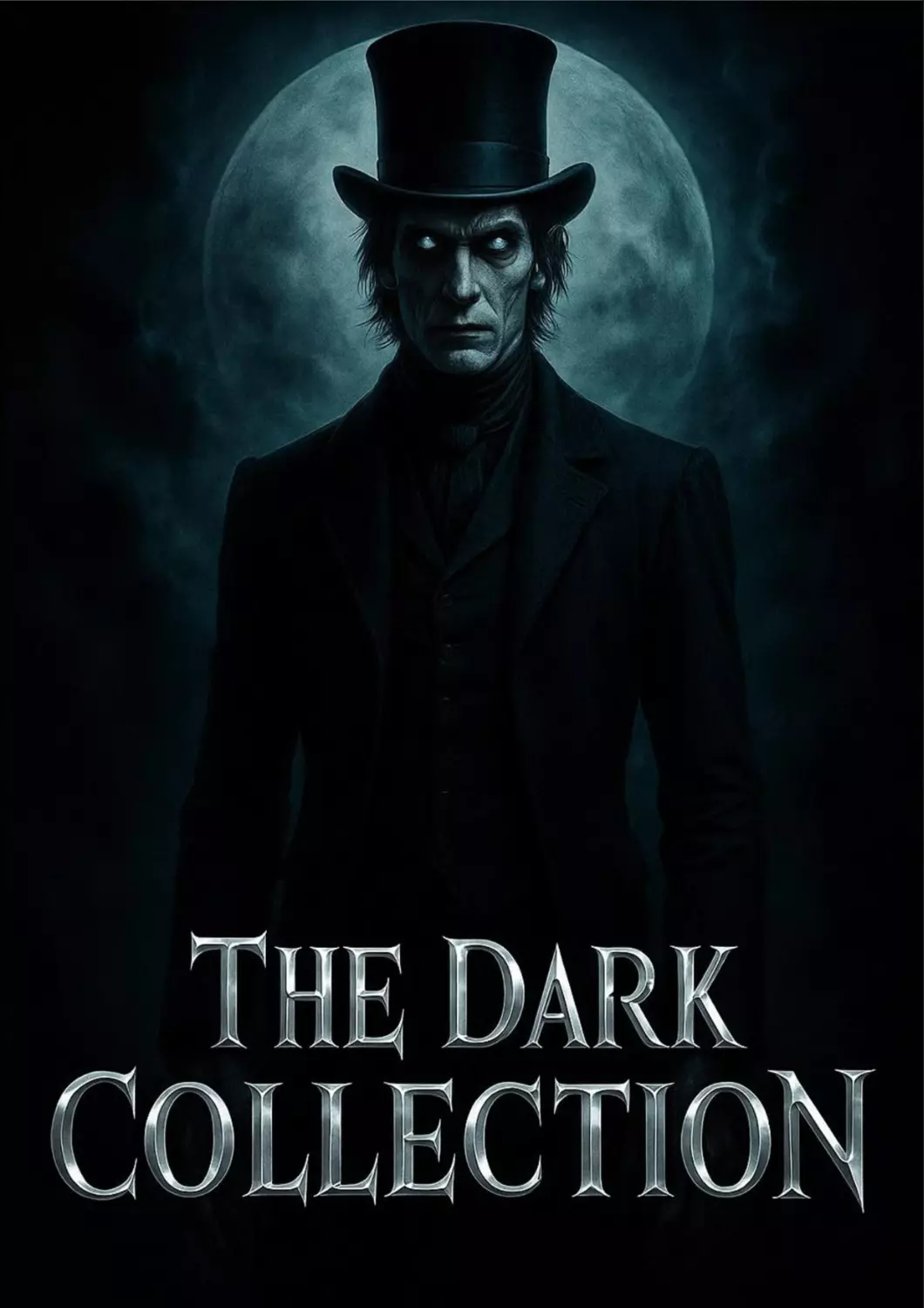
That day — like countless before it — the world outside remained unchanged. The same
unmoving scene, drawn taut like a thin veil stretched through eternity: a full moon — pale and
wide, an unblinking eye hung over the earth, mute witness to something ancient, forgotten, yet
still unfolding in silence. It lit a bottomless night, dragging from darkness jagged rooftops, as if
clinging to the sky in a desperate attempt to break free from a closed loop of dread.
Amid them stood a house. Drowned in the same dark as the rest, and yet — other. From one of
its windows, light was spilling. Flickering, uncertain light. A beacon for the lost. A signal flame
for those who had gone too far. But this light did not promise rescue. It spoke not of hope.
It remembered.
It reminded that in this place, no one is sought — and no one returns.

It fell on parchment inscribed with something hardly called a letter, something yet unshaped. It
lit half-drawn outlines hiding in the letters — shadows becoming syllables, syllables thoughts,
thoughts obsessions.
Here, with me, you do not merely read: you sink. You drift among the thoughts of those long
gone, but still breathing in the dark between the pages.
My name is Daris Thorn.
Though the name is but a lingering shadow of what I may once have been. I am not human —
not in the common sense. Not flesh. Not voice. Not reflection in glass. I am silence between the
lines. The rustle of turning pages. A shadow cast by memory — of the man once called a writer
and, by blood or dream, was my father.
His gift passed not to me. Not the words. Not the fire. Only the hunger.
And that hunger — is bottomless. Insatiable. It devours voices, lives, remnants — traces of souls
pressed to paper. I do not live — not as you mean it. I remain. I echo. I endure — like the
smoldering ash of forgotten ages, like a stain on the margins, like something never whole — and
never wholly gone.
5

I am no teacher. No prophet.
I am the archivist of the forgotten.
Witness to what has outlived its author.
I read.
I remember.
I retell.
Not to instruct — but to awaken. To remind. To show that in these dust-covered texts, long torn
from time, something still looks back at you.
If you are ready — not just to read, but to listen — I will guide you through the corridors of
forgotten literature.
To places where each word leaves a scratch.
Where story is not told, but unraveled — like a dream that will not fade.
And perhaps, if you linger long enough,
you too will hear a voice —
not from without,
but somewhere within.

***

6

Part I. The Founders of Gothic
Chapter 1. The Castle of Otranto
When I first discovered it, the book lay in a secret compartment
hidden behind a false panel of mahogany. It was in the far wing
of the Archive, where the ceilings have collapsed, and the dust
smells almost like incense. The panel yielded to my touch, like a
pliant rib — and opened with a tremble, revealing a narrow
recess that held but a single book. The leather binding was
cracked, the gold of the letters faded, but the words The Castle of
Otranto were still discernible. The paper — cold as a marble
slab.
I opened the folio, and in that moment, the City seemed to hold
its breath. The rustle of pages — like the whisper of phantom
robes. The lantern’s glow flickered. And I felt that very horror of
awe — the feeling I would later learn to know as the boundary
between the living and the unwritten.
My father… he entered a moment after. He said nothing, but his face was paler than usual, and
the candle’s shadow rose up the wall like the condemning figure of an inquisitor. He did not
touch the book — only lit a second candle, a sign of forbiddance. I was told not to read. But the
text had already taken root in me, like a virus, a gothic archetypal cell that cannot be removed.
When I returned later, the book was gone. But I found it again — and since then, I keep it in the
Hall of the First.

Horace Walpole, son of a prime minister and architect of his
own legend, created The Castle of Otranto in 1764 — under the
guise of a translation from an old Italian manuscript. This gesture
— a literary mask, a refined flirtation — marked the birth of the
gothic novel as a genre. But behind the play of mystification lay
something more grounded: a thirst to return tremor, structure,
shadow, and fear to literature.
The eighteenth century was the age of Enlightenment, symmetry,
and reason. Yet against this backdrop, a passion for Gothic
revived — for archaism, for the dark splendor of medieval
cathedrals. Walpole builds not only a castle in his novel — he erects a real Gothic mansion,
Strawberry Hill, where every turret, every pointed window obeys the aesthetics of nocturnal
imagination.
The Castle of Otranto introduces architecture as a living agent in the story. Towers collapse,
portraits whisper, swords grow monstrous in size — the house itself becomes a body soaked in
the supernatural. The castle’s walls know more than its inhabitants. Doors don’t just creak —
they judge. Portraits don’t hang — they gaze.
Here, the main Gothic archetypes are set:
– The captive heroine — Isabella, doomed to flee through underground passages, a metaphor for
feminine fear and the desire for freedom.
– The usurper-patriarch — Manfred, whose obsession with lineage leads to disaster: a Gothic
7

allegory of fear before the decay of power.
– The supernatural omen — a giant helmet, fallen from the sky like karma, a symbol of
punishment for pride.
– Secret passages, hidden kinships, family curses — these same structures would later fill
Udolpho, Frankenstein, and Dracula.
Otranto was a scandal — but also a revelation. Critics of the 18th century were puzzled, readers
— thrilled. This very tension, this aesthetic shift between horror and delight, formed the nerve on
which Gothic still plays.

Today the novel may seem naive, but it is the naivety of an alchemist who first discovered the
formula for gold. Here are the genre’s prime elements. Here are the bricks from which all later
nightmares are built.
When I read it now, the pages still slightly tremble — perhaps from a draft. Perhaps — from the
memory of how fear first opened within me as a form of knowledge.
Maybe I’ll speak of other books, maybe I’ll recall something else from my past — I hope that
then calmness will finally find me.

Chapter 2. Frankenstein
I descended into the southern wing of the Archive, where it smells of iron and ozone, like after a
storm. This used to be my father’s study — not the one where he wrote, but another: hidden,
devoid of daylight, where the ceiling is laced with copper serpents of pipes and the floor is
strewn with shards of amalgams and scorched equations.
The coils were still smoldering, as if someone had just left. Nearby — the stone hand of a marble
statue, torn from context, frozen in a gesture of waiting. On the wall — formulas, written in
haste, as if the very air was on the verge of understanding. Everything breathed with echoes of an
experiment that was never meant to end.
8

I touched the writing desk — and felt a faint tremor under my fingers. Not from fear — from
recognition. What if I myself am the result of such an experiment? What if my soul is not born of
love, but a vector of will?
As a child, I found an old quill. I dipped it in ink mixed with tears — I still knew how to cry then
— and tried to write: “Father, don’t leave…” But the page ignited. He entered, tore the sheet out,
and without a word, threw it into the fire. Only later did I realize: I had tried to do what he feared
himself.

Mary Shelley wrote Frankenstein at the age of nineteen. It happened
in the summer of 1816, at the Villa Diodati by Lake Geneva. In the
company of her husband, the poet Percy Bysshe Shelley, Lord
Byron, and the doctor John Polidori (author of The Vampyre), one of
the most famous literary challenges took place: each was to write a
horror story. The night was black with storms, minds captivated by
electricity and the philosophy of death. From this alchemy came the
story of Victor Frankenstein.
The novel bears the subtitle or The Modern Prometheus. This is the
key: Shelley compares the ancient myth of the fire-bringer and
suffering titan with the scientific urge to pierce the forbidden. Victor
Frankenstein is not a villain in the usual sense — he seeks
knowledge, but his tragedy lies in pride, in refusing to accept the outcome. He creates life, but
does not know how to love it.
A crucial detail: the creature is not made through demonic magic, but through concepts current
in the 1810s — galvanism (electric current as reanimator), natural philosophy, alchemy, and
anatomy. Shelley was clearly inspired by the works of Giovanni Aldini and rumors of public
experiments in which frogs, corpses, and dogs twitched under voltage. This is science not yet
parted from myth. This is fear dressed in a lab coat.
Frankenstein became more than just a horror novel. It is a
philosophical work: it questions the boundaries of humanity, the
responsibility of knowledge, the nature of parenthood, isolation, and
fate. The monster Victor creates is not a beast — he is a thinker,
rejected and abandoned. His suffering anticipates the Romantic
fixation on the tormented soul. Frankenstein himself is the Hamlet of
the laboratory — without the prince, but with the current.
The novel deeply influenced late Romanticism and even
foreshadowed existentialism. In Camus, Kierkegaard, and even in
the 20th-century gaze on artificial intelligence, we hear the echoes of
Shelley’s tragedy. It is the tale of a creator who cannot love his
creation. And of a creation that asks for one thing: “Speak to me.”
When I read Frankenstein now, the pages pull at my skin. They are full of icy electricity. This is
a novel where everyone seeks a maker — and finds only an echo.
And if I, too, am the result of a text in which I was “written” — then who is the author? A
father? Pain? Or fear itself — of being alone?
9

There is no answer. Only the path. And the next book, the study of the next night-born creature,
terrible yet magnetic.
Does the fact that I feel kinship with the horrors of the author’s mind make me a monster too?
Sometimes I think I may also be the horror of a broken mind — but whose?
First, I must extinguish the flame. It has burned inside me for far too long.

***

10

Part II. Victorian classic
Chapter 3. Dracula
The night alleys of the City of Ink — those that twist beneath arches, where lanterns shine as if
through blood — remind me acutely of Dracula. I read the novel in dim light, bent over my
father’s diaries, written in fragments, in varying hands, as though not one man but a whole host
of voices had written them. Among them — a strange confession: “I fear blood. It reminds me of
ink. And ink — of what cannot be erased.”
Fear of blood...

In Bram Stoker’s work, blood is not just a biological fluid. It carries
legacy, guilt, power. It is a text inscribed in flesh. And Dracula is a
novel without a single narrator or version. It’s a stitched fabric of
letters, diaries, clippings, telegrams, ship logs. The epistolary form
turns the narrative into a puzzle, the reader into a detective—as if the
act of reading itself becomes a matter of survival..
Why does it affect us so deeply? Because in a world recorded by pen,
truth always lags behind. The reader knows less than the character—
and more. The atmosphere emerges from gaps, omissions, personal
vulnerability. We’re not just reading—we're inside someone else’s
fear, helplessness, lost control. The epistolary form turns Dracula
into a mirror maze where every reflection is slightly off, but together
they reveal the face of the monster.
And also—the face of the Era.

Dracula is a novel of Victorian anxiety. Every detail pulses with fear of the Other: the other
body, the other culture, the other desire. Eastern Europe, with its castles, wastes, and
superstitions, invades the heart of the British Empire like the shadow of colonial backlash. The
vampire is the nightmare of empire, the inversion of power: it’s not the Englishman conquering
the world, but the world returning to conquer England..
Dracula’s body—sexualized, hyper-alive, immortal—defies Victorian restraint. His masculinity
and femininity blur into grotesque: the bite scenes are scenes of seduction, violence, mystical

11

marriage. Blood, as transmission of essence, becomes metaphor for desire, infection, the loss of
identity.
But the fear isn’t only in the outsider. The fear is within the home.
The fear that even the purest women can be “tainted,” that friends
might betray, that technologies (phonograph, telegram, train) can’t
save from ancient horror. That knowledge is helpless against myth.
Daris, reading the journals, finds strange echoes of Stoker’s text.
His father wrote as if under dictation. At times, his hand shook. He
wrote: “The darkness moves. It has no body, but it has intent. I met
the stranger. He did not speak. He looked. And I knew: I am being
written.”
I sat with those words as the lamp outside flickered. For a moment
I thought—what if my father was right? What if the darkness
roaming the streets of the Ink City is not a metaphor? What if
Dracula is not a character—but a symptom? A lens? A mirror?
Then who am I? A hunter of shadow? Or its creation?
In Dracula, no one remains unchanged. Even the diaries grow less logical, less rational—as if
the act of writing itself is infected by the monster. And I, Daris, heir of the Archive, feel my
notes slipping more often into timelessness. Evening becomes morning. Names blur. And
blood… It fades from my fingers, but not from memory.
The next book I’ll touch is about another monster. There’s no blood. Only fear—without form,
without bite, without body.

12

Chapter 4. Strange Case of Dr Jekyll and Mr Hyde
I was about twelve when I first realized the incompatibility of logical explanations with the
nature of human essence. Back then, I still believed everything could be reduced to structures,
formulas, symmetry — believed with that passionate trust a young mind clings to order, afraid of
chaos. But one evening, one argument with my father shattered that crystalline certainty, as if an
inner pendulum suddenly lost its rhythm.
We were discussing a character from his new novel — a figure balanced between moral
extremes. I said, “A person can’t be entirely good or evil.” He interrupted sharply, with such a
flash of irritation, it felt like he feared not me, but the thought itself — as if it were dangerous,
forbidden. His voice struck like a switch flipping in the dark. I went silent, but inside, something
cracked — as if a part of my childhood logic had failed. Later, alone in my dim room,
surrounded by dust and shadow, I wrote a phrase: “Two souls. One voice.” That note became a
warning. I began to fear which of us would speak next.

This inner split, once formless and disturbingly vague, took
shape the moment I read * . The novella, written in 1886, is no
exaggeration: a psychoanalytic myth of its time. It condenses a
core conflict of late Victorian culture — the fracture between
respectable façade and the repressed darkness of the
unconscious. Legend has it that the plot came to Robert
Stevenson in a dream, a vision; the first draft was destroyed, the
second written in a feverish burst over mere days. That legend is
part of the myth itself: text as symptom of inner possession.

Dr. Henry Jekyll, a scientist-aristocrat, is obsessed with one
radical experiment: to split the virtuous and base within man.
His transformation into Edward Hyde is more than bodily
change — it’s a shift in ontological register. Hyde is no mere alter ego or grotesque twin; he is a
being stripped of social and moral context, raw nature, unveiled and unleashed. He terrifies not
by cruelty, but by honesty — his malice is clear, his desires transparent.

***

13

Stevenson wasn’t the first to explore the double. The tradition starts with German Romanticism
(Jean Paul, Hoffmann), continues through Poe, and finds philosophical climax in Dostoevsky.
Yet Stevenson is unique in structural precision. His double is not just a motif, but a mechanism.
Even the names serve as concepts: Jekyll echoes Latin iocus —
jest, illusion; Hyde, from to hide — to conceal. The novel is
staged like a play: one actor performs while the other hides
behind the curtain — but they share one body..
The serum Jekyll uses doesn’t create a second nature — it
unmasks the first. Evil isn’t an external force but a fundamental
part of the subject. In this sense, the novella surpasses moral
literature: it becomes an ontological study, a tragedy of identity.
It asks: what remains of the “I” if we strip away social function,
repression, and upbringing? What if man is not the sum of good
deeds, but the depth of what is repressed?
In late Victorian England, where everything — from
architecture to gesture — was ruled by discipline, where
science became a new religion, and sexuality was buried deep
in shadow, Stevenson’s tale became a psychoanalytic
precedent: London fog, where Hyde hides, is not just scenery — but projection of the
suppressed.

14

When I — Daris Thorne, a ghost assembled from words, shadows, and scraps of memory — first
discovered an old copy of the novella in one of the locked drawers of my father’s archive, what I
felt wasn’t just recognition. It was something closer to revelation — frightening, almost
blasphemous: if the darkness is within me, then at least I am not alone. But if it is stronger than I
am, what then remains of me? Are my thoughts merely the rhetoric of another? Am I just a veil
stretched over the abyss?
Since then, I’ve begun to read my own records more carefully. Some seem written by another
hand. Some thoughts echo too deeply to be mine. Sometimes I speak words I do not understand.
Perhaps any soul, steeped long enough in the silence of other voices, will one day lose its own
footing.
Stevenson’s tale is a mirror — but not the kind that comforts. It’s a mirror that shows what
you’re afraid even to imagine. Its glass is cracked from within, and in every shard lies the
potential for rupture. It doesn’t tell you who you are. It offers a script — who you might become,
if you ever stop holding back.

***

15

Part III. The Forgotten Ranks and the Rise of Modernity
Chapter 5. Carmilla
I remember how I found her — in the shadows, around the corner of a distant hallway, where the
lamps had long gone out, and only light from a paper-covered window turned the floor milkygrey, like the skin of a drowned girl. My hand was still a child’s then, awkward, but reaching out
confidently — as if it already knew this book would change something. The cover — red and
black, with an ornament faded to ashen ochre. On the spine, the word had faded: Carmilla. I
opened it at random, and in the half-light read words I wouldn’t forget for years: “I have lost my
heart. It is in you.” I didn’t yet know what it meant, but something in my chest clenched — like
fear that felt like awe.
Later I would understand that Carmilla is not just a gothic tale,
but one of the first and most powerful examples of vampire
literature told from a feminine perspective. Sheridan Le Fanu
published it in 1872, as part of In a Glass Darkly, and though it
preceded Stoker’s Dracula by a quarter-century, its influence on
the canon was foundational: forested castles, the immortal
beauty with pale skin, the sensuous atmosphere, and the
vampire as a parasitic yet alluring figure — it all began here.
Carmilla established the delicate, refined aesthetic of vampiric
seduction, where fear is entwined with longing, and the bite
becomes an act of desire, of invasion, of loss.

But more importantly: Carmilla is the first serious text about a female vampire, written by a
man, yet allowing a woman’s voice to seep through fear. At its center is Laura, a young girl
whose bond with Carmilla grows as erotic ache, entangled in dreams and half-hints. Le Fanu
masterfully uses Victorian aesthetics of suppression, where everything explicit is dangerous —
and therefore all the more desired. And in that half-light blooms the core theme: forbidden desire
as a form of dependence, as hunger melting into death. This desire is not always sexual in
common terms, but it is always tinged with melancholy, repression, and the fragile sweetness of
mutuality.
Feminist readings of Carmilla emphasize the vampire’s dual nature: she is both a threat to
patriarchal order (seductive, active), and its victim (eternal exile, condemned to shadow).
Modern interpretations — from Ellen Moers and Nina Auerbach to recent queer-feminist
thinkers — show how Carmilla embodies Victorian fears around female sexuality and autonomy.
Here, vampirism is not only a metaphor for evil, but a mode of existence outside male control —
beyond marriage, beyond family. It’s a text about love becoming a sin because it doesn't fit into
normative morality, and about seduction as a means of survival.

16

Beyond gender, Carmilla contains all major gothic
archetypes: the secluded castle, recurring dreams, the restless
dead, and a stifling, beautiful anxiety. Gothic here becomes a
sense of mysterious captivity — a constant hovering between
the world of the living and the dead, the seen and the hidden.
Le Fanu innovated structurally too. The story is epistolaryfragmented, told in remembrance by the one who suffered it.
And in that split — not just formal, but psychological — lives
the theme of the double, the shadow-self. Not as radical as
Stevenson’s, but more insidious. Laura is not only a witness
— she’s a participant, tempted and torn. Their love story is
not an accusation, but something subtler: a sad, doomed
understanding, almost religious in its sorrow and inevitability.
It’s also vital to note how Carmilla shapes the image of the
forest and the castle as spaces of feminine horror. Her castle
is not merely remote — it’s isolated like a body from society.
In it reigns silence, unmoving portraits, and walls soaked in
secrets. These images persist into later gothic, including film: from Hammer to Jean Rollin.
Carmilla becomes an archetypal matrix for all nocturnal seductresses through the 1990s — from
Lilith to Miriam in Tony Scott’s The Hunger.

17

In those years, when I — still a mortal child — drifted past my father’s library shelves, I already
knew some books were not meant for the eyes, but for touch. Carmilla held no horror in the
usual sense. It held betrayal’s sweetness, a slow poison like loneliness. And maybe that’s where I
saw myself. This book didn’t scare me as black masses or pages inked with mathematical
sorcery did. It breathed differently — not fear, but allure. In it lived a longing for something lost,
for a woman no one could ever truly understand or save. And I — young, already leaning toward
ghosts — loved her for that.
My father later saw the spine on my desk. He said nothing — just took the candle and left. But I
was sure: he’d read it too. And perhaps, he too had felt the bite — the one that leaves no wound,
only a question: “What if I wanted it?” Maybe he remembered his first Carmilla, the one who
came to him in dreams, as to Laura. Maybe he burned her name, but not her image.
The next book will be far less gentle. There will be shadows and tea and voices from behind the
mirror. There will be no place left for tenderness — only calculation and pain.
But first — let this whisper remain..
She is still watching.

***

18

Chapter 6. The Haunting of Hill House
I never believed in houses — at least, not the kind built of bricks and plaster. True houses are
voices. And one of them began speaking to me the night I was first left alone in the private
reading room. The space was closed off, muted, as if carved from the City of Ink itself: the walls
deaf, the floor carpeted, the lamp dim — but it seemed as though someone’s shadow stood just
behind its light. I didn’t read that night. I listened.
The whisper came not from outside, but within. The books didn’t move, yet the air between them
pulsed. I thought then: a house is what looks back at you. That’s not a metaphor. That’s memory.

Shirley Jackson, with her rare gift for literary ambiguity, created a space where the inability to
distinguish perception from reality becomes the very source of
fear..
The main character, Eleanor Vance, is almost symbolic. Her
fragile mind, repressed longing, disconnection from the world
— all make her the ideal target for what may dwell in Hill
House. But Jackson never states outright that the house is
haunted. On the contrary — her style thrives on ambiguity,
shifts in perspective, suspicious subjectivity. The unreliable
narrator here is not a voice, but reality itself, making the novel
deeply modernist in its aesthetics of unease. The Haunting of
Hill House, published in 1959, is seen as the peak of 20thcentury American gothic and an early model of so-called
psychogothic — horror that emerges not from outside, but from
within the subject.
Hill House isn’t just a building. It’s an architectural anomaly,
built on warped logic: angles aren’t right, hallways loop, sounds
have no source. This spatial distortion becomes a metaphor for
Eleanor’s inner state: the house is her reflection, her interior
maze. It’s no coincidence that Jackson, referencing early gothic
works like Walpole’s Otranto, focuses not on a monster, but on
walls that “don’t want to be straight.” The space resists reason
— and that is what makes it terrifying.
Critics — from Judith Faye to Gerald Prince — note that in Hill
House, fear no longer links to the supernatural but becomes an
emanation of inner fracture. Eleanor, they argue, is not just a
medium but an active maker of terror: she wants to merge with
the house, to become it. This kinship of fear and longing is one
of the book’s key themes. In a pivotal moment, Eleanor literally
says:
"Hill House is calling me home." — blurring the line between self and space, between subject
and specter.

19

Within the gothic tradition, Jackson breaks the mold: there is no evil in the usual sense, and no
triumph over it. The ending remains open — but steeped in despair. Eleanor does not escape —
she absorbs the curse, as if she’d always carried it. This is post-romantic horror: suffering isn’t
redeemed, it becomes the substance of being. That approach deeply shaped the genre — from
Peter Straub to Mike Flanagan, later gothic storytellers borrowed from Jackson her uneasy
silence, uncanny structures, and disoriented heroines

20

That night, in the reading room, I didn’t sleep.
I watched as the spines of books cast false shadows. They seemed to move — not in body, but in
meaning. The space, once familiar, began to fold into another geometry: as if each book were not
a story, but an entrance. The walls didn’t speak in words. They breathed.
I remember one book’s cover — an old French reprint of Jackson — had a line scrawled in ink:
“La maison pense.” The house thinks.
And I thought: if Hill House was Eleanor’s mirror, then which house is mine? And have I
already become part of it?
Perhaps my library is no archive, but the inner chamber of something else, and I — its dream?
Father always warned: “Stare too long into books, and they’ll begin staring into you.”
Now I knew he was right. But I did not back away. I became part of the architecture — not a
reader, but an interpretation.
The next book I open will be about another body — one that split with itself.
There will be a doctor.
And a shadow in the mirror.
But now — silence.
The house thinks.
And I think with it.

***

21

Chapter 7. Melmoth the Wanderer
That day I left the City of Ink.
Sometimes I must go, just to stop hearing the shelves whispering my name.
The road led to Duskgrave — a neighboring enclave, lost in twilight and maps, where no
building stands where it stood the day before. I walked alone, a book in my bag and a shadow
behind my back.
Here, the wind cuts corners like a blade, and smells of old wax and wet iron. I thought: is this
exile? To not be cast out by others, but by yourself — bearer of a curse that cannot be revoked or
passed on.
That’s when I first understood Melmoth.

Written by Charles Robert Maturin and published in 1820, it
stands as one of the monoliths of late English Gothic, a novel that
closes the age of fear, doubt, and burning passions.
It sprang from the same root that birthed Frankenstein and The
Invisible Man, yet Melmoth is not about science or transgression
— it’s about time.
About the unbearable weight of immortality, when it becomes a
form of damnation.сс
The plot seems scattered — and that’s intentional. The structure is
a series of nested tales, a chronicle of a chronicle, a fragment told
through another’s voice, as if the story itself seeks to flee the
truth.
The central figure — John Melmoth, a student in Dublin —
discovers in his dying uncle’s house a sinister tale of an ancestor who bargained for eternal life.
From there begins a journey: geographic, spiritual, textual.
Melmoth becomes the archetype of the eternal exile, doomed to wander Europe in search of a
soul willing to take his place.
The plot seems scattered — and that’s intentional. The structure is a
series of nested tales, a chronicle of a chronicle, a fragment told
through another’s voice, as if the story itself seeks to flee the truth.
The central figure — John Melmoth, a student in Dublin —
discovers in his dying uncle’s house a sinister tale of an ancestor
who bargained for eternal life.
From there begins a journey: geographic, spiritual, textual.
Melmoth becomes the archetype of the eternal exile, doomed to
wander Europe in search of a soul willing to take his place.
Stylistically, the novel draws inspiration from the German school of
terror (Schubert, Hoffmann), while preserving a certain Irish,
Protestant austerity.
Images of Spanish monasteries, prisons and storm plains, tombs and
wanderers — all form a disturbing palimpsest: a map of Europe
walked by the dead.
22

In such passages Maturin reaches rare power: scenes of the hero crossing snowy passes or
watching a plague hospital brim with ontological dread — where gothic fuses with eschatology.
Darist, walking through Duskgrave, remembered those pages: their grim toponyms, the way
Melmoth’s figure grew less human, more shadowed.
I walked past buildings whose walls bore painted windows — as if the city no longer knew its
own borders. One house stood inverted: its door was in the basement, the attic a grand hall.
All of it echoed the novel’s structure: inverted, skewed, like the reality of the outcast.
I found no answers in Duskgrave.
But I found a voice.
Whispering, like Melmoth’s: “You chose solitude too.”
A curse requires no pact.
It only asks for memory.
And when I returned to the City of Ink, I already knew: I don’t just keep books.
I carry them.
I am their consequence.
Like him.
Like the one who once dared to face eternity.
In the next chapter there will be a nameless creature.
And a city where faces are never remembered.
I still remember them.
All of them.

***
23

Part V. Deep Gothic: Rare Gems
Глава 9. Uncle Silas
When I opened the box, wrapped in darkened paper, and pulled out the slender volume with the
silhouette of an old estate engraved into its leather binding, the very air around me seemed to
thicken. It was a gift from my father — silent, like all his gifts — and, as nearly always, it was a
warning. I lit one candle. Then another. But the moment I turned the first page of Uncle Silas,
one flame went out. Soundlessly. Not from a draft — the windows were boarded.
And behind me, someone spoke my name — not with voice, but with memory. As if they had
always known it.
Uncle Silas is a novel where the Victorian countryside becomes a
trap for a young heiress, turned into a marionette of kinship, duty,
and control. First published in 1864, the text fuses gothic suspense,
domestic drama, and detective intrigue, wrapped in the quiet, almost
pastoral landscape of rural England.
Sheridan Le Fanu, a master of Irish gothic, designed a textual space
where evil doesn’t enter from outside — it grows from the body of
the house, the family, the memory.
Evil here is intimate.
It belongs not to a stranger, but to an uncle.
The central figure is Maud Ruthyn, young and vulnerable, whose
fate is entrusted to her enigmatic uncle Silas, a withdrawn and
suspicious gentleman living in the half-ruined estate of BartramHaugh. From the beginning, we witness how female subjectivity is
undermined: Maud is wealthy, but powerless, her life governed by others.
This motif of submission, typical of Victorian culture, is intensified by a pervasive atmosphere
of distrust, blurred moral lines, and betrayals veiled in familial masks.
The house she enters is no refuge — it is a labyrinth with jagged walls, where every smile carries
the echo of a hidden knife.

As scholars like Victor Sage, Judith Flanders, and Elizabeth Siegel point out, Uncle Silas is one
of the early, potent expressions of the “female gothic” — a genre where a woman finds herself
isolated, either physically or psychologically, in a space where every gesture reads like a threat.
Unlike Carmilla, there is no overt eroticism here — but there is no less tension between
vulnerability and control.
Maud is an heiress, but that inheritance makes her a target, not a subject.
She becomes the guardian of capital others seek to seize, and her voice grows ever more
muffled, her body a symbol of systemic fragility..
The novel’s social context deepens its darkness. Victorian England, especially its rural corners,
imposed strict expectations on women: chastity, obedience, dependence on male authority.
Le Fanu doesn’t merely reflect these norms — he reveals their rot.
Silas, with his religious fanaticism, covert dealings, and brittle morality, becomes an allegory of
a paralyzed Victorian conscience: he doesn’t break the law openly, but neither does he uphold it.
His home is a temple of secrecy and death, where Maud enters as if into a sarcophagus.
Every gesture reveals the ambivalence of power: it promises protection, but delivers doom.
24

Symbolically, the novel reads as a
gothic testament.
Inheritance in Uncle Silas is not
just money or land — it is a curse,
a debt, a binding to a bloodline
from which one cannot escape.
Le Fanu seems to say: blood is not
merely a bond, but a brand.
Maud cannot leave — nor can
Silas.
Here lies the novel’s philosophical
heart: freedom is impossible if one
inherits not only property but fate.
And in gothic discourse, fate is
rarely a choice — it is a sentence.
Maud inherits not just wealth — she inherits fear.
And in that fear speaks the past — too clearly to be silenced.

As I read, the flame of the second candle swayed as if breathed upon.
I stood — but there was no one in the room.
Only the rustle of old pages and a whisper, almost tender: “Darist…” —
As if the house did not know me by name, but by blood.
I understood: this was not fear. This was legacy.
And legacy does not release those who guard it.
I felt the same weight that pressed on Maud’s shoulders: the memory of lineage, the mark of a
text, the seal of a gift that cannot be refused.
Uncle Silas is a novel where time dissolves slowly into language, and the reader, like the
heroine, becomes not a mere witness but a participant in a ritual of remembrance.
It is a warning: about the house’s power over the living, about the silent violence of family will,
about a woman’s fate played out in the shadows of gothic corridors.
Nothing in it is what it seems.
And that makes every whisper all the more dangerous.
The next volume will be one where the curse no longer hides.
Where the wanderer looks into a mirror and sees no face.
Where a name becomes a sentence.
Where gift turns to punishment.
And yet — the candle flared once more as I turned the final page.
That means: the book still lives.
And with it — so do I.
Which means… someone is still here.

25

Глава 10. Silent Companions
The Archive of the City of Ink held more than just text. It breathed, it whispered, it slowly
awakened in the hush, as if reading alongside me. Here, in these shimmering tunnels of code,
every file was more than a file—it was a tomb, where memory slowly unpacked itself, creaked,
came alive.
When I first opened the digital version of The Silent Companions, the cursor lingered in the
corner, trembling like fingers on keys at the beginning of a letter. The file was damaged — but,
as often happened in the City, the deeper the cracks, the more vivid the text became. Sometimes
it felt: a glitch was a form of acknowledgment..

On the screen before me: a mute manor, the outskirts of
Victorian England. A young widow, Elsie, moves into her
husband’s ancestral home, where everything is filled with
stillness, with latent dread, and above all — with the
companions: wooden figures so lifelike, they seem to see. And
read.
The Silent Companions, a novel by Laura Purcell published in
2017, became a touchstone of neo-Gothic fiction, fusing classic
tropes with postmodern unease. This is not merely a novel — it
is a formal challenge, a spectral reconstruction of Victorian
horror in digital flesh..
Scholars such as Emma Thornton, Laura Hines, and Michelle
Page point out the novel’s deeply feminist foundation.
Elsie is trapped in both social and psychological isolation:
widowed, she loses autonomy, becoming a prisoner of her new
home and its inherited expectations.
In Gothic space, a woman is not merely a character — she is a reflective surface, mirroring the
fears of her time.
The house in this novel is no backdrop — it is a co-conspirator.
Here, the Gothic technique of living architecture is fully realized: the space doesn't frame the
action, it creates it.
The companions are objects endowed with subjectivity.
They record the gaze, much like the screen of my terminal — those glowing pixels where
silhouettes hide..
Purcell expertly embeds the novel within a genre in transition: The Silent Companions is not just
a homage to the Gothic of the 18th and 19th centuries — it is a reboot.
Its narrative unfolds in layers: found diaries, “unreliable” recollections, and deliberate gaps.
As Professor Claire Norton notes, the novel unspools like a palimpsest of dread — no level is
final, each text conceals another. Even the narrator is not to be trusted.
This is where the novel meets the digital: every reading is an act of interpreting an interface. And
truth itself becomes a flickering, phantom structure.
26

The core allegory is about the nature of the image: portraits and companions do not merely
depict — they continue.
They watch.
They remember.
They respond when read.
This is paranoia as a mode of Gothic seeing: who watches us as we think we are alone with a
text?
Who reads the reading?
Purcell forces us to doubt the act of interpretation itself — as if each line could turn into a
mirror. Or worse — an eye.

Darist was not alone.
When I first loaded the novel into the terminal, the archive windows began to flicker. For a
moment, I saw two cursors. One was mine. The other — hesitating, echoing my movements with
a delay. And then — a shift forward, a keystroke before I pressed it.
The voice inside whispered:
“It’s them. The ones left in the text. The digital companions who have nowhere else to go.”

That was when I first felt how a ghost might live in the network.
Not as metaphor, but as real, traceable presence.
A ghost is a glitch that loops.
A reading in which the text looks back.
A room where the lamps flicker on time, as if awaiting response.
That’s how The Silent Companions work: they don’t frighten — they follow.
And at some point, I realized:
What if I’m one of them?
An idea reflected in the mirror of the page, a living text composed of memory, pain, and scraps
of my father’s library?
27

It’s here — in this fragile union of story and ink-shell — that true 21st-century Gothic is born.
There is no clear ghost in Purcell’s text.
There is only tension — between what could be and what we’re not ready to accept.
The horror isn’t the monster, but the empty corner where a shadow falls.
It isn’t in sound — it’s in the silence we fill with ourselves.
A ghost is a figure of absence — but also return.
It gestures. It remembers. It insists: everything was, everything is, everything will return.
And I remembered:
I am the imprint of someone who once lived and grew.
Who learned to read and to listen to his father’s tales.
I remembered the metallic taste in my mouth, that natural nausea, the red stains on my bed from
coughing through the night.
I was ill so often, and even money couldn’t breathe life into me — but ink could.
My father’s hand and pen seemed to write me into existence, and I still endure through stories
like his.
And like him — I tell them to you.
Let this be a tradition. So be it.
You are my guests, tourists in the City of Ink, wandering with me between dry parchment and
wet pigment.
I thank you for keeping me company, and for helping me remember my life.
I hope this isn’t the last time.
I’ll be here, part of the text, wandering between lines, remembering and learning, your faithful
servant.
And if you need me — for new knowledge, for new questions — I will be here..

Because someone must carry the text when the lamps go out.
Someone must continue reading when the cursor freezes.

***
28

Finis
— and yet, there is no end
So, all has been read.
The dust has settled.
The candle has burned down.
The shadows of the books have sealed once more, like scars across marble.
You were here — among the rustle of pages, the echoes of antique halls where the authors’
voices sound softer than wind, but deeper than time.
I did not ask you to follow — but you did.
And if even a single line stayed with you, like the scent of old ink or moonlight on wooden
floors,
then memory was not in vain.
Thank you for the path.
More conversations are already forming — in the deep, like an unsealing.
They will not only summon ghosts of literary gothic,
but fear awakened by language itself.
True horror does not scream —
it waits,
in silence,
in a tongue that refuses to be forgotten.
We shall meet again —
in another corridor, under another title.
While the pages have not yet dried.
⸻
Stay tuned for new entries and dispatches:

https://medium.com/@olivernarrator
https://x.com/ChroniclesOfInk

29