/
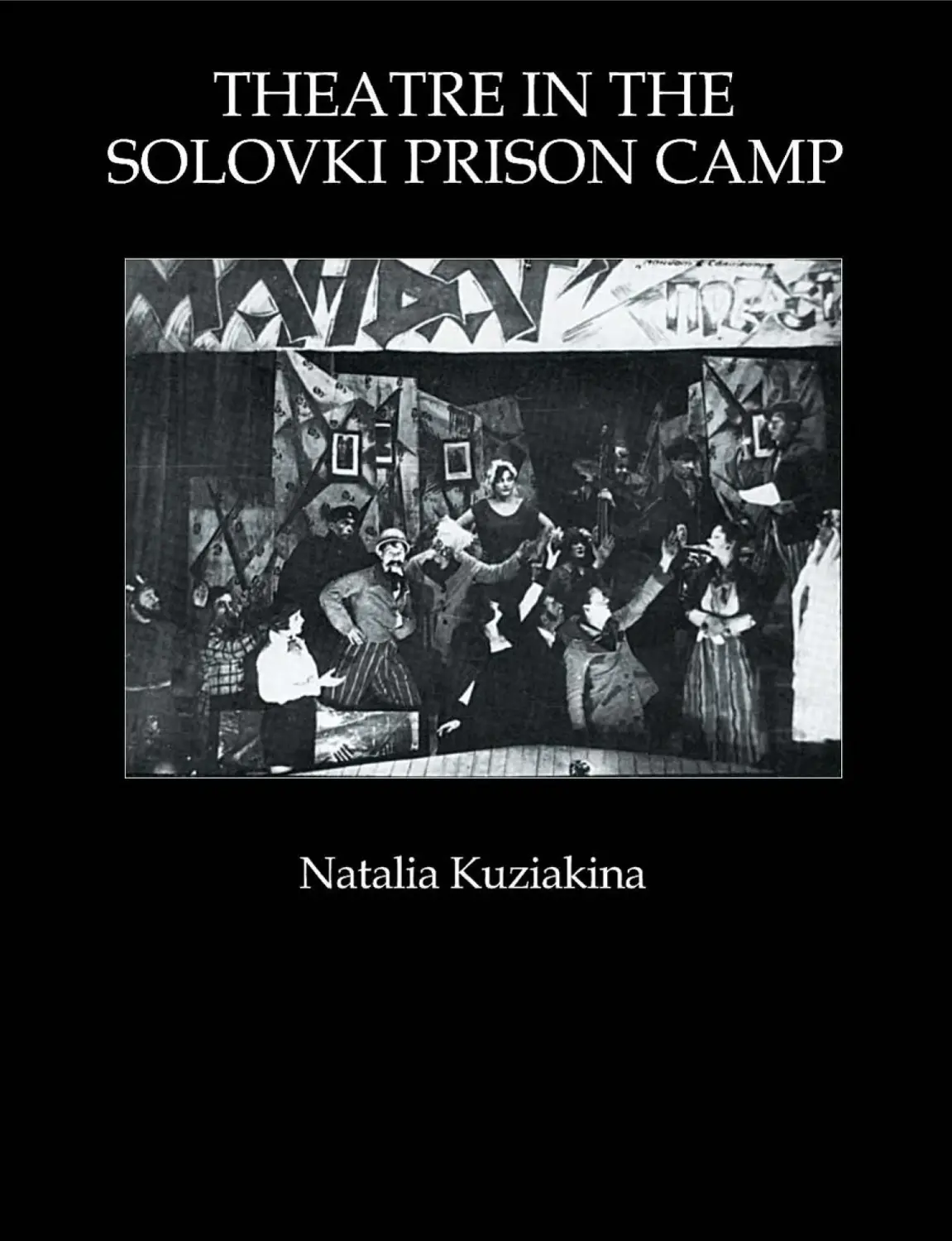


Author: Kuziakina N.
Tags: art theater theatrical art history of theater
ISBN: 978-3-718-65440-6
Year: 1995




Text
                    Theatre in the
Solovki Prison Camp

Russian Theatre Archive
Aseries of books edited by John Freedman (Moscow), Leon Gitelman
(St Petersburg) and Anatoly Smeliansky (Moscow)
Volume 1
The Major Plays of Nikolai Erdman
translated and edited by lohn Freedman
Volume 2
A Meeting About Laughter
Sketches, Interludes and Theatrical Parodies by Nikolai Erdman
with Vladimir Mass and Others
translated and edited by lohn Freedman
Volume 3
Theatre in the Solovki Prison Camp
Natalia Kuziakina
Volume4
Sergei Radlov: The Shakespearian Fate of a Soviet Director
David Zolotnitsky
Volume 5
Bulgakov: The Novelist-Playwright
edited by Lesley Milne
Volume 6
Aleksandr Vampilov: The Major Plays
translated and edited by Alma Law
Volume 7
The Death of Tarelkin and Other Plays:
The Trilogy of Alexander Sukhovo-Kobylin
trans la ted and edited by Harold B. Segel
Additional volumes in preparation:
Two Plays from the New Russia
BaldlBrunet by Daniil Gink and Nijinsky
by Alexei Burykin
translated and edited by lohn Freedman

One Step away from Nevsky Prospect:
Theatre Studios of St Petersburg in the
1980s and 1990s
Elena Markova

A Chekhov Quartet
translated and adapted by Vera Gottlieb

The Theatre of Mikhail Chekhov
Andrei KirilIov

Russian Theatre and Movement: The 1920s
Vladislav Ivanov
Trus book is part of aseries. The publisher will accept continuation orders which may
be cancelled at any time and which provide for automatie billing and shipping of
each title in the series upon publication. Please write for details.

Theatre in the
Solovki Prison Calllp
Natalia Kuziakina
formerly of the St Petersburg Institute of Theatre,
Music and Cinematography

Translated from the Russian by Boris M. Meerovich

First published 1995
by Harwood Academic Publishers.
Published 2013 by Routledge
2 Park Square, Milton Park, Abingdon, Oxon OX14 4RN
711 Third Avenue, New York, NY 10017, USA
Routledge is an imprint of the Taylor & Francis Group, an informa business
Copyright © 1995 by Harwood Academic Publishers GmbH.
All rights reserved.
No part of this book may be reproduced or utilized in any form or by any
means, electronic or mechanical, induding photocopying and recording, or
by any information storage or retrieval system, without permission in
writing from the publisher.

British Library Cataloguing in Publication Data
Kuziakina, Natalia
Solovki Prison Camp Theatre. - (Russian
Theatre Archive, ISSN 1068-8161; VoL 3)
I. Title II. Meerovich, Boris M.
III. Series
792.0220947
ISBN 3-7186-5439-3 (hardback)
ISBN 3-7186-5440-7 (paperback)
ISBN 978-3-718-65440-6 (pbk)

Contents
Introduction to the Series
List of Plates
Preface

Vll

ix
xi

PARTONE
1 From monastery to concentration camp
2 The Solovetsky Special Purpose Camp - SLON
3 The special purpose press: The Solovetsky Islands and
The New Solovki

4 Profiles and masques

1
13
23

33

PARTTWO
5
6
7
8
9

The Theatre of the 1st Department
The smaller theatres - 'Trash' and the group of tOur Own'
The end of the early Solovki
At the crossroads
The theatre at Kern

47
61
77
87
95

PARTTHREE
10 The 'court' and 'vulgar' theatres of the White Sea-Baltic Canal
11 Camp theatres and the Central Theatre of the
White Sea-Baltic Canal
12 The theatre of the late Solovki

103

References
Abbreviations

147
159

Index

161

117
131

This page intentionally left blank

Introduction to the Series
The Russian Theatre Archive makes available in English the best avantgarde plays, from the pre-Revolutionary period to the present day. It
features monographs on major playwrights and theatre directors, introductions to previously unknown works, and studies of the main artistic
groups and periods.
Plays are presented in performing edition translations, including
(where appropriate) musical scores, and instructions for music and dance.
Whenever possible the translated texts will be accompanied by videotapes
of performances of plays in the originallanguage.

This page intentionally left blank

List of Plates
(Between pp. 86 and 87)

Nos.
1.
2.
3.
4.

1 to 4. Caricatures by Ver. SLON, 1924, Nos. 5, 7-8.
Pilgrimage to Solovki.
From Our Aphorisms
Felling Logs - Our Shock Workers.
(Dedicated to the 10th platoon)
Caricature of LS. Levkassi.

Nos.
5.
6.
7.
8.
9.
10.

5 to 10. Organizers of the theatre.
LA Armanov as Krechinsky in the play Krechinsky's Wedding.
M.s. Borin as Raspliuyev in Krechinsky's Wedding.
LS. Panin.
N.K. Litvin.
B.N. Shiriayev.
B. Glubokovsky with actors on the Solovki (at Kern?).

11.

13.

Front page of The New Solovki newspaper, 7 June 1925, with portraits of A Nogtev,
Solovetsky Camp Chief, G. Bokii, OGPU Collegium Member, and F. Eichmans, Camp
Chief Deputy.
Character reference of N. Litvin, from the minutes of the USLON Central Attestation
Commission, 12 September 1925.
Permit of G.M. Osorgin's wife to visit her husband, issued 24 August 1928.

Nos.
14.
15.
16.
17.

14 to 17. Plays of the 1st Department Theatre:
The Decembrists by N. Lerner, director Borin (?), 1926.
The Warrant by N. Erdman, director Glubokovsky, 1926.
Masquerade by M. Lermontov, director 1. Kalugin, 1929.
A Lyre Jor Hire, 1932 (?).

18.
19.

L Terentiev. Self-Caricature, Teatr (Theatre), 1987, No. 5.
The Povenets Propaganda Brigade named after Firin. Singing verses on a good
attitude to horses. In: The Stalin Canal, 1934, 313.
Theatre at Tuloma. General view. Banner says 'Welcorne'.
Jazz-band in the Tuloma theatre.
Final scene of Griboyedov's comedy Woe from Wit. Tuloma theatre, 1934.
Scene from play by unknown playwright, Tuloma theatre, 1934-35 (?).
Scene from comedy by unknown playwright. Tuloma theatre, 1934-36 (?).
Theatre at Medvezhiegorsk. Destroyed by fire during World War 11.
Leading figures at the Central WSBC Theatre.
Right to left: D.M. Person, LI. Vovk, S.A Taneyev, Misha (lighting engineer),
AG. Alexeyev, and (in armchair) B.s. Pshibyshevsky; 1936.
Concert programme and bill for A Arbuzov's play Tania, 1939.
Barracks on Anzer Island. Photograph by Yu. Brodsky.
Stage director A. Kurbas. Photograph from camp case file.
Bill for N. Pogodin's play Aristocrats. Director A Kurbas, Solovki theatre, season of
1936-37.

12.

20.
21.
22.
23.
24.
25.
26.

27.
28.
29.
30.

WHITE SEA

Belomorsk
Vygorstrov

Shiznia

Sosnovets

Tunguda I

The Solovetsky islands

Lower Idel
Upper Idel
Parandovo
Shavan
Nadvoitsy
Mai Guba

Sennaya Guba
Sagezha

Urosozero

Maselskaya

Medvezhiegorsk
Perguba

Pindushi
Povenets

LAKE ONEGA

Main sites of prison camps involved in the construction of the WSBC, along the
only reliable transport artery: the Murmansk-Leningrad railway. Canal route to
right of railway line.

Preface
It is extremely difficult to write about the camps after the publication of

The Gulag Archipelago. Indeed, Alexander Solzhenitsyn broadly and powerfully outlined the issues of that life, about which many preferred to know
nothing. Though created in secrecy, behind closed doors, his book breathes
freedom of thought and expression.
The Archipelago's felicitously resilient, buoyant forms constitute a
kind of archipelago all their own, self-contained and obeying its own inherent laws. The writer confidently draws into a single stream material
that could seem too heterogeneous and aesthetically contradictory: his
own recollections and the evidence of hundreds of prisoners, documents
and civic passion. The sounds of camp life (so keenly heard by
Solzhenitsyn) swell in a crescendo. Thoughts and feelings still aglow
mingle in a single mighty tide, sweeping the reader along.
My particular task was that of the historian, not the artist. My book
deals with the role of stagecraft in the system of prison camps and, naturally, with the fates of its creators and spectators.
Prison camp theatre is a theme justified by actual life, even though
the marriage of such concepts as 'theatre' and 'prison camp' may appear,
to the ordinary mind, preposterous.
Decency militates against art in shackles. If art is the result of creative effort by spiritually free individuals, how, then, can it realize itself
under compulsion and oppression? Here fa te pulls the strings in the
jailer's hands, jerking the actors like puppets in a round-dance when they
really feel like crying. One is profoundly sorry for the actors, but where
does art come in?
Our subject, let us admit, evokes doubts also from the viewpoint of
drama study: were the camp' s stage productions of any genuine artistic
merit at all? Could any real theatrical gems in their own right be discovered there? For did not the convicts use forms most probably already tried
out on the professional stage?
Such misgivings seem justified. They were shared by the stage
director, Boris Glubokovsky, who wrote a lengthy piece on the activities of
the Solovetsky Theatre (1927) and by the author of a volume of Solovki
memoirs, Boris Shiriayev (The Inextinguishable Lantern, 1954). Glubokovsky
asserted:

xii

Preface
Considering the Solovetsky theatre, one cannot speak of its company as something definitely formed, or of a trend dictated by
some special artistic purpose. Yet one may discern in it the threads
of a strong social bond between the footlights and the audience.
And wherever there is a social bond, wherever there is a spectator,
there is theatre; wherever there is a special spectator, there is special theatre. And of this special theatre one should speak not in the
language of the art critic, but in the language of the public man
and of the sociologist.

Yet Glubokovsky also saw the camp theatre' s aesthetic features: 'A will for
the theatre, for theatricals, for pure theatre, are, indeed, manifest in the
productions of the Solovetsky theatre'.l
Does this mean that the performers and spectators are of greater interest than the stage, that is, the play itself? Right, says Glubokovsky. The
unusual mode of existence, the monstrous social crucible, unimaginable in
a stable society, in which the Solovetsky spectator was grilled, all this gave
birth to a special theatre, which played a tremendous role in the life of the
inmates, incommensurate, as it were, with narrowly aesthetic standards.
Glubokovsky's thoughts found confirmation when, half a century
after the closure of the Solovetsky prison camp, the few, but all the more
important, memoirs of former convicts were published. To most of the
prisoners the theatre was more than simply a place of recreation or aesthetic delight: it was a place where one could return to one's former normal
life as a free citizen. In that inhuman world the theatre unfurled the banner of humaneness, and this earned it the gratitude of its spectators. O.s.
Likhachev recalled:
In spring, on a white night, I had the good fortune to watch The
Solovetsky Review. The impression it made was tremendous. Why
do I say 'white night'? I recall how we all came out of the darkened theatre (lights were not switched on for a long time after the
last scene of twinkling distant fires) to be welcomed by a sky - at
once light and somehow papery-blue. Together with the white
buildings, the stirring of the air, the absence of the cries of the
seagulls (on a white night the seagulls did go to sleep, after all), all
this was quite exceptional and seemed unreal, as if in a dream. 2

The emotional shake-up in this instance (and it was not unique) was the
result of the play' s aesthetic effect, of the theatre having delivered its full
impact. For this reason the author was able to single out prison camp
theatre as a special theme for study.

Preface

xiii

And the most suitable means for studying it at the present time
is via the genre of historical essay. It would be fitting to have aseries of
articles on artistic phenomena in the life of the largest camps and political
isolators, for it is only now that the doors leading to the cellars of various
archives are at long last creaking open.
Solovki is just the right place to start. For it is there that the system
of prison camp-art relationships is most fully represented, a system that
was emulated, whether spontaneously or deliberately, in other places of
confinement. The theatrical spectacle of the Solovki, and eventually of
other settlements in the White Sea-Baltic Canal zone (Medvezhiegorsk,
Tuloma, Mai-Guba, and others) presented in the 1920s and 1930s the various forms in which stage art was preserved under adverse conditions.
Three kinds of material, unequal in scope and merit, are available
to the historian of camp theatre.
Official documents - orders of the day and reports of the cultural
and educational departments and sections (CES) under which the theatres
were placed - are, so far, extremely scanty. Camp documentation has
not yet been declassified and many archives were destroyed for various
reasons over the years.
A thin folder with material on the Central Theatre of the White
Sea-Baltic Canal (the WS-BC combine) for 1935 to 1938 is today the only
one of its kind.
Light could be shed on the fates of many actors and stage directors
by the dossiers containing their letters, permits for visits by relatives, photographs, complaints, etc. True, working with dossiers and files is especially difficult. In addition to the investigators' outright provocations, and
the prisoners' self-accusations, any single fact in a ca se may be buried under double and tripie layers of fiction; at any moment pure truth may be
followed by outrageous lies.
Most of the files remained in the place of indictment (Moscow,
Leningrad, etc.) and the search for them is hindered. The ca se files which
accompanied a prisoner to camp were more often than not destroyed.
Camp files with the records of an inmate's transfers, workdays, sentence
cuts or extensions and destiny (served full term, died, exiled, etc.) have
also largely disappeared.
This is why the historian lives, as it were, in a world gone deaf; he
cannot hear the people of those years. But suddenly, occasionally, human
speech breaks through: the personal file of G.M. Osorgin, captain in the
Lifeguards, preserves a letter from his wife, written in Moscow in anticipation of a visit to her husband in September 1928.

xiv

Preface
Just a fortnight remains before our meeting. All the time I am in a
kind of silly confusion, either due to agitation, or to excitement. ...
The four months that I haven't seen you, though I do not regret
our Butyrka (prison) meetings, I have been constantly thanking
God that you are alive there. 3

Making up to some extent for the shortage of offidal information is a special kind of publication, peculiar to the Solovetsky Islands: the special
camp's monthly journal The Solovetsky Islands and the daily paper The New
Solovki.

The voice of the Solovki resounds loudly and at times is quite expressive. Of course, the reporters are from the very start in a false position,
and their reports are rather one-sided, turning a blind eye to the other side
of events. Or, compelled by the administration (or, possibly, owing to their
own zeal), they even deny any untoward facts in the camp's life. Nevertheless, despite all the distortions and evasions, the Solovki press is absolutely indispensable material. The history of the theatre from 1924 to 1926
is reflected in the pages of both the journal and the paper with rare completeness. It is thanks to these publications, that the titles of plays, the
names of stage directors and actors, and brief descriptions of the productions have co me down to uso
Recollections by former Solovki prisoners, as well as by convicts
working on the WS-Be, make up the third, ample but contradictory,
source. Solovetsky reminiscences have peculiarities of their own: partly
written in the 1920s and 1930s, hot on the heels of events, they naturally
pay tribute to sodal journalism. At the same time, afraid of revealing the
real names of still-living people and in order not to attract the KGB's attention to them, the authors avoided concrete characterizations and resorted
to omissions and changed names. The result is schematidsm and
depersonalization.
In Red Hard Labour, Julia D. Danzas, as if antidpating her reader's
disappointment, seemed to be exonerating herself:
I am unable to give a full description of what went on at the
Solovki, for this would fill up volumes and call for the composure
of an historian working through documents, without constantly
seeing before his eyes the actual picture of that horrible nightmare .... The day will come when this history is written, and
those who read it will blush with shame for mankind. 4

The cautious Danzas published her recollections in Paris in 1935, in French,
without indicating the author's name, which, in view of the presence of

Preface

xv

vicious KGB residents abroad, is quite understandable. Neither did she
mention any other names, nor succumb to the temptation to portray any of
the convicts who had surrounded her. Today this evokes deep regret - without people, nothing but a schema remains.
Recollections set down by Solovki inmates in the 1940s and 1950s
are different: names appear, as a rule, of people no longer living, with the
stories of their lives.
But here the reader should beware of a lurking pitfall, about which
the literary critic, Academician Dmitry Likhachev, duly cautions us:
Recalling now what happened 60 years ago, I come to the conclusion that what is most difficult is to restore the date of this or that
event. In my mind's eye I clearly see people, visualize their faces
and the features of nature surrounding the Solovetsky Monaster)j
the platoons, I can hear the roll-calls, the crackling of rifle fire as
people are shot, I recollect conversations, but to arrange them all
in chronological order is most difficult. As if my memory keeps
photographic and audio records of events and conversations, but
all in disarray. 5

Again, Likhachev cautions that 'most imprecise in memo ir literature are
conversations written down from memory. Unless the writer kept a diary,
all that appears in inverted commas as direct speech is largely fantasy'.6
This is not only a matter of the imperfection of human memory.
Camp life itself, where thousands found themselves in the most harsh
contraposition to authority, to the environment and to one another,
abounded in denunciations and provocations that in those years were
perceived by many as being quite serious and tended to confuse them
utterly. In the autumn of 1929 a large group of former officers, seamen and
intellectuals, part of the camp elite, were shot at the Solovki, allegedly for
plotting to kill the guards, seize ships, and escape, fighting, via Kem to
Finland. The inmates believed the story. In Red Hard Labaur M. NikonovSmorodin devotes a whole chapter entitled 'The Solovetsky Conspiracy' to
this event: the plans of the underground group were related to hirn by one
of the plotters, the energetic agronomist Petrashko. Within a few hours of
the uprising there were sudden arrests, followed on 22 November by the
shooting of 63 people, including Petrashko himself.7
Nikonov-Smorodin's figures are all wrong: in fact 51 people were
convicted of conspiracy, of whom 36 were shot on the night of 28-29 October. More important is that the conspiracy was apparently concocted by
the Cheka men themselves, and insinuated, through provocateurs, into the
minds of a small group of prisoners. Some even then guessed at the truth.

xvi

Preface

Case No. 885 of the investigation into crime on the Solovetsky Islands contains the following statement:
I had known several of those shot, lived with them for some time,
and may assert that these people were simply incapable of such a
crime. I heard that one or two provocateurs had been working in
this case who were, by the way, also shot to cover up any traces,
and that in fact there was no such plot. The whole business is fantastic and is worth checking. 8

At the time nobody, of course, bothered, but today a publication by I.
Chukhin corroborates the idea that the case was a frame-up.9 Provocation
spread like circles on water, distorting everything.
There are plenty of fantasies in Solovki memoirs and to check them
would take considerable effort. In his book The Solovetsky Monastery Prison
Camp. 1922-1929. Facts - Conjectures - 'Latrine Buckets'Jo M. Rozanov demonstra ted how imprecise are various recolleetions. The words 'latrine
buckets' are used here in quite an unexpeeted, purely Solovetsky context:
in everyday prison life a latrine bucket is a tub in a prison cell in place of
a toilet. But Solovki took pride in the faet that the cells were not locked up
for the night so that anyone could go outdoors whenever nature called. Because of this, 1atrine buckets' in the camp meant unverified rumours.
Rozanov did not es cape errors, either, nor Likhachev fantasies. One
of these is connected with the 1929 conspiracy, and the personality of the
above-mentioned Osorgin and his wife Alexandra Mikhailovna. 'Georgy
Mikhailovich Osorgin, Chief Clerk at the Medical Care Seetion, who had
given relief from hard work permits to many intelleetuals, was arrested ....
Unexpectedly Osorgin's wife arrived for a meeting, and he was, on his
word of honour (to think, that such a thing was then possible!), let out of
the punishment cell.'ll His wife was not told he was about to be shot and,
upon taking leave of her, he returned to die.
The touching story of Osorgin' s gallantry and love is recalled by
others, too, perpetuating respeet for an out-of-the-ordinary, brilliant personality, prepared for unexpected feats. He was, indeed, sent to a punishment cell for 30 days in May 1929 for 'his criminal activities, which found
expression in exceeding his authority, as Chief Clerk at the Central Infirmary' .12 This, possibly, was the time his wife arrived for a meeting.
Osorgin was sentenced to death on 24 Oetober 1929 and shot (died, says
the case file) on 10 February 1930. And, according to circumstances, that
last-hour meeting of camplore could not have taken place, for no meetings
were permitted in winter, the link with Kern being maintained only occasionally, by aircraft.

Preface

XVll

The banal idea of the imperfection of human memory reconciles the
historian with the inaccuracies he finds in texts written long after the
event, and pointing them out is all that one can do. It also allows this
author to count on the leniency of readers of the book before them, for it is
likewise bound to contain some errors of 'ignorance'.
In a book about convicts I would like to pay due respect to the
memory of those who perished in that special world. Alexander
Solzhenitsyn's The Gulag Archipelago, which proved a shocking revelation
to millions of readers, remains for me a book of tremendous moral fortitude.
Nevertheless, I would like to point out that Solzhenitsyn' s remark
about 'silent Solovki' was not quite true, and due entirely to the fact that
at the time he wrote The Gulag Archipelago the relevant papers and journals
were unavailable to hirn. No, the Solovki did not keep silent! The islands
spoke to the whole country, and this constitutes one of the features of the
Solovki press, not limited to the years 1924 to 1926 within the camp's
walls. And what it had to say has lost neither its interest nor its edifying
message.
Yet there is still another thing that seems to me important. This is
our shared concern over the fate of art in the twentieth century. This century has twice seen the collapse of an enormous country, Russia. The
downfall of so vast an empire is a prolonged and painful process. Attempts to save the country, which took 70 years amidst unprecedented
sacrifices, ended in a shambles.
How does art stand up to such convulsions? What is the meaning
of such historical ordeals to those involved in creativity?
The camp experience, according to the writer Varlam Shalamov,
adds to 'mankind's negative experience'. What, then, under such conditions, is the quality of art - 'mankind's positive experience'?
What art opposes to the chaos of destruction and nonexistence, is,
apparently, an inherent culture of developed forms, a concentration of reason and sensation. Form resists destruction and is even capable of subordinating to itself its spontaneity. And it is here that the force of art manifests
itself, it is here that its everlasting battle against the entropy of the spirit is
joined, and waged by exponents of the arts on behalf of man's salvation.
Protecting the personality against destruction and self-extermination is the
road for true humanists of our day to tread.
Today this road is harder than ever before. Yet any other leads to
moral degradation, cynicism and occupational vacuity, however loud the
phraseology camouflaging it. For this reason, the story of the camp theatre

xviii

Preface

goes beyond its narrow historical aspect. It is aimed at drawing the mind
of the reader, to a larger or smaller extent, to the problems of today. One
may be aghast at the twentieth century's 'negative experience'. But what
can be done to prevent it from crossing the threshold into the twenty-first?
In collecting material for this book I was helped by colleagues
at the St Petersburg Branch of the Memorial Society - LA. Reznikova,
T.L. Dolgaya and T.P. Kosinova, who told me of their archiv al findings,
and by v.v. Ioffe, who shared with me literary sources from his extensive
library.
Special thanks are due to former Solovki inmates, whose reminiscences proved particularly useful: LN. Rusinov, V.L Tsekhansky,
LA. Vekentiev, LP. Levitskaya; and to relatives of some of those who
perished - LP. Gordon, v.Yu. Gessen.
The unwavering goodwill of the staff of the State Historical
Archives of Karelia, Petrozavodsk, very much facilitated the search for
relevant materials.
I profited much from the valuable advice unstintingly given by A.v.
Melnik and A.A. Soshina of the Solovetsky Museum, just as I did from the
file they had drawn up.
Thanks are due to film director V.B. Meleiko for his kind permission to reproduce photographs he used in the making of the 1992 documentary The Canal, St Petersburg.
To all whom I have mentioned, as weIl as to those whom I have inadvertently left out, my profound gratitude.
Lastly: having landed in the winter of 1942 in prison (because of
my own stupidity, incomprehensible to any adult), I pledged to write
down all that I witnessed. I was 13 years old at the time. The decades that
passed demonstrated the flimsiness of a child' s experience matched
against the sufferings of millions. But the pledge, once given, was not forgotten.
By publishing this book, I am paying an old debt and honouring, at
least in part, my promise to tell the story of those who lived and perished
in that world.
Natalia Kuziakina
St Petersburg
1992

PARTONE
1 From monastery to concentration camp

'WeIl, for such arguments that Kant ought to be
seized and packed off, say, for three years to the
Solovkif' Ivan Nikolayevich quite suddenly blurted
out. 'Ivan', Berlioz whispered, embarrassed. But the
suggestion to send Kant off to the Solovki, rather
than shock the foreigner, sent him into raptures.
'Exactly', he shouted. That's the place for him!'
M. Bulgakov, The Master and Margarita
The transformation of a monastery into a prison camp - an unheardof sacrilege to believers - befell many large and, before the revolution, rich cloisters at that time. The call for mass terrorism unleashed
on 5 September 1918 throughout Russia and the revival of the medieval institution of taking hostages, Dzerzhinsky' s assertion of the
'infallibility' of the secret police, whatever atrocities they perpetrated, and many other things brought about the prompt isolation of
hundreds and thousands of people.
Prisons could not accommodate all the arrested. The only
place where inmates could be herded on a mass scale and kept under guard were the monasteries (in Moscow, the Andronikov, today
the Andrei Rubliov Museum of Old Russian Art, among others).
From abodes of spiritual salvation they were converted into dens of
disease, suffering and death for multitudes.
The new powers did not reach out to the Solovetsky Monastery at once. Even among such mighty northern pillars of Orthodoxy
as the St. eyril Monastery on the White Lake, and the Balaam on an
island of that name in Lake Ladoga, it was by far the most distant
and independent. Surrounded by huge votive wooden crosses along
the coast, it proudly raised the green domes of its cathedrals, amazing all by its wealth and splendour.
The Solovetsky Archipelago, Solovki for short, comprises several rocky islands in the White Sea: the Great Solovetsky, the Great
and Minor Muksalma, Anzer, the Big and Smaller Zayatsky, Kond, as

2

Theatre in the Solovki Prison Camp

weIl as a group of tiny islets - the Kuzova and Parusniye, nesting
grounds of the rackety Solovetsky seagulls.
These bits of land, gifts of an ancient glacier, now hilly, now
flat, are very small indeed. The main one, the Great Solovetsky, running north to south, is 25 km long and from 7 to 16 km wide; Anzer
is 16 km long, 6 km wide, and separated from the Great Solovetsky
by a strait. The Great Muksalma is 10 km long and 6 km wide; in
1865 it was linked to the Great Solovetsky by an arched bridge of
large boulders, the 'darn'. The islands are 40 to 60 km from the nearest mainland. There stand the settlements of Kern and Sum, which
belonged to the Novgorodian Burgomistress Martha, who donated
them in the fifteenth century to the monastery with all its forests,
ploughlands, villages, and other possessions.
What did the Monastery' s legendary founders, the Balaam
monks Sabas, Zosimus, and later, Gherman bring the Solovki? Piety
and humility, as related in their Lives? A search for the ideal hermitage? Or a passion, unrestrained even by humility, for the exploration
of new lands and a thirst for self-assertion? For only the staunch and
courageous could have survived in that harsh realm.
True, the islands' nature and climate are peculiar, much better
than on the mainland, if compared to the seH-same Kern (today a
city and station on the St. Petersburg-Murmansk railway), which is
a dreary spot: the littoral is flat, lifeless, unrelieved by any natural
verticaL All around are marshes, with ribbons of wooden sidewalks
from grey house to brown. In winter an icy wind from the ocean
sweeps right through the scattered houses. And perhaps the fantastic
displays of the aurora borealis are the only thing to brighten up the
silent shores and the frozen, humpy sea.
When one is acclimatized to the Solovki, the extremes of
northern nature are quite tolerable: winter is relatively mild, without
excessively severe frosts. And the terrain is astonishingly picturesque with forested hills and hundreds of lakes. The monks Sabas
and Gherman, who had visited the Solovki previously, must have
had souls responsive to beauty, for, having observed this island, of
rare charm in summertime, they resolved to stay there. Sabas, ha ving returned to the mainland, soon died, and a year later Zosimus
and Gherman went out to the island again - an event dated 1429 by
historians - and founded there a monastic community.
The monastery was gran ted an independent and full title to
the Solovetsky Islands by the N ovgorodian Burgomistress Martha

From monastery to concentration camp

3

Boretskaya. It remained now for the monks to establish themselves
on the remote desert islands.
Hard manual work became the prime source of life on the
Solovki. The monks laboured hard and long throughout the summer,
for the soil, strewn with rock and stone, bore no grain, yielding
scanty hay; vegetabl~s,
like potatoes, cabbages and turnips, bitten by
night frost, were not as tasty as on the mainland. While the monastery was taking root, food was gathered 'underfoot' - mushrooms
and berries - and taken from the sea by fishing and by hunting
white dolphin and seals. Eventually a kitchen garden was cultivated
near the kremlin, and a good cattle farm was built on the Great
Muksalma. Later still reindeer were released into the forest. They
yielded skins for footwear, and wool for mattresses and pillows.
Winter, naturally, brought chores of its own: felling trees,
which grew on the islands very slowly. Very soon timber had to be
imported from the mainland. Generally, staple supplies had to be
stored up, because for five months, from December to May, the
mainland was cut off. In emergencies only did the dwellers of the
seacoast risk crossing to the mainland by 'karbas' boats - wooden
sloops that were dragged over the ice and then sailed amidst floating ice floes. The venture was always deadly hazardous and remained so even in the twentieth century, as described by journalists
in the pages of The New Solovki.1
The history of the Solovetsky Monastery has been described
fully in the literature.2 A substantial monograph, The Achitectural and
Art Monuments of the Solovetsky Islands, under the general editorship
of D. Likhachev, who also contributed the introduction, has been
published. As a student, Likhachev was exiled to the Solovki in
1928. For hirn, as a Petersburger, here was the first Russian monastery whose vaults he entered. As he was leaving the camp in 1931 to
join the builders of the White Sea-Baltic Canal, where for shockwork preterm release was promised, he could not have imagined
that he would ever be dealing with Solovki history as a scholar. Let
us quote aremark of his:
The Solovetsky Monastery contributed to the history of Russi an culture its famous collection of manuscripts, its sixteenth to eighteenth-century stone edifices, a unique OldRussian ensemble of dvil engineering and architectural
structures, its priceless collection of icons, now scattered
about many museums of the Soviet Union. Its importance in
the history of the Russian North from the middle of the fifteenth to the early eighteenth century is tremendous. 3

4

Theatre in the Solovki Prison Camp

The history of the embattled Russian North involved the monastery's hard-working monks in complicated missionary work to
spread Christianity among the surrounding tribes (Karelians, Lapps,
Finns, and others) and in the overall colonization of the territory.
The black soutanes of the Solovetsky monks could be seen throughout the White Sea littoral, setting up salt works, felling timber for
the Monastery, subjugating new villages. The Russian historian,
Kliuchevsky, remarked in an early work, The Economic Activities of the
Solovetsky Monastery in the White Sea Area (1866), that 'in the history
of this cloister the economic and spiritual activities of its monks appear so closely intertwined, that one unfailingly accompanies the
other everywhere'.4
Philip Kolychev, the monastery's superior for 20 years (from
1546 to 1566), left a special mark on its history. Wealthy and endowed with an indomitable spirit of creativity, he was one of those
rare souls who seem capable of changing the world by their sheer
creative energy. It is to hirn that the Solovetsky kremlin owes its
gems: the Church of the Assumption, the Cathedral of the Transfiguration, the refectory chamber and the other stone edifices that
formed the heart of the monastery. The main structures of the
kremlin, built under the guidance of Novgorodian master masons,
stand to this day in various states of preservation.
They should be seen, and best of all on a summer night,
when, against the strangely pallid sky, 'one dawn hastens to oust the
other, leaving the night but half-an-hour', to quote Pushkin. Or at
the time of the brief incomparable sunsets, with their unearthly
crimson, dark purpie to violet tints in the deep velvety blue of the
heavens.
These are moments when the huge boulders, of which the
tall walls are built, coated with bright reddish lichens, are strikingly
impressive. As if hands other than human had hoisted them up, one
upon another, to soar there till the end of time. And rising still
higher above the fortress walls, also as severe and forbidding as a
castle, looms the huge, white Cathedral of the Transfiguration, unlike anything else, austere and lonely. As if the same inspired hands
that had so easily thrown up the walls placed the bricks, caring less
for straightness of line than for strength of masonry, destined to
endure!
Such were the impressions of the geographer and historian
S.v. Maksimov. When he visited the Solovki in 1856 he was stunned
by those walls, their stones 'as if wedged in there by non-human
hands and force'.5 If even to people of the past two centuries the

From monastery to concentration camp

5

mighty, harsh Solovetsky cathedrals seemed creations of 'non-human
hands', what can be said of the feelings of the monks and peasants
of long ago, who visualized the stern beauty of those churches as a
design executed and sanctified by God?
Meanwhile, at the time the monastery flourished, 'the community was preoccupied with many quite secular cares' (Likhachev).
Enroachments by Swedes, Germans and Dutchmen and the military
revolts and civilian riots of the sixteenth century spurred the continuation of Kolychev' s building projects, even after he was murdered on the orders of the Tsar Ivan the Terrible in 1570. Walls, five
to seven metres thick, in those times absolutely impregnable, sprang
up around the monastery.
An elongated pentagon in plan, the fortress is protected on
one side by the sea and by the Holy Lake on the other. These natural
defences were augmented by eight battle towers: the monastery's triangular head with the White Tower stood on the bank of the Holy
Lake, while its blunt rear, with its St. Nicholas and Watch Towers,
climbed a low hill hugging the woods.
In the middle of the seventeenth century the monastery displayed valour of the highest order when, in 1657, it spurned the
newly printed liturgical books decreed by Patriarch Nikon (hirnself a
one-time Solovetsky monk) to replace the old ones. The Russian
Schism assumed and gave voice to the general discontent throughout the land, especially in the north. Moreover, the Schism' s religious aspect as such was fundamental; Nikon's reforms proved alien, hostile and incomprehensible. The north resolutely rejected
them.
The Solovetsky monks, having reinforced their ranks with
Don Cossacks, runaway serfs and other rebels, refused to bow to
Nikon, and so a military expedition was dispatched to subdue the
monastery. The monks, with up to 700 defenders, withstood an 8year siege (1668-76), and only thanks to a traitor were the troops
able to break into the kremlin. Of the 400 defenders only fourteen
were spared, and the dead were left unburied, covered with stones. 6
1. Syrtsov held that 'the Solovetsky rebellion imparted strength and
prestige to the Old Believers' cause .... The fruitful soil they had cultivated soon gave birth to the famous Vygovo Hermitage, which
flourished and fertilized virtually the entire Russian Schism for
nearly 200 years'?
The Old Believers were numerous in the north; they suffered
persecution and extermination for centuries. Villages on the banks of

6

Theatre in the Solovki Prison Camp

Vyg Lake and the river Vyg, settled by Old Believers, disappeared
under the waters as late as 1933.
The rout of the Solovetsky Monastery in the seventeenth century undermined its influence on the life of the north. When the
crown expropriated monastic estates in 1764, it seemed the Solovki
would dwindle altogether. Of course, the monastery fell into decline.
However, it did not take the community too long to get back on its
feet again.
The monastery' s wealth was built up from all kinds of donations. Yet the Solovki' s main asset was a happy balance between incumbents and temporary sojourners. For centuries the island' s population never exceeded 900 to 1,000. The ratio of monks to those who
worked with and for them, was rather erratic, but within limits: in
1649 there were 350 monks and up to 600 servants and labourers, in
1674 there were 200 monks and 300 novices. Novices were aspiring
priests, not yet ordained (vacancies were scarce), who, while awaiting their turn, worked in various capacities. There were also the socalled yearmen, who came for a year or two or longer (having taken
an oath, as penitents, or, if teenagers, as apprentices), and who
worked without pay for bed, board and cloth.
Living in the monastery at the beginning of the twentieth
century were 230 monks, up to 500 labourers and a number of
yearmen, all in all, some 800 to 900 people. This unique, age-long
population stability sustained monastic life in equilibrium. Work
was looked upon as a spiritual mission, while, because of unpaid labour, the community' s wealth kept mounting.
Any work on the Solovki rocks was arduous, and the construction of adam and of canals took its toll of maimed lives. In
1926 some old papers, dated 1865, turned up on Anzer Island. One
of the monks wrote: ' ... just consider the plight of the yearmen, those
labourers for free: of weak constitution, too young and unseasoned
for this truly Egyptian task, which strips them of health for ever. ...
Yet the Solovetsky superior cares nothing for the health of the unpaid year-labourers, who get their limbs broken and crushed by the
rocks, and their innards ruined and their navels torn'.8
But this, apparently, was considered of no matter at the monastery: primordial barbarism went hand in hand with ecclesiastical enlightenment in the island' s everyday life.
In the eighteenth century the Solovetsky Monastery assumed
a new and far from easy function: in addition to being a place of
confinement and incarceration for members of the c1ergy, which was

From monastery to concentration camp

7

the case throughout its existence, it turned into a political prison for
lay persons, exiled at the command of the authorities, often for life. 9
Until the middle of the seventeenth century people were incarcerated on the island in small casemates of stone. There were also
pits in the ground, officially termed 'of prime severity'. A royal
ukase of 1742 ordered all prison pits to be filled in with earth, and in
1758 a special inspector checked on compliance with this, but the
monks, according to the historian G. Frumenkov, covered the pits for
a time with boarding, after which they put them to use again.
How long could one endure in a pit? According to Frumenkov, Ivan Buyanovsky, a defrocked priest, sentenced in 1722 by
Peter I to a ground jail 'for all time', was still languishing there in
1751, 29 years later. Two peasants held arecord: Anton Dmitriev
spent 62 years at the monastery, of which 48 years were in solitary,
while Semion Shubin, 'for blasphemously abusing the Holy Sacraments and the Holy Church', was imprisoned for 63 years.
Piotr Kalnishevsky, the last Cossack Hetman of the Zaporozhie Host in Little Russia, as the Ukraine was styled before 1917,
proved toughest of all. At the head of the Zaporozhie Host,
Kalnishevsky fought the Crimean Tartars and the Turks in the
Russo-Turkish war of 1768-74. In the middle of the campaign he was
awarded a diamond-studded gold medal for valour, and the Host
was given thanks.
Yet, no sooner did the war end in Russian victory than it was
decided to get rid of the wilful Cossacks. On 3 August 1775, a ukase
by Catherine II proclaimed to the populace that 'the Zaporozhie
Host has been utterly destroyed, with the extermination for the future time of the very name of the Zaporozhie Cossacks ... '.8
Kalnishevsky, who at that time was already 84, simply disappeared. And only a hundred years later the exiled historian
P. Yefimenko heard by sheer chance from peasants in the village
of Vorzogory on the White Sea, that back in the early nineteenth century there had lived in confinement in the Solovetsky Monastery
some Cassack chieftain, whom they had seen in person. Thus, a
trace was found of Kalnishevsky, exiled to be 'tamed'.
He had lived on the Solovki since 1776, where he was incarcerated in a casemate of the White Tower, isolated from the whole
world. The peasants recalled that Kalnishevsky was taken out for a
breath of fresh air three times a year: at Easter, on the Feast of the
Transfiguration and for Christmas. He spent 16 years in a stone

8

Theatre in the Solovki Prison Camp

cubby-hole, and then another nine in a somewhat better cell, 25
years in all.
In 1801, upon the ascent to the throne of Alexander I, the
Privy Expedition was abolished and the prisoners in its custody
freed. Kalnishevsky was graciously 'pardoned'. The old man, who
had gone completely blind and wild, decayed like the rags he wore,
retained, nevertheless, a clear mind. He asked to be left in the monastery, where he soon died in 1803 at the age of 112 years.
A newly built three-storey prison stood in the first section of
the kremlin and drew the eye, according to M. Kolchin, Iby its red
roof, rising above the monastery walls, and the barred windows of
the third storey'. Having become a fixture, it introduced into the monastie life certain moral aberrations. Although inmates were maintained at the cost of the treasury, they were treated so mercilessly
that they frequently went mad.
The liberal journalist and future writer for the Nazi paper
Völkischer Beobachter, Vasily Nemirovich-Danchenko, found only two
inmates in the prison in 1872 and was truly aghast at the cells within
a damp wall and the double bars: lOh, God forbid that anyone
should experience such terrible years of solitary confinement and enslavement. Better death!'
Gradually, the spirit of liberalism reached the Solovetsky
prison. In 1886 the military platoon which had guarded the prisoners was sent away. M. Kolchin' s essays about the Solovetsky
prisoners appeared in the pages of the press and were later published as a book. The medieval image of the Solovetsky prison was
at variance with the humanitarian demands of the tim es, and the
prison, where only one inmate remained, was at last c10sed in 1903.
The building was converted into a hospital.
At the beginning of the twentieth century the Solovetsky
Monastery, with its strong peasant element, could boast of a rieh and
diversified economy, whieh had developed, unit by unit, over the
centuries. All kinds of produce were processed in its own workshops
and facilities to meet the community' s needs. A candle works was
operating, from which hot water went to hothouses to grow melons,
watermelons and other delicacies for the table of the Father Superior
and the presiding elders. There were also tailors, cobblers, carpenters' workshops, plumbers and tin-smiths, gold- and silversmiths, a
lapidary workshop and stone-cutters, harness- and cart-makers'
shops. Strong hands were required for net-making, for the building
and repair of seagoing vessels, in the granaries and the flour-mill, in

From monastery to concentration camp

9

the lime kilns, for hunting and fishing, at the tannery and brick
works, on the cattle farm and in the stables. The icon-painting workshop opened a general education school to train peasant youngsters.
In the 1880s the monastery purchased two steamships to
bring pilgrims over from Archangel and Sum; these flew their own
tricolours bearing the letters 'SM'. In 1892 a lithography shop was
established to print postcards of Solovki sights, and on a canal linking the lakes an eleetric plant was built in 1910, one of the first in
Russia, which brought light to the monastic cells and the monastery' s three guest houses. This was especially appreciated during the
short autumn days and long, dark winter.
For the Russian North the Solovki became a centre of religious pilgrimage and tourism. 'Our Solovki is a Russian Mount
Athos,' the monks used to state proudly.
The ritual of pilgrim ablutions in Holy Lake was carefully
followed, and two bathing sites, for men and women, were maintained. The rules of behaviour were stringent: the day began at
3 a.m. and there were hours in church and visits to chapels. Peasants, who made up the majority, were settled in the guest house
twenty to a room; intellectuals of other than gentle birth lived from
three to five in a room, while the rich were given private rooms, as
in ordinary inns. Women, who had never resided in Solovki be fore,
were accommodated separately. A stay lasted three days, and
pilgrims enjoyed free board: meat was never served, but fresh fish
was a welcome substitute. For a longer sojourn, apermit from the
monastery authorities was required.
Such brisk activity lasted from May to Oetober, when the
Solovki opened its doors wide to the world and kept in touch with
it. During the autumnal storms and the silence of winter, the monastery c10sed its doors and worked for itself, in preparation for the
next spring.
As in any complex association of different people, the monastic community concealed within itself a good deal of contention and
friction. Although a community of monks, 'staying together in name
and at table, and ever more so in unanimity, for the sake of salvation', genuine unanimity remained an ideal. However, the monastery' s inner life was barely revealed to outsiders, at least to a casual
glance.
Nemirovich-Danchenko recalled a conversation with a gardener monk: 'Literacy is not required. Fewer temptations; our ways
here are simple'. Of course, the monks were taught to read and

10

Theatre in the Solovki Prison Camp

write, but still 'there is little idle talk here, but many hard-working
and knowledgeable people'.
In his heart the writer feit sorry for the youth, smothered by
monastic life: 'What a wonderful abode of love these islands could
be .... Side by side with nature, fascinating and brimming with life,
asceticism becomes formidable and horrifying.'
On their return trip to Archangel, Nemirovich-Danchenko
and his fellow travellers discussed the peculiar nature of the
Solovetsky Monastery. The writer came to the conclusion that the
principle sustaining 'this ascetic working commune' was that 'nobody should be idle'. His companions saw the monastery as a
smoothly running establishment; for some this was good, for others
a dangerous deviation, as cupidity and stinginess, material calculation, overcome spirituality. The argument closed with the question
whether such a community could have existed in other than monastic form. 'None of us found the answer. Up till now all working
communities have proved durable only when based on religious
principles.'l1
Absorbed in their day-to-day chores, the Solovetsky elders
were unable, perhaps, to keep pace with the stormy revival of Russian religious thought, which marked the beginning of the twentieth
century. Solovki managed to inspire visiting painters. M.V. Nesterov,
who gave all his sympathies to the Russian North, was convinced in
the 1920s, that one should not be afraid of staying in a concentration
camp - don't be afraid of the Solovki, one feels closer to God there.
This is how, goaded on, now sluggishl~
now swiftly, by the
centuries sweeping past, life in the Solovetsky Monastery took
shape. Labour sanctified by religion, pilgrimage and its own accumulated assets (more than half a million in capital), could have sustained the monastery for a very long time indeed - had it not encountered Soviet government!
The latter ushered in tragedies about which art, within the
boundaries of Russia, had no way of telling the world. Russia of the
Past, a requiem by Pavel Korin, a pupil of Nesterov, is perhaps the
only work whose characters hint at the depth of the dramas that
played themselves out behind the walls of many a monastery. But
Korin was summoned by the secret police, and from the mid-1930s
he had to abandon painting and take up restoration work; among
his portraits from life he was even compelled to draw Henrich
Yagoda hirnself, the head of that service.

From monastery to concentration camp

11

Through the first years of the dvil war some of the Solovki
monks may have cherished hopes of the return of the former life
and made attempts to find a common language with the Soviet authorities. But in the summer of 1920 nationalization of church property took place in Solovki, which had already suffered du ring the
revolutionary years; now the demise of the monastery could be
clearly discerned.
Alexeyev, appointed to manage the monastery's economy, reported, not without compassion, to Kern:
Residing in the monastery are 566 persons. They are all engaged in field and domestic work. There are no shirkers. All
are working quite willingly without any nudging and compulsion. They rise at three in the moming, and finish at six
in the evening. Here are people already seasoned in an ongoing effort to sustain themselves by fighting nature, who
are not daunted by work.

This is the latest available evidence about the existence of that very
worker commune in which nobody showed the slightest interest.
Solovetsky property was filched in the most outrageous manner, stripping the monks of their own provisions, without which
they were bound to perish. Archimandrite Benjamin, the monastery's Father Superior, complained to Kern that on the orders of political commissar S. Abakumov large quantities of stores had been
taken away from the monastery and asked for their return to the fraternity. However, the commissions, which arrived at Solovki in the
summer of 1920 one after another, were quite indifferent. Alexeyev
wrote in despair:
In view of the chaotic situation that has taken shape on the

Solovetsky Islands, where numerous and diverse authorities
arrive from every quarter and take this and that without my
permission, one doesn' t know who to obey .... Considering
all the above, and having no power to resist this, I beg you
to relieve me of my post immediately.12

In 1921 astate farm was set up on the islands, but the newly arrived
bosses had no intention of properly managing it. The system of the
Solovki collapsed. And when in 1922 the monastery was abolished,
some of the physicaHy sturdy monks left for the island of Balaam,
which remained in Finland, together with the Father Superior, while
others dispersed over the mainland, leaving in the ceHs about 150

12

Theatre in the Solovki Prison Camp

rather old monks who entrusted their fate to God. They managed to
eke out some sort of existence on the farms.
It was at this time that the secret police brought to Solovki
the dying inmates of the Pertominsk Monastery and set up a summer camp. Later on it was thought that the Bolsheviks were tipped
off about the island as a place of exile by the emigre Socialist-Revolutionary B. Burtsov in 1921. However, the idea could also have occurred to the Bolsheviks themselves.
The disintegration of the Solovetsky Monastery and its wellrun economy culminated in an unprecedented fire in its kremlin
during the night of 25-26 May 1923. Aresolution had already
been passed to establish a permanent camp and the first prisoner
transports were about to leave the Pertominsk, Archangel and
Kholmogory northern camps. Later, this gave grounds for imputing
arson, first to fanatical monks, then to White Guards. The cause of
the calamity was never established with certainty. According to an
artide by Zorin, who arrived on the island soon after the fire, neither
ars on by state farm administrators aimed at covering up utter mismanagement nor sheer negligence leading to inflammable rubbish
being kept in the attic of the treasury building could be ruled out.
Moreover, the head of the office, who had the key, could not be
found and the alarm bell was sounded too late, when the flames had
already reached the roof.1 3
The fire raged for three days. The monastery' s main buildings were connected by galleries, so that, apart from the domes, the
interiors of nearly all the churches were bumed out as weIL Luckily,
the Cathedral of the Transfiguration suffered least and its iconostasis
survived. The tower dock, which operated the bell chimes, perished.
The huge bell, whose voice on a calm day reached as far as Kern,
cracked, and the 35 smaller beIls melted. The library was burnt
down and only its double iron doors and shutters saved the sacristy.
The monastery was destroyed, seemingly forever.
Meanwhile, history was about to stage a great experiment on
the island. The time had come for putting to the test ideas which the
life of the Solovetsky Monastery had evoked in the minds of
progressives in the nineteenth century.
Could a labour commune exist there unblessed by religious
and spiritual unity? What would happen to the ascetic Solovki if
women were admitted to the island? Is man's social nature at all
amenable to change and, if so, in what measure?
The unprecedented experiment that took place yielded convincing and unequivocal answers.

2 The Solovetsky Special Purpose Camp - SLON

He's being sent to an island .... It's lucky that there
are such a lot of islands in the world. I don't know
what we should do without them. Put you all in the
lethaI chamber, I suppose.
Aldous Huxley, Brave New World (1932)
The more thoughtful Russian intellectuals, upon recovering from
their initial dismay, very soon realized that fighting the Bolsheviks,
whose slogan 'expropriate the expropriators!' delivered their followers of moral scruples, was, perhaps, hopeless.
Mikhail Prishvin, the writer, taken hostage together with the
editorial board of The People's Will in January 1918, visualized his
time as a huge boiling cauldron:
It is now becoming clear that to come out against the

Bolsheviks on behalf of the individual is impossible: the
cauldron is bubbling and will go on bubbling to the end ....
All the dust of the earth, all the rubbish and filth is being
swept up into the tail of Lenin' s comet. 1

Zinaida Gippius expressed in the pages of her diary feelings of horror and wrath:
The unheard-of absurdity of what's happening ... defies
imagination ... Assyrian slavery. Oh, no, not even Assyrian,
nor penal servitude in Siberia, it is something beyond compare. People are herded to do unnecessary, hard work, without proper clothing and swaying with hunge~
herded under
snow and rain, in cold and darkness .... Whoever heard of
anything like that?2

Vladimir Korolenko confided to his wife in March 1919: 'Bolshevism
is a sickness that has to be experienced organically. No medicine, not
even surgery, can help. The catchword for the masses is rather attractive. In the past you were under oppression, but now you become
masters. And masters they want to be'.3 In letters to A. Lunacharsky,
People' s Commissar for Education, the old writer reproached the

14

Theatre in the Solovki Prison Camp

Bolsheviks for reviving the me die val institution of hostage-taking
and for the unheard-of brutality of the Secret Police.
The theme of the absurd, the trampling upon organic forms
of life for the sake of a schema of social depersonalization and a
sweeping recoil of society backwards was developed with unexpected force in We, Zamiatin's anti-Utopia published in 1921. Art
promptly penetrated to the core of the experiment, of which even
many of its organizers had a rather hazy idea.
Leo Trotsky was not alone in seeing compulsory labour as the
main force in building socialism and labour armies as the best form
of workers' and Red Army men' s organization. Trotsky, again, held
that 'terror is a most powerful political instrument', while 'the question of the form or degree of repression is, of course, by no means
one of "principle". It's a matter of expediency.'4
It was all the more easier to transpose the experience of a life
of militarized labour into camp projects. Forced labour was just the
natural punishment for social adversaries.
Actually, documents about the Solovki camp have not yet
been released from the archives. We can speak, therefore, about the
idea of setting up a special-purpose camp there only tentatively.
The northem camps of Pertominsk, Kholmogory and Archangel had the same designation. Their special purpose was the physical extermination of the new govemment' s political adversaries: the
White Guards, the socialist-revolutionaries and the anarchists. The
method of destruction consisted in either provoking a wrathful outburst on the part of the inmates, to be suppressed by force of arms,
as was the ca se at Kholmogory, or letting things take their natural
course of survival through deprivation of light, warmth and medical
care and only a bare minimum of food.
Naturally, one ought to remember that in the north in those
years, practically anyone was exposed to the most severe conditions,
for there was nothing to make up for the break-down of social ties
(everything had to be imported): when drugs or kerosene, bread or
soap were lacking, they were lacking for virtually everyone. Such
circumstances led to death, as was very accurately depicted in the
complaints of the socialist-revolutionaries at the Pertominsk camp
(1923).5
Physical extermination by inhuman conditions of existence
was practised widely on the Solovki, where northem camp prisoners
from Moscow and Petrograd were brought together. 6 Yet the design,
apparently, was different. With the country' s rapidly changing

The Solovetsky Special Purpose Camp - SLON

15

foreign policy, in a bid for European recognition the camp was called
upon to demonstrate capabilities less for extermination than for reforming sodal and political enemies.
The editors of SLON magazine endeavoured to convince its
readers that even the most die-hard criminal could be reformed. An
artic1e by V. Belavin, 'A scientific study of the criminal world in prewar Europe' (SLON, 1924, Nos. 7-8), which maintained that any
prison was but a half-measure, was promptly amended by the editorial board: on the contrary, the Soviet prison was capable of changing man. The camp received every kind of human material for recasting. The drcumstances of that recasting beggar the imagination
to this day.
A prisoner who arrived at a transit prison under the jurisdicti on of the Northern Camps Board (Kemperpunkt, Popov-Ostrov)
was exposed to unpredictable physical and moral abuses, invented
by the wardens and former secret policemen: people from every
strata of sodety, punished for service misdemeanours and glaring
corruption, inc1uding heavy drinking, debauchery and bribe-taking.
Fiodor Dostoyevsky, who well remembered his period of
penal servitude, wrote: 'Blood and power intoxicate; a craving for
crude vulgarity, for debauchery evolves; the satisfaction of the most
weird perversions comes within reach, eventually becoming enjoyable to the mind and senses .... There are two kinds of executioners:
some are willing, others are sub ordinate, duty-bound? In the camps
both kinds abounded; in the atmosphere of all-pervading ferocious
cruelty and denial of personality, they differed not so much in quality, as in the degree of cruelty.
These were the people who made up the camp' s service personnel from top to bottom, who wielded power, and who, in the
main, committed the worst atrocities they were capable of. Demoted
secret policemen swaggered about in sealskin jackets, the guards in
long, black-cuffed greatcoats, yet without the star on their caps.
While to the authorities 'socially' still 'their own', and even politically of kindred spirit, they were expected to mend their ways in the
process of correcting the inmates. This is how it went. Kemperpunkt,
Popov-ostrov:
Yu. Bessonov. A large barracks, 10 paces long, 20 wide. The
frost notwithstanding, the door is open, and despite the
open door the air is horrible .... Near the floor it's freezing,
yet it' s suffocating. The stink of unwashed bodies, stench of

16

Theatre in the Solovki Prison Camp
cod, clothing, tobacco, dampness - all fused in a thick haze,
through which faintly glimmer two ten-watt bulbs .... Four
rows of bunks stretching the length of the barrack thickly
strewn with lying and sitting bodies .... Emaciated, tired
faces .... A clump of naked figures stand under the bulbs
holding underwear and clothes - squashing lice .... Behind a
partition at one end of the barracks the 'aristocracy' - the
'commanding officers' . At the other end ne ar a window a
small table, the best place, and also for 'aristocrats', but this
time the moneyed .... The barracks is patched up in many
places with rags. So this is where one is to live .... A bell
sounded .... A platoon commander strode out into the middIe of the barracks and yelled at the top of his voice: 'Line
up for prisoner count!' .... ReluctantlJ" exhausted people
climb off the bunks .... For about an hour we just stand
there, waiting .... At long last the guards arrive. The door
opens sharply and several secret police, spurs ringing, burst
in. 'Why on earth spurs?' I ask myself .... The platoon orderly jumps to attention to report to the station officer on
duty .... All this was so out of keeping with their semi-civilian clothes, and the general entourage of half-naked people,
that everything seemed utterly inane, like a kind of farce,
were it not so tragic .... For on this small bunch of people,
outside any legality whatever, depended the life of every
one of us. 8

When, at the end of Ma)" the sea cleared of ice and the first
ship steamed up to Solovki pier, the prisoners who had withstood
the trial of dirt, filth and abuse were again taken to task. Solovki,
B. Shiriayev:
The acceptance begins. The chief, rather the lord of the island, Comrade Nogtev, makes his appearance in front of the
lined-up new arrivals. Here was the man who throughout
the first year of our sojourn on the Solovki, was to playa
special, exceptional role in the life of every one of uso On
hirn, or rather, on the twists of his drunken fantasJ" not only
every step of ours, but our very life depended ....
'Hi, you rooks!' the boss welcomed uso By every token he is
in astate of strong intoxication and in an ironical, benevolent mood. Nogtev's hands were stuck in the pockets of a
stylish sealskin jacket - the ultimate of ostentation on the
Solovki, as we eventually learned. His cap is worn low over
the eyes. For some time, rocking from he el to toe, he observes sceptically our questionable line-up and then delivers
hirnself of a welcoming speech.

The Solovetsky Special Purpose Camp - SLON

17

'WeIl, it behoves you to know, that the authority here is not
Soviet (a pause for effect, amazement among the rows) but
Soloviet! (This formula is now widespread throughout all
prison camps.) WeIl, now! Alllaws should be now weIl forgotten, for here we have laws of our own.' Then we are
given an exposition of the law here, in expressions if not too
clear, at least using the filthiest language, and surely boding
us nothing pleasant .... The welcoming speech over, they get
down to business - accepting the party. Nogtev lazily walks
away and disappears behind the door of the guard box, his
head instantly popping up in its window.
We are confronted with Vaskov, the Head of the Administrative Section of the Solovetsky Special Purpose Camps, a gorilla of a man, no forehead, no neck, just a huge, long,
heavy, unshaven jaw and a drooping Hp. The gorilla is as fat
as a hog. Red, shiny cheeks come up to the bloated, weaksighted eyes and hang down over the collar. In his hand
Vaskov holds the rolls containing the prisoners' names. As
he calls them out, he looks them up and down and makes
some notations. First called out are the priesthood .... Observing the clergy pass by obviously gives Nogtev a good
deal of satisfaction.
'What term?' he asks a white-haired bishop who trundles
along with great difficulty against the wind, hindered by
the folds of his cassock. 'Ten years.' 'WeIl, see to it that you
make it, don't kick the bucket before term! The Soviet government, all the same, will pull you out of paradise by the
beard!'
The counting of the priesthood is over. Now it is the turn of
the counter-revolutionaries.9

The Solovki population lived in an atmosphere of everyone fighting
everyone', but national and clan solidarity provided protection from
utter peril. Predominating in numbers were the scum, the criminals,
those indicated for thieving, prostitution, swindling, robbery, fights
and murder, gambling and other crimes. The bosses played on the
inner contradictions of the camp and put together in the same barracks criminals and counter-revolutionaries, disrupting unity and
denying them any chance of uniting or the peace of an individual
existence.
That everybody was always tense suited the warders very
weIl. The rabble were reluctant to work and pulling the harness for
them were the counter-revolutionaries, yet the thieves were ready at
I

18

Theatre in the Solovki Prison Camp

the first opportunity to strip their neighbours and make short shrift
of them.
The counter-revolutionaries, though fewer in numbers, made
up a quite significant group, comprising former army officers, repatriated emigre intellectuals, wives of aristocrats and relatives of
courtiers, lawyers, historians, scholars of every shade and the priesthood (Russian Orthodox, as well as of other creeds).
The supervising staff, while mistrusting the counter-revolutionaries, still depended on them for decency and honesty. For the
camp, having started with 2,000 inmates, received every year prison
transports of many hundreds, and so reached towards the late 1920s
the dangerous figure of 25,000.
All these thousands had to be maintained in relative order, so
that the rabble should not wrench power from the bosses' weak
hands. With these thousands demanding at least a minimum of food
and other supplies, they could hardly do without help from the
counter-revolutionaries: no sooner did they attempt to c1ear the
kremlin of the priests (who handed out parcels, foodstuffs, etc.) than
the criminals immediately pilfered everything and the old men had
to be brought back.
The camp maintained a precarious equilibrium through the
intricate interaction of the sodal groups of which it was made up. It
was at them that the avalanche of corrective measures was hurled,
aimed at turning erstwhile enemies and criminals into the country' s
consdentious citizens - builders of a sodalist sodety. Keeping aloof
of the camp' s everyday squabbles and controversies was the relatively small group (up to 450 strong) of 'politicians', political prisoners kept on the Solovki for two years from the summer of 1923 to the
summer of 1925, when they were shipped to the mainland. They
were made up of socialist-revolutionaries, Mensheviks, anarchists
and Zionists, who in fact enjoyed the rights of political exiles. They
were quartered in the sec1uded Savvatievo chapel, some ten kilometres from the kremlin, and also on the Muksolma and Anzer
islands. The 'politicians' were free to move within a territory separated by wire, lived in rooms at their own discretion, even in families, with children and received substantial rations and also books
from the political Red Cross. They were spared re-education.
E. Olitskaya recollected the handwritten journal Spolokhi
(Northern Lights), a copy of which was found in 1955 by seamen,
who turned it over to the secret police. She also took part in a drama
circ1e:

The Solovetsky Special Purpose Camp - SLON

19

Though we Iacked talented actors, we had gifted directors,
stage designers and musicians. An orchestra was organized
by Yasha Rubinstein. It is hard to imagine of what the instruments were made! The humorous numbers were subtle
in content and brilliant in form. They were filled with political satire based on chapel events. 10

The political prisoners' special status set them distinctly apart from
all the other inmates; indeed, they, who believed themselves to be
true socialists, had nobody to unite with. The ridiculous shooting of
six people on 19 December 1923, stemming from a tightening of
camp rules (proscription of night walks), evoked quite an uproar in
the foreign press. The political prisoners' demand for transfer to the
mainland was granted, and they were sent off to Verkhneuralsk and
other prisons for many, many years.
Vestiges of a 'political regimen' lingered on at Solovki till
1937: certain prisoners (foreigners, party functionaries, eminent
scientists) were excused from forced labour, enjoyed a larger ration
and received parcels from the International Red Cross.
The rest, though, were always being reminded that 'in view
of the fact that the Solovetsky Concentration Camp is a compulsory
labour camp, its main and basic provision is compulsory adaptation
of the inmate to various labour processes' (The New Solovki [N.S.]
1926, No. 12).
Counter-revolutionaries were saved only by their expertise
and cooperative aid. Otherwise their lot was general hard labour
(timber felling, peat working, etc.), rapid emaciation inevitably followed by chilling, scurvy, typhoid fever and death. The Solovki' s
true, unvarnished visage, especially during the first years, was that
of a gaunt, filthy being crawling with lice, his hands scratched red.
At the end of a twelve-hour work day he returns to a huge cathedral
(the St. Nicholas Cathedral contained four tiers of bunks!), to filth,
dust and stench. Without undressing he wraps himself in his coat
and drops off into tormented slumber, to be roused on the morrow
at 5 0' dock and start another day.
Such figures failed, of course, to demonstrate any of the benefits of reform. And so, in order to cover up the camp' s festering sores
it had its own court photographer and its own court painter. Captain
Boris Sederholm recalled:
There was also on the Solovki a 'court photographer', actually a secret police agent, and once I happened to witness
the following scene.

20

Theatre in the Solovki Prison Camp
I had been sent to the hospital on some errand .... Iloathed
going to the infirmary, for patients were lying even in the
corridors right on the floor, and the stench was unbearable.
Approaching the hospital, I was amazed to notiee small tables covered with white napkins set up in the stunted garden planted in front of the building. On the tables were
cups and bottles, and sitting around them were patients
dressed uniformly and weIl. It was devilishly cold, and the
men at the tables must have feIt frozen in their light clothes.
But to healthy people cold is no peril. As a matter of fact,
not a single person among the so-called patients around the
tables was siek. All of them were 'extras' from among the
KGB servieemen, specially dressed up for pieture taking.
My rather unprepossessing figure in a crumpled hat, short
sheepskin coat and feit boots must have spoiled the idyllie
picture of the happily relaxed patients. For one of the stagemanagers shouted at me: 'Hey, you there! The bearded one!
Get the hell out of the way!'

The role of Solovki's 'court painter' was assigned in 1924-25 to
O.E. Braz, a former Professor at the Imperial Academy of Fine Arts,
under whom studied such eminent painters as Z. Serebriakova and
A. Rusakov. According to Sederholm, Braz was preparing an album
intended to show an image of the flourishing Solovki. 'Every time
the Professor came back from his censors, he would start, with a bitter sigh, to restore the churches and embellish camp life ... in the
pages of his album. t11
Boris Solonevich reminisced about the shooting of the film
Solovki:
When in 1927 the Solovki were immortalized on film, our
sports centre featured as all but the principal argument in
proving the inmates' 'happy life'. The Red Army men selected to represent prisoners, 'with joyous smiles', performed exercises and games. Then the camera went on to
record all the island' s gorgeous natural and historieal sights
and the smartly dressed camp inmates' beaming, well-fed
faces, as, gushing with enthusiasm, they displayed 'high labour productivity'. All of them were dressed-up Red Army
and secret service men. 12

General LI. Zaitsev recalled with horror: 'The Soviet Film Board
made a film about life on the Solovki. My God! ... What brazen and
vile staging of all the episodes and scenes!'

The Solovetsky Special Purpose Camp - SLON

21

The film' s impact was even excessive. During a discussion at
the Moscow Society of Friends of the Soviet Cinema, a woman
worker said: 'This film cannot be released. Look at what' s going on:
at a time when here in Moscow we are lining up at the labour exchange, with our children starving, you are showing all these counter-revolutionaries, these criminals having the time of their lives!'
She - and not only she - took what she saw for gospel truth!
But the film Solovki hit the screens in 1929 and 1930, when
half the inmates were afire with typhoid fever and the ferociousness
of the warders knew no bounds. It was then, in response to foreign
press accusations of cruelty, that the Solovki film was released: there!
see for yourselves how it really is!
Excerpts from that picture could be seen in a film by Marina
Goldovskaya Soloviet Power. No tricks of bygone days could strip the
image of a concentration camp of its inherent dreariness. The miserable life can be gleaned from the appearance of people, the cruelty of
depersonalization from the movements of the crowd. The furnaces of
the secret police, though out of view, are there.
Standing out against the background of ideological fraud,
that is, deliberate misrepresentation, are two kinds of activity on the
Solovki of the 1920s: publication of the journal SLON - Solovetsky
Islands and the theatre.
'Much in history repeats itself, but there occur unrepeatable
combinations, brief in time and place. Such was our NEP. Such were
the early Solovki', remarked Solzhenitsyn.
He explained the 'unrepeatability of the combinations' by the
fact that at the time the 'Solovetsky regimen had not yet been tightened by the armour of the system. The impression is that the air of
the Solovki was already a mixture of utter cruelty with an all but
sublime incomprehension of where it was all heading.'13
As he comes to the Solovetsky press and theatre, the historian steps into arealm of topsy-turvy, distorted concepts. A frightening shift of culture, back to the Middle Ages, even to slavery, and a
vigorous spurt ahead, self-development and adaptation of old forms
to the habits and concepts of the twentieth century.
The outstanding Russian actor Mikhail Chekhov, recalling the
calamities of war and the sufferings of its victims, remarked, as if in
passing, 'only a dearth of the imagination enables us to go on living'. 'A dearth of the imagination' and self-sufficient rationalism enable us, too, to study camp life. For the majority of the inmates it
was like a path of broken glass atop a low dam, the waves instantly
licking off the blood. And stepping sprightly along, with a hop and
a skip, from afar comes a man ....

This page intentionally left blank

3 The special purpose press:
The Solovetsky Islands and The New Solovki

Letter box
Comrade Kozachenko. In that dispute of yours,
he is right who maintained that annihilation
of life on Earth is possible. If more detailed
explanations are desirable, caU at the editorial
office in person.
The New Solovki, 1925, No. 21
This is how the Solovetsky press began: on 8 Oetober 1923 Isaac
S. Slepian set foot on the island. Seized for speculation in gold, this
man, of quite unprepossessing appearance, had, if we are to believe
B. Shiriayev, the cunning of TaIleyrand and the staunchness of
Fabius Cunctator. By trade a lithographer, he was summoned the
next day to the administration where it was found that, after looting
and fire, the only thing remaining from the printshop was a lithographie stone the size of a printed sheet.
Nevertheless, the first wall newspaper appeared under the
touching title of An Islet as early as 29 Oetober as an organ of the
party cell of the 95th Northern Camps OGPU Division on guard
duty at the camp. And in March 1924 the journal SLON was produced (fifteen copies off an Underwood typewriter). From its very
first 1925 issue the journal was renamed The Solovetsky Islands. The
newspaper The New Solovki was launched on 11 January of the same
year. 1
The idea of the publieation, Shiriayev recalls, orginated with
Nikolai Litvin, who had just been discharged from the infirmary after a serious illness and could be seen quietly and silently leaning on
a stiek and wandering about the kremlin yards.
'The present writer remembers that day. Remembers the first
printed copy in the hands of N. Litvin, the first to release it. He also
remembers something else. He remembers the sceptical, ironie
smiles, the disdainfully curving lips', Shiriayev admits. 2
The years 1925-26 were marked by the flourishing of both
the paper and the journal. They even reached the mainland, the
wide world, as a subscription to the general publie was announced

24

Theatre in the Solovki Prison Camp

throughout the USSR, allowing them to be mailed from the island to
any address.
However, both the paper and the journal were suddenly dead
and gone right on the eve of the New Year, 1927. Then, as suddenly,
they reappeared in the autumn of 1929, only to vanish again, this
time for good, in May 1930. Such is the sad story. Unravelling its
logic is important, as the theatre and the press were created by the
same people; both the theatre and the paper, in different forms, aspired to protect the individual, and their existence was closely interwoven.
Against the background of numerous prison newspapers and
journals published in the 1920s, the Solovki press stands out as
something unusuaL It was made by just a few people, hiding behind
pen-names: N. Litvin, B. Shiriayev, T. Tverie, B. Glubokovsky,
B. Emelianov, Ya. Galkh and Tsvibelfish with, of course, the cooperati on of other authors too. This team's professionalism imparted to
the press remarkable vigour and literary sparkle. Made up of many
fragments, feuilletons and essays, here was a mirror, albeit a rather
distorted one, which reflected, nevertheless, the life of the camp.
Those crafty intellectuals, obeying the Chekists' orders, were able to
wrench from the administration essential concessions for the press,
and, thereby, for all the convicts. This was the newspapermen' s way
of existence, both intentional and beyond their controL
Everything that happened in the camp was unexpected and
unprecedented. Whoever took the precarious path of a camp journalist did so fully cognizant of the possible consequences. Everyone
decided his own fate. The camp' s word for those who took the side
of the administration was a hard one, meaning turncoat', and it
sounded like a slap in the face, like a filthy curse. Journalists on the
central paper feit uncomfortable in any case. But they had little
choice: if an inmate' s case file indicated the occupation of journalist
(as was the case with, for example, Litvin) what could he do? Fight
Deputy Camp Commander Fiodor Eichmans, hirnself exiled to be reformed?
One such attempt was described by Major-General I. Zaitsev,
who, upon his return from emigration and being forgiven all his
sins, was dispatched from Moscow to Solovki. Now, Eichmans
wished the journal to publish the general' s recollections of the civil
war in Central Asia. The general declined the honour and found
hirnself felling timber in a common work gang. In Zaitsev' s book the
matter seems to have closed there and then - with his will intact.
I

The special purpose press

25

Yet, leafing through the pages of The Solovetsky Islands, we do find
his writings: From Bygone Days (Excerpts from the memoirs of Cossack

Hetman Dutov's former chief-of-staff, Major-General I.M. Zaitsev, who Returned from Emigration).3 Cold and hunger must have compelled the
general to surrender, something he was most reluctant to recall.
So that making choices was for journalists rather eanditional,
and we can only speculate about their motives. Quite possibly, there
were hidden reasons behind their actions: initially the central papers
and information in general reached the island' s authorities only, yet
the camp as a whole needed them too.
From its very first months, day-to-day infighting for power
went on in the SLON Editorial Board, and through it, for influence
in the camp. Former Chekists and Communists looked on the journal as an organ for Party members, behind bars for the time being
but ideologically at one with Soviet power. A banner at a party for
the GPU's 7th anniversary proclaimed: 'Wherever a Chekist finds
himself, he stays firmly loyal to the end!'.4
Having wormed their way into easy places in the administration and supervisory staff, the exiled Chekists goaded the convicts to
undertake a speedy conversion of their outlook and a radical 'mental
revolution'. To the authorities they offered their services in every
possible way: 'The first step in corrective labour and cultural and
political work is to seeure leadership in these areas in the hands of
trustworthy Communist elements' (SLON, 1924, No. 5).
There is no point in condemning the naively sanctimonious
ventures of former Party members: sufficient to let them speak for
themselves. A performance by the children of the administrative officers was presented as 'Children's Week - a great initiation of the
new, Communist Man'. A propaganda evening held at the club* on
1 June was devoted to bringing up children in the spirit of social and
labour awareness. The convicts in the audience behaved outrageously, as if they regarded the theme as absolutely irrelevant
(SLON, 1924, No. 4).
Representing the Chekists on the SLON Editorial Board and
filling the post of secretary, was the narrow-minded Tobias Tverie
(Tveros, pen-name Tiberius), an apologist of anything done by the
administration. During the civil war he had been carried away by

* A club was maintained by the cultural and educational section as avenue
for lectures, meetings and small concerts.

26

Theatre in the Solovki Prison Camp

his role as a Bolshevik, YCL agitator. Se nt secretly to Germany to
carry out revolutionary propaganda, he failed ignominiously and
found hirnself on the Solovki - this is how Shiriayev explained his
past.
Tverie had no literary ability whatever, yet called for vigorous reforms: 'Our language is undergoing mechanization, improvement and simplification, its active vocabulary is being condensed,
while the concepts defined grow more sophisticated. Man is becoming universal. His mind is becoming synthetic, tending towards generalization and simplification'.5 A tendency towards simplification
marked Tverie hirnself, and the editorial board sighed with relief
when its secretary was transferred to Kern, where he took up guard
duty.
The Chekist D.Ya. Koganov took a more flexible stance,
adroitly hiding behind the opinion (formulated by hirnself) of the
chief of the administrative section, the obtuse Rr. Vaskov (a penname?). The editorial board's new secretary, P.I. Shenberg, a man of
culture and polish, conformed to circumstances.
Litvin went out of his way to avoid hurting the inmates, even
going to such lengths as being ironical about the bosses, and enjoying, as it were, the silent approbation of his colleagues. On the
whole, the editors proceeded cautiously, learning what they could
and could not say, every issue of the journal being a journey into the
unknown. And each issue of the journal or the paper was in selfdefense of the intellectuals confronted by the Chekists and the criminal world.
Literary exercises by the Chekists and Red Army men themselves proved singularly fruitless. They are commemorated in the
pages of the journal by Ercopia, a cheap poem composed in 1924 by
Ivan Mikhailov, probably a soldier in the guards. Its hotch-potch of
stylistic cliches turned it into a parody. Yet the love affair between
the GPD and Caeria (counter-revolution) is depicted not without
sympathy for the latter.
Stage instructions: an office room draped in red cloth and
containing a desk and a few chairs. Portraits of revolutionary leaders adorn the walls. Door on leH and in front,
Ercopia, with muscular arms and in a red blouse, represents
the might of the RC.P. (Russian Communist Party).
Dramatis personae: Ercopia (RC.P.), Caeria (Counter-revolution), Priest, the People, the USSR, the GPU. A young man
in a leather jacket, the GPU, addresses Caeria, a woman,
age 45, absolutely lifeless, with long bony fingers.

The special purpose press

27

GPU (to Caeria): Without mincing words, I say:
I love you passionately.
You'll perish in my arms, or else
Sicken promptly in exile
Caeria:

Your love scares me stiff,

H' s tull of nonsense.

USSR:

GPU never takes his eyes off you,
Drinking his brimming cup of bliss.

Caeria:

USSR, I beg you humbly, do relieve me
From the GPU' s scorching arms,
Lest I perish silently
In his deadly embrace

USSR:

Why so untimely, wait awhile,
(For fear has a hundred eyes),
Until you tell the world
The import of a slave's groans and cries.
(SLON, 1924, No. 4)

Neither the newspaper, nor the journal had to be published at the
level of Ercopia. The administration had to rely on the counterrevolutionaries (CRs), inciting the envy of the Chekists and the
hatred of the criminals. Expressed in the pages of the paper was
sympathy, either ironie or bitter:
The once privileged word 'intelligentsia' has tumed on the
Solovki into a curse. The miserable members of that dass
are being abused by the rabble without qualms, indeed,
would be gobbled up alive by them. Yet the racketeering intelligentsia' survives. Is it so easy, in fact, to gobble it up? It
grows pallid and thin doing common labour, yet, however
'pale', the poor fellows are off to the club for every performance (N.S. 1925, No. 36).
1.S. Kamenogradsky wrote: 'Here, on the Solovki, du ring the last
stage on life' s road, we vividly observe that the question of further
"ideological" guidance by the intelligentsia falls by the wayside.
Their future is clear: they left their life behind, with nothing but
merciless death looming ahead' (5.1., 1925, No. 8).
Most of the people who read this were of a ripe age, still, despite defeat, full of spiritual stamina and capable of a range of work
useful to their country. A former priest Alexei Trifiliev, a reckless
champion of the Russian intelligentsia and an outright opponent
of Soviet experiments, when asked about the drawbacks of the

28

Theatre in the Solovki Prison Camp

Solovetsky press, replied: 'Party narrow-mindedness and intolerance,
and all the shortcomings of the clannishness of old-time intellectuals, but without their merits' (N.S. 1925, No. 38).
It did not take long before the Chekists were joined in their
attempts to bring the intellectuals to heel by the criminals, those
whom the intellectuals were lifting out of the bog of camp life by
bringing them art. The Don Cossack Alexei Chekmazov, only recently a gangster, was indignant over The Solovetsky Islands:
Hiding behind twenty five pen-names, we'H see five persons playing the same tune on behalf of the Solovki public.... You, professionals, give way to the masses, which
have more of life' s problems than you have, and not just superficial ones .... We'll latch onto your literary hairdos and
shout ourselves hoarse until you tell us how to write! Why
do our items lack interest? Correct our mistakes. Since you
cry out so much ab out the public, and we are no aliens to it,
admit us to the pages of the Solovetsky press!
(N.S. 1925, No. 30)

A man with a penetrating mind, weIl read, Chekmazov readily mastered the demagoguery of the time, which he skiHuIly employed in
prisons, promptly turning into a 'model' inmate. The writings of the
former gangster and other criminals who made their debuts (Son'ka
Glazok, S. Okerman, Denisov-Guliayev, and others), lively and engaging when presented by word of mouth, were of no literary
worth: their authors had neither the strength nor the patience to
learn to write and offered more or less amusing - but raw - material. 6
Besieged on every side, the journalists would seem to have
had every right to seek support among the CRs. However, the remnants of the Moscow and St. Petersburg aristocracy apparently preferred to evade dangerous ties: some were loath to soil their hands,
others disdained compromises and hated the newspapermen for collaborating with the administration. Such people realized that 'annihilation of life on Earth was possible' when the brain' s creative energy 'perished in the camps, yet they did not know how to res ist.
At their own peril, a tiny group of journalists engaged in a
reckless undertaking - that of creating a public opinion in the camp,
within the limits of permitted truth (Le., lies), in external conflict
with thousands of convicts, for the sake of supporting the seH-same

The special purpose press

29

convicts, for the sake of improving their lot, for the sake of raising
their morale. A difficult undertaking!
In the end Nikolai Litvin sighed bitterly: 'They are few, the
Solovetsky newspapermen. And still fewer are those who have sympathy for these cranky enthusiasts. Indeed, fighting depersonalization and narrow-mindedness irritates!' (N.S. 1926, No. 47).
Litvin put his finger on the principal aim of the Solovetsky
press - refuting the depersonalization of man, protecting the individual against being turned into dust. This was a worthy cause.
The journal and the papers retained traces of the infighting
mentioned above.
On 11 April 1924 a discussion of Lunacharsky's play The King's
Barber was held. The speakers (Trifiliev, Krasnoperov) searched for
meaning in the scenes of this conventional historical drama and
talked about man' s moral degradation in the struggle for power.
Tiberius (Tverie) instantly threw hirnself into a defence of the
author and his play: 'The corrupting influence of power is not the issue here. That power corrupts men is a formula that cannot stand up
to criticism. Power in the hands of a class-conscious proletariat is a
good thing, while in the hands of raving maniacs or degenerate
monarchs it is laughable and absurd' (SLON, 1924, No. 3).
A year later Litvin responded to the talk of the positive
power of the proletariat with the parody Governor of the Green Island,
using characters from the operettas The Count of Luxembourg by
Lehar and Lecocq' s Green Islands.
All around one sees the attributes and prerogatives of
power. At the threshold his loyal sword-bearer:
'Would you like the tea-urn? Just amoment!'
'Polish my boots to a sparkle! To outshine a mirror!'
Nice to slap the thigh of a native actress, concurrently
scrubbing the floor in his excellency' s rooms. Delightful to
pay a visit to the Governor-General' s just appointed meditation chamber. üh, what an institution!. .. An individual, hereditary and honorary hole in the Governor-General's meditation chamber - the supreme attribute of power.
(N.S., 1925, No. 33)

Bliss in one' s own warm toilet (in the absence of asewage system in
the Kremlin) is a rather understandable symbol of seH-assertion for
the Green Island' s latest ruler.

30

Theatre in the Solovki Prison Camp

A cook to Litvin about the convicts on Anzer Island: 'Take a
hundred of them, for instance. Ninety of them should be sent packing .... Why feed them for nothing? Ten, perhaps, could be kept'.7
Litvin described the cook as 'a very kind man, indeed'. In essence,
though, he did not refute his arithmetic, which would soon appear
as the 'voice of the people', an appeal to common sense.
Tutor Yevgeny Semionov from the Isakovo parish (where timber-felling went on) sent in a memorandum in which he politely
teIls the camp authorities what they ought to be doing.
1. Every measure should be taken to awaken, wherever
proper, and develop in the convicts a sense of human
dignity. Most resolute measures should be taken against
all, not excepting members of the administration, who
by their actions abu se and diminish this sense.
2. An institution of tutors should be organized, elected by
each specific group of convicts.
3. The convicts' character references should be drawn up
by the administration, based on the opinions of their immediate authorities, as wen as on those of the tutors.
4. The convicts' correct and stable labour discipline should
be encouraged by material incentives, the establishments
of percentage quotas entitling to normal sustenance ....
No prizes or other distinctions in supplies, which corrupt the inmates.8

The editorial board played it safe, adding a footnote: 'While not fully
sharing the author's views ... .it prints it for its topicality'.
Eichmans, the chief of the camp, corrupted by drunkenness
and utter irresponsibility, was on the defensive rather than the offensive. He reminded the intellectuals that the camp regimen corresponded to the time of War Communism, 'when domestic life was
monopolized by the state and the individual was levelled out and
fused with the masses'.9 To hirn the mass of criminals were, naturally, not individuals, but a 'workforce'.
The 'workforce' was insistently urged to work. The vogue for
didactic posters came in time also to the Solovki, where all the walls
of public premises were plastered with them: 'Through work we
shall return to society', 'Work redeems guilt' and even, in the theatre,
'Work without art is barbarity'.
Of course, discussing in the pages of the journal the absurdity of 'reforming' a man who, half-starved, slaved away in the winter forest for twelve to fourteen hours, was out of the question. Yet

The special purpose press

31

to cast doubt on the great experiment was, as it turned out, possible.
The thought, substantiated historically, was suggested to the reader
in an article entitled 'The Monastery - aPolar Industrialist', by v.r.
Massalsky.
The scholar cited the book Solovki by Nemirovich-Danchenko
in which he found food for thought: the monastery had all the features of a 'good working community', caring for its labourers who
came for a year or two. Work, perceived as a moral, spiritual mission, yielded abundant fruit.
Massalsky gave the reader an insight into the workings of the
author's mind: 'seeing the amazing results of such labour, the exponent of the sceptical nineteenth century was bound to ask whether
a working community could have existed in some other form, Le.
other than that of a monastery?' And he cited NemirovichDanchenko's answer, already known to the present reader: 'Up till
now all working communities have only proved durable when
based on religious principles'.
The scholar offered no further comment on this thesis. Once
again the editorial board was worried: 'without concurring with certain propositions of this author, who looks at economic phenomena
from an angle other than that of dialectical materialism .... '10
There were other ways in which the journal intimated to its
readers the fatuity of the hopes of creating a new man: A. Akarevich
(Boris Shiriayev's pen-name) wrote a jolly film-script, Professor Kal's
Experiment, in which a certain professor arrives on the Solovki: 'a
luminary, a scholar of world renown. Eventually they calmed down:
a charlatan.'
KaI ex pounds his ideas to Doctor Ognivtsev:
The world is saved. Psychological deformity is a thing of
the past. Life forms are rendered heaIthy, with the development of an average mental type. Genius is permitted as an
exception, under a preliminarily authorized plan ....
Tomorrow, I, Professor KaI, and you, Dr Ognivtsev, will
launch a human experiment, the greatest in history. There
can be no failure. A psychic cell, withdrawn from the gland
of an individual indicated by me, and transplanted into the
organism of another, will doubtlessly in a very short time
develop in the new body the mental characteristics of the
former one, thus producing an intermediate type.

32

Theatre in the Solovki Prison Camp
By varying and combining the mental make-ups, we shall
be able to elaborate the ideal average human type. Crime is
done away with, along with mental illness. The world is
renovated. A bright future is opened up to mankind. ll

The experiment is carried out on Vas'ka Buzyga, a thief, blasphemer
and pimp, and Father Ferapont, a grey-haired priest in his seventies.
As a result of successful surgery their behaviour undergoes drastic
changes: 'Vas'ka at his cot is praying fervently .... You ask hirn for tobacco, he answers about the darkness of hell, and aims to pinch
some of yours.' While Father Ferapont steals a harn, uses foul language and keeps a date with Son'ka Knurka, the prostitute. In the
long run both land in a punishment cell - Ferapont for whoring,
Vas'ka Buzyga for religious zeal. The heroes, it would seem, have
simply changed places. But instead of one debauchee, there are now
two. Crime is on the rise and Professor KaI is a charlatan.
Thus, in diverse forms, from a scientific paper to a story, the
writers for The Solovetsky Islands expressed their rejection of the reformative illusions of the age.
The Solovetsky Islands had other tasks: it provided information
about all the islands (the Muksalma, Anzer, Zayatsky) and about the
camp stations and assignments (temporary seasonal stations) and
took the reader beyond the islands, reporting on life at Kern and in
the Karelian backwoods.
N.G. Neverov, head of the cultural and educational section, a
free, hired employee, a former teacher and a harmless person, counselled the newspapermen: '00 not fear openness - openness that is
right and unbiased'. And so the writers of New Solovki swung back
and forth between right and wrong openness, commended for the
former and reproached for the latter, on occasion doing time in the
punishment cells. The inches of gained openness were measured by
their own skins and fates.

4 Profiles and masques

... the last thing that becomes
a journalist is sincerity!
B. Glubokovsky, 1926
An artist has left on the pages of The Solovetsky Islands portrait
sketches of two of the journal' s staff members, Litvin and Shiriayev.
Photographs of them are lacking (nor do we have their autobiographies ), so that we see them only in thin and broken outline, rather
vague, in fact.
Nikolai Litvin was the most active and gifted journalist on
the Solovki during those years. Born in 1890 in Mogilev, on the
Dnieper, he was, in all prabability, of Byelorussian stock. Byelorussians were called for a long time 'Litvins' in Russia and the
Ukraine, for their lands were part of the Grand Principality of
Lithuania.
Yet he lived and went to college in the southern city of
Odessa, apparently beginning his journalistic career at Rostov. During World War I he enrolled at the Odessa School of Ensigns, ending
the war with the rank of second lieutenant. The civil war found hirn
as a war correspondent on the Don; in 1918 he appears briefly in
Kiev, and then retreats with the Russian troops from the Crimea. The
trials and tribulations of camp life at Gallipoli, Turkey, were followed
by the none too easy work of editor of the paper Russkoye Delo (The
Russian Cause) in Sofia, and of a journalist in Yugoslavia. None of
this lasted. Somehow, Litvin was unable to strike root in the West.
Poetry was clearly not his forte, even though he was born a
lyric poet. But in emigration he write prose too: an excerpt, In the
Mikhailov Woods, and the story Colonel Komov, which he published
on the Solovki, resemble fragments of so me major piece.1 Yet the
mediocre poet promised to become a good, modern prose writer,
who combined lyricism with scenes fram ordinary life, southern
descriptive sparkle and a keen sensitivity. Litvin' s stylistic devices
are elose to the early prose of Bulgakov. (Apart from this temporary
stylistic similarity, it would seem that Bulgakov must have read
The Solovetsky Islands in 1926 and responded to them in his play
The Flight. 2 )

34

Theatre in the Solovki Prison Camp

The response came in the image of a church ('In my dream I
saw a monastery ... '), where people fleeing the Bolsheviks sought
refuge. Bulgakov invoked this image of a monastery once again towards the end of The Flight: at Istanbul a choir sings a folk ballad, retold in his time by Nekrasov about the great sinner, and robber chief
Kudeyar ('Once there were twelve robbers ... '). Bulgakov left out the
legend's end, for its concluding line, 'this we were told on the
Solovki by a monk, the Holy Pitirim', would not have been allowed
on the stage. Many at that time remembered it weIl.
Litvin alludes directly to associations of the images of the
Solovki and Istanbul. In the bustling Turkish capital in 1921 he had
heard a choir of colonels unexpectedly break into this ballad: 'I remember, remember very weIl, how strangely that ballad' s line about
the Solovki struck a chord in my heart'. And later, in the autumn of
1922, on the veranda of the Rossiya Cafe above the Adriatic Sea,
emigres were again singing the same ballad. Later Litvin devoted an
article to Chieftain Kudeyar. 3
Like so me of Bulgakov' s characters, Litvin had left foreign
lands, boisterous Sofia, to return to Russia. Tall and lanky, fairhaired, grey-eyed, straight-nosed, clad in a well-worn officer' s greatcoat, he stepped onto the railway platform in Moscow, and there and
then, on 13 November 1923, was arrested. He had no residence in
Moscow, nor any relatives.
Litvin was indicted for involvement with a counter-revolutionary organization championing the overthrow of the Soviet system, and even of serving with the secret police of Imperial Russia.
The investigation dragged on in a stupid, muddled way. Litvin went
on hunger strike. Aresolution of the All-Russian Central Executive
Committee of 6 February on extending his term of detention till 1
March 1924 Litvin signed in the following manner: 'Read on 21 February, on the tenth day of my hunger strike'. Next day he was sentenced to three years in a concentration camp, and on 3 June 1924,
he arrived, via Kern, on the Solovki. 4
While in camp Litvin wrote a good deal. It took hirn little
time to master the role of theatre critic (und er the cryptonyms En
Lee, N.L., and others). Reflected in scores of his short items and
sketches was the amazing rise of the Solovki theatre, for which he
hirnself and his colleagues had prepared the ground, and which was
now moving ahead spontaneously and at times even uncontrollably.
Litvin the critic is tolerant and benevolent, not beholden to
any special stage theory or specific authors. The product of a south-

Profiles and masques

35

ern urban culture, he is likely to have subscribed to the journal
Satiricon and enjoyed couplets by Agnivtsev and stories by Averchenko. He had loved the smaller theatrical stage: satire and cabaret.
For the Solovetsky troupe Khlam (Trash) Litvin wrote small
dramatic scenes. In his minor comedy Love is a Golden Book, which
enjoyed a tremendous success, he touched upon a dangerous theme
- that of love on the Solovki, something which was punishable by
penal exile: the women were transferred to the deserted Zayatsky
Island, where the 'sinners' were made to feel miserable and desolate.
However, around the 8 March holiday in 1926 the women in the
Zayatsky isolator put out a wall-newspaper bearing the slogan:
'Long live world-wide emancipation of women!'. It was not quite
clear whether the la dies were visited in their misfortune by a sense
of humour, or had lost it.
As for the men, they were dispatched to punishment cells on
Sekirnaya HilI, an ordeal not everyone survived, for there one could
pay with one' s health, and on occasion, with life itself.
The scene of the lovers' joyous rendezvous culminated in the
appearance of the camp nemesis - the rough and ready overseer
Raiva in a long grey greatcoat and a white bespattered guardsman' s
cap on his head.
The one-act play Governor of the Green Island was done in a
keen and engaging manner, its mood being reflected also in Litvin' s
pamphlet of the same title. Once again there are unexpected paralleis
with the dramatic pamphlet The Purpie Island, written a couple of
years later by Bulgakov: both pamphleteers utilize as a stylistic key
images of the theatre and the motifs and characters of operettas.
Perhaps belonging to Litvin hirnself are the lyrics of a song in
the stage production A Solovetsky Review, again a resounding success,
a song about the Solovki which spread far beyond the camp. At any
rate, for its lyricism, sincerity and mildness of tone, for its message
of forgiving mi stakes and pain, it is a composition by Litvin alone,
rather than a collaboration with Shiriayev, as was later suggested by
the latter.
In all his satirical articles and essays Litvin displayed a sensitive heart. Take this instant sketch of camp life. It is spring, convicts
are shovelling snow. The Muslim fast of Ramadan is just over. An
effendi from Bokhara and a crowd of other Muslims in colourful
striped gowns have gathered in the yard.

36

Theatre in the Solovki Prison Camp
I stood watehing this strange Ramadan on the square of the
Solovetsky kremlin, then took astroH with the striped effendi, yearning for his faraway Bokhara. Having stopped in
the middle of the square, the effendi said to me:
lOh, bairam uraza! Why Solovki?'
I responded softly:
'Such, I take it, was the will of the prophet .... '
The effendi smiled ruefuHy.
(N.S., 1926, No. 16)

At times Litvin' s eyes and spirit grew tired. At such moments he
would recall coloured glass plates, through which the world looked
much brighter: 'If only one could find in the wanderers' puny baskets a forgotten coloured plate. How much easier it would be for the
eyes to see. To see and wait for life to beckon with a Beethoven
sonata: "Corne!''' (N.S., 1926, No. 34).
Litvin longed for freedom, yearned to bury Ihis damned
past'. In the middle of 1926 he grew restless, apprehensive, apparently dreading the pinning of some indictment to hirn and a new
stretch. He was not mistaken.
The Attestation Commission, whieh assessed the performance
of every prisoner, deciding his or her fate (cutting or extending a
term, exile, etc.), never forgave Litvin his talent or his independence
of mind. His progress report as drafted in the 1st Department was
good: useful, hard working, a model for others. Yet the report bore
the chagrined postscript of the 1st Department' sChief Barinov:
IStubborn, capricious, does only that which he fancies hirnself' (10
November 1925). And two days later the Central Attestation Commission (R. Vaskov, D. Koganov, A. Zapolsky, Secretary M. Piliavsky)
records: 'Type of intellectual confused by the revolution. In camp
works professionally (man of letters). Being alien to everything new,
labour-oriented, is a CR.' So Litvin was buried as incorrigible, the
uneducated, dim-witted Vaskov and the intelligent, cultivated
Koganov playing the same tune: talent offended them all. He refused to liek their boots, so he was 'stubborn'.
The reports for 1926 are more ambiguous. IShowed hirnself
on the satisfactory side', the latest, dated 14 September, runs;
'showed hirnself in every respect on the positive side'. Mended his
ways! But it mattered no more.
That is why he was nervous: he foresaw the bosses' revenge.
In the sketch When Gossamer is Flying he created a pen portrait of the

Profiles and masques

37

physician Yakov 1. Shvarts. Shvarts was released, and having received a 'minus' (prohibition from residing in large cities in the European part of the country), went to Siberia. 'During our last walks
together Yakov Isayevich tells me: "If you happen to get a minus,
skip over to me. Siberia is a good land, aland of plenty, fuU of pies
and aU, complete with a university town' (N.S., 1926, No. 33).
If counted properly, from the day of arrest, Litvin, having
been sentenced to a three-year term, should have been released on
13 September 1926. Yet the OGPU in Moscow vengefuUy robbed hirn
of nearly half a year by counting the sentence from the day of trial,
22 February 1924. And on 12 November 1926, the special board of
the OGPU passed a resolution (most probably in astring of hundreds of similar cases) altering the former ruling (sentencing hirn to
three years of prison camp, but without exile) so as to exile Litvin
via OGPU bodies to Siberia for three years. On 4 December Litvin
left the Solovki and on 20 December at Kern he was handed over to
a Leningrad convoy to proceed further.
And then he vanished, dropped from sight without a trace.
Shiriayev recaUed that much later, noticing his signature in some paper, Litvin sent hirn a letter from the Yenisei where he was working
as a cook for a fishing co-op. There, too, he allegedly feit out of
place, just as on the Solovki, there, too, he observed life from outside, as it were, 'until death carried hirn away ... '.
The words of Shiriayev about Litvin' s 'alienation' are refuted
by the whole body of his publications. Who had written more than
anyone else about the life of the Solovki? Of course, Litvin. Who was
the kindest of all and most indulgent to man, who valued in hirn
courage and valour? Of course, Litvin. Who most believed in the
need for spiritual repentance and hope and that unintentional mistakes could be forgiven and old sins forgotten? Litvin. Who was
least inc1ined to cringe before authority, for which he was to pay
with additional exile and death in obscurity? Litvin.
He was condescendingly caUed a romantic by people thinking of his gullibility and naivety. If one considers a gentle heart, a reluctance to get embroiled in the wrangles of everyday life, to mean
romanticism, then Litvin was, indeed, a romantic.
Boris Glubokovsky appeared in the camp in May 1925. His
taU, bulky frame at once stood out among the convicts, while his tremendous, rumbling voice, rich in modulation, betrayed an actor,
both by profession and by calling. And he played both on stage and

38

Theatre in the Solovki Prison Camp

in life, coolly and recklessly confusing one with the other, at once attrading and repulsing people.
This gifted man had seen and experienced a lot before a
chance incident cast hirn out, 30 years of age and in the prime of life,
onto the cold, chilly Solovki. It seemed fate itself had generously
paved his path to success, providing hirn with material well-being in
a cultured milieu (his father was a Moscow professor) and an excellent education (in law at Moscow University).
As a young man he was attracted to the stage. Having tested
hirnself in philosophizing roles in the popular theatre of F. Korsh, he
defeded to A. Tairov at the Chamber Theatre. The richly musical, refined productions, which exposed that theatre's conventional principIes, apparently appealed to Glubokovsky' s tastes, though his restless charader looked to life for something different.
He was drawn to Moscow' s small Bohemian restaurants and
was apparently even capable of staking his life as a card in agame
of chance. Perhaps, as was the vogue in that milieu, he had also experimented with drugs.
The destructive outbreak of the revolution and civil war expelled Glubokovsky for ever from his customary way of life, sweeping hirn along in the general whirlwind. In the tale ]ourney from Moscow to the Solovki (printed in The Solovetsky Islands but not finished)
he describes acharader called Boris speaking in 1918 before Red
Army men at the Saratov Club of Proletarian Culture. Quite irresponsibly, in the fashion of the time, he denounced bourgeois art,
created for drawing-rooms and taverns, and concluded his speech
with the fiery appeal: ' ... you must wreck the obsolete canons and
forms of art to create an art of your own! Out, all of you, onto the
squares, let' s pull down the theatres and the museums.'
The meeting's chairman, the partisan Kolya Kirasov, for
whom, as the speaker suspects, there is no barrier between word
and deed, calls hirn aside:
'When are we going to wreck the theatre? Tomorrow, or the
day after? WeIl! That'll be fun burning down the anathema!'
I looked at hirn to see whether he was joking, but no, he
was deadly serious.
'What d'you mean - burn down the theatre?' I wondered,
shocked.

Profiles and masques

39

'But didn't you say so yourself? We must go tomorrow; 1'11
fetch the boys and off we/11 go'. 5

In 1918 Glubokovsky appeared at Simferopol. In the summer
of 1919 he was in the well-fed, already Soviet, Ukraine; in Kharkov
and Nikolayev, where he directed the Red Pepper satire theatre and,
in 1921-22, composed propaganda pieces. He attended the show trial
of Slashchev, a criminal general, whose notorious cruelty was still
weIl remembered: 'Torturing Communists. Jewish pogroms. The
shooting of the "61". Mass flogging of peasants.'
Having returned in 1922 to Moscow and the Chamber Theatre, Glubokovsky went with it on a foreign tour, and there, as
Shiriayev recaIls, instead of Berlin, he turned up in Madrid, which
probably alerted the OGPu. However, he would have been caught
anyway, for the habits of a bohemian life made hirn conspicuous,
while all the stir and din created by the Imaginists group around
Sergei Yesenin annoyed many.
Two articles by Glubokovsky appeared in the pages of the
journal An Inn for Travellers into the Beautiful (1922-24), surrounded
by the names of Yesenin, Osip Mandelshtam, Nikolai Erdman and
Anatoly Marienhoff. Yet Glubokovsky never became a theoretician
or a prophet, for his interpretation of the dawn of the Russian renaissance was too abstract: 'What, then, are the mysterious main features of the Russian renaissance? We are certain of the following
ones. Theme, nationality, polytechnology'.6
After leaving the stage, Glubokovsky often contributed in
1924 to the journal The New Footlights, as nearly every issue carried
items on Moscow' s theatricallife.
Yet his literary pursuits stemmed from his cultural interests
and erudition rather than constituting a calling. Despite his passionate temperament, his writing was permeated with aspiritual coolness and detachment. Concealed behind them was bewilderment
and lack of moral inspiration.
Glubokovsky was arrested, it seems, for alleged involvement
in the 'Union of Russian Fascists' and on 27 March 1925 a Collegium
of the OGPU condemned hirn to 10 years in camp?
Thus, the actor became a political prisoner for the second
time, but this time not merely on the stage.
In camp Glubokovsky was assigned to the theatre of the 1st
Department and at the same time, as a journalist, contributed to The
Solovetsky Islands. In his very first publication, 'Songs of the Rabble'

40

Theatre in the Solovki Prison Camp

(1925, Nos. 4-5), he hit upon a theme that was dose to hirn - the life
of the city slums, a subject of interest to hirn du ring the revolutionary years when he was still in Moscow. The artist V. Komardenkov
recalled the time when, with Glubokovsky, he went down into the
cellars of the still unfinished building of the Central Telegraph on
the corner of Tverskaya street, at the time a den of prostitutes and
the homeless.
Boris was trusted by the waifs. He intended to write a book
about them and suggested that I do the illustrations. We
found the nooks of the cellars furnished with a degree of
comfort, with an occasional gilt armchair, vases, carpets,
paintings. There were even stoves laid of brick, on which a
dinner was cooking in nickel-plated pans from a restaurant.
Agame of cards was in progress.8

Former knowledge, unexpectedly refreshed, came in handy. From
separate articles a single and unique book was born, published on
the Solovki: The 49th (1926, two printings). It represents the caste culture of the criminal world, the entertainments and predilections of
thieves, and the title is derived from the number of the Criminal
Code article dealing with nonprofessional offenses. Glubokovsky
was not the only one to concern hirnself with a study of the lore and
ways of criminals: the language of thieves attracted the attention of
men of letters (N. Vinogradov, D. Likhachev). Yet he is the only one
who managed to complete his work and get it published. The 49th
has a special section, 'Their Theatre' - a generalized description of
the theatrical tastes of the rabble.
Pondering on 'their theatre', Glubokovsky regards hirnself as
a folIower of Dostoyevsky, who, in Notes from the House oj the Dead,
was the first to recreate the theatrical performances of penal labourers in Siberia. The artist drew attention to the remarkable fact that in
the short plays presented by the convicts (Kedril the Glutton by an
unknown writer, The Rivals Filatka and Miroshka by P. Grigoriev) a
certain, rather strong tradition could be feIt. The writer suggested a
search for its roots as a vestige of folk theatre.
Dostoyevsky noticed also that on performance days the convicts, a touchy and morose lot, became more animated and 'better' :
there were fewer rows and fights, less swearing. The theatre infused
a fresh spirit into the moral atmosphere of the barracks.
Dostoyevsky was not only the prison theatre' s first historian,
but also in certain measure, as recalled by Polish revolutionaries
who witnessed the preparation of a play, a stage director.

Profiles and masques

41

Life confirmed how sharp Dostoyevsky' s observations were.
Glubokovsky' s little book demonstrated a strong tradition of prison
pastimes and cruel games, which was, indeed, carried by the criminals from one prison to another.
The first postrevolutionary years introduced fundamentally
new features into the traditions of the rabble, associated with the
idea of reforming criminals as elements socially akin to the new
power, and of involving them in politics. But the old foundations
survived. The explosive mix of the new and the traditional gave
birth to a peculiar theatre of 'our own'*, and it was precisely this
that Glubokovsky' s articles were about.
He also made an attempt, appealing to the convicts, to collect
material on all the Solovetsky and other prison theatres (N.S., 1926,
No. 20).
Two responded: Alexei Chekmazov wrote an article about his
stage experiments in corrective labour hornes, and an intellectual
thief, Vladimir Bedrut, read notes on the Solovetsky theatre during a
literary soiree.
Glubokovsky hirnself published the report Solovetsky Theatre,
mentioned earlier in the preface. In it, using the very minimum of
political rhetoric, he gave a list of plays and the number of performances and presented general thoughts on the nature of stagecraft. He
believed that, on the Solovki, in the performances by the rabble, the
acting principle came prominently to the fore.
Glubokovsky's story IJourney from Moscow to Solovki' (5.1.,
1925, Nos. 10-12; 1926, Nos. 1-4) strongly engages the reader not
just because it is the only major work in the journal' s pages.
Glubokovsky realized how ephemeral was his success and explained
in the preface, which appeared after part of the story had been
printed, that the author is apprehensive lest a casual stop is mistaken by the reader for the last station'. The story ended abruptly
with the words: 'Everything got jumpled up in the whirlwind of the
post-war muddle. Scores, hundreds, thousands of white faces
flashed by, and we were given abrief respite as we stopped at a
new, strangely understandable, curt word: NEP.'
Glubokovsky warned that his opus was Iby no means an autobiography, but the milieu passing in front of the reader is familiar
and known to the author'. He had known many people and in the
I

* JOur own' in the thieves' jargon, meant a professional criminal as compared to a casual one, a 'sucker' or 'chump'.

42

Theatre in the Solovki Prison Camp

fleetingly outlined characters one recognizes Kamensky, Vertinsky,
Yesenin and other figures, fashionable in 1917-18, bringing back to
life scenes from literary bohemia.
The purpose of the story was to show bohemianism as an internal emigration (while the 'Solovki' are conceived by the author as
an image of redemption) - a purpose which, apparently, determined
the starkly sarcastic, vicious characterizations and apparent coolness
of presentation. Glubokovsky could never bring the reader to either
repentance or thoughts about 'just' redemption, because he hirnself
never thought along those lines. A chasm separated his face from his
mask.
In 1926 Glubokovsky was appointed the chief stage director
of the theatre of the 1st Department. But next year both the paper
and the journal disappeared, denying us the opportunity to follow
his work. It is c1ear that he devoted hirnself to the theatre, but, just
as be fore, he knew the camp, and he, too, was known to many.
Likhachev recalls:
Before the camp' s administration moved to Kern, Boris
Glubokovsky played a tremendous (I am not afraid of using
this word) role in the life of the Solovki.. .. TaIl, comparatively young, vigorous, easily forming links with many peopie, from thieves and camp officers to inteIlectuals, he actually stood at the head of the theatre and the camp's cultural
life, which stiIl glimmered amidst all kinds of misrepresentation. lO

Glubokovsky was apparently finding it more and more difficult to
live and work. There was nobody left of the group of creative personalities with whom he had in previous years raised the theatre
and the press - some were horne, some in exile, some had died. And
Glubokovsky's 'tenner', despite the reduction of his term by two
years, somehow never ended. He seemed doomed to stay in the
Solovetsky hell for ever. Hope glimmered at long last only in 1930.
Unlike the mild Litvin, his colleague Boris Shiriayev gives
the impression of astern personality, far more persistent in attaining
his goals and capable of great concessions to circumstances to
achieve them. He is the only Solovki journalist who lived to write a
book about his friends in misfortune: The Inextinguishable Lantern.
The stories about the Solovetsky theatre make up a considerable and
most interesting part of it.

Profiles and masques

43

StylisticaIly, Shiriayev' s book has more similarities with belleslettres than memoirs, its facts scattered through time and space
rather haphazardly. Perhaps they did happen, but when? Quite often
in Shiriayev' s book we come across that confusion of frames about
which Likhachev had complained, and this requires the checking
and rechecking of his text. ll
Entitled, even duty bound to speak of the departed,
Shiriayev, as one can now see, made far from the best use of them.
He understood Glubokovsky weIl and spoke of hirn quite explicitly:
He had an excellent analytical and critical mind, but was
absolutely inept when it came to synthesis, and even more
so in the realm of constructive, creative mental work. 'Making short shrift' was his forte, and this he did boldly, strikingly and engagingly, of whomsoever and whatever.
Did he possess any inherent ideological backbone or, at
least, so me definite immutable ideological aspirations? I
knew him intimately, and venture to state - no. None whatever. He was nothing but an acid, perhaps a rust, that
would eat into anything he touched. 12

In this verdict, probably, Shiriayev could be trusted. However, in the
case of Glubokovsky, just as in that of Litvin, he is not being altogether delicate: he is posing as the co-author of the little book The
49th ('our work', 'Glubokovsky and I', and so forth). Meanwhile, The
49th was published in 1926 and there was nothing, it would seem, to
prevent the putting of a second name on the title-page. But this
could not be done: the book was actually made up of Glubokovsky' s
own articles that had appeared in The Solovetsky Islands.
Having been associated with Litvin for two years, Shiriayev
certainly knew hirn. Yet they were never elose, and towards the end
of his stay in the camp, their ways all but parted.
Shiriayev wrote little about his spiritual life on the Solovki,
and nothing at all about his past. He was probably reluctant to
speak of the concessions he had made, not merely to survive, but to
get away from the Solovki.
Whereas Litvin, returning to Russia from emigration, was
sent to a prison camp, the Muscovite Shiriayev (1889-1959) was
given a term for his wish to leave Soviet Russia and go abroad. After
an attempt to do so in 1918 he barely escaped from being shot and
for a second try in 1922 he was awarded a 'tenner' . He arrived in
the camp on 17 November 1923.

44

Theatre in the Solovki Prison Camp

Publishing in both the journal and the paper under different
pen-names (5. Akarsky, Akarevich, and others), he gave the theatre
ardent support. As a person with a higher philological education
and a literary gift, he fitted in very well, showing a knack for light
elaborations and combinations of existing themes, stylistic devices
and characterizations. He wrote not only poetry, but even his travelling notes Moscow to Solovki, in stanzaic form, which looked rather
amusing, if not strange.
A certain dryness of style in 5hiriayev' s journalistic publications reflects the circumspection of his mind: he is observant, but restrained, feeling at ease, apparently, with only a few people not beset
with complexes. The most pie asant portrait sketched in his book is
that of Mikhail Yegorov, 'the Parisian', a director of the 50lovetsky
theatre.
I saw hirn for the first time in a common cell of the Butyrka
prison, where Misha was brought ... direet from Paris.
The door slammed, and as always, everyone stared at the
'new boy'. He was, indeed, something to behold!
Facing us stood a splendidly attired young man, holding in
one hand a yellow suitcase of foreign make, stuck all over
with bright hotel labels, and in the other a huge sky-blue
bonbonniere. Hooked on the same arm was an elegant
walking stick, and flowing from the shoulder was a stylish,
long, modish striped silk scarf.
Struck dumb by his appearance, so unusual for the Butyrka,
the cell fell silent. The newcomer cast his eyes over us in
amazement, slowly said: 'WeIl, weIl ... ' and suddenly smiled
broadly:
'Bonjour, my worthy friends!'
Within an hour we all knew Misha' s tragicomic epic. His father was an upper-middle-class Moscow merchant, which
did not prevent the son from joining the Communists as
early as 1917. Following the Oetober revolution he was sent,
as one not ignorant of commerce, to the Trade Mission in
Paris.
'I've had the time of my life, lads! And what a good life it
was, dammit!' Misha related, smiling dreamily. 'Paris, you
know, is a far cry from '" Khamovniky!'

Profiles and masques

45

Misha' s sojourn in Paris was brought to an abrupt end by an urgent
summons to Moscow. He went, filled, as usual, with the most radiant optimism, having even fetched a huge box of chocolates for his
sweetheart. And this is how, with his yellow suitcases stuffed with
fashionable clothes, the box of sweets and all, he landed in the
Butyrka prison, arrested upon stepping down from the carriage of
the Paris-Moscow express. The charm acquired in Paris never left
hirn even on the Solovki, where Misha wangled a soft job and
walked about the monastery courtyards flourishing the same fancy
walking stick, the same silk scarf and a feit hat set at a precarious
angleP
His Parisian chic and dapper checked jacket made Yegorov a
desirable performer in some of the plays, whiIe his directorship also
nudged the Solovki westward. Carried on the crest of NEp, he became the director of a profit-making canteen for the camp administration - two light halls, stylish curtains at the windows and doors, a
sparkling parquet floor. White tablecloths and flowers on the tables.
Attractive waitresses in brown uniforms.
The fantastic luxury of the hall can only be appreciated, if we
recall that even the Red Army guards never took off their overcoats
in the camp canteen, and the entertainment there was on occasion
like this:
At lunch time Comrade I.Kh. likes to amuse himself by
hurling bits of bread at others. The other day, a piece of
bread thrown at Comrade Diachkov landed in the plate of
soup the latter was carrying. Without a moment' s hesitation
Diachkov approached I.Kh. and poured the soup over his
head.
(N.S. 1926, No. 2)

Quite possibly it was due to Yegorov' s efforts that a Solovetsky tradition struck root in the camp - that of celebrating the New Year by
holding a gala concert, for which the camp elite gathered. Gradually
the convicts were denied all this, but even the New Year of 1937, its
last year, was celebrated by the camp with a tremendous concert.
Shiriayev was involved in all such initiatives to a greater or
lesser degree. For the theatre he wrote sm all satirical scenes, which
still crop up unexpectedly in some unknown folder from the KGB
archives.
As an author of essays, sketches and feuilletons for The
New Solovky, Shiriayev is interesting, rather professional, but hardly

46

Theatre in the Solovki Prison Camp

measures up to Litvin and Glubokovsky: he lacks a theme of his
own and a kind of averageness, of thought, feeling and image, predominates. But Shiriayev's publications and diverse work set the
overall tone of Solovetsky life, though at difficult moments he lacked
stamina and made a sharp turnabout towards the administration,
scorning the camp' s moral code and concepts.
He slipped up on literary and theatrical servility, so much despised in the camp. Of course, for a creative personality on the
Solovki, sincerity was a hazardous trait, and seemingly a stupid one,
not just unnecessary, but capable of putting one in mortal danger. Yet
deliberate falsehood and frank toadyism, along with papers for
preterm release, could pry open the tall gates of the Kern transit
prison and the doors of the fast Murmansk trains.
Everyone was compelled by circumstances to make his or her
choice. However, even the Sölovetsky press could not exist without
sincerity, without at least professional zeal for its cause. This is also
true of the theatre, 'that true friend of those extraordinary years. An
immediate extension of the entire phantasmagoria called Solovki'
(Litvin).

PARTTWO
5 The Theatre of the 1st Department

Life is harsh, art is without sorrow.
F. Schiller

The scene that unfolded before the Chekists and convicts who arrived on 6 June 1923 at Solovki from Archangel on the steamship
Yamal shook everybody. The mighty cathedrals stood stripped of
roofs and doors, contorted pieces of iron lay scattered about on the
ground, their once white, now soot-blackened walls held neither
dock nor bells. A burnt-out site exposed to the elements. A miserable bunch of Soviet officials, apprehensive of being called to
account. The black cassocks of the old monks ....
The enormity of the calamity became apparent gradually. Life
depended on how quickly the camp could manage to prepare for
winter and put the power plant back in order, for new convicts were
already on their way by land and by sea. Existence, it seemed, could
never get away from the rigid schedule of the 'work-sleep' cyde.
And still, on 23 September of the same year a theatre gave its
first performance on the island, of Miasnitsky's comedy The Treasure.
In The Inextinguishable Lantern, Shiriayev vividly described the
outstanding role of the provincial actor Sergey (Ivan Andreyevich)
Armanov in the creation of the theatre.
To this tall and lanky fanatical art lover, whose passion for
the stage knew no bounds, everything seemed possible. 'Even while
still under investigation in the Butyrka prison, in an overcrowded
common cell, he managed to knock together something like a Chinese conjuror.'l
Shiriayev went on to reproduce not only the birth pangs of
the theatre, but even its first poster. Some discrepancy sets in when
we look at dates only now coming to light: Shiriayev arrived on the
Solovki on 17 November, while Armanov's two-year term started on
16 November 1923, when he was still in Moscow, and he could have
arrived on the island in December at the earliest.
In fact, the theatre was created by another person, G.I. Nikitin,
who initially adopted the stage name Vecherin, though later he
played under his own. We may guess that he was either an amateur

48

Theatre in the Solovki Prison Camp

with experience, or a modest, no longer young professional actor. On
1 July 1924 the theatre gave a benefit peformance for 'Nikitin - the
first stage director, one of the theatre' s founders'. The director staged
P. Nevezhin' s melodrama The Abused One and played the central role
in it. 2
During his first year Nikitin produced more than ten traditionally realistic plays, but also demonstrated a capacity for development. A reviewer later lauded hirn for his production of a little
comedy, Deviltry, with simplified staging and the wide use of
motion-picture-like dynamism in moving from scene to scene. 'He
cast aside routine, and presented the Solovki audiences with an interesting, new production, weIl received by the public' (N.S., 1925,
No. 17).
In Sivolapin Comedy by D. Chizhevsky, staged by Nikitin 'in
the tone of a cheap popular poster', the director's 'profoundly
thought-out' work was largely undermined by the still inexperienced performers, unable to cope with fast-moving action based on
trick effects (N.S., 1925, No. 26). As an actor Nikitin tended towards
the prerevolutionary type of the 'philosophizer' (a dramatic actor of
imposing physique, with a knack for reasoning on the stage). He
had a pie asant voice, a sincere, soulful tone, according to a critic
who saw hirn play the part of Ivan Kaliayev, a poet-terrorist and
hero of the 1905 revolution.
Another founder of the theatre was v.E. Liubokhonsky. It was
of hirn, perhaps, that Litvin wrote: 'a tall, thin, redhead with long
hair, a Chekist stage director who looked like a decadent poet. Thin
as a rail and consumptive ... '.3 Liubokhonsky staged several plays; in
concerts he recited verses by Severianin. He never got on with
Armanov, yet both reconciled themselves when the company was
joined in the summer of 1924 by Makar Borin.
Nikitin, Liubokhonsky, Armanov, Stankevich, Nikitina,
Osinovsky, Shuman and many others made an enthusiastic contribution to the establishment of the theatre. They would come out of the
pitch-dark winter nights into prison ceIls poorly illuminated with
candle stumps 'looking for talent' - people capable of playing on the
stage. They rehearsed after a 12-hour, hard working day. Only a few
could stand it, the ones who made up the backbone of the theatre
which acquired the name of the Theatre of the 1st Department, or of
the cultural and educational sector.
The stage was in the vestry of the Assumption Cathedral, for
the flames had failed to penetrate its double iron doors and shutters.

The Theatre of the 1st Department

49

Benches seating about 250 people were set up in the elongated auditorium, and a curtain bearing the emblem of a white seagull was
hung up. Later on this inspired someone to write that the seagull of
the Moscow Art Theatre had been displayed on the Solovki, allegedly a sign of the artistic bond linking the two theatres.
In fact, the Solovki' s silvery seagull, for half a year never
leaving the camp inmates at peace, was perceived as a symbol of
spring. The seagulls' first appearance in April, followed by their
mass arrival in May, signified an end to icebound captivity, the arrival of letters and parcels. The seagulls, according to the inmates,
rather ugly on land and magnificent in flight, brought with them the
hope of freedom. It was not for nothing that convicts on the island
used to sing:
Away from the blizzards and storms,
We shall fly, like the seagulls, south,
And leave behind the twinkling lights
Of the islands called Solovki.. ..
The theatre' s first productions were popular comedies and melodramas of the turn of the century: The Treasure by Miasnitsky, The Abused
One by Nevezhin, Let Down by the Batman by Turbin and Chekhov's
Uncle Vanya. The library at the time held just a few hundred books
and many of the classics were present in a single copy, so the actors
performed whatever they could recall from the past.
Nevertheless, opening the theatre with a comedy was not just
something customary for the theatre' s first company, but also a matter of principle. In this way Armanov stated the tasks and conditions
of a people' s theatre, setting forth the ideas of Romain Rolland as interpreted by P. Kerzhentsev, author of athen popular book Creative
Theatre:
Condition one .... The theatre must serve as a place of moral
and physical relief for the convict, tired by a day of hard
work.
The second condition for a theatre is to serve as a source of
energy. The theatre should avoid anything that depresses or
belittles, and should boost spiritual strength and energy.
Third, the theatre should serve to develop the mind. Joy,
good cheer and knowledge are the three props of a people' s
theatre. 4

50

Theatre in the Solovki Prison Camp

Ya. Cinesin, an old theatre lover, wrote in the pages of SLON of the
traditions of humanism, recalling the succour found by spectators in
the cheery productions of the prerevolutionary theatre: 'Laughter at
that time went hand in hand with daily sorrow. Why is it, then, that
today we have buried real, gusty laughter, which we recall so seldom .... Why not try to revive it, make it more bracing.'5
Armanov would have liked to see the theatre brimming with
high spirit and health, yet he hirnself lacked the gift of a comedian,
leaning, rather, towards dramatic and melodramatic characters Svengali (in G. Che's play of the same title after Du Maurier's novel
Trilby) and Tikhon (in Ostrovsky's The Storm). He never learned his
parts properly, relying more on intuition and a spontaneous response, which at times produced quite unexpected effects.
We were presenting an adaptation of Zola's Paris. Vanya
[Arrnanov], clad in a priest's soutane, having realized the
sacredness of labour and the suffering of the workers
crowded around the scaffold (behind the scenes), was supposed to prostrate hirnself. SuddenIy filied with adoration
for Matisse, the hero, he fell down on his knees before hirn,
clasped his hands and, covering them with kisses, pathetically exclaimed - I kiss your hands, MatisseL ...
The audience was puzzIed, Matisse was stunned, the
prompter was in a rage. 6

Such escapades and outbursts by Armanov, who had no systematic
experience and was incapable of sharing it with others, could have
set a bad precedent to amateurs, had the actor persisted in them; fortunately, though, his work from 1925 to 1926 showed hirn capable of
doing better. The theatre survived its first season.
The repertoire also depended on current events and clearly
reflected didactic and educational bias. This is how it looked in
March 1924. 2 March - Days o/Our Life by L. Andreyev, produced by
Armanov; 4 March - to mark the anniversary of the death of the
Russian classical write~
N.Y. Cogol, his comedy The Marriage, staged
by Vecherin; 8 March - to mark Women-Workers' Day, The Fiery Serpent by Vecherin; 12 March - anniversary of the overthrow of autocracy in Russia, Slaves, a drama in three acts by M. Krinitsky, staged
by Liubokhonsky; 18 March - Day of the Paris Commune, A Revolutionary Wedding by Zet, a three-act play, staged by Vecherin and
Stankevich; 26 March - anniversary of the deaths of the French ac-

The Theatre of the 1st Department

51

tress Sarah Bernhardt and the anarchist poet Walt Whitman, soiree
dedicated to them. A dramatization of Whitman's poem Europe?
Many wished to get to the theatre. However, the administration was quick to appropriate this creation of the counter-revolutionaries (CRs) for their own pleasure. In fact, whatever differences
between Chekists and CRs, they were contemporaries, their enthusiasm for the stage reflecting the sparkling, burgeoning art of the
turn of the century and the hypertrophy of the theatre that marked
the years of the civil war. Nogtev's deputy, the better educated
Eichmans, loved theatre and the other camp officers tried to keep up
with hirn.
A cultural and educational sector was established and
charged with supervising the theatre. The bulk of the tickets were
reserved for the administration. The audience would patiently wait,
at times for an hOUT, for 'sorneone' to appear and give the signal to
begin.
But those who slept on bare plank-beds in the huge cathedrals that stank with sweat and filth, who were slowly dying of
SCUTvy and injuries while doing hard laboUT, all those doomed ones
could never have made it to a performance - they simply lacked the
strength. Circumstances also prevented the theatre, created by the
convicts for their own kind, for CRs, from giving them any support.
So it was compelled to cater to the lucky ones, those who
managed to es cape common labour - the tally clerks, the secretaries,
the economists and other camp servants. M.Z. Nikonov-Smorodin
wrote of this: 'The proletariat was barred entry .... Chekists of every
ilk, a few people with special skills who managed to get off the
work gangs, those lucky enough to have curried some sort of favour,
overseers and guards, these were the ones who filled the theatre,
had access to the library, to bathhouse No. 1 and other camp blessings.'8
An angered Tiberius wrote with malice:
Some mange rial 'twerp' deemed it especially chic to be
seated where everybody could see hirn, right before his
bosses' eyes. And the doser to the big shots he could
squirm, the more arrogant he would get in grabbing the
best front-row seats. (Another detestable tradition was) the
excessive zeal of the commanding officers in disciplining
their charges ... as, when having gained access to the cherished auditorium, you looked around in vain for aspare
seat, only to see the best already taken by the 'chosen'

52

Theatre in the Solovki Prison Camp
members of the public, and to hear a threatening hiss 'Quiet!', 'Enough of that!', 'Silence!' after every cough (and
nearly everyone was coughing, for the harsh autumnal season made itself strongly felt).9

The spectators who had 'reserved' the best seats, knew, of course,
the rules of behaviour in a theatre, which could hardly be said of the
hardened criminals condemned under Article 49 (gambling and
similar sins). Occasionally the peace had to be kept by an order of
the day, such as appeared on the Solovetsky Island' s 'Black Board' in
1924: 'For disturbing the peace in the Kultprosvet Theatre on September 7 the inmates listed below shall be placed under arrest for 15
days each, and subsequently be barred from the theatre for aperiod
of two months'. A list of seven names followed.
Even when, in later years, the theatre became a fixture, admissions were valued and tickets were regarded as cherished gifts
for 'the ladies'. Ruffians were no longer put through the drill in the
auditorium and women, who had been segregated, were eventually
admitted to seats side-by-side with men. A hardened criminal could
be overhead whispering into his female companion' s ear witticisms
that would have made even walls blush.
As the actors gained experience, the theatre grew more and
more professionaL Theatrical critics, reviewers, and later on, memoir
writers made their appearance, thanks to whom we can form some
idea of the productions themselves.
In July 1924 Makar Borin (1871-1938),1° an actor with a 30year stage career in the theatrical companies of major Russian cities
behind hirn, arrived on the Solovki to serve a three-year sentence.
His first appearance was on 10 and 11 August in Krechinsky's Wedding by A. Sukhovo-Kobylin (Shiriayev mistakenly refers to The
Forest), in which Borin played the key role of Raspliuyev, apart he
had polished to perfection, having excelled in it in the past, unfailingly evoking cheers and applause for every sparkling repartee,
every gesture. Counting the Solovetsky performances, he had played
it 127 times. Armanov, as Krechinsky, 'struck just the right, consistently self-possessed tone', Liubokhonsky as Muromsky seemed
somewhat young and Nikitina (as Auntie) and Shuman (as
Lidochka) rendered their parts quite weIl, so that Borin's triumph
both as actor and stage director was unqualified.
The play evoked loud acclaim, shouts of 'bravo' and an ovation. The reviewer Ya. Ginesin wrote: 'Raspliuyev ... is a most accomplished figure'. Borin was appointed the theatre' sieader.

The Theatre of the 1st Department

53

Quick on the uptake and not entirely without cunning, he
promptly took stock of the situation and according to Shiriayev, 'on
the sly, laid brick upon brick in building up his own edifice: for a
start he cajoled from the authorities the release from the work gangs
of severalleading actors, then a few score more and had some backstage staff assigned to the theatre, such as a tailor, a hairdresser, a
props manager, a couple of carpenters'.
Both as actor and stage director, Borin held his finger on the
pulse of his audience and was able to see the real Solovetsky spectator and do his best to please hirn - he bewitched, amused, and enlightened, but had no intention of reforming or, still less, fighting
hirn.
Borin started off with light plays from the Russian classical
repertoire. He staged a great number of short comedies from the
prerevolutionary farce and miniature repertoire (The Governor Underground, A WeIl-Made Tailcoat), with which he was familiar, having
produced these plays in Odessa in the early 1920s. Some critics (one,
'Spectator', has so far defied identification) voiced concern over the
introduction of philistine ideology and the decline of the theatre. Of
course the stage director did make concessions to NEp, and NEP
men and presented old-time works lacking ideological content. The
theatre gave its audience relaxation and recreation; after a good
laugh, there was time to discuss ideological purity.
Borin' s favourite roles were in the Russian classical repertoire, which he knew how to stage and loved to play. He
touched and bemused his audience with the charming, carefree
Respliuyev (Krechinsky's Wedding), the crude buffoonery of Arkashka
Schastlivtsev (The Forest) and his convincing psychological portrait
of Shmaga, deprived of his share of happiness (Guilty Without Guilt
by Ostrovsky). He confidently performed the part of Ferdyshchenko
in a dramatization of Dostoyevsky's The Idiot. Litvin lauded Borin
for his performance as Ivan Nikiforovich (How Ivan Ivanovich QuarreIled with Ivan Nikiforovich, after Gogol). Many scenes in the play
were done 'boldly and enchantingly', and were vividly picturesque.
Appearing with Borin were both professionals and dilettanti: the reviews retain the names of Osinovsky, Zemliantsev, Golgoer, Gromov,
Stankevich, Telnov, Panin, Nikitina and many others.
Since the repertoire was boundless, from Anna Christie by
Eugene O'Neill to The Storm by Ostrovsky and The Lower Depths by
Gorki, suitable roles were found for everybody: Borin was concerned
not so much with ideas (these, being an old hand, he somehow

54

Theatre in the Solovki Prison Camp

sorted out), as with keeping the actors happy, and he managed to
stage plays with touching care both for hirnself and for them.
One of the pen portraits left us by Shiriayev is of Lev
Kondratiev (b. 1889), actor and stage director, brought up in the
Alexander Lyceum, a former civil servant on the staff of the Senate,
sent to the Solovki in the summer of 1925 with a group of 'lyceum
graduates' .11
Clad in a tar-besmirched sheepskin jacket, and a horrid cap
with earflaps, he, nevertheless, remained hirnself, an
elegant, worldly Petersburger, neither a Muscovite nor a
Parisian, but most pointedly a Petersburger. A fir stick in his
hand turned into the walking cane of an idling dandy, and
the huge and dumsy blunt-toed boots could not, it would
seem, alter his gait, cultivated on polished parquet floors.
But he was no snob. His looks were no less refined and sensitive than the strings of his heart .... He was a born artist.
In St. Petersburg he studied stagecraft under Varlamov, and
the grand old man counted him among his best pupils ... in
Three Thieves, a most trite, translated comedy, he contrived
to create so vividly the banal role of a gentleman-crook,
who would steal as a labour of love, for the sake of an emotive thrill, and invest it with so much unfeigned grace, that
an old diplomatist almost of the times of Chancellor Prince
Gorchakov, who happened to see the 'Bolshevist' spectacle,
shed genuine tears: 'The tails, just see how he wears that
tailcoat.. .. H's something we'll never see again ... never ...
never .... ' And the expansive small thief Fomka Ruliok exclaimed as he was leaving the auditorium, gesticulating
wildly: 'There goes the most real "Urka"! A smashing, lucky
devil! Now, just what are we, after that?'12

He reached his true peak as Tsar Feodor in A. Tolstoy' s Tsar Feodor
Ioannovich. The drama was drastically cut, not for reasons of censorship though, but for shortage of actors; the part of the tsar became
all the more striking.
After the play Shiriayev and Kondratiev went for astroll
along the bank of the Holy Lake. They paused at one of the numerous votive crosses raised by the monks, one that had a figure of
Christ carved on it.
'While working on the role of Tsar Feodor, I would come
here, quietly, lest I disturb the pe ace of the purpie dusk,' Kondratiev
murmured. 'It was from Hirn that I sought a profound, complete un-

The Theatre of the 1st Department

55

derstanding of that role ... just from this one, only from Him, not
from any other.'
'Why from this one? And from him only?'
'Look at Him carefully. Does He resemble those that you saw
under the dome of St. Isaac's, or the canvasses in the Hermitage?
No. This one is quite different. Look at those prominent cheek-bones.
At the eyes - small, slightly squinting, and the beard, sparse, tufty ....
For here is a puny little peasant from some village of Terpigorevo,
locked in the marches. Just have Him don a tattered, homespun coat,
put a knapsack on his back - and off He would go, trudging along
the meandering, snowswept roads .... '
Among the great number of huge votive crosses raised by
pilgrims' for the veneration of every Christian' (they thickly studded
the bank, reinforcing it at the monastery), some were quite striking
for their skilful carving. N. Vinogradov encountered a similar one
along the Savvatievo road: 'On the cross was a crucified Christ,
whose face and whose drooping body nailed to it, were rendered
with stark realism'.
The cross that attracted Kondratiev' sattention perhaps
seemed to him a link in the chain of Russian culture, rising from the
Nekrasov tradition (the pe asant-Christ from Terpigorevo) and the
soul-searchings of Dostoyevsky himself.
By sheer chance no famous actresses were sent to the Solovki.
Till the autumn of 1926 the leading dramatic performer was
L. Rakhman, a professional actress, with a striking, nervous manner
of performance. This trait ruined her Katerina (in The Storm by
Ostrovsky), where the woman went into tantrums that were quite
out of character, but beautifully fitted the role of Esther (Overseas by
Ya. Gordin), when the audience was 'captivated by moments of profound drama, a most refined sense of measure throughout and the
beautiful crescendo of moods' (Litvin).
Appearing with invariable success in comedies, Goltgoer, the
wife of a general and commander of a guards regiment proved on
stage to be a most expressive comic old woman. Quite attractive
were the beauty and elegant plasticity of Khomutova-Hamilton, a
former landowner, called 'Lady' in camp. Vysotskaya, coming from a
family of prominent Moscow tea merchants, also proved a rather
good actress. Unfortunately, no concrete information on their fates
has so far been found, but memo ir writers have singled out these
names from among the women who sought the stage as an escape

56

Theatre in the Solovki Prison Camp

from the common work gang. The path of an actress was fraught
with great hazards: God forbid being fancied by the camp bosses!
Among Borin' s definite contributions to the camp' s cultural
life was his firm support for concerts. In winter the theatre produced, more or less regularly, at first one and then two plays
monthly, repeating performances two or three times. Free evenings
were given to musicians of whom the camp had quite a number,
from modest professionals to brilliant dilettanti.
A brass band was formed (conducted by 1.S. LevkassiLieberman), wh ich played operatic music by Verdi, Gounod, Bizet
and Chaikovsky du ring intermissions. In summer the band gave
concerts in one of the kremlin' s courtyards.
A symphony orchestra also took shape. Quite popular with
music lovers was the trio: Levkassi - piano, Struckhoff - cello and
Gorodetsky - violino The vocal trio of Kuzmin, Gorodetsky and
Rodnovaiso gave concerts.
Competitions between the Solovetsky choruses (Russian, conducted by Ravtopulla, and Ukrainian, conducted by Romashchenko)
were usually won by the Ukrainians. The choruses were short of
female voices, yet the male ones were truly phenomenal: everybody
remembered the magnificent, even if quite uncultivated, voice of the
Moscow dentist Hans Milovanov. Following the closure of the
American Relief Administration,* which he had served as an interpreter, he was sent to the Solovki as a spy.
In 1926, having replaced the excessively temperamental
Levkassi, S.D. Korobovsky became the theatre's musical director. As
a result, by the middle of that year the concert program included Act
Two of Rimsky-Korsakov's opera Sadko (Sadko - Yadrov, merchantsKuzmin, Asatiani, Osnova) and a performance of Rakhmaninov's
one-act opera Aleko was promised.
Thus, filled with activity, Borin' s term neared its end: of his
three-year sentence he had served two. Bidding hirn farewell,
Shiriayev wrote:
Borin uni ted us all ... captivated everybody by his love for
the theatre, and put together one play after another. ... He
produced more than sixty different plays .... He is now leaving to give guest performances at Kern. What shall we add
to our thanks to Borin for all he has done on the Solovki?
Let us wish hirn success at Kern!"
(N.S., 1926, No. 22)
* ARA (active 1919-23); in 1921 the Soviet government permitted it to help
the famine-stricken population of the Volga area.

The Theatre of the 1st Department

57

The assessment of wh at Borin had achieved goes wider to
embrace the role of the theatre in the life of the camps in those years
and, despite what one might think, it was far from unanimous. Today, as we gather views of the comedians and dramatic actors who
entertained the 'honourable public' in those years, it is evident that
opinions vary strikingly.
Points of view in the camp were poles apart. The Solovetsky
memoir writer A. Klinger was undoubtedly not alone.
These supervised culture workers were no different in their
rights and duties from the serf actors before emancipation .... Toadies also turned up among the actor prisoners,
who curried favours with the administration by exploiting
the labour and talent of other actors, forced under threat of
repression to entertain the Chekists by genuine acting and
laughter through tears. They included, for example, the dramatic actor Borin, a person not without theatrical skills, but
morally depraved, a drunkard and rascal, and Armanov, a
charlatan without any talent at all, which however, did not
prevent hirn from posing as an actor of the well-known
Korsh theatre in Moscow .... The great majority of convict
intellectuals did not attend the 'Kultprosvet' plays and concerts. I will never forget the bitter remark of a fellow-member of my work-gang, a noted Russian professor: 'Go to the
"Kultprosvet"? But why? Just to realize ever more profoundly all the horror of one's situation? So that this travesty of the theatre, of art, can remind you once again that
you are nothing but a mute beast? Let them all go to hell!tl3

Such a stand had supporters throughout the theatre' s existence. It is
quite understandable, and hardly anyone would condemn the noble
rejection of coercion. Respect for art and a person's self-respect precluded the acceptance of the prison camp theatre.
Another view on the problem, shared by many, also gave expression to the sense of self-respect, finding support for it in the
very possibility of going to a theatre. It was voiced by Gennady
Andreyev (G.A. Khomiakov), who served his term from 1927 to
1929, a time when many of the theatrical initiatives had been hopelessly destroyed. And still ....
He named two pleasures of the long polar night: a trip to the
bath-house, and a visit to the theatre.
The latter carries one away into amirage, into another
world. It's balm for the soul, the Solovetsky theatre .... One

58

Theatre in the Solovki Prison Camp
sees there the same platoon commanders and monitors
pushing us around, dressed in their grey peajackets or
greatcoats, with black collars and stripes on the sleeves; the
same Solovetsky lords, those hired officers who hold in the
palm of their hands our life or death; friends, acquaintances; yet, invisible to the eye, there reigns a different atmosphere in which the shell of captivity choking your heart
somehow melts away.
Even the very fact that downstairs at the box office you are
on your own, buying a ticket, holds a grain of freedom. Upstairs, at the entrance to the foyer, your ticket is torn, just as
in all theatres round the world. In the foyer people are
strolling, sitting along the walls, and from the auditorium
come the sounds of the orchestra; you feel quite differently
from the way you feel in the platoon. Walking about and
conversing with the men are women: this is the only place
on the Solovki where one can casually, freely, without fear,
talk to a woman. If one meets a woman on the road or in
the kremlin, if one exchanges a few words with her in view
of everybody, it could be construed as an illicit date, for
which one, as weIl as the woman, could be sent to a punishment cell or a penalty prison. But in the theatre one can
speak freely to a woman.
The bell goes, the music dies down, the lights go out; the
curtain swings open, and another world unfolds before
your eyes. At this moment, if you focus attention on the
stage, if you warm to the play so as to feel that you're one
of the characters, you may completely forget about the
Solovki, forget altogether that you're a convict. 14

In fact, both attitudes confused aesthetic with non-aesthetic motives,
as happens in any life, yet in camp life the confusion is perforce onesided, and, therefore, painful.
In discussions of camp and serf theatres, an important factor
is omitted: whereas a barrier existed between the patrician spectators
and the actors, on the Solovki, the spectators (those beyond the front
rows, of course) identified with the actors as regards both their fates
and their aspirations. And this proved a tangible buttress both for
the stage and the audience.
Of course, in its confrontation with the camp system the
theatre always stood to lose. It lost its actors and its spectators, as
they succumbed to typhoid fever, heart attacks or tuberculosis or
were quietly shot after supper. On the morrow, pretending nothing

The Theatre of the 1st Department

59

had happened - and how is a convict expected to respond? - the
theatre resumed its fight for humanity.
Was the theatre expected to rise up heroically and, thereby,
suicidally? On the theoretical level, any answer would be right.
However, let us heed what life itself had to say on this score. For it
came up with an answer of its own.

This page intentionally left blank

6 The smaller theatres - 'Trash' and the
group of JOur Own'

We, actors, therefore, are called upon to bring
people the joy of gambling against the fatality of
death.
M. Prishvin, 1930
Unusual enthusiasm for the theatre in the camp's centre, the
kremlin, relieved the winter months of 1924-25. Neither did it abate
with the coming of spring. On the contrary, it spread over the islands, where theatres were built or premises were adapted for them
at Savvatievo and at the brick kiln on Anzer and the Greater
Muksalma. The crest of the wave was nearing its peak, yet its impetus was still strong. Theatrical freedom reached its highest point in
1925, when it was marked by something inconceivable: the birth of
another two theatrical companies. This would have looked fantastic,
were it not for the new companies' billboards, which appeared one
after another near the canteen and in other places.
Tiberius (Tverie) was spiteful: 'Large billboards weIl in advance alerted the patient Solovki public for an evening with
"Trash"*.J1 And the brightly coloured billboards were, indeed, quite
artistic, for the camp held plenty of people handy with a brush:
N. Kachalin, the stage designer of the Theatre of the 1st Department,
gifted professionals and young beginners.
The Solovetsky reviewers Litvin, Shiriayev, Glubokovsky,
Tverie and Galkh all wrote about the new companies. And still, one
gets a feeling that neither at that time, in the heat of the struggle,
nor a little later, in Glubokovsky's 1927 report, nor many years afterwards, in Shiriayev' s The Inextinguishable Lantern, were the details
of those initiatives, so important for the camp, ever revealed.
Shiriayev's book merely confuses the reader who puts his trust in
it. The author maintains a mere semblance of truth, while distorting
circumstances.
The birth of two theatrical companies within a short period
of time (Trash on 28 February, the theatre of Our Own in April) were
* Trash - theatre of artists, writers, actors and musicians.

62

Theatre in the Solovki Prison Camp

evidence that the intelligentsia, cowed, battered and bruised during
the first eighteen months by the indescribably harsh life, was just
getting back on its feet again. And since the theatre, their own creation, was taken away from them for the general needs of the camp
and for the entertainment of the administration and camp keepers,
they built it up again, this time for themselves. The Trash programme
kept alive the memory of a different, prerevolutionary epoch - a demonstrative memory, not spat upon just to pie ase the new powers
that be. The actors also presented scenes of camp life and the
authorities sustained quite caustic criticism, though the text of the
couplets looked quite harmless. In a word, the actors were having
fun, and entertaining the public, as if they feared neither their commanders nor the camp.
The Trash performance, according to 5hiriayev, began with a
scene called Fireflies:
The opening of the curtain can be neither heard nor seen.
The stage is dark .... But 10! Out of the darkness co me
voices, reciting sad1y:
The winter snowstorm tucks us in
For half a year, for half a year.
Till spring brings back the fishermen
To Solovki, to Solovki ....
Co10ured 1anterns light up one after another.... They flicker
out, then flare up again, more and more of them.... In the
darkness one discerns rhythmically swaying fema1e figures,
the lights swir1 round and round, dancing through the haze,
dispersing the darkness. The rhythm of the song grows 1ivelie~
the sounds now seem caressing, to offer vague hope.
As if it was, indeed
50 good to gaze with childish glee
Upon the distant world.
No matter where you glance, you see
Folks leaping up with joy ....
And, when old, on some calm winter day
We'll all crowd together again,
To renew, without rancour, fond memories
Of our own, our beloved 5010vki.

The smaller theatres - 'Trash' and the group of 'Our Own'

63

What a truly innocuous text! How could it be forbidden what for? Yet Glubokovsky, in connection with this ditty by Litvin
and Shiriayev, recalls 'satirical couplets', which caught on in the
camps' platoons.
Indeed, the secret of their impact was in the performance, in
the ironie tinge the inoffensive lyries took on.
Staged by N .M. Krasovsky, a young Moscow stage-director,
the song turned into a kind of hymn of the Solovki inmates, and,
with various lyries, lived on for many years, travelling together with
convicts into exile to the Vorkuta and Central Asia. From the stage it
bore a subterranean resemblance to the song of the Letuchaya Mysh
(Bat), the prerevolutionary cabaret-theatre of George Baliyev. The
Fireflies imparted a measure of sadness, of ridieule and pitiful merriment which in the circumstances satisfied all and left a 'loophole'
into the future.
Trash also put on Litvin's risky playlet Love is a Golden Book,
the lampoon Governor of the Green Island, Shiriayev's sketches Island
of the New Code and Oleum Ricini and other work.
A popular hit of those years, At Night Marseilles is All Astir,
enjoyed great success. 'Nikolai Erdman', recalled the actress Rina
Zelionaya, 'composed the lyrics of a song (musie by Yu. Miliutin) for
my night shows in the Nerydai (Don't weep) tavern. It was a bit of a
burlesque in the apache dance style ... I sang, and everything I sang
was shown on stage.'2 The 'bit of a burlesque' was presented in the
same style on the Solovki.
The Trash programme borrowed some of its dancing numbers
from the repertoire of the Bat and the Crooked Mirror, the best
prerevolutionary cabarets.
During the civil war actors dung to traditions, and in the ensuing chaos both entertained and rescued themselves, appearing at
night in artistic cabarets; this induded the Trash in Kiev (1919),
Odessa and other cities. Mime, short satirical scenes, recitations to
musical accompaniment, topical couplets - everything was quite
lively and easily combined. People were attracted to the Trash soirees
by the performers' high artistry, their unexpected responses and free
and unrestrained forms of presentation.
Baliyev and his Bat emigrated, while the Petersburg Crooked
Mirror of A. Kugel and the Crooked Jimmy (established in Kiev, later
moved to Moscow) remained, nourishing the revived cabarets and
small theatres of comedy.

64

Theatre in the Solovki Prison Camp

Small companies still held out, though their days were already numbered: they were attacked for the banality of responses
and couplets, for low artistie standards, for indulging the tastes of
the bourgeois spectator.
Such reproaches may have been fully deserved. Yet the decisive argument was never voiced: the theatres of miniatures, of satire
and the like, were not amenable to control, even though the texts
were checked before performance. It was impossible to prediet a
compere' s responses, the behaviour of the actors and the reaction of
the audience; all this aroused suspicion.
On the Solovki a somewhat bewildered Tiberius wrote:
The soiree' s moods shift throughout, opening with a musical bagatelle 'And So, Let's Start', followed by Lunacharsky's comedy The 'Internationale' According to Duncan
and moving next to cabaret imitations on Solovetsky motifs.
One should recognize as very apt the popular pieces
Evening, Late Out of the Wood, The Cards and the propaganda
piece The Confession. The evening's hit, At Night Marseilles is
All Astir, is done very weIl technically.... The adaptation
for the stage of How Lovely, How Fresh had been the Roses introduced a discordant elegiac note into the recklessly hilarious pace of the evening. Generally speaking, Trash justified,
if only partially, in the sphere of entertainment, the hopes
pinned on it.
But this is not enough. What's needed is a statement of its
ideological credo!
(N.S., 1925, No. 10)

One might think that the show's 'ideologieal credo' was evident in
the overall benevolent atmosphere of the aestheticized spectade, in
the ironie abstraction of the little scenes and the steadfast desire to
develop the specifieally Solovetsky camp theme, something about
which Tiberius keeps absolutely silent.
Wonderment over the Trash program was still alive when
criminal offenders lined up on the stage of the theatre to assail the
audience with their own songs, scenes and couplets. Of their second
programme (23 May) the Zritel (Spectator) reported:
The audience, strongly differing from the usual public, received each number with enthusiasm. Predominant in the
auditorium were members of the work gangs, the riff-raff of
the camp, with only a few inteIlectuals .... Whether it was

The smaller theatres - 'Trash' and the group of 'Gur Own'

65

the lament of a shackled convict in Moscow' s Central Prison
or the hymn of escaped prisoner in the taiga, 'BaikaI the
Sacred, Our Glorious Sea' or a wild, reckless round-dance,
the audience, as one man, vociferously acclaimed them. 3

The CRs and the camp's 'riff-raff' began talking, in the language permitted, about their life and their past, bluntly, by allusion
and suggestion or by intonation.
The camp's two main forces gained an expressive aesthetic
voice. Behind them were thousands of convicts, indifferent, disillusioned, despairing, embittered with the whole world. How they received the appearance of the smaller theatres was not all that important, for the majority never saw a single programme. Never saw
them, but might have wanted to see. Never knew, but might they
not, all of a sudden, want to know?
Even the fleeting, flimsy emergence on the level of entertainment of a common language between the upper crust of active intellectuals and members of the rabble threatened the administration
with dire consequences. For the camp's mainstay was the build-up
of hostility between the various groups of convicts. In everyday life
an intellectual and a ruffian existed side by side, but differently, and
in the case of reciprocal hatred one of them would seek other neighbours, even though the chiefs of the divisions indulged in devising
unthinkable combinations and would put side by side a baron and a
gangster. But the very thought of a possible union of former enemies, was, to the Chekists, something horrible to contemplate.
Moreover, the appearance of the Trash undermined the foundations of the popular propaganda theatre, which persisted in the
barracks and the overseers' club. The art of the CRs proved too seductive and vivid compared to the drab spectacles put on by the
Solovetsky Special Regiment. And so, waving the banner of ideological principle and of opposition to vulgar buffoonery, the degraded
Chekists and Communists purged from the Party rushed into the
fray.
Tiberius, ever spiteful, wrote: 'What does it matter, if on the
eve of March a miscarriage takes place'.4 Shiriayev was scared, and
immediately announced that, 'being concerned for his professional
reputation', his work in Trash was over and he would have nothing
to do with the group (N.S., 1925, No. 14).
In fact, we do not even know who directed the Trash and was
responsible for its destiny. In The Inextinguishable Lantern Shiriayev

66

Theatre in the Solovki Prison Camp

describes a collective decision to create a theatre of miniatures.
Litvin, Shiriayev, Glubokovsky, Yegorov and Emelianov were all directly involved; they were also co-authors of the scenes and couplets.
However, when the authors came up against the unfavourable re action of the camp authorities, they renounced their connections with Trash and chose a stance of opposition to the theatre's
deviation.
Suddenly Shiriayev discovered at the theatre a dictatorship of
those 'who adhere to a literary trend diametrically opposed to my
own' (N.S., 1925, No. 16); he was 'offended' by the sway held by old
art in the Trash. If one makes an effort to decipher the generalities
(Shiriayev' s ' opponents' at the head of the theatre have never been
identified in print), only two figures can be meant - Litvin and
Glubokovsky. Whether at that time Shiriayev was their earnest opponent, or donned this mask perforce, we do not know.
A general meeting of the troupe was attended by the chief of
the 1st Department, Barinov. Speakers eagerly persuaded the Trash
leaders that they had deviated from their intended target of ' collective revolutionary art'. A commission to define 'more rational forms'
for the theatre was set up: Bodukhin, Koganov, Raisky, Nedzvedsky,
Roganova, Yegorov, Litvin and Akarsky-Shiriayev, who joined Trash
once again.
The New Solovki set forth the immediate educative tasks:
'Philistine, petty-bourgeois deviations should be resolutely cast
away; the repertoire should be permeated by new revolutionary life,
reflecting the everyday existence of the worker and peasant ... ' (N.S.,
1925, No. 17).
A meeting of the company on 22 April dragged on into the
sm all hours of the morning 'as Trash' s two main groupings were
sharply divided on how to realize collectivist principles'.
This was how a living theatre was destroyed by untalented
Chekists under the pretext of concern for 'rational forms'. True, in
The Inextinguishable Lantern Shiriayev wrote that the theatre existed
until 1927. However, the absence of any mention of Trash in the
pages of The New Solovki, which reported in detail the productions of
all the theatres, makes one question the above date. More probably,
the company fell apart as soon as people turned away from it. Inner
disarray facilitated the hand of its adversaries in destroying the
Trash.

Perusal today of issues of The Solovetsky Islands and The New
Solovki suggests the conclusion that Litvin, who also had to beat a

The smaller theatres - Trash' and the group of 'Our Own'

67

retreat, suffered most in the affair although he never stooped to indicting his own creation, for which, in all probability, he was denied
the Party's thanks on The New Solovki's anniversary in January 1926.
True, it was later disclosed that it was 'the scribe' who was to blame
for omitting his name.
In 1927 Glubokovsky wrote quite justly of the theatre that it
was:
the first to hurl from the Solovetsky stage into the auditorium the sparkle of Solovkian satire, topical smiles and
grins of the day .... The Trash repertoire is the topical satire
and lyricism of a bad theatre of miniatures. Of course, its
repertoire is no model of creative boldness, of course, its
aesthetic form is, at best, a Baliyev-type Bat on the prewar
Kievan scale, but still, it is the freshness of youthful fervour;
from the inmates' chorus in the Solovetsky theatre came a
breath of everlasting life. 5

The 'everlasting life' lifted the spectator up from his knees, gave hirn
strength. The camp had organically to survive, had to overcome
through spiritual resistance.
The energy of a general upsurge on the Solovki impelled
even the most unorganized camp inmates - criminals, the rabble toward competition and joint creative endeavour.
Before the revolution, prisons in Russia knew no theatre, but
this was not the case in labour camps, whose productions were described by Dostoyevsky in Notes from the House of the Dead. One,
watched by Dostoyevsky around Christmas in 1852, was presented
once a year, during the Christmas celebrations, though the impression it left was that of a firm, time-hallowed tradition.
M. Gernet, who studied prison life and prison psychology,
wrote: 'Purely theatrical productions were extremely rare in the
prerevolutionary prison. Yet the prison was unwilling to reject them
altogether ... it created amusements out of spectacles, wh ich only
very remotely resemble theatrical productions.'6
For many years the most widespread and 'innocent' diversions were 'rehearsals of a trial' when actors for the relevant parts
(members of the court, of the jury, counsel for the prosecution, counsels for the defense) were chosen from among the prisoners in the
cell, and a sitting of the court was conducted according to the rules,
the performers competing in witty repartee and cunning selfdefence.

68

Theatre in the Solovki Prison Camp

Gernet found the spectacle, The Wedding, as described by a
person who saw it in a Siberian prison, a diversion that was far from
innocent.
The purpose of the spectacle, complete with make-up,
dressing up and even with props, was not the staging of
some play; in an extremely crude and cynical form it reproduced a wedding scene and, especially, all the wedding
rites. It is evoked at once by sexual starvation and a lusting
ear and eye. The spectacle of The Wedding turns into a peculiar divertissement, it has everything - singing, music, dancing?

At the beginning of the twentieth century, at the Zerentui prison in
Siberia political prisoners, who enjoyed relative freedom, put on
plays. They removed the bunks in the cell and made a platform and
a prompt box. Blankets sewn together and suspended from the ceiling formed a room, and a curtain was made of bed sheets. They
staged a play by an anonymous author - The Clandestine Meeting,
and The Marriage by Gogol. During World War I prisoners staged
many plays: Gogol's The Inspector General, The Lower Depths by
Gorky, comedies by Ostrovsky and Chekhov' s vaudevilles; a few of
the plays were Ukrainian.
E. Makhlin, a participant, wrote: 'The theatre afforded us the
opportunity to get away from the prison for a few hours, to cease
being a convict for a time, to feel, to experience, to weep, to laugh ....
Generally speaking, the theatre relaxed the regulations'.8
Gernet rejoiced that under the new histörical conditions prisoners were allowed to arrange plays themselves, and the theatrical
rush that had swept through Russia did not bypass the prisons: 'in
places of confinement accounting for two-thirds of the total prison
population, 3,650 plays, soirees, concerts, etc., were held in 1922'.
All these streams met on the Solovki: the popular, farcical
principle from the theatre of the labour camps, the numerous small
amusements and games of a rather cruel nature and the new tradition of the Soviet prison. All this resulted in the swift birth of a company called Our Own.
The ideas of competition and self-assertion in art were nourished in Our Own by rich prison folklore. The first spring report is
indicative:
the inmates of the 2nd platoon decided to prepare
an evening of prison songs without the help of professional performers' (N.S., 1925, No. 14). Winter was over, April softly glowed in the
I •••

The smaller theatres - Trash' and the group of 'Our Own'

69

last ice and it seemed there was no need any more to escape from
winter's boredom.
However, adapting songs to the stage not as a mere pastime,
but rather as a token of a spiritual need, attracted both spectators
and performers. A group of felons persisted in repeating soirees of
song, then performed playlets and ditties.
The chorus of Our Own began with 25 members, growing in
half a year to 80 people; given greater scope, it might have grown
still more. The choir became the firm foundation of the group' s performances, invariably evoking admiration from both spectators and
listeners. But Our Own claimed something bigger - a stage production touching on current life. And this proved the reason for both
their sparkling success and their very quick undoing.
Zritel (Spectator) wrote of the show: 'The first part was devoted to reflections on sodal and politicallife .... Noteworthy was a
satirical presentation of the international scene. Our Own showed
deep feeling for the tragic events in Bulgaria, and was able to refleet
them in an awe-inspiring propaganda piece.'
After the intermission came the dramatization At the Prison
Gates, which made a strong impression. The programme ended with
scenes from camp life and a lot of humour. '"Heroines" from the
women' s barracks, "Trashmen", limericks, couplets about everyday
life, satire, a polemic. Gay and merry, an to the point, topical' (N.S.,
1925, No. 24).
The theatre's new programme, presented on 13 and 14 Oetober, won approbation for a very good dramatization of The Solovetsky
Public, as wen as of Having Heard - Resolved and a short play Within
Monastery Chambers.
On 28 Oetobe4 in honor of a KGB 'relief' commission (Bokii,
Katanian, Feldman, Yakovlev), a joint programme was put on by all
the groups. Our Own opened the concert with The Solovetsky Public
and a cycle of espedally well-Ioved prison songs (N.S., 1925, No. 44).
Boris Glubokovsky wrote more than anybody else of the folklore and theatre of the rabble. It was also he who singled out the
personalities making up the backbone of Our Own, of whom he has
left us brief pen portraits.
The tall, snub-nosed, slightly eccentric Panin, who had
started, as Glubokovsky wrote, back in 1918, at the Butyrka prison,
on the 'Red Corridor' stage, was one of the founders of the theatre
in the Ordynka camp in Moscow. An extraordinary personality. The

70

Theatre in the Solovki Prison Camp

circumstances that made hirn part company with the law are unknown; it is clear, though, that he, a professional pickpocket, was a
victim of circumstances and harsh times. Further, there was the iron
mechanism whereby Moscow and other major cities were cleared of
socially harmful elements. Whoever was caught in a round-up and
started serving his first term was henceforth provided for to the end
of his life.
Panin, too, after his release from the Solovki, was returned to
the islands again. He could weIl have come out on the stage with
the very couplets that Glubokovsky cites:
Hallo,
Though recently I bade farewell,
I'm here with you, my friends, again.
For, as a pest most dangerous,
From Moscow - the Red capital
They sent me packing into exile,
Back to this here ancient cloister.
And so, hallo, hallo, hallo!9
In his invariable red necktie, cap set on his head at a precarious angle, he would come out onto the stage welcomed
by loud cries of 'bravo' and read from a crumpled slip of
paper his Solovki-inspired couplets. The life reflected in Gur
Gwn's satire was that of a concentration camp, a life not at
all distinguished by variety. The performers monotonously
castigated chiefs, deputy chiefs and commanders, poked
fun at an unlucky fellow prisoner caught in so me misdemeanour, lashed out at the prices in the 'Rozmag' store
opened for the inmates on the ground floor of the administration building. The cellar beneath it held punishment cells
intended for those arrested for crimes in camp. Hence, the
camp phrase 'to go under the Rozmag'.10

Panin' s talent, poetic and as a performer, was doomed to follow the
roundelay of narrow camp motifs. People loved hirn and sympathized with hirn, but of his fate we know nothing; yet, being an
artistic personality, he could never stop writing and singing. Therefore, he must have got into trouble, for eventually he disappeared.
Alexei Chekmazov, a Don Cossack, who took to banditry
during the Civil War, was of stronger, more tenacious stuff. He
engaged in creative pursuits only in prison and camp; when free
he indulged other interests. For him writing and drama were a form

The smaller theatres - 'Trash' and the group of 'Our Own'

71

of adaptation to prison and camp circumstances, rather than an inherent need. His thoughts and feelings lived freely within a system
of cliches drawn from his reading; as a writer he is of no interest.
But as a representative of the seething popular sea, trying to adjust
to the new conditions, Chekmazov excites curiosity. He is one of the
few who justified the hopes of the 'man-reforming' ideologists, for
he eventually became the direcotor of a small factory of musical instruments in the White Sea-Baltic Canal zone.
Glubokovsky introduced also another curious personality, an
actor of Our Own, Vladimir Bedrut, an intellectual burglar and poet.
This felon is not a former 'homeless child' from the Khitrov
market-place; hailing from elegant drawing rooms, a scion
of a rather 'proper' lawyer's family, he joined the criminal
world in search of adventure and thrills. Bedrut is a brilliant
product of cheap aestheticism of the prewar vulgardecadent kind. He carries his profile as if he were made
entirely of Dresden china, a poseur to the core. Though not
entirely without culture, he is vulgarized by the trivial life
he led. Posing through life, playing the role of a ruffian
raised on decadent yeast, he is stilted, stuck-up and false, a
far cry from Chekmazov' s rustic mediocrity. In a typological
classification he would occupy a very special place. N.N.
Yevreinov with his 'theatre-for-oneself' theory, would have
found in hirn worthwhile material. ll

Bedrut' s talent for the stage, if any, failed to manifest itself in his
parts: reviewers more often mention his consistent inhibition and
stiffness. Nevertheless, even Bedrut imparted some colour to Our
Own' s performances.
Among the actresses in this group Glubokovsky singled out
one, T. Timokhina. 'Before imprisonment - a dyed-in-the-wool prostitute, a dweller of the Khitrov market-place, cocaine addict. Semiliterate. Under 30. Having begun with a crowd scene, two years later
she was playing Nast'ka in The Warrant and Yefrosinia in Prince
Alexis.'
In the article 'A Solovetsky Lunatic' Glubokovsky presented
Marusia Yegorova, another prostitute turned actress. 'Her eyes were
blue and as large as saucers, her lips bright crimson, youth just
throbbed in her rosy cheeks; yet her smile was pitifuL' And she was
known in the camp by her nick-name 'Marusia the Doggie'. Wh at
made her recover her name and a concept of dignity was the theatre,
which revealed in her both a temperament and a strong voice.1 2

72

Theatre in the Solovki Prison Camp

What remained ariddie was the road Marusia would choose
on her release from camp: to go on to an intelligent life, such as
opened before her at Solovki, or back to her former profession.
In the summer of 1925 the Gur Gwn group went to Savvatievo, giving several performances at the timber-felling sites, and
appeared in Kem, invariably enjoying great success. They tried to
defend themselves against Glubokovsky, author of the article 'Songs
of the Rabble' (5.1., 1925, Nos. 4 & 5). A debate was arranged and the
theatre appointed official opponents to the criticism. Generally
speaking, Dur Dwn were energetic and vigorous. Their stand helped
the Ukrainian drama circle and the remarkable chorus, as weIl as a
newly established Eyelorussian group, to defend their right to exist.
Eut the controversy, far from abating, flared up anew.
Dispute about the groups. Heated debates galvanize the audience. A major question of the camp' s public life is posed:
Are the groups to be or not? ... Vasiliev's introductory remarks. At a time when they ought to have engaged in raising their cultural standards, in self-education, the full
strength of three groups, uniting only 200 people, was directed at the easiest, demonstrative work - theatricals,
though lacking the materials for it. The purpose of the dispute is to find out what the groups have done, and whether
they are needed at all.
(N.S., 1925, No. 51)

The chairmen of the groups, the Ukrainian (Savitsky), Byelorussian
(Skuratov) and Dur Gwn (Chekmazov), continued to insist that the
groups be allowed to exist.
The discussion was opened by Glubokovsky, who reiterated
the charges of the theatres' opponents. Why, he asked, did the groups
engage in theatricals, rather than in serious work? Because it was
much easier to smear one' s face with paint and utter from the stage
other people's words, than seriously to work towards raising one's
standards.
Vasiliev, associated with the theatrical group of the
Solovetsky Special Regiment, made the concluding remarks: 'The period of the groups' independent existence is over. The time has come
for regular general-education work under the firm guidance of the
cuHure and education section .... Off to school! Pick up your books!
Down to work!' (N.S., 1925. No. 52).

The smaller theatres - Trash' and the group of 'Our Own'

73

Members of Our Own tried to hold out. They promptly examined all the performers for literacy and a smattering of historical
materialism. Sixteen persons, led by Chekmazov, began grinding
through the proletarian catechism, N. Bukharin's question-andanswer manual The ABC of Communism.
Yakov Galkh stood up for Our Own:
An artistic group of criminals is needed, its usefulness is obvious: during its existence not a few natural talents have
been discovered among the felons before our very eyes ....
Moreover, a criminal joining the group drops such deplorable habits as gambling, using foul language, etc., not to
mention the benefit of his or her involvement in cultural
pursuits.
The existence of the group does no harm. What needs to be
done is to reinforce it.
(N.S., 1926, No. 1)

K. Vasiliev responded to the champions of the independent groups,

asserting that all the three of them were barren. The Ukrainian and
Byelorussian groups were 'stillborn creations', since it was foUy to
unite on the nationality principle. The Our Own group needed not
reinforcement, but unqualified liquidation. 'Nothing but the cultivation of criminal ethics and traditions, laying the ground for aU kinds
of violations of camp regulations, could have come, nor does come,
from this group.'
Vasiliev's programme was to set up at the club a small group
of the 'Blue Blouse' type, a newspaper-literary circle and a joint
chorus (N.S., 1926, No. 4).
A theatrical and art council was now in power. In this the
camp was obviously ahead of the mainland, where similar coundls
appeared only a few years later. Stanislavsky at once viewed them as
an enemy. The coundl on the Solovki was headed by the new division chief, the former warder Yu. Blumberg. The repertoire was
examined closely and numbers lacking artistic merit discarded.
Glubokovsky assured readers that setting up a group of the 'Blue
Blouse' type would not detract from the topicality of scenes of camp
life on stage.
Shiriayev proclaimed the intention of organizing a Solovetsky
working-class theatre under the name of Solovetsky Farce, disowned
any form of 'intelligentsia-oriented' theatre and immediately won
the coundl' s support.

74

Theatre in the Solovki Prison Camp

The group of the Solovetsky Special Regiment was now
called the Aesthetic Propaganda Group and two dilettanti staged its
plays: K. Vasiliev and the club' s director V. Golubev, a former doctor's assistant.
In April the first results of the theatrical reforms were
summed up. Shiriayev failed. There was no working-class theatre.
Nor could he select an appropriate repertoire, even for the actors'
circle. A reviewer wrote of boredom and anachronistic revolutionism
(N.S., 1926, No. 31).
The Aesthetic Propaganda Group (APG) gave three performances in January - the antireligious propaganda piece The Holy Devil,
a small play ab out events in China, Zone of Influence, and another
about the 1905 revolution, Spare No Bullets. In February they produced another play, and in March none. As Vasiliev explained, circle
members were reluctant to work. Thus, the Chekists failed, too.
The failed reformers were saved by the well-known coupletwriter and accomplished professional, George Leon, who presented
at the club the 'Red Blouse' ensemble with a variety programme.
The spectators were in raptures: the performers were rhythmical,
lively and excelled in dancing and singing. George Leon's group
was nicknamed 'Zhivprofsolgaz', a horrible acronym for 'Living
Trade-Union Solovetsky Gazette'. But in summer the ensemble dissolved and the actors scattered. True, in the autumn they got together again, but by this time George Leon, having served a year of
his three-year sentence, had returned to Moscow.
The kremlin, as before, retained two theatres: the Red Army
amateur theatre of the Special Solovetsky Regiment, which was losing its spectators, and the still vigorous Theatre of the 1st Department, headed after Borin's departure by Glubokovsky (succeeded as
stage director by N. Krasovsky, Akarsky [Shiriayev] and Kondratiev).
The new living theatres were destroyed. Publically the responsible camp authorities kept out of the controversy over Trash and
Our Own, relying on the efforts of intermediary elements. Nor were
they disappointed. The motivation for closing down the Our Own
company was indicative: the education sector had allegedly banked
'on the criminal elements as the camp's proletarian mass', but the
latter 'kept cultivating their own habits, jargon and ethics', thereby
corrupting the actors and the spectators.
The explanation offered by P. Shenberg, secretary of The
Solovetsky Islands, is laughable, though understandable: the rabble

The smaller theatres - Trash' and the group of 'Our Own'

75

could not be permitted to go on singing knife-edged, bristling couplets about camp life from the stage. And Our Own was eliminated.
It should be noted in conclusion that Solzhenitsyn's remark
about the 'silent, cruel Solovki' was due to a lack of newspapers and
journals. The Solovki of the 1920s, with their press, local history society and theatre, were anything but silent. After all, Solzhenitsyn
himself acknowledged the existence of improbable combinations,
brief in time and place. 'Such also are the early Solovki.'
Cruel and unpredictable, indeed. Fantastic ...
In the autumn of 1926 the theatre opened in specially rebuilt
premises seating 500. Despite a delay in laying the pipes, the theatre
and the library were provided with central heating. The troupe was
joined by newly arrived actors, and the season opened on 3 October
with N. Erdman's comedy The Warrant, rendered in strident tones.
The theatre was preparing to brighten up the inmates' morale
through the dreary winter months, when there were no letters or
parcels and no sun. But everything turned out differently.

This page intentionally left blank

7

The end of the early Solovki

Living in the cell with me du ring the last three
months was an old actor, now already freed. And
every day, upon returning from the theatre, he
would reach with slow, age-tired movements for his
pencil and, taking his time, steadily cross out on
the wall calendar another, vanishing date.
B. Emelianov, In the Quarries of a Term (1926)

From 1926 imperceptible currents and obscure thrusts altered the
steady flow of Solovetsky life.
Shiriayev attributed the overall crisis in camp life to typhus,
and also to the appearance on the island of the prisoner Naftaly
Frenkel, events that were, indeed, important. In fact, the Solovki in
those years were doomed to perish from typhus and cholera. The
very word 'insanitary' was utterly inadequate to describe the standards of daily existence that had become a norm at the camp. A conviet' s only chance of escaping death was appointment as a petty
chief, assistant, tally clerk, book-keeper, cleaner or watchman - anything but the common work gang. For only this made life, however
precarious and uncertain, more or less humanized: a cell for four or
five, a wooden sofa, dirn illumination and warmth, facilities to wash
and dry out.
For the majority, life took a different shape: wo oden bunks
stretching across former cathedrals (four tiers high in St. Nicholas');
cold; bedbugs; filthy, damp clothes. Visits to the monastie bathhouse, which had room for only a few score at a time and where one
was handed a single basin of tepid water, evoked visions of Dante' s
inferno. In fact, this was noted by Dostoyevsky during his speIl of
penal service: 'It struck me that if we ever happened to be together
in hellfire, it would resemble this place very much'.l
It was only by some amazing chance that the camp survived
for over two years without a devastating epidemie. But suddenly an
obituary in the pages of The New Solovki (5 March 1926) announced
the death 'after abrief illness' of E.V. Vlasova-Zapolskaya of the
medical unit. Then came a modest report of the death of N.S. Vasin,
supervisor of the Golgotha work site on Anzer Island. On 14 March

78

Theatre in the Solovki Prison Camp

there was another death 'following a sud den and brief illness', that
of E.A. Polozova. Judging by these unusual publieations, February
1926 marked the arrival of the typhus louse on the Solovki. For their
fatal lack of preparedness medics paid with their lives.
Never once, though, did the newspaper use the word 'typhus'. On the contrary, as a diversion, in April, medical assistant
V. Golubev appealed (in verse!) to readers to step up the fight
against scurvy: sleep less, eat more and take up sports.
That same April saw the establishment of a disinfection facility at Kern on the mainland. By that time the epidemie was already
sweeping through Solovki and persisted for several years (1926-30).
Racked by typhus, the convicts in the infirmary and in the barracks
lay on floors strewn with shavings and sawdust in their own excrement, whieh was raked out in the morning by women' s hands. The
nurses perished together with the siek. This is how Baroness Natalia
Modestovna Friederix died, a profoundly religious person, who
went to the typhus wards voluntarily. Her example was emulated by
the elegant Sonka-Glazok, a Moscow prostitute, and author of the
merry limerick:
After heaving hefty logs,
Trubnaya' s forgotten. *
When its raining cats and dogs,
Clubwork is a godsend.
She collapsed on the sawdust-sprinkled floor.
We have no official data for the epidemie' s casualties, but
memoirists agree that half the camp' s population was affected.
Now, concerning Frenkel. Born in Turkey in 1883, he appeared on the island long before the typhus louse. A secret GPU
agent, he was sentenced in 1924 to a 10-year stretch, either for disobeying the 'organs' when organizing an Odessa-Istanbul-Rumania
smuggling chain and preferring to work for hirnself or to protect
their secret agent against exposure, but with a promise of early
release.
In June 1924 Frenkel was probably already on the Solovki,
and next year was commanding aseparate timber-felling brigade. In
February 1925 he was given the following character reference:
'Acquitted hirnself as an exceptionally outstanding worker, thereby
enjoying the trust of the SLON administration'. And half a year later:
'One of the few responsible workers at SLON. Head of the Economics Division.' At last a review of the case resulted in 'preterm re* Trubnaya ploshchad' (Trubnaya Square) in Moscow, a customary place for
prostitutes to ply their trade.

The end of the early Solovki

79

lease'. In June 1927 Frenkelleft for Kern as Chief of the Camps Board
Economics Department. 2
Frenkel was an accomplished type of international adventurer, a man with an iron will and rare resourcefulness, possessing a
phenomenal mathematieal memory. Like many 'phenomena', he was
of small stature and quite ordinary appearance. His face would have
been rather attractive had it not a chilling, tenacious stare.
The Solovki typhus epidemie demonstrated the inadvisability
of holding a great number of convicts on a remote island. Frenkel
managed to prove how unproductively they were utilized, how the
inept, obtuse camp authorities were destroying 'manpower' in pointless, antiquated ways, by exhaustion, starvation, and exposure.
Frenkel' s active, purposeful mind sought ways of attaining power,
and promptly found them in shaping the work of the convicts by
threat of repression and penalties into a single mechanism of rigorously organized slave labour yielding the GPU maximum profit. Unlike other administrators, who operated intuitively and not infrequently while drunk, Frenkel developed a precise system based on
knowing the limits of human endurance. Under Frenkel the laws of
the Mafia - fear and total submission - become Soviet laws.
He made the Solovki serve the mainland: on 16 December
1925, virtually by the last steamship, a detachment of 500 workers
was despatched for timber felling. In the summer of 1926 the sawmill at Bab-Guba near Kern operated round the dock; the prisoners,
whose labour was sold to the exporting Karelian Timber Trust,
earned the camp up to 2 roubles a day each, while being paid 20 kopecks.
These are the economies not merely of serfdom, but of slavery. The New Solovki perpetuated the image of the SLON slaves:
about the beginning of May, batch after batch, filthy, faces raw from
smoke and wind, lips all chapped, sloshing in their boots through
melting snow for 80-100 km, the 'foresters' come back from winter
work (N.S., 1926, No. 18). NaturaIly, nothing was said of those who
remained in the forest for ever.
Both typhus and the appearance of Frenkel were the results
of changing external circumstances. We can now see how important
the international scandal was whieh raged for several years over the
Solovki. Moscow's brazen response, as weIl as that of the GPU, only
succeeded in raising the pitch of accusations in the foreign press.
In the summer of 1925, after two years of condemnation following the shooting of six 'politicians' at Savvatievo, the campaign

80

Theatre in the Solovki Prison Camp

in the socialist press seemed to be abating. The politicians were
transferred to the mainland and the democratic press sighed with
compassion over the fate of the inmates.
Probably the Solovetsky journalists were assigned the task of
upholding the camp' s honour. Responding to a French assertion that
'Solovki is a deadly place for the convicts held there', ShiriayevAkarevich wrote the pamphlet The Cheka's Bloody Atrocities (Deadly
Solovki). The eager defender recognized no bounds in lauding life
'under the Polar night skies': during the day there were newspapers
and games of chess and draughts and at night debates, lectures and
concerts. And theatre all over the place, everywhere music and a
singer, touched by her welcome, 'exhausted, points to her throat'.
Outdoors there were sports, a skating rink, and a brass band (N.S.,
1925, No. 51).
It seems improbable, but the facts, as such, were no lief
though the piece left the impression of unparalleled, shameless deception, which it was. For the ordinary mind could not conceive of
brutality and musical concerts, freezing punishment cells in a former
church and a fiery operetta like The Count of Luxembourg coexisting
on the island side by side. Yet the absurdity of such ablend actually
presented a natural aspect of the camp's life, of which Litvin had
written repeatedly.
Having depicted women with children in barracks on the
second floor of the church on Golgotha Hill (Anzer), he was amazed
once again: 'One reached them up a narrow staircase. As one comes
up, there is a very large painting above the cots which could be of
Jerusalem or Jericho. In a word, a kind of hazy Galilee, with a dash
of Hoffmann. A Solovetsky phantasmagoria .... One can hardly forget
Golgotha, that surprising, strange 'kindergarten' and the nappies
hung up on the walls of Jericho'.3
'Many were the miracles in the concentration camp in the
late 1920s', exclaimed the usually restrained historian of the areal
N.P. Antsiferov.
,A fantastic world!' Solzhenitsyn muses of the GULAG.
Shiriayev's The Cheka's Bloody Atrocities shocked everybody.
Perhaps even Moscow dealt with the matter. Glubokovsky attempted
to save the situation.
I read the witty pamphlet. But I did not laugh. I was saddened. Does a forced labour camp consist of loud theatricals
and merry skating rinks? It is not the task of OUT press to

The end of the early Solovki

81

create prison camp rabbits kissing the hand that punishes
them. It ought to help foster citizens of the USSR. Windows
in the republic are not obscured by iron bars and it is no secret that the road towards the goal is strewn not with the
roses of aesthetic pleasures' alone, but also the thorns of
harsh labour. The path towards freedom is hard.
(N.S., 1926, No. 3)
I

Soon a fresh scandal broke: in Riga the White Emigre paper Sevodnia
(Today) published excerpts from the notes of S.A. Malsagoff, a former
officer, an Ingush, who escaped in 1925 from Kern on his way to the
Solovki. Malsagoff's notes, 'An Island Hell', which evoked special
interest as the first evidence by a convict, was published in English.4
The Chekists were fooled: the image of the camp according
to Malsagoff and in the pages of The New Solovki differed strikingly.
Obviously, someone was lying.
This time the emigres were answered by an unruffled
Glubokovsky. His trump card was the fact that Malsagoff had never
been on the island. And the journalist went out of his way to acquit
the administration, alle ging that it fought drunkenness, women' s
enforced cohabitation, etc. (N.S., 1926, No. 13).
Circumstances compelled Litvin to speak out, too. Since mention of typhus was not permitted, he used the word 'scurvy' and explained away the difficulties - the shortage of cod liver oil, the early
onset of spring. Rather than condemn his adversaries, he devoted
the item to a defense of the Solovetsky medics. 'Nor let us forget
that five of our comrades, having donned white coats this winter,
fell victim to duty and rest for ever under the pine trees in the cemetery.' (N.S., 1926, No. 18).
In the realm of the absurd, Litvin relied on his readers' discernment. Yet in 1926 the administration no longer needed Litvin's
services or perhaps, even those of Glubokovsky. More flexible and
unscrupulous reporters had made their appearance, prepared to
go to any lengths to show their loyalty - for example Tsvibelfish and
B. Emelianov (pen-name Rado).
Tsvibelfish, a journalist from the Moscow rag Rampa (Footlights), where, stepping into the shoes of the exiled Glubokovsky, he
was head of the Weekly Chronicle column, showed the way. He incautiously started on the Solovki with the pamphlets Writing to the
Press (N.S., 1926, No. 6) and Bisons (N.S., 1926, No. 8). The target of
his vicious sarcasm were intellectuals from the old nobility.

82

Theatre in the Solovki Prison Camp

Since the inmates would not stand for undisguised fawning,
and most were unanimous on this point, a scandal broke out.
Tsvibelfish defended hirnself: 'I wrote Writing to the Press and
ascore of people stopped speaking to me: You're a scoundrel,
Tsvibelfish. After Bisons 1 couldn't venture into the passage, so glum
were the faces I encountered.' (N.S., 1926, No. 11)
The camp never forgave Tsvibelfish. And in a further pamphlet, The Turncoat, he squirmed under the guise of the little man: 'I
know. They will read the title of my pamphlet and start squealing:
He' s writing of hirnself. Ha-ha. WeIl, pride is not for Tsvibelfish.
Tsvibelfish is humble. He will endure this trial too, just as he endured many others. He is that tough'. (N.S., 1926, No. 18)
Nevertheless, the journalist appealed for the protection of the
head of the administration, who ordered an end to the baiting. This
was a better safeguard than toughness.
Interest in the Solovetsky press waned both in the USSR and
beyond. Mikhail Koltsov attempted to save the situation by printing
the article 'SLON Writes' (Pravda, 1926, No. 75). The New Solovki reprinted it and Shiriayev publicized it. However, interference by
Koltsov, regarded as an odious figure abroad, did nothing but raise
passions: many were watching as Friedland, the son of a Kiev footwear merchant, built up his journalistic career.
But Koltsov did not matter. Following Dzerzhinsky' s death in
July 1926, power in the OGPU devolved to V. Menzhinsky, a person
rather remote from practical initiatives. His neutral name obscured
the power struggle waged by his deputies G. Bokii, G. Yagoda, and
others. A regrouping of teams and changes in direction were under
way.
Changes were imminent. September saw the departure from
the Solovki of I. Sukhov, secretary of the camp's Party cell, virtually
the island' s censor, who even appeared on the stage as General
Barklayev in A Hornets' Nest. In November R. Vaskov, whom the
journalists had learned to control to some extent, took his leave,
wishing the newspaper men 'happy and peaceful work'. And on 12
December 1926, with its 50th issue, The New Solovki comes to an end.
The Solovetsky Islands disappeared, too. As was later explained, it
'merged' with the journal The Karelian-Murmansk Territory.
Thus the camp' s sharp and slippery tongue was curbed.
It would be quite fitting now to return to a question asked at
the beginning of the book: was it possible to avoid participation in
the camp' s press?

The end of the early Solovki

83

No doubt an individual could reject (at a price) a path the
hazards of which nobody really knew. But the camp could ill afford
to neglect the least opportunity to project itself, albeit in an utterly
distorted way, and make the outside world aware of it. The press
extended a helping hand to camp inmates simply by being there.
And since it was run vigorously and skilfully, it was able to
tell at least something about the camp. Who could count on more, at
that time, in that place?
The summer and autumn of 1926 were marked by many departures: those sentenced to two or three years, who in the past
years had maintained the ever quicker, fuller rhythm of the camp' s
evening life, were reaching the end of their terms. Other people
replaced the inmates of the first years: that community of definite
sociopolitical types.
The New Solovki, then still alive, all but started a special column, 'Farewell Parties', although it continued announcing them for
half a year.
On 1 June Borin's party was held. The inmates took leave of
the 'grand old man' affectionately, weIl realizing the importance
of his zeal, talent and experience in consolidating the theatre,
D. Kuzmin, the possessor of a soft tenor in the bel canto manner,
gave his last concert. At the party for L. Rakhman the audience took
leave of a professional artiste of profound temperament, a champion
of striking contemporary forms. The comedy Not aMinute of Rest
rounded out two years of stage appearances by the actor A. Orlov.
Among the departing dramatic actors were the hard-working,
charming Andriyanov and Osinovsky.
Leaving Solovki for the second time was the camp' s favourite, Ivan Panin. Of this event Alm wrote:
The cunning Solovetsky wit, a weH loved versifier, whose
satirical limericks were on the lips of an enlivened camp,
how can he farget the Solovetsky theatre? Dear stage
friends! Today I am in a lyrical frame of mind. And since
you are leaving the Solovetsky stage, this gives me Iicense
to feel blue. For autumn is with us, the bleak, hapless
Solovetsky autumn.
(N.S., 1926, No. 24)

Litvin also responded to Panin' s departure:
His is a vigorous, sturdy rhyme; his couplets are the terror
of work assigners, shop-assistants, all those whom the camp

84

Theatre in the Solovki Prison Camp
may and ought to poke fun at, occasionally .... He was
loved by our camp in the sad years of exile. I mention his
name with warmth and affection.
(N.S., 1926, No. 47)

Boris Emelianov said farewell to the actor and stage director S.M.
Stanislavsky*, who
in his non-Solovetsky past had never been near the footlights. Nor was he even an amateur: his life was spent
behind the control column of an aircraft. Stanislavsky, a beginner, was able to score off past masters of the stage .... Not
only did he reveal an actor's soul, but even staged several
plays.
(N.S., 1926, No. 47)

Also leaving were George Leon, who gave the Solovki a professionally accomplished operetta and a jazz band, the correspondent 'X',
real name Yakov Galkh, compositor of the camp newspaper and
1. Slepian, the veteran head of the island' s printing press.
The time came for the chief newspapermen, Litvin and
Shiriayev. Litvin left the island a fortnight before The New Solovki's
last number. It is likely that he knew what lay in store for his creation; at any rate, he summed up the efforts of the 'special purpose'
newspaper, which in hundreds of issues had reflected a whole epoch
of camp life. (N.S., 1926, No. 47)
This, in fact, was his way of saying goodbye to the camp, his
work, his friends and his manuscripts.
For once forgetting caution, Shiriayev took strident leave of
the camp in advance. 'In a month I shall be leaving,' he wrote, blurting out that his heart was aching with sorrow for the god-forsaken
'island of torture and death'. 'I can already hear the virulent hissing
of the Solovetsky "beau monde", as they read my anguish. Sorry?
Sorry for the pulpwood, the shock-workers, the peat, the bricks?
Height of perversion!' But Shiriayev, impatient, had already counted
the days. 'In a month and four days 1'11 embrace the streets of
Moscow, and greet its good old Kremlin!' (N.S., 1926, No. 40)
We do not know what happened, but a month later he was
still on the Solovki. By that time, of his 10-year term he had served

* No relation to the famous stage director Konstantin Stanislavsky.

The end of the early Solovki

85

four. Counting on the camp administration' s gratitude may have
misfired. At any rate, the last steamship in December 1926 did not
be ar Shiriayev away and his hopes of a smooth return to Moscow
were dashed.
Shiriayev left the camp in 1927. We do not know why he was
additionally sentenced to exile in Central Asia, which he had not
anticipated. His file was never found. But, having shown a dogged
persistence in staying free, he managed during the war years to flee
abroad, and it was in Haly that he wrote his book and ended his
days.
While forgetting and confusing much, Shiriayev preserved in
The Inextinguishable Lantern an echo of the specific physical and spiritual tension of the Solovki prison camp in the first years of its existence, when everything was so new, unfamiliar, brutal and awful.
The strange, wild enthusiasm for the theatre proved a means of selfpreservation, of restoring a semblance of balance, at least for those to
whom the theatre was accessible.
Boris Shiriayev confirmed that sense of areturn to normal
human existence by the very presence of actors and an audience: 'A
theatre in a forced labour camp was a test of the right to deern oneseH human. A restoration of that right.' In his words, the footlights
transformed the 'ordinary actor Armanov into the most powerful
billionaire Deterdinger, while he changed the audience into the human beings they had despaired of ever being again' .
To Shiriayev, just as to Glubokovsky, a play' s impact was
much more important than its artistic merits and was due to elements other than aesthetic that at the time had a special weight.
Even if it was a matter of saving one solitary soullanguishing in the
loneliness of the camp.

This page intentionally left blank

1. Pilgrimage to Solovki.
Caricature by Ver. SLON, 1924.

2. From Our Aphorisms
(a) The Solovetsky ordeal is like tightrope walking: one wrong step and you can hurt yourself.
(b) Beginning of term ... (c) Mount Sekirnaya. (d) Punishment cello (e) Extension of term.
(0 End of term - FREEDOM!
Caricature by Ver. SLON, 1924.

3. Felling Logs - Our Shock Workers. (Dedicated to the 10th platoon)
(a) 5 a.m. - Hey, you, come out! (b) 6-8 a.m. morning roll call.
(c) Day - felling logs. (d) Late evening - getting back.
Caricature by Ver. SLON, 1924.

4. Caricature of 1.5. Levkassi.
Persecution, calamities, going from platoon to platoon, drums and percussion (irons and logs) in no way impaired
his skills and energy, to the joy of all 50lovkians.
Caricature by Ver. SLON, 1924.

5. Organizers of the theatre.
LA. Armanov as Krechinsky in
the play Krechinsky's Wedding.

6. Organizers of the theatre.
M.s. Borin as Raspliuyev in

Organizers
7. OrganizersOrganizers
ofOrganizers
the theatre.
I.S. Panin.

8. Organizers of the theatre.
Organizers
N.K. Litvin.

Krechinsky's Wedding.

9. Organizers of the theatre.
B.N.Shiriayev.

10. Organizers of the theatre.
B. Glubokovsky with actors on the Solovki (at Kern?).

11. Front page of The New Solovki newspaper, 7 June 1925, with portraits of A. Nogtev, Solovetsky Camp
Chief, G. Bokii, OGPU Collegium Member, and E Eichmans, Camp Chief Deputy.

12. Character reference of N. Litvin, from the minutes of the USLON
Central Attestation Commission, 12 September 1925.

13. Permit of G.M. Osorgin's wife to visit her husband, issued 24 August
1928.

14. Plays of the 1st Department Theatre.
The Decembrists by N. Lerner, Director Borin (?), 1926.

15. Plays of the 1st Department Theatre.
The Warrant by N. Erdman, director Glubokovsky, 1926.

16. Plays of the 1st Department Theatre.
Masquerade by M. Lermontov, director 1. Kalugin, 1929.

17. Plays of the 1st Department Theatre.
A Lyre tor Hire, 1932 (?).

18. 1. Terentiev. Self-Caricature. Teatr
(Theatre), 1987, No. 5.

19. The Povenets Propaganda Brigade named after Firin. Singing verses on
a good attitude to horses. In: The Stalin Canal, 1934, 313.

20. Theatre at Tuloma. General view. Banner says 'Welcorne'.

21. Jazz-band in the Tuloma theatre.

22. Final scene of Griboyedov's comedy Woe from Wit. Tuloma theatre, 1934.

23. Scene from play by unknown playwright, Tuloma theatre, 1934-35 (?).

24. Scene from comedy by unknown playwright. Tuloma theatre, 1934-36 (?).

25. Theatre at Medvezhiegorsk. Destroyed by fire during World War 11.

26. Leading figures at the Central WSBC Theatre. Right to left: D.M. Person, 1.1. Vovk,
S.A. Taneyev, Misha (lighting engineer), A.G. Alexeyev, and (in armchair)
B.S. Pshibyshevsky. 1936.

27. Concert programme and bill for A. Arbuzov's play Tania. 1939.

28. Barracks on Anzer Island. Photo graph by Yu. Brodsky.

29. Stage director A. Kurbas. Photo graph from camp case file.

30. Bill for N. Pogodin's play Aristocrats. Director A. Kurbas, Solovki
theatre, season of 1936-37.

8 At the crossroads

If a sign over the prison gates reads: Country Park
Livadia*, do not believe your eyes.
Solovetsky aphorism
Theatrical life did not cease on the Solovki in 1927. To overcome its
impetus, years of persistent, ruthless breaking down and denial of
the concessions won by the prisoners, of searching by the supervisors for additional me ans of oppression and invention by the convicts of new forms of self-protection were required.
We cannot resurrect with any measure of veracity the theatre
of those years, for there was no press. Camp recollections of the time
are dominated by an overall picture rather than particulars. 1
In his book In the Claws of the GPU, the Byelorussian playwright Frantishek Alekhnovich wrote of a dreadful octopus on the
body of the Soviet Union's hapless peoples, its tentacles 'stretching
over a sixth of the globe and further ~ across borders, seas and
oceans'.2 That monster was a prototype of the cancerous GULAG
country, later the subject of a study by Solzhenitsyn.
This mysterious country expanded to the tunes of swishing
northern winds and crackling frosts, in the fever of typhoid delirium. As General Zaitsev saw it, the camp' s high mortality rate was
due to the deliberate destruction of inmates already exhausted by
starvation rations and denied elothing giving adequate protection
against the elements. There was also the Solovki' s rapidly growing
population, which started at 2,000. Memoir writers quote different
numbers of convicts: Zaitsev reckoned that, early in 1928, all the
camp's divisions held about 30,000, after which the figure was doubled by the arrival of peasants. Bessonov mentions around 25,000
and Nikonov-Morozov also estimates the number of prisoners in
January 1930 at 25,000.
This is elose to the truth. Ivan Chukhin, referring to still unpublished data, gives the total number of camp inmates in 1929 at

* In pre-revolutionary Moscow and St. Petersburg 'country parks' were

gardenscontaining restaurants offering customers stage performances or
cabaret.

88

Theatre in the Solovki Prison Camp

28,000, 44 percent of whom had had typhus. A perilous leap to
71,000 (?) inmates was observed in 1930-31.
Typhus was on the rampage. In recollections it appears to
have had two peaks, in the terrible winter of 1928 and the no less
awful winter of 1929-30. Of all methods of disease control the administration failed, apparently, to res ort in time to the most radical prompt closure of the camp. Between typhus in winter and dysentery in summer, the Solovki floundered on for several years.
In the absence of even the most stringently controlled publicity and left completely to their own devices, the guards indulged in
the most outrageous brutality and torture. The findings of the
Shanin Commission (the name of the OGPU officer who headed
it), which investigated the performance of the supervisory staff in
1928-29, plunge one into horror and despair. 3
The savagery of the camp authorities required a cover-up, especially since passions abroad had never abated. The Solovetsky Hard
Labour Camp, the reminiscences of A. Klinger, a Finn, written in 1926,
were published two years later; unlike Malgasoff and Bessonov, he
had been not only in Kern, but on the island as weIL
The crisis over the Solovki reached a climax in 1929-30,
when, in response to mass repressions of the clergy in the USSR, the
Pope called for an anticommunist crusade. Ironically, the same year
of 1929 marked the quincentenary of the Solovetsky Monastery's
foundation.
The foreign press condemned the Soviet government for exploitation of convict slave labour and appealed for a boycott of Soviet timber exports.
Solovki no longer countered the accusations in newspaper
articles. The camp's 3rd Sector (GPU, the investigation unit, which
had stool pigeons everywhere) set in motion a carefully thought-out
provocation.
Agent provocateurs among former officers, seamen and wellmeaning intellectuals inspired the idea of an uprising aimed at annihilating the island' s administration, followed by an escape to Finland. This is how the 'Kremlin Conspiracy' case mentioned in the
preface was concocted.
The camp was rife with rumours and misinformation. The
legend, nurtured by the Chekists, lurked as a possibility in the
camp' s subconscious. So enticing was the belief that there were, after
all, some forces of resistance, that most memoir writers were convinced that the conspiracy had been real, but unsuccessfuL Special

At the crossroads

89

interest in the circumstances was evoked in the summer of 1929 by
rumours of the imminent arrival on the 50lovki of Maxim Gorky,
whose visit aroused in the convicts many hopes.
Actually, as shown by L.Ya. Reznikov, Gorky's journey came
as a surprise even to hirnself. On arriving on 30 May 1929, from
5orrento, the writer told those who welcomed hirn at the Negoreloye
border station that he intended to make trips to familiar places in
the Orlov Region and 'visit oil fields discovered in the Urals'.4
Circumstances unknown to us made Gorky alter his plans
and spend two days - 20 to 22 June - on the 50lovki. Members of
Gorky' s party: G. Bokii, a deputy of Menzhinsky, Matvey Bogrebinsky, chief of the Bolshevo labour colony near Moscow, and
Gorky' s son Maxim Peshkov, took a lot of photos that have survived
in the archives. They could well have made up an album - The
Solovki Shown to Gorky ....
Standing out conspicuously in the group of Chekists accompanying Gorky was an attractive young woman c1ad from head to
toe in brand-new black leather: jacket, breeches, high boots - the
works. The Solovki campers were impressed. Today, we would have
been struck by the resemblance to the 55 uniform! It was Nadezhda
Peshkov, wife of Maxim, apparently already enjoying the GPU's special and favourable attention.
Gorky' s jolly company were also taken to a concert.
A small symphony orchestra performed the overture to the
Barber of Seville, a violinist rendered Wieniawski' s Mazurka
and Rakhmaninov's Spring Waters; the prologue from
Pagliacci and some Russian songs were sung, there were
cowboy and eccentric dances and someone brilliantly read
The Accordion by Zharov to the accompaniment of an accordion and a piano. Quite amazing was a troupe of aerobats five men and a woman, performing feats that could seI dom
be seen in a regular circus. During intermissions a brass
band brilliantly played Rossini, Verdi, and Beethoven' s
overture Egmont; without question, the conductor must
have been a talented person.
I didn't see the plays, but was shown photographs of productions of The Decembrists, The Break, The Rails are Humming, Secrets of the Harem and Trotsky Abroad.5

Gorky was extremely cautious. When addressing the convicts in
public he made no promises. On the contrary, in the artic1e '50Iovki',

90

Theatre in the Solovki Prison Camp

published in the journal Nashi dostizhenia (Gur Accomplishments), he
stated: 'The conclusion, it seems to me, is clear: such camps as the
Solovki, and labour communes as Bolshevo are necessary. This is the
way in which the state will quickly attain one of its purposes - the
abolition of prisons'.
In November the passions aroused by Gorky's statement
calmed and Petrashko, Verbitsky, Chekhovskoy, Grobovskoy ... , 36
persons in all, arrested in the 'Kremlin Conspiracy' case, were shot.
Quite nearby, behind the women's barracks, in the light of lanterns. 6
A dark period ensued in the life of the camp. The supervisory staff were all depraved individuals, mostly those who, having
renounced their past, had long been associated with the Cheka and
in some way found wanting. Therefore, when it is stated that riding
roughshod at Solovki was the responsibility of White Guards and
felons, this is not so: those responsible were former Chekists (from
diverse strata) and felons.
For all the disappointment of Gorky' s visit to the Solovki, it
was not quite barren. In anticipation of foreign missions straining to
reach the Solovki (only one got as far as Kern, where its car 'broke
down'), publication of The Solovetsky Islands and The New Solovki was
unexpectedly resumed. 7
The thinned journal and narrowed paper, published at Kern,
suited the times. They were short-lived: the journal came out from
1 August 1929 until May 1930, the paper from 1 January to 25 July
1930.8
The voice of the revived Solovetsky press had a strange ring:
like the deep, hollow voice of Big Bad Wolf, licking his chops upon
gulping down Grandmother and now eyeing lovely Little Red
Riding Hood. Forcing a smile, the beast tried to sing in a sm all
voice, waiting for the moment when he could gobble up the gullible
granddaughter.
On its front page the paper reported:
Events on the KVZhD* evoked the just indignation of the
Solovki camp inmates. An order of the day by the Chief
Administrator noted the inmates' ardent desire to respond
to the Chinese events by a voluntary collection for the
'Solovkians' Response' Foundation; hundreds of convicts at
the Kovda worksite (sawmills 45 and 46) signed a collective
appeal for permission to organize a Shock-Labour Day. The
re quest was granted. 9
(N.S., 1930, No. 1)
* Chinese Oriental Railway.

At the crossroads

91

Formerly a day-off was simply announced as a 'shock-work' day. Yet
now, suddenly, 'hundreds of signatures' were required for the convicts to work an extra day! That was Big Bad Wolf with a big sly
wink at those foreign joumalists.
And now (grinning from ear to ear): at the Sekimaya punishment prison 'the convicts in a body were carried away by the idea of
helping to build an airplane, 'The Solovkians' Response', and contributed the sum of 21 Rb., 92 kop.'. (N.S., 1939, No. 2)
Furthermore, in the past year USLON (the Northem Special
Purpose Camps Board) had received 'some 60,000 money orders to
the tune of 1,000,000 Rb and 30,000 parcels estimated in value at
about 900,000 Rb,' addressed to the Solovki (N.S. 1930, No. 1). How
touching when a people maintains its own prisoners!
Of course information of another kind also found its way
into the first issues: meals were wretched at the kremlin' s canteen,
the bread bad and there was no water in the bath-house and people
covered in soap had to wait for hours. Boiled water for tea 'is often
tepid, only slightly warmed up ... the place where the water is
drawn is slippery and filthy ... people often fall ... '. The barracks
lack washing facilities and many, having risen at 5 a.m., leave for
work without having washed their eyes. 'And this goes on day after
day, year after year ... '.
The administration seemed to have no intention of bothering
with the camp, but planned to move to the mainland where new
buildings were going up for USLON.
O.Y. Sinakevich-Yafa recollected that, as if to console the inmates, the camp painters drew on the cathedral' s white outer walls
'the gigantic silhouette of a contemporary city with smoke-belching
factory chimneys and cranes and aircraft soaring above, and still
higher a huge five-pointed red star. A runner beneath the city, also
in red, proclaimed: "Long Live May 1st! Long Live Free and Joyous
Labour!"'.
But what of the theatre? Available material suggests that in
1927-28 it functioned, with intervals for the waves of typhus. The
photographs of plays shown to Gorky therefore kept alive the
memory of productions long past (The Decembrists, Secrets of the
Harem). Trotsky Abroad was a new production, possibly not a play in
the proper sense, but part of a political review, A European Tavern,
seen by the Solovki radioman A.N. Kuznetsov in 1929, a photograph
of which is presented in L. Reznikov' s book.

92

Theatre in the Solovki Prison Camp

It is quite probable that by the autumn of 1929 the theatre
was headed by Ivan Kalugin, a former Leningrad actor, whose recitation of The Accordion had appealed to Gorky.
Reporting in its first 1929 issue (Le., in August) that the
'theatre has settled down', The Solovetsky Islands named three productions: Lermontov's Masquerade, A. Afinogenov's Raspberry fam
and V Kirshon's The Rails are Humming.
Audiences received the plays with interest. The Ivan
Voznesensky dredger team (50 men), who were granted a visit to the
theatre and the museum, left an entry in the visitors' book: 'The play
The Rails are Humming exceeded all our expectations, few of us had
ever happened to see actors perform so brilliantly' (S.1., 1929, No. 1).
However, the journal carried few items on the theatre. A report described the opening of a theatre on the second floor of the
church on Anzer Island. Work was completed in 23 days and the
initial repertory comprised two plays: At the Frontier and Moon on
the Left by V. Bill-Belotserkovsky. A.A. Kenel, a piano player from
Leningrad, devoted an item to the music in Masquerade. Kenel, who
for several years was the Solovki theatre's musical director, recalls
play titles from the past: Teacher Bubus, Moon on the Left, Harmful
Element, A Lyre for Hire. Mention was also made of the reviews,
which apparently were of particular interest: General Roll Call and

Disinfection Chamber .10

Memoirs by Solovkians brought to light the names of actors
and stage directors of those years. In 1928 Ya. Shneyerson produced
1. Utkin' s play The Party Secretary; 1. Girniak relates that after seven
years in the camps he found himself at Chib'yu, where he staged the
same play. Oleg Volkov tens us ab out his Solovki companion of 1928,
the Georgian prince and Russian officer Piotr Asatiani-Eristov, who
had a pleasant baritone and successfully appeared in concerts and
operetta. The prince would promenade leisurely along the cobblestone Solovetsky sidewalks, as if along the Golovinsky Prospect in
Tbilisi. 'A broad Caucasian shirt was girded with a fancy belt, a tall
golden fur cap was tilted low, right down to his eyebrows. t1l In the
autumn of 1929, just a month before the 'conspirators' were shot,
Asatiani was, fortunately, exiled to Archangel, where he became a
carrier.
In 1928 the Byelorussian Alekhnovich worked in the theatre
as an actor and play-copier. He recalled a play that was invariably
presented to the OGPU 'unloading' commission that usually arrived
in October. It was the review General Roll Call, the text of which,

At the crossroads

93

as he remembered it, was written by a talented man of letters
(Glubokovsky?).
Though the main theme of the author's witticisms was selfpraise, which means depicting his mates, the political prisoners, in a favourable light, he managed to smuggle in a
few couplets ironically lauding some of the camp customs.
The important guests, sitting in the front rows, enjoyed the
witty limericks and roared with laughter .... The actors sang,
and laughed ... through tears. One could sense the impotent
despair of abondsman, ordered by his master to amuse
hirn. 12

Meanwhile, in Moscow new legislation was being prepared for the
country and in April 1930 the Council of People's Commissars authorized the Statutes on the OGPU' s Corrective Labour Camps. The
purpose of the camps was to isolate from society especially dangerous lawbreakers, who had been removed from working communities
for a term defined by a court sentence or a decree of the OGPU, and
adapt them to the conditions of such a community on the basis of
cultural and educative measures, combined with socially useful
work.
Those subject to dispatch to the camps were persons not
more than 60 years of age, sentenced by a court to deprivation of
freedom for not less than three years, and also all those condemned
by the OGPUP Since the latter included more than enough old and
sick people, everyone was subject to dispatch from the age of 12
years, as a special resolution spelled out in 1932.
The decree of the Council of People' s Commissars, ostensibly
putting certain limits to punitive measures, actually gave a license
for arbitrariness. Limiting the term (not less than 3 years) meant
that very soon 5-, 8- and 10-year sentences were meted out for any
sin from drunkenness and homosexuality to involvement with
Trotskyism. The convicts used to joke that all the stamps at the
Lubianka had been lost, except the 5-year one.
Looming behind the stern words about the 'principle of paying one' s own way' was the demand that work be done quickly and
cheaply. It proved a delayed action mine laid under many a project
in those years. Exhausted by unbearable work quotas, emaciated by
lack of nourishment and essential facilities, the convicts frequently
handed in false reports, creating only the semblance of meeting
planned targets. The lumbermen simply hovered on the brink of
survival.

94

Theatre in the Solovki Prison Camp
On 21 and 22 December there was no bread at the Yuma
timber felling work-site, Panozersk section .... The hungry
workers went to the accountant Merkulov's office. 'So, you
want bread? Here's bread for you, eat!' and Merkulov
tossed a bread crust that was lying on the desk to the workers. 'If that' s too little, here' s more, eat it'. He pointed to an
axe .... For two days the inmates refused to work. 'He
treated us like dogs', they told the investigators. The case is
to be heard in the people' s court at Kern.
(N.S., 1930, No. 11)

Since collective refusal of work carried a stiff term for the defendants, and considerable trouble for the authorities, the incident went
before the court. On another occasion, when the lumbermen twice
threw away 300 kg of bread containing pieces of brick, old rags and
even black rats, it was not turned into a 'case', for there would have
been too many of them in those hungry years.
The USLON held sway over a vast territory, on both the
mainland (Kem, Pertominsk, Kin-Ukht, Parandovo) and White Sea
islands (Miag, Kond, the Solovki). The staff of the board drew up
plans for reorganization, dividing the territory under USLON into 12
divisions accounting for a total of 60,000 people (Solovki, the fourth,
had only 6,185).14
In December 1929 the board, the print shop and other services completed their transfer to Kem. The main part of the
Solovetsky troupe was moved there, too, to become the ULSON' s
Central Theatre.
Yet theatrical life on the Solovki did not wane. Upholding
with difficulty the 'Solovetskians' rights and traditions in the face of
inexorable time, the Solovkians supported amateur dramatics and a
propaganda brigade. Once again a professional theatre was created
only to perish, this time for good.

9 The theatre at Kern

The clown and the gravedigger are equally
important to life. The clown is even more so, for
he brings us into the true realm of laughter.
Yu. Kazarnovsky, 1930
The musings of the poet Yuri Kazarnovsky, another Solovki inmate,
were inspired, perhaps, by the characters of Shakespeare's Hamlet,
though neither a clown nor a jester are listed among the tragedy's
dramatis personae. Actually, the role of madman is played deliberately by Hamlet. Involuntarily, the players unfold in front of
Claudius a picture of his heinous crime. Prince Hamlet in the
churchyard pieks up the skull of the King' s jester Yorick: 'Alas, poor
Yorick!'.
We may agree that a skull as a plaything is authentie enough.
Out of a group of 300 Solovki inmates set in November 1928 'on a
rock'*, 150 had their hands and feet frostbitten; wh at could be
more intolerably authentic?l Yet, both aphorisms and epigrams by
Kazarnovsky hirnself in the pages of the camp's press in 1930 were
also of irrefutable authenticity, for they represented the last effort to
uphold the thread of continuity in culture, preventing it from breaking for ever.
At Kern the fragility of the invisible thread was feIt especially
keenly. The theatre found itself in extremely unfavourable circumstances, much worse than on the Solovki, where it had excellent
premises, a diversified choice of artistie personalities, and its own
special audience, well-known though each time different.
Kern, a dreary township of Old Believer coastal dwellers,
with wooden sidewalks and sturdy grey houses, was a place of exile
even before the revolution. A. Voronsky, a future editor of the Soviet
journal Red Virgin Soil, recalled in his story Fetehing the Water of Life
and Death, that there were only 70 exiles then, of whom two-thirds
were political and the rest criminals.

* To 'set on a rock' meant to have a naked, barefoot prisoner stand motionless in the frost for several hours.

96

Theatre in the Solovki Prison Camp

The coastal dwellers and the exiles tolerated each other in the
midst of a 'wordless seal monk-like forests, dead tundra, vast, empty
spaces and the indifferent, placid skies'.2
Flat-bottomed boats moored at the flat beach with fish and
seals, an occasional foreign merchantman called for timber.
The 1920s broke the back of free life on the coast. The men
were deprived of guns and boats, while the town found itself serving the needs of the burgeoning lands of ULSON. Watch-towers, barracks, whining saw-mills sprang up everywhere. The convicts knew
only one life cyde: work - sleep - work. Not a single kind word
about Kern can be found in their recollections.
The townlet had never had a building for a theatre nor any
theatregoers. The streets were unlighted, the plank sidewalks sagged
under one' s feet. Could it be that the former Kuban Cossack and
petty tyrant A. Nogtev transferred the theatre from the Solovki just
for his own pleasure, like part of his luggage? That was part of
the story: prestige required something for the amusement of the
big-shots arriving from Moscow and Leningrad. But there were
weightier considerations: the veteran chief feit his place threatened
by the winds of change. Eichmans had already moved from the
Solovki and some fresh action was expected from Nogtev. At a meeting of Kern workers he explained to them the benefits of the ULSON
system for the growing North!
In 1924, at a plenary session of the Russian Communist
Party' s Central Committee, Leo Kamenev had reported that the
country's export plan for 1925 was based 'on the maximum expansion of oil and timber exports'. 3 This trend steadily strengthened. In
1929 the Soviet Trade Mission in Norway sold 60 shiploads of timber
from Leningrad and Archangel: ten times more than in 1928. 4 An
ULSON order of the day, signed in Moscow in Oetober 1929 by
OGPU Collegium member and Special Department Chief G. Bokii,
demanded a 300 percent increase in timber felling compared with
1929. 'The Karelian-Murmansk timber-felling plan is our export
plan, our hard currency revenues', was repeated again and again
(N.S., 1930, No. 2).
The timber export plan - and the entire colonization of the
North - were accomplished by the forced labour of conviets. Hundreds of thousands of prisoners were sent north and north-east
along new routes (principally Kem-Ukhta) to extract grey-black apatite and coal, fell timber and build new camps.

The theatre at Kern

97

A conference at Kern discussed, among other topics, the theatre. Its failings were pronounced capable of correction and it 'was
noted as unquestionably valuable and needed by the working peopIe of Kern'. Aresolution stated that 'while the plays and concerts
produced by the USLON troupe should be subject to rigid control,
their growth in number in workers' clubs should be promoted in
every way, and the method of prohibiting them out of hand rejected
as harmful'. 5
Concealed behind opaque words like 'failings' and 'prohibiting' concerts are the circumstances, unknown to us, surrounding the
theatre's efforts to retain the rernnants of 'freedom' in its choice and
execution of repertory. The struggle was indirectly reflected in the
pages of The New Solovki. The convict Yu. Kazarnovsky in his article
'The Face of a Philistine' came out in defense of the theatre, which
had been criticized in the newspaper Red Karelia as 'anti-educational
and ideologically unacceptable'. The trouble stemmed from the singing by the actress Loskutova, during a tour of the theatre, of the jesting folk songs Mishenka under a Cherry Tree and Little Magpie, the humour of which seemed too fresh to the reviewer (N.S., 1930, No. 2).
In 1930 The New Solovki carried information on various stage
productions as the theatrical wave subsided slowly, unexpectedly
halting at some remote backwoods camp or work-site and restoring
the severed ties.
A Ukrainian drama circle appeared on the Solovki once again
(led by Mily) and put on Fighters Jor an Idea, a play by 1. Gogobochny, promptlY followed by Vanity by 1. Karpenko-Karii. The circle
made a seemingly sudden appearance, but this was not accidental,
as since 1929 there had been an increasing number of Ukrainians on
the northern prison transports. 6 A Ukrainian choir also sprang up at
the Raznovoloka work-site.
On Miag-Ostrov, an island in the White Sea, the logger prisoners built a wooden summer stage covered with sacking painted
with blackberry dye, later building winter premises. 'Somehow the
work-site "suddenly" discovered a host of talented people: good actors, readers, dancers, musicians (a strong orchestral). The only
shortcoming is too few plays' (N.S., 1939, No. 1).
Pul-Ozero: The drama circle staged The Ninth Wave, repeating
the play at the Taibola settlement for the local population (Lapps).
'It was perhaps the first ever stage production in that forest' (N.S.,
No. 3).

98

Theatre in the Solovki Prison Camp

Sawmill No. 45 (Kovda): Live Not the Way You Like by
Ostrovsky, On the Frontier and Oetober.
Sawmill No. 4 (Kandalaksha): The Lower Depths by Gorky, a
Chekhov soiree (usually The Bear and The Proposal), Seum by Speshnev, The Treasure (?) and Squaring the Circle by V. Katayev.
Savvin-Ozero: 'This is not a production site. They repair sick
workers here ... and a drama drele has been organized - 25 prisoners. They staged the play A Wedding on a Gallows about the French
Revolution. At present they are rehearsing a play by Ostrovsky'
(N.S., No. 4).
Kolvitsa Distance 3rd camp: Young Fir Grove, An Ameriean
Comedyand Editor of an Agrieultural Newspaper (after Mark Twain).
Trav-Guba: I'm Dead, A Living Corpse and The Crooked Mirror.
Kolvitsa village: The Bear and The Proposal by Chekhov, followed by a concert.
Savvin-Ozero: Camp inmates made excellent wicker furniture
for the stage, such as 'heavy armchairs', sofas, a piano.
The type of production presented by the drama cireles depended on the availability of professionals: at Kandalaksha the drele
presented big plays involving many actors, while in the backwoods
a drama drele would play small scenes and short pieces. The drama
drele at Trav-Guba, 'cut off during the log-rafting and left without a
repertory, restored the text of the play The Red Eaglet from memory
and staged it' (N.S. , No. 33).
The artistic merits of the amateur productions varied, of
course. On the whole, this peculiar hybrid (folk and literary) theatre
tended towards sodal masques. On Letnaya Rechka, outside Kern,
Olga Sinakevich-Yafa marked the New Year of 1931 with rhymed
prose:
On the last days of the thirtieth year
They handed out to us a premium ration:
Some bread, a few sweets, and even some cookies,
And of sugar (what luxury!) two hundred grams ...
On New Year's Eve we staged a play
About Communists and the Women's Question,
About a young underling and debauchee?
A preference for masques can also be seen in the productions
of larger companies as reported in the press.
The stage of the 1st Department at Solovki was left without
professionals, and a troupe had to be put together again. On 1 March
twelve actors presented the satirical review The Smidgen (directors

The theatre at Kern

99

Derevshinov and Kolosov, designer Lovtsov). 'The overall impression is quite pleasing', Wrote reviewer 'B' (Boris Emelianov?), who
found the text of some of the scenes wanting from the literary point
of view and protested against the use of 'immobile masques in all
the numbers' as concealing the actors' mimicry.
How long The Srnidgen survived we do not know. It sought,
apparently, to carry on the tradition of satirical reviews, which invariably enjoyed a success among the Solovkians, but their time was
over.
USLON's Central Theatre at Kern was to cultivate the tastes
of a new audience, the clerks and officers of the board' sexpanding
administrative offices and the town' s free population. Filling in gaps
in the repertory, the theatre offered a concert performance of
Chaikovsky's Eugene Onegin to the accompaniment of a symphony
orchestra under the baton of A. Kenel and the scene between the
Pretender and Marina from Pushkin's Boris Godunov. Recited with
verve and elan by 1. Kalugin and o. Drozdova, the scene won every
heart by 'the superb rendition of Pushkin's verses, which wholly
appealed to the audience' (N.S., No. 9).
The theatre confidently produced satirical plays: The Inspector
General by Gogol, The Swindler by V. Shkvarkin and Souffit by
B. Romashov. In anticipation of Gogol's comedy, reviewer Ya. Valin
reassured spectators: 'Yes, indeed, we are going to have a laugh, but
not at our own expense. It is not our generation, not our churning
contemporary life, that comes under the scathing lashes of the smart
metropolitan clerk, but only that which is a thing of the past' (N.S.,
No. 12).
Such stark separation of Gogol' s satire from contemporaneity
is evidence of the extreme caution of the theatre, which resorted to
an all but museum-like stagecraft. Nevertheless, the paper found
praise for the brazenly sober Khlestakov (Ya. Shkuratovsky) with
his dash of stupidity, the cunning mayor (Mostepan) with his
Ukrainian accent, who was reminiscent of the tragic actor Rychalov
of 'Crooked Mirror' farne, Anna Andreyevna (Polianskaya) and
Maria Antonovna (A. Zalesskaya).
The Swindler by Shkvarkin was positively reviewed by
Kazarnovsky, who believed that 'traditions of contemporary Russian
vaudeville approach those of old-time Italian comedy, through the
substitution of Soviet everyday masques for traditional ones'. He
supported the new vaudeville, although he clearly saw that 'the play
of masques in a parody of the preceding action is borrowed entirely
from The Princess Turandot, as staged at the Vakhtangov Theatre'. The

100

Theatre in the Solovki Prison Camp

customes came in for censure: 'If the designer was unable to think of
something sufficiently spiey, he ought to have used traditional costumes'.
'Is this play necessary?' Kazarnovsky asked. 'Yes, it is! It is as
necessary as laughter, as spring, as necessary as bright colours and
fireworks' (N.S., No. 17). As to fireworks, that, perhaps, was a
thoughtless slip of the pen ....
'M.L' defined the theatre' s general status thus: 'Many actors,
and not inferi01;. either. Yet its productions do not go beyond the mediocre. What's wrong? Our stage direction is not quite up to the
mark. One feels a kind of tiredness, a fatigue and as a consequence
the staging is not thought out well enough' (N.S., No. 4). The reviewer' s judgement was probably right. Kalugin, a disciple of the
well-known actor M. Yuriev, a gifted pupil of the Alexander Theatre
in St. Petersburg and the possessor of attractive looks and a good
voiee was quite agreeable in the parts of dramatic heroes. His recitals of Pushkin, as well as of contemporary poetry, were expressive.
Yet there was no verve, and his indifference in managing the affairs
of the theatre betrayed a bitter despair. G. Ramensky attributed his
woes above all to the fact, that, having submitted in 1926 to
Trotsky' s secretary a memorandum on bette ring life, all he received
for his pains was a 'tenner' in the camps.8 Kalugin had no motive
for showing zeal, while abject servility was, apparently, not for hirn.
Moreover, the example of Boris Glubokovsky, whose conspicuous activity earned hirn no tangible reduction in sentence from the
Chekists, left no hope. Even Glubokovsky had tired of the squirrelcage camp milieu. In 1925 he responded to Yesenin's death with a
commemorative soiree dedicated to the great national poet. Now, in
1930, he could still summon enough energy for an evening to commemorate Vladimir Mayakovsky. Something, he feit, had to be done
to oppose the official commission' s policy of playing down the
poet's funeral by making a despicable and false-hearted appeal 'to
remit all monies, rather than for a wreath, to the newly established
Mayakovsky Young Writers' Relief Foundation'.
Glubokovsky arranged a soiree and published an article
about the poet, aIthough with a measure of caution. Perhaps, having
recalled the re cent success of George Leon' s "Red Blouses", he
gathered from among civilians at Kern a "Red Blouse" propaganda
brigade.
At last, in September 1930, Glubokovsky was freed. When
Nadezhda Mandelshtam saw hirn in Leningrad in the studio of the

The theatre at Kern

101

painter Osmiorkin, her impression was that the camps had taught
hirn nothing. Her judgement was unfair. The camps had left their
imprint. In Moscow the former prisoner found hirnself in another
life, without ahorne, without family, without his former friends,
most of whom had been scattered or died or were avoiding dangerous connections. According to Shiriayev, Glubokovsky soon died in
hospital after taking an overdose of morphine, either deliberately or
inadvertently. According to another version, Glubokovsky was sent
into exile in Siberia and committed suicide in 1937.9 His case file was
not found.
Glubokovsky left behind the stage directors Shkuratovsky,
who produced The Swindler and L. Korsakov, who staged Fury by
E. Yanovsky in an absolutely realistic manner. However, for lack of
material we cannot evaluate their professional merits.
The troupe needed a firm and very energetic leader capable
of protecting the theatre from those who favoured its irresponsible
break up. Time was rooting out living theatre and confining stagecraft to narrow, utilitarian tasks: Above aIl, leaders of drama circles
ought to know that drama circles are neither professional troupes,
nor studios or experimental workshops, but a means of organized
club work and useful recreation for the masses' (N.S., 1930, No. 33).
This had been repeated on the Solovki without let-up since 1925, but
at that time it had not been possible to do away with the theatre for
good. Now the time of the wretched dogmatists had come, and
again the cry of club work among the masses' of convicts went up;
theatrical joys were to be exclusively for USLON' schief officers.
At this crucial moment a new convict appeared at Kern David Person, a theatre lover and, without doubt, an artistic personality by nature. In the 1920s his keen mind and business acumen had
led hirn to the cinema, where he became the commercial manager of
a successful film studio.
Arrested in 1930 after the playwright V. Kirshon had accused
hirn of reluctance to support contemporary Soviet cinema, i.e. to produce films of his, Kirshon' s, scripts, Person was sentenced to a term
of 10 years and sent to Kern. He maintained an independent stance,
but was weIl aware of the tastes of the bosses.
Officially appointed managing director under director
N. Kakhidze, Person's energy and experience served the theatre
weIl in the new period of restructuring. Ahead was the move to
Medvezhya Gora, where the Board for the Construction of the White
Sea-Baltic Canal was being established.
I

I

This page intentionally left blank

PARTTHREE
10 The court' and Ivulgar' theatres of the
White Sea-Baltic Canal
I

I am firmly convinced that the laws oJ Shakespear-

ean drama, rather than the court conventions oJ
Racine's tragedies, are suitable Jor our theatre ....
Drama has leJt the square and, at the demand oJ
enlightened and chosen society, moved to the
palaces. Poets have settled at the court. Meanwhile,
drama remains loyal to its primary purpose oJ
impressing the crowd, the multitude, oJ entertaining its cu rias ity.
Alexander Pushkin

The idea of a waterway linking the White and Baltic Seas was born
in the times of Peter 1. Its realization, however, would have demanded tremendous me ans and human effort, for the route of the
canal would stretch across the poorest lands of Russia' s N orth. 'Wild
is Karelia, wild indeed!' sighed the Russian poet Feodor Glinka in
1830 and in the century since, life there had hardly become easier.
The small Karelian villages of ten or twenty houses with tiny
allotments along a single street, (of five tithes on the average), surrounded by impenetrable forests, barely sustained themselves. Far
wealthier were the settlements of Russian Old-Believers on the
banks of Lake Vyg and the river of the same name, yet even they
were unable to afford additional labour and horses for the development of the area, where civilization extended as far as the road: a
step to the right or left met only rocks or bogs.
Scholars persistently anticipated the next stage in the territory' s colonization. Selfless explorers of the Leningrad Institute of
Northern Studies, oblivious to the hazards of hunger, cold and sickness, ventured forth to explore the wealth of the Kola peninsula, the
Pechora and the distant islands (Novaya Zemlia, Franz-Joseph
Land). Fifty published reports of expeditions between 1920 and 1931!
The enthusiasts had no inkling that some of them were destined to
implement their own recommendations as prisoners.

104

Theatre in the Solovki Prison Camp

A Solovetsky newspaper mentions the expedition of one Professor Sovietov (pseudonym?), who in 1926 started prospecting
work: 'This new northern waterway will pass from the White Sea
along the route of Lake Onega-Povenets Bay and beyond via the
Svir river' (N.S., 1926, No. 31).
The idea, once revived, was gradually instilled into the
proper heads, in which sprang up bold plans of a future world war.
'Long live an International Socialist Revolution!' proclaimed a slogan
on the building of the OGPU Board at Medvezhiegorsk. The canal
could help move a submarine fleet between the White and Baltic
Seas, and fortify the frontier with Finland.
Aresolution of the USSR Labour and Defense Council (18
February 1931) and Stalin's order to build a 227 km canal in 20
months and without a cent of foreign exchange, though not quite
unexpected, proved premature, for the draft project was issued only
in July 1931, but excavations along the route were already under
way.
That summer the chain of camps along the future canal was
convulsed by the news that some British people visiting the USSR
wished to learn about the methods used to build socialism. They
were Bernard Shaw, Lady Astor and their party.
On 22 July they were taken to the corrective labour camp at
Bolshevo, which had already been converted into a model demonstration NKVD utility.1 Perhaps Shaw's more serious interests were
under scrutiny by the NKVD. Nikonov-Smorodin and Vera Nikitina
recall the sudden feverish activity in the camps: convicts were
marched and driven along the entire Parandovsky highway into the
backwoods and watchtowers were removed.
The alarm proved false. Shaw, after spending a couple of
days in Leningrad, returned to Moscow. The elderly eccentric saw
little of Russian life. The Russian villages he was shown appeared to
hirn so terrible as to exonerate the Communists, 'who burnt them
down as soon as they prevailed upon the peasants to join collective
farms and live as human beings'. 2 Persecution of intellectuals, he believed, had not lasted for long.
Asked by an American journalist about forced labour in Russia, Shaw replied, unexpectedly using Stalinist phraseology,
exactly in the leader's style: 'All the talk about forced labour is rubbish. There is no forced labour in Soviet Russia. Forced labour exists
only in the countries of the West.. .. Soviet Russia is successfully
carrying out the greatest experiment - I'm talking about collectivization .... There is no hunger in Soviet Russia,' Shaw emphasized
(Izvestia, 1931, No. 211).

The 'court' and 'vulgar' theatres of the White Sea-Baltic Canal

105

The camps were returned to their former state.
In August the OGPU authorities appointed L.I. Kogan as
Chief of the White Sea-Baltic Canal Project, Ya. Rappoport as his
deputy, M. Berman as head of the Main Board of Corrective Labour
Camps (GULAG), S. Firin as head of the White Sea-Baltic Corrective
Labour Camp and N. Frenkel as Kogan's assistant. 3
Wielding full authority over hundreds of thousands of prisoners, they regarded them as a faceless 'work-force', supplied to
them from the mass of criminals and 'wreckers' (Berman himself
put this term into drculation). Later on Solzhenitsyn was to remark:
'And these were wreckers? But they are engineers of genius! From
the twentieth century they were hurled back into the caves. And,
look, they accomplished it!'
In 1923 Osip Mandelshtam, peering into the future, reminded
us in the article 'Humanism and Modern Times' of the builders of
andent Egypt who 'treated masses of humanity as material that
ought to suffice, that ought to be delivered in any quantity'. The
poet was fearful lest a future sodal architecture 'crushed man, just
like Assyria and Babylon'.4 Ten years later the poet's apprehensions
were realized as trainloads of 'manpower' were delivered for the
building of a new Tower of Babyion, the canal, 'in any quantity'.
According to offidal figures in the book The Stalin Canal
(1934), 100,000 people worked on the construction site; contemporary publidsts mention 500,000, yet even this figure is hardly true. 5
When new prison transports arrived in the winter of 1932-33, efforts
to file a card for every inmate did not always succeed. R. Suslik
(Levko D. Rys), a former 'canal-armyman' (a term invented by
Kogan), recalled his prison train from Melitopol in the hungry south:
most of the passengers survived in the camp for no longer than 24
hours. The dreadfully emadated people ate their fill of hot swill only
to die of hunger colics. And since they were not yet all registered,
and few knew one another, the corpses' faces had to be photographed in order to be identified. 6
The huge prison transports of builders differed strikingly
from the inmates of former years. They were mostly peaceful people
who, prior to arrest, had minded their own business and refrained
from conflict with the authorities. Many peasants, having left their
families to die of hunger, could rely only on their physical stamina,
for work on the canal exceeded all imaginable trials.
Another wave appeared - students, sdentists and engineers,
arrested for scholarly dissent, which was regarded as on a par with
political crime.

106

Theatre in the Solovki Prison Camp

The transports brought plenty of ordinary thieves and thugs,
too, but they had no desire to work. Yet, because to write of them
was permissible, the impression was produced that their hands had
built the canaL From 1934 on Pogodin's play Aristocrats was staged
an over the country. It showed how former gangsters were being 'reformed' on the canal into shock-workers, and admiring reviewers
could find hardly any blemishes. Solzhenitsyn, on the strength of his
own camp experience, subsequently noted that the thieves were 'far
more intelligent than those depicted by Pogodin .... And if, when
talking to a citizen-chief, or a newspaperman from Moscow, or at a
silly meeting, they wipe te ars from their eyes and put a tremor in
their voice, this is just plain acting, calculated to gain some bonus or
a reduction in sentence, yet an the while, in his heart of hearts, the
rascal is jeering!'? In the 1930s, though, a lively dialogue could cover
up a lot.. ..
In January 1933 boosted production was called for on the
canal and played out as a military assault against nature: a headquarters was established and 250-strong assault teams were set up
(including a women' s blasting brigade). Brass bands boomed away,
the musicians, the weather notwithstanding, moving on the run
from one group of workers to another.
In spring a 'blitz' was proclaimed. The brigades worked on
the canal route day and night, taking turns. People perished from exhaustion, illness and unbearable physical strain, so that the phantasmagoria of an improbable deadline, 1 May 1933, was reached after
an.
Many were dazzled by the promise of preterm release, and
hundreds of Solovkians volunteered. Varlam Shalamov noted later
that in prison a strong soul grows stronger, but a camp with preterm
release corrupts every kind of souL This is certainly so; but how can
the trust evoked by the OGPU' s promises of preterm release and
freedom be qualified as 'soul-corrupting'? Tens of thousands responded to the call of hope; many were cheated, although not at
once, but later.
By 1 May Yagoda reported the project' s completion. Artists,
of whom the camp had many, painted more than 1,500 portraits of
the best shock-workers. Stalin, Kirov and Voroshilov took a trip
down the canaL The leader was not pleased: he found it narrow and
shallow. Its purpose - the free passage of vessels, which was badly
restricted by the severe climate (ice-bound for half the year) - was
not attained. The supreme military task of moving submarines from

The 'court' and 'vulgar' theatres of the White Sea-Baltic Canal

107

the Baltic to the White Sea was possible only by stripping the vessels
virtually of everything movable to reduce their weight.
Thus, the great project of the twentieth century dashed so
many hopes and calculations, and proved a tragic end to thousands
of unredeemable lives.
The leader was concerned with creating a favourable public
opinion. In August 1933, at Stalin's personal command and at the
expense of the OGPV, 120 cultural figures arrived on the canaL The
guests were escorted by Firin. They were accommodated in four carriages, wined and dined, given chocolate and sausages - a11 free.
Warm, fluffy sweaters were thoughtfully brought out of special storage lest the writers catch cold. There was the sound of merriment,
laughter, epigrams galore ....
A. Avdeyenko reca11ed the sight of the camp at Medvezhiegorsk:
The barracks were carefu11y whitewashed. The paths were
sprinkled with ye110w and white sand, and to the right and
left of them green grass alternated with flowers. Lawns and
flowerbeds stretched a11 the way from one end of the camp
to the other, for nearly a fu11 kilometre. People sitting on
brightly painted benches looked healthy and cheerful. Twotier cots in the barracks had thick mattresses, sheets and
blankets and pillows in clean pillow-cases. A table was
covered with a clean oilcloth.B

It took the inmates a lot of effort to create this kind of eyewash. Did

the writers understand where the truth about the canallay? Judging
by Vera Inber's notes, they would rather not have known. All of
them? Not a11. Boris Shklovsky brought back a feeling of horror:
'One day the door opened and Shklovsky came in. Without greetings, he sat down at the window and rapped out: I'm just back from
the White Sea-Baltic canaL It' s more horrible than in a war.'9
Public1y Shklovsky, just like many others, naturally reported
feelings of rapturous delight. Why? Fear? Cynicism? Both, perhaps ....
Romain Rolland, who visited the VSSR in July 1935, made a
curious entry in his Moscow diary. For years the writer had been
confused by the contradictions of Soviet doubletalk and his own attitude to the new world. Rolland was a guest at Gorky' s country
house and was cosseted by NKVD big brass. He studied them.
Yagoda was' a mysterious individual - soft-mannered, soft-voiced,
soft-glanced'. The Frenchman allowed himself to be deceived, looking into 'Yagoda' s honest and diffident eyes'. Genrikh Yagoda and

108

Theatre in the Solovki Prison Camp

Semion Firin ('he too, like Yagoda, is an idealist-dicta tor in the JeanJacques image') described in honeyed tones how they cared for the
inmates' hygiene and suffered as a resuIt of their own magnanimity
toward the thankless ....
Yagoda and Gorky decided to entertain Rolland with a concert prepared at the same corrective labour commune, Bolshevo, that
Shaw had visited: 150 juveniles played balalaikas and guitars, sang
in chorus the calumny aria from The Barber of Seville and brilliantly
danced the 'Gopak' .
The writer was dismayed: 'In France this would seem an
operetta .... The inmates, men and women, leap about and sing, to
soften the Chief of Police, who shouts "Hurray!" (Respectable
French bourgeois people would feel indignant over the enforced
Punch and Judy show). But here the yardsticks are different. ... 'l0
For the OGPU-NKVD ideologists ('here') the yardsticks were,
indeed, peculiar. They were convinced that, under coercion and fear,
the individual could be programmed for any life. 'Reforming' was
perceived as compulsory 'reforging', as the stamping out through
hard labour of a uniform work-force and alert executives.
But other conceptions of man and of the purposes of art were
also held - by the inmates, whom it was easier to eliminate than to
'reforge'. Many readily granted the probability of their physical end.
A. Losev, an aesthete, who was given in 1931 at Svirstroy the safe
position of a watchman, wrote to his wife:
I know how they die here. So, when I croak from frost and
cold on my watchman' s post, under the fence of my
firewood dumps, and cursing ruffians are forcibly dispatched to pick up my corpse and hurI it into the nearest
pit, for no-one's going to volunteer to dig anormal grave in
the frozen earth - it is then that the final end will come to
my philosophicallamentations and aspirations.

However, on somewhat regaining his balance, Losev admitted that
he feit ' a tremendous need to write belles-lettres, and that exceptionally, in the style of T.A. Hoffmann, Poe and Wells'.l1
The urge for creative endeavour proved stronger than the
fear of death. The attraction of the phantasmagorias of Hoffmann
and Poe expressed the moral shock feit by a thinking individual in a
world of mutilated forms, for it was impossible to adapt to a camp
and canal in advance. Everything was so unpredictable.
Unexpected also were the forms of stagecraft current in the
canal zone. The theatre at Medvezhiegorsk, which bore the resound-

The 'court' and 'vulgar' theatres 01 the White Sea-Baltic Canal

109

ing title of the Central Theatre of the White Sea-Baltic Canal
(WSBC), was headed by two men, Uspensky and Rappoport, but
largely depended on the tastes of the latter. The convicts recalled
with horror A Solovetsky Napoleon by D.A. Uspensky, who had
moved to the WSBC: a large, stout person with reddish curls and a
tiny nose, remembered as 'a butcher, and a brute'.
The slow-moving, massive Ya. Rappoport appeared a different kind of personality. Before the revolution he had studied at
Derpt (Tartu) University in Estonia. The Estonian Vanemuine Theatre
was frequented with pleasure by the students, and Rappoport probably liked it, too. As a typical European urban theatre, it produced
everything, from psychological drama to operetta and opera; it also
presented concerts. The Vanemuine was a theatre for the entire town,
for every taste. Repeated attempts to make it a drama theatre only
were unsucessful, both under bourgeois government and in the Soviet years.
Perhaps the Vanemuine productions impressed themselves on
Rappoport's mind as a kind of model? Whatever the case, he wished
to have at his disposal a similar theatre, merry, pleasant - a court
theatre.
And, just as in a real court theatre, members of the bosses'
families - their daughters and wives - also played on its boards, for
fun. Anna Louisa Strong, the British journalist, who in 1935 was
perhaps the only foreigner admitted to Medvezhiegorsk (because of
political sycophancy and ignorance of Russian), was delighted with
everything she saw. A theatre in which free persons, and women at
that, played alongside convicts was 'unique', she wrote, 'the only
troupe in history' .1 2
The court theatre was avenue for the rest and recreation of
the bosses and their families, the hired free builders and the guards,
as weIl as the engineers and imprisoned scientists entrusted with the
implementation of a unique twentieth-century project - the constructi on of a canal with wooden sluices and mechanization at the level
of the wheelbarrow, the pick and the shovel. How could they switch
over to the perception of art?!
All around were the rusty bogs of Karelia. Ill-appointed barracks and cold tents in which people perished. The darkness and
frosts of long winter months. The hungry, grey world of convicts,
filled with terror and hatred. Even members of the 'GULAG tribe'
wished to forget all this, if only for a time, just as did the Chekists in
their greatcoats and leather jackets.

110

Theatre in the Solovki Prison Camp

It is hard to pinpoint the theatre' s exact opening date, but in
1932 it was already functioning.
The smalI, newly-built, two-storey wo oden playhouse, se ating 330, was fine, with a good stage and orchestra pit, stalls and gallery, wings and dressing rooms, adecent foyer and even a sewerage
system (something lacking in the bosses' hornes). The auditorium's
proportions reminded one of the cosy domestic theatres in the late
eighteenth and early nineteenth century mansions of Russian aristocrats.
The main part of the Solovki troupe moved to Medvezhiegorsk, leaving at Kern a group of actors headed by Kalugin with
the task of catering to the town and nearby camp sites (Vegeraksha,
Babguba and others).
At Medvezhiegorsk a barracks was built not far from the
theatre with rooms for five or six people and its own kitchen and
dining room. For the actors there began a time of intoxication with a
near-free existence: moving freely between the theatre and the barracks, wearing civilian clothes, in summer bathing in the lake. Those
who were unable to appreciate these blessings were dispatched to
the Solovki, or to camps along the banks of Vyg-Ozero Lake and the
River Svir.
New actors were sought out from the WSBC files and at the
major sorting station of Pindushi. For some a transfer to the theatre
saved their lives.
Before his arrest assistant stage director Vladimir Tsekhansky
had worked with a team of documentary film makers in Moscow,
which had returned in 1932 from Tajikistan.
Our cameraman had the ill luck to attend a reception at
some embassy .... He was arrested, and from the addresses
and telephone numbers in his notebook all the rest were
swept in .... I got five years for 'failure to report' .... For half
a year I never took off my boots .... In the spring we were
ordered to clear a barracks stacked with frozen corpses ....
To dig a grave was impossible .... The summons to the theatre saved me ... .13

The actor Ivan N. Rusinov reminisced:
When a drama student, I lived in the Pavlovo suburb of
Moscow. A fellow-student and I were preparing for our
graduation examination a scene from Tolstoy's Living Corpse
- the suicide of Fedia Protasov. I was walking to a rehearsal
along Stoleshnikov Alley, carrying a small suitcase contain-

The 'court' and 'vulgar' theatres of the White Sea-Baltic Canal

111

ing an undershirt, slippers and an old Browning pistol,
bought from a neighbour. The delegates of the 14th Party
Congress were emerging from the Bolshoi Theatre and coming out with them were Kalinin and Rykov. Interested, I
joined the crowd of onlookers.
Then suddenly - 'Co me along, will you ... '. WeIl, they
brought God' s bondsman to a police station near the
Bolshoi Theatre. 'What's in your little suitcase?' And there,
und er the undershirt was a Browning, and what' s more my father is a priest .... They slammed five years in the
camps on me .... So, it turned out the theatre was to blame
for it aIl. 14

Raisa D. Zherebtsova (Evers), a student at Leningrad Conservatory
and in camp assistant to the conductor and choir-master, had better
luck: given a term of 3 years, she was appointed to the theatre at
once. She turned up at the 'Medvezhka' in 1935 after risking 'earning a little more' as conductor of a church choir.
A large group of prominent musicians and artists (Moscow,
Leningrad) were packed off to camp for homosexuality (a very cohesive stratum). At the time this sort of lapse earned one eight years.
The ways to camp are truly inscrutable ....
The work of the WSBC Central Theatre in 1932-33 was not
advertised. Nor could we find any reviews. Inaccessible to prisoners,
the theatre was, apparently, kept in the shadows. For a short time,
another form of spectacle made an aggressive and vivid appearance
in the work brigades - the propaganda theatre.
In the propaganda theatre, individuality is absolutely erased;
it is replaced by a single political idea and by aggressive passion.
Nature was enemy No. I, to be conquered and subdued. 'Nature
we'll train, freedom we'll gain', declaimed the propaganda brigade.
The former 'Left' among the writers who took a ride along the canal
welcomed this kind of theatre.
The canal' s first genuine propaganda brigade emerged at
Povenets. The most dramatically gifted, as it turned out,
were the 'men of the 35th'. They possessed pathos, humour,
sensibility and an ample assortment of smiles and intonations. They retained from their former life a knack for transfiguration, and here everything came in very handy.1 5
(The Stalin Canal)

112

Theatre in the Solovki Prison Camp

A brigade of criminal offenders (' men of the 35th' according
to the article of the code under which they were sentenced) appeared under 1. Terentiev at the end of 1932 or early in 1933. Their
number grew gradually from eighteen to fifty-seven performers. The
orchestra comprised two guitars, two accordions and a mandolin.
The texts of their limericks were provided by their stage director and
by poets from among the convicts. This, of course, was not the 'first'
camp brigade, for long before the appearance of the Povenets 'Comrade Firin Propaganda Brigade', the Our Own and 'Red Blouse'
groups had appeared on the Solovki. Political scenes, couplets set to
the tunes of popular hits and presentation were aimed at direct contact with the audience.
The Povenets brigade, neither the first, nor the last, proved
interesting because it was led by a gifted director, active in 'Left' art
in Russia - Igor Terentiev (1892-1937).
He was born in the quiet Ukrainian town of Pavlograd, his
fault apparently to have been born into the wrong sodal milieu: his
father was a colonel in the gendarmes, his mother hailed from a
family of Prussian barons. Both in the Kharkov gymnasium and the
law faculties of Kharkov and Moscow Universities, from which he
graduated in 1915, the word 'gendarme' hardly evoked anything but
annoyance. The youth early rejected his milieu and his family, striking root nowhere.
During the dvil war Terentiev' sparents emigrated; he never
concealed the fact, perhaps thinking that he could thereby not be
blamed for them. On the threshold of the revolution he was carried
away by the crazy language of the Futurists and his own bold experimentation with words. In 1922 he emigrated, made appearances
in a cabaret but the next year returned to Russia.
He was still in the grip of destructive ideas and emotions,
starting with an anti-Easter propaganda piece Snowmaiden, after
which he produced a stage version of John Reed's Ten Days that
Shook the World at the Red Theatre (1924).
Terentiev proclaimed the principles of an avant-garde, extreme left-wing theatre: 'Sound-montage rather than music! Mounting rather than settings! Light-montage rather than painting! Literary montage rather than a play ... '.16
In practice, of course, Terentiev was not so categoric. His
work on John Reed won attention, yet his career as a stage director
did not develop smoothly. He would delve into contemporary Leningrad' s lower depths of thieves and prostitutes (The Foxtrot by

The 'court' and 'vulgar' theatres of the White Sea-Baltic Canal

113

V. Andreyev), then switch to A Little Knot, a play of his own about
embezzlers. In his stagecraft naivety went hand in hand with refinement, eccentridty and the fardcal.
To counter the melancholie and tragic tone of Meyerhold' s
production of The Inspector General, in 1927 Terentiev staged Gogol's
comedy as a farce about philistinesY The eccentridty of the costumes created by disdples of 'Po Filonov's school of analytical painting' is startling even today: there is something disturbingly contemporary in the clumsy clothes of the bureaucrats, reminiscent of the
greenish-grey tunics of the Nazi army.
The play enjoyed a succes de scandale, but Terentiev' s company, without premises and means, fell apart. An attempt to challenge Meyerhold's right to produce S. Tretiakov's I Want a Child
(1928) were doomed in advance - the master still held full sway.
Eady in 1929 Terentiev went to Kharkov, then the Ukrainian
capital, either missing the point of the political changes taking place
around hirn or dismissing them as unimportant: he was reckless
enough to write about the 'sodal infantilism' of Leo Tolstoy!
He produced several plays for Ukrainian theatres, particulady with the Dniepropetrovsk troupe, wh ich evoked varied reviews. In January 1931, when someone identified hirn as the son of a
gendarme colonel, he was arrested and in September he received a
five-year sentence. He must have arrived on the canal so on afterwards.
Quite a number of propaganda brigades made their appearance, then fell apart along the canal route and on nearby construction sites. For example Ferroconcrete, journal of the Svirstroy project,
reported in its April 1932 issue on a young workers' theatre that
presented a production written by a member of the company,
A. Kudriavtsev. At First Call, about frontier guards in the Far East
(settings by Khnok), was performed in the autumn in Svirstroy barracks Nos. 128 and 309. Presenting its art in barrack No. 106 was the
UDerrick" propaganda brigade.
The writer Vera Inber described the appearance of two brigades before a meeting of timber-rafters at Nadvoitsy. Wooden platforms were thrown down on the ground and two men would stand
on their edges to keep them from moving. That was the stage. A
compere in a sailor's cap, with a scar across his face (a bandit with a
record of five murders), announced in a screeching voice that they
would hear a limerick.
Youthful female criminals with arecord of many indictments
sang with verve:

114

Theatre in the Solovki Prison Camp
Hey, shock-worker, come on!
Hit the spade and press on,
Hit the spade and press on,
Raise your output higher on!

A band of two violin and three mandolin players (all
thieves), shut their eyes and played really superbly. Then a second
brigade swept onto the boards with a genuine gipsy dance. A young
gipsy in a pink shirt and glove-Ieather boots nimbly hovered over
the boards, followed by the gipsy girl Masha who, having stripped
the previous dancer of his boots, gave a really classy' performance.
In the past Masha had committed three murders, one of them at
camp, where she killed a foreman for getting fresh'. She was now in
charge of the cultural and educational sector. 18
Brigades of this kind represented (ignoring the texts of the
limericks) the lowest, yet eternal type of Punch and Judy show:
some boards and an actor on them. As a means of influencing the
masses, the Punch and Judy show fulfilled its role on the canal as
weIL
Terentiev's propaganda brigade at Povenets (a village on the
Povenchanka river and the highest point on the canal) stood out for
its leader' s professionalism and drive. He managed to organize yesterday's thieves and prostitutes; moreover, once the stage director
found his bearings and named his brigade after a high-ranking chief
in the GULAG tribe, S.G. Firin, this secured it the boss's
benevolence.
Most important, however, was that Terentiev, a professional
with free command of a host of expressive means at his fingertips,
moved from the avant-garde to the Punch and Judy type of show.
He formed his group out of the dregs of society, in whom he had
been interested even before imprisonment. By submitting them to
his will, he accomplished the task of reforming man. In a word, at
this new stage, he tried in a theatrical spectacle, just as had once
been attempted in poetry, to combine the polish of refined culture
with the crudity of Futurism and low farce. This amalgamation was
brought about by the annihilation of the independent personality,
completely subjugated to the State.
Aesthetically, this found expression in the creation of a political masque. Enthusiasm (sincere, or false?) in meeting the utilitarian
tasks of the day apparently aroused the stage director' s desire to dissolve art in the very life and work of the masses.
J

J

The 'court' and 'vulgar' theatres of the White Sea-Baltic Canal

115

On the Solovki of the 1920s such efforts would have naturally
provoked talk of venality and 'turncoats'. But the canal men lack
that semblance of a public opinion found in a camp. They did not
have the time to shape it. On the canal the only goal was to survive.
Performing in front of the canal men upon boulders or the
boards which lined the bottom of a future sluice, the propaganda
brigade members roused the exhausted men to another assault:
Hey, lads, tell us
Where, in which brigade
They are lagging behind?
We'll go and help them!
Not merely by word,
But by deed,
Not only by bluster,
But by bustle,
Not only by song,
But also with muscle,
Not only by gance
But in the sweat of our brow,
Not only by art and culture,
But also in bulk and volume.19
In fact, they took off their quilted jackets, set aside their guitars and seized shovels. And only when satisfied that work was weIl
under way would they move on to the next group of canal men.
The Stalin Canal carries photographs of a superbly rendered
playlet entitled Treat Horses Kindly. At the time a horse was valued
much more highlyon the canal than a human being, the death of the
latter causing no ripple at all, while the fall of a horse would trigger
a most stringent investigation, even including extreme measures.
The scene' s pragmatism, however, is inflated by many literary and theatrical associations, above all by V. Mayakovsky's 1918
verse containing the poet's unexpectedly compassionate note:
'Kiddo, we're all in a little way horses, each one's a horse in his own
special way'. One might also recall a play staged in 1922 under the
same title in his Moscow workshop in N.M. Foregger, a lover of the
Punch-and-Judy type of theatre.
Terentiev' s limericks championed the 'horse' as an indispensable worker. The brigade' s activities, judging by the scanty data at
our disposal, led to the eulogizing of technology, construction and
the canal to the detriment of life and personality. The limericks
starkly oppose the old life to the joys of 'reforging' character.

116

Theatre in the Solovki Prison Camp

The Joint, a full-length play on this topic was staged in 1933
and presented by Terentiev at a noisy rally of the canal' s shockworkers at Dmitrov near Moscow, in a two-storey log clubhouse
brought all the way from Medvezhiegorsk.
And it was there that Liolia Furayeva, formerly a recidivist
but now released preterm as the best shock-worker, sang a
simple song, a song of hopelessness and despair, a song that
brought a cold draught from the stage. The same Liolia
Furayeva and her fellow actors performed a scene in the
club with such verve and enthusiasm and merriment that
the audience burst into applause. 2o

This last gathering of the canal builders was quite unexpectedly
addressed by Chekmazov: 'Here I am, a former recidivist, who spent
15 years in prisons and the Solovki camp, today the director of the
musical instruments factory at the Labour Commune No. 2'. The
administration was quite ingenious in creating a myth of unity
among all the project' s participants. However, amid the trials they
endured, there emerged a natural feeling of involvement in a cause
in whose successful completion hardly anyone inwardly believed.
In June 1933 most of the shock-workers saw their terms cut.
Some were set free and offered jobs on the Moskva-Volga Canal
project. Terentiev and his brigade were among those who accepted.
Various considerations decided the stage director' s choice; not least,
perhaps, the hope of receiving Firin' s patronage and the promixity of
Moscow.
Terentiev resumed contact touch with the film world, yet
tried to keep under Firin's wing and worked as a free employee on
the Moskva-Volga canal. But all his precautions were to no avail: on
28 May 1937 he was arrested, and on 17 June shot.
Let us pay homage to Terentiev' s experience in the field of
propaganda theatre, which, despite the brutality of the prevailing
environment, was important in its own way. The meaning of this
experience, despite its overall false moral charge, consisted in the endeavour to uphold man, forcing hirn to overcome his sluggishness
and physical frailty. 'Hold out!' Terentiev appealed. And added:
'Only work brings salvation'. This was a slogan the convicts had
learned long before.

11

Camp theatres and the Central Theatre of the
White Sea-Baltic Canal

People grew dull, callous .... Showed no interest in
things, even the theatre. Rehearsals passed in a
slipshod way. It is amazing that plays were
produced at all, and with invariable success, tao.
Only, perhaps, because there were truly talented
people among the actors.
Vera Nikitina, All that Happened
In the autumn of 1933 the chief OGPU officers and many thousands
of convicts left Medvezhia Gora and the tenor of life in the camps
along the canal zone changed. The roads, the plants and factories,
the settlements around were awaiting their turn. From now on the
entire region was called the NKVD White Sea-Baltic Combine
(WSBC).
The camp owners were settling down for a long stay. A new
NKVD building was going up at Medvezhiegorsk. A huge twostorey hotel with a high tower, the interior panelled with predous
woods, opened its doors in 1935. The former director of the Russian
Museum in Leningrad, Nikolai Sychev, now a prisoner, was on the
building site day and night, responsible for the hotel' s interior decorations and furnishings. 1
Grand plans were afoot to expand the GULAG country further by enlarging the camps and, particularly, the exiles' settlements.
Both the former and the latter were a nuisance: inmates tended to
escape. 1. Chukhin dtes figures from border guards' reports: 1,174
transgressors were detained on the Soviet-Finnish border in 1930,
2,488 in 1931 and 7,207 in 1932.2 Escapees who put up resistance
were shot. Exiles sought to return horne and a warning had to be
issued over the WSBC that 'henceforward exiles leaving without
permission shall be subject to criminal proceedings as for an escape
attempt'.
From the early 1930s hundreds of actors, artists and musidans were gathered in the canal zone. The more outstanding were
picked out for the Medvezhia Gora theatre; if they did not get there
at once, the convicts themselves protected them as best they could. A

118

Theatre in the Solovki Prison Camp

legend has come down to us about the appearance on the canal of
Mikhail Ksendzovsky, a well-known Leningrad operetta singer and a
tenor of rare sparkle and mellowness.
He had just arrived with a shiprnent of prisoners and as
soon as he stepped down frorn the car was giving a concert
when he was spotted by the camp chief Ivanchenko: 'Why
is he here, why all the coddling? Off to the logging sitel'
Eventually, checking on the work-sites, he heard singing in
the forest. Ksendsovsky was standing on a tree-sturnp, singing, and all around hirn convicts were chopping, sawing,
working the logs. Ivanovsky was about to stop it, but the
rnen begged hirn: 'Citizen chief, let hirn sing. It warrns the
heart. We'll do his quota for hirn.'3

The less lucky ones put together theatrical troupes that circulated
from camp to camp, frequently changing their membership (an actor
would be released, dispatched to a common work gang or another
camp or die). These troupes were joined to escape the work gangs by
people who had to be helped and adventurers of all kinds. Motley
combinations took shape with a small core of professionals surrounded, at best, by not-too-young disciples.
An idea of the activities of the small theatres at Leiguba,
Svirlag (Vazhino), Zaton and Lodeinoye Pole may be gleaned from
the reminiscences of Vera Nikitina and Gabriel Ramensky. Nikitina,
the first wife of the Moscow stage designer Leonid Nikitin, was arrested together with her husband and sent to the canal, where she
worked in the theatre. Ramensky had studied in Leningrad at the
Zubov Institute of the History of Art*.
The memoirs of Nikitina and Ramensky reflect the last years
of the Solovetsky troupe, left to work at Kern. In 1931 the troupe,
then led by Kalugin, was sent into the canal zone proper.4 The company split into three small groups to cover the camp sites and adjacent settlements of the indigenous population. Each group had a
leader appointed by the culture and education sector, but moved
about without guards. The repertory of the group made up of
Kalugin, Ramensky, Cheremisov, Zalesskaya and others included
three plays: Smoke (Mutiny) by B. Lavrenev, The Tempo by N. Pogodin
and Grain by V. Kirshon. They also gave concerts.

* The Institute was opened in 1912 by Count Zubov in his mansion at 5 St.
Isaacs Square. The Count ernigrated, and the institute, several tirnes renarned and transforrned, is still there.

Camp theatres and the Central Theatre

119

They moved by foot or horsedrawn sIed over the land of the
former Olonets Governorship. Distances of 10-12 kilometres were
easily covered in late summer, but even in early autumn were hardly
passable. They had to play in all kinds of premises, often including
unfinished clubhouses. Had they been built of stone we would now
come upon striking fragments of a mad camp civilization!
The village of Vosnesenye, 35 km from the Svir on the southern shore of Lake Onega. Free territory. A log clubhouse is under
construction: a reading room, gymnasium, quite a professional stage
with an auditorium seating about 500. The village' s population is no
more than 300. The actors slept on the floor.
The village of Ostrechino. The clubhouse is unheated. When,
in the course of a play, drinks were called for, the glasses contained
ice instead of water. The actresses are miserable with cold.
Forest beyond Ostrechino. Concert for criminals (non-political offenders). No clubhouse. The night spent in the barracks.
Small village of Vorony. A camp-site deep in the forest, where
there are unexpectedly many intellectuals. Performance in a clubhouse more like a cowshed.
On the right bank of the Svir, downstream from Ostrechino: a
large camp, unfinished clubhouse. Auditorium seating 600, stage,
cloakroom like that in a big town. 5
What, then, was the goal of this arduous journey, a caricature
of the perambulations of itinerant players in seventeenth-century
Europe? It could not be simpler: hidden under the slogan of 'hitting
the countryside' and the campaign to enlighten camp inmates was
the camp administration' s desire to make some money by the actors'
efforts.
The actors were permitted to go for quit-rent, just as they had
been in Russia during the demise of the serf theatre in the first half
of the nineteenth century. Wealthy landlords, patrons of the arts, had
once given their serf actors hand-outs of money: in 1832, for instance, Prince N.B. Yusupov's serf-musicians received 86 roubles per
annum while the girls of the chorus were paid no salary, but, at full
maintenance, were granted 5 roubles for tea and sugar. 6 Later, landlords on the way to ruin sent off their serf actors to make money (for
quit-rent) or put them up for sale, the whole bunch or individually.
By allowing the actors out into the free zone, the administration was
making no mistake: the three plays presented at Voznesenye brought
in around 2,500 roubles, promptly surrendered to the camp. The actors were attracted to such enterprise by the hope of eating a little

120

Theatre in the Solovki Prison Camp

better and earning something, however little, for those were hungry
years.
The emotional semi-freedom the actors enjoyed during such
trips could not but tell on what and how they performed. This
ranged from inexcusable pot-boilers, which offended the more cultivated inmates, to unexpected interpretations of long familiar texts.
According to Ramensky, most success was enjoyed by
Kirshon' s Grain. The play presented a picture of State grain procurement and, given its falsity (difficulties were blamed on the kulaks
and Party 'romanticists' who supported them), never left the convicts indifferent. Late at night in the Vorony forest camp a Professor
Kirpichnikov shared his impressions with Ramensky: the actors'
emotive force translated false words into a 'language of truth', the
spectator understanding much more than the author wished to say.
The anti-aestheticism of surrounding life and the pitiable props
stripped the play of the allure of untruth. The truth - the forcible destruction of village life - was starkly revealed.
The money-making journeys ended in the elimination of the
theatre, and after a speIl in the common work gangs some of the actors were dispatched to the large camp at Lodeinoye Pole.
Since paid performances enticed the actors not only by illusory freedom, but also by the stupefaction of drunkenness, WSBC
Deputy Chief Uspensky issued an order in the autumn of 1935 'prohibiting the propaganda brigades from giving paid performances to
the local population'. Brigades found wanting were dissolved.
In 1934 the WSBC Central Theatre came out of the dark, making it possible for us to form some idea of it.
Those working in the theatre totalled between 100 and 110
persons; the ratio of convicts to free employees in 1934 was 88 to 31,
in 1935, 81 to 23 and in 1937, 82 to 17.7
A combination of prisoners and free employees guaranteed a
degree of stability in the theatre's repertory with the possibility of
emergency substitutions in plays. The theatre even formed an extra
company of some 50 persons for dispatch to Tuloma on the Kola
peninsula, where a power plant was under construction. Several
photographs have come down to us, giving some idea of the characteristics of the Tuloma troupe. In all prob ability, it had a strong musical element. One of the pictures shows a jazz-band of very young,
frightened musicians. Another is of a scene between Pierrot and
Columbine, dosely resembling a similar one in Leoncavallo' s I

Pagliacci.

Camp theatres and the Central Theatre

121

At the same time they staged quite realistic contemporary
plays along the lines of Pogodin' s Aristocrats, as weIl as vaudevilles
and, apparently, Ostrovsky's comedies. The troupe was led by Igor
S. Alander (1900-36?), who had been serving a 10-year term since
1931. At Tuloma it was hard just to survive. N. Krantsevieh, a convict, wrote to his wife: 'The terrain here is very forbidding and morose: all around are rocks and mountains without forests, the skies
are gloomy, and the sun seldom peeps out'. Is it any wonder that
Alander was unable to withstand all the trials we know nothing
about .... His registration card says 'Drowned hirnself'. No place, no
date.
On the first night of the week the court theatre at
Medvezhiegorsk staged a drama, on the second an opera and on
the third an operetta. On the fourth night one could watch a ballet,
on the fifth the stage was given over to the symphony orchestra and
on the sixth to the theatre of miniatures and variety, while on the
seventh a new film was shown.
The theatre' s poliey was determined by its leader, taking into
account the tastes of the bosses, of course. Of the stage directors who
came and went at 'Medvezhka', many are unknown to uso But chief
stage director for the longest period, from 1933 to 1939, nearly as
long as the theatre's life, was Alexei Alexeyev (Livshits) (1887-1985).
He had an eight-year term to serve under a non-politieal artide. He lived outside the camp in a private apartment, and bore his
misfortune with the help of cutting humour.
He was forgiven questionable witticisms, for the authorities
trusted in his professionalism, and rightly so. They were dealing
with a past master in a rare profession, that of compere, and an experienced stage director of minor forms and author of operetta
librettos.
Alexeyev, the son of a weH-to-do lawyer, started his career
before the revolution in the theatre-cabarets of Odessa, Kiev and
St. Petersburg, and when he received a lawyer's diploma in 1915
he promptly dismissed it from his mind. On the boards he quiekly
created his own persona: supple, but full of dignity, a polished gentleman in tails with a monode in his right eye. 8 Witty, malicious,
with refined manners - in a word, a society man, amusing his own
kind.
In the early 1920s, when he gradually lost his audience and
after someone in the audience shouted (without rancour) 'little
Chamberlain' at hirn, he dropped the monode, discarded the tailcoat

122

Theatre in the Solovki Prison Camp

and turned to operetta, doing so without claim to innovation or reference to special theories. The conventionality of operetta and its
quiet, superficial psychology satisfied him as stage director. Having
grown familiar with the half-masque on the stage, he came to feel
comfortable with the half-truth and half-masque in life. He probably
appeared at Medvezhiegorsk in 1933. Among dramatic directors who
worked with Alexeyev were Sergey Taneyev (a relative of the wellknown composer), Igor Alander, Alexei Larionov and other professionals.
The WSBC Central Theatre had resources and opportunities:
at the time such words as 'none' and 'unavailable' were nonexistent
where NKVD staff were concerned. That is why the glitter and richness of the costumes literally staggered the spectator. The properties
department performed, indeed, excellently. The very talented chief
stage designer Ivan 1. Vovk, who got a 'tenner' in 1929, worked for
several years at Medvezhiegorsk. In 1937, while in camp, he was
indicted for group drunkenness, and was freed only in 1939. He
returned, it seems, to the Ukraine where he died not long before
the war. A gifted cartoonist, the Leningrad artist Mikhail M.
Molodiashin, revealed a sharp, scathing brush and pen. His brother
Leonid also worked at the theatre as ballet master. Another fine artist, Yuri V. Diachkov, also accused in the camp of drunkenness,
adorned the foyer of the theatre with models (he was killed in action
du ring the war). Also memorable was the work of the stage designer, a free employee, Natalia M. Nabokova. Undoubtedly, many
others also contributed to the production of festive and beautiful
spectacles.
The theatre' s orchestra was maintained at a high level by
Boleslav S. Pshibyshevsky (a relative of the Polish writer Stanislaw
Przybyszewski), who before his arrest had worked in the arts sector
of the People' s Commissariat of Education in Moscow, and contributed to the newspaper Soviet Art, which depicted work in camp in
such glowing colours.
For several years the core of the Central Theatre' s company
hardly changed, which helped produce a common style of performance, so important for a musical theatre. Numerous actors were on
the rolls, but it can be said with confidence that most came from
Moscow and Leningrad. Among the actors at Medvezhya Gora were
the singer v.Ya. Armfeld (from the Leningrad operetta), the actor and
declaimer G.v. Artobolevsky, the actress N.A. Bzozovskaya (Moscow), the actor 1.P. Bomchinsky (from the Academic Drama Studio,

Camp theatres and the Central Theatre

123

Leningrad), the actor N.P. Vronsky, the singer M.D. Ksendzovsky
(Leningrad), the actor EV. Krasnoshchekov, the actor A.L. Kremliov
(from the Maly Theatre Studio), the actor v.I. Likhachev (from
the former Nezlobin theatre, Moscow), the actor N.G. Lukianov
(from the antireligious theatre, Moscow), the ballet dancer
v.G. Morik, the bass A.P. Musatov, the actress E.E Normai, the actor
B.E. Panchulidze, the actress Z.I. Perevedentseva, the actor
A.T. Podorozhny (from the 'Berezil' Theatre, Kharkov), the actor
EI. Poluyanov (from the 'Crooked Mirror', Leningrad), the singer
S.E Rakhmanov (from the Nemirovich-Danchenko Musical Theatre,
Moscow), the actor LA. Romanovich, the actor N.I. Rusinov (from
the Yermolov Studio), the actor K.G. Svarozhich (from the Children's
Theatre, Moscow), the actress N.A. Svetlova, the actor P.A.
Strigushchenko, the actor and stage director S.A. Taneyev (Moscow),
the actress M.A. Tolmacheva (from the Children's Theatre, Leningrad), the baritone L.E Privalov, the singer S.M. Tukhner and many
others. Working as free employees were the actresses V. Arskaya
and N.N. Karpova, the wives of convict actors N. Lukianova and
P.I. Vremenskaya, the stage designer N .M. N abokova, the singer
E.E. Rosenshtrauch and many more.
The theatre' s aesthetic profile may be described only tentatively owing to the lack of reviews covering those years. The camp
press of the early 1930s - the newspaper Reforging, the Svirstroy journal Ferroconcrete and others - did not cover cultural events. Attention
was concentrated on emergency efforts and output and reports on
the arrival of propaganda brigades are scanty.
Even the authors of The Stalin Canal avoided the risk of
dwelling on the WSBC Central Theatre, for the obvious reason that
the theatre was not intended for those slaving in the canal work
gangs, although it had been promised at one time that a truckload of
shock-workers would be brought to the theatre once a fortnight as a
reward. However, without introducing the theatre, it was nevertheless condemned in passing for the type of concerts given.
In the spring of 1932 a crash brigade of the Central Theatre
was sent here from Medgora. They performed vocal and
dance numbers, the overture from Grfeo and Euridice, an aria
from The Bird Dealer and Spanish Dances in a Tavern .... It was
aperiod when the Central Theatre did its best to emulate
the Bolshoi and the Moscow Academic Art Theatre. They
even staged the scene in the inn from Boris Godunov, Krechinsky's Wedding and the sketch The Jilted Gne.

124

Theatre in the Solovki Prison Camp

Brigade members took their time in rehearsing, 'identifying with the
character' and dreaming of marking the completion of the canal
with a production of Lakme. 9
Of course, the sumptuously costumed Spanish Dances in a
Tavern contrasted starkly with the bogs of the Karelian tundra and
the convicts' damp boots. They were merely given a few morseis off
the feasting Chekists' table.
Yet even fragments of classical art retained its essence. Its
very source being highly moral, it invariably condemned falsehood
and lies, the traditions of Russian realistic theatre ('identification
with the character') proved sufficiently vital to preserve the characteristic features in excerpts from plays.
Igor Terentiev wrote in the article 'Actor on the Trail' (Reforging) that in the spring of 1933 the Central Theatre was eliminated,
allegedly for failing to contribute to productivity, and its best performers merged with the Povenets brigade and sent out to the White
Sea canal in two groups, referred to as the 'Propaganda Base of the
White Sea-Baltic Camp'.1°
In fact, the assault on the theatre was vigorous. In the same
issue of Reforging, Terentiev' s brigade was rebuked for arepertory
that had nothing to say about struggle, breakthroughs or Soviet
realities, serving upinstead the ballet The Little Hunchback Horse and
arias from operettas (The Bird Dealer, Orfeo and Euridice). Yet the reproach was couched in cautious terms for the Central Theatre was in
the charge of Rappoport, not Firin.11
Having survived by 'reinforcing' the propaganda brigades,
the theatre kept on with its work. In November 1934 it received a
new stage director Lesia (Alexander) Kurbas (1889-1937), a Ukrainian with a five-year sentence in the camps for participating in a
mythical underground nationalist organization. But Article 58 (54
under the Ukrainian Code) could shut the door to adecent professional life, and this became clear very soon.
Kurbas was an intellectual of the European type. Before 1917
a subject of Austria-Hungary, he had studied at Vienna and Lvov
Universities, and acquired stage experience at the Ukrainian theatre
Russian Conversation. In 1916 he moved to Kiev where he played romantic leads at the Sadovsky theatre. At Kiev, and then at Kharkov
his stage-director' s career developed swiftly: he revealed a gift for
attracting talented people and channelling their efforts towards useful goals.

Camp theatres and the Central Theatre

125

Kurbas' theatrieal programmes at the Young Theatre (1917-19)
and the Berezil Theatre (1922-33) changed drastically under the pressure of the times. However, their general evolution matched his inner
development: having passed through the school of psychological
theatre, the romanticist director rejected its lifelike forms, counterposing an art of conventional poetieal forms, but free from the influence of Expressionism. In this way he found original interpretations
of Taras Shevchenko' s poem The Haydamaks and Shakespeare' s tragedy Macbeth and produced a stage version of Upton Sinclair's novel

Jimmy Higgins.
The greatest success and vexation of Kurbas the stage director was his meeting with the brilliant playwright Mikola Kulish
(1892-1937). They created dismally prophetie pictures in The People's
Malakhy and the drama Maklena Grasa. The appeal 'Put things aside
and think of man ... ' went side by side in these plays with a depietion of the moral degradation of people of both socialist and capitalist persuasions and of historieal time itself.
In the Ukraine, Kulish and Kurbas were hounded. In 1933,
when Ukrainian towns and cities were combed for Galicians, Western Ukrainians and Poles, who were accused of being spies and
wreckers, Kurbas was arrested, too. A year later Kulish was swept
up in the 'Kirov stream' and served his tenner in solitary on the
Solovki. All in all, seventeen actors and students of Kurbas fell into
the clutches of the NKVD, most of them to perish.
At the Medvezhia Gora theatre the new stage director was
given Intervention, a play by the Odessa playwright 1. Slavin. Actors
were drawn to the director, touched by his individual approach to
each performer.
Vatslav Dworzhetsky, a Kiev student arrested in 1929 and the
performer of the role of Marcel, had worked on the canal before getting to Medvezhia Gora; to the end of his life he spoke with feeling
of Kurbas' remarkable professionalism.
In January the play was practieally ready for the stage. There
was even a draft poster: a zouave shielding with his body the red
flag of revolution. However, Kurbas was not destined to bring the
play to this audience (subsequently he produced Intervention on the
Solovki). After 24 January 1935 his name disappeared from the list of
actors at the theatre: he had 'departed'.
Assistant director v.I. Tsekhansky, the actor N.1. Rusinov and
Person' s wife M.M. Berger believe that Alexeyev was to blame for
Kurbas' removal. Vexed by the fact that the newcomer somehow

126

Theatre in the Solovki Prison Camp

won the actors' affection too quickly and having promptly found
common cause with Pshibyshevsky, Alexeyev sought the authorities,
alleging that a convict under Article 58 could hardly be trusted to
stage a play about the revolution. He also wrote a newspaper item
describing Kurbas as a 'nationalist'.
The chief stage director's chagrin on sensing a strong riyal is
understandable. Kurbas disappeared.
The theatre continued to function, adapting to absolutely unpredictable circumstances. For the court theatre feit safe as long as
Rappoport and Kogan, Firin and Berman, government decorations
bestowed on them, flourished. In the wo oden town of Medvezhiegorsk the actors walked along streets named after the Chekists,
creators of the GULAG country. Still remembered were the years
when convicts were issued camp money for settling accounts at the
commissary signed by Bokii, Kogan, and Berman.
Suddenly, in the autumn of 1936, there was a rush to rename
the streets! A wave of the Great Terror swept away the grouping that
had held sway for nearly 20 years. The only survivor, who died
peacefully in his own bed, was the artful Frenkel, now 'reforged'
into an NKVD general.
The theatre at 'Medvezhka' opened its doors to another kind
of spectator, playing four days a week for the town' s citizens and
three days for the convicts. Posters would announce: 'For camp inmates'.
The repertory for the 1935-36 season included the operas
Eugene Onegin and The Queen of Spades by Chaikovsky, Carmen by
Bizet, The Tsar's Bride by Rimsky-Korsakov and the ballet The Red
Poppy by Gliere. Many plays by Ostrovsky, Woe from Wit by
Griboyedov, Krechinsky's Wedding by Sukhovo-Kobylin, The Marriage
of Figaro by Beaumarchais, The Six Loved Ones by Arbuzov and
Kirshon' s Wonderful Alloy were also performed.
Aposter for February 1936 marked 'For camp inmates' listed:
Platon Krechet by Komeichuk, the Austrian film Peter, a concert, Distant Point, a play by A. Afinogenov, the film Girlfriends, Schiller's Intrigue and Love, the films Aerograd and Arshaul and the play A Good
Soul by E. Karpov.
The same memorable year of 1936 saw important changes
within the theatre: Person' s term expired and Tsekhansky and other
actors were released. Alexeyev remained the chief.
The theatre's planned repertory for 1938 included ten operas,
among them Tosca by Puccini, Tales of Hoffmann by Offenbach,

Camp theatres and the Central Theatre

127

Dubrovsky by E. Napravnik, Mascagni's Cavalleria Rusticana and
Leoncavallo's I Pagliacci. It was also intended to produce fifteen
plays, among them Shakespeare's Twelfth Night, Balzac's Pamela
Giraud, Scribe's A Glass of Water, Gogol's The Inspector General and
V. Shkvarkin' s A Plain Girl. There were also plans for productions of
two operettas: ALantern Wedding by Offenbach and Lehar's The
Merry Widow. And of course, all public holidays were marked by
concerts. 12
Not all these productions were realized, but their very
number is testimony to a sturdy, well established theatre with a particularly strong musical department. The Medvezhiegorsk theatre
had a clearly defined leaning towards opera and operetta. Excellent
singers were available (Elly Rosenshtrauch, Sonia Tuchner, Leonid
Privalov and others), while drama production was becoming an increasing source of problems.
At times Alexeyev was capable of miscalculation. An order of
the day issued on 11 March 1938 by M. Timofeyev, chief of the WSB
Combine, reprimanded prisoner Alexeyev for 'taking the liberty, as
compere, of insinuating vulgar repartees, and behaving in an impermissible manner, arousing the indignation of the public,' at a
Women' s Day soiree. Alexeyev was wamed that 'a repetition of such
behaviour (would) entail more severe punitive measures'P The chief
of the WSBC also had problems: at the end of 1939 4,000 physically
fit men were transferred and a further 16,000 sent to building site
No. 105, tuming the camps into 'invalid' colonies: who, then, was
going to fuHill the plans? Timofeyev was upset.
Events developed in a way that made further punishment
unnecessary, and the fate of the theatre took an unforeseeable twist.
It could no longer exist as a theatre of the NKVD owing to an obvious shortage of both audiences and means.
The balance of convicts and free employees was also disturbed as those released, afraid of losing NKVD protection, remained in the theatres as free individuals who had to be paid
(Privalov, Evers and others). Meanwhile, the new prison transports
headed for other places.
The camps, extending ever further east and north, hidden in
the logging grounds and mining shafts, were at first beyond the
reach of civilization. Some gradually acquired a modest drama theatre, others only a propaganda or concert group.
But in the years of the Great Terror the bosses as well as the
convicts lived under psychological strain. The example of theatrical

128

Theatre in the Solovki Prison Camp

Medvezhiegorsk proved infectious. Iosif Girniak, an actor of the
Berezil theatre in Kharkov, recalled finding hirnself in 1935 in the
kingdom of Ya. Moroz: Chib'yu camp (today's Inta, the Republic of
Komi).
He conceived the idea of turning Chib'yu into the capital of
the entire Ukht-Pechlag territory .... He began with the theatre, sending to it prisoner actors, musicians, artists and even
writers from all departments .... Just as landlords used to
boast about their serf actors, so the Bolshevist 'gentleman'
Moroz ... had them play for him a diverse repertory of dramas, comedies, operas, operettas and vaudevilles and even
present symphony and jazz concerts.
The scope of construction at Chib'yu between 1935 and
1937 surprised even Moscow: a secondary schoo!, a technical school for the children of free employees, a Young Pioneer Palace, a summer theatre seating a thousand spectators, in which not a single play was produced because of
the short, cold summer, a huge stadium in Hellenic style, in
which, at the time of my sojourn at Chib'yu only a few football competitions were held, many residential buildings for
GULAG employees. A clubhouse named after Kosolapkin
expanded into a professional theatre with a rotating stage,
taU wings and all kinds of service annexes. 14

The year 1938, when many NKVD officers were removed, allegedly
for abu ses of power, put an end to Moroz's antics. Yet the halfruined wooden theatre may be presumed to have survived in a
drawing by the camp artist B. Sveshnikov, who found hirnself in
Ukht-Pechlag ten years later. The Minuet dimly depicts the open
stage of a theatre surrounded by trees, and a lightly outlined dancing female figure. This, in all probability, is the chimerical theatre of
Chib'yu.1 5
However, the time of phantasies on Hellenic and other
themes was fast receding. And the theatre at Medvezhiegorsk remained a special, unique phenomenon in the camp life of the early
1930s.
Its fate was decided in 1940. In Moscow the camp authorities'
theatrical whims had been watched with a good deal of annoyance.
The drive for economy seemed a plausible pretext and an order was
issued prohibiting the hiring of free employees for camp theatre
work.

Camp theatres and the Central Theatre

129

In an attempt to save the Medvezhiegorsk theatre, it was
handed over to the Karelian-Finnish Republic as a theatre of musical
comedy. The much diminished troupe was at Petrozavodsk when, in
June 1941, war broke out. The actors formed a concert brigade and
turned up on the Solovki. By then the prisoners had been removed
to provide room for a naval cadet school and a naval base was being
built.
The paths trodden by prisoners now served free actors. They
were not to be sent to punishment ceHs or denied food and walks.
They could no longer be exterminated, as their convicted brothers
had been. But the very last page in the history of the Solovki camp
will be told separately.

This page intentionally left blank

12 The theatre of the late Solovki

Oh, you, in whom free spirit is still burning,
Oh, you, who've not been deaf to human woe,
Sink down upon your honest, bended knees!
And, choking down emotion, harken
To the sad tale of vanished generations,
As told by every Solovetsky boulder ....
G. Rusakov, 1926

The 1930s vigorously pushed the Solovki into the distant orbits of
the Karelian and Murmansk corrective-labour camps. In the north
the borders of this kingdom ran across the Kola peninsula and from
Murmansk, through Monchegorsk, Apatities, Kandalaksha, Loukhi
and Pangoma, to Kem. Then, embracing the vast expanses of the
Leningrad Region and Karelia, they swept southward: through
Belomorsk to Medvezhiegorsk, Kondopoga and Petrozavodsk,
emerging at Svirstroy and Lodeinoye Pole. Not so far away was Leningrad, which had various ties with the camp zone.
In 1934 the Solovki were merely the 8th department of this
empire, albeit in certain ways of special importance. Their population diminished with every passing year from a peak that was probably reached in 1930 (Nogtev's papers indicate 49,456 persons).
In June that year a very active OGPU commission (the
Shanin Commission) sentenced some ten sadistic overseers to be
shot. For a time this lifted the convicts' spirits and restrained the
vengeful cruelties of the guards, putting an end to the times when
defenceless prisoners had been beaten up with impunity.
The need to save the island from a new wave of typhoid
solved once and for all the problem of bathing and laundry. A visit
to the bath-house every ten days with a change of underclothes and
the issue of camp uniform (dark-grey trousers, a quilted jacket and
coarse boots, for some reason called 'Minsk-Moscow') became law.
Inmates were also allowed to wear their own clothes.
Women prisoners, who particularly suffered from the filth,
subsequently recalled the camp with gratitude! Aniza Potekhina,
dragged on a prisoner transport from the Mongolian border through
the transit prisons across the whole country, wrote of the Solovki in

132

Theatre in the Solovki Prison Camp

1931 that the islands 'were an oasis on my road and, generally, for
all prisoners, for here I could get a bath and wash my clothes, eat
normally, even get some entertainment: go to the theatre, go skating,
walk freely about the island without being hailed by the convoy'.1
Not all were so lucky. Having become cleaner and kinder to
the prisoners, the camp retained its frightening unpredictability.
Everything in it changed instantly, like the weather at sea.
Artistic activities had a special lure, although they were
fraught with hidden hazards. However, the accumulation around the
theatre of devastated people engendered banality and enhanced
grovelling, even on the stage.
Solovetsky morals and customs, as portrayed in the novel
Solovki by Anna Skripnikova, resembled only too weIl those of a
royal court with its abject servility. This was doubtless demanded.
But to the end there also remained those who retained a
sense of dignity and clarity of thought. Many were sustained at that
time by links with their families, meetings with whom strengthened
the spirit.
A meeting with relatives was permitted after a year (only in
summer) and in the middle of one's term. Meetings were arranged
at Kern and prisoners were transported there; sometimes they were
arranged on the island itself.
Olga Sinakevich-Yafa was brought from Anzer to the Great
Solovetsky Island for a meeting which took place at a tidy cottage
surrounded by trees. A housemaid in a starched apron took orders
for a dinner of several courses and served them. A veritable resort!
The family of historian Gavrila Gordon, sentenced for meeting a German journalist, were gran ted 'three days of general-type
meeting' (his father was able to arrange for fourteen days). Mother
and son lived in a single-storey wooden barracks comprising several
small, tidy rooms (two trestle-beds and even a wash-stand with a
zinc-plated sink). Meetings proper took place in a hall where, standing on either side of a partition and talking loudly, were about a
score of people.
The guests were taken for meals to the freemen's 'club', a
splendidly appointed dining hall with a Moscow cook, set up by
Yegorov. Meanwhile the prisoners were kept on a near-starvation
ration, for it was the third year of collectivization and the ruined
countryside was facing famine.
After the valuable timber had been cut down between 1924
and 1929 the OGPU, unable to farm profitablyon the rocks, found

The theatre of the late Solovki

133

the Solovki' s maintenance increasingly burdensome, while the White
Sea-Baltic Canal needed experienced hands. So, in 1931, the island
was unburdened: the old and infirm were sent into distant exile
and woeful death, the able-bodied enticed to the canal by promises
of reduced terms.
M. Rozanov recalled 1931 in the camp as a time of extraordinary 'liberalism'.2 A curious confirmation of this was the creation in
the kremlin at the end of 1930 or beginning of 1931 of a Living Newspaper group, headed by a member of the large Hessen family, which
had contributed to Russia's cultural life at different levels. Daniil
Yu. Hessen, sentenced to five years under Article 58 in April 1930,
appeared on the Solovki at the height of the 'return to justice' period.
He took courage from the times and, together with Mussar
(of whom we know nothing), put together the Living Newspaper. Targets for its criticism were the seIlers of the camp's food store. Couplets by the newspapermen, who called the thieves and swindlers
who robbed the inmates by their true names, aroused ire. The response was an illiterate and crazy denunciation, accusing Hessen and
Mussar of all conceivable crimes:
As responsible leaders of the Living Newspaper collective of
the kremlin settlement, they reduced the latter to the utmost
debauchery ... demanded the sales to them of foodstuffs
out of turn and baited and persecuted the shopkeepers.
Moreover, it has come to light that the said leaders indulged
in debauchery from 10 0' dock in the morning to 10 0' dock
at night, released their mistresses fram hard praductive labour, made use of counterfeit coupons and abetted stealing
for their own benefit. 3

The brazen denunciation ascribed to the newspapermen all
the despicable characteristics of the camp' s depraved Chekists and
thieving dregs. The 'baited and persecuted' shopkeepers achieved
their ends: Hessen was given an extra three years and the Living
Newspaper vanished.
An amusing detail of Solovki theatrical life in the summer of
1931 is revealed in the reminiscences of Gordon' s son, G. Gordon.
The son brought with hirn the latest issue of the magazine Krasnaya
Nov, which contained V. Katayev's play A Million Anxieties. Having
glanced through it, his father promptly sent it over to the theatre. In
only a fortnight the first night was announced, but neither Gordon' s
son nor wife were able to see it, having left a couple of days earlier. 4

134

Theatre in the Solovki Prison Camp

The following year the play was produced by the Theatre of
Operetta in Moscow, and subsequently in Leningrad and other cities,
as well as in lIeft' theatres in France and Germany.
It goes without saying that Katayev' s vaudeville is a striking
example of a purely conformist potboiler. The life-loving author, just
like his characters in those hungry years, wanted butter, sugar, sausage and good cigarettes. He hoped the theatres would help spectators swallow the coarsely delineated characters and ridiculous
repartees.
But spectators on the Solovki where, unbeknown to the
world at large, the vaudeville' s opening night was held, were precisely the kind of Russian intellectuals (the children of lawyers)
whom Katayev set out to mock. The play' s main character, Anatoly
Esperovich Ekipazhev, a loser at the race course, spits into a neighbour's soup, locks the toilet and issues the key only twice a day. He
fears arrest, and is shaken upon learning that his son has joined the
police and married a tram driver, while one of his daughters has
married a worker with the indelicate name of Parasiuk. A Moscow
bourgeois hailing from intellectual parents, he is made to look
a moral freak. Coming to replace hirn are the true heroes - the
workers.
How could this smelly concoction be presented on the
Solovki? At any rate, the speed at which it was cooked shows full
awareness of its potboiler status: the main thing was to serve it
quickly and hot!
Apart from hackwork, the Kremlin theatre produced quite
worthy plays. Likhachev maintains that Ithe theatre staged excellent
plays, with excellent actors, but getting to the theatre was more difficult than getting to the Bolshoy today'.5
As a railway repairman Igor I. Tukalevsk~
a Ukrainian student who found hirnself on the Solovki in 1930, had no right or time
to use the library and theatre. Yet several times, secretl~
he was able
to penetrate the auditorium and see the performances of a ballet
dancer when she ca me for meetings with her husband. Those occasions remained for hirn Ithe most radiant remembrance'.
At that time the theatre probably presented quite witty political propaganda items. The plays A European Tavern and A Lyre Jor
Hire perhaps indicted the West's degradation and emigration; political reviews may have been combined with other material. So far as
can be seen from a photograph, the set of A Lyre Jor Hire borrowed

The theatre of the late Solovki

135

from Tairov's staging of M. Kulish's play The Pathetic Sonata (Chamber Theatre, Moscow, 1931). In Tairov's production the poet Ilko
Yuga, sitting at a table, seems to listen intently to an argument by
the two women characters - Marina, a teacher's daughter (A.
Koonen) and Zinka, a prostitute (F. Ranevskaya). On the Solovki the
scene was probably construed as a parody, and was stuffed with pertinent political content. Literary and musical parodies enlivened the
performances. The winter of 1931-32 was marked, according to
Likhachev, by a burgeoning of culture in the kremlin. After that
came another outbreak of typhoid, accompanied by hunger.
Changes on the island since the summer of 1932 could be feit
strongly. Foodstuffs stored up over the years and all the vegetables
were taken away for the White Sea-BaItic CanaL
The top bread ration of 1,300 grams was cut to 1,000. Young
leaves of swede, turnips and stinging nettle went into the
pot. Very so on seagulls began to disappear - the ruffians
kept hunting them down in spite of an order of the day
which threatened from 6 months in the punishment cell on
Sekirnaya Hill to 3 years added term for each dead bird.
Someone took the pet deer Misha into the woods and
slaughtered hirn. That was the end of old, tarne Misha, a
fixture in the kremlin courtyard, everybody's favourite. 6

The intensifying hunger manifested itself in much more dramatic
ways. Yu. Chirkov recalled the intelligent, jolly, plump compere
N. Andreyev who, in 1933 'was all but eaten up by thieves in the
cellars of the Cathedral of the Transfiguration. They had already
dragged hirn into the cellar, gagged hirn, and were discussing ways
of killing and dressing hirn when they were attacked by a camp police squad. For this episode Andreyev made camp history not only
as a compere, but as "cannibals' chOW".'7
Another event that put an end to liberalism on the Solovki in
1932 was a fire that broke out at night in the Cathedral of the Transfiguration where, stored in the workshops under the cupola, were
blankets. Inmates suggested that the blankets, on which loving coupIes used to settle down for comfort, had caught fire from a discarded cigarette.
The camp regimen was tightened up. The museum, lovingly
assembled by inmates, was ruined and icons were destroyed. The
guards' powers were restored, while the convicts lost whatever gains

136

Theatre in the Solovki Prison Camp

they had made over the years of confrontation with the administration. Nevertheless, some important 'Solovetski' traditions were retained - including the right to a theatre.
In a letter to his family in Taganrog in 1934, the convict
Nikolai Krantsevich wrote: 'From time to time I enjoy theatre and
cinema, which are weIl staged here'. In 1935 he wrote:
On the eve of my day off I decided to divert myself from
endless work and went to see The Inspector General at the
theatre, but left in disappointment, perhaps because I had
seen this comedy much better staged, several times, but
more probably because the sets, music and movement remind me of better times, so that I feel some vague dissatisfaction. But generally, I'm sulking, and missing you all to
distraction. 8

The camp of those years could be rightly called silent'. Inmates
were allowed to send only one letter a month and there was no
news from relatives for months on end; the winter break in navigation (January to May) was a very painful experience. Everyone trembled for the fate of their families, who could be evicted from their
hornes, arrested and exiled. Even the theatre was unable to distract
audiences from their troubled thoughts.
We know little of the Solovki theatre in those years, for those
who could and ought to have left us their memoirs perished too
early. The camp's intellectual elite was shot in 1937, while those
lucky enough to live on until their release died soon afterwards, perished during the war or once again turned up in distant camps, from
which they never returned.
We have a somewhat clearer pieture of the fate of the director
Lesia Kurbas, who disappeared from Medvezhia Gora in January
1935. V. Yereshchenko, a Kharkov student, met hirn at the Vian-guba
camp on the banks of Lake Vyg, where the former 'was sweeping
the sIed road over the ice of the lake along which timber was hauled
from the bank and loaded on barges' .9
Together with the Ukrainian playwright M. Irchan and a
Czech called Urbanik, Kurbas had composed A Dream at Vian-Guba
(a review? an operetta?) for the camp club. It was performed on Saturdays to packed houses.
Then a commission arrived. Apparently it was favourably impressed, for next morning its creators were transferred to the isolator
and it was rumoured that the commission was ta king them to the
Solovki.
I

The theatre of the late Solovki

137

Meanwhile, 1935 saw a conspicuous change in the camp's
inmates and the conditions of their existence. The numerous intellectu als, party functionaries, members of the Comintern and scholars
worked conscientiously, but were confined within a cirele of narrow
themes and prospects. For the younger ones there was plenty of
physically arduous laboUT.
Salvation for the soul through books somehow balanced a
bare life full of anxieties. Professor M. Zerov translated Virgil' s
Aeneid into Ukrainian in the evenings. The theologian P. Florensky
studied Racine' s tragedies. At Kern he was robbed by convicts ('I
was sitting und er three axes, but, as you can see, escaped with my
life, though I lost my belongings and money'). Now, holding a small
volume of Racine in his hands, he was full of admiration for what he
called the playwright' s elasslessness' and the daring contents of his
dramas.
I

It's amazing, that they let hirn stage such tragedies ....
Above all, their structure is amazing; of course, this is not
classical structure, but, in its own way, it is perfect. The entire tragedy is a monolith, without adhesions or fusions. The
action moves swiftly ahead, unimpeded by archaeological
detail, props or abstract thoughts, sentiments and words.
Therefore there are no stops or useless narrative, everything
is so purposefully streamlined. Here we have dynamism,
pure and simple, stripped of the dead and immobile.1°
The Solovetsky theatre could not stage Racine. But it, too, helped
people to live. Aesthetically speaking, it in no way differed from
other good theatres on the mainland. Perhaps the Solovki stage shed
the starkness of the early 1930s as it addressed the elassical and the
psychological.
Between 1935 and 1937 the director was the well-known baritone Leonid Privalov. He sang in the few musical performances (ineluding Anton Rubinstein's The Demon). Appearing opposite hirn
was Erji Martnovna Normay, a Hungarian Communist, who revealed a pleasant soprano and a charming stage manner. In solo concerts Privalov was accompanied by Nikolai Vygodsky: high musical
standards were maintained.
An elderly Georgian, Prince Andronnikov, supervised the
group of dancers and helped Privalov in musicals. Nikolay
Fershtudt (from Turkmenia, indicted in the canal-builders' case) organized a folk-instrument ensemble. The theatre' s programmes (two

138

Theatre in the Solovki Prison Camp

have come down to us, for The Aristocrats by Pogodin and The Devil's
Disciple by Shaw), suggest that the actors, both professionals and
amateurs, were of many nationalities. There was, as usual, a shortage of actresses and males had to be dressed for the female parts
(which delighted the homosexuals ), so that any flash of feminine
artifice aroused elose interest.
Kurbas found it quite difficult to cast Susanna in The Marriage
of Figaro. Irene P. Vasilieva, a pretty Moscow student sent to prison
straight from her lecture hall because of her father who had been
shot in the 'Kirov drive', was for a long time reluctant to venture
onto the stage. Camp and theatre were incompatible notions to her.
Having given in to the persistent Kurbas, Vasilieva appeared
twice in 1935, creating a vigorous and jolly Susanna seen in a sketch
by the play's designer, P. Pakshin. The girl could not and would not,
however, reconcile herself to entertaining the kind of spectator who
sat in the front rows.
Kurbas produced various plays: as well as The Marriage of
Figaro and The Devil's Disciple, they ineluded Intrigue and Love,
Slavin's Intervention and Gusev's Glory. The staging of Shaw's The
Devil's Disciple (opening on 9 April 1936) seemed quite a risk for the
producer, for the plot is based on an obvious error, which an English
court of law will not recognize: Richard Dudgeon is sentenced to
be hanged as the Presbyterian minister Anderson, yet the sentence
remains in force after Dudgeon has been shown not to be Anderson.
The allusion here is elear. Sitting in the audience were absolutely innocent people, many of whom had not even been awarded a
court hearing, but merely given a bit of paper to sign with their sentence. However hard they protested their innocence, they confronted
a wall of cruel incomprehension. The Devil's Disciple begged to be
placed in the repertory of every Soviet theatre! Kurbas' s courage
must not be forgotten.
Regrettably, no photographs from those years have come to
light; we must refer to the evidence of eyewitnesses.
Mikola Zerov, a university professor and translator, wrote to
his wife in Kiev: 'The theatre here put on Krechinsky's Wedding from
the elassical repertory and Glory by Gusev from the new one. Neither production was inferior to Platon Krechet at the Solovtsov Theatre, which you and I saw in March 1935, while Glory is incomparably
better'.l1

The theatre of the late Solovki

139

Professor Panteleimon Kazarinov of Irkutsk University, who
worked as librarian in the kremlin, wrote to his family that Gusev's
Glory was less popular than A Distant Point by Afinogenov.
After a production of Intrigue and Love, in which he played
Ferdinand, the actor Valentin Tsishevsky of Moscow wrote to a
friend at Chib'yu that, as a stage director, Kurbas 'outshone anything' he had ever seen before in the realm of stagecraft.
We do not know whether Kurbas was involved in preparations for the traditional gala New Year celebrations for 1937 or even
whether he was in the kremlin at the time. Outwardly the camp betrayed no anxiety as it looked ahead to 1937. The appearance on the
NKVD' s political horizon of a new figure, People' s Commissar
Nikolai Yezhov, aroused both dismay and timid hope. The inmates
of Solovki were quite sophisticated politically, yet the most discerning hoped that the guillotine of mad terror would be stilled after all.
The 1937 New Year gala concert was described by Yury
Chirkov, who found himself in camp in 1935 as a 15-year-old school
boy accused of intending to kill the Ukrainian Party Secretary
S. Kosior and Stalin himself.
We saw in the New Year of 1937 while still in the library,
and on the eve a splendid New Year concert was held, the
last in the history of the Solovetsky Theatre. All the performers had a premonition of this and played as if for the
last time in their lives, giving the audience their all, their
hearts and inspiration. How Privalov sang! How Vygodsky
played Brahms and Rakhmaninov (Concerto No. 2)! Everybody was so moved and charmed. (By the way, Rakhmaninov, as a White emigre, is proscribed, so the concerto
was annnounced as that of Chaikovsky.) What New Year
miniature pie ces were presented by comedians from variety
and operetta! Andreyev, the compere, made the audience
split their sides with laughter, including the camp bosses
sitting pompously in the 'government' box. Andreyev' s impromptu remarks were witty and daring. For instance, he
impersonated two seagulls talking, one from the Solovki, arrived for wintering in southern Europe, the other from
France. The Solovetsky gull lauded the Solovki so much
that the French one wanted to fly there in spring. The
Solovki gull was gripped with pity: 'Oh, God forbid! Mind,
you're a foreigner, they'll surely frame you for S.S. (suspidon of spying)'. The bosses no longer laughed. Next day
Andreyev was sent for three days to a punishment cell. 12

140

Theatre in the Solovki Prison Camp

Late in 1936 or early in 1937 something that involved Kurbas happened and he was dispatched to Anzer Island, considered a site for
'punishment assignments'. A Leningrad prison transport was unloaded on the island, many of the new arrivals having been implicated in the People' s Commissariat for Land case and awarded long
(10-year) sentences; nevertheless, Kurbas, with his selfless devotion
to theatre, managed to find both actors and spectators there.
Igor Vekentiev, of Moscow, an engineer:
I never worked on the canal; I got to the Solovki in January
1936 and was promptly dispatched to Anzer Island, which
people try not to remember. We lived quietly on Anzer
(some 300 persons), with the bosses far away, and when the
straits froze over no news reached the convicts unless there
was something urgent, when the telephone was used. Yet
this was also a cause for anxiety, for our life depended entirely on what went on in the world at large .... On Golgotha
Mount ... was a theatre built by convicts back in 1929 by
partitioning the church. Quite decent premises, with good
acoustics .... When Alexander Kurbas appeared on Anzer Island - I didn't know why he was removed from the kremlin
- and started stage productions, I approached hirn. He already had an assistant, Dmitry Rovinsky. The two of them
tumed us into theatre people. In the spring of 1937, to mark
a Pushkin jubilee, we staged The Miserly Knight. I played
Franzp

In all probability, the actors combined recital with the creation of character on the stage. How else could amateurs do Pushkin?
The Miserly Knight was perhaps the last work of Kurbas and
his colleague, the Ukrainian stage director Rovinsky, as the quiet life
on Anzer came to an end.
From the spring of 1937 terrifying omens of change in the
status of the Solovki made themselves feIt. Rumours spread of unceasing secret shootings. All meetings with relatives were cancelled
for the year and correspondence was gradually stopped. In June,
when the entire repressive machinery of the NKVD was overwhelmed with exertion, it received a powerful reinforcement: Stalin
backed a Central Committee demand granting the NKVD extraordinary political powers.
That same June convicts were informed of an order of the
day renaming the Solovetsky Special Purpose Camp a Special Purpose Prison, with the cellular confinement of prisoners. The convicts'

The theatre of the late Solovki

141

life changed drastically. 'In a word, everything vanished (all and
everything)', wrote Florensky in his last letter of 3-4 June to his
family. All work without guards was cancelled. The library was in
a shambles and the theatre ceased to exist.
In July 1937 the People's Commissar of Internal Affairs
N. Yezhov signed an order 'On Operations Towards the Repression
of Former Kulaks, Criminals and Other Anti-Soviet Elements'. The
order contained a clause on the shooting of 10,000 NKVD camp inmates.1 4
The Solovki chief, Major Apeter of State Security, and his
deputy, Captain Rayevsky, sent to Leningrad a list of more than
1,000 people for execution. It was alleged that, while in camp, they
had engaged in counter-revolutionary activities and even manifested
'terrorist intentions'.
The inmates' files were prepared by the Third Division (camp
security), which operated with the help of a wide network of stoolpigeons and secret agents. The latter would often submit their
reports las requested', if only to demonstrate their vigilance.
The journalist Mikola Liubchenko remarked of the appointment of Yezhov to Yagoda' s post: 'They put Yagoda in the People' s
Commissariat of Posts and Telegraphs because he is used to reading
other people' s letters'. The report of this was followed two days
later, on 5 March 1937, by a new report: Liubchenko had visited another barracks and there had been talk about Odessa. 'Sentences
were uttered in whispers, by allusion. Likvornik said the following:
'soon people will be eating each other alive'. I could not make out
the meaning of it because Likvornik said some words that were not
even in Russian (in which language I wouldn't know).'
There was also areport on the writer Vladimir Shtangey: 'On
11 March, sitting at his table in the laboratory, prisoner Shtangey
sang: "Great and vast is my beloved homeland, Many are its rivers,
lakes and camps. I don't know of any other country, Where so many
suffer on the rack" .'15
No doubt the stool-pigeons wasted heaps of paper on reports
about the contacts of so conspicuous a personality as Kurbas. As a
result Apeter signed the following reference:
While in the Solovetsky camp in a position of leadership in
the theatre, he persistently selected for the latter personnel
drawn exdusively from among Ukrainian counter-revolutionary nationalists. Moves among Ukrainians - IrchanBabiuk, A.G. Vladimirov, Gokkel, Genriks .... Shows interest

142

Theatre in the Solovki Prison Camp
in political events. Believes the fate of the inmates depends
on the international situation. Talking to conviet Poturayev,
referred to convieted Ukrainian nationalists known to hirn
in the camp as 'being in high spirits' .... Intends to es cape
from camp.'16

All this was false, from the selection for the theatre of Ukrainians
(the bills completely refute this) to the utterly fantastic intention 'to
es cape from camp'. It is doubtful that such a thought had ever occurred to Kurbas. Like many, he placed his hopes on Western intervention and a turn in international affairs.
The Leningrad NKVD meanwhile authorized the use of the
death penalty in respect of the Solovetsky list. A three-man commissi on from the NKVD Board arrived on the island to see to the prescribed formalities as well as to extend the terms of other prisoners.
The fates of thousands of inmates were decided.
As S. Podgainy and Yu. Chirkov have testified (there is still
no official information), they made short shrift of the Solovkians.
The first, not very large, transport was dispatched in July 1937 to the
mainland, where new sentences were announced to the prisoners.
At the end of Oetober all those in the kremlin' s open cells
were called out for a general roll call. A list several hundred
names long was read out and all were told to be ready for
departure in two hours in the same square. A terrible bustle
started. People hurried off to colleet their things and say
goodbye to friends. Two ho urs later most of those leaving
were standing there with their bundles.
More than a thousand conviets were moved from the
Solovki on that dreary Oetober evening. This was the second transport, called "a big one". A few days later a few
hundred prisoners were driven in from Anzer and other
camp sites about the Solovki. Early in November, with a
section of the kremlin inmates, mostly Trotskyites, they
were sent in the third transport to the mainland.
Following these three prison transports, the kremlin became
quite deserted. Everyone was apprehensive: would there be
a fourth transport? A terrible rumour spread, according to
which the second transport had been sunk at sea. But, even
without these transports, from early summer that year
shootings by firing squad were going on in the evening all
the time, and then at night as weIl.

The theatre of the late Solovki

143

According to certificates, Les Kurbas, Mikola Kulish, Miroslav Irchan,
Dmitry Rovinsky, the youthful actor Eugene Perfilov and many, many
others were shot on 3 November 1937.
The other actors, whose terms were to end shortly, were
gradually evacuated to nearby camps in Karelia. Convicts with long
terms still to serve were transferred north-east to Kotlas, Ukhta and
further. Some of the inmates were transferred to the Vladimir and
Orlovsk central prisons. The last prison ship left the Solovki in midNovember 1939.
Leonid F. Privalov, appreciated for his voice and talent, had
moved to Medvezhia Cora; his 'fiver' was not due to end before
1940. He lived in a private apartment and was shaken by an unusual
visit of which he subsequently told 1. Vekentiev. One evening a
former Solovetsky secret-police officer called. In the camps such peopIe are called 'god-fathers'. Having become fairly drunk, he lapsed
into reminiscences of the Solovki' s golden age. Shedding tears, he let
slip that in the autumn of 1937 he had been involved in the executions and in one of the groups near Sekirnaya Mount had seen
Kurbas.
The repulsive spectacle of a drunken executioner lamenting
over his victim, is a fitting finale to the Solovetsky phantasmagarias
and absurdities.
At the end of 1939, having destroyed all evidence of the
camp years, the NKVD left the islands, which became a naval base
and naval cadet school. War came and nobody gave a thought to the
island' s buildings, deteriorating under the impact of man' s activities,
time and the elements. It was only in the 1960s, when trips to the
Solovki became possible, that a picture of desolation and ruin was
revealed to the eyes of the first tourists. The monastery was given
the status of anational historical and architectural monument and
the few restoration experts conscientiously tackled their task. Yet,
without assets of their own or sufficient authority, they could barely
patch what was crumbling before their very eyes.
At last, in 1992, ownership of the estate reverted once again
to the church. How will it cope with the huge buildings, the repair
of which requires billions? Will it try to farget the heinous camp
years? Is it capable of comprehensive consideration of the horrible
experiences of those years?
Questions addressed to the future are only natural. For the
Solovki fortress walls, raised 'not by human hands', are destined to
stand to the very end of time.

144

Theatre in the Solovki Prison Camp

Time has come full cirele and summed up the results of the
Solovetsky experiments. Much has already been said about the historieal failure of Marxism and Bolshevism as atrocious utopias. Suffiee it to repeat that no decree or order of the day can change human
nature as if by the stroke of a magie wand, even though one can
abuse man, scare, maim and physieally annihilate hirn. 'Is it possible
to reform human nature so that man regards hirnself as the world' s
sole law-giver?' Gorky asked. 'This question is answered definitely
and positively by the Soviet experience of reforming "socially dangerous" people into "socially useful" ones through the system of
work communes' (Izvestia, 14 July 1931).
In fact, history' sanswer is negative. It has refuted the absurd
claims of Bolshevist ideologists to view man as the only 'law-giver'
of the world, trampling upon the rulings of nature. The road from
this idea leads to destruction, to a threat to mankind and nature itself.
Reforging through the camps has covered itself with ignominy for ever (whieh, of course, does not rule out the search for effective means of ennobling man). The Solovki clearly demonstrated
the impossibility of obtaining a healthy work collective by destroying moral integrity. The truth that forced labour is unproductive was
confirmed once again, although Trotsky relegated it to the category
of 'liberalism' s miserable and most vulgar prejudiees'.
By turning the individual into 'man suffering' and deliberately annihilating the best, the thinking individuals in every nation,
Soviet power has, however, achieved its purpose. It has altered the
gene stock of the country' s peoples, catastrophieally diminishing the
intellect and vital energy of society. The years of intimidation, terror
and fear of retribution have inevitably taken a dreadful toll.
But the world of suffering and despair, the camp world, also
elicited some of history's positive answers. Art, so easily suborned
into becoming the handmaid of the administration, is nevertheless
resistant to the corrosion of time and circumstances. The people
working on the Solovetsky stage, subject, like all mortals, to shortcomings and physieal ailments, did create an unprecedented world
by the sum total of their selfish efforts. A world that lived according
to its own speciallaws, whieh even the NKVD could not alter.
Man also learned that forms of art, once discovered, do not
vanish, even if not recalled for centuries, but are retained, hidden, as
it were, in memory. A political convulsion in society immediately

The theatre of the late Solovki

145

revived organizational forms that were, perhaps, remembered by experts alone. At once the features and morals of the serf and court
theatres became visible under the masques of the time.
The peculiarity of the theatres on the Solovki and the White
Sea-Baltic Canal was that, in the fifteen years of their existence,
nearly all the forms known to the Russian stage were represented. In
the camps, history tried out all it knew, separately and in a da ring
blend. And pronounced the verdict that nothing worked because the
creator of art - man - was debased too much to perpetuate on the
stage that interplay and sparkle without which art has no life.
And so, whatever those gifted people did on the camp stage,
they could not reveal anything new. At best, actors of every rank
countered violence by their humaneness, their emotive power and
the brilliance of their performances. Who at that time could do
more?
The mysterious spark of creative endeavour, flaring up and
vanishing, blazing up brightly again in one convict or another, exerted a pull that precluded any disappointment in art.
This was the encouraging result of that historical experiment.

This page intentionally left blank

References

Preface

1. B. Glubokovsky (1927) The Solovetsky Theatre. In: Solovetsky Local History Society, Papers oj the Criminological Section, Issue XVII, Solovki, 106,
107 (in Russian).
2. Dmitry Likhachev (1991) Book oj Anxieties. Recollections, Articles, Conversations, Moscow, 126 (in Russian).
3. MVD Archive of the Karelian Republic, Petrozavodsk. Case file of
Georgy Mikhailovich Osorgin, No. 55/2128 (in Russian). Osorgin was
sentenced by an OGPU collegium in 1925 to 10 years in camp for having in 1919 altered in an old document his date of birth from 1893 to
1883 and concealing his officer's rank, thereby eva ding call-up for compulsory service in the Red Army. Served sentence in Butyrskaya prison,
Moscow; under a 1927 amnesty term reduced by one-third. At his own
request dispatched to the Solovki, arriving there on 19 May 1928.
4. Bagne Rouge (1935) Souvenirs d'une prisonniere au pays du Soviets.

Istina (Truth), 50.
5. Dmitry Likhachev (1991) Book oj Anxieties. Op. cit., 126.
6. D.S. Likhachev (1991) To the Editorial Board. In: Sever (North), 4, 99 (in
Russian).
7. M.Z. Nikonov-Smorodin (1938) Red Hard Labour (A Solovkian's Notebook),
Sofia, 182-203 (in Russian).
8. Ivan Chukhin (1990) Canal Armymen, Petrozavodsk, 38 (in Russian).
9. See: I. Chukhin (1991) The Kremlin Conspiracy. Rehabilitation in Fates
and Documents. In: Sovetskaya Militsia (Soviet Militia), 9 (in Russian). According to Chukhin, the agents provocateurs Sergey Brylev and Ivan
Shalayev drew trusting people into the conspiracy. The investigators'
appetites were whetted: a picture was created of a tremendous conspiracy involving a 100-man Siberian group, a 40-man Ukrainian group
and Caucasian, Kabardin and other groups. Then the scope was diminished, concentrating on former White Guard officers and intellectuals.
N. Alexandrov, shot with the others, tried to explain to the investigator:
'I told the prisoners: Vanka is just raving mad and will have everyone
put before a firing squad. Don't you believe hirn ... he is entangling all
of us, dragging us down into an abyss'. v.K. Chekhovsky, dragged into
the same abyss, exclaimed: 'What a pity 1 am innocent! (40).
10. See: Mikhail Rozanov (1979-87) The Solovetsky Concentration Camp in a
Monastery. 1922-1939. Facts - Conjectures - 'latrine buckets' (Rumours),
Books 1-3, USA, FRG (in Russian).
11. Dmitry Likhachev (1991) Book oj Anxieties. Op. cit., 130.

148

Theatre in the Solovki Prison Camp

12. Case file of G.M. Osorgin. MVD Archive of the Karelian Republic. No.
55/2128 (in Russian).
1

From monastery to concentration camp

1. N. Litvin (1926) The!ce of May. In: The New Solovki, 19, 21 (in Russian).
2. See: History of the First-Class Stauropegion Solovetsky Monastery
(1899) St Petersburg (in Russian).
3. D.5. Likhachev (1980) Solovki in the History of Russian Culture. In: Architectural and Art Monuments of the Solovetsky [slands, Moscow, 11 (in
Russian).
4. Y.O. Kliuchevsky (1959) The Economic Activities of the Solovetsky Monastery in the White Sea Area. In: Works in 8 Vols., Vol. 7. 12 (in Russian).
5. For the life of F. Kolychev and his relations with Tsar Ivan the Terrible,
see the story Palace and Monastery by the nineteenth century writer A.K.
Scheller (in Russian).
6. S. Maximov (1981) Selections, Moscow, 210 (in Russian).
7. See: Story of the Siege of the Solovetsky Monastery. In: Literary Monuments of Ancient Russia. 17th c. Book 1, Moscow, 1988 (in Russian).
8. I. Ya. Syrtsov (1888) Revolt of the Old-Believer Solovetsky Monks in the
Seventeenth century, Kostroma, 7 (in Russian).
9. B. Veyev [GlubokovskyJ (1926) Flowers from a Herbarium. In: The New
Solovki, 33 (in Russian).
10. For the history of the Solovki prison up to 1903, see: M.A. Kolchin
(1908) Exiles and Prisoners Confined in the lail of the Solovetsky Monastery
in the 16th-19th Centuries. A historical essay; G.G. Frumenkov (1965) Prisoners of the Solovetsky Monastery. Political exile to the Solovetsky Monastery
in the 18th-19th centuries, Archangelsk, (Enlarged 4th edition, 1979) (in
Russian).
11. G.G. Frumenkov. Op. cit., 83.
12. V.1. Nemirovich-Danchenko (1875) The Solovki. Recollections and Stories,
St Petersburg, 356 (in Russian).
13. B. Detchuev (1990) The Last Year. In: Sever, Archangelsk, 9, 125, 127 (in
Russian).
14. Zorin (1926) The Solovetsky Fire of 1923. In: The Solovetsky [slands, 7, 42
(in Russian).
2

The Solovetsky Special Purpose Camp - SLON

1. M. Prishvin (1991) Diary, 1918. In: Literaturnaya ucheba (Literary Study),
Book 3, 118, 121 (in Russian).
2. Zinaida Gippius (1991) Petersburg Diaries. In: Daugava, Riga, 3-4, 182
(in Russian).
3. Y.G. Korolenko (1986) Unknown Letters. In: Minuvsheye (Bygones), A
Historical Yearbook, 1, Paris, 300 (in Russian).

References

149

4. L. Trotsky (1920) Terrorism and Communism, Petrograd, 56 (in Russian).
5. See: Statements by political prisoners of Petrominsk and the Solovki,
1923-24. In: Zvenia (Historical Yearbook), Issue 1, Moscow, 1991, 245-8
(in Russian).
6. Major-General I.M. Zaitsev described this aspect of camp life in detail in
the book Solovki (Communist Penal Labour Camp, or a Place of Torture and
Death), Shanghai, 1931. Julia Danzas commented on his recollections:
'Zaitsev's book is written very truthfully as regards the facts; it is regrettable that abundance of rhetoric diminishes the impression, yet I can
be ar witness to the full authentieity of the described facts.' (Sever,
Archangelsk, 1990, 9, 120) (in Russian).
7. EM. Dostoyevsky (1972) Letters from a Dead House. Complete Works, Vol.
4, Leningrad, 155 (in Russian).
8. Yu. Bessonov (1928) Twenty-Six Prisons and an Escape from the Solovki,
Paris, 159, 161. Bessonov escaped in 1926, in fact from Kern, from
Popov-Ostrov, not the Solovki, and with four comrades reached Finland.
9. B. Shiriayev (1954) The Inextinguishable Lantern, N.Y., 31-2; facsimile
publication Moscow, 1991 (in Russian).
10. Yekaterina Olitskaya (1971) My Recollections, Vol. 1., Frankfurt am Main,
265-6.
11. B. Sederholm (1934) In a Robbers' Camp (Three Years in a Country of Concessions and the Cheka), 1923-26, Riga, 284 (in Russian). Such an album
was mentioned in Recollections by N.V. Surovtseva, but has not been
found; in 1924 she lived in Vienna, expressed indignation over rumours
about the ill-treatment of prisoners in Russia and was presented at the
Soviet embassy with a 'large album of Solovki photos on excellent paper ... cosy cells, a well-appointed inn for visitors, and a lot more put
me quite at ease ... lieft proudly carrying away the world's only camp
photos' (Manuscripts Department, Central Science Library, Ukrainian
Ac. of Sei., Kiev, f. 284, 83, 15). A set of postcards with Solovki views
was published in the camp in 1926 with drawings by Braz. In 1930 artists painted choice playing cards for Gleb Bokii and other big bosses in
Moscow 'depicting the conditions and life in the camps' (Zvenia (Historical Yearbook) issue 1, Moscow, 1991, 338 [in Russian]).
12. B. Solonevich (1937) Youth and the GPU, Sofia, 312 (in Russian).
13. Natalia Iziumova (1986) STON (Solovetsky Special Purpose Prison). In:
Moskovskie Novosti, 23 October (in Russian).
14. A. Solzhenitsyn (1989) The Gulag Archipelago, Vol. 2, 45 (in Russian).

3 The special purpose press: The Solovetsky Islands and The New Solovki
1. See: P.E. Shenberg. The Solovetsky Press. In: The Solovetsky Local History
Society, Issue XVII, 1927; D. Driakhlitsyn. Periodicals of the Archipelago.
In: Sever, Archangelsk, 1990, 9 (in Russian).
2. B. Shiriayev (1926) Pages and Years. In: The New Solovki, 19 (in Russian).

150

Theatre in the Solovki Prison Camp

3. The SoIovetsky IsIands, 1926, 5, 30-41. Boris Emelianov presented to readers the following picture of the general's well-being. The journalist
visited Zaitsev at Isakovo and they went fishing at night. 'Suddenly 1
hear from behind a bush: "The Solovki? But it is paradise on earth,
you' d never think it' s a prison." I peeped over the alder thicket and
there was the serious and intent general fixing a worm to a hook. Having fixed it, he spat in my direction: "lndeed, old chap. That' s penal
labour for you.'" (The New Solvki, 1926, 25 [in Russian]).
4. Such formulations contained diverse, at times quite sincere, contents.
The demoted Chekist, a Latvian, L.K. Ozolin wrote in 1934 in a statement to the Party Central Committee: 'To this day I cannot reconcile
myself to the thought that in our Soviet reality one can, while absolutely
innocent, spend seven years in a camp, with another three years to
go .... I am so strongly sealed by blood with Soviet power that 1 cannot
become a dissident.' (1 Chukhin, Canal Armymen. Op. cit., 67, 69).
5. Tverie (1924) Mechanization of Language (Notes by a dilettante). In:
SLON, 5, 58, 59 (in Russian).
6. In B. Glubokovsky's book 49 (a non-political clause number under
which criminal offenders were condemned) sampies of literary efforts
by convicts are collected.
7. N. Litvin (1925) Over the Solovetsky Islands. On Anzar. In: The
Solovetsky Islands, 8, 16 (in Russian).
8. Eugene Semionov (1924) On Labour-Education Activities. In: SLON, 5,
39-40 (in Russian).
9. F. Eichmans (1925) On the Matter of Public Opinion in Camp. In: The
Solovetsky Islands, 4-5, 39 (in Russian).
10. VI. Massalsky (1926) The Monastery - aPolar Industrialist. In: The
Solovetsky Islands, 7,94 (in Russian).
11. A Akarevich (1925) Professor Kars Experiment. In: The Solovetsky
Islands, 3, 15 (in Russian).

4 Profiles and masques
1. N. Litvin (1924) In the Mikhailovsky Forests (a chapter from the story
, A General's Lapse'). In: SLON, 6, Colonel Komov, The Solovetsky Islands,
1925, 8 (in Russian).
2. See: N. Kuziakina (1989) 'I Dreamed I Saw a Monastery .. .' About
M. Bulgakov's Flight. In: Literaturnaya Rossia, 24 (in Russian).
3. N. Litvin (1925-26) At the Piers and About Monastery Legends. In: The
New Solovki, 45 and 7 (in Russian).
4. Litvin's case file (No. 82/3404) is kept in the MVD archive, the Karelian
Republic, Petrozavodsk.
5. B. Glubokovsky (1926) Journey from Moscow to Solovki. In: The
Solovetsky Islands, 4, 100 (in Russian).
6. B. Glubokovsky (1922) My Faith. In: An Inn Jor Travellers in Beauty, 1, 12
(in Russian).

References

151

7. Shiriayev's story about the group of 'Russian Nazis' with whom
Glubokovsky was arrested in 1925 requires careful checking. In connection with a similar story, G. Ramensky mentions the name of the stage
designer Sasha Rodishchev, son of the stage director of the Trade Union
Theatre in Moscow (?).
8. V Komardenkov (1972) Bygone Days, 60 (in Russian).
9. Boris Glubokovsky (1926) 49. Materials and impressions, USLON Press
Bureau, 500 copies (in Russian).
10. See Chapter 11, The Performance in Dostoyevsky' s Letters from a Dead
House.
11. Dmitry Likhachev (1991) Book of Anxieties. Op. cit., 124.
12. An example. Shiriayev remembers the day of his arrival on the Solovki,
17 November 1923, when Nogtev killed on the piers, for the purposes of
intimidation, the general staff officer DaUer. According to Shiriayev, he
was buried in an individual grave and on a wooden cross, burned out
with a red-hot nail, were A. Blok' s words: "I am not the first, and not
the last one ... " The historian A.G. Kavtoradze (Military Experts in the
Service of the Soviet Republic. 1917-1920, Moscow, 1988) mentions on the
officers' roU Colonel Vladimir Wilhelmovich DaUer, in 1918 Chief of
the Organization Board of the Supreme Military Council (chairman
L. Trotsky). Meanwhile the officer who perished on the Solovki was
Vasily Alexandrovich DaUer, born 1875, date of death 2 February 1925.
How we can unravel this contradiction is unclear.
13. B. Shiriayev (1954) The Inextinguishable Lantern, N.Y., 58 (in Russian).
14. Ibid., 80-1.
5 The Theatre of the 1st Department
1. B. Shiriayev. Ibid., 58.
2. Ya. G(inesi)n (1924) The Abused One, a play by P. Nevezhin. In: SLON, 5,
34-6 (in Russian).
3. N. Litvin (1926) Icy Winter. In: The Solovetsky Islands, 2-3, 26 (in Russi an).
4. I. Armanov (1924) Basis of the SLON Theatre. In: SLON, 3, 68 (in Russian).
5. An Old Theatre Goer, Resting at the Theatre. In: SLON, 1924, 6, 57 (in
Russian).
6. B. Shiriayev (1926) Idiots in the Twilight. V Snail Horns. In: The New
Solovki, 40 (in Russian).
7. March Repertory of SLON Educational Labour Department. In: SLON,
1924, 1, 34 (in Russian).
8. M.Z. Nikonov-Smorodin (1938) Red Hard Labour. A Solovkian's Notebook,
Sofia, 125 (in Russian).
9. Tiberius (1924) Unsavoury Habits of Our Cult. In: SLON, 7-8, 60 (in
Russian).

152

Theatre in the Solovki Prison Camp

10. See: M. Prygunov, M.s. Borin (1924) 25 Years on the Stage, Kazan (in Russian).
11. The 'Lyceum graduates' ca se occurred in Leningrad in the winter of
1924-5. No contemporary publications on it have come to hand. Klinger
and Shiriayev differ. The case concerned a group of former high-ranking
civil servants and members of the cultural elite, who had graduated before the revolution from the Tsarskoselsky Lyceum, an exclusive school
which in its time gave Russia people of the highest cultural standing
(A. Pushkin, I. Pushchin, A. Delvig and others).
Delvig urged in 1817:
Keep up, my dear friends, keep up
Our friendship with the same good heart,
And our glorious aspirations,
The truth we love, the lie we chuck,
And in privations - noble patience,
And greetings to the stroke of luck.
Lyceum graduates celebrated its anniversary every year and memoirists
maintain that at their reunion in October 1924 former lyceum pupil Father Vladimir Lozino-Lozinsky conducted memorial services for the
murdered Tsar Nicholas II. The GPU arrested, in addition to lyceum
graduates, their friends and acquaintances; as a result, 54 people were
shot to death, and about the same number found themselves on the
Solovki (figures not verified), among them V. Lozino-Lozinsky, the
Shilder brothers, Osten-Saken, Golitsyn and others.
12. B. Shiriayev (1954) The Inextinguishable Lantern, N.Y., 304-6. Three
Thieves, a 4-act play by P.A. Arensky after a story by Notari, Moscow,
1924 (in Russian).
13. A. Klinger (1928) The Solovetsky Penal Labour Camp. Notes of an Escapee. In: Archive of the Russian Revolution, Book XIX, Berlin, 184-5 (in
Russian).
14. Gennady Andreyev (S.A. Khomiakov) (1990) The Solovetsky Islands. In:
Sever, Archangelsk, 9,20-1 (in Russian).
6 The smaller theatres - JTrash' and the group of JOur Own'
1. Tiberius (1925) About 'Trash'. In: The New Solovki, 10 (in Russian).
2. Rina Zelionaya (1990) Discordant Lines. In: Nikolai Erdman: A Play,
Interludes. Letters. Documents. Recollections by Contemporaries, 313 (in Russian).
3. A Spectator (1925) 'Our Own'. In: The New Solovki, 22 (in Russian).
4. Tiberius (1925) March (A Short Feuilleton). In: The New Solovki, 1 (in
Russian).
5. B. Glubokovsky (1927) The Solovetsky Theatre. In: The Solovetsky Local
History Society, Papers of the Criminological Section, Issue XVII. The
Solovki, 122 (in Russian).

References

153

6. M.N. Gemet (1925) In Prison. Essays on Prison Psychology, Moscow, 61 (in
Russian).
7. Ibid., 62-3.
8. E. Mikhlin (1932) The Zerentui Prison Theatre. In: Training and CuItural
Work in Prison and Hard Labour Camps. Collected Articles and Recollections,
Moscow, 211, 214. Apartment for Clandestine Meetings, A 2-act comedy,
1906 (in Russian).
9. B. Glubokovsky (1926) 49. Materials and impressions. The Solovki, 49 (in
Russian).
10. Glubokovsky, op. cit., 124.
11. Glubokovsky, op. cit., 119.
12. B. Glubokovsky (1925) The Solovetsky Psisha. In: The New Solovetsky
Islands, 9, 9 (in Russian). The serf actress Psisha, the heroine of Psisha, a
prerevolutionary play by Yu. Beliayev, destroyed in a confrontation with
her master' s despotism.
7 The end of the early Solovki
1. EM. Dostoyevsky (1972) Letters from a Dead House. Complete Works, Vol.
4, Leningrad, 99 (in Russian).
2. MVD Archive of Karelian Republic, Petrozavodsk. Case under 1st Division's Register No. 72/3107; Central Archive, USLON, OGPU, No.
21956.
3. N. Litvin (1925) Over the Solovetsky Islands. On Anzer. In: The
Solovetsky Islands, 8, 21 (in Russian).
4. See: Malsagoff S.A (1926) An Island Hell. A Soviet Prison in the Far North,
Philpot; see also: Malsagov Sozerko (1990) Islands of Hell. A Soviet Prison
in the Far North, Alma-Ata (in Russian).

8 At the crossroads
1. The late 1920s are reflected in the recollections of Julia Danzas,
G. Andreyev (G.A Khomiakov), Olga Sinakevich-Yafa, N.P. Antsiferov
(Thoughts About the Past, Moscow, 1992), O. Volkov (Age of Hopes and
Downfalls, Moscow, 1989) and D. Likhachev, among others.
2. E Aliakhnovich (1991) In GPU Jails. In: Polymia, Minsk, 1, 167 (in Russian).
3. See two documents of the AM. Shanin Commission on the Solovki.
Publication by LI. Chukhin. In: Zvenia (Historical Yearbook), 1991,357-88
(in Russian).
4. L. Ya. Reznikov (1967) Gorky in the North, Petrozavodsk, 5 (in Russian).
5. M. Gorky (1929) The Solovki. In: Gur Achievements, 6, 15 (in Russian).
6. The case file of Vadim Chekhovsky (age 27 years), shot on 29 October
1929, in the 'Kremlin Conspiracy' case preserved the text of his letter to
Gorky: Answer me, Alexey Maximovich. To you, an old man, whom I
would like to respect, I dedicate this testimony. I have heard many
things about you. To me you are a symbol of the GPU, the party and the
U

154

7.
8.

9.

10.
11.
12.
13.
14.

Theatre in the Solovki Prison Camp
authorities - a symbol of a Sphinx. And it is this Sphinx that I am asking: Sphinx, who are you? ... The weak are broken and depersonalized
by torture. If you need slaves in a system of state slavery, then fabricate
them in concentration camps, but remember, the strong are not broken
by torture, but tempered. So, who are you betting on, Alexey Maximovich? On the slave, scoundrel and coward, or on the knight? .. "
(I. Chukhin, The Kremlin Conspiracy. In: Sovetskaya Militsia (Soviet Militia),
1991, 9, 41 (in Russian).
For the treatment meted out to the 'Thompson Mission' see: I. Chukhin,
Canal Armymen, Petrozavodsk, 1990, 3-4 (in Russian).
A daily paper Trudovik (Labourer) started to appear on the Solovki in
November 1930 'not to be exported to the mainland'. O.v. SinakevichYafa's archive preserved the first issue (National Library of Russia,
f. 163, storage unit 303). A paper with the title Solovetsky Listok
(Solovetsky Leaflet) was also promised, but no information on it is
available.
The incident on the Chinese-Oriental railway (KVZhD), on which thousands of Russians were working, was resolved in 1935 in a typically
Stalinist manner: the railway' s Russian branch was ceded to China, and
aIl the work-force, together with their families, were repressed on their
return horne.
See: A. Kenel (1929) Musical Accompaniment at the Solovetsky Theatre.
In: The Solovetsky Islands, 3-4, (in Russian).
O. Volkov (1989) Age of Hope and Downfalls, Moscow, 184 (in Russian).
F. Aliakhnovich (1991) In GPU Prisons. In: Polymia, Minsk, 1, 186 (in
Byelorussian).
Regulations on OGPU Corrective-Labour Camps. State Historical
Archive of the Karelian Republic, f. 865, op. 32, d. 1/3 (in Russian).
Materials on the reorganization of SLON. State Historical Archive of the
Karelian Republic, f. 865, op. 32, d. 1/1.

9 The theatre at Kern
1. I. Chukhin (1990) Canal Armymen, Petrozavodsk, 29 (in Russian).
2. A.K. Voronsky (1987) Selected Prose, Moscow, 481 (in Russian).
3. Gudok (Hooter), Moscow, 1924, November 1 (in Russian).
4. Archangelsk 1584-1984. On the Quatercentenary of the City. Fragments of
History, Archangelsk, 1984, 171 (in Russian).
5. USLON, Its History, Goals and Tasks. Report of USLON Chief Nogtev
to a Workers' Meeting at Kern. In: The Solovetsky Islands, 1930, 2-3, 60, 6
(in Russian).
6. See: Robert Conquest (1986) The Harvest of Sorrow, Oxford.
7. Recollections of O.v. Sinakevich (Yafa) Augur Islands, 1928-1931, are
kept at the Russian National Library (Manuscripts Department, f. 163,
No. 380). Excerpts published in Our Heritage, 1989, Book IV (in Russian).

References

155

8. Olga Viktorovna Sinakevich (Yafa) was sent to the Solovki in 1929, with
the circle of AA Meyer (47 people). In camp, together with others (T.N.
Gippius, Y.F. Stein, K.A Polovtseva), she cut puttees from potato sacks,
while the former stage designer of the Mary Theatre, St Petersburg, the
artist Pavel F. Smotritsky, worked as laboratory assistant and watchman
at the farm; according to a character reference, la very decent, obedient
and persevering worker'. His wife's appeal for preterm release of her
husband, who was dying of anaemia and tuberculosis, was turned
down. In 1934 Smotritsky died in the Sennukha infirmary (Kuzema station, Murmansk railway line). Certificate: 'On examination of the dead
prisoner P.F. Smotritsky's mouth on 12 April, no gold crowns or teeth
were found'. Document: '... the corpse is dressed in clean underwear,
and lowered into a 1.5 m deep grave, head pointing west, in a dry
place, chosen as cemetery outside the town boundary, to which effect
the present document is done on this day, 21 April 1934'. (MVD Archive
of the Karelian Republic, case file No. 228/9355).
9. See: Gabriel Ramensky (1954) The Theater in Soviet Concentration
Camps. In: Soviet Theaters. 1917-1941. A Collection of Articles, N.Y., 203.
10. Gennady Russky (1991) The Solovki: Truth and Legend. In: Boris
Shiriayev, The Inextinguishable Lantern (reprint, Moscow) 412 (in Russian).

10 The 'court' and 'vulgar' theatres of the White Sea-Baltic Canal

1. At the Commune established in the estate of the former chocolate
manufacturer Croft the activities included amateur dramatics. See:
E. Vatova. The Bolshevo Work Commune and its Organizer. In: Yunost
(Youth), 1966, 3.
2. Bernard Shaw (1969-70) Autobiographical Selections from his Writings (by
Stanley Weintraub), N.Y., Vol. 2.
3. See: The Stalin Canal, Moscow, 1934 (amply illustrated).
4. O. Mandelshtam (1991) Collected Works, Vol. 2, Moscow, 352, 354.
5. B. Kostikov (1989) The Glitter and Poverty of the Nomenclature. In:
Ogoniok, 1, 14.
6. R. Suslik, Bloody Pages of Unwritten Chronicles. U.K., 254 (in Ukrainian). See also: Famine. A People's Memorial Book, Kiev, 1991; Procyk
0., Heretz Z. Famine in the Soviet Ukraine (1931-1933), USA, 1986. (in
Ukr.).
7. A Solzhenitsyn (1989) The Gulag Archipelago, Vol. 2, Part 3, Moscow, 408
(in Russian).
8. A. Avdeyenko (1989) The Excommunication. In: Znamia (Banner), 3, 15
(in Russian).
9. Emma Gernshtein (1989) New About Mandelshtam. In: Our Heritage,
Book V, 112 (in Russian).
10. R. Rolland (1989) Moscow Diaries. In: Voprosy literatury (Problems of Literature), 4, 234, 238 (in Russian).

156

Theatre in the Solovki Prison Camp

11. A. Losev and V. Loseva (1989) Overcoming Chaos. In: Nashe Nasledie
(Gur Heritage), Book V, 83, 90 (in Russian).
12. Anna Louise Strong (1935) At Bear Mountain Lawbreakers Win Honour
and Freedom. Moscow Daily News, 24 July. M. GeIler justly called Strong
'a professional hack writer'. (Utopia in Power, London, 1986,272).
13. V. Tsekhansky' s recollections were recorded by the author.
14. I. Rusinov's recollections were recorded by the author.
15. The Stalin Canal, Moscow, 1934, 309 (in Russian).
16. Terentiev's Leftist excesses (he even eliminated the calling of playwright) evoked an ironie snub from B. Lavrenev: 'WeIl, what can be
done about such policeman philosophy? Here is a perfect repetition of
the notorious reply of the Chief of the Gendarmes to a Third Department inquiry about the revolutionary movement; he wrote: "I have the
honour to report that revolution in the Nth governorship is an anachronism"' (Zhizn iskusstva) (Art Life), Leningrad, 1926, 23, 5 (in Russian).
Could Lavrenev have known about Terentiev' s father?
17. See: K. Rudnitsky (1987) Chasing Terentiev. In: Teatr (Theatre), 5, 58-79
(in Russian).
18. Vera Inber (1933) Programmes of the Nadvoitsky Camp. In: Sovetskoye
iskusstvo (Soviet Art), 26 August (in Russian).
19. Igor Terentiev (1988) Collected Works, Bologna, 332. Contains an article
by M. Marzaduri: 'Igor Terentiev: Stage Director' (in Russian).
20. The Stalin Canal, Moscow, 1934,391 (in Russian).
11

Camp theatres and the Central Theatre of the White Sea-Baltic Canal

1. N.P. Sychev was arrested and sent to the WSBC for resisting the sale of
paintings from Leningrad museums to foreign countries. In Medvezhiegorsk he often came to the theatre and was on friendly terms with the
actors.
2. I. Chukhin (1990) Canal Armymen, Petrozavodsk, 188-9.
3. Ibid., 177-8.
4. Vera Nikitina (1991) And All That Was. In: Sever, 7. At Svirlag this
memoir-writer became acquainted with the Kern troupe headed by
I. Kalugin, who 'was a truly cultured and intellectual person, but terribly tired, and because of that tiredness, he was absolutely unconcerned
and indifferent to everything in the world'.
5. See: Gabriel Ramensky. Op. eit.
6. N.P. Kashin (1927) The theatre of N.B. Yusupov. In: Transactions of the
State Academy of Art Sciences, Theatrical section, Issue 3, Moscow, 7 (in
Russian).
7. State Historical Archives of the Karelian Republic, f. 865, op. I, d. 1/6,
d. 8/43. The lists of theatre employees are dated to 1935-38, but some
had been working before or worked after those dates.
8. See: A.G. Alexeyev (1984) The Serious and the Funny, 3rd Ed., Moscow (in
Russian).

References

157

9. The Stalin Canal, Moscow, 1934,309 (in Russian).
10. I.G. Terentiev (1988) Collected Works, Bologna, 331.
11. The Art of Reforging and Reforging Through Art. In: Sovetskoye iskusstvo
(Soviet Art), 1933,2 September (in Russian).
12. The Bolshoy Theatre in 1938. In: Medvezhiegorsky Bolshevik, 1 January
1938 (in Russian).
13. State Historical Archives of the KareIian Republic, f. 865, op. I, d. 3/13.
14. I. Girniak (1982) Recollections, N.Y., 413 (in Ukrainian).
15. B. Sveshnikov's drawings were shown at the 'Camp Artists' Exhibition',
Moscow, August 1990.
12 The theatre of the late Solovki
1. Letter from AN. Potekhina of 14 August 1956 to O.v, Yafe. In: O. Sina-

2.

3.
4.
5.
6.
7.
8.
9.
10.

11.
12.
13.
14.
15.
16.

kevich-Yafe, Augur Islands, Copybook 2. Russian National Library,
Manuscripts Department, f. 163, No. 380.
M. Rozanov (1990) Solovetsky Trading Stations. In: Sever, Archangelsk,
9, 88-9 (in Russian).
v'Yu. Gessen's personal archive.
I.G. Gordon's personal archive.
Dmitry Likhachev (1991) Book of Anxieties. Recollections, Articles, Conversations, Moscow, 97 (in Russian).
M. Rozanov. Op. cit., 89.
Yu.I. Chirkov (1991) This 1s How It Was, Moscow, 100.
Letters from N.M. Krantsevich to his wife Z.M. Krantsevich (1933-35).
Memorial Society archive. St. Petersburg.
M. Novikov (1989) Dream at Vian-Guba. In: Sovetskaya kultura (Soviet
Culture), 25 March (in Russian).
Pavel Florensky (1988) Letters from the Solovki. In: Nashe Nasledie (Gur
Heritage), Book IV, 117 (in Russian).
Lettter of 11 January 1937 from M.K. Zerov to Sophia Loboda. Archive
of the Ukrainian Museum of Literature and Art, Kiev, f. 28, op. I, d. 142
(in Russian).
Yu. I. Chirkov. Op. cit., p. 133.
Conversation with I.A Vikentiev. Recorded by LA Reznik. Memorial
Society archive, St Petersburg.
A Razumov (1992) August Nineteen Thirty-Seven: the Leningrad Variant. In: Vecherny Peterburg (Evening Petersburg), 196 (in Russian).
Archive of the Ukrainian KGB. References and reports, collected in case
file, 8 vols., common cipher 36546 EP.
Archive of the Ukrainian KGB. Case file No. 3363. 'Gokkel' may be an
error. There was an engineer I.M. Gakkel on the WSBC (1935).

This page intentionally left blank

Ab breviations

APG

Aesthetic Propaganda Group

CES

Culture and Education Section (a propaganda unit in
a slave-Iabour camp)

Cheka

Extraordinary Commission for Suppressing CounterRevolution, Speculation, and Malfeasance (Soviet
secret police, November 1917-February 1922)

Chekist

Secret police agent; KGB officer

CR

Counter-Revolutionary

GPU

State Political Administration (secret police, 1922-27)

GULAG

Chief Administration of Corrective-Labour Camps

KGB

State Security Committee (secret police)

KVZhD

Chinese Oriental Railway

MGB

Ministry of State Security (secret police, 1946-53)

MVD

Ministry of Internal Affairs

NKVD

People's Commissariat of Internal Affairs (secret
police, July 1934 to 1946)

OGPU

Unified State Political Administration (secret police,
January 1927-July 1934)

RCP

Russian Communist Party

SLON

Solovetsky Special Purpose Camp

SSR

Special Solovetsky Regiment

USLON

Solovetsky Special Purpose Camp Administration

WSBC

White Sea-Baltic Canal

YCL

Young Communist League
ChK (Cheka); GPU; OGPU; NKVD; KGB: different
names of the Soviet secret police throughout the
history of the Soviet Union

This page intentionally left blank

Index

It has not been possible to aseertain initial or forename for every person

mentioned in this book. Many entries therefore consist of a surname only.
Referenees in italie indicate the illustration number, not the page number.

ABC of Communism, The (Bukharin),
73
Abused One, The (Nevezhin), 48, 49
Accordion, The (Zharov), 89, 92
Aerograd, 126
Aesthetie Propaganda Group
(APG),74
Afinogenov, A.
A Distant Point, 126, 139
Raspberry fam, 92
"Akarevieh, A." see Shiriayev, Boris
" Akarsky, 5." see Shiriayev, Boris
Alander, Igor 5., 121, 122
Alekhnovich, Frantishek, 92-3
In the Claws of the GPU, 87
Aleko (Rakhmaninov), 56
Alexeyev, Alexei G. ("Livshits"), 26;
11, 121-2, 125-6, 127
Alm, 83
American Comedy, An, 98
And So, Let's Start, 64
Andreyev, Gennady ("G.A.
Khomiakov"), 57-8
Andreyev, L.: Days of Our Life, 50
Andreyev, N., 135, 139
Andreyev, V: The Foxtrot, 112-13
"Andreyevich, Ivan" see Armanov,
Sergey
Andreyevna, Anna, 99
Andriyanov, 83
Andronikov monastery, 1
Andronnikov, Prinee, 137
Anna Christie (O'Neill), 53
Antonovna, Maria, 99
Antsiferov, N.P., 80
Anzer Island, 28; 1, 2, 6, 32, 61, 77,
80,92, 140
Apeter, Major 141
APG (Aesthetie Propaganda
Group),74

Arbuzov: Six Loved Ones, 126
Archangel, 9, 10, 14,92
ArchitecturaI and Art Monuments of
the SoIovetsky IsIands
(Likhaehev), 3
Aristocrats, The (Pogodin), 30; 106,
121, 138
Armanov, Sergey ("Ivan
Andreyevich"), 5; 47, 48, 49, 50,
52,57,85
Armfeld, VYa., 122
ArshauI, 126
Arskaya, V, 123
Artobolevsky, G.V, 122
Asatiani, 56
Asatiani-Eristov, Piotr, 92
Astor, Lady, 104
At First Call (Kudriavtsev), 113
At Night Marseilles is All Astir, 63, 64
At the Frontier (Bill-Belotserkovsky),
92
At the Prison Gates, 69
Attestation Committee, 36
Avdeyenko, A., 107
Bab-Guba sawmill, 79
Balaam Monastery, 1, 11
Baliyev, George: Letuchaya Mysh
(Bat), 63
Balzae, H. de: Pamela Girand, 127
Barber of Seville, 89, 108
Barinov, 36, 66
Bat (Baliyev), 63
Bear, The (Chekhov), 98
Beaumarchais, P.A.c. de: The
Marriage of Figaro, 126, 138
Bedrut, Vladimir, 41, 71
Beethoven, L. van: Egmont, 89
Belavin, V., 15
Benjamin, Arehimandrite, 11

162

Theatre in the Solovki Prison Camp

Berger, M.M., 125
Bessonov, Yu., 15-16,87
Big Zayatsky (island), 1
Bill-Belotserkovsky, V.
At the Frontier, 92
Moon on the Left, 92
Bird Dealer, The, 123, 124
Bisons (Tsvibelfish), 81, 82
Bizet, G.: Carmen, 126
Blumberg, Yu., 73
Board for the Construction of the
White Sea-Baltic Canal, 101
Bodukhin,66
Bogrebinsky, Matvey, 89
Bokii, G., 11; 69, 82, 89, 96
Bomchinsky, LP., 122
Boretskaya, Martha, 2-3
Borin, Makar S., 6; 48, 52-4, 56-7,
74,83
Boris Godunov (Pushkin), 99, 123
Braz, O.E., 20
Break, The, 89
Bukharin, N.: The ABC of
Communism, 73
Bulgakov, M.A
The Master and Margarita, 1
The Purple Island, 35
Burtsov, B., 12
Buyanovsky, Ivan, 7
Byelorussian group, 72, 73
Bzozovskaya, N.A, 122

Cards, The, 64
Carmen (Bizet), 126
Catherine 11,7
Cavalleria Rusticana (Mascagni), 127
Central Theatre
Kern, 94, 95, 97, 99-101
White Sea-Baltic Canal, xiii, 10810, 111, 120-1, 122-4, 125-8
Chaikovsky, P.
Eugene Onegin, 99, 126
Queen of Spades, 126
Checkmazov, Alexei, 28
Cheka's Bloody Atrocities (Deadly
Solovki) (Shiriayev), 80
Chekhov, AP., 68

The Bear, 98
The Proposal, 98
Unde Vanya, 49
Chekhov, Mikhail, 21
Chekhovsky, Vadim, 90
Chekmazov, Alexei, 41,70-1,72,73,
116
Cheremisov, 118
Chib'yu, 92, 128
Chirkov, Yury, 135, 139, 142
Chizhevsky, D.: Sivolapin Comedy, 48
Chukhin, Ivan, xvi, 87-8, 117
Clandestine Meeting, The, 68
Colonel Komov (Litvin), 33
Confession, The, 64
Corrective Labour Camps, 93
Council of People's Commissars, 93
Count of Luxembourg, 80
Creative Theatre (Kerzhentsev), 49
Crooked ]immy (cabaret), 63
Crooked Mirror (Kugel), 63, 98
Danzas, Julia D., xiv-xv
Days of our Life (Andreyev), 50
Decembrists, The (Lerner), 14; 89, 91
Demon, The (Rubinstein), 137
Denisov-Guliayev, 28
Derevshinov, 98-9
uDerrick" propaganda parade, 11316
Devil's Disciple, The (Shaw), 138
Deviltry, 48
Diachkov, Yuri V., 122
Disinfection Chamber, 92
Distant Point (Afinogenov), 126, 139
Dmitriev, Anton, 7
Dmitrov, 116
Dostoyevsky, Fiodor, 15, 77
The Idiot, 53
Notes from the House of the Dead,
40,67
Dream at Vian-Guba, A (Irchan,
Kurbas, Urbanik), 136
Drozdova, 0., 99
Dubrovsky (Napravnik), 127
Dworzhetsky, Vatslav, 125
Dzerzhinsky, E, 82

163

Index
Economic Activities of the Solovetsky
Monastery in the White Sea Area

Ginesin, Yao, 50, 52
Gippius, Zinaida, 13

Editor of an Agricultural Newspaper,

Girniak, Iosif, 92, 128
Glass of Water, A (Scribe), 127
Glazok, Son'ka, 28
Gliere: Red Poppy, 126
Glinka, Feodor, 103
Glory (Gusev), 138, 139
Glubokovsky, Boris, 10; xi-xii, 24,
37-40, 41-2, 43, 61, 63, 66, 67,
69,70,71,72,73,74,80-1,85,
93, 100-1
The 49th, 40, 43
'Journey from Moscow to the
Solovki', 38-9, 41-2
'A Solovetsky lunatic', 71

(Kliuchevsky),4

98

Egmont (Beethoven), 89

Eichmans, Fiodor, 11; 24, 30, 51, 96
Emelianov, Boris ("Rado"), 24, 66,
81,84,99

In the Quarries of a Term, 77

Erdman, Nikolai, 63
The Warrant, 15; 71, 75
Eugene Onegin (Chaikovsky), 99, 126
Europe (Whitman), 51
European Tavern, A, 91, 134
Evening, 64
/lEvers" see Zherebtsova, Raisa Do
'Face of a Philistine, The'
(Kazarnovsky), 97
Feldman, 69
Ferroconcrete, 113, 123
Fershtudt, Nikolay, 137
Fetehing the Water of Life (Voronsky),
95
Fiery Serpent, The (Vecherin), 50
Fighters for an Idea (Gogobochny), 97

Fireflies, 62-3

Firin,116
1st Department, Theatre of the, 14,
16, 17; 47-59, 74,98
Florensky, P., 137, 141

Footlights (Rampa), 81
Forest, The, 53
49th, The (Glubokovsky), 40, 43
Foxtrot, The (Andreyev), 112-13

Frenkel, Naftaly, 77, 78-9, 105, 126
Friederix, Natalia Modestovna, 78
Friedland, 82
Frumenkov, Go, 7
Furayeva, Liolia, 116
Fury (Yanovsky), 101
Galkh, Yakov ("X"), 24, 61, 73, 84

General Roll Call, 92-3

Gernet, Mo, 67, 68
Ghe: Svengali, 50
Gherman (monk), 2

Girlfriends, 126

Solovetsky Theatre, 41

'Songs of the rabble', 72
Gogobochny, 1.: Fighters for an Idea,
97
Gogol, NoV.
The Inspector General, 68, 99, 113,
127, 136
The Marriage, 50, 68
Goldskaya, Maria: Soloviet Power, 21
Golgoer,53
Golgotha Hill, 80
Goltgoer, 55
Golubev, v., 74, 78
Good Soul, A (Karpov), 126
Gordin, Yao: Overseas, 55
Gordon, Go, 133
Gordon, Gavrila, 132
Gorky, Maxim, 89-90, 107, 108
The Lower Depths, 53, 68, 98
Gorodetsky, 56
Governor of the Green Island (Litvin),
29,35,63

Governor Underground, The, 53
Grain (Kirshon), 118, 120
Great Muksalma (island), I, 2, 3, 61
Great Solovetsky (island), I, 2
Griboyedov, A.So: Woe from Wit, 22;
126
Grigoriev, P.: The Rivals, 40
Gromov, 53
Grubovsky, 90

164

Theatre in the Solovki Prison Camp

Guilty without Guilt (Ostrovsky), 53
Gulag Archipelago, The
(Solzhenitsyn), xi, xvii
Gusev: Glory, 138, 139
Harmful Element, 92
Having Heard - Resolved, 69
"Heroines", 69
Hessen, Daniil Ya., 133
Holy Devil, The, 74
Hornets' Nest, A, 82
How Ivan Ivanovich Quarrelled with
Ivan Nikiforovich, 53
How Lovely, How Fresh had been the
Roses, 64
I Want a Child (Tretiakov), 113
Idiot, The (Dostoyevsky), 53
I'm Dead, 98
In the Claws of the GPU
(Alekhnovich),87
In the Mikhailov Woods (Litvin), 33
In the Quarries of a Term
(Emelianov), 77
Inber, Vera, 113
Inextinguishable Lantern, The
(Shiriayev), xi, 42-3, 47, 61, 657,85
Inspector General, The (Gogoi), 68,
99, 113, 127, 136
'Internationale' According to Duncan,
The (Lunacharsky), 64
Intervention (Slavin), 125, 138
Intrigue and Love (Schiller), 126, 138,
139
Irchan, Miroslav, 143
A Dream at Vian-Guba, 136
Island of the New Code (Shiriayev),
63
Islet, An, 23
Ivan Voznesensky dredger team, 92
Ivanchenko,118
Jilted One, The, 123
Joint, The, 116
'Journey from Moscow to the
Solovki' (Glubokovsky), 38-9,
41-2

Kachalin, N., 61
Kakhidze, N., 101
Kalnishkevsky, Piotr, 7-8
Kalugin, Ivan, 92, 99, 100, 110, 118
Kamenev, Leo, 96
Kamenogradsky, I.S., 27
Kandalaksha, 98
Karelian-Murmansk Territory, The, 82
Karelian Timber Trust, 79
Karpenko-Karii: Vanity, 97
Karpov, E.: A Good Soul, 126
Karpova, N.N., 123
Katanian, 69
Katayev, V, 134
A Million Anxieties, 133-4
Squaring the Circle, 98
Kazarinov, Panteleimon, 139
Kazarnovsky, Yuri, 95, 100-1
'The Face of a Philistine', 97
Kedril the Glutton, 40
Kern, 2, 72, 78, 94, 95-7, 132
Kemperpunkt, 15
Kenel, AA, 92, 99
Kerzhentsev, P.: Creative Theatre, 49
Khlam (Trash), 35
Khnok,113
Kholmogory, 14
"Khomiakov, G.A." see Andreyev,
Gennady
Khomutova-Hamilton,55
Kin-Ukht, 94
King's Barber, The (Lunacharsky), 29
Kirov, S.M., 106
Kirpichnikov, Professor, 120
Kirshon, V, 101
Grain, 118, 120
The Rails are Humming, 89, 92
Wonderful Alloy, 126
Klinger, A, 57
The Solovetsky Hard Labour Camp,
88
Kliuchevsky, VO.: Economic
Activities of the Solovetsky
Monastery in the White Sea Area,
4
Koganov, D.Ya., 26, 36, 66
Kolchin, M., 8
Kolosov, 98-9

Index
Koltsov, Mikhail: 'SLON Writes', 82
Kolvitsa Distance 3rd Camp, 98
Kolvitsa village, 98
Kolychev, Philip, 4, 5
Komardenkov, v., 40
Kond (island), 1, 94
Kondratiev, Lev, 54-5, 74
Korin, Pavel: Russia oJ the Past, 10
Korneichuk, O.Y.: Platon Krechet,
126, 138
Korobovsky, S.o., 56
Korolenko, Vladimir, 13-14
Korsakov, L., 101
Kovda,98
Krantsevich, Nikolai, 121, 136
Krasnoperov, 29
Krasnoshchekov, EV., 123
Krasovsky, N.M., 63, 74
Krechinsky's Wedding (SukhovoKobylin), 5, 6; 52, 53, 123, 126,
138
'Kremlin Conspiracy' case, 88, 90
Kremliov, A.L., 123
Krinitsky, M.: Slaves, 50
Ksendzovsky, Mikhail D., 118, 123
Kudriavtsev, A: At First Call, 113
Kugel, A. Crooked Mirror, 63, 98
Kulish, Mikola, 125, 143
Kurbas, Lesia (Alexander), 29; 1246, 136, 138, 139, 140, 141-2, 143

A Dream at Vian-Guba, 136

Kuzmin, D., 56, 83
Kuznetsov, A.N., 91
Kuzova (islets), 2

Lakme, 124
Lantern Wedding, A (Offenbach), 127

Larionov, Alexei, 122

Late out oJ the Woods, 64

Lavrenev, B.: Smoke (Mutiny), 118
Lehar, E: The Merry Widow, 127
Leiguba, 118
Leon, George, 74, 84
Leoncavallo, R: I Pagliacci, 89, 127
Lermontov, M.: Masquerade, 16; 92
Lerner, N.: The Decembrists, 14; 89,
91
Let Down by the Batman (Turbin), 49

165

Letnaya Rechka, 98
Letuchaya Mysh (Baliyev), 63
Levkassi-Lieberman 1.5., 4; 56
Likhachev, Dmitry 5., xii, xv, 3, 40,
42, 134, 135

Architectural and Art Monuments oJ
the Solovetsky Islands, 3

Likhachev, v.1., 123
Likvornik, 141

Little Hunchback Horse, The, 124
Little Knot, A (Terentiev), 113
Little Magpie, 97
Litvin, Nikolai K., 8, 12; 23, 24, 26,
29, 30, 33, 34-7, 42, 43, 48, 53,
55, 61, 66-7, 80, 81, 83, 84

Colonel Komov, 33
Governor oJ the Green Island, 29,
35,63

In the Mikhailov Woods, 33
Love is a Golden Book, 35, 63
When Gossamer is Flying, 36-7

Liubchenko, Mikola, 141
Liubokhonsky, v.E., 48, 50, 52

Live Not the Way You Like
(Ostrovsky), 98

Living Corpse, A 98
Living Newspaper, 133-4

Lodeinoye Pole, 118, 120
Loskutova, 97
Love is a Golden Book (Litvin), 35, 63
Lovtsov,99
Lower Depths, The (Gorky), 53, 68, 98
Lukianov, N.G., 123
Lukianova, N., 123
Lunacharsky, A., 13

The 'Internationale' According to
Duncan, 64
The King's Barber, 29
Lyre Jor Hire, A, 17; 92, 134

Makhlin, E., 68
Maksimov, S.v., 4
Malsagoff, S.A., 81
Mandelshtam, Nadezhda, 100-1
Marriage, The (GogoI), 50, 68

Marriage oJ Figaro, The

(Beaumarchais ), 126, 138
Martnovna Normay, Erji, 137

166

Theatre in the Solovki Prison Camp

Mascagni, P.: Cavalleria Rustieana,
127
Masha (gipsy girl), 114
Masquerade (Lermontov), 16; 92
Massalsky, V.L, 31

Master and Margarita, The

(Bulgakov),l
Mayakovsky, Vladimir, 100, 115
Mayakovsky Young Writers' Relief
Foundation, 100
Mazurka (Wieniawski), 89
Medvezhia Gora theatre, 117, 122,
125, 126
Medvezhiegorsk, 25; 117, 121, 126
Menzhinsky, Y., 82
Merkulov,94
Merry Widow, The (Lehar), 127
Meyerhold Y., 113
'M.L',100
Miag-Ostrov, 94, 97
Miasnitsky: The Treasure, 47, 49, 98
Mikhailov, Ivan, 26
Mikhailovna, Alexandra, xvi
Miliutin, Yu., 63
Million Anxieties, A (Katayev), 133-4
Milovanov, Hans, 56
Mily, 97
Minor Muksalma (island), 1

Miserly Knight, The, 140

Misha (lighting engineer), 26

Mishenka under a Cherry Tree, 97

Molodiashin, Leonid, 122
Molodiashin, Mikhail M., 122
Moon on the Left (BillBelotserkovsky),92
Morik, Y.G., 123
Moroz, Ya., 128
Mostepan, 99
Muksalma (islands), I, 2, 3, 32, 61
Musatov, AP., 123
Mussar, 133
Mutiny (Lavrenev), 118
Nabokova, Natalia M., 122, 123
Nadvoitsy, 113
Napravnik, E.: Dubrovsky, 127

Nashi Dostizhenia (Our
Aeeomplishments),90

Nedzvedsky, 66
Nemirovich-Danchenko, Vasily, 8,
9-10

Solovki,31
Nerydai (Don't Weep) tavern, 63

Nesterov, M.V., 10
Neverov, N.G., 32
Nevezhin, P.: The Abused One, 48, 49
New Solovki, The, 11; xiv, 3, 19, 23-4,
27, 28, 29, 66-7, 77, 79, 81, 82,
83,90-1,97
Nikitin, G.L ("Vecherin"), 47-8, 50

The Fiery Serpent, 50

Nikitin, Leonid, 118
Nikitina, Vera, 48, 52, 53, 104, 117,
118
Nikon, Patriarch, 5
Nikonov-Morozov, 87
Nikonov-Smorodin, M.Z., 51
Red Hard Labour, xiv-xv
1937 New Year gala concert, 139

Ninth Wave, The, 97

NKVD White Sea-Baltic Combine
(WSBC),117
Nogtev, A, 11; 16-17, 96
Normai, E.E, 123
Northern Camps Board, 15

Not aMinute of Rest, 83
Notes from the House of the Dead
(Dostoyevsky), 40, 67

Oetober, 98
Offenbach, J.

ALantern Wedding, 127
Tales of Hoffmann, 126

Okerman, S., 28
Old Believers, 5-6
Oleum Ricini (Shiriayev), 63
Olitskaya, E., 18-19

On the Frontier, 98

O'Neill, Eugene: Anna Christie, 53
Orfeo and Euridiee, 123, 124
Orlov, A, 83
Osinovsky, 48, 53, 83
Osnova,56
Osorgin, Georgy Mikhailovich, 13;
xiii-xiv
Ostrechino,119

167

Index
Ostrovosky, AN., 68, 98, 121, 126

Guilty without Guilt, 53
Live Not the Way You Like, 98
The Storm, 50, 53, 55
Our Accomplishments (Nashi
Dostizhenia), 90
Our Own (theatre), 61-2, 68-9, 70,
71-3,74-5

Overseas (Gordin), 55
Pagliacci, [ (Leoncavallo), 89, 127

Pakshin, P., 138
Pamela Girand (Balzac), 127
Panchulidze, B.E., 123
Panin, Ivan S., 7; 3, 69-70, 83-4
Paradovo, 94
Paris (Zola), 50
Party Secretary, The (Utkin), 92
Parusniye (islets), 2
Pereventseva, Z.L, 123
Perfilov, Eugene, 143
Person, David M., 26; 101, 126
Pertominsk, 14, 94
Peshkov, Maxim, 89
Peshkov, Nadezha, 89

Peter, 126

Petrashko, xv, 90
Petrozavodsk, 129
Piliavsky, M., 36
Plain Girl, A (Shkvarkin), 127
Platon Krechet (Komeichuk), 126,
138
Podgainy, S., 142
Podorozhny, AT., 123
Pogodin, N.
The Aristocrats, 30; 106, 121, 138

The Tempo, 118

Polozova, E.A, 78
Poluyanov, EL, 123
Popov-Ostrov, 15
Potekhina, Aniza, 131-2
Povenets, 114
Povenets 'Comrade Firin
Propaganda Brigade', 19; 112,
124

Prince Alexis, 71

Prishvin, Mikhail, 13
Privalov, Leonid E, 123, 127, 137,
139, 143

Privy Expedition, 7
Proposal, The (Chekhov), 98
Pshibyshevsky, Boleslav S., 26; 122
Puccini, G.: Tosca, 126
Pul-Ozero, 97
Purple [sland, The (Bulgakov), 35
Pushkin, Alexander, 103
Boris Godunov, 99, 123

Queen of Spades (Chaikovsky), 126
"Rado" see Emelianov, Boris
Rails are Humming, The (Kirshon),
89, 92
Raisky, 66
Rakhman, L., 55, 83
Rakhmaninov, S., 139
Aleko, 56

Spring Waters, 89

Rakhmanov, S.E, 123
Ramensky, Gabriel, 100, 118, 120
Rampa (Footlights), 81
Rappoport, Ya., 105, 109, 124
Raspberry fam (Afinogenov), 92
Ravtopulla, 56
Rayevsky, Captain, 141
Raznovoloka, 97
Red Army amateur theatre, 74
'Red Blouse' ensemble
(Zhivprofsolgaz), 74
'Red Blouse' propaganda group,
100, 112

Red Eaglet, The, 98
Red Hard Labour (NikonovSmorodin), xiv-xv

Red Karelia, 97
Red Poppy (Gliere), 126
Reed, John: Ten Days that Shook the
World,112
Reforging, 123, 124
Revolutionary Wedding, A (Zet), 50
Reznikov, L.Ya., 89, 91
Rimsky-Korsakov, N.
Sadko, 56

The Tsar's Bride, 126
Rivals Filatka and Miroshka, The
(Grigoriev),40
Rodnov, 56
Roganova,66

168

Theatre in the Solovki Prison Camp

Rolland, Romain, 107
Romanovich, LA., 123
Romashchenko (conductor), 56
Romashov, B.: Souffle, 99
Rosenshtrauch, Elly, 123, 127
Rovinsky, Dmitry, 140, 143
Rozanov, Mikhail, 133

The Solovetsky Monastery Prison
Camp, xvi
Rubinstein, Anton: The Demon, 137

Rubinstein, Yasha, 19
Rusakov, G., 131
Rusinov, Ivan N., 110-11
Rusinov, N.L, 123, 125
Russia oj the Past (Korin), 10

Sabas (monk), 2
Sadko (Rimsky-Korsakov), 56
St. Cyril Monastery, 1
Savitsky (Ukrainian group
chairman),72
Savvatievo, 61, 72, 80
Savvin-Ozero, 98
Sawmill No. 4, 98
Sawmill No. 45, 98
Schiller, E: Intrigue and Love, 126,
138,139
Scribe, E.: A Glass oj Water, 127
Scum (Speshnev), 98
Secrets oj the Harem, 89, 91
Sederholm, Boris, 19-20
Semionov, Yevgeny, 30

Sevodnia (Today), 81

Shakespeare, William: Twelfth Night,
127
Shanin Commission, 88, 131
Shaw, George Bernard, 104

The Devil's Disciple, 138

Shenberg, P., 74-5
Shiriayev, Boris N. (" A. Akarevich",
"S. Akarsky"), 9; 16, 23, 24, 26,
31-2,33,37,42-4,45-6,47,53,
54, 56, 61, 62, 63, 65-6, 73, 74,
77, 82, 84-5, 101

Cheka's Bloody Atrocities (Deadly
Solovki), 80
The Inextinguishable Lantern, xi,
42-3, 47, 61, 65-7, 85

Island oj the New Code, 63
Oleum Ricini, 63

Shklovsky, Boris, 107
Shkuratovsky, Ya., 99, 101
Shkvarkin, V.

A Plain Girl, 127
The Swindler, 99-100, 101

Shneyerson, Ya., 92
Shtangey, Vladimir, 141
Shubin, Semion, 7
Shuman, 48, 52
Shvarts, Yakov 1., 36-7
Sinakevich-Yafa, Olga V., 91, 98, 132
Sivolapin Comedy (Chizhevsky), 48
Six Loved Ones, The (Arbuzov), 126
Skripnikova, Anna: Solovki, 132
Skuratov, (Byelorussian group
chairman),72
Slaves (Krinitsky), 50
Slavin, L.: Intervention, 125, 138
Slepian, Isaac S., 23, 84
SLON see Solovetsky Special
Purpose Camp
SLON journal (later The Solovetsky
Islands), xiv, 15, 21, 23, 25-7, 29
'SLON Writes' (KoItsov), 82
Smaller Zayatsky (island), 1

Smidgen, The, 98-9
Smoke (Lavrenev), 118
Snowmaiden (Terentiev), 112

Solonevich, Boris, 20
Solovetsky Archipelago (Solovki),
1-2,94

Solovetsky Farce, 73
Solovetsky Hard Labour Camp, The
(Klinger), 88

Solovetsky Islands, The (formerly
SLON journal), xiv, 15, 23-32,

33, 38, 66-7, 82, 90, 92
'Solovetsky Lunatic, N
(Glubokovsky),71
Solovetsky Monastery, 1, 2-12, 31,
88, 143

Solovetsky Monastery Prison Camp,
The (Rozanov), xvi
Solovetsky Napoleon, A (Uspensky),
109

Solovetsky Public, The, 69

169

Index
Solovetsky Review, xii, 35
Solovetsky Special Purpose Camp
(SLON), 13-21, 140-1
Solovetsky Special Regiment, 65, 74
Solovetsky Theatre (Glubokovsky), 41
Soloviet Power (Goldskaya), 21
Solovki (Solovetsky Archipelago),
1-2,94
Solovki (film), 20-1
Solovki (Nemirovich-Danchenko), 31
Solovki (Skripnikova), 132
Solzhenitsyn, Alexander, 21, 75, 80,
105, 106
The Gulag Archipelaga, xvii
'Songs of the rabble'
(Glubokovsky),72
Sonka-Glazok, 78
Souffle (Romashov), 99
Spanish Dances in a Tavern, 123
Spare No Bullets, 74
Special Purpose Prison, 140-1
"Spectator" ("Zritel"), 53, 64-5, 69
Speshnev (Scum), 98
Spolokhi (Northern Lights), 18
Spring Waters (Rakhmaninov), 89
Squaring the Circle (Katayev), 98
Stalin, J., 106, 107
Stalin Canal, The, 19; 105, 111, 115,
123
Stanislavsky, S.M., 73, 84
Stankevich, 48, 53
Statutes on the OGPU' s Corrective
Labour Camps, 93
Storm, The (Ostrovsky), 50, 53, 55
Striguschenko, P.A, 123
Strong, Anna Louisa, 109
Struckhoff, 56
Sukhov, 1., 82
Sukhovo-Kobylin, A: Krechinsky's
Wedding, 5, 6; 52, 53, 123, 126,
138
Sum, 2, 9
Svarozhich, K.G., 123
Svengali (Ghe), 50
Sveshnikov, B., 128
Svetlova, N.A, 123
Svir (river), 119
Svirlag, 118

Svirstroy, 113
Swindler, The (Shkvarkin), 99-100,

101

Sychev, Nikolai, 117
Syrtsov, I.Ya., 5
Taibola,97
Tales 01 Hoffmann (Offenbach), 126
Taneyev, Sergey A, 26; 122, 123
Tania, 27
Teacher Bubus, 92
Telnov, 53
Tempo, The (Pogodin), 118
Ten Days that Shook the World
(Reed),112
Terentiev, Igor, 18; 112-13, 114, 115,
116, 124
A Little Knot, 113
Snowmaiden, 112
Theatre of the 1st Department, 14,
16, 17; 47-59, 74,98
"Tiberius" see Tverie, Tobias
Timofeyev, M., 127
Timokhina, T., 71
Today (Sevodnia), 81
Tolmacheva, M.A, 123
Tolstoy, A: Tsar Feodor Ioannovich, 54
Tosca (Puccini), 126
Trash (theatre), 61-3, 64-6, 74
"Trashmen", 69
Trav-Guba, 98
Treasure, The (Miasnitsky), 47, 49, 98
Treat Horses Kindly, 115
Tretiakov, S.: I Want a Child, 113
Trifiliev, Alexei, 27-8, 29
Trotsky, Leo, 14
Trotsky Abroad, 89, 90
Tsar Feodor Ioannovich (Tolstoy), 54
Tsar's Bride, The (Rimsky-Korsakov),
126
Tsekhansky, Vladimir 1., 110, 125,
126
Tsishensky, Valentin, 139
Tsvibelfish, 24, 81-2
Bisons, 81, 82
The Turncoat, 82
Writing to the Press, 81, 82
Tuchner, Sonia, 127

Theatre in the Solovki Prison Camp

170

Tukalevsky, Igor 1., 134
Tukhner, S.M., 123
Tuloma, 20,21,22,23,24; 120-1
Turbin: Let Down by the Batman, 49
Turncoat, The (Tsvibelfish), 82
Tverie, Tobias (IfTveros
IfTiberius 24, 25-6, 29, 51-2,
61,64,65
Twelfth Night (Shakespeare), 127
lf

,

lf

),

Ukrainian group, 72, 73
Uncle Vanya (Chekhov), 49
Urbanik: A Dream at Vian-Guba, 136
USLON (Northern Special Purpose
Camps Board), 91, 94
Uspensky, D.A, 120
A Solovetsky Napoleon, 109
Utkin, 1.: The Party Secretary, 92
Valin, Ya., 99
Vanity (Karpenko-Karii), 97
Vasiliev, K, 72, 73, 74
Vasilieva, Irene P., 138
Vasin, N.S., 77
Vaskov, R., 17, 36, 82
Vaskov, R.I., 26
Vazhino, 118
"Vecherin" see Nikitin, G.1.
Vekentiev, Igor, 140, 143
Ver: caricatures, 1,2,3,4
Verbitsky, 90
Vinogradov, N., 40, 55
Vlasova-Zapolskaya, E.v., 77
Volkov, Oleg, 92
Voronsky, A: Fetehing the Water of
Life, 95
Vorony, 119
Voroshilov, K, 106
Vosnesenye,119
Vovk, Ivan 1., 26; 122
Vremenskaya, P.I., 123
Vronsky, N.P., 123
Vygodsky, Nikolai, 137, 139
Vysotskaya, 55

Warrant, The (Erdman), 15; 71, 75
We (Zamiatin), 14
Wedding, The, 68
Wedding on the GaIlows, A, 98

WeIl-made Tailcoat, A, 53

Wieniawski, H.: Mazurka, 89
When Gossamer is Flying (Litvin),
36-7
Whitman, Walt: Europe, 51

Within Monastery Chambers, 69
Woe from Wit (Griboyedov), 22; 126
Wonderful Alloy (Kirshon), 126
Writing to the Press (Tsvibelfish), 81,
82
WSBC (NKVD White Sea-Baltic
Combine),117
"X" see Galkh, Yakov

Yagoda, Genrikh, 10, 82
Yakovlev, 69
Yanovsky, E.: Fury, 101
Yefimenko, P., 7
Yegorov, Mikhail, 44, 66, 132
Yegorova, Marusia, 71-2
Yereshchenko, v., 136
Yesenin, S., 100
Yezhov, Nikolai, 139, 141

Young Fir Grove, 98

Yuma,94

Zaitsev, 1.1., 20, 24-5, 87
Zalesskaya, 118
Zamiatin, Y.I.: We, 14
Zapolsky, A, 36
Zaton,118
Zayatsky (islands), 1, 32
Zelionaya, Rina, 63
Zemliantsev, 53
Zerentui prison, 68
Zerov, Mikola, 137, 138
Zet: A Revolutionary Wedding, 50
Zharov: The Accordion, 89
Zherebtsova, Raisa D. (IfEvers
111, 127
Zhivprofsolgaz ('Red Blouse'
ensemble), 74
Zola, E.: Paris, 50
Zone of Influence, 74
Zoporozhie Host, 7
Zosimus (monk), 2
IfZritel see "Spectator
lf

),

lf

:

lf