/
Tags: warfare intelligence communities
Year: 1979


Text
REPORT DOCUMENTATION PAGE			Form Approved 0MB No. 0704 0188
Public reporting burden for this collection of information is estimated to average 1 hour per response, including the time for reviewing instructions, searching existing data sources, gathering and maintaining the data needed, and completing and reviewing the collection of information. Send comments regarding this burden estimate or any other aspect of this collection of information, including suggestions for reducing this burden, to Washington Headquarters Services, Directorate for Information Operations and Reports, 1215 Jefferson Davis Highway, Suite 1204, Arlington. VA 22202-4302, and to the Office of Management and Budget, Paperwork Reduction Project (0704-0188), Washington, DC 20503.
1. AGENCY USE ONLY (Leaveblank)	2. REPORT DATE	3. REPORT TYPE AND DATES COVERED 2 MARCH 1979	FINAL
4. TITLE AND SUBTITLE TRADOC BULLETIN 11. BATTLE REPORT: SMALL UNIT TACTICS			5. FUNDING NUMBERS
6, AUTHOR(S)
7. PERFORMING ORGANIZATION NAME(S) ANO ADDRESS(ES) HQ U.S. ARMY TRAINING AND DOCTRINE COMMAND ATTN: ATCG-T FORT MONROE VIRGINIA 23651			8. PERFORMING ORGANIZATION REPORT NUMBER
9. SPONSORING / MONITORING AGENCY NAME(S) ANO ADORESS(ES)			10. SPONSORING/MONITORING AGENCY REPORT NUMBER
11. SUPPLEMENTARY NOTES See TRADOC Bulletin 10 dated February 1979
12a. DISTRIBUTION 1 AVAILABILITY STATEMENT APPROVED FOR PUBLIC RELEASE; DISTRIBUTION IS UNLIMITED.			12b. DISTRIBUTION CODE
13. ABSTRACT (Maximum 200 words) This battle report provides information derived during battle simulations. It includes lessons learned with regard to: Operations in urbal areas; Defense tactics; Smoke operations. 20010803 041
14. SUBJECT TERMS				15. NUMBER OF PAGES 19
				16. PRICE CODE
17. SECURITY CLASSIFICATION OF REPORT UNCLASSIFIED	18. SECURITY CLASSIFICATION OF THIS PAGE UNCLASSIFIED	19. SECURITY CLASSIFICATION OF ABSTRACT UNCLASSIFIED		20. LIMITATION OF ABSTRACT UNLIMITED
NSN 7540-01-280-5500
Standard Form 298 |Rev. 2-89)
Prescribed by ANSI Std. 239-18 298-102
U5APPCV1.00
The word “he” or “his” in this publication is
intended to include both the masculine and
feminine genders and any exception to this will be
so noted.
UNITED STATES ARMY
TRAINING AND DOCTRINE COMMAND
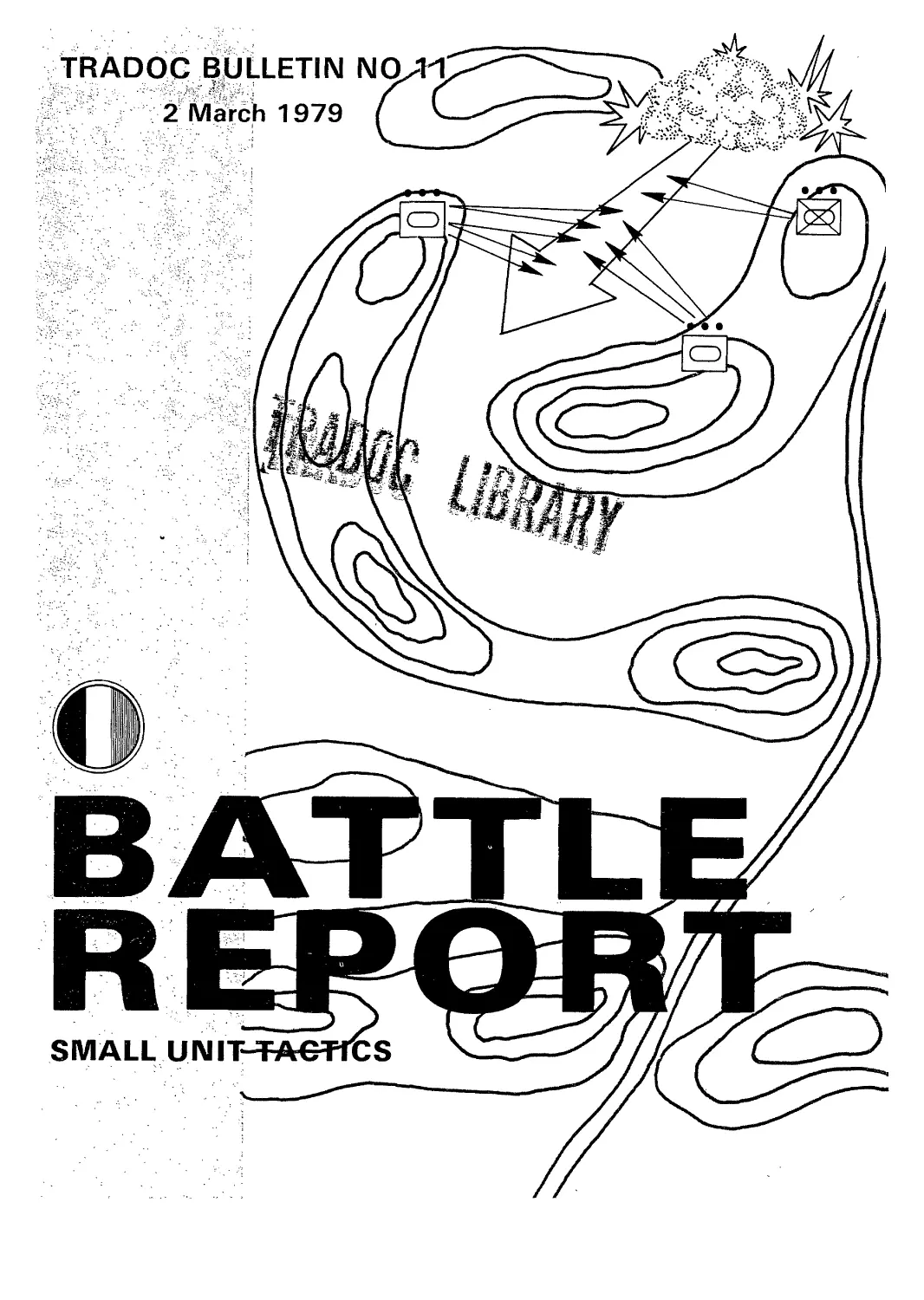
BULLETIN NO 11
2 March 1979
BATTLE REPORT:
SMALL UNIT TACTICS
INTRODUCTION
From time to time, TRADOC will disseminate lessons learned about
how to fight on the modem battlefield. Data derived from observations,
simulations, tests, and/or other evaluations are in the form of TRADOC
bulletins entitled “Battle Reports?’ These reports convey important
developments of immediate interest to TRADOC agencies and to field
commanders. They provide interim guidance until their content can be
integrated into appropriate How-To-Fight, How-To-Support, or other
doctrinal publications.
TRADOC centers, schools, agencies, and field commanders are encour-
aged to submit material for inclusion in future battle reports to HQ
TRADOC, ATTN: ATCG-T, Fort Monroe, VA 23651.
Contents
Page
OPERATIONS IN URBAN AREAS ....................... 2
DEFENSE OPERATIONS.............................   5
OFFENSIVE OPERATIONS .........................   10
ORDERINGTRADOC BULLETINS........................ 12
1
TRADOC BULLETIN NO 11
BATTLE REPORT
This battle report provides information derived during battle simula-
tions. It includes lessons learned with regard to:
О Operations in urban areas.
Ф Defense tactics.
Ф Smoke operations.
Operations in Urban Areas
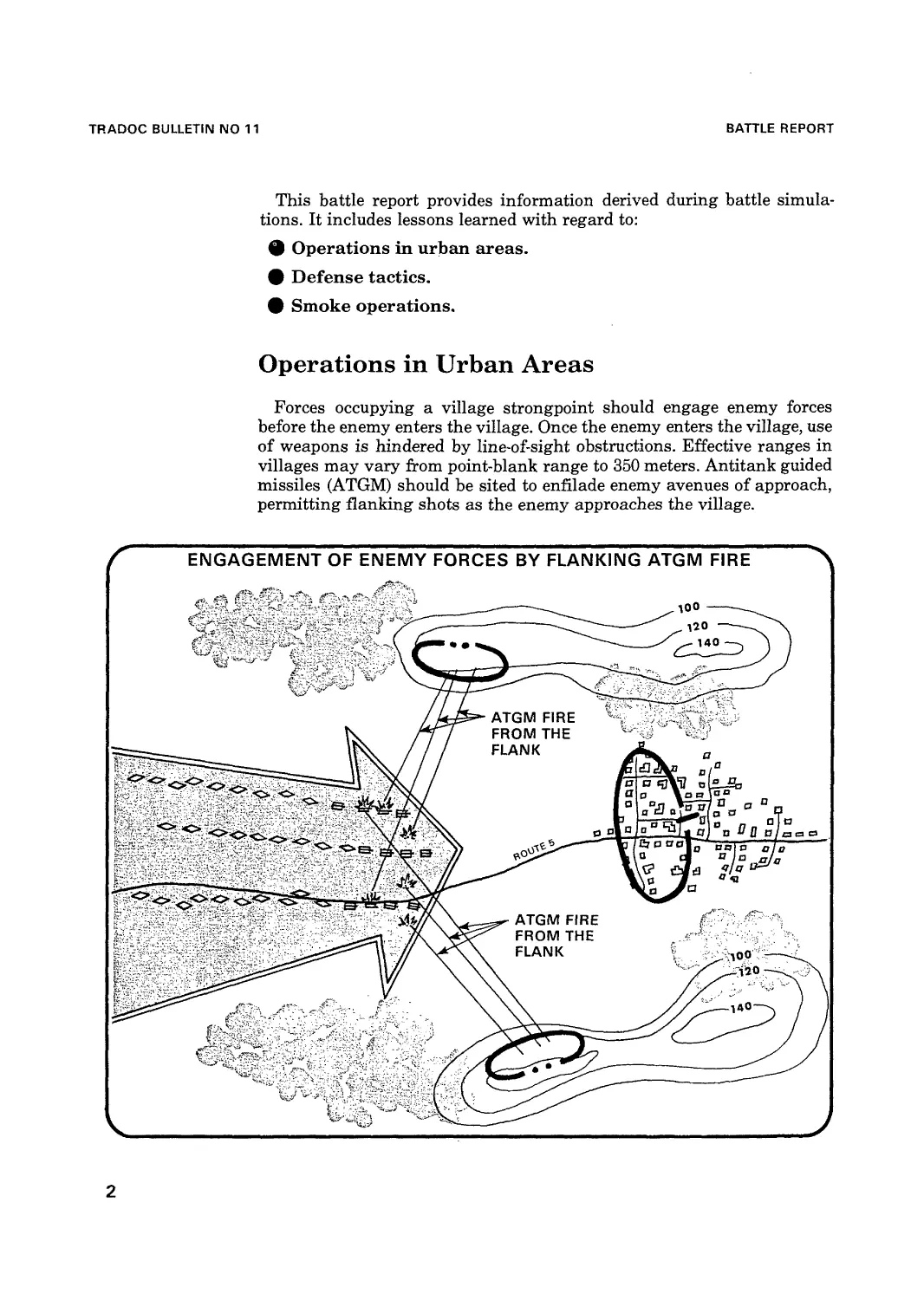
Forces occupying a village strongpoint should engage enemy forces
before the enemy enters the village. Once the enemy enters the village, use
of weapons is hindered by line-of-sight obstructions. Effective ranges in
villages may vary from point-blank range to 350 meters. Antitank guided
missiles (ATGM) should be sited to enfilade enemy avenues of approach,
permitting flanking shots as the enemy approaches the village.
ENGAGEMENT OF ENEMY FORCES BY FLANKING ATGM FIRE
2
BATTLE REPORT
TRADOC BULLETIN NO 11
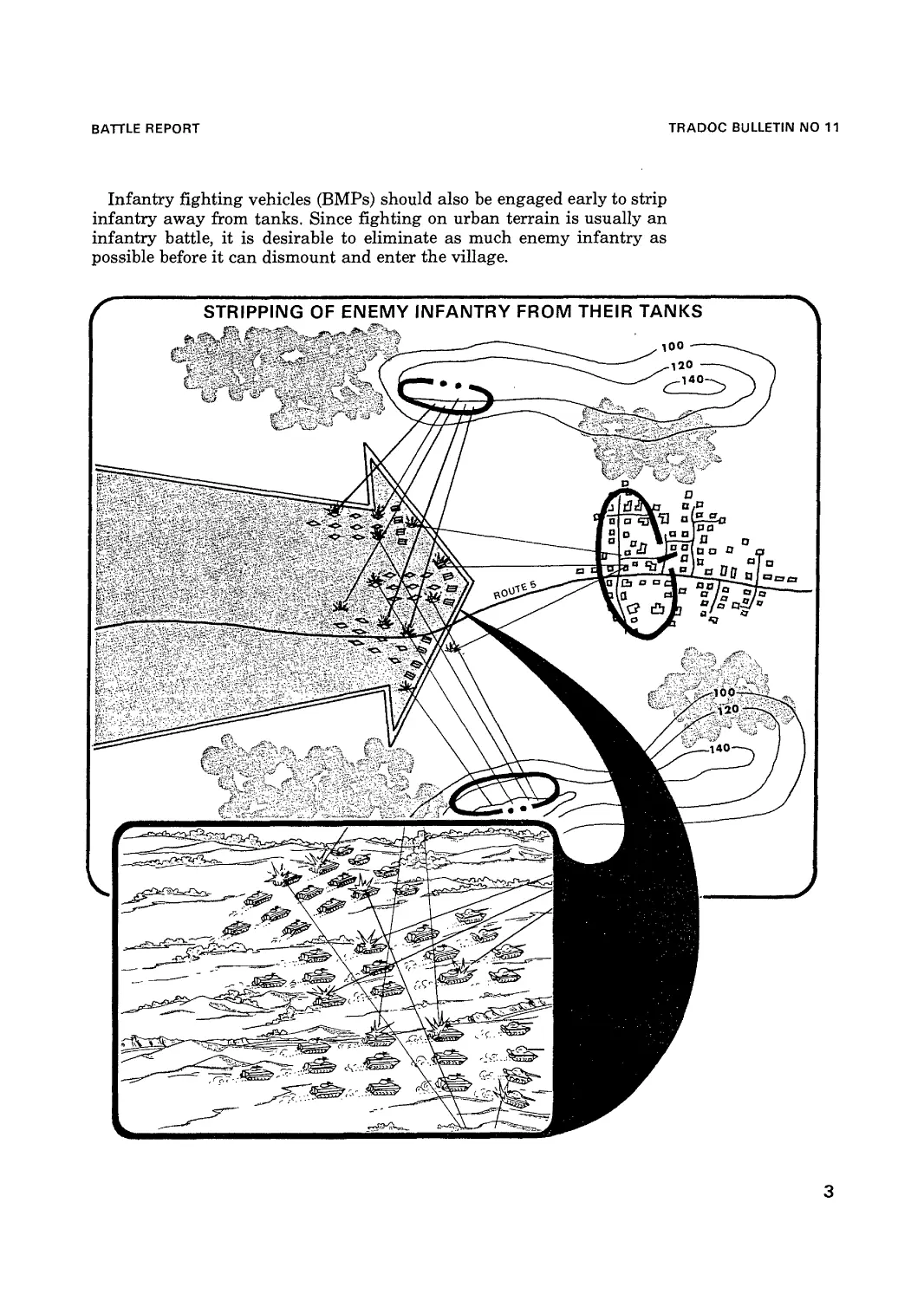
Infantry fighting vehicles (BMPs) should also be engaged early to strip
infantry away from tanks. Since fighting on urban terrain is usually an
infantry battle, it is desirable to eliminate as much enemy infantry as
possible before it can dismount and enter the village.
3
TRADOC BULLETIN NO 11
BATTLE REPORT
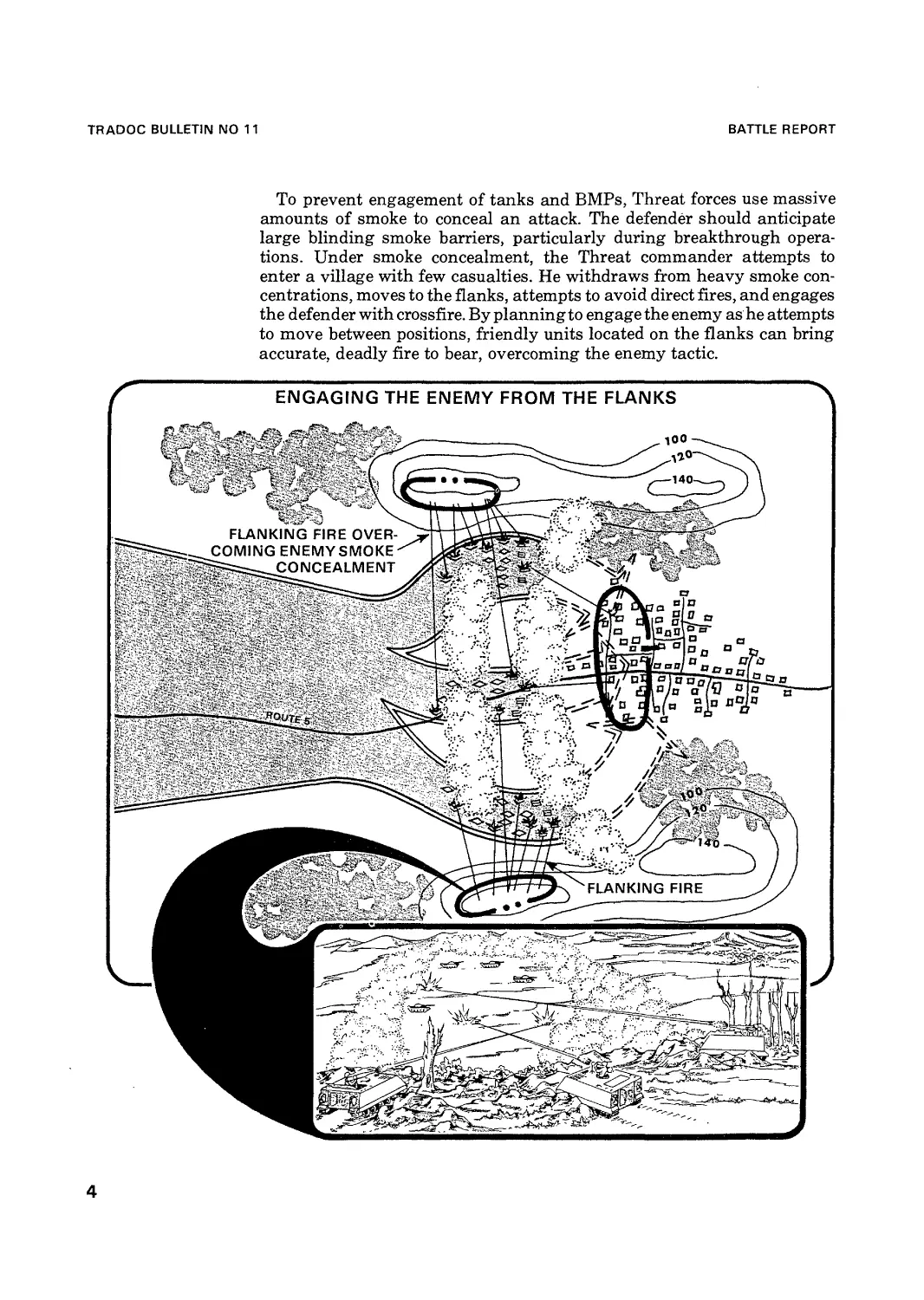
To prevent engagement of tanks and BMPs, Threat forces use massive
amounts of smoke to conceal an attack. The defender should anticipate
large blinding smoke barriers, particularly during breakthrough opera-
tions. Under smoke concealment, the Threat commander attempts to
enter a village with few casualties. He withdraws from heavy smoke con-
centrations, moves to the flanks, attempts to avoid direct fires, and engages
the defender with crossfire. By planning to engage the enemy as he attempts
to move between positions, friendly units located on the flanks can bring
accurate, deadly fire to bear, overcoming the enemy tactic.
ENGAGING THE ENEMY FROM THE FLANKS
4
BATTLE REPORT
TRADOC BULLETIN NO 11
Defensive Operations
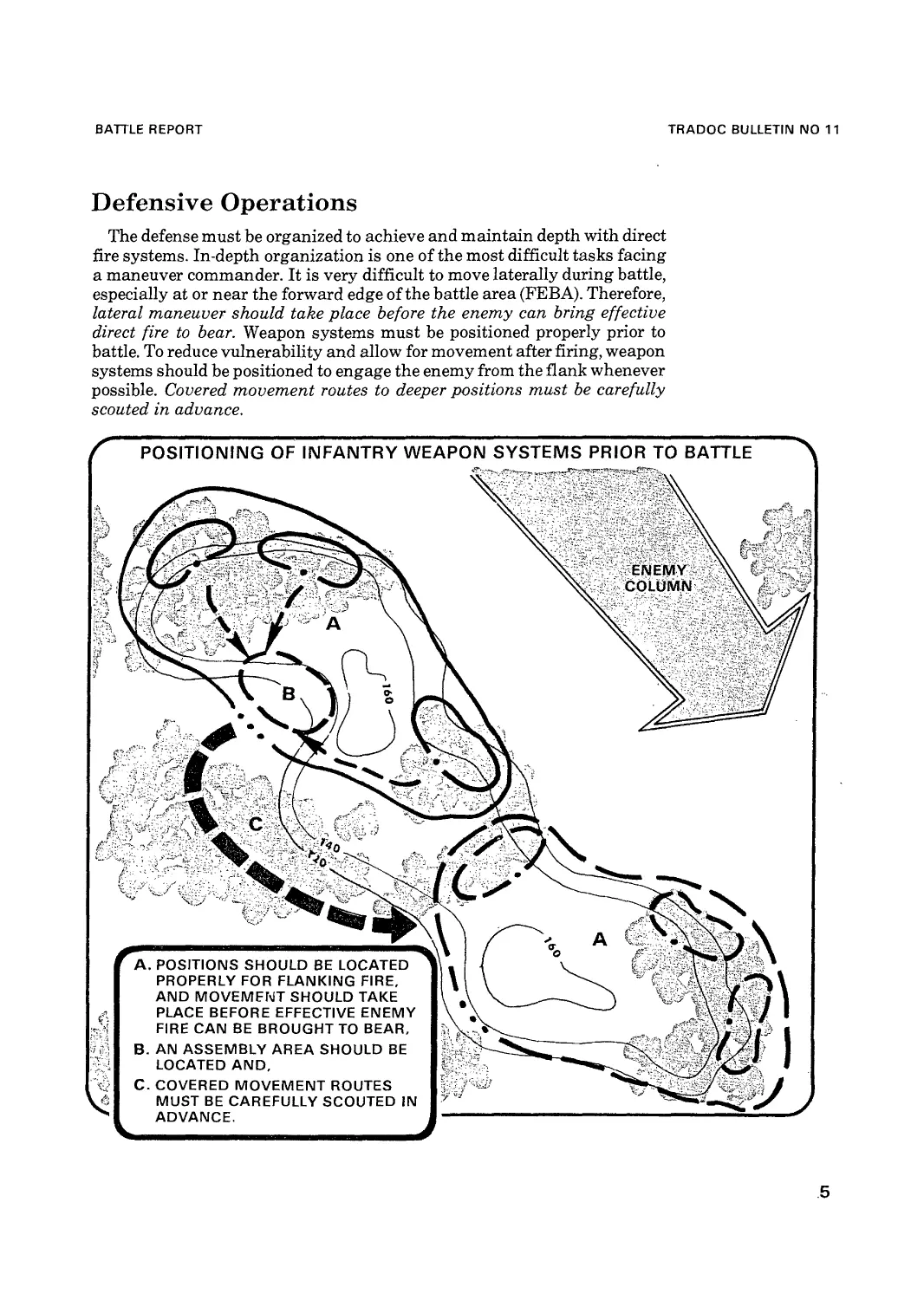
The defense must be organized to achieve and maintain depth with direct
fire systems. In-depth organization is one of the most difficult tasks facing
a maneuver commander. It is very difficult to move laterally during battle,
especially at or near the forward edge of the battle area (FEBA). Therefore,
lateral maneuver should take place before the enemy can bring effective
direct fire to bear. Weapon systems must be positioned properly prior to
battle. To reduce vulnerability and allow for movement after firing, weapon
systems should be positioned to engage the enemy from the flank whenever
possible. Covered movement routes to deeper positions must be carefully
scouted in advance.
POSITIONING OF INFANTRY WEAPON SYSTEMS PRIOR TO BATTLE
A. POSITIONS SHOULD BE LOCATED
PROPERLY FOR FLANKING FIRE,
AND MOVEMENT SHOULD TAKE
PLACE BEFORE EFFECTIVE ENEMY
FIRE CAN BE BROUGHT TO BEAR,
B. AN ASSEMBLY AREA SHOULD BE
LOCATED AND,
C- COVERED MOVEMENT ROUTES
MUST BE CAREFULLY SCOUTED IN
ADVANCE.
ENEMY
COLUMN
4)
5
TRADOC BULLETIN NO 11
BATTLE REPORT
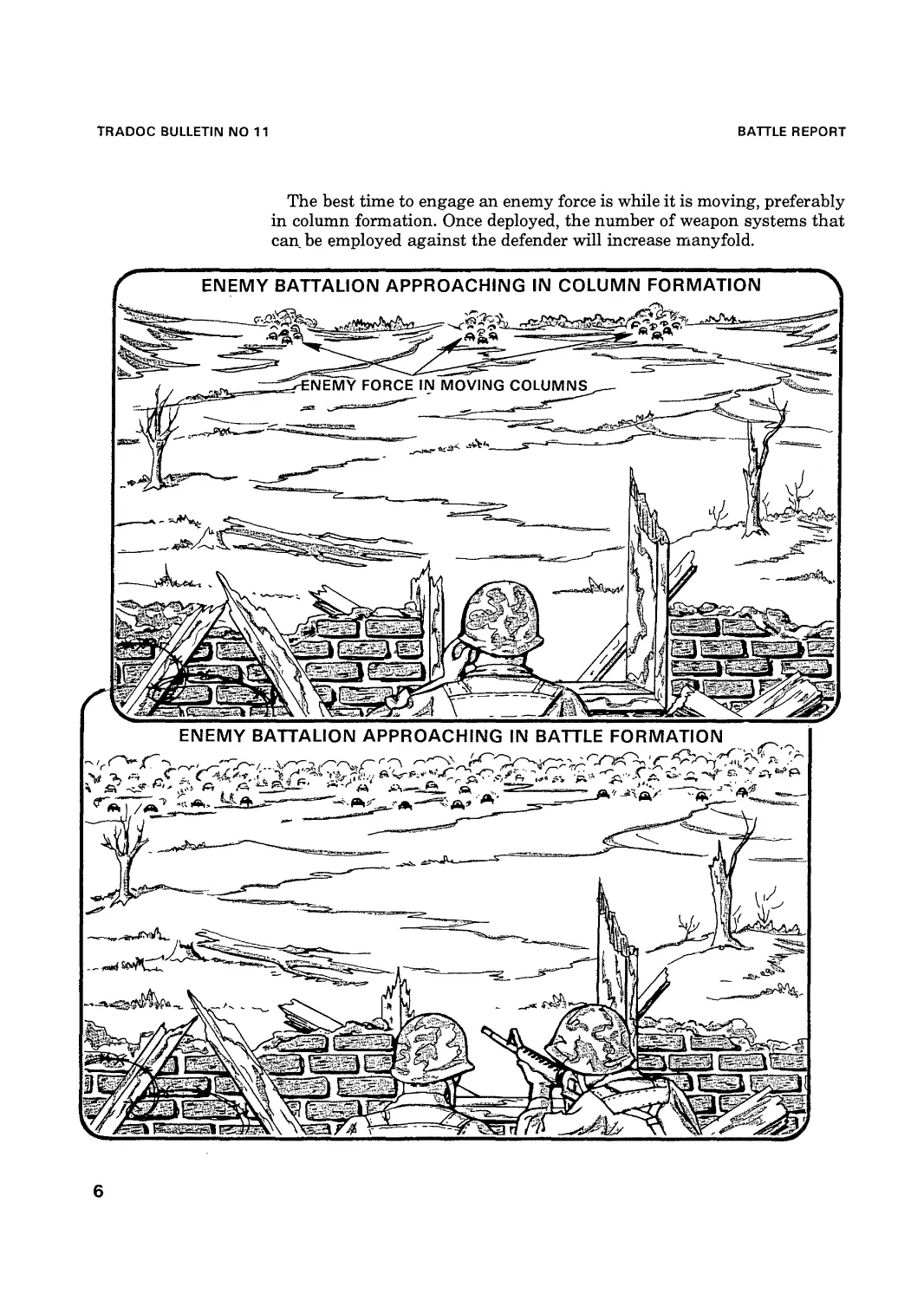
The best time to engage an enemy force is while it is moving, preferably
in column formation. Once deployed, the number of weapon systems that
can be employed against the defender will increase manyfold.
ENEMY BATTALION APPROACHING IN COLUMN FORMATION
6
BATTLE REPORT
TRADOC BULLETIN NO 11
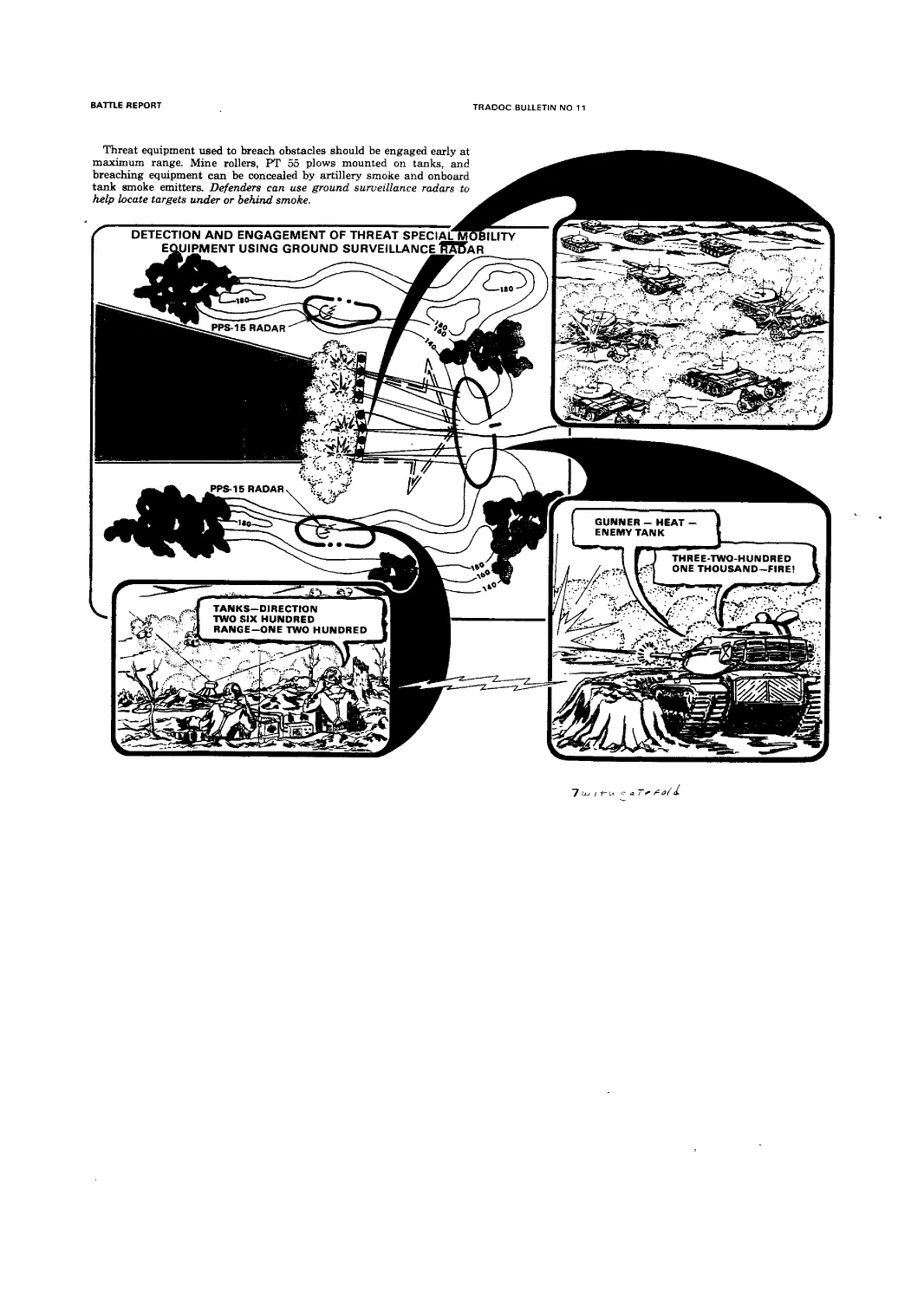
Threat equipment used to breach obstacles should be engaged early at
maximum range. Mine rollers, PT 55 plows mounted on tanks, and
breaching equipment can be concealed by artillery smoke and onboard
tank smoke emitters. Defenders can use ground surveillance radars to
help locate targets under or behind smoke.
PPS-15RADAR
PPS-15 RADAR
Tr Z
DETECTION AND ENGAGEMENT OF THREAT SPEC1AEMOBILITY
EQUIPMENT USING GROUND SURVEILLANCE AHSaR

TANKS—DIRECTION
TWO SIX HUNDRED
RANGE-ONE TWO HUNDRED
THREE-TWO-HUNDRED
ONE THOUSAND-FIRE!
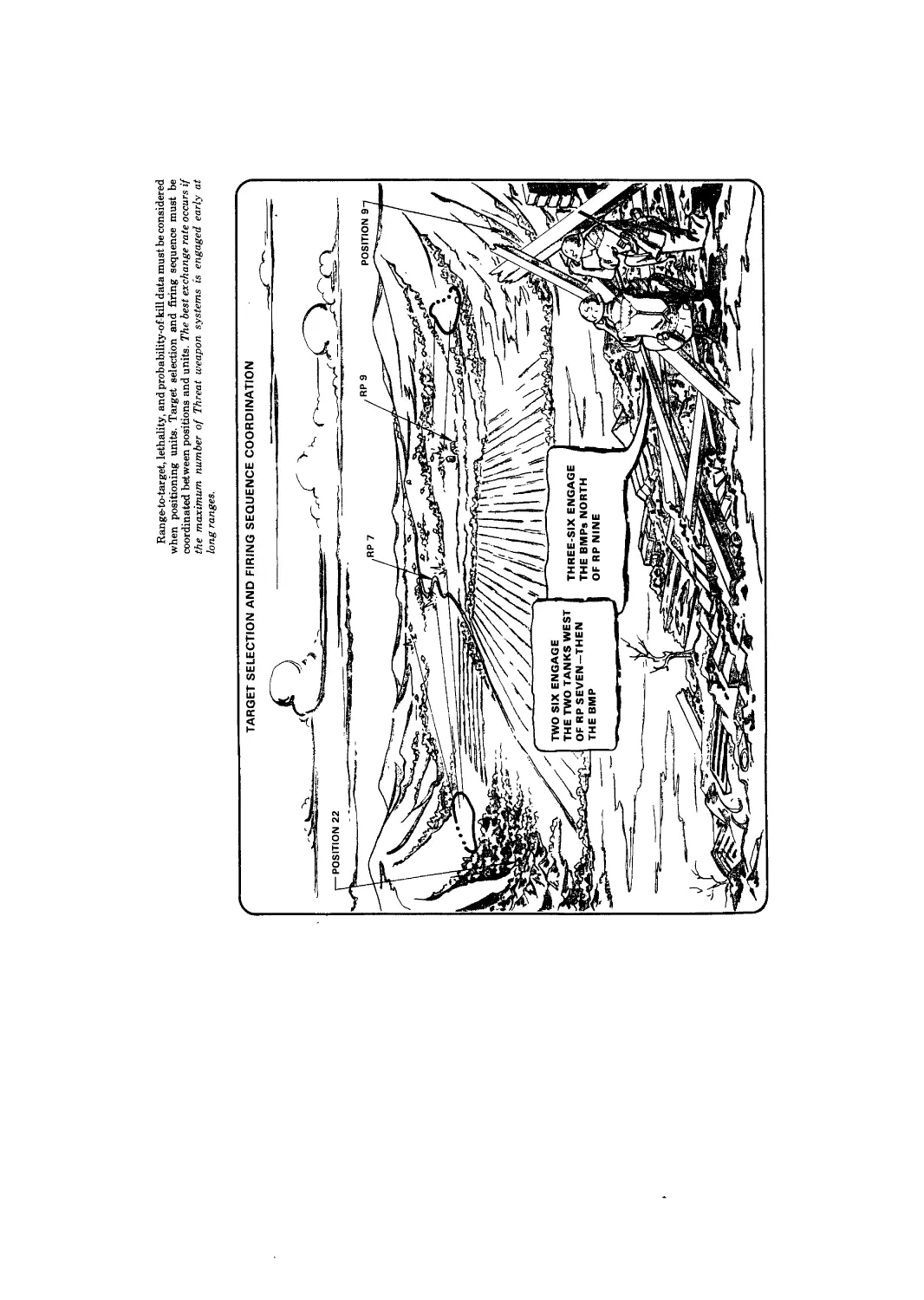
Range-to-target, lethality, and probability-of-kill data must be considered
when positioning units. Target selection and firing sequence must be
coordinated between positions and units. The best exchange rate occurs if
the maximum number of Threat weapon systems is engaged early at
long ranges.
BATTLE REPORT
TRADOC BULLETIN NO 11
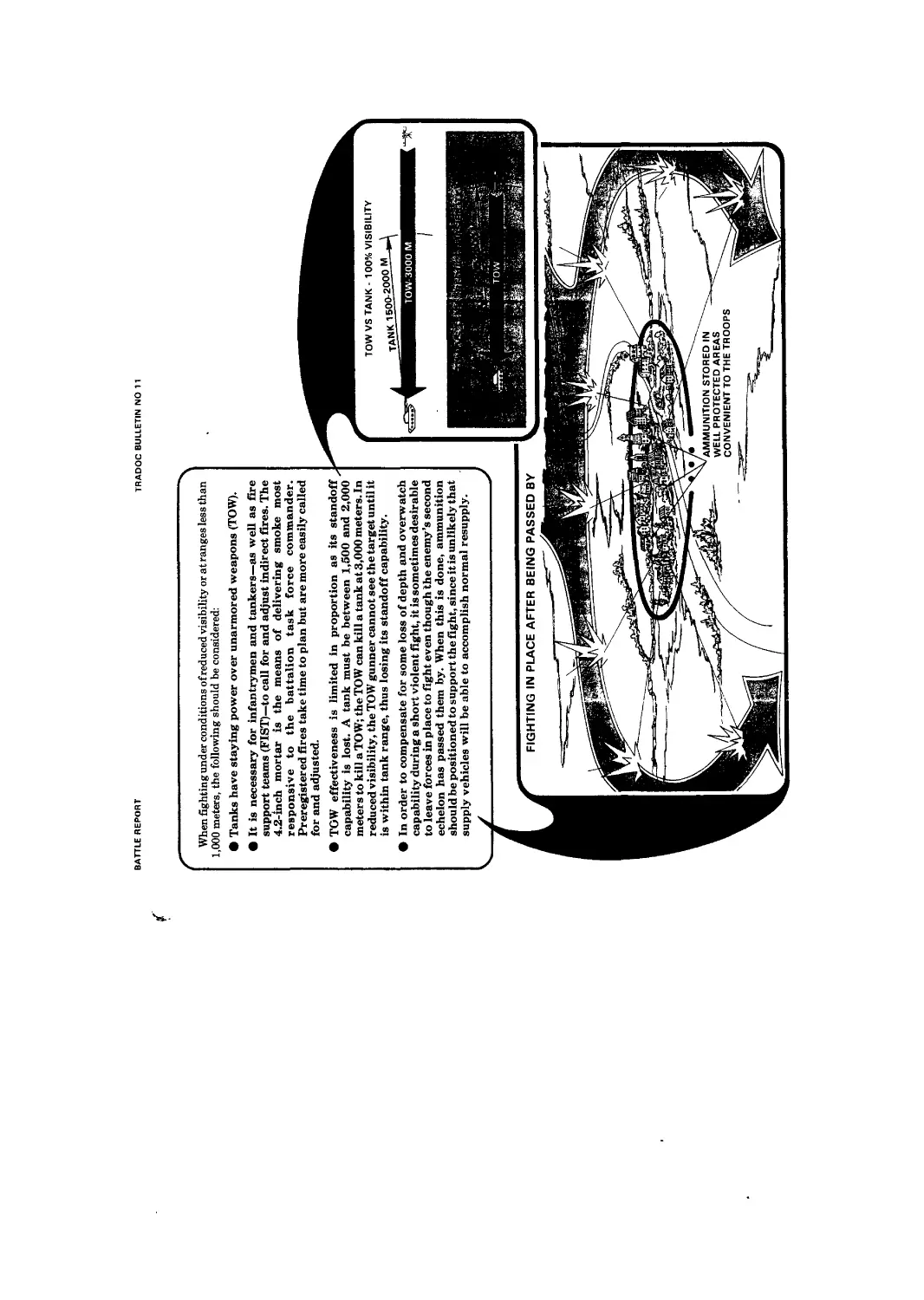
When fighting under conditions of reduced visibility or at ranges less than
1,000 meters, the following should be considered:
9 Tanks have staying power over unarmored weapons (TOW).
* It is necessary for infantrymen and tankers—as well as fire
support teams (FIST)—to call for and adjust indirect fires. The
4.2-inch mortar is the means of delivering smoke most
responsive to the battalion task force commander.
Preregistered fires take time to plan but are more easily called
for and adjusted.
•	TOW effectiveness is limited in proportion as its standoff
capability is lost. A tank must be between 1,500 and 2,000
meters to kill a TOW; the TOW can kill a tank at 3,000 meters. In
reduced visibility, the TOW gunner cannot see the target until it
is within tank range, thus losing its standoff capability.
•	In order to compensate for some loss of depth and overwatch
capability during a short violent fight, it is sometimes desirable
to leave forces in place to fight even though the enemy’s second
echelon has passed them by. When this is done, ammunition
should be positioned to support the fight, since it is unlikely that
supply vehicles will be able to accomplish normal resupply.
TOW VS TANK - 100% VISIBILITY
M
FIGHTING IN PLACE AFTER BEING PASSED BY
TOW-3000 M


AMMUNITION STORED IN
WELL PROTECTED AREAS
CONVENIENT TO THE TROOPS
TRADOC BULLETIN NO 11
BATTLE REPORT
Offensive Operations
During movement to contact, a battalion task force may have to conduct a
hasty attack against a reinforced mechanized rifle unit. The task force
commander must select a course of action allowing rapid movement to the
objective with sufficient force to destroy the enemy. But, an avenue of
approach rarely exists that allows both high-speed movement and room to
maneuver. The attacking task force may be exposed to enemy tank and
ATGM fires and will need to suppress them. Once enough forces have been
provided to overwatch and suppress enemy gunners, there may be too few
forces left to mount an attack. One solution to such a problem is to use a
smoke envelope during the attack to screen the task force.
Adequate smoke must be available to maintain the envelope throughout
the attack. If not, the technique will not work. A smoke envelope for a 3,000-
meter attack will require about 500 rounds of 155-mm HC and 200 rounds of
4.2-inch WP.
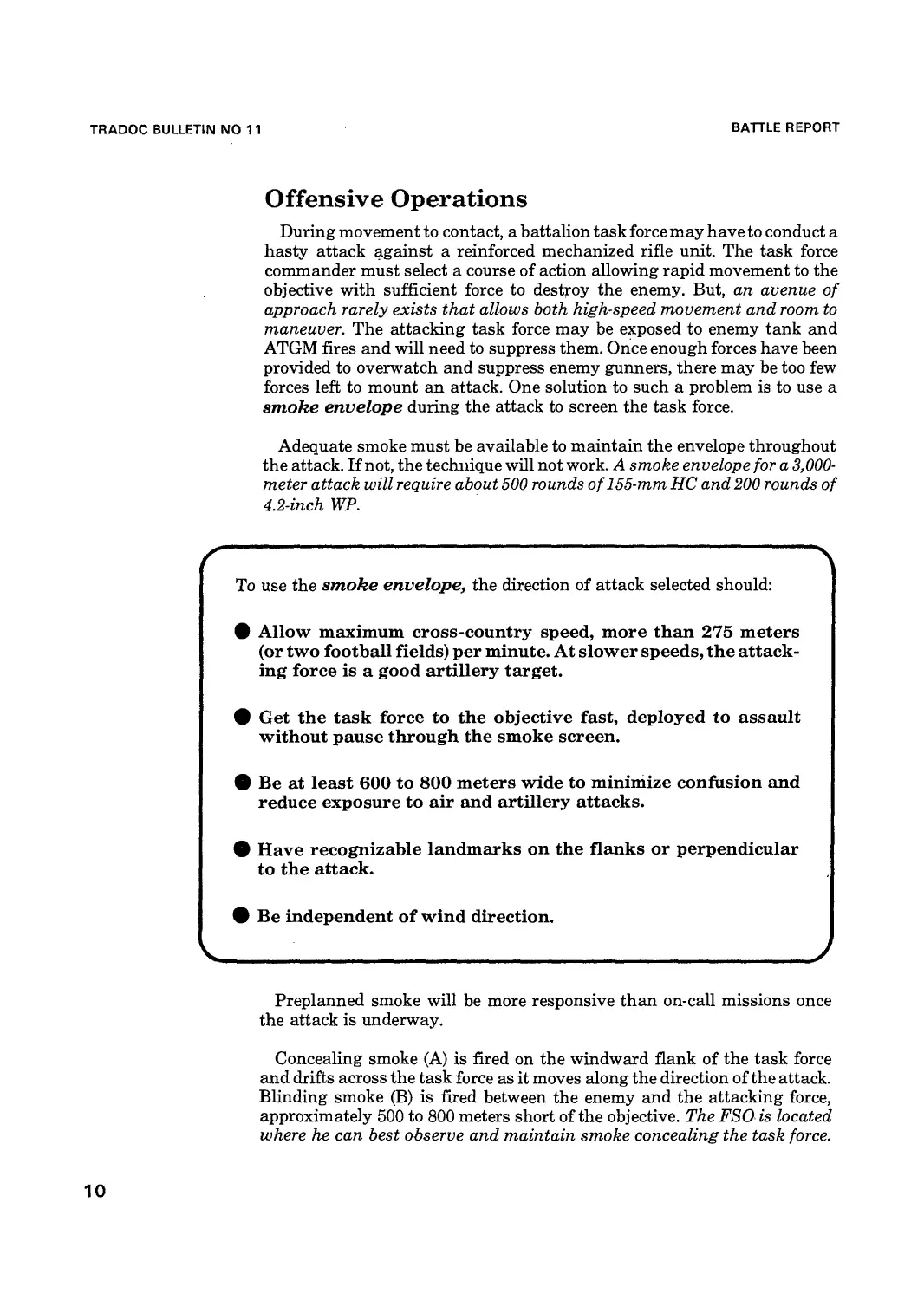
To use the smoke envelope, the direction of attack selected should:
Ф Allow maximum cross-country speed, more than 275 meters
(or two football fields) per minute. At slower speeds, the attack-
ing force is a good artillery target.
ф Get the task force to the objective fast, deployed to assault
without pause through the smoke screen.
9 Be at least 600 to 800 meters wide to minimize confusion and
reduce exposure to air and artillery attacks.
9 Have recognizable landmarks on the flanks or perpendicular
to the attack.
9 Be independent of wind direction.
Preplanned smoke will be more responsive than on-call missions once
the attack is underway.
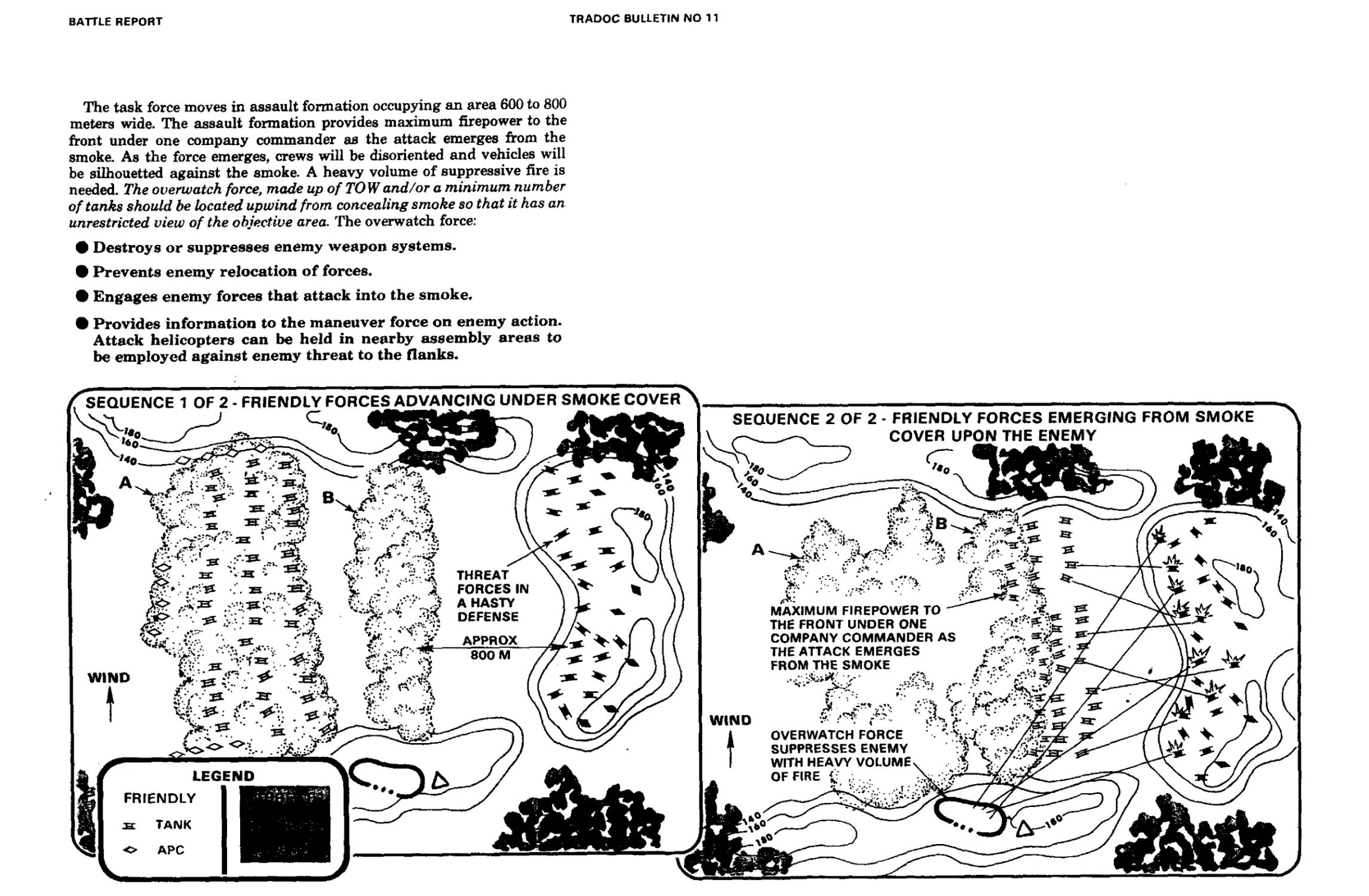
Concealing smoke (A) is fired on the windward flank of the task force
and drifts across the task force as it moves along the direction of the attack.
Blinding smoke (B) is fired between the enemy and the attacking force,
approximately 500 to 800 meters short of the objective. The FSO is located
where he can best observe and maintain smoke concealing the task force.
10
BATTLE REPORT
TRADOC BULLETIN NO 11
The task force moves in assault formation occupying an area 600 to 800
meters wide. The assault formation provides maximum firepower to the
front under one company commander as the attack emerges from the
smoke. As the force emerges, crews will be disoriented and vehicles will
be silhouetted against the smoke. A heavy volume of suppressive fire is
needed. The overwatch force, made up of TOW and/or a minimum number
of tanks should be located upwind from concealing smoke so that it has an
unrestricted view of the objective area. The overwatch force:
•	Destroys or suppresses enemy weapon systems.
*	Prevents enemy relocation of forces.
*	Engages enemy forces that attack into the smoke.
*	Provides information to the maneuver force on enemy action.
Attack helicopters can be held in nearby assembly areas to
be employed against enemy threat to the flanks.
SEQUENCE 1 OF 2 - FRIENDLY FORCES ADVANCING UNDER SMOKE COVERTS
SEQUENCE 2 OF 2 - FRIENDLY FORCES EMERGING FROM SMOKE
COVER UPON THE ENEMY
WIND
FRIENDLY
TANK
APC
THREAT
FORCES IN
A HASTY
DEFENSE
APPROX
800 M
WIND
LEGEND
k-
MAXIMUM FIREPOWER TO
THE FRONT UNDER ONE
COMPANY COMMANDER AS
THE ATTACK EMERGES
FROM THE SMOKE
OVERWATCH FORCE
SUPPRESSES ENEMY
WITH HEAVY VOLUME
OF FIRE f .

TRADOC BULLETIN NO 11
BATTLE REPORT
Ordering TRADOC Bulletins
A series of TRADOC Bulletins is being published by HQ TRADOC to
provide commanders with timely technical information on weapons,
tactics, and training techniques. The bulletins are not intended to supplant
doctrinal publications, but to supplement how-to-fight material with data
derived from tests, intelligence, or other sources which probe “why?”
TRADOC Bulletins are developed by HQ TRADOC, using the most com-,
prehensive and current military and civilian data available. Army Training
and Evaluation Programs (ARTEP), Field Manuals (FM), and Training
Circulars (TC) continue to be the primary training references. TRADOC
Bulletins supplement them with an explanation of why we are training in a
given manner. TRADOC Bulletins should enable commanders to better
stimulate and motivate subordinates to understand why we train the way
we do.
TRADOC Bulletins are cataloged in DA Pamphlet 310-3 (Index of
Doctrinal, Training and Organizational Publications). The series is
numbered consecutively, and each TRADOC Bulletin is announced at the
time of printing in the information bulletin distributed to all pinpoint
account holders by the US Army AG Publications Center.
Additional copies can be requisitioned from the US Army AG
Publications Center, Baltimore, MD 21220.
DA Pamphlet 310-10 explains the pinpoint distribution system and how to
establish or update an existing account at the US Army AG Publications
Center.
U.S. Government Printing Office 1979— 635-03^-/1113
12
TRADOC BULLETIN 11
2 MARCH 1979
General, United States Army
Commanding
DISTRIBUTION:
Active Army, USAR, and ARNG: To be distributed in accordance with DA Form 1 2-11 B, Re-
quirements for TRADOC Training Bulletins (Qty rqr block no. 432).
Additional copies can be requisitioned from the US Army Adjutant General Publications Center,
2800 Eastern Boulevard, Baltimore, MD 21220.