/
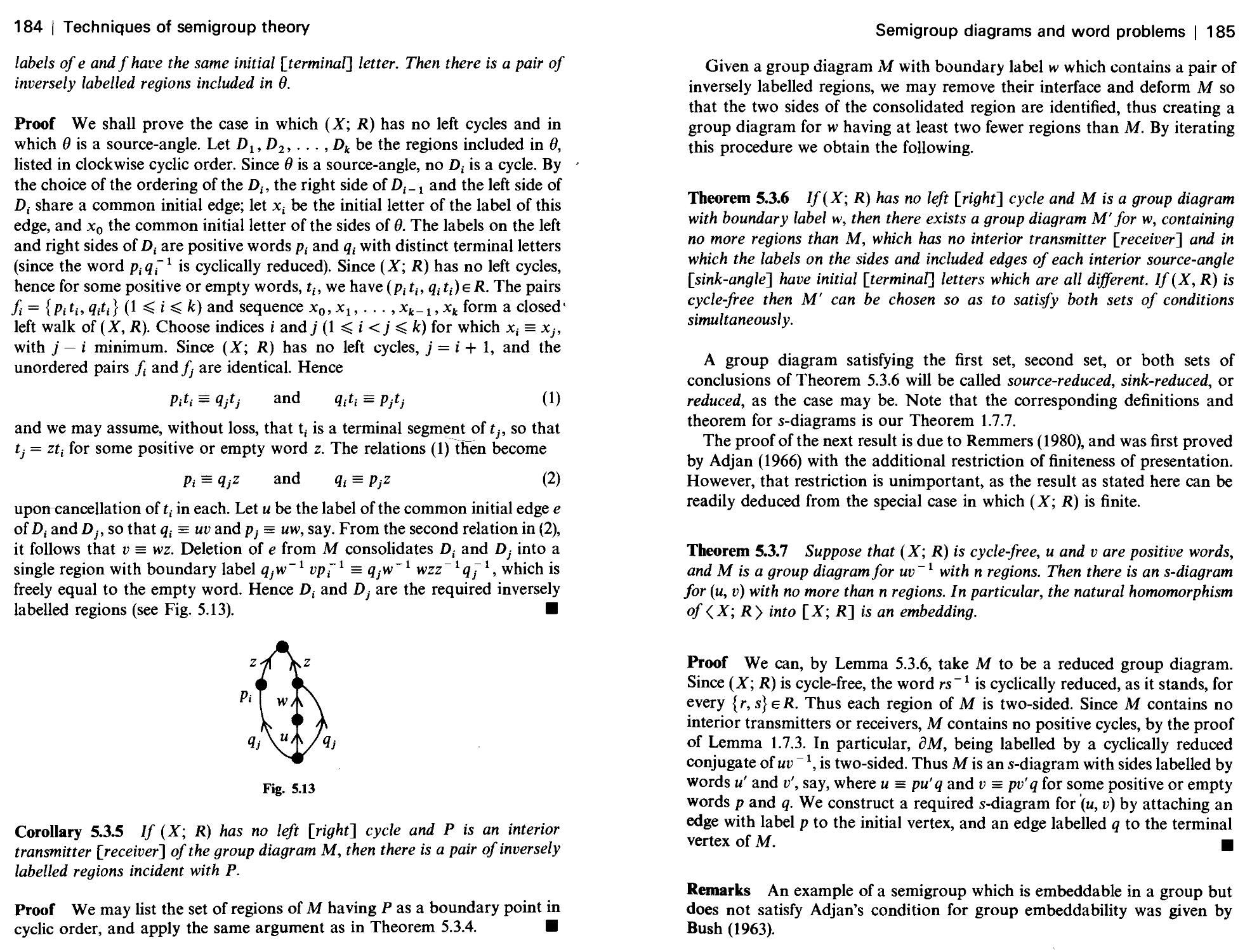
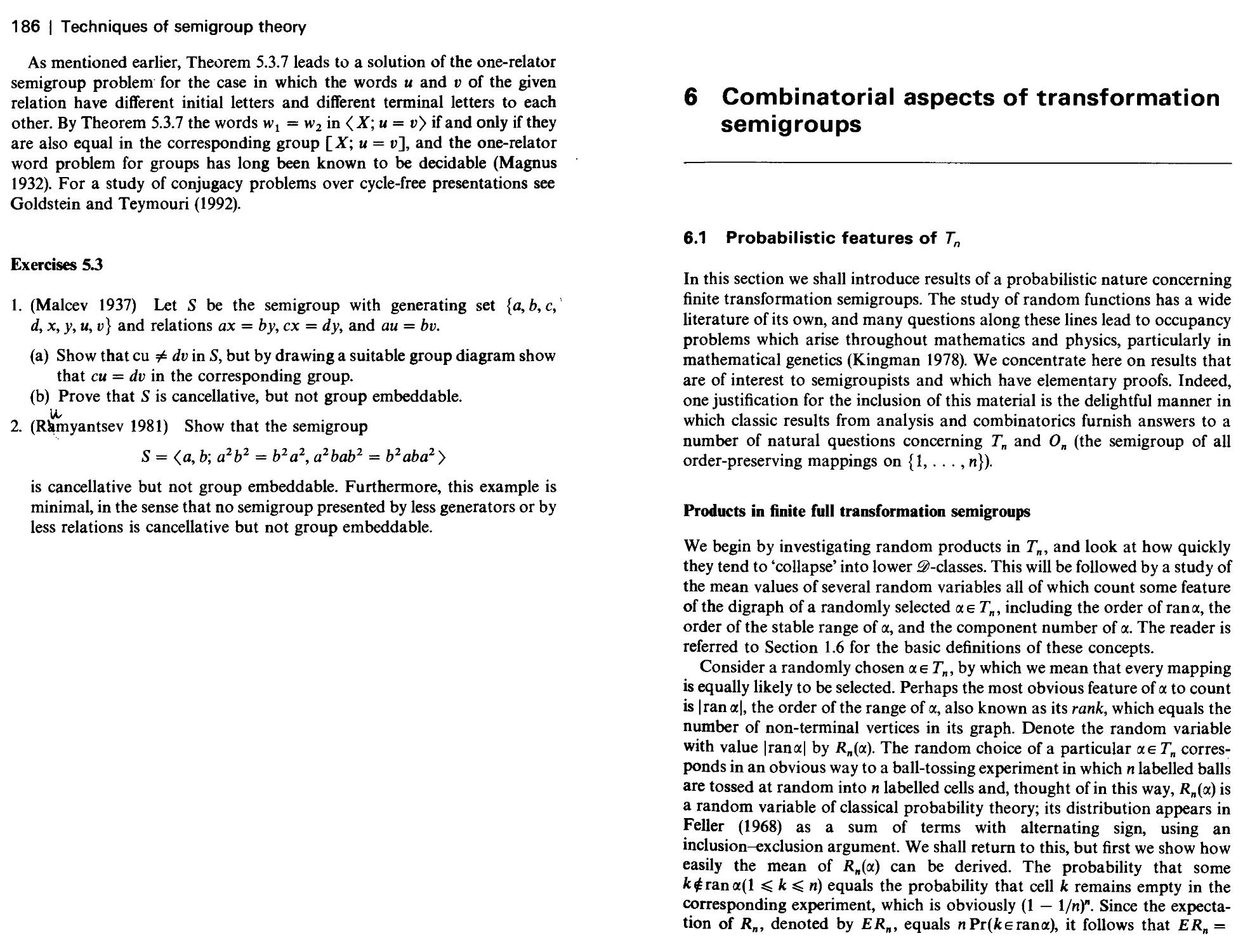
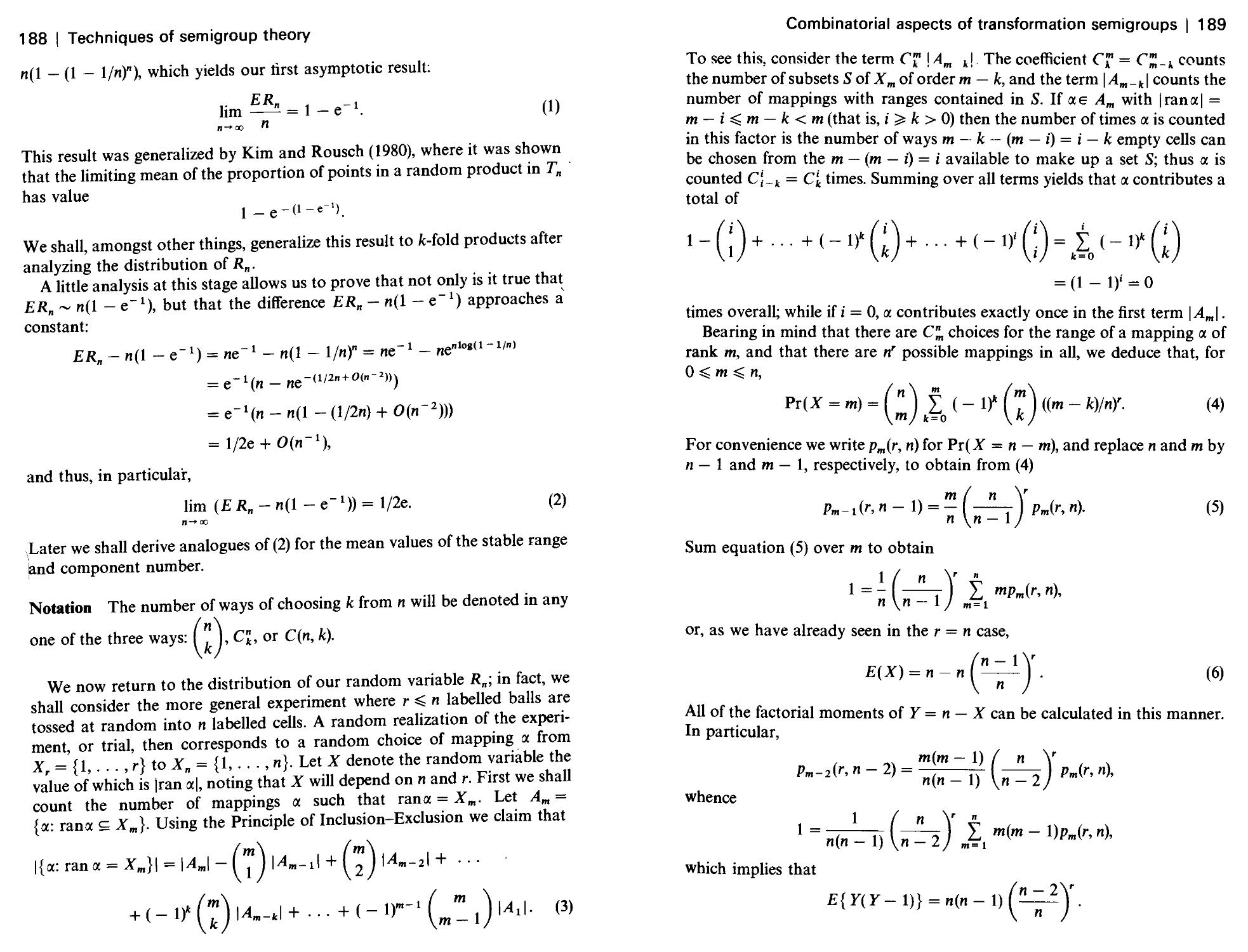
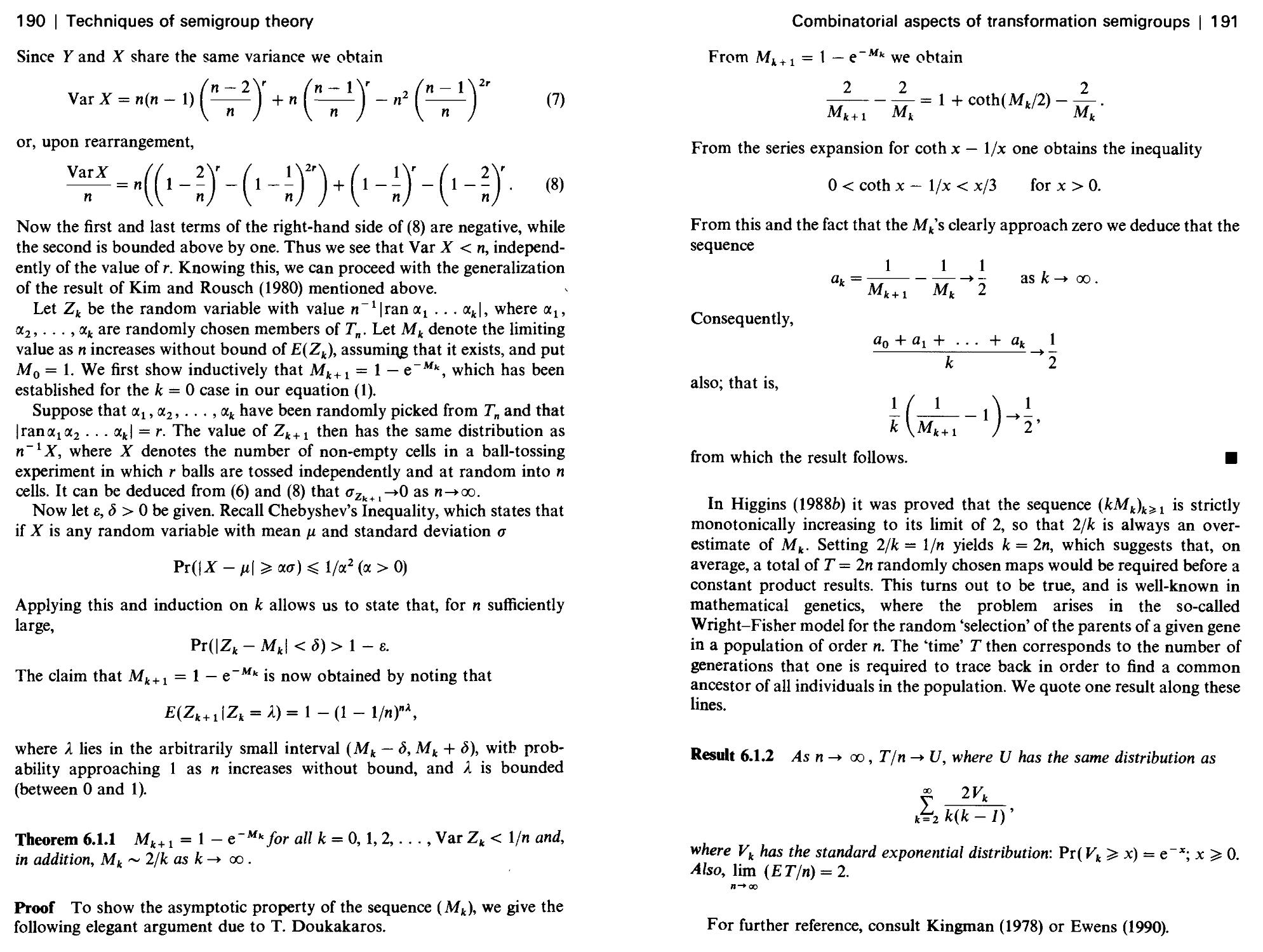
Text
                    1 Fundamentals
1.1 Introduction
The purpose of this chapter is to introduce the basic concepts and theorems
of algebraic semigroups, together with the additional ideas that are to be
developed in this monograph. Its content forms a concise course in algebraic
semigroup theory suitable for the graduate or research student, or as a sup-
supplement to an advanced undergraduate course in this subject. Proofs will be
provided for all facts relevant to our purposes, although some simple results
will be set as exercises or left to the reader to supply the details. There are
several other well-known texts containing broadly similar material, the most
suitable for undergraduates being Howie A976), especially the first five
chapters. The texts of Clifford and Preston A961,1967) provide a particularly
careful and thorough account of the work done up until their time of
publication, while an early Russian text available in English is that of Lyapin
A974). Other well-known books on the subject include those of Petrich A973,
1977, 1984) and Lallement A979), which concentrates on applications to
coding and language theory. Also along these lines, Pin A986) is noteworthy
in giving an introducton to the theory of automata and formal languages,
together with many worked examples and interesting glimpses of current
research topics. Howie A991) treats similar material, but with the under-
undergraduate audience in mind.
A semigroup (S, °) is a non-empty set S together with an associative binary
operation °. In accord with the usual practice we often speak simply of
a semigroup S when the operation ° is understood, and abbreviate the
product a ° b (a, b in S) to ab. The symbol S will denote a semigroup without
further comment. Associativity is important as it allows products of any
length to be written unambiguously without the need for brackets (a fact
which can be proved by induction on the length of products). A semigroup
with an identity element is called a monoid. If a semigroup S is not a monoid
we may adjoin a new symbol, 1, to S, with the property that \a = a\ = a for
all a in S и {1}. The resultant monoid is denoted by S1. If S is a monoid we
define S1 = S. In the same way we denote by S° the semigroup with an
adjoined zero element 0, if S does not possess a zero; otherwise S° = S. By
convention, S must have at least two elements to possess a zero.
An element e of S is an idempotent if e = e2, and the set of idempotents of
S is denoted by ?(S), or simply E. For any subset T of S we shall abbreviate

2 | Techniques of semigroup theory
E(S) n T by E{T). We define the пагмга/ partial order on ?(S) by e </if and
only if ef=fe = e (that s$ does define a partial order is easily checked: the
'lower' idempotent e acts as a zero relative to the 'upper' idempotent/). We
say that an idempotent e is a right identity {right zero'] of S if ae = a [ae = e]
for All a in S. (Corresponding left-sided notions, in this case those of left
identity and left zero, are denned dually, and we shall often take them as
implicitly denned once their right-handed counterparts have been introduc-
introduced.) On any non-empty set S we may define an associative product by
insisting that all members of S act as right zeros, thus forming a right zero
semigroup. One easily shows that if a semigroup S has a left identity a and
a right identity b then a = b and S is a monoid.
A homomorphism a: S -> T is a mapping from a semigroup S into a semi-
semigroup Г such that (ab)a. = aaba for all a, b in S. We say that a is an
epimorphism if a/? = ay implies /? = y, where /? and у are homomorphisms
from, say, T to I/. In other words a is left (or pre-) cancellative. Any
surmorphism (surjective homomorphism) is an epimorphism, but the con-
converse is false in the category of semigroups. However, the dual concept of
a right (or post-) cancellative homomorphism, known as a monomorphism,
coincides with that of injective homomorphisms (Exercise 1.1.7). The con-
concepts of isomorphism, automorphism, and endomorphism are denned as in any
universal algebra, an isomorphism being a bijective homomorphism between
semigroups, an automorphism being an isomorphism of a semigroup onto
itself, while endomorphism is the word that describes any homomorphism
from a semigroup to itself. In the semigroup context, a subalgebra is, of
course, called a subsemigroup. The word 'homomorphism' will on occasion be
shortened to simply morphism. The direct product of semigroups S and Г is
the semigroup with underlying set the cartesian product SxT, in which
multiplication is carried out by components. For example, if L is a left zero
semigroup and R is a right zero semigroup, their direct product is known as
a rectangular band, LxR, and has multiplication
(a, b)(c, d) = (a,d) (a, c in L, b, d in R).
The name derives from the observation that if the members of L x R are
pictured in a rectangular grid in the obvious fashion, then the product of two
elements lies at the intersection of the row of the first member and the column
of the second. In general, a semigroup consisting entirely of idempotents is
known as a band.
A commutative semigroup S is one for which ab = ba for all a and b in S.
Examples of these are abelian groups, the natural numbers under addition,
and the null semigroup on a set S, in which all products equal a distinguished
member of S, the zero. A (lower) semilattice is a poset S in which each pair of
elements, a and b, has a greatest lower bound, а л b. Clearly, any semilattice is
a commutative band with respect to this meet operation and the partial order
is the natural partial order on the band. Conversely, it is easy to show that
Fundamentals | 3
any commutative band В is a semilattice in which ab = алЬ, where the meet
is with respect to the natural partial order on B. We thus identify the classes
of semilattices and commutative bands. The existence of a surmorphism of
a semigroup S onto a semilattice often yields important structural informa-
information about S. In particular, a band admits a surmorphism onto a semilattice
such that the inverse image of each member of the semilattice is a rectangular
band. This is a special case of a result of Clifford that any 'union of groups' is
a 'semilattice of completely simple semigroups' (Theorem 1.3.10).
An important example of a semigroup is the/м// transformation semigroup,
tTXi on a non-empty set X, which consists of all self-maps on X under
composition. When X is a finite set we shall write Tn in place of $~x, where
n = \X\, the order of the set X. We shall usually consider the base set of Tn to
be Xn = {1,2,. . . , n), and a typical member ae Tn can then be specified by
listing the images of the members of Xn in order: (la, 2a,. . ., nix). The rank
r of a e Tn is | ran a |, while the defect of a. is n — r. The significance of $~x lies in
the 'Cayley Theorem' that any semigroup S may be faithfully embedded in
^"Si. The proof is similar to the corresponding result for groups: the mono-
monomorphism mapping S to ^"Si is denned by a i-> pa {a e S), where pa is the right
inner translation of S1 by a, which is denned by xh->xa (xeS1). The
presence of the identity in S1 ensures that the representation is faithful. This
monomorphism is called the extended right regular representation ofS. If S is
used instead of S1, we have the right regular representation which is not
necessarily faithful. In general, any morphism a: S -> 9~x is known as a repres-
representation of S.
A right ideal A of a semigroup S is a non-empty subset A of S such that ax is
in A for all a in A and x in S. We call A an ideal of S if it is both a right and
a left ideal of S. Since S is an ideal of itself, and the intersection of [right]
ideals is a [right] ideal, we may speak of the [right] ideal generated by
a non-empty subset A of S as the smallest [right] ideal of S containing A. This
is easily seen to be given by [AS1] SXA S1. If A consists of a single element {a}
we speak of the principal [right] ideal generated by a. A semigroup S is [right]
simple if [aS = S] SaS = S for all a in S. A semigroup S is a group if S is both
left and right simple (Exercise 1.1.2). A semigroup S is right cancellative if
ax = bx implies a = b (a, b, x in S), while S is cancellative if it is both left and
right cancellative.
Unlike the theory of rings, it is not generally true that a homomorphic
image of a semigroup S is determined by some ideal of S, as will be explained
below.
The subsemigroup generated by a non-empty subset A of S, denoted by
(A)>, is the smallest subsemigroup of S containing A, and consists of all finite
products of members of A. If A has only one member, a, we speak of the
monogenic semigroup generated by a. Either <a> is isomorphic to the natural
numbers under addition, or there exist positive integers r,m such that
<a> = {a,a2,...,<f,...,ar+">-1} with Ka = {ar,ar + \ . . . ,ar+">-1} a

4 | Techniques of semigroup theory
cyclic group of order m. The integers r and m are called the index and period of
<a> respectively. A semigroup is periodic if all its monogenic subsemigroups
are finite. A still wider class of semigroups is that of group-bound semi-
semigroups: S is group-bound if for each a in S there is some power a" of a such that
a" is a member of some subgroup of S (that is, a subsemigroup which is
a group with respect to the semigroup operation of S).
An element x in S is an inverse of a in S if a = axa and x = xax. The set of
inverses of a is denoted by V{a), and a is regular if K(a) is not empty. The
(symmetric) relation V(S) is denned as
= {(a,b)eSxS:beV(a)}.
The set of regular elements of S is denoted by Reg(S), and we say that S is
regular if Reg(S) = S. The equation a = axa implies that xax e V{a) and that
both ax and xa are idempotents. Note that for any aeReg(S) we have
a = ad a (a'e V{a)) so that aS = aS1 and Sa = S1a. A regular semigroup in
which every element a has a unique inverse a is called an inverse semigroup.
It is easy to check that 3~x is a regular monoid (although for the case of an
infinite base set X, the axiom of choice is required), while any semilattice and
any group is an inverse semigroup.
The definition of inverse is akin to that of a Penrose generalized inverse of
a matrix. The link is best realized through the semigroup of all linear maps on
a finite-dimensional vector space, which is a regular semigroup under com-
composition. It is possible to show that for any such map a, the set of its inverses,
V{a), contains a unique map satisfying certain additional conditions called
the Moore-Penrose inverse of a (see, for example, Robinson 1962).
An element a of S is completely regular if there exists x e V{a) such that
ax = xa, and S is called completely regular if all its elements enjoy this
property. Obviously, both groups and bands are among the classes of
completely regular semigroups.
The partial transformation semigroup on a non-empty set X, denoted by
0>&~x, consists of all functions a: doma -> ran a, where doma and ran a are
subsets of X, and once again the semigroup operation is composition. The
composition is carried out to the extent possible, so that for a,/? in
0*3~x, doma/? = (ranandom/fja, and ran a/? = (ran a n dom /?) /?. If
ran a n dom /? is empty, then a/? is the empty map. Like the full transforma-
transformation semigroup, 0>2TX is also regular.
The partial transformation semigroup on X has Tx as a subsemigroup,
which in turn contains the symmetric group, ^x. We obtain another notable
subsemigroup, Jx, by taking the collection of all injective members o{3P3~x.
An injection a: dom a -> ran a has a unique injective inverse in the usual
inverse function a: ran a -> dom a, giving us an inverse semigroup known
as the symmetric inverse semigroup on X. A map e is in E{JX) if and only if
e = 11 dom e, the restriction of the identity map 1 on X to the domain of e,
whence E{JX) is isomorphic to the semilattice of the power set of X under
intersection.
Fundamentals | 5
The symmetric inverse semigroup is regarded as the prototype of the class
of inverse semigroups because any inverse semigroup can be embedded in
some Jx (see Theorem 1.1.6 below). However, inverse semigroups also arise
through a natural generalization of the concept of automorphism group of an
algebraic structure. Let A denote a universal algebra (typically A could be
a semigroup, a group, a ring, or a lattice). By a partial automorphism of A we
mean an isomorphism between two subalgebras of A. The set of all partial
automorphisms forms an inverse monoid under composition, denoted by
PA(A). (In fact, PA(A) is a submonoid of JA) The semilattice of idempotents
of PA(A) is, in effect, Sub (A), the lattice of subalgebras of A, while the 'group
of units' of PA(A) (the maximal subgroup containing the identity) is Aut(A),
the group of automorphisms of A. In general, PA(A) contains more informa-
information about A than do Sub (A) and Aut(A) combined (see, for example,
Goberstein 1985) and so one may expect that PA(A) can clarify the structure
of A better than Sub (A) and Aut(A).
The set of binary relations on X (subsets of X x X) forms a semigroup, 88x
under the relational product
a°/? = {(a,c)eXxX\3beX such that (a, b) e a, (b,c)e/?}.
If these relations are functions, this product reduces to function composition
and thus 2P3~X is a subsemigroup of 0&x. Indeed, partial transformations are
just relations a such that, given a e X there exists at most one b e X such that
(a, b) e a. General binary relations can be regarded as 'many-valued trans-
transformations': for each a e X there exists a (possibly empty) set aa = {b e X:
(a, b) e a} of images of a under a. If У is a subset of X and Ya. denotes the set of
all images of Y under a, then the product of binary relations a and /? may be
expressed in the familiar fashion {a}(a/?) = ({a}a)/? for all a in X or, if we omit
the braces around a, simply as
a(a/?) = (aa)/?.
This simple unifying observation, which is nevertheless an important
psychological hurdle, is attributed by Schein A986) to V. V. Wagner.
Let E be an equivalence relation on a set X. Denote the set of equivalence
classes of ? by S/E, the factor set of E. Let a: S -* Г be a surjection of sets. The
relation a ° a ~* is an equivalence p on S (a p b if and only if aa = ba) known as
the kernel of a. The natural mapping associated with p is p": S->S/kera,
where ap" = ap. The mapping \j/: S/p -> T, where (ар)ф = aa is then the
unique bijection that makes the following diagram commute:
(i)
Furthermore, if at: S -» Tt, a2: S —> T2 are surjections, and ai°ai 1 я
a2 ° a г l, then there exists a unique map ф: Ti -» T2 making the diagram

6 I Techniques of semigroup theory
commute, defined by (аос^ф = аа2:
B)
Now suppose that the surjection a in diagram A) is a semigroup homomor-
phism: the set S/p can then be regarded as a semigroup because multiplica-
multiplication of the classes by representatives is well-defined, and the bijection ф be-
becomes an isomorphism. A similar comment applies if the mappings at and a2
of diagram B) are semigroup homomorphisms: the mapping ф is then
a surmorphism.
An equivalence p on a semigroup is a right congruence if apb implies acpbc
for all ceS. If apb, cpd implies acpbd (a, b, c, d in S) then p is a congruence on
S, which occurs if and only if p is both a right and a left congruence. In
summary, we have:
Theorem 1.1.1 (first isomorphism theorem) Let tx:S->Tbea surmorphism of
semigroups. Then p = ker a is a congruence and there exists a unique isomor-
isomorphism ф: S/p -> T such that р^ф = a. Conversely, if p is any congruence on
S then p*\ S -> S/p is a surmorphism of semigroups with kernel p.
Suppose that we have two congruences <r?pona semigroup S. Diagram B)
now translates as
S/a
(Plof
¦S/p
where we denote \j/ ° ф х by p/a and {aa, ba)ep/a if and only if apb.
Theorem 1.1.2 (second isomorphism theorem) Let a, p be congruences on
a semigroup S such that о я p. Then
p/a = {{xa, ya) e S/a x S/a: (x, у) е p}
is a congruence on S/a and (S/a)/(p/a) sz S/p.
Let a, p be two congruences [right congruences, resp. equivalences] on
a semigroup S. Then a n pis & congruence [right congruence, resp equival-
equivalence] on S. Since со, the universal relation, is a congruence on S containing all
other equivalences, it follows that any relation R on S generates a smallest
congruence [right congruence, resp. equivalence] containing R (if R = 0, it
Fundamentals | 7
generates the identity congruence i). Thus the collection of all congruences
[right congruences, resp. equivalences] on S forms a lattice under inclusion.
Let R denote the inverse relation of R(xR~1y if and only if yRx), let R*
denote the congruence generated by R, and denote the least symmetric and
reflexive relation containing Rby Rs = R и R~1 и и For a,beS suppose that
a = xcy, b = xdy, and cRsd for some c, deS and x.yeS1. We say that the
passage from a to b or the reverse is an elementary R-transition.
Proposition 1.1.3 Let Rbea relation on a semigroup S. Then aR*b(a,beS)if
and only if b can be obtained from a by some finite sequence of elementary
R-transitions.
Proposition 1.1.4 Let E be an equivalence relation on a semigroup S. Then
there is a largest congruence contained in E, denoted by Ё°:
Ё" = {(a, b)eSx S:(Vx, yeS^ixay, xby)eE}.
Proofs of Propositions 1.1.3 and 1.1.4 are left as exercises.
Let / be an ideal of S. Then pt = i и (/ x /) is a congruence on S known as
a Rees congruence, and S/pt is simply denoted by S/I, in recognition of the
fact that a Rees congruence is determined by the single congruence class /.
(This is the case with a congruence on a group, which is determined by the
normal subgroup which forms the class of the identity element, but this is not
usually the case with semigroup congruences: for example, any equivalence
relation at all on a null semigroup is also a congruence.) We say that S is an
ideal extension of / by S/I.
We next characterize the class of inverse semigroups within the class of
regular semigroups.
Theorem 1.1.5 The following are equivalent for a semigroup S:
(i) S is regular and E(S) is a semilattice;
(ii) every principal right ideal and every principal left ideal ofS has a unique
idempotent generator;
(iii) S is an inverse semigroup.
Proof (i) implies (ii). Let aeS, a'e V(a); then aS = aa'S, Sa = Sa'a, so that
every principal right ideal and principal left ideal has an idempotent gener-
generator. Suppose that e,feE{S) with eS =fS. Take x, у in S such that ex =/and
fy = e. Since idempotents commute with one another we obtain
e =fy =f2y =fe = ef = e2x = ex =/
(ii) implies (iii). Let a',a"eV{a) (aeS). Then aa'S = aS = aa"S, which im-
implies that aa' = aa", and, dually, a'a = a"a. Then
a' = a'aa' = a'aa" = a"aa" = a".

8 | Techniques of semigroup theory
(iii) implies (i). Let e,/e?(S) and x = (e/)-1. One checks that xe and
fx are both inverse to ef, and thus x = xe =/x, whence x2 = x. But
then x = x = ef, whence efeE(S). One can then verify that fe is inverse
to ef and so, by uniqueness of inverses, ef=fe, whereupon ?(S) is a
semilattice. ¦
We now give a 'Cayley' theorem for inverse semigroups. The proof requires
the following facts, which are readily checked. For members a, b of some
inverse semigroup S the usual laws of inverses hold:
and
Also, for e,feE(S), SenSf= Se/and Sa =
 = Saa'1.
Theorem 1.1.6 (Preston-Wagner Theorem) Any inverse, semigroup S can be
faithfully embedded in Js.
Proof The embedding a: S -> ,/s is given by aa. = pa(aeS), where we define
pa: Sa ~1 -> Sa"~1 a by the rule x i-> xa (x e Sa ~l). One readily verifies that pa
and pa-1 are mutually inverse mappings of Saa~1 and Sa~1a onto each other.
Thus Pa^^s and pa-i =pa1-
Next, if pa = pb then Saa'1 = Sbb'1, which implies that aa'1 = bb'1 as
both are idempotent. Since a~1eSaa~1 we obtain a'1a = a~*b, and thus
a = aa~la = aa~lb = ЬЬ-1Ь = b.
Therefore a is injeetive.
To show that a is a homomorphism it is enough to check that
dompapb = dompab. Now,
while
dom pab = Sab(ab) 1,
dompapb = (т&праndompb)pa 1 = (Sa 1anSbb l)pa 1
= Sa~1abb~1 pa1 = Sabb~1pa1 (as Sa~1a = Sa),
= Sabb'^a'1 = S{ab)iabyl = dom pab. ¦
The class of regular semigroups is clearly closed under the taking of
homomorphisms. That the same is true for inverse semigroups is a conse-
consequence of the following particularly useful fact (Lallement 1966).
Lemma 1.1.7 (Lallement's Lemma) Let Sbea regular semigroup and p a con-
congruence on S. IfaeE(S/p) then ape for some eeE(S).
Fundamentals | 9
Proof Since aeE(S/p) then ара2. Take xeV(a2). Put e = axa, then
e2 = axa2xa = axa = e, and so e e E(S). Hence we obtain
ep = (axa)p = apxpap = a2pxpa2p = (a2xa2)p = a2p = ap. ¦
Corollary 1.1.8 The homomorphic image of an inverse semigroup is an inverse
semigroup.
Proof Let a: S -> T be a surmorphism of an inverse semigroup S. Certainly
Jis regular. Let a, beE(T). Then, by Lemma 1.1.7, there are idempotents e,f
in S such that aa. = ea, fx = ba.. But then
aaba. = ea/a = (e/)a = (/e)a =/aea = baaa,
as required.
An important class of semigroups that lies between the classes of inverse
and regular semigroups is the class of orthodox semigroups, which are the
regular semigroups the idempotents of which form a band. We shall use them
mainly as a source of exercises. Chapter VI of Howie A976) is devoted
entirely to their study.
Theorem 1.1.9 The following are equivalent for a regular semigroup S:
(i) S is orthodox:
(ii) if a, beS,a'e V(a), b'eV(b) then b'a'e V(ab);
(iii) ifeeE(S), xe V(e) then xeE(S).
Furthermore, in any orthodox semigroup, aea', a'eaeE(S) (aeS, a'e V{a),
esE{S)).
Proof The final statement is demonstrated as follows:
aea! = aea'aa' = a(ea'aJa' = aea'aea'aa' = aea' .aea',
with a similar line of proof to show that a'ea is idempotent.
(i)=>(ii). Since S is orthodox we have abb'a!ab = aa! abb'a'abb'b =
a(a'abb'Jb = aa'abb'b = ab and, similarly, b'dabb'a' = b'd.
(ii)=>(iii). Since xe,exeE(S) it follows from the given property that
ex2ee K(xe2x). But x = xe2x, which is inverse to ex2e, and thus
x = x(ex2e)x = (xex)(xex) = (xexJ = x2.
(iii)=>(i). Let e,feE(S) and take xeV(ef). Routinely, we check that
efe V{fxe) and that/xee?(S), whence efe E(S) by the property given. ¦
We close this section with an introduction to free semigroups and presenta-
presentations. If X is a non-empty set, denote by Fx the set of all non-empty finite
words XiX2 . . . х„ in the alphabet X under the operation of concatenation.

10 | Techniques of semigroup theory
The semigroup Fx, together with the usual embedding of X into Fx where
each x e X is identified with the corresponding one-letter word x in Fx, form
the^ree semigroup on X in the usual sense that if q>: X -»S is an arbitrary map
into a semigroup S, then there is a unique homomorphism ф: FX->S such
that the diagram below commutes. The uniqueness property guarantees that
any two free semigroups on base sets of equal order are isomorphic, which is
the justification for speaking of "the free semigroup on X' as opposed to 'a free
semigroup on X':
/
The map \j/ is necessarily defined by (x1x2 . ¦ ¦ хп)ф = x1<px2<p . . . xn<p. We
shall on occasion write F(X) instead of Fx. If we take I to be some
generating set for S then S =* Fx/p, where p = ф°ф~1.1[Х№ finite and p can
be generated by a finite set R = {(wx, zt),. . . ,(wm, zm)} of elements
(Wi,Zi)eFxxFx, we say that Fx/p is finitely presented and write
Fx/p = (x1,x2,. . . ,xB|w! =zb. . . ,wm = zm>.
We say that Fx/p has generators x1,x2,...,xn and relations
wt =zls. . . , wm=zm. In general, a semigroup presentation with generating
set X and relation set R will be denoted by (X; R), while the corresponding
semigroup will be denoted by (X\R}.
If we adjoin the empty string Л to Fx the resulting semigroup is Fx, the free
monoid on X. Monoid presentations differ only in that defining relations of
the form w = 1 are permitted.
If X is a countable set and p,qeFx we say that S satisfies the identity p = q
if рф = qcp for every homomorphism q>: Fx -> S. Informally, we regard the
members of X as variables, and we require that the words p and q give rise to
equal members of S for every possible assignment of values of S to the
variables. A class of semigroups is called a variety or an equational class if it
consists exactly of all those semigroups satisfying some (possibly infinite)
collection of identities Pi = qi, p2 = q2, ¦ ¦ ¦ ¦ We denote the variety defined
by this collection by [pi = q^, p2 = q2, . . .]. For example, the classes of all
commutative semigroups and all bands are the varieties of semigroups
[_xy=yx] and [x = x2] respectively. Less obviously, [x=x2, xyz=xz~\ =
[x = xyx], and both equal the variety of rectangular bands. For a survey on
the theory of semigroup varieties, see Evans A971).
The class of inverse semigroups can be regarded as a class of algebras with
one binary and one unary (single argument) operation of inversion. Since this
class is closed under the taking of morphic images, subalgebras, and arbitrary
direct products it forms, by a theorem of Birkhoff, a variety, and thus a free
inverse semigroup on a given base set exists. Defining systems of identities for
this variety are not difficult to find (see Ex. 1.1.20). We shall however give
Fundamentals | 11
a direct construction of the free inverse semigroup on a given base set
X without reference to varietal considerations.
We define an anti-homomorphism a. from a semigroup S to another semi-
semigroup S' as a mapping which reverses multiplication in that (ab)a. = bixaa.
(a, beS). For example, consider the left regular representation of a semigroup
S into ^"Si, by which a i-> ka, where ka is the left translation of S by a. Since
Кь = ЛЛч this affords an instance of an anti-homomorphism or anti-
representation of S. If a is also a bijection, then it is an anti-isomorphism; for
example, any bijection of a right zero semigroup onto a left zero semigroup is
an anti-isomorphism. More generally, any semigroup S is anti-isomorphic to
its dual S*, the semigroup defined on the set S with product * whereby
a*b = ba (a,beS). If S = S', then a is an anti-automorphism; if in addition
a = a2, then a is called an involution.
Let X be a non-empty set and let' be a bijection of a non-empty set X to
a disjoint set X', and put Y = X \j X'. Define a unary operation O) on the
free semigroup F = Fr by
and
if у = x e X,
if y = x'eX',
(y v v V v' v' v' v tz V
Clearly (.) is an involution on F.
The free inverse semigroup on X, denoted by FIX, can now be realized as
the quotient of the free semigroup FY by the least inverse congruence.
Theorem 1.1.10 Let p be the congruence on F generated by
{(УУ'У,y)\yeF} и {{yy'zz', zz'yy')\y, z e F}.
Then {F/p, i) is the free inverse semigroup on X, where i =
Proof Since F/p is clearly regular we need to show that the idempotents of
F/p commute with each other in order to prove that F/p is inverse. This will
follow from the definition of p once we have verified that each member of
E(F/p) is a product of members of F of the form yy'. We shall denote the
p-class containing weF by [w]. Let [e] be a member of E(F/p). Then
M = M2 = [ee'e][ee'e] = [e][e'e][ee'][e] = И [ее'] [е'е] [e]
Now let (p: X -+ S be any map into an inverse semigroup S. Since F is the free
semigroup on Y, there is a unique homomorphism a: F->S such that
xa = xq> and x'a = {xq>)~1 for all xeX, whereupon Fa is an inverse sub-
semigroup of S. By the evident minimality of p as an inverse semigroup
congruence on F, it follows that p?a°a~S whence by Theorem 1.1.2

12 | Techniques of semigroup theory
there exists a homomorphism ф: F/p -> S such that the following diagram
commutes:
^+
and in particular we have:
>S
F/p
where i = ip\ Furthermore, the uniqueness of any homomorphism ф making
the second diagram commute is clear, as its action on the members of the
generating set Y is determined. This completes the proof. ¦
Exercise 1.1
1. Each idempotent in a left cancellative semigroup is a left identity element.
A cancellative semigroup can contain at most one idempotent which is
the identity.
2. A semigroup is a group if and only if it is left and right simple.
3. (a) A group-bound cancellative semigroup is a group.
(b) Let X be an infinite set. Show that S = {oce^x-1 ran a | < oo} is an
infinite periodic semigroup.
4.* Let S denote a full transformation semigroup.
(a) The constant maps of S form a right zero subsemigroup and S has no
left zeros.
(b) The idempotents of S are the maps which are the identity when
restricted to their range.
(c) Show there is a one-to-one correspondence between the set of princi-
principal ideals of the full transformation semigroup and the set of all
cardinal numbers r < \X\ by which the principal ideal corresponding
to r consists of all elements a of 3~x of rank < r (meaning that
| ran a | < r). Show that every ideal of Tn is principal, and that the only
non-principal ideal of 3~x with denumerable X is the set of all
transformations of finite rank.
5. (a) Let X = {0,1,. . . ,r + m — 1} and consider the monogenic sub-
semigroup Srm = <a> of Tx, where a is the map
A, 2, 3,. . . , r + m — 1, r). Show that <a> has index r and period m.
Fundamentals | 13
(b) Any finite monogenic semigroup is isomorphic to some Srm.
(c) Find all monogenic semigroups of order 11 generated by a symbol
a such that a8 is idempotent.
(d) Determine the subsemigroup of T12 generated by the map
a = C, 3,4, 5,6, 7, 8, 6,10,11,12,12) by finding its order and period.
What are its idempotent and subgroups?
6. (a) Let a: S -> Г be a semigroup surmorphism. Let s/ denote the set of all
subsemigroups of S and let Si denote the set of all subsemigroups of T.
The mapping a: A t-> Aoc (A e s4) is an inclusion-preserving map from
s4 onto Si.
(b) Repeat part (a), but let $4 and Si represent the set of all ideals of S and
Г respectively. Draw the corresponding conclusion.
(c) Let / be an ideal of a semigroup S. Let s4 be the set of ideals of
S containing / and let Si be the set of ideals of S/I. Then the map
a: J t-> J/I (Jestf) is an inclusion-preserving bijection of sd onto Si.
7.* (a) Show that in the category of semigroups and semigroup morphisms
a morphism is a monomorphism if and only if it is injective, and that
any surmorphism is an epimorphism.
(b) Let S = 3~x with X infinite. Let U be the subsemigroup of S consist-
consisting of 1- together with {ueS: |ЛГ\гапм| = oo}. Then U is a proper
subsemigroup of S. However, the inclusion i: U -> S is an epimor-
epimorphism. To see this take deS\U and ueU any injection except 1;
define yeS by
jnu'1 if neranu,
ny ~ [p otherwise, p a fixed member of S.
Observe that uy = 1. Now let a, /?: S-> Г be a pair of homo-
morphisms from S to a semigroup T which agree on U. Show that
du e U, and hence prove that da. = dp.
8. (a) A semigroup that is right simple and left cancellative is a right group.
If G is a group and ? is a right zero semigroup, then G x E is a right
group. Establish the converse by proving that:
(i) there are idempotents in S;
(ii) E — E(S) is a right zero subsemigroup of S;
(iii) that eb = b for every beS and eeE(S);
(iv) Se is a subgroup of S for every idempotent e;
(v) if/is a fixed element of ? and G is the group Sf, then S ш G x E.
(b) Also deduce that a semigroup S is a right group if and only if:
(i) S is right simple and contains at least one idempotent;
(ii) the equation ax = b has a unique solution in S (a,beS).
9. Let S be the set of non-zero complex numbers with product a ° b = \a\b.
Show that S is a right group and express it in the form GxE. Show that

14 | Techniques of semigroup theory
the subsemigroup of non-zero reals is also a right group and express it as
a direct product.
10. (a) A semigroup S is a group if and only if S is regular and has a unique
idempotent.
(b) A semigroup S is a right group if and only if S is regular and left
cancellative.
11.* Let X be a countably infinite set and let S be the set of injections
a: X -> X, with the property that \X\Xa\ = oo . Show that S is a sub-
semigroup of 3~x, the so-called Baer-Levi semigroup on X. By finding
a one-to-one correspondence between X\Xol and XoC\Xa.2 deduce that
S is idempotent-free. Hence prove that S is right simple and right
cancellative, but is neither a right group nor a left group.
12. Any cancellative commutative semigroup S can be embedded in an
abelian group as follows. Let F = S1 xS1 and define p on F by
(a, b)p(c, d) if and only if ad = be (a, b,c,dsSl). Show that p is a congru-
congruence on F, and that F/p is an abelian group. Show that S1 is embedded in
F/p by the mapping whereby a i-» (a, l)p(ae S1). Carry out this process
on the natural numbers under addition, and on the natural numbers
under multiplication.
13.* We write Tn, PTn, In, and Bn to denote Fx,@3'x, ^х, and @x when X is
a finite set of order n.
(a) Show that \Tn\ = n".
(b) Show that 2P3~X is isomorphic to the subsemigroup of &~XkJ{oo) of all
mappings which fix oo (oo фХ).
(c) Hence, or otherwise, prove that \PTn\ = (n + 1)".
(d) Show that |/„| = ? ("Yr!
r = 0 V/
(e) Show that |Bn| = 2.
14. A semigroup S is right reductive if xa = xb for all x in S implies a = b. Let
S be any semigroup and a:.S-* 3~s the right regular representation of S in
3~s by right inner translations.
(a) Show that a is faithful if and only if S is right reductive.
(b) Prove that any inverse semigroup is right reductive.
Call a semigroup reductive if xa = xb and ax = bx for all x in S implies
that a = b.
(c) Show that a regular semigroup is reductive.
(d) Find an example of a regular semigroup which is not right reductive.
15. Show that if p is a congruence on a periodic semigroup S and ар е E(S/p),
then there exists an idempotent e such that ape. Find a semigroup S and
Fundamentals | 15
a congruence p for which the conclusion of Lallement's Lemma does not
hold.
16. Let a: S -> T be a surmorphism from an inverse semigroup S.
(a) Show that a is a homomorphism of semigroups with involution; that
is, a necessarily preserves inverses.
(b) Let U be an inverse subsemigroup of T. Then t/a is an inverse
subsemigroup of S.
17. (a) Show that a subsemigroup of a free semigroup Fx is not necessarily
free.
(b) Show that the free semigroup on {a, b} contains copies of Fx for any
set X of countable cardinality.
18. The monoid <x, y\xyx = 1> is a group isomorphic to the integers under
addition.
19. A semigroup S is called an inflation of one of its subsemigroups T if
S2 ? T and there is a surjection a: S -> Г such that a2 = a and
(aa)(ba) = ab for all a,beS. Show that the semigroup variety [xy = y2x]
is precisely the class of all inflations of semilattices.
20. Considered as algebras with the two operations of multiplication and
inversion, show that inverse semigroups form an equational class deter-
determined by associativity and by either of the following systems of identities:
(a)x = xx-1x, (x) = x
(b)x = xx-1x, (x~1)~1 = x, (xy)'1 = y~1x~1,
xx-1x-1x = xxxx.
A theorem of universal algebra asserts the existence of free objects in any
equational class. Thus these realizations of inverse semigroups as a
variety of semigroups with involution guarantee the existence of the free
inverse semigroup on a given generating set X (Schein 1963).
x~lxy~ly = y~1yx~1x;
1.2 Green's relations
Green's relations are five equivalences on a semigroup based on the idea of
mutual divisibility of elements. They play no role in group theory since they
all coincide with the universal equivalence, but they are important tools in the
description and decomposition of semigroups.
Let S be any semigroup. We define a&b if aS1 = bS1, and a&b if
S1a = S1b(a,beS). The equivalence Ж = S? n 01, while the equivalence 2 is
S? v M, where the join is in the lattice of all equivalences on S; that is, Qi is the
least equivalence containing both S? and M. Finally, we say that a/b if
S1aS1 = S1bS1. Note that аЯЪ if and only if there exist x, у in S1 such that

16 | Techniques of semigroup theory
ax = b and by — a. Similar remarks apply to if and /. What is more, & is
a left congruence and if is a right congruence on S (which does not imply that
Ж is a congruence). Since if и & ? /, it follows from the definition of Q that
S ? /: we shall see that equality holds in a number of significant cases.
A better description of the ^-relation is desirable, however, as it is the only
one of the five not given in terms of principal ideals.
Lemma 1.2.1 Every left congruence p ?
congruence Л ? ЛС.
commutes with every right
Proof Take (a, b) e Л ° р so there exists ceS with akcpb, whence there exist
u, veS1 such that a = uc and b = cv. It follows that av = ucv = ub = d, say.
But akc implies avkcv; in other words, dkb. Similarly, cpb implies ucpub,
which is apd. Hence a(p°k)b and so X°p^ p°L Dually, we obtain the
reverse inclusion. ¦
Corollary 1.2.2 2 = dt ° if = if ° dt.
y = 3?°3tby Lemma 1.2.1, this relation is reflexive and
Proof Since 3t°
symmetric. Since
° Я =
it is also transitive, whence Я ° if = <2). ¦
Notation For any a in S we denote the if-class of a in S by La, and in the
same way we define Ra,Ha, Da and Ja. The corresponding principal ideals are
written L{a) = S4 R(a) = aS1 and J(a) = SlaS1 respectively. We define
a partial order on the ^-classes of S by saying that Ra < Rb if aS1 ? bS1, with
a dual partial order defined on S/if. Likewise, for S// we say that Ja < Jb if
S'aS1 s S1 bS1, and for two members Ha,Hb of S/Jf we write Нл s? Hb if
La^Lb and RasSRb. Note that for each aeS and x, yeS1, Rax^Ra,
?м < La and JM, < Ja. We call S a simple semigroup if it has just one /-class,
and S is called bisimple if it has only one ®-class.
The partial order on (say) ^-classes of a semigroup S establishes a reflexive
and transitive relation on S itself whereby a<.b if Ra <, Rb. In general,
a reflexive and transitive relation on a set S is known as a pre-order or
quasi-order. Any pre-order -< on S induces an equivalence relation ~ on
S whereby x ~ у if and only ifx<y and у -< x. The resulting factor set S/ ~
then inherits a well-defined partial order < , whereby [x] < [>>] if and only if
x<y (where [x] denotes the ~ -class of xeS).
Corollary 1.2.2 allows us to represent a ^-class by means of an 'egg-box
diagram': a rectangular array of squares in which the rows correspond to
^-classes, the columns to if-classes, and the square forming the intersection
Fundamentals | 17
of a row and a column corresponds to an Ж -class, as Corollary 1.2.2
guarantees that this is not empty. Indeed, as will be shown, all Ж -classes
within the one ^-class have the same cardinality, further justifying the
egg-box picture.
Example 1.2.3 Let В be the subsemigroup of Г7 generated by the maps
a = B,2, 5, 6, 5, 6, 5) and b = C,4, 3, 3, 7,4, 7). В is a six-element band:
В — {a, b, ab, ba, aba, bah). The band has three /-classes: Ja = {a}, Jb = {b},
and the remaining /-class, which also is a ^-class, consists of two Я- and two
if-classes in which each Jf-class is a singleton:
ab
bab
aba
ba
The equality of 3> and / in this example is not by chance: Q = / in any
periodic, indeed, in any group-bound semigroup (Theorem 1.2.20).
The usefulness of Green's relations stems from the next result.
Lemma 1.2.4 (Green's Lemma, right-hand version) Let a&b (a,b in S) and
take s, s' inS1 such that as — b and bs' = a. Then the mappings ps\La and ps< | Lb
are mutually inverse, 3t-class preserving bijections ofLa onto Lb, and ofLb onto
La respectively.
Proof The map ps \ La maps into Lb as if is a right congruence. Let x e La;
then there exists t in S1 such that x = ta, whence
xpsPs1 = xss' = tass' = tbs' = ta = x.
By applying the same argument to Lb and ps< we see that ps \ La and ps. | Lb are
mutually inverse bijections. To prove the last assertion of the lemma note
that if xeLa and у = xps = xs, then ys' = x, so that у Six. Similarly, pS'\Lb is
^-class preserving. ¦
The dual of Green's Lemma asserts the existence of mutually inverse,
if-class preserving bijections, the left inner translations Я,, Л,< say, between
any two ^-classes in a ^-class. The composition ps\ La ° X,\Rb is then a bijec-
tion between two given Jf-classes, thus establishing that all Jf-classes within
the one ^-class have equal cardinalities.
If a if e, e in E(S), then a e Se, whence ae = e, and so e is a right identity for
Le, and dually e is a left identity of Re. It follows immediately that no Jf-class
can contain more than one idempotent.

18 | Techniques of semigroup theory
The following seven standard results involving ^-classes can all be well
visualized in terms of egg-box diagrams. Where not provided, the reader will
find that sketching a relevant diagram will aid understanding both of the
statements and the proof of a result of this kind.
A crucial 'location' theorem is due to Miller and Clifford A956).
Theorem 1.2.5 For any two elements a, b in S, abeRan Lb if and only if
Rb n La contains an idempotent.
Proof Suppose that abeRanLb. Then pb define a bijection from La onto
Lb. There exists с in Rb n La such that cpb = cb = b. Since c&b, there exists
и in S such that с = bu. It follows that bub = cb = b, and thus
c2 = bubu = bu = с Conversely, if e = e2 e Rb n La then eb = b and ae = a.
From e&b we deduce a = ae&ab, and
b = ebS?ab, which shows that abeRanLb.
from e.S?a we deduce that
Corollary 1.2.6 Let H be an Ж-class ofS. The following are equivalent:
(i) H contains an idempotent;
(ii) there exists a, b in H such that ab e H;
(iii) H is a maximal subgroup of S.
Proof It is clear that (i) implies (ii). That (ii) implies (i) follows from Theorem
1.2.5, since H = Ra n La = Rb n Lb, whence it also follows from Theorem
1.2.5 that H is also a submonoid of S. Finally, the equivalence of (i) and (iii) is
a direct consequence of the definition of Green's Ж relation and the axioms
of a group. Indeed, a subgroup G of a semigroup is maximal if and only if
G = He for some e in E{S). ¦
Another remarkable consequence of Green's Lemma is the isomorphism of
all the maximal subgroups contained within the one ^-class.
Theorem 1.2.7 Any two group Ж-classes He, Hf (e,fe E) within the same
<&-class of a semigroup S are isomorphic.
Proof Take a in RenLf. Then ea = a and a'a =/for some a' in S. As
before, the mapping pa ° ka. defines a bijection of He onto Hf in which e is
mapped to a'ea = a'a =/. Note that ad a = af= a, whence 'adeE(S) and
ad Ma. Hence for any zeR, we have ad' Stz and thus adz = z. In particular,
for у e He, ad у = у. In order to complete the proof we verify that the
bijection of He onto Hf whereby x ь» a'xa is a homomorphism. To see this
take any x, у in He. We obtain
dxya = dx(ady)a = (d xa)(d yd),
as required.
Fundamentals | 19
Next let us turn our attention to ^-classes which contain a regular element
a. Take de V(d). In this case da???a3tad and so both Ra and La contain an
idempotent. Conversely, iia&e for some e = e2, so that e = ay, say (y in S1),
we obtain a = ea = aya and thus yay e V(a). It follows that if an ^P-class R or
^?-class L contains a regular element, then it contains an idempotent, whence
every element of R or L is regular. Since every if -class of S within its ^-class
D meets every ^P-class of S contained in D, it follows that all elements of D are
regular, and D is thereby called a regular 3)-class, in which case every M- and
if-class of D contains at least one idempotent. Furthermore, for a e Reg(S)
with d e V(a), the fact that аЯаа'&а' proves that V(a) ? Da, giving us the
picture shown in Fig. 1.1.
a
da
•
ad
d
a
f
ba
•
e
ab
b
Fig. 1.1.
Fig. 1.2.
Conversely, suppose that beS such that Ra n Lb and La n Rb contain the
idempotents e and/respectively as in Fig. 2. By Theorem 1.2.5, abeHe and
baeHf. By Green's Lemma, pa defines a bijection of Lb onto La, and thus
there exists a unique xeHb such that xa—f Since af= a it follows that
axa = a. Furthermore, ax e E(S) and because ka defines an i?-class-
preserving bijection from Rb onto Ra it follows that axeHe, and so ax = e.
But then x = xe = xax. We conclude that x is the unique inverse of a in Hb.
This all serves to prove our next result.
Theorem 1.2.8 The Ж-class H contains an inverse x of a if and only if
Ra n Lb and Rb n La each contain an idempotent. In this case x is the only
inverse of a in Hb.
This yields the following description of regular ^-classes.
Theorem 1.2.9 Let a, b be regular elements of a semigroup S. Then:
(i) a&b if and only if for some \_for all ] de V(a) there exists V e V(b) such
that da = b'b;
(ii) a&b if and only if for some I for all] d e V{a) there exists V 6 V(b) such that
ad = bb';
(iii) а Ж b if and only if for some \_for all] deV(a) there exists b'e V(b) such
that da = b'b and ad = bb'.

20 | Techniques of semigroup theory
Proof (i) Let aS? b and take a e V(a), whence da&a. Take an idempotent
e in Rb whereupon by Theorem 1.2.8 there exists V in V(b) also a member of
Raa n Le which, by Theorem 1.2.5, has the required property.
Conversely, if there exists d e V(a), b' e V(b) with da = b'b then
aS?da = b'bS?b, whence a&b. Statement (ii) is the dual of (i), while (iii)
follows from Theorem 1.2.8 and the definition of Green's Ж relation. ¦
A fact that we shall use below and in Section 1.4 is taken from Hall A973).
Lemma 1.2.10 Let a, beReg(S) with La
exists fe E(Lb) such that e^f
Lb. Then for each eeE(La) there
Proof Take ee E(La) and b' e V{b). Using be = b, one checks that eb' e V(b),
whence eb'b eE(Lb) and eb'b < e. Ш
For each regular ^-class D of S there is an associated group: the group of
any of the (isomorphic) group Ж -classes in D. Schiitzenberger A957) showed
that there is a group naturally associated with any ^-class of a semigroup
which, in the case of a regular ^-class, is isomorphic to a group Ж -class of D.
This so-called Schiitzenberger group of the ^-class D is constructed as
follows. Let ЯeS/Ж, heH, xeS1. It follows from the proof of Green's
Lemma that if hx e Я then px defines a permutation on H, and so
Tr(H) = {xe S1:Hx = H} is a submonoid of S1. Define an equivalence x ~ у
on Tr(H) whereby x ~ у if hx = hy for some (and thus for all) h in H, which
one sees is a congruence on TT(H): denote Tr(H)/ ~ by ГГ(Н). The construc-
construction ensures that for ht,h2eH there is a unique хеГг(Н) such that
htx = h2(x e x) and so ГГ(Н) is isomorphic to a regular group of permutations
via x \-* px\H; ГГ(Н) turns out to depend only on the ^-class D containing
Я and not on the chosen Ж -class; it is the so-called Schutzenberger group of
D, and the construction shows it to be a group of cardinality equal to that of
Я. We outline its characteristic properties: details can be found in, for
example, Lallement A979).
Let Hi, H2 be two Ж -classes in D. Then, by the proof of Green's Lemma,
there are two mutually inverse, ^-class preserving inner translations, ps, p,
say, between the two corresponding if-classes, Lt and L2. One readily
checks that ГГ(НХ)~ ГГ(Н2) via the mapping x н* txl. Furthermore, if H is
itself a group, each class x e ГГ{Н) has a unique representative x from H itself,
whence ГГ(Н) ~ H. Finally, the dual group Г,(Н) is isomorphic to ГТ{Н). То
see this let h be a fixed member of H and x e Г^Н). There exists a unique
У 6 Г,(Н) such that xh = hy. Again it is routine to verify that the associated
bijection defined by x \-> у is a homomorphism between rt(H) and ГГ(Н); this
follows because any pair of left and right inner translations kx, py of a semi-
semigroup are 'linked', meaning that (kx(h))py = Xx(hpy), a fact which is but
Fundamentals | 21
a statement of associativity. We are therefore entitled to suppress subscripts,
r and /, and speak of the Schutzenberger group, Г(Г>).
Theorem 1.2.11 Let Ht, H2 be Ж-classes within a 3>-class D. Then
rt(Hi) * ГГ(Н2) ~ П(Н2) ~ r,(Hx) = r(D), the group of D, and \r(D)\ = |Я|
for each Ж-class H within D. Furthermore, ifD is regular, F(D) is isomorphic to
each of its maximal subgroups.
As an application we prove a result of Hall and Munn A979). Recall that
a semigroup is group-bound if some power of each element lies in a subgroup.
Theorem 1.2.12 Let Sbea group-bound semigroup in which every subgroup is
trivial. Then Ж is trivial on S.
Proof Let p, be a right translation, where t is a member of Tr(H) for some
Ж -class H, and write y, for the corresponding member of ГГ(Н). Since S1 is
also a group-bound semigroup in which every subgroup is trivial, there exists
a positive integer n such that t" is idempotent. Hence tn.f+1 = tn+1 and
tn+i.t2n~1 = t", from which it follows that tn+i e Я,„. But Я,„ is a group,
and so tn+1 = tn. Thus y,n = у,*.у,, and so since Г(Я) is a group, y, is the
identity of Г(Я). Consequently, |Г(Я)| = 1. But |Г(Я)| = \Н\, and therefore
Let U be a subsemigroup of S, and let ^ denote any one of Green's
relations. We write a&vb to mean that a'Sb in the semigroup U. It is obvious
that 9V ? ^s n (I/ x [/). A partial converse is true for regular subsemigroups
(Hall, 1972).
Lemma 1.2.13 // U is a regular subsemigroup of a semigroup S then
®v = Sts n (U x U), ?Cu = &s n (U x I/), Jf" = Жs n (I/ x I/).
Proof From the previous comment together with duality and the definition
of Я, we need only show that «sn([/x[/)s gtv. To this end take a, b
in U with a®sb and a' e F(a), Ь' е F(b). Then {a,ad)eStv <z 01s,
(b, bb') e ®v <= ^s, whence (aa', ЬЬ') e Sts, and thus ЬЬ'аа' = ad, aa'bb' = bb',
which tells us that (ad, bb') e Stv, whence a®vad®vbb'Stvb. Ш
The previous result does not extend to Qs- and /-classes (see Exercise 1.2.8
below) but the next corollary is along these lines.
Corollary 1.2.14 If a regular <2>-class D of S forms a subsemigroup ofS then
D is a bisimple semigroup.

22 | Techniques of semigroup theory
Proof Let a,beD. Then there exists ceD such that aSesc3tsb. Since D is
a regular ^-class, it is a regular subsemigroup of S, and invoking Lemma
1.2.13 we conclude that a&Dc&Db, whence a9Db, as required. ¦
As an example of an embedding theorem involving Green's relations we
give a short proof, taken from Higgins A990a), of the theorem of Preston
A959) that any semigroup can be embedded in a (regular) bisimple monoid.
First a class of bisimple monoids is constructed. Consider the subset of Ух>
S =
- whenever Y? X and | Y\ = \X\ then | Yu\ = \X\}.
Clearly, S is a submonoid of Ух (if X is finite, S is the symmetric group).
Given a e S construct a map /? as follows. For each a e ran a choose a member
of aa for a/?. Thus /?|rana is injective, and take /?|(.Y\rana) to be any
injection into X. By construction a/?a = a and /?e S: to see this let Y ? X with
| Y\ = \X\. Either | Yn rana| = \X\ or | Гп(Л"\гапа)| = |Л"|. In the first case
\(Yn
= | Yn rana| = \X\,
and likewise | Yf}\ = \X| in the latter case. Therefore S is a regular monoid. By
Lemma 1.2.13, Green's relations if and ^ in S are the restrictions of the
corresponding relations in 2TX to SxS (see Exercise 1.2.4). Hence, to show
that S is bisimple it is sufficient to prove that given a, /?eS there exists yeS
such that kera = kery and ran у = ran /?. However, by definition of S,
| ran p| = |X|, which also equals the number of equivalence classes of kera.
A suitable у is then defined by any bijection from the classes of kera onto
ran p. Such a map у will inherit the defining property of S from the map a.
Corollary 1.2.15 Any semigroup may be embedded in a bisimple monoid.
Proof It suffices to show that this is true for Ух f°r апУ set X. Let Y be the
disjoint union of X and Z, where Z is an infinite set of cardinality greater than
that of X. Embed &~x into STY via the map (?), whereby
xA =
xa.
x
for allxeX
for all x e Z.
To complete the proof we show that (?) embeds ^ in S ? 7>, where S is the
bisimple monoid constructed in the fashion above. Take U ? Y with
\U\ = \Y\. Then |l/nZ| = m as \U\ = \UnX\ + \UnZ\ and
iUnX\ <\Y\, which is infinite. Thus we obtain | Y\ ^ |U&\ ^ \(UnZ)u\ =
\U r\Z\ = \Y\, giving equality throughout. ¦
Remark If S is a monoid, the right regular representation of S into 2TS,
followed by the embedding of the above proof, provide a monoid embedding
(identity-preserving semigroup embedding) of S into a bisimple monoid.
Fundamentals | 23
These ideas can be adapted to give the corresponding theorem for inverse
semigroups, first proved by Reilly A965): see Exercise 1.2.11. That any
orthodox semigroup can be embedded in a bisimple orthodox semigroup has
been proved by Ash A980) using amalgamation techniques. More results
along these lines can be found in Byleen A984,1988), and in Hall A980,1986).
Pastijn A977) first proved that any semigroup can be embedded in a bisimple
idempotent-generated semigroup, a result also demonstrated explicitly in
Howie A981a). Laffey A983) considered the question of embedding finite
semigroups in finite idempotent-generated semigroups. A fundamental
example, the so-called four-spiral semigroup of Byleen et al. A978), is bi-
bisimple, idempotent-generated but not completely simple. It forms the basis of
their subsequent paper A980) on building bisimple idempotent-generated
semigroups.
Chain conditions
Just as chain conditions are important in the theory of rings, they also play
a significant role in the theory of semigroups. The chain conditions which
have proved to be the most fruitful are descending chain conditions similar to
the artinian conditions of ring theory, but defined on principal, as opposed to
arbitrary, ideals. They are thus conveniently formulated in terms of the
partially ordered sets that arise from Green's relations.
We shall consider seven related conditions; ML, MR, MH, M}, MJ, M%,
and GB. A semigroup S satisfies M L if every non-empty set of if-classes from
S has a minimal member or, equivalently, every strictly descending chain of
if-classes in the poset SjS? is finite. The conditions MR, MH, and Mj are the
corresponding chain conditions on the posets S/Я, S/Ж, and S/f respect-
respectively. We say that S satisfies M f \_M% ] if and only if, for all J e S/f, the set of
all if-classes [^-classes] of S contained in J contains a minimal member. The
condition GB means that S is group-bound.
Let X and Y be semigroup conditions. We write X < Y('X implies Y') if
and only if every semigroup that satisfies X also satisfies Y; furthermore, we
write XoY('X is equivalent to Y') if and only if X < Yand Y < X. The
relation < is readily seen to be a partial ordering of any set of semigroup
conditions. The conjunction of a finite family (Ai, A2, ¦ ¦ ., An) of semigroup
conditions will be denoted by Ai л А2 л „. . . л А„, and a semigroup S is said
to satisfy this conjuction if S satisfies each of the conditions At A < i < и).
Clearly, if A, B, and С are semigroup conditions such that A < В then
АлС^В л С.
For the remainder of this section we shall denote the family
(ML, MR, Ma, Mj, Ml, M%, GB)
by Q, and the set of all conjunctions of non-empty subfamilies of Q by A{Q).
Clearly, A(Q) is a finite lower semilattice with respect to <, the greatest

24 | Techniques of semigroup theory
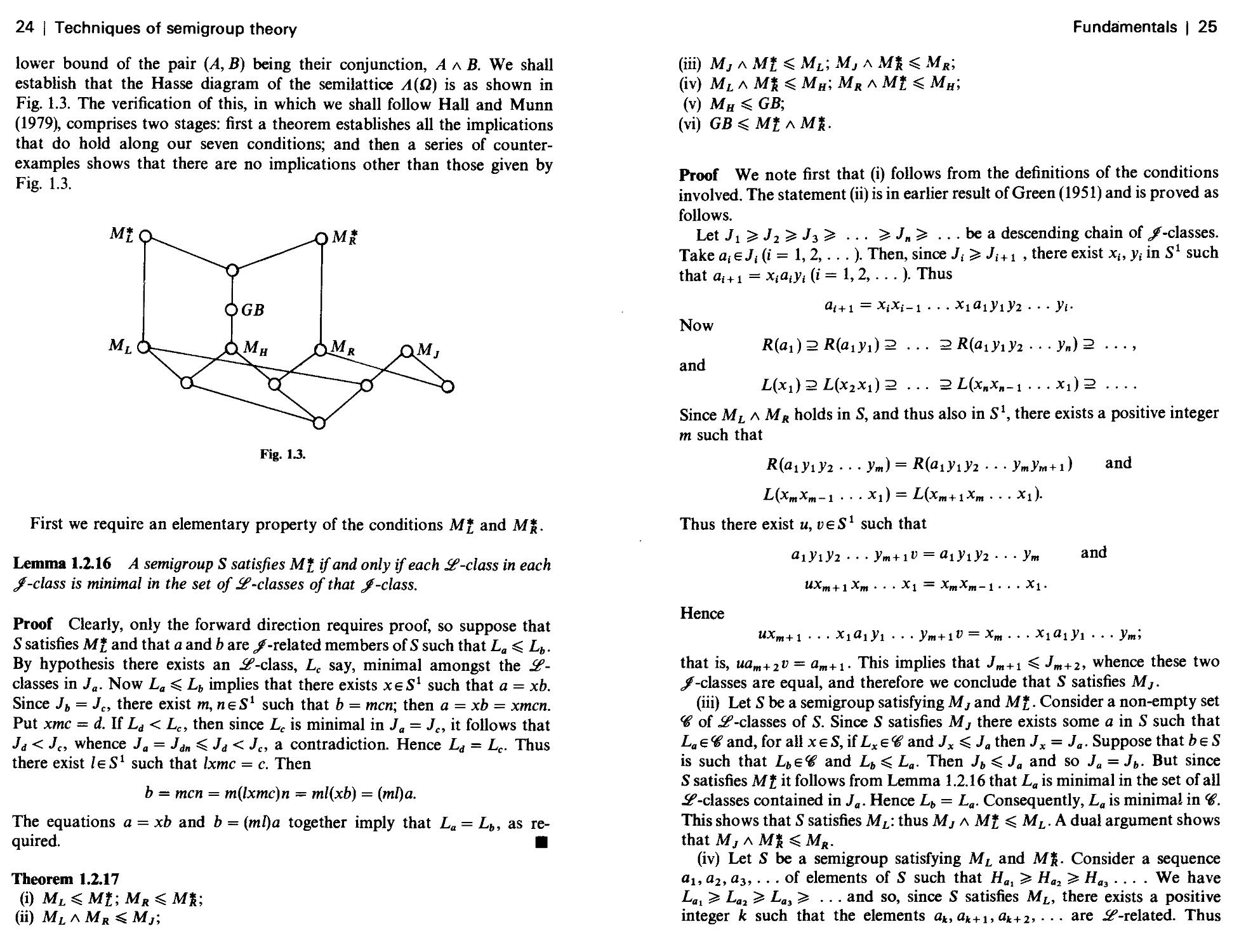
lower bound of the pair (A, B) being their conjunction, А л В. We shall
establish that the Hasse diagram of the semilattice A(Q) is as shown in
Fig. 1.3. The verification of this, in which we shall follow Hall and Munn
A979), comprises two stages: first a theorem establishes all the implications
that do hold along our seven conditions; and then a series of counter-
counterexamples shows that there are no implications other than those given by
Fig. 1.3.
Fig. 1J.
First we require an elementary property of the conditions M J and M%.
Lemma 1.2.16 A semigroup S satisfies M f if and only if each ?C-class in each
/-class is minimal in the set of ?f-classes of that /-class.
Proof Clearly, only the forward direction requires proof, so suppose that
S satisfies Mf and that a and b are /-related members of S such that La < Lb.
By hypothesis there exists an if-class, Lc say, minimal amongst the if-
classes in Jtt. Now La < Lb implies that there exists xeS1 such that a = xb.
Since Jb = Jc, there exist m^eS1 such that b = men; then a = xb = xmen.
Put xmc = d. If Ld< Lc, then since Lc is minimal in Ja = Jc, it follows that
Jd < Jc, whence Ja = Jdn < Jd < Jc, a contradiction. Hence Ld = Lc. Thus
there exist /eS1 such that Ixmc = с Then
b = men = m(lxmc)n = ml(xb) = (ml)a.
The equations a = xb and b = (ml)a together imply that La = Lb, as re-
required. ¦
Theorem 1.2.17
(i) ML^Mf,
(ii) ML л MR <
My,
Fundamentals I 25
(iii) М} л Ml < ML;
(iv) MlaM%^ Mh;
(v) MH < GB;
(vi) GB^Mt aM%.
л М%
MR;
MH;
Proof We note first that (i) follows from the definitions of the conditions
involved. The statement (ii) is in earlier result of Green A951) and is proved as
follows.
Let Ji ^ J2 ^ J3 ^ • • • > Jn^ ... be a descending chain of /-classes.
Take aleJl(i= 1,2,...). Then, since Jt^Ji+1 , there exist xif y{ in S1 such
that ai+1 = Xiu^i (i = 1,2,. . . ). Thus
Now
and
i?(a,J
. . . yn) 2 . . .,
Since ML л Мя holds in S, and thus also in S1, there exists a positive integer
m such that
R(aiyiy2 ¦ ¦ -Ут) = R(aiyiyi ¦ ¦ ¦ УтУм+i) and
L(xmxm-! . . . Xi) = L(xm+lxm . . . xi).
Thus there exist u^eS1 such that
¦ ¦ ym and
Hence
uxm
uxm+1xm
x1a1y1
=xmxm-i. . .
ym+iv =
ym;
that is, uam+2v = am+1. This implies that Jm+i ^Jm+2, whence these two
/-classes are equal, and therefore we conclude that S satisfies M3.
(iii) Let S be a semigroup satisfying Mj and Mt. Consider a non-empty set
4> of if-classes of S. Since S satisfies M j there exists some a in S such that
Lae<€ and, for all xeS, if Lxe<€ and Jx < Ja then Jx = Ja. Suppose that beS
is such that Lbe^ and Lb<,La. Then Л < Ja and so Ja = Jb. But since
S satisfies Mt it follows from Lemma 1.2.16 that La is minimal in the set of all
if-classes contained in Ja. Hence Lb = La. Consequently, La is minimal in <€.
This shows that S satisfies ML: thus Mj л Мf < ML. A dual argument shows
that MjaM%^Mr.
(iv) Let S be a semigroup satisfying ML and MJ[. Consider a sequence
аь Д2, аз> • • • °f elements of S such that ЯЯ
Я„
ЯЯз .... We have
Lai > La2 ^ La3 > . . . and so, since S satisfies ML, there exists a positive
integer fe such that the elements ak, ak+1, ak+2, . .. are if-related. Thus

26 | Techniques of semigroup theory
a*, <**+!, а*+2, • • ¦ аге /-related. But Rah^Rah+1^ ... and so, by the dual
of Lemma 1.2.16, the elements ak, ak+1, ak+2,. . . are ^-equivalent. It fol-
follows that Hak = Я„к+, = ЯЯк+2 = .... This proves that S satisfies MH. Hence
ML л M% < MH, and the other implication in the statement follows dually.
(v) Let S be a semigroup satisfying MH. Consider any element aeS. Since
Ha ^ Hai ^ Наз ^ . . . there exists a positive integer n such that
Н„п = Яап+1 = Н„п+2 = . . .. But this means that апЖа1п and so, by Corol-
Corollary 1.2.6, Han is a group. Thus S is group-bound and therefore MH < GB.
(vi) Let S be a group-bound semigroup. We shall show that S satisfies Mt.
Let a, be She such that afb and Lb^La. Then there exist elements u,v,ceS
such that a = ufet; and b = ca. Thus a = (uc)av and so a = (ucfatf for all
positive integers n. Now S is group-bound, and so we can choose n such that
n > 1 and (uc)" lies in a subgroup of S, with identity element e, say. Write
g = (ucf and let g denote the inverse of g in the subgroup He of S. Then
and so
ea = e(gatf) = (eg). atf = gav" = a
g~1(ucy~1ub = g~1(ucf~1uca = д~*да = ea = a.
Hence La^Lb, from which it follows that La = Lb. Consequently, S satisfies
. By duality, S also satisfies M?. Thus GB < M? л М?. ¦
Corollary 1.2.18 ML л MR = Af, л МH = AT, A.GB = Af, л Mf л МЗЦ.
Proof By (ii) MlaMr^ Mj and, by (i) and (iv), MlaMr^MIaMr^ Mh.
Thus MlaMr^Mj aMh. On the other hand, by (v), (vi), and (iii),
MjaMh^MjaGB^MjA (Mt a M%)
= (Mj a Mt) a (Mj a M%) < ML a MR.
These two statements together yield the result. ¦
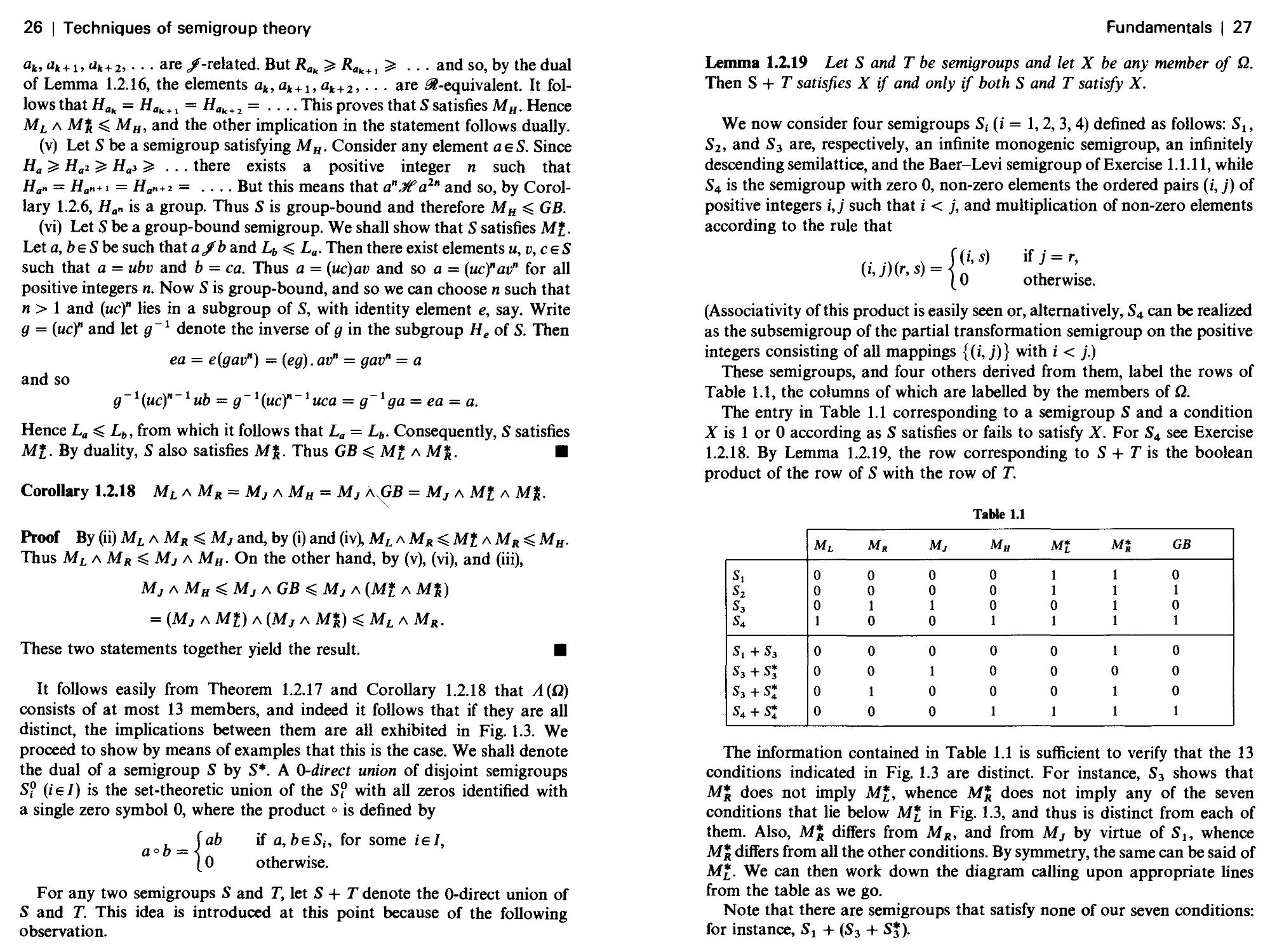
It follows easily from Theorem 1.2.17 and Corollary 1.2.18 that A(Q)
consists of at most 13 members, and indeed it follows that if they are all
distinct, the implications between them are all exhibited in Fig. 1.3. We
proceed to show by means of examples that this is the case. We shall denote
the dual of a semigroup S by S*. A 0-direct union of disjoint semigroups
S? (iel) is the set-theoretic union of the S° with all zeros identified with
a single zero symbol 0, where the product ° is defined by
a°b =
ab if a, beSt, for some iel,
0 otherwise.
For any two semigroups S and T, let S + T denote the 0-direct union of
S and T. This idea is introduced at this point because of the following
observation.
Fundamentals | 27
Lemma 1.2.19 Let S and T be semigroups and let X be any member of Q.
Then S + T satisfies X if and only if both S and T satisfy X.
We now consider four semigroups Sf (i = 1,2, 3,4) defined as follows: Slt
S2, and S3 are, respectively, an infinite monogenic semigroup, an infinitely
descending semilattice, and the Baer-Levi semigroup of Exercise 1.1.11, while
S4 is the semigroup with zero 0, non-zero elements the ordered pairs (i, j) of
positive integers i,j such that i < j, and multiplication of non-zero elements
according to the rule that
-{
s)
о
if j = r,
otherwise.
(Associativity of this product is easily seen or, alternatively, S4 can be realized
as the subsemigroup of the partial transformation semigroup on the positive
integers consisting of all mappings {(j, j)} with i < j.)
These semigroups, and four others derived from them, label the rows of
Table 1.1, the columns of which are labelled by the members of Q.
The entry in Table 1.1 corresponding to a semigroup S and a condition
X is 1 or 0 according as S satisfies or fails to satisfy X. For S4 see Exercise
1.2.18. By Lemma 1.2.19, the row corresponding to S + T is the boolean
product of the row of S with the row of T.
Table 1.1
S3
s4
s. + s,
S3 + S*
S3 + S*
s* + s*t
ML
0
0
0
1
0
0
0
0
MR
0
0
1
0
0
0
1
0
Mj
0
0
1
0
0
1
0
0
ми
0
0
0
1
0
0
0
1
M*L
1
1
0
1
0
0
0
1
M*
1
1
1
1
1
0
1
1
GB
0
1
0
1
0
0
0
1
The information contained in Table 1.1 is sufficient to verify that the 13
conditions indicated in Fig. 1.3 are distinct. For instance, S3 shows that
MJ does not imply M*, whence MR does not imply any of the seven
conditions that lie below M* in Fig. 1.3, and thus is distinct from each of
them. Also, MR differs from MR, and from Mj by virtue of Sl5 whence
MR differs from all the other conditions. By symmetry, the same can be said of
M?. We can then work down the diagram calling upon appropriate lines
from the table as we go.
Note that there are semigroups that satisfy none of our seven conditions:
for instance, St +(S3 + S%).

28 | Techniques of semigroup theory
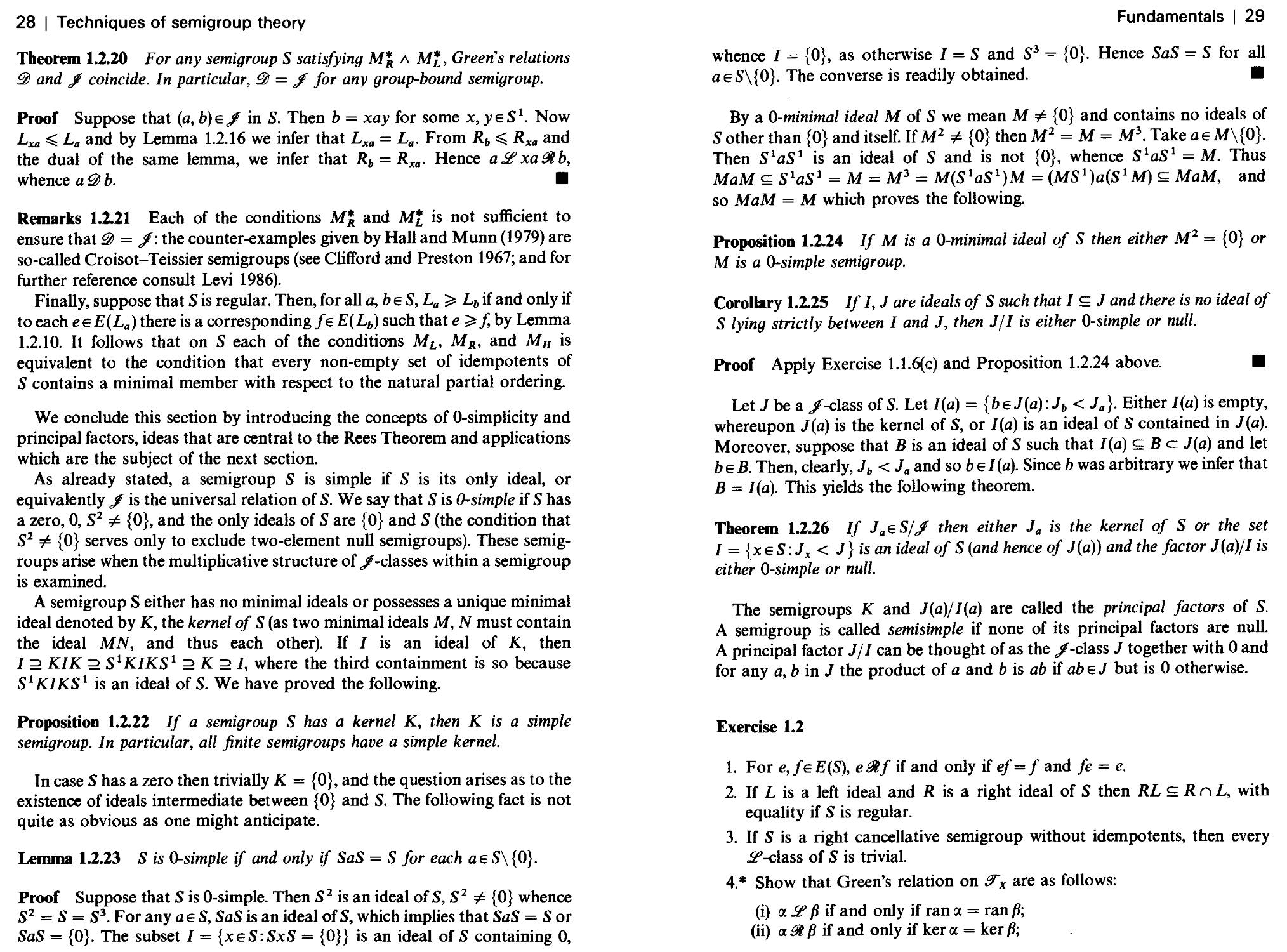
Theorem 1.2.20 For any semigroup S satisfying MJ л М*, Greens relations
Q) and / coincide. In particular, 9> = / for any group-bound semigroup.
Proof Suppose that (a, b)e/ in S. Then b = xay for some x, yeS1. Now
Lxa < La and by Lemma 1.2.16 we infer that Lxa = La. From Rb < Rxa and
the dual of the same lemma, we infer that Rb = Rxa. Hence a<?xa&b,
whence a Sib. Ш
Remarks 1.2.21 Each of the conditions MJ and M* is not sufficient to
ensure that 9> = /: the counter-examples given by Hall and Munn A979) are
so-called Croisot-Teissier semigroups (see Clifford and Preston 1967; and for
further reference consult Levi 1986).
Finally, suppose that S is regular. Then, for all a,beS,La^ Lb if and only if
to each ee E(La) there is a corresponding feE(Lb) such that e ^ f by Lemma
1.2.10. It follows that on S each of the conditions ML, MR, and MH is
equivalent to the condition that every non-empty set of idempotents of
S contains a minimal member with respect to the natural partial ordering.
We conclude this section by introducing the concepts of 0-simplicity and
principal factors, ideas that are central to the Rees Theorem and applications
which are the subject of the next section.
As already stated, a semigroup S is simple if S is its only ideal, or
equivalently / is the universal relation of S. We say that S is 0-simple if S has
a zero, 0, S2 ф {0}, and the only ideals of S are {0} and S (the condition that
S2 Ф {0} serves only to exclude two-element null semigroups). These semig-
semigroups arise when the multiplicative structure of /-classes within a semigroup
is examined.
A semigroup S either has no minimal ideals or possesses a unique minimal
ideal denoted by K, the kernel of S (as two minimal ideals M, N must contain
the ideal MN, and thus each other). If / is an ideal of K, then
/ 2 KIK з S^IKS1 Э К э /, where the third containment is so because
S^IKS1 is an ideal of S. We have proved the following.
Proposition 1.2.22 // a semigroup S has a kernel K, then К is a simple
semigroup. In particular, all finite semigroups have a simple kernel.
In case S has a zero then trivially К = {0}, and the question arises as to the
existence of ideals intermediate between {0} and S. The following fact is not
quite as obvious as one might anticipate.
Lemma 1.2.23 S is 0-simple if and only if SaS = S for each aeS\{0}.
Proof Suppose that S is 0-simple. Then S2 is an ideal of S, S2 ф {0} whence
S2 = S = S3. For any aeS, SaS is an ideal of S, which implies that SaS = Sot
SaS = {0}. The subset / = {xeS.SxS = {0}} is an ideal of S containing 0,
Fundamentals | 29
whence / = {0}, as otherwise I = S and S3 = {0}. Hence SaS = S for all
aeS\{0}. The converse is readily obtained. ¦
By a 0-minimal ideal M of S we mean М ф {0} and contains no ideals of
S other than {0} and itself. If M2 ф {0} then M2 = M = M3. Take a e M\{0}.
Then S^S1 is an ideal of S and is not {0}, whence S^S1 = M. Thus
MaM s S^S1 =M = M3 = M(SlaSl)M = (MS1)a(S1M) ? MaM, and
so MaM = M which proves the following.
Proposition 1.2.24 // M is a 0-minimal ideal of S then either M2 = {0} or
M is a 0-simple semigroup.
Corollary 1.2.25 // /, J are ideals of S such that I ? J and there is no ideal of
S lying strictly between I and J, then J/I is either 0-simple or null.
Proof Apply Exercise 1.1.6(c) and Proposition 1.2.24 above. ¦
Let J be a /-class of S. Let I (a) = {beJ(a):Jb < Ja}. Either I (a) is empty,
whereupon J(a) is the kernel of S, or I (a) is an ideal of S contained in J{a).
Moreover, suppose that В is an ideal of S such that I (a) ? В cr J(a) and let
b e B. Then, clearly, Jb < Ja and so b el (a). Since b was arbitrary we infer that
В = I(a). This yields the following theorem.
Theorem 1.2.26 // JaeS/f then either Ja is the kernel of S or the set
I = {xeS:Jx< J}isan ideal of S (and hence of J(a)) and the factor J(a)/I is
either 0-simple or null.
The semigroups К and J(a)/I(a) are called the principal factors of S.
A semigroup is called semisimple if none of its principal factors are null.
A principal factor J/I can be thought of as the /-class J together with 0 and
for any a, b in J the product of a and b is ab if ab e J but is 0 otherwise.
Exercise 1.2
1. For e,feE(S), e®f if and only if ef=f and fe = e.
2. If L is a left ideal and Я is a right ideal of S then RLcRnL, with
equality if S is regular.
3. If S is a right cancellative semigroup without idempotents, then every
jS?-class of S is trivial.
4.* Show that Green's relation on &~x are as follows:
(i) a JS? P if and only if ran a = ran /?;
(ii) a 01 p if and only if ker a = ker /?;

30 I Techniques of semigroup theory
(iii) а Ж p if and only if ran a = ran /? and ker a = ker /?;
(iv) a Si p if and only if rank a = rank /?;
(v) 9 = S-
5. Let Y be a subset of X and я a partition of A" such that | У| = | X/n\. Let
Я be the Ж -class of ^"x determined by (л, Г). Then Я is a group if and
only if Г is a transversal of n, in which case Я ~ Уу, the symmetric group
on Y.
6.* (a) Describe Green's relations on &&X-
(b) Describe Green's relations on Jx.
7. Let ee?(S). He is a subgroup of eSe = eSn Se.
8. Let S = {0, e, / a, b} be the semigroup of matrices under multiplication
Г0 01 Г1 0] Г0 0]
o = [_o o} e = |_o o} /=Lo ij'
Го Л
a = Lo о} fe
Let U be the subsemigroup {0, e,/} of S. Show that I/ is /-trivial, yet
e^s/
9 *(a) Reconcile our two definitions of simple: i.e. show that SaS = S for all
a e S if and only if S has a single /-class.
(b) The set product LR of an if-class L and an ^-class R is contained
within a single ^-class.
10.* The following are equivalent for a regular semigroup S:
(i) S is an inverse semigroup.
(ii) S contains no two-element right zero semigroup, nor its dual,
(iii) There is a subsemilattice ? of S such that for each a in S there exists
some d e V(a) such that ad, da e ?.
(iv) There exists a subsemilattice E of S such that for each e in ?(S) there
exist e', e" e V(e) such that ее', е"е е Е.
(v) There is a subsemilattice ? of S that meets every if-class and every
^-class of S.
Moreover, the condition in (iii) cannot be weakened to the one-sided
condition that insists only that ad e ?.
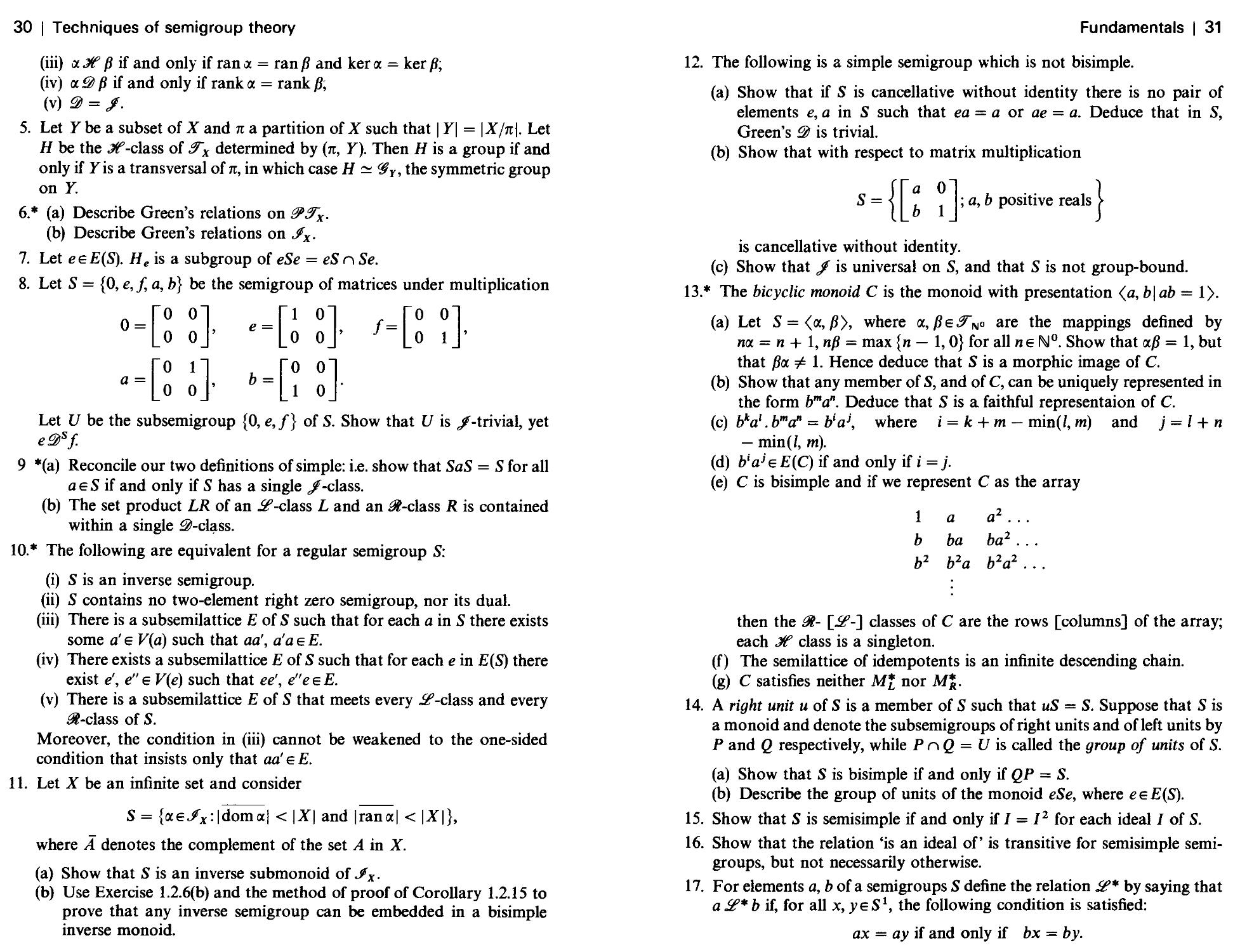
11. Let X be an infinite set and consider
S= {ae^ildomal < \X\ and |rana| < \X\},
where A denotes the complement of the set A in X.
(a) Show that S is an inverse submonoid of Jx-
(b) Use Exercise 1.2.6(b) and the method of proof of Corollary 1.2.15 to
prove that any inverse semigroup can be embedded in a bisimple
inverse monoid.
Fundamentals | 31
12. The following is a simple semigroup which is not bisimple.
(a) Show that if S is cancellative without identity there is no pair of
elements e, a in S such that ea = a or ae = a. Deduce that in S,
Green's 9> is trivial.
(b) Show that with respect to matrix multiplication
s =
; a, b positive reals
is cancellative without identity,
(c) Show that f is universal on S, and that S is not group-bound.
13.* The bicyclic monoid С is the monoid with presentation <a, b\ ab = 1>.
(a) Let S = <a, /?>, where a, fle&~No are the mappings defined by
no. = n + 1, np = max {n - 1,0} for all n e №. Show that <x$ = 1, but
that Pol ф 1. Hence deduce that S is a morphic image of C.
(b) Show that any member of S, and of C, can be uniquely represented in
the form bma". Deduce that S is a faithful representaion of C.
(c) bkal. bman = bla\ where i = к + m - min(/, m) and j = I + n
— min(/, m).
(d) blaJeE(C) if and only if i =j.
(e) С is bisimple and if we represent С as the array
1 a a2 ...
b ba ba2 ...
b2 b2a b2a2 . . .
then the ^2- [if-] classes of С are the rows [columns] of the array;
each Ж class is a singleton.
(f) The semilattice of idempotents is an infinite descending chain.
(g) С satisfies neither M* nor M*..
14. A right unit и of S is a member of S such that uS = S. Suppose that S is
a monoid and denote the subsemigroups of right units and of left units by
P and Q respectively, while P n Q = U is called the group of units of S.
(a) Show that S is bisimple if and only if QP = S.
(b) Describe the group of units of the monoid eSe, where ee?(S).
15. Show that S is semisimple if and only if / = I2 for each ideal / of S.
16. Show that the relation 'is an ideal of is transitive for semisimple semi-
semigroups, but not necessarily otherwise.
17. For elements a, b of a semigroups S define the relation ?f* by saying that
if, for all x, yeS1, the following condition is satisfied:
ax = ay if and only if bx = by.

32 | Techniques of semigroup theory
Let 3t* denote the dual relation, jf* = if* n M*, and call S abundant if
every <?*- and ^*-class of S contains at least one idempotent.
(a) By considering the extended regular representations of S, prove that
а У* b [a Я* ?] if and only if a if b [а Ш V\ in some containing semi-
semigroup T of S.
(b) Show that any Ж*-class of an abundant semigroup S that contains
an idempotent is a cancellative monoid.
Remark The class of abundant semigroups includes in particular the class
of cancellative monoids, and any subsemigroup of a regular semigroup S that
contains E(S) is abundant. For results on abundant semigroups consult
Fountain A982). The earliest reference to the above-mentioned ""-relations is
Lyapin A974).
18. Consider the semigroup S — S4 denned after Lemma 1.2.19.
(a) Show that the left ideal, right ideal, and ideal generated by (i, j) are
respectively given by
Lu={0}u{(r,j):l ^r<i}; RtJ = {0} и {(i,s):s ^ j},
and Ii} = {0} и {(r, s): 1 < r ^ i, s ^ j}, respectively.
(b) Verify the entries for S4 in the table in Fig. 1.3.
(c) Show that Jy, Uj+i, h,j+i, . . . , is an infinite strictly descending
chain of left ideals of S. Thus the condition ML is weaker than the
minimal condition on the set of all left ideals of a semigroup.
19.* (Venkatesan 1976) A semigroup S is right-unipotent if every ^-class
has a unique idempotent. Prove that every right-unipotent semigroup is
orthodox.
20. (Higgins 1987) Say that S has the RT* property if for every sequence
ax,a1,. . . of members of S there exist some positive integers m < n such
that axa2 . . . am = aia2 . . . an. S has LT* if, dually, there always exists
m < n such that amam-x . . . at = anan-1 . . . ax. If S enjoys both proper-
properties we say that S has T*.
(a) Prove that S has RT* if and only if S has MR and each ^2-class of S is
finite.
(b) Prove that S has T* if and only if S has Mj and each /-class of S is
finite.
(c) Prove that the class of RT* semigroups is closed under the taking of
subsemigroups, morphic images, and finite direct products.
(d) Show that the RT* semigroups are not closed under the taking of
direct powers by considering S x S x. . ., where S is a 0-direct union
of infinitely many one-element groups (S is sometimes called
a Kronecker semilattice).
Fundamentals | 33
(e) Prove that the class of RT* semigroups is locally finite, meaning that
for any S with RT*, any finitely generated subsemigroup of S is finite.
Hence deduce that a finitely generated semigroup S is finite if and
only if it has RT*.
Remark Another remarkable class of locally finite semigroups is the class of
bands (Green and Rees 1952; see also Howie 1976). More generally, a lemma
of I. Simon A980) states that a finitely generated semigroup S is finite if and
only if S\E(S) is finite. This result can be proved by an application of
a celebrated combinatorial theorem of Ramsay (see Pin 1986).
1.3 Completely 0-simple and completely regular semigroups
Completely 0-simple semigroups
Let S be a semigroup with zero 0. We say that ee?(S) is primitive if e is
0-minimal in the natural partial order on E(S): that is, / < e implies /= 0 or
f=e (feE(S))). A semigroup S is completely 0-simple if it is 0-simple and
contains a primitive idempotent. A semigroup is completely simple if it is
simple with a primitive idempotent. The effect of adjoining a zero to a com-
completely simple semigroup is to create a completely 0-simple semigroup with-
without zero divisors, and so any proposition about completely 0-simple semi-
semigroups has a corollary for the completely simple case which will generally not
be stated in the sequel.
A semigroup S is said to be a union of groups if every element of S lies in
a subgroup of S. It is easy to show that unions of groups are precisely the
completely regular semigroups introduced in Section 1.1. It follows from
Corollary 1.2.6 that each ^-class D of S is a disjoint union of (isomorphic)
groups, and so by Theorem 1.2.5, D is a regular subsemigroup of S, indeed
a bisimple (and thus simple) subsemigroup of S by Corollary 1.2.14. By
Theorem 1.2.5 one readily sees that all idempotents of D are primitive (in the
semigroup D) and thus any ^-class of a union of groups is completely simple.
On the other hand, recall that a completely regular semigroup S is one in
which, for each a in S there exists some a* e V(a) such that aa* = a*a. This
condition implies that а Ж a*, whence by Theorem 1.2.8 and Corollary 1.2.6,
it follows that Ha is a group, and so S is a union of groups. (For this reason
completely regular elements are sometimes described as those possessing
'group inverses'.)
The ease with which these facts are revealed demonstrates the usefulness of
Green's relations and motivates the study of completely [0-] simple semi-
semigroups, which occur as structural blocks throughout semigroup theory—the
kernel of any finite semigroup and the principal factors of finite full trans-
transformation semigroups, to mention two examples. These semigroups can be

34 | Techniques of semigroup theory
described up to the structure of the group of their non-zero ?#-class (for they
do turn out to be O-bisimple) by the Rees Theorem, which is why they form
the basis of other structure theories of more complex semigroups (see, for
example, Allen 1971; Birget 1988a).
Let S be a finite 0-simple semigroup. Clearly, E(S) is non-empty and since
S2 Ф {0} it follows that S does not consist entirely of nilpotents (elements
which have zero as a power) as any such semigroup is ./-trivial. We conclude
that S contains non-zero idempotents, and in particular must contain a 0-
minimal idempotent. The Rees Theorem for finite semigroups dates back to
Suschkewitsch, and a short proof of this result, which provides a model for
the general theorem, is provided here.
Since S is group-bound, 9) = /. Furthermore, as the non-zero ^-class D of
S contains idempotents, it is regular, whence we conclude that S is O-bisimple
and regular. We utilize the extended right regular representation of S in
$~Si = T. Suppose that a,beD and that ab ф 0, whence abeD and so in
T, |ranab| = |rana| = |ranb| (see Exercise 1.2.4) as a 9)Tab9)Tb. Since S is
finite, this is possible only if ran a is a transversal (cross-section) of ker b
(otherwise |ranab| < |rana|). But in this case ranab = ranb and
kerab = ker a, that is a@T ab?fTb, which implies a@? ab^sb by Lemma
1.2.13, since S is regular. We infer that for a,beD, either ab = 0 or
abeRar\ Lb, and by Theorem 1.2.5 the latter occurs if and only if La n Rb is
a group.
Index the rows and columns of D by the index sets /, A respectively, and
without loss we assume that A,1) e/ x A with Hn a group. For each re/ and
ЛеЛ choose r,e#a and qxeHiX. By Lemma 1.2.4 and Theorem 1.2.5 the
maP <Ри'-Нц -*НШ where aq>iX = rtaqx is a bijection which, by Theorem
1.2.7, is an isomorphism if Ha is a group. It follows that xeHix can be
represented as a triple (a; i,X), where aeH^ is such that x = r{aqx. Take
yeHJtl, say, with representation (b; i, ц),. The product
where it remains only to determine с (if the product is 0, which occurs if and
only if Hw is not a group, we take с = 0, and agree that @; i, A) = 0 for all i in
/ and Я in Л). But xy = rtaqxrjbq^ and if the product is not 0, xy e Hifl, whence
it is evident that с = aqxrsb. However, if the product is 0 then qxrt = 0 so that
in any case с = aq^b. We have shown that any finite 0-simple semigroup can
be represented as a Rees matrix semigroup, a concept which we now define.
Definition 1.3.1 Let /, Л be index sets and let G° be a group with ad-
adjoined zero (we call G a 'group with zero'). Let P = (pXi) be a Ax I
matrix with entries from G°. The Rees semigroup with sandwich matrix
P = Af°IG;/^P]itht
= {(a; i, X):aeG°, iel, кеЛ) и {0},
Fundamentals | 35
with product
with the understanding that (O;i,A) = O for all iel, ЛеЛ and that any
product involving 0 is itself 0.
A general Rees semigroup S (for one readily checks associativity of this
product) need not be finite nor must it be 0-simple: for example, if P is the
zero matrix then S is null. The above argument shows that our finite 0-simple
semigroup is isomorphic to a Rees semigroup M°[Hn; I, Л;Р], where
ря. = qxr(. Since every row and every column of D contains at least one group
Ж -class it follows that P is regular, meaning that no row and no column of
P consists entirely of zeros. It is easy to verify that a Rees semigroup is regular
if and only if its matrix P is regular.
Theorem 13.2 (Rees-Suschkewitsch Theorem) A semigroup S is completely
0-simple if and only if it is isomorphic to some regular Rees semigroup.
The verification that a regular Rees semigroup is completely 0-simple is
straightforward (Exercise 1.3.2), and we have proved the converse for the case
where S is finite. The general case depends on the following lemma.
Lemma 13.3 For any non-zero &-class Rofa completely 0-simple semigroup
S the set R и {0} is a 0-minimal right ideal.
iEtaof It is sufficient to show that R и {0} is a right ideal; the 0-minimality
follows, for if R' is a non-zero right ideal such that R' cRu {0} then
taking aeR', афО, and xeR, we have x&a and thus x = aueR', which
shows that R' = Ru {0}. First, we prove that if R denotes the ^-class of
a primitive idempotent e of S, then R и {0} is the right ideal eS. The inclusion
Я и {0} ? eS is clear. Let beeS, Ьф 0. Since S is 0-simple, e = xby for
some x, yeS. The element f=byexe is an idempotent. Furthermore,
ef=fe=f Since e is primitive, /= 0 or /= e. But /= 0 implies
xfby = xbyexeby = e = 0—a contradiction. Therefore f=e = byexe. This
shows that eebS, which together with beeS yields beRe. Hence
R и {0} = eS. From S = SeS = S(R и {0}) we deduce that every xeS is in
c(R и {0}) for some с e S. We prove that for х#0,Яхи {0} = c(R и {0}) by
showing inclusions in both directions. Assume that x = cr for some
reRu{0}. If yeRx*o{0}, then y = xt for some teS; it follows that
у = crt and thus yec(R и {0}). If yec(R и {0}), then у = cr' for some r' in
R kj {0}; in case r1 = 0, у is 0 and thus yeRxv {0}; in case г' ф 0, we have
r1 Str, which implies that cr'&cr or yeRx. Consequently, К*и{0} =
c(Ru{0}) = ceS. ¦

36 I Techniques of semigroup theory
A dual proof shows that for a non-zero if-class L, Lu {0} is a 0-minimal
left ideal of S.
Lemma 1.3.4 A completely 0-simple semigroup S is regular and O-bisimple
with non-zero 2-class D. Moreover, for a,beD either a@tabS?'b or ab = 0.
Proof Let a,beS\{0}. Then aSb ф {0}, for otherwise we would have
S=S2 = SaSSbS = S(aSb)S = S{0}S=0. Take ceaSb\{0}. Since ceaSnSb
we have, by Lemma 1.3.3, a@tcS?b, whence aQ)b as required. The non-zero
^-class is regular since it contains an idempotent. Finally, if ab ф 0, then
Rab < Ra, Lab < Lb and, again from Lemma 1.3.3, we infer that Rab = Ra and
Lab = Lb, as required. ¦
Given Lemmas 1.3.3 and 1.3.4, a Rees representation of an arbitrary
completely 0-simple semigroup can be constructed just as in the proof of the
finite case, thus completing the proof of the Rees Theorem.
Another characterization of completely 0-simple semigroups was given by
Munn (see Clifford and Preston 1961).
Theorem 1.3.5 A 0-simple semigroup S is completely 0-simple if and only if
S is group-bound.
Proof Let a be a member of a completely 0-simple semigroup S. Then if
Ha is not itself a subgroup of S then a2 = 0, and so S is group-bound.
Conversely, suppose that S is 0-simple and group-bound. Then, by
Theorem 1.2.20, Sj = ? for S, so let D denote the non-zero ^-class of S. As
before, D does not consist entirely of nilpotents (as otherwise # would be
trivial, and S would be a two-element null semigroup) but since S is group-
bound, D must contain a subgroup, and thus an idempotent, whereupon D,
and therefore also S, is regular. By Theorem 1.2.17, S satisfies M* л MjJ,
which evidently implies that S satisfies ML л MR. But, by Remark 1.2.21,
since S is regular, it follows that ?(?>) contains a minimal member; that is,
D has a primitive idempotent, as required. ¦
As a corollary, all periodic 0-simple semigroups are completely 0-simple.
The proof of Theorem 1.3.5 in Clifford and Preston A961) is based on the
following fact, attributed there to Andersen.
Theorem 13.6 // e is any non-zero idempotent of a 0-simple semigroup
S which is not completely 0-simple then S contains a bicyclic submonoid (see
Exercise 1.2.13) with identity element e.
We do not repeat the proof of Theorem 1.3.6 here, but it relies on the
curious fact that any semigroup generated by two generators p and q such
Fundamentals | 37
that pq = 1 but qp ф 1 is isomorphic to the bicyclic monoid <a, b\ ab = 1>: in
effect one merely repeats Exercise 1.2.13, working throughout with <p, q}, to
verify this. For an account of analogues of Andersen's Theorem for 0-simple
semigroups with no non-zero idempotent, see Jones A987). For some general-
generalizations of the bicyclic monoid, see Nivat and Perrot A970), and Cowan and
Rankin A987).
Another fundamental characterization of completely 0-simple semigroups
is due to Clifford A949) (see Clifford and Preston 1961).
Theorem 13.7 A 0-simple semigroup is completely 0-simple if and only if it
contains at least one 0-minimal left ideal and at least one 0-minimal right ideal.
The Baer-Levi semigroup (Exercise 1.1.11) with adjoined zero is 0-simple
with a 0-minimal right ideal, but is not completely 0-simple. However, any
0-simple semigroup with a 0-minimal right ideal and non-zero idempotent is
completely 0-simple (Clifford and Preston 1961, Exercise 2.7.12).
The isomorphism problem for completely 0-simple semigroups was solved
by Rees A940) (see Clifford and Preston 1961; Howie 1976).
Theorem 13.8 Two regular Rees semigroups S = M°[G;I,A; P] and
T = M°\_K; J, M; Q] are isomorphic if and only if there exist an isomorphism
O.G^K, bijections \p:I^J, x'A^M and elements щ (ie/), vk(XeA) in
К such that рц6 = vkqkx< 1ф ut for all A, i.
Consult Howie A976) for a description of all congruences on a completely
0-simple semigroup.
Completely regular semigroups
We now return to our investigation of completely regular semigroups. In the
preamble to the Rees Theorem we found that S was completely regular if and
only if every ^-class D of S was a completely simple subsemigroup of S. The
Rees Theorem gives us a hold on the ^-classes of S but provides no insight
into any relationship between the ^-classes. A fruitful way to decompose
a semigroup S is sometimes provided by the congruence n, the minimum
semilattice congruence on S, which always exists, and is the intersection of all
congruences a on S such that S/a is a semilattice. Equivalently, S/n is the
maximum semilattice homomorphic image of S. The importance of the
maximum semilattice image S/rj lies partly is the observation that each ry-class
of S is a subsemigroup (a feature that evidently characterizes those congruen-
congruences a on S such that S/a is a band). If a semigroup S has a congruence a such
that S/a is a band В and each <r-class is a semigroup of type T, say, we call
S a 'band of type-Г semigroups'. We may specialize this definition to special
classes of bands, in particular to semilattices.

38 | Techniques of semigroup theory
It is always the case that / ? n: to see this suppose that ajbin some
semigroup S so that there exist x, y, u, veS1 such that a = xby and b = uav.
Then, since n is the congruence on S generated by
we obtain
t]0 = {{a,a2),(ab,ba):a,beS},
a = xby n xb2yt] xbyb = ab — auav n ua2 v n uav = b,
and so / ? п.
The reverse inclusion is generally false (for example, in (N,+)f is trivial
while n is universal) but we can demonstrate equality for the case where S is
completely regular by proving that # is a semilattice congruence on S. Let
a,beS. Since Ha is a group we have а2 Ж a and thus a f a2. Then
•> ab — J(.abJ — •>a{ba)b ^ Jba>
but this of course yields Jab = Jba, as we can equally infer that Jba < Jab. Thus
we have Ja = Ja2 and Jab = Jba. It follows that if ? is a congruence then S/f
is a semilattice. Now suppose that a f b and ceS. Take x, у, и, v e Sl such that
b = xay and a = ubt;. Then Jca = Jcubl, < Jcub = J^,, ^Jbc = Jcb, and similarly
Л* < Ла, whence Jca = Jcb. Dually, we can show that # is a right congruence,
thus concluding that,/ is a congruence on any completely regular semigroup.
Bands are completely regular, so that the above argument shows that in
their case $ = n. But bands are also periodic, and we know that Q) = $ in
any such semigroup. It follows that any ry-class of a band is a completely
simple band, thus yielding the following structure theorem.
Theorem 13.9 In any band B, 3) = r\ and В is a semilattice of rectangular
bands.
We can do better. The following celebrated result is due to Clifford A941).
Theorem 13.10 For any completely regular semigroup S, <% = rj and S is
a semilattice of completely simple semigroups.
Proof We know that in S each ^-class is completely simple and that f = t].
Thus it remains only to prove that 9) = #.
Each JeS/f is a subsemigroup of S (since ? = r\), so that no principal
factor of S is null. Indeed, the kernel of S (if it exists) is simple, and all other
principal factors are 0-simple with the zero an adjoined one. It follows that
Tif *®enulattice» S//, of simple semigroups which are also unions of groups.
Therefore Clifford's Theorem will follow once we show that any simple
completely regular semigroup T is completely simple, and this is done by
showing that every member of E{T) is a primitive idempotent.
Fundamentals | 39
Suppose that e,feE(T) with /< e. Take z, ft Г such that e = zft. Put
x = ezf and у =fte to obtain
xfy =
= e3 = e
and
= xf=x, fy = ye = y.
Since S is completely regular, we have xeHg for some geE(T). Thus
gx — xg = x and there exists x* e Hg such that xx* = x*x = g. From xf= x
it follows that x*xf- x*x; hence gf=g.We also have
gf=gef= gxfyf= xfyf= ef=f.
Hence g =/ Therefore f=fe = ge = gxfy = xfy = e, as required. ¦
Another consequence of Clifford's Theorem is a description of the inter-
intersection of two interesting classes of semigroup: completely regular semig-
semigroups and inverse semigroups. The ^-classes of such a semigroup are com-
completely simple with commuting idempotents and thus it follows that S must be
a semilattice of groups. Conversely, one observes that any semilattice of
groups is a union of groups in which inverses are unique. The structure of
semilattices of groups can be described in more detail than for an arbitrary
completely regular semigroup. The multiplicative structure of a semilattice of
groups is an instance of the following type of construction.
Let У be a semilattice and let {S.iaeF} be a collection of disjoint
semigroups of the same type T, indexed by Y. Suppose that for each a, ^e Y
such that a ^ /? there is a homomorphism (pxJ) :Sx->Sp such that:
(i) фя>11 is the identity map on S;
(ii) фя,э q>t,y = <px,y for every a, 0, у e Y with a ^ /? ^ y.
We can then define an associative multiplication ° on S = {Sx: a e Y} by
ax°bp = (ax(px^xp)(bfi(p^xfi); axeSx, bpeSp.
Notice that the product on the right is taken in Sxp. We call S a strong
semilattice of semigroups of type T, and write
S = S(F; {Sa; ae Г}; И>я,„: а, 0е Г, а :*/?}).
Remarkably, every semilattice of groups is a strong semilattice of groups.
Moreover, the idempotents of a semilattice of groups are central (an element
a of S is central if ab = ba for all b in S).
Theorem 1.3.11 The following are equivalent:
(i) S is regular and every idempotent is central;
(ii) every Ql-class of S has a unique idempotent;
(iii) S is a semilattice of groups;
(iv) S is a strong semilattice of groups.

40 | Techniques of semigroup theory
Proof (i) implies (ii). Let D be a ^-class of S. Since S is regular, D contains at
least one idempotent. Suppose that e 3>f with e, f idempotents. Then there
exists a in S such that е??а@/, and thus for some xeS1, e = xa whence,
since idempotents are central, e = xa = xfa =fxa =fe = ef; similarly, we can
obtain f-efso that e =f.
(ii) implies (iii). The given condition implies that each ^-class is a group
^f-class. Hence S is a semilattice of completely simple semigroups which
themselves are ^-classes of S, and thus groups.
(iii) implies (iv). Let S be a semilattice Y of groups Gx(a e Y) and for each
a e Y, let ex be the identity of Gx. It is routine to verify that the mappings
(px.fi'¦ G« -* Gp (a ^ P) denned by ax<pXtfi ~ axefi (axeGx) are homomorphisms
with the required properties (i) and (ii) above and that S is the strong
semilattice of groups S( Y; Gx; <pXfP).
(iv) implies (i). If S is a strong semilattice S( Y; Gx; cpXtfi) of groups, then it
is certainly regular. The idempotents of S are the identity elements ex, of the
groups Gx. If exeE{S) and bfieGfi then, writing у for a/?, we have
and so every idempotent of S is central. ¦
Since the idempotents of a commutative regular semigroup are certainly
central, we obtain the next corollary.
Corollary 1.3.12 A commutative semigroup S is regular if and only if it is
a strong semilattice of abelian groups.
Proof Only the reverse direction requires a line of proof. Suppose that S is
a strong semilattice of abelian groups S( Y; Gx; <pM). Take any ax in Gx, bfi in
Ge; then
a*be = (a<,<P<x,y)(bii(pt,,y) (where у = ф
= Фр<Ря,у)(ах(рх,у)
(as both are members of the abelian
group Gy)
= Ь„ах.
An heroic attempt to describe the structure of arbitrary completely regular
semigroups has been made by Petrich A974), and this description has been
used by, for example, Gerhard A983). The corresponding construction for
bands (Petrich 1971) can be found in Howie A976). Free completely regular
semigroups exist, and descriptions including solution to the corresponding
word problem have been given by Gerhard A983), Trotter A984), and more
recently by Polak A986).
Fundamentals | 41
Recall that a semigroup is called semisimple if none of its principal factors
are null. We shall call a semigroup completely semisimple if all of its principal
factors are completely [0-] simple. This is a broad class of semigroup which
includes the classes of completely regular and finite regular semigroups.
Theorem 1.3.13 In a completely semisimple semigroup S, & = / and every
&-class [y-class~\ is minimal within all the ^-classes [?f-classes] within its
/-class. Conversely, any regular semigroup satisfying M1 or M\ is completely
semisimple.
Our proof goes by way of lemma.
Lemma 1.3.14 Let a/bin a regular semigroup S and let P be the principal
factor of S associated with a. Then Rsa s? R$ if and only if RFa s? R*¦ Hence
S satisfies MJ if and only if each principal factor of S does also.
Proof If Rpa < Rl then there exists xeJ such that a = bx, whence clearly
Rs < Rf. Conversely, if Rf ^ Rf then there exists xeS1 such that bx = a.
Take eeE(Lb), whence b = be. Then
Ja = Jbx = Jbex
so that ex /a and a = b(ex), whence
"e = •'(и
Proof of Theorem 1.3.13 Let S be completely semisimple. Then for every
principal factor P of S, P is completely 0-simple, whence it follows from
Lemma 1.3.3 that every non-zero ^-class of P is 0-minimal and so P satisfies
Mj, and dually Mj also. Hence, by Lemma 1.3.14, S satisfies M^ л Ml,
whence <3> = / in S by Theorem 1.2.20. Furthermore, it follows from Lemma
1.2.16 and its dual that every ^-class and every ^-class of S is minimal within
its ^-class.
Conversely, let S be a regular semigroup satisfying MJ. Then for every
principal factor P of S, P is a regular 0-simple semigroup satisfying M? by
Lemma 1.3.14. Evidently, P then satisfies MR, whence by Remark 1.2.21 it
follows that the set of non-zero idempotents of P possesses a minimal
member, and thus P is completely 0-simple, as required. ¦
For further results relating semisimplicity to minimal conditions, see
Clifford and Preston A967), Chapter 6.6.
Exercises 13
1. Show that a Rees semigroup is regular if and only if its matrix P is
regular.

42 | Techniques of semigroup theory
2. Verify that any completely 0-simple semigroup S has the following
properties:
(i) every non-zero idempotent is primitive;
(ii) Ж is a congruence on S;
(iii) any non-trivial homomorphic image of S is completely 0-simple.
(iv) the direct product of completely 0-simple semigroups is completely
0-simple.
3. It is always possible to represent a completely 0-simple semigroup
S = M°[_G; I, A; F] so that a given row Я and column i of P consists only
of 0 and e, the identity of G.
4.* A completely 0-simple inverse semigroup is called a Brandt semigroup.
A semigroup is Brandt if and only if S is isomorphic to a Rees semigroup
of the form M° [G; /, /; A], where Л is an / x / identity matrix.
5. Show that a regular semigroup S has all non-zero idempotents primitive
if and only if S is a 0-direct union of completely 0-simple semigroups.
[Hint: suppose that {0} ф Jf < Je {e,feE). Then f=xey, say; put
g = eyfxe and show that g = e.~\
6. The following are equivalent for a regular semigroup S:
(i) S is completely simple;
(ii) aba = a implies bob = b for all a,beS;
(iii) S is weakly cancellative: i.e. ax = bx and ya = yb for some x, у in
S implies a = b.
7. A completely 0-simple semigroup with trivial maximal subgroups is
called a 0-rectangular band. S is a O-rectangular band if and only if S has
a zero, and satisfies the two conditions:
(i) xyx = x or xyx = 0 for every x, y
(ii) xSy = {0} implies x = 0 or у = 0.
8. A completely simple semigroup is orthodox if and only if S is a rectangu-
rectangular group: i.e. a direct product of a group and a rectangular band.
9. Prove that the following are equivalent for a regular semigroup S:
(i) S is orthodox;
(u) there exists a subband В of S such that for all aeS there exists
a' e V(a) such that aa', a'a 6 B;
(iii) there exists a subband В of S such that for all eeE(S) there exists
e', e" e V(e) such that ее', е"е е В;
(iv) S has a subband В that meets every i?-class and every ^-class
Moreover, the condition of (ii) cannot be weakened to the one-sided
condition that insists that only aa'eB, even if S is completely simple.
(Compare this exercise with Exercise 1.2.10.)
Fundamentals I 43
10. The following are equivalent for a semigroup S:
(i) S is a rectangular band;
(ii) S is nowhere commutative; i.e. ab = ba implies a = b(a,be S);
(iii) every pair of elements of S are mutually inverse;
(iv) S is a member of the variety [x = x2, xyz = xz];
(v) S is a member of the variety [x = xyx].
11. Characterize those semigroups S which have the property that every
non-empty subset of S is a subsemigroup.
12.* A regular semigroup S is called a locally T-semigroup if the /oca/
subsemigroups, eSe (eeE(S)) are all semigroups of type T.
(a) Show that every regular semigroup is a locally regular semigroup.
(b) (Hall 1982) Show that for any regular semigroup S, Reg(eS) forms
a subsemigroup of S (eeE(S)).
13.* A semigroup is called normal or medial if abed = acbd for all a, b,c,de S.
Show that the following are equivalent for a band B:
(i) В is a strong semilattice of rectangular bands;
(ii) В is normal;
(iii) В satisfies the identity xyzx = xzyx;
(iv) В satisfies the identity xyxzx — xzxyx;
(v) В is a local semilattice: i.e. eBe is a semilattice for each e e B;
(vi) the natural partial order on В is compatible with multiplication, i.e.
e^f implies ge^gf and eg < fg for all e,f,geB.
14. The variety of right normal bands is defined as [x = x2, xyz = yxz~\. Show
that a band is right normal if and only if it is a strong semilattice of right
zero semigroups.
15. A completely regular semigroup is a band of groups if and only if Ж is
a congruence.
16. If S is a commutative semigroup and a,beS, write a\b (a divides b) if
there exists x in S1 such that ax = b.
(a) r\ is the set of all pairs (a, b) in S such that a divides some power of b,
and b divides some power of a.
A commutative semigroup Г is called archimedean if for all a, b in T, some
power of a divides b and some power of b divides a.
(b) Show that any commutative semigroup is a semilattice of ar-
archimedean components.
(c) Prove that an archimedean semigroup has at most one idempotent.
17. Show that 3~x with X infinite is an example of a semisimple semigroup
that is not completely semisimple.
18. (Petrich 1987) Let X be a non-empty set and Я be an equivalence

44 | Techniques of semigroup theory
relation on X all of whose classes are of the same cardinality and put
: ran<p is a A-class and for every
A-class L, (p\L is a bijection of L onto rancp}.
(a) Show that 3~X{X) is a completely simple subsemigroup of 3~x.
Let ST*(X) be the dual of 9~X{X).
(b) For any completely simple semigroup S, the mapping t:sh-»(As, ps)
(seS), where Asx = sx and xps =xs for all xeS, is a faithful repres-
representation S -> ^*(S) x 2TX(S) and the latter is itself a completely
simple semigroup.
(c) Construct a Rees semigroup representation of $~X(X).
1.4 Properties of regularity
Partial orders
That various partial orders come to be associated with semigroups is ex-
expected in view of the fact that products tend to 'fall' into lower ./-classes,
from which they cannot be retrieved by further multiplications. The partial
orders introduced so far have been those defined on the Green's factor sets,
S/Se, S//, etc., together with the natural partial order on E(S). Mitsch A986)
introduced three partial orders on an arbitrary semigroup S, each of which
reduce to the so-called natural partial order on a regular semigroup dis-
discovered independently by Nambooripad A980) and Hartwig A980). A partial
order on a semigroup S is called natural if it is denned by means of the
multiplication of S. The reason for the interest in such natural orders lies in
the fact that such an ordering can provide additional information on a given
semigroup since it reflects its multiplication in a particular way.
The search for natural partial orders on various classes of semigroup was
inspired by the natural partial order for inverse semigroups which is denned
by set containment of mappings. For this reason it merits special attention,
although it can be regarded as a special case of the natural partial order on
a regular semigroup that will be introduced later in this section.
The underlying idea is to formulate some natural relationship between
mappings in the symmetric inverse semigroup in terms of equality of products
in Jx. This formulation can then be used as the definition of the relationship
for abstract inverse semigroups, and provides a sound basis for a generaliz-
generalization to some wider class of semigroup.
We begin by considering the partial order on Jx defined by set inclusion:
a s? /? (a, /?e Jx) if a <=, /? when regarded as subsets of X x X; that is, /? is an
extension of a or equivalently, a = /?|doma. It is easy to verify that a </? is
equivalent to any of the following conditions: (i) a = aa/?: (ii) a = /fa a;
(Hi) a = a/PJa; (iv) a = e/J for some eeE(Jx); (v) a = /Je for some e
Fundamentals | 45
Since any inverse semigroup S may be embedded in some symmetric
inverse semigroup, it follows that any of these five conditions define a natural
partial order, <, on S and, moreover, by referring to the set-theoretic
formulation of < in Jx, it is clear that < is compatible with multiplication
(a < b => ax < bx, xa^xb for all xeS) and with inversion
{a^b=>a~l sSb).
A second example of this approach is provided by the compatibility
relation on Jx. We call elements a and /? of Jx compatible if аи/? is
a member of Jx. Now a and /? are compatible if and only if
/?|doma = a|dom/? and a'^ran/? = /Parana. These conditions are equi-
equivalent to the equality of the products aoT1 /? = /J/T'a and a/?/? = Да a
(in which case all four products equal аа/?). Thus we can introduce the
compatibility relation between elements of an abstract inverse semigroup S:
a and b are compatible if and only if aa~1b = bb~ia and ab~lb = ba~ia.
Let a, /?, and у be elements of some inverse subsemigroup S olJx, such that
a^y and P ? y. Then а и Д ^ y, so that a and /? are compatible, and hence
a n P e S. Thus we obtain an abstract property of any inverse semigroup S: if
a < с and b < с for some a,b,ce S, then a and b have a gib in S with respect
to the natural partial order on S, which we shall denote for the moment by v.
We have proved that if (a, bjevv (i.e. a ^ с and b ^c (от some c), then
d < a and d < b, for some d which we can take to be the gib of a and b in S.
Thus (a, b)e v~1v and it follows that vv ^ v~V Consequently, we see that
the least equivalence relation p on S such that v ^ p coincides with v~iv.
Since v is compatible with multiplication in S, p is a congruence. Now for any
e,feE(S), ev~iefvf, so that ev~1vf, whence we infer that (e,f)ep and so
a <=,p, where a denotes the least group congruence on S. On the other hand, if
avb then b = ea for some eeE(S), so that (a, b)eo and v ? a, whence we
conclude that p = a. It is now a simple matter to deduce the result of Munn
A961) that for elements a, b of an inverse semigroup S, aab if and only if
ea = eb for some eeE(S) (see Exercise 1.4.8; for a description of the least
group congruence on a regular semigroup, see Theorem 1.4.16).
Using the foregoing as motivation, we shall introduce partial orders on an
arbitrary semigroup S, based on comparison of mappings in the extended
regular representations of S.
Let <p: S -»^"Si whereby aq> = pa (the right inner translation of S1 by a)
denote the extended right regular representation of S.
Definition 1.4.1 Say a^rb (a,beS) if кегрь?кегра and there exists
a transversal (cross-section) T of the classes of ker pa such that pa\ T = рь\ Т.
This relation is the right partial order on S.
The relation is clearly reflexive and antisymmetric. To see that sgr is
transitive suppose that a sgr b <r c, with U and К the required transversals of
the classes of ker pa and ker pb respectively. For any class К of ker pa we can

46 | Techniques of semigroup theory
choose a required transversal member of К as follows: let и = U nK and let
K' be the class of kerpb containing u; take v=VnK', then
vc = vb = ub = va, so v is as required. Note also that a <r b implies that
ran pa ? ranpb.
Definition 1.4.1* Say a^(b (a,beS) if кегЯь^кегЯа and there exists
a transversal Г of the classes of ker Xa such that ka\T = kb\T. This relation is
the left partial order on S.
Definition 1.4.2 The natural partial order on a semigroup S is the relation
These three partial orders all coincide with the natural partial order on
idempotents (Exercise 1.4.1). The natural partial order < reduces on regular
semigroups to the ordering introduced by Nambooripad A980).
On an arbitrary semigroup S define the following relation:
avb if there exist e,/e?(S1) such that a = be =fb.
Then v is a reflexive relation on any semigroup, and if S is regular then v is the
order of Nambooripad A980) (although this formulation is due to
P. R. Jones). The next result shows, in particular, that it is always the case that
Proposition 1.4.3 Let a,beS. Then a
such that tb = ta = a = as = bs.
b if and only if there exists t,seS*
Proof Suppose that a < b. Since a^rb there exists teS1 such that
t = Tn 1( ра ° p~i), where Г is a required transversal of the classes of ker pa.
Then a = la = ta = tb. The dual argument gives us an seS1 such that
a = as = bs.
Conversely, suppose that xb = yb (x, yeS1). Then xa = xbs = ybs = у a,
which implies that кегрь с кегра. Next let x be any member of S1. Then
xa = (xt)a = (xt)b so that xt can act as the required transversal member of
the class of кегра that contains x, thus proving that a <r b. Combining this
with the dual argument completes the proof. ¦
The preceding characterization of < shows it to be a clear generalization
of v. It also provides a form which can quickly yield properties of < : for
instance, it is immediate that the natural partial order is preserved by
homomorphisms. The conditions expressed in Proposition 1.4.3 can be taken
as the definition of s? , and indeed the natural partial order can be defined by
the formally weaker conditions by which a s? b if there exist t^eS1 such that
a = ta = tb = bs, as these equations yield as = tbs = ta = a also.
Fundamentals | 47
Theorem 1.4.4 Let beReg(S). The following are equivalent for aeS:
(i) avb; (ii) a^b; (iii) a^rb; (iv) a^ib;
(v) a e Reg(S) and a = aa'b = ba'a for some a' e V(a);
(vi) aeReg(S) and a = aa'bebS for some a'e V{a);
(vii) Ha^Hb and a = ab'afor some [for a//] b'eV(b);
(viii) aebS and a = eb for some eeE(Ra);
(ix) aebS and a = eb for some eeE(S).
Remark One can add the right-left dual conditions to (vi), (viii), and (ix) to
the above list, and there are still a number of other similar equivalent
formulations; see Exercise 1.4. l(b). Condition (v) of the theorem is interesting
in that it shows that only regular elements lie below regular elements, and it is
also true that only idempotents lie below idempotents (Exercise 1.4. l(a)).
Proof (i)=>(ii). This is immediate by Proposition 1.4.3.
(ii) => (iii) and (iv) by definition. We show that (iii) => (ii) and omit the dual
proof that (iv) => (ii). Suppose that a ^rb, and that bx = by for some x, у е S1.
Then, since a^rb, there exists teS1 such that а = ta = tb, whence
ax = tax = tbx = tby = ay, and thus ker Xb ? kerka. (Regularity of b has not
been used to this stage.) To conclude that a^tb (and thus а < b) we must
show that given ceS1 there exists din S1 such that ac = ad = bd. First note
that a ^rb=>ab'a = a for all b'e V(b); to see this observe that bb'a = а
because кегрьскегра whence, with t as before we obtain
ab'a = tab'a = tbb'a = ta = a. Putting d = b'ac we obtain
ad = ab'ac = ac
and
bd = bb'ac — ac,
as required.
(ii) => (v). We saw above that a e Reg(S) so take a' e V(a). By Proposition
1.4.3 there exist ^seS1 such that tb = ta = a - as = bs. Then sa'te V{a),
which satisfies the requirements of (v).
(v)=>(i) is clear (thus establishing the equivalence of (i)-(v)), as is
(v)=>(vi). To see that (vi) => (i) suppose that а = aa'b = bx (xeS1). Then
ax = aa'bx = aa'a = a, whence xa'aeE(S) and bxa'a = a.
To deduce (vii), recall from above that a<,rb=> ab'a = a for each b' in V(b),
while clearly a^rb=>Ha^Hb. Conversely, suppose that Ha < Hb and that
а = ab'a for some b' e V(b). Thus а = xb = by, say, and b'ab' e V(a). Then a is
regular, a member of bS, and
a(b'ab')b = ab'b = xbb'b = xb = a,
which proves that (vii) implies (vi), thus establishing the equivalence of the
first seven conditions.
Finally, note that the implications (v) => (viii) => (ix) are immediate, while
given (ix) we certainly have Ha^ Hb, and we may write а = bx say (xeS).

48 | Techniques of semigroup theory
Then, for each b'e V(b) we obtain
ab'a = eb. b'. bx = e. bx = ea = a,
thus proving that (ix) => (vii), and hence completing the proof. ¦
As mentioned in the introduction to this section, on an inverse semigroup,
the order < assumes a particularly simple form:
x < у if there exists e e E such that x = ey.
From this formulation, taken together with its dual, it is immediate that < is
preserved under the taking of inverses (see Exercise 1.4.8). An analogue of this
in our general setting is now easy to prove.
Proposition 1.4.5 Let a^b with beReg(S). Then for each b'e V(b) there
exists a' e V{a) such that a' < V.
Proof From the proof of Theorem 1.4.4 we have a = ab'a and so
b'ab' € V(a). Take a! = b'ab' whereupon, since a'a = b'a and ad = ab', we
obtain
a' = {a'a)a' = (b'a)b'ab' = (b'a)b' = b'(ab'),
from which it follows that a' < b'. Ш
Other basic properties of the natural partial order can be found in Exercise
1.4.1. It can also be shown that the three partial orders < r, <,, and < are
independent of the representation used to define them if S is regular. In
general this is false, and the three partial orders can be distinct even for finite
semigroups. One surprising result that emerges is that the relation v defines
a partial order on any group-bound semigroup.
Corollary 1.4.6 On any group-bound semigroup S, < = v.
Proof Suppose that a < b. By Proposition 1.4.3 we take teS1 such that
a — ta = tb, whereupon a = t"a = t"b for every positive integer n. Replacing
t by a suitable power gives an element t" = и such that
a = ua = uu*ua = u*uua = u*ua = u*ub and u*ueE(S). Dually, we use
a <( b to obtain / in E(S) such that a = bf. Hence avb. The' reverse implica-
implication is always true by Proposition 1.4.3. ¦
The natural partial order on a regular semigroup is not in general com-
compatible with multiplication. We have already seen (Exercise 1.3.13) that the
natural partial order is compatible with the multiplication on a band if and
only if the band is normal. It follows that a necessary condition for com-
compatibility on an orthodox semigroup S is that S be a generalized inverse
semigroup, i.e. a regular semigroup in which E(S) forms a normal band (or,
Fundamentals | 49
equivalently, E(S) is a local semilattice; see Exercises 1.3.12 and 1.3.13). This
condition is also sufficient, and is indicative of the general situation where by
a regular semigroup S has a compatible Nambooripad partial order if and
only if eSe is inverse for all e in E(S) (Nambooripad, 1980). Such semigroups
are called locally inverse or pseudo-inverse semigroups, and include the classes
of inverse semigroups, completely [0-] simple semigroups, and the generaliz-
generalized inverse semigroups which are exactly the orthodox locally inverse semi-
semigroups (see Exercise 1.4.2). Papers on locally inverse semigroups include
those of Schein A972), Pastijn A982), Petrich A982), and McAlister A984); see
also Hall A986).
A structure theorem for generalized inverse semigroups is due to Yamada
A967); see also Madhaven A978) and Gagnon A981). The paper of Scheiblich
A982) is on generalized inverse semigroups with involution, while for amal-
amalgamation results on this topic consult Hall A988) and Imaoka A987).
The most general statement on compatibility is due to Blyth and Gomes
A983), which says that v is right compatible on a regular semigroup S if and
only if eSe is an J2?-unipotent semigroup (Exercise 1.2.19) for all e in E(S) (see
Theorem 1.5.10).
Hartwig A980) defined a partial order on the regular elements of a semi-
semigroup, and in doing so independently discovered the natural partial order on
a regular semigroup. Partial orders on transformation semigroups were
studied by Kowol and Mitsch A986). For other partial orders on certain
classes of semigroup, see Koch A984), Drazin A986), Lawson A987, 1989),
and Stamenkovic and Protic A987); see also Burgess and Raphael A978),
Hickey A983), and Blyth and Hickey A984). For fundamental order relations
on inverse semigroups and many references, consult Goberstein A980).
Congruences, idempotents and eventual regularity
There are substantial theories of regular semigroups and of finite semigroups.
The latter is mainly due to the school of Rhodes, and is based on the use of
wreath products to determine the structure of semigroups 'up to division'
(homomorphic images of subsemigroups); as distinct from the approach in
Clifford and Preston A961,1967) where the underlying goal is determination
up to isomorphism (see, for example, Rhodes and Allen, 1976). There are
certainly some aspects of the two theories which are similar. Our Corollary
1.4.6 reveals one feature that regular and finite semigroups have in common.
One easily expressed property that has emerged in a number of papers (e.g.
Birget 1988b; Protic 1987) was introduced in the Ph.D. thesis of P. Edwards
as a generalization of both regularity and finiteness.
Definition 1.4.7 A member a e S is eventually regular if for some positive
integer n (depending on a), a" is regular. An eventually regular semigroup
consists entirely of members with this property.

50 | Techniques of semigroup theory
Clearly, all group-bound semigroups are eventually regular (see Edwards
1986). Eventual regularity is a useful context in which to describe idempotent-
separating congruences. What follows is based on Edwards A983).
We begin with a generalization of Lallement's Lemma, first proved for
regular semigroups by Hall A972).
Theorem 1.4.8 Let cp:S -> Г be a surmorphism from an eventually regular
semigroup S onto a semigroup T, and suppose that с and d are mutually inverse
elements of T. Then there exist mutually inverse elements a and b of S such that
aq> = с and bq> = d.
Proof As (p is onto Г there exist x, у e S such that xq> = с and yep = d.AsS is
eventually regular there exists an integer и > 1 such that ((xyJ)" is regular.
Let ze V((xy)ln) and put a = (xyJ"'1 zxyx and b = y(xyJn~2zxy. It is easy
to verify that b e V{a).
As ze V((xyJn), xcp = c, yep = d and (p is a morphism it follows that
zq> e V((cdJn). Asde V(c), (cdJn = cd. Thus zq> e V{cd) and so will be denoted
by (cd)'. As <p is a morphism, a<p = (cdJ"~l(cdycdc = cd(cd)'cdc = ede = c;
and, b<p = d(cdJn~2(cd)'cd = ded = d. Thus a and b meet the requirements of
the theorem. ¦
A congruence on a semigroup is called idempotent-consistent (or in some
places in the literature idempotent-surjective) if all of its idempotent congru-
congruence classes contain idempotents, and S itself is called idempotent-consistent
if all its congruences enjoy this property. That regular semigroups are
idempotent-consistent is the statement of Lallement's Lemma (Lemma 1.1.7).
Corollary 1.4.9 An eventually regular semigroup S is idempotent-consistent.
Indeed, if p is a congruence on S with wp in E(S/p) then there exists
eeE(S) n wp such that He^Hw.
Proof Since wp e V(wp) in S/p there exist mutually inverse a, b in S such
that ap = wp = bp. Putting e = ab yields e = e2, ep = (ab)p = apbp =
(w2)p = Wp. Thus eeE n wp. Finally, the proof of Theorem 1.4.8 shows that
a and b can be taken to have the forms wrw and wsw respectively, whence
e = wrw2sw and therefore He^Hw. ¦
An idempotent-separating congruence a on a semigroup S is one in which
no pair of distinct idempotents are contained within the same cr-class.
Lemma 1.4.10 Suppose that eab, where e is an idempotent and a is an
idempotent-separating congruence on an eventually regular semigroup S. Then
He < Hb.
Proof Since bo = (boJ
feba n ? such that Hf <
Fundamentals | 51
it follows by Corollary 1.4.9 that there exist
Hb. Since о is idempotent-separating, /= e. ¦
For an eventually regular semigroup S the maximum idempotent-
separating congruence ц exists and can be introduced as the kernel of
a certain representation of S.
Let S be any semigroup with Reg S non-empty. Let X and Y be the sets of
regular Z?- and regular ^-classes of S respectively together with a new
symbol oo. Define cp: S -» 3~x x &~f by a<p = (pa, ka), where
L о = I °° otherwise, kaRx = I °o otherwise,
oo
oo ;
oo
oo.
Note that 9~\ denotes the dual of the semigroup 3TY- in ST* mappings are
written from left to right. That pa, Xa are well denned follows by Green's
Lemma. Also, if Lxpa is Lxa then Lxa is regular as x & xa, whence the common
^-class of x and xa is regular. To verify that q> is a representation we must
check that (раьЛаь) = {РаЛа)°(Рь, Ъь\ We check that ЯаЬ = ЛаЛь, and omit
the dual argument. Certainly, if either of kab or kakb does not take the value
oo on Rx the image is Rabx. For this to be so, we require that x?fabx in the
former case and that xZ?bx$? abx in the latter; these conditions are easily
seen to be equivalent. Thus (p is a homomorphism, and ker<p can be for-
formulated in terms of Green's relations.
Proposition 1.4.11 кег<р = ц = {(a, b)eSxS: if xeReg(S) then each of
x0ixa, х®хЬ^>хаЖхЬ, and each of x & ax, x ??'bx=> ахЖbx}.
To see that ц is idempotent-separating take (e, f)efi with e = e2 and
f=f2. Put x = e in the given expression for ц to obtain e $ e2 => e Ж ef and,
similarly, f<?f1^efЖf. Thus eЖf and soe=f.
Theorem 1.4.12 The following are equivalent for a congruence a on an
eventually regular semigroup S:
(i) a ? ц;
(ii) for all eeE(S) and for all beS, (e, b)e <т => Яе s?
(iii) for all ae Reg(S) and for all b e S, (a, b)e о => Ha
(iv) a separates idempotents.
Hb;
^ Hb;
Proof (i)=>(ii) follows from Theorem 1.4.10.
(ii) => (iii). Let a a b with a e Reg(S). Take d e V(a). Since aa' a bd and ad is
idempotent then HM. < Hba. by (ii). Therefore, Ra = R^ < ЛЬа. < Rb, and
combining this with the dual argument yields Ha^ Hb.

52 | Techniques of semigroup theory
(iii) => (i). Take a a b and let xJtxa with x e Reg(S). Then as xa a xb with xa
regular we obtain Hxa < Hxb by (iii). Hence Rx = Rxa < Rxb < Rx, whence
хЯхЬ and xb is regular. Again by (iii) Hxb s? Hxa, and thus Hxa = Hxb.
A dual argument shows that x $? ax => ax Ж bx. These implications, together
with symmetry, show that a fib. To finish the proof observe that (iv) => (ii) by
Theorem 1.4.10, and (ii) о (i) => (iv), since ц separates idempotents. ¦
This theorem establishes ц as the maximum idempotent-separating con-
congruence on an eventually regular semigroup S. Furthermore, Ж\ the max-
maximum congruence contained in Ж (see Proposition 1.1.4) is contained in ц as
Ж* separates idempotents. If S is regular we have equality by Theorem
1.4.12(iii).
For any semigroup S, а ЖЬЬ if and only if (xay, xby) e Ж for all x, у in S1.
Since У and $ are right and left congruences respectively, this condition is
equivalent to saying that ay & by, xa У xb and а Ж b for all x, у e S1. If S is
regular the condition that а Ж b is redundant as upon putting у = a'a we
obtain a0iba'a=>Ra < Rb; similarly, we obtain Rb < Ra, whence Ra = Rb,
and combining with the dual argument yields Ha = Hb. The upshot of this is
a similar representation for S to that given for eventually regular semigroups
in Proposition 1.4.11.
Proposition 1.4.13 Let S be a regular semigroup and define pa^^s/x by
Lxpa = Lxa and kasTtiM by XaRx = Rax. Then the map q>: S->^Su?x9~%m
whereby aq> = (pa,Xa) is a representation of S with ker q> = Ж* = fi, the
maximum idempotent-separating congruence on S.
Meakin A972b) and Hall A973) showed that membership of ц is deter-
determined by equality of certain idempotents.
Theorem 1.4.14 For a regular semigroup S, ц = {(a,b)eSxS: for some
a'e V(a), b'e V(b), aa' = bb', a'a = b'b, and a'ea = b'eb for each eeE(S) with
< '}
Proof Take (а,Ь)ец = Жь by above. By Theorem 1.2.8 we may take
a' e V(a) and b' e V(a) such that а' Ж b' whereupon aa! = bb' and a'a = b'b.
Since а'ц is Jf-related to Ь'ц in S/ц and both are inverses of ац = Ьц in S/ц,
we have, again by Theorem 1.2.8, а'ц = Ь'ц; i.e. а'цЬ'. Take any eeE{S) such
that e < aa'. Since ц = Я" we obtain ea Ж eb and de Ж b'e; but routinely one
obtains a'e e V{ea), b'e в V(eb), whence (a'e)(ea) and (b'e)(eb) are Jf-related
idempotents, and so
a'ea = (a'e)(ea) = (b'e)(eb) = b'eb.
This proves that ц is contained in the given relation above.
Fundamentals | 53
Conversely, suppose that (a, b) is a member of the above relation. Then
аЖЬ. Let xeS. Since Lxaa. < Laa. by Lemma 1.2.10 there exists eeLxaa.
such that e < aa'. Then a'e e V(ea), b'e e V(eb) (easily checked) and so
Lxpa = Lxaaa = Lepa = Lea = La,ea = Lb.eb = LxPb, so that pa = pb. We can
infer that ka = kb by the dual argument provided that we show that afa' = bfb'
for each idempotent /< a'a. Since e = afa' is idempotent and e < aa' we
obtain
afa' = aa'(afa')aa' = bb'(afa')bb' = b(b'eb)b' = b(a'ea)b'
= b(a'afa'a)b' = bb'bfb'bb' = bfb'.
Therefore (a, b) e fi, thus completing the proof. ¦
A semigroup S is called fundamental if Жь is the trivial congruence.
Theorem 1.4.15 For any semigroup S the factor semigroup Б/Ж* is funda-
fundamental. In particular, if S is regular S/fi is fundamental, where ц is the
maximum idempotent-separating congruence.
Proof For convenience denote Б/Ж* by S' and denote the maximum con-
congruence contained in Ж on S and on S' by ц and ц' respectively. Suppose
(ац,Ьц)ец'. Then, for all x^yfieS'1, we have ((хау)ц, (xby)fi)efi'. Since
ц' ? Rs' there exist rfi^fieS'1 such that (хауг)ц = (xby)ft and
(xbys)n = (xay) (i, whence
Rxby = Rxayr «S Rxay = ^xbys «S ^xby => Xay @ xby.
Combine this reasoning with its dual to obtain
xay Ж xby for all x, уеБ1=>аЖ''Ь,
that is ац = bfi. Ш
In Edwards A983, 1985a) the relation ц is defined on an arbitrary semi-
semigroup S as in Proposition 1.4.11, and this is shown to be an idempotent-
separating congruence containing Жь. Furthermore, fi(S/fi) is always
trivial and S/fi is fundamental. However, fi is not always even a maximal
idempotent-separating congruence (Exercise 1.4.3).
If S is a generalized inverse semigroup S/fi can be embedded in the
so-called symmetric generalized inverse semigroup of Я — ц relations on a set
(Madhaven 1978).
Group congruences, which we now turn to, have the opposite nature to
idempotent-separating congruences since they identify all idempotents. The
least group congruence on a regular semigroup S has been characterized by
Feigenbaum A979).

54 | Techniques of semigroup theory
A subsemigroup Г of a regular semigroup S is called full if E(S) = E(T)
and is self-conjugate iixTx' ? jfor all (x, x')e V(S). By the standard intersec-
intersection argument we see that the least full self-conjugate subsemigroup С of
S exists.
Theorem 1.4.16 The least group congruence a on a regular semigroup S is the
relation
p = {(a, b)eS x S: xa = by for some x,yeC}.
Proof It is obvious that С consists of all members of S which can be formed
from E(S) by a finite number of operations, each of which is a product or
a conjugation of a given с е С by x (by conjugation we mean formation of the
product xcx' with x' e V(x)). It follows that со is the identity of the group S/o
for all ceC, and thus apb=>aob. Conversely, if we prove that p is a congru-
congruence, it is immediate that p is the least group congruence as ExE ? p,
whereupon we infer that a ? p.
Clearly, p is reflexive. Suppose that xa = by for some x, yeC. Then
a(a'xab'b) = {aa'byb')b
and since both bracketed products lie in C, we conclude that p is symmetric.
Transitivity follows easily, for if xa = by, zb = cw (x, y,z,we C) then
(zx)a = zby = c(wy), whence ape. To show that p is a right congruence
suppose that xa = by (x, yeC) and ceS. Then (bcc'b'x)ac = bc(c'b'byc), and
both bracketed products belong to C. Invoking duality yields that p is
a congruence, and thus we conclude that p = а. Ш
An alternative characterization of group congruences on a regular
semigroup has been provided by La Torre A982); see also Masat A973).
Hanumantha Rao and Lakshmi A988) have characterized group congruen-
congruences on eventually regular semigroups.
The development of the theory of congruences on a regular semigroup has
progressed largely along the lines of the successful theories for inverse
semigroups. A congruence p on an inverse semigroup (in fact, on a regular
semigroup) S is determined by the p-classes containing idempotents, and this
approach leads to the characterization by the so-called kernel-normal sys-
systems of Preston A954). As an alternative, Scheiblich A974) developed the
congruence-pair approach, which is based on the fact that p is determined by
its trace (p\E(S)) and the union of all idempotent p-classes. A systematic
account of the theory of inverse semigroup congruences is in Petrich A984).
Feigenbaum A979) and Trotter A978) studied the application of the
congruence-pair approach to regular semigroups, a direction which has
recently been explored further by Pastijn and Petrich A986). A fundamental
paper on the lattice of congruences on a regular semigroup is that of ReiUy
and Scheiblich A967), which is also the subject of Hall A969b) and Pastijn
Fundamentals | 55
and Petrich A988); see also Jones A983). The lattice of congruences of an
eventually regular semigroup is studied in Edwards A985b). The survey on
congruences of regular semigroups of Pastijn A985) itself contains many
references. Other relevant papers are Masat A973, 1982), Nambooripad and
Sitarman A979), La Torre A982, 1983), Trotter A982), Jones A984), Alimpic
and Krgovic A988), and Pastijn A990).
A particularly crisp result concerning regular semigroups congruences is
the following, due to Howie and Lallement A966).
Theorem 1.4.17 In a regular semigroup S>* = ,/* = q.
Proof Since S>* ^ r] and t] is generated by
r,0 = {(a,a2),(ab,ba):a,beS}
it suffices to show that rf ? 3>*. Let a' e V{a). Then aS>aa'=> a2 3>* aa'a = a.
Next take e,feE{S) and yeV(ef). Then fye e V(ef) and so ef@fye=>
fefe&*f2ye2 =fye. But then fe®*(feJ @*fye@* ef Finally, take a,beS.
Then ab S>* aa'bb' Q>* bb' aa! & ba, as required. ¦
Further results concerning the congruences genefated by Green's relations
can be found in the above paper, and this direction has been extended by
Pastijn and Petrich A987). The behaviour of Green's relations under inverse
morphic images is dealt with in Hall A972), and in Edwards A987) for
eventually regular semigroups.
The inverse fye used in Theorem 1.4.17 is an idempotent belonging to the
'sandwich set' S(e,f), an idea introduced in Section 1.5 and developed in
Chapter 3. Indeed, the choice of the 'special' inverse fye of ef has occurred
twice previously in the text: in Theorem 1.1.5 [(iii) implies (i)], and in
Theorem 1.1.9 [(iii) implies (i)].
What appears to be an innocuous problem in Clifford and Preston A961) is
an exercise, due to Miller and Clifford, which asks one to prove that an
inverse of an idempotent e in a regular semigroup is always the product of
two idempotents (take ye V(e); then у = yey = (уё)(еу)вЕ2). In generalizing
this result, Fitzgerald A972) discovered a construction fundamental to the
theory of regular semigroups.
By V(En) we mean the set {V(a)\ aeEn}. We shall follow Petrich in
referring to the idempotent-generated subsemigroup <?> of a semigroup S as
the core of S.
Theorem 1.4.18 For a regular semigroup S, V(E") = E" + 1 for all n - 1,2,....
Thus the core of a regular semigroup is itself regular.
Remark Another independent proof of this result is due to Eberhart et al.
A973); the case where n = 2 is in Howie and Lallement A966).

56 | Techniques of semigroup theory
Proof We have seen above that V(E") ? ?"+1 if и = 1. Let и > 1 and take
x = ele2...en (e{eE) and yeV(x). Define fj = e]+l . . . enyet . . . ejf
(j = 1,. . ., и — 1). Routinely we see that fjeE and that у = yxfn-t . . .fixy
is in ?"+1, as the product can be factored as
y(x.eny)(ei . . .ея-1.е„-1е„у)(е1 . . . en-2.en-2en-1eny) . . . (xy)
= y(xy)" = y.
Conversely,givenx = ete2 ... en+1eEn+1,putgj = ej+1 ... еп + 1уег ... eh
where уe V{x). Then gjeE and z = д„. . . g^eE" is inverse to x as
z = en+l{yxf~lyex = en+lyeu whence
zxz = en+1yeix.eK+iyel =ea+1yxye1 =z and
xzx = xen+iyeix = xyx = x. ¦
Remark The above proof shows that V{E")^En+l for an arbitrary
semigroup.
The significant idea in the proof of this result is the introduction of the
products fj (j = 1,. . . , и — 1) which form the analogue of the single product,
fye, introduced in the proof of Theorem 1.4.17. As we shall see in Chapter 3,
the sequence (fi, ¦ . ¦ ,fn-i) is a typical member of the 'sandwich set'
S(eu. . . ,е„).
Idempotents feature in virtually all our investigations involving regular
semigroups, and are also important when studying specific semigroups such
as &~x, as they are easily recognized. A natural question is: To what extent do
the idempotents of a regular semigroup S determine its nature? More pre-
precisely, what information can be elicited about S given its partial algebra (?, °)
of idempotents (by which we mean the set E together with the partial binary
operation °, whereby e°f=ef if ef is a member of ?)? The answer is 'none' if
S is a group, which suggests examination of the opposite end of the spectrum:
idempotent-generated semigroups called semibands (Pastijn 1977). Let E be
the set of idempotents of a semigroup S. From Theorem 1.4.18 it follows that
there is a regular subsemigroup of S with ? as its partial algebra of idem-
idempotents if and only if the core of S is such a semigroup. We shall show that
a fundamental regular semiband is determined by its partial algebra of
idempotents (Hall 1973). Our proof, which involves biordered sets, will be
taken up in Chapter 3.
One of the main subjects of Chapter 2 is the study of so-called ?-unitary
inverse semigroups (see Exercise 1.4.18). In general, a subset Л of a semigroup
S is called right unitary if whenever saeA then s e A (a e A, s e S), and A is left
unitary if whenever as e A then seA. We call A unitary if it is both right and
left unitary.
Fundamentals | 57
Theorem 1.4.19 (Howie and Lallement 1966) Let E be the set of idempotents
of a regular semigroup S. If E is a right unitary subset of S then E is a unitary
subset of S.
Proof Suppose that eseE with eeE, seS. Then for each s'eV(s)
sess'. sess' = s(esJs' = sess'; thus se(ss') e ?, and since ss' e ? we can apply the
right ?-unitary property twice to obtain first, that se e E, and then that seE,
thus proving that ? is also left unitary. ¦
Exercises 1.4
1. (a) On any semigroup S with set of idempotents ?:
(i) ^,n{ExE)={(e,f)eExE:e=fe = ef};
(ii) if a <r e(ee?) then ae?;
(iii) <rn(#uJ5?) = i;
(b) Prove that the following are equivalent to a < b for any regular
element b of a semigroup S:
(i) a = aa'b = ba"a for some а', а" в V{a);
(ii) a'a = a'b and aa' = ba' for some a' e V(a);
(iii) a = ab'b = bb'a, a = ab'a for some b'e V(b);
(iv) a = axb = bxa, a = axa, b = bxb for some xeS;
(v) for each feE(Rb) there is some eeE(Ra) with e </and a = eb.
2. (Hickey 1983) Let (S,.) be a semigroup and let xeS. Define a binary
operation ° on S by a°b = axb(a,beS). The resulting semigroup, de-
denoted by (S, x) is called a variant of S. Now suppose that S is regular.
Prove that a < b if and only if there exists xeS such that a, beE{{S, x))
and a < b in the natural partial order on E((S, x)).
3. (a) (Yamada 1967) An orthodox semigroup is locally inverse if and
only if it is a generalized inverse semigroup. [Hint: use Exercise
1.3.13.]
(b) Show that the class of locally inverse semigroups is closed under the
taking of regular subsemigroups, homomorphic images, and arbit-
arbitrary direct products
4. Define ц on an arbitrary semigroup S as in Proposition 1.4.11 of the text.
Show that fi is an idemopotent-separating congruence.
5. (Edwards 1983) Adjoin to a free semigroup Fx on X, an arbitrary
generating set, two idempotents e and 1 such that ew = we =
\w = wl = w for all weFx and el = le = e. Show that fi as defined in
Proposition 1.4.11 is strictly contained in the maximum idempotent-
separating congruence on S.

58 | Techniques of semigroup theory
6.* (a) (Howie 1964) If S is an inverse semigroup with semilattice of
idempotents ?, then the relation
д = {{a,b)eSxS:a~lea = b~leb for all eeE}
is the maximum idempotent-separating congruence on S.
(b) (Meakin 1972a) Repeat (a) with S an orthodox semigroup. Then
(а, Ь)ецИ and only if
Ca' e V(a)) Cb' e V(b)) (Vx ? E) [a'xa = b'xb and axa' = bxb'l
7. (Tully 1961) Let S be any semigroup and for each element aeS define
"¦a6 Т$ч<е by Lxaa = Lxa for each xeS1. Then the mapping cp that maps
each element aeS to aais a homomorphism, and the congruence <p°(p'1
is the maximum congruence contained in <?.
8.* Let a denote the least group congruence on an inverse semigroup S.
(a) (Munn 1961) a a b if and only if there exists eeE such that ea = eb;
also aab if and only if a/= b/for some/e?.
(b) Show that a < b if and only if a = eb for some e e ?, which is
equivalent to the dual condition, a = bf, for some fe E.
(c) Show that a and b are compatible elements of S if and only if a~1b
and ab are idempotents.
9. (Meakin 1972b) The least group congruence a on an orthodox semi-
semigroup S is given by
a = {(a, b)eSxS: eae = ebe for some eeE(S)}.
10. (a) (Howie and Lallement 1966) Let /? denote the least band congru-
congruence on a regular semigroup S. Then Ж* ^ fj с ^* сл<?*.
(b) For the bicyclic monoid В (see Exercise 1.2.13), show that Ж* = i,
while 0 = ri = ^* = if * = 3* = /* = В х В.
(c) Let F be the free band on three generators. Show that
P = iF^®*n L*. [Hint: (x^iXtXiXiXu х^х2хъх2хх)е01* n <?*Г[
11. (Hall 1973) Let e,f be ^-related idempotents of a semigroup S. Take
any a in S and any a' e F(a) such that aa' = e and a'a =f. Define
Qa\a- eSe -¦/S/and 9aia:fSf-> eSe by, for each x in eSe, хва,а = a'xa,
and for each yefSf, уваЖ = aya'. Then 0a>a is a ^-class preserving
isomorphism from eSe onto fSf (meaning that x3sxQa'<a) and
Remark A generalized 'local' structure for arbitrary semigroups were pro-
provided by Hickey A986).
12. Reg(S) forms a subsemigroup of S if and only if E(S) is non-empty and
e/eReg(S) for all e,feE(S). [Hint: Exercise 1.2.9(b).]
Fundamentals | 59
13* (Hall 1973) Let Alt . . . , А„ be any elements of a regular semigroup S.
Put A1A2...An = a. Take xe V(a). Put a, = AtAi+1 .. . Aj.Ax . . . At
for all i = 1,2,. . . , n. Show that:
(i) a — aia2 ¦ ¦ ¦ an and at3a for all i = 1,2,. . ., и;
[Hint: а,^а,Л;+1 . . . An = At. . . Anx??a.]
(ii) a, < At, for all i = 1,2, . . . , и;
(iii) if /4F ?(S) then so is a,-;
(iv) S is orthodox if and only if each principal factor of S is orthodox;
(v) S is a semiband if and only if each principal factor of S is a semiband.
Remark Results along these lines are also in Nambooripad A980).
14.* (Hall 1973; Fitzgerald unpublished) For a regular semigroup S, < E > is
completely regular if and only if S is E-solid; i.e. for all e,f, geE such that
e<ef0lg there exist heE such that e^h?fg. [Hint: use Theorem 1.4.18
and induction on и.]
15.* Let <?> be the core of an arbitrary semigroup S. Show that
V(x) с <?> for any xe<?> and thus prove that the core of any
eventually regular [group-bound] semigroup is itself eventually regular
[group-bound].
16. (Eberhart et al. 1973) An ideal of a regular semiband is itself a regular
semiband.
17. (Johnston and Jones 1984) Let S be regular and let Л be a full subset
of S (meaning that E(S) ^ A) such that V(a) n A is non-empty for each
a in A. Prove that <Л> is regular. [Hint: If a = al...an then
a' = a'aa'nena'n-xen-x . . . a[eu where e{ = at. . . ana'ai ¦ • • a.-i •]
18.* Call a regular semigroup E-unitary if ? is a unitary subsemigroup of S.
Show that if S is ?-unitary then abeE=>baeE for all a,beS. [Hint:
show that babb'eE.']
19. (Hall 1969a)
(a) Let S be orthodox and denote the ^-class in ? of e e E by De. If а е S
and a'eV(a) then V(a) = Daaa'Daa..
(b) Show that a regular semigroup is orthodox if and only if for all
a,beS
V(a)n V(b) Ф 0 => V(a) = V(b).
[Hint: for converse let xeV(ef). Then fxe, efxeeE and
fxee V(fxe) n V{efxe). Then use efe V(fxe) to verify orthodoxy.]
(c) If S is orthodox then у = {(a,b)sSxS: V(a) = V(b)} is the least
inverse congruence on S.
20. A regular semigroup S is completely semisimple if and only if no pair of
distinct comparable elements are ^-related.

60 I Techniques of semigroup theory
1.5 Biordered sets
The previous section provided ample evidence to show that the partial
algebra of idempotents, ?, is central to the algebraic structure of a regular
semigroup S, yet ? is not generally a subsemigroup of S. In order to facilitate
the study of such partial algebras, the notion of a biordered set was intro-
introduced by Nambooripad A974,1975) as a formal framework that captures the
essential properties of ?.
In this short introduction we follow Easdown A986). The topic of bi-
biordered sets will be taken up again in depth in Chapter 3.
Let S be a semigroup and ? = ?(S). As observed in Exercise 1.2.1,
e<? f if and only if e — e/and /=/e;
e0tf if and only if e =fe and /= ef.
To obtain the right arrow -* and left arrow ^, collectively called the biorder
on E, we split a ?C and 01 by defining
e -*f if and only iffe = e (e is a right zero for/),
and
e^/ if and only if ef= e (e is a left zero for/).
Both -» and >— are pre-orders (they are reflexive and transitive):
«_> = # | ? and >-< = if | ?; and e^-/ if and only if e =*/
We shall sometimes denote ?/¦->[?/>—<] by Ж [if'] respectively and
denote the ^'-[if'-] class of e by R'e[L'^\ respectively. We have a natural
partial order on Е/0Г where by Re ^ R'f if and only if e -»/and dually for
Observe that if e-»/then efef= eef= ef, and so efeE; the following
relationships occur:
/ Dually e ^/implies
Define the biordered set of the semigroup S to be the set E = E(S) with
a partial multiplication inherited from S with domain
&e = {(e,/)e?x?:e->/ or e>—/ or e<-/ or e—</}.
Informally, we think of the biordered set as consisting of idempotents,
arrows, and all products that arise from arrows. One may picture the
biordered set as the 'skeleton' of the semigroup, the remnants when attention
is paid only to idempotents and idempotent products arising from arrows.
Fundamentals | 61
A mapping a: ? -»F is a morphism (called a bimorphism by Nambooripad)
of the biordered set ? into the biordered F if (e,f)eDE implies that
(ea,f(x)eDF and (ef)ot. = (ea) (fix). The biordered sets ? and F are isomorphic
(denoted ? ~ F) if there exists a bijection a: ? -* F such that both a and a ~1
are morphisms.
Theorem 1.5.1 Let p be an idempotent-separating congruence on an
eventually regular semigroup S. Then E(S/p) ^ E(S) and thus in particular
=* ?(S).
Proof Suppose that A,BeE(S/p) and AB = B. By Corollary 1.4.9, S is
idempotent-consistent, so there exists aeA, be В with a, beE(S). Now
(ab)p = bp, and so (ab, b)ep ^ fi^ H*, from which it follows that b = abx
for some xeS1, whence ab = a2bx = abx = b. Dually, if AB = A, then for
a and ft as before, ab = a.
We now prove the statement of the theorem. Since S is idempotent-
consistent, p|?(S) = a, say, is a bijection of ?(S) upon E(S/p). Clearly,
a preserves left and right arrows, and the purpose of the preceding paragraph
was to show that a does likewise. Therefore ?(S) ^ E(S/p), Ш
As mentioned previously, the nature of a regular semigroup depends to
a large extent on its biordered set ?, and thus a natural problem arises as to
how to recognize whether or not a given biordered set could be that of some
regular semigroup. The answer to this question involves the notion of
a sandwich set of a pair of elements from a biordered set.
Definition 1.5.2 Let e,feE(S). Define
M{e,f)={geE:ge = g=fg}.
Define the sandwich set of the ordered pair (e,f\ denoted by S{e,f), as
{geM(e,f): eh -> eg and hf^gf for all heM{e,f)}.
For a regular semigroup S, sandwich sets are always non-empty and offer
two simple alternative definitions.
Theorem 133 Let R be a regular semigroup. Then for any e,feE = E(R),
S(e,f) = {geE: ge = g =fg and egf = ef} = [fye: ye V{ef)}, and is non-
nonempty.
Proof We temporarily denote the three sets above by S, S', and S" respect-
respectively. Clearly S" is non-empty. For any fyeeS" (yeV(ef)) we see that
(fyeJ =f(yefy)e =fye, whence it is obvious that f ye eM(e,f). Moreover,
e.fye.f= ef, and so we conclude that S" c. S'. Conversely, take geS'. Then
g =fge and ge V(ef) (as is quickly checked), and thus S' = S".

62 I Techniques of semigroup theory
To see that S'cj; take fyeeS" as above and ЛеМ(е,/). Then
efye.eh = efyefh = efh = eh and hf.fyef = hefyef= hef = hf, as required.
Finally, let g denote any member of S; the proof is completed by verifying that
egf= ef. Taking any heS' and recalling that eh -> eg and hf^gfwe obtain
egf= eg2f= egefgf= egeh2fgf= (eg.eh)(hf.gf) = ehf= ef. Ш
Remark The proof shows that, in general, S' = S" s S(e,f) with equality
throughout if all are non-empty; however, the inclusion can be strict: see
Exercise 1.5.8.
In Chapter 3 we shall prove, conversely, that if every sandwich set of
a biordered set ? is non-empty, then ? is the biordered set of some regular
semigroup. The next definition anticipates this theorem.
Definition 1.5.4 A biordered set E is regular if S{e,f) is non-empty for all
e,feE. More generally, E is an M-biordered set if M{e,f) is non-empty for all
e,feE. A semigroup is an M-semigroup if ?(S) is an M-biordered set.
Suppose that S is eventually regular, so that E(S) ф 0, and take any
e,feE(S). There exists n ^ 1 such that ((/eJ)"eReg(S).Takexin V{{feJn)
and put к = (fe)nx(fe)n. Then k2 = k, ke = k, and fk = k, whence
ksM(e,f). Thus we have proved the following.
Theorem 1.5.5 Any eventually regular semigroup is an M-semigroup.
In this case, however, the converse is false (see Exercise 1.6.4).
Before we give examples, we shall establish some conventions concerning
biordered set diagrams. In a completed picture:
A) different letters correspond to different objects;
B) we omit the drawing of an arrow from an element to itself;
C) e->f implies e*-hf and e>—/ implies
f p f
D) arrows not drawn may be deduced by composition, that is by transitivity.
For example,
and
both represent the same biordered set (which is in fact that of a three-element
band in which eg = /). On the other hand,
Fundamentals | 63
cannot be complete because the drawing implicitly implies that e -/-* g, which
contradicts the existence of a right arrow from e to g, which results from
composing right arrows from e to / to g. Hence the previous drawing
necessarily becomes
but even this cannot be complete because g —x / (shorthand for g ->/ and
f^^g\ which implies that g =/, and so the picture collapses to that of
a two-element right zero band, e*-+f, which is now complete.
Example 1.5.6
Since h -* e and к ^*f, both eh and fe/are idemopotents; so if this diagram is
to represent the biordered set of some semigroup we must resolve the
products eh and kf. Up to biordered set isomorphism there are three
possibilities:
(i) E1:he = kf=g.
(ii) E2:he = k,kf=h.
(iii) E3:he = g,kf=h.
The alternative he = k,kf= g is isomorphic to E3. All other candidates for
the undetermined products introduce new arrows or collapse the biordered
set: for example, if he = /then ehe = he = /, so that/ ^ e. This example will be
thoroughly studied in Chapter 3. It turns out that ?t is the biordered set of
a six-element band, but by contrast ?t comes from no eventually regular
semigroup, while ?3 is the smallest biordered set to come from a finite, but
not from a regular, semigroup. However, we can already see that ?2 and E3
are not from regular semigroups: in both cases M(e,f) = {g, k}, whence
S(e,f) is empty.
The next result, the proof of which is set as an exercise, allows us to define
the sandwich set of an arbitrary ordered pair from a regular semigroup.

64 | Techniques of semigroup theory
Lemma 13.7 Let S be a regular semigroup. Then:
(i) S(e,f) is a rectangular band (e,feE(S));
(ii) e#f=>S{e,g) = S(fg), e®f=*S(g,e) = S{g,f)for all geE(S);
(iii) ifa'eV(a), b'eV(b) and geS{a'a, bb') then b'ga'eV(ab).
From part (ii) of this lemma we see that, for a regular semigroup S, the
sandwich set, S(e,f) of a pair of idempotents depends only on the ^f-class of
e and the ^?-class of/ Thus for any members x, yeS, we may define the
sandwich set, S(x, y) as S(e,f), where eeE(Lx) and feE(Ry). The following
result of Nambooripad A975) shows how sandwich sets can be used to
'locate' products in S.
Theorem 1.5.8 If x, у are members of a regular semigroup S and heS{x,y)
then heLxhn Rhy and (xh)(hy) = xy.
Remark The statement is illustrated by the egg-box diagram below:
X
У
xh
h
Шку) = xy
hy
Proof For heS(x,y) by Theorem 1.5.3 we obtain
(xh) (hy) = xhy = (xe)h(fy) = x(ehf)y = x(ef)y = (xe) (fy) = xy,
where eeE(Lx) and feE(Ry). Taking aeS such that ax = e we see that
xhaxh = xheh = xh2 = xh, whence it follows that xheLh, and dually we can
show that hyeRh. Ш
The reader should note that this result is effectively a reformulation of
Exercise 1.4.13 for the case n = 2, expressed in the language of sandwich sets.
We close this section with an investigation of the compatibility with
multiplication of the natural partial order on a regular semigroup. We begin
with a simple lemma.
Fundamentals | 65
Lemma 13.9 If a ^bandb'e V(b) then:
(i) there exists a'e V(a) such that ab' = aa' ^ bb' and a = aa'b;
(ii) there exists a"e V(a) such that b'a = a"a s% b'b and a = ba"a.
Proof (i) Let e,feE be such that a~eb = bf. Then
ab'.ab' = ebb'.bfb' = ebfb' = afb' = ab',
so ab'eE. Since ab'S = ebb'S = ebS = aS, we infer that there exists a'e V(a)
such that ab' = aa'. Since ab'.bb' = ab' and bb'a.b' = ab' we also have
ab' = aa' ^ bb'. Finally, aa'b = ab'b = a.
(ii) This is proved similarly. ¦
If S is regular then so is the local submonoid eSe (Exercise 1.3.11). If each
local submonoid of S is a semigroup of type T, say, we call S a locally
T-semigroup. Recall from Exercise 1.2.19 the definition of an ^f-unipotent
semigroup as one in which each <?-class has a unique idempotent.
Theorem 1.5.10 (Blyth and Gomes 1983) The following are equivalent for
a regular semigroup S:
(i) S is locally J?-unipotent;
(ii) v is compatible on the right with multiplication;
(iii) S(e,f) is a right zero semigroup for all e,feE(S).
Proof (i)=>(ii). Let a ^ b and let ceS. By Theorem 1.4.4(v) there exists
a'eV(a) such that a = aa'b; choose c'e V(c) and geS(a'a, cc'). Then we
have
ac.c'ga' .be = ада'be = aga'aa'bc = адаас = age = ас
and so ac = e.bc, where e = ac.c'ga'eE since, by Lemma 1.5.7(iii),
c'ga'e V(ac).
Now let b'e V(b) and choose a"eV(a) such that a"a ^ b'b and a = ba"a
by Lemma 1.5.9. Choose c" e V(c) and heS(a"a, cc"). Then we note first that
a"aheE; and that b'bh.b'bh = b'bha"ab'bh = b'bha"ah = b'bh, so that
b'bheE. Now
a"ah.b'bh = a"aha"ab'bh = a" aha" ah = a" ah, b'bh.a"ah = b'bh,
and hence a"ah У b'bh. Since h = ha"a and a"a < b'b we have that a"ah and
b'bh are JSf-related idempotents in the local submonoid b'bSb'b. It follows by
(a) that a"ah = b'bh. Consequently,
bc.c" ha". ac = bhc = bb'bhc = ba"ahc = ahc = ac,
so that ac = bc.f, where/= c"ha".acsE since c"ha"e V(ac). Thus we see
that ас ^ be.

66 I Techniques of semigroup theory
(ii)=>(iii). If geS(e,f) then we have gfeE with gf^f. If also heS(e,f)
then, by the given condition, we obtain gh = gfh ^fh = h, whence S{e,f)
being a rectangular band yields gh = hgh = h. Thus S(e,f) is a right zero
semigroup.
(iii) => (i). If e6E, aeeSe, and a'6 V(a) n eSe then clearly a'aeS(a'a, e). If
also a"eV(a)neSe then, using Lemma 1.5.7(ii), we see that a'a and a" a
belong to S(a'a, e) = S(a"a, e) which, by (iii), is a right zero semigroup. Thus
a'a = a"a-a'a = a" a and, consequently, the local submonoid eSe is <?-
unipotent. ^
Blyth and Gomes A983) gives other characterizations of right compatibil-
compatibility, and constructs an example of a locally У -unipotent semigroup which is
not locally inverse.
Corollary 1.5.11 (Nambooripad 1980) The following are equivalent for
a regular semigroup S:
(i) S is locally inverse;
(ii) v is compatible with multiplication;
(iii) S(e,f) is a singleton for all e,feE(S).
The idea of a regular biordered set can be thought of as a generalization of
the semilattice of an inverse semigroup, with the sandwich set, S(e,f), playing
the role corresponding to the semilattice meet of a pair of idempotents e and
/. The previous corollary shows that sandwich sets naturally lead to the
consideration of locally inverse semigroups; indeed, one of Nambooripad's
sources was the work of Schein A972) on pseudosemilattices. Another im-
important paper in this direction is that of McAlister A984).
Exercises 13
1. (a) Prove the statements of Lemma 1.5.7.
(b) Prove that if S is a regular semigroup then
S(x, y) = {yzx where zeV(xy)}.
2. (a) Show that E, given by the picture
is a regular biordered set, which is not that of any union of groups,
(b) Find a completely 0-simple semigroup with E as its biordered set.
Fundamentals | 67
3. Show that the biordered set ?3 as given in Example 1.5.6 cannot be
embedded in a band.
4. Let R be the free semigroup on idempotent generators e,f. Extend R to
a semigroup P by adjoining idempotents g, h satisfying gr = rg = g,
hr = rh = h for all r e R and with # <-> h. Let E be the biordered set of P.
(a) Show that P is an M-semigroup.
(b) E is not the biordered set of any eventually regular semigroup.
[Hint: suppose such an eventually regular S exists. As in the proof of
Theorem 1.5.5, construct keM(e,f) and x. Deduce the contradiction
h = hg = g.~\
5. (Meakin 1980) Call a biordered set E rectangular if for all e,feE there
exists g e E such that e 01 g and g <? f For an arbitrary biordered set E the
following are equivalent:
(i) ? is a rectangular biordered set;
(ii) E is an M-biordered set and s% = 11E;
(iii) E is the biordered set of some rectangular band.
6. (Edwards 1983) Let S be an eventually regular semigroup.
(a) ?(S) =; E(T), for some finite semigroup T if and only if ?(S) is
finite.
(b) If ?(S) is finite, then for any congruence p on S, E{S/p) ^ ?(S) if and
only if p ^ fi, the maximum idempotent-separating congruence on S.
7.* (Nambooripad 1979) Let ? be a biordered set and {e,f)sDE. Then
efeS(fe).
8. Let S be the free semigroup on two idempotent generators e and/ Then
?(S°) is a three-element semilattice {e,f 0} and S(e,f) is not empty, even
though ef is not regular.
9. Consider Example 1.5.6 and show, as claimed, that there are, up to
biordered set isomorphism, only three ways in which to resolve the
products he and kf to yield a biordered set of some semigroup.
10. (Hall 1982b; see Exercise 1.3.12)
(a) Show that the regular members of every right and every left principal
ideal of a locally orthodox semigroup form an orthodox semigroup.
(b) Show that the regular members of every right principal ideal of
a locally JSf-unipotent semigroup form an J5f-unipotent semigroup.
1.6 Graph theory preliminaries
Graphical ideas will emerge in several places in our investigations into
semigroups: in the diagram theory of the next section and of Chapter 5; in the

68 I Techniques of semigroup theory
Munn birooted tree representation of free inverse semigroups in Chapter 2;
and in the study of finite full transformation semigroups in Chapter 6. We
take this opportunity to record some basic definitions and facts concerning
graphs and digraphs (directed graphs). We shall not define all elementary
concepts from graph theory (for a detailed account the reader can consult, for
example, Harary 1969), but the use of some terms needs to be fixed for our
own purposes as there are small variations of usage in the literature.
We shall understand a graph G to be finite but not necessarily simple; that
is, loops and multiple edges will be permitted. The number of vertices of
G will be denoted by p, and the number of edges by q. The respective sets of
vertices and edges of G will be denoted by V{G) and E(G). A vertex may also
be referred to as a point. A walk я in G is an alternating sequence of vertices
and edges v0, «i, !)b . . . , vH-i, en, vn, beginning and ending with vertices, in
which each edge is incident with the two vertices immediately preceding and
following it, and the positive integer n is the length of я, denoted by | я |; it is
convenient to admit the null walk of length zero at a vertex v. If a walk
я = curP then a is a segment of я, and a is proper if not both a and ft are null;
я is closed if v0 = vn and is open otherwise. We call я a trail if all the edges are
distinct, and я is a path if all its vertices (and hence also its edges) are distinct.
A closed trail is a cycle if its n vertices are distinct and it has at least one edge.
A graph is acyclic if it has no cycles. A connected acyclic graph is a tree.
Theorem 1.6.1 The following are equivalent for a graph G:
(i) G is a tree;
(ii) every two points of G are joined by a unique path;
(iii) G is connected and p = q + 1;
(iv) G is acyclic and p = q + 1.
Proof (i) => (ii). Let и and v be vertices. Suppose there are two distinct paths
P and Q between vertices и and v. Let w be the first vertex we meet as we
travel from и to v along P, the following edge of which is not an edge of Q, and
let w' be the next vertex on P after w which is also on Q. Then the segments of
P and Q running between w and w' would form a cycle, so this cannot occur.
Since a path from и to v certainly exists, it must be unique.
(ii)=>(iii). Clearly, G is connected. We proceed by induction on p; the
result being clear if p = 1 or 2. If G has p vertices, the removal of any edge of
G disconnects G into two components. By the inductive hypothesis, each
component has one more vertex than edge. Thus the total number of edges of
G must be p — 1.
(iii) => (iv). Assume that G has a cycle of length n. There are n vertices and
n edges on the cycle, and for each of the p — n vertices not on the cycle there is
an edge incident on a shortest path to a vertex on the cycle. Each such edge is
different, giving q ^ p, a contradiction.
Fundamentals | 69
(iv) => (i). Since G is acyclic it is a forest of a number of trees, k, say. Since
each tree component has one more vertex than edge, we see that in G,
p = q + k, whence к = 1. ¦
The distance between two-vertices и and v in a connected graph G, denoted
by d(u, v), is the length of a shortest path between them. The eccentricity, e(v),
of a vertex v in G is the maximum of d(u, v) (u a vertex). The radius r(G) is the
minimum eccentricity of the vertices. A vertex v is central if e(v) = r(G), and
the centre of G is the set of all central vertices.
Theorem 1.6.2 Every tree T has a centre consisting of one vertex or two
adjacent vertices.
Proof First note that T has a central endpoint if and only if T consists of one
vertex or two adjacent vertices, and the theorem is true in these cases.
Otherwise, consider the tree 7" formed by deleting all endpoints from T. In
passing from T to 7" the eccentricity of all remaining vertices is reduced by
one, and so T and 7" share a common centre. The result now follows by
induction on the number of vertices of Т. Ш
Now let D be a digraph. If e is an edge of D with initial endpoint a and
terminal endpoint b, we write e or e + to denote e considered with its given
orientation in D, we refer to e + as the positive edge or arc associated with the
edge e, and we write e~ to denote e considered with the reverse of the given
orientation. We refer to e ~ as the negative edge associated with e, and say that
e ~ has initial endpoint b and terminal endpoint a. An oriented edge is either
a positive edge or a negative edge of D. A walk nin D of length n is a sequence
of oriented edges (fi,f2,. ¦ ¦ ,fn) such that the terminal endpoint of jj is the
initial endpoint jj+1 for 1 ^ i < n. A walk я is directed if each oriented edge of
я is positive. The definitions of trail, path, and cycle are worded as for graphs;
in particular, we shall refer to a directed path as a dipath. A walk in D is
two-sided if it has the form aft ~1, where a and /? are positive walks and ft ~i
denotes the reverse of ft.
A digraph D is strong if, given any two vertices i and j of D there exists
a dipath from i toy. A digraph is complete if for all vertices i,j e V(D) either
(i,j) or (j, i) is an arc of D. A complete digraph D is a tournament if whenever
(i,j) is an arc of D then (j,i) is not. It is also usual to insist that tournaments
do not have loops, in which case they do model the result of (say) a 'round-
robin' tennis tournament by indicating that player i has defeated player j if
and only if there is an arc from i to j in D.
A member a of Tn can be written as a sequence, in which ia is the ith
member of the sequence. For example, B, 3, 1,3, 4,4, 8, 8) represents the
mapping a in T8 in which 1 is mapped to 2,2 to 3, and so on. Members of РТ„
can be written in a similar manner: for instance, the list (-, 1,2, -, -, 6, 6)

70 | Techniques of semigroup theory
would represent the member a 6 PTn with dom a = {2, 3, 6, 7 }, with images as
shown.
It has often been observed (first in Suschkewitsch, 1928) that <xe Т„ сап be
depicted as a digraph on n vertices, also called a, in which ij is an arc (positive
edge) of a if ia = j. For this reason, a digraph such as this one, in which every
vertex has outdegree one, is called functional (which implies that there is at
most one dipath between any two vertices).
The structure of functional digraphs can be formulated in several ways.
First let us say that vertex v is reachable from a vertex и in a digraph D if there
is a dipath from и to v. A sink in D is a vertex which can be reached from all
others; a source is the dual concept. A receiver is a vertex of outdegree zero,
while a transmitter is the dual concept. An in-tree is a digraph, the underlying
graph of which is a tree, that possesses a (unique) sink, which is then
necessarily the unique receiver. The dual concept is called an out-tree, and it
possesses a (unique) source which is then the unique transmitter. A digraph
D is called weak if it is weakly connected, meaning that its underlying graph is
connected.
Proposition 1.6.3 A weak digraph T is an in-tree if and only if exactly one
vertex has outdegree zero and all others have outdegree one.
Proof If T is an in-tree the sink must have outdegree zero in order that the
graph of Г be cycle-free. Suppose that м is a vertex with edges from и to Vi and
v2. Let P and Q be dipaths from pt and v2 to the sink. It follows that i?i = v2,
as there is a unique dipath from и to the sink.
Conversely, T is connected, and since there is evidently a one-to-one
correspondence between the edges of Tand the vertices of T of outdegree one,
it follows that p = q + 1 for T, whence the underlying graph of Г is a tree by
Theorem 1.6.1. Next take any vertex и of T, and consider the path in T
formed by following successive out-edges beginning with м. This path must
terminate when it reaches the vertex of outdegree zero, which is therefore the
sink of T. ¦
Theorem 1.6.4 The following are equivalent for a digraph D:
(i) D is functional and weak;
(ii) D has exactly one directed cycle, the removal of the edges of which results in
a digraph in which each weak component is an in-tree with its sink in the
cycle;
(iii) D has exactly one directed cycle Z, the removal of any edge of which results
in an in-tree.
Proof (i) => (ii). By finiteness of D, it is clear that D has at least one directed
cycle Z. Suppose that Z' were another and let z, z' be vertices of Z and of Z'
Fundamentals I 71
respectively. Since D is weakly connected there is a path in the underlying
graph of D, the vertices of which are z, zb . . ., zn, z', say. Since each vertex
has outdegree one, the edge zz^ is negative, whence for the same reason, so
are z1z2,z2z3, . . . ,znz'; but then z' has outdegree two, and so we conclude
that the cycle Z of D is unique. Next suppose that the edges of Z are removed.
The component of this new digraph containing z then has as vertices z to-
together with all vertices not in Z from which z is reachable. The rest of (ii) now
follows from Proposition 1.6.3.
(ii) => (iii). Remove all edges from Z. By hypothesis the resulting digraph is
a collection of к = \Z\ in-trees, each with its sink a vertex of Z. Observe that
as each edge of Z is replaced, the resulting digraph retains the property that
each weak component is an in-tree, but the number of components is reduced
by one at each stage. Therefore, after any к — 1 of the edges of Z are replaced,
the digraph we obtain is an in-tree, as required.
(iii) => (i). Remove a directed edge uv from the directed cycle Z of D. Then
the sink of the resulting graph must be u. It follows immediately that D is
weakly connected, and that the outdegree of every vertex of D is one. ¦
Thus we see that the digraph of a 6 Tn consists of a number of components,
each with a unique cycle, together with a number of trees rooted around the
vertices of the cycle. The direction of an arc within a tree is towards the sink of
the associated in-tree (which is called the root of the in-tree), and we shall
sometimes emphasize this by saying that the trees are root-directed. Note
that, in general, a vertex in a cycle of a may be regarded as the root of a single
tree, or of several trees; in other words, the root of an in-tree is not necessarily
an endpoint, as shown in the example to follow. Every edge of an in-tree is
a bridge of that component, meaning that its removal disconnects the com-
component (as a graph).
We establish the convention that cycles are directed anticlockwise, and
one-cycles (corresponding to fixed points) are shaded, so that the arrows may
be deleted from the picture of a without ambiguity. A component is called
cyclic if it is a cycle with more than one vertex. The stable range of a is the set
of all points in some cycle of a (see Exercises 1.6.1, 1.6.2 and 1.6.4 below).
Example 1.63 Consider the digraph of a mapping aeT9. Note that the
cycle vertex 3 may be regarded as the root of one tree, or of a pair of trees:
8
I
The enumeration of functional digraphs on n vertices has been carried out by
Harary A959).

72 | Techniques of semigroup theory
We take this opportunity to record some basic observations concerning
the digraph of a given map a6 Tn.
For a given a e Tn consider the relation со on Xn whereby x to у if and only if
there exist /, m ^ 0 such that xa' = y<xm. It is easily seen that со is an
equivalence relation on Xn and that the co-classes Qlt Q2,. . ., Qk, sav> called
the orbits of a, correspond to the vertex sets of the components of the digraph
of a. The labels of the cycle vertices of a component of Q form a set sometimes
called the kernel of Q, denoted by K(Q). The next lemma is a corollary of
Theorem 1.6.4.
Lemma 1.6.6 Let Q be an orbit of a, with \K(Q)\ = r. Then ytxr = у for all
yeK(Q). Conversely, ifyeQ is such that yak = у for some k> 0, then у а." = у
1
It will be useful to define, for each p in Q, a subset p<x~N of Q by
pa
~N =
= {хеХ„: xa' = p for some i > 0}.
The preceding lemma then implies that
peK(Q) if and only if pepa"JV.
A further characterization of K(Q), which is also a consequence of Theorem
1.6.4, is given by the following.
Lemma 1.6.7 Let peQ. Then peK(Q) if and only ifptx~N = Q.
Exercises 1.6
1. Identify the graphical counterparts of the following features of a given
(a) the range of a, ran a; x
(b) the stable range of a, strana = (~) ran a*.
A = 0
2. For a positive integer m and <хеТ„, define the set of mth roots of a as
a1/m = {fie Tn: fim = a}. Show that strana (see above) is invariant under
the taking of mth powers and of mth roots.
3. (a) Prove that a subsemigroup S of Tn is completely regular if and only if
ran a = stran a, for all a e S.
(b) The condition ran a = stran a for all a 6 S does not generally ensure
that S is a union of groups if S is a subsemigroup of an infinite full
transformation semigroup.
4. (a) For a 6 Tn show that a | stran a is a permutation (called the main
permutation of a).
Fundamentals | 73
(b) Define the quasi-inverse of a e Tn as am, where m is the least positive
integer such that <xm | stran a is the inverse of the main permutation of
a. Show that a is a completely regular element of Т„ if and only if the
quasi-inverse of a is an inverse of a.
(c) For a completely regular element a of Т„, describe the digraph of the
quasi-inverse of a in terms of that of a.
5. Describe the index and period of абГ„ in terms of features of the
digraph of a.
1.7 Semigroup diagrams
In this section we introduce a geometric method, based on so-called semi-
semigroup diagrams, used as a tool in word arguments. For example, let S be the
semigroup on four generators a, b, c, d with relations a = cb,c = bd, and
b = ac. In S we have the sequence of equations:
a2d = acbd = ac2 = be.
To display this derivation pictorially, we can construct Fig. 1.4. Conversely,
we could sequentially strip regions from the diagram to recover our sequence
of equations. Equally, though, we can strip the regions from the diagram to
obtain another derivation of a2 d = be,
a2d = acbd = b2d = be,
Fig. 1.4.
and our diagram may be constructed from this sequence of equations as well
as from the first. Thus several different sequences of algebraic transitions may
be subsumed by a single diagram.
Our diagram method, rudimentary as it is at this stage, clearly involves
associating a labelled planar digraph with a transition sequence, the edges of
which are directed upwards and labelled with words from the free semigroup
on the given generators. If the reader constructs some diagrams himself he
will soon notice that the diagrams have no interior transmitter or receiver,

74 | Techniques of semigroup theory
and that they have a unique transmitter and a unique receiver (which are the
unique source and sink respectively) on the boundary of the diagram. Fur-
Furthermore, each region is bounded by two 'sides' (a side being a directed path)
and these sides are labelled by a pair of related words in our semigroup.
Additionally, the boundary of the entire diagram also enjoys this 'two-sided'
property. Our first goal is to prove that these features characterize this type of
diagram.
Definition 1.7.1 A semigroup diagram (or more briefly, a diagram) is
a planar connected digraph Г embedded in U2, together with a labelling
function which assigns to each oriented edge of Г an element of Fx, the free
semigroup on some set X. We also require the following:
(i) Each component of S2 — Г = (R2 и oo) — Г is two-sided, meaning that
it is bounded by a clockwise cycle of the form a)?, where a and ft are
non-empty directed paths (that is, paths which traverse edges only in the
direction of their orientation; ft ~1 denotes the reverse of /?).
(ii) Г has exactly one source, O, and one sink /, each of which lies on the
unbounded component of S2 — Г.
If M is a diagram with underlying graph Г, then the bounded components
of S2 — Г are the regions of M. The number of regions of M is denoted by
||Af ||. If D is a region of M with clockwise boundary cycle a/? as in (i)
above, then <x[/?] is called the left [right] boundary of D. The labelling
function <p extends to a function of non-empty directed paths and takes
values in the free semigroup Fx. The left and right boundary labels of a and
P are then r = (p(<x) and s = (p(f}) respectively, and we say that 3D, the
boundary of D, has label rs'1.
A similar terminology applies to the whole diagram M. If D is the un-
unbounded region of S2 — Г, and aft ~1 is a clockwise boundary cycle of D as in
(i) above, then /5a is a clockwise boundary cycle of S2 — intD. We call
/S[a] the left [right] boundary of M. Also, (p(P) |>(a)] is the left [right]
boundary label of M. In our previous diagram the shaded region has bound-
boundary labels bd and с respectively, while the boundary labels of the diagram are
a2d and be, the source and sink being represented by the lowermost and
uppermost vertices in the picture.
Note that since the source О of a semigroup diagram is unique, it must also
be the unique transmitter of the diagram; dually, the unique sink is its unique
receiver.
Let S be a semigroup with presentation (X; R) where, without loss, we
shall assume that R is symmetric. A diagram M over (X; R) is one in which
each interior region has left boundary label r and right boundary label s,
where {r, s}e.R; we call M а (м, v)-diagram for the pair (м, v), where и and
v are the left and right boundary labels of M respectively. We shall sometimes
describe M as a derivation diagram over (X; R) for the pair (м, v). We shall
Fundamentals | 75
write и н t' if м and v represent the same member of Fx and write м = v if
и and v are equal in S. A subdiagram M' of M is a diagram over (X; R) the
vertices, edges, and interior regions of which are themselves vertices, edges,
and interior regions of M.
Having established these preliminaries, we may easily construct a
(m, p)-diagram for any sequence of elementary R-transitions
и = Uo -» Mt -»...-»un = v(u, veFx)- If и = 0, then и = v and M can be
a simple directed open arc with label м. If n > 0 we assume inductively that
N is a diagram for the pair (м, м„_ t) with n — 1 regions. Now м„_ t = prq and
un = psq for some denning relation {r,s}. The right side of N can be written
as Ppy, where the paths /?, p ,y have labels p, r, and q respectively. Let a be
a simple arc with label s running from the initial to the terminal vertex of p in
the exterior of N, chosen so that the cycle ар ~1 is oriented anticlockwise.
Then the diagram M obtained from N by adjoining a as a labelled arc is as
required.
Theorem 1.7.2 Let S = (X\ R> and u, veFx. Then there is a sequence of
elementary transitions и = и0 -»...-»и„ = p i/ and only if there is a (u, v)-
diagram over (X; R) with exactly n regions.
To establish the converse part of the theorem let M be а (м, p)-diagram
over (X;R), that is:
(i) each region of M is labelled in the clockwise direction by a word rs ~x for
some {r, s}eR;
(ii) dM, the boundary of M, carries a clockwise label mp with boundary
vertices О and / the unique source and sink respectively of M.
We preface the proof with a lemma.
Lemma 1.7.3 Every vertex and edge of M lies on a dipath running from
О to I.
Proof Since we may assume that there are no isolated vertices, it is sufficient
to prove the statement for a given edge e = (a,b), and clearly only the case
where e does not lie on dM requires proof. Suppose then that e is interior to
dM (meaning that e does not meet dM, except perhaps at endpoints). Now if
b ф I there is an edge / = (b, c) in M because b is not a receiver. It we
continue building a dipath from / in this way we shall eventually reach dM,
or obtain a directed cycle lying in the interior of M. We show that the latter
alternative is impossible.
Suppose that у is a directed cycle strictly interior to dM so that, in
particular, у does not contain О or /. We show by induction on k, the number
of edges enclosed by y, that у must contain a cyclic region—a contradiction. If
к = 0 then у is itself the boundary of a cyclic region. Suppose that к > 0: we

76 | Techniques of semigroup theory
assert that у encloses a smaller directed cycle. The result then follows by
induction. Take a to be a maximal trail which is properly enclosed by у (a is
enclosed by and is unequal to y). Thus if no segment of a is a directed cycle,
the endpoints of a divide у into two dipaths, one of which, a say, runs from the
terminal vertex to the initial vertex of a. The directed cycle <xa is then properly '
enclosed by y, as required. We thus infer that there is a dipath from b to some
vertex on 8M and, similarly, that there is a dipath from some vertex on 8M to
a. Bearing in mind that there are no directed cycles in M, one now readily
obtains a required dipath from О to I that runs through e. Ш
Since a diagram M cannot contain a directed cycle, it follows that a and /?,
the left and right sides of 8M respectively, are paths, and not merely trails.
There are thus unique concatenations a = at . . . а„ and P = Pi ¦ . • Pn of
non-trivial segments, where for each i either af = /?f or а,/?,~1 is a clockwise-
oriented cycle and for each i > 2 either a,/?; or ai-1piZ\ is a cycle. The
submap bounded by a;/?; is called the ith simple component of M, and is
either a dipath or is bounded by a two-sided cycle as illustrated in Fig. 1.5
(where for convenience we have directed the graph from left to right instead of
from bottom to top).
a. =P
Fig. 1.5 The boundary of a diagram with five simple components.
Proof of Theorem 1.7.2 (converse direction) Assume that M is an n-region
(m, u)-diagram with left side labelled и = rtr2 . . . rm and right side labelled
v = SiS2, ¦ ¦ . sm, where r^f1 is the.label on the boundary of the ith simple
component M; of M, traversed clockwise starting at the initial vertex of M;. If
M has no interior edges, then for each i either r, = s; or M, is a cycle and
{rt, sj is a denning relation. Then v may be derived from и by a sequence of
n non-overlapping elementary transitions of the form prtq -»ps{q.
If M has an interior edge e, we extend e, by Lemma 1.7.3, to a dipath
running from О to /. The submaps M' bounded by an'1 and M" bounded by
я/? ~1 are also semigroup diagrams, and each has fewer interior edges than
does M. By induction we may assume that there are elementary transition
sequences u^w and w->v(w = (p{n)) of lengths equal to the number of regions
of M' and M" respectively. By concatenating these sequences we obtain the
desired sequence of elementary transitions from и to v of length п. Ш
The definition of semigroup diagram can be given in a formally weaker
fashion.
Fundamentals | 77
Proposition 1.7.4 In Definition 1.7.1, condition (ii) may be replaced by the
following:
(ii)* the boundary of M is two-sided, and M has no interior transmitter or
receiver.
Proof Suppose that M satisfies the conditions of Definition 1.7.1. Then, as
has been observed previously, О and / are the unique transmitter and receiver
of M respectively, and so M has no interior transmitter or receiver; also, that
the boundary of M is two-sided is equivalent to the assumption that the
unbounded component of M is two-sided.
Conversely, suppose that M satisfies condition (i) of Definition 1.7.1 and
condition (ii)*. Let О and / denote the initial and terminal vertices, respect-
respectively, of the two sides of M. Observe that the proof of Lemma 1.7.3 goes
through under the weaker hypotheses that M satisfies conditions (i) and (ii)*.
Hence О is a source in M and, further more, О must be the unique source in
order to preclude the existence of directed cycles in M, which cannot occur,
again by the proof of Lemma 1.7.3; similarly, / is the unique sink of M, and so
condition (ii) of Definition 1.7.1 is also satisfied. ¦
We close this introductory section with one application: a proof that
a semigroup S = {X \ R} which has a 'cycle-free' presentation is cancellative
(Remmers 1980). The argument involves the notion of angle in a semigroup
diagram.
A two-sided cycle у of a diagram M and a vertex P on у determine an
interior angle в of M at P, the sides of which are the edges of у incident with P;
a region is included in в if it is enclosed by у and its boundary contains P. An
interior angle is a source-angle [sink-angle'] if its sides and included edges
(edges interior to у and incident with P) are all out-edges [in-edges] at P.
A pair of out-edges [in-edges] are coinitial [coterminal] if they have the same
initial [terminal] vertex.
Lemma 1.7.5 Let M be a semigroup diagram. Every pair of distinct coinitial
edges at P are the initial edges of a two-sided cycle у of M. The angle at
P determined by у is a source-angle.
Proof The first statement is a consequence of Lemma 1.7.3. Suppose that
у does not determine a source angle at P, but that e = (Q, P) is an in-edge at
P enclosed by y. As in the proof of Theorem 1.7.2, we take a maximal trail,
я enclosed in y, which ends with e. This necessarily begins on the two-sided
cycle y, which yields a directed cycle enclosed by у—a contradiction. ¦
The left [right] graph LG(X; R)[RG(X; K)] associated with the presenta-
presentation (X; R) has vertex set X and edge set R. A defining relation {r, s} joins the
initial [terminal] letters of r and s. Loops and parallel edges may occur in
either graph.

78 | Techniques of semigroup theory
Example 1.7.6 The left and right graphs associated with the presentation
S = (a,b,c, d; abd = dba, adb = cad, aba = ad2, bab = c, cab = acb} are,
respectively:
LG:
and RG: a
A walk of length m ^ 0 in an undirected graph is determined by a sequence
of vertices a0, alt . . . , am and edges ex, . . . , em such that et runs between
a;_! and at (i = 1,. . . , m). The walk is closed if a0 = am and is a cyc/e if it is
a closed trail, m ^ 1; and the vertices ab . . . , am are all different. (In particu-
particular, any loop is a cycle.) Walks and cycles LG(X, R) are called left walks and
left cycles respectively for (X; R). The pair {X; R) is cycle-free if (X; R) has no
left and no right cycles.
Theorem 1.7.7 If(X; R) has no left [right] cycle and M is a (u, v)-diagram,
then there exists a (u, v)-diagram M', having no more regions than does M, such
that the labels on every pair of distinct coinitial [coterminal] edges ofM' have
distinct initial [terminal] letters. The modified diagram is then called source-
reduced [sink-reduced]. If(X; R) is cycle-free, then M' can be taken to satisfy
both conditions simultaneously.
Proof Suppose that (X; R) has no left cycle and that there is at least one
vertex P of M which possesses two out-edges bearing labels with the same
initial letter. Since M has no directed cycles, we may choose P extremal, so
that no other vertex on any dipath starting at P possesses two such out-edges.
From Lemma 1.7.5 we infer that our two out-edges at P, e and / say, are the
sides of a source angle в at P. Let Dlt D2, . ¦ ¦ , Dk be the regions included in в,
listed in clockwise cyclic order; that is, the order in which they are met when
traversing a small circle centred as P in the clockwise direction. By choice of
the ordering of the Dh the right side of Di-l and the left side of Dt share
a common initial edge; let xt be the initial letter of the label of this edge and
define x0 = xk to be the common initial letter of the labels of the sides of в.
The region D: is labelled by the relation fteR and the sequences
xo,xlt. . . ,xk and/i,^,. . . ,fk constitute a closed left walk of (X; R), but
(X; R) has no left cycles. This can only occur if, for some i,f and/i+1 are the
same relation, so that the right side ft of Df and the left side у of Di+1 are
identically labelled and are coinitial. Now /? and у must coincide for otherwise
the extremal assumption on P would be violated. The deletion of ft from
M consolidates Dt and Di + l into a single two-sided region E. We now
continuously deform M to identify both the left and right sides of E, thus
Fundamentals | 79
reducing the number of regions of M by two. Iteration of this process leads to
a diagram with the required properties. ¦
Corollary 1.7.8 If{X; R) has no left [right] cycles and there is a sequence of
elementary transitions of length nfrom uv to uw [vu to vw] in (X\R}, then
there is a corresponding sequence from v to w in (X \ R} of length no more than
n. In particular, (X\R} is left [right] cancellative.
Proof By Lemma 1.7.7, under the unbracketed assumptions, there exists
a source-reduced diagram M for (uv, uw) with no more than n regions. The
left and right sides of M have initial segments p and n each labelled м; since
M is source-reduced, p and л coincide. Deletion of p from M yields the
required diagram for (v, w). Ш
The theory of semigroup diagrams will be expanded in Chapter 5, where it
will be applied to solve the word problem in certain so-called small cancella-
cancellation semigroups and to show the group embeddability of semigroups with
cycle-free presentations. The latter topic also serves to forge a link between
our subject and that of the diagrams of combinatorial group theory.
Exercises 1.7
1. Derive a diagram which shows that dbadcd = abdc2a in the semigroup of
Example 1.7.6:
S = <a, b, c, d; abd = dba, adb = cad, aba = ad2, bab = c, cab = acb}.
2. A vertex v of a digraph is hyperbolic if there is an angle {e,f) at v such that
v is the initial endpoint of e and /, but neither (e,f) nor (/, e) is a source
angle. Find the minimal example of a hyperbolic vertex. Can a hyperbolic
vertex occur in a semigroup diagram?
3. Show that a semigroup diagram has no interior separating vertex (a vertex
the removal of which disconnects the underlying graph).
4. Let M be a semigroup diagram with at least one region, and let у denote
one of the sides of 8M. Show that M has a region D, one of the sides of
which is a segment of y.
5* For v, v' vertices of a semigroup diagram M, define v < i/ if there is
a dipath in M from v to v'.
(a) Show that this defines a partial order on the vertex set V.
(b) Show that (V ^ ) is a complete lattice.
(c) Use this idea to define a partial order on Ku E, the set of vertices and
edges of M.

80 | Techniques of semigroup theory
6. Let M be a semigroup diagram. The reflection dual, Mr, is the map
obtained from M by reflecting M in any straight line in the plane not
meeting M; while a distinct dual, the directional dual, Md, is obtained by
reversing the direction of each arrow.
(a) Show that the two operations generate an abelian group of order four
under composition.
(b) Let S = <А"|Я> and let <Х|Я*> be the corresponding presentation
of the dual semigroup S*. What is the relationship between a deriv-
derivation diagram over (X; R) and the corresponding diagram over
Free inverse semigroups and
the theorems of McAlister
The existence of the free inverse semigroup FIX was established in Chapter
1 (Theorem 1.1.10). A canonical form for the elements of FIX is afforded by
their representation as the birooted word trees of Munn A974). This in turn
allows us to construct an alternative representation of the members of FIX
due to Scheiblich A972, 1973). Consideration of the semilattice of FIX leads
to a further description of FIX as a so-called P-semigroup. This motivates
the study of arbitrary P-semigroups which are then shown to comprise a class
of ?-unitary inverse semigroups. The famous theorem of McAlister A974b) is
that the converse is true: any ?-unitary inverse semigroup is isomorphic to
a P-semigroup. In proving this theorem we follow Munn A976). Finally, we
prove that any inverse semigroup is the image under an idempotent-separat-
ing homomorphism of an ?-unitary semigroup. Again we do not record the
original proof of McAlister A974a), but establish the result by using a semi-
direct product construction of Wilkinson A983), although the result can also
be quickly obtained from the knowledge gained concerning FIX (Exercise
2.2.3).
2.1 Free inverse semigroups
The existence of free inverse semigroups has long been known, and an explicit
representation of the free monogenic inverse semigroup dates back to
Gluskin A957) (see Exercise 2.1.5(a); for a recent account of monogenic
inverse semigroups, see Preston 1986a). Little further progress was made until
the early 1970s. The main obstacle to development was the lack of a canoni-
canonical form for the elements of FIX. Simple-minded approaches, such as repres-
representing elements of FIX by words of minimum length, were not fruitful. The
difficulty was overcome by Scheiblich A972, 1973) and independently by
Munn A974), ushering in a period of rapid progress, of which the McAlister
'P-theorem' is the centrepiece.
Recall from Section 1.1 that FIX can be realized as F/~ , where F is the free
semigroup on Y = X и X' and p is the least inverse congruence on F. To
provide a convenient method for handling the ~ -classes of F we employ
some graph-theoretic concepts. We shall make use of the properties of trees
recorded in Section 1.6.

82 | Techniques of semigroup theory
Definition 2.1.1 A word tree Г on a non-empty set A" is a finite tree, with at
least one edge, satisfying the following two conditions:
(WT1) Each edge is oriented and labelled by an element of X.
(WT2) T has no subgraph of the form о—>—о «г—О or
X X
The WT2 property is the key feature of our trees, and will be used
repeatedly in the sequel to establish certain uniqueness properties.
We extend the set of labels from X to Y by making the convention that:
means the same as
(xeX).
The set of vertices of a word tree will be denoted by V( T), and the number of
vertices of T will be denoted by | T\. Note that | T\ > 1. If a, P are adjacent
vertices of T, then a.p will denote the edge connecting a and p, with orienta-
orientation a -> p.
Definition 2.1.2 Let Г be a word tree on X and let (a, P)eV(T)xV(T).
(i) An (a, /?)-walk on Г is a sequence (a = yo, Ji, • • •, У» = P) of vertices of
T such that yt-i, y, are adjacent for 1 < i < n.
(ii) An (a, /?)-walk Г = (a = yo, 7и ¦ ¦ ¦ , 7» = P) oa Tis said to sPan T> or to
be a spanning (a, P)-walk on T, if and only if each vertex of T occurs at
least once amongst the yt.
(iii) An (a, P)-path on T is the unique (a, 0)-walk (a = y0, У и ¦ ¦ ¦ > 7» = /9 on
T such that no vertex of T occurs more than once amongst the yf. We
denote it by Я (a, 0). The integer n is called the length of Я(а, 0).
It is convenient also to introduce the notion of the null walk at a. This is the
walk consisting of the single vertex a; it will be denoted by Я (a, a) and it has
length 0.
Example 2.1.3 The word tree T:
02
a = 0
O—
'1
-6
5
-O
O3
has spanning paths Г = (а = 0,1,2,1, 3,1,4, 5,4 = p) and J = (а = 0,1,4,5,
4, 1, 3, 1, 2, 1, 4 = $. The (a, #-path on T is of length 2 and is given by
V) ='(«'= 0, 1, 4 = 0).
Free inverse semigroups and the theorems of McAlister | 83
Let T, T* be word trees on A. An isomorphism 0:T->T* is a bijection
from V(T) to F(T*) which preserves adjacency, orientation of edges, and
labelling of edges. Thus if a, P are adjacent vertices of Г such that a/? has label
ye Y then а0, рв are adjacent vertices of T* and (ав)(рв) has label y. An
injective mapping from V(T) to F(T*) that preserves adjacency, edge ori-
orientation, and labelling is called a monomorphism from T to T*, and an
isomorphism from T to itself is an automorphism of Г.
Lemma 2.1.4 Let T, T* be word trees on X and let в: T -> T* and (p: T -> T*
be monomorphisms such that а.в = cup for some xeV(T). Then в = (p.
Proof Choose a spanning (a, /?)-walk Г = (а = y0, yt,. . . ,у„ = Р)оп Г for
any vertex P of T. By hypothesis, yo0 = Уо<Р- Suppose that y,--i0 = yt-i(p.
Then if x is the label on у,-1у( it is also the label on both (yi-i0)(y,-0) and
(у(_! (p)(yt(p). Hence, by (WT2), yfi = yt(p. Thus by induction of i, y,0 = yf(p
for i = 0, 1, . . . , n. Every vertex of T occurs amongst the y, and so
Corollary 2.1.5 The only automorphism of a word tree Ton X is the identity
automorphism.
Proof Let в be an automorphism of T. By Lemma 2.1.4, the result will be
established if we can find a vertex a of Г such that а0 = а. Clearly, в must
induce a permutation on the centre С of Г which consists of a single vertex or
two adjacent vertices (Theorem 1.6.2). In the latter case (and obviously in the
former) С is fixed pointwise as в preserves the orientation of the edge joining
the two central vertices, whereupon the result follows. ¦
This corollary shows that the vertices of a given word tree are 'distinguish-
'distinguishable' in relation to the tree as a whole.
Let Г = (а = yo> Vi, • • • , Уж = P) and Л = (P = д0, ди . . . , ёп = у) be,
respectively, an (a, /?)-walk and a (P, y)-walk and on a word tree T on X. Then
we define an (a, y)-walk Г Л on T by
ГД=(а = у0,..., ут-и Р,ди...,дп = у).
Clearly, we may form products of more than two walks, and the associative
law holds for such products. If Г is an (a, a)-walk, then Г' has the obvious
meaning for a positive integer r, and we take Г° = Я(а, а). We also define the
inverse Г of an (a, $-walk Г = (x = yo,yu. . . ,yn = p) to be the (P,
a)-walk that results from reversing Г. For a non-null (a, 0)-walk Г = (а = уо,
7i> • • • , yn = P) on T, we define an element w(T) of F by the rule that
w(F) = yty2 . . . yn, where >>(е Fis the label on the edge, yi-i7,-(i = 1,...,«).
We call w(F) the /abe/ of Г. We also make the convention that w(n(x, a)) = 1,
the empty word.

84 | Techniques of semigroup theory
We now prove a series of five lemmas which together establish the corres-
correspondence between the members of the free inverse semigroup and so-called
birooted word trees. First we show that the labels of any two (a, /?)-walks are
in the same ~ -class (Lemma 2.1.7), then in Lemma 2.1.9 we show that every
и e F is the label of some (a, /?)-walk of some word tree T, and finally that the
labels of (a, 0)-walks of distinct birooted word trees are in distinct ~ -classes
(Lemma 2.1.12).
Lemma 2.1.6 Let Г be an (a, P)-walk and A a (P, ot)-walk on a word tree T on
X. Then w(rA) = w(r)w(A). Also A = Г'1 if and only if w(A) = (н>(Г))'.
Proof The only part which is not quite immediate is the proof that if
w(j) = (w(r))' then А = Г~1. Accordingly, let w(A) = (w(r))' = y^2 • • • yn
(yte Y), and Г = (a = y0, n. • • • » У. = A A =(P = ёо,ёи . . . ,дп = y). We
have E0 = yn- Suppose that we have shown that dt-1 = yn-i+1. Then y( is the
label of both di-1eiandyn-i+lyn-i. Hence, by (WT2), c5; = yB _,. It follows by
induction on i that et = yn-t for 0 < i < n; that is, A = Г. ¦
Lemma 2.1.7 Let Г and A be spanning (a, P)-v/alks on a word tree T on X.
Then w(r) ~ w(A).
Proof First consider the case in which \T\ = 2. Let у denote the vertex of
T other than a, let Я = Я(а, у), and let у = н>(Я) (yeY). If P = a then
Г = (ПП'1)', А = (ПП'1)8 for some positive integers r, s and so, by Lemma
2.1.6,
= (yy'Y ~ уу' ~ (yy'T = "M
On the other hand, if p = у then Г = (ПП~1уП, А = (ПП'^П for some
non-negative integers r and s, whence
Hence the result holds for | Г| = 2.
Let n be a positive integer greater than 2. We make the inductive hypo-
hypothesis that if Г*, A* are spanning (a, 0)-walks on any word tree T* on X such
that \T*\<n, then w(r*) ~ w(/l*).
Consider a word tree Г on X such that | T\ = n. The inductive hypothesis
has the following consequence.
(A) If Го is a (y,y)-walk on a subtree Г* of T such that |Г*| < n, then
ИГо)J ~ w(r0).
To see this, let T% denote the subtree of T* spanned by Го. Then \T*\<n, and
Го, Г§ are spanning (y, y)-walks on T*. Hence w(r0) ~ w(r§) = (w(r0)J.
Now let Г, J be spanning (a, 0)-walks on Г. We distinguish two cases.
Free inverse semigroups and the theorems of McAlister | 85
(i) a is an endpoint of T. Let у denote the unique vertex of T adjacent to
a and let T* denote the subtree of T obtained by deleting a and the edge ay
from T. Suppose first that P = a. Then, for some (y, y)-walks ГиГ2,. . . ,Гк
on T* and some non-negative integers rf (i = 0, 1,. . . , k),
1П)ГОГ1(П-1П)Г'Г2 . . . Гк(П~1ПукП~1,
where Я = Я(а, у). By Lemma 2.1.6,
у(П = y(y'yr*i(y'yYl*2 ¦ ¦ ¦ М/уГУ,
where у = w(II) and щ = w(rt) for i = 1,. . ., k. But by (A) above we have
uf ~ ut, whence, since idempotents commute with one another,
= y(y'y)ro+ri
uky
¦ yu*y'.
where u* = u^u2 ... и*. Now u* = w(r*), where Г* = Г^Г2 . . . Гк. More-
Moreover, since Г spans T, it follows that Г* is a spanning (y, y)-walk on T*.
A similar argument shows that w(A) ~ yv*y', where v* = w(A*) for some
spanning (y, y)-walk A* on T*. But \T*\ = n - 1 and so, by the inductive
hypothesis, и* ~ r*. Hence
w(r) ~ yu*y' ~ yv*y' ~ w(A).
Next suppose that P ф а. Then )?е Г*, and a parallel argument to that above
shows that
w(r) ~ yu*, w(A) ~ yv*,
where у is as before and и* = w(r*), v* = w(A*) for some spanning (a, 0)-
walks Г*, A* on Г*. By the inductive hypothesis, и* ~ v* and so
w(D ~ w(A).
(ii) a is not an endpoint of T. In this case we split Г into two subtrees,
T*, T\, such that \T*\ < n, |Tf | < « and К(Г?)п FGJ) = {a}. Suppose
first that P = a. Then we can write Г = /\Г2 . . . Гг, where ГиГ3,Г5... are
(а, а)-walks on one of the subtrees T* (k = 1, 2) and Г2,Г^,Г6... are
(a, a)-walks on the other subtree. Let и; = w(rt) for i = 1,. . . , r. Then
uf ~ ut, by condition (A), and so w(r) ~u*uf, where u* = w(r*) and Г* is
the product of all the (a, a)-walks Tf on T*(k = 1, 2). Moreover, since Г spans
T, it follows that Г? spans T*(k = 1,2). Similarly, we can show that
w(A) ~ v*vf, where i>? = w(A*) for some spanning (a, a)-walk J? on
T* (k = 1,2). By the inductive hypothesis, w(r*) ~ w(A*) (k = 1,2). Thus
w(r) ~ wf wf ~ i)f rf ~ w(J).
Now suppose that P ф а. Without loss of generality, we can assume that
PeV(T2). By an argument similar to that above we can show that
w(F) ~ u*u*, w(A) ~ v*vf, where u* = w(r*), v* = w(A*) for some spann-
spanning (a, a)-walks Г*, AX on T* and и? = w(rf), v* = w(A J) for some spanning
(a, 0)-walks Г?, Jf on Г?. By the inductive hypothesis, «f ~ rf and и* ~ v*.
Hence w(D ~ w(A).

86 | Techniques of semigroup theory
In each case we have shown that w(F) ~ w(A). The result now follows by
induction on п. И
Example 2.1.8 Consider again the word tree T of Example 2.1.3 and the
spanning (a, /?)-walks Г and A:
Г = @,1, 2,1, 3, 1,4, 5,4)
w(F) = x'x'xyy'y'y'y
A = @,1,4, 5,4,1, 3,1, 2,1,4)
w(A) = x'y'y'yyyy'x'xy1
To show that w(F) ~ w(A) we use the fact that any subword of w(F) corres-
corresponding to a closed subpath of Г represents an idempotent. The commuting
of idempotents then corresponds to exchanging the order of a pair of
successive closed subpaths; the square of an idempotent in w(F) corresponds
to successive repetition of closed subpaths. The calculation to verify that
w(F) ~ w(A) then is:
w(A) = x'y'y'yyyy' x'xy' = x'x'xy'y'yyyy' y' = x'x'xyy'y' y'yyy'
= х'х'хуу'у'уу'Уу — x'x'xyy'y'y'y = w(F),
where the underlined terms represent idempotents to be commuted.
Lemma 2.1.9 Let ueF. Then there exists a word tree Ton X and a spanning
(a, P)-walk Г on T such that и = w(F)-
Proof Let и = yty2. ¦ ¦ yn, where yte Y. We construct a sequence of word
trees 7\ ? T2 ? T3 ? . . . ? Tn on X and a sequence of vertices y0, ь, • • ¦ > Уп
of Tn such that Tt is spanned by Л = (y0, У и ¦ ¦ ¦ , У.) and угу2 ¦ ¦ ¦ yi = w(rd
(i=l,...,n).
First let 7\ denote the word tree with two vertices y0, 7i ш which yoyi has
label j>,. Now suppose that we have constructed the sequences as far as Tt and
yt. Consider the (i + l)th step. There are two possibilities:
(i) There exists a vertex д in Tt, adjacent to y, and such that угд has label
yi + 1. Then we take Ti+l = Tt and yi+1 = д.
(ii) There exists no vertex д in Tt with the property stated in (i). In this case
we adjoin a new vertex yi+1 to T( and a new edge y,yi+1 which we label yi+1.
Let Ti+i denote the word tree so formed.
In either case Ti+l is spanned by Г1+1 = (yo,yi, ¦ ¦ ¦, y,+ i) and
У1У2 . . ¦ yt+i = w(ri+ i). By induction on i, the sequences can be constructed
as far as Т„ and ya. The result follows by taking T = Tn, Г = (y0,y 1,. • • , У»),
and a = y0, P = Ув- В
Free inverse semigroups and the theorems of McAlister | 87
Example 2.1.10 Let и = xy'yx'yy'xyy'eF. The sequence of nine word trees
is given below, together with the end points a and ftt of the Tt:
T2=T3= T4
T5=T6= Tn
Lemma 2.1.11 Let T, T* be word trees on X. Let Г be a spanning (a, P)-walk
on Tand Г* an (a*, P*)-walk on T* such that w(F) = w(F*). Then there exists
a monomorphism в:Т^Т* such that хв = а*,рв = P*. If, in addition, Г*
spans T* then в is an isomorphism.
Proof Let w(F) = w(F*) = y^2 . . . yn (yte Y) and let
where yt is the label on both yi-^yi and y*-iyf A < i < «). Let Tt and
Tf denote the subtrees of Г and T* spanned by the walks (y0, Vi, • • •, yd and
(Уо,У*,- ¦ ¦ ,У*) respectively. Note that Tn = Tsince Г spans T.
Clearly, there exists an isomorphism 0l:T1-* Г? such that у;0( = у*
(j = 0,1). Suppose that there exists an isomorphism 0f: 7] -> Tf such that
yfli = У* (j = 0,1,. . ., i). We show that this can be extended to an isomor-
isomorphism ei+1:Ti+1-> Tf+ i such that у}в[+1 = yj (j = 0,1,. . . , i + 1).
Case (i): yi+1 e FG]). In this case, Ti+1 = Tt. Since yi+1 is adjacent to yt and
У1У1+1 has label yi + l, there exists d*eV(Tf) such that 5* = yi + 10,-, 5* is
adjacent to yf, and y?5* has label yi+1. But, in T*, y*+1 is adjacent to yf and
yfyf+i has label yi+1. Hence, by (WT2), d* = y,*+1. Thus Tf+l = Г*. We
therefore define ei+1:Tl+l->Tf+l by в,+1 = в,. Then yfii+l=yj
(j = 0,1,. . . , i + 1).
Case (ii): yi+1^ F(rf). An argument similar to that of case (i), but with
Г and T* interchanged, shows that y?+1 $ V(Tf). We can therefore extend the
Ьуес1юп0(: К(Г()- V(Tf) to a bijection 0j+1: К(Г,+ 1)-» К(Г?+1) by taking
уА+i = У * (У = 0,1,. . ., i + 1). This is evidently an isomorphism from
Ti + 1 to 7?+1.
By induction on i, it follows that there exists an isomorphism 9„: Т-* Г*
such that а0и = а*, /?0„ = )?* and we obtain the required monomorphism
в.Т^Т* by putting yfi = yA (У = 0,1,.. . , n).

88 | Techniques of semigroup theory
Finally, we note that if Г* spans T* then T* = T*, and so в is an
isomorphism. ¦
Lemma 2.1.12 Let T, T* be word trees on X. Let Г be a spanning (a,
on T and Г* an (a*, P* )-walk on T* such that w(F) ~ w(F*). Then there exists
an isomorphism в:Т->Т* such that ав = a*, рв = P*.
Proof By Lemma 2.1.11 it is enough to consider the case in which w(F*) is
obtained from w(F) by a single elementary ~ -transition, where ~ is the
least inverse congruence on F, as introduced in Section 1.6. Thus we have the
following cases:
(i) w(F) = pyp,
(ii) w(F) = pyy'zz'q,
w(F*) = pyy'yq
w(F*) = pzz'yy'q
(yeF;p,qeFl);
{y,zeF;p,qeFl).
Case (i): for some ?, ne V(T) there exist (a, ?)-, (?, rjy, (n, /?)-walks Ги Г2, F3
on T such that Г = Г1Г2Г3, where w(rt) = p, w(r2) = y, and н>(Г3) = q.
(Note that one or both of /\, F3 may be null.) Let A denote the (a, /?)-walk
Л Г2 Г2 i Г2 F3 on Т. Then A spans T since Г spans T; also, by Lemma 2.1.11,
there is an isomorphism в: T~* T* with ав = а*, рв = P*, since w(A) = w(r*).
Case (ii): by Lemma 2.1.6, for some ?, n, ?e V(T) there exist (a, ?)-, (?, n)-,
(n, ?)-, (<?, j?)-walks ГиГ2,Г3, Г4 on T such that
where w(ri) = p,w(r2) = y,w(r3) = z, and w(r4) = q. Let A denote the
(a, p)-walk ЛГзГ^ГгГг ХГ4 on Г. Then J spans Г since Г spans T ; also
w(J) = w(F*) = pzz'yy'q. Hence, by Lemma 2.1.11, there exists an isomor-
isomorphism в:Т~* Т*, such that хв = а*, рв = /?*. This completes the proof. ¦
Now let ?fx denote a transversal of the isomorphism classes of word trees
on X, and let @УХ denote the set of all ordered triples (T, a, P) where Te^x
and (<x,P)eV(T)x V(T). We refer to such a triple as a birooted word tree
onl
Theorem 2.1.13 // Г, Л are spanning (a, pywalks on a word tree Ton X then
= [w(zl)] and the mapping (p:@?fx -> F/x defined by
where Г is any spanning {a, pywalk on T, is a bijection. Furthermore,
{(T, a, P)cp}~l = (T, P, a) and (T,a,P) is an idempotent if and only if a = p.
Proof By Lemma 2.1.7, if Г, Л are spanning (a, #-walks on a word tree Г on
X then О(Г)] = [w(J)]; hence we may define a mapping q> as stated.
By Lemma 2.1.9, <p is surjective. To show that it is injective, suppose that
= {T*,a*,p*)<p, where (T,<x,p), (T*,a*, p*)e^^x. Then, by
Free inverse semigroups and the theorems of McAlister | 89
Lemma 2.1.12, there exists an isomorphism 0:T->T* such that
ав = а*, рв = p*. Thus T = T*, by definition of ?fx. But then в is an auto-
automorphism of T and so, by Corollary 2.1.5, a = a* and P = p*, as required.
Thus q> is a bijection.
Let (T, a, P)e®?fx and let Г be a spanning (a, 0)-walk on T. Then Г is
a spanning (/?, a)-walk on Г and hence, by Lemma 2.1.6,
{T,p,a)q> = 1ХГ-1)] = 1ЫП1 = ЫПГ1 = {(T,*,P)<p}-1.
Suppose that (T, a, P) is an idempotent. Then {(T, a, P)(p]~i - (T, a, P)q> and
so, by the previous result, (T, p, a)q> = (T, a, p, )q>. Thus a = p. Conversely, if
A is a spanning (a, a)-walk on Г then so also is A A ~1 and therefore
{T,«,a)<p =
= [w(J)][w(J)]-\
which is an idempotent. This completes the proof. ¦
Theorem 2.1.13 justifies the use of the following notation. Let weF, write [и]
for the ~ -class of u, and let [и] q> ~1 = (T, a, P) e @УХ. Then we write
T(u) = T, a(u) = a,
(M) = /J.
We have seen in Lemma 2.1.9 that there exists a spanning (а(и), Р(и)Уwalk
Г on T(u) such that и = w(F); moreover, by virtue of (WT2), Г is uniquely
determined by u. We denote it by F(u). The mapping хь»Г(х) is a bijection
from [и] to the set of all spanning (а(и), /?(w))-walks on T(u) with inverse
Г -> w(r).
With the aid of Lemma 2.1.9 we can easily construct the birooted word tree
(T(u), x(u),P(u)) for any given ueF. Indeed, the product of birooted word
trees (identifying them with the corresponding members of FIX) can be
effectively constructed. For example, the birooted word trees corresponding
to и = xx'yy'yyy'zz' and to v = y'xx'yyy'zzz' are, respectively,
and
The birooted tree of uv is obtained by taking the word uv and following the
algorithm in the proof of Lemma 2.1.9:

90 | Techniques of semigroup theory
The product (Г, а./?)(Г*. a*./?*) can. of course, be formulated without
reference to labels of specific spanning (a, /?)-walks: one 'pastes' the two trees
together, identifying /? with a* and then further identifying any isomorphic
paths from the common vertex ft = a*; again, (WT2) ensures that this can be
done unambiguously.
Many properties of FIX are now easily revealed.
Lemma 2.1.14 Let u,vsF. Then:
(i) Rlv] ^ R[u] if and only if there exists a monomorphism 0: T(u) -> T(v) such
that ф)в = ф);
(ii) L[u] ^ L[V] if and only if there exists a monomorphism 0: T(u) -* T(v) such
that Р(и)в = P(v);
(iii) Jtu] ^ J[v] if and only if there exists a monomorphism 0: T(u) -> T(v).
Proof (i) Let Rlu] ^ Rlv] Then there exists у e Fl such that v ~ uy. Hence, by
Theorem 2.1.13, T(v) = T(uy), ф) = фу), and /?(») = 0(uy). Let Г = Г(и)
and А = Г(иу). Then there exists a vertex ? of T(v) such that А = Г*А*,
where Г* is an (ф), {)-walk on Г(г) such that и = w(F*), and A* is
a (?, /?(i>))-walk on Г(г) such that у = w(J*). Thus w(r) = w(F*) = и and so,
by Lemma 2.1.11, there exists a monomorphism в: T(u)-> T(v) such that
ф)в = а(г).
Conversely, suppose that there exists a monomorphism 0: T(u) -> T(v) such
that а(иH = ф). Let Г = Г(м) = (а(и) = у0, 7ь • • • , У» = )?(")))• Define an
(а(г), y_0)-walk Г* on T(v) by Г* = (а(») = уо0, 7Л ..., у„в). Then, since
в is a monomorphism, we have w(F*) — w(F) — u. Now let A* be any
(У«в, /?(i>))-walk on Г(г) such that Г*/1* is a spanning (ф), )?(t)))-walk on
Г(г), and let у = w(J*). Then w(F*A*) = иу and so, by Thoerem 2.1.13,
uy ~ v. Thus Я[И] ^ R[P].
Proofs of (ii) and (iii) are provided by similar arguments. ¦
Green's relations correspond to natural features of the birooted word trees.
Theorem 2.1.15 Let u,veF. Then:
(i) [и] 91M if and only if T(u) = T(v) and ф) = ф);
(ii) [и] & [г] if and only if T(u) = T\v) and 0(u) = /?(i>);
(iii) [и] Ж M if and only if [и] = [i>];
(iv) [и] 0 [г] i/ a«d o«/y if T(u) = Г(г);
(v) / = 9.
Proof (i) Let [и]^[г]. Then, by Lemma 2.1.14(i), there exists a mono-
monomorphism 0: Г(и)-> r(i>) such that ф)в = ф) and a monomorphism
Ф: T(v) -*¦ T{u) such that ф)<р = а(и). Since Г(и) and T(v) are finite trees, it
Free inverse semigroups and the theorems of McAlister | 91
follows that 0 is an isomorphism. Thus T(u) = T(v). Then, by Lemma 2.1.4,
0 is the identity automorphism, and so а(и) = ф).
Conversely, if T(u) = T(v) and ф) = ф) then, by Lemma 2.1.14(i),
R[u] ^ R[v] and R[p] ^ R[u], from which we obtain [w]^?[i>].
(ii) The proof is similar to (i).
(iii) By (i) and (ii), [и] Ж \v\ if and only if (T(u), ф), Р(и)) =
(T(v), ф), f}(v)), and the result follows.
(iv) If [u] 3 [у] it follows at once from parts (i) and (ii) that T(u) - T(v).
Conversely, let T(u) = T(v) = T, say, let Г be a spanning (а(и), j?(r))-walk on
T, and let z = w(F). Then, by Theorem 2.1.13,
Thus T(u) = T(z), ф) = a(z), and so, by (i), [и] М [z] and, similarly, we show
by using (ii) that [z] Z? [r], whereupon the result follows.
(v) If \u\#\v\ it follows from Lemma 2.1.14(iii) that there are mono-
morphisms from T(u) and T(v) into one another, and again, since we are
dealing with finite trees, it follows that T(u) and T(v) are isomorphic, and thus
equal. This completes the proof. ¦
Other features of FIX are outlined in the exercises that follow.
Exercises 2.1
We use, without further comment, the notation of Section 2.1.
1. For all ueF show that:
(ii) |0[«]l = |J[M]| = \T(u)\2.
2. FIX is ^-trivial and completely semisimple. In fact, if P is a principal
factor of FIX associated with the word tree T, with \T\ = n, then P is
isomorphic to the semigroup MB, where MB = {(i,j): 1 < i,j < «} и {0},
with multiplication defined by
-{
(i, /) if j = k,
0 otherwise.
3. Prove that the word problem for FIX is solvable; that is, show that there
exists an algorithm for deciding whether or not и ~ v, where u,veF.
4. A semigroup S is called residually finite if and only if for any two distinct
elements u, v of S there exists a congruence p on S such that up ф vp and
\S/p\ < oo. Prove that FIX is residually finite as follows:
(i) prove that there are only finitely many J-classes above J[uv], for any
u,veF;

92 | Techniques of semigroup theory
(ii) prove that the set В = {[>•] :yeF and J{n ^ J[uvl} is finite;
(iii) show that FIX/C is finite, where С is the ideal FIX\B, and from this
deduce that FIX has the required property.
5. Show that the free monogenic inverse semigroup is isomorphic to each of
the following:
(i) {(p, q, r)eZ3: p ^ 0, p + q ^ 0, q + r ^ 0, r ^ 0, p + q + r > 0} with
multiplication
(p, q, r)(p', q', r') = (max{p, p' - q], q + q\ max{r', r - q'}).
(ii) (Scheiblich 1971) The inverse subsemigroup of С х С generated by
(b, a), where С denotes the bicyclic monoid (Exercise 1.2.13).
(iii) The inverse subsemigroup <a> of ./(Z), where a is defined by
a =
-3 -2 -10123
-2-1 0 2 3 4
Remark More generally, Flx is the inverse subsemigroup of J(GX) (the
symmetric inverse subsemigroup on the free group on X) generated by Xf
where /: X -»JG(X) is defined by
w(x/) =
(w.x ifw#l and w ф x~
\ undefined otherwise,
where weG, and the product w.x is in Gx (Reynolds 1984). For a survey on
the general topic of monogenic inverse semigroups, see Preston A986a).
2.2 The Scheiblich representation and P-semigroups
We now use the birooted tree description of the free inverse semigroup to
derive the representation of Scheiblich which furnishes a description of FIX in
terms of the free group Gx on X. Both descriptions are useful: that of
Scheiblich makes the nature of the semilattice of FIX particularly transparent.
Other representations of the free inverse semigroup can be found in the
papers of Reynolds A984) and Margolis and Pin A987b). Inverse subsemi-
groups of a free inverse semigroup are not necessarily free, but Reilly A972)
determined when a subset of an arbitrary inverse semigroup generates a free
inverse subsemigroup. For an embedding theorem for free inverse semi-
semigroups, see Munn A981).
An element и е Fi is said to be reduced if it contains no subword of the form
xx' or x'x (x e X). In particular, the empty word 1 is reduced. Given any word
ueF, we can obtain a unique reduced word й by successively deleting from
и all sub words of the form xx' or x'x (xeX) until no such subword remains.
Let G denote the set of all reduced words in Fl, and define a multiplication
Free inverse semigroups and the theorems of McAlister | 93
(.) in G by the rule that u.v = uv, the reduced word obtained from the
product uv in Fi (и, v e G). Then (G,.) is the free group on X.
Recall that Я(а, f$) represents the unique path between vertices a and p.
Lemma 2.2.1 Let T be a word tree on X.
(i) Let Г be any (a, /?)-wa//c on T. Then w(F)eG if and only if Г = Я(а,
(ii) Let x,P,ye V(T). Then w(H(a, y)) = w(tf(a, /?)).н>(Л@, у)).
Proof (i) This is an immediate consequence of (WT2).
(ii) Let д be the vertex on Я(а, у) that is also on Я(а, /?), but no subsequent
vertex on Я(а, у) has this property. Then the right-hand side of the equation
in (ii) can be written
<5)МЯ(,5, P)).w((n(d,
, y)) =
= w(n(a, у)).
, у))
We next define a partial ordering < on G by the rule that и < v if and only
if и is an initial segment of v (и, v e G). By convention we take 1 < v for all
veG. For any subset P of G, we write
maxP = {aeP: a is maximal in P under < }.
Now let M denote the set of all non-empty finite subsets P of G\{ 1} such that
P = max P. Define Sx by
Sx = {(P,g)eMxG:g < и for some ueP}
with multiplication (°) on S defined by the rule that
where
Theorem 2.2.2
) ~ FIX
Remark This version of FIX is a modification due to Munn A974) of
Scheiblich's original construction and is based on a result of Schein A975b).
Proof First we verify that Sx is closed under °. Let (P, g), (Q, h) be members
of Sx. Clearly, max(Pug.<2)eM. Now consider g.h; if g = goh' for some
0o e F' then g. h = g0 < g < p for some peP. On the other hand, if g does not
have this form then g.h^g.q, where qeQ is such that h < q. Thus, in either
case, g. h ^ и for some и in max(P и g. Q). Hence (P, g) ° (Q, h)eSx.

94 | Techniques of semigroup theory
We prove the theorem by showing that the mapping в: (SA, °)-> FIX
defined by
({«!,. . . ,иг},д)в = [uiu\u2u'2 . . . uru'rg1
is an isomorphism.
(i) в is surjective. Let ueF. Let e1;. . . , er denote the endpoints of T(u),
omitting а (и) if this happens to be an endpoint. Write a = a (и), p = P(u), and
Я, = Л(а, Ej) (i = 1,. . . , r). Then
г = nln:ln2n;i... пгп;'щ<х,p)
is a spanning (a, /?)-walk on T(u) and so, by Theorem 2.1.13,
[и] = Г>(Г)] = [и^иги'г . . . иги',д],
where щ = и>(Л;) (i = 1,. . . , г) and д = w(n(a, Р)). Since the e; are end-
points, щ cannot be an initial segment of и, if i ф j; also g < uk for some k.
(Note that g = 1 if and only if а = p.) Thus ({ut,. . . ,ur},g)eSx and
(ii) 0 is injective. Let ({иь. . . ,ur},g), ({vlt. . . ,vs},h)eSx, where the
И; are distinct and the Vj are distinct. Let
и =
2 ¦ • • иг«г0, г = vlv'iv2v'2 . . . vsv'sh,
and let [и] = [г]. We have to show that g = h,r = s, and, with a suitable
ordering of the vf, и; = i>, (i = 1,. . ., r). By Theorem 2.1.13,
(T(u), а(и), /?(«)) = (Г(г), ф), /?(»)) = (Г, а, /?), say.
Consider the spanning (a, 0)-walk Г(и) on 7. By Lemmas 2.2.1 (i) and 2.1.6,
there exist vertices ?b . . . , er of T such that
Г(и) = П1ПТ1П2П21 ... ПгП;1П{сцР),
where Я; = Я(а, е;), и, = w(nf), and g = w(H(a, /?)). Since и, is not an initial
segment of и, when i # j and since g < и* for some /c, it follows that
e1; e2,. . . , er are the endpoints of T, excluding a if a is an endpoint. Now
apply a similar argument to v. It follows that r = s,g = и»(Я(а, /?)) = Л and,
with a suitable ordering of the vt, щ = w(nt) = vt (i = 1,. . . , r), as required,
(iii) в is a homomorphism. Again let ({«!,. . . , ur}, g), (vt,. . . , i>s}, Л) be
members of Sx and let и = «хИ^Иги'г • • • uru'rg, v = vlv\v2v2 . . . vsv'sh. Write
(T, a, p) = (T(uv), ol(uv), p(uv)).
By considering the spanning (a, /f)-walk Г(и1>) on Г we see, as in (ii), that there
exist vertices r]t,. . . , t]r, y, d,. . ., ?s, of T such that
ut = w(n(«, r]i)) (i = 1,. . . , r), g = w(n(x, y));
j)) (j=U...,s\ h = w(n(y,p)).
Free inverse semigroups and the theorems of McAlister | 95
Moreover, the set of endpoints of T (excluding a. should it happen to be an
endpoint) is a subset of {^,. . ., t]r, Ci,. . . , Cs}- Hence Г, defined by
Г=?1 УГ1 Y2Y2l ... Y^-'Z.Z^Z.Z,1 . . . Z^ Я(а, Р),
where Y{ = Я(а, t]t) and Z} = Я(а, Cj), is a spanning (a, )?)-walk on T. It
follows from Theorem 2.1.13 that
М М = [
But by Theorem 2.2.1(ii),
vv(Zj) = и>(Л(а, у)). w(II(y, ?,)) = g.Vj (j = 1,. . ., s)
and
w(II(x, P)) = w(II(x, y)).w(II(y, P)) = g.h.
Hence
w(r) = (u1u\). . .(uru'r)(g.Vi)(g.Vi)'. . . (g.vs)(g.vs)'g.h
~(w1w'1). . . {w,W,)g.h,
where {wt,. . . ,wt} = max{«!,. . . ,ur,g.v1,. . . ,g.vs}. Thus
MM = [(wiw'i) . . . (w,w',)g.h~\ = (({m1;. . . ,ur},g)°({vl,. . .,vs},h)N.
This completes the proof. ¦
Remark The proof that в is a bijection entails showing that, up to the order
of the factors «juJ, there is a unique word in each ~ -class of F of the form
where ({u{,. . . ,ur},g)eSx. Any such word is said to be in Schein left
canonical form. Clearly, a dual argument proves the existence of a unique
Schein right canonical form
)(v2v'2) ¦ ¦ .(vsv's),
and Theorem 2.2.2 can be dualized in the obvious way.
From this description of FIX we may recover the original formulation of
Scheiblich
Once again let G = FGX denote the free group on X. For a e G we shall
write a = {x e G: x < a} and for a subset A of G define
A= [jd.
авЛ
A subset A of G is called convex if whenever a, be A with a < b and a < с < b
(c e G) then с e A. It is readily seen that G) is a closure operator on the power
set of G (А с A, A = A, and A^B implies A ^ в for all 4,flcG) and that
a subset A containing 1 is convex if and only if A is closed; that is, A = A.
Note also that for any two subsets А,В of G have AkjB =

96 | Techniques of semigroup theory
Let Y denote the set of all finite convex subsets of G containing 1 and at
least one other element. The mapping в which sends (A, g) e Sx to (A, g) is
a bijection of Sx upon
F={(A,g)eYxG:geA},
for в is injective because distinct maximal sets have distinct closures, and в is
surjective since, for a typical member (A, g) of F, we see that
(A, g) = (max A, g). The set F can then be regarded as FIX if we define the
multiplication on F in such a way so as to make в an isomorphism; that is, by
choosing the multiplication on F that makes the following diagram commute:
о
((max A, g), (max B, h)) -»(max(max Aug. max В), д. h)
*4 4*
((A, g), (B, h)) -* (max(max Aug. max В), д. h).
The first entry in our product in F can be simplified. First consider g. b, where
beB.lfg has the form gob' then g.b = goeA. Otherwise, g can be factored as
g = gob'o, where b = b^b^ and g.b = gobi is reduced, in which case any
initial segment of g. b is either an initial segment of g (and is thus in A) or has
the form gob2 < 00^1 = g.b, whence
gob2 = g .b0b2eg. В n g .max B.
We conclude that any member of g. В is either in A or is in g. В n g. max B.
From this we see that
Aug. В = Aug. B.
Also, for any set A we have A = max A. Thus we obtain:
max(max Аид. maxB) = max Аид. max В я Aug.В
= Aug.В с Aug.В
E max Аи Aug. max В = max A
и g. max В = max Aug. max B,
giving equality throughout. This yields the next result.
Theorem 2.2.3 (Scheiblich 1973) The set
F={(A,g)sYxG:geA},
(A,g)(B,h) = (Aug.B,g.h),
is isomorphic to FIX. The idempotents of F are evidently the elements (A, 1)
(A e Y) and the product of two typical idempotents (A,\)(B, \) = (AuB,\).
with multiplication
Free inverse semigroups and the theorems of McAlister | 97
Corollary 2.2.4 The semilattke of FIX is isomorphic to the set Y of all finite
closed subsets of G containing at least two elements under the operation of set
union.
The Scheiblich representation of FIX involves a certain type of multiplica-
multiplication on a particular subset of the cartesian product of a semilattice and
a group. As we shall show, abstraction of the ideas encountered here will be
rewarded with a structure theorem for ?-unitary inverse semigroups. First we
shall re-examine F in detail.
The group entries in a given pair of members of F are simply multiplied by
components, but the formation of the first entry in the product is more subtle.
The group and semilattice interact in that the first group entry g acts on the
left of the second semilattice entry В in such a way that the 'join' А и д. В is in
Y. The complication to note is that the set g. В may not itself be in Y, as g. В
is not necessarily closed. Thus it will become desirable to introduce a third
object into our abstract formulation apart from a group G and a semilattice
Y; namely, a partially ordered set X corresponding in F to the product
FGX. Y of the group and semilattice. Following the state of affairs in F, we
shall require that У is a subsemilattice of X, and that the meet in X of
a member of У with a member of X exists and is in У (the semilattice Y of F is
more naturally regarded as an upper semilattice as its operation is one of set
union; however, when working with abstract semilattices it is the usual
practice to consider them to be lower semilattices and denote their operation
as a meet). Finally, the underlying set of F is not all of Y x G, but consists of
those pairs (A, g) with g e A. Since we intend our abstract construction
modelled on F to involve an arbitrary group, semilattice pair, the condition
that g e A (g e G, A e Y) is unsuitable. An appropriate formulation is at hand,
however, based on the observation that, in F:
2.2.5 geAog~l.AeY.
Clearly, g l .AeY=>\eg К А оде A. Conversely, if g e A, note that all
initial segments of g'1 lie in g'1 .A because A is closed. Secondly, take any
aeA and factor a as goao, where g = gO0i and g i.a =
. That any
initial segment of gt 1 a0 is in g l .A follows from the facts that it is either an
initial segment of gf1, and thus of g, or has the form дг1а1, where
a0 = a^a2, say; now goat ^ goao = aeA, and so goaxeA, whence
0Г1^1 = g~l .{goa^eg'1 .A.
The foregoing serves to motivate the notion of a P-semigroup.
Definition 2.2.6 By a McAlister triple we shall mean one of the form
(G, 9C, '&) consisting of a group G, a partially ordered set (SC, < ) and a non-
nonempty subset <& and ЭС satisfying these conditions:

98 | Techniques of semigroup theory
(PI) ty is a lower semilattice under < and an order ideal of X, meaning that
if A ^ В with АеЖ and Be&, then Ae<W, and if A, Be<W then А л В
exists and is in <W (where А л В denotes the gib of A and В in Ж, if it
exists).
(P2) G acts on X, on the left, by order automorphisms; meaning that there is
a homomorphism в: G -»Aut #", the group of automorphisms of
(Ж < ), such that for all g,heG, (hg)9 is the composition of дв followed
by h9; consequently if we write gA for A(g9)(Ae<W,geG) then
(hg)A = h(gA).
(P3) G<& = Ж.
(P4) For all geG, there exists A e <W, such that gA e &.
The first part of (PI) states that if А, В are any two elements of <W, then they
have a gib С in <W under < ; hence, by the second part of (PI), А л В exists
and equals C. Also note, by (P2), if А, В e Ж and А л В exists, then, for all
geG,gA л gB exists and equals д(Л л В).
Recall the definition of a right unitary subset of a semigroup. An inverse
semigroup S is called E-unitary if E(S) is right unitary (and thus also left
unitary by Theorem 1.4.19).
Theorem 2.2.7 The set S = {(A,g)e<WxG: j'Mef}, with multiplication
given by
(A,g)(B,h) = (AA9B,gh) A)
is an E-unitary inverse semigroup. Moreover, if E is the semilattice of S and
a its least group congruence, then E a* <W and S/a ~ G. We denote S by
P(G, Ж, <&) and call S a P-semigroup.
Proof First we verify that the operation on S is well-defined. Since
geA,Be<W,g~iA л Bef, which yields А л дВе<8/ upon pre-multiplying
by g. Next, (gh)'1 (А л gB) = /TV1 (А л gB) = (h-ig-i)A a h'lBe<Was
h~lBe<W and <W is an order ideal of Ж. Thus A) defines a binary operation on
S, the associativity of which is checked without difficulty.
If (A, g) = (A, gJ we obtain g = g2 so that g = 1, the identity of G. Since the
automorphism 10 is necessarily the identity map on Ж, we do indeed have
(A, IJ = (A a \A, 1) = (A, 1), so that E(S) = {(A, 1): Ae<&}; moreover,
E~<W under the mapping whereby (A,l)\->A because (A, l)(B, 1) =
(A a B,l)(A,Be'&). By direct calculation one verifies that any (A, g)eS has
an inverse in (g~1A, g'1), so that S is regular, and since idempotents com-
commute with one another, S is an inverse semigroup. Furthermore, since the
product of an idempotent with a non-idempotent is evidently also not an
idempotent, it follows that S is E-unitary. Finally, suppose that (A, g) a (B, h)
Free inverse semigroups and the theorems of McAhster | 99
so that, for some idempotent (C,l),
(C,l)(A,g) = (C,l)(B,h) B)
o(C a A,g) = (C AB,h)=>g = h.
Conversely, if g = h then B) is satisfied if we put С = А л В; thus
(A, g)a(B, h) if and only if g = h. In addition, for each geG there exists,
by (P4), an/lef such that g Ae<W, whereupon (A, g)eS; it follows easily
that the mapping whereby ((A, g))<n->g is a well-defined isomorphism of
S/a onto G. ¦
It is clear from our preamble that FIX corresponds to the triple
(FGX, Gx^, &) where Yis the set of all finite closed subsets of FGX containing
more that one element, and G acts on the left of <W by set products; in fact it
only remains to check (P4) in order to verify that we have a P-semigroup. To
see this, observe that for a given geG\{l} we have g~ieY and
g.(^) = geY.
In summary, the class of P-semigroups is a class of ?-unitary inverse
semigroups containing our prototype, the free inverse semigroup on X.
However, their significance lies in two theorems of McAlister: every ?-unitary
inverse semigroup is isomorphic to a P-semigroup, and every inverse semi-
semigroup S has an .E-unitary 'coyer' P, meaning that S is a morphic image of P by
an idempotent-separating homomorphism, and so S and P essentially share
the same semilattice of idempotents.
Before proving these results we shall record some basic facts about ?-
unitary inverse semigroups. The following characterization of an ?-unitary
inverse semigroup, essentially due to Saito A965), shows that it can be
'coordinated' by the pair (S/a, E), where a denotes the least group con-
congruence on S.
Theorem 2.2.8 The following are equivalent for an inverse semigroup S:
(i) S is E-unitary;
(ii) if eeE and aeS are such that aeeE then aeE;
(iii) E is a a-class of S;
(iv) if eeE and e < a then aeE;
(v) a n M = i;
(vi) the map (p:S-* S/a x E defined by acp = (aa, aa'1) is injective.
Proof The equivalence of (i) and (ii) was proved in Theorem 1.4.19. The
equivalence of the first four listed conditions is now an immediate conse-
consequence of the standard characterizations of a and < on an inverse semi-
semigroup (see Exercise 1.4.8). Also (v) and (vi) are obviously equivalent. We
complete the proof by showing that conditions (iii) and (v) are equivalent.

100 | Techniques of semigroup theory
(iii)=>(v). Suppose that (a,|i)e(in.|, so that aa~1=bb~1. Then
b~laob~lb^>b~laeE by (iii). Also, a®b^>b~la0lb~lb, whence
b~xa = b~lb. Thus a = aa~la = bb~xa = bb'lb = b.
(v) =>(iii). Suppose that aae (eeE). Then a~1<re, whence aaaa~l and
x, and so by (v) a = aa~leE. Ш
We now embark on the proof of the theorem that any ?-unitary inverse
semigroup is isomorphic to a P-semigroup. To this end let S forthwith denote
an ?-unitary inverse semigroup with least group congruence a, denoting the
group S/a by G, and semilattice of idempotents by E. We follow the proof of
Munn A976). The candidates for the group and semilattice of our McAlister
triple are obviously G and E, so the first difficulty is identifying a suitable
choice for our partially ordered set Ж. In our proof Ж appears as the quotient
of E x G by a certain equivalence.
We proceed by means of nine short lemmas. The product of elements g, h of
G will be denoted by g *h, while g~l will denote the inverse of g. Since S is
?-unitary, it follows from Theorem 2.2.8(iii) that E is the identity of G.
First, we define a relation p on E x G by the rule:
2.2.9 ((a, g), (b, h))epoa = xx~l, b = x~lxfor some xeg~l *h.
Lemma 2.2.10 The relation p is an equivalence on ExG.
Proof Reflexivity is seen by taking x = a in 2.2.9. To see that p is symmetric,
suppose that we are given x satisfying 2.2.9. Then
b = x~lx, a = (х~1)~1х, where x~leh~l *g,
giving (b, h) p (a, g). Finally, for transitivity, suppose we have x as above and
that for some (с, к) e Е x G we have
b = yy~l, c = y~ly, for some yeh~l *k.
Then (xy)(xy)~l = хуу~хх~1 = xbx~l = xx~lxx = xx~l = a; while, sim-
similarly, (ху)~1(ху) = с. Since хуед~х*к, it follows that (a, g)p(c, k), as
required. ¦
We shall write Ж for (E x G)/p, and denote the p-class of ExG that
contains (a, g) by (a, g)p. The following facts are immediate.
Lemma 2.2.11 For all xeS,
(xx~l,E)p = (x~lx,xa)p, (x~ix,E)p = (xx'1, (x<r)~1p.
Lemma 2.2.12 Let a,beE and geG be such that {a,g)p = {b,g)p. Then
b
Free inverse semigroups and the theorems of McAlister | 101
Proof There exists xeg~l*g such that a — xx'1, b — x~lx. But
g'1 *g = E, and sox = x. Hence a = x = b. Ш
To enable us to define a partial ordering of Ж in terms of the natural partial
ordering of E we prove the following.
Lemma 2.2.13 Let a,b,deE and g,heG be such that
a^b, (b, g)p = (d, h)p.
Then there exists ceE such that
c^d, (a, g)p = (c, h)p.
Proof There exists xeg~l*h such, that b = xx~l, d = x~lx. Write
c = (ax)~1ax. Then ceE and с < d. Also, since aeE, axeg~l*h.
Furthermore, ax(ax)~л = axx~ла~л = aba = a, since a < b. Hence
(a, g)p = (c, h)p. ¦
We now define a relation < on Ж by the rule that, for А, В е Ж, А < В if
there exist a,beE and geG such that
a^b, (a,g)eA, (b,g)eB.
It follows from Lemma 2.2.13 that if А, ВеЖ are such that A ^B then, for all
(d, h)eB, there exists ceE such that с < d and (c, h)e A.
Lemma 2.2.14 The relation < is a partial order on Ж.
Proof Obviously < is reflexive. Let А, ВеЖ be such that A^B and
В < A. Since A < В there exist a,beE and geG such that a < b, (a, g)eA
and (b, g)eB. Hence, by the comment following Lemma 2.2.13, since В < А
and (a, g)eA, there exists ceE such that с < a and (c, g) is in B. Thus
(b, g)p = (c, g)p. Hence, by Lemma 2.2.12, b = с and so b < a. It follows that
a = b, and thus A = B.
Next, let А, В, СеЖ be such that A < В and В < С. Since В < С there
exist b,ceE and geG such that b < c, (b, g)eB and (c, g)eC. Hence, again as
a consequence of Lemma 2.2.13, since A < В and (b, g)eB there exists aeE
such that a < b and (a, s)eA Thus a < с and so Л < С. ¦
Let us now write <® = {(a, E)p:aeE). We shall show that, with an appro-
appropriate action of G on Ж, (G, Ж, <&) is a McAlister triple.
Lemma 2.2.15 The mapping
isomorphism.
defined by aq> = (a, E)p is an order

102 | Techniques of semigroup theory
Proof By Lemma 2.2.12, ip is injective and is therefore a bijection. Further-
Furthermore, it is order-preserving, by the definition of the partial ordering of Ж.
It remains to show that <p~l is order-preserving. Suppose that
(a, E)p ^ (b, E)p. By Lemma 2.2.13, there exists ceE such that с ^ b and
(a, E)p = (c, E)p. Hence, by Lemma 2.2.12, а —с and so a < b, as
required. ¦
If (a, g)p and (b, h)p have a greatest lower bound in Ж, this will be denoted
by (a, g)p л (b, h)p.
Lemma 2.2.16 <& forms an order ideal of Ж and a lower semilattice under < .
Moreover, for all a,beE,
(a, E)p a (b, E)p = (ab, E)p.
Proof heX As Ж and В e <® be such that A < B. Since Be<& there exists b e E
such that В = (b, E). Hence, by Lemma 2.2.13, there exists a in ? such that
a ^ b and (a, E)p = A. Thus Ae<&. This shows that У is an order ideal of Ж.
Furthermore, by Lemma 2.2.15, <& is a lower semilattice under < . But, since
<® is an order ideal of Ж, the greatest lower bound in <& of two elements of
<& must also be their gib in Ж. The final statement follows from Lemma
2.2.15. ¦
Next, we define an action of G on Ж by order automorphisms. Suppose first
that (a,g)p = (b,h)p. This means that there exists xeg~l*h such that
a = xx'1,b = x~lx. Let keG. Then xe(k*g)~l *(k*h) and so
(а, к * g)p = (b,k* h)p. We can therefore define °: G x Ж -> Ж by the rule:
k°(a,g)p = (a, k*g)p.
Lemma 2.2.17 The mapping ° is an action of G on Ж on the left by order
automorphisms.
Proof It suffices to verify that, for all a,beE and all g,heG, the following
conditions hold, the first two of which are immediate:
(i) E°(a,g)p = (a,g)p;
(ii) (h*k)°(a,g)p = h°(k°(a,g)p);
(iii) if (a, g)p < (b, h)p then к ° (a, g)p < к ° (b, h)p.
To verify the third, suppose that (a, g)p < (b, h)p. Then, by Lemma 2.2.13,
there exists ceE such that с < b and (a, g)p = (c, h)p. Thus
k°(a,g)p = k° (c, h)p = (c,k*h)p
= k° (b, h)p.
So far we have proved that the triple (G, 3C, <W) satisfies conditions (PI) and
(P2). The final lemma shows that it also satisfies (P3) and (P4).
Free inverse semigroups and the theorems of McAlister | 103
Lemma 2.2.18
(i) G»* = f;
(ii) for all geG there exists As<& such that g° Ae<W.
Proof (i) Let (a, g)p e Ж. Then (a, g)p = g ° (a, E)p e G ° <W. Thus Ж <^G°<&.
(ii) Let geG. Choose xeg and let A = (x'1x, E)p. Then Ae<& and
goA = (x~1x,xa) = (xx~i, E)pe&, by Lemma 2.2.11. ¦
Thus (G, #", <&) is a McAlister triple and so we can form the P-semigroup
T = P(G, Ж, <W). We now prove that S is isomorphic to T.
First, we note that, for all xeS,
by Lemma 2.2.11.
Hence we ban define a mapping в: S -> T by the rule that
хв = ((xx~l, E)p, xa).
We shall show that в is an isomorphism.
Letx, у eS be such thatxfl = y9.Then(xx~\ E)p = (yy~\ E)p and so, by
Lemma 2.2.12, xx = yy'1. Furthermore, xa = ya, whence it follows by
Theorem 2.2.8(vi) that x = у and that в is injective.
Next let ((a, E)p, k) e T. Then к ~i ° (a, E)p e <&. Thus there exists b in E such
that (a, fc-1)p = (b, E)p and so there exists хек such that
a = xx'', Ь = x~ lx. Hence ((a, E)p, k) = ((xx~ \ E)p, xa) = хв. This shows
that в is surjective.
Finally, let x, yeS. Write z = xyy. Then zexct; also zz~l = xy(xy)~l
and z~lz = x~lxyy~l. Hence
(ху(хуУ\ Е)р = (x'ixyy~i,xa)p
= (ха)°(х~1хуу~\Е)р
= (xa)°[(x-1x,E)p л (уу~\Е)р],
by Lemma 2.2.16,
by Lemma 2.2.11,
= (xffl'EN о(xx-1, E)p л (уу-
= (xx-\E)p A(xa)o(yy-\E)p.
Consequently, в is a homomorphism, thus completing our proof of the first of
our two theorems of McAlister.
Theorem 2.2.19 An inverse semigroup is E-unitary if and only if it is iso-
isomorphic to some P-semigroup.

104 | Techniques of semigroup theory
A special case of a McAlister triple which naturally comes to mind is that in
which Ж = <&. In P(G, <&, <&) we simply have a group acting on the left of
a semilattice <& by order automorphisms so that axioms (PI), (P3), and (P4)
are automatic consequences of (P2), and the underlying set of P(G, <&, <&) is
the full cartesian product <& x G. Such a semigroup is called a semidirect
product of a semilattice and a group.
Definition 2.2.20 Let G be a group, <& a semilattice and в: G->Aut($0
a homomorphism from G to the automorphism group of <&. Then the
semidirect product of <& and G under в, denoted by <& x 9 G, consists oi<& xG
under the multiplication
= И AgB,gh),
where 0.B denotes (В)(дв).
A semidirect product of a semilattice and a group is of course an ?-unitary
inverse semigroup, because it is a special type of P-semigroup. Let us consider
one particular semidirect product. Let X be a non-empty set and put
Y = X и X', where X' is a set disjoint from X and of the same cardinality.
For our semilattice take P( Y), the semilattice of the power set of Y under
intersection, and for our group we choose G( Y), the full symmetric group on
Y. Let в: G( F)-> AutP(Y) be defined by (дв)(А) = g(A). Consider R(X),
defined as
R(X) = {(A,g)eP(X)xeG(Y):g-1 AeP(X)}.
Lemma 2.2.21 R(X) is an E-unitary inverse subsemigroup of P(Y)xeG(Y).
Proof Let (A,g),(B,h)eR(X). Then (A, g)(B, h) = (A n gB, gh) and
and so R(X) is closed under multiplication. The inverse of (A, g) is
(g~1A,g~1), which is also in R(X). Hence R(X) is an inverse subsemigroup of
P(Y)xeG(Y), and the full result now follows as the ?-unitary property is
clearly inherited by such subsemigroups. ¦
Next we introduce the relation pon R(X) defined by (A, g)p(B, h) if A = В
and g~la = h~la for all as A.
Lemma 2.2.22 The relation p on R(X) is an idempotent-separating
congruence.
Proof From the definition it is clear that p is an equivalence on R(X).
Suppose that (A, g)p(A, h) and take any (C, k)eR(X). Then
(С, к) (А, g) = {Cn к А, кд), (С, к) (A, h) = (С n к A, kh);
Free inverse semigroups and the theorems of McAlister | 105
now any member of CnkA has the form ka(aeA), whence (kg)~1ka =
g'la = h~la = (kh)~l ka, whereupon we see that p is a left congruence. Next
compare
(A, g) (C,k) = (AngC, gk) with (A, h) (C,k) = (AnhC, hk).
Let gceAngC (ceC). Then g~l(gc) = h~l(gc) yields he = gc. Thus
gee An hC, and we conclude that AngC ^ An hC; the reverse containment
can be similarly shown, and therefore we obtain AngC = An hC. More-
Moreover, for any gc(= he) in AngC we obtain
~lgc = k~lc = k~lh~
(gk)~lgc =
= (hkylgc.
Thus p is also a right congruence.
Finally, it is obvious that p is idempotent-separating for any two p-related
idempotents (A, 1) and (B, 1) must clearly be equal. ¦
Lemma 2.2.23 R(X)/p is isomorphic to Jx.
Proof We shall check that в: R(X)/p -> Jx, defined by
is an isomorphism (that в is well-defined follows from the definition of p and
Suppose that ((А, д)р)в = ((В, h)p)d; in other words, g~i\A = h~l\B.
From this.it immediately follows that A = В and that g~la = h~la for all
aeA; in other words, (A, g)p(B, h), whence it follows that в is injective.
Next let a: A -»Act be any member of Jx- Extend a to a permutation g~l
on У (if X is finite, a can be extended to a permutation on X and so on У also;
if X is infinite | Y\Aa. \ = \X'\ = \Y\A\, from which the existence of a required
bijection follows). We then have
which proves that в is surjective.
Finally, take (A,g)p and (B, h)p in R(X). Then ((А,д)р(В,И)р)в =
A)(Bh)))e ((ABh))e (h)-1\ (AB) h-l-'\(AB)
On the other hand,
and it remains to show equality of domains. By definition of composition in
Jx the domain of this last product is
g(g~1AnB) = AngB,
as required.

106 | Techniques of semigroup theory
Theorem 2.2.24 (McAlister's Second Theorem) Every inverse semigroup
is the image under some idempotent-separating homomorphism of some
P-semigroup.
Proof Let S be an inverse semigroup. By McAlister's First Theorem and
Lemma 2.2.23 there exists a P-semigroup P and an idempotent-separating
homomorphism <p:P-*^s. Since S is embedded in Js, we can consider
S(p~l, which is an inverse subsemigroup of P. Hence S<p~l is also ?-unitary
and so there is an isomorphism 6:Q-> S<p~l from some P-semigroup Q onto
Sip'1. Then d(p:Q->S is the required idempotent-separating homo-
homomorphism onto S. Ш
Remark As a matter of chronology, McAlister's Second Theorem was
proved before the first (see McAlister 1974a, b).
Although this ends our brief account of the McAlister Theory, it is by no
means the end of the story. There are a number of distinct proofs of these
theorems, and many important papers take up the theme from this point. In
the language of McAlister and Reilly A977), the preceding proof constructs
an ?-unitary 'cover' for S, meaning a pre-image under an idempotent-
separating homomorphism. A description of all ?-unitary covers of a given
inverse semigroup S was given by McAlister and Reilly A977). The paper of
Reilly and Munn A976) studies ?-unitary congruences on P-semigroups, and
the P-semigroup structure of such a quotient is given explicitly. Applying
these results to the free inverse semigroup allows the authors to recover the
McAlister Theorems. The proof of Schein A975a) adopts a highly intuitive
approach, in that the idea of the proof is explained in terms of inverse
semigroups of one-to-one mappings; indeed, the above proof by Wilkinson
A983) of McAlister's Second Theorem draws on ideas introduced there.
O'Carroll A976) used the McAlister Theory to show that any ?-unitary
inverse semigroup can be embedded in the semidirect product of a semilattice
and a group, and Wilkinson A983) showed that a semigroup S is an ?-unitary
inverse semigroup if and only if S is isomorphic to an 'entire' inverse
subsemigroup of some semidirect product P of a semilattice and a group; the
adjective 'entire' meaning that S and P share the same maximal group
morphic image.
Donald McAlister's engaging survey article A980) was the leading paper in
the Monash Conference on Algebraic Semigroups, and provides an excellent
overview of the topic to that time, listing twenty references. In particular, it
gives a nice explanation as to how the birooted-tree representation of FIX can
be extracted from that of Scheiblich. A full account of the theory is also in
Petrich A984). A recent appraisal of the significance of McAlister's Second
Theorem has been given by Lawson A991), who suggests that applications
will arise in a categorical framework involving so-called inductive groupoids.
Free inverse semigroups and the theorems of McAlister | 107
A graphical representation of the free product of ?-unitary inverse semi-
semigroups (which is also ?-unitary) has been given by Jones A982). A graphical
solution of the word problem for free combinatorial strict inverse semigroups
is due to Reilly A989) (an inverse semigroup is strict if it is a subdirect product
of Brandt semigroups and/or groups; Exercise 1.3.4). Recent work by
Margolis et al. A987) on word problems for inverse monoids using automata
theory is in part inspired by the Munn representation for the free inverse
semigroup. Most progress has been made on the ?-unitary case, and this
looks a promising field. Stephen's diagram method applied to presentations
of inverse monoids is exhibited in Stephen A990).
The theory of ?-unitary inverse semigroups has been generalized in separ-
separate directions by Margolis and Pin A987a) and by Szendrei A987) respect-
respectively. The former paper deals with (not necessarily regular) semigroups, the
idempotents of which form a semilattice, while Szendrei has formulated
a structure theorem for ?-unitary regular semigroups. Although the ap-
approaches differ, Szendrei shows that they agree in the inverse case. For other
directions of generalization of the McAlister Theory, see Fountain A977),
Veeramony A984), and Lawson A986). Semidirect products involving inverse
semigroups and groups, and semidirect products for arbitrary semigroups,
have been introduced by Preston A986b, c) respectively; also see Nico A983).
It now seems that the history of the McAlister P-theory may be longer than
was first supposed. Schein A986) claims that the P-theorem can be traced to
Golab A939). Also, the Covering Theorem seems to have been anticipated in
differential geometry (Joubert 1966), but to have passed unappreciated, while
Munn's Construction given in our proof of the P-theorem is a special case of
that in the so-called Maximum Enlargement Theorem of Charles Ehresmann
A984).
The theory of inverse semigroups is not yet well understood or appreciated
by the wider mathematical community, but the subject is beginning to
manifest itself in surprising ways.
Exercises 2.2
1 (Schein 1975a) Let S be an ?-unitary inverse subsemigroup of Jx. Show
that any сг-class of S is a compatible set; that is, the union of all members of
the class is a member of Jx (where a denotes the minimum group congru-
congruence on S).
2. Consider FIX where X = {x, y, z}, and let
и = x2x~3xyy~lxy~1yzxx~1zz~1,
v = zz~lxx~lxyy~1x~1z~1x~1 y2y-1.
(a) Calculate the birooted tree representations of u, v, and uv.
(b) Express u, v, and uv as corresponding members of the set Ух of
Theorem 2.2.2.

108 | Techniques of semigroup theory
(c) Write u, v, and uv in Schein right canonical form.
(d) Give the Scheiblich representation of u, v and uv.
3. A congruence p on a semigroup S is said to saturate a subset A of S if A is
the union of p-classes. A congruence p on a semigroup S is idempotent pure
(or idempotent determined) if p saturates ?(S).
(a) Show that if p is an idempotent pure congruence on an ?-unitary
inverse semigroup S then S/p is also ?-unitary.
Let S be an arbitrary inverse semigroup with generating set X whence
there exists a homomorphism <p: FIX -* S.
(b) Let p be the congruence FIX generated by j?0/?, where
j? = (p\E(FIx). Show that p is idempotent pure.
(c) Hence deduce McAlister's Second Theorem.
4. Let S be the inverse subsemigroup of I5 generated by the map
1 2
2 3
(a) Show that S is ?-unitary with \S\ = 7.
(b) Show that \S/a\ — |?| = 3, and deduce that S is not a semidirect
product of a semilattice and a group.
5. (McAlister 1974a) Let P(G, SC, <?) be a P-semigroup.
(i) (A 0)<?(B, h) if and only if A = B;
(ii) (A0)i?(B,/i)ifandonly tig'1 A = h~1B;
(iii) (Л, д)Ж{А, 1) if and only if gA = A (thus the Jf-class of the idem-
potent (Л, 1) is isomorphic to the stabilizer of A under G).
(iv) (X, l)Si(B, 1) if and only if В = #Л for some geG (thus there is
a one-to-one correspondence between the set of orbits of G and the set
of ^-classes of P).
(v) (A, 1) </(?, 1) if and only if there exists geG such that A < #B;
(vi) (Л, g)a{B, h) if and only if g = A.
6. (McAlister 1974b) Let ^ denote the greatest idempotent-separating
congruence on a P-semigroup P(G, 9C, <W) (see Exercise 1.4.6). For each
Ae<&, let CA = {geG:gB = B for all В ^ A}. Prove that (Ag)^(B,h) if
and only if A = В and gfc"i eC,,.
7. Call two P-semigroups P(G, SC, <&) and P(H, <%, f) equivalent if there is an
order isomorphism в: 9С-^Щ such that <&Q = ¦V, and an isomorphism
<p of G onto Я such that the diagram below commutes for each geG:
9-
V 0<P- V
и >u
Free inverse semigroups and the theorems of McAlister | 109
Prove that equivalent P-semigroups are isomorphic.
Remark The converse is also true, (McAlister 1974b, Theorem 1.3), thus
solving the isomorphism problem for P-semigroups, and so showing that the
representation of an ?-unitary semigroup as a P-semigroup is unique up to
equivalence.

3 Biordered sets
3.1 Introduction
In Section 1.5 the notion of the biordered set of a semigroup S was
introduced, along with the associated idea of a sandwich set of an ordered
pair of idempotents, S(e,f). That an element may always be drawn from
S(e,f) in case S is regular was used implicitly in Theorem 1.4.17, and
sandwich sets were also used to describe those regular semigroups in which
the natural partial order is compatible with multiplication (Theorem 1.5.10
and Corollary 1.5.11).
In order to build semigroups from biordered sets, it is convenient to be able
to consider the concept abstractly without explicit reference to semigroups.
In Section 3.2 we define biordered sets using a collection of axioms that are
readily seen to be satisfied by the biordered set of idempotents, E(S), of
a semigroup. That these axioms are appropriate has been proved by
Easdown A985), who showed conversely that any abstract biordered set is
the biordered set of some semigroup. We shall not record that proof here, but
we do have reason to demonstrate a weaker result that any biordered set is
a biordered subset of some semigroup (Easdown 1984rf) as the proof
introduces a useful construction which is the analogue of the idempotent-
separating representations of semigroups introduced in Section 1.4. As an
application of this construction we prove that any fundamental regular
semiband is determined by its biordered set, a result proved by Hall A973)
and Nambooripad A979).
Another aim in our development of the theory of biordered sets is that of •
characterizing those biordered sets which can occur as the biordered set of
some interesting class of semigroup. Known special characteristics of the
biordered set of a semigroup can be useful: for instance, we can always select
a member from a given sandwich set, S(e,f), when dealing with a regular
semigroup. A famous result of Nambooripad A975) states that a biordered
set is the biordered set of some regular semigroup if and only if all its
sandwich sets are non-empty. A proof of this theorem, due to Easdown
A984c), will be presented.
On the other hand, in the attempt to construct a semigroup beginning with
its biordered set, or part of it, it is clearly helpful to know in advance any
special properties that the biordered set must possess. The descriptions of the
biordered sets of eventually regular, group-bound, periodic, and finite semi-
Biordered sets | 111
groups (Easdown 1984/))"involve the idea of the sandwich set of a given
n-tuple of idempotents. This generalization was introduced by Pastijn A980),
and a description of such sandwich sets in case S is regular is given. Another
contemporaneous paper on biordered sets of certain types is that of
Tret'yakova A986). A further paper on this topic is Easdown A988).
3.2 An axiomatic system for biordered sets
Let (E, °) be a non-empty set with a partial multiplication and domain
D? с ЕхЕ. Define relations -> and >— с ? x E by
e-*f if and only if (/ e) e DE and fe = e;
e >~f if and only if (e,f)eDE and ef= e.
Note that e—x/or ex—/imply that e =f.
Definition 3.2.1 The partial algebra E is called a biordered set if it satisfies
the following axioms:
(Bl) -»• and >—are pre-orders (reflexive and transitive, but not necessarily
antisymmetric) and DE = -> и >— (-> и >—)-1
(B21)
(B31)
(B21)* *>-/=
(B22)*
(B31) e
fe
>f[ge) =fe.
(B32) e ^(gf)e = (ge)(fe). (B32)* e ^ e(fg) = (ef)(eg).
and fe >—ge=> there exists/' such that
e
and/'e =fe
/':
9
and
• eg => there exists /' such that
e and ef' = ef.

112 I Techniques of semigroup theory
Note that successive axioms rely on predecessors for their sense: for
example, in(B21), if e ->/then by (Bl), (e,f)eDE so that efis defined; in (B31),
if e -*f-* g then e -»g by transitivity of -*, due to (Bl), so by (B21) eg -*f,
whence (eg)fis defined. Each axiom can be made self-contained by requiring
that the appropriate products be defined in E, but this is unnecessary for our
purposes, as we shall assume that E satisfies all axioms. For an investigation
of the independence of the axioms, see Premchand A984). The axioms as
given above are a modified form of those of Nambooripad A979).
Observe the duality between our axioms obtained by interchanging arrow
types and reversing the order of products and bracketing; (Bl) is self-dual, but
the axioms marked by asterisk are dual to their non-asterisked counterparts.
The biordered set of a semigroup can be used as a source of insight for
abstract biordered sets, but care needs to be exercised as the existence of
products cannot be taken for granted.
As is proved in Nambooripad A975), the (B4) axioms can be replaced by an
alternative dual pair given in terms of sandwich sets. For e,fe E define, as in
Section 1.5,
M(e,f) = {geE: g >~e and g ->/}.
Define a pre-order, -<, on M(e,f) as follows: for g, heM(e,f), g <h if and
only if eg -> eh and gf>—hf Define the sandwich set of e and/, denoted by
S(e,f), by
S(e,f) = {heM(e,f): 4geM(e,f), g<h).
The (B4) axioms may be replaced by the following:
(B4')
and
(B4'f
\
f 9
.eS(fg) = S(efe9).
We shall not make use of this alternative form of the (B4) axiom.
If E and F are biordered sets and ft E -> F is a mapping, then в is called
a (biordered set) morphism if в satisfies the following.
Definition 3.2.2 (e,f)eDE => (eft/0)eDF and (ef)O = edfd.
We call в a biordered set isomorphism if it is an isomorphism of partial
algebras; that is, if both в and 0 are biordered set morphisms. The
requirement that 6~l be a morphism is not automatically satisfied by partial
algebras: without it the possibility would remain that F could have products
Biordered sets | 113
for which there were «no counterparts in E. Nambooripad uses the term
bimorphism for biordered set morphism.
We call F с ? a biordered subset of E if F is a full partial subalgebra of E, in
the sense that DF = DEn(F xF) and, furthermore, that F satisfies all the
biordered set axioms with respect to the restrictions of -> and >— to F. By
inspection of the list of axioms, it is clear that a full partial subalgebra F of
? is a biordered subset of E if (and only if) F satisfies (B4) and (B4)*.
Proposition 3.2.3 The biordered set (E, o) of a semigroup S (as defined in
Section 1.5) is a biordered set in the above sense.
Proof The reader may easily check that the biordered set axioms hold for
(E, °), although we draw attention to two points: if e -*f in (E, °) then
(efJ = ef so that (e,f)eDE, with a dual remark applying if e >—/; also (B4) is
satisfied by/' =fg, for then
f'2 =fgfg =f(eg)(ef)g = (fe)(ge)fg =f(efg) =f2g =/'
and
f'e =fge = f(eg)e = (fe)(ge) =fe,
while, clearly, /'
f' = gf.
-g and /'->e; dually (B4)* is satisfied by taking
The products DE of a biordered set E(S) of a semigroup S are referred to as
the basic products by Nambooripad, as opposed to other idempotent prod-
products which may or may not arise in the partial algebra of idempotents
Three basic properties of abstract biordered sets now follow. In fact, the
(B4) axioms are not invoked in the next three results.
Lemma 3.2.4 Ife-+f-+ g, then (ef)g = e(fg) = (eg)(fg).
Proof By applying (B21) to each of the given arrows we obtain
In particular,
yields (ef)g ¦
g)
g
/\
ef> /
-fg, by (B22). Thus
(ef)9 = ((ef)g)(fg) (as (ef)g >-fg)
= (ef) (fg) (by (B31) as ef^fg
= e(fg) (by(B31)ase^/0^/)
= (eg)(fg) (by (B31) as e -+fg -»g).

114 I Techniques of semigroup theory
Lemma 3.2.5
e
/> 9
andfe:
Proof
: ge implies that f>—< g.
gf=(gf)g (since gf^g by (B21)*)
= ((й/»0 (by (B31), since gf^ g^e)
= ((ge)(fe))g (by (B32))
= (ge)g (since ge ^fe)
= g (since ge^g, by (B21)). . ¦
The third of our lemmas is a result for abstract biordered sets that has
already been stated for biordered sets of semigroups (Exercise 1.5.7).
Lemma 3.2.6 // (e,f) e DE then efe S(f, e).
Proof If /-> e then /e M(f, e). Suppose that geM(f, e). Then fg >->f by
(B21)*, and by axiom (B22) ge >—fe, and so g -</in M(f, e). Therefore, in this
case, ef = feS(f,e). Similarly, fee M(e,f) by (B21), and if geM(e,f) then
g-*f<-+fe. Hence, by (B22)*, eg-*e(fe). Since f<->fe, (fe)f=f and hence
gf^(fe)f. Thus g <fe in M(e,f) and so feeS(e,f).
Dually, if/>—e then/e =feS(e,f) and efeS(f,e), thus completing the
proof. ¦
As mentioned before, it is now known that all biordered sets are biordered
sets of semigroups, so that in working with abstract biordered sets we are not
denying ourselves any additional structure which might have been possessed
by biordered sets of arbitrary semigroups. The proof of Easdown A985) takes
the free semigroup on the elements of a given biordered set factored by the
congruence generated by all the relations of the biordered set, and then
demonstrates that the biordered set of the resultant semigroup coincides with
that originally given. The proof breaks into the three distinct problems of
showing that:
(i) there is no collapse of elements of the original biordered set under the
factoring operation;
(ii) no new arrows are created in the biordered set; and
(iii) no new idempotents are created.
Biordered sets 1115
The main result of this section enables (i) and (ii) to be proved quite easily, but
the proof of (iii) involves a difficult word argument. It will be enough for our
purposes to show that any biordered set may be embedded in a certain
semigroup of partial mappings, yielding that biordered sets are biordered
subsets of idempotents of semigroups (Easdown 1984rf).
To this end, let ? be a biordered set. Denote the equivalence relations
^^c and <-> on ? by Z?' and &' respectively, and denote the set of <?'- and of
^'-classes of ? by E/?" and Е/0Г respectively. An arbitrary member of E/Sf'
[?/^'] will be denoted by L [K] and the ?C- [^'] class containing a particu-
particular e e ? will be written as Le [Ke]; the notation is chosen in recognition of the
fact that biordered sets model biordered sets of semigroups, in which case the
<?' and M' relations are just the corresponding Green's relations restricted to
idempotents.
For convenience, we sometimes write the full transformation semigroup on
a set X by T(X), while its dual will be written as T*(X).
We now introduce a representation of ? which is constructed by mimick-
mimicking the representation of an eventually regular semigroup S introduced in
Section 1.4 to describe the maximum idempotent-separating congruence
ц on S. Suppose that oo $E/?CuE/@', and put X = E/&' и {ao} and
pe-
Definition 3.2.7
(i) p: E ->• T(X), where
Lxe if there exists xeL such that x -> e;
oo otherwise;
oo и->oo.
(ii) к E-+T(Y), where
Rex if there exists xeR such that x >— e;
oo otherwise;
oo i—¦ oo.
(iii) <p: E^T(X) x T*(Y), where e^q>e = (pe, le).
X-
Note that p and X are single-valued by (B22) and (B22)* respectively, and
are idempotents in T(X) and T*(Y) respectively.
By the following lemma p and X are morphisms of ? into E(T(X))
E(T*(Y)) respectively.
Lemma 3.2.8 (e,f)eDE => pef = pepf and Xef = XeXf.
Proof Suppose that (e,f)eDE. The argument falls into two cases, each with
two subcases.

116 I Techniques of semigroup theory
(i) Suppose that e ->/ We first show that pe(-pfe) = pfpe Let LeE/Sf",
Suppose that Lpe Ф oo, so there exists xeL such that x -»e. Then Lpe = Lxe
and Lpfpe = Z.(X/)e, since by transitivity of -*¦ and by (B21)
f f
XJ J
But (xf)e = xe, by (B31), so Lpe = Lpfpe. Suppose that Lpfpe ф oo, so that
there exists xeL such that x -*f and there exists у e Lxf such that у -* е; so
that, by (B21) and transitivity of the arrows we obtain
T
In particular, у
У such that
¦/«- x and у = yf>—< xf, so by (B4) and (B21) there exists
y'f=y
Since y'f>—< xf, y' >—< x, by Lemma 3.2.5. But
so that / -* e and hence Lpe = Lye Ф oo. Therefore, if Lpe = oo then
LpePf = °o- We deduce that pe = pfpe.
Now we show that pef = pepf. Suppose that Lpef Ф oo, so that there exists
xeL such that x-*ef. Hence, by (B21) and transitivity, we obtain:
and then again using (B21) and transitivity we obtain:
x < > xe
Biordered sets 1117
so that
LpePf = Lxepf = L{xe)f = Lx(ef) (by Lemma 3.2.4)
= Lpef.
Suppose that Lpepf Ф oo, so there exists xeL such that x -* e, whence
ef
so that Lpef Ф oo. Therefore pef = pepf.
(ii) Suppose that e>—/ We first show that pe(=pef) = PePf- Suppose
that Lpe ф oo, so that there exists xeL such that x -> e. Hence
<f(xe)
so Lpepf = Lxepf = Lf(xe)pf = L(f{xe))f = Lf(xe) = Lxe = Lpe. If ЬрерхФ oo
then Lpe ф oo. Thus pe = pepf.
Now we show that pfe = pfpe- Suppose that Lpfe Ф oo, so there exists
xeL such that x -*fe. Hence
In particular, x/=^/-^e and x/=/(x/)^/e, so that by (B4)* and (B21)*
there exists x' such that
f
• e.

118 I Techniques of semigroup theory
Combining these two diagrams gives
xe
f(x'e)
=/*'.
But
f(x'e) = (fx')(fe) (by (B32)*)
= (xf)(fe)
= x(fe) (by (B31))
so that Lpfpe — Lxfpe = LX'e = Lf{X'e) = Lx{fe) = Lpj-e. Suppose that
LpfPe # oo, so that there exist xeL such that x ->/and there exists yeLxf
such that у -*¦ e. Hence
so, in particular,
J
(fy)f=fy>
xf,
so by (B4) applied to/y -»/«- x, there exists / such that
У>
Biordered sets 1119
and Lemma 3.2.5 we obtain
By (B22)*,/>> ->/e, which yields
so that ЬрГефсо. Therefore P/e = P/Pe- Thus we have shown that
(e,f)eDE=>pef = pepf. By the dual argument we also have
Lemma 3.2.9 // <peq>f = q>e then e >—f and (p/(pe = q>e implies e -*f.
Proof Suppose that <pe<Pf = <Pe, so that pepf = pe. Then Le = Lepe =
LePePf = Lepf, so that there exists xeLe such that x-*f, and Lxf = Le.
Hence
x <
xf
so e >—/ If (pf(pe = (pe then Я/1е = К, so that dual reasoning yields e -»/
Theorem 3.2.10 The mapping q> is an injective biordered set morphism from
E into E(T(X)xT*(Y)). Also E<p is a biordered subset of E(T(X)xT*(Y))
and E аг Eq> as biordered sets.
Proof By Lemma 3.2.8, <p is a morphism from E into E(T(X) x T*(Y)). If
<Pe = <Pf then, by Lemma 3.2.9, e >—</and e<->/ so that e =f. Hence q> is
injective.
We show that Eq> is a partial subalgebra of E(T(X) x T*(Y)).
Let (pe, <Pf?E<p. If (pe>—(jOy then, by Lemma 3.2.9, e>—f, so that by
Lemma 3.2.8 <pf<pe = q>fe s Eq>. Similarly, if q>e -»q>f then <peq>f e ?(p. Thus Eq>
is a partial subalgebra.

120 | Techniques of semigroup theory
Let q>~1: Eq> -* E denote the map whereby cpei->e. Thus, if ((pe, (pf)eDEv
then, by Lemma 3.2.9, (e,f)eDE so, by Lemma 3.2.8,
{(pe(Pf)(p~l = {(pef)(p~l = ef= (<Pe)<P~4<Pf)<P~\
and so (p~J is a morphism of partial algebras; that is, q> is an isomorphism of
partial algebras. Hence E<p ~ E as partial algebras, so Eq> is a biordered set,
and hence a biordered subset of E(T(X) x T*(Y)). ¦
Theorem 3.2.10 is the fundamental result in Easdown's theory of biordered
sets. The representation (p is the main tool, and will be used to prove all the
major results that follow.
Corollary 3.2.11 Biordered sets are biordered subsets of biordered sets of
semigroups.
Recently, Easdown has developed an alternative axiomization of biordered
sets, based on the original formulation of Nambooripad A975). A biordered
set is characterized as a 'dually ordered set' (a concept that generalizes that of
a partially ordered set), together with a partial multiplication defined using
certain right and left translation mappings with a series of special properties.
The practical importance of this approach is that it gives a clear direction for
the construction of skeletons of semigroups, and examples illustrate this
point (Easdown 1991).
Exercises 3.2
1. (a) Show that the element/' in axiom (B4) is unique for a biordered set of
a semigroup.
(b) Show that the biordered set of a semigroup satisfies the axioms B4' and
(B4')*.
2. Show that if (ef)g and e(fg) are both defined in some biordered set E then
they are equal. However, it is possible for one, but not the other, of these
products to be defined in E.
Remark It can be shown that the first statement above is true if E is
a partial algebra satisfying just (Bl), (B2), (B3), and their duals.
3. Let ? be a biordered set and F the free semigroup on elements of E. Let
p = {(z, xy): (x, y)eDE and xy = z}. Show that:
(i) e,feE and ep*/then e =/(no collapse);
(ii) e -*foe p*fe, and e>—foe p* ef(no new arrows).
Biordered sets I 121
Remark Easdown A985) showed that, in addition, if w e F and w2p*w, then
w p* e for some e e E (no new idempotents), thus establishing that biordered
sets are biordered sets of semigroups.
3.3 Reconstructing some semibands from
their biordered sets
In this section we return to the question posed in Section 1.5 as to the extent
to which the nature of a semigroup may be gleaned from knowledge of its
biordered set. A path of investigation is revealed by comparing the repres-
representation of S defined in Section 1.4, here denoted by <p°, with the representa-
representation q> of the biordered set E(S) introduced in the previous section. We show
that the information carried by the biordered set E(S) is equivalent to that
carried by the image of the core of S under <p°. From this we can deduce, for
instance, that for any regular semiband S, S/ц is determined by its biordered
set, where ц is the maximum idempotent-separating congruence on S
(Theorem 1.4.14). The content of this section is from Easdown and Hall
A984).
For convenience we restate our two representations. Let S be any semi-
semigroup and E any biordered set. Let J5P° [^°] denote the set of regular J5?-
[^-] classes of S, and 3" [31'] the set of ;—< [<-»]-classes of E. Let L [K]
denote a member of <?' l»'\ and L° [R°] a member of SC° [Я0]; let Le [KJ
denote the >-<: [<-»]-class containing a given member esE, and L° [R°]
denote the (regular) Sf- [M-~] class containing any xeReg(S).
Definition 33.1
(i) p°: S -* T{?e° u {oo}) by, for all seS and xeReg(S),
\LXS if x @sxs,
oo otherwise,
00 I—> 00.
(ii) A0: S -* T*{M° и {oo}) by, for all seS and xeReg(S),
\RSX if x ?essx,
со otherwise,
00 I—> 00.
(iii) (p°: S -+ T(?C0 и {oo})x T*(®° и {oo}) by <ps° = (ps°, As°).
(iv) p: E -> T(?C и {oo}) by, for all eeE,
for some xeL,
10. nO,
f Lxe if x -»e fo
pe: ьхь-><
I co otherwise,
00
00.

122 | Techniques of semigroup theory
(v) л:?->Г*0Я^{оо})Ьу, for all ее?,
-e for some xeK,
00
И x:
otherwise,
00 I—> 00.
(vi) q>:E-+ T{<? и {oo})x T*@l и {oo}) by <pe = (pe, ke).
Recall from Proposition 1.4.11 and remarks preceding it that q>° is a well-
defined idempotent-separating representation of S, and if S is eventually
regular then ker q>° is also the maximum idempotent-separating congruence
on S. By Theorem 2.10, the mapping q> is a biordered set isomorphism ontp
Ecp.
To achieve our aim of demonstrating the equivalence of the biordered set
? = E(S) and <?(S)> (p° we show that, for each e e ?, the mapping pe (defined
in terms of the biordered set E(S) alone) is a reconstruction of the mapping
p°. Combining with the dual argument yields that (pe = (pe, ke) reconstructs
Ф° = (p°, Л°) and our claim will follow.
The following lemma is a formal statement of the claim that, for each e in
? = E(S), pe is a reconstruction of p°. Observe that for all x, у in ? we have
x>-^ у if and only if xS?sy, so that the mapping °: J5?'u {oo} -»• J5?°u {со}
defined by oo ь-> oo, Le ь-> L° (for all e e ?) is a bijection. Observe further that
for any x, y, e e ?, x -»e implies that x <-» xe which, in turn, is true if and only
if xS^ xe. It follows from the definitions of our representations that Lpe ф oo
implies L°p° ф oo and, moreover, in this case (Lpe)° = L®e = L°p°e. We also
wish to show that this holds if Lpe = oo. In summary, our statement is as
follows.
Lemma 3.3.2 For any semigroup S and idempotent e in S, the following
diagram commutes:
•I A-
From the foregoing it suffices to prove that if L°p° Ф °° then Lpe ф со.
This follows from the next lemma concerning regular ^-classes.
Lemma 333 For any semigroup S, any x e Reg(S) and anyeeE(S), ifx&? xe
then there exists an idempotent gofS such that g-*e and x <?s g 3s ge S?s xe.
Proof Since xeReg(S) there exists/e?(S) such that f<?sx. Also, since
there exists aeS such that xea = x. Put g — eaf.
Biordered sets | 123
From Green's Lemma we obtain f&fe and fea =/. Hence
fg =f(eaf) = (fea)f=f2 =/; clearly, gf= g so that g^sf^sx and by an-
another application of Green's Lemma we obtain, g&ge^xe.
Finally, it is clear that eg = g and g2 = (eaf)(eaf) = ea(fea)f=eaf2 =
eaf= g. ¦
As a consequence of Lemma 3.3.3 and its dual for the Яе and Я° we obtain the
next theorem.
Theorem 3.3.4 // ? is the biordered set of any semigroup S, then <?(/>> is
isomorphic to <? > q>° = <?(/>° >; in fact, the map
Ф: <?(/>> -»¦ <?>(/>° = <?(/>°>, whereby cpei(pe2 . . . (pen^(p°1...en
(foralleu...,eneE)
is well-defined, and is an isomorphism of semigroups.
Corollary 3.3.5 If S is a semiband and E = E(S) is its biordered set of all
idempotents, then there exists an idempotent-separating morphismfrom S onto
<?(/>>, namely q>° ° Ф, induced by the map q>: E -* Ecp.
Corollary 3.3.6 IfS is an eventually regular semiband then S/ц is isomorphic
to <?(/>>, where E = E(S) is the biordered set of S. In particular, a
fundamental idempotent-generated regular semigroup is determined by its
biordered set.
Proof This follows from Corollary 3.3.5, and the fact that ц = ker q>°. Ш
Recall that a semigroup is idempotent-consistent with respect to a congru-
congruence a if each idempotent <r-class contains an idempotent, and S is idem-
potent-consistent if idempotent-consistent with respect to all of its congruen-
congruences. Corollary 1.4.9 says that all eventually regular semigroups are idem-
idempotent-consistent.
Theorem 33.7 Take any biordered set E. Then E is the set of all idempotents
of some semigroup S which is idempotent-consistent with respect to the congru-
congruence ker q>° if and only if
Ecp = ?«?<?».
Proof Suppose that ? is the biordered set of all idempotents of some
semigroup S which is idempotent-consistent with respect to ker cp°; that is,
E(Scp°) = Ecp0. Immediately we have ?(<E(/>0» = Eq>°, but by considering

124 | Techniques of semigroup theory
the isomorphism Ф: \E<p} -*\?</>°> of Theorem 3.3.4 we see that
Ecp = (Есро)Ф~1 = (Е«Е(р°»)ф-1 = ?«??»,
as required.
Conversely, suppose that Ecp = ?(<?<p>) and put S = <?(/>>. By Theorem
3.2.10, E is isomorphic to Ecp, the biordered set of S, and so we can finish the
proof by showing that S is idempotent-consistent with respect ker <p°.
Since the biordered set of S, namely ?(<?(/>>), is isomorphic to the
biordered set E there is no loss of generality in assuming that the biordered
set of S is ?; this enables us to apply Theorem 3.3.4 which, together with
S=<?>, yields
°) = E(Scp°),
Ecp0 = (Еср)Ф = (Е«Еср»)Ф = ?«?<р>Ф) =
thus completing the proof.
The following theorem, which follows easily from Theorems 3.3.4 and 3.3.7,
is a prototype of several theorems, each characterizing the biordered sets of
a particular class of idempotent-consistent semigroups.
Theorem 3.3.8 Let % be a class of idempotent-consistent semigroups closed
under the taking of homomorphic images and cores. Let E be any biordered set.
Then E = E(S)for some Se<? if and only if Ecp = ?(<?(/>>) and (ЕсрУеУ.
This is a powerful result, as it reduces the question of whether a biordered
set ? comes from a certain class of semigroup to a study of the idempotents of
one particular semigroup which is constructed from ?. Moreover, the the-
theorem is applicable to many interesting classes of semigroup. For instance,
# could be any of the following classes: finite semigroups, periodic semig-
semigroups, bands, regular semigroups, completely regular semigroups, group-
bound semigroups, and eventually regular semigroups (that the last four
classes are closed under the taking of cores follows from the argument of
Theorem 1.4.18; also see Exercise 1.4.15). For example, to see if a finite
biordered set ? comes from some finite semigroup, simply construct <?(/>>
and check whether its biordered set is ? (this can be done effectively;
Easdown 1984b). If not, then ? comes from no finite semigroup. In particular,
let us re-examine Example 1.5.6.
Example 3.3.9
Biordered sets I 125
Since h -* e and к ->/, both he and kf are idempotents. Thus, if this diagram is
to represent the biordered set of some semigroup we must resolve the
products he and kf Up to isomorphism there are three possible biordered
sets:
(i) E1:he = kf=g;
(ii) E2:he = k,kf=h;
(Hi) E3:he = g,kf=h.
The alternative where he = к and kf = g is isomorphic as a biordered set to
E3; all other candidates for the products either collapse the biordered set or
introduce new arrows: for example, if he =/then ehe — he=f, whence/>-» e.
Consider ?t cp. The only unknown products in ?x cp are ecpfcp and fcpecp. All
!?'- and ^'-classes of ? are singletons except the ^'-class R = {g, h, k). The
mappings pe, pf, pg, Xe, Xf, Xg are given below, it being understood that oo is
a fixed point of all mappings:
(г f g hk
\е со д д к
fg h к
f g h g
е f g hk
Ксо со д д д
e f R
e oo R
e fR
со f R
e f R
со со R
Thus we see that ecpfcp = gcp =fcpecp, and so Ex is the biordered set of a band
and we have produced its multiplication table.
The biordered set ?2, however, comes from no eventually regular semig-
semigroup, in fact no idempotent-consistent semigroup because ?4 = ?<?2(/>> is
strictly larger than ?2; Xe, Xr are as before, but now we have
PePf =
е f g h к
е со д к к
е f ghk
» oo g h h
Pf =
efghk
co f g h h
e f g h
co со д к
and thus ecpfcp and fcpecp are two new idempotents. If we identify ecpfcp and
fcpecp with e/and/e respectively, then the biordered set ?4 is given below:
e f
1 I
{ef)e =fe
he = k <
h = kf.

126 | Techniques of semigroup theory
Not all arrows are drawn but can be deduced by transitivity; the set ?4 is now
closed under multiplication and so forms a band.
The previous examples lead to the following question: When is a given
biordered set embeddable in a band? For example, E3 can never be embedded
in a band, for suppose that E3 were a biordered subset of a band E, so in
particular ef is idempotent. Hence
g = h(ef) = (kf)(ef) = k(efJ = k(ef) = h,
a contradiction.
However, E3 is the biordered set of some finite semigroup. It is left to the
reader to show that S = <?3(/>> has six elements and that E(S) ^ E; the 'new'
member is ef, which is not an idempotent. Note that S is not regular as ef has
no inverse; indeed, E3 is the smallest biordered set which comes from a finite
semigroup, but from no regular semigroup.
We next turn to the problem of characterizing the biordered sets of special
classes of semigroup.
Exercises 3.3
1. By calculating <E3(/>> in Example 3.3.9, show that E3 comes from a six-
element semigroup in which the new element e/is not regular. Deduce that
?3 comes from no regular semigroup.
2. Recall the biordered set E defined by the diagram
introduced in Exercise 1.5.2. Show that <?(/>> is a completely 0-simple
semigroup.
3.4 Biordered sets of certain classes of semigroup
A natural class with which to begin our categorization is those semigroups
which themselves consist of only idempotents; that is, bands. In this we follow
Easdown A984c). The effectiveness of the arrow notation is fully realized in
this section, as the diagrams allow many basic products of a biordered set to
be displayed simultaneously. The reader can then remind himself of any of
a large number of relationships as required throughout the course of an
argument.
Biordered sets | 127
Theorem 3.41 Let Ebea biordered set. Then E = E(S)for some band S if and
only if (Ve,/eE)Che M(f, e)) such that (VxeM(e,/)) the following diagram
holds:
Condition 3.4.2
Remark The double arrows in Condition 3.4.2 follow by axioms (B21) and
(B21)*, and are included merely to illustrate the relationships between the
elements.
Proof Suppose that E = E(S) for some band S and let e,feE. Put h = ef, so
that hsM(f,e). If xsM(e,f) then h(ex) = efefx = efx = ex, and dually
(xf)h = xf Furthermore, (ex)h = exef = exf= efxf= h(xf), thereby showing
that Condition 3.4.2 holds.
Conversely, suppose that the conditon of the theorem holds. Recall our
representation q>:E-+ E(T(X) x T*(Y)) and Theorem 3.2.10. Let e,feE. We
shall show that q>eq>f = <ph, where h is as in Condition 3.4.2, for we shall have
then shown that Eq> = <?(/>>; that is, <?(/>> is a band with biordered set
Eq> ~ E, by Theorem 3.2.10.
We show that pepf = ph. Suppose that Lpepf ф oo, so that x -* e for some
xe L, у -+/for some у e Lxe, and Lpepf = Lyf. Observing that у >—< xe >— e,
we see that ysM(e,f), and we obtain the next diagram:

128 | Techniques of semigroup theory
Thus ey >-> e*-x and (ey)e = ey >—< xe, so by (B4) and Lemma 3.2.5 there
exists some x'eE such that
xe = ey
Observe that x'eL = Lx and x' <-» ey -* ft, whence x' -* h. Hence
Lph = Lxh = LU'e)k (by axiom (B31), since x' -* ft -* e)
Now suppose that Lph ф со, so that x -* h for some xsL. Since ft is a member
of M(/, e) we can apply Condition 3.4.2 to/—< /i -+• e, to obtain h'eM(e,f)
such that
eK>
he < ^> h
so that eh' -x he, whence eh' = he. Hence
so that xe =—> e—< И and e(xe) = xe-* eh'. Thus, by axiom (B4)*, there exists
some x'sE such that
ex' = xe
Observe x' -»¦ ft' -»/, so that x' -+/, and we have
LpePf = Lxepf = Lxf ф со.
Thus, if Lpepf = oo then Lph = со.
Biordered sets | 129
Therefore we have shown that pep} = ph. Dually X}Xe = Xh, so that
Феф/ = <Рн- This completes the proof of the theorem. ¦
The proof has in fact furnished another natural characterization of bi-
biordered sets of bands.
Corollary 3.4.3 A biordered set E is the biordered set of some band S if and
only if <?(/>> = Eq>.
A third interpretation of biordered sets of bands can be framed in terms of
the notion of 'solidity', which is closely related to Condition 3.4.2.
Definition 3.4.4 Call M{e,f) solid if there exists some у е Е such that for all
xeM(e,f) the pair (ex, xf) is complete at y, meaning that
Theorem 3.4.5 Let E be a biordered set. Then E is the biordered set E(S) of
some band S if and only if for all e,/e E the sandwich set S(e,f) is non-empty and
M(e,f) is solid.
Proof First suppose that E = E(S) for some band S and let e,fsE. Then
Condition 3.4.2 holds for E, which says in particular that M(e,f) is solid,
while S(e,f) is non-empty because S is regular (Theorem 1.5.3).
Conversely, suppose that for all e,/e E, S(e,f) is non-empty, and M(e,f) is
solid, so there exists some yeE such that, for all xeM(e,/),
Let zeS(e,f) and let ft = (ez)y. We show that heM(f, e) and that у can be
replaced by h in the preceding diagram (that is, the pair (ex, xf) is complete at
h), whereupon the result will follow by Theorem 3.4.1. Now

130 | Techniques of semigroup theory
so that heM{f, e). Take any xeM(e,/). Since zeS(e,f) we have
e
ex
x <-
->xf
(ex)y = y(xf)'
I
(ez)y = h = y(zf\
so that
= [(ex)y~]h by (B31)
= [ex) у
= h(xf) by (B31)*.
This completes the proof.
We now move on to biordered sets of regular semigroups. Recall from
Section 1.5 that a biordered set E is regular if none of its sandwich sets are
empty. We shall prove the theorem of Nambooripad that if E is regular then
E = E(S) for some regular semigroup S. Again, we call upon Theorem 3.2.10
and observe that it will therefore be sufficient to show that <?(/>> is both
regular and ?<?<p> = Eq>.
Lemma 3.4.6 Ife,feE and /ieS(e,/) then (pe(ph(pf = (реф/ in <?</>>•
Proof Suppose that heS(e,f). We shall show that pephPf = PeP/-
Suppose that Lpepf ф oo, so x-*e for some xeL, and y-+f for some
yeLxe. Hence yeM(e,/), so ey-*eh and yf->hf, since heS(e,f). The next
diagram summarizes our position:
ey >
Biordered sets I 131
By (B4)* there exists some y'eM(e, h) such that ey' = ey. Hence we may
augment our diagram:
ey = ey
That y/s
Hence
: y'/follows from/<- у >-< у' ->/and (B22). But
(y'h)f= y'(hf) (by Lenima 3.2.4)
= (//)(?) (by (B31)
= y'f (since y/^- hf).
= Lxephpf = Lyphpf = L{yh)pf = Liyh)f = Lyf = L,,/ = Lpepf.
If Lpephpf ф oo then x -»e for some xeL, and y' -»¦ h -*f for some у'еLxe,
so that Lpepf ф oo. Hence if Lpepf = oo then also Lpephpf = oo.
Thus we have shown that pepr = pephpf. Dually, kfke = A^aA^ so that
<pe(pf = (pe(ph(pf, as required. ¦
Let x i,..., х„еЕ, where ? is a regular biordered set. Define
yB-i, . . . , yj e? inductively as follows: choose yn-1 sS(xn-i, xn) as this set
is not empty; suppose that у„_; is defined, for i ^ n — 2, satisfying
Уп-t!>—xa-i, and choose yn_i_1eS(xB-1_1, х„_(ув_,) as this set is non-
nonempty. Thus we have
x2
x2y2>—<У
N+i . . .
i
Хп-2У„-2
Уп-2-
Уп-l

132 | Techniques of semigroup theory
Lemma 3.4.7 Let xl5. . . , xn, ylt. . . , yn-ieE, as above. Then
Proof We show by induction that, for i = 1 through to n — 1,
</>*, • • • (Рх,(РУ1 ¦ ¦ ¦ (Py,= (Pxiyi- A)
Now A) is true for i = 1 since (p is a morphism, by Theorem 3.2.10. Suppose
that A) is true for i. Then
<Px, ¦ ¦ ¦ </>xi+1</>yi+1 • • ¦ ФУ1 = (</>*, • • • fxi)(Pxl,,yl,1((Pyi ¦ ¦ ¦ (Py,)
(since q> is a morphism)
= </>*, • • • VxtVy, ¦ ¦ ¦ 4>yi
(since yt -* xi+ 1У1+1 and (p is a morphism)
by the inductive hypothesis. Hence
ql Р„1уп1 ФУ1
(since yn-i -+xn and (/> is a morphism)
by A).
Lemma 3.4.8 Let x1; . . ., xB, yly . . . , yn-i eE, as above. Then the product
Фуп-i ¦ ¦ • Vyi *s an inverse of the product <pxi . . . <pXn.
Proof We show, for values of i from 1 through to n — 1, that
<Pyn-i ¦ ¦ ¦ <Pyn-( is an inverse of (/>*„_, . . . cpXn- B)
Now
</>»,-, • • ¦ (Ру„-Мх„-, ¦ ¦ ¦ <Pxn(Pyn-, ¦ ¦ ¦ <Ру„-,
(by Lemma 3.4.7 applied to the sequence xB-(,. . . ,xB, yn-t,. . . ,yn-i)
= (рУп_х . . . <pyn_t (since yn-i >—xB_j and q> is a morphism).
We show by induction, for i = 1 through to n - 1, that
((/>*„_. . . . (рх„)((рУп^ ¦ ¦ ¦ (Pyn-t)((pXn-t ¦ ¦ ¦ <PXn) = 4>xn-t ¦ ¦ ¦ </>*„• C)
Now
((Рх„-1(Рхп)(Руп-1((Рхп-1<Рх„) = <?*„-,<?)>„-!<?*„
(since xB<-yB_i >—xB-i and cp is a morphism)
= q>Xn _, <
(by Lemma 3.4.6, since yn _ 1 e S (xB _ 1, xB),
Biordered sets | 133
so that C) holds for f = 1. Suppose that it holds for i. Then
(</>*„_,_, ¦ ¦ ¦ </>*„)(<?>.„-, ¦ ¦ • <?„„_,-,)(<?*„_,_, ¦ • . <Рх„)
= «К>*„-.--,,.п-.--1<11>х„-,-1 (<?*„-,¦ • • • (pxJ((Pyn-t ¦ ¦ ¦ <Pyn-M<Pxn-t ¦ ¦ ¦ (pxj
(by A) and the inductive hypothesis)
= «^„-.-^„^.^„-^„-.(«Px,,-, • • • (pxj
(since q> is a morphism, >»„_;_! >—x,,_,-_!, and by Lemma 3.4.7)
= (Pxn-i^(pxn-iyn-i(<Pxn-i ¦ ¦ ¦ <PxJ
(by Lemma 3.4.6, since >;„_(_! eS(xn-i_1,xn-iyB_1)
(by Lemma 3.4.7)
= фхп-i-, ¦ ¦ ¦ <Рх„ (by the inductive hypothesis).
Thus C) holds, and therefore B) also holds. ¦
To complete the proof of Nambooripad's Theorem, Easdown uses the
following lemma, which is accredited to Hall.
Lemma 3.4.9 Let E be a biordered set. If ae<?<p> is idempptent and
(pe??a3!(pf for some e, /eE, where !? and 01 denote Greens relations on
<?(/>>, then a e Ecp.
Proof Suppose that a = a2 e <?(/>> and <pe S? a. 01 <ps for some e, /e E. We
then have the following egg-box picture:
<Pe
VeVf

134 | Techniques of semigroup theory
Now Lepe = Le ф oc, so Lepf = Lepepf Ф oc, since pe 31 pepy (with respect
to the semigroup <?p>). Hence x ->/for some xeLe, so
so by Green's Lemma, and since q> is a morphism
<Pe
9x
a.
<Pe<Pf
<Pxf = VxVf
Hence q>Xf^^x.q>f, so that <pxf = <pf, whence <рхЖa; therefore q>x = a, be-
because both are idempotents.
Theorem 3.4.10 // E is a regular biordered set then <?(/>> is a regular
semigroup with biordered set Eq> ~ E.
Proof Suppose that a = q>xi . . . <pXne(E(p} for some xt, . . . , xKeE. Form
a sequence yY,. . . , yn-1 e E using the method given preceding Lemma 3.4.7.
By Lemma 3.4.8, (pyn.i ¦ . . q>yi is an inverse of a, so that a is regular in <?(/>>.
This shows that <?</>> is a regular semigroup.
Now, since <рУп_1 ¦ ¦ ¦ q>yi is inverse to a, it follows from Lemma 3.4.7 that
сс@сс(рУп_, . . . <pyi = q>Xiyi
and so a 31 q>f, where / denotes xtу t. Dually, there exists some eeE such that
q>e S? a. If a is idempotent then, by Lemma 3.4.9, a e Eq>. This proves that
?(<?(/>>) = E<p and, by Theorem 3.2.10, E ~ Eq>. This completes the
proof. ¦
Sandwich sets
The sandwich set of a pair of idempotents, S(e,f) was first defined by
Nambooripad A975), and the idea was extended to a finite sequence of
Biordered sets | 135
idempotents by Pastijn A980). As motivation for this generalization we shall
run through a proof of Easdown A986) of a theorem of Hall A973) character-
characterizing completely regular semibands (for an alternative proof, see Exercise
1.4.14).
Theorem 3.4.11 Let E = E(S)for some regular semiband S = <?>. Then S is
completely regular if and only if E is solid, in the sense that, for all e,f, geE,
implies
for some heE.
Proof The necessity is clear because if e 5?f3l g then Re n Lg is non-empty,
and so contains an idempotent since S is completely regular.
Suppose that E is solid, and let ex . . . eneS, where e1; . . . ,eneE. It is
sufficient to locate an idempotent x for which et . . . епЖ х.
Let ae F(et . . . en) and, for i = 1 to n — 1, put
Xi = ei+i . .. enae^ . . . et.
Then each xf e E, and we have the following arrows and products:
e3
e3x3
Moreover, et . . . en = elxle2x2e3 . . . en-vxn-^en = exxie2 . . . en.
The reader will recall that the above construction of idempotents forming
a chain of alternating double left and right arrows uses the technique of
Fitzgerald that was introduced in our Theorem 1.4.18.
It is now an easy matter to locate an idempotent in the J^-class of
ex . . . en. We have the following egg-box picture in S, which follows by
successive applications of Green's Lemma;

136 | Techniques of semigroup theory
Biordered sets I 137
exxxe2
xle2
elXle2e3
x2e3
A
e,x1e2 ...
I
xn-i<r
e1xle2 en = ex . . . en
Since E is solid, there must be an idempotent in the Ж -class of elxle2 . . . e,
for i = 2 through to i = n, which completes the proof of the theorem.
Suppose that the sequence (xlt . . . xn_i) has been constructed as in the
above proof. Let b be an element of S such that b = b{ex . . . en)b, which is
weaker than requiring that be V(el . . . en); et .. . en is called a pre-inverse ofb.
Define, for i= 1 to и— 1,
Then/; is idempotent for each i, and we obtain the picture shown in Fig. 3.1.
Notice that the x( and the f are defined using semigroup-theoretic
properties, and that these imply biordered set-theoretic properties. We use
the latter to define sandwich sets of finite sequences of idempotents.
For elements e t,. . . , en of a biordered set E, call a sequence (fi, . . • ,fn-i)
complete if e,-—</j->ei+i and /(е(+1 = ei+ifi + i for each i = 1 to n — 1.
Following Pastijn A980), define
M(elt. . . ,en) =
¦ ¦ ¦ ,/.-i) is complete}.
Note that if i = 2 this is just the definition of M(ex, e2) as introduced -in
Section 1.5, as the condition/ei+1 = ei+lfi+l is satisfied vacuously.
Definition 3.4.12 The sandwich set S(eb . . . , en) is defined as
S(eu . . .,en)= {(xb . . . .х.-ОеМ^ь . . .,eB)|forall
(/i,-. .,fn-i)eM{eu...,eH)
bothe1/1->e1x1 and/B_teB ^^xn-leH).
Figure 3.1 defines a pre-order on members of M(cl5. . . , en), induced by the
right and left arrows, and the sandwich set is simply the maximal layer with
respect to this pre-order.
Theorem 3.4.13 A biordered set E comes from a completely regular semigroup
if and only if E is both regular and solid.
Proof If E comes from a completely regular semigroup S, then E is also the
biordered set of the core, <? > of S, which is itself completely regular by
Theorem 1.4.18. It then follows from Theorem 3.4.11 that E is regular and
solid.
Conversely, since E is regular it is, by Theorem 3.4.10, the biordered set of
some regular semigroup S. It is then also the biordered set of the (regular)
semiband <?>, and since E is also solid the result follows from Theorem
3.4.11. ¦
If E = E(S), where S is a regular semigroup, then a given sandwich set
S(ej,. . ., en) consists of all sequences (xt, . . ., xB_ t) defined as in the proof
of Theorem 3.4.11 as a ranges over F(et . . . en), as will now be shown (Pastijn
1980). Henceforth let E be the biordered set of some semiband S.
First we make several observations concerning a complete sequence
(/i>- • • ,fn-i)eM(eu. . . ,en):
Moreover,
= e2f2
Lemma 3.4.14 Let (fu
ftet . . . cf = ci+i . . . eB/B_
i = 1,. . ., n - 1.
Jm-1)eM(elt.
«-i en.
D)
. , en). Then f, =fifi-l . . .
nfn-x . . .flel . . . et for all

138 | Techniques of semigroup theory
Proof We show that /; -ff-i . . .fiet .. . e{ inductively. For i = 1 the
statement says that/t >—eb which is true by definition. Let us suppose that
/i-i =/i-i . . ./i«?i . . . <?i-i
with 2 ^ i ^ и - 1. Then
ft-i*i = eift >-<fi
and so
/i =/«(Ci/i) =fifi-iei =fift-i ¦ ¦ -fiei . . . ei-iei.
Let us next verify that/; = e,+1 . . . enfn-1 .../ by induction; the statement
certainly being true for i = n — 1 since eB/B-i =fn-i- Let us suppose that
/«+1 = Ci + 2 • ¦ • ?„/„-! ¦ ¦ -fi+i
with 1 ^ i ^ и — 2. In consequence of D) we obtain
fi*-+fiei+1 =
whence
/i =
fi = ei+iei+2 . . . enfn-1 . . .fi+lfi,
which gives the required equality.
From the foregoing we have
fi=ft2 =(el + l . . . *„/._!
= ei+i . . . eB/B-i . . .
. . . e,,
as required.
Lemma 3.4.15 Let (flt . . . ,/n-iNM(eb . . . , е„). If a = ex...en and
a' =/»-i • • -Л, fAen a'aa' = a', /и/act, aa'a = (ei/i)(e2/2). . . (en-ifn-i)en
and a' are mutually inverse. Moreover, aa! = «i/i and a'a =fn-ien.
Proof By Lemma 3.4.14,/t = e2 . . . enfn-i . . ./i, and thus
ei/i = (ei • • • eB)(/B-i . • ./i) = aa'.
Again by Lemma 3.4.14,/B_i =fn-i ¦ ¦ -fie, . . . eB_t and so
/B-ieB = (/„-i . . ./i)(ei • . . en) = da.
We show inductively that/B_i . . .^еЬиг\К!п_^ the statement certainly
being true for i = n — 1. Suppose that /B_i . . .fi+leLfl+l nR/n., with
1 ^ i ^ и - 2; then by D)
and so, since if and ^ are right and left congruences respectively,
(/„ _! . . . /;+1) ft e Lft n Я/п _,... /(+,. Using the inductive hypothesis we
conclude that:
/„_! . . .
for all i= 1,. . .,n- 1.
В i ordered sets | 139
Hence, in particular,
L-1 • • • /i eLu n K/n_, = Lei/l nJ?/n.,e, = LM- nKa-a.
Since aa'eE(La.) = E{Lfn_1__fl), we have a'(aa') = a'. It follows immediate-
immediately that aa'fleF(fl') and aa'a is the unique inverse of a! in the
Z/O'o n Koo-.
It remains to verify the stated expression for aa'a. By Lemma 3.4.14,
fi = ei+l . . . eB/B-i . . .fie, . . . e{ =ei+1 . . . '
for all i = 1, 2,. . . , n — 1; hence
(C1/1XC2/2) • ¦ • (e«-i/«-i)e« = ei(e2 • • . ena'el)e2(e3 . . . ende
en-i(ende, . . . eH-l)en
= (aa')"~ia = aa'a,
as required. ¦
Theorem 3.4.16 Let a = et . . . en be any element in the core of some semi-
semigroup S. Then M(eb . . . ,en) consists of all sequences of the form
(e2 ¦ ¦ . endeu . . . ,ei+1 . . . eBa'et ... e(,... ,ende, . . . en-Y),
in which d = dad.
Proof If (/,..., /,-iNM(ei, • • • , ея), then a' =/B_t . . ./t is a core
element of S such that dad = d, and for any i = 1,. . ., n — 1 we obtain
fi = ei+i . . . ende, . . . et: all this follows from Lemmas 3.4.14 and 3.4.15.
Conversely, suppose that a is a pre-in verse of a'; that is, a'aa' = a'. Then for
any i = 1,. . . , n - 1,/f = ei+l . . . ende, . . . e{eE and e{—<f -* ei+l since
= ei+l . . . endadex . . . e{, = ei+l . . . endex . . . e{ =f.
Also it is immediate that fiei+l = ei + lft+l for all i = 1,. . . , n — 2. We
conclude that (/b . . . ,/,-iNM(e,, . . ., en). Ш
Having found a description for M(eb . . ., en), we seek a formulation for
S(elt. . . ,en) along similar lines.
Lemma 3.4.17 Let (fu . . . ./„-JeS^, . . . , en) and put et . . . en = a.
Then elfle2f2 ¦ ¦ -fn-i.en = b is regular and Hb ^ Ha. If с is regular and
Hc < Ha, then Hc < Hb. In particular, if{gi, . . ., 6fB_i)eM(ei,. . ., en) then
с = ^ifli ... gn-\en is regular and Hc < Ha and Hc < Hb. The sandwich set
S(ex, . . . en) consists of those (gu . . . .j.-ileMfo, . . . , en) for which
Ь

140 | Techniques of semigroup theory
Proof Put d =/„_!.. ./i; then, by Lemma 3.4.15, b = ad a and d are
inverses of each other. Hence Hb «S Ha and b is regular. Let с be any regular
member of aSnSa and take c'eV{c). Since ceSa there exist idempotents
hu...,h such that с = /4 . . . Mi • • • е„. Let us put
t1 = h2. .. Mi • ¦ • enc7i!
fp = /ip+1...Mi ...e^h,. ...hp (Kp<k-1)
ft = et . . . enc'/i! ¦ ¦ • К
tfc +1 =
A ^q^n- 1)
Then c = h1t1h2t2 ¦ ¦ .
>! . . . Mi • • • eB_i.
+ 1 . . . eB_itk + ll-ieB and
ib . . . ,hk,elt . . . ,е„).
Evidently, ceL(e1ft+1e2tt
and
. . . ,е„).
By Lemma 3.4.15 we obtain e^t-ц . . . en-1tk+n-1en У tk+n-ten; hence с
is a member of L(ft+n-!en). Since tk+n-1en^fn-ien we then have
ceL(fn-ien). Once more by Lemma 3.4.15, we have b = ad a <? da =fn-1en,
and consequently ceSb. Dually we can show that cebS also.
If (#i, . . . , gn-1)eS(e1 . . . , е„) the above argument shows that
By the same argument, Hb^ Hc, whence b Ж с
Conversely,if(gu . . . ^„-^eMieu . . . , еп)г.пАе1д1е2д2 . . . en-xgn-ien =
сЖЬ, then е^ЪЯЪЯсЯе^ди and/,,,^ Seb?'c2'gn-ien, by Lemma
3.4.15, and thus (git . . . ,gn-i)€S{ei, . . . ,е„). ¦
Theorem 3.4.18 Ifa = e1... eneReg(S), then S(eu . . . ,en) is non-empty
anrfS(e1, . . . , en)consists of all elements(/b . . . ,fn-i) = (e2 ¦ • ¦ ena'eu. . . ,
el+1 ... ende^ . . . eh . . . , endex . . . e«-i)/or which de V(a).
Proof By the previous lemma, S(e u ¦ ¦ ¦ , е„) consists of all (g u . ¦ . , д„ -1) of
M(eb . . . , en) for which elgle2 . . . д„-хепЖa. If
(/i, • • • ,/.-i) = (e2 ... endeu . . . , ei+1 . . . ende^ . . . eh . . . ,
ende^ . . . en-i)
with de V(a) then, by Theorem 3.4.16, (/1; . . . ,/л_1)еМ(е1, ...,еп) and
Biordered sets | 141
?1/162/2 • • •/«- ien = a; consequently we see that C/i, . . . ,/n_i)isamember
of S(eb . . . ,en).
Conversely, let (д1г . . . , gn-i)eS(ei, . . . , en). By the previous lemma
elgle2 . . . д„^1епЖа. Put а" = д„-1д„-2 . . . дй by Lemma 3.4.15 a" and
ad'a = 61^162 • • • 9n-ien are mutual inverses and
ad'aMaa" = e^eECS); ad'aS?a"a = ^„-^„
We conclude that a ^ aa" and a <? a"a, and thus ad'a = a; this implies that
a" s V(a). By Lemma 3.4.14 we obtain
@i, • • • ,0,1-1) = (e2 ¦ ¦ ¦ е„а"еи . . . ,ena"ei ¦ ¦ ¦ e«-i),
thus completing the proof. ¦
Corollary 3.4.19 A biordered set E is regular if and only ifS(eu . . . , en) is
non-empty for all eb . . . , eneE.
Proof Only the forward direction requires explanation. If E is regular then
E is the biordered set of some regular semigroup, and hence of some regular
semiband; the result then follows from the previous theorem.
Exercises 3.4
1. A biordered set E can be that of at most one band.
2. Show that a biordered set E is solid in the sense used in Theorem 3.4.11 if
and only if S(e,/) is solid for all e,feE.
3. Consider the biordered set E defined by the diagram:
e3h
(a) Show that <?</>> is an ideal extension of a rectangular band by
a completely 0-simple semigroup, the non-zero Ж -classes of which are
groups of order two, and deduce that E is the biordered set of a union
of groups, but not the biordered set of any band.

142 | Techniques of semigroup theory
(b) Show that M(e, g) is not solid, and from this deduce the final con-
conclusion of part (a).
4. Show that if S is eventually regular then for any ex, ¦ ¦ ¦ , <?ne?(S),
S(el5 . . . , <?„) is eventually non-empty, meaning that there exists a positive
integer к such that S(<?1;. . . , enf is non-empty, where (elt . . . , <?„)* de-
denotes
. . , en,
к times
i,. . ., е„)
Remark The converse is also true. For this and similar characterizations of
the biordered sets of finite, periodic, and group-bound semigroups, see
Easdown A984ft).
4 Zigzags and their applications
4.1 The Zigzag Theorem
We begin this chapter with a new and short proof of the Zigzag Theorem of
John Isbell, which characterizes semigroup dominions by means of certain
sequences of equations known as zigzags. A variety of applications concern-
concerning epimorphisms and amalgams will illustrate the usefulness of this result.
First we look at the connection between epimorphisms and dominions.
Observe that to say that a homomorphism a: S -» Г is epi (pre-cancellative) is
the same as saying that whenever homomorphisms fi, у: Т -* V are such that
/?|S<x = y|Sa, then fi = y. If this is the case, we say that So. is dense in T, or that
Sot is epimorphically embedded in T via the inclusion i: Sot -» T. Therefore
the study of epimorphisms is equivalent to the study of epimorphic
embeddings.
Suppose that the semigroup inclusion i: U -* S is epi, that is, U is dense in
S. We may think of U as a 'large' or 'dominating' part of S, in the sense that
the action of any morphism from S is determined by its action on U. In
general, however, the domination of U may only be partial. To make this
precise, Isbell A966) defined the dominion ofU in S, denoted by Dom(f/, S), to
consist of all elements deS which are dominated by U in the sense that
whenever a, /?: S -» Гаге morphisms such that <x| U = /?| U then dot. = dp. It is
easy to see that Dom(f/, S) is a subsemigroup of S containing U; indeed, it is
routine to check that Dom(f/, S) is a closure operator on the subsemigroups
of S in that U с Dom(C/, S) and if U ^ v с S then
Dom([/,S)cDom(F,S) and Dom(Dom(t/, S), S) = Dom(C/,S).
We call a semigroup U closed in S if Dom(f/, S) = U, and U is absolutely
closed if it is closed in every containing semigroup S. At the other extreme, U
is dense in S or epimorphically embedded in S if Dom(f/, S) = S. A weaker
condition on U than that of being absolutely closed is that of being saturated,
which means that U cannot be properly epimorphically embedded in another
semigroup. All these definitions can of course be applied equally well to other
algebfas.
There are several points to note. First, it follows from these definitions that
to say that every epi from a semigroup U is onto, is equivalent to saying that
every morphic image of U is saturated (there exists a saturated semigroup
with a morphic image which is not; Higgins 1985b). Also it is not always true

144 | Techniques of semigroup theory
that a subsemigroup U is dense in its own dominion (Exercise 4.1.5). Finally,
the notion of dominion could be introduced more generally for subsets U of
S, but then we see that Dom(f/, S) = Dom(?7, S), where U is the sub-
semigroup of S generated by U.
An example of a non-surjective epimorphism was given in Exercise 1.1.9,
but to illustrate the foregoing ideas and the relationships between them more
fully we require the Zigzag Theorem. The first proofs of Isbell A966) and
Philip A974) were topological in flavour. The algebraic proofs of Howie
A976) and Storrer A976) are based on work by Stenstrom A971) on tensor
products of monoids. Yet another proof, using the geometric method of
semigroup diagrams, is due to David Jackson. This latter approach also
employs HNN extensions of semigroups to solve the problem. Here we shall
follow Jackson's lead in using what is essentially an HNN extension for our
embedding (instead of the more intractable free product with amalgamation;
see Howie 1976) to derive a short and direct proof of the Zigzag Theorem.
However, our proof is from first principles, and no explicit reference is made
to the concept of an HNN extension of a semigroup (Higgins 1990ft).
Theorem 4.1.1 (the Zigzag Theorem) Let U be a subsemigroup of S. Then
deDom(U, S) if and only ifdeUor there exists a series of factorizations of d
as follows:
= xlulyl =xlu2y2 =x2u3y2 =
where щеи, x,,y,eS, uo = xlul, uli^l
A s: i s: m - 1) and u2m_lym = u2m.
. . =xmu2m_1ym = xmu2m,
= u2iyi+l, хги21 = xi+lu2i+l
Such equations are known as a zigzag in S over U with value d, length m,
and spine u0, ul9 . . . , u2m (in that order).
At first sight the theorem may seem to give a complicated list of conditions
that would be difficult to apply in practice. It is more appealing (and helps to
explain the term 'zigzag') if the zigzag factorizations are listed one under the
other in the order given:
d=
Х1У2У2
Zigzags and their applications | 145
lM2i+
xmu
mu2m,
where the braces indicate the zigzag equations, one of which is obtained from
each pair of consecutive lines by cancelling the common term, x, or yh as the
case may be; the pattern of these equalities then forms a zigzag path down the
list of equations. It is of course possible, and sometimes convenient, to regard
the list of equations in reverse order, so that our first equation is written
d = XiU0, while the last factorization of d is written u2mym. To familiarize
himself with such zigzag equations, the reader might pause to write down
appropriate (length one) zigzags for the elements of S\U from Exercise 1.1.9.
Other examples are given in Exercise 4.1.1.
Proof The reverse implication follows from a straightforward manipulation
of the zigzag. Suppose that d is the value of the length m zigzag Z, as given in
the statement of the theorem. Let a, p be two homomorphisms from S to а
semigroup Tsuch that a\U = P\U and extend a and p to homomorphisms
from S1 to Tl by defining la = 1 = 1/? if 1 ?S. Taking x0 = ym+1 = 1, we
show inductively that dot. = (XiU2i)/}yi+1a, for i = 0,1,. . . , m. In particular,
this gives the required dot = {xmu2m)fi = dp. Now.
doc = (Moyi)a = Uoocy^oc = H0#yia = (x0u0)Py1oc.
Suppose inductively that dot = {xiu2i)Pyi+lot @ ^ i < m). Then using the
zigzag equations we obtain
= xi
ipu2i+2otyi+2ot
2)Pyi+2oc,
thus completing the proof in this direction.
Conversely, suppose that deDom(U,S)\U. Form a semigroup H by
adjoining a new element t to S subject to the relations t2 = 1, tu = ut, and
tut = и for all и 6 U (the latter relation is a consequence of the others, but it is
convenient in the word argument to follow to consider it an elementary

146 | Techniques of semigroup theory
relation). Consider the homomorphisms <р1г q>2. S -* H whereby scpt = s and
S(p2 = tst (in fact both these maps are embeddings, but we do not use this).
Clearly, ф! | G = <p2| G so that tdt = d, or what is the same, td = dt in H. We
prove that this latter equation implies that d is the value of some zigzag in S
over U.
Since td = dt, there is a sequence of transitions of minimal length
I: td-* . . . -*dt, where each transition pwq -*pw'q(p, w, w',qeH) is either
a t-transitioh, i.e. involves a relation in which t occurs, or is a refactorization,
i.e. w = w' in S. We claim that no transition in / involves any of the relations
t2 = 1 or tut = u{ue U). Suppose to the contrary that / contains a transition
a: pq -* pt2q(p, q eH). Clearly a is not the final transition of /, so consider the
next transition fi:pt2q->. The right-hand side of fi has one of the forms (i) pq;
(ii) p't2q; (iii) pt2q'; (iv) the product p has the form p'u or p'tu (ue U); or
(v) a similar remark applies to q. In case (iv) /? could then have the form /?:
p'ut2q -* p'tutq or /?: p'tut2q -* p'utq, as the case may be. But then the pair a,
P could be replaced by the single transition p'uq -* p'tutq or p'tuq -* p'utq, as
the case may be. Dual remarks apply to case (v). Therefore cases (i), (iv), and
(v) contradict our minimum length assumption on /. In cases (ii) and (iii),
however, the two transitions a and /? can be performed in the opposite order
without changing the net effect. It follows that all transitions of the form
pq-> pt2q can be taken to appear together at the end of/, and thus there are
none.
Next suppose that a has the form puq -* ptutq and once again consider the
next transition /?. If p has the form p'v, p't, or p'tv (ve U) then /? could have
the form p'vtutq -* p'tvutq, p'ttutq -* p'utq, or p'tvtutq -* p'vutq respectively.
In each case the pair a, /? could be replaced by the single transitions:
p'vuq -*p'tvutq, p'tuq^*p'utq, or p'tvuq -*.p'vutq respectively. Again, dual
remarks apply if q has one of the corresponding forms vq', tq', or vtq'.
Another possibility for /? is ptutq -* put2q or ptutq -* pt2uq, but here again a
and ft could be replaced by just one transition. Again, for a to cancel ft would
contradict the minimality of the length of /, leaving as the remaining
possibilities that p involves only p, or only q, or has the form ptutq -* pt2ut2q.
Arguing similarly to above, we conclude that all the transitions of the form
puq -* ptutq can be taken to occur together at the end of /, and so there are
none.
Call a ^-transition of the form putq -* ptuq \_ptuq -* putq] a left [right]
transition, so that our sequence / consists entirely of refactorizations and of
left and right transitions, with exactly one occurrence of the letter t in each
word of /. Suppose that ptq is a product occurring in /, and that the next t-
transition in the sequence is a left transition. We may assume that this
transition occurs immediately or is preceded by just one refactorization of the
form ptq -»p'utq, for it is clear that any refactorization of p can be performed
in one step, while any refactorization of q can be postponed until after the left
transition. Next suppose that / contains two left transitions with no inter-
Zigzags and their applications | 147
vening right transition, which we may assume have the form
putq -* ptuq -* p' vtuq -* p' tvuq, or simply p' vutq -* p' vtuq -* p' tvuq
(u, ve U). In the latter case the pair of transitions can be replaced by a single
left transition, while the three transitions of the first case can be replaced by
two:
putq -* p'vutq -* p'tvuq.
Coupling all this with the dual arguments for right transitions allows us to
conclude that / consists of alternate left and right transitions, separated by a
single refactorization; furthermore, both the first and last t-transitions are
right. The sequence / therefore implies equalities in H of the form:
td = t«oyi = uotyx = x1u1tyl = x1tuly1 = x1tu2y2 = xlu2ty2
= x2u3ty2= ... = ... = xm_1u2m-2tym = хти2т_^ут
= хтШ2т_1Ут = xmtu2m = xmu2mt = dt,
for some m > 1, ute U @ ^ i ^ 2m), xt, ^eS1, and м0 = x^u^, t^i-iy, =
u2iyi+i,
-l), and M2m_1ym = u2m. In fact,
xt, y; 6 S, for if X; = 1 then in S we have
d = uoyx = ххи1Ух = xxu2y2 = ... = u2iyi+1 = ... = xmu2m;
and so that / could be shortened by beginning with td -* tu2iyi+15 with a dual
remark applying if some y, = 1. In other words, d is the value of the zigzag
defined by deleting all instances of the letter t in the above equations, thus
completing the proof. ¦
Remark To see that (pl and cp2 are monos, consider H/p, where p is the
congruence generated by the relation t = 1; H/p can be identified with S1 and
(р{рЪ is essentially the inclusion of S into S1 (i = 1, 2). Hence q>tpb is injective
and so is <pt. Note also that our proof actually shows that if td = rt (d, reS)
then deDom(U, S), whence d = tdt = r; thus it follows that Scpl nSq>2 =
Dom(C/,S).
The Zigzag Theorem is a tool that will allow us to solve many problems
concerning epimorphisms for various interesting classes of semigroup. For
example, we shall shortly prove that all left simple semigroups are absolutely
closed. The proof relies on the general observation that two zigzags, Z and Z'
in S over U, with the same spine, are equivalent in that they share a common
value. For the moment call their respective values d and d'; let Z be of the
form given in the Zigzag Theorem and Z' be defined by d! = uoz1 = wiu1z1
= vtxu2z2 = . . . = wmM2m_1zm = wmM2m. We obtain
d = У1 = wtuiyi = wlU2y2 = ... = wmu2m_iym = wmu2m = d',
as claimed.

148 | Techniques of semigroup theory
A zigzag in S over U is called left [right] inner if xl5 x2, . . . , xme U
[УпУ2. • ¦ • >Уте^]; the value of any such zigzag is of course xmu2meU
[моу! e U]. We say that U is /e/f [rig/if] inner in S if every zigzag in S over U
is equivalent to a left [right] inner zigzag, and U is left [right] inner if this is so
for every containing semigroup S (the term right-isolated for a right-inner
semigroup is also in use).
Henceforth the phrase 'let Z be a zigzag in S over V shall be taken to mean
that Z has the general form given in the statement of the Zigzag Theorem.
Theorem 4.1.2 (Howie and Isbell 1967) A left [right] simple semigroup U is
left [right] inner. In particular, left [right] simple semigroups are absolutely
closed.
Proof We shall deal with the case in which U is left simple, so let Z be a
zigzag in S over U. We require an equivalent left inner zigzag in S over U:
"oJ'i = »i«iyi = ^и2у2 = ... = vmu2m, with t>i, v2, . . ., vmeU. The left
simplicity of U means precisely that every equation of the form b = xa
(a,beU) has a solution in U. In particular, there exists t^ef/ such that
м0 = v1ul; next we find v2eU such that vxu2 = v2u3, and so on, producing
the required list vl,v2,. . . ,vm, where vt is a solution to the equation
vi_lu2i_2 = UjMz.-i B < i < m).
The case in which U is right simple is dealt with dually; in this instance the
zigzag equations are more conveniently written in reverse order. ¦
The fact that 9~x is absolutely closed was first correctly proved by
Scheiblich and Moore A973). Shorter proofs of this fact have been found,
however, by Shoji A980), and by Hall A982a). We include the latter argument
here.
Denote 3~x by U, and suppose that U is contained in S. For each x in X we
denote by [x] the constant function on X with range {x}, and for each seS
we define q>(s)eU as follows: for all xeX,
xcp{s) =
fran([x]s)
IP
if [x]sel/,
otherwise,
where p is a fixed member of X.
Note that if [x]se U then [x]s is a constant map on X since [x]s =
[x][x]s. The map cp: S -* U fixes U pointwise but is not a morphism (if it
were, we could deduce immediately that U was absolutely closed by com-
comparing the action of <p (considered as a mapping into S) to that of the identity
mapping on S). However, we do have the following.
Lemma 4.1.3 For any u,veU = 3~x, and s,teS:
(i) и = vt implies и = vq>(t);
(ii) ms = vt implies ucp(s) = vq>(t).
Zigzags and their applications | 149
Proof. We prove statement (ii): statement (i) then follows as a special case, for
we may assume without loss of generality that S is a monoid.
From ms = vt we have, for any xeX, [x]us = [x]vt, whence [хм]s
= [xv]t. Thus
fran[xM]s U[xu]seU,
x(ucp(s)) = (xu)q>(s) = < .
{p otherwise,
_ f ran [xv] t if [xv] t e U,
\ p otherwise,
= (xv)q>(t) = x(vq>{t)),
and so M<p(s) = v(p(t), as required. ¦
Corollary 4.1.4 The full transformation semigroup !TX is right inner, and in
particular it is absolutely closed.
Remark It follows of course from this corollary that any semigroup may be
embedded in an absolutely closed semigroup, and that the embedding can
preserve finiteness. It can also be deduced that the partial transformation
semigroup on X is absolutely closed (see Exercise 4.1.10).
Inverse semigroups are also right inner (and equally left inner); a proof of
this is in Howie A976). We shall prove that inverse semigroups are absolutely
closed in another way, using Proposition 4.1.6 below, a result the primary
purpose of which is to prove that generalized inverse semigroups are
saturated.
Lemma 4.1.5 Let U be a generalized inverse semigroup. Let aeU,a'e V(a),
eeE(U), and q>: U -* S a homomorphism. Then:
(i) aea' and a'ea are idempotents;
(ii) Ucp is a generalized inverse semigroup.
Proof The statement of (i) is in fact true for an orthodox semigroup and was
proved in Theorem 1.1.9, while (ii) is an easy consequence of Lallement's
Lemma A.1.7). ¦
In the proof of the next result, a', u', etc. denote arbitrary inverses of
a, u, etc.
Proposition 4.1.6 Let U be a generalized inverse subsemigroup of a semigroup
S. For all s,teS and for all e,fe E(U) suppose that seft = sfet. Then U is closed
in S.

150 | Techniques of semigroup theory
Proof Suppose that d e Dotn(U, S)\U. Then there is a zigzag Z in S over U
with value d; suppose that the length of Z is one, so that Z has the form
d = uoy
Then
= xu2.
d = xuty = (xu1)u'1(u1y) =
Therefore to complete the proof it is sufficient to show that any zigzag in S
over U with value d and length m > 1 can be replaced by a zigzag of length
m — 1 with the same value. Hence suppose now that Z has length m.
Now
d = X^jy! = (*!«! K^Hj у,) = М0«2У2-
Also
(Х2М3)М'2М1М'1М2 = X^MjM'jKMjM'jJMj = X1(M1U'1)(M2"'2)-
Therefore
x2u3ul2ulu'1u2 = (x^Jm'jMj = ho"i-
This calculation justifies the first two lines of the following zigzag of length
m-1:
d = u0u\u2y2
= X2(u3u'2u1u'1u2)y2
= *m-l(m-3m-4 • • • "l"l ¦ • • W2m-3U2m-2)ym
= xm(M2m-iM'2m-2 • • • "i"'! . . . u'2m.3u2m.2)ym
= Xm(M2m-!M2m_2 ... И! Hi ... u'2m.xU2m).
The argument at the ith stage is as follows. Given
d = xi(u2i-lu'2i_2 . . . Mjm; . . . и2(-2)у;
then we also have
i-lM2i-2 • • ¦ "l"'l ¦ • • .-2У.- =
The bracketed terms are idempotents, the latter from Lemma 4.1.5(i) and
induction. Since idempotents commute within products this equals
= u2i-xu'2i-2
Zigzags and their applications | 151
Therefore, d = y;(u2; iM2;-2 "iM'i ¦ м2;)У;+1> which is the next line of
the zigzag. The argument when i = m is the same except that ym+l is absent.
An argument for two consecutive lines involving the same y; is dual to that
above, thus completing the proof. ¦
Corollary 4.1.7 Inverse semigroups are absolutely closed.
Theorem 4.1.8 (Higgins 1981) A generalized inverse semigroup U is saturated
and any epimorphism from U is onto.
Proof Suppose that U is contained in S and that Dom(f/, S) = S. Let
s, teS. If se U then s = s(s's), with s'se U. If seS\U then by The Zigzag
Theorem there exists и e U, sl e S such that s = st u. Using a similar argument
for t we conclude that there exist u, ve U such that s = s^, t = vtl for some
Si, tl eS. Then for e,feE(U) we obtain:
= SiU(u'uefvv')vti = slu(u'ufevv')vtl
By Proposition 4.1.6 we deduce that U is closed in S, whence it follows that
U = S, and so we conclude that U is saturated. The second part of the
statement follows from Lemma 4.1.5(ii). ¦
Another corollary of Proposition 4.1.6 is that any subband of a normal
band is closed, a fact proved by zigzag manipulation by Scheiblich A976), but
a stronger result, that the variety of normal bands has the so-called strong
amalgamation property (defined in Section 4.1.2), was established by Imaoka
A976). Other results along these lines are found in Scheiblich and Hsieh
A982). Generalized inverse semigroups are not in general absolutely closed;
indeed, the 2x2 rectangular band lacks this property (Howie and Isbell 1967;
see also Example 13 of Higgins 1986ft).
A wide class of saturated semigroups was identified by Hall and Jones
A983) in the class of all semisimple semigroups with only finitely many
/-classes: in particular, this includes all finite regular semigroups and com-
completely [0-] simple semigroups. In Higgins A986a) it was shown that the
condition on the /-classes can be relaxed to that of having no infinite chains.
Before we prove this theorem we make a couple of technical observations
concerning zigzags. If Z is a zigzag in S over U with value d of minimum
length m, then xt, y; e S\ U for all i = 1,2,. . . , m, for if some x,, say, were in U
then we would have a zigzag in S over U with value d and length m — i,
beginning with d = u2iyi+1. Next suppose that U is properly epimorphically
embedded in S and that two successive lines of a zigzag Z in S over U are
х(;У(+1 = xi+lu2i+1 yi+1 A ^ i ^ m - 1). Then since yl+leS\U we have,
by the Zigzag Theorem, yi+1 = ay'i+1 for some ae U, y'i+1eS\U. We may

152 | Techniques of semigroup theory
then construct a modified zigzag Z', with value d with the two given lines
replaced by
Xiu2lay'i+l =xi+1u2i+1ay'i+1
because the necessary equalities are provided by
«2!-1^ = и2(ау;+1, XiU2ia = xi+lu2i+1a, and
u2i+iay'i+i = «2.- + 2У. + 2-
A similar remark applies to the two initial lines of the zigzag: uoy1 = x1u1y1.
We call the process of passing from Z to Z' 'expansion of Z at yi+1 via the
factorization yl+1 = ay'i+l\ Of course, we can perform the dual operation of
expansion at some x(. The relevant section of the zigzags Z and Z' are given
below:
xi+lM2t+2>'i
Theorem 4.1.9 A completely semisimple semigroup U is saturated if it has no
infinite chain of /-classes.
Proof Throughout the proof, Green's relations are understood to be the
relations on U. Suppose that U is a completely semisimple semigroup with no
infinite chain of /-classes properly epimorphically embedded in S. Take
deS\U. Let Fd be the collection of all /-classes J, such that some и e J is the
first spine member of some zigzag of minimum length in S over U with value
d. Denote the collection of all minimal members of Fd by Fd and put
Jr= U Ft-
deS\U
Replacing the word 'first' by 'last' in the definition of Fd givesus the dual
collection of/-classes which we denote by Gd, and similarly let Gd denote the
collection of all minimal members of Gd and put
Jl= U Gd.
deS\V
Take J to be a fixed maximal member of JR и JL; without loss we assume that
Je JR so there exists deS\U such that d = uoyt, say, is the first line of a
zigzag Z of minimum length m in S over U with value d and и0 е J. The
minimality condition on J guarantees that the /-class of the first spine
Zigzags and their applications | 153
member of Z is invariant under any expansion. We may also assume that the
/-class corresponding to each particular spine member is invariant under
expansion at x, or y, A ^ i < m), because we can expand Z at each x, and yt
until the /-class of each spine member is fixed under any further expansion,
which must occur as U satisfies the descending chain condition on /-classes.
We shall assume that this process has been carried out.
Now uo = x1u1 implies that и0 = иои'1и1 (u^eV^)) so that J^JU1.
Expand Z at xl by xl = x\a, say, with JaeJL. Then
where the equality is guaranteed by invariance of /-class under expansion.
By the maximality of J in JR и JL we know that J < Ja is impossible, thus
yielding J = Ja = Jaui. Since U is completely semisimple, each /-class is a S>-
class and each principal factor is completely [0-] simple, whence it follows
that each ^-class is minimal within its own /-class by Theorem 1.3.13. Now
Raui < Ra and au1 /a, so that aux&a and there exists t in U1 such that
а = аи ^ but then
*! = x\a = х^аи^
a contradiction, thus completing the proof.
= uote U,
Not all completely semisimple semigroups are saturated; the first example
of a non-saturated regular semigroup is that of the band in Higgins A983c).
Trotter A986) constructed a band with a properly epimorphically embedded
subband, thus showing that, in general, epimorphisms are not necessarily
surjective in the category of bands and band homomorphisms. Scheiblich
A976) proved that epis are onto in the category of all bands satisfying the
ascending chain condition on ^-classes, and as a corollary (since finitely
generated bands are finite) it follows that epis are also necessarily onto in the
category of finite bands.
Other notable absolutely closed classes of semigroups are: finite mono-
genic semigroups (Howie and Isbell 1967); the full and partial transformation
semigroups on a set X (see Hall 1982a); the semigroup of all endomorphisms
of a vector space over a division ring (Isbell 1974); and self-injective semi-
semigroups (Shoji 1980). The semigroup varieties consisting entirely of absolutely
closed semigroups were determined by the author A983a), and are precisely
those varieties consisting entirely of left groups, entirely of right groups, or
entirely of semilattices of groups.
Other classes of saturated semigroups include commutative semigroups
with the descending chain condition on principal ideals (Howie and Isbell
1967) finite semigroups the idempotent-generated ideal of which satisfies
some permutation identity (Higgins 1984b), and nilpotent semigroups (Hig-
(Higgins 1984a). The determination of all saturated semigroup varieties is an
open problem, although the question has been settled for commutative

154 | Techniques of semigroup theory
varieties (Higgins 1983ft; Khan 1982) and for heterotypical varieties, which
are those varieties not containing the variety of all semilattices (Higgins
1984a). For a survey on the status of this question, see Higgins A985a); see
also Khan A983, 1985a).
On the other hand, there are examples of finite null semigroups, finite right
normal bands, and finite rectangular bands which are not absolutely closed
(Hall 1982a; Higgins 1983a; Howie and Isbell 1967; see also Scheiblich 1976).
In general, the following types of semigroup are not saturated: commutative
cancellative semigroups (just consider the inclusion i: N (+)-»Z (+)), com-
commutative periodic semigroups (Higgins 1983b), bands (Higgins 1983c), and
finite idempotent-generated semigroups. Some of these examples are in
Exercises 1, 2, 5 and 8 of this section. The author's paper A986ft) studies the
dominating subsemigroups of inverse subsemigroups, completely regular
semigroups, together with 9~x, SPSTxi and •/*, and features a useful descrip-
description of the dense subsemigroups of semilattices of groups (Exercise 4.1.4) and
of O-rectangular bands. Other examples concerning dominions are found in
Isbell A968, 1969, 1974). The preservation of epimorphism-related properties
of semigroups under the taking of morphic images, of ideals, and of adjunc-
adjunction of an identity, is studied in the author's paper A985ft) (Exercise 4.1.6), but
here a number of basic questions remain open:
A) Is the class of absolutely closed semigroups closed under the taking of
(a) morphic images; or (b) ideals?
B) Is the class of saturated semigroups closed under the taking of
(a) direct products; (b) ideals; and (c) adjunction of an identity?
Since epimorphisms are akin to surmorphisms, they might be expected to
have structure-preserving qualities, and indeed the epimorphic image of a
commutative semigroup is commutative. We show a stronger result, the
proof of which is curiously reminiscent of the technique used in our proof of
the Zigzag Theorem.
Theorem 4.1.10 (Isbell 1966) Let U be a commutative subsemigroup of S.
Then Dom(f/, S) is commutative.
Proof Let Z be a zigzag for some d e Dom( U, S) and и е U. Then
ud = ммоу! = мому! = х^иу! = xluulyl = x1uu2y2
¦ ¦ ¦ =xmu2m-1uym
= xmuu2m-xym = xmuu2m = xmu2mu = du,
from which it follows that U is central in its dominion. It remains to show
that any two members d, teDom(U, S)\U also commute. Since t commutes
with all members of the spine of the zigzag for d, (by the previous argument),
we can repeat that argument with и replaced by t to conclude that
td = At. ¦
Zigzags and their applications | 155
N M. Khan has generalized this result in two directions by showing that
every permutation identity is preserved by epimorphisms (Khan 1985ft), and
that any equational class (variety) of commutative semigroups is closed under
the taking of epimorphisms (Khan 1982). The former result involves an
exceedingly difficult zigzag manipulation, but the latter result affords an
elegant proof, which uses a compact vector notation to handle the arbitrary
identities involved.
Theorem 4.1.11 (Khan 1982) All subvarieties of the variety of commutative
semigroups are closed under the taking of epimorphisms.
Proof Suppose that U is a commutative semigroup properly epimorphically
embedded in S (necessarily commutative by Theorem 4.1.10). We are required
to show that any identity satisfied by U is also satisfied by S. Take any
identity q> satisfied by U, say,
q>: u(xux2, . . . ,xn) = v{xux2, . . . ,xn),
where и and v are words in the variables xt, x2, . . ., х„. Take any n elements
d1, d2, . . . , dneS. If de U, then there is a zigzag in S1 over U with value d
in d = d\ - \d\ = Id. Next let Z be a zigzag in S over U of length m, say.
Then Z can be replaced by a zigzag Z' of length m + 1 with the same value
defined by the equations
У1 = Х1И1У1 =
= XlUlyl =
= . . . = XmU2m.
The point of these two observations is to yield the fact that any given
d1, d2, . . . , dneS all have zigzags of some common length m in S1 over U,
say,
dj = <y{ = x{u{y{ = х{и{у{ = . . . = х{„и{т;
where
< = x{u{, м^_!у/ = uJ2iy{, xjuJ2i = x/+1i4i+1 (l^i^m-l)
and "L-iyi, = u{m, where uje U (j = 1, . . . , n, i = 0,...,2m) and x{,
yjeS1 (j = 1, . . . , n, i = 1,. . . , m). (The indices here are of course super-
superscripts, not powers.)
In the following we shall make free use of the commutativity of S1 and shall
use the following notation:
x = (x1)x2, . . . ,xn);
in this notation, our identity <p is simply м(х) = v(x). Define
S= (dud2,..., dn), щ = (и,1, и?,. . . , ui) @ ^ i ^ 2m),
X; = (x/, xf, . . ., xi), ft = (y\ ,yj,...,y1) A «S i ^ m).
We wish to prove that м(аг) = v(S). In the following lemma we denote the
cartesian product of n copies of a semigroup S by S".

156 | Techniques of semigroup theory
Lemma 41.12 The element <feS" is in Dom{Un, (S1)").
Proof We have a zigzag with value d of length m in (S1)" over U as follows:
where xj5 y, e (S')" A ^ i ^ m) and щ eUn@^i^ 2m).
sing th
orem. W
u(d) = «(fiopi) = «(йоИ?!) = i>(uo)u(yi) (since С/ satisfies
П
Using the above zigzag we can now complete the proof of Khan's
Theorem. We have
= i;(xm)M(u2m_1ym) = f(xm)M(u2m) = i>(xm)i>(u2m) = v(d),
as required.
It was proved by N. M. Khan jointly with the author that commutativity
can be replaced by another permutation identity n: xlx1...xn =
х1ях2я . . . xnn, in the preceding theorem if and only if either \n ф 1 or nn ф п
(see Higgins 1984ft). The status of the open problem of determining all such
epimorphically closed varieties of semigroups is given in Higgins A985a).
Exercises 4.1
1. Show that the following inclusions are epimorphisms;
(i) (IM,+H(Z,+);
()(,)()
2. (a) Find a properly epimorphically embedded subsemigroup of the
five-element combinatorial Brandt semigroup (Exercise 1.3.4)
S = M°[l; /, l,A\ where |/| = 2, 1 denotes the trivial group, and A
denotes the 2x2 identity matrix.
(b) Consider the semigroup S of (a), but replace the group by <a>, an
infinite cyclic group. Show that S is dominated by the finite sub-
semigroup U = {x, y, e,f, 0}, where x = (a; 1, 2), у = A; 1, 2), e =
A;1, 1), and/=(l;2,2).
(c) In general, show that an inverse semigroup S is dominated by a
subsemigroup U if U is full, i.e. E(U) = E(S), and U = S, where U is
the inverse subsemigroup of S generated by U. Conversely, show that
Dom(l/, S) = S implies that U = S, but not necessarily that U is full.
Zigzags and their applications | 157
Finally, show that neither of the conditions U is full nor U = S is
sufficient to imply that Dom(l/, S) = S.
3. Let U be a subsemigroup of a completely regular semigroup S and let U
denote the completely regular subsemigroup of S generated by U. Prove
that:
(i) Dom(f/, S) = Dom(L/, S) and is itself completely regular;
(ii) a finite union of groups has no proper dense subsemigroup;
(iii) a subsemigroup of a completely simple semigroup is dense if and
only if U = S.
4. (Continuation of Exercise 4.1.3) Let U be a subsemigroup of a semi-
lattice of groups S = {JeeEHe, where {He)eg? are the maximal subgroups
of S indexed by E = E(S). Show that:
(i) U is the union of the subgroups generated by each of the U n He;
(ii) U is dense in S if and only if each maximal subgroup He is generated
as a group by its intersection with U.
5. (a) Show that the dominion of a countable semigroup is countable,
(b) (Hall 1982a) Let D be the null semigroup {0, uuu2, . . .}, where 0
denotes the zero of D, and let U = {0, ul,u2}- Let S be the com-
commutative semigroup Du <a>, where <a> is an infinite cyclic semi-
semigroup, 0 is the zero of S, and ща} = ui+j (i,j = 1, 2, . . .).
Show that (i) Dom(C/, S) = D and (ii) Dom(C/, D) = U.
6. Let S = 3~x, where X is denumerable, let U be the Baer-Levi sub-
subsemigroup of 3TX (Exercise 1.1.11), and let Fbe the subsemigroup of all
injections of S. Identify I/1 with U и {1}, where 1 is the identity map on S.
Show that although U is absolutely closed, Dom(C/1, S) = V.
7. Each of the transformation semigroups 3~x, 2P3~X. and •/* have no proper
dense subsemigroup if X is finite. (The converse is also true; Higgins
1986ft.)
8. Let T6 denote the full transformation semigroup on {1, 2, 3, 4, 5, 6}. Let
S be the subsemigroup of T6 generated by the maps al =A11444),
a2 = A13446), a3 = B23556), x = C33666), and у = C23656). Let U be
the subsemigroup of S generated by {a^^,^, a3}. Then 1171 = 4 and U is a
right normal band (i.e. satisfies the identities x = x2 and xyz = yxz), S is a
regular subsemigroup of order 7, and U is not closed in S.
Remark For an example of fourteen-element band with a nine-element sub-
band which is not closed, see Scheiblich A976).
9. The following example shows that Theorem 4.1.10 cannot be generalized
to weaker permutation identities that commutativity. Let Fx be the free
semigroup on X = {xt, x2,. . .} and let S = Fx/p, where p is the con-
congruence generated by the relation p0 which consists of pairs

158 | Techniques of semigroup theory
(h',w2 . . . wn, и>1яи'2я . . . ипя), where я is any permutation on n>3
symbols and wt is any member of
n = 0
\
2> X3n
2X3n+3
Show that хЪп + 1хЪп+2хЪп + ъеТ)от(и p^, S) for all n = 0, 1, 2, . . . and
that Dom(Upb, S) satisfies no permutation identity, although Upb satis-
satisfies all permutation identities but commutativity.
10. Use the fact that 2P3~X is isomorphic to the subsemigroup of 9~x и {<»} °f
all mappings which fix oo to modify the proof of Lemma 4.1.3 to show
that ЗЧГх is absolutely closed.
11. (a) Suppose that U is a semigroup with identity 1 and zero 0, with U
embedded in S. Prove that 1 and 0 are the respective identity and zero
ofDom(t/,S).
(b) (Isbell 1974) Let S be the semigroup with generators and relations
given by
S = <a, x; a3 = a2, x3 = 0, xax = x, a2xa2 = a2, a2x2a2 = a2>
and U the subsemigroup of S generated by {a, ax, xa}. Prove that S is
finite, that U is dense in S, but that Офи.
(c) By way of contrast, show that if Dom(f/, S) has a right identity e and
that U is finite, then eeU.
12. A semigroup U with zero 0 is called right T-nilpotent if for every sequence
of elements ul,u2, ¦ . . of U the product щ u2 . . . un = 0 for some positive
integer n. Prove that every right Г-nilpotent semigroup is saturated.
Remark The concept of left Г-nilpotence is defined dually (compare with
Exercise 1.2.20) and a semigroup is T-nilpotent if it is both right and left
Г-nilpotent. In general, any Г-nilpotent ideal extension of a saturated semi-
semigroup is saturated, and any right Г-nilpotent ideal extension of a saturated
regular semigroup or a saturated finite semigroup is saturated (Higgins
1984a).
4.2 Zigzags and amalgams
The study of epimorphisms and zigzags is not as isolated a topic as it may at
first appear, since it is equivalent to the study of so-called special amalgams.
Indeed, the study of dominions provides a doorway to the study of general
semigroup amalgams, a broad and fundamental area of research.
The connection can be glimpsed upon examination of our proof of the
Zigzag Theorem. By the remark following the proof of the Zigzag Theorem
we can regard <px and cp2 as embeddings which provide two copies of S, with a
Zigzags and their applications | 159
common subsemigroup U, embedded in H; their overlap in H is, however,
not just U but Dom([/, S). This affords an example of a weak embedding of
the amalgam [S, S'; (/], where S' is the image of S under an isomorphism
which fixes the points of U; the embedding would be called strong if
Sq>! n Sq>2 = U, that is if U were closed in S.
To explain this fully we introduce the appropriate definitions.
Definition 4.2.1 A semigroup amalgam [S;; U~]ieI is an indexed family
{Sf, iel} of semigroups, the pairwise intersection of which is a common core
subsemigroup U. A weak embedding of si = [Sf; f/]16/ is a set of mono-
morphisms A,: Sf-» W such that L\U = Aj\U = A, say, for all ijel. The
embedding is strong if SfAj n Sjlj *= UA for all i,j.
If no ambiguity results, and if |/| = 2, we often denote an amalgam sf by
[S, T; (/]. This amalgam is a partial semigroup: some products are meaning-
meaningful, and x(yz) = (xy)z provided that both sides are defined. The central
question concerning amalgams is whether or not [S, T; (/] can be strongly or
at least weakly embedded in some semigroup W. In general, even weak
embedding is sometimes impossible (Exercise 4.2.1).
Definition 4.2.2 Let 1 be a class of semigroups. An amalgam sf =
[SiJ U~\UI is in # if each S,- and U is a member of c€; it is weakly [strongly]
embeddable in # if si can be weakly [strongly] embedded in some semigroup
in (€. We say that # has the weak \_strong~\ amalgamation property if every
amalgam in # is weakly [strongly] embeddable in C.
The properties introduced in Definition 4.2.2 are written as WAP and SAP
respectively, and we sometimes simply say that an amalgam can be embedded,
meaning that it can be strongly embedded. When determining whether a class
# has the WAP or SAP it is sufficient to consider amalgams involving two
semigroups S, T with a common core U, provided that # is closed under the
taking of unions of directed subfamilies of # (see, for example, Petrich 1984).
The proof of this is a straightforward argument in transfinite induction. We
shall assume any class # of semigroups under consideration to be closed
under the taking of isomorphisms.
Definition 4.23 A special amalgam s/ = [S, S'; (/] is an amalgam together
with an isomorphism :'S -»S' which fixes U pointwise. A class of semigroups
*" has the special amalgamation property, SpAP, if every special amalgam
[S, S'; I/], the members of which come from #, can be embedded
in a member of c€.
Remark A special amalgam [S, S'; I/] can always be weakly embedded
in S.

160 | Techniques of semigroup theory
Dominions can be characterized in terms of special amalgams.
Theorem 4.2.4 Let U be a subsemigroup ofS. Then d e Dom( 17, S) if and only
if for every weak embedding of the special amalgam [S, S'; 17] into some
semigroup W by monomorphisms X: S -*W, A': S' -> W, we have dX = d'X'.
Proof Suppose that [S, S'; 17] is weakly embedded in Why monos X and X'.
Then A| 17 = X'\ 17, whence X\ U = '° X'\ 17, since the amalgam is special, and
thus A and ' ° A' are homomorphisms from S to W which agree on 17. Hence if
deDom(U, S) then dX = d'X'.
Conversely, consider a special amalgam [S, S'; 17], where without loss we
suppose that S'\U is disjoint from our semigroup H introduced in the proof
of the Zigzag Theorem. Consider the weak embedding of [S, S'; 17] into H
whereby A: S -* H is the natural inclusion while A': S' -* H is defined by
s'X' = tst (seS). Now supposing that dX = d'X' for some d in S we obtain
d = tdt, whence deDom(l7, S). Ш
Since the core of an amalgam is the unifying object in its structure, it is
natural to ask if there are embeddability implications due to the character of
the core of the amalgam. With this in mind we say that a semigroup 17 is a
weak [strong] amalgamation base if every amalgam with core 17 is weakly
[strongly] embeddable in a semigroup. Analogously, we can say that 17 is a
special amalgamation base if every special amalgam with 17 as core is
embeddable in a semigroup. From Theorem 4.2.4 we see that a semigroup 17
is closed in S if and only if the special amalgam [S, S'; 17] is embeddable,
whereupon it follows that U is a special amalgamation base if and only if 17 is
absolutely closed.
Our proof of Theorem 4.2.4 shows that a special amalgam [S, S'; 17] is
embeddable in a semigroup only if it is embeddable in the semigroup H used
in the proof. In general, the amalgam j/ = [S, T; 17] can be embedded in
some semigroup only if j/ can be embedded in the so-called free product with
amalgamation of S and T over 17, denoted by S *v T. This is the most free
semigroup that can be generated by S и Т which respects all the relations
implicit in the amalgam [S, T; 17]; any pair of members of [S, T; 17] which
are identified in S*VT must also be identified in any attempt to embed
[S, T; 17] in any semigroup. Therefore S *v Г can be viewed as the test object
for the study of any collapse of the amalgam which must necessarily occur
when S and T are mapped by monomorphisms into some semigroup. In
defining S *v Tlet (.) denote the multiplication operations of both S and of T,
and let juxtaposition indicate the multiplication operation in the free semi-
semigroup F(S и Т).
Definition 4.2.5 S*VT= F(S и Т)/р, where p is the congruence generated
by
Po = {(si-s2,s1s2), (tx-t^t^i): steS, tteT, i=l, 2}.
Zigzags and their applications | 161
Remark If S r>. T — 0 , Definition 4.2.5 can be read as defining the free
product, S * T, of S and T. The existence of S *v T is theoretically useful, but
free products with amalgamation can be intractable; for instance, grappling
directly with S*VS' has yet to yield a proof of the Zigzag Theorem for
semigroups. This approach has worked, however, in the category of com-
commutative semigroups, where S*VS' affords a relatively simple description
(Exercise 4.2.2). Indeed, the Zigzag Theorem for commutative semigroups
was the result which suggested, and eventually led to, the corresponding
result for semigroups. (Neither is a consequence of the other; conceivably
there could exist commutative semigroups U с s and d in S\U such that d is
dominated by U with respect to all homomorphisms from S to any com-
commutative semigroup T, yet d has distinct images-under two homomorphisms
that coincide on U and map to some (non-commutative) semigroup V, in
which case we would have d an element of Dom([/, S) in the category of
commutative semigroups, yet there could be no zigzag with value d in S over
U. This behaviour can occur, however, in some other semigroup categories:
see Exercise 4.2.3.)
There is a basic connection between the weak, strong, and special amal-
amalgamation properties of a universal algebraic nature.
Lemma 4.2.6 A class of semigroups 41 has the SAP if (and clearly only if) it
has both the WAP and the SpAP.
Proof Suppose that s/ = [S, T; 17] is an amalgam in <€. Using the WAP we
take a semigroup P of <€ such that S,T^P and U ? SnT. Consider a
special amalgam [P, P'; 17] and use the SpAP to obtain a semigroup Vs^
such that P,P' с к and P n P' = U. We then have S in P and a copy Г of T
in P' in such a way that SnT = U. It follows from this that <€ has
the SAP. ¦
The connection between zigzags and general amalgams can be realized
through the representation extension property of Hall A978).
Definition 4.2.7 If U is a subsemigroup of S then U has the representation
extension property in S if for any set X and any representation p: U -»3~x,
there is a set Y, disjoint from X, and a representation a: S -> 9~x^ Y such that
xu\X = pu for all ue U. If U has this property in every containing semigroup S
we say that U has the representation extension property (REP).
Definition 4.2.8 For U a subsemigroup of S we call (S, U) a strong [weak']
amalgamation pair if every amalgam [S, T; 17] is embeddable [weakly
embeddable].

162 | Techniques of semigroup theory
Theorem 4.2.9 A necessary condition for (S, U) to be a weak amalgamation
pair is that U has the representation extension property in S.
Proof Take any representation p: U -* 9~x where, without loss, we assume
that U and X are disjoint. We extend the binary operation on U to one on
Г= Uul by defining all members of X to act as right zeros on T and
putting xu = xpu (xeX,ueU). Then Г is a semigroup containing U and by
hypothesis the amalgam [S, T; 17] can be weakly embedded in a semigroup
W, say, by monomorphisms q>: S -* W, and ф: T-> W which coincide on U.
Identifying S with Sq> and X\j/ with X under the injections q> and \fi\X
respectively, we need only put Y = W\X and choose for a the restriction of
the right regular representation of W to S. Ш
Corollary 4.2.10 // U is a weak amalgamation base then U has the representa-
representation extension property.
We next show that all weak amalgamation bases are also special amalgam-
amalgamation bases by proving that the latter is a consequence of the REP.
Theorem 4.2.11 IfU has the representation property in S then U is closed in S.
Proof Suppose to the contrary that U is not closed in S, so that there exists
deS\U and a zigzag Z in S over U with value d, which for convenience on
this occasion we take to have the form:
= x
i+1u2i+1
yi+1 =
. = х^^у; = xi+1u2iy{
= хти2т_1Ут = u2mym.
To construct our set X take for each seS\U, two new elements s', s" and for
each и e U we take a single new element u', which we also denote by u". Put
S' = {s':seS}, U' = U" = {u':ueU}, S" *={s": seS} and X = S' и S" (we
assume that S'nS" = [/', and that S-*S\ si->s' and S->S", si—>s" are
bijections). Define p: U -»• 9~x by s'pu = (s/)', s"pu = (su)" for all seS and
ueU (easily seen to be a representation).
By hypothesis there is a set Y and a representation ct:S-> 3~x u r sucn that
aJX = pu for all ue U. Writing the mappings p and a. on the right of their
arguments and using the zigzag equations we obtain:
d' = x\u'o = x\uop =
continuing in this way, the pattern of eight manipulations beginning with the
first appearance of x'i+ x A sg i sg m — 1) is,
Zigzags and their applications | 163
= x'i+l{u2i+lyi+l)a. = x'i+1u2l+1ayj+1a = x'i+1u2i + 1pyi+1a>
= x'i+1u2i+1yi+1a = x'i + 2u'2i+2yi+la. (taking xm + 1 = 1).
In particular, if i = m - 1, this yields d' = u'2myma. = u2myma. = d" (by sym-
symmetry); however, this is a contradiction, thus completing the proof. ¦
The results 4.2.10 and 4.2.11 together imply that any weak amalgamation
base U is a special amalgamation base; whereupon, by the argument in the
proof of Lemma 4.2.6, we obtain the following surprising result.
Theorem 4.2.12 Any weak amalgamation base is a strong amalgamation base.
This contrasts with the variety of distributive lattices where each member is
a weak amalgamation base, but not all are strong amalgamation bases
(Gratzer and Lasker 1971).
All inverse semigroups are known to be amalgamation bases (Howie 1975).
This is also proved in Hall A978), where it is shown that any inverse
semigroup U has the so-called strong representation property in any semi-
semigroup S, a condition which, as proved by Hall, implies that U is an
amalgamation base. These and related results can be read in Petrich A984).
Two further surveys are Howie A981b) and Higgins A988c)
A characterization of the representation extension property in terms of the
absence of certain types of zigzags is given in the above-cited paper of Hall.
Specifically, three types of zigzag equations are introduced for an amalgam
[S, T; [/]. A length n zigzag of type I over U from seS to teT with spine
u1,v1,. . . ,un, vn, un+ x is a sequence of factorizations:
tnun+l = t,
v1s1=u2s2,
where
sus2, . . . ,sneS, uuvt, . . . ,un,vn,un+1eU, tx,t2,. . . ,tneT.
In the
as
ut nnn+1 x,2,n
the case in which S = Г these equations match those of an ordinary zigzag
as described above.
A zigzag of length n of type 11 (a) over U from teT to t'eT with spine
"i, i>i,. . . , un, vn is a sequence of factorizations:
u1=v1s1,
= v3s3,

164 | Techniques of semigroup theory
where
$!,. . . ,sn-teS, tu...,tneT, uuvt,. . . ,un,vneU.
The left-right dual of a type II(a) zigzag is called a type ЩЪ) zigzag. Clearly, if
the amalgam [S, T; 17] is strongly embeddable there is no zigzag of type I
from any se S\U to any te T\U over I/, and if [S, 7; 17] is weakly embedd-
embeddable there is no zigzag of type H(a) or type II(b) from any t e T to a different
member t' e Г.
Hall A978) then proves the following theorem.
Theorem 4.2.13 Let U be any subsemigroup of any semigroup S. Then U has
the representation extension property in S if and only if for every semigroup T
containing U as a subsemigroup, there is no zigzag of type II{a) over U from an
element teT to a distinct element t'e T. Hence U has the representation
extension property if and only if there are no zigzags of type II(a) over U
between two distinct elements.
A new proof that inverse semigroups are amalgamation bases (we may now
drop the qualification of weak or strong) is due to Renshaw A986a), and
depends on the fact that inverse semigroups are 'absolutely flat', an idea of
Bulman-Fleming and McDowell A983, 1984) related to tensor products of
monoids. The 'homological' approach of Renshaw A986a, b) to amalgam-
amalgamation questions unifies the concepts of the above-mentioned authors, and
many of the principal results on amalgamation appear as corollaries of his
theorem that if a semigroup U has the so-called extension property then it is
an amalgamation base. The fundamental/idea of Renshaw, developed from
the corresponding ideas in ring theory (Cohn 1959) is to describe the
amalgamated free product S*VT as a direct limit of certain recursively
defined tensor products factored by certain equivalence relations. The
embedding of an amalgam [Tt; 17] into the amalgamated free product of
[S,; [/], where each Tt is a subsemigroup of Sh is the topic of a pair of the
forthcoming papers of Renshaw A990a, b). Other recent relevant papers are
those of Fleischer A990) and Shoji A988, 1990).
Exercises 4.2
1. (Kimura 1957) Let I/= {u, v, 0} be a three-element null semigroup
and extend the multiplication of U to one ofS = l/u{s} by defining
su = us = v and setting all other products equal to 0. Similarly, extend
the multiplication of U to one of T = U и {t} by defining tv = vt = u, with
all other products equal to 0.
Zigzags and their applications | 165
(i) the amalgam s4 = [S, T; I/] cannot be weakly embedded in any
semigroup;
(ii) although S is isomorphic to T, si is not a special amalgam.
2. (Howie and Isbell 1967) The Zigzag Theorem for the category of com-
commutative semigroups:
(i) The free commutative product, S * T, of two disjoint commutative
semigroups can be regarded as the direct product SA) x Г*11 with the
identity A, 1) removed (SA) denotes S with an identity 1 adjoined,
whether or not S is already a monoid).
(ii) Show that if deDom(U, S) in the category of commutative semi-
semigroups then there is a sequence of transitions A, d) -> . . . -> (d, 1) in
SA) x SA), where a typical transition (x, y) -> (z, t) is either
or
an r-step, (x, y) = (p, q)(u, l)(r, s) = (p, q)(l, u){r, s)
an 1-step, (x, y) = (p, q)(l, u)(r, s) = (p, q)(u, l)(r, s)
where ueU and p, q, r, seSA).
(iii) Conclude that deDom(U, S) in the category of commutative semi-
semigroups if and only if there is a zigzag in S over U with value d.
3. (Hall 1982a) A category of semigroups in which zigzags do not fully
describe dominions: consider the category V of all semigroups satisfying
the identity x2y2 = y2x2. Let S = {0, e,f, a, a} be the five-element
combinatorial Brandt semigroup (Exercise 1.3.4) and U = {0, a} a two-
element null semigroup.
(i) in the category of semigroups, U is closed in S;
(ii) if S, Те К and a, /?: S -> Гаге homomorphisms which agree on U then
a = p, so that the K-dominion of U in S is all of S;
(iii) generally, if Se К is an inverse semigroup and U ? S generates S as an
inverse semigroup then U is epimorphically embedded in S in the
category V.
Remark Zigzags fully describe dominions in the categories of semigroups,
and commutative semigroups, and the proof of the Zigzag Theorem in Howie
A976) adapts to show that the same is true in the category of finite semi-
semigroups. Since every (finite) semigroup can be embedded in a (finite) regular
semigroup, it easily follows that the Zigzag Theorem also holds in the
corresponding categories of regular semigroups and finite regular semi-
semigroups. A long-standing open question is whether or not the Zigzag Theorem
holds in the category of bands.
4. (Hall 1978) A subsemigroup U of a semigroup S has the right {left\
congruence extension property in S if for every right [left] congruence в on
U there exists a right [left] congruence © on S such that © n(U xU) = в.

166 | Techniques of semigroup theory
(a) If U has the REP in S then U has the right congruence extension
property in S. [Hint: extend a right congruence в on U to U1, put X
= U 1/в, and consider the representation p: U -> ^ whereby
(Г0)ри = (vu)e, for all re [/, u? [/.]
(b) A three-member right zero semigroup U does not have the right
congruence extension property. [Hint: if U = {u, v1,v2} consider
S = U и {e}, where e = e2, ex = x (xeU), ue = vt, vte = vt (i = 1,2).]
5. (a) From Theorem 4.2.13 and Lemma 4.1.3 deduce that the full trans-
transformation semigroup 3~x has the representation extension property,
(b) Use the two cited results together with Exercise 4.1.10 to deduce that
the same is true of the partial transformation semigroup on X.
5 Semigroup diagrams and word problems
5.1 Introduction
One of the few outstanding problems in algebraic semigroup theory that can
be explained to a layman in a few minutes is the one-relator word problem.
You are given two words, vvx and w2, together with another pair of words, и
and v, all of whose letters come from some alphabet X. Is it possible to
transform the word wx into the word w2, given that и and v are treated as
'equal', meaning that и and v can be interchanged, one for the other, as often
as you please? The answer will of course depend, on the given words. For
example, let w1 = ab2, w2 = ab2a2, with our 'relation' given by ab = aba.
Then
Wj = abb = abgb = abgba = ababaa = abbaa = w2.
On the other hand, it is easy to see that wt cannot be transformed into a2b3,
because our relation ab = aba can never alter the total number of occurrences
of the letter b in a given word.
The one-relator word problem asks: Is it possible to find some procedure,
some algorithm (that could in principle be programmed onto a computer)
which decides whether or not two given words, wx and vv2, can be trans-
transformed into one another using some given relation, и = vi More generally, we
might relax the restriction that we have just one relation, и = v, and allow any
number of them, щ = vt, i e I, to be used. This more general problem has been
solved in the negative by Post A947) and, indeed, this was the first example of
a so-called unsolvable word problem discovered in algebra. It is now known
that even finitely presented semigroups can have an undecidable word
problem. An example of such a presentation involving just seven relations on
a five-letter alphabet appears in the interesting popular account by Roger
Penrose on artificial intelligence (Penrose 1989). However, this still leaves
open the possibility of an algorithm which decides the one-relator problem,
and at the time of writing this problem remains open (for a survey, see
Lallement 1986).
The purpose of this chapter is not to present a detailed account of the work
done on the one-relator word problem, but rather to show how diagram
methods can be used to solve some special semigroup word problems. In the
next section we give a proof, due to John Remmers, that there is an algorithm
to solve the word problem for finitely presented semigroups, the defining
relations of which satisfy a certain so-called small overlap condition. This

168 | Techniques of semigroup theory
parallels a well-developed 'small cancellation' theory in group theory, al-
although it only involves purely semigroup arguments. Results akin to these
have also been obtained by Kasincev A970). In the third section we give a
proof, again due to Remmers, of the theorem of Adjan (see Adjan 1966) that
the one-relator problem is solvable if и and v have differing initial and
terminal letters (a result strengthened by Oganesyan 1984). In the
course of doing so, we shall relate semigroup diagrams to the cancellation
diagrams of group theory as introduced by Lyndon (see Lyndon and
Schupp 1977).
5.2 The word problem for small overlap semigroups
We shall work throughout this section with a semigroup <X; R> on a set X
of generators with relations R. A word r which occurs in some ordered pair of
R is called an R-word. For convenience we shall assume that R = Rc, the
equivalence relation generated by R on the set of all R words; there is no loss
of generality in this as passing from R to Rc introduces no new words, and
{X; R> = {X; Rc>, with both presentations {X; R) and {X; Rc) being finite
or infinite together. A word p e Fx is a piece (relative to R) if there exist R-
words r, r' and factorizations r = upv, r' — u'pv' (u, v, u', v'eFx) such that
either и ф и' or v ф v'. Note that the possibility that r = r' is not excluded. A
piece is a word which is a common segment of R-words in at least two distinct
ways.
Definition 5.2.1 A semigroup S with presentation {X; R) is a C(ri) semigroup
(n ^ 1) if no R-word is a product of fewer than n pieces.
Note that an R-word need not be a product of pieces at all. Also, a C(n)
semigroup is a C{m) semigroup whenever 1 sg m sg n, and any semigroup
<X; R> is C(l), while {X; R> is СB) if and only if no R-word is a proper
segment of another R-word. If X%X', R s R', and (A"; R') satisfies C(n),
then (X; R) satisfies C(n). Although whether or not a semigroup <X; R> is
C(n) depends on the given presentation (X; R) (see Exercise 5.2.2) a
presentation (X; R) defines a C(n) semigroup if and only if (X; Rc) does
also.
In what follows we shall consider a derivation diagram M over (X; R)
using the notation of Section 1.7. We write n for the label of a positive walk n
in M, and we assume that M has no superfluous vertices, which are vertices for
which both the indegree and outdegree are one. The respective lengths of n
and n are denoted by \n\ and \n\.
We now show that the word problem is solvable for finitely presented CC)
semigroups. We start with a pair of simple observations.
Semigroup diagrams and word problems | 169
Lemma 5.2.2 Let D and E be regions of M.
(i) If the edge e ofM is on dD and dE, and is either an initial edge ofD but not
E, or a terminal edge of D but not E, then ё is a piece.
(ii) Iffio and <*e have a common edge e such that ё is not a piece then flD = pea,
ccE = p'ea' with p = p' and a = a' (p, a, p', a' positive or empty paths).
Furthermore, (aB, /JE)eR.
Proof (i) We may suppose that e is a common to /}D and a?. In the first case
PD = ev and a? = uev', with и е Fx, showing that ё is a piece; and the second
case is similar.
(ii) Note that /}D and a? must be R-words. Since ё is a segment of /?B and a?
but is not a piece, pD and a? are identical words and have factorizations as
stated. Since (aB,j3B)eR, (a?, j3?)eR, and R is transitive, it follows that
Regions D and E, which have a common edge e not labelled by a piece, will
be called a symmetrically labelled pair of regions with interface e. Interior
edges not labelled by pieces are sometimes unavoidable (see Exercise 5.2.1).
The following fact is an immediate consequence of the definition of а С B)
semigroup.
Lemma 5.2.3 Suppose that {X; R> satisfies CB). Then no side of any region
is a proper segment of a side of another region.
Before proceeding we require a result concerning diagrams with minimal
numbers of regions of a certain kind.
If (X; R) is a semigroup presentation, T is a subset of R, and M is a
derivation diagram over (X; R), then we use ||M||r to denote the number of
regions of M the labels of which are in T. If M is a (w, w')-diagram over
(X; R), then M is T-minimal if ||M||r sg ||M'||r for any (w, w')-diagram M'.
Theorem 5.2.4 Let T be a subset of R. Then a subdiagram N of a T-minimal
diagram M is T-minimal.
Proof Suppose that N' is a derivation diagram over (X; R) for (%, fiN) with
||iV'||r< ||iV||r. The idea of the proof is to obtain a contradiction by
replacing the submap N of M by N'.
Let a1 be a positive or empty walk from the initial vertex of M to the initial
vertex of N, and let a2 be a positive or empty walk from the terminal vertex of
N to the terminal vertex of M (which exist by Lemma 1.7.3). Let M, be a copy
of the subdiagram of M with boundary walk 0LM{ala.Na2)^1 and let Mr
be a copy of the subdiagram of M with boundary walk alPNa2Pul
as shown in Fig. 5.1. By inserting superfluous vertices if necessary into

170 | Techniques of semigroup theory
M
Fig. 5.1
«V =
*JV'I
and that
the boundaries of N and N' we may assume that
1/У = \Pn-\-
We now form a diagram M' by identifying the path aN. of N' with the path
xN of M,, and identifying the path a1pN,a2 with the path ох^аг of Mr.
With the obvious labels, M' is a diagram over (X; R) for (aM, /?M) with
|| M'|| г < || M|| r, as required. ¦
Lemma 5.2.5 Let у be a positive path from OM to IM is some diagram M with
at least one region. Then there is a least one region DofM such that an entire
side a.D or f}D on D is a segment of y.
Proof Without loss assume that M is free from superfluous vertices. We
proceed by induction on |y|. If |y| = 1, then у itself is the side of a region.
Otherwise write у as уxy2, with yl and y2 non-empty; let P be the common
vertex of yx and y2- Since M has no superfluous vertices, there is an edge e
incident with P not contained in y; without loss assume that e ends at P. Let д
be a positive path from О to P containing e. The subdiagram enclosed by
у id'1 contains at least dn region, and Ibl < M- By induction we obtain a
region, D, one side of which is a segment of ylt and thus of y. ¦
Corollary 5.2.6 Let M be a diagram with at least one region. Then there is at
least one region D, (respectively Dr) such that aDl (respectively f}Dr) is a segment
of <zM (respectively pM).
A (u, i>)-diagram is called short if no other (u, i>)-diagram has less regions
(or, in other words, the diagram is R-minimal). By Theorem 5.2.4 a sub-
diagram of a short diagram is itself short.
Lemma 5.2.7 Suppose that (X; R) satisfies CB) and M is short. Then no
interior edge of M is an entire side of a region.
Semigroup diagrams and word problems | 171
Proof Suppose that e = PD for some region D Since e is interior, e lies on a?
for some region; by Lemma 5.2.3, e = aE. Hence (aD, ]}E) is in R by transitivity
of R, and the subdiagram bounded by aD and pE is not short, contradicting
Theorem 5.2.4. ¦
We now present a series of results on the structure of derivation diagrams
over CC) presentations.
Lemma 5.2.8 Suppose that (X; R) satisfies CC) and that e is an edge on the
boundaries of distinct regions D, E ofM. Then e is an initial edge ofD but not of
E if and only if e is a terminal edge of E but not of D.
Proof By symmetry, it suffices to consider just the forward implication. The
hypothesis implies that ё is a piece; hence, by Lemma 5.2.3, e is not a terminal
edge of D. It remains to show that e is a terminal edge of E.
To this end, let В denote the set of all interior edges d of M such that d is an
initial edge of one of the regions on which it borders but not of the other, and
such that d is a terminal edge of neither region. We complete the proof by
showing that В is empty.
If this is not the case, we may take e to be maximal with respect to the
partial ordering on the edges defined in Exercise 1.7.5. Let / and g be the
edges on D and E that immediately follow e (see Fig. 5.2). Since M has no
superfluous vertices, /and g are distinct. Therefore / is an initial edge of some
region F; by Lemma 5.2.2(i) /is a piece, and by choice of e as maximal in B, f
is a terminal edge of D. Then e/is an entire side of D, which contradicts CC)
because both ё and/are pieces. ¦
Fig. 5.2
Lemma 5.2.9 Suppose that (X; R) satisfies CC) and e,f, and g are consecutive
edges on a side of a region D ofM. Then e and g are interior edges ofM. There
are regions E and G such that e is a terminal edge ofE and g is an initial edge of
G (see Fig. 5.3).
Proof If e is on dM, then since M has no superfluous vertices, / is an initial
edge of some region but not a terminal edge of D, contradicting the foregoing
lemma. Hence e, and likewise g, are interior edges of M and are a terminal
edge of a region E and an initial edge of a region G respectively. ¦

172 | Techniques of semigroup theory
D f
Lemma 5.2.10 Suppose that {X; R) satisfies CC). Then:
(i) No side of any region M has more than three edges.
(ii) If two consecutive edges e,f on a side of a region are interior edges of M,
then the entire side of the region containing those edges is interior to M.
Proof (i) Let e,f and g be consecutive edges on the side of some region D.
By Lemma 5.2.9, e and g are terminal and initial edges respectively of certain
regions. By Lemma 5.2.8, e is an initial edge of D and g is a terminal edge of D,
so that e, f and g are the only edges on one side of D.
(ii) By symmetry and part (i), we can take e to be an initial edge of D. If
there is an edge gonD following /, then by Lemma 5.2.9, g is interior, and by
part (i), efg forms a side of D. Ш
Lemma 5.2.11 Suppose that (X; R) satisfies CC) and that P is a vertex ofM
which is neither the initial nor terminal vertex of any block ofM. Then either the
indegree or the outdegree of P is one.
Proof The vertex P is the common vertex of two consecutive edges e and/
on a side of some region D. Either e is not a terminal edge of any region, or /
is not an initial edge of any region; for otherwise ё and /would be pieces, and
by Lemma 5.2.8 ef would be an entire side of D, contradicting CC); the
conclusion now follows. ¦
Lemma 5.2.11 forbids the configuration shown in Fig. 5.4 from arising in a
diagram over a CC) presentation, unless the vertex is a terminal vertex of
some block.
Lemma 5.2.12 Suppose that (X; R) satisfies CC). Let у be an interior side of a
region D consisting of exactly two edges. Then exactly one of the edges on у is
not labelled by a piece, and D is part of a symmetrically labelled pair of regions,
the interface of which is that edge.
Semigroup diagrams and word problems | 173
Fig. 5.4
Proof Since у = ef, say, then by CC), one of e and / is not a piece; by
symmetry suppose that it is e. Since M has no superfluous vertices, / is an
initial edge of some region, so that / is a piece by Lemma 5.2.2(i). The rest
follows from Lemma 5.2.2(ii). ¦
We can now solve the word problem for finitely presented CC) semigroups.
Theorem 5.2.13 Suppose that(X; R) satisfies CC). Then, for every derivation
diagram M over (X; R), \aM\ = |0M .
Proof We proceed by induction on \\M\\, the result being clear if \\M\\ — 0.
Suppose that \\M\\ > 0 and that all derivation diagrams with fewer than
|| M || regions satisfy the conclusion. Let us assume that M consists of a single
block (application of the following argument to each block establishes the
general result).
By Corollary 5.2.6, there is a region D of M such that PD is a segment of /}M,
so that pM = pPDo, say. Denote the respective initial and terminal vertices of
D by P and Q respectively. By Lemma 5.2.11, both the indegree of P and the
outdegree of Q are no more than 1. By Lemma 5.4.10, \ccD\ < 3. We consider
the three possibilities for |aB|.
Case A): \ccD\ = 1. Then aD = e is an edge of M. If e is a boundary edge of
M, then M consists entirely of the vertices P, Q and edges a.D, PD, and the
conclusion follows trivially. If e is interior, then by Lemma 5.2.3, e = fiE for
some region E, and is the interface of a symmetrically labelled pair. By
Lemma 5.2.2, the diagram M' = M — e is a derivation diagram; we have
1ям1 = 1ям'1 апс* \Рм\ = \Рм'\> whereupon the conclusion follows by
induction.
Case B): |aD| = 2. Then a.D = e/is a path of length 2. Denote the common
vertex of e and / by S. By Lemma 5.2.11, either the indegree or the outdegree
of S is 1; by symmetry assume that it is the indegree. Then the outdegree of S
is at least 2, whence / is an initial edge of some region F. From Lemma 5.2.3 it
follows that / is not an entire side of F; whence Q has outdegree 1, and that
the edge g following f on F lies on j8M (see Fig. 5.5). Form a new diagram M'
by removing fiD and replacing the path fg by a single edge/'. Then || M' || =
||M|| — 1, and clearly |/?M| = |j8M|. Hence by the inductive hypothesis,

174 | Techniques of semigroup theory
M.
Fig. 5.5
1ям1 = I0wl- Since the left side of M has not been altered, |aM.| = |aM|. It
follows that |aM| = |/3M|.
Case C): |aB| = 3. We write aB = efg. By Lemma 5.2.9, e is a terminal edge
of a region E and g is an initial edge of a regior/G. By Lemma 5.2.3, e and g
are not entire sides of E and of G. Hence there is an edge ex on E preceding e
and an edge gx following g on G (see Fig. 5.6). Since the indegree of P and the
outdegree of Q must both be 1, et and gr lie on /?M. Form a new diagram M'
by removing /}D and replacing the paths eye and gg^ with single edges ё and #'
respectively. The argument is now completed just as jn Case B). ¦
Fig. 5.6
Theorem 5.2.14 Suppose that S = (X; R} satisfies CC) and that there is an
upper bound 3 for the lengths of R-words. If w, w' e Fx and w = w' in S then
\w'
Semigroup diagrams and word problems | 175
Proof Suppose that M is a (tv, n')-diagram. Then aM and /?M have
factorizations
«M = «1«2 ¦ ¦ • «m and 0M = 0102 • • • 0m,
where a, and /?, are the left and right sides respectively of the ith block, Mt, of
M. We have |a;| = | ft|, by Theorem 5.2.13. Let wt = a,- and w\ = fa. For each
block Mi which has at least one region, every edge in that block is labelled by
a non-empty segment of some R-word. Hence
This inequality also holds for blocks with no regions. Hence
|w'|=
Theorem 5.2.15
problem.
Every finitely presented CC) semigroup has a solvable word
Proof Let {X; R} be a CC) semigroup with X, R finite sets. Invoke
Theorem 5.4.14 with 6 the length of a longest R-word. Let t = | X\, and for a
given word w let К = S\w\. Then the number of words length not exceeding
К is
t
+ t =
t- 1
If w = w' in < X; R>, then there is a derivation for the pair (w, w') of length not
exceeding L. Since there are only finitely many such derivations, they can be
systematically enumerated, implying a solution to the word problem. ¦
Corollary 5.2.16 If(X;R}is a finitely presented CC) semigroup, every word
is congruent to only finitely many distinct words.
The application of semigroup diagrams to word problems is to be found in
Kasincev A970). Howie and Pride A986) use semigroup diagrams to reduce
the one-relator word problem for semigroups to a number of outstanding
cases, one of which has been disposed of by Jackson A986), again using
diagram theory. In a forthcoming paper (Jackson 1992) the one-relator
problem is reduced to the case in which the relator is 'achievable', which
roughly means that the letters of the relator can actively participate in
sequences of transitions for the corresponding semigroup presentation. An-
Another feature of interest in this paper is a recursive construction of the class of
semigroup diagrams which are there called 'feathers' or 'feathery maps'. The
recent paper by Power A990) on so-called 2-categories employs the same
class of diagram, but there they are known as 'pasting-schemes'.

176 | Techniques of semigroup theory
Exercises 5.2
1. Consider the semigroup S with generating set X = {s, t, x, у, u) and
presentation (X; xy — t, sx = их).
(a) Show that S satisfies C(n) for all n ^ 1.
(b) Show that any derivation of the equation st = ut involves the relation
xy — t in such a way that y, which is not a piece, labels an interior edge
of the corresponding derivation diagram.
In exercises 5.2.2, 5.2.3, and 5.2.4 let n denote a fixed natural number and
X the ordered alphabet {xl,x2, ¦ ¦ ¦ ,xn}. For к sg n, the up-word, uk, is
xl x2 ¦ ¦ . xk, while the down-word, dk, is xk хл_х . . . x2 xx. The shuffle-words,
sk, are sk = xlxh+lx2xh+2. . . xhx2h if к = 2h is even, and sk =
xx xh+2 x2 xh+3 . . . x2k+l xk+1 ifk = 2h+ 1 is odd. Let Qn be the semigroup
with presentation (X; и„ = dn).
2. (a) Show that {X; un = dn) satisfies C{n).
(b) Show that Qn = (X; un = dn, x]un = x1dn>, but that the corres-
corresponding presentation fails to satisfy С B).
A relator of the form (w, w) is called a trivial relator. A letter a of the
presentation (X; R) is called avoidable if every occurrence of a in a non-trivial
relator of R has the form (a, w) or (w, a), where w is a word on I - {a}. An
avoidable letter is never a piece. __У
3. Let wm be the word un_m+1 dn_m+1 sn and let Rm = {(un, dn), (wm, wm)}.
Prove that (X; Rm) is a presentation of Qn which satisfies C(m) but not
C(m + 1) for 1 sg m < n.
4. Let X' = X и {s, t}. For 2 sj к < n define R* by
Rk = {(s,uk),(t,dk)}.
Show that (A"; Rt) is a presentation for the free semigroup Fx, and that
this presentation satisfies C(k), but not C(k + 1).
Remark The previous three exercises are due to Jackson A991). In this
paper it is shown that there is an effective way of reducing a given finite
presentation (X; R) to an equivalent presentation (that is, one defining an
isomorphic semigroup) which is reduced, meaning that it is free of trivial
relators and avoidable letters. He goes on to prove that for two equivalent
presentations (Xl; Rl) and (X2; R2) that are finite, reduced, and CB), one of
the presentations satisfies C(n) if and only if the other does also.
Semigroup diagrams and word problems | 177
5.3 Group diagrams and a theorem of Adjan and Remmers
In this section a short introduction to the so-called group diagrams of
combinatorial group theory is given, based on the account of Lyndon and
Schupp A977). The relationship between semigroup and group diagrams will
be highlighted by a proof due to Remmers of a theorem of Adjan, that any
semigroup S with a cycle-free presentation is group embeddable, in the
process augmenting Theorem 1.7.7. The idea of the proof is to show that,
given such a presentation, any group diagram relating two positive words is,
after all, a semigroup diagram, and so the natural homomorphism v mapping
S into the group defined by the same relations is injective. We begin by
introducing the notion of diagram over a semigroup S, particular cases of
which are the semigroup diagrams used thus far, and group diagrams, to be
introduced below.
In Definition 1.7.1 we defined a semigroup diagram Г as a planar directed
graph together with a labelling of the oriented edges of Г, satisfying certain
other conditions. We shall shortly need to consider another type of diagram,
known as a group diagram, with different rules for its associated labelling.
For this reason we introduce the idea of a directed map, the labelling of which
is a separate feature to be appended.
A (directed) map M is a finite collection of vertices, oriented edges, and
regions. The vertices, edges, and regions of M are to be pairwise disjoint and
will satisfy the following:
(i) If e is an edge of M, there are (not necessarily distinct) vertices a and b in
M such that the closure of e, ё = е и {a, b}; these vertices a and b are the
endpoints of e. The orientation of e specifies a positive direction in which
to traverse e, and we may choose notation so that a and b are, respect-
respectively, the initial and terminal endpoints of e.
(ii) The boundary, 3D, of each region D of M is connected, and there are
edges et, e2,. . . , е„ in M such that 3D = ex и ... ис„.
We shall use M to denote the set-theoretic union of the vertices, edges, and
regions of M. An edge e is said to be incident with its endpoints and a region D
is incident with the edges and vertices on its boundary. We regard two maps
as being the same if one can be mapped onto the other by an orientation-
preserving homeomorphism of the plane which induces an injective, in-
incidence-preserving function taking vertices, edges, and regions to vertices,
edges, and regions respectively.
Given a map M, the underlying digraph, Г(М), of M is the planar digraph
consisting of the vertices and edges of M.
Let Г be a digraph, let W be the set of walks on Г, and let W+ be the set of
positive walks on Г (that is, walks which traverse each arc in the direction of
its orientation). In either case, concatenation of walks is a partially defined

178 | Techniques of semigroup theory
associative binary operation. We may thus regard W and W+ as associative
partial algebras. For W, we have in addition an obvious unary operation
( )-1: ai-xx which has both an involutary property,
1 = a, and a
partial anti-automorphic property, (a/?) = /3~1oT1. Clearly, the partial
algebra W+ is generated by the positive edges: if we regard W as a partial
algebra with involution, then W is also generated by the positive edges.
Let S be an arbitrary semigroup. We say that a function <p is a labelling
function on Г with values in S when <p is a partial homomorphism from W+ to
S. (The function q> is a partial homomorphism if <p(ctP) = <p(a)<p(P) whenever
the product a/? is defined in the partial algebra W+.) Of course, <p is
determined once it is defined on the positive edges which generate W+.
Let S be a semigroup together with some involution ( )~\ Then a partial
homomorphism cp:W-*S is an involutary labelling function on Г when
((jo(a)) = (jo(a~x) for every walk a in ff.
A diagram over the semigroup S is a pair (M, (p), where M is a map and <p is
a labelling of the underlying digraph of M with values in S. When the
labelling is clear from context, we simply refer to the diagram M.
Given a walk n and a labelling <p of a digraph Г, we refer to <p(n) as the /afte/
о/я. When it is clear from context that we are concerned with a label (and not
with topological closure), we write n for q>{n). '
Let X be a set and let X ~l be a disjoint set consisting of elements x ~l in
one-to-one correspondence with the elements x of X. A diagram over X will
be taken to mean a diagram over F(X). An involutary diagram over X is a
labelling over F (X *u X~l), with the additional proviso that the label on
each positive edge is in F(X).
Suppose that we have a labelling of a map M. We now define boundary
labels for regions of M, and if M is connected and simply connected, a
boundary label for M as well. (Recall that simply connected means path
connected with trivial fundamental group.)
We can do this in two ways. First, suppose that the label is involutary and
define a boundary label for a region, or for a connected and simply
connected map, to be a label for some boundary walk of that region or map.
This method is used when we have an involutary label with values in a group,
and we thus refer to this type of boundary label as a group label. For the
second method, we must assume that the map or region has a boundary walk
of the form a/?, where a and /? are positive walks. We may then define the
semigroup label of the map or region to be the ordered pair (a, J5) of
semigroup elements.
Let G = Gx be the free group on a base set X. For each basis element x e X,
we call x und x~x letters; then every element of G is the value of some word
Уi У2 ¦ ¦ ¦ Уп(п ^ 0; each y{ a letter) over X, and the value of a unique reduced
word; that is, a word which does not contain two adjacent letters of the form
xx~x or x~1x(xeX). A word is positive if all its letters are members of X.
Two words и and v are literally equal, denoted и = v, if they are identical
Semigroup diagrams and word problems | 179
sequences of letters, and are freely equal if they define the same element of G.
A word is trivial if it is freely equal to the empty word.
Any relation r = s in a group can be written as rs'1 = 1, and for this
reason the set of relations R in a group presentation can be regarded as
forming a set of words, each of which equals the identity element in [X; R].
We shall continue to denote the semigroup with presentation (X; R) by
(X; R>, while the group with this same presentation will be denoted by
[X; R]. The natural homomorphism from {X; R> into [X; R], where each
positive word is mapped to its value in [X; R], will be denoted by v.
We shall assume that any word w representing a member of Gx is reduced,
unless otherwise specified. A member w e Gx is cyclically reduced if it cannot
be written in the form uru'1, with и # 1. It follows easily that any weGx can
be represented uniquely in the form uru'1, which is a factorization of w that is
reduced without cancellation with r cyclically reduced. Note that if
w = uxu2. . .un, say, then щщ+1 . . . unuxu2 . . . ui.l A sg i sg n) is a
conjugate, known as a cyclic conjugate of w. A subset R of G is symmetrized if
all the elements of R are cyclically reduced, and reR implies that all cyclically
reduced conjugates of r*1 are also in R. Since any weGx has a cyclically
reduced conjugate, it follows that any group presented by generators and
relations [X; R] may be taken to have a symmetrized set of words R, and this
will be done henceforth.
Let [ X; R] be a group presented by a (symmetrized) set of words R so that
[X; R] ~ Gx/N where, since R is symmetrized, weN if and only if w is a
product of conjugates of members of R and so has the form w = (u1r1ul1)
(u2r2U21) ¦ . . (ц/яИ) (ri€R). We shall construct a diagram M which is a
map over the free group Gx satisfying:
(i) each region of M has as boundary label a cyclically reduced conjugate of
some reR;
(ii) M has a boundary label w.
As an alternative to (ii), we can instead construct M satisfying the following:
(ii)' M is labelled by a cyclically reduced conjugate of w.
The proof goes by way of induction on n; if n = 0 we can take M to consist
of a single vertex 0.
If n = 1, w = uru'1, take a vertex v and a loop e at v with label r. If и = 1,
take О = v as the initial vertex of our boundary walk, and M is constructed
and satisfies (i) and (ii). If и Ф 1, take a vertex О external to the loop e and an
arc from О to г with label u, giving a diagram that satisfies (i) and (ii).
* The following material, up to and including the proof of Theorem 5.3.3, is taken from
Combinatorial group theory by R. С Lyndon and P. Schupp, and appears courtesy of Springer-
Verlag publishers. Figures 5.7,5.8, and 5.11 below are Figs 1.1,1.2, and 1.4 from pages 236-240 of
that book.

180 | Techniques of semigroup theory
For л > 1, form M' by taking diagrams for each of ulrl j/j, . . . ,
м„гли„"', and arrange them around a common base point 0, as in Fig. 5.7.
If the product (u1 rt и j~1). . . (un rn u~1) is reduced without cancellation we
are finished. If not, (ii) is not presently satisfied. By introducing superfluous
vertices if necessary, we may assume that each edge e is labelled by a member
oflul. We shall obtain a required diagram by identifying successive
edges whose labels are mutual inverses.
Let a be the boundary cycle of M' which begins at 0, so that (p(ot) =
ut rt и j~1 . . . un rn u~l. By assumption a contains a pair of successive edges e
and / such that q>(e) and <p(f) are inverses. Denote the initial and terminal
vertices of e and/by vt, v2, and v2, i>3 respectively. Suppose that vl is distinct
from v2 and from v3. The edge e can then be folded onto / without otherwise
altering the structure of M', as shown in Fig. 5.8 (whether or not v2 = v3).
Fig. 5.8
The resulting diagram M" has a boundary containing fewer edges than a. If
v3 is distinct from vt and v2 we can proceed similarly. Finally, if i^ = v3 then
the closed edges e and / form a loop 5 at i?t. Delete д — vl and all of M'
interior to д to form M". Again, M" contains fewer edges than a. In both cases
the new diagram satisfies (i), and iteration of the above process yields a
required diagram also satisfying (ii). If w is not cyclically reduced, further
iteration, with suitable choices for the initial vertex of our boundary walk will
cyclically reduce the label, giving a diagram satisfying (ii)'.
Semigroup diagrams and word problems | 181
The above procedure shows that, given any finite sequence of words
wt,w2,... ,wn in the free semigroup onlul, there is a connected and
simply connected diagram M with boundary label the product w = w1 . . . wn
reduced without cancellation in Gx and such that any label of any boundary
cycle of a region of the diagram is reduced without cancellation and is a
cyclically reduced conjugate of one of the w,. We can, if we wish, insist that M
has as boundary label a cyclically reduced conjugate of w.
Example 5.3.1 Let w = abca i.ac i b.b l a 1. A sequence of diagrams
leading to one satisfying (i) and (ii) is as shown in Fig. 5.9.
О
Fig. 5.9
A boundary label of the fourth diagram is aba l, which is reduced without
cancellation so that the diagram satisfies (i) and (ii). However, aba ~l is not
cyclically reduced, b being the reduced cyclic conjugate of this word. Another
application of the procedure yields Fig. 5.10, which satisfies (i) and (ii)'.
Fig. 5.10
Definition 5.3.2 Let R be a symmetrized subset of the free group Gx. An R-
diagram is a diagram M such that if 6 is any boundary cycle of any region D of
M, then (p(d)eR.

182 | Techniques of semigroup theory
Theorem 533 Let R be a symmetrized subset of the free group Gx and let N
be the normal subgroup ofGx generated by R. Then for any weGx,weN if and
only if there is a connected, simply connected R-diagram such that the label on
dM is w [a cyclically reduced conjugate o/w].
Proof Only the converse direction remains to be shown, so, to this end,
suppose that M is a connected, simply connected R-diagram with regions
Dlt . . . ,Dm. Let a be a boundary cycle of M beginning at a vertex von dM,
and let w = (p(a). The result, including that of the bracketed statement, will
follow from showing that there exist elements u,- e Gx such that
w = (Mi riu Гl) • • • (Mmrm um l X where r, is the label of Dt.
If m = 0 there is nothing to prove, for M is a tree and q>{a) = 1. Assume1
inductively that our claim is true for maps with к regions, and let M be a map
with к + 1 regions.
Take a region D of M such that 3D n dM contains an edge e. Form the map
M' from M by deleting e. Observe that M' is still connected and simply
connected (see Fig. 5.11). Write a = fiey. There is a boundary cycle en of D
beginning with e. Let (?(/?) = b, q>(e) = z, (p(y) = c, and ф{п) = d. Then
w = <p(a) = bzc. The boundary cycle \i of M' beginning at v0 is f}n~ly, so that
(p(fj) = forl с By induction, the regions of M' (that is, the regions of M othei
than D) can be numbered Dt,. . . , Dk so that
fed с = {и1Г1и^). . . (ukrku^),
where rt is a label of Dt. Now w = bzc = (bd~l c)(c~l dzc) and dz is a label of
D. Take D as Dk+l, dz as rk+l and c asut+1. ¦
M:
M':
Fig. 5.11
In the remainder of this section we shall be concerned with a given
symmetric semigroup presentation (X; R), which will be called a positive
presentation both for the semigroup (X; R} and the group [X; R]. For all
diagrams (M,q>) considered, q> is assumed to be an involutary labelling
function with values in the free semigroup F(IuI"'). Recall that the label
Semigroup diagrams and word problems | 183
on each positive edge is a positive word. All maps are assumed to be
connected and simply connected.
We shall be interested in two types of diagram. The first is the now familiar
semigroup diagram, or s-diagram, over (A"; R) for a pair (u, v) of positive words
which is a diagram M with the properties:
E1) Each region of M is labelled by a word rs~l for some {r, s} eR.
E2) The boundary of M is labelled by the word uv~l.
E3) M has no interior transmitter or receiver.
The second type of diagram that we consider is motivated by Theorem 5.3.3.
A group diagram, or g-diagram, over (X; R) for a word w over X is a diagram
M over X with the properties:
(Gl) Each region of M is labelled by a cyclically reduced conjugate in Gx of
the word rs~l for some {r, s}eR.
(G2) The boundary of M is labelled by a cyclically reduced conjugate of w.
The conditions (Gl) and (G2) imply that every region of a g-diagram is two-
sided or cyclic. In view of Theorem 5.3.3, a g-diagram over (X; R) exists for a
word w if and only if w defines the identity element of the group [X; R].
Recall the meaning of left and right cycles for a semigroup presentation
(X; R), and of the left and right graphs of a presentation, LG(X; R) and
RG(X; R), from Section 1.7. We now develop a series of results culminating in
a proof due to Remmers A980) of a result of Adjan, that a semigroup with a
cycle-free presentation is group embeddable.
A pair of regions D, D' of M is inversely labelled if their boundaries share an
edge e, the removal of which from M consolidates D and D' into a single
region, the boundary label of which is freely equal to the empty word: the
edge e is the interface of D and D' (see Fig. 5.12).
Fig. 5.12
After the removal of the edge called e, a boundary label of the consolidated
region is km.
Lemma 5.3.4 Suppose that (X; R) has no left [right] cycle and that в = (e,f)
is an interior source-angle \_sink-angle] of a group diagram M, such that the

184 | Techniques of semigroup theory
labels of e and f have the same initial [terminal] letter. Then there is a pair of
inversely labelled regions included in в.
Proof We shall prove the case in which (X; R) has no left cycles and in
which в is a source-angle. Let Dlf D2, . . . , Dk be the regions included in в,
listed in clockwise cyclic order. Since в is a source-angle, no D{ is a cycle. By
the choice of the ordering of the Dt, the right side of D,-t and the left side of
D, share a common initial edge; let x{ be the initial letter of the label of this
edge, and x0 the common initial letter of the sides of 9. The labels on the left
and right sides of Dt are positive words p, and q, with distinct terminal letters
(since the word ptq[l is cyclically reduced). Since (X; R) has no left cycles,
hence for some positive or empty words, tt, we have (pt tt, qt tt)e R. The pairs
ft = {pft;,^!;} A =% i ^ k) and sequence xo>xi> . . . ,xk-l,xk form a closed'
left walk of (X, R). Choose indices i and j A =% i < j'< ^ k) for which xt = Xj,
with J - i minimum. Since (X; R) has no left cycles, j = i + 1, and the
unordered pairs /; and fs are identical. Hence
Pit, =
and
q,ti =
A)
and we may assume, without loss, that tf is a terminal segment of tr so that
tj = ztt for some positive or empty word z. The relations A) then become
Pi = qjz and q, = PjZ B)
uporreancellation oft, in each. Let и be the label of the common initial edge e
of Dt and Dj, so that q{ = uv and p; = uw, say. From the second relation in B),
it follows that v = wz. Deletion of e from M consolidates D{ and Dj into a
single region with boundary label qsw~i vp^i = qjw wzz~ lqjl, which is
freely equal to the empty word. Hence Dt and D; are the required inversely
labelled regions (see Fig. 5.13). ¦
Fig. 5.13
Corollary 5.3.5 // (X; R) has no left [.right] cycle and P is an interior
transmitter [receiver] of the group diagram M, then there is a pair of inversely
labelled regions incident with P.
Proof We may list the set of regions of M having P as a boundary point in
cyclic order, and apply the same argument as in Theorem 5.3.4. ¦
Semigroup diagrams and word problems | 185
Given a group diagram M with boundary label w which contains a pair of
inversely labelled regions, we may remove their interface and deform M so
that the two sides of the consolidated region are identified, thus creating a
group diagram for w having at least two fewer regions than M. By iterating
this procedure we obtain the following.
Theorem 5.3.6 If(X; R) has no left [right] cycle and M is a group diagram
with boundary label w, then there exists a group diagram M' for w, containing
no more regions than M, which has no interior transmitter [receiver] and in
which the labels on the sides and included edges of each interior source-angle
[sink-angle] have initial [terminal] letters which are all different. If{X, R) is
cycle-free then M' can be chosen so as to satisfy both sets of conditions
simultaneously.
A group diagram satisfying the first set, second set, or both sets of
conclusions of Theorem 5.3.6 will be called source-reduced, sink-reduced, or
reduced, as the case may be. Note that the corresponding definitions and
theorem for s-diagrams is our Theorem 1.7.7.
The proof of the next result is due to Remmers A980), and was first proved
by Adjan A966) with the additional restriction of finiteness of presentation.
However, that restriction is unimportant, as the result as stated here can be
readily deduced from the special case in which (X; R) is finite.
Theorem 5.3.7 Suppose that (X; R) is cycle-free, и and v are positive words,
and M is a group diagram for uv'1 with n regions. Then there is an s-diagram
for (u, v) with no more than n regions. In particular, the natural homomorphism
of(X;R} into [X; R] is an embedding.
Proof We can, by Lemma 5.3.6, take M to be a reduced group diagram.
Since (X; R) is cycle-free, the word rs~l is cyclically reduced, as it stands, for
every {r, s}eR. Thus each region of M is two-sided. Since M contains no
interior transmitters or receivers, M contains no positive cycles, by the proof
of Lemma 1.7.3. In particular, dM, being labelled by a cyclically reduced
conjugate of uv ~1, is two-sided. Thus M is an s-diagram with sides labelled by
words u' and v', say, where u = pu'q and v = pv'q for some positive or empty
words p and q. We construct a required s-diagram for (u, v) by attaching an
edge with label p to the initial vertex, and an edge labelled q to the terminal
vertex of M. m
Remarks An example of a semigroup which is embeddable in a group but
does not satisfy Adjan's condition for group embeddability was given by
Bush A963).

186 | Techniques of semigroup theory
As mentioned earlier, Theorem 5.3.7 leads to a solution of the one-relator
semigroup problem for the case in which the words и and v of the given
relation have different initial letters and different terminal letters to each
other. By Theorem 5.3.7 the words wt = w2 in <X; и = t>> if and only if they
are also equal in the corresponding group [X; и = »], and the one-relator
word problem for groups has long been known to be decidable (Magnus
1932). For a study of conjugacy problems over cycle-free presentations see
Goldstein and Teymouri A992).
Exercises 5.3
1. (Malcev 1937) Let S be the semigroup with generating set {a,b,c,'
d, x, y, u, v} and relations ax = by, ex = dy, and аи = bv.
(a) Show that cu ф dv in S, but by drawing a suitable group diagram show
that cu = dv in the corresponding group.
(b) Prove that S is cancellative, but not group embeddable.
2. (Ramyantsev 1981) Show that the semigroup
S = <a, b; a2b2 = b2a2, a2bab2 = b2aba2y
is cancellative but not group embeddable. Furthermore, this example is
minimal, in the sense that no semigroup presented by less generators or by
less relations is cancellative but not group embeddable.
Combinatorial aspects of transformation
semigroups
6.1 Probabilistic features of Tn
In this section we shall introduce results of a probabilistic nature concerning
finite transformation semigroups. The study of random functions has a wide
literature of its own, and many questions along these lines lead to occupancy
problems which arise throughout mathematics and physics, particularly in
mathematical genetics (Kingman 1978). We concentrate here on results that
are of interest to semigroupists and which have elementary proofs. Indeed,
one justification for the inclusion of this material is the delightful manner in
which classic results from analysis and combinatorics furnish answers to a
number of natural questions concerning Т„ and On (the semigroup of all
order-preserving mappings on {1, . . . , n}).
Products in finite full transformation semigroups
We begin by investigating random products in Tn, and look at how quickly
they tend to 'collapse' into lower ^-classes. This will be followed by a study of
the mean values of several random variables all of which count some feature
of the digraph of a randomly selected ae Т„, including the order of ran a, the
order of the stable range of a, and the component number of a. The reader is
referred to Section 1.6 for the basic definitions of these concepts.
Consider a randomly chosen a e Т„, by which we mean that every mapping
is equally likely to be selected. Perhaps the most obvious feature of a to count
is |rana|, the order of the range of a, also known as its rank, which equals the
number of non-terminal vertices in its graph. Denote the random variable
with value |rana| by Rn(a.). The random choice of a particular аеГ„ corres-
corresponds in an obvious way to a ball-tossing experiment in which n labelled balls
are tossed at random into n labelled cells and, thought of in this way, К„(а) is
a random variable of classical probability theory; its distribution appears in
Feller A968) as a sum of terms with alternating sign, using an
inclusion-exclusion argument. We shall return to this, but first we show how
easily the mean of RB(a) can be derived. The probability that some
fc?rana(l < к < и) equals the probability that cell к remains empty in the
corresponding experiment, which is obviously A — l/nf. Since the expecta-
expectation of Rn, denoted by ERn, equals nPr(fcerana), it follows that ERn =

188 | Techniques of semigroup theory
n(l — A — l/n)n), which yields our first asymptotic result:
ton
= 1-е

This result was generalized by Kim and Rousch A980), where it was shown
that the limiting mean of the proportion of points in a random product in Tn
has value
l_e-(i-e').
We shall, amongst other things, generalize this result to fc-fold products after
analyzing the distribution of Rn.
A little analysis at this stage allows us to prove that not only is it true that
ERn ~ n(l — e), but that the difference ERn — n(l — e) approaches a
constant:
ERn-n{l -
= e-1("-ne-A/2n+O(n~2)))
O(n~2)))
= l/2e + O(n~l),
and thus, in particular,
lim (? Rn - n(l - e"l)) = l/2e.
B)
Later we shall derive analogues of B) for the mean values of the stable range
component number.
Notation The number of ways of choosing fc from n will be denoted in any
one of the three ways: ( " ), C"k, or C(n, k).
We now return to the distribution of our random variable Rn; in fact, we
shall consider the more general experiment where r ^ n labelled balls are
tossed at random into n labelled cells. A random realization of the experi-
experiment, or trial, then corresponds to a random choice of mapping a from
Xr = {1,. . . , r} to Х„ = {1, . . . , n}. Let X denote the random variable the
value of which is |ran a|, noting that X will depend on n and r. First we shall
count the number of mappings a such that rana = A"m. Let Am =
{a: ran a ? Xm}. Using the Principle of Inclusion-Exclusion we claim that
C)
|{a: ran a = Xm}\ = \AJ - (Jj \AM-,\ + (™ J \Am-2\ + ¦¦¦
(-D*
- l)m"
Combinatorial aspects of transformation semigroups | 189
To see this, consider the term C[" \Am k\. The coefficient C™ = CZ-k counts
the number of subsets S of Xm of order m — k, and the term | Am_k\ counts the
number of mappings with ranges contained in S. If ae Am with |rana| =
m — i ^ m — к <m (that is, i ^ к > 0) then the number of times a is counted
in this factor is the number of ways m — к — (m — i) = i — к empty cells can
be chosen from the m — (m — i) = i available to make up a set S; thus a is
counted С}-* = C'k times. Summing over all terms yields that a contributes а
total of
= A - 1)' = 0
times overall; while if i = 0, a contributes exactly once in the first term \Am\.
Bearing in mind that there are Cm choices for the range of a mapping a of
rank m, and that there are nr possible mappings in all, we deduce that, for
((m - k)/nf.
D)
For convenience we write pm(r, n) for Pr(X = n — m), and replace n and m by
л — 1 and m — 1, respectively, to obtain from D)
E)
Sum equation E) over m to obtain
or, as we have already seen in the r = n case,
'и-1
E(X) = n-n
F)
All of the factorial moments of Y = n — X can be calculated in this manner.
In particular,
^ т(т - 1) / и У
pm-2(r, и - 2) = — ~ -—- pm{r, n),
whence
n{n - 1) \n - 2
1 = ^Tj (^гг) „t, w(w - 1)p-(r'n)'
which implies that

190 | Techniques of semigroup theory
Since Y and X share the same variance we obtain
n- 1
lr
or, upon rearrangement,
G)
(8)
Now the first and last terms of the right-hand side of (8) are negative, while
the second is bounded above by one. Thus we see that Var X < n, independ-
independently of the value of r. Knowing this, we can proceed with the generalization
of the result of Kim and Rousch A980) mentioned above.
Let Zk be the random variable with value n~l\ranixl . . . a.k\, where als
a2,. . . , afc are randomly chosen members of Tn. Let Mk denote the limiting
value as n increases without bound of E(Zk), assuming that it exists, and put
Mo = 1. We first show inductively that Mk+l = 1 — e~Mk, which has been
established for the к = 0 case in our equation A).
Suppose that at, a2, . . . , afc have been randomly picked from Т„ and that
Irano^otj . . . otj = r. The value of Zk+l then has the same distribution as
n"l X, where X denotes the number of non-empty cells in a ball-tossing
experiment in which r balls are tossed independently and at random into n
cells. It can be deduced from F) and (8) that oZk+1->0 as n->oo.
Now let e, 6 > 0 be given. Recall Chebyshev's Inequality, which states that
if X is any random variable with mean \i and standard deviation a
Vr{\X -ц\> out) ^ I/a2 (a > 0)
Applying this and induction on к allows us to state that, for n sufficiently
large,
Pr(|Zfc - Mk\ < 6) > 1 - e.
The claim that Mk+l = 1 — e"Mk is now obtained by noting that
where X lies in the arbitrarily small interval (Mk — 5, Mk + 5), with prob-
probability approaching 1 as я increases without bound, and X is bounded
(between 0 and 1).
Theorem 6.1.1 Mk+1 = 1 - e~Mkfor all к = 0, 1, 2,. . . , Var Zk < 1/n and,
in addition, Mk ~ 2/fc as k—> oo.
Proof To show the asymptotic property of the sequence (Mk), we give the
following elegant argument due to T. Doukakaros.
Combinatorial aspects of transformation semigroups | 191
From Mk+1 = 1 — e~Mk we obtain
2 2 2
= 1 + coth(Mfc/2) .
Mk+! Mk Mk
From the series expansion for coth x — l/x one obtains the inequality
0 < coth x- \/x< x/3 for x > 0.
From this and the fact that the Mks clearly approach zero we deduce that the
sequence
1
1 1
at =
* Mk+l Mk 2
as к -» oo .
Consequently,
also; that is,
ao + ai
1 / 1
k\Mk+l
from which the result follows.
- 1
1
In Higgins A988b) it was proved that the sequence {kMk)kS:l is strictly
monotonically increasing to its limit of 2, so that 2/k is always an over-
overestimate of Mk. Setting 2/k = 1/n yields к = 2п, which suggests that, on
average, a total of T = 2n randomly chosen maps would be required before a
constant product results. This turns out to be true, and is well-known in
mathematical genetics, where the problem arises in the so-called
Wright-Fisher model for the random 'selection' of the parents of a given gene
in a population of order n. The 'time' T then corresponds to the number of
generations that one is required to trace back in order to find a common
ancestor of all individuals in the population. We quote one result along these
lines.
Result 6.1.2 As n -» oo, T/n -» U, where U has the same distribution as
?2 k(k - I)'
where Vk has the standard exponential distribution: Pr(Vk ^ x) = e~x; x ^ 0.
Also, lim (ET/ri) = 2.
For further reference, consult Kingman A978) or Ewens A990).

192 | Techniques of semigroup theory
The stable and iterative ranges
We now turn to several features of a randomly selected a e Т„ which can be
counted. Let Zn denote the random variable, with value | stran a | for а
randomly chosen аеГ„ (see Exercise 1.6.1). Intimately connected with the
stable range of a is the iterative range of a, denoted here by it а = {1ак; к =
0,1, . . . }, where 1 can be taken to be any fixed member of Х„. Let Yn denote
the random variable with value |ita|. A surprising result shown in Harris
A960) is that Zn and Yn have the same distribution. We give an elementary
proof of this taken from Brown and Higgins A988), based on the following
identity.
Lemma 6.1.3
m\ {n-m
)
m(m - 1)... (m - k)
m
Proof We proceed by induction on k. For к = 1 the statement becomes
m\ , (n - m + 1) m{m — 1)
1! = m
1J n n
which is evidently true.
In general, the left-hand side of the equality can be written as
*-
m
- m +
m\ Щп - m + к)
which, by induction, can be written as
m{m - 1) . . . (m - к + 1) m{m - 1). . . (m - к + l)(n - m + k)
m —
which simplifies to the required expression.
Lemma 6.1.4 Let ace Tn with | stran а| = к. Let tk be the number of extensions
ft of a to a member of Tn such that stran/? = strana. Then
h=k"-k-1=-n"-k-
(9)
Remark This lemma has independent interest, for it says that the propor-
proportion of all extensions /? of a | stran a to a member of Tn such that stran j8 =
strana is к/и; that is, is directly proportional to the order of the given stable
range. Moreover, as will be shown, the use of the notation tk is justified, as tk
depends only on к and not on the main permutation a| stran a; a plausible fact
that can be verified independently with a little effort.
Combinatorial aspects of transformation semigroups | 193
Proof We prove (9) by induction on m = n - k. For m -0, the statement (9)
says the obvious; tn = 1. Now
= nn~k
can be expressed as
Tn: j8|strana = a|strana}| = nn
n~k
at
k+l
A0)
In detail, the term C" kil tk+i counts the number of mappings /? such that
/?|strana = a|strana and |stran/?| = к + i. Rearranging A0) gives
,n-k
n-k\ .. tk+,
n" * ;" \ i
By the inductive hypothesis, we have
tk+l к + i
i^n- k).
By using A2) we rewrite A1) as
nn
у
~ m
To prove the lemma we need to show that
tk/nn~k = k/n,
and from A3) we see that A4) is equivalent to
i / n'
But A5) follows immediately from Lemma 6.1.3 upon putting к = m.
(И)
A2)
A3)
A4)
A5)
Theorem 6.1.5 The random variables Zn and Yn have the same distribution: we
write this as
Zn = Yn for all n = 1, 2, ... .
Proof We need to show that
|{аеГп: |strana| = k}\ = |{аеГп: |ita| = k}\,
for all 1 ^ к < п. The left-hand side of A6) is given by
Clk\tk,
A6)
A7)

194 | Techniques of semigroup theory
while the right-hand side is
C"~~ 1 (h IV t-и"~~*
A8)
The equality of A7) and A8) now follows easily from Lemma 6.1.4. This
completes the proof. ¦
The probability distribution for Yn, and thus for Zn, can be written down
by inspection:
A9)
A pleasing bonus from Theorem 6.1.5 is Cayley's Enumeration Theorem for
labelled trees on n vertices (Exercise 6.1.1).
The first two moments of Zn can be found using the following argument
from Higgins and Williams A988).
Proposition 6.1.6
n fc-1
и!
= 2n-EZ,.
n ?2 k-l
Proof E(Zn) = ? — f] A - i/n). We are required to verify that
k=l П i=o
k-l
A - k2/n) П A - i/n) = 0.
i = 0
B0)
The following device is due to Bruce Brown. Denote Y[ A — i/n) by Qk, and
note that Qo = 1 and Qn = 0. Also, i=0
Qk-i -Qk~ Qk-i(l - (! - tyn)) = (fc/n)Qk_!.
Thus the left-hand side of B0) can be written as
n 1,2 n
kh {Qk~l ~~n~Qk-l) = kh (Qk~l'
In general, let Ibea random variable on the positive integers with prob-
probability distribution {pk}kzi- Then
fc) = 2 ? ? Л»* = 2 ? ? (* + l)pt = E{X2)
Combinatorial aspects of transformation semigroups | 195
In our case this yields
E(Z2n) + E{Zn) = 2 ? к "fi A - i/n) = 2n?- *П A - i/n) = 2n;
k=l i=0 k=l П i=o
and hence E(Zjf) = 2и - ?(ZJ. ¦
Remark All the moments of ZB can be recursively calculated in this fashion
using the well-known recursion for the calculation of sums of powers of the
positive integers (Exercise 6.1.3).
Unlike the expectation of Rn, which increases linearly with n, the expected
value of Zn increases as y/n. The limiting distribution of Vn = ZJyfn is
surprisingly easy to find. For v ^ 0,
п
B1)
where i is the least positive integer such that i ^ v^Jn — 1. Now, in general,
A -j/n) A - {i-j)/n) = 1 - i/n +j{i -j)/n2. B2)
Also, j(i —j)/n2 ^ (i/2nJ. Hence, by pairing the terms of B1) in the fashion
suggested by B2), and deleting the middle term if i is odd, we obtain the
inequality
-''-2..
Taking logarithms, and using the fact that i < v^Jn < i + 1, we obtain
log Pr( Vn > v) ^ v^fi log(l - (vy/n - l)/2n). B3)
Since log(l — x) ~ — x as x -»0, the right-hand side of B3) is of order
— Vyfn{Vyfn — \)/2n -» — v2/2 asn-> oo .
Taking exponentials, we obtain that, provided that the limit exists,
lim Pr(K,^»)<e-t2/2. B4)
On the other hand, from B2) it is certainly true that
which gives
Г A - i/n) if i is even,
VriV.>v)> / A+1У2Ч A f/nf
In any case we have Pr(FB ^ v) ^ A - (i/M))(i+2)/2.

196 | Techniques of semigroup theory
Again we take logarithms and use the facts that i <
log(l — x) ~ — x as x -»0 to obtain
i + 1 and
provided that the limit exists. Combining the arguments for B4) and B5)
furnishes the limiting distribution of Vn. Indeed, the following is true.
Theorem 6.1.7 The sequence of random variables (Vn) defined above ap-
approaches in distribution the random variable V with cumulative distribution
function F(v)= 1— exp( — v2/2), v^O. Moreover, the moments of Vn approach
those of V; that is,
lim E( Vk) = E( Vk)
"Jo
and, in particular,
lim
П-+0О
B6)
The statement about moments is not immediate as, in general, convergence in
distribution does not imply convergence in moments. The proof can be
completed by establishing the uniform integrability of the sequence (Vk) for
all к ^ 1 (see, for instance, Brown and Higgins 1988). Statement B6) is the
analogue of statement A) for Rn. The value of ?(Zn) is easily computed
recursively using the expression for E(Zn) in Proposition 6.1.6, and leads to
an analogue for B).
Proposition 6.1.8 (Higgins and Williams 1988)
hm [ I— -
— i
"~ 3-
This fact is a consequence of two classical results, of Stirling and of
Ramanujan. The first is the well-known factorial approximation formula,
which can be expressed as
n!en
= 1 +0{n~l).
The second concerns the 'first half' of the McLaurin series for e".
Result 6.1.9 (see Hardy et al. 1962)
n-l „k n"
where cpn = 1/3 + o(n 1) and q> decreases monotonically from 1/2 to 1/3.
Combinatorial aspects of transformation semigroups | 197
Proof of Proposition 6.1.8 By Proposition 6.1.6,
( "' ~ & (n - k)\nk ~ n" Л (n - k)\ ~ n" J?o ml'
where m = n — k. By Ramanujan's result we obtain
By Stirling's formula,
whence
which proves the result.
The component number
We next investigate the number of components of a randomly chosen a e Т„.
Let Gn denote the symmetric group on X = {1, 2,. . . , n}. Let тп denote the
random variable the value of which is the cycle number of a randomly chosen
permutation neGn. It is shown in Feller A968) that тп is distributed as
Yi + Y2 + ¦ ¦ ¦ + Yn, where the {Yt} are independent indicator random
variables (they take on the values 0 and 1 only) with Pr( У( = 0) = {n — i)/
(n — i + 1), for all 1 < i < n (Exercise 6.1.7). From this we may infer that

*„)=? —log"
and that
Varrn =
n — i
i=l П
M (n-i+ IJ
logn.
Consider the random variable С„, the value of which is the number of
components of a randomly selected аеГ„ or, equivalently, the cycle number
of the main permutation of a. Now, writing # a for the number of cycles of the
main permutation of a, we see that
Pr(Cn = k\Zn = 0 =
|{aern:|strana| = i and #
|{0ern:|stranj8| = i}
= Pr(t,. = fc).
Another way of stating this is as follows.

198 | Techniques of semigroup theory
Proposition 6.1.10 Cn = tZn.
Since ?(tj ~ logn and ?(ZJ = 0(y/n), one might conjecture that
E{Cn) ~ log^/n = A/2) logn, and indeed it is possible by an elementary
argument to show that (?(CJ)/logn -»1/2, an asymptotic result which
should be compared with those given in A) and B6) above. Indeed, it is known
that (С„ — A/2) logn)/((l/2)logn)~1/2 approaches in distribution and mo-
moments the standard normal distribution (see, for instance, Brown and
Higgins, 1988). A more detailed analysis of central limit results for random
mappings has recently been carried out by Hansen A989, 1991); see also
Donnelly et a/. A991).
We shall prove an analogue of the results given in equation B) above and
in Theorem 6.1.8.
Proposition 6.1.11 ?(Cn) - (l/2)logn
Mascheroni constant.
»(y + log2)/2, where у is the Eu\er-
Remark It follows from the preamble concerning xn that
?(тп) - logn -> y, as n -> oo .
This result was proved by M. Kruskal A954) by a method which involves
solving a differential equation for a generating function of the probabilities
which sum to this mean. We give a derivation taken from Higgins and
Williams A988). First we establish an expression for E(Cn) as a sum which is
remarkably similar to that for E{Zn) in Proposition 6.1.6.
Lemma 6.1.12
n!
Proof It follows from Proposition 6.1.10 that
E{Cn)= ? E(zt)Pr(ZK = i)= ?(? (l/fc))pr(Z. = i)
i=l i=l \k = l J
= ? (i/fe)Pr(zn > k) = ? (i/k) kf\ (i -j/n)
k=l k=l j=0
= ? n\/k(n-k)\nk. ¦
k=l
Remark This summation expression for E(Cn) was also arrived at in
Kruskal's 1954 article by quite another route.
Combinatorial aspects of transformation semigroups | 199
Proof of Proposition 6.1.11 From the previous lemma
-Г
Jo
-Г
Jo
e"*[(l + (x/n)f - 1]
(x/n)f -
dx
Г
Jo
dx
x
say. Upon integrating by parts and replacing x2/2n by x in the first term of
the integrand the second integral becomes
I
= Г Г-е-*2/2п - e"*] logxdx
Jo L" J
Jo
Г"
ince e x
Jo
Since
x + Iog2n) - e""xlogx]
logxdx = — у (see Exercise 6.1.5) we obtain,
As for /t, the integrand is positive and tending to zero as n increases, and
equals
A/x) [exp( - x + x - x2/2n + x3/3n2 -...)- exp( - x2/2n)]
< exp( - x2/2n) (x2/3n2 + o{n~2))
and is integrable, with the integral tending to zero asn-> oo. The term in
n~1/2 is in fact
if00
n2 Jo
1 fn
e"^x1'2dx = -
3
3n
A more intractable random variable is М„(а), the order of a maximal
component of a randomly chosen aeTn. The corresponding group problem,
which asks for the distribution of the proportion of points in the largest cycle
of a randomly chosen member of the symmetric group on n symbols, was first
looked at by Shepp and S. Lloyd A966). The mean of this random variable
was shown to approach a number which to five decimal places is 0.62433. An
equivalent problem involves recursive splitting of the unit interval, [0,1]: at
the fcth stage of the experiment (fc = 0,1,2,...) we have an interval [xk, 1]
remaining (x0 = 0) and we choose a point xk + 1 in this interval according to

200 | Techniques of semigroup theory
the uniform distribution and discard the subinterval Lxk,xk+i). The max-
maximum of the lengths of the discards, M, is the subject of the paper by C. Lloyd
and Williams A988). A host of symmetries and identities related to the
distribution of M are found: for example, E(M) = 0.62433 . . . equals the
probability that the first discard is the longest.
Other related results pertaining to random variables arising from Tn are in
Arney and Bender A982) and Donnelly et al. A991), while a 'relatively
simple formula', in terms of Sterling numbers, for the probability distribution
of the number of components of a random function has been given by Kupka
A988). Without describing the deeper results of these papers, we mention a
few facts: the probability that a e Tn has just one component is of order yjii/2n
as n -* oo (Katz 1955); the asymptotic probability that m given numbers are *
in the same component is
2.4.6.8 2m - 2
3.5.7.9 2m - 1 '
and the probability that the largest component has order exceeding и/2 has a
limiting value of log(l + ^/2) = 0.88137 .... Relatively little is known
about М„(а), the order of the largest component of a, but Watterson and
Guess A977) calculate a mean value of 0.758 ... for и~1М„(а).
The semigroup of order-preserving mappings on a finite set
Since the full transformation semigroup is replete with combinatorial gems,
one naturally turns to other notable semigroups of mappings for possible
analogues and generalizations. In Higgins A990c) the author presented some
similar results concerning О„, the semigroup of all order-preserving map-
mappings on Xn with the usual ordering. If Я„(а) now denotes the random
variable the value of which is the rank of a randomly chosen member of О„, it
is the case that E(Rn) = n2jBn — 1), and the standard deviation of Rn is given
by y/(n — l)/2.n/Bn — 1), so in particular E(Rn)/n approaches a limiting
value of 1/2 from above. The following analogue of Theorem 6.1.1 is shown
there.
Result 6.1.13 Let Yn be the random variable with value п~1|а1а2 ¦ . • а*!,
where а1;а2,. . ¦ ,<xk are randomly selected members ofOn. Then
M
= lim ?(Г„) = 1/A
k->oo
for all к = 0,1,
This can be compared to be asymptotic result Mk ~ 2/k for Tn.
One readily sees that On is a combinatorial (i.e. Ж -trivial) semigroup. In
addition, the digraph of а е On is a forest of rooted labelled trees, the root of
each tree-component being the unique fixed point of that component. Thus
Combinatorial aspects of transformation semigroups | 201
the component number and the order of strana each equal the number of
fixed points of a. Let Zn(a) now denote the random variable with value
|strana|, where a denotes a random member of О„. The number of mappings
a in On with ka = k(keXn) is the product of the number of order-preserving
mappings from АГк_! to Xk and the number of such maps from Xn_k to
Pr(b = k) =
CBk -2,k- l).CBn -2k,n- k)
CBn- l,n- 1)
as, in general, the number of order-preserving mappings from the set Xr to the
set Xn(r < n) is C(r + n - 1, n - 1) (Exercise 6.1.8(a)). Hence
E(Zn) = ? Pr(fca = k)
= CBn - \,n - I)
CBk -2,k- l).CBn -2k,n- k)
= СBи- \,n- I) ? CBk,k).CBm-2k,m-k),
k = 0
where m = n — 1. Now, in general,
? СBk, k) .CBn- 2k, n - k) = 4" (Exercise 6.1.8 (b)),
k = 0
whereupon we obtain the first statement in the next result.
Proposition 6.1.14 E(Zn) = 4--i/CBn- \,n- 1). Moreover, (?(Zn)-
y/mi/2) -* 0 as n -* oo.
Proof To verify that the mean is of order y/nn/2 one readily shows that
2(E(Z_J) = B.4.6 ..'.Bn-2)J.2n
n A.3.5 . . . Bn - I)J '
This is the product of Wallis which approaches л/2, from which we infer that
?(Zn) ~ y/nn/2. In the course of the proof of the Wallis limit it is established
that
B.4.6 . . . 2иJ < n < B.4.6 . . . 2иJ
A.3.5 . . .Bn- 1)JBи + 1)^2 ^ A.3.5 . . . Bn - 1)J.2и '
from which we can obtain
4?2(ZJ ^ к ^ 4?2(Zn)
which yields,
2n + 1 2
2n
0 s? 4?2(ZJ - nn < 4?2(ZJ/Bw + 1).

202 | Techniques of semigroup theory
We know from above that the ratio on the right approaches я/2; thus we
conclude that
4?2(Zn) - rrn = 0A),
from which it follows that the difference E(Zn) — y/rm/2 approaches
zero. ¦
The survey on combinatorial aspects of semigroups of mappings by the
author A990c) contains about thirty references which lead into various
realms of mathematics. For reasons of priority, the papers of Harris A960),
and of Rubin and Sitgreaves A954) deserve special mention. The note of
Riemann A972) also derives the asymptotic distribution of the order of the
stable range. Other papers with a probabilistic flavour and relating to
semigroups of mappings are those of Harris A967, 1973) and Harris and
Schoenfeld A967), together with Kim A971, 1972), Kim and Rousch A978),
Sioson A972), Taintier A968), and Todorov A979, 1980), this latter pape/
tackling the problem of determining the possible orders of subsemigroups of
Т„. A study of products of idempotents in О„ has been carried out by Howie
A971), in fact, the core of On is On itself, a fact first noted by Aizenstat A962),
the analogue for partial transformations being obtained by Popova A962).
Corresponding results for infinite totally ordered base sets were obtained by
Howie and Schein A973).
Exercises 6.1
1. Use Theorem 6.1.5 to show that:
(a) the number of non-isomorphic labelled trees on n vertices is
и"-2(и=1,2...);
(b) the number of non-isomorphic forests on n vertices consisting of к
rooted labelled trees is C"kZ\ n"~k.
2. Consider the model of the iterative action of a random a e Т„ as the
following ball-tossing experiment. There are n labelled cells, all of which
are empty with the exception of cell 1 (representing la0). Balls are tossed
at random into the cells (representing la, la2, etc.) until some cell
contains two balls. The number 1 is then a member of strana if and only if
it is cell number 1 that contains two balls at the conclusion of the
experiment. Hence deduce the result in Proposition 6.1.6 that
E(Zn) = X n\/(n - k)\nk,
where Zn{a) = |strana|.
Combinatorial aspects of transformation semigroups | 203
3. (a) Let St „ denote the sum of the nth powers of the first к positive
integers. By writing
"
show that
n+ 1
A + k)n+1 -1-
л-1
E
j=o
q+1 ?t
and deduce that Zt „ is a rational polynomial function of к of degree
и + 1.
(b) Show that ?(Z™) = n ? (?km)pk, where Zn is the random
variable of Proposition 6.1.6 and pk = Pr(Zn = k). Hence deduce that
all moments of Zn can be expressed in terms of its mean and, in
particular, that E(Z*) = Bn + 1)ц - Ъп.
4. By use of the McLaurin series for cosh x and sinh x, verify the inequality
invoked in the proof of Theorem 6.1.1:
0 < coth x — 1/x < x/3 for all x > 0.
5. Use logarithmic differentiation of the Weierstrass product for the gamma
function
j >2 fl K1 /)-2/")
rf \ 11 " ' '/"'v
to evaluate the integral used in Proposition 6.1.8.
e~*logxdx = — y.
Г
Jo
6. Let т„ denote the random variable the value of which is the cycle number
of я, a randomly chosen permutation from the full symmetric group Gn.
Show that т„ is distributed as Yl + Y2 + . . . + Yn, where Yt takes on
the value 0 with probability (n — i)/(n — i + 1) A < i < n) and has a value
of 1 otherwise. Hence deduce the given expressions for mean and
variance:
Var(tn) = J (и - 0/(л - i + IJ ~ logfi.
>=i
7. Show that О„ for n finite is a regular combinatorial semigroup.
8. (a) Show that the number of order-preserving mappings from an ordered
set of cardinality r to another with n elements is the number of non-
negative integer solutions to
x0 + *i + ... + xr = n — 1

204 | Techniques of semigroup theory
and is therefore equal to C(r + n — 1, n — 1). Deduce that
(b) Show that the coefficients of x" in the expansions of A — 4x) 1/2 and
A - 4x)-1 are CBn,n) and 4" respectively. Hence verify the identity
used in Proposition 6.1.14:
? CBk,k).CBn -2k,n-k) = 4".
10. (Howie and McFadden 1990b) Let a e Tn of rank r.
(a) Prove that the left ideal Г„а generated by a is of order r", while the
corresponding right ideal, аГ„, is of order n'.
(b) Hence deduce that
~ = (l - (d/n))".n", where d = n - r,
1«ГЯ
and so the left ideal generated by a has order greater than the
corresponding right ideal except when r = 2 and n < 4, or r = n.
(c) For fixed defect d, show that the ratio |Г„а|/|аГ„| is, for large n,
asymptotic to {n/ef.
6.2 The solution of equations in finite full transformation
semigroups
Square roots in finite full transformation semigroups
In this section we shall show how the digraph representation of а е Tn can
assist in the calculation of all the square roots of a, a problem first investig-
investigated by Snowden and Howie A982). Indeed, the method introduced here can
be extended in a straightforward manner to construct algorithms to solve
equations of the form axmb = с and ax = xb (a,b,ceTn) (Higgins 1988a),
although their description becomes fairly complicated. The following comes
from Higgins A986c).
Let ae Tl5 be defined by its digraph, given below:
9
10
11
12
В
Combinatorial aspects of transformation semigroups | 205
The mapping a partitions X15 into two sets corresponding to strana and its
complement, and this partition is invariant under the taking of powers, and
therefore also the taking of mth roots. This observation allows the problem of
finding the roots of a to be split into two constructions corresponding to the
two classes of the partition.
Although our aim is to find a method of constructing square roots in Tn,
we first consider a2 in order to discover how to recognize squares. The graph
of a2 is:
2ОГ0
15
Observe that the component A, the cycle of which is of odd order, has given
rise to one component in a2 the cycle of which is of the same odd order. The
tree T has given rise to a pair of trees, To and Tx, each rooted on the cycle of
A (in all that follows the word 'tree' shall stand for 'in-tree', as in Section 1.6).
The tree To has the same root as T and its vertices are the vertices of T the
distance from the root of which is even. Similarly, Tx has as its points all the
points of T an odd distance from the root, plus another point of the cycle as
root. We shall not spell out the precise relationship between To and 7\ yet,
but note that the height of the 'odd' tree 7\ (that is, the greatest distance of a
point of 7\ to its sink) will always be equal to, or one greater than, the height
of the corresponding 'even' tree To.
In contrast, the component B, upon squaring, gives rise to a pair of
components, Bx and B2. This occurs because the cycle of В has even order.
The tree S 'splits' into an even-odd pair of trees in a similar fashion to T, but
the even and odd trees lie on different components.
The foregoing casual analysis does contain all the ideas involved in the
solution of the problem. Indeed, we can already say that the map a as given
above has no square root, by arguing as follows. Suppose that PeTls and
f}2 = a. The component A of a must have arisen from the squaring of a

206 | Techniques of semigroup theory
component of /? with a 3-cycIe, as the only other way a 3-cycIe could be
introduced is by squaring a 6-cycle, which would of course create two 3-
cycles. The tree Г would then be half of an even-odd pair of trees, the partner
of which would also lie on the cycle D56). In the absence of such a partner, we
infer that no such /? exists. The argument is even quicker if we focus our
attention on the component B, for in a square the components with cycles of
even order must occur in pairs. Hence a is not a square as it has but one
component with a 4-cycle.
As another example consider the member a of T13 given by
13
11
We can state immediately that a is not a square as there are an odd number of
trees rooted on its cycle, and so they cannot be associated in even-odd pairs
(we must be a little more careful—a tree with one arrow upon squaring gives
rise to a pair in which the 'even tree' has no arrows; however, this is not a
possibility here as a has no single-arrow trees).
The construction of parent trees
For a component A [tree Г] of a(a e Tn) we shall write А2 [Г2] for the
corresponding subgraph of a2.
To examine the relationship between a tree T and its square we introduce
the idea of even-odd offspring. Let Г be a tree with sink 0 and other points
1,2,... ,m, say. We define the even-odd offspring of T as an ordered pair of
trees (To, 7\). The points of To, the even tree, are the points of T an even
distance from the sink (including the sink) and jk is an arc of To ifd(j, k) = 2
in T(d(j, k) denotes the length of the dipath from j to k). The points of the
odd-tree Tx are the points of Г an odd distance from the sink, together with a
new point 0', and/ft is an arc of 7\ if d(j, k) = 2inT,ork = 0' and d(j, 0) = 1
in T. We call T a parent tree of the ordered pair (To, Tx).
One of the constructions that will need to be performed in order to find all
square roots of a given a e Tn will be the construction of all parent trees (if
any) of a given pair of trees (Го, 7\). To this end we shall investigate the
relationship between a tree T and its offspring.
Take a maximal directed path P of T from an endpoint и of T to the sink,
and label the points of P by к, к - 1,. . ., 0, where d(u, 0) = Jt > 1. The path
P corresponds to maximal directed paths (Po, Pt) in (To, Tt) respectively, in
which either \P0\ = \Р1\от\Р1\ = \P0\ + I according as к is even or odd. (\P\
denotes the length of the path P.) Now consider a sub-tree 7" of T rooted at
the point 2r on P @ < 2r < к — 1). The tree 7" corresponds to a pair of trees
Combinatorial aspects of transformation semigroups | 207
7, T\ rooted on Po and Pt respectively The pair G, T\) is the even-odd
offspring of 7"; each member of the pair is rooted at a distance r from the sink
of Po and of Pi respectively. On the other hand, a tree 7" rooted at a point
2r + 1 of P A < 2r + 1 < к - 1) gives rise to a pair of trees 7 and T\ rooted
on Px and Po respectively. Furthermore, 7 is rooted at a distance r + 1 from
the sink of Pl5 while T\ is rooted as a distance r from the sink of Po; the pair
(T'o, T\) is again an even-odd offspring pair of 7".
These observations allows us to construct all parent trees of a given pair
(To, 7\) of trees with no common non-root points. We assume inductively
that we may construct all parent trees of any such pair G, T\) for which the
total number of points is less than that of G^ Tx). There is no difficulty in
beginning this induction, for the pair
(o 0, 1 o—»—о 0') has a unique parent in 1 o—•—о 0.
If (To, 7\) is an even-odd offspring pair of some tree T, it must be possible
to choose maximal paths Po, Px to the sinks 0 and 0' of To and 7\
respectively, such that |PJ = |P0| or \Pt\ = \P0\ + 1. Furthermore, it must
be possible to make this choice in such a way that the rooted trees of (Po, P^)
can be listed in even-odd offspring pairs so that for any such pair G, T\)
either 7 is rooted on Po and T\ is rooted on Pj at some distance r from their
respective roots, or T'o is rooted on Px at a distance r + 1 from 0' and T\ is
rooted on Po at a distance r from 0 (r ^ 0).
We then construct a path P from (Po, Px) as follows. Label the points of Po
by 0, 1,2, . . . , к (where к = |P0|) and those of Px by 0', 1', . . . , up to k' or
(k + 1)', as the case may be. The points of P from the sink outwards are then
0, Г, 1, 2', 2, ... ending either к', к or к', к, (к + 1)', as the case may be. The
trees of Po and Px have been associated in pairs according to the criterion of
the previous paragraph. For each such pair G, T\) construct a parent tree
7" which will then have its sink on P at either the point r or r', as the case may
be. The tree Г so constructed is then a parent of (Го, 7\), and all such parent
trees can be so constructed.
The theory described above will be illustrated by means of the following
example. Let a e T20 be defined by the digraph.
Example 6.2.1

208 | Techniques of semigroup theory
We shall eventually find all square roots of a, but for moment let us calculate
the parent trees of (To, 7\) and of (T2, T3) beginning with the former pair.
There are two choices for a maximal path Px from Tx:
1 ^ 1 ^ t I
If we choose the latter, then the only possible choice for Po is
I ^ 2 ^ 3
There is only one non-trivial tree on Px or Po, the tree
9 7
occurring at the point of Px labelled by 7, which can be paired with the trivial
tree at the point of Po labelled by 1, to give an even-odd pair
in accord with the criteria laid down above (since T\ lies on Px at a distance 2
from the root, its partner, T'o, must also lie at a distance of 2 from the root of
Po). Our parent tree is then:
where the root, labelled by 3, is shaded. This parent tree is unique, as the
alternative choice for Px leads also to T.
For the pair (T2, T3) drawn from the components В and С respectively, we
select the path
14
13
12
10
for our Pt (the other choice leads to the same set of parents). There are two
possible choices for Po; let us first choose
19
18
16
We may regard
13, 20
Combinatorial aspects of transformation semigroups | 209
as an even odd pair positioned at the second point of Px and the first point of
Po, whence our parent tree is T:
14 19 13
Alternatively, we may regard
18
12
and
as even-odd pairs yielding the parent tree T:
15О О20
The alternative choice for Po gives another two parent trees, making four in
all.
The construction of square roots
Let ae Tn. We shall say that a component A of a is odd {even) if its cycle,
denoted by Z(A), is of odd (even) order. We examine the relationship between
the components of a and those of its square.
Let A be an odd component of a. As noted before, A2 is also an odd
component of a2. Each tree T rooted on Z(A) gives rise to an even-odd
offspring pair (To, 7\) on A2. The remaining question is to determine the
point 0', the sink of Tx. Clearly, if we label the sink of T by 0, then 0' is the
point of Z(A) adjacent to 0 as we travel anticlockwise. If Z(A) has It — 1
points (t>\) then the dipath from 0 to 0' in Z(A2) has length t. We call such a
positioning of the roots of Го and Tx around Z(A2) consistent.
Finally, let A be an even component of a with Z(A) of order It (t ^ 1). Then
A consists of two components, Ao and Av, each of the cycles of which has
order t. A tree T of A gives rise to even-odd offspring To, 7\ rooted on
different components, and given the roots of To and 7\ the cycle Z(A) can be
uniquely reconstructed: if To and 7\ are rooted at 0 and 0' on Z(A0) and
Z{AX) respectively with Z(A0) = @, 1,. . . , t) and Z(AX) = @', V,. . ., t'),
then Z(A) = @,0', 1,1',..., t, t'). Hence all offspring pairs of the trees of A
must be rooted on Ao and A x so as to determine the same cycle Z(A). We call

210 | Techniques of semigroup theory
a list of pairs of the trees of Ao, A^ consistent if each pair determines the same
cycle Z(A).
Theorem 6.2.2 Let a. e Tn. Then a. is a square if and only if the components of a
can be grouped in pairs, (Ao, At) such that either:
(i) Ao = Ax = A, say, A is odd and the trees of A can be consistently listed in
offspring pairs; or
(ii) Ao ф Ax, \Z{AU)\ = \Z(At)\, and the trees of Ao, Ax can be grouped
consistently in offspring pairs.
Furthermore, each such grouping allows construction of a square root, and all
square roots can be so constructed.
Proof It remains to check that given a and such a positioning of its
components we may construct a square root. Suppose an odd component
is paired with itself, as in condition (i). The cycle Z(A) of A, which we
take as 1 2 3 ... It - 1), has a unique square root in Z(A) = A1 + 121 +
B . . . tit — 1). For each pair of trees (To, Tx) construct a parent tree T. We
then construct the component A with cycle Z(A) and one parent tree for each
offspring pair. The consistency of the pairing guarantees that the reconstruc-
reconstructed component A is such that A2 = A.
Finally, suppose that Ao, Ax are paired in accordance with (ii). Take an
offspring pair (To, 7\) and construct the unique cycle Z(A) the square of
which is Z(A), and such that the roots of To and Tx are anticlockwise
adjacent on Z(A). Consistency of the pairing allows construction of a
component A with cycle Z(A) the square of which is the pair (Ao, At).
Therefore a square root of a may be constructed, and we obtain distinct
roots for each choice of pairings of components and of trees. Ш
We finish this section by calculating the square roots of the mapping a of
Tn, as given in Example 6.2.1.
The only possible pairing of the components is (A, A) and (В, С). For the
(A, A) case the only possible pairing of trees of A is (To, Tx). Note that this
pairing is consistent (if To was rooted at the point labelled 4, the pairing
would be inconsistent and we would conclude that a was not a square). The
unique parent tree of this pair has been calculated in the working of Example
6.2.1. For the (В, С) pairing the only possible pairing of the trees is (T2, T3).
Since there is just one pair to consider, consistency is automatic. The four
parent trees of (T2, Тъ) were calculated in Example 6.2.1, giving 1x4 = 4
square roots in all, one of which is
Combinatorial aspects of transformation semigroups | 211
14
15
19 О
13 О—
18 О
12 6
16 О—
10 О—
20
О—
—911
О17
where we have chosen the tree labelled Tin Example 6.2.1 as the parent tree
for (T2, T3).
One facet of the algorithm which does not arise in the above calculation is
present in our next example.
Example 6.23 Consider аеГп defined by the digraph
1 2 3
The vertex 9 can be regarded as the root of one or of two trees. If thought of
as the root of one tree only, this tree can be the even half of a pair, the partner
of which is the tree rooted at 4. The tree at 10 can then be paired with a trivial
even tree at 4, and one of the square roots which arises from such pairings is
given below:
8
On the other hand, if we regard 9 as the root of two trees we can take one to
be even and pair it with the tree rooted at 4, and the other to be odd and pair
it with the tree at 10. A square root that results from this pairing is:

212 | Techniques of semigroup theory
i4
1
Theorem 6.2.2 can be used to construct all square roots of a e РТ„. We
identify PTn with the subsemigroup of all members of 9~x which fix 0, where
X = {0,1,2, ... ,n}. We now calculate the square roots of a, regarding it as a
member of 3~x, but only roots that fix 0 need be considered.
The method given here can be extended to the problem of all pth roots for
any prime P which then, as mentioned in the introduction, allows the
problem of finding all mth roots of a given a e Tn to be solved.
A theorem of Schein
We complete this section with a proof of a result due to Schein A971), which
is akin to the above technique of cycle and tree manipulation of the digraph.
Theorem 6.2.4 A finite full transformation semigroup, Т„, is covered by its
inverse subsemigroups.
We prove the theorem by showing that each a e Tn has at least one strong
inverse b, meaning an inverse b of a such that <a, by is an inverse sub-
subsemigroup of Tn. In fact, we shall determine all members of S(a), the set of all
^strong inverses of a.
Remark The result is false for infinite full transformation semigroups: see
Exercise 6.2.8 below. However, the proof is valid under the weaker assump-
assumption that the mapping a e 9~x is of finite index.
The next result, attributed by Schein to Gluskin, identifies the character-
characteristic property of a pair of strong inverses in any semigroup.
Lemma 6.2.5 (Gluskin's Lemma) Let S be an arbitrary semigroup with
(a, b) e V(S). Then <a, ft> is an inverse subsemigroup of S if and only if:
6.2.6 ambm commutes with b"a" for all positive integers m,n^ 1.
Proof In the forward direction the statement is clearly true. The stages of
argument in the reverse direction are conveniently presented as a series of
short lemmas. We proceed under the hypothesis given in 6.2.6.
Lemma 6.2.7 bn e V(an) for alln^l.
Combinatorial aspects of transformation semigroups | 213
Proof The result is given for n — 1. For n > 1 we use induction to deduce
that
anbnan = fl.fl"-1b"-1.bfl.fl"-1 = aba.an-xbn-xan-x = a.an~x = a",
where the underlined terms have been commuted. (Such commutation will be
indicated in this way throughout the proof.) Similarly, b"anbn = b". ?
Lemma 6.2.8 Any w e <a, b}J has the form axbyaz for some x,y,z^ 0.
Proof We shall show that the statement holds for any w of the form
ambnapbq (m, n,p,q^ 0), from which the general statement easily follows. First
we establish a result symmetric in a and b, namely that w has a factorization
in one of the forms axb"az or bxaybz.
If и ^ p ^ qwe obtain
amb"apbq = amb"-p+qbp-qap~qaqbq = amb"-p+qaqbpap-q
= amb"-pbpap-q = ambnap-q.
By symmetry, if m < n < p, then w = b"~mapbq.
If m ^ n then we may assume that n > p > q for, otherwise, if n < p:
w = am-nanbnanap-"bq = am+p""b«,
while if n > p < q then
w = amb"-pbpapbpbq-p = ambn+q~p.
It follows that we can produce a required factorization if m ^ n or if q ^ p.
On the other hand, if m < n and q < p at least one of the cases m < n < p or
q < p < n applies, which have been dealt with above.
To complete the proof consider Wof the form bxaybz. If у < x, z the
product collapses to bx+z~y, so without loss take x < y. Then
bxa"bz = bxaxay-xbz = bxax .ay
.a*~xbz = a"-xbyaybz.
?
If у < z this yields ay xbz; otherwise, у > z and we obtain
as required.
Lemma 6.2.9 Any w e <a, ft> can be written in one of the forms:
(i) axby (x>l,y> 0);
(ii) byaz(y,z>\);
(iii) axbyaz(O^x,z;y>x,z).
Proof By Lemma 6.2.8 we have w = axbyaz, say. If у < x, z then w =
a*+*-y Next> if x < у < z then
axbyaz = axbxby-xay-x.az-y+x = by~xay-xaxbxaz-y+x = by~xaz.

214 | Techniques of semigroup theory
By symmetry, if z < у < x then w = axb"~z. The remaining case is where w
has the form given in (iii).
Lemma 6.2.10 The subsemigroup <a, b}ofS is regular.
Proof Suppose that w e (a,b} has the form as in (iii) of Lemma 6.2.9. Then
axbyaz.bzaybx.axbyaz = axbyaybyaz = axbyaz,
and another similar calculation shows that (axb"az, bzaybx) e F(<a, by).
If w has the form axby(x ^ 1, у ^ 0) then axby .aybx .axby = axbmamby
(where m = max(x, y)) = axby, and then one easily deduces that (axby,
aybx)e F(<a, ft>). Finally, if w = byaz(y,z ^ 1) then one similarly verifies'
that bzaye V(byaz). ?
We now complete the proof of Gluskin's Lemma. Observe that the proof of
Lemma 6.2.8 showed that any word w in the letters {a, b) represents а
member of <a, b} of the form axbyaz such that \w\a — \w\b = x — у + z,
(where \w\a denotes the number of occurrences of a in the given factorization
of w). It is now routine to verify that the set
E= {ambm+na";m + n^ 1}
forms a subsemilattice of <a, by, and furthermore, for any w e <a, by taken to
be in one of the forms given in Lemma 6.2.9, ww, ww e E, where w is the
inverse of w given in the proof of Lemma 6.2.9. The result now follows from
Exercise 1.2.10(iii). ¦
We kow return to the problem of constructing all strong inverses b of a
given member a of Tn. The basic idea is to construct the digraph of b by
'reversing all arrows' of the digraph of a. The difficulty lies in discovering the
correct treatment of the points of a with in-degree unequal to one.
We shall introduce several concepts pertaining to a point x of Х„ which will
require the extended integers, by which we mean the integers together with a
new symbol oo endowed with the properties that n < oo, and oo + n = сю
for all integers n.
For each xe Х„ the depth ofx, denoted by d(x), is the length of a longest
dipath ending at x; if x e stran a we conventionally define d(x) = oo . Note
that d(x) = к < oo if and only if x e ran a*\ran ak + 1. The height of x,
denoted by h(x), is the least non-negative integer к such that d(xak) >
к + d{x); again we take h{x) = oo if x e stran a. The height of x is the length
of the dipath which begins at x and ends at the first point и the depth of which
exceeds that of its predecessor by more than 1: in other words, и is the first
vertex we meet on the dipath from x which is also the endpoint of some
longer dipath.
Lemma 6.2.11 Let aeTn and suppose that b e S(a). Suppose that xt, x2 are
members of Х„ with d^x^, d(x2) ^ к and xYbk = x2bk. Then xt = x2.
Combinatorial aspects of transformation semigroups | 215
Remark If к = ос this lemma has the interpretation that all non-negative
powers of b can be cancelled in the given circumstances. In the sequel we shall
not state the interpretation of similar statements in cases involving infinite
height or depth, as they are generally clear and of little importance to our
purposes.
Proof By hypothesis there exists у1г у2еХ„ such that y^ak = xx and
y2ak = x2. Since bk e V(ak) we obtain
xi — У\ак — yiakbkak = x1bkak = x2bkak = y2akbkak = y2ak = x2. Ш
Lemma 6.2.12 Let aeTnandbe S(a). Then:
(i) for any x with d(x) > 0, xb is a member of xa'1 of maximal depth;
(ii) ifd(x) = 0 then (xb)ah+1 = xa\ where h = h(x), the height ofx.
Proof (i) Since b e V(a) we know that xb exa'1. Suppose that ysxa~l but
d(y) > d(xb) = k, say (k ^ 0). Then d(yab.bk+1ak+1) ^ к + 1, and since
beS(a), ab.bk+l ak+l = bk+1ak+1 .ab. Now there exists some zeXn such
that у = zak + 1, and thus
yab.bk+iak+i = ybk+iak+i .ab = zak+1bk+1ak+i .ab
= zak+1 .ab = y.ab = xb;
but d(xb) = k, a contradiction.
(ii) Let у = xah be the first point in the sequence x, xa, xa2, . . . , у =
xah,. . . such that d(xak) > k. Now xahbh.ba = xahbh as d(xahbh) =
d(ybh) > 0 by part (i). Since idempotents commute with each other, we obtain
xahbh = xahbh.ba = (xb)ah+1bh => xah = у = (xb)ah + 1 (by Lemma 6.2.11),
whence the condition of (ii) is satisfied. ¦
It follows from (i) and (ii) that if a and b are a pair of mutual strong inverses,
then a and b share common orbits and stable range. In fact, it С is a
component of the digraph of a with Z = Z(C) its cycle then b\ V(Z) = Z~\
the reverse cycle of Z.
Lemma 6.2.13 Let b satisfy the condition of Lemma 6.2.12(i). Ifd(x) ^ к then
xbkak = x. Furthermore, ifxa"bs = x [xbsas = x], then xdb' = x [xbrar = x]
for allO^r^s.
Proof Since d(x)~^k we can express x as zak for some ze Xn. The statement
holds trivially if к = 0, so assume that к > 0 and that the statement holds for
all 0 < / < k. Then xbkak = xbk~1baak~1, and by the given condition
d(xbk~l) = d(zakbk~l) > 1, so that xbk~1baak'1 = хЛ*^ = х by the
inductive hypothesis.

216 | Techniques of semigroup theory
To prove the second statement we first observe that
xarbr = xasbs.(fbr = xasbs~rbrarbr.
Now d(xasbs'r) ^ s — (s - r) = r, so by the first part above we obtain
xa'V = xasb"~rbr = xasbs = x.
As for the bracketed statement, we have
xb'a' = xtfa'b'a' = xb'a" (by the first statement) = x,
as required. ¦
Remark Note that it follows from Lemma 6.2.13 that the statement of
Lemma 6.2.11 holds under the condition (i) of Lemma 6.2.12.
The greatest extended integer к such that xbkak = x is clearly d(x): we
define the grasp ofx to be the greatest extended integer g such that xaebe = x.
Although g(x) will depend on b, it is always the case that g(x) < h(x), with the
inequality strict unless g(x) = oo. The extended integer g + 1 will occur
frequently, so we name it the reach ofx, and write r(x) to denote it (as an aid
to memory, the reach exceeds the grasp).
We next introduce a pre-order on Х„ that will be useful in some inductive
arguments that follow.
Once again, let a e Т„, and let b be a strong inverse of a. Let S denote the
(inverse) subsemigroup (a, b) of Т„. Define a pre-order < on Xn by saying
that x <y if there exists w e S1, such that xw = y. Let ~ be the equivalence
relation on Xn induced by -<; that is, x ~ у if xwl = у and yw2 = x for some
w1,w2eS1. We shall write [x] for the ~ -class associated with x, and denote
by < the partial order on the family of ~-classes of Xn whereby [x] < [y] if
and only if x < y.
Notation We shall have occasion to write x1 for xd (t > 0) and for
xb~'(t < 0); we take x° = x.
Define the level of x e Xn as /(x) = d(x) + g(x).
Lemma 6.2.14 d(xa) = d{x) + 1, d(xb) ^ d{x) - 1, g(xa) ^ g(x) - 1, and
g(xb) ^ g(x) + 1 /or all x e Х„. Hence, for any weS, l(xw) > /(x); indeed, if
d(x) = 0 then l(xb) > /(x). Л/so g{xbk) > #(x) + fc.
Proof The first claim is obvious, and the second follows from Lemma
6.2.12(i). To see the third let g = g(x) > 1 (the inequality being trivially
satisfied if g = 0); then xa.a*^'1 .b = xab which, by Lemma 6.2.11,
implies ха,ая~^Ъ*~х = xa, and so g(xa) ^ g — 1. For the next inequality we
Combinatorial aspects of transformation semigroups | 217
use the fact that idempotents commute in <a, ft> to deduce that xb.ae+lbe+1
= xba. a?bg. b = xagW. bab = xbab = xb, whence g(xb) ^ g + 1.
The penultimate statement now follows easily. The final statement follows
by induction on к and the fact that g(xb) ^ g(x) + 1. ¦
Lemma 6.2.15 [x] = {x1: -d^t^g}.
Proof It follows from Lemma 6.2.13 that the set U ? [x], where U is the set
on the right of the equation, so we prove the reverse containment, and only
the case where x $ stran a presents any difficulties.
Lemma 6.2.14 yields that if x ~ у then /(x) = l(y). Now, if xw $ U then w
can be factored in S as w1w2, where either xwx = xag+1, or xwx = xbd+l.
However, l(xbd+L) > l(x), which implies that /(xw) > /(x) by Lemma 6.2.14,
whence it follows that -xw $ [x]. Hence we are left with the case where
xwx = xae+1. We shall derive a contradiction from the supposition that xw ~ x.
Write у for xae+1 = xwt and replace w2 by v e S such that yi; = yw2 and г
has a factorization t> = cxc2 . . . cp(c,e(a, b}), which is minimal in length
amongst all members и of S such that yu = yw2- The sequence of points
y, yc1,yc1c2, . . . ,yv then represents a path in the underlying graph of the
mapping a because, with the possible exception of yv, none of these vertices
are endpoints (by Lemma 6.2.14 and the minimality of the length of v). Since
the edge (xa?, xag+1) is a bridge of the underlying graph, it follows from the
minimality condition on v that ycl = xa9, but this is not so for either possible
value a or b of cx, thus completing the proof. ¦
Remark It follows from the previous two lemmas that x ~ у implies that
/(x) = l(y), and thus we can define the level o/[x] by /([x]) = /(x). Indeed,
x<y implies /([x]) < /([y]), with equality if and only if x ~ y. Moreover,
| [x] | = l(x) + 1, for all хф stran a, so that if x<y and у ф stran a then
IMI
We are now in a position to state a construction which we shall show yields
all the strong inverses of a given mapping аеТ„.
Theorem 6.2.16 Let аеТ„. Then S(a) is not empty. In fact, any mapping
ЬеТ„ constructed as follows is a strong inverse of a and, conversely, all
members of S(a) arise in this fashion:
(i) ifd(x) > 0, let xb be any member ofxa~l of maximal depth;
(ii) ifd{x) = 0, r(x) = r, and h(x) = h, put xb = y, where g(y) ^r,yah+1 = xah,
and xba .arbr — xa"br. ba.
Proof Let b e S(a). Then b satisfies (i), by Lemma 6.2.12(i). Next, if d(x) - 0

218 | Techniques of semigroup theory
Combinatorial aspects of transformation semigroups | 219
then yah+1 — xa\ by Lemma 6.2.12(ii), and g{y) > r, by Lemma 6.2.14, while
the last condition is satisfied because idempotents commute in {a, by.
Next we show that we can always construct at least one b satisfying the
above conditions. Obviously, we can construct b to satisfy (i). For all x such
that d(x) = 0 put xb = у = xahbh+1, which is well-defined by condition (i).
Now xa*=za'1+1 for somezeZn, whence yah+1 = zah+ibh+iah+i = zah+1 =
xa\ where the second equality follows from Lemma 6.2.13.
The grasp of у is at least r, because ydbT = xahbh+l .a'b' =
xahbh + 1-r.brar.br, and d(xahbh+1-r) ^ h + 1 - (h + 1 - r) = r, so by
Lemma 6.2.13 we obtain ya'br = xahbh+l~r.b' = xahbh+1 = y, as required.
Finally, consider xba.cfb' = xahbh+1a.arbr = xahbh.arbr (as d(xahbh)>0) =
xahb\ again by Lemma 6.2.13. On the other hand, if r = h, xarbr.ba =
xahbh+1a = xahbh; if r < h then h(xarbr) = h and
xa'b'.ba = xarbr.ahbh+l.a = xahbh + 1.a = xahbh.
Hence in either case, the final condition of (ii) is satisfied by y.
Remark It remains to show that any b satisfying conditions (i) and (ii) above
is a strong inverse of a. Since we now know that at least one such b exists, our
original Theorem 6.2.4 will follow from this. We note that Lemmas 6.2.13
and 6.2.14 are valid under these hypotheses on b: the statement that g(xb) $s
g(x) + 1 being a hypothesis of Theorem 6.2.16 above, the other arguments go
through unaltered. Hence the pre-order ¦< can be defined on Х„ using b
satisfying the hypotheses of Theorem 6.2.16 and Lemma 6.2.15 also remains
valid. However, before completing the proof we pause for an example.
Example 6.2.17 Consider the following mapping a e T25 with digraph:
17
18
11
22
12
14
21
23
20 19 18 22 25 24
12
13 11 10
One inverse, b, constructed in accord with the construction of Theorem
6.2.16, is the following mapping with digraph:
This map is not the unique strong inverse of a. The points which have a
plurality of possible images under a member of S(a) are: 2 A and 17), 12 F and
11), 14 D and 9), 20 A9 and 24), 21 A8 and 25), and 23 A8 and 25). In general,
such choices cannot be made independently.
The length of the word w in the letters a and b will be denoted by | w\, while
the number of occurrences of each of the letters a and b will be denoted by
\w\a and |w|b respectively.
We now return to the proof of Theorem 6.2.16. Henceforth let a e Т„ and
let b be a mapping satisfying conditions (i) and (ii) of the statement of the
theorem. The elementary properties of a and b given by Lemmas
6.2.13-6.2.15 will be used, sometimes without further comment.
Lemma 6.2.18 bme V(d")for all m= 1,2,....
Proof For any xel.we have, by Lemma 6.2.13, that xambmam = xam. By
Lemma 6.2.14, g{xbm) ^ m, whence xbmambm = xbm. ?
Lemma 6.2.19 Let x e Xn, w e S1, and suppose that x ~ xw. Then xw = x',
where t = tw = \w\a — \w\bfor some factorization ofw.
Proof Write w as cx c2 . . . cp (c, e {a, b]). By definition of [x] it follows that
xci . . . c, ~ x for all i = 1, 2,. . ., p. The result now readily follows by
induction on p. О
Lemma 6.2.20 Let x e Х„ with d(x) = d, g(x) = g, w e S1 such that xw ф [х].
Let w — СуСг . . . cp (c,e{a, b}) and let q be the least index such that
xcl . . . счф [x]. Then there exists yeXn such that [x] < [y] and xw = yw.
Indeed, either:
(i) xct . . . cq = xa'', whence we may take у = yt = xarb'', with d(y) ^ d and
g{y) > r; or
(ii) xc1 . . . cq — xbd+1, whence we may take у = y2 = xbd + 1ad + 1, with
d+ 1, g(y) > g.

220 | Techniques of semigroup theory
Proof (i) <i(>!) ^ d + r — r — d, g(yx) > r. As in the proof of Lemma 6.2.19,
y^! . . . c, = / (where t = |cx . . . c,|e - |ct . . . с(|ь for all 1 < i < <?). In
particular,
whence,
. . .cq = xd'b'a' = xaT =
= xarc, + 1 . . . cp = xw.
(ii) In this case g{xbd) = g + d, so that g(xbd+1)^ g + d + I. Hence
(y2) ^ d + 1 and 0(y2) ^ g + d + I — (d + 1) = g and, as before,
>'2Ci .. . c, •••Cp = >;2b'l+1c, + 1 . .cp = xbd+1cq+1 . . . cp = xw. D
By Gluskin's Lemma, we can now complete the proof of Theorem 6.2.16 by
proving that wt = asbs and w2 = b'a1 commute in <a, fc>, for b e V(a) by
Lemma 6.2.18.
It is clear that xWiW2 = xw2wt for all x e Z(C), the cycle of some com-
component С of the digraph of a, so let us assume that this equation holds for all у
such that [x] < [y]. We proceed by induction on the length of a ~-chain,
anchoring the induction on the maximal ~-class V(Z) and ending in the
arbitrary fixed ~ -class, [jc].
If xWj ~ x for either value of i the result follows readily: Suppose xwt ~ x,
whence xw1 = x as tw = 0; either xw2 = x also, in which case xwt w2 = x =
xw^ or, by Lemma 6.2.20, there exists у e V(C) such that [x] < [y], and
xw2 = yw2, d(x) < d(y), and g(x) < g(y). Lemma 6.2.19 then yields ywt = у
also, whence
xwtw2 = xw2 = yw2 = ywtw2 = yw2wt = xw2wt,
and the same argument applies if xw2 ~ x.
Henceforth we may assume that g < s and d < l.lfs^h then it follows by
Condition (ii) on b in the statement of Theorem 6.2.16 that
y2as = xbd+1ad+1as = {xbd)b.ah+d+1+s-h = xbdah+d+s-h = xbdad+-s = xas,
whence it follows that y2wt = xwt; since y2w2 = xw2, as above, this yields
xwtw2 — xw2wt. Hence we shall assume that s < h. We make the following
claim.
6.2.21 xb"+1a" + 1.asbs = xasbs.b'l + 1a'l+1, s < h.
Assuming the truth of the claim we obtain:
xw2wt = y2w2w! = y2WiW2 = xbd+1ad+1.a*b'.w2 = xa'b'.bd+1ad + 1w2
= xwt .bd + 1rf+1w2 = xw1w2,
since d + 1 < / and bd+1e V(c^+1), by Lemma 6.2.18, and the required result
follows. We therefore set about proving 6.2.21.
The claim is true for all s < r, as in this case both sides equal xbd+1 a?+1, by
the given conditions on b and Lemma 6.2.20. If s = r, then applying the
Combinatorial aspects of transformation semigroups | 221
conditions given in the statement of Theorem 6.2.16 to xbd yields:
(xb')ba.a'+rb'l+r = (xbd)ad+rbd+r .ba
=> хЬ"+1а*+1агЬг.Ь" = xcfbr.bd+1a
=> xb'+V+1 .a'V = xdV.bd+1ad+1,
as d{xbi+1dl+1<fbr)>d+\. Finally, let г < s( < h). Define a finite
sequence x = x0, xt,. . . xm, of members of K(C) recursively, as follows.
Suppose that the sequence has been defined up to Х;_х (i > 1). If г(_! =
г(х;_!) = h, we stop. Otherwise, ri^1 < h and we define
Then all the xf have depth d, height h, and г(_г < rt ^ h. We next show by
induction on i that xt = xcf'-'b. This is true by definition for i = 1. For
i > 1 we obtain
x, = Xj-ja""'^'-1 = xar'-2br(-2.ari-ibri-' = ха"-'Ьг'-1.
Now let p be a non-negative integer such that r^ + p < rt. Then
x,- = xiari-1+pbri-'+'' = ха"-1Ьг'-1.аг'-1+рЬг'-'+'' = хаг+рЬг'-1+р.
Therefore:
6.2.22 X; = xar'-1+pbr'-1+p,/or r,^1+p< rh and all i = 1, . . . , m.
Let yt denote xibd+1ad+1. We show inductively that yf = уо0"^".
yl = x1bd+1ad+1 =xoar°br°.bd+1ad+1 =x0bd+1ad+1.arobr° = yiar°br°,
where the third equality follows from the's = r' case of 6.2.21, which has been
verified. This establishes our statement for the case i = 1. If i > 1 then
as required.
Since g(yt) ^ #(х;) we can show, in the same way as we proved 6.2.22, that
for any non-negative integer p such that rt_t + p < rf:
6.2.23 yi = уоа"-'+p b" + l+pfor r^t+ p< rf, and a» i = 1, . . . , m.
Now to complete the proof of the claim 6.2.21 (and thus of Theorem 6.2.16)
we write s in the form г,_! + p < rt, say. Then, using 6.2.22 and 6.2.23, we
obtain
xasbs.bd+1ad+1 = xlbt+1dl+1 = yt
as required.

222 | Techniques of semigroup theory
Exercises 6.2
1. Does every ^f-class of Tn contain a square?
2. Find both square roots of the map in T8 given by B 5 2 3 6 2 6 7).
3. Find all square roots of the partial mapping in PT10 given by
(-24335598 8).
4. (a) Describe algrithms to solve the equations ax = bx, and xa = xb for
unknown x, where a,b,xeTn.
(b) Given the existence of an algorithm to find all pth roots of a given
mapping aeTn for any prime p, describe an algorithm to solve the
equation axmb = с for any positive integer m and any given mappings
a, b, с of Tn.
5. For a e Tn define Ca = {xe Tn: ax = xa}. Show that
Ca = {am:m = 0,1, X . . .}
if a has a unique component and a unique endpoint, or every component
of a is cyclic, and the orders of these components are pairwise relatively
prime (the converse is also true; Higgins 1988a).
6. Find generators of an inverse/semigroup that contains the mapping a. as
given in Example 6.2.1.
7. (Schein written communication) Let X be a non-empty set, let xe X, and
put Г=Х\{х}. Consider the symmetric inverse semigroup JY, and
extend each a e JY to a member a* of ЗГХ by defining
f aa, if defined,
[x, otherwise.
Then {a*: ae JY} forms a maximal inverse subsemigroup of 2ГХ.
Remark Maximal inverse subsemigroups of the semigroups of linear trans-
transformations have been described by Shneperman A974), while a large class of
maximal inverse subsemigroups of Ух was identified by Reilly A977).
8. (Schein written communication)
(a) Let X be an infinite set and let a be a member of 2TX which has a
component of the form
aoc* =
Combinatorial aspects of transformation semigroups | 223
Show that a. is not contained in any inverse subsemigroup of J~x, and
conclude that no infinite full transformation semigroup is covered by
its inverse subsemigroups.
(b) For which sets X is 2P3~X covered by its inverse subsemigroups?
6.3 Products of idempotents in Tn
It was shown by Howie A966) that S, the semigroup of all singular mappings
on Xn (maps of positive defect), is generated by E, the set of idempotents of Tn
of defect 1, a set of order n(n — 1). The minimum number of such idempotents
required to express a particular a. e Tn as a product can be expressed
succinctly in terms of the digraph of a: exactly n + с (a) —/(a) are needed,
where/(a) is the number of fixed points of a and с (a.) is the number of cyclic
orbits of a, meaning components which are cycles of order greater than 1. By
maximizing this quantity, g(a) = n + с (a) -/(a), called the gravity of a., we
shall discover that the least positive integer к such that Ek = S is the greatest
integer not exceeding C/2) (и - 1). In addition, we shall solve the relatively
simple problem of identifying all the minimal sets of idempotent generators
for S. This section is based on Howie A978, 1980), but the gravity formula,
repeated as our Theorem 6.1.1, was also found independently by Iwahori
A977).
From the above it follows that the core of Tn is S1. Corresponding results
for PTn are due to Evssev and Podran A970,1972). Other combinatorial and
graph-theoretic aspects of transformation semigroups have been explored by
Denes: see, for instance, Denes A970, 1981), the latter paper employing Tn as
a framework to study random number generators. Also see Biggs et al. A976)
and Howie et al. A988).
Theorem 6.3.1 Let S denote the semigroup of singular mappings on Xn and let
E denote the set of idempotents of defect 1 in S. For each осе S, the least positive
integer к for which a. e Ek is
g(oc) = n + c(oc) -f(oc).
Remark and notation The first stage of the proof consists of identifying g(a)
members of E, the product of which is the given map a. The more difficult
second stage proves that a lesser number of idempotents will not suffice.
We denote a typical orbit (component of the digraph) by Q, and the cycle
points of Q by K(Q). An orbit is cyclic if \K{Q)\ > 1 and K(Q) = Q; if |й| > 1
and | К (й)| = 1 we call the orbit acyclic, while if |i2| = 1 then Q is a singleton
orbit. If an orbit is not of one of these special kinds we shall refer to it as being
of general type.

224 | Techniques of semigroup theory
For each реп define the subset
pa.~N = {x ? Xn:xa.' = p for some i > 0}.
For an idempotent ? of rank n — 1, there is a unique i A ^ i ^ n) such that
ie = j ф i, which allows us to write ? as
? =
referring to i and j as the upper and lower entries of ? respectively.
For any a. e Tn we denote the complement of its range, Xn\rana by Z(oc).
For eeE we denote the equivalence e°e~1 by [(/], and this notation
specifies the unique non-trivial equivalence class in this relation.
Proof of Theorem 6.3.1 Let us suppose that a. has orbits as follows:
orbits of general type Q1,. . ., Qm;
acyclic orbits Qm+1,. . . , Qm+a (m + a > 1);
cyclic orbits Qm+a+1,. . ., Qm+a+c;
singleton orbits Qm+a+c+1,..., Qm+a+c+s.
Then a has a + s fixed points. Also
m+a+c+s
m+a + c
and so X \Ql\ = n-s.
A)
We shall show that
cc = Pi . . . Pmym+1 . . . ym+aSm+a+1 . . . Sm+a+c,
where each ft is a product of | Qt | idempotents, each yt is a product of | O, | — 1
idempotents, and each <5; is a product of | ?2f | + 1 idempotents. The total
number of idempotents is thus
i=m+l
m+a+c
I
i=m+a+l
= n + c-(a + s) (by A))
To avoid excessive use of subscripts, let us now consider a typical orbit Q
from {Q1, . . . , Qn}. Let xt e i2\rana and let
K(Q)={xloct,...,xloit+'-1},
where х^'4"' = х^'. Let
(
Combinatorial aspects of transformation semigroups | 225
a product of t + r idempotents, and let Zx be the set of elements of Q
appearing along the top of this product:
If Zt = Q then ?i is the product /? of idempotents we require (as we shall
verify below); otherwise choose x2 ( Ф xt) in G\ran a. Since K(Q) ? Zt there
is a least p such that x2ap ? Zt. Let
x,ap
x2a
and let
= {x2, ....
If Z1 u Z2 = Q then j8 = Ci C2 is the required product of idempotents; other-
otherwise we continue, finding
Сз =
j-i
and Z3 = {x3,. . . , x3ae}; and so on. Eventually we have Q as the disjoint
union of Z1; . . . , Zk and a product /? = A . . . ?t of IZJ + . . . + |Zt| = |i2|
idempotents.
Now notice that each element z of Й appears exactly once as an upper
entry in the product A . . . ?t. Moreover, with the sole exception of
z = xla'~1, an element z appearing as a lower entry never subsequently
reappears as an upper entry. Hence each z ф x1a.'+r~1 is moved by exactly
one of the idempotents appearing in /? = A . . . ?t and, moreover, is moved to
zoc. The exceptional element xlof+r~1 is moved to x^' by the first
idempotent in the product A, and then is moved by
to x^' ( = x1a.'+r). Thus zj8 = zoc for every zeQ, while xj8 = x for every
хфп.
This argument applies to each of the orbits Qt, . . . , Qm of general form. If
we now suppose that Q is an acyclic orbit then exactly the same argument
applies, except that the formula B) simplifies to
a product of t idempotents. (In effect, it is not necessary to provide an
idempotent to specify the image of x^', since this is a fixed point.) We thus
obtain a product у of |i2| — 1 idempotents, with the property that zy = z<z for
all zeQ, while xy = x for all хфп.

226 | Techniques of semigroup theory
Now suppose that we have found pt, . . . , /Sm, ym+1, . . . , ym+a. Then the
last idempotent in the product Pi ¦¦¦ Pmym+1 ... ym+a is
У
ya
where у ф ran a. Let Q = {x, x, . . . , xar"г} be a cyclic orbit, where xar = x.
Define
У J\xa ) \xa)\x
a product of \Q\ + 1 idempotehts. Now
у?гап@! .|. . Pmym+1 . . . ym+a)
and so zb = z for all z in ran(/?! . . . Pmym+i . . . ym+a)\Q. Also, zb = za for
all z in Q.
Doing this (using the same y) for each of the cyclic orbits gives us
^^ ^Pl ' ¦ ' Pm/m+l • * * /m+a^m + fl+1 * • • ^m + fl+c
for all z in Xn, since clearly the fixed points of a are left fixed by both sides.
Thus a is expressible as a product of g(a) idempotents from E, as required.
For the opportunity to work through an example of this construction the
reader should see Exercise 6.3.1.
It remains to prove that if aeEk then к > д{а). We shall approach this by
showing that, for every a in S and every ? in E,
g{ae) ^ g(a) + 1.
C)
This, together with the observation that g(e) = 1 for all ? in E, shows that if
elt . . . ,eke E then
thus Ek contains no element of gravity greater than k. This will be sufficient to
prove the required result.
To prove C) we must consider the ways in which the numbers of fixed
points and cyclic orbits of a can differ from the corresponding numbers for a.e.
Now let us suppose that the orbits of a are Q, &,..., and that
¦G>
We shall proceed by means of a series of lemmas, gathering together the
information that we need. We begin with three simple lemmas.
Lemma 6.3.2 For all a. in S and all e in E,
Дав) >Да) - 1.
In fact, f (as) 3s/(a) unless p is a fixed point of a.
Combinatorial aspects of transformation semigroups | 227
Proof If x is a fixed point of a then xxe — xe, which equals x except when
x = p. Both assertions of the lemma are now immediate. ?
The next lemma is obvious.
Lemma 6.3.3 If p $ ran a. then осе = а.
Lemma 6.3.4 IfQ is an orbit of a. and p,qeXn\Q, then Q is an orbit ofae. The
ae-orbit Q is not cyclic unless the Q-orbit is cyclic.
Proof We have x(oc?) = xa. except when xepa.^1 (in which case x(oce) = q);
also x(afi) = xa except when x = q. Now pa is contained in the orbit
of p and so pa.~1 n Q = 0; also qфQ. Hence, for all xeQ, we have
x(ae) = xa, x(ae) = xa.
It follows that Q is an orbit of as, and of exactly the same type (that is, general,
acyclic, cyclic, or singleton) as before. ?
Next we have two less simple lemmas.
Lemma 6.3.5 Let Q, 0 be distinct orbits of a. and let peQ, qe0. IfpeK(Q)
then Qyj 0 is an orbit of осе. If p e Q\K(Q) then ae has orbits pn"" и 0 and
Q\pa~N. The other orbits ofae are identical to those of a. No new cyclic orbits
are introduced.
Proof Let x e pa~N. Then xaw = p for some w > 0; let us suppose that w is
the least positive integer for which this holds. Since xae = x for all x фра.'1
we thus have
Hence
x(ae)' = xa; (i = 1, . . . , w — 1).
x(a?)w = x(a?)wa? = xawa? = xaw? = pe = q.
D)
Thus, if we denote that a?-orbit containing q by Ф, we have pa N ^ Ф.
Next, xa? = xa for all xe 0. Hence, since for every x in 0 there exist
u,v^0 such that xa" = qav, we may conclude that
x(a?)u = q(aef.
Hence 0 с ф and so pa~N и 0 с ф.
To show the opposite inclusion, notice first that if z e K@) then z(a?)r = z,
where r = \K@)\. Hence, by Lemma 1.6.6, the kernel of the a?-orbit Ф is
{z, za, . . . , za'} = K@). If x e Ф it then follows by Lemma 1.6.7 that
x(a?)w = z for some w > 0. This implies either that xaw = z, in which case
x e 0; or for some и such that 0 < и ^ w,
xa» = p,
qa"-u = z,
in which case xe pa N. Thus Ф ^ pa N и 0.
If p e K(Q) then pa~N = Q by Lemma 1.6.7, and so Ф = Q и 0.

228 | Techniques of semigroup theory
If p e Q\K(Q) then Ф = paT v u <9. Let W denote the at-orbit containing p.
If x e Q\pa~N then xa' = x(ae)\ for all i > 0. Hence, since for all x in Q\px'N
there exist u, v > 0 such that
xa." = pa",
it is equally the case that
x(ae)" = p(oce)v.
Hence Q\poc-N ? V.
Conversely, if x e !P then there exists, и > 0 such that
x(oc?)u = p(<xey\p*v.
E)
Now x((X?)u = xa" unless for some t ^ и it is the case that xa' = p. In that case
x(ae)' = q and x(ae)" = qau~'. But since p and q are in different a-orbits, it is
not possible for pa" and qa."~' to be equal. Hence from E) the only possible
conclusion is that xa." = pa.", which implies that xeQ. Since Ф = pa.~N и 0
has been shown to be an orbit, we have that
hence !P ? Q\poc~N, This, together with the conclusion of the last paragraph,
gives us that !P = Q\px~N.
In the case in which p e X(i2) we have that ре(йи0)\гап осе. It follows
that the ae-orbit Q и 0 is not cyclic. In the same way, when p e Q\K{Q) then
ре(?2\ра~")\тапае, and so the orbit Q\pa~N is not cyclic. If we exclude the
trivial case in which p ф ran a (when pa~N = 0, in which case ae = a) then
there exists z in pa ~'N such that z ? ran a. Then геФ and z ? ran осе. Hence the
orbit Ф = pa.~N и 0 is not cyclic, even if 0 is cyclic. In any event, ae cannot
have more cyclic orbits than а. О
Lemma 6.3.6 Let Q be an a-orbit and let p,qeQ:
(i) If either porq is in K(Q), or ifp,q€Q\K{Q) andqtpai~N, then Q is an oce-
orbit and is not cyclic.
(ii) Ifp,qeQ\K{Q) and qspa.~N then poc~N and Q\pa.~N form separate oce-
orbits. The осе-orbit Q\pa~N is never cyclic.
Remark The ae-orbit pa~N of part (ii) may be cyclic: see Exercise 6.3.2.
Proof (i) We begin by remarking that the ae-orbit Ф containing q cannot
properly contain Q, since by Lemma 6.3.4 all other orbits are unaffected by e.
Suppose first that p e K(Q). Then, by Lemma 1.6.7, there exists for each x in
Q a least positive integer w such that xocw = p. It then follows as in D) that
x(oce)w = q. Hence x e Ф. We have shown that Q ? Ф; hence Q = Ф, by the
remark in the last paragraph.
Next, suppose that qeK(Q). Then, again by Lemma 1.6.7, for each xeQ
there exists w > 0 such that xaw = q. If p ф {xa,.. ., xaw~1} then x{ae)w = q.
Combinatorial aspects of transformation semigroups | 229
If p = xoc", where 1 < и < w - 1, then x(ae)" — q. In either case x e Ф. Hence
Ф = Q in this case also.
Next suppose that p, q e Q\K(Q), with qфpa~N. Then, since
p ф {q,qai,qa.2, . . .}, we have qaw = q(ae)w for all w 3s 0. If xe Й then there
exist v,w ^ 0 such that
xa" = qa1".
If p ? {xa, . . . , xa"} then x(ae)" = xa", and thus x(ae)" = q(«e)w. On the
other hand, if p = xa", where 1 ^ и < v — 1, then x(ae)" = q. In either case x
is in the same ae-orbit as q and so x e Ф. Thus Ф = Q in this case as well.
In the three cases considered so far, pe i2\ranae, and so the ae-orbit Q is
not cyclic.
(ii) Now suppose that p, qeQ\K(Q), with qepa.~N, and let us again
denote the ae-orbit containing q by Ф. If xepa~N and if и is the (unique)
positive integer such that xa" = p then, again, x(ae)" = q. Hence p<x~N ? Ф.
Conversely, let us suppose that xe Ф. Let w be the (unique) positive integer
such that qaw = p. Then q(ae)w = q. Since x e Ф there exist u, v > 0 such that
x(ae)" = <?(ae)". If (i — l)w < v < iw we may infer that
x(oceI
+ iw — v
= <7(а?)"" = q.
Let us now suppose that t is the least non-negative integer such that
x(ae)' = q. If x = q there is nothing to prove; so we may assume that t > 0.
Then рф {xa,. . . , xoc'} (since if we could choose a least j, with
1 <; < t — 1, such that xaJ = p we would have x(ae)j = q, with ; < t).
Hence
x(ae)' = xa', (xa')e = q.
Therefore, either xa'= p, giving хера""; or xa' = q, in which case
xa'
t+w =
= qaLw = p, again giving x e pa ". Thus Ф = pa"
Observe now that for every x in й\ра N we have хае = ха. It follows that
all the elements of й\ра ~ N, being in the same а-orbit, are in the same ae-orbit.
Thus, denoting by !P the ae-orbit containing p, we have that Q\px~N ? !P.
Conversely, we certainly have !P ? Й, by the remark in the first paragraph
of the proof. We also have that !P n pa~* = 0, since pa~* has been shown
to be an orbit. Hence У ? Q\p<x~ N and so !P = Q\pa.~N, are required.
Finally, observe that pe(i2\pa"JV)\rana?, and so Q\pa~N cannot be a
cyclic orbit. ?
Our formula C) can now be easily deduced (thus completing the proof of
Theorem 6.3.1). Lemmas 6.3.3-6.3.6 list the various ways in which the orbital
structure of a is affected by postmultiplication by e. The conclusion is that, in
all circumstances
c(ax) < c(oc) + 1.

230 | Techniques of semigroup theory
Moreover, we have c(ae) = c(x) + 1 only in the situation described in
Lemma 6.3.6(ii). In this situation p is certainly not a fixed point of a and so
/(осе) >/(ос) by Lemma 6.3.2. Hence
фе) -/(ae) ^ ф) -/(a) + 1
in all cases, and so g(a.e) ^ g(oi) + 1, as required. ¦
In a series of recent papers, Saito has generalized results of Howie, Iwahori,
Schein, and others concerning products of idempotents in finite full trans-
transformation semigroups (Saito 1988, 1989a, b). In particular, he turned his
attention to finding the least integer k(a) such that a is a product of к
idempotents of Tn (and not just idempotents of defect 1, as has been
considered here). In Saito A989b) the following inequality is established. (For
extensions of these results to PTn see Garba 1990.)
Result 6.3.7 Let a. e Tn, let к be the least integer such that a.eEk(E = E(Tn)),
and let g and d denote the gravity and defect of a.. Then
k^ g/d + 2.
The global counterpart to the problem solved by our Theorem 6.3.1 is to
find the least к such that Ek = S. This is seen to be equivalent to maximizing
the gravity g(oc) as a ranges over S. This result is contained in the next
theorem.
For a real number x, denote the integral part of x, that is the unique integer
m such that x — 1 < m ^ x, by [x].
Theorem 6.3.8 Let S be the semigroup of singular mappings on Xn. Then
max {g(a): a. e S, a. of rank r] = n + [(l/2)(r — 2)],
max{»(«):« e S}
Proof From the definition of gravity it is clear that we maximize g(a.) by
making с (a) as large as possible while keeping /(a) as small as possible.
Evidently, we maximize c(oc) by using 2-cycles exclusively. If r(r > 1) is odd
we may use (l/2)(r - 1) 2-cycles, accounting for r - 1 of the elements of ran a.
The remaining n — r + 1 elements of Xn must then all map to a single element
chosen from among their number. This gives a gravity of
n + (l/2)(r - 1) - 1 = n + [(l/2)(r - 2)].
Alternatively, still for odd r, provided that r > 3, we might form an element a
of rank r by using A/2) (r — 3) 2-cycles, leaving n — r + 3 elements xl5. . .,
Combinatorial aspects of transformation semigroups | 231
лп_г+3 of Xn to be mapped to three elements. Doing this so as to avoid fixed
points, for example by defining
= Xn-
r+l>
we obtain a gravity of
It is now clear that no other element of odd rank r has gravity larger than this.
If r is even then the unique configuration giving maximum gravity is where
we have (l/2)(r — 2) 2-cycles, leaving the remaining n — r + 2 elements to
map to two of their number. Doing this so as to avoid fixed points we obtain
a gravity of
n + (l/2)(r - 2) = n + [(l/2)(r - 2)].
The second formula is obtained from the first upon putting r = n — 1. ¦
This result and Theorem 6.3.1 combine to yield the following.
Corollary 6.3.9 Let S be the semigroup of all singular mappings on Xn
and let E be the set of idempotents of S of defect 1. Then Ek = S whenever
к > [C/2)(n — 1)]. This bound is best possible; that is, Ek is properly contained
in Sfor all к < [C/2)(и - 1)].
From Theorems 6.3.1 and 6.3.8 it also follows that a mapping oceS of
rankr is expressible as a product e1 . . . ek of idempotents of rank и — 1,
where
к < n + [(l/2)(r - 2)].
Indeed, it follows from Exercise 1.4.13 that a. is expressible as a product
rii . . . t]k of idempotents of rank r, where i/, < e, for i = 1,. . . , k. Thus if we
denote the set of rank r by Sr, and the set of idempotents of rank r by Er, then
Ek з Sr whenever k^n + [(l/2)(r - 2)], but this bound is no longer best
possible. For example, for r = 1 we have E1 = Su but the formula gives only
that E\ з St for all к > n - 1.
Having found the least к such that Ek = S, another line of inquiry results
from asking for minimal sets of idempotents M which generate S. First, let M
be any set of idempotents of S and let e e E so that |rane| = n - 1. If г е <M>
then e is a product of idempotents from M of defect 1. It follows that if M is a
minimal idempotent generating set for S then M с е. It is easily seen that
|?| = n(n — 1); we shall show that minimal idempotent generating sets have
exactly half this number of elements. In answering this question we shall
follow Howie A978). The key observations are as follows.

232 | Techniques of semigroup theory
Lemma 6.3.10 Let a be an element of S of defect 1 and suppose that x is
expressed as a product of idempotents from E
a. =
)i.J\h
of minimum length m. Then:
(ii) ir_ j = jr,jr. 1 Ф ir (r = 2, . . . , m).
Proof (i) Certainly (i^ ,jt) e a°a \ and since | ran a.| = и — 1 the first part of
(i) follows. Similarly,
ran а с ran
so that
S Z
S Z(a),
and equality follows as the defect of a. is just 1.
(ii) Consider a typical subproduct /? = ef where
e =
and
/ =
Since |ran/?| = и — 1, it follows that / is one-to-one on ran e = Xn\{ir_1},
but since m is minimum, we infer that / is not the identity when restricted to
ran e. To reconcile these facts we must have;r = ir-1 • Furthermore, we must
also have;r_! Ф ir, for otherwise the product ef would equal
which would contradict the minimality of m, for ef could then be replaced by
this single member of E. Щ
The effect of the previous lemma is to show that a product of idempotents
of defect 1 of minimum length can itself be of defect 1 only if it has the form
hJ\U
'm-1
L-2
im-1
with ir+1*ir (r= 1,2, . ..,m- 1), ir+2 Ф ir (r = 1,3,4,. . . ,m - 2),
Theorem 6.3.1 assures us that S is generated by the idempotents of defect 1.
To discover whether any of these idempotents are superfluous, we must study
the ways in which idempotents of defect 1 can multiply to produce new
idempotents also of defect 1. The next lemma shows how this can occur.
Combinatorial aspects of transformation semigroups | 233
Lemma 6.3.11 Ifm J-- 3 and ifiu i2, . . . , im t Xn are all distinct, then
Proof The product
is equal to
'm-1
i , i
'm- 2 'm-1
(all other elements of Xn remaining fixed), and it is now fairly easy to see that
The proof of our next theorem characterizes generating sets of S in terms of
a certain directed graph associated with the given set of idempotents (see
Section 1.6 for definitions).
Given a set / of idempotents of defect 1 in S, we form a digraph Г (I) with n
vertices labelled 1, 2,. . . , n, in which the arcs are those (;, i) for which the
idempotent I . I is in /. Thus, for example, if n = 4 and if
then ГA) is
mmi
Theorem 6.3.12 Let S be the semigroup of all singular mappings on Xn with
n^3.AsetI of idempotents of defect 1 in S is a generating set if and only if the
associated digraph Г (I) is strong and complete.
Proof Suppose first that / is a generating set. If / is the set of all idempotents
of defect 1, then strength and completeness are immediate. Otherwise, con-
consider an arbitrary I . J not in /. By hypothesis there is a product of idem-
idempotents of minimum length whereby

234 | Techniques of semigroup theory
for I I as a product of idempotents in /. Since all members appearing in this
expression are idempotents of defect 1, it follows from Lemma 6.3.10(i) that
thus
and so
and that [y] = [XjX2];
el.
we have thus shown that
and so Г (I) is complete. Moreover, under the same assumption that I . I $ I
we have established the existence of a path
(;, x3),(x3,x4),. . . ,(xm-u 0
in Г {I) from; to i. This effectively establishes that Г (I) is strong, since under
the alternative assumption that I . J ? / we have (;, i) e Г (I), whereupon it
trivially follows that there is a path from; to i in Г {I).
Conversely, suppose that Г (I) is strong and complete. To show that / is a
generating set for S it is sufficient by Theorem 6.3.1 to show that every
idempotent of defect one not in / is a product of elements in /. Accordingly,
suppose that I .)ф1- It follows that (j,i)$r(I) and hence, Г (I) being
complete, that ((,;) ? ГA). Since ГA) is strong there exists a path
(j,x1),(x1,x2),...,{xm-i,i)
in Г (I) from ; to i, and since any path with repetitions can be shortened,
we may assume that;, X!,x2, . . . , xm_1; i are all distinct. We now have
idempotents
in / and, by Lemma 6.3.11,
a product of idempotents in /. This completes the proof. ¦
We can now settle the question as to the size of a minimal set M of
idempotent generators of S. The completeness of Г(М) implies that
\M\ 3s A/2)n(n - 1), and we do in fact have equality.
Combinatorial aspects of transformation semigroups j 235
Theorem 6.3.13 // A/ is a minimal set of idempotent generators of the semi-
semigroup S of singular mappings ofTn, where n ^ 3, then \M\ = A/2)ф - 1). The
number of distinct sets M is
n
r = 2
Proof If \M\ = (l/2)n(n - 1) and if Г{М) is complete, then for every pair (i,j)
with i#; in X exactly one of (i,j)er{M), (j, i)er(M) holds. Thus Г(М) is a
tournament, and so the number of ways of choosing a minimal set M is the
number of strong labelled tournaments with n vertices. This equals the
number, X(n), of ways of assigning arrows to the edges of the complete
(undirected) graph Kn so as to make it a strong digraph.
Consider Kn with vertices 1, 2,. . . , n. There are k[n — 1) ways of assign-
assigning arrows to the edges of the subgraph Kn generated by the vertices
1, 2, . . . , n — 1. There are n — 1 edges emanating from the vertex n, and of
the 2" ~' ways of assigning arrows to these edges only two (namely, the one
that makes all the arrows point towards n, and that which makes them all
point away from ri) fail to make К„ into a strongly connected digraph. Hence
From this and the observation that AC) = 2, the result follows readily by
induction. ¦
Remark The case n = 2 is exceptional. Here
S =
and so consists entirely of idempotents of defect 1. Obviously, both are
necessary to generate S.
In a recent paper (Howie and McFadden 1990a) the above result was
extended to the subsemigroup К (и, г) consisting of elements of Tn of rank r or
less. There it is proved that the idempotent rank (defined as the cardinality of
a minimal generating set of idempotents) of K(n, r) is S(n, r), the correspond-
corresponding Stirling number of the second kind; also see Howie et al. A990). For
extensions to PTn see Garba A990).
Exercises 6.3
1. Express the map a given by
3456789 10 11 12 13 14 15 16 17 18 19 20 \
• 26 67 8412 11 12 12 14 13 16 17 15 19 18 20/
as a product of g(a) = 21 idempotents of defect 1.
/12:
V24:

236 | Techniques of semigroup theory
2. Let a be the member of T8 given by
12345678\ and g = /5
v2 345678 7/ аП ?~\1
Show that a. has a single non-cyclic orbit Q, while ae has one cyclic and one
non-cyclic orbit (see Remark following Lemma 6.3.6).
3. Use Exercise 1.4.13 to show that any a e Tn of rank r < n is expressible as a
product of idempotents of rank r.
4. Show that any finite semigroup S can be embedded in a finite regular
semiband.
Remark It was pointed out by Howie A981c) that it follows from an
embedding result in Pastijn A977) that if \S\ = n, then S may be embedded in
a semiband with no more than 2n2 + 4n + 1 members. Three other relevant
papers in this area are Giraldes and Howie A984), Howie A990), and Laffey
A983).
5. (Howie 1989) A semigroup S is nilpotent-generated (NG) if every member
of S is a product of nilpotents. (Recall that a e S is nilpotent if some power
of a is zero.) Suppose that S is finite of order n, and let Г be the semigroup
r=({l,2}xS1x{l,2})u{0},
where 0 is the zero of T, and products are otherwise defined by
0 if; ф к.
(a) Use T to prove that if S is a monoid then S can be embedded in an
NG-semigroup of order 4и + 1.
(b) Prove that in any case S can be embedded in an NG-semigroup of
order no more than 4и + 2.
(c) Show that if S is a group then S cannot be embedded in an NG-
semigroup of order less than 4и + 1.
6. Show that
M =
j: i <;, i +;odd 1 и
: i
j, i
1 even
is a minimal generating set of idempotents for the subsemigroup of all
singular mappings of Т„ (п > 2).
References
Adjan, S. I. A966). Defining relations and algorithmic problems for groups and
semigroups. Trudy Mat. Inst. Steklov 85 (in Russian); Translations of the Am.
Math. Soc. 152 A967).
Alimpic, B. P. and Krgovic, D. N. A988). Some congruences on regular semigroups. In
Semigroup theory and applications, Proceedings of a Conference, Oberwolfach,
1986. Lecture Notes in Mathematics 1320. Springer-Verlag, Berlin, pp. 1-10.
Aizenstat, A. Ja. A962). Defining relations of the semigroup of endomorphisms of a
finite linearly ordered set. Sibirsk. Mat. Z. 3, 161-9 (in Russian).
Allen, D. Jr. A971). A generalization of the Rees Theorem to a class of regular
semigroups. Semigroup Forum 2, 321-31.
Arney, J. and Bender, E. A. A982). Random mappings with constraints on coalescence
and number of origins. Рас. J. Math. 103B), 269-94.
Ash, С J. A980). Embedding theorems using amalgamation bases, In Semigroups,
Proceedings of the Conference on Semigroups, Monash University, 1979. Academic
Press, New York, pp. 167-76.
Biggs, R. G., Rankin, S. A., and Reis, С. М. A976). A study of graph closed
subsemigroups of a full transformation semigroup. Trans. Am. Math. Soc. 219,
211-23.
Birget, J. С. A988а). The synthesis theorem for finite regular semigroups, and its
generalization. J. Pure Appl. Algebra 55, 1-79.
Birget, J. С A988b). Stability and J-depth of expansions. Bull. Austral. Math. Soc. 38,
41-54.
Blyth, T. S. and Gomes, G. M. S. A983). On the compatibility of the natural order on a
regular semigroup. Proc. R. Soc. Edinb. 94, 79-84.
Blyth, T. S. and Hickey, J. B. A984). RP-dominated regular semigroups. Proc. R. Soc.
Edinb. Ser. A 99, 185-91.
Brown, B. M. and Higgins, P. M. A988). Finite full transformation semigroups as
collections of random functions. Glasgow Math. J. 30, 203-11.
Bulman-Fleming, S. D. and McDowell, K. A983). Absolutely flat semigroups. Рас. J.
Math. 107, 319-33.
Bulman-Fleming, S. D. and McDowell, K. A984). Flatness and amalgamation in
semigroups. Semigroup Forum 29, 337-42.
Burgess, W. and Raphael, R. A978). On Conrad's partial order relation on semiprime
rings and on semigroups. Semigroup Forum 16, 133-40.
Bush, G. С A963). Note on an embedding theorem of Adjan. Proc. Am. Math. Soc. 14,
597-9.
Byleen, K. A984). Embedding a countable semigroup in a 2-generated bisimple
monoid. Glasgow Math. J. 25, 153-61.
Byleen, K. A988). Embedding any countable semigroup without idempotents in
an 2-generated simple semigroup without idempotents. Glasgow Math. J. 30,
121-8.

238 | Techniques of semigroup theory
Byleen, K., Meakin, J., and Pastijn, F. A978). The fundamental four-spiral semigroup.
J. Algebra 54, 6-26.
Byleen, K., Meakin, J., and Pastijn, F. A980). Building bisimple idempotent-generated
semigroups. J. Algebra 65, no. 1, 60-83.
Clifford, A. H. A941). Semigroups admitting relative inverses. Ann. Math. 42,1037-49.
Clifford, A. H. A949). Semigroups without nilpotent ideas. Am. J. Math. 71, 834-^14.
Clifford, A. H. and Preston, G. B. A961). The algebraic theory of semigroups,
vol. I. Mathematics Surveys of the American Mathematics Society 7,
Providence, R.I.
Clifford, A. H. and Preston, G. B. A967). The algebraic theory of semigroups, vol. II.
Mathematics Surveys of the American Mathematics Society 7, Providence, R.I.
Cohn, P. M. A959). On the free product of associative rings. Math. Z. 71, 380-98.
Cowan, D. and Rankin, S. A987). A generalization of the Bruck-Reilly construction.
Semigroup Forum 35, 135-49.
Denes, J. A970). Some combinatorial properties of transformations and their connec-
connections with the theory of graphs. J. Combin. Theory 9, 108-16.
Denes, J. A981). Unary algebras and random number generators. Notes on Algebraic
Systems III, Department of Mathematics, Karl Marx University of Economics,
Budapest, 1981-3, 1-22.
Donnelly, P. J., Ewens, W. J., and Padmadisastra, S. A991). Functionals of random
mappings: exact and asymptotic results (to appear).
Drazin, M. P. A986). A partial order in completely regular semigroups, J. Algebra
98B), 362-74.
Easdown, D. A984a). Biordered sets of bands. Semigroup Forum 29, 241-6.
Easdown, D. A984b). Biordered sets of eventually regular semigroups. Proc. bond.
Math. Soc. C) 49, 483-503.
Easdown, D. A984c). A new proof that regular biordered sets come from regular
semigroups. Proc. R. Soc. Edinb., Sec. A, 96, 109-16.
Easdown, D. A984d). Biordered sets are biordered subsets of semigroups. J. Austral.
Math. Soc. 37, 258-68.
Easdown, D. A985). Biordered sets come from semigroups. J. Algebra 96, 581-91.
Easdown, D. A986). Biordered sets of some interesting classes of semigroups. In
Proceedings of the International Symposium on Theory of Regular Semigroups and
Applications, University of Kerala.
Easdown, D. A988). Biorder preserving coextensions of fundamental semigroups.
Proc. Edinb. Math. Soc. B) 31C), 463-7.
Easdown, D. A991). Biordered sets, a tool for constructing semigroups. In Monoids
and semigroups with applications. World Scientific Publishers, New Jersey.
Easdown, D. and Hall, Т. Е. A984). Reconstructing some idempotent-generated
semigroups from their biordered sets. Semigroup Forum 29, 207-16.
Eberhart, C, Williams, W., and Kinch, L. A973). Idempotent-generated regular
semigroups. J. Austral. Math. Soc. 15, 27-34.
Edwards, P. M. A983). Eventually regular semigroups. Bull. Austral. Math. Soc. 28,
23-38.
Edwards, P. M. A985a). Fundamental semigroups. Proc. R. Soc. Edinb. Sec. A 99,
313-17.
Edwards, P. M. A985b). On the lattice of congruences of an eventually regular
semigroup. J. Austral. Math. Soc. Ser. A 38, 281-6.
References | 239
Edwards, P. M A986). Eventually regular semigroups that are group-bound. Bull.
Austral. Math. Soc. 34, 127-32.
Edwards, P. M. A987). Congruences and Green's relations on eventually regular
semigroups. J. Austral. Math. Soc. Ser. A 43, 64-9.
Ehresmann, C. A984). Oeuvres completes et commentees (ed. A. C. Ehresmann).
Amiens, 1980-1984.
Evans, T. A971). The lattice of semigroup varieties. Semigroup Forum 2, 1-43.
Evssev, A. E. and Podran, N. E. A970). Semigroups of transformations generated by
idempotents with given projection characteristics. Izv. Vyss. Ucebn. Zaved. Mat.
12, 103, 30-36 (in Russian).
Evssev, A. E. and Podran, N. E. A972). Semigroups of transformation generated by
idempotents of given defect. Izv. Vyss. Ucebn. Zaved. Mat., 2 A17), 44-50 (in
Russian).
Ewens, W. J. A990). Population genetics theory—the past and the future. In Math-
Mathematical and statistical developments of evolutionary theory (ed. S. Lessard)
Kluwer Academic Publishers, pp. 177-227.
Feigenbaum, R. A979). Regular semigroup congruences. Semigroup Forum 17, 373-7.
Feller, W. A968). An introduction to probability theory and its applications vol. 1 Crd
edn). John Wiley, New York.
Fitzgerald, D. G. A972). On inverses of products of idempotents in regular semi-
semigroups. J. Austral. Math. Soc. 13, 335-7.
Fleischer, I. A990). Absolutely flat monoids are amalgamation bases. C. R. Math. Rep.
Acad. Sci. Can. 12 A), 17-20.
Fountain, J. A977). A class of right PP monoids, Q. J. Math. Oxford Ser. B), 28, no.
111,285-300.
Fountain, J. A982). Abundant semigroups. Proc. Lond. Math. Soc. C), 44, 103-29.
Gagnon, F.-P. A981). A representation theorem for I-medial and for generalized
inverse semigroups. Semigroup Forum 23, 49-72.
Garba, G. U. A990). Idempotents in partial transformation semigroups. Proc. R. Soc.
Edinb. Sec. A 116A, 359-66.
Gerhard, J. A. A983). Free completely regular semigroups I and II. J. Algebra 82,
135^2, 143-56.
Giraldes, E. and Howie, J. M. A984). Embedding semigroups in semibands of minimal
depth. Semigroup Forum 28, 135-42.
Gluskin, L. M. A957). Elementary generalized groups. Mat. Sbornik 41(83), 23-36 (in
Russian).
Gratzer, G. and Lasker, H. A971). The structure of pseudo-complemented distributive
lattices II: congruence extension and amalgamation. Trans. Am. Math. Soc. 156,
30-3.
Green, J. A. A951). On the structure of semigroups. Ann. Math. 54, 163-72.
Green, J. A. and Rees, D. A952) On semigroups in which xr = x. Proc. Cambridge Phil.
Soc. 48, 35^0.
Goberstein, S. M. A980). Fundamental order relations on inverse semigroups and
their generalizations. Semigroup Forum 21, 285-328.
Goberstein, S. M. A985). Partial automorphisms of inverse semigroups. In Proceed-
Proceedings of Marquette Conference on Semigroups, Milwaukee, pp. 29-43.
Golab, S. A939). Ueber den Begriff der 'Pseudogruppe von Transformationen'. Math.
Ann. 116, 768-80.

240 | Techniques of semigroup theory
Goldstein R. and Teymouri, J. A<W2). Adjan's theorem and conjugacy in semigroups-
Semigroup Forum (to appear).
Hall, T. E. A969a). On regular semigroups whose idempotents form a subsemigroup.
Bull. Austral. Math. Soc. 1, 195-208.
Hall, Т. Е. A969b). On the lattice of congruences on a regular semigroup. Bull. Austral.
Math. Soc. 1, 231-5.
Hall, Т. Е. A972). Congruences and Green's relations on regular semigroups. Glasgow
Math. J. 20, 167-75.
Hall, Т. Е. A973). On regular semigroups. J. Algebra 24, 1-24.
Hall, T. E. A978). Representation extension and amalgamation for semigroups. Q. J.
Math. Oxford Ser. 29, 309-34.
Hall, Т. Е. A980). Inverse and regular semigroups and amalgamation: a brief survey.
In Proceedings of 1979 Symposium of Regular Semigroups at Dekalb, pp. 7-17.
Hall, Т. Е. A982a). Epimorphisms and dominions. Semigroup Forum 24, 271-83.
Hall, Т. Е. A982b). Some properties of local subsemigroups inherited by larger
subsemigroups. Semigroup Forum 25, 35—49.
Hall, Т. Е. A986). On regular semigroups II: an embedding. J. Pure Appl. Algebra 40,
215-28.
Hall, Т. Е. A988). Amalgamation for inverse and generalized inverse semigroups.
Trans. Am. Math. Soc. ЗЩ1), 93-123.
Hall, T. E. and Jones, P. R. A983). Epis are onto for finite regular semigroups. Proc.
Edinb. Math. Soc. 26, 151-62.
Hall, Т. Е. and Munn, W. D. A979). Semigroups satisfying minimal conditions II.
Glasgow Math. J. 20, 133-M).
Hansen, J. C. A989). A functional central limit theorem for random mappings. Ann.
Probability 17A), 317-32.
Hansen, J. C. A991). Functional limit theorems for random labelled combinatorial
structures (to appear).
Hanumantha Rao, S. and Lakshmi, P. A988). Group congruences on eventually
regular semigroups. J. Austral. Math. Soc. Ser. A 45, 320-5.
Harary, F. A959). The number of functional digraphs. Math. Ann. 138, 203-10.
Harary, F. A969). Graph theory. Addison-Wesley, Reading, Mass.
Hardy, G. H., Seshu Aiyar, P. V., and Wilson, В. М. (ed.) A962). Collected papers of
Srinivasa Ramanujan, Chelsea, New York.
Harris, B. A960). Probability distributions related to random mappings. Ann. Math.
Stat. 31, 1045-62.
Harris, B. A967). A note on the number of idempotent elements in symmetric
semigroups. J. Combin. Theory 3, 1234-5.
Harris, B. A973). The asymptotic distribution of the order of elements in
symmetric semigroups. J. Combin. Theory 15, 66-74.
Harris, B. and Schoenfeld, L. A967). The number of idempotent elements in
symmetric semigroups. J. Combin. Theory 3, 122-35.
Hartwig, R. A980). How to partially order regular elements. Math. Japon. 35, 1-13.
Hickey, J. B. A983). Semigroups under a sandwich operation. Proc. Edinb. Math. Soc.
26, 371-82.
Hickey, J. B. A986). On variants of a semigroup. Bull. Austral. Math. Soc. 34, 447-59.
Higgins, P. M. A981). Epis are onto for generalised inverse semigroups. Semigroup
Forum 23, 151-62.
References | 241
Higgins, P. M. A983a). The determination of all absolutely closed varieties of
semigroups. Proc. Am. Math. Soc. 87, 419-21.
Higgins, P. M. A983b). The commutative varieties of semigroups for which epis are
onto. Proc. Edinb. Math. Soc. Ser. A 94, 1-7.
Higgins, P. M. A983c). A semigroup with an epimorphically embedded subband. Bull.
Austral. Math. Soc. 27, 231-42.
Higgins, P. M. A984a). Saturated and epimorphically closed varieties of semigroups.
J. Austral. Math. Soc. Ser. A 36, 153-75.
Higgins, P. M. A984b). Epimorphisms, permutation identities and finite semigroups.
Semigroup Forum 29, 87-97.
Higgins, P. M. A985a). Semigroup epimorphisms. Proceedings of the 1984 Marquette
Conference on Semigroups Milwaukee, pp. 51-64.
Higgins, P. M. A985b). Epimorphisms, dominions and semigroups. Algebra Uni-
versalis 21, 225-33.
Higgins, P. M. A986a). Completely semisimple semigroups and epimorphisms. Proc.
Am. Math. Soc. 96C), 387-90.
Higgins, P. M. A986b). Dense subsets of some common classes of semigroup.
Semigroup Forum 34, 5-19.
Higgins, P. M. A986c). A method for constructing square roots in finite full trans-
transformation semigroups. Can. Math. Bull. 29C), 344-51.
Higgins, P. M. A988a). Digraphs and the semigroup of all functions on a finite set.
Glasgow Math. J. 30, 41-57.
Higgins, P. M. A988b). The range order of a product of i transformations from a finite
full transformation semigroup. Semigroup Forum 37, 31-6.
Higgins, P. M. A988c). Epimorphisms and amalgams. Colloquium Mathematicum
LVI, 1-17.
Higgins, P. M. A990a). Embedding in bisimple semigroups. Semigroup Forum 40,
105-7.
Higgins, P. M. A990b). A short proof of Isbell's Zigzag Theorem. Рас. J. Math. 144 A),
47-50.
Higgins, P. M. A990c). Random products in semigroups of mappings. In Lattices,
semigroups and universal algebra (ed. J. Almeida et al). Plenum Press, New York,
pp. 89-100.
Higgins, P. M. and Williams, E. J. A988). Random functions on a finite set. Ars
Combinatoria, 26A A988), 93-102.
Howie, J. and Pride, S. J. A986). The word problem for one-relator semigroups. Math.
Proc. Comb. Phil. Soc. 99, 33-44.
Howie, J. M. A964). The maximum idempotent-separating congruence on an inverse
semigroup. Proc. Edinb. Math. Soc. 14, 71-79.
Howie, J. M. A966). The subsemigroup generated by the idempotents of a full
transformation semigroup. J. bond. Math. Soc. 41, 707-16.
Howie, J. M. A971). Products of idempotents in certain semigroups of trans-
transformations. Proc. R. Soc. Edinb. 17, 223-36.
Howie, J. M. A975). Semigroup amalgams whose cores are inverse semigroups. Q. J.
Math. Oxford B), 26, 23-45.
Howie, J. M. A976). An introduction to semigroup theory. Academic Press, London.
Howie, J. M. A978). Idempotent generators in finite full transformation semigroups,
Proc. R. Soc. Edinb. Ser. A 81, 317-23.

242 | Techniques of semigroup theory
Howie, J. M. A980). Product of idempotents in finite full transformation semigroups.
Proc. R. Soc. Edinb. 86, 243-54.
Howie, J. M. A981л). A class of bisimple, idempotent-generated congruence -free
semigroups. Proc. R. Soc. Edinb Ser A, 88, 169-84.
Howie, J. M. A981b). Epimorphisms and amalgamations: a survey of recent progress.
Colloquia Mathematica Societatis Janos Bolyai, 39: Semigroups. Szeged,
Hungary.
Howie, J. M. A981c). Embedding semigroups in semibands: some arithmetical results.
Q. J. Math. Oxford Ser. 2, 32, no. 127, 323-37.
Howie, J. M. A989). Embedding semigroups in nilpotent-generated semigroups.
Math. Slovaca 39, 47-54.
Howie, J. M. A990). Arithmetical aspects of semigroup embeddings. In Lattices,
semigroups and universal algebra (ed. J. Almeida et al.) Plenum Press, New York,
pp. 101-4.
Howie, J. M. A991). Automata and languages. Oxford University Press.
Howie. J. M. and Isbell, J. R. A967). Epimorphisms and dominions II. J. Algebra 6,
7-21.
Howie, J. M. and Lallement, G. A966). Certain fundamental congruences on a regular
semigroup, Proc. Glasgow Math. Assoc. 7, 145-56.
Howie, J. M., Lusk, E. L., and McFadden, R. В., A990). Combinatorial results relating
to products of idempotents in finite full transformation semigroups, Proc. Roy.
Soc. Edinburgh Sec. A, 115, 289-99.
Howie, J. M. and McFadden, R. B. A990a) Idempotent rank in finite full
transformation semigroups. Proc. R. Soc. Edinb, Sec. A, 114C-4), 161-7.
Howie, J. M. and McFadden, R. B. A990b). Ideals are greater on the left. Semigroups
Forum 40, 247-8.
Howie, J. M., Robertson, E. F., and Schein, В. М. A988). A combinatorial property of
finite full transformation semigroups. Proc. R. Soc. Edinb., Sec. A 109C-4),
319-28.
Howie. J. M. and Schein, В. М. A973). Products of idempotent order-preserving
transformations. J. Lond. Math. Soc. 7, 357-66.
Imaoka, T. A976). Free products with amalgamation of bands, Mem. Fac. Lit. Sci.
Shimane Univ. Natur. Sci. 10, 7-17.
Imaoka, T. A987). Free products and amalgamation of generalized inverse «-semi-
«-semigroups, Mem. Fac. Sci. Shimane Univ. 21, 55-64.
Isbell, J. R. A966). Epimorphisms and dominions, In Proceedings of the Conference on
Categorical Algebra, La Jolla, 1965. Lange and Springer-Verlag, Berlin, pp.
232^6.
Isbell, J. R. A968). Epimorphisms and dominions III. Am. J. Math. 90, 1025-30.
Isbell, J. R. A969). Epimorphisms and dominions IV. J. Lond. Math. Soc. B) 1, 265-73.
Isbell, J. R. A974). Notes on semigroup dominions. Semigroup Forum 7, 364-8.
Iwahori, N. A977). A length formula in a semigroup of mappings. J. Fac. Sci. Univ.
Tokyo Sec. 1A, Math. 24B), 255-60.
Jackson, D. A. A986). Some one relator semigroup presentations with solvable word
problems. Math. Proc. Comb. Phil. Soc. 99, 433^1.
Jackson, D. A. A991). Invariance of small overlap hypotheses. Semigroup Forum 43,
299-304.
Jackson, D. A. A992). Achievable relators (to appear).
References | 243
Johnston, K. G. and Jones, P. R. A984). The lattice of full regular subsemigroups of a
regular semigroup. Proc. R. Soc. Edinb. Ser. A 98, 203-14.
Jones, P. R. A982). A graphical representation of the free product of ?-unitary inverse
semigroups. Semigroup Forum 24, 195-222.
Jones, P. R. A983). On congruence lattices of regular semigroups. J. Algebra 82A),
18-39.
Jones, P. R. A984). Joins and meets of congruences on a regular semigroup. Semigroup
Forum 30, 1-16.
Jonsson, B. A965). Extensions of relational structures in the theory of models. In
Proceedings of the 1963 Symposium at Berkeley (ed. J. W. Addison, L. and
A. Tarski). North Holland, Amsterdam, pp. 146-57.
Joubert, G. A966). Contribution a l'etude des categories ordonnees, applications aux
structures feuilletees. Cahier Top. Diff., VIII., +117 pp.
Kasincev, E. V. A970). Graphs and the word problem for finitely presented semi-
semigroups. Tul. Gos. Ped. Inst. Ucen. Zap. Mat. Kaf Vyp. 2 (Geom. 1 Algebra),
290-302 (in Russian).
Katz, L. A955). Probability of indecomposability of a random mapping function. Ann.
Math. Stat. 26, 512-17.
Khan, N. M. A982). Epimorphisms, dominions and varieties of semigroups. Semi-
Semigroup Forum 25, 331-7.
Khan, N. M. A983). Some saturated varieties of semigroups. Bull. Austral. Math. Soc.
27, 419-25.
Khan, N. M. A985a). On saturated permutative varieties and consequences of
permutation identities. J. Austral. Math. Soc. Ser. A. 38, no 2, 186-97.
Khan, N. M. A985b). Epimorphically closed permutative varieties. Trans. Am. Math.
Soc. 287B), 507-28.
Kim, J. B. A971). Mutants in symmetric semigroups. Czech. Math. J. 21 (96), 355-63.
Kim, J. B. A972). Idempotents in symmetric semigroups. J. Combin. Theory, Ser. A 13,
155-61.
Kim, K. H. and Rousch, F. W. A978). Order of subsemigroups of 3~Xt Semigroup
Forum 16, 203.
Kim, К. Н. and Rousch, F. W. A980). The average rank of a product of trans-
transformations. Semigroup Forum 19, 79-85.
Kingman, J. F. С A978). The representation of partition structures. J. Lond. Math.
Soc. 18, 374-80.
Koch, R. J. A984). Sandwich sets and partial order. Semigroup Forum 30A), 53-66.
Kolchin, V. F. A976). A problem of the allocation of particles in cells and random
mappings. Theory Prob. Appl. 21, 48-63.
Kowol, G. and Mitsch, H. A986). Naturally ordered transformation semigroups. Mh.
Math. 102, 115-38.
Kruskal, M. D. A954). The expected number of components under a random mapping
function. Am. Math. Monthly 61, 392-7.
Kimura, N. A957). Unpublished doctoral dissertation. The Tulane University of
Louisiana.
Kupka, J. A988). The distribution and moments of the number of components.
Statistics Research Report no. 179, Monash University.
Lallement, G. A966). Congruences et equivalences de Green sur un demi-groupe
regulier. С R. Acad. Sci. Paris, Ser. A 262, 613-16.

244 | Techniques of semigroup theory
Lallement, G. A979). Semigroups and combinatorial applications. John Wiley, New York.
Lallement, G. A986). Some algorithms for semigroups and monoids presented by a
single relation. Semigroup Theory and Applications, Oberwolfach, Lecture Notes in
Math., 1320, Springer-Verlag, pp. 176-82.
Laffey, T. J. A983). A note on embedding finite semigroups in finite semibands. Q. J.
Math. Oxford Ser B), 34, no. 136, 453-4.
La Torre, D. R. A982). Group congruences on regular semigroups. Semigroup Forum
24, 327-40.
La Torre, D. R. A983). The least semilattice of groups congruence on a regular
semigroup. Semigroup Forum 27, 319-29.
Lawson, M. V. A986). The structure of type A semigroups. Q. J. Math. Oxford Ser. B),
37, no. 147, 279-98.
Lawson, M. V. A987). The natural partial order on an abundant semigroup. Proc.
Edinb. Math. Soc. B) 30, no. 2, 169-86.
Lawson, M. V. A989). An order theoretic characterization of locally orthodox
semigroups. Semigroup Forum 39, 113-16.
Lawson, M. V. A991). Some observations on the McAlister Covering Theorem (to
appear).
Levi, I. A986) Green's relations on Croisot-Teissier semigroups. Semigroup Forum, 33,
299-307.
Lloyd, C. J. and Williams, E. J. A988). Recursive splitting of an interval when the
proportions are identical and independent random variables. Stock Processes
Applic.n, 111-22.
Lyapin, E. S. A974). Semigroups. Translations of Mathematical Monographs, Vol. 3.
American Mathematical Society, Providence, R. I.
Lyndon, R. С and Schupp, P. A977). Combinatorial group theory. Springer-Verlag,
Heidelberg.
McAlister, D. B. A974a). Groups, semilattices and inverse semigroups. Trans. Am.
Math. Soc. 192, 227-44.
McAlister, D. B. A974b). Groups, semilattices and inverse semigroups II. Trans. Am.
Math. Soc. 196, 351-70.
McAlister, D. B. A978). ?-unitary inverse semigroups over semilattices. Glasgow
Math. J. 19, 1-12.
McAlister, D. B. A980). A random ramble through inverse semigroups. In Semigroups,
Proceedings of the Monash Conference on Semigroups. Academic Press
New York, pp. 1-20.
McAlister, D. B. A984). Rees matrix covers for regular semigroups. J. Algebra 89,
264-79.
McAlister, D. B. and Reilly, N. R. A977). ?-unitary covers for inverse semigroups. Рас.
J. Math. 68, 161-74.
Madhaven, S. A978). Some results on generalized inverse semigroups. Semigroup
Forum 16, 355-67.
Magnus, W. A932). Das Identitats-Problem fur Gruppen mit einer definierended
Relation. Math. Ann. 106, 295-307.
Malcev, A. A937). On the immersion of an algebraic ring into a field. Math. Ann. 113,
686-91.
Margolis, S. W. and Pin, J. E. A987a). Inverse semigroups and extensions of groups by
semilattices. J. Algebra 110, 277-97.
References | 245
Margolis, S. W. and Pin, J. E. A9876). Expansions, free inverse semigroups and
Schiitzenberger products. J. Algebra 110, 298-305.
Margolis, S. W., Meakin, J. C, and Stephen, J. B. A987). Some decision problems
for inverse monoid presentations. In Semigroups and their Applications
(ed. S. Goberstein and P. Higgins). D. Reidel, Dordrecht, pp. 99-110.
Masat, F. E. A973). Right group and group congruences on a regular semigroup. Duke
Math. J. 40, 393-402.
Masat, F. E. A978). Proper regular semigroups. Proc. Am. Math. Soc. 71, 189-92.
Masat, F. E. A982). The structure of the minimum group kernel of a regular
semigroup. Czech. Math. J. 32 A07), no. 3, 377-83.
Meakin, J. С. A972а). Congruences on orthodox semigroups II. J. Austral. Math. Soc.
11, 259-66.
Meakin, J. С A972b). The maximum idempotent-separating congruence on a regular
semigroup. Proc. Edinb. Math. Soc. B), 18, 159-63.
Meakin, J. С A980). Constructing biordered sets. In Semigroups, Proceedings of the
Monash Conference on Semigroups. Academic Press, New York, pp. 67-84.
Miller, D. D. and Clifford, A. H. A956). Regular ^-classes in semigroups. Trans. Am.
Math. Soc. 82, 270-80.
Mitsch, H. A986). A natural partial order for semigroups. Proc. Am. Math. Soc. 97,
384-8.
Munn, W. D. A961). A class of irreducible matrix representations of an arbitrary
inverse semigroup. Proc. Glasgow Math. Assoc. 5, 41-8.
Munn, W. D. A974). Free inverse semigroups. Proc. bond. Math. Soc. C) 29, 385-404;
announced in Semigroup Forum 5 A973), 262-269.
Jtfunn, W. D. A976). A note of ?-unitary inverse semigroups. Bull. Land. Math. Soc. 8,
71-6.
Munn, W. D. A981). An embedding theorem for free inverse semigroups. Glasgow
Math. J. 22B), 217-22.
Nambooripad, K. S. S. A974). Structure of regular semigroups I. Semigroup Forum 9,
354-63.
Nambooripad, K. S. S. A975). Structure of regular semigroups II. The general case.
Semigroup Forum 9, 364-71.
Nambooripad, K. S. S. A979). The structure of regular semigroups I. Mem. Am. Math.
Soc. 22, No. 224, vii + 119 pp.
Nambooripad, K. S. S. A980). The natural partial order on a regular semigroup. Proc.
Edinb. Math. Soc. 23, 249-60.
Nambooripad, K. S. S. and Sitarman, Y. A979). Some congruences on regular
semigroups. J. Algebra 57A), 10-25.
Nico, W. R. A983). On the regularity of semidirect products. J. Algebra 80, 29-36.
Nivat, M. and Perrot, J. F. A970). Une generalisation du monoide bicyclique. C.R.
Acad. Sci. Paris 217A, 824-7.
O'Carroll, L. A976). Embedding theorem for proper inverse semigroups. J. Algebra
42, 26-40.
Oganesyan, G. U. A984). Isomorphism problems for semigroups with one defining
relation. Math. Notes 35, 360-3.
Pastijn, F. A977). Embedding semigroups in semibands. Semigroup Forum 14, 247-63.
Pastijn, F. A980). The biorder on the partial groupoid of idempotents of a semigroup.
J. Algebra 65, 147-87.

246 | Techniques of semigroup theory
Pastijn, F. A982). The structure of pseudo-inverse semigroups. Trans. Amer. Math.
Soc, 273, 631-55.
Pastijn, F. A985). Congruences on regular semigroups—a survey. In Proceedings of
the 1984 Marquette Conference on Semigroups. Milwaukee, pp. 159-75.
Pastijn, F. A990). The kernel of an idempotent-separating congruence on a regular
semigroup. In Lattices, semigroups, and universal algebra (ed. J. Almeida et al).
Plenum Press, New York, 203-10.
Pastijn, F. and Petrich, M. A986). Congruences on regular semigroups. Trans. Am.
Math. Soc. 295B), 607-33.
Pastijn, F. and Petrich, M. A987). Congruences on regular semigroups associated with
Green's relations, Boll. U.M.I., 7 A-B), 591-603.
Pastijn, F. and Petrich, M. A988). The congruence lattice of a regular semigroup.
J. Pure Appl. Algebra 53A-2), 93-123.
Penrose, R. A989). The emperor's new mind. Oxford University Press.
Petrich, M. A971). A construction and a classification of bands. Math. Nachr. 48,
263-71.
Petrich, M. A973). Introduction to semigroups. Merrill, Columbus, Ohio.
Petrich, M. A974). The structure of completely regular semigroups. Trans. Am. Math.
Soc. 189,211-36.
Petrich, M. A977). Lectures in semigroups. John Wiley, New York.
Petrich, M. A984). Inverse semigroups. John Wiley, New York.
Petrich, M. A985). Locally inverse semigroups. In Proceedings of the 1984 Marquette
Conference on Semigroups. Milwaukee, pp. 177-82.
Petrich, M. A987). Cayley theorems for semigroups. In Semigroups and their appli-
applications (ed S. M. Goberstein and P. M. Higgins), D. Reidel, pp. 133-8.
Philip, J. M. A974). A proof of Isbell's Zigzag Theorem. J. Algebra 32, 328-31.
Pin, J. E. A986). Varieties of formal languages. Plenum Press, London.
Polak, L. A986). On the word problem for free completely regular semigroups.
Semigroup Forum 34B), 127-38.
Popova, L. M. A962). Defining relations of the semigroup of partial endomorphisms
of a finite linearly ordered set. Leningrad Gos. Ped. lnst. Veen. Zap. 238, 78-88.
Post, E. L. A947). Recursive unsolvability of a problem of Thue. J. Symbolic Logic 12,
1-11.
Power, A. J. A990). A 2-categorical pasting theorem. J. Algebra 129, 439-45.
Premchand, S. A984). Independence of axioms for biordered sets. Semigroup Forum
28, 249-63.
Preston, G. B. A954). Inverse semi-groups. J. Lond. Math. Soc. 29, 396^03.
Preston, G. B. A959). Embedding any semigroup in a ^-simple semigroup. Trans. Am.
Math. Soc. 93, 351-5.
Preston, G. B. A986a). Monogenic inverse semigroups. J. Austral. Math. Soc, Ser. A
40, 321-42.
Preston, G. B. A986b). Semidirect products of semigroups. Proc. R. Soc. Edinb. Sec. A
102 A-2), 91-102.
Preston, G. B. A986c). The semidirect product of an inverse semigroup and a group.
Bull. Austral. Math. Soc. 33B), 261-72.
Protic, P. A987). The lattice of r-semiprime idempotent-separating congruences
References | 247
on г-semigroups. Proceedings of a Conference on Algebra and Logic, Cetinje,
^ pp. 157-65.
Rimyantsev, Y. A981). A minimal example of a semigroup with cancellation which is
not imbeddable in a group. Algebraic systems, Ivanov, Gos. Univ. Ivanovna,
198-202.
Reilly, N. R. A965). Embedding inverse semigroups in bisimple inverse semigroups.
Q. J. Math. Oxford B) 16, 183-7.
Reilly, N. R. A972). Free generators of free inverse semigroups. Bull. Austral. Math.
Soc. 7 A972), 407-24; Corrigenda, ibid. 9 A973), 479.
Reilly, N. R. A977). Maximal inverse subsemigroups of 3~x. Semigroup Forum 15,
319-26.
Reilly, N. R. A989). Free combinatorial strict inverse semigroups. J. Lond. Math. Soc.
B), 39A), 102-20.
Reilly, N. R. and Munn, W. D. A976). ?-unitary congruences on inverse semigroups.
Glasgow Math. J. 17, 57-75.
Reilly, N. R. and Scheiblich, H. E. A967). Congruence on regular semigroups. Рас J.
Math. 23, 349-60.
Remmers, J. H. A980). On the geometry of semigroup presentations. Adv. Math. 36,
283-96.
Renshaw, J. A986a). Extensions and amalgamations in monoids and semigroups.
Proc. London Math. Soc. 52, no. 1, 119-41.
Renshaw, J. A986b). Flatness and amalgamation in monoids, J. Lond. Math. Soc. B)
33A), 73-88.
Renshaw, J. A991a). Perfect amalgamation bases. J. Algebra (to appear).
Renshaw, J. A991b). Subsemigroups of free products of semigroups (to appear).
Reynolds, M. A. A984). A new construction for free inverse semigroups. Semigroup
Forum 30, 291-6.
Rhodes, J. and Allen, D. Jr. A976). Synthesis of classical and modern semigroup
theory. Adv. Math. 11, 238-66.
Riemann, J. A972). Statistical investigations of symmetrical semigroups. Proceedings
of a Conference on Semigroup Theory, Szeged pp. 61-3.
Robinson, D. W. A962). On the generalized inverse of an arbitrary linear
transformation's Amer. Math. Monthly 69, 412-416
Rubin, H. and Sitgreaves, R. A954). Probability distributions related to random
transformations on a finite set. Tech. Report No. 19a, Applied Mathematics and
Statistics Laboratory, Stanford, January
Saito, T. A965). Proper ordered inverse semigroups. Рас. J. Math. 15, 649-66.
Saito, T. A988). Some remarks on finite full transformation semigroups. Semigroup
Forum, 37A), 37-43.
Saito, T. A989a). Products of four idempotents in finite full transformation semi-
semigroups. Semigroup Forum 39B), 179-93.
Saito, T. A989b). Products of idempotents in finite full transformation semigroups.
Semigroup Forum 39C), 295-309.
Scheiblich, H. E. A971). A characterization of a free elementary inverse semigroups.
Semigroup Forum 2, 76-9.
Scheiblich, H. E. A972). Free inverse semigroups. Semigroup Forum 4, 351-9.

248 | Techniques of semigroup theory
Scheiblich, H. E. A973). Free inverse semigroups. Proc. Am. Math. Soc. 38, 1 7.
Scheiblich, H. E. A974). Kernels of inverse semigroup homomorphisms. J. Austral.
Math. Soc. 18, 289-92.
Scheiblich, H. E. A976). On epics and dominions of bands. Semigroup Forum 13,
103-14.
Scheiblich, H. E. A982). Generalized inverse semigroups with involution. Rocky
Mountain J. Math. 12B), 205-11.
Scheiblich, H. E. and Hsieh, S. С A982). Some closed subbands. Tamkang J. Math. 15
B), 213-17.
Scheiblich, H. E. and Moore, К. С A973). 9~x is absolutely closed. Semigroup Forum 6,
216-26.
Schein, B. M. A963). On the theory of generalized groups. Dokl. Akad. Nauk SSSR
153, 296-9 (in Russian).
Schein, В. М. A971). A symmetric semigroup of transformations is covered by its
inverse subsemigroups. Ada Mat. Acad. Sci. Hung. 22, 163-71.
Schein, В. М. A972). Pseudosemilattices and pseudolattices (in Russian). Izv. Vyss.
Ucebn. Zaved. Math. No. 2, 117, 81-94; Trans. Am. Mat. Soc. B), 119, 1-16.
Schein, В. М. A975a). A new proof of the McAlister P-Theorem. Semigroup Forum 10,
185-8.
Schein, В. М. A975b). Free inverse semigroups are not finitely presentable. Acta Math.
Acad. Sci. Hung. 26, 41-52.
Schein, В. М. A986). Prehistory of the theory of inverse semigroups, Proceedings of the
1986 Semigroup Conference, Baton Rouge. Louisiana State University, pp. 72-6.
Schiitzenberger, M. P. A957). ^-representation des demi-groups. C.R. Acad. Sci. Paris
244, 1994-6.
Shepp, L. A. and Lloyd, S. P. A966). Ordered cycle lengths in a random permutation.
Trans. Am. Math. Soc. 121, 340-57.
Shoji, K. A980). Right self-injective semigroups are absolutely closed. Mem. Fac. Sci.
Shimane Univ. 14, 35-9.
Shoji, K. A988). Absolute flatness of the full transformation semigroup. J. Algebra 118
B), 477-86.
Shoji, K. A990). Amalgamation bases for semigroups. Math. Japon. 35 C),473-83.
Shneperman, L. B. A974). Maximal inverse subsemigroups of the semigroup of linear
transformations (in Russian) Izv. Vyssh. Ucebn. Zaved. Mat. no. 11. 93-100.
Simon, I. A980) Conditions de finitude pour des semigroupes, C.R. Acad. Sci., Ser. A,
290 1081-1082.
Sioson, F. M. A972). Counting elements in semigroups, J. Combin. Theory. Ser. A, 12,
339-45.
Snowden, M. and Howie, J. M. A982). Square roots in finite full transformation
semigroups. Glasgow Math. J. 23, 137-49.
Stamenkovic, B. and Protic, P. A987). The natural partial order on an r-cancellative
semigroup. Mat. Vesnik, 39D), 455-62.
Stenstrom, B. A971). Flatness and localization over monoids. Math. Nachr. 48,
315-34.
Stephen, J. B. A990). Presentation of inverse monoids. J. Pure Appl. Algebra 63A),
81-112.
Storrer, H. H. A976). An algebraic proof of Isbell's Zigzag Theorem. Semigroup Forum
12, 83-8.
References | 249
Suschkewitsch, A. A928). Untersuchungen uber verallgemeinerte Substitutionen. Atti
del Congresso Internazionale dei Matematici Bologna, pp. 147-57.
Szendrei, M. B. A987). A generalization of McAlister's P-theorem for ?-unitary
regular semigroups. Acta. Sci. Math. 51, 229-49.
Taintier, M. A968). A characterization of idempotents in semigroups. J. Combin.
Theory 5, 370-3.
Tret'yakova, E. G. A986). Biordered sets of idempotents of semigroups of certain
types, Izv. Vyssh. Ucehebn. Zaved. Mat. no . 3, 77-80.
Todorov, K. A979). Inverse elements and their average number in a finite symmetric
semigroup. Semigroup Forum 18, 279-81.
Todorov, K. A980). On the orders of the subsemigroups of the symmetrical semi-
semigroup. Semigroup Forum 21, 329-35.
Trotter, P. G. A978). Normal partitions of idempotents of regular semigroups.
J. Austral. Math. Soc, Ser. A 26, 110-114.
Trotter, P. G. A982). Congruences on regular and completely regular semigroups.
J. Austral. Math. Soc, Ser. A 32, 388-98.
Trotter, P. G. A984). Free completely regular semigroups. Glasgow Math. J. 25B),
241-54.
Trotter, P. G. A986). A non-surjective epimorphism of bands, Algebra Universalis 22,
109-16.
Tully, E. J. A961). Representation of a semigroup by transformations acting trans-
transitively on a set. Am. J. Math. 83 A961), 533-41.
Veeramony, R. A984). Proper pseudo-inverse semigroups. Simon Stevin 58A-2),
65-86.
Venkatesan, P. S. A976). On right unipotent semigroups. Рас J. Math. 63, 555-61.
Wagner, V. V. A961). Generalized heaps and generalized groups with a transitive
compatibility relation. Ucen. Zap. Sarat. Gos. Univ., Meh-Mat. 70, 25-39 (in
Russian).
Warne, R. J. A972). .SP-unipotent semigroups, Nigerian N. N. Sci. 5, 245-8.
Watterson, G. A. and Guess, H. A. A977). Is the most frequent allele the oldest?
Theoret. Pop. ВЫ. 11, 141-60.
Wilkinson, R. A983). A description of ?-unitary inverse semigroups. Proc. R. Soc.
Edinb. Ser. A 95, 239-42.
Yamada, M. A967). Regular semigroups whose idempotents satisfy permutation
identities. Рас J. Math. 21, 371-92.
Yamada, M. A973). Orthodox semigroups whose idempotents satisfy a certain
identity. Semigroup Forum 6, 113-28.

Glossary of notation
Aut {A) group of automorphisms of algebra A
3$x semigroup of binary relations on base set X
Bn semigroup of binary relations of finite set of order и
ЯУ{Х) set of ordered triples (Г, a, fi), Te^(X), a, fie V(T)
c(a) number of cyclic orbits of mapping a
C(n) condition of semigroup presentation that no word is a product
of fewer than и pieces
2 Green's relation j?? v 31
Da ^-class of a
d(x) depth of vertex x
DE domain or biordered set E
dom a domain of mapping a
Dom([/, S) dominion of U in S
d(u, v) distance between two vertices и and v
e+, e~ positive and negative edges associated with arc e
?" greatest congruence contained in equivalence relation E
E( T) set of idempotents of subset T of S
e(v) eccentricity of vertex v
Fx free semigroup on base set X
FIX free inverse semigroup on base set X
/(a) number of fixed points of mapping a
Gx free group on base set X
Ух full symmetric group on base set X
GB condition that S is group-bound
g(x) grasp of vertex x
g{tx) gravity of mapping a
(G; 9C, <W) McAlister triple
Ж Green's relation j?? n ^
Ha ^-class of a
h{x) height of vertex x
Jx symmetric inverse semigroup on base set X
it(a) iterative range of mapping a
# Green's relation defined by equality of principal ideals
Ja ,/-class of a
J(a) principal ideal generated by a
Glossary of notation | 251
PA(A)
K(Q) kernel of orbit il of some mapping
ker a kernel of mapping (ker a = a ° a "')
j?? Green's relation defined by equality of left principal ideals
La <?-class of a
L(a) left principal ideal generated by a
J5?° set of regular jSf-classes of semigroup
JSf' set of >—< -classes of biordered set E
l{x) level of vertex x
LG(X; R) left graph of presentation {X; R)
M°[G; I, A; P] Rees semigroup with group G and sandwich matrix P
ML, MR, MH, Mj minimal condition on posets S/JSf, S/St, S/Ж, and S//
respectively
M*,Mr minimal condition on jSf-classes [^-classes] within all /-
classes
M(e,/) {geE:ge = g =fg}
№ set of non-negative integers
P-semigroup of McAlister triple (G, ЭС, У)
{xeX-.xtx1 = p for some i > 0}
semigroup of all partial automorphisms on algebra A
partial transformation semigroup on base set X
PTn partial transformation semigroup on finite set of order и
^ Green's relation defined by equality of right principal ideals
Ra ^-class of a
R(a) right principal ideal generated by a
01° set of regular ^-classes of S
01' set of <-> classes of a biordered set E
R* congruence generated by relation R
R ~~i inverse relation of relation R
Rs least symmetric and reflexive relation containing relation R
Rc equivalence relation generated by R on set of all R-words
r(G) radius of graph G
ran a range of mapping a
r(x) reach of vertex x
Reg(S) set of regular elements of S
REP representation extension property
RG(X; R) right graph of presentation (X; R)
S semigroup
S1 semigroup with identity 1
S° semigroup with zero 0
S* dual of semigroup S
S(a) set of strong inverses of a
SAP strong amalgamation property
S/E S factored by equivalence relation E
S/I S factored by Rees congruence associated with ideal /

252 | Techniques of semigroup theory
S(ex, . . . ,en) sandwich set of el, . . . ,en
SpAP special amalgamation property
stran a stable range of mapping a
Sub(X) lattice of all subalgebras of algebra A
У{Х) transversal of isomorphism classes of word trees on X
9~x full transformation semigroup on base set X
Tn full transformation semigroup on finite set of order f1
V(a) set of inverses of a
V(S) {(a,b)eSxS:beV(a)}
V(G) set of vertices of graph G
WAP weak amalgamation property
Xn {1,2,..., n]
Z(C) cycle of component С of a graph
Г(Н) Schiitzenberger group of Ж -class H
a minimum group congruence
r\ minimum semilattice congruence
i identity relation
ka left inner translation mapping of S by a
ц maximum idempotent-separating congruence
v {(a,b):a = eb = b/for some eJeEiS1)}
л or ф(п) label of walk n
Л(<х, Р) unique path from a to /? in word tree
/>tq natural homomorphism associated with congruence P
pa right inner translation mapping of S by a
p/a factor congruence of p on a
т cycle number of a random permutation
Q orbit of a mapping
со universal relation
<Л> subsemigroup generated by A
< , left partial order on S
< r right partial order on S
8M boundary of directed map M
|| M || number of regions of directed map M
[Pi =. <h> Pi = Як ¦ ¦ ¦ ] semigroup variety with equations as giv?n
[S,; [7](€/ semigroup amalgam with core U
S*T free product of S and T
S*VT free product of S and T amalgamating U
и = v м is literally equal to v
\X\ cardinality of set X
(X; R) presentation with generators X and relations R
<A" ; R) semigroup with presentation (X; R)
[X; R] group with presentation (X; R)
>— left arrow of a biordered set
—> right arrow of a biordered set
-< pre-order symbol
Index
absolutely closed semigroup 143
amalgam 159, 165
core of 159
(weakly, strongly) embeddable 159
special 159, 160
(strong, weak) amalgamation base 160,
162-3
special 160
amalgamation pair 161, 162
amalgamation property
special 159, 161
strong 159, 161
weak 159, 161
angle 77
included edge(s) 77
included region(s) 77
interior 77
sides of 77
sink- 77, 183-4
source- 77, 183^t
anti-automorphism 11
anti-homomorphism 11
anti-isomorphism 11
anti-representation 11
arc 69
(left, right) arrow 60
automorphism 2
group acting on the left 98
partial 5
of word trees 83
Baer-Levi semigroup 14, 37, 157
band(s) 2, 157
commutative 2
of groups 43
(left, right) normal 43
medial 43
normal 43
rectangular 2, 64, 141
of type-T semigroups 37
0-rectangular 42
basic products 113
bimorphism 61
binary relation(s) 5
semigroup of 5
biorder 60
biordered set(s) 60-6, 110-41
axioms of 111-12
of bands 127-30, 141
of completely regular semigroups 137
of eventually regular semigroups 142
isomorphism between 112
M-biordered 62, 67
morphism 61, 112, 119
rectangular 67
regular 62, 66, 137, 141
of regular semigroups 130-3
solid 135, 137, 141
subset 113, 120
@-) bisimple semigroup 16, 22, 36
(left, right) boundary 74, 177
Brandt semigroup 42, 156, 165
bridge 71, 217
(left, right) cancellative semigroup 3, 12,
29,79
central element 39
centre of a tree 69, 83
chain conditions 23
closed subset of the free group 95
commutative 2, 43, 154
regular semigroup 40
variety 155-6
completely regular
element 4, 73
semigroup 4, 37^*1, 72, 73, 157
completely @-) simple semigroup 33-7, 66,
126, 141
completely semisimple 41, 59, 91, 152-3
complete sequence 136
component
cyclic 71
even (odd) 209
number 197-9
simple 76
two-sided 74
congruence(s) 6
(left, right) congruence extension
property 165-6
generated by a relation 6
idempotent-determined 108
idempotent-consistent 50, 123
idempotent-pure 108
idempotent-separating 50-3, 57, 58, 61,
67, 104, 108
idempotent-surjective 50

254 I Index
congruences) (cont.)
identity 7
intersection of 6
left (right) 6
least band 58
least group 45, 53-4, 58, 98, 99
least inverse 11, 59
least semilattice 37, 55
minimum contained in an equivalence 7
Rees 7
trace of 54
universal 6
consistent pairing of trees 209-10
convex subset 95
core of a semigroup 55, 59, 124
cycle 68
left (right) cycle 78, 183-4
cyclic conjugate 179
3) (Green's relation) 15
defect of a mapping 3, 230
derivation diagram 74
diagram 74
group 183
(source- sink-) reduced 185
involutary 178
R- 181-2
semigroup 183
over a semigroup 178
short 170-1
source-reduced (sink-reduced) 78
T-minimal 169-70
digraph 69
complete 69
functional 70
strong 69
weak 70
weakly connected 70
dipath 69
direct product 2
directed map 177
dominate 143
dominion 143, 160, 165
dual 2
directional 80
reflection 80
semigroup 11,80
edge(s) 68
coinitial (coterminal) 77
negative 69
oriented 69
positive 69
egg-box diagram 16
elementary R-transition 7
endomorphism 2. 153
epimorphism 2, 13, 143
epimorphically embedded 143
equational class 10
equivalence^) 5, 7
classes 5
generated by a relation 6
intersection of 6
Euler-Mascheroni constant 198
eventual regularity 49-52, 67
even-odd offspring 206
factor set 5
free
group 92, 178
inverse semigroup 10-12, 81-97, 108
monogenic inverse semigroup 81, 92
product with amalgamation 160-1
product of semigroups 161
semigroup 9-10, 15
full transformation semigroup 3, 12, 29, 30,
148-9, 154, 157, 166, 187-200, 204-36
full subset 59
generalized inverse semigroup 48, 57, 149-51
generators) 3, 10
and relations 9-11
Gluskin's Lemma 212
graph 68
acyclic 68
centre of 69
left (right) graph 77-9
radius of 69
gravity of a mapping 223, 230
Green's relations 15-16
in a regular Э-dass 19
Green's Lemma 17, 51, 135
group 3, 12
of automorphisms 5
embeddable 14, 186
left (right) 13, 14
inverse 33
maximal 18
Schiitzenberger 20-1
symmetric 4
of units 5, 31
group-bound semigroup 4, 12, 21, 23-8, 36,
48
Ж (Green's relation)
Jf-trivial 21
Hasse diagram 24
homomorphism 2
with involution 15
15
Index I 255
ideal (left, right) 3
extension 7, 141
generated by a set 3
@-) minimal 29, 37
order 98
(left, right) principal 3, 67, 204
0-minimal left (right) 35-6
idempotent 1
central 39
primitive 33, 38, 42
idempotent-separating congruence 50-3, 57,
58,61
maximum 51-3, 57, 67
identity element 1
right (left) 2
index 4, 73
inflation of a semigroup 15
iterative range 192-7
interface 169, 183
in-tree (out-tree) 70
root-directed 71
inverse (of an element) 4
Moore-Penrose 4
of a relation 7
strong 212
inverse semigroup 4, 151, 156-7, 165
E-unitary 98-107
free 11-12, 15,81-97, 108
monogenic 81, 92
strict 107
symmetric 4, 30, 45, 105, 154, 157
0-simple 42
inverse subsemigroup(s) 104, 212, 222
entire 106
involution 11
Isbell's Zigzag Theorem 144—58
for commutative semigroups 165
isomorphism 2
of biordered sets 61, 112
of Rees semigroups 37
of word trees 83
# (Green's relation) 15
kernel
of a homomorphism 5
of a mapping 5
of an orbit of a mapping 72
of a semigroup 28
^(Green's relation) 15
label(s)
(left, right) boundary 74
group 178
semigroup 178
of a walk 83
labelling function 178
involutary 178
Lallement's Lemma 9, 15, 50
lattice
of (left, right) congruences 7
of equivalences 7
of subalgebras 5
local submonoid(s) 65
subsemigroup(s) 43
McAlister's P-Theorem 103
McAlister's Second Theorem 106, 108
McAlister triple 97
main permutation 72, 73
minimal conditions 23-8
minimal idempotent generating set 231-6
monogenic semigroup 3, 12
monoid 1
bicyclic 31, 36, 37, 58
bisimple 22
embedding 22
free 10
monomorphism 2, 13
of word trees 83
natural mapping 5
nilpotent(s) 36, 236
null semigroup 2, 29
orbit(s) of a mapping 72
acyclic 223
cyclic 223, 236
of general type 223
singleton 223
orthodox semigroup 9, 32, 42, 58, 59
partial orders) 44-9, 79
compatibility with multiplication 49, 65-6
on Green's factor sets 16
left (right) partial order on a
semigroup 45-6
natural
partial order on idempotents 2, 57
partial order on an inverse
semigroup 44-5, 48
partial order on a regular semigroup 46
partial order on a semigroup 46-9, 57
partial transformation(s) 4
semigroup of 4, 157, 166, 212, 223
path 68
(a, ft- 82
length of 82
Penrose generalized inverse 4
period 4, 73

256 I Index
periodic semigroup 4, 12, ?6
permutation identity 156, 157-8
piece 168
pre-inverse 136, 139
pre-order 16, 60, 218
presentation 10
cycle-free 77, 78
of the free inverse semigroup 10
finite 10
of a monoid 10
positive 182
reduced 176
of a semigroup 10
Preston-Wagner Theorem 8
principal factors) 29, 41, 91
P-semigroup(s) 98-109
equivalent 108-9
quasi-order 16
quasi-inverse 73
3t (Green's relation) 15
rank 3, 188, 235, 236
receiver 70, 74, 184-5
rectangular band 2, 38, 43
rectangular group 42
regular
®-class 19
element 4
sandwich matrix 35
semigroup 4
Rees congruence 7
Rees matrix semigroup 34, 41, 42
Rees-Suschkewitsch Theorem 35
region(s) 74
inversely labelled 183, 184
symmetrically labelled 169
relation
compatibility relation on symmetric
inverse semigroup 45, 107
congruence generated by 7
equivalence 6, 7
identity 7
inverse of a 7
Nambooripad 46
universal 6
relational product 5
representation(s) 3, 51
of a biordered set 115
extended (left, right) regular 3, 34
(left, right) regular 3
Preston-Wagner 9
Scheiblich 92-7, 108
representation extension property 161, 162,
164, 166
right (left) identity 2
root of an in-tree 71
R-word 168
sandwich set(s) 55, 134-41
eventually non-empty 142
of an n-tuple of idempotents 136
of a pair of idempotents 55, 56, 61, 112
of a pair of elements 64, 66
sandwich matrix 34
regular 35
saturated subset (of a congruence) 108
Schein left (right) canonical form 95, 108
semiband 56, 59, 121, 123, 135, 137, 236
semidirect product 104
semigroup 1
abundant ,31 3i
absolutely closed 143
archimedean 43
Baer-Levi 14, 27, 37, 157
of binary relations 5
@-) bisimple 16, 22, 36
Brandt 42, 156, 165
(left, right) cancellative 3, 12, 29, 79
closed 143, 162
C(n) 168-76
commutative 2, 43, 154
commutative regular 40
completely regular 4, 37-41, 72, 157
completely semisimple 41, 59, 91, 152-3
completely @-) simple 33-7, 42, 66, 126,
141
Croisot-Teissier 28
dense 143
diagram 73-80
dual 11
E-solid 59
E-unitary 59
eventually regular 49-52, 59, 67, 123
finitely presented 10
finite 0-simple 34
free 9-10, 15
free inverse 10-12, 15, 81-97
free monogenic inverse 81, 92
full transformation 3, 12, 29, 148-9, 154,
157, 166, 187-200, 204-36
fundamental 53, 123
generalized inverse 48, 57, 149-51
group-bound 4, 12, 21, 23-38, 36, 48, 59
idempotent-consistent 50, 123, 124
inflation of a 15
inverse, see inverse semigroup
left (right) isolated 148
left (right) inner 148
left (right) reductive 14
left (right) simple 3, 12, 148
left (right) zero 2, 65, 166
Index I 257
locally finite ЪЪ
locally inverse 48, 57, 66
locally orthodox 67
locally regular 43
locally Jzf- (М-) unipotent 65, 67
locally T-semigroup 43, 65
monogenic 3, 12
M-semigroup 62, 67
nilpotent generated 236
nowhere commutative 43
null 2, 157
of order-preserving mappings 187, 200-2,
203-4
orthodox 9, 32, 42, 58, 59, 67
partial transformation 4, 30, 154, 157, 166,
212, 223
periodic 4, 12
P-semigroup 98-109
regular 4
reductive 14
Rees 34, 41, 42
residually finite 91
saturated 143
semisimple 29, 43
simple 3, 16, 30, 31
of singular mappings 223, 230-1, 233-5
small overlap 168
symmetric inverse, see inverse semigroup
(left, right) T-nilpotent 158
left (right) unipotent 32, 67
weakly cancellative 42
0-simple 28, 36, 42
semilattice 2
congruence 37-8
inflation of a 15
local 43
lower 2
of completely simple semigroups 38
of free inverse semigroup 97
of groups 39-40, 157
of rectangular bands 38
singular mappings 223, 230-1, 233-5
sink 70, 74
solidity of M(e, f) 129
source 70, 74
stable range 71, 72, 192-7
strong semilattice
of abelian groups 39
of groups 39
of semigroups 39
subdiagram 75
subgroup 4
subsemigroup 2
dense 143
full 54
generated by a set 3
self-conjugate 54
symmetric group 4
symmetric inverse semigroup 4, 45
symmetrized subset 179
tournament 69
trail 68
transition 7
elementary R- 7
translation (s) (left, right) 3
linked 20
transmitter 70, 74, 184-5
tree 68
even (odd) 206
centre of a 39, 83
parent 206-9
word 82
birooted 88-91
union of groups 3, 33, 66, 157
(left, right) unit 31
(left, right) unitary subset 56-7
universal relation 6
(u, v)-diagram 74
variety 10
commutative 155-6
heterotypical 156
vertices 68
central 69
depth of 214
distance between 69
eccentricity of 69
extremal 78
grasp of 216
height of 214
hyperbolic 79
level of 216
reachable 70
superfluous 168
walk 68
(<x,0- 82
closed 68
directed 69
left (right) 78
length of a 68, 69
null 68, 82
open 68
(proper) segment of 68
spanning 82
two-sided 69
Wallis product 201
word(s)
cyclically reduced 179
down- (up-) 176
freely equal 179

258 I Index
word(s) [com.)
literally equal 178
positive 178
reduced 92
shuffle- 176
trivial 179
word problem
for CC) semigroups 175
for free inverse semigroup 91
one-relator 167, 186
word tree 82
birooted 88-91
O-direct union 26, 42
zero-divisor 33
zero element 1
left (right) 2
zigzag(s) 144, 162, 165
equivalent 147
left-inner (right-inner) 148
length of 144
spine of 144
type I, type II(a), type 1 l(b) 163-4
value of 144

Techniques of Semigroup Theory

Techniques of
Semigroup Theory
PETER M. HIGGINS
Department of Mathematics,
University of Essex
Oxford New York Tokyo
OXFORD UNIVERSITY PRESS
1992

Oxford University Press, Walton Street, Oxford OX2 6DP
Oxford New York Toronto
Delhi Bombay Calcutta Madras Karachi
Petaling Jaya Singapore Hong Kong Tokyo
Nairobi Dar es Salaam Cape Town
Melbourne Auckland
and associated companies in
Berlin Ibadan
Oxford is a trade mark of Oxford University Press
Published in the United States
by Oxford University Press, New York
© Peter M. Higgins, 1992
All rights reserved, No part of this publication may be reproduced,
stored in a retrieval system, or transmitted, in any form or by any means,
electronic, mechanical, photocopying, recording, or otherwise, without
the prior permission of Oxford University Press
A catalogue record for this book is
available from the British Library
Library of Congress Cataloging in Publication Data
Higgins, Peter M., 1956-
Techniques of semigroup theory/Peter M. Higgins.
p. cm.
1. Semigroups. I. Title.
QA171.H56 1991 512.2—dc20 91-25928
ISBN 0-19-853577-5
Typeset by Macmillan India Ltd, Bangalore 25
Printed and bound in Great Britain by
Biddies Ltd, Guildford'and King's Lynn

This book is dedicated to my wife Theresa, and to our children,
Alexander, Genevieve, Vanessa, and Caroline.

Foreword
G. В. Preston
It is some years since we saw a new book giving a broad introduction to
semigroup theory, and the appearance of Peter Higgins' book with its vital
and fresh approach is a welcome event. The book starts from scratch,
assuming no knowledge of semigroup theory, and so the first part, say about
a quarter of the book, covers well-worn ground. However, this familiar
material is viewed from a fresh perspective, with new emphases and new
connexions, that makes the account spa le with interest. The remainder of
the book contains much that has not previously been given the rounded
account that a book affords, and in selected areas leads the reader to the
frontiers of present research. The author has a light touch and an enviable
clarity. The argument moves fast but is always easy to read. The author's
enthusiasm for his subject is infectious. The book is equipped with an
extensive bibliography and with a collection of illuminating and challenging
exercises for the reader.
A major feature of the book is the use of graphical arguments. There is
a growing use of graphs in semigroup theory, in particular for replacing or
illustrating algebraic manipulations. Such graphs, or diagrams, provide
a powerful intuitive guide, as well as often affording elegant proofs. The basic
approach to free inverse semigroups, leading to McAlister's P-semigroup
theorems, starts from the Munn birooted trees. Chapter 5 exploits the use of
diagrams for dealing with word problems, a highlight being the proof that
finitely presented semigroups whose defining relations satisfy a 'small overlap
condition' have a soluble word problem. In the final chapter the power of
graphs for solving equations in the semigroup of transformations of a finite
set is again illustrated, for example for finding square roots. Chapter 3 is
devoted to the Nambooripad-Easdown theory of biordered sets and exhibits,
inter alia, the clarifying power and usefulness of the Easdown diagrams.
Finally let me comment on the general remarks, partly historical, partly
elucidatory, partly establishing connexions, occasionally pointing to import-
important unsolved problems, that occur regularly throughout the text. These are
always illuminating and stimulating and are one of the delights of the book.
The book is an important addition to semigroup literature.

Preface
The first chapter provides sufficient background for any of the subsequent
chapters, so the reader should feel no inhibitions in moving from the opening
chapter to any later one of particular interest.
Function compositon will, unless otherwise specified, be written from left
to right so that the composition fg will mean first f then g.
There are 170 exercises which serve the dual purpose of illustrating the
richness of the subject while giving the reader the opportunity to come to
grips with the material. Those carrying an asterisk are referred to at some
other point in the text, often in some later exercise. It is not expected however
that the reader should have to develop substantial amounts of the theory in
order to understand the text fully.
I would like to acknowledge the assistance and criticism of Mark Lawson
who carefully scrutinized a large portion of the book, together with David
Jackson, James Renshaw, and Boris Schein. The time spent at the University
of St Andrews visiting John Howie is also appreciated. Finally I would like to
thank the editorial staff of the OUP for their approachability and valuable
service.
Essex P. M. H.
May 1991

Contents
1.
2.
3.
4.
5.
6.
Fundamentals
1.1 Introduction
1.2 Green's relations
1.3 Completely 0-simple and completely regular semigroups
1.4 Properties of regularity
1.5 Biordered sets
1.6 Graph theory preliminaries
1.7 Semigroup diagrams
Free inverse semigroups and the theorems of
McAlister
2.1 Free inverse semigroups
2.2 The Scheiblich representation and P-semigroups
Biordered sets
3.1 Introduction
3.2 An axiomatic system for biordered sets
3.3 Reconstructing some semibands from their biordered sets
3.4 Biordered sets of certain classes of semigroup
Zigzags and their applications
4.1 The Zigzag Theorem
4.2 Zigzags and amalgams
Semigroup diagrams and word problems
5.1 Introduction
5.2 The word problem for small overlap semigroups
5.3 Group diagrams and a theorem of Adjan and Remmers
Combinatorial aspects of transformation
semigroups
6.1 Probabilistic features of Т„
6.2 The solution of equations in finite full transformation
semigroups
6.3 Products of idemootents in T.
1
1
15
33
44
60
67
73
81
81
92
110
110
111
121
126
143
143
158
167
167
168
177
187
187
204
223

x I Contents
References 237
Glossary of notation 250
Index 253