/






























































































































































































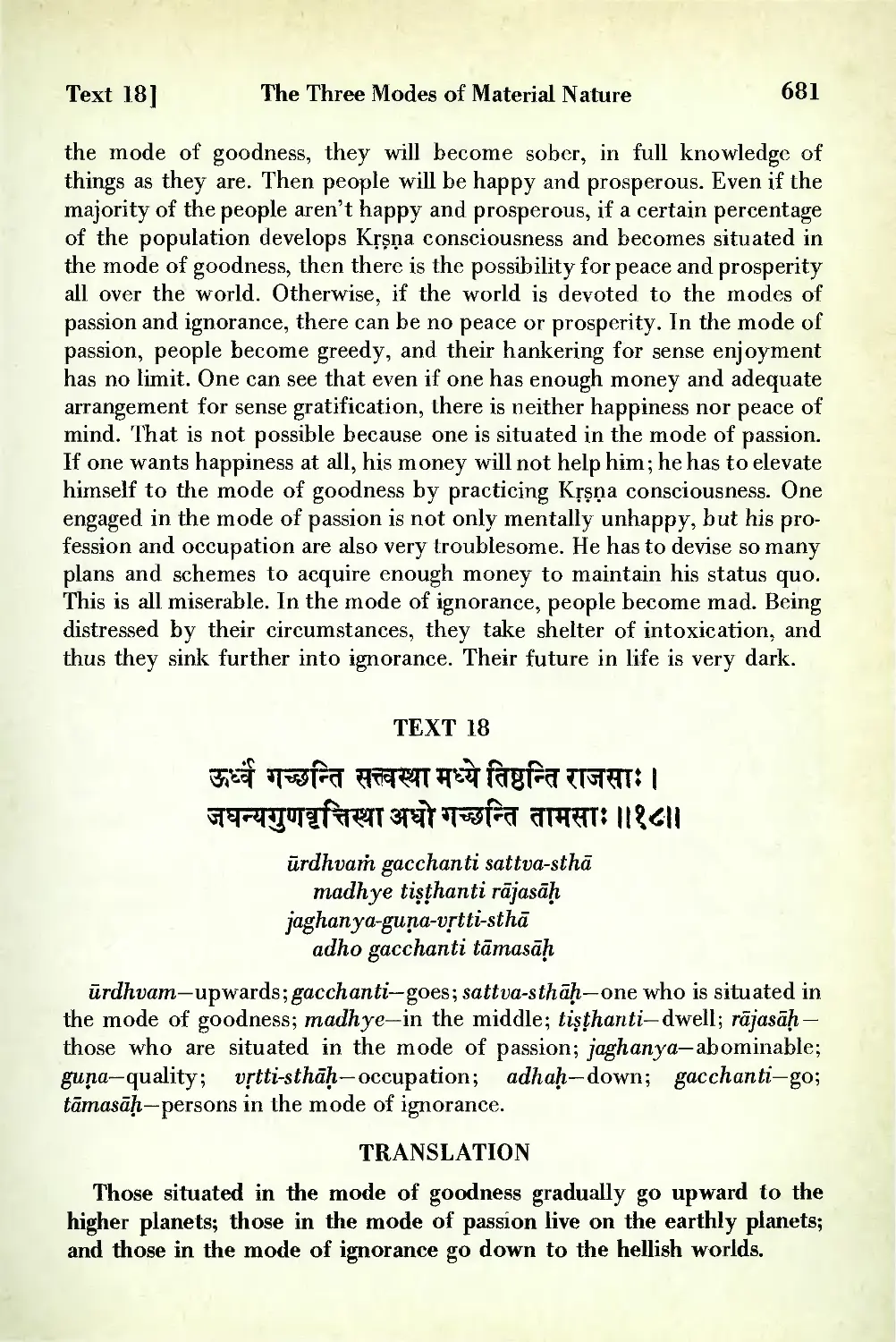
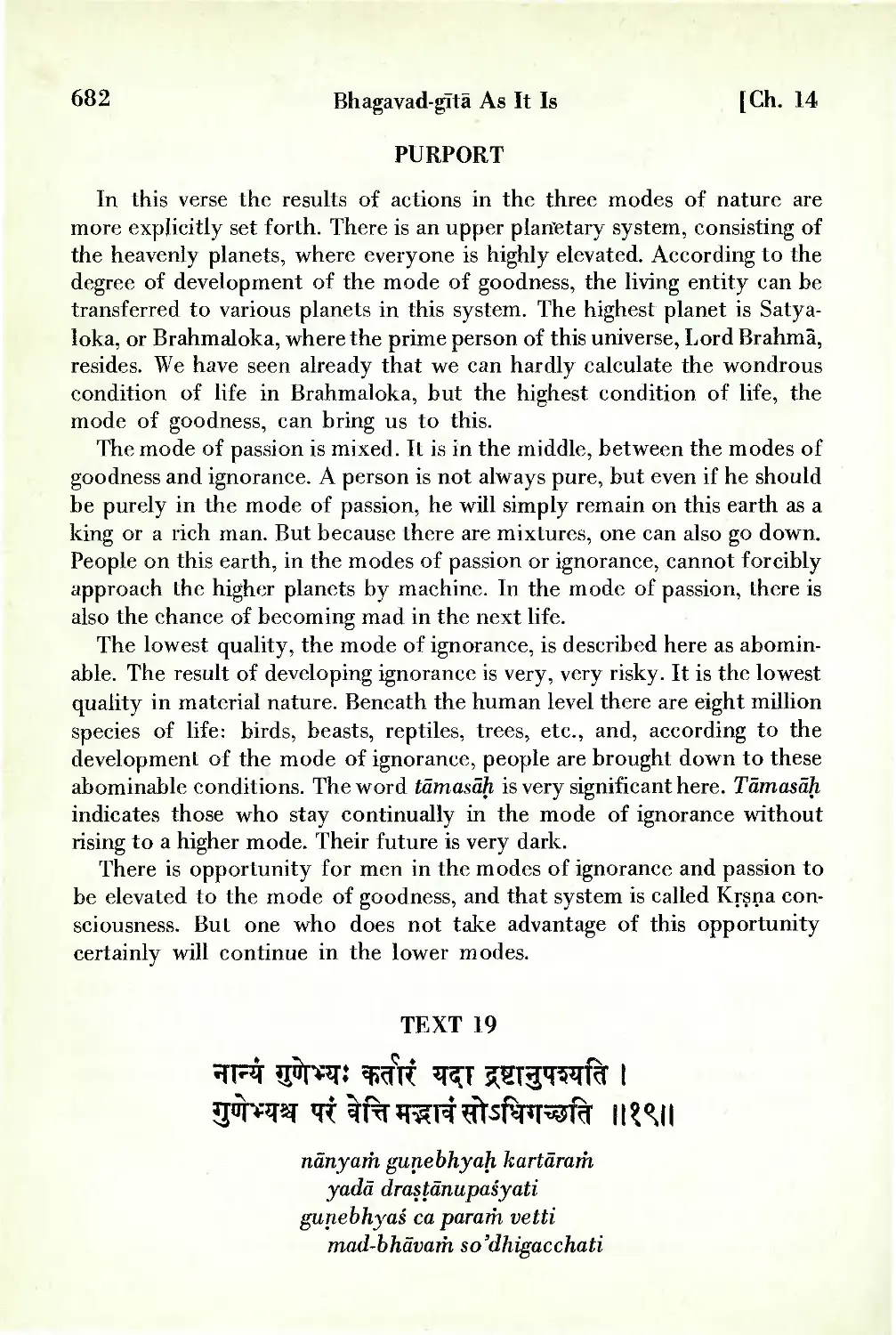

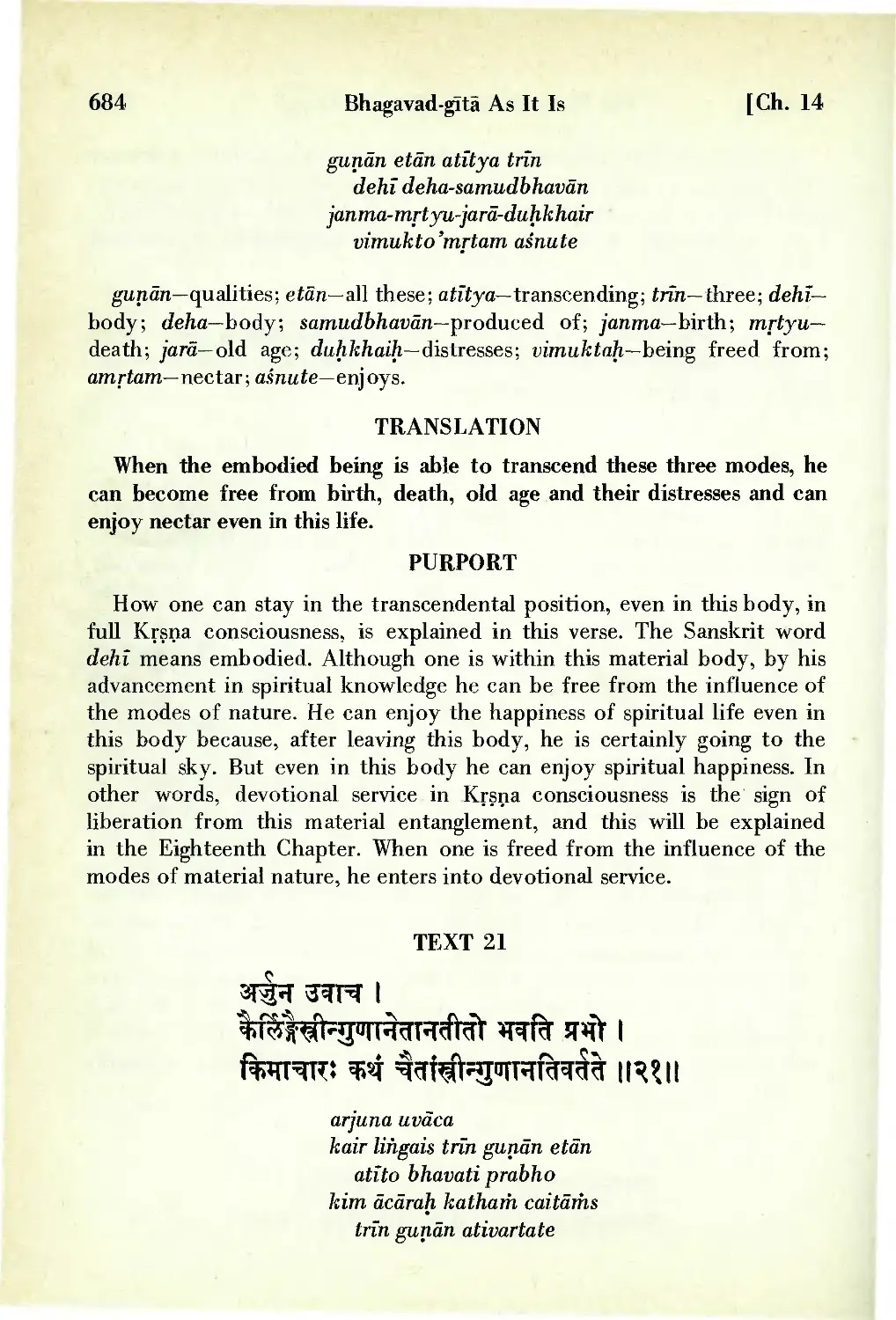


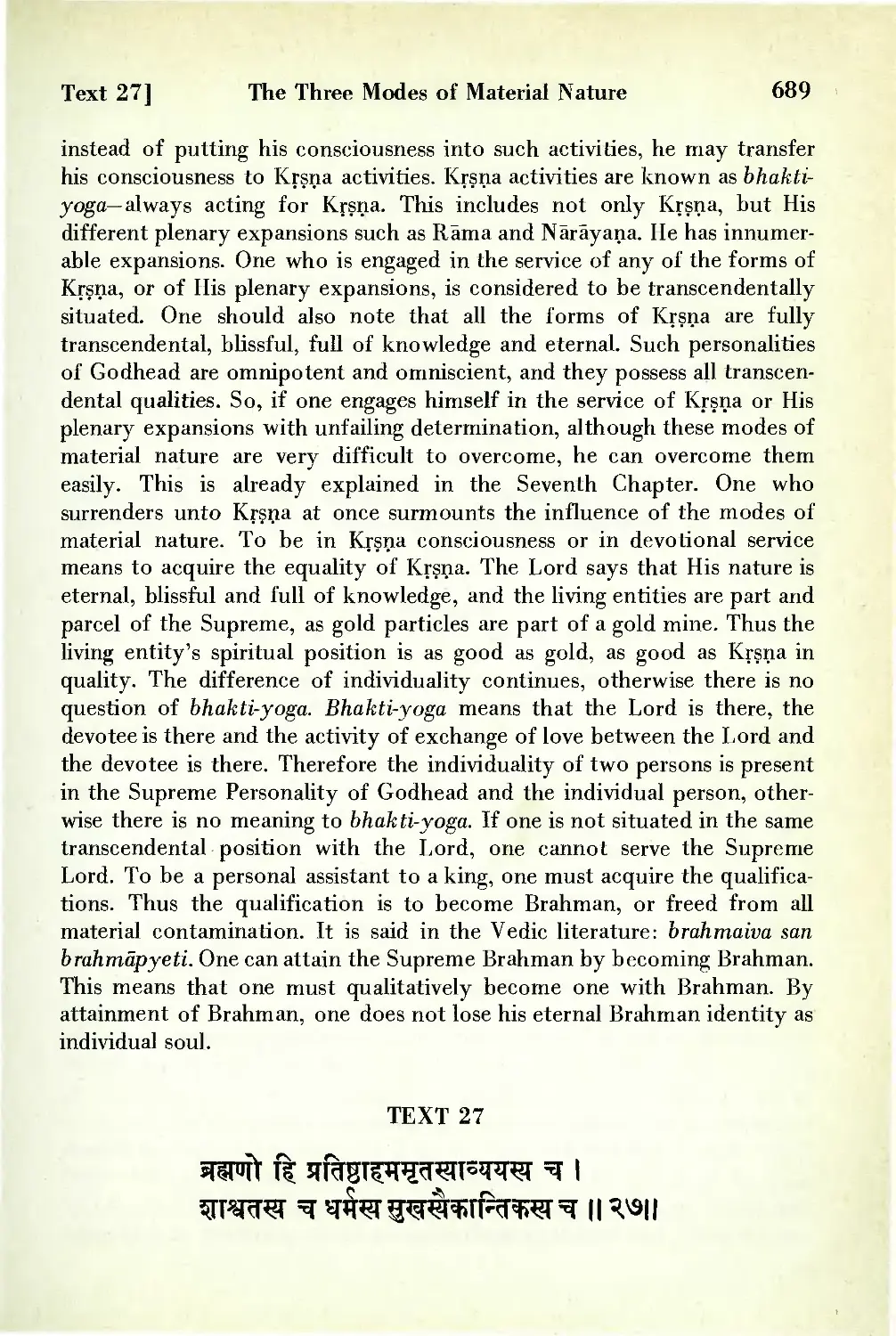




















































































Text
Bhagavadgita
OTHER BOOKS
by His Divine Grace A.C. Bbaktivedanta Swami Prabhupada
Snmad-Bhagavatam
Teachings of Lord Caitanya
Krsna, the Supreme Personality of Godhead (2 volumes)
Sri Tsopanisad
Easy Journey to Other Planets
Krsna Consciousness: The Topmost Yoga System
The Nectar of Devotion
The Krsna Consciousness Movement is the Genuine Vedic Way
Back to Godhead Magazine (Founder)
Bhagavadgita
As It Is
COMPLETE EDITION
with original Sanskrit text,
Roman transliteration, English equivalents,
translation and elaborate purports
His Divine Grace
A.C. Bhaktivedanta Swami Prabhupada
Founder-Ac ary a of the International Society for Krishna Consciousness
The Macmillan Company, New York, New York,
Collier-Macmillan Limited, London
Copyright © 1972 by His Divine Grace
A.C. Bhaktivedanta Swami Prabhupada
Readers interested in the subject matter of this
book are invited by the International Society for
Krishna Consciousness to correspond with its Secretary.
International Society for Krishna Consciousness
3764 Watseka Avenue
Los Angeles, California 90034
Library of Congress Catalog Card Number: 72-79319
A11 rights reserved. No part of this book may be reproduced or
transmitted in any form or by any means, electronic or mechanical,
including photocopying, recording or by any information storage
and retrieval system, without permission from the Publisher.
First Printing
The Macmillan Company
866 Third Avenue, New York, N.Y. 10022
Collier-Macmillan Canada Ltd., Toronto, Ontario
Printed in the United States of America
To
srTla baladeva vidyabhusana
who presented so nicely
the “Govinda-bhasya” commentary
on
Vedanta philosophy
TABLE OF CONTENTS
Foreword	ix
Preface	xi
Introduction	1
CHAPTER ONE
Observing the Armies on
the Battlefield of Kuruksetra	31
CHAPTER TWO
Contents of the Gita Summarized	71
CHAPTER THREE
Karma-yoga	161
CHAPTER FOUR
Transcendental Knowledge	213
CHAPTER FIVE
Karma-yoga
Action in Krsna Consciousness	271
CHAPTER SIX
Sankhya-yoga	307
CHAPTER SEVEN
Knowledge of the Absolute	361
CHAPTER EIGHT
Attaining the Supreme	409
CHAPTER NINE
The Most Confidential Knowledge	44*1
CHAPTER TEN
The Opulence of the Absolute	491
CHAPTER ELEVEN
The Universal Form	539
CHAPTER TWELVE
Devotional Service	595
CHAPTER THIRTEEN
Nature, the Enjoyer,
and Consciousness	619
CHAPTER FOURTEEN
The Three Modes of Material Nature	663
CHAPTER FIFTEEN
The Yoga of the Supreme Person	693
CHAPTER SIXTEEN
The Divine and Demoniac Natures	721
CHAPTER SEVENTEEN
The Divisions of Faith	751
CHAPTER EIGHTEEN
Conclusion
The Perfection of Renunciation	779
Appendixes
Picture Index	853
References	863
Glossary	865
Sanskrit Pronunciation Guide	881
Index of Sanskrit Verses	883
General Index	899
Foreword
The Bhagavad-gUa is the best known and the most frequently translated
of Vedic religious texts. Why it should be so appealing to the Western mind
is an interesting question.lt has drama, for its setting is a scene of two great
armies, banners flying, drawn up opposite one another on the field, poised
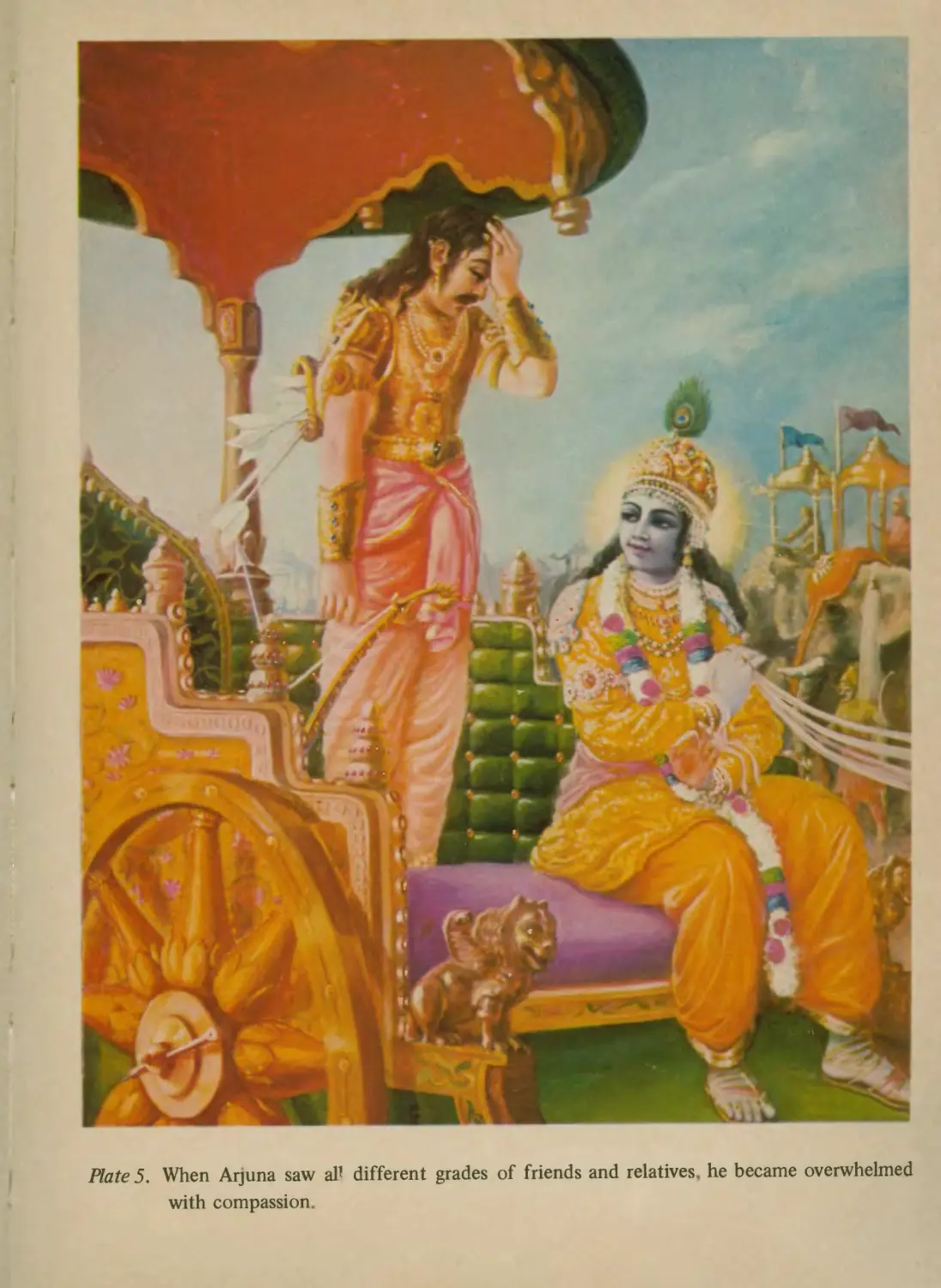
for battle. It has ambiguity, and the fact that Arjuna and his charioteer
Krsna are carrying on their dialogue between the two armies suggests the
indecision of Arjuna about the basic question: should he enter battle
against and kill those who are friends and kinsmen? It has mystery, as
Krsna demonstrates to Arjuna His cosmic form. It has a properly com-
plicated view of the ways of the religious life and treats of the paths of
knowledge, works, discipline and faith and their inter-relationships, prob-
lems that have bothered adherents of other religions in other times and
places. The devotion spoken of is a deliberate means of religious satisfaction,
not a mere outpouring of poetic emotion. Next to the Bhagavata-purdna, a
long work from South India, the Gita is the text most frequently quoted
in the philosophical writings of the Gaudiya Vaisnava school, the school
represented by Swami Bhaktivedanta as the latest in a long succession of
teachers. It can be said that this school of Vaisnavism was founded, or
revived, by Sri Krsna-Caitanya Mahaprabhu (1486-1533) in Bengal, and
that it is currently the strongest single religious force in the eastern part of
the Indian subcontinent. The Gaudiya Vaisnava school, for whom Krsna
is Himself the Supreme God, and not merely an incarnation of another
deity, sees bhakti as an immediate and powerful religious force, consisting
of love between man and God. Its discipline consists of devoting all one’s
actions to the Deity, and one listens to the stories of Krsna from the sacred
texts, one chants Krsna’s name, washes, bathes, and dresses the murti of
Krsna, feeds Him and takes the remains of the food offered to Him, thus
absorbing His grace; one does these things and many more, until one has
been changed: the devotee has become transformed into one close to
Krsna, and sees the Lord face to face.
Swami Bhaktivedanta comments upon the Gita from this point of view,
and that is legitimate. More than that, in this translation the Western
reader has the unique opportunity of seeing how a Krsna devotee interprets
his own texts. It is the Vedic exegetical tradition, justly famous, in action.
This book is then a welcome addition from many points of view. It can
serve as a valuable textbook for the college student. It allows us to listen to
ix
X
a skilled interpreter explicating a text which has profound religious mean-
ing. It gives us insights into the original and highly convincing ideas of the
Gaudiya Vaisnava school. In providing the Sanskrit in both Devanagari
and transliteration, it offers the Sanskrit specialist the opportunity
to re-interprel, or debate particular Sanskrit meanings—although I
think there will be little disagreement about the quality of the Swami’s
Sanskrit scholarship. And finally, for the nonspecialist, there is readable
English and a devotional attitude which cannot help but move the sensitive
reader. And there are the paintings, which, incredibly as it may seem to
those familiar with contemporary Indian religious art, were done by
American devotees.
The scholar, the student of Gaudiya Vaisnavism, and the increasing
number of Western readers interested in classical Vedic thought have been
done a service by Swami Bhaktivedanta. By bringing us a new and living
interpretation of a text already known to many, he has increased our
understanding manyfold; and arguments for understanding, in these days
of estrangement, need not be made.
Professor Edward C. Dimock, Jr.
Department of South Asian Languages and Civilization
University of Chicago
Preface
Originally I wrote Bhagavad-gita As It Is in the form in which it is pre-
sented now. When this book was first published, the original manuscript
was, unfortunately, cut short to less than 400 pages, without illustrations
and without explanations for most of the original verses of the Srimad
Bhagavad-gita. In all of my other books—Srimad Bhagavatam, Sri
Isopanisad, etc.—the system is that I give the original verse, its English
transliteration, word-for-word Sanskrit-English equivalents, translations
and purports. This makes the book very authentic and scholarly and makes
the meaning self-evident. I was not very happy, therefore, when I had to
minimize my original manuscript. But later on, when the demand for
Bhagavad-gita As It Is considerably increased, I was requested by many
scholars and devotees to present the book in its original form, and
Messrs. Macmillan and Co. agreed to publish the complete edition. Thus
the present attempt is to offer the original manuscript of this great book of
knowledge with full parampara explanation in order to establish the Krsna
consciousness movement more soundly and progressively.
Our Krsna consciousness movement is genuine, historically authorized,
natural and transcendental due to its being based on Bhagavad-gita As It Is.
It is gradually becoming the most popular movement in the entire world,
especially amongst the younger generation. It is becoming more and more
interesting to the older generation also. Older gentlemen are becoming
interested, so much so that the fathers and grandfathers of my disciples
are encouraging us by becoming life members of our great society, the
International Society for Krishna Consciousness. In Los Angeles many
fathers and mothers used to come to see me to express their feelings of
gratitude for my leading the Krsna consciousness movement throughout
the entire world. Some of them said that it is greatly fortunate for the
Americans that I have started the Krsna consciousness movement in
America. But actually the original father of this movement is Lord Krsna
Himself, since it was started a very long time ago but is coming down to
human society by disciplic succession. If I have any credit in this connec-
tion, it does not belong to me personally, but it is due to my eternal
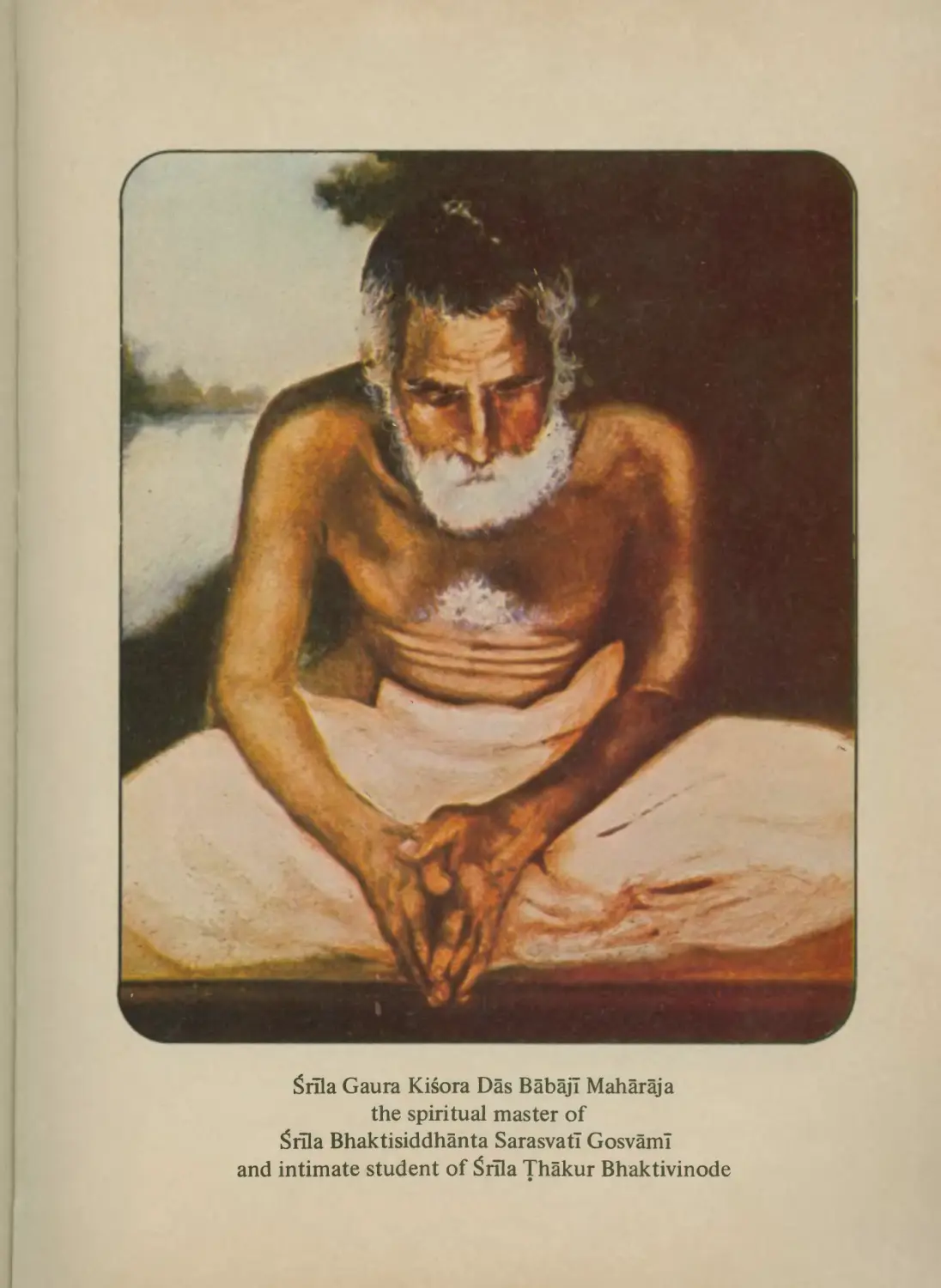
spiritual master, His Divine Grace Om Visnupada Paramahamsa Parivra-
jakacarya 108 Sri Srimad Bhaktisiddhanta Sarasvatl Gosvami Maharaja
Prabhupada.
xi
хи
Bhagavad-gita As It Is
If personally I have any credit in this matter, it is only that I have tried
to present Bhagavad-gita as it is, without adulteration. Before my presen-
tation of Bhagavad-gita As It Is, almost all the English editions of Bhagavad-
gita were introduced to fulfill someone’s personal ambition. But our
attempt, in presenting Bhagavad-gita As It Is, is to present the mission of
the Supreme Personality of Godhead, Krsna. Our business is to present
the will of Krsna, not that of any mundane speculator like the politician,
philosopher or scientist, for they have very little knowledge of Krsna,
despite all their other knowledge. When Krsna says, man-mana bhava mad-
bhakto mad-yaji mam namaskuru, etc., we, unlike the so-called scholars,
do not say that Krsna and His inner spirit are different. Krsna is absolute,
and there is no difference between Krsna’s name, Krsna’s form, Krsna’s
quality, Krsna’s pastimes, etc. This absolute position of Krsna is difficult
to understand for any person who is not a devotee of Krsna in the param-
para (disciplic succession) system. Generally the so-called scholars, politi-
cians, philosophers, and svamis, without perfect knowledge of Krsna, try
to banish or kill Krsna when writing commentary on Bhagavad-gita. Such
unauthorized commentary upon Bhagavad-gita is known as Mayavadi-
Bhasya, and Lord Caitanya has warned us about these unauthorized men.
Lord Caitanya clearly says that anyone who tries to understand Bhagavad-
gita from the Mayavadl point of view will commit a great blunder. The
result of such a blunder will be that the misguided student of Bhagavad-
gita will certainly be bewildered on the path of spiritual guidance and will
not be able to go back home, back to Godhead.
Our only purpose is to present this Bhagavad-gita As It Is in order to
guide the conditioned student to the same purpose for which Krsna de-
scends to this planet once in a day of Brahma, or every 8,600,000,000
years. This purpose is stated in Bhagavad-gita, and we have to accept it as
it is; otherwise there is no point in trying to understand the Bhagavad-gita
and its speaker, Lord Krsna. Lord Krsna first spoke Bhagavad-gita to the
sun-god some hundreds of millions of years ago. We have to accept this
fact and thus understand the historical significance of Bhagavad-gita, with-
out misinterpretation, on the authority of Krsna. To interpret Bhagavad-
gita without any reference to the will of Krsna is the greatest offense. In
order to save oneself from this offense, one has to understand the Lord as
the Supreme Personality of Godhead, as He was directly understood by
Arjuna, Lord Krsna’s first disciple. Such understanding of Bhagavad-gita
is really profitable and authorized for the welfare of human society in ful-
filling the mission of life.
The Krsna consciousness movement is essential in human society, for it
offers the highest perfection of life. How this is so is explained fully in the
Preface
хт
Bhagavad-gita. Unfortunately, mundane wranglers have taken advantage of
Bhagavad-gita to push forward their demonic propensities and mislead
people regarding right understanding of the simple principles of life. Every-
one should know how God or Krsna is great, and everyone should know
the factual position of the living entities. Everyone should know that a liv-
ing entity is eternally a servant and that unless one serves Krsna one has
to serve illusion in different varieties of the three modes of material nature,
and thus perpetually one has to wander within the cycle of birth and
death; even the so-called liberated Mayavadi speculator has to undergo
this process. This knowledge constitutes a great science, and each and every
living being has to hear it for his own interest.
People in general, especially in this age of Kali, are enamored by the
external energy of Kr§na, and they wrongly think that by advancement of
material comforts every man will be happy, They have no knowledge that
the material or external nature is very strong, for everyone is strongly
bound by the stringent laws of material nature. A living entity is happily
the part and parcel of the Lord, and thus his natural function is to render
immediate service to the Lord. By the spell of illusion one tries to be
happy by serving his personal sense gratification in different forms which
will never make him happy. Instead of satisfying his own personal material
senses, he has to satisfy the senses of the Lord. That is the highest perfec-
tion of life. The Lord wants this, and He demands it. One has to under-
stand this central point of Bhagavad-gita. Our Krsna consciousness move-
ment is teaching the whole world this central point, and because we are
not polluting the theme of Bhagavad-gita As It Is, anyone seriously inter-
ested in deriving benefit by studying the Bhagavad-gita must take help
from the Krsna consciousness movement for practical understanding of
Bhagavad-gita under the direct guidance of the Lord. We hope, therefore,
that people will derive the greatest benefit by studying Bhagavad-gita
As It Is as we have presented it here, and if even one man becomes a pure
devotee of the Lord we shall consider our attempt a success.
A.C. Bhaktivedanta Swami
12 May 1971
Sydney, Australia
Bhagavad-gita As It Is
INTRODUCTION
от ajnana-timimndhasya jnananjana-salakaya
caksur unmilitam yena tasmai sri-gurave namah
sri-caitanya-mano ’bhistam sthapitam yena bhu-tale
svayam riipah kada mahyam daddti sva-padantikam
I was born in the darkest ignorance, and my spiritual master opened my
eyes with the torch of knowledge. I offer my respectful obeisances unto
him.
When will Srila Riipa Gosvami Prabhupada, who has established within
this material world the mission to fulfill the desire of Lord Caitanya, give
me shelter under his lotus feet?
vande кат sri-guroh sri-yuta-pada-kamalam sri-gurun vaisnavams ca
sri-rilpam sagrajatam saha-gana-raghunathanvitam tarn sa-jivam
sadvaitam savadhiitam parijana-sahitam krsna-caitanya-devam
sri-radha-krsna-padan saha-gana-lalita-sn-visakhanvitams ca
I offer my respectful obeisances unto the lotus feet of my spiritual master
and unto the feet of all Vaisnavas. I offer my respectful obeisances unto
the lotus feet of Srila Riipa Gosvami along with his elder brother Sanatana
Gosvami, as well as Raghunatha Dasa and Raghunatha Bhatta, Gopala
Bhatta, and Srila Jiva Gosvami. I offer my respectful obeisances to Lord
Krsna Caitanya and Lord Nityananda along with Advaita Acarya,
1
2
Bhagavad-gita As It Is
Gadadhara, Srivasa, and other associates. I offer my respectful obeisances
to SrimatT Radharam and Sn Krsna along with Their associates, Йп Lalita
and Visakha.
he krsna karuna-sindho dina-bandho jagat-pate
gopesa gopika-kanta radha-kanta name ’stu te
О my dear Krsna, You are the friend of the distressed and the source of
creation. You are the master of the gopls and the lover of Radharam. I
offer my respectful obeisances unto You.
tapta-kancana-gaurangi radhe vrndavanesvari
vrsabhanu-sute devi pranamami hari-priye
I offer my respects to Radharam whose bodily complexion is like molten
gold and who is the Queen of Vrndavana. You are the daughter of King
Vrsabhanu, and You are very dear to Lord Krsna.
vancha-kalpatarubhyas ca krpa-sindhubhya eva ca
patitanam pavanebhyo vaisnavebhyo name namah
I offer my respectful obeisances unto all the Vaisnava devotees of the Lord
who can fulfill the desires of everyone, just like desire trees, and who are
full of compassion for the fallen souls.
sri krsna caitanya prabhu nityananda
sri advaita gadadhara srivasadi-gaura-Jyhakta-vrnda
I offer my obeisances to Sn Krsna Caitanya, Prabhu Nityananda, Sn
Advaita, Gadadhara, Sfivasa and all others in the line of devotion.
hare krsna, hare krsna, krsna krsna, hare hare
hare rama, hare rama, rama rama, hare hare.
Introduction
3
Bhagavad-gita is also known as Gitopanisad. It is the essence of Vedic
knowledge and one of the most important Upanisads in Vedic literature.
Of course there are many commentaries in English on the Bhagavad-gita,
and one may question the necessity for another one. This present edition
can be explained in the following way. Recently an American lady asked
me to recommend an English translation of Bhagavad-gita. Of course in
America there are so many editions of Bhagavad-gita available in English,
but as far as I have seen, not only in America but also in India, none of
them can be strictly said to be authoritative because in almost every one
of them the commentator has expressed his own opinions without touch-
ing the spirit of Bhagavad-gita as it is.
The spirit of Bhagavad-gita is mentioned in Bhagavad-gita itself. It is
just like this: if we want to take a particular medicine, then we have to
follow the directions written on the label. We cannot take the medicine
according to our own whim or the direction of a friend. It must be taken
according to the directions on the label or the directions given by a
physician. Similarly, Bhagavad-gita should be taken or accepted as it is
directed by the speaker himself. The speaker of Bhagavad-gita is Lord Sri
Krsna. He is mentioned on every page of Bhagavad-gita as the Supreme
Personality of Godhead, Bhagavan. Of course the word “bhagavan” some-
times refers to any powerful person or any powerful demigod, and certain-
ly here Bhagavan designates Lord Sri Krsna as a great personality, but at the
same time we should know that Lord Sri Krsna is the Supreme Personality
of Godhead, as is confirmed by all great acaryas (spiritual masters) like
Sankaracarya, Ramanujacarya, Madhvacarya,NimbarkaSvami, Sri Caitanya
Mahaprabhu and many other authorities of Vedic knowledge in India.
The Lord Himself also establishes Himself as the Supreme Personality of
Godhead in the Bhagavad-gita, and He is accepted as such in the Brahma-
samhita and all the Puranas, especially the Srimad-Bhagavatam, known as
the Bhagavata Parana (Krsnas tu bhagavan svayam). Therefore we should
take Bhagavad-gita as it is directed by the Personality of Godhead Himself.
In the Fourth Chapter of the Gita the Lord says:
(1)	imam vivasvate у ogam proktavan aham avyayam
vivasvan manave praha manur iksvakave ’bravit
(2)	evam parampara-praptam imam rajarsayo viduh
sa kaleneha mahata yogo nastah parantapa
(3)	sa evayam maya te ’dya yogah proktah puratanah
bhakto ’si me sakha ceti rahasyam hy etad uttamam
4
Bhagavad-gita As It Is
Here the Lord informs Arjuna that this system of yoga, the Bhagavad-
gita, was first spoken to the sun-god, and the sun-god explained it to Manu,
and Manu explained it to Iksvaku, and in that way, by disciplic succession,
one speaker after another, this yoga system has been coming down. But
in the course of time it has become lost. Consequently the Lord has to
speak it again, this time to Aijuna on the Battlefield of Kuruksetra.
He tells Arjuna that He is relating this supreme secret to him because he
is His devotee and His friend. The purport of this is that Bhagavad-gita is
a treatise which is especially meant for the devotee of the Lord. There
are three classes of transcendentalists, namely the jhani, the yogi and the
bhakta, or the impersonalist, the meditator and the devotee. Here the
Lord clearly tells Arjuna that He is making him the first receiver of a new
parampara (disciplic succession) because the old succession was broken.
It was the Lord’s wish, therefore, to establish another parampara in the
same line of thought that was coming down from the sun-god to others,
and it was His wish that His teaching be distributed anew by Aijuna. He
wanted Arjuna to become the authority in understanding the Bhagavad-
gita. So we see that Bhagavad-gita is instructed to Arjuna especially because
Aijuna was a devotee of the Lord, a direct student of Krsna, and His
intimate friend. Therefore Bhagavad-gita is best understood by a person
who has qualities similar to Aijuna’s. That is to say he must be a devotee
in a direct relationship with the Lord. As soon as one becomes a devotee
of the Lord, he also has a direct relationship with the Lord. That is a
very elaborate subject matter, but briefly it can be stated that a devotee
is in a relationship with the Supreme Personality of Godhead in one of
five different ways:
1.	One may be a devotee in a passive state;
2.	One may be a devotee in an active state;
3.	One may be a devotee as a friend;
4.	One may be a devotee as a parent;
5.	One may be a devotee as a conjugal lover.
Arjuna was in a relationship with the Lord as friend. Of course there is
a gulf of difference between this friendship and the friendship found in
the material world. This is transcendental friendship which cannot be had
by everyone. Of course everyone has a particular relationship with the
Lord, and that relationship is evoked by the perfection of devotional
service. But in the present status of our life, we have not only forgotten
the Supreme Lord, but we have forgotten our eternal relationship with
Introduction
5
the Lord. Every living being, out of many, many billions and trillions of
living beings, has a particular relationship with the Lord eternally. That is
called svarupa. By the process of devotional service, one can revive that
svarupa, and that stage is called svarupa-siddhi— perfection of one’s con-
stitutional position. So Arjuna was a devotee, and he was in touch with
the Supreme Lord in friendship.
How Arjuna accepted this Bhagavad-gita should be noted. His manner
of acceptance is given in the Tenth Chapter.
(12)	arjuna uvaca
param brahma param dhama pavitram paramam bhavan
purusam sasvatam divyam adi-devam ajam vibhum
(13)	ahus tvam rsayah sarve devarsir naradas tatha
asito devalo vyasah svayam caiva bravisi me
(14)	sarvam etad rtam manye yan mam vadasi kesava
na hi te bhagavan vyaktim vidur deva na danavah
“Arjuna said: You are the Supreme Brahman, the ultimate, the supreme
abode and purifier, the Absolute Truth and the eternal Divine Person.
You are the primal God, transcendental and original, and You are the
unborn and all-pervading beauty. All the great sages like Narada, Asita,
Devala, and Vyasa proclaim this of You, and now You Yourself are
declaring it to me. О Krsna, 1 totally accept as truth all that You have told
me. Neither the gods nor demons, О Lord, know Thy personality.” (Bg.
10.12-14).
After hearing Bhagavad-gita from the Supreme Personality of Godhead,
Arjuna accepted Krsna as Param Brahma, the Supreme Brahman. Every
living being is Brahman, but the supreme living being, or the Supreme
Personality of Godhead, is the Supreme Brahman. Param dhama means
that He is the supreme rest or abode of everything, pavitram means that
He is pure, untainted by material contamination, purusam means that He
is the supreme enjoyer, divyam, transcendental, adi-devam, the Supreme
Personality of Godhead, ajam, the unborn, and vibhum, the greatest, the
all-pervading.
Now one may think that because Krsna was the friend of Arjuna,
Arjuna was telling Him all this by way of flattery, but Arjuna, just to
drive out this kind of doubt from the minds of the readers of Bhagavad-
gita, substantiates these praises in the next verse when he says that Krsna
6
Bhagavad-gita As It Is
is accepted as the Supreme Personality of Godhead not only by himself
but by authorities like the sage Narada, Asita, Devala, Vyasadeva and so
on. These are great personalities who distribute the Vedic knowledge as it
is accepted by all acaryas. Therefore Aijuna tells Krsna that he accepts
whatever He says to be completely perfect. Sarvam etad rtam manye: “I
accept everything You say to be true.” Arjuna also says that the personality
of the Lord is very difficult to understand and that He cannot be known
even by the great demigods. This means that the Lord cannot even be
known by personalities greater than human beings. So how can a human
being understand Sri Krsna without becoming His devotee?
Therefore Bhagavad-gita should be taken up in a spirit of devotion. One
should not think that he is equal to Krsna, nor should he think that Krsna
is an ordinary personality or even a very great personality. Lord Sri Krsna
is the Supreme Personality of Godhead, at least theoretically, according to
the statements of Bhagavad-gita or the statements of Arjuna, the person
who is trying to understand the Bhagavad-gita. We should therefore at
least theoretically accept Sri Krsna as the Supreme Personality of Godhead,
and with that submissive spirit we can understand the Bhagavad-gita.
Unless one reads the Bhagavad-gita in a submissive spirit, it is very difficult
to understand Bhagavad-gita because it is a great mystery.
Just what is the Bhagavad-gita? The purpose of Bhagavad-gita is to deliver
mankind from the nescience of material existence. Every man is in difficulty
in so many ways, as Arjuna also was in difficulty in having to fight the
Battle of Kuruksetra. Aijuna surrendered unto Sri Krsna, and consequently
this Bhagavad-gita was spoken. Not only Arjuna, but every one of us is full
of anxieties because of this material existence. Our very existence is in the
atmosphere of nonexistence. Actually we are not meant to be threatened
by nonexistence. Our existence is eternal. But somehow or other we are
put into asat. Asat refers to that which does not exist.
Out of so many human beings who are suffering, there are a few who are
actually inquiring about their position, as to what they are, why they are
put into this awkward position and so on. Unless one is awakened to this
position of questioning his suffering, unless he realizes that he doesn’t
want suffering but rather wants to make a solution to all sufferings, then
one is not to be considered a perfect human being. Humanity begins
when this sort of inquiry is awakened in one’s mind. In the Brahma-siltra
this inquiry is called “brahma-jijjnasa.’’ Every activity of the human being
is to be considered a failure unless he inquires about the nature of the
Absolute. Therefore those who begin to question why they are suffering
or where they came from and where they shall go after death are proper
Introduction
7
students for understanding Bhagavad-gita. The sincere student should also
have a firm respect for the Supreme Personality of Godhead. Such a
student was Aijuna.
Lord Krsna descends specifically to reestablish the real purpose
of life when man forgets that purpose. Even then, out of many, many
human beings who awaken, there may be one who actually enters
the spirit of understanding his position, and for him this Bhagavad-
gita is spoken. Actually we are all followed by the tiger of nescience,
but the Lord is very merciful upon living entities, especially human
beings. To this end He spoke the Bhagavad-gita, making His friend
Aijuna His student.
Being an associate of Lord Krsna, Aijuna was above all ignorance, but
Aijuna was put into ignorance on the Battlefield of Kuruksetra just to
question Lord Krsna about the problems of life so that the Lord could
explain them for the benefit of future generations of human beings and
chalk out the plan of life. Then man could act accordingly and perfect the
mission of human life.
The subject of the Bhagavad-gita entails the comprehension of five
basic truths. First of all, the science of God is explained and then the
constitutional position of the living entities, jivas. There is isvara, which
means controller, and there are jivas, the living entities which are controlled.
If a living entity says that he is not controlled but that he is free, then he
is insane. The living being is controlled in every respect, at least in his
conditioned life. So in the Bhagavad-gita the subject matter deals with the
isvara, the supreme controller, and the jivas, the controlled living entities.
Prakrti (material nature) and time (the duration of existence of the whole
universe or the manifestation of material nature) and karma (activity) are
also discussed. The cosmic manifestation is full of different activities.
All living entities are engaged in different activities. From Bhagavad-gita we
must learn what God is, what the living entities are, whatprakrti is, what
the cosmic manifestation is and how it is controlled by time, and what the
activities of the living entities are.
Out of these five basic subject matters in Bhagavad-gita it is established
that the Supreme Godhead, or Krsna, or Brahman, or supreme controller,
or Paramatma—you may use whatever name you like—is the greatest of all.
The living beings are in-quality like the supreme controller. For instance,
the Lord has control over the universal affairs, over material nature, etc.,
as will be explained in the later chapters of Bhagavad-gita. Material nature
is not independent. She is acting under the directions of the Supreme Lord.
As Lord Krsna says, '‘‘Prakrti is working under My direction.” When we see
8
Bhagavad-gita As It Is
wonderful things happening in the cosmic nature, we should know that
behind this cosmic manifestation there is a controller. Nothing could be
manifested without being controlled. It is childish not to consider the
controller. For instance, a child may think that an automobile is quite
wonderful to be able to run without a horse or other animal pulling it,
but a sane man knows the nature of the automobile’s engineering arrange-
ment. He always knows that behind the machinery there is a man, a driver.
Similarly, the Supreme Lord is a driver under whose direction everything
is working. Now the Jivas, or the living entities, have been accepted by the
Lord, as we will note in the later chapters, as His parts and parcels. A
particle of gold is also gold, a drop of water from the ocean is also salty,
and similarly, we the living entities, being part and parcel of the supreme
controller, is vara, or Bhagavan, Lord Sri Krsna, have all the qualities of the
Supreme Lord in minute quantity because we are minute isvaras, sub-
ordinate isvaras. We are trying to control nature, as presently we are trying
to control space or planets, and this tendency to control is there because
it is in Krsna. But although we have a tendency to lord it over material
nature, we should know that we are not the supreme controller. This is
explained in Bhagavad-gita.
What is material nature? This is also explained in Gita as inferior
prakrti, inferior nature. The living entity is explained as the superior
prakrti. Prakrti is always under control, whether inferior or superior.
Prakrti is female, and she is controlled by the Lord just as the activities of
a wife are controlled by the husband. Prakrti is always subordinate,
predominated by the Lord, who is the predominator. The living entities
and material nature are both predominated, controlled by the Supreme
Lord. According to the Gita, the living entities, although parts and parcels
of the Supreme Lord, are to be considered prakrti. This is clearly mentioned
in the Seventh Chapter, fifth verse of Bhagavad-gita: “Apareyam itas tv
anyam.” “This prakrti is My lower nature.” “Prakrtim viddhi me param
jiva-bhutam maha-baho yayedam dharyate jagat.” And beyond this there
is another prakrti: jiva-bhutam, the living entity.
Prakrti itself is constituted by three qualities: the mode of goodness, the
mode of passion and the mode of ignorance. Above these modes there is
eternal time, and by a combination of these modes of nature and under
the control and purview of eternal time there are activities which are called
karma. These activities are being carried out from time immemorial, and
we are suffering or enjoying the fruits of our activities. For instance,
suppose I am a businessman and have worked very hard with intelligence
and have amassed a great bank balance. Then I am an enjoyer. But then
Introduction
9
say I have lost all my money in business; then I am a sufferer. Similarly, in
every field of life we enjoy the results of our work, or we suffer the results.
This is called karma.
Tsvara (the Supreme Lord), jiva (the living entity), prakrti (nature),
eternal time and karma (activity) are all explained in the Bhagavad-gita.
Out of these five, the Lord, the living entities, material nature and time
are eternal. The manifestation of prakrti may be temporary, but it is not
false. Some philosophers say that the manifestation of material nature is
false, but according to the philosophy of Bhagavad-gita or according
to the philosophy of the Vaisnavas, this is not so. The manifestation of the
world is not accepted as false; it is accepted as real, but temporary. It is
likened unto a cloud which moves across the sky, or the coming of the
rainy season which nourishes grains. As soon as the rainy season is over
and as soon as the cloud goes away, all the crops which were nourished by
the rain dry up. Similarly, this material manifestation takes place at a certain
interval, stays for a while and then disappears. Such are the workings of
prakrti. But this cycle is working eternally. Therefore prakrti is eternal;
it is not false. The Lord refers to this as “My prakrti.” This material
nature is the separated energy of the Supreme Lord, and similarly the
living entities are also the energy of the Supreme Lord, but they are not
separated. They are eternally related. So the Lord, the living entity,
material nature and time are all interrelated and are all eternal. However,
the other item, karma, is not eternal. The effects of karma may be very old
indeed. We are suffering or enjoying the results of our activities from time
immemorial, but we can change the results of our karma, or our activity,
and this change depends on the perfection of our knowledge. We are
engaged in various activities. Undoubtedly we do not know what sort of
activities we should adopt to gain relief from the actions and reactions of
all these activities, but this is also explained in the Bhagavad-gita.
The position of isvara is that of supreme consciousness. The jivas, or the
living entities, being parts and parcels of the Supreme Lord, are also
conscious. Both the living entity and material nature are explained as
prakrti, the energy of the Supreme Lord, but one of the two, the jiva, is
conscious. The other prakrti is not conscious. That is the difference.
Therefore the jiva-prakrti is called superior because the jiva has conscious-
ness which is similar to the Lord’s. The Lord’s is supreme consciousness,
however, and one should not claim that the jiva, the living entity, is also
supremely conscious. The living being cannot be supremely conscious at
any stage of his perfection, and the theory that he can be so is a misleading
theory. Conscious he may be, but he is not perfectly or supremely conscious.
10
Bhagavad-gita As It Is
The distinction between the jiva and the isvara will be explained in the
Thirteenth Chapter of Bhagavad-gita. The Lord is ksetra-jnah, conscious,
as is the living being, but the living being is conscious of his particular body,
whereas the Lord is conscious of all bodies. Because He lives in the heart of
every living being, He is conscious of the psychic movements of the
particular jivas. We should not forget this. It is also explained that the
Paramatma, the Supreme Personality of Godhead, is living in everyone’s
heart as isvara, as the controller, and that He is giving directions for the
living entity to act as he desires. The living entity forgets what to do. First
of all he makes a determination to act in a certain way, and then he is
entangled in the acts and reactions of his own karma. After giving up one
type of body, he enters another type of body, as we put on and take off
old clothes. As the soul thus migrates, he suffers the actions and reactions
of his past activities. These activities can be changed when the living being
is in the mode of goodness, in sanity, and understands what sort of ac-
tivities he should adopt. If he does so, then all the actions and reactions of
his past activities can be changed. Consequently, karma is not eternal.
Therefore we stated that of the five items (isvara, jiva, prakrti, time and
karma) four are eternal, whereas karma is not eternal.
The supreme conscious isvara is similar to the living entity in this way:
both the consciousness of the Lord and that of the living entity are tran-
scendental. It is not that consciousness is generated by the association of
matter. That is a mistaken idea. The theory that consciousness develops
under certain circumstances of material combination is not accepted in
the Bhagavad-gita. Consciousness may be pervertedly reflected by the
covering of material circumstances, just as light reflected through colored
glass may appear to be a certain color, but the consciousness of the Lord is
not materially affected. Lord Krsna says, “mayadhyaksena prakrtih.” When
He descends into the material universe, His consciousness is not materially
affected. If He were so affected, He would be unfit to speak on transcen-
dental matters as He does in the Bhagavad-gita. One cannot say anything
about the transcendental world without being free from materially con-
taminated consciousness. So the Lord is not materially contaminated. Our
consciousness, at the present moment, however, is materially contami-
nated. The Bhagavad-gita teaches that we have to purify this materially
contaminated consciousness. In pure consciousness, our actions will be
dovetailed to the will of isvara, and that will make us happy. It is not that
we have to cease all activities. Rather, our activities are to be purified, and
purified activities are called bhakti. Activities in bhakti appear to be like
ordinary activities, but they are not contaminated. An ignorant person
Introduction
11
may see that a devotee is acting or working like an ordinary man, but
such a person with a poor fund of knowledge does not know that the
activities of the devotee or of the Lord are not contaminated by impure
consciousness or matter. They are transcendental to the three modes of
nature. We should know, however, that at this point our consciousness is
contaminated.
When we are materially contaminated, we are called conditioned. False
consciousness is exhibited under the impression that I am a product of
material nature. This is called false ego. One who is absorbed in the
thought of bodily conceptions cannot understand his situation. Bhagavad-
gita was spoken to liberate one from the bodily conception of life, and
Arjuna put himself in this position in order to receive this information
from the Lord. One must become free from the bodily conception of life;
that is the preliminary activity for the transcendentalist. One who wants
to become free, who wants to become liberated, must first of all learn that
he is not this material body. Mukti or liberation means freedom from
material consciousness. In the Srimad-Bhagavatam also the definition of
liberation is given: Mukti means liberation from the contaminated con-
sciousness of this material world and situation in pure consciousness.
All the instructions of Bhagavad-gita are intended to awaken this pure
consciousness, and therefore we find at the last stage of the Gita’s
instructions that Krsna is asking Arjuna whether he is now in purified
consciousness. Purified consciousness means acting in accordance with the
instructions of the Lord. This is the whole sum and substance of purified
consciousness. Consciousness is already there because we are part and
parcel of the Lord, but for us there is the affinity of being affected by the
inferior modes. But the Lord, being the Supreme, is never affected.
That is the difference between the Supreme Lord and the conditioned
souls.
What is this consciousness? This consciousness is “I am.” Then what am
I? In contaminated consciousness “I am” means “I am the lord of all I sur-
vey. I am the enjoyer.” The world revolves because every living being thinks
that he is the lord and creator of the material world. Material consciousness
has two psychic divisions. One is that I am the creator, and the other is
that I am the enjoyer. But actually the Supreme Lord is both the creator
and the enjoyer, and the living entity, being part and parcel of the Supreme
Lord, is neither the creator nor the enjoyer, but a cooperator. He is the
created and the enjoyed. For instance, a part of a machine cooperates with
the whole machine; a part of the body cooperates with the whole body.
The hands, feet, eyes, legs and so on are all parts of the body, but they
12
Bhagavad-gita As It Is
are not actually the enjoyers. The stomach is the enjoyer. The legs move,
the hands supply food, the teeth chew and all parts of the body are engaged
in satisfying the stomach because the stomach is the principal factor that
nourishes the body’s organization. Therefore everything is given to the
stomach. One nourishes the tree by watering its root, and one nourishes
the body by feeding the stomach, for if the body is to be kept in a healthy
state, then the parts of the body must cooperate to feed the stomach.
Similarly, the Supreme Lord is the enjoyer and the creator, and we, as
subordinate living beings, are meant to cooperate to satisfy Him. This
cooperation will actually help us, just as food taken by the stomach will
help all other parts of the body. If the fingers of the hand think that they
should take the food themselves instead of giving it to the stomach, then
they will be frustrated. The central figure of creation and of enj oyment is
the Supreme Lord, and the living entities are cooperators. By cooperation
they enjoy. The relation is also like that of the master and the servant. If
the master is fully satisfied, then the servant is satisfied. Similarly, the
Supreme Lord should be satisfied, although the tendency to become the
creator and the tendency to enjoy the material world are there also in
the living entities because these tendencies are there in the Supreme Lord
who has created the manifested cosmic world.
We shall find, therefore, in this Bhagavad-gita that the complete whole is
comprised of the supreme controller, the controlled living entities, the cos-
mic manifestation, eternal time, and karma, or activities, and all of these are
explained in this text. All of these taken completely form the complete
whole, and the complete whole is called the Supreme Absolute Truth.
The complete whole and the complete Absolute Truth are the Supreme
Personality of Godhead, Sri Krsna. All manifestations are due to His
different energies. He is the complete whole.
It is also explained in the Gita that impersonal Brahman is also sub-
ordinate to the complete. Brahman is more explicitly explained in the
Brahma-sutra to be like the rays of the sunshine. The impersonal
Brahman is the shining rays of the Supreme Personality of Godhead.
Impersonal Brahman is incomplete realization of the absolute whole, and
so also is the conception of Paramatma in the Twelfth Chapter. There it
shall be seen that the Supreme Personality of Godhead, Purusottama, is
above both impersonal Brahman and the partial realization of Paramatma.
The Supreme Personality of Godhead is called sac-cid-ananda-vigraha. The
Brahma-saihhita begins in this way: isvarah paramah krsnah sac-cid-ananda-
vigrahah/anadir adirgovindah sarva karana-karanam. “Krsna is the cause of
all causes. He is the primal cause, and He is the very form of eternal
Introduction
13
being, knowledge and bliss.” Impersonal Brahman realization is the
realization of His sat (being) feature. Paramatma realization is the
realization of the cit (eternal knowledge) feature. But realization of
the Personality of Godhead, Krsna, is realization of all the transcenden-
tal features: sat, cit and ananda (being, knowledge, bliss) in complete
vigraha (form).
People with less intelligence consider the Supreme Truth to be imper-
sonal, but He is a transcendental person, and this is confirmed in all Vedic
literatures. Nityo nityanam cetanas cetananam. As we are all individual
living beings and have our individuality, the Supreme Absolute Truth is
also, in the ultimate issue, a person, and realization of the Personality of
Godhead is realization of all of the transcendental features. The complete
whole is not formless. If He is formless, or if He is less than any other
thing, then He cannot be the complete whole. The complete whole must
have everything within our experience and beyond our experience, other-
wise it cannot be complete. The complete whole, Personality of Godhead,
has immense potencies.
How Krsna is acting in different potencies is also explained in Bhagavad-
gita. This phenomenal world or material world in which we are placed is
also complete in itself because the twenty-four elements of which
this material universe is a temporary manifestation, according to
Sankhya philosophy, are completely adjusted to produce complete re-
sources which are necessary for the maintenance and subsistence of this
universe. There is nothing extraneous; nor is there anything needed. This
manifestation has its own time fixed by the energy of the supreme whole,
and when its time is complete, these temporary manifestations will be anni-
hilated by the complete arrangement of the complete. There is complete
facility for the small complete units, namely the living entities, to realize
' the complete, and all sorts of incompleteness are experienced due to
incomplete knowledge of the complete. So Bhagavad-gita contains the
complete knowledge of Vedic wisdom.
All Vedic knowledge is infallible, and Hindus accept Vedic knowledge
to be complete and infallible. For example, cow dung is the stool of an
animal, and according to smrti, or Vedic injunction, if one touches the
stool of an animal he has to take a bath to purify himself. But in the Vedic
scriptures cow dung is considered to be a purifying agent. One might
consider this to be contradictory, but it is accepted because it is Vedic
injunction, and indeed by accepting this, one will not commit a mistake;
subsequently it has been proved by modern science that cow dung con-
tains all antiseptic properties. So Vedic knowledge is complete because it
14	Bhagavad-gita As It Is
is above all doubts and mistakes, and Bhagavad-gita is the essence of all
Vedic knowledge.
Vedic knowledge is not a question of research. Our research work is
imperfect because we are researching things with imperfect senses. We
have to accept perfect knowledge which comes down, as is stated in
Bhagavad-gita, by the parampara disciplic succession. We have to receive
knowledge from the proper source in disciplic succession beginning with
the supreme spiritual master, the Lord Himself, and handed down to a
succession of spiritual masters. Arjuna, the student who took lessons from
Lord Sri Krsna, accepts everything that He says without contradicting
Him. One is not allowed to accept one portion of Bhagavad-gita and not
another. No. We must accept Bhagavad-gita without interpretation, with-
out deletion and without our own whimsical participation in the matter.
The Gita should be taken as the most perfect presentation of Vedic
knowledge. Vedic knowledge is received from transcendental sources, and
the first words were spoken by the Lord Himself. The words spoken by
the Lord are different from words spoken by a person of the mundane
world who is infected with four defects. A mundaner 1) is sure to commit
mistakes, 2) is invariably illusioned, 3) has the tendency to cheat others
and 4) is limited by imperfect senses. With these four imperfections, one
cannot deliver perfect information of all-pervading knowledge.
Vedic knowledge is not imparted by such defective living entities. It was
imparted unto the heart of Brahma, the first created living being, and
Brahma in his turn disseminated this knowledge to his sons and disciples,
as he originally received it from the Lord. The Lord is piirnam, all-perfect,
and there is no possibility of His becoming subjected to the laws of material
nature. One should therefore be intelligent enough to know that the Lord
is the only proprietor of everything in the universe and that He is the
original creator, the creator of Brahma. In the Eleventh Chapter the
Lord is addressed as prapitamaha because Brahma is addressed as pitamaha,
the grandfather, and He is the creator of the grandfather. So no one should
claim to be the proprietor of anything; one should accept only things
which are set aside for him by the Lord as his quota for his maintenance.
There are many examples given of how we are to utilize those things
which are set aside for us by the Lord. This is also explained in Bhagavad-
gita. In the beginning, Aijuna decided that he should not fight in the
Battle of Kuruksetra. This was his own decision. Aijuna told the Lord that
it was not possible for him to enjoy the kingdom after killing his own
kinsmen. This decision was based on the body because he was thinking
that the body was himself and that his bodily relations or expansions
Introduction
15
were his brothers, nephews, brothers-in-law, grandfathers and so on.
He was thinking in this way to satisfy his bodily demands. Bhagavad-gita
was spoken by the Lord just to change this view, and at the end Aijuna
decides to fight under the directions of the Lord when he says, “karisye
vacanam tava. ” “I shall act according to Thy word.”
In this world man is not meant to toil like hogs. He must be intelligent
to realize the importance of human life and refuse to act like an ordinary
animal. A human being should realize the aim of his life, and this direction
is given in all Vedic literatures, and the essence is given in Bhagavad-gita.
Vedic literature is meant for human beings, not for animals. Animals can
kill other living animals, and there is no question of sin on their part, but
if a man kills an animal for the satisfaction of his uncontrolled taste, he
must be responsible for breaking the laws of nature. In the Bhagavad-gita
it is clearly explained that there are three kinds of activities according to
the different modes of nature: the activities of goodness, of passion and of
ignorance. Similarly, there are three kinds of eatables also: eatables in good-
ness, passion and ignorance. All of this is clearly described, and if we
properly utilize the instructions of Bhagavad-gita, then our whole life will
become purified, and ultimately we will be able to reach the destination
which is beyond this material sky.
That destination is called the sanatana sky, the eternal spiritual sky. In
this material world we find that everything is temporary. It comes into
being, stays for some time, produces some by-products, dwindles and then
vanishes. That is the law of the material world, whether we use as an
example this body, or a piece of fruit or anything. But beyond this tempo-
rary world there is another world of which we have information. This
world consists of another nature which is sanatana, eternal. Jiva is also
described as sanatana, eternal, and the Lord is also described as sanatana
in the Eleventh Chapter. We have an intimate relationship with the Lord,
and because we are all qualitatively one—the sanatana-dhama, or sky, the
sanatana Supreme Personality and the sanatana living entities—the whole
purpose of Bhagavad-gita is to revive our sanatana occupation, or sanatana-
dharma, which is the eternal occupation of the living entity. We are tempo-
rarily engaged in different activities,, but all of these activities can be
purified when we give up all these temporary activities and take up the
activities which are prescribed by the Supreme Lord. That is called our
pure life.
The Supreme Lord and His transcendental abode are both sanatana, as
are the living entities, and the combined association of the Supreme Lord
and the living entities in the sanatana abode is the perfection of human
16
Bhagavad-gita As It Is
life. The Lord is very kind to the living entities because they are His sons.
Lord Krsna declares in Bhagavad-gita, “sarva-yonisu. . .ahaih bija-pradah
pita.” “I am the father of all.” Of course there are all types of living
entities according to their various karmas, but here the Lord claims that
He is the father of all of them. Therefore the Lord descends to reclaim all
of these fallen, conditioned souls to call them back to the sanatana eternal
sky so that the sanatana living entities may regain their eternal sanatana
positions in eternal association with the Lord. The Lord comes Himself
in different incarnations, or He sends His confidential servants as sons or
His associates or acaryas to reclaim the conditioned souls.
Therefore, sanatana-dharma does not refer to any sectarian process of
religion. It is the eternal function of the eternal living entities in relation-
ship with the eternal Supreme Lord. Sanatana-dharma refers, as stated
previously, to the eternal occupation of the living entity. Ramanujacarya
has explained the word sanatana as “that which has neither beginning nor
end,” so when we speak of sanatana-dharma, we must take it for granted
on the authority of Sri Ramanujacarya that it has neither beginning nor
end.
The English word “religion” is a little different from sanatana-dharma.
Religion conveys the idea of faith, and faith may change. One may have
faith in a particular process, and he may change this faith and adopt
another, but sanatana-dharma refers to that activity which cannot be
changed. For instance, liquidity cannot be taken from water, nor can heat
be taken from fire. Similarly, the eternal function of the eternal living
entity cannot be taken from the living entity. Sanatana-dharma is eternally
integral with the living entity. When we speak of sanatana-dharma, there-
fore, we must take it for granted on the authority of Sri Ramanujacarya
that it has neither beginning nor end. That which has neither end nor
beginning must not be sectarian, for it cannot be limited by any boundaries.
Yet those belonging to some**sectarian faith will wrongly consider that
sanatana-dharma is also sectarian, but if we go deeply into the matter and
consider it in the light of modern science, it is possible for us to see that
sanatana-dharma is the business of all the people of the world—nay, of all
the living entities of the universe.
Non-sanatana religious faith may have some beginning in the annals of
human history, but there is no beginning to the history of sanatana-dharma
because it remains eternally with the living entities. Insofar as the living
entities are concerned, the authoritative sastras state that the living entity
has neither birth nor death. In the Gita it is stated that the living entity
is never born, and he never dies. He is eternal and indestructible, and he
Introduction
17
continues to live after the destruction of his temporary material body.
In reference to the concept of sanatana-dharma, we must try to under-
stand the concept of religion from the Sanskrit root meaning of the word.
Dharma refers to that which is constantly existing with the particular
object. We conclude that there is heat and light along with the fire;
without heat and light, there is no meaning to the word fire. Similarly, we
must discover the essential part of the living being, that part which is his
constant companion. That constant companion is his eternal quality, and
that eternal quality is his eternal religion.
When Sanatana Gosvami asked Sri Caitanya Mahaprabhu about the
svarupa of every living being, the Lord replied that the svarupa or
constitutional position of the living being is the rendering of service to the
Supreme Personality of Godhead. If we analyze this statement of Lord
Caitanya, we can easily see that every living being is constantly engaged
in rendering service to another living being. A living being serves other
living beings in two capacities. By doing so, the living entity enjoys life. The
lower animals serve human beings as servants serve their master. A serves
В master, В serves C master and C serves D master and so on. Under these
circumstances, we can see that one friend serves another friend, the mother
serves the son, the wife serves the husband, the husband serves the wife
and so on. If we go on searching in this spirit, it will be seen that there is
no exception in the society of living beings to the activity of service. The
politician presents his manifesto for the public to convince them of his
capacity for service. The voters therefore give the politician their valuable
votes, thinking that he will render valuable service to society. The shop-
keeper serves the customer, and the artisan serves the capitalist. The
capitalist serves the family, and the family serves the state in the terms of
the eternal capacity of the eternal living being. In this way we can see that
no living being is exempt from rendering service to other living beings,
and therefore we can safely conclude that service is the constant companion
of the living being and that the rendering of service is the eternal religion
of the living being.
Yet man professes to belong to a particular type of faith with reference
to particular time and circumstance and thus claims to be a Hindu,
Muslim, Christian, Buddhist or any other sect. Such designations are non-
sanatana-dharma. A Hindu may change his faith to become a Muslim, or a
Muslim may change his faith to become a Hindu, or a Christian may change
his faith and so on. But in all circumstances the change of religious faith
does not effect the eternal occupation of rendering service to others. The
Hindu, Muslim or Christian in all circumstances is servant of someone.
18
Bhagavad-gita As It Is
Thus, to profess a particular type of sect is not to profess one’s sanatana-
dharma. The rendering of service is sanatana-dharma.
Factually we are related to the Supreme Lord in service. The Supreme
Lord is the supreme enjoyer, and we living entities are His servitors. We are
created for His enjoyment, and if we participate in that eternal enjoyment
with the Supreme Personality of Godhead, we become happy. We cannot
become happy otherwise. It is not possible to be happy independently,
just as no one part of the body can be happy without cooperating with the
stomach. It is not possible for the living entity to be happy without
rendering transcendental loving service unto the Supreme Lord.
In the Bhagavad-gita, worship of different demigods or rendering service
to them is not approved. It is stated in the Seventh Chapter, twentieth
verse:
kamais tais tair hrt-ajnanah prapadyante ’nya-devatah
tarn tam niyamam asthaya prakrtya niyatah svaya
“Those whose minds are distorted by material desires surrender unto
demigods and follow the particular rules and regulations of worship
according to their own natures.” (Bg. 7.20) Here it is plainly said that
those who are directed by lust worship the demigods and not the Supreme
Lord Krsna. When we mention the name Krsna, we do not refer to any
sectarian name. Krsna means the highest pleasure, and it is confirmed that
the Supreme Lord is the reservoir or storehouse of all pleasure. We are all
hankering after pleasure. Anandamayo’bhyasat. (Vs. 1.1.12) The living
entities, like the Lord, are full of consciousness, and they are after
happiness. The Lord is perpetually happy, and if the living entities associate
with the Lord, cooperate with Him and take part in His association, then
they also become happy.
The Lord descends to this mortal world to show His pastimes in
Vrndavana, which are full of happiness. When Lord Sri Krsna was in
Vrndavana, His activities with His cowherd boy friends, with His damsel
friends, with the inhabitants of Vrndavana and with the cows were all full
of happiness. The total population of Vrndavana knew nothing but Krsna.
But Lord Krsna even discouraged His father Nanda Maharaja from worship-
ing the demigod Indra because He wanted to establish the fact that people
need not worship any demigod. They need only worship the Supreme
Lord because their ultimate goal is to return to His abode.
The abode of Lord Sri Krsna is described in the Bhagavad-gita, Fifteenth
Chapter, sixth verse:
Introduction
19
na tad bhasayate suryo na sasanko na pavakah
yad gatva na nivartante tad dhamaparamam mama
“That abode of Mine is not illumined by the sun or moon, nor by
electricity. And anyone who reaches it never comes back to this material
world.” (Bg. 15.6)
This verse gives a description of that eternal sky. Of course we have a
material conception of the sky, and we think of it in relationship to the
sun, moon, stars and so on, but in this verse the Lord states that in the
eternal sky there is no need for the sun nor for the moon nor fire of any
kind because the spiritual sky is already illuminated by the brahmajyoti,
the rays emanating from the Supreme Lord. We are trying with difficulty
to reach other planets, but it is not difficult to understand the abode of the
Supreme Lord. This abode is referred to as Goloka. In the Brahma-samhita
it is beautifully described: Goloka eva nivasaty akhilatma-bhiitah. The Lord
resides eternally in His abode Goloka, yet He can be approached from this
world, and to this end the Lord comes to manifest His real form, sac-cid-
ananda-vigraha. When He manifests this form, there is no need for our
imagining what He looks like. To discourage such imaginative speculation,
He descends and exhibits Himself as He is, as Syamasundara. Unfortunately,
the less intelligent deride Him because He comes as one of us and plays
with us as a human being. But because of this we should not consider that
the Lord is one of us. It is by His potency that He presents Himself in His
real form before us and displays His pastimes, which are prototypes of
those pastimes found in His abode.
In the effulgent rays of the spiritual sky there are innumerable planets
floating. The brahmajyoti emanates from the supreme abode, Krsnaloka,
and the anandamay a-cinmaya planets, which are not material, float in
those rays. The Lord says, na tad bhasayate suryo na sasanko na pavakah
yadgatva na nivartante tad dhamaparamam mama. One who can approach
that spiritual sky is not required to descend again to the material sky. In the
material sky, even if we approach the highest planet (Brahmaloka), what to
speak of the moon, we will find the same conditions of life, namely birth,
death, disease and old age. No planet in the material universe is free from
these four principles of material existence. Therefore the Lord says in
Bhagavad-gita, abrahma-bhuvanal lokah punar avartino ’rjuna. The living en-
tities are traveling from one planet to another, not by mechanical arrange-
ment but by a spiritual process. This is also mentioned: yanti deva-vrata
devan pitrn yanti pitr-vratah. No mechanical arrangement is necessary if we
want interplanetary travel. The Gita instructs: yanti deva-vrata devan. The
20
Bhagavad-gita As It Is
moon, the sun and higher planets are called svargaloka. There are three dif-
ferent statuses of planets: higher, middle and lower planetary systems. The
earth belongs to the middle planetary system. Bhagavad-gita informs us how
to travel to the higher planetary systems (devaloka) with a very simple for-
mula: у anti deva-vrata devan. One need only worship the particular demigod
of that particular planet and in that way go to the moon, the sun or any
of the higher planetary systems.
Yet Bhagavad-gita does not advise us to go to any of the planets in this
material world because even if we go to Brahmaloka, the highest planet,
through some sort of mechanical contrivance by maybe traveling for
forty thousand years (and who would live that long?), we will still find
the material inconveniences of birth, death, disease and old age. But one
who wants to approach the supreme planet, Krsnaloka, or any of the
other planets within the spiritual sky, will not meet with these material
inconveniences. Amongst all of the planets in the spiritual sky there is one
supreme planet called Goloka Vrndavana, which is the original planet in
the abode of the original Personality of Godhead Sri Krsna. All of
this information is given in Bhagavad-gita, and we are given through its
instruction information how to leave the material world and begin a truly
blissful life in the spiritual sky.
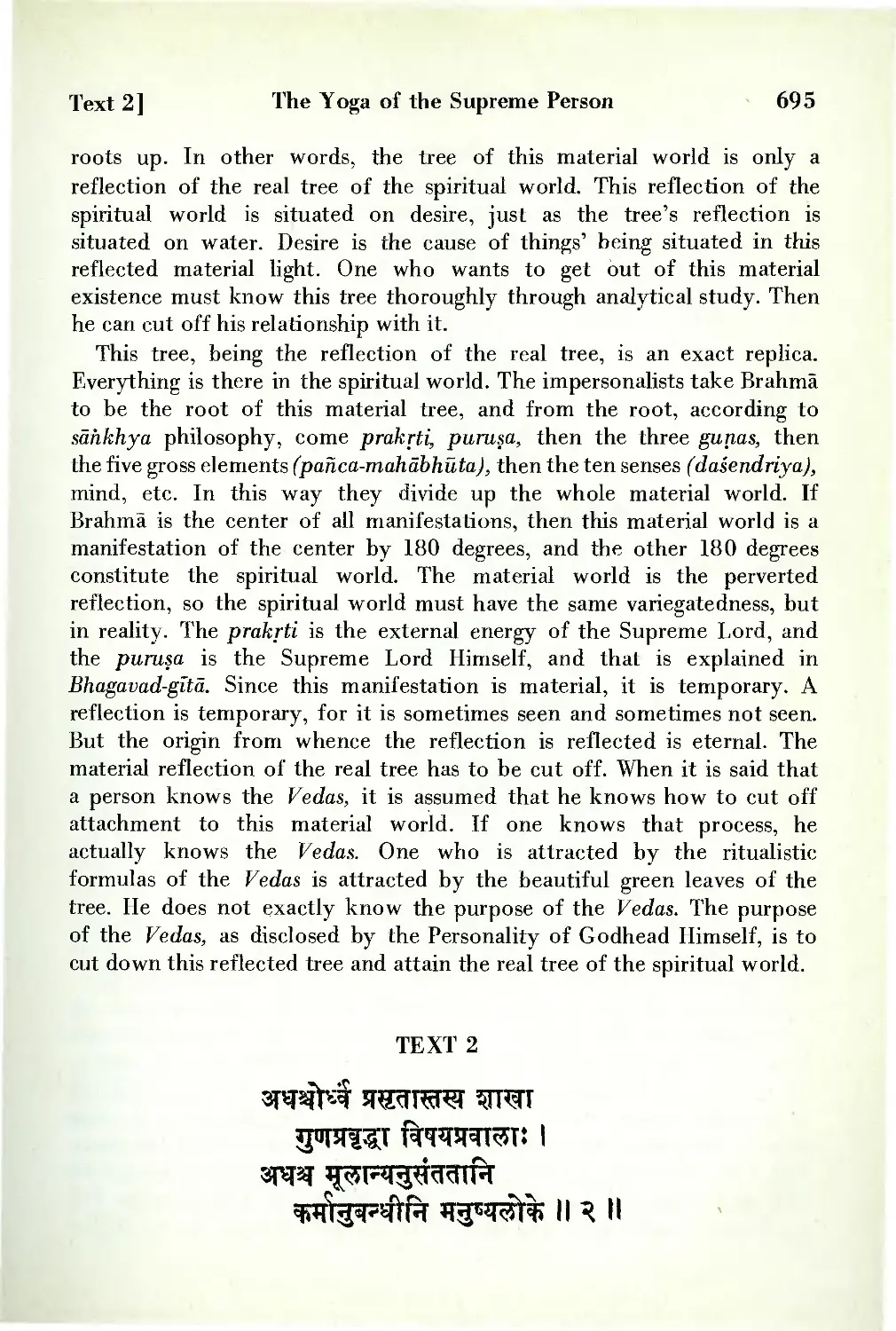
In the Fifteenth Chapter of the Bhagavad-gita, the real picture of the
material world is given. It is said there:
urdhva-mulam adhah-sakham asvattham prahur avyayam
chandamsi yasya parnani yas tam veda sa veda-vit
“The Supreme Lord said: There is a banyan tree which has its roots
upward and its branches down, and the Vedic hymns are its leaves. One
who knows this tree is the knower of the Vedas.” (Bg. 15.1) Here the
material world is described as a tree whose roots are upwards and branches
are below. We have experience of a tree whose roots are upward: if one
stands on the bank of a river or any reservoir of water, he can see that the
trees reflected in the water are upside down. The branches go downward
and the roots upward. Similarly, this material world is a reflection of the
spiritual world. The material world is but a shadow of reality. In the
shadow there is no reality or substantiality, but from the shadow we can
understand that there is substance and reality. In the desert there is no
water, but the mirage suggests that there is such a thing as water. In the
material world there is no water, there is no happiness, but the real water
of actual happiness is there in the spiritual world.
Introduction
21
The Lord suggests that we attain the spiritual world in the following
manner:
nirmana-moha jita-sahga-dosa
adhyatma-nitya vinivrtta-k amah
dvandvair vimuktah sukha-duhkha-samjhair
gacchanty amudhah padam avyayam tat.
That padam avyayam or eternal kingdom can be reached by one who
is nirmana-moha. What does this mean? We are after designations.
Someone wants to become a son, someone wants to become Lord,
someone wants to become the president or a rich man or a king or some-
thing else. As long as we are attached to these designations, we are
attached to the body because designations belong to the body. But we are
not these bodies, and realizing this is the first stage in spiritual realization.
We are associated with the three modes of material nature, but we must
become detached through devotional service to the Lord. If we are not
attached to devotional service to the Lord, then we cannot become
detached from the modes of material nature. Designations and attachments
are due to our lust and desire, our wanting to lord it over the material
nature. As long as we do not give up this propensity of lording it over
material nature, there is no possibility of returning to the kingdom of the
Supreme, the sanatana-dhama. That eternal kingdom, which is never
destroyed, can be approached by one who is not bewildered by the attrac-
tions of false material enjoyments, who is situated in the service of the
Supreme Lord. One so situated can easily approach that supreme abode.
Elsewhere in the Gita it is stated:
avyakto ’ksara ity uktas tam ahuh paramam gatim
yam prapya na nivartante tad dhama paramam mama.
Avyakta means unmanifested. Not even all of the material world is mani-
fested before us. Our senses are so imperfect that we cannot even see all of
the stars within this material universe. In Vedic literature we can receive
much information about all the planets, and we can believe it or not believe
it. All of the important planets are described in V edic literatures, especially
Srimad-Bhagavatam, and the spiritual world, which is beyond this material
sky, is described as avyakta, unmanifested. One should desire and hanker
after that supreme kingdom, for when one attains that kingdom, he does
not have to return to this material world.
22
Bhagavad-gita As It Is
Next, one may raise the question of how one goes about approaching
that abode of the Supreme Lord. Information of this is given in the
Eighth Chapter. Il is said there:
anta-kale ca mam eva smaran muktva kalevaram
yah prayati sa mad-bhavam yati nasty atra samsayah
“Anyone who quits his body, at the end of life, remembering Me, attains
immediately to My nature; and there is no doubt of this.” (Bg. 8.5)
One who thinks of Krsna at the time of his death goes to Krsna. One must
remember the form of Krsna; if he quits his body thinking of this form, he
approaches the spiritual kingdom. Mad-bhavam refers to the supreme
nature of the Supreme Being. The Supreme Being is sac-cid-ananda-
vigraha—eternal, full of knowledge and bliss. Our present body is not
sac-cid-ananda. It is asat, not sat. It is not eternal; it is perishable. It is not
cit, full of knowledge, but it is full of ignorance. We have no knowledge of
the spiritual kingdom, nor do we even have perfect knowledge of this
material world where there are so many things unknown to us. The body
is also nirananda; instead of being full of bliss it is full of misery. All of the
miseries we experience in the material world arise from the body, but one
who leaves this body thinking of the Supreme Personality of Godhead at
once attains a sac-cid-ananda body, as is promised in this fifth verse of the
Eighth Chapter where Lord Krsna says, “He attains My nature.”
The process of quitting this body and getting another body in the
material world is also organized. A man dies after it has been decided
what form of body he will have in the next life. Higher authorities, not the
living entity himself, make this decision. According to our activities in
this life, we either rise or sink. This life is a preparation for the next life.
If we can prepare, therefore, in this life to get promotion to the kingdom
of God, then surely, after quitting this material body, we will attain a
spiritual body just like the Lord.
As explained before, there are different kinds of transcendentalists,
the brahmavadi, paramatmavadi, and the devotee, and, as mentioned, in
the brahmajyoti (spiritual sky) there are innumerable spiritual planets.
The number of these planets is far, far greater than all of the planets of
this material world. This material world has been approximated as only
one quarter of the creation. In this material segment there are millions and
billions of universes with trillions of planets and suns, stars and moons.
But this whole material creation is only a fragment of the total creation.
Most of the creation is in the spiritual sky. One who desires to merge into
Introduction
23
the existence of the Supreme Brahman is at once transferred to the
brahmajyoti of the Supreme Lord and thus attains the spiritual sky. The
devotee, who wants to enjoy the association of the Lord, enters into the
Vaikuntha planets, which are innumerable, and the Supreme Lord by His
plenary expansions as Narayana with four hands and with different names
like Pradyumna, Aniruddha, Govinda, etc., associates with him there.
Therefore at the end of life the transcendentalists either think of the
brahmajyoti, the Paramatma or the Supreme Personality of Godhead
Sri Krsna. In all cases they enter into the spiritual sky, but only the
devotee, or he who is in personal touch with the Supreme Lord, enters
into the Vaikuntha planets. The Lord further adds that of this “there is no
doubt.” This must be believed firmly. We should not reject that which
does not tally with our imagination; our attitude should be that of
Aijuna: “I believe everything that You have said.” Therefore when the
Lord says that at the time of death whoever thinks of Him as Brahman or
Paramatma or as the Personality of Godhead certainly enters into the
spiritual sky, there is no doubt about it. There is no question of dis-
believing it.
The information on how to think of the Supreme Being at the time of
death is also given in the Gita:
yam yam vapi smaran bhavam tyajaty ante kalevaram
tarn tarn evaiti kaunteya soda tad-bhava~bhavitah
“In whatever condition one quits his present body, in his next life he will
attain to that state of being without fail.” (Bg. 8.6) Material nature is a
display of one of the energies of the Supreme Lord. In the Visnu Parana
the total energies of the Supreme Lord as Visnu-saktih para prokta, etc., are
delineated. The Supreme Lord has diverse and innumerable energies which
are beyond our conception; however, great learned sages or liberated
souls have studied these energies and have analyzed them into three parts.
All of the energies are of Visnu-sakti, that is to say they are different
potencies of Lord Visnu. That energy is para, transcendental. Living
entities also belong to the superior energy, as has already been explained.
The other energies, or material energies, are in the mode of ignorance. At
the time of death we can either remain in the inferior energy of this
material world, or we can transfer to the energy of the spiritual world.
In life we are accustomed to thinking either of the material or the
spiritual energy. There are so many literatures which fill our thoughts
with the material energy—newspapers, novels, etc. Our thinking, which is
24
Bhagavad-gita As It Is
now absorbed in these literatures, must be transferred to the Vedic litera-
tures. The great sages, therefore, have written so many Vedic literatures
such as the Puranas, etc. The Puranas are not imaginative; they are
historical records. In the Caitanya-caritamrita there is the following verse:
maya mugdha jiver nahi svatah krsna-jnan
jivera krpaya kaila krsna veda-purana
(Cc. Madhya 20.122)
The forgetful living entities or conditioned souls have forgotten then-
relationship with the Supreme Lord, and they are engrossed in thinking
of material activities. Just to transfer their thinking power to the spiritual
sky, Krsna has given a great number of Vedic literatures. First He divided
the Vedas into four, then He explained them in the Puranas, and for less
capable people He wrote the Mahabharata. In the Mahabharata there is
given the Bhagavad-gita. Then all Vedic literature is summarized in the
Vedanta-siitra, and for future guidance He gave a natural commentation
on the Vedanta-siitra, called Srimad-Bhagavatam. We must always engage
our minds in reading these Vedic literatures. Just as materialists engage
their minds in reading newspapers, magazines and so many materialistic
literatures, we must transfer our reading to these literatures which are
given to us by Vyasadeva; in that way it will be possible for us to remem-
ber the Supreme Lord at the time of death. That is the only way suggested
by the Lord, and He guarantees the result: “There is no doubt.” (Bg. 8.7)
tasmat sarvesu kalesu mam anusmara yudhya ca
mayy arpita-mano-buddhir mam evaisyasy asamsayah
“Therefore, Arjuna, you should always think of Me, and at the same time
you should continue your prescribed duty and fight. With your mind and
activities always fixed on Me, and everything engaged in Me, you will
attain to Me without any doubt.”
He does not advise Aijuna to simply remember Him and give up his
occupation. No, the Lord never suggests anything impractical. In this
material world, in order to maintain the body one has to work. Human
society is divided, according to work, into four divisions of social order—
brahmana, ksatriya, vaisya, siidra. The brahmana class or intelligent class
is working in one way, the ksatriya or administrative class is working in
another way, and the mercantile class and the laborers are all tending to
their specific duties. In the human society, whether one is a laborer,
merchant, warrior, administrator, or farmer, or even if one belongs to the
highest class and is a literary man, a scientist or a theologian, he has to
work in order to maintain his existence. The Lord therefore tells Arjuna
that he need not give up his occupation, but while he is engaged in his
Introduction
25
occupation he should remember Krsna. If he doesn’t practice remembering
Krsna while he is struggling for existence, then it will not be possible for
him to remember Krsna at the time of death. Lord Caitanya also advises
this. He says that one should practice remembering the Lord by chanting
the names of the Lord always. The names of the Lord and the Lord are
nondifferent. So Lord Krsna’s instruction to Arjuna to “remember Me”
and Lord Caitanya’s injunction to always “chant the names of Lord
Krsna” are the same instruction. There is no difference, because Krsna and
Krsna’s name are nondifferent. In the absolute status there is no difference
between reference and referent. Therefore we have to practice remember-
ing the Lord always, twenty-four hours a day, by chanting His names and
molding our life’s activities in such a way that we can remember Him
always.
How is this possible? The acaryas give the following example. If a
married woman is attached to another man, or if a man has an attachment
for a woman other than his wife, then the attachment is to be considered
very strong. One with such an attachment is always thinking of the loved
one. The wife who is thinking of her lover is always thinking of meeting
him, even while she is carrying out her household chores. In fact, she
carries out her household work even more carefully so her husband will not
suspect her attachment. Similarly, we should always remember the supreme
lover, Sri Krsna, and at the same time perform our material duties very
nicely. A strong sense of love is required here. If we have a strong sense of
love for the Supreme Lord, then we can discharge our duty and at the
same time remember Him. But we have to develop that sense of love.
Arjuna, for instance, was always thinking of Krsna; he was the constant
companion of Krsna, and at the same time he was a warrior. Krsna did not
advise him to give up fighting and go to the forest to meditate. When
Lord Krsna delineates the yoga system to Aijuna, Aijuna says that the
practice of this system is not possible for him.
arjuna uvaca
у о ’yam yogas tvaya proktah samyena madhustidana
etasyaham na pasyami caiicalatvat sthitim sthiram
“Arjuna said, 0 Madhusudana, the system of yoga which you have
summarized appears impractical and unendurable to me, for the mind is
restless and unsteady.” (Bg. 6.33)
But the Lord says:
yoginam api sarvesam mad-gatenantaratmana
sraddhavan bhajate у о mam sa me yuktatamo matah
26
Bhagavad-gita As It Is
“Of all yogis, he who always abides in Me with great faith, worshiping Me
in transcendental loving service, is most intimately united with Me in
yoga, and is the highest of all.” (Bg. 6.47) So one who thinks of the
Supreme Lord always is the greatest yogi, the supermost jnani, and the
greatest devotee at the same time. The Lord further tells Arjuna that as a
ksatriya he cannot give up his fighting, but if Aijuna fights remembering
Krsna, then he will be able to remember Him at the time of death. But one
must be completely surrendered in the transcendental loving service of
the Lord.
We work not with our body, actually, but with our mind and intelli-
gence. So if the intelligence and the mind are always engaged in the thought
of the Supreme Lord, then naturally the senses are also engaged in His
service. Superficially, at least, the activities of the senses remain the same,
but the consciousness is changed. The Bhagavad-gita teaches one how to
absorb the mind and intelligence in the thought of the Lord. Such absorp-
tion will enable one to transfer himself to the kingdom of the Lord. If
the mind is engaged in Krsna’s service, then the senses are automatically
engaged in His service. This is the art, and this is also the secret of
Bhagavad-gita: total absorption in the thought of Sri Krsna.
Modern man has struggled very hard to reach the moon, but he has not
tried very hard to. elevate himself spiritually. If one has fifty years of life
ahead of him, he should engage that brief time in cultivating this practice
of remembering the Supreme Personality of Godhead. This practice is the
devotional process of:
sravanath kirtanam visnoh smaranam pada-sevanam
arcanam vandanam dasyam sakhyam atma-nivedanam
These nine processes, of which the easiest is sravanam, hearing Bhagavad-
gita from the realized person, will turn one to the thought of the Supreme
Being. This will lead to niscala, remembering the Supreme Lord, and will
enable one, upon leaving the body, to attain a spiritual body which is just
fit for association with the Supreme Lord.
The Lord further says:
abhyasa-yoga-yuktena cetasa nanya-gamina
paramam purusam divyam yati parthanucintayan
“By practicing this remembering, without being deviated, thinking ever of
the Supreme Godhead, one is sure to achieve the planet of the Divine, the
Supreme Personality, О son of Kunti.” (Bg. 8.8)
Introduction
27
This is not a very difficult process. However, one must learn it from an
experienced person, from one who is already in the practice. The mind is
always flying to this and that, but one must always practice concentrating
the mind on the form of the Supreme Lord Йп Krsna or on the sound of
His name. The mind is naturally restless, going hither and thither, but it
can rest in the sound vibration of Krsna. One must thus meditate on
paramam purusam, the Supreme Person, and thus attain Him. The ways
and the means for ultimate realization, ultimate attainment, are stated in
the Bhagavad-gita, and the doors of this knowledge are open for everyone.
No one is barred out. All classes of men can approach the Lord by thinking
of Him, for hearing and thinking of Him is possible for everyone.
The Lord further says:
mam hi partha vyapasritya ye ’pi syuh papa-yonayah
striyo vaisyas tatha sildras te ’pi yanti param gatim
kim punar brahmanah punya bhakta rajarsayas tatha
anityam asukham lokam imam prapya bhajasva mam
“0 son of Prtha, anyone who will take shelter in Me, whether a woman, or
a merchant, or one born in a low family, can yet approach the supreme
destination. How much greater then are the brahmanas, the righteous, the
devotees, and saintly kings! In this miserable world, these are fixed in
devotional service to the Lord.” (Bg. 9.32-33)
Human beings even in the lower statuses of life (a merchant, a woman or
a laborer) can attain the Supreme. One does not need highly developed
intelligence. The point is that anyone who accepts the principle of bhakti-
yoga and accepts’ the Supreme Lorr} ap the summum Ьопцт of, life, as
the highest target, the ultimate goal, can approach the Lord in the spiritual
sky. If one adopts the principles enunciated in Bhagavad-gita, he can make
his life perfect and make a perfect solution to all the problems of life
which arise out of the transient nature of material existence. This is the
sum and substance of the entire Bhagavad-gita.
In conclusion, Bhagavad-gita is a transcendental literature which one
should read very carefully. It is capable of saving one from all fear.
nehabhikrama-naso ’sti pratyavayo na vidyate
svalpam apy asya dharmasya trayate mahato bhayat
“In this endeavor there is no loss or diminution, and a little advancement
on this path can protect one from the most dangerous type of fear.” (Bg.
28
Bhagavad-gita As It Is
2.40) If one reads Bhagavad-gita sincerely and seriously, then all of the
reactions of his past misdeeds will not react upon him. In the last portion
of Bhagavad-gita, Lord Sri Krsna proclaims:
sarva-dharman parityajya mam ekam saranam vraja
aham tvam sarva-papebhyo moksayisyami ma sueah
“Give up all varieties of religiousness, and just surrender unto Me; and in
return I shall protect you from all sinful reactions. Therefore, you have
nothing to fear.” (Bg. 18.66) Thus the Lord takes all responsibility for
one who surrenders unto Him, and He indemnifies all the reactions of sin.
One cleanses himself daily by taking a bath in water, but one who takes
his bath only once in the sacred Ganges water of the Bhagavad-gita cleanses
away all the dirt of material life. Because Bhagavad-gita is spoken by the
Supreme Personality of Godhead, one need not read any other Vedic
literature. One need only attentively and regularly hear and read Bhagavad-
gita. In the present age, mankind is so absorbed with mundane activities
that it is not possible to read all of the Vedic literatures. But this is not
necessary. This one book, Bhagavad-gita, will suffice because it is the
essence of all Vedic literatures and because it is spoken by the Supreme
Personality of Godhead. It is said that one who drinks the water of the
Ganges certainly gets salvation, but what to speak of one who drinks the
waters of Bhagavad-gita? Gita is the very nectar of the Mahabharata spoken
by Visnu Himself, for Lord Krsna is the original Visnu. It is nectar emanat-
ing from the mouth of the Supreme Personality of Godhead, and the
Ganges is said to be emanating from the lotus feet of the Lord. Of course
there is no difference between the mouth and the feet of the Supreme
Lord, but in our position we can appreciate that the Bhagavad-gita is even
more important than the Ganges.
The Bhagavad-gita is just like a cow, and Lord Krsna, who is a cowherd
boy, is milking this cow. The milk is the essence of the Vedas, and Aijuna
is just like a calf. The wise men, the great sages and pure devotees, are to
drink the nectarean milk of Bhagavad-gita.
In this present day, man is very eager to have one scripture, one God,
one religion, and one occupation. So let there be one common scripture
for the whole world—Bhagavad-gita. And let there be one God only for
the whole world—Sn Krsna. And one mantra only—Hare Krsna, Hare Krsna,
Krsna Krsna, Hare Hare/ Hare Rama, Hare Rama, Rama Rama, Hare Hare.
And let there be one work only—the service of the Supreme Personality
of Godhead.
Introduction
29
THE DISCIPLIC SUCCESSION
Evam parampara-praptam imam rajarsayo viduh. (Bhagavad-gita, 4.2)
This Bhagavad-gita As It Is is received through this disciplic succession:
1) Krsna, 2) Brahma, 3) Narada; 4) Vyasa, 5) Madhva, 6) Padmanabha,
7) Nrhari, 8) Madhava, 9) Aksobhya, 10) Jayatirtha, 11) Jnanasindhu,
12) Dayanidhi, 13) Vidyanidhi, 14) Rajendra, 15) Jayadharma,
16) Purusottama, 17) Brahmanyafirtha, 18) Vyasafirtha, 19) Laksmipati,
20) Madhavendra Puri, 21) Isvara Puri, (Nityananda, Advaita), 22) Lord
Caitanya, 23) Riipa (Svariipa, Sanatana), 24) Raghunatha, Jiva, 25)
Krsnadasa, 26) Narottama, 27) Visvanatha, 28) (B aladeva) Jagannatha,
29) Bhaktivinode, 30) Gaurakisora, 31) Bhaktisiddhanta Sarasvati, 32)
His Divine Grace A.C. Bhaktivedanta Swami Prabhupada.

CHAPTER ONE
Observing the Armies on the
Battlefield of Kuruksetra
TEXT 1
да ячтзт I
4iw:	ттчйт язп II ? II
dhrtarastra uvaca
dharma-ksetre kuru-ksetre
samaveta yuyutsavah
mamakah pandavas caiva
kim akurvata sanjaya
dhrtarastrah—King Dhrtarastra; uvaca— said; dharma-ksetre -in the place
of pilgrimage; kuru-ksetre—in the place named Kuruksetra; samavetah—
assembled; yuyutsavah—desiring to fight; mamakah—my party (sons);
pandavah— the sons of Pandu;ca—and;era— certainly ,kirn—vrhat-,akurvata—
did they do; sanjaya— О Sanjaya.
31
32	Bhagavad gita As It Is	[Ch. 1
TRANSLATION
Dhrtarastra said: О Sanjaya, after assembling in the place of pilgrimage
at Kuruksetra, what did my sons and the sons of Pandu do, being desirous
to fight?
PURPORT
Bhagavad-gita is the widely read theistic science summarized in the
Gita-mahatmya (Glorification of the Gita). There it says that one should
read Bhagavad-gita very scrutinizingly with the help of a person who is a
devotee of Sri Krsna and try to understand it without personally motivated
interpretations. The example of clear understanding is there in the
Bhagavad-gita itself, in the way the teaching is understood by Arjuna, who
heard the Gita directly from the Lord. If someone is fortunate enough
to understand Bhagavad-gita in that line of disciplic succession, without
motivated interpretation, then he surpasses all studies of Vedic wisdom,
and all scriptures of the world. One will find in the Bhagavad-gita all that
is contained in other scriptures, but the reader will also find things which
are not to be found elsewhere. That is the specific standard of the Gita.
It is the perfect theistic science because it is directly spoken by the Supreme
Personality of Godhead, Lord Sri Krsna.
The topics discussed by Dhrtarastra and Sanjaya, as described in the
Mahabharata, form the basic principle for this great philosophy. It is
understood that this philosophy evolved on the Battlefield of Kuruksetra,
which is a sacred place of pilgrimage from the immemorial time of the
Vedic age. It was spoken by the Lord when He was present personally on
this planet for the guidance of mankind.
The word dharma-ksetra (a place where religious rituals are performed)
is significant because, on the Battlefield of Kuruksetra, the Supreme
Personality of Godhead was present on the side of Arjuna. Dhrtarastra,
the father of the Kurus, was highly doubtful about the possibility of his
sons’ ultimate victory. In his doubt, he inquired from his secretary
Sanjaya, “What did my sons and the sons of Pandu do?” He was confident
that both his sons and the sons of his younger brother Pandu were
assembled in that Field of Kuruksetra for a determined engagement of the
war. Still, his inquiry is significant. He did not want a compromise between
the cousins and brothers, and he wanted to be sure of the fate of his sons
on the battlefield. Because the battle was arranged to be fought at
Kuruksetra, which is mentioned elsewhere in the Vedas as a place of
Text 2] Observing the Armies on the Battlefield of Kuruksetra 33
worship—even for the denizens of heaven—Dhrtarastra became very
fearful about the influence of the holy place on the outcome of the battle.
He knew very well that this would influence Aijuna and the sons of Pandu
favorably, because by nature they were all virtuous. Sanjaya was a student
of Vyasa, and therefore, by the mercy of Vyasa, Sanjaya was able to
envision the Battlefield of Kuruksetra even while he was in the room of
Dhrtarastra. And so, Dhrtarastra asked him about the situation on the
battlefield.
Both the Pandavas and the sons of Dhrtarastra belong to the same
family, but Dhrtarastra’s mind is disclosed herein. He deliberately claimed
only his sons as Kurus, and he separated the sons of Pandu from the family
heritage. One can thus understand the specific position of Dhrtarastra in
his relationship with his nephews, the sons of Pandu. As in the paddy
field the unnecessary plants are taken out, so it is expected from the very
beginning of these topics that in the religious field of Kuruksetra where
the father of religion, Sri Krsna, was present, the unwanted plants like
Dhrtarastra’s son Duryodhana and others would be wiped out and the
thoroughly religious persons, headed by Yudhisthira, would be established
by the Lord. This is the significance of the words dharma-ksetre and kuru-
ksetre, apart from their historical and Vedic importance.
TEXT 2
W4 I
URII
sanjaya uvaca
drstva tu pandavanikam
vyudham duryodhanas tada
acaryam upasangamya
raja vacanam abravit
sanjay ah—Sanjaya; uvaca—said; drstva—after seeing; tu—but; pandava-
amkatn—the soldiers of the Pandavas; vyudham— arranged in military
phalanx; duryodhanah— King Duryodhana; tada—at that time; acaryam—
the teacher; upasangamya— approaching nearby; raja—the king; vacanam—
words; abravit— spoke.
34	Bhagavad-gita As It Is	[Ch. 1
TRANSLATION
Sanjaya said: О King, after looking over the army gathered by the sons
of Pandu, King Duryodhana went to his teacher and began to speak the
following words:
PURPORT
Dhrtarastra was blind from birth. Unfortunately, he was also bereft of
spiritual vision. He knew very well that his sons were equally blind in the
matter of religion, and he was sure that they could never reach an under-
standing with the Pandavas, who were all pious since birth. Still he was
doubtful about the influence of the place of pilgrimage, and Sanjaya could
understand his motive in asking about the situation on the battlefield. He
wanted, therefore, to encourage the despondent King, and thus he warned
him that his sons were not going to make any sort of compromise under
the influence of the holy place. Sanjaya therefore informed the King that
his son, Duryodhana, after seeing the military force of the Pandavas, at
once went to the commander-in-chief, Dronacarya, to inform him of the
real position. Although Duryodhana is mentioned as the king, he still had
to go to the commander on account of the seriousness of the situation. He
was therefore quite fit to be a politician. But Duryodhana’s diplomatic
veneer could not disguise the fear he felt when he saw the military arrange-
ment of the Pandavas.
TEXT 3
g’KSt’JT fwr Фгат ИЗ П
pasyaitam pandu-putranam
acarya mahatim сатйт
vyiidham .drupada-putrena
tava sisyena dhimata
pasya—behold; etam—this; pandu-putranam—of the sons of Pandu;
acarya—О teacher; mahatim—great; сатйт—military force; vyiidham—ar-
ranged; drupada-putrena—by the son of Drupada; tava—your; sisyena—
disciple; dhimata—very intelligent.
Text 4] Observing the Armies on the Battlefield of Kuruksetra
35
TRANSLATION
О my teacher, behold the great army of the sons of Pandu, so expertly
arranged by your intelligent disciple, the son of Drupada.
PURPORT
Duryodhana, a great diplomat, wanted to point out the defects of
Dronacarya, the great brahmana commander-in-chief. Dronacarya had
some political quarrel with King Drupada, the father of Draupadi, who was
Arjuna’s wife. As a result of this quarrel, Drupada performed a great
sacrifice, by which he received the benediction of having a son who would
he able to kill Dronacarya. Dronacarya knew this perfectly well, and yet,
as a liberal brahmana, he did not hesitate to impart all his military secrets
when the son of Drupada, Dhrstadyumna, was entrusted to him for
military education. Now, on the Battlefield of Kuruksetra, Dhrstadyumna
took the side of the Pandavas, and it was he who arranged for their
military phalanx, after having learned the art from Dronacarya. Duryo-
dhana pointed out this mistake of Dronacarya’s so that he might be alert
and uncompromising in the fighting. By this he wanted to point out also
that he should not be similarly lenient in battle against the Pandavas, who
were also Dronacarya’s affectionate students. Aijuna, especially, was his
most affectionate and brilliant student. Duryodhana also warned that such
leniency in the fight would lead to defeat.
TEXT 4
Snr щт чНтчт чЬпйнчт I
IIVII
atra sura mahesvasa
bhimarjuna-sama yudhi
yuyudhano viratas ca
drupadas ca maha-rathah
atra—here; surah—heroes; mahesvasah—mighty bowmen; bhima-arjuna—
Bhlma and Arjuna; samah—equal; yudhi—in the fight; yuyudhanah—
Yuyudhana; viratah—Virata; ca—also; drupadah—Drupada; ca—also; maha-
rathah— great fighter.
36
Bhagavad-gita As It Is
TRANSLATION
[Ch. 1
Here in this army there are many heroic bowmen equal in fighting to
Bhiima and Aijuna; there are also great fighters like Yuyudhana, Virata
and Drupada.
PURPORT
Even though Dhrstadyumna was not a very important obstacle in the
face of Dronacarya’s very great power in the military art, there were many
others who were the cause of fear. They are mentioned by Duryodhana as
great stumbling blocks on the path of victory because each and every one
of them was as formidable as Biuma and Aijuna. He knew the strength of
Bhima and Aijuna, and thus he compared the others with them.
TEXT 5
114 и
dhrstaketus cekitanah
kasirajas ca viryavan
purujit kuntibhojas ca
saibyas ca nara-pungavah
dhrstaketuh— Dhrstaketu; cekitanah— C ekit ana; kasirajah— Kasiraja; ca—
also; viryavan—very powerful; purujit—Purujit; kuntibhojah—Kuntibhoja;
ca—and; saibyah—Saibya; ca—and; nara-pungavah—heroes in human society.
TRANSLATION
There are also great, heroic, powerful fighters like Dhrstaketu, Cekitana,
Kasiraja, Purujit, Kuntibhoja and Saibya.
шчзгГ йтег фг ч^югт: ii^il
TEXT 6
Text 8 ] Observing the Armies on the Battlefield of Kuruksetra
37
yudhamanyus ca vikranta
uttamaujas ca viryavan
saubhadro draupadeyas ca
sarva eva maha-rathah
yudhamanyuh— Yudhamanyu; ca—and; vikrantah—mighty; uttamaujah
—Uttamauja; ca—and; viryavan—very powerful; saubhadrah—the son of
Subhadra; draupadeyah—the sons of Draupadi; ca—and; sarve— all; eva—
certainly; maha-rathah—great chariot fighters.
TRANSLATION
There are the mighty Yudhamanyu, the very powerful Uttamauja, the
son of Subhadra and the sons of Draupadi. All these warriors are great
chariot fighters.
TEXT 7
HTW ЧЧ WI	II II
asmakam tu visista ye
tan nibodha dvijottama
nayaka mama sainyasya
samjnartham tan bravimi te
asmakam—our; tu—but; visistah—especially powerful; ye—those; tan—
them; nibodha—just take note, be informed; dvijottama—the best of the
brahmanas; nayakah—captains; mama— my; sainyasya—of the soldiers;
samjha-artham—for information; tan—them; bravimi— I am speaking; te—
your.
TRANSLATION
О best of the brahmanas, for your information, let me tell you about
the captains who are especially qualified to lead my military force.
llг и
TEXT 8
38
Bhagavad-gita As It Is
[Ch. 1
bhavan bhismas ca karnas ca
krpas ca samitinjayah
asvatthama vikarnas ca
saumadattis tathaiva ca
bhavan—yourself; bhismah—Grandfather Bhisma; ca—also; karnah—
Karna; ca—and; krpah—Krpa; ca—and;samitinjayah— always victorious in
battle; asvatthama—Asvatthama; vikarnah—Vikarna; ca—as well as;
saumadattih—the son of Somadatta; tatha— and as; eva—certainly; ca—and.
TRANSLATION
There are personalities like yourself, Bhisma, Karna, Krpa, Asvatthama,
Vikarna and the son of Somadatta called Bhurisrava, who are always vic-
torious in battle.
PURPORT
Duryodhana mentioned the exceptional heroes in the battle, all of whom
are ever-victorious. Vikarna is the brother of Duryodhana, Asvatthama is
the son of Dronacarya, and Saumadatti, or Bhurisrava, is the son of the
King of the BahHkas. Karna is the half brother of Aijuna, as he was born of
Kunti before her marriage with King Pandu. Krpacarya married the twin
sister of Dronacarya.
TEXT 9
ЧБттяетт:	и я II
anye ca bahavah sura
mad-arthe tyakta-jivitah
nana-sastra-praharanah
sarve yuddha-visaradah
anye—many others; ca—also; bahavah—in great numbers; silrah—heroes;
mad-arthe—for my sake; tyakta-jivitah—prepared to risk life; папа— many;
sastra—weapons; praharanah—equipped with; sarve—all of them; yuddha—
battle; visaradah—experienced in military science.
Text 10] Observing the Armies on the Battlefield of Kuruksetra 39
TRANSLATION
There are many other heroes who are prepared to lay down their lives for
my sake. All of them are well equipped with different kinds of weapons,
and all are experienced in military science.
PURPORT
As far as the others are concerned—like Jayadratha, Krtavarma, Salya,
etc.—all are determined to lay down their lives for Duryodhana’s sake. In
other words, it is already concluded that all of them would die in the
Battle of Kuruksetra for joining the party of the sinful Duryodhana.
Duryodhana was, of course, confident of his victory on account of the
above-mentioned combined strength of his friends.
TEXT 10
фгГн ferret w	II ?о II
aparyaptam tad asmakam
balam bhismabhiraksitam
paryaptam tv idam etesam
balam bhimabhiraksitam
aparyaptam—immeasurable; tat—that; asmakam— of ours; balam—
strength; bhisma— by Grandfather Bhisma; abhiraksitam—perfectly protect-
ed; paryaptam—limited; tn—but; idam—all these; etesam—of the Pandavas;
balam— strength; bhima—by Bhima; abhiraksitam—carefully protected.
TRANSLATION
Our strength is immeasurable, and we are perfectly protected by Grand-
father Bhisma, whereas the strength of the Pandavas, carefully protected
by Bhima, is limited.
PURPORT
Herein an estimation of comparative strength is made by Duryodhana.
He thinks that the strength of his armed forces is immeasurable, being
40
Bhagavad-gita As It Is
[Ch. 1
specifically protected by the most experienced general, Grandfather
Bhisma. On the other hand, the forces of the Pandavas are limited, being
protected by a less experienced general, BhTma, who is like a fig in the
presence of Bhisma. Duryodhana was always envious of Bhima because
he knew perfectly well that if he should die at all, he would only be killed
by Bhima. But at the same time, he was confident of his victory on account
of the presence of Bhisma, who was a far superior general. H’s conclusion
that he would come out of the battle victorious was well ascertained.
TEXT 11
зяйз ч ^5 wsnwftran i
nw ft II wi
ayanesu ca sarvesu
yatha-bhagam avasthitah
bhismam evabhiraksantu
bhavantah sarva eva hi
ayanesu—in the strategic points; ca—also; sarvesu—everywhere; yatha-
bhagam—as they are differently arranged; avasthitah—situated; bhismam—
unto Grandfather Bhisma; era—certainly; abhiraksantu—support may be
given; bhavantah—all of you; sarve—respectively; era—certainly; hi— and
exactly.
TRANSLATION
Now all of you must give full support to Grandfather Bhisma, standing
at your respective strategic points in the phalanx of the army.
PURPORT
Duryodhana, after praising the prowess of Bhisma, further considered
that others might think that they had been considered less important, so
in his usual diplomatic way, he tried to adjust the situation in the above
words. He emphasized that Bhismadeva was undoubtedly the greatest
hero, but he was an old man, so everyone must especially think of his
protection from all sides. He might become engaged in the fight, and the
enemy might take advantage of his full engagement on one side. Therefore,
Text 12] Observing the Armies on the Battlefield of Kuruksetra 41
it was important that other heroes would not leave their strategic positions
and allow the enemy to break the phalanx. Duryodhana clearly felt that
the victory of the Kurus depended on the presence of Bhismadeva. He was
confident of the full support of Bhismadeva and Dronacarya in the battle
because he well knew that they did not even speak a word when Aijuna’s
wife Draupadi, in her helpless condition, had appealed to them for justice
while she was being forced to strip naked in the presence of all the great
generals in the assembly. Although he knew that the two generals had
some sort of affection for the Pandavas, he hoped that all such affection
would now be completely given up by them, as was customary during the
gambling performances.
TEXT 12
Ыт wrmil II
tasya sahjanayan harsam
kuru-vrddhah pitamahah
sirhha-nadam vinadyoccaih
sankham dadhmau pratapavan
tasya—his; sanjanayan— increasing; harsam— cheerfulness; kuru-vrddhah
—the grandsire of the Kuru dynasty (Bhisma); pitamahah—the grand-
father; simha-nadam—roaring sound, like a lion; vinadya—vibrating; uccaih
—very loudly; sank ham— conchshell; dadhmau— blew; pratapavan— the
valiant.
TRANSLATION
Then Bhisma, the great valiant grandsire of the Kuru dynasty, the
grandfather of the fighters, blew his conchshell very loudly like the sound
of a lion, giving Duryodhana joy.
PURPORT
The grandsire of the Kuru dynasty could understand the inner meaning
of the heart of his grandson Duryodhana, and out of his natural compassion
for him he tried to cheer him by blowing his conchshell very loudly,
befitting his position as a lion. Indirectly, by the symbolism of the
42
Bhagavad-gita As It Is
[Ch. 1
conchshell, he informed his depressed grandson Duryodhana that he had
no chance of victory in the battle, because the Supreme Lord Krsna was
on the other side. But still, it was his duty to conduct the fight, and no
pains would be spared in that connection.
TEXT 13
H	II^11
tatah sahkhas ca bheryas ca
panavanak a-gomuk hah
sahasaivabhyahanyanta
sa sabdas tumulo ’bhavat
tatah—thereafter; sahkhah—conchshells; ca—also; bheryah—bugles; ca—
and; panava-anaka— trumpets and drums;go-mukhah—horns; sahasa— all of
a sudden; era—certainly; abhyahanyanta—being simultaneously sounded;
sah—that; sabdah— combined sound; tumulah—tumultuous; abhavat— be-
came.
TRANSLATION
After that, the conchshells, bugles, trumpets, drums and horns were all
suddenly sounded, and the combined sound was tumultuous.
TEXT 14
w згЖйг TO fWt I
чтфг;	и и
tatah svetair hayair yukte
mahati syandane sthitau
madhavah pandavas caiva
divyau sahkhau pradadhmatuh
tatah thereafter; svetaih—by white; hayaih—horses; yukte— being yoked
with; mahati— in the great; syandane—chariot; sthitau— so situated;
Text 15] Observing the Armies on the Battlefield of Kuruksetra 43
madhavah—Krsna (the husband of the goddess of fortune); pandavah—
Aijuna(the son of Pandu); ca—also; era—certainly; divyau-transcendental;
sankhau—conchshells; pradadhmatuh—sounded.
TRANSLATION
On the other side, both Lord Krsna and Aijuna, stationed on a great
chariot drawn by white horses, sounded their transcendental conchshells.
PURPORT
In contrast with the conchshell blown by Bhismadeva, the conchshells
in the hands of Krsna and Arjuna are described as transcendental. The
sounding of the transcendental, conchshells indicated that there was no
hope of victory for the other side because Krsna was on the side of the
Pandavas. Jayas tu pandu-putranam yesam pakse janardanah. Victory is
always with persons like the sons of Pandu because Lord Krsna is associ-
ated with them. And whenever and wherever the Lord is present, the
goddess of fortune is also there because the goddess of fortune never lives
alone without her husband. Therefore, victory and fortune were awaiting
Aijuna, as indicated by the transcendental sound produced by the conch-
shell of Visnu, or Lord Krsna. Besides that, the chariot on which both the
friends were seated was donated by Agni (the fire-god) to Aijuna, and this
indicated that this chariot was capable of conquering all sides, wherever it
was drawn over the three worlds.
TEXT 15
WK I
чЫ	irhii
pancajanyam hrsikeso
devadattam dhananjayah
paundram dadhmau maha-sankham
bhima-karma vrkodarah
pancajanyam—the conchshell named Paiicajanya; hrsikesah— Hrsikesa
(Krsna, the Lord who directs the senses of the devotees); devadattam— the
conchshell named Devadatta; dhananjayah—Dhananjaya (Aijuna, the
44
Bhagavad-gita As It Is
[Ch. 1
winner of wealth); paundram—the conch named Paundram; dadhmau—
blew; maha-sahkham—the terrific conchshell; bhima-karma— one who per-
forms Herculean tasks; vrkodarah— the voracious eater (Bhima).
TRANSLATION
Then, Lord Krsna blew His conchshell, called Pancajanya; Arjuna blew
his, the Devadatta; and Bhima, the voracious eater and performer of
Herculean tasks, blew his terrific conchshell called Paundram.
PURPORT
Lord Krsna is referred to as Hrsikesa in this verse because He is the
owner of all senses. The living entities are part and parcel of H’m, and,
therefore, the senses of the living entities are also part and parcel of His
senses. The impersonalists cannot account for the senses of the living
entities, and therefore they are always anxious to describe all living entities
as sense less, or impersonal. The Lord, s’tuated in the hearts of all living
entities, directs their senses. But, He directs in terms of the surrender of
the living entity, and in the case of a pure devotee He directly controls the
senses. Here on the Battlefield of Kuruksetra the Lord directly controls
the transcendental senses of Aijuna, and thus His particular name of
Hrsikesa. The Lord has different names according to His different activities.
For example, His name is Madhusudana because He killed the demon of
the name Madhu; His name is Govinda because He gives pleasure to the
cows and to the senses; His name is Vasudeva because He appeared as the
son of Vasudeva; His name is Devaki-nandana because He accepted Devaki
as His mother; His name is Yasoda-nandana because He awarded His child-
hood pastimes to Yasoda at Vrndavana; His name is Partha-sarathi because
He worked as charioteer of His friend Aijuna. Similarly, His name is
Hrsikesa because He gave direction to Aijuna on the Battlefield of Kuru-
ksetra.
Arjuna is referred to as Dhanaiijaya in this verse because he helped his
elder brother in fetching wealth when it was required by the King to make
expenditures for different sacrifices. Similarly, Bhima is known as Vrko-
dara because he could eat as voraciously as he could perform Herculean
tasks, such as killing the demon Hidimba. So, the particular types of
conchshell blown by the different personalities on the side of the Pandavas,
beginning with the Lord’s, were all very encouraging to the fighting soldiers.
On the other side there were no such credits, nor the presence of Lord
Texts 16-18] Observing the Armies on the Battlefield of Kuruksetra 45
Krsna, the supreme director, nor that of the goddess of fortune. So, they
were predestined to lose the battle—and that was the message announced
by the sounds of the conchshells.
TEXTS 16-18
зн^пзпг иж	gfW: I
isrew	=4	I
пит*? чкчйрчтчп^: Il ll
14<V йчЬгт^ яй:	I
ч^тчт^: wWTORi И КII
anantavijayam raja
kunti-putro yudhisthirah
nakulah sahadevas. ca
sughosa-manipuspakau
kasyas ca paramesvasah
sikhandl ca maha-rathah
dhrstadyumno viratas ca
satyakis caparajitah
drupado draupadeyas ca
sarvasah prthivi-pate
saubhadras ca maha-bahuh
sahkhan dadhmuh prthak prthak
anantavijayam—the conch named Anantavijaya; raja— the king; kunti-
putrah—the son of Kunti; yudhisthirah—Yudhisthira; nakulah—Nakula;
sahadevah—Sahadeva; ca— and; sughosa-manipuspakau—the conches named
Sughosa and Manipuspaka; kasyah—the King of Kasi (Varanasi); ca—and;
paramesvasah—the great archer; sikhandu- Sikhandl; ca—also; maha-rathah
—one who can fight alone against thousands; dhrstadyumnah—
Dhrstadyumna (the son of King Drupada); viratah—Virata (the prince who
gave shelter to the Pandavas while they were in disguise); ca— also; satyakih
—Satyaki (the same as Yuyudhana, the charioteer of Lord Krsna); ca—and;
aparajitah—who were never vanquished before; drupadah—Drupada, the
King of Paiicala; draupadeyah—the sons of Draupadi; ca— also; sarvasah—
46
Bhagavad-gita As It Is
[Ch. 1
all; prthivi-pate—О King; saubhadrah— the son of Subhadra (Abhimanyu);
ca—also; maha-bahuh—greatly armed; sahkhan— conchshells; dadhmuh—
blew,prthak prthak—each separately.
TRANSLATION
King Yudhisthira, the son of Kunti, blew his conchshell, the Anantavi-
jaya, and Nakula and Sahadeva blew the Sughosa and Manipuspaka. That
great archer the King of KasI, the great fighter Sikhandl, Dhrstadyumna,
Virata and the unconquerable Satyaki, Drupada, the sons of Draupadi, and
the others, О King, such as the son of Subhadra, greatly armed, all blew
their respective conchshells.
PURPORT
Sanjaya informed King Dhrtarastra very tactfully that his unwise policy
of deceiving the sons of Pandu and endeavoring to enthrone his own sons
on the seat of the kingdom was not very laudable. The signs already
clearly indicated that the whole Kuru dynasty would be killed in that
great battle. Beginning with the grandsire, Bhisma, down to the grandsons
like Abhimanyu and others—including kings from many states of the world
—all were present there, and all were doomed. The whole catastrophe was
due to King Dhrtarastra, because he encouraged the policy followed by his
sons.
TEXT 19
да wff	u Wi
sa ghoso dhartarastranam
hrdayani vyadarayat
nabhas ca prthivim caiva
tumulo ЪЬуапипайауап
sah—that ;ghosah—vibration; dhartarastranam—of the sons of Dhrtarastra;
hrdayani— hearts; vyadarayat— shattered; nabhah—the sky; ca—also;
prthivim— the surface of the earth; ca—also; era—certainly; tumulah—
uproarious; abhyanunadayan—by resounding.
Text 20] Observing the Armies on the Battlefield of Kuruksetra 47
TRANSLATION
The blowing of these different conchshells became uproarious, and thus,
vibrating both in the sky and on the earth, it shattered the hearts of the
sons of Dhrtarastra.
PURPORT
When Bhisma and the others on the side of Duryodhana blew their
respective conchshells, there was no heart-breaking on the part of the
Pandavas. Such occurrences are not mentioned, but in this particular verse
it is mentioned that the hearts of the sons of Dhrtarastra were shattered by
the sounds vibrated by the Pandavas’ party. This is due to the Pandavas and
their confidence in Lord Krsna. One who takes shelter of the Supreme
Lord has nothing to fear, even in the midst of the greatest calamity.
TEXT 20
5ГЙ WTO 43W4 чтточ: I
w чкчйш чйй и я© и
atha vyavasthitan drstva
dhartarastran kapi-dhvajah
pravrtte sastra-sampate
dhanur udyamya pandavah
hrsikesam tada vakyam
idam aha mahi-pate
atha—thereupon; vyavasthitan— situated; drstva—looking on; dharta-
rastran— the sons of Dhrtarastra; kapi-dhvajah—one whose flag is marked
with Hanuman; pravrtte—while about to be engaged; sastra-sampate— the
arrows released; dhanuh—bow; udyamya— after taking up;pandavah—the
son of Pandu (Aijuna); hrsikesam—unto Lord Krsna; tada—at that time;
vakyam—words; idam—these; aha—said; mahi-pate—О King.
TRANSLATION
О King, at that time Arjuna, the son of Pandu, who was seated in his
chariot, his flag marked with Hanuman, took up his bow and prepared to
shoot his arrows, looking at the sons of Dhrtarastra. О King, Aijuna then
spoke to Hrsikesa [Krsna] these words:
48
Bhagavad-gita As It Is
PURPORT
[Ch. 1
The battle was just about to begin. It is understood from the above
statement that the sons of Dhrtarastra were more or less disheartened by
the unexpected arrangement of military force by the Pandavas, who were
guided by the direct instructions of Lord Krsna on the battlefield. The
emblem of Hanuman on the flag of Aijuna is another sign of victory
because Hanuman cooperated with Lord Rama in the battle between
Rama and Ravana, and Lord Rama emerged victorious. Now both Rama
and Hanuman were present on the chariot of Aijuna to help him. Lord
Krsna is Rama Himself, and wherever Lord Rama is, His eternal servitor
Hanuman and His eternal consort SIta, the goddess of fortune, are present.
Therefore, Arjuna had no cause to fear any enemies whatsoever. And above
all, the Lord of the senses, Lord Krsna, was personally present to give him
direction. Thus, all good counsel was available to Aijuna in the matter of
executing the battle. In such auspicious conditions, arranged by the Lord
for His eternal devotee, lay the signs of assured victory.
TEXTS 21-22
ЗЙЯ 3*TT4 I
ГТ	IR^II
IIRRII
arjuna uvaca
senayor ubhayor madhye
ratham sthapaya me’cyuta
yavad etan nirikse’ham
yoddhu-kaman avasthitan
kair maya saha yoddhavyam
asmin rana-samudyame
arjunah—Aijuna,uvaca—said;senayoh—of the armies; ubhayoh—of both
the parties; madhye—in between them; ratham—the chariot; sthapaya—
please keep; me—my; acyuta— О infallible one; yavat— as long as; etan—
all these; nifikse— may look; aham—I; yoddhu-kaman— desiring to fight;
Texts 21-22] Observing the Armies on the Battlefield of Kuruksetra 49
avasthitan— arrayed on the battlefield; kaih—with whom; maya— by me;
saha -with; yoddhavyam—to fight with; tismin- in this; rana— strife;
samudyarne—in the attempt.
TRANSLATION
Arjuna said: О infallible one, please draw my chariot between the two
armies so that I may see who is present here, who is desirous of fighting,
and with whom I must contend in this great battle attempt.
PURPORT
Although Lord Krsna is the Supreme Personality of Godhead, out of
His causeless mercy He was engaged in the service of His friend. He
never fails in His affection for His devotees, and thus He is addressed
herein as infallible. As charioteer, He had to carry out the orders of
Aijuna, and since He did not hesitate to do so, He is addressed as infallible.
Although He had accepted the position of a charioteer for His devotee,
His supreme position was not challenged. In all circumstances, He is the Su-
preme Personality of Godhead, HrsTkesa, the Lord of the total senses. The
relationship between the Lord and His servitor is very sweet and transcen-
dental. The servitor is always ready to render a service to the Lord, and,
similarly, the Lord is always seeking an opportunity to render some service
to the devotee. He takes greater pleasure in His pure devotee’s assuming
the advantageous position of ordering Him than He does in being the giver
of orders. As master, everyone is under His orders, and no one is above Him
to order Him. But when he finds that a pure devotee is ordering Him,
He obtains transcendental pleasure, although He is the infallible master of
all circumstances.
As a pure devotee of the Lord, Aijuna had no desire to fight with his
cousins and brothers, but he was forced to come onto the battlefield by
the obstinacy of Duryodhana, who was never agreeable to any peaceful
negotiation. Therefore, he was very anxious to see who the leading
persons present on the battlefield were. Although there was no question
of a peacemaking endeavor on the battlefield, he wanted to see them again,
and to see how much they were bent upon demanding an unwanted war.
50
Bhagavad-gita As It Is
TEXT 23
[Ch. 1
?T ^S5T ЧЧТФГП I
1ячгНгй: IR^ii
yotsyamanan avekse’ham
ya ete’tra samagatah
dhartarastrapya durbuddher
yuddhe priya-cikirsavah
yotsyamanan—those who will be fighting; avekse—let me see; aham—I;
ye—who; ete—those; atra— here; samagatah— assembled; dhartarastrasya—
the son of Dhrtarastra; durbuddheh—evil-minded; yuddhe—in the fight;
priya—well; cikirsavah—wishing.
TRANSLATION
Let me see those who have come here to fight, wishing to please the
evil-minded son of Dhrtarastra.
PURPORT
It was an open secret that Duryodhana wanted to usurp the kingdom of
the Pandavas by evil plans, in collaboration with his father, Dhrtarastra.
Therefore, all persons who had joined the side of Duryodhana must have
been birds of the same feather. Aijuna wanted to see them in the
battlefield before the fight was begun, just to learn who they were, but he
had no intention of proposing peace negotiations with them. It was also a
fact that he wanted to see them to make an estimate of the strength
which he had to face, although he was quite confident of victory because
Krsna was sitting by his side.
TEXT 24
WI I
I
llRVII
Text 25] Observing the Armies on the Battlefield of Kuruksetra 51
sanjaya uvaca
evam ukto hrsikeso
gudakesena bharata
senayor ubhayor madhye
sthapayitva rathottamam
sanjayah—Sanjaya; uvaca—said; evam— thus;uktah— addressed; hrsikesah
—Lord Krsna; gudakesena—by Aijuna; bharata—О descendant of Bharata;
senayoh— of armies-,ubhayoh— of both-,madhye—in the midst of; sthapayitva
—by placing; rathottamam— the finest chariot.
TRANSLATION
Sanjaya said: О descendant of Bharata, being thus addressed by Arjuna,
Lord Krsna drew up the fine chariot in the midst of the armies of both
parties.
PURPORT
In this verse Aijuna is referred to as Gudakesa. Gudaka means sleep, and
one who conquers sleep is called gudakesa. Sleep also means ignorance. So
Aijuna conquered both sleep and ignorance because of his friendship with
Krsna. As a great devotee of Krsna, he could not forget Krsna even for a
moment, because that is the nature of a devotee. Either in waking or in
sleep, a devotee of the Lord can never be free from thinking of Krsna’s
name, form, quality and pastimes. Thus a devotee of Krsna can conquer
both sleep and ignorance simply by thinking of Krsna constantly. This is
called Krsna consciousness, or samadhi. As Hrsikesa, or the director of the
senses and mind of every living entity, Krsna could understand Arjuna’s
purpose in placing the chariot in the midst of the armies. Thus He did so,
and spoke as follows.
TEXT 25
зчн чт^	ihxii
bhisma-drona-pramukhatah
sarvesam ca mahiksitam
uvaca partha pasyaitan
samavetan kurun iti
52
Bhagavad-gita As It Is
[Ch. 1
bhisma— Grandfather Bhisma; drona— the teacher Drona; pramukhatah—
in the front of; sarvesam—all; ca—also; mahiksitam— chiefs of the world;
uvaca—said; partha— О Partha (son of Prtha); pasya—just behold; etan— all
of them; samavetan—assembled; кигйп—all the members of the Kuru
dynasty; iti— thus.
TRANSLATION
In the presence of Bhisma, Drona and all other chieftains of the world,
Hrsikesa, the Lord, said, Just behold, Partha, all the Kurus who are
assembled here.
PURPORT
As the Supersoul of all living entities, Lord Krsna could understand what
was going on in the mind of Aijuna. The use of the word Hrsikesa in this
connection indicates that He knew everything. And the word Partha, or
the son of Kuntl or Prtha, is also similarly significant in reference to Aijuna.
As a friend, He wanted to inform Aijuna that because Aijuna was the son
of Prtha, the sister of His own father Vasudeva, He had agreed to be the
charioteer of Arjuna. Now what did Krsna mean when He told Aijuna to
“behold the Kurus”? Did Arjuna want to stop there and not fight? Krsna
never expected such things from the son of His aunt Prtha. The mind of
Aijuna was thus predicated by the Lord in friendly joking.
TEXT 26
11R 4 11
tatrapasyat sthitan parthah
pitrn atha pitamahan
acaryan matulan bhratfn
putran pautran sakhims tatha
svasuran suhrdas caiva
senayor ubhayor api
Text 27] Observing the Armies on the Battlefield of Kuruksetra 53
la Ira— there; apasyat— he could see; sthitan—standing; piirthah Arjuna;
pitrn— fathers; atha— also; pitamahan— grandfathers; deary an- teachers;
matulan—maternal uncles; bhratrn—brothers;putran—sons ;pautran— grand-
sons; sakhin—friends; tathd—too; svasuran—fathers-in-law; suhrdah—well-
wishers;ca—also; eva— certainly;senayoh—of thc armics; ub hay oh—of both
parties; api—including.
TRANSLATION
There Arjuna could see, within the midst of the armies of both parties,
his fathers, grandfathers, teachers, maternal uncles, brothers, sons, grand-
sons, friends, and also his father-in-law and well-wishers—all present there.
PURPORT
On the battlefield Aijuna could see all kinds of relatives. He could see
persons like Bhiirisrava, who were his father’s contemporaries, grandfathers
Bhisma and Somadatta, teachers like Dronacarya and Krpacarya, maternal
uncles like Salya and Sakuni, brothers like Duryodhana, sons like Laksmana,
friends like Asvatthama, well-wishers like Krtavarma, etc. He could see
also the armies which contained many of his friends.
TEXT 27
S’RT	|| Ч\э II
tan samiksya sa kaunteyah
sarvan bandhUn avasthitan
krpaya parayavisto
visidann idam abravit
tan—all of them; samiksya— after seeing; sah—he; kaunteyah—the son of
KuntT;sarvan—all kinds of;bandhiin— relatives-,avasthitan—situated; krpaya
—by compassion; parayd— of a high grade; avistah— overwhelmed by;
visidan—while lamenting; idam—thus; abravit—spoke.
54
Bhagavad-gita As It Is
TRANSLATION
[Ch. 1
When the son of Kunti, Aijuna, saw all these different grades of friends
and relatives, he became overwhelmed with compassion and spoke thus:
TEXT 28
згй зчгч i
qH от 33^ I
tfTTHf ЧЧ ЧРПЙ 4 ЧТ^ЧИ
arjuna uvaca
drstvemam svajanam krsna
yuyutsum samupasthitam
sidanti mama gatrani
mukham ca parisusyati
arjunah—Arjuna; uvaca—said; drstva— after seeing; imam—all these; sva-
janam— kinsmen; krsna—О Krsna; yuyutsum— all in fighting spirit; samu-
pasthitam—all present;sidanti— quivering; mama— my;gatrani—limbs of the
body; mukham—mouth; ca— also; parisusyati— drying up.
TRANSLATION
Aijuna said: My dear Krsna, seeing my friends and relatives present
before me in such a fighting spirit, I feel the limbs of my body quivering
and my mouth drying up.
PURPORT
Any man who has genuine devotion to the Lord has all the good quali-
ties which are found in godly persons or in the demigods, whereas the
nondevotee, however advanced he may be in material qualifications by
education and culture, lacks in godly qualities. As such, Aijuna, just after
seeing his kinsmen, friends and relatives on the battlefield, was at once
overwhelmed by compassion for them who had so decided to fight amongst
themselves. As far as his soldiers were concerned, he was sympathetic from
the beginning, but he felt compassion even for the soldiers of the opposite
Text 29 ] Observing the Armies on the Battlefield of Kuruksetra 55
party, foreseeing their imminent death. And so thinking, the limbs of his
body began to quiver, and his mouth became dry. He was more or less
astonished to see their fighting spirit. Practically the whole community,
all blood relatives of Aijuna, had come to fight with him. This over-
whelmed a kind devotee like Aijuna. Although it is not mentioned here,
still one can easily imagine that not only were Aijuna’s bodily limbs
quivering and his mouth diying up, but that he was also crying out of
compassion. Such symptoms in Aijuna were not due to weakness but to
his softheartedness, a characteristic of a pure devotee of the Lord. It is said
therefore:
yasyasti bhaktir bhagavaty akincana
sarvair gunais tatra samaste surah
harav abhaktasya kuto mahad-guna
mano-rathenasati dhavato bahih
“One who has unflinching devotion for the Personality of Godhead has all
the good qualities of the demigods. But one who is not a devotee of the
Lord has only material qualifications that are of little value. This is be-
cause he is hovering on the mental plane and is certain to be attracted by
the glaring material energy.” (Bhag. 5.18.12)
TEXT 29

vepathus ca sanre me
roma-harsas ca jayate
gandwam sramsate hastat
tvak caiva paridahyate
vepathuh—trembling ofthe body, ca— also; sanre—on the body; me—my;
roma-harsah—standing of hair on end; ca—also; jayate—is taking place;
gandwam— the bow of Aijuna; sramsate— is slipping; hastat— from the hands;
tvak—skin; ca— also; eva— certainly; paridahyate—burning.
TRANSLATION
My whole body is trembling, and my hair is standing on end. My bow
Gandiva is slipping from my hand, and my skin is burning.
56
Bhagavad-gita As It Is
PURPORT
[Ch. 1
There are two kinds of trembling of the body, and two kinds of stand-
ings of the hair on end. Such phenomena occur either in great spiritual
ecstasy or out of great fear under material conditions. There is no fear in
transcendental realization. Arjuna’s symptoms in this situation are out of
material fear—namely, loss of life. This is evident from other symptoms
also; he became so impatient that his famous bow Gan diva was slipping
from his hands, and, because his heart was burning within him, he was
feeling a burning sensation of the skin. All these are due to a material
conception of life.
TEXT 30

na ca saknomy avasthatum
bhramativa ca me manah
nimittani ca pasyami
viparitani kesava
na—nor; ca—also; saknomi— am I able; avasthatum— to stay; bhramati—
forgetting; ma—as; ca—and; me—my; manah—mind; nimittani—causes; ca—
also; pasyami—I foresee; vipantani—just the opposite; kesava— О killer of
the demon Kesi (Krsna).
TRANSLATION
I am now unable to stand here any longer. I am forgetting myself, and
my mind is reeling. I foresee only evil, О killer of the Кея demon.
PURPORT
Due to his impatience, Aijuna was unable to stay on the battlefield, and
he was forgetting himself on account of the weakness of his mind. Ex-
cessive attachment for material things puts a man in a bewildering condi-
tion of existence. В hay am dvitiyabhinivesatah: such fearfulness and loss
of mental equilibrium take place in persons who are too affected by
Text 31] Observing the Armies on the Battlefield of Kuruksetra 57
material conditions. Arjuna envisioned only unhappiness in the battle-
field—he would not be happy even by gaining victory over the foe. The
word nimitta is significant. When a man sees only frustration in his ex-
pectations, he thinks, “Why am I here?” Everyone is interested in himself
and his own welfare. No one is interested in the Supreme Self. Arjuna is
supposed to show disregard for self-interest by submission to the will of
Krsna, who is everyone’s real self-interest. The conditioned soul forgets
this, and therefore suffers material pains. Aijuna thought that his victory
in the battle would only be a cause of lamentation for him.
TEXT 31
ч	ч ч wfa ч IIWI
na ca sreyo ’nupasyami
hatva svajanam ahave
na kankse vijayam krsna
na ca rajyam sukhani ca
na—nor; ca—also; sreyah—good; anupasyami— do I foresee; hatva— by
killing; svajanam— own kinsmen; ahave—in the fight; na—nor; kankse— do
I desire; уijayam—victory; krsna— О Krsna; na—nor; ca—also; rajyam—king-
dom; sukhani— happiness thereof; ca—also.
TRANSLATION
I do not see how any good can come from killing my own kinsmen in
this battle, nor can I, my dear Krsna, desire any subsequent victory, king-
dom, or happiness.
PURPORT
Without knowing that one’s self-interest is in Visnu (or Krsna), condi-
tioned souls are attracted by bodily relationships, hoping to be happy in
such situations. Under delusion, they forget that Krsna is also the cause
of material happiness. Arjuna appears to have even forgotten the moral
codes for a ksatriya. It is said that two kinds of men, namely the ksatriya
who dies directly in front of the battlefield under Krsna’s personal orders
58
Bhagavad-gita As It Is
[Ch. 1
and the person in the renounced order of life who is absolutely devoted to
spiritual culture, are eligible to enter into the sun-globe, which is so power-
ful and dazzling. Aijuna is reluctant even to kill his enemies, let alone his
relatives. He thought that by killing his kinsmen there would be no happi-
ness in his life, and therefore he was not willing to fight, just as a person
who does not feel hunger is not inclined to cook. He has now decided to
go into the forest and live a secluded life in frustration. But as a ksatriya,
he requires a kingdom for his subsistence, because the ksatriyas cannot
engage themselves in any other occupation. But Aijuna has had no king-
dom. Aijuna’s sole opportunity for gaining a kingdom lay in fighting with
his cousins and brothers and reclaiming the kingdom inherited from his
father, which he does not like to do. Therefore he considers himself fit
to go to the forest to live a secluded life of frustration.
TEXTS 32-35

ччтчч	to:	IIЯЧ n
5ПШ^FR4T 4 to 4 I
зттчтчг: to:	ч fiw li Я Я
w: to: чФ?чячт |
ччтч	чр$ч II и
to tst: to
tor чигщтч:	чгшчтЬг IIЯЧII
kim по rajyena govinda
kim bhogair jivitena va
yesam arthe kanksitam no
rajyaih bhogah sukhani ca
ta ime’vasthitd yuddhe
pranams tyaktva dhanani ca
acaryah pitarah putras
tathaiva ca pitamahah
matulah svasurah pautrah
syalah sambandhinas tatha
etan na hantum icchami
ghnato’pi madhusildana
Texts 32-35] Observing the Armies on the Battlefield of Kuruksetra 59
api trailokya-rajyasya
hetoh kim nu mahi-krte
nihatya dhartarastran nah
ka pritih syaj janardana
kim—what use; nah—to us; rajyena— is the kingdom; govinda—О
Krsna; kim—what; bhogaih— enjoyment; jivitena—by living; va— either;
yesam— for whom; arthe—for the matter of; kanksitam— desired; nah— our;
rajyam—kingdom; bhogah— material enjoyment; sukhani— all happiness; ca
—also; te—all of them; ime—these; avasthitah—situated; yuddhe—in this
battlefield; pranan—lives; tyaktva— giving up; dhanani— riches; ca—also;
acaryah— teachers; pitarah—fathers; putrah— sons; tatha— as well as; eva—
certainly; ca—also; pitamahah—grandfathers; matulah— maternal uncles;
svasurah—fathers-in-law; pautrah—grandsons; syalah—brothers-in-law; sam-
bandhinah—relatives; tatha— as well as; etan— all these; na— never; hantum—
for killing; icchami— do I wish; ghnatah—being killed; api—even; madhu-
stidana—O killer of the demon Madhu (Krsna); api—even if; trailokya— of
the three worlds; rajyasya—of the kingdoms; hetoh—in exchange; kim—
what to speak of; nu—only; mahi-krte—for the sake of earth; nihatya—by
killing; dhartarastran— the sons of Dhrtarastra; nah—our; ka— what;pritih—
pleasure; syat— will there be; janardana— О maintainer of all living entities.
TRANSLATION
О Govinda, of what avail to us are kingdoms, happiness or even life
itself when all those for whom we may desire them are now arrayed in
this battlefield? О Madhusiidana, when teachers, fathers, sons, grand-
fathers, maternal uncles, fathers-in-law, grandsons, brothers-in-law and all
relatives are ready to give up their lives and properties and are standing
before me, then why should I wish to kill them, though I may survive? О
maintainer of all creatures, I am not prepared to fight with them even in
exchange for the three worlds, let alone this earth.
PURPORT
Aijuna has addressed Lord Krsna as Govinda because Krsna is the object
of all pleasures for cows and the senses. By using this significant word,
Aijuna indicates what will satisfy his senses. Although Govinda is not
meant for satisfying our senses, if we try to satisfy the senses of Govinda
then automatically our own senses are satisfied. Materially, everyone wants
to satisfy his senses, and he wants God to be the order supplier for such
60
Bhagavad-gita As It Is
[Ch. 1
satisfaction. The Lord will satisfy the senses of the living entities as much
as they deserve, but not to the extent that they may covet. But when one
takes the opposite way—namely, when one tries to satisfy the senses of
Govinda without desiring to satisfy one’s own senses—then by the grace of
Govinda all desires of the living entity are satisfied. Arjuna’s deep affection
for community and family members is exhibited here partly due to his
natural compassion for them. He is therefore not prepared to fight.
Everyone wants to show his opulence to friends and relatives, but Arjuna
fears that all his relatives and friends will be killed in the battlefield, and
he will be unable to share his opulence after victory. This is a typical
calculation of material life. The transcendental life is, however, different.
Since a devotee wants to satisfy the desires of the Lord, he can, Lord
willing, accept all kinds of opulence for the service of the Lord, and if the
Lord is not willing, he should not accept a farthing. Arjuna did not want
to kill his relatives, and if there were any need to kill them, he desired that
Krsna kill them personally. At this point he did not know that Krsna had
already killed them before their coming into the battlefield and that he
was only to become an instrument for Krsna. This fact is disclosed in
following chapters. As a natural devotee of the Lord, Aijuna did not like
to retaliate against his miscreant cousins and brothers, but it was the Lord’s
plan that they should all be killed. The devotee of the Lord does not
retaliate against the wrongdoer, but the Lord does not tolerate any mischief
done to the devotee by the miscreants. The Lord can excuse a person on
His own account, but He excuses no one who has done harm to His
devotees. Therefore the Lord was determined to kill the miscreants, al-
though Aijuna wanted to excuse them.
TEXT 36
чч	I
ft 4$	ЧТФГ II34 II
papam evasrayed asman
hatvaitan atatayinah
tasman narha vayam hantum
dhartarastran svabandhavan
svajanam hi katham hatva
sukhinah syama madhava
Text 36] Observing the Armies on the Battlefield of Kuruksetra 61
papam—vices; era—certainly; asrayet—must take upon; asman—us; hatva
—by killing; etan'— all these; atatayinah—aggressors; tasmat— therefore; na—
never; arhah—deserving; vayam—us; han turn—to kill; dhartarastran^the sons
of Dhrtarastra; svabandhavan—along with friends; svajanam—kinsmen; hi -
certainly; katham—how; hatva— by killing; sukhinah—happy; syama— be-
come; madhava— О Krsna, husband of the goddess of fortune.
TRANSLATION
Sin will overcome us if we slay such aggressors. Therefore it is not
proper for us to kill the sons of Dhrtarastra and our friends. What should
we gain, О Krsna, husband of the goddess of fortune, and how could we
be happy by killing our own kinsmen?
PURPORT
According to Vedic injunctions there are six kinds of aggressors: 1) a
poison giver, 2) one who sets fire to the house, 3) one who attacks with
deadly weapons, 4) one who plunders riches, 5) one who occupies another’s
land, and 6) one who kidnaps a wife. Such aggressors are at once to be
killed, and no sin is incurred by killing such aggressors. Such killing of
aggressors is quite befitting for any ordinary man, but Arjuna was not an
ordinary person. He was sa’ntly by character, and therefore he wanted to
deal with them in saintliness. This kind of saintliness, however, is not for a
ksatriya. Although a responsible man in the administration of a state is re-
quired to be saintly, he should not be cowardly. For example, Lord Rama
was so saintly that people were anxious to live in His kingdom (Rama-rajya),
but Lord Rama never showed any cowardice. Ravana was an aggressor
against Rama because he kidnapped Rama’s wife, Srta, but Lord Rama gave
him sufficient lessons, unparalleled in the history of the world. In Aijuna’s
case, however, one should consider the special type of aggressors, namely
his own grandfather, own teacher, friends, sons, grandsons, etc. Because of
them, Aijuna thought that he should not take the severe steps necessary
against ordinary aggressors. Besides that, saintly persons are advised to
forgive. Such injunctions for saintly persons are more important than any
polit' al emergency. Aijuna considered that rather than kill his own kins-
men for political reasons, it would be better to forgive them on grounds of
religion and saintly behavior. He did not, therefore, consider such killing
profitable simply for the matter of temporary bodily happiness. After all,
kingdoms and pleasures derived therefrom are not permanent, so why
62
Bhagavad-gita As It Is
[Ch. 1
should he risk his life and eternal salvation by killing his own kinsmen?
Arjuna’s addressing of Krsna as “Madhava,” or the husband of the goddess
of fortune, is also significant in this connection. He wanted to point out to
Krsna that, as husband of the goddess of fortune, He should not have to
induce Aijuna to take up a matter which would ultimately bring about
misfortune. Krsna, however, never brings misfortune to anyone, to say
nothing of His devotees.
TEXTS 37-38

yadyapy ete na pasyanti
lobhopahata-cetasah
kula-ksaya-krtam dosam
mitra-drohe ca patakam
katham na jneyam asmabhih
papad asman nivartitum
kula-ksaya-krtam dosam
prapasyadbhir janardana
yadi—ii; api certainly; ete—they; na—do not; pasyanti—see-, lobha-
greed; upahata—overpowered; cetasah—the hearts; kula-ksaya— in killing the
family; krtam— done; dosam—fault; mitra-drohe—quarreling with friends;
ca— also; patakam—sinful reactions; katham—why; na—shall not; jneyam—
know this; asmabhih—by us;papat— from sins; asmat— ourselves; nivartitum
—to cease; kula-ksaya—the destruction of a dynasty; krtam—by so doing;
dosam— crime;prapasyadbhih—Ъу those who can see; janardana—О Krsna.
TRANSLATION
О Janardana, although these men, overtaken by greed, see no fault in
killing one’s family or quarreling | th friends, why should we, with know-
ledge of the sin, engage in these acts?
Text 39] Observing the Armies on the Battlefield of Kuruksetra 63
PURPORT
A ksatriya is not supposed to refuse to battle or gamble when he is so
invited by some rival party. Under such obligation, Aijuna could not refuse
to fight because he was challenged by the party of Duryodhana. In this
connection, Arjuna considered that the other party might be blind to the
effects of such a challenge. Arjuna, however, could see the evil conse-
quences and could not accept the challenge. Obligation is actually binding
when the effect is good, but when the effect is otherwise, then no one can
be bound. Considering all these pros and cons, Arjuna decided not to fight.
TEXT 39
n'WPri wwi: I
ЧЧ те	IRQJI
kula-ksaye pranasyanti
kula-dharmah sanatanah
dharme naste kulam krtsnam
adharmo’bhibhavaty uta
kula-ksaye—in destroying the family;pranasyanti—becomes vanquished;
kula-dharmah— the family traditions; sanatanah—eternal; dharme—in reli-
gion; naste— being destroyed;kulam— family; krtsnam- wholesale; adharmah
—irreligious; abbibbarati—transforms; uta—it is said.
TRANSLATION
With the destruction of dynasty, the eternal family tradition is van-
quished, and thus the rest of the family becomes involved in irreligious
practice.
PURPORT
In the system of the varnasrama institution there are many principles of
religious traditions to help members of the family grow properly and attain
spiritual values. The elder members are responsible for such purifying
processes in the family, beginning from birth to death. But on the death
of the elder members, such family traditions of purification may stop, and
the remaining younger family members may develop irreligious habits and
thereby lose their chance for spiritual salvation. Therefore, for no purpose
should the elder members of the family be slain.
64
Bhagavad-gita As It Is
[Ch. 1
TEXT 40
йчжт: li v?о и
adharmabhibhavat krsna
pradusyanti kula-striyah
strisu dustasu varsneya
jayate varna-sankarah
adharma— irreligion; abhibhaval- having been predominant; krsna—
О Krsna; pradusyanti— become polluted; kula-striyah—family ladies; strisu
—of the womanhood; dustasu—being so polluted; varsneya—О descendant
of Vrsni; jayate—it so becomes; varna-sankarah—unwanted progeny.
t
TRANSLATION
When irreligion is prominent in the family, О Krsna, the women of the
family become corrupt, and from the degradation of womanhood, 0
descendant of Vrsni, comes unwanted progeny.
PURPORT
Good population in human society is the basic principle for peace,
prosperity and spiritual progress in life. The varnasrama religion’s principles
were so designed that the good population would prevail in society for
the general spiritual progress of state and community. Such population
depends on the chastity and faithfulness of its womanhood. As children
are very prone to be misled, women are similarly very prone to degradation.
Therefore, both children and women require protection by the elder
members of the family. By being engaged in various religious practices,
women will not be misled into adultery. According to Canakya Pandit,
women are generally not very intelligent and therefore not trustworthy.
So, the different family traditions of religious activities should always
engage them, and thus their chastity and devotion will give birth to a good
population eligible for participating in the varnasrama system. On the
failure of such varnasrama-dharma, naturally the women become free to
act and mix with men, and thus adultery is indulged in at the risk of
unwanted population. Irresponsible men also provoke adultery in society,
and thus unwanted children flood the human race at the risk of war and
pestilence.
Text 41 ] Observing the Armies on the Battlefield of Kuruksetra 65
TEXT 41
Чтг^г irct	IIVW
sahkaro narakayaiva
kula-ghnanam kulasya ca
patanti pitaro hy esam
lupta-pindodaka-k riyah
sahkarah—such unwanted children; narakaya—for hellish life; eva—
certainly; kula-ghnanam—of those who are killers of the family; kulasya—
of the family; ca—also; patanti—fall down; pitarah—forefathers; hi—
certainly; esam—of them; lupta—stopped; pinda— offerings; udaka— water;
kriyah—performance.
TRANSLATION
When there is increase of unwanted population, a hellish situation is
created both for the family and for those who destroy the family tradition.
In such corrupt families, there is no offering of oblations of food and
water to the ancestors.
PURPORT
According to the rules and regulations of fruitive activities, there is a
need to offer periodical food and water to the forefathers of the family.
This offering is performed by worship of Visnu, because eating the
remnants of food offered to Visnu can deliver one from all kinds of sinful
actions. Sometimes the forefathers may be suffering from various types
of sinful reactions, and sometimes some of them cannot even acquire a
gross material body and are forced to remain in subtle bodies as ghosts.
Thus, when remnants of prasadam food are offered to forefathers by
descendants, the forefathers are released from ghostly or other kinds of
miserable life. Such help rendered to forefathers is a family tradition, and
those who are not in devotional life are required to perform such rituals.
One who is engaged in the devotional life is not required to perform such
actions. Simply by performing devotional service, one can deliver hundreds
66
Bhagavad-gita As It Is
[Ch. 1
and thousands of forefathers from all kinds of misery. It is stated in the
Bhagavatam:
devarsi-bhutapta-nrnam pitrnam
na kinkaro nayamrni ca rajan
sarvatmana yah saranam saranyam
gato mukundam parihrtya kartam
“Anyone who has taken shelter of the lotus feet of Mukunda, the giver of
liberation, giving up all kinds of obligation, and has taken to the path in all
seriousness, owes neither duties nor obligations to the demigods, sages,
general living entities, family members, humankind or forefathers.”
(Bhag. 11.5.41) Such obligations are automatically fulfilled by perform-
ance of devotional service to the Supreme Personality of Godhead.
TEXT 42
теш: I
зпйччт:	^rw: ilV4ll
dosair etaih kula-ghnanam
varna-sahkara-karakaih
utsadyante jati-dharmah
kula-dharmas ca sasvatah
dosaih—Ъу such faults; etaih—all these; kula-ghnanam— of the destroyer
of a family; varna-sahkara— unwanted children; kdrakaih—Ъу the doers
utsadyante—causes devastation; jati-dharmah—community project; kula-
dharmah— family tradition; ca—also; sasvatah—eternal.
TRANSLATION
Due to the evil deeds of the destroyers of family tradition, all kinds of
community projects and family welfare activities are devastated.
PURPORT
The four orders of human society, combined with family welfare
activities as they are set forth by the institution of the sanatana-dharma or
varnasrama-dharma, are designed to enable the human being to attain Iris
ultimate salvation. Therefore, the breaking of the sanatana-dharma tradition
Text 43] Observing the Armies on the Battlefield of Kuruksetra 67
by irresponsible leaders of society brings about chaos in that society, and
consequently people forget the aim of life—Visnu. Such leaders are called
blind, and persons who follow such leaders are sure to be led into chaos.
TEXT 43
Oph	li
utsanna-kula-dharmanam
manusyanam janardana
narake niyatam vaso
bhavatity anususruma
utsanna— spoiled; kula-dharmanam— of those who have the family tradi-
tions; manusyanam— of such men; janardana—О Krsna; narake—in hell;
niyatam—always; vasah—residence; bhavati—it so becomes; iti— thus;
anususruma—I have heard by disciplic succession.
TRANSLATION
О Krsna, maintainer of the people, I have heard by disciplic succession
that those who destroy family traditions dwell always in hell.
PURPORT
Aijuna bases his argument not on his own personal experience, but on
what he has heard from the authorities. That is the way of receiving real
knowledge. One cannot reach the real point of factual knowledge without
being helped by the right person who is already established in that
knowledge. There is a system in the varnasrama institution by which one
lias to undergo the process of ablution before death for his sinful activities.
One who is always engaged in sinful activities must utilize the process of
ablution called the prayascitta. Without doing so, one surely will be
transferred to hellish planets to undergo miserable lives as the result of
sinful activities.
68
Bhagavad-gita As It Is
TEXT 44
[Ch.l
sift	«ччгёнт I
н II VV II
aho bata mahat-papam
kartum vyavasita vayam
yad rajya-sukha-lobhena
hantum svajanam udyatah
ahah—alas; bata— how strange it is; mahat—great;papam—sins; kartum—
to perform; vyavasitah—decided; nayam—we;yat— so that; rajya— kingdom;
sukha-lobhena—driven by greed for royal happiness; hantum—to kill;
svajanam—kinsmen; udyatah—trying for.
TRANSLATION
Alas, how strange it is that we are preparing to commit greatly sinful
acts, driven by the desire to enjoy royal happiness.
PURPORT
Driven by selfish motives, one may be inclined to such sinful acts as the
killing of one’s own brother, father, or mother. There are many such
instances in the history of the world. But Aijuna, being a saintly devotee
of the Lord, is always conscious of moral principles and therefore takes
care to avoid such activities.
TEXT 45
чт^т й wt iivhll
yadi mam apratikaram
asastram sastra-panayah
dhartarastra rane hanyus
tan me ksemataram bhavet
Text 46] Observing the Armies on the Battlefield of Kuruksetra 69
yadi— even if; mam—unto me; apratikaram— without being resistant; asas-
tram—without being fully equipped; sastra-panayah—those with weapons in
hand; dhartarastrah—the sons of Dhrtarastra; rape—in the battlefield;
hanyuh—may kill; tot—that; me—mine; ksemataram—better; bhavet— be-
come.
TRANSLATION
I would consider it better for the sons of Dhrtarastra to kill me unarmed
and unresisting, rather than fight with them.
PURPORT
It is the custom—according to ksatriya fighting principles—that an un-
armed and unwilling foe should not be attacked. Arjuna, however, in such
an enigmatic position, decided he would not fight if he were attacked by
the enemy. He did not consider how much the other party was bent upon
fighting. AU these sy mptoms are due to softheartedness resulting from his
being a great devotee of the Lord.
TEXT 46

sanjaya uvaca
evam uktvarjunah sahkhye
rathopastha upavisat
visrjya sa-saram capam
soka-samvigna-manasah
sanjayah—Sanjaya; uvaca—said; evam—thus; uktva— saying; arjunah—
Arjuna; sankhye— in the battlefield; ratha— chariot; upasthah—situated on;
upavisat— sat down again; visrjya—keeping aside; sa-saram—along with
arrows; capam—the bow; soka— lamentation; samvigna— distressed; mana-
sah—within the mind.
70
Bhagavad-gita A$ It Is
[Ch. 1
TRANSLATION
Sanjaya said: Aijuna, having thus spoken on the battlefield, cast aside
his bow and arrows and sat down on the chariot, his mind overwhelmed
with grief.
PURPORT
While observing the situation of his enemy, Aijuna stood up on the
chariot, but he was so afflicted with lamentation that he sat down again,
setting aside his bow and arrows. Such a kind and softhearted person, in
the devotional service of the Lord, is fit to receive self-knowledge.
Thus end the Bhaktivedanta Purports to the First Chapter of the
Srimad-Bhagavad gita in the matter of Observing the Armies on the
Battlefield of Kuruksetra.
CHAPTER TWO
Contents of the Gita Summarized
TEXT 1
Ж I
пчтт^тчт тгтч^тт^ IR n
sanjaya uvaca
tarn tatha krpayavistam
asru-pUrnakuleksanam
visidantam idam vakyam
uvaca madhusudanah
sanjayah uvaca— Sanjaya said; tam—unto Arjuna; tatha— thus; krpaya—
by compassion; arts torn—overwhelmed; asru-pUrna— full of tears; akula—
depressed; iksanam— eyes; visidantam—lamenting; idam— this; vakyam—
words; uvaca— said; madhusudanah—the killer of Madhu.
71
72	Bhagavad-gita As It Is	[Ch. 2
TRANSLATION
Sanjaya said: Seeing Arjuna full of compassion and very sorrowful, his
eyes brimming with tears, Madhusudana, Krsna, spoke the following words.
PURPORT
Material compassion, lamentation and tears are all signs of ignorance of
the real self. Compassion for the eternal soul is self-realization. The word
“Madhusudana” is significant in this verse. Lord Krsna killed the demon
Madhu, and now Aijuna wanted Krsna to kill the demon of misunder-
standing that had overtaken him in the discharge of his duty. No one
knows where compassion should be applied. Compassion for the dress of
a drowning man is senseless. A man fallen in the ocean of nescience cannot
be saved simply by rescuing his outward dress—the gross material body.
One who does not know this and laments for the outward dress is called a
sudra, or one who laments unnecessarily. Arjuna was a ksatriya, and this
conduct was not expected from him. Lord Krsna, however, can dissipate
the lamentation of the ignorant man, and for this purpose the Bhagavad-
gita was sung by Him. This chapter instructs us in self-realization by an
analytical study of the material body and the spirit soul, as explained by
the supreme authority, Lord Sri Krsna. This realization is made possible
by working with the fruitive being situated in the fixed conception of the
real self.
TEXT 2
таЫ*йгёй«4| ПЧ II
sri bhagavan uvaca
kutas tva kasmalam idam
visame samupasthitam
anarya-justam asvargyam
akirti-karam arjuna
sri bhagavan uvaca— the Supreme Personality of Godhead said; kutah—
wherefrom; tva— unto you; kasmalam—dirtiness; idam— this lamentation;
Text 2]	Contents of the Gita Summarized	73
visame— this hour of crisis; samupasthitam— arrived; anarya— persons who
do not know the value of life; jus tom—practiced by; asvargyam that
which does not lead to higher planets-,akirti— infamy; к arum- - the cause of;
arjuna—O Aijuna.
TRANSLATION
The Supreme Person [Bhagavan] said: My dear Arjuna, how have these
impurities come upon you? They are not at all befitting a man who knows
the progressive values of life. They do not lead to higher planets, but to
infamy.
PURPORT
Krsna and the Supreme Personality of Godhead are identical. Therefore
Lord Krsna is referred to as “Bhagavan” throughout the Gita. Bhagavan is
the ultimate in the Absolute Truth. Absolute Truth is realized in three
phases of understanding, namely Brahman or the impersonal all-pervasive
spirit; Paramatma, or the localized aspect of the Supreme within the heart
of all living entities; and Bhagavan, or the Supreme Personality of Godhead,
Lord Krsna. In the Srimad-Bhagavatam this conception of the Absolute
Truth is explained thus:
vadanti tat tattva-vidas tattvam ya] jnanam advayam
brahmetiparamatmeti bhagavan iti sabdyate.
“The Absolute Truth is realized in three phases of understanding by the
knower of the Absolute Truth, and all of them are identical. Such phases
of the Absolute Truth are expressed as Brahman, Paramatma, and
Bhagavan.” (Bhgg. 1.2.11) These three divine aspects can be explained by
the example of the sun, which also has three different aspects, namely the
sunshine, the sun’s surface and the sun planet itself. One who studies the
sunshine only is the preliminary student. One who understands the sun’s
surface is further advanced. And one who can enter into the sun planet is
the highest. Ordinary students who are satisfied by simply understanding
the sunshine—its universal pervasiveness and the glaring effulgence of its
impersonal nature—may be compared to those who can realize only the
Brahman feature of the Absolute Truth. The student who has advanced
still further can know the sun disc, which is compared to knowledge of the
Paramatma feature of the Absolute Truth. And the student who can enter
74
Bhagavad-gita As It Is
[Ch. 2
into the heart of the sun planet is compared to those who realize the
personal features of the Supreme Absolute Truth. Therefore, the bhaktas,
or the transcendentalists who have realized the Bhagavan feature of the
Absolute Truth, are the topmost transcendentalists, although all students
who are engaged in the study of the Absolute Truth are engaged in the
same subject matter. The sunshine, the sun disc and the nner affairs of the
sun planet cannot be separated from one another, and yet the students of
the three different phases are not in the same category.
The Sanskrit word Bhagavan is explained by the great authority,
Parasara Muni, the father of Vyasadeva. The Supreme Personality who
possesses all riches, all strength, all fame, all beauty, all knowledge and all
renunciation is called Bhagavan. There are many persons who are very rich,
very powerful, very beautiful, very famous, very learned, and very much
detached, but no one can claim that he possesses all riches, all strength,
etc., entirely. Only Krsna can claim this because He is the Supreme Per-
sonality of Godhead. No living entity, including Brahma, Lord Siva, or
Narayana, can possess opulences as fully as Krsna. Therefore it is concluded
in the Brahma-samhita by Lord Brahma himself that Lord Krsna is the
Supreme Personality of Godhead. No one is equal to or above Him. He is
the primeval Lord, or Bhagavan, known as Govinda, and He is the supreme
cause of all causes.
isvarah paramah krsnah sac-cid-ananda-vigrahah
anadir adir govindah sarva-karana-karanam
“There are many personalities possessing the qualities of Bhagavan, but
Krsna is the supreme because none can excel Him. He is the Supreme
Person, and His body is eternal, full of knowledge and bliss. He is the
primeval Lord Govinda and the cause of all causes.” (Brahma-samhita 5.1)
In the Bhagavatam also there is a list of many incarnations of the
Supreme Personality of Godhead, but Krsna is described as the original
Personality of Godhead, from whom many, many incarnations and
Personalities of Godhead expand:
ete camsa-kalah pumsah krsnas tu bhagavan svayam
indrari-vyakulam lokarh mrdayanti yuge yuge
“All the lists of the incarnations of Godhead submitted herewith are either
plenary expansions or parts of the plenary expansions of the Supreme
Godhead, but Krsna is the Supreme Personality of Godhead Himself.”
(Bhdg. 1.3.28)
Text 3]	Contents of the Gita Summarized	75
Therefore, Krsna is the original Supreme Personality of Godhead, the
Absolute Truth, the source of both the Supersoul and the impersonal
Brahman.
In the presence of the Supreme Personality of Godhead, Arjuna’s lamen-
tation for his kinsmen is certainly unbecoming, and therefore Krsna
expressed His surprise with the word kutas, “wherefrom.” Such unmanly
sentiments were never expected from a person belonging to the civilized
class of men known as Aryans. The word aryan is applicable to persons
who know the value of life and have a civilization based on spiritual
realization. Persons who are led by the material conception of life do not
know that the aim of life is realization of the Absolute Truth, Visnu, or
Bhagavan, and they are captivated by the external features of the material
world, and therefore they do not know what liberation is. Persons who
have no knowledge of liberation from material bondage are called no'i-
Aryans. Although Arjuna was a ksatriya, he was deviating from his
prescribed duties by declining to fight. This act of cowardice is described
as befitting the non-Aryans. Such deviation from duty does not help one
in the progress of spiritual life, nor does it even give one the opportunity
to become famous in this world. Lord Krsna did not approve of the so-
called compassion of Arjuna for his kinsmen.
TEXT 3
IM щ 44J ЧТЧ	I
IS фМНМ SFRStfas ФЛЧ 113 II
klaibyam ma sma gamah partha
naitat tvayy upapadyate
ksudram hrdaya-daurbalyam
tyaktvottistha parantapa
klaibyam— impotence; ma—do not; sma—take it;gamah— go in;partha—
0 son of Prtha; na— never; etat— like this; tvayi— unto you; upapadyate—
is befitting; ksudram—very little; hrdaya— heart; daurbalyam— weakness;
tyaktva— giving up; uttistha— get up; parantapa—О chastiser of the
enemies.
TRANSLATION
0 son of Prtha, do not yield to this degrading impotence. It does not
76	Bhagavad-gita As It Is	[Ch. 2
become you. Give up such petty weakness of heart and arise, О chastiser
of the enemy.
PURPORT
Aijuna was addressed as the “son of Prtha,” who happened to be the
sister of Krsna’s father Vasudeva. Therefore Arjuna had a blood relation-
ship with Krsna. If the son of a ksatriya declines to fight, he is a ksatriya
in name only, and if the son of a brahmana acts impiously, he is a
brahmana in name only. Such ksatriyas and brahmanas are unworthy sons
of their fathers; therefore, Krsna did not want Arjuna to become an
unworthy son of a ksatriya. Arjuna was the most intimate friend of Krsna,
and Krsna was directly guiding him on the chariot; but in spite of all these
credits, if Arjuna abandoned the battle, he would be committing an
infamous act; therefore Krsna said that such an attitude in Arjuna did not
fit his personality . Arjuna might argue that he would give up the battle on
the grounds of his magnanimous attitude for the most respectable Bhisma
and his relatives, but Krsna considered that sort of magnanimity not
approved by authority. Therefore, such magnanimity or so-called non-
violence should be given up by persons like Aijuna under the direct
guidance of Krsna.
TEXT 4
зпк i
^4 Фта w чдая i
arjuna uvaca
katham bhismam aham sankhye
dronam ca madhusUdana
isubhih pratiyotsyami
pUjarhav arisudana
arjunah uvaca— Arjuna said; katham— how; bhismam— unto Bhisma;
aham—I; sankhye—in the fight; dronam—unto Drona; ca— also; madhu-
siidana—О killer of Madhu; isubhih—with arrows; pratiyotsyami— shall
counterattack; puja-arhau—those who are worshipable; arisudana— О killer
of the enemies.
Text 5]
Contents of the Gita Summarized
77
TRANSLATION
Aijuna said: О killer of Madhu [Krsna], how can I counterattack with
arrows in battle men like Bhisma and Drona, who are worthy of my
worship?
PURPORT
Respectable superiors like Bhisma the grandfather and Dronacarya the
teacher are always worshipable. Even if they attack, they should not be
counterattacked. It is general etiquette that superiors are not to be offered
even a verbal fight. Even if they are sometimes harsh in behavior, they
should not be harshly treated. Then, how is it possible for Arjuna to
counterattack them? Would Krsna ever attack His own grandfather, Ugra-
sena, or His teacher, Sandlpani Muni? These were some of the arguments
by Aijuna to Krsna.
TEXT 5
Ssfk	пч ii
guriln ahatva hi mahanubhavan
sreyo bhoktum bhaiksyam apiha loke
hatvartha-kamams tu guriln ihaiva
bhuhjiya bhogan rudhira-pradigdhan
guriln—the superiors; ahatva—by killing; hi— certainly; maha-anubhavan—
great souls; sreyah—it is better; bhoktum—to enjoy life; bhaiksyam—
begging; api— even; iha—in this life; loke—in this world; hatva— killing;
artha— gain; kaman—so desiring; tu—but; gurun— superiors; iha— in this
world; eva—certainly; bhuhjiya— has to enjoy; bhogan— enjoyable things;
rudhira— blood;pradigdhan—tainted with.
TRANSLATION
It is better to live in this world by begging than to live at the cost of the
lives of great souls who are my teachers. Even though they are avaricious,
they are nonetheless superiors. If they are killed, our spoils will be tainted
with blood.
78	Bhagavad-gita As It Is	[Ch. 2
PURPORT
According to scriptural codes, a teacher who engages in an abominable
action and has lost his sense of discrimination is fit to be abandoned.
Bhisma and Drona were obliged to take the side of Duryodhana because
of his financial assistance, although they should not have accepted such a
position simply on financial considerations. Under the circumstances, they
have lost the respectability of teachers. But Arjuna thinks that nevertheless
they remain his superiors, and therefore to enjoy material profits after
killing them would mean to enjoy spoils tainted with blood.
TEXT 6
431 5ЙЧ ЧК 4T I
чйг ^гт и Жтпчтч-
чй чт^т: II4 II
na caitad vidmah kataran no gariyo
yad va jay ema yadi va no jayeyuh
yan eva hatva na jijivisamas
te’vasthitah pramukhe dhartarastrah
na—nor; ca—also; etat— this; vidmah—do know; katarat— which; nah.—us;
gariyah—better;yat—what; va—either; jayema— conquer us; yadi— if; ca—or;
nah.—us; jayeyuh— conquer; yan—those; era—certainly; hatva— by killing;
na—never; jijivisamah.—want to live; te—all of them; avasthitah—are
situated;pramukhe—in the front; dhartarastrah—the sons of Dhrtarastra.
TRANSLATION
Nor do we know which is better—conquering them or being conquered
by them. The sons of Dhrtarastra, whom if we killed we should not care
to live, are now standing before us on this battlefield.
PURPORT
Arjuna did not know whether he should fight and risk unnecessary
violence, although fighting is the duty of the ksatriyas, or whether he
should refrain and live by begging. If he did not conquer the enemy,
begging would be his only means of subsistence. Nor was there certain-
ty of victory, because either side might emerge victorious. Even if victory
awaited them (and their cause was justified), still, if the sons of
Text 7]
Contents of the Gita Summarized
79
Dhrtarastra died in battle, it would be very difficult to live in their absence.
Under the circumstances, that would be another kind of defeat for them.
All these considerations by Arjuna definitely prove that he was not only a
great devotee of the Lord but that he was also highly enlightened and had
complete control over his mind and senses. His desire to live by begging,
although he was born in the royal household, is another sign of detach-
ment. He was truly virtuous, as these qualities, combined with his faith in
the words of instruction of Sri Krsna (his spiritual master), indicate. It is
concluded that Aijuna was quite fit for liberation. Unless the senses are
controlled, there is no chance of elevation to the platform of knowledge,
and without knowledge and devotion there is no chance of liberation.
Arjuna was competent in all these attributes, over and above his enormous
attributes in his material relationships.
TEXT 7
’Rnfrr rd	I
ftFrsrst ш	vs ll
karpanya-dosopahata-svabhavah
prcchumi tvam dharma-sammudha-cetah
yac chreyah syan niscitam briihi tan me
sisyas teharn sadhi mam tvam prapannam
karpanya— miserly; dosa— weakness; upahata— being inflicted by; sva-
bhavah—characteristics;prcchami— I am asking; tvam—unto You; dharma-
religion; sammUdha—bewildered; cetah—in heart; yat—what; sreyah—all-
good; syat— may be; niscitam—confidently; briihi— tell; tat—that; me—unto
me; sisyah—disciple; te—Your; aham—I am; sadhi—just instruct; mam—me;
me; tvam—unto You;prapannam—surrendered.
TRANSLATION
Now I am confused about my duty and have lost all composure
because of weakness. In this condition I am asking You to tell me
clearly what is best for me. Now I am Your disciple, and a soul surrendered
unto You. Please instruct me.
80
Bhagavad-gita As It Is
[Ch. 2
PURPORT
By nature’s own way the complete system of material activities is a
source of perplexity for everyone. In every step there is perplexity, and
therefore it behooves one to approach a bona fide spiritual master who can
give one proper guidance for executing the purpose of life. All Vedic
literatures advise us to approach a bona fide spiritual master to get free
from the perplexities of life which happen without our desire. They are
like a forest fire that somehow blazes without being set by anyone.
Similarly, the world situation is such that perplexities of life automatically
appear, without our wanting such confusion. No one wants fire, and yet
it takes place, and we become perplexed. The Vedic wisdom therefore
advises that in order to solve the perplexities of life and to understand the
science of the solution, one must approach a spiritual master who is in
the disciplic succession. A person with a bona fide spiritual master is
supposed to know everything. One should not, therefore, remain in
material perplexities but should approach a spiritual master. This is the
purport of this verse.
Who is the man in material perplexities? It is he who does not under-
stand the problems of life. In the Garga Vpanisad the perplexed man is
described as follows:
yo va etad aksaram gargy aviditvasmal lokat praiti sa krpanah
“He is a miserly man who does not solve the problems of life as a human
and who thus quits this world like the cats and dogs, without understanding
the science of self-realization.” This human form of life is a most valuable
asset for the living entity who can ultilize it for solving the problems of
life; therefore, one who does not utilize this opportunity properly is a
miser. On the other hand, there is the brahmana, or he who is intelligent
enough to utilize this body to solve all the problems of life.
The krpanas, or miserly persons, waste their time in being overly
affectionate for family, society, country, etc., in the material conception
of life. One is often attached to family life, namely to wife, children and
other members, on the basis of “skin disease.” The krpana thinks that he
is able to protect his family members from death; or the krpana thinks
that his family or society can save him from the verge of death. Such
family attachment can be found even in the lower animals who take care
of children also. Being intelligent, Aijuna could understand that his
affection for family members and his wish to protect them from death
were the causes of his perplexities. Although he could understand that
his duty to fight was awaiting him, still, on account of miserly weakness,
Text 8]	Contents of the Gita Summarized	81
he could not discharge the duties. He is therefore asking Lord Krsna, the
supreme spiritual master, to make a definite solution. He offers himself to
Krsna as a disciple. He wants to stop friendly talks. Talks between the
master and the disciple are serious, and now Aijuna wants to talk very
seriously before the recognized spiritual master. Krsna is therefore the
original spiritual master of the science of Bhagavad-gita, and Arjuna is the
first disciple for understanding the Gita. How Aijuna understands the
Bhagavad-gita is stated in the Gita itself. And yet foolish mundane scholars
explain that one need not submit to Krsna as a person, but to “the unborn
within Krsna.” There is no difference between Krsna’s within and without.
And one who has no sense of this understanding is the greatest fool in
trying to understand Bhagavad-gita.
TEXT 8
и fit srcwftr
UH ФТЧ1ЧП	li II
na hi prapasyami mamapanudyad
yac chokam ucchosanam indriyanam
avapya bhiimav asapatnam rddham
rajyam suranam api cadhipatyam
na—do not; hi—certainly; prapasyami—1 see; mama—my; apanudyat—
they can drive away; yat— that; sokam—lamentation; ucchosanam— drying
up; indriyanam— of the senses; avapya—achieving; bhiimau— on the earth;
asapatnam—without rival; rddham—prosperous; rajyam—kingdom;
suranam—of the demigods; api—even; ca—also; adhipatyam—supremacy.
TRANSLATION
I can find no means to drive away this grief which is drying up my
senses. I will not be able to destroy it even if I win an unrivalled kingdom
on the earth with sovereignty like the demigods in heaven.
PURPORT
Although Aijuna was putting forward so many arguments based on
knowledge of the principles of religion and moral codes, it appears that
82	Bhagavad-gita As It Is	[Ch. 2
he was unable to solve his real problem without the help of the spiritual
master, Lord Sri Krsna. He could understand that his so-called knowledge
was useless in driving away his problems, which were drying up his whole
existence; and it was impossible for him to solve such perplexities without
the help of a spiritual master like Lord Krsna. Academic knowledge,
scholarship, high position, etc., are all useless in solving the problems of
life; help can only be given by a spiritual master like Krsna. Therefore, the
conclusion is that a spiritual master who is one hundred percent Krsna
conscious is the bona fide spiritual master, for he can solve the problems
of life. Lord Caitanya said that one who is master in the science of Krsna
consciousness, regardless of his social position, is the real spiritual master.
kibavipra, kiba nyasi, sUdra kene naya
yei krsna-tattva-vetta, sei ‘guru’ haya.
(Caitanya-caritamrta, Madhya 8.127)
“It does not matter whether a person is a vipra [learned scholar in Vedic
wisdom] or is born in a lower family, or is in the renounced order of life—
if he is master in the science of Krsna, he is the perfect and bona fide
spiritual master.” So without being a master in the science of Krsna
consciousness, no one is a bona fide spiritual master. It is also said in
Vedic literatures:
sat-karma-nipuno vipro mantra-tantra-visaradah
avaisnavo gurur na syad vaisnavah svapaco guruh
“A scholarly brahmana, expert in all subjects of Vedic knowledge, is unfit
to become a spiritual master without being a Vaisnava, or expert in the
science of Krsna consciousness. But a person bom in a family of a lower
caste can become a spiritual master if he is a Vaisnava, or Krsna conscious.”
The problems of material existence—birth, old age, disease and death—
cannot be counteracted by accumulation of wealth and economic develop-
ment. In many parts of the world there are states which are replete with
all facilities of life, which are full of wealth, and economically developed, (
yet the problems of material existence are still present. They are seeking
peace in different ways, but they can achieve real happiness only if they
consult Krsna, or the Bhagavad-gita and Sriniad-Bhagavatam—which con-
stitute the science of Krsna—or the bona fide representative of Krsna, the
man in Krsna consciousness.
If economic development and material comforts could drive away one’s
Text 9]
Contents of the Gita Summarized
83
lamentations for family, social, national or international inebrieties, then
Aijuna would not have said that even an unrivalled kingdom on earth or
supremacy like that of the demigods in the heavenly planets would not be
able to drive away his lamentations. He sought, therefore, refuge in Krsna
consciousness, and that is the right path for peace and harmony. Economic
development or supremacy over the world can be finished at any moment
by the cataclysms of material nature. Even elevation into a higher planetary
situation, as men are now seeking a place on the moon planet, can also be
finished at one stroke. The Bhagavad-gita confirms this: ksine punye
martyalokam visanti. “When the results of pious activities are finished,
one falls down again from the peak of happiness to the lowest status of
life.” Many politicians of the world have fallen down in that way. Such
downfalls only constitute more causes for lamentation.
Therefore, if we want to curb lamentation for good, then we have to
take shelter of Krsna, as Arjuna is seeking to do. So Aijuna asked Krsna
to solve his problem definitely, and that is the way of Krsna consciousness.
TEXT 9
цдагп	’Kri’T: I
П Il
sanjaya uvaca
evam uktva hrsikesam
gudakesah parantapah
na yotsya iti govindam
uktva tusnim babhuva ha
sanjayah uvaca— Sanjaya said; evam—thus; uktva—speaking; hrsikesam—
unto Krsna, the master of the senses; gudakesah—Aijuna, the master at
curbing ignorance; parantapah—the chastiser of the enemies; na yotsye—I
shall not fight; iti—thus; govindam— unto Krsna, the giver of pleasure;
uktva—saying; tUsnim—silent; babhuva—became; ha—certainly.
TRANSLATION
Sanjaya said: Having spoken thus, Aijuna, chastiser of enemies, told
Krsna, “Govinda, I shall not fight,” and fell silent.
84
Bhagavad-gita As It Is
PURPORT
[Ch. 2
Dhrtarastra must have been very glad to understand that Aijuna was not
going to fight and was instead leaving the battlefield for the begging pro-
fession. But Sanjaya disappointed him again in relating that Arjuna was
competent to kill his enemies (parantapah). Although Aijuna was for the
time being overwhelmed with false grief due to family affection, he sur-
rendered unto Krsna, the supreme spiritual master, as a disciple. This indi-
cated that he would soon be free from the false lamentation resulting from
family affection and would be enlightened with perfect knowledge of
self-realization, or Krsna consciousness, and would then surely fight. Thus
Dhrtarastra’s joy would be frustrated, since Aijuna would be enlightened,
by Krsna and would fight to the end.
TEXT 10
чттчI
ччч^ччйй тч: iRo и
tam uvaca hrsikesah
prahasann iva bharata
senayor ubhayor madhye
visidantam idam vacah
tam—unto him; uvaca— said; hrsikesah—the master of the senses, Krsna;
prahasan—smiling; iva— like that; bharata—О Dhrtarastra, descendant of
Bharata; senayoh—of the armies; ubhayoh.—of both parties; madhye—
between; visidantam—unto the lamenting one; idam— the following;
vacah—words.
TRANSLATION
О descendant of Bharata, at that time Krsna, smiling, in the midst of
both the armies, spoke the following words to the grief-stricken Arjuna.
PURPORT
The talk was going on between intimate friends, namely the Hrsikesa
and the Gudakesa. As friends, both of them were on the same level, but
Text 11]
Contents of the Gita Summarized
85
one of them voluntarily became a student of the other. Krsna was smiling
because a friend had chosen to become a disciple. As Lord of all, He is
always in the superior position as the master of everyone, and yet the
Lord accepts one who wishes to be a friend, a son, a lover or a devotee, or
who wants Him in such a role. But when He was accepted as the master, He
at once assumed the role and talked with the disciple like the master—
with gravity, as it is required. It appears that the talk between the master
and the disciple was openly exchanged in the presence of both armies so
that all were benefitted. So the talks of Bhagavad-gita are not for any par-
ticular person, society, or community, but they are for all, and friends or
enemies are equally entitled to hear them.
TEXT 11
«ft l
чт’тй I
ll ll
sri bhagavan uvaca
asocyan anvasocas tvam
prajha-vadams ca bhasase
gatasun agatasums ca
nanusocanti panditah
sri bhagavan uvaca—the Supreme Personality of Godheadsaid; asocyan—
that which is not worthy of lamentation; anvasocah—you are lamenting;
tvam—you; prajha-vadan—learned talks; ca—also; bhasase—speaking;gata—
lost; asUn—life; agata—not past; asun—life; ca—also; na—never; anusocanti—
lament;panditah—the learned.
TRANSLATION
The Blessed Lord said: While speaking learned words, you are mourning
for what is not worthy of grief. Those who are wise lament neither for the
living nor the dead.
PURPORT
The Lord at once took the position of the teacher and chastised the
student, calling him, indirectly, a fool. The Lord said, you are talking like
86
Bhagavad-gita As It Is
[Ch. 2
a learned man, but you do not know that one who is learned—one who
knows what is body and what is soul—does not lament for any stage of
the body, neither in the living nor in the dead condition. As it will be ex-
plained in later chapters, it will be clear that knowledge means to know
matter and spirit and the controller of both. Aijuna argued that religious
principles should be given more importance than politics or sociology, but
he did not know that knowledge of matter, soul and the Supreme is even
more important than religious formularies. And, because he was lacking in
that knowledge, he should not have posed himself as a very learned man.
As he did not happen to be a very learned man, he was consequently
lamenting for something which was unworthy of lamentation. The body is
born and is destined to be vanquished today or tomorrow; therefore the
body is not as important as the soul. One who knows this is actually
learned, and for him there is no cause for lamentation, regardless of the
condition of the material body.
TEXT 12
И Фг ’ЕЙ 44W ЧЩ IRRII
па tv evaham jatu nasam
na tvam neme janadhipah
na caiva na bhavisyamah
sarve vayarn atah param
na—never; tn—but; eva— certainly; aharn—I; jatu— become; na—never;
asam—existed; na—it is not so; tvam—yourself; na—not; ime—all these;
janadhipah—kings; na—never; ca—also; era—certainly; na—not like that;
bhavisyamah—shall exist; sarve—all of us; vayam—we; atah param—here-
after.
TRANSLATION
Never was there a time when I did not exist, nor you, nor all these
kings; nor in the future shall any of us cease to be.
PURPORT
In the Vedas, in the Katha Upanisad as well as in the Svetasvatara Upani-
sad, it is said that the Supreme Personality of Godhead is the maintainer
Text 12]
Contents of the Gita Summarized
87
of innumerable living entities, in terms of their different situations accord-
ing to individual work and reaction of work. That Supreme Personality of
Godhead is also, by His plenary portions, alive in the heart of every living
entity. Only saintly persons who can see, within and without, the same
Supreme Lord, can actually attain to perfect and eternal peace.
nityo nityanam cetanas cetananam
eko bahunam у о vidadhati kaman
tam atmastham ye’nupasyanti dhiras
tesam santih sasvati netaresam.
(Katha 2.2.13)
The same Vedic truth given to Arjuna is given to all persons in the
world who pose themselves as very learned but factually have but a poor
fund of knowledge. The Lord says clearly that He Himself, Arjuna, and all
the kings who are assembled on the battlefield, are eternally individual
beings and that the Lord is eternally the maintainer of the individual
living entities both in their conditioned as well as in their liberated situa-
tions. The Supreme Personality of Godhead is the supreme individual
person, and Aijuna, the Lord’s eternal associate, and all the kings assembled
there are individual, eternal persons. It is not that they did not exist as
individuals in the past, and it is not that they will not remain eternal
persons. Their individuality existed in the past, and their individuality will
continue in-the future without interruption. Therefore, there is no cause
for lamentation for anyone.
The Mayavadi theory that after liberation the individual soul, separated
by the covering of maya or illusion, will merge into the impersonal
Brahman and lose its individual existence is not supported herein by Lord
Krsna, the supreme authority. Nor is the theory that we only think of
individuality in the conditioned state supported herein. Krsna clearly says
herein that in the future also the individuality of the Lord and others, as it
is confirmed in the Upanisads, will continue eternally. This statement of
Krsna is authoritative because Krsna cannot be subject to illusion. If
individuality is not a fact, then Krsna would not have stressed it so much
—even for the future. The Mayavadi may argue that the individuality
spoken of by Krsna is not spiritual, but material. Even accepting the
argument that the individuality is material, then how can one distinguish
Krsna’s individuality? Krsna affirms His individuality in the past and
confirms His individuality in the future also. He has confirmed His
individuality in many ways, and impersonal Brahman has been declared
to be subordinate to Him. Krsna has maintained spiritual individuality
88	Bhagavad-gita As It Is	[Ch. 2
all along; if He is accepted as an ordinary conditioned soul in individual
consciousness, then His Bhagavad-gita has no value as authoritative scrip-
ture. A common man with all the four defects of human frailty is unable
to teach that which is worth hearing. The Gita is above such literature. No
mundane book compares with the Bhagavad-gita. When one accepts Krsna
as an ordinary man, the Gita loses all importance. The Mayavadi argues
that the plurality mentioned in this verse is conventional and that it refers
to the body. But previous to this verse such a bodily conception is already
condemned. After condemning the bodily conception of the living entities,
how was it possible for Krsna to place a conventional proposition on the
body again? Therefore, individuality is maintained on spiritual grounds and
is thus confirmed by great acaryas like Sri Ramanuja and others. It is
clearly mentioned in many places in the Gita that this spiritual individuality
is understood by those who are devotees of the Lord. Those who are
envious of Krsna as the Supreme Personality of Godhead have no bona
fide access to the great literature. The nondevotee’s approach to the
teachings of the Gita is something like bees licking on a hottie of honey.
One cannot have a taste of honey unless one opens the bottle. Similarly,
the mysticism of the Bhagavad-gita can be understood only by devotees,
and no one else can taste it, as it is stated in the Fourth Chapter of the
book. Nor can the Gita be touched by persons who envy the very
existence of the Lord. Therefore, the Mayavadi explanation of the Gita
is a most misleading presentation of the whole truth. Lord Caitanya has
forbidden us to read commentations made by the Mayavadis and warns
that one who takes to such an understanding of the Mayavadi philosophy
loses all power to understand the real mystery of the Gita. If individuality
refers to the empirical universe, then there is no need of teaching by the
Lord. The plurality of the individual soul and of the Lord is an eternal
fact, and it is confirmed by the Vedas as above mentioned.
TEXT 13
TO	Я ОЙ ЦП II
dehino’smin yatha dehe
kaumaram yauvanam jara
tatha dehantara-praptir
dhiras tatra na muhyati
Text 13]
Contents of the Gita Summarized
89
dehinah—of the embodied; asmin—in this-, yatha— as; dehe—in the body;
kaumaram— boyhood; yauvanam—youth; jara— old age; talha- similarly;
dehantara— transference of the body; praptih— achievement; dhirah—the
sober; tatra— thereupon; na—never; muhyati— deluded.
TRANSLATION
As the embodied soul continually passes, in this body, from boyhood to
youth to old age, the soul similarly passes into another body at death. The
self-realized soul is not bewildered by such a change.
PURPORT
Since every living entity is an individual soul, each is changing his body
every moment, manifesting sometimes as a child, sometimes as a youth,
and sometimes as an old man. Yet the same spirit soul is there and does
not undergo any change. This individual soul finally changes the body at
death and transmigrates to another body; and since it is sure to have
another body in the next birth—either material or spiritual—there was no
cause for lamentation by Arjuna on account of death, neither for Bhisma
nor for Drona, for whom he was so much concerned. Rather, he should
rejoice for their changing bodies from old to new ones, thereby rejuve-
nating their energy. Such changes of body account for varieties of enjoy-
ment or suffering, according to one’s work in life. So Bhisma and Drona,
being noble souls, were surely going to have either spiritual bodies in the
next life, or at least life in heavenly bodies for superior enjoyment of
material existence. So, in either case, there was no cause of lamentation.
Any man who has perfect knowledge of the constitution of the individu-
al soul, the Supersoul, and nature—both material and spiritual—is called a
dhira or a most sober man. Such a man is never deluded by the change of
bodies. The Mayavadi theory of oneness of the spirit soul cannot be enter-
tained on the ground that spirit soul cannot be cut into pieces as a frag-
mental portion. Such cutting into different individual souls would make
the Supreme cleavable or changeable, against the principle of the Supreme
Soul being unchangeable.
As confirmed in the Gita, the fragmental portions of the Supreme exist
eternally (sanatana) and are called ksara; that is, they have a tendency to
fall down into material nature. These fragmental portions are eternally so,
90
Bhagavad-gita As It Is
[Ch. 2
and even after liberation, the individual soul remains the same—fragmental.
But once liberated, he lives an eternal life in bliss and knowledge with the
Personality of Godhead. The theory of reflection can be applied to the
Supersoul who is present in each and every individual body and is known
as the Paramatma, who is different from the individual living entity. When
the sky is reflected in water, the reflections represent both the sun and the
moon and the stars also. The stars can be compared to the living entities
and the sun or the moon to the Supreme Lord. The individual fragmental
spirit soul is represented by Arjuna, and the Supreme Soul is the Per-
sonality of Godhead Sri Krsna. They are not on the same level, as it will be
apparent in the beginning of the Fourth Chapter. If Arjuna is on the same
level with Krsna, and Krsna is not superior to Aijuna, then their relation-
ship of instructor and instructed becomes meaningless. If both of them
are deluded by the illusory energy (maya), then there is no need of one
being the instructor and the other the instructed. Such instruction would
be useless because, in the clutches of maya, no one can be an authoritative
instructor. Under the circumstances, it is admitted that Lord Krsna is the
Supreme Lord, superior in position to the living entity, Arjuna, who is a
forgotten soul deluded by maya.
TEXT 14
4TRT IRVII
matra-sparsas tu kaunteya
sitosna-sukha-duhkha-dah
agamapayino ’nityas
tarns titiksasva bharata
matra— sensuous; sparsah—perception; tu—only; kaunteya— О son of
Kunti; situ—winter; usna—summer; sukha— happiness; duhkha-dah—giving
pain; agama—appearing; apayinah—disappearing; anityah—nonpermanent;
tan—all of them; titiksasva—just try to tolerate; bharata—О descendant of
the Bharata dynasty.
TRANSLATION
О son of Kunti, the nonpermanent appearance of happiness and distress,
and their disappearance in due course, are like the appearance and dis-
Text 15]	Contents of the Gita Summarized	91
appearance of winter and summer seasons. They arise from sense percep-
tion, О scion of Bharata, and one must learn to tolerate them without
being disturbed.
PURPORT
In the proper discharge of duty, one has to learn to tolerate nonper-
manent appearances and disappearances of happiness and distress. Ac-
cording to Vedic injunction, one has to take his bath early in the morning
even during the month of Magha (January-February). It is very cold at
that time, but in spite of that a man who abides by the religious principles
does not hesitate to take his bath. Similarly, a woman does not hesitate to
cook in the kitchen in the months of May and June, the hottest part of the
summer season. One has to execute his duty in spite of climatic incon-
veniences. Similarly, to fight is the religious principle of the ksatriyas, and
although one has to fight with some friend or relative, one should not
deviate from his prescribed duty. One has to follow the prescribed rules
and regulations of religious principles in order to rise up to the platform of
knowledge because by knowledge and devotion only can one liberate him-
self from the clutches of may a (illusion).
The two different names of address given to Aijuna are also significant.
To address him as Kaunteya signifies his great blood relations from his
mother’s side; and to address him as Bharata signifies his greatness from
his father’s side. From both sides he is supposed to have a great heritage.
A great heritage brings responsibility in the matter of proper discharge of
duties; therefore, he cannot avoid fighting.
TEXT 15
4 ft H	I
yam hi na vyathayanty ete
purusam purusarsabha
sama-duhkha-sukham dhvram
so’mrtatvaya kalpate
92
Bhagavad-gita As It Is
[Ch. 2
yam— one who;hi—certainly; na—never; vyathayanti—are distressing;ete—
all these; purusam—to a person; purusarsabha—is best among men; sama-
unaltered; duhkha— distress; sukham—happiness; dhiram—patient; sah—he;
amrtatvaya—for liberation; kalpate—is considered eligible.
TRANSLATION
О best among men [Aijuna], the person who is not disturbed by
happiness and distress and is steady in both is certainly eligible for
liberation.
PURPORT
Anyone who is steady in his determination for the advanced stage of
spiritual realization and can equally tolerate the onslaughts of distress and
happiness is certainly a person eligible for liberation. In the varnasrama
institution, the fourth stage of life, namely the renounced order (sannyasa),
is a painstaking situation. But one who is serious about making his life
perfect surely adopts the sannyasa order of life in spite of all difficulties.
The difficulties usually arise from having to sever family relationships, to
give up the connection of wife and children. But if anyone is able to
tolerate such difficulties, surely his path to spiritual realization is complete.
Similarly, in Aijuna’s discharge of duties as a ksatriya, he is advised to
persevere, even if it is difficult to fight with his family members or
similarly beloved persons. Lord Caitanya took sannyasa at the age of
twenty-four, and His dependents, young wife as well as old mother, had
no one else to look after them. Yet for a higher cause He took sannyasa
and was steady in the discharge of higher duties. That is the way of
achieving liberation from material bondage.
TEXT 16

nasato vidyate bhavo
nabhavo vidyate satah
ubhayor api drsto’ntas
tv anayos tattva-darsibhih
Text 16]
Contents of the Gita Summarized
93
na—never; asatah—of the nonexistent; vidyate—there is; bhavah—endur-
ance; na— never; abhavah—changing quality; vidyate—there is; satah—of the
eternal; ubhayoh—of the two; api—verily; drstah— observed; antah—
conclusion; tu—but; anayoh— of them; tattva— truth; darsibhih— by the
seers.
TRANSLATION
Those who are seers of the truth have concluded that of the nonexistent
there is no endurance, and of the existent there is no cessation. This
seers have concluded by studying the nature of both.
PURPORT
There is no endurance of the changing body. That the body is changing
every moment by the actions and reactions of the different cells is
admitted by modern medical science; and thus growth and old age are
taking place in the body. But the spirit soul exists permanently, remaining
the same despite all changes of the body and the mind. That is the
difference between matter and spirit. By nature, the body is ever changing,
and the soul is eternal. This conclusion is established by all classes of seers
of the truth, both impersonatist and personalist. In the Fisnu Parana it
is stated that Visnu and His abodes all have self-illuminated spiritual
existence. “Jyotlmsi visnur bhavanani visnuh.” The words existent and
nonexistent refer only to spirit and matter. That is the version of all seers
of truth.
This is the beginning of the instruction by the Lord to the living entities
who are bewildered by the influence of ignorance. Removal of ignorance
involves the reestablishment of the eternal relationship between the wor-
shiper and the worshipable and the consequent understanding of the
difference between the part and parcel living entities and the Supreme
Personality of Godhead. One can understand the nature of the Supreme
by thorough study of oneself, the difference between oneself and the
Supreme being understood as the relationship between the part and the
whole. In the Vedanta-sutras, as well as in the Snmad-Bhagavatam, the
Supreme has been accepted as the origin of all emanations. Such emana-
tions are experienced by superior and inferior natural sequences. The living
entities belong to the superior nature, as it will he revealed in the Seventh
Chapter. Although there is no difference between the energy and the
energetic, the energetic is accepted as the Supreme, and energy or nature
94
Bhagavad-gita As It Is
[Ch. 2
is accepted as the subordinate. The living entities, therefore, are always
subordinate to the Supreme Lord, as in the case of the master and the
servant, or the teacher and the taught. Such clear knowledge is impossible
to understand under the spell of ignorance, and to drive away such
ignorance the Lord teaches the Bhagavad-gita for the enlightenment of all
living entities for all time.
TEXT 17
IRVSII
avituisi tu tad viddhi
yena sarvam idam tatam
vinasam avyayasyasya
na kascit kartum arhati
avinasi— imperishable; tu—but; tat—that; viddhi— know it; yena—by
whom; sarvam— all of the body; idam—this; tatam— widespread; vinasam—
destruction; avyayasya—of the imperishable; asya— of it; na kascit— no
one; kartum—to do;arhati— able.
TRANSLATION
Know that which pervades the entire body is indestructible. No one is
able to destroy the imperishable soul.
PURPORT
This verse more clearly explains the real nature of the soul, which is
spread all over the body. Anyone can understand what is spread all over
the body: it is consciousness. Everyone is conscious of the pains and
pleasures of the body in part or as a whole. This spreading of consciousness
is limited within one’s own body. The pains and pleasures of one body are
unknown to another. Therefore, each and every body is the embodiment
of an individual soul, and the symptom of the soul’s presence is perceived
as individual consciousness. This soul is described as one ten-thousandth
part of the upper portion of the hair point in size. The Svetasvatara
Upanisad confirms this:
balagra-sata-bhagasya satadha kalpitasya ca
bhago jivah sa vijneyah sa canantyaya kalpate.
Text 17]
Contents of the Gita Summarized
95
“When the upper point of a hair is divided into one hundred parts and
again each of such parts is further divided into one hundred parts, each
such part is the measurement of the dimension of the spirit soul.” (Svet.
5.9) Similarly, in the Bhagavatam the same version is stated:
kesagra-sata-bhagasya satamsah sadrsatmakah
jivah suksma-svampo’yam sahkhyatito hi cit-kanah
“There are innumerable particles of spiritual atoms, which are measured as
one ten-thousandth of the upper portion of the hair.”
Therefore, the individual particle of spirit soul is a spiritual atom smaller
than the material atoms, and such atoms are innumerable. This very small
spiritual spark is the basic principle of the material body, and the influence
of such a spiritual spark is spread all over the body as the influence of the
active principle of some medicine spreads throughout the body. This
current of the spirit soul is felt all over the body as consciousness, and that
is the proof of the presence of the soul. Any layman can understand that
the material body minus consciousness is a dead body, and this conscious-
ness cannot be revived in the body by any means of material administra-
tion. Therefore, consciousness is not due to any amount of material
combination, but to the spirit soul. In the Mundaka Upanisad the measure-
ment of the atomic spirit soul is further explained:
eso ’nuratma cetasa veditavyo
yasmin pranah pancadha samvivesa
pranais cittam sarvam otam prajanam
yasmin visuddhe vibhavaty esa atma.
“The soul is atomic in size and can be perceived by perfect intelligence.
This atomic soul is floating in the five kinds of air [prana, арапа, vyana,
samana and udana], is situated within the heart, and spreads its influence
all over the body of the embodied living entities. When the soul is purified
from the contamination of the five kinds of material air, its spiritual
influence is exhibited.” (Mund. 3.1.9)
The hatha-yoga system is meant for controlling the five kinds of air
encircling the pure soul by different kinds of sitting postures—not for any
material profit, but for liberation of the minute soul from the entangle-
ment of the material atmosphere.
So the constitution of the atomic soul is admitted in all Vedic literatures,
and it is also actually felt in the practical experience of any sane man. Only
the insane man can think of this atomic soul as all-pervading Visnu-tattva.
The influence of the atomic soul can be spread all over a particular
96
Bhagavad-gita As It Is
[Ch. 2
body. According to the Mundaka Upanisad, this atomic soul is situated in
the heart of every living entity, and because the measurement of the atomic
soul is beyond the power of appreciation of the material scientists, some
of them assert foolishly that there is no soul. The individual atomic soul
is definitely there in the heart along with the Supersoul, and thus all the
energies of bodily movement are emanating from this part of the body.
The corpuscles which carry the oxygen from the lungs gather energy from
the soul. When the soul passes away from this position, activity of the
blood, generating fusion, ceases. Medical science accepts the importance of
the red corpuscles, but it cannot ascertain that the source of the energy is
the soul. Medical science, however, does admit that the heart is the seat of
all energies of the body.
Such atomic particles of the spirit whole are compared to the sunshine
molecules. In the sunshine there are innumerable radiant molecules.
Similarly, the fragmental parts of the Supreme Lord are atomic sparks of
the rays of the Supreme Lord, called by the name prabha or superior
energy. Neither Vedic knowledge nor modern science denies the existence
of the spirit soul in the body, and the science of the soul is explicitly
described in the Bhagavad-gita by the Personality of Godhead Himself.
TEXT 18
ззщрга чщт 11^ II
antavanta ime deha
nityasyoktah saririnah
anasino ’prameyasya
tasmad yudhyasva bharata
antavantah—perishable; ime— all these; dehah— material bodies; nityasya—
eternal in existence; uktah—it is so said; saririnah— the embodied souls;
anasinah—never to be destroyed; aprameyasya—immeasurable; tasmat—
therefore, yudhyasva—fight; bharata—О descendant of Bharata.
TRANSLATION
Only the material body of the indestructible, immeasurable and eternal
living entity is subject to destruction; therefore, fight, О descendant of
Bharata.
Text 19]
Contents of the Gita Summarized
97
PURPORT
The material body is perishable by nature. It may perish immediately,
or it may do so after a hundred years. It is a question of time only. There
is no chance of maintaining it indefinitely. But the spirit soul is so minute
that it cannot even be seen by an enemy, to say nothing of being killed.
As mentioned in the previous verse, it is so small that no one can have any
idea how to measure its dimension. So from both viewpoints there is no
cause of lamentation because the living entity can neither be killed as he is,
nor can the material body, which cannot be saved for any length of time, be
permanently protected. The minute particle of the whole spirit acquires
this material body according to his work, and therefore observance of
religious principles should be utilized. In the Vedanta-sutras the living
entity is qualified as light because he is part and parcel of the supreme
light. As sunlight maintains the entire universe, so the light of the soul
maintains this material body. As soon as the spirit soul is out of this
material body, the body begins to decompose; therefore it is the spirit
sotd which maintains this body. The body itself is unimportant. Arjuna
was advised to fight and sacrifice the material body for the cause of
religion.
TEXT 19
Ч чл фН I
am ат я famahftma
ya enam vetti hantaram
yas cainam manyate hatam
ubhau tau na vijanito
nayam hanti na hanyate
yah—anyone; enam—this; vetti—knows; hantaram—the killer; yah—
anyone; ca—also; enam—this; manyate—thinks; hatam— killed; ubhau— both
of them; tau—they; na—never; vijanitah,—in knowledge; na—never; ayam—
this; hanti—kills; na—nor; hanyate—be killed.
TRANSLATION
He who thinks that the living entity is the slayer or that he is slain,
does not understand. One who is in knowledge knows that the sejf slays
not nor is slain.
98
Bhagavad-gita As It Is
PURPORT
[Ch. 2
When an embodied living entity is hurt by fatal weapons, it is to be
known that the living entity within the body is not killed. The spirit soul
is so small that it is impossible to kill him by any material weapon, as is
evident from the previous verses. Nor is the living entity killable because
of his spiritual constitution. What is killed, or is supposed to be killed,
is the body only. This, however, does not at all encourage killing of
the body. The Vedic injunction is, “mahimsyat sarva-bhutani,” never
commit violence to anyone. Nor does understanding that the living entity
is not killed encourage animal slaughter. Killing the body of anyone with-
out authority is abominable and is punishable by the law of the state as
well as by the law of the Lord. Arjuna, however, is being engaged in killing
for the principle of religion, and not whimsically.
TEXT 20
?T tor зт
ЧЙ ^tt зг ?r l
srat to:
?r	ll4*n
na jayate mriyate va kadacin
nayam bhUtva bhavita va na bhiiyah
ajo nityah sasvato’yam purano
na hanyate hanyamane sarire
na—never; jayate—takes birth; mriyate—never dies; va—either; kadacit—
at any time (past, present or future); na— never; ayam—this; bhUtva— came
into being; bhavita—will come to be; va— or; na—not; bhiiyah—or has come
to be; ajah—unborn; nityah—eternal; sasvatah—permanent; ayam—this;
puranah—the oldest; na—never; hanyate—is killed; hanyamane—being
killed; sanre—by the body.
TRANSLATION
For the soul there is never birth nor death. Nor, having once been, does
he ever cease to be. He is unborn, eternal, ever-existing, undying and
primeval. He is not slain when the body is slain.
Text 20]	Contents of the Gita Summarized	99
PURPORT
Qualitatively, the small atomic fragmental part of the Supreme Spirit is
one with the Supreme. He undergoes no changes like the body. Sometimes
the soul is called the steady, or kutastha. The body is subject to six kinds
of transformations. It takes its birth in the womb of the mother’s body,
remains for some time, grows, produces some effects, gradually dwindles,
and at last vanishes into oblivion. The soul, however, does not go through
such changes. The soul is not born, but, because he takes on a material
body, the body takes its birth. The soul does not take birth there, and the
soul does not die. Anything which has birth also has death. And because
the soul has no birth, he therefore has no past, present or future. He is
eternal, ever-existing, and primeval—that is, there is no trace in history of
his coming into being. Under the impression of the body, we seek the
history of birth, etc., of the soul. The soul does not at any time become
old, as the body does. The so-called old man, therefore, feels himself to be
in the same spirit as in his childhood or youth. The changes of the body do
not affect the soul. The soul does not deteriorate like a tree, nor anything
material. The soul has no by-product either. The by-products of the body,
namely children, are also different individual souls; and, owing to the
body, they appear as children of a particular man. The body develops
because of the soul’s presence, but the soul has neither offshoots nor
change. Therefore, the soul is free from the six changes of the body.
In the Katha Upanisad also we find a similar passage which reads:
na jayate mriyate va vipascin
nayam kutascin na vibhuva kascit
ajo nityah sasvato ’yam purano
na hanyate hanyamane sarire.
(Katha 1.2.18)
The meaning and purport of this verse is the same as in the Bhagavad-gita,
but here in this verse there is one special word, vipascit, which means
learned or with knowledge.
The soul is full of knowledge, or full always with consciousness. There-
fore, consciousness is the symptom of the soul. Even if one does not find
the soul within the heart, where he is situated, one can still understand
the presence of the soul simply by the presence of consciousness. Some-
times we do not find the sun in the sky owing to clouds, or for some other
reason, but the light of the sun is always there, and we are convinced that
it is therefore daytime. As soon as there is a little light in the sky early in
100
Bhagavad-gita As It Is
[Ch. 2
the morning, we can understand that the sun is in the sky. Similarly, since
there is some consciousness in all bodies—whether man or animal—we can
understand the presence of the soul. This consciousness of the soul is,
however, different from the consciousness of the Supreme because the
supreme consciousness is all-knowledge—past, present and future. The
consciousness of the individual soul is prone to be forgetful. When he is
forgetful of his real nature, he obtains education and enlightenment from
the superior lessons of Krsna. But Krsna is not like the forgetful soul. If so,
Krsna’s teachings of Bhagavad-gita would be useless.
There are two kinds of souls—namely the minute particle soul (anu-
atma) and the Supersoul (the vibhu-atma). This is also confirmed in the
Katha Upanisad in this way:
anor aniyan mahato mahiyan
atmasya jantor nihito guhayam
tam akratuh pasyati vita-soko
dhatuh prasadan mahimanam atmanah
(Katha 1.2.20)
“Both the Supersoul [Paramatma] and the atomic soul [jivatma] are
situated on the same tree of the body within the same heart of the living
being, and only one who has become free from all material desires as well
as lamentations can, by the grace of the Supreme, understand the glories of
the soul.” Krsna is the fountainhead of the Supersoul also, as it will be
disclosed in the following chapters, and Arjuna is the atomic soul, forget-
ful of his real nature; therefore he requires to be enlightened by Krsna, or
by His bona fide representative (the spiritual master).
TEXT 21
Ч^П^ЧТТ^ГЧ Ч ЧЧЧ I
я чвНчичй ч? и
vedavinasinam nityam
ya enam ajam avyayam
katham sa purusah partha
kam ghatayati hanti kam
veda—in knowledge; avinasinam—indestructible; nityam—always; yah—
one who; enam—this (soul); ajam—unborn; avyayam—immutable; katham—
Text 22]	Contents of the Gita Summarized	101
how; sah—he; purusah—person; partha—О Partha (Arjuna); kam— whom;
ghatayati—hurts; hanti—kills; kam—whom.
TRANSLATION
О Partha, how can a person who knows that the soul is indestructible,
unborn, eternal and immutable, kill anyone or cause anyone to kill?
PURPORT
Everything has its proper utility, and a man who is situated in complete
knowledge knows how and where to apply a thing for its proper utility.
Similarly, violence also has its utility, and how to apply violence rests with
the person in knowledge. Although the justice of the peace awards capital
punishment to a person condemned for murder, the justice of the peace
cannot be blamed because he orders violence to another person according
to the codes of justice. In Manu-samhita, the lawbook for mankind, it is
supported that a murderer should be condemned to death so that in his
next life he will not have to suffer for the great sin he has committed.
Therefore, the king’s punishment of hanging a murderer is actually
beneficial. Similarly, when Krsna orders fighting, it must be concluded
that violence is for supreme justice, and, as such, Arjuna should follow
the instruction, knowing well that such violence, committed in the act of
fighting for Krsna, is not violence at all because, at any rate, the man, or
rather the soul, cannot be killed; so for the administration of justice, so-
called violence is permitted. A surgical operation is not meant to kill the
patient, but to cure him. Therefore the fighting to be executed by Arjuna
at the instruction of Krsna is with full knowledge, so there is no possibility
of sinful reaction.
TEXT 22
TOFT	I
to gffrrfrr tar
ТОЙ TOfa 11ЧЧ II

102	Bhagavad-gita As It Is	[Ch. 2
vasamsi jirnani yatha vihaya
navani grhnati naro’parani
tatha sarirani vihaya jirnany
anyani samyati navani dehi
vasamsi—garments; jirnani—old and worn out; yatha—as it is; vihaya—
giving up; navani— new garments; grhnati— does accept; narah—a man;
aparani— other; tatha—in the same way; sarirani— bodies; vihaya—giving
up; jirnani— old and useless; anyani— different; samyati—verily accepts;
navani— new sets; dehi— the embodied.
TRANSLATION
As a person puts on new garments, giving up old ones, similarly, the
soul accepts new material bodies, giving up the old and useless ones.
PURPORT
Change of body by the atomic individual soul is an accepted fact. Even
some of the modern scientists who do not believe in the existence of the
soul, but at the same time cannot explain the source of energy from the
heart, have to accept continuous changes of body which appear from
childhood to boyhood and from boyhood to youth and again from youth
to old age. From old age, the change is transferred to another body.
This has already been explained in the previous verse.
Transference of the atomic individual soul to another body is made
possible by the grace of the Supersoul. The Supersoul fulfills the desire of
the atomic soul as one friend fulfills the desire of another. The Vedas,
like the Mundaka Upanisad, as well as the Svetasvatara Upanisad, compare
the soul and the Supersoul to two friendly birds sitting on the same tree.
One of the birds (the individual atomic soul) is eating the fruit of the tree,
and the other bird (Krsna) is simply watching His friend. Of these two
birds—although they are the same in quality—one is captivated by the
fruits of the material tree, while the other is simply witnessing the
activities of His friend. Krsna is the witnessing bird, and Aijuna is
the eating bird. Although they are friends, one is still the master and the
other is the servant. Forgetfulness of this relationship by the atomic soul
is the cause of one’s changing his position from one tree to another or
from one body to another. The jiva soul is struggling very hard on the tree
of the material body, but as soon as he agrees to accept the other bird as
Text 23 J
Contents of the Gita Summarized
103
the supreme spiritual master—as Arjuna agreed to do by voluntary surrender
unto Krsna for instruction—the subordinate bird immediately becomes
free from all' lamentations. Both the Katha Upanisad and Svetasvatara
Upanisad confirm this:
samane vrkse puruso nimagno
’nisaya socati muhyamanah
justam yada pasyaty anyam isam asya
mahimanam iti vita-sokah
“Although the two birds are in the same tree, the eating bird is fully
engrossed with anxiety and moroseness as the enjoyer of the fruits of the
tree. But if in some way or other he turns his face to his friend who is the
Lord and knows His glories—at once the suffering bird becomes free from
all anxieties.” Aijuna has now turned his face towards his eternal friend,
Krsna, and is understanding the Bhagavad-gita from Him. And thus, hear-
ing from Krsna, he can understand the supreme glories of the Lord and be
free from lamentation.
Aijuna is advised herewith by the Lord not to lament for the bodily
change of his old grandfather and his teacher. He should rather be happy
to kill their bodies in the righteous fight so that they may be cleansed at
once of all reactions from various bodily activities. One who lays down
his life on the sacrificial altar, or in the proper battlefield, is at once
cleansed of bodily reactions and promoted to a higher status of life. So
there was no cause for Aijuna’s lamentation.
TEXT 23
WTfa ЧТФР I
4 Фт яфнйчг^: tiRS n
nainam chindanti sastrani
nainam dahati pavakah
na cainam kledayanty apo
na sosayati marutah
na—never; enam—unto this soul; chindanti- can cut into pieces; sastrani
—all weapons; na—never; enam—unto this soul; dahati—burns; pavakah —
fire; na—never; ca—also; enam—unto this soul; kledayanti— moistens; apah
—water; na—never; sosayati— dries; marutah—wind.
104
Bhagavad-gita As It Is
TRANSLATION
[Ch. 2
The soul can never be cut into pieces by any weapon, nor can he be
burned by fire, nor moistened by water, nor withered by the wind.
PURPORT
All kinds of weapons, swords, flames, rains, tornadoes, etc., are unable
to kill the spirit soul. It appears that there were many kinds of weapons
made of earth, water, air, ether, etc., in addition to the modern weapons
of fire. Even the nuclear weapons of the modern age are classified as fire
weapons, but formerly there were other weapons made of all different types
of material elements. Firearms were counteracted by water weapons, which
are now unknown to modern science. Nor do modern scientists have
knowledge of tornado weapons. Nonetheless, the soul can never be cut
into pieces, nor annihilated by any number of weapons, regardless of
scientific devices.
Nor was it ever possible to cut the individual souls from the original
Soul. The Mayavadi, however, cannot describe how the individual soul
evolved from ignorance and consequently became covered by illusory
energy. Because they are atomic individual souls (sanatana) eternally, they
are prone to be covered by the illusory energy, and thus they become
separated from the association of the Supreme Lord, just as the sparks of
the fire, although one in quality with the fire, are prone to be extinguished
when out of the fire. In the Varaha Parana, the living entities are described
as separated parts and parcels of the Supreme. They are eternally so,
according to the Bhagavad-gita also. So, even after being liberated from
illusion, the living entity remains a separate identity, as is evident from
the teachings of the Lord to Aijuna. Aijuna became liberated by the
knowledge received from Krsna, but he never became one with Krsna.
TEXT 24
acchedyo ’yam adahyo ’yam
akledyo’sosya eva ca
nit yah sarva-gatah sthanur
acalo ’yam sanatanah.
Text 25]	Contents of the Gita Summarized
105
acchedyah—unbreakable; ayam—this soul; adahyah—cannot be burned;
ayam— this soul; akledyah—insoluble; asosyah—cannot be dried; eva— cer-
tainly; ca—and; nityah—everlasting; sarva-gatah— all-pervading; sthanuh—
unchangeable; acalah—immovable; ayam— this soul; sanatanah— eternally
the same.
TRANSLATION
This individual soul is unbreakable and insoluble, and can be neither
burned nor dried. He is everlasting, all-pervading, unchangeable, immovable
and eternally the same.
PURPORT
All these qualifications of the atomic soul definitely prove that the
individual soul is eternally the atomic particle of the spirit whole, and he
remains the same atom eternally, without change. The theory of monism
is very difficult to apply in this case, because the individual soul is never
expected to become one homogeneously. After liberation from material
contamination, the atomic soul may prefer to remain as a spiritual spark
in the effulgent rays of the Supreme Personality of Godhead, but the
intelligent souls enter into the spiritual planets to associate with the
Personality of Godhead.
The word sarva-gatah (all-pervading) is significant because there is no
doubt that living entities are all over God’s creation. They live on the
land, in the water, in the air, within the earth and even within fire. The
belief that they are sterilized in fire is not acceptable, because it is clearly
stated here that the soul cannot be burned by fire. Therefore, there is no
doubt that there are living entities also in the sun planet with suitable
bodies to live there. If the sun globe is uninhabited, then the word
sarva-gatah—living everywhere—becomes meaningless.
TEXT 25
avyakto’yam acintyo’yam
avikaryo’yam ucyate
tasmad evam viditvainam
nanusocitum arhasi
106
Bhagavad-gita As It Is
[Ch. 2
avyaktah—invisible; ayam—this soul; acintyah—inconceivable; ayam—
this soul; avikaryah— unchangeable; ayam—this soul; ucyate—is said; tasmat
—therefore; ештп-like this; viditva—knowing it well; enam—this soul; na—
do not; anusocitum—may lament over; arhasi—you deserve.
TRANSLATION
It is said that the soul is invisible, inconceivable, immutable, and un-
changeable. Knowing this, you should not grieve for the body.
PURPORT
As described previously, the magnitude of the soul is so small for our
material calculation that he cannot be seen even by the most powerful
microscope; therefore, he is invisible. As far as the soul’s existence is
concerned, no one can establish his existence experimentally beyond the
proof of sruti, or Vedic wisdom. We have to accept this truth, because
there is no other source of understanding the existence of the soul,
although it is a fact by perception. There are many things we have to
accept solely on grounds of superior authority. No one can deny the
existence of his father, based upon the authority of his mother. There is
no other source of understanding the identity of the father except by the
authority of the mother. Similarly, there is no other source of understand-
ing the soul except by studying the Vedas. In other words, the soul is
inconceivable by human experimental knowledge. The soul is conscious-
ness and conscious—that also is the statement of the Vedas, and we have
to accept that. Unlike the bodily changes, there is no change in the soul.
As eternally unchangeable, the soul remains atomic in comparison to the
infinite Supreme Soul. The Supreme Soul is infinite, and the atomic soul
is infinitesimal. Therefore, the infinitesimal soul, being unchangeable, can
never become equal to the infinite soul, or the Supreme Personality of
Godhead. This concept is repeated in the Vedas in different ways just to
confirm the stability of the conception of the soul. Repetition of some-
thing is necessary in order that we understand the matter thoroughly,
without error.
TEXT 26
Ж Фт	I
wft H worrit й и и
Text 26]
Contents of the Gita Summarized
107
atha cainam nitya-jatam
nityam va manyase mrtam
tathapi tvam maha-baho
nainam socitum arhasi
atha—if, however; ca—also; emm-this soul; nitya-jatam—always born;
nityam— forever; va—either; manyase—so think; mrtam—dead; tathapi—
still; tvam—you; maha-baho— О mighty-armed one; na—never; enam—about
the soul; socitum— to lament; arhasi— deserve.
TRANSLATION
If, however, you think that the soul is perpetually born and always dies,
still you have no reason to lament, О mighty-armed.
PURPORT
There is always a class of philosophers, almost akin to the Buddhists,
who do not believe in the separate existence of the soul beyond the body.
When Lord Krsna spoke the Bhagavad-gita, it appears that such philoso-
phers existed, and they were known as the Lokayatikas and Vaibhasikas.
These philosophers maintained that life symptoms, or soul, takes place at
a certain mature condition of material combination. The modern material
scientist and materialist philosophers also think similarly. According to
them, the body is a combination of physical elements, and at a certain
stage the life symptoms develop by interaction of the physical and
chemical elements. The science of anthropology is based on this philoso-
phy. Currently, many pseudo-religions—now becoming fashionable in
America—are also adhering to this philosophy, as well as to the nihilistic
nondevotional Buddhist sects.
Even if Aijuna did not believe in the existence of the soul—as in the
Vaibha^ika philosophy—there would still have been no cause for lamenta-
tion. No one laments the loss of a certain bulk of chemicals and stops
discharging his prescribed duty. On the other hand, in modern science and
scientific warfare, so many tons of chemicals are wasted for achieving
victory over the enemy. According to the Vaibhasika philosophy, the so-
called soul or atma vanishes along with the deterioration of the body. So,
in any case, whether Aijuna accepted the Vedic conclusion that there is an
atomic soul, or whether he did not believe in the existence of the soul, he
had no reason to lament. According to this theory, since there are so many
108	Bhagavad-gita As It Is	[Ch. 2
i
living entities generating out of matter every moment, and so many of
them are being vanquished every moment, there is no need to grieve for
such an incidence. However, since he was not risking rebirth of the soul,
Arjuna had no reason to be afraid of being affected with sinful reactions
due to his killing his grandfather and teacher. But at the same time, Krsna
sarcastically addressed Arjuna as maha-bahu, mighty-armed, because He,
at least, did not accept the theory of the Vaibhasikas, which leaves aside
the Vedic wisdom. As a ksatriya, Arjuna belonged to the Vedic culture,
and it behooved him to continue to follow its principles.
TEXT 27	j
STKRT ft	SFK Ж 4 I
зййдчШ и ч\э'ц
jatasya hi dhruvo mrtyur
dhruvam janma mrtasya ca
tasmad apariharye’rthe
na tvam socitum arhasi
jatasya— one who has taken his birth; hi—certainly; dhruvah—a fact;
mrtyuh—death; dhruvam—it is also a fact; janma—birth; mrtasya—of the
dead; ca—also; tasmat—therefore; apariharye— for that which is unavoid-
able; arthe— in the matter of; na— do not; tvam— you; socitum—to lament;
arhasi—deserve.
TRANSLATION
For one who has taken his birth, death is certain; and for one who is
dead, birth is certain. Therefore, in the unavoidable discharge of your
duty, you should not lament.
PURPORT
One has to take birth according to one’s activities of life. And, after
finishing one term of activities, one has to die to take birth for the next.
In this way the cycle of birth and death is revolving, one after the other у
without liberation. This cycle of birth and death does not, however,
support unnecessary murder, slaughter and war. But at the same time,
Text 28]
Contents of the Gita Summarized
109
violence and war are inevitable factors in human society for keeping law
and order..
The Battle of Kuruksetra, being the will of the Supreme, was an in-
evitable event, and to fight for the right cause is the duty of a ksatriya.
Why should he be afraid of or aggrieved at the death of his relatives since
he was discharging his proper duty? He did not deserve to break the law,
thereby becoming subjected to the reactions of sinful acts, of which he
was so afraid. By avoiding the discharge of his proper duty, he would not
be able to stop the death of his relatives, and he would be degraded due to
his selection of the wrong path of action.
TEXT 28
avyaktadini bhutani
vyakta-madhyani bharata
avyakta-nidhanany eva
tatra ka paridevana
avyaktadini— in the beginning unmanifested; bhutani— all that are created;
vyakta— manifested; madhyani—in the middle; bharata— 0 descendant of
Bharata;avyakta—nonmanifested; nidhanani—all that are vanquished; eva—
it is all like that; tatra—therefore; ka—what-, paridevana— lamentation.
TRANSLATION
All created beings are unmanifest in their beginning, manifest in their
interim state, and unmanifest again when they are annihilated. So what
need is there for lamentation?
PURPORT
Accepting that there are two classes of philosophers, one believing in
the existence of soul and the other not believing in the existence of the
soul, there is no cause for lamentation in either case. Nonbelievers in the
existence of the soul are called atheists by followers of Vedic wisdom. Yet
even if, for argument’s sake, we accept the atheistic theory, there is still no
110	Bhagavad-gita As It Is	[Ch. 2
cause for lamentation. Apart from the separate existence of the soul, the
material elements remain unmanifested before creation. From this subtle
state of unmanifestation comes manifestation, just as irom ether, air is
generated; from air, fire is generated; from fire, water is generated; and
from water, earth becomes manifested. From the earth, many varieties of
manifestations take place. Take, for example, a big skyscraper manifested
from the earth. When it is dismantled, the manifestation becomes again
unmanifested and remains as atoms in the ultimate stage. The law of con-
servation of energy remains, but in course of time things are manifested
and unmanifested—that is the difference. Then what cause is there for
lamentation either in the stage of manifestation or unmanifestation?
Somehow or other, even in the unmanifested stage, things are not lost.
Both at the beginning and at the end, all elements remain unmanifested,
and only in the middle are they manifested, and this does not make any
real material difference.
And if we accept the Vedic conclusion as stated in the Bhagavad-gita
(antavanta ime dehah) that these material bodies are perishable in due
course of time (nityasyoktah sanrinah) but that soul is eternal, then we
must remember always that the body is like a dress; therefore why lament
the changing of a dress? The material body has no factual existence in
relation to the eternal soul. It is something like a dream. In a dream we
may think of flying in the sky, or sitting on a chariot as a king, but when
we wake up we can see that we are neither in the sky nor seated on the
chariot. The Vedic wisdom encourages self-realization on the basis of the
nonexistence of the material body. Therefore, in either case, whether one
believes in the existence of the soul, or one does not believe in the exis-
tence of the soul, there is no cause for lamentation for loss of the body.
TEXT 29
зп wprerfo
IR4II
ascaryavat pasyati kascit enam-
ascaryavad vadati tathaiva canyah
ascaryavac cainam anyah srnoti
srutvapy enam veda na caiva kascit
Text 29]
Contents of the Gita Summarized
111
ascaryavat—amazing; pasyati—see; kascit—some; enam—this soul; ascar-
yavat— amazing; vadati—speak; tatha—there; eva—certainly; ca—also; anyah
—others; ascaryavat—similarly amazing; ca—also; enam—this soul; anyah—
others; srnoti—hear; srutva—having heard; api— even; enam—this soul; veda
—do know; na—never; ca— and; eva— certainly; kascit— anyone.
TRANSLATION
Some look on the soul as amazing, some describe him as amazing, and
some hear of him as amazing, while others, even after hearing about him,
cannot understand him at all.
PURPORT
Since Gitopanisad is largely based on the principles of the Upanisads,
it is not surprising to also find this passage in the Katha Upanisad.
sravanayapi bahubhir у о na labhyah
srnvanto ’pi bahavo yah na vidyuh
ascaryo vakta kusalo ’sya labdha
ascaryo jnata kusalanusistah.
The fact that the atomic soul is within the body of a gigantic animal,
in the body of a gigantic banyan tree, and also in the microbic germs,
millions and billions of which occupy only an inch of space, is certa’nly
very amazing. Men with a poor fund of knowledge and men who are not
austere cannot understand the wonders of the individual atomic spark of
spirit, even though it is explained by the greatest authority of knowledge,
who imparted lessons even to Brahma, the first living being in the universe.
Owing to a gross material conception of things, most men in this age
cannot imagine how such a small particle can become both so great and so
small. So men look at the soul proper as wonderful either by constitution
or by description. Illusioned by the material energy, people are so engrossed
in subject matter for sense gratification that they have very little time
to understand the question of self-understanding, even though it is a fact
that without this self-understanding all activities result in ultimate defeat
in the struggle for existence. Perhaps one has no idea that one must think
of the soul, and also make a solution of the material miseries.
Some people who are inclined to hear about the soul may be attending
lectures, in good association, but sometimes, owing to ignorance, they
112	Bhagavad-gita As It Is	[Ch. 2
are misguided by acceptance of the Supersoul and the atomic soul as one «
without distinction of magnitude. It is very difficult to find a man who
perfectly understands the position of the soul, the Supersoul, the atomic
soul, their respective functions, relationships and all other major and
minor details. And it is still more difficult to find a man who has actually
derived full benefit from knowledge of the soul, and who is able to
describe the position of the soul in different aspects. But if, somehow
or other, one is able to understand the subject matter of the soul, then
one’s life is successful. The easiest process for understanding the subject
matter of self, however, is to accept the statements of the Bhagavad-gita
spoken by the greatest authority, Lord Krsna, without being deviated by
other theories. But it also requires a great deal of penance and sacrifice,
either in this life or in the previous ones, before one is able to accept Krsna ?
as the Supreme Personality of Godhead. Krsna can, however, be known as
such by the causeless mercy of the pure devotee and by no other way.
TEXT 30
WTtHsnfnr ЯГ	Зо II
dehinityam avadhyo’yam
dehe sarvasya bharata
tasmat sarvani bhutani
na tvam socitum arhasi
dehi—the owner of the material body; nityam— eternally; avadhyah— .
cannot be killed; ayam—this soul; dehe—in the body; sarvasya— of every-
one; bharata—0 descendant of Bharata; tasmat— therefore; sarvani— all;
bhtitani—living entities (that are born); na— never; tvam—yourself; socitum
—to lament; arhasi— deserve.
TRANSLATION
О descendant of Bharata, he who dwells in the body is eternal and can
never be slain. Therefore you need not grieve for any creature.
PURPORT
The Lord now concludes the chapter of instruction on the immutable $
spirit soul. In describing the immortal soul in various ways, Lord Krsna
Text 31]	Contents of the Gita Summarized	113
establishes that the soul is immortal and the body is temporary. Therefore
Arjuna as a ksatriya should not abandon his duty out of fear that his
grandfather and teacher—Bhisma and Drona—will die in the battle. On
the authority of Sn Krsna, one has to believe that there is a soul different
from the material body, not that there is no such thing as soul, or that
living symptoms develop at a certain stage of material maturity resulting
from the interaction of chemicals. Though the soul is immortal, violence
is not encouraged, but at the time of war it is not discouraged when there
is actual need for it. That need must be justified in terms of the sanction
of the Lord, and not capriciously.
TEXT 31

svadharmam api caveksya
na vikampitum arhasi.
dharmyaddhi yuddhac chreyo’nyat
ksatriyasya na vidyate
svadharmam—one’s own religious principles; api— also; ca—indeed;
aveksya—considering; na— never; vikampitum—to hesitate; arhasi— you de-
serve;dharmyat—from religious principles; hi— indeed-, yuddhat—of fighting;
sreyah—better engagements; anyat—anything else; ksatriyasya— of the
ksatriya; na—does not; vidyate—exist.
TRANSLATION
Considering your specific duty as a ksatriya, you should know that there
is no better engagement for you than fighting on religious principles; and
so there is no need for hesitation.
PURPORT
Out of the four orders of social administration, the second order, for
the matter of good administration, is called ksatriya. Ksat means hurt. One
who gives protection from harm is called ksatriya (trayate—to give protec-
114
Bhagavad-gita As It Is
[Ch. 2
tion). The ksatriyas are trained for killing in the forest. A ksatriya would
go into the forest and challenge a tiger face to face and fight with the
tiger with his sword. When the tiger was killed, it would be offered the
royal order of cremation. This system is being followed even up to the
present day by the ksatriya kings of Jaipur state. The ksatriyas are
specially trained for challenging and killing because religious violence is
sometimes a necessary factor. Therefore, ksatriyas are never meant for
accepting directly the order of sannyasa or renunciation. Nonviolence in
politics may be a diplomacy, but it is never a factor or principle. In the
religious law books it is stated:
ahavesu mitho ’nyonyam jighamsanto mahiksitah
yuddhamanah param saktya svargam yanty aparanmukhah
yajnesu pasavo brahman hanyante satatam dvijaih
samskrtah kila mantrais ca te ’pi svargam avapnuvan.
“In the battlefield, a king or ksatriya, while fighting another king envious
of him, is eligible for achieving heavenly planets after death, as the brah-
manas also attain the heavenly planets by sacrificing animals in the sacrifi-
cial fire.” Therefore, killing on the battle on the religious principle and
the killing of animals in the sacrificial fire are not at all considered to be
acts of violence, because everyone is benefitted by the religious principles
involved. The animal sacrificed gets a human life immediately without
undergoing the gradual evolutionary process from one form to another,
and the ksatriyas killed in the battlefield also attain the heavenly planets
as do the brahmanas who attain them by offering sacrifice.
There are two kinds of svadharmas, specific duties. As long as one is
not liberated, one has to perform the duties of that particular body in
accordance with religious principles in order to achieve liberation. When
one is liberated, one’s svadharma—specific duty—becomes spiritual and is
not in the material bodily concept. In the bodily conception of life there
are specific duties for the brahmanas and ksatriyas respectively, and such
duties are unavoidable. Svadharma is ordained by the Lord, and this will
be clarified in the Fourth Chapter. On the bodily plane svadharma is called
varnasrama-dharma, or man’s steppingstone for spiritual understanding.
Human civilization begins from the stage of varnasrama-dharma, or specific
duties in terms of the specific modes of nature of the body obtained.
Discharging one’s specific duty in any field of action in accordance with
varnasrama-dharma serves to elevate one to a higher status of life.
Text 32]
Contents of the Gita Summarized
115
TEXT 32
=4^444 ЧпЫт^Ч’ШЧ I
gf^Fr:	чй ^чй 1^411
yadrcchaya сорараппат
svarga-dvaram apavrtam
sukhinah ksatriyah partha
labhante yuddham idrsam
yadrcchaya—by its own accord; ca— also; upapannam—arrived at; svarga
—heavenly planet; dvaram—door; apavrtam—wide open; sukhinah—very
happy; ksatriyah—the members of the royal order-,partha— 0 son of Prtha;
labhante— do achieve-,yuddham—war; idrsam—like this.
TRANSLATION
О Partha, happy are the ksatriyas to whom such fighting opportunities
come unsought, opening for them the doors of the heavenly planets.
PURPORT
As supreme teacher of the world, Lord Krsna condemns the attitude of
Aijuna who said, “I do not find any good in this fighting. It will cause
perpetual habitation in hell.” Such statements by Arjuna were due to
ignorance only. He wanted to become nonviolent in the discharge of his
specific duty. For a ksatriya to be in the battlefield and to become non-
violent is the philosophy of fools. In the Parasara-smrti or religious codes
made by Parasara, the great sage and father of Vyasadeva, it is stated:
ksatriyo hi praja raksan sastra-panih pradandayan
nirjitya parasainyadi ksitim dharmena palayet.
“The ksatriya’s duty is to protect the citizens from all kinds of difficulties,
and for that reason he has to apply violence in suitable cases for law and
order. Therefore he has to conquer the soldiers of inimical kings, and thus,
with religious principles, he should rule over the world.”
Considering all aspects, Aijuna had no reason to refrain from fighting.
If he should conquer his enemies, he would enjoy the kingdom; and if he
should die in the battle, he would be elevated to the heavenly planets
whose doors were wide open to him. Fighting would be for his benefit in
either case.
116
Bhagavad-gita As It Is
TEXT 33
[Ch. 2
W	f^TT ЧТЧЧ^ГШ% || 3311
atha cet tvam imam dharmyam
sahgramam-na karisyasi
tatah svadharmam kirtim ca
hitva papam avapsyasi
atha— therefore; cet—if; tvam—you; imam—this; dharmyam—religious
duty; sahgramam—fighting; net—do not; karisyasi— perform; tatah— then;
svadharmam—your religious duty; kirtim—reputation; ca—also; hitva—
losing; papam—sinful reaction; avapsyasi— do gain.
TRANSLATION
If, however, you do not fight this religious war, then you will certainly
incur sins for neglecting your duties and thus lose your reputation as
a fighter.
PURPORT
Arjuna was a famous fighter, and he attained fame by fighting many
great demigods, including even Lord Siva. After fighting and defeating
Lord Siva in the dress of a hunter, Arjuna pleased the Lord and received as
a reward a weapon called pasupata-astra. Everyone knew that he was a
great warrior. Even Dronacarya gave him benediction and awarded him
the special weapon by which he could kill even his teacher. So he was
credited with so many military certificates from many authorities, includ-
ing his adopted father Indra, the heavenly king. But if he abandoned the
battle, he would not only neglect his specific duty as a ksatriya, but he
would lose all his fame and good name and thus prepare his royal road to
hell. In other words, he would go to hell, not by fighting, but by with-
drawing from battle.
TEXT 34

Text 35]
Contents of the Gita Summarized
117
akirtim capi bhutani
kathayisyanti te’vyayam
sambhavitasya cakirtir
maranad atiricyate
akirtim^-infamy; ca—also; api—over and above; bhutani— all people;
kathayisyanti—will speak; te—of you; avyayam—forever; sambhavitasya—
for a respectable man; ca—also; aklrtih—ill fame; maranat—than death;
atiricyate—becomes more than.
TRANSLATION
People will always speak of your infamy, and for one who has been
honored, dishonor is worse than death.
PURPORT
Both as friend and philosopher to Aijuna, Lord Krsna now gives His
final judgement regarding Arjuna’s refusal to fight. The Lord says, “Aijuna,
if you leave the battlefield, people will call you a coward even before
your actual flight. And if you think that people may call you bad names
but that you will save your life by fleeing the battlefield, then My advice
is that you’d do better to die in the battle. For a respectable man like you,
ill fame is worse than death. So, you should not flee for fear of your life;
better to die in the battle. That will save you from the ill fame of misusing
My friendship and from losing your prestige in society.”
So, the final judgement of the Lord was for Arjuna to die in the battle
and not withdraw.
TEXT 35
bhayad ranad uparatam
mamsyante tvam maha-rathah
yesam ca tvam bahu-mato
bhUtva yasyasi laghavam
bhayat— out of fear; ranat—from the battlefield; uparatam—ceased;
mamsyante—will consider; tvam—unto you; maha-rathah—the great gener-
118
Bhagavad-gita As It Is
[Ch. 2
als; yesam— of those who; ca—also; tvam—you; bahu-matah—in great
estimation; bhiltva—will become; yasyasi—will go; laghavam—decreased in
value.
TRANSLATION
The great generals who have highly esteemed your name and fame will
think that you have left the battlefield out of fear only, and thus they
will consider you a coward.
PURPORT
Lord Krsna continued to give His verdict to Aijuna: “Do not think that
the great generals like Duryodhana, Karna, and other contemporaries will
think that you have left the battlefield out of compassion for your
brothers and grandfather. They will think that you have left out of fear
for your life. And thus their high estimation of your personality will go
to hell.”
TEXT 36
avacya-vadams ca bahiin
vadisyanti tavahitah
nindantas tava samarthyam
tato duhkhataram nu kim
avdcya—unkind; vadan—fabricated words; ca—also; bahiin—many; vadis-
yanti—will say; tava— your; ahitah—enemies; nindantah—while vilifying;
tava— your; samarthyam—ability; tatah—thereafter; duhkhataram—more
painful; nu—of course; kim—what is there.
TRANSLATION
Your enemies will describe you in many unkind words and scorn your
ability. What could be more painful for you?
PURPORT
Lord Krsna was astonished in the beginning at Aijuna’s uncalled-for
plea for compassion, and He described his compassion as befitting the non-
Text 38]
Contents of the Gita Summarized
119
Aryans. Now in so many words, He has proved His statements against
Arjuna’s so-called compassion.
TEXT 37
ЗГГSTWH ЗЙ ПгТТЗТ
IRV9II
hato va prapsyasi svargam
jitva va bhoksyase mahim
tasmad uttistha kaunteya
yuddhaya krta niscayah
hatah—being killed; va— either; prapsyasi— you gain; svargam— the
heavenly kingdom; jitva— by conquering; rd—or; bhoksyase—you enjoy;
mahim— the world; tasmat— therefore; uttistha—get up; kaunteya—О son of
Kunti;yuddhaya— to fight; krta— determination; niscayah—uncertainty.
TRANSLATION
О son of Kunti, either you will be killed on the battlefield and attain
the heavenly planets, or you will conquer and enjoy the earthly kingdom.
Therefore get up and fight with determination.
PURPORT
Even though there was no certainty of victory for Arjuna’s side, he still
had to fight; for, even being killed there, he could be elevated into the
heavenly planets.
TEXT 38
sukha-duhkhe same krtva
labhalabhau jayajayau
tato yuddhaya yujyasva
naivam papam avapsyasi
120
Bhagavad-gita As It Is
[Ch. 2
sukha-happiness; duhkhe—in distress; same—in equanimity; krtva—
doing so; labhalabhau both in loss and profit; jayajayau—both in defeat
and victory ;tatah—thereafter; yuddhaya— for the sake of fighting;уujyasva
—do fight; na—never; eram—in this wayграрагп sinful reaction; avapsyasi
—you will gain.
TRANSLATION
Do thou fight for the sake of fighting, without considering happiness
or distress, loss or gain, victory or defeat—and, by so doing, you shall
never incur sin.
PURPORT
Lord Krsna now directly says that Arjuna should fight for the sake of
fighting because He desires the battle. There is no consideration of
happiness or distress, profit or gain, victory or defeat in the activities of
Krsna consciousness. That everything should be performed for the sake of
Krsna is transcendental consciousness; so there is no reaction to material
activities. He who acts for his own sense gratification, either in goodness
or in passion, is subject to the reaction, good or bad. But he who has
completely surrendered himself in the activities of Krsna consciousness is
no longer obliged to anyone, nor is he a debtor to anyone, as one is in the
ordinary course of activities. It is said:
devarsi-bhUtdpta-nrnam pitfnam
na kinkaro nayamrni ca rajan
sarvatmana yah saranam saranyam
gato mukundam parihrtya kartam
(Bhag. 11.5.41)
“Anyone who has completely surrendered unto Krsna, Mukunda, giving
up all other duties, is no longer a debtor, nor is he obliged to anyone—not
the demigods, nor the sages, nor the people in general, nor kinsmen, nor
humanity, nor forefathers.” That is the indirect hint given by Krsna to
Aijuna in this verse, and the matter will be more clearly explained in the
following verses.
TEXT 39
ччт ^fwn ш	।
ЧТЧ W&F?	113 411
Text 39]	Contents of the Gita Summarized	121
esa te’bhihita sankhye
buddhir yoge tv imam srnu
buddhya yukto yaya partha
karma-bandham prahasyasi
esa—all these; te—unto you; abhihita—described; sankhye—by analytical
study; buddhih—intelligence; yoge—work without fruitive result; tu—but;
imam— this; srnu—just hear; buddhya— by intelligence;yuktah— dovetailed;
yaya—by which; partha—О son of Prtha; karma-bandham—bondage of
reaction;prahasyasi— you can be released from.
TRANSLATION
Thus far I have declared to you the analytical knowledge of sankhya
philosophy. Now listen to the knowledge of yoga whereby one works
without fruitive result. О son of Prtha, when you act by such intelligence,
you can free yourself from the bondage of works.
PURPORT
According to the Nirukti, or the Vedic dictionary, sankhya means that
which describes phenomena in detail, and sankhya refers to that philosophy
which describes the real nature of the soul. And yoga involves controlling
the senses. Arjuna’s proposal not to fight was based on sense gratification.
Forgetting his prime duty, he wanted to cease fighting because he thought
that by not killing his relatives and kinsmen he would be happier than by
enjoying the kingdom by conquering his cousins and brothers, the sons of
Dhrtarastra. In both ways, the basic principles were for sense gratification.
Happiness derived from conquering them and happiness derived by seeing
kinsmen alive are both on the basis of personal sense gratification, for
there is a sacrifice of wisdom and duty. Krsna, therefore, wanted to
explain to Aijuna that by killing the body of his grandfather he would
not be killing the soul proper, and He explained that all individual persons,
including the Lord Himself, are eternal individuals; they were individuals
in the past, they are individuals in the present, and they will continue to
remain individuals in the future, because all of us are individual souls
eternally, and we simply change our bodily dress in different manners. But,
actually, we keep our individuality even after liberation from the bondage
of material dress. An analytical study of the soul and the body has been
very graphically explained by Lord Krsna. And this descriptive knowledge
of the soul and the body from different angles of vision has been described
122
Bhagavad-gita As It Is
[Ch. 2
here as sahkhya, in terms of the Nirukti dictionary. This sahkhya has
nothing to do with the sankhya philosophy of the atheist Kapila. Long
before the imposter Kapila’s sahkhya, the sankhya philosophy was ex-
pounded in the Srimad-Bhagavatam by the true Lord Kapila, the incarna-
tion of Lord Kr 1a, who explained it to His mother, Devahuti. It is clearly
explained by Him that the Purusa, or the Supreme Lord, is active and
that He creates by looking over the prakrti. This is accepted in the Vedas
and in the Gita. The description in the Vedas indicates that the Lord
glanced over the prakrti, or nature, and impregnated it with atomic
individuals souls. All these individuals are working in the material world
for sense gratification, and under the spell of material energy they are
thinking of being enjoyers. This mentality is dragged to the last point of
liberation when the living entity wants to become one with the Lord.
This is the last snare of maya or sense gratificatory illusion, and it is only
after many, many births of such sense gratificatory activities that a great
soul surrenders unto Vasudeva, Lord Krsna, thereby fulfilling the search
after the ultimate truth.
Aijuna has already accepted Krsna as his spiritual master by surrendering
himself unto H m: sisyas te ’ham sadhi mam tvam prapannam. Consequent-
ly, Krsna will now tell him about the working process in buddhi-yoga, or
karma-yoga, or in other words, the practice of devotional service only for
the sense gratification of the Lord. This buddhi-yoga is clearly explained in
Chapter Ten, verse ten, as being direct communion with the Lord, who is
sitting as Paramatma in everyone’s heart. But such communion does not
take place without devotional service. One who is therefore situated in
devotional or transcendental loving service to the Lord, or, in other words,
in Krsna consciousness, attains to this stage of buddhi-yoga by the special
grace of the Lord. The Lord says, therefore, that only to those who are
always engaged in devotional service out of transcendental love does He
award the pure knowledge of devotion in love. In that way the devotee
can reach Him easily in the ever-blissful kingdom of God.
Thus the buddhi-yoga mentioned in this verse is the devotional service
of the Lord, and the word sankhya mentioned herein has nothing to do
with the atheistic sankhya-yoga enunciated by the impostor Kapila. One
should not, therefore, misunderstand that the sankhya-yoga mentioned
herein has any connection with the atheistic sankhya. Nor did that philoso-
phy have any influence during that time; nor would Lord Krsna care to
mention such godless philosopl ’cal speculat’ons. Real sahkhya philosophy
is described by Lord Kapila in the Srimad-Bhagavatam, but even that
Text 40]	Contents of the Gita Summarized	123
sankhya has nothing to do with the current topics. Here, sankhya means
analytical description of the body and the soul. Lord Krsna made an
analytical description of the soul just to bring Aijuna to the point of
buddhi-yoga, or bhakti-yoga. Therefore, Lord Krsna’s sankhya and Lord
Kapila’s sankhya, as described in the Bhagavatam, are one and the same.
They are all bhakti-yoga. He said, therefore, that only the less intelligent
class of men make a distinction between sahkhya-yoga and bhakti-yoga.
Of course, atheistic sahkhya-yoga has nothing to do with bhakti-yoga,
yet the unintelligent claim that the atheistic sankhya-yoga is referred to in
the Bhagavad-gita.
One should therefore understand that buddhi-yoga means to work in
Krsna consciousness, in the full bliss and knowledge of devotional service.
One who works for the satisfaction of the Lord only, however difficult
such work may be, is working under the principles of buddhi-yoga and
finds himself always in transcendental bliss. By such transcendental en-
gagement, one achieves all transcendental qualities automatically, by the
grace of the Lord, and thus his liberation is complete in itself, without his
making extraneous endeavors to acquire knowledge. There is much differ-
ence between work in Krsna consciousness and work for fruitive results,
especially in the matter of sense gratification for achieving results in terms
of family or material happiness. Buddhi-yoga is therefore the transcen-
dental quality of the work that we perform.
TEXT 40
wt
nehabhikrama-naso ’sti
pratyavayo na vidyate
svalpam apy asya dharmasya
trayate mahato bhayat
na—there is not; iha—in this world; abhikrama—endeavoring; nasah—
loss; asti— there is; pratyavayah—diminution; na—never; vidyate—there is;
svalpam—little; api—although; asya—of this; dharmasya— of this occupation;
trayate—releases; mahatah—of very great; bhayat—from danger.
124	Bhagavad-gita As It Is	[Ch. 2
TRANSLATION
In this endeavor there is no loss or diminution, and a little advancement
on this path can protect one from the most dangerous type of fear.
PURPORT
Activity in Krsna consciousness, or acting for the benefit of Krsna
without expectation of sense gratification, is the highest transcendental
quality of work. Even a small beginning of such activity finds no impedi-
ment, nor can that small beginning be lost at any stage. Any work begun
on the material plane has to be completed, otherwise the whole attempt
becomes a failure. But any work begun in Krsna consciousness has a
permanent effect, even though not finished. The performer of such work
is therefore not at a loss even if his work in Krsna consciousness is incom-
plete. One percent done in Krsna consciousness bears permanent results,
so that the next beginning is from the point of two percent; whereas, in
material activity, without a hundred percent success, there is no profit.
Ajamila performed his duty in some percentage of Krsna consciousness,
but the result he enjoyed at the end was a hundred percent, by the grace
of the Lord. There is a nice verse in this connection in Srimad-Bhagavatam:
tyaktva sva-dharmam caranambujam harer
bhajan na pakko’tha patet tato yadi
yatra kva vabhadram abhiid amusya kim
ко vartha apto’bhajatam sva-dharmatah
“If someone gives up self-gratificatory pursuits and works in Krsna
consciousness and then falls down on account of not completing his work,
what loss is there on his part? And, what can one gain if one performs his
material activities perfectly?” (Bhag. 1.5.17) Or, as the Christians say,
“What profiteth a man if he gain the whole world yet suffers the loss of his
eternal soul?”
Material activities and their results end with the body. But work in
Krsna consciousness carries the person again to Krsna consciousness, even
after the loss of the body. At least one is sure to have a chance in the next
life of being born again as a human being, either in the family of a great
cultured brahmana or in a rich aristocratic family that will give one a
further chance for elevation. That is the unique quality of work done in
Krsna consciousness.
Text 41]
Contents of the Gita Summarized
125
TEXT 41
| v ? 11
vyavasayatmika buddhir
ekeha kuru-nandana
bahu-sakha hy anantas ca
buddhayo ’vyavasayinam
vyavasayatmika—resolute Krsna consciousness; buddhih—intelligence;
eka— only one; iha— in this world; kuru-nandana— О beloved child of the
Kurus; bahu-sakhah—various branches; hi—indeed; anantah— unlimited;
ca—also; buddhayah—intelligence; avyavasayinam— of those who are not in
Krsna consciousness.
TRANSLATION
Those who are on this path are resolute in purpose, and their aim is one.
О beloved child of the Kurus, the intelligence of those who are irresolute
is many-branched.
PURPORT
A strong faith in Krsna consciousness that one should be elevated to the
highest perfection of life is called vyavasayatmika intelligence. The
Caitanya-caritamrta states:
‘sraddha’-sabde visvasa kahe sudrdha niscaya
krsne bhakti kaile sarva-karma krta hay a.
Faith means unflinching trust in something sublime. When one is engaged
in the duties of Krsna consciousness, he need not act in relationship to
the material world with obligations to family traditions, humanity, or
nationality. Fruitive activities are the engagements of one’s reactions from
past good or bad deeds. When one is awake in Krsna consciousness, he need
no longer endeavor for good results in his activities. When one is situated in
Krsna consciousness, all activities are on the absolute plane, for they are
no longer subject to dualities like good and bad. The highest perfection of
Krsna consciousness is renunciation of the material conception of life.
This state is automatically achieved by progressive Krsna consciousness.
The resolute purpose of a person in Krsna consciousness is based on
126
Bhagavad-gita As It Is
[Ch. 2
knowledge (“Vasudevah sarvam iti sa mahatma sudurlabhah”) by which
one comes to know perfectly that Vasudeva, or Krsna, is the root of all
manifested causes. As water on the root of a tree is automatically distrib-
uted to the leaves and branches, in Krsna consciousness, one can render
the highest service to everyone—namely self, family, society, country,
humanity, etc. If Krsna is satisfied by one’s actions, then everyone will be
satisfied.
Service in Krsna consciousness is, however, best practiced under the able
guidance of a spiritual master who is a bona fide representative of Krsna,
who knows the nature of the student and who can guide him to act in
Krsna consciousness. As such, to be well-versed in Krsna consciousness one
has to act firmly and obey the representative of Krsna, and one should
accept the instruction of the bona fide spiritual master as one’s mission
in life. Snla Visvanatha Cakravarti Thakur instructs us, in his famous
prayers for the spiritual master, as follows:
yas ya prasadad bhagavat-prasado
yasyaprasadanna gatih kuto ’pi
dhyayam stuvams tasya yasas tri-sandhyam
vande guroh sri-caranaravindam.
“By satisfaction of the spiritual master, the Supreme Personality of God-
head becomes satisfied. And by not satisfying the spiritual master, there
is no chance of being promoted to the plane of Krsna consciousness. I
should, therefore, meditate and pray for his mercy three times a day, and
offer my respectful obeisances unto him, my spiritual master.”
The whole process, however, depends on perfect knowledge of the soul
beyond the conception of the body—not theoretically but practically,
when there is no longer chance for sense gratification manifested in fruitive
activities. One who is not firmly fixed in mind is diverted by various types
of fruitive acts.
TEXTS 42-43
чттччт чН	I
адютт: чт4 чткч: IIVRH
IO
Texts 42-43]
Contents of the Gita Summarized
127
yam imam puspitam vacam
pravadanty avipascitah
veda-vada-ratah partha
nanyad astiti vadinah
kamatmanah svarga-para
janma-karma-phala-pradam
к riya-visesa-bah ulam
bhogaisvarya-gatim prati
yam imam—all these; puspitam—flowery; vacam—words; pravadanti—
say; avipascitah—men with a poor fund of knowledge; veda-vada-ratah—
supposed followers of the Vedas; partha—О son of Prtha; na— never;
anyat—anything else; asti— there is; iti—this; vadinah—advocates; kama-
atmanah—desirous of sense gratification; svarga-parah—aiming to achieve
heavenly planets; janma-karma-phala-pradam—resulting in fruitive action,
good birth, etc.; kriya-visesa— pompous ceremonies; bahulam— various;
bhoga—sense enjoyment; aisvarya—opulence; gatim—progress; prati—
towards.
TRANSLATION
Men of small knowledge are very much attached to the flowery words
of the Vedas, which recommend various fruitive activities for elevation to
heavenly planets, resultant good birth, power, and so forth. Being desirous
of sense gratification and opulent life, they say that there is nothing more
than this.
PURPORT
People in general are not very intelligent, and due to their ignorance
they are most attached to the fruitive activities recommended in the
karma-kanda portions of the Vedas. They do not want anything more than
sense gratificatory proposals for enjoying life in heaven, where wine and
women are available and material opulence is very common. In the Vedas
many sacrifices are recommended for elevation to the heavenly planets,
especially the jyotistoma sacrifices. In fact, it is stated that anyone desiring
elevation to heavenly planets must perform these sacrifices, and men with
a poor fund of knowledge think that this is the whole purpose of Vedic
wisdom. It is very difficult for such inexperienced persons to be situated
in the determined action of Krsna consciousness. As fools are attached to
the flowers of poisonous trees without knowing the results of such attrac-
128
Bhagavad-gita As It Is
[Ch. 2
tions, similarly unenlightened men are attracted by such heavenly opulence
and the sense enjoyment thereof.
In the kanna-kanda section of the Vedas it is said that those who
perform the four monthly penances become eligible to drink the somarasa
beverages to become immortal and happy forever. Even on this earth some
are very eager to have somarasa to become strong and fit to enjoy sense
gratifications. Such persons have no faith in liberation from material bond-
age, and they are very much attached to the pompous ceremonies of
Vedic sacrifices. They are generally sensual, and they do not want anything
other than the heavenly pleasures of life. It is understood that there are
gardens called nandana-kanana in which there is good opportunity for
association with angelic, beautiful women and having a profuse supply of
somarasa wine. Such bodily happiness is certainly sensual; therefore there
are those who are purely attached to material, temporary happiness, as
lords of the material world.
TEXT 44
bhogaisvarya-prasaktanam
tayapahrta-cetasam
vyavasayatmika buddhih
samadhau na vidhiyate
bhoga— material enjoyment; aisvarya— opulence; prasaktanam—those
who are so attached; taya— by such things; apahrta-cetasam—bewildered in
mind; vyavasayatmika—fixed determination; buddhih—devotional service
of the Lord; samadhau—in the controlled mind; na— never; vidhiyate— does
take place.
TRANSLATION
In the minds of those who are too attached to sense enjoyment and
material opulence, and who are bewildered by such things, the resolute
determination of devotional service to the Supreme Lord does not take
place.
PURPORT
Samadhi means “fixed mi id.” The Vedic dictionary, the Nirukti, says,
samyag adhiyate ’sminn atmatattva-yathatmyam: “When the mind is fixed
Text 45]
Contents of the Gita Summarized
129
for understanding the self, it is called samadhi.”Samadhi is never possible
for persons interested in material sense enjoyment, nor for those who are
bewildered by such temporary things. They are more or less condemned by
the process of material energy.
TEXT 45
faSRRWt гйШ зшфгщ 11 уч 11
traigunya-visaya veda
nistraigunyo bhavarjuna
nirdvandvo nitya-sattva-stho
niryoga-ksema atmavan
traigunya— pertaining to the three modes of material nature; visayah—
on the subject matter; vedah—Vedic literatures; nistraigunyah—in a pure
state of spiritual existence; bhava—be; arjuna— О Arjuna; nirdvandvah—free
from the pains of opposites; nitya-sattva-sthah—ever remaining in sattva
(goodness); niryoga-ksemah—free from (the thought of) acquisition and
preservation; atmavan—established in the Self.
TRANSLATION
The Vedas mainly deal with the subject of the three modes of material
nature. Rise above these modes, О Aijuna. Be transcendental to all of
them. Be free from all dualities and from all anxieties for gain and safety,
and be established in the Self.
PURPORT
All material activities involve actions and reactions in the three modes
of material nature. They are meant for fruitive results, which cause bond-
age in the material world. The Vedas deal mostly with fruitive activities to
gradually elevate the general public from the field of sense gratification to
a position on the transcendental plane. Arjuna, as a student and friend of
Lord Krsna, is advised to raise himself to the transcendental position of
Vedanta philosophy where, in the beginning, there is brahma-jijhasa,
or questions on the Supreme Transcendence. All the living entities who are
in the material world are struggling very hard for existence. For them the
130
Bhagavad-gita As It Is
[Ch. 2
Lord, after creation of the material world, gave the Vedic wisdom advising
how to live and get rid of the material entanglement. When the activities
for sense gratification, namely the karma-kanda chapter, are finished, then
the chance for spiritual realization is offered in the form of the Upanisads,
which are part of different Vedas, as the Bhagavad-gita is a part of the
fifth Veda, namely the Mahabharata. The Upanisads mark the beginning
of transcendental life.
As long as the material body exists, there are actions and reactions in
the material modes. One has to learn tolerance in the face of dualities such
as happiness and distress, or cold and warmth, and by tolerating such
dualities become free from anxieties regarding gain and loss. This transcen-
dental position is achieved in full Krsna consciousness when one is fully
dependent on the good will of Krsna.
TEXT 46

yavan artha udapane
sarvatah samplutodake
tavan sarvesu vedesu
brahmanasya vijanatah
yavan— all that; arthah—is meant; udapane—in a well of water; sarvatah—
in all respects; sampluta-udake—in a great reservoir of water; tavan— similar-
ly; sarvesu—in all; vedesu— Vedic literatures; brahmanasya— of the man who
knows the Supreme Brahman;vijanatah—of one who is in complete know-
ledge.
TRANSLATION
All purposes that are served by the small pond can at once be served by
the great reservoirs of water. Similarly, all the purposes of the Vedas can
be served to one who knows the purpose behind them.
PURPORT
The rituals and sacrifices mentioned in the karma-kanda division of the
Vedic literature are to encourage gradual development of self-realization.
Text 46]
Contents of the Gita Summarized
131
And the purpose of self-realization is clearly stated in the Fifteenth Chapter
of the Bhagavad-gita (15.15): the purpose of studying the Vedas is to
know Lord Krsna. the primeval cause of everything. So, self-realization
means understanding Krsna and one’s eternal relationship with Him. The
relationship of the living entities with Krsna is also mentioned in the
Fifteenth Chapter of Bhagavad-gita. The living entities are parts and parcels
of Krsna; therefore, revival of Krsna consciousness by the individual
living entity is the highest perfectional stage of Vedic knowledge. This is
confirmed in the Snmad-Bhagavatam (3.33.7) as follows:
aho bata svapaco’to ganyan
yaj-jihvagre vartate nama tubhyam
tepus tapas te juhuvuh sasnurarya
brahmanUcur nama grnanti ye te.
“O my Lord, a person who is chanting Your holy name, although born
of a low family like that of a candala [dog eater], is situated on the highest
platform of self-realization. Such a person must have performed all kinds
of penances and sacrifices according to Vedic rituals and studied the
Vedic literatures many, many times after taking his bath in all the holy
places of pilgrimage. Such a person is considered to be the best of the
Aryan family.” So one must be intelligent enough to understand the
purpose of the Vedas, without being attached to the rituals only, and must
not desire to be elevated to the heavenly kingdoms for a better quality of
sense gratification. It is not possible for the common man in this age
to follow all the rules and regulations of the Vedic rituals and the injunc-
tions of the Vedantas and the Upanisads. It requires much time, energy,
knowledge and resources to execute the purposes of the Vedas. This is
hardly possible in this age. The best purpose of Vedic culture is served,
however, by chanting the holy name of the Lord, as recommended by
Lord Caitanya, the deliverer of all fallen souls. When Lord Caitanya was
asked by a great Vedic scholar, Prakasananda Sarasvati, why He, the Lord,
was chanting the holy name of the Lord like a sentimentalist instead of
studying Vedanta philosophy, the Lord replied that His spiritual master
found Him to be a great fool, and thus he asked Him to chant the holy
name of Lord Krsna. He did so, and became ecstatic like a madman. In
this age of Kali, most of the population is foolish and not adequately
educated to understand Vedanta philosophy; the best purpose of Vedanta
philosophy is served by inoffensively chanting the holy name of the Lord.
Vedanta is the last word in Vedic wisdom, and the author and knower of
the Vedanta philosophy is Lord Krsna; and the highest Vedantist is the
132
Bhagavad-gita As It Is
[Ch. 2
great soul who takes pleasure in chanting the holy name of the Lord.
That is the ultimate purpose of all Vedic mysticism.
TEXT 47
чт	I
ЧТ чЛйЙЗ^ЧТ Ч Ч^З^гЙРТ liv^n
karmany evadhikaras te
ma phalesu kadacana
ma karma-phala-hetur bhUr
ma te sango ’stv akarmani
karmani— prescribed duties; eva— certainly; adhikarah—right; te—of you;
ma— never; phalesu—in the fruits; kadacana— at any time; ma— never;
karma-phala— in the result of the work; hetuh—cause; bhilh—become; ma—
never; te—of you; sangah—attachment; astu—be there; akarmani— in not
doing.
TRANSLATION
You have a right to perform your prescribed duty, but you are not
entitled to the fruits of action. Never consider yourself to be the cause of
the results of your activities, and never be attached to not doing your duty.
PURPORT
There are three considerations here: prescribed duties, capricious work,
and inaction. Prescribed duties refer to activities performed while one is in
the modes of material nature. Capricious work means actions without the
sanction of authority, and inaction means not performing one’s prescribed
duties. The Lord advised that Aijuna not be inactive, but that he perform
his prescribed duty without being attached to the result. One who is
attached to the result of his work is also the cause of the action. Thus he
is the enjoyer or sufferer of the result of such actions.
As far as prescribed duties are concerned, they can be fitted into three
subdivisions, namely routine work, emergency work and desired activities.
Routine work, in terms of the scriptural injunctions, is done without desire
for results. As one has to do it, obligatory work is action in the mode of
goodness. Work with results becomes the cause of bondage; therefore such
Text 48 ]	Contents of the Gita Summarized	133
work is not auspicious. Everyone has his proprietory right in regard to
prescribed duties, but should act without attachment to the result; such
disinterested obligatory duties doubtlessly lead one to the path of liberation.
Arjuna was therefore advised by the Lord to fight as a matter of duty
without attachment to the result. His nonparticipation in the battle is
another side of attachment. Such attachment never leads one to the path
of salvation. Any attachment, positive or negative, is cause for bondage.
Inaction is sinful. Therefore, fighting as a matter of duty was the only
auspicious path of salvation for Arjuna.
TEXT 48
чЬгеп wm st wra l
hhV	i 11
yoga-sthah kuru karmani
sangam tyaktva dhananjaya
siddhy-asiddhyoh same bhutva
samatvam yoga ucyate
yoga-sthah—steadfast in yoga; kuru—perform; karrndni-^y our
duty; sangam—attachment; tyaktva—having abandoned; dhananjaya— О
Dhananjaya; siddhi-asiddhyoh—in success and failure; samah—the same;
bhutva—having become; samatvam— evenness of mind; yogah—yoga;
ucyate—is called.
TRANSLATION
Be steadfast in yoga, О Arjuna. Perform your duty and abandon all
attachment to success or failure. Such evenness of mind is called yoga.
PURPORT
Krsna tells Arjuna that he should act in yoga. And what is that yoga?
Yoga means to concentrate the mind upon the Supreme by controlling the
ever-disturbing senses. And who is the Supreme? The Supreme is the Lord.
And because He Himself is telling Arjuna to fight, Aijuna has nothing to do
with the results of the fight. Gain or victory are Krsna’s concern; Aijuna
is simply advised to act according to the dictation of Krsna. The following
of Krsna’s dictation is real yoga, and this is practiced in the process called
Krsna consciousness. By Krsna consciousness only can one give up the
sense of proprietorship. One has to become the servant of Krsna, or the
134
Bhagavad-gita As It Is
[Ch. 2
servant of the servant of Krsna. That is the right way to discharge duty in
Krsna consciousness, which alone can help one to act in yoga.
Arjuna is a ksatriya, and as such he is participating in the varnasrama-
dharma institution. It is said in the Fisnu Purana that in the varnasrama-
dharma, the whole aim is to satisfy Visnu. No one should satisfy himself,
as is the rule in the material world, but one should satisfy Krsna. So,
unless one satisfies Krsna, one cannot correctly observe the principles of
varnasrama-dharma. Indirectly, Aijuna was advised to act as Krsna told him.
TEXT 49
ч^чч: IIV4H
diirena hy avaram karma
buddhi-yogad dhananjaya
buddhau saranam anviccha
krpanah phala-hetavah
diirena— by discarding it at a long distance; hi— certainly; avaram—
abominable; karma— activities; buddhi-yogat— on the strength of Krsna
consciousness; dhananjaya— О conqueror of wealth; buddhau—in such con-
sciousness; saranam— full surrender; anviccha—desire; krpanah—the misers;
phala-hetavah—those desiring fruitive action.
TRANSLATION
О Dhananjaya, rid yourself of all fruitive activities by devotional service,
and surrender fully to that consciousness. Those who want to enjoy the
fruits of their work are misers.
PURPORT
One who has actually come to understand one’s constitutional position
as the eternal servitor of the Lord gives up all engagements save working
in Krsna consciousness. As already explained, buddhi-yoga means transcen-
dentallovingservice to the Lord. Such devotional service is the right course
of action for the living entity. Only misers desire to enjoy the fruit of
their own work just to be further entangled in material bondage. Except
for work in Krsna consciousness, all activities are abominable because
Text 50]
Contents of the Gita Summarized
135
they continually bind the worker to the cycle of birth and death. One
should therefore never desire to be the cause of work. Everything should
be done in Krsna consciousness for the satisfaction of Krsna. Misers do not
know how to utilize the assets of riches which they acquire by good
fortune or by hard labor. One should spend all energies working in Krsna
consciousness, and that will make one’s life successful. Like the misers,
unfortunate persons do not employ their human energy in the service of
the Lord.
TEXT 50
»	WRfrTFT	11Ч«> 11
buddhi-yukto jahatiha
ubhe sukrta-duskrte
tasmad yogaya yujyasva
yogah karmasu kausalam
buddhi-yuktah— one who is engaged in devotional service; jahati— can
get rid of; iha—in this life; ubhe—in both; sukrta-duskrte—in good and bad
results; tasmat—therefore; yogaya—for the sake of devotional service;
yujyasva—be so engaged; уogah—Krsna consciousness; karmasu—in all
activities; kausalam—art.
TRANSLATION
A man engaged in devotional service rids himself of both good and bad
actions even in this life. Therefore strive for yoga, О Arjuna, which is the
art of all work.
PURPORT
Since time immemorial each living entity has accumulated the various
reactions of his good and bad work. As such, he is continuously ignorant
of his real constitutional position. One’s ignorance can be removed by
the instruction of the Bhagavad-gita which teaches one to surrender unto
Lord Sri Krsna in all respects and become liberated from the chained
victimization of action and reaction, birth after birth. Aijuna is therefore
advised to act in Krsna consciousness, the purifying process of resultant
action.
136
Bhagavad-gita As It Is
[Ch. 2
TEXT 51
ч< 4^^144^114 ?ll
karma-jam buddhi-yukta hi
phalam tyaktvd manisinah
janma-bandha-vinirmuktah
padam gacchanty anamayam
karma-jam—because of fruitive activities; buddhi-yuktah—being done in
devotional service; hi— certainly; phalam—results; tyaktvd— giving up;
manisinah—devotees who are great sages; janma-bandha—the bondage of
birth and death; vinirmuktah—liberated souls; padam—position-,gacchanti
—reach; anamayam—without miseries.
TRANSLATION
The wise, engaged in devotional service, take refuge in the Lord, and
free themselves from the cycle of birth and death by renouncing the fruits
of action in the material world. In this way they can attain that state
beyond all miseries.
PURPORT
The liberated living entities seek that place where there are no material
miseries. The Bhagavatam says:
samasrita ye padapallava-plavam
mahat-padam punya-yaso murdreh
bhavambudhir vatsa-padam param padam
param padam yad vipadam na tesam
(Bhag. 10.14.58)
“For one who has accepted the boat of the lotus feet of the Lord, who is
the shelter of the cosmic manifestation and is famous as Mukunda or the
giver of mukti, the ocean of the material world is like the water contained
in a calf’s hoofprint. Param padam, or the place where there are no material
miseries, or Vaikuntha, is his goal, not the place where there is danger in
every step of life.”
Owing to ignorance, one does not know that this material world is a
miserable place where there are dangers at every step. Out of ignorance
only, less intelligent persons try to adjust to the situation by fruitive
Text 52]	Contents of the Gita Summarized	137
activities, thinking that resultant actions will make them happy. They do
not know that no kind of material body anywhere within the umvesdc
can give life without miseries. The miseries of life, namely birth, death,
old age and diseases, are present everywhere within the material world.
But one who understands his real constitutional position as the eternal
servitor of the Lord, and thus knows the position of the Personality of
Godhead, engages himself in the transcendental loving service of the Lord.
Consequently he becomes qualified to enter into the Vaikuntha planets,
where there is neither material, miserable life, nor the influence of time
and death. To know one’s constitutional position means to know also the
sublime position of the Lord. One who wrongly thinks that the living
entity’s position and the Lord’s position are on the same level is to be
understood to be in darkness and therefore unable to engage himself in
the devotional service of the Lord. He becomes a lord himself and thus
paves the way for the repetition of birth and death. But one who,
understanding that his position is to serve, transfers himself to the service
of the Lord, at once becomes eligible for Vaikunthaloka. Service for the
cause of the Lord is called kanna-yoga or buddhi-yoga, or in plain words,
devotional service to the Lord.
TEXT 52
чЪж	I
’FfHTH fW	II4RII
yada te moha-kalilam
buddhir vyatitarisyati
tada gantasi nirvedam
srotavyasya srutasya ca
yada—when; te—your; moha— illusory; kalilam— dense forest; buddhih—
transcendental service with intelligence; vyatitarisyati— surpasses; tada— at
that time; gantasi— you shall go; nirvedam—callousness; srotavyasya— all
that is to be heard; srutasya— all that is already heard; ca—also.
TRANSLATION
When your intelligence has passed out of the dense forest of delusion,
you shall become indifferent to all that has been heard and all that is to be
heard.
138	Bhagavad-gita As It Is	[Ch. 2
PURPORT
There are many good examples in the lives of the great devotees of the
Lord of those who became indifferent to the rituals of the Vedas simply
by devotional service to the Lord. When a person factually understands
Krsna and his relationship with Krsna, he naturally becomes completely
indifferent to the rituals of fruitive activities, even though an experienced
brahmana. Sri Madhavendra Pun, a great devotee and acarya in the line of
the devotees, says:
sandhya-vandana bhadram astu bhavato bhoh snana tubhyam namo
bho devah pitaras ca tarpana-vidhau naham ksamah ksamyatam
yatra kvapi nisadya yadava-kulottamasya kamsa-dvisdh
smaram smaram agham harami tad alam manye kim anyena me.
“0 Lord, in my prayers three times a day, all glory to You. Bathing, I
offer my obeisances unto You. О demigods! О forefathers! Please excuse
me for my inability to offer you my respects. Now wherever I sit, I can
remember the great descendant of the Yadu dynasty [Krsna], the enemy
of Kariisa, and thereby I can free myself from all sinful bondage. I think
this is sufficient for me.”
The Vedic rites and rituals are imperative for neophytes: comprehending
all kinds of prayer three times a day, taking a bath early in the morning,
offering respects to the forefathers, etc. But, when one is fully in Krsna
consciousness and is engaged in His transcendental loving service, one
becomes indifferent to all these regulative principles because he has
already attained perfection. If one can reach the platform of understanding
by service to the Supreme Lord Krsna, he has no longer to execute
different types of penances and sacrifices as recommended in revealed
scriptures. And, similarly, if one has not understood that the purpose
of the Vedas is to reach Krsna and simply engages in the rituals, etc.,
then he is uselessly wasting time in such engagements. Persons in Krsna
consciousness transcend the limit of sabda-brahma, or the range of the
Vedas and Upanisads.
TEXT 53
qtwrrwr IIMII
Text 54]
Contents of the Gita Summarized
139
sruti-vipratipanna te
yada sthasyati niscala
samadhav acala buddhis
tada yogam avapsyasi
sruti— Vedic revelation; vipratipanna— without being influenced by the
fruitive results of the Vedas; te—your; yada— when; sthasyati— remains;
niscala—unmoved; samadhau—in transcendental consciousness, or Krsna
consciousness; acala— unflinching; buddhih—intelligence; tada— at that
time; yogam—self-realization; avapsyasi— you will achieve.
TRANSLATION
When your mind is no longer disturbed by the flowery language of the
Vedas, and when it remains fixed in the trance of self-realization, then you
will have attained the Divine consciousness.
PURPORT
To say that one is in samadhi is to say that one has fully realized
Krsna consciousness; that is, one in full samadhi has realized
Brahman, Paramatma and Bhagavan. The highest perfection of self-
realization is to understand that one is eternally the servitor of Krsna and
that one’s only business is to discharge one’s duties in Krsna consciousness.
A Krsna conscious person, or unflinching devotee of the Lord, should not
be disturbed by the flowery language of the Vedas nor be engaged in
fruitive activities for promotion to the heavenly kingdom. In Krsna
consciousness, one comes directly into communion with Krsna, and thus
all directions from Krsna may be understood in that transcendental state.
One is sure to achieve results by such activities and attain conclusive
knowledge. One has only to carry out the orders of Krsna or His
representative, the spiritual master.


TEXT 54
140
Bhagavad-gita As It Is
[Ch. 2
arjuna uvaca
sthita-prajnasya ka bhasa
samadhi-sthasya kesava
sthita-dhih. kim prabhaseta
kim asita vrajeta kim
arjunah uvaca— Aijuna said; sthita-prajnasya— of one who is situated in
fixed Krsna consciousness; ka—what; bhasa— language; samadhi-sthasya—
of one situated in trance; kesava— О Krsna; sthita-dhih—one fixed in Krsna
consciousness; kim—what; prabhaseta— speak; kim—how; asita— does re-
main; vrajeta—walk; kim—how.
TRANSLATION
Arjuna said: What are the symptoms of one whose consciousness is thus
merged in Transcendence? How does he speak, and what is his language?
How does he sit, and how does he walk?
PURPORT
As there are symptoms for each and every man, in terms of his particular
situation, similarly one who is Krsna conscious has his particular nature-
talking, walking, thinking, feeling, etc. As a rich man has his symptoms by
which he is known as a rich man, as a diseased man has his symptoms, by
which be is known as diseased, or as a learned man has his symptoms, so a
man in transcendental consciousness of Krsna has specific symptoms in
various dealings. One can know his specific symptoms from the Bhagavad-
gita. Most important is how the man in Krsna consciousness speaks, for
speech is the most important quality of any man. It is said that a fool is
undiscovered as long as he does not speak, and certainly a well-dressed
fool cannot be identified unless he speaks, but as soon as he speaks, he
reveals himself at once. The immediate symptom of a Krsna conscious
man is that he speaks only of Krsna and of matters relating to Him.
Other symptoms then automatically follow, as stated below.
11НЧП
TEXT 55
His Divine Grace A.C. Bhaktivedanta Swami Prabhupada
the Founder-Acarya of ISKCON and greatest exponent of
Krsna consciousness in the western world.
Srila Bhaktisiddhanta Sarasvatl Gosvami Maharaja
the spiritual master of
His Divine Grace A.C. Bhaktivedanta Swami Prabhupada
and foremost scholar and devotee in the recent age.
Srila Gaura Kisora Das Babaji Maharaja
the spiritual master of
Srila Bhaktisiddhanta Sarasvafi GosvamT
and intimate student of Srila Thakur Bhaktivinode
SrTla Thakur Bhaktivinode
the pioneer of the program to benedict
the entire world with Krsna consciousness
Plate 1. Dhrtarastra inquires from Sanjaya about the events of the battle.
Plate 2. “О my teacher, behold the great army of the sons of Pandu.”

Plate 3. Krsna and Arjuna in the midst of the two armies.
Plate 4. Krsna and Arjuna sounded their transcendental conchshells.
Hate 5. When Arjuna saw al’ different grades of friends and relatives, he became overwhelmed
with compassion.
Plate 6. The insulting of Draupadi.
Plate 7. The Blessed Lord said: The wise lament neither for the living nor the dead.
Plate 8 . The soul changes bodies as a person changes garments.
Plate 9 . The body changes, but the soul remains the same.
Plate 10. Krsna and the living entity are seated on the tree of the body.
Plate 11. While contemplating the objects of the senses, a person develops attachment for them.
Plate 12. “Be thou happy by this sacrifice because its performance will bestow upon you all de-
sirable things.”
Text 56]	Contents of the Gita Summarized	141
sri bhagavan uvaca
prajahati yada kaman
sarvan partha mano-gatan
atmany evatmana tustah
sthita-prajnas tadocyate
sri bhagavan uvaca—the Supreme Personality of Godhead said; prajahati
—gives up; yada— when; kaman— desires for sense gratification; sarvan— of
all varieties; partha— О son of Prtha; manah-gatan—oi mental concoction;
atmani—in the pure state of the soul; era—certainly; atmana— by the
purified mind; tustah—satisfied; sthita-prajnah—transcendentally situated;
tada— at that time; ucyate—is said.
TRANSLATION
The Blessed Lord said: О Partha, when a man gives up all varieties of
sense desire which arise from mental concoction, and when his mind finds
satisfaction in the self alone, then he is said to be in pure transcendental
consciousness.
PURPORT
The Bhagavatam affirms that any person who is fully in Krsna conscious-
ness, or devotional service of the Lord, has all the good qualities of the
great sages, whereas a person who is not so transcendentally situated has no
good qualifications, because he is sure to be taking refuge in his own mental
concoctions. Consequently, it is rightly said here’n that one has to give up
all kinds of sense desire manufactured by mental concoction. Artificially,
such sense desires cannot be stopped. But if one is engaged in Krsna con-
sciousness, then, automatically, sense desires subside without extraneous
efforts. Therefore, one has to engage himself in Kr§na consciousness with-
out hesitation, for this devotional service will instantly help one on to the
platform of transcendental consciousness. The highly developed soul
always remains satisfied in himself by realizing himself as the eternal
servitor of the Supreme Lord. Such a transcendentally situated person has
no sense desires resulting from petty materialism; rather, he remains
always happy in his natural position of eternally serving the Supreme Lord.
fhHmwter:	пчзп
TEXT 56
142
Bhagavad-gita As It Is
[Ch. 2
duhkhesv anudvigna-manah
sukhesu vigata-sprhah
vita-raga-bhaya-krodhah
sthita-dhir munir ucyate
duhkhesu—in the threefold miseries; anudvigna-manah—without being
agitated in mind; sukhesu— in happiness; vigata-sprhah—without being too
interested; vita— free from; raga— attachment; bhaya— fear; krodhah—
anger; sthita-dhih—one who is steady; munih—sage; ucyate—is called.
TRANSLATION
One who is not disturbed in spite of the threefold miseries, who is not
elated when there is happiness, and who is free from attachment, fear and
anger, is called a sage of steady mind.
PURPORT
The word muni means one who can agitate his mind in various ways for
mental speculation without coming to a factual conclusion. It is said that
every muni has a different angle of vision, and unless a muni differs from
other munis, he cannot be called a muni in the strict sense of the term.
Ndsau munir yasya matam na binnam. But a sthita-dhl-muni, as men-
tioned herein by the Lord, is different from an ordinary muni. The
sthita-dhi-muni is always in Krsna consciousness, foi he has exhausted
all his business of creative speculation. He has surpassed the stage of
mental speculations and has come to the conclusion that Lord Sri Krsna,
or Vasudeva, is everything. He is called a muni fixed in mind. Such a fully
Krsna conscious person is not at all disturbed by the onslaughts of the
threefold miseries, for he accepts all miseries as the mercy of the Lord,
thinking himself only worthy of more trouble due to his past misdeeds;
and he sees that his miseries, by the grace of the Lord, are minimized to the
lowest. Similarly, when he is happy he gives credit to the Lord, thinking
himself unworthy of the happiness; he realizes that it is due only to the
Lord’s grace that he is in such a comfortable condition and able to render
better service to the Lord. And, for the service of the Lord, he is always
daring and active and is not influenced by attachment or aversion. Attach-
ment means accepting things for one’s own sense gratification, and detach-
ment is the absence of such sensual attachment. But one fixed in Krsna
consciousness has neither attachment nor detachment because his life is
Text 58]
Contents of the Gita Summarized
143
dedicated in the service of the Lord. Consequently he is not at all angry
even when his attempts are unsuccessful. A Krsna conscious person is
always steady in his determination.
TEXT 57
О	Ж
IRVSII
yah sarvatranabhisnehas
tat tat prapya subhasubham
nabhinandati na dvesti
tasya prajna pratisthita
yah—one who; sarvatra— everywhere; anabhisnehah—without affection;
tat—that; tat—that; prapya— achieving; subha— good; asubham—evil; na—
never; abhinandati— prays; na—never; dvesti— envies; tasya—his; prajna—
perfect knowledge;pratisthita— fixed.
TRANSLATION
He who is without attachment, who does not rejoice when he obtains
good, nor lament when he obtains evil, is firmly fixed in perfect knowledge.
PURPORT
There is always some upheaval in the material world which may be good
or evil. One who is not agitated by such material upheavals, who is un-
affected by good and evil, is to be understood to be fixed in Krsna
consciousness. As long as one is in the material world there is always the
possibility of
who is fixed in Krsna consciousness is not affected by good and evil
because he is simply concerned with Krsna, who is all good absolute. Such
consciousness in Krsna situates one in a perfect transcendental position
called, technically, samadhi.
good and evil because this world is full of duality. But one
TEXT 58
144
Bhagavad-gita As It Is
[Ch. 2
yada samharate cayam
кйгто ’hganiva sarvasah
indriyanindriyarthebhyas
tasya prajna pratisthita
yada- when; samharate—winds up; ca—also; ayam—all these; kurmah—
tortoise; angani— limbs; iva— like; sarvasah—altogether; indriyani— senses;
indriya-arthebhyah—from the sense objects; tasya— his; prajna— conscious-
ness; pratisthita—fixed up.
One who is able to withdraw his senses from sense objects, as the
tortoise draws his limbs within the shell, is to be understood as truly
situated in knowledge.
PURPORT
’The test of a yogi, devotee, or self-realized soul is that he is able to
control the senses according to his plan. Most people, however, are
servants of the senses and are thus directed by the dictation of the senses.
That is the answer to the question as to how the yogi is situated. The
senses are compared to venomous serpents. They want to act very
loosely and without restriction. The yogi, or the devotee, must be very
strong to control the serpents—like a snake charmer. He never allows them
to act independently. There are many injunctions in the revealed scriptures;
some of them are do-not’s, and some of them are do’s. Unless one is able
to follow the do’s and the do-not’s, restricting oneself from sense enjoy-
ment, it is not possible to be firmly fixed in Krsna consciousness. The
best example, set herein, is the tortoise. The tortoise can at any moment
wind up his senses and exhibit them again at any time for particular
purposes. Similarly, the senses of the Krsna conscious persons are used
only for some particular purpose in the service of the Lord and are
withdrawn otherwise. Keeping the senses always in the service of the
Lord is the example set by the analogy of the tortoise, who keeps the
senses within.
TEXT 59
НЧЧ11
Text 60]
Contents of the Gita Summarized
145
visaya vinivartante
niraharasya dehinah
rasa-varjam raso ’py asya
param drstva nivartate
visayah—objects for sense enjoyment; vinivartante—are practiced to be
refrained from; niraharasya— by negative restrictions; dehinah— for the
embodied; rasa-varjam—giving up the taste; rasah— sense of enjoyment;
api— although there is; asya—his; param— far superior things; drstva— by
experiencing; nivartate— ceases from.
TRANSLATION
The embodied soul may be restricted from sense enjoyment, though
the taste for sense objects remains. But, ceasing such engagements by
experiencing a higher taste, he is fixed in consciousness.
PURPORT
Unless one is transcendentally situated, it is not possible to cease from
sense enjoyment. The process of restriction from sense enjoyment by rules
and regulations is something like restricting a diseased person from certain
types of eatables. The patient, however, neither likes such restrictions, nor
loses his taste for eatables. Similarly, sense restriction by some spiritual
process like astahga-yoga, in the matter of yama, niyama, asana, prana-
yama, pratyahara, dharana, dhydna, etc., is recommended for less intelli-
gent persons who have no better knowledge. But one who has tasted the
beauty of the Supreme Lord Krsna, in the course of his advancement in
Krsna consciousness, no longer has a taste for dead material things. There-
fore, restrictions are there for the less intelligent neophytes in the spiritual
advancement of life, but such restrictions are only good if one actually
has a taste for Krsna consciousness. When one is actually Krsna conscious,
he automatically loses his taste for pale things.
TEXT 60
wt чч: 114 ® 11
146
Bhagavad-gita As It Is
[Ch. 2
yatato hy api kaunteya
purusasya vipascitah
indriyani pramathini
haranti prasabham manah
yatatah-while endeavoring; hi- certainly; api—in spite of; kaunteya— О
son of Kunti; purusasya— of the man; vipascitah— full of discriminating
knowledge; indriyani—the senses;pramathini— stimulated; haranti— throws
forcefully;prasabham—by force; manah—the mind.
TRANSLATION
The senses are so strong and impetuous, О Aijuna, that they forcibly
carry away the mind even of a man of discrimination who is endeavoring
to control them.
PURPORT
There are many learned sages, philosophers and transcendentalists who
try to conquer the senses, but in spite of their endeavors, even the
greatest of them sometimes fall victim to material sense enjoyment due to
the agitated mind. Even Visvamitra, a great sage and perfect yogi, was mis-
led by Menaka into sex enjoyment, although the yogi was endeavoring for
sense control with severe types of penance and yoga practice. And, of course,
there are so many similar instances in the history of the world. Therefore,
it is very difficult to control the mind and the senses without being fully
Krsna conscious. Without engaging the mind in Krsna, one cannot cease
such material engagements. A practical example is given by Sri Yamuna-
carya, a great saint and devotee, who says: “Since my mind has been
engaged in the service of the lotus feet of Lord Krsna, and I have been en-
joying an ever new transcendental humor, whenever I think of sex life
with a woman, my face at once turns from it, and I spit at the thought.”
Krsna consciousness is such a transcendentally nice thing that auto-
matically material enjoyment becomes distasteful. It is as if a hungry man
had satisfied his hunger by a sufficient quantity of nutritious eatables.
Maharaja Ambarisa also conquered a great yogi, Durvasa Muni, simply
because his mind was engaged in Krsna consciousness.
Text 61]
Contents of the Gita Summarized
147
TEXT 61
зга ft	ящ srftfuar 11 ? 11
tani sarvani samyamya
yukta asita mat-parah
vase hi yasyendriyani
tasya prajna pratisthita
tani— those senses; sarvani— all; samyamya— keeping under control;
yuktah—being engaged; asita—being so situated; mat-parah—in relationship
with Me; vase— in full subjugation; hi— certainly; yasya— one whose;
indriyani— senses; tasya— his; prajna— consciousness;pratisthita— fixed.
TRANSLATION
One who restrains his senses and fixes his consciousness upon Me is
known as a man of steady intelligence.
PURPORT
That the highest conception of yoga perfection is Krsna consciousness
is clearly explained in this verse. And, unless one is Krsna conscious, it is
not at all possible to control the senses. As cited above, the great sage
Durvasa Muni picked a quarrel with Maharaja Ambafisa, and Durvasa
Muni unnecessarily became angry out of pride and therefore could not
check his senses. On the other hand, the King, although not as powerful a
yogi as the sage, but a devotee of the Lord, silently tolerated all the sage’s
injustices and thereby emerged victorious. The King was able to control
his senses because of the following qualifications, as mentioned in the
Srimad-Bhagavatam:
sa vai manah krsna-padaravindayor
vacamsi vaikuntha-gunanuvarnane
karau harer mandira-marjanadisu
srutim cakaracyuta-sat-kathodaye
mukunda-lihgalaya-darsane drsau
tad-b hrtya-gatra-sparse ’hga-sahgamam
ghranam ca tat-pada-saroja-saurabhe
srimat-tulasya rasanam tad-arpite
148
Bhagavad-gita As It Is
[Ch. 2
padau hareh ksetra-padariusarpane
siro hrsikesa-padabhivandane
kamam ca dasye na tu kama-kamyaya
yathottamdsloka-janasraya ratih
“King Ambansa fixed his mind on the lotus feet of Lord Krsna, engaged
his words in describing the abode of the Lord, his hands in cleansing the
temple of the Lord, his ears in hearing the pastimes of the Lord, his eyes
in seeing the form of the Lord, his body in touching the body of the
devotee, his nostrils in smelling the flavor of the flowers offered to the
lotus feet of the Lord, his tongue in tasting the tulasi leaves offered to
Him, his legs in traveling to the holy place where His temple is situated,
his head in offering obeisances unto the Lord, and his desires in fulfilling
the desires of the Lord , . . and all these qualifications made him fit to
become a mat-parah devotee of the Lord.” (Bhag. 9.4.18-20)
The word mat-parah is most significant in this connection. How one can
become a mat-parah. is described in the life of Maharaja Ambansa. Srila
Baladeva Vidyabhiisana, a great scholar and acarya in the line of the mat-
parah, remarks: “mad-bhakti-prabhavena sarvendriya-vijaya-purvika svatma
drstih sulabheti bhavah.” “The senses can be completely controlled
only by the strength of devotional service to Krgna.” Also, the example of
fire is sometimes given: “As the small flames within burn everyth’ng within
the room, similarly Lord Visnu, situated in the heart of the yogi, burns up
all kinds of impurities.” The Yoga-sUtra also prescribes meditation on
Visnu, and not meditation on the void. The so-called yogis who meditate
on something which is not the Visnu form simply waste their time in a
vain search after some phantasmagoria. We have to be Krsna conscious-
devoted to the Personality of Godhead. This is the aim of the real yoga.
TEXT 62
fmr^:	I
dhyayato visayan pumsah
sangas tesupajayate
sangat sahjayate kamah
kamat krodho’bhijayate
Text 63]	Contents of the Gita Summarized	149
dhyayatah—while contemplating; visayan— sense objects; pumsah— of
the person; sangah— attachment; tesu— in the sense objects; upajayate—
develops; sangat— attachment; sanjayate— develops; kamah— desire; kamat—
from desire; krodhah—anger; abhijayate—becomes manifest.
TRANSLATION
While contemplating the objects of the senses, a person develops attach-
ment for them, and from such attachment lust develops, and from lust
anger arises.
PURPORT
One who is not Krsna conscious is subjected to material desires while
contemplating the objects of senses. The senses require real engagements,
and if they are not engaged in the transcendental loving service of the
Lord, they will certainly seek engagement in the service of materialism.
In the material world everyone, including Lord Siva and Lord Brahma—to
say nothing of other demigods in the heavenly planets—is subjected to the
influence of sense objects, and the only method to get out of this puzzle
of material existence is to become Krsna conscious. Lord Siva was deep in
meditation, but when Parvati agitated him for sense pleasure, he agreed to
the proposal, and as a result Kartikeya was born. When Haridasa Thakur
was a young devotee of the Lord, he was similarly allured by the incarna-
tion of Maya Devi, but Haridasa easily passed the test because of his un-
alloyed devotion to Lord Krsna. As illustrated in the above-mentioned
verse of Sri Yamunacarya, a sincere devotee of the Lord shuns all material
sense enjoyment due to his higher taste for spiritual enjoyment in the asso-
ciation of the Lord. That is the secret of success. One who is not, therefore,
in Krsna consciousness, however powerful he may be in controlling the
senses by artificial repression, is sure ultimately to fail, for the slightest
thought of sense pleasure will agitate him to gratify his desires.
14 ll
TEXT 63
150
Bhagavad-gita As It Is
[Ch. 2
krodhad bhavati sammohah
sammohat smrti-vibhramah
smrti-bhramsad buddhi-naso
buddhi-nasat pranasyati
krodhat— from anger; bhavati— takes place; sammohah—perfect illusion;
sammohat—from illusion; smrti— of memory; vibhramah— bewilder-
ment; smrti-bhramsat— after bewilderment of memory; buddhi-nasah—loss
of intelligence; buddhi-nasat— and from loss of intelligence; pranasyati—
falls down.
TRANSLATION
From anger, delusion arises, and from delusion bewilderment of memory.
When memory is bewildered, intelligence is lost, and when intelligence is
lost, one falls down again into the material pool.
PURPORT
By development of Krsna consciousness one can know that everything
has its use in the service of the Lord. Those who are without knowledge
of Krsna consciousness artificially try to avoid material objects, and as a
result, although they desire liberation from material bondage, they do not
attain to the perfect stage of renunciation. On the other hand, a person in
Krsna consciousness knows how to use everything in the service of the
Lord; therefore he does not become a victim of material consciousness.
For example, for an impersonalist, the Lord, or the Absolute, being
impersonal, cannot eat. Whereas an impersonalist tries to avoid good
eatables, a devotee knows that Krsna is the supreme enjoyer and that He
eats all that is offered to Him in devotion. So, after offering good
eatables to the Lord, the devotee takes the remnants, called prasadam.
Thus everything becomes spiritualized and there is no danger of a down-
fall. The devotee takes prasadam in Krsna consciousness, whereas the
nondevotee rejects it as material. The impersonalist, therefore, cannot
enjoy life due to his artificial renunciation; and for this reason, a slight
agitation of the mind pulls him down again into the pool of material
existence. It is said that such a soul, even though rising up to the point of
liberation, falls down again due to his not having support in devotional
service.
Text 64]
Contents of the Gita Summarized
151
TEXT 64
ЗШЧТЙГШТгЩ ЗТЩ<^(фТ^Г II^VII
raga-dvesa-vimuktais tu
visayan indriyais caran
atma-vasyair vidheyatma
prasadam adhigacchati
raga— attachment; dvesa— detachment; vimuktaih—by one who has been
free from such things; tu—but; visayan—sense objects; indriyaih—Ъу the
senses; caran—acting; atma-vasyaih—one who has control over; vidheyatma
—one who follows regulated freedom; prasadam—the mercy of the Lord;
adhigacchati— attains.
TRANSLATION
One who can control his senses by practicing the regulated principles of
freedom can obtain the complete mercy of the Lord and thus become free
from all attachment and aversion.
PURPORT
It is already explained that one may externally control the senses by
some artificial process, but unless the senses are engaged in the transcen-
dental service of the Lord, there is every chance of a fall. Although the
person in full Krsna consciousness may apparently be on the sensual
plane, because of his being Krsna conscious, he has no attachment to
sensual activities. The Krsna conscious person is concerned only with the
satisfaction of Krsna, and nothing else. Therefore he is transcendental to
all attachment. If Krsna wants, the devotee can do anything which is
ordinarily undesirable; and if Krsna does not want, he shall not do that
which he would have ordinarily done for his own satisfaction. Therefore
to act or not to act is within his control because he acts only under the
direction of Krsna. This consciousness is the causeless mercy of the Lord,
which the devotee can achieve in spite of his being attached to the sensual
platform.
152
Bhagavad-gita As It Is
[Ch. 2
TEXT 65
W WTf^T 11^411
prasade sarva-duhkhanam
hanir asyopajayate
prasanna-cetaso hy asu
buddhih paryavatisthate
prasade— on achievement of the causeless mercy of the Lord; sarva—
all; duhkhanam—material miseries; hanih— destruction; asya— his; upajayate
—takes place; prasanna-cetasah—of the happy-minded; hi— certainly ; asu—
very soon; buddhih—intelligence; pari—sufficiently; avatisthate— estab-
lished.
TRANSLATION
For one who is so situated in the Divine consciousness, the threefold
miseries of material existence exist no longer; in such a happy state, one’s
intelligence soon becomes steady.
TEXT 66
nasti buddhir ayuktasya
ha cayuktasya bhavana
na cabhdvayatah santir
asantasya kutah sukham
na asti—there cannot be; buddhih—transcendental intelligence; ayuk-
tasya— of one who is not connected (with Krsna consciousness); na—neither;
ca—and; ayuktasya— of one devoid of Krsna consciousness; bhavana— mind
fixed in happiness; na—neither; ca—and; abhavayatah—one who is not
fixed; santih—peace; asantasya—of the unpeaceful; kutah— where is;
sukham—happiness.
TRANSLATION
One who is not in transcendental consciousness can have neither a
controlled mind nor steady intelligence, without which there is no possi-
bility of peace. And how can there be any happiness without peace?
Text 67]
Contents of the Gita Summarized
153
PURPORT
Unless one is in Krsna consciousness, there is no possibility of peace. So
it is confirmed in the Fifth Chapter (5.29) that when one understands that
Krsna is the only enjoyer of all the good results of sacrifice and penance,
and that He is the proprietor of all universal manifestations, that He is the
real friend of all living entities, then only can one have real peace. There-
fore, if one is not in Krsna consciousness, there cannot be a final goal for
the mind. Disturbance is due to want of an ultimate goal, and when one
is certain that Krsna is the enjoyer, proprietor and friend of everyone and
everything, then one can, with a steady mind, bring about peace. There-
fore, one who is engaged without a relationship with Krsna is certa’nly
always in distress and is without peace, however much one may make a
show of peace and spiritual advancement in life. Krsna consciousness is a
self-manifested peaceful condition which can be achieved only in relation-
ship with Krsna.
TEXT 67
ft wf	i
indriyanam hi caratam
yan mano’nuvidhiyate
tad asya harati prajnam
vayur navam ivambhasi
indriyanam— of the senses; hi— certainly; caratam—while herding over;
yat—that; manah—mind; anuvidhiyate—becomes constantly engaged; tat—
that; asya—his; harati— takes away; prajnam—intelligence; vayuh—wind;
navam—a boat; fra—like; ambhasi— on the water.
TRANSLATION
As a boat on the water is swept away by a strong wind, even one of the
senses on which the mind focuses can carry away a man’s intelligence.
PURPORT
Unless all of the senses are engaged in the service of the Lord, even one
of them engaged in sense gratification can deviate the devotee from the
path of transcendental advancement. As mentioned in the life of Maha-
154
Bhagavad-gita As It Is
[Ch. 2
raja Ambansa, all of the senses must be engaged in Krsna consciousness,
for that is the correct technique for controlling the mind.
TEXT 68
ян якпигп I	11
tasmad yasya maha-boho
nigrhitani sarvasah
indriyanindriyarthebhyas
tasya prajha pratisthita
tasmat— therefore; yasya- of one’s; maha-baho—O mighty-armed one;
nigrhitani—so curbed down; sarvasah—all around; indriyani— the senses;
indriya-arthebhyah—for the sake of sense objects; tasya—his; prajha—
intelligence; pratisthita— fixed.
TRANSLATION
Therefore, О mighty-armed, one whose senses are restrained from their
objects is certainly of steady intelligence.
PURPORT
As enemies are curbed by superior force, similarly, the senses can be
curbed not by any human endeavor, but only by keeping them engaged in
the service of the Lord. One who has understood this—that only by Krsna
consciousness is one really established in intelligence and that one should
practice this art under the guidance of a bona fide spiritual master—is
called sadhaka, or a suitable candidate for liberation.
TEXT 69
ЧТ f^TT wt ФтчУ I
wt	5^:11^411
Text 70]
Contents of the Gita Summarized
155
yd nisa sarva-bhutanam
tasyam jagarti samyami
yasyam jagrati bhiitdni
sa nisa pasyato muneh
ya—what; nisa— is night; sarva— all; bhutandm- of living entities;tasyam
—in that; jagarti— wakeful; samyami— the self-controlled; yasyam—in which;
jagrati— awake; bhiitdni— all beings; sa— that is; nisa—night; pasyatah— for
the introspective; muneh—sage.
TRANSLATION
What is night for all beings is the time of awakening for the self-
controlled; and the time of awakening for all beings is night for the
introspective sage.
PURPORT
There are two classes of intelligent men. The one is intelligent in material
activities for sense gratification, and the other is introspective and awake
to the cultivation of self-realization. Activities of the introspective sage, or
thoughtful man, are night for persons materially absorbed. Materialistic
persons remain asleep in such a night due to their ignorance of self-
realization. The introspective sage remains alert in the “night” of the ma-
terialistic men. The sage feels transcendental pleasure in the gradual ad-
vancement of spiritual culture, whereas the man in materialistic activities,
being asleep to self-realization, dreams of varieties of sense pleasure,
feeling sometimes happy and sometimes distressed in his sleeping con-
dition. The introspective man is always indifferent to materialistic happi-
ness and distress. He goes on with his self-realization activities undisturbed
by material reaction.
TEXT 70
4	4 ll\9o ||
156
Bhagavad-gita As It Is
[Ch. 2
арйгуатапат acala-pratistham
samudram apah pravisanti yadvat
tadvat karna yam pravisanti sarve
sa santim apnoti na kama-kami
арйгуатапат—always filled; acala-pratistham— steadily situated;samu-
dram—the ocean; apah—water; pravisanti—enter-, yadvat— as; tadvat—so;
kamah— desires; yam—unto one; pravisanti— enter; sarve—all; sah— that
person; santim—peace; apnoti— achieves; na—not; kama-kami— one who
desires to fulfill desires.
TRANSLATION
A person who is not disturbed by the incessant flow of desires—that
enter like rivers into the ocean which is ever being filled but is always still-
can alone achieve peace, and not the man who strives to satisfy such desires.
PURPORT
Although the vast ocean is always filled with water, it is always,
especially during the rainy season, being filled with much more water. But
the ocean remains the same—steady; it is not agitated, nor does it cross
beyond the limit of its brink. That is also true of a person fixed in Krsna
consciousness. As long as one has the material body, the demands of the
body for sense gratification will continue. The devotee, however, is not
disturbed by such desires because of his fullness. A Krsna conscious man
is not in need of anything because the Lord fulfills all his material
necessities. Therefore he is like the ocean—always full in himself. Desires
may come to him like the waters of the rivers that flow into the ocean, but
he is steady in his activities, and he is not even slightly disturbed by
desires for sense gratification. That is the proof of a Krsna conscious man-
one who has lost all inclinations for material sense gratification, although
the desires are present. Because he remains satisfied in the transcendental
loving service of the Lord, he can remain steady, like the ocean, and
therefore enjoy full peace. Others, however, who fulfill desires even up
to the limit of liberation, what to speak of material success, never attain
peace. The fruitive workers, the Salvationists, and also the yogis who are
after mystic powers, are all unhappy because of unfulfilled desires. But
the person in Krsna consciousness is happy in the service of the Lord, and
he has no desires to be fulfilled. In fact, he does not even desire liberation
from the so-called material bondage. The devotees of Krsna have no
material desires, and therefore they are in perfect peace.
Text 71]
Contents of the Gita Summarized
157
TEXT 71
ЭгччУ ww ч	11 \э $ 11
vihaya kaman yah sarvan
pumaiiis carati nihsprhah
nirmamo nirahahkarah
sa santim adhigacchati
vihaya— after giving up; kaman— all material desires for sense gratifica-
tion;yah—the person; sarvan—all;puman—a person; carati—lives; nihsprhah
—desireless; nirmamah—without a sense of proprietorship; nirahankarah—
without false ego; sah—all; santim—perfect peace; adhigacchati— attains.
TRANSLATION
A person who has given up all desires for sense gratification, who lives
free from desires, who has given up all sense of proprietorship and is devoid
of false ego—he alone can attain real peace.
PURPORT
To become desireless means not to desire anything for sense gratification.
In other words, desire for becoming Krsna conscious is actually desireless-
ness. To understand one’s actual position as the eternal servitor of Krsna,
without falsely claiming this material body to be oneself and without
falsely claiming proprietorship over anything in the world, is the perfect
stage of Krsna consciousness. One who is situated in this perfect stage
knows that because Krsna is the proprietor of everything, therefore every-
thing must be used for the satisfaction of Krsna. Aijuna did not want to
fight for his own sense satisfaction, but when he became fully Krsna
conscious he fought because Krsna wanted him to fight. For himself there
was no desire to fight, but for Krsna the same Arjuna fought to his best
ability. Desire for the satisfaction of Krsna is really desirelessness; it is
not an artificial attempt to abolish desires. The living entity cannot be
desireless or senseless, but he does have to change the quality of the
desires. A materially desireless person certainly knows that everything
belongs to Krsna (isavasyam idam sarvam), and therefore he does not
falsely claim proprietorship over anything. This transcendental knowledge
is based on self-realization—namely, knowing perfectly well that every
158
Bhagavad-gita As It Is
[Ch. 2
living entity is the eternal part and parcel of Krsna in spiritual identity, and
therefore the eternal position of the living entity is never on the level of
Krsna or greater than Him. This understanding of Krsna consciousness is
the basic principle of real peace.
TEXT 72
р;тт Ж5П шй:	i
feRWIWfcfo	11 \9R 11
esa brahmi sthitih partha
naindm prapya vimuhyati
sthitvasyam anta-kale’pi
brahma-nirvanam rcchati
esa—this; brahmi— spiritual; sthitih—situation; partha— О son of Prtha;
na—never; enam— this; prapya—achieving; vimuhyati-bevrilders-, sthitva—
being so situated; asyam— being so; anta-kale— at the end of life; api—also;
brahma-nirvanam— spiritual (kingdom of God); rcchati— attains.
TRANSLATION
That is the way of the spiritual and godly life, after attaining which a
man is not bewildered. Being so situated, even at the hour of death, one
can enter into the kingdom of God.
PURPORT
One can attain Krsna consciousness or divine life at once, within a
second—or one may not attain such a state of life even after millions of
births. It is only a matter of understanding and accepting the fact.
Khatvanga Maharaja attained this state of life just a few minutes before his
death, by surrendering unto Krsna. Nirvana means ending the process of
materialistic life. According to Buddhist philosophy, there is only void
after the completion of this material life, but Bhagavad-gita teaches
differently. Actual life begins after the completion of this material life.
For the gross materialist it is sufficient to know that one has to end this
materialistic way of life, but for persons who are spiritually advanced,
there is another life after this materialistic life. Before ending this life,
if one fortunately becomes Krsna conscious, he at once attains the stage
Text 72]
Contents of the Gita Summarized
159
of Brahma-nirvana. There is no difference between the kingdom of God
and the devotional service of the Lord. Since both of them are on the
absolute plane, to be engaged in the transcendental loving service of the
Lord is to have attained the spiritual kingdom. In the material world there
are activities of sense gratification, whereas in the spiritual world there are
activities of Krsna consciousness. Attainment of Krsna consciousness even
during this life is immediate attainment of Brahman, and one who is
situated in Krsna consciousness has certainly already entered into the
kingdom of God.
Brahman is just the opposite of matter. Therefore brahmi sthitih means
“not on the platform of material activities.” Devotional service of the Lord
is accepted in the Bhagavad-gita as the liberated stage. Therefore, brahmT-
sthitih is liberation from material bondage.
Srila Bhaktivinode Thakur has summarized this Second Chapter of the
Bhagavad-gita as being the contents for the whole text. In the Bhagavad-
gita, the subject matters are karma-yoga, jnana-yoga, and bhakti-yoga. In
the Second Chapter karma-yoga and jnana-yoga have been clearly discuss-
ed, and a glimpse of bhakti-yoga has also been given, as the contents for
the complete text.
Thus end the Bhaktivedanta Purports to the Second Chapter of the
Sfimad-Bhagavad-gita in the matter of its Contents.

CHAPTER THREE
Karma-yoga
TEXT 1
3Fg4 ТЧГЧ I
^ЧТЧЧТ	WT	I
THfnr TtT ЧТ НЧГЧЧЩ W^rlRII
arjuna uvaca
jyayasi cet karmanas te
mata buddhir janardana
tat kim karmani ghore mam
niyojayasi kesava
arjunah—Arjuna; uvaca—said; jyayasi— speaking very highly; cet— al-
though; karmanah—than fruitive action; te—your; mata— opinion; buddhih
—intelligence; janardana—О Krsna; tat—therefore; kim—why; karmani— in
action; ghore— ghastly; mam—me-, niyojayasi—engaging me; kesava— О
Krsna.
161
162	Bl, •: javad-gita As It Is	[Ch. 3
TRANSLATION
Arjuna said: О Janardana, О Kesava, why do You urge me to engage in
this ghastly warfare, if You think that intelligence is better than fruitive
work?
PURPORT
The Supreme Personality of Godhead Sri Krsna has very elaborately
described the constitution of the soul in the previous chapter, with a view
to deliver His intimate friend Aijuna from the ocean of material grief. And
the path of realization has been recommended: buddhi-yoga, or Krsna
consciousness. Sometimes Krsna consciousness is misunderstood to be
inertia, and one with such a misunderstanding often withdraws to a se-
cluded place to become fully Krsna conscious by chanting the holy name
of Lord Krsna. But without being trained in the philosophy of Krsna
consciousness, it is not advisable to chant the holy name of Krsna in a
secluded place where one may acquire only cheap adoration from the
innocent public. Aijuna also thought of Krsna consciousness or buddhi-
yoga, or intelligence in spiritual advancement of knowledge, as something
like retirement from active life and the practice of penance and austerity
at a secluded place. In other words, he wanted to skillfully avoid the fight-
ing by using Krsna consciousness as an excuse. But as a sincere student, he
placed the matter before his master and questioned Krsna as to his best
course of action. In answer, Lord Krsna elaborately explained karma-yoga,
or work in Krsna consciousness, in this Third Chapter.
TEXT 2
wr ™ ж чЪчп ч i
riH тчтегет чч	iirii
vyamisreneva vakyena
buddhim mohayasiva me
tad ekam vada niscitya
yena sreyo ’ham apnuyam
vyamisrena—by equivocal; iva— as; vakyena— words; buddhim— intelli-
gence; mohayasi—bewildering; iva— as; me—my; tat—therefore; ekam—
Text 3]
Karma-yoga
163
only one; vada— please tell; niscitya— ascertaining; yena—by which; sreyah
—real benefit; aham—I; apnuyam—may have it.
TRANSLATION
My intelligence is bewildered by Your equivocal instructions. Therefore,
please tell me decisively what is most beneficial for me.
PURPORT
In the previous chapter, as a prelude to the Bhagavad-gita, many different
paths were explained, such as sahkhya-yoga, buddhi-yoga, control of the
senses by intelligence, work without fruitive desire, and the position of the
neophyte. This was all presented unsystematically. A more organized out-
line of the path would be necessary for action and understanding. Arjuna,
therefore, wanted to clear up these apparently confusing matters so that
any common man could accept them without misinterpretation. Although
Krsna had no intention of confusing Aijuna by any jugglery of words,
Arjuna could not follow the process of Krsna consciousness—either by
inertia or active service. In other words, by his questions he is clearing the
path of Krsna consciousness for all students who seriously want to under-
stand the mystery of the Bhagavad-gita.
TEXT 3
I
W ЧИП ЧЧНЧ I
sri bhagavan uvaca
loke ’smin dvi-vidha nistha
pura prokta mayanagha
jnana-yogena sahkhyanam
karma-yogena yoginam
sri bhagavan uvaca—the Supreme Personality of Godhead said; loke—in
the world; asmin—this; dvi-vidha—two kinds of; nistha— faith; pura—
formerly; prokta— was said; maya—by Me; anagha—Q sinless one; plana-
164
Bhagavad-gita As It Is
[Ch. 3
yogena—by the linking process of knowledge; sankhyanam— of the empiric
philosophers; karma-yogena—by the linking process of devotion;уoginam
—of the devotees.
TRANSLATION
The Blessed Lord said: О sinless Arjuna, I have already explained that
there are two classes of men who realize the Self. Some are inclined to
understand Him by empirical, philosophical speculation, and others are
inclined to know Him by devotional work.
PURPORT
In the Second Chapter, verse 39, the Lord explained two kinds of
procedures -namely sankhya-yoga and karma-yoga, or buddhi-yoga. In this
verse, the Lord explains the same more clearly. Sahkhya-yoga, or the
analytical study of the nature of spirit and matter, is the subject matter for
persons who are inclined to speculate and understand things by experimen-
tal knowledge and philosophy. The other class of men work in Krsna
consciousness, as it is explained in the 61st verse of the Second Chapter.
The Lord has explained, also in the 39th verse, that by working by the
principles of buddhi-yoga, or Krsna consciousness, one can be relieved from
the bonds of action; and, furthermore, there is no flaw in the process. The
same principle is more clearly explained in the 61st verse—that this buddhi-
yoga is to depend entirely on the Supreme (or more specifically, on
Krsna), and in this way all the senses can be brought under control very
easily. Therefore, both the yogas are interdependent, as religion and
philosophy. Religion without philosophy is sentiment, or sometimes fanati-
cism, while philosophy without religion is mental speculation. The ultimate
goal is Krsna, because the philosophers who are also sincerely searching
after the Absolute Truth come in the end to Krsna consciousness. This is
also stated in the Bhagavad-gita. The whole process is to understand the
real position of the self in relation to the Superself. The indirect process
is philosophical speculation, by which, gradually, one may come to the
point of Krsna consciousness; and the other process is directly connecting
with everything in Krsna consciousness. Of these two, the path of Krsna
consciousness is better because it does not depend on purifying the senses
by a philosophical process. Krsna consciousness is itself the purifying
process, and by the direct method of devotional service it is simultaneously
easy and sublime.
Text 5]
Karma-yoga
TEXT 4
165
и ч	fHT% HWIW 11VII
na karmanam anarambhan
naiskarmyam puruso ’snute
na ca sannyas'anad eva
siddhim samadhigacchati
na—without; karmanam—of the prescribed duties; anarambhat-non-
performance; naiskarmyam—freedom from reaction; purusah—man; asnute
—achieve; na— nor; ca—also; sannyasanat—by renunciation; eva— simply;
siddhim—success; samadhigacchati— attain.
TRANSLATION
Not by merely abstaining from work can one achieve freedom from
reaction, nor by renunciation alone can one attain perfection.
PURPORT
The renounced order of life can be accepted upon being purified by the
discharge of the prescribed form of duties which are laid down just to
purify the heart of materialistic men. Without purification, one cannot
attain success by abruptly adopting the fourth order of life (sannyasa).
According to the empirical philosophers, simply by adopting sannyasa, or
retiring from fruitive activities, one at once becomes as good as Narayana.
But Lord Krsna does not approve this principle. Without purification of
heart, sannyasa is simply a disturbance to the social order. On the other
hand, if someone takes to the transcendental service of the Lord, even
without discharging his prescribed duties, whatever he may be able to ad-
vance in the cause is accepted by the Lord (buddhi-yoga). Svalpam apy asya
dharmasya trayate mahato bhayat. Even a slight performance of such a
principle enables one to overcome great difficulties.
TEXT 5
4 ft	I
ют: si:	ПЧП
166
Bhagavad-gita As It Is
[Ch. 3
na hi kascit ksanam api
jatu tisthaty akarmakrt
karyate hy avasah karma
sarvah prakrti-jair gunaih
na—nor; hi—certainly; kascit—anyone; ksanam— even a moment; api—
also; jatu—even; tisthati— stands; akarma-krt—without doing something;
karyate— forced to work; hi—certainly; avasah—helplessly; karma— work;
sarvah—everything; prakrti-jaih—out of the modes of material nature;
gunaih—by the qualities.
TRANSLATION
All men are forced to act helplessly according to the impulses bom of
the modes of material nature; therefore no one can refrain from doing
something, not even for a moment.
PURPORT
It is not a question of embodied life, but it is the nature of the soul to
be always active. Without the presence of the spirit soul, the material body
cannot move. The body is only a dead vehicle to be worked by the spirit
soul, which is always active and cannot stop even for a moment. As such,
the spirit soul has to be engaged in the good work of Krsna consciousness,
otherwise it will be engaged in occupations dictated by illusory energy. In
contact with material energy, the spirit soul acquires material modes, and
to purify the soul from such affinities it is necessary to engage in the
prescribed duties enjoined in the sastras. But if the soul is engaged in his
natural function of Krsna consciousness, whatever he is able to do is good
for him. The Srimad-Bhagavatam affirms this:
tyaktva sva-dharmam caranambujam harer
bhajann apakvo ’tha patet tato yadi
yatra kva vabhadram abhiid amusya kim
ко vartha apto ’bhajatam sva-dharmatah.
“If someone takes to Krsna consciousness, even though he may not
follow the prescribed duties in the sastras nor execute the devotional service
properly, and even though he may fall down from the standard, there is no
loss or evil for him. But if he carries out all the injunctions for purification
in the sastras, what does it avail him if he is not Krsna conscious?” (Bhag.
Text 6]
Karma-yoga
167
1.5.17) So the purificatory process is necessary for reaching this point of
Krsna consciousness. Therefore, sannyasa, or any purificatory process, is
to help reach the ultimate goal of becoming Kr§na conscious, without
which everything is considered a failure.
TEXT 6
Ч згг^ чячг жз; I
w я	11$. и
karmendriyani samyamya
ya aste manasa smaran
indriyarthan vimudhatma
mithyacarah sa ucyate
karma-indriyani—the five working sense organs; samyamya— controlling;
yah—anyone who; aste—remains; manasa—by mind; smaran—thinking;
indriya-arthan—sense objects; vimiidha—foolish; atma— soul; mithya-acarah
—pretender; sah—he; ucyate—is called.
TRANSLATION
One who restrains the senses and organs of action, but whose mind
dwells on sense objects, certainly deludes himself and is called a pretender.
PURPORT
There are many pretenders who refuse to work in Krsna consciousness
but make a show of meditation, while actually dwelling within the mind
upon sense enjoyment. Such pretenders may also speak on dry philosophy
in order to bluff sophisticated followers, but according to this verse these
are the greatest cheaters. For sense enjoyment one can act in any capacity
of the social order, but if one follows the rules and regulations of his
particular status, he can make gradual progress in purifying his existence.
But he who makes a show of being a yogi, while actually searching for the
objects of sense gratification,must be called the greatest cheater,even though
he sometimes speaks of philosophy. His knowledge has no value because
the effects of such a sinful man’s knowledge are taken away by the illusory
energy of the Lord. Such a pretender’s mind is always impure, and there-
fore his show of yogic meditation has no value whatsoever.
168
Bhagavad-gita As It Is
TEXT 7
[Ch. 3
qf^rf^Tifnr чянт	I
^4fM‘	ч (Шгчч ц\эц
yas tv indriyani manasa
niyamyarabhate ’rjuna
karmendriyaih karma-yogam
asaktah sa visisyate
yah—one who; tu—but; indriyani— senses; manasa—by the mind; niyam-
ya—regulating; arabhate—begins; arjuna—O Arjuna; karma-indriyaih— by
the active sense organs; karma-yogam—devotion; asaktah—without attach-
ment; sah—he; visisyate—by far the better.
TRANSLATION
On the other hand, he who controls the senses by the mind and engages
his active organs in works of devotion, without attachment, is by far
superior.
PURPORT
Instead of becoming a pseudo-transcendentalist for the sake of wanton
living and sense enjoyment, it is far better to remain in one’s own business
and execute the purpose of life, which is to get free from material bondage
and enter into the kingdom of God. The prime svartha-gati, or goal of self-
interest, is to reach Visnu. The whole institution of varna and asrama is
designed to help us reach this goal of life. A householder can also reach
this destination by regulated service in Krsna consciousness. For self-
realization, one can live a controlled life, as prescribed in the sastras, and
continue carrying out his business without attachment, and in that way
make progress. Such a sincere person who follows this method is far better
situated than the false pretender who adopts show-bottle spiritualism to
cheat the innocent public. A sincere sweeper in the street is far better than
the charlatan meditator who meditates only for the sake of making a living.
Text 8]
Karma-yoga
TEXT 8
169
faqtf	wi: I
^шттятгч ч чтящий: li<n
niyatam kuru karma tvam
karma jyayo hy akarmanah
sarira-yatrapi ca te
na prasiddhyed akarmanah
niyatam—prescribed; kuru— do; karma— duties; tvam—you; karma— work;
jyayah—better; hi— than;akarmanah—without work; sarira—bodily;yatra—
maintenance; api— even; ca—also; te—your; na—never; prasiddhyet— ef-
fected; akarmanah—without work.
TRANSLATION
Perform your prescribed duty, for action is better than inaction. A man
cannot even maintain his physical body without work.
PURPORT
There are many pseudo-meditators who misrepresent themselves as
belonging to high parentage, and great professional men who falsely pose
that they have sacrificed everything for the sake of advancement in spiri-
tual life. Lord Krsna did not want Aijuna to become a pretender, but that
he perform his prescribed duties as set forth for ksatriyas. Arjuna was a
householder and a military general, and therefore it was better for him to
remain as such and perform his religious duties as prescribed for the
householder ksatriya. Such activities gradually cleanse the heart of a
mundane man and free him from material contamination. So-called renun-
ciation for the purpose of maintenance is never approved by the Lord, nor
by any religious scripture. After all, one has to maintain one’s body and
soul together by some work. Work should not be given up capriciously,
without purification of materialistic propensities. Anyone who is in the
material world is certainly possessed of the impure propensity for lording
it over material nature, or, in other words, for sense gratification. Such
170
Bhagavad-gita As It Is
(Ch. з
polluted propensities have to be cleared. Without doing so, through
prescribed duties, one should never attempt to become a so-called tran-
scendentalist, renouncing work and living at the cost of others.
TEXT 9
нчтчт 11411
yajnarthat karmano’nyatra
loko’yam karma-bandhanah
tad-artham karma kaunteya
mukta-sangah samacara
yajna-arthat— only for the sake of Yajna, or Visnu; karmapah—work
done;anyatra— otherwise; lokah—this world; ayam— this; karma-bandhanah
—bondage by work; tat—Him; artham— for the sake of; karma— work;
kaunteya— О son of Kunfi; mukta-sangah—liberated from association;
samacara—do it perfectly.
TRANSLATION
Work done as a sacrifice for Visnu has to be performed, otherwise work
binds one to this material world. Therefore, О son of Kunfi, perform your
prescribed duties for His satisfaction, and in that way you will always
remain unattached and free from bondage.
PURPORT
Since one has to work even for the simple maintenance of the body, the
prescribed duties for a particular social position and quality are so made
that that purpose can be fulfilled. Yajna means Lord Visnu, or sacrificial
performances. All sacrificial performances also are meant for the satisfac-
tion of Lord Visnu. The Vedas enjoin: yajno vai visnuh. In other words,
the same purpose is served whether one performs prescribed yajnas or
directly serves Lord Visnu. Krsna consciousness is therefore performance
of yajna as it is prescribed in this verse. The varnasrama institution also
aims at this for satisfying Lord Visnu. “Varnasramacara-vata purusena
Text 10]
Karma-yoga
171
parah puman/visnur aradhyate..........” (Visnu Purana 3.8.8) There-
fore one has to work for the satisfaction of Visnu. Any other
work done in this material world will be a cause of bondage,
for both good and evil work have their reactions, and any re-
action binds the performer. Therefore, one has to work in Krsna con-
sciousness to satisfy Krsna (or Visnu); and while performing such activities
one is in a liberated stage. This is the great art of doing work, and in the
beginning this process requires very expert guidance. One should therefore
act very diligently, under the expert guidance of a devotee of Lord Krsna,
or under the direct instruction of Lord Krsna Himself (under whom Arjuna
had the opportunity to work). Nothing should be performed for sense
gratification, but everything should be done for the satisfaction of Krsna.
This practice will not only save one from the reaction of work, but will
also gradually elevate one to transcendental loving service of the Lord,
which alone can raise one to the kingdom of God.
TEXT 10
нтет: w:	srhh: I
згйя	1° 11
saha-yajnah prajah srstva
purovaca prajapatih
anena prasavisyadhvam
esa vo’stv ista-kama~dhuk
saha— along with; yajnah—sacrifices; prajah—generations; srstva— by
creating; pura— anciently; uvaca—said; praja-patih—the Lord of creatures;
anena—by this; prasavisyadhvam—be more and more prosperous; esah—
certainly; vah—your; astu—let it be; ista— all desirable; kama-dhuk—
bestower.
TRANSLATION
In the beginning of creation, the Lord of all creatures sent forth genera-
tions of men and demigods, along with sacrifices for Visnu, and blessed
them by saying, “Be thou happy by this yajna [sacrifice] because its
performance will bestow upon you all desirable things.”
172
Bhagavad-gita As It Is
PURPORT
[Ch. 3
The material creation by the Lord of creatures (Visnu) is a chance
offered to the conditioned souls to come back home—back to Godhead.
All living entities within the material creation are conditioned by material
nature because of their forgetfulness of their relationship to Krsna, the
Supreme Personality of Godhead. The Vedic principles are to help us
understand this eternal relation as it is stated in the Bhagavad-gita: vedais
ca sarvair aham eva vedyah. The Lord says that the purpose of the Vedas
is to understand Him. In the Vedic hymns it is said: patim visvasyatmes-
varam Therefore, the Lord of the living entities is the Supreme Personality
of Godhead, Visnu. In the Siimad-Bhagavatam also Srila Sukadeva Gosvami
describes the Lord as pati in so many ways:
sriyah-patir yajna-patih praja-patir
dhiyam patir loka-patir dhara-patih
patir gatis candhaka-vrsni-satvatam
prasidatam me bhagavan satam patih
(Bhag. 2.4.20)
The praja-pati is Lord Visnu, and He is the Lord of all living creatures,
all worlds, and all beauties, and the protector of everyone. The Lord
created this material world for the conditioned souls to learn how to
perform yajhas (sacrifice) for the satisfaction of Visnu, so that while in the
material world they can live very comfortably without anxiety. Then after
finishing the present material body, they can enter into the kingdom of
God. That is the whole program for the conditioned soul. By performance
of yajna, the conditioned souls gradually become Krsna conscious and
become godly in all respects. In this age of Kali, the sahkirtana-yajha (the
chanting of the names of God) is recommended by the Vedic scriptures,
and this transcendental system was introduced by Lord Caitanya for the
deliverance of all men in this age. Sahkirtana-yajha and Krjna conscious-
ness go well together. Lord Krsna in His devotional form (as Lord Caitanya)
is mentioned in the Srimad-Bhagavatam as follows, with special reference
to the sahkirtana-yajha:
krsna-varnam tvisakrsnam sahgopahgastra-parsadam
yajhaih sahkirtana-prayair yajanti hi su-medhasah
“In this age of Kali, people who are endowed with sufficient intelligence
Text 11]
Karma-yoga
173
will worship the Lord, who is accompanied by His associates, by perform-
ance of sankirtana-yajna.” (Bhag. 11.5.29) Other yajnas prescribed in the
Vedic literatures are not easy to perform in this age of Kali, but the
sahkirtana-yajna is easy and sublime for all purposes.
TEXT 11
ФГРШФИНН Ч'Ф ЧПФЗ Ф I
qfRt чтффп:	IIWI
devdn bhavayatanena
te deva bhavayantu vah
parasparam bhavayantah
sreyah param avapsyatha
devan—demigods; bhavayata—having been pleased; anena— by this sacri-
fice; te—those; devah—the demigods; bhavayantu—will please; vah— you;
parasparam—mutual; bhavayantah—pleasing one another; sreyah—bene-
diction; param—the supreme; avapsyatha— do you achieve.
TRANSLATION
The demigods, being pleased by sacrifices, will also please you; thus
nourishing one another, there will reign general prosperity for all.
PURPORT
The demigods are empowered administrators of material affairs. The
supply of air, light, water and all other benedictions for maintaining the
body and soul of every living entity are entrusted to the demigods, who
are innumerable assistants in different parts of the body of the Supreme
Personality of Godhead. Their pleasures and displeasures are dependent on
the performance of yajnas by the human being. Some of the yajnas are
meant to satisfy particular demigods; but even in so doing, Lord Visnu is
worshiped in all yajnas as the chief beneficiary. It is stated also in the
Bhagavad-gita that Krsna Himself is the beneficiary of all kinds of yajnas:
bhoktararii yajha-tapasam. Therefore, ultimate satisfaction of the yajria-
pati is the chief purpose of all yajnas. When these yajnas are perfectly
174
Bhagavad-gita As It Is
[Ch. 3
performed, naturally the demigods in charge of the different departments
of supply are pleased, and there is no scarcity in the supply of natural
products.
Performance of yajnas has many side benefits, ultimately leading to
liberation from the material bondage. By performance of yajnas, all activi-
ties become purified, as it is stated in the Vedas:
ahara-suddhau sattva-suddhih sattva-suddhau
dhruva smrtih smrti-lambhe sarva-granthinam vipra-moksah
As it will be explained in the following verse, by performance of yajna,
one’s eatables become sanctified, and by eating sanctified foodstuffs, one’s
very existence becomes purified; by the purification of existence, finer
tissues in the memory become sanctified, and when memory is sanctified,
one can think of the path of liberation, and all these combined together
lead to Krsna consciousness, the great necessity of present-day society.
TEXT 12

istan bhogan hi vo deva
dasyante yajna-bhavitah
tair dattan apradayaibhyo
yo bhuhkte stena eva sah
istan—desired; bhogan— necessities of life; hi—certainly; nah—unto you;
devah—the demigods; dasyante— award; yajna-bhavitah—being satisfied by
the performance of sacrifices; taih—by them; dattan—things given; apradaya
—without offering; ebhyah—to the demigods; yah—he who; bhuhkte—
enjoys; stenah—thief; era—certainly; sah—is he.
TRANSLATION
In charge of the various necessities of life, the demigods, being satisfied
by the performance of yajna [sacrifice], supply all necessities to man. But
he who enjoys these gifts, without offering them to the demigods in return,
is certainly a thief.
Text 12]	Karma-yoga	175
PURPORT
The demigods are authorized supplying agents on behalf of the Supreme
Personality of Godhead, Visnu. Therefore, they must be satisfied by the
performance of prescribed yajnas. In the Vedas, there are different kinds
of yajnas prescribed for different kinds of demigods, but all are ultimately
offered to the Supreme Personality of Godhead. For one who cannot
understand what the Personality of Godhead is, sacrifice to the demigods
is recommended. According to the different material qualities of the
persons concerned, different types of yajnas are recommended in the
Vedas. Worship of different demigods is also on the same basis—namely,
according to different qualities. For example, the meat-eaters are recom-
mended to worship the goddess Kall, the ghastly form of material nature,
and before the goddess the sacrifice of animals is recommended. But for
those who are in the mode of goodness, the transcendental worship of
Visnu is recommended. But ultimately, all yajnas are meant for gradual
promotion to the transcendental position. For ordinary men, at least five
yajnas, known as panca-mahayajna, are necessary.
One should know, however, that all the necessities of life that the human
society requires are supplied by the demigod agents of the Lord. No one
can manufacture anything. Take, for example, all the eatables of human
society. These eatables include grains, fruits, vegetables, milk, sugar, etc.,
for the persons in the mode of goodness, and also eatables for the non-
vegetarians, like meats, etc., none of which can be manufactured by men.
Then again, take for example heat, light, water, air, etc., which are also
necessities of life—none of them can be manufactured by the human
society! Without the Supreme Lord, there can be no profuse sunlight,
moonlight, rainfall, breeze, etc., without which no one can live. Obviously,
our life is dependent on supplies from the Lord. Even for our manufac-
turing enterprises, we require so many raw materials like metal, sulphur,
mercury, manganese, and so many essentials—all of which are suppliedby
the agents of the Lord, with the purpose that we should make proper use
of them to keep ourselves fit and healthy for the purpose of self-realization,
leading to the ultimate goal of life, namely, liberation from the material
struggle for existence. This aim of life is attained by performance of yajnas.
If we forget the purpose of human life and simply take supplies from the
agents of the Lord for sense gratification and become more and more
- entangled in material existence, which is not the purpose of creation,
certainly we become thieves, and therefore we are punished by the laws of
material nature. A society of thieves can never be happy because they have
176
Bhagavad-gita As It Is
[Ch. 3
no aim in life. The gross materialist thieves have no ultimate goal of life.
They are simply directed to sense gratification; nor do they have knowledge
of how to perform yajnas. Lord Caitanya, however, inaugurated the easiest
performance of yajna, namely the sankirtana-yajna, which can be per-
formed by anyone in the world who accepts the principles of Krsna con-
sciousness.
TEXT 13
ЗГЧ ЧТЧ1Ч ЧЧ-^Tr ЧЧОТЩ IR 311
yajna-sistasinah santo
mucyante sarva-kilbisaih
bhunjate te tv ogham papa
ye pacanty atma-karanat
yajha-sista—food taken after performance of yajna; asinah—eaters;
santah—the devotees; mucyante—get relief from; sarva— all kinds of;
kUbisaih—sins; bhunjate—enjoy; te—they; tit—but; ogham—grievous sins;
papah—sinners; ye—those; pacanti— prepare food; atma-karanat—for sense
enjoyment.
TRANSLATION
The devotees of the Lord are released from all kinds of sins because they
eat food which is offered first for sacrifice. Others, who prepare food for
personal sense enjoyment, verily eat only sin.
PURPORT
The devotees of the Supreme Lord, or the persons who are in Krsna con-
sciousness, are called santas, and they are always in love with the Lord as it
is described in the Brahma-samhita: premanjana-cchurita-bhakti-vilocanena
santah sadaiva hrdayesu vilokayanti. The santas, being always in a compact
of love with the Supreme Personality of Godhead, Govinda (the giver of
all pleasures), or Mukunda (the giver of liberation), or Krsna (the all-
attractive person), cannot accept anything without first offering it to the
Supreme Person. Therefore, such devotees always perform yajnas in differ-
Text 14 J
Karma-yoga
177
ent modes of devotional service, such as sravanam, kirtanam, smaranam,
arcanam, etc., and these performances of yajnas keep them always aloof
from all kinds of contamination of sinful association in the material world.
Others, who prepare food for self or sense gratification, are not only
thieves, but are also the eaters of all kinds of sins. How can a person be
happy if he is both a thief and sinful? It is not possible. Therefore, in order
for people to become happy in all respects, they must be taught to per-
form the easy process of sankirtana-yajna, in full Krsna consciousness.
Otherwise, there can be no peace or happiness in the world.
TEXT 14
IRVII
annad bhavanti bhutani
parjanyad anna-sambhavah
yajnad bhavati parjanyo
yajnah karma-samudbhavah
annat— from grains; bhavanti— grow; bhUtani— the material bodies;
parjanyat—from rains; anna—food grains; sambhavah—are made possible;
yajnat—from the performance of sacrifice; bhavati—becomes possible;
parjanyah—rains; yajnah—performance of yajna; karma— prescribed duties;
samudbhavah—born of.
TRANSLATION
All living bodies subsist on food grains, which are produced from rains.
Rains are produced by performance of yajna [sacrifice], and yajna is born
of prescribed duties.
PURPORT
Srila Baladeva Vidyabhusana, a great commentator on the Bhagavad-
gita, writes as follows: ye indrady-anga-tayavasthitam yajham sarvesvaram
visjium abhyarccya tacchesam asnanti tenataddeha-yantram sampadayanti,
te santah sarvesvarasya bhaktah sarva-kilvisair anadi-kala-vivrddhair
atmanubhava-pratibandhakair nikhdaih papair vimucyante. The Supreme
178
Bhagavad-gita As It Is
[Ch. 3
Lord, who is known as the yajna-purusah, or the personal beneficiary of
all sacrifices, is the master of all demigods who serve Him as the different
limbs of the body serve the whole. Demigods like Indra, Candra, Varuna,
etc., are appointed officers who manage material affairs, and the Vedas
direct sacrifices to satisfy these demigods so that they may be pleased to
supply air, light and water sufficiently to produce food grains. When Lord
Krsna is worshiped, the demigods, who are different limbs of the Lord,
are also automatically worshiped; therefore there is no separate need to
worship the demigods. For this reason, the devotees of the Lord, who are
in Krsna consciousness, offer food to Krsna and then eat—a process which
nourishes the body spiritually. By such action not only are past sinful
reactions in the body vanquished, but the body becomes immunized to all
contamination of material nature. When there is an epidemic disease, an
antiseptic vaccine protects a person from the attack of such an epidemic.
Similarly, food offered to Lord Visnu and then taken by us makes us
sufficiently resistant to material affection, and one who is accustomed to
this practice is called a devotee of the Lord. Therefore, a person in Krsna
consciousness, who eats only food offered to Krsna, can counteract all
reactions of past material infections, which are impediments to the progress
of self-realization. On the other hand, one who does not do so continues
to increase the volume of sinful action, and this prepares the next body to
resemble hogs and dogs, to suffer the resultant reactions of all sins. The
material world is full of contaminations, and one who is immunized by
accepting prasadam of the Lord (food offered to Visnu) is saved
from the attack, whereas one who does not do so becomes subjected
to contamination.
Food grains or vegetables are factually eatables. The human being eats
different kinds of food grains, vegetables, fruits, etc., and the animals eat
the refuse of the food grains and vegetables, grass, plants, etc. Human
beings who are accustomed to eating meat and flesh must also depend on
the production of vegetation in order to eat the animals. Therefore, ulti-
mately, we have to depend on the production of the field and not on the
production of big factories. The field production is due to sufficient rain
from the sky, and such rains are controlled by demigods like Indra, sun,
moon, etc., and they are all servants of the Lord. The Lord can be satisfied
by Sacrifices; therefore, one who cannot perform them will find himself in
scarcity—that is the law of nature. Yajna, specifically the sankirtana-yajna
prescribed for this age, must therefore be performed to save us at least
from scarcity of food supply.
Text 15]
Karma-yoga
TEXT 15
179
wwhtf w й IR4II
karma brahmodbhavam viddhi
brahmaksara-samudbhavam
tasmat sarva-gatam brahma
nityam yajne pratisthitam
karma—work; brahma—Vedas; udbhavam—produced from; viddhi— one
should know; brahma— the Vedas; aksara—the Supreme Brahman (Person-
ality of Godhead); samudbhavam; directly manifested; tasmat— therefore;
sarva-gatam— all-pervading; brahma— Transcendence; nityam—eternally;
yajne—in sacrifice; pratisthitam—situated.
TRANSLATION
Regulated activities are prescribed in the Vedas, and the Vedas are
directly manifested from the Supreme Personality of Godhead. Con-
sequently the all-pervading Transcendence is eternally situated in acts
of sacrifice.
PURPORT
Yajnartha karma, or the necessity of work for the satisfaction of Krsna
only, is more expressly stated in this verse. If we have to work for the
satisfaction of the yajna-pumsa, Visnu, then we must find out the direction
of work in Brahman, or the transcendental Vedas. The Vedas are therefore
codes of working directions. Anything performed without the direction of
the Vedas is called vikarma, or unauthorized or sinful work. Therefore,
one should always take direction from the Vedas to be saved from the
reaction of work. As one has to work in ordinary life by the direction of
the state, similarly, one has to work under direction of the supreme state
of the Lord. Such directions in the Vedas are directly manifested from the
breathing of the Supreme Personality of Godhead. It is said: asya mahato
bhutasya nasvasitam etad yad rg-vedo yajur-vedah sama-vedo ’tharvah
girasah. “The four Vedas—namely the Rg-veda, Yajur-veda, Sama-veda and
Atharva^veda—are all emanations from the breathing of the great Person-
ality of Godhead.” The Lord, being omnipotent, can speak by breathing
180
Bhagavad-gita As It Is
[Ch. 3
air, as it is confirmed in the Brahma-samhita, for the Lord has the omnipo-
tence to perform through each of His senses the actions of all other senses.
In other words, the Lord can speak through His breathing, and He can
impregnate by His eyes. In fact, it is said that He glanced over material
nature and thus fathered all living entities. After creating or impregnating
the conditioned souls into the womb of material nature, He gave His
directions in the Vedic wisdom as to how such conditioned souls can
return home, back to Godhead. We should always remember that the con-
ditioned souls in material nature are all eager for material enjoyment. But
the Vedic directions are so made that one can satisfy one’s perverted
desires, then return to Godhead, having finished his so-called enjoyment. It
is a chance for the conditioned souls to attain liberation; therefore the
conditioned souls must try to follow the process of yajna by becoming
Krsna conscious. Even those who cannot follow the Vedic injunctions may
adopt the principles of Krsna consciousness, and that will take the place of
performance of Vedic yajnas, or karmas.
TEXT 16
evam pravartitam cakram
nanuvartayatiha yah
aghayur indriyaramo
mogham partha sa jivafi
evam—thus prescribed; pravartitam— established by the Vedas; cakram—
cycle; na—does not; anuvartayati— adopt; iha— in this life; yah—one who;
aghayuh—life full of sins; indriya-aramah—satisfied in sense gratification;
mogham—useless; partha— О son of Prtha (Aijuna); sah—one who does so;
jivati—lives.
TRANSLATION
My dear Aijuna, a man who does not follow this prescribed Vedic sys-
tem of sacrifice certainly leads a life of sin, for a person delighting only in
the senses lives in vain.
Text 17]	Karma-yoga	181
PURPORT
The mammonist philosophy of work very hard and enjoy sense gratifica-
tion is condemned herein by the Lord. Therefore, for those who want to
enjoy this material world, the above-mentioned cycle of performing yajnas
is absolutely necessary. One who does not follow such regulations is living
a very risky life, being condemned more and more. By nature’s law, this
human form of life is specifically meant for self-realization,in either of the
three ways—namely karma-yoga, jnana-yoga, or bhakti-yoga. There is no
necessity of rigidly following the performances of the prescribed yajnas
for the transcendentalists who are above vice and virtue;but those who are
engaged in sense gratification require purification by the above-mentioned
cycle of yajna performances. There are different kinds of activities. Those
who are not Krsna conscious are certainly engaged in sensory conscious-
ness; therefore they need to execute pious work. The yajna system is
planned in such a way that sensory conscious persons may satisfy their
desires without becoming entangled in the reaction of sense-gratificatory
work. The prosperity of the world depends not on our own efforts but on
the background arrangement of the Supreme Lord, directly carried out by
the demigods. Therefore, the yajnas are directly aimed at the particular
demigod mentioned in the Vedas. Indirectly, it is the practice of Krsna
consciousness, because when one masters the performance of yajnas, one
is sure to become Krsna conscious. But if by performing yajnas one does
not become Krsna conscious, such principles are counted as only moral
codes. One should not, therefore, limit his progress only to the point of
moral codes, but should transcend them, to attain Krsna consciousness.
TEXT 17
чип: I
yas tv atma-ratir eva syad
atma-trptas ca manavah
atmany eva ca santustas
tasya karyam na vidyate
yah—one who; tu—but; atma-ratih—takes pleasure; eva—certainly; syat—
remains; atma-trptah—self-illuminated; ca—and; manavah—a man; atmani—
182
Bhagavad-gita As It Is
[Ch. 3
in himself; eva— only; ca—and; santustah—perfectly satiated; tasya— his;
karyam— duty; na— does not; vidyate—exist.
TRANSLATION
One who is, however, taking pleasure in the self, who is illumined in the
self, who rejoices in and is satisfied with the self only, fully satiated—for
him there is no duty.
PURPORT
A person who is fully Krsna conscious, and is fully satisfied by his acts
in Krsna consciousness, no longer has any duty to perform. Due to his
being Krsna conscious, all impiety within is instantly cleansed, an effect of
many, many thousands of yajna performances. By such clearing of con-
sciousness, one becomes fully confident of his eternal position in relation-
ship with the Supreme. His duty thus becomes self-illuminated by the
grace of the Lord, and therefore he no longer has any obligations to the
Vedic injunctions. Such a Krsna conscious person is no longer interested in
material activities and no longer takes pleasure in material arrangements
like wine, women and similar infatuations.
TEXT 18

naiva tasya krtenartho
nakrteneha kascana
na casya sarva-bhiitesu
kascid artha-vyapasrayah
na—never; eva— certainly; tasya—his; krtena—by discharge of duty;
arthah—purpose; na—nor; akrtena— without discharge of duty; iha— in this
world; kascana— whatever; na—never; ca—and; asya— of him; sarva-bhiitesu
—in all living beings; kascit— any; artha— purpose; vyapa-asrayah—taking
shelter of.
Text 19]
183
Karma-yoga
TRANSLATION
A self-realized man has no purpose to fulfill in the discharge of his
prescribed duties, nor has he any reason not to perform such work. Nor
has he any need to depend on any other living being.
PURPORT
A self-realized man is no longer obliged to perform any prescribed duty,
save and except activities in Krsna consciousness. Krsna consciousness is
not inactivity either, as will be explained in the following verses. A Krsna
conscious man does not take shelter of any person—man or demigod.
Whatever he does in Krsna consciousness is sufficient in the discharge of
his obligation.
TEXT 19
ЧТЧТЯГН «рт IR4II
tasmad asaktah satatam
karyam karma samacara
asakto hy acaran karma
param apnoti purusah
tasmat— therefore; asaktah—without attachment; satatam— constantly;
karyam— as duty; karma— work; samacara—perform; asaktah—nonattach-
ment; hi—certainly; acaran—performing; karma—work; param—the Su-
preme; apnoti— achieves; purusah—a man.
TRANSLATION
Therefore, without being attached to the fruits of activities, one should
act as a matter of duty; for by working without attachment, one attains
the Supreme.
PURPORT
The Supreme is the Personality of Godhead for the devotees, and
liberation for the impersonalist. A person, therefore, acting for Krsna, or in
184
Bhagavad-gita As It Is
[Ch. 3
Krsna consciousness, under proper guidance and without attachment to the
result of the work, is certainly making progress toward the supreme goal of
life. Arjuna is told that he should fight in the Battle of Kuruksetra for the
interest of Krsna because Krsna wanted him to fight. To be a good man or
a nonviolent man is a personal attachment, but to act on behalf of the
Supreme is to act without attachment for the result. That is perfect action
of the highest degree, recommended by the Supreme Personality of
Godhead, Sri Krsna. Vedic rituals, like prescribed sacrifices, are performed
for purification of impious activities that were performed in the field of
sense gratification. But action in Krsna consciousness is transcendental to
the reactions of good or evil work. A Krsna conscious person has no attach-
ment for the result but acts on behalf of Krsna alone. He engages in all
kinds of activities, but is completely nonattached.
TEXT 20
ft	I
karmanaiva hi samsiddhim
asthita janakadayah
loka-sangraham evapi
sampasyan kartum arhasi
karmana— by work; eva— even; hi—certainly; samsiddhim—perfection;
asthitah—situated; janaka-adayah—kings like Janaka and others; loka-
sangraham— educating the people in general; era—also; api— for the sake
of; sampasyan— by considering; kartum—to act; arhasi— deserve.
TRANSLATION
Even kings like Janaka and others attained the perfectional stage by
performance of prescribed duties. Therefore, just for the sake of educating
the people in general, you should perform your work.
PURPORT
Kings like Janaka and others were all self-realized souls; consequently
they had no obligation to perform the prescribed duties in the Vedas.
Text 21]	Karma-yoga	185
Nonetheless they performed all prescribed activities just to set examples
for the people in general. Janaka was the father of SIta, and father-in-law
of Lord Sri Rama. Being a great devotee of the Lord, he was transcenden-
tally situated, but because he was the King of Mithila (a subdivision of
Behar province in India), he had to teach his subjects how to fight right-
eously in battle. He and his subjects fought to teach people in general that
violence is also necessary in a situation where good arguments fail. Before
the Battle of Kuruksetra, every effort was made to avoid the war, even by
the Supreme Personality of Godhead, but the other party was determined
to fight. So for such a right cause, there is a necessity for fighting.
Although one who is situated in Krsna consciousness may not have any
interest in the world, he still works to teach the public how to live and
how to act. Experienced persons in Krsna consciousness can act in such a
way that others will follow, and this is explained in the following verse.
TEXT 21
Я Wt	II Wl
yad yad acarati sresthas
tat tad evetaro janah
sa yat pramanam kumte
lokas tad anuvartate
yat—whatever; yat—and whichever; acarati—does he act; sresthah—
respectable leader; tat—that; tat—and that alone; eva— certainly; itarah—
common; janah—person; sah— he; yat—whichever; pramanam— evidence;
kumte— does perform; lokah—all the world; tat—that; anuvartate—follow
in the footsteps.
TRANSLATION
Whatever action is performed by a great man, common men follow in
his footsteps. And whatever standards he sets by exemplary acts, all the
world pursues.
PURPORT
People in general always require a leader who can teach the public by
practical behavior. A leader cannot teach the public to stop smoking if he
186
Bhagavad-gita As It Is
[Ch. 3
himself smokes. Lord Caitanya said that a teacher should behave properly
even before he begins teaching. One who teaches in that way is called
acarya, or the ideal teacher. Therefore, a teacher must follow the principles
of sastra (scripture) to reach the common man. The teacher cannot manu-
facture rules against the principles of revealed scriptures. The revealed
scriptures, like Manu-samhita and similar others, are considered the stan-
dard books to be followed by human society. Thus the leader’s teaching
should be based on the principles of the standard rules as they are practiced
by the great teachers. The Snmad-Bhagavatam also affirms that one should
follow in the footsteps of great devotees, and that is the way of progress
on the path of spiritual realization. The king or the executive head of a
state, the father and the school teacher are all considered to be natural
leaders of the innocent people in general. All such natural leaders have a
great responsibility to their dependents; therefore they must be conversant
with standard books of moral and spiritual codes.
TEXT 22
Ч ЧТЧТГ^Г m гНёТ I
HTWHWIR 4 IIRRII
na me parthasti kartavyam
trisu lokesu kincana
nanavaptam avaptavyam
varta eva ca karmani
na—none; me— Mine; partha— О son of Prtha; asti— there is; kartavyam—
any prescribed duty; trisu— in the three; lokesu—planetary systems; kincana
—anything; na—no; anavaptam—in want; avaptavyam—to be gained; varte
—engaged; eva— certainly; ca—also; karmani— in one’s prescribed duty.
TRANSLATION
О son of Prtha, there is no work prescribed for Me within all the three
planetary systems. Nor am I in want of anything, nor have I need to obtain
anything—and yet I am engaged in work.
Text 22]
Karma-yoga
187
PURPORT
The Supreme Personality of Godhead is described in the Vedic litera-
tures as follows:
tarn isvaranam paramam mahesvaram
tom devatanam paramam ca daivatam
patim patinam paramam paras tad
vidama devam bhuvanesam idyam
na tasya karyam karanam ca vidyate
na tat-samas cabhyadhikas ca drsyate
parasya saktir vividhaiva srUyate
sva-bhavikijnana-bala-kriya ca.
“The Supreme Lord is the controller of all other controllers, and He is the
greatest of all the diverse planetary leaders. Everyone is under His control.
All entities are delegated with particular power only by the Supreme Lord;
they are not supreme themselves. He is also worshipable by all demigods
and is the supreme director of all directors. Therefore, He is transcendental
to all kinds of material leaders and controllers and is worshipable by all.
There is no one greater than Him, and He is the supreme cause of all
causes.
“He does not possess bodily form like that of an ordinary living entity.
There is no difference between His body and His soul. He is absolute. All
His senses are transcendental. Any one of His senses can perform the action
of any other sense. Therefore, no one is greater than Him or equal to Him.
His potencies are multifarious, and thus His deeds are automatically per-
formed as a natural sequence.” (Svetasvatara Upanisad 6.7-8)
Since everything is in full opulence in the Personality of Godhead and is
existing in full truth, there is no duty for the Supreme Personality of
Godhead to perform. One who must receive the results of work has some
designated duty, but one who has nothing to achieve within the three
planetary systems certainly has no duty. And yet Lord Krsna is engaged on
the Battlefield of Kuruksetra as the leader of the ksatriyas because the
ksatriyas are duty-bound to give protection to the distressed. Although He
is above all the regulations of the revealed scriptures, He does not do
anything that violates the revealed scriptures.
188
Bhagavad-gita As It Is
[Ch. 3
TEXT 23
^4 sna ^ifarrf^r: I
чч ч?чтдч^ ч§чт: чгй Л: HR^ll
yadi hy aham na varteyam
jatu karmany atandritah
mama vartmanuvartante
manusyah partha sarvasah
yadi—if; hi—certainly; aham—I; na—do not; varteyam— thus engage; jatu
—ever; karmani— in the performance of prescribed duties; atandritah—with
great care; mama—My; vartma— path; anuvartante— would follow;
manusyah—all men;partha—О son of Prtha; sarvasah— in all respects.
TRANSLATION
For, if I did not engage in work, О Partha, certainly all men would fol-
low My path.
PURPORT
In order to keep the balance of social tranquility for progress in spiritual
life, there are traditional family usages meant for every civilized man.
Although such rules and regulations are for the conditioned souls and not
Lord Krsna, because He descended to establish the principles of religion,
He followed the prescribed rules. Otherwise, common men would follow
in His footsteps because He is the greatest authority. From the Snmad-
Bhagavatam it is understood that Lord Krsna was performing all the reli-
gious duties at home and out of home, as required of a householder.
TEXT 24
ч $чНч
чйг чгщчеттйчп w: irvii
utsideyur ime loka
na kuryam karma ced aham
sankarasya ca karta syam
upahanyam imah prajah
Text 24]	Karma-yoga	189
utsideyuh—put into ruin; ime- all these; lokah— worlds; na—do not;
kuryam— perform; karma— prescribed duties; cet—if; aham—I; sahkarasya—
of unwanted population; ca—and; karta— creator; syam—shall be; upahan-
yam— destroy; imah—all these;prajah—living entities.
TRANSLATION
If I should cease to work, then all these worlds would be put to ruina-
tion. I would also be the cause of creating unwanted population, and I
would thereby destroy the peace of all sentient beings.
PURPORT
Varna-sahkara is unwanted population which disturbs the peace of the
general society. In order to check this social disturbance, there are pre-
scribed rules and regulations by which the population can automatically
become peaceful and organized for spiritual progress in life. When Lord
Krsna descends, naturally He deals with such rules and regulations in
order to maintain the prestige and necessity of such important perform-
ances. The Lord is the father of all living entities, and if the living entities
are misguided, indirectly the responsibility goes to the Lord. Therefore,
whenever there is general disregard of regidative principles, the Lord
Himself descends and corrects the society. We should, however, note
carefully that although we have to follow in the footsteps of the Lord, we
still have to remember that we cannot imitate Him. Following and imi-
tating are not on the same level. We cannot imitate the Lord by lifting
Govardhana Hill, as the Lord did in His childhood. It is impossible for any
human being. We have to follow His instructions, but we may not imitate
Him at any time. The Snmad-Bhagavatam affirms:
naitat samacarej jatu manasapi hy anisvarah
vinasyaty acaran maudhyad yatha ’rudro ’bdhijam visam
isvaranam vacah satyam tathaivacaritam kvacit
tesam yat sva-vaco yuktam buddhimams tat samacaret
“One should simply follow the instructions of the Lord and His empow-
ered servants. Their instructions are all good for us, and any intelligent
person will perform them as instructed. However, one should guard against
190	Bhagavad-grta As It Is	[Ch. 3
trying to imitate their actions. One should not try to drink the ocean of
poison in imitation of Lord Siva.” (Bhag. 10.33.30)
We should always consider the position of the isvaras, or those who can
actually control the movements of the sun and moon, as superior. Without
such power, one cannot imitate the isvaras, who are superpowerful. Lord
Siva drank poison to the extent of swallowing an ocean, but if any
common man tries to drink even a fragment of such poison, he will be
killed. There are many psuedo-devotees of Lord Siva who want to indulge
in smoking ganja (marijuana) and similar intoxicating drugs, forgetting
that by so imitating the acts of Lord Siva they are calling death very near.
Similarly, there are some psuedo-devotees of Lord Krsna who prefer to
imitate the Lord in His rasa-lUa, or dance of love, forgetting their inability
to lift Govardhana Hill. It is best, therefore, that one not try to imitate the
powerful, but simply follow their instructions; nor should one try to
occupy their posts without qualification. There are so many “incarnations”
of God without the power of the Supreme Godhead.
TEXT 25
HR4II
saktah karmany avidvamso
yatha kurvanti bharata
kuryad vidvams tathasaktas
cikirsur loka-sangraham
saktah—being attached; karmani—prescribed duties; avidvamsah—the
ignorant; yatha— as much as; kurvanti— do it; bharata—О descendant of
Bharata; kuryat— must do; vidvan—the learned; tatha—thus; asaktah—
without attachment; cikirsuh—desiring to; loka-sangraham—leading the
people in general.
TRANSLATION
As the ignorant perform their duties with attachment to results, similarly
the learned may also act, but without attachment, for the sake of leading
people on the right path.
Text 26]
Karma-yoga
PURPORT
191
A person in Krsna consciousness and a person not in Krsna conscious-
ness are differentiated by different desires. A Krsna conscious person does
not do anything which is not conducive to development of Krsna con-
sciousness. He may even act exactly like the ignorant person, who is too
much attached to material activities, but one is engaged in such activities
for the satisfaction of his sense gratification, whereas the other is engaged
for the satisfaction of Krsna. Therefore, the Krsna conscious person is
required to show the people how to act and how to engage the results of
action for the purpose of Krsna consciousness.
TEXT 26

na buddhi-bhedam janayed
ajnanam karma-sanginam
josayet sarva-karmani
vidvan yuktah samacaran
na—do not; buddhi-bhedam—disrupt the intelligence; janayet— do;
ajnanam— of the foolish; karma-sanginam—attached to fruitive work;
josayet—dovetailed; sarva—all; karmani—work; vidvan—learned; yuktah—
all engaged; samacaran—practicing.
TRANSLATION
Let not the wise disrupt the minds of the ignorant who are attached to
fruitive action. They should not he encouraged to refrain from work, but
to engage in work in the spirit of devotion.
PURPORT
Vedais ca sarvair aham eva vedyah: that is the end of all Vedic rituals.
All rituals, all performances of sacrifices, and everything that is put into
the Vedas, including all directions for material activities, are meant for
192
Bhagavad-gita As It Is
[Ch. 3
understanding Krsna, who is the ultimate goal of life. But because the
conditioned souls do not know anything beyond sense gratification, they
study the Fedas to that end. Through sense regulations, however, one is
gradually elevated to Krsna consciousness. Therefore a realized soul in
Krsna consciousness should not disturb others in their activities or under-
standing, but he should act by showing how the results of all work can be
dedicated to the service of Krsna. The learned Krsna conscious person may
act in such a way that the ignorant person working for sense gratification
may learn how to act and how to behave. Although the ignorant man is not
to be disturbed in his activities, still, a slightly developed Krsna conscious
person may directly be engaged in the service of the Lord without waiting
for other Vedic formulas. For this fortunate man there is no need to follow
the Vedic rituals, because in direct Krsna consciousness one can have all
the results simply by following the prescribed duties of a particular person.
TEXT 27
fcwqiH ^nfnr яй: i
^КЙ^кЧ!	IIRKSII
prakrteh kriyamanani
gunaih karmani sarvasah
ahankara-vimUdhatma
kartaham iti manyate
prakrteh—of material nature; kriyamanani— all being done; gunaih—by
the modes; karmani— activities; sarvasah—all kinds of; ahankara-vimudha—
bewildered by false ego; atma— the spirit soul; karta— doer; aham— I; iti—
thus; manyate— thinks.
TRANSLATION
The bewildered spirit soul, under the influence of the three modes of
material nature, thinks himself to be the doer of activities, which are in
actuality carried out by nature.
PURPORT
Two persons, one in Krsna consciousness and the other in material con-
sciousness, working on the same level, may appear to be working on the
Text 28]
Karma-yoga
193
same platform, but there is a wide gulf of difference in their respective
positions. The person in material consciousness is convinced by false ego
that he is the doer of everything. He does not know that the mechanism of
the body is produced by material nature, which works under the supervi-
sion of the Supreme Lord. The materialistic person has no knowledge that
ultimately he is under the control of Krsna. The person in false ego takes
all credit for doing everything independently, and that is the symptom of
his nescience. He does not know that this gross and subtle body is the
creation of material nature, under the order of the Supreme Personality of
Godhead, and as such his bodily and mental activities should be engaged
in the service of Krsna, in Krsna consciousness. The ignorant man forgets
that the Supreme Personality of Godhead is known as Hrsikesa, or the mas-
ter of the senses of the material body, for due to his long misuse of the
senses in sense gratification, he is factually bewildered by the false ego,
which makes him forget his eternal relationship with Krsna.
TEXT 28
wrrit зччйпчинУ: I
fprr дпщ	гг ircii
tattvavit tu maha-baho
guna-karma-vibhagayoh.
guna gunesu vartanta
iti matva na sajjate
tattvavit— the knower of the Absolute Truth; tu—but; maha-baho—О
mighty-armed one; guna-karma—works under material influence; vibha-
gayoh—differences;gunah—senses;gunesu—in sense gratification; vartante—
being engaged; iti—thus; matva—thinking; na— never; sajjate—becomes
attached.
TRANSLATION
One who is in knowledge of the Absolute Truth, О mighty-armed, does
not engage himself in the senses and sense gratification, knowing well the
differences between work in devotion and work for fruitive results.
194
[Ch. 3
Bhagavad-gita As It Is
I
PURPORT
The knower of the Absolute Truth is convinced of his awkward position
in material association. He knows that he is part and parcel of the Supreme
Personality of Godhead, Krsna, and that his position should not be in the
material creation. He knows his real identity as part and parcel of the Su-
preme, who is eternal bliss and knowledge, and he realizes that somehow
or other he is entrapped in the material conception of life. In his pure
state of existence he is meant to dovetail his activities in devotional service
to the Supreme Personality of Godhead, Krsna. He therefore engages him-
self in the activities of Krsna consciousness and becomes naturally un-
attached to the activities of the material senses, which are all circumstan-
tial and temporary. He knows that his material condition of life is under
the supreme control of the Lord; consequently he is not disturbed by all
kinds of material reactions, which he considers to be the mercy of the Lord.
According to Snmad-Bhagavatam, one who knows the Absolute Truth in
three different features—namely Brahman, Paramatma, and the Supreme
Personality of Godhead—is called tattvavit, for he knows also his own
factual position in relationship with the Supreme.
TEXT 29
prakrter guna-sammUdhah	•
sajjante guna-karmasu
tan akrtsna-vido mandan
krtsna-vin na vicalayet
prakrteh—impelled by the material modes; guna-sammudhah—befooled
by material identification; sajjante—become engaged; guna-karmasu— in A
material activities; tan— all those; akrtsna-vidah—persons with a poor fund
of knowledge; mandan—lazy to understand self-realization; krtsna-vit— one
who is in factual knowledge; na—may not; vicalayet— try to agitate.
TRANSLATION
Bewildered by the modes of material nature, the ignorant fully engage
themselves in material activities and become attached. But the wise should
Text 30 J	Karma-yoga	195
not unsettle them, although these duties are inferior due to the performers’
lack of knowledge.
PURPORT
Persons who are unknowledgeable falsely identify with gross material
consciousness and are full of material designations. This body is a gift of
the material nature, and one who is too much attached to the bodily
consciousness is called mandan, or a lazy person without understanding of
spirit soul. Ignorant men think of the body as the self; bodily connections
with others are accepted as kinsmanship; the land in which the body is
obtained is the object of worship; and the formalities of religious rituals
are considered ends in themselves. Social work, nationalism, and altruism
are some of the activities for such materially designated persons. Under
the spell of such designations, they are always busy in the material field;
for them spiritual realization is a myth, and so they are not interested.
Such bewildered persons may even be engaged in such primary moral
principles of life as nonviolence and similar materially benevolent work.
Those who are, however, enlightened in spiritual life, should not try to
agitate such materially engrossed persons. Better to prosecute one’s own
spiritual activities silently.
Men who are ignorant cannot appreciate activities in Krsna conscious-
ness, and therefore Lord Krsna advises us not to disturb them and simply
waste valuable time. But the devotees of the Lord are more kind than the
Lord because they understand the purpose of the Lord. Consequently they
undertake all kinds of risks, even to the point of approaching ignorant men
to try to engage them in the acts of Krsna consciousness, which are ab-
solutely necessary for the human being.
TEXT 30
jtRt TOT ^ЧГРТ ФЧЧП^ЕЧЧЧЧГ I
mayi sarvani karmani
sannyasyadhyatma-ce tasa
nirasir nirmamo bhiitva
yudhyasva vigata-jvarah
196
Bhagavad-gita As It Is
[Ch. 3
mayi— unto Me; sarvani— all sorts of; karmani— activities; sannyasya—
giving up completely; adhyatma—with full knowledge of the self; cetasa—
consciousness; nirasih—without desire for profit; nirmamah—without
ownership; bhutva— so being; yudhyasva—fight; vigata-jvarah—without
being lethargic.
TRANSLATION
Therefore, О Arjuna, surrendering all your works unto Me, with mind
intent on Me, and without desire for gain and free from egoism and
lethargy, fight.
PURPORT
This verse clearly indicates the purpose of the Bhagavad-gita. The Lord
instructs that one has to become fully Krsna conscious to discharge duties,
as if in military discipline. Such an injunction may make things a little
difficult; nevertheless duties must be carried out, with dependence on
Krsna, because that is the constitutional position of the living entity. The
living entity cannot be happy independent of the cooperation of the
Supreme Lord because the eternal constitutional position of the living
entity is to become subordinate to the desires of the Lord. Aijuna was,
therefore, ordered by Sri Krsna to fight as if the Lord were his military
commander. One has to sacrifice everything for the good will of the
Supreme Lord, and at the same time discharge prescribed duties without
claiming proprietorship. Aijuna did not have to consider the order of the
Lord; he had only to execute His order. The Supreme Lord is the Soul of
all souls; therefore, one who depends solely and wholly on the Supreme
Soul without personal consideration, or in other words, one who is fully
Krsna conscious, is called adhyatma-cetasa. Nirasih means that one has to
act on the order of the master. Nor should one ever expect fruitive results.
The cashier may count millions of dollars for his employer, but he does not
claim a cent for himself. Similarly, one has to realize that nothing in the
world belongs to any individual person, but that everything belongs to the
Supreme Lord. That is the real purport of mayi, or unto Me. And when
one acts in such Krsna consciousness, certainly he does not claim proprie-
torship over anything. This consciousness is called nirmama, or nothing is
mine. And, if there is any reluctance to execute such a stem order which
is without consideration of so-called kinsmen in the bodily relationship,
Text 31]
Karma-yoga
197
that reluctance should be thrown off; in this way one may become
vigata-jvara, or without feverish mentality or lethargy. Everyone, according
to his quality and position, has a particular type of work to discharge, and
all such duties may be discharged in Krsna consciousness, as described
above. That will lead one to the path of liberation.
TEXT 31
II3?II
ye me matam idam nityam
anutisthanti manavah
sraddhavanto ’nasUyanto
mucyante te’pi karmabhih
ye—those; me—My; matam—injunctions; idam—this; nityam—eternal
function; anutisthanti—execute regularly; manavah—humankind; sraddha-
vantah—with faith and devotion; anasuyantah—without envy; mucyante—
become free; te—all of them; api—even; karmabhih—from the bondage of
the law of fruitive action.
TRANSLATION
One who executes his duties according to My injunctions and who fol-
lows this teaching faithfully, without envy, becomes free from the bondage
of fruitive actions.
PURPORT
The injunction of the Supreme Personality of Godhead, Krsna, is the
essence of all Vedic wisdom, and therefore is eternally true without excep-
tion. As the Vedas are eternal, so this truth of Krsna consciousness is also
eternal. One should have firm faith in this injunction, without envying the
Lord. There are many philosophers who write comments on the Bhagavad-
gita but have no faith in Krsna. They will never be liberated from the
bondage of fruitive action. But an ordinary man with firm faith in the
eternal injunctions of the Lord, even though unable to execute such orders,
becomes liberated from the bondage of the law of karma. In the beginning
198
Bhagavad-gita As It Is
[Ch. 3
of Krsna consciousness, one may not fully discharge the injunctions of the
Lord, but because one is not resentful of this principle and works sincerely
without consideration of defeat and hopelessness, he will surely be pro-
moted to the stage of pure Krsna consciousness.
TEXT 32
II3RH
ye tv etad abhyasuyanto
nanutisthanti me matam
sarva-jnana-vimUdhams tan
viddhi nastan acetasah
ye—those; tu—however; etat—this; abhyasUyantah—out of envy; na—do
not; anutisthanti— regularly perform; me—My; matam—injunction; sarva-
jhana— all sorts of knowledge; vimUdhan— perfectly befooled; tan—they
are; viddhi—know it well; nastan—all ruined; acetasah—without Krsna
consciousness.
TRANSLATION
But those who, out of envy, disregard these teachings and do not prac-
tice them regularly, are to be considered bereft of all knowledge, befooled,
and doomed to ignorance and bondage.
PURPORT
The flaw of not being Krsna conscious is clearly stated herein. As there
is punishment for disobedience to the order of the supreme executive
head, so there is certainly punishment for the disobedience of the order of
the Supreme Personality of Godhead. A disobedient person, however great
he may be, is ignorant of his own self, of the Supreme Brahman, and
Paramatma and the Personality of Godhead, due to a vacant heart. There-
for there is no hope of perfection of life for him.
TEXT 33
swnnTHft I
qrfcr fora:	113311
Text 34]
Karma-yoga
199
• sadrsam cestate svasyah
prakrter jnanavan api
prakrtim yanti bhutani
nigrahah kim karisyati
sadrsam—accordingly; cestate—tries; svasyah—in one’s own nature;
prakrteh—modes; jnanavan—the learned; api— although; prakrtim— nature;
yanti—undergo; bhutani—all living entities; nigrahah—suppression; kim—
what; karisyati— can do.
TRANSLATION
Even a man of knowledge acts according to his own nature, for every-
one follows his nature. What can repression accomplish?
PURPORT
Unless one is situated on the transcendental platform of Krsna con-
sciousness, he cannot get free from the influence of the modes of material
nature, as it is confirmed by the Lord in the Seventh Chapter (7.14). There-
fore, even for the most highly educated person on the mundane plane, it is
impossible to get out of the entanglement of maya simply by theoretical
knowledge, or by separating the soul from the body. There are many so-
called spiritualists who outwardly pose to be advanced in the science, but
inwardly or privately are completely under the particular modes of nature
which they are unable to surpass. Academically, one may be very learned,
but because of his long association with material nature, he is in bondage.
Krsna consciousness helps one to get out of the material entanglement,
even though one may be engaged in his prescribed duties. Therefore, with-
out being fully in Krsna consciousness, no one should suddenly give up his
prescribed duties and become a so-called yogi or transcendentalist artifi-
cially. It is better to be situated in one’s position and to try to attain Krsna
consciousness under superior training. Thus one may be freed from the
clutches of maya.
TEXT 34
TO 113 VII
200
Bhagavad-gita As It Is
[Ch. 3
indriyasyendriyasyarthe
raga-dvesau vyavasthitau
tayor na vasam agacchet
tau hy asya paripanthinau
indriyasya—of the senses; indriyasya arthe—in the sense objects; raga—
attachment; dvesau—also in detachment; vyavasthitau—put under regula-
tions; tayoh—of them; na—never; vasam—control; agacchet— one should
come; tau—those; hi—certainly are; asya—his; paripanthinau—stumbling
blocks.
TRANSLATION
Attraction and repulsion for sense objects are felt by embodied beings,
but one should not fall under the control of senses and sense objects
because they are stumbling blocks on the path of self-realization.
PURPORT
Those who are in Krsna consciousness are naturally reluctant to engage
in material sense gratifications. But those who are not in such conscious-
ness should follow the rules and regulations of the revealed scriptures.
Unrestricted sense enjoyment is the cause of material encagement, but one
who follows the rules and regulations of the revealed scriptures does not
become entangled by the sense objects. For example, sex enjoyment is a
necessity for the conditioned soul, and sex enjoyment is allowed under the
license of marriage ties. For example, according to scriptural injunctions,
one is forbidden to engage in sex relationships with any women other than
one’s wife. All other women are to be considered as one’s mother. But, in
spite of such injunctions, a man is still inclined to have sex relationships
with other women. These propensities are to be curbed; otherwise they
will be stumbling blocks on the path of self-realization. As long as the
material body is there, the necessities of the material body are allowed, but
under rules and regulations. And yet, we should not rely upon the control
of such allowances. One has to follow those rules and regulations, un-
attached to them, because practice of sense gratifications under regulations
may also lead one to go astray—as much as there is always the chance of an
accident, even on the royal roads. Although they may be very carefully
maintained, no one can guarantee that there will be no danger even on the
safest road. The sense enjoyment spirit has been current a very long, long
Text 35]
Karma-yoga
201
time, owing to material association. Therefore, in spite of regulated sense
enjoyment, there is every chance of falling down; therefore any attachment
for regulated sense enjoyment must also be avoided by all means. But
action in the loving service of Krsna detaches one from all kinds of sensory
activities. Therefore, no one should try to be detached from Krsna con-
sciousness at any stage of life. The whole purpose of detachment from all
kinds of sense attachment is ultimately to become situated on the platform
of Krsna consciousness.
• • •
TEXT 35
5^ w Ч’тщ: IRHii
sreyan sva-dharmo vigunah
para-dharmat svanusthitat
sva-dharme nidhanam sreyah
para-dharmo bhayavahah
sreyan—far better; sva-dharmah—one’s prescribed duties; vigunah—even
faulty; para-dharmat—from duties mentioned for others; svanusthitat—
than perfectly done; sva-dharme—in one’s prescribed duties; nidhanam—
destruction; sreyah—better; para-dharmah—duties prescribed for others;
bhaya-avahah—dangerous.
TRANSLATION
It is far better to discharge one’s prescribed duties, even though they
may be faulty, than another’s duties. Destruction in the course of per-
forming one’s own duty is better than engaging in another’s duties, for to
follow another’s path is dangerous.
PURPORT
One should therefore discharge his prescribed duties in full Krsna con-
sciousness rather than those prescribed for others. Prescribed duties com-
plement one’s psychophysical condition, under the spell of the modes of
material nature. Spiritual duties are as ordered by the spiritual master, for
the transcendental service of Krsna. But both materially or spiritually, one
202
Bhagavad-gita As It Is
[Ch. 3
should stick to his prescribed duties even up to death, rather than imitate
another’s prescribed duties. Duties on the spiritual platform and duties on
the material platform may be different, but the principle of following the
authorized direction is always good for the performer. When one is under
the spell of the modes of material nature, one should follow the prescribed
rules for particular situations and should not imitate others. For example,
a brahmana, who is in the mode of goodness, is nonviolent, whereas a
ksatriya, who is in the mode of passion, is allowed to be violent. As such,
for a ksatriya it is better to be vanquished following the rules of violence
than to imitate a brahmana who follows the principles of nonviolence.
Everyone has to cleanse his heart by a gradual process, not abruptly. How-
ever, when one transcends the modes of material nature and is fully
situated in Krsna consciousness, he can perform anything and everything
under the direction of the bona fide spiritual master. In that complete
stage of Krsna consciousness, the ksatriya may act as a brahmana, or a
brahmana may act as a ksatriya. In the transcendental stage, the distinc-
tions of the material world do not apply. F or example, Visvamitra was
originally a ksatriya, but later on he acted as a brahmana, whereas
Parasurama was a brahmana, but later on he acted as a ksatriya. Being
transcendentally situated, they could do so; but as long as one is on the
material platform, he must perform his duties according to the modes of
material nature. At the same time, he must have a full sense of Krgna
consciousness.
TEXT 36
I
arjuna uvaca
atha kena prayukto’yam
papam carati purusah
anicchann api varsneya
balad iva niyojitah
arjunah uvaca—Arjuna said;atha— hereafter; kena—by what;prayuktah—
impelled; ayam—one;papam—sins; carati—acts; purusah—a man; anicchan—
Text 37]
Karma-yoga
203
without desiring; api—although; varsneya—О descendant of Vrsni; balat—
by force; iva— as if; niyojitah—engaged.
TRANSLATION
Aijuna said: О descendant of Vrsni, by what is one impelled to sinful
acts, even unwillingly, as if engaged by force?
PURPORT
A living entity, as part and parcel of the Supreme, is originally spiritual,
pure, and free from all material contaminations. Therefore, by nature he is
not subjected to the sins of the material world. But when he is in contact
with the material nature, he acts in many sinful ways without hesitation,
and sometimes even against his will. As such, Aijuna’s question to Krsna is
very sanguine, as to the perverted nature of the living entities. Although the
living entity sometimes does not want to act in sin, he is still forced to act.
Sinful actions are not, however, impelled by the Supersoul within, but are
due to another cause, as the Lord explains in the next verse.
TEXT 37

sri bhagavan uvaca
karna esa krodha esa
rajoguna-samud bhavah
maha-sano maha-papma
viddhy enam iha vairinam
sri bhagavan uvaca—the Personality of Godhead said; kamah—lust; esah
—all these; krodhah—wrath; esah—all these; rajo-guna—the mode of passion;
samudbhavah—born of; maha-sanah—all-devouring; maha-papma— greatly
sinful; viddhi— know; enam—this; iha—in the material world; vairinam—
greatest enemy.
204	Bhagavad-gita As It Is	[Ch. 3
TRANSLATION
The Blessed Lord said: It is lust only, Aijuna, which is bom of contact
with the material modes of passion and later transformed into wrath, and
which is the all-devouring, sinful enemy of this world.
PURPORT
When a living entity comes in contact with the material creation, his
eternal love for Krsna is transformed into lust, in association with the mode
of passion. Or, in other words, the sense of love of God becomes trans-
formed into lust, as milk in contact with sour tamarind is transformed into
yogurt. Then again, when lust is unsatisfied, it turns into wrath; wrath is
transformed into illusion, and illusion continues the material existence.
Therefore, lust is the greatest enemy of the living entity, and it is lust only
which induces the pure living entity to remain entangled in the material
world. Wrath is the manifestation of the mode of ignorance; these modes
exhibit themselves as wrath and other corollaries. If, therefore, the modes
of passion, instead of being degraded into the modes of ignorance, are ele-
vated to the modes of goodness by the prescribed method of living and
acting, then one can be saved from the degradation of wrath by spiritual
attachment.
The Supreme Personality of Godhead expanded Himself into many for
His ever-increasing spiritual bliss, and the living entities are parts and parcels
of this spiritual bliss. They also have partial independence, but by misuse
of their independence, when the service attitude is transformed into the
propensity for sense enjoyment, they come under the sway of lust. This
material creation is created by the Lord to give a facility to the conditioned
souls to fulfill these lustful propensities, and when they are completely
baffled by prolonged lustful activities, the living entities begin to inquire
about their real position.
This inquiry is the beginning of the Vedanta-sUtras, wherein it is said,
athato brahma-jijnasa: one should inquire into the Supreme. And the Su-
preme is defined in Snmad-Bhagavatam as janmadyasya yato ’nvayad
itaratas ca, or, “The origin of everything is the Supreme Brahman.”
Therefore, the origin of lust is also in the Supreme. If, therefore, lust is
transformed into love for the Supreme, or transformed into Krsna con-
sciousness—or, in other words, desiring everything for Krsna—then both
lust and wrath can be spiritualized. Hanuman, the great servitor of Lord
Rama, engaged his wrath upon his enemies for the satisfaction of the Lord.
Text 38]	Karma-yoga	205
Therefore, lust and wrath, when they are employed in Krsna consciousness,
become our friends instead of our enemies.
TEXT 38
dhUmenavriyate vahnir
yathadarso malena ca
yatholbenavrto garbhas
tatha tenedam avrtam
dhUmena—by smoke; avriyate— covered; vahnih—fire; yatha—just as;
adarsah—mirror; malena—by dust; ca—also; yatha—just as; ulbena— by the
womb; dvrtah—is covered; garbhah—embryo; tatha— so; tena— by that lust;
idam—this; avrtam—is covered.
TRANSLATION
As fire is covered by smoke, as a mirror is covered by dust, or as the
embryo is covered by the womb, similarly, the living entity is covered by
different degrees of this lust.
PURPORT
There are three degrees of covering of the living entity by which his
pure consciousness is obscured. This covering is but lust under different
manifestations like smoke in the fire, dust on the mirror, and the womb
about the embryo. When lust is compared to smoke, it is understood that
the fire of the living spark can be a little perceived. In other words, when
the living entity exhibits his Krsna consciousness slightly, he may be likened
to the fire covered by smoke. Although fire is necessary where there is
smoke, there is no overt manifestation of fire in the early stage. This
stage is like the beginning of Krsna consciousness. The dust on the mirror
refers to a cleansing process of the mirror of the mind by so many spiritual
methods. The best process is to chant the holy names of the Lord. The
embryo covered by the womb is an analogy illustrating a helpless position,
206
Bhagavad-gita As It Is
[Ch. 3
for the child in the womb is so helpless that he cannot even move. This
stage of living condition can be compared to that of the trees. The trees are
also living entities, but they have been put in such a condition of life by
such a great exhibition of lust that they are almost void of all conscious-
ness. The covered mirror is compared to the birds and beasts, and the
smoke covered fire is compared to the human being. In the form of a
human being, the living entity may revive a little Krsna consciousness, and,
if he makes further development, the fire of spiritual life can be kindled in
the human form of life. By careful handling of the smoke in the fire, the
fire can be made to blaze. Therefore the human form of life is a chance for
the living entity to escape the entanglement of material existence. In the
human form of life, one can conquer the enemy, lust, by cultivation of
Krsna consciousness under able guidance.
TEXT 39
IR4II
avrtam jnanam etena
jnanino nitya-vairina
kama-rUpena kaunteya
duspUrenanalena ca
avrtam— covered; jnanam—pure consciousness; etena—by this; jnaninah—
of the knower; nitya-vairina—eternal enemy; kama-riipena—in the form of
lust; kaunteya—О son of Kunti; duspiirena— never to be satisfied; analena—
by the fire; ca—also.
TRANSLATION
Thus, a man’s pure consciousness is covered by his eternal enemy in the
form of lust, which is never satisfied and which burns like fire.
PURPORT
It is said in the Manu-smrti that lust cannot be satisfied by any amount
of sense enjoyment, just as fire is never extinguished by a constant supply
Text 40]
Karma-yoga
207
of fuel. In the material world, the center of all activities is sex, and thus
this material world is called maithunya-agara, or the shackles of sex life. In
the ordinary prison house, criminals are kept within bars; similarly, the
criminals who are disobedient to the laws of the Lord are shackled by sex
life. Advancement of material civilization on the basis of sense gratification
means increasing the duration of the material existence of a living entity.
Therefore, this lust is the symbol of ignorance by which the living entity
is kept within the material world. While one enjoys sense gratification, it
may be that there is some feeling of happiness, but actually that so-called
feeling of happiness is the ultimate enemy of the sense enjoyer.
TEXT 40

плтШй	nvoii
indriyani mano buddhir
asyadhisthanam ucyate
etair vimohayaty esa
jnanam avrtya dehinam
indriyani—the senses; manah—the mind; buddhih—the intelligence; asya
—of the lust; adhisthanam—sitting place; ucyate— called; etaih—by all these;
vimohayati— bewilders; esah—of this; jnanam—knowledge; avrtya— cover-
ing; dehinam—the embodied.
TRANSLATION
The senses, the mind and the intelligence are the sitting places of this
lust, which veils the real knowledge of the living entity and bewilders him.
PURPORT
The enemy has captured different strategic positions in the body of the
conditioned soul, and therefore Lord Krsna is giving hints of those places,
so that one who wants to conquer the enemy may know where he can be
found. Mind is the center of all the activities of the senses, and thus the
mind is the reservoir of all ideas of sense gratification; and, as a result, the
208
Bhagavad-gita As It Is
[Ch. 3
mind and the senses become the repositories of lust. Next, the intelligence
department becomes the capital of such lustful propensities. Intelligence is
the immediate next-door neighbor of the spirit soul. Lusty intelligence in-
fluences the spirit soul to acquire the false ego and identify itself with
matter, and thus with the mind and senses. The spirit soul becomes ad-
dicted to enjoying the material senses and mistakes this as true happiness.
This false identification of the spirit soul is very nicely explained in the
5 nmad-Bhagavatam:
yasyatma-buddhih kunape tri-dhatuke
sva-dhih kalatradisu bhauma idyadhih
yat-tirtha-buddhih salite na karhicij
janesv abhijnesu sa eva gokharah.
“A human being who identifies this body made of three elements with his
self, who considers the by-products of the body to be his kinsmen, who
considers the land of birth as worshipable, and who goes to the place of
pilgrimage simply to take a bath rather than meet men of transcendental
knowledge there, is to be considered as an ass or a cow.”
TEXT 41
ЧГЧТЯ 5ПП1 inIIV ? II
tasmat tvam indriyany adau
niyamya bharatarsabha
papmanam prajahi hy enam
jnana-vijnana-nasanam
tasmat—therefore; tvam—you; indriyani— senses; adau—in the beginning;
niyamya—by regulating; bharatarsabha—О chief amongst the descendants
of Bharata; papmanam—the great symbol of sin;prajahi—curb; hi— certain-
ly; enam—this; jnana—knowledge; vijnana— scientific knowledge of the pure
soul; nasanam—destroyer.
TRANSLATION
Therefore, О Atjuna, best of the Bharatas, in the very beginning curb
this great symbol of sin [lust] by regulating the senses, and slay this
destroyer of knowledge and self-realization.
Text 42]
Karma-yoga
209
PURPORT
The Lord advised Aijuna to regulate the senses from the very beginning
so that he could curb the greatest sinful enemy, lust, which destroys the
urge for self-realization, and specifically, knowledge of the self. Jnanam
refers to knowledge of self as distinguished from non-self, or, in other
words, knowledge that the spirit soul is not the body. Vijnanam refers to
specific knowledge of the spirit soul and knowledge of one’s constitutional
position and his relationship to the Supreme Soul. It is explained thus
in the Srimad-Bhagavatam: jnanam parama-guhyam me yad-vijnana-
samanvitam/sarahasyam tad-ahgam ca griidna gaditam maya: “The know-
ledge of the self and the Supreme Self is very confidential and mysterious,
being veiled by maya, but such knowledge and specific realization can be
understood if it is explained by the Lord Himself.” Bhagavad-gita gives us
that knowledge, specifically knowledge of the self. The living entities are
parts and parcels of the Lord, and therefore they are simply meant to serve
the Lord. This consciousness is called Krsna consciousness. So, from the
very beginning of life one has to learn this Krsna consciousness, and thereby
one may become fully Krsna conscious and act accordingly.
Lust is only the perverted reflection of the love of God which is natural
for every living entity. But if one is educated in Krsna consciousness from
the very beginning, that natural love of God cannot deteriorate into lust.
When love of God deteriorates into lust, it is very difficult to return to the
normal condition. Nonetheless, Krsna, consciousness is so powerful that
even a late beginner can become a lover of God by following the regulative
principles of devotional service. So, from any stage of life, or from the
time of understanding its urgency, one can begin regulating the senses in
Krsna consciousness, devotional service of the Lord, and turn the lust into
love of Godhead—the highest perfectional stage of human life.
TEXT 42

: то I
TOF3	Ш IIVRII
indriyani parany ahur
indriyebhyah param manah
manasas tu para buddhir
yo buddheh. paratas tu sah
210
Bhagavad-gita As It Is
[Ch. 3
indriyani— senses; parani— superior; ahuh—is said; indriyebhyah— more
than the senses; param—superior; manah—the mind; manasah—more than
the mind; tu—also; para—superior; buddhih—intelligence;yah—one which;
buddheh—more than the intelligence; paratah—superior; tu—but; sah—he.
TRANSLATION
The working senses are superior to dull matter; mind is higher than the
senses; intelligence is still higher than the mind; and he [the soul] is even
higher than the intelligence.
PURPORT
The senses are different outlets for the activities of lust. Lust is reserved
within the body, but it is given vent through the senses. Therefore, the
senses are superior to the body as a whole. These outlets are not in use
when there is superior consciousness, or Krsna consciousness. In Krsna
consciousness the soul makes direct connection with the Supreme Person-
ality of Godhead; therefore the bodily functions, as described here,
ultimately end in the Supreme Soul. Bodily action means the functions of
the senses, and stopping the senses means stopping all bodily actions. But
since the mind is active, then, even though the body may be silent and at
rest, the mind will act—as it does during dreaming. But, above the mind
there is the determination of the intelligence, and above the intelligence is
the soul proper. If, therefore, the soul is directly engaged with the Supreme,
naturally all other subordinates, namely, the intelligence, mind and the
senses, will be automatically engaged. In the Katha Upanisad there is a
passage in which it is said that the objects of sense gratification are superior
to the senses, and mind is superior to the sense objects. If, therefore, the
mind is directly engaged in the service of the Lord constantly, then there
is no chance of the senses becoming engaged in other ways. This mental
attitude has already been explained. If the mind is engaged in the tran-
scendental service of the Lord, there is no chance of its being engaged in
the lower propensities. In the Katha Upanisad the soul has been described
as mahan, the great. Therefore the soul is above all—namely, the sense
objects, the senses, the mind and the intelligence. Therefore, directly
understanding the constitutional position of the soul is the solution of the
whole problem.
With intelligence one has to seek out the constitutional position of the
soul and then engage the mind always in Krsna consciousness. That solves
Text 43]
Karma-yoga
211
the whole problem. A neophyte spiritualist is generally advised to keep
aloof from the objects of senses. One has to strengthen the mind by use of
intelligence. If by intelligence one engages one’s mind in Krsna conscious-
ness, by complete surrender unto the Supreme Personality of Godhead,
then, automatically, the mind becomes stronger, and even though the
senses are very strong, like serpents, they will be no more effective than
serpents with broken fangs. But even though the soul is the master of
intelligence and mind, and the senses also, still, unless it is strengthened by
association with Krsna in Krsna consciousness, there is every chance of
falling down due to the agitated mind.
TEXT 43
it*	I
srfl wr и из и
evam buddheh param buddhva
samstabhyatmanam atmana
jahi satrum maha-baho
kama-rupam durasadam
evam—thus; buddheh—of intelligence; param—superior; buddhva— so
knowing; samstabhya— by steadying; atmanam—the mind; atmana—by
deliberate intelligence; jahi— conquer; satrum— the enemy; maha-baho—О
mighty-armed one-,ката-гйрат—the form of lust; durasadam—formidable.
TRANSLATION
Thus knowing oneself to be transcendental to material senses, mind and
intelligence, one should control the lower self by the higher self and thus—
by spiritual strength—conquer this insatiable enemy known as lust.
PURPORT
This Third Chapter of the Bhagavad-gita is conclusively directive to
Krsna consciousness by knowing oneself as the eternal servitor of the
Supreme Personality of Godhead, without considering impersonal void-
ness as the ultimate end. In the material existence of life, one is certainly
influenced by propensities for lust and desire for dominating the
resources of material nature. Desire for overlording and sense gratification
212
Bhagavad-gita As It Is
[Ch. 3
are the greatest enemies of the conditioned soul; but by the strength of
Krsna consciousness, one can control the material senses, the mind and
the intelligence. One may not give up work and prescribed duties all of a
sudden; but by gradually developing Krsna consciousness, one can be
situated in a transcendental position without being influenced by the
material senses and the mind—by steady intelligence directed toward
one’s pure identity. This is the sum total of this chapter. In the im-
mature stage of material existence, philosophical speculations and arti-
ficial attempts to control the senses by the so-called practice of yogic
postures can never help a man toward spiritual life. He must be trained
in Krsna consciousness by higher intelligence.
Thus end the Bhaktivedanta Purports to the Third Chapter of the
Srimad-Bhagavad-gita in the matter of Karma-yoga, or the Discharge of
One’s Prescribed Duty in Krsna Consciousness.
CHAPTER FOUR
Transcendental Knowledge
TEXT 1
S4	I
5П1 Ч^?ГГЙ55Г^ 11? 11
sri bhagavan uvaca
imam vivasvate yogam
proktavan aham avyayam
vivasvan manave praha
manur iksvakave’bravit
sri bhagavan uvaca—the Supreme Personality of Godhead said; imam—
this; vivasvate—unto the sun-god;yogam—the science of one’s relationship
to the Supreme; proktavan—instructed; aham—I; avyayam—imperishable;
vivasvan— Vivasvan (the sun-god’s name); manave—unto the father of
mankind (of the name Vaivasvata); praha— told; manuh—the father of
mankind; iksvakave— unto King Ik^vaku; abravit— said.
213
214
Bhagavad-gita As It Is
TRANSLATION
[Ch. 4
The Blessed Lord said: I instructed this imperishable science of yoga to
the sun-god, Vivasvan, and Vivasvan instructed it to Manu, the father of
mankind, and Manu in turn instructed it to Iksvaku.
PURPORT
Herein we find the history of the Bhagavad-gita traced from a remote
time when it was delivered to the royal order, the kings of all planets. This
science is especially meant for the protection of the inhabitants, and there-
fore the royal order should understand it in order to be able to rule the
citizens and protect them from the material bondage to lust. Human life
is meant for cultivation of spiritual knowledge, in eternal relationship with
the Supreme Personality of Godhead, and the executive heads of all states
and all planets are obliged to impart this lesson to the citizens by educa-
tion, culture and devotion. In other words, the executive heads of all states
are intended to spread the science of Krsna consciousness so that the
people may take advantage of this great science and pursue a successful
path, utilizing the opportunity of the human form of life.
In this millennium, the sun-god is known as Vivasvan, the king of the
sun, which is the origin of all planets within the solar system. In the
Brahma-samhita it is stated:
yac-caksur esa savita sakala-grahanam
raja samasta-sura-miirttir asesa-tejah
yasyajnaya bhramati sambhrta-kalacakro
govindam adi-purusam tam aham bhajami
“Let me worship,” Lord Brahma said, “the Supreme Personality of God-
head, Govinda [Krsna], who is the original person and under whose order
the sun, which is the king of all planets, is assuming immense power and
heat. The sun represents the eye of the Lord and traverses its orbit in
obedience to His order.”
The sun is the king of the planets, and the sun-god (at present of the
name Vivasvan) rules the sun planet, which is controlling all other planets
by supplying heat and light. He is rotating under the order of Krsna, and
Lord Krsna originally made Vivasvan His first disciple to understand the
science of Bhagavad-gita. The Gita is not, therefore, a speculative treatise
Text 1]
Transcendental Knowledge
215
for the insignificant mundane scholar but is a standard book of knowledge
coming down from time immemorial. In the Mahabharata (Santi-parva
348.51-52) we can trace out the history of the Gita as follows:
treta-yugadau ca tato vivasvan manave dadau
manus ca loka-bhrty-artham sutayeksvakave dadau
iksvakuna ca kathito vyapya lokan avasthitah
“In the beginning of the Treta-yuga [millennium] this science of the
relationship with the Supreme was delivered by Vivasvan to Manu. Manu,
being the father of mankind, gave it to his son Maharaja Iksvaku, the King
of this earth planet and forefather of the Raghu dynasty in which Lord
Ramacandra appeared. Therefore, Bhagavad-gita existed in the human
society from the time of Maharaja Iksvaku.”
At the present moment we have just passed through five thousand years
of theKali-yuga, which lasts 432,000 years. Before this there was Dvapara-
yuga (800,000 years), and before that there was Treta-yuga (1,200,000
years). Thus, some 2,005,000 years ago, Manu spoke the Bhagavad-gita to
his disciple and son Maharaja Iksvaku, the King of this planet earth. The age
of the current Manu is calculated to last some 305,300,000 years, of which
120,400,000 have passed. Accepting that before the birth of Manu, the Gita
was spoken by the Lord to His disciple, the sun-god Vivasvan, a rough
estimate is that the Gita was spoken at least 120,400,000 years ago; and
in human society it has been extant for two million years. It was respoken
by the Lord again to Aijuna about five thousand years ago. That is the
rough estimate of the history of the Gita, according to the Gita itself and
according to the version of the speaker, Lord Sri Krsna. It was spoken to
the sun-god Vivasvan because he is also a ksatriya and is the father of all
ksatriyas who are descendants of the sun-god, or the siirya-vamsa
ksatriyas. Because Bhagavad-gita is as good as the Vedas, being spoken by
the Supreme Personality of Godhead, this knowledge is apauruseya, super-
human. Since the Vedic instructions are accepted as they are, without
human interpretation, the Gita must therefore be accepted without mun-
dane interpretation. The mundane wranglers may speculate on the Gita in
their own ways, but that is not Bhagavad-gita as it is. Therefore, Bhagavad-
gita has to be accepted as it is, from the disciplic succession, and it is
described herein that the Lord spoke to the sun-god, the sun-god spoke to
his son Manu, and Manu spoke to his son Iksvaku.
216
Bhagavad-gita As It Is
TEXT 2
[Ch. 4
4 ’W 4t4t 4g: ’ЩГЧ IIRII
evam parampara-praptam
imam rajarsayo viduh
sa kaleneha mahata
yogo nastah parantapa
evam—thus;parampara— disciplic succession;praptam— received; imam—
this science; rajarsayah—the saintly kings; viduh—understood; sah— that
knowledge; kalena— in the course of time; iha—in this world; mahata— by
great; yogah—the science of one’s relationship with the Supreme; nastah—
scattered; parantapa—О Arjuna, subduer of the enemies.
TRANSLATION
This supreme science was thus received through the chain of disciplic
succession, and the saintly kings understood it in that way. But in course
of time the succession was broken, and therefore the science as it is appears
to be lost.
PURPORT
It is clearly stated that the Gita was especially meant for the saintly
kings because they were to execute its purpose in ruling over the citizens.
Certainly Bhagavad-gita was never meant for the demonic persons, who
would dissipate its value for no one’s benefit and would devise all types of
interpretations according to personal whims. As soon as the original pur-
pose was scattered by the motives of the unscrupulous commentators,
there arose the need to reestablish the disciplic succession. Five thousand
years ago it was detected by the Lord Himself that the disciplic succession
was broken, and therefore He declared that the purpose of the Gita
appeared to be lost. In the same way, at the present moment also there are
so many editions of the Gita (especially in English), but almost all of
them are not according to authorized disciplic succession. There are
innumerable interpretations rendered by different mundane scholars, but
almost all of them do not accept the Supreme Personality of Godhead,
Krsna, although they make a good business on the words of Sn Krsna.
Text 3]
Transcendental Knowledge
217
This spirit is demonic, because demons do not believe in God but
simply enjoy the property of the Supreme. Since there is a great need
of an edition of the Gita in English, as it is received by the parampara
(disciplic succession) system, an attempt is made herewith to fulfill this
great want. Bhagavad-gita—accepted as it is—is a great boon to humanity;
but if it is accepted as a treatise of philosophical speculations, it is simply
a waste of time.
TEXT 3
я ччт чзц яНг: зичч: I
wtsfa я wt ч(ч Вгч^ччч; IRH
sa evayam maya te’dya
yogah proktah puratanah
bhakto’si me sakha ceti
rahasyam hy etad uttamam
sah—the same ancient; eva—certainly; ayam—this; maya— by Me; te—
unto you; adya— today; yogah—the science of yoga; proktah—spoken;
puratanah—very old; bhaktah— devotee; asi— you are; me—My; sakha—
friend; ca—also; iti—therefore; rahasyam— mystery; hi—certainly; etat—
this; uttamam—transcendental.
TRANSLATION
That very ancient science of the relationship with the Supreme is
today told by Me to you because you are My devotee as well as My
friend; therefore you can understand the transcendental mystery of this
science.
PURPORT
There are two classes of men, namely the devotee and the demon. The
Lord selected Arjuna as the recipient of this great science owing to his
becoming the devotee of the Lord, but for the demon it is not possible to
understand this great mysterious science. There are a number of editions
of this great book of knowledge, and some of them have commentaries by
the devotees, and some of them have commentaries by the demons.
218
Bhagavad-gita As It Is
[Ch. 4
Commentation by the devotees is real, whereas that of the demons is
useless. Arjuna accepts Sn Krsna as the Supreme Personality of Godhead,
and any commentary on the Gita following in the footsteps of Arjuna is
real devotional service to the cause of this great science. The demonic,
however, concoct something about Krsna and mislead the public and
general readers from the path of Krsna’s instructions. One should try to
follow the disciplic succession from Arjuna, and thus be benefitted.
TEXT 4
зг^ 34Г4 I
W	fterc: I
WfafhrrfM	ftwfafa IIVII
arjuna uvaca
aparam bhavato janma
param janma vivasvatah
katham etad vijaniyam
tvam adau proktavan iti
arjunah uvaca—Arjuna said; aparam—junior; bhavatah—Your; janma—
birth; param— superior; janma— birth; vivasvatah— of the sun-god; katham—
how; etat— this; vijaniyam— shall I understand; tvam—You; adau—in the
beginning; proktavan—instructed; iti—thus.
TRANSLATION
Arjuna>aid: The sun-god Vivasvan is senior by birth to You. How am
I to understand that in the beginning You instructed this science to him?
PURPORT
Arjuna is an accepted devotee of the Lord, so how could he not
believe Krsna’s words? The fact is that Arjuna is not inquiring for
himself but for those who do not believe in the Supreme Personality
of Godhead or for the demons who do not like the idea that Krsna
should be accepted as the Supreme Personality of Godhead; for them
only Arjuna inquires on this point, as if he were himself not aware of
the Personality of Godhead, or Krsna. As it will be evident from the
Tenth Chapter, Arjuna knew perfectly well that Krsna is the Supreme
Text 5]
Transcendental Knowledge
219
Personality of Godhead, the fountainhead of everything and the last
word in Transcendence. Of course, Krsna also appeared as the son of
Devaki on this earth. How Krsna remained the same Supreme Personality
of Godhead, the eternal, original person, is very difficult for an ordinary
man to understand. Therefore, to clarify this point, Aijuna put this
question before Krsna so that He Himself could speak authoritatively.
That Krsna is the supreme authority is accepted by the whole world, not
only at present, but from time immemorial, and the demons alone reject
Him. Anyway, since Krsna is the authority accepted by all, Aijuna put
this question before Him in order that Krsna would describe Himself
without being depicted by the demons who always try to distort Him in
a way understandable to the demons and their followers. It is necessary
that everyone, for his own interest, know the science of Krsna. Therefore,
when Krsna Himself speaks about Himself, it is auspicious for all the worlds.
To the demons, such explanations by Krsna Himself njay appear to be
strange because the demons always study Krsna from their own standpoint,
but those who are devotees heartily welcome the statements of Krsna when
they are spoken by Krsna Himself. The devotees will always worship such
authoritative statements of Krsna because they are always eager to know
more and more about Him. The atheists, who consider Krsna an ordinary
man, may in this way come to know that Krsna is superhuman, that He is
sac-cid-ananda-vigraha—the eternal form of bliss and knowledge—that He
is transcendental, and that He is above the domination of the modes of
material nature and above the influence of time and space. A devotee of
Krsna’s, like Aijuna, is undoubtedly above any misunderstanding of the
transcendental position of Krsna. Arjuna’s putting this question before the
Lord is simply an attempt by the devotee to defy the atheistic attitude of
persons who consider Krsna to be an ordinary human being subject to the
modes of material nature.
TEXT 5
фг	wr<r u ч ii
sn bhagavan uvaca
bahUni me vyatitani
janmani tava carjuna
220
Bhagavad-gita As It Is
[Ch. 4
tany aham veda sarvani
na tvam vettha parantapa
sri bhagavan uvaca—the Personality of Godhead said; bahuni— many;
me—of Mine; vyatltdni— have passed; janmani— births; tava— of yours; ca—
and also; arjuna—O Aijuna; tani— all those; aham— I; veda— do know;
sarvani—all; na—not; tvam—yourself; vettha— know; parantapa— О subduer
of the enemy.
TRANSLATION
The Blessed Lord said: Many, many births both you and I have passed.
I can remember all of them, but you cannot, О subduer of the enemy!
PURPORT
In the Brahma-samhita we have information of many, many incarnations
of the Lord. It is stated there:
advaitam acyutam anadim ananta-rupam
adyam purana-purusam nava-yauvanam ca
vedesu durllabham adurllabham atma-bhaktau
govindam adi-purusam tam aham bhaiami.
(Bs. 5.33)
“I worship the Supreme Personality of Godhead, Govinda [Krsna],
who is the original person—absolute, infallible, without beginning, although
expanded into unlimited forms, still the same original, the oldest, and the
person always appearing as a fresh youth. Such eternal, blissful, all-
knowing forms of the Lord are usually understood by the best Vedic
scholars, but they are always manifest to pure, unalloyed devotees.”
It is also stated in Brahma-samhita:
ramadi miirttisu kala-niyamena tisthan
nanavataram akarod bhuvanesu kintu
krsnah svayam samabhavat paramah puman yo
govindam adi-purusam tam aham bhaiami
(Bs. 5.39)
“I worship the Supreme Personality of Godhead, Govinda [Krsna], who
is always situated in various incarnations such as Rama, Nrsimha and many
sub-incarnations as well, but who is the original Personality of Godhead
Text 5]
Transcendental Knowledge
221
known as Krsna, and who incarnates personally also.”
In the Vedas also it is said that the Lord, although one without a second,
nevertheless manifests Himself in innumerable forms. He is like the
vaidurya stone, which changes color yet still remains one. All those multi-
forms are understood by the pure, unalloyed devotees, but not by a simple
study of the Vdas: vedesu durllabham adurllabham atma-bhaktau. Devotees
like Arjuna are constant companions of the Lord, and whenever the Lord
incarnates, the associate devotees also incarnate in order to serve the Lord
in different capacities. Aijuna is one of these devotees, and in this verse it
is understood that some millions of years ago when Lord Krsna spoke the
Bhagavadgita to the sun-god Vivasvan, Aijuna, in a different capacity, was
also present. But the difference between the Lord and Arjuna is that the
Lord remembered the incidence, whereas Aijuna could not remember.
That is the difference between the part and parcel living entity and the
Supreme Lord. Although Aijuna is addressed herein as the mighty hero
who could subdue the enemies, he is unable to recall what had happened
in his various past births. Therefore, a living entity, however great he may
be in the material estimation, can never equal the Supreme Lord. Anyone
who is a constant companion of the Lord is certainly a liberated person,
but he cannot be equal to the Lord. The Lord is described in the Brahma-
samhita as infallible (acyuta), which means that He never forgets Himself,
even though He is in material contact. Therefore, the Lord and the living
entity can never be equal in all respects, even if the living entity is as
liberated as Aijuna. Although Arjuna is a devotee of the Lord, he some-
times forgets the nature of the Lord, but by the divine grace a devotee
can at once understand the infallible condition of the Lord, whereas a
nondevotee or a demon cannot understand this transcendental nature.
Consequently these descriptions in the Gita cannot be understood by
demonic brains. Krsna remembered acts which were performed by Him
millions of years before, but Aijuna could not, despite the fact that both
Krsna and Aijuna are eternal in nature. We may also note herein that a
living entity forgets everything due to his change of body, but the Lord
remembers because He does not change His sac-cid-ananda body. He is
advaita, which means there is no distinction between His body and
Himself. Everything in relation to Him is spirit—whereas the conditioned
soul is different from his material body. And, because the Lord’s body
and self are identical, His position is always different from the ordinary
living entity, even when He descends to the material platform. The demons
cannot adjust themselves to this transcendental nature of the Lord, as the
Lord explains in the following verse.
222	Bhagavad-gita As It Is	[Ch. 4
TEXT 6
ччзн-чкччнтят ПЧII
ajo ’pi sann avyaydtmd
bhutanam tsvaro’pi san
prakrtim svam adhisthaya
sambhavamy dtma-mdyayd
ajah—unborn; api—although; san—being so; avyaya— without deteriora-
tion; atma— body; bhutanam—all those who are born; isvarah—the Supreme
Lord; api—although; san—being so;prakrtim—transcendental form; svam—
of Myself; adhisthaya— being so situated; sambhavami— I do incarnate;
atma-mayayd— by My internal energy.
TRANSLATION
Although I am unborn and My transcendental body never deteriorates,
and although I am the Lord of all sentient beings, I still appear in every
millennium in My original transcendental form.
PURPORT
The Lord has spoken about the peculiarity of His birth: although He
may appear like an ordinary person, He remembers everything of His
many, many past “births,” whereas a common man cannot remember
what he has done even a few hours before. If someone is asked what he
did exactly at the same time one day earlier, it would be very difficult for
a common man to answer immediately. He would surely have to dredge his
memory to recall what he was doing exactly at the same time one day
before. And yet, men often dare claim to be God, or Krsna. One should
not be misled by such meaningless claims. Then again, the Lord explains
His prakrti, or His form. Prakrti means nature as well as svardpa, or one’s
own form. The Lord says that He appears in His own body. He does not
change His body, as the common living entity changes from one body to
another. The conditioned soul may have one kind of body in the present
birth, but he has a different body in the next birth. In the material world,
the living entity has no fixed body but transmigrates from one body to
another. The Lord, however, does not do so. Whenever He appears, He
does so in the same original body, by His internal potency. In other words,
*
Text 6]
Transcendental Knowledge
223
Krsna appears in this material world in His original eternal form, with two
hands, holding a flute. He appears exactly in His eternal body, uncontami-
nated by this material world. Although He appears in the same transcen-
dental body and is Lord of the universe, it still appears that He takes His
birth like an ordinary living entity. Despite the fact Lord Krsna grows from
childhood to boyhood and from boyhood to youth, astonishingly enough
He never ages beyond youth. At the time of the Battle of Kuruksetra, He had
many grandchildren at home; or, in other words, He had sufficiently aged
by material calculations. Still He looked just like a young man twenty or
twenty-five years old. We never see a picture of Krsna in old age because
He never grows old like us, although He is the oldest person in the whole
creation—past, present, and future. Neither His body nor His intelligence
ever deteriorates or changes. Therefore, it is clear that in spite of His being
in the material world, He is the same unborn, eternal form of bliss and
knowledge, changeless in His transcendental body and intelligence. Fac-
tually, His appearance and disappearance is like the sun’s rising, moving
before us, and then disappearing from our eyesight. When the sun is out
of sight, we think that the sun is set, and when the sun is before our eyes,
we think that the sun is on the horizon. Actually, the sun is always in its
fixed position, but owing to our defective, insufficient senses, we calcu-
late the appearance and disappearance of the sun in the sky. And, because
His appearance and disappearance are completely different from that of
any ordinary, common living entity, it is evident that He is eternal, blissful
knowledge by His internal potency—and He is never contaminated by
material nature. The Vedas also confirm that the Supreme Personality
of Godhead is unborn, yet He still appears to take His birth in multi-
manifestations. The Vedic supplementary literatures also confirm that
even though the Lord appears to be taking His birth, He is still without
change of body. In the Bhagavatam, He appears before His mother as
Narayana, with four hands and the decorations of the six kinds of full
opulences. His appearance in His original eternal form is His causeless
mercy, according to the Visvakosa dictionary. The Lord is conscious of all
of His previous appearances and disappearances, but a common living
entity forgets everything about his past body as soon as he gets another
body. He is the Lord of all living entities because He performs wonderful
and superhuman activities while He is on this earth. Therefore, the Lord is
always the same Absolute Truth and is without differentiation between His
form and self, or between His quality and body. A question may now be
raised as to why the Lord appears and disappears in this world. This is
explained in the next verse.
224
Bhagavad-gita As It Is
[Ch. 4
TEXT 7
||\ЭII
yada yada hi dharmasya
glanir bhavati bharata
abhyutthanam adharmasya
tadatmanam srjamyaham
yada—whenever; yada—wherever; hi—certainly; dharmasya— of religion;
glanih—discrepancies; bhavati— manifested, becomes; bharata—О descen-
dant of Bharata; abhyutthanam—predominance; adharmasya— of irreligion;
tada— at that time; atmanam—self; srjami—manifest; aham—I.
TRANSLATION
Whenever and wherever there is a decline in religious practice, О
descendant of Bharata, and a predominant rise of irreligion—at that time
I descend Myself.
PURPORT
The word srjami is significant herein. Srjami cannot be used in the sense
of creation, because, according to the previous verse, there is no creation
of the Lord’s form or body, since all of the forms are eternally existent.
Therefore, srjami means that the Lord manifests Himself as He is. Although
the Lord appears on schedule, namely at the end of Dvapara-yuga of the
twenty-eighth millennium of the eighth Manu, in one day of Brahma,
still He has no obligation to adhere to such rules and regulations because
He is completely free to act in many ways at His will. He therefore
appears by His own will whenever there is a predominance of irreligiosity
and a disappearance of true religion. Principles of religion are laid down
in the Vedas, and any discrepancy in the matter of properly executing
the rules of the Vedas makes one irreligious. In the Bhagavatam it is
stated that such principles are the laws of the Lord. Only the Lord can
manufacture a system of religion. The Vedas are also accepted as
originally spoken by the Lord Himself to Brahma, from within his heart
Therefore, the principles of dharma, or religion, are the direct orders of the
Supreme Personality of Godhead (dharmaih tu saksat-bhagavat-pranitam).
These principles are clearly indicated throughout the Bhagavad-gita. The
purpose of the Vedas is to establish such principles under the order of the
Supreme Lord, and the Lord directly orders, at the end of the Gita, that
Text 8]	Transcendental Knowledge	225
the highest principle of religion is to surrender unto Him only, and
nothing more. The Vedic principles push one towards complete surrender
unto Him; and, whenever such principles are disturbed by the demonic,
the Lord appears. From the Bhagavatam we understand that Lord
Buddha is the incarnation of Krsna who appeared when materialism was
rampant and materialists were using the pretext of the authority of the
Vedas. Although there are certain restrictive rules and regulations regard-
ing animal sacrifice for particular purposes in the Vedas, people of
demonic tendency still took to animal sacrifice without reference to the
Vedic principles. Lord Buddha appeared to stop this nonsense and to
establish the Vedic principles of nonviolence. Therefore each and every
avatara, or incarnation of the Lord, has a particular mission, and they are
all described in the revealed scriptures. No one should be accepted as an
avatara unless he is referred to by scriptures. It is not a fact that the Lord
appears only on Indian soil. He can advent Himself anywhere and every-
where, and whenever He desires to appear. In each and every incarnation,
He speaks as much about religion as can be understood by the particular
people under their particular circumstances. But the mission is the same—
to lead people to God consciousness and obedience to the principles of
religion. Sometimes He descends personally, and sometimes He sends His
bona fide representative in the form of His son, or servant, or Himself in
some disguised form.
The principles of the Bhagavad-gita were spoken to Aijuna, and, for
that matter, to other highly elevated persons, because he was highly
advanced compared to ordinary persons in other parts of the world. Two
plus two equals four is a mathematical principle that is true both in the
beginner’s arithmetic class and in the advanced class as well. Still, there are
higher and lower mathematics. In all incarnations of the Lord, therefore,
the same principles are taught, but they appear to be higher and lower in
varied circumstances. The higher principles of religion begin with the
acceptance of the four orders and the four statuses of social life, as will
be explained later. The whole purpose of the mission of incarnations is
to arouse Krsna consciousness everywhere. Such consciousness is manifest
and nonmanifest only under different circumstances.
TEXT 8
чШетнпй	Ik ii
226
Bhagavad-gita As It Is
[Ch. 4
parilranaya sadhunam
vinasaya ca duskrtam
dharma-samsthapanarthaya
sambhavami yuge yuge
paritranaya— for the deliverance; sadhunam—of the devotees; vinasaya—
for the annihilation; ca—also; duskrtam—of the miscreants;dharma— prin-
ciples of religion; samsthapana-arthaya— to reestablish; sambhavami— I do
appear;yuge—millennium;yuge—after millennium.
TRANSLATION
In order to deliver the pious and to annihilate the miscreants, as well as
to reestablish the principles of religion, I advent Myself millennium after
millennium.
PURPORT
According to Bhagavad-gita, a sadhu (holyman) is a man in Krsna
consciousness. A person may appear to be irreligious, but if he has the
qualifications of Krsna consciousness wholly and fully, he is to be under-
stood to be a sadhu. And duskrtam applies to one who doesn’t care for
Krsna consciousness. Such miscreants, or duskrtam, are described as foolish
and the lowest of mankind, even though they may be decorated with
mundane education; whereas another person, who is one hundred percent
engaged in Krsna consciousness, is accepted as sadhu, even though such a
person may neither be learned nor well cultured. As far as the atheistic are
concerned, it is not necessary for the Supreme Lord to appear as He is to
destroy them, as He did with the demons Ravana and Kamsa. The Lord
has many agents who are quite competent to vanquish demons. But the
Lord especially descends to appease His unalloyed devotees, who are
always harassed by the demonic. The demon harasses the devotee, even
though the latter may happen to be his kin. Although Prahlada Maharaja
was the son of Hiranyakasipu, he was nonetheless persecuted by his father;
although DevakT, the mother of Krsna, was the sister of Kamsa, she and
her husband Vasudeva were persecuted only because Krsna was to be
bom of them. So Lord Krsna appeared primarily to deliver DevakT, rather
than kill Kamsa, but both were performed simultaneously. Therefore it is
said here that to deliver the devotee and vanquish the demon miscreants,
the Lord appears in different incarnations.
In the Caitanya-caritamrta of Krsnadasa Kaviraja, the following verses
summarize these principles of incarnation:
Text 9]
Transcendental Knowledge
227
srsti-hetu yei miirti prapahce avatare
sei isvara-murti ‘avatara’ nama dhare
mayatita paravyome savara avasthana
visve ’avatari’ dhare ‘avatara’ nama.
“The avatara, or incarnation of Godhead, descends from the kingdom of
God for material manifestation. And the particular form of the Personality
of Godhead who so descends is called an incarnation, or avatara. Such
incarnations are situated in the spiritual world, the kingdom of God. When
they descend to the material creation, they assume the name avatara. ”
There are various kinds of avataras, such as purusavataras, gunavataras,
lilavataras, saktyavesa avataras, manvantara-avataras and yugavataras— all
appearing on schedule all over the universe. But Lord Krsna is the primeval
Lord, the fountainhead of all avataras. Lord Sri Krsna descends for the
specific purposes of mitigating the anxieties of the pure devotees, who
are very anxious to see Him in His original Vrndavana pastimes. Therefore,
the prime purpose of the Krsna avatara is to satisfy His unalloyed devotees.
The Lord says that He incarnates Himself in every millennium. This
indicates that He incarnates also in the age of Kali. As stated in the
Srimad-Bhagavatam, the incarnation in the age of Kali is Lord Caitanya
Mahaprabhu, who spread the worship of Krsna by the sankirtana move-
ment (congregational chanting of the holy names), and spread Krsna
consciousness throughout India. He predicted that this culture of sankirtana
would be broadcast all over the world, from town to town and village to
village. Lord Caitanya as the incarnation of Krsna, the Personality of
Godhead, is described secretly but not directly in the confidential
parts of the revealed scriptures, such as the Upanisads, Mahabharata,
Bhagavatam, etc. The devotees of Lord Krsna are much attracted by the
sankirtana movement of Lord Caitanya. This avatara of the Lord does not
kill the miscreants, but delivers them by the causeless mercy of the Lord.
TEXT 9
5РЯ ч thrift	I
janma karma ca me divyam
evam yo vetti tattvatah
tyaktva deham punar janma
naiti mam eti so’rjuna
228
Bhagavad-gita As It Is
[Ch. 4
janma—birth; karma—work; ca—also; me—of Mine; divyam— transcenden-
tal; evam—like this; yah—anyone who; vetti—knows; tattvatah—in reality;
tyaktva— leaving aside; deham—this body ;punah—again-, janma— birth; na—
never; eti— does attain; mam—unto Me; eti— does attain; sah—he; aijuna—
О Arjuna.
TRANSLATION
One who knows the transcendental nature of My appearance and activi-
ties does not, upon leaving the body, take his birth again in this material
world, but attains My eternal abode, О Aijuna.
PURPORT
The Lord’s descent from His transcendental abode is already explained
ip the 6th verse. One who can understand the truth of the appearance of
the Personality of Godhead is already liberated from material bondage, and
therefore he returns to the kingdom of God immediately after quitting
this present material body. Such liberation of the living entity from ma-
terial bondage is not at all easy. The impersonalists and the yogis attain
liberation only after much trouble and many, many births. Even then, the
liberation they achieve—merging into the impersonal brahmajyoti of the
Lord—is only partial, and there is the risk of returning again to this ma-
terial world. But the devotee, simply by understanding the transcendental
nature of the body and activities of the Lord, attains the abode of the
Lord after ending this body and does not run the risk of returning again
to this material world. In the Brahma-samhita it is stated that the Lord has
many, many forms and incarnations: advaitam acyutam anadim ananta-
rupam. Although there are many transcendental forms of the Lord, they
are still one and the same Supreme Personality of Godhead. One has to
understand this fact with conviction, although it is incomprehensible to
mundane scholars and empiric philosophers. As stated in the Vedas:
eko devo nitya-lilanurakto bhakta-vyapi hrdy antaratma.
“The one Supreme Personality of Godhead is eternally engaged in many,
many transcendental forms in relationships with His unalloyed devotees.”
This Vedic version is confirmed in this verse of the Gita personally by the
Lord. He who accepts this truth on the strength of the authority of the
Vedas and of the Supreme Personality of Godhead and who does not waste
time in philosophical speculations attains the highest perfectional stage of
liberation. Simply by accepting this truth on faith, one can, without a
doubt, attain liberation. The Vedic version, “tattvamasi,”is actually applied
Text 10]
Transcendental Knowledge
229
in this case. Anyone who understands Lord Krsna to be the Supreme, or
who says unto the Lord, “You are the same Supreme Brahman, the Per-
sonality of Godhead” is certainly liberated instantly, and consequently his
entrance into the transcendental association of the Lord is guaranteed. In
other words, such a faithful devotee of the Lord attains perfection, and
this is confirmed by the following Vedic assertion:
tam eva viditvatimrtyumeti nanyah pantha vidyate ayanaya.
One can attain the perfect stage of liberation from birth and death simply
by knowing the Lord, the Supreme Personality of Godhead. There is no
alternative because anyone who does not understand Lord Krsna as the
Supreme Personality of Godhead is surely in the mode of ignorance. Con-
sequently he will not attain salvation, simply, so to speak, by licking the
outer surface of the bottle of honey, or by interpreting the Bhagavad-gita
according to mundane scholarship. Such empiric philosophers may assume
very important roles in the material world, but they are not necessarily
eligible for liberation. Such puffed up mundane scholars have to wait for
the causeless mercy of the devotee of the Lord. One should therefore
cultivate Krsna consciousness with faith and knowledge, and in this way
attain perfection.
TEXT 10
Wt ЗГГЧТШ WRTW II?oil
vita-raga-bhaya-krodha
man-maya mam upasritah
bahavo jnana-tapasa
pUta mad-bhavam agatah
vita—freed from; raga—attachment; bhaya— fear; krodhah—anger; mat-
maya—fully in Me; mam—unto Me; upasritah—being fully situated; bahavah
—many; jnana—knowledge; tapasa—by penance; putah—being purified;
mat-bhavam—transcendental love for Me; agatah—attained.
TRANSLATION
Being freed from attachment, fear and anger, being fully absorbed in
Me and taking refuge in Me, many, many persons in the past became puri-
230	Bhagavad-gita As It Is	[Ch. 4
fied by knowledge of Me—and thus they all attained transcendental love
for Me.
PURPORT
As described above,it is very difficult for a person who is too materially
affected to understand the personal nature of the Supreme Absolute Truth.
Generally, people who are attached to the bodily conception of life are so
absorbed in materialism that it is almost impossible for them to understand
that there is a transcendental body which is imperishable, full of know-
ledge and eternally blissful. In the materialistic concept, the body is perish-
able, full of ignorance and completely miserable. Therefore, people in
general keep this same bodily idea in mind when they are informed of the
personal form of the Lord. For such materialistic men, the form of the
gigantic material manifestation is supreme. Consequently they consider the
Supreme to be impersonal. And because they are too materially absorbed,
the conception of retaining the personality after liberation from matter
frightens them. When they are informed that spiritual life is also individual
and personal, they become afraid of becoming persons again, and so they
naturally prefer a kind of merging into the impersonal void. Generally,
they compare the living entities to the bubbles of the ocean, which merge
into the ocean. That is the highest perfection of spiritual existence attain-
able without individual personality. This is a kind of fearful stage of life,
devoid of perfect knowledge of spiritual existence. Furthermore there are
many persons who cannot understand spiritual existence at all. Being
embarassed by so many theories and by contradictions of various types of
philosophical speculation, they become disgusted or angry and foolishly
conclude that there is no supreme cause and that everything is ultimately
void. Such people are in a diseased condition of life. Some people are too
materially attached and therefore do not give attention to spiritual life,
some of them want to merge into the supreme spiritual cause, and some of
them disbelieve in everything, being angry at all sorts of spiritual specula-
tion out of hopelessness. This last class of men take to the shelter of some
kind of intoxication, and their affective hallucinations are sometimes
accepted as spiritual vision. One has to get rid of all three stages of attach-
ment to the material world: negligence of spiritual life, fear of a spiritual
personal identity, and the conception of void that underlies the frustration
of life. To get free from these three stages of the material concept of life,
one has to take complete shelter of the Lord, guided by the bona fide
spiritual master, and follow the disciplines and regulative principles of
Text 11]	Transcendental Knowledge	231
devotional life. The last stage of the devotional life is called bhava, or
transcendental love of Godhead.
According to Bhakti-rasamrta-sindhu, the science of devotional service:
adau sraddha tatah sadhu-sahgo ’tha bhajana-kriya
tato ’nartha-nivrttih syat tato nistha rucis tatah
athasaktis tato bhavas tatah premabhyudancati
sadhakanam ayam premnah pradurbhave bhavet kramah.
“In the beginning one must have a preliminary desire for self-realization.
This will bring one to the stage of trying to associate with persons who are
spiritually elevated. In next stage one becomes initiated by an elevated
spiritual master, and under his instruction the neophyte devotee begins the
process of devotional service. By execution of devotional service under the
guidance of the spiritual master, one becomes free from all material attach-
ment, attains steadiness in self-realization, and acquires a taste for hearing
about the Absolute Personality of Godhead, Sri Krsna. This taste leads one
further forward to attachment for Krsna consciousness, which is matured
in bhava, or the preliminary stage of transcendental love of God. Real love
for God is called prema, the highest perfectional stage of life.” In the prema
stage there is constant engagement in the transcendental loving service of
the Lord. So, by the slow process of devotional service, under the guidance
of the bona fide spiritual master, one can attain the highest stage, being
freed from all material attachment, from the fearfulness of one’s individual
spiritual personality, and from the frustrations resulting from void phi-
losophy. Then one can ultimately attain to the abode of the Supreme Lord.
TEXT 11
ФП 4t згшй	чwq; I
чч чз^гт: чйчй:
ye yatha mam prapadyante
tarns tathaiva bhajamy aham
mama vartmanuvartante
manusyah partha sarvasah
ye—all of them; yatha—as; mam—unto Me; prapadyante— surrender;
tan—unto them; tatha—so; era—certainly; bhajami— do I reward; aham—I;
232	Bhagavad-gita As It Is	[Ch. 4
mama—My; vartma— path; anuvartante— do follow; manusyah— all men;
partha—О son of Prtha; sarvasah—in all respects.
TRANSLATION
All of them—as they surrender unto Me—I reward accordingly. Everyone
follows My path in all respects, О son of Prtha.
PURPORT
Everyone is searching for Krsna in the different aspects of His manifes-
tations. Krsna, the Supreme Personality of Godhead, is partially realized
in His impersonal brahmajyoti effulgence and as the all-pervading Super-
soul dwelling within everything, including the particles of atoms. But
Krsna is only fully realized by His pure devotees. Consequently, Krsna is
the object of everyone’s realization, and thus anyone and everyone is
satisfied according to one’s desire to have Him. In the transcendental world
also, Krsna reciprocates with His pure devotees in the transcendental
attitude, just as the devotee wants Him. One devotee may want Krsna as
supreme master, another as his personal friend, another as his son, and still
another as his lover. Krsna rewards all the devotees equally, according to
their different intensities of love for Him. In the material world, the
same reciprocations of feelings are there, and they are equally ex-
changed by the Lord with the different types of worshipers. The pure
devotees both here and in the transcendental abode associate with Him in
person and are able to render personal service to the Lord and thus derive
transcendental bliss in His loving service. As for those who are imper-
sonalists and who want to commit spiritual suicide by annihilating the
individual existence of the living entity, Krsna helps also by absorbing
them into His effulgence. Such impersonalists do not agree to accept the
eternal, blissful Personality of Godhead; consequently they cannot relish
the bliss of transcendental personal service to the Lord, having extinguished
their individuality. Some of them, who are not situated even in the imper-
sonal existence, return to this material field to exhibit their dormant
desires for activities. They are not admitted in the spiritual planets, but
they are again given a chance to act on the material planets. For those
who are fruitive workers, the Lord awards the desired results of their
prescribed duties, as the yajnesvara; and those who are yogis seeking
mystic powers are awarded such powers. In other words, everyone is
dependent for success upon His mercy alone, and all kinds of spiritual
Text 12]
Transcendental Knowledge
233
processes are but different degrees of success on the same path. Unless,
therefore, one comes to the highest perfection of Krsna consciousness, all
attempts remain imperfect, as is stated in the Srimad-Bhagavatam:
akamah sarva-kamo va moksa-kama udaradhih
tivrena bhakti-yogena yajeta purusam param
“Whether one is without desire [the condition of the devotees], or is
desirous of all fruitive results, or is after liberation, one should with all
efforts try to worship the Supreme Personality of Godhead for complete
perfection, culminating in Krsna consciousness.” (Bhag. 2.3.10)
TEXT 12
I
fH ft (Щтййчпйт IRRII
kanksantah karmanam siddhim
yajanta iha devatah
ksipram hi manuse loke
siddhir bhavati karmaja
kanksantah— desiring; karmanam—of fruitive activities; siddhim—perfec-
tion; yajante—worship by sacrifices; iha—in the material world; devatah—
the demigods; ksipram—very quickly; hi—certainly; manuse—in human
society; loke—within this world; siddhih bhavati— becomes successful;
karmaja—the fruitive worker.
TRANSLATION
Men in this world desire success in fruitive activities, and therefore they
worship the demigods. Quickly, of course, men get results from fruitive
work in this world.
PURPORT
There is a great misconception about the gods or demigods of this,
material world, and men of less intelligence, although passing as great
scholars, take these demigods to be various forms of the Supreme Lord.
Actually, the demigods are not different forms of God, but they are God’s
234
Bhagavad-gita As It Is
[Ch. 4
different parts and parcels. God is one, and the parts and parcels are many.
The Vedas say, nityo nityanam: God is one. Isvarah paramah krsnah. The
Supreme God is one—Krsna—and the demigods are delegated with powers
to manage this material world. These demigods are all living entities
(nityanam) with different grades of material power. They cannot be equal
to the Supreme God—Narayana, Visnu, or Krsna. Anyone who thinks that
God and the demigods are on the same level is called an atheist, or
pasandi. Even the great demigods like Brahma and Siva cannot be com-
pared to the Supreme Lord. In fact, the Lord is worshiped by demigods
such as Brahma and Siva (siva-virinci-nutam). Yet curiously enough
there are many human leaders who are worshiped by foolish men under
the misunderstanding of anthropomorphism or zoomorphism. Iha devatah
denotes a powerful man or demigod of this material world. But Narayana,
Visnu or Krsna, the Supreme Personality of Godhead, does not belong to
this world. He is above, or transcendental to, material creation. Even
Sripada Saiikaracarya, the leader of the impersonalists, maintains that
Narayana, or Krsna, is beyond this material creation. However, foolish
people (hrt-anjana) worship the demigods because they want immediate
results. They get the results, but do not know that results so obtained are
temporary and are meant for less intelligent persons. The intelligent person
is in Krsna consciousness, and he has no need to worship the paltry demi-
gods for some immediate, temporary benefit. The demigods of this mate-
rial world, as well as their worshipers, will vanish with the annihilation of
this material world. The boons of the demigods are material and temporary.
Both the material worlds and their inhabitants, including the demigods, and
their worshipers, are bubbles in the cosmic ocean. In this world, however,
human society is mad after temporary things such as the material opulence
of possessing land, family and enjoyable paraphernalia. To achieve such
temporary things, they worship the demigods or powerful men in human
society. If a man gets some ministership in the government by worshiping
a political leader, he considers that he has achieved a great boon. All of
them are therefore kowtowing to the so-called leaders or “big guns” in
order to achieve temporary boons, and they indeed achieve such things.
Such foolish men are not interested in Krsna consciousness for the per-
manent solution to the hardships of material existence. They are all after
sense enjoyment, and to get a little facility for sense enjoyment they are
attracted to worship empowered living entities known as demigods. This
verse indicates that people are rarely interested in Krgna consciousness.
They are mostly interested in material enjoyment, and therefore they
worship some powerful living entity.
Text 13]
Transcendental Knowledge
TEXT 13
235
фп si	I
catur-varnyam maya srstam
guna-karma-vibhagasah
tasya kartaram api mam
viddhy akartaram avyayam
catur-varnyam—the four divisions of human society; тауа—Ъу Me;
srstam—created; guna—quality; karma— work; vibhagasah—in terms of
division; tasya—of that; kartaram— the father; api—although; mam—Me;
viddhi— you may know; akartaram— as the non-doer; avyayam—being
unchangeable.
TRANSLATION
According to the three modes of material nature and the work ascribed
to them, the four divisions of human society were created by Me. And,
although I am the creator of this system, you should know that I am yet
the non-doer, being unchangeable.
PURPORT
The Lord is the creator of everything. Everything is born of Him, every-
thing is sustained by Him, and everything, after annihilation, rests in Him.
He is therefore the creator of the four divisions of the social order, begin-
ning with the intelligent class of men, technically called brahmanas due to
their being situated in the mode of goodness. Next is the administrative
class, technically called the ksatriyas due to their being situated in the
mode of passion. The mercantile men, called the vaisyas, are situated in
the mixed modes of passion and ignorance, and the sudras, or laborer class,
are situated in the ignorant mode of material nature. In spite of His cre-
ating the four divisions of human society, Lord Krsna does not belong to
any of these divisions, because He is not one of the conditioned souls, a
section of whom form human society. Human society is similar to any
other animal society, but to elevate men from the animal status, the above-
mentioned divisions are created by the Lord for the systematic develop-
ment of Krsna consciousness. The tendency of a particular man toward
work is determined by the modes of material nature which he has acquired.
236
Bhagavad-gita As It Is
[Ch. 4
Such symptoms of life, according to different modes of material nature,
are described in the Eighteenth Chapter of this book, A person in Krsna
consciousness, however, is above even the brahmanas, because a brahmana
by quality is supposed to know about Brahman, the Supreme Absolute
Truth. Most of them approach the impersonal Brahman manifestation of
Lord Krsna, but only a man who transcends the limited knowledge of a
brahmana and reaches the knowledge of the Supreme Personality of God-
head, Lord Sri Krsna, becomes a person in Krsna consciousness—or, in
other words, a Vaisnava. Krsna consciousness includes knowledge of all
different plenary expansions of Krsna, namely Rama, Nrsimha, Varaha, etc.
However, as Krsna is transcendental to this system of the four divisions of
human society, a person in Krsna consciousness is also transcendental to
all divisions of human society, whether we consider the divisions of com-
munity, nation or species.
TEXT 14
fl flt	и fl ЖТ I
flt fltsfaflTfllft fl ||?y ||
na mam karmani limpanti
na me karma-phale sprha
iti mam yo’bhijanati
karmabhir na sa badhyate
na—never; mam—unto Me; karmani— all kinds of work; limpanti— do
affect; na—nor; me—My; karma-phale—in fruitive action; sprha— aspiration;
iti—thus; mam—unto Me; yah—one who; abhijanati— does know; karmabhih
—by the reaction of such work; na—never does; sah—he; badhyate—become
entangled.
TRANSLATION
There is no work that affects Me; nor do I aspire for the fruits of action.
One who understands this truth about Me also does not become entangled
in the fruitive reactions of work.
PURPORT
As there are constitutional laws in the material world stating that the
king can do no wrong, or that the king is not subject to the state laws,
Text 14]	Transcendental Knowledge	237
similarly the Lord, although He is the creator of this material world, is not
affected by the activities of the material world. He creates and remains
aloof from the creation, whereas the living entities are entangled in the
fruitive results of material activities because of their propensity for lording
it over material resources. The proprietor of an establishment is not respon-
sible for the right and wrong activities of the workers, but the workers are
themselves responsible. The living entities are engaged in their respective
activities of sense gratification, and these activities are not ordained by the
Lord. For advancement of sense gratification, the living entities are engaged
in the work of this world, and they aspire to heavenly happiness after
death. The Lord, being full in Himself, has no attraction for so-called
heavenly happiness. The heavenly demigods are only His engaged servants.
The proprietor never desires the low-grade happiness such as the workers
may desire. He is aloof from the material actions and reactions. For exam-
ple, the rains are not responsible for different types of vegetation that
appear on the earth, although without such rains there is no possibility of
vegetative growth. Vedic smrti confirms this fact as follows:
nimitta-matram evasau srjyanam sarga-karmani
pradhana-karani-bhUta yato vai srjya-saktayah.
In the material creations, the Lord is only the supreme cause. The
immediate cause is material nature by which the cosmic manifestation is
visible. The created beings are of many varieties, such as the demigods,
human beings and lower animals, and all of them are subject to the reac-
tions of their past good or bad activities. The Lord only gives them the
proper facilities for such activities and the regulations of the modes of
nature, but He is never responsible for their past and present activities. In
the Vedanta-sUtras it is confirmed that the Lord is never partial to any
bring entity. The living entity is responsible for his own acts. The Lord
only gives him facilities, through the agency of material nature, the exter-
nal energy. Anyone who is fully conversant with all the intricacies of this
law of karma, or fruitive activities, does not become affected by the results
of his activities. In other words, the person who understands this transcen-
dental nature of the Lord is an experienced man in Krsna consciousness,
and thus he is never subjected to the laws of karma. One who does not
know the transcendental nature of the Lord and who thinks that the
activities of the Lord are aimed at fruitive results, as are the activities of
the ordinary living entities, certainly becomes entangled himself in fruitive
reaction. But one who knows the Supreme Truth is a liberated soul fixed in
Krsna consciousness.
238	Bhagavad-gita As It Is	[Ch. 4
TEXT 15
Л	IR4II
evam jnatva krtam karma
pHrvair api mumuksubhih
kuru karmaiva tasmat tvam
piirvaih purvataram krtam
evam—thus; jnatva—knowing well; krtam—performed; karma—work;
piirvaih—by past authorities; api—although; mumuksubhih—who attained •
liberation; kuru—just perform; karma—prescribed duty; eva—certainly;
tasmat—therefore; tvam—you; piirvaih—by the predecessors;purvataram—
ancient predecessors;krtam— as performed.
TRANSLATION
All the liberated souls in ancient times acted with this understanding
and so attained liberation. Therefore, as the ancients, you should perform
your duty in this divine consciousness.
PURPORT	I
There are two classes of men. Some of them are full of polluted material
things within their hearts, and some of them are materially free. Krsna
consciousness is equally beneficial for both of these persons. Those who are
full of dirty things can take to the line of Krsna consciousness for a gradual
cleansing process, following the regulative principles of devotional service.
Those who are already cleansed of the impurities may continue to act in
the same Krsna consciousness so that others may follow their exemplary
activities and thereby be benefitted. Foolish persons or neophytes in Krsna
consciousness often want to retire from activities without having know-
ledge of Krsna consciousness. Arjuna’s desire to retire from activities on
the battlefield was not approved by the Lord. One need only know how to
act. To retire from the activities of Krsna consciousness and to sit aloof
making a show of Krsna consciousness, is less important than actually en-
gaging in the field of activities for the sake of Krsna. Arjuna is here advised
to act in Krsna consciousness, following in the footsteps of the Lord’s
previous disciples, such as the sun-god Vivasvan, as mentioned herein-
I Text 16]	Transcendental Knowledge	239
t('	-
before. The Supreme Lord knows all His past activities, as well as those of
persons who acted in Krsna consciousness in the past. Therefore He recom-
mends the acts of the sun-god, who learned this art from the Lord some
millions of years before. TGI such students of Lord Krsna are mentioned
here as past liberated persons, engaged in the discharge of duties allotted
by Krsna.
TEXT 16
।	й	зячУз’зп' ’тТПлгт: I
wrai	||^||
kim karma kim akarmeti
kavayo’pyatra mohitah
tat te karma pravaksyami
yaj jnatva moksyase’'subhat
kim— what is; karma— action; kim—what is; akarma—inaction; iti—thus;
kavayah—the intelligent; api— also; atra—in this matter; mohitah—bewil-
dered; tat—that; te—unto you; karma— work-,pravaksyami— I shall explain;
yat—which; jnatva—knowing; moksyase—be liberated; asubhat—from ill
fortune.
TRANSLATION
i
Even the intelligent are bewildered in determining what is action and
what is inaction. Now I shall explain to you what action is, knowing which
you shall be liberated from all sins.
PURPORT
Action in Krsna consciousness has to be executed in accord with the
examples of previous bona fide devotees. This is recommended in the 15th
verse. Why such action should not be independent will be explained in the
text to follow.
To act in Krsna consciousness, one has to follow the leadership of
authorized persons who are in a line of disciplic succession as explained
in the beginning of this chapter. The system of Krsna consciousness was
first narrated to the sun-god, the sun-god explained it to his son Manu,
E
240
Bhagavad-gita As It Is
[Ch. 4
Manu explained it to his son Iksvaku, and the system is current on this
earth from that very remote time. Therefore, one has to follow in the foot-
steps of previous authorities in the line of disciplic succession. Otherwise
even the most intelligent men will be bewildered regarding the standard
actions of Krsna consciousness. For this reason, the Lord decided to
instruct Aijuna in Krsna consciousness directly. Because of the direct in-
struction of the Lord to Aijuna, anyone who follows in the footsteps of
Aijuna is certainly not bewildered.
It is said that one cannot ascertain the ways of religion simply by imper-
fect experimental knowledge. Actually, the principles of religion can only
be laid down by the Lord Himself. Dharmam hi saksat-bhagavat-pranitam.
No one can manufacture a religious principle by imperfect speculation.
One must follow in the footsteps of great authorities like Brahma, Siva,
Narada, Manu, Kumara, Kapila, Prahlada, Bhlsma, Sukadeva GosvamI,
Yamaraja, Janaka, etc. By mental speculation one cannot ascertain what
is religion or self-realization. Therefore, out of causeless mercy to His devo-
tees, the Lord explains directly to Aijuna what action is and what inac- {
tion is. Only action performed in Krsna consciousness can deliver a person
from the entanglement of material existence.
TEXT 17
зйй чй: iRxsii
karmano hy api boddhavyam
boddhavyam ca vikarmanah
akarmanas ca boddhavyam
gahana karmano gatih
karmanah—working order-,hi—certainly; api— also; boddhavyam— should
be understood; boddhavyam—to be understood; ca—also; vikarmanah—
forbidden work; akarmanah—inaction; ca—also; boddhavyam— should be
understood; gahana—very difficult; karmanah—working order; gatih—to
enter into.
TRANSLATION
The intricacies of action are very hard to understand. Therefore one
should know properly what action is, what forbidden action is, and what
inaction is.
Text 18]
Transcendental Knowledge
PURPORT
241
If one is serious about liberation from material bondage, one has to
understand the distinctions between action, inaction and unauthorized
actions. One has to apply oneself to such an analysis of action, reaction
and perverted actions because it is a very difficult subject matter. To under-
stand Krsna consciousness and action according to the modes, one has
to learn one’s relationship with the Supreme; i.e., one who has learned
perfectly knows that every living entity is the eternal servitor of the Lord
and that consequently one has to act in Krsna consciousness. The entire
Bhagavad-gita is directed toward this conclusion. Any other conclusions,
against this consciousness and its attendant reactions, are vikarmas, or
prohibitive actions. To understand all this one has to associate with
authorities in Krsna consciousness and learn the secret from them; this is
as good as learning from the Lord directly. Otherwise, even the most
intelligent person will be bewildered.
TEXT 18
karmany akarma yah, pasyed
akarmani ca karma yah
sa buddhiman manusyesu
sayuktah krtsna-karma-krt
karmani—in action; akarma— inaction; yah—one who; pasyet— observes;
akdrmani— in inaction; ca—also; karma—fruitive action; yah—one who;sah
—Ke; buddhiman—is intelligent; manusyesu—in human society; sah—he;
yuktah—is in the transcendental position; krtsna-karma-krt— although
engaged in all activities.
TRANSLATION
One who sees inaction in action, and action in inaction, is intelligent
among men, and he is in the transcendental position, although engaged in
all sorts of activities.
242
Bhagavad-gita As It Is
PURPORT
[Ch. 4
A person acting in Krsna consciousness is naturally free from the bonds
of karma. His activities are all performed for Krsna; therefore he does not
enjoy or suffer any of the effects of work. Consequently he is intelligent
in human society, even though he is engaged in all sorts of activities for
Krsija. Akarma means without reaction to work. The impersonalist ceases
fruitive activities out of fear, so that the resultant action may not be a
stumbling block on the path of self-realization, but the personalist knows
rightly his position as the eternal servitor of the Supreme Personality
of Godhead. Therefore he engages himself in the activities of Krsna
consciousness. Because everything is done for Krsna, he enjoys only
transcendental happiness in the discharge of this service. Those who are
engaged in this process are known to be without desire for personal sense
gratification. The sense of eternal servitorship to Krsna makes one immune
to all sorts of reactionary elements of work.
TEXT 19
Ml
yasya sarve samarambhah
kama-sankalpa-varjitah
jnanagni-dagdha-karmanam
tam ahuh panditam budhah
yasya—one whose; sarve—all sorts of; samarambhah— in all attempts;
kama—desire for sense gratification; sahkalpa— determination; varjitah—are
devoid of;jhana— of perfect knowledge; agni— fire; dagdha—being burnt by;
karmanam—the performer; tam—him; ahuh—declare; panditam—learned;
budhah—those who know.
TRANSLATION
One is understood to be in full knowledge whose every act is devoid of
desire for sense gratification. He is said by sages to be a worker whose
fruitive action is burned up by the fire of perfect knowledge.
Text 20]
Transcendental Knowledge
243
PURPORT
Only a person in full knowledge can understand the activities of a person
in Krsna consciousness. Because the person in Krsna consciousness is
devoid of all kinds of sense-gratificatory propensities, it is to be understood
that he has burned up the reactions of his work by perfect knowledge of
his constitutional position as the eternal servitor of the Supreme Per-
sonality of Godhead. He is actually learned who has attained to such
perfection of knowledge. Development of this knowledge of the eternal
servitorship of the Lord is compared to fire. Such a fire, once kindled, can
burn up all kinds of reactions to work.
TEXT 20
ШIR ° 11
tyaktva karma-phalasangam
nitya-trpto nirasrayah
karmany abhipravrtto’pi
naiva kincit karoti sah
tyaktva—having given up; karma-phala-asahgam—attachment for fruitive
results; nitya— always; trptah—being satisfied; nirasrayah—without any
center; karmani—in activity; abhipravrttah—being fully engaged; api— in
spite of; na— does not; eva— certainly; kincit—anything; karoti— do; sah—he.
TRANSLATION
Abandoning all attachment to the results of his activities, ever satisfied
and independent, he performs no fruitive action, although engaged in all
kinds of undertakings.
PURPORT
This freedom from the bondage of actions is possible only in Krsna
consciousness when one is doing everything for Krsna. A Krsna conscious
person acts out of pure love for the Supreme Personality of Godhead, and
therefore he has no attraction for the results of the action. He is not even
244
Bhagavad-gita As It Is
[Ch. 4
attached to his personal maintenance, for everything is left to Krsna. Nor
is he anxious to secure things, nor to protect things already in his pos-
session. He does his duty to his best ability and leaves everything to Krsna.
Such an unattached person is always free from the resultant reactions of
good and bad; it is as though he were not doing anything. This is the sign
of akarma, or actions without fruitive reactions. Any other action, there-
fore, devoid of Krsna consciousness, is binding upon the worker, and that
is the real aspect of vikarma, as explained hereinbefore.
TEXT 21

nirasir yata-cittatma
tyakta-sarva-parigrahah
sanram kevalam karma
kurvan napnoti kilbisam
nirasih—without desire for the results;yata— controlled;citta-atma— mind
and intelligence; tyakta— giving up; sarva—all-,parigrahah—sense of proprie-
torship over all possessions; sanram—in keeping body and soul together;
kevalam—only; karma—work; kurvan— doing so; na—never; apnoti— does
not acquire; kilbisam—sinful reactions.
TRANSLATION
Such a man of understanding acts with mind and intelligence perfectly
controlled, gives up all sense of proprietorship over his possessions and
acts only for the bare necessities of life. Thus working, he is not affected
by sinful reactions.
PURPORT
A Krsna conscious person does not expect good or bad results in his
activities. His mind and intelligence are fully controlled. He knows that he
is part and parcel of the Supreme, and therefore the part played by him,
as a part and parcel of the whole, is not his by choice but is chosen for
him by the Supreme and is done only through His agency. When the hand
Text 22]
Transcendental Knowledge
245
moves, it does not move out of its own accord, but by the endeavor of
the whole body. A Krsna conscious person is always dovetailed with the
supreme desire, for he has no desire for personal sense gratification. He
moves exactly like a part of a machine. As a machine part requires oiling
and cleaning for maintenance, similarly, a Krsna conscious man maintains
himself by his work just to remain fit for action in the transcendental
loving service of the Lord. He is therefore immune to all the reactions of
his endeavors. Like an animal, he has no proprietorship even over his own
body. A cruel proprietor of an animal sometimes kills the animal in his
possession, yet the animal does not protest. Nor does it have any real
independence. A Krsna conscious person, fully engaged in self-realization,
has very little time to falsely possess any material object. For maintaining
body and soul, he does not require unfair means of accumulating money.
He does not, therefore, become contaminated by such material sins. He is
free from all reactions to his actions.
TEXT 22
TO	4	11RR11
yadrccha-labha-santusto
dvandvatito vimatsarah
samah siddhav asiddhau ca
krtvapi na nibadhyate
yadrccha— out of its own accord; labha—gain; santustah—satisfied;
dvandva— duality; atitah—surpassed; vimatsarah—free from envy; samah—
steady; siddhau—in success; asiddhau—failure; ca—also; krtva— doing; api—
although; na—never; nibadhyate—is affected.
TRANSLATION
He who is satisfied with gain which comes of its own accord, who is free
from duality and does not envy, who is steady both in success and failure,
is never entangled, although performing actions.
PURPORT
A Krsna conscious person does not make much endeavor even to
maintain his body. He is satisfied with gains which are obtained of their
246
Bhagavad-gita As It Is
[Ch. 4
own accord. He neither begs nor borrows, but he labors honestly as far as
is in his power, and is satisfied with whatever is obtained by his own honest
labor. He is therefore independent in his livelihood. He does not allow
anyone’s service to hamper his own service in Krsna consciousness. How-
ever, for the service of the Lord he can participate in any kind of action
without being disturbed by the duality of the material world. The duality
of the material world is felt in terms of heat and cold, or misery and
happiness. A Krsna conscious person is above duality because he does not
hesitate to act in any way for the satisfaction of Krsna. Therefore he is
steady both in success and in failure. These signs are visible when one is
fully in transcendental knowledge.
TEXT 23
rii
gata-safigasya muktasya
jnanavasthita-cetasah,
yajnayacaratah karma
samagram praviliyate
gata-sangasya— unattached to the modes of material nature; muktasya—
of the liberated; jnana-avasthita—situated in transcendence; cetasah— of
such wisdom; yajnaya—for the sake of Yajna (Krsna); acaratah— so acting;
karma— work; samagram—in total;praviliyate—merges entirely.
TRANSLATION
The work of a man who is unattached to the modes of material nature
and who is fully situated in transcendental knowledge merges entirely into
transcendence.
PURPORT
Becoming fully Krsna conscious, one is freed from all dualities and thus
is free from the contaminations of the material modes. He can become
liberated because he knows his constitutional position in relationship with
Krsna; and thus his mind cannot be drawn from Krsna consciousness.
Text 24]
Transcendental Knowledge
247
Consequently, whatever he does, he does for Krsna, who is the primeval
Visnu. Therefore, all his works are technically sacrifices because sacrifice
involves satisfying the Supreme Person, Krsna. The resultant reactions to
all such work certainly merge into transcendence, and one does not suffer
material effects.
TEXT 24
wH w cftfernft wot I
5ГЙ ВлГ w wfbHT IIRVII
brahmarpanam brahma havir
brahmagnau brahmana hutam
brahmaiva tena gantavyam
brahma-karma-samadhina
brahma—spiritual nature; arpanam—contribution; brahma—the Supreme;
havih—butter; brahma—spiritual; agnau—in the fire of consummation;
brahmana—by the spirit soul; hutam—offered; brahma— spiritual kingdom;
eva—certainly; tena—by him;gantavyam—to be reached; brahma— spiritual;
karma— activities; samadhina—by complete absorption.
TRANSLATION
A person who is fully absorbed in Krsna consciousness is sure to attain
the spiritual kingdom because of his full contribution to spiritual activities,
in which the consummation is absolute and that which is offered is of the
same spiritual nature.
PURPORT
How activities in Krsna consciousness can lead one ultimately to
the spiritual goal is described here. There are various activities in Krsna
consciousness, and all of them will be described in the following verses.
But, for the present, just the principle of Krsna consciousness is de-
scribed. A conditioned soul, entangled in material contamination, is sure
to act in the material atmosphere, and yet he has to get out of such an
248
Bhagavad-gita As It Is
[Ch. 4
environment. The process by which the conditioned soul can get out of the
material atmosphere is Krsna consciousness. For example, a patient who is
suffering from a disorder of the bowels due to overindulgence in milk
products is cured by another milk product, namely curds. The materially
absorbed conditioned soul can be cured by Krsna consciousness as set
forth here in the Gita. This process is generally known as yajna, or activi-
ties (sacrifices) simply meant for the satisfaction of Visnu or Krsna. The
more the activities of the material world are performed in Krsna conscious-
ness, or for Visnu only, the more the atmosphere becomes spiritualized by
complete absorption. Brahman means spiritual. The Lord is spiritual, and
the rays of His transcendental body are called brahmajyoti, His spiritual
effulgence. Everything that exists is situated in that brahmajyoti, but when
the jyoti is covered by illusion (maya) or sense gratification, it is called ma-
terial. This material veil can be removed at once by Krsna consciousness;
thus the offering for the sake of Krsna consciousness, the consuming agent
of such an offering or contribution, the process of consumption, the con-
tributor, and the result are—all combined together—Brahman, or the Ab-
solute Truth. The Absolute Truth covered by maya is called matter.
Matter dovetailed for the cause of the Absolute Truth regains its spiritual
quality. Krsna consciousness is the process of converting the illusory con-
sciousness into Brahman, or the Supreme. When the mind is fully absorbed
in Krsna consciousness, it is said to be in samadhi, or trance. Anything
done in such transcendental consciousness is called yajna, or sacrifice for
the Absolute. In that condition of spiritual consciousness, the contributor,
the contribution, the consumption, the performer or leader of the perform-
ance, and the result or ultimate gain—everything—becomes one in the Ab-
solute, the Supreme Brahman. That is the method of Krsna consciousness.
TEXT 25
daivam evapare yajnam
yoginah paryupasate
brahmdgnav apare yajnam
yajnenaivopajuhvati
daivam—in worshiping the demigods; eva— like this; apare—some; yajnam
—sacrifices; yoginah—the mystics;paryupasate—worship perfectly; brahma
Text 25]	Transcendental Knowledge	249
—the Absolute Truth; agnau—in the fire of; apare- others; yajnarn— sacri-
fice; yajnena— by sacrifice; era—thus; upajuhvati— worship.
TRANSLATION
Some yogis perfectly worship the demigods by offering different sacri-
fices to them, and some of them offer sacrifices in the fire of the Supreme
Brahman.
PURPORT
As described above, a person engaged in discharging duties in Krsna
consciousness is also called a perfect yogi or a first-class mystic. But there
are others also, who perform similar sacrifices in the worship of demigods,
and still others who sacrifice to the Supreme Brahman, or the impersonal
feature of the Supreme Lord. So there are different kinds of sacrifices in
terms of different categories. Such different categories of sacrifice by
different types of performers only superficially demark varieties of sacri-
fice. Factual sacrifice means to satisfy the Supreme Lord, Visnu, who is
also known as Yajna. All the different varieties of sacrifice can be placed
within two primary divisions: namely, sacrifice of worldly possessions and
sacrifice in pursuit of transcendental knowledge. Those who are in Krsna
consciousness sacrifice all material possessions for the satisfaction of the
Supreme Lord, while others, who want some temporary material happiness,
sacrifice their material possessions to satisfy demigods such as Indra, the
sun-god, etc. And others, who are impersonalists, sacrifice their identity
by merging into the existence of impersonal Brahman. The demigods are
powerful living entities appointed by the Supreme Lord for the mainten-
ance and supervision of all material functions like the heating, watering
and fighting of the universe. Those who are interested in material benefits
worship the demigods by various sacrifices according to the Vedic rituals.
They are called bahv-isvara-vadi, or believers in many gods. But others, who
worship the impersonal feature of the Absolute Truth and regard the
forms of the demigods as temporary, sacrifice their individual selves in the
supreme fire and thus end their individual existences by merging into the
existence of the Supreme. Such impersonalists spend their time in philo-
sophical speculation to understand the transcendental nature of the
Supreme. In other words, the fruitive workers sacrifice their material
possessions for material enjoyment, whereas the impersonalist sacrifices
his material designations with a view to merging into the existence of the
250
Bhagavad-gita As It Is
[Ch. 4
Supreme. For the impersonalist, the fire altar of sacrifice is the Supreme
Brahman, and the offering is the self being consumed by the fire of
Brahman. The Krsna conscious person, like Arjuna, however, sacrifices
everything for the satisfaction of Krsna, and thus all his material posses-
sions as well as his own self—everything—is sacrificed for Krsna. Thus, he is
the first-class yogi; but he does not lose his individual existence.
TEXT 26

srotradinindriyany anye
samyamagnisu juhvati
sabdadin visayan anya
indriyagnisu juhvati
srotra-adlni- hearing process; indriyani— senses; anye—others;samyama—
of restraint; agnisu—in the fire; juhvati— offers; sabda-adin—sound vibra-
tion, etc.; visayan— objects of sense gratification; anye— others findriya— of
sense organs; agnisu—in the fire; juhvati— sacrifice.
TRANSLATION
Some of them sacrifice the hearing process and the senses in the fire of
the controlled mind, and others sacrifice the objects of the senses, such as
sound, in the fire of sacrifice.
PURPORT
The four divisions of human life, namely the brahmacan, the grhastha,
the vanaprastha, and the sannyasi, are all meant to help men become
perfect yogis or transcendentalists. Since human life is not meant for our
enjoying sense gratification like the animals, the four orders of human life
are so arranged that one may become perfect in spiritual life. The brahma-
cans, or students under the care of a bona fide spiritual master, control
the mind by abstaining from sense gratification. They are referred to in
this verse as sacrificing the hearing process and the senses in the fire of the
controlled mind. A brahmacari hears only words concerning Krsna con-
Text 27]	Transcendental Knowledge	251
sciousness; hearing is the basic principle for understanding, and therefore
the pure brahmacan engages fully in harer namanukirtanam— chanting and
hearing the glories of the Lord. He restrains himself from the vibrations of
material sounds, and his hearing is engaged in the transcendental sound
vibration of Hare Krsna, Hare Krsna. Similarly, the householders, who
have some license for sense gratification, perform such acts with great
restraint. Sex life, intoxication and meat eating are general tendencies of
human society, but a regulated householder does not indulge in unrestricted
sex life and other sense gratifications. Marriage on principles of religious
life is therefore current in all civilized human society because that is the
way for restricted sex life. This restricted, unattached sex life is also a kind
of yajna because the restricted householder sacrifices his general tendency
toward sense gratification for higher transcendental life.
TEXT 27
ягфрчтм i
зжчШчНЙ	II4V91|
sarvanindriya-karmani
prana-karmani capare
atma-samyama-yogagnau
juhvati jnana-dipite
sarvani— all; indriya— senses; karmani— functions; prana-karmani— func-
tions of the life breath;ca-also; apare—others; atma-samyama—controlling
the mind; yoga—Unking process; agnau—in the fire of; juhvati— offers;
jnana-dipite—because of the urge for self-realization.
TRANSLATION
Those who are interested in self-realization, in terms of mind and sense
control, offer the functions of all the senses, as well as the vital force
[breath], as oblations into the fire of the controUed mind.
PURPORT
The yoga system conceived by Patanjali is referred to herein. In the
Yoga-siitra of Patanjali, the soul is called pratyag-atma and parag-atma. As
252
Bhagavad-gita As It Is
[Ch. 4
long as the soul is attached to sense enjoyment, it is called parag-atma. The
soul is subjected to the functions of ten kinds of air at work within the
body, and this is perceived through the breathing system. The Patanjala
system of yoga instructs one on how to control the functions of the body’s
air in a technical manner so that ultimately all the functions of the air
within become favorable for purifying the soul of material attachment.
According to this yoga system, pratyag atma is the ultimate goal. This
pratyag atma is a withdrawal from activities in matter. The senses interact
with the sense objects, like the ear for hearing, eyes for seeing, nose for
smelling, tongue for tasting, hand for touching, and all of them are thus
engaged in activities outside the self. They are called the functions of the
prana-vayu. The apana-vayu goes downwards, vyana-vayu acts to shrink
and expand, samana-vayu adjusts equilibrium, udana-vayu goes upwards—
and when one is enlightened, one engages all these in searching for self-
realization.
TEXT 28

dravya-yajhas tapo-yajna
yoga-yajnas tathapare
svadhyaya-jnana-yajnas ca
yatayah samsita-vratah
dravya-yajnah—sacrificing one’s possessions; tapo-yajnah—sacrifice in
austerities; уoga-yajnah—sacrifice in eightfold mysticism; tatha— thus;
apare—others; svadhyaya—sacrifice in the study of the Vedas; jnana-
yajnah—sacrifice in advancement of transcendental knowledge; ca—also;
yatayah—enlightened; samsita—taken to strict; vratah—vows.
TRANSLATION
There are others who, enlightened by sacrificing their material pos-
sessions in severe austerities, take strict vows and practice the yoga of
eightfold mysticism, and others study the Vedas for the advancement of
transcendental knowledge.
Text 29]	Transcendental Knowledge	253
PURPORT
These sacrifices may be fitted into various divisions. There are persons
who are sacrificing their possessions in the form of various kinds of
charities. In India, the rich mercantile community or princely orders open
various kinds of charitable institutions like dharmasala, anna-ksetra,
atithi-sala, anathalaya, vidyapitha, etc. In other countries, too, there are
many hospitals, old age homes and similar charitable foundations meant
for distributing food, education and medical treatment free to the poor.
All these charitable activities are called dravyam aya-yajna. There are others
who, for higher elevation in life or for promotion to higher planets
within the universe, voluntarily accept many kinds of austerities such as
candrayana and caturmasya. These processes entail severe vows for con-
ducting life under certain rigid rules. For example, under the caturmasya
vow the candidate does not shave for four months during the year (July
to October), he does not eat certain foods, does not eat twice in a day and
does not leave home. Such sacrifice of the comforts of life is called
tapomaya-yajna. There are still others who engage themselves in different
kinds of mystic yogas like the Patanjali system (for merging into the
existence of the Absolute), or hatha-yoga or astanga-yoga (for particular
perfections). And some travel to all the sanctified places of pilgrimage. All
these practices are called yoga-yajna, sacrifice for a certain type of per-
fection in the material world. There are others who engage themselves in
the studies of different Vedic literatures, specifically the Upanisads and
Vedanta-siitras, or the sankhya philosophy. All of these are called
svadhyaya-yajna, or engagement in the sacrifice of studies. All these yogis
are faithfully engaged in different types of sacrifice and are seeking a higher
status of life. Krsna consciousness, is, however, different from these be-
cause it is the direct service of the Supreme Lord. Krsna consciousness
cannot be attained by any one of the above-mentioned types of sacrifices
but can be attained only by the mercy of the Lord and His bona fide
devotee. Therefore, Krsna consciousness is transcendental.
TEXT 29
зпн иго ятзятч I
srmFnwrw: i
йчжтп:	irmi
254
Bhagavad-gita As It Is
[Ch. 4
арапе juhvati pranam
prane’panam tathapare
pranapana-gati ruddhva
pranayama-parayanah
apare niyataharah
pranan pranesu juhvati
арапе—air which acts downward; juhvati— offers;pranam—air which acts
outward; prane—in the air going outward; apanarn—air going downward;
tatha—as also; apare—others; prana—air going outward; арапа—air going
downward; gati— movement; ruddhva— checking; pranayama—trance
induced by stopping all breathing; parayanah—so inclined; apare— others;
niyata— controlled; aharah—eating; pranan—outgoing air; pranesu— in the
outgoing air; juhvati— sacrifices.
TRANSLATION
And there are even others who are inclined to the process of breath
restraint to remain in trance, and they practice stopping the movement of
the outgoing breath into the incoming, and incoming breath into the out-
going, and thus at last remain in trance, stopping all breathing. Some of
them, curtailing the eating process, offer the outgoing breath into itself, as
a sacrifice.
PURPORT
This system of yoga for controlling the breathing process is called prana-
yama, and in the beginning it is practiced in the hatha-yoga system through
different sitting postures. All of these processes are recommended for con-
trolling the senses and for advancement in spiritual realization. This prac-
tice involves controlling the air within the body to enable simultaneous
passage in opposite directions. The арапа air goes downward, and the prana
air goes up. The pranayama yogi practices breathing the opposite way until
the currents are neutralized into pilraka, equilibrium. Similarly, when the
exhaled breathing is offered to inhaled breathing, it is called recaka. When
both air currents are completely stopped, it is called kumbhaka-yoga. By
practice of kurnbhaka-yoga, the yogis increase the duration of life by
many, many years. A Krsna conscious person, however, being always
situated in the transcendental loving service of the Lord, automatically
becomes the controller of the senses. His senses, being always engaged in
Text 30]
Transcendental Knowledge
255
the service of Krsna, have no chance of becoming otherwise engaged. So at
the end of life, he is naturally transferred to the transcendental plane of
Lord Krsna; consequently he makes no attempt to increase his longevity.
He is at once raised to the platform of liberation. A Krsna conscious person
begins from the transcendental stage, and he is constantly in that conscious-
ness. Therefore, there is no falling down, and ultimately he enters into the
abode of the Lord without delay. The practice of reduced eating is auto-
matically done when one eats only Krsna prasadam, or food which is
offered first to the Lord. Reducing the eating process is very helpful in the
matter of sense control. And without sense control there is no possibility
of getting out of the material entanglement.
TEXT 30
*ГтЙ W 113oil
sarve’py ete yajna-vido
yajna-ksapita-kalmasah
yajna-sistamrta-bhujo
yanti brahma sanatanam
sane—all; api— although apparently different; ete—all these;yajiia-vidah
—conversant with the purpose of performing; yajna— sacrifices; ksapita—
being cleansed of the result of such performances; kalmasah—sinful reac-
tions; yajna-sista— as a result of such performances of yajna; amrta-bhujah
—those who have tasted such nectar; yanti— do approach; brahma— the
supreme; sanatanam—eternal atmosphere.
TRANSLATION
All these performers who know the meaning of sacrifice become cleansed
of sinful reaction, and, having tasted the nectar of the remnants of such
sacrifice, they go to the supreme eternal atmosphere.
PURPORT
From the foregoing explanation of differents types of sacrifice (namely
sacrifice of one’s possessions, study of the Vedas or philosophical doctrines,
256
Bhagavad-gita As It Is
[Ch. 4
and performance of the yoga system), it is found that the common aim of
all is to control the senses. Sense gratification is the root cause of material
existence; therefore, unless and until one is situated on a platform apart
from sense gratification, there is no chance of being elevated to the eternal
platform of full knowledge, full bliss and full life. This platform is in the
eternal atmosphere, or Brahman atmosphere. All the above-mentioned
sacrifices help one to become cleansed of the sinful reactions of material
existence. By this advancement in life, one not only becomes happy and
opulent in this life, but also, at the end, he enters into the eternal kingdom
of God, either merging into the impersonal Brahman or associating with
the Supreme Personality of Godhead, Krsna.
TEXT 31
HFT	IR?ll
nayam loko’sty ayajnasya
kuto’nyah kuru-sattama
na—never; ayam—this; lokah—planet; asti— there is; ayajnasya— of the
foolish; kutah—where is; anyah—the other; kuru-sattama—О best amongst
the Kurus.
TRANSLATION
О best of the Kuru dynasty, without sacrifice one can never live happily
on this planet or in this life: what then of the next?
PURPORT
Whatever form of material existence one is in, one is invariably ignorant
of his real situation. In other words, existence in the material world is due
to the multiple reactions to our sinful lives. Ignorance is the cause of sinful
life, and sinful life is the cause of one’s dragging on in material existence.
The human form of life is the only loophole by which one may get out
of this entanglement. The Vedas, therefore, give us a chance for escape by
pointing out the paths of religion, economic comfort, regulated sense
gratification and, at last, the means to get out of the miserable condition
entirely. The path of religion, or the different kinds of sacrifice recom-
Text 32]
Transcendental Knowledge
257
mended above, automatically solves our economic problems. By perform-
ance of yajna we can have enough food, enough milk, etc.—even if there
is a so-called increase of population. When the body is fully supplied,
naturally the next stage is to satisfy the senses. The Vedas prescribe, there-
fore, sacred marriage for regulated sense gratification. Thereby one is gradu-
ally elevated to the platform of release from material bondage, and the
highest perfection of liberated life is to associate with the Supreme Lord.
Perfection is achieved by performance of yajna (sacrifice), as described
above. Now, if a person is not inclined to perform yajna according to the
Vedas, how can he expect a happy life? There are different grades of
material comforts in different heavenly planets, and in all cases there is
immense happiness for persons engaged in different kinds of yajna. But 1
the highest kind of happiness that a man can achieve is to be promoted to
the spiritual planets by practice of Krsna consciousness. A life of Krsna
consciousness is therefore the solution to all the problems of material
existence.
TEXT 32
w ton wnt W ।
evam bahu-vidha yajna
vitata brahmano mukhe
karma-jan viddhi tan sarvan
evam jnatva vimoksyase
evam—thus; bahu-vidhah—various kinds of; yajnah—sacrifices; vitatah—
widespread; brahmanah—of the Vedas; mukhe—in the face of; karma-jan—
born of work; viddhi—you should know; tan—them; sarvan—all; evam—
thus; jnatva— knowing; vimoksyase—be liberated.
TRANSLATION
All these different types of sacrifice are approved by the Vedas, and all
of them are born of different types of work. Knowing them as such, you
will become liberated.
PURPORT
Different types of sacrifice, as discussed above, are mentioned in the
Vedas to suit the different types of worker. Because men are so deeply
258
Bhagavad-gita As It Is
[Ch. 4
absorbed in the bodily concept, these sacrifices are so arranged that one
can work either with the body, the mind, or the intelligence. But all of
them are recommended for ultimately bringing about liberation from the
body. This is confirmed by the Lord herewith from His own mouth.
TEXT 33
4^ ЧТЧ
sreyan dravyamayad yajnaj
jnana-yajnah parantapa
sarvam karmakhilam partha
]nane parisamapyate
sreyan—greater; dravyamayat—than the sacrifice of material possessions;
yajiiat— knowledge; jnana-yajhah—sacrifice in knowledge; parantapa—О
chastiser of the enemy; sarvam—all; karma— activities; afchilam—in totality:
partha—О son of Prtha;jnane—in knowledge;parisamapyate— ends in.
TRANSLATION
О chastiser of the enemy, the sacrifice of knowledge is greater than the
sacrifice of material possessions. О son of Prtha, after all, the sacrifice of
work culminates in transcendental knowledge.
PURPORT
The purpose of all sacrifices is to arrive at the status of complete
knowledge, then to gain release from material miseries, and, ultimately,
to engage in loving transcendental service to the Supreme Lord (Krsna
consciousness). Nonetheless, there is a mystery about all these different
activities of sacrifice, and one should know this mystery. Sacrifices
sometimes take different forms according to the particular faith of the
performer. When one’s faith reaches the stage of transcendental knowledge,
the performer of sacrifices should be considered more advanced than
those who simply sacrifice material possessions without such knowledge,
for without attainment of knowledge, sacrifices remain on the material
platform and bestow no spiritual benefit. Real knowledge culminates in
Text 34]
Transcendental Knowledge
259
Krsna consciousness, the highest stage of transcendental knowledge.
Without the elevation of knowledge, sacrifices are simply material activities.
When, however, they are elevated to the level of transcendental knowledge,
ali such activities enter onto the spiritual platform. Depending on dif-
ferences in consciousness, sacrificial activities are sometimes called karma-
kanda, fruitive activities, and sometimes jnana-kanda, knowledge in the
pursuit of truth. It is better when the end is knowledge.
TEXT 34
IRVII
tad viddhi pranipatena
pariprasnena sevaya
upadeksyanti te jnanam
jnaninas tattva-darsinah
tat—that knowledge of different sacrifices; viddhi— try to understand;
pranipatena— by approaching a spiritual master; pariprasnena—by submis-
sive inquiries; sevaya— by the rendering of service; upadeksyanti— initiate;
te—unto you; Jnanam—knowledge; jnaninah—the self-realized; tattva—
truth; darsinah—the seers.
TRANSLATION
Just try to learn the truth by approaching a spiritual master. Inquire
from him submissively and render service unto him. The self-realized soul
can impart knowledge unto you because he has seen the truth.
PURPORT
The path of spiritual realization is undoubtedly difficult. The Lord
therefore advises us to approach a bona fide spiritual master in the line of
disciplic succession from the Lord Himself. No one can be a bona fide
spiritual master without following this principle of disciplic succession.
260
Bhagavad-gita As It Is
[Ch. 4
The Lord is the original spiritual master, and a person in the disciplic
succession can convey the message of the Lord as it is to his disciple.
No one can be spiritually realized by manufacturing his own process, as is
the fashion of the foolish pretenders. The Bhagavatam says: dharmam
hi saksad-bhagavat-pranitam—the path of religion is directly enunciated
by the Lord. Therefore, mental speculation or dry arguments cannot help
one progress in spiritual life. One has to approach a bona fide spiritual mas-
ter to receive the knowledge. Such a spiritual master should be accepted in
full surrender, and one should serve the spiritual master like a menial ser-
vant, without false prestige. Satisfaction of the self-realized spiritual
master is the secret of advancement in spiritual life. Inquiries and submission
constitute the proper combination for spiritual understanding. Unless there
is submission and service, inquiries from the learned spiritual master will
not be effective. One must be able to pass the test of the spiritual master,
and when he sees the genuine desire of the disciple, he automatically
blesses the disciple with genuine spiritual understanding. In this verse,
both blind following and absurd inquiries are condemned. One should
not only hear submissively from the spiritual master, but one must also
get a clear understanding from him, in submission and service and
inquiries. A bona fide spiritual master is by nature very kind toward the
disciple. Therefore when the student is submissive and is always ready to
render service, the reciprocation of knowledge and inquiries becomes
perfect.
TEXT 35
ч^гичт ч чтчг(ч ЧТО I
^РЧ^ЧТЙ	чтч пччп
yaj jnatva па punar moham
evam yasyasi pandava
yena bhiltany asesani
draksyasy atmany atho mayi
yat— which; jnatva—knowing; na— never-, punah—again; moham— illusion;
evam—like this; yasyasi— you shall go;pandava— О son of Pandu; yena— by
which; bhutani— all living entities; asesani— totally ; draksyasi— you will see;
atmani— in the Supreme Soul; atho— or in other words; mayi—in Me.
Text 35]	Transcendental Knowledge	261
TRANSLATION
And when you have thus learned the truth, you will know that all
living beings are but part of Me—and that they are in Me, and are Mine.
PURPORT
The result of receiving knowledge from a self-realized soul, or one who
knows things as they are, is learning that all living beings are parts and
parcels of the Supreme Personality of Godhead, Lord Sri Krsna. The sense
of a separated existence from Krsna is called maya (ma- not, ya— this).
Some think that we have nothing to do with Krsna, that Krsna is only a
great historical personality and that the Absolute is the impersonal
Brahman. Factually, as it is stated in the Bhagavad-gita, this impersonal
Brahman is the personal effulgence of Krsna. Krsna, as the Supreme Person-
ality of Godhead, is the cause of everything. In the Brahma-samhita it is
clearly stated that Krsna is the Supreme Personality of Godhead, the cause
of all causes. Even the millions of incarnations are only His different
expansions. Similarly , the living entities are also expansions of Krsna. The
Mayavadi philosophers wrongly think that Krsna loses His own separate
existence in His many expansions. This thought is material in nature. We
have experience in the material world that a thing, when fragmentally
distributed, loses its own original identity. But the Mayavadi philosophers
fail to understand that Absolute means that one plus one is equal to one,
and that one minus one is also equal to one. This is the case in the
absolute world.
For want of sufficient knowledge in the absolute science, we are now
covered with illusion, and therefore we think that we are separate from
Krsna. Although we are separated parts of Krsna, we are nevertheless not
different from Him. The bodily difference of the living entities is maya, or
not actual fact. We are all meant to satisfy Krsna. By maya alone Aijuna
thought that the temporary bodily relationship with his kinsmen was more
important than his eternal spiritual relationship with Krsna. The whole
teaching of the Gita is targetted toward this end: that a living being, as His
eternal servitor, cannot be separated from Krsna, and his sense of being an
identity apart from Krsna is called maya. The living entities, as separate
parts and parcels of the Supreme, have a purpose to fulfill. Having for-
gotten that purpose, since time immemorial they are situated in different
bodies, as men, animals, demigods, etc. Such bodily differences arise from
forgetfulness of the transcendental service of the Lord. But when one is
262
Bhagavad-gita As It Is
[Ch. 4
engaged in transcendental service through Krsna consciousness, one be-
comes at once liberated from this illusion. One can acquire such pure
knowledge only from the bona fide spiritual master and thereby avoid the
delusion that the living entity is equal to Krsna. Perfect knowledge is that
the Supreme Soul, Krsna, is the supreme shelter for all living entities, and
giving up such shelter, the living entities are deluded by the material energy,
imagining themselves to have a separate identity. Thus, under different
standards of material identity, they become forgetful of Krsna. When,
however, such deluded living entities become situated in Krsna conscious-
ness, it is to be understood that they are on the path of liberation, as
confirmed in the Bhagavatam: muktir hitvanyatha riipam svariipena
vyavasthitih. Liberation means to be situated in one’s constitutional
position as the eternal servitor of Krsna (Krsna consciousness).
TEXT 36
srfa	чттгчч: I
яч	11
api ced, asipapebhyah
sarvebhyah papa-krttamah
sarvam jhana-plavenaiva
vrjinam santarisyasi
api—even; cet—if; asi—you are; papebhyah -of sinners; sarvebhyah— of
all; papa-krttamah— the greatest sinner; sarvam—all such sinful actions;
jnana-plavena—by the boat of transcendental knowledge; eva— certainly;
vrjinam— the ocean of miseries; santarisyasi—you will cross completely.
TRANSLATION
Even if you are considered to be the most sinful of all sinners, when you
are situated in the boat of transcendental knowledge, you will be able to
cross over the ocean of miseries.
PURPORT
Proper understanding of one’s constitutional position in relationship to
Krsna is so nice that it can at once lift one from the struggle for existence
Text 37]
Transcendental Knowledge
263
which goes on in the ocean of nescience. This material world is sometimes
regarded as an ocean of nescience and sometimes as a blazing forest. In the
ocean, however expert a swimmer one may be, the struggle for existence is
very severe. If someone comes forward and lifts the struggling swimmer
from the ocean, he is the greatest savior. Perfect knowledge, received from
the Supreme Personality of Godhead, is the path of liberation. The boat of
Krsna consciousness is very simple, but at the same time the most sublime.
TEXT 37

yathaidhamsi samiddho’gnir
bhasmasat kurute’rjuna
jnanagnih sarva-karmani
bhasmasat kurute tatha
yatha—just as; edhamsi— firewood; samiddhah—blazing; agnih— fire;
bhasmasat— turns into ashes; kurute—so does; arjuna—O Aijuna; jnana-
agnih—the fire of knowledge; sarva-karmani— all reactions to material
activities; bhasmasat—to ashes; kurute—it so does; tatha— similarly.
TRANSLATION
As the blazing fire turns firewood to ashes, О Aijuna, so does the fire of
knowledge burn to ashes all reactions to material activities.
PURPORT
Perfect knowledge of self and Superself and of their relationship is
compared herein to fire. This fire not only burns up all reactions to impious
activities, but also all reactions to pious activities, turning them to ashes.
There are many stages of reaction: reaction in the making, reaction fructi-
fying, reaction already achieved, and reaction a priori. But knowledge of
the constitutional position of the living entity burns everything to ashes.
When one is in complete knowledge, all reactions, both a priori and
a posteriori, are consumed. In the Vedas it is stated: ubhe uhaivaisa ete taraty
264	Bhagavad-gita As It Is	[Ch. 4
amrtah sadhv-asadhUni: “One overcomes both the pious and impious
interactions of work.”
TEXT 38
ft щчч' ятй qfbw нщг1
twt ll^ll
na hi jnanena sadrsam
pavitram iha vidyate
tat svayam yoga-samsiddhah
kalenatmani vindati
na—never; hi— certainly; jnanena— with knowledge; sadrsam—in compari-
son; pavitram—sanctified; iha— in this world; vidyate—exists; tat—that;
svayam— itself;yoga— devotion; samsiddhah—matured; kalena— in course of
time; atmani— in himself; vindati— enjoys.
TRANSLATION
In this world, there is nothing so sublime and pure as transcendental
knowledge. Such knowledge is the mature fruit of all mysticism. And one
who has achieved this enjoys the self within himself in due course of time.
PURPORT
When we speak of transcendental knowledge, we do so in terms of
spiritual understanding. As such, there is nothing so sublime and pure as
transcendental knowledge. Ignorance is the cause of our bondage, and
knowledge is the cause of our liberation. This knowledge is the mature
fruit of devotional service, and when one is situated in transcendental
knowledge, he need not search for peace elsewhere, for he enjoys peace
within himself. In other words, this knowledge and peace are culminated
in Krsna consciousness. That is the last word in the Bhagavad-gita.
TEXT 39
R 411
Text 40]
Transcendental Knowledge
265
sraddhaval labhate jnanam
tat-parah samyatendriyah
jnanam labdhva param santim
acirenadhigacchati
sraddhavan—а faithful man; labhate— achieves; jnanam—knowledge;
tat-parah—very much attached to it; samyata— controlled; indriyah—senses;
jnanam—knowledge; labdhva— having achieved; param—transcendental;
santim—peace; acirena— very soon; adhigacchati— attains.
TRANSLATION
A faithfid man who is absorbed in transcendental knowledge and who
subdues his senses quickly attains the supreme spiritual peace.
PURPORT
Such knowledge in Krsna consciousness can be achieved by a faithful
person who believes firmly in Krsna. One is called a faithful man who
thinks that, simply by acting in Krsna consciousness, he can attain the
highest perfection. This faith is attained by the discharge of devotional
service, and by chanting “Hare Krsna, Hare Krsna, Krsna Krsna, Hare
Hare/ Hare Rama, Hare Rama, Rama Rama, Hare Hare, ” which cleanses
one’s heart of all material dirt. Over and above this, one should control the
senses. A person who is faithful to Krsna and who controls the senses can
easily attain perfection in the knowledge of Krsna consciousness without
delay.
TEXT 40
ч ЧТГ otw: IIV °|I I
ajnas casraddadhanas ca
samsayatma vinasyati
nayam loko’sti na paro
na sukham samsayatmanah
ajnah—fools who have no knowledge in standard scriptures; ca—and;
asraddadhanah—without faith in revealed scriptures; ca—also; samsaya—
266
Bhagavad-gita As It Is
[Ch. 4
doubts; atma—person; vinasyati— falls back; na— never; ayam— this; lokah—
world; asti—there is; na—neither; parah—next life; na—not; sukham—
happiness; samsaya— doubtful; atmanah—of the person.
TRANSLATION
But ignorant and faithless persons who doubt the revealed scriptures do
not attain God consciousness. For the doubting soul there is happiness
neither in this world nor in the next.
PURPORT
Out of many standard and authoritative revealed scriptures, the
Bhagavad-gita is the best. Persons who are almost like animals have no faith
in, or knowledge of, the standard revealed scriptures; and some, even
though they have knowledge of, or can cite passages from, the revealed
scriptures, have actually no faith in these words. And even though others
may have faith in scriptures like Bhagavad-gita, they do not believe in or
worship the Personality of Godhead, Sri Krsna. Such persons cannot have
any standing in Krsna consciousness. They fall down. Out of all the above-
mentioned persons, those who have no faith and are always doubtful make
no progress at all. Men without faith in God and His revealed word find no
good in this world, nor in the next. For them there is no happiness what-
soever. One should therefore follow the principles of revealed scriptures
with faith and thereby be raised to the platform of knowledge. Only this
knowledge will help one become promoted to the transcendental platform
of spiritual understanding. In other words, doubtful persons have no status
whatsoever in spiritual emancipation. One should therefore follow in the
footsteps of great acaryas who are in the disciplic succession and thereby
attain success.
TEXT 41

yoga-sannyasta-karmanarh
jnana-sanchinna-samsayam
atma-vantam na karmani
nibadhnanti dharianjaya
Text 42]
Transcendental Knowledge
267
yoga—devotional service in karma-yoga; sannyasta— renounced; karma-
nam- of the performers; jnana—knowledge; sanchinna— cut by the advance-
ment of knowledge; samsayam— doubts; atma-vantam—situated in the self;
na—never; karmani— work; nibadhnanti— do bind up; dhananjaya— О con-
querer of riches.
TRANSLATION
Therefore, one who has renounced the fruits of his action, whose
doubts are destroyed by transcendental knowledge, and who is situated
firmly in the self, is not bound by works, О conqueror of riches.
PURPORT
One who follows the instruction of the Gita, as it is imparted by the
Lord, the Personality of Godhead Himself, becomes free from all doubts
by the grace of transcendental knowledge. He, as a part and parcel of the
Lord, in full Krsna consciousness, is already established in self-knowledge.
As such, he is undoubtedly above bondage to action.
TEXT 42
IIVRII
tasmad ajnana-sambhutam
hrt-stham jnanasinatmanah
chittvainam samsayam yogam
atisthottistha bharata
tasmat—therefore; ajnana-sambhUtarn— outcome of ignorance; hrt-stham
—situated in the heart; jnana—knowledge; asina—by the weapon of;
atmanah—of the self; chittva— cutting off; enam—this; samsayam—doubt;
yogam—in yoga; atistha—be situated; uttistha— stand up to fight; bharata—
О descendant of Bharata.
TRANSLATION
Therefore the doubts which have arisen in your heart out of ignorance
should be slashed by the weapon of knowledge. Armed with yoga, О
Bharata, stand and fight.
268	Bhagavad-gita As It Is	[Ch. 4
PURPORT
The yoga system instructed in this chapter is called sanatana-yoga, or
eternal activities performed by the living entity. This yoga has two divisions
of sacrificial actions: one is called sacrifice of one’s material possessions,
and the other is called knowledge of self, which is pure spiritual activity.
If sacrifice of one’s material possessions is not dovetailed for spiritual
realization, then such sacrifice becomes material. But one who performs
such sacrifices with a spiritual objective, or in devotional service, makes a
perfect sacrifice. When we come to spiritual activities, we find that these
are also divided into two: namely, understanding of one’s own self (or
one’s constitutional position), and the truth regarding the Supreme Person-
ality of Godhead. One who follows the path of the Gita as it is can very
easily understand these two important divisions of spiritual knowledge.
For him there is no difficulty in obtaining perfect knowledge of the self
as part and parcel of the Lord. And such understanding is beneficial for
such a person who easily understands the transcendental activities of the
Lord. In the beginning of this chapter, the transcendental activities of the
Lord were discussed by the Supreme Lord Himself. One who does not
understand the instructions of the Gita is faithless, and is to be considered
to be misusing the fragmental independence awarded to him by the Lord.
In spite of such instructions, one who does not understand the real nature
of the Lord as the eternal, blissful, all-knowing Personality of Godhead, is
certainly fool number one. Ignorance can be removed by gradual accept-
ance of the principles of Krsna consciousness. Krsna consciousness is
awakened by different types of sacrifices to the demigods, sacrifice to
Brahman, sacrifice in celibacy, in household life, in controlling the senses,
in practicing mystic yoga, in penance, in foregoing material possessions, in
studying the Vedas, and in partaking of the social institution called
varnasrama-dharma. All of these are known as sacrifice, and all of them
are based on regulated action. But within all these activities, the important
factor is self-realization. One who seeks that objective is the real student of
Bhagavad-gita, but one who doubts the authority of Krsna falls back.
One is therefore advised to study Bhagavad-gita, or any other scripture,
under a bona fide spiritual master, with service and surrender. A bona fide
spiritual master is in the disciplic succession from time eternal, and he does
not deviate at all from the instructions of the Supreme Lord as they were
imparted millions of years ago to the sun-god, from whom the instructions
of Bhagavad-gita have come down to the earthly kingdom. One should,
therefore, follow the path of Bhagavad-gita as it is expressed in the Gita
Text 43]
Transcendental Knowledge
269
itself and beware of self-interested people after personal aggrandizement
who deviate others from the actual path. The Lord is definitely the
supreme person, and His activities are transcendental. One who understands
this is a liberated person from the very beginning of his study of the Gita.
Thus end the Bhaktivedanta Purports to the Fourth Chapter of the
Srimad-Bhagavad-gTta in the matter of Transcendental Knowledge.

CHAPTER FIVE
Karmayoga
Action in Krsna Consciousness
• • •
TEXT 1
31Й I
чфг <F4 afi II ? II
arjuna uvaca
sannyasam karmanam krsna
punar yogam ca samsasi
yac chreya etayor ekam
tan me bruhi suniscitam
arjunah uvaca—Aijuna said; sannyasam—renunciation; karmanam—of all
activities; krsna—О Krsna; punah—again; yogam— devotional service; ca—
also; samsasi— You are praising; yat—which; sreyah—is beneficial; etayoh—
of these two; ekam— one; tat—that; me—unto me; bruhi— please tell;
suniscitam—definitely.
271
272	Bhagavad-gita As It Is	[Ch. 5
TRANSLATION
Arjuna said: О Krsna, first of all You ask me to renounce work, and
then again You recommend work with devotion. Now will You kindly tell
me definitely which of the two is more beneficial?
PURPORT
In this Fifth Chapter of the Bhagavad-gita, the Lord says that work in
devotional service is better than dry mental speculation. Devotional service
is easier than the latter because, being transcendental in nature, it frees one
from reaction. In the Second Chapter, preliminary knowledge of the soul
and its entanglement in the material body were explained. How to get out
of this material encagement by buddhi-yoga, or devotional service, was also
explained therein. In the Third Chapter, it was explained that a person who
is situated on the platform of knowledge no longer has any duties to
perform. And, in the Fourth Chapter, the Lord told Aijuna that all kinds
of sacrificial work culminate in knowledge. However, at the end of the
Fourth Chapter, the Lord advised Aijuna to wake up and fight, being
situated in perfect knowledge. Therefore, by simultaneously stressing the
importance of both work in devotion and inaction in knowledge, Krsna
has perplexed Aijuna and confused his determination. Aijuna understands
that renunciation in knowledge involves cessation of all kinds of work
performed as sense activities. But if one performs work in devotional
service, then how is work stopped? In other words, he thinks that
sannyasam, or renunciation in knowledge, should be altogether free from
all kinds of activity because work and renunciation appear to him to be
incompatible. He appears not to have understood that work in full know-
ledge is nonreactive and is therefore the same as inaction. He inquires,
therefore, whether he should cease work altogether, or work with full
knowledge.
TEXT 2
li R ||
Text 2]	Karma-yoga—Action in Krsna Consciousness
273
sri bhagavan uvaca
sannyasah karma-yogas ca
nihsreyasa-kardv ubhau
tayos tu karma-sannyasat
karma-yogo visisyate
sri bhagavan uvaca— the Personality of Godhead said; sannyasah—
renunciation of work; karma-yogah—work in devotion; ca—also; nih-
sreyasa-karau—all leading to the path of liberation; ubhau—both; tayoh—
of the two; tu—but; karma-sannyasat—in comparison to the renunciation
of fruitive work; karma-yogah—work in devotion; visisyate—is better.
TRANSLATION
The Blessed Lord said: The renunciation of work and work in devotion
are both good for liberation. But, of the two, work in devotional service is
better than renunciation of works.
PURPORT
Fruitive activities (seeking sense gratification) are cause for material
bondage. As long as one is engaged in activities aimed at improving the
standard of bodily comfort, one is sure to transmigrate to different types
of bodies, thereby continuing material bondage perpetually. Srimad-
Bhagavatam confirms this as follows:
пйпат pramattah kurute vikarma yad-indriya-pritaya aprnoti
na sadhu manye yata atmano ’yam asann api klesada asa dehah
parabhavas tavad abodha-jato yavanna jijhasata atma-tattvam
yavat kriyas tavad idam mano vai karmatmakam yena sarira-bandhah
evam manah karma vasam prayunkte avidyayatmany upadhiyamane
pritir na yavan mayi vasudeve na mucyate deha-yogena tavat
“People are mad after sense gratification, and they do not know that this
present body, which is full of miseries, is a result of one’s fruitive activities
in the past. Although this body is temporary, it is always giving one
trouble in many ways. Therefore, to act for sense gratification is not good.
One is considered to be a failure in life as long as he makes no inquiry
274
Bhagavad-gita As It Is
[Ch. 5
about the nature of work for fruitive results, for as long as one is engrossed
in the consciousness of sense gratification, one has to transmigrate from
one body to another. Although the mind may be engrossed in fruitive
activities and influenced by ignorance, one must develop a love for devo-
tional service to V asudeva. Only then can one have the opportunity to get
out of the bondage of material existence.” (Bhag. 5.5.4-6)
Therefore, jnana (or knowledge that one is not this material body but
spirit soul) is not sufficient for liberation. One has to act in the status of
spirit soul, otherwise there is no escape from material bondage. Action in
Krsna consciousness is not, however, action on the fruitive platform.
Activities performed in full knowledge strengthen one’s advancement in
real knowledge. Without Krsna consciousness, mere renunciation of fruitive
activities does not actually purify the heart of a conditioned soul. As long
as the heart is not purified, one has to work on the fruitive platform. But
action in Krsna consciousness automatically helps one escape the result of
fruitive action so that one need not descend to the material platform.
Therefore, action in Krsna consciousness is always superior to renuncia-
tion, which always entails a risk of falling. Renunciation without Krsna
consciousness is incomplete, as is confirmed by Srila Riipa Gosvami in his
Bhak ti-rasamrtasindhu.
prapancikataya buddhya hari-sambandhi-vastunah
mumuksubhih parityago vairagyam phalgu kathyate.
“Renunciation by persons eager to achieve liberation of things which are
related to the Supreme Personality of Godhead, though they are material,
is called incomplete renunciation.” Renunciation is complete when it is in
the knowledge that everything in existence belongs to the Lord and that
no one should claim proprietorship over anything. One should understand
that, factually, nothing belongs to anyone. Then where is the question of
renunciation? One who knows that everything is Krsna’s property is always
situated in renunciation. Since everything belongs to Krsna, everything
should be employed in the service of Krsna. This perfect form of action in
Krsna consciousness is far better than any amount of artificial renunciation
by a sannyasi of the Mayavadi school.
TEXT 3
in: я qt н Ъи н wй i
fi wqrit	n 311
Text 4]	Karma-yoga—Action in Krsna Consciousness
275
jneyah sa nitya-sannyasi
yo na dvesti na kahksati
nirdvandvo hi maha-baho
sukham bandhat pramucyate
jneyah—should be known; sah—he; nitya— always; sannyasi— renouncer;
yah—who; na—never; dvesti— abhors; na—nor; kanksati— desires; nirdvand-
vah—free from all dualities; hi—certainly; maha-baho—О mighty-armed one;
sukham—happily; bandhat— from bondage; pramucyate—completely lib-
erated.
TRANSLATION
One who neither hates nor desires the fruits of his activities is known to
be always renounced. Such a person, liberated from all dualities, easily
overcomes material bondage and is completely liberated, О mighty-armed
Aijuna.
PURPORT
One who is fully in Krsna consciousness is always a renouncer because
he feels neither hatred nor desire for the results of his actions. Such a
renouncer, dedicated to the transcendental loving service of the Lord, is
fully qualified in knowledge because he knows his constitutional position
in his relationship with Krsna. He knows fully well that Krsna is the whole
and that he is part and parcel of Krsna. Such knowledge is perfect because
it is qualitatively and quantitatively correct. The concept of oneness with
Krsna is incorrect because the part cannot be equal to the whole. Know-
ledge that one is one in quality yet different in quantity is correct transcen-
dental knowledge leading one to become full in himself, having nothing to
aspire to nor lament over. There is no duality in his mind because whatever
he does, he does for Krsna. Being thus freed from the platform of dualities,
he is liberated—even in this material world.
TEXT 4
и у ||
276
Bhagavad-gita As It Is
[Ch. 5
sankhya-yogau prthag balah
pravadanti na panditah
ekam apy asthitah samyag
ubhayor vindate phalam
sankhya— analytical study of the material world; yogau—work in
devotional service; prthak—different; balah—less intelligent; praradanti— do
talk; na—never; panditah—the learned; ekam—in one; api— even though;
asthitah—being situated; samyak—complete; ubhayoh—of both; vindate—
enjoys; phalam—result.
TRANSLATION
Only the ignorant speak of karma-yoga and devotional service as being
different from the analytical study of the material world [ sankhya]. Those
who are actually learned say that he who applies himself well to one of
these paths achieves the results of both.
PURPORT
The aim of the analytical study of the material world is to find the soul
of existence. The soul of the material world is Visnu, or the SupersouL
Devotional service to the Lord entails service to the Supersoul. One
process is to find the root of the tree, and next to water the root. The real
student of sankhya philosophy finds the root of the material world, Visnu,
and then, in perfect knowledge, engages himself in the service of the Lord.
Therefore, in essence, there is no difference between the two because the
aim of both is Visnu. Those who do not know the ultimate end say that
the purposes of sankhya and karma-yoga are not the same, but one who is
learned knows the unifying aim in these different processes.
TEXT 5
4$ 4ТЖ 4:	T54H || 4 ||
yat sankhyaih prapyate sthanam
tad yogair api gamyate
Text 6]	Karma-yoga—Action in Krsna Consciousness
277
ekaih sahkhyam ca yogam ca
yah pasyati sa pasyati
yat—what; sankhyaih—by means of sankhya philosophy; prapyate— is
achieved; sthanam—place; tat—that; yogaih—by devotional service; api-
also; gamy ate—one can attain; ekam—one; san khyam— analytical study;
ca— and; yogam— action in devotion; ca— and;yah— one who;pasyati— sees;
sah—he; pasyati— actually sees.
TRANSLATION
One who knows that the position reached by means of renunciation can
also be attained by works in devotional service and who therefore sees that
the path of works and the path of renunciation are one, sees things as they
are.
PURPORT
The real purpose of philosophical research is to find the ultimate goal of
life. Since the ultimate goal of life is self-realization, there is no difference
between the conclusions reached by the two processes. By sankhya philo-
sophical research one comes to the conclusion that a living entity is not a
part and parcel of the material world, but of the supreme spirit whole.
Consequently, the spirit soul has nothing to do with the material world;
his actions must be in some relation with the Supreme. When he acts in
Krsna consciousness, he is actually in his constitutional position. In the
first process of sankhya, one has to become detached from matter, and in
the devotional yoga process one has to attach himself to the work of Krsna.
Factually, both processes are the same, although superficially one process
appears to involve detachment and the other process appears to involve
attachment. However, detachment from matter and attachment to Krsna
are one and the same. One who can see this sees things as they are.
TEXT 6
и 4 II
sannyasas tu maha-baho
duhkham aptum ayogatah
278
Bhagavad-gita As It Is
[Ch. 5
yoga-yukto munir brahma
na cirenadhigacchati
sannyasah—the renounced order of life; tu—but; maha-baho—О mighty-
armed one; duhkham—distress; upturn—to be afflicted with; ayogatah—
without devotional service; yoga-yuktah—one engaged in devotional ser-
vice; munih—thinker; brahma— Supreme; na—without; cirena— delay;
adhigacchati— attains.
TRANSLATION
Unless one is engaged in the devotional service of the Lord, mere renun-
ciation of activities cannot make one happy. The sages, purified by works
of devotion, achieve the Supreme without delay.
PURPORT
There are two classes of sannyasis, or persons in the renounced order of
life. The Mayavadi sannyasis are engaged in the study of sankhya phi-
losophy, whereas the Vaisnava sannyasis are engaged in the study of
Bhagavatam philosophy, which affords the proper commentary on the
Vedanta-sutras. The Mayavadi sannyasis also study the Vedanta-sUtras,
but use their own commenatry, called Sariraka-bhasya, written by
Sankaracarya. The students of the Bhagavata school are engaged in devo-
tional service of the Lord, according to pancaratriki regulations, and there-
fore the Vaisnava sannyasis have multiple engagements in the transcen-
dental service of the Lord. The Vaisnava sannyasis have nothing to do with
material activities, and yet they perform various activities in their devo-
tional service to the Lord. But the Mayavadi sannyasis, engaged in the
studies of sankhya and Vedanta and speculation, cannot relish transcen-
dental service of the Lord. Because their studies become very tedious, they
sometimes become tired of Brahman speculation, and thus they take
shelter of the Bhagavatam without proper understanding. Consequently
their study of the Srimad-Bhagavatam becomes troublesome. Dry specula-
tions and impersonal interpretations by artificial means are all useless for
the Mayavadi sannyasis. The Vaisnava sannyasis, who are engaged in devo-
tional service, are happy in the discharge of their transcendental duties, and
they have the guarantee of ultimate entrance into the kingdom of God.
The Mayavadi sannyasis sometimes fall down from the path of self-
realization and again enter into material activities of a philanthropic and
Text 7]	Karma-yoga—Action in Krsna Consciousness	279
altruistic nature, which are nothing but material engagements. Therefore,
the conclusion is that those who are engaged in Krsna consciousness are
better situated than the sannyasis engaged in simple Brahman speculation,
although they too come to Krsna consciousness, after many births.
TEXT 7
ЧГ’ЩтГГ NWHI I
И II кэ II
yoga-yukto visuddhatma
vijitatma jitendriyah
sarvabhUtatmabhutatma
kurvann api na lipyate
yogaryuktah—engaged in devotional service; visuddha-atma—а purified
soul; vijita-atma— self-controlled; jita-indriyah—having conquered the
senses; sarvabhuta-atmabhuta-atma—compassionate to all living entities;
kurvan api- although engaged in work; na—never; lipyate—is entangled.
TRANSLATION
One who works in devotion, who is a pure soul, and who controls his
mind and senses, is dear to everyone, and everyone is dear to him. Though
always working, such a man is never entangled.
PURPORT
One who is on the path of liberation by Krsna consciousness is very
dear to every living being, and every living being is dear to him. This is due
to his Krsna consciousness. Such a person cannot think of any living being
as separate from Krsna, just as the leaves and branches of a tree are not
separate from the tree. He knows very well that by pouring water on the
root of the tree, the water will be distributed to all the leaves and branches,
or by supplying food to the stomach, the energy is automatically distrib-
uted throughout the body. Because one who works in Krsna conscious-
ness is servant to all, he is very dear to everyone. And, because everyone is
280
Bhagavad-gita As It Is
[Ch. 5
satisfied by his work, he is pure in consciousness. Because he is pure in con-
sciousness, his mind is completely controlled. And, because his mind is
controlled, his senses are also controlled. Because his mind is always fixed
on Krsna, there is no chance of his being deviated from Krsna. Nor is there
a chance that he will engage his senses in matters other than the service of
the Lord. He does not like to hear anything except topics relating to Krsna;
he does not like to eat anything which is not offered to Krsna; and he does
not wish to go anywhere if Krsna is not involved. Therefore, his senses are
controlled. A man of controlled senses cannot be offensive to anyone.
One may ask, “Why then was Aijuna offensive (in battle) to others? Wasn’t
he in Krsna consciousness?” Aijuna was only superficially offensive
because (as has already been explained in the Second Chapter) all the
assembled persons on the battlefield would continue to live individually,
as the soul cannot be slain. So, spiritually, no one was killed on the Battle-
field of Kuruksetra. Only their dresses were changed by the order of Krsna,
who was personally present. Therefore Aijuna, while fighting on the Battle-
field Of Kuruksetra, was not really fighting at all; he was simply carrying
out the orders of Krsna in full Krsna consciousness. Such a person is never
entangled in the reactions of work.
TEXTS 8-9
II < II
naiva kiricit karomili
yukto manyeta tattva-vit
pasyati srnvan sprsan jighrann
asnan gacchan svapan svasan
pralapan visrjan grhnann
unmisan nimisann api
indriyanindriyarthesu
vartanta iti dharayan
na—never: era—certainly; kincit— anything; karomi— do I do; iti—thus;
yuktah—engaged in the divine consciousness; manyeta—thinks; tattvavit—
Text 10]	Karma-yoga—Action in Krsna Consciousness
281
one who knows the truth; pasyan—by seeing; srnvan—by hearing; sprsan—
by touching; jighran—Ъу smelling; asnan—by eating; gacchan— by going;
svapan—by dreaming; svasan—by breathing; pralapan—Ъу talking; visrjan—
by giving up; grhnan—by accepting; unmisan— opening; nimisan— closing;
api—in spite of; indriyani—the senses; indriya-arthesu—in sense gratifica-
tion; variants—let them be so engaged; iti—thus; dharayan— considering.
TRANSLATION
A person in the divine consciousness, although engaged in seeing, hear-
ing, touching, smelling, eating, moving about, sleeping, and breathing,
always knows within himself that he actually does nothing at all. Because
while speaking, evacuating, receiving, opening or closing his eyes, he always
knows that only the material senses are engaged with their objects and that
he is aloof from them.
PURPORT
A person in Krsna consciousness is pure in his existence, and consequent-
ly he has nothing to do with any work which depends upon five immediate
and remote causes: the doer, the work, the situation, the endeavor and
fortune. This is because he is engaged in the loving transcendental sendee
of Krsna. Although he appears to be acting with his body and senses, he is
always conscious of his actual position, which is spiritual engagement.
In material consciousness, the senses are engaged in sense gratifica-
tion, but in Krsna consciousness the senses are engaged in the satisfaction
of Krsna’s senses. Therefore, the Krsna conscious person is always free,
even though he appears to be engaged in things of the senses. Activities
such as seeing, hearing, speaking, evacuating, etc., are actions of the senses
meant for work. A Krsna consciousness person is never affected by the
actions of the senses. He cannot perform any act except in the service of
the Lord because he knows that he is the eternal servitor of the Lord.
WTOFT Sif SFTvn ч: I
и s чтчч ч^ччтччт^пгт iRoii
TEXT 10
282
Bhagavad-gita As It Is
[Ch. 5
brahmany adhaya karmani
sangam tyaktva karoti yah
lipyate na sa papena
padma-patram ivambhasa
brahmani—the Supreme Personality of Godhead; adhaya— resigning unto;
karmani— all works; sangam—attachment; tyaktva— giving up; karoti— per-
forms; yah—who; lipyate—is affected; na—never; sah—he; papena— by sin;
padma-patram—lotus leaf; iva—like; ambhasa— in the water.
TRANSLATION
One who performs his duty without attachment, surrendering the
results unto the Supreme God, is not affected by sinful action, as the lotus
leaf is untouched by water.
PURPORT
Here brahmani means in Krsna consciousness. The material world is a
sum total manifestation of the three modes of material nature, technically
called the pradhana. The Vedic hymns, sarvam etad brahma, tasmad etad
brahma nama-rUpam annum ca jayate, and, in the Bhagavad-gita, mama
yonir mahad brahma, indicate that everything in the material world is the
manifestation of Brahman; and, although the effects are differently mani-
fested, they are nondifferent from the cause. In the Isopanisad it is said that
everything is related to the Supreme Brahman or Krsna, and thus every-
thing belongs to Him only. One who knows perfectly well that everything
belongs to Krsna, that He is the proprietor of everything and that, there-
fore, everything is engaged in. the sendee of the Lord, naturally has nothing
to do with the results of his activities, whether virtuous or sinful. Even
one’s material body, being a gift of the Lord for carrying out a particular
type of action, can be engaged in Krsna consciousness. It is beyond con-
tamination by sinful reactions, exactly as the lotus leaf, though remaining
in the water, is not wet. The Lord also says in the Gita: mayi sarvani kar-
mani sannyasya: “Resign all works unto Me [Krsna J.” The conclusion is that
a person without Krsna consciousness acts according to the concept of the
material body and senses, but a person in Krsna consciousness acts accord-
ing to the knowledge that the body is the property of Krsria and should
therefore be engaged in the service of Krsna.
Text 11]
Karma-yoga—Action in Krsna Consciousness
283
TEXT 11
w	i
kayena manasa buddhya
kevalair indriyair api
yoginah karma kurvanti
sangam tyaktvatma-suddhaye
kayena—with the body; manasa—with the mind; buddhya—with the
intelligence; kevalaih—purified; indriyaih—with the senses; api— even with;
yoginah—the Krsria conscious persons; karma— actions; kurvanti— they act;
sangam—attachment; tyaktva—giving up; atma— self; suddhaye— for the
purpose of purification.
TRANSLATION
The yogis, abandoning attachment, act with body, mind, intelligence,
and even with the senses, only for the purpose of purification.
PURPORT
By acting in Krsna consciousness for the satisfaction of the senses of
Krsna, any action, whether of the body, mind, intelligence or even of the
senses, is purified of material contamination. There are no material reac-
tions resulting from the activities of a Krsna conscious person. Therefore,
purified activities, which are generally called sadacara, can be easily per-
formed by acting in Krsna consciousness. Sn Riipa GosvamI in his Bhakti-
rasamrta-sindhu describes this as follows:
Iha yasya harer dasye karmana manasa giro
nikhilasv apy avasthasu jivanmuktah sa ucyate
A person acting in Krsna consciousness (or, in other words, in the service
of Krsna) with his body, mind, intelligence and words is a liberated person
even within the material world, although he may be engaged in many so-
called material activities. He has no false ego, nor does he believe that he
is this material body, nor that he possesses the body. He knows that he is
284
Bhagavad-gita As It Is
[Ch. 5
not this body and that this body does not belong to him. He himself
belongs to Krsna, and the body too belongs to Krsna. When he applies
everything produced of rhe body, mind, intelligence, words, life, wealth,
etc.—whatever he may have within his possession—to Krsna’s service, he is
at once dovetailed with Krsna. He is one with Krsna and is devoid of the
false ego that leads one to believe that he is the body, etc. This is the per-
fect stage of Krsna consciousness.
TEXT 12
чяччт	IR4II
yuktah karma-phalam tyaktva
santim apnoti naisthikim
ayuktah kama-karena
phale sakto nibadhyate
yuktah—one who is engaged in devotional service; karma-phalam—the
results of all activities; tyaktva—giving up; santim—perfect peace; apnoti—
achieves; naisthikim—unflinching; ayuktah—one who is not in Krsna con-
sciousness; kama-karena—for enjoying the result of work; phale—in the
result; saktah—attached; nibadhyate—becomes entangled.
TRANSLATION
The steadily devoted soul attains unadulterated peace because he offers
the result of all activities to Me; whereas a person who is not in union with
the Divine, who is greedy for the fruits of his labor, becomes entangled.
PURPORT
The difference between a person in Krsna consciousness and a person in
bodily consciousness is that the former is attached to Krsna, whereas the
latter is attached to the results of his activities. The person who is attached
to К rsna and works for Him only is certainly a liberated person, and he is
not anxious for fruitive rewards. In the Bhagavatam, the cause of anxiety
over the result of an activity is explained as being due to one’s functioning
Text 13] Karma-yoga—Action in Krsna Consciousness
285
in the conception of duality, that is, without knowledge of the Absolute
Truth. Krsna is the Supreme Absolute Truth, the Personality of Godhead.
In Krsna consciousness, there is no duality. All that exists is a product of
Krsna’s energy, and Krsna is all good. Therefore, activities in Krsna
consciousness are on the absolute plane; they are transcendental and have
no material effect. One is, therefore, filled with peace in Krsna conscious-
ness. One who is, however, entangled in profit calculation for sense gratifi-
cation cannot have that peace. This is the secret of Krsna consciousness-
realization that there is no existence besides Krsna is the platform of
peace and fearlessness.
TEXT 13
^tWifor чччт frwret «reft I
5N5R $	ш II
sarva-karmani manasa
sannyasyaste sukham vast
nava-dvare pure dehi
naiva kurvan na karayan
sarva— all; karmani— activities; manasa— by the mind; sannyasya— giving
up; aste—remains; sukham—in happiness; vast— one who is controlled;
nava-dvare—in the place where there are nine gates;pure—in the city; dehi
—the embodied soul; na—never; eva—certainly; kurvan— doing anything;
na—not; karayan— causing to he done.
TRANSLATION
When the embodied living being controls his nature and mentally
renounces all actions, he resides happily in the city of nine gates [the
material body], neither working nor causing work to be done.
PURPORT
The embodied soul lives in the city of nine gates. The activities of the
body, or the figurative city of body, are conducted automatically by the
particular modes of nature. The soul, although subjecting himself to the
286
Bhagavad-gita As It Is
[Ch. 5
conditions of the body, can be beyond those conditions, if he so desires.
Owing only to forgetfulness of his superior nature, he identifies with the
material body, and therefore suffers. By Krsna consciousness, he can
revive his real position and thus come out of his embodiment. Therefore,
when one takes to Krsna consciousness, one at once becomes completely
aloof from bodily activities. In such a controlled life, in which his
deliberations are changed, he lives happily within the city of nine gates.
The nine gates are described as follows:
nava-dvare pure dehi hamso lelayate bahih
vast sarvasya lokasya sthavarasya carasya ca.
“The Supreme Personality of Godhead, who is living within the body of a
living entity, is the controller of all living entities all over the universe. The
body consists of nine gates: two eyes, two nostrils, two ears, one mouth,
the anus and the genital. The living entity in his conditioned stage
identifies himself with the body, but when he identifies himself with the
Lord within himself, he becomes just as free as the Lord, even while in the
body.” (Svet. 3.18)
Therefore, a Krsna conscious person is free from both the outer and
inner activities of the material body.
TEXT 14
и и Wirt stw он I
и чЛгзччЬт	irvii
na kartrtvam na karmani
lokasya srjati prabhuh
na karma-phala-samyogam
svabhavas tu pravartate
na—never; kartrtvam— proprietorship; na—nor; karmani— activities;
lokasya— of the people; srjati— creates; prabhuh—the master of the city of
the body; na—nor; karma-phala— results of activities; samyogam—connec-
tion; svabhavah—modes of material nature; tu—but; pravartate—acts.
Text 15]	Karma-yoga—Action in Krsna Consciousness	287
TRANSLATION
The embodied spirit, master of the city of his body, does not create
activities, nor does he induce people to act, nor does he create the fruits
of action. All this is enacted by the modes of material nature.
PURPORT
The living entity, as will be explained in the Seventh Chapter, is one in
nature with the Supreme Lord, distinguished from matter, which is an-
other nature—called inferior—of the Lord. Somehow, the superior nature,
the living entity, has been in contact with material nature since time
immemorial. The temporary body or material dwelling place which he
obtains is the cause of varieties of activities and their resultant reactions.
Living in such a conditional atmosphere, one suffers the results of the
activities of the body by identifying himself (in ignorance) with the body.
It is ignorance acquired from time immemorial that is the cause of bodily
suffering and distress. As soon as the living entity becomes aloof from the
activities of the body, he becomes free from the reactions as well. As long
as he is in the city of body, he appears to be the master of it, but
actually he is neither its proprietor nor controller of its actions and reac-
tions. He is simply in the midst of the material ocean, struggling for exis-
tence. The waves of the ocean are tossing him, and he has no control over
them. His best solution is to get out of the water by transcendental Krsna
consciousness. That alone will save him from all turmoil.
TEXT 15
w НШЧ И	I
piFrf SFrUTJ IR4II
nadatte kasyacit papam
na caiva sukrtam vibhuh
ajnanenavrtam jnanam
tena muhyanti jantavah
na—never; adatte—accepts; kasyacit— anyone’s;papam—sin; na— nor;ca—
also; eva—certainly; sukrtam—pious activities; vibhuh—the Supreme Lord;
288	Bhagavad-gita As It Is	[Ch. 5
ajnanena—by ignorance; avrtam—covered; jnanam—knowledge; tena— by
that; muhyanti—bewildered; jantavah—the living entities.
TRANSLATION
Nor does the Supreme Spirit assume anyone’s sinful or pious activities.
Embodied beings, however, are bewildered because of the ignorance which
covers their real knowledge.
PURPORT
The Sanskrit word vibhuh means the Supreme Lord who is full of
unlimited knowledge, riches, strength, fame, beauty and renunciation. He
is always satisfied in Himself, undisturbed by sinful or pious activities. He
does not create a particular situation for any living entity, but the living
entity, bewildered by ignorance, desires to be put into certain conditions
of life, and thereby his chain of action and reaction begins. A living entity
is, by superior nature, full of knowledge. N evertheless, he is prone to be
influenced by ignorance due to his limited power. The Lord is omnipotent,
but the living entity is not. The Lord is vibhu, or omniscient, but the
living entity is anu, or atomic. Because he is a living soul, he has the
capacity to desire by his free will. Such desire is fulfilled only by the
omnipotent Lord. And so, when the living entity is bewildered in his
desires, the Lord allows him to fulfill those desires, but the Lord is never
responsible for the actions and reactions of the particular situation which
may be desired. Being in a bewildered condition, therefore, the embodied
soul identifies himself with the circumstantial material body and becomes
subjected to the temporary misery and happiness of life. The Lord is the
constant companion of the living entity as Paramatma, or the Supersoul,
and therefore He can understand the desires of the individual soul, as one
can smell the flavor of a flower by being near it. Desire is a subtle form of
conditioning of the living entity. The Lord fulfills his desire as he deserves:
Man proposes and God disposes. The individual is not, therefore, omnipo-
tent in fulfilling his desires. The Lord, however, can fulfill all desires, and
the Lord, being neutral to everyone, does not interfere with the desires of
the minute independent living entities. However, when one desires Krsna,
the Lord takes special care and encourages one to desire in such a way that
one can attain to Him and be eternally happy. The Vedic hymn therefore
declares:
esa и hy eva sadhu karma karayati tam yamebhyo lokebhya unninisate
esa и evasadhu karma karayati yamadho ninisate.
Text 16]	Karma-yoga—Action in Krsna Consciousness
289
ajno jantur aniso’yam atmanah sukha-duhkhayoh
isvara-prerito gacchet svargam vasvabhram eva ca.
“The Lord engages the living entity in pious activities so he may be ele-
vated. The Lord engages him in impious activities so he may go to hell. The
living entity is completely dependent in his distress and happiness. By the
will of the Supreme he can go to heaven or hell, as a cloud is driven by the
air.”
Therefore the embodied soul, by his immemorial desire to avoid Krsna
consciousness, causes his own bewilderment. Consequently, although he is
constitutionally eternal, blissful and cognizant, due to the littleness of his
existence he forgets his constitutional position of service to the Lord and
is thus entrapped by nescience. And, under the spell of ignorance, the living
entity claims that the Lord is responsible for his conditional existence. The
Vedanta-siitras also confirm this:
vaisamya-nairghrnye na sapeksatvat tatha hi darsayati.
“The Lord neither hates nor likes anyone, though He appears to.”
TEXT 16
щчч 3 w чгтаччкчч: I
ЧЧТЧТ(^П*|ГR	ЧсЧТЧ;
jhanena tu tad ajnanam
yesam nasitam atmanah
tesam adityavaj jnanam
prakasayati tat param
jnanena—Ъу knowledge; tu—but; tat—that; ajnanam—nescience; у egam—
of those; nasitam—is destroyed; atmanah—of the living entity; tesam—of
their; adityavat—like the rising sun; jnanam—knowledge; prakasayati—
discloses; tat param—in Krsna consciousness.
TRANSLATION
When, however, one is enlightened with the knowledge by which ne-
science is destroyed, then his knowledge reveals everything, as the sun
lights up everything in the daytime.
290	Bhagavad-gita As It Is	[Ch. 5
PURPORT
Those who have forgotten Krsna must certainly be bewildered, but those
who are in Krsna consciousness are not bewildered at all. It is stated in the
Bhagavad-gita, “sarvam jnana-plavena, ” “jnanagnih sarva-karmani” and “na
hi jnanena sadrsam.” Knowledge is always highly esteemed. And what is
that knowledge? Perfect knowledge is achieved when one surrenders unto
Krsna, as is said in the Seventh Chapter, 19th verse: bahdnam janmanam
ante jnanavan mam prapadyate. After passing through many, many births,
when one perfect in knowledge surrenders unto Krsna, or when one attains
Krsna consciousness, then everything is revealed to him, as the sun reveals
everything in the daytime. The living entity is bewildered in so many ways.
For instance, when he thinks himself God, unceremoniously, he actually
falls into the last snare of nescience. If a living entity is God, then how can
he become bewildered by nescience? Does God become bewildered by
nescience? If so, then nescience, or Satan, is greater than God. Real know-
ledge can be obtained from a person who is in perfect Krsna consciousness.
Therefore, one has to seek out such a bona fide spiritual master and, under
him, learn what Krsna consciousness is. The spiritual master can drive
away all nescience, as the sun drives away darkness. Even though a person
may be in full knowledge that he is not this body but is transcendental to
the body, he still may not be able to discriminate between the soul and the
Supersoul. However, he can know everything well if he cares to take shel-
ter of the perfect, bona fide Krsna conscious spiritual master. One can
know God and one’s relationship with God only when one actually meets
a representative of God. A representative of God never claims that he is
God, although he is paid all the respect ordinarily paid to God because he
has knowledge of God. One has to learn the distinction between God and
the living entity. Lord Sri Krsna therefore stated in the Second Chapter
(2.12) that every living being is individual and that the Lord also is indi-
vidual. They were all individuals in the past, they are individuals at present,
and they will continue to be individuals in the future, even after liberation.
At night we see everything as one in the darkness, but in day when the sun
is up, we see everything in its real identity. Identity with individuality in
spiritual life is real knowledge.
TEXT 17
ИЗД
Text 18]	Karma-yoga—Action in Krsna Consciousness
291
tad-buddhayas tad-atmanas
tan-nisthas tat-parayanah
gacchanty apunar-avrttim
jnana-nirdhilta-kalmasah
tad-buddhayah—one whose intelligence is always in the Supreme; tad-
atmanah-one whose mind is always in the Supreme; tat-nisthah—whose
mind is only meant for the Supreme; tat-parayanah—who has completely
taken shelter of Him; gacchanti— goes; apunah-avrttim—liberation; jndna—
knowledge; nirdhuta—cleanses; kalmasah—misgivings.
TRANSLATION
When one’s intelligence, mind, faith and refuge are all fixed in the
Supreme, then one becomes fully cleansed of misgivings through complete
knowledge and thus proceeds straight on the path of liberation.
PURPORT
The Supreme Transcendental Truth is Lord Krsna. The whole Bhagavad-
gita centers around the declaration of Krsna as the Supreme Personality of
Godhead. That is the version of all Vedic literature. Paratattva means the
Supreme Reality, who is understood by the knowers of the Supreme as
Brahman, Paramatma and Bhagavan. Bhagavan, or the Supreme Person-
ality of Godhead, is the last word in the Absolute. There is nothing more
than that. The Lord says, mattah parataram nanyat kihcit asti dhananjaya.
Impersonal Brahman is also supported by Krsna: brahmano pratisthaham.
Therefore in all ways Krsna is the Supreme Reality. One whose mind,
intelligence, faith and refuge are always in Krsna, or, in other words, one
who is fully in Krsna consciousness, is undoubtedly washed clean of all
misgivings and is in perfect knowledge in everything concerning transcen-
dence. A Krsna conscious person can thoroughly understand that there is
duality (simultaneous identity and individuality) in Krsna, and, equipped
with such transcendental knowledge, one can make steady progress on the
path of liberation.
TEXT 18
ЙЩЙЧЧТЙГ ЗГТоПГ	I
ччжт% ч	nun
292
Bhagavad-gita As It Is
[Ch. 5
vidya-vinaya-sampanne
brahmane gavi hastini
suni caiva svapake ca
panditah sama-darsinah
vidya—education; vinaya—gentleness; sampanne—fully equipped;
brahmane—in the brahmana; gavi—in the cow; hastini—in the elephant;
suni—in the dog; ca—and; eva—certainly; svapake—in the dog-eater (the
outcaste);ca—respectively;papditah—those who are so wise; sama-darsinah
—do see with equal vision.
TRANSLATION
The humble sage, by virtue of true knowledge, sees with equal vision a
learned and gentle brahmana, a cow, an elephant, a dog and a dog-eater
[outcaste].
PURPORT
A Krsna conscious person does not make any distinction between species
or castes. The brahmana and the outcaste may be different from the social
point of view, or a dog, a cow, or an elephant may be different from the
point of view of species, but these differences of body are meaningless
from the viewpoint of a learned transcendentalist. This is due to their
relationship to the Supreme, for the Supreme Lord, by His plenary portion
as Paramatma, is present in everyone’s heart. Such an understanding of the
Supreme is real knowledge. As far as the bodies are concerned in different
castes or different species of life, the Lord is equally kind to everyone
because He treats every living being as a friend yet maintains Himself as
Paramatma regardless of the circumstances of the living entities. The Lord
as Paramatma is present both in the outcaste and in the brahmana, although
the body of a brahmana and that of an outcaste are not the same. The
bodies are material productions of different modes of material nature, but
the soul and the Supersoul within the body are of the same spiritual
quality. The similarity in the quality of the soul and the Supersoul, how-
ever, does not make them equal in quantity, for the individual soul is
present only in that particular body, whereas the Paramatma is present in
each and every body. A Krsna conscious person has full knowledge of this,
and therefore he is truly learned and has equal vision. The similar charac-
teristics of the soul and Supersoul are that they are both conscious, eternal
and blissful. But the difference is that the individual soul is conscious
Text 19]	Karma-yoga—Action in Krsna Consciousness
293
within the limited jurisdiction of the body, whereas the Supersoul is con-
scious of all bodies. The Supersoul is present in all bodies without dis-
tinction.
TEXT 19
Wr нч	rwt: ЮТ1
ihaiva tairjitah sargo
yesam samye sthitam manah
nirdosam hi samam brahma
tasmad brahmani te sthitah
iha—in this life; eva—certainly; taih—by them; jitah—conquered; sargah—
birth and death; yesam—of those; samye—in equanimity; sthitam— so
situated; manah—mind; nirdosam—flawless; hi— certainly; samam—in equa-
nimity; brahma— the Supreme; tasmat—therefore; brahmani—in the Su-
preme; te—they; sthitah—are situated.
TRANSLATION
Those whose minds are established in sameness and equanimity have al-
ready conquered the conditions of birth and death. They are flawless like
Brahman, and thus they are already situated in Brahman.
PURPORT
Equanimity of mind, as mentioned above, is the sign of self-realization.
Those who have actually attained to such a stage should be considered to
have conquered material conditions, specifically birth and death. As long
as one identifies with this body, he is considered a conditioned soul, but as
soon as he is elevated to the stage of equanimity through realization of
self, he is liberated from conditional life. In other words, he is no longer
subject to take birth in the material world but can enter into the spiritual
sky after his death. The Lord is flawless because He is without attraction
or hatred. Similarly, when a living entity is without attraction or hatred, he
also becomes flawless and eligible to enter into the spiritual sky. Such
294
Bhagavad-gita As It Is
[Ch. 5
persons are to be considered already liberated, and their symptoms are
described below.
TEXT 20
iir°II
na prahrsyet priyam prapya
nodvijet prapya capriyam
sthira-buddhir asammUdho
brahma-vid brahmani sthitah
na—never; prahrsyet—rejoice; priyam—pleasant; prapya— achieving; na—
does not; udvijet—agitated; prapya—obtaining; co—also; apriyam—unpleas-
ant; sthira-buddhih—self-intelligent; asammUdhah—unbewildered; brahma-
vit—one who knows the Supreme perfectly; brahmani—in the Transcen-
dence; sthitah—situated.
TRANSLATION
A person who neither rejoices upon achieving something pleasant nor
laments upon obtaining something unpleasant, who is self-intelligent,
unbewildered, and who knows the science of God, is to be understood as
already situated in Transcendence.
PURPORT
The symptoms of the self-realized person are given herein. The first
symptom is that he is not illusioned by the false identification of the body
with his true self. He knows perfectly well that he is not this body, but is
the fragmental portion of the Supreme Personality of Godhead. He is
therefore not joyful in achieving something, nor does he lament in losing
anything which is related to his body. This steadiness of mind is called
sthira-buddhi, or self-intelligence. He is therefore never bewildered by
mistaking the gross body for the soul, nor does he accept the body as
permanent and disregard the existence of the soul. This knowledge elevates
him to the station of knowing the complete science of the Absolute Truth,
Text 21]	Karma-yoga—Action in Krsna Consciousness
295
namely Brahman, Paramatma and Bhagavan. He thus knows his constitu-
tional position perfectly well, without falsely trying to become one with
the Supreme in all respects. This is called Brahman realization, or self-
realization. Such steady consciousness is called Krsna consciousness.
TEXT 21
ч	ipt II
bahya-sparsesv asaktatma
vindaty atmani yat sukham
sa brahma-yoga-yuktatma
sukham aksayam asnute
bahya-sparsesu—in external sense pleasure; asakta-atma— one who is not
so attached; vindati—enjoys; atmani— in the self; yat—that which; sukham
—happiness; sah—that; brahma-yoga— concentrated in Brahman; yukta-
atma—self-connected; sukham—happiness; aksayam—unlimited; asnute—
enjoys.
TRANSLATION
Such a liberated person is not attracted to material sense pleasure or
external objects but is always in trance, enjoying the pleasure within. In
this way the self-realized person enjoys unlimited happiness, for he
concentrates on the Supreme.
PURPORT
Sri Yamunacarya, a great devotee in Krsna consciousness, said:
yadavadhi mama cetah, krsna-padaravinde
nava-nava-rasa-dhamanudyata rantum asit
tadavadhi bata nari-sahgame smaryamane
bhavati mukha-vikarah sustu nisthivanam ca
“Since I have been engaged in the transcendental loving service of Krgna,
realizing ever-new pleasure in Him, whenever I think of sex pleasure, I spit
296
Bhagavad-gita As It Is
[Ch. 5
at the thought, and my lips curl with distaste.” A person in brahma-yoga,
or Krsna consciousness, is so absorbed in the loving service of the Lord that
he loses his taste for material sense pleasure altogether. The highest pleasure
in terms of matter is sex pleasure. The whole world is moving under its
spell, and a materialist cannot work at all without this motivation. But a
person engaged in Krsna consciousness can work with greater vigor without
sex pleasure, which he avoids. That is the test in spiritual realization.
Spiritual realization and sex pleasure go ill together. A Krsna conscious
person is not attracted to any kind of sense pleasure due to his being a
liberated soul.
TEXT 22
4 ft ЧЬГГ SJ’jPfrrcr 34 % I
’SRta ч пз тй 34: IIRRII
ye hi samsparsaja bhoga
duhkha-yonaya eva te
ady-antavantah kaunteya
na tesu ramate budhah
ye—those; hi—certainly; samsparsajah—by contact with the material
senses; bhogah—enjoyment; duhkha— distress; уonayah—sources of; eva—
certainly; te—they are; adi—in the beginning; antavantah—subject to;
kaunteya—О son of Kunti;na— never; tesu— in those; ramate—take delight;
budhah—the intelligent.
TRANSLATION
An intelligent person does not take part in the sources of misery,
which are due to contact with the material senses. О son of Kunti, such
pleasures have a beginning and an end, and so the wise man does not
delight in them.
PURPORT
Material sense pleasures are due to the contact of the material senses,
which are all temporary because the body itself is temporary. A liberated
Text 23]	Karma-yoga—Action in Krsna Consciousness
297
soul is not interested in anything which is temporary. Knowing well the
joys of transcendental pleasures, how can a liberated soul agree to enjoy
false pleasure? In the Padma Parana it is said:
ramante yogino’nante satyananda-cid-atmani
iti rama-padenasau param brahmabhidhiyate
“The mystics derive unlimited transcendental pleasures from the Absolute
Truth, and therefore the Supreme Absolute Truth, the Personality of God-
head, is also known as Rama.”
In the 3rimad-Bhagavatam also it is said:
nayam deho deha-bhajam nr-loke
kastan kamanarhate vid-bhujam ye
tapo divyam putraka yena sativum
suddhyed yasmad brahma-saukhyam tv anantam.
“My dear sons, there is no reason to labor very hard for sense pleasure
while in this human form of life; such pleasures are available to the stool-
eaters [hogs]. Rather, you should undergo penances in this life by which
your existence will be purified, and, as a result, you will be able to enjoy
unlimited transcendental bliss.” (Bhag. 5.5.1)
Therefore, those who are true yogis or learned transcendentalists are not
attracted by sense pleasures, which are the causes of continuous material
existence. The more one is addicted to material pleasures, the more he is
entrapped by material miseries.
TEXT 23
ЯЖгёФг Ф SIWWTRtWrl I
IRSH
saknotihaiva yah sodhum
prak sarira-vimoksanat
kama-krodhodbhavam vegam
sa yuktah sa sukhinarah
saknoti— able to do; iha eva—in the present body; yah— one who;
sodhum—to tolerate; prak—before; sarira—body; vimoksanat— giving up;
298
Bhagavad-gita As It Is
[Ch. 5
kama— desire; krodha anger; udbhavam— generated from; vegam— urge;
sah—he; yuktah—in trance; sah- he; sukhi— happy; narah—human being.
TRANSLATION
Before giving up this present body, if one is able to tolerate the urges
of the material senses and check the force of desire and anger, he is a
yogi and is happy in this world.
PURPORT
If one wants to make steady progress on the path of self-realization, he
must try to control the forces of the material senses. There are the forces
of talk, forces of anger, forces of mind, forces of the stomach, forces of
the genitals, and forces of the tongue. One who is able to control the
forces of all these different senses, and the mind, is called gosvami, or
svami. Such gosvamis live strictly controlled lives, and forego altogether
the forces of the senses. Material desires, when unsatiated, generate anger,
and thus the mind, eyes and chest become agitated. Therefore, one must
practice to control them before one gives up this material body. One who
can do this is understood to be self-realized and is thus happy in the state
of self-realization. It is the duty of the transcendentalist to try strenuously
to control desire and anger.
TEXT 24
ч	iiRvii
yo ’ntah-sukho ’ntararamas
tathantar-jyotir eva yah
sa yogi brahma-nirvanam
brahma-bhuto ’dhigacchati
yah—one who; antah-sukhah—happy from within; aritah-dramah—active
within; tatha— as well as; antah-jyotih—aiming within; еш—certainly;yah—
anyone;sa/i—he; yogi— mystic; brahma-nirvanam—liberated in the Supreme;
brahma-bhUtah—self-realized; adhigaechati— attains.
Text 25]	Karma-yoga—Action in Krsna Consciousness
TRANSLATION
299
One whose happiness is within, who is active within, who rejoices
within and is illumined within, is actually the perfect mystic. He is
liberated in the Supreme, and ultimately he attains the Supreme.
PURPORT
Unless one is able to relish happiness from within, how can one retire
from the external engagements meant for deriving superficial happiness?
A liberated person enjoys happiness by factual experience. He can, there-
fore, sit silently at any place and enjoy the activities of life from within.
Such a liberated person no longer desires external material happiness.
This state is called brahma-bhUta, attaining which one is assured of going
back to Godhead, back to home.
TEXT 25
чшсчп:	^т: irhii
labhante brahma-nirvanam
rsayah ksina-kalmasah
chinna-dvaidha yatdtmanah
sarva-bhuta-hite ratah
labhante—achieve; brahma-nirvanam—liberation in the Supreme; rsayah
—those who are active within; ksina-kalmasah—who are devoid of all sins;
chinna— torn off; dvaidhah— duality; yata-atmanah—engaged in self-
realization; sarva-bhdta—in all living entities; hite—in welfare work; ratah—
engaged.
TRANSLATION
One who is beyond duality and doubt, whose mind is engaged within,
who is always busy working for the welfare of all sentient beings, and who
is free from all sins, achieves liberation in the Supreme.
300
Bhagavad-gita As It Is
PURPORT
[Ch. 5
Only a person who is fully in Krsna consciousness can be said to be
engaged in welfare work for all living entities. When a person is actually
in the knowledge that Krsna is the fountainhead of everything, then
when he acts in that spirit he acts for everyone. The sufferings of humanity
are due to forgetfulness of Krsna as the supreme enjoyer, the supreme
proprietor, and the supreme friend. Therefore, to act to revive this
consciousness within the entire human society is the highest welfare
work. One cannot be engaged in first-class welfare work without being
liberated in the Supreme. A Krsna conscious person has no doubt about
the supremacy of Krsna. He has no doubt because he is completely freed
from all sins. This is the state of divine love.
A person engaged only in ministering to the physical welfare of
human society cannot factually help anyone. Temporary relief of the
external body and the mind is not satisfactory. The real cause of one’s
difficulties in the hard struggle for life may be found in one’s forget-
fulness of his relationship with the Supreme Lord. When a man is fully
conscious of his relationship with Krsna, he is actually a liberated soul,
although he may be in the material tabernacle.
TEXT 26
ЧЧТЧТ	I
зпччГ чзпччтч
kama-krodha-vimuk tanam
yatinam yata-ce tasam
abhito brahma-nirvanam
vartate viditatmanam
karna—desires; кrodha—anger; vimuktanam—of those who are so liber-
ated; yatinam—of the saintly persons; yata-cetasam—of persons who have
full control over the mind; abhitah—assured in the near future; brahma-
nirvanam—liberation in the Supreme; vartate—is there; vidita-atmanam—of
those who are self-realized.
Text 26] Karma-yoga—Action in Krsna Consciousness
TRANSLATION
301
Those who are free from anger and all material desires, who are self-
realized, self-disciplined and constantly endeavoring for perfection, are
assured of liberation in the Supreme in the very near future.
PURPORT
Of the saintly persons who are constantly engaged in striving toward
salvation, one who is in Krsna consciousness is the best of all. The Bhaga-
vatam confirms this fact as follows:
yat-pada-pahkaja-palasa-vilasa-b hak tya
karmasayam grathitam udgrathayanti santah
tadvan na rikta-matayo yatayo ’pi ruddha-
srotoganas tam aranam bhaja vasudevam.
“Just try to worship, in devotional service, Vasudeva, the Supreme Person-
ality of Godhead. Even great sages are not able to control the forces of
the senses as effectively as those who are engaged in transcendental bliss by
serving the lotus feet of the Lord, uprooting the deep grown desire for
fruitive activities.” (Bhag. 4.22.39)
In the conditioned soul the desire to enjoy the fruitive results of work
is so deep-rooted that it is very difficult even for the great sages to control
such desires, despite great endeavors. A devotee of the Lord, constantly
engaged in devotional service in Krsna consciousness, perfect in self-
realization, very quickly attains liberation in the Supreme. Owing to his
complete knowledge in self-realization, he always remains in trance. To
cite an analagous example of this:
darsana-dhyana-samsparsair matsya-kUrma-vihahgamah
svanya patyani pusnanti tathaham api padmaja.
“By vision, by meditation and by touch only do the fish, the tortoise and
the birds maintain their offspring. Similarly do I also, О Padmaja!”
The fish brings up its offspring simply by looking at them. The tortoise
brings up its offspring simply by meditation. The eggs of the tortoise are
laid on land, and the tortoise meditates on the eggs while in the water.
Similarly, a devotee in Krsna consciousness, although far away from the
Lord’s abode, can elevate himself to that abode simply by thinking of Him
302
Bhagavad-gita As It Is
[Ch. 5
constantly—by engagement in Krsna consciousness. He does not feel the
pangs of material miseries; this state of life is called brahma-nirvana, or the
absence of material miseries due to being constantly immersed in the Su-
preme.
TEXTS 27-28
|R\9||
ч: W 5^4 Ф IIR6II
sparsan krtva bahir bahyams
caksus caivantare bhruvoh
pranapanau samau krtva
nasabhyantara-carinau
yatendriya-mano-buddhir
munir moksa-parayanah
vigateccha-bhaya-krodho
yah sada mukta eva sah
sparsan—external sense objects, such as sound, etc.; krtva-doing so;
bahih—external; bahyan— unnecessary; caksuh— eyes; ca—also; eva— cer-
tainly; antare—within; bhruvoh—of the eyebrows; prana-apanau— up- and
down-moving air; samau—in suspension; krtva— doing so; nasa-abhyantara
—within the nostrils; carinau—blowing; yata— controlled; indriya— senses;
manah—mind; buddhih—intelligence; munih—the transcendentalist; moksa
—liberation;parayanah—being so destined; vigata—discarded; iccha—wishes;
bhaya—fear; krodhah—anger; yah—one who; sada— always; muktah—lib-
erated; eva— certainly; safe—he is.
TRANSLATION
Shutting out all external sense objects, keeping the eyes and vision con-
centrated between the two eyebrows, suspending the inward and outward
breaths within the nostrils—thus controlling the mind, senses and intelli-
gence, the transcendentalist becomes free from desire, fear and anger. One
who is always in this state is certainly liberated.
Text 29]	Karma-yoga—Action in Krsna Consciousness	303
PURPORT
Being engaged in Krsna consciousness, one can immediately understand
one’s spiritual identity, and then one can understand the Supreme Lord by
means of devotional service. When he is well situated in devotional service,
one comes to the transcendental position, qualified to feel the presence of
the Lord in the sphere of one’s activity. This particular position is called
liberation in the Supreme.
After explaining the above principles of liberation in the Supreme, the
Lord gives instruction to Aijuna as to how one can come to that position
by the practice of mysticism or yoga, known as astanga-yoga, which is
divisible into an eightfold procedure called yama, niyama, asana, prana-
yama, pratyahara, dharana, dhyana, and samadhi. In the Sixth Chapter the
subject of yoga is explicitly detailed, and at the end of the Fifth it is only
preliminarily explained. One has to drive out the sense objects such as
sound, touch, form, taste and smell by the pratyahara (breathing) process
in yoga, and then keep the vision of the eyes between the two eyebrows
and concentrate on the tip of the nose with half closed lids. There is no
benefit in closing the eyes altogether, because then there is every chance of
falling asleep. Nor is there benefit in opening the eyes completely, because
then there is the hazard of being attracted by sense objects. The breathing
movement is restrained within the nostrils by neutralizing the up- and
down-moving air within the body. By practice of such yoga one is able to
gain control over the senses, refrain from outward sense objects, and thus
prepare oneself for liberation in the Supreme.
This yoga process helps one become free from all kinds of fear and anger
and thus feel the presence of the Supersoul in the transcendental situation.
In other words, Krsna consciousness is the easiest process of executing
yoga principles. This will be thoroughly explained in the next chapter. A
Krsna conscious person, however, being always engaged in devotional ser-
vice, does not risk losing his senses to some other engagement. This is a
better way of controlling the senses than by the astanga-yoga.
TEXT 29
WWT	I
IR4II
bhok taram yajna-tapasam
sarva-loka-mahesvaram
304
Bhagavad-gita As It Is
[Ch. 5
suhrdam sarva-bhutandm
jhatvd mam santim rcchati
bhoktaram—beneficiary; yajna—sacrifices; tapasam—of penances and
austerities; sarva-loka—all planets and the demigods thereof; mahesvaram—
the Supreme Lord; suhrdam—benefactor; sarva— all; bhiitanam— of the
living entities; jnatva—thus knowing; mam—Me (Lord Krsna); santim—
relief from material pangs; rcchati— achieves.
TRANSLATION
The sages, knowing Me as the ultimate purpose of all sacrifices and
austerities, the Supreme Lord of all planets and demigods and the bene-
factor and well-wisher of all living entities, attain peace from the pangs of
material miseries.
PURPORT
The conditioned souls within the clutches of illusory energy are all
anxious to attain peace in the material world. But they do not know the
formula for peace, which is explained in this part of the Bhagavad-gita. The
greatest peace formula is simply this: Lord Krsna is the beneficiary in all
human activities. Men should offer everything to the transcendental ser-
vice of the Lord because He is the proprietor of all planets and the demi-
gods thereon. No one is greater than He. He is greater than the greatest of
the demigods, Lord Siva and Lord Brahma. In the Vedas the Supreme Lord
is described as tarn isvaranaih paramam mahesvaram. Under the spell of
illusion, living entities are trying to be lords of all they survey, but actually
they are dominated by the material energy of the Lord. The Lord is the
master of material nature, and the conditioned souls are under the stringent
rules of material nature. Unless one understands these bare facts, it is not
possible to achieve peace in the world either individually or collectively.
This is the sense of Krsna consciousness: Lord Krsna is the supreme
predominator, and all living entities, including the great demigods, are
His subordinates. One can attain perfect peace only in complete Krsna
consciousness.
This Fifth Chapter is a practical explanation of Krsna consciousness,
generally known as karma-yoga. The question of mental speculation as to
how karma-yoga can give liberation is answered herewith. To work in
Krsna consciousness is to work with the complete knowledge of the Lord
Text 29]	Karma-yoga—Action in Krsna Consciousness
305
as the predominator. Such work is not different from transcendental
knowledge. Direct Krsna consciousness is bhakti-yoga, and jnana-yoga is a
path leading to bhakti-yoga. Krsna consciousness means to work in full
knowledge of one’s relationship with the Supreme Absolute, and the
perfection of this consciousness is full knowledge of Krsna, or the Supreme
Personality of Godhead. A pure soul is the eternal servant of God as His
fragmental part and parcel. He comes into contact with maya (illusion)
due to the desire to lord it over maya, and that is the cause of his many
sufferings. As long as he is in contact with matter, he has to execute work
in terms of material necessities. Krsna consciousness, however, brings one
into spiritual life even while one is within the jurisdiction of matter, for
it is an arousing of spiritual existence by practice in the material world.
The more one is advanced, the more he is freed from the clutches of matter.
The Lord is not partial toward anyone. Everything depends on one’s
practical performance of duties in an effort to control the senses and
conquer the influence of desire and anger. And, attaining Krsna conscious-
ness by controlling the above-mentioned passions, one remains factually
in the transcendental stage, or brahman-nirvana. The eightfold yoga
mysticism is automatically practiced in Krsna consciousness because the
ultimate purpose is served. There is gradual process of elevation in the
practice of yama, niyama, asana, pratyahara, dhyana, dharana, pranayama,
and samadhi. But these only preface perfection by devotional service,
which alone can award peace to the human being. It is the highest perfec-
tion of life.
Thus end the Bhaktivedanta Purports to the Fifth Chapter of the
Srimad-Bhagavad-gita in the matter of Karma-yoga, or Action in Krsna
Consciousness.

CHAPTER SIX
Sankhyayoga
TEXT 1
I
wfaa:	w 4:1
Фчгш ТИт ^ттЭга: iR II
sri bhagavan uvaca
anasritah karma-phalam
karyam karma karoti yah
sa sannyasi ca yogi ca
na niragnir na cakriyah
sri bhagavan uvaca—the Lord said; anasritah—without shelter; karma-
phalam—the result of work; karyam—obligatory; karma—work; karoti—
performs; yah—one who; sah—he; sannyasi—in the renounced order; ca—
also; yogi— mystic; ca—also; na—not; nir— without; agnih—fire; na—nor; ca
—also; akriyah—without duty.
307
308	Bhagavad-gita As It Is	[Ch. 6
TRANSLATION
The Blessed Lord said: One who is unattached to the fruits of his work
and who works as he is obligated is in the renounced order of life, and he
is the true mystic: not he who lights no fire and performs no work.
PURPORT
In this chapter the Lord explains that the process of the eightfold yoga
system is a means to control the mind and the senses. However, this is very
difficult for people in general to perform, especially in the age of Kali.
Although the eightfold yoga system is recommended in this chapter, the
Lord emphasizes that the process of karma-yoga, or acting in Krsna con-
sciousness, is better. Everyone acts in this world to maintain his family
and their paraphernalia, but no one is working without some self-interest,
some personal gratification, be it concentrated or extended. The criterion
of perfection is to act in Krsna consciousness, and not with a view to
enjoying the fruits of work. To act in Krsna consciousness is the duty of
every living entity because all are constitutionally parts and parcels of the
Supreme. The parts of the body work for the satisfaction of the whole
body. The limbs of the body do not act for self-satisfaction but for the
satisfaction of the complete whole. Similarly, the living entity who acts for
satisfaction of the supreme whole and not for personal satisfaction is the
perfect sannyasi, the perfect yogi.
The sannyasis sometimes artificially think that they have become liber-
ated from all material duties, and therefore they cease to perform agnihotra
yajnas (fire sacrifices), but actually they are self-interested because their
goal is becoming one with the impersonal Brahman. Such a desire is
greater than any material desire, but it is not without self-interest.
Similarly, the mystic yogi who practices the yoga system with half-open
eyes, ceasing all material activities, desires some satisfaction for his personal
self. But a person acting in Krsna consciousness works for the satisfaction
of the whole, without self-interest. A Krsna conscious person has no desire
for self-satisfaction. His criterion of success is the satisfaction of Krsna,
and thus he is the perfect sannyasi, or perfect yogi. Lord Caitanya, the
highest perfectional symbol of renunciation, prays in this way:
na dhanam na janam na sundarim kavitam va jagadisa kamaye.
mama janmani janmanisvare bhavatad bhaktir ahaituki tvayi.
“O Almighty Lord, I have no desire to accumulate wealth, nor to enjoy
Text 2]
Saiikhya-yoga
309
beautiful women. Nor do I want any number of followers. What I want
only is the causeless mercy of Your devotional service in my life, birth
after birth.”
TEXT 2
II R II
yam sannyasam iti prahur
yogam tarn viddhi pandava
na hy asannyasta-sahkalpo
yogi bhavati kascana
yam—what; sannyasam—renunciation; iti—thus; prahuh— they say;
yogam—linking with the Supreme; tarn—that; viddhi— you must know;
pandava—О son of Pandu; na— never; hi—certainly; asannyasta— without
giving up; sahkalpah—self-satisfaction; yogi—a mystic transcendentalist;
bhavati— becomes; kascana-anyone.
TRANSLATION
What is called renunciation is the same as yoga, or linking oneself with
the Supreme, for no one can become a yogi unless he renounces the desire
for sense gratification.
• PURPORT
Real sannyasa-yoga or bhakti means that one should know his constitu-
tional position as the living, entity, and act accordingly. The living entity
has no separate independent identity. He is the marginal energy of the
Supreme. When he is entrapped by material energy, he is conditioned, and
when he is Krsna conscious, or aware of the spiritual energy, then he is in
his real and natural state of life. Therefore, when one is in complete know-
ledge, one ceases all material sense gratification, or renounces all kinds of
sense gratificatory activities. This is practiced by the yogis who restrain the
senses from material attachment. But a person in Krsna consciousness has
no opportunity to engage his senses in anything which is not for the pur-
pose of Krsna. Therefore, a Krsna conscious person is simultaneously a
310
Bhagavad-gita As It Is
[Ch. 6
sannyasi and a yogi. The purpose of knowledge and of restraining the
senses, as prescribed in the jnana and yoga processes, is automatically
served in Krsna consciousness. If one is unable to give up the activities of
his selfish nature, then jnana and yoga are of no avail. The real aim is for a
living entity to give up all selfish satisfaction and to be prepared to satisfy
the Supreme. A Krsna conscious person has no desire for any kind of self-
enjoyment. He is always engaged for the enjoyment of the Supreme. One
who has no information of the Supreme must therefore be engaged in self-
satisfaction because no one can stand on the platform of inactivity. All
these purposes are perfectly served by the practice of Krsna consciousness.
TEXT 3
то	ll 3 ll
aruruksor muner yogam
karma karanam ucyate
yogarudhasya tasyaiva
samah karanam ucyate
aruruksoh—of one who has just begun yoga; muneh—of the sage; yogam
—the eightfold yoga system; karma— work; karanam—the cause; ucyate—is
said to be;yoga— eightfold yoga; ariidhasya— one who has attained; tasya—
his; eva—certainly; samah—cessation of all material activities; karanam—the
cause; ucyate—is said to be.
TRANSLATION
For one who is a neophyte in the eightfold yoga system, work is said to
be the means; and for one who has already attained to yoga, cessation of
all material activities is said to be the means.
PURPORT
The process of linking oneself with the Supreme is called yoga, which
may be compared to a ladder for attaining the topmost spiritual realization.
This ladder begins from the lowest material condition of the living entity
and rises up to perfect self-realization in pure spiritual life. According to
Text 4]
Sarikhya-yoga
311
various elevations, different parts of the ladder are known by different
names. But all in all, the complete ladder is called yoga and may be divided
into three parts, namely jhana-yoga, dhyana-yoga and bhakti-yoga. The
beginning of the ladder is called the yogaruruksa stage, and the highest
rung is called yogariidha.
Concerning the eightfold yoga system, attempts in the beginning to
enter into meditation through regulative principles of life and practice
of different sitting postures (which are more or less bodily exercises)
are considered fruitive material activities. All such activities lead to
achieving perfect mental equilibrium to control the senses. When one is
accomplished in the practice of meditation, he ceases all disturbing
mental activities.
A Krsna conscious person is, however, situated from the beginning on
the platform of meditation because he always thinks of Krsna. And, being
constantly engaged in the service of Krsna, he is considered to have
ceased all material activities.
TEXT 4
|| у II
yada hi nendriyarthesu
na karmasv anusajjate
sarva-sahkalpa-sannyasi
yogarudhas tadocyate
yada—when; hi—certainly; na—not; indriya-arthesu—in sense gratifica-
tion; na—never; karmasu—in fruitive activities; anusajjate—does necessarily
engage; sarva-sankalpa— all material desires; sannyasi— renouncer; yoga-
anidhah—elevated in yoga; tada— at that time; ucyate—is said to be.
TRANSLATION
A person is said to have attained to yoga when, having renounced all
material desires, he neither acts for sense gratification nor engages in
fruitive activities.
312
Bhagavad-gita As It Is
PURPORT
[Ch. 6
When a person is fully engaged in the transcendental loving service of the
Lord, he is pleased in himself, and thus he is no longer engaged in sense
gratification or in fruitive activities. Otherwise, one must be engaged in
sense gratification, since one cannot live without engagement. Without
Krsna consciousness, one must be always seeking self-centered or extended
selfish activities. But a Krsna conscious person can do everything for the
satisfaction of Krsna and thereby be perfectly detached from sense grati-
fication. One who has no such realization must mechanically try to escape
material desires before being elevated to the top rung of the yoga ladder.
TEXT 5
З^ГгЧЧЕЧГЧ ЧТгЧТЧЧ^ЧТ^ I
ЗШЧЧ <[Tt44t ч==^т?чч (щшчч: 'll Ч II
uddhared atmanatmanam
natmanam avasadayet
atmaiva hy atmano bandhur
atmaiva ripur atmanah
uddharet—one must deliver; atmana—by the mind; atmanam—the con-
ditioned soul; na—never; atmanam—the conditioned soul; avasadayet— put
into degradation; atma— mind; eva—certainly ; hi— indeed; atmanah—of the
conditioned soul; bandhuh—friend; atma— mind; eva—certainly; ripuh—
enemy; atmanah—of the conditioned soul.
TRANSLATION
A man must elevate himself by his own mind, not degrade himself. The
mind is the friend of the conditioned soul, and his enemy as well.
PURPORT
The word atma denotes body, mind and soul—depending upon different
circumstances. In the yoga system, the mind and the conditioned soul are
especially important. Since the mind is the central point of yoga practice,
atma refers here to the mind. The purpose of the yoga system is to control
Text 6]	Saiikhya-yoga	313
the mind and to draw it away from attachment to sense objects. It is
stressed herein that the mind must be so trained that it can deliver the
conditioned soul from the mire of nescience. In material existence one is
subjected to the influence of the mind and the senses. In fact, the pure
soul is entangled in the material world because of the mind’s ego which
desires to lord it over material nature. Therefore, the mind should be
trained so that it will not be attracted by the glitter of material nature, and
in this way the conditioned soul may be saved. One should not degrade
oneself by attraction to sense objects. The more one is attracted by sense
objects, the more one becomes entangled in material existence. The best
way to disentangle oneself is to always engage the mind in Krsna conscious-
ness. The word hi is used for emphasizing this point, i.e., that one must
do this. It is also said:
mana eva manusyanam karanam bandha-moksayoh
bandhaya visayasango muktyai nirvisayam manah.
“For man, mind is the cause of bondage and mind is the cause of libera-
tion. Mind absorbed in sense objects is the cause of bondage, and mind
detached from the sense objects is the cause of liberation.” Therefore, the
mind which is always engaged in Krsna consciousness is the cause of su-
preme liberation.
TEXT 6
to: I
3RR45R5	I! $ II
bandhur atmatmanas tasya
yenatmaivatmana jitah
anatmanas tu satrutve
vartetatmaiva satruvat
bandhuh—friend; atma—mind; atmanah—of the living entity; tasya— of
him; yena—by whom; atma— mind; era—certainly; atmana— by the living
entity; jitah— conquered; anatmanah—of one who has failed to control the
mind; tn—but; satrutve—because of enmity; varteta— remains; atma eva—
the very mind; satruvat—as an enemy.
314
Bhagavad-gita As It Is
[Ch. 6
TRANSLATION
For him who has conquered the mind, the mind is the best of friends;
but for one who has failed to do so, his very mind will be the greatest
enemy.
PURPORT
The purpose of practicing eightfold yoga is to control the mind in order
to make it a friend in discharging the human mission. Unless the mind is
controlled, the practice of yoga (for show) is simply a waste of time. One
who cannot control his mind lives always with the greatest enemy, and
thus his life and its mission are spoiled. The constitutional position of the
living entity is to carry out the order of the superior. As long as one’s
mind remains an unconquered enemy, one has to serve the dictations of
lust, anger, avarice, illusion, etc. But when the mind is conquered, one
voluntarily agrees to abide by the dictation of the Personality of Godhead,
who is situated within the heart of everyone as Paramatma. Real yoga
practice entails meeting the Paramatma within the heart and then following
His dictation. For one who takes to Krsna consciousness directly, perfect
surrender to the dictation of the Lord follows automatically.
TEXT 7
faawr: jrfw 4TWW wfh* I
чгстггсУ: и \э ||
jitatmanah prasantasya
paramatma samahitah
sitosna-sukha-duhkhesu
tatha manapamanayoh
jita-atmanah—of one who has conquered his mind; prasantasya—
of one who has attained tranquility by such control over the mind;
paramatma— the Supersoul; samahitah—approached completely; sita— cold;
usna—heat; sukha—in happiness; duhkhesu—in distress; tatha— also; mana
—honor; apamanayoh—in dishonor.
Text 8]
Sarikhya-yoga
TRANSLATION
315
For one who has conquered the mind, the Supersoul is already reached,
for he has attained tranquility. To such a man happiness and distress, heat
and cold, honor and dishonor are all the same.
PURPORT
Actually, every living entity is intended to abide by the dictation of the
Supreme Personality of Godhead, who is seated in everyone’s heart as
Paramatma. When the mind is misled by the external illusory energy, one
becomes entangled in material activities. Therefore, as soon as one’s mind
is controlled through one of the yoga systems, one is to be considered as
having already reached the destination. One has to abide by superior dicta-
tion. When one’s mind is fixed on the superior nature, he has no other
alternative but to follow the dictation of the Supreme. The mind must
admit some superior dictation and follow it. The effect of controlling the
mind is that one automatically follows the dictation of the Paramatma or
Supersoul. Because this transcendental position is at once achieved by one
who is in Krsna consciousness, the devotee of the Lord is unaffected by
the dualities of material existence, namely distress and happiness, cold
and heat, etc. This state is practical samadhi, or absorption in the Supreme.
TEXT 8
^5=4^ чУчт	Il <11
jnana-vijhana-trptatma
kiitastho vijitendriyah
yukta ity ucyate yogi
sama-lostrasma-kancanah
jnana—acquired knowledge; vijnana—realized knowledge; trpta— satisfied;
atma—living entity; kutasthah—spiritually situated; vijita-indriyah—sen-
sually controlled; yuktah—competent for self-realization; iti— thus; ucyate
—is said; yogi— the mystic; sama—equiposed; lostra— pebbles; asma— stone;
kancanah—gold.
316	Bhagavad-gita As It Is	[Ch. 6
TRANSLATION
A person is said to be established in self-realization and is called a yogi
[or mystic] when he is fully satisfied by virtue of acquired knowledge and
realization. Such a person is situated in transcendence and is self-controlled.
He sees everything—whether it be pebbles, stones or gold—as the same.
PURPORT
Book knowledge without realization of the Supreme Truth is useless.
This is stated as follows:
atah sii-krsna-namadi na bhaved grahyam indriyaih
sevonmukhe hijihvadau svayam eva sphuraty adah.
“No one can understand the transcendental nature of the name, form,
quality and pastimes of Sri Krsna through his materially contaminated
senses. Only when one becomes spiritually saturated by transcendental
service to the Lord are the transcendental name, form, quality and pastimes
of the Lord revealed to him.” (Padma Parana)
This Bhagavad-gita is the science of Krsna consciousness. No one can
become Krsna conscious simply by mundane scholarship. One must be
fortunate enough to associate with a person who is in pure consciousness.
A Krsna conscious person has realized knowledge, by the grace of Krsna,
because he is satisfied with pure devotional service. By realized knowledge,
one becomes perfect. By transcendental knowledge one can remain steady
in his convictions, but by mere academic knowledge one can be easily
deluded and confused by apparent contradictions. It is the realized soul
who is actually self-controlled because he is surrendered to Krsna. He is
transcendental because he has nothing to do with mundane scholarship.
For him mundane scholarship and mental speculation, which may be as
good as gold to others, are of no greater value than pebbles or stones.
TEXT 9
=4 й ЧЧ^НГ>ЧЧ I! ч II
Text 10]
Saiikhya-yoga
317
suhrn-mitrary-udasina-
madhyastha-dvesya-bandhusu
sadhusv api ca papesu
sama-buddhir visisyate
Suhrt—Ъу nature a well-wisher; mitra—benefactor with affection; ari—
enemy; udasina— neutral between the belligerants; madhyastha— mediator
between the belligerants; dvesya— envious; bandhusu—among the relatives
or well-wishers; sadhusu—unto the pious; api—as well as; ca—and;papesu—
unto the sinners; sama-buddhih—having equal intelligence; visisyate—is far
advanced.
TRANSLATION
A person is said to be still further advanced when he regards all—the
honest well-wisher, friends and enemies, the envious, the pious, the sinner
and those who are indifferent and impartial—with an equal mind.
TEXT 10
IItoII
yogiyunjita satatam
atmanam rahasi sthitah
ekaki yata-cittatma
nirasir aparigrahah
yogi—a transcendentalist; yunjita—must concentrate in Krsna con-
sciousness; satatam—constantly; atmanam—himself (by the body, mind
and self); rahasi— in a secluded place; sthitah—being so situated; ekaki—
alone; yata-cittatma— always careful in mind; nirasih—without being
attracted by anything else; aparigrahah—free from the feeling of possessive-
ness.
TRANSLATION
A transcendentalist should always try to concentrate his mind on the
Supreme Self; he should live alone in a secluded place and should always
carefully control his mind. He should be free from desires and feelings of
possessiveness.
318	Bhagavad-gita As It Is	[Ch. 6
PURPORT
Krsna is realized in different degrees as Brahman, Paramatma and the
Supreme Personality of Godhead. Krsna consciousness means, concisely,
to be always engaged in the transcendental loving service of the Lord. But
those who are attached to the impersonal Brahman or the localized Super-
soul are also partially Krsna conscious, because impersonal Brahman is the
spiritual ray of Krsna and Supersoul is the all-pervading partial expansion
of Krsna. Thus the impersonalist and the meditator are also indirectly
Krsna conscious. A directly Krsna conscious person is the topmost tran-
scendentalist because such a devotee knows what is meant by Brahman or
Paramatma. His knowledge of the Absolute Truth is perfect, whereas the
impersonalist and the meditative yogi are imperfectly Krsna conscious.
Nevertheless, all of these are instructed herewith to be constantly
engaged in their particular pursuits so that they may come to the highest
perfection sooner or later. The first business of a transcendentalist is to
keep the mind always on Krsna. One should always think of Krsna and not
forget Him even for a moment. Concentration of the mind on the Supreme
is called samadhi, or trance. In order to concentrate the mind, one should
always remain in seclusion and avoid disturbance by external objects. He
should be very careful to accept favorable and reject unfavorable conditions
that affect his realization. And, in perfect determination, he should not
hanker after unnecessary material things that entangle him by feelings of
possessiveness.
All these perfections and precautions are perfectly executed when one is
directly in Krsiia consciousness because direct Krsna consciousness means
self-abnegation, wherein there is very little chance for material possessive-
ness. Йп1а Riipa GosvamT characterizes Krsna consciousness in this way:
anasak tasya visayan yatharham upayunjatah
nirbandhah krsna-sambandhe yuktam vairagyam ucyate
prapancikataya buddhya hari-sambandhi-vastunah
mumuksubhih parityago vairagyam phalgu kathyate.
(Bhakti-rasamrta-sindhu 2.255-256)
“When one is not attached to anything, but at the same time accepts every-
thing in relation to Krsna, one is rightly situated above possessiveness. On
the other hand, one who rejects everything without knowledge of its
relationship to Krsna is not as complete in his renunciation.”
A Krsna conscious person well knows that everything belongs to Krgna,
Texts 11-12]
Sankhya-yoga
319
and thus he is always free from feelings of personal possession. As such, he
has no hankering for anything on his own personal account. He knows how
to accept things in favor of Krsna consciousness and how to reject things
unfavorable to Krsna consciousness. He is always aloof from material things
because he is always transcendental, and he is always alone, having nothing
to do with persons not in Krsna consciousness. Therefore a person in
Krsna consciousness is the perfect yogi.
TEXTS 11-12
чпют	l
11U11
IIu H
sucau dese pratisthapya
sthiram asanam atmanah
naty-ucchritam natinicam
cailajina-kusottaram
tatraikagram manah krtva
yata-cittendriya-kriyah
upavisyasane yunjyad
yogam atma-visuddhaye
sucau—in sanctified; dese—in the land; pratisthapya—placing; sthiram—
firm; asanam—seat; atmanah—self-dependent; na—not; ati— too; ucchritam
—high; na—nor; ati—too; nicam— low; caila-ajna—soft cloth and deerskin;
kusottaram—kusa grass; tatra—thereupon; ekagram—one attention; manah
—mind; krtva— doing so; yata-citta— controlling the mind; indriya— senses;
kriyah—activities; upavisya—sitting on; asane—on the seat; yunjyat—
execute;yogam—yoga practice; atma—heart; visuddhaye—for clarifying.
TRANSLATION
To practice yoga, one should go to a secluded place and should lay
kusa-grass on the ground and then cover it with a deerskin and a soft
cloth. The seat should neither be too high nor too low and should be
situated in a sacred place. The yogi should then sit on it very firmly and
320	Bhagavad-gita As It Is	[Ch. 6
should practice yoga by controlling the mind and the senses, purifying the
heart and fixing the mind on one point.
PURPORT
“Sacred place” refers to places of pilgrimage. In India the yogis, the
transcendentalists or the devotees all leave home and reside in sacred
places such as Prayag, Mathura, Vrndavana, Hrsikesa, and Hardwar and in
solitude practice yoga where the sacred rivers like the Yamuna and the
Ganges flow. But often this is not possible, especially for Westerners. The
so-called yoga societies in big cities may be successful in earning material
benefit, but they are not at all suitable for the actual practice of yoga. One
who is not self-controlled and whose mind is not undisturbed cannot
practice meditation. Therefore, in the Brhan-Naradiya Parana it is said
that in the Kali-yuga (the present yuga or age) when people in general are
short-lived, slow in spiritual realization and always disturbed by various
anxieties, the best means of spiritual realization is chanting the holy name
of the Lord.
harer nama harer nama harer namaiva kevalam
kalau nasty eva nasty eva nasty eva gatir anyatha.
“In this age of quarrel and hypocrisy the only means of deliverance is
chanting the holy name of the Lord. There is no other way. There is no
other way. There is no other way.”
TEXTS 13-14
чч: чфччТЫ' дтк зггак ч?^: IR vn
samarh kaya-siro-gnvam
dharayann acalam sthirah
sampreksya nasikagram svam
disas canavalokayan
Text 13-14]
Sarikhya-yoga
321
prasantatma vigata-bhir
brahmacari-vrate sthitah
manah samyamya mac-citto
yukta asita mat-parah
samam—straight; kaya-sirah—body and head; grivam— neck; dharayan—
holding; acalam—unmoved; sthirah—still; sampreksya—looking; nasika—
nose; agram—tip; svam—own; disah—all sides; ca—also; anavalokayan— not
seeing; prasanta—unagitated; atma—mind; vigata-bhih—devoid of fear;
brahmacari-vrate—in the vow of celibacy; sthitah—situated; manah—mind;
samyamya—completely subdued; mat—unto Me (Krsna); cittah—concen-
trated; yuktah—actual yogi; asita—being so; mat—unto Me; parah—
ultimate goal.
TRANSLATION
One should hold one’s body, neck and head erect in a straight line and
stare steadily at the tip of the nose. Thus, with an unagitated, subdued
mind, devoid of fear, completely free from sex life, one should meditate
upon Me within the heart and make Me the ultimate goal of life.
PURPORT
The goal of life is to know Krsna, who is situated within the heart of
every living being as Paramatma, the four-handed Visnu form. The yoga
process is practiced in order to discover and see this localized form of
Visnu, and not for any other purpose. The localized Visnu-murti is the
plenary representation of Krsna dwelling within one’s heart. One who has
no program to realize this Visnu-murti is uselessly engaged in mock-yoga
practice and is certainly wasting his time. Krsna is the ultimate goal of
life, and the Vignu-murti situated in one’s heart is the object of yoga prac-
tice. To realize this Visnu-murti within the heart, one has to observe com-
plete abstinence from sex life; therefore one has to leave home and Eve
alone in a secluded place, remaining seated as mentioned above. One can-
not enjoy sex life daily at home or elsewhere and attend a so-called yoga
class and thus become a yogi. One has to practice controlling the mind and
avoiding all kinds of sense gratification, of which sex life is the chief. In the
rules of celibacy written by the great sage Yajnavalkya it is said:
karmana manasa vaca sarvavasthasu sarvada
sarvatra maithuna-tyago brahmacaryam pracaksate.
322
Bhagavad-gita As It Is
[Ch. 6
“The vow of brahmacarya is meant to help one completely abstain from
sex indulgence in work, words and mind—at all times, under all circum-
stances, and in all places.” No one can perform correct yoga practice
through sex indulgence. Brahmacarya is taught, therefore, from childhood
when one has no knowledge of sex life. Children at the age of five are sent to
the guru-kula, or the place of the spiritual master, and the master trains the
young boys in the strict discipline of becoming brahmacans. Without such
practice, no one can make advancement in any yoga, whether it be dhyana,
jnana or bhakti. One who, however, follows the rules and regulations of
married life, having sexual relationship only with his wife (and that also
under regulation), is also called brahmacan. Such a restrained householder
brahmacan maybe accepted in the bhakti school, but the jnana and dhyana
schools do not admit even householder brahmacans. They require com-
plete abstinence without compromise. In the bhakti school, a householder
brahmacan is allowed controlled sex life because the cult of bhakti-yoga
is so powerful that one automatically loses sexual attraction, being engaged
in the superior service of the Lord. In the Bhagavad-gita it is said:
visaya vinivartante niraharasya dehinah
rasa-varjam raso ’py asya param drstva nivartate
Whereas others are forced to restrain themselves from sense gratification,
a devotee of the Lord automatically refrains because of superior taste.
Other than the devotee, no one has any information of that superior taste.
VigatabKih. One cannot be fearless unless one is fully in Krsna conscious-
ness. A conditioned soul is fearful due to his perverted memory, his forget-
fulness of his eternal relationship with Krsna. The Bhagavatam says,
bhayam dvitiyabhinivesatah syad isad apetasya viparyayo ’smrtih: Krsna
consciousness is the only basis for fearlessness. Therefore, perfect practice
is possible for a person who is Krsna conscious. And since the ultimate
goal of yoga practice is to see the Lord within, a Krsna conscious person is
already the best of all yogis. The principles of the yoga system mentioned
herein are different from those of the popular so-called yoga societies.
TEXT 15
IR4II
Text 15]
Saiikhya-yoga
323
yunjann evam sadatmanam
yogi niyata-manasah
santim nirvana-paramam
mat-samstham adhigacchati
yunjan—practicing like this; evam— as mentioned above; sada—constantly;
atmanam—body, mind and soul; yogi— the mystic transcendentalist;
niyata-manasah—regulated mind; santim—peace; nirvana-paramam—cessa-
tion of material existence; mat-samstham—in the spiritual sky (the kingdom
of God); adhigacchati—does attain.
TRANSLATION
Thus practicing control of the body, mind and activities, the mystic
transcendentalist attains to the kingdom of God [or the abode of Krsna]
by cessation of material existence.
PURPORT
The ultimate goal in practicing yoga is now clearly explained. Yoga
practice is not meant for attaining any kind of material facility; it is to
enable the cessation of all material existence. One who seeks an improve-
ment in health or aspires after material perfection is no yogi according to
Bhagavad-gita. Nor does cessation of material existence entail one’s enter-
ing into “the void,” which is only a myth. There is no void anywhere with-
in the creation of the Lord. Rather, the cessation of material existence
enables one to enter into the spiritual sky, the abode of the Lord. The
abode of the Lord is also clearly described in the Bhagavad-gita as that
place where there is no need of sun, moon, nor electricity. All the planets
in the spiritual kingdom are self-illuminated like the sun in the material
sky. The kingdom of God is everywhere, but the spiritual sky and the
planets thereof are called param dhama, or superior abodes.
A consummate yogi, who is perfect in understanding Lord Krsna, as is
clearly stated herein (mat-cittah, mat-parah, mat-sthanam) by the Lord
Himself, can attain real peace and can ultimately reach His supreme abode,
the Krsna-loka known as Goloka Vrndavana. In the Brahma-samhita it is
clearly stated (goloka eva nivasaty akhilatma-bhutah) that the Lord, al-
though residing always in His abode called Goloka, is the all-pervading
Brahman and the localized Paramatma as well by dint of His superior spiri-
tual energies. No one can reach the spiritual sky or enter into the eternal
324
Bhagavad-gita As It Is
[Ch. 6
abode (Vaikuntha Goloka Vrndavana) of the Lord without the proper
understanding of Krsna and His plenary expansion Visnu. Therefore a per-
son working in Krsna consciousness is the perfect yogi, because his mind is
always absorbed in Krsna’s activities. Sa vai manah krsna-padaravindayoh.
In the Vedas also we learn: tam eva viditvatimrtyum eti: “One can over-
come the path of birth and death only by understanding the Supreme
Personality of Godhead, Krsna.” In other words, perfection of the yoga
system is the attainment of freedom from material existence and not some
magical jugglery or gymnastic feats to befool innocent people.
TEXT 16
чЬтЬЙ И	I
natyasnatas tu yogo’sti
па caikantam anasnatah
na cati svapna-silasya
jagrato naiva carjuna
na—never; ati— too much; asnatah— of one who eats so; tu— but;yogah—
linking with the Supreme; asti— there is; na—nor; ca—also; ekantam—very
low; anasnatah—abstaining from eating; na—nor; ca—also; ati—too much;
svapna-silasya— of one who sleeps too much; jagratah—or one who keeps
night watch too much; na—not; eva—ever; ca—and; arjuna—O Aijuna.
TRANSLATION
There is no possibility of one’s becoming a yogi, О Aijuna, if one eats
too much, or eats too little, sleeps too much or does not sleep enough.
PURPORT
Regulation of diet and sleep is recommended herein for the yogis. Too
much eating means eating more than is required to keep the body and soul
together. There is no need for men to eat animals because there is an
ample supply of grains, vegetables, fruits and milk. Such simple foodstuff
is considered to be in the mode of goodness according to the Bhagavad-
gita. Animal food is for those in the mode of ignorance. Therefore, those
Text 17]
Sarikhya-yoga
325
who indulge in animal food, drinking, smoking and eating food which is
not first offered to Krsna will suffer sinful reactions because of eating only
polluted things. Bhunjate te tv agham papa ye pacanty atma-karanat.
Anyone who eats for sense pleasure, or cooks for himself, not offering his
food to Krsna, eats only sin. One who eats sin and eats more than is
allotted to him cannot execute perfect yoga. It is best that one eat only
the remnants of foodstuff offered to Krsna. A person in Krsna conscious-
ness does not eat anything which is not first offered to Krsna. Therefore,
only the Krsna conscious person can attain perfection in yoga practice.
Nor can one who artificially abstains from eating, manufacturing his own
personal process of fasting, practice yoga. The Krsna conscious person
observes fasting as it is recommended in the scriptures. He does not fast or
eat more than is required, and he is thus competent to perform yoga
practice. One who eats more than required will dream very much while
sleeping, and he must consequently sleep more than is required. One should
not sleep more than six hours daily. One who sleeps more than six hours
out of twenty-four is certainly influenced by the mode of ignorance. A
person in the mode of ignorance is lazy and prone to sleep a great deal.
Such a person cannot perform yoga.
TEXT 17
yuktahara-viharasya
yukta-cestasya karmasu
yukta-svapnavabodhasya
yogo bhavati duhkha-ha
yukta—regulated; ahara—eating; viharasya—recreation; yukta— regulated;
cestasya—of one who works for maintenance; karmasu—in discharging
duties; yukta—regulated; svapna-avabodhasya— regulated sleep and wake-
fulness;yoga/i—practice of yoga; bhavati—becomes; duhkha-ha— diminishing
pains.
TRANSLATION
He who is temperate in his habits of eating, sleeping, working and
recreation can mitigate all material pains by practicing the yoga system.
326
Bhagavad-gita As It Is
PURPORT
[Ch. 6
Extravagance in the matter of eating, sleeping, defending and mating—
which are demands of the body—can block advancement in the practice of
yoga. As far as eating is concerned, it can be regulated only when one is
practiced to take and accept prasadam, sanctified food. Lord Krsna is
offered, according to the Bhagavad-gita (Bg. 9.26), vegetables, flowers,
fruits, grains, milk, etc. In this way, a person in Krsna consciousness
becomes automatically trained not to accept food not meant for human
consumption, or which is not in the category of goodness. As far as sleeping
is concerned, a Krsna conscious person is always alert in the discharge of
his duties in Krsna consciousness, and therefore any unnecessary time
spent sleeping is considered a great loss. A Krsna conscious person cannot
bear to pass a minute of his life without being engaged in the service of the
Lord. Therefore, his sleeping is kept to a minimum. His ideal in this respect
is Йп1а Rupa Gosvami, who was always engaged in the service of Krsna
and who could not sleep more than two hours a day, and sometimes not
even that. Thakur Handasa would not even accept prasadam nor even
sleep for a moment without finishing his daily routine of chanting with
his beads three hundred thousand names. As far as work is concerned, a
Krsna conscious person does not do anything which is not connected with
Krsna’s interest, and thus his work is always regulated and is untainted by
sense gratification. Since there is no question of sense gratification, there
is no material leisure for a person in Krsna consciousness. And because he
is regulated in all his work, speech, sleep, wakefulness and all other bodily
activities, there is no material misery for him.
TEXT 18
HW	iRcil
yada viniyatam cittam
atmany evavatisthate
nisprhah sarva-kamebhyo
yukta ity ucyate tada
yada—when-, viniyatam—particularly disciplined; cittam—the mind and
its activities; atmani— in the Transcendence; eva— certainly; avatisthate—
Text 18]
Sankhya-yoga
327
becomes situated; nisprhah—devoid of; sarva— all kinds of; kamebhyah—
material desires; yuktah— well situated in yoga; iti—thus; ucyate—is said
to be; tada— at that time.
TRANSLATION
When the yogi, by practice of yoga, disciplines his mental activities and
becomes situated in Transcendence—devoid of all material desires—he is
said to have attained yoga.
PURPORT
/
The activities of the yogi are distinguished from those of an ordinary
person by his characteristic cessation from all kinds of material desires—of
which sex is the chief. A perfect yogi is so well disciplined in the activities
of the mind that he can no longer be disturbed by any kind of material
desire. This perfectional stage can automatically be attained by persons in
Krsna consciousness, as is stated in the Srimad-Bhagavatam (9.4.18-20):
sa vai manah krsna-padaravindayor vacamsi vaikuntha-gunanuvarnane
karau harer mandira-marjanadisu srutim cakaracyuta-sat-kathodaye
mukunda-lingalaya-darsane drsau tad-bhrtyagatra-sparse ’hga-sahgamam
ghranam ca tat-pada-saroja-saurabhe srimat tulasya rasanam tad-arpite
padau hareh ksetra-padanusarpane siro hrsikesa-padabhivandane
kamam ca dasye na tu kama-kamyaya yathottama-sloka-janasraya ratih
“King Ambarisa first of all engaged his mind on the lotus feet of Lord
Krsna; then, one after another, he engaged his words in describing the
transcendental qualities of the Lord, his hands in mopping the temple
of the Lord, his ears in hearing of the activities of the Lord, his eyes in
seeing the transcendental forms of the Lord, his body in touching the
bodies of the devotees, his sense of smell in smelling the scents of the lotus
flower offered to the Lord, his tongue in tasting the tulasi leaf offered at
the lotus feet of the Lord, his legs in going to places of pilgrimage and the
temple of the Lord, his head in offering obeisances unto the Lord and his
desires in executing the mission of the Lord. All these transcendental
activities are quite befitting a pure devotee.”
Iliis transcendental stage may be inexpressible subjectively by the
followers of the impersonalist path, but it becomes very easy and practical
for a person in Krsna consciousness, as is apparent in the above description
of the engagements of Maharaja Ambarisa. Unless the mind is fixed on the
lotus feet of the Lord by constant remembrance, such transcendental
328
Bhagavad-gita As It Is
[Ch. 6
engagements are not practical. In the devotional service of the Lord,
therefore, these prescribed activities are called arcana, or engaging all the
senses in the service of the Lord. The senses and the mind require engage-
ments. Simple abnegation is not practical. Therefore, for people in
general—especially those who are not in the renounced order of life-
transcendental engagement of the senses and the mind as described above
is the perfect process for transcendental achievement, which is called yukta
in the Bhagavad-gita.
TEXT 19
чЪфй	iR4ii
yatha dipo nivatastho
nehgate sopama smrta
yogino yata-cittasya
yunjato yogam atmanah
yatha—as; dipah—a lamp; nivatasthah—in a place without wind; na—
does not; ihgate—waver; sa upama—compared to that; smrta—likened;
yoginah—of the yogi; yata-cittasya—whose mind is controlled; yuhjatah—
constantly engaged in; yogam—meditation; atmanah—on Transcendence.
TRANSLATION
As a lamp in a windless place does not waver, so the transcendentalist,
whose mind is controlled, remains always steady in his meditation on the
transcendent Self.
PURPORT
A truly Krsna conscious person, always absorbed in Transcendence, in
constant undisturbed meditation on his worshipable Lord, is as steady as a
lamp in a windless place.
TEXTS 20-23
fast 4fa4TTT I
Text 20-23]
Saiikhya-yoga
329
Ш w я ftrcwft гтхтсг: HWI
4 ^тч< шч ?пй4; ^r: l
swift fHi^r^ mil
<i ft^iHsnrot’rftst’t ^RifHqji^ii
yatroparamate cittam
niruddham yoga-sevaya
yatra caivatmanatmanam
pasyann atmani tusyati
silkham atyantikam yat tad
buddhi-grahyam atindriyam
vetti yatra na caivayam
sthitas calati tattvatah
yam labdhva caparam labham
manyate nadhikam tatah
yasmin sthito na duhkhena
gurunapi vicalyate
tarn vidyad duhkha-samyoga-
viyogam yoga-samjhitam
yatra—in that state of affairs; uparamate—when one feels transcendental
happiness; cittam—mental activities; niruddham—restrained from matter;
yoga-sevaya—by performance of yoga; yatra—in that; ca— also; eva— cer-
tainly; atmana—by the pure mind; atmanam—self; pasyan—realizing the
position; atmani—in the self; tusyati— becomes satisfied; sukham— happi-
ness; atyantikam—supreme; yat—in which; tot—that; buddhi—intelligence;
grahyam—acceptable; atindriyam—transcendental; vetti— knows; yatra—
wherein; na— never; ca— also; eva—certainly; ayam—in this; sthitah—situated;
calati— moves; tattvatah—from the truth; yam—that which; labdhva— by
attainment; ca—also; aparam—any other; lab ham—gain; manyate— does not
mind; na—never; adhikam—more than that; tatah—from that; yasmin—in
which; sthitah—being situated; na—never; duhkhena—by miseries;gurunapi
—even though very difficult; vicalyate—becomes shaken; tom—that; vidyat
—you must know; duhkha-samyoga—miseries of material contact; viyogam
—extermination; yoga-samjnitam—trance in yoga.
330	Bhagavad-gita As It Is	[Ch. 6
TRANSLATION
The stage of perfection is called trance, or samadhi, when one’s mind is
completely restrained from material mental activities by practice of yoga.
This is characterized by one’s ability to see the self by the pure mind and
to relish and rejoice in the self. In that joyous state, one is situated in
boundless transcendental happiness and enjoys himself through transcen-
dental senses. Established thus, one never departs from the truth, and upon
gaining this he thinks there is no greater gain. Being situated in such a
position, one is never shaken, even in the midst of greatest difficulty. This
indeed is actual freedom from all miseries arising from material contact.
PURPORT
By practice of yoga one becomes gradually detached from material
concepts. This is the primary characteristic of the yoga principle. And
after this, one becomes situated in trance, or samadhi, which means that
the yogi realizes the Supersoul through transcendental mind and intelli-
gence, without any of the misgivings of identifying the self with the
Superself. Yoga practice is more or less based on the principles of the
Patanjali system. Some unauthorized commentators try to identify the
individual soul with the Supersoul, and the monists think this to be
liberation, but they do not understand the real purpose of the Patanjali
system of yoga. There is an acceptance of transcendental pleasure in the
Patanjali system, but the monists do not accept this transcendental pleasure
out of fear of jeopardizing the theory of oneness. The duality of knowledge
and knower is not accepted by the nondualist, but in this verse transcen-
dental pleasure—realized through transcendental senses—is accepted. And
this is corroborated by the Patanjali Muni, the famous exponent of the
yoga system. The great sage declares in his Yoga-sutras: purusartha-
sunyanam gunanam pratiprasavah kaivalyam svarupa-pratistha va citi-saktir
iti.
This citi-sakti, or internal potency, is transcendental. Purusartha means
material religiosity, economic development, sense gratification and, at the
end, the attempt to become one with the Supreme. This “oneness with the
Supreme” is called kaivalyam by the monist. But according to Patanjali,
this kaivalyam is an internal, or transcendental, potency by which the
living entity becomes aware of his constitutional position. In the words of
Lord Caitanya, this state of affairs is called ceto-darpana-marjanam, or
clearance of the impure mirror of the mind. This “clearance” is actually
Text 20-23]
Saiikhya-yoga
331
liberation, or bhava-mahadavagni-nirvapanam. The theory of nirvana— also
preliminary—corresponds with this principle. In the Bhagavatam this is
called svarupena vyavasthitih. The Bhagavad-gita also confirms this
situation in this verse.
After nirvana, or material cessation, there is the manifestation of spiri-
tual activities, or devotional service of the Lord, known as Krsna con-
sciousness. In the words of the Bhagavatam, svarupena vyavasthitih: this is
the “real life of the living entity.” Maya, or illusion, is the condition of
spiritual life contaminated by material infection. Liberation from this
material infection does not mean destruction of the original eternal posi-
tion of the living entity. Patanjali also accepts this by his words kaivalyam
svarupa-pratistha va citi-saktiriti. This citi-sakti, or transcendental pleasure,
is real life. This is confirmed in the Vedanta-sutras as anandamayo ’bhyasat.
This natural transcendental pleasure is the ultimate goal of yoga and is
easily achieved by execution of devotional service, or bhakti-yoga. Bhakti-
yoga will be vividly described in the Seventh Chapter of Bhagavad-gita.
In the yoga system, as described in this chapter, there are two kinds of
samadhi, called samprajnata-samadhi and asamprajnata-samadhi. When one
becomes situated in the transcendental position by various philosophical
researches, it is called samprajnata-samadhi. In the asamprajnata-samadhi
there is no longer any connection with mundane pleasure, for one is then
transcendental to all sorts of happiness derived from the senses. When the
yogi is once situated in that transcendental position, he is never shaken
from it. Unless the yogi is able to reach this position, he is unsuccessful.
Today’s so-called yoga practice, which involves various sense pleasures, is
contradictory. A yogi indulging in sex and intoxication is a mockery.
Even those yogis who are attracted by the siddhis (perfections) in the
process of yoga are not perfectly situated. If the yogis are attracted by the
by-products of yoga, then they cannot attain the stage of perfection, as is
stated in this verse. Persons, therefore, indulging in the make-show prac-
tice of gymnastic feats or siddhis should know that the aim of yoga is lost
in that way.
The best practice of yoga in this age is Krsna consciousness, which is not
baffling. A Krsna conscious person is so happy in his occupation that he
does not aspire after any other happiness. There are many impediments,
especially in this age of hypocrisy, to practicing hatha-yoga, dhyana-yoga,
and jnana-yoga, but there is no such problem in executing karma-yoga or
bhakti-yoga.
As long as the material body exists, one has to meet the demands of the
body, namely eating, sleeping, defending and mating. But a person who is
332
Bhagavad-gita As It Is
[Ch. 6
in pure bhakti-yoga or in Krgna consciousness does not arouse the senses
while meeting the demands of the body. Rather, he accepts the bare neces-
sities of life, making the best use of a bad bargain, and enjoys transcenden-
tal happiness in Krsna consciousness. He is callous toward incidental occur-
rences—such as accidents, disease, scarcity and even the death of a most
dear relative—but he is always alert to execute his duties in Krsna con-
sciousness or bhakti-yoga. Accidents never deviate him from his duty. As
stated in the Bhagavad-gita, agamapayino ’nityas tarns titiksasva bharata.
He endures all such incidental occurences because he knows that they
come and go and do not affect his duties. In this way he achieves the high-
est perfection in yoga practice.
TEXT 24
WtR: irvii
sa niscayena yoktavyo
yogo’nirvinna-cetasa
sahkalpa-prabhavan kamams
tyaktva sarvan asesatah
manasaivendriya-gramam
viniyamya samantatah
sah—that yoga system; niscayena—with firm determination; у ok tavy ah
—must be practiced; yogah—in such practice; anirvinna-cetasa— without
deviation; sankalpa—material desires; prabhavan—born of; kaman— sense
gratification; tyaktva— giving up; sarvan— all; asesatah—completely; manasa
—by the mind; eva— certainly; indriya-gramam—the full set of senses;
viniyamya—regulating; samantatah—from all sides.
TRANSLATION
One should engage oneself in the practice of yoga with undeviating
determination and faith. One should abandon, without exception, all mate-
rial desires born of false ego and thus control all the senses on all sides by
the mind.
Text 25]
Saiikhya-yoga
PURPORT
333
The yoga practitioner should be determined and should patiently pro-
secute the practice without deviation. One should be sure of success at the
end and pursue this course with great perserverance, not becoming discour-
aged if there is any delay in the attainment of success. Success is sure for
the rigid practitioner. Regarding bhakti-yoga, Rupa Gosvami says:
utsahan niscayad dhairyat tat tat karma-pravartanat
sahga-tyagat satovrtteh sadbhir bhaktih prasidhyati
“The process of bhakti-yoga can be executed successfully with full-hearted
enthusiasm, perseverance, and determination by following the prescribed
duties in the association of devotees and by engaging completely in activi-
ties of goodness.”
As for determination, one should follow the example of the sparrow
who lost her eggs in the waves of the ocean. A sparrow laid her eggs on the
shore of the ocean, but the big ocean carried away the eggs on its waves.
The sparrow became very upset and asked the ocean to return her eggs.
The ocean did not even consider her appeal. So the sparrow decided to dry
up the ocean. She began to pick out the water in her small beak, and every-
one laughed at her for her impossible determination. The news of her ac-
tivity spread, and at last Garuda, the gigantic bird carrier of Lord Visnu,
heard it. He became compassionate toward his small sister bird, and so he
came to see the sparrow. Garuda was very pleased by the determination of
the small sparrow, and he promised to help. Thus Garuda at once asked the
ocean to return her eggs lest he himself take up the work of the sparrow.
The ocean was frightened at this, and returned the eggs. Thus the sparrow
became happy by the grace of Garuda.
Similarly, the practice of yoga, especially bhakti-yoga in Krsna con-
sciousness, may appear to be a very difficult job. But if anyone follows the
principles with great determination, the Lord will surely help, for God
helps those who help themselves.
whw	iR4ii
TEXT 25
334
Bhagavad-gita As It Is
[Ch. 6
sanaih sanair uparamed
buddhya dhrti-grhitaya
atma-samstham manah krtva
na kincid api cintayet
sanaih—gradually; sanaih—step by step ;uparamet— hesitated; budd/iya—
by intelligence; dhrti-grhitaya— carrying the conviction; atma-samstham—
placed in transcendence; manah—mind; krtva— doing so; na—nothing;
kincit— anything else; api— even; cintayet—be thinking of.
TRANSLATION
Gradually, step by step, with full conviction, one should become situated
in trance by means of intelligence, and thus the mind should be fixed on
the Self alone and should think of nothing else.
PURPORT
By proper conviction and intelligence one should gradually cease sense
activities. This is called pratyahara. The mind, being controlled by convic-
tion, meditation, and cessation of the senses, should be situated in trance,
or samadhi. At that time there is no longer any danger of becoming en-
gaged in the material conception of life. In other words, although one is
involved with matter as long as the material body exists, one should not
think about sense gratification. One should think of no pleasure aside from
the pleasure of the Supreme Self. This state is easily attained by directly
practicing Krsna consciousness.
TEXT 26
W 44^ IR^II
yato yato niscalati
manas cancalam asthiram
tatas tato niyamyaitad
atmany eva vasam nayet
yatah—whatever;yatah—wherever; niscalati—verily agitated; manah—the
mind; cancalam—flickering; asthiram—unsteady; tatah—from there; tatah—
Text 27]
Sarikhya-yoga
335
and thereafter; niyamya—regulating; etat—this; atmani—in the self; eva—
certainly; vasam—control; nayet— must bring in.
TRANSLATION
From whatever and wherever the mind wanders due to its flickering and
unsteady nature, one must certainly withdraw it and bring it back under
the control of the Self.
PURPORT
The nature of the mind is flickering and unsteady. But a self-realized
yogi has to control the mind; the mind should not control him. One who
controls the mind (and therefore the senses as well) is called gosvami, or
svami, and one who is controlled by the mind is called godasa, or the
servant of the senses. A gosvami knows the standard of sense happiness. In
transcendental sense happiness, the senses are engaged in the service of
Hrsikesa or the supreme owner of the senses—Krsna. Serving Krsna with
purified senses is called Krsna consciousness. That is the way of bringing
the senses under full control. What is more, that is the highest perfection
of yoga practice.
TEXT 27
prasanta-manasam hy enam
yoginam silkham uttamam
upaiti santa-rajasam
brahma-bhiitam akalmasam
prasanta—mind fixed on the lotus feet of Krsna; manasam— of one
whose mind is so fixed; hi—certainly; enam—this; yoginam— the yogi;
sukham—happiness; uttamam—the highest; upaiti— attains; santa-rajasam—
pacified passion; brahma-bhiitam—liberated by identification with the
Absolute; akalmasam—freed from all past sinful reaction.
TRANSLATION
The yogi whose mind is fixed on Me verily attains the highest happiness.
By virtue of his identity with Brahman, he is liberated; his mind is peaceful,
his passions are quieted, and he is freed from sin.
336
Bhagavad-gita As It Is
PURPORT
[Ch. 6
Brahma-bhiita is the state of being free from material contamination
and situated in the transcendental service of the Lord. Mad-bhaktim
labhate param (Bg. 18.54). One cannot remain in the quality of Brahman,
the Absolute, until one’s mind is fixed on the lotus feet of the Lord. Sa vai
manah krsna-padaravindayoh. To be always engaged in the transcendental
loving service of the Lord, or to remain in Krsna consciousness, is to
be factually liberated from the mode of passion and all material con-
tamination.
TEXT 28
5ЖЖ УЧПЧН fWW! I
iiRcn
yunjann evam sadatmanam
yogi vigata-kalmasah
sukhena brahma-samsparsam
atyantam siikham asnute
yunjan—thus being engaged in yoga practice; evam—thus; sada— always;
atmanam—self; yogi— one who is in touch with the Supreme Self; vigata—
is freed from; kalmasah—all material contamination;sukhena—in transcen-
dental happiness; brahma-samsparsam—being in constant touch with the
Supreme; atyantam—highest; sukham—happiness; asnute—attains.
TRANSLATION
Steady in the Self, being freed from all material contamination, the
yogi achieves the highest perfectional stage of happiness in touch with the
Supreme Consciousness.
PURPORT
Self-realization means knowing one’s constitutional position in relation-
ship to the Supreme. The individual soul is part and parcel of the Supreme,
and his position is to render transcendental service to the Lord. This
transcendental contact with the Supreme is called brahma-samsparsa.
Text 29]
Saiikhya-yoga
TEXT 29
337
ч1^тктгчт	iiR^ll
sarva-bhiita-stham atmanam
sarva-bhiltani catmani
iksate yoga-yukta-atma
sarvatra sama-darsanah
sarva-bhiita-stham—situated in all beings; atmanam—the Supersoul;
sarva— all; bhiitani— entities; ca—also; atmani—in the Self; iksate— does
see; yoga-yukta-atma— one who is dovetailed in Krsna consciousness;
sarvatra—everywhere; sama-darsanah—seeing equally.
TRANSLATION
A true yogi observes Me in all beings, and also sees every being in Me.
Indeed, the self-realized man sees Me everywhere.
PURPORT
A Krsna conscious yogi is the perfect seer because he sees Krsna, the
Supreme, situated in everyone’s heart as Supersoul (Paramatma). Isvarah
sarva-bhiitanam hrd-dese ’rjuna tisthati. The Lord in His Paramatma feature
is situated within both the heart of the dog and that of a brahmana. The
perfect yogi knows that the Lord is eternally transcendental and is not
materially affected by His presence in either a dog or a brahmana. That is
the supreme neutrality of the Lord. The individual soul is also situated in
the individual heart, but he is not present in all hearts. That is the
distinction between the individual soul and the Supersoul. One who is not
factually in the practice of yoga cannot see so clearly. A Krsna conscious
person can see Krsna in the heart of both the believer and nonbeliever. In
the smrti this is confirmed as follows: atatatvac ca matrtvad atma hi
paramo harih.
The Lord, being the source of all beings, is like the mother and the
maintainer. As the mother is neutral to all different kinds of children, the
Supreme Father (or Mother) is also. Consequently the Supersoul is always
in every living being. Outwardly, also, every living being is situated in the
338
Bhagavad-git& As It Is
[Ch. 6
energy of the Lord. As will be explained in the Seventh Chapter, the Lord
has, primarily, two energies—the spiritual (or superior) and the material
(or inferior). The living entity, although part of the superior energy, is
conditioned by the inferior energy; the living entity is always in the Lord’s
energy. Every living entity is situated in Him in one way or another. The
yogi sees equally because he sees that all living entities, although in dif-
ferent situations according to the results of fruitive work, in all circum-
stances remain the servants of God. While in the material energy, the living
entity serves the material senses; and while in spiritual energy, he serves the
Supreme Lord directly. In either case the living entity is the servant of
God. This vision of equality is perfect in a person in Kr§rta consciousness.
TEXT 30
wtn swfa я ч ir°ii
yo mam pasyati sarvatra
sarvam ca mayi pasyati
tasyaham na pranasyami
sa ca me na pranasyati
yah—whoever; mam—Me; pasyati—sees; sarvatra—everywhere; sarvam—
everything; ca—and; mayi—in Me; pasyati—he sees; tasya—his; aham—I; na
—not; pranasyami— am lost; sah—he; ca—also; me—to Me; na—nor; prana-
syati— is lost.
TRANSLATION
For one who sees Me everywhere and sees everything in Me, I am never
lost, nor is he ever lost to Me.
PURPORT
A person in Krsna consciousness certainly sees Lord Krsna everywhere,
and he sees everything in Krsna. Such a person may appear to see all
separate manifestations of the material nature, but in each and every
instance he is conscious of Krsna, knowing that everything is the manifes-
tation of Krsna’s energy. Nothing can exist without Kr§ria, and Kr§naisthe
Lord of everything—this is the basic principle of Krgna consciousness.
Text 31]
Saiikhya-yoga
339
Krsna consciousness is the development of love of Krsna—a position
transcendental even to material liberation. It is the stage beyond self-
realization at which the devotee becomes one with Krsna in the sense that
Krsna becomes everything for the devotee, and the devotee becomes full in
loving Krsna. An intimate relationship between the Lord and the devotee
then exists. In that stage, the living entity attains his immortality. Nor is
the Personality of Godhead ever out of the sight of the devotee. To merge
in Krsna is spiritual annihilation. A devotee takes no such risk. It is stated
in the Brahma-samhita:
premanjana-cchurita-bhakti-vilocanena
santah sadaiva hrdayesu vilokayanti.
yam syamasundaram acintya-guna-svamparii
govindam adi-purusam tarn aham bhajami
“I worship the primeval Lord, Govinda, who is always seen by the devotee
whose eyes are anointed with the pulp of love. He is seen in His eternal
form of Syamasundara situated within the heart of the devotee.” (Bs. 5.38)
At this stage, Lord Krsna never disappears from the sight of the devotee,
nor does the devotee ever lose sight of the Lord. In the case of a yogi who
sees the Lord as Paramatma within the heart, the same applies. Such a
yogi turns into a pure devotee and cannot bear to live for a moment with-
out seeing the Lord within himself.
TEXT 31
чйт я	1Щ II
sarva-bhiita-sthitam yo mam
bhajaty ekatvam asthitah
sarvatha vartamano’pi
sa yogi mayi vartate
sarva-bhiita-sthitam—situated in everyone’s heart; yah—he who; mam—
unto Me; bhajati— serves in devotional service; ekatvam— oneness; asthitah
—thus situated; sarvatha—in all respects; vartamanah—being situated; api—
in spite of; sah—he; yogi— transcendentalist; mayi— unto Me; vartate—re-
mains.
340
Bhagavad-gita As It Is
TRANSLATION
[Ch. 6
The yogi who knows that I and the Supersoul within all creatures are
one worships Me and remains always in Me in all circumstances.
PURPORT
A yogi who is practicing meditation on the Supersoul sees within him-
self the plenary portion of Krsna as Visnu—with four hands, holding
conchshell, wheel, club and lotus flower. The yogi should know that
Vi§nu is not different from Krsna. Krsna in this form of Supersoul is
situated in everyone’s heart. Furthermore, there is no difference between
the innumerable Supersouls present in the innumerable hearts of living
entities. Nor is there a difference between a Krsna conscious person always
engaged in the transcendental loving service of Krsna and a perfect yogi
engaged in meditation on the Supersoul. The yogi in Krgna consciousness-
even though he may be engaged in various activities while in material exis-
tence-remains always situated in Krsna. This is confirmed in the Bhakti-
rasamrta-sindhu of Srila Rupa GosvamI: nikhilesu avasthasu jivanmukta
sa ucyate. A devotee of the Lord, always acting in Krsna consciousness, is
automatically liberated. In the Narada-pancaratra this is confirmed in this
way:
dik-kalady-anavacchinne krsne ceto vidhaya ca
tanmayo bhavati ksipram jivo brahmani yojayet.
“By concentrating one’s attention on the transcendental form of Krsna,
who is all-pervading and beyond time and space, one becomes absorbed in
thinking of Krsna and then attains the happy state of transcendental asso-
ciation with Him.”
Kr§na consciousness is the highest stage of trance in yoga practice. This
very understanding that Krsna is present as Paramatma in everyone’s heart
makes the yogi faultless. The Vedas confirm this inconceivable potency
of the Lord as follows:
eko’pi san bahudha yo’vabhati
aisvaryad rupam ekam ca sUryavad bahudheyate.
“Vignu is one, and yet He is certainly all-pervading. By His inconceivable
potency, in spite of His one form, He is present everywhere. As the sun, He
appears in many places at once.”
Text 32]
Sankhya-yoga
TEXT 32
341
WhWr НЙ Ч^ПгГ |
II34II
atmaupamyena sarvatra
samam pasyati yo’rjuna
sukham va yadi va duhkham
sa yogi paramo matah
atma—self; аиратуепа—Ъу comparison; sarvatra— everywhere; samam—
equality;pasyati—sees; yah—he who; arjuna—О Arjuna; sukham—happiness;
va— or; yadi— if; va— or; duhkham—distress; sah—such; yogi— transcenden-
talist; paramah—perfect; matah—considered.
TRANSLATION
He is a perfect yogi who, by comparison to his own self, sees the
true equality of all beings, both in their happiness and distress, О Aijuna!
PURPORT
One who is Krsria conscious is a perfect yogi; he is aware of everyone’s
happiness and distress by dint of his own personal experience. The cause of
the distress of a living entity is forgetfulness of his relationship with God.
And the cause of happiness is knowing Krsna to be the supreme enjoyer of
all the activities of the human being. Krsna is the proprietor of all lands
and planets. The perfect yogi is the sincerest friend of all living entities. He
knows that the living being who is conditioned by the modes of material
nature is subjected to the threefold material miseries due to forgetfulness
of his relationship with Krsna. Because one in Krsna consciousness is happy,
he tries to distribute the knowledge of Krsna everywhere. Since the perfect
yogi tries to broadcast the importance of becoming Krgna conscious, he is
the best philanthropist in the world, and he is the dearest servitor of the
Lord. Na tasmat kascid me priyakrt tamah. In other words, a devotee of
the Lord always looks to the welfare of all living entities, and in this way
he is factually the friend of everyone. He is the best yogi because he does
not desire perfection in yoga for his personal benefit, but tries for others
also. He does not envy his fellow living entities. Here is a contrast between
342
Bhagavad-gita As It Is
[Ch. 6
a pure devotee of the Lord and a yogi interested only in his personal
elevation. The yogi who has withdrawn to a secluded place in order to
meditate perfectly may not be as perfect as a devotee who is trying his
best to turn every man toward Krsna consciousness.
TEXT 33
I
WhII II
arjuna uvaca
yo’yam yogas tvaya proktah
samyena madhusiidana
etasyaham na pasyami
cancalatvat sthitim sthiram
arjunah uvaca—Aijuna said; yah— the system; ayam— this; yogah—
mysticism; tvaya—by You; proktah—described; samyena—generally;
madhusiidana—О killer of the demon Madhu; etasya— of this; aham—I;na
—do not; pasyami— see; cancalatvat— due to being restless; sthitim— situa-
tion; sthiram—stable.
TRANSLATION
Aijuna said: О Madhusiidana, the system of yoga which you have
summarized appears impractical and unendurable to me, for the mind is
restless and unsteady.
PURPORT
The system of mysticism described by Lord Krsna to Aijuna beginning
with the words sucau dese and ending with yogi paramah is here being
rejected by Aijuna out of a feeling of inability. It is not possible for an
ordinary man to leave home and go to a secluded place in the mountains
or jungles to practice yoga in this age of Kali. The present age is charac-
terized by a bitter struggle for a life of short duration. People are not
serious about self-realization even by simple, practical means, and what to
speak of this difficult yoga system, which regulates the mode of living, the
manner of sitting, selection of place, and detachment of the mind from
material engagements. As a practical man, Aijuna thought it was impossible
Text 34]
Saiikhya-yoga
343
to follow this system of yoga, even though he was favorably endowed in
many ways. He belonged to the royal family and was highly elevated in
terms of numerous qualities; he was a great warrior, he had great longevity,
and, above all, he was the most intimate friend of Lord Krsna, the Supreme
Personality of Godhead. Five thousand years ago, Arjuna had much better
facilities then we do now, yet he refused to accept this system of yoga. In
fact, we do not find any record in history of his practicing it at any time.
Therefore this system must be considered generally impossible in this age
of Kali. Of course it may be possible for some very few, rare men, but for
the people in general it is an impossible proposal. If this were so five
thousand years ago, then what of the present day? Those who are imitating
this yoga system in different so-called schools and societies, although
complacent, are certainly wasting their time. They are completely in
ignorance of the desired goal.
TEXT 34
ft ’r: эт
fort	II II
cancalam hi manah krsna
pramathi balavad drdham
tasyaham nigraham manye
vayor iva suduskaram
cancalam—flickering; hi—certainly; manah—mind; krsna— О Krsna; pra-
mathi— agitating; balavat— strong; drdham— obstinate; tasya— its; aham—I;
nigraham—subduing;manye—think; vayoh—of the wind; iva— like; suduska-
ram -difficult.
TRANSLATION
For the mind is restless, turbulent, obstinate and very strong, О Krsna,
and to subdue it is, it seems to me, more difficult than controlling the
wind.
PURPORT
The mind is so strong and obstinate that it sometimes overcomes the
intelligence, although mind is supposed to be subservient to the intelli-
gence. For a man in the practical world who has to fight so many opposing
344
Bhagavad-gita As It Is
[Ch. 6
elements, it is certainly very difficult to control the mind. Artificially, one
may establish a mental equilibrium toward both friend and enemy, but
ultimately no worldly man can do so, for this is more difficult than con-
trolling the raging wind. In the Vedic literatures it is said:
atmanam rathinam viddhi sariram ratham eva ca
buddhintu sarathim viddhi manah pragraham eva ca
indriyani hayanahur visayams tesu gocaran
atmendriya-mano-yukto bhoktety ahur manisinah.
“The individual is the passenger in the car of the material body, and
intelligence is the driver. Mind is the driving instrument, and the senses
are the horses. The self is thus the enjoyer or sufferer in the association of
the mind and senses. So it is understood by great thinkers.” Intelligence
is supposed to direct the mind, but the mind is so strong and obstinate
that it often overcomes even one’s own intelligence. Such a strong mind is
supposed to be controlled by the practice of yoga, but such practice is
never practical for a worldly person like Aijuna. And what can we say of
modern man? The simile used here is appropriate: one cannot capture the
blowing wind. And it is even more difficult to capture the turbulent mind.
The easiest way to control the mind, as suggested by Lord Caitanya, is
chanting “Hare Krsna,” the great mantra for deliverance, in all humility.
The method prescribed is sa vai manah krsna-padaravindayoh: one must
engage one’s mind fully in Krsna. Only then will there remain no other
engagements to agitate the mind.
TEXT 35
Фпгсщтч I
3	II II
sri bhagavan uvaca
asamsayam maha-baho
mono dumigraham calam
abhyasena tu kaunteya
vairagyena ca grhyate
Text 35]
Saiikhya-yoga
345
sn bhagavan uvaca— the Personality of Godhead said; asamsayam—
undoubtedly; maha-baho— О mighty-armed one; manah—mind; durnigra-
ham—difficult to curb; calam—flickering; abhyasena—by practice; tu— but;
kaunteya— О son of Kunti;vairagyena~by detachment; ca— also;grhyate—
can be so controlled.
TRANSLATION
The Blessed Lord said: О mighty-armed son of Kunti, it is undoubtedly
very difficult to curb the restless mind, but it is possible by constant
practice and by detachment.
PURPORT
The difficulty of controlling the obstinate mind, as expressed by Aijuna,
is accepted by the Personality of Godhead. But at the same time He
suggests that by practice and detachment it is possible. What is that
practice? In the present age no one can observe strict rules and regulations,
such as placing oneself in a sacred place, focusing the mind on the Super-
soul, restraining the senses and mind, observing celibacy, remaining alone,
etc. By the practice of Krsna consciousness, however, one engages in nine
types of devotional service to the Lord. The first and foremost of such
devotional engagements is hearing about Krsna. This is a very powerful
transcendental method for purging the mind of all misgivings. The more
one hears about Krsna, the more one becomes enlightened and detached
from everything that draws the mind away from Krsna. By detaching the
mind from activities not devoted to the Lord, one can very easily learn
vairagya. Vairagya means detachment from matter and engagement of the
mind in spirit. Impersonal spiritual detachment is more difficult than
attaching the mind to the activities of Krsna. This is practical because by
hearing about Krgna one becomes automatically attached to the Supreme
Spirit. This attachment is called paresanubhuti, spiritual satisfaction. It is
just like the feeling of satisfaction a hungry man has for every morsel of
food he eats. Similarly, by discharge of devotional service, one feels tran-
scendental satisfaction as the mind becomes detached from material objec-
tives. It is something like curing a disease by expert treatment and appro-
priate diet. Hearing of the transcendental activities of Lord Krgna is there-
fore expert treatment for the mad mind, and eating the foodstuff offered
to Krsna is the appropriate diet for the suffering patient. This treatment is
the process of Krsna consciousness.
346
Bhagavad-gita As It Is
[Ch. 6
TEXT 36
whpiht	чй: I
^ЧгГгГТ ?^35сПЯ5ЧТ^:||^||
asamyatatmana yogo
dusprapa iti me matih
vasyatmana tu yatata
sakyo’vaptum upayatah
asamyata—unbridled; atmana—by the mind; yogah— self-realization;
dusprapah— difficult to obtain; iti—thus; me—My; matih—opinion; vasya—
controlled; atmana—by the mind; tu—but; yatata—while endeavoring;
sakyah—practical; avaptum—to achieve; upayatah—appropriate means.
TRANSLATION
For one whose mind is unbridled, self-realization is difficult work. But
he whose mind is controlled and who strives by right means is assured of
success. That is My opinion.
PURPORT
The Supreme Personality of Godhead declares that one who does not
accept the proper treatment to detach the mind from material engagement
can hardly achieve success in self-realization. Trying to practice yoga while
engaging the mind in material enjoyment is like trying to ignite a fire while
pouring water on it. Similarly, yoga practice without mental control is a
waste of time. Such a show of yoga practice may be materially lucrative, but
it is useless as far as spiritual realization is concerned. Therefore, the mind
must be controlled by engaging it constantly in the transcendental loving
service of the Lord. Unless one is engaged in Krgna consciousness, he can-
not steadily control the mind. A Krsna conscious person easily achieves the
result of yoga practice without separate endeavor, but a yoga practitioner
cannot achieve success without becoming Krsna conscious.
TEXT 37
згй I
iRvaii
Text 37]
Sarikhya-yoga
347
arjuna uvaca
ayatih sraddhayopeto
yogac calita-manasah
aprapya yoga-samsiddhim
kam gatim krsna gacchati
arjunah uvaca—Aijuna said; ayatih—unsuccessful transcendentalist;
sraddhaya—with faith; upetah—engaged; yogat—from the mystic link;
calita— deviated; manasah—of one who has such a mind; aprapya— failing;
yoga-samsiddhim—highest perfection in mysticism; kam—which; gatim
—destination; krsna—О Krsna;gacchati—achieves.
TRANSLATION
Arjuna said: What is the destination of the man of faith who does not
persevere, who in the beginning takes to the process of self-realization but
who later desists due to worldly-mindedness and thus does not attain per-
fection in mysticism?
PURPORT
The path of self-realization or mysticism is described in the Bhagavad-
gita. The basic principle of self-realization is knowledge that the living en-
tity is not this material body but that he is different from it and that his
happiness is in eternal life, bliss and knowledge. These are transcendental,
beyond both body and mind. Self-realization is sought by the path of know-
ledge, the practice of the eightfold system or by bhakti-yoga. In each of
these processes one has to realize the constitutional position of the living
entity, his relationship with God, and the activities whereby he can
reestablish the lost link and achieve the highest perfectional stage of Krsna
consciousness. Following any of the above-mentioned three methods, one
is sure to reach the supreme goal sooner or later. This was asserted by the
Lord in the Second Chapter: even a little endeavor on the transcendental
path offers a great hope for deliverance. Out of these three methods, the
path of bhakti-yoga is especially suitable for this age because it is the most
direct method of God realization. To be doubly assured, Aijuna is asking
Lord Krgna to confirm His former statement. One may sincerely accept
the path of self-realization, but the process of cultivation of knowledge
and the practice of the eightfold yoga system are generally very difficult
for this age. Therefore, despite constant endeavor, one may fail for many
reasons. First of all, one may not be following the process. To pursue the
348
Bhagavad-gita As It Is
[Ch. 6
transcendental path is more or less to declare war on illusory energy. Con-
sequently, whenever a person tries to escape the clutches of the illusory
energy, she tries to defeat the practitioner by various allurements. A con-
ditioned soul is already allured by the modes of material energy, and there
is every chance of being allured again, even while performing transcenden-
tal disciplines. This is called yogat calita-manasah: deviation from the
transcendental path. Aijuna is inquisitive to know the results of deviation
from the path of self-realization.
TEXT 38
згчйвУ	wmfa II n
kaccin nobhaya-vibhrastas
chinnabhram iva nasyati
apratistho maha-baho
vimudho brahmanah pathi
kaccit—whether; na—not; ubhaya— both; vibhrastah—deviated from;
chinna—fallen; abhram—cloud; iva—likened; nasyati—perishes; apratisthah
—without any position; maha-baho—О mighty-armed Krsna; vimUdhah—
bewildered; brahmanah—of Transcendence;pathi— on the path.
TRANSLATION
О mighty-armed Krsna, does not such a man, being deviated from the
path of Transcendence, perish like a riven cloud, with no position in any
sphere?
PURPORT
There are two ways to progress. Those who are materialists have no
interest in Transcendence; therefore they are more interested in material
advancement by economic development, or in promotion to the higher
planets by appropriate work. When one takes to the path of Transcendence,
one has to cease all material activities and sacrifice all forms of so-called
material happiness. If the aspiring transcendentalist fails, then he apparent-
ly loses both ways; in other words, he can enjoy neither material happiness
nor spiritual success. He has no position; he is like a riven cloud. A cloud
Text 39]
Sarikhya-yoga
349
in the sky sometimes deviates from a small cloud and joins a big one. But
if it cannot join a big one, then it is blown away by the wind and becomes
a nonentity in the vast sky. The brahmanah pathi is the path of transcen-
dental realization through knowing oneself to be spiritual in essence, part
and parcel of the Supreme Lord who is manifested as Brahman, Paiamatma
and Bhagavan. Lord Sri Krsna is the fullest manifestation of the Supreme
Absolute Truth, and therefore one who is surrendered to the Supreme
Person is a successful transcendentalist. To reach this goal of life through
Brahman and Paramatma realization takes many, many birth. Bahunam
janmanam ante. Therefore the supermost of transcendental realization is
bhakti-yoga or Krsna consciousness, the direct method.
TEXT 39
I
II 34 II
etan me samsayam krsna
chettum arhasy asesatah
tvad-anyah samsayasyasya
chetta na hy upapadyate
etat— this is; me—my; samsayam—doubt; krsna—О Krsna; chettum—
to dispel; arhasi—requested to do; asesatah—completely; tvat—Yourself;
anyah—without; samsayasya—of the doubt; asya—of this; chetta— remover;
na—never; hi—certainly; upapadyate—to be found.
TRANSLATION
This is my doubt О Krsna, and I ask You to dispel it completely. But for
Yourself, no one is to he found who can destroy this doubt.
PURPORT
Krsna is the perfect knower of past, present and future. In the beginning
of the Bhagavad-gita, the Lord said that all living entities exist individually
in the past, that they exist now in the present, and that they continue to
retain individual identity in the future, even after liberation from the
material entanglement. So He has already cleared up the question of the
350
Bhagavad-gita As It Is
[Ch. 6
future of the individual living entity. Now, Aijuna wants to know of the
future of the unsuccessfultranscendentalist. No one is equal to or above
Krsna, and certainly the so-called great sages and philosophers who are at
the mercy of material nature cannot equal Him. Therefore the verdict of
Krsna is the final and complete answer to all doubts because He knows
past, present and future perfectly—but no one knows Him. Krsna and
Krsna conscious devotees alone can know what is what.
TEXT 40
Фпггщтч I
И ft	’psfc IIV 011
sri bhagavan uvaca
partha naiveha namutra
vinasas tasya vidyate
na hi kalyana-krt kascid
durgatim tata gacchati
sri bhagavan uvaca—the Supreme Personality of Godhead said;partha—
О son of Prtha; na eva— never is it so; iha— in this material world; na—
never; amutra— in the next life; vinasah— destruction; tasya—his; vidyate—
exists; na—never; hi—certainly; kalyana-krt— one who is engaged in auspi-
cious activities; kascit—anyone; durgatim— degradation; tata—thereafter;
gacchati— going.
TRANSLATION
The Blessed Lord said: Son of Prtha, a transcendentalist engaged in
auspicious activities does not meet with destruction either in this world
or in the spiritual world; one who does good, My friend, is never overcome
by evil.
PURPORT
In the Srimad-Bhagavatam (1.5.17) Sri NaradaMuni instructs Vyasadeva
as follows:
Text 40]
Saiikhya-yoga
351
tyaktva sva-dharmam caranambujam harer
bhajann apakko ’thapatet tato yadi
yatra kva vabhadram abhild amusya kim
ко vartha apto ’bhajatam sva-dharmatah
“If someone gives up all material prospects and takes complete shelter of
the Supreme Personality of Godhead, there is no loss or degradation in any
way. On the other hand a nondevotee may fully engage in his occupational
duties and yet not gain anything.” For material prospects, there are many
activities both scriptural and customary. A transcendentalist is supposed
to give up all material activities for the sake of spiritual advancement in
life, Krsna consciousness. One may argue that by Krsna consciousness one
may attain the highest perfection if it is completed, but if one does not
attain such a perfectional stage, then he loses both materially and spiritual-
ly. It is enjoined in the scriptures that one has to suffer the reaction of not
executing prescribed duties; therefore one who fails to discharge transcen-
dental activities properly becomes subjected to these reactions. The
Bhagavatam assures the unsuccessful transcendentalist that there need be
no worries. Even though he may be subjected to the reaction of not
perfectly executing prescribed duties, he is still not a loser, because auspi-
cious Krsna consciousness is never forgotten, and one so engaged will
continue to be so even if he is lowborn in the next life. On the other
hand, one who simply follows strictly the prescribed duties need not
necessarily attain auspicious results if he is lacking in Krsna consciousness.
The purport may be understood as follows: humanity may be divided
into two sections, namely, the regulated and the nonregulated. Those who
are engaged simply in bestial sense gratifications without knowledge of
their next life or spiritual salvation belong to the nonregulated section.
And those who follow the principles of prescribed duties in the scriptures
are classified amongst the regulated section. The nonregulated section,
both civilized and noncivilized, educated and noneducated, strong and
weak, are full of animal propensities. Their activities are never auspicious
because, enjoying the animal propensities of eating, sleeping, defending
and mating, they perpetually remain in material existence, which is always
miserable. On the other hand, those who are regulated by scriptural
injunctions and thus gradually rise to Krsna consciousness certainly pro-
gress in life.
Those who are then following the path of auspiciousness can be divided
into three sections, namely, 1) the followers of scriptural rules and regula-
tions who are enjoying material prosperity, 2) those who are trying to
352
Bhagavad-gita As It Is
[Ch. 6
find out the ultimate liberation from material existence, and 3) those who
are devotees in Krsna consciousness. Those who are following the rules
and regulations of the scriptures for material happiness may be further
divided into two classes: those who are fruitive workers and those who
desire no fruit for sense gratification. Those who are after fruitive results
for sense gratification may be elevated to a higher standard of life—even
to the higher planets; but still, because they are not free from material
existence, they are not following the truly auspicious path. The only
auspicious activities are those which lead one to liberation. Any activity
which is not aimed at ultimate self-realization or liberation from the
material bodily concept of life is not at all auspicious. Activity in Krsna
consciousness is the only auspicious activity, and anyone who voluntarily
accepts all bodily discomforts for the sake of making progress on the path
of Krsna consciousness can be called a perfect transcendentalist under
severe austerity. And because the eightfold yoga system is directed toward
the ultimate realization of Krsna consciousness, such practice is also aus-
picious, and no one who is trying his best in this matter need fear degra-
dation.
TEXT 41

prapya punya-krtam lokan
usitva sasvatih samah
Surinam srimatam gehe
yoga-bhrasto ’bhijayate
prapya—after achieving; punya-krtam— of those who performed pious
activities; lokan—planets; usitva— after dwelling; sasvatih—many; samah—
years; Surinam—of the pious; srimatam—of the prosperous; gehe—in the
house of; yoga-bhrastah—one who is fallen from the path of self-realization;
abhijayate—takes his birth.
TRANSLATION
The unsuccessful yogi, after many, many years of enjoyment on the
planets of the pious living entities, is horn into a family of righteous people,
or into a family of rich aristocracy.
Text 42]
Saiikhya-yoga
PURPORT
353
The unsuccessful yogis are divided into two classes: one is fallen after
very little progress, and one is fallen after long practice of yoga. The yogi
who falls after a short period of practice goes to the higher planets where
pious living entities are allowed to enter. After prolonged life there, he is
sent back again to this planet, to take birth in the family of a righteous
brahmana vaisnava or of aristocratic merchants.
The real purpose of yoga practice is to achieve the highest perfection of
Krsna consciousness. But those who do not persevere to such an extent
and fail due to material allurements are allowed, by the grace of the Lord,
to make full utilization of their material propensities. And after that, they
are given opportunities to live prosperous lives in righteous or aristocratic
famihes. Those who are born in such families may take advantage of the
facilities and try to elevate themselves to full Krsna consciousness.
TEXT 42
wn qtffawr	I
IIVRII
athava yoginam eva
kule bhavati dhimatam
etaddhi durlabhataram
loke janma yad idrsam
athava— or; yoginam—of learned transcendentalists; eva—certainly; kule
—in the family of; bhavati—takes birth; dhimatam—of those who are
endowed with great wisdom; etat—this; hi—certainly; durlabhataram— very
rare; loke—in this world; janma—birth;yat—that which; idrsam—like this.
TRANSLATION
Or he takes his birth in a family of transcendentalists who are surely
great in wisdom. Verily, such a birth is rare in this world.
PURPORT
Birth in a family of yogis or transcendentalists—those with great wis-
dom—is praised herein because the child born in such a family receives
354
Bhagavad-gita As It Is
[Ch. 6
spiritual impetus from the very beginning of his life. It is especially the case
in the acarya or gosvami families. Such families are very learned and de-
voted by tradition and training, and thus they become spiritual masters. In
India there are many such acarya families, but they have now degenerated
due to insufficient education and training. By the grace of the Lord, there
are still families that foster transcendentalists generation after generation.
It is certainly very fortunate to take birth in such families. Fortunately,
both our spiritual master, Om Visnupada Sri Srimad Bhaktisiddhanta
Sarasvafi Gosvami Maharaja, and our humble self, had the opportunity to
take birth in such families, by the grace of the Lord, and both of us were
trained in the devotional service of the Lord from the very beginning of
our lives. Later on we met by the order of the transcendental system.
TEXT 43
WT =3	IIV3II
tatra tam buddhi-samyogam
labhate paurva-dehikam
yatate ca tato bhuyah
samsiddhau kuru-nandana
tatra—thereupon; tam—that; buddhi-samyogam—revival of such con-
sciousness; labhate—regains; paurva—previous;dehikam—bodily conscious-
ness; yatate—endeavors; ca—also; tatah—thereafter; bhuyah—again; sam-
siddhau— for perfection; kuru-nandana— О son of Kuru.
TRANSLATION
On taking such a birth, he again revives the divine consciousness of his
previous life, and he tries to make further progress in order to achieve com-
plete success, О son of Kuru.
PURPORT
King Bharata, who took his third birth in the family of a good brahmana,
is an example of good birth for the revival of previous transcendental con-
sciousness. King Bharata was the Emperor of the world, and since his time
this planet is known among the demigods as Bharatavarsa. Formerly it was
known as Ilavartavarsa. The Emperor, at an early age, retired for spiritual
Text 44]
Sankhya-yoga
355
perfection but failed to achieve success. In his next life he took birth in the
family of a good brahmana and was known as Jadabharata because he
always remained secluded and did not talk to anyone. And later on, he was
discovered as the greatest transcendentalist by King Rahugana. From his
life it is understood that transcendental endeavors, or the practice of yoga,
never go in vain. By the grace of the Lord the transcendentalist gets repeat-
ed opportunities for complete perfection in Krsna consciousness.
TEXT 44
purvabhyasena tenaiva
hriyate hy avaso’pi sah
jijnasur api yogasya
sabda-b rahmativartate
pUrva—previous;abhyasena— practice; tena—-by the influence of that;eua
—certainly; hriyate—is attracted; hi—surely; avasah—helpless; api—also; sah
—he; jijnasuh—willing to know; api— so; yogasya— of yoga; sabda-brahma—
ritualistic principles of scripture; ativartate—transcends.
TRANSLATION
By virtue of the divine consciousness of his previous life, he automati-
cally becomes attracted to the yogic principles—even without seeking them.
Such an inquisitive transcendentalist, striving for yoga, stands always
above the ritualistic principles of the scriptures.
PURPORT
Advanced yogis are not very much attracted to the rituals of the scrip-
tures, but they automatically become attracted to the yoga principles,
which can elevate them to complete Krsna consciousness, the highest yoga
perfection. In the Snmad-Bhagavatam (3.33.8), such disregard of Vedic
rituals by the advanced transcendentalists is explained as follows:
aho bata svapaco ’to gariyan
yajjihvagre vartate nama tubhyam
356
Bhagavad-gita As It Is
[Ch. 6
tepus tapas te juhuvuh sasnur arya
brahmanUcur nama grnanti ye te.
“O my Lord! Persons who chant the holy names of Your Lordship are far,
far advanced in spiritual life, even if born in families of dog-eaters. Such
chanters have undoubtedly performed all kinds of austerities and sacrifices,
bathed in all sacred places, and finished all scriptural studies.”
The famous example of this was presented by Lord Caitanya, who
accepted Thakur Haridasa as one of His most important disciples. Although
Thakur Haridasa happened to take his birth in a Moslem family, he was
elevated to the post of namacarya by Lord Caitanya due to his rigidly
attended principle of chanting three hundred thousand holy names of the
Lord daily: Hare Krsna, Hare Krsna, Krsna Krsna, Hare Hare/ Hare Rama,
Hare Rama, Rama Rama, Hare Hare. And because he chanted the holy
name of the Lord constantly, it is understood that in his previous life he
must have passed through all the ritualistic methods of the Vedas, known
as sabda-brahman. Unless, therefore, one is purified, one cannot take to the
principle of Krsna consciousness nor become engaged in chanting the holy
name of the Lord, Hare Krsna.
TEXT 45
prayatnad yatamanas tu
yogi samsuddha-kilbisah
aneka-janma-samsiddhas
tato yati param gatim
prayatnat—Ъу rigid practice; yatamanah—one who endeavors; tu—but;
yogi— such a transcendentalist; samsuddha— washed off; kilbisdh—all kinds
of sins; aneka— many, many; janma—births; samsiddhah—so achieved per-
fection; tatah—thereafter ;yati— attains ;param—highest; gatim—destination.
TRANSLATION
But when the yogi engages himself with sincere endeavor in making fur-
ther progress, being washed of all contaminations, then ultimately, after
many, many births of practice, he attains the supreme goal.
Text 46]
Saiikhya-yoga
PURPORT
357
A person born in a particularly righteous, aristocratic or sacred family
becomes conscious of his favorable condition for executing yoga practice.
With determination, therefore, he begins his unfinished task, and thus he
completely cleanses himself of all material contaminations. When he is
finally free from all contaminations, he attains the supreme perfection—
Krsna consciousness. Krsna consciousness is the perfect stage of being freed
of all contaminations. This is confirmed in the Bhagavad-gita:
yesam tvanta-gatam papam jananam punya-karmanam
te dvandva-moha-nirmukta bhajante mam drdha-vratah
“After many, many births of executing pious activities, when one is com-
pletely freed from all contaminations, and from all illusory dualities, one
then becomes engaged in the transcendental loving service of the Lord.”
TEXT 46
wnfrfr i I
tapasvibhyo’dhiko yogi
jnanibhyo’pi mato’dhikah
karmibhyas cadhiko yogi
tasmad yogi bhavarjuna
tapasvibhyah—than the ascetic; adhikah—greater; yogi— the yogi;
jhanibhyah—than the wise; api— also; matah—considered;adhikah— greater
than; karmibhyah—than the fruitive worker; ca—also; adhikah—greater
than; yogi— the yogi; tasmat—therefore; yogi—a transcendentalist; bhava—
just become; arjuna—O Arjuna.
TRANSLATION
A yogi is greater than the ascetic, greater than the empiricist and greater
than the fruitive worker. Therefore, О Arjuna, in all circumstances, be a
yogi.
PURPORT
When we speak of yoga we refer to linking up our consciousness with the
Supreme Absolute Truth. Such a process is named differently by various
358
Bhagavad-gita As It Is
[Ch. 6
practitioners in terms of the particular method adopted. When the linking
up process is predominantly in fruitive activities, it is called karma-yoga,
when it is predominantly empirical, it is called jnana-yoga, and when it is
predominantly in a devotional relationship with the Supreme Lord, it is
called bhakti-yoga. Bhakti-yoga or Krsna consciousness is the ultimate
perfection of all yogas, as will be explained in the next verse. The Lord has
confirmed herein the superiority of yoga, but He has not mentioned that
it is better than bhakti-yoga. Bhakti-yoga is full spiritual knowledge, and as
such, nothing can excel it. Asceticism without self-knowledge is imperfect.
Empiric knowledge without surrender to the Supreme Lord is also imper-
fect. And fruitive work without Krsria consciousness is a waste of time.
Therefore, the most highly praised form of yoga performance mentioned
here is bhakti-yoga, and this is still more clearly explained in the next verse.
TEXT 47
yoginam api sarvesam
mad-gatenantaratmana
sraddhavan bhajate yo mam
sa me yuktatamo matah
yoginam—of all yogis; api—also; sarvesam—all types of; mat-gatena—
abiding in Me; antah-atmana— always thinking of Me within; sraddhavan—
in full faith; bhajate—renders transcendental loving service;yah— one who;
mam—Me (the Supreme Lord); sah—he; me—Mine; yuktatamah—the
greatest yogi; matah—is considered.
TRANSLATION
And of all yogis, he who always abides in Me with great faith, worship-
ing Me in transcendental loving service, is most intimately united with Me
in yoga and is the highest of all.
PURPORT
The word bhajate is significant here. Bhajate has its root in the verb bhaj,
which is used when there is need of service. The English word “worship”
Text 47]
Sankhya-yoga
359
cannot be used in the same sense as bhaja. Worship means to adore,
or to show respect and honor to the worthy one. But service with love and
faith is especially meant for the Supreme Personality of Godhead. One can
avoid worshiping a respectable man or a demigod and may be called dis-
courteous, but one cannot avoid serving the Supreme Lord without being
thoroughly condemned. Every living entity is part and parcel of the Su-
preme Personality of Godhead, and thus every living entity is intended to
serve the Supreme Lord by his own constitution. Failing to do this, he
falls down. The Bhagavatam confirms this as follows:
ya esam purusam saksad atma-prabhavam isvaram
na bhajanty avajananti sthanad bhrasta patanty adhah.
“Anyone who does not render service and neglects his duty unto the Pri-
meval Lord, who is the source of all living entities, will certainly fall down
from his constitutional position.”
In this verse also the word bhajanti is used. Therefore, bhajanti is appli-
cable to the Supreme Lord only, whereas the word “worship” can be
applied to demigods or to any other common living entity. The word
avajananti, used in this verse of Srimad-Bhagavatam, is also found in the
Bhagavad-gita: avajananti mam mudhah: “Only the fools and rascals deride
the Supreme Personality of Godhead Lord Krsna.” Such fools take it upon
themselves to write commentaries on the Bhagavad-gita without an attitude
of service to the Lord. Consequently they cannot properly distinguish be-
bween the word bhajanti and the word “worship.”
The culmination of all kinds of yoga practices lies in bhakti-yoga. All
other yogas are but means to come to the point of bhakti in bhakti-yoga.
Yoga actually means bhakti-yoga; all other yogas are progressions toward
the destination of bhakti-yoga. From the beginning of karma-yoga to the
end of bhakti-yoga is a long way to self-realization. Karma-yoga, without
fruitive results, is the beginning of this path. When karma-yoga increases in
knowledge and renunciation, the stage is called jnana-yoga. When jnana-
yoga increases in meditation on the Supersoul by different physical pro-
cesses, and the mind is on Him, it is called astanga-yoga. And, when one
surpasses the astanga-yoga and comes to the point of the Supreme Person-
ality of Godhead Krsna, it is called bhakti-yoga, the culmination. Factually,
bhakti-yoga is the ultimate goal, but to analyze bhakti-yoga minutely one
has to understand these other yogas. The yogi who is progressive is there-
fore on the true path of eternal good fortune. One who sticks to a parti-
cular point and does not make further progress is called by that particular
name: karma-yogi, jnana-yogi or dhyana-yogi, raja-yogi, hatha-yogi, etc.
360	Bhagavad-gita As It Is	[Ch. 6
If one is fortunate enough to come to the point of bhakti-yoga, it is to be
understood that he has surpassed all the other yogas. Therefore, to become
Krsna conscious is the highest stage of yoga, just as, when we speak of
Himalayan, we refer to the world’s highest mountains, of which the
highest peak, Mount Everest, is considered to be the culmination.
It is by great fortune that one comes to Krsna consciousness on the path
of bhakti-yoga to become well situated according to the Vedic direction.
The ideal yogi concentrates his attention on Krsna, who is called
Syamasundara, who is as beautifully colored as a cloud, whose lotus-like
face is as effulgent as the sun, whose dress is brilliant with jewels and
whose body is flower garlanded. Illuminating all sides is His gorgeous
luster, which is called the brahmajyoti. He incarnates in different forms
such as Rama, Nrsimha, Varaha and Krsna, the Supreme Personality of
Godhead, and He descends like a human being, as the son of Mother
Yasoda, and He is known as Krsna, Govinda and Vasudeva. He is the
perfect child, husband, friend and master, and He is full with all opulences
and transcendental qualities. If one remains fully conscious of these fea-
tures of the Lord, he is called the highest yogi.
This stage of highest perfection in yoga can be attained only by bhakti-
yoga, as is confirmed in all Vedic literature:
yasya deve para bhaktir yatha deve tatha gurau.
tasyaite kathita hy arthah prakasante mahatmanah.
“Only unto those great souls who have implicit faith in both the Lord
and the spiritual master are all the imports of Vedic knowledge auto-
matically revealed.”
Bhaktir asya bhajanam tadihamutropadhi nairasyenamusmin manah
kalpanam; etad eva naiskarmyam. “Bhakti means devotional service to the
Lord which is free from desire for material profit, either in this life or in
the next. Devoid of such inclinations, one should fully absorb the mind in
the Supreme. That is the purpose of naiskarmya. ”
These are some of the means for performance of bhakti, or Krsna
consciousness, the highest perfectional stage of the yoga system.
Thus end the Bhaktivedanta Purports to the Sixth Chapter of the
Snmad-Bhagavad-gita in the matter of Sankhya-yoga Brahma-vidya.
CHAPTER SEVEN
Knowledge of the Absolute
TEXT 1
ЧГ4 чЬт	l
згёгаге ш w	iu ii
sri bhagavan uvaca
mayy asakta-manah partha
yogam yunjan mad-asrayah
asamsayam samagram mam
yatha jnasyasi tac chrnu
snbhagavan uvaca— the Supreme Lord said; mayi— unto Me;asakta-manah
—mind attached; partha—О son of Prtha; yogam—self-realization; yunjan—
so practicing; mat-asraydh—in consciousness of Me (Krsna consciousness);
asamsayam—without doubt; samagram—completely; mam—unto Me;yatha
—as much as; jnasyasi—you can know; tat—that; srnu—try to hear.
361
362
Bhagavad-gita As It Is
TRANSLATION
[Ch. 7
Now hear, О son of Prtha [Arjuna], how by practicing yoga in full
consciousness of Me, with mind attached to Me, you can know Me in full,
free from doubt.
PURPORT
In this Seventh Chapter of Bhagavad-gita, the nature of Krsna conscious-
ness is fully described. Krsna is full in all opulences, and how He manifests
such opulences is described herein. Also, four kinds of fortunate people
who become attached to Krsna, and four kinds of unfortunate people who
never take to Krsna are described in this chapter.
In the first six chapters of Bhagavad-gita, the living entity has been
described as nonmaterial spirit soul which is capable of elevating himself
to self-realization by different types of yogas. At the end of the Sixth
Chapter, it has been clearly stated that the steady concentration of the
mind upon Krsna, or in other words Krsna consciousness, is the highest
form of all yoga. By concentrating one’s mind upon Krsna, one is able to
know the Absolute Truth completely, but not otherwise. Impersonal
brahmajyoti or localized Paramatma realization is not perfect knowledge
of the Absolute Truth because it is partial. Full and scientific knowledge
is Krsna, and everything is revealed to the person in Krsna consciousness.
In complete Krsna consciousness one knows that Krsna is ultimate know-
ledge beyond any doubts. Different types of yoga are only steppingstones
on the path of Krsna consciousness. One who takes directly to Krsna con-
sciousness automatically knows about brahmajyoti and Paramatma in full.
By practice of Krsna consciousness yoga, one can know everything in full—
namely the Absolute Truth, the living entities, the material nature, and
their manifestations with paraphernalia.
One should therefore begin yoga practice as directed in the last verse of
the Sixth Chapter. Concentration of the mind upon Krsna the Supreme is
made possible by prescribed devotional service in nine different forms, of
which sravanam is the first and most important. The Lord therefore says
to Arjuna, “tat srnu,” or “Hear from Me.” No one can be a greater
authority than Krsna, and therefore by hearing from Him one receives the
greatest opportunity for progress in Krsna consciousness. One has there-
fore to learn from Krsna directly or from a pure devotee of Krsna—and
not from a nondevotee upstart, puffed up with academic education.
In the Sfmad-Bhagavatam this process of understanding Krsna, the
Text 2]
Knowledge of the Absolute
363
Supreme Personality of Godhead, the Absolute Truth, is described in the
Second Chapter of the First Canto as follows:
srnvatam sva-katham krsnah punya-sravana-kirtanah
hrdyantahstho hy abhadrani vidhunoti suhrt satam.
nasta-prayesv abhadresu nityam bhagavata-sevaya
bhagavaty uttama-sloke bhaktir bhavati naisthiki.
tada rajas-tamo-bhavah kama-lobhadayas ca ye
ceta etair anaviddham sthitam sattve prasidati.
evam prasanna-manaso bhagavad-bhakti-yogatah
bhagavat-tattva-vijnanam mukta-sangasya jayate.
bhidyate hrdaya-granthis chidyante sarva-samsayah
ksiyante casya karmani drsta evatmanisvare.
“To hear about Krsna from Vedic literatures, or to hear from Him
directly through the Bhagavad-gita, is itself righteous activity. And for one
who hears about Krsna, Lord Krsna, who is dwelling in everyone’s heart,
acts as a best-wishing friend and purifies the devotee who constantly
engages in hearing of Him. In this way, a devotee naturally develops his
dormant transcendental knowledge. As he hears more about Krsna from
the Bhagavatam and from the devotees, he becomes fixed in the devotional
service of the Lord. By development of devotional service one becomes
freed from the modes of passion and ignorance, and thus material lusts and
avarice are diminished. When these impurities are wiped away, the candi-
date remains steady in his position of pure goodness, becomes enlivened
by devotional service and understands the science of God perfectly. Thus
bhakti-yoga severs the hard knot of material affection and enables one to
come at once to the stage of ‘asamsayam samagram, ’ understanding of
the Supreme Absolute Truth Personality of Godhead.” (Bhag. 1.2.17-21)
Therefore only by hearing from Krsna or from His devotee in Krsna
consciousness can one understand the science of Krsna.
TEXT 2
HR II
364
Bhagavad-gita As It Is
(Ch. 7
jnanam te’ham sa-vijnanam
idam vaksyamy asesatah
yaj jnatva neha bhuyo’nyaj
jnatavyam avasisyate
jnanam—phenomenal knowledge; te—unto you; aham—I', sa— with;
vijnanam—noumenal knowledge; idam—this; vaksyami—shall explain; asesa-
tah—in full; yat—which; jnatva— knowing; na—not; iha— in this world;
bhuyah—further; anyat—anything more; jnatavyam—knowable; avasisyate
—remains to be known.
TRANSLATION
I shall now declare unto you in full this knowledge both phenomenal
and noumenal, by knowing which there shall remain nothing further to he
known.
PURPORT
Complete knowledge includes knowledge of the phenomenal world and
the spirit behind it. The source of both of them is transcendental know-
ledge. The Lord wants to explain the above-mentioned system of know-
ledge because Aijuna is Krsna’s confidential devotee and friend. In the
beginning of the Fourth Chapter this explanation was given by the Lord,
and it is again confirmed here: complete knowledge can be achieved only by
the devotee of the Lord directly from the Lord in disciplic succession.
Therefore one should be intelligent enough to know the source of all
knowledge, who is the cause of all causes and the only object for medita-
tion in all types of yoga practices. When the cause of all causes becomes
known, then everything knowable becomes known, and nothing remains
unknown. The Vedas say, ‘ yasmin vijnate sarvam eva vijnatam bhavanti. ”
TEXT 3
ugwtf 4Й44Н нй i
44414ft (ЧЗДЧТ 4Й4Т4Г44=^44: II 3 II
manusyanam sahasresu
kascid yatati siddhdye
yatatam api siddhanam
kascin mam vetti tattvatah
Text 3]	Knowledge of the Absolute	365
manusyanam—of men; sahasresu—out of many thousands; kascit— some-
one; yatati— endeavors; siddhaye—for perfection; yatatam—of those so
endeavoring; api— indeed; siddhanam—of those who have achieved perfec-
tion; kascit—someone; mam—Me; vetti—does know; tattvatah—in fact.
TRANSLATION
Out of many thousands among men, one may endeavor for perfection,
and of those who have achieved perfection, hardly one knows Me in truth.
PURPORT
There are various grades of men, and out of many thousands one may
be sufficiently interested in transcendental realization to try to know what
is the self, what is the body, and what is the Absolute Truth. Generally
mankind is simply engaged in the animal propensities, namely eating,
sleeping, defending and mating, and hardly anyone is interested in tran-
scendental knowledge. The first six chapters of the Gita are meant for those
who are interested in transcendental knowledge, in understanding the self,
the Superself and the process of realization by jnana-yoga, dhyana-yoga,
and discrimination of the self from matter. However, Krsna can only be
known by persons who are in Krsna consciousness. Other transcendental-
ists may achieve impersonal Brahman realization, for this is easier than
understanding Krsna. Krsna is the Supreme Person, but at the same time
He is beyond the knowledge of Brahman and Paramatma. The yogis and
jnanis are confused in their attempts to understand Krsna, although the
greatest of the impersonalists, Sripada Sankaracarya, has admitted in his
Gita commentary that Krsna is the Supreme Personality of Godhead. But
his followers do not accept Krsna as such, for it is very difficult to know
Krsna, even though one has transcendental realization of impersonal
Brahman.
Krsna is the Supreme Personality of Godhead, the cause of all causes,
the primeval Lord Govinda. Isvarah paramah krsnah sac-cid-ananda-vigrahah
anadir adir govindah sarva-karana-karanam. It is very difficult for the
nondevotees to know Him. Although nondevotees declare that the path of
bhakti or devotional service is very easy, they cannot practice it. If the
path of bhakti is so easy, as the nondevotee class of men proclaim, then
why do they take up the difficult path? Actually the path of bhakti is not
easy. The so-called path of bhakti practiced by unauthorized persons
366
Bhagavad-gita As It Is
[Ch. 7
without knowledge of bhakti may be easy, but when it is practiced fac-
tually according to the rules and regulations, the speculative scholars and
philosophers fall away from the path. Srila Riipa Gosvami writes in his
Bhak ti-rasamrta-sindhu:
sruti-smrti-puranadi-pancaratra-vidhim vina
aikantiki harer bhaktir utpatayaiva kalpate.
“Devotional service of the Lord that ignores the authorized Vedic litera-
tures like the Upanisads, Puranas, Narada-pahcaratra, etc., is simply an
unnecessary disturbance in society.”
It is not possible for the Brahman realized impersonalist or the
Paramatma realized yogi to understand Krsna the Supreme Personality of
Godhead as the son of mother Yasoda or the charioteer of Aijuna. Even
the great demigods are sometimes confused about Krsna: “muhyanti yat
siirayah, ” “mam tu veda na kascana. ” “Nо one knows Me as I am,” the Lord
says. And if one does know Him, then “sa mahatma sudurlabhah. ” “Such
a great soul is very rare.” Therefore unless one practices devotional service
to the Lord, he cannot know Krsna as He is (tattvatah), even though one is
a great scholar or philosopher. Only the pure devotees can know something
of the inconceivable transcendental qualities in Krsna, in the cause of all
causes, in His omnipotence and opulence, and in His wealth, fame, strength,
beauty, knowledge and renunciation, because Krsna is benevolently in-
clined to His devotees. He is the last word in Brahman realization, and the
devotees alone can realize Him as He is. Therefore it is said:
atah sri-krsna-namadi na bhaved grahyam indriyaih
sevonmukhe hi jihvadau svayam eva sphuraty adah
“No one can understand Krsna as He is by the blunt material senses. But
He reveals Himself to the devotees, being pleased with them for their
transcendental loving service unto Him.” (Padma Parana)
TEXT 4
згйн	ч fW яйжт и «II
Text 4]
Knowledge of the Absolute
367
bhUmir apo ’nalo vayuh
kham mono buddhir eva ca
ahankara itiyam me
bhinna prakrtir astadha
bhiunih— earth; apah.—water; analah—fire; vayuh—air; kham— ether;
manah—mind; buddhih—intelligence; era—certainly; ca—and; ahahkarah—
false ego; iti—thus; iyam—all these; me—My; bhinna—separated; prakrtih
—energies; astadha—total eight.
TRANSLATION
Earth, water, fire, air, ether, mind, intelligence and false ego—altogether
these eight comprise My separated material energies.
PURPORT
The science of God analyzes the constitutional position of God and His
diverse energies. Material nature is called prakrti, or the energy of the Lord
in His different purusa incarnations (expansions) as described in the
Svatvata Tantra:
visnos tu tnni riipani purusakhyany atho viduh
ekantu mahatah srastr dvitiyam tv anda-samsthitam
trtiyam sarvabhUta-stham tani jnatva vimucyate
“For material creation, Lord Krsna’s plenary expansion assumes three
Visnus. The first one, Maha-Visnu, creates the total material energy, known
as mahat-tattva. The second, Garbhodakasayi Visnu, enters into all the
universes to create diversities in each of them. The third, Ksirodakasayi
Visnu, is diffused as the all-pervading Supersoul in all the universes and is
known as Paramatma, who is present even within the atoms. Anyone who
knows these three Visnus can be liberated from material entanglement.”
This material world is a temporary manifestation of one of the energies
of the Lord. All the activities of the material world are directed by these
three Visnu expansions of Lord Krsna. These Purusas are called incarna-
tions. Generally one who does not know the science of God (Krsna)
assumes that this material world is for the enjoyment of the living entities
and that the living entities are the causes (Purusas), controllers and enjoyers
of the material energy. According to Bhagavad-gita this atheistic conclu-
sion is false. In the verse under discussion it is stated that Krspa is the
original cause of the material manifestation. Snmad-Bhagavatam also
confirms this. The ingredients of the material manifestation are separated
368
Bhagavad-gita As It Is
[Ch. 7
energies of the Lord. Even the brahmajyoti, which is the ultimate goal of
the impersonalists, is a spiritual energy manifested in the spiritual sky.
There are no spiritual diversities in brahmajyoti as there are in the
Vaikunthalokas, and the impersonalist accepts this brahmajyoti as the
ultimate eternal goal. The Paramatma manifestation is also a temporary
all-pervasive aspect of the Ksirodakasayi Visnu. The Paramatma manifes-
tation is not eternal in the spiritual world. Therefore the factual Absolute
Truth is the Supreme Personality of Godhead Krsna. He is the complete
energetic person, and He possesses different separated and internal energies.
In the material energy, the principal manifestations are eight, as above
mentioned. Out of these, the first five manifestations, namely earth,
water, fire, air and sky, are called the five gigantic creations or the gross
creations, within which the five sense objects are included. They are the
manifestations of physical sound, touch, form, taste and smell. Material
science comprises these ten items and nothing more. But the other three
items, namely mind, intelligence and false ego, are neglected by the
materialists. Philosophers who deal with mental activities are also not
perfect in knowledge because they do not know the ultimate source,
Krsna. The false ego—“I am,” and “It is mine,” which constitute the
basic principle of material existence—includes ten sense organs for material
activities. Intelligence refers to the total material creation, called the
mahat-tattva. Therefore from the eight separated energies of the Lord are
manifest the twenty-four elements of the material world, which are the
subject matter of sankhya atheistic philosophy; they are originally off-
shoots from Krsna’s energies and are separated from Him, but atheistic
sankhya philosophers with a poor fund of knowledge do not know Krsna
as the cause of all causes. The subject matter for discussion in the safikhya
philosophy is only the manifestation of the external energy of Krsna, as it
is described in the Bhagavad-gita.
TEXT 5
яШ fats я I
sfrnjjrf wt ЧНИ II 4 II
apareyam itas tv anyam
prakrtim viddhi me param
jiva-bhiltam maha-baho
yayedam dharyate jagat
Text 5]
Knowledge of the Absolute
369
apara—inferior; iyam— this; itah—besides this; tu—but; anyam— another;
prakrtim—energy; viddhi—just try to understand; me—My , param—superior;
jiva-bhUtam—the living entities; maha-baho— О mighty-armed one; yaya—
by whom; idam—this; dharyate—being utilized or exploited; jagat—the
material world.
TRANSLATION
Besides this inferior nature, О mighty-armed Aijuna, there is a superior
energy of Mine, which are all living entities who are struggling with mate-
rial nature and are sustaining the universe.
PURPORT
Here it is clearly mentioned that living entities belong to the superior
nature (or energy) of the Supreme Lord. The inferior energy is matter
manifested in different elements, namely earth, water, fire, air, ether,
mind, intelligence and false ego. Both forms of material nature, namely
gross (earth, etc.) and subtle (mind, etc.), are products of the inferior
energy. The living entities, who are exploiting these inferior energies for
different purposes, are the superior energy of the Supreme Lord, and it is
due to this energy that the entire material world functions. The cosmic
manifestation has no power to act unless it is moved by the superior energy,
the living entity. Energies are always controlled by the energetic, and there-
fore living entities are always controlled by the Lord—they have no inde-
pendent existence. They are never equally powerful, as unintelligent men
think. The distinction between the living entities and the Lord is described
in Srimad-Bhagavatam as follows (10.87.30):
aparimita dhruvas tanubhrto yadi sarva-gatas
tarhim na sasyateti niyamo dhruva netaratha
ajani ca yanmayam tad avimucya niyantr
bhavet samam anujanatam yad-amatam mata-dustataya
“O Supreme Eternal! If the embodied living entities were eternal and all-
pervading like You, then they would not be under Your control. But if the
living entities are accepted as minute energies of Your Lordship, then they
are at once subject to Your supreme control. Therefore real liberation en-
tails surrender by the living entities to Your control, and that surrender
will make them happy. In that constitutional position only can they be
controllers. Therefore, men with limited knowledge who advocate the
370	Bhagavad-gita As It Is	[Ch. 7
monistic theory that God and the living entities are equal in all respects are
actually misleading themselves and others.”
The Supreme Lord Krsna is the only controller, and all living entities are
controlled by Him. These living entities are His superior energy because
the quality of their existence is one and the same with the Supreme, but
they are never equal to the Lord in quantity of power. While exploiting
the gross and subtle inferior energy (matter), the superior energy (the living
entity) forgets his real spiritual mind and intelligence. This forgetfulness is
due to the influence of matter upon the living entity. But when the living
entity becomes free from the influence of the illusory material energy, he
attains the stage called mukti, or liberation. The false ego, under the in-
fluence of material illusion, thinks, “I am matter, and material acquisitions
are mine.” His actual position is realized when he is liberated from all mate-
rial ideas, including the conception of his becoming one in all respects
with God. Therefore one may conclude that the Gita confirms the living
entity to be only one of the multi-energies of Krsna; and when this energy
is freed from material contamination, it becomes fully Krsna conscious, or
liberated.
TEXT 6
Sf’RTt JFW	|| 5 II
etad yonini bhutani
sarvanity upadharaya
aham krtsnasya jagatah
prabhavah pralayas tatha
etat—these two natures; yonini—source of birth; bhutani— everything
created; sapvani— all; iti—thus; upadharaya—know; aham—I; krtsnasya— all-
inclusive; jagatah—of the world; prabhavah—source of manifestation;
pralayah—annihilation; tatha— as well as.
TRANSLATION
Of all that is material and all that is spiritual in this world, know for
certain that I am both its origin and dissolution.
Text 7]
Knowledge of the Absolute
PURPORT
371
Everything that exists is a product of matter and spirit. Spirit is the basic
field of creation, and matter is created by spirit. Spirit is not created at a
certain stage of material development. Rather, this material world is mani-
fested only on the basis of spiritual energy. This material body is developed
because spirit is present within matter; a child grows gradually to boyhood
and then to manhood because of that superior energy, spirit soul, being
present. Similarly, the entire cosmic manifestation of the gigantic universe
is developed because of the presence of the Supersoul, Visnu. Therefore
spirit and matter, which combine together to manifest this gigantic univer-
sal form, are originally two energies of the Lord, and consequently the Lord
is the original cause of everything. A fragmental part and parcel of the
Lord, namely, the living entity, may by manipulation of material energy
construct a skyscraper, factory or city, but he cannot create matter out
of nothing, and he certainly cannot construct a planet or a universe. The
cause of the universe is the Supersoul, Krsna, the supreme creator of all
individual souls and the original cause of all causes, as the Katha Upanisad
confirms: nityo nityanam cetanas cetananam.
TEXT 7
ufa sifat фг чйчпп и \э и
mattah parataram nanyat
kincid asti dhananjaya
mayi sarvam idam pro tarn
siltre mani-gana iva
mattah—beyond Myself;parataram— superior; na—not; anyat— anything
else; kincit—something; asti—there is; dhananjaya— О conquerer of wealth;
mayi—in Me; sarvam—all that be; idam—which we see; protam— strung;
siltre—on a thread; mani-ganah—pearls; iva—likened.
TRANSLATION
О conquerer of wealth [Aijuna], there is no Truth superior to Me.
Everything rests upon Me, as pearls are strung on a thread.
372	Bhagavad-gita As It Is	[Ch. 7
PURPORT
There is a common controversy over whether the Supreme Absolute
Truth is personal or impersonal. As far as Bhagavad-gita is concerned, the
Absolute Truth is the Personality of Godhead Sri Krsna, and this is
confirmed in every step. In this verse, in particular, it is stressed that the
Absolute Truth is a person. That the Personality of Godhead is the
Supreme Absolute Truth is also the affirmation of the Brahma-samhita:
isvarah paramah krsnah sac-cid-ananda-vigrahah; that is, the Supreme
Absolute Truth Personality of Godhead is Lord Krsna, who is the primeval
Lord, the reservoir of all pleasure, Govinda, and the eternal form of
complete bliss and knowledge. These authorities leave no doubt that the
Absolute Truth is the Supreme Person, the cause of all causes. The imper-
sonalist, however, argues on the strength of the Vedic version given in the
Svetasvatara Upanisad: tato yad uttarataram tad anipam anamayam ya
etad vidur amrtas te bhavanti athetare duhkham evapi yanti. “In the mate-
rial world Brahma, the primeval living entity within the universe, is under-
stood to be the supreme amongst the demigods, human beings and lower
animals. But beyond Brahma there is the Transcendence who has no mate-
rial form and is free from all material contaminations. Anyone who can
know Him also becomes transcendental, but those who do not know Him
suffer the miseries of the material world.”
The impersonalist puts more stress on the word arUpam. But this
anipam is not impersonal. It indicates the transcendental form of eternity,
bliss and knowledge as described in the Brahma-samhita quoted above.
Other verses in the Svetasvatara Upanisad substantiate this as follows:
vedaham etam purusam mahantam aditya-varnam tamasah parastat
tam eva vidvan amrta iha bhavati nanyah pantha vidyate ayanaya
yasmat param naparam asti kincid yasmannaniyo na jyayo ’sti kihcit
“I know that Supreme Personality of Godhead who is transcendental to
all material conceptions of darkness. Only he who knows Him can
transcend the bonds of birth and death. There is no way for liberation
other than this knowledge of that Supreme Person.
“There is no truth superior to that Supreme Person because He is the
supermost. He is smaller than the smallest, and He is greater than the
greatest. He is situated as a silent tree, and He illumines the transcendental
sky, and as a tree spreads its roots, He spreads His extensive energies.”
From these verses one concludes that the Supreme Absolute Truth is
Text 8]
Knowledge of the Absolute
373
the Supreme Personality of Godhead who is all-pervading by His multi-
energies, both material and spiritual.
TEXT 8
ж	чМ зч ll с II
raso’ham apsu kaunteya
prabhasmi sasi-suryayoh
pranavah sarva-vedesu
sabdah khe paurusam nrsu
rasah—taste; aham—I; apsu—in water; kaunteya— О son of Kunfi;
prabha asmi—I am the light; sasi-suryayoh—in the sun and the moon;
pranavah—the three letters A.U.M.; sarva—in all; vedesu—in the Vedas;
sabdah—sound vibration; khe—in the ether; paurusam—ability; nrsu—in
man.
TRANSLATION
О son of Kunfi [Arjuna], I am the taste of water, the light of the sun
and the moon, the syllable om in the Vedic mantras; I am the sound in
ether and ability in man.
PURPORT
This verse explains how the Lord is all-pervasive by His diverse
material and spiritual energies. The Supreme Lord can be preliminarily
perceived by His different energies, and in this way He is realized
impersonally. As the demigod in the sun is a person and is perceived
by his all-pervading energy, the sunshine, similarly, the Lord, although
in His eternal abode, is perceived by His all-pervading, diffusive energies.
The taste of water is the active principle of water. No one likes to drink
sea water because the pure taste of water is mixed with salt. Attraction
for water depends on the purity of the taste, and this pure taste is one
of the energies of the Lord. The impersonalist perceives the presence
of the Lord in water by its taste, and the personalist also glorifies the
Lord for His kindly supplying water to quench man’s thirst. That is the
374
Bhagavad-gita As It Is
[Ch. 7
way of perceiving the Supreme. Practically speaking, there is no conflict
between personalism and impersonalism. One who knows God knows
that the impersonal conception and personal conception are simultaneously
present in everything and that there is no contradiction. Therefore Lord
Caitanya established His sublime doctrine: acintya-bheda and abheda-
tattvam—simultaneously one and different.
The light of the sun and the moon is also originally emanating from the
brahmajyoti, which is the impersonal effulgence of the Lord. Similarly
pranava or the omkara transcendental sound used in the beginning of
every Vedic hymn to address the Supreme Lord also emanates from Him.
Because the impersonalists are very much afraid of addressing the
Supreme Lord Krsna by His innumerable names, they prefer to vibrate
the transcendental sound omkara. But they do not realize that omkara is
the sound representation of Krsna. The jurisdiction of Krsna consciousness
extends everywhere, and one who knows Krsna consciousness is blessed.
Those who do not know Krsna are in illusion, and so knowledge of Krsna
is liberation, and ignorance of Him is bondage.
TEXT 9
sfM	и я U
punyo gandhah prthivyam ca
tejas casmi vibhavasau
jivanam sarva-bhUtesu
tapas casmi tapasvisu
punyah—original; gandhah—fragrance; prthivyam—in the earth; ca—
also; tejah—temperature; ca—also; asmi—I am; vibhavasau—in the fire;
jivanam—life; sarva— all; bhiitesu—living entities; tapah—penance; ca—also;
asmi—I am; tapasvisu—in those who practice penance.
TRANSLATION
I am the original fragrance of the earth, and I am the heat in fire. I am
the life of all that lives, and I am the penances of all ascetics.
Text 10]
Knowledge of the Absolute
PURPORT
375
Punya means that which is not decomposed; punya is original. Every-
thing in the material world has a certain flavor or fragrance, as the flavor
and fragrance in a flower, or in the earth, in water, in fire, in air, etc.
The uncontaminated flavor, the original flavor, which permeates everything,
is Krsna. Similarly, everything has a particular original taste, and this
taste can be changed by the mixture of chemicals. So everything original
has some smell, some fragrance, and some taste. Vibhava means fire.
Without fire we cannot run factories, we cannot cook, etc., and that fire
is Krsna. The heat in the fire is Krsna. According to Vedic medicine,
indigestion is due to a low temperature in the belly. So even for digestion
fire is needed. In Krsna consciousness we become aware that earth,
water, fire, air and every active principle, all chemicals and all material
elements are due to Krsna. The duration of man’s life is also due to
Krsna. Therefore by the grace of Krsna, man can prolong his life or
diminish it. So Krsna consciousness is active in every sphere.
TEXT 10
HR- 4T*r	I
IR°II
bijam mam sarva-bhutanam
viddhi partha sanatanam
buddhir buddhimatam asmi
tejas tejasvinam aham
bijam—seed-, mam—unto Me; sarva-bhutanam— of all living entities;
viddhi—try to understand; partha—О son of Prtha; sanatanam—original,
eternal; buddhih—intelligence; buddhimatam—of the intelligent; asmi—
I am; tejah—prowess; tejasvinam— of the powerful; aham—I am.
TRANSLATION
О son of Prtha, know that I am the original seed of all existences, the
intelligence of the intelligent, and the prowess of all powerful men.
376	Bhagavad-gita As It Is	[Ch. 7
PURPORT
Bijam means seed; Krsna is the seed of everything. In contact with
material nature, the seed fructifies into various living entities, movable
and inert. Birds, beasts, men and many other living creatures are moving
living entities; trees and plants, however, are inert—they cannot move, but
only stand. Every entity is contained within the scope of 8,400,000
species of life; some of them are moving and some of them are inert. In
all cases, however, the seed of their life is Krsna, As stated in Vedic
literature, Brahman, or the Supreme Absolute Truth, is that from which
everything is emanating. Krsna is Parabrahman, the Supreme Spirit.
Brahman is impersonal and Parabrahman is personal. Impersonal Brahman
is situated in the personal aspect—that is stated in Bhagavad-gita. There-
fore, originally, Krsna is the source of everything. He is the root. As the
root of a tree maintains the whole tree, Krsna, being the original root of all
things, maintains everything in this material manifestation. This is also
confirmed in the Vedic literature. Yato va imani bhiltani jayante. “The
Supreme Absolute Truth is that from which everything is born.” He is
the prime eternal among all eternals. He is the supreme living entity of all
living entities, and He alone is maintaining all life. Krsna also says that He
is the root of all intelligence. Unless a person is intelligent he cannot
understand the Supreme Personality of Godhead, Krsna.
TEXT 11
щлйч ПНИ
balam balavatam caham
kama-raga-vivarjitam
dharmaviruddho bhutesu
kamo’smi bharatarsabha
balam— strength; balavatam— of the strong; ca—and; aham—I am; kama—
passion; raga—attachment; vivarjitam—devoid of; dharma-aviruddha—not
against the religious principles; bhutesu—in all beings; kamah— sex life;
asmi—I am; bharatarsabha—О lord of the Bharatas.
Text 12]	Knowledge of the Absolute	377
TRANSLATION
I am the strength of the strong, devoid of passion and desire. I am sex
life which is not contrary to religious principles, О Lord of the Bharatas
[Aijuna].
PURPORT
The strong man’s strength should be applied to protect the weak, not
for personal aggression. Similarly, sex life, according to religious principles
(dharma), should be for the propagation of children, not otherwise. The
responsibility of parents is then to make their offspring Krsna conscious.
TEXT 12
WW WT WWm I
чтг	и и
ye caiva sattvika bhava
rajasas tamasas ca ye
matta eveti tan viddhi
na tv aham tesu te mayi
ye—all those; ca—and; era—certainly; sattvikah—in goodness; bhavah—
states of being; rajasah—mode of passion; tamasah—mode of ignorance; ca
—also;ye—although; mattah—from Me; era—certainly; iti—thus; tan—those;
viddhi—try to know; na—not; tu—but; aham—I-, tesu—in those; te—they;
mayi—unto Me.
TRANSLATION
All states of being—be they of goodness, passion or ignorance—are
manifested by My energy. I am, in one sense, everything—but I am inde-
pendent. I am not under the modes of this material nature.
PURPORT
All material activities in the world are being conducted under the three
modes of material nature. Although these material modes of nature are
378
Bhagavad-gita As It Is
[Ch. 7
emanations from the Supreme Lord, Krsna, He is not subject to them. For
instance, under the state laws one may be punished, but the king, the
lawmaker, is not subject to that law. Similarly, all the modes of material
nature—goodness, passion and ignorance—are emanations from the Supreme
Lord Krsna, but Krsna is not subject to material nature. Therefore He is
nirguna, which means that these gunas, or modes, although issuing from
Him, do not affect Him. That is one of the special characteristics of
Bhagavan, or the Supreme Personality of Godhead.
TEXT 13

tribhir gunamayair bhavair
ebhih sarvam idamjagat
mohitam nabhijanati
mam ebhyah param avyayam
tribhih—three; gunamayaih—hy the three gunas; bhavaih—state of being;
ebhih—all this; sarvam—the whole world; idam—in this world; jagat—
universe; mohitam— deluded; na abhijanati—do not know; mam—unto Me;
ebhyah—above these;param—the Supreme; avyayam—inexhaustible.
TRANSLATION
Deluded by the three modes [goodness, passion and ignorance], the
whole world does not know Me who am above the modes and in-
exhaustible.
PURPORT
The whole world is enchanted by three modes of material nature. Those
who are bewildered by these three modes cannot understand that transcen-
dental to this material nature is the Supreme Lord, Krsna. In this material
world everyone is under the influence of these three gunas and is thus
bewildered.
By nature living entities have particular types of body and particular
Text 14]
Knowledge of the Absolute
379
types of psychic and biological activities accordingly. There are four
classes of men functioning in the three material modes of nature. Those
who are purely in the mode of goodness are called brahmanas. Those who
are purely in the mode of passion are called ksatriyas. Those who are in
the modes of both passion and ignorance are called vaisyas. Those who are
completely in ignorance are called sudras. And those who are less than
that are animals or animal life. However, these designations are not
permanent. I may either be a brahmana, ksatriya, vaisya or whatever—in
any case, this life is temporary. But although life is temporary and we do
not know what we are going to be in the next life, still, by the spell of this
illusory energy, we consider ourselves in the light of this bodily conception
of life, and we thus think that we are American, Indian, Russian or
brahmana, Hindu, Muslim, etc. And if we become entangled with the
modes of material nature, then we forget the Supreme Personality of
Godhead who is behind all these modes. So Lord Krsna says that men,
deluded by these three modes of nature, do not understand that behind
the material background is the Supreme Godhead.
There are many different kinds of living entities—human beings, demi-
gods, animals, etc.—and each and every one of them is under the influence
of material nature, and all of them have forgotten the transcendent
Personality of Godhead. Those who are in the modes of passion and ig-
norance, and even those who are in the mode of goodness, cannot go
beyond the impersonal Brahman conception of the Absolute Truth. They
are bewildered before the Supreme Lord in His personal feature, which
possesses all leauty, opulence, knowledge, strength, fame and renuncia-
tion. When even those who are in goodness cannot understand, what hope
is there for those in passion and ignorance? Krsna consciousness is tran-
scendental to all these three modes of material nature, and those who are
truly established in Krsna consciousness are actually liberated.
TEXT 14
^ft irn wft чч чип l
ЧПП	IRVII
daivi hy esa gunamayi
mama maya duratyaya
mam eva ye prapadyante
mayam etarh taranti te
380
Bhagavad-gita As It Is
[Ch. 7
daivi— transcendental; hi—certainly; esa—this; gunamayi— consisting of
the three modes of material nature; mama— My; maya—energy-,duratyaya
—very difficult to overcome; mam—unto Me; eva—certainly; ye—those;
prapadyante—surrender; mayam etam—this illusory energy; taranti— over-
come; te—they.
TRANSLATION
This divine energy of Mine, consisting of the three modes of material
nature, is difficult to overcome. But those who have surrendered unto Me
can easily cross beyond it.
PURPORT
The Supreme Personality of Godhead has innumerable energies, and all
these energies are divine. Although the living entities are part of His ener-
gies and are therefore divine, due to contact with material energy, their
original superior power is covered. Being thus covered by material energy,
one cannot possibly overcome its influence. As previously stated, both
the material and spiritual natures, being emanations from the Supreme
Personality of Godhead, are eternal. The living entities belong to the
eternal superior nature of the Lord, but due to contamination by the
inferior nature, matter, their illusion is also eternal. The conditioned soul
is therefore called nitya-baddha, or eternally conditioned. No one can
trace out the history of his becoming conditioned at a certain date in
material history. Consequently, his release from the clutches of material
nature is very difficult, even though that material nature is an inferior
energy, because material energy is ultimately conducted by the supreme
will, which the living entity cannot overcome. Inferior material nature is
defined herein as divine nature due to its divine connection and movement
by the divine will. Being conducted by divine will, material nature, although
inferior, acts so wonderfully in the construction and destruction of the
cosmic manifestation. The Vedas confirm this as follows:
mayam tu prakrtim vidyan mayinam tu mahesvaram.
“Although maya [illusion] is false or temporary, the background of maya
is the supreme magician, the Personality of Godhead, who is Mahesvara,
the supreme controller.”
Another meaning of guna is rope; it is to be understood that the con-
ditioned soul is tightly tied by the ropes of illusion. A man bound by the
hands and feet cannot free himself—he must be helped by a person who is
Text 15]	Knowledge of the Absolute	381
unbound. Because the bound cannot help the bound, the rescuer must be
liberated. Therefore, only Lord Krsna, or His bona fide representative the
spiritual master, can release the conditioned soul. Without such superior
help, one cannot be freed from the bondage of material nature. Devotional
service, or Krsna consciousness, can help one gain such release. Krgna,
being the Lord of illusory energy, can order this insurmountable energy
to release the conditioned soul. He orders this release out of His causeless
mercy on the surrendered soul and out of His paternal affection for the
living entity who is originally a beloved son of the Lord. Therefore surren-
der unto the lotus feet of the Lord is the only means to get free from the
clutches of the stringent material nature.
The words mam eva are also significant. Mam means unto Krsna (Visnu)
only, and not Brahma or Siva. Although Brahma and Siva are greatly
elevated and are almost on the level of Visnu, it is not possible for such
incarnations of rajo-guna (passion) and tamo-guna (ignorance) to release
the conditioned soul from the clutches of maya. In other words, both
Brahma and Siva are also under the influence of maya. Only Visnu is the
master of maya; therefore He can alone give release to the conditioned
soul. The Vedas confirm this in the phrase tvam eva viditva or “Freedom is
possible only by understanding Krsna.” Even Lord Siva affirms that
liberation can be achieved only by the mercy of Visnu. Lord Siva says:
mukti-pradata sarvesam visnur eva na samsayah.
“There is no doubt that Visnu is the deliverer of liberation for everyone.”
TEXT 15
я ш	чпфп: l
IR4II
na mam duskrtino miidhah
prapadyante naradhamah
mayayapahrta-jnana
asurarii bhavam asritah
na—not; mam—unto Me; duskrtinah—miscreants; mudhah—foolish;
prapadyante—surrender; naradhamah—lowest among mankind; mayaya—
382	Bhagavad-gita As It Is	[Ch. 7
by the illusory energy; apahrta—stolen by illusion; jnanah—knowledge;
asuram— demonic; bhavam—nature; asritah—accepting.
TRANSLATION
Those miscreants who are grossly foolish, lowest among mankind, whose
knowledge is stolen by illusion, and who partake of the atheistic nature
of demons, do not surrender unto Me.
PURPORT
It is said in Bhagavad-gita that simply by surrendering oneself unto the
lotus feet of the Supreme Personality Krsna, one can surmount the
stringent laws of material nature. At this point a question arises: How is it
that educated philosophers, scientists, businessmen, administrators and all
the leaders of ordinary men do not surrender to the lotus feet of Sri Krsna,
the all-powerful Personality of Godhead? Mukti, or liberation from the
laws of material nature, is sought by the leaders of mankind in different
ways and with great plans and perseverance for a great many years and
births. But if that liberation is possible by simply surrendering unto the
lotus feet of the Supreme Personality of Godhead, then why don’t these
intelligent and hard-working leaders adopt this simple method?
The Gita answers this question very frankly. Those really learned leaders
of society like Brahma, Siva, Kapila, the Kumaras, Manu, Vyasa, Devala,
Asita, Janaka, Prahlada, Bali, and later on Madhvacarya, Ramanujacarya,
Sri Caitanya and many others—who are faithful philosophers, politicians,
educators, scientists, etc.—surrender to the lotus feet of the Supreme
Person, the all-powerful authority. Those who are not actually philoso-
phers, scientists, educators, administrators, etc., but who pose themselves
as such for material gain, do not accept the plan or path of the Supreme
Lord. They have no idea of God'; they simply manufacture their own
worldly plans and consequently complicate the problems of material
existence in their vain attempts to solve them. Because material energy
(nature) is so powerful, it can resist the unauthorized plans of the atheists
and baffle the knowledge of “planning commissions.”
The atheistic plan-makers are described herein by the word duskrtina,
or “miscreants.” Krtina means one who has performed meritorious work.
The atheist planmaker is sometimes very intelligent and meritorious also,
Text 15]
Knowledge of the Absolute
383
because any gigantic plan, good or had, must take intelligence to execute.
But because the atheist’s brain is improperly utilized in opposing the plan
of the Supreme Lord, the atheistic planmaker is called duskrtina, which
indicates that his intelligence and efforts are misdirected.
In the Gita it is clearly mentioned that material energy works fully under
the direction of the Supreme Lord. It has no independent authority. It
works as the shadow moves, in accordance with the movements of the ob-
ject. But still material energy is very powerful, and the atheist, due to his
godless temperament, cannot know how it works; nor can he know the plan
of the Supreme Lord. Under illusion and the modes of passion and igno-
rance, all his plans are baffled, as in the case of Hiranyakasipu and Havana,
whose plans were smashed to dust although they were both materially
learned as scientists, philosophers, administrators and educators. These
duskrtinas, or miscreants, are of four different patterns, as outlined below:
(1)	The miidhas are those who are grossly foolish, like hard-working
beasts of burden. They want to enjoy the fruits of their labor by them-
selves, and so do not want to part with them for the Supreme. The typical
example of the beast of burden is the ass. This humble beast is made to
work very hard by his master. The ass does not really know for whom he
works so hard day and night. He remains satisfied by filling his stomach
with a bundle of grass, sleeping for a while under fear of being beaten by
his master, and satisfying his sex appetite at the risk of being repeatedly
kicked by the opposite party. The ass sings poetry and philosophy some-
times, but this braying only disturbs others. This is the position of the
foolish fruitive worker who does not know for whom he should work. He
does not know that karma (action) is meant for yajna (sacrifice).
Most often, those who work very hard day and night to clear the burden
of self-created duties say that they have no time to hear of the immortality
of the living being. To such miidhas, material gains, which are destructible,
are life’s all in all—despite the fact that the miidhas enjoy only a very small
fraction of the fruit of labor. Sometimes they spend sleepless days and
nights for fruitive gain, and although they may have ulcers or indigestion,
they are satisfied with practically no food; they are simply absorbed in
working hard day and night for the benefit of illusory masters. Ignorant of
their real master, the foolish workers waste their valuable time serving
mammon. Unfortunately, they never surrender to the supreme master of
all masters, nor do they take time to hear of Him from the proper sources.
The swine who eat the soil do not care to accept sweetmeats made of sugar
and ghee. Similarly, the foolish worker will untiringly continue to hear of
384	Bhagavad-gita As It Is	[Ch. 7
the sense-enjoyable tidings of the flickering mundane force that moves the
material world.
(2)	Another class of duskrtina, or miscreant, is called the naradhama, or
the lowest of mankind. Nara means human being, and adhama means the
lowest. Out of the 8,400,000 different species of living beings, there are
400,000 human species. Out of these there are numerous lower forms of
human life that are mostly uncivilized. The civilized human beings are
those who have regulated principles of social, political and religious life.
Those who are socially and politically developed, but who have no religious
principles, must be considered naradhamas. Nor is religion without God
religion, because the purpose of following religious principles is to know
the Supreme Truth and man’s relation with Him. In the Gita the Person-
ality of Godhead clearly states that there is no authority above Him and
that He is the Supreme Truth. The civilized form of human life is meant
for man’s reviving the lost consciousness of his eternal relation with the
Supreme Truth, the Personality of Godhead Sri Krsna, who is all-powerful.
Whoever loses this chance is classified as a naradhama. We get information
from revealed scriptures that when the baby is in the mother’s womb (an
extremely uncomfortable situation) he prays to God for deliverance and
promises to worship Him alone as soon as he gets out. To pray to God
when he is in difficulty is a natural instinct in every living being because he
is eternally related with God. But after his deliverance, the child forgets
the difficulties of birth and forgets his deliverer also, being influenced by
maya, the illusory energy.
It is the duty of the guardians of children to revive the divine conscious-
ness dormant in them. The ten processes of reformatory ceremonies, as
enjoined in the Manu-smrti, which is the guide to religious principles, are
meant for reviving God consciousness in the system of varnasrama. How-
ever, no process is strictly followed now in any part of the world, and there-
fore 99.9 percent of the population is naradhama.
When the whole population becomes naradhama, naturally all their so-
called education is made null and void by the all-powerful energy of physi-
cal nature. According to the standard of the Gita, a learned man is he who
sees on equal terms the learned brahmana, the dog, the cow, the elephant
and the dog-eater. That is the vision of a true devotee. Sri Nityananda
Prabhu, who is the incarnation of Godhead as divine master, delivered the
typical naradhamas, the brothers Jagai and Madhai, and showed how the
mercy of a real devotee is bestowed upon the lowest of mankind. So the
naradhama who is condemned by the Personality of Godhead can again
revive his spiritual consciousness only by the mercy of a devotee.
Text 15]
Knowledge of the Absolute
385
Sri Caitanya Mahaprabhu, in propagating the bhagavata-dharma or activi-
ties of the devotees, has recommended that people submissively hear the
message of the Personality of Godhead. The essence of this message is
Bhagavad-gita. The lowest amongst human beings can be delivered by this
submissive hearing process only, but unfortunately they even deny giving
an aural reception to these messages, and what to speak of surrendering to
the will of the Supreme Lord? Naradhamas, or the lowest of mankind, will
fully neglect the prime duty of the human being
(3)	The next class of duskrtina is called mayayapahrta-jnana, or those
persons whose erudite knowledge has been nullified by the influence of
illusory material energy. They are mostly very learned fellows—great phi-
losophers, poets, literati, scientists, etc.—but the illusory energy misguides
them, and therefore they disobey the Supreme Lord.
There are a great number of mayayapahrta-jnanas at the present moment,
even amongst the scholars of the Gita. In the Gita, in plain and simple lan-
guage, it is stated that Sri Krsna is the Supreme Personality of Godhead.
There is none equal to or greater than Him. He is mentioned as the father
of Brahma, the original father of all human beings. In fact, Sri Krsna is said
to be not only the father of Brahma but also the father of all species of life.
He is the root of the impersonal Brahman and Paramatma; the Supersoul
in every entity is His plenary portion. He is the fountainhead of everything,
and everyone is advised to surrender unto His lotus feet. Despite all these
clear statements, the mayayapahrta-jnana deride the Personality of the
Supreme Lord and consider Him merely another human being. They do
not know that the blessed form of human life is designed after the eternal
and transcendental feature of the Supreme Lord.
All the unauthorized interpretations of the Gita by the class of
mayayapahrta-jnana, outside the purview of the parampara system, are so
many stumbling blocks in the path of spiritual understanding. The deluded
interpreters do not surrender unto the lotus feet of Sri Krsna, nor do
they teach others to follow this principle.
(4)	The last class of duskrtina is called asuram bhavam asrita, or those of
demonic principles. This class is openly atheistic. Some of them argue that
the Supreme Lord can never descend upon this material world, but they
are unable to give any tangible reasons as to why not. There are others who
make Him subordinate to the impersonal feature, although the opposite
is declared in the Gita. Envious of the Supreme Personality of Godhead,
the atheist will present a number of illicit incarnations manufactured in the
factory of his brain. Such persons whose very principle of life is to decry
the Personality of Godhead cannot surrender unto the lotus feet of Sri
Krsna.
386
Bhagavad-gita As It Is
[Ch. 7
Sri Yamunacarya Albandru of South India said, “0 my Lord! You are
unknowable to persons involved with atheistic principles despite Your
uncommon qualities, features, and activities and despite Your personality
being confirmed by all the revealed scriptures in the quality of goodness,
and despite Y our being acknowledged by the famous authorities renowned
for their depth of knowledge in the transcendental science and situated
in the godly qualities.”
Therefore, (1) grossly foolish persons, (2) the lowest of mankind,
(3) the deluded speculators, and (4) the professed atheists, as above
mentioned, never surrender unto the lotus feet of the Personality of
Godhead in spite of all scriptural and authoritative advice.
TEXT 16
Hi sri:	I
STFjf	ЖгГЙ ll^ll
catur-vidha bhajante mam
janah sukrtino’rjuna
arto jijnasur artharthi
jnani ca bharatarsabha
catur-vidhah—fovr kinds of; bhajante— render services; mam— unto Me;
janah—persons; sukrtinah—those who are pious; arjuna—O Arjuna; artah—
the distressed; jijnasuh—the inquisitive; artha-arthi— one who desires mate-
rial gain; jnani—one who knows things as they are; ca—also; bharatarsabha
—О great one amongst the descendants of Bharata.
TRANSLATION
О best among the Bharatas [Arjuna], four kinds of pious men render
devotional service unto Me—the distressed, the desirer of wealth, the
inquisitive, and he who is searching for knowledge of the Absolute.
PURPORT
Unlike the miscreants, these are adherents of the regulative principles
of the scriptures, and they are called sukrtina, or those who obey the rules
Text 16]
Knowledge of the Absolute
387
and regulations of scriptures, the moral and social laws, and are, more or
less, devoted to the Supreme Lord. Out of these there are four classes of
men—those who are sometimes distressed, those who are in need of money,
those who are sometimes inquisitive, and those who are sometimes search-
ing after knowledge of the Absolute Truth. These persons come to the
Supreme Lord for devotional service under different conditions. These are
not pure devotees because they have some aspiration to fulfill in exchange
for devotional service. Pure devotional service is without aspiration and
without desire for material profit. The Bhakti-rasamrta-sindhu defines
pure devotion thus:
anyabhilasitasunyam jnana-karmady-anavrtam
anukulyena krsnanusllanam bhaktir uttama.
“One should render transcendental loving service to the Supreme Lord
Krsna favorably and without desire for material profit or gain through
fruitive activities or philosophical speculation. That is called pure devo-
tional service.”
When these four kinds of persons come to the Supreme Lord for devo-
tional service and are completely purified by the association of a pure
devotee, they also become pure devotees. As far as the miscreants are
concerned, for them devotional service is very difficult because their lives
are selfish, irregular and without spiritual goals. But even some of them, by
chance, when they come in contact with a pure devotee, also become pure
devotees.
Those who are always busy with fruitive activities come to the Lord in
material distress and at that time associate with pure devotees and become,
in their distress, devotees of the Lord. Those who are simply frustrated
also come sometimes to associate with the pure devotees and become
inquisitive to know about God. Similarly, when the dry philosophers are
frustrated in every field of knowledge, they sometimes want to learn of
God, and they come to the Supreme Lord to render devotional service and
thus transcend knowledge of the impersonal Brahman and the localized
Paramatma and come to the personal conception of Godhead by the grace
of the Supreme Lord or His pure devotee. On the whole, when the dis-
tressed, the inquisitive, the seekers of knowledge, and those who are in
need of money are free from all material desires, and when they fully
understand that material remuneration has nothing to do with spiritual
improvement, they become pure devotees. As long as such a purified stage
is not attained, devotees in transcendental service to the Lord are tainted
388
Bhagavad-gita As It Is
[Ch. 7
with fruitive activities, and they search after mundane knowledge, etc.
So one has to transcend all this before one can come to the stage of pure
devotional service.
TEXT 17
ffcfr ft	н чч fw цод|
tesam jnani nitya-yukta
eka-bhaktir visisyate
priyo hi pianino’ tyartham
aham sa ca mama priyah
tesam—out of them; jnani— one in full knowledge; nitya-yuktah—always
engaged; eka— only one; bhaktih—devotional service; visisyate—especially;
priyah—very dear; hi— certainly-,jnaninah—person in knowledge; atyartham
highly; aham—I am;sah—he; ca— also;mama—Mine;priyah—dear.
TRANSLATION
Of these, the wise one who is in full knowledge in union with Me
through pure devotional service is the best. Fori am very dear to him, and
he is dear to Me.
PURPORT
Free from all contaminations of material desires, the distressed, the
inquisitive, the penniless, and the seeker after supreme knowledge can all
become pure devotees. But out of them, he who is in knowledge of the
Absolute Truth and free from all material desires becomes a really pure
devotee of the Lord. And of the four orders, the devotee who is in full
knowledge and is at the same time engaged in devotional service is, the
Lord says, the best. By searching after knowledge one realizes that his self
is different from his material body, and when further advanced he comes
to the knowledge of impersonal Brahman and Paramatma. When one is
fully purified, he realizes that his constitutional position is to be the
eternal servant of God. So by association with pure devotees, the inquisi-
tive, the distressed, the seeker after material amelioration and the man in
knowledge, all become themselves pure. But in the preparatory stage, the
Text 18]
Knowledge of the Absolute
389
man who is in full knowledge of the Supreme Lord and is at the same time
executing devotional service is very dear to the Lord. He who is situated
in pure knowledge of the transcendence of the Supreme Personality of
God is so protected in devotional service that material contaminations can-
not touch him.
TEXT 18
чч ччч	ч ччч; I
зпШ: Hit$ч>ичтчтччт^чч1чй^
udarah sarva evaite
jnani tv atmaiva me matam
asthitah sa hi yuktatma
mam evanuttamam gatim
udarah—magnanimous; sarve—all; eva—certainly; ete—these; jnani— one
who is in knowledge; tu—but; atma era—just like Myself; me—Mine; matam
—opinion; asthitah—situated; sah—he; hi— certainly; yukta-atma—engaged
in devotional service; mam—unto Me; eva— certainly; anuttamam— the
highest goal; gatim—destination.
TRANSLATION
All these devotees are undoubtedly magnanimous souls, but he who is
situated in knowledge of Me I consider verily to dwell in Me. Being engaged
in My transcendental service, he attains Me.
PURPORT
It is not that other devotees who are less complete in knowledge are not
dear to the Lord. The Lord says that all are magnanimous because anyone
who comes to the Lord for any purpose is called a mahatma or great soul.
The devotees who want some benefit out of devotional service are accepted
by the Lord because there is an exchange of affection. Out of affection
they ask the Lord for some material benefit, and when they get it they
become so satisfied that they also advance in devotional service. But the
devotee in full knowledge is considered to be very dear to the Lord because
390
Bhagavad-gita As It Is
[Ch. 7
his only purpose is to serve the Supreme Lord with love and devotion.
Such a devotee cannot live a second without contacting or serving the
Supreme Lord. Similarly , the Supreme Lord is very fond of His devotee
and cannot be separated from him.
In the Snmad-Bhagavatam (9.4.57), the Lord says:
aham bhakta-paradhino hy asvatantra iva dvija
sadhubhir grasta-hrdayo bhaktair bhakta-jana-priyah.
“The devotees are always in My heart, and I am always in the heart of the
devotees. The devotee does not know anything beyond Me, and I also
cannot forget the devotee. There is a very intimate relationship between
Me and the pure devotees. Pure devotees in full knowledge are never out of
spiritual touch, and therefore they are very much dear to Me.”
TEXT 19
ггщЪг: ЙШ	mil
bahunam janmanam ante
jnanavan mam prapadyate
vasudevah sarvam iti
sa mahatma sudurlabhah
bahunam—many; janmanam—births; ante—after; jnanavan—he possess-
ing knowledge; mam—unto Me; prapadyate—surrenders; vasudevah—cause
of all causes; sarvam— all; iti—thus; sah—such; mahatma— great soul;
sudurlabhah—very rare.
TRANSLATION
After many births and deaths, he who is actually in knowledge surren-
ders unto Me, knowing Me to be the cause of all causes and all that is. Such
a great soul is very rare.
PURPORT
The living entity, while executing devotional service or transcendental
rituals after many, many births, may actually become situated in transcen-
dental pure knowledge that the Supreme Personality of Godhead is the
ultimate goal of spiritual realization. In the beginning of spiritual realiza-
Text 20
Knowledge of the Absolute
391
tion, while one is trying to give up one’s attachment to materialism, there
is some leaning towards impersonalism, but when one is further advanced
he can understand that there are activities in the spiritual life and that these
activities constitute devotional service. Realizing this, he becomes attached
to the Supreme Personality of Godhead and surrenders to Him. At such a
time one can understand that Lord SrT Krsna’s mercy is every thing, that He
is the cause of all causes and that this material manifestation is not inde-
pendent from Him. He realizes the material world to be a perverted reflec-
tion of spiritual variegatedness and realizes that in everything there is a
relationship with the Supreme Lord Krsna. Thus he thinks of everything
in relation to Vasudeva, or Sri Krsna. Such a universal vision of Vasudeva
precipitates one’s full surrender to the Supreme Lord Sn Krsna as the
highest goal. Such surrendered great souls are very rare.
This verse is very nicely explained in the Third Chapter of Svetasvatara
Upanisad: “In this body there are powers of speaking, of seeing, of hearing,
of mental activities, etc. But these are not important if not related to the
Supreme Lord. And because Vasudeva is all-pervading and everything is
Vasudeva, the devotee surrenders in full knowledge.” (Cf. Bhagavad-gita
7.17 and 11.40)
TEXT 20
3 frwr Эгчгн: IIR° 11
kamais tais tair hrta-jhanah
prapadyante ’nya-devatah
tam tam niyamam asthaya
prakrtya niyatah svaya
kamaih—hy desires; taih—by those; taih-hy those; hrta— distorted;
jnanah—knowledge; prapadyante—surrender; anya— other; devatah—demi-
gods; tam—that; tam—that; niyamam—rules; asthaya— following; prakrtya
—by nature; niyatah—controlled; svaya—by their own.
TRANSLATION
Those whose minds are distorted by material desires surrender unto
demigods and follow the particular rules and regulations of worship accord-
ing to their own natures.
392	Bhagavad-gita As It Is	[Ch. 7
PURPORT
Those who are freed from all material contaminations surrender unto
the Supreme Lord and engage in His devotional service. As long as the
material contamination is not completely washed off, they are by nature
nondevotees. But even those who have material desires and who resort to
the Supreme Lord are not so much attracted by external nature; because of
approaching the right goal, they soon become free from all material lust.
In the Snmad-Bhagavatam it is recommended that whether one is free
from all material desires, or is full of material desires, or desires liberation
from material contamination, or is a pure devotee and has no desire for
material sense gratification, he should in all cases surrender to Vasudeva
and worship Him.
It is said in the Bhagavatam that less intelligent people who have lost
their spiritual sense take shelter of demigods for immediate fulfillment of
material desires. Generally , such people do not go to the Supreme Person-
ality of Godhead, because they are in particular modes of nature (ignorance
and passion) and therefore worship various demigods. Following the rules
and regulations of worship, they are satisfied. The worshipers of demigods
are motivated by small desires and do not know how to reach the
supreme goal, but a devotee of the Supreme Lord is not misguided. Be-
cause in Vedic literature there are recommendations for worshiping dif-
ferent gods for different purposes (e.g., a diseased man is recommended
to worship the sun), those who are not devotees of the Lord think that for
certain purposes demigods are better than the Supreme Lord. But a pure
devotee knows that the Supreme Lord Krsna is the master of all. In the
Caitanya-caritamrta it is said that only the Supreme Personality of God-
head, Krsna, is master and all others are servants. Therefore a pure devotee
never goes to demigods for satisfaction of his material needs. He depends
on the Supreme Lord. And the pure devotee is satisfied with whatever He
gives.
TEXT 21
чт чт w:	I
era	ц^ц
yo yo yam yam tanum bhaktah
sraddhayarcitum icchati
tasya tasyacalam sraddham
tarn eva vidadhamy aham
Text 21]
Knowledge of the Absolute
393
yah—that; yah—that; yam—which; yam—which; lanum—form of the
demigods; bhaktah—devotee; sraddhaya— with faith;arcitum—to worship;
icchati— desires; tasya—of that; tasya—of that; acalam—steady; sraddham—
faith; tarn—him; eva—surely ; vidadhami—give; aham—I.
TRANSLATION
I am in everyone’s heart as the Supersoul. As soon as one desires to
worship the demigods, I make his faith steady so that he can devote him-
self to some particular deity.
PURPORT
God has given independence to everyone; therefore, if a person desires
to have material enjoyment and wants very sincerely to have such facilities
from the material demigods, the Supreme Lord, as Supersoul in everyone’s
heart, understands and gives facilities to such persons. As the supreme
father of all living entities, He does not interfere with their independence,
but gives all facilities so that they can fulfill their material desires. Some
may ask why the all-powerful God gives facilities to the living entities for
enjoying this material world and so lets them fall into the trap of the
illusory energy. The answer is that if the Supreme Lord as Supersoul does
not give such facilities, then there is no meaning to independence. There-
fore He gives everyone full independence—whatever one likes—but His
ultimate instruction we find in the Bhagavad-gita: man should give up all
other engagements and fully surrender unto Him. That will make man
happy.
Both the living entity and the demigods are subordinate to the will of
the Supreme Personality of Godhead; therefore the living entity cannot
worship the demigod by his own desire, nor can the demigod bestow any
benediction without the supreme will. As it is said, not a blade of grass
moves without the will of the Supreme Personality of Godhead. Generally ,
persons who are distressed in the material world go to the demigods, as
they are advised in the Vedic literature. A person wanting some particular
thing may worship such and such a demigod. For example, a diseased
person is recommended to worship the sun-god; a person wanting educa-
tion may worship the goddess of learning, Sarasvafi; and a person wanting
a beautiful wife may worship the goddess Uma, the wife of Lord Siva. In
this way there are recommendations in the sastras (Vedic scriptures) for
different modes of worship of different demigods. And because a particular
394
Bhagavad-gita As It Is
[Ch. 7
living entity wants to enjoy a particular material facility, the Lord inspires
him with a strong desire to achieve that benediction from that particular
demigod, and so he successfully receives the benediction. The particular
mode of the devotional attitude of the living entity toward a particular
type of demigod is also arranged by the Supreme Lord. The demigods
cannot infuse the living entities with such an affinity , but because He is
the Supreme Lord or the Supersoul who is present in the heart of all living
entities, Krsna gives impetus to man to worship certain demigods. The
demigods are actually different parts of the universal body of the Supreme
Lord; therefore they have no independence. In the Vedic literature
(Taittinya Upanisad, First Anuvaka) it is stated: “The Supreme Personality
of Godhead as Supersoul is also present within the heart of the demigod;
therefore He arranges through the demigod to fulfill the desire of the
living entity . But both the demigod and the living entity are dependent on
the supreme will. They are not independent.”
TEXT 22
Я ЗЧТ W	I
гГгт:	11rrii
sa taya sraddhaya yuktas
tasyaradhanam ihate
labhate ca tatah kaman
mayaiva vihitan hi tan
sah—he; taya—with that; sraddhaya—with faith; yuktah— endowed;
tasya—his; aradhanam— worship; ihate—seeks; labhate—obtains; ca— and;
tatah—from which; kaman— desires; maya—by Me; eva—alone; vihitan—
regulated; hi— for; tan—those.
TRANSLATION
Endowed with such a faith, he seeks favors of a particular demigod and
obtains his desires. But in actuality these benefits are bestowed by Me
alone.
PURPORT
The demigods cannot award benediction to the devotees without the
permission of the Supreme Lord. The living entity may forget that every-
thing is the property of the Supreme Lord, but the demigods do not for-
get. So the worship of demigods and achievement of desired results are not
Text 23]
Knowledge of the Absolute
395
due to the demigods but to the Supreme Personality of Godhead, by
arrangement. The less intelligent living entity does not know this, and
therefore he foolishly goes to the demigods for some benefit. But the
pure devotee, when in need of something, prays only to the Supreme
Lord. Asking for material benefit, however, is not a sign of a pure devotee.
A living entity goes to the demigods usually because he is mad to fulfill his
lust. This happens when something undue is desired by the living entity,
and the Lord Himself does not fulfill the desire. In the Caitanya-caritamrta
it is said that one who worships the Supreme Lord and at the same time
desires material enjoyment is contradictory in his desires. Devotional ser-
vice of the Supreme Lord and the worship of a demigod cannot be on the
same platform because worship of a demigod is material and devotional
service to the Supreme Lord is completely spiritual.
For the living entity who desires to return to Godhead, material desires
are impediments. A pure devotee of the Lord is therefore not awarded the
material benefits desired by less intelligent living entities who prefer to
worship demigods of the material world rather than engage in devotional
service of the Supreme Lord.
TEXT 23
antavat tu phalam tesam
tad bhavaty alpa-medhasam
devan deva-yajo у anti
mad-bhakta yanti mam api
antavat tu—limited and temporary; phalam—fruits; tesam—their; tat—
that; bhavati— becomes; alpa-medhasam—of those of small intelligence;
devan—demigods’ planets; deva-yajah—worshipers of demigods; yanti—
achieve; mat—My; bhaktdh—devotees; yanti— attain; mam—unto Me; api—
surely.
TRANSLATION
Men of small intelligence worship the demigods, and their fruits are
limited and temporary. Those who worship the demigods go to the planets
of the demigods, but My devotees ultimately reach My supreme planet.
396
Bhagavad-gita As It Is
PURPORT
[Ch. 7
Some commentators on the Gita say that one who worships a demigod
can reach the Supreme Lord, but here it is clearly stated that the worshipers
of demigods go to the different planetary systems where various demigods
are situated, just as a worshiper of the sun achieves the sun or a worshiper
of the demigod of the moon achieves the moon. Similarly , if anyone wants
to worship a demigod like Indi a, he can attain that particular god’s planet.
It is not that everyone, regardless of whatever demigod is worshiped, will
reach the Supreme Personality of Godhead. That is denied here, for it is
clearly stated that the worshipers of demigods go to different planets in
the material world, but the devotee of the Supreme Lord goes directly to
the supreme planet of the Personality of Godhead.
Here the point may be raised that if the demigods are different parts of
the body of the Supreme Lord, then the same end should be achieved by
worshiping them. However, worshipers of the demigods are less intelligent
because they don’t know to what part of the body food must be supplied.
Some of them are so foolish that they claim that there are many parts and
many ways to supply food. This isn’t very sanguine. Can anyone supply
food to the body through the ears or eyes? They do not know that these
demigods are different parts of the universal body of the Supreme Lord,
and in their ignorance they believe that each and every demigod is a sepa-
rate God and a competitor of the Supreme Lord.
Not only are demigods parts of the Supreme Lord, but ordinary living
entities are also. In the Srimad-Bhagavatam it is stated that the brahmanas
are the head of the Supreme Lord, the ksatriyas are the arms, etc., and that
all serve different functions. Regardless of the situation, if one knows that
both the demigods and himself are part and parcel of the Supreme Lord,
his knowledge is perfect. But if he does not understand this, he achieves
different planets where the demigods reside. This is not the same destina-
tion the devotee reaches.
The results achieved by the demigods’ benedictions are perishable
because within this material world the planets, the demigods and their
worshipers are all perishable. Therefore it is clearly stated in this verse that
all results achieved by worshiping demigods are perishable, and therefore
such worship is performed by the less intelligent living entity. Because the
pure devotee engaged in Krsna consciousness in devotional service of the
Supreme Lord achieves eternal blissful existence that is full of knowledge,
his achievements and those of the common worshiper of the demigods are
different. The Supreme Lord is unlimited; His favor is unlimited; His mercy
Text 24]
Knowledge of the Absolute
397
is unlimited. Therefore the mercy of the Supreme Lord upon His pure
devotees is unlimited.
TEXT 24
ЧЧГ5ЧЧЧдЧЧЧ; IIRVII
avyaktam vyaktim apannam
manyante mam abuddhayah
param bhavam ajananto
mamavyayam anuttamam
avyaktam— nonmanifested; vyaktim—personality; apannam— achieved;
manyante— think; mam—unto Me; abuddhayah—less intelligent persons;
param—supreme; bhavam— state of being; ajanantah—without knowing;
mama—My; avyayam—imperishable; anuttamam—the finest.
TRANSLATION
Unintelligent men, who know Me not, think that I have assumed this
form and personality. Due to their small knowledge, they do not know My
higher nature, which is changeless and supreme.
PURPORT
Those who are worshipers of demigods have been described as less intel-
ligent persons, and here the impersonalists are similarly described. Lord
Krsna in His personal form is here speaking before Aijuna, and still, due to
ignorance, impersonalists argue that the Supreme Lord ultimately has no
form. Yamunacarya, a great devotee of the Lord in the disciplic succession
from Ramanujacarya, has written two very appropriate verses in this con-
nection. He says, “My dear Lord, devotees like Vyasadeva and Narada
know You to be the Personality of Godhead. By understanding different
Vedic literatures, one can come to know Your characteristics, Your form
and Your activities, and one can thus understand that You are the Supreme
Personality of Godhead. But those who are in the modes of passion and
ignorance, the demons, the nondevotees, cannot understand You. They
398
Bhagavad-gita As It Is
[Ch. 7
are unable to understand You. However expert such nondevotees may be
in discussing Vedanta and the Upanisads and other Vedic literatures, it is
not possible for them to understand the Personality of Godhead.”
In the Brahma-samhita it is stated that the Personality of Godhead
cannot be understood simply by study of the Vedanta literature. Only by
the mercy of the Supreme Lord can the Personality of the Supreme be
known. Therefore in this verse it is clearly stated that not only the wor-
shipers of the demigods are less intelligent, but those nondevotees who are
engaged in Vedanta and speculation on Vedic literature without any tinge
of true Krsna consciousness are also less intelligent, and for them it is not
possible to understand God’s personal nature. Persons who are under the
impression that the Absolute Truth is impersonal are described as asuras,
which means one who does not know the ultimate feature of the Absolute
Truth. In the Snmad-Bhagavatam it is stated that supreme realization
begins from the impersonal Brahman and then rises to the localized Super-
soul—but the ultimate word in the Absolute Truth is the Personality of
Godhead. Modern impersonalists are still less intelligent, for they do not
even follow their great predecessor, Sankaracarya, who has specifically
stated that Krsna is the Supreme Personality of Godhead. Impersonalists,
therefore, not knowing the Supreme Truth, think Krsna to be only the son
of Devaki and Vasudeva, or a prince, or a powerful living entity. This is also
condemned in Bhagavad-gita: “Only the fools regard Me as an ordinary
person.” The fact is that no one can understand Krsna without rendering
devotional service and without developing Krsna consciousness. The Gita
confirms this.
One cannot understand the Supreme Personality of Godhead, Krsna, or
His form, quality or name simply by mental speculation or by discussing
Vedic literature. One must understand Him by devotional service. When
one is fully engaged in Krsna consciousness, beginning by chanting the
mahamantra—Hare Krsna, Hare Krsna, Krsna Krsna, Hare Hare/Hare Rama,
Hare Rama, Rama Rama, Hare Hare—then only can one understand the
Supreme Personality of Godhead. Nondevotee impersonalists think that
Krsna has a body made of this material nature and that all His activities,
His form and everything, are maya. These impersonalists are known as
Mayavadi. They do not know the ultimate truth.
The twentieth verse clearly states: “Those who are blinded by lusty
desires surrender unto the different demigods.” It is accepted that besides
the Supreme Personality of Godhead, there are demigods who have their
different planets (Bg. 7.23), and the Lord also has a planet. It is also stated
Text 25]
Knowledge of the Absolute
399
that the worshipers of the demigods go to the different planets of the demi-
gods, and those who are devotees of Lord Krsna go to the Krsnaloka
planet. Although this is clearly stated, the foolish impersonalists still main-
tain that the Lord is formless and that these forms are impositions. From
the study of the Gita does it appear that the demigods and their abodes
are impersonal? Clearly, neither the demigods nor Krsna, the Supreme
Personality of Godhead, are impersonal. They are all persons; Lord Krsna
is the Supreme Personality of Godhead, and He has His own planet, and
the demigods have theirs.
Therefore the monistic contention that ultimate truth is formless and
that form is imposed does not hold true. It is clearly stated here that it is
not imposed. From the Gita we can clearly understand that the forms of
the demigods and the form of the Supreme Lord are simultaneously exist-
ing and that Lord Krsna is sac-cid-ananda, eternal blissful knowledge. The
Vedas also confirm that the Supreme Absolute Truth is anandamaya, or
full of blissful pleasure, and that He is abhyasat, by nature the reservoir of
unlimited auspicious qualities. And in the Gita the Lord says that although
He is aja (unborn), He still appears. These are the facts that we should
understand from the Gita. We cannot understand how the Supreme Person-
ality of Godhead can be impersonal; the imposition theory of the imper-
sonalist monist is false as far as the statements of the Gita are concerned.
It is clear herein that the Supreme Absolute Truth, Lord Krsna, has both
form and personality.
TEXT 25
чт| W Фччтчтччш: I
irhii
nahath prakasah sarvasya
yoga-maya-samavrtah
mUdho’yam nabhijanati
loko mam ajam avyayam
na—nor;aham—I;prakasah— manifest;sarvasya— to everyone;уoga-maya
—internal potency; samavrtah— covered; mudhah— foolish; ayam— this; na—
not; abhijanati— can understand; lokah—such less intelligent persons; mam—
Me; ajam—unborn; avyayam— inexhaustible.
400	Bhagavad-gita As It Is	[Ch. 7
TRANSLATION
I am never manifest to the foolish and unintelligent. For them I am
covered by My eternal creative potency [yoga-maya]; and so the deluded
world knows Me not, who am unborn and infallible.
PURPORT
It may be argued that since Krsna was present on this earth and was
visible to everyone, then why isn’t He manifest to everyone now? But
actually He was not manifest to everyone. When Krsna was present there
were only a few people who could understand Him to be the Supreme
Personality of Godhead. In the assembly of Kurus, when Sisupala spoke
against Krsna being elected president of the assembly, Bhisma supported
Him and proclaimed Him to be the Supreme God. Similarly, the Pandavas
and a few others knew that He was the Supreme, but not everyone. He
was not revealed to the nondevotees and the common man. Therefore
in the Gita Krsna says that but for His pure devotees, all men consider
Him to be like themselves. He was manifest only to His devotees as the
reservoir of all pleasure. But to others, to unintelligent nondevotees, He
was covered by His eternal potency.
In the prayers of Kunti in the Srimad-Bhagavatam (1.8.18), it is said
that the Lord is covered by the curtain of yoga-maya and thus ordinary
people cannot understand Him. Kunti prays: “O my Lord, You are the
maintainer of the entire universe, and devotional service to You is the
highest religious principle. Therefore, I pray that You will also maintain
me. Your transcendental form is covered by the yoga-maya. The brahma-
jyoti is the covering of the internal potency. May You kindly remove this
glowing effulgence that impedes my seeing Your sac-cid-ananda-vigraha,
Your eternal form of bliss and knowledge.”
This yoga-maya curtain is also mentioned in the Fifteenth Chapter of
the Gita. The Supreme Personality of Godhead in His transcendental form
of bliss and knowledge is covered by the eternal potency of brahmajyoti,
and the less intelligent impersonalists cannot see the Supreme on this
account. Also in the Srimad-Bhagavatam (10.14.7) there is this prayer by
Brahma: “O Supreme Personality of Godhead, О Supersoul, О master of all
mystery, who can calculate Your potency and pastimes in this world?
You are always expanding Your eternal potency, and therefore no one can
understand You. Learned scientists and learned scholars can examine the
atomic constitution of the material world or even the planets, but still
Text 26]
Knowledge of the Absolute
401
they are unable to calculate Your energy and potency, although You are
present before them.” The Supreme Personality of Godhead, Lord Krsna,
is not only unborn, but He is avyaya, inexhaustible. His eternal form is bliss
and knowledge, and His energies are all inexhaustible.
TEXT 26
vedaham samatitani
vartamanani carjuna
bhavisyani ca bhiitani
mam tu veda na kascana
veda—know; aham—I; sama—equally; atitani— past; vartamanani—pres-
ent; ca—and; arjuna—O Arjuna; bhavisyani— future; ca—also; bhiitani—
living entities; mam—Me; tu—but; veda—knows; na—not; kascana—anyone.
TRANSLATION
О Aijuna, as the Supreme Personality of Godhead, I know everything
that has happened in tbe past, all that is happening in the present, and all
things that are yet to come. I also know all living entities; but Me no one
knows.
PURPORT
Here the question of personality and impersonality is clearly stated.
If Krsna, the form of the Supreme Personality of Godhead, is considered
by the impersonalists to be maya, to be material, then He would, like the
living entity, change His body and forget everything in His past life.
Anyone with a material body cannot remember his past life, nor can he
foretell his future life, nor can he predict the outcome of his present life;
therefore he cannot know what is happening in past, present and future.
Unless one is liberated from material contamination, he cannot know
past, present and future.
Unlike the ordinary human being, Lord Krsna clearly says that He
402
Bhagavad-gita As It Is
[Ch. 7
completely knows what happened in the past, what is happening in the
present, and what will happen in the future. In the Fourth Chapter we
have seen that Lord Krsna remembers instructing Vivasvan, the sun-god,
millions of years ago. Krsna knows every living entity because He is
situated in every living being’s heart as the Supreme Soul. But despite
His presence in every living entity as Supersoul and His presence beyond
the material sky, as the Supreme Personality of Godhead, the less intel-
ligent cannot realize Him as the Supreme Person. Certainly the transcen-
dental body of Sn Krsna is not perishable. He is just like the sun, and
maya is like the cloud. In the material world we can see that there is the
sun and that there are clouds and different stars and planets. The clouds
may cover all these in the sky temporarily, but this covering is only
apparent to our limited vision. The sun, moon and stars are not actually
covered. Similarly, maya cannot cover the Supreme Lord. By His internal
potency He is not manifest to the less intelligent class of men. As it is
stated in the third verse of this chapter, out of millions and millions of
men, some try to become perfect in this human form of life, and out of
thousands and thousands of such perfected men, hardly one can under-
stand what Lord Krsna is. Even if one is perfected by realization of
impersonal Brahman or localized Paramatma, he cannot possibly under-
stand the Supreme Personality of Godhead, Sn Krsna, without being in
Krsna consciousness.
TEXT 27
чЬя 11ЧХЭII
iccha-dvesa samutthena
dvandva-mohena bharata
sarva-bhutani sammoham
surge yanti parantapa
iccha— desire; dvesa— hate; samutthena—born; dvandva— duality; rnohena
—overcome;bharata—0 scion of Bharata; sarva— all; bhutani— living entities;
sammoham—into delusion; sarge—in creation; yanti—go; parantapa—О
conquerer of enemies.
Text 28 ]	Knowledge of the Absolute	403
TRANSLATION
О scion of Bharata [Aijuna], О conquerer of the foe, all living entities
are bom into delusion, overcome by the dualities of desire and hate.
PURPORT
The real constitutional position of the living entity is that of subordina-
tion to the Supreme Lord, who is pure knowledge. When one is deluded
into separation from this pure knowledge, he becomes controlled by
illusory energy and cannot understand the Supreme Personality of Godhead.
The illusory energy is manifested in the duality of desire and hate. Due to
desire and hate, the ignorant person wants to become one with the
Supreme Lord and envies Krsna as the Supreme Personality of Godhead.
Pure devotees, who are not so deluded or contaminated by desire and
hate, can understand that Lord Sn Krsna appears by His internal
potencies, but those who are deluded by duality and nescience think that
the Supreme Personality of Godhead is created by material energies. This
is their misfortune. Such deluded persons, symptomatically, dwell in
dualities of dishonor and honor, misery and happiness, woman and man,
good and bad, pleasure and pain, etc., thinking, “This is my wife; this is
my house; I am the master of this house; I am the husband of this wife.”
These are the dualities of delusion. Those who are so deluded by dualities
are completely foolish and therefore cannot understand the Supreme
Personality of Godhead.
TEXT 28
ччт чтя	I
HR6II
yesam tv anta-gatam papam
jananam punya-karmanam
te dvandva-moha-nirmukta
bhajante mam drdha-vratah
yesam—whose; tu— but; anta-gatam—completely eradicated;papam— sin;
jananam—of the persons; punya—pious; karmanam—previous activities:
404	Bhagavad-gita As It Is	[Ch. 7
te—they; dvandva—duality; tnoha—delusion; nirmuktah—iree from; bha-
jante—worship; mam—Me; drdha-vratah—with determination.
TRANSLATION
Persons who have acted piously in previous lives and in this life, whose
sinful actions are completely eradicated and who are freed from the
duality of delusion, engage themselves in My service with determination.
PURPORT
Those eligible for elevation to the transcendental position are mentioned
in this verse. For those who are sinful, atheistic, foolish and deceitful, it is
very difficult to transcend the duality of desire and hate. Only those who
have passed their lives in practicing the regulative principles of religion,
who have acted piously and have conquered sinful reactions can accept
devotional service and gradually rise to the pure knowledge of the
Supreme Personality of Godhead. Then, gradually, they can meditate in
trance on the Supreme Personality of Godhead. That is the process of
being situated on the spiritual platform. This elevation is possible in Krsna
consciousness in the association of pure devotees who can deliver one from
delusion.
It is stated in the Snmad-Bhagavatam that if one actually wants to be
liberated he must render service to the devotees; but one who associates
with materialistic people is on the path leading to the darkest region of
existence. All the devotees of the Lord traverse this earth just to recover
the conditioned souls from their delusion. The impersonalists do not know
that forgetting their constitutional position as subordinate to the Supreme
Lord is the greatest violation of God’s law. Unless one is reinstated in his
own constitutional position, it is not possible to understand the Supreme
Personality or to be fully engaged in His transcendental loving service with
determination.
TEXT 29

jara-marana-moksaya
mam asritya yatanti ye
te brahma tad viduh krtsnam
adhyatmam karma cakhilam
Text 29]
Knowledge of the Absolute
405
jara— old age; rnarana— death; moksaya—for the purpose of liberation;
mam—unto Me; asritya—taking shelter of -,yatanti—endeavor; ye—all those;
te—such persons; brahma— Brahman; tat—actually that; viduh—they know;
krtsnam—everything; adhyatmam—transcendental; karma— fruitive activi-
ties; ca—also; akhilam—entirely.
TRANSLATION
Intelligent persons who are endeavoring for liberation from old age and
death take refuge in Me in devotional service. They are actually Brahman
because they entirely know everything about transcendental and fruitive
activities.
PURPORT
Birth, death, old age and diseases affect this material body, but not the
spiritual body. There is no birth, death, old age and disease for the
spiritual body, so one who attains a spiritual body, becomes one of the
associates of the Supreme Personality of Godhead and engages in eternal
devotional service, is really liberated. Aham brahmasmi: I am spirit. It is
said that one should understand that he is Brahman—spirit soul. This
Brahman conception of life is also in devotional service, as described in this
verse. The pure devotees are transcendentally situated on the Brahman
platform, and they know everything about transcendental and material
activities.
Four kinds of impure devotees who engage themselves in the transcen-
dental service of the Lord achieve their respective goals, and by the grace
of the Supreme Lord, when they are fully Krsna conscious, they actually
enjoy spiritual association with the Supreme Lord. But those who are
worshipers of demigods never reach the Supreme Lord in His supreme
planet. Even the less intelligent Brahman-realized persons cannot reach the
supreme planet of Krsna known as Goloka Vrndavana. Only persons who
perform activities in Krsna consciousness (mam asritya) are actually
entitled to be called Brahman, because they are actually endeavoring to
reach the Krsna planet. Such persons have no misgivings about Krsna, and
thus they are factually Brahman.
Those who are engaged in worshiping the form or area of the Lord or
who are engaged in meditation on the Lord simply for liberation from
material bondage, also know, by the grace of the Lord, the purports of
Brahman, adhibhuta, etc., as explained by the Lord in the next chapter.
406
Bhagavad-gita As It Is
TEXT 30
[Ch. 7
яг ore чг щ: i
ww&sfa ч чй	11 < * 11
sadhibhutadhidaivam mam
sadhiyajnam ca ye viduh
prayana-kale ’pi ca mam
te vidur yukta-cetasah
sa-adhibhUta— the governing principle of the material manifestation;
adhidaivam—underlying all the demigods; mam-Me; sa-adhiyajnam—sus-
taining all sacrifices; ca—and; ye—those; viduh know; prayana— of death;
kale—at the time; api—even; ca—and; mam—Me; te—they; viduh—know;
yukta-cetasah—with steadfast mind.
TRANSLATION
Those who know Me as the Supreme Lord, as the governing principle of
the material manifestation, who know Me as the one underlying all the
demigods and as the one sustaining all sacrifices, can, with steadfast mind,
understand and know Me even at the time of death.
PURPORT
Persons acting in Krsna consciousness are never entirely deviated from
the path of understanding the Supreme Personality of Godhead. In the
transcendental association of Krsna consciousness, one can understand
how the Supreme Lord is the governing principle of the material manifes-
tation and even of the demigods. Gradually, by such transcendental asso-
ciation, one becomes convinced of the Supreme Personality of Godhead
Himself , and at the time of death such a Krsna conscious person can never
forget Krsna. Naturally he is thus promoted to the planet of the Supreme
Lord, Goloka Vrndavana.
This Seventh Chapter particularly explains how one can become a fully
Krsna conscious person. The beginning of Krsna consciousness is associa-
tion of persons who are Krsna conscious. Such association is spiritual and
puts one directly in touch with the Supreme Lord, and, by His grace, one
can understand Krsna to be the Supreme God. At the same time one can
Text 30]
Knowledge of the Absolute
407
really understand the constitutional position of the living entity and how
the living entity forgets Krsna and becomes entangled in material activi-
ties. By gradual development of Krsna consciousness in good association,
the living entity can understand that due to forgetfulness of Krsna he has
become conditioned by the laws of material nature. He can also under-
stand that this human form of life is an opportunity to regain Krsna
consciousness and that it should be fully utilized to attain the causeless
mercy of the Supreme Lord.
Many subjects have been discussed in this chapter: the man in distress,
the inquisitive man, the man in want of material necessities, knowledge of
Brahman, knowledge of Paramatma, liberation from birth, death and
diseases, and worship of the Supreme Lord. However, he who is actually
elevated in Krsna consciousness does not care for the different processes.
He simply directly engages himself in activities of Krsna consciousness and
thereby factually attains his constitutional position as eternal servitor of
Lord Krsna. In such a situation he takes pleasure in hearing and glorifying
the Supreme Lord in pure devotional service. He is convinced that by
doing so, all his objectives will be fulfilled. This determined faith is called
drdha-vrata, and it is the beginning of bhakti-yoga or transcendental loving
service. That is the verdict of all scriptures. This Seventh Chapter of the
Gita is the substance of that conviction.
Thus end the Bhaktivedanta Purports to the Seventh Chapter of the
Srimad-Bhagavad-gita in the matter of Knowledge of the Absolute.

CHAPTER EIGHT
Attaining the Supreme
TEXT 1
згй ЗТГТ I
ft ftH'^RH ft TH gnqtxTH I
3TN^ =T ft ЯЙ?П1Ш TWHT || HI
arjuna uvaca
kim tad-brahma kim adhyatmam
kim karma purusottama
adhibhUtam ca kim proktam
adhidaivam kim ucyate
\
arjunah uvaca— Arjuna said; kim—what; tat—that; brahma—Brahman;
kim—what; adhyatmam—the self; kim— what; karma— fruitive activities;
purusottama—О Supreme Person; adhibhutam—the material manifestation;
ca—and; kim—what; proktam—is called; adhidaivam—the demigods; kim—
what; ucyate—is called.
409
410	Bhagavad-gita As It Is	[Ch. 8
TRANSLATION
Aijuna inquired: О my Lord, О Supreme Person, what is Brahman?
What is the self? What are fruitive activities? What is this material mani-
festation? And what are the demigods? Please explain this to me.
PURPORT
In this chapter Lord Krsna answers these different questions of Aijuna
beginning with, “What is Brahman?” The Lord also explains karma, fruitive
activities, devotional service and yoga principles, and devotional service in
its pure form. The Srimad-Bhagavatam explains that the Supreme Absolute
Truth is known as Brahman, Paramatma, and Bhagavan. In addition, the
living entity, individual soul, is also called Brahman. Aijuna also inquires
about atma, which refers to body, soul and mind. According to the Vedic
dictionary, atma refers to the mind, soul, body and senses also.
Aijuna has addressed the Supreme Lord as Purusottama, Supreme
Person, which means that he was putting these questions not simply to a
friend but to the Supreme Person, knowing Him to be the supreme authori-
ty able to give definitive answers.
TEXT 2
ччргнй	Il r ii
adhiyajnah katham ko’tra
dehe’smin madhusUdana
prayana-kale ca katham
jheyo’si niyatatmabhih
adhiyajnah—the Lord of sacrifice; katham—how; kah—who; atra— here;
dehe—in the body; asmin—in this; madhusUdana— О Madhusudana;prayana-
kale— at the time of death; ca—and; katham— how; jneyah—be known; asi—
You can; niyata-atmabhih—by the self-controlled.
TRANSLATION
How does this Lord of sacrifice live in the body, and in which part does
He live, О Madhusudana? And how can those engaged in devotional ser-
vice know You at the time of death?
Text3]
Attaining the Supreme
PURPORT
411
The Lord of sacrifice accepts Indra and Visnu. Visnu is the chief of the
primal demigods, including Brahma and Siva, and Indra is the chief of the
administrative demigods. Both Indra and Visnu are worshiped by yajna
performances. But here Aijuna asks who is actually the Lord of yajna
(sacrifice), and how is the Lord residing within the body of the living
entity.
Aijuna addresses the Lord as Madhusudana because Krsna once killed a
demon named Madhu. Actually these questions, which are of the nature of
doubts, should not have arisen in the mind of Aijuna because Aijuna is a
Krsna conscious devotee. Therefore these doubts are like demons. Since
Krsna is so expert in killing demons, Aijuna here addresses Him as Madhu-
sudana so that Krsna might kill the demonic doubts that arise in Aijuna’s
mind.
Now the word prayana-kale in this verse is very significant because
whatever we do in life will be tested at the time of death. Aijuna fears
that at the time of death, those who are in Krsna consciousness will forget
the Supreme Lord because at such a time body functions are disrupted
and the mind may be in a panic-stricken state. Therefore Maharaja
Kulasekhara, a great devotee, prays, “My dear Lord, may I die immediate-
ly now that I’m healthy so that the swan of my mind may enter into the
stem of Thy lotus feet.” This metaphor is used because the swan often
takes pleasure in entering the stem of the lotus flower—similarly, the mind
of the pure devotee is drawn to the lotus feet of the Lord. Maharaja
Kulasekhara fears that at the moment of death his throat will be so
choked up that he will not be able to chant the holy names, so it is better
to “die immediately.” Aijuna questions how one’s mind can remain fixed
on Krsna’s lotus feet at such times.
TEXT 3
I
fWi:	II 3 ||
412
Bhagavad-gita As It Is
[Ch. 8
sri bhagavan uvaca
aksaram brahma paramam
svabhavo’dhyatmam ucyate
bhUta-bhavodbhava-karo
visargah karma-samjnitah
sri bhagavan uvaca— the Supreme Personality of Godhead said; aksaram—
indestructible; brahma—Brahman; paramam— transcendental; svabhavah—
eternal nature; adhyatmam— the self; ucyate—is called; bhuta-bhava-
udbhava-karah—action producing the material bodies of the living entities;
visargah— creation; karma— fruitive activities; samjnitah—is called.
TRANSLATION
The Supreme Lord said, The indestructible, transcendental living entity
is called Brahman, and his eternal nature is called the self. Action pertaining
to the development of these material bodies is called karma, or fruitive
activities.
PURPORT
Brahman is indestructible and eternally existing, and its constitution is
not changed at any time. But beyond Brahman there is Parabrahman.
Brahman refers to the living entity, and Parabrahman refers to the Supreme
Personality of Godhead. The constitutional position of the living entity is
different from the position he takes in the material world. In material con-
sciousness, his nature is to try to be the lord of matter, but in spiritual
(Krsna) consciousness, his position is to serve the Supreme. When the living
entity is in material consciousness, he has to take on various bodies in the
material world. That is called karma, or varied creation by the force of
material consciousness.
In Vedic literature the living entity is called jivatma and Brahman, but
he is never called Parabrahman. The living entity (jivatma) takes different
positions—sometimes he merges into the dark material nature and identifies
himself with matter, and sometimes he identifies himself with the superior
spiritual nature. Therefore he is called the Supreme Lord’s marginal energy.
According to his identification with material or spiritual nature, he receives
a material or spiritual body. In material nature he may take a body from
any of the 8,400,000 species of life, but in spiritual nature he has only one
body. In material nature he is sometimes manifested as a man, demigod, an
animal, a beast, bird, etc., according to his karma. To attain material
Text 4]
Attaining the Supreme
413
heavenly planets and enjoy their facilities, he sometimes performs sacri-
fices (yajna), but when his merit is exhausted, he returns to earth again in
the form of a man.
In the process of sacrifice, the living entity makes specific sacrifices to
attain specific heavenly planets and consequently reaches them. When the
merit of sacrifice is exhausted, then the living entity descends to earth in
the form of rain, then takes on the form of grains, and the grains are eaten
by man and transformed into semen, which impregnates a woman, and
thus the living entity once again attains the human form to perform sacri-
fice and so repeat the same cycle. In this way, the living entity perpetually
comes and goes on the material path. The Krsna conscious person, however,
avoids such sacrifices. He takes directly to Krsna consciousness and thereby
prepares himself to return to Godhead.
Impersonalist commentators on the Gita unreasonably assume that
Brahman takes the form of jiva in the material world, and to substantiate
this they refer to Chapter Fifteen, verse 7, of the Gita. But this verse also
speaks of the living entity as “an eternal fragment of Myself.” The frag-
ment of God, the living entity, may fall down into the material world, but
the Supreme Lord (Acyuta) never falls down. Therefore this assumption
that the Supreme Brahman assumes the form of jiva is not acceptable. It is
important to remember that in Vedic literature Brahman (the living entity)
is distinguished from Parabrahman (the Supreme Lord).
TEXT 4
П II v II
adhibhutam ksaro bhavah
purusas cadhidaivatam
adhiyajno’ham evatra
dehe deha-bhrtam vara
adhibhutam—the physical manifestation; ksarah—constantly changing;
bhavah—nature; purusah—the universal form; ca—and; adhidaivatam—
including all demigods like the sun and moon; adhiyajnah—the Supersoul;
aham—I (Krsna); eva— certainly; atra— in this; dehe—body; deha-bhrtam—
of the embodied; vara— the Supreme.
414
Bhagavad-gita As It Is
[Ch. 8
TRANSLATION
Physical nature is known to be endlessly mutable. The universe is the
cosmic form of the Supreme Lord, and I am that Lord represented as the
Supersoul, dwelling in the heart of every embodied being.
PURPORT
The physical nature is constantly changing. Material bodies generally
pass through six stages: they are born, they grow, they remain for some
duration, they produce some by-products, they dwindle, and then they
vanish. This physical nature is called adhibhutam. Because it is created at a
certain point and will be annihilated at a certain point, the conception of
the universal form of the Supreme Lord that includes all the demigods and
their different planets is called adhidaivatam. The individual soul (jiva)
accompanies the body. The Supersoul, a plenary representation of Lord
Krsna, is called the Paramatma or adhiyajna and is situated in the heart.
The word eva is particularly important in the context of this verse because
by this word the Lord stresses that the Paramatma is not different from
Him. The Supersoul, the Supreme Personality of Godhead, seated beside
the individual soul, is the witness of the individual soul’s activities and is
the source of consciousness. The Supersoul gives the jiva an opportunity to
act freely, and He witnesses his activities. The functions of all these differ-
ent manifestations of the Supreme Lord automatically become clarified
for the pure Krsna conscious devotee engaged in transcendental service of
the Lord. The gigantic universal form of the Lord called adhidaivatam is
contemplated by the neophyte who cannot approach the Supreme Lord in
His manifestation as Supersoul. The neophyte is advised to contemplate
the universal form whose legs are considered the lower planets and whose
eyes are considered the sun and moon, and whose head is considered the
upper planetary system.
TEXT 5
Ф	II 4 ||
anta-kale ca mam eva
smaran muktva kalevaram
yah prayati sa mad-bhavam
yati nasty atra samsayah
Text 6]	Attaining the Supreme	415
anta-kale—at the end of life; ca—also; mam—unto Me; era—certainly;
smaran—remembering; muktva—quitting; kalevaram— the body; yah—he
who; prayati— goes; sah—he; mad-bhavam—My nature; yati— achieves; na—
not; asti— there is; atra— here; samsayah—doubt.
TRANSLATION
And whoever, at the time of death, quits his body, remembering Me
alone, at once attains My nature. Of this there is no doubt.
PURPORT
In this verse the importance of Krsna consciousness is stressed. Anyone
who quits his body in Krsna consciousness is at once transferred to the
transcendental abode of the Supreme Lord. The word smaran (remember-
ing) is important. Remembrance of Krsna is not possible for the impure
soul who has not practiced Krsna consciousness in devotional service. To
remember Krsna one should chant the mahamantra, Hare Krsna, Hare
Krsna, Krsna Krsna, Hare Hare/ Hare Rama, Hare Rama, Rama Rama, Hare
Hare, incessantly, following in the footsteps of Lord Caitanya, being more
tolerant than the tree, humbler than the grass and offering all respect to
others without requiring respect in return. In such a way one will be able
to depart from the body successfully remembering Krsna and so attain the
supreme goal.
TEXT 6
$ 4	l
3 ггчШ w	и $ ii
yam yam vapi smaran bhavam
tyajaty ante kalevaram
tam tam evaiti kaunteya
sada tad-bhava-bhavitah
yam yam—whatever; va— either; api— also; smaran—remembering; bhavam
—nature; tyajati— give up; ante—at the end; kalevaram—this body; tam tam
—similar; era—certainly; eti— gets; kaunteya—О son of Kunti;sada—always;
tat—that; bhava—state of being; bhavitah—remembering.
416
Bhagavad-gita As It Is
TRANSLATION
[Ch. 8
Whatever state of being one remembers when he quits his body, that
state he will attain without fail.
PURPORT
The process of changing one’s nature at. the critical moment of death is
here explained. How can one die in the proper state of mind? Maharaja
Bharata thought of a deer at the time of death and so was transferred to
that form of life. However, as a deer, Maharaja Bharata could remember
his past activities. Of course the cumulative effect of the thoughts and
actions of one’s life influences one’s thoughts at the moment of death;
therefore the actions of this life determine one’s future state of being. If
one is transcendentally absorbed in Krsna’s service, then his next body will
be transcendental (spiritual), not physical. Therefore the chanting of Hare
Krsna is the best process for successfully changing one’s state of being to
transcendental life.
TEXT 7
Il кэ и
tasmat sarvesu kalesu
mam anusmara yudhya ca
mayy arpita-mano buddhir
mam evaisyasy asamsayah
tasmat—therefore; sarvesu— always; kalesu—time; mam—unto Me; anu-
smara— go on remembering; yudhya—fight; ca—also; mayi—unto Me;
arpita—surrender; manah—mind; buddhih—intellect; mam—unto Me; eva—
surely; esyasi— will attain, asamsayah— beyond a doubt.
TRANSLATION
Therefore, Aijuna, you should always think of Me in the form of Krsna
and at the same time carry out your prescribed duty of fighting. With your
activities dedicated to Me and your mind and intelligence fixed on Me, you
will attain Me without doubt.
Text 8 ]
Attaining the Supreme
417
PURPORT
This instruction to Arjuna is very important for all men engaged in
material activities. The Lord does not say that one should give up his
prescribed duties or engagements. One can continue them and at the same
time think of Krsna by chanting Hare Krsna. This will free one from
material contamination and engage the mind and intelligence in Krsna. By
chanting Krsna’s names, one will be transferred to the supreme planet,
Krsnaloka, without a doubt.
TEXT 8
чти чтчтдтчнчч. пен
abhyasa-yoga-yuk tena
cetasa nanya-gamina
paramam purusam divyam
yati parthanucintayan
abhyasa— practice; yoga-yuktena— being engaged in meditation; cetasa—
by the mind and intelligence; na anya-gamina— without being deviated;
paramam—the Supreme; purusam— Personality of Godhead; divyam—
transcendental; yati—achieves; partha—О son of Prtha; anucintayan— con-
stantly thinking of.
TRANSLATION
He who meditates on the Supreme Personality of Godhead, his mind
constantly engaged in remembering Me, undeviated from the path, he, О
Partha [Aijuna], is sure to reach Me.
PURPORT
In this verse Lord Krsna stresses the importance of remembering Him.
One’s memory of Krsna is revived by chanting the mahamantra, Hare
Krsna. By this practice of chanting and hearing the sound vibration of the
Supreme Lord, one’s ear, tongue and mind are engaged. This mystic medi-
tation is very easy to practice, and it helps one attain the Supreme
Lord. Purusam means enjoyer. Although living entities belong to the
418
Bhagavad-gita As It Is
[Ch. 8
marginal energy of the Supreme Lord, they are in material contamination.
They think themselves enjoyers, but they are not the supreme enjoyer.
Here it is clearly stated that the supreme enjoyer is the Supreme Person-
ality of Godhead in His different manifestations and plenary expansions as
Narayana, Vasudeva, etc.
The devotees can constantly think of the object of worship, the Supreme
Lord, in any of His features, Narayana, Krsna, Rama, etc., by chanting
Hare Krsna. This practice will purify him, and at the end of his life, due to
his constant chanting, he will be transferred to the kingdom of God. Yoga
practice is meditation on the Super soul within; similarly, by chanting
Hare Krsna one fixes his mind always on the Supreme Lord. The mind is
fickle, and therefore it is necessary to engage the mind by force to think of
Krsna. One example often given is that of the caterpillar that thinks of
becoming a butterfly and so is transformed into a butterfly in the same
life. Similarly, if we constantly think of Krsna, it is certain that at the end
of our lives we shall have the same bodily constitution as Krsna.
TEXT 9
чштц, Il 4 ll
kavim purdnam anusasitaram
anor aniyamsam anusmared yah
sarvasya dhataram acintya-rupam
aditya-varnam tamasah parastat
kavim— one who knows everything;purdnam—the oldest; anusdsitaram-
the controller; anoh—of the atom; aniyamsam—smaller than; anusmaret—
always thinking; yah—one who; sarvasya— of everything; dhataram— main-
tainer; acintya—inconceivable; rupam—form; aditya-varnam—illuminated
like the sun; tamasah—of the darkness;parastat—transcendental.
Text 9 J	Attaining the Supreme	419
TRANSLATION
One should meditate upon the Supreme Person as the one who knows
everything, as He who is the oldest, who is the controller, who is smaller
than the smallest, who is the maintainer of everything, who is beyond all
material conception, who is inconceivable, and who is always a person. He
is luminous like the sun and, being transcendental, is beyond this material
nature.
PURPORT
The process of thinking of the Supreme is mentioned in this verse. The
foremost point is that He is not impersonal or void. One cannot meditate
on something impersonal or void. That is very difficult. The process of
thinking of Krsna, however, is very easy and is factually stated herein.
First of all, He is purusa, spiritual, Rama and Krsna, and is described herein
as kavim; that is, He knows past, present and future and therefore knows
everything. He is the oldest personality because He is the origin of every-
thing; everything is born out of Him. He is also the supreme controller of
the universe, maintainer and instructor of humanity. He is smaller than the
smallest. The living entity is one lO,OOOth part of the tip of a hair, but the
Lord is so inconceivably small that He enters into the heart of this particle.
Therefore He is called smaller than the smallest. As the Supreme, He can
enter into the atom and into the heart of the smallest and control him as
the Supersoul. Although so small, He is still all-pervading and is maintain-
ing everything. By Him all these planetary systems are sustained. We often
wonder how these big planets are floating in the air. It is stated here that
the Supreme Lord, by His inconceivable energy, is sustaining all these big
planets and systems of galaxies. The word acintya (inconceivable) is very
significant in this connection. God’s energy is beyond our conception,
beyond our thinking jurisdiction, and is therefore called inconceivable
(acintya). Who can argue this point? He pervades this material world and
yet is beyond it. We cannot even comprehend this material world, which is
insignificant compared to the spiritual world—so how can we comprehend
what is beyond? Acintya means that which is beyond this material world,
that which our argument, logic and philosophical speculation cannot touch,
that which is inconceivable. Therefore intelligent persons, avoiding useless
argument and speculation, should accept what is stated in scriptures like
the Vedas, Gita, and Srimad-Bhagavatam and follow the principles they set
down. This will lead one to understanding.
420
Bhagavad-gita As It Is
TEXT 10
[Ch. 8
чгщчшч ^r-
W 4t ^4g4RT II Ml
prayana-kale manasa catena
bhaktya yukto yoga-balena caiva
bhruvor madhye pranam avesya samyak
sa tam param purusam upaiti divyam
prayana-kale—at the time of death; manasa—by the mind; acalena—
without being deviated; bhaktya— in full devotion; yuktah—engaged; yoga-
balena— by the power of mystic yoga; ca—also; eva— certainly; bhruvoh—
between the two eyebrows; madhye—in; pranam—the life air; avesya—
establishing; samyak—completely; sah—he; tam—that; param— transcen-
dental; purusam—Personality of Godhead; upaiti— achieves; divyam— in
the spiritual kingdom.
TRANSLATION
One who, at the time of death, fixes his life air between the eyebrows
and in full devotion engages himself in remembering the Supreme Lord,
will certainly attain to the Supreme Personality of Godhead.
PURPORT
In this verse it is clearly stated that at the time of death the mind must
be fixed in devotion on the Supreme Godhead. For those practiced in
yoga, it is recommended that they raise the life force between the eye-
brows, but for a pure devotee who does not practice such yoga, the mind
should always be engaged in Krsna consciousness so that at death he can
remember the Supreme by His grace. This is explained in verse fourteen.
The particular use of the word yoga-balena is significant in this verse
because without practice of yoga one cannot come to this transcendental
state of being at the time of death. One cannot suddenly remember the
Supreme Lord at death unless he is practiced in some yoga system, espe-
cially the system of bhakti-yoga. Since one’s mind at death is very dis-
turbed, one should practice transcendence through yoga during one’s life.
Text 11]
Attaining the Supreme
TEXT 11
421
I
wrf
ч< Щит ятй II U II
yad aksaram veda-vido vadanti
visanti yad yatayo vita-ragah
yad icchanto brahmacaryam caranti
tat te padam sangrahena pravaksye
yat—that which; aksaram— inexhaustible; veda-vidah—а person con-
versant with the Vedas; vadanti— say; visanti— enters; yat—in which;
yatayah—great sages; vita-ragah—in the renounced order of life; yat—that
which; icchantah—desiring; brahmacaryam— celibacy; caranti—practices;
tat—that; te—unto you; padam—situation; sangrahena—in summary;
pravaksye—I shall explain.
TRANSLATION
Persons learned in the Vedas, who utter omkara and who are great
sages in the renounced order, enter into Brahman. Desiring such perfec-
tion, one practices celibacy. I shall now explain to you this process by
which one may attain salvation.
PURPORT
Lord Krsna explains that Brahman, although one without a second, has
different manifestations and features. For the impersonalists, the syllable
от is identical with Brahman. Krsna here explains the impersonal Brahman
in which the renounced order of sages enter.
In the Vedic system of knowledge, students, from the very beginning,
are taught to vibrate от and learn of the ultimate impersonal Brahman by
living with the spiritual master in complete celibacy. In this way they
realize two of Brahman’s features. This practice is very essential for the
student’s advancement in spiritual life, but at the moment such brahmacari
(unmarried celibate) life is not at all possible. The social construction of
the world has changed so much that there is no possibility of one’s
practicing celibacy from the beginning of student life. Throughout the
world there are many institutions for different departments of knowledge,
422
Bhagavad-gita As It Is
[Ch. 8
but there is no recognized institution where students can be educated in
the brahmacarl principles. Unless one practices celibacy, advancement in
spiritual life is very difficult. Therefore Lord Caitanya has announced,
according to the scriptural injunctions for this age of Kali, that no process
of realizing the Supreme is possible except the chanting of the holy name
of Lord Krsna: Hare Krsna, Hare Krsna, Krsna Krsna, Hare Hare/ Hare
Rama, Hare Rama, Rama Rama, Hare Hare.
TEXT 12

sarva-dvarani samyamya
mono hrdi-nirudhya ca
murdhny adhayatmanah pranam
asthito yoga-dharanam
sarva-dvarani— all the doors of the body; samyamya—controlling; manah
—mind; hrdi— in the heart; nirudhya—confined; ca—also; milrdhni— on the
head; adhaya—fixed;atmanah—soul-,pranam—the life air; asthitah—situated;
yoga-dharanam—the yogic situation.
TRANSLATION
The yogic situation is that of detachment from all sensual engagements.
Closing all the doors of the senses and fixing the mind on the heart and
the life air at the top of the head, one establishes himself in yoga.
PURPORT
To practice yoga, as suggested here, one first has to close the door of all
sense enjoyment. This practice is called pratyahara, or withdrawing the
senses from the sense objects. Sense organs for acquiring knowledge, such
as the eyes, ears, nose, tongue and touch, should be fully controlled and
should not be allowed to engage in self-gratification. In this way the mind
focuses on the Supersoul in the heart and the life force is raised to the top
of the head. In the Sixth Chapter this process is described in detail. But as
mentioned before, this practice is not practical in this age. The best
process is Krsna consciousness. If one is always able to fix his mind on
Text 14]
Attaining the Supreme
423
Kirsna in devotional service, it is very easy for him to remain in an undis-
turbed transcendental trance, or in samadhi.
TEXT 13
q: qqifq q qrfq	Штгч; 11ШI
от ity ekaksaram brahma-
vyaharan mam anusmaran
yah prayati tyajan deham
sa yati paramam gatim
om- the combination of letters^ omkara; iti—thus; eka-aksaram— su-
preme, indestructible; brahma— absolute; vyaharan—vibrating; mam—Me
(Krsna); anusmaran—remembering; yah— anyone; prayati— leaves; tyajan—
quitting; deham—this body; sah—he; yati—achieves; paramam—supreme;
gatim— destination.
TRANSLATION
After being situated in this yoga practice and vibrating the sacred
syllable om, the supreme combination of letters, if one thinks of the
Supreme Personality of Godhead and quits his body, he will certainly
reach the spiritual planets.
PURPORT
It is clearly stated here that om, Brahman, and Lord Krsna are not
different. The impersonal sound of Krsna is om, but the sound Hare
Krsna contains om. It is clearly recommended in this age that if one
quits his body at the end of this life chanting the mahamantra, Hare
Krsna, he will reach the spiritual planets. Similarly, those who are devotees
of Krsna enter the Krsna planet or Goloka Vrndavana, whereas the
impersonalists remain in the brahmajyoti. The personalists also enter
many innumerable planets in the spiritual sky known as Vaikunthas.
TEXT 14
sFFiw: qqq qt ч! жтз I
qiq qtfqq: iRvn
424
Bhagavad-gita As It Is
[Ch. 8
ananya-cetah satatam
yo mam smarati nityasah
tasyaham sulabhah partha
nitya-yuktasya yoginah
ananya-cetah—without deviation; satatam— always; yah— anyone; mam—
Me (Krsna); smarati— remembers; nityasah—regularly; tasya— to him; aham
—I am; sulabhah—very easy to achieve; partha—О son of Prtha; nitya—
regularly; yuktasya—engaged; yoginah—of the devotee.
TRANSLATION
For one who remembers Me without deviation, I am easy to obtain, О
son of Prtha, because of his constant engagement in devotional service.
PURPORT
In this verse the bhakti-yoga of the unalloyed devotees of the Supreme
Godhead is described. The proceeding verses mention four different kinds
of devotees—the distressed, the inquisitive, those who seek material gain,
and the speculative philosophers. Different processes of liberation from
material entanglement have also been described: karma-yoga, jnana-yoga,
and hatha-yoga. But here bhakti-yoga, without any mixture of these; is
mentioned. In bhakti-yoga the devotees desire nothing but Krsna. The
pure bhakti devotee does not desire promotion to heavenly planets, nor
does he seek salvation or liberation from material entanglement. A pure
devotee does not desire anything. In the Caitanya-caritamrta the pure
devotee is called niskama, which means he has no desire for self-interest.
Perfect peace belongs to him alone, not to them who strive for personal
gain. The pure devotee only wants to please the Supreme Lord, and so the
Lord says that for anyone who is unflinchingly devoted to Him, He is easy
to attain. The devotee can render service to any of the transcendental forms
of the Supreme Lord, and he meets with none of the problems that
plague the practitioners of other yogas. Bhakti-yoga is very simple and
pure and easy to perform. One can begin by simply chanting Hare Krsna.
Krsna is very merciful to those who engage in His service, and He helps in
various ways that devotee who is fully surrendered to Him so he can
understand Him as He is. The Lord gives such a devotee sufficient intel-
ligence so that ultimately the devotee can attain Him in His spiritual
kingdom.
Text 15]	Attaining the Supreme	425
The special qualification of the pure devotee is that he is always thinking
of Krsna without considering the time or place. There should be no
impediments. He should be able to carry out his service anywhere and at
any time. Some say that the devotee should remain in holy places like
Vrndavana or some holy town where the Lord lived, but a pure devotee
can live anywhere and create the atmosphere of Vrndavana by his devo-
tional service. It was Sri Advaita who told Lord Caitanya, “Wherever You
are, О Lord—there is Vrndavana.”
A pure devotee constantly remembers Krsna and meditates upon Him.
These are qualifications of the pure devotee for whom the Lord is most
easily attainable. Bhakti-yoga is the system that the Gita recommends
above all others. Generally, the bhakti-yogis are engaged in five different
ways: 1) santa-bhakta, engaged in devotional service in neutrality; 2)
ddsya-bhakta, engaged in devotional service as servant; 3) sakhya-bhakta,
engaged as friend; 4) vatsalya-bhakta, engaged as parent; and 5) madhurya-
bhakta, engaged as conjugal lover of the Supreme Lord. In any of these
ways, the pure devotee is always constantly engaged in the transcendental
loving service of the Supreme Lord and cannot forget the Supreme Lord,
and so for him the Lord is easily attained. A pure devotee cannot forget
the Supreme Lord for a moment, and similarly, the Supreme Lord cannot
forget His pure devotee for a moment. This is the great blessing of the
Krsna conscious process of chanting the mahamantra, Hare Krsna.
TEXT 15
Ж жчт IR4II
mam upetya punarjanma
duhkhalayam asasvatam—
napnuvanti mahatmanah
samsiddhim paramam gatah
mam—unto Me; upetya—achieving; punah—again; janma— birth; duhkha-
alayam—place of miseries; asasvatam—temporary; na— never; apnuvanti—
attain; mahatmanah—the great souls; samsiddhim—perfection; paramam—
ultimate; gatah—achieved.
426
Bhagavad-gita As It Is
[Ch. 8
TRANSLATION
After attaining Me, the great souls, who are yogis in devotion, never
return to this temporary world, which is full of miseries, because they
have attained the highest perfection.
PURPORT
Since this temporary material worid is full of the miseries of birth, old
age, disease and death, naturally he who achieves the highest perfection
and attains the supreme planet, Krsnaloka, Goloka Vrndavana, does not
wish to return. The supreme planet is described in Vedic literature as
beyond our material vision, and it is considered the highest goal. The
mahatmas (great souls) receive transcendental messages from the realized
devotees and thus gradually develop devotional service in Krsna conscious-
ness and become so absorbed in transcendental service that they no longer
desire elevation to any of the material planets, nor do they even want to be
transferred to any spiritual planet. They only want Krsna’s association and
nothing else. Such great souls in Krsna consciousness attain the highest
perfection of life. In other words, they are the supreme souls.
TEXT 16
зпжтойг: зточйчЙрг I
abrahma-bhuvanal lokah
punar avartino ’rjiina
mam upetya tu kaunteya
punar janma na vidyate
abrahma—up to the Brahmaloka planet; bhuvandt- from the planetary
systems; lokah—planets; punah—again; avartinah—returning; aijuna—О
Arjuna; mam—unto Me; upetya—arriving; tu—but; kaunteya—О son of
Kunt'i ;punaft janma— rebirth; na—never; vidyate— takes to.
TRANSLATION
From the highest planet in the material world down to the lowest,
all are places of misery wherein repeated birth and death take place.
Text 17]	Attaining the Supreme	427
But one who attains to My abode, О son of Kunti, never takes birth
again.
PURPORT
All kinds of yogis—karma, jnana, hatha, etc.—eventually have to attain
devotional perfection in bhakti-yoga, or Krsna consciousness, before they
can goto Krsna’s transcendental abode and never return. Those who attain
the highest material planets or the planets of the demigods are again sub-
jected to repeated birth and death. As persons on earth are elevated to
higher planets, people in higher planets such as Brahmaloka, Candraloka
and Indraloka fall down to earth. The practice of sacrifice called pancagni-
vidya, recommended in the Katha Upanisad, enables one to achieve
Brahmaloka, but if, in Brahmaloka, one does not cultivate Krsna conscious-
ness, then he must return to earth. Those who progress in Krsna con-
sciousness in the higher planets are gradually elevated to higher and higher
planets and at the time of universal devastation are transferred to the
eternal spiritual kingdom. When there is devastation of this material
universe, Brahma and his devotees, who are constantly engaged in Krsna
consciousness, are all transferred to the spiritual universe and to specific
spiritual planets according to their desires.
TEXT 17
sahasra-yuga-paryantam
ahar yad brahmano viduh
ratrim yuga-sahasrantam
te’ho-ratra-vido janah
sahasra— thousand; yuga— millenniums; prayantam—including; ahah—
day; yat—that; brahmanah—of Brahma; viduh—know it; ratrim— night;
yuga— millenniums; sahasra-antam— similarly, at the end of one thousand;
te— that;ahah-ratra—day and night; uidah—understand; janah—people.
TRANSLATION
By human calculation, a thousand ages taken together is the
duration of Brahma’s one day. And such also is the duration of his
night.
428	Bhagavad-gita As It Is	[Ch. 8
PURPORT
The duration of the material universe is limited. It is manifested in cycles
of kalpas. A kalpa is a day of Brahma, and one day of Brahma consists of
a thousand cycles of four yugas or ages: Satya, Treta, Dvapara, and Kali.
The cycle of Satya is characterized by virtue, wisdom and religion, there
being practically no ignorance and vice, and the yuga lasts 1,728,000
years. In the Treta-yuga vice is introduced, and this yuga lasts 1,296,000
years. In the Dvapara-yuga there is an even greater decline in virtue and
religion, vice increasing, and this yuga lasts 864,000 years. And finally in
Kali-yuga (the yuga we have now been experiencing over the past 5,000
years) there is an abundance of strife, ignorance, irreligion and vice, true
virtue being practically nonexistent, and this yuga lasts 432,000 years. In
Kali-yuga vice increases to such a point that at the termination of the
yuga the Supreme Lord Himself appears as the Kalki avatara, vanquishes
the demons, saves His devotees, and commences another Satya-yuga.
Then the process is set rolling again. These four yugas, rotating a thousand
times, comprise one day of Brahma, the creator god, and the same number
comprise one night. Brahma lives one hundred of such “years” and then
dies. These “hundred years” by earth calculations total to 311 trillion and
40 million earth years. By these calculations the life of Brahma seems
fantastic and interminable, but from the viewpoint of eternity it is as brief
as a lightning flash. In the causal ocean there are innumerable Brahmas
rising and disappearing like bubbles in the Atlantic. Brahma and his crea-
tion are all part of the material universe, and therefore they are in constant
flux.
In the material universe not even Brahma is free from the process of
birth, old age, disease and death. Brahma, however, is directly engaged in
the service of the Supreme Lord in the management of this universe—
therefore he at once attains liberation. Elevated sannyasis are promoted
to Brahma’s particular planet, Brahmaloka, which is the highest planet in
the material universe and which survives all the heavenly planets in the
upper strata of the planetary system, but in due course Brahma and all
inhabitants of Brahmaloka are subject to death, according to the law of
material nature.
TEXT 18
П’ЧТЧЧ йтнй |R<II
Text 19]
Attaining the Supreme
429
avyaktad vyaktayah sarvah
prabhavanty ahar-agame
ratry-agame praliyante
tatraivavyak ta- samjnak e
avyaktat— from the unmanifest; vyaktayah—living entities; sarvah— all;
prabhavanti— come into being; ahah-agame— at the beginning of the day;
ratri-agame—at the fall of night; praliyante—are annihilated; tatra—there;
eva— certainly;avyakta—the unmanifest; samjnake— called.
TRANSLATION
When Brahma’s day is manifest, this multitude of living entities comes
into being, and at the arrival of Brahma’s night they are all annihilated.
PURPORT
The less intelligent jivas try to remain within this material world and are
accordingly elevated and degraded in the various planetary systems. During
the daytime of Brahma they exhibit their activities, and at the coming of
Brahma’s night they are annihilated. In the day they receive various bodies
for material activities, and at night these bodies perish. The jivas (individual
souls) remain compact in the body of Visnu and again and again are mani-
fest at the arrival of Brahma’s day. When Brahma’s life is finally finished,
they are all annihilated and remain unmanifest for millions and millions
of years. Finally, when Brahma is born again in another millennium, they
are again manifest. In this way the jivas are captivated by the material
world. However, those intelligent beings who take to Krsna consciousness
and chant Hare Krsna, Hare Rama in devotional service transfer themselves,
even in this life, to the spiritual planet of Krsna and become eternally bliss-
ful there, not being subject to such rebirths.
TEXT 19
ЧЗтч: я	1
ЧТ«Г JHFTWnft IR4II
bhuta-gramah sa evayam
bhutva bhutva praliyate
ratry-agame ’vasah partha
prabhavaty ahar-agame
430
Bhagavad-gita As It Is
[Ch. 8
bhuta-gramah—the aggregate of all living entities; sah—they; eva—
certainly; ayam— this; bhutva bhutva— taking birth; praliyate— annihilate;
ratri— night; agame— on arrival; avasah— automatically; partha—О son of
Prtha;prabhavanti— manifest; ahah— during daytime;agame— on arrival.
TRANSLATION
Again and again the day comes, and this host of beings is active; and
again the night falls, О Partha, and they are helplessly dissolved.
TEXT 20
ч: 4	FFmfrl II Roll
paras tasmat tu bhavo’nyo
’vyakto’vyaktat sanatanah
yah sa sarvesu bhutesu
nasyatsu na vinasyati
parah—transcendental; tasmat—from that; tu—but; bhavah— nature;
anyah—another; avyaktah—unmanifest; avyaktat— from the unmanifest;
sanatanah—eternal;ya/t—that;sah—which; sarvesu— all; bhutesu— manifesta-
tion; nasyatsu—being annihilated; па—never; vinasyati— annihilated.
TRANSLATION
Yet there is another nature, which is eternal and is transcendental to
this manifested and unmanifested matter. It is supreme and is never
annihilated. When all in this world is annihilated, that part remains as it is.
PURPORT
Krsna’s superior spiritual energy is transcendental and eternal. It is
beyond all the changes of material nature, which is manifest and anni-
hilated during the days and nights of Brahma. Krsna’s superior energy
is completely opposite in quality to material nature. Superior and
inferior nature are explained in the Seventh Chapter.
Text 21]
Attaining the Supreme
TEXT 21
431
Ч ЯГЧ Ч	Ч<Ч ЧЧ IRtll
avyakto’ksara ity uktas
tam ahuh paramam gatim
yam prapya na nivartante
tad dhama paramam mama
avyaktah— unmanifested; aksarah—infallible; iti—thus; uktah— said; tam
—that which; ahuh—is known; paramam— ultimate; gatim— destination;
yam— that which; prapya— gaining; na— never; nivartante—comes back; tat-
dhama— that abode;paramam—supreme; mama—Mine.
TRANSLATION
That supreme abode is called unmanifested and infallible, and it is the
supreme destination. When one goes there, he never comes back. That is
My supreme abode.
PURPORT
The supreme abode of the Personality of Godhead, Krsna, is described
in the Brahma-sathhita as cintamani-dhama, a place where all desires are
fulfilled. The supreme abode of Lord Krsna known as Goloka Vrndavana
is full of palaces made of touchstone. There are also trees which are called
“desire trees” that supply any type of eatable upon demand, and there
are cows known as surabhi cows which supply a limitless supply of milk.
In this abode, the Lord is served by hundreds of thousands of goddesses
of fortune (Laksmis), and He is called Govinda, the primal Lord and the
cause of all causes. The Lord is accustomed to blow His flute (venum
kvanantam). His transcendental form is the most attractive in all the
worlds—His eyes are like the lotus petals and the color of His body like
clouds. He is so attractive that His beauty excels that of thousands of
cupids. He wears saffron cloth, a garland around His neck and a peacock
feather in His hair. In the Gita Lord Krsna gives only a small hint of His
personal abode (Goloka Vrndavana) which is the supermost planet in the
spiritual kingdom. A vivid description is given in the Brahma-samhita.
Vedic literature states that there is nothing superior to the abode of the
Supreme Godhead, and that that abode is the ultimate destination. When
432
Bhagavad-gita As It Is
[Ch. 8
one attains to it, he never returns to the material world. Krsna’s supreme
abode and Krsna Himself are nondifferent, being of the same quality. On
this earth, Vrndavana, ninety miles southeast of Delhi, is a replica of that
supreme Goloka Vrndavana located in the spiritual sky. When Krsna
descended on this earth, He sported on that particular tract of land known
as Vrndavana in the district of Mathura, India.
TEXT 22

purusah sa parah partha
bhaktya labhyas tv ananyaya
yasyantahsthani bhiitani
yena sarvam idam tatam
purusah—the Supreme Personality, sah—He; parah—the Supreme, than
whom no one is greater; partha—О son of Prtha; bhaktya— by devotional
service; labhyah— can be achieved; tu—but; ananyaya—unalloyed, undeviat-
ing devotion; yasya— His; antahsthani— within; bhutani— all this material
manifestation; yena—by whom; sarvam—all; idam—whatever we can see;
tatam—distributed.
The Supreme Personality of Godhead, who is greater than all, is attain-
able by unalloyed devotion. Although He is present in His abode, He is
all-pervading, and everything is situated within Him.
PURPORT
It is here clearly stated that the supreme destination from which there
is no return is the abode of Krsna, the Supreme Person. The Brahma-
samhita describes this supreme abode as ananda-cinmaya-rasa, a place
where everything is full of spiritual bliss. Whatever variegatedness is
manifest there is all of the quality of spiritual bliss—there is nothing
material. All variegatedhess is expanded as the spiritual expansion of
the Supreme Godhead Himself, for the manifestation there is totally
of the spiritual energy, as explained in Chapter Seven. As far as this
Text 23]
Attaining the Supreme
433
material world is concerned, although the Lord is always in His supreme
abode, He is nonetheless all-pervading by His material energy. So by
His spiritual and material energies He is present everywhere—both in
the material and in the spiritual universes. Yasyantahsthani means that
everything is sustained by Him, whether it be spiritual or material energy.
It is clearly stated here that only by bhakti, or devotional service, can
one enter into the Vaikuntha (spiritual) planetary system. In all the
Vaikunthas there is only one Supreme Godhead, Krsna, who has expanded
Himself into millions and millions of plenary expansions. These plenary
expansions are four-armed, and they preside over the innumerable spiritual
planets. They are known by a variety of names—Purusottama, Trivikrama,
Kesava, Madhava, Aniruddha, Hrsikesa, Sankarsana, Pradyumna, Sndhara,
Vasudeva, Damodara, Janardana, Narayana, Vamana, Padmanabha, etc.
These plenary expansions are likened unto the leaves of a tree, and the
main tree is likened to Krsna. Krsna, dwelling in Goloka Vrndavana, His
supreme abode, systematically conducts all affairs of both universes
(material and spiritual) without a flaw by power of His all-pervasiveness.
TEXT 23
ЯЧШТ ij	IIR3II
yatra kale tv anavrttim
avrttim caiva yoginah
prayata yanti tam kalam
vaksyami bharatarsabha
yatra—in that; kale—time; tu—but; anavrttim— no return; avrttim—
return; ca—also; eva— certainly; yoginah— of different kinds of mystics;
prayatah—one who goes;yanti— departs; tam—that; kalam—time; vaksyami
—describing; bharatarsabha—О best of the Bharatas.
TRANSLATION
О best of the Bharatas, I shall now explain to you the different times at
which, passing away from this world, one does or does not come back.
434
Bhagavad-gita As It Is
PURPORT
[Ch. 8
The unalloyed devotees of the Supreme Lord who are totally surrendered
souls do not care when they leave their bodies or by what method. They
leave everything in Krsna’s hands and so easily and happily return to
Godhead. But those who are not unalloyed devotees and who depend
instead on such methods of spiritual realization as karma-yoga, jnana-yoga,
hatha-yoga, etc., must leave the body at a suitable time and thereby be
assured whether or not they will return to the world of birth and death.
If the yogi is perfect, he can select the time and place for leaving this
material world, but if he is not so perfect, then he has to leave at nature’s
will. The most suitable time to leave the body and not return is being
explained by the Lord in these verses. According to Acarya Baladeva
Vidyabhiisana, the Sanskrit word kala used herein refers to the presiding
deity of time.
TEXT 24
W	II4VII
agnir jyotir ahah suklah
san-masa uttarayanam
tatra prayata gacchanti
brahma brahma-vido janah
agnih—fire; jyotih—light; ahah— day; suklah—white; sat-masah—six
months; uttarayanam—when the sun passes on the northern side; tatra—
there; prayatah—one who goes; gacchanti— passes away; brahma— the
Absolute; brahma-vidah—one who knows the Absolute; janah—person.
TRANSLATION
Those who know the Supreme Brahman pass away from the world
during the influence of the fiery god, in the light, at an auspicious moment,
during the fortnight of the moon and the six months when the sun travels
in the north.
Text 25]
Attaining the Supreme
PURPORT
435
When fire, light, day and moon are mentioned, it is to be understood
that over all of them there are various presiding deities who make
arrangements for the passage of the soul. At the time of death, the jiva sets
forth on the path to a new life. If one leaves the body at the time
designated above, either accidently or by arrangement, it is possible for
him to attain the impersonal brahmajyoti. Mystics who are advanced in
yoga practice can arrange the time and place to leave the body. Others
have no control—if by accident they leave at an auspicious moment, then
they will not return to the cycle of birth and death, but if not, then there
is every possibility that they will have to return. However, for the pure
devotee in Krsna consciousness, there is no fear of returning, whether he
leaves the body at an auspicious or inauspicious moment, by accident or
arrangement.
TEXT 25
dhilmo ratris tatha krsnah
san-masa daksinayanam
tatra candramasam jyotir
yogiprapya nivartate
dhiimah—smoke; ratrih—night; tatha— also; krsnah—the fortnight of the
dark moon; sat-masah—the six months; daksina-ayanam — when the sun
passes on the southern side; tatra—there; candramasam—the moon planet;
jyotih—light;yogi— the mystic;prapya— achieves; nivartate— comes back.
TRANSLATION
The mystic who passes away from this world during the smoke, the
night, the moonless fortnight, or in the six months when the sun passes to
the south, or who reaches the moon planet, again comes back.
PURPORT
In the Third Canto of Srimad-Bhagavatam we are informed that those
who are expert in fruitive activities and sacrificial methods on earth
436
Bhagavad-gita As It Is
[Ch. 8
attain to the moon at death. These elevated souls live on the moon for
about 10,000 years (by demigod calculations) and enjoy life by drinking
soma-rasa. They eventually return to earth. This means that on the moon
there are higher classes of living beings, though they may not be perceived
by the gross senses.
TEXT 26
4rfr Bra sprat *ra i
sukla-krsne gati hy ete
jagatah sasvate mate
ekaya yaty anavrttim
anyayavartate punah
sukla—light; krsne—darkness; gati— passing away; hi—certainly; ete—all
these; jagatah—of the material world; sasvate—the Vedas; mate— in the
opinion; ekaya—by one; yati— goes; anavrttim—no return; anyaya— by the
other; avartate—comes back; punah— again.
TRANSLATION
According to the Vedas, there are two ways of passing from this world-
one in light and one in darkness. When one passes in light, he does not
come back; but when one passes in darkness, he returns.
The same description of departure and return is quoted by Acarya
Baladeva Vidyabhiisana from the Chandogya Upanisad. In such a way,
those who are fruitive laborers and philosophical speculators from time
immemorial are constantly going and coming. Actually they do not attain
ultimate salvation, for they do not surrender to Krsna.
TEXT 27
Зга	ЧЙ sinHHr pifa w i
Text 28]
Attaining the Supreme
437
naite srtipartha janan
yogi muhyati kascana
tasmat sarvesu kalesu
yoga-yukto bhavarjuna
na—never; ete—all these; srti— different paths;partha— О son of Prtha;
janan—even if they know; yogi— the devotees of the Lord; muhyati—
bewildered; kascana- anyone; tasmat—therefore; sarvesu kalesu— always;
yoga-yuktah—being engaged in Krsna consciousness; bhava—just become;
arjuna—O Arjuna.
TRANSLATION
The devotees who know these two paths, О Aijuna, are never bewil-
dered. Therefore be always fixed in devotion.
PURPORT
Krsna is here advising Arjuna that he should not be disturbed by the
different paths the soul can take when leaving the material world. A
devotee of the Supreme Lord should not worry whether he will depart
either by arrangement or by accident. The devotee should be firmly
established in Krsna consciousness and chant Hare Krsna. He should
know that concern over either of these two paths is troublesome. The
best way to be absorbed in Krsna consciousness is to be always dovetailed
in His service, and this will make one’s path to the spiritual kingdom safe,
certain, and direct. The word yoga-yukta is especially significant in this
verse. One who is firm in yoga is constantly engaged in Krsna consciousness
in all his activities. Sri Riipa Gosvaml advises that one should be non-
attached in the material world and that all affairs should be steeped in
Krsna consciousness. In this way one attains perfection. Therefore the
devotee is not disturbed by these descriptions because he knows that
his passage to the supreme abode is guaranteed by devotional service.
TEXT 28
Из ЙЗ
438
Bhagavad-gita As It Is
[Ch. 8
vedesu yajnesu tapahsu caiva
danesu yat punya-phalam pradistam
atyeti tat sarvam idam viditva
yogi param sthanam upaiti cadyam
vedesu—in the study of the Vedas; yajnesu—in the performances of
yajha, sacrifice; tapahsu— undergoing different types of austerities; ca—
also; eva—certainly; danesu—in giving charities; yat—that which; punya-
phalam— the result of pious work; pradistam— directed; atyeti— surpasses;
tat—all those; sarvam idam— all those described above; viditva— knowing;
yogi— the devotee; param— supreme; sthanam— abode; upaiti— achieved
peace; ca— also; adyam— original.
TRANSLATION
A person who accepts the path of devotional service is not bereft of the
restdts derived from studying the Vedas, performing austere sacrifices,
giving charity or pursuing philosophical and fruitive activities. At the end
he reaches the supreme abode.
PURPORT
This verse is the summation of the Seventh and Eighth Chapters,
particularly as the chapters deal with Krsna consciousness and devotional
service. One has to study the Vedas under the guidance of the spiritual
master and undergo many austerities and penances while living under his
care. A brahmacdri has to live in the home of the spiritual master just like
a servant, and he must beg alms from door to door and bring them to the
spiritual master. He takes food only under the master’s order, and if the
master neglects to call the student for food that day, the student fasts.
These are some of the Vedic principles for observing brahmacarya.
After the student studies the Vedas under the master for a period from
five to twenty years, he may become a man of perfect character. Study
of the Vedas is not meant for the recreation of armchair speculators, but
for the formation of character. After this training, the brahmacari is allowed
to enter into household life and marry. When he is a householder, he also
has to perform many sacrifices and strive for further enlightenment.
Then after retiring from household life, upon accepting the order of
vanaprastha, he undergoes severe penances, such as living in forests,
dressing with tree bark, not shaving, etc. By carrying out the orders of
brahmacSri, householder, vanaprastha and finally sannyasa, one becomes
Text 28]	Attaining the Supreme	439
elevated to the perfectional stage of life. Some are then elevated to the
heavenly kingdoms, and when they become even more advanced they are
liberated in the spiritual sky, either in the impersonal brahmajyoti or in
the Vaikuntha planets or Krsnaloka. This is the path outlined by Vedic
literatures.
The beauty of Krsna consciousness, however, is that by one stroke, by
engaging in devotional service, one can surpass all rituals of the different
orders of life.
One should try to understand the Seventh and Eighth Chapters of the
Gita not by scholarship or mental speculation, but by hearing them in
association with pure devotees. Chapters Six through Twelve are the
essence of the Gita. If one is fortunate to understand the Gita— especially
these middle six chapters—in the association of devotees, then his life at
once becomes glorified beyond all penances, sacrifices, charities, specula-
tions, etc. One should hear the Gita from the devotee because at the
beginning of the Fourth Chapter it is stated that the Gita can only be
perfectly understood by devotees. Hearing the Gita from devotees, not
from mental speculators, is called faith. Through association of devotees,
one is placed in devotional service, and by this service Krsna’s activities,
form, pastimes, name, etc., become clear, and all misgivings are dispelled.
Then once doubts are removed, the study of the Gita becomes extremely
pleasurable, and one develops a taste and feeling for Krsna consciousness.
In the advanced stage, one falls completely in love with Krsna, and that is
the beginning of the highest perfectional stage of life which prepares the
devotee’s transferral to Krsna’s abode in the spiritual sky, Goloka
Vrndavana, where the devotee enters into eternal happiness.
Thus end the Bhaktivedanta Purports to the Eighth Chapter of the
Srimad-Bhagavad-gita in the matter of Attaining the Supreme.

CHAPTER NINE
The Most Confidential Knowledge
TEXT 1
I
3 т ’рКПТ	I
^TH	II II
sri bhagavan uvaca
idam tu te guhyatamam
pravaksyamy anasiiyave
jnanam vijnana-sahitam
yaj jnatva moksyase’subhat
sn bhagavan uvaca— the Supreme Personality of Godhead said; idam—
this; tu—but; te—unto you; guhyatamam— most confidential; pravaks-
yami—I am speaking; anasuyave—to the nonenvious; jnanam—knowledge;
vijnana— realized knowledge; sahitam— with; yat— which; jnatva— knowing;
moksyase—be released; asubhat—from this miserable material existence.
441
442
Bhagavad-gita As It Is
TRANSLATION
[Ch. 9
The Supreme Lord said: My dear Arjuna, because you are never envious
of Me, I shall impart to you this most secret wisdom, knowing which you
shall be relieved of the miseries of material existence.
PURPORT
As a devotee hears more and more about the Supreme Lord, he be-
comes enlightened. This hearing process is recommended in the Srimad-
Bhagavatam: “The messages of the Supreme Personality of Godhead are
full of potencies, and these potencies can be realized if topics regarding
the Supreme Godhead are discussed amongst devotees. This cannot be
achieved by the association of mental speculators or academic scholars, for
it is realized knowledge.”
The devotees are constantly engaged in the Supreme Lord’s service. The
Lord understands the mentality and sincerity of a particular living entity
who is engaged in Krsna consciousness and gives him the intelligence to
understand the science of Krsna in the association of the devotees. Dis-
cussion of Krsna is very potent, and if a fortunate person has such associa-
tion and tries to assimilate the knowledge, then he will surely make
advancement toward spiritual realization. Lord Krsna, in order to en-
courage Arjuna to higher and higher elevation in His potent service, de-
scribes in this Ninth Chapter matters more confidential than any He has
already disclosed.
The very beginning of Bhagavad-gita, the First Chapter, is more or less
an introduction to the rest of the book; and in the Second and Third
Chapters, the spiritual knowledge described is called confidential. Topics
discussed in the Seventh and Eighth Chapters are specifically related to
devotional service, and because they bring enlightenment in Krsna con-
sciousness, they are called more confidential. But the matters which are
described in the Ninth Chapter deal with unalloyed, pure devotion. There-
fore this is called the most confidential. One who is situated in the most
confidential knowledge of Krsna is naturally transcendental; he therefore
has no material pangs, although he is in the material world. In the Bhakti-
rasamrta-sindhu it is said that although one who has a sincere desire to
render loving service to the Supreme Lord is situated in the conditional
state of material existence, he is to be considered liberated. Similarly, we
shall find in the Bhagavad-gita, Tenth Chapter, that anyone who is engaged
in that way is a liberated person.
Text 2]	The Most Confidential Knowledge	443
Now this first verse has specific significance. Knowledge (idam jnanam)
refers to pure devotional service, which consists of nine different activities:
hearing, chanting, remembering, serving, worshiping, praying, obeying,
maintaining friendship and surrendering everything. By the practice of
these nine elements of devotional service one is elevated to spiritual con-
sciousness, Krsna consciousness. At the time when one’s heart is cleared of
the material contamination, one can understand this science of Krsna.
Simply to understand that a living entity is not material is not sufficient.
That may be the beginning of spiritual realization, but one should recognize
the difference between activities of the body and spiritual activities by
which one understands that he is not the body.
In the Seventh Chapter we have already discussed the opulent potency
of the Supreme Personality of Godhead, His different energies, the inferior
and superior natures, and all this material manifestation. Now in Chapters
Nine and Ten the glories of the Lord will be delineated.
The Sanskrit word anasiiyave in this verse is also very significant.
Generally the commentators, even if they are highly scholarly, are all
envious of Krsna, the Supreme Personality of Godhead. Even the most
erudite scholars write on Bhagavad-gita very inaccurately. Because they are
envious of Krsna, their commentaries are useless. The commentaries given
by devotees of the Lord are bona fide. No one can explain Bhagavad-gita,
or give perfect knowledge of Krsna if he is envious. One who criticizes the
character of Krsna without knowing Him is a fool. So such commentaries
should be very carefully avoided. For one who understands that Krsna is
the Supreme Personality of Godhead, the pure and transcendental Person-
ality, these chapters will be very beneficial.
TEXT 2
4*4	II R II
raja-vidya raja-guhyam
pavitram idam uttamam
pratyaksavagamam dharmyam
susukham kartum avyayam
raja-vidya— the king of education; raja-guhyam—the king of confidential
knowledge; pavitram—the purest; idam—this; uttamam—transcendental;
444
Bhagavad-gita As It Is
[Ch. 9
pratyaksa— directly experienced; avagamam—understood; dharmyam—the
principle of religion; susukham— very happy; kartum—to execute; avyayam
—everlasting.
TRANSLATION
This knowledge is the king of education, the most secret of all secrets. It
is the purest knowledge, and because it gives direct perception of the self
by realization, it is the perfection of religion. It is everlasting, and it is
joyfully performed.
PURPORT
This chapter of Bhagavad-gita is called the king of education because it
is the essence of all doctrines and philosophies explained before. There are
seven principal philosophers in India: Gautama, Kanada, Kapila, Yajna-
valkya, Sandilya, Vaisvanara, and, finally, Vyasadeva, the author of the
Vedanta-sutra. So there is no dearth of knowledge in the field of philosophy
or transcendental knowledge. Now the Lord says that this Ninth Chapter is
the king of all such knowledge, the essence of all knowledge that can be
derived from the study of the Vedas and different kinds of philosophy. It
is the most confidential because confidential or transcendental knowledge
involves understanding the difference between the soul and the body. And
the king of all confidential knowledge culminates in devotional service.
Generally, people are not educated in this confidential knowledge; they
are educated in external knowledge. As far as ordinary education is con-
cerned, people are involved with so many departments: politics, sociology,
physics, chemistry, mathematics, astronomy, engineering, etc. There are so
many departments of knowledge all over the world and many huge univer-
sities, but there is, unfortunately, no university or educational institution
where the science of the spirit soul is instructed. Yet the soul is the most
important part of this body; without the presence of the soul, the body
has no value. Still people are placing great stress on the bodily necessities
of life, not caring for the vital soul.
The Bhagavad-giia, especially from the Second Chapter on, stresses the
importance of the soul. In the very beginning, the Lord says that this body
is perishable and that the soul is not perishable. That is a confidential part
of knowledge: simply knowing that spirit soul is different from this body
and that its nature is immutable, indestructible and eternal. But that gives
no positive information about the soul. Sometimes people are under the
Text 2]
The Most Confidential Knowledge
445
impression that the soul is different from the body and that when the body
is finished, or one is liberated from the body, the soul remains in a void
and becomes impersonal. But actually that is not the fact. How can the
soul, which is so active within this body, be inactive after being liberated
from the body? It is always active. If it is eternal, then it is eternally active,
and its activities in the spiritual kingdom are the most confidential part of
spiritual knowledge. These activities of the spirit soul are therefore indi-
cated here as constituting the king of all knowledge, the most confidential
part of all knowledge.
This knowledge is the purest form of all activities, as is explained in
Vedic literature. In the Padma Parana, man’s sinful activities have been
analyzed and are shown to be the results of sin after sin. Those who are
engaged in fruitive activities are entangled in different stages and forms of
sinful reactions. For instance, when the seed of a particular tree is sown,
the tree does not appear immediately to grow; it takes some time. It is
first a small, sprouting plant, then it assumes the form of a tree, then it
flowers, bears fruit, and, when it is complete, the flowers and fruits are
enjoyed by persons who have sown the seed of the tree. Similarly, a man
performs a sinful act, and like a seed it takes time to fructify. There are
different stages. The sinful action may have already stopped within the
individual,but the results or the fruit of that sinful action are still enjoyed.
There are sins which are still in the form of a seed, and there are others
which are already fructified and are giving us fruit, which we are enjoying
as distress and pain, as explained in the twentieth verse of the Seventh
Chapter.
A person who has completely ended the reactions of all sinful activities
and who is fully engaged in pious activities, being freed from the duality
of this material world, becomes engaged in devotional service to the
Supreme Personality of Godhead, Krsna. In other words, those who are
actually engaged in the devotional service of the Supreme Lord are already
freed from all reactions. For those who are engaged in the devotional ser-
vice of the Supreme Personality of Godhead, all sinful reactions, whether
fructified, in the stock, or in the form of a seed, gradually vanish. There-
fore the purifying potency of devotional service is very strong, and it is
called pavitram uttamam, the purest. Uttamam means transcendental.
Tamas means this material world or darkness, and uttamam means that
which is transcendental to material activities. Devotional activities are
never to be considered material, although sometimes it appears that devo-
tees are engaged just like ordinary men. One who can see and is familiar
with devotional service, however, will know that they are not material
446	Bhagavad-gita As It Is	[Ch. 9
activities. They are all spiritual and devotional, uncontaminated by the
material modes of nature.
It is said that the execution of devotional service is so perfect that one
can perceive the results directly. This direct result is actually perceived,
and we have practical experience that any person who is chanting the
holy names of Krsna (Hare Krsna, Hare Krsna, Krsna Krsna, Hare Hare/
Hare Rama, Hare Rama, Rama Rama, Hare Hare) in course of time feels
some transcendental pleasure and very quickly becomes purified of all
material contamination. This is actually seen. Furthermore, if one engages
not only in hearing but in trying to broadcast the message of devotional
activities as well, or if he engages himself in helping the missionary activi-
ties of Krsna consciousness, he gradually feels spiritual progress. This
advancement in spiritual life does not depend on any kind of previous
education or qualification. The method itself is so pure that by simply
engaging in it one becomes pure.
In the Vedanta-siitra this is also described in the following words:
prakasas ca karmany abhyasat. “Devotional service is so potent that simply
by engaging in the activities of devotional service, one becomes enlightened
without a doubt.” Narada, who happened to be the son of a maidservant,
had no education, nor was he born into a high family. But when his mother
was engaged in serving great devotees, Narada also became engaged, and
sometimes, in the absence of his mother, he would s jrve the great devotees
himself. Narada personally says, “Once only, by their permission, I took
the remnants of their food, and by so doing all my sins were at once
eradicated. Thus being engaged, I became purified in heart, and at that time
the very nature of the transcendentalist became attractive to me.” (Bhag.
1.5.25) Narada tells his disciple Vyasadeva that in a previous life he was
engaged as a boy servant of purified devotees during four months of their
stay and that he was intimately associating with them. Sometimes those
sages left remnants of food on their dishes, and the boy, who would wash
their dishes, wanted to taste the remnants. So he asked the great devotees
whether he could eat them, and they gave their permission. Narada then
ate those remnants and consequently became freed from all sinful reactions.
As he went on eating, he gradually became as purehearted as the sages, and
he gradually developed the same taste. The great devotees relished the
taste of unceasing devotional service of the Lord, hearing, chanting, etc.,
and by developing the same taste, Narada wanted also to hear and chant
the glories of the Lord. Thus by associating with the sages, he developed a
great desire for devotional service. Therefore he quotes from the Vedanta-
siitra (prakasas ca karmany abhyasat): If one is engaged simply in the acts
Text 2]
The Most Confidential Knowledge
447
of devotional service, everything is revealed to him automatically, and he
can understand. This is called prakasah, directly perceived.
Narada was actually a son of a maidservant. He had no opportunity to
go to school. He was simply assisting his mother, and fortunately his
mother rendered some service to the devotees. The child Narada also got
the opportunity and simply by association achieved the highest goal of all
religions, devotional service. In the Srimad-Bhagavatam it is said that
religious people generally do not know that the highest perfection of reli-
gion is the attainment of the stage of devotional service. Generally Vedic
knowledge is required for the understanding of the path of self-realization.
But here, although he was not educated in the Vedic principle, Narada
acquired the highest results of Vedic study. This process is so potent that
even without performing the religious process regularly, one can be
raised to the highest perfection. How is this possible? This is also confirmed
in Vedic literature: acaryavanpuruso veda. One who is in association with
great acaryas, even if he is not educated or has not studied the Vedas, can
become familiar with all the knowledge necessary for realization.
The process of devotional service is a very happy one. Why? Devotional
service consists of sravanarh kirtanam visnoh, so one can simply hear the
chanting of the glories of the Lord or can attend philosophical lectures on
transcendental knowledge given by authorized acaryas. Simply by sitting,
one can learn; then one can eat the remnants of the food offered to God,
nice palatable dishes. In every state devotional service is joyful. One can
execute devotional service even in the most poverty-stricken condition.
The Lord says, patram puspam phalam: He is ready to accept from the
devotee any kind of offering, never mind what. Even a leaf, a flower, a bit
of fruit, or a little water, which are all available in every part of the world,
can be offered by any person, regardless of social position, and will be
accepted if offered with love. There are many instances in history. Simply
by tasting the tulasi leaves offered to the lotus feet of the Lord, great sages
like Sanatkumara became great devotees. Therefore the devotional process
is very nice, and it can be executed in a happy mood. God accepts only
the love with which things are offered to Him.
It is said here that this devotional service is eternally existing. It is not
as the Mayavadi philosophers claim. They sometimes take to so-called
devotional service, and as long as they are not liberated they continue
their devotional service, but at the end, when they become liberated, they
“become one with God.” Such temporary time-serving devotional service
is not accepted as pure devotional service. Actual devotional service con-
tinues even after liberation. When the devotee goes to the spiritual planet
448	Bhagavad-gita As It Is	[Ch. 9
in the kingdom of God, he is also engaged there in serving the Supreme
Lord. He does not try to become one with the Supreme Lord.
As it will be seen, actual devotional service begins after liberation. So in
Bhagavad-gita it is said, brahma-bhuta. After being liberated, or being
situated in the Brahman position, one’s devotional service begins. By
executing devotional service, one can understand the Supreme Lord. No
one can understand the Supreme Personality of Godhead by executing
karma-yoga, jnana, or astanga-yoga or any other yoga independently.
Without coming to the stage of devotional service, one cannot understand
what is the Personality of Godhead. In the Srimad-Bhagavatam it is also
confirmed that when one becomes purified by executing the process of
devotional service, especially by hearing Srimad-Bhagavatam or Bhagavad-
gita from realized souls, then he can understand the science of Krsna or
the science of God. Evam prasanna-manaso bhagavad-bhakti-yogatah.
When one’s heart is cleared of all nonsense, then one can understand what
God is. Thus the process of devotional service, of Krsna consciousness, is
the king of all education and the king of all confidential knowledge. It is
the purest form of religion, and it can be executed joyfully without
difficulty. Therefore one should adopt it.
TEXT 3
nt шй	Hll
asraddadhanah purusa
dharmasyasya parantapa
aprapya mam nivartante
mrtyu-samsara-vartmani
asraddadhanah—those who are faithless; purusah—such persons; dhar-
masya—of this process of religion; asya—of it; parantapa—О killer of the
enemies; aprapya—without obtaining; mam—Me; nivartante—Come back;
mrtyu—death;samsara—material existence; vartmani— on the path of.
TRANSLATION
Those who are not faithful on the path of devotional service cannot
attain Me, О conqueror of foes, but return to birth and death in this
material world.
Text 3 ]	The Most Confidential Knowledge	449
PURPORT
The faithless cannot accomplish this process of devotional service; that
is the purport of this verse. Faith is created by association with devotees.
Unfortunate people, even after hearing all the evidence of Vedic literature
from great personalities, still have no faith in God. They are hesitant and
cannot stay fixed in the devotional service of the Lord. Thus faith is a
most important factor for progress in Krsna consciousness. In the Caitanya-
caritamrta it is said that one should have complete conviction that simply
by serving the Supreme Lord Sn Krsna he can achieve all perfection. That
is called real faith. In the Srimad-Bhagavatam (3.4.12) it is stated that by
giving water to the root of a tree, its branches, twigs and leaves become
satisfied, and by supplying food to the stomach all the senses of the body
become satisfied, and, similarly, by engaging in the transcendental service
of the Supreme Lord, all the demigods and all the living entities automati-
cally become satisfied.
After reading Bhagavad-gita one should promptly come to the conclu-
sion of Bhagavad-gita: one should give up all other engagements and adopt
the service of the Supreme Lord, Krsna, the Personality of Godhead. If
one is convinced of this philosophy of life, that is faith. Now the develop-
ment of that faith is the process of Krsna consciousness.
There are three divisions of Krsna conscious men. In the third class are
those who have no faith. If they are engaged in devotional service officially,
for some ulterior purpose, they cannot achieve the highest perfectional
stage. Most probably they will slip, after some time. They may become
engaged, but because they haven’t complete conviction and faith, it is very
difficult for them to continue in Krsna consciousness. We have practical
experience in discharging our missionary activity that some people come
and apply themselves to the Krsna consciousness with some hidden motive,
and as soon as they are economically a little well-situated, they give up this
process and take to their old ways again. It is only by faith that one can
advance in Krsna consciousness. As far as the development of faith is
concerned, one who is well versed in the literatures of devotional service
and has attained the stage of firm faith is called a first-class person in Krsna
consciousness. And in the second class are those who are not very advanced
in understanding the devotional scriptures but who automatically have
firm faith that Krsna bhakti or service to Krsna is the best course and so in
good faith have taken it up. Thus they are superior to the third class who
have neither perfect knowledge of the scriptures nor good faith but by
association and simplicity are trying to follow. The third-class person in
450
Bhagavad-gita As It Is
[Ch. 9
Krsna consciousness may fall down, but when one is in the second class or
first class, he does not fall down. One in the first class will surely make
progress and achieve the result at the end. As far as the third-class person
in Krsna consciousness is concerned, although he has faith in the conviction
that devotional service to Krsna is very good, he has no knowledge of Krsna
through the scriptures like Srimad-Bhagavatam and Bhagavad-gita. Some-
times these third-class persons in Krsna consciousness have some tendency
toward karma-yoga and jnaha-yoga, and sometimes they are disturbed, but
as soon as the infection of karma-yoga or jnana-yoga is vanquished, they
become second-class or first-class persons in Krsna consciousness. Faith in
Krsna is also divided into three stages and described in Srimad-Bhagavatam.
First-class attachment, second-class attachment, and third-class attachment
are also explained in Srimad-Bhagavatam in the Eleventh Canto. Those who
have no faith even after hearing about Krsna and the excellence of devo-
tional service, who think that it is simply eulogy, find the path very diffi-
cult, even if they are supposedly engaged in devotional service. Forthem
there is very little hope in gaining perfection. Thus faith is very important
in the discharge of devotional service.
TEXT 4
ФП st	I
II V II
maya tatam idam sarvam
jagad avyakta-mUrtina
mat-sthani sarva-bhUtani
na caham tesv avasthitah
maya— by Me; tatam— spread;idam— all these manifestations; sarvam— all;
jagat— cosmic manifestation; avyakta-mUrtina—unmanifested form; mat-
sthani—unto Mesarva-bhutani— all living entities; na—not; ca—also; aham—
I; tesu—in them; avasthitah—situated.
TRANSLATION
By Me, in My unmanifested form, this entire universe is pervaded. All
beings are in Me, but I am not in them.
Text 5]	The Most Confidential Knowledge	451
PURPORT
The Supreme Personality of Godhead is not perceivable through the
gross material senses. It is said that Lord Sri Krsna’s name, fame, pastimes,
etc., cannot be understood by material senses. Only to one who is engaged
in pure devotional service under proper guidance is He revealed. In the
Brahma-samhita it is stated, premanjanacchurita. . . . One can see the Su-
preme Personality of Godhead, Govinda, always within himself and outside
himself if he has developed the transcendental loving attitude towards Him.
Thus for people in general He is not visible. Here it is said that although He
is all-pervading, everywhere present, He is yet not conceivable by the mate-
rial senses. But actually, although we cannot see Him, everything is resting
in Him. As we have discussed in the Seventh Chapter, the entire material
cosmic manifestation is only a combination of His two different energies,
the superior spiritual energy and the inferior material energy. Just as the
sunshine is spread all over the universe, the energy of the Lord is spread all
over the creation, and everything is resting in that energy.
Yet one should not conclude that because He is spread all over He has
lost His personal existence. To refute such argument the Lord says, “I am
everywhere, and everything is in Me, but still I am aloof.” For example, a
king heads a government which is but the manifestation of the king’s ener-
gy; the different governmental departments are nothing but the energies of
the king, and each department is resting on the king’s power. But still one
cannot expect the king to be present in every department personally. That
is a crude example. Similarly, all the manifestations that we see, and every-
thing that exists both in this material world and in the spiritual world, are
resting on the energy of the Supreme Personality of Godhead. The creation
takes place by the diffusion of His different energies, and, as is stated in
the Bhagavad-gita, He is everywhere present by His pefsonal representation,
the diffusion of His different energies.
TEXT 5
ч ччкчт и ч и
па ca mat-sthani bhutani
pasya те yogam aisvaram
bhUta-bhrn na ca bhiita-stho
mamatma bhuta-bhavanah
452
Bhagavad-gita As It Is
[Ch. 9
na—never; ca—also; mat-sthani— situated in Me; bhiitani— all creation;
pasya—just see; me—My; yogam aisvaram—inconceivable mystic power;
bhiita-bhrt— maintainer of all living entities; na—never; ca—also; bhiita-
sthah—in the cosmic manifestation; mama—My; atma— Self; bhuta-
bhavanah—is the source of all manifestations.
TRANSLATION
And yet everything that is created does not rest in Me. Behold My
mystic opulence! Although I am the maintainer of all living entities, and
although I am everywhere, still My Self is the very source of creation.
PURPORT
The Lord says that everything is resting on Him. This should not be mis-
understood. The Lord is not directly concerned with the maintenance and
sustenance of this material manifestation. Sometimes we see a picture of
Atlas holding the globe on his shoulders;he seems to be very tired, holding
this great earthly planet. Such an image should not be entertained in
connection with Krsna’s upholding this created universe. He says that
although everything is resting on Hipi, still He is aloof. The planetary
systems are floating in space, and this space is the energy of the Supreme
Lord. But He is different from space. He is differently situated. Therefore
the Lord says, “Although they are situated on My inconceivable energy,
still, as the Supreme Personality of Godhead, I am aloof from them.” This
is the inconceivable opulence of the Lord.
In the Vedic dictionary it is said, “The Supreme Lord is performing
inconceivably wonderful pastimes, displaying His energy. His person is full
of different potent energies, and His determination is itself actual fact. In
this way the Personality of Godhead is to be understood.” We may think
to do something, but there are so many impediments, and sometimes it is
not possible to do as we like. But when Krsna wants to do something,
simply by His willing, everything is performed so perfectly that one cannot
imagine how it is being done. The Lord explains this fact: although He is
the maintainer and sustainer of all material manifestation, He does not
touch this material manifestation. Simply by His supreme will everything
is created, everything is sustained, everything is maintained, and everything
is annihilated. There is no difference between His mind and Himself (as
there is a difference between ourselves and our present material mind)
because He is absolute spirit. Simultaneously the Lord is present in every-
thing; yet the common man cannot understand how He is also present
Text 6 ]
The Most Confidential Knowledge
453
personally. He is different from this material manifestation, yet everything
is resting on Him. This is explained here as yogam aisvaram, the mystic
power of the Supreme Personality of Godhead.
TEXT 6
fa?* ЧЩ:яЙчН^1
W ^ifa^nfa	II II
yathakasa-sthito nityam
vayuh sarvatra-go mahan
tatha sarvani bhiitdni
mat-sthanity upadharaya
yatha— as much as; akasa-sthitah—situated in space; nityam—always;
vayuh—wind; sarvatra-gah—blowing everywhere; mahan— great; tatha—
similarly; sarvani— everything; bhiitdni— created beings; mat-sthani— situated
in Me; iti—thus; upadharaya—try to understand.
TRANSLATION
As the mighty wind, blowing everywhere, always rests in ethereal space,
know that in the same manner all beings rest in Me.
PURPORT
For the ordinary person it is almost inconceivable how the huge ma-
terial creation is resting in Him. But the Lord is giving an example which
may help us to understand. Space is the biggest manifestation we can
conceive. The cosmic manifestation rests in space. Space permits the move-
ment of even the atoms and on up to the greatest planets, the sun and the
moon. Although the sky (or wind or air) is great, still it is situated within
space. Space is not beyond the sky.
Similarly, all the wonderful cosmic manifestations are existing by the
supreme will of God, and all of them are subordinate to that supreme will.
As we generally say, not a blade of grass moves without the will of the
Supreme Personality of Godhead. Thus everything is moving under His
will: by His will everything is being created, everything is being maintained,
and everything is being annihilated. Still He is aloof from everything, as
454
Bhagavad-gita As It Is
[Ch. 9
space is always aloof from the activities of the atmosphere. In the
Upanisads, it is stated, “It is out of the fear of the Supreme Lord that the
wind is blowing.” In the Garga Upanisad also it is stated, “By the supreme
order, under the superintendence of the Supreme Personality of Godhead,
the moon, the sun and the great planets are moving.” In the Brahma-
samhita this is also stated. There is also a description of the movement of
the sun, and it is said that the sun is considered to be one of the eyes of the
Supreme Lord and that it has immense potency to diffuse heat and light.
Still it is moving in its prescribed orbit by the order and the supreme will
of Govinda. So, from the Vedic literature we can find evidence that this
material manifestation, which appears to us to be very wonderful and
great, is under the complete control of the Supreme Personality of God-
head. This will be further explained in the later verses of this chapter.
TEXT 7
яЦетй w чтргг I
|| \э ||
sarva-bhutani kaunteya
prakrtimyanti mamikam
kalpa-ksaye punas tani
kalpadau visrjamy aham
sarva-bhutani— all created entities; kaunteya—О son of KuntI;prakrtim—
nature; yanti—enter; mamikam—unto Me; kalpa-ksaye—at the end of the
millennium; punah—again; tani—all those; kalpa-adau—in the beginning
of the millennium; visrjami— I create; aham—I.
TRANSLATION
О son of Kunti, at the end of the millennium every material manifesta-
tion enters into My nature, and at the beginning of another millennium,
by My potency I again create.
PURPORT
The creation, maintenance and annihilation of this material cosmic
manifestation is completely dependent on the supreme will of the Person-
Text 8]
The Most Confidential Knowledge
455
ality of Godhead. “At the end of the millennium” means at the death of
Brahma. Brahma lives for one hundred years, and his one day is calculated
at 4,300,000,000 of our earthly years. His night is of the same duration.
His month consists of thirty such days and nights, and his year of twelve
months. After one hundred such years, when Brahma dies, the devastation
or annihilation takes place; this means that the energy manifested by the
Supreme Lord is again wound up in Himself. Then again, when there is
need to manifest the cosmic world, it is done by His will: “Although I am
one, I shall become many.” This is the Vedic aphorism. He expands Him-
self in this material energy, and the whole cosmic manifestation again takes
place.
TEXT 8
ЯШ	I
к с n
prakrtim svam avastabhya
visrjami punah punah
bhuta-gramam imam krtsnam
avasam prakrter vasal
prakrtim—material nature; svam— of My personal self; avastabhya— enter
in; visrjami— create; punah punah—again, again; bhuta-gramam— all these
cosmic manifestations; imam—this; krtsnam—total; avasam— automatically;
prakrteh—Ъу the force of nature; vasat—under obligation.
TRANSLATION
The whole cosmic order is under Me. By My will it is manifested again
and again, and by My will it is annihilated at the end.
PURPORT
This matter is the manifestation of the inferior energy of the Supreme
Personality of Godhead. This has already been explained several times. At
the creation, the material energy is let loose as mahat-tattva, into which
the Lord as His first Purusa incarnation, Maha-Visnu, enters. He lies within
456	Bhagavad-gita As It Is	[Ch. 9
the Causal Ocean and breathes out innumerable universes, and into each
universe the Lord again enters as Garbhodakasayi Visnu. Each universe is in
that way created. He still further manifests Himself as Ksirodakasayi
Visnu, and that Visnu enters into everything—even into the minute atom.
This fact is explained here. He enters into everything.
Now, as far as the living entities are concerned, they are impregnated
into this material nature, and as a result of their past deeds they take
different positions. Thus the activities of this material world begin. The
activities of the different species of living beings are begun from the very
moment of the creation. It is not that all is evolved. The different species
of life are created immediately along with the universe. Men, animals,
beasts, birds—everything is simultaneously created, because whatever
desires the living entities had at the last annihilation are again manifested.
It is clearly stated here that the living entities have nothing to do with this
process. The state of being in their past life in the past creation is simply
manifested again, and all this is done simply by His will. This is the incon-
ceivable potency of the Supreme Personality of God. And after creating
different species of life, He has no connection with them. The creation
takes place to accommodate the inclinations of the various living entities,
and so the Lord does not become involved with it.
TEXT 9
4 4t WW 4^4 I
II Ч II
na ca mam tani karmani
nibadhnanti dhananjaya
udasinavad asinam
asaktam tesu karmasu
na—never; ca—also; mam—Me; tani—all those; karmani— activities; nibad-
hnanti— bind; dhananjaya—О conquerer of riches; udasinavat— as neutral;
asinam—situated; asaktam—without attraction; tesu—in them; karmasu— in
activities.
TRANSLATION
О Dhananjaya, all this work cannot hind Me. I am ever detached,
seated as though neutral.
Text 10]
The Most Confidential Knowledge
PURPORT
457
Oije should not think, in this connection, that the Supreme Personality
of Godhead has no engagement. In His spiritual world He is always engaged.
In. the Brahma-samhita it is stated: “He is always involved in His eternal,
blissful, spiritual activities, but He has nothing to do with these material
activities.” Material activities are being carried on by His different poten- <
cies. The Lord is always neutral in the material activities of the created
world. This neutrality is explained here. Although He has control over
every minute detail of matter, He is sitting as if neutral. The example can
be given of a high court judge sitting on his bench. By his order so many
things are happening: someone is being hanged, someone is being put into
jail, someone is awarded a huge amount of wealth—but still he is neutral.
He has nothing to do with all that gain and loss. Similarly, the Lord is
always neutral, although He has His hand in every sphere of activity. In the
Vedanta-sUtra it is stated that He is not situated in the dualities of this
material world. He is transcendental to these dualities. Nor is He attached
to the creation and annihilation of this material world. The living entities
lake their different forms in the various species of life according to their
past deeds, and the Lord doesn’t interfere with them.
TEXT 10
I Roll
mayadhyaksena prakrtih
stiyate sa-caracaram
hetunanena kaunteya
jagad viparivartate
maya—by Me; adhyaksena— by superintendence; prakrtih— material na-
ture; stiyate—manifest; sa— with; caracaram— moving and nonmoving;
hetuna— for this reason; anena— this; kaunteya— О son of Kunti; jagat— the
cosmic manifestation; viparivartate—is working.
TRANSLATION
This material nature is working under My direction, О son of Kunti, and
it is producing all moving and unmoving beings. By its rule this manifesta-
tion is created and annihilated again and again.
458	Bhagavad-gita As It Is	[Ch. 9
PURPORT
It is clearly stated here that the Supreme Lord, although aloof from all
the activities of the material world, remains the supreme director. The
Supreme Lord is the supreme will and the background of this material
manifestation, but the management is being conducted by material nature.
Krsna also states in Bhagavad-gita that of all the living entities in different
forms and species, “I am the Father.” The father gives seeds to the womb
of the mother for the child, and similarly the Supreme Lord by His mere
glance injects all the living entities into the womb of material nature, and
they come out in their different forms and species, according to their last
desires and activities. All these living entities, although born under the
glance of the Supreme Lord, still take their different bodies according to
their past deeds and desires. So the Lord is not directly attached to this
material creation. He simply glances over material nature; material nature
is thus activated, and everything is created immediately. Because He glances
over material nature, there is undoubtedly activity on the part of the
Supreme Lord, but He has nothing to do with the manifestation of the
material world directly. This example is given in the smrti: when there is a
fragrant flower before someone, the fragrance is touched by the smelling
power of the person, yet the smelling and the flower are detached from one
another. There is a similar connection between the material world and the
Supreme Personality of Godhead; actually He has nothing to do with this
material world, but He creates by His glance and ordains. In summary,
material nature, without the superintendence of the Supreme Personality
of Godhead, cannot do anything. Yet the Supreme Personality is detached
from all material activities.
TEXT 11
ЧТ ЧЩЧТ	I
HUH
avajananti mammudha
manusim tanum asritam
param bhavam ajananto
mama bhiita-mahesvaram
avajananti— deride; mam—Me; mudhah—foolish men; manusim—in a hu-
man form; tanum—body; asritam—assuming;param— transcendental; bha-
vam—nature-, ajanantah— not knowing; mama— Mine; bhuta— everything
that be; mahesvaram—supreme proprietor.
Text 11]	The Most Confidential Knowledge	459
TRANSLATION
Fools deride Me when I descend in the human form. They do not know
My transcendental nature and My supreme dominion over all that be.
PURPORT
From the other explanations of the previous verses in this chapter, it is
clear that the Supreme Personality of Godhead, although appearing like a
human being, is not a common man. The Personality of Godhead, who
conducts the creation, maintenance and annihilation of the complete
cosmic manifestation, cannot be a human being. Yet there are many
foolish men who consider Krsna to be merely a powerful man and nothing
more. Actually, He is the original Supreme Personality, as is confirmed in
the Brahma-samhita (isvarah paramah krsnah); He is the Supreme Lord.
There are many isvaras, controllers, and one appears greater than an-
other. In the ordinary management of affairs in the material world, we
find some official or director, and above him there is a secretary, and above
him a minister, and above him a president. Each of them is a controller,
but one is controlled by another. In the Brahma-samhita it is said that
Krsna is the supreme controller; there are many controllers undoubtedly
both in the material and spiritual world, but Krsna is the supreme con-
troller (isvarah paramah krsnah), and His body is sac-cid-ananda, non-
material.
Material bodies cannot perform the wonderful acts described in previous
verses. His body is eternal, blissful and full of knowledge. Although He is
not a common man, the foolish deride Him and consider Him to be a man.
His body is called here manusim because He is acting just like a man, a
friend of Arjuna’s, a politician involved in the Battle of Kuruksetra. In so
many ways He is acting just like an ordinary man, but actually His body is
sac-cid-ananda-vigraha—eternal bliss and knowledge absolute. This is con-
firmed in the Vedic language also (sac-cid-ananda-mpaya krsnaya): “1 offer
my obeisances unto the Supreme Personality of Godhead, Krsna, who
is the eternal blissful form of knowledge.” There are other descrip-
tions in the Vedic language also. Tam ekam govindam: “You are
Govinda, the pleasure of the senses and the cows.” Sac-cid-ananda-
vigraham: “And Your form is transcendental, full of knowledge, bliss and
eternality.”
Despite the transcendental qualities of Lord Krsna’s body, its full
bliss and knowledge, there are many so-called scholars and commentators
460
Bhagavad-gita As It Is
[Ch. 9
of Bhagavad-gita who deride Krsna as an ordinary man. The scholar may
be born an extraordinary man due to his previous good work, but this con-
ception of Sri Krsna is due to a poor fund of knowledge. Therefore he is
called mudha, for only foolish persons consider Krsna to be an ordinary
human being because they do not know the confidential activities of the
Supreme Lord and His different energies. They do not know that Krsna’s
body is a symbol of complete knowledge and bliss, that He is the proprietor
of everything that be and that He can award liberation to anyone. Because
they do not know that Krsna has so many transcendental qualifications,
they deride Him.
Nor do they know that the appearance of the Supreme Personality of
Godhead in this material world is a manifestation of His internal energy.
He is the master of the material energy. As has been explained in several
places (mama maya duratyaya), He claims that the material energy, al-
though very powerful, is under His control, and whoever surrenders unto
Him can get out of the control of this material energy. If a soul surren-
dered to Krsna can get out of the influence of material energy, then how
can the Supreme Lord, who conducts the creation, maintenance and
annihilation of the whole cosmic nature, have a material body like us? So
this conception of Krsna is complete foolishness. Foolish persons, however,
cannot conceive that the Personality of Godhead, Krsna, appearing just
like an ordinary man, can be the controller of all the atoms and of the
gigantic manifestation of the universal form. The biggest and the minutest
are beyond their conception, so they cannot imagine that a form like that
of a human being can simultaneously control the infinite and the minute.
Actually although He is controlling the infinite and the finite, He is apart
from all this manifestation. It is clearly stated concerning His yogam
aisvaram, His inconceivable transcendental energy, that He can control the
infinite and the finite simultaneously and that He can remain aloof from
them. Although the foolish cannot imagine how Krsna, who appears just
like a human being, can control the infinite and the finite, those who are
pure devotees accept this, for they know that Krsna is the Supreme Per-
sonality of Godhead. Therefore they completely surrender unto Him and
engage in Krsna consciousness, devotional service of the Lord.
There are many controversies amongst the impersonalists and the person-
alists about the Lord’s appearance as a human being. But if we consult
Bhagavad-gita and Srimad-Bhagavatam, the authoritative texts for under-
standing the science of Krsna, then we can understand that Krsna is the
Supreme Personality of Godhead. He is not an ordinary man, although He
appeared on this earth as an ordinary human. In the Srimad-Bhagavatam,
Text 11]
The Most Confidential Knowledge
461
First Canto, First Chapter, when the sages inquire about the activities of
Krsna, it is stated that His appearance as a man bewilders the foolish. No
human being could perform the wonderful acts that Krsna performed while
He was present on this earth. When Krsna appeared before His father and
mother, Vasudeva and Devakl, He appeared with four hands, but after the
prayers of the parents, He transformed Himself into an ordinary child. His
appearance as an ordinary human being is one of the features of His tran-
scendental body. In the Eleventh Chapter of the Gita also it is stated,
tenaiva трепа etc. Aijuna prayed to see again that form of four hands,
and when Krsna was thus petitioned by Aijuna, He again assumed His
original form. All these different features of the Supreme Lord are cer-
tainly not those of an ordinary human being.
Some of those who deride Krsna, who are infected with the Mayavadl
philosophy, quote the following verse from the Srimad-Bhagavatam to
prove that Krsna is just an ordinary man: aham sarvesu bhutesu
bhutatmavasihitah sada: “The Supreme is present in every living entity.”
(Bhag. 3.29.21) We should better take note of this particular verse from
the Vaisnava acaryas like Jiva Gosvami instead of following the interpreta-
tion of unauthorized persons who deride Krsna. Jiva Gosvami, commenting
on this verse, says that Krsna, in His plenary expansion as Paramatma, is
situated in the moving and the nonmoving entities as the Supersoul, so any
neophyte devotee who simply gives his attention to the arca-murti, the
form of the Supreme Lord in the temple, and does not respect other living
entities is uselessly worshiping the form of the Lord in the temple. There
are three kinds of devotees of the Lord, and the neophyte is in the lowest
stage. The neophyte devotee gives more attention to the Deity in the
temple than to other devotees, so Jiva Gosvami warns that this sort of
mentality should be corrected. A devotee should see that Krsna is present
in everyone’s heart as Paramatma; therefore every body is the embodiment
or the temple of the Supreme Lord, and as such, as one offers respect to
the temple of the Lord, he should similarly properly respect each and
every body in whom the Paramatma dwells. Everyone should therefore be
given proper respect and should not be neglected.
There are also many impersonalists who deride temple worship. They
say that since God is everywhere, why should one restrict himself to
temple worship? But if God is everywhere, is He not in the temple or in
the Deity? Although the personalist and the impersonalist will fight with
one another perpetually, a perfect devotee in Krsna consciousness knows
that although Krsna is the Supreme Personality, He is all-pervading, as is
confirmed in the Brahma-samhita. Although His personal abode is Goloka
462
Bhagavad-gita As It Is
[Ch. 9
Vrndavana and He is always staying there, still, by His different manifesta-
tions of energy and by His plenary expansion, He is present everywhere in
all parts of the material and spiritual creation.
TEXT 12
иктшчщО Фг wft	fw: ц?л ll
moghasa mogha-karmano
mogha-jnana vicetasah
raksasim asurim caiva
prakrtim mohinim sritah
moghasah—baffled hope; mogha-karmanah—baffled in fruitive activities;
mogha-jnanah—baffled in knowledge; vicetasah—bewildered; raksasim—
demonic; asunm—atheistic; ca— and; eva— certainly; prakrtim—nature; mohi-
nim— bewildering; sritah—taking shelter of.
TRANSLATION
Those who are thus bewildered are attracted by demonic and atheistic
views. In that deluded condition, their hopes for liberation, their fruitive
activities, and their culture of knowledge are all defeated.
PURPORT
There are many devotees who assume themselves to be in Krsna con-
sciousness and devotional service but at heart do not accept the Supreme
Personality of Godhead, Krsna, as the Absolute Truth. For them, the fruit
of devotional service—going back to Godhead—will never be tasted. Simi-
larly, those who are engaged in fruitive, pious activities and who are ulti-
mately hoping to be liberated from this material entanglement will never
be successful either because they deride the Supreme Personality of
Godhead, Kr§na. In other words, persons who mock Kfgna are to be under-
stood to be demonic or atheistic. As described in the Seventh Chapter of
Text 13]	The Most Confidential Knowledge	463
Bhagavad-gita, such demonic miscreants never surrender to Krsna. There-
fore their mental speculations to arrive at the Absolute Truth bring them
to the false conclusion that the ordinary living entity and Krsna are one
and the same. With such a false conviction, they think that the body of
any human being is now simply covered by material nature, and that as
soon as one is liberated from this material body there is no difference
between God and himself. This attempt to become one with Krsna will be
baffled because of delusion. Such atheistic and demoniac cultivation of
spiritual knowledge is always futile. That is the indication of this verse.
, For such persons, cultivation of the knowledge in the Vedic literature, like
" the Vedanta-sutra and the Upanisads, is always baffled.
It is a great offense, therefore, to consider Krsna, the Supreme Person-
ality of Godhead, to be an ordinary man. Those who do so are certainly
deluded because they cannot understand the eternal form of Krsna. In the
Brhad-vaisnava mantra it is clearly stated that one who considers the body
of Krsna to be material should be driven out from all rituals and activities
of the sruti. And if one by chance sees his face, he should at once take
bath in the Ganges to rid himself of infection. People jeer at Krsna because
they are envious of the Supreme Personality of Godhead. Their destiny is
certainly to take birth after birth in the species of atheistic and demoniac
life. Perpetually, their real knowledge will remain under delusion, and
gradually they will regress to the darkest region of creation.
TEXT 13
wmt дат	1R 3 11
mahatmanas tu mam partha
daivim prakrtim asritah
bhajanty ananya-manaso
jnatva bhUtadim avyayam
mahatmanah—the great souls; tit—but; mam—unto Me-, partha—О son of
Prtha; daivim— divine; prakrtim— nature; asritah—taken shelter of; bha-
janti— render service; ananya-manasah—without deviation of the mind;
jnatva—knowing; bhiita— creation;adim— original; avyayam—inexhaustible.
464	Bhagavad-gita As It Is	[Ch. 9
TRANSLATION
О son of Prtha, those who are not deluded, the great souls, are under
the protection of the divine nature. They are fully engaged in devotional
service because they know Me as the Supreme Personality of Godhead,
original and inexhaustible.
PURPORT
In this verse the description of mahatma is clearly given. The first sign of
the mahatma is that he is already situated in the divine nature. He is not
under the control of material nature. And how is this effected? That is
explained in the Seventh Chapter: one who surrenders unto the Supreme
Personality of Godhead, Sn Krsna, at once becomes freed from the control
of material nature. That is the qualification. One can become free from the
control of material nature as soon as he surrenders his soul to the Supreme
Personality of Godhead. That is the preliminary formula. Being marginal
potency, as soon as the living entity is freed from the control of material
nature, he is put under the guidance of the spiritual nature. The guidance
of the spiritual nature is called daivim prakrtim, divine nature. So, when one
is promoted in that way—by surrendering to the Supreme Personality of
Godhead—one attains to the stage of great soul, mahatma.
The mahatma does not divert his attention to anything outside Krsna
because he knows perfectly well that Kr§na is the original Supreme Person,
the cause of all causes. There is no doubt about it. Such a mahatma, or
great soul, develops through association with other mahatmas, pure
devotees. Pure devotees are not even attracted by Krgna’s other features,
such as the four-armed Maha-Visnu. They are simply attracted by the two-
armed form of Krsna. Since they are not attracted to other features of
Krsna (what to speak of the demigods), they are not concerned with any
form of a demigod or of a human being. They only meditate upon Krgna
in Krgna consciousness. They are always engaged in the unswerving service
of the Lord in Krsna consciousness.
TEXT 14
ЧТ	I
Text 14]	The Most Confidential Knowledge	465
satatam kirtayanto mam
yatantas ca drdha-vratah
namasyantas ca mam bhaktya
nitya-yukta upasate
satatam—always; kirtayantah—chanting; mam—Me; yatantah ca—fully
endeavoring also; drdha-vratah— with determination; namasyantah ca—
offering obeisances; mam—unto Me; bhaktya—in devotion; nitya-yuktah—
perpetually engaged; upasate—worship.
TRANSLATION
Always chanting My glories, endeavoring with great determination, bowing
down before Me, these great souls perpetually worship Me with devotion.
PURPORT
The mahatma cannot be manufactured by rubber-stamping an ordinary
man. His symptoms are described here: a mahatma is always engaged in
chanting the glories of the Supreme Lord Krsna, the Personality of God-
head. He has no other business. He is always engaged in the glorification of
the Lord. In other words, he is not an impersonalist. When the question of
glorification is there, one has to glorify the Supreme Lord, praising His
holy name, His eternal form, His transcendental qualities and His uncom-
mon pastimes. One has to glorify all these things; therefore a mahatma is
attached to the Supreme Personality of Godhead.
One who is attached to the impersonal feature of the Supreme Lord, the
brahmajyoti, is not described as mahatma in the Bhagavad-gita. He is
described in a different way in the next verse. The mahatma is always
engaged in different activities of devotional service, as described in the
Snmad-Bhagavatam, hearing and chanting about Vignu, not a demigod or
human being. That is devotion: sravanam kirtanam visnoh, smaranam, and
remembering Him. Such a mahatma has firm determination to achieve at
the ultimate end the association of the Supreme Lord in any one of the
five transcendental rasas. To achieve that success, he engages all activities—
mental, bodily and vocal, everything—in the service of the Supreme Lord,
Sri Krsna. That is called full Kr§na consciousness.
In devotional service there are certain activities which are called deter-
mined, such as fasting on certain days, like the eleventh day of the moon,
466
Bhagavad-gita As It Is
[Ch. 9
Ekadasi, and on the appearance day of the Lord, etc. All these rules and
regulations are offered by the great acaryas for those who are actually
interested in getting admission into the association of the Supreme Person-
ality of Godhead in the transcendental world. The mahatmas, great souls,
strictly observe all these rules and regulations, and therefore they are sure
to achieve the desired result.
As described in the second verse of this chapter, this devotional service
is not only easy, but it can be performed in a happy mood. One does not
need to undergo any severe penance and austerity. He can live this life in
devotional service, guided by an expert spiritual master, and in any posi-
tion, either as a householder or a sannyasi, or a brahmacari; in any position
and anywhere in the world, he can perform this devotional service to the
Supreme Personality of Godhead and thus become actually mahatma, a
great soul.
TEXT 15
течя теч	irhii
jnana-yajnena copy anye
yajanto mam upasate
ekatvena prthaktvena
bahudha visvato-mukham
jnana-yajnena—by cultivation of knowledge; ca—also; api— certainly;
anye—others; yajantah—worshiping; mam—Me; upasate—worship; ekatvena
—in oneness;prthaktvena— in duality; bahudha—diversity;visvatah-mukham
—in the universal form.
TRANSLATION
Others, who are engaged in the cultivation of knowledge, worship the
Supreme Lord as the one without a second, diverse in many, and in the
universal form.
PURPORT
This verse is the summary of the previous verses. The Lord tells Aijuna
that those who are purely in Kr§na consciousness and do not know any-
thing other than Krgna are called mahatma; yet there are other persons who
Text 16]
The Most Confidential Knowledge
467
are not exactly in the position of mahatma but who worship Krsna also, in
different ways. Some of them are already described as the distressed, the
financially destitute, the inquisitive, and those who are engaged in
the cultivation of knowledge. But there are others who are still lower,
and these are divided into three: 1) He who worships himself as one
with the Supreme Lord, 2) He who concocts some form of the Supreme
Lord and worships that, and 3) He who accepts the universal form, the
visvariipa of the Supreme Personality of Godhead, and worships that. Out
of the above three, the lowest, those who worship themselves as the
Supreme Lord, thinking themselves to be monists, are most predominant.
Such people think themselves to be the Supreme Lord, and in this men-
tality they worship themselves. This is also a type of God worship, for
they can understand that they are not the material body but are actually
spiritual soul; at least, such a sense is prominent. Generally the imperson-
alists worship the Supreme Lord in this way. The second class includes the
worshipers of the demigods, those who by imagination consider any form
to be the form of the Supreme Lord. And the third class includes those
who cannot conceive of anything beyond the manifestation of this material
universe. They consider the universe to be the supreme organism or entity
and worship that. The universe is also a form of the Lord.
TEXT 16
q^r: ^4154^444; I
aham kratur ahamyajnah
svadhaham aham ausadham
mantro’ham aham evajyam
aham agnir aham hutam
aham—I; kratuh—ritual; aham—I; yajnah—sacrifice; svadha—oblation;
aham—l;aham—l; ausadham—healing herb; mantrah—transcendental chant;
aham—I; aham—I; eva—certainly; ajyam— melted butter; aham—I; agnih—
fire; aham—I; hutam—offering.
TRANSLATION
But it is I who am the ritual, I the sacrifice, the offering to the ancestors,
the healing herb, the transcendental chant. I am the butter and the fire
and the offering.
468
Bhagavad-gita As It Is
[Ch. 9
PURPORT
The sacrifice known as jyotistoma is also Krsna, and He is also the maha-
yajna. The oblations offered to the Pitrloka or the sacrifice performed to
please the Pitrloka, considered as a kind of drug in the form of clarified
butter, is also Krsna. The mantras chanted in this connection are also
Krsna. And many other commodities made with milk products for offer-
ing in the sacrifices are also Krsna. The fire is also Krsna because fire is one
of the five material elements and is therefore claimed as the separated
energy of Krsna. In other words, the Vedic sacrifices recommended in the
karma-kanda division of the ledas are in total also Krsna. Or, in other
words, those who are engaged in rendering devotional service unto Krsna
are to be understood to have performed all the sacrifices recommended in
the ledas.
TEXT 17
fcnsw SFUJt НИТ ЧИГ I
pitaham asya jagato
mata dhata pitamahah
vedyam pavitram omkara
rk sama yajur eva ca
pita—father; aham—I; asya—of this; jagatah— of the universe; mata—
mother; dhata— supporter; pitamahah—grandfather; vedyam—what is to be
known; pavitram—that which purifies; omkarah—the syllable от; rk—the
Rg-veda; sama—the Sama-veda; yajuh—the Yajur-veda; eva— certainly; ca—
and.
TRANSLATION
I am the father of this universe, the mother, the support, and the grand-
sire. I am the object of knowledge, the purifier and the syllable от. I am
also the Rk, the Sama, and the Yajur [Vedas].
PURPORT
The entire cosmic manifestations, moving and nonmoving, are mani-
fested by different activities of Krsna’s energy. In the material existence
Text 18]
The Most Confidential Knowledge
469
we create different relationships with different living entities who are
nothing but Krsna’s marginal energy, but under the creation of prakrti
some of them appear as our father, mother, grandfather, creator, etc., but
actually they are parts and parcels of Krsna. As such, these living entities
who appear to be our father, mother, etc., are nothing but Krsna. In this
verse the word dhata means creator. Not only are our father and mother
parts and parcels of Krsna, but their creator, grandmother, and grand-
father, etc., are also Krsna. Actually any living entity, being part and
parcel of Krsna, is Krsna. All the Vedas, therefore, aim only toward Krsna.
Whatever we want to know through the Vedas is but a progressive step to
understand Krsna. That subject matter which helps us purify our constitu-
tional position is especially Krsna. Similarly, the living entity who is inquisi-
itive to understand all Vedic principles is also part and parcel of Krsna and
as such is also Krsna. In all the Vedic mantras the word от, called
pranava, is a transcendental sound vibration and is also Krsna. And because
in all the hymns of the four Vedas, Sama, Yajur, Rg and Atharva, the
pranava or omkara is very prominent, it is understood to be Krsna.
TEXT 18
Trfa&n яд: faw: от ।
5TW W4I faOT	ii^n
gatir bharta prabhuh saksi
nivasah saranam suhrt
prabhavah pralayah sthanam
nidhanam bijam avyayam
gatih—goal; bharta—sustainer; prabhuh—Lord; saksi— witness; nivasah—
abode; saranam—refuge; suhrt— most intimate friend;prabhavah— creation;
pralayah—dissolution; sthanam—ground; nidhanam—resting place; bijam—
seed; avyayam—imperishable.
TRANSLATION
I am the goal, the sustainer, the master, the witness, the abode, the
refuge and the most dear friend. I am the creation and the annihilation,
the basis of everything, the resting place and the eternal seed.
470
Bhagavad-gita As It Is
PURPORT
[Ch. 9
Gati means the destination where we want to go. But the ultimate goal
is Krsna, although people do not know it. One who does not know Krsna
is misled, and his so-called progressive march is either partial or hallucinato-
ry. There are many who make as their destination different demigods, and
by rigid performance of the strict respective methods they reach different
planets known as Candraloka, Suryaloka, Indraloka, Maharloka, etc. But
all such lokas or planets, being creations of Krsna, are simultaneously Krsna
and not Krsna. Actually such planets, being the manifestations of Krsna’s
energy, are also Krsna, but actually they only serve as a step forward for
realization of Krsna. To approach the different energies of Krsna is to ap-
proach Krsna indirectly. One should directly approach Krsna, for that will
save time and energy. For example, if there is a possibility of going to the
top of a building by the help of an elevator, why should one go by the
staircase, step by step? Everything is resting on Krsna’s energy; therefore
without Krsna’s shelter nothing can exist. Krsna is the supreme ruler be-
cause everything belongs to Him and everything exists on His energy.
Krsna, being situated in everyone’s heart, is the supreme witness. The
residences, countries or planets on which we live are also Krsna. Krsna is
the ultimate goal of shelter, and as such one should take shelter of Krsna
either for protection or for annihilation of his distressed condition. And
whenever we have to take protection, we should know that our protection
must be a living force. Thus Krsna is the supreme living entity. Since
Krsna is the source of our generation, or the supreme father, no one can be
a better friend than Krsna, nor can anyone be a better well-wisher. Krsna
is the original source of creation and the ultimate rest after annihilation.
Krsna is therefore the eternal cause of all causes.
TEXT 19
зда Фг Wf	IR4II
tapamy aham aham varsam
nigrhnamy utsrjami ca
amrtam caiva mrtyus ca
sad asac caham arjuna
Text 20]
The Most Confidential Knowledge
471
tapami—give heat; aham—I; aham—I; varsam—rain; nigrhnami—withold;
utsrjami—send forth; ca—and; amrtam—immortality; ca—and; eva— certain-
ly; mrtyuh—death; ca—and; sat—being; asat—nonbeing; ca—and; aham—I;
arjuna—O Aijuna.
TRANSLATION
О Aijuna, I control heat, the rain and the drought. I am immortality,
and I am also death personified. Both being and nonbeing are in Me.
PURPORT
Krsna, by His different energies, diffuses heat and light through the
agency of electricity and the sun. During summer season it is Krsna who
checks rain from falling from the sky, and then, during the rainy season,
He gives unceasing torrents of rain. The energy which sustains us by pro-
longing the duration of our life is Krsna, and Krsna meets us at the end as
death. By analyzing all these different energies of Krsna, one can acertain
that for Krsna there is no distinction between matter and spirit, or, in other
words, He is both matter and spirit. In the advanced stage of Krsna con-
sciousness, one does not therefore make such distinctions. He sees Krsna
only in everything.
Since Krsna is both matter and spirit, the gigantic universal form com-
prising all material manifestations is also Krsna, and His pastimes in
Vrndavana as two-handed Syamasundara, playing on a flute, are those of
the Supreme Personality of Godhead.
TEXT 20
зггй% I
IIЧо||
trai-vidya mam soma-pah pUta-papa
yajhair istva svargatimprarthayante
te punyam asadya surendra-lokam
asnanti divyan divi deva-bhogan
472
Bhagavad-gita As It Is
[Ch. 9
trai-vidyah—the knowers of the three Vedas; mam—unto Me; soma-pah—
drinkers of soma juice;puta—purified;papah—sins;уajhaih—with sacrifices;
istva— after worshiping; svargatim— passage to heaven; prarthayante— pray;
te—they; punyam— virtue; asadya— enjoying; surendra— of Indra; lokam—
world; as nan ti— enjoy; divyan—celestial; divi— in heaven; deva-bhogan—
pleasures of the gods.
TRANSLATION
Those who study the Vedas and drink the soma juice, seeking the
heavenly planets, worship Me indirectly. They take birth on the planet of
Indra, where they enjoy godly delights.
PURPORT
The word trai-vidyah refers to the three Vedas, Sama, Yajur and Rg. A
brahmana who has studied these three Vedas is called a tri-vedi. Anyone
who is very much attached to knowledge derived from these three Vedas is
respected in society. Unfortunately, there are many great scholars of the
Vedas who do not know the ultimate purport of studying them. Therefore
Krsna herein declares Himself to be the ultimate goal for the tri-vedis.
Actual tri-vedis take shelter under the lotus feet of Krsna and engage in
pure devotional service to satisfy the Lord. Devotional service begins with
the chanting of the Hare Krsna mantra and side by side trying to understand
Krsna in truth. Unfortunately those who are simply official students of
the Vedas become more interested in offering sacrifices to the different
demigods like Indra, Candra, etc. By such endeavor, the worshipers of
different demigods are certainly purified of the contamination of the
lower qualities of nature and are thereby elevated to the higher planetary
system or heavenly planets known as Maharloka, Janaloka, Tapoloka, etc.
Once situated on those higher planetary systems, one can satisfy his senses
hundreds of thousands of times better than on this planet.
TEXT 21
ЧЧТЧЧ ЧПЧЧ5ТЧТ W II Wl
Text 22]
The Most Confidential Knowledge
473
te tambhuktva svarga-lokam visalarii
ksine punye martya-lokamvisanti
evam trayi-dharmam anuprapanna
gatagatam kama-kama labhante
te—they; tam— that; bhuktva— enjoying; svarga-lokam—heaven; visalam—
vast; ksine—being exhausted;punye—merits; martya-lokam—mortal earth;
visanti— fall down; eram—thus; trayi— three Vedas; dharmam— doctrines;
anuprapannah—following; gata-agatam— death and birth; kama-kamah—
desiring sense enjoyments; labhante— attain.
TRANSLATION
When they have thus enjoyed heavenly sense pleasure, they return to
this mortal planet again. Thus, through the Vedic principles, they achieve
only flickering happiness.
PURPORT
One who is promoted to those higher planetary systems enjoys a longer
duration of life and better facilities for sense enjoyment, yet one is not
allowed to stay there forever. One is again sent back to this earthly planet
upon finishing the resultant fruits of pious activities. He who has not
attained perfection of knowledge, as indicated in the Vedanta-sutra
(janmady asya yatah), or, in other words, he who fails to understand Krsna,
the cause of all causes, becomes baffled in achieving the ultimate goal of
life and is thus subjected to the routine of being promoted to the higher
planets and then again coming down, as if situated on a ferris wheel
which sometimes goes up and sometimes comes down. The purport is that
instead of being elevated to the spiritual world where there is no longer any
possibility of coming down, one simply revolves in the cycle of birth and
death on higher and lower planetary systems. One should better take to
the spiritual world to enjoy eternal life full of bliss and knowledge and
never return to this miserable material existence.
TEXT 22
IIRRII
474
Bhagavad-gita As It Is
[Ch. 9
ananyas cintayanto mam
ye janah paryupasate
tesam nityabhiyuktanam
yoga-ksemam vahamy aham
ananyah—no other ;cintayantah—concentrating;mam—unto Me;ye—who;
janah—persons-,paryupasate—properly worship; tesam—their; nitya—always;
abhiyuktanam—fixed in devotion; yoga-ksemam—requirements; vahami—
carry; aham—I.
TRANSLATION
But those who worship Me with devotion, meditating on My transcen-
dental form—to them I carry what they lack and preserve what they have.
PURPORT
One who is unable to live for a moment without Krsna consciousness
cannot but think of Krsna twenty-four hours, being engaged in devotional
service by hearing, chanting, remembering, offering prayers, worshiping,
serving the lotus feet of the Lord, rendering other services, cultivating
friendship and surrendering fully to the Lord. Such activities are all
auspicious and full of spiritual potencies; indeed, they make the devotee
perfect in self-realization. Then his only desire is to achieve the association
of the Supreme Personality of Godhead. This is called yoga. By the mercy
of the Lord, such a devotee never comes back to this material condition of
life. Ksema refers to the merciful protection of the Lord. The Lord helps
the devotee to achieve Krsna consciousness by yoga, and when he becomes
fully Krsna conscious the Lord protects him from falling down to a miser-
able conditioned life.
TEXT 23
n«n
ye’py anya-devata-bhakta
yajante sraddhayanvitah
te’pi mam eva kaunteya
yajanty avidhi-pUrvakam
Text 24]	The Most Confidential Knowledge	475
ye—those; api— also; anya— other; devata— demigods; bhaktah— devotees;
yajante—worship;sraddhaya-anvitah— with faith;te—they; api— also; mam—
Me; eva—even; kaunteya— О son of Kunti; yajanti— sacrifice; avidhi-
pUrvakam—in a wrong way.
TRANSLATION
Whatever a man may sacrifice to other gods, О son of Kunti, is really
meant for Me alone, but it is offered without true understanding.
PURPORT
“Persons who are engaged in the worship of demigods are not very
intelligent, although such worship is done to Me indirectly,” Krsna says.
For example, when a man pours water on the leaves and branches of a
tree without pouring water on the root, he does so without sufficient
knowledge or without observing regulative principles. Similarly, the
process of rendering service to different parts of the body is to supply
food to the stomach. The demigods are, so to speak, different officers and
directors in the government of the Supreme Lord. One has to follow the
laws made by the government, not by the officers or directors. Similarly,
everyone is to offer his worship to the Supreme Lord only. That will
automatically satisfy the different officers and directors of the Lord. The
officers and directors are engaged as representatives of the government,
and to offer some bribe to the officers and directors is illegal. This is
stated here as avidhi-pUrvakam. In other words, Krsna does not approve the
unnecessary worship of the demigods.
TEXT 24
sri ft Hfrn ч яет 4 I
4 3	IIRVII
aham hi sarva-yajnanam
bhokta caprabhur eva ca
na tu mam abhijananti
tattvenatas cyavanti te
aham—I; hi—surely; sarva— of all; yajnanam—sacrifices; bhokta—enjoyer;
ca—and; prabhuh—Lord; eva— also; ca—and; na—not; tu—but; mam—Me;
476	Bhagavad-gita As It Is	[Ch. 9
abhijananti—know; tattvena—in reality; atah—therefore; cyavanti—fall
down; te—they.
TRANSLATION
I am the only enjoyer and the only object of sacrifice. Those who do
not recognize My true transcendental nature fall down.
PURPORT
Here it is clearly stated that there are many types of yajna performances
recommended in the Vedic literatures, but actually all of them are meant
for satisfying the Supreme Lord. Yajna means Visnu. In the Second
Chapter of Bhagavad-gita it is clearly stated that one should only work for
satisfying Yajna or Visnu. The perfectional form of human civilization,
known as varnasrama-dharma, is specifically meant for satisfying Visnu.
Therefore, Krsna says in this verse, “I am the enjoyer of all sacrifices be-
cause I am the supreme master.” However, less intelligent persons, without
knowing this fact, worship demigods for temporary benefit. Therefore they
fall down to material existence and do not achieve the desired goal of life.
If, however, anyone has any material desire to be fulfilled, he had better
pray for it to the Supreme Lord (although that is not pure devotion), and
he will thus achieve the desired result.
TEXT 25
чтЭсг	ТФггнп: I
IIR4II
yanti deva-vrata devan
pitrn yanti pitr-vratah
bhutani yanti bhutejya
yanti mad-yajino’pi 'mam
yanti—achieve; deva-vratah—worshipers of demigods; devan--to demi-
gods; pitrn— to ancestors; yanti—go; pitr-vratah—worshipers of ancestors;
bhutani—to ghosts and spirits; yanti—go; bhutejyah—worshipers of ghosts
and spirits; yanti—go; mat—My; yajinah— devotees; api—also; mam—unto
Me.
Text 26]
The Most Confidential Knowledge
477
TRANSLATION
Those who worship the demigods will take birth among the demigods;
those who worship ghosts and spirits will take birth among such beings;
those who worship ancestors go to the ancestors; and those who worship
Me will live with Me.
PURPORT
If anyone has any desire to go to the moon, the sun, or any other planet,
one can attain the desired destination by following specific Vedic principles
recommended for that purpose. These are vividly described in the fruitive
activities portion of the Vedas, technically known as darsa-paurnapiasi,
which recommends a specific worship of demigods situated on different
heavenly planets. Similarly, one can attain the pita planets by performing
a specific yajna. Similarly, one can go to many ghostly planets and become
a yaksa, raksa or pisaca. Pisaca worship is called “black arts” or “black
magic.” There are many men who practice this black art, and they think
that it is spiritualism, but such activities are completely materialistic.
Similarly, a pure devotee, who worships the Supreme Personality of God-
head only, achieves the planets of Vaikuntha and Krsnaloka without a
doubt. It is very easy to understand through this important verse that if
by simply worshiping the demigods one can achieve the heavenly planets,
or by worshiping the pita achieve the pita planets, or by practicing the
black arts achieve the ghostly planets, why can the pure devotee not
achieve the planet of Krsna or Visnu? Unfortunately many people have no
information of these sublime planets where Krsna and Visnu live, and
because they do not know of them they fall down. Even the impersonal-
ists fall down from the brahmajyoti. This Krsna consciousness movement
is therefore distributing sublime information to the entire human society
to the effect that by simply chanting the Hare Krsna mantra one can be-
come perfect in this life and go back home, back to Godhead.
TEXT 26
чя w ati it ч w яч^та I
asi	яяат?ча:
478
Bhagavad-gita As It Is
[Ch. 9
patram pusparh phalam toyarh
yo me bhaktya prayacchati
tad aham bhakty-upahrtam
asnami prayatatmanah
patram—a leaf; puspam—а flower; phalam— a fruit; toyam— water; yah—
whoever; me—unto Me; bhaktya— with devotion; prayacchati—offers; tat—
that; aham—I; bhakti-upahrtam— offered in devotion; asnami— accept;
prayata-atmanah—of one in pure consciousness.
TRANSLATION
If one offers Me with love and devotion a leaf, a flower, fruit or
water, I will accept it.
PURPORT
Here Lord Krsna, having established that He is the only enjoyer, the
primeval Lord, and the real object of all sacrificial offerings, reveals what
types of sacrifices He desires to be offered. If one wishes to engage in devo-
tional service to the Supreme in order to be purified and to reach the goal
of life—the transcendental loving service of God—then he should find out
what the Lord desires of him. One who loves Krsna will give Him whatever
He wants, and he avoids offering anything which is undesirable or unasked
for. Thus, meat, fish and eggs should not be offered to Krsna. If He desired
such things as offerings, He would have said so. Instead He clearly requests
that a leaf, fruit, flowers and water be given to Him, and He says of this
offering, “I will accept it.” Therefore, we should understand that He will
not accept meat, fish and eggs. Vegetables, grains, fruits, milk and water
are the proper foods for human beings and are prescribed by Lord Krsna
Himself. Whatever else we eat cannot be offered to Him, since He will not
accept it. Thus we cannot be acting on the level of loving devotion if we
offer such foods.
In the Third Chapter, verse thirteen, Sri Krsna explains that only the
remains of sacrifice are purified and fit for consumption by those who are
seeking advancement in life and release from the clutches of the material
entanglement. Those who do not make an offering of their food, He says
in the same verse, are said to be eating only sin. In other words, their every
mouthful is simply deepening their involvement in the complexities of
material nature. But preparing nice, simple vegetable dishes, offering them
before the picture or Deity of Lord Krsna and bowing down and praying
Text 27]
The Most Confidential Knowledge
479
for Him to accept such a humble offering, enable one to advance steadily
in life, to purify the body, and to create fine brain tissues which will lead
to clear thinking. Above all, the offering should be made with an attitude
of love. Krsna has no need of food, since He already possesses everything
that be, yet He will accept the offering of one who desires to please Him in
that way. The important element, in preparation, in serving and in offer-
ing, is to act with love for Krsna.
The impersonalist philosophers, who wish to maintain that the Absolute
Truth is without senses, cannot comprehend this verse of Bhagavad-gita.
To them, it is either a metaphor or proof of the mundane character of
Krsna, the speaker of the Gita. But, in actuality, Krsna, the Supreme God-
head, has senses, and it is stated that His senses are interchangeable; in
other words, one sense can perform the function of any other. This is
what it means to say that Krsna is absolute. Lacking senses, He could
hardly be considered full in all opulences. In the Seventh Chapter, Krsna
has explained that He impregnates the living entities into material nature.
This is done by His looking upon material nature. And so in this instance,
Krsna’s hearing the devotee’s words of love in offering foodstuffs is
wholly identical with His eating and actually tasting. This point should be
emphasized: because of His absolute position, His hearing is wholly identi-
cal with His eating and tasting. Only the devotee, who accepts Krsna as He
describes Himself, without interpretation, can understand that the Supreme
Absolute Truth can eat food and enjoy it.
TEXT 27
i
SHTRlftr	|R\3||
yat karosi yad asnasi
yaj juhosi dadasi yat
yat tapasyasi kaunteya
tat kurusva mad arpanam
yat—what; karosi— you do; yat—whatever; asnasi—you eat; yat—what-
ever; juhosi—you offer; dadasi—you give away; yat—whatever; yat—what-
ever; tapasyasi— austerities you perform; kaunteya—О son of Kunti; tat—
that; kurusva—make; mat—unto Me; arpanam—offering.
480
Bhagavad-gita As It Is
TRANSLATION
[Ch. 9
О son of Kunti, all that you do, all that you eat, all that you offer and
give away, as well as all austerities that you may perform, should be done
as an offering unto Me.
PURPORT
Thus, it is the duty of everyone to mold his life in such a way that he will
not forget Krsna in any circumstance. Everyone has to work for mainte-
nance of his body and soul together, and Krsna recommends herein that
one should work for Him. Everyone has to eat something to live; therefore
he should accept the remnants of foodstuffs offered to Krsna. Any
civilized man has to perform some religious ritualistic ceremonies; therefore
Krsna recommends, “Do it for Me,” and this is called arcana. Everyone
has a tendency to give something in charity; Krsna says, “Give it to Me,”
and this means that all surplus money accummulated should be utilized in
furthering the Krsna consciousness movement. Nowadays people are very
much inclined to the meditational process, which is not practical in this
age, but if anyone practices meditating on Krsna twenty-four hours by
chanting the Hare Krsna mantra round his beads, he is surely the greatest
yogi, as substantiated by the Sixth Chapter of Bhagavad-gita.
TEXT 28

subhasubha-phalair evam
nioksyase karma-bandhanaih
sannyasa-yoga-yuktatnia
vimukto mam upaisyasi
subha—good; asubha— evil; phalaih—results; evam—thus; nioksyase—free;
karma— action; bandhanaih—bondage; sannyasa— of renunciation; yoga—
the yoga; уukta-atnia—having the mind firmly set on; vimuktah—liberated;
mam—to Me; upaisyasi—you will attain.
Text 28]	The Most Confidential Knowledge	481
TRANSLATION
In this way you will be freed from all reactions to good and evil deeds,
and by this principle of renunciation you will be liberated and come to
Me.
PURPORT
One who acts in Krsna consciousness under superior direction is called
yukta. The technical term is yukta-vairagya. This is further explained by
Rupa Gosvami as follows.
Rupa Gosvami says that as long as we are in this material world we have
to act; we cannot cease acting. Therefore if actions are performed and the
fruits are given to Krsna, then that is called yukta-vairagya. Actually
situated in renunciation, such activities clear the mirror of the mind, and
as the actor gradually makes progress in spiritual realization he becomes
completely surrendered to the Supreme Personality of Godhead. Therefore
at the end he becomes liberated, and this liberation is also specified. By
this liberation he does not become one with the brahmajyoti, but rather
enters into the planet of the Supreme Lord. It is clearly mentioned here:
mam upaisyasi, “he comes to Me,” back home, back to Godhead. There
are five different stages of liberation, and here it is specified that the
devotee who has always lived his lifetime here under the direction of the
Supreme Lord, as stated, has evolved to the point where he can, after
quitting this body, go back to Godhead and engage directly in the
association of the Supreme Lord.
Anyone who has no other interest but to dedicate his life to the service
of the Lord is actually a sannyasi. Such a person always thinks of himself
as an eternal servant, dependant on the supreme will of the Lord. As such,
whatever he does, he does it for the benefit of the Lord. Whatever action
he performs, he performs it as service to the Lord. He does not give serious
attention to the fruitive activities or prescribed duties mentioned in the
Vedas. For ordinary persons it is obligatory to execute the prescribed
duties mentioned in the Vedas, but although a pure devotee who is com-
pletely engaged in the service of the Lord may sometimes appear to go
against the prescribed Vedic duties, actually it is not so.
It is said, therefore, by Vaisnava authorities that even the most intelli-
gent person cannot understand the plans and activities of a pure devotee.
The exact words are vaisnavera kriya niudra vijne nd bujhaya. A person
who is thus always engaged in the service of the Lord or is always thinking
and planning how to serve the Lord is to be considered completely
liberated at present and in the future. His going home, back to Godhead,
482	Bhagavad-gita As It Is	[Ch. 9
is guaranteed. He is above all materialistic criticism, just as Krsna is
above all criticism.
TEXT 29
я* ч чг (sft: l
IR4II
same ’ham sarva-bhutesu
na me dvesyo ’sti na priyah
ye bhajanti tu mam bhaktya
mayi te tesu capy aham
saniah—equally disposed; aham—I; sarva-bhutesu— to all living entities;
na—no one; me—Mine; dvesyah—hateful; asti—is; na—nor; priyah— dear;
ye—those; bhajanti—render transcendental service; tu—yet; mam—unto Me;
bhaktya—in devotion; mayi—unto Me; te—such persons; tesu—in them;
ca—also; api— certainly; aham—I.
TRANSLATION
I envy no one, nor am I partial to anyone. I am equal to all. But who-
ever renders service unto Me in devotion is a friend, is in Me, and I am
also a friend to him.
PURPORT
»
One may question here that if Krsna is equal to everyone and no one is
His special friend, then why does He take a special interest in the devotees
who are always engaged in His transcendental service? But this is not
discrimination; it is natural. Any man in this material world may be very
charitably disposed, yet he has a special interest in his own children. The
Lord claims that every living entity—in whatever form—is His son, and as
such He provides everyone with a generous supply of the necessities of life.
He is just like a cloud which pours rain all over, regardless whether it falls
on rock or land or water. But for His devotees, He gives specific attention.
Such devotees are mentioned here: they arealways in Krsna consciousness,
and therefore they are always transcendentally situated in Krsna. The very
phrase Krsna consciousness suggests that those who are in such conscious-
ness are living transcendentalists, situated in Him. The Lord says here
distinctly, “mayi te, ” “in Me.” Naturally, as a result, the Lord is also in
them. This is reciprocal. This also explains the words: asti na priyah/ye
bhajanti: “Whoever surrenders unto Me, proportionately I take care of
Text 30]	The Most Confidential Knowledge	483
him.” This transcendental reciprocation exists because both the Lord and
the devotee are conscious. When a diamond is set in a golden ring, it looks
very nice. The gold is glorified, and at the same time the diamond is glori-
fied. The Lord and the living entity eternally glitter, and when a living
entity becomes inclined to the service of the Supreme Lord, he looks
Eke gold. The Lord is a diamond, and so this combination is very nice.
Living entities in a pure state are called devotees. The Supreme Lord
becomes the devotee of His devotees. If a reciprocal relationship is not
present between the devotee and the Lord, then there is no personalist
philosophy. In the impersonal philosophy there is no reciprocation between
the Supreme and the living entity, but in the personalist philosophy there is.
The example is often given that the Lord is like a desire tree, and what-
ever one wants from this desire tree, the Lord supplies. But here the
explanation is more complete. The Lord is here stated to be partial to the
devotees. This is the manifestation of the Lord’s special mercy to the
devotees. The Lord’s reciprocation should not be considered to be under
the law of karma. It belongs to the transcendental situation in which the
Lord and His devotees function. Devotional service of the Lord is not an
activity of this material world; it is part of the spiritual world where eter-
nity, bliss and knowledge predominate.
TEXT 30
т! ч: IR Ml
api cet suduracaro
bhajate mam ananya-bhak
sadhur eva sa mantavyah
samyag vyavasito hi sah
api—in spite of; cet—although; suduracarah—one committing the most
abominable actions; bhajate—engaged in devotional service; mam—unto
Me;ananya-bhak—without deviation; sadhuh—saint; eva—certainly; sah—he;
mantavyah—to be considered; samyak—completely; vyavasitah—situated;
hi—certainly; sah—he.
TRANSLATION
Even if one commits the most abominable actions, if he is engaged in
devotional service, he is to be considered saintly because he is properly
situated.
484
Bhagavad-gita As It Is
PURPORT
[Ch. 9
The word suduracaro used in this verse is very significant, and we should
understand it properly. When a living entity is conditioned, he has two
kinds of activities: one is conditional, and the other is constitutional. As
for protecting the body or abiding by the rules of society and state,
certainly there are different activities, even for the devotees, in connection
with the conditional life, and such activities are called conditional. Besides
these, the living entity who is fully conscious of his spiritual nature and is
engaged in Krsna consciousness, or the devotional service of the Lord, has
activities which are called transcendental. Such activities are performed in
his constitutional position, and they are technically called devotional ser-
vice. Now, in the conditioned state, sometimes devotional service and the
conditional service m relation to the body will parallel one another. But
then again, sometimes these activities become opposed to one another. As
far as possible, a devotee is very cautious so that he does not do anything
that could disrupt his wholesome condition. He knows that perfection in
his activities depends on his progressive realization of Krsna consciousness.
Sometimes, however, it may be seen that a person in Krsna consciousness
commits some act which may be taken as most abominable socially or
politically. But such a temporary falldown does not disqualify him. In the
Srimad-Bhagavatam it is stated that if a person falls down, but is whole-
heartedly engaged in the transcendental service of the Supreme Lord, the
Lord, being situated within his heart, beautifies him and excuses him from
that abomination. The material contamination is so strong that even a yogi
fully engaged in the service of the Lord sometimes becomes ensnared; but
Krsna consciousness is so strong that such an occasional falldown is at
once rectified. Therefore the process of devotional service is always a
success. No one should deride a devotee for some accidental falldown
from the ideal path, for, as is explained in the next verse, such occasional
falldowns Will be stopped in due course, as soon as a devotee is completely
situated in Krsna consciousness.
Therefore a person who is situated in Krsna consciousness and is engaged
with determination in the process of chanting Hare Krsna, Hare Krsna,
Krsna Krsna, Hare Hare/Hare Rama, Hare Rama, Rama Rama, Hare Hare
should be considered to be in the transcendental position, even if by
chance or accident he is found to have fallen. The words sadhur eva, “he is
saintly,” are very emphatic. They are a warning to the nondevotees that
because of an accidental falldown a devotee should not be derided; he
should still be considered saintly even if he has fallen down accidentally.
And the word mantavyah is still more emphatic. If one does not follow
Text 31]
The Most Confidential Knowledge
485
this rule, and derides a devotee for his accidental falldown, then he is
disobeying the order of the Supreme Lord. The only qualification of a
devotee is to be unflinchingly and exclusively engaged in devotional
service.
The mark of a spot which may be seen on the moon does not become
an impediment to the moonlight. Similarly, the accidental falldown of a
devotee from the path of a saintly character does not make him abomin-
able. On the other hand, one should not misunderstand that a devotee in
transcendental devotional service can act in all kinds of abominable ways;
this verse only refers to an accident due to the strong power of material
connections. Devotional service is more or less a declaration of war against
the illusory energy. As long as one is not strong enough to fight the
illusory energy, there may be accidental falldowns. But when one is strong
enough, he is no longer subjected to such falldowns, as previously ex-
plained. No one should take advantage of this verse and commit nonsense
and think that he is still a devotee. If he does not improve in his character
by devotional service, then it is to be understood that he is not a high
devotee.
TEXT 31
srfWFffrlw: WWfa IR ? II
ksipram bhavati dharmatnia
sasvac-chantini nigacchati
kaunteya pratijanihi
na me bhaktah pranasyati
ksipram—very soon; bhavati— becomes; dharma-atma— righteous; sasvat-
santini—lasting peace; nigacchati— attains; kaunteya— О son of Kunti;
pratijanihi—justly declare; na—never; me—Mine; bhaktah—devotee; pran-
asyati— perishes.
TRANSLATION
He quickly becomes righteous and attains lasting peace. О son of Kunti,
declare it boldly that My devotee never perishes.
PURPORT
This should not be misunderstood. In the Seventh Chapter the Lord
says that one who is engaged in mischievous activities cannot become a
486
Bhagavad-gita As It Is
[Ch. 9
devotee of the Lord. One who is not a devotee of the Lord has no good
qualifications whatsoever. The question remains, then, how can a person
engaged in abominable activities—either by accident or intention—be a
pure devotee? This question may justly be raised. The miscreants, as stated
in the Seventh Chapter, who never come to the devotional service of the
Lord, have no good qualifications, as is stated in the Srimad-Bhagavatam.
Generally , a devotee who is engaged in the nine kinds of devotional activi-
ties is engaged in the process of cleansing all material contamination from
the heart. He puts the Supreme Personality of Godhead within his heart,
and all sinful contaminations are naturally washed away. Continuous
thinking of the Supreme Lord makes him pure by nature. According to the
Vedas, there is a certain regulation that if one falls down from his exalted
position, he has to undergo certain ritualistic processes to purify himself.
But here there is no such condition because the purifying process is
already there in the heart of the devotee, due to his remembering the
Supreme Personality of Godhead constantly. Therefore, the chanting of
Hare Krsna, Hare Krsna, Krsna Krsna, Hare Hare/ Hare Rama, Hare Rama,
Rama Rama, Hare Hare should be continued without stoppage. This will
protect a devotee from all accidental falldowns. He will thus remain
perpetually free from all material contaminations.
TEXT 32
4t ft	i
mam hi partha vyapasritya
ye ’pi syuh papa-yonayah
striyo vaisyas tatha sudras
te ’pi yanti param gatim
mam—unto Me; hi—certainly; partha—0 son of Prtha; vyapasritya—
particularly taking shelter; ye—anyone; api— also; syuh—becomes; papa-
yonayah— born of a lower family; striyah—women; vaisyah—mercantile
people; tatha— also; sudrah—lower class men; te api—even they; у anti—go;
param—supreme; gatim—destination.
TRANSLATION
О son of Prtha, those who take shelter in Me, though they be of lower
birth—women, vaisyas [merchants], as well as sudras [workers]—can
approach the supreme destination.
Text 33]	The Most Confidential Knowledge	487
PURPORT
It is clearly declared here by the Supreme Lord that in devotional ser-
vice there is no distinction between the lower or higher classes of people.
In the material conception of life, there are such divisions, but for a person
engaged in transcendental devotional service to the Lord, there are not.
Everyone is eligible for the supreme destination. In the Srimad-Bhagavatam
it is stated that even the lowest, who are called candalas (dog-eaters), can
be elevated by association with a pure devotee. Therefore devotional
service and guidance of a pure devotee are so strong that there is no dis-
crimination between the lower and higher classes of men; anyone can take
to it. The most simple man taking center of the pure devotee can be puri-
fied by proper guidance. According to the different modes of material
nature, men are classified in the mode of goodness (brahmanas), the mode
of passion (ksatriyas, or administrators), the mixed modes of passion and
ignorance (vaisyas, or merchants), and the mode of ignorance (sudras, or
workers). Those lower than them are called candalas, and they are born in
sinful families. Generally, those who are born in sinful families are not
accepted by the higher classes. But the process of devotional service and
the pure devotee of the Supreme God are so strong that all the lower
classes can attain the highest perfection of life. This is possible only when
one takes center of Krsna. One has to take center completely of Krsna.
Then one can become much greater than great jnanis and yogis.
TEXT 33
fa $яг5Й*гт: Чткг wiw I
kimpunar brahmanah punya
bhakta rajarsayas tatha
anityam asukhamlokam
imamprapya bhajasva mam
kim—how much; punah—again; brahmanah—brahmanas; punyah—right-
eous; bhaktah— devotees; rajarsayah—saintly kings; tatha— also; anityam—
temporary; asukham—sorrowful; lokam—planets; imam—this; prapya—
gaining; bhajasva—are engaged in loving service; mam—unto Me.
488
Bhagavad-gita As It Is
TRANSLATION
[Ch. 9
How much greater then are the brahmanas, the righteous, the devotees
and saintly kings who in this temporary miserable world engage in loving
service unto Me.
PURPORT
In this material world there are classifications of people, but, after all,
this world is not a happy place for anyone. It is clearly stated here,
anityam asukham lokam: this world is temporary and full of miseries, not
habitable for any sane gentlemap. This world is declared by the Supreme
Personality of Godhead to be temporary and full of miseries. Some of the
philosophers, especially the minor philosophers, say that this world is
false, but we can understand from Bhagavad-gita. that the world is not false;
it is temporary. There is a difference between temporary and false. This
world is temporary , but there is another world which is eternal. This world
is miserable, but the other world is eternal and blissful.
Arjuna was born in a saintly royal family. To him also the Lord says,
“Take to My devotional service and come quickly back to Godhead, back
home.” No one should remain in this temporary world, full as it is with
miseries. Everyone should attach himself to the bosom of the Supreme
Personality of Godhead so that he can be eternally happy. The devotional
service of the Supreme Lord is the only process by which all problems of
all classes of men can be solved. Everyone should therefore take to Krsna
consciousness and make his life perfect.
TEXT 34
Ч^ЧЧГ ЧЧ 4^fit ЧШ^ ЧТ ЧЧ^Ч I
ЧТЧЧЧПГ ^ЧЧЧИЧТЧЧ^’ЩЧЧ: II II
man-mana bhava mad-bhakto
mad-yaji mam namaskuru
mam evaisyasi yuktvaivam
atmanam mat-parayanah.
mat-manah—always thinking of Me; bhava— become; mat—My; bhaktah—
devotee; mat—My; yaji— worshiper; mam—unto Me; namaskuru—offer obei-
sances; mam—unto Me; era—completely; esyasi—come;yuktva evam—being
absorbed; atmanam—your soul; mat-parayanah—devoted to Me.
Text 34]	The Most Confidential Knowledge	489
TRANSLATION
Engage your mind always in thinking of Me, offer obeisances and wor-
ship Me. Being completely absorbed in Me, surely you will come to Me.
PURPORT
In this verse it is clearly indicated that Krsna consciousness is the only
means of being delivered from the clutches of this contaminated material
world. Sometimes unscrupulous commentators distort the meaning of what
is clearly stated here: that all devotional, service should be offered to the
Supreme Personality of Godhead, Krsna. Unfortunately, unscrupulous
commentators divert the mind of the reader to that which is not at all
feasible. Such commentators do not know that there is no difference be-
tween Krsna’s mind and Krsna. Krsna is not an ordinary human being; He
is Absolute Truth. His body, mind and He Himself are one and absolute.
It is stated in the Кйгта Purana, as it is quoted by Bhaktisiddhanta
Sarasvati Gosvami in his Anubhasya comments on Caitanya-caritamrta,
Fifth Chapter, Adi-lila, verses 41-48, “deha-dehi-vibhedo’yam nesvare
vidyate kvacit,” which means that there is no difference in Krsna, the
Supreme Lord, between Himself and His body. But, because they do not
know this science of Krsna, the commentators hide Krsna and divide His
personality from His mind or from His body. Although this is sheer
ignorance of the science of Krsna, some men make profit out of mis-
leading the people.
There are some who are demonic; they also think of Krsna, but envious-
ly, just Eke King Karhsa, Krsna’s uncle. He was also thinking of Krsna
always, but he thought of Krsna as his enemy. He was always in anxiety,
wondering when Krsna would come to kill him. That kind of thinking will
not help us. One should be thinking of Krsna in devotional love. That is
bhakti. One should cultivate the knowledge of Krsna continually. What is
that favorable cultivation? It is to learn from a bona fide teacher. Krsna is
the Supreme Personality of Godhead, and we have several times explained
that His body is not material, but is eternal, blissful knowledge. This kind
of talk about Krsna will help one become a devotee. Otherwise, under-
standing Krsna from the wrong source will prove fruitless.
One should therefore engage his mind in the eternal form, the primal
form of Krsna; with conviction in his heart that Krsna is the Supreme, he
should engage himself in worship. There are hundreds of thousands of
temples in India for the worship of Krsna, and devotional service is prac-
ticed there. When such practice is made, one has to offer obeisances to
490
Bhagavad-gita As It Is
[Ch. 9
Krsna. One should lower his head before the Deity and engage his mind,
his body, his activities—everything. That will make one fully absorbed in
Krsna without deviation. This will help one transfer into the Krsnaloka.
One should not be deviated by unscrupulous commentators. One must
engage in the nine different processes of devotional service, beginning with
hearing and chanting about Krsna. Pure devotional service is the highest
achievement of human society.
In the Seventh and Eighth Chapters of Bhagavad-gita, pure devotional
service to the Lord has been explained, apart from the yoga of knowledge
and mystic yoga or fruitive activities. Those who are not purely sanctified
may be attracted by different features of the Lord, like the impersonal
brahmajyoti and localized Paramatma, but a pure devotee directly takes
to the service of the Supreme Lord.
There is a beautiful poem about Krsna in which it is clearly stated that
any person who is engaged in the worship of demigods is most unin telligent
and cannot achieve at any time the supreme award of Krsna. The devotee,
in the beginning, may sometimes fall from the standard, but still he should
be considered superior to all other philosophers and yogis. One who always
engages in Krsna consciousness should be understood to be the perfect
saintly person. His accidental nondevotional activities will diminish, and he
will soon be situated without any doubt in complete perfection. The pure
devotee has no actual chance to fall down because the Supreme Godhead
personally takes care of His pure devotees. Therefore, the intelligent person
should take directly to this process of Krsna consciousness and happily
live in this material world. He will eventually receive the supreme award of
Krsna.
Thus end the Bhaktivedanta Purports to the Ninth Chapter of the
Srimad-Bhagavad-gita in the matter of the Most Confidential Knowledge.
CHAPTER TEN
The Opulence of the Absolute
TEXT 1
од ч од: I
5рЬГНТЩТ*Г НТТТ’ЧЧТ II £ II
sri bhagavan uvaca
bhuya eva maha-baho
srnu me paramam vacah
yat te’hampiiyamanaya
vaksyami hita-kamyaya
sri bhagavan uvaca—the Supreme Personality of Godhead said;
bhuyah— again; era—certainly; maha-baho—0 mighty-armed; srnu—just
hear; me—My; paramam—supreme; vacah—information; yat—that which;
te—to you; aham— I; pnyamanaya— thinking you dear to Me; vak$yami—
say; hita-kamyaya— for your benefit.
491
492	Bhagavad-gita As It Is	[Ch. 10
TRANSLATION
The Supreme Lord said: My dear friend, mighty-armed Aijuna, listen
again to My supreme word, which I shall impart to you for your benefit
and which will give you great joy.
textl PURPORT
The word paramam is explained thus by Parasara Muni: one who is full
in six opulences, who has full strength, full fame, wealth, knowledge,
beauty and renunciation, is paramam, or the Supreme Personality of
Godhead. While Krsna was present on this earth, He displayed all six
opulences. Therefore great sages like Parasara Muni have all accepted
Krsna as the Supreme Personality of Godhead. Now Krsna is instructing
Arjuna in more confidential knowledge of His opulences and His work.
Previously, beginning with the Seventh Chapter, the Lord already explained
His different energies and how they are acting. Now in this chapter He
explains His specific opulences to Arjuna. In the previous chapter he has
clearly explained His different energies to establish devotion in firm con-
viction. Again in this chapter He tells Arjuna about His manifestations and
various opulences.
The more one hears about the Supreme God, the more one becomes
fixed in devotional service. One should always hear about the Lord in the
association of devotees; that will enhance one’s devotional service. Dis-
courses in the society of devotees can take place only among those who
are really anxious to be in Krsna consciousness. Others cannot take part in
such discourses. The Lord clearly tells Arjuna that because he is very dear
to Him, for his benefit such discourses are taking place.
TEXT 2
Ъпчт wi ч чй: ll ч u
na me viduh sura-ganah
prabhavarh na maharsayah
aham adir hi devanam
maharsinam ca sarvasah.
Plate 13. The demigods, being satisfied by the performance of sacrifice, supply all needs to man.
Plate 14, The living entity is covered by different degrees of lust.
Plate 15. The Blessed Lord first instructed this imperishable science of yoga to Vivasvan.
Plate 16. The Lord descends whenever there is a decline in religious principles.
,1
Plate 17. “In order to deliver the pious and to annihilate the miscreants..
Plate 18, “As they surrender to Me, I reward them accordingly:
Plate 19. He who applies himself well to one of these paths achieves the results of both.
Plate 20. The humble sage sees with equal vision.
Plate 21. “One should meditate on Me within the heart and make Me the ultimate goal of life ”
Plate 22. One should engage oneself in the practice of .yoga with undeviating determination and
faith.
Plate 23. “The mind is restless, turbulent, obstinate and very strong, О Krsna.”
Plate 24. “Of all yogis, he who abides in Me with great faith is the highest of all.”

Plate 25. Krsna’s material and spiritual energies.
I
Plate 26. Four kinds of pious men surrender to Krsna, and four kinds of impious men do not
Plate 27. “When one goes there, he never comes back. That is My supreme abode.”
Plate 28. “Fools deride Me when I descend in the human form.”
Text 2]	The Opulence of the Absolute	493
na—never; me—My; viduh—knows; sura-ganah—demigods; prabhavam—
opulences; na—never; maharsayah—great sages; aham—I am; adih—the
origin; hi— certainly; devanam—of the demigods; maharsinam— of the
great sages; ca— also; sarvasah—in all respects.
TRANSLATION
Neither the hosts of demigods nor the great sages know My origin, for,
in every respect, I am the source of the demigods and the sages.
PURPORT
As stated in the Brahma-samhita, Lord Krsna is the Supreme Lord. No
one is greater than Him; He is the cause of all causes. Here it is also stated
by the Lord personally that He is the cause of all the demigods and sages.
Even the demigods and great sages cannot understand Krsna; they can
understand neither His name nor His personality, so what is the position
of the so-called scholars of this tiny planet? No one can understand why
this Supreme God comes to earth as an ordinary human being and executes
such commonplace and yet wonderful activities. One should know, then,
that scholarship is not the qualification necessary to understand Krsna.
Even the demigods and the great sages have tried to understand Krsna by
their mental speculation, and they have failed to do so. In the Srimad-
Bhagavatam also it is clearly said that even the great demigods are not able
to understand the Supreme Personality of Godhead. They can speculate to
the limits of their imperfect senses and can reach the opposite conclusion
of impersonalism, of something not manifested by the three qualities of
material nature, or they can imagine something by mental speculation,
but it is not possible to understand Krsna by such foolish speculation.
Here the Lord indirectly says that if anyone wants to know the Absolute
Truth, “Here I am present as the Supreme Personality of Godhead. I am
the Supreme.” One should know this. Although one cannot understand the
inconceivable Lord who is personally present, He nonetheless exists. We
can actually understand Krsna, who is eternal, full of bliss and knowledge,
simply by studying His words in Bhagavad-gita and Sriniad-Bhagavatam.
The impersonal Brahman can be conceived by persons who are already in
the inferior energy of the Lord, but the Personality of Godhead cannot be
conceived unless one is in the transcendental position.
Because most men cannot understand Krsna in His actual situation, out
of His causeless mercy He descends to show favor to such speculators. Yet
494
Bhagavad-gita As It Is
[Ch. 10
despite the Supreme Lord’s uncommon activities, these speculators, due
to contamination in the material energy, still think that the impersonal
Brahman is the Supreme. Only the devotees who are fully surrendered
unto the Supreme Lord can understand, by the grace of the Supreme
Personality, that He is Krsna. The devotees of the Lord do not bother
about the impersonal Brahman conception of God; their faith and devotion
bring them to surrender immediately unto the Supreme Lord, and out of
the causeless mercy of Krsna, they can understand Krsna. No one else can
understand Him. So even great sages agree: What is atma, what is the
Supreme? It is He whom we have to worship.
TEXT 3
чтя ч чгч I
я я^1 чфЙ: чрчч и 3 II
yo mam ajam anadim ca
vetti loka-mahesvaram
asammudhah sa martyesu
sarva-papaih pramucyate
yah—any one; mam—unto Me; ajam—unborn; anadim—without beginning;
ca—also; vetti—knows; loka—the planets; mahesvaram— supreme master;
asammudhah—without doubt; sah—he; martyesu—among those subject to
death; sarva-papaih—from all sinful reactions;pramucyate—is delivered.
TRANSLATION
He who knows Me as the unborn, as the beginningless, as the Supreme
Lord of all the worlds—he, undeluded among men, is freed from all sins.
PURPORT
As stated in the Seventh Chapter, those who are trying to elevate them-
selves to the platform of spiritual realization are not ordinary men. They
are superior to millions and millions of ordinary men who have no know-
ledge of spiritual realization, but out of those actually trying to understand
their spiritual situation, one who can come to the understanding that Krsna
is the Supreme Personality of Godhead, the proprietor of everything, the
Text 3 ]
The Opulence of the Absolute
495
unborn, is the most successful spiritually realized person. In that stage
only, when one has fully understood Krsna’s supreme position, can one be
free completely from all sinful reactions.
Here the word ajam, meaning unborn, should not be confused with the
living entities, who are described in the Second Chapter as ajam. The Lord
is different from the living entities who are taking birth and dying due to
material attachment. The conditional souls are changing their bodies, but
His body is not changeable. Even when He comes to this material world,
He comes as the same unborn; therefore in the Fourth Chapter it is said
that the Lord, by His internal potency, is not under the inferior material
energy, but is always in the superior energy.
He was existing before the creation, and He is different from His
creation. All the demigods were created within this material world, but as
far as Krsna is concerned, it is said that He is not created; therefore Krsna
is different even from the great demigods like Brahma and Siva. And
because He is the creator of Brahma, Siva and all the other demigods, He is
the Supreme Person of all planets.
Sri Krsna is therefore different from everything that is created, and
anyone who knows Him as such immediately becomes liberated from all
sinful reaction. One must be liberated from all sinful activities to be in the
knowledge of the Supreme Lord. Only by devotional service can He be
known and not by any other means, as stated in Bhagavad-gita.
One should not try to understand Krsna as a human being. As stated
previously, only a foolish person thinks Him to be a human being. This is
again expressed here in a different way. A man who is not foolish, who is
intelligent enough to understand the constitutional position of the God-
head, is always free from all sinful reactions.
If Kj-sna is known as the son of Devaki, then how can He be unborn?
That is also explained in Srimad-Bhagavatam: When He appeared before
Devaki and Vasudeva, He was not born as an ordinary child; He appeared
in His original form, and then He transformed Himself into an ordinary
child.
Anything done under the direction of Krsna is transcendental. It cannot
be contaminated by the material reactions, which may be auspicious or
inauspicious. The conception that there are things auspicious and inaus-
picious in the material world is more or less a mental concoction because
there is nothing auspicious in the material world. Everything is inauspi-
cious because the very material mask is inauspicious. We simply imagine it
to be auspicious. Real auspiciousness depends on activities in Krsna con-
sciousness in full devotion and service. Therefore if we at all want our
496
Bhagavad-gita As It Is
[Ch. 10
activities to be auspicious, then we should work under the directions of
the Supreme Lord. Such directions are given in authoritative scriptures
such as Srimad-Bhagavatam and Bhagavad-gita, or from a bona fide spiritual
master. Because the spiritual master is the representative of the Supreme
Lord, his direction is directly the direction of the Supreme Lord. The
spiritual master, saintly persons and scriptures direct in the same way.
There is no contradiction in these three sources. All actions done under
such direction are free from the reactions of pious or impious activities of
this material world. The transcendental attitude of the devotee in the
performance of activities is actually that of renunciation, and this is called
sannyasa. Anyone acting under the direction of the Supreme Lord is
actually a sannyasi and a yogi, and not the man who has simply taken the
dress of the sannyasi, or a pseudo-yogf.
TEXTS 4-5
w to I
II v II
w tott	од’Ш ।
u ч II
buddhir jnanam asammohah
ksama satyam damah samah
sukham duhkham bhavo’bhavo
bhayam cabhayam eva ca
ahimsa samata tustis
tapo danam yaso’yasah
bhavanti bhava bhutanam
matta eva prthag-vidhah
buddhih—intelligence;jnanam—knowledge;asam-mohah—freedom from
doubt; ksama— forgiveness; satyam—truthfulness; damah—control of the
senses; samah—control of the mind; suk/iam—happiness; duhkham— distress;
bhavah—birth; abhavah—death; bhayam—fear; ca— also; abhayam— without
fear; eva— also;ca— and; ahimsa— nonviolence; samata— equilibrium; tustih—
satisfaction; tapah—penance; danam—charity; yasah—fame; ayasah—in-
Texts 4-5]
The Opulence of the Absolute
497
famy; bhavanti— become; bhavah—natures; bhutanam—oi living entities;
mattah—from Me; eva— certainly;prthak-vidhah— differently arranged.
TRANSLATION
Intelligence, knowledge, freedom from doubt and delusion, forgiveness,
truthfulness, self-control and calmness, pleasure and pain, birth, death,
fear, fearlessness, nonviolence, equanimity, satisfaction, austerity, charity,
fame and infamy are created by Me alone.
PURPORT
The different qualities of living entities, be they good or bad, are all
created by Krsna, and they are described here.
Intelligence refers to the power of analyzing things in proper perspec-
tive, and knowledge refers to understanding what is spirit and what is
matter. Ordinary knowledge obtained by a university education pertains
only to matter, and it is not accepted here asknowledge. Knowledge means
knowing the distinction between spirit and matter. In modern education
there is no knowledge about the spirit; they are simply taking care of the
material elements and bodily needs. Therefore academic knowledge is not
complete.
Asammohah, freedom from doubt and delusion, can be achieved when
one is not hesitant and when he understands the transcendental philosophy.
Slowly but surely he becomes free from bewilderment. Nothing should be
accepted blindly; everything should be accepted with care and with
caution. Ksama, forgiveness, should be practiced, and one should excuse
the minor offenses of others. Satyam, truthfulness, means that facts
should be presented as they are for the benefit of others. Facts should not
be misrepresented. According to social conventions, it is said that one can
speak the truth only when it is palatable to others. But that is not truth-
fulness. The truth should be spoken in a straight and forward way, so that
others will understand actually what the facts are. If a man is a thief and if
people are warned that he is a thief, that is truth. Although sometimes the
truth is unpalatable, one should not refrain from speaking it. Truthfulness
demands that the facts be presented as they are for the benefit of others.
That is the definition of truth.
Self-control means that the senses should not be used for unnecessary
personal enjoyment. There is no prohibition against meeting the proper
needs of the senses, but unnecessary sense enjoyment is detrimental for
498
Bhagavad-gita As It Is
[Ch. 10
spiritual advancement. Therefore the senses should be restrained from
unnecessary use. Similarly, the mind should not indulge in unnecessary
thoughts; that is called samah, or calmness. Nor should one spend one’s
time pondering over earning money. That is a misuse of the thinking power.
The mind should be used to understand the prime necessity of human
beings, and that should be presented authoritatively. The power of thought
should be developed in association with persons who are authorities in the
scriptures, saintly persons and spiritual masters and those whose thinking
is highly developed. Sukham, pleasure or happiness, should always be in
that which is favorable for the cultivation of the spiritual knowledge of
Krsna consciousness. And similarly, that which is painful or which causes
distress is that which is unfavorable for the cultivation of Krsna conscious-
ness. Anything favorable for the development of Krsna consciousness
should be accepted, and anything unfavorable should be rejected.
Bhava, birth, should be understood to refer to the body. As far as the
soul is concerned, there is neither birth nor death; that we have discussed
in the beginning of Bhagavad-gita. Birth and death apply to one’s embodi-
ment in the material world. Fear is due to worrying about the future. A
person in Krsna consciousness has no fear because by his activities he is
sure to go back to the spiritual sky, back home, back to Godhead. There-
fore his future is very bright. Others, however, do not know what their
future holds; they have no knowledge of what the next life holds. So they
are therefore in constant anxiety. If we want to get free from anxiety,
then the best course is to understand Krsna and be situated always in
Krsna consciousness. In that way we will be free from all fear. In the
Srimad-Bhagavatam it is stated that fear is caused by our absorption in the
illusory energy, but those who are free from the illusory energy, those who
are confident that they are not the material body, that they are spiritual
parts of the Supreme Personality of Godhead and are therefore engaged in
the transcendental service of the Supreme Godhead, have nothing to fear.
Their future is very bright. This fear is a condition of persons who are not
in Krsna consciousness. Bhayam, fearlessness, is only possible for one in
Krsna consciousness,
Ahimsa, nonviolence, means that one should not do anything which
will put others into misery or confusion. Material activities that are
promised by so many politicians, sociologists, philanthropists, etc., do not
produce very good results because the politicians and philanthropists have
no transcendental vision; they do not know what is actually beneficial for
human society. Ahimsa means that people should be trained in such a way
that the full utilization of the human body can be achieved. The human
Texts 4-5]
The Opulence of the Absolute
499
body is meant for spiritual realization, so any movement or any commis-
sions which do not further that end commit violence on the human body.
That which furthers the future spiritual happiness of the people in general
is called nonviolence.
Samata, equanimity, refers to freedom from attachment and aversion.
To be very much attached or to be very much detached is not the best.
This material world should be accepted without attachment or aversion.
Similarly, that which is favorable for prosecuting Krsna consciousness
should be accepted; that which is unfavorable should be rejected. That is
called samata, equanimity. A person in Krsna consciousness has nothing to
reject and nothing to accept unless it is useful in the prosecution of Krgna
consciousness.
Tustih, satisfaction, means that one should not be eager to gather more
and more material goods by unnecessary activity. One should be satisfied
with whatever is obtained by the grace of the Supreme Lord; that is called
satisfaction. Tapas means austerity or penance. There are many rules and
definitions in the Vedas which apply here, like rising early in the morning
and taking a bath. Sometimes it is very troublesome to rise early in the
morning, but whatever voluntary trouble one may suffer in this way is
called penance. Similarly, there are prescriptions for fasting on certain days
of the month. One may not be inclined to practice such fasting, but be-
cause of his determination to make advancement in the science of Krsna
consciousness, he should accept such bodily troubles which are recom-
mended. However, one should not fast unnecessarily or against Vedic
injunctions. One should not fast for some political purpose; that is de-
scribed in Bhagavad-gita as fasting in ignorance, and anything done in
ignorance or passion does not lead to spiritual advancement. Everything
done in the mode of goodness does advance one, however, and fasting
done in terms of the Vedic injunctions enriches one in spiritual know-
ledge.
As far as charity is concerned, one should give fifty percent of his
earnings to some good cause. And what is a good cause? It is that which is
conducted in terms of Krsna consciousness. That is not only a good cause,
but it is the best cause. Because Krsna is good, His cause is also good. Thus
charity should be given to a person who is engaged in Krsna consciousness.
According to Vedic literature, it is enjoined that charity should be given to
the brahmanas. This practice is still followed, although not very nicely in
terms of the Vedic injunction. But still the injunction is that charity should
be given to the brahmanas. Why? Because they are engaged in higher culti-
vation of spiritual knowledge. A brahmana is supposed to devote his whole
500
Bhagavad-gita As It Is
[Ch. 10
life to understanding Brahman. A brahma-jana is one who knows Brahman;
he is called a brahmana. Thus charity is offered to the brahmanas because
since they are always engaged in higher spiritual service, they have no time
to earn their livelihood. In the Vedic literature, charity is also to be awarded
to the renouncer of life, the sannyasi. The sannyasis beg from door to
door, not for money but for missionary purposes. The system is that they
go from door to door to awaken the householders from the slumber of
ignorance. Because the householders are engaged in family affairs and
have forgotten their actual purpose in life—awakening their Krsna con-
sciousness—it is the business of the sannyasis to go as beggars to the house-
holders and encourage them to be Krsna conscious. As it is said in the
Vedas, one should awake and achieve what is due him in this human form
of life. This knowledge and method is distributed by the sannyasis; hence
charity is to be given to the renouncer of life, to the brahmanas, and simi-
lar good causes, not to any whimsical cause.
Yasah, fame, should be according to Lord Caitanya, who said that a man
is famous when he is known as a great devotee. That is real fame. If one
has become a great man in Krsna consciousness and it is known, then he is
truly famous. One who does not have such fame is infamous.
All these qualities are manifest throughout the universe inhuman society
and in the society of the demigods. There are many forms of humanity on
other planets, and these qualities are there. Now, for one who wants to
advance in Krsna consciousness, Krsna creates all these qualities, but the
person develops them himself from within. One who engages in the devo-
tional service of the Supreme Lord develops all the good qualities, as
arranged by the Supreme Lord.
Of whatever we find, good or bad, the origin is Krsna. Nothing can
manifest in this material world which is not in Krsna. That is knowledge;
although we know that things are differently situated, we should realize
that everything flows from Kr§na.
TEXT 6
wk:	Фгшчт l
jrt: ll $ ll
maharsayah sapta pUrve
catvaro manavas tatha
mad-bhava manasa jata
yesam loka imah prajah
Text 7]	The Opulence of the Absolute	501
maharsayah—the great sages; sapta—seven;рйrve—before; catvarah—four;
manavah—Manus; tatha— also; mat-bhavah—born of Me; manasah—from
the mind; jatah—born; yesam—of them; loke—the planets; imah—all this;
prajah—population.
TRANSLATION
The seven great sages and before them the four other great sages and
the Manus [progenitors of mankind] are born out of My mind, and all
creatures in these planets descend from them.
PURPORT
The Lord is giving a genealogical synopsis of the universal population.
Brahma is the original creature born out of the energy of the Supreme
Lord known as Hiranyagarbha. And from Brahma all the seven great
sages, and before them four other great sages, named Sanaka, Sananda,
Sanatana, and Sanatkumara, and the Manus, are manifest. All these
twenty-five great sages are known as the patriarchs of the living entities
all over the universe. There are innumerable universes and innumerable
planets within each universe, and each planet is full of population of dif-
ferent varieties. All of them are born of these twenty-five patriarchs.
Brahma underwent penance for one thousand years of the demigods be-
fore he realized by the grace of Krsna how to create. Then from Brahma,
Sanaka, Sananda, Sanatana, and Sanatkumara came out, then Rudra, and
then the seven sages, and in this way all the brahmanas and ksatriyas are
born out of the energy of the Supreme Personality of Godhead. Brahma
is known as pitamaha, the grandfather, and Krsna is known as the prapita-
maha, the father of the grandfather. That is stated in the Eleventh Chapter
of the Bhagavad-gita. (Bg. 11.39)
TEXT 7
ЧГГТ Wi II II
etam vibhiitim yogam ca
mama yo vetti tattvatah
so’vikalpena yogena
yujyate natra samsayah
502
Bhagavad-gita As It Is
[Ch. 10
etam—all this; vibhiitim— opulence;yogam ca—also mystic power; mama
—of Mine;yah— anyone; vetti—knows; tattvatah—factually; sah—he; avikal-
pena— without division; yogena—in devotional service; yujyate— engaged;
na—never; atra— here; samsayah—doubt.
TRANSLATION
He who knows in truth this glory and power of Mine engages in un-
alloyed devotional service; of this there is no doubt.
PURPORT
The highest summit of spiritual perfection is knowledge of the Supreme
Personality of Godhead. Unless one is firmly convinced of the different
opulences of the Supreme Lord, he cannot engage in devotional service.
Generally people know that God is great, but they do not know in detail
how God is great. Here are the details. If one knows factually how God is
great, then naturally he becomes a surrendered soul and engages himself
in the devotional service of the Lord. When one factually knows the opu-
lences of the Supreme, there is no alternative but to surrender to Him.
This factual knowledge can be known from the descriptions in Srimad-
Bhagavatam and Bhagavad-gita and similar literatures.
In the administration of this universe there are many demigods distrib-
uted throughout the planetary system, and the chief of them are Brahma,
Lord Siva and the four great Kumaras and other patriarchs. There are
many forefathers of the population of the universe, and all of them are
born of the Supreme Lord Krsna. The Supreme Personality of Godhead,
Krsna, is the original forefather of all forefathers.
These are some of the opulences of the Supreme Lord. When one is
firmly convinced of them, he accepts Krsna with great faith and without
any doubt, and he engages in devotional service. All this particular know-
ledge is required in order to increase one’s interest in the loving devotional
service of the Lord. One should not neglect to understand fully how great
Krsna is, for by knowing the greatness of Krsna one will be able to be fixed
in sincere devotional service.
TEXT 8
sri чйг snrat Чтг: фт ячй l
Text 8]	The Opulence of the Absolute	503
aham sarvasya prabhavo
mattah sarvam pravartate
iti matva bhajante mam
budha bhava-samanvitah
aham—I; sarvasya— of all-,prabhavah—source of generation;matta/i—from
Me; sarvam— everything; pravartate— emanates; iti—thus; matva—knowing;
bhajante—becomes devoted; mam—unto Me; budhah—learned; bhava-
samanvitah— with great attention.
TRANSLATION
I am the source of all spiritual and material worlds. Everything emanates
from Me. The wise who know this perfectly engage in My devotional
service and worship Me with all their hearts.
PURPORT
A learned scholar who has studied the Vedas perfectly and has informa-
tion from authorities like Lord Caitanya and who knows how to apply
these teachings can understand that Krsna is the origin of everything in
both the material and spiritual worlds, and because he knows this perfect-
ly he becomes firmly fixed in the devotional service of the Supreme Lord.
He can never be deviated by any amount of nonsensical commentaries or
by fools. All Vedic literature agrees that Krsna is the source of Brahma,
Siva and all other demigods. In the A tharva-veda it is said, “yo brahmanam
vidadhati: pUrvarn yo vai vedariis ca gapayati sma krsnah.” “It was Krsna
who in the beginning instructed Brahma in Vedic knowledge and who
disseminated Vedic knowledge in the past.” Then again it is said, “atha
puruso ha vai narayano ’kdmayata prajah srjeya ity upakramya.” “Then
the Supreme Personality Narayana desired to create living entities.” Again
it is said:
narayanad brahma jayate, narayanadprajapatih prajayate, narayanad
indro jayate, narayanad astau vasavo jayante, narayanad ekadasa
rudra jay ante, narayanad dvadasadityah,
“From Narayana, Brahma is born, and from Narayana, the patriarchs are also
born. From Narayana, Indra is born, from Narayana the eight Vasus are
born, from Narayana the eleven Rudras are born, from Narayaria the
twelve Adityas are born.”
504	Bhagavad-gita As It Is	[Ch. 10
It is said in the same Vedas: brahmanyo devaki-putrah: “The son of
Devaki, Krsna, is the Supreme Personality.” Then it is said:
eko vai narayana asin na brahma na isano napo nagni samau neme
dyav-aprthivi na naksatrani na siiryah sa ekaki na ramate tasya
dhyanantah sthasya yatra chandogaih kriyamanastakadi-samjnaka
stuti-stomah stomam ucyate.
“In the beginning of the creation there was only the Supreme Personality
Narayana. There was no Brahma, no Siva, no fire, no moon, no stars in the
sky, no sun. There was only Krsna, who creates all and enjoys all.”
In the many Puranas it is said that Lord Siva was born from the highest,
the Supreme Lord Krsna, and the Vedas say that it is the Supreme Lord,
the creator of Brahma and Siva, who is to be worshiped. In the Moksa-
dharma Krsna also says,prajapatim ca rudram copy aham eva srjami vai tau
hi mam na vijanito mama maya-vimohitau. “The patriarchs, Siva and
others are created by Me, though they do not know that they are created
by Me because they are deluded by My illusory energy.” In Varaha Parana
it is also said, narayanah paro devas tasmaj jatas caturmukhah tasmad
rudro ’bhavad devah sa ca sarvajnatam gatah. “Narayana is the Supreme
Personality of Godhead, and from Him Brahma was born, from whom Siva
was born.”
Lord Krsna is the source of all generations, and He is called the most
efficient cause of everything. He says that because “everything is born of
Me, I am the original source of all. Everything is under Me; no one is above
Me.” There is no supreme controller other than Krsna. One who under-
stands Krsna in such a way from a bona fide spiritual master and from
Vedic literature, who engages all his energy in Krsna consciousness, be-
comes a truly learned man. In comparison to him, all others, who do not
know Krsna properly, are but fools. Only a fool would consider Krsna to
be an ordinary man. A Krsna conscious person should not be bewildered
by fools; he should avoid all unauthorized commentaries and interpreta-
tions on Bhagavad-gita and proceed in Krsna consciousness with determina-
tion and firmness.
TEXT 9
чтт ч^гчтпгт	I
WFR 4t	4 II4 II
Text 9 ]
The Opulence of the Absolute
505
mac-citta mad-gata-prana
bodhayantah parasparam
kathayantas ca mam nityam
tusyanti ca ramanti ca
mat-cittah—minds fully engaged in Me; mat-gata-pranah—lives devoted
to the service of Krsna; bodhayantah—preaching; parasparam— among
themselves; kathayantah ca—talking also; mam—about Me; nityam—
perpetually; tusyanti—are pleased; ca—also; ramanti—enjoy transcendental
bliss; ca—also.
TRANSLATION
The thoughts of My pure devotees dwell in Me, their lives are surrendered
to Me, and they derive great satisfaction and bliss enlightening one another
and conversing about Me.
PURPORT
Pure devotees, whose characteristics are mentioned here, engage them-
selves fully in the transcendental loving service of the Lord. Their minds
cannot be diverted from the lotus feet of Krsna. Their talks are solely on
the transcendental subjects. The symptoms of the pure devotees are
described in this verse specifically. Devotees of the Supreme Lord are
twenty-four hours daily engaged in glorifying the pastimes of the Supreme
Lord. Their hearts and souls are constantly submerged in Krsna, and they
take pleasure in discussing Him with other devotees.
In the preliminary stage of devotional service they relish the transcen-
dental pleasure from the service itself, and in the mature stage they are
actually situated in love of God. Once situated in that transcendental
position, they can relish the highest perfection which is exhibited by the
Lord in His abode. Lord Caitanya likens transcendental devotional service
to the sowing of a seed in the heart of the living entity. There are innumer-
able living entities traveling throughout the different planets of the uni-
verse, and out of them there are a few who are fortunate enough to meet
a pure devotee and get the chance to understand devotional service. This
devotional service is just like a seed, and if it is sown in the heart of a
living entity, and if he goes on hearing and chanting, Hare Krsna, Hare
Krsna, Krsna Krsna, Hare Hare/ Hare Rama, Hare Rama, Rama Rama,
Hare Hare, that seed fructifies, just as the seed of a tree fructifies with
506
Bhagavad-gita As It Is
[Ch. 10
regular watering. The spiritual plant of devotional service gradually grows
and grows until it penetrates the covering of the material universe and
enters into the brahmajyoti effulgence in the spiritual sky. In the spiritual
sky also that plant grows more and more until it reaches the highest planet,
which is called Goloka Vrndavana, the supreme planet of Krsna. Ultimate-
ly, the plant takes shelter under the lotus feet of Krsna and rests there.
Gradually, as a plant grows fruits and flowers, that plant of devotional
service also produces fruits, and the watering process in the form of chant-
ing and hearing goes on. This plant of devotional service is fully described
in the Caitanya-caritamrta. It is explained there that when the complete
plant takes shelter under the lotus feet of the Supreme Lord, one becomes
fully absorbed in love of God; then he cannot live even for a moment with-
out being in contact with the Supreme Lord, just as a fish cannot live with-
out water. In such a state, the devotee actually attains the transcendental
qualities in contact with the Supreme Lord.
The Srimad-Bhagavatam is also full of such narration about the relation-
ship between the Supreme Lord and His devotees; therefore the Srimad-
Bhagavatam is very dear to the devotees. In this narration there is nothing
about material activities, sense gratification or liberation. Srimad-
Bhagavatam is the only narration in which the transcendental nature of
the Supreme Lord and His devotees is fully described. Thus the realized
souls in Krsna consciousness take continual pleasure in hearing such tran-
scendental literatures, just as a young boy and girl take pleasure in associa-
tion.
TEXT 10
wri i
wwtf гГ	ll ll
tesam satata-yuktanam
bhajatam priti-piirvakam
dadami buddhi-yogam tarn
yena mam upayanti te
tesam—unto them; satata-yuktanam— always engaged; bhajatam—in
devotional service; priti-piirvakam—in loving ecstasy; dadami—I give;
buddhi-yogam—real intelligence; tarn—that; yena—by which; mam—unto
Me; upayanti— come; te—they.
Text 10]	The Opulence of the Absolute	507
TRANSLATION
To those who are constantly devoted and worship Me with love, I give
the understanding by which they can come to Me.
PURPORT
In this verse the Word buddhi-yogam is very significant. We may remem-
ber that in the Second Chapter the Lord, instructing Arjuna, said that He
had spoken to him of many things and that He would instruct him in the
way of buddhi-yoga. Now buddhi-yoga is explained. Buddhi-yogam itself
is action in Krsna consciousness; that is the highest intelligence. Buddhi
means intelligence, and yogam means mystic activities or mystic elevation.
When one tries to go back home, back to Godhead, and takes fully to
Krsna consciousness in devotional service, his action is called buddhi-
yogam. In other words, buddhi-yogam is the process by which one gets out
of the entanglement of this material world. The ultimate goal of progress
is Krsna. People do not know this; therefore the association of devotees
and a bona fide spiritual master are important. One should know that the
goal is Krsna, and when the goal is assigned, then the path is slowly but
progressively traversed, and the ultimate goal is achieved.
When a person knows the goal of life but is addicted to the fruits of
activities, he is acting in karma-yoga. When he knows that the goal is
Krsna, but he takes pleasure in mental speculations to understand Krsna,
he is acting in jnana-yoga. And when he knows the goal and seeks Krsna
completely in Krsna consciousness and devotional service, he is acting in
bhakti-yoga, or buddhi-yoga, which is the complete yoga. This complete
yoga is the highest perfectional stage of life.
A person may have a bona fide spiritual master and may be attached to
a spiritual organization, but still, if he is not intelligent enough to make
progress, then Krsna from within gives him instructions so that he may
ultimately come to Him without difficulty. The qualification is that a
person always engage himself in Krsna consciousness and with love and
devotion render all kinds of services. He should perform some sort of work
for Krsna, and that work should be with love. If a devotee is intelligent
enough, he will make progress on the path of self-realization. If one is
sincere and devoted to the activities of devotional service, the Lord gives
him a chance to make progress and ultimately attain to Him.
508
Bhagavad-gita As It Is
TEXT 11
[Ch. 10
4WTII ?? 11
tesam evanukampartham
aham ajnana-jam tamah.
nasayamy atma-bhavastho
jnana-dipena bhasvata
tesam—for them; eva— certainly; anukampa-artham—to show special
mercy; aham—I; ajhana-jam—due to ignorance; tamah—darkness; nasayami
—dispel; atma— within; bhavasthah—themselves; jnana— of knowledge;
dipena— with the lamp; bhasvata— glowing.
TRANSLATION
Out of compassion for them, I, dwelling in their hearts, destroy with
the shining lamp of knowledge the darkness born of ignorance.
PURPORT
When Lord Caitanya was in Benares promulgating the chanting of Hare
Krsna, Hare Krsna, Krsna Krsna, Hare Hare/ Hare Rama, Hare Rama, Rama
Rama, Hare Hare, thousands of people were following Him. Prakasananda,
a very influential and learned scholar in Benares at that time, derided
Lord Caitanya for being a sentimentalist. Sometimes philosophers criticize
the devotees because they think that most of the devotees are in the dark-
ness of ignorance and are philosophically naive sentimentalists. Actually
that is not the fact. There are very, very learned scholars who have put
forward the philosophy of devotion, but even if a devotee does not take
advantage of their literatures or of his spiritual master, if he is sincere in
his devotional service he is helped by Krsna Himself within his heart. So
the sincere devotee engaged in Krsna consciousness cannot be without
knowledge. The only qualification is that one carry out devotional service
in full Krsna consciousness.
The modern philosophers think that without discriminating one cannot
have pure knowledge. For them this answer is given by the Supreme Lord:
those who are engaged in pure devotional service, even though they be
Texts 12-13] The Opulence of the Absolute	509
without sufficient education and even without sufficient knowledge of
the Vedic principles, are still helped by the Supreme God, as stated in
this verse.
The Lord tells Aijuna that basically there is no possibility of under-
standing the Supreme Truth, the Absolute Truth, the Supreme Person-
ality of Godhead, simply by speculating, for the Supreme Truth is so
great that it is not possible to understand Him or to achieve Him simply
by making a mental effort. Man can go on speculating for several millions
of years, and if he is not devoted, if he is not a lover of the Supreme Truth,
he will never understand Krsna or the Supreme Truth. Only by devotional
service is the Supreme Truth, Krsna, pleased, and by His inconceivable
energy He can reveal Himself to the heart of the pure devotee. The pure
devotee always has Krsna within his heart; therefore he is just like the sun
that dissipates the darkness of ignorance. This is the special mercy ren-
dered to the pure devotee by Krsna.
Due to the contamination of material association, through many, many
millions of births, one’s heart is always covered with the dust of material-
ism, but when one engages in devotional service and constantly chants
Hare Krsna, the dust quickly clears, and one is elevated to the platform of
pure knowledge. The ultimate goal of Visnu can be attained only by this
chant and by devotional service, and not by mental speculation or argu-
ment. The pure devotee does not have to worry about the necessities of
life; he need not be anxious because when he removes the darkness from
his heart, everything is provided automatically by the Supreme Lord, for
He is pleased by the loving devotional service of the devotee. This is the
essence of the Gita’s teachings. By studying Bhagavad-gita, one can become
a completely surrendered soul to the Supreme Lord and engage himself in
pure devotional service. As the Lord takes charge, one becomes completely
free from all kinds of materialistic endeavors.
TEXTS 12-13
sdfr ЗЯТЯ I
W 4t ЧТЯ ЧШЧТЧ I
шяя	пяч; IR ч и
зп^пячя: яя	I
sfftraV ятя яя я и и
510
Bhagavad-gita As It Is
[Ch. 10
arjuna uvaca
param brahma param dhama
pavitram paramam bhavan
purusam sasvatam divyam
adi-devam ajam vibhum
ahus tvam rsayah sarve
devarsir naradas tatha
asito devalo vyasah
svayam caiva bravisi me
arjunah uvaca— Aijuna said; param—supreme; brahma— truth; param—
supreme; dhama—sustenance',pavitram—purest',paramam—supreme; bhavan
—Yourself; purusam—personality; sasvatam—original; divyam— transcen-
dental; adi-devam— original Lord; ajam—unborn; vibhum—greatest; ahuh—
say; tvam—unto You; rsayah— sages; sarve— all; devarsih—the sage among
the demigods; naradah—Narada; tatha— also; asitah—Asita; devalah— Devala;
vyasah—Vyasa; svayam—personally; ca—also; era—certainly; bravisi— ex-
plaining; me—unto me.
TRANSLATION
Aijuna said; You are the Supreme Brahman, the ultimate, the supreme
abode and purifier, the Absolute Truth and the eternal divine person. You
are the primal God, transcendental and original, and You are the unborn
and all-pervading beauty. All the great sages such as Narada, Asita, Devala,
and Vyasa proclaim this of You, and now You Yourself are declaring it to
me.
PURPORT
In these two verses the Supreme Lord gives a chance to the modern
philosopher, for here it is clear that the Supreme is different from the
individual soul. Aijuna, after hearing the essential four verses of Bhagavad-
gita in this chapter, became completely free from all doubts and accepted
Krsna as the Supreme Personality of Godhead. He at once boldly declares,
“You are Parambrahma, the Supreme Personality of Godhead.” And
previously Krsna states that He is the originator of everything and every-
one. Every demigod and every human being is dependent on Him. Men
and demigods, out of ignorance, think that they are absolute and indepen-
Texts 12-13]
The Opulence of the Absolute
511
dent of the Supreme Lord Krsna. That ignorance is removed perfectly by
the discharge of devotional service. This is already explained in the pre-
vious verse by the Lord. Now by His grace, Arjuna is accepting Him as the
Supreme Truth, in concordance with the Vedic injunction. It is not
because Krsna is an intimate friend of Aijuna that he is flattering Him by
calling Him the Supreme Personality of Godhead, the Absolute Truth.
Whatever Aijuna says in these two verses is confirmed by Vedic truth.
Vedic injunctions affirm that only one who takes to devotional service to
the Supreme Lord can understand Him, whereas others cannot. Each and
every word of this verse spoken by Arjuna is confirmed by Vedic injunc-
tion.
In the Kena Upanisad it is stated that the Supreme Brahman is the rest
for everything, and Krsna has already explained that everything is resting
on Him. The Mundaka Upanisad confirms that the Supreme Lord, in whom
everything is resting, can be realized only by those who engage constantly
in thinking of Him. This constant thinking of Krsna is smaranam, one of
the methods of devotional service. It is only by devotional service to
Krsna that one can understand his position and get rid of this material
body.
In the Vedas the Supreme Lord is accepted as the purest of the pure.
One who understands that Krsna is the purest of the pure can become
purified from all sinful activities. One cannot be disinfected from sinful
activities unless he surrenders unto the Supreme Lord. Aijuna’s acceptance
of Krsna as the supreme pure complies with the injunctions of Vedic
literature. This is also confirmed by great personalities, of whom Narada is
the chief.
Krsna is the Supreme Personality of Godhead, and one should always
meditate upon Him and enjoy one’s transcendental relationship with Him.
He is the supreme existence. He is free from bodily needs, birth and death.
Not only does Aijuna confirm this, but all the Vedic literatures, the
Puranas and histories. In all Vedic literatures Krsna is thus described, and
the Supreme Lord Himself also says in the Fourth Chapter, “Although 1
am unborn, I appear on this earth to establish religious principles.” He is
the supreme origin; He has no cause, for He is the cause of all causes, and
everything is emanating from Him. This perfect knowledge can be had by
the grace of the Supreme Lord.
Here Arjuna expresses himself through the grace of Krsna. If we want
to understand Bhagavad-gita, we should accept the statements in these two
verses. This is called the parampara system, acceptance of the disciplic
succession. Unless one is in the disciplic succession, he cannot understand
512
Bhagavad-gita As It Is
[Ch. 10
Bhagavad-gita. It is not possible by so-called academic education. Unfor-
tunately those proud of their academic education, despite so much
evidence in Vedic literatures, stick to their obstinate conviction that Krsna
is an ordinary person.
TEXT 14

sarvam etad rtam manye
yan mam vadasi kesava
na hi te bhagavan vyaktim
vidur deva na danavah
sarvam— all; etat—these; rtam—truths; manye— accept; yat— which; mam—
unto me; vadasi— You tell; kesava— 0 Krsna; na—never; hi— certainly; te—
Your; bhagavan—О Personality of Godhead; vyaktim—revelation; viduh—
can know; devah—the demigods; na—nor; danavah—the demons.
TRANSLATION
О Krsna, I totally accept as truth all that You have told me. Neither the
gods nor demons, О Lord, know Thy personality.
PURPORT
Arjuna herein confirms that persons of faithless and demonic nature
cannot understand Krsna. He is not even known by the demigods, so what
to speak of the so-called scholars of this modern world? By the grace of the
Supreme Lord, Arjuna has understood that the Supreme Truth is Krsna
and that He is the perfect one. One should therefore follow the path of
Aijuna. He received the authority of Bhagavad-gita. As described in the
Fourth Chapter, the parampara system of disciplic succession for the
understanding of Bhagavad-gita was lost, and therefore Krsna reestablished
that disciplic succession with Arjuna because He considered Arjuna His
intimate friend and a great devotee. Therefore, as stated in our Introduction
to Gitopanisad, Bhagavad-gita should be understood in the parampara sys-
Text 15]
The Opulence of the Absolute
513
tem. When the parampara system was lost, Arjuna was again selected to
rejuvenate it. The acceptance of Arjuna of all that Krsna says should be
emulated; then we can understand the essence of Bhagavad-gita, and then
only can we understand that Krsna is the Supreme Personality of Godhead,
TEXT 15
svayam evatmanatmanam
vettha tvampurusottama
bhiita-bhavana bhiitesa
deva-deva jagat-pate
svayam—personality; eva—certainly; atmana— by Yourself; atmanam—
Yourself; vettha—know; tvam— You; purusottama— 0 greatest of all per-
sons; bhiita-bhavana—0 origin of everything; bhiitesa— 0 Lord of every-
thing; deva-deva—О Lord of all demigods; jagat-pate— 0 Lord of the entire
universe.
TRANSLATION
Indeed, You alone know Yourself by Your own potencies, О origin of
all, Lord of all beings, God of gods, О Supreme Person, Lord of the
universe!
PURPORT
The Supreme Lord Krsna can be known by persons who are in a rela-
tionship with Him through the discharge of devotional service, like Aijuna
and his successors. Persons of demonic or atheistic mentality cannot know
Krsna. Mental speculation that leads one away from the Supreme Lord is
a serious sin, and one who does not know Krsna should not try to comment
on Bhagavad-gita. Bhagavad-gita is the statement of Krsna, and since it is
the science of Krsna, it should be understood from Krsna as Aijuna under-
stood it. It should not be received from atheistic persons.
The Supreme Truth is realized in three aspects: as impersonal Brahman,
localized Paramatma and at last as the Supreme Personality of Godhead.
So at the last stage of understanding the Absolute Truth, one comes to the
514
Bhagavad-gita As It Is
[Ch. 10
Supreme Personality of Godhead. A liberated man and even a common
man may realize impersonal Brahman or localized Paramatma, yet they
may not understand God’s personality from the verses of Bhagavad-gita,
which are being spoken by this person, Krsna. Sometimes the impersonalists
accept Krsna as Bhagavan, or they accept His authority. Yet many liberated
persons cannot understand Krsna as Purusottama, the Supreme Person, the
father of all living entities. Therefore Aijuna addresses Him as Purusottama.
And if one comes to know Him as the father of all the living entities,
still one may not know Him as the supreme controller; therefore He is
addressed here as Bhutesa, the supreme controller of everyone. And even
if one knows Krsna as the supreme controller of all living entities, still one
may not know that He is the origin of all the demigods; therefore He is
addressed herein as Devadeva, the worshipful God of all demigods. And
even if one knows Him as the worshipful God of all demigods, one may
not know that He is the supreme proprietor of everything; therefore He is
addressed as Jagatpati. Thus the truth about Krsna is established in this
verse by the realization of Aijuna, and we should follow in the footsteps
of Arjuna to understand Krsna as He is.
TEXT 16
5ЧТЧ ii^n
vaktum arhasy asesena
divya hy atma-vibhiitayah
yabhir vibhutibhir lokan
imams tvam vyapya tisthasi
vaktum—to say; arhasi— deserve; asesena—in detail; divya— divine; hi—
certainly; atma—Yourself; vibhutayah— opulences; yabhih—by which;
vibhutibhih—opulences; lokan—all the planets; iman— these; tvam— You;
vyapya—pervading; tisthasi— remain.
TRANSLATION
Please tell me in detail of Your divine powers by which You pervade
all these worlds and abide in them.
Text 17]
The Opulence of the Absolute
PURPORT
515
In this verse it appears that Aijuna is already satisfied with his under-
standing of the Supreme Lord Krsna. By Krsna’s grace, Aijuna has personal
experience, intelligence and knowledge and whatever else a person may
have through all these agencies, and he has understood Krsna as the Su-
preme Personality of Godhead. For him there is no doubt, yet he is asking
Krsna to explain His all-pervading nature so that in the future people will
understand, especially the impersonalists, how He exists in His all-pervading
aspect through His different energies. One should know that this is being
asked by Aijuna on behalf of the common people.
TEXT 17
Ч	WFW |R\9H
katham vidyam aham yogims
tvam sada paricintayan
kesu kesu ca bhavesu
cintyo’si bhagavan maya
katham—how; vidyam aham—shall I know; yogin—О supreme mystic;
tvam— You; sada— always; paricintayan—thinking; kesu— in which; kesu—
in which; ca—also; bhavesu—nature; cintyah asi— You are remembered;
bhagavan—О Supreme; maya— by me.
TRANSLATION
How should I meditate on You? In what various forms are You to be
contemplated, О Blessed Lord?
PURPORT
As it is stated in the previous chapter, the Supreme Personality of God-
head is covered by His yoga-maya. Only surrendered souls and devotees
can see Him. Now Arjuna is convinced that His friend, Krsna, is the Su-
preme Godhead, but he wants to know the general process by which
the all-pervading Lord can be understood by the common man. No com-
mon man, including the demons and atheists, can know Krsna because He
516
Bhagavad-gita As It Is
[Ch. 10
is guarded by His yoga-maya energy. Again, these questions are asked by
Aijuna for their benefit. The superior devotee is not only concerned for
his own understanding, but for the understanding of all mankind. Out of
his mercy, because he is a Vaisnava, a devotee, Aijuna is opening the under-
standing for the common man as far as the all-pervasiveness of the Supreme
is concerned. He addresses Krsna specifically as yogin because Sri Krsna
is the master of the yoga-maya energy by which He is covered and un-
covered to the common man. The common man who has no love for Krsna
cannot always think of Krsna; therefore he has to think materially. Aijuna
is considering the mode of thinking of the materialistic persons of this
world. Because materialists cannot understand Krsna spiritually, they are
advised to concentrate the mind on physical things and try to see how
Krsna is manifested by physical representations.
TEXT 18

vistarenatmano yogam
vibhiitim ca janardana
bhuyah kathaya trptir hi
srnvato nasti me’mrtam
vistarena—in description; atmanah—of Yourself; yogam—mystic power;
vibhiitim— opulences; ca—also; janardana—0 killer of the atheists; bhUyah
—again; kathaya— describe; trptih—satisfaction; hi—certainly; smvatah—
hearing; na asti— there is no; me—my; amrtam—nectar.
TRANSLATION
Tell me again in detail, О Janardana [Krsna], of Your mighty potencies
and glories, for I never tire of hearing Your ambrosial words.
PURPORT
A similar statement was made to Siita Gosvami by the rsis of Naimi-
saranya, headed by Saunaka. That statement is:
vayam tu na vitrpyama uttama-sloka-vikrame
yac chrnvatam rasa-jnanam svadu svadu pade pade.
Text 19]
The Opulence of the Absolute
517
“One can never be satiated even though one continuously hears the tran-
scendental pastimes of Krsna, who is glorified by Vedic hymns. Those who
have entered into a transcendental relationship with Krsna relish in every
step descriptions of the pastimes of the Lord.” Thus Arjuna is interested
to hear about Krsna, specifically how He remains as the all-pervading
Supreme Lord.
Now as far as amrtam, nectar, is concerned, any narration or statement
concerning Krsna is just like nectar. And this nectar can be perceived by
practical experience. Modern stories, fiction and histories are different
from the transcendental pastimes of the Lord in that one will tire of
hearing mundane stories, but one never tires of hearing about Krsna. It is
for this reason only that the history of the whole universe is replete with
references to the pastimes of the incarnations of Godhead. For instance,
the Puranas are histories of bygone ages that relate the pastimes of the
various incarnations of the Lord. In this way the reading matter remains
forever fresh, despite repeated readings.
TEXT 19
s f^n тойота: I
ЯГЧРЧгГ:	4IR4II
sri bhagavan uvaca
hanta te kathayisyami
divya hy atma-vibhiitayah
pradhanyatah kuru-srestha
nasty anto vistarasya me
sri bhagavan uvaca—the Supreme Personality of Godhead said; hanta—
yes; te—unto you;kathayisyami— I shall speak-, divy ah—divine;hi— certainly;
atma-vibhiitayah— personal opulences; pradhanyatah—principally; kuru-
srestha— 0 best of the Kurus; na asti—there is no; antah—limit; vistarasya—
to the extent; me—My.
TRANSLATION
The Blessed Lord said: Yes, I will tell you of My splendorous manifesta-
tions, but only of those which are prominent, О Arjuna, for My opulence
is limitless.
518
Bhagavad-gita. As It Is
PURPORT
[Ch. 10
It is not possible to comprehend the greatness of Krsna and His opu-
lences. The senses of the individual soul are imperfect and do not permit
him to understand the totality of Krsna’s affairs. Still the devotees try to
understand Krsna, but not on the principle that they will be able to under-
stand Krsna fully at any specific time or in any state of life. Rather, the
very topics of Krsna are so relishable that they appear to them as nectar.
Thus they enjoy them. In discussing Krsna’s opulences and His diverse
energies, the pure devotees take transcendental pleasure. Therefore they
want to hear and discuss them. Krsna knows that living entities do not
understand the extent of His opulences; He therefore agrees to state only
the principal manifestations of His different energies. The word pradhan-
yatah (principal) is very important because we can understand only a few
of the principal details of the Supreme Lord, for His features are unlimited.
It is not possible to understand them all. And vibhuti, as used in this verse,
refers to the opulences by which He controls the whole manifestation. In
the Amara-kosa dictionary it is stated that vibhuti indicates an exceptional
opulence.
The impersonalist or the pantheist cannot understand the exceptional
opulences of the Supreme Lord nor the manifestations of His divine energy.
Both in the material world and in the spiritual world His energies are dis-
tributed in every variety of manifestation. Now Krsna is describing what
can be directly perceived by the common man; thus part of His variegated
energy is described in this way.
TEXT 20
4^4 =3	ч UR® ll
aham atma gudakesa
sarva-bhutasaya-sthitah
aham adis ca madhyam ca
bhutanam anta eva ca
aham—I; atma— soul;gudakesa—0 Aijuna; sarva-bhuta—all living entities;
asaya-sthitah—situated within; aham—I am; adih— origin; ca— also; madhyam
—middle;ca— also; bhutanam—all living entities; antah—end; eva—certainly;
ca—and.
Text 21]	The Opulence of the Absolute	519
TRANSLATION
I am the Self, О Gudakesa, seated in the hearts of all creatures. I am the
beginning, the middle and the end of all beings.
PURPORT
In this verse Aijuna is addressed as Gudakesa, which means one who has
conquered the darkness of sleep. For those who are sleeping in the darkness
of ignorance, it is not possible to understand how the Supreme Godhead
manifests Himself in the material and spiritual worlds. Thus this address
by Krsna to Aijuna is significant. Because Aijuna is above such darkness,
the Personality of Godhead agrees to describe His various opulences.
Krsna first informs Aijuna that He is the Self or soul of the entire
cosmic manifestation by dint of His primary expansion. Before the material
creation, the Supreme Lord, by His plenary expansion, accepts the Purusa
incarnations, and from Him everything begins. Therefore He is atma, the
soul of the mahat-tattva, the universal elements. The total material energy
is not the cause of the creation, but actually the Maha-Visnu enters into the
mahat-tattva, the total material energy. He is the soul. When Maha-Visnu
enters into the manifested universes, He again manifests Himself as the
Supersoul in each and every entity. We have experience that the personal
body of the living entity exists due to the presence of the spiritual spark.
Without the existence of the spiritual spark, the body cannot develop.
Similarly, the material manifestation cannot develop unless the Supreme
Soul of Krsna enters.
The Supreme Personality of Godhead is existing as the Supersoul in all
manifested universes. A description of the three purusa-avataras is given
in Srimad-Bhagavatam. “The Supreme Personality of Godhead manifests
three features, as Karanodakasayi Visnu, Garbhodakasayi Visnu and
Ksirodakasayi Visnu, in this material manifestation.” The Supreme Lord
Krsna, the cause of all causes, lies down in the cosmic ocean as Maha-
Visnu or Karanodakasayi Visnu, and therefore Krsna is the beginning of
this universe, the maintainer of the universal manifestation, and the end of
all the energy.
TEXT 21
520
Bhagavad-gita As It Is
[Ch. 10
adityanam aham visnur
jyotisam ravir amsuman
maricir marutam asmi
naksatranam aham sasi
adityanam—of the Adityas; aham—I am; visnuh—the Supreme Lord;
jyotisam— of all luminaries; ravih—the sun; amsuman— radiant; maricih—
Marici; marutam— of the Manilas; asmi—I am; naksatranam— of stars;
aham—I am-, sasi— the moon.
TRANSLATION
Of the Adityas I am Visnu, of lights I am the radiant sun, I am Marici
of the Maruts, and among the stars I am the moon.
PURPORT
There are twelve Adityas, of which Krsna is the principal. And among
all the luminaries twinkling in the sky, the sun is the chief, and in the
Brahma-samhita the sun is accepted as the glowing effulgence of the
Supreme Lord and is considered to be one of His eyes. Maffei is the control-
ling deity of the heavenly spaces. Among the stars, the moon is most
prominent at night, and thus the moon represents Krsna.
TEXT 22

vedanam sama-vedo’smi
devanam asmi vasavah
indriyanam manas casmi
bhiitanam asmi cetana
vedanam—of all the Vedas; sama-vedah—the Sama-veda; asmi—I am;
devanam—of all the demigods; asmi—I am; vasavah—heavenly king;
indriyanam— of all the senses; manah—the mind; ca—also; asmi—I am;
bhiitanam— of all living entities: asmi—I am; cetana—the living force.
Text 23 ]
The Opulence of the Absolute
TRANSLATION
521
Of the Vedas I am the Sama-veda; of the demigods I am Indra; of the
senses I am the mind, and in living beings I am the living force [knowledge].
PURPORT
The difference between matter and spirit is that matter has no con-
sciousness like the living entity; therefore this consciousness is supreme
and eternal. Consciousness cannot be produced by a combination of
matter.
TEXT 23

rudranam sankaras casmi
vitteso yaksa-raksasam
vasUnam pavakas casmi
meruh sikharinam aham
rudranam—of all the Rudras; sankarah—Lord Siva; ca— also; asmi— I am;
vittesah—the lord of the treasury; yaksa-raksasam— of the Yakgas and
Raksasas; vasUnam— of the Vasus; pavakah—fire; ca—also; asmi—I am;
meruh—Meru; sikharinam— of all mountains; aham—I am.
TRANSLATION
Of all the Rudras I am Lord Siva; of the Yaksas and Raksasas I am the
lord of wealth [Kuvera]; of the Vasus I am fire [Agni], and of the moun-
tains I am Meru.
PURPORT
There are eleven Rudras, of whom Sankara, Lord Siva, is predominant.
He is the incarnation of the Supreme Lord in charge of the modes of
ignorance in the universe. Among the demigods Kuvera is the chief treas-
urer, and he is a representation of the Supreme Lord. Meru is a mountain
famed for its rich natural resources.
522
Bhagavad-gita As It Is
[Ch. 10
TEXT 24
wt 5^4 чт те чт4 I
irvii
purodhasam ca mukhyam mam
viddhi partha brhaspatim
senaninam aham skandah
sarasam asmi sagarah
purodhasam—of all priests; ca— also; mukhyam—chief; mam—Me; viddhi
—understand; partha— 0 son of Prtha; brhaspatim—Brhaspati; senaninam—
of all commanders; aham—I am; skandah— Kartikeya; sarasam— of all
reservoirs of water; asmi—I am; sagarah—the ocean.
TRANSLATION
Of priests, О Aijuna, know Me to be the chief, Brhaspati, the lord of
devotion. Of generals I am Skanda, the lord of war; and of bodies of water
I am the ocean.
PURPORT
Indra is the chief demigod of the heavenly planets and is known as the
king of the heavens. The planet in which he reigns is called Indraloka.
Brhaspati is Indra’s priest, and since Indra is the chief of all kings,
Brhaspati is the chief of all priests. And as Indra is the chief of all kings,
similarly Skanda, the son of Parvati and Lord Siva, is the chief of all
military commanders. And of all bodies of water, the ocean is the greatest.
These representations of Krsna only give hints of His greatness.
TEXT 25
чщщ wrttsftr	irmi
maharsinam bhrgur aham
giram asmy ekam aksaram
yajnandm japa-yajno ’smi
sthavaranam himalayah
Text 26]	The Opulence of the Absolute	523
maharsinam—among the great sages; bhrguh—Bhrgu; aham—I am;giram
—of vibrations; asmi—I am; ekam aksaram—pranava; yajnanam—of sacri-
fices; japa-yajhah— chanting; asmi—I am; sthavaranam—of immovable
things; himalayah—the Himalayan mountains.
TRANSLATION
Of the great sages I am Bhrgu; of vibrations I am the transcendental om.
Of sacrifices I am the chanting of the holy names [japa], and of immovable
things I am the Himalayas.
PURPORT
Brahma, the first living creature within the universe, created several
sons for the propagation of various kinds of species. The most powerful
of his sons is Bhrgu, who is also the greatest sage. Of all the transcendental
vibrations, the “ozn” (omkara) represents the Supreme. Of all the sacrifices,
the chanting of Hare Krsna, Hare Krsna, Krsna Krsna, Hare Hare/ Hare
Rama, Hare Rama, Rama Rama, Hare Hare is the purest representation of
Krsna. Sometimes animal sacrifices are recommended, but in the sacrifice
of Hare Krsna, Hare Krsna, there is no question of violence. It is the sim-
plest and the purest. Whatever is sublime in the worlds is a representation
of Krsna. Therefore the Himalayas, the greatest mountains in the world,
also represent Him. The mountain named Meru was mentioned in a previous
verse, but Meru is sometimes movable, whereas the Himalayas are never
movable. Thus the Himalayas are greater than Meru.
TEXT 26
asvatthah sarva-vrksanam
devarsinam ca naradah
gandharvanam citrarathah
siddhanam kapilo munih
asvatthah—the banyan tree; sarva-vrksanam— of all trees; devarsipam—of
all the sages amongst the demigods; ca— and; naradah—Narada;gandharoa-
524
Bhagavad-gita As It Is
[Ch. 10
num—the citizens of the Gandharva planet; citrarathah-Citraratha;
siddhanam— of all those who are perfected; kapilah munih-Kapila Muni.
TRANSLATION
Of all trees I am the holy fig tree, and amongst sages and demigods I am
Narada. Of the singers of the gods [Gandharvas] I am Citraratha, and
among perfected beings I am the sage Kapila.
PURPORT
The fig tree (asvattha) is one of the most beautiful and highest trees, and
people in India often worship it as one of their daily morning rituals.
Amongst the demigods they also worship Narada, who is considered the
greatest devotee in the universe. Thus he is the representation of Krsna as
a devotee. The Gandharva planet is filled with entities who sing beautifully,
and among them the best singer is Citraratha. Amongst the perpetually
living entities, Kapila is considered an incarnation of Krsna, and His phi-
losophy is mentioned in the Snmad-Bhagavatam. Later on another Kapila
became famous, but his philosophy was atheistic. Thus there is a gulf of
difference between them.
TEXT 27
нтпп mu
uccaihsravasam asvanam
viddhi mam amrtodbhavam
airavatarii gajendranarii
naranarii ca naradhipam
uccaihsravasam—Uccaihsrava; asvanam—among horses; viddhi— know;
mam—Me; amrta-udbhavam—produced from the churning of the ocean;
airavatam—Airavata; gajendranam—of elephants; naranam—among human
beings; ca—and; naradhipam—the king.
TRANSLATION
Of horses know Me to be Uccaihsrava, who rose out of the ocean, bom
of the elixir of immortality; of lordly elephants I am Airavata, and among
men I am the monarch.
Text 28]
The Opulence of the Absolute
PURPORT
525
The devotee demigods and the demons (asuras) once took a sea journey.
On this journey, nectar and poison were produced, and Lord Siva drank
the poison. From the nectar were produced many entities, of which there
was a horse named Uccaihsrava. Another animal produced from the nectar
was an elephant named Airavata. Because these two animals were produced
from nectar, they have special significance, and they are representatives of
Krsna.
Amongst the human beings, the king is the representative of Krsna
because Krsna is the maintainer of the universe, and the kings, who are
appointed on account of their godly qualifications, are maintainers of their
kingdoms. Kings like Maharaja Yudhisthira, Maharaja Pariksit and Lord
Rama were all highly righteous kings who always thought of the citizens’
welfare. In Vedic literature, the king is considered to be the representative
of God. In this age, however, with the corruption of the principles of
religion, monarchy decayed and is now finally abolished. It is to be under-
stood that in the past, however, people were more happy under righteous
kings.
TEXT 28

ayudhanam aham vajram
dhenunam asmi kamadhuk
prajanas casmi kandarpah
sarpanam asmi vasukih
ayudhanam— of all weapons; aham—I am; vajram—the thunderbolt;
dhenunam— of cows; asmi—I am; kamadhuk—the surabhi cows;prajanah.—
for begetting children; ca—and; asmi—I am; kandarpah—Cupid; sarpanam—
of all snakes; asmi—I am; vasukih—Vasuki.
TRANSLATION
Of weapons I am the thunderbolt; among cows I am the surabhi, givers
of abundant milk. Of procreators I am Kandarpa, the god of love, and of
serpents I am Vasuki, the chief.
526
Bhagavad-gita As It Is
[Ch. 10
PURPORT
The thunderbolt, indeed a mighty weapon, represents Krsna’s power.
In Krsnaloka in the spiritual sky there are cows which can be milked at
any time, and they give as much milk as one likes. Of course such cows do
not exist in this material world, but there is mention of them in Krsnaloka.
The Lord keeps many such cows, which are called surabhi. It is stated that
the Lord is engaged in herding the surabhi cows. Kandarpa is the sex desire
for presenting good sons; therefore Kandarpa is the representative of Krsna.
Sometimes sex is engaged in only for sense gratification; such sex does not
represent Krsna. But sex for the generation of good children is called
Kandarpa and represents Krsna.
TEXT 29

anantas casmi naganam
varuno yadasam aham
pitrnam aryama casmi
yamah samyamatam aham
anantah—Ananta; ca—also; asmi—I am; naganam— of all serpents;
varunah—the demigod controlling the water; yadasam—of all aquatics;
aham— I am;pitrnam— of the ancestors; aryama— Aryama; ca—also; asmi—
I am; yamah—the controller of death; samyamatam—of all regulators;
aham—I am.
TRANSLATION
Of the celestial Naga snakes I am Ananta; of the aquatic deities I am
Varuna. Of departed ancestors I am Aryama, and among the dispensers of
law I am Yama, lord of death.
PURPORT
Among the many celestial Naga serpents, Ananta is the greatest, as is
Varuna among the aquatics. They both represent Krsna. There is also a
Text 30]
The Opulence of the Absolute
527
planet of trees presided over by Aryama, who represents Krsna. There are
many living entities who give punishment to the miscreants, and among
them Yama is the chief. Yama is situated in a planet near this earthly
planet, and after death those who are very sinful are taken there, and Yama
arranges different kinds of punishments for them.
TEXT 30
wri
prahladas casmi daityanam
kalah kalayatam aham
mrganam ca mrgendro’ham
vainateyas ca paksinam
prahladah—Prahlada; ca—also; asmi—I am; daityanam— of the demons;
kalah—time; kalayatam—of subduers; aham—I am; mjganam—of animals;
ca—and; mrgendrah—the lion; aham—I am; vainateyah—Garuda; ca—also;
paksinam— of birds.
TRANSLATION
Among the Daitya demons I am the devoted Prahlada; among subduers
I am time; among the beasts I am the lion, and among birds I am Garuda,
the feathered carrier of Visnu.
PURPORT
Diti and Aditi are two sisters. The sons of Aditi are called Adityas, and
the sons of Diti are called Daityas. All the Adityas are devotees of the
Lord, and all the Daityas are atheistic. Although Prahlada was born in the
family of the Daityas, he was a great devotee from his childhood. Because
of his devotional service and godly nature, he is considered to be a repre-
sentative of Krsna.
There are many subduing principles, but time wears down all things in
the material universe and so represents Krsna. Of the many animals, the
lion is the most powerful and ferocious, and of the million varieties of
birds, Garuda, the bearer of Lord Visnu, is the greatest.
528
Bhagavad-gita As It Is
TEXT 31
[Ch. 10
ч^гяг: чччтчйг пч: W44T4S4; I
^йчтч^тзгтЛll 3? и
pavanah pavatam asmi
ramah sastra-bhrtam aham
jhasdnam makaras casmi
srotasam asmijahnavi
pavanah—the wind; pavatam—of all that purifies; asmi—I am; ramah—
Rama; sastra-bhrtam—of the carriers of weapons; aham—I am; jhasandm—
of all aquatics; makarah—shark; ca asmi—I am also; srotasam— of flowing
rivers; asmi—I am; jahnavi— the River Ganges.
TRANSLATION
Of purifiers I am the wind; of the wielders of weapons I am Rama; of
fishes I am the shark, and of flowing rivers I am the Ganges.
PURPORT
Of all the aquatics the shark is one of the biggest and is certainly the
most dangerous to man. Thus the shark represents Krspa. And of rivers,
the greatest in India is the Mother Ganges. Lord Ramacandra, of the Ramd-
yana, an incarnation of Krsna, is the mightest of warriors.
TEXT 32
фЙТЧТ^Ч^ чИ	I
ЗГ^ЧИЧЙЧТ Йчтч! ЧК* ЧЧЗ[ЧТЧ5Я11 Зя II
sarganam adir antas ca
madhyam caivaham arjuna
adhyatma-vidya vidyanam
vadah pravadatam aham
sarganam—of all creations; adih—beginning; antah—end; ca—and;
madhyam—middle; ca— also; eva— certainly; aham—I am; arjuna— О Arjuna;
Text 33]
The Opulence of the Absolute
529
adhyatma-vidya—spiritual knowledge; vidyanam— of all education; vadah—
natural conclusion; pravadatam—of arguments; aham—I am.
TRANSLATION
Of all creations I am the beginning and the end and also the middle, О
Arjuna. Of all sciences I am the spiritual science of the Self, and among
logicians I am the conclusive truth.
PURPORT
Among created manifestations, the total material elements are first
created by Maha-Visnu and are annihilated by Lord Siva. Brahma is the
secondary creator. All these created elements are different incarnations of
the material qualities of the Supreme Lord; therefore He is the beginning,
the middle and the end of all creation.
Regarding the spiritual science of the Self, there are many literatures,
such as the four Vedas, the Vedanta-siitra and the Puranas, the Srimad-
Bhagavatam and the Gita. These are all representatives of Krsna. Among
logicians there are different stages of argument. The presentation of evi-
dence is called japa. The attempt to defeat one another is called vitanda,
and the final conclusion is called cada.The conclusive truth, the end of all
reasoning processes, is Krsna.
TEXT 33
aksaranam akaro’smi
dvandvah samasikasya ca
aham evaksayah kalo
dhataham visvato-mukhah
aksaranam— of letters; akarah—the first; asmi— I am; dvandvah—dual;
samasikasya—compounds; ca—and; aham—I am; eva— certainly; aksayah—
eternal; kaZah—lime; dhata—creator;aham—I am; visvato-mukhah—Brahma.
530
Bhagavad-gita As It Is
[Ch. 10
Of letters I am the letter A, and among compounds I am the dual word.
I am also inexhaustable time, and of creators I am Brahma, whose mani-
fold faces turn everywhere.
PURPORT
Akara, the first letter of the Sanskrit alphabet, is the beginning of the
Vedic literature. Without akara, nothing can be sounded; therefore it is the
beginning of sound. In Sanskrit there are also many compound words, of
which the dual word, like Rama-krsna, is called dvandvah. For instance,
Rama and Krsna have the same rhythm and therefore are called dual.
Among all kinds of killers, time is the ultimate because time kills every-
thing. Time is the representative of Krsna because in due course of time
there will be a great fire and everything will be annihilated.
Among the creators and living entities, Brahma is the chief. The various
Brahmas exhibit four, eight, sixteen, etc., heads accordingly, and they are
the chief creators in their respective universes. The Brahmas are represen-
tatives of Krsna.
TEXT 34
НЭД1
mrtyuh sarva-haras caham
udbhavas ca bhavisyatam
kirtih srir vak ca narinam
smrtir medha dhrtih ksama
mrtyuh— death; sarva-harah— all-devouring; ca—also; aham—I am;
udbhavah—generation; ca—also; bhavisyatam—of the future; kirtifi—fame;
snh vak—beautiful speech; ca— also;narinam-of women; smrtih—memory;
medha—intelligence; dhrtih—faithfulness; ksama—patience.
I am all-devouring death, and I am the generator of all things yet to be.
Among women I am fame, fortune, speech, memory, intelligence, faith-
fulness and patience.
Text 35]
The Opulence of the Absolute
531
PURPORT
As soon as a man is born, he dies at every moment. Thus death is devour-
ing every living entity at every moment, but the last stroke is called death
itself. That death is Krsna. All species of life undergo six basic changes.
They are born, they grow, they remain for some time, they reproduce,
they dwindle and finally vanish. Of these changes, the first is deliverance
from the womb, and that is Krsna. The first generation is the beginning of
all future activities.
The six opulences listed are considered to be feminine. If a woman
possesses all of them or some of them she becomes glorious. Sanskrit is a
perfect language and is therefore very glorious. After studying, if one can
remember the subject matter, he is gifted with good memory, or smrti.
One need not read many books on different subject matters; the ability to
remember a few and quote them when necessary is also another opulence.
TEXT 35
чппчт	ПЗЧII
brhat-sama tathd samnam
gayatri chandasam aham
masanam marga-slrso’ham
rtunam kusumakarah
brhat-sama—the Brhat-sama; tathd— also; samnam—of the Sama-veda
song; gayatri—the Gayatri hymns; chandasam— of all poetry; aham— I am;
masanam—of months; marga-sirso’ham— the month of November-December;
aham—I am; rtunam—of all seasons; kusumakarah—spring.
Of hymns I am the Brhat-sama sung to the Lord Indra, and of poetry I
am the Gayatri verse, sung daily by brahmanas. Of months I am November
and December, and of seasons I am flower-bearing spring.
PURPORT
It has already been explained by the Lord that amongst all the Vedas,
the Sama-veda is rich with beautiful songs played by the various demigods.
532	Bhagavad-gita As It Is	[Ch. 10
One of these songs is the Brhat-sama, which has an exquisite melody and
is sung at midnight.
In Sanskrit, there are definite rules that regulate poetry; rhyme and
meter are not written whimsically, as in much modern poetry. Amongst
the regulated poetry, the Gayatri mantra, which is chanted by the duly
qualified brahmanas, is the most prominent. The Gayatri mantra
is mentioned in the Srimad-Bhagavatam. Because the Gayatri mantra is
especially meant for God realization, it represents the Supreme Lord.
This mantra is meant for spiritually advanced people, and when one attains
success in chanting it, he can enter into the transcendental position of the
Lord. One must first acquire the qualities of the perfectly situated person,
the qualities of goodness according to the laws of material nature, in order
to chant the Gayatri mantra. The Gayatri mantra is very important in Vedic
civilization and is considered to be the sound incarnation of Brahman.
Brahma is its initiator, and it is passed down from him in disciplic
succession.
The months of November and December are considered the best of all
months because in India grains are collected from the fields at this time,
and the people become very happy. Of course spring is a season universally
liked because it is neither too hot nor too cold, and the flowers and trees
blossom and flourish. In spring there are also many ceremonies commem-
orating Krsna’s pastimes; therefore this is considered to be the most joyful
of all seasons, and it is the representative of the Supreme Lord Krsna.
TEXT 36
11 з $ 11
dyUtam chalayatam asmi
tejas tejasvinam aham
jayo ’smi vyavasayo ’smi
sattvam sattvavatam aham
dyUtam--gambling; chalayatam— of all cheats; asmi— I am; tejah—
splendid; tejasvinam— of everything splendid; aham—I am; jayah—victory;
asmi—I am; vyavasayah—adventure; asmi—I am; sattvam—strength;
sattvavatam—of all the strong; aham—I am.
Text 37]
The Opulence of the Absolute
533
I am also the gambling of cheats, and of the splendid I am the splendor.
I am victory, I am adventure, and I am the strength of the strong.
PURPORT
There are many kinds of cheaters all over the universe. Of all cheating
processes, gambling stands supreme and therefore represents Krsna. As the
Supreme, Krsna can be more deceitful than any mere man. If Krsna
chooses to deceive a person, no one can surpass Him in His deceit. His
greatness is not simply one-sided—it is all-sided.
Among the victorious, He is victory. He is the splendor of the splendid.
Among enterprising industrialists, He is the most enterprising. Among
adventurers, He is the most adventurous, and among the strong, He is the
strongest. When Krsna was present on earth, no one could surpass Him in
strength. Even in His childhood He lifted Govardhana Hill. No one can
surpass Him in cheating, no one can surpass Him in splendor, no one can
surpass Him in victory, no one can surpass Him in enterprise, and no one
can surpass Him in strength.
TEXT 37
дчТяпте	11 11
vrsninam vasudevo’smi
pandavanam dhananjayah
muninam apy aham vyasah
kavinam usana kavih
vrsninam—of the descendants of Vrsni; vasudevah—Krsna in Dvaraka;
asmi—I am', pandavanam—of the Pandavas; dhananjayah—Aijuna; muninam
—of the sages; api— also; aham—I am; vyasah—Vyasa, the compiler of all
Vedic literature; kavinam—of all great thinkers; usana—Usana; kavih—the
thinker.
Of the descendants of Vrsni I am Vasudeva, and of the Pandavas I am
Aijuna. Of the sages I am Vyasa, and among great thinkers I am Usana.
534
Bhagavad-gita-As It Is
[Ch. 10
PURPORT
Krsna is the original Supreme Personality of Godhead, and Vasudeva is
the immediate expansion of Krsna. Both Lord Krspa and Baladeva appear
as the sons of Vasudeva. Amongst the sons of Pandu, Aijuna is famous and
valiant. Indeed, he is the best of men and therefore represents Krsna.
Among the munis, or learned men conversant in Vedic knowledge, Vyasa
is the greatest because he explained Vedic knowledge in many different
ways for the understanding of the common mass of people in this age of
Kali. And Vyasa is also known as an incarnation of Krsna; therefore Vyasa
also represents Krsna. Kavis are those who are capable of thinking thor-
oughly on any subject matter. Among the kavis, Usana was the spiritual
master of the demons; he was extremely intelligent, far-seeing, political
and spiritual in every way. Thus Usana is another representative of the
opulence of Krsna.
TEXT 38
ЙЫ	ii^ii
dando damayatam asmi
nitir asmi jigisatam
maunam caivasmi guhyanam
jnanam jnamwatam aham
dandah—punishment; damayatam— of all separation; asmi—I am; nitih—
morality; asmi—I am; jigisatam—ot the victorious; maunam—silence; ca—
and; eva— also; asmi—I am; guhyanam— of secrets; jnanam—knowledge;
jnanavatam—of the wise; aham—I am.
Among punishments I am the rod of chastisement, and of those who
seek victory, I am morality. Of secret things I am silence, and of the wise
I am wisdom.
PURPORT
There are many suppressing agents, of which the most important are
those that cut down the miscreants. When miscreants are punished, the
Text 40]
The Opulence of the Absolute
535
rod of chastisement represents Krsna. Among those who are trying to be
victorious in some field of activity, the most victorious element is morality.
Among the confidential activities of hearing, thinking and meditating,
silence is most important because by silence one can make progress very
quickly. The wise man is he who can discriminate between matter and
spirit, between God’s superior and inferior natures. Such knowledge is
Krsna Himself.
TEXT 39
ЯЙЧТ	ll^ll
yac capi sarva-bhutanam
bijam tad aham arjuna
na tad asti vino, yat syan
maya bhutam caracaram
yat—whatever; ca—also; api—may be; sarva-bhutanam—of all creations;
bijam—the seed; tat—that; aham—I am; arjuna—0 Aijuna; na—not; tat—
that; asti—there is; vina— without; yat—that; syat— exists; maya— by Me;
bhutam— created; caracaram—moving and unmoving.
Furthermore, О Aijuna, I am the generating seed of all existences. There
is no being—moving or unmoving—that can exist without Me.
PURPORT
Everything has a cause, and that cause or seed of manifestation is Krsna.
Without Krsna’s energy, nothing can exist; therefore He is called omni-
potent. Without His potency, neither the movable nor the unmovable can
exist. Whatever existence is not founded on the energy of Krsna is called
maya, that which is not.
TEXT 40
snHtsfa чч ferret чтач I
shrKt	фп in?on
536
Bhagavad-gita As It Is
[Ch. 10
nanto’sti mama divyanam
vibhutinam parantapa
esa tiiddesatah prokto
vibhiiter vistaro maya
na—nor; antah— a limit; asti—is there; mama—of My; divyanam— divine;
vibhiitinam—opulences; parantapa—О conquerer of the enemies; esah— all
this;/, a—that -,uddesatah—examples-,proktah—spoken;vibhuteh—opulences;
vistarah—expanded; maya—by Me.
О mighty conqueror of enemies, there is no end to My divine manifesta-
tions. What I have spoken to you is but a mere indication of My infinite
opulences.
PURPORT
As stated in the Vedic literature, although the opulences and energies of
the Supreme are understood in various ways, there is no limit to such
opulences; therefore not all the opulences and energies can be explained.
Simply a few examples are being described to Arjuna to pacify his
inquisitiveness.
TEXT 41
г^ч^Шчч чг I
чхфпчч^ чч ч^Тжгчч^ uasn
yad yad vibhiltimat sattvam
srimad Urjitam eva va
tat tad evavagaccha tvam
mama tejo’msa-sambhavam
yat yat—whatever; vibhilti— opulences; mat—having; sattvam—existence;
srimat— beautiful; Urjitam—glorious; era—certainly; va— or; tat tat—all
those; eva—certainly; avagaccha— you must know; tvam—you;mama—My;
tejah—splendor; amsa—partly; sambhavam— born of.
Text 42]
The Opulence of the Absolute
537
Know that all beautiful, glorious, and mighty creations spring from but
a spark of My splendor.
PURPORT
Any glorious or beautiful existence should be understood to be but a
fragmental manifestation of Krsna’s opulence, whether it be in the spiritual
or material world. Anything extraordinarily opulent should be considered
to represent Krsna’s opulence.
TEXT 42
IIV 411
athava bahunaitena
kim jnatena tavarjuna
vistabhyaham idam krtsnam
ekamsena sthito jagat
athava— or; bahuna— many; etena— by this kind; kim— what; jnatena—
knowing; tava— you; arjuna—О Aijuna; vistabhya— entire; aham—I; idam—
this; krtsnam—all manifestations; eka— one; amsena—part; sthithah—
situated jagat— in the universe.
But what need is there, Arjuna, for all this detailed knowledge? With a
single fragment of Myself I pervade and support this entire universe.
PURPORT
The Supreme Lord is represented throughout the entire material uni-
verses by His entering into all things as the Supersoul. The Lord here tells
Aijuna that there is no point in understanding how things exist in their
separate opulence and grandeur. He should know that all things are existing
538
Bhagavad-gita As It Is
[Ch. 10
due to Krsna’s entering them as Supersoul. From Brahma, the most gigantic
entity, on down to the smallest ant, all are existing because the Lord has
entered each and all and is sustaining them.
Worship of demigods is discouraged herein because even the greatest
demigods like Brahma and Siva only represent part of the opulence of the
Supreme Lord. He is the origin of everyone born, and no one is greater
than Him. He is samata, which means that no one is superior to Him and
that no one is equal to Him. In the Visnu-mantra it is said that one who
considers the Supreme Lord Krsna in the same category with demigods—
be they even Brahma or Siva—becomes at once an atheist. If, however, one
thoroughly studies the different descriptions of the opulences and expan-
sions of Krsna’s energy, then one can understand without any doubt the
position of Lord Sri Krsna and can fix his mind in the worship of Krsna
without deviation. The Lord is all-pervading by the expansion of His
partial representation, the Supersoul, who enters into everything that is.
Pure devotees, therefore, concentrate their minds in Krsna consciousness
in full devotional service; therefore they are always situated in the tran-
scendental position. Devotional service and worship of Krsna are very
clearly indicated in this chapter in verses eight to eleven. That is the way
of pure devotional service. How one can attain the highest devotional
perfection of association with the Supreme Personality of Godhead has
been thoroughly explained in this chapter.
Thus end the Bhaktivedanta Purports to the Tenth Chapter of the
Srimad-Bhagavad-gita in the matter of the Opulence of the Absolute.
CHAPTER ELEVEN
The Universal Form
TEXT 1
ЗПЙ 3TO I
ч^то то	I
чтой тчто f^rat чч и t II
arjuna uvaca
mad anugrahaya paramam
guhyam adhyatma-samjnitam
yat tvayoktam vacas tena
moho’yam vigato mama
arjunah uvaca—Aijuna said; mat-anugrahaya—just to show me favor;
paramam—supreme; guhyam— confidential; adhyatma—spiritual-, sarhjnitam
—in the matter of; yat—what; tvaya—by You; uktam—said; vacah—words;
tena—by that; mohah—illusion; ayam—this; vigatah—is educated; mama—
my.
TRANSLATION
Arjuna said: I have heard Your instruction on confidential spiritual
matters which You have so kindly delivered unto me, and my illusion is
now dispelled.
539
540
Bhagavad-gita As It Is
PURPORT
[Ch. 11
This chapter reveals Krsna as the cause of all causes. He is even the cause
of the Maha-Visnu, and from Him the material universes emanate. Krsna is
not an incarnation; He is the source of all incarnations. That has been
completely explained in the last chapter.
Now, as far as Aijuna is concerned, he says that his illusion is over. This
means that Aijuna no longer thinks of Krsna as a mere human being, as a
friend of his, but as the source of everything. Aijuna is very enlightened
and is glad that he has a great friend like Krsna, but now he is thinking
that although he may accept Krsna as the source of everything, others may
not. So in order to establish Krsna’s divinity for all, he is requesting Krsna
in this chapter to show His universal form. Actually when one sees the
universal form of Krsna one becomes frightened, like Aijuna, but Krsna is
so kind that after showing it He converts Himself again into His original
form. Aijuna agrees to what Krsna says several times. Krsna is speaking
to him just for his benefit, and Aijuna acknowledges that all this is hap-
pening to him by Krsna’s grace. He is now convinced that Krsna is the
cause of all causes and is present in everyone’s heart as the Supersoul.
TEXT 2
ft	ЧЧТ I
wwwwi l R II
bhavapyayau hi bhutanarh
srutau vistaraso maya
tvattah kamala-patraksa
mahatmyam api cdvyayam
bhava— appearance; apyayau—disappearance; hi—certainly; bhutanam—
of all living entities; srutau—have heard; vistarasah—detail; maya—by me;
tvattah—from You; kamala-patraksa— О lotus-eyed one; mahatmyam—
glories; api— also; ca— and; avyayam— inexhaustible.
TRANSLATION
О lotus-eyed one, I have heard from You in detail about the appearance
and disappearance of every living entity, as realized through Your in-
exhaustible glories.
Text 3]
The Universal Form
541
PURPORT
Aijuna addresses Lord Krsna as “lotus-eyed” (Krsna’s eyes appear just
like the petals of a lotus flower) out of his joy, for Krsna has assured him,
in the last verse of the previous chapter, that He sustains the entire universe
with just a fragment of Himself. He is the source of everything in this
material manifestation, and Aijuna has heard of this from the Lord in
detail. Aijuna further knows that in spite of His being the source of all
appearances and disappearances, He is aloof from them. His personality is
not lost, although He is all-pervading. That is the inconceivable opulence
of Krsna which Aijuna admits that he has thoroughly understood.
TEXT 3
гГ	II 3 II
evam etad yathattha
tvam atmanam paramesvara
drastum icchami te гйрат
aisvaram purusottama
evam—that; etat— this; yathattha—as it is; tvam— You; atmanam—the
soul; paramesvara— the Supreme Lord; drastum—to see; icchami— I wish;
te—You; гйрат—form; aisvaram— divine; purusottama—О best of person-
alities.
TRANSLATION
О greatest of all personalities, О supreme form, though I see here before
me Your actual position, I yet wish to see how You have entered into this
cosmic manifestation. I want to see that form of Yours.
PURPORT
The Lord said that because He entered into the material universe by His
personal representation, the cosmic manifestation has been made possible
and is going on. Now as far as Aijuna is concerned, he is inspired by the
statements of Krsna, but in order to convince others in the future who
542
Bhagavad-gita As It Is
[Ch. 11
may think that Krsna is an ordinary person, he desires to see Him actually
in His universal form, to see how He is acting from within the universe,
although He is apart from it. Aijuna’s asking the Lord’s permission is also
significant. Since the Lord is the Supreme Personality of Godhead, He is
present within Aijuna himself; therefore He knows the desire of Aijuna,
and He can understand that Aijuna has no special desire to see Him in His
universal form, for he is completely satisfied to see Him in His personal
form of Krsna. But He can understand also that Aijuna wants to see the
universal form to convince others. He did not have any personal desire for
confirmation. Krsna also understands that Aijuna wants to see the universal
form to set a criterion, for in the future there would be so many imposters
who would pose themselves as incarnations of God. The people, therefore,
should be careful; one who claims to be Krsna should be prepared to show
his universal form to confirm his claim to the people.
TEXT 4
ч	n v n
manyase yadi tac chakyam
maya drastum iti prabho
yogesvara tato me tvam
darsayatmanam avyayam
manyase—if You think; yadi— if; tat—that; sakyam— able to see; maya—
by me; drastum—to see; iti—thus; prabho—О Lord; yogesvara— the Lord
of all mystic power;tata/i—then; me—unto me; tvam— You; darsaya— show;
atmanam—Yourself; avyayam—eternal.
TRANSLATION
If You think that I am able to behold Your cosmic form, О my Lord,
О master of all mystic power, then kindly show me that universal self.
PURPORT
It is said that one can neither see, hear, understand nor perceive the
Supreme Lord, Krsna, by the material senses. But if one is engaged in
Text 5]
The Universal Form
543
loving transcendental service to the Lord from the beginning, then one can
see the Lord by revelation. Every living entity is only a spiritual spark;
therefore it is not possible to see or to understand the Supreme Lord.
Arjuna, as a devotee, does not depend on his speculative strength; rather,
he admits his limitations as a living entity and acknowledges Krsna’s
inestimable position. Arjuna could understand that for a living entity it is
not possible to understand the unlimited infinite. If the infinite reveals
Himself, then it is possible to understand the nature of the infinite by the
grace of the infinite. The word yogesvara is also very significant here
because the Lord has inconceivable power. If He likes, He can reveal Him-
self by His grace, although He is unlimited. Therefore Arjuna pleads for
the inconceivable grace of Krsna. He does not give Krsna orders. Krsna is
not obliged to reveal Himself to anyone unless one surrenders fully in
Krsna consciousness and engages in devotional service. Thus it is not
possible for persons who depend on the strength of their mental specula-
tions to see Krsna.
TEXT 5
II Ч II
sri bhagavan uvaca
pasya me partha rilpani
sataso ’tha sahasrasah
nana-vidhani divyani
nana-varnakrtini ca
sri bhagavan uvaca—the Supreme Personality of Godhead said; pasya—
just see; me—Mine; partha—О son of Prtha; mpani— forms; satasah—
hundreds; atha— also; sahasrasah—thousands; nana-vidhani— variegated; div-
yani— divine; папа—variegated; varna— colored; akrtini— forms; ca—also.
TRANSLATION
The Blessed Lord said: My dear Aijuna, О son of Prtha, behold now My
opulences, hundreds of thousands of varied divine forms, multicolored
like the sea.
544
Bhagavad-gita As It Is
[Ch. 11
PURPORT
Aijuna wanted to see Krsna in His universal form, which, although a
transcendental form, is just manifested for the cosmic manifestation and is
therefore subject to the temporary time of this material nature. As the
material nature is manifested and not manifested, similarly this universal
form of Krsna is manifested and unmanifested. It is not eternally situated
in the spiritual sky like Krsna’s other forms. As far as a devotee is con-
cerned, he is not eager to see the universal form, but because Aijuna wanted
to see Krsna in this way, Krsna reveals this form. This universal form is not
possible to be seen by any ordinary man. Krsna must give one the power
to see it.
TEXT 6
wwtffa ЧШГ II II
pasyadityan vasiin rudran
asvinau marutas tatha
bahilny adrsta-piirvdni
pasydscaryani bharata
pasya—see-, aditydn—the twelve sons of Aditi; vasiin— the eight Vasus;
rudran—the eleven forms of Rudra; asvinau—the two Asvins; marutah—
the forty-nine Maruts (demigods of the wind); tatha— also; bahUni— many;
adrsta— that you have not heard or seen;pUrvdni—before;pasya— there see;
dscaryani— all the wonderful; bharata—О best of the Bharatas.
TRANSLATION
О best of the Bharatas, see here the different manifestations of Adityas,
Rudras, and all the demigods. Behold the many things which no one has
ever seen or heard before.
PURPORT
Even though Aijuna was a personal friend of Krsna and the most
advanced of learned men, it was still not possible for him to know every-
Text 8]
The Universal Form
545
thing about Krsna. Here it is stated that humans have neither heard nor
known of all these forms and manifestations. Now Krsna reveals these
wonderful forms.
TEXT 7
rtw	ч^тт^ч; i
44^t gsrw wiTWft и \э ii
ihaikastharh jagat krtsnam
pasyadya sa-caracaram
mama dehe gudakesa
yac canyad drastum icchasi
iha—in this; ekastham—in one; jagat— the universe; krtsnam—completely;
pasya—see; adya— immediately; sa—with; cara—moving; acaram— not mov-
ing; mama—My; dehe—in this body; gudakesa—О Arjuna; yat—that; ca—
also; anyat—other; drastum—to see; icchasi—you like.
TRANSLATION
Whatever you wish to see can be seen all at once in this body. This
universal form can show you all that you now desire, as well as whatever
you may desire in the future. Everything is here completely.
PURPORT
No one can see the entire universe sitting in one place. Even the most
advanced scientist cannot see what is going on in other parts of the uni-
verse. Krsna gives him the power to see anything he wants to see, past,
present and future. Thus by the mercy of Krsna, Aijuna is able to see
everything.
TEXT 8
Я 3 ЧТ 5^§ЧЧЧЧ ЧН^ТТ I
w ч чУч^жч; и с и
546
Bhagavad-gita As It Is
[Ch. 11
na tu mam sakyase drastum
anenaiva sva-caksusa
divyam dadami te caksuh
pasya me yogam aisvaram
na—never; tu—but; mam—Me; sakyase—able; drastum—to see; anena—
by this; eva— certainly; sva-caksusa—with your own eyes; divyam— divine;
dadami—I give; te—you; caksuh—eyes; pasya—see; me— My; yogam aisva-
ram— inconceivable mystic power.
TRANSLATION
But you cannot see Me with your present eyes. Therefore I give to you
divine eyes by which you can behold My mystic opulence.
PURPORT
A pure devotee does not like to see Krsna in any form except His form
with two hands; a devotee must see His universal form by His grace, not
with the mind but with spiritual eyes. To see the universal form of Krsna,
Aijuna is told not to change his mind but his vision. The universal form of
Krsna is not very important; that will be clear in the verses. Yet because
Arjuna wanted to see it, the Lord gives him the particular vision required
to see that universal form.
Devotees who are correctly situated in a transcendental relationship with
Krsna are attracted by loving features, not by a godless display of opu-
lences. The playmates of Krsna, the friends of Krsna and the parents of
Krsna never want Krsna to show His opulences. They are so immersed in
pure love that they do not even know that Krsna is the Supreme Person-
ality of Godhead. In their loving exchange they forget that Krsna is the
Supreme Lord. In the Srimad-Bhagavatam it is stated that the boys who
play with Krsna are all highly pious souls, and after many, many births
they are able to play with Krsna. Such boys do not know that Krsna is the
Supreme Personality of Godhead. They take Him as a personal friend. The
Supreme Person is considered as the impersonal Brahman by great sages,
as the Supreme Personality of Godhead by the devotees, and as a product
of this material nature by ordinary men. The fact is that the devotee is not
concerned to see the visva-rupa, the universal form, but Arjuna wanted to
see it to substantiate Krsna’s statement so that in the future people could
understand that Krsna not only theoretically or philosophically presented
Texts 10-11]
The Universal Form
547
Himself as the Supreme but actually presented Himself as such to Arjuna.
Aijuna must confirm this because Arjuna is the beginning of the parampara
system. Those who are actually interested to understand the Supreme
Personality of Godhead, Krsna, and who follow in the footsteps of Aijuna
should understand that Krsna not only theoretically presented Himself as
the Supreme, but actually revealed Himself as the Supreme.
The Lord gave Aijuna the necessary power to see His universal form
because He knew that Arjuna did not particularly want to see it, as we have
already explained.
TEXT 9
яж зчгч I
ЧТФЧ чтч II Я u
sanjaya uvaca
evam uktva tato rajan
maha-yogesvaro harih
darsayamasa parthaya
paramam rupam aisvaram
sanjayah uvaca— Sanjaya said; euam—thus; uktva— saying; tatah— there-
after; rajan—О King; maha-yogesvarah— the most powerful mystic; harih—
the Supreme Personality of Godhead, Krsna; darsayamasa—showed;
parthaya— unto Aijuna;paramam—divine; rupam— universal form; aisvaram
—opulences.
TRANSLATION
Sanjaya said: О King, speaking thus, the Supreme, the Lord of all mystic
power, the Personality of Godhead, displayed His universal form to Aijuna.
TEXTS 10-11
л	Q
II U II
ii uh
548
Bhagavad-gita As It Is
[Ch. 11
aneka-vaktra-nayanam
anekadbhuta-darsanam
aneka-divyabharanarh
divyanekodyatayudham
divya-malyambara-dharam
divya-gandhanulepanam
sarvascaryamayam devam
anantam visvato-mukham
aneka—various; vaktra—mouths; nayanam—eyes; aneka—various; ad-
bhuta—wonderful; darsanam—sight; aneka—many; divya— divine; abhara-
nam—ornaments; divya— divine; aneka—various; udyata—uplifted^ayudham
weapons; divya— divine; malya— garlands; ambara-dharam—covered with
the dresses; divya— divine; gandha— fragrance; anulepanam—smeared; sarva
—all; ascaryamayam— wonderful; devam— shining; anantam—unlimited;
visvatah-mukham—all-pervading.
TRANSLATION
Aijuna saw in that universal form unlimited mouths and unlimited eyes.
It was all wondrous. The form was decorated with divine, dazzling orna-
ments and arrayed in many garbs. He was garlanded gloriously, and there
were many scents smeared over His body. All was magnificent, all-expand-
ing, unlimited. This was seen by Arjuna.
PURPORT
These two verses indicate that there is no limit to the hands, mouths,
legs, etc., of the Lord. These manifestations are distributed throughout the
universe and are unlimited. By the grace of the Lord, Aijuna could see
them while sitting in one place. That is due- to the inconceivable potency
of Krsna.
TEXT 12
ii ll
divi siirya-sahasrasya
bhaved yugapad utthita
Text 13]
The Universal Form
549
yadi bhah sadrsi sa syad
bhasas tasya mahatmanah
divi— in the sky; siirya— sun; sahasrasya— of many thousands; bhavet—
there were;yugapat—simultaneously; utthita—present-, yadi—if; bhah—light;
sadrsi—like that; sa— that; syat— may be; bhasah— effulgence; tasya— there
is; mahatmanah—of the great Lord.
TRANSLATION
If hundreds of thousands of suns rose up at once into the sky, they
might resemble the effulgence of the Supreme Person in that universal
form.
PURPORT
What Aijuna saw was indescribable, yet Sanjaya is trying to give a
mental picture of that great revelation to Dhytarastra. Neither Sanjaya nor
Dhrtarastra were present, but Sanjaya, by the grace of Vyasa, could see
whatever happened. Thus he now compares the situation, as far as it can
be understood, to an imaginable phenomenon (i.e. thousands of suns).
TEXT 13
II II
tatraikastham jagat krtsnam
pravibhaktamanekadha
apasyad deva-devasya
sarire pandavas tada
tatra—there;ekastham— one place; jagat—universe; krtsnam— completely;
pravibhaktam— divided in; anekadha—many kinds; apasyat—could see;
deva-devasya— of the Supreme Personality of Godhead; sarire—in the
universal form;pandavah—Aijuna; tada— at that time.
TRANSLATION
At that time Aijuna could see in the universal form of the Lord the
unlimited expansions of the universe situated in one place although divided
into many, many thousands.
550
Bhagavad-gita As It Is
PURPORT
[Ch. 11
The word tatra (there) is very significant. It indicates that both Arjuna
and Krsna were sitting on the chariot when Arjuna saw the universal form.
Others on the battlefield could not see this form because Krsna gave the
vision only to Aijuna. Aijuna could see in the body of Krsna many thou-
sands of universes. As we learn from Vedic scriptures, there are many
universes and many planets. Some of them are made of earth, some are
made of gold, some are made of jewels, some are very great, some are not
so great, etc. Sitting on his chariot, Arjuna could see all these universes.
But no one could understand what was going on between Arjuna and
Krsna.
TEXT 14
1ЖТ TOtaW IRVII
tatah sa vismayavisto
hrsta-roma dhananjayah
pranamya sirasa devam
krtanjalir abhasata
tatah—thereafter; sah—he; vismayavistah—being overwhelmed with won-
der; hrsta-roma—with his bodily hairs standing on end due to his great
ecstasy; dhananjayah—Arjuna;pranamya— offering obeisances; sirasa—with
the head; devam—to the Supreme Personality of Godhead; krtanjalih—
with folded hands; abhasata— began to say.
TRANSLATION
Then, bewildered and astonished, his hair standing on end, Arjuna began
to pray with folded hands, offering obeisances to the Supreme Lord.
PURPORT
Once the divine vision is revealed, the relationship between Krsna and
Arjuna changes immediately. Before, Krsna and Aijuna had a relationship
based on friendship, but here, after the revelation, Aijuna is offering
Text 15]	The Universal Form	551
obeisances with great respect, and with folded hands he is praying to
Krsna. He is praising the universal form. Thus Arjuna’s relationship be-
comes one of wonder rather than friendship. Great devotees see Krsna as
the reservoir of all relationships. In the scriptures there are twelve basic
kinds of relationships mentioned, and all of them are present in Krsna. It
is said that He is the ocean of all the relationships exchanged between two
living entities, between the gods, or between the Supreme Lord and His
devotees.
It is said that Aijuna was inspired by the relationship of wonder, and in
that wonder, although he was by nature very sober, calm and quiet, he
became ecstatic, his hair stood up, and he began to offer his obeisances
unto the Supreme Lord with folded hands. He was not, of course, afraid.
He was affected by the wonders of the Supreme Lord. The immediate
context is wonder; his natural loving friendship was overwhelmed by
wonder, and thus he reacted in this way.
TEXT 15

arjuna uvaca
pasyami devams tava deva dehe
sarvams tatha bhuta-visesa-sanghan
brahmanam isarh kamalasana-stham
rsims ca sarvan uragams ca divyan
arjunah uvaca—Arjuna said; pasyami—I see; devan—all the demigods;
tava— Your; deva— О Lord; dehe—in the body; sarvan— all; tatha— also;
bhuta—living entities; visesa-sahghan—specifically assembled; brahmanam—
Lord Brahma; isam— Lord Siva; kamala-asana-stham—sitting on the lotus
flower; rsin— great sages; ca—also; sarvan— all; uragan—serpents; ca—also;
divyan— divine.
552
Bhagavad-gita As It Is
TRANSLATION
[Ch. 11
Aijuna said: My dear Lord Krsna, I see assembled together in Your body
all the demigods and various other living entities. I see Brahma sitting on
the lotus flower as well as Lord Siva and many sages and divine serpents.
PURPORT
Aijuna sees everything in the universe; therefore he sees Brahma, who is
the first creature in the universe, and the celestial serpent upon which the
Garbhodakasayi Visnu lies in the lower regions of the universe. This snake
bed is called Vasuki. There are also other snakes known as Vasuki. Aijuna
can see from the Garbhodakasayi Visnu up to the topmost part of the
universe on the lotus-flower planet where Brahma, the first creature of the
universe, resides. That means that from the beginning to the end, every-
thing could be seen by Aijuna sitting in one place on his chariot. This was
possible by the grace of the Supreme Lord, Krsna.
TEXT 16
’mrnr	I
TW	ll^ll
aneka-bahudara-vaktra-netram
pasyami tvam sarvato’nanta-rupam
nantam na madhyam na punas tavadim.
pasyami visvesvara visva-rUpa
aneka— many; bahil— arms; udara—bellies; vaktra— mouths; netram—
eyes; pasyami—I see; tvam— unto You; sarvatah—from all sides; ananta-
rupam—unlimited form; na antam—there is no end; na madhyam—there is
no middle; na punah—nor again; tarn—Your; adim—beginning; pasyami—
I see; visvesvara—О Lord of the universe; visva-rUpa—in the form of the
universe.
Text 18]
The Universal Form
553
TRANSLATION
О Lord of the universe, I see in Your universal body many, many forms
—bellies, mouths, eyes—expanded without limit. There is no end, there is
no beginning, and there is no middle to all this.
PURPORT
Krsna is the Supreme Personality of Godhead and is unlimited; thus
through Him everything could be seen.
TEXT 17
wnfa rM чч^т-
iR'sil
kiritinam gadinam cakrinam ca
tejorasim sarvato diptimantam
pasyami tvam durniriksyam samantad
diptanalarka-dyutim aprameyam
kiritinam— with helmets; gadinam—with maces; cakrinam—with discs;
ca—and; tejorasim—effulgence; sarvatah— all sides; diptimantam—glowing;
pasyami—I see; tvam—You; durninksyam— difficult to see; samantat—
spreading; dipta-anala—blazing fire; arka—sun; dyutim—sunshine; aprame-
yam— im me asu r able.
TRANSLATION
Your form, adorned with various crowns, clubs and discs, is difficult to
see because of its glaring effulgence, which is fiery and immeasurable like
the sun.
TEXT 18
гЖ пда rtf I
554
Bhagavad-gita As It Is
[Ch. 11
гчч-чч: щ^ччччгяг
44T44F4 $ЧЧУ ЧЧУЧ HUH
tvam aksaram paramam veditavyam
tvam asya visvasya param nidhanam
tvam avyayah sasvata-dharma-gopta
sanatanas tvam puruso mato me
tvam—You; aksaram—inexhaustible; paramam—supreme; veditavyam—
to be understood; tvam—You; asya— of this; visvasya—of the universe;
param—supreme; nidhanam—basis; tvam— You are; avyayah—inexhaustible;
sasvata-dharma-gopta— maintainer of the eternal religion; sanatanah—
eternal; tvam—You; purusah—Supreme Personality; matah me—is my
opinion.
TRANSLATION
You are the supreme primal objective; You are the best in all the uni-
verses; You are inexhaustible, and You are the oldest; You are the main-
tainer of religion, the eternal Personality of Godhead.
TEXT 19
ч^чпч ш ёблччщчч;
^4^f4T fWfat IR4II
anadi-madhyantam ananta-viryam
ananta-bahum sasi-surya-netram
pasyami tvamdipta-hutasa-vaktram
sva-tejasa visvam idam tapantam
anadi—without beginning; madhya—without middle; antam—without
end; ananta— unlimited; vbyam—glorious; ananta— unlimited; ba/шт—arms;
sasi—moon; surya— sun; netram—eyes;pasyami—I see; tvam— You; dipta—
blazing; hutasa-vaktram— fire coming out of Your mouth; sva-tejasa— by
Your; visvam—this universe; idam— this; tapantam—heating.
Text 20]
The Universal Form
555
TRANSLATION
You are the origin without beginning, middle or end. You have number-
less arms, and the sun and moon are among Your great unlimited eyes. By
Your own radiance You are heating this entire universe.
PURPORT
There is no limit to the extent of the six opulences of the Supreme
Personality of Godhead. Here and in many other places there is repetition,
but according to the scriptures, repetition of the glories of Krsna is not a
literary weakness. It is said that at a time of bewilderment or wonder or of
great ecstasy, statements are repeated over and over. That is not a flaw.
TEXT 20
ft
JF4T44 Ч£ЛЧ^ II Ron
dyav aprthivyor idam antaram hi
vyaptam tvayaikena disas ca sarvah
drstvadbhutam rUpam ugram tavedam
loka-trayam pravyathitam mahatman
dyau—in outer space; aprthivyoh—of the earth; idam—this; antaram—
in between; hi— certainly; vyaptam—pervaded; tvaya— by You; ekena—by
one; disah—directions; ca—and; sarvah—all; drstva—by seeing; adbhutam—
wonderful; гйратп—form; ugram—terrible; tava— Your; idam—this; loka—
planetary system; trayam—three;pravyathitam— perturbed; mahatman— О
great one.
TRANSLATION
Although You are one, You are spread throughout the sky and the
planets and all space between. О great one, as I behold this terrible form, I
see that all the planetary systems are perplexed.
556
Bhagavad-gita As It Is
PURPORT
[Ch. 11
Dyav aprthivyoh (the space between heaven and earth) and lokatrayam
(three worlds) are significant words in this verse because it appears that
not only Arjuna saw this universal form of the Lord, but others in other
planetary systems also saw it. The vision was not a dream. All who were
spiritually awake with the divine vision saw it.
TEXT 21
snft ft fqrarftr
ami hi tvam sura-sangha visanti
kecid bhitah pranjalayo grnanti
svastity uktva maharsi-siddha-sanghah
stuvanti tvam stutibhih puskalabhih
ami— all those; hi— certainly; tvam—unto You; sura-sanghah—groups of
demigods; visanti— entering; kecit— some of them; bhitah—out of fear;
pranjalayah—with folded hands; grnanti— offering prayers unto; svasti— all
peace; iti—thus; uktva—speaking like that; maharsi— great sages; siddha-
sahghah—perfect sages; stuvanti—singing hymns; tvam—unto You; stutibhih
—with prayers;puskalabhih—Vedic hymns.
TRANSLATION
All the demigods are surrendering and entering into You. They are very
much afraid, and with folded hands they are singing the Vedic hymns.
PURPORT
The demigods in all the planetary systems feared the terrific manifesta-
tion of the universal form and its glowing effulgence and so prayed for
protection.
Text 23]
The Universal Form
557
TEXT 22
T^rsf^T	I
*рйч$щпчзчгг ч
чЪЙ Ш 14ТЧГЧТЙЧ ЧЧ IIRRII
rudraditya vasavo ye ca sadhya
visve’svinau marutas cosmapas ca
gandharva-yaksasura-siddha-sangha
viksante tvam vismitas caiva sarve
rudra—manifestations of Lord Siva; adityah—the Adityas; vasavah—the
Vasus; ye—all those; ca—and; sadhyah—the Sadhyas; visve—the Visvadevas;
asvinau—the Asvimkumaras; marutah—the Maruts; ca—and; usmapah—the
forefathers; ca— and;gandharva— the Gandharvas; yaksa—the Yaksas; asura-
siddha—the demons and the perfected demigods; sanghah— assemblies;
viksante—are seeing; tvam— You; vismitah—in wonder; ca—also; era—cer-
tainly; sarve—all.
TRANSLATION
The different manifestations of Lord Siva, the Adityas, the Vasus, the
Sadhyas, the Visvadevas, the two Asvins, the Maruts, the forefathers and
the Gandharvas, the Yaksas, Asuras, and all perfected demigods are be-
holding You in wonder.
TEXT 23
^4 Ч£%
чот<Г	I
IIR3II
гйрат mahat te bahu-vaktra-netram
maha-baho bahu-bahuru-padam
bahudaram bahu-damstra-karalam
drstva lokah pravyathitas tathaham
558
Bhagavad-gita As It Is
[Ch. 11
rupam—form; mahat—very great; te—of You; bahu—many; vaktra—
faces;netram— eyes;maha-baho—O mighty-armed one; bahu— many; bahu—
arms; iiru—thighs; padam—legs; bahu-udaram—many bellies; bahu-damstra
—many teeth; karalam—horrible; drstva— seeing; lokah—all the planets;
pravyathitah—perturbed; tatha— similarly; aham—I.
TRANSLATION
О mighty-armed one, all the planets with their demigods are disturbed
at seeing Your many faces, eyes, arms, bellies and legs and Your terrible
teeth, and as they are disturbed, so am I.
TEXT 24
гчгтпч'#	I
H	=3 URVII
nabhah sprsam diptam aneka-varnam
vyattananam dipta-visala-netram
drstva hi tvam pravyathitantaratma
dhrtim na vindami samam ca visno
nabhah sprsam— touching the sky; diptam— glowing; aneka— many; var-
nam— color; vyatta— open; ananam— mouth; dipta—glowing; visala— very
great; netram—eyes;drstva—by seeing; hi—certainly; tvam— You;pravyathi-
ta—perturbed; antah—within; atma— soul; dhrtim—steadiness; na—no; vin-
dami— and have; samam—mental tranquility; ca— also; visno—0 Lord Visnu.
TRANSLATION
О all-pervading Visnu, I can no longer maintain my equilibrium. Seeing
Your radiant colors fill the skies and beholding Your eyes and mouths, I
am afraid.
TEXT 25
IIR4II
Texts 26-27]
The Universal Form
559
stfk	пчч п
damstra-karalani ca te mukhani
drstvaiva kalanala-sannibhani
diso na jane na labhe ca sarma
prasida devesa jagan-nivasa
damstra— teeth; karalani— like that; ca—also; te—Your; mukhani— faces;
drstva—seeing; eva—thus; kalanala— the fire of death; sannibhani— as if
blazing; disah—directions; na jane—do not know; na labhe—nor obtain; ca
sarma—and grace; prasida— be pleased; devesa— О Lord of all lords; jagat-
nivasa—refuge of the worlds.
TRANSLATION
О Lord of lords, О refuge of the worlds, please be gracious to me. I can-
not keep my balance seeing thus Your blazing deathlike faces and awful
teeth. In all directions I am bewildered.
TEXTS 26-27

пч^ 11
ami ca tvam dhrtarastrasya putrah
sarve sahaivavanipala-sanghaih
bhismo dronah sUta-putras tathasau
sahasmadiyair api yodha-mukhyaih
vaktrani te tvaramana visanti
damstra-karalani bhayanakani
560
Bhagavad-gita As It Is
[Ch. 11
kecid vilagna dasanantaresu
sandrsyante curnitair uttamahgaih
ami—all those; ca—also; tvam— You; dhrtarastasya—of Dhrtarastra;
putrah—sons; sarva— all; saha eva— along with; avanipala— warrior kings;
sanghaih—with the groups; bhismah—Bhismadeva; dronah— Dronacarya;
sUta-putrah—Karna; tatha— also; asau— that; saha— with; asmadiyaih— our;
api—also; yodha-mukhyaih—chief among the warriors; vaktrani— mouths;
te—Your; tvaramanah—fearful;visanti— entering;damstra—teeth; karalani—
terrible; bhayanakani— very fearful; kecit— some of them; vilagnah—being
attacked; dasanantaresu— between the teeth; sandrsyante—being seen;
curnitaih— smashed; uttama-angaih—by the head.
TRANSLATION
All the sons of Dhrtarastra along with their allied kings, and Bhisma,
Drona and Karna, and all our soldiers are rushing into Your mouths, their
heads smashed by Your fearful teeth. I see that some are being crushed
between Y our teeth as well.
PURPORT
In a previous verse the Lord promised to show Aijuna things he would
by very interested in seeing. Now Aijuna sees that the leaders of the
opposite party (Bhisma, Drona, Karna and all the sons of Dhrtarastra) and
their soldiers and Aijuna’s own soldiers are all being annihilated. This is an
indication that Aijuna will emerge victorious in battle, despite heavy losses
on both sides. It is also mentioned here that Bhisma, who is supposed to
be unconquerable, will also be smashed. So also Karna. Not only will the
great warriors of the other party like Bhisma be smashed, but some of the
great warriors of Aijuna’s side also.
TEXT 28
TO
to TOnt

Text 29]
The Universal Form
561
yatha nadinam bahavo’mbu-vegah
samudram evabhimukha dravanti
tatha tavami nara-loka-vira
visanti vaktrany abhivijvalanti
yatha— as; nadinam—of the rivers; bahavah—many; ambu-vegah— waves
of the waters; samudram—ocean; eva— certainly; abhimukhah—towards;
dravanti—gliding; tatha— similarly; tava— Your; ami—all those; nara-loka-
virah—the kings of human society; visanti—entering; vaktrani— into the
mouths; abhivijvalanti— blazing.
TRANSLATION
As the rivers flow into the sea, so all these great warriors enter Your
blazing mouths and perish.
TEXT 29
ЧЧТ JTcfTH ^4 4^T
ЧЧЧ ИТШЧ ТЧЧРЧ ^гчч-
шпч ччгтм ir\h
yatha pradiptam jvalanampatanga
visanti nasaya samrddha-vegah
tathaiva nasaya visanti lokas
tavapi vaktrani samrddha-vegah
yatha— as;pradip tarn—blazing; jvalanam—fire; patangah—m о ths; visan ti—
enters; nasaya—destruction; samrddha— full; vegah—speed; tatha eva—simi-
larly; nasaya—for destruction; visanti—entering; lokah—all people, tava—
unto You; api—also; vaktrani— in the mouths; samrddha-vegah—with full
speed.
TRANSLATION
I see all people rushing with full speed into Your mouths as moths dash
into a blazing fire.
562
Bhagavad-gita As It Is
TEXT 30
[Ch. 11
янчн: WfFrTT-
mwitJn: жгчт^г fawt lloil
lelihyase grasamanah samantdl
lokan samagran vadanair jvaladbhih
tejobhir apiirya jagat samagram
bhasas tavograh pratapanti visno
lelihyase—licking; grasamanah—devouring; samantdt— from all directions;
lokan— people; samagran— completely; vadanaih—by the mouth; jvaladbhih
—with blazing; tejobhih—Ъу effulgence; apiirya— covering; jagat—the uni-
verse; samagram—all; bhasah—illuminating; tava—Your; ugrah—terrible;
pratapanti— scorching; visno—0 all-pervading Lord.
TRANSLATION
О Visnu, I see You devouring all people in Your flaming mouths and
covering the universe with Your immeasurable rays. Scorching the worlds,
Y ou are manifest.
TEXT 31
и ft	из? it
akhyahi me ко bhavan ugra-rUpo
namo’stu te deva-vara prasida
vijnatum icchami bhavantam adyam
na hi prajanami tava pravrttim
akhyahi—please explain; me—unto me; kah—who; bhavan— You; ugra-
rUpah—fierce form; namah astu—obeisances; te—unto You;deva-vara— the
Text 32]
The Universal Form
563
great one amongst the demigods; prasida— be gracious; vijnatum—just to
know; icchami—1 wish; bhavantam— You; adyam— the original; na— never;
hi— certainly; prajanami— do I know; tava— 4 our; pravrttim—mission.
TRANSLATION
О Lord of lords, so fierce of form, please tell me who You are. I offer
my obeisances unto You; please be gracious to me. I do not know what
Your mission is, and I desire to hear of it.
TEXT 32

sri bhagavan uvaca
kalo’smi loka-ksaya-krt pravrddho
lokan samahartum iha pravrttah
rte’pi tvam na bhavisyanti sarve
ye’vasthitah pratyanikesu yodhah
sri bhagavan uvaca— the Personality of Godhead said; kalah—time;
asmi—1 am; loka—the worlds; ksaya-krt— destroyer;pravrddhah—to engage;
lokan—all people; samahartum— to destroy; iha— in this world;pravrttah—
to engage; rte api— without even; tvam— you; na— never; bhavisyanti— will
be;sarve— all; ye—who; avasthitah—situated;pratyanikesu—on the opposite
side;yodhah—the soldiers.
TRANSLATION
The Blessed Lord said: Time I am, destroyer of the worlds, and I have
come to engage all people. With the exception of you [the Pantlavas], all
the soldiers here on both sides will be slain.
PURPORT
Although Aijuna knew that Krsna was his friend and the Supreme
Personality of Godhead, he was nonetheless puzzled by the various forms
564
Bhagavad-gita As It Is
[Ch. 11
exhibited by Krsna. Therefore he asked further about the actual mission
of this devastating force. It is written in the Vedas that the Supreme Truth
destroys everything, even Brahma. Yasya brahme ca ksatram ca ubhe
bhavata odanah/mrtyur yasyopasecanam ka ittha veda yatra sah. Even-
tually all the brahmanas, ksatriyas and everyone else are devoured by the
Supreme. This form of the Supreme Lord is an all-devouring giant, and
here Krsna presents Himself in that form of all-devouring time. Except
for a few Pandavas, everyone who was present in that battlefield would be
devoured by Him.
Aijuna was not in favor of the fight, and he thought it was better not to
fight; then there would be no frustration. In reply, the Lord is saying that
even if he did not fight, every one of them would be destroyed, for that is
His plan. If he stopped fighting, they would die in another way. Death
cannot be checked, even if he did not fight. In fact, they were already
dead. Time is destruction, and all manifestations are to be vanquished by
the desire of the Supreme Lord. That is the law of nature.
TEXT 33
фНш
tasmat tvam uttistha yaso labhasva
jitva satnin bhunksva rajyam samrddham
mayaivaite nihatah pUrvam eva
nimitta-matram bhava savyasacin
tasmat—therefore; tvam—you; uttistha— get up; yasah—fame; labhasva—
gain; jitva— conquering; satnin—enemies; bhunksva— enjoy; rajyam— king-
dom; samrddham—flourishing; maya—by Me; eva—certainly; ete—all these;
nihatah—already killed;purvam eva— by previous elements; nimitta-matram
—just become the cause; bhava—become; savyasacin—0 Savyasacin.
TRANSLATION
Therefore get up and prepare to fight. After conquering your enemies
you will enjoy a flourishing kingdom. They are already put to death by My
arrangement, and you, О Savyasacin, can be but an instrument in the fight.
Text 34]
The Universal Form
565
PURPORT
Savyasacin refers to one who can shoot arrows very expertly in the field;
thus Arjuna is addressed as an expert warrior capable of delivering arrows
to kill his enemies. “Just become an instrument”: nimitta-matram. This
word is also very significant. The whole world is moving according to the
plan of the Supreme Personality of Godhead. Foolish persons who do not
have sufficient knowledge think that nature is moving without a plan and
all manifestations are but accidental formations. There are many so-called
scientists who suggest that perhaps it was like this, or maybe like that, but
there is no question of “perhaps” and “maybe.” There is a specific plan
being carried out in this material world. What is this plan? This cosmic
manifestation is a chance for the conditioned souls to go back to Godhead,
back to home. As long they have the domineering mentality which makes
them try to lord it over material nature, they are conditioned. But anyone
who can understand the plan of the Supreme Lord and cultivate Krsna
consciousness is most intelligent. The creation and destruction of the cos-
mic manifestation are under the superior guidance of God. Thus the Battle
of Kuruksetra was fought according to the plan of God. Arjuna was refus-
ing to fight, but he was told that he should fight and at the same time
desire the Supreme Lord. Then he would be happy. If one is in full Krsria
consciousness and if his life is devoted to His transcendental service, he is
perfect.
TEXT 34
starts tfr II3VU
dronam ca bhismam ca jayadratham ca
karnam tathanyan api yodha-virdn
maya hatams tvamjahi ma vyathistha
yuddhasva jetdsi rane sapatndn
dronam ca—also Drona; bhismam ca—also Bhisma; jayadratham ca—
also Jayadratha; karnam— also Karna; tatha— also; anyan—others; api—
certainly; уodha-viran—great warriors; maya—by Me; hatan—already killed;
566
Bhagavad-gita As It Is
[Ch. 11
tvam—you; jahi—become victorious; ma— never; vyathisthah—be disturbed;
yudhyasva—just fight; jetasi—just conquer; rane—in the fight;sapatnan—
enemies.
TRANSLATION
The Blessed Lord said: All the great warriors—Drona, Bhisma,
Jayadratha, Karna—are already destroyed. Simply fight, and you will
vanquish your enemies.
PURPORT
Every plan is made by the Supreme Personality of Godhead, but He is
so kind and merciful to His devotees that He wants to give the credit to
His devotees who carry out His plan according to His desire. Life should
therefore move in such a way that everyone acts in Krsna consciousness
and understands the Supreme Personality of Godhead through the medium
of a spiritual master. The plans of the Supreme Personality of Godhead
are understood by His mercy, and the plans of the devotees are as good as
His plans. One should follow such plans and be victorious in the struggle
for existence.
TEXT 35
зчтч I
ччм чкчЬг: чщтч ц чч и
sanjaya uvaca
etac chrutva vacanam kesavasya
krtanjalir vepamanah kiriti
namaskrtva bhilya evaha krsnam
sagadgadam bhita-bhitah pranamya
sanjayah uvaca—Sanjaya said; etat—thus; srutva— hearing; vacanam—
speech; kesavasya— of Krsna; krtanjalih—with folded hands; vepamanah—
Text 36]
The Universal Form
567
trembling; kiritl— Arjuna; namaskrtva—offering obeisances; bhiiyah—again;
eva— also; aha krsnam—said unto Krsna; sa-gadgadam—faltering; bhita-
bhitah—fearful; pranamya— offering obeisances.
TRANSLATION
Sanjaya said to Dhrtarastra: О King, after hearing these words from the
Supreme Personality of Godhead, Arjuna trembled, fearfully offered
obeisances with folded hands and began, falteringly, to speak as follows:
PURPORT
As we have already explained, because of the situation created by the
universal form of the Supreme Personality of Godhead, Arjuna became
bewildered in wonder; thus he began to offer his respectful obeisances to
Krsna again and again, and with faltering voice he began to pray, not as a
friend, but as a devotee in wonder.
TEXT 36
жй fwuf t:
IIWI
arjuna uvaca
sthane hrsikesa tava prakirtya
jagat prahrsyaty anurajyate ca
raksamsi bhitani diso dravanti
sarve namasyanti ca siddha-sanghah.
arjunah uvaca—Arjuna said; sthane—rightly; hrsikesa—О master of all
senses; tava— Your; prakirtya— glories; jagat—the entire world; prahrs-
yati—rejoicing; anurajyate—becoming attached; raksamsi— the demons;
bhitani— out of fear; disah—directions; dravanti— fleeing; sarve—all; namas-
yanti— offering respect; ca— also;siddha-sanghah—the perfect human beings.
568	Bhagavad-gita As It Is	[Ch. 11
TRANSLATION
О Hrsikes'a, the world becomes joyful upon hearing Your name, and thus
everyone becomes attached to You. Although the perfected beings offer
You their respectful homage, the demons are afraid, and they flee here and
there. All this is rightly done.
PURPORT
Aijuna, after hearing from Krsna about the outcome of the Battle of
Kuruksetra, became an enlightened devotee of the Supreme Lord. He
admitted that everything done by Krsna is quite fit. Aijuna confirmed that
Krsna is the maintainer and the object of worship for the devotees and the
destroyer of the undesirables. His actions are equally good for all. Aijuna
understood herein that when the Battle of Kuruksetra was being concluded,
in outer space there were present many demigods, siddhas, and the intelli-
gentia of the higher planets, and they were observing the fight because
Krsna was present there. When Arjuna saw the universal form of the Lord,
the demigods took pleasure in it, but others, who were demons and atheists,
could not stand it when the Lord was praised. Out of their natural fear of
the devastating form of the Supreme Personality of Godhead, they fled.
Krsna’s treatment of the devotees and the atheists is praised by Arjuna. In
all cases a devotee glorifies the Lord because he knows that whatever He
does is good for all.
TEXT 37

kasmac ca te na nameran mahatman
gariyase brahmano ’py adi-kartre
ananta devesa jagan-nivasa
tvam aksaram sad-asat tat-param yat
kasmat—why, ca—also; te—unto You; na—not; name ran—offer proper
obeisances; mahatman—О great one; gariyase— You are better than;
Text 38]
The Universal Form
569
brahmanah—Brahma; api— al though ;adi-kartre— the supreme creator; ananta
—unlimited; devesa—God of the gods-,jagat-nivasa—О refuge of the universe;
tvam— You are;aksaram—imperishable; sat-asat— cause and effect; tat-param
—transcendental; yat—because.
TRANSLATION
О great one, who stands above even Brahma, You are the original master.
Why should they not offer their homage up to You, О limitless one? О
refuge of the universe, You are the invincible source, the cause of all
causes, transcendental to this material manifestation.
PURPORT
By this offering of obeisances, Arjuna indicates that Krsna is worshipable
by everyone. He is all-pervading, and He is the Soul of every soul. Arjuna
is addressing Krsna as mahatma, which means that He is most magnanimous
and unlimited. Ananta indicates that there is nothing which is not covered
by the influence and energy of the Supreme Lord, and devesa means that
He is the controller of all demigods and is above them all. He is the center
of the whole universe. Arjuna also thought that it was fitting that all the
perfect living entities and all powerful demigods offer their respectful obei-
sances unto Him because no one is greater than Him. He especially mentions
that Krsna is greater than Brahma because Brahma is created by Him.
Brahma is born out of the lotus stem grown from the navel abdomen of
Garbhodakasayi Visnu, whois Krsna’s plenary expansion ; therefore Brahma
and Lord Siva, who is born of Brahma, and all other demigods must offer
their respectful obeisances. Thus the Lord is respected by Lord Siva and
Brahma and similar other demigods. The word aksaram is very significant
because this material creation is subject to destruction, but the Lord is
above this material creation. He is the cause of all causes, and being so,
He is superior to all the conditioned souls within this material nature as
well as the material cosmic manifestation itself. He is therefore the all-
great Supreme.
TEXT 38
иw яг Эгточ; I
570
Bhagavad-gita As It Is
[Ch. 11
Ч ЧТЧ
^ГЧТ CRT faHRW 11 ^||
tvam adi-devah purusah puranas
tvam asya visvasya param nidhanam
vettasi vedyam ca param ca dhama
tvaya tatam visvam ananta-riipa
tram—You; adi-devah—the original Supreme God; purusafi—personality;
puranah—old; tvam— You; asya—this; visvasya—universe;param—transcen-
dental; nidhanam—refuge;vet ta—knower ;asi— You are; vedyam ca—and the
knowable; param ca—and transcendental; dhama—refuge; tvaya— by You;
tatam— pervaded; visvam—universe; ananta-riipa— unlimited form.
TRANSLATION
You are the original Personality, the Godhead. You are the only sanc-
tuary of this manifested cosmic world. You know everything, and You are
all that is knowable. You are above the material modes. О limitless form!
This whole cosmic manifestation is pervaded by You!
PURPORT
Everything is resting on the Supreme Personality of Godhead; therefore
He is the ultimate rest. Nidhanam means that everything, even the Brahman
effulgence, rests on the Supreme Personality of G odhead Krsna. He is the
knower of everything that is happening in this world, and if knowledge has
any end, He is the end of all knowledge; therefore He is the known and the
knowable. He is the object of knowledge because He is all-pervading.
Because He is the cause in the spiritual world, He is transcendental. He is
also the chief personality in the transcendental world.
TEXT 39
W4TW4	I
TRt ПЗЧП
Text 40]
The Universal Form
571
vdyur yamo’gnir varunah sasankah
prajapatis tvam prapitamahas ca
name namas te’stu sahasra-krtvah
punas ca bhUyo’pi namo namas te
vayuh—air; yamah—controller; agnih—fire; varunah— water; sasankah—
moon; prajapatih—Brahma; tvam— You; prapitamahah—grandfather; ca—
also; namah—offering respects; namah te—again I offer my respects unto
You; astu—are being; sahasra-krtvah—a thousand times; punah ca—and
again; bhiiyah—again; api— also; namah— offer my respects; namah te—
offering my respects unto You.
TRANSLATION
You are air, fire, water, and You are the moon! You are the supreme
controller and the grandfather. Thus I offer my respectful obeisances unto
You a thousand times, and again and yet again!
PURPORT
The Lord is addressed here as air because the air is the most impor-
tant representation of all the demigods, being all-pervasive. Arjuna also
addresses Krsna as the grandfather because He is the father of Brahma, the
first living creature in the universe.
TEXT 40
фг:
||Vo||
namah purastad atha prsthatas te
namo’stu te sarvata eva sarva
ananta-viryamita-vikramas tvam
sarvam samapnosi tato’si sarvah
namah—offering obeisances;purastat—from the front;atha— also;prstha-
tah—from behind; te—You; namah, astu—offer my respects; te—unto You;
572
Bhagavad-gita As It Is
[Ch. 11
sarvatah—from all sides; eva sarva— because You are everything; ananta-
virya-unlimited potency; amita-vikramah—unlimited force; tvam— You;
sarvam— everything; samapnosi— cover; tatah asi— therefore You are; sarvah
—everything.
TRANSLATION
Obeisances from the front, from behind and from all sides! О unbound-
ed power, You are the master of limitless might! You are all-pervading,
and thus You are everything!
PURPORT
Out of loving ecstasy for Krsna, his friend, Aijuna is offering his respects
from all sides. He is accepting that He is the master of all potencies and all
prowess and far superior to all the great warriors assembled on the battle-
field. It is said in the Fisnu Parana: yo ’yam tavagato deva-samipam
devata-ganah sa tvam eva jagat-srasta yatah sarva-gato bhavan. “Whoever
comes before You, be he a demigod, is created by Yon, О Supreme Person-
ality of Godhead.”
TEXTS 41-42
wfa 5ШЧ
t от t w t W I

sakheti matva prasabham yad uktam
he krsna he yadava he sakheti
ajanatd mahimanam tavedam
maya pramadat pranayena vapi
Texts 41-42]
The Universal Form
573
yac cavahasartham asatkrto’si
vihara-sayyasana-bhojanesu
eko’thavapy acyuta tat-samaksam
tat ksamaye tvam aham aprameyam
sakha— friend; iti—thus; matva— thinking; prasabham— temporary; yat—
whatever; uktam— said; he krsna—О Krsna; he yadava—О Yadava; he
sakha iti—О my dear friend; ajanata—without knowing; mahimanam—
glories; tava—Y our; idam—this; maya—Ъу me; pramadat—out of foolishness;
pranayena— out of love; va api— either; yat— whatever; ca—also;
avahasartham—for joking; asatkrtah— dishonor; asi— have been done; vihara
—in relaxation; sayya— in joking; asana—in a resting place; bhojanesu— or
while eating together; ekah—alone; athava— or; api— others; acyuta—О
infallible one; tat-samaksam— as Your competitor; tat—all those; ksamaye—
excuse; tvam— You; aham—I; aprameyam—immeasurable.
TRANSLATION
I have in the past addressed You as “0 Krsna,” “0 Yadava,” “0 my
friend,” without knowing Your glories. Please forgive whatever I may have
done in madness or in love. I have dishonored You many times while
relaxing or while lying on the same bed or eating together, sometimes
alone and sometimes in front of many friends. Please excuse me for all my
offenses.
PURPORT
Although Krsna is manifested before Aijuna in His universal form,
Arjuna remembers his friendly relationship with Krsna and is therefore
asking pardon and requesting Him to excuse him for the many informal
gestures which arise out of friendship. He is admitting that formerly he did
not know that Krsna could assume such a universal form, although He
explained it as his intimate friend. Arjuna did not know how many times
he may have dishonored Him by addressing Him as “0 my friend, О
Krsna, О Yadava,” etc., without acknowledging His opulence. But Krsna
is so kind and merciful that in spite of such opulence He played with
Aijuna as a friend. Such is the transcendental loving reciprocation between
the devotee and the Lord. The relationship between the living entity and
Krsna is fixed eternally; it cannot be forgotten, as we can see from the
574
Bhagavad-gita As It Is
[Ch.ll
behavior of Aijuna. Although Aijuna has seen the opulence in the universal
form, he could not forget his friendly relationship with Krsna.
TEXT 43
да grehnq. l
Srqt
pitasi lokasya caracarasya
tvam asya pujyas ca gurur gariyan
na tvat-samo’sty abhyadhikah kuto’nyo
loka-traye’py apratima-prabhava
pita—father; asi— You are; lokasya— of all the world; cara— moving;
acarasya—nonmoving; tvam— You are; asya— of this; pujyah—worshipable;
ca—also; guruh—master; gariyan— glorious; na—never; tvat-samah— equal to
You; asti—there is; abhyadhikah—greater; kutah—how is it possible; anyah
—other; loka-traye—in three planetary systems; api—also; apratima—im-
measurable ;prabhava—power.
TRANSLATION
You are the father of this complete cosmic manifestation, the worship-
able chief, the spiritual master. No one is equal to You, nor can anyone be
one with You. Within the three worlds, You are immeasurable.
PURPORT
The Lord Krsna is worshipable as a father is worshipable for his son. He
is the spiritual master because He originally gave the Vedic instructions to
Brahma, and presently He is also instructing Bhagavad-gita to Aijuna;
therefore He is the original spiritual master, and any bona fide spiritual
master at the present moment must be a descendant in the line of disciplic
succession stemming from Krsna. Without being a representative of Krsna,
one cannot become a teacher or spiritual master of transcendental sub-
ject matter.
Text 44]	The Universal Form	575
The Lord is being paid obeisances in all respects. He is of immeasurable
greatness. No one can be greater than the Supreme Personality of G odhead,
Krsna, because no one is equal to or higher than Krsna within any mani-
festation, spiritual or material. Everyone is below Him. No one can excel
Him.
The Supreme Lord Krsna has senses and a body like the ordinary man,
but for Him there is no difference between His senses, body, mind and
Himself. Foolish persons who do not know Him perfectly say that Krsna is
different from His soul, mind, heart and everything else. Krsna is absolute;
therefore His activities and potencies are supreme. It is also stated that
He does not have senses like ours. He can perform all sensual activities;
therefore His senses are neither imperfect nor limited. No one can be
greater than Him, no one can be equal to Him, and everyone is lower than
Him.
Whoever knows His transcendental body, activities and perfection, after
quitting his body, returns to Him and doesn’t come back again to this
miserable world. Therefore one should know that Krsna’s activities are
different from others. The best policy is to follow the principles of Krsna;
that will make one perfect. It is also stated that there is no one who is
master of Krsna; everyone is His servant. Only Krsna is God, and everyone
is servant. Everyone is complying with His order. There is no one who can
deny His order. Everyone is acting according to His direction, being under
His superintendence. As stated in the Brahma-samhita, He is the cause of
all causes.
TEXT 44
ft&r
m: muntfa Ъг	nvvii
tasmat pranamya pranidhaya kayam
prasadaye tvam aham isam idyam
piteva putrasya sakheva sakhyuh
priyah priyayarhasi deva sodhum
tasmat—therefore; pranamya— after offering obeisances; pranidhaya—
laying down; kayam—body; prasadaye—to beg mercy; tvam—unto You;
576
Bhagavad-gita As It Is
[Ch. 11
aham—I; isam—unto the Supreme Lord; idyam—who is worshipable; pita
iva—like a father; putrasya— of a son; sakha iva—like a friend; sakhyuh—of
a friend; priyah—lover; priyayah—of the dearmost; arhasi— You should;
deva—my Lord; sodhum—tolerate.
TRANSLATION
You are the Supreme Lord, to be worshiped by every living being. Thus
I fall down to offer You my respects and ask Your mercy. Please tolerate
the wrongs that I may have done to You and bear with me as a father with
his son, or a friend with his friend, or a lover with his beloved.
PURPORT
Krsna’s devotees relate to Krsna in various relationships; one might
treat Krsna as a son, one might treat Krsna as a husband, as a friend, as a
master, etc. Krsna and Aijuna are related in friendship. As the father
tolerates, or the husband or master tolerates, so Krsna tolerates.
TEXT 45
ЧЧЧ	ЧЧУЧ I
srcffa	11V4II
adrsta-piirvam hrsito’smi drstva
bhayena ca pravyathitam mano me
tad eva me darsaya deva riipam
prasida devesa jagan-nivasa
adrsta-piirvam— never seen before; hrsitah—gladdened; asmi—I am; drstva
—by seeing; bhayena— out of fear; ca—also •,pravyathitam—perturbed; manah
—mind; me—mine; tat—therefore; eva—certainly; me—unto me; darsaya—
show; deva— 0 Lord; гйрат—the form; prasida—just be gracious; devesa—
0 Lord of lords; jagat-nivasa—the refuge of the universe.
Text 46]
The Universal Form
577
TRANSLATION
After seeing this universal form, which I have never seen before, I am
gladdened, but at the same time my mind is disturbed with fear. Therefore
please bestow Your grace upon me and reveal again Your form as the
Personality of Godhead, О Lord of lords, О abode of the universe.
PURPORT
Aijuna is always in confidence with Krsna because he is a very dear
friend, and as a dear friend is gladdened by his friend’s opulence, Aijuna
is very joyful to see that his friend, Krsna, is the Supreme Personality of
Godhead and can show such a wonderful universal form. But at the same
time, after seeing that universal form, he is afraid that he has committed so
many offenses to Krsna out of his unalloyed friendship. Thus his mind is
disturbed out of fear, although he had no reason to fear. Aijuna therefore
is asking Krsna to show His Narayana form because He can assume any
form. This universal form is material and temporary, as the material world
is temporary. But in the Vaikuntha planets He has His transcendental
form with four hands as Narayana. There are innumerable planets in the
spiritual sky, and in each of them Krsna is present by His plenary manifes-
tations of different names. Thus Aijuna desired to see one of the forms
manifest in the Vaikuntha planets. Of course in each Vaikuntha planet the
form of Narayana is four-handed, and the four hands hold different sym-
bols, the conchshell, mace, lotus and disc. According to the different hands
these four things are held in, the Narayanas are named. All of these forms
are one and the same to Krsna; therefore Aijuna requests to see His four-
handed feature.
TEXT 46
faWH Ш Ж I
WT
ll^ll
kiritinam gadinam cakra-hastam
icchami tvam drastum aham tathaiva
578
Bhagavad-gita As It Is
[Ch. 11
tenaiva трепа catur-bhujena
sahasra-baho bhava visva-murte
kintinam—with helmet; gadinam—with club; cakra-hastam—disc in
hand; icchami—I wish; tvam—You; drastum—to see; aham—I; tatha eva—
in that position; tena eva— by that; трепа— with form; catur-bhujena—
four-handed; sahasra-baho—О thousand-handed one; bhava—just become;
visva-murte—0 universal form.
TRANSLATION
О universal Lord, I wish to see You in Your four-armed form, with
helmeted head and with club, wheel, conch and lotus flower in Your hands.
I long to see You in that form.
PURPORT
In the Brahma-samhita it is stated that the Lord is eternally situated in
hundreds and thousands of forms, and the main forms are those like
Rama, Nrsimha, Narayana, etc. There are innumerable forms. But Aijuna
knew that Krsna is the original Personality of Godhead assuming His
temporary universal form. He is now asking to see the form of Narayana, a
spiritual form. This verse establishes without any doubt the statement of
the Srimad-Bhagavatam that Krsna is the original Personality of Godhead
and all other features originate from Him. He is not different from His
plenary expansions, and He is God in any of His innumerable forms. In all
of these forms He is fresh like a young man. That is the constant feature
of the Supreme Personality of Godhead. One who knows Krsna at once
becomes free from all contamination of the material world.
TEXT 47
Фгфпзэтч I
^4	i
и won
Text 47]
The Universal Form
579
sri bhagavan uvaca
maya prasannena tavarjunedam
rupam param darsitam atma-yogat
tejomayam visvam ananatam adyam
yan me tvad-anyena na drsta-purvam
sri bhagavan uvaca—the Supreme Personality of Godhead said; maya—
by Me;prasannena—happily; tava—unto you; arjuna— 0 Arjuna; idam—this;
rupam—form; param—transcendental; darsitam—shown; atma-yogat—Ъу
My internal potency; tejomayam—full of effulgence; visvam— the entire
universe; anantam—unlimited; adyam—original; yat me—that which is
Mine; tvat-anyena—besides you; na drsta-piirvam—no one has previously
seen.
TRANSLATION
The Blessed Lord said: My dear Aijuna, happily do I show you this
universal form within the material world by My internal potency. N о one
before you has ever seen this unlimited and glaringly effulgent form.
PURPORT
Aijuna wanted to see the universal form of the Supreme Lord, so out of
His mercy upon His devotee Aijuna, Lord Krsna showed His universal
form full of effulgence and opulence. This form was glaring like the sun,
and its many faces were rapidly changing. Krsna showed this form just to
satisfy the desire of His friend Aijuna. This form was manifested by Krsna
through His internal potency, which is inconceivable by human speculation.
No one had seen this universal form of the Lord before Arjuna, but because
the form was shown to Aijuna, other devotees in the heavenly planets and
in other planets in outer space could also see it. They did not see it before,
but because of Aijuna they were also able to see it. In other words, all the
disciplic devotees of the Lord could see the universal form which was
shown to Aijuna by the mercy of Krsna. Someone commented that this
form was shown to Duryodhana also when Krsna went to Duryodhana to
negotiate for peace. Unfortunately, Duryodhana did not accept the peace
offer, but at that time Krsna manifested some of His universal forms. But
those forms are different from this one shown to Aijuna. It is clearly said
that no one has ever seen this form before.
580
Bhagavad-gita As It Is
TEXT 48
[Ch. 11
3 fwM Tftfwh I
^ч: згчч art
st fwftr IIV6II
na veda-yajnadhyayanair na danair
na ca kriyabhir na tapobhir ugraih
evam rilpah sakya aham nrloke
drastum tvad-anyena kuru-pravira
na—never; veda— Vedic study; yajna— sacrifice; adhyayanaih— studying;
na danaih—Ъу charity; na—never; ca—also; kriyabhih—by pious activities;
na tapobhih—by serious penances;ugraih—severe; evam—thus; rilpah—form;
sakyah—can be seen; aham—I; nrloke—in this material world; drastum—to
see; tvat—you; anyena—by another; kuru-pravira—0 best among the Kuru
warriors.
TRANSLATION
О best of the Kuru warriors, no one before you has ever seen this
universal form of Mine, for neither by studying the Vedas, nor by per-
forming sacrifices, nor by charities or similar activities can this form be
seen. Only you have seen this.
PURPORT
The divine vision in this connection should be clearly understood. Who
can have divine vision? Divine means godly. Unless one attains the status
of divinity as a demigod, he cannot have divine vision. And what is a
demigod? It is stated in the Vedic scriptures that those who are devotees
of Lord Visnu are demigods. Those who are atheistic, i.e., who do not be-
lieve in Visnu, or who only recognize the impersonal part of Krsna as the
Supreme, cannot have the divine vision. It is not possible to decry Krsna
and at the same time have the divine vision. One cannot have the divine
vision without becoming divine. In other words, those who have divine
vision can also see like Arjuna.
Text 48]
The Universal Form
581
The Bhagavad-gita gives the description of the universal form, and this
description was unknown to everyone before Arjuna. Now one can have
some idea of the visva-mpa after this incidence; those who are actually
divine can see the universal form of the Lord. But one cannot be divine
without being a pure devotee of Krsna. The devotees, however, who are
actually in the divine nature and who have divine vision, are not very much
interested to see the universal form of the Lord. As described in the pre-
vious verse, Arjuna desired to see the four-handed form of Lord Krsna as
Visnu, and he was actually afraid of the universal form.
In this verse there are some significant words, just like veda-yajhadhya-
yanaih, which refers to studying Vedic literature and the subject matter of
sacrificial regulations. Veda refers to all kinds of Vedic literature, namely
the four Vedas (Rk, Yajus, Sama and Atharva) and the eighteen Puranas
and Upanisads, and Vedanta-sutra. One can study these at home or any-
where else. Similarly, there are sutras, Kalpa-sUtras and Mimamsa-sutras,
for studying the method of sacrifice. Danaih refers to charity which is
offered to a suitable party, such as those who are engaged in the transcen-
dental loving service of the Lord, the brahmanas and the Vaisnavas. Similar-
ly, pious activities refer to the agni-hotra, etc., the prescribed duties of the
different castes. Pious activities and the voluntary acceptance of some bodily
pains are called tapasya. So one can perform all these, can accept bodily
penances, give charity, study the Vedas, etc., but unless he is a devotee
like Aijuna, it is not possible to see that universal form. Those who are
impersonalists are also imagining that they are seeing the universal form
of the Lord, but from Bhagavad-gita we understand that the impersonalists
are not devotees. Therefore they are unable to see the universal form of
the Lord.
There are many persons who create incarnations. They falsely claim an
ordinary human to be an incarnation, but this is all foolishness. We should
follow the principles of Bhagavad-gita, otherwise there is no possibility of
attaining perfect spiritual knowledge. Although Bhagavad-gita is considered
the preliminary study of the science of God, still it is so perfect that one
can distinguish what is what. The followers of a pseudo incarnation may
say that they have also seen the transcendental incarnation of God, the
universal form, but that is not acceptable because it is clearly stated here
that unless one becomes a devotee of Krsna, one cannot see the universal
form of God. So one first of all has to become a pure devotee of Krsna;
then he can claim that he can show the universal form of what he has seen.
A devotee of Krsna cannot accept false incarnations or followers of false
incarnations.
582
Bhagavad-gita As It Is
[Ch. 11
TEXT 49
ЧТ ЧТ
т	i
чгаччт:
4 5ГЖ Iltf’MI
ma te vyatha ma ca vimUdha-bhavo
drstva rupam ghoram idrn mamedam
vyapetabhih. prita-manah punas tvam
tad eva me rupam idam prapasya
ma—let it not be; te—unto you; vyatha— trouble; ma—let it not be; ca—
also; vimUdha-bhavah—bewilderment; drstva— by seeing; rupam— form;
ghoram—horrible; idrk — like this; mama— My; idam— as it is; vyapetabhih—
just become free from all fear; prita-manah—be pleased in mind; punah—
again; tvam—you; tat—that; eva—thus; me—My; rupam— form; idam—this;
prapasya—just see.
TRANSLATION
Your mind has been perturbed upon seeing this horrible feature of
Mine. Now let it be finished. My devotee, be free from all disturbance.
With a peaceful mind you can now see the form you desire.
PURPORT
In the beginning of Bhagavad-gita Aijuna was worried about killing
Bhisma and Drona, his worshipful grandfathers and masters. But Krsna
said that he need not be afraid of killing his grandfather. When they tried
to disrobe Draupadi in the assembly, Bhisma and Drona were silent, and
for such negligence of duty they should be killed. Krsna showed His uni-
versal form to Aijuna just to show him that these people were already
killed for their unlawful action. That scene was shown to Arjuna because
devotees are always peaceful, and they cannot perform such horrible
actions. The purpose of the revelation of the universal form was shown;
now Arjuna wanted to see the four-armed form, and Krsna showed him. A
devotee is not much interested in the universal form, for it does not en-
able one to reciprocate loving feelings. A devotee wants to offer his
Text 50]
The Universal Form
583
respectful worshiping feelings; thus he wants to see the two-handed or
four-handed Krsna form so he can reciprocate in loving service with the
Supreme Personality of Godhead.
TEXT 50
W4 341=4
4T§^4^4t4?4T
^4 йчтчтч l
зпшччтчш =ч чшчч
^4i $ч: ш*Ч4$ч^т?чт пчо||
sanjaya uvaca
ity arjunam vasudevas tathoktva
svakam riipam darsayamasa bhiiyah
asvasayamasa ca bhitam enam
bhiltva punah saumya-vapur mahatma
sanjayah uvaca— Sanjaya said; iti—thus; arjunam—unto Aijuna; vasudevah
— Krsna; tatha— that way; uktva— saying; svakam— His own; riipam— form;
darsayamasa— showed; bhiiyah—again; asvasayamasa— also convinced him;
ca—also; bhitam— fearful; enam—him; bhiltva punah—becoming again;
saumya-vapuh.—beautiful form; mahatma—the great one.
TRANSLATION
Sanjaya said to Dhrtarastra: The Supreme Personality of Godhead,
Krsna, while speaking thus to Arjuna, displayed His real four-armed form,
and at last He showed him His two-armed form, thus encouraging the
fearful Aijuna.
PURPORT
When Krsna appeared as the son of Vasudeva and Devaki, He first of all
appeared as four-armed Narayana, but when He was requested by His
parents, He transformed Himself into an ordinary child in appearance.
Similarly, Krsna knew that Aijuna was not interested in seeing a four-
handed form of Krsna, but since he asked to see this four-handed form,
584
Bhagavad-gita As It Is
[Ch. 11
He also showed him this form again and then showed Himself in His two-
handed form. The word saumya-vapuh is very significant. Saumya-vapu is
a very beautiful form; it is known as the most beautiful form. When He
was present, everyone was attracted simply by Krsna’s form, and because
Krsna is director of the universe, He just banished the fear of Aijuna, His
devotee, and showed him again His beautiful form of Krsna. In the Brahma-
samhita it is stated that only a person whose eyes are smeared with the
ointment of love can see the beautiful form of Sri Krsna.
TEXT 51
I
ЧТ^Ч ^Ч ЧЧ чЫ I
^гчгчйт йч: чччг: w чч: IIМII
arjuna uvaca
drstvedam manusam гйрат
tava saumyam janardana
idanim asmi samvrttah
sa-cetah prakrtim gatah
arjunah uvaca— Arjuna said;drstva— seeing; idam— this-manusam— human
being; гйрат—form; tava— Your; saumyam—very beautiful; janardana— 0
chastiser of the enemies; idanim—just now; asmi—I am; samvrttah—settled;
sa-cetah—in my consciousness;prakrtim—my own;gatah—I am.
TRANSLATION
When Aijuna thus saw Krsna in His original form, he said: Seeing this
humanlike form, so very beautiful, my mind is now pacified, and I am
restored to my original nature.
PURPORT
Here the words manusam гйрат clearly indicate the Supreme Person-
ality of Godhead to be originally two-handed. Those who deride Krsna to
be an ordinary person are shown here to be ignorant of His divine nature.
If Krsna is like an ordinary human being, then how is it possible for Him
Text 52]
The Universal Form
585
to show the universal form and again to show the four-handed Narayana
form? So it is very clearly stated in Bhagavad-gita that one who thinks
that Krsna is an ordinary person and misguides the reader by claiming that
it is the impersonal Brahman within Krsna speaking, is doing the greatest
injustice. Krsna has actually shown His universal form and His four-
handed Visnu form. So how can He be an ordinary human being? A pure
devotee is not confused by misguiding commentaries on Bhagavad-gita
because he knows what is what. The original verses of Bhagavad-gita
are as clear as the sun; they do not require lamplight from foolish
commentators.
TEXT 52
ЗЙФНЩТЧ I
spw’sW HcT ^rwfpr: II4RII
sri bhagavan uvaca
sudurdarsam idam rupam
drstavan asi yan mama
deva apy asya rilpasya
nityam darsana-kanksinah
sri bhagavan uvaca—the Supreme Personality of Godhead said; sudur-
darsana- very difficult to be seen; idam—this; rupam—form; drstavan asi—
as you have seen; yat—which; mama— of Mine; devah—the demigods;
api asya—also this; rilpasya—of the form; nityam—eternally; darsana-
kanksinah—always aspire to see.
TRANSLATION
The Blessed Lord said: My dear Aijuna, the form which you are now
seeing is very difficult to behold. Even the demigods are ever seeking the
opportunity to see this form which is so dear.
PURPORT
In the forty-eighth verse of this chapter Lord Krsna concluded revealing
His universal form and informed Aijuna that this form is not possible to
586
Bhagavad-gita As It Is
[Ch. 11
be seen by so many activities, sacrifices, etc. Now here the word
sudurdarsam is used, indicating that Krsna’s two-handed form is still more
confidential. One may be able to see the universal form of Krsria by
adding a little tinge of devotional service to various activities like penance,
Vedic study and philosophical speculation, etc. It may be possible, but
without a tinge of bhakti, one cannot see; that has already been explained.
Still, beyond that universal form, the form of Krsna as a two-handed man
is still more difficult to see, even for demigods like Brahma and Lord
Siva. They desire to see Him, and we have evidences in the Srimad-
Bhagavatam that when He was supposed to be in the womb of His mother,
Devaki, all the demigods from heaven came to see the marvel of Krsna.
They even waited to see Him. A foolish person may deride Him, but that
is an ordinary person. Krsna is actually desired to be seen by demigods like
Brahma and Siva in His two-armed form.
In Bhagavad-gita it is also confirmed that He is not visible to the foolish
persons who deride Him. Krsna’s body, as confirmed by Brahma-samhita
and confirmed by Himself in Bhagavad-gita, is completely spiritual and full
of bliss and eternality. His body is never like a material body. But for
some who make a study of Krsna by reading Bhagavad-gita or similar
Vedic scriptures, Krsna is a problem. For one using a material process,
Krsna is considered to be a great historical personality and very learned
philosopher. But He isn’t an ordinary man. But some think that even
though He was so powerful, He had to accept a material body. Ultimately
they think that the Absolute Truth is impersonal; therefore they think
that from His impersonal feature He assumed a personal feature attached
to material nature. This is a materialistic calculation of the Supreme Lord.
Another calculation is speculative. Those who are in search of knowledge
also speculate on Krsna and consider Him to be less important than the
universal form of the Supreme. Thus some think that the universal form
of Krsna which was manifested to Aijuna is more important than His
personal form. According to them, the personal form of the Supreme is
something imaginary. They believe that in the ultimate issue, the Absolute
Truth is not a person. But the transcendental process is described in
Bhagavad-gita, Chapter Two: to hear about Krsna from authorities. That
is the actual Vedic process, and those who are actually in the Vedic line
hear about Krsna from authority, and by repeated hearing about Him,
Krsna becomes dear. As we have several times discussed, Krsna is covered
by His yoga-maya potency. He is not to be seen or revealed to anyone and
everyone. Only by one to whom He reveals Himself can He be seen. This
is confirmed in Vedic literature; for one who is a surrendered soul, the
Text 53 ]
The Universal Form
587
Absolute Truth can actually be understood. The transcendentalist, by
continuous Krsna consciousness and by devotional service to Krsna, can
have his spiritual eyes opened and can see Krsna by revelation. Such a
revelation is not possible even for the demigods; therefore it is difficult
even for the demigods to understand Krsna, and the advanced demigods
are always in hope of seeing Krsna in His two-handed form. The conclusion
is that although to see the universal form of Krsna is very, very difficult
and not possible for anyone and everyone, it is still more difficult to
understand His personal form as Syamasundara.
TEXT 53
SWT Ч Ч I
st 4t wr 114311
naham vedair na tapasa
na danena na cejyaya
sakya evam-vidho drastum
drstavan asi mam yatha
nd—never; aham—I; vedaih—by study of the Vedas; na—never; tapasa—
by serious penances; na—never; danena— by charity; na—never; ca—also;
ijyaya—by worship; sakyah—is it possible; evam-vidhah—like this; drastum
—to see; drstavan— seeing; asi— you are; mam—Me;yatha—as.
TRANSLATION
The form which you are seeing with your transcendental eyes cannot be
understood simply by studying the Vedas, nor by undergoing serious
penances, nor by charity, nor by worship. It is not by these means that
one can see Me as I am.
PURPORT
Krsna first appeared before His parents Devaki and Vasudeva in a four-
handed form, and then He transformed Himself into the two-handed form.
This mystery is very difficult to understand for those who are atheists or
who are devoid of devotional service. For scholars who have simply
studied Vedic literature by way of speculation or out of mere academic
588
Bhagavad-gita As It Is
[Ch. 11
interest, Krsna is not easy to understand. Nor is He to be understood by
persons who officially go to the temple to offer worship. They make their
visit, but they cannot understand Krsna as He is. Krsna can be understood
only through the path of devotional service, as explained by Krsna Him-
self in the next verse.
TEXT 54
зй =ч srat =ч чЬч ПЧ»и
bhaktya tv ananyaya sakya
aham evam-vidho’rjuna
jnatum drastum ca tattvena
pravestum ca parantapa
bhaktya—by devotional service; tu—but; ananyaya—without being
mixed with fruitive activities or speculative knowledge; sakyah— possible;
aham—I; evam-vidhah—like this; arjuna— 0 Arjuna; jnatum—to know;
drastum—to see; tattvena— in fact; pravestum— and to enter into; ca—also;
parantapa—0 mighty-armed one.
TRANSLATION
My dear Arjuna, only by undivided devotional service can I be under-
stood as I am, standing before you, and can thus be seen directly. Only in
this way can you enter into the mysteries of My understanding.
PURPORT
Krsna can be understood only by the process of undivided devotional
service. He explicitly explains this in this verse so unauthorized commen-
tators, who try to understand Bhagavad-gita by the speculative process,
will know that they are simply wasting their time. No one can understand
Krsna or how He came from parents in a four-handed form and at once
changed Himself into a two-handed form. It is clearly stated here that
no one can see Him. Those who, however, are very experienced students of
Vedic literature can learn about Him from the Vedic literature in so many
ways. There are so many rules and regulations, and if one at all wants to
understand Krsna, he must follow the regulative principles described in
Text 54]
The Universal Form
589
the authoritative literature. One can perform penance in accordance with
those principles. As far as charity is concerned, it is plain that charity
should be given to the devotees of Krsna who are engaged in His devotional
service to spread the Krsna philosophy or Krsna consciousness throughout
the world. Krs.na consciousness is a benediction to humanity. Lord
Caitanya was appreciated by Rupa Gosvami as the most munificent man
of charity because love of Krsna, which is very difficult to achieve, was
distributed freely by Him. And if one worships as prescribed in the temple
(in the temples in India there is always some statue, usually of Visnu or
Krsna), that is a chance to progress. For the beginners in devotional
service to the Lord, temple worship is very essential, and this is confirmed
in the Vedic literature.
One who has unflinching devotion for the Supreme Lord and is directed
by the spiritual master can see the Supreme Personality of Godhead by
revelation. For one who does not take personal training under the guidance
of a bona fide spiritual master, it is impossible to even begin to understand
Krsna. The word tu is specifically used here to indicate that no other
process can be used, can be recommended, or can be successful in under-
standing Krsna.
The personal forms of Krsna, the two-handed form and the four-
handed, are completely different from the temporary universal form shown
to Arjuna. The four-handed form is Narayana, and the two-handed form
is Krsna; they are eternal and transcendental, whereas the universal form
exhibited to Aijuna is temporary. The very word sudurdarsam, meaning
difficult to see, suggests that no one saw that universal form. It also
suggests that amongst the devotees there was no necessity of showing it.
That form was exhibited by Krsna at the request of Aijuna because in the
future, when one represents himself as an incarnation of God, people can
ask to see his universal form.
Krsna changes from the universal form to the four-handed form of
Narayana and then to His own natural form of two hands. This indicates
that the four-handed forms and other forms mentioned in Vedic literature
are all emanations of the original two-handed Krsna. He is the origin of all
emanations. Krsna is distinct even from these forms, not to speak of the
impersonal conception. As far as the four-handed forms of Krsna are con-
cerned, it is stated clearly that even the most identical four-handed form
of Krsna (which is known as Maha-Vi§nu, who is lying on the cosmic ocean
and from whose breathing so many innumerable universes are passing out
and entering) is also an expansion of the Supreme Lord. Therefore one
should conclusively worship the personal form of Krsna as the Supreme
590
Bhagavad-gita As It Is
[Ch. 11
Personality of Godhead who is eternity, bliss and knowledge. He is the
source of all forms of Visnu, He is the source of all forms of incarnation,
and He is the original Supreme Personality, as confirmed in Bhagavad-gita.
In the Vedic literature it is stated that the Supreme Absolute Truth is a
person. His name is Krsna, and He sometimes descends on this earth.
Similarly, in Srimad-Bhagavatam there is a description of all kinds of
incarnations of the Supreme Personality of Godhead, and there it is said
that Krsna is not an incarnation of God but is the original Supreme Person-
ality of Godhead Himself. Krsnas tu bhagavan svayam. Similarly, in
Bhagavad-gita the Lord says, mattah parataram nanyat: “There is nothing
superior to My form as the Personality of Godhead Krsria.” He also says
elsewhere in Bhagavad-gita, aham adir hi devanam: “I am the origin of all
the demigods.” And after understanding Bhagavad-gita from Krsna, Arjuna
also confirms this in the following words: param brahma param dhama
pavitram paramam bhavan: “I now fully understand that You are the
Supreme Personality of Godhead, the Absolute Truth, and that You are
the refuge of everything.” Therefore the universal form which Krsna
showed to Arjuna is not the original form of God. The original is the
Krsna form. The universal form, with its thousands and thousands of
heads and hands, is manifest just to draw the attention of those who have
no love for God. It is not God’s original form.
The universal form is not attractive for pure devotees, who are in love
with the Lord in different transcendental relationships. The Supreme
Godhead exchanges transcendental love in His original form of Krsna.
Therefore to Arjuna, who was so intimately related with Krsna in friend-
ship, this form of the universal manifestation was not pleasing; rather, it
was fearful. Aijuna, who is a constant companion of Krsna’s, must have
had transcendental eyes; he was not an ordinary man. Therefore he was
not captivated by the universal form. This form may seem wonderful to
persons who are involved in elevating themselves by fruitive activities, but
to persons who are engaged in devotional service, the two-handed form of
Krsna is the most dear.
TEXT 55
fMfc:	* ’пШ чт°^г нччц
mat-karma-krn mat-paramo
mad-bhaktah sanga-varjitah
Text 55]
The Universal Form
591
nirvairah sarva-bhutesu
yah sa mam eti pandava
mat-karma-krt—engaged in doing My work; mat-paramah—concerning
Me, the Supreme; mat-bhaktah—engaged in My devotional service; sanga-
varjitah—freed from the contamination of previous activities and mental
speculation; nirvairah—without an enemy; sarva-bhiitesu—to every living
entity;ya/i—one who; sah—he; mam—unto Me; eti— comes-,pandava— 0 son
of Pandu.
TRANSLATION
My dear Arjuna, one who is engaged in My pure devotional service, free
from the contaminations of previous activities and from mental specula-
tion, who is friendly to every living entity, certainly comes to Me.
PURPORT
Ж
Anyone who wants to approach the Supreme of all the Personalities of
Godhead, on the Krsnaloka planet in the spiritual sky, and be intimately
connected with the Supreme Personality, Krsna, must take this formula,
as is stated by the Supreme Himself. Therefore, this verse is considered to
be the essence of Bhagavad-gita. The Bhagavad-gita is a book directed to the
conditioned souls, who are engaged in the material world with the purpose
of lording it over nature and who do not know of the real, spiritual life.
The Bhagavad-gita is meant to show how one can understand his spiritual
existence and his eternal relationship with the Supreme Spiritual Person-
ality and to teach one how to go back home, back to Godhead. Now here
is the verse which clearly explains the process by which one can attain suc-
cess in his spiritual activity: devotional service. As far as work is concerned,
one should transfer his energy entirely to Krsna conscious activities. No
work should be done by any man except in relationship to Krsna. This is
called Krsna-fcarma. One may be engaged in various activities, but one
should not be attached to the result of his work, but the result should be
done for Him. For example, one may be engaged in business, but to trans-
form that activity into Krsna consciousness, one has to do business for
Krsna. If Krsna is the proprietor of the business, then Krsna should enjoy
the profit of the business. If a businessman is in possession of thousands
and thousands of dollars, and if he has to offer all this to Kr§na, he can do
it. This is work for Krsna. Instead of constructing a big building for his
592
Bhagavad-gita As It Is
[Ch. 11
sense gratification, he can construct a nice temple for Krsna, and he can
install the Deity of Krsna and arrange for the Deity’s service, as is outlined
in the authorized books of devotional service. This is all Krsna-fcarma. One
should not be attached to the result of his work, but the result should be
offered to Krsna. One should also accept as prasadam, food, the remnants
of offerings to Krsna. If, however, one is not able to construct a temple for
Krsna, one can engage himself in cleansing the temple of Krsna; that is also
Krsna-fcarma. One can cultivate a garden. Anyone who has land—in India,
at least, any poor man has a certain amount of land—can utilize that for
Krsna by growing flowers to offer Him. He can sow tulasi plants because
tulasi leaves are very important, and Krsna has recommended this in
Bhagavad-gita. Krsna desires that one offer Him either a leaf, or a flower,
or a little water—and He is satisfied. This leaf especially refers to the tulasi
So one can sow tulasi leaves and pour water on the plant. Thus, even the
poorest man can engage in the service of Krsria. These are some of the
examples of how one can engage in working for Krsna.
The word mat-paramah refers to one who considers the association of
Krsna in His supreme abode to be the highest perfection of life. Such a
person does not wish to be elevated to the higher planets such as the moon
or sun or heavenly planets, or even the highest planet of this universe,
Brahmaloka. He has no attraction for that. He is only attracted to being
transferred to the spiritual sky. And even in the spiritual sky he is not
satisfied with merging into the glowing brahmajyoti effulgence, for he
wants to enter the highest spiritual planet, namely Krsnaloka, Goloka
Vrndavana. He has full knowledge of that planet, and therefore he is not
interested in any other. As indicated by the word mad-bhaktah, he fully
engages in devotional service, specifically in the nine processes of devotion-
al engagement: hearing, chanting, remembering, worshiping, serving the
lotus feet of the Lord, offering prayers, carrying out the orders of the
Lord, malting friends with Him, and surrendering everything to Him. One
can engage in all nine devotional processes, or eight, or seven, or at least
in one, and that will surely make one perfect.
The term sanga-varjitah is very significant. One should disassociate
himself from persons who are against Krsna. Not only are the atheistic
persons against Krsna, but also those who are attracted to fruitive
activities and mental speculation. Therefore the pure form of devotional
service is described in Bhakti-rasamrta-sindhu as follows: anyabhilasita-
sunyam jnana-karmady-anavrtam anukulyena krsnanusilanam bhaktir
uttama. In this verse Srila Riipa GosvamT clearly states that if anyone wants
to execute unalloyed devotional service, he must be freed from all kinds
Text 55]
The Universal Form
593
of material contamination. He must be freed from the association of
persons who are addicted to fruitive activities and mental speculation.
When, freed from such unwanted association and from the contamination
of material desires, one favorably cultivates knowledge of Krsna, that is
called pure devotional service. Anukulyasya sankaplah pratikulyasya varja-
nam. One should think of Krsna and act for Krsna favorably, not unfavorab-
ly. Kamsa was an enemy of Krsna’s. From the very beginning of Krsna’s
birth, he planned in so many ways to kill Him, and because he was always
unsuccessful, he was always thinking of Krsna. Thus while working, while
eating and while sleeping, he was always Krsna conscious in every respect,
but that Krsna consciousness was not favorable, and therefore in spite of
his always thinking of Krsna twenty-four hours a day, he was considered a
demon, and Krsna at last killed him. Of course anyone who is killed by
Krsna attains salvation immediately, but that is not the aim of the pure
devotee. The pure devotee does not even want salvation. He does not want
to be transferred even to the highest planet, Goloka Vrndavana. His only
objective is to serve Krsna wherever he may be.
A devotee of Krsna is friendly to everyone. Therefore it is said here that
he has no enemy. How is this? A devotee situated in Krsna consciousness
knows that only devotional service to Krsna can relieve a person from all
the problems of life. He has personal experience of this, and therefore he
wants to introduce this system, Krsna consciousness, into human society.
There are many examples in history of devotees of the Lord risking their
lives for the spreading of God consciousness. The favorite example is Lord
Jesus Christ. He was crucified by the nondevotees, but He sacrificed His
life for spreading God consciousness. Of course, it would be superficial to
understand that He was killed. Similarly, in India also there are many
examples, such as Thakur Haridasa. Why such risk? Because they wanted to
spread Krsna consciousness, and it is difficult. A Krsna conscious person
knows that if a man is suffering, it is due to his forgetfulness of his eternal
relationship with Krsna. Therefore, the highest benefit one can render to
human society is relieving one’s neighbor from all material problems. In
such a way, a pure devotee is engaged in the service of the Lord. Now, we
can imagine how merciful Krsna is to those engaged in His service, risking
everything for Him. Therefore it is certain that such persons must reach
the supreme planet after leaving the body.
In summary, the universal form of Krsna, which is a temporary mani-
festation, and the form of time which devours everything, and even the
form of Visnu, four-handed, have all been exhibited by Krsna. Thus
Krsna is the origin of all these manifestations. It is not that Krsna is a
594
Bhagavad-gita As It Is
[Ch. 11
manifestation of the original visva-riipa, or Visnu. Krsna is the origin of all
forms. There are hundreds and thousands of Visnus, but for a devotee, no
form of Krsna is important but the original form, two-handed
Syamasundara. In the Brahma-samhita it is stated that those who are
attached to the Syamasundara form of Krsna in love and devotion can see
Him always within the heart and cannot see anything else. One should
understand, therefore, that the purport of this Eleventh Chapter is that
the form of Krsna is essential and supreme.
Thus end the Bhaktivedanta Purports to the Eleventh Chapter of the
5nmad-Bhagavad-gita in the matter of the Universal Form.
CHAPTER TWELVE
Devotional Service
TEXT 1
згй I
4 WTFTt 434RKT I
Ф^тйгтгчт: ll ? ||
arjuna uvaca
evam satata-yukta ye
bhaktas tvam paryupasate
ye copy aksaram avyaktam
tesam ke yoga-vittamah
arjunah uvaca—Aijuna said;evam—thus; satata— always; yuktah—engaged;
ye—those; bhaktah—devotees; tvam—unto You; paryupasate—properly
worship; ye—those; ca—also; api—again; aksaram—beyond the senses;
avyaktam—unmanifested; tesam— of them; ke—who; yoga-vittamah—the
most perfect.
595
596	Bhagavad-gita As It Is	[Ch. 12
TRANSLATION
Arjuna inquired: Which is considered to be more perfect: those who
are properly engaged in Your devotional service, or those who worship the
impersonal Brahman, the unmanifested?
PURPORT
Krsna has now explained about the personal, the impersonal and the
universal and has described all kinds of devotees and yogis. Generally, the
transcendentalists can be divided into two classes. One is the impersonalist,
and the other is the personalist. The personalist devotee engages himself
with all energy in the service of the Supreme Lord. The impersonalist
engages himself not directly in the service of Krsna but in meditation on
the impersonal Brahman, the unmanifested.
We find in this chapter that of the different processes for realization of
the Absolute Truth, bhakti-yoga, devotional service, is the highest. If one
at all desires to have the association of the Supreme Personality of God-
head, then he must take to devotional service.
Those who worship the Supreme Lord directly by devotional service are
called personalists. Those who engage themselves in meditation on the
impersonal Brahman are called impersonalists. Arjuna is here questioning
which position is better. There are different ways to realize the Absolute
Truth, but Krsna indicates in this chapter that bhakti-yoga, or devotional
service to Him, is highest of all. It is the most direct, and it is the easiest
means for association with the Godhead.
In the Second Chapter the Lord explains that a living entity is not the
material body but is a spiritual spark, a part of the Absolute Truth. In the
Seventh Chapter He speaks of the living entity as part and parcel of the
supreme whole and recommends that he transfer his attention fully to the
whole. In the Eighth Chapter it is stated that whoever thinks of Krsna at
the moment of death is at once transferred to the spiritual sky, Krsna’s
abode. And at the end of the Sixth Chapter the Lord says that out of all
the yogis, he who thinks of Krsna within himself is considered to be the
most perfect. So throughout the Gita personal devotion to Krsna is recom-
mended as the highest form of spiritual realization. Yet there are those who
are still attracted to Krsna’s impersonal brahmajyoti effulgence, which is
the all-pervasive aspect of the Absolute Truth and which is unmanifest and
beyond the reach of the senses. Arjuna would like to know which of these
two types of transcendentalists is more perfect in knowledge. In other
words, he is clarifying his own position because he is attached to the
Text 2]	Devotional Service	597
personal form of Krsna. He is not attached to the impersonal Brahman. He
wants to know whether his position is secure. The impersonal manifesta-
tion, either in this material world or in the spiritual world of the Supreme
Lord, is a problem for meditation. Actually, one cannot perfectly conceive
of the impersonal feature of the Absolute Truth. Therefore Arjuna wants
to say, “What is the use of such a waste of time?” Arjuna experienced in
the Eleventh Chapter that to be attached to the personal form of Krsna is
best because he could thus understand all other forms at the same time and
there was no disturbance to his love for Krsna. This important question
asked of Krsna by Arjuna will clarify the distinction between the imper-
sonal and personal conceptions of the Absolute Truth.
TEXT 2
4TWWI
wn ЙЫ ч wwt W. Il ч 11
sri bhagavan uvaca
mayy avesya mano ye mam
nitya-yukta upasate
sraddhaya parayopetas
te me yuktatama matah
sri bhagavan uvaca— the Supreme Personality of Godhead said; mayi—
unto Me; avesya— fixing; manah—mind; ye—one who; mam—unto Me;
nitya— always; yuktah—engaged; upasate—worships; sraddhaya—with faith;
paraya— transcendental; upetah—engages; te—they; me— Mine; yuktatamah
—most perfect; matah—I consider.
TRANSLATION
The Blessed Lord said: He whose mind is fixed on My personal form,
always engaged in worshiping Me with great and transcendental faith, is
considered by Me to be most perfect.
PURPORT
In answer to Arjuna’s question, Krsna clearly says that he who concen-
trates upon His personal form and who worships Him with faith and devo-
598
Bhagavad-gita As It Is
[Ch. 12
tion is to be considered most perfect in yoga. For one in such Krsna con-
sciousness there are no material activities because everything is done by
Krsna. A pure devotee is constantly engaged—sometimes he chants, some-
times he hears or reads books about Krsna, or sometimes he cooksprasa-
dam or goes to the marketplace to purchase something for Krsna, or some-
times he washes the temple or the dishes—whatever he does, he does not
let a single moment pass without devoting his activities to Krsna. Such
action is in full samadhi.
TEXTS 3-4
ч	5^4 n 3 и
w	ш: ll v ll
ye tv aksaram anirdesyam
avyaktam paryupasate
sarvatra-gam acintyarh ca
kUtastham acalam dhruvam
sanniyamyendriya-gramam
sarvatra sama-buddhayah
te prapnuvanti mam eva
sarva-bhUta-hite ratah
ye—those; tu—but; aksaram—which is beyond the perception of the senses;
anirdesyam—indefinite; avy aktam—unmanifested; paryupasate—completely
engages; sarvatra-gam—all-pervading; acintyam—inconceivable; ca—also;
kUtastham—in the center; acalam— immovable; dhruvam—fixed; sanniyamya
—controlling; indriya-gramam—all the senses; sarvatra— everywhere; sama-
buddayah—equally disposed; te—they;prapnuvanti—achieve; mam—unto Me;
eva—certainly; sarva-bhUta-hite—all living entities’ welfare; ratah—engaged.
TRANSLATION
But those who fully worship the unmanifested, that which lies beyond
the perception of the senses, the all-pervading, inconceivable, fixed, and
immovable—the impersonal conception of the Absolute Truth—by con-
trolling the various senses and being equally disposed to everyone, such
persons, engaged in the welfare of all, at last achieve Me.
Text 5]
Devotional Service
599
PURPORT
Those who do not directly worship the Supreme Godhead, Krsna, but
who attempt to achieve the same goal by an indirect process, also ultimate-
ly achieve the supreme goal, Sri Krsna, as is stated, “After many births
the man of wisdom seeks refuge in Me, knowing Vasudeva is all.” When a
person comes to full knowledge after many births, he surrenders unto Lord
Krsna. If one approaches the Godhead by the method mentioned in this
verse, he has to control the senses, render service to everyone and engage
in the welfare of all beings. It is inferred that one has to approach Lord
Krsna, otherwise there is no perfect realization. Often there is much
penance involved before one fully surrenders unto Him.
In order to perceive the Supersoul within the individual soul, one has to
cease the sensual activities of seeing, hearing, tasting, working, etc. Then
one comes to understand that the Supreme Soul is present everywhere.
Realizing this, one envies no living entity—he sees no difference between
man and animal because he sees soul only, not the outer covering. But for
the common man, this method of impersonal realization is very difficult.
TEXT 5
3F4WT ft	и 4 ll
kleso’dhikataras tesam
avyak tasak ta-ce tasam
avyakta hi gatir duhkham
dehavadbhir avapyate
klesah—trouble; adhikatarah—more troublesome; tesam— of them;
avyakta—unmanifested; asakta— being attached; cetasam—of those whose
minds; avyakta—unmanifested; hi—certainly; gatih duhkham—progress is
troublesome; dehavadbhih— of the embodiments; avapyate—achieve.
TRANSLATION
For those whose minds are attached to the unmanifested, impersonal
feature of the Supreme, advancement is very troublesome. To make
progress in that discipline is always difficult for those who are embodied.
600	Bhagavad-gita As It Is	[Ch. 12
PURPORT
The group of transcendentalists who follow the path of the inconceiv-
able, unmanifested, impersonal feature of the Supreme Lord are called
jnana-yogis, and persons who are in full Krsna consciousness, engaged in
devotional service to the Lord, are called bhakti-yogis. Now, here the dif-
ference between jhana-yoga and bhakti-yoga is definitely expressed. The
process of jhana-yoga, although ultimately bringing one to the same goal,
is very troublesome, whereas the path of bhakti-yoga, the process of being
in direct service to the Supreme Personality of Godhead, is easier and is
natural for the embodied soul. The individual soul is embodied since time
immemorial. It is very difficult for him to-simply theoretically understand
that he is not the body. Therefore, the bhakti-yogi accepts the Deity of
Krsna as worshipable because there is some bodily conception fixed in the
mind, which can thus be applied. Of course, worship of the Supreme
Personality of Godhead in His form within the temple is not idol worship.
There is evidence in the Vedic literature that worship may be saguna and
nirguna— of the Supreme possessing or not possessing attributes. Worship
of the Deity in the temple is saguna worship, for the Lord is represented
by material qualities. But the form of the Lord, though represented by
material qualities such as stone, wood, or oil paint, is not actually material.
That is the absolute nature of the Supreme Lord.
A crude example may be given here. We may find some mailboxes on
the street, and if we post our letters in those boxes, they will naturally go
to their destination without difficulty. But any old box, or an imitation,
which we may find somewhere, which is not authorized by the post office,
will not do the work. Similarly, God has an authorized representation in
the Deity form, which is called arca-vigraha. This arca-vigraha is an incar-
nation of the Supreme Lord. God will accept service through that form.
The Lord is omnipotent and all-powerful; therefore, by His incarnation as
arca-vigraha, He can accept the services of the devotee, just to make it con-
venient for the man in conditioned life.
So, for a devotee, there is no difficulty in approaching the Supreme
immediately and directly, but for those who are following the impersonal
way to spiritual realization, the path is difficult. They have to understand
the unmanifested representation of the Supreme through such Vedic
literatures as the Upanisads, and they have to learn the language, under-
stand the nonperceptual feelings, and they have to realize all these
processes. This is not very easy for a common man. A person in Krsna
consciousness, engaged in devotional service, simply by the guidance of the
Texts 6-7]	Devotional Service	601
bona fide spiritual master, simply by offering regulative obeisances unto
the Deity, simply by hearing the glories of the Lord, and simply by eating
the remnants of foodstuffs offered to the Lord, realizes the Supreme
Personality of Godhead very easily. There is no doubt that the imperson-
alists are unnecessarily taking a troublesome path with the risk of not
realizing the Absolute Truth at the ultimate end. But the personalist, with-
out any risk, trouble, or difficulty, approaches the Supreme Personality
directly. A similar passage appears in Srimad-Bhagavatam. It is stated there
that if one has to ultimately surrender unto the Supreme Personality of
Godhead (This surrendering process is called bhakti.), but instead takes the
trouble to understand what is Brahman and what is not Brahman and
spends his whole life in that way, the result is simply troublesome. There-
fore it is advised here that one should not take up this troublesome path of
self-realization because there is uncertainty in the ultimate result.
A living entity is eternally an individual soul, and if he wants to merge
into the spiritual whole, he may accomplish the realization of the eternal
and knowledgeable aspects of his original nature, but the blissful portion
is not realized. By the grace of some devotee, such a transcendentalist,
highly learned in the process of jnana-yoga, may come to the point of
bhakti-yoga, or devotional service. At that time, long practice in imperson-
alism also becomes a source of trouble, because he cannot give up the idea.
Therefore an embodied soul is always in difficulty with the unmanifest,
both at the time of practice and at the time of realization. Every living
soul is partially independent, and one should know for certain that this,
unmanifested realization is against the nature of his spiritual blissful
self. One should not take up this process. For every individual living
entity the process of Krsna consciousness, which entails full engagement in
devotional service, is the best way. If one wants to ignore this devotional
service, there is the danger of turning to atheism. Thus this process of
centering attention on the unmanifested, the inconceivable, which is
beyond the approach of the senses, as already expressed in this verse,
should never be encouraged at any time, especially in this age. It is not
advised by Lord Krsna.
TEXTS 6-7
чг wfa Wrfa чтч йя Чг’ш: I
чт зчтей и я ll
602	Bhagavad-gita As It Is	[Ch. 12
wfa ЙЩЧТЧ'	II \9 ||
ye tu sarvani karmani
mayi sannyasya mat-parah
ananyenaiva yogena
mam dhyayanta upasate
tesam aham samuddharta
mrtyu-samsara-sagarat
bhavami na cirat partha
mayy avesita-cetasam
ye—one who; tu—but; sarvani— everything; karmani— activities; mayi—
unto Me; sannyasya—giving up; mat-parah—being attached to Me; ananyena
—without division; eva— certainly; yogena—by practice of such bhakti-yoga;
mam—unto Me; dhyayantah—meditating; upasate—worship; tesam—of
them; aham—I; samuddharta— deliverer; mrtyu— that; sarhsara— material
existence; sagarat— from the ocean; bhavami— become; na cirat— not a long
time; partha—О son of Prtha; mayi—unto Me; avesita—fixed; cetasam— of
those whose minds are like that.
TRANSLATION
For one who worships Me, giving up all his activities unto Me and being
devoted to Me without deviation, engaged in devotional service and always
meditating upon Me, who has fixed his mind upon Me, О son of Prtha, for
him I am the swift deliverer from the ocean of birth and death.
PURPORT
It is explicitly stated here that the devotees are very fortunate to be
delivered very soon from material existence by the Lord. In pure devo-
tional service one comes to the realization that God is great and that the
individual soul is subordinate to Him. His duty is to render service to the
Lord—if not, then he will render service to maya.
As stated before, the Supreme Lord can only be appreciated by devotion-
al service. Therefore, one should be fully devoted. One should fix his mind
fully on Krsna in order to achieve Him. One should work only for Krsna. It
does not matter in what kind of work one engages, but that work should
be done only for Krsna. That is the standard of devotional service. The
Texts 6-7]
Devotional Service
603
devotee does not desire any achievement other than pleasing the Supreme
Personality of Godhead. His life’s mission is to please Krsna, and he can
sacrifice everything for Krsna’s satisfaction, just as Arjuna did in the
Battle of Kuruksetra. The process is very simple: one can devote himself in
his occupation and engage at the same time in chanting Hare Krsna, Hare
Krsna, Krsna Krsna, Hare Hare/ Hare Rama, Hare Rama, Rama Rama,
Hare Hare. Such transcendental chanting attracts the devotee to the
Personality of Godhead.
The Supreme Lord herein promises that He will without delay deliver
a pure devotee thus engaged from the ocean of material existence. Those
who are advanced in yoga practice can willfully transfer the soul to what-
ever planet they like by the yoga process, and others take the opportunity
in various ways, but as far as the devotee is concerned, it is clearly stated
here that the Lord Himself takes him. He does not need to wait to become
very experienced in order to transfer himself to the spiritual sky.
In the Varaha Parana this verse appears:
nayami paramam sthanam arciradi-gatim vino,
garuda-skandham aropya yatheccham anivaritah
The purport of this verse is that a devotee does not need to practice
astanga-yoga in order to transfer his soul to the spiritual planets. The
responsibility is taken by the Supreme Lord Himself. He clearly states
here that He Himself becomes the deliverer. A child is completely cared
for by his parents, and thus his position is secure. Similarly, a devotee
does not need to endeavor to transfer himself by yoga practice to other
planets. Rather, the Supreme Lord, by His great mercy, comes at once,
riding on His bird carrier Garuda, and at once delivers the devotee from
this material existence. Although a man who has fallen in the ocean may
struggle very hard and may be very expert in swimming, he cannot save
himself. But if someone comes and picks him up from the water, then he
is easily rescued. Similarly, the Lord picks up the devotee from this
material existence. One simply has to practice the easy process of Krsna
consciousness and fully engage himself in devotional service. Any intelligent
man should always prefer the process of devotional service to all other
paths. In the Narayaniya this is confirmed as follows:
ya vai sadhana-sampatti-purusartha-catustaye
taya vino, tad-apnoti naro narayanas'rayah
The purport of this verse is that one should not engage in the different
processes of fruitive activity or cultivate knowledge by the mental specula-
604
Bhagavad-gita As It Is
[Ch. 12
tive process. One who is devoted to the Supreme Personality can attain all
the benefits derived from other yogic processes, speculation, rituals,
sacrifices, charities, etc. That is the specific benediction of devotional
service.
Simply by chanting the holy name of Krsna—Hare Krsna, Hare Krsna,
Krsna Krsna, Hare Hare/ Hare Rama, Hare Rama, Rama Rama, Hare Hare—
a devotee of the Lord can approach the supreme destination easily and
happily, but this destination cannot be approached by any other process
of religion.
The conclusion of Bhagavad-gita is stated in the Eighteenth Chapter:
sarva-dharman parityajya mam ekam saranam vraja
aham tvam sarva-papebhyo moksayisyami ma sucah.
One should give up all other processes of self-realization and simply exe-
cute devotional service in Krsna consciousness. That will enable one to
reach the highest perfection of life. There is no need for one to consider
the sinful actions of his past life because the Supreme Lord fully takes
charge of him. Therefore one Should not futilely try to deliver himself in
spiritual realization. Let everyone take shelter of the supreme omnipotent
Godhead Krsna. That is the highest perfection of life.
TEXT 8
ЧЯ ЗГГ^ ЧТЧ	I
эн Ы ж и с и
mayy eva mana adhatsva
mayi buddhim nivesaya
nivasisyasi mayy eva
ata urdhvam na samsayah
mayi—unto Me; era—certainly; manah—mind; adhatsva— fix; mayi—
upon Me; buddhim—intelligence; nivesaya— apply; nivasisyasi— you lead;
mayi— unto Me: eva—certainly; atah—therefore; Urdhvam—up; na—never;
samsayah—doubt.
TRANSLATION
Just fix your mind upon Me, the Supreme Personality of Godhead, and
engage all your intelligence in Me. Thus you will live in Me always, without
a doubt.
Text 9]
Devotional Service
605
PURPORT
One who is engaged in Lord Krsna’s devotional service lives in a direct
relationship with the Supreme Lord, so there is no doubt that his position
is transcendental from the very beginning. A devotee does not live on the
material plane—he lives in Krsna. The holy name of the Lord and the Lord
are nondifferent; therefore when a devotee chants Hare Krsna, Krsna and
His internal potency are dancing on the tongue of the devotee. When he
offers Krsna food, Krsna directly accepts these eatables, and the devotee
becomes Krsna-ized by eating the remnants. One who does not engage
in such service cannot understand how this is so, although this is a
process recommended in the Gita and in other Vedic literatures.
TEXT 9
cRTt ФППГ IK II
atha cittam samadhatum
na saknosi mayi sthiram
abhyasa-yogena tato
mam icchaptum dhanahjaya
atha— if, therefore; cittam—mind; samadhatam—fixing; na—not; saknosi
—able;mayi—uponMe;sthiram—fixed;abhyasa—practice;yogena—by devo-
tional service; tatah.—therefore; mam—Me; iccha— desire; aptum—to get;
dhananjaya—O Aijuna.
TRANSLATION
My dear Aijuna, О winner of wealth, if you cannot fix your mind upon
Me without deviation, then follow the regulated principles of bhakti-yoga.
In this way you will develop a desire to attain to Me.
PURPORT
In this verse, two different processes of bhakti-yoga are indicated. The
first applies to one who has actually developed an attachment for Krsna,
the Supreme Personality of Godhead, by transcendental love. And the
other is for one who has not developed an attachment for the Supreme
Person by transcendental love. For this second class there are different
606	Bhagavad-gita As It Is	[Ch. 12
prescribed rules and regulations, which one can follow to be ultimately
elevated to the stage of attachment to Krsna.
Bhakti-yoga is the purification of the senses. At the present moment in
material existence the senses are always impure, being engaged in sense
gratification. But, by the practice of bhakti-yoga these senses can become
purified, and in the purified state they come directly in contact with the
Supreme Lord. In this material existence, I may be engaged in some service
to some master, but I don’t really lovingly serve my master. I simply serve
to get some money. And the master also is not in love; he takes service
from me and pays me. So there is no question of love. But for spiritual
life, one must be elevated to the pure stage of love. That stage of love can
be achieved by practice of devotional service, performed with the present
senses.
This love of God is now in a dormant state in everyone’s heart. And,
there, love of God is manifested in different ways, but it is contaminated
by the material association. Now the material association has to be puri-
fied, and that dormant, natural love for Krsna has to be revived. That is
the whole process.
To practice the regulative principles of bhakti-yoga one should, under
the guidance of an expert spiritual master, follow certain principles: one
should rise early in the morning, take bath, enter the temple and offer
prayers and chant Hare Krsna, then collect flowers to offer to the Deity,
cook foodstuffs to offer to the Deity, take prasadam, and so on. There
are various rules and regulations which one should follow. And one should
constantly hear Bhagavad-gita and Srimad-Bhagavatam from pure devotees.
This practice can help anyone to rise to the level of love of God, and then
he is sure of his progress into the spiritual kingdom of God. This practice
of bhakti-yoga, under the rules and regulations, with the direction of a
spiritual master, will surely bring one to the stage of love of God.
TEXT 10
II? ° и
abhyase’py asamartho’si
mat-karma-paramo bhava
mad-artham api karmani
kurvan siddhim avapsyasi
Text 11]
Devotional Service
607
abhyase—in the practice of; api—even; asamarthah—unable; asi— you are;
mat-karma— My work; paramah—supreme; bhava—you become; mat-
artham— for My sake; api—even though; karmani— what; kurvan—perform-
ing; siddhim—perfection; avapsyasi— achieve.
TRANSLATION
If you cannot practice the regulations of bhakti-yoga, then just try to
work for Me, because by working for Me you will come to the perfect
stage.
PURPORT
One who is not able even to practice the regulative principles of bhakti-
yoga, under the guidance of a spiritual master, can still be drawn to this
perfectional stage by working for the Supreme Lord. How to do this work
has already been explained in the fifty-fifth verse of the Eleventh Chapter.
One should be sympathetic to the propagation of Krsna consciousness.
There are many devotees who are engaged in the propagation of Krsna
consciousness, and they require help. So, even if one cannot directly
practice the regulated principles of bhakti-yoga, he can try to help such
work. Every endeavor requires land, capital, organization, and labor. Just
as, in business, one requires a place to stay, some capital to use, some labor,
and some organization to expand, so the same is required in the service of
Krsna. The only difference is that in materialism one works for sense
gratification. The same work, however, can be performed for the satisfac-
tion of Krsna, and that is spiritual activity. If one has sufficient money, he
can help in building an office or temple for propagating Krsna conscious-
ness. Or he can help with publications. There are various fields of activity,
and one should be interested in such activities. If one cannot sacrifice the
result of such activities, the same person can still sacrifice some percentage
to propagate Krsna consciousness. This voluntary service to the cause of
Krsna consciousness will help one to rise to a higher state of love for God,
whereupon one becomes perfect.
TEXT 11
nun
608
Bhagavad-gita As It Is
[Ch. 12
athaitad apy asakto’si
kartum mad-yogam asritah
sarva-karma-phala-tyagam
tatah kuru yatatmavan
atha—even though; etat— this; api—also; asaktah—unable; asi—you are;
kartum—to perform; mat—unto Me; yogam—devotional service; asritah—
refuge; sarva-karma—all activities; phala—result; tyagam—for renunciation;
tatah—therefore; kuru— do; yata-atmavan—self-situated.
TRANSLATION
If, however, you are unable to work in this consciousness, then try to
act giving up all results of your work and try to be self-situated.
PURPORT
It may be that one is unable to even sympathize with the activities of
Krsna consciousness because of social, familial or religious considerations
or because of some other impediments. If one attaches himself directly to
the activities of Krsna consciousness, there may be objection from family
members, or so many other difficulties. For one who has such a problem,
it is advised that he sacrifice the accumulated result of his activities to
some good cause. Such procedures are described in the Vedic rules.
There are many descriptions of sacrifices and special functions of the
pumundi, or special work in which the result of one’s previous action may
be applied. Thus one may gradually become elevated to the state of
knowledge. It is also found that when one who is not even interested in
the activities of Krsna consciousness gives charity to some hospital or
some other social institution, he gives up the hard-earned results of his
activities. That is also recommended here because by the practice of
giving up the fruits of one’s activities one is sure to purify his mind gradu-
ally, and in that purified stage of mind one becomes able to understand
Krsna consciousness. Of course Krsna consciousness is not dependent on
any other experience because Krsna consciousness itself can purify one’s
mind, but if there are impediments to Krsna consciousness, one may try
to give up the result of his action. In that respect, social service, community
service, national service, sacrifice for one’s country, etc., may be accepted
so that some day one may come to the stage of pure devotional service to
the Supreme Lord. In Bhagavad-gita we find it is stated: yatah pravrttir
Text 12]	Devotional Service	609
bhutanam: If one decides to sacrifice for the supreme cause, even if he
does not know that the supreme cause is Krsna, he will come gradually to
understand that Krsna is the supreme cause by the sacrificial method.
TEXT 12
11? 411
sreyo hi jnanam abhyasaj
jnanad dhyanam visisyate
dhyanat karma-phala-tyagas
tyagac chantir anantaram
sreyah—better; hi—certainly; jnanam—knowledge; abhyasat— by practice;
jnanat— better than knowledge; dhyanam—meditation; visisyate—especially
considered; dhyanat—from meditation; karma-phala-tyagah—renunciation
of the results of fruitive action; tyagat—by such renunciation; santih—
peace; anantaram—thereafter.
TRANSLATION
If you cannot take to this practice, then engage yourself in the cultiva-
tion of knowledge. Better than knowledge, however, is meditation, and
better than meditation is renunciation of the fruits of action, for by such
renunciation one can attain peace of mind.
PURPORT
As mentioned in the previous verses, there are two kinds of devotional
service: the way of regulated principles, and the way of full attachment in
love to the Supreme Personality of Godhead. For those who are actually
not able to follow the principles of Krsna consciousness, it is better to
cultivate knowledge because by knowledge one can be able to understand
his real position. Gradually knowledge will develop to the point of
meditation. By meditation one can be able to understand the Supreme
Personality of Godhead by a gradual process. There are processes which
make one understand that one himself is the Supreme, and that sort of
meditation is preferred if one is unable to engage in devotional service. If
610
Bhagavad-gita As It Is
[Ch. 12
one is not able to meditate in such a way, then there are prescribed duties,
as enjoined in the Vedic literature, for the brahmanas, vaisyas, and sudras,
which we shall find in a later chapter of Bhagavad-gita. But in all cases, one
should give up the result or fruits of labor; this means to employ the result
of karma for some good cause. In summary, to reach the Supreme
Personality of Godhead, the highest goal, there are two processes: one
process is by gradual development, and the other process is direct.
Devotional service in Krsna consciousness is the direct method, and the
other method involves renouncing the fruits of one’s activities. Then one
can come to the stage of knowledge, then to the stage of meditation, then
to the stage of understanding the Supersoul, and then to the stage of the
Supreme Personality of Godhead. One may either take the step by step
process or the direct path. The direct process is not possible for everyone;
therefore the indirect process is also good. It is, however, to be understood
that the indirect process is not recommended for Arjuna because he is
already at the stage of loving devotional service to the Supreme Lord. It is
for others who are not at this state; for them the gradual process of
renunciation, knowledge, meditation and realization of the Supersoul and
Brahman should be followed. But as far as Bhagavad-gita is concerned, it
is the direct method that is stressed. Everyone is advised to take to the
direct method and surrender unto the Supreme Personality of Godhead,
Krsna.
TEXTS 13-14
чди: ччч ччтш ччРгач: I
ч^: чч(чч: mu
advesta sarva-bhutanam
maitrah karuna eva ca
nirmamo nirahankarah
sama-duhkha-sukhah ksami
santustah satatam yogi
yatatma drdha-niscayah
mayy-arpita-mano-buddhir
yo mad-bhaktah sa me priyah
Texts 13-14]	Devotional Service	611
advesta—not envious; sarva-bhutanam—for all living entities; maitrah—
friendly; karunah—kindly; eva— certainly; ca—also; nirmamah—with no
sense of proprietorship; nirahahkarah—without false ego; sama—equally;
duhkhah—distress; sukhah—happiness; ksazni^-forgiving; santustah— satis-
fied; satatam—satisfied; yogi—engaged in devotion; yata-atma— endeavor-
ing; drdhaniscayah—with determination; mayi—upon Me; arpita— engaged;
manah— mind; buddhih—intelligent; yah— one who; mat-bhaktah— My devo-
tee; sah me priyah—he is dear to Me.
TRANSLATION
One who is not envious but who is a kind friend to all living entities, who
does not think himself a proprietor, who is free from false ego and equal
both in happiness and distress, who is always satisfied and engaged in
devotional service with determination and whose mind and intelligence
are in agreement with Me—he is very dear to Me.
PURPORT
Coming again to the point of pure devotional service, the Lord is
describing the transcendental qualifications of a pure devotee in these two
verses. A pure devotee is never disturbed in any circumstances. Nor is he
envious of anyone. Nor does a devotee become his enemy’s enemy; he
thinks that one is acting as his enemy due to his own past misdeeds. Thus
it is better to suffer than to protest. In the Srimad-Bhagavatam it is stated:
tat te ’nukampam su-samiksyamano. Whenever a devotee is in distress
or has fallen into difficulty, he thinks that it is the Lord’s mercy
upon him. He thinks: “Thanks to my past misdeeds I should suffer
far, far greater than I am suffering now. So it is by the mercy of the
Supreme Lord that I am not getting all the punishment I am due. I am just
getting a little, by the mercy of the Supreme Personality of Godhead.”
Therefore he is always calm, quiet and patient, despite many distressful
conditions. A devotee is also always kind to everyone, even to his enemy.
Nirmama means that a devotee does not attach much importance to the
peace and trouble pertaining to the body because he knows perfectly well
that he is not the material body. He does not identify with the body;
therefore he is freed from the conception of false ego and is equiposed
both in happiness and distress. He is tolerant, and he is satisfied with what-
ever comes by the grace of the Supreme Lord. He does not endeavor much
to achieve something with great difficulty; therefore he is always joyful.
He is a completely perfect mystic because he is fixed in the instructions
612
Bhagavad-gita As It Is
[Ch. 12
received from the spiritual master, and because his senses are controlled,
he is determined. He is not swayed by false argument because no one can
lead him from the fixed determination of devotional service. He is fully
conscious that Krsna is the eternal Lord, so no one can disturb him. All his
qualifications enable him to depend entirely on the Supreme Lord. Such a
standard of devotional service is undoubtably very rare, but a devotee
becomes situated in that stage by following the regulative principles of
devotional service. Furthermore, the Lord says that such a devotee is very
dear to Him, for the Lord is always pleased with all his activities in full
Krsna consciousness.
TEXT 15
ч ’г: l
ф я ч it fsr*r: II II
yasman nodvijate loko
lokan nodvijate ca yah
harsamarsa-bhayodvegair
mukto yah sa ca me priyah
yasmat—from whom; na—never; udvijate—agitates; lokah—persons; lokat
—persons; na—never; advijate— disturbed; ca—also; yah—anyone; harsa—
happiness; amarsa— distress; bhaya—fearfulness; udvegaih—with anxiety;
muktah—freed; yah.—who; sah.—anyone; ca—also; me—My; priyah—very
dear.
TRANSLATION
He for whom no one is put into difficulty and who is not disturbed by
anxiety, who is steady in happiness and distress, is very dear to Me.
PURPORT
A few of a devotee’s qualifications are further being described. No one
is put into difficulty, anxiety, fearfulness, or dissatisfaction by such a
devotee. Since a devotee is kind to everyone, he does not act in such a way
to put others into anxiety. At the same time, if others try to put a devotee
into anxiety, he is not disturbed. It is by the grace of the Lord that he is
Text 16]
Devotional Service
613
so practiced that he is not disturbed by any outward disturbance. Actually
because a devotee is always engrossed in Krsna consciousness and engaged
in devotional service, all such material circumstances cannot woo him.
Generally a materialistic person becomes very happy when there is some-
thing for his sense gratification and his body, but when he sees that others
have something for their sense gratification and he hasn’t, he is sorry and
envious. When he is expecting some retaliation from an enemy, he is in a
state of fear, and when he cannot successfully execute something he be-
comes dejected. But a devotee is always transcendental to all these distur-
bances; therefore he is very dear to Krsna.
TEXT 16
sfw	’FFW I
яч fsm n^il
anapeksah sucir daksa
udasino gata-vyathah
sarvarambha-parityagi
yo mad-bhaktah sa me priyah
anapeksah—neutral; sucih— pure; daksah—expert; udasinah—free from
care; gata-vyathah—freed from all distress; sarva-arambha— all endeavors;
parityagi— renouncer; у a/i—anyone; mat-bhaktah—My devotee; sah—he; me
—Me; priyah—very dear.
TRANSLATION
A devotee who is not dependent on the ordinary course of activities,
who is pure, expert, without cares, free from all pains, and who does not
strive for some result, is very dear to Me.
PURPORT
Money may be offered to a devotee, but he should not struggle to
acquire it. If automatically, by the grace of the Supreme, money comes to
him, he is not agitated. Naturally a devotee takes bath at least twice in a
day and rises early in the morning for devotional service. Thus he is
naturally clean both inwardly and outwardly. A devotee is always expert
614
Bhagavad-gita As It Is
[Ch. 12
because he fully knows the sense of all activities of life, and he is convinced
of the authoritative scriptures. A devotee never takes the part of a parti-
cular party; therefore he is carefree. He is never pained because he is free
from all designations; he knows that his body is a designation, so if there
are some bodily pains, he is free. The pure devotee does not endeavor for
anything which is against the principles of devotional service. For example,
constructing a big building requires great energy, and a devotee does not
take to such business if it does not benefit him by advancing his devotional
service. He may construct a temple for the Lord, and for that he may take
all kinds of anxiety, but he does not construct a big house for his personal
relations.
TEXT 17
чг Ш я1 wfa I
чч нЪэ||
yo na hrsyati na dvesti
na socati na kanksati
subhasubha-parityagi
bhaktiman yah sa me priyah
yah—one who; na—never; hrsyati— takes pleasure; na—never; dvesti—
grieves; na—never; socati—laments; na—never; kanksati— desires; subha—
auspicious; asubha—inauspicious; parityagi— renouncer; bhaktiman— devo-
tee; yah—one who; sah—he is; me— My;priyah—dear.
TRANSLATION
One who neither grasps pleasure or grief, who neither laments nor
desires, and who renounces both auspicious and inauspicious things, is
very dear to Me.
PURPORT
A pure devotee is neither happy nor distressed over material gain and
loss, nor is he very much anxious to get a son or disciple, nor is he dis-
tressed by not getting them. If he loses anything which is very dear to him,
Texts 18-19]
Devotional Service
615
he does not lament. Similarly, if he does not get what he desires, he is not
distressed. He is transcendental in the face of all kinds of auspicious, in-
auspicious and sinful activities. He is prepared to accept all kinds of risks
for the satisfaction of the Supreme Lord. Nothing is an impediment in the
discharge of his devotional service. Such a devotee is very dear to Krsna.
TEXTS 18-19
чч: wt =4 нч ч ччт чтчгччнчЪ I
w null
чт: HVMI
samah satrau ca mitre ca
tatha manapamanayoh
sitosna-sukha-duhkhesu
samah sanga-vivarjitah
tulya-ninda-stutir mauni
santusto yena kenacit
aniketah sthira-matir
bhaktiman me priyo narah
samah—equal; satrau—to the enemy; ca—also; mitre—to friends; ca—also;
tatha—so; mana—honor; apamanayoh—dishonor; sita— cold; usna— heat;
sukha— happiness; duhkhesu— distress; samah—equiposed; sanga-vivarjitah—
free from all association; tulya—equal; ninda— defamation; stutih—repute;
mauni— silent; santustah—satisfied; yena—somehow; kena— or other; cit—
if; aniketah—having no residence; sthira— fixed; matih—determination;
bhaktiman—engaged in devotion; me—My; priyah—dear; narah—a man.
TRANSLATION
One who is equal to friends and enemies, who is equiposed in honor
and dishonor, heat and cold, happiness and distress, fame and infamy, who
is always free from contamination, always silent and satisfied with any-
thing, who doesn’t care for any residence, who is fixed in knowledge and
engaged in devotional service, is very dear to Me.
616
Bhagavad-gita As It Is
PURPORT
[Ch. 12
A devotee is always free from all bad association. Sometimes one is
praised and sometimes one is defamed; that is the nature of human society.
But a devotee is always transcendental to artificial fame and infamy,
distress or happiness. He is very patient. He does not speak of anything
but the topics about Krsna; therefore he is called silent. Silent does not
mean that one should not speak; silent means that one should not speak
nonsense. One should speak only of essentials, and the most essential
speech for the devotee is to speak of the Supreme Lord. He is happy in all
conditions; sometimes he may get very palatable foodstuffs, sometimes
not, but he is satisfied. Nor does he care for any residential facility. He
may sometimes live underneath a tree, and he may sometimes live in a
very palatial building; he is attracted to neither. He is called fixed because
he is fixed in his determination and knowledge. We may find some repe-
tition in the descriptions of the qualifications of a devotee, but this is
just to give an illustration of the fact that a devotee must acquire all these
qualifications. Without good qualifications, one cannot be a pure devotee.
One who is not a devotee has no good qualification. One who wants to be
recognized as a devotee should develop the good qualifications. Of course
he does not extraneously endeavor to acquire these qualifications, but
engagement in Krsna consciousness and devotional service automatically
helps him develop them.
TEXT 20
4 5	Ч^ЧТ^Г I
чгч^чт wrerstfta ч (ччт: 11R q н
ye tu dharmyamrtam idam
yathoktam paryupasate
sraddadhana mat-parama
bhaktas te’tiva me priyah
ye—one who; tu—but; dharmya— generosity; amrtam—understanding;
idam— this; yatha— as; uktam— said;paryupasate—completely engages; srad-
dadhanah—with faith; mat-paramah—taking the Supreme Lord as every-
thing; bhaktah— devotees; te—such persons; ativa— very, very; me—Me;
priyah—dear.
Text 20]
Devotional Service
617
TRANSLATION
He who follows this imperishable path of devotional service and who
completely engages himself with faith, making Me the supreme goal, is
very, very dear to Me.
PURPORT
In this chapter the religion of eternal engagement, the explanation of the
process of transcendental service for approaching the Supreme Lord, is
given. This process is very dear to the Lord, and He accepts a person who
is engaged in such a process. The question who is better—one who is en-
gaged in the path of impersonal Brahman or one who is engaged in the
personal service of the Supreme Personality of Godhead—was raised by
Arjuna, and the Lord replied to him so explicitly that there is no doubt
that devotional service to the Personality of Godhead is the best of all
processes of spiritual realization. In other words, in this chapter it is de-
cided that through good association, one develops attachment for pure
devotional service and thereby accepts a bona fide spiritual master and
from him begins to hear and chant and observe the regulative principles of
devotional service with faith, attachment and devotion and thus becomes
engaged in the transcendental service of the Lord. This path is recom-
mended in this chapter; therefore there is no doubt that devotional
service is the only absolute path for self-realization, for the attainment of
the Supreme Personality of Godhead. The impersonal conception of the
Supreme Absolute Truth, as described in this chapter, is recommended
only up to the time one surrenders himself for self-realization. In other
words, as long as one does not have the chance to associate with a pure
devotee, the impersonal conception may be beneficial. In the impersonal
conception of the Absolute Truth one works without fruitive result,
meditates and cultivates knowledge to understand spirit and matter. This
is necessary as long as one is not in the association of a pure devotee.
Fortunately, if one develops directly a desire to engage in Krsna con-
sciousness in pure devotional service, he does not need to undergo step by
step improvements in spiritual realization. Devotional service, as described
in the middle six chapters of Bhagavad-gita, is more congenial. One need
not bother about materials to keep body and soul together because by the
grace of the Lord everything is carried out automatically.
Thus end the Bhaktivedanta Purports to the Twelfth Chapter of the
Snmad-Bhagavad-gita in the matter of Devotional Service.

CHAPTER THIRTEEN
Nature, the Enjoyer,
and Consciousness
TEXTS 1-2
згй 3^14 I
wft И wtt ч I
W tstt и ui
ФГФПЗТТ=гГ I
^пч^тчУтт I
Ж Я ЯГ?:	II R
arjuna uvaca
prakrtim purusam caiva
ksetram ksetrajnam eva ca
etad veditum icchami
jnanam jneyam ca kesava
sn bhagavan uvaca
idam sariram kaunteya
619
620
Bhagavad-gita As It Is
[Ch. 13
ksetram ity abhidhiyate
etad yo vetti tam prahuh
ksetrajnah iti tad-vidah
arjunah uvaca— Aijuna said; prakrtim—nature; purusam—the enjoyer;
ca—also; eva— certainly; ksetram—body; ksetrajnam—knower of the body;
era—certainly; ca—also; etat—all this; veditum—to understand; icchami— I
wish; jnanam— knowledge; jneyam— the object of knowledge; ca—also;
kesava— 0 Krsna; sri bhagavan uvaca—the Personality of Godhead said;
idam— this; sariram—body; kaunteya— О son of Kunti; ksetram—the field;
iti—thus; abhidhiyate—is called; etat—this; yah—anyone; vetti—knows; tam
—him; prahuh—is called; ksetrajnah—knower of the body; iti—thus; tat-
vidah—one who knows.
TRANSLATION
Aijuna said: О my dear Krsna, I wish to know about prakrti [nature],
Purusa [the enjoyer], and the field and the knower of the field, and of
knowledge and the end of knowledge. The Blessed Lord then said: This
body, О son of Kunti, is called the field, and one who knows this body is
called the knower of the field.
PURPORT
Aijuna was inquisitive about prakrti, or nature, purusa, the enjoyer,
ksetra, the field, ksetrajna, its knower, and of knowledge and the object
of knowledge. When he inquired about all these, Krsna said that this body
is called the field and that one who knows this body is called the knower
of the field. This body is the field of activity for the conditioned soul. The
conditioned soul is entrapped in material existence, and he attempts to
lord over material nature. And so, according to his capacity to dominate
material nature, he gets a field of activity. That field of activity is the
body. And what is the body? The body is made of senses. The conditioned
soul wants to enjoy sense gratification, and, according to his capacity to
enjoy sense gratification, he is offered a body, or field of activity. There-
fore the body is called ksetra, or the field of activity for the conditioned
soul. Now, the person who identifies himself with the body is called
ksetrajna, the knower of the field. It is not very difficult to understand
the difference between the field and its knower, the body and the knower
of the body. Any person can consider that from childhood to old age he
Text 3]	Nature, the Enjoyer, and Consciousness	621
undergoes so many changes of body and yet is still one person, remaining.
Thus there is a difference between the knower of the field of activities and
the actual field of activities. A living conditioned soul can thus understand
that he is different from the body. It is described in the beginning—dehe
’smin— that the living entity is within the body and that the body is
changing from childhood to boyhood and from boyhood to youth and
from youth to old age, and the person who owns the body knows that
the body is changing. The owner is distinctly ksetrajna. Sometimes we
understand that I am happy, I am mad, I am a woman, I am a dog, I am a
cat: these are the knowers. The knower is different from the field. Al-
though we use many articles—our clothes, etc.—we know that we are
different from the things used. Similarly, we also understand by a little
contemplation that we are different from the body.
In the first six chapters of Bhagavad-gita, the knower of the body, the
living entity, and the position by which he can understand the Supreme
Lord are described. In the middle six chapters of the Gita, the Supreme
Personality of Godhead and the relationship between the individual soul
and the Supersoul in regard to devotional service are described. The
superior position of the Supreme Personality of Godhead and the subor-
dinate position of the individual soul are definitely defined in these chap-
ters. The living entities are subordinate under all circumstances, but in their
forgetfulness they are suffering. When enlightened by pious activities, they
approach the Supreme Lord in different capacities—as the distressed, those
in want of money, the inquisitive, and those in search of knowledge. That
is also described. Now, starting with the Thirteenth Chapter, how the living
entity comes into contact with material nature, how he is delivered by the
Supreme Lord through the different methods of fruitive activities, cultiva-
tion of knowledge, and the discharge of devotional service are explained.
Although the living entity is completely different from the material body,
he somehow becomes related. This also is explained.
TEXT 3
ш W w I
чч и з и
ksetrajnam capi mam viddhi
sarva-ksetresu bharata
ksetra-ksetrajnayor jhanam
yat taj jnanam matam mama
622
Bhagavad-gita As It Is
[Ch. 13
ksetrajham—the knower; ca—also; api—certainly; mam—Me; viddhi—
know; sarva— all; ksetresu—in bodily fields; bharata—О son of Bharata;
ksetra—field of activities (the body); ksetrajilayoh—the knower of the
field; jnanam—knowledge; yat—that which is taught; tat—that; jnanam—
knowledge; matam—opinion; mama—that.
TRANSLATION
О scion of Bharata, you should understand that I am also the knower in
all bodies, and to understand this body and its owner is called knowledge.
That is My opinion.
PURPORT
While discussing the subject of this body and the owner of the body, the
soul and the Supersoul, we shall find three different topics of study: the
Lord, the living entity, and matter. In every field of activities, in every
body, there are two souls: the individual soul and the Supersoul. Because
the Supersoul is the plenary expansion of the Supreme Personality of God-
head, Krsna, Krsna says, “I am also the knower, but I am not the individual
owner of the body. I am the superknower. I am present in every body as
the Paramatma, or Supersoul.”
One who studies the subject matter of the field of activity and the
knower of the field very minutely, in terms of this Bhagavad-gita, can
attain to knowledge.
The Lord says: “I am the knower of the field of activities in every
individual body.” The individual may be the knower of his own body, but
he is not in knowledge of other bodies. The Supreme Personality of God-
head, who is present as the Supersoul in all bodies, knows everything
about all bodies. He knows all the different bodies of all the various species
of life. A citizen may know everything about his patch of land, but the
king knows not only his palace but all the properties possessed by the
individual citizens. Similarly, one may be the proprietor of the body
individually, but the Supreme Lord is the proprietor of all bodies. The
king is the original proprietor of the kingdom, and the citizen is the
secondary proprietor. Similarly, the Supreme Lord is the supreme pro-
prietor of all bodies.
The body consists of the senses. The Supreme Lord is Hrsikesa, which
means controller of the senses. He is the original controller of the senses,
just as the king is the original controller of all the activities of the state,
Text 3]
Nature, the Enjoyer, and Consciousness
623
and the citizens are secondary controllers. The Lord also says: “I am also
the knower.” This means that He is the superknower; the individual soul
knows only his particular body. In the Vedic literature, it is stated as
follows:
ksetrani hi sanrani bijam capi subhasubhe
tani vetti sa yogatma tatah ksetrajna ucyate.
This body is called the ksetra, and within it dwells the owner of the body
and the Supreme Lord who knows both the body and the owner of the
body. Therefore He is called the knower of all fields. The distinction
between the field of activities, the owner of activities and the supreme
owner of activities is described as follows. Perfect knowledge of the consti-
tution of the body, the constitution of the individual soul, and the consti-
tution of the Supersoul is known in terms of Vedic literature as jnanam.
That is the opinion of Krsna. To understand both the soul and the Super-
soul as one yet distinct is knowledge. One who does not understand the
field of activity and the knower of activity is not in perfect knowledge.
One has to understand the position of prakrti, nature, and purusa, the
enjoyer of the nature, and isvara, the knower who dominates or controls
nature and the individual soul. One should not confuse the three in their
different capacities. One should not confuse the painter, the painting
and the easel. This material world, which is the field of activities, is nature,
and the enjoyer of nature is the living entity, and above them both is the
supreme controller, the Personality of Godhead. It is stated in the Vedic
language: “bhokta bhogyam preritaram ca matva sarvam proktam tri-
vidham brahmam etat.” There are three Brahman conceptions: prakrti is
Brahman as the field of activities, and the jiva (individual soul) is also
Brahman and is trying to control material nature, and the controller of
both of them is also Brahman, but He is the factual controller.
In this chapter it will be also explained that out of the two knowers,
one is fallible and the other is infallible. One is superior and the other is
subordinate. One who understands the two knowers of the field to be one
and the same contradicts the Supreme Personality of Godhead who states
here very clearly that “I am also the knower of the field of activity.” One
who misunderstands a rope to be a serpent is not in knowledge. There are
different kinds of bodies, and there are different owners of the bodies.
Because each individual soul has his individual capacity of lording it over
material nature, there are different bodies. But the Supreme also is present
in them as the controller. The word ca is significant, for it indicates the
624
Bhagavad-gita As It Is
[Ch. 13
total number of bodies. That is the opinion of Srila Baladeva Vidyabhusana:
Krsna is the Supersoul present in each and every body apart from the
individual soul. And Krsna explicitly says here that the Supersoul is the
controller of both the field of activities and the finite enjoyer.
TEXT 4
H 4	шгёй Я ЭД II V II
tat ksetram yac ca yadrk ca
yad vikari yatas ca yat
sa ca yo yat prabhavas ca
tat samasena me srnu
tat— that-, ksetram— field of activities; yat—as; ca—also; yadrk—as it is;
ca—also; yat—what is; vikari—changes; yatah—from which; ca—also; yat—
one; sah—he-,ca—also-,yah—one-,yat—which-,prabhavah ca—influence also;
tat—that; samasena—in detail; me—from Me; srnu—understand.
TRANSLATION
Now please hear My brief description of this field of activity and how
it is constituted, what its changes are, whence it is produced, who that
knower of the field of activities is, and what his influences are.
PURPORT
The Lord is describing the field of activities and the knower of the field
of activities in their constitutional positions. One has to know how this
body is constituted, the materials of which this body is made, under whose
control this body is working, how the changes are taking place, wherefrom
the changes are coming, what the causes are, what the reasons are, what
the ultimate goal of the individual is, and what the actual form of the
individual soul is. One should also know the distinction between the
individual living soul and the Supersoul, the different influences, their
potentials, etc. One just has to understand this Bhagavad-gita directly from
the description given by the Supreme Personality of Godhead, and all this
Text 5]	Nature, the Enjoyer, and Consciousness	625
will be clarified. But one should be careful not to consider the Supreme
Personality of Godhead in every body and individual soul to be the jiva.
This is something like equalizing the potent and the impotent.
TEXT 5
и ч II
rsibhir bahudha gitam
chandobhir vividhaih prthak
brahma-sUtra-padais caiva
hetumadbhir viniscitaih
rsibhih—Ъу the wise sages; bahudha— in many ways; gitam—described;
chandobhih—V edic hymns; vividhaih—in various;prt/iafc—variously; brahma-
sUtra— the Vedanta:padaih—aphorism;ca— also;eva— certainly;hetumadbhih
—with cause and effect; viniscitaih—ascertain.
TRANSLATION
That knowledge of the field of activities and of the knower of activities
is described by various sages in various Vedic writings—especially in the
Vedanta-siitra—and is presented with all reasoning as to cause and effect.
PURPORT
The Supreme Personality of Godhead, Krsna, is the highest authority in
explaining this knowledge. Still, as a matter of course, learned scholars and
standard authorities always give evidence from previous authorities. Krsna
is explaining this most controversial point regarding the duality and non-
duality of the soul and the Supersoul by referring to Scriptures, the Vedanta,
which are accepted as authority. First, He says, this is according to differ-
ent sages. As far as the sages are concerned, besides Himself, Vyasadeva,
the author of the Vedanta-siitra, is a great sage, and in the Vedanta-siitra
duality is perfectly explained. And Vyasadeva’s father, Parasara, was also a
great sage, and he writes in his books of religiosity: “aham tvam ca
athanye. . . ” “We—you, I and various other living entities—are all transcen-
dental, although in material bodies. Now we are fallen into the ways of the
626
Bhagavad-gita As It Is
[Ch. 13
three modes of material nature according to our different karma. As such,
some are on higher levels, and some are in the lower nature. The higher
and lower natures exist due to ignorance and are being manifested in an
infinite number of living entities. But the Supersoul, which is infallible, is
uncontaminated by the three qualities of nature and is transcendental.”
Similarly, in the original Vedas, a distinction between the soul, the Super-
soul and the body is made, especially in the Katha Upanisad.
There is a manifestation of the Supreme Lord’s energy known as
annamaya by which one depends simply upon food for existence. This is a
materialistic realization of the Supreme. Then there is pranamaya; this
means that after realizing the Supreme Absolute Truth in foodstuff, one
can realize the Absolute Truth in the living symptoms, or life forms. In
jnanamaya the living symptom develops to the point of thinking, feeling,
and willing. Then there is Brahman realization and the realization called
vijnanamaya by which the living entity’s mind and life symptoms are
distinguished from the living entity himself. The next and supreme stage is
anandamaya, realization of the all-blissful nature. Thus there are five stages
of Brahman realization, which is called brahma puccham. Out of these
the first three—annamaya, pranamaya, and jnanamaya— involve the fields
of activities of the living entities. Transcendental to all these fields of
activities is the Supreme Lord, who is called anandamaya. In the Vedanta-
sutra also the Supreme is called anandamaya ’bhyasat. The Supreme
Personality of Godhead is by nature full of joy, and to enjoy His transcen-
dental bliss, He expands into vijnanamaya, pranamaya, jnanamaya, and
annamaya. In this field of activities the living entity is considered to be the
enjoyer, and different from him is the anandamaya. That means that if the
living entity decides to enjoy, in dovetailing himself with the anandamaya,
then he becomes perfect. This is the real picture of the Supreme Lord, as
supreme knower of the field, the living entity, as subordinate knower, and
the nature of the field of activities.
TEXTS 6-7
ч	и $ и
Ь? W	’jfa: I
ячтФг	и \э и
Texts 6-7] Nature, the Enjoyer, and Consciousness
627
maha-bhutany ahankaro
buddhir avyak tam eva ca
indriyani dasaikam ca
pahca cendriya-gocarah
iccha dvesah sukham duhkham
sanghatas cetana dhrtih
etat ksetram samasena
sa-vikaram udahrtam
maha-bhUtani— great elements; ahankarah—false ego; buddhih—intelli-
gence; avyaktam— the unmanifested; era—certainly; ca—also; indriyani—
senses; dasa ekam—eleven; ca— also;pahca—five; ca—also; indriya-gocarah—
objects of the senses; iccha— desire; dvesah—hatred; sukham—happiness;
duhkham— distress; sanghatah—the aggregate; cetana— living symptoms;
dhrtih—conviction; etat— all this; ksetram—field of activities; samasena—
in summary; sa-vikaram—interaction; udahrtam—exemplified.
TRANSLATION
The five great elements, false ego, intelligence, the unmanifested, the
ten senses, the mind, the five sense objects, desire, hatred, happiness,
distress, the aggregate, the life symptoms, and convictions—all these are
considered, in summary, to be the field of activities and its interactions.
PURPORT
From all the authoritative statements of the great sages, the Vedic
hymns and the aphorisms of the Vedanta-sUtra, the components of this
world are earth, water, fire, air and ether. These are the five great elements
(mahabhUta). Then there are false ego, intelligence and the unmanifested
stage of the three modes of nature. Then there are five senses for acquiring
knowledge: the eyes, ears, nose, tongue and touch. Then five working
senses: voice, legs, hands, the anus and the genitals. Then, above the senses,
there is the mind, which is within and which can be called the sense within.
Therefore, including the mind, there are eleven senses altogether. Then
there are the five objects of the senses: smell, taste, warmth, touch and
sound. Now the aggregate of these twenty-four elements is called the field
of activity. If one makes an analytical study of these twenty-four subjects,
then he can very well understand the field of activity. Then there is desire,
628
Bhagavad-gita As It Is
[Ch. 13
hatred, pleasure and pain, which are interactions, representations of the
five great elements in the gross body. The living symptoms, represented by
consciousness and conviction, are the manifestation of the subtle body-
mind, ego and intelligence. These subtle elements are included within the
field of activities.
The five great elements are a gross representation of the subtle false ego.
They are a representation in the material conception. Consciousness is
represented by intelligence, of which the unmanifested stage is the three
modes of material nature. The unmanifested three modes of material
nature is called pradhana.
One who desires to know the twenty-four elements in detail along
with their interactions should study the philosophy in more detail. In
Bhagavad-gita, a summary only is given.
The body is the representation of all these factors, and there are changes
of the body, which are six in number: the body is born, it grows, it stays,
it produces by-products, then begins to decay, and at the last stage it
vanishes. Therefore the field is a nonpermanent material thing. However,
the ksetrajna, the knower of the field, its proprietor, is different.
TEXTS 8 12
II < ||
srcrfxKfHtraf:	I
4Щ oil
11П n
ЙЖЧЩЧ	IR R11
amanitvam adambhitvam
ahimsa ksantir arjavam
acaryopasanam saucam
sthairyam atma-vinigrahah
Texts 8-12] Nature, the Enjoyer, and Consciousness
629
indriyarthesu vairagyam
anahahkara eva ca
janma-mrtyu-jara-vyadhi-
duhkha-dosanudarsanam
asaktir anabhisvangah
putra-dara-grhadisu
nityam ca sama-cittatvam
is tanis topapa ttisu
mayi cananyayogena
bhaktir avyabhicarini
vivik ta-desa-sevitvam
aratir jana-samsadi
adhyatma-jnana-nityatvam
tattva-jhanartha-darsanam
etaj jnanam iti proktam
ajnanam у ad ato’nyatha
amanitvam—humility ;adambhitvam—pridelessness-,ahimsa— nonviolence;
ksantih— tolerance; arjavam— simplicity; acarya-upasanam—approaching a
bona fide spiritual master; saucam—cleanliness; sthairyam—steadfastness;
atma-vinigrahah—control; indriya-arthesu—in the matter of the senses;
vairagyam—renunciation; anahankarah—being without false egoism; eva—
certainly; ca— also; janma— birth; mrtyu— death; jara— old age; vyadhi— dis-
ease; duhkha— distress; dosa— fault; anudarsanam— observing; asaktih—with-
out attachment anabhisvangah—without association;putra—son;dara—wife;
grha-adisu— home, etc.; nityam—eternal; ca—also; sama-cittatvam—equilib-
rium; ista— desirable; anistah—undesirable; upapattisu— having obtained;
mayi—unto Me; ca—also; ananya-yogena—by devotional service; bhaktih—
devotion; avyabhicarini— constant, unalloyed; vivikta— solitary; desa— place;
sevitvam— aspiring; aratih—without attachment; jana— people in general;
samsadi—mass; adhyatma—pertaining to the self; jnana—knowledge; nit-
yatvam—eternity; tattva-jnana— knowledge of the truth; artha— the object;
darsanam—philosophy; etat— all this;jnanam—knowledge; iti— thus-, proktam
—declared; ajnanam—ignorance; yat— that which; atah— from this; anyatha—
others.
TRANSLATION
Humility, pridelessness, nonviolence, tolerance, simplicity, approaching
a bona fide spiritual master, cleanliness, steadiness and self-control;
630
Bhagavad-gita As It Is
[Ch. 13
renunciation of the objects of sense gratification, absence of false ego, the
perception of the evil of birth, death, old age and disease; nonattachment
to children, wife, home and the rest, and evenmindedness amid pleasant
and unpleasant events; constant and unalloyed devotion to Me, resort-
ing to solitary places, detachment from the general mass of people;
accepting the importance of self-realization, and philosophical search for
the Absolute Truth—all these I thus declare to be knowledge, and what is
contrary to these is ignorance.
PURPORT
This process of knowledge is sometimes misunderstood by less intelligent
men as being the interaction of the field of activity. But actually this is the
real process of knowledge. If one accepts this process, then the possibility
of approaching the Absolute Truth exists. This is not the interaction of
the tenfold elements, as described before, This is actually the means to get
out of it. Of all the descriptions of the process of knowledge, the most
important point is described in the first line of the tenth verse: The process
of knowledge terminates in unalloyed devotional service to the Lord. So,
if one does not approach, or is not able to approach, the transcendental
service of the Lord, then the other nineteen items are of no particular
value. But, if one takes to devotional service in full Krsna consciousness,
the other nineteen items automatically develop within him. The principle
of accepting a spiritual master, as mentioned in the seventh verse, is essen-
tial. Even for one who takes to devotional service, it is most important.
Transcendental life begins when one accepts a bona fide spiritual master.
The Supreme Personality of Godhead, Sri Krsna, clearly states here that
this process of knowledge is the actual path. Anything speculated beyond
this is nonsense.
As for the knowledge outlined here, the items may be analyzed as fol-
lows: Humility means that one should not be anxious to have the satisfac-
tion of being honored by others. The material conception of life makes us
very eager to receive honor from others, but from the point of view of a
man in perfect knowledge—who knows that he is not this body—anything,
honor or dishonor, pertaining to this body is useless. One should not be
hankering after this material deception. People are very anxious to be
famous for their religion, and consequently sometimes it is found that
without understanding the principles of religion, one enters into some
group, which is not actually following religious principles, and then wants
to advertise himself as a religious mentor. As for actual advancement in
Texts 8-12] Nature, the Enjoyer, and Consciousness
631
spiritual science, one should have a test to see how far he is progressing.
He can judge by these items.
Nonviolence is generally taken to mean not killing or destroying the
body, but actually nonviolence means not to put others into distress.
People in general are trapped by ignorance in the material concept of life,
and they perpetually suffer material pains. So, unless one elevates people
to spiritual knowledge, one is practicing violence. One should try his best
to distribute real knowledge to the people, so that they may become en-
lightened and leave this material entanglement. That is nonviolence.
Tolerance means that one should be practiced to bear insult and dishonor
from others. If one is engaged in the advancement of spiritual knowledge,
there will be so many insults and much dishonor from others. This is
expected because material nature is so constituted. Even a boy like
Prahlada, who, only five years old, was engaged in the cultivation of spiri-
tual knowledge, was endangered when his father became antagonistic to
his devotion. The father tried to kill him in so many ways, but Prahlada
tolerated him. So, for making advancement in spiritual knowledge, there
may be many impediments, but we should be tolerant and continue our
progress with determination.
Simplicity means that without diplomacy one should be so straight-
forward that he can disclose the real truth even to an enemy. As for accep-
tance of the spiritual master, that is essential, because without the instruc-
tion of a bona fide spiritual master, one cannot progress in the spiritual
science. One should approach the spiritual master with all humility and
offer him all services so that he will be pleased to bestow his blessings
upon the disciple. Because a bona fide spiritual master is a representative
of Krsna, if he bestows any blessings upon his disciple, that will make the
disciple immediately advanced without the disciple’s following the regulated
principles. Or, the regulated principles will be easier for one who has
served the spiritual master without reservation.
Cleanliness is essential for making advancement in spiritual life. There
are two kinds of cleanliness: external and internal. External cleanliness
means taking a bath, but for internal cleanliness, one has to think of Krsna
always and chant Hare Krsna, Hare Krsna, Krsna Krsna, Hare Hare/Hare
Rama, Hare Rama, Rama Rama, Hare Hare. This process cleans the accu-
mulated dust of past karma from the mind.
Steadiness means that one should be very determined to make progress
in spiritual life. Without such determination, one cannot make tangible
progress. And self-control means that one should not accept anything
which is detrimental to the path of spiritual progress. One should become
accustomed to this and reject anything which is against the path of spiritual
632
Bhagavad-gita As It Is
[Ch. 13
progress. This is real renunciation. The senses are so strong that they are
always anxious to have sense gratification. One should not cater to these
demands, which are not necessary. The senses should only be gratified to
keep the body fit so that one can discharge his duty in advancing in spiri-
tual life. The most important and uncontrollable sense is the tongue. If
one can control the tongue, then there is every possibility of controlling
the other senses. The function of the tongue is to taste and to vibrate.
Therefore, by systematic regulation, the tongue should always be engaged
in tasting the remnants of foodstuffs offered to Krsna and chanting Hare
Krsna. As far as the eyes are concerned, they should not be allowed to see
anything but the beautiful form of Krsna. That will control the eyes.
Similarly, the ears should be engaged in hearing about Krsna and the nose
in smelling the flowers offered to Krsna. This is the process of devotional
service, and it is understood here that Bhagavad-gita is simply expounding
the science of devotional service. Devotional service is the main and sole
objective. Unintelligent commentators on the Gita try to divert the mind
of the reader to other subjects, but there is no other subject in Bhagavad-
gita but devotional service.
False ego means accepting this body as oneself. When one understands
that he is not his body and is spirit soul, that is real ego. Ego is there. False
ego is condemned, but not real ego. In the Vedic literature, it is said:
aham brahmasmi. I am Brahman, I am spirit. This “I am,” the sense of self,
also exists in the liberated stage of self-realization. This sense of “I am” is
ego, but when the sense of “I am” is applied to this false body, it is false
ego. When the sense of self is applied to reality, that is real ego. There are
some philosophers who say we should give up our ego, but we cannot give
up our ego because ego means identity. We ought, of course, to give up the
false identification with the body.
One should try to understand the distress of accepting birth, death, old
age and disease. There are descriptions in various Vedic literatures of birth.
In the Srimad-Bhagavatam the world of the unborn, the child’s stay in the
womb of the mother, its suffering, etc., are all very graphically described.
It should be thoroughly understood that birth is distressful. Because we
forget how much distress we have suffered within the womb of the mother,
we do not make any solution to the repetition of birth and death. Similar-
ly at the time of death, there are all kinds of sufferings, and they are also
mentioned in the authoritative scriptures. These should be discussed. And
as far as disease and old age are concerned, everyone gets practical experi-
ence. No one wants to be diseased, and no one wants to become old, but
there is no avoiding these. Unless we have a pessimistic view of this mate-
Texts 8-12] Nature, the Enjoyer, and Consciousness
633
rial life, considering the distresses of birth, death, old age and disease, there
is no impetus for our making advancement in spiritual life.
As for detachment from children, wife and home, it is not meant that
one should have no feeling for these. They are natural objects of affection,
but when they are not favorable to spiritual progress, then one should not
be attached to them. The best process for making the home pleasant is
Krsna consciousness. If one is in full Krsna consciousness, he can make his
home very happy because this process of Krsna consciousness is very easy.
One need only chant Hare Krsna, Hare Krsna, Krsna Krsna, Hare Hare/Hare
Rama, Hare Rama, Rama Rama, Hare Hare, accept the remnants of food-
stuffs offered to Krsna, have some discussion on books like Bhagavad-gita
and Srimad-Bhagavatam, and engage oneself in Deity worship. These four
will make one happy. One should train the members of his family in this
way. The family members can sit down morning and evening and chant
together Hare Krsna, Hare Krsna, Krsna Krsna, Hare Hare/Hare Rama,
Hare Rama, Rama Rama, Hare Hare. If one can mold his family life in this
way to develop Krsna consciousness, following these four principles, then
there is no need to change from family life to renounced life. But if it is
not congenial, not favorable for spiritual advancement, then family life
should be abandoned. One must sacrifice everything to realize or serve
Krsna, just as Aijuna did. Aijuna did not want to kill his family members,
but when he understood that these family members were impediments to
his Krsna realization, he accepted the instruction of Krsna and fought and
killed them. In all cases, one should be detached from the happiness and
distress of family life because in this world one can never be fully happy
or fully miserable. Happiness and distress are concommitant factors of
material life. One should learn to tolerate, as advised in Bhagavad-gita.
One can never restrict the coming and going of happiness and distress, so
one should be detached from the materialistic way of life and be automati-
cally equiposed in both cases. Generally, when we get something desirable,
we are very happy, and when we get something undesirable, we are dis-
tressed. But if we are actually in the spiritual position, these things will not
agitate us. To reach that stage, we have to practice unbreakable devotional
service; devotional service to Krsna without deviation means engaging one-
self in the nine processes of devotional service, chanting, hearing, worship-
ing, offering respect, etc., as described in the last verse of the Ninth Chap-
ter. That process should be followed. Naturally, when one is adapted to
the spiritual way of life, he will not want to mix with materialistic men.
That would go against his grain. One may test himself by seeing how far
he is inclined to live in a solitary place without unwanted association.
634
Bhagavad-gita As It Is
[Ch. 13
Naturally a devotee has no taste for unnecessary sporting or cinema-going
or enjoying some social function, because he understands that these are
simply a waste of time. There are many research scholars and philosophers
who study sex life or some other subject, but according to Bhagavad-gita,
such research work and philosophical speculation have no value. That is
more or less nonsensical. According to Bhagavad-gita, one should make
research by philosophical discretion into the nature of the soul. One
should make research to understand with what the self is concerned. That
is recommended here.
As far as self-realization is concerned, it is clearly stated here that
bhakti-yoga is especially practical. As soon as there is a question of devo-
tion, one must consider the relationship between the Supersoul and the
individual soul. The individual soul and the Supersoul cannot be one, at
least not in the bhakti conception, the devotional conception of life.
This service of the individual soul to the Supreme Soul is eternal, nityam,
as is clearly stated. So bhakti or devotional service is eternal. One should be
established in that philosophical conviction, otherwise it is only a waste of
time, ignorance.
In the Srimad-Bhagavatam, this is explained; vadanti tat tattva-vidas
tattvam yaj jnanam advayam. “Those who are actually knowers of the
Absolute Truth know that the Self is realized in three different phases as
Brahman, Paramatma and Bhagavan.” (Bhag. 1.2.11) Bhagavan is the last
word in the realization of the Absolute Truth; therefore one should reach
up to that platform of understanding the Supreme Personality of Godhead
and thus engage in the devotional service of the Lord. That is perfection of
knowledge.
Beginning from practicing humility up to the point of realization of the
Supreme Truth, the Absolute Personality of Godhead, this process is just
like a staircase beginning from the ground floor up to the top floor. Now
on this staircase there are so many people who have reached the first floor,
the second or third floor, etc., but unless one reaches the top floor, which
is the understanding of Krsna, he is at a lower stage of knowledge. If
anyone wants to compete with God and at the same time make advance-
ment in spiritual knowledge, he will be frustrated. It is clearly stated that
without humility understanding is harmful. To think oneself God is most
puffed up. Although the living entity is always being kicked by the
stringent laws of material nature, still he thinks, “I am God” because of
ignorance. One should be humble and know that he is subordinate to the
Supreme Lord. Due to rebellion against the Supreme Lord, one becomes sub-
ordinate to material nature. One must know and be convinced of this truth.
Text 13]
Nature, the Enjoyer, and Consciousness
TEXT 13
635
ЗНГКЧгЧТ W	ll^ll
jneyam yat tat pravaksyami
yaj jnatva’mrtam asnute
anadimat param brahma
na sat tan nasad ucyate
jneyam—knowable; yat—that; tat—which; pravaksyami— I shall now
explain; yat—which; jnatva— knowing; amrtam—nectar; asnute—taste;
anadi— beginningless; mat-param—subordinate to Me; brahma— spirit; na—
neither; sat—cause; tat—that; na—nor; asat—effect; ucyate—is called.
TRANSLATION
I shall now explain the knowable, knowing which you will taste the
eternal. This is beginningless, and it is subordinate to Me. It is called
Brahman, the spirit, and it lies beyond the cause and effect of this material
world.
PURPORT
The Lord has explained the field of activities and the knower of the
field. He has also explained the process of knowing the knower of the
field of activities. Now He is explaining the knowable, both the soul and
the Supersoul respectively. By knowledge of the knower, both the soul
and the Supersoul, one can relish the nectar of life. As explained in the
Second Chapter, the living entity is eternal. This is also confirmed here.
There is no specific date at which the/iva was born. Nor can anyone trace
out the history of jivatma’s manifestation from the Supreme Lord. There-
fore it is beginningless. The Vedic literature confirms this: na jayate
mrjayate va vipascit. The knower of the body is never born and never dies,
and he is full of knowledge. The Supreme Lord is also stated in the Vedic
literature as pradhana-ksetrajna-patir gunesah. The Supreme Lord as the
Supersoul is the chief knower of the body, and He is the master of the
three modes of material nature. In the smrti it is said: dasa-bhuto harer
eva nanyasvaiva kadacana. The living entities are eternally in the service of
636
Bhagavad-gita As It Is
[Ch. 13
the Supreme Lord. This is also confirmed by Lord Caitanya in His teach-
ing; therefore the description of Brahman mentioned in this verse is in
relation to the individual soul, and when the word Brahman is applied to
the living entity, it is to be understood that he is vijnanam brahma as
opposed to ananta-brahma. Ananta-brahma is the Supreme Brahman Per-
sonality of Godhead.
TEXT 14
шиш IRVII
sarvatah pani-padam tat
sarvato ’ksi-siro-mukham
sarvatah srutimal loke
sarvam avrtya tisthati
sarvatah—everywhere; pani—hands; padam—legs; tat—that; sarvatah—
everywhere; aksi— eyes; sirah—head; mukham—face; sarvatah—everywhere;
srutimat—hearing; loke—in the world; sarvam—everywhere; avrtya— cover-
ing; tisthati— exists.
TRANSLATION
Everywhere are His hands and legs, His eyes and faces, and He hears
everything. In this way the Supersoul exists.
PURPORT
As the sun exists diffusing its unlimited rays, so does the Supersoul, or
Supreme Personality of Godhead. He exists in His all-pervading form, and
in Him exist all the individual living entities, beginning from the first great
teacher, Brahma, down to the small ants. There агё unlimited heads, legs,
hands and eyes, and unlimited living entities. All are existing in and on the
Supersoul. Therefore the Supersoul is all-pervading. The individual soul,
however, cannot say that he has his hands, legs and eyes everywhere. That
is not possible. If he thinks that although under ignorance he is not con-
scious that his hands and legs are diffused all over, but when he attains to
Text 15] Nature, the Enjoyer, and Consciousness	637
proper knowledge he will come to that stage, his thinking is contradictory.
This means that the individual soul, having become conditioned by material
nature, is not supreme. The Supreme is different from the individual soul.
The Supreme Lord can extend His hand without limit; the individual soul
cannot. In Bhagavad-gita the Lord says that if anyone offers Him a flower,
or a fruit, or a little water, He accepts. If the Lord is a far distance away,
how can He accept things? This is the omnipotence of the Lord: even
though He is situated in His own abode, far, far away from earth, He can
extend His hand to accept what anyone offers. That is His potency. In the
Brahma-samhita it is stated, goloka eva nivasati: although He is always
engaged in pastimes in His transcendental planet, He is all-pervading. The
individual soul cannot claim that he is all-pervading. Therefore this verse
describes the Supreme Soul, the Personality of Godhead, not the individual
soul.
TEXT 15
ш	ч IR4H
sarvendriya-gunabhasam
sarvendriya-vivarjitam
asaktam sarva-bhrc caiva
nirgunam guna-bhoktr ca
sarve—all; indriya—senses; guna— qualities; abhasam—original source;
sarva— all; indriya—senses; vivarjitam—being without; asaktam—without
attachment; sarva-bhrt—maintainer of everyone; ca—also; era—certainly;
nirgunam—without material qualities; guna-bhoktr— simultaneously master
of the gunas; ca—also.
TRANSLATION
The Supersoul is the original source of all senses, yet He is without
senses. He is unattached, although He is the maintainer of all living beings.
He transcends the modes of nature, and at the same time He is the master
of all modes of material nature.
638	Bhagavad-gita As It Is	[Ch. 13
PURPORT
The Supreme Lord, although the source of all the senses of the living
entities, doesn’t have material senses like they have. Actually, the indi-
vidual souls have spiritual senses, but in conditioned life they are covered
with the material elements, and therefore the sense activities are exhibited
through matter. The Supreme Lord’s senses are not so covered. His senses
are transcendental and are therefore called nirguna. Guna means the mate-
rial modes, but His senses are without material covering. It should be under-
stood that His senses are not exactly like ours. Although He is the source
of all our sensual activities, He has His transcendental senses which are
uncontaminated. This is very nicely explained in the Svetasvatara Upanisad
in the verse: sarvatah panipadam. The Supreme Personality of Godhead
has no hands which are materially contaminated, but He has His hands
and accepts whatever sacrifice is offered to Him. That is the distinction
between the conditioned soul and the Supersoul. He has no material eyes,
but He has eyes—otherwise how could He see? He sees everything, past,
present and future. He lives within the heart of the living being, and He
knows what we have done in the past, what we are doing now, and what is
awaiting us in the future. This is also confirmed in Bhagavad-gita: He
knows everything, but no one knows Him. It is said that the Supreme
Lord has no legs like us, but He can travel throughout space because He has
spiritual legs. In other words, the Lord is not impersonal; He has His eyes,
legs, hands and everything else, and because we are part and parcel of the
Supreme Lord we also have these things. But His hands, legs, eyes and
senses are not contaminated by material nature.
Bhagavad-gita also confirms that when the Lord appears He appears as
He is by His internal potency. He is not contaminated by the material
energy because He is the Lord of material energy. In the Vedic literature
we find that His whole embodiment is spiritual. He has His eternal form
called sac-cid-ananda-vigraha. He is full of all opulence. He is the pro-
prietor of all wealth and the owner of all energy. He is the most intelligent
and is full of knowledge. These are some of the symptoms of the Supreme
Personality of Godhead. He is maintainer of all living entities and the wit-
ness of all activity. As far as we can understand from Vedic literature, the
Supreme Lord is always transcendental. Although we do not see His head,
face, hands, or legs, He has them, and when we are elevated to the transcen-
dental situation then we can see the Lord’s form. Due to materially con-
taminated senses, we cannot see His form. Therefore the impersonalists who
are still materially affected cannot understand the Personality of Godhead.
Text 16] Nature, the Enjoyer, and Consciousness
639
TEXT 16
ч и ^ii
bahir antas ca bhiitanam
acaram caram eva ca
sUksmatvat tad avijneyam
dUrastham cantike ca tat
bahih—outside; antah—inside; ca—also; bhiitanam— of all living entities;
acaram—not moving; caram—moving; eva—also; ca—and; sUksmatvat—on
account of being subtle; tat—that; avijneyam—unknowable; dUrastham—
far away; ca antike—near also; ca—and; tat—that.
TRANSLATION
The Supreme Truth exists both internally and externally, in the moving
and nonmoving. He is beyond the power of the material senses to see or to
know. Although far, far away, He is also near to all.
In Vedic literature we understand that Narayana, the Supreme Person,
is residing both outside and inside of every living entity. He is present both
in the spiritual and material world. Although He is far, far away, still He is
near to us. These are the statements of Vedic literature. A sin о dUraih
vrajati sayano yati sarvatah. And, because He is always engaged in tran-
scendental bliss, we cannot understand how He is enjoying His full opu-
lence. We cannot see or understand with these material senses. Therefore
in the Vedic language it is said that to understand Him our material mind
and senses cannot act. But one who has purified his mind and senses by
practicing Krsna consciousness in devotional service can see Him con-
stantly. It is confirmed in Brahma-samhita that the devotee who has
developed love for the Supreme God can see Him always, without cessa-
tion. And it is confirmed in Bhagavad-gita (11.54) that He can be seen and
understood only by devotional service. Bhaktya tvananyaya sakyah.
640
Bhagavad-gita As It Is
TEXT 17
[Ch. 13
Sift W 4	ft wfcr 4 I
Jnrft^ ч ir\sii
avibhaktam ca bhutesu
vibhaktam iva ca sthitam
bhUta-bhartr ca taj jneyam
grasisnu prabhavisnu ca
avibhaktam—without division; ca—also; bhUtesu—in every living being;
vibhaktam—divided; iva— as if; ca—also; sthitam—situated; bhUta-bhartr—
maintainer of all living entities; ca—also; tat—that; jneyam—to be under-
stood; grasisnu— devours; prabhavisnu— develops; ca—also.
TRANSLATION
Although the Supersoul appears to be divided, He is never divided. He is
situated as one. Although He is the maintainer of every living entity, it is
to be understood that He devours and develops all.
PURPORT
The Lord is situated in everyone’s heart as the Supersoul. Does that
mean that He has become divided? No. Actually, He is one. The example
is given of the sun: the sun, at the meridian, is situated in his place. But if
one goes for five thousand miles in all directions and asks, “Where is the
sun?” everyone will say that it is shining on his head. In the Vedic litera-
ture this example is given to show that although He is undivided, He is
situated as if divided. Also it is said in Vedic literature that one Visnu is
present everywhere by His omnipotence, just as the sun appears in many
places to many persons. And the Supreme Lord, although the maintainer
of every living entity, devours everything at the time of annihilation. This
was confirmed in the Eleventh Chapter when the Lord said that He has
come to devour all the warriors assembled at Kuruksetra. He also mentions
that in the form of time He devours also. He is the annihilator, the killer
of all. When there is creation, He develops all from their original state, and
at the time of annihilation He devours them. The Vedic hymns confirm
the fact that He is the origin of all living entities and the rest of all. After
Text 18]
Nature, the Enjoyer, and Consciousness
641
creation, everything rests in His omnipotence, and after annihilation, every-
thing again returns to rest in Him. These are the confirmations of Vedic
hymns. Yato va imani bhUtani jayante yena jatani jivanti yat prayanty
abhisamvisanti tad brahma tad vijijnasasva. (Taittinya Upanisad, 3.1J
TEXT 18
HtfrRTHfa язййшч:	I.
jyotisam api taj jyotis
tamasah param ucyate
jnanam jneyam jhana-gamyam
hrdi sarvasya visthitam
jyotisam—in all luminous objects; api— also; tat—that; jyotih—source of
light; tamasah— of the darkness; param—beyond; ucyate—is said; jnanam—
knowledge; jneyam—to be known; jnana-gamyam—to be approached by
knowledge; hrdi—in the heart; sarvasya— of everyone; visthitam—situated.
TRANSLATION
He is the source of light in all luminous objects. He is beyond the
darkness of matter and is unmanifested. He is knowledge, He is the object
of knowledge, and He is the goal of knowledge. He is situated in everyone’s
heart.
PURPORT
The Supersoul, the Supreme Personality of Godhead, is the source of
light in all luminous objects like the sun, moon, stars, etc. In the Vedic
literature we find that in the spiritual kingdom there is no need of sun or
moon because the effulgence of the Supreme Lord is there. In the material
world that brahmajyoti, the Lord’s spiritual effulgence, is covered by the
mahat-tattva, the material elements; therefore in this material world we
require the assistance of sun, moon, electricity, etc., for light. But in the
spiritual world there is no need of such things. It is clearly stated in the
Vedic literature that because of His luminous effulgence, everything is
642
Bhagavad-gitaAs It Is
[Ch. 13
illuminated. It is clear, therefore, that His situation is not in the material
world. He is situated in the spiritual world which is far, far away in the
spiritual sky. That is also confirmed in the Vedic literature. Aditya-varnam
tamasah parastat. He is just like the sun, eternally luminous, but He is far,
far beyond the darkness of this material world. His knowledge is transcen-
dental. The Vedic literature confirms that Brahman is concentrated
transcendental knowledge. To one who is anxious to be transferred to
that spiritual world, knowledge is given by the Supreme Lord who is
situated in everyone’s heart.
One Vedic mantra says: tam hadevam atma-buddhi-prakasam mumuksur
vai saranam aham prapadye. One must surrender unto the Supreme Per-
sonality of Godhead if he at all wants liberation. As far as the goal of
ultimate knowledge is concerned, it is also confirmed in Vedic literature:
tam eva viditvatimrtyum eti. “Only by knowing You can one surpass the
boundary of birth and death.” He is situated in everyone’s heart as the
supreme controller. The Supreme has legs and hands distributed every-
where, and this cannot be said of the individual soul. Therefore that there
are two knowers of the field of activity, the individual soul and the
Supersoul, must be admitted. One’s hands and legs are distributed locally,
but Krsna’s hands and legs are distributed everywhere. This is confirmed
in the Svetasvatara Upanisad: sarvasya prabhum isanam sarvasya saranam
brhat. That Supreme Personality of Godhead, Supersoul, is the prabhu or
master of all living entities; therefore He is the ultimate center of all living
entities. So there is no denying the fact that the Supreme Supersoul and
the individual soul are always different.
TEXT 19
H гт«гт	нчпн: I
ШПЙФЙ 11
iti ksetram tatha jnanam
jneyam coktum samasatah
mad-bhakta etad vijhaya
mad-bhavayopapadyate
iti—thus; ksetram—field of activities (the body); tatha— also; jnanam—
knowledge; jneyam—knowable; ca—also; uktam—describe; samasatah—in
Text 20] Nature, the Enjoyer, and Consciousness	643
summary; mat-bhaktah—Nly devotee; etat— all this; vijnaya— after under-
standing; mat-bhavaya— My nature; upapadyate— attains.
TRANSLATION
Thus the field of activities [the body], knowledge, and the knowable
have been summarily described by Me. Only My devotees can understand
this thoroughly and thus attain to My nature.
PURPORT
The Lord has described in summary the body, knowledge and the
knowable. This knowledge is of three things: the knower, the knowable
and the process of knowing. Combined, these are called vijnanam, or the
science of knowledge. Perfect knowledge can be understood by the
unalloyed devotees of the Lord directly. Others are unable to understand.
The monists say that at the ultimate stage these three items become one,
but the devotees do not accept this. Knowledge and development of
knowledge mean understanding oneself in Krsna consciousness. We are
being led by material consciousness, but as soon as we transfer all con-
sciousness to Krsna’s activities and realize that Krsna is everything, then
we attain real knowledge. In other words, knowledge is nothing but the
preliminary stage of understanding devotional service perfectly.
TEXT 20
(ЙтФг	IIRoll
prakrtim purusam caiva
viddhyanadi ubhav api
vikarams ca gunams caiva
viddhi prakrti-sambhavan
prakrtim—material naturepurusam—living entities; ca—also; era—certain-
ly; viddhi— must know; anadi— without beginning; ubhau—both; api— also;
vikaran—transformation; ca— also; gunan— three modes of nature; ca—also;
eva—certainly; viddhi—know; prakrti—material nature; sambhavan—pro-
duced of.
644
Bhagavad-gita As It Is
[Ch. 13
Material nature and the living entities should be understood to be
beginningless. Their transformations and the modes of matter are products
of material nature.
PURPORT
By this knowledge, the body, the field of activities and the knowers of
the body (both the individual soul and the Supersoul) can be known. The
body is the field of activity and is composed of material nature. It is the
individual soul which is embodied. Enjoying the activities of the body is
the purusa, or the living entity. He is one knower, and the other is the
Supersoul. Of course, it is to be understood that both the Supersoul and
the individual entity are different manifestations of the Supreme Person-
ality of Godhead. The living entity is in the category of His energy, and
the Supersoul is in the category of His personal expansion.
Both material nature and the living entity are eternal. That is to say
that they existed before the creation. The material manifestation is from
the energy of the Supreme Lord and so also are the living entities, but
they are of the superior energy. Both of them existed before this cosmos
was manifested. Material nature was absorbed in the Supreme Personality
of Godhead, Maha-Visnu, and when it was required, it was manifested by
the agency of mahat-tattva. Similarly, the living entities are also in Him,
and because they are conditioned, they are adverse to serving the Supreme
Lord. Thus they are not allowed to enter into the spiritual sky. After the
winding up of material nature, these living entities are again given a chance
to act in the material world and prepare themselves to enter into the
spiritual world. That is the mystery of this material creation. Actually the
living entity is originally the spiritual part and parcel of the Supreme
Lord, but due to his rebellious nature, he is conditioned within material
nature. It really does not matter how these living entities or superior
entities of the Supreme Lord have come in contact with material nature.
The Supreme Personality of Godhead knows, however, how and why this
actually took place. In the scriptures the Lord says that those attracted by
this material nature are undergoing a hard struggle for existence. But we
should know it with certainty from the descriptions of these few verses
that all the transformations and influences of material nature by the three
Text 21]
Nature, the Enjoyer, and Consciousness
645
modes are also productions of material nature. All transformations and
variety in respect to living entities are due to the body. As far as spirit is
concerned, living entities are all the same.
TEXT 21
liWI
karya-karana-kartrtve
hetuh prakrtir ucyate
purusah sukha-duhkhanam
bhoktrtve hetur ucyate
karya— eifeet-, кarana—cause; kartrtve—in the matter of creation; hetuh—
instrument; prakrtih—material nature; ucyate—is said to be; purusah— the
living entities; sukha—happiness; dufikhanam—oi distresses; bhoktrtve—in
enjoyment; hetuh—instrument; ucyate—is said to be.
TRANSLATION
Nature is said to be the cause of all material activities and effects,
whereas the living entity is the cause of the various sufferings and enjoy-
ments in this world.
PURPORT
The different manifestations of body and senses among the living entities
are due to material nature. There are 8,400,000 different species of life,
and these varieties are the creation of the material nature. They arise from
the different sensual pleasures of the living entity, who thus desires to live
in this body or that. When he is put into different bodies, he enjoys dif-
ferent kinds of happiness and distress. His material happiness and distress
are due to his body, and not to himself as he is. In his original state there
is no doubt of enjoyment; therefore that is his real state. Because of the
desire to lord it over material nature, he is in the material world. In the
646
Bhagavad-gita As It Is
[Ch. 13
spiritual world there is no such thing. The spiritual world is pure, but in the
material world everyone is struggling hard to acquire victims who present
different pleasures to the body. It might be more clear to state that this
body is the effect of the senses. The senses are instruments for gratifying
desire. Now, the sum total—body and instrument senses—are offered by
material nature, and, as will be clear in the next verse, the living entity is
blessed or damned with circumstances according to his past desire and
activity. According to one’s desires and activities, material nature places
one in various residential quarters. The being himself is the cause of his
attaining such residential quarters and his attendant enjoyment or suffer-
ing. Once placed in some particular kind of body, he comes under the
control of nature because the body, being matter, acts according to the
laws of nature. At that time, the living entity has no power to change that
law. Suppose an entity is put into the body of a dog. As soon as he is put
into the body of a dog, he must act like a dog. He cannot act otherwise.
And if the living entity is put into the body of a hog, then he is forced to
eat stool and act like a hog. Similarly, if the living entity is put into the
body of a demigod, he must act according to his body. This is the law of
nature. But in all circumstances, the Supersoul is with the individual soul.
That is explained in the Vedas as follows: dva suparna sayuja sakhaya. The
Supreme Lord is so kind upon the living entity that He always accompanies
the individual soul and in all circumstances is present as the Supersoul or
Paramatma.
TEXT 22
iirrii
purusah prakrti-stho hi
bhuhkte prakrti-jan gunan
karanam guna-sango ’sya
sad-asad-yoni-jan masu
purusah—the living entity; prakrti-sthah—being situated in the material
energy; hi— certainly; bhuhkte—enjoys;prakrti-jan—produced by the mate-
rial nature; gunan—modes of nature; karanam—cause; guna-sahgah—
Text 22] Nature, the Enjoyer, and Consciousness	647
association with the modes of nature; asya— of the living entity; sat-asat—
good and bad; yoni— species of life; janmasu—birth.
TRANSLATION
The living entity in material nature thus follows the ways of life,
enjoying the three modes of nature. This is due to his association with
that material nature. Thus he meets with good and evil amongst various
species.
PURPORT
This verse is very important for an understanding of how the living
entities transmigrate from one body to another. It is explained in the
Second Chapter that the living entity is transmigrating from one body to
another just as one changes dress. This change of dress is due to his attach-
ment to material existence. As long as he is captivated by this false mani-
festation, he has to continue transmigrating from one body to another. Due
to his desire to lord it over material nature, he is put into such undesirable
circumstances. Under the influence of material desire, the entity is born
sometimes as a demigod, sometimes as a man, sometimes as a beast, as a
bird, as a worm, as an aquatic, as a saintly man, as a bug. This is going on.
And in all cases the living entity thinks himself to be the master of his
circumstances, yet he is under the influence of material nature.
How he is put into such different bodies is explained here. It is due to
association with the different modes of nature. One has to rise, therefore,
above the three material modes and become situated in the transcendental
position. That is called Krsna consciousness. Unless one is situated in Krsna
consciousness, his material consciousness will oblige him to transfer from
one body to another because he has material desires since time immemorial.
But he has to change that conception. That change can be effected only by
hearing from authoritative sources. The best example is here: Arjuna is
hearing the science of God from Krsna. The living entity, if he submits to
this hearing process, will lose his long-cherished desire to dominate material
nature, and gradually and proportionately, as he reduces his long desire to
dominate, he comes to enjoy spiritual happiness. In a Vedic mantra it is
said that as he becomes learned in association with the Supreme Personality
of Godhead, he proportionately relishes his eternal blissful life.
648
Bhagavad-gita As It Is
[Ch. 13
TEXT 23
ЧРТТгЧН	TTJ ||^||
upadrastanumanta ca
bharta bhokta mahesvarah—
paramatmeti copy ukto
dehe’smin purusah parah
upadrasta— overseer; anumanta—permitter; ca—also; bharta— master;
bhokta— supreme enjoyer; mahesvarah— the Supreme Lord; paramatma—
Supersoul; iti—also; ca—and; api uktah—is said; dehe—in this body; asmin—
this; purusah—enjoyer; parah—transcendental.
TRANSLATION
Yet in this body there is another, a transcendental enjoyer who is the
Lord, the supreme proprietor, who exists as the overseer and permitter,
and who is known as the Supersoul.
PURPORT
It is stated here that the Supersoul, who is always with the individual
soul, is the representation of the Supreme Lord. He is not an ordinary
living entity. Because the monist philosophers take the knower of the body
to be one, they think that there is no difference between the Supersoul and
the individual soul. To clarify this, the Lord says that He is the representa-
tion of Paramatma in every body. He is different from the individual soul;
He is parah, transcendental. The individual soul enjoys the activities of a
particular field, but the Supersoul is present not as finite enjoyer nor as
one taking part in bodily activities, but as the witness, overseer, permitter
and supreme enjoyer. His name is Paramatma, not atma, and He is tran-
scendental. It is distinctly clear that the atma and Paramatma are different.
The Supersoul, the Paramatma, has legs and hands everywhere, but the
individual soul does not. And because He is the Supreme Lord, He is present
within to sanction the individual soul’s desiring material enjoyment. With-
out the sanction of the Supreme Soul, the individual soul cannot do any-
thing. The individual is bhakta or the sustained, and He is bhukta or the
Text 24] Nature, the Enjoyer, and Consciousness	649
maintainer. There are innumerable living entities, and He is staying in them
as a friend.
The fact is that individual living entities are eternally part and parcel of
the Supreme Lord, and both of them are very intimately related as friends.
But the living entity has the tendency to reject the sanction of the Supreme
Lord and act independently in an attempt to dominate the supreme nature,
and because he has this tendency, he is called the marginal energy of the
Supreme Lord. The living entity can be situated either in the material
energy or the spiritual energy. As long as he is conditioned by the material
energy, the Supreme Lord, as his friend, the Supersoul, stays with him
just to get him to return to the spiritual energy. The Lord is always eager
to take him back to the spiritual energy, but due to his minute indepen-
dence, the individual entity is continually rejecting the association of spiri-
tual light. This misuse of independence is the cause of his material strife in
the conditioned nature. The Lord, therefore, is always giving instruction
from within and from without. From without He gives instructions as
stated in Bhagavad-gita, and from within He tries to convince him that his
activities in the material field are not conducive to real happiness. “Just
give it up and turn your faith toward Me. Then you will be happy,” He
says. Thus the intelligent person who places his faith in the Paramatma or
the Supreme Personality of Godhead begins to advance toward a blissful
eternal life of knowledge.
TEXT 24
sfol ЙчпЫч Ч Ч	iirvii
ya evam vetti purusam
prakrtim ca gunaih saha
sarvatha vartamano ’pi
na sa bhuyo’bhijayate
yah—anyone; evam—thus; vetti— understands; purusam—the living en-
tities; prakrtim—material nature; ca—and; gunaih—modes of material
nature; saha— with; sarvatha— by all means; vartamanah—situated; api—
in spite of; na—never; sah—he; bhiiyah—again; abhijayate— takes his birth.
650
Bhagavad-gita As It Is
TRANSLATION
[Ch. 13
One who understands this philosophy concerning material nature, the
living entity and the interaction of the modes of nature is sure to attain
liberation. He will not take birth here again, regardless of his present
position.
PURPORT
Clear understanding of material nature, the Supersoul, the individual
soul and their interrelation makes one eligible to become liberated and
turn to the spiritual atmosphere without being forced to return to this
material nature. This is the result of knowledge. The purpose of knowledge
is to understand distinctly that the living entity has by chance fallen into
this material existence. By his personal endeavor in association with
authorities, saintly persons and a spiritual master, he has to understand
his position and then revert to spiritual consciousness or Krsna conscious-
ness by understanding Bhagavad-gita as it is explained by the Personality of
Godhead. Then it is certain that he will never come again into this material
existence; he will be transferred into the spiritual world for a blissful eter-
nal life of knowledge.
TEXT 25
ЗЙ SW	ЧТФг IIR4II
dhyanenatmani pasyanti
kecid atmanam atmana
anye sankhyena yogena
karma-yogena capare
dhyanena—Ъу meditation; atmani— self; pasyanti—see; kecit—one;
atmanam—Supersoul; atmana—by the mind; anye—others; sankhyena—by
philosophical discussion; yogena—by the yoga system; karma-yogena—by
activities without fruitive desire; ca—also; apare— others.
Text 26] Nature, the Enjoyer, and Consciousness	651
TRANSLATION
That Supersoul is perceived by some through meditation, by some
through the cultivation of knowledge, and by others through working
without fruitive desire.
PURPORT
The Lord informs Arjuna that the conditioned soul can be divided into
two classes as far as man’s search for self-realization is concerned. Those
who are atheists, agnostics and skeptics are beyond the sense of spiritual
understanding. But there are others who are faithful in their understanding
of spiritual life, and they are called workers who have renounced fruitive
results. Those who always try to establish the doctrine of monism are also
counted among the atheists and agnostics. In other words, only the devo-
tees of the Supreme Personality of Godhead are really capable of spiritual
understanding because they understand that beyond this material nature
there is the spiritual world and the Supreme Personality of Godhead who
is expanded as the Paramatma, the Supersoul in everyone, the all-pervading
Godhead. Of course there are those who try to understand the Supreme
Absolute Truth by cultivation of knowledge, and they can be counted in
the second class. The atheistic philosophers analyze this material world
into twenty-four elements, and they place the individual soul as the twenty-
fifth item. When they are able to understand the nature of the individual
soul to be transcendental to the material elements, they are able to under-
stand also that above the individual soul there is the Supreme Personality
of Godhead. He is the twenty-sixth element. Thus gradually they also come
to the standard of devotional service in Krsna consciousness. Those who
work without fruitive results are also perfect in their attitude. They are
given a chance to advance to the platform of devotional service in Krsna
consciousness. Here it is stated that there are some people who are pure in
consciousness and who try to find out the Supersoul by meditation, and
when they discover the Supersoul within themselves, they become tran-
scendentally situated. Similarly, there are others who also try to understand
the Supreme Soul by cultivation of knowledge, and there are others who
cultivate the hatha-yoga system and who try to satisfy the Supreme Per-
sonality of Godhead by childish activities.
TEXT 26
да’ктто: llll
652
Bhagavad-gita As It Is
[Ch. 13
anye tv evam ajanantah
srutvanyebhya upasate
te’pi catitaranty eva
mrtyum sruti-parayanah
anye—others; tu—but; evam—this; ajanantah—without spiritual know-
ledge; srutva— by hearing; anyebhyah—from others; upasate—begin to
worship; te—they; api—also; ca—and; atitaranti— transcend; eva— certainly;
mrtyum—the path of death; sruti-parayanah—inclined to the process of
hearing.
TRANSLATION
Again there are those who, although not conversant in spiritual know-
ledge, begin to worship the Supreme Person upon hearing about Him from
others. Because of their tendency to hear from authorities, they also
transcend the path of birth and death.
PURPORT
This verse is particularly applicable to modern society because in modern
society there is practically no education in spiritual matters. Some of the
people may appear to be atheistic or agnostic or philosophical, but actually
there is no knowledge of philosophy. As for the common man, if he is a
good soul, then there is a chance for advancement by hearing. This hearing
process is very important. Lord Caitanya, who preached Krsna conscious-
ness in the modern world, gave great stress to hearing because if the com-
mon man simply hears from authoritative sources, he can progress, espe-
cially, according to Lord Caitanya, if he hears the transcendental vibration
Hare Krsna, Hare Krsna, Krsna Krsna, Hare Hare/Hare Rama, Hare Rama,
Rama Rama, Hare Hare. It is stated, therefore, that all men should take
advantage of hearing from realized souls and gradually become able to
understand everything. The worship of the Supreme Lord will then un-
doubtedly take place. Lord Caitanya has said that in this age no one needs
to change his position, but one should give up the endeavor to understand
the Absolute Truth by speculative reasoning. One should learn to become
the servant of those who are in knowledge of the Supreme Lord. If one is
fortunate enough to take shelter of a pure devotee, hear from him about
self-realization and follow in his footsteps, he will be gradually elevated to
the position of a pure devotee. In this verse particularly the process of
Text 27]
Nature, the Enjoyer, and Consciousness
653
hearing is strongly recommended, and this is very appropriate. Although
the common man is often not as capable as so-called philosophers, faithful
hearing from an authoritative person will help one transcend this material
existence and go back to Godhead, back to home.
TEXT 27
чтч^ччтчч fWrsM ^гжч^чч; I
ч^ч^ч iirvsii
yavat samjayate kihcit
sattvam sthavara-jahgamam
ksetra-ksetrajha-samyogat
tad viddhi bharatarsabha
yavat—whatever; samjayate—takes place; kincit—anything; sattvam—
existence; sthavara—not moving; jangamam—moving; ksetra— the body;
ksetrajna— knower of the body; samyogat— union between; tat viddhi—
you must know it; bharatarsabha— 0 chief of the Bharatas.
TRANSLATION
О chief of the Bharatas, whatever you see in existence, both moving
and unmoving, is only the combination of the field of activities and the
knower of the field.
PURPORT
Both material nature and the living entity, which were existing before
the creation of the cosmos, are explained in this verse. Whatever is created
is but a combination of the living entity and material nature. There are
many manifestations like trees, mountains and hills, which are not moving,
and there are many existences which are moving, and all of them are but
combinations of material nature and superior nature, the living entity.
Without the touch of the superior nature, the living entity, nothing can
grow. Therefore the relationship between matter and nature is eternally
going on, and this combination is effected by the Supreme Lord; therefore
He is the controller of both the superior and inferior natures. The material
654
Bhagavad-gita As It Is
[Ch. 13
nature is created by Him, and the superior nature is placed in this material
nature, and thus all these activities and manifestations take place.
TEXT 28
ня нчз w 4^^ I
samam sarvesu bhutesu
tisthantam paramesvaram
vinasyatsv avinasyantam
yah. pasyati sa pasyati
samam—equally; sarvesu—in all; bhutesu—living entities; tisthantam—
residing; paramesvaram—the Supersoul; vinasyatsu— in the destructible;
avinasyantam—not destroyed; yah—anyone; pasyati— see; sah—he; pasyati
—actually sees.
TRANSLATION
One who sees the Supersoul accompanying the individual soul in all
bodies and who understands that neither the soul nor the Supersoul is
ever destroyed, actually sees.
PURPORT
Anyone who can see three things—the body, the proprietor of the body,
or individual soul, and the friend of the individual soul, combined together
by good association—is actually in knowledge. Those who are not asso-
ciated with the soul’s friend are ignorant; they simply see the body, and
when the body is destroyed they think that everything is finished, but
actually it is not so. After the destruction of the body, both the soul and
the Supersoul exist, and they go on eternally in many various moving and
unmoving forms. The Sanskrit word paramesvaram is sometimes translated
as the individual soul because the soul is the master of the body, and after
the destruction of the body he transfers to another form. In that way he is
master. But there are others who interpret this paramesvaram to be the
Supersoul. In either case, both the Supersoul and the individual soul con-
Text 30]
Nature, the Enjoyer, and Consciousness
655
tinue. They are not destroyed. One who can see in this way can actually
see what is happening.
TEXT 29
ЧП 4^ I RM |
samam pasyan hi sarvatra
samavasthitam isvaram
na hinasty atmanatmanam
tato yati param gatim
samam—equally; pasyan— seeing; hi—certainly; sarvatra—everywhere;
samavasthitam—equally situated; isvaram—Supersoul;na— does not; hinasti,
—degrade; atmana—by the mind; atmanam— the soul; tatah yati—then
reaches;param—the transcendental;gatim—destination.
TRANSLATION
One who sees the Supersoul in every living being and equal everywhere
does not degrade himself by his mind. Thus he approaches the transcen-
dental destination.
PURPORT
The living entity, by accepting his material existence as just so much
suffering, can become situated in his spiritual existence. If one understands
that the Supreme is situated in His Paramatma manifestation everywhere,
that is, if one can see the presence of the Supreme Personality of Godhead
in every living thing, he does not degrade himself, and he therefore gradual-
ly advances in the spiritual world. The mind is generally addicted to self-
centered processes; but when the mind turns to the Supersoul, one becomes
advanced in spiritual understanding.
TEXT 30
яйчч ч wfa fwnqifa чй: I
ч: wrfa ччичтччйп ч ’rsnfn ir «II
656
Bhagavad-gita As It Is
[Ch. 13
prakrtyaiva ca karmani
kriyamanani sarvasah
yah pasyati tathatmanam
akataram sa pasyati
prakrtya— material nature; eva—certainly; ca—also; к a rmani— activities;
kriyamanani— engaged in performing; sarvasah—in all respects; yah— anyone
who; pasyati—sees-, tatha—also-, atmanam—himself; akartaram—non-doer;
sah—he;pasyati—sees perfectly.
TRANSLATION
One who can see that all activities are performed by the body, which is
created of material nature, and sees that the self does nothing, actually sees.
PURPORT
This body is made by material nature under the direction of the Super-
soul, and whatever activities are going on in respect to one’s body are not
his doing. Whatever one is supposed to do, either for happiness or for dis-
tress, one is forced to do because of the bodily constitution. The self,
however, is outside all these bodily activities. This body is given according
to one’s past desires. To fulfill desires, one is given the body, with which he
acts accordingly. Practically speaking, the body is a machine, designed by
the Supreme Lord, to fulfill desires. Because of desires, one is put into
difficult circumstances to suffer or to enjoy. This transcendental vision of
the living entity, when developed, makes one separate from bodily activi-
ties. One who has such a vision is an actual seer.
TEXT 31

yada bhuta-prthag-bhavam
eka-stham anupasyati
tata eva ca vistaram
brahma sampadyate tada
Text 32] Nature, the Enjoyer, and Consciousness	657
yada— when; bhiita—living entities; prthak-bhavam—separated entities;
eka-stham—situated in one; anupasyati—tries to see through authority;
tatah eva— thereafter; ca— also; vistaram—expanded; brahma—the Absolute;
sampadyate—attains; tada— at that time.
TRANSLATION
When a sensible man ceases to see different identities, which are due to
different material bodies, he attains to the Brahman conception. Thus he
sees that beings are expanded everywhere.
PURPORT
When one can see that the various bodies of living entities arise due to
the different desires of the individual soul and do not actually belong to
the soul itself, one actually sees. In the material conception of life, we find
someone a demigod, someone a human being, a dog, a cat, etc. This is
material vision, not actual vision. This material differentiation is due to a
material conception of life. After the destruction of the material body,
this spirit soul is one. The spirit soul, due to contact with material nature,
gets different types of bodies. When one can see this, he attains spiritual
vision; thus being freed from differentiations like man, animal, big, low,
etc., one becomes beautified in his consciousness and able to develop Krsna
consciousness in his spiritual identity. How he then sees things will be
explained in the next verse.
TEXT 32
anaditvan nirgunatvat
paramatmayam avyayah
sarira-stho’pi kaunteya
na karoti na lipyate
anaditvat—due to eternity; nirgunatvat— due to transcendental;param-
bey ond material nature; atma—spirit; ayam—this; avyayah—inexhaust-
ble; sarira-sthah api—though dwelling in the body; kaunteya— 0 son
658
Bhagavad-gita As It Is
[Ch. 13
of Kunti; na karoti— never does anything; na lipyate—nor is he en-
tangled.
TRANSLATION
Those with the vision of eternity can see that the soul is transcendental,
eternal, and beyond the modes of nature. Despite contact with the material
body, О Arjuna, the soul neither does anything nor is entangled.
PURPORT
A living entity appears to be born because of the birth of the material
body, but actually the living entity is eternal; he is not born, and in spite
of his being situated in a material body, he is transcendental and eternal.
Thus he cannot be destroyed. By nature he is full of bliss. He does not
engage himself in any material activities; therefore the activities performed
due to his contact with material bodies do not entangle him.
TEXT 33
rPTRHT 4141%^ 1133II
yatha sarva-gatam sauksmyad
akasam nopalipyate
sarvatravasthito dehe
tathatma nopalipyate
yatha— as; sarva-gatam—all-pervading; sauksmyat— due to being subtle;
akasam— the sky; na—never; upalipyate—mixes; sarvatra— everywhere;
avasthitah—situated; dehe— in the body; tatha—such; atma—the self; na—
never; upalipyate—mixes.
TRANSLATION
The sky, due to its subtle nature, does not mix with anything, although
it is all-pervading. Similarly, the soul, situated in Brahman vision, does not
mix with the body, though situated in that body.
Text 34]
Nature, the Enjoyer, and Consciousness
PURPORT
659
The air enters into water, mud, stool and whatever else is there; still it
does not mix with anything. Similarly, the living entity, even though situ-
ated in varieties of bodies, is aloof from them due to his subtle nature.
Therefore it is impossible to see with the material eyes how the living
entity is in contact with this body and how he is out of it after the destruc-
tion of the body. No one in science can ascertain this.
TEXT 34
H H TO	II3VII
yatha prakasayaty ekah
krtsnam lokam imam ravih
ksetram ksetri tatha krtsnam
prakasayati bharata
yatha— as; prakasayati— illuminates; ekah—one; krtsnam—the whole; lo-
kam— universe; imam—this; ravih—the sun; ksetram—this body; ksetri— the
soul; tatha—similarly; krtsnam— all; prakasayati— illuminates; bharata— 0
son of Bharata.
TRANSLATION
0 son of Bharata, as the sun alone illuminates all this universe, so does
the living entity, one within the body, illuminate the entire body by
consciousness.
PURPORT
There are various theories regarding consciousness. Here in Bhagavad-
gita the example of the sun and the sunshine is given. As the sun is situated
in one place, but is illuminating the whole universe, so a small particle of
spirit soul, although situated in the heart of this body, is illuminating the
whole body by consciousness. Thus consciousness is the proof of the pres-
ence of the soul, as sunshine or light is the proof of the presence of the sun.
660
Bhagavad-gita As It Is
[Ch. 13
When the soul is present in the body, there is consciousness all over the
body, and as soon as the soul has passed from the body, there is no more
consciousness. This can be easily understood by any intelligent man. There-
fore consciousness is not a production of the combinations of matter. It is
the symptom of the living entity. The consciousness of the living entity,
although qualitatively one with the supreme consciousness, is not supreme
because the consciousness of one particular body does not share that of
another body. But the Supersoul, which is situated in all bodies as the
friend of the individual soul, is conscious of all bodies. That is the differ-
ence between supreme consciousness and individual consciousness.
TEXT 35
ч й пзч n
ksetra-ksetrajnayor evam
antaram jnana-caksusa
bhuta-prakrti-moksam ca
ye vidur yanti te param
ksetra—body; ksetrajnayoh—oi the proprietor of the body; evam—
that; antaram— difference; jnana-caksusa—Ъу vision of knowledge; bhiita
—living entity; prakrti— material nature; moksam—liberation; ca—also;
ye—one who; viduh—knows; yanti— approaches; te—they; param—
Supreme.
TRANSLATION
One who knowingly sees this difference between the body and the
owner of the body and can understand the process of liberation from this
bondage, also attains to the supreme goal.
PURPORT
The purport of this Thirteenth Chapter is that one should know the
distinction between the body, the owner of the body, and the Supersoul.
A faithful person should at first have some good association to hear of God
Text 35]
Nature, the Enjoyer, and Consciousness
661
and thus gradually become enlightened. If one accepts a spiritual master,
he can learn to distinguish between matter and spirit, and that becomes
the steppingstone for further spiritual realization. A spiritual master teaches
his students to get free from the material concept of life by various instruc-
tions. For instance, in Bhagavad-gita we find Krsna instructing Aijuna to
free him from materialistic considerations.
One can understand that this body is matter; it can be analyzed with its
twenty-four elements. That is the gross manifestation. And the subtle
manifestation is the mind and psychological effects. And the symptoms of
life are the interaction of these features. But over and above this, there is
the soul, and there is also the Supersoul. The soul and the Supersoul are
two. This material world is working by the conjunction of the soul and
the twenty-four material elements. One who can see the constitution of
the whole material manifestation as this combination of the soul and mate-
rial elements and also can see the situation of the Supreme Soul becomes
eligible for transfer to the spiritual world. These things are meant for
contemplation and for realization, and one should have a complete under-
standing of this chapter with the help of the spiritual master.
Thus end the Bhaktivedanta Purports to the Thirteenth Chapter of the
Srimad-Bhagavad-gita in the matter of Nature, the Enjoyer, and Conscious-
ness.

CHAPTER FOURTEEN
The Three Modes of Material Nature
TEXT 1
^тг чп тжниУ *гп: и Ul
sri bhagavan uvaca
param bhuyah pravaksyami
jnananam jnanam uttamam
yaj jnatva munayah sarve
param siddhim ito gatah
sri bhagavan uvaca— the Supreme Personality of Godhead said; param-
transcendental; bhuyah—again; pravaksyami— I shall speak; jnananam— of
all knowledge; jnanam—knowledge; uttamam— the supreme; yat—which;
jnatva— knowing; munayah—the sages; sarve—all; param—transcendental;
siddhim—perfection; itah—from this world; gatah—attain.
663
664
Bhagavad-gita As It Is
TRANSLATION
[Ch. 14
The Blessed Lord said: Again I shall declare to you this supreme wisdom,
the best of all knowledge, knowing which all the sages have attained to
supreme perfection.
PURPORT
From the Seventh Chapter to the end of the Twelfth Chapter, Sri Krgna
in detail reveals the Absolute Truth, the Supreme Personality of Godhead.
Now, the Lord Himself is further enlightening Aijuna. If one understands
this chapter through the process of philosophical speculation, he will come
to an understanding of devotional service. In the Thirteenth Chapter, it
was clearly explained that by humbly developing knowledge one may
possibly be freed from material entanglement. It has also been explained
that it is due to association with the modes of nature that the living entity
is entangled in this material world. Now, in this chapter, the Supreme
Personality explains what those modes of nature are, how they act, how
they bind and how they give liberation. The knowledge explained in
this chapter is proclaimed by the Supreme Lord to be superior to the
knowledge given so far in other chapters. By understanding this knowledge,
various great sages attain perfection and transfer to the spiritual world.
The Lord now explains the same knowledge in a better way. This know-
ledge is far, far superior to all other processes of knowledge thus far
explained, and knowing this many attain perfection. Thus it is expected
that one who understands this Fourteenth Chapter will attain perfection.
TEXT 2
нШтЧ-Ч W4 И IR h
idam jnanam upasritya
mama sadharmyam agatah
sarge ’pi nopajayante
pralaye na vyathanti ca
Text 2]	The Three Modes of Material Nature	665
idam—this; jnanam—knowledge; upasritya— taking shelter of; mama—My;
sadharmyam—nature; agatah—attain; sarge api—even in the creation; na—
never; upajayante—comes in; pralaye—in the annihilation, na—nor;
vyathanti— disturbed; ca—also.
TRANSLATION
By becoming fixed in this knowledge, one can attain to the transcen-
dental nature, which is like My own nature. Thus established, one is not
born at the time of creation nor disturbed at the time of dissolution.
PURPORT
After acquiring perfect transcendental knowledge, one acquires qualita-
tive equality with the Supreme Personality of Godhead, becoming free
from the repetition of birth and death. One does not, however, lose his
identity as an individual soul. It is understood from Vedic literature that
the liberated souls who have reached the transcendental planets of the
spiritual sky always look to the lotus feet of the Supreme Lord, being
engaged in His transcendental loving service. So, even after liberation, the
devotees do not lose their individual identities.
Generally, in the material world, whatever knowledge we get is con-
taminated by the three modes of material nature. But knowledge which is
not contaminated by the three modes of nature is called transcendental
knowledge. As soon as one is situated in that transcendental knowledge,
he is on the same platform as that of the Supreme Person. Those who have
no knowledge of the spiritual sky hold that after being freed from the
material activities of the material form, this spiritual identity becomes
formless, without any variegatedness. However, just as there is material
variegatedness in this world, so, in the spiritual world, there is also varie-
gatedness. Those in ignorance of this think that spiritual existence is
opposed to material variety. But actually, in the spiritual sky, one attains
spiritual form. There are spiritual activities, and the spiritual situation is
called devotional life. That atmosphere is said to be uncontaminated, and
there one is equal in quality with the Supreme Lord. To obtain such know-
ledge, one must develop all the spiritual qualities. One who thus develops
the spiritual qualities is not affected either by the creation or the destruc-
tion of the material world.
666
Bhagavad-gita As It Is
TEXT 3
[Ch. 14
to: s’hjmri ?Rhr чт^ из и
mama yonir mahad-brahma
tasmin garbham dadhamy aham
sambhavah sarva-bhutanam
tato bhavati bharata
mama—My, yonih—source of birth; mahat—the total material existence;
brahma— supreme; tasmin—in that; garbham—pregnancy; dadhami— create;
aham—I; sambhavah—possibility; sarva-bhutanam— of all living entities;
tatah—thereafter; bhavati— becomes; bharata—0 son of Bharata.
TRANSLATION
The total material substance, called Brahman, is the source of birth,
and it is that Brahman that I impregnate, making possible the births of all
living beings, О son of Bharata.
PURPORT
This is an explanation of the world: everything that takes place is due
to the combination of ksetra and ksetrajha, the body and the spirit soul.
This combination of material nature and the living entity is made possible
by the Supreme God Himself. The mahat-tattva is the total cause of the
total cosmic manifestation, and because in the total substance of the
material cause there are three modes of nature, it is sometimes called
Brahman. The Supreme Personality impregnates that total substance, and
thus innumerable universes become possible. This total material sub-
stance, the mahat-tattva, is described as Brahman in the Vedic literature:
tasmad etad brahma nama-mpam annam ca jayate. Into that Brahman the
seeds of the living entities are impregnated by the Supreme Person. The
twenty-four elements, beginning from earth, water, fire and air, are all
material energy, called Maha-brahman, or the great Brahman, the material
nature. As is explained in the Seventh Chapter, beyond this there is
another, superior nature—the living entity. In material nature the superior
Text 4]
The Three Modes of Material Nature
667
nature is mixed by the will of the Supreme Personality of Godhead, and
thereafter all living entities are born of this material nature.
The scorpion lays its eggs in piles of rice, and sometimes it is said that
the scorpion is born out of rice. But the rice is not the cause of the scor-
pion. Actually, the eggs were laid by the mother. Similarly, material
nature is not the cause of the birth of the living entities. The seed is given
by the Supreme Personality of Godhead, and they only seem to come out
as products of material nature. Thus every living entity, according to his
past activities, has a different body, created by this material nature, and
the entity can enjoy or suffer according to his past deeds. The Lord is the
cause of all the manifestations of living entities in this material world.
TEXT 4
Hiring	чт: I
ггш! w	шг on
sarva-yonisu kaunteya
mUrtayah sambhavanti yah
tasam brahma mahad yonir
aham bija-pradah pita
sarva-yonisu—in all species of life; kaunteya—О son of Kunfi; mUrtayah
—forms; sambhavanti— as they appear; yah—which; tasam—all of them;
brahma— supreme; mahat yonih—the source of birth in the material
substance; aham—Myself; bija-pradah—seed-giving; pita—father.
TRANSLATION
It should be understood that all species of life, О son of Kunti, are
made possible by birth in this material nature, and that I am the seed-
giving father.
PURPORT
In this verse it is clearly explained that the Supreme Personality of God-
head, Krsna, is the original father of all living entities. The living entities
are combinations of the material nature and the spiritual nature. Such
living entities are seen not only on this planet, but in every planet, even in
668
Bhagavad-gita As It Is
[Ch. 14
the highest where Brahma is situated. Everywhere there are living entities;
within the earth there are living entities, even within water and within
fire. All these appearances are due to the mother, material nature, and
Krsna’s seed-giving process. The purport is that the living entities, being
impregnated in the material world, come out and form at the time of
creation according to their past deeds.
TEXT 5
4x4 W4 дчгп яйФгаг: I
и ч ii
sattvam rajas tama iti
gunah prakrti-sambhavah
nibadhnanti maha-baho
dehe dehinam avyayam
, sattvam—mode of goodness; rajah—mode of passion; tamah—mode of
ignorance; iti—thus; gunah—qualities; prakrti— material nature; sambhavah
—produced of; nibadhnanti— does condition; maha-baho—0 mighty-armed
one; dehe—in this body; dehinam—the living entity; avyayam—eternal.
TRANSLATION
Material nature consists of the three modes—goodness, passion and
ignorance. When the living entity comes in contact with nature, he be-
comes conditioned by these modes.
PURPORT
The living entity, because he is transcendental, has nothing to do with
this material nature. Still, because he has become conditioned by the
material world, he is acting under the spell of the three modes of material
nature. Because living entities have different kinds of bodies, in terms of
the different aspects of nature, they are induced to act according to that
nature. This is the cause of the varieties of happiness and distress.
Text 6]
The Three Modes of Material Nature
669
TEXT 6
тдтй щи’гН II и
tatra sattvam nirmalatvat
prakasakam anamayam
sukha-sahgena badhnati
jhana-sangena canagha
tatra—thereafter; sattvam—mode of goodness; nirmalatvat—being purest
in the material world; prakasakam—illuminating; anamayam—without any
sinful reaction; sukha—happiness; sahgena— association; badhnati— condi-
tions; jnana—knowledge; sangena— association; ca—also; anagha—O sinless
one.
TRANSLATION
О sinless one, the mode of goodness, being purer than the others, is
illuminating, and it frees one from all sinful reactions. Those situated in
that mode develop knowledge, but they become conditioned by the
concept of happiness.
PURPORT
The living entities conditioned by material nature are of various types.
One is happy, another is very active, and another is helpless. All these
types of psychological manifestations are causes of the entities’ conditioned
status in nature. How they are differently conditioned is explained in this
section of Bhagavad-gita. The mode of goodness is first considered. The
effect of developing the mode of goodness in the material world is that
one becomes wiser than those otherwise conditioned. A man in the mode
of goodness is not so much affected by material miseries, and he has a
sense of advancement in material knowledge. The representative type is the
brahmana, who is supposed to be situated in the mode of goodness. This
sense of happiness is due to understanding that, in the mode of goodness,
one is more or less free from sinful reactions. Actually, in the Vedic
literature it is said that the mode of goodness means greater knowledge
and a greater sense of happiness.
670
Bhagavad-gita As It Is
[Ch. 14
The difficulty here is that when a living entity is situated in the mode
of goodness, he becomes conditioned to feel that he is advanced in know-
ledge and is better than others. In this way he becomes conditioned. The
best examples are the scientist and philosopher: each is very proud of his
knowledge, and because they generally improve their living conditions,
they feel a sort of material happiness. This sense of advanced happiness in
conditioned life makes them bound by the mode of goodness of material
nature. As such, they are attracted toward working in the mode of good-
ness, and, as long as they have an attraction for working in that way, they
have to take some type of body in the modes of nature. Thus there is no
likelihood of liberation, or of being transferred to the spiritual world.
Repeatedly, one may become a philosopher, a scientist, or a poet, and,
repeatedly, become entangled in the same disadvantages of birth and death.
But, due to the illusion of the material energy, one thinks that that sort
of life is pleasant.
TEXT 7
ичпчФ w	I
sfarenft	Шчя и 'э к
rajo ragatmakam viddhi
trsna-sanga-samudbhavam
tan nibadhnati kaunteya
karma-sahgena dehinam
rajah—mode of passion; raga-atmakam—born of desire or lust; viddhi—
know; trsna—hankering; sanga— association; samudbhavam—produced of;
tat—that; nibadhnati—is bound; kaunteya—0 son of Kunti; karma-sahgena
association with fruitive activity; dehinam— of the embodied.
TRANSLATION
The mode of passion is born of unlimited desires and longings, О son
of Kunti, and because of this one is bound to material fruitive activities.
PURPORT
The mode of passion is characterized by the attraction between man and
woman. Woman has attraction for man, and man has attraction for woman.
Text 8 ]	The Three Modes of Material Nature	671
This is called the mode of passion. And, when the mode of passion is
increased, one develops the hankering for material enjoyment. He wants
to enjoy sense gratification. For sense gratification, a man in the mode of
passion wants some honor in society, or in the nation, and he wants to have
a happy family, with nice children, wife, and house. These are the products
of the mode of passion. As long as one is hankering after these things, he
has to work very hard. Therefore it is clearly stated here that he becomes
associated with the fruits of his activities and thus becomes bound by such
activities. In order to please his wife, children and society and to keep up
his prestige, one has to work. Therefore, the whole material world is more
or less in the mode of passion. Modern civilization is considered to be
advanced in the standards of the mode of passion. Formerly, the advanced
condition was considered to be in the mode of goodness. If there is no
liberation for those in the mode of goodness, what of those who are
entangled in the mode of passion?
TEXT 8
ятя wnra	I
IR II
tamas tv ajnana-jam viddhi
mohanam sarva-dehinam
pramadalasya-nidrabhis
tan nibadhnati bharata
tamah—mode of ignorance; tu—but; ajhana-jam—products of ignorance;
viddhi—knowing; mohanam—delusion; sarva-dehinam—of all embodied
beings; pramada— madness; alasya—indolence; nidrabhih—sleep; tat—that;
nibadhnati— binds; bharata—0 son of Bharata.
TRANSLATION
0 son of Bharata, the mode of ignorance causes the delusion of all living
entities. The result of this mode is madness, indolence and sleep, which
bind the conditioned soul.
PURPORT
In this verse the specific application of the word tu is very significant.
This means that the mode of ignorance is a very peculiar qualification of
672
Bhagavad-gita As It Is
[Ch. 14
the embodied soul. This mode of ignorance is just the opposite of the
mode of goodness. In the mode of goodness, by development of knowledge,
one can understand what is what, but the mode of ignorance is just the
opposite. Everyone under the spell of the mode of ignorance becomes
mad, and a madman cannot understand what is what. Instead of malting
advancement, one becomes degraded. The definition of the mode of
ignorance is stated in the Vedic literature: under the spell of ignorance,
one cannot understand the thing as it is. For example, everyone can see
that his grandfather has died, and therefore he will also die; man is
mortal. The children that he conceives will also die. So death is sure. Still,
people are madly accumulating money and working very hard all day and
night, not caring for the eternal spirit. This is madness. In their madness,
they are very reluctant to make advancement in spiritual understanding.
Such people are very lazy. When they are invited to associate for spiritual
understanding, they are not much interested. They are not even active like
the man who is controlled by the mode of passion. Thus another symptom
of one embedded in the mode of ignorance is that he sleeps more than is
required. Six hours of sleep is sufficient, but a man in the mode of
ignorance sleeps at least ten or twelve hours a day. Such a man appears to
be always dejected, and is addicted to intoxicants and sleeping. These are
the symptoms of a person conditioned by the mode of ignorance.
TEXT 9
щччта 5 ЯЧК tfWSS || II
sattvam sukhe sanjayati
rajah karmani bharata
jnanam avrtya tu tamah
pramade sahjayaty uta
sattvam—mode of goodness; sukhe—in happiness; sanjayati— develops;
rajah—mode of passion; karmani— fruits of activities; bharata—О son of
Bharata; jnanam—knowledge; avrtya— covering; tu—but; tamah—the mode
of ignorance;pramade— in madness; sanjayati— develops; uta—it is said.
TRANSLATION
The mode of goodness conditions one to happiness, passion conditions
him to the fruits of action, and ignorance to madness.
Text 10]
The Three Modes of Material Nature
673
PURPORT
A person in the mode of goodness is satisfied by his work or intellectual
pursuit, just as a philosopher, scientist, or educator may be engaged in a
particular field of knowledge and may be satisfied in that way. A man in
the modes of passion and goodness may be engaged in fruitive activity; he
owns as much as he can and spends for good causes. Sometimes he tries to
open hospitals, give to charity institutions, etc. These are the signs of one
in the mode of passion. And the mode of ignorance covers knowledge. In
the mode of ignorance, whatever one does is neither good for him nor for
anyone.
TEXT 10
ян:	wi 11л Ml
rajas tamas cabhibhUya
sattvam bhavati bharata
rajah sattvam tamas caiva
tamah sattvam rajas tatha
rajah—mode of passion; tamah—mode of ignorance; ca— also; abhibhiiya
—also surpassing; sattvam—mode of goodness; bhavati— becomes prominent;
bharata—0 son of Bharata; rajah—mode of passion; sattvam—mode of
goodness; tamah—mode of ignorance; ca—also; era—like that; tamah—mode
of ignorance; sattvam—mode of goodness; rajah—mode of passion; tatha—
as in this.
TRANSLATION
Sometimes the mode of passion becomes prominent, defeating the mode
of goodness, О son of Bharata. And sometimes the mode of goodness
defeats passion, and at other times the mode of ignorance defeats goodness
and passion. In this way there is always competition for supremacy.
PURPORT
When the mode of passion is prominent, the modes of goodness and
ignorance are defeated. When the mode of goodness is prominent, passion
674
Bhagavad-gita As It Is
[Ch. 14
and ignorance are defeated. And, when the mode of ignorance is promi-
nent, passion and goodness are defeated. This competition is always going
on. Therefore, one who is actually intent on advancing in Krsna conscious-
ness has to transcend these three modes. The prominence of some certain
mode of nature is manifested in one’s dealings, in his activities, in eating,
etc. All this will be explained in later chapters. But if one wants, he can
develop, by practice, the mode of goodness and thus defeat the modes of
ignorance and passion. One can similarly develop the mode of passion and
defeat goodness and ignorance. Or, one can develop the mode of ignorance
and defeat goodness and passion. Although there are these three modes of
material nature, if one is determined, he can be blessed by the mode of
goodness, and, by transcending the mode of goodness, he can be situated
in pure goodness, which is called the vasudeva state, a state in which one
can understand the science of God. By the manifestation of particular
activities, it can be understood in what mode of nature one is situated.
TEXT 11
фп	и ? ? ii
sarva-dvaresu dehe’smin
prakasa upajayate
jnanam yada tada vidyad
vivrddham sattvam iti uta
sarva-dvaresu—all the gates; dehe asmin—in this body; prakasah—
quality of illumination; upajayate—develops; jnanam—knowledge; yada—
when; tada—at that time; vidyat—must know; vivrddham—increased;
sattvam—mode of goodness; iti—thus; uta—said.
TRANSLATION
The manifestations of the mode of goodness can be experienced when
all the gates of the body are illuminated by knowledge.
PURPORT
There are nine gates in the body: two eyes, two ears, two nostrils, the
mouth, the genital and the anus. In every gate, when the symptom of
Text 12]
The Three Modes of Material Nature
675
goodness is illuminated, it should be understood that one has developed
the mode of goodness. In the mode of goodness, one can see things in the
right position, one can hear things in the right position, and one can taste
things in the right position. One becomes cleansed inside and outside. In
every gate there is development of the symptoms of happiness, and that is
the position of goodness.
TEXT 12
fait il sr II
lobhah pravrttir arambhah
karmanam asamah sprha
rajasy etani jayante
vivrddhe bharatarsabha
lobhah—greed; pravrttih—hankering; arambhah—endeavor; karmanam—
of activities; asamah—uncontrollable; sprha— desire; rajasi—in the mode of
passion; etani—all this; jayante—develop; vivrddhe—when there is excess;
bharatarsabha—0 chief of the descendants of Bharata.
TRANSLATION
О chief of the Bharatas, when there is an increase in the mode of passion,
the symptoms of great attachment, uncontrollable desire, hankering, and
intense endeavor develop.
PURPORT
One in the mode of passion is never satisfied with the position he has
already acquired; he hankers to increase his position. If he wants to con-
struct a residential house, he tries his best to have a palatial house, as if
he would be able to reside in that house eternally. And he develops a great
hankering for sense gratification. There is no end to sense gratification. He
always wants to remain with his family and in his house and to continue
the process of sense gratification. There is no cessation of this. All these
symptoms should be understood as characteristic of the mode of passion.
676
Bhagavad-gita As It Is
TEXT 13
[Ch. 14
44T^t	4 I
STFRF fait	II ^11
aprakaso’pravrttis ca
pramado moha eva ca
tamasy etani jayante
vivrddhe kuru-nandana
aprakasah—darkness; apravrttih—inactivity; ca—and; pramadah—mad-
ness; mohah—illusion; era—certainly; ca—also; tamasi— of the mode of
ignorance; etani—these; jayante—are manifested; vivrddhe—is devel-
oped; kuru-nandana—О son of Kuru.
TRANSLATION
О son of Kuru, when there is an increase in the mode of ignorance,
madness, illusion, inertia and darkness are manifested.
PURPORT
When there is no illumination, knowledge is absent. One in the mode of
ignorance does not work by a regulative principle; he wants to act whim-
sically for no purpose. Even though he has the capacity to work, he makes
no endeavor. This is called illusion. Although consciousness is going on,
life is inactive. These are the symptoms of one in the mode of ignorance.
TEXT 14
Й Щ 5	I
IRVII
yada sattve pravrddhe tu
pralayam yati deha-bhrt
tadottama-vidam lokan
amalan pratipadyate
Text 15]
The Three Modes of Material Nature
677
yada—when; sattve—mode of goodness; pravrddhe—in development; tu—
but; pralayam— dissolution; yati— goes; deha-bhrt— embodied; tada— at that
time; uttama-vidam— of the great sages; lokan—the planets; amalan—pure;
pratipadyate— attains.
TRANSLATION
When one dies in the mode of goodness, he attains to the pure higher
planets.
PURPORT
One in goodness attains higher planetary systems, like Brahmaloka or
Janaloka, and there enjoys godly happiness. The word amalan is signifi-
cant; it means free from the modes of passion and ignorance. There are
impurities in the material world, but the mode of goodness is the purest
form of existence in the material world. There are different kinds of
planets for different kinds of living entities. Those who die in the mode of
goodness are elevated to the planets where great sages and great devotees
live.
TEXT 15
I
STHRt IR4II
rajasi pralayam gatva
karma-sangisu jayate
tatha pralinas tamasi
mudha-yonisu jayate
rajasi—in passion; pralayam— dissolution; gatva— attaining; karma-sangisu
—in the association of fruitive activities; jayate— takes birth; tatha— there-
after; pralinah—being dissolved; tamasi—in ignorance; mudha— animal;
yonisu—species; jayate— take birth.
TRANSLATION
When one dies in the mode of passion, he takes birth among those en-
gaged in fruitive activities; and when he dies in the mode of ignorance, he
takes birth in the animal kingdom.
678
Bhagavad-gita As It Is
PURPORT
[Ch. 14
Some people have the impression that when the soul reaches the plat-
form of human life, it never goes down again. This is incorrect. According
to this verse, if one develops the mode of ignorance, after his death he is
degraded to the animal form of life. From there one has to again elevate
himself, by evolutionary process, to come again to the human form of life.
Therefore, those who are actually serious about human life should take to
the mode of goodness and in good association transcend the modes and
become situated in Krsna consciousness. This is the aim of human life.
Otherwise, there is no guarantee that the human being will again attain to
the human status.
TEXT 16
swt ж: il^ll
karmanah sukrtasyahuh
sattvikam nirmalam phalam
rajasas tu phalam duhkham
ajnanam tamasah phalam
karmanah— of work; sukrtasya—in the mode of goodness; ahuh—said;
sattvikam—mode of goodness; nirmalam—purified; phalam—result; rajasah
—of the mode of passion; tu—but; phalam—result; duhkham—misery;
ajnanam—nonsense; tamasah—of the mode of ignorance;phalam—result.
TRANSLATION
By acting in the mode of goodness, one becomes purified. Works done
in the mode of passion result in distress, and actions performed in the mode
of ignorance result in foolishness.
PURPORT
By pious activities in the mode of goodness one is purified; therefore
the sages, who are free from all illusion, are situated in happiness. Simi-
larly, activities in the mode of passion are simply miserable. Any activity
for material happiness is bound to be defeated. If, for example, one wants
Text 16] The Three Modes of Material Nature	679
to have a skyscraper, so much human misery has to be undergone before a
big skyscraper can be built. The financier has to take much trouble to earn
a mass of wealth, and those who are slaving to construct the building have
to render physical toil. The miseries are there. Thus Bhagavad-gita says that
in any activity performed under the spell of the mode of passion, there is
definitely great misery. There may be a little so-called mental happiness—
“I have this house or this money”—but this is not actual happiness. As far
as the mode of ignorance is concerned, the performer is without knowledge,
and therefore all his activities result in present misery, and afterwards he
will go on toward animal life. Animal life is always miserable, although,
under the spell of the illusory energy, maya, the animals do not under-
stand this. Slaughtering poor animals is also due to the mode of ignorance.
The animal killers do not know that in the future the animal will have a
body suitable to kill them. That is the law of nature. In human society,
if one kills a man he has to be hanged. That is the law of the state. Because
of ignorance, people do not perceive that there is a complete state con-
trolled by the Supreme Lord. Every living creature is the son of the Su-
preme Lord, and He does not tolerate even an ant’s being killed. One has
to pay for it. So, indulgence in animal killing for the taste of the tongue is
the grossest kind of ignorance. A human being has no need to kill animals
because God has supplied so many nice things. If one indulges in meat-
eating anyway, it is to be understood that he is acting in ignorance and is
making his future very dark. Of all kinds of animal killing, the killing of
cows is most vicious because the cow gives us all kinds of pleasure by
supplying milk. Cow slaughter is an act of the grossest type of ignorance.
In the Vedic literature the words gobhih prinita-matsaram indicate that
one who, being fully satisfied by milk, is desirous of killing the cow, is in
the grossest ignorance. There is also a prayer in the Vedic literature that
states:
namo brahmanya-devaya go-brahmana-hitaya ca
jagaddhitaya krsnaya govindaya namo namah.
“My Lord, You are the well-wisher of the cows and the brahmanas, and
You are the well-wisher of the entire human society and world.” The pur-
port is that special mention is given in that prayer for the protection of the
cowsand the brahmanas. Brahmanas are the symbol of spiritual education,
and cows are the symbol of the most valuable food; these two living crea-
tures, the brahmanas and the cows, must be given all protection—that is
real advancement of civilization. In modern human society, spiritual know-
ledge is neglected, and cow killing is encouraged. It is to be understood,
680
Bhagavad-gita As It Is
[Ch. 14
then, that human society is advancing in the wrong direction and is clearing
the path to its own condemnation. A civilization which guides the citizens
to become animals in their next lives is certainly not a human civilization.
The present human civilization is, of course, grossly misled by the modes
of passion and ignorance. It is a very dangerous age, and all nations should
take care to provide the easiest process, Krsna consciousness, to save
humanity from the greatest danger.
TEXT 17
srwftft	ч ll^ll
sattvat sanjayate jnanam
rajaso lobha eva ca
pramada-mohau tamaso
bhavato’jnanam eva ca
sattvat— from the mode of goodness; sanjayate— develops; jnanam—
knowledge; rajasah—from the mode of passion; lobhah—greed; eva—
certainly; ca—also;pramada—madness; mohau—illusion; tamasah—from the
mode of ignorance; bhavatah—develops; ajnanam—nonsense; eva— certainly;
ca—also.
TRANSLATION
From the mode of goodness, real knowledge develops; from the mode
of passion, grief develops; and from the mode of ignorance, foolishness,
madness and illusion develop.
PURPORT
Since the present civilization is not very congenial to the living entities,
Krsna consciousness is recommended. Through Krsna consciousness, society
will develop the mode of goodness. When the mode of goodness is devel-
oped, people will see things as they are. In the mode of ignorance, people
are just like animals and cannot see things clearly. In the mode of ignorance,
for example, they do not see that by killing one animal they are taking a
chance of being killed by the same animal in the next life. Because people
have no education in actual knowledge, they become irresponsible. To
stop this irresponsibility, education for developing the mode of goodness
of the people in general must be there. When they are actually educated in
Text 18]	The Three Modes of Material Nature	681
the mode of goodness, they will become sober, in full knowledge of
things as they are. Then people will be happy and prosperous. Even if the
majority of the people aren’t happy and prosperous, if a certain percentage
of the population develops Krsna consciousness and becomes situated in
the mode of goodness, then there is the possibility for peace and prosperity
all over the world. Otherwise, if the world is devoted to the modes of
passion and ignorance, there can be no peace or prosperity. In the mode of
passion, people become greedy, and their hankering for sense enjoyment
has no limit. One can see that even if one has enough money and adequate
arrangement for sense gratification, there is neither happiness nor peace of
mind. That is not possible because one is situated in the mode of passion.
If one wants happiness at all, his money will not help him; he has to elevate
himself to the mode of goodness by practicing Krsna consciousness. One
engaged in the mode of passion is not only mentally unhappy, but his pro-
fession and occupation are also very troublesome. He has to devise so many
plans and schemes to acquire enough money to maintain his status quo.
This is all miserable. In the mode of ignorance, people become mad. Being
distressed by their circumstances, they take shelter of intoxication, and
thus they sink further into ignorance. Their future in life is very dark.
TEXT 18
ant	гпчш: 11U-II
Urdhvam gacchanti sattva-stha
madhye tisthanti rajasah
jaghanya-guna-vrtti-stha
adho gacchanti tamasah
Urdhvam—upwards; gacchanti— goes; sattva-sthah—one who is situated in
the mode of goodness; madhye—in the middle; tisthanti— dwell; rajasah —
those who are situated in the mode of passion; jaghanya— abominable;
guna—quality; vrtti-sthah—occupation; adhah— down; gacchanti—go;
tamasah—persons in the mode of ignorance.
TRANSLATION
Those situated in the mode of goodness gradually go upward to the
higher planets; those in the mode of passion live on the earthly planets;
and those in the mode of ignorance go down to the hellish worlds.
682
Bhagavad-gita As It Is
PURPORT
[Ch. 14
In this verse the results of actions in the three modes of nature are
more explicitly set forth. There is an upper planetary system, consisting of
the heavenly planets, where everyone is highly elevated. According to the
degree of development of the mode of goodness, the living entity can be
transferred to various planets in this system. The highest planet is Satya-
loka, or Brahmaloka, where the prime person of this universe, Lord Brahma,
resides. We have seen already that we can hardly calculate the wondrous
condition of life in Brahmaloka, but the highest condition of life, the
mode of goodness, can bring us to this.
The mode of passion is mixed. It is in the middle, between the modes of
goodness and ignorance. A person is not always pure, but even if he should
be purely in the mode of passion, he will simply remain on this earth as a
king or a rich man. But because there are mixtures, one can also go down.
People on this earth, in the modes of passion or ignorance, cannot forcibly
approach the higher planets by machine. In the mode of passion, there is
also the chance of becoming mad in the next life.
The lowest quality, the mode of ignorance, is described here as abomin-
able. The result of developing ignorance is very, very risky. It is the lowest
quality in material nature. Beneath the human level there are eight million
species of life: birds, beasts, reptiles, trees, etc., and, according to the
development of the mode of ignorance, people are brought down to these
abominable conditions. The word tamasah is very significant here. Tamasah
indicates those who stay continually in the mode of ignorance without
rising to a higher mode. Their future is very dark.
There is opportunity for men in the modes of ignorance and passion to
be elevated to the mode of goodness, and that system is called Krsna con-
sciousness. But one who does not take advantage of this opportunity
certainly will continue in the lower modes.
TEXT 19
mil
nanyam gunebhyah kartaram
yada drastanupasyati
gunebhyas ca param vetti
mad-bhavam so’dhigacchati
Text 20]	The Three Modes of Material Nature	683
na— never; anyam—other than;gunebhyah—from the qualities; kartaram
—the performer; yada—when; drasta anupasyati—he who sees properly;
gunebhyah ca— from the modes of nature; param—transcendental; vetti—
know; mat-bhavam—My spiritual nature; sah—he; adhigacchati— is promoted,
TRANSLATION
When you see that there is nothing beyond these modes of nature in all
activities and that the Supreme Lord is transcendental to all these modes,
then you can know My spiritual nature.
PURPORT
One can transcend all the activities of the modes of material nature
simply by understanding them properly by learning from the proper souls.
The real spiritual master is Krsna, and He is imparting this spiritual know-
ledge to Aijuna. Similarly, it is from those who are fully in Krsna con-
sciousness that one has to learn this science of activities in terms of the
modes of nature. Otherwise, one’s life will be misdirected. By the instruc-
tion of a bona fide spiritual master, a living entity can know of his spiritual
position, his material body, his senses, how he is entrapped, and how he
is under the spell of the material modes of nature. He is helpless, being in
the grip of these modes, but when he can see his real position, then he can
attain to the transcendental platform, having the scope for spiritual life.
Actually, the living entity is not the performer of different activities. He
is forced to act because he is situated in a particular type of body, con-
ducted by some particular mode of material nature. Unless one has the
help of spiritual authority, he cannot understand in what position he is
actually situated. With the association of a bona fide spiritual master,
he can see his real position, and, by such an understanding, he can become
fixed in full Krsna consciousness. A man in Krsna consciousness is not
controlled by the spell of the material modes of nature. It has already been
stated in the Seventh Chapter that one who has surrendered to Krsna is
relieved from the activities of material nature. Therefore for one who is
able to see things as they are, the influence of material nature gradually
ceases.
TEXT 20
IIRoll
684
Bhagavad-gita As It Is
[Ch. 14
gunan etan atitya trin
dehi deha-samudbhavan
janma-mrtyu-jara-duhkhair
vimukto’mrtam asnute
gunan—qualities; etan—all these; atitya— transcending; trin—three; dehi—
body; deha— body; samudbhavan—produced of; janma— birth; mrtyu—
death; jara— old age; duhkhaih— distresses; vimuktah—being freed from;
am rtam—nectar; asnute—enjoys.
TRANSLATION
When the embodied being is able to transcend these three modes, he
can become free from birth, death, old age and their distresses and can
enjoy nectar even in this life.
PURPORT
How one can stay in the transcendental position, even in this body, in
full Krsna consciousness, is explained in this verse. The Sanskrit word
dehi means embodied. Although one is within this material body, by his
advancement in spiritual knowledge he can be free from the influence of
the modes of nature. He can enjoy the happiness of spiritual life even in
this body because, after leaving this body, he is certainly going to the
spiritual sky. But even in this body he can enjoy spiritual happiness. In
other words, devotional service in Krsna consciousness is the sign of
liberation from this material entanglement, and this will be explained
in the Eighteenth Chapter. When one is freed from the influence of the
modes of material nature, he enters into devotional service.
TEXT 21
arjuna uvaca
kair lingais trin gunan etan
atito bhavati prabho
kim acarah katham caitams
trin gunan ativartate
Texts 22-25]
The Three Modes of Material Nature
685
arjunah uvaca—Arjuna said; kaih—by which; lihgaih—symptoms; tnn—
three; gunan—qualities; etan— all this; atitah—transcend; bhavati— become;
prabho—my Lord; kim—what; acarah—behavior; katham—what; ca—also;
etan— these; trin—three; gunan—qualities; ativartate—transcend.
TRANSLATION
Aijuna inquired: О my dear Lord, by what symptoms is one known who
is transcendental to those modes? What is his behavior? And how does he
transcend the modes of nature?
PURPORT
In this verse, Aijuna’s questions are very appropriate. He wants to know
the symptoms of a person who has already transcended the material modes.
He first inquires of the symptoms of such a transcendental person. How
can one understand that he has already transcended the influence of the
modes of material nature? The second question asks how he lives and what
his activities are. Are they regulated or nonregulated? Then Aijuna
inquires of the means by which he can attain the transcendental nature.
That is very important. Unless one knows the direct means by which one
can be situated always transcendentally, there is no possibility of showing
the symptoms. So all these questions put by Aijuna are very important,
and the Lord answers them.
TEXTS 22-25
l
ЧШ	wfa HRRII
ч (тчгей1
ЧЙ II43II
w: чч^гечзгач: I
ii^II
686
Bhagavad-gita As It Is
[Ch. 14
^гг^ччи^ттчт цпгиш: н пччн
sri bhagavan uvaca
prakasam ca pravrttim ca
moham eva ca pandava
na dvesti sampravrttani
na nivrttani kahksati
udasinavad asino
gunair yo na vicalyate
guna vartanta ity evam
yo’vatisthati nengate
sama-duhkha-sukhah svasthah
sama-lostasma-kancanah
tulya-priyapriyo dhiras
tulya-nindatma-samstulih
manapamanayos tulyas
tulyo mitrari-paksayoh
sarvarambha-parityagi
gunatitah sa ucyate
sribhagavan uvaca—the Supreme Personality of Godhead said; prakasam
ca—and illumination; pravrttim ca—and attachment; moham—illusion; eva
ca— also•,pandava—О son ofPandu;na dvesti— does not hate; sampravrttani—
although developed; na nivrttani— nor stop development; kanksati— desires.
udasinavat—as if neutral; asinah—situated; gunaih—by the qualities; yah—
one who; na—never; vicalyate—is agitated; gunah—the qualities; vartante—
is situated; iti evam—knowing thus; yah—one who; avatisthati—remains; na
—never; ihgate—flickering; sama—equally; duhkha—in distress; sukhah—in
happiness;svasthah—being situated himself; sama— equally; losta—а lump of
earth; asma— stone; kancanah—gold; tulya— equally disposed; priya— dear;
apriyah—undesirable; dhirah—steadily; tulya— equally; ninda—in defama-
tion; atma-samstutih—in praise of himself; mana—honor; apamanayoh—
dishonor; tulyah—equally; tulyah—equally; mitra—friend; an—enemy;
paksayoh—in party; sarva— all; arambhah—endeavor; parityagi—renouncer;
guna-atitah—transcendental to the material modes of nature; sah— he;ucyate
—is said to be.
Texts 22-25]
The Three Modes of Material Nature
687
TRANSLATION
The Blessed Lord said: He who does not hate illumination, attachment
and delusion when they are present, nor longs for them when they
disappear; who is seated like one unconcerned, being situated beyond
these material reactions of the modes of nature, who remains firm,
knowing that the modes alone are active; who regards alike pleasure and
pain, and looks on a clod, a stone and a piece of gold with an equal eye;
who is wise and holds praise and blame to be the same; who is unchanged
in honor and dishonor, who treats friend and foe alike, who has abandoned
all fruitive undertakings—such a man is said to have transcended the
modes of nature.
PURPORT
Arjuna submitted the three different questions, and the Lord answers
them one after another. In these verses, Krsna first indicates that a person
transcendentally situated neither envies anyone nor hankers for anything.
When a living entity stays in this material world embodied by the material
body, it is to be understood that he is under the control of one of the
three modes of material nature. When he is actually out of the body, then
he is out of the clutches of the material modes of nature. But as long as he
is not out of the material body, he should be neutral. He should engage
himself in the devotional service of the Lord so that his identity with the
material body will automatically be forgotten. When one is conscious of
the material body, he acts only for sense gratification, but when one
transfers the consciousness to Krsna, sense gratification automatically
stops. One does not need this material body, and he does not need to
accept the dictations of the material body. The qualities of the material
modes in the body will act, but as spirit soul the self is aloof from such
activities. How does he become aloof? He does not desire to enjoy the
body, nor does he desire to get out of it. Thus transcendentally situated,
the devotee becomes automatically free. He need not try to become free
from the influence of the modes of material nature.
The next question concerns the dealings of a transcendentally situated
person. The materially situated person is affected by so-called honor and
dishonor offered to the body, but the transcendentally situated person is
not affected by such false honor and dishonor. He performs his duty in
Krsna consciousness and does not mind whether a man honors or dishonors
him. He accepts things that are favorable for his duty in Krsna conscious-
ness, otherwise he has no necessity of anything material, either a stone or
688
Bhagavad-gita As It Is
[Ch. 14
gold. He takes everyone as his dear friend who helps him in his execution
of Krsna consciousness, and he does not hate his so-called enemy. He is
equally disposed and sees everything on an equal level because he knows
perfectly well that he has nothing to do with material existence. Social
and political issues do not affect him because he knows the situation of
temporary upheavals and disturbances. He does not attempt anything for
his own sake. He can attempt anything for Krsna, but for his personal
self he does not attain anything. By such behavior one becomes actually
transcendentally situated.
TEXT 26
ЧТ Ч	I
mam ca yo’vyabhicarena
bhakti-yogena sevate
sa gunan samatityaitan
brahma-bhuyaya kalpate
mam—unto Me; ca—also; yah—person; avyabhicarena— without fail;
bhakti-yogena— by devotional service; sevate—renders service; sah—he;
gunan—all the modes of material nature; samatitya— transcending; etan— all
this; brahma-bhuyaya—to be elevated on the Brahman platform; kalpate—
is considered.
TRANSLATION
One who engages in full devotional service, who does not fall down in
any circumstance, at once transcends the modes of material nature and
thus comes to the level of Brahman.
PURPORT
This verse is a reply to Arjuna’s third question: What is the means of
attaining to the transcendental position? As explained before, the
material world is acting under the spell of the modes of material nature.
One should not be disturbed by the activities of the modes of nature;
Text 27]	The Three Modes of Material Nature	689
instead of putting his consciousness into such activities, he may transfer
his consciousness to Krsna activities. Krsna activities are known as bhakti-
yoga— always acting for Krsna. This includes not only Krsna, but His
different plenary expansions such as Rama and Narayana. He has innumer-
able expansions. One who is engaged in the service of any of the forms of
Krsna, or of His plenary expansions, is considered to be transcendentally
situated. One should also note that all the forms of Krsna are fully
transcendental, blissful, full of knowledge and eternal. Such personalities
of Godhead are omnipotent and omniscient, and they possess all transcen-
dental qualities. So, if one engages himself in the service of Krsna or His
plenary expansions with unfailing determination, although these modes of
material nature are very difficult to overcome, he can overcome them
easily. This is already explained in the Seventh Chapter. One who
surrenders unto Krsna at once surmounts the influence of the modes of
material nature. To be in Krsna consciousness or in devotional service
means to acquire the equality of Krsna. The Lord says that His nature is
eternal, blissful and full of knowledge, and the living entities are part and
parcel of the Supreme, as gold particles are part of a gold mine. Thus the
living entity’s spiritual position is as good as gold, as good as Krsna in
quality. The difference of individuality continues, otherwise there is no
question of bhakti-yoga. Bhakti-yoga means that the Lord is there, the
devotee is there and the activity of exchange of love between the Lord and
the devotee is there. Therefore the individuality of two persons is present
in the Supreme Personality of Godhead and the individual person, other-
wise there is no meaning to bhakti-yoga. If one is not situated in the same
transcendental position with the Lord, one cannot serve the Supreme
Lord. To be a personal assistant to a king, one must acquire the qualifica-
tions. Thus the qualification is to become Brahman, or freed from all
material contamination. It is said in the Vedic literature: brahmaiva san
brahmapyeti. One can attain the Supreme Brahman by becoming Brahman.
This means that one must qualitatively become one with Brahman. By
attainment of Brahman, one does not lose his eternal Brahman identity as
individual soul.
TEXT 27
wfV ft	I
690
Bhagavad-gita As It Is
[Ch. 14
brahmano hi pratisthdham
amrtasyavyayasya ca
sasvatasya ca dharmasya
sukhasyaikantikasya ca
brahmanah—of the impersonal brahmajyoti; hi—certainly, pratistha— the
rest; aham—I am; amrtasya— of the imperishable; avyayasya— immortal;
ca—also; sasvatasya— of eternal; ca—and; dharmasya— of the constitutional
position; sukhasya—happiness; aikantikasya—ultimate; ca—also.
TRANSLATION
And I am the basis of the impersonal Brahman, which is the constitu-
tional position of ultimate happiness, and which is immortal, imperishable
and eternal.
PURPORT
The constitution of Brahman is immortality, imperishability, eternity,
and happiness. Brahman is the beginning of transcendental realization.
Paramatma, the Supersoul, is the middle, the second stage in transcenden-
tal realization, and the Supreme Personality of Godhead is the ultimate
realization of the Absolute Truth. Therefore, both Paramatma and the
impersonal Brahman are within the Supreme Person. It is explained in the
Seventh Chapter that material nature is the manifestation of the inferior
energy of the Supreme Lord. The Lord impregnates the inferior material
nature with the fragments of the superior nature, and that is the spiritual
touch in the material nature. When a living entity conditioned by this
material nature begins the cultivation of spiritual knowledge, he elevates
himself from the position of material existence and gradually rises up to
the Brahman conception of the Supreme. This attainment of the Brahman
conception of life is the first stage in self-realization. At this stage the
Brahman realized person is transcendental to the material position, but he
is not actually perfect in Brahman realization. If he wants, he can
continue to stay in the Brahman position and then gradually rise up to
Paramatma realization and then to the realization of the Supreme Person-
ality of Godhead. There are many examples of this in Vedic literature.
The four Kumaras were situated first in the impersonal Brahman concep-
tion of truth, but then they gradually rose to the platform of devotional
Text 27]
The Three Modes of Material Nature
691
service. One who cannot elevate himself beyond the impersonal concep-
tion of Brahman runs the risk of falling down. In Srimad-Bhagavatam it is
stated that although a person may rise to the stage of impersonal
Brahman, without going farther, with no information of the Supreme
Person, his intelligence is not perfectly clear. Therefore, in spite of being
raised to the Brahman platform, there is the chance of falling down if
one is not engaged in the devotional service of the Lord. In the Vedic
language it is also said: raso vai sah; rasam hy evayam labdhvanandi
bhavati. “When one understands the Personality of God, the reservoir of
pleasure, Krsna, he actually becomes transcendentally blissful.” The
Supreme Lord is full in six opulences, and when a devotee approaches
Him, there is an exchange of these six opulences. The servant of the king
enjoys on an almost equal level with the king. And so, eternal happiness,
imperishable happiness, eternal life accompany devotional service. There-
fore, realization of Brahman, or eternity, or imperishability is included
in devotional service. This is already possessed by a person who is
engaged in devotional service.
The living entity, although Brahman by nature, has the desire to lord
it over the material world, and due to this he falls down. In his con-
stitutional position, a living entity is above the three modes of material
nature, but association with material nature entangles him in the different
modes of material nature, goodness, passion and ignorance. Due to the
association of these three modes, his desire to dominate the material
world is there. By engagement in devotional service in full Krsna con-
sciousness, he is immediately situated in the transcendental position, and
his unlawful desire to control material nature is removed. Therefore the
process of devotional service beginning with hearing, chanting, remember-
ing—the prescribed nine methods for realizing devotional service—should
be practiced in the association of devotees. Gradually, by such association,
by the influence of the spiritual master, one’s material desire to dominate
is removed, and one becomes firmly situated in the Lord’s transcendental
loving service. This method is prescribed from the twenty-second to the
last verse of this chapter. Devotional service to the Lord is very simple: one
should always engage in the service of the Lord, should eat the remnants
of foodstuffs offered to the Deity, smell the flowers offered to the
lotus feet of the Lord, see the places where the Lord had His transcendental
pastimes, read of the different activities of the Lord, His reciprocation
of 'ove with His devotees, chant always the transcendental vibration Hare
Krsna, Hare Krsna, Krsna Krsna, Hare Hare/ Hare Rama, Hare Rama,
Rama Rama, Hare Hare, and observe the fasting days commemorating the
692
Bhagavad-gita As It Is
[Ch. 14
appearances and disappearances of the Lord and His devotees. By follow-
ing such a process one becomes completely detached from all material
activities. One who can thus situate himself in the brahmajyoti is equal
to the Supreme Personality of Godhead in quality.
Thus end the Bhaktivedanta Purports to the Fourteenth Chapter of the
Srlmad-Bhagavad-gita in the matter of Purusottama-yoga, the Yoga of the
Supreme Person.
CHAPTER FIFTEEN
The Yoga of the Supreme Person
TEXT 1
I
^=ттт% тег чйн	и n
sri bhagavan uvaca
Urdhva-miilam adhah-sakham
asvattham prahur avyayam
chandamsi yasya parnani
yas tam veda sa veda-vit
sri bhagavan uvaca—the Supreme Personality of Godhead said; urdhva-
miilam— with roots above; adhah—downwards;sakham—branches; asvattham
—banyan tree; prahuh—said; avyayam—eternal; chandamsi— Vedic hymns;
yasya—of which;parnani— the leaves-,yah—anyone; tam—that; veda— knows;
sah—he; veda-vit— the knower of the Vedas.
693
694
Bhagavad-gita As It Is
TRANSLATION
[Ch. 15
The Blessed Lord said: There is a banyan tree which has its roots
upward and its branches down and whose leaves are the Vedic hymns.
One who knows this tree is the knower of the Vedas.
PURPORT
After the discussion of the importance of bhakti-yoga, one may
question, “What about the Vedas?” It is explained in this chapter that the
purpose of Vedic study is to understand Krsna. Therefore one who is in
Krsna consciousness, who is engaged in devotional service, already knows
the Vedas.
The entanglement of this material world is compared here to a banyan
tree. For one who is engaged in fruitive activities, there is no end to the
banyan tree. He wanders from one branch to another, to another, to
another. The tree of this material world has no end, and for one who is
attached to this tree, there is no possibility of liberation. The Vedic
hymns, meant for elevating oneself, are called the leaves of this tree.
This tree’s roots grow upward because they begin from where Brahma is
located, the topmost planet of this universe. If one can understand this
indestructible tree of illusion, then one can get out of it.
This process of extrication should be understood. In the previous
chapters it has been explained that there are many processes by which to
get out of the material entanglement. And, up to the Thirteenth Chapter,
we have seen that devotional service to the Supreme Lord is the best way.
Now, the basic principle of devotional service is detachment from material
activities and attachment to the transcendental service of the Lord. The
process of breaking attachment to the material world is discussed in the
beginning of this chapter. The root of this material existence grows
upward. This means that it begins from the total material substance,
from the topmost planet of the universe. From there, the whole universe
is expanded, with so many branches, representing the various planetary
systems. The fruits represent the results of the living entities’ activities,
namely, religion, economic development, sense gratification and liberation.
Now, there is no ready experience in this world of a tree situated
with its branches down and its roots upward, but there is such a thing.
That tree can be found beside a reservoir of water. We can see that the
trees on the bank reflect upon the water with their branches down and
Text 2]
The Yoga of the Supreme Person
695
roots up. In other words, the tree of this material world is only a
reflection of the real tree of the spiritual world. This reflection of the
spiritual world is situated on desire, just as the tree’s reflection is
situated on water. Desire is the cause of things’ being situated in this
reflected material light. One who wants to get out of this material
existence must know this tree thoroughly through analytical study. Then
he can cut off his relationship with it.
This tree, being the reflection of the real tree, is an exact replica.
Everything is there in the spiritual world. The impersonalists take Brahma
to be the root of this material tree, and from the root, according to
sahkhya philosophy, come prakrti, purusa, then the three gunas, then
the five gross elements (pahca-mahabhuta), then the ten senses (dasendriya),
mind, etc. In this way they divide up the whole material world. If
Brahma is the center of all manifestations, then this material world is a
manifestation of the center by 180 degrees, and the other 180 degrees
constitute the spiritual world. The material world is the perverted
reflection, so the spiritual world must have the same variegatedness, but
in reality. The prakrti is the external energy of the Supreme Lord, and
the purusa is the Supreme Lord Himself, and that is explained in
Bhagavad-gita. Since this manifestation is material, it is temporary. A
reflection is temporary, for it is sometimes seen and sometimes not seen.
But the origin from whence the reflection is reflected is eternal. The
material reflection of the real tree has to be cut off. When it is said that
a person knows the Vedas, it is assumed that he knows how to cut off
attachment to this material world. If one knows that process, he
actually knows the Vedas. One who is attracted by the ritualistic
formulas of the Vedas is attracted by the beautiful green leaves of the
tree. He does not exactly know the purpose of the Vedas. The purpose
of the Vedas, as disclosed by the Personality of Godhead Himself, is to
cut down this reflected tree and attain the real tree of the spiritual world.
TEXT 2
grosj I
IR il
696
Bhagavad-gita As It Is
[Ch. 15
adhas cordhvam prasrtas tasya sakha
guna-pravrddha visaya-pravalah
adhas ca mulany anusantatani
karmanubandhini manusya-loke
adhah— downward; ca— and; Urdhvam—upward-, prasrtah—extended; tasya
—its; sakhah—branches; guna— modes of material nature; pravrddhah—de-
veloped; visaya— sense objects;pravalah—twigs; adhah—downward; ca—and;
mulani— roots; anusantatani— extended; karma— according to work; anu-
bandhini— bound; manusya-loke—in the world of human society.
TRANSLATION
The branches of this tree extend downward and upward, nourished
by the three modes of material nature. The twigs are the objects of the
senses. This tree also has roots going down, and these are bound to the
fruitive actions of human society.
PURPORT
The description of the banyan tree is further explained here. Its
branches are spread in all directions. In the lower parts, there are
variegated manifestations of living entities, such as human beings, animals,
horses, cows, dogs, cats, etc. These are situated on the lower parts of the
branches, whereas on the upper parts are higher forms of living entities:
the demigods, Gandharvas (fairies), and many other higher species of life.
As a tree is nourished by water, so this tree is nourished by the three modes
of material nature. Sometimes we find that a tract of land is barren for
want of sufficient water, and sometimes a tract is very green; similarly,
where the modes of material nature are proportionately greater in
quantity, the different species of life are manifested in that proportion.
The twigs of the tree are considered to be the sense objects. By
development of the different modes of nature, we develop different
senses, and, by the senses, we enjoy different varieties of sense objects.
The source of the senses—the ears, the nose, eyes, etc.—is considered
to be the upper twigs, tuned to the enjoyment of different sense
objects. The leaves are sound, form, touch—the sense objects. The roots,
which are subsidiary, are the by-products of different varieties of suffering
and sense enjoyment. Thus we develop attachment and aversion. The
tendencies toward piety and impiety are considered to be the secondary
Texts 3-4]
The Yoga of the Supreme Person
697
roots, spreading in all directions. The real root is from Brahmaloka, and
the other roots are in the human planetary systems. After one enjoys the
results of virtuous activities in the upper planetary systems, he comes down
to this earth and renews his karma or fruitive activities for promotion. This
planet of human beings is considered the field of activities.
TEXTS 3-4
mHV 4 wsi I
и з и
5ГЙ
w swr: gnnft и v и
na rupam asyeha tathopalabhyate
nanto na cadir na ca sampratistha
asvattham enam suvirudha-mUlam
asanga-sastrena drdhena chittva
tatah padam tat parimargitavyam
yasmin gata na nivartanti bhUyah
tam eva cadyam purusam prapadye
yatah pravrttih prasrta purani
na—not; rupam—form; asya—of this tree; iha— in this; tatha— also;
upalabhyate—can be perceived; na—never; antah—end; na—never; ca—also;
adih—beginning; na—never; ca—also; sampratistha— the foundation;
asvattham—banyan tree; enam—this; suviriidha—strongly; muZam—rooted;
asanga-sastrena—by the weapon of detachment; drdhena—strong; chittva—
by cutting; tatah— thereafter;padam-situation; tat—that;parimargitavyam
—has to be searched out; yasmin—where; gatah—going; na—never; nivartanti
—comesback; bhiiyah—again; tam—to him;era—certainly; ca—also;adyam—
—original;purusam—the Personality of Godhead;prapadye— surrender;yatah
—from whom, pravrttih—beginning;prasrta— extension;purani— very old.
698	Bhagavad-gita As It Is	[Ch. 15
TRANSLATION
The real form of this tree cannot be perceived in this world. No one can
understand where it ends, where it begins, or where its foundation is.
But with determination one must cut down this tree with the weapon of
detachment. So doing, one must seek that place from which, having once
gone, one never returns, and there surrender to that Supreme Personality
of Godhead from whom everything has begun and in whom everything
is abiding since time immemorial.
PURPORT
It is now clearly stated that the real form of this banyan tree cannot
be understood in this material world. Since the root is upwards, the
extension of the real tree is at the other end. No one can see how far
the tree extends, nor can one see the beginning of this tree. Yet one has
to find out the cause. “I am the son of my father, my father is the son
of such and such a person, etc.” By searching in this way, one comes to
Brahma, who is generated by the Garbhodakasayi Visnu. Finally, in this
way, when one reaches to the Supreme Personality of Godhead, that is
the end of research work. One has to search out that origin of this tree,
the Supreme Personality of Godhead, through the association of persons
who are in the knowledge of that Supreme Personality of Godhead. Then
by understanding one becomes gradually detached from this false reflection
of reality, and by knowledge one can cut off the connection and actually
become situated in the real tree.
The word asahga is very important in this connection because the
attachment for sense enjoyment and lording it over the material nature is
very strong. Therefore one must learn detachment by discussion of
spiritual science based on authoritative scriptures, and one must hear
from persons who are actually in knowledge. As a result of such discussion
in the association of devotees, one comes to the Supreme Personality of
Godhead. Then the first thing one must do is surrender to Him. The
description of that place whence going no one returns to this false
reflected tree is given here. The Supreme Personality of Godhead, Krsna,
is the original root from whom everything has emanated. To gain favor of
that Personality of Godhead, one has only to surrender, and this is a result
of performing devotional service by hearing, chanting, etc. He is the cause
of this extension of this material world. This is already explained by the
Lord Himself: aham sarvasya prabhavah. “I am the origin of everything.”
Text 5]
The Yoga of the Supreme Person
699
Therefore to get out of the entanglement of this strong banyan tree of
material life, one must surrender to Krsna. As soon as one surrenders unto
Krsna, he becomes detached automatically from this material extension.
TEXT 5
и ч и
nirmana-moha jita-sanga-dosa
adhyatma-nitya vinivrtta-kamah
dvandvair vimuktah sukha-duhkha-samjnair
gacchanty amudhah padam avyayam tat
nir— without; mana—respect; mohah—illusion; jita— having conquered;
sahga— association; dosah—faulty; adhyatma—spiritual; nityah—eternity;
vinivrtta— associated; kamah—lusts; dvandvaih—with duality; vimuktah—
liberated; sukha-duhkha—happiness and distress; sarhjnaih—named;
gacchanti— attains; amudhah—unbewildered; padam— situation; avyayam—
eternal; tat—that.
TRANSLATION
One who is free from illusion, false prestige, and false association, who
understands the eternal, who is done with material lust and is freed from
the duality of happiness and distress, and who knows how to surrender
unto the Supreme Person, attains to that eternal kingdom.
PURPORT
The surrendering process is described here very nicely. The first qualifi-
cation is that one should not be deluded by pride. Because the conditioned
soul is puffed up, thinking himself the lord of material nature, it is very
difficult for him to surrender unto the Supreme Personality of Godhead.
One should know by the cultivation of real knowledge that he is not lord
of material nature; the Supreme Personality of Godhead is the Lord. When
one is free from delusion caused by pride, he can begin the process of
700
Bhagavad-gita As It Is
[Ch. 15
surrender. For one who is always expecting some honor in this material
world, it is not possible to surrender to the Supreme Person. Pride is due
to illusion, for although one comes here, stays for a brief time and then
goes away, he has the foolish notion that he is the lord of the world. He
thus makes all things complicated, and he is always in trouble. The whole
world moves under this impression. People are considering that the land,
this earth, belongs to human society, and they have divided the land under
the false impression that they are the proprietors. One has to get out of
this false notion that human society is the proprietor of this world. When
one is freed from such a false notion, he becomes free from all the false
associations caused by familial, social, and national affections. These fake
associations bind one to this material world. After this stage, one has to
develop spiritual knowledge. One has to cultivate knowledge of what is
actually his own and what is actually not his own. And, when one has an
understanding of things as they are, he becomes free from all dual concep-
tions such as happiness and distress, pleasure and pain. He becomes full in
knowledge; then it is possible for him to surrender to the Supreme Person-
ality of Godhead.
TEXT 6
ТОЧ ЧТЧ ЧЧ II $ II
na tad bhasayate sUryo
na sasahko na pavakah
yad gatva na nivartante
tad dhama paramam mama
na— not; tat—that; bhasayate— illuminates; sUrydh—sun; na—nor;
sasankah—the moon; na— nor^pavakah—fire, electricity; yat—where; gatva—
going; na—never; nivartante—comes back; tat dhama—that abode; paramam
—supreme; mama—My.
TRANSLATION
That abode of Mine is not illumined by the sun or moon, nor by elec-
tricity. One who reaches it never returns to this material world.
Text 6]	The Yoga of the Supreme Person	701
PURPORT
The spiritual world, the abode of the Supreme Personality of Godhead,
Krsna—which is known as Krsnaloka, Goloka Vrndavana—is described
here. In the spiritual sky there is no need of sunshine, moonshine, fire or
electricity, because all the planets are self-luminous. We have only one
planet in this universe, the sun, which is self-luminous, but all the planets
in the spiritual sky are self-luminous. The shining effulgence of all those
planets (called Vaikunthas) constitutes the shining sky known as the
brahmajyoti. Actually, the effulgence is emanating from the planet of
Krsna, Goloka Vrndavana. Part of that shining effulgence is covered by
the mahat-tattva, the material world. Other than this, the major portion of
that shining sky is full of spiritual planets, which are called Vaikunthas,
chief of which is Goloka Vrndavana.
As long as a living entity is in this dark material world, he is in condi-
tional life, but as soon as he reaches the spiritual sky, by cutting through
the false, perverted tree of this material world, he becomes liberated. Then
there is no chance of his coming back here. In his conditional life, the living
entity considers himself to be the lord of this material world, but in his
liberated state he enters into the spiritual kingdom and becomes the
associate of the Supreme Lord. There he enjoys eternal bliss, eternal life,
and full knowledge.
One should be captivated by this information. He should desire to
transfer himself to that eternal world and extricate himself from this false
reflection of reality. For one who is too much attached to this material
world, it is very difficult to cut that attachment, but if he takes to Krsna
consciousness, there is a chance of gradually becoming detached. One has
to associate himself with devotees, those who are in Krsna consciousness.
One should search out a society dedicated to Krsna consciousness and
learn how to discharge devotional service. In this way he can cut off his
attachment to the material world. One cannot become detached from the
attraction of the material world simply by dressing himself in saffron
cloth. He must become attached to the devotional service of the Lord.
Therefore one should take it very seriously that devotional service as de-
scribed in the Twelfth Chapter is the only way to get out of this false repre-
sentation of the real tree. In Chapter Fourteen the contamination of all
kinds of processes by material nature is described. Only devotional service
is described as purely transcendental.
The wordsparamam mama are very important here. Actually every nook
702
Bhagavad-gita As It Is
[Ch. 15
and corner is the property of the Supreme Lord, but the spiritual world is
paramam, full of six opulences. In the Upanisads it is also confirmed that
in the spiritual world there is no need of sunshine or moonshine, for the
whole spiritual sky is illuminated by the internal potency of the Supreme
Lord. That supreme abode can be achieved only by surrender and by no
other means.
TEXT 7
чччтдУ siWfo фпспг: I
II \9 II
mamaivamso jiva-loke
jiva-bhUtah sanatanah
manah sasthanindriyani
prakrti-sthani karsati
mama—My, era—certainly; amsah—fragmental particles; jiva-loke—
world of conditional life; jwa-bhiitah—the conditioned living entities;
sanatanah—eternal; manah—mind; sasthani— six; indriyani—senses; prakrti—
material nature; sthani— situated; karsati— struggling hard.
TRANSLATION
The living entities in this conditioned world are My eternal, fragmental
parts. Due to conditioned life, they are struggling very hard with the six
senses, which include the mind.
PURPORT
In this verse the identity of the living being is clearly given. The living
entity is the fragmental part and parcel of the Supreme Lord—eternally. It
is not that he assumes individuality in his conditional life and in his
liberated state becomes one with the Supreme Lord. He is eternally frag-
mented. It is clearly said, sanatanah. According to the Vedic version, the
Supreme Lord manifests and expands Himself in innumerable expansions,
of which the primary expansions are called Visnu-tattva, and the secondary
expansions are called the living entities. In other words, the Visnu-tattva
is the personal expansion, and the living entities are separated expansions.
By His personal expansion, He is manifested in various forms like Lord
Rama, Nrsimhadeva, Vignumiirti and all the predominating Deities in the
Text 7]	The Yoga of the Supreme Person	703
Vaikuntha planets. The separated expansions, the living entities, are eter-
nally servitors. The personal expansions of the Supreme Personality of
Godhead, the individual identities of the Godhead, are always present.
Similarly, the separated expansions of living entities have their identities.
As fragmental parts and parcels of the Supreme Lord, the living entities
have also fragmental qualities, of which independence is one. Every living
entity has an individual soul, his personal individuality and a minute form
of independence. By misuse of that independence, one becomes a condi-
tioned soul, and by proper use of independence he is always liberated. In
either case, he is quantitatively eternal, as the Supreme Lord is. In his
liberated state he is freed from this material condition, and he is under the
engagement of transcendental service unto the Lord; in his conditioned
life he is dominated by the material modes of nature, and he forgets the
transcendental loving service of the Lord. As a result, he has to struggle
very hard to maintain his existence in the material world.
The living entities, not only the human beings and the cats and dogs,
but even the greater controllers of the material world—Brahma, Lord Siva,
and even Visnu—are all parts and parcels of the Supreme Lord. They are
all eternal, not temporary manifestations. The word karsati (struggling or
grappling hard) is very significant. The conditioned soul is bound up, as
though shackled by iron chains. He is bound up by the false ego, and the
mind is the chief agent which is driving him in this material existence.
When the mind is in the mode of goodness, his activities are good; when the
mind is in the mode of passion, his activities are troublesome; and when
the mind is in the mode of ignorance, he travels in the lower species of life.
It is clear, however, in this verse, that the conditioned soul is covered by
the material body, with the mind and the senses, and when he is liberated
this material covering perishes, but his spiritual body manifests in its indi-
vidual capacity. The following information is there in the Madhyandi-
nayana-sruti: sa va esa brahma-nistha idam sariram marttyam atisrjya
brahmabhisampadya brahmana pasyati brahmana srnoti brahmanaivedam
sarvam anubhavati. It is stated here that when a living entity gives up this
material embodiment and enters into the spiritual world, he revives his
spiritual body, and in his spiritual body he can seethe Supreme Personality
of Godhead face to face. He can hear and speak to Him face to face, and
he can understand the Supreme Personality as He is. In smrti also it is
understood that in the spiritual planets everyone lives in bodies featured
like the Supreme Personality of Godhead’s. As far as bodily construction
is concerned, there is no difference between the part and parcel living
entities and the expansions of Visnumurti. In other words, at liberation
704	Bhagavad-gita As It Is	[Ch. 15
the living entity gets a spiritual body by the grace of the Supreme Person-
ality of Godhead.
The word mamaivamsah (fragmental parts and parcels of the Supreme
Lord) is also very significant. The fragmental portion of the Supreme Lord
is not like some material broken part. We have already understood in the
Second Chapter that the spirit cannot be cut into pieces. This fragment is
not materially conceived. It is not like matter which can be cut into pieces
and joined together again. That conception is not applicable here because
the Sanskrit word sanatana (eternal) is used. The fragmental portion is
eternal. It is also stated in the beginning of the Second Chapter that (dehino
’smin yatha) in each and every individual body, the fragmental portion of
the Supreme Lord is present. That fragmental portion, when liberated
from the bodily entanglement, revives its original spiritual body in the
spiritual sky in a spiritual planet and enjoys association with the Supreme
Lord. It is, however, understood here that the living entity, being the
fragmental part and parcel of the Supreme Lord, is qualitatively one, just
as the parts and parcels of gold are also gold.
TEXT 8
’гййшй Фпй чтз’Нпрнтщ 11 c 11
sariram yad avapnoti
yac capy utkramatisvarah
grhitvaitani samyati
vayur gandhan ivasayat
sariram—body; yat—as much as; avapnoti— gets; yat—that which; ca—
also; api— virtually; utkramati— gives up; isvarah—the lord of the body;
grhitva—taking; etani—all these; samyati—goes away; vayuh—air;gandhan—
smell; iva— like; asayat— from the flower.
TRANSLATION
The living entity in the material world carries his different conceptions
of life from one body to another as the air carries aromas.
Text 9]	The Yoga of the Supreme Person	705
PURPORT
Here the living entity is described as isvara, the controller of his own
body. If he likes, he can change his body to a higher grade, and if he likes
he can move to a lower class. Minute independence is there. The change
his body undergoes depends upon him. At the time of death, the con-
sciousness he has created will carry him on to the next type of body. If he
has made his consciousness like that of a cat or dog, he is sure to change
to a cat’s or dog’s body. And, if he has fixed his consciousness on godly
qualities, he will change into the form of a demigod. And, if he is in Krsna
consciousness, he will be transferred to Krsnaloka in the spiritual world
and will associate with Krsna. It is a false claim that after the annihilation
of this body everything is finished. The individual soul is transmigrating
from one body to another, and his present body and present activities are
the background of his next body. One gets a different body according to
karma, and he has to quit this body in due course. It is stated here that
the subtle body, which carries the conception of the next body, develops
another body in the next life. This process of transmigrating from one body
to another and struggling while in the body is called karsati or struggle for
existence.
TEXT 9
srfasra 4^14 fq-фПЗЧ^ II Ml
srotram caksuh sparsanam ca
rasanam ghranam eva ca
adhisthaya manas cayam
visayan upasevate
srotram— ears; caksuh—eyes; sparsanam—touch; ca—also; rasanam—
tongue; ghranam—smelling power; eva—also; ca—and; adhisthaya—being
situated; manah—mind; ca—also; ayam— this; visayan— sense objects;
upasevate— enj oys.
706
Bhagavad-gita As It Is
TRANSLATION
[Ch. 15
The living entity, thus taking another gross body, obtains a certain
type of ear, tongue, and nose and sense of touch, which are grouped
about the mind. He thus enjoys a particular set of sense objects.
PURPORT
In other words, if the living entity adulterates his consciousness with the
qualities of cats and dogs, in his next life he gets a cat or dog body and
enjoys. Consciousness is originally pure, like water. But if we mix water
with a certain color, it changes. Similarly, consciousness is pure, for the
spirit soul is pure. But consciousness is changed according to the associa-
tion of the material qualities. Real consciousness is Krsna consciousness.
When, therefore, one is situated in Krsna consciousness, he is in his pure
life. But if his consciousness is adulterated by some type of material men-
tality, in the next life he gets a corresponding body. He does not necessari-
ly get a human body again; he can get the body of a cat, dog, hog, demi-
god or one of many other forms, for there are 8,400,000 species.
TEXT 10
НИ snsfa
’гечгн 1I ? ° 11
utkramantam sthitam vapi
bhunjanam va gunanvitam
vimUdha nanupasyanti
pasyanti jnana-caksusah
utkramantam—quitting the body; sthitam—situated in the body; vapi—
either; bhunjanam— enjoying; va— or; guna-anvitam—under the spell of the
modes of material nature;- vimudhah—foolish persons; na— never;
anupasyanti— can see; pasyanti— one can see; jnana-caksusah—one who has
the eyes of knowledge.
TRANSLATION
The foolish cannot understand how a living entity can quit his body,
nor can they understand what sort of body he enjoys under the spell of
Text 11]	The Yoga of the Supreme Person	707
the modes of nature. But one whose eyes are trained in knowledge can
see all this.
PURPORT
The word jnana-caksusah is very significant. Without knowledge, one
cannot understand how a living entity leaves his present body, nor what
form of body he is going to take in the next life, nor even why he is living
in a particular type of body. This requires a great amount of knowledge
understood from Bhagavad-gita and similar literatures heard from a bona
fide spiritual master. One who is trained to perceive all these things is
fortunate. Every living entity is quitting his body under certain circum-
stances; he is living under certain circumstances and enjoying under certain
circumstances under the spell of material nature. As a result, he is suffering
different kinds of happiness and distress, under the illusion of sense enjoy-
ment. Persons who are everlastingly fooled by lust and desire lose all power
of understanding their change of body and their stay in a particular body.
They cannot comprehend it. Those who have developed spiritual know-
ledge, however, can see that the spirit is different from the body and is
changing its body and enjoying in different ways. A person in such know-
ledge can understand how the conditioned living entity is suffering in this
material existence. Therefore those who are highly developed in Krsna
consciousness try their best to give this knowledge to the people in general,
for their conditional life is very much troublesome. They should come out
of it and be Krsna conscious and liberate themselves to transfer to the
spiritual world.
TEXT 11
411И11
yatanto yoginas caifiam
pasyanty atmany avasthitam
yatanto’py akrtatmano
nainam pasyanty acetasah
yatantah—endeavoring; у oginah—transcendentalists; ca— also; enam— this;
pasyanti— can see; atmani—in the self; avasthitam—situated; yatantah—al-
708
Bhagavad-gita As It Is
[Ch. 15
though endeavoring;api— although; akrta-atmanah—without self-realization;
na—does not; enam—this;pasyanti— can see; acetasah—undeveloped mind.
TRANSLATION
The endeavoring transcendentalist, who is situated in self-realization,
can see all this clearly. But those who are not situated in self-realization
cannot see what is taking place, though they may try to.
PURPORT
There are many transcendentalists in the path of spiritual self-realization,
but one who is not situated in self-realization cannot see how things are
changing in the body of the living entity. The word yoginah is significant
in this connection. In the present day there are many so-called yogis, and
there are many so-called associations of yogis, but they are actually blind
in the matter of self-realization. They are simply addicted to some sort of
gymnastic exercise and are satisfied if the body is well-built and healthy.
They have no other information. They are called yatanto’py akrtatmanah.
Even though they are endeavoring in a so-called yoga system, they are not
self-realized. Such people cannot understand the process of the transmi-
gration of the soul. Only those who are actually in the yoga system and
have realized the self, the world, and the Supreme Lord, in other words,
the bhakti-yogis, those engaged in pure devotional service in Krsna con-
sciousness, can understand how things are talcing place.
TEXT 12

yad aditya-gatam tejo
jagad bhasayate’khilam
yac candramasi yac cagnau
tat tejo viddhi mamakam
yat—that which; aditya-gatam— in the sunshine; tejah—splendor; jagat—
the whole world; bhasayate—illuminates; akhilam—entirely; yat—that
Text 12]	The Yoga of the Supreme Person	709
which; candramasi—in the moon; yat— that which; ca—also; agnau—in the
fire; tat— that; tejah—splendor; viddhi—understand; mamakam—from Me.
TRANSLATION
The splendor of the sun, which dissipates the darkness of this whole
world, comes from Me. And the splendor of the moon and the splendor
of fire are also from Me.
PURPORT
The unintelligent cannot understand how things are taking place. The
beginning of knowledge can be established by understanding what the
Lord explains here. Everyone sees the sun, moon, fire and electricity.
One should simply try to understand that the splendor of the sun, the
splendor of the moon, and the splendor of electricity or fire are coming
from the Supreme Personality of Godhead. In such a conception of life,
the beginning of Krsna consciousness, lies a great deal of advancement for
the conditioned soul in this material world. The living entities are
essentially the parts and parcels of the Supreme Lord, and He is giving
herewith the hint how they can come back to Godhead, back to home.
From this verse we can understand that the sun is illuminating the whole
solar system. There are different universes and solar systems, and there
are different suns, moons and planets also. Sunlight is due to the spiritual
effulgence in the spiritual sky of the Supreme Lord. With the rise of the
sun, the activities of human beings are set up. They set fire to prepare
their foodstuff; they set fire to start the factories, etc. So many things
are done with the help of fire. Therefore sunrise, fire and moonlight are
so pleasing to the living entities. Without their help no living entity can
live. So if one can understand that the light and splendor of the sun, moon
and fire are emanating from the Supreme Personality of Godhead, Krsna,
then one’s Krsna consciousness will begin. By the moonshine, all the
vegetables are nourished. The moonshine is so pleasing that people can
easily understand that they are living by the mercy of the Supreme
Personality of Godhead Krsna. Without His mercy there cannot be sun,
without His mercy there cannct be moon, and without His mercy there
cannot be fire, and without the help of sun, moon and fire, no one can
live. These are some thoughts to provoke Krsna consciousness in the
conditioned soul.
710
Bhagavad-gita As It Is
TEXT 13
[Ch. 15
’TIHlftw ^yTlft	I
$wrft ’ит:	IWl
gam avisya ca bhiitani
dharayamy aham ojasa
pusnami causadhih. sarvah
somo bhUtva rasatmakah
gam—the planets; avisya—entering; ca—also; bhiitani— living entities;
dharayami— sustaining; aham— I; ojasa—by My energypusnami— nourishing;
ca—and; ausadhih—all vegetables; sarvah—all; somah—the moon; bhUtva—
becoming; rasa-atmakah—supplying the juice.
TRANSLATION
I enter into each planet, and by My energy they stay in orbit. I become
the moon and thereby supply the juice of life to all vegetables.
PURPORT
It is understood that all the planets are floating in the air only by the
energy of the Lord. The Lord enters into every atom, every planet, and
every living being. That is discussed in the Brahma-samhita. It is said
there that one plenary portion of the Supreme Personality of Godhead,
Paramatma, enters into the planets, the universe, the living entity, and
even into the atom. So due to His entrance, everything is appropriately
manifested. When the spirit soul is there, a living man can float on the
water, but when the living spark is out of the body and the body is dead,
it sinks. Of course when it is decomposed it floats just like straw and
other things, but as soon as the man is dead, he at once sinks in the water.
Similarly, all these planets are floating in space, and this is due to the
entrance of the supreme energy of the Supreme Personality of Godhead.
His energy is sustaining each planet, just like a handful of dust. If someone
holds a handful of dust, there is no possibility of the dust falling, but if
one throws it in the air, it will fall down. Similarly, these planets, which
are floating in air, are actually held in the fist of the universal form of the
Supreme Lord. By His strength and energy, all moving and unmoving
things stay in their place. It is said that because of the Supreme Personality
Text 14]
The Yoga of the Supreme Person
711
of Godhead, the sun is shining and the planets are steadily moving. Were
it not for Him, all the planets would scatter, like dust in air, and perish.
Similarly, it is due to the Supreme Personality of Godhead that the moon
nourishes all vegetables. Due to the moon’s influence, the vegetables
become delicious. Without the moonshine, the vegetables can neither
grow nor taste succulent. Human society is working, living comfortably
and enjoying food due to the supply from the Supreme Lord. Otherwise,
mankind could not survive. The word rasatmakah is very significant.
Everything becomes palatable by the agency of the Supreme Lord through
the influence of the moon.
TEXT 14
safari I
n^vii
aham vaisvanaro bhutva
praninam deham asritah
pranapana-samayuktah
pacamy annum catur-vidham
aham—I; vaisvanarah—by My plenary portion as the digesting fire;
bhutva— becoming; praninam— of all living entities; deham—body; asritah—
situated; prana—outgoing air; арапа— downgoing air; samayuktah—keep
balance,pacami— digest; annum—foodstuff; catur-vidham—four kinds of.
TRANSLATION
I am the fire of digestion in every living body, and I am the air of life,
outgoing and incoming, by which I digest the four kinds of foodstuff.
PURPORT
According to Ayur-vedic sastra, we understand that there is a fire in
the stomach which digests all food sent there. When the fire is not
blazing, there is no hunger, and when the fire is in order, we become
hungry. Sometimes when the fire is not going nicely, treatment is
required. In any case, this fire is representative of the Supreme Personality
of Godhead. Vedic mantras also confirm that the Supreme Lord or
712
Bhagavad-gita As It Is
[Ch. 15
Brahman is situated in the form of fire within the stomach and is digesting
all kinds of foodstuff. Therefore since He is helping the digestion of all
kinds of foodstuff, the living entity is not independent in the eating
process. Unless the Supreme Lord helps him in digesting, there is no
possibility of eating. He thus produces and digests foodstuff, and, by His
grace, we are enjoying life. In the Vedanta-siitra this is also confirmed:
sabdadibhyo’ntah pratisthanac ca. The Lord is situated within sound
and within the body, within the air and even within the stomach as the
digestive force. There are four kinds of foodstuff: some are swallowed,
some are chewed, some are licked up, and some are sucked, and He is
the digestive force for all of them.
TEXT 15
чти	I
11 £411
sarvasya caham hrdi sannivistho
mattah smrtir jnanam apohanam ca
vedais ca sarvair aham eva vedyo
vedanta-krd veda-vid eva caham
sarvasya— of all living beings; ca—and; aham—I; hrdi—in the heart;
sannivistah—being situated; mattah—from Me; smrtih—remembrance;
jnanam—knowledge; apohanam ca—and forgetfulness; vedaih—by the
Vedas; ca—also; sarvaih—all;aham—I am; eva—certainly; vedyah—knowable;
vedanta-krt—the compiler of the Vedanta; veda-vit—the knower of the
Vedas; era—certainly; ca—and; aham—I.
TRANSLATION
I am seated in everyone’s heart, and from Me come remembrance,
knowledge and forgetfulness. By all the Vedas am I to be known;
indeed I am the compiler of Vedanta, and I am the knower of the Vedas.
PURPORT
The Supreme Lord is situated as Paramatma in everyone’s heart, and it
is from Him that all activities are initiated. The living entity forgets
Text 15]	The Yoga of the Supreme Person	713
everything of his past life, but he has to act according to the direction of
the Supreme Lord, who is witness to all his work. Therefore he begins his
work according to his past deeds. Required knowledge is supplied to him,
and remembrance is given to him, and he forgets, also, about his past life.
Thus, the Lord is not only all-pervading; He is also localized in every
individual heart. He awards the different fruitive results. He is not only
worshipable as the impersonal Brahman, the Supreme Personality of
Godhead, and the localized Paramatma, but as the form of the incarnation
of the Vedas as well. The Vedas give the right direction to the people so
that they can properly mold their lives and come back to Godhead, back
to home. The Vedas offer knowledge of the Supreme Personality of
Godhead, Krsna, and Krsna in His incarnation as Vyasadeva is the compiler
of the Vedanta-siitra. The commentation on the Vedanta-siitra by
Vyasadeva in the Srimad-Bhagavatam gives the real understanding of
Vedanta-siitra. The Supreme Lord is so full that for the deliverance of
the conditioned soul He is the supplier and digester of foodstuff, the
witness of his activity, the giver of knowledge in the form of Vedas and
as the Supreme Personality of Godhead, Sri Krsna, the teacher of the
Bhagavad-gita. He is worshipable by the conditioned soul. Thus God is
all-good; God is all-merciful.
Antahpravistah sasta jananam. The living entity forgets as soon as he
quits his present body, but he begins his work again, initiated by the
Supreme Lord. Although he forgets, the Lord gives him the intelligence to
renew his work where he ended his last life. So not only does a living entity
enjoy or suffer in this world according to the dictation from the Supreme
Lord situated locally in the heart, but he receives the opportunity to
understand Vedas from Him. If one is serious to understand the Vedic
knowledge, then Krsna gives the required intelligence. Why does He present
the Vedic knowledge for understanding? Because a living entity individually
needs to understand Krsna. Vedic literature confirms this: yo’sau sarvair
vedair giyate. In all Vedic literature, beginning from the four Vedas,
Vedanta-siitra and the Upanisads and Puranas, the glories of the Supreme
Lord are celebrated. By performing Vedic rituals, discussing the Vedic
philosophy and worshiping the Lord in devotional service, He is attained.
Therefore the purpose of the Vedas is to understand Krsna. The Vedas give
us direction to understand Krsna and the process of understanding. The
ultimate goal is the Supreme Personality of Godhead. Vedanta-siitra con-
firms this in the following words: tat tu samanvayat. One can attain perfec-
tion by understanding Vedic literature, and one can understand his rela-
tionship with the Supreme Personality of Godhead by performing the
different processes. Thus one can approach Him and at the end attain the
714
Bhagavad-gita As It Is
[Ch. 15
supreme goal, who is no other than the Supreme Personality of Godhead.
In this verse, however, the purpose of the Vedas, the understanding of the
Vedas and the goal of Vedas are clearly defined.
TEXT 16
SjMr ’Р'П ww I
Ж*	11 ^||
dvav imau purusau loke
ksaras caksara eva ca
ksarah sarvani bhutani
kutastho’ksara ucyate
dvau—two; imau—in this (world);purusau—living entities; loke—in the
world; ksarah—fallible; ca—and; aksarah—infallible; eva—certainly; ca—and;
ksarah—the fallible; sarvani— all; bhutani— living entities; kUtasthah—in
oneness; aksarah—infallible; ucyate—is said.
TRANSLATION
There are two classes of beings, the fallible and the infallible. In the
material world every entity is fallible, and in the spiritual world every
entity is called infallible.
PURPORT
As already explained, the Lord in His incarnation as Vyasadeva compiled
the Vedanta-siitra. Here the Lord is giving, in summary, the contents of the
Vedanta-siitra: He says that the living entities, who are innumerable, can
be divided into two classes—the fallible and the infallible. The living enti-
ties are eternally separated parts and parcels of the Supreme Personality
of Godhead. When they are in contact with the material world, they are
called jwa-bhUtah, and the Sanskrit words given here, sarvani bhutani,
mean that they are fallible. Those who are in oneness with the Supreme
Personality of Godhead, however, are called infallible. Oneness does not
mean that they have no individuality, but that there is no disunity. They
are all agreeable to the purpose of the creation. Of course, in the spiritual
world, there is no such thing as creation, but since the Supreme Personality
Text 17]
The Yoga of the Supreme Person
715
of Godhead has stated in the Vedanta-siitra that He is the source of all
emanations, that conception is explained.
According to the statement of the Supreme Personality of Godhead,
Lord Krsna, there are two classes of men. The Vedas give evidence of this,
so there is no doubt about it. The living entities, who are struggling in this
world with the mind and five senses, have their material bodies which are
changing as long as the living entities are conditioned. One’s body changes
due to contact with matter; matter is changing, so the living entity appears
to be changing. But in the spiritual world the body is not made of matter;
therefore there is no change. In the material world the living entity under-
goes six changes—birth, growth, duration, reproduction, then dwindling
and vanishing. These are the changes of the material body. But in the
spiritual world the body does not change; there is no old age, there is no
birth, there is no death. There all exists in oneness. It is more clearly
explained as sarvani bhiitani: any living entity who has come in contact
with matter, beginning from the first created being, Brahma, down to a
small ant, is changing its body; therefore they are all fallible. In the
spiritual world, however, they are always liberated in oneness.
TEXT 17
йя Il^ll
uttamah purusas tv anyah
paramatmety udahrtah
yo loka-trayam avisya
bibharty avyaya isvarah
uttamah—the best•,purusah—personality; tu—h\it;anyah—another; param
—the Supreme; atma—Self; iti—thus; udahrtah—said;yah— one who; loka—
of the universe; trayam—the three divisions; avisya—entering; bibharti—
maintaining; avyayah—inexhaustible; isvarah—the Lord.
TRANSLATION
Besides these two, there is the greatest living personality, the Lord
Himself, who has entered into these worlds and is maintaining them.
716	Bhagavad-gita As It Is	[Ch. 15
PURPORT
This verse is very nicely expressed in the Katha Upanisad and Svetasva-
tara Upanisad. It is clearly stated there that above the innumerable living
entities, some of whom are conditioned and some of whom are liberated,
there is the Supreme Personality who is Paramatma. The Upanisadic
verse runs as follows: nityo nityanam cetanas cetananam. The purport is
that amongst all the living entities, both conditioned and liberated, there
is one supreme living personality, the Supreme Personality of Godhead,
who maintains them and gives them all the facility of enjoyment according
to different work. That Supreme Personality of Godhead is situated in
everyone’s heart as Paramatma. A wise man who can understand Him is
eligible to attain the perfect peace, not others.
It is incorrect to think of the Supreme Lord and the living entities as
being on the same level or equal in all respects. There is always the ques-
tion of superiority and inferiority in their personalities. This particular
word uttama is very significant. No one can surpass the Supreme Person-
ality of Godhead. Loke is also significant because in the Pau rasa, a Vedic
literature, it is stated: lokyate vedartho’nena. This Supreme Lord in His
localized aspect as Paramatma explains the purpose of the Vedas. The
following verse also appears in the Vedas:
tavad esa samprasado ’smac
chanrat samutthaya param
jyoti-гйрат sampadya svena
rupenabhinispadyate sa uttamah purusah
“The Supersoul coming out of the body enters the impersonal brahma-
jyoti; then in His form He remains in His spiritual identity. That Supreme
is called the Supreme Personality.” This means that the Supreme
Personality is exhibiting and diffusing His spiritual effulgence, which is
the ultimate illumination. That Supreme Personality also has a localized
aspect as Paramatma. By incarnating Himself as the son of Satyavafi and
Parasara, He explains the Vedic knowledge as Vyasadeva.
TEXT 18
знГЛ вгё»	ч w:	|R4||
Text 19]
The Yoga of the Supreme Person
717
yasmat ksaram atito’ham
aksarad api cottamah
ato’smi loke vede ca
prathitah purusottamah
yasmat—because; ksaram—the fallible; atitah—transcendental; aham— I;
aksarat—from the infallible; api—better than that; ca—and; uttamah—the
best; atah—therefore; asmi—I am; loke—in the world; cede—in the Vedic
literature; ca—and; prathitah—celebrated; purusottamah—as the Supreme
Personality.
TRANSLATION
Because I am transcendental, beyond both the fallible and the infallible,
and because I am the greatest, I am celebrated both in the world and in
the Vedas as that Supreme Person.
PURPORT
No one can surpass the Supreme Personality of Godhead, Krsna—neither
the conditioned soul nor the liberated soul. He is, therefore, the greatest
of personalities. Now it is clear here that the living entities and the
Supreme Personality of Godhead are individuals. The difference is that
the living entities, either in the conditioned state or in the liberated state,
cannot surpass in quantity the inconceivable potencies of the Supreme
Personality of Godhead.
TEXT 19
я dtfterflr чт siw чщг n^ii
yo mam evam asammiidho
janati purusottamam
sa sarva-vid bhajati mam
sarva-bhavena bharata
yah—anyone; mam—unto Me; evam—certainly; asammudhah—without a
doubt; janati— knows; purusottamam—the Supreme Personality of
718
Bhagavad-gita As It Is
[Ch. 15
Godhead; soft—he; sarva-vit—knower of everything; bhajati—renders devo-
tional service; mam—unto Me; sarva-bhavena—in all respects; bharata— О
son of Bharata.
TRANSLATION
Whoever knows Me as the Supreme Personality of Godhead, without
doubting, is to be understood as the knower of everything, and he
therefore engages himself in full devotional service, О son of Bharata.
PURPORT
There are many philosophical speculations about the constitutional
position of the living entities and the Supreme Absolute Truth. Now in
this verse the Supreme Personality of Godhead clearly explains that any-
one who knows Lord Krsna as the Supreme Person is actually the
knower of everything. The imperfect knower goes on simply speculating
about the Absolute Truth, but the perfect knower, without wasting his
valuable time, engages directly in Krgna consciousness, the devotional
service of the Supreme Lord. Throughout the whole of Bhagavad-gita,
this fact is being stressed at every step. And still there are so many
stubborn commentators on Bhagavad-gita who consider the Supreme
Absolute Truth and the living entities to be one and the same.
Vedic knowledge is called sruti, learning by aural reception. One should
actually receive the Vedic message from authorities like Krsna and His
representatives. Here Krsna distinguishes everything very nicely, and one
should hear from this source. Simply to hear like the hogs is not sufficient;
one must be able to understand from the authorities. It is not that one
should simply speculate academically. One should submissively hear from
Bhagavad-gita that these living entities are always subordinate to the
Supreme Personality of Godhead. Anyone who is able to understand this,
according to the Supreme Personality of Godhead, Sri Krsna, knows the
purpose of the Vedas; no one else knows the purpose of the Vedas.
The word bhajate is very significant. In many places the word bhajate is
expressed in relationship with the service of the Supreme Lord. If a
person is engaged in full Krgna consciousness in devotional service of the
Lord, it is to be understood that he has understood all the Vedic knowledge.
In the Vaisnava parampara it is said that if one is engaged in the devotion-
al service of Krgna, then there is no need for a spiritual process to under-
stand the Supreme Absolute Truth. He has already come to the post
Text 20]
The Yoga of the Supreme Person
719
because he is engaged in the devotional service of the Lord. He has ended
all preliminary processes of understanding; similarly, if anyone, after
speculating for hundreds of thousands of lives, does not come to the
point that Kr§na is the Supreme Personality of Godhead and that one
has to surrender there, all his speculation for so many years and lives is a
useless waste of time.
TEXT 20
ЧТП IIRoll
iti guhyatamam sastram
idam uktam maydnagha
etad buddhva buddhiman syat
krta-krtyas ca bharata
iti—thus; guhyatamam—the most confidential; sastram—revealed scrip-
tures; idam—this; uktam—disclosed; maya—by Me; anagha— 0 sinless one;
etat—this; buddhva—understanding; buddhiman—intelligent; syat— one be-
comes; krta-krtyah—the most perfect; ca—and; bharata—О son of Bharata.
TRANSLATION
This is the most confidential part of the Vedic scriptures, О sinless one,
and it is disclosed now by Me. Whoever understands this will become wise,
and his endeavors will know perfection.
PURPORT
The Lord clearly explains here that this is the substance of all revealed
scriptures. And one should understand this as it is given by the Supreme
Personality of Godhead. Thus pne will become intelligent and perfect in
transcendental knowledge. In other words, by understanding this philoso-
phy of the Supreme Personality of Godhead and engaging in His transcen-
dental service, everyone can become freed from all contaminations of the
modes of material nature. Devotional service is a process of spiritual
understanding. Wherever devotional service exists, the material contami-
nation cannot coexist. Devotional service to the Lord and the Lord Himself
720
Bhagavad-gita As It Is
[Ch. 15
are one and the same because they are spiritual—the internal energy of the
Supreme Lord. The Lord is said to be the sun, and ignorance is called
darkness. Where the sun is present, there is no question of darkness.
Therefore, whenever devotional service is present under the proper guidance
of a bona fide spiritual master, there is no question of ignorance.
Everyone must take to this consciousness of Krsna and engage in
devotional service to become intelligent and purified. Unless one comes to
this position of understanding Krsna and engages in devotional service,
however intelligent he may be in the estimation of some common man,
he is not perfectly intelligent.
The word anagha, by which Arjuna is addressed, is significant. A nagha,
0 sinless one, means that unless one is free from all sinful reactions, it is
very difficult to understand Krsna. One has to become free from all
contamination, all sinful activities; then he can understand. But devotional
service is so pure and potent that once one is engaged in devotional service
he automatically comes to the stage of sinlessness.
While performing devotional service in the association of pure devotees
in full Krsna consciousness, there are certain things which require to be
vanquished altogether. The most important thing one has to surmount is
weakness of the heart. The first falldown is caused by the desire to lord it
over material nature. Thus one gives up the transcendental loving service
of the Supreme Lord. The second weakness of the heart is that as one
increases the propensity of lording it over material nature, he becomes
attached to matter and the possession of matter. The problems of material
existence are due to these weaknesses of the heart.
Thus end the Bhaktivedanta Purports to the Fifteenth Chapter of the
Snmad-Bhagavad-gita in the matter of Purusottama-yoga, the Yoga of the
Supreme Person.
CHAPTER SIXTEEN
The Divine and Demoniac Natures
TEXTS 1-3
згйгч; II II
srftTT яжФгсзпч:	l
ня II
^r: w ’jft:	ятияпттт l
НЧТ ^Hf^STFT^r ЧЩГ II 3 II
sri bhagavan uvaca
abhayam sattva-samsuddhir
jnana-yega-vyavas thitih
danam damas ca yajnas ca
svadhyayas tapa arjavam
ahimsa satyam akrodhas
tyagah santir apaisunam
daya bhiltesv aloluptvam
mardavam hrir acapalam
721
722
Bhagavad-gita As It Is
[Ch. 16
tejah ksama dhrtih saucam
adroho natimanita
bhavanti sampadam daivim
abhijatasya bharata
sri bhagavan uvaca—the Supreme Personality of Godhead said; abhayam
—fearlessness; sattva-samsuddhih—purification of one’s existence; jnana—
knowledge; yoga—of linking up; vyavasthitih—the situation; danam—
charity; damah ca—and controlling the mind;yajnah ca—and performance
of sacrifice; svadhyayah—study of Vedic literature; tapah—austerity;
arjavam—simplicity; ahimsa—nonviolence; satyam—truthfulness; akrodhah
—freedom from anger; tyagah—renunciation; santih—tranquility-,apaisunam
—aversion to faultfinding; daya—mercy; bhutesu—towards all living entities;
aloluptvam—freedom from greed; mardavam—gentleness; hfih—modesty;
acapalam— determination; tejah—vigor; к sama—forgiveness; dhrtih—forti-
tude ; saucam—cleanliness;adrohah—freedom from envy; na—not; atimanita
—expectation of honor; bhavanti— become; sampadam—qualities; daivim—
transcendental; abhijatasya— one who is born of; bharata— 0 son of
Bharata.
TRANSLATION
The Blessed Lord said: Fearlessness, purification of one’s existence,
cultivation of spiritual knowledge, charity, self-control, performance of
sacrifice, study of the Vedas, austerity and simplicity; nonviolence, truth-
fulness, freedom from anger; renunciation, tranquility, aversion to fault-
finding, compassion and freedom from covetousness; gentleness, modesty
and steady determination; vigor, forgiveness, fortitude, cleanliness, free-
dom from envy and the passion for honor—these transcendental quali-
ties, О son of Bharata, belong to godly men endowed with divine nature.
PURPORT
In the beginning of the Fifteenth Chapter, the banyan tree of this
material world was explained. The extra roots coming out of it were
compared to the activities of the living entities, some auspicious, some
inauspicious. In the Ninth Chapter, also, the devas, or godly, and the
asuras, the ungodly, or demons, were explained. Now, according to Vedic
rites, activities in the mode of goodness are considered auspicious for
progress on the path of liberation, and such activities are known as deva-
Texts 1-3]
The Divine and Demoniac Nature's
723
prakrti, transcendental by nature. Those who are situated in the transcen-
dental nature make progress on the path of liberation. For those who are
acting in the modes of passion and ignorance, on the other hand, there is
no possibility of liberation. Either they will have to remain in this
material world as human beings, or they will descend among the species of
animals or even lower life forms. In this Sixteenth Chapter the Lord
explains both the transcendental nature and its attendant qualities, as well
as the demoniac nature and its qualities. He also explains the advantages
and disadvantages of these qualities.
The word abhijatasya in reference to one born of transcendental quali-
ties or godly tendencies is very significant. To beget a child in a godly
atmosphere is known in the Vedic scriptures as Garbhadhana-samskara.
If the parents want a child in the godly qualities they should follow the
ten principles of the human being. In Bhagavad-gita we have studied also
before that sex life for begetting a good child is Krsna Himself. Sex life is
not condemned provided the process is used in Krsna consciousness.
Those who are in Krsna consciousness at least should not beget children
like cats and dogs but should beget them so they may become Krsna
conscious after birth. That should be the advantage of children born of a
father or mother absorbed in Krsna consciousness.
The social institution known as varnasrama-dharma— the institution
dividing society into four divisions or castes—is not meant to divide human
society according to birth. Such divisions are in terms of educational
qualifications. They are to keep the society in a state of peace and
prosperity. The qualities mentioned herein are explained as transcendental
qualities meant for making a person progress in spiritual understanding so
he can get liberated from the material world. In the varnasrama institution
the sannyasi, or the person in the renounced order of life, is considered to
be the head or the spiritual master of all the social statuses and orders.
A brahmana is considered to be the spiritual master of the three other
sections of a society, namely, the ksatriyas, the vaisyas and the sitdras, but
a sannyasi, who is on the top of the institution's considered to be the
spiritual master of the brahmanas also. For a sannyasi, the first qualifica-
tion should be fearlessness. Because a sannyasi has to be alone without
any support or guarantee of support, he has simply to depend on the
mercy of the Supreme Personality of Godhead. If he thinks, “After
leaving my connections, who will protect me?” he should not accept the
renounced order of life. One must be fully convinced that Krsna or the
Supreme Personality of Godhead in His localized aspect as Paramatma is
always within, that He is seeing everything and He always knows what one
724
Bhagavad-gita As It Is
[Ch. 16
intends to do. One must thus have firm conviction that Krsna as
Paramatma will take care of a soul surrendered to Him. “I shall never be
alone,” one should think. “Even if I live in the darkest regions of a forest
I shall be accompanied by Krsna, and He will give me all protection.”
That conviction is called abhayam, without fear. This state of mind is
necessary for a person in the renounced order of life. Then he has to
purify his existence. There are so many rules and regulations to be fol-
lowed in the renounced order of life. Most important of all, a sannyasi is
strictly forbidden to have any intimate relationship with a woman. He is
even forbidden to talk with a woman in a secluded place. Lord Caitanya
was an ideal sannyasi, and when He was at Puri His feminine devotees
could not even come near to offer their respects. They were advised to
bow down from a distant place. This is not a sign of hatred for women as
a class, but it is a stricture imposed on the sannyasi not to have close
connections with women. One has to follow the rules and regulations of a
particular status of life in order to purify his existence. For a sannyasi,
intimate relations with women and possessions of wealth for sense gratifi-
cation are strictly forbidden. The ideal sannyasi was Lord Caitanya
Himself, and we can learn from His life that He was very strict in regards
to women. Although He is considered to be the most liberal incarnation of
Godhead, accepting the most fallen conditioned souls, He strictly fol-
lowed the rules and regulations of the sannyasa order of the life in
connection with association with woman. One of His personal associates,
namely Chota Haridasa, was personally associated with Lord Caitanya, along
with His other confidential personal associates, but somehow or other this
Chota Haridasa looked lustily on a young woman, and Lord Caitanya was
so strict that He at once rejected him from the society of His personal
associates. Lord Caitanya said, “For a sannyasi or anyone who is aspiring
to get out of the clutches of material nature and trying to elevate himself
to the spiritual nature and go back to home, back to Godhead, for him,
looking toward material possessions and women for sense gratification—
not even enjoying them, but just looking toward them with such a
propensity—is so condemned that he had better commit suicide before
experiencing such illicit desires.” So these are the processes for purifica-
tion.
The next item is jnana-yoga-vyavasthitih: being engaged in the cultiva-
tion of knowledge. Sannyasi life is meant for distributing knowledge to
the householders and others who have forgotten their real life of
spiritual advancement. A sannyasi is supposed to beg from door to door
for his livelihood, but this does not mean that he is a beggar. Humility is also
Texts 1-3]	The Divine and Demoniac Natures	725
one of the qualifications of a transcendentally situated person, and out of
sheer humility the sannyasi goes from door to door, not exactly for the
purpose of begging, but to see the householders and awaken them to
Krsna consciousness. This is the duty of a sannyasi. If he is actually
advanced and so ordered by his spiritual master, he should preach Krsna
consciousness with logic and understanding, and if he is not so advanced
i he should not accept the renounced order of life. But even if he has
accepted the renounced order of life without sufficient knowledge, he
should engage himself fully in hearing from a bona fide spiritual master to
cultivate knowledge. A sannyasi or one in the renounced order of life
must be situated in fearlessness, sattva-sarhsuddhih (purity) and jnana-
yoga (knowledge).
The next item is charity. Charity is meant for the householders. The
householders should earn a livelihood by an honorable means and spend
fifty percent of their income to propagate Krsna consciousness all over
the world. Thus a householder should give in charity to such institutional
societies that are engaged in that way. Charity should be given to the right
receiver. There are different kinds of charities, as will be explained later
on, charity in the modes of goodness, passion and ignorance. Charity in the
mode of goodness is recommended by the scriptures, but charity in the
modes of passion and ignorance is not recommended because it is simply a
waste of money. Charity should be given only to propagate Krsna con-
sciousness all over the world. That is charity in the mode of goodness.
Then as far as damah (self-control) is concerned, it is not only meant
for other orders of religious society, but it is especially meant for the
householder. Although he has a wife, a householder should not use his
senses for sex life unnecessarily. There are restrictions for the house-
holders even in sex life, which should only be engaged in for the propaga-
tion of children. If he does not require children, he should not enjoy sex
life with his wife. Modern society enjoys sex life with contraceptive
methods or more abominable methods to avoid the responsibility of
children. This is not in the transcendental quality but is demoniac. If
anyone, even if he is a householder, wants to make progress in spiritual
life, he must control his sex life and should not beget a child without
the purpose of serving Krsna. If he is able to beget children who will be
in Krsna consciousness, one can produce hundreds of children, but with-
out this capacity one should not indulge only for sense pleasure.
726
Bhagavad-gita As It Is
[Ch. 16
Sacrifice is another item to be performed by the householders because
sacrifices require a large amount of money. Other orders of life, namely
the brahmacarya, the vanaprastha and sannyasa, have no money; they live
by begging. So performance of different types of sacrifice is meant for the
householder. They should perform agni-hotra sacrifices as enjoined in the
Vedic literature, but such sacrifices at the present moment are very
expensive, and it is not possible for any householder to perform them.
The best sacrifice recommended in this age is called sahkirtana-yajna, the
chanting of Hare Krsna, Hare Krsna, Krsna Krsna, Hare Hare/Hare Rama,
Hare Rama, Rama Rama, Hare Hare. This is the best and most inexpensive
sacrifice; everyone can adopt it and derive benefit. So these three items,
namely charity, sense control and performance of sacrifice, are meant for
the householder.
Then svadhyayah, Vedic study, and tapas, austerity, and arjavam, gentle-
ness or simplicity, are meant for the brahmacarya or student life.
Brahmacans should have no connection with women; they should live a
life of celibacy and engage the mind in the study of Vedic literature for
cultivation of spiritual knowledge. This is called svadhyayah. Tapas or
austerity is especially meant for the retired life. One should not remain a
householder throughout his whole life; he must always remember that
there are four divisions of life, brahmacarya, grhastha, vanaprastha and
sannyasa. So after grhastha, householder life, one should retire. If one lives
for a hundred years, he should spend twenty-five years in student life,
twenty-five in householder life, twenty-five in retired life and twenty-five
in the renounced order of life. These are the regulations of the Vedic
religious discipline. A man retired from household life must practice
austerities of the body, mind and tongue. That is tapasya. The entire
varnasrama-dharma society is meant for tapasya. Without tapasya or
austerity no human being can get liberation. The theory that there is no
need of austerity in life, that one can go on speculating and everything
will be nice, is neither recommended in the Vedic literature nor in
Bhagavad-gita. Such theories are manufactured by showbottle spiritualists
who are trying to gather more followers. If there are restrictions, rules
and regulations, people will not become attracted. Therefore those who
want followers in the name of religion, just to have a show only, don’t
restrict the lives of their students nor their own lives. But that method is
not approved by the Vedas.
As far as simplicity is concerned, not only should a particular order of
life follow this principle, but every member, be he in the brahmacarya-
Texts 1-3]
The Divine and Demoniac Natures
727
asrama, or grhastha-asrama or vanaprastha-asrama. One must live very
simply.
Ahimsa means not arresting the progressive life of any living entity. One
should not think that since the spirit spark is never killed even after the
killing of the body there is no harm in killing animals for sense gratifica-
tion. People are now addicted to eating animals, in spite of having an
ample supply of grains, fruits and milk. There is no necessity for animal
killing. This injunction is for everyone. When there is no other alternative,
one may kill an animal, but it should be offered in sacrifice. At any rate,
when there is an ample food supply for humanity, persons who are
desiring to make advancement in spiritual realization should not commit
violence to animals. Real ahimsa means not checking anyone’s progressive
life. The animals are also making progress in their evolutionary life by
transmigrating from one category of animal life to another. If a particular
animal is killed, then his progress is checked. If an animal is staying in a
particular body for so many days or so many years and is untimely killed,
then he has to come back again in that form of life to complete the
remaining days in order to be promoted to another species of life. So
their progress should not be checked simply to satisfy one’s palate. This is
called ahimsa.
Satyam. This word means that one should not distort the truth for
some personal interest. In Vedic literature there are some difficult
passages, but the meaning or the purpose should be learned from a bona
fide spiritual master. That is the process for understanding Vedas. Sruti
means that one should hear from the authority. One should not construe
some interpretation for his personal interest. There are so many commen-
taries on Bhagavad-gita that misinterpret the original text. The real import
of the word should be presented, and that should be learned from a bona
fide spiritual master.
Akrodhah means to check anger. Even if there is provocation one should
be tolerant, for once one becomes angry his whole body becomes pol-
luted. Anger is the product of the modes of passion and lust, so one who
is transcendentally situated should check himself from anger. Apaisunam
means that one should not find fault with others or correct them unneces-
sarily. Of course to call a thief a thief is not faultfinding, but to call an
honest person a thief is very much offensive for one who is making
advancement in spiritual life. Hrih means that one should be very modest
and must not perform some act which is abominable. Acapalam, determi-
nation, means that one should not be agitated or frustrated in some
728
Bhagavad-gita As It Is
[Ch. 16
attempt. There may be failure in some attempt, but one should not be
sorry for that; he should make progress with patience and determination.
The word tejah used here is meant for the ksatriyas. The ksatriyas should
always be very strong to be able to give protection to the weak. They
should not pose themselves as nonviolent. If violence is required, they
must exhibit it.
Saucam means cleanliness, not only in mind and body but in one’s
dealings also. It is especially meant for the mercantile people, who should
not deal in the black market. Natimanita, not expecting honor, applies to
the sudras, the worker class, which are considered, according to Vedic
injunctions, to be the lowest of the four classes. They should not be
puffed up with unnecessary prestige or honor and should remain in their
own status. It is the duty of the sudras to offer respect to the higher class
for the upkeep of the social order.
All these sixteen qualifications mentioned are transcendental qualities.
They should be cultivated according to the different statuses of the social
order. The purport is that even though material conditions are miserable,
if these qualities are developed by practice, by all classes of men, then
gradually it is possible to rise to the highest platform of transcendental
realization.
TEXT 4
WH 4if^nw чт«Г й'кчщдц. II v II
dambho darpo’bhimanas ca
krodhah parusyam eva ca
ajnanam cabhijatasya
partha sampadam asunm
dambhah—pride; darpah—arrogance; abhimanah—conceit; ca—and;
krodah—anger; parusyam—harshness; era—certainly; ca—and; ajnanam—
ignorance; ca—and; abhijatasya—one who is born; partha— О son of Prtha;
sampadam— nature; asunm—demoniac.
TRANSLATION
Arrogance, pride, anger, conceit, harshness and ignorance—these quali-
ties belong to those of demonic nature, О son of Prtha.
Text 5]
The Divine and Demoniac Natures
729
PURPORT
In this verse, the royal road to hell is described. The demoniac want to
make a show of religion and advancement in spiritual science, although
they do not follow the principles. They are always arrogant or proud in
possessing some type of education or so much wealth. They desire to be
worshiped by others, and demand respectability, although they do not
command respect. Over trifles they become very angry and speak harshly,
not gently. They do not know what should be done and what should not
be done. They do everything whimsically, according to their own desire,
and they do not recognize any authority. These demoniac qualities are
taken on by them from the beginning of their bodies in the wombs of
their mothers, and as they grow they manifest all these inauspicious
qualities.
TEXT 5
Kt w w I
ж тс tOnfWOsfa и ч и
daivi sampad vimoksaya
nibandhayasuri mata
ma sucah sampadam daivim
abhijato’si pandava
daivi— transcendental; sampat—nature; vimoksaya—meant for liberation;
nibandhaya— for bondage; asuri— demoniac qualities; mata—it is considered;
ma—do not; sucah—worry; sampadam—nature; daivim—transcendental;
abhijatah—born; asi— you are; pandava—О son of Pandu.
TRANSLATION
The transcendental qualities are conducive to liberation, whereas the
demonic qualities make for bondage. Do not worry, О son of Pandu, for
you are born with the divine qualities.
PURPORT
Lord Krsna encouraged Arjuna by telling him that he was not born with
demoniac qualities. His involvement in the fight was not demoniac
730
Bhagavad-gita As It Is
[Ch. 16
because he was considering the pro’s and con’s. He was considering
whether respectable persons such as Bhisma and Drona should be killed or
not, so he was not acting under the influence of anger, false prestige, or
harshness. Therefore he was not of the quality of the demons. For a
ksatriya, a military man, shooting arrows at the enemy is considered
transcendental, and refraining from such a duty is demoniac. Therefore,
there was no cause for Aijuna to lament. Anyone who performs the
regulated principles of the different orders of life is transcendentally
situated.
TEXT 6
Й	зад 4 I
tit faaw: зад чгН w II $ II
dvau bhuta-sargau loke’smin
daiva asura eva ca
daivo vistarasah prokta
asuram partha me srnu
dvau—two; bhuta-sargau—created living beings; loke—in this world;
asmin—this; daivah—godly; asurah—demoniac; eva—certainly; ca—and;
daivah—divine; vistarasah—at great length; proktah—said; asuram—demoni-
ac; partha— О son of Prtha; me—from Me; srnu—just hear.
TRANSLATION
О son of Prtha, in this world there are two kinds of created beings. One
is called the divine and the other demonic. I have already explained to you
at length the divine qualities. Now hear from Me of the demoniac.
PURPORT
Lord Krsna, having assured Arjuna that he was born with the divine
qualities, is now describing the demoniac way. The conditioned living
entities are divided into two classes in this world. Those who are born
with divine qualities follow a regulated life; that is to say they abide by
the injunctions in scriptures and by the authorities. One should perform
duties in the light of authoritative scripture. This mentality is called
Text 7]
The Divine and Demoniac Natures
731
divine. One who does not follow the regulative principles as they are laid
down in the scriptures and who acts according to his whims is called
demoniac or asuric. There is no other criterion but obedience to the
regulative principles of scriptures. It is mentioned in Vedic literature that
both the demigods and the demons are born of the Prajapati; the only
difference is that one class obeys the Vedic injunctions and the other does
not.
TEXT 7
Я1Й 4 Rlfrr 4 w я й^щп: I
Я ЩЙ Я Й^ II \э II
pravrttim ca nivrttim са
jana па vidur asurah
па saucam napi cacaro
na satyam tesu vidyate
pravrttim—proper action; ca—also; nivrttim—improper action; ca—and;
janah—persons; na—never; viduh—know; asurah—in demoniac quality; na—
never; saucam—cleanliness; na—nor; api— also; ca—and; acarah—behavior;
na—never; satyam—truth; tesu—in them; vidyate—there is.
TRANSLATION
Those who are demoniac do not know what is to be done and what is
not to be done. Neither cleanliness nor proper behavior nor truth is found
in them.
PURPORT
In every civilized human society there is some set of scriptural rules
and regulations which are followed from the beginning, especially among
the Aryans, those who adopt the Vedic civilization and who are known as
the most advanced civilized peoples. Those who do not follow the
scriptural injunctions are supposed to be demons. Therefore it is stated
here that the demons do not know the scriptural rules, nor do they have
any inclination to follow them. Most of them do not know them, and
even if some of them know, they have not the tendency to follow them.
They have no faith, nor are they willing to act in terms of the Vedic
injunctions. The demons are not clean, either externally or internally.
732
Bhagavad-gita As It Is
[Ch. 16
One should always be careful to keep his body clean by bathing, brushing
teeth, changing clothes, etc. As far as internal cleanliness is concerned,
one should always remember the holy names of God and chant Hare
Krsna, Hare Krsna, Krsna Krsna, Hare Hare/Hare Rama, Hare Rama,
Rama Rama, Hare Hare. The demons neither like nor follow all these rules
for external and internal cleanliness.
As for behavior, there are many rules and regulations guiding human
behavior, such as the Manu-samhita, which is the law of the human race.
Even up to today, those who are Hindu follow the Manu-samhita. Laws of
inheritance and other legalities are derived from this book. Now, in the
Manu-samhita, it is clearly stated that a woman should not be given free-
dom. That does not mean that women are to be kept as slaves, but they
are like children. Children are not given freedom, but that does not mean
that they are kept as slaves. The demons have now neglected such
injunctions, and they think that women should be given as much freedom
as men. However, this has not improved the social condition of the world.
Actually, a woman should be given protection at every stage of life. She
should be given protection by the father in her younger days, by the
husband in her youth, and by the grownup sons in her old age. This is
proper social behavior according to the Manu-samhita. But modern
education has artificially devised a puffed up concept of womanly life,
and therefore marriage is practically now an imagination in human
society. Nor is the moral condition of woman very good now. The
demons, therefore, do not accept any instruction which is good for
society, and because they do not follow the experience of great sages and
the rules and regulations laid down by the sages, the social condition of
the demoniac people is very miserable.
TEXT 8
3TWRH44	и с и
asatyam apratistham te
jagad ahur anisvaram
aparaspara-sambhutam
kim anyat kama-haitukam
asatyam—unreal; apratistham—without foundation; te—they; jagat—the
cosmic manifestation; ahuh—is said; anisvaram—with no controller;
Text 8]	The Divine and Demoniac Natures	733
aparaspara— by mutual lust; sambhiitam—caused; kim anyat—there is no
other cause; kama-haitukam— it is due to lust only.
TRANSLATION
They say that this world is unreal, that there is no foundation and that
there is no God in control. It is produced of sex desire, and has no cause
other than lust.
PURPORT
The demoniac conclude that the world is phantasmagoria. There is no
cause, no effect, no controller, no purpose: everything is unreal. They say
that this cosmic manifestation arises due to chance material actions and
reactions. They do not think that the world was created by God for a
certain purpose. They have their own theory: that the world has come
about in its own way and that there is no reason to believe that there is a
God behind it. For them there is no difference between spirit and matter,
and they do not accept the Supreme Spirit. Everything is matter only, and
the whole cosmos is supposed to be a mass of ignorance. According to
them, everything is void, and whatever manifestation exists is due to our
ignorance in perception. They take it for granted that all manifestation of
diversity is a display of ignorance. Just as in a dream we may create so
many things, which actually have no existence, so when we are awake we
shall see that everything is simply a dream. But factually, although the
demons say that life is a dream, they are very expert in enjoying this
dream. And so, instead of acquiring knowledge, they become more and
more implicated in their dreamland. They conclude that as a child is
simply the result of sexual intercourse between man and woman, this
world is born without any soul. For them it is only a combination of
matter that has produced the living entities, and there is no question of
the existence of the soul. As many living creatures come out from perspi-
ration and from a dead body without any cause, similarly, the whole living
world has come out of the material combinations of the cosmic manifes-
tation. Therefore material nature is the cause of this manifestation, and
there is no other cause. They do not believe in the words of Krsna in
Bhagavad-gita: mayadhyaksena prakrtih sUyate sa-caracaram, “Under My
direction the whole material world is moving.” In other words, amongst
the demons there is no perfect knowledge of the creation of this world;
every one of them has some particular theory of his own. According to
734
Bhagavad-gita As It Is
[Ch. 16
them, one interpretation of the scriptures is as good as another, for they
do not believe in a standard understanding of the scriptural injunctions.
TEXT 9
w smtsfhi: и ч ll
etam drstim avastabhya
nastatmano ’Ipa-buddhayah.
prabhavanty ugra-karmanah
ksayaya jagato ’hitah
etam—thus; drstim—vision; avastabhya—accepting; nasta—lost; atmanah
—self; alpa-buddhayah—less intelligent; prabhavanti— flourish; ugra-
karmanah— in painful activities; ksayaya—for destruction; jagatah— of the
world; ahitah—unbeneficial.
TRANSLATION
Following such conclusions, the demoniac, who are lost to themselves
and who have no intelligence, engage in unbeneficial, horrible works
meant to destroy the world.
PURPORT
The demoniac are engaged in activities that will lead the world to
destruction. The Lord states here that they are less intelligent. The
materialists, who have no concept of God, think that they are advancing.
But, according to Bhagavad-gita, they are unintelligent and devoid of all
sense. They try to enjoy this material world to the utmost limit and
therefore always engage in inventing something for sense gratification.
Such materialistic inventions are considered to be advancement of human
civilization, but the result is that people grow more and more violent and
more and more cruel, cruel to animals and cruel to other human beings.
They have no idea how to behave toward one another. Animal killing is
very prominent amongst demoniac people. Such people are considered the
enemies of the world because ultimately they will invent or create some-
thing which will bring destruction to all. Indirectly, this verse anticipates
Text 10]
The Divine and Demoniac Natures
735
the invention of nuclear weapons, of which the whole world is today very
proud. At any moment war may take place, and these atomic weapons
may create havoc. Such things are created solely for the destruction of
the world, and this is indicated here. Due to godlessness, such weapons are
invented in human society; they are not meant for the peace and
prosperity of the world.
TEXT 10
11 о 11
kamam asritya duspilram
dambha-mana-madanvitah
mohad grhitvasad-grahan
pravartante’suci-vratah
kamam—lust-, asritya—taking shelter of; duspuram—insatiable; dambha—
pride; mana—false prestige; mada-anvitah—absorbed in conceit; mohat— by
illusion; grhitua—taking;asat—nonpermanent ;grah<m—things; pravartante—
flourish; asuci— unclean; vratah—avowed.
TRANSLATION
The demoniac, taking shelter of insatiable lust, pride and false prestige,
and being thus illusioned, are always sworn to unclean work, attracted by
the impermanent.
PURPORT
The demoniac mentality is described here. The demons’ lust is never
satiated. They will go on increasing and increasing their insatiable desires
for material enjoyment. Although they are always full of anxieties on
account of accepting nonpermanent things, they still continue to engage
in such activities out of illusion. They have no knowledge and cannot tell
that they are heading the wrong way. Accepting nonpermanent things,
such demoniac people create their own God, create their own hymns and
chant accordingly. The result is that they become more and more
attracted to two things—sex enjoyment and accumulation of material
736
Bhagavad-gita As It Is
[Ch. 16
wealth. The word asuci-vratah, unclean vow, is very significant in this
connection. Such demoniac people are only attracted by wine, women,
gambling and meat eating; those are their asuci, unclean habits. Induced
by pride and false prestige, they create some principles of religion which
are not approved by the Vedic injunctions. Although such demoniac
people are most abominable in the world, still, by artificial means, the
world creates a false honor for them. Although they are gliding toward
hell, they consider themselves very much advanced.
TEXTS 11-12
П-гГЩЧШИТ W^TFrlWnf^rT: I
IIUII
^Twtwrwr: l
cintam aparimeyam ca
pralayantam upasritah
kamopabhoga-parama
etavad iti niscitah
asa-pasa-satair baddhah
kama-krodha-parayanah
ihante kama-bhogartham
anyayenartha-sahcayan
cintam—fears and anxieties; aparimeyam—unmeasurable; ca—and;
pralaya-antam—unto the point of death; upasritah—having taken shelter of
them; kama-upabhoga— sense gratification; paramah— the highest goal of
life; etavat—thus; iti—in this way; niscitah—ascertain; asa-pasa—entangle-
ment in the network of hope; sataih.—by hundreds; baddhah—being bound;
kama—lust; krodha— anger; parayanah—always situated in that mentality;
ihante— desire; kama—lust; bhoga— sense enjoyment; artham—for that
purpose; anyayena—illegally; artha— wealth; sahcayan— accumulate.
TRANSLATION
They believe that to gratify the senses unto the end of life is the prime
necessity of human civilization. Thus there is no end to their anxiety.
Texts 13-15] The Divine and Demoniac Natures	737
Being bound by hundreds and thousands of desires, by lust and anger, they
secure money by illegal means for sense gratification.
PURPORT
The demoniac accept that the enjoyment of the senses is the ultimate
goal of life, and this concept they maintain until death. They do not
believe in life after death, and they do not believe that one takes on
different types of bodies according to one’s karma, or activities in this
world. Their plans for life are never finished, and they go on preparing
plan after plan, all of which are never finished. We have personal
experience of a person of such demoniac mentality, who, even at the
point of death, was requesting the physician to prolong his life for four
years more because his plans were not yet complete. Such foolish people
do not know that a physician cannot prolong life even for a moment.
When the notice is there, there is no consideration of the man’s desire.
The laws of nature do not allow a second beyond what one is destined to
enjoy.
The demoniac person, who has no faith in God or the Supersoul within
himself, performs all kinds of sinful activities simply for sense gratifica-
tion. He does not know that there is a witness sitting within his heart. The
Supersoul is observing the activities of the individual soul. As it is stated
< in the Vedic literature, the Upanisads, there are two birds sitting in one
tree; the one is acting and enjoying or suffering the fruits of the branches,
and the other is witnessing. But one who is demoniac has no knowledge
of Vedic scripture, nor has he any faith; therefore he feels free to do any-
thing for sense enjoyment, regardless of the consequences.
TEXTS 13-15
ч	11
WT W	I
IR4II
738
Bhagavad-gita As It Is
[Ch. 16
idam adya maya labdham
imam prapsye manoratham
idam astidam api me
bhavisyati punar dhanam
asau maya hatah satrur
hanisye caparan api
isvaro’ham aham bhogi
siddho’ham balavan sukhi
adhyo’bhijanavdn asmi
ko’nyo’sti sadrso maya
yaksye dasyami modisya
ity ajnana-vimohitah
idam—this; adya— today; maya— by me; labdham—gained; imam—this;
prapsye—I shall gain; manoratham—according to my desires; idam— this;
asti—there is; idam—this; api—also; me—mine; bhavisyati— will increase in
the future; punah—again; dhanam—wealth; asau—that; maya—by me;
hatah—has been killed; satruh—enemy; hanisye—I shall kill; ca—also; aparan
—others; api—certainly; isvarah—the lord; aham—I am; aham—I am; bhogi
—the enjoyer; siddhah—perfect; aham—I am; balavan—powerful; sukhi—
happy; adhyah—wealthy; abhijanavan—surrounded by aristocratic rela-
tives; asmi—I am; kah—who else; anyah—other; asti—there is; sadrsah—
like; maya—me; yaksye—I shall sacrifice; dasyami—I shall give in charity;
modisye—I shall rejoice; iti—thus; ajhana—ignorance; vimohitah— deluded
by-
TRANSLATION
The demoniac person thinks: “So much wealth do I have today, and I
will gain more according to my schemes. So much is mine now, and it will
increase in the future, more and more. He is my enemy, and I have killed
him; and my other enemy will also be killed. I am the lord of everything, I
am the enjoyer, I am perfect, powerful and happy. I am the richest man,
surrounded by aristocratic relatives. There is none so powerful and happy
as I am. I shall perform sacrifices, I shall give some charity, and thus I shall
rejoice.” In this way, such persons are deluded by ignorance.
Text 16]	The Divine and Demoniac Natures	739
TEXT 16
w:	п^п
aneka-citta-vibhranta
moha-jala-sa mdvrtah
prasaktah. kama-bhogesu
patanti narake’sucau
aneka— numerous; citta-vibhrantah—perplexed by anxieties; moha— of
illusions; jala—by a network; samavrtah—surrounded;prasaktah—attached;
kama—lust; bhogesu— sense gratification; patanti— glides down; narake—
into hell; asucau—unclean.
TRANSLATION
Thus perplexed by various anxieties and bound by a network of illusions,
one becomes too strongly attached to sense enjoyment and falls down into
hell.
PURPORT
The demoniac man knows no limit to his desire to acquire money. That
is unlimited. He only thinks how much assessment he has just now and
schemes to engage that stock of wealth farther and farther. For that
reason, he does not hesitate to act in any sinful way and so deals in the
black market for illegal gratification. He is enamoured by the possessions
he has already, such as land, family, house and bank balance, and he is
always planning to improve them. He believes in his own strength, and he
does not know that whatever he is gaining is due to his past good deeds.
He is given an opportunity to accumulate such things, but he has no
conception of past causes. He simply thinks that all his mass of wealth is
due to his own endeavor. A demoniac person believes in the strength of
his personal work, not in the law of karma. According to the law of karma,
a man takes his birth in a high family, or becomes rich, or very well
educated, or very beautiful because of good work in the past. The
demoniac thinks that all these things are accidental and due to the strength
of his personal ability. He does not sense any arrangement behind all the
varieties of people, beauty, and education. Anyone who comes into
competition with such a demoniac man is his enemy. There are many
740
Bhagavad-gita As It Is
[Ch. 16
demoniac people, and each is enemy to the others. This enmity becomes
more and more deep—between persons, then between families, then
between societies, and at last between nations. Therefore there is constant
strife, war and enmity all over the world.
Each demoniac person thinks that he can live at the sacrifice of all
others. Generally, a demoniac person thinks of himself as the Supreme
God, and a demoniac preacher tells his followers: “Why are you seeking
God elsewhere? You are all yourselves God! Whatever you like, you can
do. Don’t believe in God. Throw away God. God is dead.” These are the
demoniac’s preachings.
Although the demoniac person sees others equally rich and influential,
or even more so, he thinks that no one is richer than him and that no one
is more influential than him. As far as promotion to the higher planetary
system is concerned, he does not believe in performing yajhas or
sacrifices. Demons think that they will manufacture their own process of
yajha and prepare some machine, by which they will be able to reach any
higher planet. The best example of such a demoniac man was Havana. He
offered a program to the people by which he would prepare a staircase so
that anyone could reach the heavenly planets without performing sacri-
fices, such as are prescribed in the Vedas. Similarly, in the present age
such demoniac men are striving to reach the higher planetary systems by
mechanical arrangement. These are examples of bewilderment. The result
is that, without their knowledge, they are gliding toward hell. Here the
Sanskrit word moha-jala is very significant. Jala means net; like fishes
caught in a net, they have no way to come out.
TEXT 17
чзй	ll
atma-sambhavitah stabdha
dhana-mana-madanvitah
yajante nama-yajhais te
dambhenavidhi-purvakam
atma-sambhavitah—self-complacent; stabdhah—impudent; dhana-mana—
wealth and false prestige; mada-anvitah— absorbed in pride; yajante—
perform sacrifices; nama—in name only;yajhaih—with such a sacrifice; te—
Text 18]
The Divine and Demoniac Natures
741
they; dambhena— out of pride; avidhi-purvakam- without following any
rules and regulations.
TRANSLATION
Self-complacent and always impudent, deluded by wealth and false
prestige, they sometimes perform sacrifices in name only without following
any rules or regulations.
PURPORT
Thinking themselves all in all, not caring for any authority or scripture,
the demoniac sometimes perform so-called religious or sacrificial rites.
And since they do not believe in authority, they are very impudent. This
is due to illusion caused by accumulating some wealth and false prestige.
Sometimes such demons take up the role of preacher, mislead the people,
and become known as religious reformers or as incarnations of God. They
make a show of performing sacrifices, or they worship the demigods, or
manufacture their own God. Common men advertise them as God and
worship them, and by the foolish they are considered advanced in the
principles of religion, or in the principles of spiritual knowledge. They
take the dress of the renounced order of life and engage in all nonsense in
that dress. Actually there are so many restrictions for one who has re-
nounced this world. The demons, however, do not care for such restric-
tions. They think that whatever path one can create is one’s own path;
there is no such thing as a standard path one has to follow. The word
avidhi-purvakam, meaning disregard for the rules and regulations, is
especially stressed here. These things are always due to ignorance and
illusion.
TEXT 18
wit что sphr ч I
11 Ъэ|1
ahankaram balam darpam
kamam krodham ca samsritah
mam atma-para-dehesu
pradvisanto’bhyasiiyakah
ahankaram—false ego; balam—strength; darpam—pride; kamam—lust;
krodham—anger; ca—also; samsritah—having taken shelter of; mam— Me;
742
Bhagavad-gita As It Is
[Ch. 16
atma— one’s own; para-dehesu—in other bodies;pradvisantah—blasphemes;
abhyasUyakah—envious.
TRANSLATION
Bewildered by false ego, strength, pride, lust and anger, the demon
becomes envious of the Supreme Personality of Godhead, who is situated
in his own body and in the bodies of others, and blasphemes against the
real religion.
PURPORT
A demoniac person, being always against God’s supremacy, does not
like to believe in the scriptures. He is envious of both the scriptures and of
the existence of the Supreme Personality of Godhead. This is caused by
his so-called prestige and his accumulation of wealth and strength. He does
not know that the present life is a preparation for the next life. Not
knowing this, he is actually envious of his own self, as well as of others.
He commits violence on other bodies and on his own. He does not care for
the supreme control of the Personality of Godhead because he has no
knowledge. Being envious of the scriptures and the Supreme Personality
of Godhead, he puts forward false arguments against the existence of God
and refutes the scriptural authority. He thinks himself independent and
powerful in every action. He thinks that since no one can equal him in
strength, power, or in wealth, he can act in any way and no one can stop
him. If he has an enemy who might check the advancement of his sensual
activities, he makes plans to cut him down by his own power.
TEXT 19
IR4II
tan aham dvisatah krilran
samsaresu naradhaman
ksipamy ajasram asubhan
asunsv eva yonisu
tan—those; aham—I; dvisatah—envious; krilran—mischievous; samsaresu
—into the ocean of material existence; naradhaman—the. lowest of man-
Text 20]
The Divine and Demoniac Natures
743
kind;ksipami— put; ajasram—innumerable; asubhan—inauspicious; asurisu—
demoniac; eva—certainly-,yonisu—in the wombs.
TRANSLATION
Those who are envious and mischievous, who are the lowest among men,
are cast by Me into the ocean of material existence, into various demoniac
species of life.
PURPORT
In this verse it is clearly indicated that the placing of a particular
individual soul in a particular body is the prerogative of the supreme will.
The demoniac person may not agree to accept the supremacy of the Lord,
and it is a fact that he may act according to his own whims, but his next
birth will depend upon the decision of the Supreme Personality of
Godhead and not on himself. In the Srimad-Bhagavatam, Third Canto, it
is stated that an individual soul, after his death, is put into the womb of a
mother where he gets a particular type of body under the supervision of
superior power. Therefore in the material existence we find so many
species of life—animals, insects, men, and so on. All are arranged by the
superior power. They are not accidental. As for the demoniac, it is
clearly said here that they are perpetually put into the wombs of demons,
and thus they continue to be envious, the lowest of mankind. Such
demoniac species of life are held to be always full of lust, always violent
and hateful and always unclean. They are just like so many beasts in a
jungle.
TEXT 20
ЧПТЯгФг	4^1 IR о II
asurim yonim apanna
mUdha janmani janmani
mam aprapyaiva kaunteya
tato yanty adhamam gatim
asunm—demoniac; yonim—species; apannah—gaining; mudhah—the
foolish; janmani janmani—in birth after birth; mam—unto Me; aprapya—
744	Bhagavad-gita As It Is	[Ch. 16
without achieving; eva— certainly; kaunteya— 0 son of Kunti; tatah—
thereafter; yanti—goes; adhamam—condemned;gatim— destination.
TRANSLATION
Attaining repeated birth amongst the species of demoniac life, such
persons can never approach Me. Gradually they sink down to the most
abominable type of existence.
PURPORT
It is known that God is all-merciful, but here we find that God is never
merciful to the demoniac. It is clearly stated that the demoniac people,
life after life, are put into the wombs of similar demons, and, not
achieving the mercy of the Supreme Lord, they go down and down, so
that at last they achieve bodies like those of cats, dogs and hogs. It is
clearly stated that such demons have practically no chance of receiving the
mercy of God at any stage of later life. In the Vedas also it is stated that
such persons gradually sink to become dogs and hogs. It may be then
argued in this connection that God should not be advertised as all-merciful
if He is not merciful to such demons. In answer to this question, in the
Vedanta-siitra we find that the Supreme Lord has no hatred for anyone.
The placing of the asuras, the demons, in the lowest status of life is
simply another feature of His mercy. Sometimes the asuras are killed by
the Supreme Lord, but this killing is also good for them, for in Vedic
literature we find that anyone who is killed by the Supreme Lord becomes
liberated. There are instances in history of many asuras—Ravana, Kamsa,
Hiranyakasipu—to whom the Lord appeared in various incarnations just to
kill. Therefore God’s mercy is shown to the asuras if they are fortunate
enough to be killed by Him.
TEXT 21
(МН тгсзте SK 4FR4WT: I
зпч:	ww	11R $ 11
tri-vidham narakasyedam
dvaram nasanam atmanah
kamah. krodhas tatha lobhas
tasmad etat trayam tyajet
Text 22]
The Divine and Demoniac Natures
745
tri-vidham three kinds of; narakasya—hellish; idam— this; dvaram— gate;
nasanam— destructive; atmanah —of the self; kamah—lust; krodhah—anger;
tatha— as well as; lobhah—greed; tasmat— therefore; etat—these; trayam—
three; tyajet— must give up.
TRANSLATION
There are three gates leading to this hell—lust, anger, and greed. Every
sane man should give these up, for they lead to the degradation of the soul.
PURPORT
The beginning of demoniac life is described herein. One tries to satisfy
his lust, and when he cannot, anger and greed arise. A sane man who does
not want to glide down to the species of demoniac life must try to give up
these three enemies which can kill the self to such an extent that there
will be no possibility of liberation from this material entanglement.
TEXT 22
ччй *тти чтЦ 11 rr i i
etair vimuktah kaunteya
tamo-dvarais tribhir narah
acaraty atmanah sreyas
tato yati param gatim
etaih—Ъу these; vimuktah—being liberated; kaunteya—О son of Kunti;
tamah-dvaraih— the gates of ignorance; tribhih—three kinds of; narah— a
person; acarati— performs-, atmanah— self; sreyah— benediction; tatah— there-
after; yati—goes; param—supreme; gatim— destination.
TRANSLATION
The man who has escaped these three gates of hell, О son of Kunti,
performs acts conducive to self-realization and thus gradually attains the
supreme destination.
PURPORT
One should be very careful of these three enemies to human life: lust,
anger, and greed. The more a person is freed from lust, anger and greed,
746
Bhagavad-gita As It Is
[Ch. 16
the more his existence becomes pure. Then he can follow the rules and
regulations enjoined in the Vedic literature. By following the regulative
principles of human life, one gradually raises himself to the platform of
spiritual realization. If one is so fortunate, by such practice, to rise to the
platform of Krsna consciousness, then success is guaranteed for him. In
the Vedic literature, the ways of action and reaction are prescribed to
enable one to come to the stage of purification. The whole method is
based on giving up lust, greed and anger. By cultivating knowledge of this
process, one can be elevated to the highest position of self-realization; this
self-realization is perfected in devotional service. In that devotional ser-
vice, the liberation of the conditioned soul is guaranteed. Therefore,
according to the Vedic system, there are instituted the four orders of life
and the four statuses of life, called the caste system and the spiritual order
system. There are different rules and regulations for different castes or
divisions of society, and if a person is able to follow them, he will be
automatically raised to the highest platform of spiritual realization. Then
he can have liberation without a doubt.
TEXT 23
Я’FtIIR3II
yah sastra-vidhim utsrjya
vartate kama-karatah
na sa siddhim avapnoti
na sukham na param gatim
yah—anyone; sastra-vidhim—the regulations of the scriptures; utsrjya—
giving up; vartate—remains; kama-karatah—acting whimsically in lust; na—
never; sah—he; siddhim—perfection; avapnoti— achieves; na—never; sukham
—happiness; na—never; param—the supreme; gatim—perfectional stage.
TRANSLATION
But he who discards scriptural injunctions and acts according to his
own whims attains neither perfection, nor happiness, nor the supreme
destination.
Text 24]	The Divine and Demoniac Natures	747
PURPORT
As described before, the sastra-vidhim, or the direction of the Sastra, is
given to the different castes and orders of human society. Everyone is
expected to follow these rules and regulations. If one does not follow
them and acts whimsically according to his lust, greed and desire, then he
never will be perfect in his life. In other words, a man may theoretically
know all these things, but if he does not apply them in his own life, then
he is to be known as the lowest of mankind. In the human form of life, a
living entity is expected to be sane and to follow the regulations given for
elevating his life to the highest platform, but if he does not follow them,
then he degrades himself. But even if he follows the rules and regulations
and moral principles and ultimately does not come to the stage of under-
standing the Supreme Lord, then all his knowledge becomes spoiled.
Therefore one should gradually raise himself to the platform of Krsna
consciousness and devotional service; it is then and there that he can
attain the highest perfectional stage, not otherwise.
The word kama-caratah is very significant. A person who knowingly
violates the rules acts in lust. He knows that this is forbidden, still he acts.
This is called acting whimsically. He knows that this should be done, but
still he does not do it; therefore he is called whimsical. Such persons are
destined to be condemned by the Supreme Lord. Such persons cannot
have the perfection which is meant for the human life. The human life is
especially meant for purifying one’s existence, and one who does not
follow the rules and regulations cannot purify himself, nor can he attain
the real stage of happiness.
TEXT 24
ЧЧТПГ ЧгТЧТ^ЧЧЙТЧГ I
ЩгТТ	IRVII
tasmac chastram pramanam te
karyakarya-vy'avasthitau
jnatva sastra-vidhanoktam
karma kartum iharhasi
tasmat—therefore; sastram—scriptures; pramanam—evidence; te—your;
karya— duty; akarya—forbidden activities; vyavasthitau—in determining;
748
Bhagavad-gita As It Is
[Ch. 16
jnatva—knowing; sastra— of scripture; vidhana— regulations; uktam—as
declared; karma— work; kartum— to do; iha arhasi— you should do it.
TRANSLATION
One should understand what is duty and what is not duty by the
regulations of the scriptures. Knowing such rules and regulations, one
should act so that he may gradually be elevated.
PURPORT
As stated in the Fifteenth Chapter, all the rules and regulations of the
Vedas are meant for knowing Krsna. If one understands Krsna from the
Bhagavad-gita and becomes situated in Krsna consciousness, engaging him-
self in devotional service, he has reached the highest perfection of know-
ledge offered by the Vedic literature. Lord Caitanya Mahaprabhu made
this process very easy: He asked people simply to chant Hare Krsna, Hare
Krsna, Krsna Krsna, Hare Hare/ Hare Rama, Hare Rama, Rama Rama,
Hare Hare and to engage in the devotional service of the Lord and eat the
remnants of foodstuff offered to the Deity. One who is directly engaged
in all these devotional activities is to be understood as having studied all
Vedic literature. He has come to the conclusion perfectly. Of course, for
the ordinary persons who are not in Krsna consciousness or who are not
engaged in devotional service, what is to be done and what is not to be
done must be decided by the injunctions of the Vedas. One should act
accordingly, without argument. That is called following the principles of
sastra, or scripture. Sastra is without the four principal defects that are
visible in the conditioned soul: imperfect senses, the propensity for
cheating, certainty of committing mistakes, and certainty of being illu-
sioned. These four principal defects in conditioned life disqualify one from
putting forth rules and regulations. Therefore, the rules and regulations as
described in the sastra—being above these defects—are accepted without
alteration by all great saints, acaryas, and great souls.
In India there are many parties of spiritual understanding, generally
classified as two: the impersonalist and the personalist. Both of them,
however, lead their lives according to the principles of the Vedas. Without
following the principles of the scriptures, one cannot elevate himself to
the perfectional stage. One who actually, therefore, understands the pur-
port of the sastras is considered fortunate.
In human society, aversion to the principles of understanding the
Supreme Personality of Godhead is the cause of all falldowns. That is the
Text 24]	The Divine and Demoniac Natures	749
greatest offense of human life. Therefore, maya, the material energy of
the Supreme Personality of Godhead, is always giving us trouble in the
shape of the threefold miseries. This material energy is constituted of the
three modes of material nature. One has to raise himself at least to the
mode of goodness before the path to understanding the Supreme Lord can
be opened. Without raising oneself to the standard of the mode of good-
ness, one remains in ignorance and passion, which are the cause of
demoniac life. Those in the modes of passion and ignorance deride the
scriptures, deride the holy man, and deride the proper understanding of the
spiritual master, and they do not care for the regulations of the scriptures.
In spite of hearing the glories of devotional service, they are not attracted.
Thus they manufacture their own way of elevation. These are some of
the defects of human society, which lead to the demoniac status of life.
If, however, one is able to be guided by a proper and bona fide spiritual
master, who can lead one to the path of elevation, to the higher stage,
then one’s life becomes successful.
Thus end the Bhaktivedanta Purports to the Sixteenth Chapter of the
Srlmad-Bhagavad-gita in the matter of the Divine and Demoniac Natures.

CHAPTER SEVENTEEN
The Divisions of Faith
TEXT 1
i
и t ll
arjuna uvaca
ye sastra-vidhim utsrjya
yajante sraddhayanvitah
tesam nistha tu ka krsna
sattvam aho rajas tamah
ajjunah uvaca—Aijuna said; ye—those; sastra-vidhim—the regulations of
scripture; utsrjya— giving up; yajante—worships; sraddhaya— full faith;
anvitah—possessed of; tesam—of them; nistha— faith; tu—but; ka—what is
that; krsna—0 Krsna; sattvam—in goodness; aho—said; rajah—in passion;
tamah—in ignorance.
751
752	Bhagavad-gita As It Is	[Ch. 17
TRANSLATION
Arjuna said, О Krsna, what is the situation of one who does not follow
the principles of scripture but worships according to his own imagination?
Is he in goodness, in passion or in ignorance?
PURPORT
In the Fourth Chapter, thirty-ninth verse, it is said that a person faithful
to a particular type of worship gradually becomes elevated to the stage of
knowledge and attains the highest perfectional stage of peace and pros-
perity. In the Sixteenth Chapter, it is concluded that one who does not
follow the principles laid down in the scriptures is called an asura, demon,
and one who follows the scriptural injunctions faithfully is called a deva,
or demigod. Now, if one, with faith, follows some rules which are not
mentioned in the scriptural injunctions, what is his position? This doubt
of Arjuna is to be cleared by Krsna. Are those who create some sort of God
by selecting a human being and placing their faith in him worshiping in
goodness, passion or ignorance? Do such persons attain the perfectional
stage of life? Is it possible for them to be situated in real knowledge and
elevate themselves to the highest perfectional stage? Do those who do not
follow the rules and regulations of the scriptures but who have faith in
something and worship gods and demigods and men attain success in
their effort? Arjuna is putting these questions to Krsna.
TEXT 2
I
fWlT W irnRT Ш I
ШК?1<Т П7ШТ	aTR’fr	11R 11
sri bhagavan uvaca
tri-vidha bhavati sraddha
dehinam sa svabhava-ja
sattviki rajasi caiva
tamasi ceti tam srnu
sribhagavan uvaca— the Supreme Personality of Godhead said; tri-vidha—
three kinds; bhavati— become; sraddha—faith; dehinam—of the embodied;
sa—that; sva-bhava-ja— according to his mode of material nature; sattviki—
Text 3]
The Divisions of Faith
753
mode of goodness; rajasi— mode of passion; ca—also; eva—certainly; tamasi
—mode of ignorance; ca—and; iti—thus; tam—that; srnu— hear from Me.
TRANSLATION
The Supreme Lord said, according to the modes of nature acquired by
the embodied soul, one’s faith can be of three kinds—goodness, passion or
ignorance. Now hear about these.
PURPORT
Those who know the rules and regulations of the scriptures, but, out of
laziness or indolence, give up following these rules and regulations, are
governed by the modes of material nature. According to their previous
activities in the modes of goodness, passion or ignorance, they acquire a
nature which is of a specific quality. The association of the living entity
with the different modes of nature has been going on perpetually since the
living entity is in contact with material nature. Thus he acquires different
types of mentality according to his association with the material modes.
But this nature can be changed if one associates with a bona fide spiritual
master and abides by his rules and the scriptures. Gradually, one can change
his position from ignorance to goodness, or from passion to goodness. The
conclusion is that blind faith in a particular mode of nature cannot help a
person become elevated to the perfectional stage. One has to consider
things carefully, with intelligence, in the association of a bona fide
spiritual master. Thus one can change his position to a higher mode of
nature.
TEXT 3
та 'ЯКгГ I
таччУзч-	и з и
sattvanuriipa sarvasya
sraddha bhavati bharata
sraddhamayo’yam puruso
yo yac chraddhah sa eva sah
sattva-anurupa— according to the existence; sarvasya— of everyone;
sraddha— faith; bhavati— becomes; bharata— 0 son of Bharata; sraddha—
faith; mayah—full; ayam—this; purusah—living entity; yah—anyone; yat—
that; s'raddhah—faith; sah—that; eva—certainly; sah—he.
754	Bhagavad-gita As It Is	[Ch. 17
TRANSLATION
According to one’s existence under the various modes of nature, one
evolves a particular kind of faith. The living being is said to be of a
particular faith according to the modes he has acquired.
PURPORT
Everyone has a particular type of faith, regardless of what he is. But his
faith is considered good, passionate or ignorant according to the nature he
has acquired. Thus, according to his particular type of faith, one associates
with certain persons. Now the real fact is that every living being, as is
stated in the Fifteenth Chapter, is originally the fragmental part and parcel
of the Supreme Lord. Therefore one is originally transcendental to all the
modes of material nature. But when one forgets his relationship with the
Supreme Personality of Godhead and comes into contact with the material
nature in conditional life, he generates his own position by association with
the different varieties of material nature. The resultant artificial faith and
existence are only material. Although one may be conducted by some
impression, or some conception of life, still, originally, he is nirguna, or
transcendental. Therefore one has to become cleansed of the material
contamination that he has acquired in order to regain his relationship with
the Supreme Lord. That is the only path back without fear: Krsna
consciousness. If one is situated in Krsna consciousness, then that path is
guaranteed for his elevation to the perfectional stage. If one does not take
to this path of self-realization, then he is surely to be conducted by the
influence of the modes of nature.
The word sattva, or faith, is very significant in this verse. Sattva or
faith always comes out of the works of goodness. One’s faith may be in a
demigod or some created God or some mental concoction. It is supposed
to be one’s strong faith in something that is productive of the works of
material goodness. But in material conditional life, no works of material
nature are completely purified. They are mixed. They are not in pure
goodness. Pure goodness is transcendental; in purified goodness one can
understand the real nature of the Supreme Personality of Godhead. As
long as one’s faith is not completely in purified goodness, the faith is
subject to contamination by any of the modes of material nature. The
contaminated modes of material nature expand to the heart. Therefore
according to the position of the heart in contact with a particular mode of
material nature, one’s faith is established. It should be understood, that if
Text 4]
The Divisions of Faith
755
one’s heart is in the mode of goodness, his faith is also in the mode of
goodness. If his heart is in the mode of passion, his faith is also in the mode
of passion. And if his heart is in the mode of darkness, illusion, his faith is
also thus contaminated. Thus we find different types of faith in this
world, and there are different types of religions due to different types of
faith. The real principle of religious faith is situated in the mode of pure
goodness, but because the heart is tainted, we find different types of
religious principles. Thus according to different types of faith, there are
different kinds of worship.
TEXT 4
sht: ll у ll
yajante sattvika devan
yaksa-raksamsi rajasah
pretan bhuta-ganams canye
yajante tamasa janah
yajante—worship; sattvikah—those who are in the mode of goodness;
devan—demigods; yaksa-raksamsi rajasah—those who are in the mode of
passion worship demons;pretan—dead spirits; bhuta-ganan—ghosts; ca anye
—and others; yajante—worship; tamasah—in the mode of ignorance; janah
—people.
TRANSLATION
Men in the mode of goodness worship the demigods; those in the mode
of passion worship the demons; and those in the mode of ignorance
worship ghosts and spirits.
PURPORT
In this verse the Supreme Personality of Godhead describes different
kinds of worshipers according to their external activities. According to
scriptural injunction, only the Supreme Personality of Godhead is worship-
able, but those who are not very conversant with, or faithful to, the
scriptural injunctions worship different objects, according to their
756
Bhagavad-gita As It Is
[Ch. 17
specific situations in the modes of material nature. Those who are
situated in goodness generally worship the demigods. The demigods
include Brahma, Siva and others such as Indra, Candra and the sun-god.
There are various demigods. Those in goodness worship a particular
demigod for a particular purpose. Similarly, those who are in the mode of
passion worship the demons. We recall that during the Second World War,
a man in Calcutta worshiped Hitler because thanks to that war he had
amassed a large amount of wealth by dealing in the black market.
Similarly, those in the modes of passion and ignorance generally select a
powerful man to be God. They think that anyone can be worshiped as God
and that the same results will be obtained.
Now, it is clearly described here that those who are in the mode of
passion worship and create such gods, and those who are in the mode of
ignorance, in darkness, worship dead spirits. Sometimes people worship at
the tomb of some dead man. Sexual service is also considered to be in the
mode of darkness. Similarly, in remote villages in India there are
worshipers of ghosts. We have seen that in India the lower class people
sometimes go to the forest, and if they have knowledge that a ghost lives
in a tree, they worship that tree and offer sacrifices. These different kinds
of worship are not actually God worship. God worship is for persons who
are transcendentally situated in pure goodness. In the Snmad-Bhagavatam
it is said, sattvam visuddham vasudeva-sabditam. “When a man is situated
in pure goodness, he worships Vasudeva.” The purport is that those who
are completely purified of the material modes of nature and who are
transcendentally situated can worship the Supreme Personality of
Godhead.
The impersonalists are supposed to be situated in the mode of
goodness, and they worship five kinds of demigods. They worship the
impersonal Visnu, or Visnu form in the material world, which is known as
philosophized Visnu. Visnu is the expansion of the Supreme Personality of
Godhead, but the impersonalists, because they do not ultimately believe in
the Supreme Personality of Godhead, imagine that the Visnu form is just
another aspect of the impersonal Brahman; similarly, they imagine that
Lord Brahma is the impersonal form in the material mode of passion. Thus
they sometimes describe five kinds of gods that are worshipable, but
because they think that the actual truth is impersonal Brahman, they
dispose of all worshipable objects at the ultimate end. In conclusion, the
different qualities of the material modes of nature can be purified through
association with persons who are of transcendental nature.
Texts 5-6]
The Divisions of Faith
757
TEXTS 5-6
н пч! ^г^тт: i
^wipr:	и ч ll
ЯГФчП ^ггтчч^гч: I
HiФгптп^^т	IK и
asastra-vihitam ghorarn
tapyante ye tapo janah
dambhahankara-samyuktah
kama-raga-balanvitah
karsayantah sarira-stham
bhuta-gramam acetasah
mam caivantah sarira-stham
tan viddhy asura-niscayan
asastra—not mentioned in the scriptures; vihitam— directed; ghorarn—
harmful to others; tapyante—undergo penances; ye—those; tapah—
austerities; janah—persons; dambha—pride; ahankara—egotism; samyuktah
—engaged; karna—lust; raga— attachment; bala—force-,anvitah—impelled by;
karsayantah—tormenting; sarira-stham—situated within the body; bhuta-
gramam— combination of material elements; acetasah—by such a misled
mentality; mam— to Me; ca—also;eva—certainly; antah—within; sarira-stham
—situated in the body; tan—them; viddhi—understand; asura— demons;
niscayan—certainly.
TRANSLATION
Those who undergo severe austerities and penances not recommended in
the scriptures, performing them out of pride, egotism, lust and attachment,
who are impelled by passion and who torture their bodily organs as well as
the Supersoul dwelling within are to be known as demons.
PURPORT
There are persons who manufacture modes of austerity and penances
which are not mentioned in the scriptural injunctions. For instance,
fasting for some ulterior purpose, such as to promote a purely political
758
Bhagavad-gita As It Is
[Ch. 17
end, is not mentioned in the scriptural directions. The scriptures
recommend fasting for spiritual advancement, not for some political end
or social purpose. Persons who take to such austerities are, according to
Bhagavad-gita, certainly demoniac. Their acts are against the scriptural
injunction and are not beneficial for the people in general. Actually, they
act out of pride, false ego, lust and attachment for material enjoyment. By
such activities, not only are the combination of material elements of which
the body is constructed disturbed, but also the Supreme Personality of
Godhead Himself living within the body. Such unauthorized fasting or
austerities for some political end are certainly very disturbing to others.
They are not mentioned in the Vedic literature. A demoniac person may
think that he can force his enemy or other parties to comply with his
desire by this method, but sometimes one dies by such fasting. These acts
are not approved by the Supreme Personality of Godhead, and He says
that those who engage in them are demons. Such demonstrations are
insults to the Supreme Personality of Godhead because they are enacted in
disobedience to the Vedic scriptural injunctions. The word acetasah. is
significant in this connection—persons of normal mental condition must
obey the scriptural injunctions. Those who are not in such a position
neglect and disobey the scriptures and manufacture their own way of
austerities and penances. One should always remember the ultimate end of
the demoniac people, as described in the previous chapter. The Lord forces
them to take birth in the womb of demoniac persons. Consequently they
will live by demoniac principles life after life without knowing their
relationship with the Supreme Personality of Godhead. If, however, such
persons are fortunate enough to be guided by a spiritual master who can
direct them to the path of Vedic wisdom, they can get out of this
entanglement and ultimately achieve the supreme goal.
TEXT 7
ЧН W	II \9 II
aharas tv api sarvasya
tri-vidho bhavati priyah
yajhas tapas tatha danam
tesam bhedam imam srnu
Texts 8-10]
The Divisions of Faith
759
aharah—eating; tu—certainly; api— also; sarvasya— of everyone; trividhah
—three kinds; bhavati— there are; priyah—dear; yajnah—sacrifice; tapah—
austerity; tatha— also; danam—charity; tesam—of them; bhedam— differ-
ences ; imam— thus; srnu—hear.
TRANSLATION
Even food of which all partake is of three kinds, according to the three
modes of material nature. The same is true of sacrifices, austerities and
charity. Listen, and I shall tell you of the distinctions of these.
PURPORT
In terms of different situations and the modes of material nature, there
are differences in the manner of eating, performing sacrifices, austerities
and charities. They are not all conducted on the same level. Those who
can understand analytically what kind of performances are in what modes
of material nature are actually wise; those who consider all kinds of
sacrifice or foods or charity to be the same cannot discriminate, and they
are foolish. There are missionary workers who advocate that one can do
whatever he likes and attain perfection. But these foolish guides are not act-
ing according to the direction of the scripture. They are manufacturing
ways and misleading the people in general.
TEXTS 8-10
ll <11
зпжт	ii и
ayuh sattva-balarogya-
sukha-priti-vivardhanah
rasyah snigdhah sthira hrdya
aharah sattvika-priyah
760
Bhagavad-gita As It Is
[Ch. 17
katv-amh-hvanaty-usna-
tiksna-ruksa-vidahinah.
ahara rajasasyesta
duhkha-sokamaya-pradah
yata-yamam gata-rasam
pilti paryusitam ca yat
ucchistam api camedhyam
bhojanam tamasa-priyam
ayuh—duration of life; sattva— existence; bah—strength; arogya—health;
sukha—happiness; priti— satisfaction; vivardhanah—increasing; rasyah—
juicy; snigdhah—fatty; sthirah—enduring; hrdyah—pleasing to the heart;
aharah—food; sattvika—goodness; priyah—palatable; katu—bitter; amla—
sour; lavana— salty; ati-usna— very hot; tiksna— pungent; rilksa— dry;
vidahinah—burning; aharah—food; rajasasya—in the mode of passion; istah—
palatable; duhkha—distress; soka—misery; amaya-pradah—causing disease;
yata-yamam—food cooked three hours before being eaten; gata-rasam—
tasteless; pilti— bad smelling; paryusitam—decomposed; ca—also; yat—that
which; ucchistam—remnants of food eaten by others; api— also; ca—and;
amedhyam—untouchable; bhojanam—eating; tamasa—in the mode of
darkness; priyam—dear.
TRANSLATION
Foods in the mode of goodness increase the duration of life, purify one’s
existence and give strength, health, happiness and satisfaction. Such
nourishing foods are sweet, juicy, fattening and palatable. Foods that are
too bitter, too sour, salty, pungent, dry and hot, are liked by people in the
modes of passion. Such foods cause pain, distress, and disease. Food
cooked more than three hours before being eaten, which is tasteless, stale,
putrid, decomposed and unclean, is food liked by people in the mode of
ignorance.
PURPORT
The purpose of food is to increase the duration of life, purify the mind
and aid bodily strength. This is its only purpose. In the past, great
authorities selected those foods that best aid health and increase life’s
Texts 8-10]	The Divisions of Faith	761
duration, such as milk products, sugar, rice, wheat, fruits and vegetables.
These foods are very dear to those in the mode of goodness. Some other
foods, such as baked corn and molasses, while not very palatable in
themselves, can be made pleasant when mixed with milk or other foods.
They are then in the mode of goodness. All these foods are pure by nature.
They are quite distinct from untouchable things like meat and liquor.
Fatty foods, as mentioned in the eighth verse, have no connection with
animal fat obtained by slaughter. Animal fat is available in the form of
milk, which is the most wonderful of all foods. Milk, butter, cheese and
similar products give animal fat in a form which rules out any need for the
killing of innocent creatures. It is only through brute mentality that this
killing goes on. The civilized method of obtaining needed fat is by milk.
Slaughter is the way of subhumans. Protein is amply available through
split peas, dhall, whole wheat, etc.
Foods in the mode of passion, which are bitter, too salty, or too hot or
overly mixed with red pepper, cause misery by producing mucous in the
stomach, leading to disease. Foods in the mode of ignorance or darkness
are essentially those that are not fresh. Any food cooked more than
three hours before it is eaten (except prasadam, food offered to the Lord)
is considered to be in the mode of darkness. Because they are decomposing,
such foods give a bad odor, which often attracts people in this mode but
repulses those in the mode of goodness.
Remnants of food may be eaten only when they are part of a meal that
was first offered to the Supreme Lord or first eaten by saintly persons,
especially the spiritual master. Otherwise the remnants of food are
considered to be in the mode of darkness, and they increase infection or
disease. Such foodstuffs, although very palatable to persons in the mode
of darkness, are neither liked nor even touched by those in the mode of
goodness. The best food is the remnant of what is offered to the Supreme
Personality of Godhead. In Bhagavad-gita the Supreme Lord says that He
accepts preparations of vegetables, flour and milk when offered with
devotion. Patram puspam phalam toyam. Of course, devotion and love
are the chief things which the Supreme Personality of Godhead accepts.
But it is also mentioned that the prasadam should be prepared in a
particular way. Any food prepared by the injunction of the scripture
offered to the Supreme Personality of Godhead can be taken even if
prepared long, long ago, because such food is transcendental. Therefore to
make food antiseptic, eatable and palatable for all persons, one should
offer food to the Supreme Personality of Godhead.
762
Bhagavad-gita As It Is
TEXT 11
[Ch. 17
^htw ч нттв IIUII
aphalakanksibhir yajno
vidhi-drsto ya ijyate
yastavyam eveti manah
samadhaya sa sattvikah
aphala-kahksibhih— devoid of desire for result; yajnah—sacrifice; vidhi—
accordingly; drstah—direction; yah—anyone; ijyate—performs; yastavyam
—must be performed; eva—certainly; iti—thus; manah—mind; samadhaya—
fixed in; sah—he; sattvikah—is in the mode of goodness.
TRANSLATION
Of sacrifices, that sacrifice performed according to duty and to scriptural
rules, and with no expectation of reward, is of the nature of goodness.
PURPORT
The general tendency is to offer sacrifice with some purpose in mind,
but here it is stated that sacrifice should be performed without any such
desire. It should be done as a matter of duty. Take, for example, the
performance of rituals in temples or in churches. Generally they are
performed with the purpose of material benefit, but that is not in the mode
of goodness. One should go to a temple or church as a matter of duty,
offer respect to the Supreme Personality of Godhead and offer flowers
and eatables. Everyone thinks that there is no use in going to the temple
just to worship God. But worship for economic benefit is not
recommended in the scriptural injunction. One should go simply to offer
respect to the Deity. That will place one in the mode of goodness. It is
the duty of every civilized man to obey the injunctions of the scriptures
and offer respect to the Supreme Personality of Godhead.
TEXT 12
1ЦЯ11
Text 13]
The Divisions of Faith
763
abhisandhaya tu phalam
dambhartham api caiva yat
ijyate bharata-srestha
tam yajnam viddhi rajasam
abhisandhaya— desiring; tu—but; phalam—the result; dambha—pride;
artham—material benefits; api— also; ca—and; eva—certainly; yat—that
which; ijyate—worship; bharata-srestha— 0 chief of the Bharatas; tam—
that;yajnam—sacrifice; viddhi—know; rajasam—in the mode of passion.
TRANSLATION
But that sacrifice performed for some material end or benefit or
performed ostentatiously, out of pride, is of the nature of passion, О
chief of the Bharatas.
PURPORT
Sometimes sacrifices and rituals are performed for elevation to the
heavenly kingdom or for some material benefits in this world. Such
sacrifices or ritualistic performances are considered to be in the mode of
passion.
TEXT 13
vidhi-hinam asrstannam
mantra-hinam adaksinam
sraddha-virahitam yajnam
tamasam paricaksate
vidhi-hinam— without scriptural direction; asrsta-annam—without dis-
tribution of prasadam; mantra-hinam—with no chanting of the Vedic
hymns; adaksinam—with no remunerations to the priests; sraddha— faith;
virahitam—without; yajnam—sacrifice; tamasam—in the mode of ignorance;
paricaksate—is to be considered.
764
Bhagavad-gita As It Is
TRANSLATION
[Ch. 17
And that sacrifice performed in defiance of scriptural injunctions, in
which no spiritual food is distributed, no hymns are chanted and no
remunerations are made to the priests, and which is faithless—that sacrifice
is of the nature of ignorance.
PURPORT
Faith in the mode of darkness or ignorance is actually faithlessness.
Sometimes people worship some demigod just to make money and then
spend the money for recreation, ignoring the scriptural injunctions. Such
ceremonial shows of religiosity are not accepted as genuine. They are all
in the mode of darkness; they produce a demoniac mentality and do not
benefit human society.
TEXT 14
4 W TJ HUH
deva-dvija-guru-prajna-
pujanam saucam arjavam
brahma-caryam ahimsa ca
sariram tapa ucyate
deva- the Supreme Lord; dvija—the brahmana;guru— the spiritual master;
prajna—worshipable personalities; pujanam—worship; saucam—cleanliness;
arjavam— simplicity; brahma-caryam—celibacy; ahimsa— nonviolence; ca—
also; sariram—pertaining to the body; tapah—austerity; ucyate—is said to
be.
TRANSLATION
The austerity of the body consists in this: worship of the Supreme Lord,
the brahmanas, the spiritual master, and superiors like the father and
mother. Cleanliness, simplicity, celibacy and nonviolence are also austeri-
ties of the body.
Text 15]
The Divisions of Faith
765
PURPORT
The Supreme Godhead here explains the different kinds of austerity and
penance. First He explains the austerities and penances practiced by the
body. One should offer, or learn to offer, respect to God or to the
demigods, the perfect, qualified brahmanas and the spiritual master and
superiors like father, mother or any person who is conversant with Vedic
knowledge. These should be given proper respect. One should practice
cleansing oneself externally and internally, and he should learn to become
simple in behavior. He should not do anything which is not sanctioned by
the scriptural injunction. He should not indulge in sex outside of married
life, for sex is sanctioned in the scripture only in marriage, not otherwise.
This is called celibacy. These are penances and austerities as far as the body
is concerned.
TEXT 15
ЗГзЪпЯ	4 I
Фг ^4 НЯ.ЧН
anudvega-karam vakyam
satyam priya-hitam ca yat
svadhyayabhyasanam caiva
vahmayam tapa ucyate
anudvega— not agitating; к a ram—producing; vakyam— words; satyam—
truthful; priya—dear; hitam—beneficial; ca—also; yat—which; svadhyaya—
Vedic study; abhyasanam— practice; ca—also; eva—certainly; vahmayam—
of the voice; tapah—austerity; ucyate—is said to be.
TRANSLATION
Austerity of speech consists in speaking truthfully and beneficially and
in avoiding speech that offends. One should also recite the Vedas regularly.
PURPORT
One should not speak in such a way as to agitate the minds of others. Of
course, when a teacher speaks, he can speak the truth for the instruction of
766
Bhagavad-gita As It Is
[Ch. 17
his students, but such a teacher should not speak to others who are not his
students if he will agitate their minds. This is penance as far as talking is
concerned. Besides that, one should not talk nonsense. When speaking in
spiritual circles, one’s statements must be upheld by the scriptures. One
should at once quote from scriptural authority to back up what he is
saying. At the same time, such talk should be very pleasurable to the ear.
By such discussions, one may derive the highest benefit and elevate human
society. There is a limitless stock of Vedic literature, and one should
study this. This is called penance of speech.
TEXT 16
KHsawr ii^ii
manah-prasadah saumyatvam
maunam atma-vinigrahah
bhava-samsuddhir ity etat
tapo manasam ucyate
manah-prasadah—satisfaction of the mind; saumyatvam—without du-
plicity towards others; maunam—gravity; atma—self; vinigrahali—control;
bhava— nature; samsuddhih—purification; iti—thus; etat—that is; tapah—
austerity; manasam—of the mind; ucyate—is said to be.
TRANSLATION
And serenity, simplicity, gravity, self-control and purity of thought
are the austerities of the mind.
PURPORT
To make the mind austere is to detach it from sense gratification. It
should be so trained that it can be always thinking of doing good for
others. The best training for the mind is gravity in thought. One should
not deviate from Krsna consciousness and must always avoid sense
gratification. To purify one’s nature is to become Krsna conscious.
Satisfaction of the mind can be obtained only by taking the mind away
from thoughts of sense enjoyment. The more we think of sense enjoyment,
Text 18 ]
The Divisions of Faith
767
the more the mind becomes dissatisfied. In the present age we unnecessarily
engage the mind in so many different ways for sense gratification, and so
there is no possibility of the mind’s becoming satisfied. The best course
is to divert the mind to the Vedic literature, which is full of satisfying
stories, as in the Puranas and the Mahabharata. One can take advantage of
this knowledge and thus become purified. The mind should be devoid
of duplicity, and one should think of the welfare of all. Silence means that
one is always thinking of self-realization. The person in Krsna conscious-
ness observes perfect silence in this sense. Control of the mind means
detaching the mind from sense enjoyment. One should be straightforward
in his dealing and thereby purify his existence. All these qualities together
constitute austerity in mental activities.
TEXT 17
wn ’W ан а’паЖч ab I
нжаФ aw |R\S||
sraddhaya paraya taptam
tapas tat tri-vidham naraih
aphalakanksibhir yuktaih
sattvikam paricaksate
sraddhaya— with faith;paraya— transcendental; taptam—executed; tapah
—austerity; tat—that; tri-vidham—three kinds; naraih—by men; aphala-
akanksibhih—without desires for fruits; yuktaih—engaged; sattvikam—in
the mode of goodness; pari-caksate—is called.
TRANSLATION
This threefold austerity, practiced by men whose aim is not to benefit
themselves materially but to please the Supreme, is of the nature of
goodness.
TEXT 18
aft ча i
faaa afai ftrfr	ц^ц
768
Bhagavad-gita As It Is
[Ch. 17
satkara-mana-pujartham
tapo dambhena caiva yat
kriyate tad iha proktam
rajasam calam adhruvam
satkara—respect; mana—honor;piija-artham—for worship; tapah—auster-
ity ; dambhena— with pride; ca—also; eva— certainly; yat—which is; kriyate—
performed; tat— that; iha—in this world; proktam—is said; rajasam—in the
mode of passion; calam—flickering; adhmvam—temporary.
TRANSLATION
Those ostentatious penances and austerities which are performed in order
to gain respect, honor and reverence are said to be in the mode of passion.
They are neither stable nor permanent.
PURPORT
Sometimes penance and austerity are executed to attract people and
receive honor, respect and worship from others. Persons in the mode of
passion arrange to be worshiped by subordinates and let them wash their
feet and offer riches. Such arrangements artificially made by the
performance of penances are considered to be in the mode of passion.
The results are temporary; they can be continued for some time, but they
are not permanent.
TEXT 19

mudha-grahenatmanah yat
pidaya kriyate tapah
parasyotsadanartham va
tat tamasam udahrtam
miidha—foolish; grahena—with endeavor; atmanah—of one’s own self;
yat—which; pidaya— by torture; kriyate—is performed; tapah—penance;
parasya— to others; utsadanartham -causing annihilation; va—or; tat—that;
tamasam—in the mode of darkness; udahrtam—is said to be.
Text 20]
The Divisions of Faith
769
TRANSLATION
And those penances and austerities which are performed foolishly by
means of obstinant self-torture, or to destroy or injure others, are said to
be in the mode of ignorance.
PURPORT
There are instances of foolish penance undertaken by demons like
Hiranyakasipu, who performed austere penances to become immortal and
kill the demigods. He prayed to Brahma for such things, but ultimately he
was killed by the Supreme Personality of Godhead. To undergo penances
for something which is impossible is certainly in the mode of ignorance.
TEXT 20
kt =4 чтк ч	i i4 о и
datavyam iti yad danam
diyate’nupakarine
dese kale ca pat re ca
tad danam sattvikam smrtam
datavyam— worth giving; iti—thus; yat— that which; danam—charity;
diyate—given; anupakarine—to any person irrespective of doing good;
dese—in place; kale—in time; ca—also; patre—suitable person; ca—and;
tat—that; danam—charity; sattvikam—in the mode of goodness; smrtam—
consider.
TRANSLATION
That gift which is given out of duty, at the proper time and place, to a
worthy person, and without expectation of return, is considered to be
charity in the mode of goodness.
PURPORT
In the Vedic literature, charity given to a person engaged in spiritual
activities is recommended. There is no recommendation for giving charity
770
Bhagavad-gita As It Is
[Ch. 17
indiscriminately. Spiritual perfection is always a consideration. Therefore
charity is recommended to be given at a place of pilgrimage and at lunar or
solar eclipses or at the end of the month or to a qualified brahmana or a
Vaisnava (devotee) or in temples. Such charities should be given without
any consideration of return. Charity to the poor is sometimes given out of
compassion, but if a poor man is not worth giving charity to, then there is
no spiritual advancement. In other words, indiscriminate charity is not
recommended in the Vedic literature.
TEXT 21
фга	w liwi
yat tu pratyupakarartham
phalam uddisya va punah
diyate ca pariklistam
tad danam rajasam smrtam
yat—that which; tu— but;prati-upakara-artham— for the sake of getting
some return,phalam—result;uddisya— desiring; va—or;punah—again; diyate
—is given in charity; ca— also; pariklistam—grudgingly; tat—that; danam—
charity; rajasam—in the mode of passion; smrtam—is understood to be.
TRANSLATION
But charity performed with the expectation of some return, or with a
desire for fruitive results, or in a grudging mood, is said to be charity in the
mode of passion.
PURPORT
Charity is sometimes performed for elevation to the heavenly kingdom
and sometimes with great trouble and with repentance afterwards. “Why
have I spent so much in this way?” Charity is also sometimes made under
some obligation, at the request of a superior. These kinds of charity are
said to be made in the mode of passion.
There are many charitable foundations which offer their gifts to
institutions where sense gratification goes on. Such charities are not
Text 23 ]
The Divisions of Faith
771
recommended in the Vedic scripture. Only charity in the mode of
goodness is recommended.
TEXT 22
W4TW4 ФЙ I
adesa-kale yad danam
apatrebhyas ca diyate
asatkrtam avajnatam
tat tamasam udahrtam
adesa—unpurified place,kale—unpurified time;yat—that which is; danam
—charity; apatrebhyah—to unworthy persons; ca—also; diyate—is given;
asatkrtam—without respect; avajnatam—without proper attention; tat—
that; tamasam—in the mode of darkness; udahrtam—is said to be.
TRANSLATION
And charity performed at an improper place and time and given to
unworthy persons without respect and with contempt is charity in the
mode of ignorance.
PURPORT
Contributions for indulgence in intoxication and gambling are not
encouraged here. That sort of contribution is in the mode of ignorance.
Such charity is not beneficial; rather, sinful persons are encouraged.
Similarly, if a person gives charity to a suitable person without respect and
without attention, that sort of charity is also said to be in the mode of
darkness.
TEXT 23
772
Bhagavad-gita-As It Is
[Ch. 17
om-tat-sad iti nirdeso
brahmanas tri-vidhah smrtah
brahmanas tena vedas ca
yajnas ca vihitah pura
от— indication of the Supreme; tat—that; sat—eternal; iti—that;
nirdesah—indication; brahmanah— of the Supreme; tri-vidhah—three kinds;
smrtah—consider; brahmanah—the brahmanas; tena—therefore; vedah—
the Vedic literature; ca— also;yajnah—sacrifice; ca— also; vihitah—sacrifice;
pura—formerly.
TRANSLATION
From the beginning of creation, the three syllables—om tat sat—have
been used to indicate the Supreme Absolute Truth [Brahman]. They were
uttered by brahmanas while chanting Vedic hymns and during sacrifices,
for the satisfaction of the Supreme.
PURPORT
It has been explained that penance, sacrifice, charity and foods are
divided into three categories: the modes of goodness, passion and
ignorance. But whether first class, second class or third class, they are all
conditioned, contaminated by the material modes of nature. When they are
aimed at the Supreme—om tat sat, the Supreme Personality of Godhead,
the eternal—they become means for spiritual elevation. In the scriptural
injunctions such an objective is indicated. These three words, om tat sat,
particularly indicate the Absolute Truth, the Supreme Personality of
Godhead. In the Vedic hymns, the word om is always found.
One who acts without following the regulations of the scriptures will
not attain the Absolute Truth. He will get some temporary result, but not
the ultimate end of life. The conclusion is that the performance of
charities, sacrifice and penance must be done in the mode of goodness.
Performed in the modes of passion or ignorance, they are certainly
inferior in quality. The three words om tat sat are uttered in conjunction
with the holy name of the Supreme Lord, e.g., om tad visnoh. Whenever a
Vedic hymn or the holy name of the Supreme Lord is uttered, om is
added. This is the indication of Vedic literature. These three words are
taken from Vedic hymns. Om ity etad brahmano nedistam nama indicates
Text 24]	The Divisions of Faith	773
the first goal. Then tattvamasi indicates the second goal. And sad eva
saumya indicates the third goal. Combined they become от tat sat.
Formerly when Brahma, the first created living entity, performed sacrifices,
he spoke these three names of the Supreme Personality of Godhead. The
same principle holds by disciplic succession. So this hymn has great
significance. Bhagavad-gita recommends, therefore, that any work done
should be done for от tat sat, or for the Supreme Personality of Godhead.
When one performs penance, charity, and sacrifice with these three words,
he is acting in Krsna consciousness. Krsna consciousness is a scientific
execution of transcendental activities which enables one to return home,
back to Godhead. There is no loss of energy in acting in such a transcen-
dental way.
TEXT 24
IIRVII
tasmad от it у udahrtya
yajha-dana-tapah-k riyah
pravartante vidhanoktah
satatam brahma-vadinam
tasmat—therefore; от—beginning with от; iti—thus; udahrtya—
indicating; yajha—sacrifice; dana—charity; tapah—penance; kriyah—
performances; pravartante—begins; vidhana-uktah—according to scriptural
regulation; satatam—always; brahma-vadinam— of the transcendentalists.
TRANSLATION
Thus the transcendentalists undertake sacrifices, charities, and penances,
beginning always with om, to attain the Supreme.
PURPORT
Om tad visnoh paramam padam. The lotus feet of Visnu are the
supreme devotional platform. The performance of everything on behalf of
the Supreme Personality of Godhead assures the perfection of all activity.
774
Bhagavad-gita As It Is
[Ch. 17
TEXT 25
зпчтйтч пйчт:	чШ wfa: 11RH11
tad ity anabhisandhaya
phalam yajna-tapah-kriyah
dana-kriyas ca vividhah
kriyante moksa-kanksibhih
tat—that; iti—they; anabhisandhaya— without fruitive result; phalam—
result of sacrifice•, yajna— sacrifice; tapah—penance; kriyali—activities; dana
—charity; kriyah— activities; ca—also; vividhah—varieties; kriyante— done;
moksa-kanksibhih—those who actually desire liberation.
TRANSLATION
One should perform sacrifice, penance and charity with the word tat.
The purpose of such transcendental activities is to get free from the
material entanglement.
PURPORT
To be elevated to the spiritual position, one should not act for any
material gain. Acts should be performed for the ultimate gain of being
transferred to the spiritual kingdom, back to home, back to Godhead.
TEXTS 26-27
чщчп ч	i
Й ч (Ш: чтШ Ф*га I
Й	ItRxsIl
sad-bhave sadhu-bhave ca
sad ity etat prayujyate
prasaste karmani tatha
sac-chabdah partha yujyate
Texts 26-27]
The Divisions of Faith
775
yajne tapasi dane ca
sthitih sad iti cocyate
karma caiva tad-arthiyam
sad ity evabhidhiyate
sat-bhave—in the sense of the nature of the Supreme; sadhu-bhave— in the
sense of the nature of devotion; ca—also; sat—the Supreme; iti—thus; etat—
this; prayujyate—is used; prasaste—bona fide; karmani— activities; tatha—
also; sat-sabdah— sound; partha—0 son of Prtha; yujyate—is used; yajne—
sacrifice; tapasi— in penance; dane—charity; ca—also; sthitih—situated; sat—
the Supreme; iti—thus; ca—and; ucyate—pronounced; karma—work; ca—
also; еш—certainly; tat—that; arthiyam—аге meant; sat—Supreme; iti—
thus; era—certainly; abhidhiyate—is practiced.
TRANSLATION
The Absolute Truth is the objective of devotional sacrifice, and it is
indicated by the word sat. These works of sacrifice, of penance and of
charity, true to the absolute nature, are performed to please the Supreme
Person, О son of Prtha.
PURPORT
The wordspras'aste karmani, or prescribed duties, indicate that there are
many activities prescribed in the Vedic literature which are purificatory
processes beginning from parental care up to the end of one’s life. Such
purificatory processes are adopted for the ultimate liberation of the living
entity. In all such activities it is recommended that one should vibrate от
tat sat. The words sad-bhave and sadhu-bhave indicate the transcendental
situation. One who is acting in Krsna consciousness is called sattva, and one
who is fully conscious of activities in Krsna consciousness is called
svariipa. In the Srimad-Bhagavatam it is said that the transcendental
subject matter becomes clear in the association of the devotees. Without
good association, one cannot achieve transcendental knowledge. When
initiating a person or offering the sacred thread, one vibrates the words от
tat sat. Similarly, in all kinds of yogic performances, the supreme object,
от tat sat is invoked. These words от tat sat are used to perfect all
activities. This supreme от tat sat makes everything complete.
776
Bhagavad-gita As It Is
TEXT 28
[Ch. 17
st wn W 4r( I
4l£ «Т Ht IIR6II
asraddhaya hutam dattam
tapas taptam krtam ca yat
asad ity ucyate partha
na ca tat pretya no iha
asraddhaya—'without faith; hutam—performed; dattam— given; tapah—
penance; taptam—executed; A:rtam—performed; ca—also; yat—that which;
asat—falls; iti—thus; ucyate—is said to be; partha— 0 son of Prtha; na—
never; ca—also; tat— that;pretya— after death; no—nor; iha— in this life.
TRANSLATION
But sacrifices, austerities and charities performed without faith in the
Supreme are nonpermanent, О son of Prtha, regardless of whatever rites
are performed. They are called asat and are useless both in this life and the
next.
PURPORT
Anything done without the transcendental objective—whether it be
sacrifice, charity or penance-is useless. Therefore, in this verse, it is
declared that such activities are abominable. Everything should be done
for the Supreme in Krsna consciousness. Without such faith, and without
the proper guidance, there can never be any fruit. In all the Vedic
scriptures, faith in the Supreme is advised. In the pursuit of all Vedic
instructions, the ultimate goal is the understanding of Krsna. No one can
obtain success without following this principle. Therefore, the best course
is to work from the very beginning in Krsna consciousness under the
guidance of a bona fide spiritual master. That is the way to make
everything successful.
In the conditional state, people are attracted to worship demigods,
ghosts, or Yaksas like Kuvera. The mode of goodness is better than the
modes of passion and ignorance, but one who takes directly to Krsna
consciousness is transcendental to all three modes of material nature.
Although there is a process of gradual elevation, if one, by the association
Text 28]
The Divisions of Faith
777
of pure devotees, takes directly to Krsna consciousness, that is the best
way. And that is recommended in this chapter. To achieve success in this
way, one must first find the proper spiritual master and receive training
under his direction. Then one can achieve faith in the Supreme. When that
faith matures, in course of time, it is called love of God. This love is the
ultimate goal of the living entities. One should, therefore, take to Krsna
consciousness directly. That is the message of this Seventeenth Chapter.
Thus end the Bhaktivedanta Purports to the Seventeenth Chapter of the
5rimad-Bhagavad-gita in the matter of the Divisions of Faith.

CHAPTER EIGHTEEN
Conclusion-
The Perfection of Renunciation
TEXT 1
snw Ч	II ||
arjuna uvaca
sannyasasya mahabaho
tattvam icchami veditum
tyagdsya ca hrsikesa
prthak kesinisudana
atjunah uvaca—Aijuna said; sannyasasya—renunciation; maha-baho—О
mighty-armed one; tattvam—truth; icchami— I wish; veditum— to under-
stand; tyagasya— of renunciation; ca—also; hrsikesa—О master of the senses;
prthak—differently; kesi-nisudana—O killer of the Kesi demon.
779
780	Bhagavad-gita As It Is	[Ch. 18
TRANSLATION
Arjuna said, О mighty-armed one, I wish to understand the purpose of
renunciation [tyaga] and of the renounced order of life [sannyasa], О
killer of the Kesi demon, Hrsikesa.
PURPORT
Actually the Bhagavad-gita is finished in seventeen chapters. The Eight-
eenth Chapter is a supplementary summarization of the topics discussed
before. In every chapter of Bhagavad-gita, Lord Krsna stresses that devo-
tional service unto the Supreme Personality of Godhead is the ultimate
goal of life. This same point is summarized in the Eighteenth Chapter as
the most confidential path of knowledge. In the first six chapters, stress
was given to devotional service: yoginam api sarvesam . . . “Of all yogis or
transcendentalists, one who always thinks of Me within himself is best.” In
the next six chapters, pure devotional service and its nature and activity
were discussed. In the third six chapters, knowledge, renunciation, the
activities of material nature and transcendental nature, and devotional
service were described. It was concluded that all acts should be performed
in conjunction with the Supreme Lord, summarized by the words om tat sat,
which indicate Visnu, the Supreme Person. In the third part of Bhagavad-
gita, devotional service was established by the example of past acaryas
and the Brahma-sutra, the Vedanta-sutra, which cites that devotional
service is the ultimate purpose of life and nothing else. Certain impersonal-
ists consider themselves monopolizers of the knowledge of Vedanta-siitra,
but actually the Vedanta-sutra is meant for understanding devotional ser-
vice, for the Lord Himself is the composer of the Vedanta-sutra, and He is
its knower. That is described in the Fifteenth Chapter. In every scripture,
every Veda, devotional service is the objective. That is explained in
Bhagavad-gita.
As in the Second Chapter a synopsis of the whole subject matter was
described, similarly, in the Eighteenth Chapter also the summary of all
instruction is given. The purpose of life is indicated to be renunciation and
attainment of the transcendental position above the three material modes
of nature. Aijuna wants to clarify the two distinct subject matters of
Bhagavad-gita, namely renunciation (tyaga) and the renounced order of
life (sannyasa). Thus he is asking the meaning of these two words.
Two words used in this verse to address the Supreme Lord—Hrsikesa
and Kesinisudana—are significant. Hrsikesa is Krsna, the master of all
Text 2 ]
Conclusion—The Perfection of Renunciation
781
senses, who can always help us attain mental serenity. Aijuna requests
Him to summarize everything in such a way that he can remain equiposed.
Yet he has some doubts, and doubts are always compared to demons. He
therefore addresses Krsna as Kesinisiidana. Kesi was a most formidable
demon who was killed by the Lord; now Aijuna is expecting Krsna to kill
the demon of doubt.
TEXT 2
зИфГЩРГ I
^urf	i
II 4 II
sri bhagavan uvaca
kamyanam karmanam nyasam
sannyasarii kavayo viduh
sarva-karma-phala-tyagam
prahus tyagam vicaksanah
sri bhagavan uvaca—the Supreme Personality of Godhead said;
kamyanam—with desire; karmanam—activities; nyasam—renunciation;
sannyasam—renounced order of life; kavayah—the learned; viduh—know;
sarva— all; karma—activities; phala—of results; tyagam—renunciation;
prahuh—call; tyagam—renunciation; vicaksanah—the experienced.
TRANSLATION
The Supreme Lord said, To give up the results of all activities is called
renunciation [tyaga] by the wise. And that state is called the renounced
order of life [sannyasa] by great learned men.
PURPORT
The performance of activities for results has to be given up. This is the
instruction of Bhagavad-gita. But activities leading to advanced spiritual
knowledge are not to be given up. This will be made clear in the next verse.
There are many prescriptions of methods for performing sacrifice for some
particular purpose in the Vedic literatures. There are certain sacrifices to
782
Bhagavad-gita As It Is
[Ch. 18
perform to attain a good son or to attain elevation to the higher planets,
but sacrifices prompted by desires should be stopped. However, sacrifice
for the purification of one’s heart or for advancement in the spiritual sci-
ence should not be given up.
TEXT 3
w =чтч> и з II
tyajyam dosavad ity eke
karma prahur manisinah
yajha-dana-tapah-karma
na tyajyam iti capare
tyajyam—must be given up; dosavat— as an evil; iti—thus; eke—one
group; karma— work; prahuh— said; manisinah—of great thinkers; yajna—
sacrifice; dana— charity; tapah—penance; karma— work; na— never; tyajyam
—is to be given up; iti—thus; ca—certainly; apare—others.
TRANSLATION
Some learned men declare that all kinds of fruitive activities should be
given up, but there are yet other sages who maintain that acts of sacrifice,
charity and penance should never be abandoned.
PURPORT
There are many activities in the Vedic literatures which are subjects of
contention. For instance, it is said that an animal can be killed in a sacri-
fice, yet some maintain animal killing is completely abominable. Although
animal killing in a sacrifice is recommended in the Vedic literature, the
animal is not considered to be killed. The sacrifice is to give a new life to
the animal. Sometimes the animal is given a new animal life after being
killed in the sacrifice, and sometimes the animal is promoted immediately
to the human form of life. But there are different opinions among the
sages. Some say that animal killing should always be avoided, and others
say that for a specific sacrifice it is good. All these different opinions on
sacrificial activity are now being clarified by the Lord Himself.
Text 5]
Conclusion—The Perfection of Renunciation
783
TEXT 4
од ч дзг зтн i
шч! ft fWn ччзШч: пун
niscayam srnu me tatra
tyage bharata-sattama
tyago hi purusa-vyaghra
tri-vidhah samprakirtitah
niscayam—certainly;smu—hear; me—from Me; tatra—there; tyage—in the
matter of renunciation; bharata-sattama— 0 best of the Bharatas; tyagah—
renunciation; hi— certainly; purusa-vyaghra— 0 tiger among human beings;
tri-vidhah—three kinds; samprakirtitah—is declared.
TRANSLATION
О best of the Bharatas, hear from Me now about renunciation. О tiger
among men, there are three kinds of renunciation declared in the scrip-
tures.
PURPORT
Although there are differences of opinion about renunciation, here the
Supreme Personality of Godhead, Sri Krsna, gives His judgment, which
should be taken as final. After all, the Vedas are different laws given by the
Lord. Here the Lord is personally present, and His word should be taken
as final. The Lord says that the process of renunciation should be consid-
ered in terms of the modes of material nature in which they are performed.
TEXT 5
чччч чпчпч ччНччтч; ii ч n
yajna-dana-tapah-karma
na tyajyam karyam eva tat
yajno danam tapas caiva
pavanani manisinam
784
Bhagavad-gita As It Is
[Ch. 18
yajna— sacrifice; dana— charity; tapah—penance; karma— activities; na—
never [tydjyam— to be given up; karyam—must be done; era—certainly; tat—
that; yajhah—sacrifice; danam—charity; tapah—penance; ca—also; eva—
certainly;pavanani— purifying; manisinam— even of the great souls.
TRANSLATION
Acts of sacrifice, charity and penance are not to be given up but should
be performed. Indeed, sacrifice, charity and penance purify even the great
souls.
PURPORT
The yogis should perform acts for the advancement of human society.
There are many purificatory processes for advancing a human being to
spiritual life. The marriage ceremony, for example, is considered to be one
of these sacrifices. It is called vivdha-yajna. Should a sannyasi, who is in the
renounced order of life and who has given up his family relations, encour-
age the marriage ceremony? The Lord says here that any sacrifice which is
meant for human welfare should never be given up. Vwaha-yajna, the
marriage ceremony, is meant to regulate the human mind to become peace-
ful for spiritual advancement. For most men, this vivaha-yajna should be
encouraged even by persons in the renounced order of life. Sannyasis
should never associate with women, but that does not mean that one who
is in the lower stages of life, a young man, should not accept a wife in the
marriage ceremony. All prescribed sacrifices are meant for achieving the
Supreme Lord. Therefore, in the lower stages, they should not be given up.
Similarly, charity is for the purification of the heart. If charity is given to
suitable persons, as described previously, it leads one to advanced spiritual
life.
TEXT 6
Ч ЧГТ fafM || $ ||
etany api tu karmani
sangam tyaktva phalani ca
kartavyaniti me partha
niscitam matam uttamam
Text 7]
Conclusion—The Perfection of Renunciation
785
etani— all this; «pi—certainly; tu—must; karmani— activities; sahgam—
association; tyaktva— renouncing; phalani— results; ca—also; kartavyani—as
duty; iti—thus; me—My; partha— 0 son of Prtha; niscitam—definite;
matam—opinion; uttamam—the best.
TRANSLATION
All these activities should be performed without any expectation of
result. They should be performed as a matter of duty, О son of Prtha. That
is My final opinion.
PURPORT
Although all sacrifices are purifying, one should not expect any result
by such performances. In other words, all sacrifices which are meant for
material advancement in life should be given up, but sacrifices that purify
one’s existence and elevate one to the spiritual plane should not be stopped.
Everything that leads to Krsna consciousness must be encouraged. In
the Srimad-Bhagavatam also it is said that any activity which leads to
devotional service to the Lord should be accepted. That is the highest
criterion of religion. A devotee of the Lord should accept any kind of
work, sacrifice, or charity which will help him in the discharge of devo-
tional service to the Lord,
TEXT 7

niyatasya tu sannyasah
karmano nopapadyate
mohat tasya parityagas
tamasah parikirtitah
niyatasya—prescribed duties; tu—but; sannyasah—renunciation; karmanah
—activities; na—never; upapadyate—is deserved; mohat—by illusion; tasya—
of which; parityagah—renunciation; tamasah—in the mode of ignorance;
parikirtitah—declared.
786
Bhagavad-gita As It Is
TRANSLATION
[Ch. 18
Prescribed duties should never be renounced. If, by illusion, one gives
up his prescribed duties, such renunciation is said to be in the mode of
ignorance.
PURPORT
Work for material satisfaction must be given up, but activities which
promote one to spiritual activity, like cooking for the Supreme Lord and
offering the food to the Lord and then accepting the food, are recommend-
ed. It is said that a person in the renounced order of life should not cook
for himself. Cooking for oneself is prohibited, but cooking for the Supreme
Lord is not prohibited. Similarly, a sannyasi may perform a marriage
ceremony to help his disciple in the advancement of Krsna consciousness.
If one renounces such activities, it is to be understood that he is acting in
the mode of darkness.
TEXT 8
н nw зпч	II 6 и
duhkham tty eva yat karma
kaya-klesa-bhayat tyajet
sa krtva rajasam tyagam
naiva tyaga-phalam labhet
duhkham— unhappy; iti—thus; eva— certainly; yat— that which; karma-
work; kaya— body; klesa— troublesome; bhayat— out of; tyajet—fear; sah—
that; krtva— after doing; rajasam—in the mode of passion; tyagam—
renunciation; na eva— certainly not; tyaga— renounced; phalam—results;
labhet— gain.
TRANSLATION
Anyone who gives up prescribed duties as troublesome, or out of fear, is
said to be in the mode of passion. Such action never leads to the elevation
of renunciation.
Text 9]
Conclusion—The Perfection of Renunciation
787
PURPORT
One who is in Krsna consciousness should not give up earning money
out of fear that he is performing fruitive activities. If by working one can
engage his money in Krsna consciousness, or if by rising early in the morn-
ing one can advance his transcendental Krsna consciousness, one should
not desist out of fear or because such activities are considered trouble-
some. Such renunciation is in the mode of passion. The result of passionate
work is always miserable. Even if a person renounces work in that spirit,
he never gets the result of renunciation.
TEXT 9

karyam ity eva yat karma
niyatam kriyate’rjuna
sahgam tyaktva phalam caiva
sa tyagah sattviko matah
karyam—must be done; iti—thus; eva— thus; yat—that which; karma—
work; niyatam—prescribed; kriy ate—performed; arjuna— 0 Aijuna;
sahgam— association; tyaktva— giving up; phalam— result; ca—also; eva—
certainly; sah—that; tyagah—renunciation; sattvikah—in the mode of
goodness; matah—in My opinion.
TRANSLATION
But he who performs his prescribed duty only because it ought to be
done, and renounces all attachment to the fruit—his renunciation is of the
nature of goodness, О Arjuna.
PURPORT
Prescribed duties must be performed with this mentality. One should
act without attachment for the result; he should be disassociated from the
modes of work. A man working in Krsna consciousness in a factory does
not associate himself with the work of the factory, nor with the workers
788
Bhagavad-gita As It Is
[Ch. 18
of the factory. He simply works for Krsna. And when he gives up the result
for Krsna, he is acting transcendentally.
TEXT 10
•T	I
fwm: 11S © li
na dvesty akusalam karma
kusale nanusajjate
tyagi sattva-samavisto
medhavi chinna-samsayah
na—never; dvesti— hates; akusalam—inauspicious; karma— work; kusale—
in auspicious; na—now; anusajjate— becomes attached; tyagi—the renouncer;
sattva— goodness; samavistah—absorbed in; medhavi— intelligent; chinna—
cut up; samsayah—all doubts.
TRANSLATION
Those who do not hate any inauspicious work, nor are attached to
auspicious work situated in the mode of goodness, have no doubts about
work.
PURPORT
It is said in Bhagavad-gita that one can never give up work at any time.
Therefore he who works for Krsna and does not enjoy the fruitive results,
who offers everything to Krsna, is actually a renouncer. There are many
members of the International Society for Krishna Consciousness who work
very hard in their office or in the factory or some other place, and what-
ever they earn they give to the Society. Such highly elevated souls are
actually sannyasis and are situated in the renounced order of life. It is
clearly outlined here how to renounce the fruits of work and for what
purpose fruits should be renounced.
TEXT II
ЯГ К WT	I
^5	H	HUH
Text 12] Conclusion—The Perfection of Renunciation	789
na hi deha-bhrta sakyam
tyaktum karmany asesatah
yas tu karma-phala-tyagi
sa tyagity abhidhiyate
na— never; hi—certainly; deha-bhrta— of the embodied; sakyam—
possible; tyaktum—to renounce; karmani— activities of; asesatah—
altogether; yah tu—anyone who; karma— work; phala— result; tyagi—
renouncer; sah—he; tyagi— the renouncer; iti—thus; abhidhiyate—it is said.
TRANSLATION
It is indeed impossible for an embodied being to give up all activities.
Therefore it is said that he who renounces the fruits of action is one who
has truly renounced.
PURPORT
A person in Krsna consciousness acting in knowledge of his relationship
with Krsna is always liberated. Therefore he does not have to enjoy or suf-
fer the results of his acts after death.
TEXT 12
stfrefas (П ч Л: I
anistam istam misram ca
tri-vidham karmanah phalam
bhavaty atyaginarii pretya
na tu sannyasinam kvacit
anistam—leading to hell; istam—leading to heaven; misram ca—or
mixture; tri-vidham—three kinds; karmanah—work; phalam— result;
bhavati— becomes; atyaginam—of the renouncer;pretya— after death; na tu—
but not; sannyasinam—of the renounced order; kvacit— at any time.
TRANSLATION
For one who is not renounced, the threefold fruits of action—desirable,
undesirable and mixed—accrue after death. But those who are in the
renounced order of life have no such results to suffer or enjoy.
790
Bhagavad-gita-As It Is
PURPORT
[Ch. 18
A person in Krsna consciousness or in the mode of goodness does not
hate anyone or anything which troubles his body. He does work in the
proper place and at the proper time without fearing the troublesome ef-
fects of his duty.Such a person situated in transcendence should be under-
stood to be most intelligent and beyond all doubts in his activities.
TEXTS 13-14
wnit wift ftihr I
W siWnfa	ЧЙЙ111 ^|| I
WH фл wt 4 I
swst It	IRvii
pancaitani maha-baho
karanani nibodha me
sahkhye krtante proktani
siddhaye sarva-karmanam
adhisthanam tatha karta
karanam ca prthag-vidham
vividhds ca prthak cesta
daivam caivatra pancamam
рапса—five; etani— all these; maha-baho— 0 mighty-armed one; karanani
—cause; nibodha—just understand; me—from Me; sahkhye—in the Vedas;
krtante— after performance; proktani—said; siddhaye—perfection; sarva—
all; karmanam— actuated; adhisthanam—place; tatha—also; karta—worker;
karanam ca—and instruments; prthak-vidham— different kinds; vividhah ca
—varieties; prthak—separately; cestah—endeavor; daivam— the Supreme; ca
—also; era—certainly; atra— here;pancamam— five.
TRANSLATION
О mighty-armed Arjuna, learn from Me of the five factors which bring
about the accomplishment of all action. These are declared in saiikhya
Text 15]
Conclusion—The Perfection of Renunciation
791
philosophy to be the place of action, the performer, the senses, the
endeavor, and ultimately the Supersoul.
PURPORT
A question may be raised that since any activity performed must have
some reaction, how is it that the person in Krsna consciousness does not
suffer or enjoy the reactions of work? The Lord is citing Vedanta philoso-
phy to show how this is possible. He says that there are five causes for all
activities and for success in all activity, and one should know these five
causes. Sankhya means the stalk of knowledge, and Vedanta is the final
stalk of knowledge accepted by all leading dcaryas. Even Sankara accepts
Vedanta-siitra as such. Therefore such authority should be consulted.
The ultimate will is invested in the Supersoul, as it is stated in the Gita,
“sarvasya caham hrdi.” He is engaging everyone in certain activities. Acts
done under His direction from within yield no reaction, either in this life
or in the life after death.
The instruments of action are the senses, and by senses the soul acts
in various ways, and for each and every action there is a different endeavor.
But all one’s activities depend on the will of the Supersoul, who is seated
within the heart as a friend. The Supreme Lord is the super cause. Under
these circumstances, he who is acting in Krsna consciousness under the
direction of the Supersoul situated within the heart is naturally not bound
by any activity. Those in complete Krsna consciousness are not ultimately
responsible for their actions. Everything is dependent on the supreme will,
the Supersoul, the Supreme Personality of Godhead.
TEXT 15
ЯНЧЗ ИГ I
«гг^г пт fanftn пт чйп пит <нн: и I
sarira-vahmanobhir yat
karma prarabhate narah
nyayyam va viparitam va
pahcaite tasya hetavah
sarira—body; vak—speech; manobhih—by the mind;ya£—anything; karma
—work; prarabhate—begins; narah—a person; nyayyam—right; va—or;
792
Bhagavad-gita As It Is
[Ch. 18
vipantam— the opposite; va— or; рапса— five; etc—all these; tasya—its;
he tavah—causes.
TRANSLATION
Whatever right or wrong action a man performs by body, mind or
speech is caused by these five factors.
PURPORT
The words “right” and “wrong” are very significant in this verse. Right
work is work done in terms of the prescribed directions in the scriptures,
and wrong work is work done against the principles of the scriptural
injunctions. But whatever is done requires these five factors for its com-
plete performance.
TEXT 16
’jfri	W 5 *г: I
н ч?чй ii^ii
tatraivam sati kartdram
atmanam kevalam tu yah
pasyaty akrta-buddhitvan
na sa pasyati durmatih
tatra—there; evam— certainly; sati—being thus; kartdram—of the worker;
atmanam—the soul; kevalam—only; tu—but; yah—anyone; pasyati—sees;
akrta-buddhitvat— due to unintelligence; na—never; sah—he; pasyati— sees;
durmatih—foolish.
TRANSLATION
Therefore one who thinks himself the only doer, not considering the
five factors, is certainly not very intelligent and cannot see things as they
are.
PURPORT
A foolish person cannot understand that the Supersoul is sitting as a
friend within and conducting his actions. Although the material causes are
the place, the worker, the endeavor and the senses, the final cause is the
Supreme, the Personality of Godhead. Therefore, one should see not only
Text 17]	Conclusion—The Perfection of Renunciation	793
the four material causes, but the supreme efficient cause as well. One who
does not see the Supreme thinks himself to be the instrument.
TEXT 17
S	|R\S||
yasya nahahkrto bhavo
buddhir yasya na lipyate
hatvapi sa imal lokan
na hanti na nibadhyate
yasya— of one who; na—never; ahahkrtah—false ego; bhavah— nature;
buddhih—intelligence; yasya— one who; na—never; lipyate—is attached;
hatva api—even killing; sah—he; iman—this; lokan—world; na—never; hanti
—kills; na—never; nibadhyate—becomes entangled.
TRANSLATION
One who is not motivated by false ego, whose intelligence is not entan-
gled, though he kills men in this world, is not the slayer. Nor is he bound
by his actions.
PURPORT
In this verse the Lord informs Aijuna that the desire not to fight arises
from false ego. Aijuna thought himself to be the doer of action, but he did
not consider the Supreme sanction within and without. If one does not
know that a super sanction is there, why should he act? But one who
knows the instrument of work, himself as the worker, and the Supreme
Lord as the supreme sanctioner, is perfect in doing everything. Such a
person is never in illusion. Personal activity and responsibility arise from
false ego and godlessness, or a lack of Krsna consciousness. Anyone who is
acting in Krsna consciousness under the direction of the Supersoul or the
Supreme Personality of Godhead, even though killing, does not kill. Nor is
he ever affected with the reaction of such killing. When a soldier kills under
the command of a superior officer, he is not subject to be judged. But if a
soldier lulls on his own personal account, then he is certainly judged by a
court of law.
794
Bhagavad-gita As It Is
[Ch. 18
TEXT 18
от	fWi: ottw 11 $4||
jnanam jneyam parijnata
tri-vidha karma-codana
karanam karma karteti
tri-vidhah karma sahgrahah
jnanam—knowledge; jneyam—objective;parijnata- the knower; tri-vidha—
—three kinds; karma— work; codana—impetus; karanam—the senses; karma
—work; karta— the doer; iti—thus; tri-vidhah—three kinds; karma—work;
sahgrahah—accumulation.
TRANSLATION
Knowledge, the object of knowledge and the knower are the three
factors which motivate action; the senses, the work and the doer comprise
the threefold basis of action.
There are three kinds of impetus for daily work: knowledge, the object
of knowledge and the knower. The instruments of work, the work itself
and the worker are called the constituents of work. Any work done by any
human being has these elements. Before one acts, there is some impetus,
which is called inspiration. Any solution arrived at before work is actual-
ized is a subtle form of work. Then work takes the form of action. First one
has to undergo the psychological processes of thinking, feeling and willing,
and that is called impetus. Actually the faith to perform acts is called
knowledge. The inspiration to work is the same if it comes from the scrip-
ture or from the instruction of the spiritual master. When the inspiration
is there and the worker is there, then actual activity takes place by the
help of the senses. The mind is the center of all senses, and the object is
work itself. These are the different phases of work as described in
Bhagavad-gita. The sum total of all activities is called accumulation of
work.
TEXT 19
Text 20]
Conclusion—The Perfection of Renunciation
795
jnanam karma ca karta ca
tridhaiva guna-bhedatah
procyate guna-sankhyane
yathdvac chrnu tony api
jnanam—knowledge; karma—work; ca—also; karta— worker; ca—also;
tridha—three kinds; eva—certainly; guna-bhedatah—in terms of different
modes of material nature; procyate—is said; guna-sankhyane—in terms of
different modes; yathavat—as they act; srnu—hear; tani— all of them; api—
also.
TRANSLATION
In accordance with the three modes of material nature, there are three
kinds of knowledge, action, and performers of action. Listen as I describe
them.
PURPORT
In the Fourteenth Chapter the three divisions of the modes of material
nature were elaborately described. In that chapter it was said that the
mode of goodness is illuminating, the mode of passion materialistic, and
the mode of ignorance conducive to laziness and indolence. All the modes
of material nature are binding; they are not sources of liberation. Even in
the mode of goodness one is conditioned. In the Seventeenth Chapter, the
different types of worship by different types of men in different modes of
material nature were described. In this verse, the Lord wishes to speak
about the different types of knowledge, workers, and work itself according
to the three material modes.
TEXT 20
sarva-bhutesu yenaikam
bhavam avyayam iksate
avibhaktam vibhaktesu
taj jnanam viddhi sattvikam
796
Bhagavad-gita As It Is
[Ch. 18
sarva-bhutesu—in all living entities; yena— by whom; ekam— one;
bhavam—situation; avyayam—imperishable; iksate—does see; avibhaktam—
undivided; vibhaktesu— in the numberless divided; tat—that; jnanam—
knowledge; viddhi—knows; sattvikam—in the mode of goodness.
TRANSLATION
That knowledge by which one undivided spiritual nature is seen in all
existences, undivided in the divided, is knowledge in the mode of good-
ness.
PURPORT
A person who sees one spirit soul in every living being, whether a demi-
god, human being, animal, bird, beast, aquatic or plant, possesses know-
ledge in the mode of goodness. In all living entities, one spirit soul is there,
although they have different bodies in terms of their previous work. As
described in the Seventh Chapter, the manifestation of the living force in
every body is due to the superior nature of the Supreme Lord. Thus to see
that one superior nature, that living force, in every body is to see in the
mode of goodness. That living energy is imperishable, although the bodies
are perishable. The difference is perceived in terms of the body because
there are many forms of material existence in conditional life; therefore
they appear to be divided. Such impersonal knowledge finally leads to
self-realization.
TEXT 21
5 Ч^ТЯ ЯТЯТЯИТ^Я^ПТЯ. I
wM W nwuiWi
prthaktvena tu yaj jnanam
nana-bhavan-prthag-vidhan
vetti sarvesu bhutesu
taj jnanam viddhi rajasam
prthaktvena—because of division; tu—but;yat jnanam—which knowledge;
nana-bhavan—multifarious situations-,prthak^vidhan— differently; vetti— one
who knows; sarvesu—in all; bhutesu—living entities; tat jnanam— that
knowledge; viddhi—must be known; rajasam—in terms of passion.
Text 22]	Conclusion—The Perfection of Renunciation	797
TRANSLATION
That knowledge by which a different type of living entity is seen to be
dwelling in different bodies is knowledge in the mode of passion.
PURPORT
The concept that the material body is the living entity and that with
the destruction of the body the consciousness is also destroyed is called
knowledge in the mode of passion. According to that knowledge, bodies
differ from one another because of the development of different types of
consciousness, otherwise there is no separate soul which manifests con-
sciousness. The body is itself the soul, and there is no separate soul beyond
this body. According to such knowledge, consciousness is temporary. Or
else there are no individual souls, but there is an all-pervading soul, which
is full of knowledge, and this body is a manifestation of temporary igno-
rance. Or beyond this body there is no special individual or Supreme Soul.
All such conceptions are considered products of the mode of passion.
TEXT 22
IR4II
yat tu krtsnavad ekasmin
karye saktam ahaitukam
atattvarthavad alpam ca
tat tamasam udahrtam
yat— that which; tu—but; кrtsnavat— all in all; ekasmin—in one; karye—
work; saktam—attached; ahaitukam—without cause; atattva-arthavat—
without reality; alpam ca—and very meager; tat—that; tamasam—in the
mode of darkness; udahrtam—is spoken.
TRANSLATION
And that knowledge by which one is attached to one kind of work as
the all in all, without knowledge of the truth, and which is very meager, is
said to be in the mode of darkness.
798	Bhagavad-gita As It Is	[Ch. 18
PURPORT
The “knowledge” of the common man is always in the mode of darkness
or ignorance because every living entity in conditional life is born into the
mode of ignorance. One who does not develop knowledge through the
authorities or scriptural injunctions has knowledge that is limited to the
body. He is not concerned about acting in terms of the directions of scrip-
ture. For him God is money, and knowledge means the satisfaction of
bodily demands. Such knowledge has no connection with the Absolute
Truth. It is more or less like the knowledge of the ordinary animals: the
knowledge of eating, sleeping, defending and mating. Such knowledge is
described here as the product of the mode of darkness. In other words,
knowledge concerning the spirit soul beyond this body is called know-
ledge in the mode of goodness, and knowledge producing many theories
and doctrines by dint of mundane logic and mental speculation is the
product of the mode of passion, and knowledge concerned with only keep-
ing the body comfortable is said to be in the mode of ignorance.
TEXT 23
niyatam sanga-rahitam
araga-dvesatah krtam
aphala-prepsuna karma
yat tat sattvikam ucyate
niyatam—regulative; sanga-rahitam—without attachment; araga-dvesatah
without love or hatred; krtam—done; aphala-prepsuna— without fruitive
result; karma— acts; yat— that which; tat—that; sattvikam—in the mode of
goodness; ucyate—is called.
TRANSLATION
As for actions, that action in accordance with duty, which is performed
without attachment, without love or hate, by one who has renounced
fruitive results, is called action in the mode of goodness.
Text 25] Conclusion—The Perfection of Renunciation	799
PURPORT
Regulated occupational duties, as prescribed in the scriptures in terms
of the different orders and divisions of society, performed without attach-
ment or proprietary rights and therefore without any love or hatred and
performed in Krsna consciousness for the satisfaction of the Supreme,
without self-satisfaction or self-gratification, are called actions in the mode
of goodness.
TEXT 24
зрпгфгт чй Hiwk згт 5ч: i
IIRVII
yat tu kamepsuna karma
sahahkarena va punah
kriyate bahulayasam
tad rajasam udahrtam
yat—that which; tu—but; kama-ipsuna— with fruitive result; karma—work;
sahahkarena— with ego; va— or; punah—again; kriyate—performed;
bahula-ayasam—with great labor; tat—that; rajasam—in the mode of passion;
udahrtam—is said to be.
TRANSLATION
But action performed with great effort by one seeking to gratify his
desires, and which is enacted from a sense of false ego, is called action in
the mode of passion.
TEXT 25
IR4II
anubandham ksayam himsam
anapeksya ca paurusam
mohad arabhyate karma
yat tat tamasam ucyate
800
Bhagavad-gita As It Is
[Ch. 18
anubandham— future bondage; ksayam—distracted; himsam—violence;
anapeksya—without consideration of consequences; ca—also; paurusam—
distressing to others; mohat—by illusion; arabhyate—begun; karma— work;
yat—that; tat—which; tamasam—in the mode of ignorance; ucyate—is said
to be.
TRANSLATION
And that action performed in ignorance and delusion without consider-
ation of future bondage or consequences, which inflicts injury and is
impractical, is said to be action in the mode of ignorance.
PURPORT
One has to give account of one’s actions to the state or to the agents of
the Supreme Lord called the Yamadutas. Irresponsible work is distraction
because it destroys the regulative principles of scriptural injunction. It is
often based on violence and is distressing to other living entities. Such
irresponsible work is carried out in the light of one’s personal experience.
This is called illusion. And all such illusory work is a product of the mode
of ignorance.
TEXT 26
: зят	1111
mukta-sango ’nahamvadi
dhrty-utsaha-samanvitah
siddhy-asiddhyor nirvikarah
karta sattvika ucyate
mukta-sangah—liberated from all material association; anaham-vadi—
without false ego; dhrti-utsaha— with great enthusiasm; samanvitah—
qualified in that way; siddhi— perfection; asiddhyoh—failure; nirvikarah—
without change; karta— worker; sattvikah—in the mode of goodness;
ucyate—is said to be.
TRANSLATION
The worker who is free from all material attachments and false ego, who
is enthusiastic and resolute and who is indifferent to success or failure, is a
worker in the mode of goodness.
Text 27]
Conclusion—The Perfection of Renunciation
801
PURPORT
A person in Krsna consciousness is always transcendental to the materi-
al modes of nature. He has no expectations for the result of the work
entrusted to him because he is above false ego and pride. Still, he is always
enthusiastic till the completion of such work. He does not worry about
the distress undertaken; he is always enthusiastic. He does not care for
success or failure; he is equal both in distress or happiness. Such a worker
is situated in the mode of goodness.
TEXT 27
ragi karma-phala-prepsur
lubdho himsatmako’sucih
harsa-sokanvitah karta
rajasah parikirtitah
ragi—very much attached; karma-phala— to the fruit of the work;
prepsuh— desiring; lubdhah—greedy; himsa-atmakah—and always envious;
asucih—unclean; harsa-soka-anvitah—complicated, with joy and sorrow;
karta— such a worker; rajasah—in the mode of passion; parikirtitah—
is declared.
TRANSLATION
But that worker who is attached to the fruits of his labor and who
passionately wants to enjoy them, who is greedy, envious and impure and
moved by happiness and distress, is a worker in the mode of passion.
PURPORT
A person is too much attached to certain kind of work or to the result
because he has too much attachment for materialism or hearth and home,
wife and children. Such a person has no desire for higher elevation of life.
He is simply concerned with making this world as materially comfortable
as possible. He is generally very greedy, and he thinks that anything at-
tained by him is permanent and never to be lost. Such a person is envious of
802
Bhagavad-gita As It Is
[Ch. 18
others and prepared to do anything wrong for sense gratification. Therefore
such a person is unclean, and he does not care whether his earning is pure
or impure. He is very happy if his work is successful and very much
distressed when his work is not successful. Such is a man in the mode of
passion.
TEXT 28
зщте: snw	|
ЧкгГ чтчч imi
ayuktah prakrtah stabdhah
satho naiskrtiko’lasah
visadi dirgha-siltri ca
karta tamasa ucyate
ayuktah—without reference to the scriptural injunctions; prakrtah—
materialistic-,stabdhah— obstinate-, sathah— deceitful; naiskrtikah—expert in
insulting others; alasah—lazy; visadi— morose; dirgha-sutri— procrastinating;
ca—also; karta—worker; tamasah—in the mode of ignorance; ucyate—is said
to be.
TRANSLATION
And that worker who is always engaged in work against the injunction
of the scripture, who is materialistic, obstinate, cheating and expert in
insulting others, who is lazy, always morose and procrastinating, is a
worker in the mode of ignorance.
PURPORT
In the scriptural injunctions we find what sort of work should be per-
formed and what sort of work should not be performed. Those who do
not care for those injunctions engage in work not to be done, and such
persons are generally materialistic. They work according to the modes of
nature, not according to the injunctions of the scripture. Such workers are
not very gentle, and generally they are always cunning and expert in insult-
ing others. They are very lazy; even though they have some duty, they do
not do it properly, and they put it aside to be done later on. Therefore
Text 30]
Conclusion—the Perfection of Renunciation
803
they appear to be morose. They procrastinate; anything which can be done
in an hour they drag on for years. Such workers are situated in the mode
of ignorance.
TEXT 29
buddher bhedam dhrtes caiva
gunatas tri-vidham srnu
procyamanam asesena
prthaktvena dhananjaya
buddheh—of intelligence; bhedam—differences; dhrteh— of steadiness;
ca—also; eva— certainly; gunatah—by the modes of material nature;
tri-vidham—the three kinds of; srnu—just hear; procyamanam— as described
by Me; asesena—in detail;prthaktvena— differently; dhananjaya—0 winner
of wealth.
TRANSLATION
Now, О winner of wealth, please listen as I tell you in detail of the
three kinds of understanding and determination according to the three
modes of nature.
PURPORT
Now after explaining knowledge, the object of knowledge and the know-
er, in three different divisions according to modes of material nature, the
Lord is explaining the intelligence and determination of the worker in the
same way.
TEXT 30
«И Ш 4 ЧТ¥%	Ш ЧТЧ STfMt 113° 11
804
Bhagavad-gita As It Is
[Ch. 18
pravrttim ca nivrttim ca
karyakarye bhayabhaye
bandham moksam ca ya vetti
buddhih sa partha sattvilu
pravrttim— deserving; ca—also; nivrttim—not deserving; karya— work;
akarye—reaction; bhaya—fearful; abhaye— fearlessness; bandham— obliga-
tion; moksam ca—and liberation; ya—that which; vetti—knows; buddhih—
understanding; sa— that;partha—О son of Prtha;sattviki—in the mode of
goodness.
TRANSLATION
О son of Prtha, that understanding by which one knows what ought to
be done and what ought not to be done, what is to be feared and what is
not to be feared, what is binding and what is liberating, that understanding
is established in the mode of goodness.
PURPORT
Actions which are performed in terms of the directions of the scriptures
are called pravrtti, or actions that deserve to be performed, and actions
which are not so directed are not to be performed. One who does not
know the scriptural directions becomes entangled in the actions and reac-
tions of work. Understanding which discriminates by intelligence is situ-
ated in the mode of goodness.
TEXT 31
ччт ччччЗ ЧЙ =чтч»тчйч I
згччтчгя^тяти ife: ш чгч	11WI
yaya dharmam adharmam ca
karyam cakaryam eva ca
ayathavat prajanati
buddhih sa partha rajasi
yaya—by which; dharmam— principles of religion; adharmam ca—and
irreligion; karyam—work; ca—also; akaryam—what ought not to be done;
era—certainly; ca—also; ayathavat— not perfectly; prajanati— knows;
Text 32]	Conclusion—The Perfection of Renunciation	805
buddhih—intelligence; sa— that;partha— 0 son of Prtha; rajasi— in the mode
of passion.
TRANSLATION
And that understanding which cannot distinguish between the religious
way of life and the irreligious, between action that should be done and
action that should not be done, that imperfect understanding, О son of
Prtha, is in the mode of passion.
PURPORT
Intelligence in the mode of passion is always working perversely. It
accepts religions which are not actually religions and rejects actual religion.
All views and activities are misguided. Men of passionate intelligence under-
stand a great soul to be a common man and accept a common man as a
great soul. They think truth to be untruth and accept untruth as truth. In
all activities they simply take the wrong path; therefore their intelligence
is in the mode of passion.
TEXT 32
3^4 ЧТ ЧЧЧТ£ЧТ I
чт чй чтччУ 11Ч ч 11
adharmam dharmam iti ya
manyate tamasavrta
sarvarthan viparitams ca
buddhih sa partha tamasi
adharmam—irreligion; dharmam— religion; iti— thus; ya—which; manyate
- thinks; tamasa— by illusion; avrta— covered; sarva-arthan— all things;
viparitan—the wrong direction; ca—also; buddhih—intelligence; sa—that;
partha—0 son of Prtha; tamasi— the mode of ignorance.
TRANSLATION
That understanding which considers irreligion to be religion and religion
to be irreligion, under the spell of illusion and darkness, and strives always
in the wrong direction, О Partha, is in the mode of ignorance.
806
Bhagavad-gita As It Is
[Ch. 18
TEXT 33
W Ш 4FTSTWlfr ||^||
dhrtya yaya dharayate
manah pranendriya-kriyah
yogenavyabhicarinya
dhrtih sa partha sattviki
dhrtya— determination;yaya— by which; dharayate—is sustained; manah—
mind; prana—life; indriya—senses; kriyah—activities; yogena—by yoga
practice; avyabhicarinya— without any break; dhrtih— such determination;
sa—that; partha—0 son of Prtha; sattviki— in the mode of goodness.
TRANSLATION
О son of Prtha, that determination which is unbreakable, which is
sustained with steadfastness by yoga practice, and thus controls the mind,
life, and the acts of the senses, is in the mode of goodness.
PURPORT
Yoga is a means to understand the Supreme Soul. One who is steadily
fixed in the Supreme Soul with determination, concentrating one’s mind,
life and sensual activities on the Supreme, engages in Krsna consciousness.
That sort of determination is in the mode of goodness. The word
avyabhicarinya is very significant, for it refers to persons who are engaged
in Krsna consciousness and are never deviated by any other activity.
TEXT 34
ФТТ 5	|
ш ’drusrcft из# и
yaya tu dharmadiamarthan
dhrtya dharayate’rjuna
prasahgena phalakahksi
dhrtih sa partha rajasi
Text 35]
Conclusion—The Perfection of Renunciation
807
yaya— by which; tu—but; dharma-kama-arthan—for religiosity and
economic development; dhrtya—by determination; dharayate—in such
terms; arjuna— 0 Aijuna; prasahgena—for that; phala-akahksi— desiring
fruitive result; dhrtih—determination; sa—that; partha— 0 son of Prtha;
rajasi— in the mode of passion.
TRANSLATION
And that determination by which one holds fast to fruitive result in
religion, economic development and sense gratification is of the nature of
passion, О Arjuna.
PURPORT
Any person who is always desirous of fruitive results in religious or
economic activities, whose only desire is sense gratification, and whose
mind, life and senses are thus engaged, is in the mode of passion.
TEXT 35
ФП чтя w Ш йж wrc I
ч	ш чтч ггтч^т 114411
yaya svapnam bhayam sokam
visadam madam eva ca
na vimuiicati durmedha
dhrtih sa partha tamasi
yaya—by which; svapnam—dream; bhayam—fearfulness; sokam—
lamentation; visadam— moroseness; madam—illusion; era—certainly; ca—
also; na—never; vimuiicati—is liberated; durmedhah—unintelligent; dhrtih—
determination; sa—that; partha—0 son of Prtha; tamasi—in the mode of
ignorance.
TRANSLATION
And that determination which cannot go beyond dreaming, fearfulness,
lamentation, moroseness, and illusion—such unintelligent determination is
in the mode of darkness.
808	Bhagavad-gita As It Is	[Ch. 18
PURPORT
It should not be concluded that a person in the mode of goodness does
not dream. Here dream means too much sleep. Dream is always present;
either in the mode of goodness, passion or ignorance, dream is a natural
occurrence. But those who cannot avoid oversleeping, who cannot avoid
the pride of enjoying material objects and who are always dreaming of
lording it over the material world, whose life, mind, and senses are thus
engaged, are considered to be in the mode of ignorance.
TEXTS 36-37
f^r^f (MH ч жз’к I
11 i
sukham tv idanim tri-vidham
srnu me bharatarsabha
abhyasad ramate yatra
duhkhantam ca nigacchati
yat tad agre visam iva
pariname ’mrtopamam
tat sukham sattvikam proktam
atma-buddhi-prasada-jam
sukham—happiness; tu—but; idanim—now; tri-vidham—three kinds;
srnu—hear; me—from Me; bharatarsabha— 0 best amongst the Bharatas;
abhyasat—by practice; ramate—enjoyer; yatra—where; duhkha—distress;
antam— end; ca—also; nigacchati— gains; yat—that which; tat—that; agre—
in the beginning; visam iva—like poison; pariname—at the end; amrta—
nectar; upamam—compared to; tat—that; sukham—happiness; sattvikam—
in the mode of goodness; proktam—is said; atma—self; buddhi— intelligence;
prasada-jam— satisfactory.
TRANSLATION
О best of the Bharatas, now please hear from Me about the three kinds
of happiness which the conditioned soul enjoys, and by which he some-
Text 38]	Conclusion—The Perfection of Renunciation	809
times comes to the end of all distress. That which in the beginning may be
just like poison but at the end is just like nectar and which awakens one to
self-realization is said to be happiness in the mode of goodness.
PURPORT
A conditioned soul tries to enjoy material happiness again and again.
Thus he chews the chewed, but, sometimes, in the course of such enjoy-
ment, he becomes relieved from material entanglement by association with
a great soul. In other words, a conditioned soul is always engaged in some
type of sense gratification, but when he understands by good association
that it is only a repetition of the same thing, and he is awakened to his real
Krsna consciousness, he is sometimes relieved from such repetitive so-called
happiness.
In the pursuit of self-realization, one has to follow many rules and regu-
lations to control the mind and the senses and to concentrate the mind on
the Self. All these procedures are very difficult, bitter like poison, but if
one is successful in following the regulations and comes to the transcen-
dental position, he begins to drink real nectar, and he enjoys life.
TEXT 38
ii^ii
visayendriya-samyogad
yat tad agre’mrtopamam
pariname visam iva
tat sukham rajasam smrtam
visaya— objects of sense; indriya— senses; samyogat—combination; yat—
that; tat—which; agre—in the beginning; amrta-upamam—just like nectar;
pariname— at the end; visam iva—like poison; tat—that; sukham—
happiness; rajasam—in the mode of passion; smrtam—is considered.
TRANSLATION
That happiness which is derived from contact of the senses with their
objects and which appears like nectar at first but poison at the end is said
to be of the nature of passion.
810
Bhagavad-gita As It Is
PURPORT
[Ch. 18
A young man and a young woman meet, and the senses drive the young
man to see her, to touch her and to have sexual intercourse. In the begin-
ning this may be very pleasing to the senses, but at the end, or after some
time, it becomes just like poison. They are separated or there is divorce,
there is lamentation, there is sorrow, etc. Such happiness is always in the
mode of passion. Happiness derived from a combination of the senses and
the sense objects is always a cause of distress and should be avoided by all
means.
TEXT 39

yad agre canubandhe ca
sukham mohanam atmanah
nidralasya-pramadottham
tat tamasam udahrtam
yat—that which; agre—in the beginning; ca—also; anubandhe—by
binding; ca—also; sukham—happiness; mohanam—illusion; atmanah—of the
self; nidra— sleeping; alasya—laziness; pramada— illusion; uttham—
produced of; tat—that; tamasam—in the mode of ignorance; udahrtam—is
said to be.
TRANSLATION
And that happiness which is blind to self-realization, which is delusion
from beginning to end and which arises from sleep, laziness and illusion is
said to be of the nature of ignorance.
PURPORT
One who takes pleasure in laziness and in sleep is certainly in the mode
of darkness, and one who has no idea how to act and how not to act is also
in the mode of ignorance. For the person in the mode of ignorance, every-
thing is illusion. There is no happiness either in the beginning or the end.
For the person in the mode of passion there might be some kind of ephem-
Text 41]
Conclusion—The Perfection of Renunciation
811
eral happiness in the beginning and at the end distress, but for the person
in the mode of ignorance there is only distress both in the beginning and
at the end.
TEXT 40
*	ят KH ЙЗ ят	l
w йтч:	nvoii
na tad asti prthivyam va
divi devesu va punah
sattvam prakrti-jair muktam
yad ebhih syat tribhir gunaih
na—not; tat—that; asti—there is; prthivyam—within the universe; va— or;
divi—in the higher planetary system; devesu—amongst the demigods; va—or;
punah—again; sattvam—existence; prakrti-jaih—under the influence of
material nature; muktam—liberated; yat—that; ebhih—by this; syat—so
becomes; tribhih—by three; gunaih—modes of material nature.
TRANSLATION
There is no being existing, either here or among the demigods in the
higher planetary systems, which is freed from the three modes of material
nature.
PURPORT
The Lord here summarizes the total influence of the three modes of
material nature all over the universe.
TEXT 41
йй sfawifa отячШ: Mil
brah mana-ksa triya-visam
shdranam ca parantapa
karmani pravibhaktani
svabhava-prabhavair gunaih
812
Bhagavad-gita As It Is
[Ch. 18
brahmana—the brahmanas; ksatriya—the ksatriyas; visam— the vaisyas;
sudranam—the sudras; ca—and; parantapa—0 subduer of the enemies;
karmani— activities; pravibhaktani—ате divided; svabhava— own nature;
prabhavaih—born of; gunaih—by the modes of material nature.
TRANSLATION
Brahmanas, ksatriyas, vaisyas and sudras are distinguished by their quali-
ties of work, О chastiser of the enemy, in accordance with the modes of
nature.
TEXT 42
щн-	mu
samo damas tapah saucam
ksantir arjavam eva ca
jnanam vijnanam astikyam
brahma-karma svabhava-jam
samah—peacefulness; damah—self-control; tapah—austerity; saucam—
purity; ksantih—tolerance; arjavam—honesty; era—certainly; ca—and;
jnanam—wisdom; vijnanam—knowledge; astikyam—religiousness;brahma—
of a brahmana; karma— duty; svabhava-jam— born of his own nature;
TRANSLATION
Peacefulness, self-control, austerity, purity, tolerance, honesty, wisdom,
knowledge, and religiousness—these are the qualities by which the
brahmanas work.
TEXT 43
bit st ’nwtwt I
IIV^II
sauryaril tejo dhrtir daksyarii
yuddhe capy apalayanam
danam isvara-bhavas ca
ksatrarn karma svabhava-jam
Text 45]
Conclusion—The Perfection of Renunciation
813
sauryam—heroism; tejah—power; dhrtih- determination; daksyam—
resourcefulness; yuddhe—in battle; ca—and; api—also; apalayanam—not
fleeing; danam—generosity; isvara—leadership; bhavah—nature; ca—and
ksatram—ksatriya; karma—duty, svabhava-jam—bom of his own nature.
TRANSLATION
Heroism, power, determination, resourcefulness, courage in battle, gen-
erosity, and leadership are the qualities of work for the ksatriyas.
TEXT 44
W	ПУVII
к rs i-go raksya-vanijyam
vaisya-karma svabhava-jam
paricaryatmakam karma
siidrasyapi svabhava-jam
krsi— ploughing; go—cows; raksya—protection; vanijyam— trade; vaisya—
vaisya; karma—duty, svabhava-jam—born of his own nature; paricarya—
service; atmakam—nature; karma— duty; sildrasya— of the sudra; api—also;
svabhava-jam—born of his own nature.
TRANSLATION
Farming, cattle raising and business are the qualities of work for the
vaisyas, and for the sudras there is labor and service to others.
TEXT 45
wfaw fcftw	11 «411
sve sve karmany abhiratah.
samsiddhim labhate narah
svakarma-niratah siddhim
yatha vindati tac chrnu
814
Bhagavad-gita As It Is
[Ch. 18
sve—own; sve— own; karmani— in work;abhiratah—following; samsidd/iizn
—perfection; labhate—achieves; narah—a man; svakarma— by his own duty;
niratah—engaged;sidd/iizn-perfection;ya£/ia—as;wida£i— attains; tat— that;
srnu—listen.
TRANSLATION
By following his qualities of work, every man can become perfect. Now
please hear from Me how this can be done.
TEXT 46
чч*ч=й Щ чтчч: iiv^ii
yatah pravrttir bhutanam
yena sarvam idam tatam
svakarmana tam abhyarcya
siddhim vindati manavah
yatah—from whom; pravrttih—emanation; bhutanam—of all living
entities; yena— by whom; sarvam—all; idam—this; tatam— is pervaded;
svakarmana—in his own duties; tam—Him; abhyarcya— by worshiping;
siddhim—perfection; vindati— achieves; manavah—a man.
TRANSLATION
By worship of the Lord, who is the source of all beings and who is all-
pervading, man can, in the performance of his own duty, attain perfection.
PURPORT
As stated in the Fifteenth Chapter, all living beings are fragmental parts
and parcels of the Supreme Lord. As such, the Supreme Lord is the
beginning of all living entities. This is confirmed in the Vedanta-siitra—
janmady asya yatah. The Supreme Lord is therefore the beginning of life
of every living entity. And the Supreme Lord, by His two energies, His
external energy and internal energy, is all-pervading. Therefore one should
worship the Supreme Lord with His energies. Generally the Vaisnava
Text 47] Conclusion—The Perfection of Renunciation	815
devotees worship the Supreme Lord with His internal energy. His external
energy is a perverted reflection of the internal energy. The external energy
is a background, but the Supreme Lord by the expansion of His plenary
portion as Paramatma is situated everywhere. He is the Supersoul of all
demigods, all human beings, all animals, everywhere. One should therefore
know that as part and parcel of the Supreme Lord it is his duty to render
service unto the Supreme. Everyone should be engaged in devotional
service to the Lord in full Krsna consciousness. That is recommended in
this verse.
Everyone should think that he is engaged in a particular type of occupa-
tion by Hrsikesa, the master of the senses. And, by the result of the work
in which one is engaged, the Supreme Personality of Godhead, Sri Krsna,
should be worshiped. If one thinks always in this way, in full Krsna con-
sciousness, then, by the grace of the Lord, he becomes fully aware of
everything. That is the perfection of life. The Lord says in Bhagavad-gita,
tesam aham samuddharta. The Supreme Lord Himself takes charge of
delivering such a devotee. That is the highest perfection of life. In what-
ever occupation one may be engaged, if he serves the Supreme Lord, he
will achieve the highest perfection.
I IV?\D| |
sreyan sva-dharmo vigunah
para-dharmat svanusthitat
svabhava-niyatam karma
kurvan napnoti kilbisam
sreyan—better; sva-dharmah—one’s own occupation; vigunah—imper-
fectly performed; para-dharmat— another’s occupation; svanusthitat—
perfectly done; svabhava-niyatam—prescribed duties according to one’s
nature; karma— work; kurvan—performing; na—never; apnoti— achieve;
kilbisam—sinful reactions.
TRANSLATION
It is better to engage in one’s own occupation, even though one may
perform it imperfectly, than to accept another’s occupation and perform
816	Bhagavad-gita As It Is	[Ch. 18
it perfectly. Prescribed duties, according to one’s nature, are never affected
by sinful reactions.
PURPORT
One’s occupational duty is prescribed in Bhagavad-gita. As already dis-
cussed in previous verses, the duties of a brahmana, ksatriya, vaisya and
siidra are prescribed according to the particular modes of nature. One
should not imitate another’s duty. A man who is by nature attracted to
the kind of work done by sudras should not artificially claim himself to be
a brahmana, although he may be born into a brahmana family. In this way
one should work according to his own nature; no work is abominable, if
performed in the service of the Supreme Lord. The occupational duty of a
brahmana is certainly in the mode of goodness, but if a person is not by
nature in the mode of goodness, he should not imitate the occupational
duty of a brahmana. For a ksatriya, or administrator, there are so many
abominable things; a ksatriya has to be violent to kill his enemies, and
sometimes a ksatriya has to tell lies for the sake of diplomacy. Such vio-
lence and duplicity accompany political affairs, but a ksatriya is not sup-
posed to give up his occupational duty and try to perform the duties of a
brahmana.
One should act to satisfy the Supreme Lord. For example, Arjuna was a
ksatriya. He was hesitating to fight the other party. But if such fighting is
performed for the sake of Krsna, the Supreme Personality of Godhead,
there need be no fear of degradation. In the business field also, sometimes
a merchant has to tell so many lies to make a profit. If he does not do so,
there can be no profit. Sometimes a merchant says, “Oh, my dear custom-
er, for you I am making no profit,” but one should know that without
profit the merchant cannot exist. Therefore it should be taken as a simple
lie if a merchant says that he is not making a profit. But the merchant
should not think that because he is engaged in an occupation in which the
telling of lies is compulsory, he should give up his profession and pursue
the profession of a brahmana. That is not recommended. Whether one is a
ksatriya, a vaisya, or a siidra doesn’t matter, if he serves, by his work, the
Supreme Personality of Godhead. Even brahmanas, who perform different
types of sacrifice, sometimes must kill animals because sometimes animals
are sacrificed in such ceremonies. Similarly, if a ksatriya engaged in his
own occupation kills an enemy, there is no sin incurred. In the Third
Chapter these matters have been clearly and elaborately explained; every
man should work for the purpose of yajna, or for Visnu, the Supreme
Text 48]
Conclusion—The Perfection of Renunciation
817
Personality of Godhead. Anything done for personal sense gratification is
a cause of bondage. The conclusion is that everyone should be engaged
according to the particular mode of nature he has acquired, and he should
decide to work only to serve the supreme cause of the Supreme Lord.
TEXT 48
ft ^nftfhnw IIV6U
saha-jam karma kaunteya
sa-dosam api na tyajet
sarvarambha hi dosena
dhumenagnir ivavrtah
saha-jam—born simultaneously; karma— work; kaunteya— 0 son of
Kunti; sa-dosam— with fault; api— although; na—never; tyajet—to be given
up; sarva-arambhah—any venture; hi—is certainly; dosena—with fault;
dhumena— with smoke; agnih—fire; iva— as; avrtah— covered.
TRANSLATION
Every endeavor is covered by some sort of fault, just as fire is covered
by smoke. Therefore one should not give up the work which is born of his
nature, О son of Kunti, even if such work is full of fault.
PURPORT
In conditioned life, all work is contaminated by the material modes of
nature. Even if one is a brahmana, he has to perform sacrifices in which
animal killing is necessary. Similarly, a ksatriya, however pious he may be,
has to fight enemies. He cannot avoid it. Similarly, a merchant, however
pious he may be, must sometimes hide his profit to stay in business, or he
may sometimes have to do business on the black market. These things are
necessary; one cannot avoid them. Similarly, even though a man is a siidra
serving a bad master, he has to carry out the order of the master, even
though it should not be done. Despite these flaws, one should continue to
carry out his prescribed duties, for they are born out of his own nature.
818
Bhagavad-gita As It Is
[Ch. 18
A very nice example is given herein. Although fire is pure, still there is
smoke. Yet smoke does not make the fire impure. Even though there is
smoke in the fire, fire is still considered to be the purest of all elements. If
one prefers to give up the work of a ksatriya and take up the occupation
of a brahmana, he is not assured that in the occupation of a brahmana
there are no unpleasant duties. One may then conclude that in the material
world no one can be completely free from the contamination of material
nature. This example of fire and smoke is very appropriate in this connec-
tion. When in wintertime one takes a stone from the fire, sometimes
smoke disturbs the eyes and other parts of the body, but still one must
make use of the fire despite disturbing conditions. Similarly, one should
not give up his natural occupation because there are some disturbing
elements. Rather, one should be determined to serve the Supreme Lord by
his occupational duty in Krsna consciousness. That is the perfectional
point. When a particular type of occupation is performed for the satisfac-
tion of the Supreme Lord, all the defects in that particular occupation are
purified. When the results of work are purified, when connected with
devotional service, one becomes perfect in seeing the self within, and that
is self-realization.
TEXT 49
Wit	ll^ll
asakta-buddhih sarvatra
jitatma vigata-sprhah
naiskarmya-siddhim paramam
sannyasenadhigacchati
asakta-buddhih—unattached intelligence; sarvatra—everywhere; jita-atmd
—control of the mind; vigata-sprhah—without material desires; naiskarmya-
siddhim— perfection of non-reaction; paramam—supreme; sannyasena— by
the renounced order of life; adhigacchati— attains.
TRANSLATION
One can obtain the results of renunciation simply by self-control and by
becoming unattached to material things and disregarding material enjoy-
ments. That is the highest perfectional stage of renunciation.
Text 50]	Conclusion—The Perfection of Renunciation	819
PURPORT
Real renunciation means that one should always think himself part and
parcel of the Supreme Lord. Therefore he has no right to enjoy the results
of his work. Since he is part and parcel of the Supreme Lord, the results of
his work must be enjoyed by the Supreme Lord. This is actually Krsna
consciousness. The person acting in Krsna consciousness is really a sannyasi,
one in the renounced order of life. By such mentality, one is satisfied be-
cause he is actually acting for the Supreme. Thus he is not attached to
anything material; he becomes accustomed to not taking pleasure in any-
thing beyond the transcendental happiness derived from the service of the
Lord. A sannyasi is supposed to be free from the reactions of his past
activities, but a person who is in Krsna consciousness automatically attains
this perfection without even accepting the so-called order of renunciation.
This state of mind is called yogarudha, or the perfectional stage of yoga,
as confirmed in the Third Chapter: yas tv atma-ratir eva syat. One who is
satisfied in himself has no fear of any kind of reaction from his activity.
TEXT 50
5пяГ w w rnfter I
ЙИТ чт ’rt ич<»11
siddhim prapto yatha brahma
tathapnoti nibodha me
samasenaiva kaunteya
nistha jnanasya ya para
siddhim—perfection; praptah—achieving; yatha—as; brahma—the Su-
preme; tatha— so; apnoti—achieves; nibodha— try to understand; me—
from Me; samasena— summarily; eva—certainly; kaunteya— 0 son of Kunti;
nistha—stage; jnanasya— of knowledge; ya—which;para—transcendental.
TRANSLATION
О son of Kunti, learn from Me in brief how one can attain to the
supreme perfectional stage, Brahman, by acting in the way which I shall
now summarize.
PURPORT
The Lord describes for Arjuna how one can achieve the highest perfec-
tional stage simply by being engaged in his occupational duty, performing
820
Bhagavad-gita As It Is
[Ch. 18
that duty for the Supreme Personality of Godhead. One attains the su-
preme stage of Brahman simply by renouncing the result of his work for
the satisfaction of the Supreme Lord. That is the process of self-realization.
Actual perfection of knowledge is in attaining pure Krsna consciousness;
that is described in the following verses.
TEXTS 51-53
II4^1
ППтЙчУ WTFEFRFrcr: I
Wnte II4RII
fMtt:	i Ml I
buddhya visuddhaya yukto
dhrtyatmanam niyamya ca
sabdadin visayams tyaktva
raga-dvesau vyudasya ca
vivikta-sevi laghv-asi
yata-vak-kaya-manasah,
dhydna-yoga-paro nityam
vairagyam samupasritah
ahankaram balam darpam
kamam krodham parigraham
vimucya nirmamah santo
brahma-bhuyaya kalpate
buddhya— by the intelligence; visuddhaya— fully purified; yuktah—such
engagement; dhrtya— determination; atmanam—self; niyamya— regulated;
ca—also; sabdadin—the sense objects, such as sound, etc.; visayan—sense
objects; tyaktva— giving up; raga—attachments; dvesau— hatred;vyudasya—
having laid aside; ca—also; vivikta-sevi— living in a secluded place;
laghu-asi— eating a small quantity; yata-vak—control of speech; kaya—
body; manasah—control of the mind; dhyana-yoga-parah—always ab-
sorbed in trance; nityam— twenty-four hours a day; vairagyam—de-
tachment; samupasritah—taken shelter of; ahankaram—false ego; balam—
false strength; darpam—false pride; kamam—lust; к rodh am— anger;
Text 54 ]	Conclusion—The Perfection of Renunciation
821
parigraham—acceptance of material things; vimucya—being delivered;
nirmamah—without proprietorship; santah—peaceful; brahma-bhUyaya— to
become self-realized; kalpate—is understood.
TRANSLATION
Being purified by his intelligence and controlling the mind with deter-
mination, giving up the objects of sense gratification, being freed from
attachment and hatred, one who lives in a secluded place, who eats little
and who controls the body and the tongue, and is always in trance and is
detached, who is without false ego, false strength, false pride, lust, anger,
and who does not accept material things, such a person is certainly elevat-
ed to the position of self-realization.
PURPORT
When one is purified by knowledge, he keeps himself in the mode of
goodness. Thus one becomes the controller of the mind and is always in
trance. Because he is not attached to the objects of sense gratification, he
does not eat more than what he requires, and he controls the activities of
his body and mind. He has no false ego because he does not accept the
body as himself. Nor has he a desire to make the body fat and strong by
accepting so many material things. Because he has no bodily concept of
life, he is not falsely proud. He is satisfied with everything that is offered
to him by the grace of the Lord, and he is never angry in the absence of
sense gratification. Nor does he endeavor to acquire sense objects. Thus
when he is completely free from false ego, he becomes nonattached to all
material things, and that is the stage of self-realization of Brahman. That
stage is called the brahma-bhiita stage. When one is free from the material
conception of life, he becomes peaceful and cannot be agitated.
TEXT 54
w
brahma-bhutah. prasannatma
na socati na kanksati
samah sarvesu bhutesu
mad-bhaktim labhate param
822
Bhagavad-gita As It Is
[Ch. 18
brahma-bhutah—being one with the Absolute; prasanna-atma— fully
joyful; na— never; socati—laments; na—never; kanksati— desires; samah—
equally disposed; sarvesu— all; bhutesu—living entity; mat-bhaktim— My
devotional service; labhate—gains;param—transcendental.
TRANSLATION
One who is thus transcendentally situated at once realizes the Supreme
Brahman. He never laments nor desires to have anything; he is equally
disposed to every living entity. In that state he attains pure devotional
service unto Me.
PURPORT
To the impersonalist, achieving the brahma-bhuta stage, becoming one
with the Absolute, is the last word. But for the personalist, or pure devo-
tee, one has to go still further to become engaged in pure devotional
service. This means that one who is engaged in pure devotional service to
the Supreme Lord is already in a state of liberation, called brahma-bhuta,
oneness with the Absolute. Without being one with the Supreme, the
Absolute, one cannot render service unto Him. In the absolute conception,
there is no difference between the served and the servitor; yet the distinc-
tion is there, in a higher spiritual sense.
In the material concept of life, when one works for sense gratification,
there is misery, but in the absolute world, when one is engaged in pure
devotional service, there is no misery. The devotee in Krsna consciousness
has nothing to lament or desire. Since God is full, a living entity who is
engaged in God’s service, in Krsna consciousness, becomes also full in
himself. He is just like a river cleansed of all dirty water. Because a pure
devotee has no thought other than Krsna, he is naturally always joy-
ful. He does not lament for any material loss or gain because he is full in
service of the Lord. He has no desire for material enjoyment because he
knows that every living entity is the fragmental part and parcel of the
Supreme Lord and therefore eternally a servant. He does not see, in the
material world, someone as higher and someone as lower; higher and lower
positions are ephemeral, and a devotee has nothing to do with ephemeral
appearances or disappearances. For him stone and gold are of equal value.
This is the brahma-bhuta stage, and this stage is attained very easily by the
pure devotee. In that stage of existence, the idea of becoming one with
the Supreme Brahman and annihilating one’s individuality becomes hellish,
Text 55] Conclusion—The Perfection of Renunciation	823
and the idea of attaining the heavenly kingdom becomes phantasmagoria,
and the senses are like broken serpents’ teeth. As there is no fear of a
serpent with broken teeth, so there is no fear from the senses when they
are automatically controlled. The world is miserable for the materially
infected person, but for a devotee the entire world is as good as Vaikuntha,
or the spiritual sky. The highest personality in this material universe is no
more significant than an ant for a devotee. Such a stage can be achieved by
the mercy of Lord Caitanya, who preached pure devotional service in this
age.
TEXT 55
W4T	I
^rt ЧТ WT ЙЖГ 11ЧЧН
bhaktya man abhijdndti
yavdn yas casmi tattvatah
tato mam tattvato jnatva
visate tad-anantaram
bhaktya—by pure devotional service; mam—Me; abhijdndti— one can
know; yavan— as much as; yah ca asmi—as I am; tattvatah—in truth;
tatah—thereafter; mam—Me; tattvatah—by truth; jnatva— knowing; visate—
enters; tat—thereafter; anantaram—after,
TRANSLATION
One can understand the Supreme Personality as He is only by devotion-
al service. And when one is in full consciousness of the Supreme Lord by
such devotion, he can enter into the kingdom of God.
PURPORT
The Supreme Personality of Godhead, Krsna, and His plenary portions
cannot be understood by mental speculation nor by the nondevotees. If
anyone wants to understand the Supreme Personality of Godhead, he has
to take to pure devotional service under the guidance of a pure devotee.
Otherwise, the truth of the Supreme Personality of Godhead will always
be hidden. It is already stated (naham prakasah) that He is not revealed to
everyone. Everyone cannot understand God simply by erudite scholarship
824
Bhagavad-gita As It Is
[Ch. 18
or mental speculation. Only one who is actually engaged in Krsna con-
sciousness and devotional service can understand what Krsna is. University
degrees are not helpful.
One who is fully conversant with the Krsna science becomes eligible to
enter into the spiritual kingdom, the abode of Krsna. Becoming Brahman
does not mean that one loses his identity. Devotional service is there, and
as long as devotional service exists, there must be God, the devotee, and
the process of devotional service. Such knowledge is never vanquished,
even after liberation. Liberation involves getting free from the concept of
material life; in spiritual life the same distinction is there, the same indi-
viduality is there, but in pure Krsna consciousness. One should not mis-
understand that the word visate, “enters into Me,” supports the monist
theory that one becomes homogeneous with the impersonal Brahman. No.
Visate means that one can enter into the abode of the Supreme Lord in his
individuality to engage in His association and render service unto Him. For
instance, a green bird enters a green tree not to become one with the tree
but to enjoy the fruits of the tree. Impersonalists generally give the exam-
ple of a river flowing into the ocean and merging. This may be a source of
happiness for the impersonalist, but the personalist keeps his personal
individuality like an aquatic in the ocean. We find so many living entities
within the ocean, if we go deep. Surface acquaintance with the ocean is
not sufficient; one must have complete knowledge of the aquatics living
in the ocean depths.
Because of his pure devotional service, a devotee can understand the
transcendental qualities and the opulences of the Supreme Lord in truth.
As it is stated in the Eleventh Chapter, only by devotional service can one
understand. The same is confirmed here; one can understand the Supreme
Personality of Godhead by devotional service and enter into His kingdom.
After attainment of the brahma-bhuta stage of freedom from material
conceptions, devotional service begins by one’s hearing about the Lord.
When one hears about the Supreme Lord, automatically the brahma-bhuta
stage develops, and material contamination—greediness and lust for sense
enjoyment—disappears. As lust and desires disappear from the heart of a
devotee, he becomes more attached to the service of the Lord, and by such
attachment he becomes free from material contamination. In that state of
life he can understand the Supreme Lord. This is the statement of Srimad-
Bhagavatam also. Also after liberation the process of bhakti or transcen-
dental service continues. The Vedanta-siitra confirms this: aprayanat
tatrapi hi drstam. This means that after liberation the process of devotional
service continues. In the Srimad-Bhagavatam, real devotional liberation is
Text 56]
Conclusion—The Perfection of Renunciation
825
defined as the reinstatement of the living entity in his own identity, his
own constitutional position. The constitutional position is already ex-
plained: every living entity is the part and parcel fragmental portion of the
Supreme Lord. Therefore his constitutional position is to serve. After
liberation, this service is never stopped. Actual liberation is getting free
from misconceptions of life.
TEXT 56
то	I
TO^TOTO^tfa ТОТ-ТО?; IPaAII
sarva-karmany api sada
kurvano mad-vyapasrayah
mat-prasadad avapnoti
sasvatam padam avyayam
sarva— all; karmani— activities; api— although; sada— always; kurvanah—
performing; mat—under My; vyapasrayah—protection; mat—My; prasadat
—mercy; avapnoti— achieves; sasvatam—eternal; padam— abode; avyayam—
—imperishable.
TRANSLATION
Though engaged in all kinds of activities, My devotee, under My protec-
tion, reaches the eternal and imperishable abode by My grace.
PURPORT
The word mad-vyapasrayah means under the protection of the Supreme
Lord. To be free from material contamination, a pure devotee acts under
the direction of the Supreme Lord or His representative, the spiritual
master. There is no time limitation for a pure devotee. He is always,
twenty-four hours, one hundred percent engaged in activities under the
direction of the Supreme Lord. To a devotee who is thus engaged in Krsna
consciousness the Lord is very, very kind. In spite of all difficulties, he is
eventually placed in the transcendental abode, or Krsnaloka. He is guaran-
teed entrance there; there is no doubt about it. In that supreme abode,
there is no change; everything is eternal, imperishable and full of know-
ledge.
826
Bhagavad-gita As It Is
TEXT 57
[Ch. 18
С С ex ♦
чтфт:	114^11
cetasa sarva-karmani
mayi sannyasya mat-parah
buddhi-yogam upasritya
maccittah satatam bhava
cetasa—by intelligence; sarva-karmani— all kinds of activities; mayi—unto
Me; sannyasya— giving up; mat-parah—My protection; buddhi-yogam—
devotional activities; upasritya—taking shelter of; mat-cittah—conscious-
ness; satatam—twenty-four hours a day; bhava—just become.
TRANSLATION
In all activities just depend upon Me and work always under My protec-
tion. In such devotional service, be fully conscious of Me.
PURPORT
When one acts in Krsna consciousness, he does not act as the master of
the world. Just like a servant, one should act fully under the direction of
the Supreme Lord. A servant has no individual independence. He acts only
on the order of the master. A servant acting on behalf of the supreme
master has no affection for profit and loss. He simply discharges his duty
faithfully in terms of the order of the Lord. Now, one may argue that
Aijuna was acting under the personal direction of Krsna, but, when Krsna
is not present, how should one act? If one acts according to the direction
of Krsna in this book, as well as under the guidance of the representative
of Krsna, then the result will be the same. The Sanskrit word mat-parah is
very important in this verse. It indicates that one has no goal in life save
and except acting in Krsna consciousness just to satisfy Krsna. And, while
working in that way, one should think of Krsna only: “I have been ap-
pointed to discharge this particular duty by Krfena.” While acting in such a
way, one naturally has to think of Krsna. This is perfect Krsna conscious-
ness. One should, however, note that, after doing something whimsically,
he should not offer the result to the Supreme Lord. That sort of duty is not
in the devotional service of Krsna consciousness. One should act according
Text 58]
Conclusion—The Perfection of Renunciation
827
to the order of Krsna. This is a very important point. That order of Krsna
comes through disciplic succession from the bona fide spiritual master.
Therefore the spiritual master’s order should be taken as the prime duty of
life. If one gets a bona fide spiritual master and acts according to his
direction, then his perfection of life in Krsna consciousness is guaranteed.
TEXT 58
4fHr:	I
mac-cittah sarva-durgani
mat-prasadat tarisyasi
atha cet tvam ahahkaran
na srosyasi vinanksyasi
mat—My, cittah—consciousness; sarva— all; durgani— impediments; mat—
My; prasadat— My mercy; tarisyasi—you will overcome; atha— therefore;
cet—if; tvam— you;ahankarat— by false ego;na— not;srosyasi— do not hear;
vinanksyasi—then lose yourself.
TRANSLATION
If you become conscious of Me, you will pass over all the obstacles of
conditional life by My grace. If, however, you do not work in such con-
sciousness but act through false ego, not hearing Me, you will be lost.
PURPORT
A person in full Krsna consciousness is not unduly anxious to execute
the duties of his existence. The foolish cannot understand this great free-
dom from all anxiety. For one who acts in Krsna consciousness, Lord
Krsna becomes the most intimate friend. He always looks after His friend’s
comfort, and He gives Himself to His friend, who is so devotedly engaged
working twenty-four hours a day to please the Lord. Therefore, no one
should be carried away by the false ego of the bodily concept of life. One
should not falsely think himself independent of the laws of material nature
or free to act. He is already under strict material laws. But, as soon as he
acts in Krsna consciousness, he is liberated, free from the material perplexi-
828
Bhagavad-gita As It Is
[Ch. 18
ties. One should note very carefully that one who is not active in Krsna
consciousness is losing himself in the material whirlpool, in the ocean of
birth and death. No conditioned soul actually knows what is to be done
and what is not to be done, but a person who acts in Krsna consciousness
is free to act because everything is prompted by Krsna from within and
confirmed by the spiritual master.
TEXT 59
fadH адй	114411
yad ahankaram asritya
na yotsya iti manyase
mithyaisa vyavasayas te
prakrtis tvam niyoksyati
yat—therefore; ahankaram—false ego; asritya— taking shelter; na— not;
yotsya—shall fight; iti—thus; manyase—think; mithya esah—this is all
false; vyavasayah te—your determination; prakrtih—material nature; tvam—
you; niyoksyati—will engage you.
TRANSLATION
If you do not act according to My direction and do not fight, then you
will be falsely directed. By your nature, you will have to be engaged in
warfare.
PURPORT
Arjuna was a military man, and born of the nature of the ksatriya.
Therefore his natural duty was to fight. But, due to false ego, he was
fearing that by killing his teacher, grandfather and friends, there would be
sinful reactions. Actually he was considering himself master of his actions,
as if he were directing the good and bad resul's of such work. He forgot
that the Supreme Personality of Godhead was present there, instructing
him to fight. That is the forgetfulness of the conditioned soul. The Su-
preme Personality gives directions as to what is good and what is bad, and
one simply has to act in Krsna consciousness to attain the perfection of
Text 61]	Conclusion—The Perfection of Renunciation	829
life. No one can ascertain his destiny as the Supreme Lord can; therefore
the best course is to take direction from the Supreme Lord and act. No
one should neglect the order of the Supreme Personality of Godhead or
the order of the spiritual master who is the representative of God. One
should act unhesitatingly to execute the order of the Supreme Personality
of Godhead—that will keep him safe under all circumstances.
TEXT 60
^R Al I
4^	11 о II
svabhava-jena kaunteya
nibaddhah svena karmana
kartum necchasi yan mohat
karisyasy avaso ’pi tat
sva-bhava-jena—Ъу one’s own nature; kaunteya—0 son of Kunti;
nibaddhah—conditioned; svena—by one’s own; karmana— activities;
kartum— to do; na—not; icchasi— like; yat—that; mohat— by illusion;
karisyasi—you will act; avasah—imperceptibly; api—even; tat—that.
TRANSLATION
Under illusion you are now declining to act according to My direction.
But, compelled by your own nature, you will act all the same, О son of
Kunti
PURPORT
If one refuses to act under the direction of the Supreme Lord, then he
is compelled to act by the modes in which he is situated. Everyone is under
the spell of a particular combination of the modes of nature and is acting
in that way. But anyone who voluntarily engages himself under the direc-
tion of the Supreme Lord becomes glorious.
TEXT 61
Йин l
RRTR^IR	ЧТФП II4$ II
830
Bhagavad-gita As It Is
[Ch. 18
isvarah sarva-bhutanam
hrd-dese’rjuna tisthati
bhramayan sarva-bhiitani
yantrariidhani mayaya
isvarah—the Supreme Lord; sarva-bhutanam—of all living entities;
hrd-dese—in the location of the heart; arjuna—О Aijuna; tisthati— resides;
bhramayan— causing to travel; sarva-bhiitani— all living entities; yantra—
machine; ariidhani—being so placed; mayaya—under the spell of material
energy.
TRANSLATION
The Supreme Lord is situated in everyone’s heart, О Arjuna, and is
directing the wanderings of all living entities, who are seated as on a
machine, made of the material energy.
PURPORT
Arjuna was not the supreme knower, and his decision to fight or not to
fight was confined to his limited discretion. Lord Krsna instructed that
the individual is not all in all. The Supreme Personality of Godhead, or He
Himself, Krsna, the localized Supersoul, sits in the heart directing the living
being. After changing bodies, the living entity forgets his past deeds, but
the Supersoul, as the knower of the past, present and future, remains the
witness of all his activities. Therefore all the activities of living entities are
directed by this Supersoul. The living entity gets what he deserves and is
carried by the material body which is created in the material energy under
the direction of the Supersoul. As soon as a living entity is placed in a
particular type of body, he has to work under the spell of that bodily
situation. A person seated in a high-speed motor car goes faster than one
seated in a slower car, though the living entities, the drivers, may be the
same. Similarly, by the order of the Supreme Soul, material nature fashions
a particular type of body to a particular type of living entity to work ac-
cording to his past desires. The living entity is not independent. One should
not think himself independent of the Supreme Personality of Godhead.
The individual is always under His control. Therefore his duty is to sur-
render, and that is the injunction of the next verse.
TEXT 62
чтег I
Text 63 ]
Conclusion—The Perfection of Renunciation
831
tam eva saranam gaccha
sarva-bhavena bharata
tat prasadat param santim
sthanam prapsyasi sasvatam
tam—unto Him; era—certainly; saranam—surrender; gaccha— go; sarva-
bhavena— in all respects; bharata— 0 son of Bharata; tat-prasadat—by His
grace; param—transcendental; santim—peace; sthanam—abode; prapsyasi—
you will get; sasvatam—eternal.
TRANSLATION
О scion of Bharata, surrender unto Him utterly. By His grace you will
attain transcendental peace and the supreme and eternal abode.
PURPORT
A living entity should therefore surrender unto the Supreme Personality
of Godhead who is situated in everyone’s heart, and that will relieve him
from all kinds of miseries of this material existence. By such surrender,
one will not only be released from all miseries in this life, but at the end
he will reach the Supreme God. The transcendental world is described in
the Vedic literature as tad visnoh paramam padam. Since all of creation is
the kingdom of God, everything material is actually spiritual, but paramam
padam specifically refers to the eternal abode, which is called the spiritual
sky or V aikuntha.
In the Fifteenth Chapter of Bhagavad-gita it is stated: “Sarvasya caham
hrdi sannivistah.” The Lord is seated in everyone’s heart, so this recom-
mendation that one should surrender unto the Supersoul sitting within
means that one should surrender unto the Supreme Personality of God-
head, Krsna. Krsna has already been accepted by Arjuna as the Supreme.
He was accepted in the Tenth Chapter as param brahma param dhama.
Aijuna has accepted Krsna as the Supreme Personality of Godhead and the
supreme abode of all living entities, not only because of his personal expe-
rience but also because of the evidences of great authorities like Narada,
Asita, Devala and Vyasa.
TEXT 63
ФТТ I
WWW ’Й’Й 11^311
832
Bhagavad-gita As It Is
[Ch. 18
iti te jnanam akhyatam
guhyad guhyataram maya
vimrsyaitad asesena
yathecchasi tatha kuru
iti—thus; te—unto you; jnanam—knowledge;; akhyatam— described;
guhyat—confidential; guhyataram—still more confidential; maya—by Me;
vimrsya—by deliberation; etat— that; asesena— fully; yatha— as you; icchasi
—you like; tatha— that; kuru—perform.
TRANSLATION
Thus I have explained to you the most confidential of all knowledge.
Deliberate on this fully, and then do what you wish to do.
PURPORT
The Lord has already explained to Aijuna the knowledge of brahma-
bhuta. One who is in the brahma-bhuta condition is joyful; he never la-
ments, nor does he desire anything. That is due to confidential know-
ledge. Krsna also discloses knowledge of the Supersoul. This is also
Brahman knowledge, knowledge of Brahman, but it is superior.
Here Lord Krsna tells Arjuna that he can do as he chooses. God does
not interfere with the little independence of the living entity. In Bhagavad-
gita, the Lord has explained in all respects how one can elevate his living
condition. The best advice imparted to Arjuna is to surrender unto the
Supersoul seated within his heart. By right discrimination, one should
agree to act according to the order of the Supersoul. That will help one
become situated constantly in Krsna consciousness, the highest perfection-
al stage of human life. Arjuna is being directly ordered by the Personality
of Godhead to fight. Surrender to the Supreme Personality of Godhead is
in the best interest of the living entities. It is not for the interest of the
Supreme. Before surrendering, one is free to deliberate on this subject as
far as the intelligence goes; that is the best way to accept the instruction of
the Supreme Personality of Godhead. Such instruction comes also through
the spiritual master, the bona fide representative of Krsna.
TEXT 64
w и то l
ll^ll
Text 65 ]
Conclusion—The Perfection of Renunciation
833
sarva-guhyatamam bhuyah
srnu me paramam vacah
isto’si me drdham iti
tato vaksyami te hitam
sarva-guhyatamam—the most confidential; bhuyah—again; srnu—just
hear; me—from Me; paramam—the supreme; vacah—instruction; istah, asi—
you are very dear to Me; me—of Me; drdham—very; iti—thus; tatah—there-
fore; ш/csyami-speaking; te—for your; hitam—benefit.
TRANSLATION
Because you are My very dear friend, I am speaking to you the most
confidential part of knowledge. Hear this from Me, for it is for your
benefit.
PURPORT
The Lord has given Arjuna confidential knowledge of the Supersoul
within everyone’s heart, and now He is giving the most confidential part of
this knowledge: just surrender unto the Supreme Personality of Godhead.
At the end of the Ninth Chapter He has said, “Just always think of Me.”
The same instruction is repeated here to stress the essence of the teachings
of Bhagavad-gita. This essence is not understood by a common man, but
by one who is actually very dear to Krsna, a pure devotee of Krsna. This is
the most important instruction in all Vedic literature. What Krsna is saying
in this connection is the most essential part of knowledge, and it should be
carried out not only by Arjuna but by all living entities.
TEXT 65
чи^чи
manmana bhava mad-bhakto
mad-yaji mam namaskuru
mam evaisyasi satyam te
pratijane priyo’si me
834
Bhagavad-gita As It Is
[Ch. 18
man-manah—thinking of Me; bhava—just become; mat-bhaktah—My
devotee; mat-yaji— My worshiper; mam—unto Me; namaskuru— offer your
obeisances; mam—unto Me; era—certainly; esyasi— come; satyam— truly;
te—to you; pratijane—I promise; prijah—dear; asi— you are; me—My.
TRANSLATION
Always think of Me and become My devotee. Worship Me and offer
your homage unto Me. Thus you will come to Me without fail. I promise
you this because you are My very dear friend.
PURPORT
The most confidential part of knowledge is that one should become a
pure devotee of Krsna and always think of Him and act for Him. One
should not become an official meditator. Life should be so molded that
one will always have the chance to think of Krsna. One should always act
in such a way that all his daily activities are in connection with Krsna. He
should arrange his life in such a way that throughout the twenty-four hours
he cannot but think of Krsna. And the Lord’s promise is that anyone who
is in such pure Krsna consciousness will certainly return to the abode of
Krsna, where he will be engaged in the association of Krsna face to face.
This most confidential part of knowledge is spoken to Arjuna because he
is the dear friend of Krsna. Everyone who follows the path of Aijuna can
become a dear friend to Krsna and obtain the same perfection as Aijuna.
These words stress that one should concentrate his mind upon Krsna—
the very form with two hands carrying a flute, the bluish boy with a
beautiful face and peacock feathers in His hair. There are descriptions of
Krsna found in the Brahma-samhita and other literatures. One should fix
his mind on this original form of Godhead, Krsna. He should not even
divert his attention to other forms of the Lord. The Lord has multi-forms,
as Visnu, Narayana, Rama, Varaha, etc., but a devotee should concentrate
his mind on the form that was present before Arjuna. Concentration of
the mind on the form of Krsna constitutes the most confidential part of
knowledge, and this is disclosed to Aijuna because Aijuna is the most dear
friend of Krsna’s.
TEXT 66
mH wr i
srt	ii^ii
Text 66 ]
Conclusion—The Perfection of Renunciation
835
sarva-dharman parityajya
mam ekam saranam vraja
aham tvam sarva-papebhyo
moksayisyami ma sucah
sarva-dharman— all varieties of religion; parityajya— abandoning; mam—
unto Me; ekam—only; saranam—surrender; vraja— go; aham—I; tvam—you;
sarva— all; papebhyah—from sinful reactions; moksayisyami— deliver; ma—
not; sucah—worry.
TRANSLATION
Abandon all varieties of religion and just surrender unto Me. I shall
deliver you from all sinful reaction. Do not fear.
PURPORT
The Lord has described various kinds of knowledge, processes of religion,
knowledge of the Supreme Brahman, knowledge of the Supersoul, know-
ledge of the different types of orders and statuses of social life, knowledge
of the renounced order of life, knowledge of nonattachment, sense and
mind control, meditation, etc. He has described in so many ways different
types of religion. Now, in summarizing Bhagavad-gita, the Lord says that
Arjuna should give up all the processes that have been explained to him; he
should simply surrender to Krsna. That surrender will save him from all
kinds of sinful reactions, for the Lord personally promises to protect him.
In the Eighth Chapter it was said that only one who has become free
from all sinful reactions can take to the worship of Lord Krsna. Thus one
may think that unless he is free from all sinful reactions he cannot take to
the surrendering process. To such doubts it is here said that even if one is
not free from all sinful reactions, simply by the process of surrendering to
Sri Krsna he is automatically freed. There is no need of strenuous effort to
free oneself from sinful reactions. One should unhesitatingly accept Krsna
as the supreme savior of all living entities. With faith and love, one should
surrender unto Him.
According to the devotional process, one should simply accept such
religious principles that will lead ultimately to the devotional service of the
Lord. One may perform a particular occupational duty according to his
position in the social order, but if by executing his duty one does not
come to the point of Krsna consciousness, all his activities are in vain.
836
Bhagavad-gita As It Is
[Ch. 18
Anything that does not lead to the perfectional stage of Krsna conscious-
ness should be avoided. One should be confident that in all circumstances
Krsna will protect him from all difficulties. There is no need of thinking
how one should keep the body and soul together. Krsna will see to that.
One should always think himself helpless and should consider Krsna the
only basis for his progress in life. As soon as one seriously engages himself
in devotional service to the Lord in full Krsna consciousness, at once he
becomes freed from all contamination of material nature. There are dif-
ferent processes of religion and purificatory processes by cultivation of
knowledge, meditation in the mystic yoga system, etc., but one who
surrenders unto Krsna does not have to execute so many methods. That
simple surrender unto Krsna will save him from unnecessarily wasting
time. One can thus make all progress at once and be freed from all sinful
reaction.
One should be attracted by the beautiful vision of Krsna. His name is
Krsna because He is all-attractive. One who becomes attracted by the
beautiful, all-powerful, omnipotent vision of Krsna is fortunate. There are
different kinds of transcendentalists—some of them are attached to the
impersonal Brahman vision, some of them are attracted by the Supersoul
feature, etc., but one who is attracted to the personal feature of the
Supreme Personality of Godhead, and, above all, one who is attracted by
the Supreme Personality of Godhead as Krsna Himself, is the most perfect
transcendentalist. In other words, devotional service to Krsna, in full con-
sciousness, is the most confidential part of knowledge, and this is the
essence of the whole Bhagavad-gita. Karma-yogis, empiric philosophers,
mystics, and devotees are all called transcendentalists, but one who is a
pure devotee is the best of all. The particular words used here, ma sucah,
“Don’t fear, don’t hesitate, don’t worry,” are very significant. One may be
perplexed as to how one can give up all kinds of religious forms and
simply surrender unto Krsna, but such worry is useless.
TEXT 67
4TWFT I
idam te natapaskaya
nabhaktaya kadacana
na casusrilsave vacyam
na ca mam yo ’bhyasiiyati
Text 68] Conclusion—The Perfection of Renunciation	837
idam—this; te—you; na—never; atapaskaya— one who is not austere; na—
never; abhaktaya— one who is not a devotee; kadacana—at any time; na—
never; ca—also; asusriisave—one who is not engaged in devotional service;
vacyam—to be spoken; na—never; ca—also; mam—unto Me; yah—anyone;
abhyasuyati— envious.
TRANSLATION
This confidential knowledge may not be explained to those who are not
austere, or devoted, or engaged in devotional service, nor to one who is
envious of Me.
PURPORT
Persons who have not undergone the austerities of the religious process,
who have never attempted devotional service in Krsna consciousness, who
have not tended a pure devotee, and especially those who are conscious of
Krsna as a historical personality or who are envious of the greatness of
Krsna, should not be told this most confidential part of knowledge. It is,
however, sometimes found that even demoniac persons who are envious of
Krsna, worshiping Krsna in a different way, take to the profession of
explaining Bhagavad-gita in a different way to make business, but anyone
who desires actually to understand Krsna must avoid such commentaries
on Bhagavad-gita. Actually the purpose of Bhagavad-gita is not understand-
able to those who are sensuous—even if one is not sensuous but is strictly
following the disciplines enjoined in the Vedic scripture, if he is not a
devotee, he also cannot understand Krsna. Even when one poses himself as
a devotee of Krsna, but is not engaged in Krsna conscious activities, he
also cannot understand Krsna. There are many persons who envy Krsna
because He has explained in Bhagavad-gita that He is the Supreme and that
nothing is above Him or equal to Him. There are many persons who are
envious of Krsna. Such persons should not be told of Bhagavad-gita, for
they cannot understand. There is no possibility of faithless persons’ under-
standing Bhagavad-gita and Krsna. Without understanding Krsna from the
authority of a pure devotee, one should not try to comment upon
Bhagavad-gita.
TEXT 68
838
Bhagavad-gita As It Is
[Ch. 18
ya idam paramam guhyam
mad-bhaktesv abhidhasyati
bhaktim mayi param krtva
mam evaisyaty asamsayah
yah- anyone; idam—this; paramam—most; guhyam—confidential; mat—
Mine; bhaktesu—amongst devotees of; abhidhasyati— explains; bhaktim—
devotional service; mayi—unto Me; param—transcendental; krtva—having
done; mam—unto Me; eva—certainly; esyati— comes; asamsayah—without
doubt.
TRANSLATION
For one who explains the supreme secret to the devotees, devotional
service is guaranteed, and at the end he will come back to Me.
PURPORT
Generally it is advised that Bhagavad-gita be discussed amongst the
devotees only, for those who are not devotees will neither understand
Krsna nor Bhagavad-gita. Those who do not accept Krsna as He is and
Bhagavad-gita as it is should not try to explain Bhagavad-gita whimsically
and become offenders. Bhagavad-gita should be explained to persons who
are ready to accept Krsna as the Supreme Personality of Godhead. It is a
subject matter for the devotees only and not for philosophical speculators.
Anyone, however, who tries sincerely to present Bhagavad-gita as it is will
advance in devotional activities and reach the pure devotional state of life.
As a result of such pure devotion, he is sure to go back home, back to
Godhead.
TEXT 69

na ca tasman manusyesu
kascin me priya-krttamah
bhavita na ca me tasmad
anyah priyataro bhuvi
Text 71]
Conclusion—The Perfection of Renunciation
839
na—never; ca—and; tasmat—therefore; manusyesu— among mankind;
kascit—anyone; me—My; priya-krttamah—more dear; bhavita—will become;
na— no; ca—and; me—My; tasmat—than him; anyah—other; priyatarah—
dearer; bhuvi—in this world.
TRANSLATION
There is no servant in this world more dear to Me than he, nor will there
ever be one more dear.
TEXT 70
IWH	3г ч(гг: ц\эоц
adhyesyate ca ya imam
dharmyam samvadam avayoh
jnana-yajnena tenaham
istah syam iti me matih
adhyesyate—will study; ca—also; yah—he; imam—this; dharmyam —
sacred; samvadam— conversation; avayoh—of ours; jnana— knowledge;
yajnena—by sacrifice; tena—by him; aham—I; istah— worshiped; syam—shall
be; iti—thus; me—My; matih—opinion.
TRANSLATION
And I declare that he who studies this sacred conversation worships Me
by his intelligence.
TEXT 71

sraddhavan anasUyas ca
srnuyad api yo narah
so’pi muktah subhal lokan
prapnuyat punya-karmandm
840
Bhagavad-gita As It Is
[Ch. 18
sraddhavan—faithful; anasiiyah ca—and not envious; srnuyat— does hear;
api—certainly; yah—who; narah—man; sah api—he also; muktah being
liberated; subhan—auspicious; lokan—planets; prapnuyat— attains; punya-
karmanam— of the past.
TRANSLATION
And one who listens with faith and without envy becomes free from
sinful reaction and attains to the planets where the pious dwell.
PURPORT
In the 67th verse of this chapter, the Lord explicitly forbade the Gita’s
being spoken to those who are envious of the Lord. In other words,
Bhagavad-gita is for the devotees only, but it so happens that sometimes a
devotee of the Lord will hold open class, and in that class all the students
are not expected to be devotees. Why do such persons hold open class? It
is explained here that although everyone is not a devotee, still there are
many men who are not envious of Krsna. They have faith in Him as the
Supreme Personality of Godhead. If such persons hear from a bona fide
devotee about the Lord, the result is that they become at once free from
all sinful reactions and after that attain to the planetary system where all
righteous persons are situated. Therefore simply by hearing Bhagavad-gita,
even a person who does not try to be a pure devotee attains the result of
righteous activities. Thus a pure devotee of the Lord gives everyone a
chance to become free from all sinful reactions and to become a devotee of
the Lord.
Generally those who are free from sinful reaction are righteous. Such
persons very easily take to Krsna consciousness. The word punya-
karmanam is very significant here. This refers to the performance of great
sacrifice. Those who are righteous in performing devotional service but
who are not pure can attain the planetary system of the polestar, or
Dhruvaloka, where Dhruva Maharaja is presiding. He is a great devotee of
the Lord, and he has a special planet which is called the polestar.
TEXT 72
5НИЙ WFT ||\9R||
Text 73]	Conclusion—The Perfection of Renunciation	841
kaccid etac chrutam partha
tvayaikagrena cetasa
kaccid ajhana-sammohah
pranastas te dhananjaya
kaccit—whether; etat— this; smtam—heard; partha— 0 son of Prtha;
tvaya—by you; ekagrena—with full attention; cetasa—by the mind; kaccit—
whether; ajnana—ignorant; sammohah—illusion; pranastah—dispelled; te—
of you; dhananjaya—0 conqueror of wealth (Arjuna).
TRANSLATION
О conqueror of wealth, Arjuna, have you heard this attentively with
your mind? And are your illusions and ignorance now dispelled?
PURPORT
The Lord was acting as the spiritual master of Arjuna. Therefore it was
His duty to inquire from Arjuna whether he understood the whole
Bhagavad-gita in its proper perspective. If not, the Lord was ready to
re-explain any point, or the whole Bhagavad-gita if so required. Actually,
anyone who hears Bhagavad-gita from a bona fide spiritual master like
Krsna or His representative will find that all his ignorance is dispelled.
Bhagavad-gita is not an ordinary book written by a poet or fiction writer;
it is spoken by the Supreme Personality of Godhead. Any person, if he is
fortunate enough to hear these teachings from Krsna or from His bona
fide spiritual representative, is sure to become a liberated person and get
out of the darkness of ignorance.
TEXT 73
I
ii^ii
arjuna uvaca
nasto mohah smrtir labdha
tvat prasadan mayacyuta
sthito’smi gata-sandehah
karisye vacanam tava
842
Bhagavad-gita As It Is
[Ch. 18
arjunah uvaca— Aijuna said; nastah—dispelled; mohah—illusion; smrtih—
memory; labdha—regained; tvat-prasadat—Ъу Your mercy; maya—by me;
acyuta—О infallible Krsna; sthitah—situated; asmi—I am; gata—removed;
sandehah—all doubts; karisye—I shall execute; vacanam—order; tava— Your.
TRANSLATION
Aijuna said, My dear Krsna, О infallible one, my illusion is now gone. I
have regained my memory by Your mercy, and I am now firm and free
from doubt and am prepared to act according to Your instructions.
PURPORT
The constitutional position of a living entity, represented by Arjuna, is
that he has fo act according to the order of the Supreme Lord. He is meant
for self-discipline. Sri Caitanya Mahaprabhu says that the actual position
of the living entity is that of eternal servant of the Supreme Lord. Forget-
ting this principle, the living entity becomes conditioned by material na-
ture, but in serving the Supreme Lord, he becomes the liberated servant of
God. The living entity’s constitutional position is to be servitor; he either
has to serve the illusory maya or the Supreme Lord. If he serves the
Supreme Lord, he is in his normal condition, but if he prefers to serve
the illusory external energy, then certainly he will be in bondage. In
illusion the living entity is serving in this material world. He is bound by
his lust and desires, yet he thinks of himself as the master of the world.
This is called illusion. When a person is liberated, his illusion is over, and
he voluntarily surrenders unto the Supreme to act according to His desires.
The last illusion, the last snare of maya to trap the living entity, is the
proposition that he is God. The living entity thinks that he is no longer a
conditioned soul, but God. He is so unintelligent that he does not think
that if he were God, then how could he be in doubt? That he does not
consider. So that is the last snare of illusion. Actually to become free
from the illusory energy is to understand Krsna, the Supreme Personality
of Godhead, and agree to act according to His order. The word mohah is
very important in this verse. Mohah refers to that which is opposed to
knowledge. Actually real knowledge is the understanding that every living
being is eternally servitor of the Lord, but instead of thinking oneself in
that position, the living entity thinks that he is not servant, that he is the
master of this material world, for he wants to lord it over the material
nature. That is his illusion. This illusion can be overcome by the mercy of
Text 74 ] Conclusion—The Perfection of Renunciation	843
the Lord or by the mercy of a pure devotee. When that illusion is over, one
agrees to act in Krsna consciousness.
Krsna consciousness is acting according to Krsna’s order. A conditioned
soul illusioned by the external energy of matter does not know that the
Supreme Lord is the master who is full of knowledge and who is the
proprietor of everything. Whatever He desires He can bestow upon His
devotees; He is the friend of everyone, and He is especially inclined to His
devotee. He is the controller of this material nature and of all living
entities. He is also the controller of inexhaustible time, and He is full of all
opulences and all potencies. The Supreme Personality of Godhead can even
give Himself to the devotee. One who does not know Him is under the
spell of illusion; he does not become a devotee, but a servitor of maya.
Arjuna, however, after hearing Bhagavad-gita from the Supreme Personality
of Godhead, became free from all illusion. He could understand that Krsna
was not only his friend, but the Supreme Personality of Godhead. And he
understood Krsna factually. So to study Bhagavad-gita is to understand
Krsna factually. When a person is in full knowledge, he naturally surrenders
to Krsna. When Aijuna understood that it was Krsna’s plan to reduce the
unnecessary increase of population, he agreed to fight according to Krsna’s
desire. He again took up his weapons—his arrows and bow—to fight under
the order of the Supreme Personality of Godhead.
TEXT 74
W4 I
4T«fer что: l
п^п
sanjaya uvaca
ity aham vasudevasya
parthasya ca mahatmanah
samvadam imam asrausam
adbhutam roma-harsanam
sanjayah uvaca— Sanjaya said; iti—thus; aham—I; vasudevasya— of Krsna;
parthasya— of Arjuna; ca—also; mahatmanah—two great souls; samvadam—
discussing; imam—this; asrausam—heard; adbhutam— wonder; roma-
harsanam— hair standing on end.
844
Bhagavad-gita As It Is
TRANSLATION
[Ch. 18
Sanjaya said: Thus have I heard the conversation of two great souls,
Krsna and Arjuna. And so wonderful is that message that my hair is stand-
ing on end.
PURPORT
In the beginning of Bhagavad-gita, Dhrtarastra inquired from his secre-
tary Sanjaya, “What happened in the Battlefield of Kuruksetra?” The
entire study was related to the heart of Sanjaya by the grace of his spiritual
master, Vyasa. He thus explained the theme of the battlefield. The conver-
sation was wonderful because such an important conversation between two
great souls never took place before and would not take place again. It is
wonderful because the Supreme Personality of Godhead is speaking about
Himself and His energies to the living entity, Arjuna, a great devotee of the
Lord. If we follow in the footsteps of Aijuna to understand Krsna, then
our life will be happy and successful. Sanjaya realized this, and as he began
to understand it, he related the conversation to Dhrtarastra. Now it is
concluded that wherever there is Krsna and Arjuna, there is victory.
TEXT 75

vyasa-prasadac chrutavan
etad guhyam aham param
yogam yogesvarat krsnat
saksat kathayatah svayam
vyasa-prasadat—by the mercy of Vyasadeva; srutavan—heard; etat—this;
guhyam—confidential; aham—I; param—the supreme; yogam—mysticism;
yogesvarat—from the master of all mysticism; krsnat—from Krsna; saksat—
directly; kathayatah—speaking; svayam—personally.
TRANSLATION
By the mercy of Vyasa, I have heard these most confidential talks
directly from the master of all mysticism, Krsna, who was speaking person-
ally to Arjuna.
Plate 29. Arjuna addressed Krsna: “You are the Supreme Brahman, the ultimate, the supreme
abode and purifier.”
Plate 30, “Know that all these beautiful, glorious and mighty creations spring from but a spark of
My splendor.”
Plate 31, The universal form.
Plate 32, At last Krsna showed Aijuna His two-armed form.
Plate 33, Krsna delivers His unalloyed devotee from the ocean of birth and death.
Plate 34, The three modes of material nature.
Plate 35. There is a banyan tree which has its roots upward and its branches down.
Plate 36. The spiritual and material worlds.
Plate 37, The living entity in the material world carries his different conceptions of life as the
air carries aromas.

Plate 38. Bewildered by false ego, strength, pride, lust and anger.
Plate 39. Lust, greed and anger are the three gates leading down to hell.
Plate 40 There are three kinds of faith-that in the mode of goodness, that in passion and
that in ignorance.
Plate 41. The place of action, the performer, the senses, the endeavor and ultimately the
Supersoul. These are the five factors of action.
Plate 42. By worship of the Lord, man can, in the performance of his own duty, become perfect.
Plate 43. “Always think of Me and become My devotee. Worship Me and offer your homage
unto Me.”
Plate 44. Wherever there is Krsna and Aijuna there will certainly be opulence, victory, extra-
ordinary power and morality.
Text 76]	Conclusion—The Perfection of Renunciation	845
PURPORT
Vyasa was the spiritual master of Sanjaya, and Sanjaya admits that it
was by his mercy that he could understand the Supreme Personality of
Godhead. This means that one has to understand Krsna not directly but
through the medium of the spiritual master. The spiritual master is the
transparent medium, although it is true that the experience is direct. This
is the mystery of the disciplic succession. When the spiritual master is bona
fide, then one can hear Bhagavad-gita directly, as Arjuna heard it. There
are many mystics and yogis all over the world, but Krsna is the master of
all yoga systems. Krsna’s instruction is explicitly stated in Bhagavad-gita—
surrender unto Krsna. One who does so is the topmost yogi. This is con-
firmed in the last verse of the Sixth Chapter. Уogindm api sarvesam.
Narada is the direct disciple of Krsna and the spiritual master of Vyasa.
Therefore Vyasa is as bona fide as Arjuna because he comes in the disciplic
succession, and Sanjaya is the direct disciple of Vyasa. Therefore by the
grace of Vyasa, his senses were purified, and he could see and hear Krsna
directly. One who directly hears Krsna can understand this confidential
knowledge. If one does not come to the disciplic succession, he cannot
hear Krsna; therefore his knowledge is always imperfect, at least as far as
understanding Bhagavad-gita is concerned.
In Bhagavad-gita, all the yoga systems, karma-yoga, jnana-yoga and
bhakti-yoga, are explained. Krsna is the master of all such mysticism. It is
to be understood, however, that as Aijuna was fortunate enough to under-
stand Krsna directly, similarly, by the grace of Vyasa, Sanjaya was also
able to hear Krsna directly. Actually there is no difference in hearing
directly from Krsna or hearing directly from Krsna via a bona fide spiritual
master like Vyasa. The spiritual master is the representative of Vyasadeva
also. According to the Vedic system, on the birthday of the spiritual
master, the disciples conduct the ceremony called Vyasa-puja.
TEXT 76
йтойчУ:	ч II II
rajan samsmrtya samsmrtya
samvadam imam adbhutam
kesavarjunayoh punyam
hrsyami ca muhur muhuh
846
Bhagavad-gita As It Is
[Ch. 18
rajan—O King; samsmrtya— remembering; samsmrtya-remembering;
samvadam— message; imam—this; adbhutam—wonderful; kesava— Lord
Krsna; arjunayoh— and Arjuna; punyam—pious; hrsyami— taking pleasure;
ca—also; muhuh muhuh—always, repeatedly.
TRANSLATION
0 King, as I repeatedly recall this wondrous and holy dialogue between
Krsna and Arjuna, I take pleasure, being thrilled at every moment.
PURPORT
The understanding of Bhagavad-gita is so transcendental that anyone
who becomes conversant with the topics of Arjuna and Krsna becomes
righteous, and he cannot forget such talks. This is the transcendental
position of spiritual life. In other words, one who hears the Gita from the
right source, directly from Krsna, attains full Krsna consciousness. The
result of Krsna consciousness is that one becomes increasingly enlightened,
and he enjoys life with a thrill, not only for some time, but at every
moment.
TEXT 77
^44^4 ft: I
ftч	ч	m u
tac ca samsmrtya samsmrtya
riipam atyadbhutam hareh
vismayo me mahan rajan
hrsyami ca punah punah
tat—that; ca—also; samsmrtya—remembering; samsmrtya—remembering;
гйрат—form; ati— great; adbhutam—wonderful; hareh—of Lord Krsna;
vismayah—wonder; me—my; mahan—great; rajan—O King; hrsyami— enjoy-
ing; ca—also; punah punah—repeatedly.
TRANSLATION
О King, when I remember the wonderful form of Lord Krsna, I am
struck with even greater wonder, and I rejoice again and again.
Text 78]
Conclusion—The Perfection of Renunciation
847
PURPORT
It appears that Sanjaya also, by the grace of Vyasa, could see the
universal form of Krsna exhibited to Arjuna. It is, of course, said that
Lord Krsna never exhibited such a form before. It was exhibited to Arjuna
only, yet some great devotees could also see the universal form of Krsna
when it was shown to Arjuna, and Vyasa was one of them. He is one of the
great devotees of the Lord, and he is considered to be a powerful incarna-
tion of Krsna. Vyasa disclosed this to his disciple, Sanjaya, who remem-
bered that wonderful form of Krsna exhibited to Arjuna and enjoyed it
repeatedly.
TEXT 78
4^	ЧЧ 4T«ff ЧЗЧС I
ц\эбн
yatra yogesvarah krsno
yatra partho dhanur-dharah
tatra srir vijayo bhutir
dhruva nitir matir mama
yatra—where; yogesvarah—the master of mysticism; krsnah—Lord Krsna;
yatra—where; parthah—the son of Prtha; dhanur-dharah—the carrier of the
bow and arrow; tatra—there; srih—opulence; vijayah—victory; bhiitih—
exceptional power; dhruva— certainly; nltih—morality; matih mama—is my
opinion.
TRANSLATION
Wherever there is Krsna, the master of all mystics, and wherever there
is Arjuna, the supreme archer, there will also certainly be opulence, victo-
ry, extraordinary power, and morality. That is my opinion.
PURPORT
The Bhagavad-gita began with an inquiry of Dhrtarastra. He was hopeful
of the victory of his sons, assisted by great warriors like Bhisma, Drona
and Karna. He was hopeful that the victory would be on his side. But, after
describing the scene in the battlefield, Sanjaya told the King, “You are
848
Bhagavad-gita As It Is
[Ch. 18
thinking of victory, but my opinion is that where Krsna and Arjuna are
present, there will be all good fortune.” He directly confirmed that
Dhrtarastra could not expect victory for his side. Victory was certain for
the side of Arjuna because Krsna was there. Krsna’s acceptance of the post
of charioteer for Arjuna was an exhibition of another opulence. Krsna is
full of all opulences, and renunciation is one of them. There are many
instances of such renunciation, for Krsna is also the master of renunciation.
The fight was actually between Duryodhana and Yudhisthira. Arjuna
was fighting on behalf of his elder brother, Yudhisthira. Because Krsna and
Arjuna were on the side of Yudhisthira, Yudhisthira’s victory was certain.
The battle was to decide who would rule the world, and Sanjaya predicted
that the power would be transferred to Yudhisthira. It is also predicted
here that Yudhisthira, after gaining victory in this battle, would flourish
more and more because he was not only righteous and pious, but he was a
strict moralist. He never spoke a lie during his life.
There are many less intelligent persons who take Bhagavad-gita to be a
discussion of topics between two friends in a battlefield. But such a book
cannot be scripture. Some may protest that Krsna incited Arjuna to fight,
which is immoral, but the reality of the situation is clearly stated:
Bhagavad-gita is the supreme instruction in morality. The supreme instruc-
tion of morality is stated in the Ninth Chapter, in the thirty-fourth verse:
manmana bhava mad-bhaktah. One must become a devotee of Krsna, and
the essence of all religion is to surrender unto Krsna, as stated, Sarva-
dharman. The instructions of Bhagavad-gita constitute the supreme process
of religion and of morality. All other processes may be purifying and may
lead to this process, but the last instruction of the Gita is the last word in
all morality and religion: surrender unto Krsna. This is the verdict of the
Eighteenth Chapter.
From Bhagavad-gita we can understand that to realize oneself by philo-
sophical speculation and by meditation is one process, but to fully surren-
der unto Krsna is the highest perfection. This is the essence of the teach-
ings of Bhagavad-gita. The path of regulative principles according to the
orders of social life and according to the different courses of religion may
be a confidential path of knowledge in as far as the rituals of religion are
confidential, but one is still involved with meditation and cultivation of
knowledge. Surrender unto Krsna in devotional service in full Krsna con-
sciousness is the most confidential instruction and is the essence of the
Eighteenth Chapter.
Another feature of Bhagavad-gita is that the actual truth is the Supreme
Personality of Godhead, Krsna. Absolute Truth is realized in three fea-
Text 78]	Conclusion—The Perfection of Renunciation	849
tures—impersonal Brahman, localized Paramatma, and the Supreme Person-
ality of Godhead, Krsna. Perfect knowledge of the Absolute Truth means
perfect knowledge of Krsna. If one understands Krsna, then all the depart-
ments of knowledge are part and parcel of that understanding. Krsna is
transcendental, for He is always situated in His eternal internal potency.
The living entities are manifested and are divided into two classes, eternally
conditioned and eternally liberated. Such living entities are innumerable,
and they are considered fundamental parts of Krsna. Material energy is
manifested into twenty-four divisions. The creation is effected by eternal
time, and it is created and dissolved by external energy. This manifestation
of the cosmic world repeatedly becomes visible and invisible.
In Bhagavad-gita five principal subject matters have been discussed: the
Supreme Personality of Godhead, material nature, the living entities, eter-
nal time and all kinds of activities. All of these are dependent on the Su-
preme Personality of Godhead, Krsna. All conceptions of the Absolute
Truth, namely, impersonal Brahman, localized Paramatma, or any other
transcendental conception, exist within the category of understanding the
Supreme Personality of Godhead. Although superficially the Supreme
Personality of Godhead, the living entity, material nature and time appear
to be different, nothing is different from the Supreme. But the Supreme is
always different from everything. Lord Caitanya’s philosophy is that of
“inconceivably one and different.” This system of philosophy constitutes
perfect knowledge of the Absolute Truth.
The living entity in his original position is pure spirit. He is just like an
atomic particle of the Supreme Spirit. The conditioned living entity, how-
ever, is the marginal energy of the Lord; he tends to be in contact with
both the material energy and the spiritual energy. In other words, the
living entity is situated between the two energies of the Lord, and because
he belongs to the superior energy of the Lord, he has a particle of indepen-
dence. By proper use of that independence he comes under the direct order
of Krsna. Thus he attains his normal condition in the pleasure-giving
potency.
Thus end the Bhaktivedanta Purports to the Eighteenth Chapter of the
Srimad-Bhagavad-gita in the matter of its Conclusions—the Perfection of
Renunciation.

Appendixes

Picture Index
The illustrations of Bhagavad-gita As It Is were painted by members of
the International Society for Krishna Consciousness working under the
personal direction of the author, their spiritual master. In the following
descriptive index, the numbers in boldface type which follow each plate
number refer to the chapter and verse of the Gita that the picture
illustrates.
Chapter 1
Plate 1	1.1 Dhrtarastra is on the throne, and Sanjaya, his secretary,
is describing what is taking place on the Battlefield of Kuruksetra. Because
of Sanjaya’s mystic powers, the discourse on the battlefield between
Krsna and Arjuna is revealed in his heart.
Plate 2	1.3 Dronacarya is seated in his tent, and Duryodhana is
pointing to the two armies outside.
Plate 3	1.3 A view of the military phalanx on the Battlefield of
Kuruksetra. The chariot of Krsna and Arjuna is in the midst of the two
armies.
Plate 4	1.14 Krsna blows His transcendental conchshell to herald the
battle. Arjuna is seen in the background.
Plate 5	1.26-29 Aijuna laments upon seeing his relatives standing
opposed to him in battle. Kr§na, smiling, is ready to console His friend by
His transcendental teachings.
853
854
Bhagavad-gita As It Is
Plate 6	1.33-35 Draupadl, the wife of the Pandava brothers (Aijuna,
Maharaja Yudhisthira, Bhima, Sahadeva and Nakula), is being disrobed by
Duryodhana and Duhsasana, two sons of Dhrtarastra, after being lost to
them in a gambling match. Dhrtarastra is sitting on the throne. Krsna is
becoming Draupadi’s infinite robe to save her from being seen naked by the
assembly. Because of this incident and other offenses to the Pandavas,
Krsna wanted the battle to take place and the miscreants to be killed.
Chapter 2
Plate 7	2.11 A devotee of the Lord comes upon a man lying dead on
the ground and beside him two other men in conditions of bodily misery.
Plate 8	2.13 The conditioned spirit soul is seen changing bodies
from childhood to youth to old age to death and then into the womb of
another mother. Verse 22 is also illustrated by this same picture. Above, a
man is changing garments, and below the soul is changing bodies.
Plate 9	2.13 The many, many frames on a reel of movie film, when
seen consecutively, appear as one picture on the screen, although there are
actually many different pictures. Similarly, we see a man as localized
(above), but actually his body is changing at every second. All this is
happening without the notice of the viewer. However, the soul within the
heart (seen as a sparkling star) does not change; he remains eternally the
same.
Plate 10	2.22 The bird on the left is captivated by the fruits of the tree,
while the friendly bird on the right acts as witness. Similarly, the embodied
living entity enjoys or suffers the fruits of his material activities, while the
friendly Supersoul acts as witness and waits for His friend to turn to Him.
Plate 11	2.62-63 The path of destruction of the conditioned soul’s
intelligence due to the dictation of the senses and mind is portrayed.
Chapter 3
Plate 12	3.10 Lord Caitanya, wearing yellow robes, leads thousands of
followers in the congregational chanting of the holy names of Sri Krsna.
His four associates are:
Picture Index
855
a)	Nityananda Prabhu, wearing purple robes, at Lord Caitanya’s
immediate right.
b)	Advaita Prabhu, wearing white robes, at Nityananda’s
immediate right.
c)	Gadadhara Pandit at Lord Caitanya’s immediate left.
d)	Srivasa Pandit at Gadadhara’s immediate left.
Plate 13	3.12 Devotees are pictured engaging in sahkirtana-yajila.
Above the clouds are the demigods, and above them the Lord, who is
pleased by the singing of His holy names. The demigods are, left to right,
Candra (the moon-god), Indra (the god of rain), Vivasvan (the sun-god) and
Vayu (the god of air). At the far right is Laksmi, the goddess of fortune.
Plate 14	3.37-39 The living entity in the center is being enveloped by
fiery lust. The analogy in verse 38 is illustrated here. At the top is fire
covered by smoke, symbolizing human life. At the bottom left is a mirror
covered by dust, symbolizing animal life. At the bottom right is an embryo
covered by the womb, symbolizing tree and plant life.
Chapter 4
Plate 15	4.1 At the top, Krsna teaches the science of Bhagavad-gita
to Vivasvan, the sun-god. Below, Vivasvan teaches his son, Manu, and in
the circle at the right, Manu teaches his son, Iksvaku.
Plate 16	4.7 In the center square, Krsna is shown in His original two-
handed form, holding a flute. Surrounding Him are ten of His eternal
incarnations, pictured in the order in which they appeared in the material
world, beginning clockwise from the lower left-hand corner.
a)Matsya, the fish incarnation, is saving the Vedas.
b)Kurma, the tortoise incarnation, is holding the hill on His
back.
c)Varaha, the boar incarnation, is fighting with the demon
Hiranyaksa.
d)	Nrsimhadeva, the lion incarnation, is killing the demon
Hiranyakasipu.
e)	Vamanadeva, the dwarf incarnation, is begging some land from
King Bali.
f)	Parasurama is killing the demoniac ksatriyas.
g)	Lord Ramacandra is going off into exile with His wife, Slta,
and brother, Laksmana.
856
Bhagavad-gita As It Is
h)Krsna is lifting Govardhana Hill, and beside Him is His
brother, Balarama.
i)Lord Buddha.
j)Lord Kalki is riding on His horse, killing all the demons and
thus liberating them.
Plate 17	4.8 Krsna’s uncle, Kamsa, is being killed by the Lord.
Balarama, Krsna’s brother, is standing on Krsna’s right. Behind Krsna are
His parents, Devaki and Vasudeva, who were imprisoned by Kamsa but
are here freed by their son. This scene takes place in Kamsa’s wrestling
arena in Mathura province.
Hate 18 4.11 At the top Krsna is dancing with His purest devotees as
a lover. On the lotus petals the Lord is reciprocating with His devotees as a
son, as a friend and as a master. Below left, a devotee in the material
world is associating with Krsna personally by painting His transcendental
form. Next, an impersonalist, by his meditation, is merging with the
brahmajyoti, the spiritual effulgence emanating from the Lord’s body. On
the right a mystic yogi is walking on the water. On the far right a fruitive
worker is receiving the fruits of his labor.
Chapter 5
Plate 19	5.4-6 Above, a devotee is engaged in various devotional
activities for the Deities (authorized incarnations of the Lord, who comes
in this form to accept our service). Below, a sahkhya-yogi engages in the
analytical study of matter and spirit. After some time he realizes the
Lord (the forms of Radha and Krsna include all other forms of the Lord)
within his heart, and then he engages in devotional service. The end is the
same-devotional service.
Plate 20	5.18 A sage sees the Supersoul accompanying the sparklike
individual soul in each body.
Chapter 6
Plate 21	6.11-14 The goal of yoga is seen as Visnu in the yogi’s heart.
Picture Index
857
Plate 22	6.24 The little sparrow is shown here trying to drink up the
ocean to retrieve her eggs. Because of her determination, Lord Visnu has
sent Garuda, who is standing behind her, to threaten the ocean into giving
up the eggs.
Hate 23	6.34 The chariot of the body. The five horses represent the
five senses (tongue, eyes, ears, nose and skin). The reins, the driving instru-
ment, symbolize the mind, the driver is the intelligence, and the passenger
is the spirit soul.
Plate 24 6.47 Syamasundara, the object of the ideal yogi’s meditation.
Chapter 7
Plate 25	7.4-5 Spirit soul sustains the material universe of earth, water,
fire, etc. (represented as the body). The subtle body—mind, intelligence
and false ego—is represented by the red dot on the forehead. The soul is
seated in the heart of the gross body.
Plate 26	7.15-16 At the top Laksml-Narayana are shown in the Lord’s
transcendental abode. Below are four kinds of miscreants who do not
surrender to God and four kinds of pious men who turn to Him in
devotional service.
Chapter 8
Plate 27	8.21 Krsna brings His thousands of surabhi cows back home
from the fields at the end of the day.
Chapter 9
Plate 28	9.11 The fools mock the humanlike form of Lord Kr$na, but
the devotee offers his obeisances. Behind Krsna are Maha-Visnu,
Garbhodakasayi Visnu and the entire cosmic manifestation-all working
under Krsna’s direction.
858	Bhagavad-gita As It Is
Chapter 10
Plate 29	10.12-13 Arjuna offers prayers to Krsna.
Plate 30 10.41 A sampling of Krsna’s infinite manifestations, both in
the spiritual and material worlds. Outer circle, clockwise (beginning from
the upper left-hand corner): Indra carrying the thunderbolt, the
Himalayas, Lord Siva with the Ganges River in his hair, the moon, the
horse Ucchaihsrava, the transcendental от, Kapila, Rama, flower-bearing
Spring, Kamadhuk, Arjuna, Vyasadeva, Prahlada, the shark, Vasuki,
Skanda, Varuna, Yamaraja, the lion, Kuvera, Agni and Airavata. Inner
circle, clockwise (beginning from four-headed Lord Brahma sitting on
the lotus flower): Brahma, Narada, Garuda, the sun, the ocean, Lord
Visnu, Ananta, and the chanting of the holy names~Hare Krsna, Hare
Krsna, Krsna Krsna, Hare Hare/ Hare Rama, Hare Rama, Rama Rama,
Hare II are.
Chapter 11
Plate 31 11.13 Krina’s universal form is displayed to Aijuna. Still the
Lord does not lose His original eternal identity. He remains seated on the
chariot with Arjuna.
Plate 32 11.50 After showing Arjuna His universal form, Krsna shows
him His four-handed Narayana form in which He presides over all the
spiritual planets. Then He changes to His two-handed form to show every-
one that He is the source of the universe and the source of Narayana.
Chapter 12
Plate 33 12.6-7 Krsna is riding towards the devotee on Garuda, His
feathered carrier, in order to lift him out of the ocean of birth and death.
Chapter 14
Plate 34 14.14, 15, 18 Life in the higher planetary system, life in the
society of human beings and life in the animal kingdom are portrayed.
Plate 35 15.1-3 Krsna and His eternal consort, Radharanl, are shown
in Their eternal abode, Goloka Vrndavana. The upside-down tree below
Picture Index
859
Chapter 15
Them is the banyan tree, representing the material world, which is a
perverted reflection of the spiritual world. The demigods are on the top
branches, the human beings are on the middle branches, and the animals
are on the lower branches. On the right, a man is disentangling himself
from the tree by cutting it with the weapon of detachment.
Plate 36 15.6 The huge lotus is the original spiritual planet, Goloka
Vrndavana, the abode of Radha and Krsna. The spiritual effulgence around
this planet is the brahmajyoti, which is the ultimate goal of the imperson-
alists. Within the unlimited brahmajyoti are innumerable spiritual planets
which are dominated by plenary expansions of Lord Krsna and inhabited
by ever-liberated living beings. Sometimes a spiritual cloud overtakes a
corner of the spiritual sky, and the covered portion is called mahat-tattva,
or the material sky. The Lord, as Maha-Visnu, lies down in the water
within the mahat-tattva, which is called the Causal Ocean. While Lord
Visnu sleeps, innumerable universes generate from His breathing and
float all over the Causal Ocean. Maha-Visnu enters each universe as
Garbhodakasayi Visnu and lies in the Garbha Ocean on the serpentine
Sesa incarnation. From His navel a lotus stem sprouts, and on the lotus,
Brahma, the lord of the universe, is born. Brahma creates all the living
beings in different shapes in terms of their desires within the universe. He
also creates the sun, moon and other demigods.
Plate 37. 15.8 Top section: On the left, a boy is dancing before the
Deities of Radha-Krsna. The result of such devotional consciousness is
shown on the right, where he is dancing with Krsna as a playmate in the
Lord’s spiritual abode. Second section: On the left a man is offering
charity to a brahmana-, on the right he has taken the body of a demigod
and is enjoying heavenly delights. Third section: A man is eating meat and
other abominable foods; in his next life he is seen in the body of a hog
who eats anything and everything. Bottom section: A man is approaching
a woman with lust. This bestial consciousness carries him to a dog’s body.
Chapter 16
Plate 38 16.5, 21 Two men (standing where the stairway makes its
turn) are being offered both liberation and bondage. One man looks
860
Bhagavad-gita As It Is
upward, following the spiritual master who points towards Sri Radha-
Krsna. The other man embraces the demoniac qualities by accepting the
garland offered by Maya, Krsna’s illusory energy. Drawn by ropes which
are held by the personifications of lust, greed and anger, he follows her
down the steps. At the bottom he is reaching for Maya, and gliding
towards hell.
Plate 39 16.10-18 A sample of the demoniac qualities is illustrated here.
Chapter 17
Plate 40 17.4 On the top, three demigods, Vivasvan, Brahma and Lord
Siva, are being worshiped by their respective devotees. Just below, a man
is worshiping a famous mundane personality. At the bottom, women are
worshiping a tree which is inhabited by a ghost, and a man is worshiping
the tomb of a dead man.
Chapter 18
Plate 41 18.14 Endeavor means energy which is employed. For anything
one does there must be some activity; that is the endeavor. The place must
be favorable, the activities must be authorized, the doer (the man who is
acting) must be expert, the instruments must be fit, and the help from
the Supersoul must be adequate. These are the five causes for success, and
the opposite are the five factors for failure.
Here a man is conducting business. If he goes to the marketplace it will
be very nice, since there are so many customers. Similarly, one looking for
spiritual life goes to where there are devotees and associates with them.
One must go to a particular type of place for a particular type of activity,
and the person acting must be well versed, or expert, just like an expert
salesman whose method of business is bona fide. The senses must be in
order, to guard against cheating, hear offers, etc. Above all is the help from
Supersoul, who dictates in such a way that everything is successful, spiri-
tually or materially. Among the five factors portrayed here, the endeavor
is the business which is being conducted.
Hate 42 18.41-46 While engaged in their prescribed duties, these four
representatives of the four social orders (yarnas) are thinking of Lord
Krsna and offering Him the results of their work.
Picture Index
861
Hate 43 18.65 Gopala Krsna, the beautiful original form of the Lord.
Hate 44 18.78 Aijuna’s illusion is now gone, and he is acting according
to Krsna’s instructions. Krsna, the driver of countless universes, is driving
the chariot of Aijuna.

References
The statements of Bhagavad-gita As It Is are all confirmed by stan-
dard Vedic authorities. The following authentic scriptures are quoted in
Bhagavad-gita As It Is on the pages listed.
Atharva-veda
503
Bhakti-rasamrta-sindhu (Rupa Gosvami)
231, 274, 318, 340, 366, 387, 592
Brahma-samhita
12-13, 74, 176, 214, 220, 228, 323, 339, 372, 451, 457, 459, 637
Brhan-Naradiya Parana
' 320
Caitanya-caritamrta (Krsnadasa Kaviraja Gosvami)
24, 82,125, 226, 227
Garga Upanisad
80,454
Katha Upanisad
86-87, 99,100,111,371
Kiirma Parana
489
Madhyandi-nayana-sruti
703
Mahabharata
215
Moksa-dharma
504
Mundaka Upanisad
95, 102-103 ’
Narada-pancaratra
340
Narayanlya
603 ’
Nirukti (Vedic dictionary)
128-129
863
864
Bhagavad-gita As It Is
Padma Parana
297, 316, 366
Parasara-smrti
115
Paurusa
716
§ nmad-Bhagava tam
55, 66, 73-74, 95, 120, 124, 131, 136, 147-148, 166, 172, 189, 204,
208-209, 233, 260, 262, 273, 297, 301, 322, 327, 350-351, 355-356,
359, 363, 369, 390, 400, 442,446, 516-517, 519, 611,634, 756
Svatvata Tantra
367
Svetasvatara Upanisad
94,187,286,372, 391, 638, 642
Taittiriya Upanisad
394, 641
Varaha Parana
504,603 ’
Vedanta-siitra
289,446,473,712,814,824
Visnu Parana
93,170-171, 572
Yoga-sUtra (Patanjali)
330
Glossary
A
Acarya— a spiritual master who teaches by his own example.
Acintya—inconceivable.
Acintya-bhedabheda-tattva— Lord Caitanya’s “simultaneously one and dif-
ferent” doctrine, which establishes the inconceivable simultaneous
existence of the Absolute Truth as both personal and impersonal.
Acyuta—(lit., one who never falls down) infallible, an attribute of Krsna’s.
Adhibhutam—the physical nature.
Adhidaivatam—the universal form of the Supreme Lord.
Adhiyajna— the Supersoul, the plenary expansion of the Lord in the heart
of every living being.
Adhyatma-cetasa—one who depends solely on Krsna.
Aditi-the mother of the demigods.
Adityas-the demigod sons of Aditi.
Advaita—nondual (indicating, when referring to the Lord, that there is no
difference between His body and He Himself).
Advaitacarya—one of the four principal associates of Lord Caitanya Maha-
prabhu.
Agni—the demigod who controls fire.
Agnihotra-yajna—fire sacrifice.
Ahimsa—nonviolence.
Ajam—unborn.
Akarma (naiskarma)—action for which one suffers no reaction because it is
performed in Krsna consciousness.
Ananda—transcendental bliss.
Ananta—the name of the serpent with unlimited heads on which Visnu
rests.
Anantavijaya—name of King Yudis(hira’s conchshell.
Anu-atma—the minute spirit soul, who is part and parcel of Krsna.
Apana-vayu—one of the internal bodily airs which is controlled by the
astahga-yoga system. The apana-vayи travels downwards.
Apara prakrti—the inferior, material nature of the Lord.
865
866
Bhagavad-gita As It Is
Apauruseya—not made by man (that is, revealed by God).
Arcana— the process of Deity worship, or engaging all the senses in the
service of the Lord.
Arca-vigraha—the incarnation of the Supreme Lord in a form apparently
made of matter to facilitate worship by neophyte devotees.
Aryan—one who knows the value of life and has a civilization based on
spiritual realization.
Asahga— detachment from material consciousness.
Asat—temporary.
Asrama— one of the four spiritual orders of life—brahmacari-asrama, or
student life; grhasta-asrama, or married life; vanaprastha-asrama,
or retired life; and sannyasa-asrama, or the renounced order of life.
Astahga-yoga—(asta—eight + ahga—part) a mystic yoga system propounded
by Patanjali in his Yoga-sutras and consisting of eight parts—yama,
niyama, asana, pranayama, pratyahara, dharana, dhyana and sa-
madhi.
Asura—(a—not + sura—godly) demon, one who does not follow the prin-
ciples of scripture.
Asuram bhavam asrita—persons who are openly atheistic.
Atma—the self (refers sometimes to the body, sometimes to the soul, and
sometimes to the senses).
Avatara—(lit., one who descends) an incarnation of the Lord who descends
from the spiritual sky to the material universe with a particular
mission described in scriptures.
Avidya—(a—non + vidya—knowledge) nescience, ignorance.
Avyakta—unmanifested.
В
Bhagavan—(bhaga—opulence + rare—possessing) the possessor of all opu-
lences, which are generally six—wealth, strength, fame, beauty,
knowledge and renunciation; an epithet of the Supreme Person.
Bhakta—a devotee, or one who practices devotion (bhakti).
Bhakti—love of God; purified service of the senses of the Lord by one’s
own senses.
Bhaktisiddhanta Sarasvati Gosvami Maharaja Prabhupada-the spiritual
master of His Divine Grace A.C. Bhaktivedanta Swami Prabhupada.
Bhaktivinode Thakur-the grand-spiritual master of His Divine Grace A.C.
Bhaktivedanta Swami Prabhupada.
Glossary
867
Bhakti-yoga—the system of cultivation of bhakti, or pure devotion-
al service, which is untinged by sense gratification or philosophical
speculation.
Bhava—the preliminary stage of transcendental love of Godhead.
Bhima-one of the five Pandava brothers.
Bhisma-a great devotee and senior family member of the Kuru dynasty.
Brahma-the first created living being.
Brahma-bhuta—state of being freed from material contamination. One in
this state is characterized by transcendental happiness, and he
engages in the service of the Supreme Lord.
Brahmacan—celibate student under the care of a bona fide spiritual master.
Brahmacarya—the vow of strict abstinence from sex indulgence.
Brahma-jijnasa—spiritual inquiry into one’s own identity.
Brahmajyoti—(brahma—spiritual + jyoti—light) the impersonal effulgence
emanating from the body of Krsna.
Brahmaloka-the abode of Lord Brahma.
Brahman - (1 )the infinitesimal spiritual soul; (2)the all-pervading impersonal
aspect of Krsna; (3)the Supreme Personality of Godhead; (4)the
total material substance.
Brahmana—the intelligent class of men, according to the system of social
and spiritual orders.
Brahma-samhita—a very ancient Sanskrit scripture of the prayers of Brahma
to Govinda, recovered from a temple in South India by Lord
Caitanya.
Brahma-siitra—see Vedanta-sutra.
Buddhi-yoga—(buddhi—intelligence + yoga—mystic elevation) the practice
of devotional service. Action in Krsna consciousness is buddhi-yoga,
for that is the highest intelligence.
c
Caitanya-caritamrta—the authoritative scripture by Krsnadasa Kaviraja
which describes Lord Caitanya’s teachings and pastimes.
Caitanya Mahaprabhu-an incarnation of Krsna Himself who appeared in
the 15th Century at Navadvipa in Bengal. He was the inaugurator
of the congregational chanting of the maha-mantra, Hare Krsna,
and His life was the most perfect example of the practice of the
teachings of Bhagavad-gita.
Candalas—dog-eaters, the lowest class of human beings.
Candra-the demigod who rules the moon.
868
Bhagavad-gita As It Is
Candraloka-the moon.
Caturmasya— a vow of austerity accepted for four months during the year.
Citi-sakti—(citi—knowledge + sakti—potency) internal or enlightening
potency of the Lord.
D
Dasendriya—the ten sense organs: ear, eye, tongue, nose, skin, hands,
legs, speech, anus and genitals.
Deva—a demigod or godly person.
Devaki-the mother of Lord Krsna. When Krsna appears in the material
world, He first sends some of His devotees to act as His father,
mother, etc.
Devaki-nandana-(Devaki— Krsna’s mother + nandana—joy) Krsna, the joy
of Devaki.
Dharma—the capacity to render service, which is the essential quality of a
living being.
Dharmaksetra—а holy place of pilgrimage.
Dhira—one who is undisturbed by the material energy.
Dhrstadyumna the son of Drupada who arranged the military phalanx of
the Pandavas on the Battlefield of Kuruksetra.
Dhrtarastra-the father of the Kurus. Bhagavad-gita was related to
Dhrtarastra by his secretary as it was being spoken on the Battle-
field of Kuruksetra.
Draupadi-daughter of King Drupada and wife of the Pandavas.
Dronacarya-the military teacher of Arjuna and the other Pandavas and
the commander-in-chief of the Kurus on the Battlefield of
Kuruksetra.
Drupada-a warrior for the Paridavas on the Battlefield of Kuruksetra.
His daughter Draupadi was the wife of the Pandavas, and his son
Dhrstadyumna arranged their military phalanx.
Duryodhana—the chief of the evil-minded sons of Dhrtarastra. It was for
the sake of establishing Duryodhana as king of the world that the
Kurus fought the Battle of Kuruksetra.
Du^krtam— miscreants who do not surrender to Krsna.
Dvapara-yuga-the third age of the cycle of a maha-yuga. It lasts more
than 4,320,000 years.
E
Ekadasi—а special day for increased remembrance of Kjsna which devotees
observe twice a month by fasting and hearing and chanting the
glories of the Lord.
Glossary
869
G
Gandharvas-the celestial singers of the heavenly planets.
Gan diva-the name of Aijuna’s bow.
Ganges-the sacred river which runs throughout the entire universe, begin-
ning from the lotus feet of Visnu. One is recommended to bathe in
the Ganges for purification.
Garbhodakasayi Visnu-the Visnu expansion of the Supreme Lord who
enters each universe to create diversity.
Garuda-a giant eagle who acts as the carrier of Lord Visnu.
Gayatri— a transcendental vibration chanted by the duly qualified twice-
born classes for spiritual realization.
Godasa— servant of the senses.
Golokk-a name of the planet of Krsna.
Gosvami— (go—senses + svairii— master) master of the senses.
Govinda-name of Krsna. “One who gives pleasure to the land, the cows
\ and the senses.”
Grhastna—householder stage of life. One who lives in God conscious mar-
ried life and raises a family in Krsna consciousness.
Guna—a material quality, of which there are three-ignorance, passion and
\ goodness.
Gundvataras—the three incarnations who control the three modes of
material nature. Brahma controls passion, Visnu goodness, and
Siva ignorance.
Guru —spiritual master.
H
Hanuman-the famous monkey devotee who served the Supreme Lord in
His incarnation as Lord Ramacandra and assisted Him in defeating
the demon Ravana.
Hare Krsna, Hare Krsna, Krsna Krsna, Hare Hare/Hare Rama, Hare Rama,
Rama Rama, Hare Hare-the maha-mantra, or great chant for de-
liverance. Krsna and Rama are names of the Lord, and Hare ad-
dresses the energy of the Lord. These names have been particularly
recommended for chanting in this age.
Haridasa Thakur-a great devotee recommended by Lord Caitanya as
namacdrya (teacher of chanting of the holy name).
Hatha-yoga—а system of bodily exercises to help control the senses.
Hiranyakasipu-a great atheist killed by Krsna in His incarnation as
Nrsimhadeva. Hiranyakasipu’s son was the great devotee Prahlada
Maharaja.
870
Bhagavad-gita As It Is
Hrsikesa-a name of Krsna, the master of all senses.
I
Iksvaku~a son of Manu who received the knowledge of Bhagavad-gita in
the past.
Indra-the King of the heavenly planets.
Indraloka-the planet where Lord Indra resides.
Isavasya—(isa—the Lord + vasya— control) the concept that everything is
owned and controlled by the Lord and should be used in His ser-
vice.
lsvara-а controller. Krsna is paramesvara, the supreme controller.
J
Janaka-a great self-realized king and father-in-law of Lord Ramacandra.
Japa—soft chanting of the holy names of God performed with the aid of
108 prayer beads.
Jiva (jivatmaj—the soul or atomic living entity.
Jnana—knowledge. Material jnana does not go beyond the material body.
Transcendental jnana discriminates between matter and spirit.
Perfect jnana is knowledge of the body, the soul and the Supreme
Lord.
Jnana-kanda—the division of the Vedas which deals with empirical specu-
lation in pursuit of truth.
Jnana-yoga—the predominantly empirical process of linking with the
Supreme, which is executed when one is still attached to mental
speculation.
Jnani— one who is engaged in the cultivation of knowledge (especially by
philosophical speculation). Upon attaining perfection, a jnani sur-
renders to Krsna.
К
Kaivalyam—the state of realization of one’s constitutional position as part
and parcel of the Supreme Lord, which is preliminary to manifes-
tation of activities on the platform of devotional service.
Kala— eternal time.
Kali-a demigoddess to whom worshipers may offer meat.
Kali-yuga—the age of quarrel, the fourth and last age in the cycle of a
maha-yuga. This is the age in which we are now living. It lasts
432,000 years, of which 5,000 years have already passed.
Glossary
871
Kalpa—a day in the time calculation of Lord Brahma.
Kariisa Krsna’s uncle, who was always trying to kill Him.
Kapil a an incarnation of Krsna who appeared in Satya-yuga as the son of
Devahilti and Kardama Muni and expounded the devotional
Sankhya philosophy. (There is also an atheist named Kapila, but
he is not an incarnation of the Lord.)
Karanodakasayi Visnu (Maha-Visnu)-the Visnu expansion of Lord Krsna
from whom all the material universes emanate.
Karma-(1) material action performed according to scriptural regulations;
(2) action pertaining to the development of the material body;
(3) any material action which will incur a subsequent reaction;
(4) the material reaction one incurs due to fruitive activities.
Karma-kanda—the division of the Vedas which deals with fruitive activities
performed for the purpose of gradual purification of the grossly
entangled materialist.
Karma-yoga—(1) action in devotional service; (2) action performed by one
who knows that the goal of life is Krsna but who is addicted to the
fruits of his activities.
Karna—son of Kunti and half brother of Arjuna. He fought against the
Pandavas on the Battlefield of Kuruksetra.
Kaunteya—the son of Kunti (Arjuna).
Kir tana— glorification of the Supreme Lord.
Krpana— one who is miserly and does not make use of valuable assets;
specifically, one who wastes his life by not striving for spiritual
realization.
Krsna—the original name of the Supreme Lord in His original transcen-
dental form; the Supreme Personality of Godhead, speaker of
Bhagavad-gita.
Krsnadasa Kaviraja Gosvami“the author of Caitanya-caritamrta.
Krsna-karma— doing all work for the sake of Krsna.
Krsnaloka—the planet in the spiritual world where Krsna resides.
Ksara— perishable.
Ksatriya--the administrative or protective occupation according to the
system of four social and spiritual orders.
Ksetra— field of activities, the body of the conditioned soul.
Ksetrajna—(ksetra— field or body + jna— knowing) one who is conscious of
the body. Both the soul and the Supersoul are ksetrajna, for the
individual soul is conscious of his own particular body and the
Supersoul is conscious of the bodies of all living beings.
872
Bhagavad-gita As It Is
KsTrodakasayi Visnu—the Visnu expansion of the Supreme Lord who
enters within each atom and between each atom of the universe
and enters the heart of every living entity. He is also called the
Supersoul.
Kumaras—four great impersonalist sages, sons of Lord Brahma, who
became great devotees of the Lord and great authorities on
devotional service.
Kumbhaka-yoga—complete stoppage of the air currents within the body
as part of the eightfold mystic process.
Kunti-Prtha, the mother of Aijuna and aunt of Lord Krsna.
Kuruksetra—name of a place of pilgrimage held sacred since ancient
times. It is located near modern New Delhi, India.
Kurus—all of the descendants of King Kuru, but specifically the 100
sons of Dhrtarastra. The Pandavas were also descendants of King
Kuru, but Dhrtarastra wished to exclude them from the family
tradition.
Kuvera—the treasurer of the demigods.
L
LaksmT—the goddess of fortune, consort of the Supreme Lord.
Lila— pastime.
Lilavataras—innumerable incarnations, like Matsya, Kurma, Rama and
Nrsimha, who descend to display the spiritual pastimes of the
Personality of Godhead in the material world.
Loka—planet.
Lokayatikas—a class of philosophers, akin to the Buddhists, who existed
when Lord Krsna spoke Bhagavad-gita and who accept that life is
a product of a mature combination of material elements.
M
Madhusudana-a name of Krsna, “killer of the Madhu demon.”
Mahabharata—great epic poem written by Vyasadeva and describing the
adventures of the Pandavas. Bhagavad-gita is included within
Mahabharata.
Mahabhuta— (maha—great + bhuta— element) the five great material ele-
ments: earth, water, fire, air and ether.
Maha-mantra—the great chanting for deliverance: Hare Krsna, Hare Krsna,
Krsna Krsna, Hare Hare/Hare Rama, Hare Rama, Rama Rama,
Hare Hare.
Glossary
873
Mahatma—a great soul, one who factually understands that Krsna is
everything and who therefore surrenders unto Him.
Mahat-tattva—the total material energy.
Maha-Visnu-See Karanodakasayi Visnu.
Mantra— (man—mind + tra—deliverance) a pure sound vibration to deliver
the mind from its material inclinations.
Manu—the administrative demigod who is the father of mankind.
Manu-samhita—the lawbook for mankind which was written by Manu.
Manvantara-avataras—the Manu incarnations, fourteen of whom appear in
one day of Brahma.
Maya— (ma— not + ya—this) illusion; an energy of Krsna’s which deludes
the living entity into forgetfulness of the Supreme Lord.
Mayavadi—impersonalist or voidist adhering to the belief that ultimately
God is formless and without personality.
Mukti—liberation, freedom from material consciousness.
Mukunda—name of Krsna, “giver of liberation.”
Muni—a sage or self-realized soul.
N
Naiskarma—see Akarma.
Nakula—one of the younger brothers of Arjuna.
Nanda Maharaja-Lord Krsna’s foster father.
Narada Muni-a great devotee of the Supreme Lord who can travel
anywhere in the spiritual or material worlds to preach the glories
of the Lord.
Naradhama-(lit., “lowest of mankind”) those who are socially and
politically developed but have no religious principles.
Narayana-the four-handed expansion of the Supreme Lord Krsna.
Nirguna~(nir-without + guna-quality) not possessing attributes (when
applied to God, refers to the appearance of material attributes).
Nirmama-consciousness that nothing belongs to oneself.
Nirvana—the end of the process of materialistic life.
Nitya-baddha—eternally conditioned.
Nrsimha-an incarnation of Lord Krsna in the form of half-lion, half-man.
О
omkara—от, the transcendental syllable which represents Krsna and
which is vibrated by transcendentalists for attainment of the
Supreme when undertaking sacrifices, charities and penances.
874
Bhagavad-gita As It Is
от tat sat—the three transcendental syllables used by brahmanas for
satisfaction of the Supreme when chanting Vedic hymns or
offering sacrifice. They indicate the Supreme Absolute Truth, the
Personality of Godhead.
P
Pancajanya-the conchshell of Lord Krsna.
Panca-mahabhuta—the five gross elements: earth, water, fire, air and ether.
Pandavas-the five sons of King Pandu: Yudhisthira, Aijuna, Bhima,
Nakula and Sahadeva.
Pan du ~a younger brother of Dhrtarastra’s who died early, leaving his
five young sons, the Pandavas, under the care of Dhrtarastra.
Parag-atma—the soul, when attached to sense enjoyment.
Paramahathsa—the topmost class of God realized devotees.
Paramatma-the Supersoul, the localized aspect of the Supreme Lord
within the heart of all living entities.
Param Brahman-the Supreme Brahman, the Personality of Godhead, Sri
Krsna.
Param dhama—the eternal planets of the spiritual world.
Parampara— the disciplic succession through which spiritual knowledge is
transmitted.
Parantapah~a name of Arjuna, “chastiser of the enemies.”
Para-prakrti— the superior, spiritual energy or nature of the Lord.
Parasara Muni-a great sage, the father of Vyasadeva.
Parasurama-an incarnation of Lord Krsna who appeared in ancient times
to overthrow the warrior class when they had become degraded.
Partha-sarathi-Krsna, the chariot driver of Aijuna (Partha).
Pasandi— an atheist who thinks God and the demigods to be on the same
level.
Patanjali-a great authority on the astahga-yoga system and author of the
Yoga-sutra.
Pavitram— pure.
Pitrloka-the planet of the departed forefathers.
Prajapati-(l) a progenitor of living entities; (2) Lord Brahma.
Prahlada Maharaja-a great devotee of Lord Krsna who was persecuted by
his atheistic father but was always protected by the Lord.
Prakrti—nature (lit., that which is predominated). There are two prakrtis—
apara-prakrti, the material nature, and pard-prakrti, the spiritual
nature (living entities)-which are both predominated over by the
Supreme Personality of Godhead.
Glossary
875
Prana—the life air.
Pranava omkara—see Omkara.
Prdndyama—control of the breathing process (one of the eight parts of the
astahga-yoga system).
Prasadam—food offered to Krsna, which becomes spiritual when offered
and which can purify the living entity.
Pratyag-atma—the soul, when purified of material attachment.
Pratyahara—withdrawal from sensual activities (one of the eight parts of
the astdnga-yoga system).
Prema—real love of God, the highest perfectional stage of life.
Prtha-the wife of King Pandu, mother of the Pandavas and aunt of Lord
Krsna.
Pdraka—the stage of equilibrium attained by offering the inhaled breath
into the exhaled breath.
Purdnas—the eighteen very old books which are histories of this and other
planets.
Pdrnam—complete.
Pumsam—supreme enjoyer.
Purusavataras—the primary Visnu expansions of Krsna who are involved in
the creation, maintenance and destruction of the material universe.
R
Rajo-guna—the mode of passion of material nature.
Rama—(1) name of the Absolute Truth as the source of unlimited pleasure
for transcendentalists; (2) incarnation of the Supreme Lord as a
perfect king (Lord Ramacandra).
Rasa—relationship between the Lord and the living entities. They are of
five principal varieties—neutral relationship (sdnta-rasa), relation-
ship as servant (ddsya-rasa), as friend (sdkhya-rasa), parent
(vdtsalya-rasa) and conjugal lover (mddhurya-rasa).
Ravana—a powerful demon who wanted to build a staircase to heaven but
was killed by Krsna in His incarnation as Lord Ramacandra.
Recaka— the state of equilibrium attained by offering the exhaled breath
into the inhaled breath.
Riipa Gosvami—chief of the six great spiritual masters of Vrndavana who
were authorized by Lord Caitanya Mahaprabhu to establish and
distribute the philosophy of Kr§na consciousness.
s
Sabda-brahma—the injunctions of the Vedas and Upanisads.
876
Bhagavad-gita As It Is
Sac-cid-ananda vigraha—(sat—eternal existence + cit—knowledge + ananda-
bliss; vigraha—form) the eternal form of the Supreme Lord, which
is full of bliss and knowledge; or, the eternal transcendental form
of the living entity.
Sadhaka—one who is a suitable candidate for liberation.
Sadhu—holy man, devotee.
Saguna—possessing attributes (when applied to God, refers to spiritual
qualities).
Sahadeva—one of the younger brothers of Arjuna.
Samadhi—trance, absorption in consciousness of God.
Samana-vayu—the internal bodily air which adjusts equilibrium. It is one
of the five bodily airs controlled by the breathing exercises of the
astanga-yoga system.
Sanatana—eternal.
Sanatana-dhama—the eternal abode, the Vaikuntha planets in the spiritual
sky.
Sana tana-dharma—the eternal religion of the living being—to render service
to the Supreme Lord.
Sanatana Gosvami—one of the six great spiritual masters of Vrndavana
who were authorized by Lord Caitanya Mahaprabhu to establish
and distribute the philosophy of Kr^na consciousness.
Sandtana-yoga—eternal activities performed by the living entity.
Sanjaya—the secretary of Dhrtara^ra who related Bhagavad-gita to
Dhrtara§(ra as it was being spoken on the Battlefield of Kuruksetra.
Sarikaracarya—an incarnation of Lord Siva who appeared in the Eighth
Century to propagate an impersonalist philosophy with the aim of
erasing Buddhism from India' and reestablishing the authority of
the Vedas.
Sankhya—(1) the devotional yoga process described by Lord Kapila in
Siimad-Bhagavatam; (2) analytical understanding of the body and
the soul.
Sahkirtana-yajna—the sacrifice prescribed for the age of Kali; that is,
congregational chanting of the name, fame and pastimes of the
Supreme Personality of Godhead.
Sannyasa—the renounced order of life, which is free from family relation-
ships and in which all activities are completely dedicated to Ky§na.
Sarasvati—the demigoddess in charge of learning.
Sastra—revealed scripture.
Sattva—the mode of goodness of material nature.
Glossary
877
Satya-yuga—the first of the four ages of a maha-yuga. Satya-yuga is
characterized by virtue, wisdom and religion, and it lasts 1,728,000
years.
Sita—the wife of Lord Ramacandra, an incarnation of Krsna.
Siva—the personality in charge of the mode of ignorance and the destruc-
tion of the material universe.
Smaranam—constant thinking of Kr^na (one of the nine methods of
devotional service).
Smrti—scriptures compiled by living entities under transcendental direc-
tion.
Soma-rasa—a heavenly beverage available on the moon.
Sravanam— hearing from an authorized source. (This is the chief of the nine
methods of devotional service).
Srimad-Bhagavatam—the scripture composed by Vyasadeva to describe
and explain Krina’s pastimes.
Sruti— scriptures received directly from God.
Sthita-dhira-muni—(sthita— steady + dhira—undisturbed + muni—sage) one
who is always fixed in Kr^na consciousness and as a result is undis-
turbed by material nature.
Sudra—the laborer class of men, according to the system of four social
orders and four spiritual orders of life.
Sukadeva Gosvami—great devotee who recited the Srimad-Bhagavatam to
King Parikgit during the last seven days of the King’s life.
Sukham—happiness or pleasure.
Sukrtina—pious persons who obey the rules of scripture and are devoted
to the Supreme Lord.
Surabhi— the cows in Krsnaloka, They can give unlimited milk.
Siiryaloka-the sun planet.
Svadharmas—specific duties of a particular body performed in accordance
with religious principles in order to achieve liberation.
Svami— one who can control his mind and senses.
Svargaloka—the heavenly planets or abodes of the demigods.
Svariipa—(sva—own+ riipa—form) the living entity’s eternal relationship of
service to the Lord, the real form of the soul.
Svariipa-siddhi— perfection of one’s constitutional position.
Syamasundara—(syama—black + sundara—very beautiful) a name of the
original form of Lord Ky^na.
T
Tamo-guna—the mode of ignorance of material nature.
878	Bhagavad-gita As It Is
Tapasya—voluntary acceptance of some material trouble for progress in
spiritual life.
Tattvavit— one who knows the Absolute Truth in His three different
features.
Treta-yuga—the second age in the cycle of a maha-yuga. It lasts for 864,000
years.
Tulasi—a great devotee in the form of a plant. This plant is very dear to the
Lord, and its leaves are always offered to His lotus feet.
Tyaga—renunciation of activities performed with material consciousness.
u
Uccaihsrava-a horse born from nectar and considered to be a representa-
tive of Krsna.
Udana-vayu—bodily air which moves upwards and which is controlled by
the breathing exercises of the astanga-yoga system.
Upanisads—the philosophical portions of the Vedas, as Isa Upanisad, Kena
Upanisad, etc. They are 108 in number.
V
Vaibhasikas—a class of philosophers, akin to the Buddhists, who existed
when Lord Krsna spoke Bhagavad-gita and who accept that life is
a product of a mature combination of material elements.
Vaikunthas—(lit., without anxiety) the eternal planets of the spiritual sky.
Vairagya— detachment from matter and engagement of the mind in spirit.
Vaignava—a devotee of the Supreme Lord Vignu, or Krsna.
Vaisya—the class of men involved in business and farming, according to
the system of four social orders and four spiritual orders.
Vanaprastha—retired life, in which one quits home and travels from holy
place to holy place in preparation for the renounced order of life.
Varaha-the incarnation of Lord Krsna as a gigantic boar.
Vasudeva—the father of Lord Krsna.
Vasudeva-(l) Lord Krsna, “the son of Vasudeva”; (2) the state of pure
goodness, which transcends the material modes of nature and in
which one can understand the Supreme Lord.
Vedanta-siitra (Brahma-sutra)— the philosophical treatise written by
Vyasadeva to give the conclusion of all the Vedas.
Vedas—the four Vedic scriptures (Rg, Yajur, Sama and Atharva- Vedas)
and their supplements, the Puranas, Mahabharata, Vedanta-siitra,
etc.
Vibhu-atma— the Supersoul.
Glossary	879
Vibhuti— opulence by which Krsna controls the entire material manifesta-
tion.
Eidya—knowledge.
Vijnanam— specific knowledge of spirit soul, his constitutional position
and his relationship with the Supreme Soul.
Vikarma—unauthorized or sinful work, performed against the injunctions
of revealed scriptures.
Virata-riipa—see Visva-riipa.
Vignu—the all-pervading Personality of Godhead (a plenary expansion of
Krgna) who enters into the material universe before creation.
Visnu-tattva—innumerable primary or Vignu expansions of Krsna.
Visvakosa—an ancient Sanskrit dictionary.
Visva-riipa (virata-riipa)—the universal form of Lord Krsna, as described in
the Eleventh Chapter of Bhagavad-gita.
Vivasvan-the name of the present sun-god, to whom Bhagavad-gita was
instructed at least 120,400,000 years ago.
Vrndavana-the site of Krsna’s transcendental village pastimes, exhibited
when He was present on earth about 5,000 years ago.
Vyana-vayu— one of the internal bodily airs which is controlled by the
astanga-yoga system. The vyana-vayu acts to shrink and expand.
Vyasadeva-the greatest philosopher of ancient times. He was an incarna-
tion of Vignu empowered for literary activities, and he compiled
the Vedas, Purdnas, Mahabharata, Vedanta-siitra, etc.
Yajna—sacrifice.
Yajnesvara—an epithet of Krgna, “Lord of sacrifice.”
Yamaraja—the demigod who punishes sinful living entities after their
deaths.
Yamunacarya—a great spiritual master in the Sri-sampraddya, one of the
important disciplic lines.
Yasoda—Lord Krsna’s foster mother.
Yasoda-nandana—the child of Yasoda, Krgna.
Yoga—linking of the consciousness of the infinitesimal living entity with
the supreme living entity, Krgna.
Yoga-maya— the internal potency of the Lord, which hides Him from
nondevotees.
YogarUdha—the highest stage of yoga.
Yogaruruksa—the beginning stage of yoga.
Yogesvara—name of Krgna, “the master of all mystic power.”
880
Bhagavad-gita As It Is
Yudhisthira—the eldest of the five Pandava brothers.
Yuga—one of the four ages of the universe, which differ in length and
which rotate like calendar months. See also Satya-yuga, Treta-yuga,
Dvapara-yuga and Kali-yuga.
Yugavataras—the incarnations of the Lord who appear for each of the four
different millenniums to prescribe the appropriate form of spiritual
realization for that age.
Sanskrit Pronunciation Guide
Vowels
— m (anusvara) t h (visarga)
Consonants
Gutturals:	ka	kha	П ga	4 gha	^na
Palatals:	ca	cha	ja	sHiha	5T йа
Cerebrals:	5 ta	3tha	da	(Jdha	Uf na
Dentals:	fl ta	$£( tha	da	dha	^na
Labials:	Яра	SSpha	Sf ba	bha
Semivowels:	Я Уа	^ra		ef va
Sibilants:	“П sa	4?a	Hsa
Aspirate:	ha	S = ’ (avagmha) - the apostrophe
The vowels above should be pronounced as follows:
a - like the a in organ or the и in but
a - like the a in far but held twice as long as a.
881
882
Bhagavad-gita As It Is
i - like the i in pin.
i - like the i in pique but held twice as long as i.
u — like the и in push.
u - like the й in rule but held twice as long as u.
r - like the ri in Rita (but more like French ru).
f - same as ri but held twice as long.
1 - like Iree (Iruu).
e - like the e in they.
ai - like the at in aisle.
о - like the о in go.
au - like the ow in how.
m (anusvdra) - a resonant nasal like the n in the French word bon.
h (visarga) — a final h-sound: ah is pronounced like aha; ih like ihi.
The consonants are pronounced as follows:
к -	as in kite	kh~ as in Eckhart
g -	as in give	gh- as in dig-hard
n -	as in sing	c - as in chair
ch”	as in staunch-heart	j - as in joy
jh-	as in hedgehog	n — as in canyon
t -	as in tub	(h - as in light-heart
n -	as rna (prepare to say	dha- as in red-hot
	the r and say na).	d - as in dove
Cerebrals are pronounced with tongue to roof of mouth, but the following
dentals are pronounced with tongue against teeth:
t - as in tub but with tongue against teeth.
th - as in light-heart but tongue against teeth.
d - as in dove but tongue against teeth.
dh- as in red-hot but with tongue against teeth.
n - as in nut but with tongue in between teeth.
p - as in pine	ph~ as in up-hill (not/)
b - as in bird	bh~ as in rub-hard
m - as in mother
r - as in run
v - as in vine.
у - as in yes
1 - as in light
s - as in sun
s (palatal) — as in the s in the German word sprechen
§ (cerebral) — as the sh in shine
h - as in home
There is no strong accentuation of syllables in Sanskrit, only a flowing
of short and long (twice as long as the short) syllables.
Index of Sanskrit Verses
This index constitutes a complete listing of the first and third lines of each of the Sanskrit verses of
Bhagavad-gita, arranged in English alphabetical order. In the first column the Sanskrit transliteration is
given, and in the second and third columns respectively the chapter-verse references and page number for
each verse are to be found.
A abhayam sattva-samsuddhih	I6.I	721	dgamdpdyino’nityah	2.14	90
abhisandhaya tu phalam	17.12	762	aghayur indriyaramah	3.16	180
abhito brahma-nirvanam	5.26	300	agnir jyotir ahah suklah	8.24	434
abhyasad ramate yatra	18.36	808	aham adir hi devanam	10.2	492
abhyasa-yoga-yuktena	8.8	417	aham adis ca madhyam ca	10.20	518
abhyasa-yogena tatah	12.9	605	aham atma gudakesa	10.20	518
abhyasena tu kaunteya	6.35	344	aham evaksayah kalah	10.33	529
abhyase’py asamartho’si	12.10	606	aham hi sarva-yajnanam	9.24	475
abhyutthanam adharmasya	4.7	224	aham kratur aham yajnah	9.16	467
abrahma-bhuvanal lokah	8.16	426	aham krtsnasya jagatah	7.6	370
acaraty atmanah sreyah	16.22	745	aham sarvasya prabhavah	10.8	502
acaryah pitarah putrah	1.33	58	aham tvam sarva-papebhyah	18.66	834
acaryam upasahgamya	1.2	33	aham vaisvanaro bhiltva	15.14	711
acdryan matulan bhrdtrn	1.26	52	ahankara itiyam me	7.4	366
acaryopasanam saucam	13.8	628	ahankaram balam darpam	16.18	741
acchedyo’yam adahyo’yam	2.24	104	ahankaram balam darpam	18.53	820
adesa-kale yad danam	17.22	771	ahankara-vimiidhdtma	3.27	192
adharmabhibhavat krsna	1.40	64	ahara rajasasyestah	17.9	759
adharmam dharmam iti ya	18.32	805	aharas tv api sarvasya	17.7	758
adhas ca mulany anusantatani	15.2	695	ahimsa samata tustih	10.5	496
adhas cordhvam prasrtas tasya sakhah	15.2	695	ahimsa satyam akrodhah	16.2	721
adhibhutam ca kim proktam	8.1	409	aho bata mahat-papam	1.44	68
adhibhutam ksaro bhdvah	8.4	413	ahus tvam rsayah sarve	10.13	509
adhisthanam tatha karta	18.14	790	airavatam gajendranam	10.27	524
adhisthaya manas cayam	15.9	705	ajanata mahimanam tavedam	11.41	572
adhi-yajnah katham ko’tra	8.2	410	ajnanam cabhijatasya	16.4	728
adhiyajno’ham evatra	8.4	413	ajnanendvrtam jnanam	5.15	287
adhyatma-jnana-nityatvam	13.12	628	ajnas casraddadhanas ca	4.40	265
adhyatma-vidya vidyanam	10.32	528	ajo nityah sasvato’yam puranah	2.20	98
adhyesyate ca ya imam	18.70	839	ajo’pi sann avyayatma	4.6	222
adhyo’bhijanavan asmi	16.15	737	akarmanas ca boddhavyam	4.17	240
adityanam aham visnuh	10.21	519	akhyahi me ко bhavan ugra-rupah	11.31	562
adrsta-piirvam hrsito’smi drstva	11.45	576	akirtim capi bhutani	2.34	116
advesta sarva-bhutanam	12.13	610	aksaram brahma paramam	8.3	411
ady-antavantah kaunteya	5.22	296	aksaranam akaro’smi	10.33	529
883
884
Bhagavad-gita As It Is
amanitvam adambhitvam	13.8	628
ami ca tvam dhrtarastrasya putrah	11.26	559
ami hi tvam sura-sahgha visanti	11.21	556
amrtam caiva mrtyus ca	9.19	470
anadi-madhyantam ananta-viryam	11.19	554
anadimat param brahma	13.13	635
anaditvan nirgunatvat	13.32	657
ananta devesa jagan-nivasa	11.37	568
anantas casmi naganam	10.29	526
anantavijayam raja	1.16	45
ananta-viryamita-vikramas tvam	11.40	571
ananya-cetah satatam	8.14	423
ananyas cintayanto mam	9.22	473
ananyenaiva yogena	12.6	601
anapeksah sucir daksah	12.16	613
anarya-justam asvargyam	2.2	72
anasino ’prameyasya	2.18	96
anasritah karma-phalam	6.1	307
anatmanas tu satrutve	6.6	313
aneka-bahudara-vaktra-netram	11.16	552
aneka-citta-vibhran tah	16.16	739
aneka-divyabharanam	11.10	547
aneka-janma-samsiddhah	6.45	356
aneka-vaktra-vayanam	11.10	547
anena prasavisyadhvam	3.10	171
anicchann api varsneya	3.36	202
aniketah sthira-matih	12.19	615
anistam istam misram ca	18.12	789
anityam asukham lokam	9.33	487
annad bhavanti bhutani	3.14	177
anta-kale ca mam eva	8.5	414
antavanta ime dehah	2.18	96
antavat tu phalam tesam	7.23	395
anubandham ksayam himsam	18.25	799
anudvega-karam vakyam	17.15	765
anye ca bahavah surah	1.9	38
anye sankhyena yogena	13.25	650
anye tv evam ajanantah	13.26	651
арапе juhvati pranam	4.29	253
aparam bhavato janma	4.4	218
aparaspara-sambhiltam	16.8	732
apare niyataharah	4.30	253
apareyam itas tv anyam	7.5	368
aparyaptam tad asmakam	1.10	39
apasyad deva-devasya	11.13	549
aphalakanksibhir yajnah	17.11	762
aphalakanksibhir yuktaih	17.17	767
aphala-prepsuna karma	18.23	798
api ced asipapebhyah	4.36	262
api cet sudur-acarah	9.30	483
api trailokya-rajyasya	1.35	59
aprakaso’pravrttis ca	14.13	676
aprapya mam nivartante	9.3	448
aprapya yoga-samsiddhim	6.37	346
apratistho maha-baho	6.38	348
apiiryamanam acala-pratistham	2.70	155
arto jijnasur artharthi	7.16	386
aruruksor muner yogam	6.3	310
asad ity ucyate partha	17.28	776
asakta-buddhih sarvatra	18.49	818
asaktam sarva-bhrc caiva	13.15	637
asaktir anabhisvangah	13.10	628
asakto hy acaran karma	3.19	183
asammudhah sa martyesu	10.3	494
asamsayam maha-baho	6.35	344
asamsayam samagram mam	7.1	361
asamyatatmana yogah	6.36	346
asa-pasa-satair baddhah	16.12	736
asastra-vihitam ghoram	17.5	757
asatkrtam avajnatam	17.22	771
asatyam apratistham te	16.8	732
asau maya hatah satruh	16.14	737
ascaryavac cainam anyah srnoti	2.29	110
ascaryavat pasyati kascit enam	2.29	110
asito devalo vyasah	10.13	509
asmakam tu visista ye	1.7	37
asocyan anvasocas tvam	2.11	85
asraddadhanah purusa	9.3	448
asraddhaya hutam dattam	17.28	776
asthitah sa hi yuktatma	7.18	389
asurim yonim apannah	16.20	743
asvasayamasa ca bhitam enam	11.50	583
asvatthah sarva-vrksanam	10.26	523
asvatthama vikarnas ca	1.8	37
asvattham enam suvinidha-mulam	15.3	697
atattvarthavad alpam ca	18.22	797
atha cainam nitya-jatam	2.26	106
atha cet tvam ahankarat	18.58	827
atha cet tvam imam dharmyam	2.33	116
atha cittam samadhatum	12.9	605
Index of Sanskrit Verses
885
athaitad apy asakto’si	12.11	607
atha kena prayukto’yam	3.36	202
athava bahunaitena	10.42	537
athava yoginam eva	6.42	353
atha vyavasthitan drstva	1.20	47
atmaiva hy atmano bandhuh	6.5	312
atmany eva ca santustah	3.17	181
atmany evatmana tustah	2.55	140
atma-sambhavitah stabdhah	16.17	740
atma-samstham manah kjtva	6.25	333
atma-samyama-yogagnau	4.27	251
atmaupamyena sarvatra	6.32	341
atma-vantam. na karmani	4.41	266
atma-vasyair vidheyatma	2.64	151
ato’smi loke vede ca	15.18	716
atra sura mahesvasa	1.4	35
atyeti tat sarvam idam viditva	8.28	437
avacya-vadams ca bahiin	2.36	118
avajananti mam mudha	9.11	458
avapya bhUmav asapatnam rddham	2.8	81
avibhaktam ca bhutesu	13.17	640
avibhaktam vibhaktesu	18.20	795
avinasi tu tad viddhi	2.17	94
avrtam jnanam etena	3.39	206
avyaktadini bhiitani	2.28	109
avyaktad vyaktayah sarvafi	8.18	428
avyakta hi gatir duhkham	12.5	599
avyaktam vyaktim apannam	7.24	397
avyakta-nidhanany eva	2.28	109
avyakto’ksara ity karah	8.21	431
avyakto’yam acintyo’yam	2.25	105
ayanesu ca sarvesu	1.11	40
ayathavat prajanati	18.31	804
ayatih sraddhayopetah	6.37	346
ayudhanam aham vajram	10.28	525
ayuh sattva-balarogya-	17.8	759
ayuktah kama-karena	5.12	284
ayuktah prakrtah stabdhah	18.28	802
В
bahavo jnana-tapasa	4.10	229
bahir antas ca bhiitanam	13.16	639
bahUdaram bahu-damstra-karalam	11.23	557
bahtinam janmanam ante	7.19	390
bahUni me vyatitani	4.5	219
bahUny adr^ta-pUrvdni	11.6	544
bahu-sakha hy anantaS ca	2.41	125
balam balavatam caham	7.11	376
bandham moksam ca ya vetti	18.30	803
bandhur atmatmanas tasya	6.6	313
bayha-sparsesv asaktatma	5.21	295
bhajanty ananya-manasah	9.13	463
bhaktim mayi param krtva	18.68	837
bhakto’si me sakha ceti	4.3	217
bhaktya mam abhijanati	18.55	823
bhaktya tv ananyaya sakyah	11.54	588
bhavami na cirat partha	12.7	601
bhavan bhismas ca karrud ca	1.8	37
bhavanti bhava bhUtanam	10.5	496
bhavanti sampadam daivim	16.3	721
bhavapyayau hi bhiitanam	11.2	540
bhava-samsuddhir ity etat	17.16	766
bhavaty atyaginam pretya	18.12	789
bhavisyani ca bhiitani	7.26	401
bhavita na ca me tasmat	18.69	838
bhayad ranad uparatam	2.35	117
bhisma-drona-pramukhatah	1.25	51
bhismam evabhiraksantu	1.11	40
bhismo dronah sUta-putras tathasau	11.26	559
bhogaisvarya-prasaktanam	2.44	128
bhoktaram yajha-tapasam	5.29	303
bhramayan sarva-bhiitani	18.61	829
bhruvor madhye pranam avesya	8.10	420
bhiimir apo’nalo vayuh	7.4	366
bhunjate te tv agham papah	3.13	176
bhuta-bhartr ca taj jneyam	13.17	640
bhiita-bhavana bhiitesa	10.15	513
bhUta-bhavodbhava-karah	8.3	411
bhiita-gramah sa evayam	8.19	429
bhuta-gramam imam krtsnam	9.8	455
bhtita-bhrn na ca bhUta-sthah	9.5	451
bhUta-prakrti-moksam ca	13.35	660
bhiitani yanti bhutejyah	9.25	476
bhUya eva maha-baho	10.1	491
bhuyah kathaya trptir hi	10.18	516
bijam mam sarva-bhutanam	7.10	375
brahma-bhiitah prasannatma	18.54	821
brahma-caryam ahimsa ca	17.14	764
brahmagnav apare yajnam	4.25	248
brahmaiva tena gantavyam	4.24	247
886
Bhagavad-gita As It Is
brahmapa-kqatriya-viSam brahmapam Sam kamalasana-stham brahmapas tena vedaS ca brahmana hi pratisthaham brahmany adhaya karmani	18.41 11.15 17.23 14.27 5.10	811 551 771 689 281	deva apy asya rupasya deva-dvija-guru-prajna- devan bhavayatanena devan deva-yajo yanti dharma-kqetre kuru-ksetre	11.52 17.14 3.11 7.23 1.1	585 764 173 395 31
brahmarpapam brahma havih	4.24	247	dharma-sOmsthapanapanarthaya	4.8	225
brahma-sUtra-padais caiva	13.5	625	dharmaviruddho bhUtesu	7.11	376
brhat-sama tathd samnam	10.35	531	dharme naste kulam krtsnam	1.39	63
buddhau Saranam anviccha	2.49	134	dharmyaddhi yuddhac chreyo’nyat	2.31	113
buddher bhedam dhrteS caiva	18.29	803	dhartaraftra rape hanyuh	1.45	68
buddhir buddhimatam asmi	7.10	375	dhartarastrasya durbuddheh	1.23	50
buddhir jnanam asammohah	10.4	496	dhrstadyumno virataS ca	1.17	45
buddhi-yogam upaSritya	18.57	826	dhrstaketuS cekitanah	1.5	36
buddhi-yukto jahatiha	2.50	135	dhrtya yaya dharayate	18.33	806
buddhya visuddhaya yukah	18.51	820	dhumenavriyate vahnifi	3.38	205
buddhya yukto yaya partha	2.39	120	dhumo ratris tatha krsnah	8.25	435
C			dhyanat karma-phala-tyagah	12.12	609
cancalam hi manah krsna catur-varnyam maya srstam catur-vidha bhajante mam	6.34 4.13 7.16	343 235 386	dhyana-yoga-paro nityam dhyanenatmani pasyanti dhyayato visayan pumsah	18.52 13.25 2.62	820 650 148
cetasa sarva-karmdni	18.57	826	diSo najane na labhe ca sarma	11.25	558
chandamsi yasya parnani	15.1	693	divi surya-sahasrasya	11.12	548
chinna-dvaidha yatatmanah			divya-malyambara-dharam	11.11	547
	5.25	299	divyam dadami te caksuh	11.8	545
chittvainamsarhsayam yogam	4.42	267	diyate ca pariklistam	17.21	770
cintam aparimeyam ca	16.11	736		1.42	66
			dosair etaih kula-ghnanam
D			drastum icchami te riipam	11.3	541
dadami buddhi-yogam tam	10.10	506	dravya-yajnas tapo-yajnah	4.28	252
daivam evapare yajnam	4.25	248	dronam ca bhismam ca jayadratham ca	11.34	565
daivi hy esa gunamayi	7.14	379	drstvadbhutam riipam ugram tavedam	11.20	555
daivisampad vimoksaya	16.5	729	drstva hi tvam pravyathitantaratma	11.24	558
daivo vistaraSah proktah	16.6	730	drstva tu pandavanikam	1.2	33
dambhahahkara-samyuktah	17.5	757	drstvedam manusam riipam	11.51	584
dambho darpo’bhimanah	16.4	728	drstvemam svajanam krsna	1.28	54
darhstra karalani ca te mukhani	11.25	558	drupado draupadeyas ca	1.18	45
dana-kriyas ca vividhah	17.25	774	duhkham ity eva yat karma	18.8	786
danam damas ca yajnaS ca	16.1	721	duhkhesv anudvigna-manah	2.56	141
danam isvara-bhavas ca	18.43	812	diirena hy avaram karma	2.49	134
dando damayatam asmi	10.38	534	dvandvair vimuktah sukha-duhkha	15.5	699
darsayamasa parthaya	11.9	547	dvau bhiita-sargau loke’smin	16.6	730
datavyam iti yad danam	17.20	769	dvav imau purusau loke	15.16	714
daya bhiitesv aloluptvam	16.2	721	dyar aprthivgor idam antaram hi	11.20	555
dehl nityam avadhyo’yam	2.30	112	dyUtam chalayatam asmi	10.36	532
dehino’smin yatha dehe	2.13	88	E
dese kale ca patre ca	17.20	769	ekaki yata-cittatma	6.10	317
Index of Sanskrit Verses
887
ekam apy asthitah samyak	5.4	275
ekam sahkhyam ca yogam ca	5.5	276
eka-tvena prthak-tvena	9.15	466
ekaya yaty anavrttim	8.26	436
eko’thavdpy acyuta tat samaksam	11.42	572
esa brahmi slhiliit partha	2.72	158
esa te’bhihita sankhye	2.39	120
esa tuddesatah proktah	10.40	535
etad buddhva buddhiman syat	15.20	719
etaddhi durlabhataram	6.42	353
etad veditum icchami	13.1	619
etad yonini bhiitdni	7.6	370
etad yo vetti tam prahuh	13.2	619
etair vimohayaty esah	3.40	207
etair vimuktah kaunteya	16.22	745
etaj jnanam iti proktam	13.12	628
etam drstim avastabhya	16.9	734
etam vibhutim yogam ca	10.7	501
etan me samsayam krsna	6.39	349
etan na hantum icchami	1.34	58
etany api tu karmani	18.6	784
etasyaham na pasyami	6.33	342
etat ksetram samdsena	13.7	626
etat srutvd vacanam kesavasya	11.35	566
evam bahu-vidha yajnah	4.32	257
evam buddheh param buddhva	3.43	211
evam etad yathattha	11.3	541
evam jnatva krtam karma	4.15	238
evam parampara-praptam	4.2	216
evam pravartitam cakram	3.16	180
evam riipah sakya aham nrloke	11.4	580
evam satata-yuktd ye	12.1	595
evam trayi-dharmam anuprapannah	9.21	472
evam ukto hrsikesah	1.24	50
evam uktva hrsikesam	2.9	83
evam uktvarjunah sankhye	1.46	69
evam uktva tat о rajan	11.9	547
G
gacchanty apunar-avrttim	5.17	290
gam dvisya cq bhiitdni	15.13	710
gandharvdindfh citrarathah	10.26	523
gandharva-yaksasura-siddha-sangha	11.22	557
gandivam sramsate hastat	1.29	55
gata-sangasya muktasya	4.23	246
gatasiin agatasUms ca	2.11	85
gatir bharta prabhuh saksi	9.18	469
grhitvaitani samyati	15.8	704
guna gunesu vartante	3.28	193
gunan etan atitya trin	14.20	683
guna vartanta ity evam	14.23	685
gunebhyas ca param vetti	14.19	682
guriin ahatva hi mahanubhavan	2.5	77
H
hanta te kathayisyami	10.19	517
harsamarsa-bhayodvegatfi	12.15	612
harsa-sokanvitah karta	18.27	801
hato va prapsyasi svargam	2.37	119
hatvapi sa imal lokan	18.17	793
hatvartha-kamams tu guriin ihaiva	2.5	77
hetundnena kaunteya	9.10	457
hrsikesam tada vakyam	1.20	47
I
iccha dvesah sukham duhkham	13.7	626
iccha-dvesa samutthena	7.27	402
idam adya maya labdham	16.13	737
idam astidam api me	16.13	737
idam jnanam upasritya	14.2	664
idam sariram kaunteya idam te natapaskaya	13.2 18.67	619 836
idam tu te guhyatamam	9.1	441
idanim asmi samvrttah	11.51	584
ihaikastham jagat krtsnam	11.7	545
ihaiva tairjitah sargah	5.19	293
ihante kama-bhogartham	16.12	736
ijyate bharata-srestha	17.12	762
iksate yoga-yukta-dtmd-	6.29	337
imam vivasvate yogam	4.1	213
indriyanam hi caratam	2.67	153
indriyanam manas casmi	10.22	520
indriyani dasaikam ca	13.6	626
indriyani mano buddhih	3.40	207
indriyanmdriyarthebhyah	2.58	143
indriyanindriyarthebhyah	2.68	154
indriyanindriyarthesu	5.9	280
indriyani pardny ahuh	3.42	209
indriyani pramathini	2.60	145
indriyarthan vimudhatma	3.6	167
888
Bhagavad-gita As It Is
indriyarthesu vairagyam	13.9	628
indriyasyendriyasyarth e	3.34	199
istan bhogan hi vo devah	3.12	174
isto ’si me drdam iti	18.64	832
isubhih pratiyotsyami	2.4	76
isvarah sarva-bhutanam	18.61	829
isvaro ’ham aham bhogi	16.14	737
iti guhyatamam sastram	15.20	719
iti ksetram tatha jnanam	13.19	642
iti mam yo ’bhijanati	4.14	236
iti matva bhajante mam	10.8	502
iti te jnanam akhyatam	18.63	831
ity aham vasudevasya	18.74	843
ity arjunam vasudevas tathoktva	11.50	583
J
jaghanya-guna-vrtti-sthah	14.18	681
jahi satrum maha-baho	3.43	211
janma-bandha-vinirmuktah	2.51	136
janma karma ca me divyam	4.9	227
janma-mrtyu-jara-duhkhaih	14.20	683
janma-mrtyu-jara-vyadhi-	13.9	628
jara-marana-moksaya	7.29	404
jdtasya hi dhruvo mrtyuh	2.27	108
jayo ’smi vyavasayo ’smi	10.36	532
jhasanam makaras casmi	10.31	528
jijnasur api yogasya	6.44	355
jitatmanah prasantasya	6.7	314
jiva-bhutam maha-baho	7.5	368
jivanarh sarva-bhutesu	7.9	374
jhanagni-dagdha-karmapam	4.19	242
jhanagnih sarva-karmani	4.37	263
jnanam avrtya tu tamah	14.9	672
jnanam jneyam jnana-gamyam	13.18	641
jnanam jneyam parijnata	18.18	794
jnanam karma ca karta ca	18.19	794
jnanam labdhva param santim	4.39	264
jnanam te’ham sa-vijnanarn	7.2	363
jnanarii vijnanam astikyam	18.42	812
jnanam vijnana-sahitam	9.1	441
jnanam yada tada vidyat	14.11	674
jnana-vijnana-trptatma	6.8	315
jnana-yajnena copy anye	9.15	466
jnana-yajnena tenaham	18.70	839
jnana-yogena sankhyanam	3.3	162
jnanena tu tad ajnanam	5.16	289
jnatum drastum ca tattvena	11.54	588
jnatva sastra-vidhanoktim	16.24	747
jheyah sa nitya-sannyasi	5.3	274
jneyam yat tat pravaksyami	13.13	635
josayet sarva-karmani	3.26	191
jyayasi cet karmanas te	3.1	161
jyotisam api tajjyotip	13.18	641
К
kaccid ajnana-sammohah	18.72	840
kaccid etac chrutam partha	18.72	840
kaccin nobhaya-vibhrasjah	6.38	348
kair lingais trin gunan etan	14.21	684
kair maya saha yoddhavyam	1.22	48
kalo’smi loke-ksaya-krt pravrddhah	11.32	563
kalpa-ksaye punas tani	9.7	454
karna esa krodha esah	3.37	203
kamah krodhas tatha lobhah	16.21	744
kamais tais tair hrta-jhanah	7.20	391
kama-k rodha-vimuk tanam	5.26	300
kama-krodhodbhavam vegam	5.23	297
kamam asritya duspiiram	16.10	735
kama-riipepa kaunteya	3.39	206
kamatmanah svarga-parah	2.43	126
kamopabhoga-paramah	16.11	736
kamyanam karmanam nyasam	18.2	781
kanksantah karmanam siddhim	4.12	233
karanam guna-sango ’sya	13.22	646
karanam karma karteti	18.18	794
karma brahmodbhavam viddhi	3.15	179
karma caiva tad-arthiyam	17.27	774
karma-jam buddhi-yukta hi	2.15	136
karma-jan viddhi tan sarvan	4.32	257
karmanah sukrtasyahuh	14.16	678
karmanaiva hi samsiddhim	3.20	184
karmani pravibhaktani	18.41	811
karmano by api boddhavyam	4.17	240
karmany abhipravrtto ’pi	4.20	243
karmany akarma yah pasyet	4.18	241
karmany evadhikaras te	2.47	132
karmendriyaifi karma-yogam	3.7	168
kbrmendriyani samyamya	3.6	167
karmibhyas cadhiko yogi	6.46	357
karpapya-dosopahata-svabhavah	2.7	79
karsayantah sarira-stham	17.6	757
kartavyaniti me partha	18.6	784
Index of Sanskrit Verses
889
kartum necchasi yan mohat	18.60	829
karya-k arana-k artrtve	13.21	645
karyam ity eva yat karma	18.9	787
karyate hy avasah karma	3.5	165
kasmac ca te na nameran mahatman	11.37	568
kasyas ca paramesvasah	1.17	45
katham bhismam aham sankhye	2.4	76
katham etad vijaniyam	4.4	218
katham na jneyam asmabhih	1.38	62
katham sa purusah partha	2.21	100
katham vidyam aham yogin	10.17	515
kathayantas ca mam nityam	10.9	504
katv-amla-lavanaty-usna-	17.9	759
kaunteya pratijanihi	9.31	485
kavim puranam anuiasitaram	8.9	418
kayena manasa buddhya	5.11	283
kecid vilagna dasanantaresu	11.27	559
kesavarjunayoh punyam	18.76	845
kesu kesu ca bhavesu	10.17	515
kim acarah katham caitan	14.21	684
kim karma kim akarmeti	4.16	239
kim no rajyena govinda	1.32	58
kimpunar brahmanah punyah	9.33	487
kim tad-brahma kim adhyatmam	8.1	409
kirtih srir vak ca narinam	10.34	530
kiritinam gadinam cakra-hastam	11.46	577
kiritinam gadinam cakrinam ca	11.17	553
klaibyam ma sma gamah partha	2.3	75
kleso ’dhikataras tesam	12.5	599
kriyate bahulayasam	18.24	799
kriyate tad iha proktam	17.18	767
kriya-visesa-bahulam	2.43	126
krodhad bhavati sammohah	2.63	149
krpaya parayavistah	1.27	53
krsi-go raksya-van ijyam	18.44	813
ksarah sarvani bhutani	15.16	714
ksetrajnam capi mam viddhi	13.3	621
ksetra-ksetrajna-samyogat	13.27	653
ksetra-ksetrajnayor evam	13.35	660
ksetra-k set rajhay о r jnanam	13.3	621
ksetram ksetri tatha krtsnam	13.34	659
ksipamy ajasram asubhan	16.19	742
ksipram bhavati dharmatma	9.31	485
ksipram hi manuse loke	4.12	233
kgudram hrdaya-daurbalyam	2.3	75
kula-ksaya-krtam dosam	1.37	62
kula-ksaya-krtam dosam	1.38	62
kula-ksaye pranasyanti	1.39	63
kuru karmaiva tasmat tvam	4.15	238
kuryad vidvams tathasaktah	3.25	190
kutas tva kasmalam idam	2.2	72
L
labhante brahma-nirvanam	5.25	299
labhate ca tatah kaman	7.22	394
lelihyase grasamanah samantat	11.30	562
Upyate na sa papena	5.10	281
lobhah pravrttir arambhah	14.12	675
loka-sangraham evapi	3.20	184
loke ’smin dvi vidha nistha	3.3	162
M
mac-cittah sarva-durgani	18.58	827
mac-citta mad-gata-pranah	10.9	504
mad anugrahaya paramam	11.1	539
mad-artham api karmani	12.10	606
mad-bhakta etad vijnaya	13.19	642
mad-bhava manasa jatah	10.6	500
madhavah pandavas caiva	1.14	42
maha-bhiitany ahankarah	13.6	626
maharsayah sapta piirve	10.6	500
maharsinam bhrgur aham	10.25	522
mahd-sano maha-papma	3.37	203
mahatmanas tu mam partha	9.13	463
ma karma-phala-hetur bhiih	2.47	132
mama dehe gudakesa	11.7	545
mamaivamso jiva-loke	15.7	702
mamakah pandavas caiva	1.1	31
mam aprapyaiva kaunteya	16.20	743
mam atma-para-dehesu	16.18	741
mama vartmanuvartante	3.23	188
mama vartmanuvartante	4.11	231
mama yonir mahad-brahma	14.3	666
mam caivantah sarira-stham	17.6	757
mam cayo’vyabhicarena	14.26	688
mam evaisyasi satyam te	18.65	833
mam evaisyasi yuktvaivam	9.34	488
mam eva ye prapadyante	7.14	379
mam hi partha vyapasritya	9.32	486
mam upetya punar janma	8.15	425
mam upetya tu kaunteya	8.16	426
890
Bhagavad-gita As It Is
manah-prasadah saumyatvam	17.16	766
manah samyamya mac-cittah	6.14	320
manah sasthanindriyani	15.7	702
manajjamanayos tulyah	14.25	685
manasaivendriya-gramam	6.24	332
manasas tu para buddhih	3.42	209
manmana bhava mad-bhaktah	18.65	833
man-mana bhava mad-bhaktah	9.34	488
mantro’ham aham evajyam	9.16	467
manusyanam sahasresu	7.3	364
manyase yadi tac chakyam	11.4	542
maricir marutam asmi	10.21	519
masanam marga-slrso’ham	10.35	531
ma sucah sampadam daivim	16.5	729
ma te vyatha ma ca vimiidha-bhavah	11.49	582
mat-karma-krn mat-paramah	11.55	590
mat-prasadad avapnoti	18.56	825
matra-sparsas tu kaunteya	2.14	90
mat sthani sarva-bhutani	9.4	450
matta eveti tan viddhi	7.12	377
mattah parataram nanyat	7.7	371
matulah svasurah pautrah	1.34	58
maunam caivasmi guhyanam	10.38	534
mayadhyaksena prakrtih	9.10	457
maya hatams tvam jahi ma	11.34	565
mayaivaite nihatah pUrvam eva	11.33	564
maya prasannena tavarjunedam	11.47	578
maya tatam idam sarvam	9.4	450
mayayapahrta-jnana	7.15	381
mayi cananya-yogena	13.11	628
mayi sarvam idam protam	7.7	371
mayi sarvani karmani	3.30	195
mayy-arpita-mano-buddhih	12.14	610
mayy arpita-mano buddhih	8.7	416
mayy asakta-manah partha	7.1	361
mayy avesya mano ye mam	12.2	597
mayy eva mana adhatsva	12.8	604
mithyaisa vyavasayas te	18.59	828
moghasa mogha-karmanah	9.12	462
mohad arabhyate karma	18.25	799
mohad grhitvasad-grahan	16.10	735
mohat tasya parityagah	18.7	785
mohitam nabhijanati	7.13	378
mrganam ca mrgendro’ham	10.30	527
mrtyuh sarva-haras caham	10.34	530
mudha-grahenatmanah yat	17.19	768
mudho’yam nabhijanati	7.25	399
muk ta-sango ’nahamvadi	18.26	800
munihdm apy aham vyasah	10.37	533
murdhny adhayatmanah pranam	8.12	422
N
nabhah sprsam diptam aneka-varnam	11.24	558
nabhas ca prthivim caiva	1.19	46
nabhinandati na dvesti	2.57	143
na buddhi-bhedam janayet	3.26	191
na cabhavayatah santih	2.66	152
na cainam kledayanty apah	2.23	103
na caitad vidmah kataran no gariyah	2.6	78
na caiva na bhavisyamah	2.12	86
na ca mam tani karmani	9.9	456
na ca mat-sthani bhutani	9.5	451
na ca saknomy avasthatum	1.30	56
na ca sannyasanad eva	3.4	165
na ca sreyo’nupasyami	1.31	57
na casusrusave vacyam	18.67	836
na casya sarva-bhutesu	3.18	182
na ca tasman manusyesu	18.69	838
na cati svapna-sdasya	6.16	324
nadatte kasyacit papam	5.15	287
na dvesti sampravrttani	14.22	685
na dvesty akusalam karma	18.10	788
naham prakasah sarvasya	7.25	399
naham vedair na tapasa	11.53	587
na hi deha-bhrta sakyam	18.11	788
na hi jhanena sadrsam	4.38	264
na hi kalyana-krt kascit	6.40	350
na hi kascit ksanam api	3.5	165
na hinasty atmanatmanam	13.29	655
na hi prapasyami mamapanudyat	2.8	81
na hi te bhagavan vyaktim	10.14	512
na hy asannyasta-sankalpah	6.2	309
nainam chindanti sastrani	2.23	103
naiskarmya-siddhim paramam	18.49	818
naite srtipartha janan	8.27	436
naiva kincit karomiti	5.8	280
naiva tasya krtenarthah	3.18	182
na jayate mriyate va kadacit	2.20	98
na kankse vijayam k^na	1.31	57
na karmanam anarambhat	3.4	165
Index of Sanskrit Verses
891
na karma phala samyogam	5.14	286	nidralasya-pra mado ttham	18.39	810
na kartrtvam na karmap.i	5.14	286	nihatya dhartarastran nah	1.35	59
nakulah sahadevas ca	1.16	45	nimittani ca pasyami	1.31	56
namah purastad atha prsthatas te	11.40	571	nindantas tava samarthyam	2.36	118
na mam duskrtina mudhah	7.15	381	nirasir nirmamo bhutva	3.30	195
na mam karmani limpanti	4.14	236	nirasir yata-cittatma	4.21	244
namaskrtva bhuya evaha krsnam	11.35	566	nirdosam hi samam brahma	5.19	293
namasyantas ca mam bhaktya	9.14	464	nirdvandvo hi maha-baho	5.3	274
na me parthasti karttavyam	3.22	186	nirdvandvo nitya-sattva-sthah	2.45	129
na me viduh sura-ganah	10.2	492	nirmamo nirahankarah	12.13	610
namo names te’stu sahasra-kytvah	11.39	570	nirmamo nirahankarah.	2.71	157
nana-sastra-praharanah	1.9	38	nirmana-moha jita-sanga-dosah	15.5	699
nanavaptam avaptavyarn	3.22	186	nirvairah sarva-bhutesu	11.55	590
папа vidhani divyani	11.5	543	niscayam srnu me tatra	18.4	783
nantam na madhyam na punas tavadim	11.16	552	nisprhah sarva-kamebhyah	6.18	326
nanto ’sti mama divyanam	10.40	535	nityah sarva-gatah sthanuh	2.24	104
nanyam gunebhyah kartaram	14.19	682	nityam ca sama-cittatvam	13.10	628
napnuvanti mahatmanah	8.15	425	nivasisyasi mayy eva	12.8	604
na prahrsyet priyam prapya	5.20	294	niyatam kuru karma tvam	3.8	169
narake niyatam vasah	1.43	67	niyatam sahga-rahitam	18.23	798
na гйрат asyeha tathopalabhyate	15.3	697	niyatasya tu sannyasah	18.7	785
na sa siddhim avapnoti	16.23	746	nyayyam va viparitam va	18.15	791
nasato vidyate bhavah	2.16	92
na saucam napi cacarah	16.7	731	0
nasayamy atma-bhavasthah	10.11	508	от ity ekaksaram brahma	8.13	423
	2.66	152	om-tat-sad iti nirdesah	17.23	771
nasti buddhir ayuktasya
nasto mohah smrtir labdha	18.73	841	P
na tad asti prthivyam va	18.40	811	pancaitani maha-baho	18.13	790
na tad asti vina yat syan	10.39	535	pancajanyam hrsikesah	1.15	43
na tad bhasayate suryah	15.6	700	papam evasrayed asman	1.36	60
na tu mam abhijananti na tu mam Sakyase drastum	9.24 11.8	475 545	papmanam prajahi hy enam paramam purusam divyam	3.41 8.8	208 417
na tvat-samo’sty abhyadhikah	11.43	574	paramatmeti copy uktah	13.23	648
na tv evaham jatu nasam	2:12	86	param bhavam ajanantah	9.11	458
natyasnatas tu yogo’sti	6.16	324	param bhavam ajanantah	7.24	397
naty-ucchritam natinicam nava-dvare pure dehi	6.11 5.13	319 285	param bhuyah pravaksyami param brahma param dhama	14.1 10.12	663 509
na veda-yajnadhyayanair na danaifi	11.48	580	parasparam bhavayantah	3.11	173
na vimuiicati durmedhah	18.35	807	paras tasmat tu bhavo’nyah	8.20	430
nayaka mama sainyasya	1.7	37	parasyotsadanartham va	17.19	768
nayam loko’sti na parah	4.40	265	paricaryatmakam karma	18.44	813
			pariname visam iva	18.38	809
nayam loko’sty ayajnasya	4.31	256
na yotsya itigovindam	2.9	83	paritranaya sadhunam	4.8	225
nehabhikrama- naso’sti	2.40	123	partha naiveha namutra	6.40	350
nibadhnanti maha-baho	14.5	668	paryaptam tv idam etesam	1.10	39
892
Bhagavad-gita As It Is
pasyadityan vasiin rudran	11.6	544
pasyaitam pandu-putranam	1.3	34
pasya me partha rupani	11.5	543
pasyami devams tava deva dehe	11.15	551
pasyami tvam dipta-hutasa-vaktram	11.19	554
pasyami tvam durninksyam samantat	11.17	553
pasyan srnvan sprsan. jighran	5.8	280
pasyaty akrta-buddhitvat	18.16	792
patanti pitaro hy esam	1.41	65
patram puspam phalam toyam	9.26	477
paundram dadhmau maha-sahkham	1.15	43
pavanah pavatam asmi	10.31	528
pitdham asya jagatah	9.17	468
pitasi lokasya caracarasya	11.43	574
piteva putrasya sakheva sakhyuh	11.44	575
pitrnam aryama casmi	10.29	526
prabhavah pralayah sthanam	9.18	469
prabhavanty ugra-karmanah	16.9	734
pradhanyatah kuru-srestha	10.19	517
prahladas casmi daityanam	10.30	527
prajahati yada kaman	2.55	140
prajanas casmi kandarpah	10.28	525
prakasam ca pravrttim ca	14.22	685
prakrteh kriyamanani	3.27	192
prakrter guna-sammiidhah	3.29	194
prakrtimpurusam caiva	13.1	619
prakrtim purusam caiva	13.20	643
prakrtim svam adhisthaya	4.6	222
prakrtim svam avastabhya	9.8	455
prakrtim yanti bhutani	3.33	198
prakrtyaiva ca karmani	13.30	655
pralapan visrjan grhnan	5.9	280
pramadalasya-nidrabhih	14.8	671
pramada-mohau tamasah	14.17	680
pranamya sirasa devam	11.14	550
pranapana-gati ruddhva	4.29	253
pranapana-samayuk tah	15.14	711
pranapanau samau krtva	5.27	302
pranavah sarva-vedesu	7.8	373
prapya punya-krtam lokan	6.41	352
prasade sarva-duhkhanam	2.65	152
prasaktah kama-bhogesu	16.16	739
prasangena phalakanksi	18.34	806
prasanna-cetaso hy asu	2.65	152
prasanta-manasam hy enam	6.27	335
prasantatma vigata-bhih	6.14	320
prasaste karmani tatha	17.26	774
pratyaksavagamam dharmyam	9.2	443
pravartante vidhanoktah	17.24	773
pravrtte sastra-sampate	1.20	47
pravrttim ca nivrttim ca	16.7	731
pravrttim ca nivrttim ca	18.30	803
prayana-kale ca katham	8.2	410
prayanc kale manasa’calena	8.10	420
prayana-kdle’pi ca mam	7.30	406
prayata yanti tam kalam	8.23	433
prayatnad yatamanas tu	6.45	356
pretan bhuta-gunams canye	17.4	755
priyo hi jnanino’tyartham	7.17	388
procyamanam asesena	18.29	803
procyate guna-sankhyane	18.19	794
prthaktvena tu yaj jnanam	18.21	796
punyo gandhah prthivyam ca	7.9	374
purodhasam ca mukhyam mam	10.24	522
purujit kuntibhojas ca	1.5	36
purusah prakrti-stho hi	13.22	646
purusah sa parah partha	8.22	432
purusah sukha-duhkhanam	13.21	645
purusam sasvatam divyam	10.12	509
piirvabhyasena tenaiva	6.44	355
pusnami causadhih sarvah	15.13	710
R
raga-dvesa-viyuktais tu	2.64	151
ragi karma-phala-prepsuh	18.27	801
rajah sattvam tamas caiva	14.10	673
rajan samsmrtya samsmrtya	18.76	845
rajasas tu phalam duhkham	14.16	678
rajasi pralayam gatva	14.15	677
rajas tamas cabhibhuya	14.10	673
rajasy etanijayante	14.12	675
raja-vidya raja-guhyam	9.2	443
rajo ragatmdkam viddhi	14.7	670
raksamsi bhitani diso dravanti	11.36	567
raksasim asurim caiva	9.12	462
rasa-varjam raso’py asya	2.59	144
raso’ham apsu kaunteya	7.8	373
rasyah snigdhah sthira hjdyah	17.8	759
ratrim yuga-sahasrantam	8.17	427
ratry-agame praliyante	8.18	428
Index of Sanskrit Verses
893
ratry-agame’vasah partha	8.19	429	sampreksya nasikagram svam	6.13	320
rsibhir bahodha gitam	13.5	625	samvadam imam asrausam	18.74	843
rte’pi tvam na bhavisyanti sarve	11.32	563	sanaih sanair uparamet	6.25	333
rudraditya vasavo ye ca sadhyah	11.22	557	sangam tyaktva phalam caiva	18.9	787
rudranam sankaras casmi	10.23	521	sahgat sahjayate kamah	2.62	148
rupam mahat te bahu-vaktra-netram	11.23	557	sa niscayena yoktavyah	6.23	332
S			sankalpa-prabhavan kaman	6.24	332
sabdadin visayams tyaktva			sankarasya ca karta syam	3.24	188
	18.51	820	sankaro narakayaiva	1.41	65
sabdadin visayan anye	4.26	250	sahkhya-yogau prthag balah	5.4	275
sa brahma-yoga-yuktatma	5.21	295
sa buddhiman manusyesu	4.18	241	sankhye krtante proktani	18.13	790
sa ca yo yat prabhavas ca	13.4	624	sanniyamyendriya-gramam	12.4	598
			sannyasah karma-yogas ca	5.2	272
sad-bhave sadhu-bhave ca	17.26	774	sannyasam karmanam krsna	5.1	271
sadhibhutadhidaivam mam	7.30	406	sannyasas tu maha-baho	5.6	277
sadhur eva sa mantavyah sadhusv api ca papesu sadrsam cestate svasyah	9.30 6.9 3.33	483 316 198	sannyasasya maha-baho sannyasa-yoga-yuktatma santim nirvana-paramam	18.1 9.28 6.15	779 480 322
sa evayam maya te’dya	4.3	217	santustah satatamyogi	12.14	610
saghoso dhartarastranam	1.19	46	sarganam adir antas ca	10.32	528
sa gunan samatityaitan saha-iam karma kaunteya	14.26 18.48	688 817	sarge’pi nopajayante	14.2	664
sahasaivabhyahanyanta	1.13	42	sariram kevalam karma sariram yad avapnoti	4.21 15.8	244 704
sahasra-yuga-paryantam	8.17	427	sarira-stho’pi kaunteya	13.32	657
saha-yajnah prajah srstva	3.10	171	sarira-vahmanobhir yat	18.15	791
sa kaleneha mahata sakheti matva prasabham yad uktam saknotihaiva yah sodhum	4.2 11.41 5.23	216 572 297	sanra-yatrapi ca te sarva-bhutani kaunteya	3.8 9.7	169 454
			sarva-bhutani sammoham	7.27	402
sa krtva rajasam tyagam	18.8	786	sarva-bhUta-stham atmanam	6.29	337
saktah karmany avidvamsah	3.25	190	sarva-bhiita-sthitamyo mam	6.31	339
sakya evam vidho drastum	11.53	587
samadhav acala buddhih	2.53	138	sarvabhUtatmabhiitatma	5.7	279
sama-duhkha-sukhah svasthah	14.24	685	sarva-bhutesu yenaikam sarva-dharman parityajya	18.20 18.66	795 834
sama-duhkha-sukharh dhiram	2.15.	91	sarva-dvarani samyamya	8.12	422
samah sarvesu bhiitesu	18.54	821	sarva-dvaresu dehe’smin	14.11	674
samah satrau ca mitre ca samah siddhav asiddhau ca	12.18 4.22	615 245	sarva-guhyatamam bhiiyah sarva-jnana-vimUdhams tan	18.64 3.32	832 198
samam kaya-siro-gnvam	6.13	320	sarva-karmani manasa	5.13	285
samam pasyan hi sarvatra	13.29	655	sarva-karmany api sada	18.56	825
samam sarvesu bhutesu	13.28	654	sarva-karma-phala-tyagam	18.2	781
samasenaiva kaunteya sambhavaji sarva-bhiitanam	18.50 14.3	819 666	sarva-karma-phala-tyagam	12.11	607
sambhavitasya cakirttfi	2.34	116	sarvam etad rtam manye sarvam jnana-plavenaiva	10.14 4.36	512 262
samo damas tapah saucam	18.42	812	sarvam karmakhilam partha	4.33	258
samoTiam sarva-bhutesu	9.29	482	sarvanindriya-karmani	4.27	251
894
Bhagavad-gita As It Is
sarvarambha hi dosena	18.48	817
sarvarambha-parityagi	12.16	613
sarvarambha-parityagi	14.25	685
sarvarthan viparitams ca	18.32	805
sarvarsankalpa-sannyasi	6.4	311
sarvascaryamayam devam	11.11	547
sarvasya caham hrdi sannivisthah	15.15	712
sarvasya dhataram acintya-riipam	8.9	418
sarvatah pani-padam tat	13.14	636
sarvatah srutimal loke	13.14	636
sarvatha vartamano’pi	6.31	339
sarvatha vartamano’pi	13.24	649
sarvatra-gam acintyam ca	12.3	598
sarvatravasthito dehe	13.33	658
sarva-yonisu kaunteya	14.4	667
sarvendriya-gunabhasam	13.15	637
sarve’py ete yajna-vidah	4.30	255
sa sannyasi ca yogi ca	6.1	307
sa sarva-vid bhajati mam	15.19	717
sasvatasya ca dharmasya	14.27	689
satatam kirtayanto mam	9.14	464
sa taya sraddhaya yuktah	7.22	394
satkara-mana-pujartham	17.18	767
sattvamprakrti-jair muktam	18.40	811
sattvam rajas tama iti	14.5	668
sattvam sukhe sanjayati	14.9	672
sattvanurupa sarvasya	17.3	753
sattvat sanjayate jnanam	14.17	680
sattviki rajasi caiva	17.2	752
saubhadras ca maha-bahuh	1.18	45
saubhadro draupadeyas ca	1.6	36
sauryam tejo dhrtir daksyam	18.43	812
sa yat pramanam kurute	3.21	185
sa yogi brahma-nirvanam	5.24	298
senaninam aham skandah	10.24	522
senayor ubhayor madhye	1.21	48
senayor ubhayor madhye	1.24	50
senayor ubhayor madhye	2.10	84
sidanti mama gatrapi	1.28	54
siddhimprapto yatha brahma	18.50	819
siddhy-asiddhayor nirvikarah	18.26	800
siddhy-asiddhyoh samo bhUtva	2.48	133
sirhha-nadam vinadyoccaih	1.12	41
sitospa-sukha-duhkhepi	6.7	314
sitosna-sukha-duhkhesu	12.18	615
smrti-bhramiad buddhi-nasah	2.63	149
so ’pi muktah subhal lokan	18.71	839
so ’vikalpena yogena	10.7	501
sparsan krtva bahir bahyan	5.27	302
sraddadhana mat-paramah	12.20	616
sraddhamayo ’yam purusah	17.3	753
sraddhaval labhate jnanam	4.39	264
sraddhavan ansuyas ca	18.71	839
sraddhavan bhajate yo mam	6.47	358
sraddhavanto ’nasuyanto	3.31	197
sraddha-virahitam yajnam	17.13	763
sraddhaya paraya taptam	17.17	767
sraddhaya parayopetah	1.22	597
sreyan dravyamayad yajnat	4.33	258
sreyan sva-dharmo vigunah	18.47	815
sreyan sva-dharmo vigunah	3.35	201
sreyo hi jnanam abhyasat	12.12	609
srotradinindriyany anye	4.26	250
srotram caksuh sparsanam ca	15.9	705
sruti-vipratipanna te	2.53	138
sthane hrsikesa tava prakirtya	11.36	567
sthira-buddhir asammUdhah	5.20	294
sthita-dhih kim prabhaseta	2.54	139
sthita-prajnasya ka bhasa	2.54	139
sthito ’smi gata-sandehah	18.73	841
sthitvasyam anta-kale ’pi	2.72	158
strisu dustasu varsneya	1.40	64
striyo vaisyas tatha sudrah	9.32	486
subhasubha-parityagi	12.17	614
subhasubha-phalair evam	9.28	480
sucau dese pratisthapya	6.11	319
sucinam srimatam gehe	6.41	352
sudurdarsam idam гйрат	11.52	585
suhrdam sarva-bhutanam	5.29	303
suhrn-mitrary-udasina-	6.9	316
sukha-duhkhe same krtva	2.38	119
sukham atyantikam yat tat	6.21	328
sukham duhkham bhavo ’bhavah	10.4	496
sukham tv idanim tri-vidham	18.36	808
sukham va yadi va duhkham	6.32	341
sukha-sahgena badhnati	14.6	669
sukhena brahma-samsparsam	6.28	336
sukhinah ksatriyah partha	2.32	115
sukla-krsne gati hy ete	8.26	436
suk§matvat tad avijneyam	13.16	639
suni caiva svapake ca	5.18	291
svabhava-jena kaunteya	18.60	829
svabhava-niyatam karma	18.47	815
svadharmam api caveksya	2.31	113
Index of Sanskrit Verses
895
sva-dharme nidhanam sreyah	3.35	201
svadhyayabhyasanam caiva	17.15	765
svadhyaya-jhana-yajnas ca	4.28	252
svajanam hi katham hatva	1.36	60
svakarmana tam abhyarcya	18.46	814
svakarma-niratah siddhim	18.45	813
svalpam apy asya dharmasya	2.40	123
svastity uktva maharsi-siddha-sahghah	11.21	556
svasuriln suhrdas caiva	1.26	52
svayam evatmanatmanam	10.15	513
sve sve karmany abhiratah	18.45	813
T
tac ca samsmrtya samsmrtya	18.77	846
tada gantasi nirvedam	2.52	137
tad aham bhakty-upahrtam	9.26	477
tad-artham karma kaunteya	3.9	170
tad asya harati prajnam	2.67	153
tad buddhayas tad atmanah	5.17	290
tad ekam vada niscitya	3.2	161
tad eva me darsaya deva rupam	11.45	576
tad ity anabhisandhaya	17.25	774
tadottama-vidam lokan	14.14	676
tadvat kama yam pravisanti sarve	2.70	155
tad viddhi pranipatena	4.34	259
ta ime ’vasthita yuddhe	1.33	58
tair dattan apradayaibhyah	3.12	174
tamas tv ajnana-jam viddhi	14.8	671
tamasy etani jayante	14.13	676
tam eva cadyam purusam prapadye	15.4	697
tam eva saranam gaccha	18.62	830
tam tam evaiti kaunteya	8.6	415
tam tam niyamam asthaya	7.20	391
tam tatha krpayavistam	2.1	71
tam uvaca hrsikesah	2.10	84
tam vidyad duhkha-samyoga-	6.23	328
tan aham dvisatah kruran	16.19	742
tan akrtsna-vido mandan	3.29	194
tani sarvani samyamya	2.61	147
tan nibadhnati kaunteya	14.7	670
tan samiksya sa kaunteyah	1.27	53
tany aham veda sarvani	4.5	219
tapamy aham aham varsam	9.19	470
tapasvibhyo ’dhiko yogi	6.46	357
tasam brahma mahadyonih	14.4	667
tasmdc chastram pramanam te	16.24	747
tasmad ajhana-sambhutam	4.42	267
tasmad apariharye ’rthe	2.27	108
tasmad asaktah satatam	3.19	183
tasmad evam viditvainam	2.25	105
tasmad om ity udahrtya	17.24	773
tasmad uttistha kaunteya	2.37	119
tasmad yasya maha-baho	2.68	154
tasmad yogaya yujyasva	2.50	135
tasman narha vayam hantum	1.36	60
tasmat pranamya pranidhaya kayam	11.44	575
tasmat sarva-gatam brahma	3.15	179
tasmat sarvani bhutani	2.30	112
tasmat sarvesu kalesu	8.7	416
tasmat sarvesu kalesu	8.27	436
tasmat tvam indriyany adau	3.41	208
tasmat tvam uttistha yaso labhasva	11.33	564
tasyaham na pranasyami	6.30	338
tasyaham nigraham manye	6.34	343
tasyaham sulabhah partha	8.14	423
tasya kartaram api mam	4.13	235
tasya sanjanayan harsam	1.12	41
tasya tasyacalam sraddham	7.21	392
tata eva ca vistaram	13.31	656
tatah padam tat parimargitavyam	15.4	697
tatah sankhas ca bheryas ca	1.13	42
tatah sa vismayavistah	11.14	550
tatah svadharmam kirtim ca	2.33	116
tatah svetair hayair yukte	1.14	42
tatas tato niyamyaitat	6.26	334
tatha dehantara-praptifi	2.13	88
tathaiva nasaya visanti lokah	11.29	561
tathapi tvam maha-baho	2.26	106
tatha pralinas tamasi	14.15	677
tatha sarirani vihaya jirnani	2.22	102
tatha sarvani bhutani	9.6	453
tatha tavami nara-loka-virah	11.28	560
tat kim karmanighore mam	3.1	161
tat ksetram yac ca yadrk ca	13.4	624
tato mam tattvato jnatva	18.55	823
tato yuddhaya yajyasva	2.38	119
tat prasadat param santim	18.62	830
tatra candramasam jyotih	8.25	435
tatraikagratn manah krtva	6.12	319
tatraikastham jagat krtsnam	11.13	549
tatraivam sati kartaram	18.16	792
tatrdpasyat sthitan parthah	1.26	52
tatra prayata gacchanti	8.24	434
tatra sattvam nirmalatvat	14.6	669
896
Bhagavad-gita As It Is
tatra snr vijayo bhUtih	18.78	847
tatra tam buddhi-samyogam	6.43	354
tat sukham sattvikam proktam	18.37	808
tat svayam yoga-samsiddhah	4.38	264
tat tad evavagaccha tvam	10.41	536
tat te karma pravaksyami	4.16	239
tattvavit tu maha-baho	3.28	193
tavan sarvesu vedesu	2.46	130
tayor na vasam agacchet	3.34	199
tayos tu karma-sannyasat	5.2	272
te brahma tad viduh krtsnam	7.29	404
te dvandva-moha-nirmuktah	7.28	403
tejah ksama dhrtih saucam	16.3	721
tejobhir apurya jagat samagram	11.30	562
tejomayam visvam ananatam adyam	11.47	578
tenaiva riipena catur-bhujena	11.46	577
te ’pi catitaranty eva	13.26	651
te ’pi mam eva kaunteya	9.23	474
te prapnuvanti mam eva	12.4	598
te punyam asadya surendra-lokam	9.20	471
tesam adityavaj jnanam	5.16	289
tesam aham samuddharta	12.7	601
tesam evanukampartham	10.11	508
tesam jnani nitya-yuktah	7.17	388
tesam nistha tu ka krsna	17.1	751
tesam nityabhiyuktanam	9.22	473
tesam satata-yuktanam	10.10	506
te tam bhuktva svarga-lokam visalam	9.21	472
traigunya-visaya vedah	2.45	129
trai-vidya mam soma-pah puta-papah	9.20	471
tribhir gunamayair bhavaih	7.13	378
tri-vidha bhavati sraddha	17.2	752
trividham narakasyedam	16.21	744
tulya-ninda-stutir mauni	12.19	615
tulya-priyapriyo dhirah	14.24	685
tvad-anyah samsayasyasya	6.39	349
tvam adi-devah purusah puranah	11.38	569
tvam aksaram paramam veditavyam	11.18	553
tvam avyayah sasvata-dharma-gopta	11.18	553
tvattah kamala-patraksa	11.2	540
tyagasya ca hrsikesa	18.1	779
tyagi sattva-samavistah	18.10	788
tyago hi purusa-vyaghra	18.4	783
tyajyam dosavad ity eke	18.3	782
tyaktva dehampunar janma	4.9	227
tyaktva karma-phalasahgam	4.20	243
U
ubhau tau na vijanitah	2.19	97
ubhayor api drsto’ntah	2.16	92
uccaihsravasam asnanam	10.27	524
ucchistam api camedhyam	17.10	759
udarah sarva evaite	7.18	389
udasinavad asinah	14.23	685
udasina-vad asinam	9.9	456
uddhared atmanatmanam	6.5	312
upadeksyanti te jnanam	4.34	259
upadrastanumanta ca	13.23	648
upaiti santa-rajasam	6.27	335
upavisyasane yunjyad	6.12	319
urdhvam gacchanti sattva-sthah	14.18	681
urdhva-miilam adhah-sakham	15.1	693
utkramantam sthitam vapi	15.10	706
utsadyante jati-dharmah	1.42	66
utsanna-kula-dharmanam	1.43	67
utsideyur ime lokah	3.24	188
uttamah purusas tv anyah	15.17	715
uvaca partha pasyaitan	1.25	51
V
vaktrani te tvaramana visanti	11.27	559
vaktum arhasy asesena	10.16	514
vasamsi jirnani yatha vihaya	2.22	102
vase hi yasyendriyani	2.16	147
vasudevah sarvam iti	7.19	391
vasunam pavakas casmi	10.23	521
vasyatmana tu yatata	6.36	346
vayur yamo’gnir varunah sasankah	11.39	570
vedaham samatitani	7.26	401
vedais ca sarvair aham eva vedyah	15.15	712
vedanam sama^vedo’smi	10.22	520
veda^vada^ratah partha	2.42	126
vedavinasinam nityam	2.21	100
vedesu yajnesu tapahsu caiva	8.28	437
vedyam pavitram omkarah	9.17	468
vepathus ca sarire me	1.29	55
vettasi vedyam ca param ca dhama	11.38	569
vetti sarvesu bhutesu	18.21	796
vetti yatra na caivayam	6.21	328
vidhi-hinam asrstannam	17.13	763
vidya-vinaycvsampanne	5.18	291
vigateccha-bhayarkrodhah	5.28	302
vihaya kaman yah sarvan	2.71	157
vijnatum icchami bhavantam adyam	11.31	562
vikarams ca gunams caiva	13.20	643
vimrsyaitad asesena	18.63	831
vimucya nirmamah santah	18.53	820
Index of Sanskrit Verses
897
vimudha nanupasyanti	15.10	706
vinasam avyayasyasya	2.17	94
vinasyatsv avinasyantam	13.28	654
vis adi dirgha-sutri ca	18.28	802
visaya vinivartante	2.59	144
visayendriya-samyogat	18.38	809
visidantam idam vakyam	2.1	71
vismayo me mahan rajan	18.77	846
visrjya sa-saram capam	1.46	69
vistabhyaham idam krtsnam	10.42	537
vistarenatmano yogam	10.18	516
vita-raga-bhaya-k rodhah	4.10	229
vita-raga-bhaya-krodhah	2.56	141
vivasvan manave praha	4.1	213
vividhas ca prthak cestah.	18.14	790
vivikta-desa-sevitvam	13.11	628
vivikta-sevi laghv-asi	18.52	820
vrsninam vasudevo’smi	10.37	533
vyamisreneva vakyena	3.2	162
vyapetabhih. prita-manah punas tvam	11.49	582
vyasa-prasadac chrutavan	18.75	844
vyavasayatmika buddhih	2.14	125
vyavasayatmika buddhih	2.44	128
vyudham drupada-putrena	1.3	34
Y
yabhir vibhiitibhir lokan	10.16	514
yac candramasi yac cagnau	15.12	708
yac capi sarva-bhutanam	10.39	535
yac cavahasartham asatkrto’si	11.42	572
yac chreya etayor ekam	5.1	271
yac chreyah syan niscitam briihi tan	2.7	79
yada bhuta prthag-bhavam	13.31	656
yad aditya-gatam tejah	15.12	708
yad agre canubandhe ca	18.39	810
yad ahankaram asritya	18.59	828
yada hi nendriyarthesu	6.4	311
yad aksaram veda-vido vadanti	8.11	421
yada samharate cayam	2.58	143
yada sattve pravrddhe tu	14.14	676
yada te moha-kalilam	2.52	137
yada viniyatam cittam	6.18	326
yada yada hi dharmasya	4.7	224
yad gatva na nivartante	15.6	700
yadi bhah sadrsi sa syat	11.12	548
yad icchanto brahmacaryam caranti	8.11	421
yadi hy aham na varteyam	3.23	188
yadi mam apratikaram	1.45	68
yad rajya-sukha-lobhena	1.44	68
yadrccha-labha-santustah	4.22	245
yadrcchaya copapannam	2.32	115
yad yad acarati sresthah	3.21	185
yad yad vibhutimat sattvam	10.41	536
yadyapy ete na pasyanti	1.37	62
ya enam vetti hantaram	2.19	97
ya evam vetti purusam	13.24	649
yah pasyati tathatmanam	13.30	655
yah prayati sa mad-bhavam	8.5	414
yah prayati tyajan deham	8.13	423
yah sarvatranabhisnehah	2.57	143
yah sa sarvesu bhutesu	8.20	430
yah sastra-vidhim utsrjya	16.23	746
ya idam paramam guhyam	18.68	837
yajante nama-yajnais te	16.17	740
yajante sattvika devan	17.4	755
yaj jnatva munayah sarve	14.1	663
yaj jnatva na punar moham	4.35	260
yaj jnatva neha bhiiyo’nyat	7.2	363
yajna-dana-tapah-karma	18.3	782
yajha-dana-lapah-karma	18.5	783
yajnad bhavati parjanyah	1.14	177
yajnanam japa-yajno’smi	10.25	522
yajnarthat karmano’nyatra	3.9	170
yajna-sistamrta-bhujah	4.31	255
yajna-sistasinah. santah	3.13	176
yajnas tapas tatha danam	17.7	758
yajnayacaratah karma	4.23	246
yajne tapasi dane ca	17.27	774
yajno danam tapas caiva	18.5	783
yaksye dasyami modisye	16.15	737
yam hi na vyathayanti ete	2.15	91
yam imam puspitam vacam	2.42	126
yam labdhva caparam labham	6.22	328
yam prapya na nivartante	8.21	431
yam sannyasam iti prahuh	6.2	309
yam yam vapi smaran bhavam	8.6	415
yan eva hatva na jijivisamah	2.6	78
ya nisa sarva-bhutanam	2.69	154
yanti deva-vrata devan	9.25	476
yasman nodvijate lokah	12.15	612
yasmat ksaram atito’ham	15.18	716
yasmin sthito na duhkhena	6.22	328
yastavyam eveti manah	17.11	762
yas tu karma-phala-tyagi	18.11	788
yas tv atma-ratir eva syat	3.17	181
898
Bhagavad-gita As It Is
yas tv indriyani manasa	3.7	168
yasyam jagrati bhutani	2.69	154
yasya nahahkrto bhavah	18.17	793
yasyantahsthani bhutani	8.22	432
yasya sarve samarambhah	4.19	242
yatah pravrttir bhutanam	18.46	814
yatanto’py akrtatmanah	15.11	707
yatanto yoginas cainam	15.11	707
yatatam api siddhanam	7.3	364
yatate ca tato bhiiyah	6.43	354
yatato hy api kaunteya	2.60	145
yata-yamam gatcvrasam	17.10	759
yatendriya-mano-buddhih	5.28	302
yatha dipo nivatasthah	6.19	328
yathaidhamsi samiddho’gnih.	4.37	263
yathakasa-sthito nityam	9.6	453
yatha nadinam bahavo’mbu-vegah	11.28	560
yatha pradiptam jvalanam patangah	11.29	561
yatha prakasayaty ekah	13.34	659
yatha sarva-gatam sauksmyat	13.33	658
yatholbenavrto garbhah	3.38	205
yat karosi yad asnasi	9.27	479
yato yato niscalati	6.26	334
yatra caivatmanatmanam	6.20	328
yatra kale tv anavrttim	8.23	433
yatra yogesvarah krsnah	18.78	847
yatroparamate cittam	6.20	328
yat sankhyaih prapyate sthanam	5.5	276
yat tad ogre visam iva	18.37	808
yat tapasyasi kaunteya	9.27	479
yat te’hampnyamanaya	10.1	491
yat tu kamepsuna karma	18.24	799
yat tu krtsnavad ekasmin	18.22	797
yat tu pratyupakarartham	17.21	770
yat tvayoktam vacas tena	11.1	539
yavad etan niiikse’ham	1.22	48
yavan artha udapane	2.46	130
yavat samjayate kincit	13.27	653
yaya dharmam adharmam ca	18.31	804
yaya svapnam bhayam sokam	18.35	807
yaya tu dharma-kamarthan	18.34	806
ye bhajanti tu mam bhaktya	9.29	482
ye caiva sattika bhavah	7.12	377
ye capy aksaram avyaktam	12.1	595
ye hi samsparsaja bhogah	5.22	296
ye me matam idam nityam	3.31	197
yena bhiitany asesani	4.35	260
ye’py anya-devata-bhaktah	9.23	474
yesam arthe kahksitam nah	1.32	58
yesam ca tvam buho-matah	2.35	117
yesam tv anta-gatam papam	7.28	403
ye sastra-vidhim utsrjya	17.1	751
ye tu dharmyamrtam idam	12.20	616
ye tu sarvani karmani	12.6	601
ye tv aksaram anirdesyam	12.3	598
ye tv etad abhyastiyantah	3.32	198
ye yatha mam prapadyante	4.11	231
yogamyogesvarat krsnat	18.75	844
yogarudhasya tasyaiva	6.3	310
yoga-sannyasta-karmanam	4.41	266
yoga-sthah kuru karmani	2.48	133
yoga-yukto munir brahma	5.6	277
yoga-yukto visuddhatma	5.7	279
yogenavyabhicarinya	18.33	806
yogesvara tato me tvam	11.4	542
yoginah karma kurvanti	5.11	283
yoginam api sarvesam	6.47	358
yogino yata-cittasya	6.19	328
yogiyunjita satatam	6.10	317
yo loka-trayam avisya	15.17	715
yo mam ajam anadim ca	10.3	494
yo mam evam asammudhah	15.19	717
yo mam pasyati sarvatra	6.30	338
yo na hrsyati na dvesti	12.17	614
yo’ntah-sukho’ntararamah	5.24	298
yotsyamanan avekse’ham	1.23	50
yo’yamyogas tvayaproktah	6.33	342
yo yo yam yam tanum bhaktah	7.21	392
yudhamanyus ca vikrantah	1.6	36
yuk tahara-viharasya	6.17	325
yuktah karma-phalam tyaktva	5.12	284
yukta ity ucyate yogi	6.8	315
yuk ta-svap nava b odhasya	6.17	325
yunjann evam sadatmanam	6.15	322
yunjann evam sadatmanam	6.28	336
yuyudhano viratas ca	1.4	35
General Index
Numerals in boldface type indicate references to translations of the verses of Bhagavad-gita As It Is.
A
Abhimanyu
doomed at Kuruksetra, 46
Abhyasa-yoga-yuktena cetasa nanya-gamina
verses quoted, 26
Abode, Supreme
See Supreme abode, Spiritual sky, Goloka
Vrndavana
Abrahma-bhuvanal lokah punar avartino ’rjuna
quoted, 19
Absolute Truth
all features realized in Krsna, 848-849
approached by process of knowledge, 630
as aim of life, 75
as anandamaya, 399
as Bhagavan, 73, 634
as complete whole, 12
as goal of yoga, 357-358
as impersonal, 13
as internal and external, 639
as knowing proprietorship of Krsna, 261
as Krsna, 5, 223, 349, 371-372,’510
as objective of devotion, 775
as personal, 13, 372, 398
as source of everything, 376
compared to sun, sunshine, sun-god, 73-74
covered by maya is called matter, 248
declared by Krsna and Gita, 291
defeats sense indulgence, 193-194
ignorance leads to anxiety, 285
known by self-realized, 294-295
known by spiritual master, 259-260
leads to Krsna consciousness, 164
not attained by speculation, 509
om tat sat indicates, 772-773
three features of, 73-74, 194, 513-514
Acaryas
accept rules without alteration, 748
birth in their families fortunate, 353-354
give rules and regulations, 466
maintain individuality on spiritual grounds,
88
realization by association with, 266, 477
Acaryas
reclaim conditioned souls, 16
teach by example, 186
(See also Spiritual master, Teacher)
Acaryavan puruso veda
quoted, 447
Acintya
as inconceivable, beyond materia] world,
419
Acintya-bheda
as duality in Krsna, 291
as perfect knowledge of Absolute, 849
Krsna as everything but independent, 377,
'450-451,452-453
Paramatma divided and yet one, 640
philosophy established by Caitanya, 374
Action
according to order of Krsna, 826-829
according to scripture, 748
as karma, 412, 789
as one with inaction, 241
as symptom of soul, 445
better than artificial renunciation, 274
better than inaction, 169
burned up by fire of knowledge, 242
conditioned soul thinks himself doer, 192-
193
entanglement avoided by steadiness, 245
equated with functions of senses, 210
five factors which bring about, 790-793
for bare necessities only, 244
freedom from, 135, 197
free from duality, 246
fruitive, abandoned by sage, 243
in Krsna consciousness, 14-15, 184, 191,
283 ’
in mode of goodness, 798-799
in mode of ignorance, 676, 800
in mode of passion, 799
in perfection, 184
intelligent bewildered in determining, 239
in the modes and its result, 678-680
its bondage overcome by buddhi-yoga, 164
its intricacies hard to understand, 240-241
899
900
Bhagavad-gita As It Is
Action
Krsna does not aspire to its fruits, 236
living entity as cause of, 132
modes of nature force one to action, 166,
828-829
motivated by knowledge, object and know-
er, 794
not binding on one free of false ego, 793
not induced by spirit, 287
of great followed by others, 185
of life determine future state of being, 416
of soul related to Krsna, 277
one must act at every moment, 166
one not entitled to fruits of, 132
on spiritual level for liberation, 267, 274,
275
out of love for Krsna, 243-244
renounced, 183, 190, 267, 275, 285
senses, work and doer its basis, 794
strengthens knowledge, 274
to be patterned after devotees, 239
to be performed and avoided, 804
(See also Activities, Karma, Work)
Activities
according to the three modes, 15, 129,
377-378
all initiated by Paramatma, 712
all performed by the body, 620-621, 656
Arjuna inquires about, 410
as conducted by Krsna, 269, 456-457, 575
as deva-prakrti, transcendental by nature,
722-723
as means to spiritual sky, 247-248, 323
as oblations to ancestors, 65
as real life of living entity, 331
as religion, economics, sense gratification,
liberation, 694
as sadacara, purified, 283
as sanatana-yoga, 268
can be changed, 10
cease on attainment of yoga, 311
conditioned soul thinks himself the doer
of, 192-193
defeated without self-understanding, 111
detachment from, 194
determine type of body, 22
directed by three Visnu expansions, 367
for elevation and degradation, 289
for senses beget reactions, 120
for senses perpetuate transmigration, 273-
274
impossible to abandon, 789
in Krsna consciousness, 120,124,193, 242
in Krsna consciousness are alone auspi-
cious, 134-135, 352
Activities
in Krsna consciousness on absolute plane,
120,’125, 285
in material and spiritual worlds, 159
in relation to birth and death, 108
known by those who take refuge in Krsna,
405
leading to devotional service should be
accepted, 785
material activities cease in Krsna conscious-
ness, 311
material activities end with body, 124
material nature as cause of, 645-646
neophytes want to retire from, 238
not created by spirit, 287
of body and spirit, 443, 445
of demons and atheists baffled, 462-463
of devotee transcendental, 11, 327
of nonregulated never auspicious, 351
performed as duty, 785
performed by Janaka as example, 184-185
prescribed in Vedas, 179
purified as bhakti, 10
reactions burned by fire of knowledge, 263
renunciation of fruits brings liberation,
275
results to be given up, 243, 284, 781-782
sinful or pious not assumed by Krsna, 288
some declare they should be abandoned,
782
spiritualized by knowledge, 259
success by contribution to spiritual, 247
two types for conditioned soul, 484
welfare activities destroyed, 66
(See also Action, Karma, Work)
Acyuta
Krsna addressed as, 842
Krsna described as, 221
Adau sraddha tatah sadhu-sahgo ’tha bhajana-
kriya
verses quoted, 231
Adhibhutam
physical nature as, 414
Adhidaivatam
as universal form, 414
Adhiyajfia
as Paramatma, 414
Adhyatma-cetasa
as one who depends solely on Krsna,
196
Adi-devam
See Supreme Personality of Godhead
Aditi
as mother of Aditya devotees, 527
General Index
901
Adityas
behold universal form in wonder, 557
identified, 527
Krsna Visnu amongst, 520
shown in universal form, 544
twelve born of Narayana, 503
Aditya-varnam tamasah parastat
quoted, 642
Adultery
provoked by irresponsible men, 64
religious practice keeps women from, 64
Advaita
Krsna as, 221
Advaitacarya
in disciplic succession, 29
obeisances to, 1,2
quoted, 425
Advaitam acyutam anddim ananta-mpam
verses quoted, 220, 228
Agamapdyi.no ’nityds tarns titiksasva bharata
quoted, 332
Aggressors
six types that can be killed, 61
Agni
donates chariot to Arjuna, 43
Krsna as, 521
Agnihotra yajnas
fire sacrifices ignored by artificial
sannyasis, 308
Aham ddir hi devanam
quoted, 590
Aham bhakta-paradhlno-hy asvatantra iva dvija
verses quoted, 390
Aham brahmdsmi
as real identification, 632
realization of spirit, 405
Aham sarvasya prabhavah
quoted, 698
Aham sarvesu bhutesu bhutdtmdvasthitah sada
quoted, 461
Aham tvam ca athdnye
quoted, 625
Ahara-suddhau sattva-suddhih sattva-suddhau
verses quoted, 174
Ahavesu mitho ’nyonyam jighdmsanto mahl-
ksitah
verses quoted, 114
Aho bata svapaco’to gaiiyan
verses quoted, 131, 355-356
Ahus tvam rsayah sarve devarsir naradas tatha
verses quoted, 5
Air
as breath offered as oblation, 251
as one of eight separated energies, 367-368
Air
as one of five great elements, 627
as representation of demigods, 571
breath suspension described, 254, 302-303
422
compared to soul, 658-659
generated from ether, generates fire, 110
Krsna as outgoing and incoming, 711-712
supplied by demigods, 173, 175
suspended to prolong life in kumbhaka-
yoga, 254
ten kinds controlled in yoga, 252
to be fixed between eyebrows at death,
420
universal form addressed as, 571
Airavata
identified, 525
Krsna as, 524-525
Ajam
See Unborn
Ajamila
performed duty in Krsna consciousness,
124
Ajani ca yanmayam tad avimucya niyantr
verses quoted, 369
Ajno jantur ariiso ’yam atmanah sukha-
duhkhayoh
verses quoted, 289
Ajo nityah sasvato’yam purdno
verses quoted, 99
Akdmah sarva-kdmo vd moksa-kama udaradhth
verses quoted, 233
Akdra
as beginning of sound, 530
Akarma
as freedom from reaction, 242
signs of, 244
Aksobhya
in disciplic succession, 29
All-pervading
Aijuna inquires about, 514-516
as aspect of Supersoul, 636-637
by diverse energies, 373
Krsna as all-pervading beauty, 510
Krsna as, 5, 432-433, 450-451, 814-
815
living entities as, 105
universal form as, 570, 572
Visnu as, 340
while simultaneously in Vrndavana, 461-
462
(See also Brahmajyoti, Brahman)
Amara-kosa
dictionary cited, 518
902
Bhagavad-gita As It Is
Ambarisa Maharaja
cited as example, 153-154
conquered Durvasa Muni, 146-147
engaged all senses in Krsna’s service, 148
his transcendental engagements described,
327
Amrtam
narrations about Krsria like nectar, 517
Anagha
Aijuna addressed as sinless, 719-720
Anan da-cinmaya-rasa
supreme abode as, 432
Anandamaya
Absolute Truth as, 399
Krsna as transcendental to activities, 626
Anandamaya-cinmaya planets
See Planets
Anandamayo ’bhyasat, 18, 331, 626
Ananta
as unlimited energy and influence, 569
Krsna as serpent, 526
Ananta-brahma
opposed to vijhanam brahma, 636
Anantavijaya
name of Yudhisthira’s conchshell, 46
Anasaktasya visayan yatharham upayunjatah
verses quoted, 318
Anger
Aijuna’s fear of acting in, 730
as cause of delusion, 150, 204
as demonic quality, 728-729
as gate leading to hell, 745
as manifestation of ignorance, 204
checked by execution of duty, 305
demons bound by, 737, 742
develops from lust, 149, 204, 727
engaged by Hanuman as service, 204
freedom by breath suspension, meditation,
302-303
freedom from, 142, 229-230, 301, 722,
727
in Krsna consciousness becomes a friend,
205"
living entity overcome by, 403
must be served if mind not conquered, 314
pollutes whole body, 727
surmounted by self-realized, 821
toleration of, 298
Animals
do not incur sin by killing, 15
do not understand being under maya, 679
eaten by those in ignorance, 324-325
eat refuse of food grains, 178
family attachment found in, 80
Animals
get human life when sacrificed, 114
humans generally engaged in their propen-
sities, 365
ignorance leads to rebirth amongst, 677-
678
no necessity for their killing, 727
nonregulated humans likened to, 351,
379
not distinguished from human in realiza-
tion, 599
on lower branches of banyan, 696
sacrificed by brahmanas, 816, 817
sacrificed to goddess Kali, 175
their evolutionary progress should not be
checked, 727
their submission compared to devotees’,
245
Animal slaughter
cow killing most vicious, 679
fat obtainable in milk, 761
in mode of ignorance, 679
in sacrificial fire not violence, 114
karma of, 679
no necessity for, 98, 727
prominent amongst demons, 734
sinful for man, 15
stopped by Buddha, 225
Aniru ddha
as plenary expansion, 433
associates with devotees, 23
Anityam asukham lokam
quoted, 488
Annamaya
as depending simply on food for existence,
626
Anor ariiyan mahato mahiyan
verses quoted, 100
Antahpravistah sasta jananam
quoted, 713
Anta-kale ca mam eva smaran muktva kale-
varam
verses quoted, 22
Antavanta ime dehah
quoted, 110
Anthropology
based on materialistic philosophy of soul,
107
Anthropomorphism
in worship of foolish leaders, 234
Anu-atma
as one of two kinds of souls, 100
Anukillyasya sankalpah pratikulyasya varjanam
quoted, 593
General Index
903
Anxiety
Arjuna exhorted to transcend, 129
as characteristic of Kali-yuga, 320
caused by duality, 130, 284-285
constant for those who do not know
future, 498
demons filled with, 735, 736
in material existence, 6
of soul eating the fruits of the body, 103
one dear to Krsna not disturbed by, 103,
612-613
relieved by work in Krsna consciousness,
827
(See also Miseries, Suffering)
Anyabhilasitasunyam jnana-karmady-anavrtam
verses quoted, 387, 592
Aplina
as one of five kinds of air, 95
breathing methods, 254
Apana-vayu
as engaged for realization, 252
Apareyam itas tv anyam
quoted, 8
Aparimita dhruvas tanubhrto yadi sarva-gatas
verses quoted, 369
Aprayanat tatrapi hi drstam
quoted, 824
Arcana
as engaging all senses in Krsna’s service,
328
Arca-miirti
See Arca-vigraha
Arca-vigraha
as incarnation of Supreme Lord, 600
its worship for realization of Brahman,
405
not material, 600
worship discussed, 600
worship useless without worshiping
Supersoul, 461
Aijuna
accepts all Krsna says as truth, 6, 14, 512
accepts Krsna as Supreme, 5-6
addressed as anagha, sinless, 719-720
addressed as beloved child of Kurus, 125
addressed as best among men, 92
addressed as best of Bharatas, 208, 386,
433, 544, 653, 783, 808
addressed as best of Kurus, 256, 580
addressed as descendant of Bharata, 96,
112, 224
addressed as Dhananjaya, 44, 134, 267,
456, 605, 803, 841
addressed as Gudakesa, 51, 84, 519
Aijuna
addressed as Lord of the Bharatas, 377
addressed as parantapah, chastiser of ene-
mies, 83-84
addressed as Partha, 52, 101, 115, 141,
188, 417, 430, 805
addressed as Savyasacin, 564
addressed as scion of Bharata, 91, 403,
622, 831
addressed as son of Bharata, 659, 666,
671, 673, 675, 718, 722
addressed as son of Kunti, 90, 119, 170,
296, 345, 373, 427, 454, 457, 475,
480, 620, 667, 670, 745, 817, 819,
829
addressed as son of Kuru, 354, 676
addressed as son of Pandu, 729
addressed as son of Prtha, 75, 121, 186,
232, 258, 362, 375, 424, 464, 486,
543, 602, 728, 730, 775, 785, 804
addressed as tiger among men, 783
agrees to fight, regains memory, 15, 539-
540, 842-843
anxious to see with whom he must fight,
49-50
as always thinking of Krsna, 25, 51
as compassionate and softhearted, 54-55,
60, 69,72,118-119
as disciple and devotee of Krsna, 7, 79, 81,
84, 122, 217
as friend and relative to Krsna, 4-5, 76,
84-85, 87, 217
as ideal disciple of Gita, 5-6, 23, 32, 81
as instrument of Krsna in battle, 60, 564-
565
as maha-bdhu, mighty-armed, 108
as representative of atomic soul, 90, 100
as student of Dronacarya, 35
beholds all his friends and relatives on the
Battlefield, 53
blows his transcendental conchshell, 43-44
cited by Duryodhana as heroic bowman,
36
compared to eating bird on tree of body,
102
defeated Siva and received pasupata-astra,
116
desires that Krsna kill his relatives per-
sonally, 60
disciplic succession reestablished with, 4
disinterested in seeing four-armed form,
583
inquires into fate of unsuccessful yogi,
347-349
904
Bhagavad-gita As It Is
Aijuna
experiences symptoms of fear, 54-56
family attachment as root of his problems,
80-81
favorably influenced by Kuruksetra, 33
fears he has offended Krsna out of friend-
ship, 573
foresees imminent death, 54-55
forgets Krsna’s nature, 221
forgets ksatriya codes, 57-58
frightened and bewildered by universal
form, 558-559, 590
given military honors by Indra, 116
Hanuman and Rama on his chariot, 48
his chariot capable of conquering in all
three worlds, 43
his chariot donated by fire-god Agni, 43
his delusions and impurities, 14-15, 57-
58, 73, 80-81, 86, 90, 261
his duty to fight, 63, 98, 101, 113, 115,
116,157,169, 280, 730
his enlightenment frustrates Dhrtarastra,
84
his grief overwhelming, 70, 72, 81
his mind understood by Krsna, 52
his positive attributes, 33, 51, 61, 68, 70,
79, 343, 729-730
his prayers and obeisances to universal
form, 550-563, 567-578
his reluctance and refusal to fight, 49,
56-63, 69-70, 75, 77-79, 83
his senses controlled and satisfied by
Krsna, 44, 59
his victory assured, 43, 48, 50
his wife, Draupadl, daughter of King
Drupada, 35
his wife Draupadl’s disrobing, 41
infamy worse for him than death, 117
inquires on behalf of common people and
demons, 218-219, 515
Kama identified as his half brother, 38
Krsna as, 533-534
likened to calf, 28
not equal to Krsna, 90, 104
one who follows him is not bewildered,
240
orders Krsna to draw chariot between the
armies, 49
perplexed by Krsna, 272
petitions Krsna’s forgiveness and tolera-
tion, 576
placed in ignorance so Gita could be
spoken, 7, 11
Arjuna
present when Gita was first spoken to sun-
god, 221
proclaims yoga system impossible, 25,
342-343
rejects theory of Vaibhasikas, 108
requests to see four-armed Narayana form,
577-578
significance as Partha, 52
significance of his great heritage as
Kaunteya and Bharata, 91
unable to solve problems without spiritual
master, 81-82
wants Krsna to kill demon of misunder-
standing, 72
Arrogance
as demonic quality, 728-729
Ariipam
impersonalists stress, 372
Aryama
Krsna as, 526-527
Aryan
best is one who chants, 131
defined as spiritual civilization, 75
has knowledge of liberation from material
bondage, 75
scriptural rules followed by, 731
Asamprajnata-samddhi
described, 331
Asamsayam samagram
attained by devotion, 363
Asana
in astanga-yoga, 303, 305
Asat
as nonbeing, 6
characteristic of material body, 22
sacrifice and charity as, 776-777
Ascaryo vakta kusalo ’sya labdha
verses quoted, 111
Asino dilrarh vrajati sayano yati sarvatah
quoted, 639
Asita
as learned leader, 382
influences Aijuna, 831
proclaims Krsna to be Supreme, 5,6
validates Aijuna’s praise, 510
Astanga-yoga
as inferior method of sense restriction, 145
as outcome of jnana-yoga, 359
automatically practiced in Krsna con-
sciousness, 305
described by Krsna, 302-303
Krsna cannot be understood by, 448
General Index
905
Astahga-yoga
more difficult than Krsna consciousness,
303
practiced for perfections, 253
unnecessary for transfer to other planets,
603
Asuram bhavam asrita
as class of miscreant, 385-386
Asuras
behold universal form in wonder, 557
Asvattha
fig tree, often worshiped, 524
Krsna as fig tree, 524
Asvatthama
beheld by Aijuna on Battlefield, 53
cited by Duryodhana as great warrior, 38
identified as son of Dronacarya, 38
Asvins
behold universal form in wonder, 557
Asya mahato bhiitasya nasvasitam etad yad
rg-vedo yajur-vedah sama-vedo ’tharvan
girasah
quoted, 179
Atah sri-krsna-namadi na bhaved grahyam
indriyaih
verses quoted, 316, 366
Atatatvac ca matrtvad atma hi paramo harih
quoted, 337
Atha purusa ha vai narayana ’kamayata prajah
srieya ity upakramya
quoted, 503
Atharva-veda
as Krsna, 469
as one of four Vedas, 581
emanates from Krsna, 179
quoted, 503
Athasaktis tato bhavas tatah premabhyudancati
verses quoted, 231
A that о brahma-jijnasa
one should inquire into Supreme, 204
Atheists
as sahkhya philosophers, 368
beyond spiritual understanding, 651
cannot have the divine vision, 580
cannot understand forms of Krsna, 587
consider Krsna as demigod, 234, 538
demons as, 742
discussed as asuram bhavam asrita, 385-
386
fear universal form, resent praise of Krsna,
568
Kapila and his atheistic sankhya phi-
losophy, 122,123
Atheists
may know Krsna as superhuman, 219
one should disassociate from, 592
reject existence of soul, 109
their liberation, fruitive activities and
knowledge baffled, 462-463
their plans baffled by nature, 382-383
unnecessary for Krsna to destroy them,
226
Atma
denotations of, 312, 410
Atmanam rathinam viddhi sariram ratham eva
ca
verses quoted, 344
Attachment
abandoned and overcome by sages, 133,
142, 190, 243, 283, 821
action without, 183, 282, 787-788, 798-
799
as symptom of passion, 675, 801-802
cause of bondage, 133
defined, 142
equanimity as freedom from, 499
freedom from as requisite for love, 229-
230
of Aijuna for material things, 56-57
of demons to sense enjoyment, 739-740
of impersonalists analyzed, 230
one without attachment fixed in know-
ledge, 143
overcome by devotion to Krsna, 184, 231
overcome by regulations, 151
severe penance performed out of, 757-758
to activities by ignorant, 190, 194-195
to family on basis of skin disease, 80
to inaction not advised, 132-133
to Krsna by hearing, 345
to Krsna divided in three stages, 450
to Krsna the same as detachment from
matter, 277
to Krsna via love, 605-606
to material world to be severed, 694, 698,
701
to sense objects, 149, 698
A.U.M.
See От
Austerity
according to three modes, 759, 764-769
as quality of brahmana, 812
demonic when severe, 757-758
in goodness to please Krsna, 767
in ignorance to destroy self or others, 769
in passion unstable, 768
906
Bhagavad-gita As It Is
Austerity
necessary for explanation of knowledge.
837
not necessary in devotional service, 466
of speech, 765-766
of the body, 764-765
of the mind, 766-767
of worshiping Krsna, brahmanas, etc., 764-
765
to be offered to Krsna, 480
useless without faith in Supreme, 776-777
Avajananti mam miidhah
quoted, 359
Avatar a
See Incarnations
Avyakta
See Unmanifest
Avyakto ksara ity uktas tam ahull paramam
gatim
verses quoted, 21
Avy ay a
Krsna as inexhaustible, 401
Ayur-vedic sastra
cited, 711
В
BahEkas, 38
Bahilnam janmanam ante jhanavan mam
prapadyate
quoted, 290, 349
Bahv-isvara-vadi
believers in many gods, 249
Baladeva
appears as son of Vasudeva, 534
Baladeva Vidyabhusana
cited, 434, 436, 624
in disciplic succession, 29
quoted, 148, 177
Balagra-sata-bhagasya satadha kalpitasya ca
verses quoted, 94
Bali
as learned leader, 382
Banyan tree
material universe likened to, 694-699
with roots up, branches below, 20
Battlefield of Kuruksetra
See Kuruksetra
Beauty
Krsna as all-pervading, 510
of Krsna described, 431
Behar
Mithila subdivision of, 185
Bhagavad-gita
as common scripture for whole world, 28
Bhagavad-gita
as essence of Ikedas and most complete
scripture, 3, 13, 14, 28, 32, 266
as knowing Krsna factually, 843
as nectar, 28
as science of God, 7, 32
as subject matter for devotees, 4, 88, 838
as supreme instruction in morality, 848
as the Lord’s mercy, 7
as unique, 844
based on principles of Upanisads, 111
basic subjects and teachings of, 7, 9-11,
26, 96,135, 159, 632
benefits derived from, 27-28, 82, 214, 633
cannot be compared to mundane book, 88
cannot be explained or understood by the
envious, 88, 443, 837
dispels ignorance, 94, 841
first spoken to sun-god, 4
for whom it is spoken, 7, 32, 85, 591
heard by mercy of Vyasa, 844-845
higher planets attained by hearing, 840
imparted by materially uncontaminated,
10
its history traced, 214-215
its knowledge super-human, 215
likened to cow, 28
likened to Ganges water, 28
lost when disciplic chain broken, 216, 512-
513
main purpose of, 6, 11, 836, 848
method of hearing and understanding, 1,
5-7, 14, 26, 29, 32, 81, 215, 216, 268,
439, 606
mystery cleared by Arjuna’s questions, 163
not for speculation, 214-215, 229
original verses as clear as the sun, 585
part of fifth Veda, 130
related to heart of Sanjaya by Vyasa, 844
speaker and spirit of, 3
study as worship with intelligence, 839
sung by Kr^na to dissipate lamentation,
72
summarized in Glta-mahatmya, 32
teaching different from Buddhism, 158
unauthorized commentaries and transla-
tions, 3,14, 88, 216-218, 385,513
useless if speaker were forgetful, 88, 100
Bhagavan
as aim of life, 75
as apellation of Кгзда throughout Gita,
73
as last word in realization of Absolute, 634
defined and explained, 73-74
designates &fi Krsna, 3
General Index
907
Bhagavan
His six opulences explained, 74
realization included in samadhi, 139
sometimes accepted by impersonalists, 514
understood as reality, 291
Bhagava ta-dh arma
propagated by Caitanya, 385
Bhagava ta Parana
See Snmad-Bhagavatam
Bhajate
explained as service, 358-359
Bhakti
activities may appear ordinary, 10-11
as buddhi-yoga, 123
as means to freedom and Vaikunthas, 21,
433.
as sankhya, 123
continues after liberation, 824
defined as purified activities, 10
example of wife and lover, 25
its path not easy, 365-366
meaning of, 309
necessary for seeing universal form, 586
nine processes, sravanam, etc., 26
principles enable attainment of Krsna, 27
(See also Bhakti-yoga, Devotional Service,
service, worship)
Bhakti-rasa mrta-sindhu
cited, 442
quoted, 231, 274, 340, 366, 387, 592
Bhaktir asya bhajanam tadihamutropadhi, etc.
quoted, 360
Bhaktisiddhanta Sarasvati
born in pious family, 354
cited, 489
in disciplic succession, 29
Bhaktivedanta Swami Prabhupada
born in Vaisnava family, 354
in disciplic succession, 29
Bhaktivinode Thakur
his summary of Second Chapter, 159
in disciplic succession, 29
Bhakti-yoga
as acting for Krsna, Rama, Narayana, 689
as chanting, 424
as culmination of all yoga, 358-360
as desiring only Kr^na, 424
as highest realization method, 596
as Krsna consciousness, 305
as means of remembering Kr§na at death,
420
as means to supreme goal, 347, 358, 427
as means to transcendental pleasure, 331
as part of yoga ladder, 311
as practical for realization, 634
Bhak ti-yoga
as subject of Gita, 159
defined, 507
distinguished from jnana-yoga, 600
drdha-vrata, determined faith, beginning
of, 407
five different paths of, 425
householder allowed sex in, 322
no impediments to, 331
regulated principles advised in, 605-606
severs knot of material affection, 363
success formula given by Rupa Gosvami,
333
(See also Bhakti, Devotional Service, Ser-
vice, Worship)
Bhaktya tvananyaya saktah
quoted, 639
Bharata
Aijuna addressed as descendant of, 96,112,
224
Aijuna addressed as scion of, 91, 403,
622, 831
Aijuna addressed as son of, 659, 666, 671,
673, 675, 718, 722
Dhrtarastra addressed as descendant, 84
significance of name, 91
Bharata Maharaja
becomes deer in next life, 416
story of his transmigration, 354-355
Bharatas
Aijuna addressed as best of, 208, 386,
433, 544, 783, 808
Aijuna addressed as chief of, 653
Aijuna addressed as lord of, 377
Bharatavarsa
earth known among demigods as, 354
Bhava
as last stage of devotional life, 231
as preliminary stage of love of Krsna, 231
Bhava-mahadavagni-nirvapanam
as liberation, 330-331
Bhavambudhir vatsa-padam param padam
verses quoted, 136
Bhayam dvitlyabhinivesatah syad Isad apetasya
viparyayo ’smrtih
quoted, 322
Bhidyate hrdaya-granthis chidyante sarva-sam-
sayah
verses quoted, 363
Bhima
as performer of Herculean tasks, 44
asVrkodara, 44
blows conchshell, 44
cited by Duryodhana as heroic bowman,
36
envied by Duryodhana, 40
908
Bhagavad-gita As It Is
Bhi ma
killer of demon Hidimba, 44
likened to fig before Bhisma, 40
protects army of Pandavas, 39-40
Bhisma
as excuse for Aijuna’s not fighting, 76,
77, 113, 730
beheld by Aijuna on Battlefield, 53
blows conchshell and gives Duryodhana
joy, 41-42
cited by Duryodhana as great warrior, 38
considered worshipable as superior, 77
described as grandfather of the fighters, 41
destroyed in mouth of universal form, 560
did not protest Draupadl’s disrobing, 41,
582
doomed at Kuruksetra, 46, 566
forced by finances to side with
Duryodhana, 78
his conchshell does not disturb Pandavas,
47
his support urged by Duryodhana, 40-41
knows victory will be on Krsna’s side, 41-
42
Krsna speaks in his presence, 52
lost respectability as teacher, 78
no need for lamentation for, 89
one must follow, 240
gives protection to the army of
Duryodhana, 39-40
superior to Bhlma, 40
supported Krsna in assembly of Kurus, 400
would have spiritual or heavenly body in
next life, 89
Bhokta bhogyam preritaram ca matva sarvam
proktam trividham brahmam etat
quoted, 623
Bhoktaram yajiia-tapasam
quoted, 173
Bhrgu
Krsna as, 523
Bhutesa
as controller of everything, 513-514
Bhuhjate te tv agham papa ye pacanty atma-
karanat
quoted, 325
Bhurisrava
beheld by Aijuna on Battlefield, 53
cited by Duryodhana as great warrior, 38
identified as son of the King of the
BahUkas, 38
Birth
amongst demonic species, 744
Birth
as one of four principles of material exis-
tence, 19
as one of six transformations of body, 99
Brahman as source of, 666
cannot be counteracted by wealth, 82
cannot be remembered by Arjuna, 220
caused by Krsna, 497, 666-667
conquered by mind established in equa-
nimity, 293
freedom by transcending modes, 684
fruitive activities for, 127, 134-135
in family of transcendentalists rare, 353-
354
infant’s distress in womb described in
Bhagavatam, 632
its certainty and unity with death, 99,
108
its cycle according to activities, 108
its perception as evil, 630
Krsna as deliverer from, 602-604
Krsna can remember all His and Aijuna’s
births, 220-222
none in spiritual world, 405, 427, 715
of Krsna not ordinary, 223, 495
overcome by understanding Krsna, 324,
642
present everywhere in material universe,
137
repetition of, 137, 426
soul not subject to, 16, 98-99,498
transcended by hearing from authorities,
652
transcended by renunciation, 136
types attained by death in modes, 677-
678
(See also Transmigration)
Body
See Material body, Spiritual body, Subtle
body
Bondage
action without consideration of, 800
avoided by steadiness, 245
both good and evil work bind, 171
causes of, 132,133, 204, 264, 313, 374
despite mundane knowledge, 199
disobedient doomed to, 198
in struggle for existence, 703
of demons, 729, 739-740
overcome by renunciation, knowledge and
self-realization, 267, 275
overcome by service to Kr§na or spiritual
master, 242, 381
General Index
909
Bondage
overcome by work according to duty, 164,
170, 197
perpetuated by fruitive activities, 273-274,
284,670-671
Brahma
annihilation and creation take place at his
night and day, 429-430, 455
as chief among demigods, 372, 502
as father of Bhrgu, 523
as first living being in universe, 111
as form of passion, 756
as incarnation of rajo-guna, cannot liber-
ate, 381
as initiator of Gayatri, 532
as innumerable, 428
as learned leader, 382
as part of Krsna, 304, 538, 569, 703
as grandfather, pitamaha, 501
as secondary creator, 529
banyan tree grows from his abode, 694,
695
born from Hiranyagarbha, 501
calculation of his lifetime, 427-428, 455
changes his body, 715
desires to see Krsna’s two-armed form, 586
destroyed in time, 564
does not possess full opulences, 74
exhibits four, eight, sixteen, etc., heads,
530
exists in Supersoul, 636
his prayers quoted, 214, 440-441
his progeny, 501
in disciplic succession, 14, 29, 224, 503
Krsna as father of, 495, 571
Krsna as manifold faced, 530
one must follow, 240
praises Krsna’s forms and incarnations,
220-221
sitting on lotus flower in universal form,
552
subjected to influence of sense objects,
149, 381
transferred to spiritual universe at annihila-
tion, 427, 428
undergoes thousand year penances to
create, 501
uttered om tat sat, 773
Vedas originally spoken to him, 224
worshiped in goodness, 756
worships Кгзда as Supreme, 74, 234
Brahma-bhuta
as freedom from contamination, 336
Brahma-bhuta
as joyful, desireless condition, 299, 832
as realization of Brahman, 821
attained by hearing about Krsna, 824
attained with devotional service, 822
devotional service begins after, 448
Brahmacafi
controls mind by chanting, 250-251
his activities while living with spiritual
master, 438
taught celibacy and omkara, 421-422
Vedic study, austerity and gentleness
meant for, 726
Brahmacarya
as total withdrawal from sex, 322
not possible at moment, 421-422
restricted sex in marriage same as, 322
Brahmaiva san brahmdpyeti
quoted, 689
Brahma-jana
as one who knows Brahman, 500
Brahma-jijnasd
6, 129
Brahmajyoti
as goal of impersonalists, 22-23, 228, 368,
423, 596
as partial realization, 232, 362
as rays of Krsna’s body, 19, 248, 360
attained if one dies when fiery god pre-
sides, etc., 435
contains spiritual planets, 19, 22, 701
covered by veil of maya, 248, 641
covers form of Krsna, 400
elevation to via asramas, 439
emanates from supreme abode, Krsnaloka,
19
entered by Supersoul upon leaving body,
716
everything situated in, 248
illuminates spiritual sky, 19, 641
no spiritual diversity m, 368
plant of devotion enters, 506
sunlight emanates from, 374, 709
(See also All-pervading, Brahman, Spiritual
sky)
Brahmaloka
attained by death in goodness, 677, 682
contains birth, old age, disease and death,
19,20
elevated sannyasis promoted to, 428
its wonders beyond calculation, 682
one subject to fall down from, 427
roots of banyan come from, 697
910
Bhagavad-gita As It Is
Brahmaloka
sacrifice to attain, 427
survives all heavenly planets, 428
(See also Planets)
Brahman
Arjuna inquires about, 410
as a problem for meditation, 596
as concentrated transcendental knowledge,
642
as constitutional position of ultimate
happiness, 690-691
as form of fire within stomach, 711-712
as Krsna’s personal effulgence, 248, 261,
318'
as mahat-tattva, 666
as object of impersonalist meditation, 278-
279, 493-494, 596-597
as object of merging, 22-23, 87, 249-250,
308,421
as origin of everything, 204
as part of complete whole, 12, 73, 291
as sacrifice, 248
as sat (being) feature, 13
as spirit soul and jiva, 159, 410, 412-413,
623, 635-636
as total material substance, source of
birth, 282, 623, 666
as truth behind Visnu, 756
as vijnanam brahma and ananta-brahma,
636
attained by controlling senses, 256
contrasted with Parabrahman, 5, 376, 412-
413
Gayatri as sound incarnation of, 532
identity with, 295, 405, 824
impregnated by Krsna, 666-667
indicated by om tat sat, 772-773
Krsna as, 5,510-511
Krsna as basis of, 12, 87, 291, 385, 570,
635-636, 690-691
liberation through identity with, 335-336
likened to ray of sunshine, 12
may be realized by common man, 514
methods of realization, 159, 256, 318, 405
405, 421, 434, 657, 688-689, 819-823
nondifferent from om or Krsna, 423
one in modes of nature cannot transcend,
379
one who knows Him dies when fiery god
prevails, 434
realization as aham brahmasmi, 405
realization as svarilpa, 295, 405, 824
realization as vijnanamaya, 626
realization by devotional service, 688-689
Brahman
realization by worship of area, 405
realization included in samadhi, 139
realization of different features, 421
realization takes many births, 349
realized when different identities are no
longer perceived, 657
sacrifices by yogis to, 249-250
three conceptions as prakrti, jwa and con-
troller, 623
work in, 179
(See also All-pervading, Brahmajyoti)
Brahmana
as division of varnas, 24, 235-236
as head of body of Supreme, 396
as representative of mode of goodness,
379, 669
as spiritual master of varnas, 679, 723
as worthy recipient of charity, 499-
500
attains heavenly planets by sacrifice, 114
born out of energy of Krsna, 501
chants Gayatri daily, 532
chants om tat sat, 772
distinguished by work in modes, 812
duty unavoidable, 114
his nature and duty compared to ksatriya’s,
202
Krsna as well-wisher of, 679
must be given all protection, 679
one should not imitate duty of, 816
Paramatma in heart of dog and brahmana,
337
qualities of, 80, 812
rebirth in family of, 124
seen the same as cow, elephant, etc., 292
sometimes must kill animals, 816, 817
status transcended in Krsna consciousness,
236
supposed to know about Brahman, 236
unfit as spiritual master unless Vaisnava,
82
unworthy if impious, 76
worshiped as austerity, 764-765
(See also Varna)
Brahmanah pathi
as path of transcendental realization, 349
Brahmana vaisnava
unsuccessful yogi born into family of, 353
Brahmani
as Krsna consciousness, 282
Brahman-nirvana
attained by Krsna consciousness, 158-159,
302,305
General Index
911
Brahmana pratisthaham
quoted, 291
Brahmanyatirtha
in disciplic succession, 29
Brahmanyo devaki-putrah
quoted, 504
Brahma-samhita
accepts Krsna as Supreme, 3
cited, 180, 261, 398, 431,432, 454, 461,
493, 520, 575 , 578, 584, 586 , 594,
639, 710, 834
describes Krsna as acyuta, 221
describes supreme abode Goloka, 19
quoted, 12-13, 74, 176, 214, 220, 228,
323, 339, 372, 451, 457, 459, 637
В rahma-sa msparsa
as contact with Supreme, 336
Brahma-sUtra
cited, 6, 12, 780
Brahmavadi
as one of three types of transcendentalists,
22
his degree of advancement, 73
(See also Impersonalists, Mayavadi)
Brahma-yoga
one loses taste for material pleasure in,
296
Brahmi sthitili
as liberation, 159
Brhad-Vaisnava mantra
cited, 463
Brhan-Naradiya Parana
quoted, 320
Brhaspati
identified, 522
Krsna as, 522
Brhat-sama
Krsna as, 531-532
Buddha
appeared to stop animal sacrifice, 225
appeared when materialism rampant, 225
as principal philosopher, 444
Buddhism
claims void after life, 158
Buddhists
view of soul, 107
Buddhi-yoga
as devotional service, 122-123, 134, 164-
165
explained, 507
frees from bonds of action, 164
not inaction, 162
presented unsystematically in Second
Chapter, 163
c
Caitanya Mahaprabhu
accepts Krsna as Supreme, 3
advises hearing and chanting, 25, 344,
422, 652, 748
as incarnation, 172, 227
as learned leader, 382
avoids women, 724
cited, 503
considered most munificent, 589
defines svarUpa, 17,635-636,842
delivered sanklrtana-yajna, 172, 176
derided by Prakasananda, 508
described secretly in scriptures, 227
elevates Haridasa to namacarya, 356
establishesacintya-bheda philosophy, 374,
849
forbids reading Mayavadi commentaries
on Gita, 88
gives definition of real fame, 500
harer nama verses quoted, 320
in disciplic succession, 29
likens devotional service to seed in heart,
505-506
more tolerant than tree, humbler than
grass, 415
obeisances to, 1, 2
predicts sankirtana to be spread all over
world, 227
propagates bhagavata-dharma, 385
quoted, 82, 308-309, 320, 330
rejects Chota Haridasa for looking at
woman, 724
reply to Prakasananda why He chants,
131
taught by example, 186
took sannyasa early for higher cause, 92
transcendental stage attained by mercy of,
823
wherever He was, there was Vrndavana,
425
Caitanya-caritamrta
cited, 392, 395, 424, 449, 489
plant of devotional service described in,
506
quoted, 24, 82, 125, 226-227
Calmness
created by Krsna, defined, 497-498
Canakya Pandit
proclaims women generally not intelligent
or trustworthy, 64
Candala
can be elevated by devotee, 487
912
Bhagavad-gita As It Is
Candala
situated on highest platform by chanting,
131
Candra
as appointed officer, 178
worship in goodness, 756
Candr aloka
as goal, 470
Candrayana
as austerity, 253
Capital Punishment
beneficial in absolving karma, 101
supported by Manu-samhitd, 101
Caste System
See Varna
Caturmasya
austerity of fasting and not shaving, 253
Cause
demonic theory of, 733
knowing Krsna as cause brings surrender,
390
Krsna as, 12-13, 74, 126, 131, 237, 261,
367, 370-371, 375-376, 493, 535, 540,
666-668
material world nondifferent from, 282
of result of activities, 132
of spiritual and material worlds, 503-504
of universe as Paramatma, 371
Paramatma as ultimate, 791
universal form as, 569
when known, nothing remains unknown,
364
Cekitana
cited by Duryodhana as great fighter, 36
Ce to-darpana-marjanam
clearing mirror of mind, 330
Chandogya Upanisad
436
Chanting
advocated by Caitanya, 131
as best means in Kali-yuga, 131, 172-173,
320, 422
as devotional process, 424, 505-506, 603,
691
as engagement of brahmacarl, 251
as means for pleasure, 446
as means of pleasing Krsna, 603
as means of reaching supreme destination,
131,604
as means of remembering and under-
standing Krsna, 25, 398, 415, 417-418
as sign of advanced spiritual life, 356
by demigods entering universal form, 556
by demons, 735
Chanting
by Haridasa Thakur, 326, 356
cleanses the mirror of the mind, 205, 265,
732
Krsna as, 523
not advised without philosophy, 162
of Hare Krsna for transcendental body,
416
of Krsna’s glories by mahatma, 465
of om tat sat, 772-773
(See also Sanklrtana-yajna)
Charity
according to three modes, 759, 769-771
as divine quality, 722, 725
as dravyamaya-yajna, sacrifice, 253
as means to purify the mind, 608
begun with word om, 773
Caitanya most munificent man of, 589
created by Krsna, 497
for pleasing Supreme Person, 775
given in goodness, 499-500, 589, 725,
769-770
given in ignorance, 771
given in passion, 673, 770-771
meant for householders, 725
purifies even great souls, 784
should never be abandoned, 782, 784
tat and sat uttered with, 774-775
useless without faith in Supreme, 776-777
will not reveal two-armed form, 587
will not reveal universal form, 580-581
Chastity
as means for entering into Brahman, 421
necessary for spiritual life, 422
not possible today, 421-422
of women necessary for good population,
64
Children
as purpose of sex, 526, 723, 725
at age of five trained as brahmacarls, 322
attachment to, 80, 92
by-products of body, not of soul, 99
nonattachment as knowledge, 630, 633
not given freedom, 732
require protection, 64
to be made Krsna conscious, 377, 384
Chota Haridasa
rejected by Caitanya for looking at
woman, 724
Cintamani-dhama
where all desires are fulfilled, 431
Citi-sakti
as internal transcendental potency, 330-
331
General Index
913
Citraratha
identified, 524
Krsna as, 524
Cleanliness
as austerity of body, 764-765
as divine quality, 722, 728
ignored by demons, 731-732
injunctions for internal and external,
732
Compassion
Arjuna’s compassion befitting non-Aryans
75, 118-119
as divine quality, 722
asknowledge, defined, 629, 631
for eternal soul, 72
for the body, 72
of Krsna destroys ignorance, 508
Complete Whole
as purnam, 14
constituents, 12
gives complete facility for complete units,
13
must possess everything, 13
not formless, 13
Conceit
as demonic quality, 728-729
Conditioned soul
activities of two types, 484
allured by modes of nature, 348
always eager for material enjoyment, 180,
301
as divine and demonic, 651, 730-731
attracted by bodily relationships, 57
cause and nature of conditioning, 293,
565, 644, 842-843
difference from Supreme, 11
eternally prone to illusion, 89-90, 104,
380
fearful due to perverted memory, 322
forgets his real self-interest, 57
four defects of, 748
his program outlined, 172
ignorance of, 798, 828
relation to material nature, 172, 180, 620-
621
remains compact in body of Visnu, 429
scriptures meant for, 180, 591
studies Vedas for sense gratification,
192
the mmd is both his friend and enemy,
312
thinks himself the doer, 192-193
to be delivered by trained mind, 313
types of, 669-670
Conditioned soul
under laws of material nature, 304, 429-
430
(See also Jivatma, Living Entity, Soul)
Consciousness
as basis for peace, 152
as subject for Chapter Thirteen, 619-661
as symptom of soul, 9, 94-95, 99-100,
106, 659-660
cannot come from matter, 9, 10, 521
conversion of material to spiritual, 182,
248
definition, 11
determines material body, 706
difference between supreme and individu-
al, 100,660
dovetailed to Krsna, 10, 147, 238
fixed by experiencing higher taste, 145
if divine, one knows he does nothing, 281
Krsna’s never materially affected, 10
limited to one’s own body, 94
linked to Absolute in yoga, 357-358
obscured by lust and the modes, 205, 206,
706
of devotees pure, 279-280
of living entity pervertedly reflected, 10
pervades the body, 94-96, 659-660
represented by intelligence, 628
(See also False consciousness, Krsna con-
sciousness)
Controller
cosmos manifested by Krsna’s will, 455-459
Hrsikesa as, 622-623
Krsna as ultimate, 10, 187, 222, 455-459,
'460,642
living entity controls his own body, 705
of energies, nature and soul, 7-8, 460, 623
position of isvaras superior, 190
Cooperation
no happiness without, 196
with the Supreme, 11-12
Cows
as symbol of most valuable food, 679
as work of vaisyas, 813
dung considered pure, 13
given pleasure by Govinda, 44, 59
Krsna as well-wisher of, 679
Krsna the surabhi amongst, 525-526
must be given all protection, 679
part of Krsna’s pastimes, 18
seen by sage the same as brahmana, 292
surabhi supply limitless milk, 431
their slaughter the grossest ignorance,
679
914
Bhagavad-gita As It Is
D
Daityas
identified, 527
Krsna as Prahlada amongst, 527
Daivim Prakrti
divine nature, protects mahatmas, 464
Damodara
as plenary expansion, 433
Darsana-dhyana-sa msparsair ma tsya-k Urma-vi-
hangamah
verses quoted, 301
Darsa-palirnamasi
as demigod worship, 477
Ddsa-bhUto harer eva nanyasvaiva kadacana
quoted, 635
Dasya-bhakta
service as servant, 425
Dayanidhi
in disciplic succession, 29
Death
activities bind one to, 134-135
as gateway to kingdom of God, 158
as one of four principles of material
existence, 19
as one of six transformations of body, 99
as purifier on altar and battlefield, 103
bodies awarded at time of, 22
Brahma and Brahmaloka subject to, 428
called near by imitating Siva, 190
created by Krsna, 497
destination according to modes of nature
at time of, 677-678
dishonor worse than, 117
importance of life’s thoughts and deeds at,
411,416
inevitability of, 80, 82, 99,108,137, 564,
737
its cycle according to activities, 108
its perception as evil, 630
Krsna as deliverer from, 602-604
Krsna as Yama, personification of, 471,
526-527, 530-531
methods of transcending, 136, 293, 405,
642, 652, 684
no cause for lamentation, 89
nonexistent in spiritual world, 405, 715
prayascitta system of ablution before, 67
remembrance and knowledge of Krsna at
time of, 22-23, 324, 406, 415,' 420,
437,642
repetition of, 137, 426
sage callous toward, 332
soul not subject to, 16, 98, 498
Death
transmigration at time of, 89, 433-437
Deha-dehi-vibhedo’yam nesvare vidyate kvacit
quoted, 489
Dehino ’smin yatha
quoted, 704
Demigods
Arjuna inquires about, 410
Arjuna not content with kingdom of,
81
as parts of Krsna’s body, 173, 233, 394,
552
born of Prajapati, 731
Brahma, Siva, Kumaras as chief, 502
cannot equal Narayana, Visnu, Krsna, 234
created by Kr§na, 495
do not forget Krsna’s proprietorship, 394
five kinds worshiped by impersonalists,
756
fought by Arjuna, 116
ignorant of Krsria’s origin and personality,
366, 493, 512
Indra as chief of, 411
Kr§na as Indra amongst, 521
Kr§na as Narada amongst, 524
Krsna as origin and controller of, 304,
393, 406, 493, 503, 569, 590
Krsna makes steady worship of, 393-394
long to see two-handed form, 585-587
misunderstood to be forms of Krsna, 233,
467
motives for worship of, 18, 20, 175, 233-
234, 249, 391-393, 395
necessity of sacrifice to, 173-175, 181
no obligation due them by devotee of
Krsna, 66, 120, 178
not attractive to pure devotees, 464
not impersonal, 399
obey Vedic injunctions, 731
observe battle from outer space, 568
on higher branches of banyan, 696
play songs from Sama-veda, 531
sent forth at beginning of creation, 171
serve Krsna, supply necessities, 173-175,
178
subjected to influence of modes and
senses, 149, 811
their benefits bestowed by Krsna, 394-
395
their boons limited and temporary, 234,
395-396
their offerings meant for Krsna alone, 475
their relation to universal form, 556-558,
568
General Index
915
Demigods
their worship discouraged, 18, 178, 538
worshiped by darsa-paurnamasl, 477
worshiped by demons, 741
worshiped by one in goodness, 755-756
worshiped by unintelligent, 395-396
worshiped by yogis, 249-250
worshipers attain their planets, 395-396,
399, 477
worshipers never reach Krsna, 405
worship Krsna, 187, 237, 580
vanish at annihilation, 234
Demons
Aijuna inquires for their sake, 218-219
as expert in enjoying life’s dream, 733
as subject of Chapter Sixteen, 721-749
attempt to reach higher planets by
machine, 240
attracted by impermanent and unclean
work, 735-736
believe sense gratification goal of life, 736-
737
blaspheme against religion, 742
bound by desires, lust and anger, 737
characteristics of, 730-747
claim lust as cause of unreal world, 733
claim to be God themselves, 738-741
confused about Krsna, 219, 221, 397-398,
512,513
confused by Gita, 217-218
destroyed by Krsna’s agents, 226
directed to wisdom by spiritual master,
758
distort Krsna and Gita, 216-217, 219
engage in horrible works to destroy world,
734-735
envious of Krsna, 742
fear Krsna and flee, 568
harass devotees, 226
ignorant of duty, 731-732
ignorant of Supersoul as witness, 737
ignore Vedic injunctions, 731
illusioned by lust, pride, false prestige,
735-736, 742
Krsna expert in killing, 411
Krsna’s mercy to, 744
perform unauthorized sacrifice, 741
reject sacrifices, 740
secure money illegally, 737
sink to abominable species, 743-744
their liberation, fruitive activities and
knowledge baffled, 462-463
think women should be free, 732
undergo torturous austerities, 757-758, 769
Demons
Usana the spiritual master of, 534
worshiped by one in passion, 755-756
Designations
due to lust and desire, 21
freedom from bodily, 21
Desires
actions to gratify, 799
arise from contemplating sense objects, 149
arise from mental concoction, 141
as cause of body, 646,647, 656-657
as impediments for returning to Godhead,
395
as life symptoms, 627
as subtle form of conditioning, 288
as symptom and basis of passion, 670-671,
675
banyan tree of material world situated on,
695
cannot be stopped artificially, 141
cause surrender to demigods, 391-392
dissipated by Krsna consciousness, 141,
157, 288, 305/392
dovetailed by Maharaja Ambarisa to
Krsna’s desire, 148
eliminated through yoga, 302-303, 31 J,
317, 327, 332
for fruitive results deep-rooted, hard to
overcome, 301
for gain discouraged, 196, 275
fulfilled by Krsna, 288, 393, 476
generate anger, agitate mind, eyes and
chest, 298
greatest enemies of conditioned soul, 211-
212
Krsna does not interfere with living enti-
ties’, 288
living entity overcome by, 403
of demons insatiable, 735, 737
of devotees dovetailed to Krsna’s, 245
one free from them eligible for liberation,
301
peace and happiness achieved if they are
tolerated, 156, 157, 298
senses instruments for gratifying, 646
their flow likened unto rivers entering
ocean, 156
their quality must be changed, 157
transcended by Brahman realized, 335,822
Determination,
as divine quality, 722, 727-728
as quality of ksatriya, 813
characteristic of mahatma, 465
in cutting down banyan tree, 698
916
Bhagavad-gita As It Is
Determination
in devotional service, 611-612
in mode of goodness, 806
in mode of ignorance, 807-808
in mode of passion, 807
in yoga practice, 332-333
sparrow emptying ocean example of, 333
Devadatta
name of Arjuna’s conchshell, 44
Devahiiti
sankhya explained to her by Kapila, 122
Devaki
as mother of Krsna, 44, 219
Krsna first appeared before her as
Narayana, 461, 583, 587
persecuted by Kamsa, 226
Devaki-nandana
meaning of name, 44
Devala
as learned leader, 382
influences Arjuna, 831
proclaims Krsna to be Supreme, 5,6
validates Arjuna’s praise, 510
Devaloka
See Planets
Devarsi-bhutapta-nrnam pitrnam,
verses quoted, 66, 120
Devesa
as controller of demigods, 569
Devotees
absorption in Krsna, 51, 338-339, 390,
411,425,461
accepted even when motivated, 389
activities of Maharaja Ambarisa considered
pure, 327
alone only fully realize Krsna, 232, 366
as aid in hearing Gita, 32, 439, 840
as constant companions of Krsna, 221
as desireless for self-interest, 424
as friends to all, 279, 341, 593, 612-613
as highest transcendentalists, 73-74, 318-
319, 836
as sadhu even if uneducated, 226
association with, 186, 239-241, 333, 362,
388,404,442,449,464,487, 652, 701
attain liberation, 228, 301
attain peace, 156, 284-285
attracted to sankirtana movement of
Caitanya, 227
automatically have all good qualities,
54-55
aversion to sense gratification, 322, 634
bathe twice daily, 613
can accept all opulences for Krsna’s service, 60
Devotees
can conquer sleep and ignorance, 51
can create atmosphere of Vrndavana, 425
cannot accept pseudo incarnations, 581
can serve any of the transcendental forms,
424
characteristics and qualities of, 55, 68,
140-144, 156, 279-280, 389, 403, 505-
506, 611-617, 651, 821-822
charity should be given to, 589
concern for conditioned souls, 404, 516
considered saintly despite abominable
actions, 483-485
contrasted with fruitive yogis, 341-342
control of action, 10-11,151, 244-246
control senses, 44, 144
could see universal form from other
planets, 579
defined as demigods, 580
detachment from money and property, 60,
245-246, 392, 613, 615-616
do not desire spiritual planets or
liberation, 424
do not feel material miseries, 302
do not need to transfer via yoga to
spiritual sky, 603
do not retaliate against the wrongdoers,
60
eager to see Krsna in Vrndavana, 227
engaged in serving and satisfying Krsna,
49, 60,150, 593, 598, 825
enter supreme abode, 23, 395-396, 423,
825
exchange opulences with Krsna, 691
four kinds of impure devotees attain
respective goals, 405
freed from all obligations by Mukunda, 66
Gita especially meant for, 4, 28, 88,
217
give pleasure to Krsna by ordering Him,
49
indifferent to leaving body, 255, 434-435,
437
indifferent to rituals, 138, 481
knowledge of Krsna, 219, 221, 363, 388-
389,405,494, 518, 568, 643
Krsna appears especially to please, 220,
226-227, 366,400
Krsna especially inclined to, 62, 482, 843
Krsna supplies their necessities, 156, 474
Krsna tolerates no wrongs to, 60
love for Krsna, 176, 339, 390, 546
may appear to work as ordinary men,
10-11
General Index
917
Devotees
more kind than Krsna, 195
must teach proper action, 185
Narada as greatest amongst, 524
neophyte gives more attention to arca-
murti, 461
never go to demigods for needs, 392, 395
never perish, 485
not awarded material benefits, 395
not confused by misguiding Gita commen-
taries, 585
not disturbed by flowery language of
Vedas, 139
not interested in seeing universal form,
581, 582-583, 590
often derided by philosophers, 508
only interested in two-handed Krsna, 464,
582-583, 594
perform sacrifice in different modes,
176-177
pleased in discussing Krsna’s opulences,
518
process of purification, 387
never fall down, 490
relationships with Sri Krsna, 4-5, 23, 232,
390, 508-509, 551
released from sin by offering food, 176
reside in sacred places, 320
rewarded according to love, 232
risk their lives to spread God conscious-
ness, 195,593
sacrifice everything for Krsna, 250
see Krsna in everyone, 461
see the earth as Vaikuntha, 823
their equality of vision, 337-338, 384,
687-688, 822
their mercy as requisite, 112, 229
their plans as good as Krsna’s, 566
think distresses to be Krsna’s mercy, 611
three classes of, 449-450
transcendental to all attachment, 151
transcendental to auspicious and inauspi-
cious, 614-616
transcendental to four varnas, 236
transcendental to three modes of nature,
11
(See also Sages, Spiritual master,
Vaisnavas)
Devotional service
advocated by Krsna, 489
as buddhi-yoga, 122-123
as Caitanya’s wish birth after birth, 309
as constitutional position, 137
as declaration of war against maya, 485
Devotional service
as disturbance if ignores scriptures, 366
as eternally existing, 447-448
as happy process, 447-466
as knowledge, 70, 264, 444, 630
as liberating force, 79, 91, 134, 136, 159,
273, 279, 381,701
as main objective of Gita, 596, 632, 780
as means of attaining Brahman, 688-689
as means of attaining Krsna, 424-425,
432, 589, 591-594, 610 ‘ ’
as method of knowing the Self, 164
as only means to see Krsna incessantly,
639
as only way to understand Krsna, 588-
590, 823-824
as pavitram uttamam, the purest, 445
as process of detachment, 694
as result of knowing Krsna, 502, 503-504,
718
as spiritual activity, 387, 395, 445-446,
719-720
as step toward love of Krsna, 231
as subject for Chapter Nine, 442
as subject for Chapter Twelve, 595-617
attained after many births, 357
attained by Brahman realized, 822
automatically develops good qualifica-
tions, 616
awakens relationship with Krsna, 4
begins with Hare Krsna, 472
brings satisfaction like full meal, 345
by highest yogi, 358-360
can alone award peace, 305
can be rendered by any asrama, 466
can transform lust into love, 209
clarifies Krsna’s pastimes, etc., 439
continues after liberation, 447-448
controls senses, 148, 301
delivers thousands of family members,
65-66
difficult for sensualists and miscreants,
128, 387
diminishes desire to dominate, 691
dispels dust of materialism, 509
does not deprive one of sacrifice, charity,
etc., 438
easier than impersonal path, 600-601
engaged in by pious free from delusion,
404
everything directly perceived through,
446-447
five different paths of, 425
frees one from passion and ignorance, 363
918
Bhagavad-gita As It Is
Devotional service
fulfills all obligations, 66
guaranteed for one who explains Gita, 838
guarantees passage to supreme abode, 433,
437, 438-439
likened to seed in heart, 505-506
necessary for happiness in renunciation,
278
necessary for seeing universal form, 586
nine processes of, 26, 345, 443, 592, 633,
691-692
nondifferent from Krsna and His abode,
159, 719-720
nondifferent from siihkhya-yoga, 276
one dear to Krsna is determined in, 611
only absolute path for self-realization, 617
precludes spiritual processes, 718-719
removes ignorance, 511
rendered by four kinds of pious men, 386-
388
rendered by mahatmas, 465-466
renunciation the same as works in, 277
requires vanquishing weaknesses of heart,
720
rids one of good and bad actions, 135,
483-485
sacrifice in different modes of, 176-177
strengthened by hearing, 492
superior to inaction, 168
superior to renunciation of works, 273
superior to speculation, 272
surpasses all rituals, 65, 439
the wise should encourage the ignorant in,
191-192
transmigration transcended by faith in,
448-450
two types of, 609
vanquishes sin, 445
(See also Bhakti, Bhakti-yoga, Service,
Worship)
Dhananjaya
Aijuna addressed as, 134, 267, 456, 605,
803, 841
meaning of name, 44
Dharana
in astanga-yoga, 303, 305
Dharma
defined, 17
principles are orders of Krsna, 224
to be abandoned to surrender to Krsna,
835-836
(See also Religion, Sanatana-dharma)
Dharma-Ksetra
significance of word, 32,33
Dharmam hi saksat-bhagavat-pranitam
quoted, 224, 240, 260
Dhira
defined, 89
Dhrstadyumna
blows his conchshell, 46
expertly arranged the Pandu army, 35
not an important obstacle to Dronacarya,
36
Dhrstaketu
cited by Duryodhana as great fighter, 36
Dhrtarastra
addressed as descendant of Bharata, 84
Aijuna reluctant to kill his sons, 61, 69
as father of Kurus, 32
blind physically and spiritually, 34
certain his sons could never agree with
Pandavas, 34
could not expect victory, 847-848
desirous of usurping kingdom	of
Pandavas, 50
did not want compromise, 32
doubtful of his sons’ victory, 32
fearful of influence of Kuruksetra on out-
come of battle, 33, 34
his joy frustrated by Aijuna’s enlighten-
ment, 84
his sons destroyed in mouth of universal
form, 560
his sons disheartened by Pandava army, 48
his sons’ hearts shattered by conchshells,
47
his sons religiously blind, 34
his topics discussed form basic principle
of Gita, 32
informed by Sanjaya his plans not laud-
able, 46
inquires about battle from Safijaya, 32
rejoiced to hear Aijuna’s refusal to fight,
84
responsible for catastrophe at Kuruksetra,
46
separates sons of Pandu from family heri-
tage, 33
Dhruva Maharaja
attaining his planet, 840
Dhyana
in astanga-yoga, 303, 305
Dhyana-yoga
as part of yoga ladder, ill
does not admit householder, 322
many impediments to, 331
Dhyayam stuvams tasya yasas tri-sandhyam
verses quoted, 126
General Index
919
Digestion
Krsna as fire of, 711-712
Dik-kalddy-anavacchinne krsne ceto vidhaya ca
verses quoted, 340
Disciplic succession
Aijuna as beginning of, 218, 511-513, 547
as criterion for spiritual master, 259-260
as means to knowledge, 14, 67, 364
begins with Brahma, 14
begun with sun-god, 4
broken in course of time, 216
commentaries by mayayapahrta-jnana out-
side, 385
from Krsna to sun-god to Manu to Iksvaku,
214-215
Gayatri passed down by, 532
importance in understanding Gita, 32, 216
must stem from Krsna, 574
one should follow in, 80, 239-240, 266
outline given, 29
referred to by Aijuna, 67
spiritual master in it from time eternal,
268
Disease
as life symptom, 627
cannot be restricted, 633
cannot be counteracted by wealth, 82
caused by passionate food, 760-761
counteracted by offered food, 178
due to material body, 645
its perception as evil, 630
none for spiritual body, 405
one of four principles of material exis-
tence, 19
present everywhere in material universe,
137
Distress
for the ignorant, 810-811
happiness as end of, 808-809
nonpermanent, should be tolerated, 90-91
not to be considered in fighting, 120
of birth, old age, disease and death, 632-
633
one dear to Krsna equal in, 611, 612
one steady in distress is eligible for libera-
tion, 92
result of action in passion, 678-679
senses always cause of, 810
Diti
as mother of Daitya demons, 527
Divyam (transcendental)
as quality of Krsna, 5
Doubt
arises in heart out of ignorance, 267
Doubt
Aijuna freed from, 510, 842
compared to Ke si demon, 781
destroyed by following Gita, 267
destroyed by knowledge, 267, 291
destroys happiness in this world and next,
266
freedom from created by Krsna, 497
impedes God consciousness, 266
in Dhrtarastra, 32
only Krsna can dispel Aijuna’s, 349-350
questions of Aijuna arise due to, 411
removed by association with devotees, 439
transcended by liberated, 299
Draupadi
her disrobing and appeal for justice, 41,
582
Dravyamaya-yajna
charitable activities, 253
Drdha-vrata
determined faith, as beginning of bhakti-
yoga, 407
Dream
always present in all modes, 808
as natural occurrence, 808
ignorant determination bound by, 807-
808
incurred by over-eating, 325
material body likened to, 110
Drona
addressed by Duryodhana, 35
Aijuna reluctant to attack, 77,113, 730
as teacher of Aijuna and Pandavas, 35
awards Aijuna weapon that could kill him,
116
beheld by Aijuna on Battlefield, 53
blows his conchshell, 46
cited by Duryodhana as great warrior, 38
considered already destroyed, 566
considered worshipable as superior, 77
destined to be killed by son of Drupada,
35
destroyed in mouth of universal form, 560
forced by finances to side with
Duryodhana, 78
his defects pointed out by Duryodhana,
35
his great military power not threatened by
Dhrstadyumna, 36
his political quarrel with King Drupada,
35
his sister married Krpa, 38
imparts military secrets to Dhrstadyumna,
35
920
Bhagavad-gita As It Is
Drona
Krsna speaks in his presence, 52
lost respectability as teacher, 78
no need for lamentation for, 89
silent during disrobing of Draupadi, 41,
582
would have spiritual or heavenly body in
life, 89
Drupada
cited by Druyodhana as great fighter, 36
father of Draupadi, Arjuna’s wife, 35
his sacrifice and benediction, 35
his son Dhjstadyumna expertly arranges
army, 35
Drupadi
her sons blow their conchshells, 46
her sons cited by Duryodhana as great
warriors, 37
Duality
Aijuna exhorted to transcend, 129
as cause of anxiety, 284-285
as simultaneous identity and individuality
in Krsna, 291
between living entities and Supreme, 623-
626, 634, 636-637,648, 716
difficult for sinful to transcend, 404
freedom from, 246, 275, 299, 699-700
Krsna transcendental to, 457
living entity overcome by,403
must be tolerated, 130
not present in Krsna’s body, 223
of knowledge and knower rejected by
monists, 330
sacrifice unnecessary for those who have
transcended, 181
sages free from, 245-246
transcended by conquered mind, 315
transcended in Krsna consciousness, 120,
125,143, 285 '
Durvasa Muni
conquered by Maharaja Ambarisa, 146-
147
could not check his senses out of pride,
147
Duryodhana
approaches Dronacarya, 34
asserts his strength to be immeasurable, 39
beheld by Aijuna on Battlefield, 53
Bhisma and Drona forced to take his side
for financial reasons, 78
challenged Aijuna, 63
compared to unwanted plant, 33
confident of victory, 39-41
Duryodhana
considers Pandavas’ army limited, 39
desirous of usurping kingdom of Pandavas,
50
encouraged by Bhisma’s conchshell, 41
envies Bhlma who can kill him, 40
feels fear upon seeing army of Pandavas,
34
forces Aijuna to fight, 49
his diplomatic veneer, 34, 35
his soldiers expert and well equipped, 39
his soldiers willing to die for his sake, 39
his victory impossible due to Krsna, 42
hopes that Bhisma’s and Dronacarya’s af-
fection for Pandavas be abandoned, 41
mentioned as king, 34
points out army to Dronacarya, 35-39
points out defects of Dronacarya, 35
predestined to die at Kuruksetra, 39
referred to as evil-minded, 50
saw some of Krsna’s universal forms, 579
urges army to support Bhisma, 40
warns Dronacarya not to be lenient against
the Pandavas, 35
Duskrtina
as miscreants, four classes discussed, 382-
386
(See also Miscreants)
Duty
action in accord with, 798-799
action in mode of nature, 132
Aijuna advised to perform, 170
as purifier, 169-170,818
better one’s own, though faulty, than
another’s, 201, 815-817
demons ignorant of, 731-732
for different varnas in lieu of meditation,
609-610
frees from bondage of action, 197
gives birth to yajna, 177
how to discharge, 196-197
inferior due to lack of knowledge, 194-
195
Janaka attains perfection through, 184
necessary to control senses, 305
necessity for performance of, 133, 169,
183, 351, 785-786
never affected by sin, 816
none for Krsna, 187
none for self-realized, 182-183
not to be abandoned despite difficulties,
faults, fear, etc,, 91,113, 786-787, 817-
818
General Index
921
Duty
of ksatriya, 109, 113, 115
perfection by performance of, 814-815
performed in renunciation, 132, 282, 787-
788
performed with attachment by ignorant,
190
prescribed according to one’s nature, 201-
202
sacrifice according to, 762
self-illuminated by grace of Krsna, 182
should not be given up without full Krsna
consciousness, 199
sin incurred by neglect of, 109, 116
spiritualized by liberation, 114
spiritual master’s order as, 201-202,
827
to be performed in Krsna consciousness,
238, 416-417, 835 ''
two types discussed, svadharmas, 114
understood by scriptural regulations,
748
Dvandvair vimuktah sukha-duhkha-samjnair
verses quoted, 21
Dvapara-yuga
characteristics and duration of, 215, 428
Krsna appears at end of, 224
(See also Yuga)
Dva suparna sayuja sakhaya
quoted, 646
Dyav-dprth ivy oh
space between heaven and earth, 556
E
Earth
as one of eight separated energies, 367-368
as one of five great elements, 627
generated from water, 110
Krsna as its original fragrance, 374-
375
Ekadasi
fasting on, 465-466
Eko devo nitya-ldanurakto bhakta-vyapi hrdy
antaratma
quoted, 228
Eko ’pi san bahudha yo’vabhati
verses quoted, 340
Eko vai narayana asm na brahma na Isano ndpo
nagni samau neme
verses quoted, 504
Elements
all-pervading, 432-433, 451, 569, 814-815
as inconceivable, 400-401, 419
Elements
as means of perceiving Krsna, 373-374
generation of, 110
twenty-four, 13
Energy
all manifestations manifested and sus-
tained by Krsna’s, 12, 285, 452, 468-
469,501, 644
attracts those hovering on mental plane,
55
can be ordered by Krsna to release condi-
tioned soul, 381
described as prabhii, 96
difference and nondifference from ener-
getic, 93-94
distributed as opulences, 518
divided into three parts, 23
eight separated material energies,
367-368
enables planets to float in space, 710
eternality of, 380, 430
from the heart unexplained by scientists,
102
inferior energy includes gross and subtle,
369
internal and external discussed, 388, 814-
815
Krsna always in superior, 495
Krsna as controller of, 460
Krsna as soul of mahat-tattva, 519
Krsna its origin and dissolution, 370-371
living entity as superior, 369-370
living entity seated on machine made of,
830
modes of nature as manifestations of
Krsna’s, 377-378
of Krsna as annamaya, pranamaya, jniina-
maya and vijnanamaya, 626
of Krsna difficult to overcome, 380-381
pleasure in discussing Krsna’s, 518
relation of living entity to three types of,
309
set loose as mahat-tattva, 455
spiritual as basis for material, 371, 831
spread as a tree spreads roots, 372
transcendental path as war on illusory,
347-348
transferral to spiritual energy at time of
death, 23
works as a shadow, 383
wound up at end of millennium,
455
Enjoyer
See Purusa
922
Bhagavad-gita As It Is
Entity, living (jiva)
See Living entity
Envy
Aijuna never envious of Krsna, 442
as cause of disregarding teachings, 198
as cause of jeering Krsna, 463
as characteristic of materialist, 613
cause of lower birth, 743
disqualifies one to comment on Gita, 443
eradicated by understanding Supersoul,
599
freedom from covetousness as divine quali-
ty, 722
knowledge not to be explained to one
envious of Krsna, 837
Krsna envies no one, 482
none in true yogi, 245, 341
of Krsna and Gita, 88,197-198, 385, 403,
742,' 837, 840
of worker in passion, 801-802
one dear to Krsna not subject to, 611
teaching should be followed without, 197
Equanimity
as sign of realization, 293
created by Krsna, 497
defined as freedom from attachment and
aversion, 499
in regarding well-wisher, friend and enemy,
317
in viewing pebbles, stones and gold, 316
mind established in, 293
of one transcendent to modes of nature,
687-688
of one very dear to Krsna, 611-612, 615-
616
Esa и hy eva sadhu karma karayati tam yame-
bhyo lokebhya unninlsate
verses quoted, 288
Eso ’nuratma cetasa veditavyah
verses quoted, 95
Ete camsa-kaldh pumsah krsnas tu bhagavan
svayam
verses quoted, 74
Eternality
of both spiritual and material natures, 380
of devotional service, 16-17, 447-448,
634
of existent confirmed, 93
of jiva and spirit world, 15-16
of Krsna and individual soul, 86-88, 98,
105"
of living entity’s conditioning, 380
of Vedas and Krsna consciousness, 197
realized in merging, 601
Ether
as one of eight separated energies, 367-368
as one of five great elements, 627
from it air generates, 110
Krsna as sound i 373
Evam manah karma vasam prayuhkte avidyayat-
many upadhiyamane
verses quoted, 273
Evam parampard-praptam imam rajarsayo
viduh,
verses quoted, 3, 29
Evam prasanna-manaso bhagavad-bhakti-
yogatah,
verses quoted, 363, 448
Expansions
See Plenary expansions
F
Faith
according to position of heart, 754-755
according to three modes, 753-756
advised in all Vedic scriptures, 776
as drdha-vrata, determined, 407
as quality of highest yogi, 358
assattva, always comes from goodness, 754
as subject of Chapter Seventeen, 751-777
blind faith not elevating, 753
created by association with devotees, 449
defined as trust in the sublime, 125
determines form of sacrifice, 258
in demigods made steady by Krsna, 393-
394
in devotional service, 265, 448-450
in hearing Gita, 439, 840
in ignorance, 764
in Krsna and spiritual master reveals
knowledge, 360
in Krsna and Vedas, 79, 197, 228, 291,
597'
in Krsna divided in three stages, 450
in pure goodness, 754-755
Krsna as, 530
lacking in demons, 731, 737
matures to love of God, 777
necessity of, 265-266, 332-333, 776-777
of one very dear to Krsna, 617
to perform action, 794
False consciousness
attempts to be lord of matter, 412
causes and characteristics of, 11
conditioned soul thinks himself the doer,
192-193
due to dualities of delusion, 403
General Index
923
False consciousness
in Aijuna, 56-58
one in it likened to ass, 208
typical activities of, 195
(See also False Ego)
False Ego
acquired due to lusty intelligence, 208
action according to, 799
as attachment to bodily designations, 21,
287, 379
as binding force, 11, 703
as constituent of body, 627-628
as one ofeight separated energies, 367-368
brings ruination, 827
defined, 11, 632
demons bewildered by, 742
due to illusion and duality, 370, 403
freedom from, 196, 283-284, 611, 630,
821
in Aijuna, 14-15, 828
includes ten sense organs, 368
makes one forget relationship with Krsna,
193
makes one think himself the doer, 193
one is not slayer who is not motivated by,
793
one should abandon desires born of, 332
one who is devoid of it can attain peace,
157
severe penance performed out of, 757-758
work free from, 800-801
(See also False consciousness)
Fame
as motivation to religion, 630
created by Krsna, defined, 497,500
equanimity in, 615-616
Krsna as, 530
Family
affection for them overwhelms Aijuna
with grief, 84
as nothing but Krsna, 468-469
attachment described as skin disease, 80
attachment in passion, 671, 675
connections accepted by ignorant, 195
danger of destroying traditions, 63, 66-67
delivered by one in devotional service, 65-
66
difficulty in sannyasi’s renouncing, 92
elder members should not be slain, 63
everyone working to maintain, 308
hellish situation created by unwanted
population, 65
ignores oblations to ancestors when cor-
rupt, 65
Family
no obligation due them by devotee of
Mukunda, 66
offering respect to forefathers imperative,
138
process for happiness in, 633
purificatory process in, 63
regulations obeyed by Krsna, 188
role in training transcendentalists, 353-354
should be abandoned if spiritual impedi-
ment, 633
tradition of helping forefathers by offering
prasadam, 65
women corrupted when irreligion promi-
nent, 64
F asting
as determined activity, 465-466
demonic when severe, 757-758
for political goals condemned, 757-758
how to conduct, 499
should be observed as scriptures recom-
mend, 325
Fear
advancement protects one from most dan-
gerous type of, 124
alleviated by reading Bhagavad-gita, 27
created by Krsna, 497
defeated by refuge in Krsna, 47
due to materialism, 498, 613
duty not to be abandoned out of, 786
freedom by breath suspension, meditation,
302-303
freedom from as requisite for love, 299-
230
generals would think Aijuna motivated by,
118
ignorant determination bound by, 807
in Aijuna upon seeing friends and relatives,
54-56
Krsna enjoins Aijuna not to fear, 835-836
of Aijuna of universal form, 577, 590
realized souls free from, 47, 56, 142, 322
Fire
as evidence of Krsna’s mercy, 709
as one of eight separated energies, 367-
368
as one of five great elements, 627
as sacrifice ignored by artificial sannyasis,
308
compared to living entity, 205
covered by smoke compared to work, 817-
818
death during time of, 434-435
does not illumine supreme abode, 701
924
Bhagavad-gita As It Is
Fire
generated from air, generates water, 110
its splendor comes from Krsna, 709
Krsna as, 467-468
Krsna as Agni, 521
Krsna as digestion, 711-712
Krsna as its heat, 374-375
living entities found in, 668
lust compared to, 206
needed for digestion, 375
of knowledge burns material reactions,
263
sacrifice to Brahman offered in, 249-250
universal form addressed as, 571
will annihilate everything in time, 530
Food
according to three modes, 15, 759-761
annamaya as dependence on, 626
as method for attaining Krsna, 592, 605
cannot be manufactured by man, 175
cows as symbol of most valuable, 679
digested by fire of Krsna, 711-712
eatables in mode of goodness listed, 175
eating controlled by prasadam, 255
eating remnants frees one from sin, 65,
176
four kinds of, 712
its purpose, 760
Krsna accepts a leaf, flower, fruit or water,
478-479
made palatable by moon’s influence, 711
not to be renounced, 150, 786
offerable and unofferable, 324-325, 478-
479
offered only to Krsna by devotees, 178
offered to ancestors, 65
produced from rain and sacrifice, 177, 257
purifies existence, refines memory, 174
sanctified by sacrifice, 174
scarcity counteracted by sankirtana-yajha,
178
sinful for sense enjoyment, 176-177,178
taken by brahmacari under spiritual mas-
ter’s orders, 438
temperance advised, 324-326
types eaten by humans, 178
when offered, immunizes body, 178
(See also Prasadam)
Forgiveness
as divine quality, 722
created by Krsna, should be practiced, 497
Form (of Krsna)
always fresh like young man, 578
always manifest to devotees, 220
Form (of Krsna)
appeared at His birth, 495
as arca-vigraha not material, 600
as innumerable, 221, 228, 578
as object of meditation, 22, 27, 51, 340,
416, 834
as sac-cid-ananda,, 399
can be perceived on transcendental plat-
form, 638
cannot be understood through senses, 316
compared to sun, 402
covered by yoga-maya, 400
demigods and devotees long to see twos
handed form, 582-583, 585-587
derided by fools, 459-461
eternally existent, 224
glorified by mahatmas, 465
indicated by anipam, 372
manifested in material world, 19
misunderstood as material, 230, 397-399,
463
proof of its spirituality, 401-402
saumya-vapuh most beautiful, 584
strikes wonder in Sanjaya, 846-847
Syamasundara most beloved, 594
the original appears every millennium, 222
the temporary and eternal discussed, 589-
590
two-armed and four-armed forms dis-
cussed, 222-223, 583-584
two-armed and four-armed forms revealed,
583
two-armed as origin of all forms, 584,
589-590, 593-594
two-armed cannot be seen by Vedic study,
penance, charity or worship, 587-588
unlike ordinary living entity, 187
unmanifested form pervades universe, 450-
451
worship of personal form advised, 597-
598
(See also Sac-cid-ananda-vigraha)
Freedom
from doubt and delusion, created by
Krsna, 497
from illusion, prestige, lust, etc., 699-700
from miseries by samadhi, 330
of Krsna,to act in any way, 224
only possible by understanding Krgna, 381
women and children should not be given,
732
Friendship
between Aijuna and Krsna, 84-85, 550-
551,573, 577,833-834
General Index
925
Friendship
between Paramatma and jivatma, 102-103,
649
Krsna friend of all living entities, 153,
469-470
of devotee with Krsna, 4, 482-483
with Krsna attained by following Arjuna,
834 ’’
with Krsna conquers sleep and ignorance,
51
(See also Relationships)
G
Gadadhara, Acarya
obeisances to, 2
Gandharvas
behold universal form in wonder, 557
Krsna as Citraratha amongst, 524
on higher branches of banyan, 696
Gandiva
Aijuna’s bow slips from his hand, 55
Ganges
as sacred river, 320
emanates from feet of Krsna, 28
its waters compared to P>hagavad-gita, 28
Krsna as, 528
Ganja (marijuana)
smoked by pseudo-devotees of Siva, 190
Garbhadhana-samskdra
begetting children in godly atmosphere,
723
Garbhodakasayi Visnu
aspurusa-avatdra, 519
Brahma born from His navel, 569
enters all universes, 367, 456
lies on serpent Vasuki, 552
Garga Upanisad
quoted, 80, 454
Garuda
Krsna as, 527
Krsna rides on him, 603
makes ocean return sparrow’s eggs, 333
Gaurakisora
in disciplic succession, 29
Gayatri
discussed, 532
Krsna as, 531-532
Ghosts
forced to remain in subtle bodies, 65
released by offering of prasddam, 65
their worshipers may become raksas or
yaksas, 477
worshiped by one in ignorance, 755-756
Ghosts
worshiped in conditioned state, 776
worshiped in trees, 756
worshipers of ghosts take birth amongst
ghosts, 477
Ghranam ga tat-pada-saroja-saurabhe
verses quoted, 147
Gltd-mdhdtmya, 32
Goddsa
as servant of senses, 335
Goddess of fortune
hundreds of thousands serve Krsna, 431
Goloka eva nivasaty akhildtma-bhutah
quoted, 19, 323, 637
Goloka Vrndavana
all affairs conducted from, 433
as chief Vaikuntha planet, 701
as original planet, 20
as personal abode, 461-462
as ultimate goal, 592
attained by love of Krsna, 439
Brahman-realized persons cannot reach,
405
description of, 431-432
devotees enter, 423
devotees do not want to be transferred to,
593
nondifferent from Krsna, 432
no return from, 426, 700-701
not illumined by sun, moon, electricity,
700-702
plant of devotion enters, 506
reached by knowing Krsna, 323-324, 406
surabhi cows in, 526
(See also Spiritual sky, Supreme abode,
Vrndavana)
Goodness
action in, 132, 798-799
action in the mode purifies, 678
as manifestation of Krsna’s energy, 377-
378
as mode of nature, 8
as purest form of existence, 677
austerity in mode of, 767
charity in mode of, 769-770
charity, sacrifice and penance must be m,
772
conditions one to concept of happiness,
669-670, 672-673
death in the mode leads to higher planets,
677, 681-682
determination in, 806
enables one to adopt right activities, 10
expected of brahmana, 202
926
Bhagavad-gita As It Is
Goodness
faith in pure goodness, 754-755
food in mode of, 760-761
happiness in, 809
illuminating characteristics of mode, 669-
670
importance of education in mode of, 680-
681
in pure vasudeva state one can understand
God, 674
knowledge develops from, 680-681
knowledge in, 796
manifestations experienced through know-
ledge, 674-675
material world not hi pure goodness, 754
must he attained to understand Krsna, 749
one in the mode worships demigods, 755-
756
position steadied by devotional service,
363
renunciation in, 787-788
sacrifice in mode of, 762
sometimes defeats passion, 673-674
transcended by Krsna consciousness, 776
transcendental if pure, 754
understanding in, 804
Visnu worshiped by those in mode of, 175
worker in, 800-801
(See also Modes of nature)
Gopala Bhatfa Gosvami
obeisances to, 1
Gosvami
as one who controls mind, 335
birth in their families fortunate, 353-354
defined as one who can control senses,
298
knows happiness of transcendental senses,
335
Govardhana Hill
lifted by Krsna, 533
one cannot imitate by lifting, 189-190
Govinda
as He appears in Goloka Vjndavana, 431-
432
as pleasure of senses and cows, 459
as plenary expansion associates with devo-
tees, 23
Krsna addressed as, 59, 83
Krsna as primeval, 74
living entity should satisfy His senses, 59-
60
meaning of name, 44, 59-60
santas in love with, 176
seen by eyes anointed with love, 339, 451
Grace
Aijuna convinced of Krsna’s, 540
as means of understanding Krsna, 221,
543
buddhi-yoga attained by, 122
enables digestion of food, 712
illuminates duty, 182
of Krsna can prolong or diminish life, 375
of Krsna carries out everything automati-
cally, 617
of Krsna enables Aijuna’s seeing every-
thing, 552
of Krsna enables happiness, 142
of Krsna gives opportunities for perfec-
tion, 355
of Supersoul enables transmigration, 102
spiritual body attained by, 704
supreme abode attained by, 825, 831
Greed
as gate leading to hell, 745
Grhastha
charity, self-control and sacrifice meant
for, 725-726
perfection by restriction, 250-251
performs sacrifices for further enlighten-
ment, 438
Gudakesa
Aijuna as, 84, 519
meaning of, 51, 519
Guna
meaning rope, 380
H
Hanuman
cooperated with Lord Rama, 48
his wrath engaged as service, 204
on Aijuna’s flag, 47-48
Happiness
all living entities search after, 18
arising from sleep, illusion, etc., 810-811
as conditioning concept, 669-670
as enemy of sense enjoyer, 207
as eternal servant of Krsna, 141
as life symptom, 627
Brahman as constitutional position of,
690-691
by concentration on Krsna, 295, 335-336
by food in the mode of goodness, 760-761
by sahkirtana-yajna, 177
by surrender to Krsna, 369, 393
cannot be restricted, 633
due to material body, 645
enjoyed by factual experience, 299
General Index
927
Happiness
enjoyed even in the body, 684
enjoyed in action for Krsna, 242
enjoyed when desire to dominate dimin-
ishes, 647
flickering when derived from Vedic prin-
ciples, 473
impossible in this life or next without
sacrifice, 256
impossible without peace, 152
in devotional service, not mere renuncia-
tion, 278
in Krsna, 82, 341
in mode of goodness, 675, 808-809
in mode of ignorance, 810-811
in mode of passion, 679, 809-810
in perceiving self in samadhi, 330
in sense control, 285, 298
in spiritual sky, 18, 20, 257, 439
its worth questioned by Aijuna, 59
Krsna does not desire heavenly, 237
Krsna the cause, 57, 82
like nectar in beginning, poison at end,
809-810
like poison in beginning, nectar at end,
809
living entity completely dependent in, 289
materially sought by fruitive workers, 352
money cannot bring, 681
none in this world or next for doubting
soul, 266
nonpermanent, arises from sense percep-
tion, 90-91
not attained by whimsical action, 746-
747
not gained by killing kinsmen, 61
not possible without faith, 266
not to be considered in fighting, 120
of senses known by gosvami, 335
on basis of sense gratification, 121, 208
one dear to Krsna equal in, 611, 612
one falls down from it when pious activities
expire, 83
one steady in happiness is eligible for
liberation, 92
on sensual plane discussed, 128
process for family, 633
sacrifice of material, 348
sages not elated by, 142, 155
seems elusive to Aijuna on Battlefield, 57
should be tolerated, 90-91, 130
strange to commit sin to enjoy, 68
transcended by conquered mind, 315
within for perfect mystic, 299
Harav abhaktasya kuto mahad-guna
verses quoted, 55
Hard war
as sacred place, 320
Hare Krsna
as best process to make home pleasant,
633
as best sacrifice, 726
as devotional service, 265, 424, 472, 505,
606, 691
as easy path to elevation, 748
as engagement of brahmacari, 251
as escape from creation and destruction,
429
as internal potency dancing on the tongue,
605
as mantra for whole world, 28
as means of pleasing Krsna, 603
as means of understanding Krsna, 398
as means to control tongue, 632
as meditation, 344, 417-418
as purest representation of Krsna, 523
as remembering process, 415,417, 425
chanted for transcendental body, 416,484
chanted 300,000 times daily by Haridasa
Thakur, 356
contains от, 423
for internal cleanliness, 265, 631, 732
for reaching supreme destination, 423,604
its chanting the only way in Kali-yuga, 422
pleasure derived from chanting, 446
progress by hearing, 652
promulgated by Caitanya in Benares, 508
protects devotee from falldowns, 486
should be chanted without stoppage, 486
Harer nama harer nama harer namaiva kevalam
verses quoted, 320
Harer namdnukirtanam
as engagement of brahmacari, 251
Haridasa Thakur
elevated to namacarya, 356
resists Maya Devi, 149
suffered to spread God consciousness, 593
would not eat until 300,000 names
chanted, 326
Hatha-yoga
as childish way to satisfy Supreme, 651
many impediments to, 331
meant for controlling five kinds of air, 95
one must die at suitable time in, 434
practiced for perfections, 253
process of yoga breathing described, 254
He krsna karuna-sindho
prayer, 2
928
Bhagavad-gita As It Is
Hidimba
demon killed by Bhima, 44
Himalayas,
Krsna as, 523
Hiranyagarbha
Brahma born out of, 501
Hiranyakasipu
killed by Krsna, 744
performed penances in ignorance, 769
persecuted son, 226
plans baffled by material energy, 383
Hrsikesa
as Lord of total senses, 49, 335, 622-623,
815
as plenary expansion, 433
as sacred place, 320
could understand purpose of Arjuna’s
surveying army, 51
ignorant man forgets, 193
indicates Krsna knows everything, 52
Krsna as, 47, 52, 84, 780
significance of address, 44, 780-781
universal form addressed as, 568
Human life
as chance to conquer lust, 206
as most valuable asset, 80
as regulated and nonregulated, 351
begins with varnasrama-dharma, 114
can be prolonged or diminished by Krsna,
375
400,000 human species, 384
generally engaged in eating, sleeping, de-
fending, and mating, 365
guaranteed for one in Krsna consciousness,
124
love of God its highest perfection, 209
many forms extant on other planets, 500
meant for asramas, not sense gratification,
250
meant for realization, 6, 181, 206, 214,
384, 407
meant for sacrifice and purification, 175,
747
not meant for merely toiling hard, 15
not properly used by miser, 80
only loophole out of material life, 256
perfected in association with Lord, 15-16
Humility
as knowledge, defined, 629-630
as qualification for sannyasi, 724-725
I
Ignorance
all conditioned entities born in, 798
Ignorance
action in, 676, 678-679, 800
Aijuna placed in, 7
as attachment to results, 127, 190
as cause of higher and lower natures, 626
as cause of sin, bondage and suffering,
256, 264, 287
as demoniac, 728-729, 738, 749
as manifestation of Krsna’s energy, 377-
378
as mode of nature, 8
as thinking the body to be the self, 195
austerity in mode of, 769
bewilders and covers knowledge, 288
causes delusion, ends in madness, indo-
lence, sleep, 325, 671-673, 676, 680-
681
causes one to try to adjust to world, 136-
137
charity in mode of, 771
conquered by Aijuna, 51
defined as not knowing Krsna, 229
determination in, 807-808
disobedient doomed to, 198
dispelled by Gita, devotion and guru, 93,
94,135, 268, 363, 508-511, 720, 841
duty abandoned in, 115, 786
effects of the mode discussed, 671-672,
676
equated with sleep, 51
food in mode of, 760-761
four signs of, 195
gives rise to doubts, 267
happiness in, 810-811
hellish worlds destination of those in, 681-
682
impedes realization, 266, 723
knowledge in mode of, 797-798
lamentation as a sign of, 72
leads to rebirth in animal kingdom, 677
678
lust a symbol of, 207
makes one think Krsna responsible, 289
manifest as wrath, 204
misguides one in identifying soul and
Supersoul, 111-112
one in the mode worships ghosts, 755-
756
renunciation in mode of, 786
sacrifice in mode of, 764
Siva as incarnation of tamo-guna, 381
sometimes defeats goodness and passion,
673-674
understanding, in, 805
worker in, 802-803
General Index
929
Ignorance
(See also Modes of Nature, Nescience,
Sleep)
Iha yasya harer dasye karmana manasa giro
verses quoted, 283
Iksvaku
forefather of Raghu dynasty, 215
instructed via disciplic succession, 4, 214-
215, 240
Ilavartavarsa
earth known formerly as, 354
Illusion
See Maya
Imam-vivasvate yogam proktavan aham avyayam
verses quoted, 3
Imitation
of another’s duty dangerous, 201-202
of Krsna discouraged, 189-150
Imperfections
four basic imperfections of mundaner, 14
one with the four basic imperfections can-
not teach, 88
Impersonalists
agree on eternality of soul, 93
as indirectly Krsna conscious, 318
as monopolizers of Vedanta-siitra, 780
Brahman their object of meditation, 596
cannot account for senses, 44
cannot actually see universal form, 581
cannot be mahatmas, 465
cannot enjoy life, 150
cannot relish transcendental service, 232
cannot see Krsna due to brahmajyoti
covering, 400
cannot understand Krsna, 366, 518
cease activities out of fear, 242
deride temple worship, 461
do not even follow Saiikaracarya, 398
for the, Krsna cannot eat, 150, 479
frightened by retained personality, 230
ignorant of violation of Krsna’s law, 404
liberation is Supreme for them, 183
maintain Brahman takes form of jiva, 413
maintain Krsna has no form, 372, 397-399
merge into brahmajyoti, 22-23, 230, 232,
249-250, 368, 423, 824
prefer to vibrate om, 374
return to material universe, 150, 232
risk not realizing Absolute, 601
sacrifice identity by merging, 249-250
sometimes accept Krsna as Bhagavan, 514
their attachments analyzed, 230
their degree of advancement, 73
their leader, Saiikaracarya, accepts Krsna,
234
Impersonalists
their liberation difficult and temporary,
228
their renunciation imperfect, 150
worship five kinds of demigods, 756
worship themselves as Supreme, 467
(See also Brahmavadl, Mayavadi)
Impersonal Realization
actually no conflict with personalism, 374
against nature of blissful spiritual self, 601
as incomplete, 12-13, 318, 362
as means of attaining Krsna, 598-599
as step to complete realization, 398, 690-
691
beneficial if there is no pure devotee, 617
can be attained by senses, 493
difficult for common man, 599-601
easier than understanding Krsna, 365
in beginning tendency toward, 390-391
its degree of advancement, 73
Krsna last word in, 366
risk of falling from, 691
supported by Svetasvatara Upanisad, 372
theory of merging rejected, 87
theory of void rejected, 211, 323
those in modes cannot rise above, 379
through diverse energies, 373-374
Impregnation
process of, 413
Inaction
as cessation of material activities, 310
discouraged, 132, 162
inferior to action, 169
intelligent bewildered in determining, 239
no freedom from reaction, 165
one must know it, 240-241
symptom of ignorance, 671-672, 676
the intelligent see it as one with action,
241
the same as work in full knowledge, 272
Incarnations
appear on schedule, 222-224, 227
as arca-vigraha, Deity, 600
as manifestations of internal energy, 460
as purusa manifestations, 519
as six types of avataras, 227
Caitanya advents in Kali-yuga, 227
can advent anywhere, 225
cited in Puranas, 517
criterion established by universal form,
542
descriptions given in Bhagavatam, 74, 590
false claims as, 190, 385, 581, 741
information given in Brahma-samhita, 220-
221
930
Bhagavad-gita As It Is
Incarnations
Krsna as source of, 74,227-228, 261, 540,
'590
Krsna descends with rise of irreligion, 222,
’224
mission of, 16, 225-226
named, 360
of material qualities of Krsna, 529
of rajo-guna and tamo-guna, 381
primary and secondary, 225
should not be accepted if not in scriptures,
225
Independence
as fragmental quality, 702
given Aijuna to do as he wishes, 832
given to every one,393
Krsna does not interfere with living enti-
ties’, 288
limited to supreme will, 394
misuse of, 204, 268, 649, 742
of living entity partial, 204
proper use of, 849
to control body, 705
as eternal fragmental parts, 702-704
Individuality
essential to bhakti-yoga, 689
eternality asserted by Krsna, 86-88, 104,
121
its annihilation hellish, 822
kept even after liberation, 121, 250, 290,
665
maintained on spiritual grounds, 87-88,
824
of Krsna and living entity, 13, 121, 290.
349
present in oneness, 714
sacrificed in fire of Brahman, 249-250
Indra
as appointed officer, 178
attainment of his planet, 396
born from Narayana, 503
chief of administrative demigods, 411
gives Arjuna,military honors, 116
his priest Brhaspati, 522
his worship discouraged by Krsna, 18
Krsiia as, 521
Krsna as Brhat-sama sung to, 531-532
sacrifices for, 249
worshiped in goodness, 756
Indraloka
as abode of Indra, 522
as goal, 470, 472
soma drinkers take birth on, 472
Indriyani hayanahur visayams tesu gocaran
verses quoted, 344
Intelligence
as constituent of body, 627-628
as neighbor of spirit soul, 208
as one of eight separated energies, 367-
368
as sitting place of lust, 207-208
compared to driver of car of body, 344
controlled by meditation and breath sus-
pension, 302-303
created by Krsna, 497
defined as power of analyzing things in
perspective, 497
frees one from bondage of works, 121
generally not possessed by women, 64
given by Krsna to understand Vedas, 713
in buddhi-yoga, 507
indifference ensues liberation of, 137
in passion perverse, 805
Krsiia as, 375-376, 530
lost or misdirected by demonic, 383, 734
necessity of being fixed in Krsna, 26, 152,
154, 291, 416, 604
need not be highly developed to attain
Krsna, 27
of Arjuna bewildered, 163
of irresolute many-branched, 125
of one dear to Krsna agrees with Him, 611
people in general have little, 127
perfectly controlled by sage, 244
self transcendental to, 211
sometimes overcome by mind, 343-344
steady when senses restrained, 147, 153,
154
strengthens mind, 211
study of Gita as worship with, 839
superior to mind, inferior to soul, 210
to fix one in trance, 334
two classes of intelligent men, 155
used only for purification, 283
vyavasayatmika, 125
when lost, one falls into material pool,
150
Interplanetary Travel
no mechanical arrangement necessary, 19-
20
Intoxication
as demonic pursuit, 736
as resort of those frustrated in passion,
681
as shelter of frustrated impersonalists,
230
for yogi contradictory, 331
in mode of ignorance, 672
Irreligion
corrupts women, 64
General Index
931
Irreligion
developed at death of family elders, 63
Krsna descends when there is rise in, 224
results from destruction of family tradi-
tion, 63
Isavasya
as formula for peace, 153, 304
cited in Isopanisad, 282
complete renunciation necessitates aware-
ness of, 274
everything used for satisfaction of Krsna,
157
Krsna proprietor of universe, 14, 153,
'261
Isavasyam idam sarvam
quoted, 157
Isopanisad
cited, 282
Isvara
See Controller
Isvarah paramah krsnah sac-cid-ananda-vigrahah
verses quoted, 12-13, 74, 234, 365, 372,
459
Isvarah sarva-bhutam hrd-dese ’rjuna ti^thati
quoted, 337
Isvaranam vacah satyam tathaivacaritam kvacit
verses quoted, 189
Isvara Puri
in disciplic succession, 29
J
Jadabharata
as name of Bharata Maharaja, 355
Jagai
typical naradhama, delivered by
Nityananda, 384
Jagannatha
in disciplic succession, 29
Jagat-pate
Lord of the universe, 513-514
Janaka
as learned leader, 382
attained perfection through duty, 184
one must follow, 240
self-realized, father of Sita, 184-185
Janaloka
elevation to, 472
Janardana
as plenary expansion, 433
Kr$na addressed as, 62, 162, 516
Janmadyasya yato ’nvayad itaratas ca
quoted, 204, 473, 814
Japa
as best process, 480
Japa
as presentation of evidence in logic,
529
Jayadharma
in disciplic succession, 29
Jayadratha
considered already destroyed, 566
willing to die for Duryodhana, 39
Jayatirtha
in disciplic succession, 29
Jesus Christ
sacrificed his life to spread God con-
sciousness, 593
Jiva
See Conditioned Soul, Jivatma, Living
Entity, Soul
Jiva Gosvami
in disciplic succession, 29
obeisances to, 1
warns that Krsna should be respected in
all, 461
Jivatma
situated with Paramatma on tree of body,
100, 102-103
(See also Conditioned Soul, Living Entity,
Soul)
Jnanagnih sarva-karmani
quoted, 290
Jriana-kanda
as sacrifice for knowledge, 259
Jnanam
as knowledge of self, 209
Jnanamaya
development to thinking, feeling and will-
ing, 626
Jnanam parama-guhyam me yad-vijiiana-
samanvitam
verses quoted, 209
Jnanasindhu
in disciplic succession, 29
Jfiana-yoga
as difficult path, 331, 600
as means of linking with Absolute Truth,
358
as outcome of karma-yoga, 359
as part of yoga ladder, 311
as subject of Gita, 159
defined, 507
difference from bhakti-yoga, 600
does not admit householder, 322
leads to bhakti-yoga, 305
one cannot understand Krsna by, 448
one must die at suitable time in, 454
third-class devotee’s tendency toward,
450
932
Bhagavad-gita As It Is
Jnani
as best of the pious, dear to Krsna, 388-
389
comes to devotional service when frus-
trated, 387
confused in attempt to understand Krsna,
365
considered to dwell in Krsna, 389-390
the supermost, one who thinks of Krsna,
26
Justamyada pasyaty anyam isam asya
verses quoted, 103
Jyotlmsi visnur bhavanani visnuh.
verse quoted, 93
Jyoti-гйрат sampadya svena
verses quoted, 716
Jyotistoma
Krsna as, 468
sacrifice for higher planets, 127
К
Kaivalyam
as constitutional position, 330
as oneness with Supreme, 330
Kdla
as presiding deity of time, 434
Kali
her worship recommended for meat-eaters,
175
Kali-yuga
Caitanya incarnation for, 227
chanting as method for, 131, 172-173,
320, 422
characteristics and duration of, 215, 428
characteristics of people in, 131, 320
yoga system difficult in, 308, 342-343
Kalki
vanquishes demons, 428
Kalpas
reckoning of, 428
Kalpa-sutras
as part of study for sacrifice, 581
Kamals tais fair hrt-ajnanah prapadyante ’nya-
devatah
verses quoted, 18
Karnam ca dasye na tu kama-kamyaya
verses quoted, 148
Kamsa
always thinking to kill Krsna, 489, 593
killed by Krsna, 226, 744
Krsrla addressed as enemy of, 138
persecuted Vasudeva and Devaki, 226
Kanada
as principal philosopher, 444
Kandarpa
Krsna as god of love, 525-526
Kapila
as imposter and expostulator of atheistic
sankhya, 122-123
as learned leader, 382
as principal philosopher, 444
His sankhya identical with Krsna’s, 123
Krsna as, 524
one must follow, 240
the incarnation, expounded true sankhya,
122-123
Karanodakasayi Visnu
as purusa-avatara, 519
Karau harer mandira-marjanadisu
verses quoted, 147
Karma
able to be changed, 9, 10
accrues for those not renounced, 789
birth according to, 456, 458, 668, 705
causes transmigration, 10, 412
defined as not eternal, 9, 10
denied by demons, 737, 739
employing its result for a good cause, 610
freedom from, 197, 237, 242, 263, 631
how one enjoys or suffers, 8-9
in relation to time and the modes of
nature, 8
meant for yajna, 383
none for acts commanded by Paramatma,
791
of killing, 679
of sin analyzed, 445
places one in modes of nature, 625-626
roots of banyan tree bound to, 696-697
sinful reactions negated by Bhagavad-gita,
28
wealth as result of, 739
(See also Action, Activities, Work)
Karma-kanda
activities for sense gratification, 130
as fruitive sacrifice, 259
portions of Vedas discussed, 127-138
sacrifices as Krsna, 468
to encourage gradual realization, 130
Karmana manasa vaca sarvavasthasu sarvada
verses quoted, 321
Karma-yoga
as action in Krsna consciousness, subject
for Chapter Five, 271-305
as beginning of path to bhakti, 359
as buddhi-yoga, 122-123
as means of linking with Absolute Truth,
358
as subject of Chapter Three, 161-212
General «Index
933
Karma-yoga
as subject of Gita, 159
better for Kali-yuga than sankhya-yoga,
308
defined, 507
no impediments to, 331
nondifferent from sankhya-yoga, 276
one cannot understand Krsna by, 448
one must die at a suitable time in, 434
third-class devotee’s tendency toward, 450
Karmis (Fruitive workers)
as worker in passion, 801-802
awarded results by Krsna, 232
come to Krsna in time of distress, 387
determination of, 807
may be elevated to higher planets, 352
Karna
cited by Duryodhana as great warrior, 38
considered already destroyed, 566
destroyed in mouth of universal form, 560
identified as half brother of Arjuna, 38
would think Arjuna fearful, 118
Karsati
as struggle for existence, 705
Karttikeya
born of Siva and Parvati, 149
Kasiraja
blows conchshell, 46
cited by Duryodhana as great fighter, 36
Katha Upanisad
cited, 210, 427, 626, 716
quoted, 86-87, 99, 100, 111, 371
Kaunteya
significance of name, 91
Kavis
as those who think thoroughly, 534
Kena Upanisad
cited, 511
Kesagra-sata-bhagasya satamsah sadrsatmakah
verses quoted, 95
Kesava
as plenary expansion, 433
Krsna addressed as, 162
Kesi
Krsna addressed as killer of demon, 56,
780
Kesinisiidana
significance of address, 780-781
Khatvanga Maharaja
attained Krsna consciousness, 158
Kibavipra, kiba nyasi, sudra kene naya
verses quoted, 82
Kim punar brahmanah punya bhakta rdjarsayas
tatha
verses quoted, 27
Knowledge
as destroyer of doubts, 267, 291
as jnanam and vijnanam, 209
as lamp destroying darkness of ignorance,
508-509
as mature fruit of all mysticism, 264
as perfection of religion, eternal, and joy-
ful, 444-448
as purifier leading to love, 229-230
as quality of brahmana, 812
as realization, 157-158, 347
as sruti, hearing, 718
as subject for Chapter Four, 213-269
as sublime and pure, 264, 444-448
as superlative in Gita, 13, 32, 215
as the body, the knowable, vijnanam, 643
as understanding devotional service, 643
as vipascit, in relation to soul, 99, 126
as way of perceiving Supersoul, 651
awarded in buddhi-yoga, 122
Brahman as concentrated, 642
brings liberation, 79, 91, 228-229, 264
brings peace, 264, 265
brings perception and enjoyment of the
self, 264, 444-448, 665
burns up fruitive action, 242-243, 263
cannot be delivered by one with the four
imperfections, 14, 341
concerning self and Krsna, 268, 622-623
covered by ignorance, 94, 288
created by Krsiia, 497, 712-713
developed in mode of goodness, 669, 680-
681, 796
develops to meditation, 609
enables sinners to cross ocean of miseries,
262
equalizes vision, 292
extraneous endeavors not necessary for,
123
for understanding transmigration, 89, 706-
707
greater than sacrifice of possessions, 258
hardly anyone interested in, 365
imparted by spiritual master through dis-
ciplic succession, 14, 67, 259-260, 290,
364
imparted to Arjuna, 70, 104, 833
illuminates gates of body in goodness,
674-675
in mode of darkness, 797-798
in mode of passion, 797
in three modes, 665, 798
its cultivation advised, 609
its cultivation as divine quality, 722, 724-
725
934
Bhagavad-gita As It Is
Knowledge
its detailed constituents, 629-634
its doors open to all, 27
jnana not sufficient for liberation, 274
Krsna as living force, 521
Krsna as object of, 362, 468-469, 834
Krsna knows past, present and future,
401-402
likened to fire, 243, 263
makes sacrifice transcendental, 258-259
materialistic knowledge, 82, 199, 316,
444
men of little knowledge attached to Vedas,
127
more important than religion, 86
most confidential given to deliberate
upon, 832
necessary to execute purposes of Vedas,
131
necessity of purification and sense control
for, 79,91,144,388-389
no one knows Krsna, 401-402
not possible in material body, 22
not to be explained to those not austere,
devoted, etc., 837
of everything, 364, 419
of Krsna as governing principle at time of
death, 406
of Krsna’s opulence, 261, 500, 502
of matter and spirit, 86,364,497,535
of oneness in quality, difference in
quantity, 275
of pretenders and atheists, 167, 462-463
of sankhya philosophy discussed, 85-121
of yoga discussed, 121-158
one in perfection called dhira, 89
Paramatma as knowledge, its object and
goal, 641-642
perfection and purpose of, 125-126, 131,
258-259, 262, 310, 650, 748
perfect when one is unattached, desireless,
143, 242
related to action, 101, 111, 274, 304-305,
794
related to surrender, 84, 290, 358, 390-
391
related to Vedic scriptures, 13-14, 252,
266
revealed by faith in Krsna and spiritual
master, 360
reveals everything like the sun during day,
289-290
satisfaction by, 316
the most confidential as subject of Chap-
ter Nine, 441-490
Knowledge
useless if selfishness remains, 310
veiled and destroyed by lust, 207-209
work merges into, 246, 258
Krpa
beheld by Aijuna on Battlefield, 53
cited by Duryodhana as great warrior, 38
married Dronacarya’s sister, 38
Krpana (miser)
as one who enjoys fruits of work, 134
described as not solving problems of life,
80
does not know how to utilize riches, 135
overly affectionate for family, etc., 80
thinks he can protect family from death,
80
Krsna
as Absolute Truth, 5, 12, 349, 510
as acyuta, 221, 842
as advaita, 221, 489
as Agni of Vasus, 521
as air, fire, water and moon, 571
as air of life, 711-712
as all-pervading, 5,248, 450-451,510,537-
538, 555, 570, 572
as Ananta amongst Naga serpents, 526
as Aijuna of the Pandavas, 533-534
as Aryama of departed ancestors, 526527
asasvattha figtree, 524
as author of Vedas, 14, 24, 179-180, 712-
714
as basis of everything, 338, 469-470
as beginning, middle and end of all, 519,
529
as benefactor and well-wisher of all, 304
as beneficiary of all sacrifice, 173, 175,
177-178
as Bhagavan, 73-74
as Bhrgu the sage, 523
as Bhiitesa, 513-514
as Brhaspati the priest, 522
as Brhat-sama, 531-532
as butter, fire and offering, 467-468
as Caitanya, 172
as cause of all causes, 12-13, 74, 126,
569
as cause of material happiness, 57
as Citraratha amongst Gandharvas, 524
as compiler of Vedanta, 712-714
as complete whole, 12, 14
as conclusive truth among logicians,
529
as controller (isvara) of everything, 7-8,
187, 304, 471, 571
General Index
935
Krsna
as creation and annihilation, 469-470
as creator, maintainer, annihilator, 122,
171, 180, 235,452-456, 485, 501, 503-
504, 562, 640-641, 666-667
as creator of Brahma, Siva and demigods,
495
as death, 471, 526, 530-531, 559
as deliverer from birth and death, 602-
604
as descendant of Vrsni, 203
as Devaki-nandana, 44
as difficult to know, 6, 219, 365, 366
as dual word among compounds, 530
as elephant Airavata, 524-525
as eternal, 86-88, 555
as far away, yet near to all, 639
as father of Brahma and all beings, 14, 16,
189, 385, 468-469, 501, 571, 574
as fire of digestion, 711-712
as flower-bearing spring, 531-532
as friend, 76, 300, 469-470
as gambling of cheats, 533
as Ganges River, 528
as Garuda bird, 527
as Gayatri verse, 531-532
as Govinda, 44, 59-60, 83
as healing herb, 467
as heat of fire, life of all that lives, 374-
375
as Himalayas, 523
as Hrsikesa, 44, 47, 49, 51, 52, 84,
568
as immortality, 471
as impartial, 237, 289, 293, 337, 456-457,
482
as Indra, 521
as inexhaustible, 401
as infallible, 49
as Janardana, 62, 162, 516
as japa chanting, 523
as Kandarpa, god of love, 525-526
as Kapila the sage, 524
as Kesava, 162
as Kesinisfidana, 56, 780-781
as knower of all and object of knowledge,
228, 349, 468-469, 570
as Kuvera, 521
as letter A, 530
as lion among beasts, 527
as Lord of the universe, 513-514
as lotus-eyed, 540-541
as Madhava, husband of goddess of for-
tune, 43, 62
Krsna
as Madhusudana, 44, 59, 72, 77, 342, 410-
411
as mahatma, 569
as Mahesvara, background of maya, 380
as maintainer of religion, 33, 554
as maintainer of the people, 67
as manifold faced Brahma, 530
as mantra, transcendental chant, 467-468
as Marrci of the Maruts, 520
as master of all mysticism, 844-845
as Meru mountain, 521
as mind and living force, 521
as monarch amongst men, 524-525
as morality, 534-535
as Narada amongst sages, 524
as nondifferent from His names, 25, 423,
523
as November and December, 531-532
as object and embodiment of realization,
13, 232
as ocean, 522
as om vibration, 373-374, 423, 468-469,
523
as only God for whole world, 28, 576
as original fragrance of earth, 374-375
as original spiritual master, 29, 81, 84,
214-215, 260, 574
as origin of lust, 204
as origin without beginning, middle or end,
555
as Partha-sarathi, 44
as pavitram (pure), 5
as penances of all ascetics, 374
as perpetually happy, 18
as pleasure for cows and senses, 18, 44,
59
as Prahlada, 527
as proprietor, 14, 261, 300
as prowess of powerful men, 373, 375
as purifier, 468-469, 510
as Purusottama, Supreme Person, 410,
419, 510, 513-514, 717
as Ramacandra, 48, 528
as resting place, 337-338, 371, 453-454,
469-471, 570
as ritual and sacrifice, 467-468
as Rk, Sama and Yajur Vedas, 468-469,
521
as rod of chastisement, 534-535
as sac-cid-ananda-vigrahah, 12-13, 74, 221
as seed-giving father, 667
as seed of all existences, 375-376, 469-
470, 530, 535
936
Bhagavad-gita As It Is
Krsna
as Self (Supersoul) in hearts of all, 10, 52,
337-338, 519
as sex life, 377
as shark amongst fishes, 528
as simultaneously one yet different, 233,
337-338, 377, 450-451
as silence, 534-535
as Siva of Rudras, 521
as Skanda the general, 522
as soul of mahat-tattva, 519
as sound in ether, 373
as source of Brahman, 75, 87, 385
as source of incarnations, 74, 227, 493
as source of Supersoul, Paramatma, 75,
100, 385
as speaker of Gita, 32
as spiritual science of Self, 529
as splendor of the splendid, 533
as strength of strong, 377
as superior, 85, 87, 90, 574
as Supreme abode, 5, 469-470, 510
as supreme authority, 72, 219
as Supreme Brahman, Parambrahman, 5,
376, 510-511
as supreme enjoyer, 5, 12, 18, 300
as supreme goal, 469-470, 554
as Supreme Personality of Godhead, 3, 6,
73, 510, 554, 570
as supreme transcendental consciousness,
9,10
as sun and moon, 214, 520, 555, 709
as surabhi amongst cows, 525-526
as Syamasundara, 19, 360
as taste of water, light of sun and moon,
373-374
as thunderbolt amongst weapons, 525-526
as time, 527, 530, 563
as transcendental to modes, time and
space, 11, 14, 219, 236-237, 378-379,
569-570
as Ucchaihsrava the horse, 524-525
as unborn, 5, 222, 494
as Usana, 533-534
as Varuna, god of aquatics, 526
as Vasudeva or Vrsni, 44, 533-534
as Vasuki, chief of serpents, 525
as victory, adventure and strength, 533
as Visnu, 28,247, 367-368
as Visnu of Adityas, 520
as Vyasa, 533-534
as well-wisher of cows and brahmanas, 679
as wind, 528
as wisdom of the wise, 534-535
Krsna
as Yadava, 573
as Yama, lord of death, 526-527
as Yasoda-nandana, 44
as yogesvara, 542-543, 847
as young man eternally, 223, 578
being and nonbeing in, 471
blows His conchshell, 43-44
can speak by breathing air, 179-180
characteristics and reasons for advent, 7,
16,18-19, 189, 223, 226
compared to witnessing bird on tree of
body, 102
concentration on, 24-27, 51
controls Arjuna’s senses, 44
denied and derided by demons, 19, 733
descriptions of, 431-432, 834
determined to kill miscreants, 60
dissipates lamentation, 72
does not violate scripture, 187
draws up chariot between the armies, 51
engages one in pious and impious activi-
ties, 289
enters each planet and keeps it in orbit,
710
everyone follows His path, 232
expansions named and described, 433
extends His hand to accept offerings, 637,
638
forms of, 13, 220-221, 223, 583-585,
836
free to act in any way, 224
had many grandchildren at Battle, 223
His deeds performed as natural sequence,
187
His mind, body and Seifare identical, 221,
489
indemnifies all reactions to sin, 28
kills combatants before battle, 60
known only through mercy of pure devo-
tee, 112
likened to vaidurya stone, 221
milks the cow of Bhagavad-gita, 28
named according to His activities, 44
never brings misfortune to anyone, 62
never lost to one who sees Him everywhere,
338-339
never manifest to foolish and unintelligent,
400
not a manifestation of universal form or
Visnu, 593-594
not responsible for activities of living
entities, 237
not subject to illusion, 87, 290
General Index
937
Krsna
not subject to prescribed work, 186, 456-
457
opulences of, 5, 74, 288, 491-538, 543
performed all rules of householder, 188
plays venu, His flute, 431
relationships with devotees, 4-5, 25, 49,
171, 232
relation to Aijuna discussed, 84-85
resides eternally in Goloka, 19
reveals Himself to devotees, 366
reveals universal form, 546-547
senses of, 28, 81, 180, 187, 638
sets example by work, 186, 188
should not be imitated, 189-190
speaks Gita for guidance of mankind, 32
supplies all raw resources, 175
tolerates no wrong to His devotee, 60
transcends fallible and infallible, 717
treats everyone as friend, 292
uproots the unrighteous at Kuruksetra, 33
worshiped as austerity, 764-765
Krsna consciousness
above brahmana status, 236
above flowery language of Vedas, 139
activity and work in, 134-135, 162, 164,
183, 191, 238, 827-828, 843
as Absolute Truth, 164
as best process to make home pleasant,
633
as best yoga, 133-134, 147, 303, 360
as Caitanya’s requisite for spiritual master,
82
as consequence of surrender, 84
as culmination of knowledge, 258-259
as duty of everyone, 308
as fearlessness, 322, 754
as means to spiritual kingdom, 247-248
as most direct method of realization, 349
as only way of understanding Krsna, 402
as peaceful, 83, 153, 264
as purificatory process, 135, 238, 357
as purified consciousness, 11, 706
as samadhi, trance, 51, 139, 143, 340,
422-423,471,593
as sahkirtana-yajna, 172
as sense control, 145, 201, 212, 318
as service, 126, 318, 335
as spiritualizing material world, 305
as spread by incarnations, 225
as transcendental to modes, 130, 379,616,
680, 682, 776
asyajna, 170,180-181
attained by help of Krsna, 474
Krsna consciousness
attained by nine activities of devotion,
443
attained upon hearing Gita, 846
begins by understanding source of light,
709
can be attained in a second or a million
births, 158
can transform lust into love of God, 209
characteristics of, 138, 140, 141, 143,
152
compared to yoga-yajna and svadhyaya-
yajna, 253
compared with speculation, 164
dependent on spiritual master, 126
different yogas steppingstones to, 362
difficult for inexperienced, 127
endears one to all, all to one, 279
faith in, 125, 266
freedom of action in, 182, 202, 281
frees one from family, etc., 125
guarantees higher birth, 124
vnbuddhi-yoga, 122-123
its beginning compared to fire, 205
its highest perfection, 125, 157
its jurisdiction extends everywhere, 374
may appear on sensual plane, 151
necessary for complete renunciation, 274
no duality in, 120, 285
no loss even for the fallen, 166
path cleared by Arjuna’s questions, 163
revived in next birth, 124, 351, 354-
355
serves aims of jnana and yoga, 310
should be learned from beginning of life,
209
solves all problems, 257
spread in India by Caitanya, 227
three classes of men in, 449-450
transcends sabda-brahma, 138
various stages analyzed, 231
Krspadasa Kaviraja
in disciplic succession, 29
mentioned as author, 226
Krsnaloka
See Goloka Vrndavana, Spiritual sky, Su-
preme abode
Krsnas tu bhagavan svayam
quoted, 3, 590
Krsnah svayam samabhavat paramah puman yo
verses quoted, 220
Krsna-varnam tvisakrsnarh sahgopahgastra-
piirsadam
verses quoted, 172
938
Bhagavad-gita As It Is
Krtavarma
beheld by Aijuna on Battlefield, 53
willing to die for Duryodhana, 39
Ksara
defined, 89-90
Ksatriya
Aijuna deviating from his duties as, 57, 75
as arms of Supreme, 396
as varna, 24, 108, 235
attain heavenly planets, 114
born out of energy of Krsna, 501
cannot attack unarmed or unwilling foe, 69
cannot engage in any other occupation, 58
distinguished by work in modes, 812
duty of, 76, 78, 91, 109, 113-115, 187,
728, 816
eligibility for entering sun, 57-58
happy with unsought battle, 115
his fighting transcendental, 730
his nature and duty compared to
brahmana’s, 202
in mode of passion, 379
Krsna performs duty of, 187
meaning of word, 113-114
not to lament for gross body, 72
qualities of, 813
requires a kingdom for subsistence, 58
should not be cowardly, 61, 113
should not refuse battle or gamble, 63,
115
sun-god as their father, 215
tradition of tiger-fighting, 114
(See also Varna)
Ksatriyo hi praja raksan sastra-panih
verses quoted, 115
Ksetra
as field of body, 620, ff.
Ksetrajna
as knower of body, 620, ff.
Ksetrani hi sanrani bijam capi subhasubhe
verses quoted, 623
Ksine punye martyalokam visanti
verse quoted, 83
Ksirodakasayi Visnu
as purusa-avatara, 519
diffused in all atoms, 367, 456
Kulasekhara Maharaja
quoted, 411
Kumar as,
as chief demigods, 502
as learned leaders, 382
one must follow, 240
rose from impersonal realization to devo-
tion, 690-691
Kumbhaka-yoga
air suspension to prolong life, 254
Kunti
Aijuna addressed as son of, 90, 119, 170,
296,345,373,427, 454, 457, 475, 480,
485, 620, 667, 670, 745, 817, 819, 829
as mother of Karna, 38
as mother of Yudhisthira, 46
her prayers quoted, 400
significance of Aijuna as her son, 52
Kuntibhoja	r
cited by Duryodhana as great fighter, 36
Kurma Purana
quoted, 489
Kuruksetra
as ancient sacred place of pilgrimage, 32-
33
compared to paddy field where unright-
eous are uprooted, 33
envisioned by Sanjaya in Dhrtarastra’s
room, 33
influence on outcome of battle, 33
no one killed there spiritually, 280
significance of word, 33
the battle inevitable by Krina’s will, 109
Kurus
Aijuna addressed as best of, 256, 580
Aijuna addressed as son of, 125, 354, 676
Dhrtarastra their father, 32
only Dhrtarastra’s sons claimed as, 33
pointed out to Aijuna by Krsna, 52
signs indicate the whole dynasty to be
killed, 46
their victory dependent on Bhisma, 41
Kutastha
describing the soul as steady, 99
Kuvera
Krsna as, 521
worshiped in conditioned state, 776
L
Laksmana
beheld by Aijuna on Battlefield, 53
Laksmipati
in disciplic succession, 29
Lalita, Sri
obeisances to, 2
Lamentation
as unnecessary, 72, 87, 89, 97, 106-110,
112
cannot be driven away by material wealth,
82-83
dissipated by Krsna, 72, 83,103, 614
General Index
939
Lamentation
dissipated by spiritual master, 102-103
ignorant determination bound by, 807
, transcended by sage, 85-86, 294, 822
unbecoming to Aijuna, 75, 103
Leaders
Gita meant especially for, 214, 216
king considered representative of God, 525
lead society into chaos when blind, 66-67
their refusal to surrender discussed, 382-
383
their responsibilities to teach, 185-186,
214
what the great does, others follow, 185
worshiped by foolish, 234
Liberation (mukti)
all resources should be used for, 175
as attained by ancient sages, 238
as brah rm sthitih, 159
as difficult, 228, 380
as freedom from material energies, 370
as gateway to eternal life with Krsna,
90
as goal of auspicious activities, 352
bhakti continues after, 824
by accepting authority of Vedas, 228-229
by awareness of relationship with Krsna,
300
by being killed by Krs.na, 593, 744
by desire to serve Krsna, 442
by equanimity of mind, 245, 293
by hatha-yoga, 302-303
by knowing action and inaction, 239, 241
by knowing Krsna’s nature, 228-229, 495
by knowledge, 79, 246, 263-264,291, 372,
650, 660-661
by purifying mind, 174, 313, 330-331,
825
by renounced action, work, 114, 121, 133,
171, 197, 242, 261-262, 273-275, 283-
284, 299, 481, 722-723
by sacrifice, 174, 257-258, 301, 726
by service to devotees, 404
by surrender to Krsna, 369, 642
by working in buddhi-yoga, 123
defined, 11, 824-825
for one who knows the three Visnus, 367
from death by refuge in Krsna, 405
from material bondage characteristic of
Aryans, 75
frustrated by cycle of activities, 108
given by Mukunda, 66
impersonalist theories of, 87, 122, 183,
330
Liberation (mukti)
individuality retained after, 89-90, 104,
121, 290, 331, 824
in oneness in spiritual world, 715
jnana, knowledge, not sufficient for, 274
necessary for knowing past, present, fu-
ture, 401
none for one attached to world, 694-695
not possible in mode of passion, 671
of demons and atheists baffled, 462-463
of devotees, 150, 255, 301
pure devotee does not hanker for, 424
qualifications for, 79, 92, 154, 729
sannyasa as step to, 92
Siva affirms that only Visnu can grant, 381
soul may remain in brahmajyoti or go to
Vaikuntha, 105
spiritual body manifest at, 703
through identity with Brahman, 335-336
transcended by love of Krsna, 339
upon reaching spiritual sky, 701
via love for service to Vasudeva, 274
while within material body, 286
materialistic, 23-24
one need read only Bhagavad-gita, 28
Literature
one tires of mundane, 517
Living entity
accompanied and directed by Supersoul,
10, 100, 654
all exist in Supersoul, 636
all sent forth at beginning of creation,
171, 456
always changing bodies, 10, 89, 621
as anu, atomic, 288, 419
as Brahman, 5, 410, 412-413, 635-636
as cause of sufferings and enjoyments,
288, 645-646
as combination of body and its knower,
653
as consciousness, 9-10, 625-626, 659-
660
as cooperator, 11-12
as divine and demonic, 730-731
as eternal, 9, 15, 96, 621, 635, 644
as individual, 13, 121
as marginal energy, 309, 412, 649, 849
as moving and inert, 376
as part of Krsna, 8, 104, 131, 157-158,
204, 261-262, 279,413, 450-451, 702-
704
as son of Krsna, 16, 180, 381
as subordinate to Krina’s control, 78, 90,
94, 196, 289, 369
940
Bhagavad-gita As It Is
Living entity
as superior energy, 8-9, 23, 93, 261, 309,
337-338, 369-370, 469, 644, 702-703
as vijnanam brahma, 636
attains immortality in love for Krsna, 339
by nature full of knowledge, 288
cannot be desireless or senseless, 157
cannot decide his next body, 22
carries conceptions from body to body,
704-705
compared to passenger in machine, 344,
830
conscious of only one body, 10, 622
constitutional position (svarUpd) as ser-
vant, 7, 9, 16-18, 209, 241, 338, 359,
842
covered by lust, 204-205, 207
created according to past deeds, 456
distinguished from Supersoul, 90
each is an individual soul, 89
entanglement in modes of nature, 8, 237,
287, 369, 379-380, 647, 668
equality of all seen by yogi, 341
equality to Krsna in quality, not quantity,
7-8, 74, 137,’287, 370
fallible and infallible, 714-715
four basic imperfections of, 14
hankers after pleasure, 12, 18
highest perfectional stage of, 131
his consciousness pervertedly reflected,
10, 380
his faith according to modes, 754-755
his happiness in service to Krsna, 18
his independence partial, 204
his memory compared with Krsna’s, 221
his senses part of Krsna’s senses, 44
Krsna benefactor and well-wisher of all,
304
maintained by Krsna, 87, 535, 648
meets good and evil amongst various
species, 647
millions of species arise from sensual
pleasures, 644
nature of his conditioning, 7-8, 24, 172,
237, 262, 288-290, 304, 380,403, 644,
647
necessary for growth, 653
neither the slayer nor is slain, 97-98
never born and never dies, 16-17
never supremely conscious, 9
not proprietor nor controller of body’s
actions, 287, 646
originally spiritual, pure, 203
out of thousands one tries for perfection,
365
Living entity
overcome by duality of desire and hate,
403
pervades creation, lives in all elements, 105
process of impregnation, 413
qualified as light, 97
responsible for his own acts, 237
senses satisfied as much as deserved, 60
six basic changes of, 531, 715
species number 8,400,000, 384
spirit the same in all, 645
struggles hard with senses, 129, 702-704
struggles with nature and sustains universe,
369
thinks himself lord, 290, 304, 647
types of conditioned beings, 669-670
unmanifest, manifest and unmanifest, 109,
429-430
(See also Conditioned Soul, Jivatma, Soul)
Lokayatikas
maintain materialistic view of soul, 107
Lokyate vedartho ’nena
quoted, 716
Love '
action for Krsna out of, 243
analyzed as bhava and prema, 231
as attachment to Krsna, 605-606
as means of seeing Krsna, 339, 451, 507,
584, 639
as necessary for thinking of Krsna, 516
as not doubting Krsna’s supremacy, 300
attained through work and service, 607
exchanged in original form as Krsna, 590
for Krsna attained by knowledge, 229-230,
389-390
for Krsna dormant in heart, 606
for Krsna in advanced stage, 439
for service to Vasudeva for liberation, 274
Krsna accepts love of offering, 447
Krsna as Kandarpa, god of, 525-526
matures from faith, 777
of devotees make them forget Krsna is
God, 546
of Krsna as apex of devotion, 506
of Krsna as ultimate goal, 777
of Krsna distributed freely by Caitanya,
589
of Krsna perverted as lust, 209
of Кгвда transcends liberation, 339
relationship not possible with universal
form, 582-583
transformed into lust, 204
Lust
as all-devouring, sinful enemy, 204, 206
as cause of demigod worship, 18, 395
General Index
941
Lust
as cause of false ego, 208
as gate leading to hell, 745
as perversion of love for Krsna, 204, 209
as symbol of ignorance, 207
as symbol of sin, 208
born of contact with passion, 204
can be conquered in human form, 206
causes bondage to material world, 204
causes designations and attachments, 21
covers living entity, 205
covers pure consciousness and knowledge,
206-209
demons bound by, 735-737, 742-743
demons claim it as cause of world, 733
develops from attachment to sense objects,
149
due to misuse of independence, 204
freedom from, 205, 208, 211, 363, 392,
699, 821
given vent through senses, 210
its origin is Krsna, 204
later transformed to wrath, 204
must be served if mind not conquered,
314
never satisfied, burns like fire, 206
senses, mind and intelligence its sitting
places, 207-208
severe penance performed out of, 757-758
trees condemned due to, 206
M
Mad-bhaktim labhate param
quoted, 336
Mad-bhakti-prabhavena sarvendriya-vijaya-pur-
vika svatma drstih sulabheti bhavah
quoted, 148
Madhai
typical naradhama, delivered by Nitya-
nanda, 384
Madhava
as plenary expansion, 433
in disciplic succession, 29
significance of name, 62
Madhavendra Pun
in disciplic succession, 29
quoted, 138
Madhu
demon killed by Krsna, 44, 72, 411
Madhurya-bhakta
service as conjugal lover, 425
Madhusudana
Krsna as, 59, 72, 77, 342, 410-411
meaning of name, 44, 72
Madhvacarya
accepts Krsna as Supreme, 3
as learned leader, 382
in disciplic succession, 29
Madhyandi-nayana-sru ti
quoted, 703
Maha-bahu (mighty-armed)
meaning of address, 108
Mahabharata
as diversion for mind, 767
contains topics discussed by Dhrtarastra
and Sanjaya, 32
describes Caitanya, 227
for less capable people, 24
Gita part of, 28, 130, 215
Mahdbhuta
the five great elements, 627-628
Maha-brahman
twenty-four elements as, 666
Maharaja Ambarisa
See Ambarisa Maharaja
Maharloka
as goal, 470, 472
Mahatma
as one who comes to Krsna for any pur-
pose, 389
cannot be manufactured, 465
develops through association with devo-
tees, 464
fully engaged in devotional service, 464
Krsna addressed as, 569
never returns to material world, 426
protected by divine nature, 464
receives transcendental messages from
realized devotees, 426
symptoms of, 426, 464-466
who surrenders to Krsna is very rare,
390
Mahat-tattva
as cause of cosmos, 644, 666
covers brahmajyoti in material world, 641,
701
created by Maha-Visnu, 367
entered by Maha-Visnu, 455
Кгвда as soul of, 519
Maha-Visnu
as soul of mahat-tattva, Supersoul, 519
creates material energy, 367, 529
does not attract pure devotees, 464
Krsna as cause of, 540, 589
lies in Causal Ocean and breathes uni-
verses, 455-456
material nature absorbed in, 644
Maha-yajiia
Krjna as, 468
942
Bhagavad-gita As It Is
Mahesvara
supreme controller, background of maya,
380
Ma himsyat sarva bhiitani
quoted, 98
Maithunya-agara
the shackles of sex life, 207
Mama yonir mahad brahma
quoted, 282
Mam hi partha vyapasritya ye ’pi syuh papa-
yonayah
verses quoted, 27
Mam tu veda na kascana
quoted, 366
Mana eva manusyanam karanam bandha-
moksayoh
verses quoted, 313
Manipuspaka
name of Sahadeva’s conchshell, 46
Manmana bhava mad-bhaktah
quoted, 848
Mantra
Krsna as, 467-468
Manu
age of the current, 215
as learned leader, 382
born out of Krsna’s mind, 501
in disciplic succession, 214-215, 239-240
instructed by sun-god, 4
Krsna appears in eighth, 224
one must follow, 240
Manu-samhita
states women should not be given free-
dom, 732
still followed as lawbook, 186, 732
supports capital punishment, 101
Manusam гйрат
Krsna originally two-handed, 584
Manu-smrti
cited, 206, 384
Marici
Кгвда as, 520
Marriage
as purificatory ceremony, 784
as restricted sex life, 200, 251, 257, 322,
765
as vivaha-yajna should be encouraged, 784
nonattachment to wife as knowledge, 630,
633
now imaginary in society, 732
Maruts
behold universal form in wonder, 557
Кгвда as Marici of the, 520
Material body
acquired according to work, 97, 273
analytical study in Second Chapter, 72
as adhibhutam, 414
as cause of action, 656, 790-791, 830
as cause of pleasure and pain, 94, 287
645
as source of miseries, 22, 137, 287, 300
as subject for Chapter Thirteen, 619-661
belongs to Krsna, 283-284
cannot be acquired by ghosts, 65
cannot know past, present, future, 401
changes of, 10, 93, 99, 102, 414, 621,
628, 715
compared to car driven by intelligence, 344
contrasted with spiritual body, 230
destined to die, 86, 96-97
determined by consciousness, 706
difference from soul, 72, 86, 113, 221,
658-661
false identification with, 195, 285-286,
600, 657
four demands of, 331-332
freedom from, 21-22, 110, 283-285, 294,
511, 611
has individual capacity to lord, 623
immunized by offered food, 178
its changes do not affect soul, 99
its constitution, changes, origins, and
and knower explained, 624, ff.
its gates illumined by goodness, 674-675
its necessities allowed by rules, 200
killing of it not encouraged, 98
known as ksetra, the field, 620, ff.
likened to city of nine gates, 285-286
likened unto a machine and dream, 110,
656, 830
living entity its enjoyer, 644
maintained by demigods, 173
materialistic view of its development, 107
must be maintained by work, 24, 169
next body decided by higher authorities,
22
not a fixed type, 222
of twenty-four elements, 627-628, 661
one forgets when he quits, 713
one must act in accordance to form of,
646
one should not grieve for, 72, 106
one who knows it called ksetrajiia, 620-
621, ff.
perishes at liberation, 703
plurality does not refer to, 88, 261
General Index
943
Material body
relation to senses, 156, 210, 620-621, 646,
706
relation to Supersoul (Paramatma), 100,
102 -103, 622-624, 648-649
relation to the modes, 130, 193, 292,
687
soul as basis of, 94-97, 166, 371, 519
subsists on food grains, 177
taken from 8,400,000 species, 412
theory of oneness with soul, 797
tortured by demoniac, 757-758
transmigration of, 89, 704-705
Material existence
a source of perplexity for everyone, 80
by its cessation one attains supreme abode,
323
due to sin and ignorance, 256, 351
envious cast into ocean of, 743
four principles of, 19
its problems cannot be counteracted by
wealth, 82-83
likened to forest fire, 80
likened to tossing ocean, 287
problems solved by Bhagavad-gita, 27-28
threefold miseries do not exist for devotee,
152
Material nature (prakrti)
absorbed in Maha-Visnu, manifest by
mahat-tattva, 644
as basis of existence, 653
as beginningless, 644
as captivating force, 89-90, 102, 111, 192-
193, 203, 369, 380, 818
as energy of Krsna, 9, 23
as eternally mutable, 9, 414
as immediate cause of creation, 237, 457-
458, 666-668
as not conscious, 9
as subject for Chapter Thirteen, 619-661
can instantly destroy one’s wealth, 83
causes and carries out activities, 192-193,
645-646
comes from root of banyan tree, 695
compared to universal form, 544
complete in itself, 13
composed of twenty-four elements, 13,
627-628
consists of three modes, 8, 668
controlled by Krsna, 7-9, 93-94, 304, 367-
368, 380, 457-458
creates 8,400,000 species, 645
definition, 8-9
Material nature (prakrti)
demons claim it as cause of manifestation,
733
difference from living entity, 9
fashions body according to desire, 830
frustrates plans of atheists, 382-383
impregnated by glance of Krsna, 180, 458
Kali its ghastly form, 175
in contact with living entity since time im-
memorial, 287
Krsna is not subject to, 378
liberation attained by understanding, 650
mahatma not under control of, 464
not the cause of birth, 667
punishes those who misuse it, 175
temporary aspects, 15
transformations of living entities due to,
644
working according to plan, 565
Material sky
See Material universe
Material universe
all entities fallible in, 714-715
analyzed into twenty-four elements, 651
Aijuna inquires about, 410
as chance to return to Godhead, 172
as combination of ksetra and ksetrajna,
666
as cosmic form of Krsna, 414
as manifestation of Brahman, 282
as manifestation of three modes, 282
as only one quarter of creation, 22
as reflection of the spiritual, 20, 391, 695,
831
as temporary energy, 13, 367, 488
breathed by Maha-Visnu, 455-456
called the shackles of sex life, 207
complete in itself, 13
contains trillions of planets, suns, etc.,
22
created for sacrifice, 172
created to fulfill lust, 204
demonic theories concerning, 733
develops due to Paramatma, 371
different universes in creation, 21, 501
709
entered by Garbhodakasayi Visnu, 367,
456
enters Krina’s nature at end of millen-
nium, 454-455
four miseries present everywhere, 19-20,
137,426-427, 488
heated by Krsna’s radiance, 555
944
Bhagavad-gita As It Is
Material universe
inauspicious aspects of, 20, 136-137, 143,
367, 495
its connection with Krsna discussed, 458
its contaminations counteracted by pra-
sadam, 178
its duration analyzed in yagas and kalpas,
428
Krsna as father, mother, support and grand-
sire of, 468-469
Krsna as governing principle of, 406, 454
Krsna its only sanctuary, 570
Krsna its origin and dissolution, 370-371,
455-456, 503-504
likened to banyan tree, 20, 694-698
likened to ocean of nescience and forest
fire, 263
likened unto water in hoofprint of calf,
136
manifested on basis of spiritual energy,
371
many thousands seen in body of Krsna,
550
pervaded and supported by Krsna, 450-
451, 453-454, 537-538
plant of devotion pierces its covering,
503
sustained by living entity, 369
Visnu as the soul within, 276
worshiped as form of Krsna, 467
Mathura
as sacred place, 320
Mat-parah
as under Krsna’s protection, 826
significance, 148
Mattah parataram nanyat kimcit asti dhananjaya
quoted, 291, 590
Maya
as bodily difference of living entities, 261
as contamination of material infection,
331
Brahma and Siva under her influence, 381
can be escaped by knowledge and devo-
tion, 91
cannot cover the Supreme, 402
causes forgetfulness, 384
compared to rope binding man, 380-381
conditioned soul always prone to fall into,
104
covers brahmajyoti as material veil, 248
defined as sense of separated existence
from Krsna, 261, 535
deludes Aijuna, 90
Maya
difficult to overcome by theoretical know-
ledge, 199
disqualifies a teacher, 90
gives threefold miseries, 749
her last snare, 122, 842
illusioned mentality of demons, 738-740
impersonalists think everything, 398
indifference ensues extrication from, 137
its background is the supreme magician,
380
Krsna allows living entity to fall into, 393
living entity’s contact with, 305, 403
manifest in mode of ignorance, 676
of Aijuna dispelled, 539-540, 842
separated from soul at time of liberation,
87
service either to Krsna or, 602
veils knowledge of self, 209
Visnu her only master, 381
Maya devf
resisted by Haridasa Thakur, 149
Mayddhyaksena prakrtih suyate sa-caracaram
quoted, 733
Mayarn tu prakrtim vidyan mayinam tu mahes-
varam
quoted, 380
Maya mugdha jiver nahi svatah krsna-jnan
verses quoted, 24
Mayatita paravyome savara avasthana
verses quoted, 227
Mayavadi
argue that individuality is material, 87-
88
cannot explain how soul is illusioned, 104
explanation of Gita forbidden and mis-
leading, 88
quote from Bhagavatam, 461
render temporary devotional service, 447
sannyasis compared with Vaisnava sannya-
sis, 278-279
their renunciation incomplete, 274
their study of Stimad-Bhagavatam trouble-
some, 278
theory of merging not supported by Krsna,
87
theory of oneness of soul not maintained,
89
think Кгвда loses identity in expansions,
261
think Krina’s form material, 398
worship themselves as Supreme, 467
(See also Brahmavadi, Impersonalists)
General Index
945
Mayayapahrta-jnana
as class of miscreant, 385
Mayi sannyasya karmani
quoted, 282
Meditation
automatic from beginning of Krsna con-
sciousness, 311
better than knowledge, 609
for realization of Brahman, 405
Krsna as goal of, 301-302, 321, 417-418
made possible by nine forms of devotion,
362
method of sitting for, 321
not possible for the disturbed, 320
of eightfold yoga system considered fruit-
ive, 311
on Brahman problematic, 596
on form and name of Krsna 27, 416
on Supersoul, 328, 340, 651
on the Supreme Person as knower of all,
oldest, etc., 419
on Visnu, not void, advocated, 148, 419
pretenders make show of, 167-168
tortoise maintain offspring by, 301
Memory
change of body makes one forget, 221
Krsna as, 530
limitations of man’s, 222, 322
of Arjuna regained by Krsna’s mercy, 842
of living entity compared with Krsna’s,
220-221,401-402
refined by sanctified food, 174
revived by chanting Hare Krsna, 417-418
(See also Remembering process)
Menaka
misleads Visvamitra into ex, 146
Mercy
action explained out of, 240
Aijuna questions out of, 516, 576
as appearance in original form, 223
as means for understanding Krsna’s plan,
566
enables Aijuna to see everything, 545, 842
in Krsna’s killing demons, 744
in placing demons in lower species, 744
Krsna known by, 112, 232, 253, 398
maya overcome by, 842-843
miscreants delivered by, 227
miseries accepted as mercy of Krsna, 142,
194
obtained by following regulations, 151
of devotee necessary for liberation, 229
of Krsna as deliverer, 381, 603
Mercy
of Krsna as everything, 391
of Krsna seen in difficulties, 611
of Krsna to devotees, 396-397, 424, 494
Sanjaya hears Gita by mercy of Vyasa,
844-845
sannyasi dependent on, 723
shown to speculators, 493
sun, moon and fire evidence of, 709
withheld from demoniac, 744
Merging
as a reward of sacrifice, 256
as hellish for devotee, 822
as process of impersonal liberation, 228,
230
as sacrifice, 249-250
as spiritual annihilation, 339
as theory of demonic miscreants, 463
compared to green bird entering green
tree, 824
eternality but not bliss realized in, 601
impersonalist conceptions misleading,
824
into Supreme Brahman, 22-23
via Patanjali yoga system, 253
with Brahman as self-interest, 308
Meru
Krsna as, 521
sometimes movable, not as great as
Himalayas, 523
Mlmamsa-sutras
as part of study for sacrifice, 581
Mind
as both friend and enemy, 312, 314
as cause of bondage and liberation, 313,
”03
as constituent of body, 627-628
as one of eight separated energies, 367-
368
as restless and unsteady, 27, 335, 342-344
as sitting place of lust, 207-208
austerities of, 766-767
by its control one attains supreme abode,
323
causes fall of sages, 146
compared to driving instrument of car of
body, 344
concentration on Krsna, 27, 196, 280,
291, 327, 335, 344-345, 411, 416, 418,
597, 604
control of, 146, 152, 154, 244, 279-280,
302-303, 317-318, 321, 335, 344-346,
418, 766-767, 806, 821
946
Bhagavad-gita As It Is
Mind
does not degrade one who sees Supersoul
in all, 655
engagement of, 210, 299, 328
fixed on lotus feet of Krsna, 327, 411
in equanimity, conquers birth and death,
293
in relation to senses, 153, 167-168, 207-
208, 210, 250-251, 332, 706, 766-767
in samadhi, 26, 128-129, 248, 330
in yoga, 133, 302-303, 312-314, 319-320,
362
its mirror cleansed by chanting, 205
its peace attained through renunciation,
609
Krsna as, 521
Krsna’s mind and Self nondifferent, 452
may be panic-stricken at death, 411
meditation on Self, 141, 328, 330, 334-
335
method of fixing it on Krsna at death, 420
must admit superior dictation, 315
no goal without Krsna consciousness, 153
not disturbed by flowery language of
Vedas, 139
of Arjuna overwhelmed, 56-57, 70
of man of discrimination carried off by
senses, 146
of one dear to Krsna agrees with Him, 611
purification of, 283, 608
quieted by identity with Brahman, 335
self transcendental to, 211
should be used to understand necessity of
human life, 498
sometimes overcomes intelligence, 343-
344
steadiness as sthira-buddhi, 294
strengthened by intelligence, 211
superior to senses, inferior to intelligence,
210
Supersoul reached for one who has con-
quered, 315
symptoms of sages with steady minds, 142
when agitated, impersonalists fall down,
150
when distorted worships demigods, 391-
392
Miscreants
annihilated by Kjsna, 226
as duskrtam, lowest of mankind, 226
cast into demonic wombs, 743
delivered by mercy of Kjsna, 227
devotional service difficult for, 387
four classes discussed, 382-386
Miscreants
have no good qualifications, 486
Krsna as their rod of chastisement, 534-
'535
Krsna never manifest to unintelligent, 400
their false views and frustrations discussed,
462-463
Yama chief punisher of, 527
Miseries
accepted as mercy of Krsna, 142
causes of, 22, 57, 296-297, 341, 372, 749
discussed as.perplexities, 80
even Brahma not free from, 428
freedom from, 111, 136, 152, 258, 262,
304, 326, 330, 442, 822, 831
from the highest planet to the lowest, 426-
427
in mode of passion, 678-679, 681
known only to one’s own body, 94
mahatmas never return to, 426
material universe as temporary and full of,
488
minimized to lowest by mercy of Krsna,
142
not as severe in mode of goodness,
669
not felt by devotee, 302
sages not disturbed by threefold, 142
undergone if one not purified before
death, 67
(See also Anxiety, Suffering)
Misers
See Krpana
Mithila
Janaka King of, 185
Modes (of nature)
acquired by soul, 166
action and activity in relation to, 15, 166,
285, 287, 678-680, 683, 798-800, 829
all living entities deluded by, 199, 378-
379, 811
Arjuna exhorted to transcend them, 129
as conditioning and binding, 192-195, 664,
668-673, 691, 795
as manifestations of Krsna’s energy, 377-
378
association with, 753
as subject of Chapter Fourteen, 663-692
as they apply to varnas, 235, 379, 487,
812
austerity according to, 759, 764-769
charity according to, 759, 569-771
come from root of banyan tree, 695
conditioned soul allured by, 348
General Index
947
Modes (of nature)
contaminate knowledge, 665
contaminate living entity, 668
death in, 677-678
destinations of those situated in, 681-
682
determination according to, 806-808
difficult to overcome, 380-381
elevation in, 753
enjoyed by living entity, 647
faith according to, 753-756
food according to, 759-761
happiness according to, 808-811
interaction of, 673-674
knowledge according to, 796-798
Krsna transcendental to, 11, 377-378, 570,
683
manifest and nourish material world, 282,
696
nothing beyond, 683
Paramatma their master, 637-638
process of transcending, 11, 21, 202,650,
687-689, 719
related to material body, 130, 687
results developing from, 680-681
sacrifice according to, 175, 759, 762-764
soul beyond, 658
Supersoul transcendental, jiva not, 625-
626
symptoms of, 674-676
understanding according to, 803-805
unmanifested as pradhana, 628
Vedas deal mainly with, 129
workers according to, 800-803
work of one unattached to, 246
(See also Goodness, Ignorance Passion)
Moksa-dharma
quoted, 504
Monism
as misleading, 369-370
as worship of oneself as Supreme, 467
considered atheistic, 651
does not accept transcendental pleasure,
330
its impersonalist contention untrue, 399
not supported, 105, 824
as evidence of Krsna’s mercy, 709
Moon
as one of Kona’s eyes, 555
attained by sacrifice and fruitive activities,
435-436
does not illumine supreme abode, 700-702
higher beings on, 436
its splendor comes from Krsna, 709
Moon
Krsna as, 520, 710-711
moves under Krsna’s order, 454
nourishes vegetables, 709, 710-711
Paramatma source of light in, 641
positions at times of leaving body, 434-435
soma-rasa drunk on, 436
universal form addressed as, 571
Miidhas
fools deride Krsna’s human form, 459-461
as miscreants discussed, 383-384
Muhyanti yat surayah
quoted, 366
Mukti
See Liberation
Mukti-pradata sarvesam visnur eva na samsayah
quoted, 381
Muktir hitvanyatha riipam svarUpena vyava-
sthitih
quoted, 262
Mukunda
as giver of mukti, 136
one who takes shelter of Him has no other
obligation, 66, 120
santas in love with, 176
Mukunda-lingdlaya-darsane drsau
verses quoted, 147, 327
Mundaka Upanisad
cited, 96, 511
quoted, 95, 102-103
Muni
See Sages
N
Na dhanam na janam na sundarim kavitam va
jagacUsa kamaye
verses quoted, 308
Naga
Krsna as Ananta amongst serpents, 526
Na hi jnanena sadrsam
quoted, 290
Naimisaranya
sages of, 516
Naitat samacarej jatu manasapi hy anisvarah
verses quoted, 189
Na jayate mriyate va vipascin
verses quoted, 99, 635
Nakula
blows his conchshell, 46
Name
benefits of chanting, 131, 205
chanted 300,000 times daily by Haridasa
Thakur, 326, 356
948
Bhagavad-gita As It Is
Name
chanting as best means in Kali-yuga, 172,
173, 320
chanting sign of advanced spiritual life,
356
glorified by mahatmas, 465
impersonalists afraid of addressing Krsna
by, 374
of Krsna according to His activity, 44
of Krsna and Himself nondifferent, 25,
605 '
of Krsna cannot be understood through
senses, 316
of Krsna not sectarian, 18
of Krsna object of concentration, 27, 51
от tat sat uttered in conjunction with,
772-773
should not be chanted without knowing
philosophy, 162
to be chanted for transfer to Krsnaloka,
417
why chanted by Caitanya, 131
world becomes joyful upon hearing
Krsna’s, 568
Namo brahmanya-devaya go-brahmana-hitaya
verses quoted, 679
Nan da Maharaja
discouraged from worshiping Indra, 18
Nandana-kanana
gardens of sensual delights, 128
Narada
as greatest devotee in universe, 524
as spiritual master of Vyasa, 350-351, 845
his entry into devotional service, 446-447
in disciplic succession, 29
influences Arjuna, 831
Krsna as, 524
one must follow, 240
proclaims Krsna to be Supreme, 5,6,397
validates Aijuna’s praise, 510-511
Narada-pancaratra
must be obeyed in devotional service, 366
quoted, 340
Naradhama
as miscreant, lowest of mankind, discussed,
384-385
cast into demonic wombs, 743
Narayana
Arjuna requests to see form of, 577-578
as one of main forms, 578, 834
associates with devotees, 23
bhakti-yoga rendered to, 689
both inside and outside, 639
demigods born from, 503-504
Narayana
demigods cannot be equal to, 234
does not possess full opulences, 74
four-handed form is eternal, 589
four-handed, presides over Vaikuntha
planets, 577
Krsna appears before parents as, 223, 583
one does not become as good as, 165
supreme enjoyer, expansion, 418, 433
transcendental to material world, 234
Narayanad brahma jayate, narayanad prajapatih
prajayate
verses quoted, 503
Narayanah paro devas tasmaj jatas caturmukhah
tasmad rudro ’bhavad devah sa ca sarva-
jnatam gatah
quoted, 504
Narayanlya
quoted, 603
Narottama
in disciplic succession, 29
Nasau munir yasya matarh na binnarn
quoted, 142
Nasta-prdyesv abhadresu nityam bhagavdta-
sevaya	•
verses quoted, 363
Na tad bhasayate sUryo na sasanko, etc.
verses quoted, 19
Na tasmat kascid me priyakrt tamah
quoted, 341
Na tasya karyam karanam ca vidyate
verses quoted, 187
Nava-dvdre pure dehi harhso lelayate bahih
verses quoted, 286
Nayam deho deha-bhajam nr-loke
verses quoted, 297
Nayami paramam sthanam arciradi-gatim vina
verses quoted, 603
Nehabhikrama-naso ’sti pratyavayo na vidyate
verses quoted, 27
Nescience
destroyed by knowledge, 262-263, 289-
290, 313
driven away by spiritual master, 290
entraps living entity, 289
follows everyone like tiger, 7
how to rescue one fallen in its ocean, 72
in thinking oneself the doer, 193
its last snare in thinking oneself God,
290
Krsna not prone to, 290
(See also Ignorance, Sleep)
Nirguna
Krsna as, 378, 638
General Index
949
Nikhilesu avasthasu jivanmukta sa ucyate
quoted, 340
Nimbarka Svami
accepts Krsna as Supreme, 3
Nimitta-matram evasau srjyanam sarga-karmani
verses quoted, 237
Nirananda
See Miseries
Nirmama
devotee does not identify with body, 611
nothing is mine, 196
Nirmana-moha
means to attain spiritual sky, 21
Nirmana-moha jita-sanga-dosa
verses quoted, 21
Nirukti
Vedic dictionary cited, 121-122
Vedic dictionary quoted, 128-129
Nirvana
means ending materialistic life, 158
related to clearing of the mind, 330-
331
spiritual activities after, 331
Nitya-baddha
as eternally conditioned, 380
Nity ananda
as incarnation of God as divine master, 384
delivered Jagai and Madhai, 384
in disciplic succession, 29
obeisances to, 1, 2
Nityasyoktah saririnah
quoted, 110
Nityo nitydndm cetanas cetananam
quoted, 13, 87, 234, 371, 716
Niyama
in astahga-yoga, 303, 305
Nonbeing
See Asat
Nondevotee
approach to Gita compared to bee licking
honey bottle, 88
Aijuna inquires for, 218-219
cannot practice bhakti, 365-366
cannot understand Krsna, 365, 397-398,
823
has no good qualifications, 486
his contamination not washed off, 392
Krsna never manifest to unintelligent, 400
Nonviolence
as ahimsa, defined, 98, 498-499, 727
as austerity of body, 764
as divine quality, 722, 727
as knowledge, defined, 629, 631
as mundane activity, 195
Nonviolence
as personal attachment, 184
birth and death do not support war, 108
created by Krsna, 497
diplomacy in politics but not principle, 114
expected of brahmana. 202
in sacrifice of Hare Krsna, 523
one in knowledge cannot kill or cause
killing, 101
principles established by Buddha, 225
should be given up by Aijuna, 76, 115
violence not encouraged, despite soul’s
immortality, 113
Nrhari
in disciplic succession, 29
Nrsimha
as expansion, incarnation, 220, 236, 360,
578, 702
Niinarii pramattah kurute vikarma yad-indriya-
pritaya aprnoti
verses quoted, 273
О
Old age
cannot be counteracted by wealth, 82
freedom by transcending modes, 684
its perception as evil, 630
Krsna never depicted in, 223
liberation by refuge in Krsna, 405
none for spiritual body, 405, 715
one of four principles of material existence,
19
present everywhere in material universe,
137
Om
as means for entering into Brahman, 421
as supreme combination of letters, 423
contained in Hare Krsna, 423
Krsna as, 373-374, 468-469, 523
not different from Brahman and Krsna,
423
preferred by impersonalists, 374
sacrifice, charity, penance begun with, 773
used in sacrifice, 772-773
used to indicate Absolute Truth, 772-773
Om ajnana timirandhasya
prayer to spiritual master, 1
Om ity etad brahmano nedistam nama
quoted, 772
Om tad vis noh paramam padam
quoted, 772, 773
Omkara
See Om
950
Bhagavad-gita As It Is
Om tat sat
the vibration discussed, 772-775
to perfect all activities, 775
Opulences
displayed wherever there is Krsna, 847
full in spiritual world, 702
Krsna gives only indication of, 536
Krsna owns all wealth and energy, 638
of Krsna beget devotion, 502
of Krsna exchanged with devotee, 691
of Krsna known through Bhagavatam and
Gita, 502
of Krsna limitless, 517-518, 536
of Krsna not understood by impersonalists,
518
of Krsna, subject of Chapter Ten, 491-538
pure devotees not interested in Krsna’s,
546
the six major, 492
whatever is opulent represents Krsna’s
opulence, 537
P
Padam avyayam
See Goloka Vrndavana, Spiritual sky, Su-
preme abode
Padau hareh k§etra-padanusarpane
verses quoted, 148, 327
Padman abha
as plenary expansion, 433
in disciplic succession, 29
Padma Parana
cited, 445
quoted, 297, 316, 366
Pain
caused by passionate food, 760-761
created by Krsna, defined, 497-498
one dear to Krsna free from, 613-614
Pancagni-vidya
sacrifice to enter Brahmaloka, 427
Pancajanya
name of Krsna’s conchshell, 44
Panca-mahabhuta
gross elements come from root of banyan,
695
Pdncaratrikl
devotional regulations of Vaisnavas, 278
Pandavas
as affectionate students of Dronacarya, 35
belong to same family as sons of
Dhrtarastra, 33
encouraged by blowing of transcendental
conchshells, 44
Pandavas
guided by direct instruction of Krsna,
48
knew Krsna to be Supreme, 400
Krsna as Aijuna amongst, 533-534
not disturbed by enemy conchshells, 47
pious since birth, 34
their army considered limited by
Duryodhana, 39
their confidence in Krsna, 47
their victory assured because of Krsna,
43
Pandu
Aijuna addressed as son of, 47, 429
his sons favorably influenced by Kuru-
ksetra, 33
his sons’ great army pointed out by
Duryodhana, 34-35
his sons the object of Dhrtarastra’s in-
quiry, 32
his sons separated from the family heritage,
33
the King married to Kunti, 38
Parabhavas tavad abodha-jato yavanna jijnasata
atma tattvam
verses quoted, 273
Parabrahman
as personal source of everything, 376
compared to Brahman, 412-413
Parag-dtmd
as soul attached to sense enjoyment, 251-
252
Paramam
as one full in six opulences, 492
Paramam padam
as the eternal abode, 831
Paramam purusam (Supreme Person)
object of meditation, 27
Paramatma
appears to be divided but is not, 640
as adhiyajna, 414
as cause of action, 712, 790-791, 792-
793
as companion of living entity, 100, 102-
ЮЗ, 288, 624, 646, 654, 710
as enjoyer and proprietor of body, 648
as knower in all bodies, 622-624
as knowledge and goal of knowledge, 13,
641-642
as Ksirodakasayi Visnu, 367, 368
as localized aspect of Absolute Truth, 73
as Maha-Visnu, 519
as master of modes of nature, 626, 637-
638
General Index
951
Paramatma
as partial realization, 12, 139, 232, 291,
318, 362, 398, 690
as present in hearts of all entities, 10, 90,
96, 292-293, 321, 337, 340, 394, 402,
414,815
as protector of sannyasi, 723-724
as smaller than the smallest, 419
as source of all senses yet without senses,
637-638
as source of light, beyond darkness, 641-
642
as support and maintainer of universe,
276, 371, 537-538, 637-638, 648-649,
710, 715-716
can understand desires of living entity, 288
demons ignorant of Him as witness, 737
devours and develops all, 640
directs wanderings of all, 830
does not cause one to sin, 203
dwells also within atoms, 232, 710
enters brahmajyoti upon coming out of
body, 716
equal in all, 337, 340, 655
fulfills desire of soul as a friend, 102
His grace enables transmigration, 102
His hands, legs, eyes, faces, etc., every-
where, 636-637
is never destroyed, 654
Krsna as, 52, 318, 340, 393, 414
Krsna as source of, 12, 75, 100, 385, 644
liberation attained by understanding, 650
methods of perception, 651
not eternal in spiritual world, 368
realization of, 349, 514, 599
realized through yoga, 122, 314-315, 321,
330, 339
should be respected in all, 461
superior to knowledge of Brahman, 832
the misguided think it one with soul, 111-
112
theory of reflection applied to, 90
tortured by demoniac, 757-758
ultimate will invested in, 791
Paramatmavadl,
as indirectly Krsna conscious, 318
as one of three types of transcendentalists,
22
his degree of advancement, 73
(See also Yogi)
Param Brahma (Supreme Brahman)
distinguished from Brahman, 5
Krsna declared to be, 510-511
(See also Brahman)
Param brahma pararh dhama pavitram paramam
bhavan
verses quoted, 5, 590, 831
Param dhama
See Goloka Vrndavana, Spiritual sky,
Supreme abode
Paramesvaram
interpretations of word, 654
Param padam
no miseries, 136
Parampara
See Disciplic succession
Paran tapah
chastiser of enemies, name of Aijuna, 83-
84
Parasara Muni
explains the word Bhagavan, 74
great authority, father of Vyasadeva, 74
quoted, 115, 492, 625
Parasara-smrti
quote on ksatriya’s duty, 115
Parasurama
a brahmana but acted as ksatriya,
202
Parasya saktir vividhaiva sriiyate
verses quoted, 187
Paratattva
as supreme reality, 291
Paresanubhuti
as spiritual satisfaction, 345
Pariksit Maharaja
as righteous king, 525
Partha
Aijuna addressed as, 52, 101, 115, 141,
188, 417, 430, 805
significance of word, 52
Partha-sarathi
meaning of name, 44
Parts
all beings are part of Krsna, 261
cooperation with the whole, 11-12
defined as atomic sparks of Krsna’s rays,
96
difference from whole, 93-94, 275
eternally separated, 714
living entities as eternal fragmental, 702-
704
one with Supreme qualitatively, 99
prone to be extinguished when out of fire,
104
Parvati
agitates Siva for sex, 149
Skanda her son, 522
Passion
action in, 670-673, 678-679, 799
952
Bhagavad-gita As It Is
Passion
as demoniac mode, 749
as impediment to liberation, 723
as manifestation of Krsna’s energy, 377-
378
austerity and penance, in mode of, 757-
758, 768
Brahma as incarnation of rajo-guna, 381
cause of lust, 204
charity in mode of, 770-771
determination in, 807
diminished by devotional service, 336, 363
earth destination of those in, 681-682
entire material world in mode of, 671
food in mode of, 760-761
grief develops from, 680-681
happiness in, 809-810
knowledge in, 797
leads to rebirth amongst fruitive workers,
677
must be raised to goodness, 204
quieted by identity with Brahman, 335
renunciation in mode of, 786
sacrifice in mode of, 763
sex as its basis, 670-671
sometimes defeats goodness, 673-674
symptom of attachment, desire, hankering,
endeavor, 675
understanding, in, 805
worker in, 801-802
worship in mode of, 755-756
Pastimes
cannot be understood through senses, 316
displayed by Krsna on earth are prototypes
of those in His abode, 19
exhibited by Krsna in Vrndavana, 18, 227
glorified by mahatmds, 465
of Krsna always thought of by devotee,
51, 517
Ksupata-astra
weapon received by Aijuna, 116
Patanjali
yoga system discussed, 251-252
yoga system for merging, 253
Patirn patmam paramam paras tad
verses quoted, 187
Patim visasyatmesvaram
quoted, 172
Patir gatis candhaka-vrsni-satvatam
verses quoted, 172
Patram pusparh phalam
quoted, 447, 761
Paundram
name of Bhlma’s conchshell, 44
Paurusa
quoted, 716
Pavitram
See Pure
Pavitram Uttamam
devotional service as, 445
Peace
as quality of brahmana, 812
as tranquility, a divine quality, 722
attained by devotees, 154, 284-285, 323,
424,485
attainment through control and surrender,
156-157, 265, 315, 609, 831
attainment through Krsna consciousness,
82-83, 87,152-153, 304, 681
destroyed by Krsna’s not working, 189
enjoyed within self by knowledge, 264
formula for, 304-305
impossible in mode of passion, 681
its basic principle, 157-158
through identity with Brahman, 335
Penance
as candrayana and caturmasya, 253
as severe austerities for enlightenment, 252
as tapas, austerity, a divine quality, 722,
726
before surrender to Krsna, 599
begun with word om, 773
created by Krsna, defined, 497, 499
demonic when severe, 757-758
for pleasing Supreme Person, 775
for purification recommended, 297
in goodness, 767
in ignorance to destroy self or others, 769
in passion unstable, 768
in vanaprastha life, 438
Krsna as penance of ascetics, 374
Krsna as purpose and enjoyer of, 153, 304
necessary for acceptance of Krsna, 112
not necessary for advanced devotee, 138
not necessary in devotional service, 466
of speech, 765-766
of the body, 764-765
purifies even great souls, 784
should never be abandoned, 782, 784
tat and sat uttered with, 774-775
to be performed according to Vedic prin-
ciples, 589
undergone by Brahma for one thousand
years, 501
while studying under spiritual master, 438
will not reveal two-armed form, 587
Personality
as ultimate attribute of Supreme, 13
General Index
953
Personality
confirmed by Krsiia’s memory, 401-402
Krsna as greatest, 715, 717
of Krsna not lost in all-pervasiveness, 451,
541
of Krsna not understood by sages and
demigods, 493, 512
of Supreme affirmed, 419
retained after liberation frightens imper-
sonalists, 230
unintelligent think Krsna assumes, 397-
399
Personality of Godhead
See Supreme Personality of Godhead
Pestilence
caused by unwanted population, 64
Philanthropy
accepted as step to Krsna consciousness,
608
as material engagement of Mayavadi
sannyasls, 278-279
in mode of passion, 673
yogi is best philanthropist, 341
Philosophy
deals with mental activities, not source,
368
in modern age no knowledge of, 652
pretenders speak on, 167
seven principal philosophers in India, 444
without religion mental speculation, 164
Pisaca
as black arts, 477
Pitrloka
Krsna as offering to, 468
Planets
anandamaya-cinmaya float in rays of
brahmajyoti, 19
Brahmaloka survives all upper systems,
428
cannot be forcibly approached by ma-
chine, 83, 682, 740
cannot be made by living entity, 371
described in Vedic literature, 21
disturbed at seeing universal form, 558
divided into three systems, 20
earth belongs to middle system, 20
elevation to higher systems, 20, 105, 114-
115, 127, 427,840
float in air by Krsna’s energy, 419
Goloka Vrndavana supreme planet in
spiritual sky, 20
held in fist of universal form, 710
higher systems sought by drinking soma,
472
Planets
if killed, Arjuna would attain heavenly
planets, 119
in Krsna’s body, some made of earth, gold,
jewels, etc., 550
innumerable within each universe, 501
in spiritual sky self-illuminated, 19, 323,
701
Krsna as controller of, 304, 454, 710-711
Krsna spread throughout, 555
living entities found in all, 667-668
materialists interested in promotion to
higher, 348
moon and sun belong to higher system, 20
more in spiritual sky than in material
universe, 22
of demigods attained by worshipers, 395-
396, 399,477
of Krsna attained by devotees, 23, 395-
396, 399
of trees, 526-527
one is subject to fall down from higher,
427
one transferred to hellish planets if not
purified, 67
others have other forms of human life, 500
places of misery from highest to lowest,
19, 426-427
ruled by Narayana manifestations, 433,
577
sacrifice for elevation to higher, 127-128,
253,413
sensual comforts on higher systems, 257,
472, 473
unsuccessful yogi born on higher, 352-353
upper systems as head of Krsna, 414
(See also Brahmaloka)
Pleasure
all living entities search after, 18
as ultimate goal of yoga, 331
created by Krsna, 497
derived from kingdoms not permanent, 61-
62
from chanting Hare Krsna, 446
given by Krsna to cows and senses, 44
greater in serving, 49
in hearing and glorifying Krsna, 59-60,
297,407,506,518
in Patanjali yoga system, 330
in studying Gita, 439
known only to one’s own body, 94
Krsna as the reservoir of, 18
not accepted by monists, 330
not grasped by one dear to Krsna, 614-615
954
Bhagavad-gita As It Is
Pleasure
of hard labor available to hogs, 297
of senses have beginning and end, 296-
297
of Supreme Self only should be thought
of, 334
relished by sage, 155, 295
sensualists attracted to, 128
should be in that which favors Krsna
consciousness, 498
Plenary expansions
accept purusa incarnations, 519
as Visnu-tattva, 702-703
bhakti-yoga rendered to, 689
devotees associate with, 23
directing material energy, 367-368
Krsna does not lose identity in, 261
Krsna not different from, 578
Krsna origin of all, 74, 93
likened to leaves of tree, 433
millions and millions of four-armed, 433
Paramatma as, 622
some named, described, 433
Plurality
of individual souls maintained, 86-88
Population
as varna-sankara, unwanted, 64-65, 189
basis for peace when good, 64
considered 99.9 percent naradhama, 384
enough food by sacrifice despite increase,
257
foolish in Kali-yuga, 131
Krsna’s plan to reduce, 843
rules for peaceful, 189
Potencies
Krsna knows Himself by, 513
of Godhead must be immense, 13
of Krsna cannot be surpassed, 717
of Krsna realized by discussion, 442
Prabha
defined as superior energy of Krsna, 96
Pradhana
as unmanifested modes of nature, 282,
628
Pradhana-ksetrajna-patir gunesah
quoted, 635
Pradyumna
as plenary expansion, 433
associates with devotees, 23
Prahlada
as example of toleration, 631
as learned leader, 382
Krsna as, 527
one must follow, 240
Prahlada
persecuted by father, 226
Praja-pati
as Visnu, 172
Prajapatim ca rudram capy aham eva srjiimi vai
tau hi mam na vijanito mama maya-
vimohitau
quoted, 504
Prakasananda
asks Caitanya why He chants, 131
derided Caitanya, 508
Prakasas ca karmany abhyasat
quoted, 446
Prakrti
See Material nature
Prakrtim viddhi me param jiva bhutam
verses quoted, 8
Prana
as one of five kinds of air, 95
Pranais cittam sarvam otam prajanam
verses quoted, 95
Pranamaya
realizing Supreme in life forms, 626
Pranava
See От
Prana-vayu
senses as functions of, 252
Pranayama
breathing process discussed, 254
in astanga-yoga, 303, 305
Prapaiicikataya buddhya hari-sambandhi-
vastunah
verses quoted, 274, 318
Prasadam
as best type food, 761
as diet for suffering patient, 345
as means to control tongue, 632
as method for attaining Krsna, 592
as principle of bhakti-yoga, 606
automatically reduces eating, 255
counteracts contamination of material
nature, 178
fitness of foodstuffs discussed, 326
frees forefathers from ghost bodies, 65
Krsna accepts a leaf, flower, fruit or
water, 478-479
Narada freed from sin by taking, 446
not taken by Haridasa Thakur until rounds
chanted, 326
one should eat only, 325
palatable long after preparation, 761
recommended by Caitanya, 748
taken by devotee, rejected by nondevotee,
150
General Index
955
Prasadam
(See also Food)
Pratyag-atma
as withdrawal from activities, 251-252
Pratyahara
as end of sense activity, 334
as withdrawal of senses from objects, 422
in astanga-yoga, 303, 305
Prayag
as sacred place, 320
Prayascitta
system of ablution before death, 67
Predestination
Kuru dynasty doomed at Kuruksetra, 39,
46, 60, 109
universal form reveals destruction of sol-
diers, 560-561, 563-566
Prema
as real love of Krsna, 231
Premanjana-cchurita-bhakti-vilocanena santah
sadaiva hrdayesu vilokayanti
quoted, 176, 339
Pretenders
better to execute duty than become so-
called yogi, 199
demoniac as, 729
deny value of tapasya, austerity, 726,
do not restrain mind from sense objects,
167
inferior to one in controlled life, 168
Krsna did not want Aijuna to become
one, 169
living at cost of others, 169-170
make show of meditation, 167
manufacture own process, 260
Pride
as demonic quality, 728-729, 735-736
as impediment to surrender, 699-700
demons bewildered by, 742
sacrifice performed out of, 763
severe penance performed out of, 757-758
Proprietorship
false sense of, 700
freedom from personal possessions, 318-
319
Krsna as proprietor of everything, 14, 244,
'261,341,622,701-702
of body by Paramatma, 648
of Krsna as formula for peace, 304
of Krsna cited in Isopanisad, 282
of Krsna not forgotten by demigods, 394
renunciation of, 157, 196, 244-245, 252,
274, 611
sacrifice of knowledge greater than, 258
Prtha
Aijuna addressed as son of, 75, 121, 186,
232, 258, 362, 375, 424, 464, 486,
543, 602, 728, 730, 775, 785, 804-806
as Krsna’s aunt, 76
significance of Aijuna as her son, 52
Pseudo-religions
based on materialistic philosophy of soul,
107
Puny a
as original, 375
Punya-karmanam
as great sacrifice, 840
Puraka
as breathing process, 254
Purdnas
accept Krsna as Supreme, 3
as diversion for mind, 767
as historical records, 24, 517
as part of study for sacrifice, 581
as representative of Krsna, 529
celebrate glories of Supreme, 713
cited, 504
must be obeyed in devotional service, 366
validate Aijuna’s praise, 511
Pure (pavitram)
Krsna as, 5
Purification
as a gradual process, 202
as aim of human life, 747
as divine quality, 722-724, 812
body, mind, intelligence and senses used
for, 283
by action in Krsna consciousness, 169-170,
274,278,445,818
by chanting Hare Krsna, 418, 446
by food in mode of goodness, 760-761
by knowledge of Krsna, 229-230
by Krsna of one who hears of Him, 363
by remembering Krsna, 486
by transcending lust, anger and greed,
745-746
Krsna as purifier, 468-469
marriage for, 784
necessary before chanting, 356
necessary before sannyasa, 165
of dirty things in heart, 238
of four kinds of pious men, 387-388
of mind by charity, 608
of senses via bhakti-yoga, 606
om tat sat vibrated for, 775
process practiced by yogi, 356-357
sacrifice for, 184, 782
via prayascitta system of ablution, 67
956
Bhagavad-gita As It Is
Purnam
See Complete Whole
Purujit
cited by Duryodhana as great fighter, 36
Purusa (enjoyer)
as controller of everything, 367-368, 419
as Narayana, Vasudeva, 417-418
as subject for Chapter Thirteen, 619-661
described as active by Kapila, 122
incarnations, 519
Krsna as, 5,11-12,18
Maha-Visnu as first purusa incarnation,
455
Paramatma as, 648
Purusartha
as religiosity, economics, sense gratifica-
tion and merging, 330
Purusartha-sunanarh gunanam pratiprasavah.
kaivalyam svampa-pratistha va citi-sak-
tir iti
quoted, 330-331
Purusottama
as plenary expansion, 433
in disciplic succession, 29
Krsna as, 410, 513-514
R
Radharam, Srimatl
obeisances to, 2
Raghu
Iksvaku the forefather of its dynasty, 215
Raghunatha Bhatta Gosvami
obeisances to, 1
Raghunatha Gosvami
in disciplic succession, 29
obeisances to, 1
Rahugana Maharaja
discovers Bharata Maharaja, 355
Rajendra
in disciplic succession, 29
Rajo-guna
Brahma as incarnation of, 381
Raksa
worshipers of ghosts may become, 477
Raksasas
Krsna as Kuvera of, 521
Rama
appears in Raghu dynasty, 215
as expansion of Krsna, 48, 236, 578, 702,
834
as incarnation, 220, 360
as righteous king, 525
bhakti-yoga rendered to, 689
Rama
defeated Ravana, 48, 61, 226, 744
everyone wanted to live in His kingdom,
61
His servant Hanuman engages his wrath,
204
Janaka His father-in-law, 185
known also as Personality of Godhead,
297
Krsna as, 528
never showed cowardice, 61
Ramante yogino ’nante satydnanda-cid-atmani
verses quoted, 297
Ramanujacarya
accepts Krsna as Supreme, 3
as learned leader, 382
explains words sanatana, 16
maintains individuality on spiritual
grounds, 88
Yamunacarya in disciplic succession from,
397
Rasa
See Friendship, etc., Relationships
Rasa-ldd
imitators of, 190
Raso vai sah; rasam hy evayam labdhvanandi
bhavati
quoted, 691
Ravana
as example of demon, 740
attempts to build staircase to heaven, 740
defeated by Rama, 48, 61, 226
kidnapped Rama’s wife and chastised, 61
killed by Krsna, 744
plans baffled by material energy, 383
Reality
as Paratattva, supreme, 291
denied by demons, 733
its eternality confirmed, 93
understood as Brahman, Paramatma and
Bhagavan, 291
Realization
aim of human life, 181
a myth to materialists, 195
as buddhi-yoga, 162
as consequence of surrender, 84
as knowledge, 316, 336, 630
attained by chanting, 131, 320
basis and purpose of, 131, 347
by controlled senses, 168, 251-252, 298
by escaping lust, anger and greed, 745-746
by speculation and devotion, 164
characteristics of, 21, 72, 293, 821
destroyed by lust, 208-209, 296
General Index
957
Realization
determination for, 92
difficulty in, 259, 320, 346
direct and indirect processes, 610
gradual development, 130
happiness conducive to, 809
highest perfection as servant of Krsna, 139
Krsna as object of, 131, 232
likened to staircase, 634
love of Krsna beyond, 339
necessary for spiritual sacrifice, 268
offered in form of Upanisads, 130
on basis of nonexistence of material body,
110
out of thousands one tries for, 365
preliminary need of desire for, 231
progress by following devotees, 186
senses stumbling blocks to, 200
sought by three paths, 347
taught by analytical study of body and
soul, 72
three stages of, 690
through purification of work, 818
undisturbed trance of, 139
what happens to one who abandons, 347
yoga a ladder for, 310-311
Rebirth
See Transmigration
Recaka
as birth process, 254
Reincarnation
See Transmigration
Relationships
accepted by Krsna, 85
Arjuna fears he offended Krsiia out of
friendship, 573, 577
attained by mahatmas, 465
between Arjuna and Krsna change from
friendship to wonder, 550-551
between jlvatma and Paramatma, 102-103
between Krsna and devotees, 4-5, 49, 131,
390, 482-483, 573
characteristics of one dear to Krsna, 611-
617
forgetfulness causes change of bodies, 102
in five different paths of service, 425
in love for Krsna, 339
Kfsna as reservoir of all, 551
Krsna may be treated as son, husband,
friend, etc., 576
of cowherd boys with Krsna, 546
to Krsna in everything, 391
to Krsna only known through spiritual
master, 290
Relationships
understanding begets indifference to
ritual, 138
with Krsna in spiritual sky, 232
with Krsna remove ignorance, 93
(See also Friendship, etc.)
Religion
abandon all religion to surrender to Krsna,
835-836
Arjuna advised to sacrifice body for, 97
Arjuna’s arguments based on, 81 82
as distinguished from sanatana-dharma, 16-
18
as quality of brahmana, 812
cannot be manufactured, 240
considered irreligion in ignorance, 805
demons blaspheme, 742
discussed in terms of time and circum-
stance, 225
established by Krsna, 33, 188, 224, 226,
240, 260
evolves from types of faith, 755
fruitive result in, 807
its principles best cause for fighting, 113
its principles must be followed for know-
ledge, 91
keeps women from adultery, 64
knowledge as perfection of, 444
Krsna as maintainer of, 554
Krsna descends when there is decline in,
224
not as important as knowledge, 86
passion misguides one in, 805
principles enable good population to pre-
vail, 64
principles in Vedas, 224
solves economic problems, 256-257
some enter it for fame, 630
without God is not religion, 384
without philosophy fanaticism, 164
(See also Dharma, Sanatana-dharma)
Ramadi miirttisu kala-niyamena tisthan
verses quoted, 220
Remembering process
at time of death by yoga, 415, 420
chanting Hare Krsna for, 415
comes from Krsna, 712-713
frees one from sinful bondage, 138
in attaining Krgna, 24-26, 417-418, 424-
425
limitations of man’s, 222
not possible for impure, 415
of lotus feet of Krsna, 327
when bewildered, intelligence is lost, 150
958
Bhagavad-gita As It Is
Remembering process
(See also Memory)
Renunciation
according to three modes, 783, 786-787
Aijuna inquires into, 272, 780-781
artificial, 150
as divine quality, 722
as incomplete without Krgna conscious-
ness, 165, 273-274, 278, 318
as knowledge, defined, 630-632
as step to liberation in sannyasa, 92
as way to attain peace of mind, 609
better than knowledge and meditation,
609
by one dear to Krgna, 614
for maintenance not approved, 169-170
highest perfectional stage, 818-819
its perfection as subject of Chapter Eight-
een, 779-849
its results obtained by self-control, 818-
819
Krgna as master of, 848
necessitates awareness of isavdsya, 274
of action, 136, 267, 275, 285, 781-782
of work good for liberation, 273
the same as devotion and yoga, 277, 309
Repetition
necessary for understanding, 106
symptom of ecstasy, not literary weakness,
555
Ritual
all surpassed by devotional service, 439
considered end in itself by ignorant,
195
devotees indifferent to, 138
imperative for neophytes, 138
Krgna as, 467-468
meant for understanding Krsna, 191-192
of Vedas likened unto leaves of banyan,
695
performed for material motives, 762
pure devotees not confined to, 192, 355,
481
useless without faith in Krgna, 138, 776-
777
Rk Veda
as one of four Vedas, 581
emanates from Krgna, 179
Krgna as, 468-469
Rudra
came from Brahma, 501
Krsna as Siva, 521
Rudras
shown in universal form, 544
Rudras
the eleven born of Narayana, 503
Rupa Gosvami
cited, 437
considered Caitanya most munificent, 589
explains у ukta-vairagya, 481
in disciplic succession, 29
prayer and obeisances to, 1
quoted, 274, 283, 318, 333, 340, 366,
592
slept only two hours a day, 326
s
Sabda-brahma
considered attained by Haridasa Thakur,
356
transcended by one in Krgna conscious-
ness, 138
Sabdddibhyo’ntah pratisthanac ca
quoted, 712
Sac-cid-ananda-rupayam krsnaya
quoted, 459
Sac-cid-dnanda-vigraha
absent in material bodies, 22
atheists may know, 219
body attained upon thinking of Krgna at
death, 22
body unchangeable, not forgetful, 221
Krgna’s body as, 12-13, 22, 74, 399, 459,
638
Kunti prays to see, 400
manifested to discourage speculation, 19
(See also Form of Krsna)
Sacrifice
according to three modes, 176-177, 759,
762-764
already performed by one chanting, 131,
356
Aijuna inquires about the Lord of, 410-
411
as Brahman, 248
as charity, 253
as divine quality, 722, 726
as hatha-yoga breath control, 254
as impersonal merging, 249-250
as karma-kanda and jndna-kdnda, 259
as means of attaining moon, 435-436
as means to higher planets and Vaikun-
tlias, 114, 127-128, 248, 255-256, 412-
413, 427
as means to Krgna consciousness, 112,
181, 191-192,’268, 607-709
as punya-karmanam, 840
General Index
959
Sacrifice
as purpose of material universe, 172
asyajna, Visnu, 170
as yoga-yajfia, 253
bestows wealth, enjoyment, 171, 178,
181, 256-257
cycle of, 413
for purification and sense control, 181,
184, 250, 255-256, 782, 784
Krsna as, 467-468
Krsna as jyotistoma and mahayajna, 468
Kj^na as ultimate object and enjoyer of,
153, 170-171, 173, 175, 196, 304,
475-476, 775
marriage as vivaha-yajna, 784
materially contaminated, 181, 258-259,
268, 763, 776-777, 781-782
meant for householder, 726
no happiness in this or next life without,
256
not easy in Kali-yuga, 173
Of animals, 114, 816, 817
of comforts, tapomaya-yajna, 253
of everything for Krsna, 250, 633
of food releases one from sin, 176
of knowledge greater than of possessions,
258
of material happiness, 348
of material possessions, 252
of studying Vedic literature, 253
of work culminates in knowledge, 258
om tat sat uttered during, 772-775
panca-mahayajna for ordinary men, 175
produces rain and thus grains, 177
rejected by demons, 740
related to work and duty, 170, 177, 247,
249-250, 257, 607-609, 762, 816-817
sahkirtana-yajha as, 173, 726
sent forth at beginning of creation, 171
sex as, 251
should never be abandoned, 782, 784
sinful not to perform, 180
spiritualizes atmosphere, 248
sustained by Krsna, 406
takes different forms according to faith,
258
to Brahman by yogis, 249-250
to demigods discussed, 173-175, 249-250
to encourage gradual realization, 130-131
transcendence situated in, 179
ultimately leads to liberation, 174
unauthorized, 741-764
unnecessary for transcendentalists, 138,
181
Sacrifice
will not reveal universal form, 580-581
Sadaciira
purified activities, 283
Sad eva saumya
773
Sadhaka
as candidate for liberation, 154
Sadhu
See Devotees, Sages, Vaisnavas
Sadhyas
behold universal form in wonder, 557
Sadvaitam savadhutam parijana-sahitam
prayer quoted, 1
Sa evayam maya te ’dya yogah proktah pura-
tanah
verses quoted, 3
Sages
action and work of, 183, 199, 238, 243-
244
agree on eternality of soul, 93
as sadhu if Krsna conscious, 226
as twenty-five patriarchs of the universe,
501
attain to perfection by supreme wisdom,
664
cannot equal Krsna, 350
cannot kill or cause killing, 101
characteristics and symptoms of, 140-
144, 155, 183, 194, 294-297, 299, 301,
687-688, 821
cited by Krsna as authority, 625
conclusions on existent and nonexistent,
93
debts cancelled to them if surrendered to
Krsna, 120
definition of muni, 142
do not know Krsna's origin or personality,
493
drink the nectar of Bhagavad-gita, 28
even greatest fall, 146
equality of vision, 292, 316-317
happiness of, 295, 678
in full knowledge, 242
in universal form, 552
know distinction between body and soul,
85-86
know Krsna as purpose of sacrifice, 304
know the self slays not nor is slain, 97
Krsna as Bhrgu amongst, 523
Krsna as Narada amongst, 524
Krsna the source of, 493
Narada develops desire for devotion by
association with, 446
960
Bhagavad-gita As It Is
Sages
need not observe ritual, 192
no obligation due them by devotee of
Mukunda, 66
not bewildered by transmigration, 89
not contradictory to sastra or spiritual
master, 496
pufiried by devotion, achieve Krsna, 278
seven great born out of Krsna’s mind, 501
should set example for ignorant, 190-192,
194-195
sthita-dhi-muni different from ordinary
muni, 142
take refuge in Krjna, 136
their day is night for all beings, etc., 155
validate Arjuna’s praise, 510
way of entering into Brahman, 421
worship Krsna knowing Him as source,
503-504’”
(See also Devotees, Spiritual Master, Vai§-
navas)
Sahadeva
blows his conchshell, 46
Saibya
cited by Duryodhana as great fighter, 36
Saintliness
not befitting Aijuna on Battlefield, 61
Sakhya-bhakta
service as friend, 425
Sakuni
beheld by Arjuna on Battlefield, 53
Salya
beheld by Aijuna on Battlefield, 53
willing to die for Duryodhana, 39
Samadhi
activities in Krsna consciousness in, 598
as absorption in Krsna, 51, 248, 315, 318
as beyond influence of dualities, 143
characteristics described, 330-331
defined, 128-129
in astanga-yoga, 303, 305
includes realization of Brahman, Param-
atma and Bhagavan, 139
Krjna consciousness best way to, 422-423
mind should be fixed in, 334
not possible for materialists, 129
of one self-realized, 821
trance by complete knowledge, 301
two kinds described, 331
Sa mahatma sudurlabhah
quoted, 366
Samana
as one of five kinds of air, 95
Samana-vayu
as engaged for realization, 252
Sa mane vrkse puruso nimagnah
verses quoted, 103
Samasrita ye padapallava-plavam
verses quoted, 136
Sama veda
as one of four Vedas, 581
emanates from Krsna, 179
Krsna as, 468-469, 521
rich in beautiful songs, 531
Samprajndta-samadhi
described, 331
Samyag adhlyate ’sminn atmatattva-yathiitmy-
am
quoted, 128
Sanaka
born from Brahma, 501
Sananda
born from Brahma, 501
Sanatana
born from Brahma, 501
Saniitana-dhama
See Goloka Vrndavana, Spiritual sky, Su-
preme abode
Sanatana-dharma
breaking of its tradition brings chaos, 66-
67
described, 16-18
distinguished from religion and faith, 16-
17
non-sectarian and unchangeable, 16-18
of the living entity, 15
set forth welfare activities, 66-67
(See also Dharma, Religion)
Sanatana Gosvami
in disciplic succession, 29
inquires about svarupa, 17
obeisances to, 1
Saniitana-yoga
as subject of Fourth Chapter, 268
Sanatkumara
became devotee by eating tulasi, 447
born from Brahma, 501
Sandhya-vandana bhadram astu bhavato bhoh
snana tubhyam namo
verses quoted, 138
San{lilya
as principal philosopher, 444
Sandipani muni
teacher of Krsna, 77
Sanjaya
asked about battle by Dhrtarastra, 32
General Index
961
Sanjaya
as secretary of Dhrtarastra, 32
by grace of Vyasa could see universal form,
549
could envision Kuruksetra in Dhrtarastra’s
room, 33
Gita related to his heart by Vyasa, 844
recalls Krsna’s form with wonder, 846-847
student of Vyasa, 33, 845
thrilled by Gita, 844, 846
understands the motives of Dhrtarastra’s
inquiries, 34
Sankara
as Siva, 521
Sankaracarya
accepts Krsna as Supreme, 3, 365
accepts Fedanta-sHtra, 791
as author of Saiiraka-bhasya, 278
impersonalists do not follow, 398
maintains Krsna is beyond creation, 234
Sarikarsana
as plenary expansion, 433
Sankhya philosophy
aim of, 276
analytical knowledge declared completed,
121
declares causes of action, 790-791
defined by Vedic dictionary, 121
discussed by Krsna, 85-121
distinguished from philosophy of atheist
Kapila, 122-123
expounded by Lord Kapila, 122-123
its first process and conclusion, 277
Kapila’s and Krsna’s identical, 123
meaning of sankhya, 791
nondifferent from karma-yoga and devo-
tion, 123, 276
studied by Mayavadi sannyasis, 278
study as sacrifice, 253
twenty-four elements the subject of 13
368
Sankhya-yoga
as difficult for this age, 347
as subject matter for Chapter Six, 307-360
for speculators and philosophers, 164
inferior to karma-yoga in Kali-yuga, 308
presented unsystematically in Second
Chapter, 163
Sahkirtana-yajna
and Kr^na consciousness go well together,
172
as easiest and best sacrifice, 173 176,
726
Sahkirtana-yajna
Caitanya predicts it spread all over world,
227
inaugurated by Caitanya, 176
necessary for happiness, 177
recommended for Kali-yuga, 172-173
saves one from food scarcity, 178
(See also Chanting)
Sannyasa
abandons fruitive work, 781-782, 788
accepted upon purification, 165
Aijuna inquires into purpose of, 780-
781
as disturbance to social order, 165
as eligible for entering sun, 57-58
as head of varnasrama institution, 723
as painstaking situation, 92
as spiritual master of brahmana, 723
as step to realization, 92, 167, 250, 438-
439
as worthy recipient of charity, 500
begs from door to door, 724-725
counterfeited by demons, 741
definition of, 481, 496, 819
distributes knowledge to householders,
724-725
duties of, 500, 724-725
Mayavadi sannyasis compared with Vais-
nava sannyasis, 278-279
forbidden relationship with women, 724
may perform marriage ceremony, 786
must be convinced of Paramatma protec-
tion, 723-724
must be fearless, dependent on Krina’s
mercy, 723-724
never accepted by ksatriyas, 114
promoted to Brahmaloka, 428
should not discourage others to marry,
784
taken by Caitanya for higher cause,
92
works for whole, not the part, 308
wrongly ignore fire sacrifices, 308
Sannyasa-yoga
meaning of, 309-310
Santa-bhakta
service in neutrality, 425
Santas
See Devotees
Sarasvatl
worshiped for education, 393
Saiiraka-bhasya
as commentary on Vedanta-sutras, 278
962
Bhagavad-gita As It Is
Sarva-dharman parityajya mam ekam saranam
vraja
verses quoted, 28, 604
Sarva-gatah
all-pervasiveness of the living entities,
105
Sarvam etad brahma, tasmad etad brahma
nama-rUpam annam ca jayate
quoted, 282
Sarvam etad rtam manye yan mam vadasi
kesava
verses quoted, 5
Sarvam jnana-plavena
quoted, 290
Sarvasya caham hrdi sannivistah
quoted, 791, 831
Sarvasya prabhum Isanam sarvasya saranam
brhat
quoted, 642
Sarvatah pani-padam
quoted, 638
Sarvatmana yah saranam saranyam
verses quoted, 66, 120
Sarva-yonisu . . .aham bija-pradah pita
quoted, 16
Sastras
above four defects of living entity,
748
as guide to action, 792, 804
austerities not mentioned in, 757-758
cited by Krsna as authority, 625
demonic reject, 731, 742, 752
followed by divine, 730-731, 746-749,
752
Gita best of all, 266
most confidential part of, 719
must be followed by teacher, 186
not contradicted by spiritual master or
sage, 496
not violated by Krsna, 187
recommend worship to demigods, 393
sacrifice in defiance of, 764
statements should be upheld by, 766
their injunctions purify the soul, 166
those who doubt them do not attain
Krsna consciousness, 266
useless without Krsna consciousness, 166
worker in ignorance works against, 802
Sat
used in sacrifice to satisfy Supreme, 772-
773, 775
used to indicate Absolute Truth, 772-773
Satisfaction
as characteristic of devotee, 611
Satisfaction
by food in mode of goodness, 760-761
created by Krsna, defined, 497, 499
of the mind, 766-767
with anything, 615-616
Sat-karma-nipuno vipro mantra-tantra-visara-
dah
verses quoted, 82
Sattvam visuddham vasudeva-sabditam
quoted, 756
Satyaki
blows his conchshell, 46
Satyavati
Vyasadeva the son of, 716
Satya-yuga
characteristics and duration of, 428
Saumadatti
another name for Bhiirisrava, 38
Saumya-vapuli
as most beautiful form, 584
Saunaka
cited, 516
Sa vaesa brahma-nisthaidam sariram marttyam
atisrjya
quoted, 703
Sa vai manah krsna-padaravindayoh
verses quoted, 147, 324, 327, 336, 344
Savyasacin
Aijuna addressed as, 564
meaning of the word, 565
Science of God
analyzes position of God and His energies,
367
can be understood in pure goodness, 674
explained in Bhagavad-gita, 7, 32
instructed via disciplic succession, 214-215
known by one situated in transcendence,
294
Krsna as, 529
one who has mastered it is spiritual mas-
ter, 82
understood through devotional service,
363
Scripture
See Sastra
Sectarianism
described as changing of faiths, 17-18
Self
Aijuna inquires about, 410
Aijuna exhorted to be established in,
129
as controller of mind and lower self, 211,
335
as eternal nature of living entity, 412
General Index
963
Self
as sufferer or enjoyer of mind and senses,
344
does nothing, 281, 656
dwelling in body, cannot be slain, 97, 112
enjoyed by dint of knowledge, 264
happiness attained by steadiness in, 336
its pleasure only should be thought of,
334
known by speculation and devotion, 164
Krsna as Self in hearts of all, 519
most easily understood through Gita, 112
no bondage for one firmly situated in, 267
no duty for one who takes pleasure in,182
perception of, 328, 330, 334, 444
sacrificed in fire of Brahman, 249-250
satisfaction in, 141
transcendental to senses, mind and intelli-
gence, 211
two classes of men who realize, 164
Self-control
as divine quality, 722, 725, 812
as knowledge, defined, 629, 631
created by Krsiia, defined, 497-498
meant for householders, 725
results of renunciation obtained by, 818-
819
Self-interest
as Visiiu, 57
defined as submission to Krsna, 57
everyone working for, 308
goal to reach Vifnu, 168
pure devotee has no desire for, 424
Self-realization
See Realization
Sense gratification
arises from mental concoction, 141
Aijuna’s not fighting based on, 121
as activity of material body, 156, 687
as cause of work and bondage, 122, 200,
237, 256, 297, 620
as demonic engagement, 127-128, 155,
167,176, 734, 736-737
as symptom of attachment, 142
as vain life, 180
avoided by sages, 193-194, 295-296, 309,
311-312
begets reactions, 120
can divert devotee, 153
dangerous even if regulated, 145, 200-201
destroys peace, 157, 285
discouraged, 149, 171, 334
elevation from, 129, 242
excludes samadhi, 129
Sense gratification
fruitive result in, 807
full knowledge devoid of, 242
in mode of passion, 671, 675
its happiness an enemy, 207
its spirit current a long time, 200
people engrossed in, 111, 273
renounced, 630-632
restriction of, 145, 250-251, 257
Vedas studied for, 127, 192
when finished, realization offered, 130
work devoid of, 124, 326
worship of leaders for, 234
Senses
actually spiritual but exhibited in matter,
638
Aijuna had complete control of them, 79
as basis and cause of action, 790-791, 794
as cause and constituents of material body,
627, 646, 706
as controlled by Maharaja Ambarisa, 147-
148, 327
as functions of the prdna-vayu, 252
as instruments for gratifying desires, 646
as one of principal gross creations, 368
as part of banyan tree, 695-696
as sitting place and outlets of lust, 207-
210
attraction to, 149, 200, 313
can carry away the intelligence, 146, 153
cannot be controlled artificially, 149, 154
cannot perceive all stars, 21
cannot perceive or understand Krsna, 316,
366, 451, 518, 542-543, 639 ’
compared to horses pulling car of body,
344
control in yoga, 319-320, 422
control of, 146-148, 151, 164, 168, 254-
255, 279-280, 301, 332, 599, 632, 806
described as strong and impetuous, 146
engagement of, 26, 144, 149, 151, 153-
154, 281, 327-328,417
false ego bewilders due to misuse of, 193
given pleasure by Krsna, 44, 59-60
happiness derived from, 90-91, 809-810
how acquired, 208
knowledge and intelligence through re-
straint of, 79, 154
Krsna as controller of, 44, 49, 622-623
likened to serpents, 144, 211, 823
likened to limbs withdrawn by turtle, 144
living entities struggle hard with, 702-704
mind the center of, 207-208
most people servants of, 144
964
Bhagavad-gita As It Is
Senses
most uncontrollable is the tongue, 632
of Aijuna dried up by grief, 81
of Krsna, 180, 187, 479, 575, 638
one is happy if he can tolerate urges of,
298
one who delights in them lives in vain, 180
only gratified to keep body fit, 632
purification via bhakti-yoga, 332, 606
regulated in marriage, 257
sacrifice of, 250-252, 255, 256
satisfied by satisfying Govinda’s senses,
59-60
self enjoys through transcendental senses,
330
self transcendental to, 211, 281
shutting out objects by trance, 302-303
Siva and demigods subjected to influence
of, 149
stumbling blocks to realization, 200
subduing them required for peace, 265
superior to matter, inferior to mind, 210
their activities temporary, 194
their contact source of misery, 296-297
their enjoyment ultimate for demons, 736-
737
their forces delineated, 298
their servant called godasa, 335
the Supersoul their source, 637-638
unaccountable by impersonalists, 44
used only for purification, 283
worship of unmanifest beyond, 598-599
Serpents
as Vasuki, bed of Garbhodakas'ayi, 552
in universal form, 552
Krsna as Ananta amongst Nagas, 526
Krsna as Vasuki amongst, 525
Service
as aim of sacrifice, 258
as bhajati, 359
as buddhi-yoga, 134
as identity, svardpa, 17-18
as liberation from mode of passion, 336
as step to love of Krsna, 607
enables approach to supreme abode, 21,
137
frees one from five causes of work,
281
if not rendered, one falls down, 359
in material world for money, 606
in relationship with Kr^na, 49
not to be directed to demigods, 18
one must become servant of servant, 133-
134
Service
presupposed oneness with Krsna, 822
rendered by Krsna to Arjuna and devotee,
49
rendered by mahatmas, 465
reveals name, form, quality and pastimes
of Krsna, 316
to Supreme by jiva eternal, 634
with purified senses called Krsna con-
sciousness, 335
(See also Bhakti, Bhakti-yoga, Devotional
Service, Worship)
Sex
allowed only in bhakti-yoga, 322
as attraction of demons, 735-736
as basis of mode of passion, 670-671
as center of all activities, 207
as downfall of Visvamitra, 146
as happiness in passion, 810
as highest material pleasure, 296
as Kandarpa, god of love, 526
as Krsna’s shackles, 207
as necessity for conditioned soul, 200
as worship in ignorance, 756
celibacy as austerity of the body, 764-
765
contraception condemned, 725
demons claim it as cause of the world,
733
discouraged for yogi, 200, 296, 321-322,
327, 331
for propagation of children, 377, 723,
725
in household life, 251, 322, 725
Krsna as, 377
Siva agitated by Parvati, 149
Yamunacarya spits at the thought, 146,
295-296
Siddhis
perfection for yogis, 331
Sikh an di
blows his conchshell, 46
Simplicity
as austerity of body, 764-765
as austerity of the mind, 766
as divine quality, 722, 726-727
as knowledge, defined, 629-631
for all orders of life, 726-727
Sin
analyzed in Padma Parana, 445
Aijuna free from, 720
Aijuna questions why one is impelled to,
203
Aijuna’s fear of incurring, 61-62
General Index
965
as vikarma, 179
causes of, 68, 133, 180, 203, 256
cleansed by sacrifice, 103, 255
freedom through identity with Brahman,
335
freedom through mode of goodness, 669
incurred by unoffered food, 65, 176-178,
324-325
in form of seed and as fructified, 445
in relation to work and action, 101, 116,
239, 244, 282, 816
Krsna promises to deliver Arjuna from,
835-836
Krsna takes charge of one’s past, 604
liberated free from, 299
lust as symbol of, 208
not assumed by Supreme Spirit, 288
not due to Supersoul, 203
not incurred by killing six types of
aggressors, 61
not incurred by one with equanimity, 120
not the nature of the living entity, 203
prayascitta system of ablution before
death, 67
strange to commit sin for happiness, 68
transcended by devotional service, 300,
404, 445, 511
transcended by spiritual knowledge, 138,
262-264, 494-495, 840
Sisupala
spoke against Krsna, 400
Sisyas te ’ham sadhi mam tvam prapannam
quoted, 122
Slta
as goddess of fortune, Rama’s eternal
consort, 48
Janaka her father, 185
kidnapped by Ravana, 61
Siva
affirms that liberation only possible by
Visnu, 381
agitated for sex by Parvati, 149
as chief demigod, 502
as destroyer of total material elements,
529
as father of Skanda, 522
as incarnation of tamo-guna, cannot
liberate, 381
as learned leader, 382
as part of Krsna, 304, 538, 703
beholds universal form in wonder, 557
born of Brahma, 569
created by Krsna, 495, 504
Siva
defeated by Aijuna, 116
desires to see Krsna’s two-armed form, 586
does not possess full opulences, 74
drank an ocean of poison, 190, 525
his wife Uma worshiped, 393
in universal form, 552
Krsna as, 521
one must follow, 240
should not be imitated, 190
subjected to influence! of sense objects,
149, 381
worship in goodness, 756
worships Krsna, subservient to Him, 234
Siva-virinci-nutam
quoted, 234
Skanda
identified, 522
Krsna as, 522
Sleep
conquered by devotee, 51
conquered by Gudakesa, 519
equated with ignorance, 51
happiness from, 810-811
one in mode of ignorance addicted to, 672
Riipa Gosvami sets ideal, 326
six hours sufficient, 325, 672
temperance advised, 324-326
(See also Ignorance, Nescience)
Smaranam
as thinking of Krsna, 489, 511
Smrti
cited, 13, 337, 703
quoted, 237, 635
Social orders
See Varna
Somadatta
beheld by Aijuna on Battlefield, 53
her son Bhurisrava cited by Duryodhana
as great warrior, 38
Somarasa
drunk for immortality, 128
drunk on moon, 436
its drinking as indirect worship, 472
Soul
also called Brahman, 410
as anu-atma, minute particle, and vibhu-
dtma, Supersoul, 100
as distinct from Visnu-tattva, 95
as minute, 94-97, 106
as pratyag-atma andparag-atma, 251-252
bewildered, thinks himself the doer, 192-
193
cannot be severed from original Soul, 104
966
Bhagavad-gita As It Is
Soul
cannot kill or be killed, 97-98, 101
can only be understood through Vedas,
106, 113
compared to bird on tree of body, 102-103
compared to sunlight, 96-97
degraded by lust, anger and greed, 745
denied by demons, 733
described as amazing, not understood,
111-112
does not create fruits of action, 287
equated with consciousness, 94-95, 99-
100, 106, 659-660
eternally fragmental, 89-90, 104
floats in five kinds of air, 95
general characteristics of, 89, 98-100,
104-106, 210, 445,658, 661
has no by-products, 99
has nothing to do with material world, 277
impregnated into prakrti by glance of
Krsna, 122
in heart of all, 89, 94-96, 292, 337
its nature active, 166
Krsna is Soul of all souls, 196, 569
makes direct contact with Krsna, 210-211
must be understood for solution to miser-
ies, 111
of material world is Visnu, Supersoul, 276
philosophies denying its existence, 107
plurality of individual souls an eternal fact,
88
realizes eternality but not bliss in merging,
601
related to intelligence, 208, 210
relation to material body, 86, 93-94, 96-
97, 99, 102, 110, 166, 208, 210, 285-
286, 292-293, 313, 444-445, 600, 658-
659, 796
relation to Supersoul, 105-106, 330, 622,
637, 642, 654
same quality as Supersoul, 292
subjected to ten kinds of air, 252
theory of oneness not maintained, 87, 89
transmigration explained, 89, 102
(See also Conditioned Soul, Jivatmd, Liv-
ing Entity)
Space
compared to Krsna’s all-pervasiveness,
453-454
Krsna different from, 452
Krsna spread throughout, 555-556
wind and cosmos rest in, 453
Speculation
Absolute Truth cannot be attained by, 509
Speculation
as engagement of impersonalists, 249, 278
as inferior process, 212, 260, 272, 718-719
as method of knowing the Self, 164
as philosophy without religion, 164
as serious sin, 513
avoidance of those addicted to, 592-593
cannot manufacture religion, 240
compared with Krsna consciousness, 164
discouraged, 19, 316, 603-604
ended for sthita-dhi-muni, 142
gradual path to Krsna consciousness, 164
Krsna cannot be known by, 398, 419,
493, 543, 579, 587-588, 591, 823
one on mental plane attracted to material
energy, 55
useless in studying Gita, 439
Spirit
as basic field of creation, 371
basis of material body, 95, 97
cannot be cut to pieces, 704
distinguished from matter, 93
does not create fruits of action, 287
everything related to Krsna is spirit, 221
explained analytically in Second Chapter,
72
impersonal, all-pervasive, as Brahman,
73
its minute size discussed, 94-96
of living entities the same, 645
realization as aham brahmasmi, 405
(See also Soul)
Spiritual Body
attained by remembering process, 26
attained in spiritual sky, 665
attained upon thinking of Krsna at death,
22
beyond conception of materialists, 230
does not undergo change, 715
enables seeing Krsna face to face, 703
engaged in eternal service, 405
living entity has only one, 412
manifested at liberation, 703
no difference between it and self, 221
no different from Visnumurti, 703-704
not affected by material miseries, 405
of Kr^na discussed, 222-223, 459-461,
463, 575, 586
Spiritual Master
acceptance as beginning of devotional ser-
vice, 617, 630
accepts Krsna as Supreme, 3
as aid in freedom from material concept,
230-231, 661
General Index
967
Spiritual Master
as emerging from acarya or gosvami fami-
ly, 354
as means to knowledge, 80, 259-260, 262,
360, 629, 631, 683, 758
as representative of Krgna, 100, 290, 829
as representative of Vyasa, 845
as sannyasi and brahmana, 723
as transparent medium, 845
Caitanya’s prime requisite for, 82
can be from lower castes if Vaisnava, 82
can change one’s mode of nature, 753
can solve all problems if totally Krgna
conscious, 82
dispels ignorance, 290, 841
does not contradict holy man or scripture,
496
does not deviate from Krgna’s instructions,
268, 496, 829
frees one from lamentation, 102-103
his orders as duty, 126, 139, 201-202,
827
his satisfaction brings advancement, 260,
631
if not superior to student, relation mean-
ingless, 90
in disciplic succession, 259-260, 268
initiation as step toward love of God, 231
Krgna as original 14, 79,81, 85, 122, 260,
574
Krgna consciousness best practiced under,
126
methods of approaching, 80, 259-260
must be consulted for peace and happi-
ness, 82
necessary for understanding Krgna, 112,
126, 589
necessary for understanding purpose of
Vedas, 727
needed by Aijuna to solve problems, 81-82
never claims to be God, 290
one should study Gita under, 268
only he or Krgna can liberate, 381
paid all the respects of God, 260, 290
prayers to, 1
recommended by Vedic literature, 80
relation with brahmacan, 322, 421, 438
relation with disciple, 81, 154, 260
reveals one’s relationship to Krgna, 290
Vyasa-puja in his honor, 845
when he is satisfied, so is God, 126
worshiped as austerity, 764-765
(See also Acarya, Devotees, Sages, Vais-
navas)
Spiritual Sky
all entities infallible in, 714-715
all planets self-luminous, 323, 701
as eternal, 15
as paramam padam, 831
attained by impersonalists, 22-23
attained by Krgna consciousness, 136-137,
247, 423, 439, 591, 603
attained by one who is nirmana-moha,
21
attained through sacrifice, 255-256
body does not change in, 715
contains actual happiness, 20
contains innumerable planets, 19, 22
described as avyakta, unmanifested, 21
diversity manifest in Vaikunthalokas, 368
elevation from higher, planetary systems,
427
entered by one established in equanimity,
293
free of four principles of material exis-
tence, 20
Goloka Vrndavana supreme original plan-
et, 20
illumined by brahmajyoti, 19, 641-642
its planets controlled by Narayana mani-
festations, 577
Krsna as source of, 503-504
never lost when once attained, 19, 21
no creation in, 714
not illumined by sun, moon, electricity,
700-702
pure devotees do not hanker for, 424
variegatedness in, 665, 695
(See also Goloka Vrndavana, Supreme
abode)
Spiritual universe
See Spiritual sky
‘Sraddha’-sabde visvasa kahe sudrdha niscaya
verses quoted, 125
Sravanam (hearing)
as hearing Hare Krgna, 417-418
as means of purification, 363
as one of nine processes, 26
as process of enlightenment, 442
brahma-bhuta attained by, 824
diminishes desire to dominate nature, 647
importance in devotional service, 362-363,
492, 506
importance of hearing about Kggna, 345
liberation by, 652
parampara necessary for, 845
sruti, hearing from authorities, 718
stressed by Caitanya, 385, 652
968
Bhagavad-gita As It Is
Sravanam, kirtanam, smaranam, arcanam, etc.
as уajnas, sacrifices, 177
Sravanam kirtanam visnoh smaranam pdda-seva-
nam
quoted, 26, 447, 465
Sravanayapi bahubhir у о na labhyah
verses quoted, 111
Sri-caitanya-mano
prayer to Srila Rupa Gosvami, 1
Sridhara
as plenary expansion, 433
Sri krsna caitanya prabhu nityananda
prayer, 2
Srimad-Bhagava ta m
accepts Krsna as Supreme, 3, 93
as representative of Krsna, 529
cited, 141, 186, 188, 194, 223-225, 227,
284, 331, 367, 392, 396, 404, 410,
435, 447-450, 460-461, 465, 484, 486-
487, 493, 495-496, 498, 502, 524, 546,
578, 586, 590,601, 632, 691, 743, 775,
785, 824
commentation on Vedanta-sutra, 24
dear to devotees, 506
defines liberation, 11
describes Caitanya, 227
describes important planets, 21
gives real commentary on Vedanta-sutra,
713
its study makes family happy, 633
Mayavadi study troublesome, 278
mentions Gayatri mantra, 532
must be consulted for peace and happiness,
82
quoted, 55, 66, 73-74, 95, 120, 124, 131,
136, 147-148, 166, 172, 189, 204, 208-
209, 233, 260, 262, 273, 297, 301, 322,
327, 350-351, 355-356, 359, 363, 369,
390, 400, 442, 446, 516-517, 519, 611,
634, 756
sankhya expounded in, 122-123
should be accepted, 419
should be heard constantly from pure devo-
tee, 606
studied by the Vaisnava sannyasis,
278
Srivasa, Acarya
obeisances to, 2
Sriyah-patir yajna-patih praja-patir
verses quoted, 172
Srjami
defined, 224
Srnvatam sva-katham krsnah punya-sravana-kir-
tanah
verses quoted, 363
Srsti-hetu yei mUrti prapance avatare
verses quoted, 227
Sruti
as learning by hearing, 718
as means to understand Vedas, 727
existence of soul cannot be established be-
yond, 106
Sruti-smrti-puranddi-pancaratra-vidhim virid
verses quoted, 366
Steadiness
as knowledge, defined, 629, 631
Sthira-buddhi
as steadiness of mind, 294
Sthita-dhi-muni
difference from ordinary muni, 142
Struggle
with different bodies for existence, 705
with the senses and mind, 702-703
Subhadra
her son Abhimanyu blows his conchshell,
46
her son cited by Duryodhana as great war-
rior, 37
Submission
in approaching spiritual master, 259-260
in understanding Bhagavad-gita, 6
to Krina’s will is real self-interest, 57
(See also Surrender)
Subtle body
as mind and psychological effects,
661
carries conceptions from one body to
another, 704-705
creation of material nature, 193
develops a gross body, 705
living symptoms as manifestation of,
628
possessed by ghosts, 65
SUdra
as division of social order, 24, 235
can approach Supreme, 486-487
defined as one who laments for gross
body, 72
distinguished by work in modes, 812
in mode of ignorance, 379
should not claim to be brahmana, 816
should not expect honor, 728
work of, 813
(See also Varna)
General Index
969
Suffering
caused by living entity, 645-646
due to body identification, 286-287
due to forgetfulness of Krsna, 300, 593
in material existence, 6
maya as cause of, 305
transmigration cause of, 89
(See also Anxiety, Miseries)
Sughosa
name of Nakula’s conchshell, 46
Sukadeva Gosvami
describes the Lord, 172
one must follow, 240
Sukrtina
as four kinds of pious men, 386-387
Sun
as evidence of Kona’s mercy, 709
as king of planets, 214
as one of Krina’s eyes, 214, 454, 520,
555
as origin of all the planets in solar system,
214
assumes power and heat from Krsna, 214
compared to Absolute Truth, 73-74
compared to Krsna and clouds to maya,
402
compared to living entity, 659
compared to soul, 99-100
diseased man recommended to worship,
392, 393
does not illumine supreme abode, 700-702
eligibility for entering, 57-58
illuminates solar system, 709
inhabited by living entities, 105
its light emanates from brahmajyoti, 374,
709
its splendor comes from Krjna, 709
knowledge likened to, 289-290
Krsna as, 373-374, 520
Kr^na compared to, 419, 720
likened to Krsna’s appearance and disap-
pearance, 223
moves under Krina’s order, 454
Paramatma compared to, 509, 636, 640
Paramatma source of light in, 641
positions of sun at times of leaving body,
434-435
thousands of suns likened to universal
form, 549, 553
verses of Gita compared to, 585
Sun-god
Aijuna present when Gita first spoken to,
221
Sun-god
Aijuna to follow in his footsteps, 238-239
as father of all ksatriyas, 215
as person perceived through energy, 373
in disciplic succession, 4, 214-215, 268
known as Vivasvan, 214
Krsna recalls instructing, 402
sacrifices for, 249
senior by birth to Krsna, 218
Vivasvan as Krsna’s first disciple, 214-215,
239
worship in goodness, 756
Supersoul
See Paramatma
Supreme abode
as dnanda-cinmaya-rasa, 432
as cintamani-dhama, 431
as Goloka Vrndavana, 19-20
as Krsna, 5, 432, 469-470, 510
as sanatana (eternal), 15
as self-illumined, 19, 93, 700-702
as unmanifested, infallible, supreme des-
tination, 431
attained by cessation of material exis-
tence, 323, 699-700, 745-746
attained by devotion, 21-22, 158, 228-
229, 231, 323, 591, 823-824
attained by grace, 825, 831
can be approached from this world, 19
described, 18-19, 431-432
nondifferent from devotional service, 159
no rebirth in, 427
no return from, 431, 700-701
not attained by whimsical action, 746-747
transferral at death, 415
variegatedness in, 432
(See also Goloka Vrndavana, Spiritual sky)
Supreme Absolute Truth
See Absolute Truth
Supreme Lord
See Krsna
Supreme Personality of Godhead
above both Brahman and Paramatma, 12
always above individual soul, 106
as Absolute will, 393
as complete realization, 13, 718
as joyful, 626
as Krsna, 5-6, 73-74, 112, 261, 464
as only master, 392
as origin of banyan tree, 698
as supreme individual person, 87
as worshipable object, 233, 755
attained by unalloyed devotion, 432
970
Bhagavad-gita As It Is
Supreme Personality of Godhead
called sac-cid-ananda-vigraha, 12
described by Vedas, 187
different from parts, 93-94
expands into vijnanamaya, pranamaya,
etc., 626
expands to increase bliss, 204
frees one from all obligations, 66
His six opulences explained, 74
identical with His many forms, 228
in heart of all, 87, 286
last word in Absolute, 291
manifests Vedas, 179
no duty for Him, 187
originally two-handed, 584
personal attributes discussed, 372-373
satisfied when spiritual master is, 126
Surabhi
Krsna the surabhi amongst cows, 525-526
Surrender
after many births and deaths, 122, 390-
391, 599
as acceptance of Krsna’s word, 512
as a result of knowing Krsna’s opulences,
502
as direct method of realization, 610
as highest religious principle, 224-225,
835-836
as knowledge, 84, 290, 358, 833
as topmost yoga, 845
as ultimate instruction of Gita, 848
as way to spiritual world, 380-381, 699-
700, 702,831
choice given to, 832
erases sin, 511, 835
follows Krsna consciousness, 315
Khatvanga Maharaja’s surrender, 158
Kr^na directs senses in terms of, 44
miscreants refuse, 382
of all works to Krsna, 196, 282
of Aijuna to Krsna, 79, 842-843
of intelligence, 211
of learned leaders to Krina’s feet, 382
rewards according to, 232
to demigods caused by desires, 391-392
to devotional service, 134
to Krjna brings happiness, 393
to Krsna for liberation, 120, 349, 369,
392,'464, 642
to Krpra upon severing banyan tree, 698-
699’
to spiritual master, 102-103, 260
with faith and love, 835
(See also Submission)
Suryaloka
as goal, 470
Surya-vaihsa ksatriyas
sun-god father of ksatriyas, 215
Siita Gosvami
quoted, 516-517
Svadharmas (specific duties)
two types discussed, 114
Svadhyaya-yajna
study as sacrifice, 253
Svalpam apy asya dharmasya trayate mahato
bhayat
quoted, 165
Svami
controls mind, 335
controls senses, 298
Svargaloka
See Planets
Svartha-gati
self-interest to reach Visnu, 168
Svariipa
as Brahman realization, 295
as carrying out order of superior, 314
as eternal servitor, 141, 262, 825
defined by Caitanya Mahaprabhu, 17
knowledge and action according to, 309
lifts one from struggle for existence, 262-
263
not destroyed by liberation, 331
of all living beings, 5
of Kr:pia, 222
of one fully Krsna conscious, 775
represented by Aijuna, 842
Svariipa
in disciplic succession, 29
Svanipa-siddhi
perfection of one’s position, 5
Svariipena vyavasthitih, 331
SvatvataTantra
quoted, 367
Svetasvatara Upanisad
asserts Kpjna to be maintainer of all, 86-
87
cited, 716
compares soul and Supersoul to two birds
on tree, 102-103
quoted, 94, 187, 286, 372, 391, 638,
642
Isyamasundara
as beloved form for devotees, 339, 594
His beauty described, 360
more difficult to see than universal form,
587
pastimes in Vyndavana, 471
General Index
971
T
Tada rajas-tamo-bhavah kama-lobhadayas ca
ye
verses quoted, 363
Tadavadhi bata nan-sangame smaryamane
verses quoted, 295
Tadvan na rikta-matayo yatayo niruddha
verses quoted, 301
Tad visnoh paramam padam
quoted, 831
Taittinya Upanisad
quoted, 394, 641
Tam akratuh pasyati vita-sokah
verses quoted, 100
Tam atmastham ye ’nupasyanti dhirah
verses quoted, 87
Tam ekam govindam
quoted, 459
Tam eva viditvatimrtyumeti nanyah pantha
vidyate ayanaya
quoted, 229, 324, 642
Tam ha devam atma-buddhi-prakasam mumiu-
ksur vai saranam aham prapadye
quoted, 642
Tam Isvaranam paramam mahesvaram
verses quoted, 187, 304
Tamo-guna
Siva as incarnation of, 381
Tapo divyam putraka yena sattvam
verses quoted, 297
Tapoloka
elevation to, 472
Tapomaya-yajna
as sacrifice of comforts, 253
Tapta-kancana-gaurahgi
prayer, 2
Tasmad etad brahma nama-riipam annum ca
jayate
quoted, 666
Tasmat sarvesu kalesu mam anusmara yudhya
ca
verses quoted, 24
Tat
used in sacrifice to satisfy Supreme, 772-
774
used to indicate Absolute Truth, 772
773
Tato yad uttarataram tad arupam anamayam
ya etad vidur amrtas te bhavanti atheta-
re duhkham evapi yanti
quoted, 372
Tat te ’nukampam su-samiksyamanah
quoted, 611
Tat tu samanvayat
quoted, 713
Tattvamasi
applied to liberation, 228-229
Tattvavit
as knower of Absolute Truth, 194
Tavad esa samprasado smat
verses quoted, 716
Teacher
can speak truth to instruct, 765-766
disqualified by maya, 90
must be representative of Kr^na, 574
must follow principles of sastra, 186
must teach by example, 186
when fit to be abandoned, 78
(See also Acaryas, Spiritual Master)
Temporality
as law of material world, 15
causes problems of life, 27
of happiness and distress, 90-91
of material body, 93
of nonexistent confirmed, 93
of varnas and life, 379
Tepus tapas te juhuvuh sasnur arya
verses quoted, 131, 356
Tesam aham samuddharta
quoted, 815
Time
as form of Kr.^na devouring everything,
593, 640
as the ultimate killer, 527, 530
as universal form, destroyer of the worlds,
563-564
defined, 7-9
kala refers to presiding deity of, 434
Krsna as, 527, 530
universal form subject to, 544
Tolerance
as characteristic of devotee, 611
as knowledge, defined, 629, 631
as quality of brahmana, 812
Kr^na tolerates as father, friend, lover
576
of happiness and distress, 90-91
of unpleasant duties, 91
Transcendence
as formless, beyond materials, 372
of modes of nature, 129
materialists not interested in, 348
sacrifice as means to, 348
situated in sacrifice, 179
symptoms of one situated in 294
unattached work merges into, 246
yogi situated in, 327
972
Bhagavad-gita As It Is
Transcendentalists
attain to kingdom of God, 323
birth in their family rare, 353-354
can understand transmigration, 708
characteristics of one elevated, 821
control senses and actions, 297-298, 317,
351
description of, 299
discussed as personalists and impersonal-
ists, 596-597, 600
do not distinguish caste or species, 292
do not meet with destruction, 350
even greatest fall, 146
highest of all, 836
no worry even if unsuccessful, 351
reside in sacred places, 320
sacrifice unnecessary for, 181
shouldlive alone, secluded, 317-318
should meditate on Kppja, 317-318
stand above ritualistic principles, 355
steady in meditation on Self, 328
their objects of meditation at death, 23
three classes of, 4, 22, 351-352
topmost realize Bhagavan, 74
utter от in sacrifice, 773
Transmigration
as cause of suffering, 89
as means of rejuvenating energy, 89
asserted by Kppia, 220
cannot be understood by foolish, 706-707
caused by karma, 273-274, 412
ceases when one knows Kfsna’s nature,
228-229
conceptions carried from one body to
another, 704-705
denied by demons, 737
due to attachment to material nature, 647
effected by grace of Supersoul, 102
enacted by supreme will, 743
ended for one who attains Krina’s abode,
427
explained, 89
from one body to another, 10, 222
higher rebirth in Krsna consciousness, 124
likened to changing garments, 102
likened to ferris wheel, 473
none for Krijna, 495
of envious into demonic wombs, 743-744
of slaughtered animals, 727
process of impregnation, 413
self-realized soul not bewildered by, 89,
708
story of Bharata, 354-355
transcended by devotional service, 448
(See aho Birth)
Treta-yuga
characteristics and duration of, 215, 428
Gita delivered in, 215
Treta-yugadau ca tato vivasvan manave dadau
verses quoted, 215
Tri-vedi
as one who studies three Vedas, 472
Trivikrama
as plenary expansion, 433
Truthfulness
as divine quality, 722, 727
created by Krijna, as presenting facts pro-
perly, 497
Tulasi
Sanatkumara became devotee by tasting,
447
should be cultivated for Kf^na, 592
tasted by Maharaja Amharija, 148, 327
Tvam eva viditva
quoted, 381
Tyaktva sva-dharmam caranambujam harer
verses quoted, 124, 166, 351
u
Ubhe uhaivaisa ete taraty amrtah sadhv-
asadhUni
quoted, 263-264
Uccaihsrava
identified, 525
Krsna as, 524-525
Udana
as one of five kinds of air, 95
Udana-vayu
as engaged for realization, 252
Ugrasena
grandfather of Kr^na, 77
Ultimate goal
to return to Kona’s abode, 18
Uma
worshiped for good wife, 393
Unborn
freedom from sin by knowing Kr§na as,
494-495
Krsna as, 5, 222-223, 399-401, 510
nature of, 495
within Krijna cited as impersonalist object,
81
Understanding
in mode of goodness, 804
in mode of ignorance, 805
in mode of passion, 805
Universal Form
Aijuna fears, 590
Aijuna first to see, 579-580
General Index
973
Universal Form
Aijuna offers obeisances to, 550-563
Aijuna requests to see, 541-542
Aijuna’s reasons to see, 540-542, 546-547
as adhidaivatam, 414
as subject of Chapter Eleven, 539-594
as temporary, 544, 589
cannot be seen by impersonalists, 581
cannot be seen by studying Vedas, sacri-
fice or charity, 580-581
can only be beheld by spiritual eyes, 546
contains limitless forms, bellies, mouths,
eyes, 553
contemplated by neophyte, 414
devotees not eaver to see, 544, 581-583,
590
devours all peoples, scorches the worlds,
561-562
excludes reciprocal love relationship, 582
Kr^na must give one power to see it, 544
likened to sun, 549, 553, 579
manifested partially to Duryodhana, 579
may be seen by tinge of devotional ser-
vice, 586
not original form of Krijna, 590
perplexes all planetary systems, 555
planets held in fist of, 710
reveals destruction of soldiers at Kuru-
kjetra, 560-561, 563-566, 582
reveals everything at once, 544-545
reveals unlimited eyes, mouths, garbs,
ornaments, 548
seen also by Sanjaya, 847
seen by all who were awake with divine
vision, 556
seen by devotees, demigods and Vyasa,
557-558, 579, 581, 847
shown to attract those with no love for
Krijiia, 590
shown to discourage false incarnations,
542, 589
shown within material world by internal
potency, 579
unlimited universes seen in one place, 549-
550
worship of Krijna in, 466-467
Universe
See Spiritual Sky, Material universe
Unmanifest
all things unmanifest in their beginning
and end, 109-110
as constituent of body, 627
as object of impersonalist meditation,
596-597
concentration on discouraged, 601
Unimanifest
realization as difficult path, 599-601
spiritual sky described as, 21
worship of, 598-599
Upanisads
as means to impersonal realization, 600
basis for Bhagavad-gita, 111
beginning of transcendental life, 130
celebrate glories of Supreme, 713
cited, 463, 702, 737
confirm eternality of individuality, 87
describe Caitanya, 227
injunctions impossible in this age, 131
must be obeyed in devotional service, 366
offer realization, 130
quoted, 454
study as sacrifice, 253, 581
transcended by one in Kr^na conscious-
ness, 138
(See also Mundaka Upanisad, Svetasvatara
Upanisad, etc.)
Urdhva-mulam adhah-sakham asvatthamprahur
avyayam
verses quoted, 20
Usana
Krijna as, 533-534
Utsahan niscayad dhairyat tat tat karma-
pravartanat
verses quoted, 333
Uttamauja
cited by Duryodhana as great warrior, 37
V
Vada
as final conclusion in logic, 529
Vadanti tat tattva-vidas tattvam yaj jnanam
advayam
verses quoted, 73, 634
Vaibhasikas
maintain materialistic view of soul, 107
Vaibhasikas
their theory rejected by Aijuna, 108
Vaidurya stone
Krsna compared to, 221
Vaikuntha planets
See Spiritual sky and Planets
Vairagya
as detachment from matter and engage-
ment in spirit, 345
Vaisamya-nairghrnye na sapeksatvat tatha hi
darsayati
quoted, 289
Vaisnavas
as only qualified spiritual masters, 82
974
Bhagavad-gita As It Is
Vaisnavas
obeisances to, 1-2
sannyasis compared with Mayavadi sannya-
sis, 278-279
transcendental to brahmana status, 236
worship internal energy, 814-815
(See also Devotees, Sages, Spiritual master)
Vaisnavera kriya mudra vijhe na bujhaya
quoted, 481
Vaisvanara
as principal philosopher, 444
Vaisya
as division of social order, 24, 235
can approach Supreme, though of lower
birth, 486-487
distinguished by work in modes, 812
in modes of passion and ignorance, 379
should not engage in blackmarketing, 728
work of, 813
(See also Varna)
Vamana
as plenary expansion, 433
Vanaprastha
accepted after householder life, 726
helps toward realization, 250
lives in forests, severe penances, etc., 438
Vancha-kalpatarubhyah
prayer, 2
Vande ’ham
prayer to spiritual masters, 1
Varaha
as plenary expansion, 236, 360, 834
Varaha Parana
describes living entities as parts of Krsna,
104
quoted, 504, 603
Varna
according to modes of nature, 379, 487
all orders can attain Krsna, 27
as temporary, 379
brahmana as spiritual master, 723
created by Krsna, 235
created to elevate men from animal level,
235
devotees transcendental to, 236
distinguished by work in modes, 812-813
four divisions outlined, 24
in terms of education, not birth, 723
Krsria belongs to none, 235
no distinction m devotional service, 487
spiritual master can come from lower'
castes, 82
work should be according to one’s nature,
816
(See also Brahmana, Ksatriya, etc.)
Varna-sankara
as unwanted population, 189
Varnasrama
as higher principle of religion, 225
as method of elevation, 63, 746
enables good population to prevail, 64
for satisfying Visriu, 170
four asramas discussed, 250-251
goal to reach Visnu, 168
progress of asramas, 438-439
reformatory ceremonies meant for, 384
sannyasa a difficult stage, 92
sannyasi as head of, 723
surpassed by devotional service, 439
system of ablution before death, 67
when fails, women prone to adultery, 64
Varnasramacara-vata purusena parah puman
verses quoted, 170-171
Varnasra ma-dharma
aims to satisfy Visnu, 134, 476
awakens Krsna consciousness, 268
meant for tapasya, austerity, 726
not meant to divide society by birth, 723
on bodily platform, 114
sets forth welfare activities for salvation,
66
Varuna
as appointed officer, 178
Krsna as, 526
Vasudeva
as father of Krsna, 52, 76
Krsna first appeared before him as
Narayana, 583, 587
persecuted by Kamsa, 226
Vasudeva
Krsria as, 418,433, 533-534
love for Him leads to liberation, 274
meaning of name, 44
root of all causes, 126
surrender to, 122, 392
universal vision precipitates full surrender,
391
worshiped by one in goodness, 756
Vasudevah sarvam iti sa mahatma sudurlabhah
quoted, 126
Vasuki
Kfjna as serpent, 525
serpent as bed of Garbhodakasayi Visnu,
552
Vasus
behold universal form in wonder, 557
born from Narayana, 503
Krsna as Agni of, 521
Vatsalya-bhakta
service as parent, 425
General Index
975
Vayam tu na vitrpyama uttama-sloka-vikrame
verses quoted, 516
Vedaham etarh purusam mahantam aditya-
varnam tamasah parastat
quoted, 372
Vedais ca sarvair aham eva vedyah
quoted, 172, 191
Vedanta
Aijuna advised to raise himself to plat-
form of, 129
injunctions impossible in this age, 131
Kr$na as compiler of, 131, 712-714
Krsna cannot be understood simply by
study of, 398
last word in Vedic wisdom, 131
Vedanta-sutra
accepted as ultimate stalk of knowledge,
791
accepts Krsna as origin of all emanations,
93
anandamayo’bhyasat quote, 18
as representative of Krsna, 529
begins with inquiry into one’s real posi-
tion, 204
Bhagavatam proper commentary on, 278,
713
cited, 97, 237, 331, 444, 457, 463, 744,
780
contents given in summary, 714-715
describes body and its knower, 625-627
quoted, 289, 446, 473, 712, 814, 824
Sanraka-bhasya as commentary on, 278
stresses devotional service, 780
study as sacrifice, 253, 581
summary of all Vedic literature, 24
Vedas
accept Kapila’s explanation of creation,
122
as criterion for action, 179, 748
as laws of Krsna, 224, 783
as representative of Krsna, 529
assert Krsna to be maintainer, 86-87
celebrate Krsna as Supreme Person, 717
cited, 221, 399, 436, 504, 564, 626, 640,
715
compare soul and Supersoul to two birds
on tree, 102-103
confirm Krsna as unborn, 223
confirm plurality of individual souls,
88
deal mainly with three modes, 129
divided into four, 24
do not approve unrestricted life, 726
essence of, 130, 197, 444, 718-719, 780
flowery language of, 127,139
Vedas
followed by both personalists and imper-
sonalists, 748
for knowing Krsna, 131, 172, 191-192,
469, 694-695,"712-714, 748
gives chance for liberation, 256
karma-kanda portions discussed, 127-128
Krsna as knower of, 712-714
Krsna as от in, 373
Krsna as the Sdma-veda, 521
manifested from breathing of Krsna, 179-
180
meant for formation of character, 438
not confined to Vedic ritual, 481
one who knows the banyan tree knows the
Vedas, 694-695
only means of understanding soul, 106
originally spoken by Krsna to Brahma, 224
prescribe regulated activities, 179
quoted, 172,174, 228, 234, 263-264, 282,
288, 304,324,340,344, 364, 376, 380-
381, 623, 646, 716
sacrifices recommended in, 127-128, 175,
178, 257, 477
study of, 192, 252, 438, 472, 580-581,
587-588, 722, 726, 765-766
their definition of penance, 499
their sacrifices as Krsna, 468
to be studied under spiritual master, 438,
727
transcended by one in Krsna conscious-
ness, 138
Vedesu durlabham adurlabham atma-bhaktau
verses quoted, 220, 221
Vedic Knowledge
See Knowledge
Vedic literature,
advises approaching a spiritual master, 80
agrees Krsna is source of all demigods,
503
a limitless stock, 766
already studied by one chanting, 131
as best diversion for mind, 767
as means for understanding Kjsna, 588-
589
asserts Absolute Truth to be person, 590
cited, 632, 638-639, 731
describes body and its knower, 625-626
enables one to remember Krsna at death,
24
one need read only Gita, 28
perfection by understanding, 713
quoted, 635, 641-642, 689
studied as sacrifice, 253, 581
validates Aijuna’s praise, 511
976
Bhagavad-gita As It Is
Venum kvanantam
Krsna’s flute, 431
Vibhu-atma
as one of two kinds of souls, 100
Vibhum
See All-pervading, Brahmajyoti, Brahman
Vibhuti
as exceptional opulence, 518
Vidyanidhi
in disciplic succession, 29
Vigata-jvara
as without lethargy, 197
Vijnanam
as knowledge of spirit soul, 209
Vijnanamaya
as distinction between mind and life
symptoms, 626
Vijnanam brahma
opposed to ananta-brahma, 636
Vikarma
as sinful work, 179
binding on worker, 244
one must know what it is, 240-241
Vikarna
cited by Duryodhana as great warrior, 38
identified as brother of Duryodhana, 38
Vipascit
as knowledge as a quality of soul, 99
Virata
blows his conchshell, 46
cited by Duryodhana as great fighter, 36
Visakha, Sri
obeisances to, 2
Visaya vinivartante niraharasya dehinah
verses quoted, 322
Visnos tu trini riipani purusakhyany atho viduh
verses quoted, 367
Visnu
as aim of life, 66-67, 75
as aim of sankhya and devotional service,
276
as chief of primal demigods, Brahma and
Siva, 411
as deliverer of liberation for everyone, 381
as Lord of all living entities, 172
as one’s self-interest, 57, 168
as praja-pati, 172
as soul of material world, 276, 371
as Supersoul in heart, 148, 321, 340
asyajna, sacrifice, 170, 173, 175, 476
burns up all impurities, 148
compared to sun, one yet omnipresent,
340
demigods cannot be equal to, 234
Visnu
His abode self-luminous, 93
His conchshell assures victory, 43
His devotees defined as demigods, 580
His sacrifices sent forth at beginning of
creation, 171
jivas remain compact in His body, 429
Krsna as, 28,247,324,340, 590, 703, 834
Krsna as Visnu of Adityas, 520
meditation on Him prescribed by Yoga-
sutra, 148
one who knows three Visnus is liberated,
367
remnants of His food frees one from sin,
65
the only master of maya, 381
thousands of forms of, 594
three Visnus assumed for creation, 367-
368
transcendental to material world, 234
universal form addressed as, 558
varnasrama-dharma to satisfy, 134
work as sacrifice for, 170
worship of impersonal aspect, 756
Visnu-mantra
cited, 538
Visnumurti
as localized plenary representation of
Krsna, 321
as personal expansion, 702
spiritual body similar to, 703-704
Visnu Purana
cited, 134
quoted, 93, 170-171, 572
total energies of Krsna delineated in, 23
Visnu-sakti
Krsna’s energies as, 23
Visnu-saktih para proktd
quoted, 23
Visnu-tattva
as primary expansion, 702-703
identified with atomic soul by insane, 95
Visvadevas
behold universal form in wonder, 557
Visvakosa Dictionary
cited, 223
Visvamitra
a ksatriya but acted as brahmana, 202
misled by Menaka into sex, 146
Visvanatha Cakravartl Thakur
in disciplic succession, 29
quoted, 126
Visva-riipa
See Universal form
General Index
977
Vitanda
as attempt to defeat in logic, 529
Vivaha-yajna
marriage as purificatory ceremony, 784
Vivasvan
See Sun-god
Vrkodhara
meaning of name, 44
Vrndavana
as sacred place, 320
as scene of supreme pastimes, 18, 44, 471
devotees can create atmosphere of, 425
devotees eager to see Krsna’s pastimes in,
227
its location, 432
replica of Goloka Vrndavana, 432
(See also Goloka Vrndavana)
Vrsni
Krsna addressed as descendant of, 203
Krsna as Vasudeva among descendants of,
533-534
Vyana
as one of five kinds of air, 95
Vyana-vayu
as engaged for realization, 252
Vyasadeva
as incarnation of Krsna, 713, 847
as learned leader, 382
as principal philosopher, 444
cited, 625
Gita heard by his mercy, 844-845
gives Vedic literatures, 24
his grace enables Sanjaya to see universal
form, 549
in disciplic succession, 29, 845
influences Arjuna, 831
instructed by Narada Muni, 350-351
Krsna as, 533-534
proclaims Krsna to be Supreme, 5-6, 397
saw universal form, 847
son of Parasara Muni, 74, 716
teacher of Sanjaya, 33
validates Aijuna’s praise, 510
Vyasa-PUja
in honor of spiritual master, 845
Vyasa tirtha
in disciplic succession, 29
Vyavasayatmika
intelligence as faith in Krsna, 125
w
War
all attempts made to avoid Battle, 185
War
caused by unwanted population, 64
demonic causes of, 739-740
inevitable to keep law and order, 108-109
necessary where argument fails, 185
not supported by cycle of birth and death,
108
transcendental for ksatriya, 730
violence not discouraged in, 113
Water
as one of eight separated energies, 367-
368
as one of five great elements, 627
as rain produced by sacrifice, 177
generated from fire, generates earth, 110
Krsna accepts, 478-479
Krsna as its taste, 373
Krsna as ocean, 522
living entities found in, 668
supplied by demigods, 173, 175
universal form addressed as, 571
Wealth
as result of karma, 739
Caitanya does not want to accumulate,
308
can be instantly destroyed by nature, 83
cannot counteract problems of material
existence, 82
demons attracted to, 735-736, 738-741
demons ignorant of causes of, 739
illegally secured by demons, 737
Krsna as, 530
Weapons
atomic bomb predicted, 734-735
cannot harm soul, 104
different types discussed, 104
Krsna as thunderbolt amongst, 525-526
pdsupata-astra given Arjuna, 116
Women
all should be considered as one’s mother,
200
as demonic pursuit, 736
available in heavenly planets, 127-128
Caitanya does not want to enjoy, 308-
309
can approach Supreme, 486-487
corrupted when irreligion prominent, 64
Krsna as the six feminine opulences, 530-
531
methods of protecting, 732
not very intelligent or trustworthy, 64
prone to degradation, 64
sannyasi forbidden relationships with, 724
should not be given freedom, 732
978
Bhagavad-gita As It Is
Women
the illumined take no interest in, 182
their chastity leads to good population, 64
their morality low today, 732
Yamunacarya spits at the thought, 146
Work
according to modes of nature, 235, 816
always to be connected to Krsna’s interest,
326
Aijuna inquires whether it is to be re-
nounced or not, 272
as basis of action, 794
as Krsija-kartna, 591-592
as sacrifice, 170-171, 247, 257-258, 816-
817
as vikarma, 179
as yoga, 121, 135, 310, 607, 651
better one’s own imperfectly than
another’s perfectly, 815-817
both good and evil work bind, 171
capricious, 132, 800
covered by fault as fire by smoke,817-818
determines direction of transmigration, 89,
97
for bare necessities only, 244
for sense gratification condemned, 134,
181, 297, 608
for the education and welfare of all, 184,
299
honest and independent for devotee, 245
ignorant should be encouraged to engage
in, 191-192
in buddhi-yoga, 123, 164
in full knowledge nonreactive, 272
in ignorance, 797-798, 802-803
in Krsna consciousness, 24-25, 124, 179,
193-194, 196, 273, 277-279, 281-282,
304-305, 507, 591-592, 602-603, 827-
828
in mode of goodness, 800-801
in mode of passion, 801-802
its constituents, 794
Krsna not bound by, 186, 236, 456-457
Krsna’s engagement in, 186, 188-189
merges entirely into transcendence, 246
miidhas work hard like asses, 383-384
necessity for, 24, 124, 169, 305
no bondage for one firmly situated in, 267
nonattachment to, 135, 183-184, 236,
285, 308, 788
of demons unclean, 735-736
perfection by following qualities of, 814
primarily for sense gratification, 237
process of actualization, 794
purified by service to Krsija, 818
Work
reactions accumulated since time imme-
morial, 135
service to Krsna only work for whole
world, 28
should not be abandoned, 165, 169-170,
817-818
temperance advised, 325-326
the highest welfare work, 300
types of, 132-133
under Krsna’s protection, 826
varnas distinguished by quality of, 812-813
worship through, 815
yields material results quickly, 233
(See also Action, Activities, Karma)
Worship
according to three modes, 753-756
Aijuna advised to worship Krsna, 834
distinguished from bhajate, 358-359
for economic motives condemned, 762
in temple derided by impersonalists, 461
in temple for progress, 589
methods cited, 489-490
of area for knowing purport of Brahman,
405
of arca-vigraha in temple not idol worship,
600
of concocted form as Supreme, 467
of demigods, 175,178,234, 249-250, 359,
391-394, 475, 477, 756
of ghosts, ancestors and Kjsna, 477
of human leaders by foolish, 234
of Krsna by mahatma, 358-360, 465-466
of Krsna and Supersoul, 340
of Krsna as one without a second, diverse
in many, 466-467
of Krsna, brahmanas, spiritual master,
superiors, 764-765
of Krsija by study of Gita, 839
of Krsna in universal form, 466-467
of oneself as Supreme Lord, 467
of sun by diseased, 392,393
of unmanifest, 598-599
perfection by, 814-815
will not reveal two-armed form, 587-588
(See also Bhakti, Bhakti-yoga, Devotional
service, Service)
Y
Yac-caksur esa savita sakala-grahanam
verses quoted, 214
Yadabadhi mama cetah krsna-padaravinde
verses quoted, 295
Yadava
Kjsna addressed as, 573
General Index
979
Ya esam purusam saksad atma-prabhavam
isvaram
verses quoted, 359
Yajna
See Sacrifice
Yajna-pati
purpose of sacrifice is his satisfaction, 173
Yajnavalkya
as principal philosopher, 444
quoted, 321-322
Yajnesu pasavo brahman hanyante satatam
dvijaih
verses quoted, 114
Yajnesvara, 232
Yajno vai visnuh
quoted, 170
Yajur-veda
as one of four Vedas, 581
emanates from Krsjna, 179
Krsna as, 468-469
Yakjas
behold universal form in wonder, 557
Kfsna as Kuvera of, 521
worshiped in conditioned state, 776
worshipers of ghosts may become, 447
Yama
in astahga-yoga, 303, 305
Yamadiitas
agents of Krsna, 800
Yamaraja
Krsna as, 526-527
one must follow, 240
Yam syamasundaram acintya-gunu-svarupam
verses quoted, 339
Yamuna
as sacred river, 320
Y amunacary a
quoted, 146,149, 295, 386, 397-398
Yam yam vapi smaran bhavam tyajaty ante
kalevaram
verses quoted, 23
Yanti deva-vrata devan pitrn yanti pitr-vratah
quoted, 19-20
Yasmin vijiiate sarvam eva vijnatam bhavanti
quoted, 364
Yasoda
as childhood guardian of Kfsna, 44
Krijna descends as son of, 360
Yaso da-nan dana
meaning of name, 44
Yas tv atma-ratir eva syat
quoted, 819
Yasya brahme ca ksatram ca ubhe bhavata
odanah
verses quoted, 564
Yasya deve para bhaktir yatha deve tatha
gurau
verses quoted, 369
Yasyajnaya bhramati sambhrta-kalacakrah
verses quoted, 214
Yasya prasadad bhagavat-prasadah
verses quoted, 126
Yasyasti bhaktir bhagavaty akincana
verses quoted, 55
Yasyatma-buddhih kunape tri-dhdtuke
verses quoted, 208
Yatah pravrttir bhutanam
quoted, 608-609
Yatanto ’py akrtatmanah
as gymnastic yogis, 708
Yato va imani bhutdni jayante yena jatani
jivanti yat prayanty abhisamvisanti tad
brahma tad vijijiiasasva
quoted, 376, 641
Yat-pada-pankaja-palasa-vilasa-bhaktyd
verses quoted, 301
Yatra kvapi nisadya yadava-kulottamasya
kamsa-dvisah
verses quoted, 138
Yatra kva vabhadram abhiid amusya
kim
verses quoted, 124, 166, 351
Yat-tlrtha-buddhih salite na karhicit
verses quoted, 124, 208
Ya vai sadhana-sampatti-purusartha-catustaye
verses quoted, 603
Ye indrady-anga-tayavasthitam yajnam sarve-
svaram visnum, etc.
quoted, 177
Yesam tvanta-gatam papam jananam punya-
karmanam
verses quoted, 357
Yo brahmanam vidadhdti: piirvam yo vai
vedams ca gapayati sma krsnah
quoted, 503
Yoga
Arjuna should arm himself with, 267
artificial postures do not help, 212
as control of mind, 133, 312, 346
as means for linking with Supreme, ЗЮ-
ЗИ, 357-358
as means for transferring soul to other
planets, 603
as means of knowing Krsna in full ,.362
as sanatana-yoga, two divisions discussed,
268
attained by one situated in Transcendence,
327
attained when material desires are re-
nounced, 311
980
Bhagavad-gita As It Is
Yoga
blocked by eating, sleeping, defending and
mating, 326
cannot be practiced by artificial absti-
nence, 325
compared to ladder, 310-311
defined by Vedic dictionary, 121
determination in, 332-333, 806
eightfold system of, 252, 308, 311, 314,
347, 352
following of Krina’s orders as, 133-134
for siddhis, perfections, 253, 331
importance at time of death, 420
impractical and unendurable to Aijuna,
25, 342-343
Indra and Visnu worshiped by, 411
in relation to work, 121, 135
its knowledge discussed, 121-158
its practice never goes in vain, 355
its science taught to sun-god, 214-215
Krsna as master of, 844-845
leading to samadhi, 330
methods of meditation, breath control,
251-252, 302-303, 319-321, 420,
422
not possible for ordinary man in Kali-
yuga, 308, 342-343, 347
not possible in big cities, 320
pains mitigated by practice of, 325-326
Paramatma realization in, 314, 321
Patanjali system discussed, 251-252
perfection in Krsna consciousness, 147-
148, 322-324,’ 353, 359-360, 362,
597-598
religion and philosophy interdependent,
164
sex to be avoided in, 321-322
the same as renunciation, 309
useless if selfishness remains, 310
(See also Bhakti-yoga, Jndna-yoga, Karma-
yoga, etc.)
Yoga-maya
Krsna covered by, 400, 515-516, 586
Yogarudha
as highest rung of yoga ladder, 311
as perfectional stage of yoga, 819
Yogaruruksa
as beginning of yoga ladder, 311
Yoga-sUtra
prescribes meditation on Visnu, 148
quoted, 330
Yogat calita-manasah
as deviation from transcendental path, 348
Yoga-yajiia
via various systems, 253
Yogesvara
Krsna as, 542-543, 847
significance of address, 543
Yogesvaram
as mystic power of Krsna, 453
Yogi
acts with body only for purification, 283
addicted to gymnastics, 708
after many births attains goal, 356-357
always sees Paramatma in heart, 148, 339
Aijuna inquires into fate of unsuccessful,
347-349
as indirectly Krsna conscious, 318
as one who works for whole, not the part,
308
as pretender, 167
as sincerest friend of all, 341
attains happiness with mind on Krsna, 335
automatically attracted to yogic princi-
ples, 355
awarded results by Krsna, 232
broadcasts importance of Krsna conscious-
ness, 341
can arrange time to leave body, 435
cannot be successful without Krsna con-
sciousness, 346
cannot understand Krsna, 366
concentrates on ^yamasundara, 360
contrasted with devotees, 341-342
directions on how to meditate, 319-320
does not seek improvement in health, 323
four asramas help one become perfect, 250
greater than ascetic, empiricist, fruitive
worker, 357-358
his fate if unsuccessful, 352-356
his liberation difficult and temporary, 228
Krsna addressed as, 515-516
motivated by personal satisfaction, 308
must not sleep or eat too much or too
little, 324-325
not attracted to ritualistic principles, 355
perfection in Krsna consciousness, 26,
249, 324, 358-360
prolongs life by kumbhaka-yoga, 254
qualifications for attaining yoga, 327
resides in sacred place, 320
satisfied by knowledge, 316
sees all beings in Krsna, Krsna in all beings,
337-338, 341
sees pebbles, stones or gold as same, 316
sense control by, 144, 297-298, 309, 327,
331
unhappy because of unfulfilled desires,
156
wastes time in phantasmagoria, 148
General Index
981
Yogi
worships demigods and offers sacrifice,
249-250
worships Krsna and remains in Him, 340
(See also Paramatmdvadi)
Yoginam api sarvesam mad-gatenantaratmana
verses quoted, 25, 780, 845
Yo’sau sarvair vedair giyate
quoted, 713
Yo va etad aksaram gargy aviditvasmal lokat
praiti sa krpanah
verse quoted, 80
Yo ’yam tavdgato deva-samipam devata-gandfy
sa tvam eva jagat-srasta yatah sarva-gato
bhavan
quoted, 572
Yo ’yam yogas tvaya proktah samyena madhu-
siidana
verses quoted, 25
Yudhamanyu
cited by Duryodhana as great warrior, 37
Yudhisthira
as righteous king, 525
blows his conchshell, 46
heads religious persons to be established
by Krsna, 33
his victory certain, 848
Yugas
a thousand is duration of Brahma’s day,
427-428
characteristics and durations of, 215, 428
Yukta
as perfect process for transcendental
achievement, 328
Yukta-vairagya
as renunciation of fruits explained, 481
Yuyudhana
cited by Duryodhana as great fighter, 36
z
Zoomorphism
in worship of foolish leaders, 234