/













Text
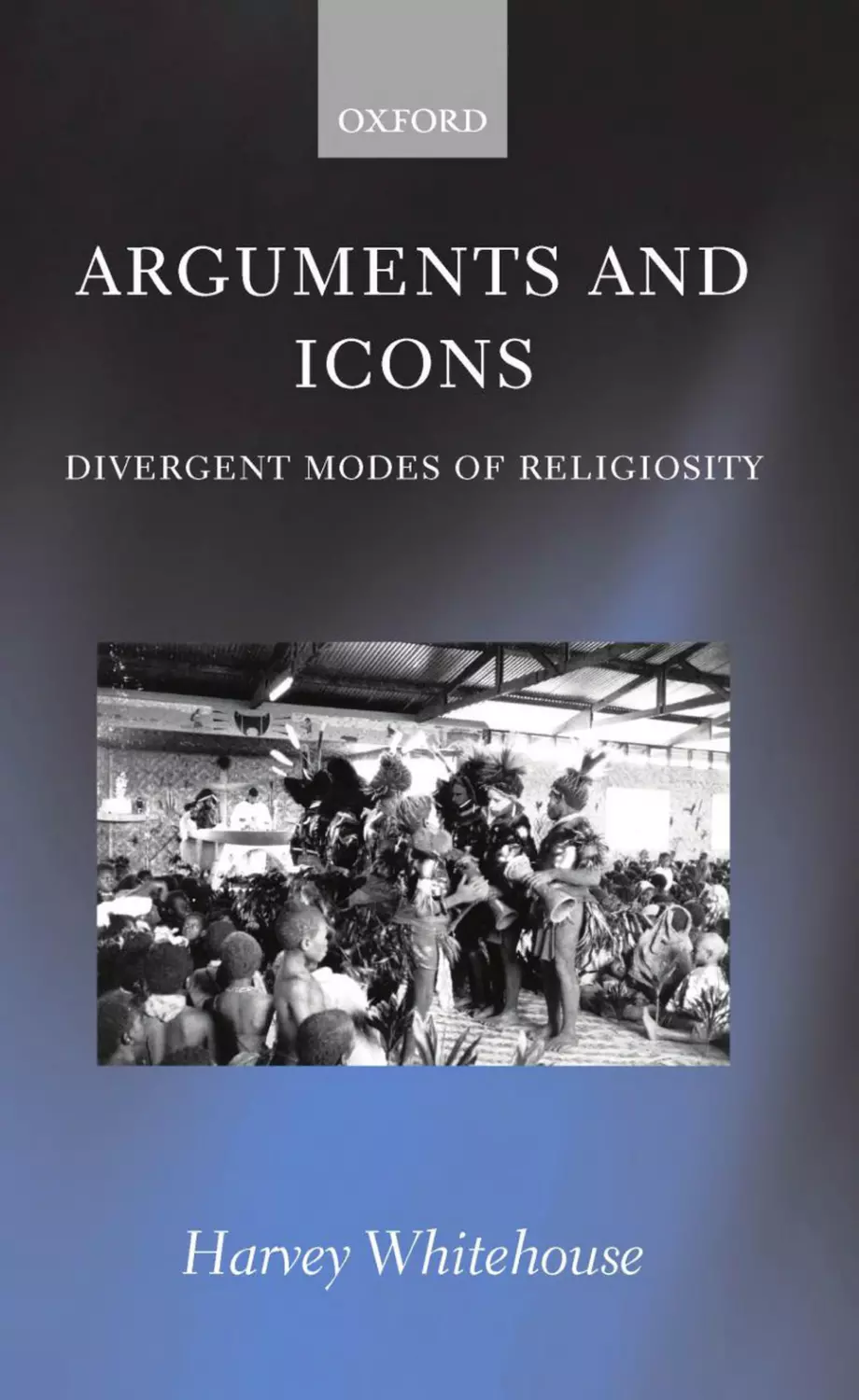
Arguments and Icons
Divergent modes of religiosity
HARVEY WHITEHOUSE
OXFORD
UNIVERSITY PRESS
OXFORD
UN IVERSITY PRESS
Great Qarendon Street, Oxford ox2 6DP
Oxford University Press is a department of the University of Oxford.
It furthers the University's objective of excellence in research, scholarship,
and education by publishing worldwide in
Oxford New York
Athens Auckland Bangkok Bogota Buenos Aires Calcutta
Cape Town Chennai Dar es Salaam Delhi Florence Hong Kong Istanbul
Karachi Kuala Lumpur Madrid Melbourne Mexico City Mumbai
Nairobi Paris Sao Paulo Singapore Taipei Tokyo Toronto Warsaw
with associated companies in BerJin Ibadan
Oxford is a registered trade mark of Oxford University Press
in the UK and in certain other countries
Published in the United States
by Oxford University Press Inc., New York
Harvey Whitehouse 2000
The moral rights of the author have been asserted
Database right Oxford University Press (maker)
First published 2000
All rights reserved. No part of this publication may be reproduced,
stored in a retrieval system, or transmitted, in any form or by any means,
without the prior permission in writing of Oxford University Press,
or as expressly permitted by law, or under terms agreed with the appropriate
reprographics rights organization. Enquiries concerning reproduction
outside the scope of the above should be sent to the Rights Deparnnent,
Oxford University Press, at the address above
You must not circulate this book in any other binding or cover
and you must impose this same condition on any acquiror
British Library Cataloguing in Publication Data
Data available
J ...ibrary of Congress Cataloging in Publication Data
Data applied for
ISBN 0-19-823414-7
ISBN 0-19-823415-5 (pbk)
1 3 5 7 9 10 8 6 4 2
Typeset in Ehrhardt
by Cambrian Typesetters, Frimley, Surrey
Printed in Great Britain
on acid-free paper by
T J. International, Pads tow, Cornwall
Dedicated to Danny
ACKNOWLEDG EMENTS
Much of the material in this volume has gone through a series of incar-
nations as seminar and conference papers, and some of it has been
published in journals. I have, as a consequence, accumulated many debts.
For their stimulating and constructive comments on earlier drafts of
many parts of this volume, I should like to thank those attending my
departmental seminar presentations at the London School of Economics
(1991), the Universities of Oxford and l\1anchestcr and the Queen's
University of Belfast (1993), and the Universities of St Andrews and
Edinburgh (1996), as well as my fellow participants at conferences of the
European Society for Oceanists in Nijmegen (1992) and Copenhagen
(1996), of the Association for Social Anthropologists in Oceania in Hawaii
(1996), and of the European Association for Social Anthropologists in
Oslo (1994) and Frankfurt (1998). My attendance at overseas conferences
was generously funded by the Queen's University of Belfast and the
British Academy.
A series of workshops in Paris, organized by Carlo Severi and funded
by the CNRS, and two workshops on anthropological studies of
Christianity, organized by Fenella Cannell and Maia Green at the
University of Manchester (1997) and the London School of Economics
(1998), also provided invaluable opportunities to discuss aspects of this
volume and I am indebted to all the participants at these meetings.
I am grateful also to the NIDevR for funding my archival research for
this book in 1996, at the Australian Archives, the Pacific Manuscripts
Bureau, and the National I..ibrary in Canberra, and the Mitchell I..ibrary
in Sydney. I should like particularly to thank Chris Ballard, Ian Keen, and
Hank Nelson for their invaluable guidance in relation to this work. I also
benefited greatly from Ton Otto's bibliography of archival material on
Manus, which he kindly made available to me in advance of its publica-
tion. Some of the ethnography presented in this volume also derives from
my fieldwork in Papua New Guinea as a doctoral student, funded by the
Economic and Social Research Council. For this material, I am, as ever,
in the debt of my many friends in the field, especially the people of
Oadul, Sunam, and Maranagi.
I am grateful to the Royal Anthropological Institute of Great Britain
and Ireland and to Oceania Publications for permission to reprint in this
Vlll
Acknowledgements
volume my o\\.n material previously published as articl
s in Man, the
Journal of the Royal Anthropological Institute, and Oceania. I should also
like to thank the Anthropological Society of Oxford and the
Anthropological Association of Ireland for permission to reprint in this
volume my own material previously published as book reviews in JASO:
The Journal of the Anthropological Society of Oxford and the Journal of
the Anthropological Association of Ireland.
In relation to each chapter of this volume, there are particular indi-
viduals to whom I owe a special debt of gratitude, for commenting at
length or in writing on earlier drafts. I benefited greatly in this way from
the generosity of: Marcus Banks, Bob Barnes, Maurice Bloch, Simon
Harrison, Ingjerd Hoem, and Howard Morphy (Chapter 1); Pascal Boyer,
Sini Cedercreutz, William Christian Jr, Simon Harrison, Michael
Houseman, and Carlo Severi (Chapter 2); Alfred Gell, Tim Ingold, Tom
Lawson, and Gilbert Lewis (Chapters 3 and 5); Pascal Boyer, Justin
Barrett, Simon Harrison, Michael Houseman, Stephen Hugh-Jones,
Tom Lawson, Carlos l\londragon, Carlo Severi, and Eduardo Viveiros de
Castro (Chapter 4); Mark Burnett, Fenella Cannell, William Christian Jr,
and Chris Marsh (Chapter 7); Steve Mithen (Chapter 8).
An entire draft of the manuscript was read and commented on by
Pascale Bonnemere, Tony Crook, Bob McCauley, and Brian Malley. Any
remaining errors are mine, of course, but there would have been many
more without the help of Pascale and Tony, whose expert knowledge of
key ethnographic cases provided a valuable corrective on several points.
Likewise, Brian's critical sharpness and Bob's unrelenting rationality,
precision, and candour helped me to avoid some particularly embarrass-
ing mistakes.
Of the two anonymous reviewers for aup, only James Laidlaw subse-
quently revealed his identity to me. He brought to his report on the
manuscript impressive breath of learning and intellectual clarity, from
which I have profited greatly. The other reviewer, whose identity I have
not been able to divine, also provided many extremely helpful sugges-
tions, to which I have tried to respond (however inadequately).
CONTENTS
List of Maps and Figures Xl
Introduction 1
The Theoretical Context 3
Episodic and Semantic Memory 5
Memory and Modes of Religiosity 9
Summary of the Book 12
1. Indigenous Religions of Papua New Guinea 18
Initiations as Rites of Terror 21
Existing Approaches to Rites of Terror 23
The Cognitive and Political Implications of Rites
of Terror 30
2. From Mission to Movement 34
Modalities of Codification 35
Early Missionization and the Politics of Memory 37
Christianity and Indigenous Movements 41
The Tedium Effect and Localized Splintering 44
The Political Implications of Indigenous Movements 47
Codification, Memory, and Group Formation 49
3. Modalities of Codification and Dissemination 54
The Case Studies 54
Doctrinal Revelations 58
Imagistic Revelations 63
Dissemination in the Doctrinal Mode 73
Dissemination in the Imagistic Mode 77
x
Contents
4. Order and Disorder in Melanesian Religion 81
Ritual and Exegesis 83
Analogic Codes 88
Doctrinal Codification 93
5. Cognition, Emotion, and Politics 99
Frequency of Transmission and Memory 100
Memory and Political Association 112
6. Interacting Modes of Religiosity 125
Potentialities and Limitations of the Two Modes
of Religiosity 126
The Imagistic Domain of the Early Paliau Movement 130
lVlodes of Religiosity in the Early Paliau Movement 140
7. Entangled Histories 147
Modes of Rcligiosity in the European Reformation 150
From Reformation to Missionization 156
8. Modes of Religiosity and Political Evolution 160
The Imagistic Mode in the Upper Palaeolithic 161
The Doctrinal Mode and the Great Transformation 169
Literacy, Orality, and Modes of Religiosity 172
Routinization, Communitas, and Modes of Religiosity 180
Epilogue 185
References ] 89
Index 199
LIST OF MAPS AND FIGURES
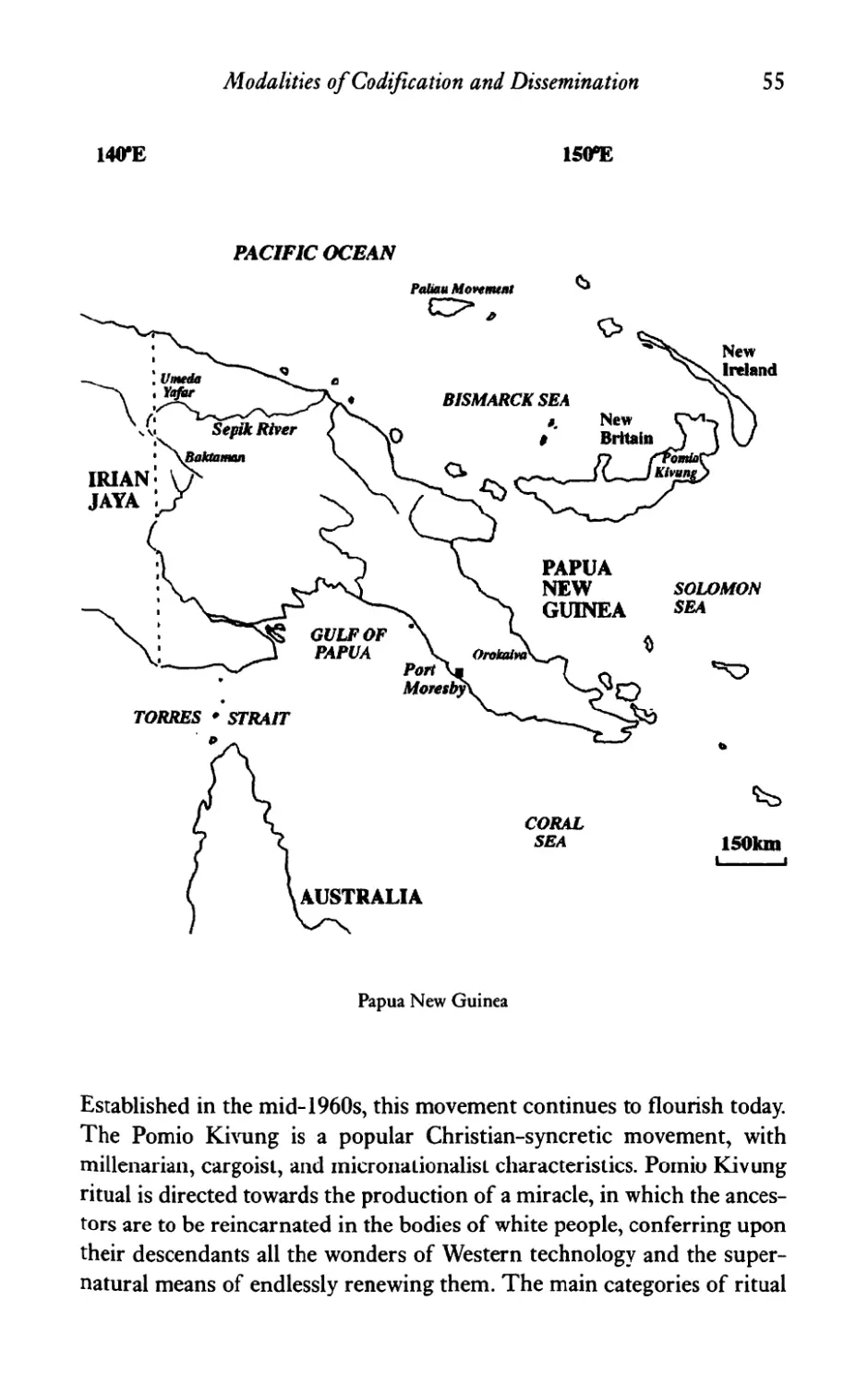
Map of Papua New Guinea
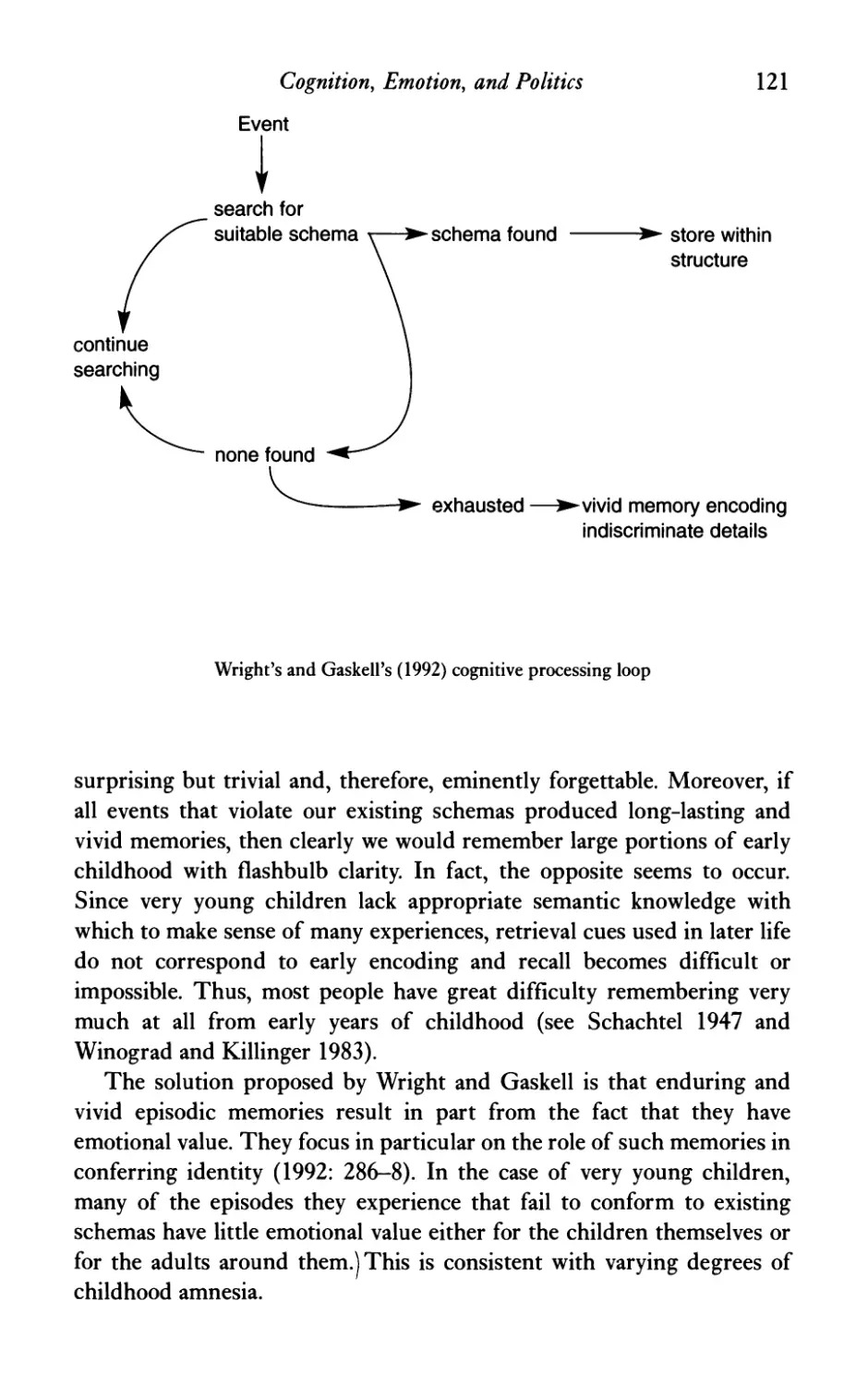
Wright's and Gaskell's (1992) cognitive processing loop
55
121
In trod uction
This book distinguishes two fundamentally contrasting sets of politico-
religious dynamics which may be dubbed 'doctrinal' and 'imagistic'
modes of religiosity.l Modes of religiosity constitute tendencies towards
particular patterns of codification, transmission, cognitive processing,
and political association. The imagistic mode consists of the tendency,
within certain small-scale or regionally fragmented ritual traditions and
cults, for revelations to be transmitted through sporadic collective action,
evoking multivocal iconic imagery, encoded in memory as distinct
episodes, and producing highly cohesive and particularistic social ties. By
contrast, the doctrinal mode of religiosity consists of the tendency, within
many regional and world religions, for revelations to be codified as a body
of doctrines, transmitted through routinized forms of worship, memo-
rized as part of one's 'general knowledge', and producing large, anony-
mous communities. These fundamentally contrasting dynamics are often
to be found within a single religious tradition, where they may be associ-
ated more or less strongly with different categories or strata of religious
adherents. For instance, the religious practices of social elites and literati
may have a noticeably 'doctrinal' character, whereas 'little traditions'
(Redfield 1955) and 'cults of the little community' (Werbner 1977) are
often more distinctively 'imagistic'. However pronounced the tendencies
towards one or other mode of religiosity may be within a particular field
of religious activity, they remain tendencies and nothing more. Even the
most iconoclastic doctrinal traditions incorporate certain properties of
the imagistic mode and vice-versa, not least because doctrines themselves
may evoke multivocal imagery and because ritual symbolism is often
crucially augmented by doctrine-like discourse. Having said that, the
distinction between doctrinal and imagistic modes of religiosity corre-
sponds to empirically significant trajectories, and this book attempts to
explain why.
Demonstrating the empirical productivity and explanatory value of
the theory of modes of religiosity requires a delicate balancing of the
pressures to substantiate and to generalize a set of claims. 1'he strategy
I These concepts were developed in my earlier monograph, Inside the Cult (Oxford
University Press, 1995).
2
Introduction
adopted in this volume is to focus heavily on a small n4mber of excep-
tionally well-documented religious traditions in Melanesia. A compre-
hensive substantiation of my argument, even if restricted to Melanesian
examples, would necessarily run into many volumes, because there are a
great many distinct cults, sects, and religious denominations in Papua
New Guinea alone. To extend these arguments further still, to religious
traditions all around the world, would require a massively greater body of
data, and place me in the position of a reckless trespasser on the regional
specialisms of others. By focusing on just a few case studies, however, I
hope to demonstrate the explanatory potential of the theory of modes of
religiosity. That is the aim of this book. What follows is not intended as a
contribution to the ethnographic record, of Melanesia or anywhere else,
but as a theoretical treatise which, though it happens to be illustrated by
(and therefore oriented to) Melanesian examples, I hope will be taken up
and extended by others in relation to a broader range of materials.
i\n initial aim of this volume is to show that the Melanesian traditions
examined gravitate strongly towards one or other of the two modes of reli-
giosity, or towards both but within readily distinguishable domains of oper-
ation. (More generally, it is suggested that the doctrinal mode was
unelaborated in pre-contact Melanesia, whereas imagistic practices were
well established in many parts of the region. By contrast, certain varieties
of missionary Christianity tended towards a purely doctrinal mode of oper-
ation and often acted to suppress imagistic forms of both Melanesian and
European origin. Thus, Papua New Guinea has recently been the site for a
dramatic confrontation between divergent modes of religiosity. Only in the
light of this confrontation is it possible to explain many of the recurrent
features of new religious movements in Melanesia, including distinctive
patterns of interaction between doctrinal and imagistic fields of activity.)
If modes of religiosity constitute general tendencies towards the
coalescence of particular transmissive, cognitive, and political features,
then it must be because these features are mutually reinforcing. A major
part of this volume is devoted to the formulation of these interconnec-
tions. It must be emphasized, however, that there is nothing determinis-
tic about these arguments. Modes of religiosity do not always coalesce and
their component features, where they tend to become pronounced, must
always be the outcome of multiple, historically contingent causes.
Imagistic and doctrinal modes nevertheless may be regarded as clusters of
features that tend to coalesce, all else being equal. .i\s such, they consti-
tute relatively robust cultural models that, once established, often endure
in more or less elaborated forms for centuries, and even for millennia.
Introduction
3
ow modes of religiosity came into being in the first place, at various
times and locations, is a complex question. On the basis of archaeological
evidence, it is tentatively suggested in this volume that the imagistic mode
first appeared among Upper Palaeolithic hunter-gatherers through
processes of religious experimentation that turned out to be highly adap-
tive in conditions of intensified competition for resources, not least
because they fostered forms of especially intense local cohesion, facilitat-
ing more effective forms of group defence. The doctrinal mode appears
to have been invented very much later, precipitated by the advent of writ-
ing technologies just a few thousand years ago. The emergence of the
doctrinal mode was likewise portentous, paving the ,yay for processes of
colonization, missionization, and indigenous struggles for independence)
The Theoretical Context
In Inside the Cult (Whitehouse 1995: 197), I distinguished thirteen
contrasting features of doctrinal and imagistic modes of religiosity
respectively. Inevitably, there was a certain arbitrariness in the enumera-
tion of thirteen features, rather than ten or twenty. [Nevertheless, any
method of carving up the component elements of doctrinal and imagistic
modes of religiosity is likely to evoke contrasts already identified in estab-
lished theories of religion (see Whitehouse 1995: 203-17). Among previ-
ous theories of direct relevance, Max Weber's (1930; 1947) varied
distinctions, for instance between routinization and charisma, and
between 'World religions' and 'traditional religions', stand out as perhaps
the most pioneering and influential. Such models have arguably informed
all subsequent attempts to differentiate between modes of religiosity,
including: Ruth Benedict's (1935) contrast between 'Appolonian' and
'Dionysian' religious modalities; Ernest Gellner's (1969) distinction
between urban and rural religious syndromes within his 'pendulum-
swing theory of Islam'; Jack Goody's (1968; 1986) dichotomy between the
relatively rigid orthodoxies of literate religions and the more mutable,
innovative character of non-literate religions; Victor Turner's (1974)
opposition between universalistic 'fertility rituals' and particularistic
'political rituals'; I. M. Lewis's (1971) contrast between 'central' and
'peripheral' cults; Richard Werbner's (1977) distinction between 'regional
cults' and 'cults of the little community'; Fredrik Barth's (1990) contrast
between wide dissemination of the religious teachings of Balinese gurus
and the much more localized, fragmentary dissemination of ritual
imagery in Melanesian cults of initiation. All these theories had already
4
Introduction
identified the co-variation of at least two of the features \isted in my orig-
inal model. Moreover, in the voluminous literatures on the history of
world religions, great and little traditions, religious phenomenology, sects
and cults, and in various related fields of research, it is also possible to
find illuminating discussions of the coalescence of certain features of
doctrinal and imagistic modes of religiosity.
Such scholarship has produced a massive body of data and a wide vari-
ety of models and insights of indisputable importance and originality.
Nevertheless, nobody seems to have tried to bring together within the
ambit of a single theory all the features which, taking the existing litera-
ture as a whole, appear to be interconnected. Moreover, the unique role
given to cognitive processes in my approach is crucial to understanding
the coalescence of other features within doctrinal and imagistic modes of
religiosi ty.]
It has long been appreciated that the proliferation of doctrine may lead
to the development of large, expansionary religious communities, the
members of which could not possibly all have met but nevertheless expe-
rience a sense of common identity. It is similarly well established that
ecstatic forms of ritual action are capable of producing intense cohesion
among small groups of religious adherents. Sociological theories of this
divergence in the course of the twentieth century have been heavily influ-
enced by quite antique (although often very brilliant) scholarship, espe-
cially that of Emile Durkheim and Max Weber. But ,ve have not advanced
very much beyond the seminal insights of these early theorists. In some
ways we have backtracked, by failing to pursue and build upon their most
promising insights.
Cohesion is not explicable in purely sociological terms, for it is always
in important respects an emergent psychological property. Durkheim's
seminal work on the relationship between ritual and social cohesion was
marred by a principled aversion to the use of psychological perspectives
in the analysis of social phenomena (e.g. Durkheim 1952: Book 1). But, in
any case, nineteenth century psychology was not sufficiently developed to
lend support to Durkheim's symbolist project, or to the (often neglected)
intellectualist thread that ran through The Elementary Forms of the
Religious Life (1915). One aim of this book is to show that certain
'cutting-edge' theories in cognitive psychology have profound implica-
tions for social theory in general, and the comparative study of religion in
particular.
If we are to understand the various ways in which people come to feel
united or to regard themselves as sharing a common identity, we are obliged
Introduction
5
to make certain assumptions about human memory. At the very least, we
must assume that people remember certain emblems, historical representa-
tions, attitudinal stances and stereotypes, experienced events, ways of
behaving, and a great variety of other phenomena that are used to define
the character, boundaries, and relations of social categories and groups.
(The relevance of memory for social theory was first substantially
explored by Halbwachs (1925; 1950), whose work has recently been revis-
ited in a spate of fresh scholarship on 'collective' and 'social' memory. 2 By
and large, this literature focuses on the ideological content of memory,
and the political dynamics of repression, forgetting, selective recall,
decay / distortion, and alternative discourses about memory. At the heart
of many studies is the question of who controls representations of the
past, and to what ends. The central thrust of my argument goes in the
opposite direction. Instead of asking how political organization and ideol-
ogy help to mould people's memories, I am asking whether universal
features of human memory, activated in different ways, might be said to
mould political organization and ideology.) The former question is both
obvious and valid and has deservedly become a fashionable topic for
debate. The question with which I am concerned is less obvious, but the
two questions, and the divergent approaches which they imply, are by no
means incompatible.
Episodic and Semantic Memory
My starting point is a distinction made by psychologists between 'seman-
tic' and 'episodic' (or 'autobiographical') memory (Tulving 1972).
Episodic memory refers to mental representations of personally experi-
enced
ent
, conceptualized as unique episodes in one's life. Semantic
memory refers to mental representations of a general, propositional
nature. For instance, the knowledge I have concerning road signs, the
history of anthropological theory, how to behave in a restaurant, and what
happens in the story of Little Red Riding Hood, are all expressions of my
semantic memory. Within psychology, these two types of memory have
tended to be studied and theorized quite separately. 3 Nevertheless, the
2 An informative introduction to this literature is provided by Connerton (1989) and
Fentress and Wickham (1992). Moreover, in the field of Melanesian studies, highly sophis-
ticated discussions of memory and cultural transmission have recently been published (e.g.
Kuchler 1994; Munn 1995).
3 As Bloch points out (1995), episodic memory has been examined extensively in rela-
tion to theories of personal identity, whereas such issues have seldom been addressed in regard
to semantic memory (where the principle focus of interest has been in retention and recall).
6
Introduction
two types of memory are processually connected. ACGording to Cohen
(1989: 114-15): 'Semantic knowledge is derived from episodic memories
by a process of abstraction and generalization.' This point requires closer
examination.)
On the basis of my semantic knowledge of the world, I know that the
process of getting a haircut at a barber's shop involves a standard
sequence of events which include: entering the premises, making myself
known to the barber, perhaps being invited to sit in a designated area to
wait my turn, proceeding to a different chair for the hair-cutting, putting
on a gown, seating myself, keeping my head still, finally inspecting the
haircut with the aid of mirrors, removing the gown, undergoing the
brushing procedure, paying, and leaving. These episodes occur in a fixed
sequence, giving my knowledge of 'how to behave in a barber's shop' a
firm overall structure. Psychologists usually refer to such structures as
'schemas' .4
The first time I had my hair cut at a barber's shop (presumably as a
young child), I almost certainly did not know how to behave, and had to
be guided through the procedure by experienced adults. I may already
have formed schemas for certain elements of the experience, such as
entering and wai ting (which of course feature in schemas for going to
doctors, dentists, and many other providers of services). But certain
elements would probably have been new to me (the donning and remov-
ing of the gown, the requirement to keep my head still, the inspection and
brushing procedures, and so on). Elements of my first visit to the barber's
shop which could not be attached to existing schemas for receiving a
service would initially have been remembered as unique personal experi-
ences, and thus encoded in episodic memory. Through repeated experi-
ences of visiting the barber's shop, however, the once-novel elements
would come to be expectable in the context of a specialized barber's shop
schema. I can no longer recall my first episodic memories of visiting a
barber's shop, but my semantic knowledge for how to behave in barbers'
shops generally, could not have been constructed without them. This is
what Cohen means when she says that semantic knowledge is 'abstracted'
from episodic memories.
Nevertheless, the concept of 'abstraction' is somewhat vague. In
4 In the case of detailed event structures of the type I have just described, these are
also commonly referred to as 'scripts'. The term 'schema', however, has a wider application,
being used to describe a variety of types of knowledge, ranging from simple typological clas-
sifications of objects to complex but recognizable strands of philosophical theorizing. For
the sake of simplicity, I shall keep to the general term 'schema'.
Introduction
7
mentally reconstructing a particular visit to a barber's shop ten years ago,
I must draw on the common elements of numerous experiences; I do not
recall details peculiar to a single episode, such as the barber sneezing or
talking about the cost of car insurance. Such specific things, because they
are not recurrent, are not part of my barber's-shop schema. Likewise, the
exact posture of the barber as he holds up the mirror (unless this posture
was distinctive and repeated) would not stick in my mind. Thus, in visu-
alizing this phase of the visit, I know that the posture I attribute to the
barber is imagined rather than remembered, even though the holding up
of the mirror, at least as a type of event, is indeed remembered correctly.
(As Cohen points out: 'The most important prediction from schema
theory is that what is normal, typical, relevant, or consistent with pre-
existing knowledge will be remembered better than what is unexpected,
bizarre, or irrelevant' (1989: 72). Thus, semantic memory consists of the
common denominators of a series of episodic memories, along with
invented details that fit with the schema but are not experienced as
authentic or definite recollections of individual episodes.
On this basis, we might expect episodic memories to possess relatively
short life spans. To some extent, this is true. I remember my last visit to
a barber in considerable detail, including elements extraneous to my
barber's-shop schema. Visits to the same barber more than a year ago,
however, are indistinguishable, my knowledge being largely based on
semantic rather than episodic memory. But what about the enduring
memories people have of certain events that occurred many years ago?
Most people can recall a vast array of unique episodes in their lives, which
tend to have a distinctive emotional salience and/or set of sensory associ-
ations. These sorts of memories seem to pose a problem to schema theory:
unique aspects of events should be forgotten because they are irrelevant
to existing schemas, and the first occurrences of subsequently repeated
events should be dissolved into the melting pot of semantic memory.
One area of study which might shed light on this anomaly concerns
itself with a special type of episodic remembering, known as 'flashbulb
memory'. This term, coined by Brown and Kulik (1982), refers to vivid
and detailed recollections of emotionally arousing events that radically
violate existing schemas. Following a close investigation of this phenom-
enon, Wright and Gaskell (1992) argue for a 'cognitive processing loop'
that would account for both episodic and semantic memory) Presented
with an event, the cognitive apparatus searches for a suitable schema, on
the basis of which to cue appropriate understandings and responses. If no
relevant schema is found immediately, the search is repeated. In the case
'8
Introduction
of events which substantially conform to existing schernas, the searching
is rapidly concluded and the event assimilated to existing knowledge. Any
details of such an event that are extraneous to existing schemas are
assigned to a sort of mental waste-disposal system the contents of which
remain accessible for a time but gradually drain through the bottom of the
container, after which point they are lost (forgotten) entirely.(By contrast,
events which substantially violate existing schemas set off a frantic and
prolonged search for relevant schemas, vainly trying to match all sensory
inputs (randomly selected in the absence of schematic criteria for rele-
vance) to semantic knowledge. An unsuccessful search eventually leads to
the encoding of an entirely unique schema, incorporating a variety of
irrelevant details, which is one of the hallmarks of 'flashbulb memory'.
By this reasoning, young children, who are continually encountering
events for which no schemas are available, should 'lay down' a great many
vivid memories which could still be recalled in adulthood. Wright and
Gaskell argue, however, that most of the unique schemas encoded by
young children are effectively cut off from the developing structures of
semantic knowledge because childhood retrieval cues rapidly become
obsolete
In this way it is possible to account for episodic and semantic
memory systems, as well as for the phenomenon of 'childhood amnesia',
within the ambit of a single model.
(A drawback of Wright's and Gaskell's theory, however, is that their
'cognitive processing loop' does not incorporate one of the apparently
crucial recurrent features of flashbulb memory, which is the emotional
excitation that accompanies encoding. I have argued elsewhere that recent
models in neuroscience, and particularly the theories of the Nobel
Laureate Gerald Edelman, s support many of Wright's and Gaskell's prin-
cipal hypotheses about the relationship between episodic and semantic
memory, and at the same time establish affective and sensory processes
firmly at the core of these memory systems (Whitehouse 1996c). What is
suggested is that the establishment of schemas depends on emotional
reinforcement-in biological terms, the substantial and co-ordinated
replication of populations of neuron firings selectively reinforced by
biochemical emissions from the brain's affective centres in the limbic
system. Semantic memory results from the strengthening over time of
such repertoires, such that the organism is able to classify and model
experiences on the basis of common features, in other words, to develop
schemas for recurrent experiences. Episodic memory, by contrast, results
5 For a clear introduction to Edelman's theories, see Edelman (1992).
Introduction
9
from the massive biochemical reinforcement of novel repertoires. In the
case of flashbulb memory, considerable emotional and/or sensory stimu-
lation occurring in conjunction with novel patterns of neurological activ-
ity occasioned by a surprising or unfamiliar event produces unique
schemas that incorporate a wide variety of vivid inputs. Such memories
of distinct episodes may endure a lifetime, both because repetition of the
surprising event is unlikely and because, even if a substantially similar
event is experienced, the traces left by the first will have been so strongly
reinforced by excessive emissions from the brain's emotional centres that
the original set of representations will retain much of its salience, detail,
and uniqueness.)
Memory and Modes of Religiosity
One of the central characteristics of the doctrinal mode is the frequent
repetition of both ritual and dogma. Many of the ceremonies performed,
for instance, in the holy places of doctrinal religions, along with the recit-
ing of texts, prayers, and liturgical formulae, are encoded in semantic
memory. Routinization is directly connected to the style of codification:
the implicationallogic of doctrinal systems, expressed in language (sacred
texts, sermons, theological debates, and so on), can only exercise a contin-
uous and stable influence on people's attitudes, beliefs, and actions if it is
frequently reviewed. The processing of religious materials in semantic
memory has important sociological implications.
An Anglican layman asked to recall the chain of events at a Sunday
service five years ago will be able to provide a rich and detailed account
of what happened on the basis of liturgical schemas but will probably
not be able to recall the singular episode. Aspects of the particular occa-
sion in question which are not included in general schemas will have
been forgotten (unless, of course, the excluded elements were shocking
and emotionally arousing-as would probably have been the case if, for
instance, the vicar had suffered a heart attack during Holy Communion
or members of the congregation had been struck down by falling
masonry).(Thus, the particular identities of members of the congrega-
tion are not specified in liturgical schemas. When describing the behav-
iour of worshippers in a church service, our Anglican informant will not
visualize real, flesh-and-blood people, but a mass of fictitious, anony-
mous others enacting the rites in unison. Schemas of this type form the
cognitive underpinnings of universalistic ideology or, indeed, any
conception of a community whose members are not individually
10
Introduction
specifiable. Religious identity, in the doctrinal mod
, is primarily
conferred on the basis of presumed commonalties in the thought and
behaviour of anonymous others, a state of affairs which is only conceiv-
able with reference to semantic knowledge.
By contrast, the rituals and images of the imagistic mode are primar-
ily encoded in episodic memory. In many societies, religious life is focused
around very infrequent, traumatic ritual episodes. Rites of initiation, for
instance, commonly involve the terrorizing and torture of novices and the
challenging of everyday knowledge through the partial transmission of
esoteric revelations. Similar patterns may be identified in a variety of
ideologically distinct religious systems (from climactic forms of millenar-
ism to diabolical cults). The elements of shock and arousal entailed in
such contexts produce enduring episodic memories, and even classic
flashbulb experiences (e.g. Herdt 1989: 115). If you ask participants to
describe what occurred in a given ceremony of this type several years
afterwards, their accounts will not be based primarily on semantic knowl-
edge. On the contrary, we would expect to be told exactly who the partic-
ipants were, along with many peculiar details of their behaviour. Common
identity among religious adherents in the imagistic mode is fundamen-
tally particularistic, based on lasting episodic memories of undergoing the
traumatic lows and ecstatic highs of sacred events together with a speci-
fiable group of individuals. The longevity and intensity of such memories
corresponds to the strength and inviolability of the cohesion which they
engender. These issues are explored in depth in the chapters which
follow.
Durkheim's concept of the 'elementary forms' of religion fully
acknowledged the cohesion engendered in imagistic practices. But
because Durkheim could not (and famously did not want to) identify the
cognitive underpinnings of these practices, he tended to generalize them
to all religious traditions, thereby overlooking the qualitatively different
trajectory of the doctrinal mode
Many scholars after Durkheim have rather uncritically adopted his
conception of the relationship between ritual and cohesion. But this has
often been done in a way that projects the mnemonic properties of doctri-
nal religion on to the sorts of imagistic practices with which Durkheim
and many of these later scholars were really concerned. This problem was
especially apparent during the structural-functionalist era when all ritu-
als were presented in ethnographic texts as general schemas ('they do this'
and 'they believe that'), a discursive technique which became known as
the 'ethnographic present'. It is a curious irony that, whereas certain
Introduction
11
post-functionalist texts have seriously advocated synchronic analysis of
'traditional' society, despite admitting its inapplicability to complex
'historical' societies (Goody 1977), it actually makes more sense to
describe Christian rituals in the ethnographic present and tribal initiation
rites in the past tenses. After all, the former are locked into the ahistori-
cal schemas of semantic knowledge and the latter, by contrast, cognized
as historically situated episodes.
/Before proceeding any further, however, an area of potential misun-
\
derstanding must be anticipated and dealt with. Semantic and episodic
memory are universal features of human cognition and, indeed, are
common to the cognitive systems of many other species. In consequence,
there is no such thing as a religious tradition that does not depend for its
transmission on both semantic and episodic memory. All varieties of
Christianity operate in the doctrinal mode, although they may also incor-
porate imagistic practices. Some of the more iconoclastic forms of
Christianity, however, more or less effectively suppress the expression of
imagistic forms. For instance, I will describe tendencies in that direction
within early Protestantism in Europe and missionary Christianity in
Melanesia. But no matter how successfully the imagistic mode is
excluded, Christians everywhere will have enduring episodic memories
for at least some religious experiences (and probably for a great many).
Likewise, as we shall see, certain cults of initiation are highly imagistic
and unconnected to any sort of thoroughgoing doctrinal tradition.
Nevertheless it would clearly be untrue to claim that all the religious ideas
and actions entailed in such initiation rites are encoded exclusively in
episodic memory. On the contrary, all forms of human action utilize
elements of semantic memory, and some of the component features of
even the most infrequent and traumatic rituals evoke familiar schemasj
These may be borrowed from non-religious contexts: for instance, wash-
ing procedures, conventional styles of address and comportment, and
standard forms of sharing and consuming foods (even though all such
tasks may be modified in the ritual setting and certainly envisaged as
different from the profane activities upon which they are modelled).
Likewise, very irregularly performed rituals may incorporate sequences
(or elements of sequences) found in much more frequently repeated rites.
Clearly, episodic and semantic memory are ubiquitous. Nevertheless,
these principles of cognitive processing have different ramifications in
doctrinal and imagistic modes. Everything hinges on how systems of
memory are linked to patterns of identity-formation. In the doctrinal
mode, much of what defines one's religious identity (for instance, in the
12
Introduction
case of a Christian, regular church attendance and knqwledge of the life
and teachings of Christ) constitutes a set of representations encoded in
semantic memory producing imagined, anonymous religious communi-
ties. By contrast, the most valued revelations and forms of collective iden-
tity in the imagistic mode cannot be understood primarily with reference
to a person's semantic knowledge. Religious imagery, and its multivocal
resonances, are largely remembered as extremely intense, life-changing
episodes, through which enduring and particularistic social bonds are
forged.
Summar.v of the Book
Chapter 1 provides an introduction to the indigenous religions of Papua
New Guinea, many of which are founded on imagistic practices.
Particular attention is focused on initiation, in so far as certain aspects of
these rites serve to illustrate the general nature of religious experience
and revelation in various regions of pre-contact Melanesia. Like all imag-
istic practices, initiation rituals evoke a sense of surprise, presenting
novices with a radically new understanding of the cosmos, or at least of
certain of the mechanisms through which it is reproduced. Such experi-
ences tend to be associated with intense affective states and often also with
forms of sensory stimulation. In initiations, novices are commonly terror-
ized, but most existing explanations for this dimension of the rites estab-
lish generalities only at the cost of adequate engagement with the
cognitive and affective processes entailed in ritual performance. I propose
an alternative approach, which links the intricate psychological dynamics
of Melanesian religion to the political structure and ethos of indigenous
communities, including the characteristics of localized cohesion and
inter-group raiding and ,varfare. Central to my exposition is the argument
that cognitive shocks, coupled with states of mortal terror (and other
emotions) produced the enduring episodic memories upon which solidary
and enduring face-to-face relationships were substantially based in pre-
contact Melanesia.
Whereas the central revelations of Melanesian initiation rites are
transmitted through rare and secretive climactic rituals, those of mission-
ary Christianity are publicly disseminated via orations and texts, accord-
ing to a routinized regime of sermonizing and liturgical ritual. In Chapter
2, I examine the process of missionization in Papua New Guinea, arguing
that it introduced a radically new conception of religion, and also of
patterns of political association.
Introduction
13
The practices of the early missions were dominated by the doctrinal
mode of religiosity, in which the performance of repetitive ritual was
inextricably bound up with universalism, centralization, and hierarchy. It
has long been recognized that the missionization of Melanesia
contributed to the enlargement of indigenous conceptions of humanity,
partly through the spread of universalistic ideas entailed in Christian
teaching. I argue that a more crucial (and hitherto neglected) factor is that
identity-conferring ritual came to be remembered in the form of general-
izahle schemas for repetitive Christian rituals.
Unlike the rare and traumatic imagistic practices of local fertility cults
and systems of initiation, which were remembered as distinct episodes,
the routinized practices of the mission station established scripts for 'how
to be a Christian' in which the actual participants were not specified in
ritual schemas. This made possible the conceptualization of anonymous,
'imagined' communities. In due course, missionary practices contributed
to the establishment of new religious movements, under indigenous lead-
ership, dominated by the doctrinal mode of religiosity.
Routinization in new indigenous religions, just as in the missions,
tended over time to become monotonous, opening the way for periodic
splintering whereby local factions reactivated imagistic practices in
temporary outbursts of climactic ritual. As a result, some large-scale
movements in Papua New Guinea came to encompass two domains of
operation: that of the mainstream orthodoxy, dominated by the doctrinal
mode, and that of the sporadic and localized splinter group founded on
imagistic practices. An unintended consequence of this has been that the
cohesion evoked in splinter-group ritual has tended to be projected on to
the mainstteam community, rejuvenating commitment to the movement
as a whole and establishing its enduring role in the formation of microna-
tionalist groupings. The implications of this for the political future of
Papua New Guinea are briefly examined, showing that existing theories
of the relationship bet\\Teen indigenous religious movements and nation-
alist struggle need to be modified.
In Chapters 3 to 6, the main characteristics of the two modes of reli-
giosity are examined in closer detail, with particular reference to four case
studies: Baktaman initiation in inner New Guinea, the Taro cult of north-
ern Papua, the Pomio Kivung of East New Britain, and the Paliau
Movement of Manus and its environs.
Chapter 3 focuses on contrasting styles of codification and transmis-
sion in doctrinal and imagistic modes of religiosity respectively. The
mainstream institutions of the Paliau Movement and the Pomio Kivung,
14
Introduction
heavily modelled on missionary Christianity and exemplifying the various
features of the doctrinal mode, rely on orally transmitted, argument-
based rhetoric for the spread of religious ideology. In such traditions, the
persuasiveness of ethical and cosmological representations depends to a
large extent on their overall coherence, achieved through the ordering of
dogma in strings of implied questions and answers (or 'implicational
logic'). The adoption of this principle of codification facilitated the
spread of both movements across wide areas. Ideas that could be commu-
nicated orally or in texts were readily transported by patrolling leaders
and their representatives. Koriam (the founder of the Pomio Kivung) and
Paliau were able to establish headquarters where a managerial tier of
patrolling officials received much of their training. These links between
doctrinal codification and the scale and hierarchical, centralized structure
of the Paliau Movement and the Pomio Kivung are explored in detail.
(Alongside this discussion of codification and transmission in the
doctrinal mode, I construct a contrasting analysis of imagistic practices
using material on Baktaman initiation and the activities of Taro cultists
among the Orokaiva. In the latter contexts, virtually no attempt was made
to communicate religious ideas as bodies of doctrine. Revelations were
codified in iconic imagery, transmitted primarily through the choreogra-
phy of collective ritual performances. Religious representations were
structured as sets of revelatory images connected by loose (and somewhat
fluid) thematic associations, rather than as cohering strings of logically
connected dogma. These imagistic practices did not produce leaders,
partly because the source of religious insights was the collectivity (i.e. the
group of ritual actors) rather than an individual conduit for the divine.
Moreover, they could only be spread through contact between groups of
people and never by patrolling mediums, prophets, or messiahs
The
particular initiation rites of local Baktaman groups were in any case
shrouded in secrecy and no attempt was made to spread them more
widely. In the case of the Taro Cult, imagistic practices did spread
between contiguous groups in chains of contact transmission, but as they
travelled, these practices mutated dramatically (in contrast to the homog-
enization of doctrinal traditions that can be centrally orchestrated).
Chapter 4 examines the implications of contrasting regimes of codifi-
cation for debates about religious 'order'. Ron Brunton's argument, that
anthropologists have tended to exaggerate the orderliness of Melanesian
religions, is modified and extended through a discussion of the cognitive
foundations of divergent modes of religiosity. (The doctrinal mode,
imported to Melanesia by Christian missionaries, is organized around
Introduction
15
dialogical, implicational, narrative, and binary schemas which, in
conjunction with certain mechanisms for the reproduction of orthodoxy,
produce a high degree of coherence, stability, and uniformity of religious
belie[ In contrast, the imagistic mode, indigenous to Melanesia, empha-
sizes analogic resonances and multivocality rather than logical integra-
tion; the dynamic is towards creative elaboration rather than faithful
repetition and the production of local differences rather than regional
homogeneity. I argue that what anthropologists have tended to exaggerate
is not the intellectual productivity of indigenous Melanesian religions but
the extent to which they incorporate styles of codification and cognition
prevalent in the doctrinal traditions of European experience (especially
Christianity).)
Chapter 5 focuses on the psychological underpinnings of divergent
patterns of political association. The cognitive implications of extensive
routinization in the Paliau Movement and Pomio Kivung are closely
explored, both in regard to the reproduction of logically integrated
bodies of doctrine and the conceptualization of large, diffusely united
communities. Routinization is also linked to the affective quality of
worship, characterized by sober self-discipline. In stark contrast, the
imagistic practices of Baktaman initiation and the Taro cult stimulated
intense emotions and sensations which, along with cognitive shocks
engendered in ritual activity, produced a very distinctive mnemonic
process, adapted to conditions of infrequent transmission. Drawing on
recent studies of 'flashbulb memory', the psychological dynamics of
localized group cohesion are examined.
Chapter 6 focuses on what can happen when the two modes of reli-
giosity occur \\rithin a single religious tradition as relatively discrete but
interacting domains of thought and action. In the case of the Paliau
Movement and the Pomio Kivung, imagistic practices are expressed in
sporadic outbursts of climactic ritual and spirit possession, ttiggering
revelations through the iconicity of collective performances. The cohe-
sion generated within each local ritual community is periodically
projected on to the mainstream movement, having the effect of rejuve-
nating support for the doctrinal programme. In the absence of such a
process the routinized mainstream movement would be more fragile,
forever threatening to collapse in the face of impatience and low morale.
Chapter 7 argues that the patterns of interaction between modes of
religiosity in Melanesia have as much to do with the history of
Christianity in Europe as with Melanesian pre-history. In the Pomio
Kivung and the Paliau Movement, and other similar traditions, there is a
16
Introduction
tendency for doctrinal and imagistic modes of religiosity to become estab-
lished as readily distinguishable domains of activity. In part, this is
explained by the fact that some pre-contact Melanesian religions
provided models of purely imagistic practices, operating in the absence
of, and therefore subsequently distinguishable from, a doctrinal mode of
religiosity. An equally important factor, however, is that missionary
Christianity, as a set of doctrinal practices, tended to suppress or exclude
the imagistic mode, whether derived from European Christianities or
from Melanesian cults. Consequently, the meeting of religious traditions
of Melanesian and European origin amounted to a confrontation between
two starkly opposed styles of codification, transmission, and political
association. This raises the question of why missionary Christianity was
largely denuded of imagistic dimensions.
My answer to this is (that missionary Christianity was profoundly
influenced, albeit indirectly, by processes that began during the
Reformation. Reformed Christianity was highly adapted to rapid and
wide dissemination, largely because of its central preoccupation with the
establishment of purely doctrinal forms and the elimination of imagistic
ones. The hostility of certain early Protestant preachers to imagistic prac-
tices has recently been described by one historian as a sort of 'logocentric
iconophobia' (Collinson 1977). I argue that these extraordinary develop-
ments in both Protestant and Catholic Reformations provided radically
new models for subsequent varieties of Christianity which were crucial to
the development of evangelical missionary projects
Chapter 8, which concludes the volume, attempts to broaden the scope
of the argument by considering the possible role of modes of religiosity
in processes of political evolution. The chapter begins by examining
evidence that some hunter-gatherer populations in the Upper Palaeolithic
possessed a variety of imagistic practices. The development of the doctri-
nal mode occurred much later, as part of the establishment of temple
complexes in both the Old and New Worlds. (The role of literacy in this
crucial transformation is considered in some detail, with reference to
arguments put forward by Jack Goody and Ernest Gellner. It would seem,
however, that, although literacy may have been a precipitating factor, or
even a necessary condition for the independent invention of the doctrinal
mode of religiosity, the presence of systems of writing was not essential
to the spread of doctrinal models, as our Melanesian examples also
demonstrate. Discussion must therefore focus crucially on the social
conditions of transmission rather than on technologies of inscription.)
This topic is addressed through a reformulation of Victor Turner's
Introduction
17
portrayal of (the sequential emergence of three types of 'communitas'.
The first of these is existential or spontaneous communitas, a sort of
revelatory sensation of the 'brotherhood of Man', which Turner believed
was engendered in moments of liminality, whether in tribal initiation
rites, Muslim pilgrimages, or any of a range of other specific religious
activities. Turner regarded this state as logically and historically prior to
normative communitas, established through routinized expressions of the
original epiphanic experience. Turner argued that the normative phase
was followed by ideological communitas, codifying spontaneous revela-
tions as a corpus of doctrine. I argue, however, that spontaneous commu-
nitas does not occur in tribal rituals, including the Ndembu initiation
rites studied by Turner, and that a more appropriate starting place is
normative communitas. Normative communitas may be regarded as the
crucial development that transformed the tribal societies of human
prehistory into large-scale, centralized, and hierarchical states.
Ideological communitas followed, in so far as the potentiality of univer-
salistic themes was realized in specific doctrinal regimes, and Turner's
spontaneous communitas must be regarded as the end rather than the
beginning of these transformations, resulting in some cases from the
interaction of imagistic and doctrinal modes of religiosity.)
1
Indigenous Religions of Papua
New Guinea
In view of the extreme diversity of religious ideation and practice in
Papua New Guinea it is clearly difficult to provide anything resembling a
'balanced' overview of the indigenous religions of that country.
Nevertheless, in the context of this book, one of the greatest parameters
of variation is of relatively limited relevance-namely, the representa-
tionai/cosDl010gical content of different religious traditions. It need not
concern us here that people in one village might distinguish eight classes
of spiritual agency and the people of another village only two, or that in
one region the dead are left to rot in the bush, whereas in another they
might be partially decomposed, dismembered, and certain body parts
worn as decorations. This kind of diversity is not at issue, at least not
directly, because I am primarily concerned with the ways in which reli-
gious ideas are (and have been) codified and transmitted, the general
psychological processes activated, and the relationship of these things to
patterns of political association. r fhis last sentence condenses the central
concerns of the whole volume, and requires some preliminary unpacking.
Styles of codification and transmission are closely linked to the struc-
turing of religious representations, especially the ways in which they are
interconnected. For instance, Christian doctrine in all its various forms is
organized as a system of interconnected rhetoric, and its persuasiveness
rests quite substantially (at least for many people, much of the time) on
its logical coherence and integration. In traditions of this type, religious
ideas have to be transmitted orally, for instance as teachings, sermons,
prayers, and theological discussion, whether or not they are also set out in
sacred texts.
In Papua New Guinea, this method of codifying, organizing, and
Most of the text for this chapter was first published in the Journal 0/ the Royal
Anthropological Institute (NS), 2(4): 703-715, under the title 'Rites of Terror: Emotion,
Metaphor, and Memory in Melanesian Initiation Cults' (Whitehouse 1996d).
Indigenous Religions of Papua New Guinea
19
transmitting religious conceptions has been substantially elaborated
through the efforts of missionaries and also those involved in the estab-
lishment of party politics, whose ideologies are like,vise disseminated as a
corpus of logically persuasive, doctrine-like policies. Prior to contact, the
religions of Papua New Guinea were substantially founded on rather
different principles of codification and transmission. As Trompf puts it:
'Formal, doctrinal instructions into the nature and attributes of the
spirit-powers have been rare in Melanesia: one ufeels into" one's cosnlOS
and its inhabitants through an organic process, with paradigmatic
moments of disclosure into cultural secrets at initiations, until one kno rs
what to do, rather than possess speculative knowledge for its own sake'
(1991: 14, Trompf's emphasis). Trompf's remarks capture something of
the character of the indigenous religions of Papua New Guinea.
Nevertheless, his concept of 'feeling into one's cosmos' is too vague. This
chapter attempts to penetrate more deeply the nature of revelatory expe-
rience in much of pre-Christian Melanesia.
The most widely recurring features of ritual life indigenous to Papua
New Guinea include initiations and fertility rites, funerals, divinations
and seances, puberty rites, I weddings, magical rites, sorcery, and a host of
ceremonial activities that have a celebrator)" character (often connected
with group achievements such as a peaceful victory over exchange part-
ners or a bloody victory over one's enemies). Of these, initiation and
fertility rites in general tend to produce particularly elaborate and revela-
tory forms of religious experience.
(The Concise Oxford Dictionary defines 'revelation' as 'the act or an
instance of revealing, especially the supposed disclosure of knowledge to
humankind by a divine or supernatural agency.' This process of disclo-
sure is a central focus of attention in initiatory ordeals, as we shaH see, but
it is of lesser significance in many other forms of indigenous ritual. An
obvious example of non-revelatory rites would be those forms of magic
that are stored, shared, bartered, and generally treated in much the same
way as toobs and weapuns (see]. F: Weiner 1991: 27). The purpuse of such
rites is ostensibly instrumental rather than revelatory. But the same is
broadly true of weddings and puberty rites because people are not
1 I am here following Allen's crucial distinction between puberty rites and initiation
rites: 'initiation rites, whether performed at puberty or not, differ from all other rites de
passage in that those who have passed through constitute a dearly defined social group.
Puberty rites, like other individual rites de pas$age, are a social recognition of aD acquired
status and its associated rights and privileges, not an induction into a social group' (1967:
5-6 ).
20
Indigenous Religions of Papua New Guinea
expected to come away from these ceremonies with a new awareness of
the structure of the cosmos and their place within it. It is true that such
phenomena as puberty rites and weddings constitute rites de passaJ{e, and
thus mark a transition from one phase of life (i.e. location in the soci-
ety/cosmos nexus) to another (Van Gennep 1965 [1908]). Yet this is
primarily a transition of one's status, not of one's 'state of knowledge'.
Newlyweds do not generally possess a 'deeper' comprehension of reli-
gious matters than courting couples, and the same is frequently true of
adolescents before and after puberty rites. 2 In initiations and fertility ritu-
als, huge an10unts of labour and material resources are often invested in
the process of triggering enduring religious revelations in the minds of
novices. By contrast, mortuary rites and exchange ceremonial, like
weddings, are not primarily directed at triggering religious revelations,
even though they are often deeply moving and costly occasions. The vast
amounts of energy and wealth that may be directed into mortuary rites 3
and ceremonial exchanges 4 are intended primarily to reflect glory on the
deceased/donor, and his relatives/faction, rather than to open up new
forms of religious experience and understanding.)
Initiation rites (along with a variety of fertility rituals that may incor-
porate initiatory themes 5 ) are prototypically about religious revelation
and this sets them apart, at least in very broad terms, from certain other
forms of ceremonial in Papua New Guinea. The focal concern of fertil-
ity and initiation rites is commonly the reproduction of the cosmos, espe-
cially of humans, crops, and game, and the regeneration of their sources
of sustenance (primarily rainwater and sunshine). Natural cyclical
processes of renewal are envisaged in many parts of Papua New Guinea
as occurring through the intervention of extranatural agencies (gods,
2 For instance, Maschio (1994) describes how Rauto puberty rites, far from evoking
new cosmological understandings, merely act out pedestrian, everyday occurrences in the
domestic round. Although Maschio speaks of this as a sort of 'initiation', these rites do not
confer group membership or transmit memorable revelations. Moreover, 'initiates really do
not receive formal acknowledgement during the rite that they have come into a completely
new stage of social being; neither are new social and sexual responsibilities really taught to
or imposed upon them by elders at this time. In fact the initiates sometimes cannot even
remember the simple ikil that are taught to them in the ritual' (1994: 107).
3 For instance, among the Tolai of New Britain (T S. Epstein 1968: 26-7), or the
Trobriand Islanders (A. B. Weiner 1992: 92-;4).
4 For instance, the Hagen moka or Enga tee (A. J. Strathern 1971, Meggitt 1974, Feil
1978).
5 A good example would be the fertility ritual of the Waina-Sowanda culture area
known as ida or yangis (described by Gelll975 andJuillerat 1992; 1996), which entails a sort
of initiation (J uillerat 1992: 106).
Indigenous Religions 0..( Papua New Guinea
21
ancestors, or whatever), periodically set in motion through the perfor-
mance of rituals. Initiation provides one of the most widespread and
important contexts for these types of rituals.
Initiation rites are found in all regions of Papua New Guinea and,
although not every community performs them, 'all or most Melanesians
know of neighbouring communities that practise some form of the rites'
(AJlen 1967: 4). There are some regions where practically every commu-
nity practises rites of initiation (for instance, parts of inner New Guinea
and the Sepik region) and a few \\.here such practices are rather less
frequent (notably parts of the New Guinea highlands).
Although systems of initiation are by no means ubiquitous in Papua
New Guinea, certain focal clements of indigenous religiosity may be said
to coalesce in traditions of this type. Similar elements recur in ceremonial
complexes that have nothing to do with initiation, and examples of this
(in the form of new religious movements and 'cargo cults') are examined
very closely in Chapters 3 to 6. Nevertheless, if we are looking for a
syndrome of typologically similar institutional forms that are both wide-
spread and exemplify the revelatory character of Melanesian religions,
systems of initiation provide an excellent starting place.
Initiations as Rites of Terror
Several 111011ographs, each focusing in uelail un a particular local complex
of initiation rites in Papua New Guinea, have been published in recent
years (e.g. Barth 1975; Tuzin 1980; Herdt 1981); there are also books
devoted to the comparative analysis of initiation rites across a number of
New Guinea cultures (e.g. Allen 1967; Barth 1987, Herdt 1982; 1984).
Taken in conjunction with a vast array of journal articles and chapters
that deal with Melanesian initiation, it is clear that there is now an abun-
dance of scholarly material on this topic. At first blush, this literature
reveals a bewildering diversity of cosmological themes and institutional
arrangements. But behind this variability there are certain recurrent
features, one of which is the extreme fear that initiation often evokes in
the hearts of novices. The traumatic nature of these rites demands close
attention because, in understanding that, we can begin to grasp the
general nature of revelatory religion in much of Papua New Guinea.
It would not be unduly fanciful to describe many initiatory practices
in Papua New Guinea as 'rites of terror'. Following a hair-raising
account of ritualized penis-bleeding among the Ilahita Arapesh, Tuzin
observes that the whole ordeal 'is carefully and successfully designed to
22
Indigenous Religions of Papua New Guinea
inspire nlaxin1um horror in its victims' (1980: 74). Ba th describes how a
Baktaman novice was so terrified by the ordeals of initiation that he defe-
cated on the legs of his elders and had to be excluded from the group of
boys being initiated (1975: 56). In his analysis of Orokaiva initiation
Schwimmer (1973: 177) approvingly cites Chinnery's and Beaver's (1915)
claim that a function of the rites is to instil 'absolute and lasting terror in
the candidates'. In his discussion of Bimin-Kuskusmin initiation, Poole
likewise emphasizes the terror of novices, observing that 'the piercing of
the nasal septa and the burning of forearms . . . created the most trauma,
producing overt signs of physical and/ or psychological shock in six cases'
(1982: 144). In latmul villages, Bateson (1936: 131) describes a competi-
tive ethos among initiators of different moieties to establish which group
could be the most sadistic in its treatment of novices. Examples could
easily be multiplied, but I propose to focus initially on a single case.
The principal dynamics of 'rites of terror' may be identified in the
initiation system of the Orokaiva of northern Papua. Schwimmer (1973)
divides these rites into several phases which do not necessarily occur in a
fixed sequence. One phase entails the isolation of novices in a hut where,
for several months (Iteanu 1990: 46), they observe a taboo on washing but
are generally well treated. During a second phase, the novices are herded
together in the village, blinded by barkcloth hoods, and brutally attacked
by senior men who assume the guise of spirits described as embahi. In the
course of this ordeal, novices are gradually corralled on tu a cerelIlonial
platform. Then there follows a much longer period of seclusion.
According to Iteanu, this second seclusion lasts for between three and
seven years, during which time the novices must not be seen or heard
beyond their place of confinement, on pain of death (1990: 47). During
this period, novices learn to play sacred instruments (flutes and bullroar-
ers). Schwimmer's third phase concerns the debut of the novices, decked
out in full dancing regalia. The novices enter the dancing ground in a
dense phalanx, brandishing mock spears and stone clubs. A fourth phase
involves the presentation of 'homicidal emblems' or otohu, at which time
aged \varriors recite the names of men they have killed in battle, before
otohu are fastened to the foreheads of the novices. There is a final phase
which is not included in Schwimmer's summary, but which 'Villiams and
Iteanu regaru as indispensable. This phase entails, among othcr things,
the distribution of amassed wealth. Iteanu stresses the fact that novices
are responsible for sharing out cuts of pork from a lofty platform, not
unlike the one to which they were earlier driven by the embahi.
All ethnographers of the Orokaiva have stressed the terrifying nature
Indigenous Religions of Papua New Guinea
23
of the embahi ceremony. The early accounts of Chinnery and Beaver
(1915), further enriched by \\rilliams (1930: 181-3), convey a sense of the
real panic induced in the Orokaiva novices, and the anguish of parents
who are witnesses to their suffering. Moreover, as Iteanu more recently
observes, there is always a risk that some children may not survive the
ordeal (1990: 46). Any thoroughgoing analysis of the ceremony clearly
needs to take into account its traumatic and life-threatening character. A
problem with many existing apprual:hes tu the int rpr tatiun uf this kind
of ritual is that they fail to show how the complex conceptual and
emotional aspects of initiation are interconnected.
Existing Approaches to Rites of Terror
Bloch has recently used Orokaiva initiation to elucidate what he calls the
'irreducible structures of religious phenomena' (1992: 4). His starting
point is that there is a universal recognition of the biological processes of
birth, maturation, reproduction, physical deterioration, and death which
characterize the life cycles of humans and many other species. Social
groups, however, are not subject to this kind of process; they have a
notional permanence ,vhich is unaffected by the arrival and departure of
particular members. In a Durkhcimian spirit, Bloch argues that ritual
provides a way of conceptualizing a timeless social order. Through the
caricature and violent negation of biology and process, ritual affirms the
transcendent authority of society, represented in the timeless order of the
ancestral world.
According to Bloch, the embahi ceremony among the Orokaiva brings
into focus an image of transcendental permanence through the symbolic
destruction of earthly vitality. The hooded novices are like pigs, in so far
as their persecution by the embahi is construed as a hunt, and they are
herded on to a platform which is associated with butchery. With some
ingenuit) Bloch argues that pigs represent the biological aspects of
humans. Pigs are the only uther species of large mammal indigenous to
Papua New Guinea, and the similarity of their reproductive characteris-
tics is therefore especially significant. They are also uniquely associated
with humans by virtue of their integration into social life. They are
referred to as 'children' and their deaths are mourned. Bloch maintains,
therefore, that pigs represent the vital or bodily aspects of people.
The embahi, by contrast, are like birds. Bloch argues that the feathers,
movements, and vocalizations of the embahi have strong avian connota-
tions. According to Bloch, the bird is symbolically the mirror image of the
24
Indigenous Religions of Papua New Guinea
pig. Birds are linked with an immortal extraterrestrial existence beyond
the village world of vigorous activity, birth, and ageing. Avian imagery
provides a way of conceptualizing the sacred or spiritual side of human-
ity, which is someho,v the opposite of corporeal, transformative experi-
ence. In the embahi ceremony, the pig-like aspects of the novices are
'killed' by the bird-like ancestors. All that remains of the novices is their
sacred, transcendental character. This is nurtured during the period of
seclusion, away from the vitality of village life, where (appropriately
enough) the novices are said to 'grow feathers'.
The ritual could not end at this point, because the aim of initiation is
not to 'kill' the novices, but to deliver them back into village life as
changed persons. This is not simply a matter of recovering the vitality
which ,vas earlier beaten out of the novices by the embahi; it is also a
matter of conquering that vitality, of bringing it under transcendental
control. This enables Bloch to account for the triumphant and militaris-
tic tenor of the debut. The brandishing of spears and clubs, the conferral
of otohu, and the climbing of the platform in the guise of hunters and
butchers rather than prey, publicly declare the new role of initiates as
killers rather than victims. They are reinstated in the village, the life
cycle, and the production process, but they are now more bird-like, more
sacred than before. In keeping with Hertz's image of the 'social being
grafted upon the physical individual' (1960: 77), transcendental authority
is seen as penetrating more deeply into the fleshly, vital body of the initi-
ate. This is a process which will continue through life until finaUy, at
death, the corporeal shell is utterly consumed.
Bloch's re-analysis of Orokaiva initiation emphasizes certain ideologi-
cal implications of ritual violence. According to this approach, the most
important effect of the embahi ceremony is that the novices are symboli-
cally killed or, more precisely, their vitality is negated so that they become
purely transcendental beings. The jubilant return of the novices, which
Bloch describes as 'rebounding violence' (1992: 6), is a way of conceptu-
alizing and instituting a political order which is subject to ancestral
authority.
A problem with Bloch's interpretation, as applied to the embahi cere-
mony or Papua New Guinea initiation rites in general, is that it does not
capture very much of the conscious experience of participants. According
to Bloch, embahi violence is part of a bifurcation process, as cognitively
simple as it is ideologically powerful. In the context of this irreducible
core of religious thought, the terror of Orokaiva novices seems to be
superfluous, a mere side-effect of the particular choreography which
Indigenous Religions oJ"Papua New Guinea
25
happens to be involved. One gets the impression that an equally satisfac-
tory result could be achieved in the embahi ceremony by symbolically
killing the novice without actually frightening them. I will try to show that
this is not the case. But before we can understand the role of terror, it is
first necessary to appreciate that many of the cognitive processes involved
in Papua New Guinea initiation rites are themselves rather disconcerting,
and may not fit very easily with the principle of 'rebounding violence'.
Bloch's hypotheses about the symbolic value of birds and pigs arc not
substantially derived from Orokaiva statements. This is wholly justifiable
in principle, and would be true of any thorough interpretation of the
symbolic value of these animals. Whatever understandings are cultivated
through the use of porcine or avian imagery in Orokaiva initiation, they
are not substantially transmitted in language. Williams commented at
length on the absence of exegetical commentary attaching to Orokaiva
ritual (e.g. 1928: 175-6) and Schwimmer supports his observation that
novices are not given verbal interpretations of initiatory symbolism (1973:
177). Even if they were, that would not be the end of the anthropological
quest for meaning, as Gell (1980) and Sperber (1975) remind us, but in
the case at hand virtually the entire burden of cultural transmission rests
on the ritual acts themselves.
Bloch suggests that the revelations of Orokaiva initiation are iconically
codified. In his interpretation, the physical and behavioural characteris-
tics of pigs are concrete metaphors for human characteristics. Thus,
under certain circumstances, the killing of pigs would imply the destruc-
tion or negation of porcine qualities in the sacrificer, in a manner which
parallels the symbolic killing of novices behaving like pigs. Contra Bloch,
however, novices are not treated in a way that makes them like pigs in
general, but in a way that specifically makes them like wild pigs. The
'hunting' of novices by numerous embahi connotes the collective wild-pig
drives, for which the Orokaiva are renowned (Williams 1930: 4 7;
Schwimmer 1973: 143). This technique of hunting frequently involves
the members of several villages, who set light to the tall blade grass to
drive wild pigs and other animals into the hands of their pursuers. The
novices in initiation who are similarly herded and hunted do not, there-
fore, resemble domestic pigs, as Bloch assumes, but wild pigs. Domestic
pigs are, indeed, anthropomorphically cognized by virtue of their inte-
gration into social life, but the case of wild pigs is rather different. If wild
pigs are like people, then this has nothing to do with images of the village
world of physical activity, maturation, death, and so on; as Iteanu
observes, it is because they are like alien and dangerous human enemies
26
Indigenous Religions of Papua NeTP Guinea
who, prior to pacification, V\rere likewise killed and eaten if encountered
in the forest (1990: 37). In so far as novices appreciate that their senior
kinsmen are treating them like quarry and thus repudiating their former
nurturant, protective roles, this is likely to stimulate confusion and strong
emotion. What sense novices make of all this has never been comprehen-
sively explored by ethnographers of the Orokaiva, but knowledge of other
New Guinea religions encourages us to be wary of a simplistic under-
standing of iconicity.
Bloch's interpretations of porcine and avian imagery in Orokaiva initi-
ation are generated by a highly original and ambitious theory, but this
theory seems to bypass much of the intellectually challenging and
emotionally stimulating aspects of Melanesian religious experience. For
example, if it is argued that the 'core' understandings cultivated in the
embahi ceremony are fetched from everyday knowledge, then it is hard to
see how initiation might engender revelatory experiences. According to
this theory, things that one already knows about pigs and birds are
dramatically re-presented in ritual performance. If there is a sense of
'revelation' then it is presumably rooted in an appreciation of the hierar-
chical relationship between corporeal aspects of humans (their porcine
qualities) and immortal ones (their avian qualities). This in itself is
unlikely to be particularly surprising or impressive since it is a pervasive
aspect of discourse in religious communities everywhere and not simply
an outcome of ritual. This is affirmed by the way Bloch construes iconic-
ity in initiation: that pigs reproduce, mature, and die is known indepen-
dently of ritual; but so too is the notion that birds do not seem to age and
die, the fact that they move in spaces where human bodies cannot go, and
so on. Pigs and birds are accorded these attributes independently of ritual
action and so these attributes are re-presented rather than invented in the
embahi ceremony, at least according to my reading of Bloch.
Yet there is also a strand to Bloch's argument which seems to deny the
iconicity of avian imagery by suggesting that immortality is only 'think-
able' as a result of binary logic in which images of the 'other world' are
constructed out of contrasts with the perceptible, physical world. As he
puts it, this is a process by which 'a mirror-like alternative existence is set
up' (1992: 20). (A sense of the revelatory character of ritual is thereby
rescued, but at a theoretical premium. The recourse to binary or digital
codification makes it appear that the 'transcendental' emerges as an arte-
fact of the ritual process, rather than of everyday experience. The idea
that people's everyday perceptions of birds could imply a world outside
biological process becomes theoretically burdensome rather than useful.
Indigenous Religions of Papua New Guinea
27
It seems to me, ho,vever, that these problems do not arise if iconicity
is seen to operate in a way that conflicts with everyday attitudes and
assumptions. It then becomes possible to explore the revelatory character
of initiation rites without seeking refuge in digital operations which
reduce religious concept-formation to a very simple thought (for instance,
that pigs are to birds what bodies are to spirits).
It is necessary to put the Orokaiva material on one side for the
moment, and to look at Melanesian initiation systems which have been
more comprehensively studied. Some especially impressive work has been
done by Fredrik Barth among the Baktaman of inner New Guinea, where
the power of iconic codification, or what Barth calls (following Bateson
1972) 'analogic' codification, lies in the cultivation of paradox, luystery,
multivocality, and secrecy.)
Barth has shown that Baktaman initiators entertain ambivalent atti-
tudes towards wild male pigs. On the one hand, wild pigs frequently
damage gardens and are therefore inimical to the prosperity of crops and
banned from initiation ritual. On the other hand, their ferocity and viril-
ity (not least the vital service they provide in impregnating domestic
sows) exemplify desirable qualities in men. Barth describes how a group
of novice warriors carried into battle the mandible of a wild male pig that
they had just killed in the act of copulation. Following the success of this
raid, the mandible was introduced to the male cult, but an ambivalent atti-
tude to wild boar persisted to the extent that the bones of other specimens
were still debarred from the temples.
What Bloch has to say about pigs among the Orokaiva might equally
be said about pigs among the Baktaman. In both environments, pigs
are the only large mammals, both the wild and domesticated animal is
valued for its meat, and in behavioural and physiological terms their
resemblances to human beings are much the same in both societies. There
is, however, no reason to privilege the connection between pigs and ideas
of vitality, or biological process. The attitudes of the Baktaman towards
wild pigs, in the context of everyday life, focus primarily on their destruc-
tive habits: 'Baktaman men seem to regard themselves as involved in a
continuous war with the wild pigs; they spend hours in the men's houses
describing their depredations in detail, discussing their habits and indi-
vidual idiosyncrasies, speculating on their lucation and nextlllove' (Barth
1975: 39). A novice confronted with a relic of this public enemy in the
context of a fertility cult is likely to experience confusion, and a sense that
wild pigs are not the kind of creatures one might suppose. As Barth puts
it: 'An aura of mystery and insight is created by dark hints that things are
28
Indigenous Religions of Papua New Guinea
not what they appear. That ignorant assumptions are mgated by guarded
knowledge is the very stuff of mystery cult' (1987: 33).
A clue to the meaning of the mandible is likely to be picked up by the
novice in contemplating the aggressiveness and virility of wild male pigs.
In addition to mulling over the paradoxical character of this revelation,
the novice is likely to associate the mandible with other items of temple
sacra: the bones of ancestors, and the blackened ceiling of the cult house
,,'hich in turn connotes the blackened vine used to tie the novices
together-an even more explicit image of male solidarity (Barth 1975:
67). Above all, the first encounter ",.ith the pig mandible will be associated
with the tortures and privations of third-degree initiation, which are
among the most terrifying of all Daktanlan rites. But here I aIlI j uIIlping
ahead of mysel£
It is not only in the Baktaman case that porcine imagery lends itself to
the cultivation of ideas about masculinity and spirituality. Among the
Ilahita Arapesh of the Sepik region, initiators use pig incisors to lacerate
the glans penises of novices as part of an act of purification and sacral-
ization. Here, it is an attack by a pig rather than by a bird which makes
the novice more like an ancestor, and less like a worldly, polluting being
(Tuzin 1982: 340--1). At a later stage of initiation, Tuzin claims that
Ilahita Arapesh novices are ritually transformed into pigs, as a result of
gorging on pork during the phase of liminality (Tuzin 1982: 344).
(The point is lhat lhe analugic or iconic principle operates in New
Guinea initiations in such a way as to confound everyday understandings,
and to emphasize the multi vocal and multivalent character of revelation.
This process is resistant to expression in language, and certainly does not
emerge out of a simple digital operation, nor out of a straightforward re-
presentation of everyday understandings.
Where I part company with Barth over his approach to analogic codes
is at the point where he turns to psychoanalysis to incorporate the affec-
tive quality of ritual symbolism, and to account for patterns of variation
in time and space. Drawing on Noy's (1969; 1979) classification of the
operations of primary process, Barth tries to identify the unconscious
generalive me<.:hanisms which might produce incremenral changes in the
feelings, insights, and performances entailed in initiations. It seems odd
that Barth should wax Freudian, given the grounds of his aversion to
Levi-Straussian structuralism. Some twenty years ago, he wrote: 'One
may be justifiably unhappy about a method where structures or patterns
must be constructed merely with a view to make all the pieces fit together
and without opportunity for falsification at any stage. The naive question
Indigenous Religions of Papua New Guinea
29
of how much of these thoughts have actually been thought by the actors
concerned can be raised. . . but not resolved in such a structuralist frame-
work' (1975: 213). A more recent quotation will show that Barth's views
on the matter have not changed substantially: 'I feel intuitively commit-
ted to an ideal of naturalism in the analytical operations I perform: that
they should model or mirror significant, identifiable processes that can be
shown to take place among the phenomena they seek to depict' (1987: 8).
Nevertheless, Barth's appeals to oy, and ultimately to Freud, seem to
violate his empiricist instincts. For, as ",.e shall see in the Chapter 3,
Barth's insistence on the unconscious nature of culture change is
nowhere supported by examples of such transformations. In fact, all the
evidence of culture change adduced in Barth's publications on the
Baktaman are shown to have been consciously introduced)
The psychological effects of initiation ritual in Papua New Guinea are
far more wide-reaching than any analysis of the cognitive processes
entailed in analogic communication could encompass. Psychoanalytic
theory, however, presents only one of a range of possible ways of under-
standing the emotional impact on novices. Another approach, that has the
advantage of seeking to establish the conscious experiences of partici-
pants, is suggested by social psychological studies of attitude-change
among the victi111S of terrOriS111. Such an approach is elaburaleu by
Donald Tuzin in his analysis of Ilahita Arapesh initiation, and his conclu-
sions are worth quoting at length:
Under certain conditions the victim of extreme terror, by virtue of what may be
called coerced regression, experiences love and gratitude toward, and deep iden-
tification with, his persecutors. During the ordeal, of course, the novice's atti-
tudes are at best highly labile; but immediately following it, the initiators drop
their razors, spears, cudgels, or what have you, and comfort the boys with lavish
displays of tender emotion. What resentment the latter may have been harbour-
ing instantly dissipates, replaced by a palpable warmth and affection for the men
who, moments before, ,had been seemingly bent on their destruction. As their
confidence recovers itself, the novices become giddy with the realization that they
have surmounted the ordeal. If there is an element of identification disclosed in
this remarkable transformation-and I do not know what other interpretation to
place on it-then the terror component may well be essential if the cult, and
indeed the society itself: is to continue in its present form. (Tuzin 1980: 77-8)
Tuzin's analysis is quite plausible and, unlike the theory of 'rebounding
violence', it goes a long way towards accounting for the terrifying nature of
initiatory ordeals. But, as with Bloch's approach, the 'love-of-the-
oppressor' paradigm does not take proper account of the multivocality
30
Indigenous Religions of Papua New Guinea
and multivalence of religious imagery. The alternatio,n between cruelty
and kindness in Ilahita Arapesh rites would presumably have the same
effect on the novices without the complex imagery of the male cult.
F: E. Williams would probably have sympathized with Tuzin's
approach. The image which he held in mind throughout his analysis of
the embahi ceremony was one of public school 'ragging' rather than
terrorist violence, but he preceded Tuzin in stressing the way that novices
come to identify with their oppressors (Williams 1930: 197). In so doing,
Williams sought to redress what he saw as an imbalance in Chinnery's and
Beaver's approach, \\'hich emphasized the educational value of terror.
According to Chinnery and Beaver, embahi violence produced in the
novices a 'receptive. . . frame of mind' (1915: 77). This constitutes one
of the earliest attempts to explain the use of terror in Papua New Guinea
initiation, but the line of reasoning it suggests has been among the most
neglected.
The Cognitive and Political Implications of Rites of Terror
In seeking to bring the cognitive side of Orokaiva initiation rites, exem-
plified in Barth's theory of analogic codification, into harmony with their
affective aspects, and especially the terrifying nature of the embahi cere-
mony, I am inclined to return to Chinnery's and Beaver's hypothesis. The
terrifying ordeals of initiation are, indeed, a form of education in so far
as they transmit a body of revelatory knowledge that is consciously
turned over in the minds of initiates for years to come, and may well
accompany them to the grave. When a Baktaman novice first realizes that
he is (in some sense) being made into a virile, aggressive pig-a warrior
and a father---i:he is not only struck by the absurdity of his previous
assumptions about pigs, but he associates this revelation with the terrify-
ing and agonizing experience of being beaten with stones, whipped with
nettles, and dehydrated almost to the point of death. This combination of
cognitive and emotional crises produces long-lasting and poignant memo-
ries. As Herdt points out, such memories provide focal imagery for subse-
quent reflection (1989: 115), and this is how the 'fans of connotations of
sacred symbols' (Barth 1987: 31) are elaborated. Initiation rites produce a
patterned screen of representations and feelings against ,vhich later
insights and revelations are projected.
The vividness and detail of people's memories of initiation rites are
related in part to the surprising and unexpected nature of revelation and
in part to the high level of emotional arousal. For instance, it is relevant
Indigenous Religions of Papua New Guinea
31
that Baktaman esoteric knowledge is surprising, but the reversal of every-
day assumptions about wild male pigs is not in itself sufficiently impres-
sive to produce long-lasting memories. Psychologists have suggested that
surprising events are remembered in greater detail if they are also
emotionally arousing (e.g. Christiansen and Loftus 1991).)Moreover, at
least three studies suggest that the detail of people's recollections
increases directly with the intensity of emotion at encoding (see
Christiansen 1992: 287). The longevity of such memories is very st,riking,
as has been demonstrated by victims' detailed and closely matching recol-
lections of atrocities in concentration camps, forty years after these camps
were closed down. There is also some evidence that recall of disturbing
or traumatic experiences actually improves with time (Scrivner and Safer
1988), in contrast with other sorts of memories which may be subject to
decay (Cohen 1989: 156-9). Wt:, shall relurn in llluch IIlurt:, uelail lu lht:,
role of memory in Papua New Guinean religious traditions in subsequent
chapters.
/Now, the political implications of initiatory traumas reside partly in
the nature of the moving and long-lasting memories that they evoke, and
partly in the contrived circumstances of transmission. The religious
understandings cultivated in initiation ritual derive from collective
performances, and can only be disseminated among neighbouring groups,
or through the displacement of whole populations. As Barth points out
(1990), this helps to explain the fragmentary, localized character of many
religious traditions founded around initiation rites. The traumatic nature
of these rites, and the secrecy surrounding them, generate intense soli-
darity among participants, as many writers have observed (e.g. Barth
1975: 223,245,251; Lindenbaum 1984; Feil 1987: 231; Godclier 1991:
294). This experience of solidarity is linked to courage in war, as the fore-
going discussion clearly demonstrates. Warfare, as I pointed out earlier in
this chapter, is conducive to the autonomy of small local groups (see also
Modjeska 1982).
All these factors encourage a highly fragmented political landscape
composed of small, boundary-conscious ritual communities, standing in
relations of hostility or rivalry. Internally, the emphasis is on cohesiveness
and solidarity. If there is also an egalitarian ethos among adult males, this
may be linked to the conditions of religious transmission, and in particu-
lar to the fact that revelations are not mediated by leaders. In the context
of initiation, crucial insights are inferred by participants in a process
subjectively experienced as personal inspiration/Nobody comes forward
to impart the wisdom of the ancestors, for this wisdom is elusive to oral
32
Indigenous Religions of Papua New Guinea
transmiSSion. Religious instruction is, therefore, a matter of collective
revelation, rather than a transaction between teacher and pupils (c( Barth
1990). Admittedly, the authoritarian behaviour of initiators instantiates a
striking imbalance of power (c( Tuzin 1980: 73-4), but once the meta-
morphosis of the novices is complete, the camaraderie engendered in
their common experience of liminality is extended to their initiators. In a
real sense initiators and novices undergo the experience together and
share its dramatic consequences (Tuzin 1980: 78). When it is over, they
are closer than before, both in status and identity.
People undergo particular initiation rites once in a lifetime. They may
participate in or witness such rites again, but never as objects of the
performance. In these conditions of infrequent transmission, it is vital
that the original impact of the experience endures in memory. An impor-
tant quality of people's memories of initiation rites is that they are unfor-
gettable, vivid, and haunting. Their potency is a concomitant of the
uniqueness and emotionality of the situation which gave rise to them.
The cohesion generated among initiates is lasting, but it is also difficult to
generalize or extend. This is another factor contributing to the politically
bounded character of initiation systems and it is best understood in terms
of its impact on memory. What is encoded is a set of very particular
events, experiences, and responses. In the case of initiation, these recol-
lections are tied to the actual historical context in which the events
occurred. What this means, among other things, is that actual persons
inhabit these memories. This is very different from the memories that
people have for highly repetitive rituals, involving schemas for general
sequences of actions that might be performed by anybody and not a
specific set of people (see Chapter 2). Thus, the political and relig10us
community which initiation creates is fixed forever in the minds of
novices. The bonds of solidarity, once forged cannot easily be revoked or
extended. They encompass those people who actually endured the terri-
fying experience together, and separate them forever from the rest of
humanity.
(Rites of terror may be seen as part of a nexus of psychological and
sociological processes in which specific dimensions of concept-forma-
tion, feeling, and remembering are linked to the scale, structure, and
political ethos of social groups. Social anthropologists have long appreci-
ated that intense emotional states are a crucial element of the nexus, but
(as in the sample of interpretations surveyed in this chapter) these states
have not been related to the complex conceptual processes that are engen-
dered in terrifying rituals. An advantage of focusing on the integrity of
Indigenous Religions of Papua New Guinea
33
en1otion and conceptual complexity, via a close analysis of the workings
of memory, is that it impels us deeper into the ethnography at the same
time as it forces us to generalize.) This is one of the main goals of the
present volume.
2
From Mission to Movement
lVlust of the earliesl European settlers in Papua New Guinea were
missionaries and for many indigenous villagers even up to the present
time, the most enduring and intensive links with European culture have
been mediated by proselytizing Christians. 1 The latter were by no means
exclusively white; indeed, many early missionaries were Polynesians and,
later, Melanesians from the more heavily Christianized areas. But
whether or not the carriers of these diverse 'Christianities' were them-
selves ethnically European, the mode of religious transmission they
established was fundamentally alien to most Papua New Guineans. My
principal concern in this chapter is not with the thematic differences
between indigenous and Christian cosmologies but with a set of funda-
mental contrasts in the nature of their transmissive characteristics.
Christianity codifies its revelations primarily as a body of doctrines. Its
modc of transmission is repetitive, involving continual sermonizing and
liturgical ritual. Worship is public and the intricacies of religious dogma
are broadcast openly to all who would listen. I will argue that these factors
are related to the way in which Christianity instantiates a vast, diffusely
integrated Christian fellowship, bound to an elaborate ecclesiastical hier-
archy, incorporating elements of centralization at various levels.
(The spread of Christianity in Papua New Guinea produced radical
changes in the way representations of 'community' were conceptualized.
Most of the text for this chapter was first published in the Journal of the Royal
Anthropological Institute (1\.8.), 4(1): 43--63, under the title 'From 1ission to Movement:
the Impact of Christianity on Patterns of Political Association in Papua ew Guinea'
(Whitehouse 1998).
1 Of course, planters and traders preceded missionaries in many parts of Papua New
Guinea, but it was missionaries who led the way in establishing close and long-term rela-
tions between Europeans and indigenous peoples. Much of the colonial administration of
the region was effectively undertaken by the missions: the introduction of 'hygienic' prac-
tices and 'tidy' villages, the interpretation and dissemination of government laws and poli-
cies, and the provision of basic education and training (enabling the export economy to
exploit indigenous labour more effectively). In all these areas, and many others too, mi ion-
aries were the leading intermediaries between Western and Melanesian social systems.
From lWission to Movement
35
In particular, the forms of cognitive processing entailed in the remem-
bering and enactment of Christian ritual enabled people to identify with
large, anonymous communities, governed by centrally regulated ortho-
doxies. This was a necessary condition for the development of indigenous
movements promoting 'micronationalist' programmes.)
M ndalities of Codification
In order to win converts and maintain the faith or commitment of those
raised within its churches, Christianity relies to a very great extent on the
power of the Word. To be sure, the iconography of Christian art and
architecture, the ethos and aesthetics of its melodies, rituals, clothes, body
practices, and other non-verbal elements all contribute to the distinctive
character of Christianity as a whole, and of its myriad different churches,
sects, and cultic off-shoots. But the Word stands out among other trans-
missive modalities because it supplies crucial aspects of the meanings of
all of them. No Christian ritual, no painting, no hymn, no statue, no altar,
no posture in church-in fact) no aspect of Christian culture in general-
can be adequately understood without reference to a body of ideas codi-
fied in language. This is by no means true of all religions, including many
of those in pre-contact Papua New Guinea (as we saw in the last chapter).
Words are powerful in Christianity because they are used rhetorically
to bind together a set of absolute presuppositions through the logic of
question and answer (Collingwood 1940). Codes of etiquette, differences
of status, and many other factors may restrict the arenas within which
questions about Christian doctrine may be posed and by whom, but
Christian cosmology is structured around sequences of questions and
answers, rhetorically expressed in the Gospels, sermons, and a range of
other forms of language-based transmission. We may pick any topic at
random, and the answers to our questions (however naive they may be)
spring readily to mind. Why did Christ allow himself to be crucified? To
atone for the sins of humanity. Why is humanity sinful? Because God
endowed humanity with an ability to choose between good and evil. How
can we choose to be good? By following the exalnple and teachings of
Christ. What are the teachings of Christ? And so we could go on and on,
choosing between a wide variety of possible questions in response to each
answer, and answers in response to each question. All questions, however,
would eventually lead us back to absolute presuppositions beyond which
further enquiry is impossible.
This is not to suggest that Christian orthodoxies are perfectly integrated
36
From Mission to Movement
logically. Contradictory absolute presuppositions, entailed, for instance,
in the problem of theodicy, present a serious challe ge to the faith of
some Christians. Other absolute presuppositions, such as the Catholic
doctrine of transubstantiation, may contradict common sense rather than
each other. The simplest (and no doubt the commonest) policy is to
convert problems into absolute presuppositions. How can a benevolent
and omnipotent God allow the innocent to perish in natural disasters? A
typical answer is that this is God's inscrutable \\'ill, and all further ques-
tioning is ruled out. Moreover, logical weaknesses can be converted into
personal 1110ral victories to the extent that the [aith[ ul can uverCUIne ur
deny their doubts.
Nevertheless, the persuasiveness of Christianity rests to some extent
on the plausibility of its absolute presuppositions and the comprehen-
siveness with which it supplies answers to all possihle questions that
connect them. This is an indispensable element in the revelatory charac-
ter of Christianity. The process of accepting particular absolute presup-
positions (for instance because they accord with deeply held values or
ontological commitments) and the process of constantly recapitulating
the strings of questions and answers through which they are integrated,
is a prerequisite of what Christians describe as 'faith'. Faith may appear
to spring from other sources and the way it is codified may be taken for
granted, but without its system of interlocking rhetoric, Christianity
could not exist or, rather, would be a very different kind of religion.
An alternative modality of codification is presented by some of the
indigenous religions of Papua New Guinea, as \\'e saw in the last c apter.
For instance, within many fertility and ancestor cults, particularly those
based on systems of initiation, language plays only a supporting role in
the transmission of religious insights. Revelations often take the form of
iconic imagery, triggered by the peculiar artefacts and choreography of
collective rituals. In the case of initiation rites, novices typically discover
that their assumptions about certain familiar phenomena are substantially
false, that processes of reproduction, gro",th, and decay are constituted in
ways that invert and otherwise contradict what is implied or asserted in
everyday discourse. It follo,vs that such cults, and th ir revelatiuns, are
secret. The uninitiated (usually women and children) ostensibly live in
ignorance of the esoteric mysteries of nature, and only initiates come
close to understanding the dynamics of cosmic renewal.
(:rhe contrast between styles of codification in Christianity and
i\1elanesian fertility cults could, of course, be exaggerated. Even the most
iconoclastic forms of Christianity possess imagistic features, including
From A1ission to Mo-cement
37
considerable emphasis on sensory and emotional stimulation and multi-
vocal imagery, in at least some areas of transmission. Moreover, many of
the traditional rituals of Melanesia are associated with quite elaborate
exegetical traditions, often taking the form of a corpus of esoteric
mythology (see Poole 1982; Young 1983; Harrison 1990). Nevertheless,
Melanesian myths are seldom presented in the discursive format charac-
teristic of Bible stories, or related to a broader, argument -based discourse.
Moreover, knowledge of indigenous ritual exegesis tends to be restricted
to ritual experts, so that the transmission of revelations to most adherents
has to occur through the ritual proccss itsel£ In Christianity, by con trast,
the Word occupies a position of pre-eminence because all image-based
transmission is ultimately rooted in verbal and textual rhetoric. It is true
that within all Christian traditions, pictorial, monumental, and other
visual images playa crucial role in religious experience, but these trans-
missive features depend for their meaning and revelatory potential upon
doctrine and narrative. Thus, whereas Christian rituals possess meaning
only in the light of doctrines, stories, and other verbal and textual mate-
rials, the iconic imagery evoked by many traditional Melanesian rituals is
a source of meaning in its own right, which mayor may not be success-
fully embellished through oral transmission.)
Early Missionization and the Politics of .Memory
There is abundant evidence that, from the viewpoint of Melanesians
encountering Christianity for the first time, the ideas and behaviour of
missionaries presented little that was recognizably 'religious'. A common
early response to missionary efforts was to agree to instruction or
baptism merely in the hope of acquiring Western goods. As Wetherell
puts it: 'Young people turned to the missionary, not because he was
thought a safer guide to heaven than the village sorcerer, but because he
had such things as fish-hooks' (1977: 165). Or, as one beleaguered
missionary observed in 1936: 'I have known people to come up and ask
for tobacco. . . but never for the gospel' (quoted in Wetherell 1977: 159).
In the anthropological literature, this typc of response to missioniza-
tion has sometimes been attributed to 'Melanesian 'pragmatism' (Barker
I 990b: 173). It seems to me, however, that there was nothing specifically
Melanesian about this pragmatism towards early missionaries.
Confronted with the sudden appearance of aliens bearing 'wealth and
wielding power of a nature and magnitude previously unknown, what
community would not seek to tap some of these resources, whether in
38
Frotn Mission to A10vement
Melanesia or any other part of the world? What throws the Melanesian
response into relief, and gives it the appearance of particular form of
'pragmatism', is the fact that it was hitched to a lack of indigenous under-
standing of the central aim of the missionaries, which was to transmit a
corpus of textually codified doctrine. Missionary writers themselves
often complained that 'the natives attached little value to mere dogmas'
(Koskinen 1953: 92), but what few European observers, even up to the
present tilue, have seriously considered is lhat the very nature uf doctri-
nal religion was initially unintelligible to (rather than 'undervalued' by)
the tribal peoples of Melanesia. For the latter, the packaging of revel a
tions in rhetorical strings of question-and-answer transmitted in sermons
and holy books was quite alien, and consequently the religious purposes
of missionary work were more or less inscrutable. Christianity was there-
fore: ' 'quite beyond their comprehension, just as were the sermons of
repentance, justification by faith, holy living and dying, spiritual regener-
ation and the like" . . . Before the conversion of the natives could take
place, something had to happen that could make their 'minds more
susceptible' (Koskinen 1953: 22-3 who quotes Henderson 1931).
Tht first task of missionaries in Melanesia was to establish a common
tongue, to learn local languages and to teach European ones, as a means
of providing indigenes with access to the Gospel, and of course to a vari-
ety of psalms, hymns, and prayers. Having achieved a degree of fluency
in local dialects, missionaries proselytized from the pulpit, and presented
potential converts with the basic, routinized format of the liturgy. After
years of listening, reading, rote-learning, and participating in churc '
services, villagers were baptized and described by their missionary teach":'
ers as 'converts'. But in many regions there is evidence that the transmis-
sive styles of Christianity remained mysterious, particularly for the older
population.
In his erudite history of the Anglican church in Papua New Guinea,
Wetherell describes how many elders initially reacted to missionary teach-
ing with 'withdrawal, passive resistance, and occasional feeble rearguard
challenge. . . Most elders did not resist with words but affected a wooden
unconcern for the tawaroro [Christian church] . . . A few old people on
Dobu said, "Our minds are dark: we do not understand; the children will
understand, but we cannot" , (1977: 159-60). Thus, much of the energies
and resources of the missions throughout Papua New Guinea came to be
directed into the conversion of children through the provision of a lengthy
education. Hut this too presented problems, of which perhaps the great-
est was truancy. A somewhat more effective strategy, adopted by several
From 1ission to Movement
39
early missions, was to remove children from their villages and install them
in boarding schools where their lives could be regulated according to a
fixed, almost monastic regime. Wetherell describes the daily routine for
such children as follows: '[The children] rose at six in the morning, sang
a hymn and said a short service, and ,vorked in the garden till breakfast at
eight. After Matins, school took up the morning from nine until midday.
The afternoon was divided between recreation and outdoor work;
Evensong at 5.30, dinner at 6.00 and bed at 9.00' (1977: 166).
Such regimes obviously facilitated extensive exposure to the general
themes of Christian dogma (transmitted orally and through Bible-
reading), the routinized liturgy and other rituals, the hierarchical charac-
ter of the church, the sombre ethos of worship, and some sense of the
scale of world religion. A similar strategy of converting individuals sepa-
rated from their village environment was adopted with adults employed
as labourers at mission stations and their associated plantations. When
schoolchildren and labourers who had experienced Christianity in such a
sustained fashion eventually returned to their villages, they brought with
them a set of understandings that were crucial to the political destiny of
Melanesians.
The ideological content of these new understandings was, in one
sense, of little relevance. At any rate, from the viewpuint of the present
argument, it makes no difference that these people were converts to
Christianity, rather than to Islam, Judaism, Hinduism, or any other
doctrinal religion. What mattered was that the returnees were capable of
conceptualizing the social world, and their place within it, in a radically
new way. This process must be understood at least partly in terms of
people's experiences of routinized worship at school and in the mission
station.
There can be little doubt that mission Christianity strove to routinize
worship far more extensively than was usual in the lives of church-going
Europeans during the same period. As Koskinen observes: 'Church disci-
pline was generally very severe. Attendance at divine servict= becalne
compulsory. Prayer meetings were frequent. . . The Sabbath became the
pivot around which the activities of a converted community revolved,
with not only church meetings, but also family assemblies, best clothes
and special meals' (1953: 35-6). The emphasis on routinization, strict
adherence to doctrinal orthodoxy, and rigid forms of discipline based on
the Decalogue (Koskinen 1953: 35-6), was intended to instil what some
missionaries described as a 'Christian habit of life' (Barker 1990b: 175).
The attempt to establish daily 'habits' and routines at the mission station
40
From Mission to Movement
was pren1issed on the salue folk theory of nlt mury, SQ pupular in Europe
during the late nineteenth and early twentieth centuries, that promoted
collective rote-learning in schools. Groups of children chanting in unison
were expected to encode and remember knowledge more ;deeply' and
enduringly than was possible by any other means. The continual repeti-
tion of Christian liturgy and other rituals, like the collective recitation of
strings of utterances in the classroom, no doubt served to establish in the
minds of converts a truly unforgettable repertoire of schemas for 'how to
be' a Christian.
.Familiarity with the routinized practices of the mission station helped
to establish membership of a community of Christians extending indefi-
nitely beyond the horizons of the natal clan or village. Through their
involvement in life at the mission, Melanesian converts acquired general
schemas for participation in church services, mealtime rituals, classroom
routines, and other repetitive sequences of events. These schemas
consisted not of memories of specific ritual episodes but of ideal models
for the performance of different types of activity. As each mission station
took in new residents or visitors and bade farewell to others, the throng of
faces at each church service continually changed. Consequently, people's
memories of these rituals did not specify the unique identities of partici-
pants. The political implications of this cannot be underestimated. The
Christian community, as constructed through people's memories of
routinized activities, evoked in its schemas throngs of anonymous,
unidentifiable worshippers-a mass of imaginary persons. One's identity,
as part of this community, was conferred on the basis uf pr sumeQ
commonalties in the schematic and behavioura patterns of peopJe one
had never met, and did not even need to meet in order to be united with
them (however diffusely) in a common fellowship of Christian worship-
pers. Having acquired this fundamentally new conception of community"
it was possible to grasp a range of universalistic Western discourses, not
only those of the missions but of the colonial order more generally, and
of some of the large-scale indigenous movements that subsequently
became established.
The fact that early missionization set this process in motion is in no
sense a 'new' observation. For instance, Hogbin writes: 'Every [Christian]
church asserts its universality, and those who belong to it offer the same
kind of prayers to the one Deity. A mission native may continue to believe
for many years that his chief obligations are to the members of his own
society, but a basis is now provided for broadening the concept of brother-
hood until it embraces not only the inhabitants of neighbouring settlements
From 1ission to Movement
41
but also strangers' (1958: 182). To this, Barker adds: 'Christianity, particu-
larly in the early missionary stages, introduced its followers to an enlarged
and vastly complicated world-indeed, cosmos . . . [and the missionaries]
introduced islanders to a language v.ithin which Christians could speak
about their enlarged social and spiritual community' (1990a: 16).
Thus, the effects of early missionization are well kno\\'n. What is new
about my argument concerns the means to this transformation. For the
above commentators, the enlargement of indigenous conceptions of
community was partly a result of encountering the universalistic themes of
Christian ideology. Nevertheless, as I have attempted to show, Melanesians
\\'ere not initially in a position to grasp universalistic ideas, any more than
they were able to recognize as 'religious' practices based around humdrum
behavioural repetition, reading, and sermonizing. Universalistic ideology
only made sense once the capacity for conceptualizing large anonymous
communities had been established. Before something so abstract could be
codified in dogma, it had to have some conceptual reality and this occurred
through the mnemonic effects of routinized, identity-conferring ritual.
Once the conceptual basis for an enlarged, potentially international
conception of humanity was in place, Melanesians were well on the way to
adopting new forms of political association. Often this occurred, however,
not at the mission station but through the establishment of new religious
movements under indigenous leadership. 2
Christianity and Indigenous Movements
Christian doctrine, as taught by missionaries, ,vas not a particularly
'contagious' body of representations in Melanesia (Whitehouse 1995:
2 It should be acknowledged that missionary activity in some regions, even up to the
present time, has been limited and sporadic, and the evangelist's dream of universal religious
routinization in MeJanesia is far from having been achieved. Largely for this reason, there
are still many peoples who do not experience a sense of belonging to a 'world religion' or a
nation, or any such large anonymous community. Nor has the experience o( extensive
Christianization everywhere given rise to routinized indigenous movements. In many cases,
church orthodoxies have been only slightly modified. so that the appellation 'indigenous
movement' hardly seems applicable. A case in point might be the Catholics of Karagur
village (Kairuru Island, East Sepik Province), of whom Smith has observed: 'Though there
was no organized cargo cult in Kora r during my sojourn, some apparently have found
convenient employment for their energies in the intense and ritualistic pursuit of a regimen
of Catholic prayer and religious observance to which they attach extravagant hopes and
expectations' (1980: 45). Thus, the dividing line between mission and movement is far from
clear, and the arguments presented here might be taken to apply not only to named 'move-
ments' but also to a range of indigenized versions of Christianity that have instantiated new
forms of political as!\ociation.
42
From Mission to Movement
ch. 7). In the first place, it was not substantially rOQted in cosmological
assumptions that Melanesians regarded as plausible or relevant. It did not
seem to cohere as a total system, except in the minds of its experts
(primarily an educated clergy). When members of the laity asked ques-
tions, they often received incomplete or contradictory answers, and many
came to believe that crucial explanatory elements in the religious scheme
were being kept hidden by missionaries, perhaps for nefarious reasons
(such as the desire to reserve 'space' in heaven for white people, to the
exclusion of Melanesians). Different denominations offered conflicting
visions of religious truth and correct ritual procedure, and there appeared
to be no reliable basis on which to select one vision over another.
The success of many large-scale politico-religious movements in
Melanesia, such as many of the more enduring 'cargo cult' associations,
lay in their capacity to avoid many of these pitfalls by making available to
all a coherent body of doctrine, the authority of which was guaranteed by
virtue of the apotheoS1S of the movements' leaders and the confinement
of their follo,vings to geographically distinct regions. These new move-
ments were highly routinized, encompassing large 'imagined' communi-
ties just like the missions. But their evangelical programmes were more
effective in transmitting and maintaining doctrinal orthodoxy. All these
movements were centralized and hierarchical, being modelled on forms of
organization observed in the missions and in colonial government. Many
of those appointed to positions of authority within such movements had
lived in mission stations or in similar circumstances, and were therefore
already capable of envisaging the possibility uf large, anonymous commu-
nities. 3 Through the routinized practices of these movements, all their
members developed a new conception of 'community' as well.
The emphasis on routinization in large-scale, indigenous, religious
movements was no less extreme than in many early m1ssions. It even
incorporated elements of military practice, such as roll calls, marching,
drilling, and parading (e.g. Mead 1956; Schwartz 1962; Lawrence 1971).
Punctuality became virtually an obsession in these movements, with
whistles, bells, and other loud signals continually announcing that it was
3 Paliau himself had comparatively little direct experience of Christian practices prior
to the establishment of his movement (Maloat 1970). It was largely through his work as a
police officer that he became acquainted with the dynamics of the doctrinal mode. Similarly,
experiences of working for the police and armed forces clearly shaped the careers of other
new religious leaders, such as Tommy Kabu (Stcinbauer 1979: 29-32) and Yali (Lawrence
]971: 117-26). Thus conversion to Christianity was not the only stimulus to the political
transformations described in this chapter. It was, however, arguably the most influential for
the vast majority of rank-and-file follow rs of the new large-scale religious movements.
From Mission to Movement
43
time to perform another round of daily rituals, meetings, or practical
tasks. Many new ritual forms were introduced, including idiosyncratic
church services, the placing of offerings to ancestors, attendance at
frequent meetings, and various forms of recitation and prayer. The highly
repetitive character of the ne,,' rituals distinguished them from indige-
nous practices and linked them inextricably to those of church and
mission. Through the performance of such rituals over time, followers
came to conceptualize a basis for unity across a wide area, enabling them
to recognize common identity with anonymous others they had never
met. This radicaHy new conception was thoroughly incorporated into the
aspirations of these new movements: self-government, salvation,
'modernization', and 'development'. All such movements were expan-
sionary, or at least they tried to be, and claimed that their dogmas tran-
scended ethnic differences. 4
In terms of their universalistic orientations, these movements were
inspired by Christianity but the leaders were markedly more successful
than most missionaries in transmitting a coherent, plausible, and persua-
sive body of doctrine. Through creative and selective synthesis of already
popular ideas and assumptions, these new movements established doctri-
nal orthodoxies that were both persuasive and accessible to large numbers
of people. The reproduction of th se orthodoxies over time occurred
through the attendance of all members at regular local meetings,
modelled on Sunday schools and Bible-reading classes. Such meetings
were directed and led by carefully selected officials, generally well
schooled in the limits of rhe1r movement's orthodoxy, and cautious of
innovation and heresy. The speeches of local officials reiterated the body
of doctrine in schoolroom conditions, usually on a daily basis and seldom
less frequently than twice a week. There were elements here of rote-
learning on the part of many followers but the effect was also to encour-
age followers to grasp the logical connections between elements of
doctrine, providing all worshippers with a general ethical framework for
the interpretation of diverse events. Orators did not simply recite official
doctrines, but persuasively revealed the underpinnings of their authority
(Whit house 1995: 81-4). The aims of such speeches were analogous to
4 It should be noted, however, that some indigenous movements have adapted a hostile
stance towards particular ethnic groups. For instance, the Pomio Kivung repudiates certain
customs of the neighbouring Tolai, and regards as oppressive the dominance of the latter in
commerce and government (Whitehouse 1995: 60-2). Nevertheless, the Pomio Kivung is
clearly expansionary; cutting across the barriers of language and culture that formerly
divided non- Tolai ethnic groups.
44
From Mission to l\1ovement
sermons, except that they did not refer to largely inaccessible texts (such
as the Bible) but rather to ideas already familiar through other repetitive
acts of verbal transmission (Whitehouse 1995: 146).
The Tedium RJJect and Localized Splintering
A problematic side-effect of such extensive repetition is that rituals may
eventually becuIn boring to some people, especially where competent
performance of sacred tasks consists merely of the enactment of
entrenched habit. The body goes through the motions automatically and
the mind wanders or is numbed by the predictability and familiarity of it
all. Even the doctrines, no matter how enthusiastically and creatively they
are represented by local orators, are obviously subject to unnecessary
repetition. This syndrome has been widely documented in relation to the
early spread of Christianity in Melanesia, just as it became a problem in
many of the larger indigenous movements. Evidence of this is easy to find
in the missiological literature on the Pacific region. Of the Anglican
mission, Wetherell observes: 'It was a pedestrian and monotonous move-
ment, providing no heady and volatile excitement . . . Many candidates
[for baptism] dropped out before the instruction was complete' (1977:
171). Even those who completed the lengthy proc ss of conversion were
often subject to the tedium effect, as Koskinen points out: 'disappoint-
ment and tedium soon made their appearance. . . The alluring accumu-
lation of feeling, carrying all before it, of mass enthusiasm is generally
shortlived' (1953: 93). The same points have often heen made in relation
to the more routinized indigenous movements (e.g. Steinbauer 1979; Otto
1992; Schwartz 1962).
What has tended to happen in Christianized regions of Ivlelanesia is
that attempts have periodically been made, typically when the tedium
effect has been most acute (see Whitehouse 1995; Schwartz 1962: 286-7),
to transform humdrum religious practices into more dramatic, colourful,
and even ecstatic ones. Numerous examples of this tendency among early
converts to Christianity have been recorded (e.g. Guiart 1951: 82;
Koskinen 1953: 95; Wetherell 1977: 179). Stripped of its ethnocentric
phraseology, the following observation conveys the gist of what was
happening rather well: 'In discouraging and suppressing so many of the
innocent interests and activities of the islanders, the missionaries took far
too much out of their lives and put far too little back to fill the void. . .
When deprived of their dances and games, the natural outlet for their joy
of life, the natives soon began to perform them in secret' (Koskinen 1953:
From Mission to Movement
45
95). In some regions, a sort of modus vivendi was achieved by separating
the domains of village and mission station, enabling indigenous peoples
to move freely in both. For instance, as Barker describes in Uiaku, the
village became the locus of more climactic, periodic rituals focused
around 'life crises' whereas, at the mission station (interactions with the
divine [ continued to] take the form of public Christian worship at regu-
lar times. The priest conducts a relatively ornate (high church) service
that s disciplined and sober' (1990b: 181). In other regions, the modus
vivendi has taken other forms, such as the introduction of more 'enter-
taining' and emotionally stimulating forms of Christian worship, an idea
with which early missionaries from several denominations experimented,
and which has become particularly apparent with the spread of
Pentecostal orders in recent decades (see Trompf 1991).
Within routinized indigenous movements, however, the enlivening of
religious experience has tended to involve a rather different trajectory.
For instance, it is clear that during periods when the tedium effect has
been most acute, small groups of followers of large-scale indigenous
movements have tended to break away from the mainstream organizations
for short periods of time, in order to perform rituals of a particularly
ecstatic nature (a process examined closely in Chapter 6). In contrast with
the apparently smooth reconciliation of the mission station and village in
Uiaku, splinter groups in indigenous movements have tended to be
condemned by mainstream followers and leadership (at least in their
public rhetoric). Nevertheless, astute leaders tended to avoid intervention
until splinter groups had run their course and their followers could be
readily brought back into the fold (Schwartz 1962; Whitehouse ]995).
\Vhereas large scale, routinized mainstream movements are modelled
substantially on the institutional forms of missionary Christianity,
sporadic splinter groups owe their inspiration to indigenous traditions,
including the sorts of fertility and ancestor cults discussed in the last
chapter. As in rites of initiation, for instance, the activities of splinter
groups take the form of highly stimulating and revelatory collective ritu-
als, encoding imagery that is resistant to verbal expression and indissol-
ubly linked to particular transmissive episodes.
An unintended consequence of splintering is often to stimulate
commitment to the humdrum rituals and doctrines of the mainstream
movement. This is because, unlike the situation described by Barker in
Uiaku, the climactic activities of splinter groups are usually based on
mainstream ideology. Rather than rejecting orthodox dogma, splinter
groups recodify it as a body of loosely connected, ritually transmitted
46
From Mission to .Movement
metaphors. For instance, in a recent splinter group of a movement known
as the Pomio Kivung, mainstream ideas about sin, salvation, and ances-
tors were expressed through the ritual imagery of a ring, formed of
human bodies and physical objects. The ring represented God's elect, and
the post at the centre (usually represented by the body of the splinter-
group leader) corresponded to a post on which was carved the numbers
of the Ten Commandments, and also the central post of traditional round
houses which supported the rafters. The community, here connoting the
rafters, converged on the leader, who they believed would carry them
(shou]dering the burden of their sins) to salvation. This kind of imagery
was not, however, accorded verbal exegesis. It was triggered by the
kinetic, visual, tactile, and auditory properties of ritual performances (see
Whitehouse 1995: chs. 4 and 5). Such rituals had the effect of stimulating
intense cohesion within the small, face-to-face communities that
performed them. Yet this sense of excitement and cohesion was, at least
in some cases, projected on to the wider movement after the collapse of
the splinter group itself:
Routinized movements, although providing the necessary conditions
for conceptualizing large (and therefore abstract) communities, are not
always capable in themselves of producing intense cohesion for long peri-
ods of time. Depending on the revelatory power of their doctrines or poli-
cies, such movements may engender a very real and compelling
experience of solidarity and excitement for periods of time, but this can
wane dramatically ,vith the onset of the tedium effect. Localized splinter
groups, huw vt=r, t=ngt=nut=r a murt= enduring excitement, by re-codifying
revelations in a surprising, emotionally arousing, and memorable way.
Thus, within the Pomio Kivung and other similar organizations in
Melanesia, long-term routinization has been punctuated by sporadic
splintering, involving the temporary efflorescence of climactic rituals. 5
The memories instantiated by such practices relate to small communities
of people who undergo the highs and lows of ecstatic or traumatic ritual
together (just as in the indigenous initiation rites discussed in Chapter 1).
But because a larger abstract community is now a conceptual reality, these
feelings of cohesion and renewed commitment may be projected on to it,
with the result that the mainstream movement, over time, is strengthened
or rejuvenated.
5 A detailed analysis of these patterns is presented in Chapter 6 (see also Whitehouse
1995: chs. 4 to 6).
From Mission to Movement
47
The Political Implt.cations of Indigenous A10vements
It has often been argued that 'cargo cults' constitute a passing phase in the
emergence of Melanesian nationalisms and other pragmatic forms of
protest against colonial states. 6 Nevertheless, as I will demonstrate in the
following chapters, this impression is misleading.
lFirstly, it is only a very visible minority of 'cargo cults' that have the
effect of unifying large populations for the purposes of protest. In every
case, these are movements dominated by doctrinal transmission. and
mouelled on Iuission practices. The reason such movements have
attracted scholarly attention, and have therefore come to be seen as arche-
typal cargo cults, is precisely because they are large-scale, enduring, and
vocal.1
Nevertheless, the vast majority of cargo cults are small-scale and
sporadic, many passing unrecorded by anthropologists and government
personnel, except as instances of temporary insanity, relegated to foot-
notes or accorded no more than a line or two in the stilted, unsympathetic
prose of government patrol reports. 7 The timing and location of such
cults are unpredictable; they are not willingly discussed during interven-
ing periods, and often only in cautious and cryptic whispers when they
are enacted; the imagery evoked in their rituals is mysterious and difficult
for outsiders to penetrate; their effects are usually localized. Where such
activities occur in isolation from a large, mainstream movement, they tend
to escape the close attention of European observers, even those who are
ostensibly trained to document such occurrences./Occasionally, ecstatic
cults spread like waves across a wide area, and these phenomena have a
much greater chance of being observed and documented by government
officers, missionaries, and anthropologists (examples are examined closely
in the chapters that follow). Unfortunately, however, Western commenta-
tors are often tempted to identify the 'doctrines' of such cults along with
their regionally 'unifying' effects (see Worsley 1957: 65-6; Lanternari
1963), despite the evident non-existence of both';
6 Examples include Belshaw (1950); Bodrogi (1951); Brown (1966); Guiart (1951);
Hogbin (1958); Lanternari (1963); Lawrence (1971); Mead (1964); (Morauta 1972; 1974);
Rowley (1965); Worsley (1957).
7 This, at least, is the impression 1 have tormed through archh'al research on the
history of 'cargo cult' activity in East New Britain and through informal discussion with
Melanesianists over a number of years. A systematic survey of 'unrecorded' cults, based
upon interrogation of missionaries, anthropologists, and government workers, would he
vcry useful although it would, of course, only provide a tentative indication of the extent to
which such cults are under-represented in documentary sources.
48
From Mission to .Movement
(Whereas many Melanesians rapidly came to understand Christian
modalities of transmission imported by Europeans," the latter have had
considerably less success in grasping transmissive modalities indigenous
to Melanesia. Cults founded on imagistic transmission unite only small,
face-to-face communities, often through successive waves of contact-
transmission; they do not, in regions where \\festern transmissive forms
have yet to take root, have the capacity to unite large, proto-nationalist
cOl1Ul1unities.)
Secondly, the genuinely unifying movements, modelled on missionary
Christianity and state formations, do not necessarily shed their millenar-
ian and cargoist themes in exchange for nationalistic and secular ones. It is
much more common for both to be sustained in tandem, as alternative and
complementary strands of the movement's ideology (see Trompf 1991: ch.
9; Whitehouse 1995: ch. 8; Wanek 1996: part 7). The usual reason why
scholars regard hopes of supernatural transformation as transient is
because these hopes are manifestly unrealistic, but evaluating the success
of millenarian programmes is a highly subjective process. There are many
cultists in Papua New Guinea who will point to hard evidence that their
leaders' prophesies have been realized, if only partially (Koimanrea and
BailoenakiaI983); moreover, failures and delays can always be rationalized,
whether people's expectations arc pinned on pragmatic or supernatural
intervention. In short, there is no compelling reason to think that nation-
alism will necessarily replace millenarism, nor is there very much evidence
that this is in fact the historical trajectory in Melanesia.
(Finally, the populations unified by indigenous movements operating in
the doctrinal mode are seldom large enough to encompass pote tial
nation-states. Leaders of such movements frequently claim otherwise,
but the fragmentation of a country such as Papua New Guinea into a
series of tiny states founded around the- followers of new religious move-
ments remains an unlikely prospect (cf. Spriggs 1991). If so, it is proba-
bly appropriate to describe the unifying social movements of Papua New
Guinea as 'luicronationalist' (May 1982). These (micronations', which
are all directly or indirectly an outcome of the doctrinal mode of religios-
ity, constitute the most encompassing political communities in contem-
porary Papua New Guinea. There is little evidence that they are soon to
be transcended by popular forms of pan-New Guinean identity. The
leaders of large-scale, routinized movements often participate in so-called
'national' politics but they do so with the interests of their regional
micronations firmly in mind, rather than as builders of a national iden-
tity coterminous with citizenship in the existing state
From Mission to Movement
49
Codification, Memory, and Group Formation
(Modalities of codification are clearly linked to patterns of group forma-
tion and some of the reasons for this can now be rendered in a more
general, if preliminary, form. Religions such as Christianity that privilege
the Word can be spread quite efficiently across a wide area by just one or
a few religious leaders, whereas revelatory imagery triggered by collective
ritual is much harder to spread, implying the movement of whole ritual
communities, or else a chain-like process of transmission between
contiguous populations (Schwartz 1962; Barth 1990; Morauta 1972).
Even when a set of non-verbal ritual images spreads quite widely, verbal
accounts of their history and origins may not. Indeed, each local ritual
community is typically pitted against the others, developing its own
distinctive versions of the religious tradition. In short, argument-centred
doctrinal systems are comparatively easy to spread as regionally homoge-
neous traditions, producing large-scale religious communities; ritually
transmitted revelations, if they spread at all, tend to do so slowly and to
mutate quite radically in the processj
In addition to these contrasts in scale and transmissive efficiency, the
two modalities of codification are linked to different dynamics of social
urg'anizatiun. The arguluent-based discourse of Christianity tends to
confer authority on its individual purveyors (e.g. messiahs, prophets,
disciples, priests, missionaries, and so on). By contrast, ritual imagery is
not mediated by religious teachers, but engendered in collectively trans-
mitted metaphors (c( Barth 1990). Thus, there is a tendency towards
hierarchical structure in Christian churches, but not in ritually consti-
tuted Melanesian traditions. 1\10reover, in Christianity, the achievement
of coherence and homogeneity of the tradition depends upon the
centralization and delegation of religious, ,authority. In indigenous
Melanesian churches, modelled on Christian transmissive forms, cult
founders tend to be construed as the ultimate earthly source of author-
itative dogma and practice. They may address congregation$ at a central
location, or travel widely to visit the faithful, but it is most common for
the orthodoxy to be filtered through deputized, centrally appointed
officials. From a small group of disciples, it is easy to see in the history
of many such religions the elaboration of ecclesiastical hierarchies,
usually increasing in complexity after the death of the original founder
and the spread of the religion to ever-wider populations. An important
task of such delegated officials is to protect the centrally formulated
orthodoxy from local infractions. Such are the broad organizational
1'50
From Mission to JWovement
characteristics of Christian churches and indigenous movements
modelled upon them. ...
Thus, the two modalities of codification may be linked to some extent
with divergent political trajectories, the one large-scale, centralized, and
hierarchical, and the other small-scale, uncentralized, and non-hierarchi-
cal. What is less obvious, however, is that these trajectories entail
contrasting conceptualizations of community, arising from differences in
the frequency of religious transmission and the ways in which lh s
transmissive events are remembered.
(Argument-centred doctrinal systems must be reviewed on a regular
basis if they are to be recalled accurately. The process of being socialized
into such a tradition, or of being converted, involves regular exposure to I
religious teachings which reveal, over time, a relatively coherent and logi-j
cally integrated world-view. Even when these systems are quite thor-
oughly grasped by the adherent, their stable reproduction depends upon
regular reiteration. Traditions of this type are, therefore, invariably
routinized.
By contrast, traditions founded upon reve]atory ritual performances
leno to b r produced through longer cycles of transmission. The revela-
tory quality of the imagery has to do with the violation of everyday knowl-
edge (see Chapter 1) and, in this rather trivial sense, it could not itself be
an 'everyday' experience. But there are much more important points to
make about routinized and sporadic forms of transmission, because these
variables can profoundly affect the way communities are envisaged.
Psychologists describe recollections of specific events as manifesta-
tions of 'episodic' or 'autobiographical' memory.) When I remember the
resignation of the former Prime Minister, Margaret Thatcher, or a fight
which unexpectedly broke out at my local bus stop, much of what goes
through my mind concerns a distinctive episode or series of episodes.
The same is true of the way people remember revelatory rituals, the
specific moments when their understandings about the nature of the
world were violated or transformed.
By contrast, experiences of repetitive and predictable events are
encoded in what psychologists call 'semantic' memory, a set of scripts or
'schemas' specifying, for instance, how to behave on aeroplanes, in restau
rants, or (for that matter) during Christian services. This type of memory
does not relate to particular episodes. If you ask a Christian what
happened in church on a given Sunday several years ago, he or she will be
able to describe the standard sequence of events that occurs at every
service, but could probably not recall the actual events on that day.
From Mission to Movement
51
In the study of religious codification and transmission, the distinction
between episodic and semantic memory is of the greatest relevance. The
sorts of climactic rituals found in Melanesian initiation systems and
cargoist splinter groups are not merely surprising to the participants, in
so far as they challenge everyday assumptions, but also emotionally
charged. Initiation rites, for instance, are very often intentionally terrify-
ing and traumatic, a characteristic that has puzzled many scholars (see
Chapter 1). In religious traditions of this type, revelation combines the
violation of semantic knowledge with (often extreme) affective' and
sensory stimulation. These are precisely the conditions in which enuur-
ing episodic memories are activated (Herdt 1989; Whitehouse 1996c).
Hence, the maintenance of a religious frame of mind among adherents
does not require regular transmission. Indeed, precise repetition of a
particular revelatory episode would, at best, be redundant and, at worst,
rob the original experience of its uniqueness.
(In relation to processes of group formation, it is crucially significant
that highly infrequent.. emotionally intense religious experiences are
remembered as distinct episodes. One's episodic memories encode the
specific identities of fellow participants or coevals with whom one under-
went the ritual experience. The bonds uniting those who figure in each
other's memories of emotionally intense, salient, formative, and revela-
tory experiences are inherently particularistic. They cannot be extended
to others who were not there, and they cannot exclude those who were.)
The situation is very different in religions such as Christianity, in
which rituals are highly routinized and therefore cognized as general
schemas. Not only do repetitive experiences of the liturgy become fused
into an abstract formula for 'how to do the ritual' but these schemas do
not specify the identities of ritual participants. The congregation kneels,
prays, stands, forms a line, receives the Eucharistic Host, and so on, but
'the congregation' is construed as an abstract-entity. Individual members
of the congregation do not constitute a fixed set over time. As the years
pass, worshippers age, their appearances change, younger members grow
up, older members die, new people are born into the parish, and others
depart. The particular identities of worshippers are therefore irrelevant
to liturgical schemas.
(In all human societies, there are aspects of daily life which are remem-
bered as general schemas rather than as distinctive episodes. Without
schema-ba. ed memorie it would be impossible to conceptualize anony-
mous others. One's social universe would consist only of particular
persons and the seemingly endless series of episodes in which they figure.
'52
From Mission to Movement
But in some societies, including most (if not all) of those in pre-contact
Melanesia, schema-based memories were not generated by activities
which defined the community. Groups were defined primarily in terms of
episodic memories of particular experiences of initiation, raiding,
seances, mortuary rites, and other types of sporadic ceremonial activity.
In routinized religions, episodic memories may also figure centrally, for
instance in people's representations of conversion experiences.
Nevertheless, in Christianity and many of the indigenous churches and
movements of Papua New Guinea, membership of the religious tradition
is based upon presumed continuities in the behaviour of anonYInuus
others, conceptualized in semantic memory as a set of abstract schemas.
What Anderson (1983) calls an 'imagined' community is literally that,
although not simply in the terms he has in mind, because members of a
nation, a world religion, or any other anonymous community mu, t
conceptualize their bonds at least partly in terms of abstract schemas
encoding 'imagined' or fictitious others.)
What 1 have been describing are two contrasting sets of dynamics. On
the one hand, we have argument-based verbal and textual codification
liIlk d tu routinization and the establishment of large-scale, hierarchical,
centralized, anonymous communities. On the other hand, we have climac-
tic and revelatory ritual episodes linked to sporadic transmission, intense
cohesion, localism, and particularism. Within many religions, both
constellation of features interpenetrate in complex ways (this will be the
subject matter of Chapter 6). What is of particular interest here is that
the transmissive modality of missionary Christianity was not to be found
in pre-contact Melanesia. Argument-centred, doctrinal traditions may
have become established at various times and locations in Melanesian
prehistory, but there is no clear evidence of this. Consequently,
Christianity radically transformed not only the transmissive and experi-
ential dimensions of Melanesian religious life but also its political impli-
cations.
As a result of this transfurmation, new indigenous movements began
to spread, dominated by the transmissive forms of missionary
Christianity. Within many such movements, the tedium effect, assuciated
with extensive routinization, gave rise to periodic localized splintering,
invol ving the reactivation of imagistic practices modelled on indigenous
religious forms. Because these splinter groups were operating in the
con text of broader social movements, however, the cohesion and religious
fervour which they engendered was readily projected on to the wider
unity, rejuvenating support for mainstream ideology. The enduring
From Mission to Movement
53
popularity of such movements suggests that they have an ongoing role to
play in the political destiny of Papua New Guinea. Not only have many
such movements pioneered forms of local government and influenced
national policy and constitutional reform, but many have campaigned for
increasing autonomy as part of a micronationalist vision of (at least
partial) secession from the state (Maloat 1970; Koimanrea and
Bailoenakia 1983; Wanek 1996). From the universalistic aspirations of
early missionaries and the tribal cohesion and parochialism of
Melanesians has emerged the prospect of an uneasy compromise that is
neither local nor truly national: too large to be based on the face-to-face
community of clan or village, and too small to encompass the heteroge-
neous peoples of Papua New Guinea.
3
Modalities of Codification and
Dissemination
This chapter explores in more detail a fundamental divergence in the way
religious materials are codified in Melanesia. In n w religious movements
modelled on the doctrinal practices of missionary Christianity, revelations
are extensively codified as doctrine. In two such movements described in
this chapter, conversion occurred through the power of the Word, affording
opportunities for active proselytism over large areas and the estahlishment of
centralized ecclesiastical hierarchies. In contrast, the mode of religiosity
indigenous to Melanesia does not rely on doctrinal codification. In some
traditional systems of initiation, for instance, there appear to be strict taboos
(backed by formidable sanctions) against the verbalization of religious reve-
lations. Moreover, in a number of more recently established cults, operating
in this mode, exegetical accounts are characteristically thin, disconnected, or
simply unavailabl . Even where people do tend to discuss, or make cryptic
allusions to esoteric cult activity, exegetical discourse plays a supporting
rather than a leading role in religious transmission and revelation.
These points, as well as the arguments of subsequent chapters, are
illustrated most elaborately, although by no means exclusively, with refer-
ence to four particularly well-documented religious traditions in Papua
New Guinea.
The Case Studies
One of the four case studies is the Pomio Kivung of East New Britain. 1
This chapter reproduces, in abridged form and with only slight modification, pages 42-52
of the article 'Strong Words and Forceful Winds: Religious Experience and Political Process
in Melane ia \ published in Oceania, 65( 1): 40-58 (Whitehouse 1994), and also reproduces
extracts with only slight modification from the article 'Memorable Religions: Transmission,
Codification, and Change in Divergent Melanesian Contexts', published in Man (NS),
27( 4): 777-97 ( .hitehouse 1992b).
1 See Whitehouse 1995; Trompf 1984; 1990a; 1990b; Koimanrea and Bailoenakia
(1983), Tovalcle (1977); Panoff (1969); and Jeudi-Ballini (1998).
A10dalities of Codification and Dissemination
55
lWE
1500E
PACIFIC OCEAN
Palitl,. MOHIfIUI'
c::>
o
BISMARCK SEA
'.
I
.
"j
PAPUA
NEW
GUINEA
SOWMON
SEA
GULF OF
PAPUA
TORRES · STRAIT
c.
CORAL
SEA
150km
Papua New Guinea
Established in the mid-1960s, this movement continues to flourish today.
The Pomio Khrung is a popular Christian-syncretic movement, with
millenarian, cargoist, and Inicronationalist characteristics. POlniu Kivung
ritual is directed towards the production of a miracle, in which the ances-
tors are to be reincarnated in the bodies of white people, conferring upon
their descendants all the wonders of Western technology and the super-
natural means of endlessly renewing them. The main categories of ritual
56
Modalities of Codification and Dissemination
action are the presentation of offerings to the ancestors in three kinds of
..
temple, the cultivation of moral strength through various meetings and
monetary donations, and the endurance of God's punishment for original
sin through abstentions and garden rituals. In this oral tradition, all ideas
and practices are frequently repeated and their intricacies are widely
disseminated within the community.
Another of my case studies is the Paliau Movement of l\tlanus and its
nvirons, extensively studied over a period of some fifty years by a series
of very talented ethnographers, including Margaret Mead (1956),
Theodore Schwartz (1962), Ton Otto (1992), Berit Gustafsson (1992),
and Alexander Wanek (1996). As with the Pomio Kivung, followers of the
Paliau Movement have always entertained a variety of cargoist and
millenarian expectations. The repertoire of highly repetitive rituals
adopted in pursuit of these goals is descrihed in Pidgin as the Nupela
Pasin (literally 'New Fashion' or New 'Vay of Life'), involving a strictly
co-ordinated daily schedule of worship, labour, bathing, and recreation.
In these routinized conditions of transmission, characteristic also of the
Pomio Kivung, the doctrines of the movement have become rigid and
standardized. Moreover, both the Paliau Movement and the Pomio
Kivung have several ranks of leadership responsible for maintaining the
orthodoxy at a locall v l and for reporting back to (and receiving addi-
tional instructions from) the movement's headquarters.
It is often noted (e.g. Mead 1956: 148-61, Schwartz 1962: 225-6,
Steinbauer 1979: 68) that the Paliau 1\1ovement was triggered by the
many upheavals of the Second World War and was, in particular, a
response to the experience of close contact with vast numbers of
American soldiers who passed throu h 1anus at the end of the Japanese
occupation. Nevertheless, the inspiration behind the Paliau Movement
clearly lay in the same models that were operationalized simultaneously in
Yali's Movement and, later, in the Pomio Kivung-namely, the hierarchi-
cal, centralized, language-based, routinized systems of Christianity and
(;ulunial administration. In this respect, the Paliau Movement (and all
others like it in Papua New Guinea) emerged out of a general, relatively
long-term experience of Western institutiunal forms. Paliau, Yali and
Koriam (founder of the Pomio Kivung) pioneered the establishment of
these imported forms among the indigenous peoples of Papua New
Guinea, by setting up at different locations some of the first truly popu-
lar religious movements operating in the 'doctrinal mode'.
My two other case studies are very different, exemplifying religious
life that is dominated exclusively by the more traditional 'imagistic
Modalities of Codification and Dissemination
57\
1110de'. One of these is the initiation system of the Daktaman of inner
New Guinea, described most extensively by Fredrik Barth (1975; 1987),
and encountered briefly in Chapter 1. (Baktaman religion is essentially a
fertility cult performed by men, who are gradually introduced to the
secrets of the religion by means of seven successive degrees of intiation.
Barth stresses the communicative aspects of initiation and describes the
construction of large1y non-verbal messages through ritual acts and
taboos. A significant portion of Baktaman ritual is only enacted in the
context of initiations, and each initiation is performed approximately
once every decade. In the intervening period, at least according to Harth,
very little discussion of the rites takes place, even in secret between initi-
atts, and the cultural mat rials ar sil ntly stur d in memory. The main
ritual contexts for applying religious knowledge outside initiations are the
rites of worship performed by fully initiated men in three categories of
temple.)
My final case study is the Taro Cult of Northern Papua, which hegan
in 1914 and persisted in localized and sporadic outbursts until the late
1920s. Although often discussed in the literature on cargo cults (e.g.
\Vorsley 1957: ch. 3), the Taro Cult was not concerned with obtaining
Western cargo; rather, as in the Baktaman initiation cult, Taro adherents
sought to promote natural fertility by supernatural means. 2 The Taro
Cult resembled the Baktaman fertility cult in other respects, for both were
dominated by the imagistic mode of religiosity. n the Taro Cult, verbal-
ized doctrine and exegetical commentary were all but lacking and revela-
tions were evoked through techniques of irregular, non-verbal
transmission, based primarily on feasts and spirit possession. In both the
Taro Cult and the Baktaman intitiation complex, the more ecstatic forms
of ritual produced small, cohesive, bounded communities and thus highly
sectarian and fragmented regional patterns of political association. This
contrasts starkly with the large-scale, unified character of the Pomio
Kivung and Paliau Movement
In terms of the ideological themes of all four religious traditions, simi-
larities are easy to find. For instance, the essence of worship in every case is
to be seen in the cultivation of bonds with the transcendental realm for the
purpose of securing material benefits for the living. Nevertheless, account-
ing for the ideulugl<.:al similariti s anu diff r n<.: s b tw en religious tradi-
tions, a massively complex and important task in itself involving (among
2 As the English title of the cult suggests, the principal goal was to ensure abundant
crops of the staple crop, taro (an indigenous root vegetable).
58
Modalities 0..( Codification and Dissemination
other things) minute examination of the accidents., and vicissitudes of
history (local and international), cannot be attempted here. The task of
this volume is rather different: to examine a hroad divergence in the form,
transmission, cognitive underpinnings, and organizational implications of
modes of religiosity.
Doctrinal Revelations
Since its inception in the mid 1960s, the religious ideas of the Pomio
Kivung have been extensively codified in language, specifically the
orations of inspired leaders and those officials empowered to relay and
reiterate authoritative doctrine to grassroots supporters. In every Pomio
Kivung community, sermons are delivered on a daily basis (when offer-
ings are removed from the communal Cemetery Temple or Haus
Matmat), but the most extensive orations are delivered on two afternoons
each week in community 1\leeting Houses or Haus Kivung. Every Pomio
Kivung community (typically comprising all or most of the residents in a
village settlement) has two or three offical orators (komiti) who speak at
the twice-weekly meetings. Attendance at these meetings is obligatory for
all community members, except for sick or menstruating persons. 3
_t\udiences are seated on benches lining the interior bark walls of the
Meeting House, or on the dirt floor. Men and woman are strictly segre-
gated. Orators may sit any\\rhere in the male section. During the first part
of the meeting (one to two hours), the pattern of turn-taking in speeches
is flexible. Orators neither speak for equal periods of time, nor do they
have to observe a particular order of delivery, but each of them is required
to address the congregation at some point. The second part of the meet-
ing, however, is more formalized. Only one orator may speak during this
period (the task is allocated on a rota), and the topic is restricted to one of
the ten central tenets of Pomio Kivung morality (known as the Tenpe/a
Lo, loosely corresponding to the Commandments of the Old Testament).
These central tenets are therefore transmitted in five-week cycles.
Orations at community meetings cover all areas of Pomio Kivung
cosmology, morality, and political ideology, and bind them together in
complex strings of implicationallogic (see Whitehouse 1995: chs. 2 and
3). For instance, speeches in the Meeting House commonly focus on
breaches of morality in the community, such as squabbles among the
teams of women who prepare food offerings which are then dedicated to
3 Prohibitions surrounding menstruation, which are linked to a ban on betel-chewing,
derive from the Pomio Kivung theory of original sin (Whitehouse 1995: 56-7).
Modalities of Codification and Dissemination
59
ancestors in the Cemetery Temple. A typical sin would involve the
expression of dissatisfaction over relative labour inputs, especially where
one woman is accused by the others, behind her back, of being idle. This
constitutes a form of character assassination (in violation of the Ten
Laws) and, as such, it undermines the collective goal of Pomio Kivung
members, which is to produce a miracle, entailing the return of ancestors
bearing cargo. The arrival of cargo is associated with a period of tempta-
tion, in which hedonism and megalomania may be freely indulged, but
the punishment for such indulgence will be eternal damnation. Only
thus who are able to resist these seducations of the flesh, by channelling
their newfound wealth and power back into the Pomio Kivung, will merit
salvation construed as a period of indefinite supernatural bliss on earth,
in the company of God and the ancestors. Gossip among cooks is driven
by se1f-centred and vindictive motives, precisely the clusters of attitudes
that would lead to misuse of the anticipated cargo (and so to damnation).
Only when these sorts of feelings have been eliminated or greatly reduced
will the ancestors be ready to deliver the cargoist miracle, confident that
the living will survive its many temptations.
Orations on the evils of gossip would necessarily take in these escha-
tological themes, and by a variety of routes. Another crucial factor
concerns the purpose of temple offerings. The material substance of the
offering is not what is consumed by the ancestors, but rather the moral
sentiments of those who prepare and present it. Attention to the moral-
ity of one's behaviour is therefore far more important during the prepa-
ration of offerings than at most other times. A satisfactory offering serves
to draw the living and the dead closer together, through a combination of
bonds of kinship (based on mutual interest and affection expressed in the
commensal meal) and of moral or spiritual unity (in which obedience to
the Ten Laws excites the approval of the ancestors). The theme of moral
fortitude is thus re-encountered in the context of temple ritual. The spirit
of the offering (its moral rather than material substance) is received by
the ancestors as evidence of the community's capacity to resist tempta-
tion. The sullied offering is evidence of the opposite, and consequently
delays the miracle. Yet l Inple ritual adds another diluension to this
process of persuading the ancestors. It seeks to consolidate affective bonds
with the dead, through the medium of food, partly in the idiom of
kinship and partly through the cultivation of moral unity. As direct recip-
ients of the goodwill of the living, the ancestors are drawn closer
('enticed') into this world. The readiness of the living to withstand temp-
tation is judged by the ancestors in a rather detached way, by rigorously
60
Modalities of Codification and Dissemination
monitoring behaviour in the community, whereas temple ritua1s influence
theftelings of the ancestors by cultivating a pressing desire to reciprocate
the nurturant devotion of their living kinsmen and to be reunited with
them on earth. Gossip among the cooks who prepare offerings for the
Cemetery Temple has to be understood in this context. Gossip renders
the offerings the opposite of what they ought to be: they become embod-
iments of ill will rather than affection; they separate or estrange the living
and the dead, rather than bringing then1 into a closer or more intimate
relationship.
Orations at community meetings cover wide vistas of Pomio Kivung
ideology. Diatribes against gossip should take in many themes, beyond
those which I have glossed over. The whole religiou system is integrated
by a network of logical paths which orators traverse with practised skill.
My point, however, is that language, or more specifically rhetorical argu-
mentation, is the privileged medium of transmission. Pomio Kivung
members understand their rituals and other religious activities in terms of
a coher nt, elaborate, and integrated body of ideas which is most fully
represented in oratory.
In the Paliau Movement in and around Manus, as in the Pomio Kivung
of East New Britain, language has always been a prominent transmissive
modality. Since the establishment of the Paliau Moven1ent immediately
after the Second World War, it has possessed a strikingly elaborate, logi-
cally integrated, and coherent ideology. In the early days of the move-
ment, Paliau's religious ideas centred on a thoroughgoing revision of
Christian doctrine that came to be known as the 'Long Story of God'
(Schwartz 1962: 252-8). In the mid to late 1940s, the Story was told on
countless occasions by Paliau at a specially constructed meeting house in
Baluan, which thenceforth became established as the headquarters of his
movement. The Long Story of God began with the creation of Adam and
Eve by God, and trac d the history of civilization from the Fall to the life
of Jesus, and ultimately to the colonization of Papua and New Guinea by
government and missions bent on distorting the Long Story of God and
thereby maintaining supremacy over native peoples. In conjunction with
this Story, Paliau introduced a complex spirit/body dualism in which tilt:
spirit' component became known as tingting (anglicized by Schwartz as
\the think think'): 'The thinkthink derives from God. It is God in each
man; in this sense, all men are like Jesus, both God and man. The body is
the house of the think think . In death the body is like an uninhabited
house; it is left to decay, the fate of the inanimate. The house must be a
suitable receptacle for the thinkthink; the thinkthink must keep the hous.e
Modalities of Codification and Dissemination
61
in good condition. . . Health and life depend on the care of the body and
thinkthink' (Schwartz 1962: 261).
Paliau developed an elaborate set of doctrines and rituals for which the
Long Story of God served as a charter. He established a highly routinized
cycle of daily and weekly observances, including (as in the Pomio Kivung)
regular meetings at which appointed orators were required to review and
reiterate the movement's doctrines and ideas. This regime, the Niupela
Pasin, unquestionably did offer a new way of life; it encompassed
economic, political, and domestic relations, reorganizing them in the light
of a coherent and logically integrated morality and religious cosmology. It
did so against a background of intellectual disintegration and confusion.
Prior to Paliau's programme, many aspects of missionary Christianity had
been perceived as contradictory or mystifying. One of the numerous
exanlples given by Schwartz was the sectarian antagollislIl prevailing
among Catholic and Protestant missions which (from the native point of
view) awaited a plausible explanation. Paliau's Long Story of God
accounted for the differences on points of doctrine among competing
missions in terms of the ignoble intention of colonists to mislead and
confuse the natives, thereby maintaining the latter's subjugation
(Schwartz 1962: 260). This also served to explain why missionaries were
prepared to forego the luxuries of their Western homes in exchange for
the relative poverty and discomforts of mission outposts. Their purpose
was to safeguard white supremacy, further motivated by monetary incen-
tives (secretly paid to missionaries by the Administration) and the threat
of execution (at the hands of government forces) in the face of non-
compliance (Sch,vartz 1962: 260--1).
In both the Paliau [ovement and the Pomio Kivung, the revelatory
power of logically motivated cosmology and doctrine, codified in
language, was brilliantly exploited. In the Pomio Kivung'jkhe movement's
founder, Koriam, won many converts through the evident force of his
arguments. Like Paliau., Koriam integrated the more plausible elements of
native cosmology and mission teaching, and he dismissed as obfuscation
all ideas that failed to cohere with or flatly contradicted his synchretic
programme.
Such forms of proselytism are particularly effective in conditions of
rapid change. In the decades after the Second World War, the peoples of
Papua New Guinea were continually throwing up questions for which, in
some cases, answers were most earnestly desired. IIere, the intellectualist
perspective on religion seems to be supported by the claims of converts
themselves--that what motivated their conversion was a yearning for
62
Modalities of Codifuation and Dissemination
answers to the most pressing questions of their epul:Q (Whitehouse 1995:
175-82) .;
Nevertheless, we should not overestimate people's intellectual curios-
ity and the extent to which Paliau or Koriam answered questions already
deemed to be important. The revelatory power of doctrinal religion also
lies in its capacity to link the specific questions it chooses to address, and
thus to attach an importance to questions that they might otherwise have
lacked. To take Schwartz's example of missionary sectarianism, it need
not be assumed that the Manus and Usiai had been going around distract-
edly scratching their heads and worrying about the significance of differ-
ences between Methodist and Catholic liturgies. But when Paliau
persuasively linked this question tu a series of other issues that were
shrouded in mystery, there was no doubt a general sense of 'ahh . . . now
1 get itP. Various bits of the picture fell into place and thereby acquired a
new and far greater significance: why the missions taught spiritual equal-
ity before God, yet worked in tandem with an exploitative and dominat-
ing colonial regime; why missionaries exchanged Western comfort for
ill-health and poverty in the bush; why the white man had the monopoly
of 'cargo' (Western technology and power); why the behaviour of
Germans, Australians, and Japanese was so markedly different from that
of the generous and egalitarian Americans (one million of whom passed
through Manus at the end of the Second World War). All these issues and
many more besiu s were tied together in a logically coherent and inte-
grated fashion, proceeding from assumptions already widely accepted
(based on both personal experience and prevalent stereotypes). Thus:
'Paliau's religious teachings were by no means merely a rejection of parts
of the mission doctrine. He mapped out the relations between religion
and all aspects of everyday life. Again, he drew upon the ideas current in
the diffuse substratum of Melanesian Christianity. . . Through a devel-
opment of the concept of the thinkthink the religious and the secular were
made coextensive' (Schwartz 1962: 261).
Hut plausibility and logical argumentation would not have been
enough to secure the endurance of Paliau's or Koriam's programmes. For,
ha ving convinced their audiences, a necessary condition for maintaining
their support was to establish clear sanctions against defection. Thus the
wholesale adoption or rejection of Paliau's and Koriam's teachings, by
their respective followers, was presented as a matter of life and death. For
followers of Koriam, rejection of his doctrines implied eternal damna-
tion, whereas for Paliau's supporters, the price of nonconformity was
iUness and premature death (either of oneself or one's young children).
Modalities of Codification and Dissemination
63
Without such sanctions, the power of intellectual argument must always
be tenuous, not so much because one could shrug and say 'now I know
that, so what?', but because another argument of equal intellectual cali-
bre might be presented at any time, winning converts in its turn. This is
one of the weak points of doctrinal transmission, but it can also be one
of the sources of its political potency, as I argue in Chapter 6. For now,
let us consider the contrasting nature of indigenous modalities of codi-
fication and revelation, exemplified by initiation rites among the
Baktaman of inner New Guinea and the Taro Cult of Northern 'Papua
( see above).
Imagistic Revelations
(Barth (1975; 1987) has argued that Baktaman religious understandings
are not produced primarily through verbal explanation or exegesis. On
the contrary, in the context of male initiation rites, religious insights seem
to be constructed through the withholding of explanation, and primarily
through the cultivation of mystery. The Baktaman system of initiation
into successive grades has the effect of impressing upon the novice that
what he does not know is more powerful and dangerous than what he does
know. Excessive secrecy and taboo surround all sacred knowledge, and at
every stage the novice is given to understand that behind the veils of
ot:(; it and partial truths lie ever-deeper 1l1ysteries. Moreover, the fully
initiated men, and even the masters of initiation \\'ho know more than any
other men alive, are apparently humbled by the unknowable mysteries of
existence and fearful of unleashing powers that they only vaguely
omprehend . The mystery, secrecy, and danger surrounding Baktaman
religious life is clearly associated with the absence of casual speculation
and exegetical discussion}
This state of affairs is quite unlike that in the Pomio Kivung or in the
Paliau Movement. It is true that there are elements of mystery in these
movements as well, but they emerge out of rather different conditions.
Pomio Kivung religious knowledge, for example, is distributed more or
less evenly throughout the community and exhibits a high degree of logi-
cal integration. Not only is exegesis available for every detail of ritual
action, but these explanations and thcir logical implications are discussed
at great length almost every day, whether in the formal conditions of a
public meeting or the more casual contexts of am1cah1e conversat1on. The
experience of religious understanding tends to be focused on what one
explicitly knows and can articulate, rather than on what one dimly
64 Modalities oj"Codification and Dissemination
conceptualizes, profoundly fears, and cannot express .erbal1y. (A mystery
in the Pomio Kivung is something which is logically implied, but not
authoritatively confIrmed, whereas a Baktaman mystery is something
which is authoritatively confirmed, but inaccessible and indifferent to
logical constructions.
Barth himself laid particular emphasis on the distinction between
what he called 'analogic' and 'digital' communication (cf. Bateson 1972:
372 sqq.). Digital processing is, of course, just a computing expression for
the principle of binary opposition or polarity, central to the endlessly
exploited idea (in formal lingusitics, and structuralism generally) that
values derive from abitrary contrasts. In the 1970s, Barth was pulling
against the tide of structuralism (e.g. 1975: 212-14), and wanted to stress
the limitations of an approach that, for example in relation to animal
symbolism, would want to envisage 'sets' of natural species as 'recipro-
cally arranged in structures which are isomorphic with social arrange-
ments or other features of reality' (1975: 189). Rather, Barth wanted to
demonstrate that the symbolism of animals used in rituals was to be
understood in terms of an analogic code, such that natural species 'enter
individually into larger ritual contexts, each of them as a separate, more
or less dense symbol carrying an aura of connotations' (1975: 189). In an
analogic code, Barth argued, the lneanings of symbols are not arbitrary,
but derive from a resemblance between the inherent characteristics of the
symbols and their referents. In other words, such codifi ation is essen-
tially iconic. A familar example of the use of an analogic code is the
conventional 'stick figure' by which the human being is commonly
depicted in the West. Although this affords the possibility of binary
contrast (as between the stick man and the stick woman in the labelling, of
public conveniences!), there nevertheless remains an independent rela-
tionship between the stick man and the 'real' man, based upon shared,
inherent charateristics of sign and referent. Barth's argument is that
Baktaman religion is predominantly cast in an analogic code, and indeed
he does se m able to demonstrate, for example, that there is a link
between many of the religious understandings of growth, increase,
removal, and loss, and the natural characteristics of ritual images such as
dew, fur, running water, and so on.
It should be emphasized, of course, that Barth has never subscribed to
a facile view of Baktaman religion, which would see it as something really
constructed out of the local equivalents of stick figures. What Barth
seems to be saying, at least in part, is that ideas of growth and increase
need to be communicated effectively in a fertility cult which is concerned
A10dalities of Codification and Dissemination
65
with the growth of humans and taro. A useful way of conceptualizing this
process happens to be the 'miracle' of dew, which appears on leaves
apparently out of nowhere. The link between maturing taro, and water
that 'grows' on leaves, is cast in an analogic code. The relationship
between the two types of 'growth' is in some sense self-contained and can
occur independently of other codifications The Baktaman, however, have
many complementary ways of conceptualizing growth, for example,
through the imagery of domestic pig fat, fur, and hair. Thus, Barth
writes: 'The Baktaman seem to be groping for something only diffusely
understood, and the metaphors used are such as can provide a minimal
cognitive grasp of it: Dew accumulates on leaves. Fat grows inside the pig
and makes its skin hard and tight. (Hair grows out where it is cut of( Fur
covers the body, like vegetation covers the ground. All these are images
that can evoke the idea of increase' (1975: 200). These sacred images,
however, are not really comparable to stick figures. Each metaphor seems
to trigger multiple connotations which often have a strong emotional or
sensual character. The terrifying experience of being forced into the
nocturnal forest at the beginning of first-degree initiation will perhaps
always be associated with the metaphor of dew, which is first applied on
this occasion. Each image of growth and increase will carry its own pecu-
liar associations, and each will 'harmonize' in varying degrees with
related images and connotations.) Thus, the image of dew is far from
being merely another way of communicating the same idea as that
conveyed by pig fat, namely the idea of growth.
s I understand Barth's argument, to treat each image as simply
standing for an idea would be to reduce Baktaman religious experience to
the comparatively sterile medium of language. For, taken on its own,
there is nothing particularly persuasive about the proposition that taro
growth and dew are manifestations of a single process. When this insight
is ,cultivated in ritual, (however, it is through the contrivance of ambiguity
and multivocality based around emotionally charged connotations. Many
anthropologists have drawn attention to the persuasive power of this
process, and to the fact that verbal statements, such as those in an exeget-
ical <.:ommentary, could never present a substitute for the COInInunicative
functions of ritual imagery. Indeed, in the Baktaman case, Barth's analy-
sis suggests that exegesis would undermine the persuasive power of
condensation and multivocality, by simplifying, trivializing, and desacral-
izing the act of revelation. And it could surely add little to the experience
of partial comprehension, awe, fear and, above all, mystery that Baktaman
religious imagery sets out to accomplishJ
66
Modalities of Codification and Dissemination
As in the Baktaman initiation system, the religiou revelations of the
Taro Cult in Northern Papua were not codified in language. F: E.
Williams, the government ethnographer who wrote extensively on the
cult, despaired of obtaining a coherent account of Taro ideology, or even
a set of doctrines (coherent or otherwise), and reached the conclusion
that, for Taro adherents, 'theory or doctrine is wholly subordinate to
action or ritual . . . those who carry out all the observances of the Taro
cult with precision and confidence are often ignorant of or indifferent to
its theories' (1928: 83-4). It is clear that whatever religious understand-
ings were generated by the Taro Cult, these were rarely communicated in
language and certainly not in the kind of logically integrated ideology
transmitted in Pomio Kivung oratory, or in the Paliau Movement.
Williams's approach, which ought not to be judged too harshly, was to
account for the absence of exegetical commentary, and of doctrinal elab-
oration generally, in terms of a lack of intellectual curiosity or imagina-
tion among adherents to the cult. Nevertheless, thanks largely to the
detail of Williams's account, it is possible to develop a more sophisticated
picture of Taro Cult imagery than Williams himself put forward.
Although, as Williams fully recognized, religious understandings were
not codified in language to any great extent, there is good reason to
suppose that the Taro Cult generated powerful revelations through the
medium of its rituals.
The principal observances of the Taro Cult were: Kasamba, which
involved harvesting, feasting, singing, and drumming; jipari, which
involved a kind of contagious shaking fit; a number of taboos; a range of
magico-medical and fertility rituals, some of which entailed collective
performances.
Large-scale Kasamba began with the harvesting of taro for the feast.
This was undertaken by the whole community. When the guests arrived,
they were received with considerable excitement and hospitality. Often, a
special bandstand was used to accommodate the choir\ which sang to the
accompaniment of a consciously slothful drum beat. The food was
presented in a distinctive fashion (Williams 1928: 39--40), connoting
W st rn domestic habits.
Jipari, which Williams described as 'uncontrollable body movements
or paroxysms' (Williams 1928: 48), resulted from possession by the spirit
either of the taro or of a dead person. This kind of possession could occur
at any time, although it could not usually be 'brought on' at will, and
when one person was afflicted there was a tendency for those around him
or her to exhibitjipari as well. Among the most graphic accounts of this
A1 odalities of Codification and Dissemination
67
kind of contagion are those of Chinnery (Chinnery and Haddon 1917)
and Williams (1928), who observed directly instances of individual
possession triggering collective shaking fits. The word jipari referred to a
whirling or swaying motion and was used, for example, to describe the
swinging of hranches in a wind. Prior to the Taro Cult, Baigona men were
afflicted by fits known as dutari, of which the archetypal symptom was
trembling rather than swaying. A person who experiencedjipari was said
to have 'acquired the taro' and, having achieved this sacred condition, was
obliged to forego certain kinds of foods. These taboos applied as long as
the spirit remained immanent in the Taro adherent, a condition which
could be instantly terminated by bathing in running water (wasning in
still water, however, did not have a desacralizing effect).
The Taro Cult provided techniques of treating illnesses caused by
invading spirits. For exao1ple, Kasa,nba songs were sometimes performed
at the house of a patient; this was held to stimulate a return of vitality, and
perhaps to attract the invading spirit away from the victim. Another vari-
ety of this kind of magic, involving Kasamba songs, was performed in
gardens, to promote the growth of taro. Certain garden rituals encour-
aged the onset of Jipari so that the 'energy' produced might benefit the
crop.
All the practices of the cult were expected to promote the growth of
taro, but Williams had great difficulty establishing the ideological bases
for these expectations. In the case of Kasamba songs, he concluded: 'Very
often it is futile to search too deeply for a meaning, because the words of
the song have been learned by rote, and so confused in the course of
transmission that they have become little more than gibberish. But what-
ever their meaning, or lack of it, the songs are understood to contribute
in some way to the growth of taro' (Williams 1928: 39).
Likewise, beyond the fact that jipari was understood by Taro adher-
ents to be a form of spirit possession, Williams was unable to discern any
religous significance in the specific movements of afflicted persons. For
Williams, the behaviour pattern described as Jipari was modelled on the
involuntary paroxysms of 'abnormal' or 'neurotic' individuals (Williams
1928: 54), whose symptoms had no symbolic value. Mimicry of this
behaviour, on the part of 'normal' individuals, was in turn attributed to a
'low standard of self-control' and 'the native's craving for excitement'
(Williams 1928: 92). Had Taro adherents presented Williams with an
exegetical account of the movements entailed in jipari, his appeals to
psychiatry would no doubt have remained, but since Williams could see
no cultural dimension in the manifestations of possessed behaviour, he
68
Modalities of Codification and Dissemination
explained the form of jipari exclusively in terms of t)1e arbitrary symp-
toms of pathology. )"et even he would have acknowledged, I should think,
that this was an attempt to explain variables 1n terms of a constant: for if
the Baigona dutari and the Taro jipari originated in similar neurotic
conditions, then why did one entail trembling, and the other swaying?
Even if a psychiatric theory could account for such specific variations, the
question could remain open as to whether these two kinds of behaviour
might in some way have cultivated different religious understandings.
It was mainly in his discussion of taboos and garden ritual that
Williams began to develop insights into the ideas of the Taro Cult:
Paurt', the cuscus, is forbidden because of the yellowish colour of its fur, dappled
with brown spots. Should the Taro man eat Pauri it is likely that the taro leaf will
develop similar properties instead of keeping the rich green colour which is
indicative of health. Auja, the red pandanus seed, and sasaru, a kind of frog, are
tabooed for the same reason. It was explained that the frog, when cooked, is of a
yellow-brown colour which is unwholesome not so much for the Taro man as for
the taro. Ambe, or sago was avoided in some quarters because the roots at the butt
of the palm are often exposed in a way that is not desirable for the taro tuber.
1mbaga the crocudile, wotomo a kind of flat fish, and ohitt' the eel were 'too heavy'.
The idea of weight seems to be associated very commonly with sickness, and it is
felt that the Taro man who ate creatures in which this quality is so obviously
embodied, would be endangering his powers of healing. (Williams 1928: 45-6)
Williams regarded such taboos as vidence of a particular kind of
(magical) thinking in which 'the symbolic representation of a hoped-for
[or feared] result. . . is felt to assist in the realization [or preventiun] of
that result' (Williams 1928: 195). As such, he envisaged Orokaiva concep-
tions of supernatural processes as being strikingly simplistic and even
banal. Stated in words, the idea that consumption of a heavy animal will
produce the 'heaviness' of limbs that accompanies sickness (e.g. fever)
sounds rather like a childlike fantasy, and this in fact appears to be the
spirit in which Williams regarded 'magical thinking'. Moreover, his low
opinion of the intellectual abilities of the Orokaiva was reinforced by his
view that even such very facile explanations for specific taboos eluded
many of those who observed them. The exegetical passage quoted above
was prefaced by these remarks: 'In a great majority of cases the man who
observes the taboo is completely ignorant of any logical basis for it . . . not
only has he never heard a sensible argument in its favour, but, if taxed for
such an argument, can think of none save ad verecundiam. But sometimes
one meets a native with a spark of imagination. The explanations which
he may give of the taboos are not necessarily the original ones, but
Modalitt"es of Codification and Disseminatt"on
69
notwithstanding they are typical native explanations, and at least as good
as the original' (Williams 1928: 45).
At least two assumptions need to be challenged here. The first 1S that
people who did not supply verbal interpretations of taboos had no
insights into their significance. An alternative hypothesis, explored below,
is that the religious ideas surrounding taboos in the Taro Cult ,vere not
amenable to expression in words, and were most effectively codified non-
verbally. Secondly, and related to this, the fact that some people could be
persuaded to proffer tentative exegesis was not necessarily indicative of
superior powers of imagination. It could imply the very opposite, namely
a failure to appreciate the multivocal character of the symbolic process,
and thus a willingness to render it in a simple and rather sterile form. But
perhaps the main reason why some people struggled to explain Taro Cult
taboos was that, for whatever motives of their own, they desired the
approbation of the enthnographer.
A. more fruitful way of analysing religious knowledge in the Taro Cult
might be to interpret Kasamba,jipari, and taboos as ways of bringing into
focus rather more compelling and sophisticated mysteries than Williams
recognized. Among the examples mentioned, the fur of a certain marsu-
pial, the skin of a certain frog, and the butt of a certain palm, exhibit qual-
ities which are undesirable in taro. Dappled fur and yellow-brown skin,
however, are not merely reminiscent of a dying taro plant, but are physi-
cal manifestations of 'something else' which, in the case of taro (but nut
in marsupials or frogs) causes sickness and death. Fur, skin, and sago
palms are not physically the same as a dying taro plant, but their resem-
blances indicate the 1mmanence within them of a mystical and intangible
process. Indeed, what is explicitly feared is not 'so much the contamina-
tion of one physical material (e.g. taro leaf) by another (e.g. fur) but the
contamination of one 'force', dimly conceived as the taro spirit which is
immanent in the jipari victim as well as the crops, with a hostile and
deadly force immanent in certain natural species and indicated by the
presence of particular physical attributes.
This interpretation accords, not only with Williams's data on Taro
ritual, but with the ways in which cosmologies are constructed in certain
other traditional Melanesian religions. Here we might return briefly to
Barth's (1975; 1987) work on the use of 'concrete o1etaphors' in
Baktaman initiation rituals. Like Williams, Barth was confronted with
ritual acts for which exegesis was not forthcoming, and in which concrete
resemblances could be discerned bet,veen the materials used in rituals and
the characterist1cs which were desirable in taro; an object of these rituals
70
Modalities of Codification and Dissemination
(as in the Taro Cult) was to promote vegetable fertility and growth. But
instead of attributing to practitioners the Frazerian principle that 'like
produces like' (Williams 1928: 194), Barth showed that, in seizing upon
certain common properties of natural phenomena, Baktaman rituals gener-
ated sophisticated and compelling conceptions of the world, which could
not in any satisfactory way be shared through the medium of language.
In this light, certain attributes of fur, skin, and palm appear not merely
as correlates of vegetable decay but as separate manifestations of an
underlying process which is simultaneously of crucial importance to
human prosperity and yet intrinsically difficult to explain1
The specific form of jipari becomes intelligible as a concrete manifes-
tation of the force (the spirit of the taro) whieh produces vegetable
growth. Having surrendered to the spirit, the victim of possession exhib-
ited the physical attributes of the supple, healthy plant. The limbs and
trunk of the jipari victim swayed like the leaves and stems of the taro.
Like the wind animating plants, the forces causing taro to increase in size
were construed as invisible (Williams 1928: 17). Thus, like the wind, the
spirit of the taro was 'seen' by its effects. The interconnectedness of these
inlage was astutely observed by Worsley: 1.0thers believed that the wind
brought waves of jipari trances, and that drumming for the south-east
wind would eause the taro leaves to sway anu stimulate the growth of taro.
Such practices as moving the head like swaying leaves, and drumming as
if in "gusts" of wind, were akin to similar ideas about the south-east
harvest wind in the ilne Bay movement' (1957: 62).
A similar principle was probably operative in dutari, the Raigona prac-
tice which preceded the invention of jipari by several years. Dutari victims
trembled or shivered instead of swaying, but these paroxysms probably
had similar cosmological implications. 4 Yet dutari and jipari could not
have been merely alternative ways of conceptualizing the same thing,
namely the forces of growth. They each cultivated different sets of
connotations. For example, dutari (unlike jipari) symptoms must have
resonated strongly with experiences of sickness, especially malaria, which
induces shivering fits. It is too late, however, to explore the full range of
associations which these Baigona and Taro rituals are likely to have trig-
gered in the minds of participants. Such a project would have required
greater methodological rigour than Williams could afford (or than his
prejudices would allow).
4 For further evidence of the link between wind and prpsperity in the Baigona cult,
see Wetherell (1977: 190-1).
Modalities of Codification and Dissemination
71
A comparable problem besets analysis of the Taro injunction against
bathing in running water. It is clear enough that powers of desacralization
were thought by Taro adherents to be immanent in streams and rivers.
Moreover, the theme is quite common elsewhere in Papua New Guinea,
for example, in the Ok region described by Barth:
The power of water as an agent of removal is widely recognized in Ok imagery.
Water washes away dirt, erodes the land, streams carry away flotsam and debris.
Telefolmin, Faiwo)min, and others throw dead persons (hated enemies, sorcerers,
etc.) into rivers to eliminate their spirits as well as their bodies; novices exposed to
sacred influences but not yet assimilated to the higher sacred positions must not
wash, or step into streams. Water in which you see the reflection of a bewitching
spirit is thrown over the bewitched to remove the spirit. The basic cognition is
thus focused on transportation and removal, rather than laundering and purity as
in Eurasian consciousness. (1987: 32)
It is not clear, however, how these images of running water, in the case
of the the Taro Cult, related to other desacralizing rites (if at all), nor
whether water in other contexts was seen as a vehicle for other types of
forces. For example, was rain or de,v thought to contain taro-nurturing
powers, or was the coldness of running water associated paradoxically in
people's minds with the shivering of dutan. victims (c( Williams 1928:
48)?
Nevertheless, it is plain that the practices of the Taro Cult were more
than a childlike fantasy that 'like produces like'. They provided ways of
locating, guarding, and channelling mysterious forces of life and death.
The persuasiveness of this kind of cosmology has to do partly with the
way specific images connote and therefore shed light on others. The reve-
latory character of dutari may have had to do with the fact that its symp-
toms resembled those of a condition deadly to humans (e.g. malaria),
while simultaneously bringing to mind the trembling of a thriving taro
plant. If so, then dutari was not what it might have seemed, a threat to
human life, but the very opposite, an embodiment of life-giving force, and
something therefore to be welcomed. The xp rience of Jipari must in
turn have resonated with these understandings by evoking a slightly
different imagc of the wind: no longer a breeze but a gust, an invisible yet
palpable force activated with renewed vigour.
The two regimes of codification which I have looked at, namely the
doctrine-based ideology of the Paliau Movement and the Pomio Kivung,
and the ritually transmitted revelations of the Baktaman and the Taro
Cult, ring us back to Barth's distinction between 'digital' and 'analogic'
communication (see above). Analogic codes are constructed around
72
M odalt"tz'es of Codificatz.on and Dissemination
concrete relations between images and their referents ,vhich are not in
the least arbitrary, as are the relations between values cast in a digita,l
code. In the Taro Cult, the skin of a frog referred to dying taro, not
because of an arbitrary contrast with another species corresponding to
healthy taro, but because the patterns on the skin resembled the patterns
on a sickly taro lea( The principle of polarity is of no particular rele-
vance in an analogic code, and if reduced to such a medium, for exam-
ple, through verbal commentary and exegeti«;al discussion, this would
fail to convey the real nature and po".er of the analogic process. As Barth
put it: 'Dichotomies and duality become powerful and interesting only
within the closed worlds of digital codifications; as analogic imagery
[expressed in language] they remain trite compared to the complex
harmonies of which such codes are capable [when transmitted non-
verbally]' (1975: 229)
Closely connected with the divergent regimes of codification
described above, are two very different patterns of dissemination. The
POluiu Kivung was spread over great distances by a handful of prosely-
tizing leaders, who undertook wide-ranging patrols, addressed large audi-
ences, and trained teams of offi«;ials (0 sustain the Word after they had
moved on. The basic models for this process were provided by missions
and colonial administrations. Likewise, Paliau spread his teachings
through direct proselytism, although he initially did so by attracting
potential converts to his headquarters at Baluan, rather than by holding
meetings in each ,-illage before moving on.
In contrast, the Taro Cult was spread by rank and file adherents,
through a process of 'contagion', for example, where a mass possession in
one village induced jipari among visitors from another village. Each
group thus affected tended to elaborate its own distinctive versions of the
cult rituals. Instead of being tied to a single authoritative ideology, Taro
adherents were bound to localized 'sects', the autonomy, chauvinism, and
solidarity of which were emphasized in collective performances. The
models for this fragmentary pattern ,,,ere pruvided in 'traditional' reli-
gion, especially the Orokaiva initiation complex. The Baktaman initiation
system, also dominated by the imagistic mode of religiosity, could not be
spread by proselytizing leaders, but only through contact between whole
populations. Revelations were triggered by group action, and it was thus
the group rather than individual leaders who carried the burden of trans-
mission. Partly because Baktaman religion could not be spread by heroic
figures, of the Paliau or Koriam mould, it had a very different political
character from the large doctrinal religions.
Modalities of Codification and Dissemination
73
Dissemination in the Doctrinal _Mode
In the early period of the Pomio Kivung, religious conversion was
inspired directly by the persuasive oratory of the movement's founder,
Michael Koriam Urekit. Some of the basic ideas of the Pomio Kivung
were initially formulated in the early 1960s by a Maenge prophet, Bernard
Balitape (of Kraiton village in the south-west of East New Britain), who
proclaimed the imminent arrival of a new leader. In 1964, Koriarn (origi-
nally from Ablingi village, West New Britain), visited the Maenge region
seeking support for his candidacy in the first House of Assembly -elec-
tions. His arrival was greeted as a fulfilment of Bernard's prophecy, and
Kurian} rapidly became associated with the cargoist doctrines already in
place. Koriam was duly elected to the Pomio-Kandrian seat by a hand-
some majority. He was consistently re-elected to office until his death in
1978, three years after Papua New Guinea's independence.
Koriam did not merely appropriate the fruits of Bernard's visionary
leadership, he brilliantly modified, extended, and systematized the ideas
\vhich Bernard had begun to crystallize. Koriam had a genius for what
Lawrence called 'double-talk' (1971: 212), the capacity to frame cargoist
and other religious ideas in the 'politically correct' discourse of the colo-
nial administration. Koriam was a tireless advocate of law and order,
astute invesnnent, development, and self-government for the non- Tolai
peoples of East New Britain. Yet these central Illessages were understood
by his supporters to refer to 'deeper' religious themes. Law and order was
desirable, not merely in its own right, but as a means of expediting a
cargoist miracle. The massive fund assembled by Koriam's followers was
to be invested in manufacturing industry, but this was understood to
mean the purchasing of shares in 'companies' established by the return-
ing ancestors. Likewise, the achievement of self-government was primar-
ily a millenarian vision. The 'government' was said to exist already on a
transcendental plane, and would be established on earth once the 'fence'
separating the living and the dead was broken. Thus, the ancestors as a
collectivity were referred to as the 'Ancestral Council' (Trompf 1990b:
69) or, more commonly nowadays, the 'Village Government'.
Koriam's political career enabled him to undertake wide-ranging
patruls, with the approval and material support of the colonial administra-
tion. Koriam carried his new and compelling ideas beyond Maenge popu-
lations to the Sulka and Baining regions, where the cargoist undertones of
his orations were also readily appreciated. V\Therever support was forth-
coming, Koriam appointed local 'orators' (komiti) to keep the ideology
74
Modalities of Codification and Dissemination
alive, and he instructed them extensively in the main ritual activities of
...
the movement (including their nature and significance). These were
mainly based around meetings, temples, monetary donations, and sacred
gardens. Pomio Kivung activities were highly routinized, being
performed according to fixed cycles of daily, twice-weekly, fortnightly,
and monthly performances. Back at his headquarters in the Maenge
region, Koriam appointed 'supervisors' (Koimanrea and Bailoenakia
1983: 175) to undertake regular patrols on his behalf, to ensure that the
ideas of the Pomio Kivung were being correctly and uniformly sustained
throughout the movement.
Over the past thirty years, the institutions of the Pomio Kivung have
undergone strikingly little change. Although particular supporters and
leaders in the movement have come and gone, the basic ideas, organiza-
tion and practices have persisted. Since Koriam's death, religious and
political leadership has been split between Kolman Kintape Molu and
Alois Koki respectively, operating from the original headquarters. The
first generation of local orators has for the most part died out, and a new
generation, including persons baptized into the Pomio Kivung in infancy,
is gradually taking over the managerial tier. This combination of
longevity, doctrinal uniformity, and centralization, which is operative
across a vast region of East New Britain, is connected to the emphasis on
oratory, and verbalized ideology generally. Pomio Kivung revelations
were seen as emanating from a single inspired leader, disseminated by
direct proselytism and through the routinized speeches of selected dele-
ga tes.
A strikingly similar pattern has been evident throughout the some-
what longer history of the Paliau Movement. Like Koriam, Paliau estab-
lished his movement through direct proselytism. Paliau's skills as an
orator evoked the highest admiration, not only among his converts, but
among European observers who included Mead (1956), Schwartz (1962),
Otto (1992), and Wanek (1996). Early in his career, Paliau mastered the
style of oratory known in Pidgin as tok piksa (anglicized by Schwartz as
'talk picture'), in which the phrases and images evoked carry 'dual-level
meaning' (Schwartz 1976: 188; see also Wanek 1996: 284). To some
extent, Paliau used tok piksa as a way of maximizing ambiguities in his
vision of the future, thus enabling him to appeal both to the magically
and pragmatically inclined. For some, Paliau was a messianic figure,
preparing his followers for a massive supernatural intervention that
would provide the Manus with European life-styles as part of a millenar-
ian utopia. For others, Paliau's vision of the future was to be realized
Modalities of Codification and Dissemination
75
only through practical efforts, aim d at establishing and developing the
New v..ray. Schwartz in particular has argued that, on this account, there
was a fairly even split between the orientations of Paliau's audiences and
subsequent followers. Those who wanted to 'read into' Paliau's speeches
a millenarian programme found abundant succour, but so too did those
who expected only to reap what had been sown by physical toil (Schwartz
1962: 265-6; 367-8).
It is also clear that Paliau's tok piksa was used as a mechanism of
concealment from outsiders of the movement's millenarian agenda.
Throughout the history of the Paliau Movement, there has been wide-
spread government and mission opposition to 'cargo cult' ideas, and
during certain periods of colonial history the deliberate prumulion of
such ideas was a criminal offence (Lawrence 1971: 220). Thus, like
Kurialu and Yali, Paliau actively disguised the activist religious elements
of his teachings through the use of eliptical and ambiguous phraseology
(Schwartz 1962: 251). But, as well as protecting the movement from
external criticism, Paliau's layered discourse helped to stimulate curiosity
among potential converts. The new tok piksa only partially concealed the
promise of momentous revelations, and encouraged many to attend
Paliau's meetings and thereby to receive his teachings directly. Paliau
appears to have exploited this curiosity quite deliberately. In his initial
programme of proselytism, immediately after the Second World War,
Paliau put it about that something which had been kept secret, in fact
deliberately concealed by the agents of colonization, would soon be
revealed. Paliau, who had already received this revelation, glossed as 'the
inner meaning of the work of Jesus' (Schwartz 1962: 249), would trans-
mit it verbally once the construction of his meeting house at Baluan had
been completed.
Thus Paliau's initial strategy for the dissemination of his movement
was to engage people's curiosity partly by withholding salient details of
his message and partly by casting his ideas in an ambiguous discourse.
Unlike Koriam, who delivered lengthy speeches to potential converts on
his vast patrols of East New Britain, Paliau initially travelled only to invite
those he met to attend his meetings at Baluan. Prospective followers of
the movement were thus encouraged to go to Paliau, rather than he to
them, in order to receive his teachings. As waves of peopl Glm tu Baluan
and returned home as converts to the movement, Paliau's doctrines
spread far and wide, attracting tens of thousands of supporters.
Paliau appointed as local officials some of those who came to Baluan,
granting them the authority (and ohl1gation) to relay his teachings to
76
Modalities of Codification and Dissemination
fellow villagers and to begin the work of establishing the New Way. Like
Koriam and Yali, Paliau stressed the importance of strict adherence to his
doctrines and programme. The orthodoxy was fixed by Paliau and devia-
tion from it carried terrible supernatural sanctions (Schwartz 1962: 267).
In addition, following the initial phase of proselytism at Baluan, Paliau
made regular patrols to supervise personally the setting up of his
programme in member villages, and to ensure that his doctrines and prac-
tices ,vere being faithfully reproduced. As Schwartz put it, henceforth
Paliau was constantly 'reviewing, drilling, and censuring' in the villages of
the movelnent, so as to maintain the newly established orthodoxy
(Schwartz 1962: 288).
In practice, Paliau's uniform, centralized regime readily took root.
During the initial phase of dissemination, Paliau's speeches were heard
and repeated so frequently that there was little opportunity for uncon-
scious corruption of their content. Moreover, those who were able strove
to write down Paliau's doctrines in exercise books and took these back to
their villages as a point of reference (and as sacred texts). Schwartz
emphasized the lack of deviation in people's accounts of what Paliau had
said in these early meetings (Schwartz 1962: 252, 257). All the central
elements of Paliau's teachings came to be learned by rote and recited very
much like prayers or sung as hymns (Wanek 1995: 209-10, 262).
Centralization in the Paliau Movement, as in the Pomio Kivung,
followed directly from the existence of a single individual as the source of
revelation. From the very outset of his programme, Paliau stressed that his
doctrines were incontrovertible by virtue of his messianic status (Schwartz
1962: 249, 252; Wanek 1996: 209). His direct revelation from Jesus meant
that 'Paliau continued to be inspired and empowered by his appointed role
as the spokesman of Jesus' (Schwartz 1962: 258). Thus, Paliau's meeting
house at Baluan became the centre of the movement, the origin place and
ongoing source of the movement's ideas and policies. As in the Pomio
Kivung, the Paliau Movement was run at the local level by officials
appointed at the centre, who relayed the leader's instructions to grassroots
supporters. In the late 1980s, Wanek observed that this ecclesiastical hier-
archy was still in pla<.:e, with local officials being personally trained, super-
vised, and co-ordinated by Paliau from his headquarters (1995:- 191).
Paliau also rapidly established a centralized funu for the movement,
collected from supporters by deputized officials at the local level.
It is clear then that the large-scale, centralized structure of both the
Paliau Movement and the Pomio Kivung was linked to the style of codi-
fication in these regimes. Verbalized doctrine was eminently trans-
Modalities of Codification and Dissemination
77
portable, whether by means of patrols or by attracting potential converts
to a central location. Its source was readily attributable to a single
messianic leader, whose claims to incontrovertibility consolidated both
uniformity and centralization within the movement. And verbalized
doctrine, having been fixed, could be relayed at the local level by
appointed deputies, thus establishing the beginnings of an administrative
hierarchy. These political features find further reinforcement from other
components of the doctrinal mode of religiosity, explored in Chapter 5.
But first, let us consider the relationship between codification and
patterns uf spread in the iluagistic fi10de.
Dissemination in the Imagistic Mode
( n a brief hut suggestive article, Barth (1990) has linked language-based
codification with patterns of v;ide dissemination of religious materials.
Barth associated this combination of features with Balinese gurus, whose
verbalized, decontextualized, and logically integrated materials could be
readily transported over large distances by one or a few individual opera-
tors. In Barth's terms, Paliau and Koriam would be gurus par excellence.
Barth juxtaposed this style of codification and transmission with the
practices entailed in Melanesian initiation systems, exemplified by the
Baktaman case. Barth, as we have seen, associated the initiation complex
with non-verbal analogic codification, transmitted through infrequent
collective perfQrmances. In systems of this type, revelations emanate from
group action rather than from the oratory of a single, heroic individua1.)
Consequently, the Baktaman fertility cult was inherently difficult to
spread, and in practice took the form of a highly localized tradition, radi-
cally different in many specific ways from neighbouring systems in the
Mountain Ok region (which in turn radically differed from each other).
The overall picture with regard to religious systems in inner New Guinea
was one of extreme fragmentation (Barth 1987: 5). Barth made the point
that this fragmentation was, at least in part, an outcome of the style of
codification and transmission in which revelations were triggered by the
cullectivity rather than by a cOJuparatively mobile guru figure. ftts Barth
put it: 'the initiator is linked to his context, and his knowledge is untrans-
portable except to immediately neighbouring groups, or through the
movements of whole populations' (1990: 647). This point can be exam-
ined in some detail in relation to the Taro Cult, thanks to the \\.ealth of
information that Williams provided on patterns of disseminationJ
People were not persuaded to join the Taro Cult by the power of the
78
Modalities of Codification and Dissemination
Word. There was no corpus of doctrine to inspire conversions, and
nobody was ever 'talked into' joining the cult. The first man to be visited
by the spirit of the taro was Buninia. When asked by Williams to relate
the experience, Buninia seemed to struggle to put it into words, eventu-
ally resorting to a sort of miming of the events (1928: 13-14). The expe-
rience of possession passed by contagion from Huninia to those in his
vicinity (especially those who touched his body). Back in their own
villages, or during their travels, lhese people in turn infected others, and
so on like the spread of a virus. Those who received the spirit indirectly
from Buninia had no knowledge of how the cult began and certainly no
special reverence for the originator (Williams 1928: 30). In many cases of
contagion through contact with a jipari victim, transmission was unin-
tended. Nevertheless, having been infected, the newcomer felt he had
little choice but to observe Taro rituals and taboos. The rules governing
these observances were probably not communicated by word of mouth.
The indigenous theory was that ritual knowledge was conferred by
'strictly private inspiration' (Williams 1928: 17), during possession or
sleep. But presumably these experiences were informed by a knowledge of
the taboos and rituals observed by existing Taro adherents.
The Taro Cult appeared to spread widely and rapidly, and this is the
main reason why it arrested thc attention of Western observers. But mani-
festations of this religious fervour were highly fragmented and sporadic.
Williams distinguished the Taro Cult from contiguous but distinct move-
ments at the time (1928: 68-77). He mentioned the Diroga Cult
(concerned with warlike imagery), the Rainbow Cult (concerned in part
with auspicious conditions for hunting), the Rooster Cult (which empha-
sized yams as well as taro), and the l\fanau Cult (which was the most
remote from the Taro Cult, being focused around cargoist and Christian-
syncretic themes). Moreover, within the Taro cult proper (as defined by
Williams), adherents were fragmented into numerous 'sects' (1928: 66--8),
many of which were named after distinctive varieties of taro. Sects differ-
entiated themselves most prolninently by adopting idiosyncratic forms of
jipari, by decorating the skin with peculiar markings, or by concentrating
their rituals on the promulgation of particular species of taro.
In addition to variant cults and sects, there were other parameters of
variation, many of which were establi hed unintentionally, but subse-
quently became the markers of group identity. Williams commented, for
example, on the fact that, in some regions, Taro adherents propitiated
spirits of the dead, rather than of the taro (1928: 30). Williams related this
sort of variation to the peculiar pattern of dissemination in the cult which
Modalities of Codification and Dissemination
79
involved strings of contagion rather than direct contact with a single
centralized authority: 'Where travel is so difficult and communication so
imperfect, a new idea must spread itself principally by a succession of
impacts. It will radiate from the place of origin, but those who dwell on
the outskirts of the circle will have received their impulse, not directly
from the centre, but from some intermediate source. Not only will the
idea itself be changed by the time it reaches them, but the credit for orig-
inating the idea will be bestowed on the many and various who were
merely agents in its transmission' (1928: 11).
Now, this 'Chinese \Vhispers' explanation for the fragmentary charac-
ter of the Taro Cult is unsatisfactory. The 'difficulties' of travel ought not
to be exaggerated for, as Williams observed a little further on, 'the
Orokaiva are great walkers and much given to visiting their distant rela-
tives' (1928: 17). Much more relevant are the specific channels of dissem-
ination which, in the case of the Taro Cult, were primarily 'traditional'.
Contagion tended to occur along the lines of kinship, and to spread
benveen villages on occasions when dispersed relatives were brought
together, for example, at feasts and burials (Williams 1928: 18). These
sorts of links did not emanate from a central group but connected
communities indirectly, through strings of contact transmission.
In the case of the Pomio Kivung, on the other hand, the channels of
dissemination were initially provided by the state, specifically the estab-
lished routes of government patrol officers and polil:e, which were
utilized in Koriam's election campaigns. With the appointment of 'super-
visors' linking outlying regions to the centre, the Pomio Kivung estab-
lished the beginnings of its own state-like structure ,vhich operated
independently of kinship ties. Morauta highlights a similar contrast
between the centralized structure of Yali's movement and the many
smaller cults of the Madang area:
The smaller cults travelled along traditional kinship links or along traditional type
channels involving person-to-person relationships. . . The result was that these
cults tended to occur in patches which corresponded to the clusters of villages
between which there were the largest number of inter-personal ties. . . However,
the majority of villages came to see and hear about Yali through his work fur tht:
Administration. . . it was largely through the camp leaders and contacts he had
made during this period that he established a network of communications. (1972:
434-5)
The really interesting question, as far as this discussion is concerned,
is how these different channels of dissemination were related to patterns
of codification. In the case of the Pomio Kivung, there was only one
80
Modalities of Codification and Dissemination
authoritative earthly source of religious revelations, and that was Koriam
. "
(after his death, this role \\ras assumed by Kolman). Pomio Kivung ideol-
ogy was (and still is) predicated on the assumption that Koriam's
statements were divinely inspired and therefore incontrovertible
(Whitehouse 1995: 181-2). Likewise, Paliau's absolute authority on
nlatters uf doctrine was incontestable (Schwartz 1962: 258). Being a
member of either of these movements meant, among other things,
acknowledging the infallibility of the leader's wurds, whether these were
consumed directly or transmitted from his headquarters by teams of offi-
cials. Either way, centralized organization, transcending all other social
relations (e.g. kinship ties), was logically implied.
In the Taro Cult, by contrast, revelations were not transmitted by an
individual leader, but through a process of personal inspiration. Each
adherent to the cult experienced conversion as a result of 'seeing' and
'feeling' for him or herself the powers of growth, decay, health, and sick-
ness, and the appropriate procedures for controlling them. These insights
were not perceived as emanating from anyone, enlightened individual or
group. The crucial revelations could not in fact be adequately communi-
cated between inuividuals, but could only be cultivated through the
personal trauma of jipari, dreams, and participation in ritual. The reli-
gious significance of these experiences en1erged sluwly and only partially
into consciousness, in a way that people could not communicate to the
uninitiated, or even discuss among themselves.
This chapterQtas examined in detail the contrasting modalities of codi-
fication entailed in doctrinal and imagistic traditions, and argued that
these are connected to divergent patterns of transmission and dissemina-
tion. Religious thought in the Pomio Kivung and the Paliau Movement,
both inspired by the doctrinal models of missionary Christianity (see
Chapter 2), emphasized the coherence and logical integration of orally-
transmitted rhetoric and narrative, facilitating the growth of ecclesiasti-
cal hierarchies and the spread of relatively stable orthodoxies across wide
areas. By contrast, Daktaluan initiation and the Taro Cult were modelled
on indigenous religious forms, in which revelations primarily took the
form of loosely connected iconic images, resulting in 1110re fragmentary
or localized patterns of disseminationj In Chapter 5, these divergent
processes of codification and tran mission are shown to be linked even
more profoundly to patterns of political association, via the cognitive and
affective processes entailed in their reproduction.
4
Order and Disorder in Melanesian
Religion
The contrasting modalities of codification and dissemination in Papua
New Guinea, explored in the last chapter, raise issues at the heart of a
long-standing debate about religious 'order' in Melanesia. The major
differences between missionary Christianity and indigenous fertility cults
bring to prominence a contrast between, on the one hand, relatively
coherent, integrated, widely shared, and stable doctrinal systems and, on
the other, comparatively unconnected, poorly shared, and innovative local
cults. Arguably, this contrast has been obscured by a tendency tor at least
some anthropologists to envisage all Melanesian religions as doctrinal
systems.
lA comparable argument was put forward some twenty years ago by
Ron Brunton (1980), in an article in -,Man entitled 'Misconstrued Order
in Melanesian Religion'. Although asserting a high degree of order in the
religious ideologies of( Melanesia, Brunton argued that anthropologists
had failed to demonstrate its existence. Moreover, there was some
evidence (largely ignored in the anthropological literature ) of consider-
able disorder in native cosmologies (1980: 113-14). Brunton accounted for
the tendency to exaggerate the orderliness of Melanesian cosmology, and
to overlook evidence for disorder, in terms of professional pressures
within institutional anthropology. For a fieldworker to declare that a
particular indigenous cosmology lacked coherence was to invite the
charge that he or she had been unable to "'in the confidence of native
informants, had failed to ask the right que tiuns, ur had sinlply lacked
sufficient wit or imagination to see how various parts of the jigsa,v puzzle
fitted together. Thus, even if cosmological coherence was lacking, ethno-
graphers "'ere obliged to invent it.l
Rrunton's principal example of a seriously disordered Melanesian
cosmology was provided by ethnography on the Kunimaipa, studied by
Margaret McArthur (1971). According to McArthur, Kunimaipa
82
Order and Disurder in Melanesian Religion
discourse on the subject of spiritual agency tended _to be vague, unsys-
tematized, internally contradictory, and often unintelligible. This confu-
sion \\ras compounded by a common failure to specify the type of spirit
alluded to in discussions of supernatural happenings. In such circum-
stances, people were continually at cross-purposes, but apparently unin-
terested in rcsolving their Inuddles and indifferent to the validity,
accuracy, and effective communication of their own and other people's
views. Brunton pointed out that McArthur's work had attracted little
serious attention from lelanesianists, even in the specialist edited
volume in ,vhich it was published (Hiatt and Jayawardena 1971).
According to Brunton, McArthur's honesty had proven to be counter-
productive professionally in so far as her work had been 'generally
ignored' (Brunton 1980: 114). The implication was that, had McArthur
'played the game' by exaggerating the coherence of Kunimaipa cosmol-
ogy, her work would have been taken more seriously.
Brunton argued that the extent to which Melanesian cosmologies are
ordered intellectually is likely to be a function of differential patterns of
political organization and competition. He wrote: 'We can expect to find
a high dcgree of order in those parts of a religious system being used to
advance a group's political interests, and where individuals can somehow
be precluded from using elements from these parts in ways that luight cut
across the interests of the group' (Brunton 1980: 125).(Where individual
interests do cut across those of the group, Brunton anticipated the growth
of conflicting versions of authoritative cosmology, a process tending to
produce incoherence and disorder in the group's representati9pal
systems. Nevertheless, for Brunton, the most disordered cosmologies
arise in conditions where neither individual nor group divisions motiVate
the elaboration of coherent religious ideologies (1980: 126). In the
absence of political pressures to organize their theories about the world in
a coherent fashion, Brunton argued that people cannot be bothered to do
so; indeed they display immense tolerance for cosmological confusion,
inconsistcncy, and incoherence
Brunton's stance was determinedly anti-intellectualist, directed
explicitly against scholars such as Petcr Berger (1969), who envisaged
religion as an expression of some pan-h uman intellectual need to form an
ordered understanding of the mysteries of their cosmos. According to
Brunton:
This supposed universal trait gains its existenc<: from the fact that people who
study intellectual and religious activities are the product of, and work within, a
very specific type of social institution. By creating a strong nexus between
Order and Disorder in Melanesian Religion
83
intellectual production and personal rewards, and by organizing forums for the
dissemination anu evaluatiun uf schularship, the acadeluy and theological college
put a great premium on intellectual order. But for people whose ideas are not
employed in the same political manner, the pressures to create an ordered world-
view are less intense (1980: 113).
Thus, Brunton accounted for the elaboration of intellectual order,
\\'hether in New Guinea religion or Western academic life, in terms of
political pressures to produce it, and conver ely accounted for a lack of
order in terms of the absence of such pressures.
Ritual and Exegesis
Brunton's article serves as an important reminder that the degree of
orderliness of any religious tradition ought to be a matter for empirical
investigation. The scepticism aroused by l\1cArthur's work should be
extended to portrayals of Melanesian religion as highly ordered systems
and, likewise, the serious attention accorded to evidence [or unler should
be invested also in the evaluation of evidence for disorder. Nevertheless,
Drunton's argument camc in for unusually heavy criticism in the corre
spondence pages of Man.
Bernard Juillerat noted that Brunton had illustrated his argument with
reference to Alfred Gell's seminal study of a fertility ritual known as ida,
performed in Umeda village in the West Sepik region of Papua New
Guinea. According to Brunton, Gell had exaggerated the neatness with
which sets of binary oppositions form part of an internally coherent and
consistent model of the cultural system. Juillerat had recently conducted
fieldwork not far from Cmeda village, among the Yafar, who performed a
variant of the ida ritual known as yangis. In his published comment on
Brunton's article, Juillerat claimed that the cosmological system under-
pinning the ida/yangis ritual complex was, in fact, probably far mure
ordered than Gell had been able to demonstrate. According to J uillerat,
however, the logical integration and coherence of Yafar religion could only
be discerned with reference to local exegesis, which Gell had been unable
to collect. Among the Yafar, such exegesis was a closely guarded secret and
took the form of a corpus of mythology monopolized by a handful of male
elders. Through close collaboration with these elders, Juillerat claimed to
have discovered a 'local theology' (1980,: 732) that was 'perfectly coherent'
(1980: 733) and of which ida or yangis rituals were coded enactments.
Juillerat derided Gell's attempt to 'reconstitute this coherent picture by
his own intellectual means', relying on 'the miraculous properties of
84
Order and Disorder in Melanesian Religion
structural analysis, performed at home' (1980: 733). According to
Juillerat, the full extent of the coherence and order of Melanesian
cosmologies could only be discovered by consulting indigenous ritual
experts.
For instance, performances of ida and yangis conclude with the shoot-
ing of arrows into the sky. Gell originally interpreted this act without
reference to exegetical commentaries, by focusing on the fact that the
arro,vs landed in the surrounding forest. According to Gell, this ritual act
paralleled the penetrative act of coitus, renewing the fertility of the
surrounding flora and fauna and symbolically reproducing the social
order. Juillerat argued that this interpretation, along with the rest of
Gell's analysis, failed to incorporate particular sectors of indigenous reli-
gious knowledge concerned, for instance, with celestial objects. According
to Juillerat, however, the significant feature of the ritual finale of
ida/J'angis was not where lhe arrows happened to land, but the fact that
they were aimed at a particular celestial target: the sun. Juillerat main-
tained that this discovery had been facilitated by local exegesis.
More than a decade later, some of Juillerat's ethnography. on the
.yanxis ritual complex was published in an edited collection cntitled
Shooting the Sun (1992).2 In this volume, Juillerat argued thatyangis may
be analysed at three levels (1992: 95). At a 'public level') it is primarily a
non-verbal performance that, following structuralist analysis, can be
shown to focus symbolically on the promotion of natural growth. There
is, secondly, an 'exegetical level', wherein symbolic meanings are codified
with greater specificity in language. Finally, there is the level of 'anthto-
pological or psychoanalytic interpretation' which can only proceed
correctly with reference to the second level. For example, exegesis reveals
that, in the ritual finale, the 'bowmen' are directed by their 'matern J
uncles' not to shoot at the earth (linked with the mother's womb--the
piercing of which implies incest), but at the sun, which explil:itly repre-
sents the mother's breast. Only then, according to Juillerat, does it
become possible to interpret the ritual symbolism correctly in terms of
such themes as the, Oedipus complex and the appropriation of the
mother's feeding function.
Juillerat's psychoanalytic approach was subjected to a critique in the
1 This has been enriched more recently by further descriptions of Yafar ritual and
cosmology OuiUerat 1996).
2 The following summary of Shooting the Sun (ed. Juil1erat 1992) was first published
as part of a book review in the Journal of the Anthropological Society of Oxford (JASO),
25(2): 213-17 (Whitehouse 1993b).
Order and Disorder in Melanesian Religion
85
same volume by a number of leading Melanesianists, who pointed to the
lack of evidence in Juillerat's ethnography that Yafar (or more generally
Melanesian) family life engenders Oedipal episodes or other classic
complexes envisaged by Freud. Marilyn Strathern (1992: 191-2), for
instance, emphasized the risk of ethnocentrism inherent in Juillerat's
Freudian (and more generally Western) assumptions about Yafar concep-
tions of 'nature' and 'culture'. GeIl, meanwhile, observed that 'the repre-
sentation of the mother throughout Melanesia is monotonously geared to
the provision of food, not so much milk as vegetable staples' (1992: 141)
ra ther than being an object of incestuous desire.
Arguably, another form of ethnocentricism ensuing from the Freudian
interpretation of Yangis is the assumption that Yafar society is authenti-
cally 'primitive' in the sense that 'its system of collective psychical repre-
sentations puts us in closer contact with. . . the primordial' (A. Green
1992: 146). In much psychoanalytic theory, of course, the terms 'primi-
tive' and 'primordial' refer to processes that are rooted in sexual drives.
, 1 'hus, the imagery engendered in the act of shooting the sun at the finale
of yangis seems more basic or 'in closer contact with the primordial' than
'the vegetal and animal symbolizations that came before' (Green 1992:
165). For the psychoanalyst, the culturally celebrated role of yangis as a
way of understanding and promoting natural growth, especially of sago
palms, is assumed to be less primary than its sexual meanings. Juillerat's
analysis of yangis focuses most suhstantially on the finale, a bias Gel1
attributes to our (Western) 'prejudice that makes us think that the end of
a ritual (for example communion) is the most significant part' (1992: 140).
Nevertheless, an obvious reason for Juillerat's special interest in the last
phase of the ritual is that it entails a 'frankly human characterization'
(Green 1992: 165), whereby human sexuality is divested of its obfuscat-
ing 'projections' into the surrounding flora and fauna, most apparent in
the preceding symbolism.
It seems to me, however, that there is no compelling reason to privilege
the seJLual theules uf yangis uver those uf (fur example) sago gruwlh. Tht:
cosmological ideas codified in yangis concern the mysterious processes
whereby things sprout from the earth, and gestation in humans and
animals is brought into the service of this theorizing. The assumption
that the process of understanding ends with the discovery of sexual
content derives from the ,,'ritings of Freud, but there is little evidence for
this in Yafar thought.
By contrast, Juillerat's insistence on the importance of indigenous
exegesis does at least seem to direct attention to evidence of what native
86
Order and Disorder in Melanesian Religion
cosmologists themselves regard as the meanings of ritual performances.
Unfortunately, it is not so simple. As already noted, the exegetical tradi-
tion relating to yangis is a closely guarded secret among the Ya fa r. In so
far as this tradition, taken in conjunction with the ritual actions them-
selves, might form an ordered intellectual system, it may do so (at best)
only for a very slnaJI number of senior men. Thus, for the overwhelming
majority of ritual participants, the meanings of .yangis must be inferred in
the absence of substantial exegesis, or clse be lacking in l11eaning alto-
gether. This point was persuasively made by Gell in his letter to Man,
following the publication of Brunton's article, as well as in his more
recent contribution to Shooting the Sun. Gell was unable to obtain
evidence of a secret corpus of mythology relating to the ida ritual, and it
is possible that an exegetical tradition simply did not exist in Umeda
village, in contrast with the situation among the Yafar. As Donald Tuzin
has observed
it is the sad lot of some ethnographers to fall among people who are apparently
devoid of exegetical insight, who exhibit an exasperating lack of curiosity or stub-
born ignorance about the 'meanings' of their words and deeds. Are we to say of
such people that their perforInances are without meaning, or merely that what-
ever meaning they have is inaccessible by any known interpretive procedure? In
rejecting both alternatives-as, I believe, we must-we are led to conclude that
exegesis is essential neither to the generation of meaning nor to its scientific
determination. (1992: 254)
Unless the rituals in question are entirely meaningless for most (if not all)
of the participants, they must be capable of generating meaning indepen...
dently of any kind of exegetical tradition. As Gell has pointed out, exege:'"
sis (where it exists) would then be an additional body of data requiring
interpretation, rather than itself a solution to the problem of interpreta-
tion (1980: 736-7; 1992: 139).
This leaves only J uillerat's first level of analysis, relating to the
'public', primarily non-verbal ritual actions themselves. Here, Juillerat
favours a structuralist approach to the ethnography, presu111ably in recog-
nition of the considerable empirical productivity of Gell's original analy-
sis. Despite his criticisms, even Brunton conceded that Gell had been able
to demonstrate a 'considerable degree of coherence in the ida' (Brunton
1980: 121), using the structuralist method. (Nevertheless, both Juillerat
and Brunton failed to appreciate the fact that Gell never claimed to have
revealed cosmological coherence as formulated in the minds of Umeda
villagers. His project was to construct a set of ordered observer's models
of the culture, not an Umeda person's account of it (Gell 1980: 735-7).
Order and Disorder in Melanesian Religion
87'
This is an extremely important point because, while it is one matter to
criticize anthropologists for exaggerating the orderliness of people's
cosmologies, it is quite another to criticize anthropologists for producing
ordered analytical models of their cosmologies. For instance, an anthro-
pological observer may discern a highly ordered system of signs on the
basis of observing a Christian wedding and proceed to write this up as a
structuralist thesis on the subject. The observer's system might attach
great importance to the fact that a white wedding dress is not black, even
though none of the participants in the ritual had ever considered 'not
black' to be a property of the bride's gown. Problems arise when struc-
turalist anthropologists assume a priori that their models have psycholog-
ical reality for their informantsJ Pascal Boyer has made a similar point, in
rather stronger terms: ('structuralism assumes that the most important
aspect of conceptual structure is binary opposition, as well as various
complex structures, like analogy, based on the combination of several
binary oppositions. Psychological research, however, has never found
anything of the sort in the mental representation of concepts and cate-
gories . . . In so far as it is making claims about the "human mind", struc-
turalism seems to be pointing to realities which elude any psychological
investigation' (1993: 16-17). It is not necessary to go as far as Boyer in
denying the importance of binary thought in cosmological structuration
and, in fact, I shall argue below that digital codification plays a greater
role in some religious traditions than in others, but the point is that we
should not conflate the orderliness of anthropological models of cultural
phenomena with the orderliness of informants' mental representations.)
In short, Juillerat's claim that the ida/ yangis ritual sustains a far more
ordered cosmoloKical system that even Gell's work suggested has never
been convincingly demonstrated. If anything, Juillerat's subsequent
publications have added weight to Brunton's original argument that
anthropologists tend to exaggerate the orderliness of Melanesian reli-
gions. Firstly, Juillerat's ethnography suggests that Yafar religious knowl-
edge is not uniformly shared. Exegesis is monopolized by a small number
of ritual experts rather than being generally distributed among religious
adherents. Moreover, l\ndrew Strathern has pointed out that J uillerat
collected most of his exegetical material from two men, but that he does
not explain 'what overall systematic differences, if any, emerged in their
viewpoints on the system' (1992: 262). Juillerat makes plain that substan-
tial inconsistencies arose, but it is not clear how wide the range of varia-
tion might have been among all participants' understandings (nor could it
be, given Juillerat's methodology). Secondly, Juillerat's reliance on both
88
Order and Disorder in lvlelanesian Religion
structuralist and Freudian interpretation prevented a more direct engage-
ment with the conscious representations of Yafar cosrriologists. Thus, the
coherence, integration, and stability of these representations over time
could not be demonstrated in Juillerat's account.
Analogic Codes
As we saw in the last chapter, a rather different line of interpretation,
developed by(Barth (1975; 1987) focuses on the possibility of establishing
the range of consciously entertained semantic properties of ritual action,
in conditions where most (if not all) participants abstain from substantial
exegetical discussion. Tn his monograph on the Baktaman of inner New
Guinea (1975), Barth showed that Baktaman male initiation rites sustain
a somewhat fluid corpus of esoteric knowledge, transmitted through
iconic properties of sacred objects and ritual choreography. At each stage
of the initiation process, Baktaman novices are presented with particular
images of growth, such as dev.', pork fat, hair, and fur, which have in
common the property of mysteriously increasing in volume Dew appears
and increases overnight apparently out of thin air; fat accumulates
beneath the skin of a pig; hair and fur grow back when shaved or cut. The
properties of these objects draw the attention uf nuvices to the mystery of
growth and increase, forces which the initiation cult is concerned with
activating in the world. Conversely, running water is an image of
decrease, because rivers are used to wash away dangerous substances,
including the corpses of slain enemies. Among the Raktaman, however,
Barth claimed that it is strictly taboo to render these understandings
verbally. Any kind of exegetical discussion of the meanings of sacted
imagery carries extreme supernatural as well as natural sanctions. !'
arth argued that this modality of codification has profound implica-
tions for the organization of Baktaman cosmology. In a ritual setting, dew
and running water (for instance) are never directly contrasted as images.
They are enl:uuntered at separate times in distinct ritual contexts and.
evoke relatively discrete sets of connotations. The images and connota- J
tions of dew and running water may resonate in the imaginations of initi-
ates but these two sacred substances are not directly juxtaposed. Such a
process of juxtaposition is, according to Barth, an artefact of the analyti-
cal operations of language. As soon as we talk about dew and running
water as images of growth and decrease respectively, they are deprived of
their multivocal and multivalent meanings and reduced to a sterile
schematization, of the sort popularized by Levi-Strauss and his followers,
Order and Disorder in A1elanesian Religion
89
such that 'dew is to growth as running water is to decrease'. According to
Barth, Baktaman cosmology is not reducible to a structuralist formulation
because each iconic image evokes a relatively discrete set of mysterious,
half-understood connotations, which are simultaneously affective,
sensual, and conceptual.)
Curiously, none of the contributors to Shooting the Sun referred to
Barth's insights, in spite of t}1e fact that his work is at the roots of the
history that gave rise to the volume. Brunton's original article concerned
itself as much with Baktaman initiation as rith the Umeda ida. Barth's
reactions, however, were noticeably absent from the ensuing correspon-
dence, and interested parties were obliged to await the publication of his
book, Cosmologies in the h1aking (1987), for a formal critique of Juillerat's,
Gell's, and Brunton's positions. Passing (but not very illuminating) refer-
ence was made in Shooting the Sun to Barth's puritanical line on exegesis,
but the most directly relevant aspects of his work were not taken up. In
spite of this, Andre Green's observations in Shooting the Sun on the
multivocality of ritual symbolism in yangis strongly recall Barth's
perspective: 'what will be said by the collective psychical representations
[of deflowering, conception, pregnancy, and birthJ . . . will tend to refer
these various figures back to one another perpetually, stressing their
analogical resonances in the imaginary' (A. Green ]992: 149).
If the multivocality of ritual symbolism is accepted, then, as Roy
Wagner has observed, this presents a possible problem: 'The range of
potential analogies or glosses evoked by a verbal image or trope, or by a
tactile, kinetic, or visual one is indefin1te, possibly infinite' (1992: 207).
Wagner went on to propose ways in which the field of potential interpre-
tations might be constrained, disallowing the extravagances of structural-
ist analysis. Barth's earlier solution to this problem was that the images
cultivated in ritual may be cast in 'analogic codes', that is to say, in the
form of clusters of concrete metaphors for focal mysteries such as natural
growth, the semantic properties of which are in a state of flux, though
broadly patterned across time and space. This certainly seems to be true
of the way performances of yangis cultivate images of reproductive
energy that builds up beneath earth, bark, skin, etc., to burst explosively
forth as vegetation, sago, new-born infant, and so on. This does not imply
such a schematization as 'ground is to bark is to skin as underworld is to
sago is to foetus/womb'. Still less does it imply the priority of human
gestation in these symbolic processes, as Freudians would have us believe
(see above). It is mainly in the context of exegesis that such digital codes
are likely to be formulated. For the general group of ritual participants,
90 Order and Disorder in Melanesian Religion
{who do not verbalize their experience of ida and yangis, each sacred image
"\
of natural growth may be cognitively generated independently, creating a.
'harmony of connotations' (as Barth put it) rather than a table of polari-
I
.
tIes.
Barth's concept of analogic codes constituted a valuable attempt to get
to grips with the meanings of ritual imagery in Melanesia. Nevertheless,
Barth's work was hampered by a very limited knowledge of the local
language and by the relative brevity of his fieldwork among the
Baktaman. Moreover, impressed by the similarities between his notion of
analogic imagery and psychoanalytic models of condensation, displace-
ment, primary association, and symbolization, Barth betrayed his own
empiricist inclinations by speculating (like Juillerat) about various forms
of unconscious processing (see Chapter 3). In many ways, this is unfortu-
nate, because processes such as primary association might equally he
understood as conscious cognitive functions, entailed for instance in
diverse forms of aesthetic perception (see Crozier and Chapman 1976;
Goodman 1976; Freeman and Cox 1985).
Finally, in stressing the absence of an exegetical tradition in relation to
Baktaman initiation rites, Barth overstates his case. More recent studies
in inner New Guinea, for instance, the doctoral research carried out by
Tony Crook (] 997), suggest that Barth may sinlply have been unaware of
local exegesis.) Moreover, there are other societies in Papua New Guinea
with systems of initiation that certainly do sustain exegetical traditions
(e.g. Poole 1982; Young 1983; Harrison 1990). This does not in any way
seem to corrupt or undermine the salience of revelations triggered in
ritual. In other words, the t\\'O principles of cosmological codification, the
ritual and the exegetical, seem able to coexist. The explanation for this, it
seems to me, is that they tend to operationalize quite distinct systems of
memory.
(The revelatory images constructed in Baktaman initiation rites are
remembered as part of a distinctive set of actual experiences in the life
history of the initiate. The image of dew, for instance, is encountered in
the first stage of initiation when novices are hauled from their beds in the
middle of the night in a manner that must be experienced as a violent and
terrifying abduction. The first experience of being rubbed with dew is
part of a traumatic experience, punctuated by unexpected physical and
psychological tortures. Such experiences, which are both surprisil1g and
emotionally intense, tend to produce enduring memories, as has been
documented in a large number of studies of the memories of survivors of
other traumatic episodes, such as natural disasters, invasions, and holo-
Order and Disorder in Melanesian Religion
91
causts (e.g. Wagenaar and Groeneweg 1990; Heuer and Reisberg 1990;
Bohannon 1992). In the psychological literature, memories of this type
are described as 'episodic' or 'autobiographical' (Cohen 1989: ch. 5). One
remembers actual events, with varying degrees of accuracy, as opposed to
general schemas of how events of a certain type usually unfold. Baktaman
initiation rites are very different from highly repetitive rituals in which
one encodes an abstract schema or script of how the liturgy proceeds.)
Baktaman rites are remembered as distinctive one-off episodes in which
figure a very particular and non-repeatable set of occurrences, objects,
persons, and inner states. It is this Lhat Inakes the in1age of dew not
comparable to other metaphors of growth, and impossible to reduce to a
binary code in which dew is opposed to running water. Dew is understood
as part of a singular experience, a desperate quest for meaning in a world
dramatically and unexpectedly disrupted. Having been abducted and
forcibly sequestered in the eerie nocturnal forest, novices inevitably and
anxiously seek to make sense of their extraordinary experience, and the
significance of being rubbed with dew thereafter will always be linked to
that original episode of confusion and the emotional struggle to come to
terms with it.
(Melanesian fertility cults and a number of other indigenous ritual
complexes appear to sustain revelatory understandings embedded in
ritual episodes. Religious experience and knowledge are generated by
autobiographical nlemories for ritual performances, pregnant with
powerful feelings, sensations, and unusual images and events. What is
encoded in these distinct and separate memories cannot be reduced to
general abstract schemas, whether in the structuralist paradigm, from
which Barth struggled to distance himself, or in the esoteric narratives
which Juillerat regarded as so important for the interpretation of ritual
action.)
These points (encourage a re-evaluation of the relationship between
ritual, exegesis, and secrecy. Regardless of how elaborated and wide-
spread exegesis may be in relation to a particular set of imagistic prac-
tices, the episodic memories triggered by such practices constitute
somewhat immutable reference points for each religious participant, in
terms of religious experience and understanding. The nature of these
experiential dynamics should be accorded at least as much attention as the
presence or absence of exegesis, or the varying degrees by which access to
such exegesis may be socially restricted.
In practice, of course, these two dimensions are in,t rconnected.
Exegesis may enrich, guide, and in some sense 'complete' revelations
92
Order and Disorder in Melanesian Religion
triggered by experientially intense ritual episodes. But, at the same time,
there is a danger that continual discussion of revelatory episodes may
corrupt the multivocality of ritual imagery, as personal memories are
brought into conformity \vith standard narrative schemas. Restricting
access to exegetical discussion has the effect of insulating the intense,
autobiographical quality of imagistic revelations from the 'noise' or
'interference' of everyday discourse. Viewed in this light, however, prohi-
bitions on idle chatter about sacred cult activities an10unl to something
rather different from what is usually meant by the term 'secrecy'.)
Tony Crook (1997; n.d.) has shown that in Bolivip village (not far from
Baktaman settlements), the acts and metaphoric properties of initiations
are occasionally alluded to in conversations, not only among initiated men
but, under certain circumstances, between respectful women and close
relatives. On the face of it, such discourse appears to violate the ideal,
prevalent in Bolivip, that knowledge of the details and significance of
male cult activity should be concealed from the uninitiated. In an illumi-
nating discussion of this problem, Crook (n.d) suggests that male initia-
tion should be understood as a means of reproducing certain social and
material relations rather than as an intellectual exercise for its own sake.
Thus, it is not the preservation of secret information (e.g. taboos, formu-
lae, ritual sequences) but the restriction of efficacy (in relation to social
and material processes) though ritual performances that is of central
importance. Expressed slightly differently, what is restricted through
initiation is not information as such, but distinctive forms of experience
that have relational implications. Crook's discussion of the diverse ways
in which these relational implications are construed locally in Bolivip is
highly instructive and persuasive. A more general point, however, may be
made about the relational implications of imagistic practices.
In so far as they produce episodic memories for revelatory experiences,
encoding particular co-participants, imagistic praclices establish distinc-
tively particularistic social relations. Ritual experience itself is restricted to
a particular group of participants, specified in episodic memory. From one
point of view, the restriction of this form of religious experience, for
instance to a cohort of novices, does not require secrecy, because no matter
how much a non-initiate is told about what goes on in ritual and what it
'means', this is not the same as having experienced the episode, or being
part of people's memories of it. But, from another point of view, t e
sacredness and gravity3 of the initiate's experiences may be threatened b'y
3 A common Melanesian idiom, expressing this quality, is 'weight' or 'heaviness'.
Order and Disorder in Melanesian Religion
93
frequent, careless talk about the content and meaning of male cult activ-
ities. Although stereotypically formulated as a taboo on all flows of infor-
mation about male cult activity between initiates and non-initiates, in
practice what is really important is that the intensity and salience of imag-
istic revelations are safeguarded by restrictions on the frequency, content,
affective quality, and context of socially acceptable talk.
(Cosmology that is ritually transmitted in the way I have described is
not highly ordered, at least by Brunton's criteria. The episodic memories
of ritual participants and the associations they evoke are convergent in
(; rLain respects, but by 110 111eans necessarily uniform or stable over time.
Since religious experience is shaped by the specificity of ritual episodes,
each major transmissive event is enhanced rather than undermined by
subtle innovations. Since the revelations generated in this way are
conceptualized as separate events, they do not substantially cohere, and
they are not subject to extensive logical integration)
Brunton's criteria for order seem to describe a rather different modal-
ity of codification, in which religious representations are reified and
juxtaposed in narrative discourse. This modality is much more apparent
within missionary Christianity and new religious movements modelled
upon it than within the more ancient religious traditions of Melanesia.
Doctrinal Codification
In the last chapter, we examined some of the prominent features of codi-
fication and transmission in the Pomio Kivung and the Paliau l\10vement.
Among these features were a high degree of ideological integration,
coherence, uniformity, and stability. Thus, in terms of Brunton's criteria,
these are clearly very 'ordered' religious traditions. This orderliness
derives substantially from the models of missionary Christianity.
In the first place, (the coherence of Koriam's and Paliau's teachings
'-
arose out of extensive use of the structuring devices of doctrinal exposi-
tion, as exemplifieu in ChrisLian Leaching and ser1110nizing. Perhaps the
most frequently and \videly used of these devices are rhetoric, narrative,
and binary opposition.)
In Christianity, religious ideation archetypally unfolds through a series
of questions and answers, drawing the listener (or reader) in to the inex-
orable implicationallogic of the teacher. This is the method of instruc-
tion demonstrated by Christ in the Gospels, and most highly developed
in evangelical (including missionary) versions of Christianity. A particu-
larly rich ethnographic account of this is presented in Susan Harding's
94
Order and Disorder in Melanesian Religion
work on American fundamental Baptists. In the f llowing passage,
Harding describes how, after lengthy interviews ,vith a proselytizing
pastor, she began to assess quite everyday situations through the lens of
the Church's teachings and discursive styles:
I had been invaded by the fundamental Baptist tongue I was investigating. . . The
Christian tongue locks into some kind of central, controlling, dominant place; it
has gone beyond the point of invading the listener's mind to occupy the listener's
identity. 'rhe Holy Spirit, the very Word of God, has come, as fundamental
Baptists say, to 'indwell the heart of the believer,' who may now publicly display
in speech and action a personal, which is to say, l:onversational, relationship with
God. (Harding 1987: 169-70)
In addition to its rhetorical or dialogical character, much Christian
discourse relies heavily on chronological and binary schemas. Chronology
provides a fundamental organizing principle of narrated my tho-historical
events and processes, such as the formation of the world and the lives of
inspired or divine leaders. Binary oppositions (e.g. Heaven/Hell,
Good/Evil, God/Devil, life/death, etc.) meanwhile provide conceptual
frames for the interpretation of narrative discourse, sacred texts, ritual
actions, and cycles. All these structuring principles are activated in the
same breath, so to speak, as rhetorical arguments are illustrated by narra-
tive examples, and successive pairs of binary oppositions conjoined in the
exposition of both.
The last chapter set out in detail ho\\' these devices were employed in
th establishment of the Pomio Kivung and the Paliau Movement.
Although substantially reinterpreting Christianity, Koriam and Paliau
stressed the implicational logic that justified each departure from
missionary teaching, and that served to integrate the resulting assemblage
of doctrines into a coherent theology. In both movements, local orators
were trained in the arts of dialogical sermonizing and rhetoric, so that
they were able to draw others into their 'conversational' relationship (see
above) ,vith God and the ancestors.
As in missionary Christianity, rhetorical discourse in the Paliau
1\1ovement and Pomio Kivung was extensively illustrat <.I by chronologi-
cal narratives. Paliau's 'Long Story of God' detailed the history of
humanity while in the Pomio Kivung the very recent past figured much
more prominently in stories about Koriam's life and the development of
his movement. Also as in Christianity, binary logic was heavily exploited
in both rhetoric and narrative with the result that, in the Paliau
Movement, such diverse concepts as communism, the English language,
and Lucifer formed a common family of negative values in opposition to
'custom', Pidgin, and God.
Order and Disorder in Melanesian Religion
95
Meanwhile, we saw in the last chapter how ideologica] uniformity and
stability in the Paliau Movement and the Pomio Kivung were secured
through the borrowing of transmissive and organizational features from
Christianity.4(On the one hand, routinization, and in particular repetitive
sermonizing, had the effect of minimizing the risks of unintended inno-
vation, as religious adherents came to rote-learn the entire corpus of
authoritative doctrine. And, on the other hand, the establishment of
ecclesiastical hierarchies responsible for policing the orthodoxy esta
lished mechanisms for detecting and punishing non-conformity.
Thus, in terms of Brunton's crit ria, the Pon1io Kivung and the Paliau
Movement established well ordered religious traditions. Their ideologies
were, and remain highly integrated by the implicational, narrative, and
digital schemas delivered through the dialogical/rhetorical discourse of
the leaders and their delegated officials. The uniformity and stability of
doctrine in both movements has meanwhile been safeguarded through the
organizational and transmissive features of both movements. It is clear
that all these features of the Paliau Movement have their origins not in
any tradition indigenous to Melanesia but in the models of missionary
Christianity.)
There appears to be some truth in Brunton's claim that anthropolo-
gists have tended to exaggerate the orderliness of traditional Melanesian
religions (see above). Expressed in this way, however, Brunton's argument
might be felt to trespass on the liberal and relativistic sensibilities of most
anthropologists. To maintain, for instance, that certain Melanesian reli-
gions are incoherent, inconsistent, poorly articulated, and so on, seems to
amount to a denigration of indigenous intellectual activity.
Rather than pointing out that anthropologists have tended to exagger-
ate the orderliness of Melanesian religions, it might be more instructive
to say that what anthropologists have exaggerated is the extent to which
Melanesian fertility cults possess certain transmissive features found in
Christianity. To write, as Juillerat does, about Yafar 'theology' and Yafar
'priests' is to present a somewhat distorted picture of the modality of
transmission entailed in the yangis ritual complex. Alternatively
expressed, the salient criticism of anthropologists is not that they tend to
disguise the intellectual defects of Melanesian religions but that they tend
4 This is not to say that Paliau's doctrinal system has remained unchanged through-
out the history of the movement, for there have, in fact, been several major upheavals in
ideology (Worsley 1996). Nevertheless, these have always been instigated from the centre,
apparently on the initiative of Paliau himsel( In the interstices of these upheavals, there has
been remarkable uniformity and stability of dogma and practice.
96
Order and Disorder in Melanesian Religion
implicitly to assume the superiority of Western transmissive forms.
"
Clearly, however, it should not be necessary to dress Melanesian traditions
in the clothes of doctrinal traditions in order to demonstrate their intel-
lectual respectability.
Such a recasting of Brunton's argument does not run the risk of deni-
grating the intellectual output of Melanesian religions. The real challenge
is to establish more precisely the transmissive processes activated in
Melanesian rituals. Thus, in contrasting Melanesian and Christian tradi-
tions, my argument focuses on a positive characterization of both rather
than on how the former lacks properties of intell ctual order prevalent in
the latter. An important starting point, I have suggested, should be the
cognitive underpinnings of various forms of cosmological transmission.
The teachings of mainstream Christianity, for instance, are by and
large part of the general semantic knowledge of the worshipper, estab-
lished through highly repetitive transmission. What Christians know
about their religion is mostly conceptualized as an absttact theology
which is communicated to each new generation through a process of
gradual socialization at home, at school, in Bible-reading classes, in
l:hurch, and so on. As such, Christian representations can be treated as
essences to be juxtaposed and revisited in myriad different discursive
events. Although the absolute pr suppositions of Christianity are rela-
tively fixed in more or less similar ways across a range of churches, they
are constantly and creatively revisited through the implicationallogic of
sermons and of Christian discourse more generalJy. The dynamic of
doctrinal religions is thus directed towards cosmological integration
through the logic of question and answer. In contrast, the dynamic of
many Melanesian religious traditions is towards the production of rela-
tively atomized but highly condensed ritual images, encoded in episodic
memory, capable of moving and multivocal resonances but not of logical
integration. These issues are examined in greater detail in the next chap-
ter.
[Brunton's anti-intellectualist stance, which assumes that cosmological
production and elaboration are invariably driven by political forces, is also
problematic. It is not clear why 'degree of elaboration' should be an index
of intellectual order at all. It is, of course, perfectly possible to envisage a
highly coherent, stable, and uniform religious ideology which addresses a
somewhat narrow range of topics. Conversely, a relatively disconnecteq.t
unstable, and poorly shared religious tradition might be very highly elab-
orated.
Brunton's rejection of the intellectualist perspective was founded on
Order and Disorder in Melanesian Religion
97
dubious psychology. Cognitive activity does not come to a halt, or even
necessarily slow down, in the absence of political pressures to think.
A lthough humans may be capable of tolerating considerable vagueness
and muddled thinking, and perhaps require incentives to clarify and
systematize their thoughts, they are nevertheless remarkably active
animals in cognitive terms. We automatically produce and update
schemas for our experiences of the world as part of continuous processes
of acting and remembering and for this reason, rather than because of any
particular set of political conditions, we are immensely susceptible to
cosmological theorizing. In other words, the effect of political processes is
not to make people think, but to channel their thoughts along certain
lines. Melanesian cosmologists are not less intellectually productive than
anthropologists have made out. It is more accurate to say that the intel-
lectual tools of indigenous fertility cults are very different from those of
doctrinal traditions.
Nevertheless, the contrasting modalities of cosmological codification
we have examined are indeed shaped by political as well as cognitive
processes. It is clear that in Melanesian fertility cults, public discussion of
ritual symbolism is heavily sanctioned. Anybody attempting to generate
such discourse would be silenced and (in pre-colonial times, at least) most
probably killed. Even in those societies where exegetical traditions are
elaborated, they are passed on within tiny elites in conditions of intense
secrecy. I know of no cases where they are publicly transmitted in the
form of explicitly connected bodies of teachings, as in the dialogical
sermonizing of missionary Christianity and the new religious movements
it has inspired. Among Yafar ritual experts, for instance, even Juillerat
acknowledged that 'the local theology must belong to the realm of the
unspoken; to expect a full and clear description of it from the people is
fundamentally incompatible with the actual nature of this type of religion'
(1980: 732-3, Juillerat's emphasis). Conversely, what causes a genuinely
doctrinal tradition to appear more ordered is its reliance on precisely those
structuring principles that we applaud in essayist literature. The 'well
argued' essay, like the persuasive sermon, is one that organizes narrative
and digital schemas through a chain of transparent logical connections.
Nevertheless, Brunton's point about the 'high premium' placed on intel-
lectual order in academia needs to be refined.}
Political pressures within the social sciences, far from fostering intel-
lectual stahility and coherence, encourage critical originality which in
turn tends to produce intellectual fragmentation. It is hard to see in the
relatively recent proliferation of postmodernist perspectives, for instance,
98
Order and Disorder in Melanesian Religion
the consolidation of intellectual coherence, consensus, or stahility in
social and cultural anthropology, and rather easy to identify a penchant for
stylish obscurity resisting reasonably consistent and uniform interpreta-
tion. In short, certain schools of thought in academia may place a high
premium on intellectual disorder, at least as Brunton used this term.
\rhus, if anthropologists exaggerate the orderliness of Melanesian reli-
gions, it is neither because academics place a high premium on order, nor
because certain traditional Melanesian cosmologists lack inL llectual vital-
ity. It has much more to do with the fact that Western models of religion,
informed (however implicitly) by centuries of Christian transmission, are
extremely hard to relinquish in the face of ritually transmitted cosmolo-
gies, reluctant to part with their secrets.)
5
Cognition, Emotion, and Politics
This chapter exam1nes in more detail the cognitive dimensions of alter-
native styles of codification and transmission, relating these to the social
structure, cohesiveness, and the moral character of religious traditions. If
a corpus of doctrine is to be sustained intact as a coherent, uniform, and
stable ideological system, then there must be mechanisms for monitoring,
remembering, and enforcing the orthodoxy. Paliau and Koriam intro-
duced a variety of sanctions against non-conformity. As well as proclaim-
ing supernatural sanctions, both Koriam and Paliau used the threat of
excommunication to discourage would-be innovators (Whitehouse 1995:
89-90; Schwartz ] 962: 348). Moreover, on various occasions these lead-
ers were obliged to intervene personally to block splinter organizations
within their movements (see, for instance, Schwartz 1962: 342-53). But,
in addition (to the threat of rival visionaries, the leaders of doctrinally
based religions face the perpetual threat of unintended deviation from the
orthodoxy on the part of relatively isolated populations of adherents.
Unintended deviation is largely a problem of memory failure. With all
the best intentions, loyal followers are prone to misremember, forget, or
unconsciously reconstruct the intricate logic of any substantial corpus of
doctrine. This problem is only partially obviated by mass literacy and the
dissemination of sacred texts, since even then there are abundant opportu-
nities for unintended reinterpretation. In the largely non-literate regions of
rural New Britain and partially literate Manus, constant repetition of
conventional religious ideology was the principal solution to the problems
of memory loss and distortion. The resulting routinization of religious life
in the Paliau Movement and the Pomio Kivung in turn led to forms of
cognitive processing that facilitated the emergence of universalistic
This chapter reproduces extracts with only slight modification, from pp. 53-5 of the arti-
cle, 'Strong Words and Forceful Winds: Religious Expericnce and Political Process in
Melanesia', published in O,-eallia, 65(1): 40--58 (Whitehouse 1994), and likewise from the
article, 'Memorable Religions: Transmission Codification, and Change in Divergent
Melanesian Contexts', published in Man (NS), 27(4): 777-97 (Whitehouse 1992b).
100
Cognition, Emotion, and Politics
orientations (see Chapter 2). Highly schematized forms of liturgical ritual
produced, for the first time in certain regions of New Guinea, the possi-
bility of cognizing large anonymous communities-proto-nations, if you
will-in which group identity assumed a new and politically portentous
form.
In contrast, the iconic imagery of the Baktaman initiation system and
of the Taro Cult was not threatened by memory failure. The episodic
memories engendered in sporadic ritual performances had an altogether
different character in both cognitive and affective terms. These memories
of religious experience and insight were not subject to decay or garbling
in the same way as a body of doctrine might be. Moreover, the memories
evoked by imagistic practices hound participants together in tightly cohe-
sive groups, greatly reinforcing the particularism of local communities
Frequency of Transmission and Memory
Pomio Kivung practices are extensively routinized (Whitehouse 1995: ch.
3). Highly schematized rituals involving the laying out of offerings in
temples, the pursuit of catharsis and absolution, the release of souls from
purgatory, and so forth, are continually repeated according to a fixed
timetable. The most elaborate of these rituals, for example, those
performed in temples, are repeated daily, while the most simple rituals
tend to be less frequent (e.g. fortnightly in the case of the sacred garden
ritual and monthly in the case of the collective absolution ritual).
l\loreover, it is not merely the technical side of Pomio Kivung ritual
which is rigorously standardized through continual repetition. The
exegeses of ritual, and indeed all the cosmological intricacies of Pomio
Kivung religion, are likewise fixed by convention as a result of frequent
repetition. Two afternoons of every week are set aside in all Pomio
Kivung communities for the purpose of public meetings, which all
members of the cult are expected to attend (except for sick or menstruat-
ing persons). At these meetings, three orators along \\'ith their assistants
are charged with reiterating the details of Pomio Kivung religious ideol-
ogy. Admittedly, they cannot Cover all the ideas at every meeting or,
indeed, in the course of one week, but they do cover considerable ground
and probably set out almost all the religious ideas in any given five-week
period. lIt happens to take exactly five weeks to repeat all the doctri es
surrounding the ten central tenets of the movement before the cycle
begins again and the tenets or 'laws' are repeated from the beginning.
Since attendance at these meetings is compulsory for everyone, regardless
G'ognition, Emotion, and Politics
101
of age, the effect is to 'drum home' every detail of the religion to the
community at large. The explicit goal is to create a single, unified system
of ideas within each individual mind.
Regular public meetings stand out among Pomio Kivung rituals as a
principal forum for transmission; but temple rituals also provide a daily
forum for public speech-making. On these occasions, group ideology is
persuasively conveyed on the model of the sermon, and transmission
takes place through a combination of collective rote-learning, and
schema-based memorization. But whereas a church sermon is not
supposed to repeat substantially another recent sermon, but rather to
reinforce or illuminate in 'new' ways principles enshrined in a written text
(and is not, in consequence, particularly memorable), Pomio Kivung
speeches are the 'text', in the sense that they are constitutive of authori-
tative religious ideology and are required to sustain it accurately through
regular repetition.
An equally high degree of routinization was apparent in the Paliau
Movement. During the intitial phase of proselytism (1946-7), Paliau's
teachings were endlessly reiterated and his new rituals established as part
of an unremitting programme of daily repetitions'; Mead has described
how, in the early 1950s, the activities of every weekday were determined by
a detailed and invariable timetable (1956: ch. 10). Each day began with the
'rising bell' (also known as 'the gong for washing and dressing') which
acted as a cue for collective bathing sessions at the beach. About an hour
later there was a 'gong for church', where Paliau's standardized liturgy
would be conducted. After church, villagers formed a line and listened to
an oration by one of four official orators (who took turns on a rota to
address the gathering). The orations tended to focus on breaches of
morality in the community, taking the form of a public harangue (Mead
1956: 221). As in the regular public meetings of the Pomio Kivung, these
line-ups involved the continual reiteration of moral and other doctrinal
principles. They also provided a forum for the allocation of communal
tasks. After the line-up and until 4 p.m., people were permitted to go about
their normal workaday business (with a break, demarcated by bell rings,
between noon and 1 p.m.). Between 4 p.m. and 6 p.m., the community was
at leisure, performing no productive tasks and commonly engaging in
\\Testern sports such as ball games and darts. At 6 p.m. another church
service was held, repeating the standardized liturgy of morning worship.
After church, there would be an 'evening council meeting' at which, once
again, the moralistic discourse of the 'New Way' was reiterated by the offi-
cial orators, supported by other pious souls who were moved to speak.
102
Cognition, Emotion, and Politics
This emphasis on the rote-learning of doctrine through continual repeti-
tion was part of a conscious desire (also articulated in the Pomio Kivung)
to establish uniform orthodoxy throughout the movement. Moreover,
\Vanek (1996) has described how, in recent years, many of Paliau's
doctrines have been made into songs and disseminated on cassette as part
of a deliberate tactic to foster rote-learning of the movement's ideology.
Schwartz summed up the general ethos of Paliau's routinized regime
as follows (1962: 285):
Under the leadership of their teachers, they were taught to march and drill. They
were taught to order their lives according to a routine that coordinated the activi-
ties of the whole village. This routine was derived from such models as the plan-
tation, the kiap's patrol, and the army camp. To the signal of the village gong. . .
they all left their houses together in the morning, bathed together, and went to
church together and to the line-up to be assigned their part in village work. Noon
and afternoon bells signaled the end of work, the time to bathe again, to eat, and
to attend church. Finally, after a curfew at about nine o'clock, they remained in
their houses. Daily meetings preceded by singing and marching were filled with
endless reiterations of the new 'laws', the vices of the past, and the virtues of the
Newfela Fashion. The emphasis was on virtual simultaneity. There was an attempt
to perform each activity in unison.
Wanek, describing routinized practices in the Paliau Movement as
recently as the late 1980s, painted a sttikingly similar picture. In the village
of Chipeul, on the remote island of Nauna, people rose to the clanging of
a gong at 6 a.m. and were then instructed by further strikes at 6.15 a.m. to
bathe in the reef, and at 6.30 a.m. to eat breakfast (Wanek 1996: 257-8).
Wanek went on to describe in some detail the unremitting round of line-
ups and church services at which Paliau's doctrines were still broadcast,
endlessly reiterating what all members of these congregations had known
for years, and possibly from early childhood (Wanek 1996: 261). Just as
Mead described for Manus some thirty years before, communal tasks in
1980s Chipeul were still allocated at the daily line-ups and Wanek esti-
mated that young people devoted about twenty per cent of their working
time to the performance of these communal tasks (1996: 258). Moreover,
leisure time (as in the past) was still given over to 'social activities such as
soccer, picnics, feasts, dancing, and sports' (Wanek 1996: 259). Thus, the
continuity of these highly routinized practices has been striking.
(Religious transmission in the context of Baktaman initiation and the
Taro Cult, occurred through very much longer cycles. In contrast with
the daily liturgies of Paliau's and Koriam's followers, Baktaman initiation
rites were performed only about once every eight to ten years.
Cognition, Emotion, and Politics
103'
Opportunities for witnessing the rites of neighbouring communities
during the long periods separating one's own performances were some-
what limited. Moreover, the crucial revelatory experiences engendered in
each of the seven successive degrees of intiation were encountered once
only in the role of novice. The details of religious imagery and practice
had to be remembered in the absence of frequent ritual episodes. Since
this sort of knowledge was considered dangerous to discuss to any great
extent, 1 the system imposed considerable burdens on memory. We shall
see, however, that Baktaman initiation was the outcome of an evolved
structure of ritual communication that was peculiarly adapted to infre-
quent transmission, in which memory failure was minimal and innovation
did not necessarily present a threat to the reproduction of the religious
tradition as a w hole
A similar pattern of periodic transmission was evident in the Taro
Cult. Communities that underwent collective possession (jipari) tended to
do so as a one-off experience (albeit extended in many cases over days or
weeks). There was a deliberate avoidance of repetition of the Jipari expe-
rience on the part of adherents, in spite of the fact that the experience was
welcomed and highly valued as a source of revelation. Chinnery, for
example, in commenting on the sporadic pattern of jipari outbursts,
observed that cultists were reluctant to perform the Kava Keva 2 too
frequently, and refused all requests to repeat the experience while it was
less than a month since the last attack of Jipari (Chinnery and Haddon
1917: 451; see also Williams 1928: 33; 55-6).
The Taro Cult is probably best understood as part of a historically
entrenched mode of religiosity, that finds overt expression only every few
years or so--roughly the same frequency that we find in Baktaman initi-
ation rites or, for that matter, in the initiation rites of the Orokaiva them-
selves (see Chapter 1). Thus, the Baigona Cult, which preceded the Taro
Cult by just a few years (and which, as indicated in the last chapter,
evoked related imagery), would be seen as part of the same religious tradi-
tion. Unfortunately, this is a tradition that has only been documented
over a relatively short time period. Nevertheless, it is possible to put
together a clear and plausible picture of the cognitive dynamics of
sporadic transmission in this mode of religiosity, and likewise of
routinized transmission in the doctrinal regimes of Paliau and Koriam.
1 See, however, my discussion of Crook's (1997; n.d.) work (Chapter 4).
2 Kava Keva was the original name for the Taro Cult, but rapidly fell out of use
(Williams 1928: 4).
104
Cognition, Emotion. and Politit's
The extreme routinization of Pomio Kivung practices and those of the
Paliau Movement was clearly related to the demands placed on memory
by a doctrinal mode of operation. A high degree of standardization of
elaborate and logically integrated ideology was only possible, in largely
non-literate conditions, because of the frequency of repetition. It would
be quite impossible to maintain an oral tradition of this kind according to
the schedule of Baktaman initiation rites. If, for example, a significant
proportion of Pomio Kivung rituals and ideas were communicated only
once every decade or so, then each performance would require elaborate
preparation with reference to recorded materials.(Even an undergraduate
student, who may be under considerable pressure to memorize the
contents of lectures and who revises over an extended period, employing
written records and a battery of mnemonic devices to maximize recall, is
nevertheless liable to forget a very considerable proportion of this mater-
ial over a subsequent ten-year period of non-academic employment. To
ask somebody to reconstruct even the most basic elements of Pomio
Kivung religion after a single experience of exposure a decade ago would
be equivalent to asking an ex-student to repeat a lecture from memory ten
years after graduating.
But my argument goes further than this. I would anticipate strong
correlations between analogic communication and irregular reproduc-
tion, and between exegetical codification and frequent repetition. A plau-
sible mechanism for the production of these correlations is at hand, and
at the heart of this mechanism are the differential demands placed on
memory in doctrinal and imagistic modes of religiosity.
At first glance, it may seem that the issue of memory is only relevant if
one presupposes a uniform ideological emphasis on continuity in religious
transmission. In the absence of this apparently ideological requirement,
memory would seem to have little bearing on the matter.) I do of course
recognize the ideological importance that both Pomio Kivung and
Baktaman traditions, for instance, attach to the accurate reproduction of
religious institutions at each performance. This does indeed seem to intro-
duce an element of inflexibility, opposing innovation and making legiti-
mate religious expression contingent upon accurate recollection. But this
is really only part of the story. One cannot say that ideological complexity,
for example, is ruled out in Baktaman religion, merely because of the
emphasis on continuity based on faithful recall-the argument being th t
too much ideology is too hard to remember accurately over a ten-year
period. In many ways, a much more important factor relates to the subjec-
tive experience of the validity of religious understandings.
Cognition, Emotion, and Politics
105
(Although complex ideology could not be accurately reproduced once
every decade in an oral tradition, it could conceivably be invented or
recreated in a profoundly modified form at each, rare performance. But
in a hypothetical system of this type, which does not emphasize continu-
ity, it is hard to imagine how the authority of religious ideas could be
generated or upheld. This is not a question about ideology itself-it is
obvious that a spontaneously invented system of religious thought is no
less capable than any other of invoking transcendental legitimation. Nor
is it a question of what drives the innovator to make pronouncements,
although it may indeed be unrealistic to hope that every decade some
charismatic prophet will step forth to achieve feats of intellectual creativ-
ity sufficient to compare with the ideological intricacies of Paliau's 'New
Way'. Even that, however, is not beyond the bounds of possibility. What
is really hard to envisage is how such experiences of ideological transmis-
sion might sustain any sort of religious life through the long years that
separate performances. In a pattern of very infrequent reproduction,
systems of logical relations will fade into virtual meaninglessness before
some replacement is constructed. This would imply an oscillation
between intense intellectual religiosity and a sort of expanding secular
void, or at least a predominant experience of religion as a set of vague and
rather dull ideas-much as an ageing alumnus remembers his university
courses. Such a system could scarcely be called a religion at all, and
certainly it is hard to think of an ethnographic case which comes close to
it.
The reason why analogic communication is so well adapted to
Baktaman conditions of infrequent reproduction is that the messages
which are transmitted are not concerned with something so dull and
forgettable as the logical implications of ideas, but with the intense expe-
rience of mortal danger, mystery, pain, and other extreme or abnormal
sensory stimuli. All these elements are agonizingly cultivated in
Baktaman initiation, and they haunt the initiate through life by forming
a complex harmony of associations with the objects and processes of
everyday experience. Barth vividly describes, for example, how the other-
wise 'dull business' of taro cultivation is transformed into 'something of
meaning and value' through the remembrance of initiations and the
powerful images, emotions, sensations, and other associations that they
evoke (1975: 236).)
If it is accepted, therefore, that analogic communication is an adapta-
tion to the excessive demands placed on memory in an oral tradition
which is very infrequently reproduced, then I suggest that the converse is
106
Cognition, Emotion, and Politics
also true: that the systematic, logically integrated ch racter of Paliau's
and Koriam's institutions is an adaptation to conditions of frequent
reproduction. (A religion which transmits its messages through continual
repetition is unlikely to rely primarily on analogic communication. In
order to understand why this is so, it is first necessary to appreciate that
the emotive quality of imagistic practices, and what makes each concrete
metaphor different from another, is the uniqueness of the original set of
associations between signs and their referents)
In Baktaman religion, hair is not different from fur as a symbol of
growth simply because hair is hair, and fur is fur. Nor, to refer to an old
joke, is the difference between hair and fur the fact that they are spelt
differently. Barth is emphatic that hair and fur are not alternative
metaphors for the same thing, namely growth. In fact, the first set of
ritual associations with hair, as these are cultivated among novices during
fourth-degree initiation, relate to male sexuality and potency. In the
course of fourth-degree rituals, shredded pandanus leaves are tightly
bound to the hair of novices to create pigtails arranged to suggest strongly
the act of coitus. Besides the phallic symbolism of pandanus and hornbill,
which are both used in the head decorations, other images of male
potency are employed. The faces of the novices are extensively stung with
nettles and they are forced to dance for several days and nights before the
women, during which time they are deprived of sufficient sleep, food, and
water. The extreme sensations evoked by these rituals provide unique and
powerful associations with hair and sexuality. The heat and swelling of
the face, the exertion and intense craving for physical satisfactions-all
these unique experiences come together in the original appreciation of
hair as a sacred image. In subsequent initiations, a deeper understanding
of hair is provided and the significance of fur is introduced as a comple-
mentary but different way of conceptualizing the process of increase and
growth. But hair could never be the same thing as fur after the experience
of fourth-degree initiation, and fur could never adequately replace it as a
sacred iconic image.
arth has long taken the view that culture change among the
Baktaman is 'largely unacknowledged' (1975: 240). According to this
view, initiation rituals are unconsciously changed at each performance as
a result of memory failure and the fact that only a very small number of
experts are responsible for remembering the details of rituals. The min s
of Baktaman cosmologists are thus likened to 'melting pots' (e.g. Barth
1987: 29), in which cultural materials are unwittingly remoulded. The
title of Barth's book, Cosmologies in the Making, echoes the point.
Cognition, Emotion, and Politics
107
So far as I am aware, Barth has never published any direct evidence of
unconscious memory failure among the Baktaman, and there is perhaps a
risk of exaggerating the extent of unacknowledged innovation. Studies by
psychologists of long-term memory retention suggest that memories tend
to evaporate rather than melt (see Cohen 1989: 156-9), and that such
innovation as occurs may be primarily a function of the procedures of
recall. N eisser (1988) has described the optimal conditions for accurate
remembering, and these happen to correspond quite closely to the proce-
dures used in the planning of Baktaman initiations (Barth 1987: 26),
where ritual experts adopt the technique of 'free recall' at leisure and are
explicitly guided by a concern with 'verity', apparently in the absence of
motives which might produce distortions (cf. Neisser 1988). It should also
be reiterated that the materials concerned are, by their very nature,
memorable. Ritual experts are not required to recollect a great volume of
verbal exegesis or mythology, but rather a limited number of graphic
actions, rendered all the more vivid by their association with powerful
emotions and sensations.
Thus, unacknowledged innovation may well be the exception rather
than the rule and, in the absence of empirical evidence, certainly cannot
be invoked to explain the gradual and piecemeal character of culture
change among the Baktaman. Barth, however, also advances a theory of
incremental change in relation to documented instances of deliberate or
conscious innovation in Baktaman rituals. In this context, the argument
turns on a concept of 'blocking' rather than 'melting', as I shall explain)
Of the nine cases of conscious innovation in Baktaman ritual which
Barth collected (1975: 239-40), three concerned the symbolism of wild
pig. Traditionally, it would seem that the Baktaman have been reluctant to
make use of the image of wild pig in fertility ritual, because the boars in
particular are notorious for ravaging crops and are thus, as Barth puts it,
construed 'as primarily an anti-taro and anti-gardening force, an enemy
and rival to Baktaman male success' (1975: 241). For this reason, it had
long been expressly forbidden to bring the meat or bones of wild boars
into the Yo/am temple. Nevertheless, Barth cites an occasion in the 1950s
(already mentioned in Chapter 1) when a group of warriors, initiated
merely to third degree, undertook a successful raid while carrying with
them the mandible of a wild boar which had recently been killed in the
act of copulation. Following this incident, the mandible was incorporated
into the Yo/am sacra, where it was still to be found some fifteen years
later, at the time of Barth's fieldwork.
It would no doubt be interesting to discover why this instance of
108
Cognition, Emotion, and Politics
innovation was successful, and why a l;umparatively large proportion of
innovations generally seemed to focus on wild pig. 'Barth's explanation
begins with the fact that the attitude towards wild boar in everyday life is
somewhat ambivalent. Whilst this beast is undoubtedly a villain, its meat
has a high value, and domestic sow depend upon the wild boar for
impregnation (1975: 201). Thus, the wild boar could quite convincingly
serve as a vehicle for ideas about male virility and aggressiveness (1975:
241). In this light, the introduction of the mandible to Yo/am sacra
becomes intelligible. Barth, however, seems to regard the ambiguity of
wild pig as something approaching (an explanation for the tendency to
focus on the symbolic potential of the anin1al in ritual innovation. Thus,
Barth formulates the general rule that 'elaborations .. . occur where
problems and discrepancies are felt and require a resolution' (1975: 244).
This argument raises problems in vie,v of Barth's foregoing demonstra-
tion that the Baktaman go out of their way to cultivate discrepancies and
ambiguities in many areas of their ritual life.) A good example \\rould be
the failure to use the most symbolically 'fitting' marsupial for the sixth-
degree initation in place of the much less suitable species of marsupial
which is actually used (1975: 185-6). As Barth subsequently puts it:
'messages are often made increasingly cryptic in the service of mystery by
the veiling of insight behind layers of symbol substitition' (1975: 189). It
would be facile, however, to see this as a straightforward contradiction.
Barth clearly envisages Baktaman religious experts as being pulled in
opposing directions. On the one hand, they are concerned with clarifying
cosmological themes, and on the other hand, their task is to cultivate a
mystery. Thus, the temptation to innovate in pursuit of clarity may be
counterbalanced by the need to confuse, a need which Barth associates
generally with the 'blocking. . . [of] interpretive elaboration' (1975: 244).
(In my view, the tension bet\veen clarification and mystification, which
expresses itself in 'blocking', cannot be used to explain the gradual or
incremental character of culture change among the Baktaman, because
'blocking' and gradual change constitute two aspects of the same 'thing'
for which a suitable explanation is required. I have shown that the prob-
lem is not resolved or clarified by the idea of unintended memory failure.
Rather, the impact of memory on culture change is, I helieve, largely indi-
rect. I have attempted to demonstrate that it is due to a combination of
the strengths and weaknesses of human memory that a religious tradit on
so infrequently transmitted as that of the Baktaman is cast in an analogic
code. Now, where this principle of codification is used, culture change is
likely to be piecemeal, as Barth has intuited. But I would argue that this
Cognition, h'motion, and Politics
109
pattern of gradual or incremental change is not to be readily explained in
terms of ideas about melting pots, clarification, mystification, or block-
ing. What it comes down to is the fact that all the kinds of innovation that
Barth has documented tend to have very limited ideological ramifications.
Since the relationship between image and referent is somewhat self-
contained in an analogic code, interference in any particular metaphoric
process has only minimal consequences for the religious tradition as a
whole (cf. Barth 1975: 210-12). In particular, the lack of logical integra-
tion serves to isolate innovations and protect the continuity of the religion
as a whole. Consider, once again, the introduction of a wild boar mandible
to the Y olam sacra. Harth categorically states that this instance of creative
elaboration occurred: 'without changing the basic rule banning all
other . . . boar meat or bones from the temple. The various codifications
of . . . boar have still not been brought into harmony, nor its connotations
as a concrete symbol clarified' (1975: 241).)
Likewise, the experience of revelation among Taro adherents was
intrinsically very memorable, because the analogic links between jipari
and vegetable growth, or between taboo species and taro diseases, were
startling and simple. The complex harmonies between metaphors in this
religious system may not all have been reproduced in subsequent cults,
but this does not detract from the potency of individual revelations, nor
change the underlying experience of gaining control over life and death,
hO'\Jever these mysterious forces '\Jere conceived by different individuals
at different times, or patterned among variant cults and sects. In these
general circumstances, there was no necessity for continuous, routinized
transmission and, on the contrary, some pressure to adopt a regime of
infrequent transmission.
This pressure had to do with the fact that analogic insights are most
compelling and memorable if they are cultivated in conditions of extreme
emotional and sensual stimulation. Whether this stimulation is ecstatic or
traumatic, its long-term capacity to haunt people's minds is related to the
uniqueness of the experience. If people strive to recapture that intensity
by reconstructing the conditions of its original occurrence time and
again, the power of the experience is rapidly diminished.
The experience of jipari was emotionally very intense and left partici-
pants feeling 'strained and dr sy for hours after\\'ards' (Chinnery and
Haddon 1917: 450). In some areas, jipari entailed a degree of violence,
ranging from 'vigorous rubbing and slapping' (Chinnery and Haddon
1917: 450) to the self-infliction of injuries by 'rushing aimlessly through
the bush, careless of roots and trailers' (Williams 1928: 67). The general
110
Cognition, Emotion, and Politics
feeling among Taro adherents appears to have been that the sufferings
entailed in jipari could not be endured very often. In order to protect
themselves from further attacks (until the state was induced again
through contagion), many jipari victims washed in running water. Intense
psychological stimulation in the Taro Cult was not confined to the trau-
matic experience of possession. Williams laid great stress on the emotion
and general 'high excitement' (1928: 43-5) which accompanied Kasamba.
The transmission of imagistic practices depends upon the unique and
intense quality of ritual experience. It is not conducive to the cultivation
of such messages to repeat them very often. Repetition deprives the expe-
rience of its uniqueness. Meanwhile, the intensity is largely generated by
suffering which nobody would be anxious to repeat and which, if it were
repeated, would not yield up its original fruits of revelation. In conditions
of regular reproduction, the essence of religious understanding-the
experience of revelation-has to be cultivated by some other means. The
obvious and most accessible means is logical persuasion, the construction
of an intellectual system of absolute presuppositions that are interwoven
by the logic of question and answer. Such is the essential character of the
doctrinal mode of religiosity.
(In an oral tradition, persuasion by the logic and coherence of cosmol-
ogy and ritual at the same time necessitates frequent repetition. That is to
say, the two features are mutually reinforcing. As I have pointed out, logi-
cal structures become disconnected if they are not regularly contem-
plated, and their persuasive capacities are in no small degree a function of
the extent to which they can be preserved as an entirety through frequent
transmission. Thus, all areas of the institutional system must be continu-
ally reproduced, in order to preserve the logical integrity and compre-
hensiveness of the religion, through which its potential to reveal and
persuade is realized.)
These issues are raised by the different mixtures of statement and
action in doctrinal and imagistic modes of religiosity. Clearly, although
Pomio Kivung religious knowledge is for the most part capable of being
transmitted verbally, as logically connected doctrines, this does not imply
that exegesis could be substituted for ritual performance. The Pomio
Kivung is not just about knowing, but also doing. The standard exegetical
commentary on the presentation of offerings in Pomio Kivung temples
has to do with bringing about the miracle of returning ancestors, but
simply 'knowing' this meaning is no substitute for going through the
actions. In this respect, Pomio Kivung rituals are like productive techni-
cal procedures, and explicitly likened to them by participants. It goes
Cognition, Emotion, and Politics
111
without saying that the statement 'I am felling a tree' is no substitute for
the act itself But whereas the felling of a tree does not require any verbal
commentary in order to communicate the meaning of the act, Pomio
Kivung ritual undoubtedly does. The attempt to expedite a miracle could
not possibly be inferred from observing non-verbal behaviour. Thus, so
far as the native appreciation of religious insights is concerned, the most
important communicative capacities of Pomio Kivung ritual action
largely result fron1, and correspond to the standard verbal commentaries
available.
To varying degrees, Pomio Kivung members undoubtedly engage in
some intellectual speculation, and experience certain emotions and sensa-
tions in relation to rituals, so there is bound to be some variation in the
subjective appreciation of the meanings of rituals. But my impression is
that these variable responses are of much less importance in the construc-
tion of Pomio Kivung religious knowledge than they are in the context of
Baktaman initiations. A range of associations are probably evoked by the
images of Western culture in Pomio Kivung ritual, but these sorts of
connotations are under-exploited due to the continual repetition of ritu-
als. For example, placing flowers on tables in the temples may originally
have connoted Australian domestic habits, but when these flowers are
daily arranged in the temples, year in and year out, they come to be taken
for granted. Thus, potentially diverse metaphors and connotations are
not in fact exploited, and the individual's appreciation of religious knowl-
edge tends to converge on the standardized interpretations, that are
endlessly articulated at Pomio Kivung meetings.
This suggests another way of expressing the contrast between doctri-
nal and imagistic modes of religiosity. Just as Pomio Kivung rituals ought
to produce a miracle, so Baktaman rituals are supposed to 'do' something
of material and practical value: above all, to promote the growth of
humans and taro. But in one respect, Baktaman rituals are slightly more
like the productive, technical act of felling a tree, because novices receive
messages about gro,vth and increase, for example, without extensive
verbal guidance. Thus, ritual symbolism conveys religious understand-
ings in the way that telling trees, under certain conditions, communicates
the intention of clearing a garden. Whereas, in the Pomio Kivung the
most important things which rituals 'say' cannot be successfully commu-
nicated without words, in Baktaman rituals the most persuasive aspects of
religious statements can only be conveyed by the actions themselves. The
result, for the Baktaman, is a low level of uniformity in individual inter-
pretations of symbols. In such conditions, exegetical commentary
112
Cognition, Ernolion, and Politics
beconles more or less redundant and, even if it were elaborated, it would
fail to represent the variety of religious understandings which the
imagery is able to evoke in different individuals. The infrequency of ritual
performances, and the cultivation of emotions and sensations at the
moment of first exposure to sacred images, produces an ongoing sense of
revelation as connotations with sacred images are evoked in the everyday
experiences of life. 'Doing' and 'saying' in such rituals are so deeply inter-
connected that one can never definitively say what one has done, or
express the resulting kno\\rledge as a body of doctrines.
Memory and Political Association
In the doctrinal mode of religiosity, routinization is associated with a
distinctive style of cognition, specifically, schema-based memory for
repetitive observances. Here, I shall focus on the relationship between this
sort of remembering and the universalistic orientation of Paliau's and
Koriam's movements. At the same time, however, routinization may be
associated with a low level of excitement in religious activity, celebrated
in the virtues of parsimony, endurance, and strict discipline. Such move-
ments, although large-scale and universalistic, generate somewhat diffuse
cohesion centred on the sharing of relatively humdrum, repetitive prac-
tices. They do not tend to sustain the sort of high excitement and reli-
gious fervour that underpins the intense solidarity of local congregations
engaged in imagistic practices.
The experiential quality of imagistic rites is founded on extreme
sensual and emotional stimulation, or what are sometimes called 'ecstatic'
states (e.g. Lewis 1971). ' fhis may be achieved in pleasurable ways,
through feasting, erotic excitation, singing, dancing, and so on, or in terri-
fying, horrifying, or agonizing experiences, for example, though ritual-
ized murder, mutilation, physical deprivation, and the like (see Chapter
I). Most commonly, imagistic practices utilize a c0111bination of these
elements, juxtaposing and sometimes combining experiences of intense
pleasure and pain. These sorts of activities are cognized very differently
from routinized practices. In contrast with the schema-based representa-
tions of the doctrinal mode, imagistic practices generate enduring auto-
biographical (or 'episodic') memories of unique episodes. These haunting
memories serve to bind together members of local religious communities,
whose common revelatory experience evokes intense and lasting solidar-
ity of a sort that cannot be verbally articulated.
The cognitive dimensions of routinized religion can be grasped to
Cognition, Emotion, and Politics
113
some extent in terms of the notion of 'semantic memory'. Tulving (1972)
argued that there are two relatively distinct memory systems: the one
('semantic memory') concerned with abstract knowledge of the world,
encoded in generalized schemas; the other ('episodic memory')
concerned \\.ith actual occurrences in a person's experience, in which the
time and place of encoding form part of the representation in memory.
Thus, for example, if you ask an anthropologist to compare and
contrast Malinowski's and Radcliffe-Brown's brands of 'functionalism',
you are attempting to elicit semantic knowledge. The anthropologist will
probably not recall where or when various bits of this knowledge were
acquired, and will be assembling elements of related schemas that have
become familiar through a cumulative process of transmission and
contemplation. The same is true of the sermonizing that took place in the
endless rounds of village meetings within the Paliau Movement and the
Pomio Kivung. Official orators in both movements constantly reiterated
schematized 'chunks' of doctrine, weaving them together by means of a
fixed network of logical connections, accessed in different sectors accord-
ing to the demands of any given situation. Thus, for instance, a brawl in
any Pomio Kivung village would trigger extensive sermonizing on
Koriam's Fifth Law (a variant of the Commandment 'Thou Shalt not
Kill'), on the impossibility of collective salvation while the living remain
sinful, on the horrors of damnation, and so on. In the Paliau Movement,
the same crime would give rise to pious speeches about the necessity to
'straighten' one's tingting, the importance of 'hearing the talk', and the
'la,vs' against provocation and quarrelling (e.g. Schwartz 1962: 264).
Likewise, followers of Paliau and Koriam did not, on the whole, recall
their ritual activities as singular events, located in time and space, but as
general schemas for 'how to do' such-and-such a ritual. Consider, for
example, the daily presentation of offerings in the Cemetery Temple of
any Pomio Kivung village (Whitehouse 1995: 66-74). Anyone could tell
you the sequence of actions that together constitute a correct perfor-
mance. Food has to be collected and prepared by a female task force (oper-
ating on a rota system). At 2.30 p.m., the village gong must be struck, in
response to which a male task force must carry food offerings to the
Cemetery Temple and present them, along with monetary offerings, in
carefully specified ways. The ancestors must be addressed by a particular
male official, who then leaves the temple. A male 'witness' must then
enter the Temple and take up a vigil until the gong is sounded again. The
community then gathers outside the Temple and any sounds heard by the
witness are described to the assembled throng by a male 'orator', who
114
Cognition, Emotion, and Politics
offers standard interpretations as part of a familiar moral discourse. After
reciting a version of the Lord's Prayer, the congregation eats the food in
a stipulated fashion. These are the bare outlines of the ritual and, in prac-
tice, it involves many more detailed schemas. But because the ritual is
repeated day in and day out, month after month, and year after year, it is
rarely possible to remember any but the most recent performances as
concrete episodes located at a particular place and time.
In practice, then, the followers of highly routinized movements tend
to encode their ritual activities as general schemas ('we do this, and then
we do that') as opposed to actually remembered episodes. It is not merely
the units of action that become abstracted in this way but also the actors
themselves. This is a crucial point, if we are to grasp the relationship
between cognition and political ethos in the doctrinal mode of religiosity.
When members of the Pomio Kivung describe the scripted actions
that together constitute the 'Cemetery Temple ritual', they do not
conjure up images of particular actors ('Tom the orator', 'Harry the
witness', etc.) but of shadowy, anonymous figures, like faces in a crowd.
In fact, if you ask people 'who were you thinking of ,vhen you described
what an orator does in such-and-such a ritual?', a common answer is
'nobody' (followed, on reflection, by names of people who could fulfil
such a role on any given occasion). It would be the same if somebody
asked us to describe some element of British parliamentary procedure.
We might describe, for instance, how the Speaker's attention is attracted
but without having a specific MP in mind (when pressed, of course, we
could then furnish names of possible specific antagonists in the scenario
we have described).
This point might seem trivial to us in a world where anonymous faces
constantly impinge on our experience. But in a New Guinea village,
where the sight of an unfamiliar face is a rare event indeed, the establish-
ment of ritual forms in which social actors are cast as anonymous, non-
specific beings involves a radical shift in identity-formation. And this
shift lies at the roots of the universalistic orientations that crystallized for
the first time in Paliau's and Koriam's movements.
The anonymous communities associated with doctrinal practices are in
large part an outcome of routinization. It is not merely the knowledge
that in other villages people are performing the same rituals as you, and
reiterating the same doctrines. The simultaneity of action in separate
communities provides, in itself: only a fragile basis for common identity.
If one's own rituals were cognized as the uniquely authored actions('of
particular members of one's own village, the institutional uniformity of
Cognition, Emotion, and Politics
115
Paliau's or Koriam's movements would have meant comparatively little.
But since all these rituals were encoded as generalized schemas, they took
on a special identity as forms of action-they were not the actions of
particular persons but of 'everyman', of an abstract and anonymous
portion of humanity. This radically new conception found extensive rein-
forcement in the ideologies of both the Pomio Kivung (Whitehouse 1995:
85-6) and of the Paliau Movement:
Paliau sought to build new, larger units. He tried to reverse the process of schism
. . . He attacked all the dividing lines of native society as inimical to the desire to
have a life similar to that of Europeans. 'Although the bodies of men have many
parents,' he said, 'the thinkthinks of all men have only one source in God.' The
meeting house symbolized the new unity. . . He preached that all natives were
alike in their condition and in the broad outlines of Melanesian culture. Cultural
differences were to be of no importance to those who would follow him. These
differences derived from the past and would be abandoned with it. (Schwartz
1962: 262)
Nevertheless, one of the implications of routinization in the doctrinal
mode, is that daily repetitions of doctrine and of liturgical ritual may
become dull and humdrum, a state of affairs which I have labelled the
'tedium effect' (see Chapter 2). In the Pomio Kivung (Whitehouse 1995:
86-7) and in the Paliau Movement (Schwartz 1962: 286-7), there is abun-
dant evidence that repetitive rituals and other observances \\'ere, for long
periods of time, undertaken in a mechanical and even despondent fashion,
suggesting a considerable degree of boredom. Members of both move-
ments stood in line or sat in their meeting houses with glazed eyes, scarcely
participating or else speaking somewhat automatically, reiterating formu-
laic phrases and parables. The more complex ritual procedures (Pomio
Kivung temple offerings or Paliau's conventionalized church liturgy) were
undertaken much of the time without conscious thought, as thoroughly
embodied habits like sailing a Manus outrigger (Mead 1956: 52) or clear-
ing a garden. In such activities one's mind could be elsewhere, disengaged
from the religious context that had once been a source of excitement and
revelation (at least at the time of conversion, if not during other periods).
By their very nature, routinized religions engender a highly disci-
plined form of social life. Repetition is itself a discipline, especially so as
it becomes more onerous with the passing of time. But this discipline is
inevitably converted into a virtue by the religious ideology. The diligence
with which one participates in the daily round of speech-making and
mechanical observances becomes a measure of piety. A particularly
valued aspiration of worshippers in both the Pomio Kivung and in the
116
Cognition, Emotion, and Politics
Paliau Movement was to 'hear the talk' (harim tok). Hearing, however, was
not necessarily the same as listening. What ,vas required was the dutiful
and timely observance of all the routines of life in the movement (see
Schwartz 1962: 263). 'Hearing the talk' was primarily to conform to the
unremitting demands of routinized existence.
The strict discipline entailed in the Pomio Kivung and in the Paliau
Movement applied to the performance of painstakingly repetitive obser-
vances, but it did not necessarily preclude high excitement in secular
contexts. Throughout the history of the Pomio Kivung, a censorious line
,vas taken against inulloderate consumption and hedonism, and there was
also an implacable intolerance of certain forms of sexual expression
(primarily adultery, or the entertaining of adulterous fantasies).
Nevertheless, excessive drunkenness, if not habitual, was considered
acceptable, and high-spirited parties often startlingly broke the otherwise
quiet and sombre tonus of village life. In the Paliau Movement, not only
were wild parties tolerated but considerable licence was given with respect
to sexual exploits. In the 'New Way', adultery was positively condoned, as
long as adequate compensation was paid and any ill-feeling placated.
Nevertheless, the crucial point to make about these forms of sensual
indulgence is that they were not put directly to the service of religious
experience. Drunken parties and sexual conquests were not forms of reli-
gious expression. Church services, temple rituals, line-ups, sermons, and
other collective observances-these were the ingredients of routinized
religious life, and the moral ambiance of all these activities was one of
strict discipline. In the Paliau Movement, the constant injunction to 'hear
the talk' was also a demand for unity, based on the uniformity of
routinized practices throughout the movement (Schwartz 1962: 263).
Moreover, great stress has always been placed in the Paliau Movement on
the notion that not 'hearing the talk' would endanger collective unity
(Schwartz 1962: 264).
What we have then, in the doctrinal mode of religiosity, is typically a
combination of large anonymous communities coupled with relatively
low levels of religious excitement. This is not to say that people's invest-
ment in religious ideology is 'weak' or 'shallow'. On the contrary, the
knowledge that one has endured for years the burden of routinized activ-
ity and strict discipline elicits a marked reluctance to 'give up' lightly or
to tolerate the waywardness of others (see Schwartz 1962: 289). 3
3 Such an attitude may be readily comprehended in the framework of 'cognitive disso-
nance theory' (Festinger 1957).
Cognition, Emotion, and Politics
117
1.oreover, the ideology itself retains a certain intellectual persuasiveness
that can be re-evoked in moments of doubt or serious contemplation (for
all that it is lost much of the time in the automatic habits of day-to-day
worship). But what needs to be emphasized is that routinized practices do
not stimulate intense religious fervour and, therefore, the cohesion of
these large-scale movements is comparatively diffuse. The Paliau
Movement and the Pomio Kivung were expansionary, inclusive, and in a
real sense 'united', but this tended to be a conceptual unity rather than an
intense 'collective effervescence' (see Schwartz 1962: 285-91).
In contrast with the doctrinal mode of religiosity, imagistic practices
evoke very intense feelings and sensations. In the case of Baktaman initi-
ation rites, the predominant emotion triggered in novices is terror. The
treatment of novices is deliberately calculated to maximize fear and
apprehension. Examples of this include the violent abduction of first-
degree novices by painted warriors in the middle of the night (Barth
1975: 51), the endless threats (somewhat capriciously carried out) that
precede major revelations (Barth 1975: 60), the beating with stones and
\vhipping with nettles of the novices' defenceless bodies (Barth 1975: 65),
the ordeal of burning and protracted dehydration before the flames
(Barth 1975: 65-6), and the offering of comforts that were then sadisti-
cally denied (Barth 1975: 65-6). At other times, the purpose of rites
seemed to be to excite feelings of horror and disgust rather than simply
mortal terror, as for instance in the enforced licking and sucking of a dead
dog's penis in third-degree initiation (Barth 1975: 65).
As we saw in Chapter 1, terrorization of novices is common to many
intiation systems in Papua New Guinea. But intense emotional states are
also evoked in many 'cargo cults' and other new religious movements
operating in the imagistic mode. We have already observed, for example,
how traumatic the experience of jipari was in the Taro Cult, but it is well
known that climactic millenarian ritual the world over tends to take on an
'ecstatic' character through such common activities as the destruction of
property, excessive consumption, sexual licence, mass suicide or self-
mutilation, and so on.
Nevertheless, there is a great deal more to 'ecstatic religion' than simply
the evocation of intense emotions and sensations. Barth hints at this when
he observes: 'From that first, frightening early morning when initiations
started, and through a series of subsequent stages, the novice develops a
fearful awareness of vital, unknowable, and forbidden power behind the
secret and cryptic symbols. He realizes the existence of veil behind veil,
and how modest and largely incorrect his own understandings have been'
1 118
Cognition, Emotion, and Politics
(Barth 1975: 219). (Barth here is drawing attention to the fact that
Baktaman religious experience, at least for novices undergoing initiation,
is not simply a very emotional (predominantly terrifying) process, but also
a process discovery or revelation in which everyday assumptions are over-
turned. The cumulative effect of bombardment by the iconic imagery of
Baktaman initiation is conceptual as much as it is affective. Everyday
objects (such as dew, fur, fat, and hair-see above) come to be seen in a
radically new light as vehicles for a sacred process of gro,vth that is being
channelled within the bodies of novices. The increasing conceptual grasp
of Baktaman analogic codes on the part of novices is managed in the rites
through carefully orchestrated deception, and concealment, as well as
revelation. Barth describes this delicate process as follows
deceit is not just an expression of opportunistic self-interest, or the supremacy
and whim of senior men. It is shown to be a means to generate deeper truth. And
some time, the question seems inevitably to arise: where does this end? Are there
not secrets withheld in the 5th degree revelations, that create deeper knowledge
for others by yirLU of being withheld from me? And what about 6th, and 7th
degree? Pursuit of true knowledge becomes like peeling the layers of an onion, or
exploring a set of Chinese boxes: information on one level may be the deceitful
cover that creates another kind of truth at a ut:t:per level. (1975: 82)
The persuasiveness of imagistic practices hinges on the cultivation of
surpise as well as the evocation of emotion. These two elements Inight be
described as the building blocks of enduring, episodic memory.
Christiansen (1992) has shown that much recent psychological research
points to a causal link between affective stin1ulation and the longevity of
episodic recall (see also McCauley 1999). This is little more than common
sense, of course. We all know that experiences of frightening, euphoric,
hilarious, enraging, or horrifying episodes tend to 'stick' in our memories.
Where these sort of emotions are also hitched to an experience of sudden
conceptual breakdown and reorganization (i.e. a significant experience of
surprise and revelation) memories often acquire a peculiar vividness.)
Thus, highly formulaic scenes of violence in a 'cops and robbers' film
may be exciting but not exactly surprising or particularly memorable.
More sophisticated films in this genre, however, very obviously go to
great lengths to surprise audiences with unexpected acts of violence that
conform rather less easily to established schemas. It is the cultivation of
surprise as much as the 'thrill' that makes such scenes memorable and
worth ta1king about. It has been found that these tricks of the trade make
good box office. Classic examples include scenes in which a creature
Cognition, Emotion, and Politics
119
bursts out of an astronaut's belly (in Alien) or in which a little girl speaks
with a hideous adult male voice (in The Exorcist).
n real life situations, where it is more than a matter of 'suspending
disbelief', such experiences affect people rather more profoundly. Some
episodic memories of surprising and emotive events are so vivid in fact
that psychologists have postulated a special type of neural process known
as flashbulb memory (Brown and Kulik 1982, and see above). 'l'he term
'flashbulb memory' is used to describe exceptionally vivid and detailed
memories of specific episodes which appear to have a canonical structure
(Cohen 1989: 128-31, but see also Neisser 1982). People often claim to
have particularly rich and detailed representations of the episodic
moment of learning about John E Kennedy's assassination, and this has
long been one of the classic examples of the flashbulb phenomenon. An
outstanding feature of this even for most Americans was that it was
extremely upsetting as well as surprising. Precisely the same state of
affairs is contrived in Baktaman initiation. Novices are both traumatized
and 'surprised' by their experiences, as they advance through the ritual
grades, and it seems most likely that their memories of these episodes
have a 'flashbulb' clarity.) I have elsewhere discussed this possibility in
relation to imagistic practices among the Baining (1995: 195), as has
Herdt in relation to similar practices among the Sambia (1989: 115).
The concept of flashbulb memory has produced considerable debate
and experimental research in recent years. (One of the most vocal critics
of Brown's and Kulik's (1982) original formulation of the mechanism has
come from Neisser, who initially suggested that the canonical structure of
flashbulb memories might be an artefact of repeated rehearsal and narra-
tion of the unusual experience (Neisser 1982). In response to this sugges-
tion, Winograd and Killinger (1983) designed an experiment to test recall
of Kennedy's assasination among subjects who had been aged between
one and seven at the time of the tragedy. Subjects in this study were
found to have increasingly detailed recall of the assassination the older
they had been at the time, suggesting that narrative conventions did not
greatly affect the structure and content of their recollections.)
More recently, however, Neisser and Harsch (1992) reported on an
experiment which suggested that people's recollections of the explosion
of the Challenger space shuttle were greatly affected by subsequent
reporting of their experiences, and that the accuracy of subjects' recall
\\ras not related to their degree of emotional arousal at the time of the
disaster. More recently still, N eisser et at. (1996) conducted a study of
subjects' recall of an earthquake in Lorna Prieta in 1989. This study
120
Cognition, Emotion, and Politics
revealed that the memories of residents in Georgia, who had received
news of the earthquake indirectly (e. g. by word of mouth or via the mass
media), were subject to distortion over time, apparently linked to subse-
quent rehearsal of their experiences (as in the Challenger study).
Nevertheless, N eisser et ale found ceiling levels of accuracy in the recol-
lections of Californians who directly experienced the effects of the earth-
quake, and these recollections were not subject to modification as a result
of subsequent rehearsal. This suggests that a necessary condition for the
prod uction of genuine flashbulb memories is firsthand experience of the
surprising event, as is clearly the case with regard to Baktaman novices
and followers of the Taro Cult in the performance of their rituals.
(Despite these impressive findings, N eisser et ale (1996) remain scepti-
cal about the importance of affective stimulation in flashbulb memory.
McCauley (1999) suggests that emotional arousal may be only one of a
number of ways of triggering flashbulb memories, by flagging particular
events as ones that are personally or socially salient. According to this
view, affective stimulation may set off flashbulb memories of surprising
occurrences but other triggers are possible too (such as an awareness that
an experienced event is regarded by others as highly significant).
Wright and Gaskell (1992) have put forward a model of flashbulb
memory which accords in some respects with McCauley's more recent
suggestion, and which also helps us to envisage both semantic and
episodic memory as part of a unified cognitive process. Brown's and
Kulik's original theory of flashbulb memory (1982) proposed that it is a
special mechanism which comes into play when an event violates normal
expectations. Wright and Gaskell, by contrast, argue that all events are
processed in the same way but that what gives certain memories 'flash-
bulb' clarity is the processing of indiscriminate details as a result of the
failure to attach unfamiliar events to existing schemas. Wright and
Gaskell (1992: fig. 5.1) envisage a cognitive processing loop, a simplified
version of which is presented below.)
Routine and familiar episodes do not go around the loop, or not for any
significant duration, whereas abnormal events result in a process of
'going round in circles', searching feverishly for some aspect of the event
that will at last trigger a suitable schema, and render the experience intel-
ligible. This would explain why people remember so many apparently
irrelevant details about abnormal episodes, which they describe as having
a peculiar 'vividness'.
(Wright and Gaskell add that 'abnormality' is not enough to produce
the longevity associated with flashbulb memory. Something could be
Cognition, Emotion, and Politics
Event
121
search for
suitable schema
schema found
. store within
structure
continue
searching
none found
"-
.- exhausted ----.vivid memory encoding
indiscriminate details
Wright's and Gaskell's (1992) cognitive processing loop
surprising but trivial and, therefore, eminently forgettable. Moreover, if
all events that violate our existing schemas produced long-lasting and
vivid memories, then clearly we would remember large portions of early
childhood with flashbulb clarity. In fact, the opposite seems to occur.
Since very young children lack appropriate semantic knowledge with
which to make sense of many experiences, retrieval cues used in later life
do not correspond to early encoding and recall becomes difficult or
impossible. Thus, most people have great difficulty remembering very
much at all from early years of childhood (see Schachtel 1947 and
Winograd and Killinger 1983).
The solution proposed by Wright and Gaskell is that enduring and
vivid episodic memories result in part from the fact that they have
emotional value. They focus in particular on the role of such memories in
conferring identity (1992: 286-8). In the case of very young children,
many of the episodes they experience that fail to conform to existing
schemas have little emotional value either for the children themselves or
for the adults around them.) This is consistent with varying degrees of
childhood amnesia.
122
Cognition, Emotion, and Politics
From the viewpoint of a theory of modes of religiosity, these argu-
ments are of the greatest interest. In the case of routinized ritual in the
doctrinal mode, we should expect each repetition to be fed directly into
the storage structure, composed of schemas to which elements of the
ritual correspond (see the figure above). Over time, the episodic nature of
each ritual performance 'fades' irretrievably into general schemas. Thus,
whereas most elements of today's performance might be possible to
recall, yesterday's performance is easily conflated with that of the day
before and performances of last week or last month become indistin-
guishable.
Imagistic practices, by contrast, are remembered as unique and vivid
episodes over very long periods of time. Indeed, like other flashbulb
memories, they are presumably carried to the grave. In the case of
Baktaman initiation rites, novices are truly changed for life by their trau-
matic ordeals. These rites violate their normal expectations, and cannot
be assimilated into existing schemas. But they also have profound
emotional value and, indeed, are subjectively perceived as identity-form-
ing experiences in Wright's and Gaskell's terms. Once the unique
schemas are in place, no repetition of the episodes they encode would
ever evoke the same vividness and salience. This is why it makes no sense
to repeat imagistic practices, and certainly not to organize them in a
routinized form. Initiation rites are undergone (in the role of novice) once
in a lifetime, but a similar pattern of transmission is evident in 'cargo
cults' operating in the imagistic mode. The Taro Cult, for instance, did
not simply repeat the rituals of the Baigona Cult-it transformed both
the practices and the iconic imagery they engendered in the course of
stimulating vivid and memorable revelations (see Chapter 3).
The political ramifications of enduring episodic memory contrast
starkly ,vith the universalistic orientations engendered in semantic
memory for ritual performances. Imagistic practices generate vivid
memories of particular climactic experiences in which the actual partici-
pants are vividly specified. Such memories strongly reinforce particular-
istic biases, because they underline the sharing of momentous episodes by
a specifiable group of flesh-and-blood people. The sharing of such
memories generates the most profound solidarity and cohesion. Those
who have endured together the ordeals of war or natural disaster, like
those who have undergone together the traumas of initiation, are bound
together in a uniquely intense and enduring way.
Among Melanesianists, it is almost a truism to say that initiation rites
promote a solidarity among men that is put into the service of male domi-
Cognition, Emotion, and Politics
123
nation and group defence. Perhaps because most anthropological research
in Melanesia has been conducted in communities 'pacified' by colonial
government, the principal focus of attention has been the implications of
male initiation for gender relations. 4 Nevertheless, in the context of new
religious movements, such as the Taro Cult, imagistic practices have
comparatively little to do with the construction of gender relations.
Solidarity and cohesion is generated among localized groups of men and
women. For instance,jipari and kasamba (the focal practices of the Taro
Cult), generated a fragmentary political landscape, founded upon the
cohesiveness and chauvinism of local communities, and expressed in the
rivalrous relations bet,,'een them.
Some commentators mistakenly interpreted the Taro Cult as an
attempt to unify native peoples in opposition to colonial authorities.
\\Torsley, for instance, claimed that 'doctrines of unity, co-operation,
comradeship, etc. [were] central to the cult' (1957: 66), and that this
entailed some kind of unified opposition to colonial oppression. In this,
Worsley was echoing Haddon's views, which he cited approvingly.
Likewise, Lanternari (1963: 165) and Wetherell (1977: 189) conflated the
wide dissemination of the Taro Cult with the idea of political unification.
Such interpretations are fundamentally at odds with Williams's original
account. In talking about the 'doctrines' of the Taro Cult, Worsley missed
the point that Taro ideology for the most part emerged out of localized
ritual performances. That is why many Taro adherents neither knew nor
cared whether their ideas were similar to those of the founder. Distant or
unrelated practitioners could do and think what they liked; what mattered
was that a local community, physically gathered in one place, shared an
intense experience of revelation and solidarity. This experience was
unique to the group and could not provide a basis for wider unity founded
on doctrinal similarities. The use of terms like 'prophet' (Wetherell 1977:
190) and 'messianic' (Lanternari 1963: 165) to describe Taro cultists like-
wise gave a false impression of the way ideas were codified and transmit-
ted. Meanwhile, Worsley's claims about 'unity' and 'comradeship'
derived from a questionable interpretation of the significance of hand-
shaking in the Taro Cult (Worsley 1957: 65-6), which the Orokaiva asso-
ciated with insecurity rather than unity, specifically the fear of sorcery
(Williams 1928: 66). To envisage the Taro Cult as a failed or unsophisti-
cated experiment in unification would be to miss the point that it success-
4 For further discussion of these topics see, for instance, Barth (197 5); lodjeska
(1982); Lindenbaum (1984); Feil1987, Godelier (1991); Whitehouse (I992a).
124
Cognition, Emotion, and Politics
fully produced a fragmentary politico-religious regime based on intense
solidarity within small groups or 'sects'. Non-verbal codification was
conducive to the cultivation of traumatic and memorable revelations
which were unmediated by prophets, messiahs, or other leaders, and
productive of numerous, competing, localized, communities.
The Taro Cult took its inspiration from the Orokaiva system of initi-
ation that likewise operated in the imagistic mode. Among the Orokaiva,
both boys and girls were initiated, and experienced some of the more
terrifying ordeals, such as the embahi ceremony, together (see above,
Chapter 1). A major political goal of Orokaiva initiation was to create
ferocious warriors, a point underlined by the culminating rites in which
initiates danced aggressively in full military regalia and received the
emblems of homicide. The Taro Cult, however, was not put into the
service of any very obvious wider political purpose. In the absence of
tribal warfare, part of the raison d'etre of imagistic practices had been
removed without, of course, detracting from the importance of the reve-
latory power of these experiences. Nevertheless, a new and extremely
important role for imagistic practices began to crystallize with the estab-
lishment of large-scale associations, such as the Paliau Movement and the
Pomio Kivung, operating in the doctrinal mode. This is the topic of
Chapter 6.
6
Interacting Modes of Religiosity
J'he foregoing arguments may have created the impression that religions
gravitate towards either the doctrinal mode (e.g. the Pomio Kivung, the
Paliau Movement) or the imagistic mode (e. g. the Baktaman initiation
complex, the Taro Cult). If this were so, however, it would make little
sense to speak of modes of religiosity. Rather, we would be dealing simply
with a typology by means of which different religions may be classified.
It is true that, prior to colonization, the communities of the Ok
Mountain region, who included the Baktaman, had an abundance of
imagistic religious practices, whereas the doctrinal mode was unelabo-
rated. This state of affairs helps to account for the radical differences of
ritual and cosmology between proximate and contiguous tribes. In
attempting to convey a sense of this fragmentation, Barth wrote: 'If one
were to imagine a Christian from one English village who entered the
church of a community some miles away and found an image of the devil
on the crucifix, and the altar wine being used for baptism, this seems the
closest analogy I can construct. But by no means do all the contrasts have
this stark character of inversion. In other cases, sacred symbols explicitly
elaborated by some Mountain Ok communities are left entirely tacit or
unelaborated by others' (1987: 5). The Baktaman and their neighbours
sustained religious traditions, founded around initiation, that produced
highly cohesive and localized military units. It is hardly surprising that
each community had its own distinctive fund of sacred imagery. Barth's
comparison with Christian England is startling, not simply because it
evokes a sensation of sacrilege, but because it envisages an unheard-of
form of Christianity that is stripped of its doctrinal mode of operation.
Christianity has always used argument-based rhetoric as a medium of
transmission; it has always sought to spread the Word to potential
converts; it has always achieved homogeneity on a greater scale than the
cults of the Ok region (which is not in any way to deny that many permu-
tations of Christianity may be found around the world). In the religious
systems of the Ok Mountain region of inner New Guinea,(there was no
126
Interacting Modes of Religiosity
place for an encompassing, universalistic ideology. Religious ideation was
wedded inextricably to traumatic episodic memories, binding together
small ritual groupS.
Nevertheless, there are many religions that incorporate both imagistic
and doctrinal modes of operation. The Pomio Kivung and the Paliau
Movement provide examples of how the two modes of religiosity may be
combined within particular regional traditions Although my description
of both movements has so far focused exclusively on their doctrinal
aspects, this chapter will be concerned with the complex interplay of both
doctrinal and imagistic practices in relatively discrete fields and phases of
operation. But an exploration of these dynamics requires that we first
clarify both the potentialities and limitations of these two modes, in soci-
ological terms.
Potentialities and Limitations of the Two Modes of Religiosity
(boctrinal practices bring together under a common banner large numbers
of people who could not possibly all know each other personally. By
contrast, religions operating more or less exclusively in the imagistic
mode do not produce this sort of unification. Nevertheless, imagistic
practices are eminently capable of uniting very small communities and a
great many of the sub-state political systems of Melanesia cannot be
adequately understood in isolation from this mode of religiosity.
The unification achieved in the doctrinal mode, by spreading the Word
over ever-greater territories, is often somewhat diffuse. Conversion itself
may evoke temporary cohesion but, as a set of doctrinal practices becomes
established and routinized, the humdrum repetitions of both dogma and
ritual can rob the original revelatory experience of its intensity. In such
conditions, the stirring up of religious fervour and political activism
requires forms of stimulation outside the doctrinal complex. In some
cases, this stimulation is supplied by imagistic practices, occasionally
leading to intense sectarian conflict within and between established
churches.)
The political implications of imagistic practices, where they occur in
isolation from the doctrinal mode, are not always clear-cut. For instance,
although I have argued against the common assumption that the Taro
Cult was an unsuccessful attempt to unify indigenous peoples in the face
of colonial oppression, I am nevertheless hard pressed to say what pe
Taro Cult achieved in political terms. The cult provided an enduring
stock of religious revelations but these were not then put to the service of
Interacting Modes of Religiosity
127
successful raiding and warfare, as in traditional Orokaiva society. It is as
if the Taro Cult was out of tune with the colonial political climate, in
which peace between traditional tribal enemies was systematically
enforced. Yet the fact that so many people were involved in the various
sects of the Taro Cult suggests that some distillation and re-working of
its themes, codified as doctrine by a messianic leader, might have caught on
(just as it did on Manus and New Britain). In that case, the Taro Cult
would have developed into a very different sort of tradition and the old
cult's most poignant and memorable revelations would have enhanced
and animated the new dogma.
n this preamble about the 'potentialities' and 'limitations' of the two
modes of religiosity, it may seem that I am talking about 'strengths' and
'weaknesses'. For instance, a strength of the doctrinal mode is its capac-
ity to unite large populations, and its principal weakness that this unity
tends to be based on comparatively diffuse cohesion, at least in the long
run. Or, again, a strength of the imagistic mode is its capacity to bind
together small but extremely cohesive groups, and a weakness that such
groups may have limited political leverage in the modern state. But there
are problems associated with couching the argument in these terms. To
suggest, for instance, that the cohesion produced by Baktaman initiation
was a 'strength' because it enhanced the defensive capabilities of the
group implies a functionalist stance. It makes no sense to argue, however,
that the 'function' of Baktaman rites was to reinforce a political system
based on inter-group warfare and male domination; imagistic practices,
warfare, and male solidarity are interrelated features but their covariance
is neither stable nor the product of some grand design, as classic func-
tionalist accounts of such arrangements imply.
The pacified Orokaiva of the 1920s no longer possessed a political
system based on local group autonomy and inter-group warfare. This
does not mean, however, that the imagistic practices of the Taro Cult
were somehow anachronistic or 'dysfunctional'. The Orokaiva knew
how to organize their religious rituals in a manner that created intense
local cohesion; they also traditionally put this to the service of tribal
warfare (see Chapter 1) But it is mistaken to think of the latter as a
'function' of the former, as if group preservation were somehow the
raison d' etre of Orokaiva initiation. Traditional initiatory practices were
most explicitly 'about' religious revelation, empowerment, and natural
fertility. This is as close as one may get to their raison d' etre. And it is
hardly surprising that the imagistic practices of the Taro Cult were
oriented to a similar set of goals. As such, the cult rituals were a some-
128
Interacting Modes of Religiosity
what predictable, or at least intelligible adaptation to circumstances in
1920s New Guinea. New opportunities for religious experimentation
had been opened up by the colonial system of administration, and many
of these were not explored in the Taro Cult. But this did not make it a
failure on its own terms, nor can it be viewed as such in the context of
my theoretical model.
ore radical forms of experimentation in Melanesia began largely
after the Second World War, with the rise of leaders such as Yali, Paliau,
and Koriam. These new leaders and their supporters, drawing on their
experience of missionization and other imported colonial forms, devel-
oped the first Melanesian religions operating in the doctrinal mode. Such
adaptations made possible new kinds of political formation, including
micronationalist groupings. But after these new patterns of political asso-
ciation became established, people did not forget their more ancient imag-
istic practices. During the repetitive and mechanical rituals and orations
of the great messianic movements of Melanesia, people learned to 'switch
off' and carry out their routinized duties with a kind of automaticity. But
they strayed in fantasy to the mysterious and compelling revelations of
traditional rituals, engraved in autobiographical memory. Against this
background, followers of the new messianic movements would periodi-
cally break away in small groups to explore the possibilities of the imag-
istic mode, before returning to the fold. Sometimes, of course,
splinter-group rituals were proposed locally and rejected, their exponents
possibly even excommunicated (Whitehouse 1995: 89-90). But sporadic
recurrence of such programmes has been both widespread and well docu-
mented (Whitehouse 1995: 172-3).
By and large, leaders of large-scale, routinized movements publicly
condemn splinter-group activity. This is logical because such splinter
groups, by definition, fail to conform to the religious orthodoxy, and such
deviation normally carries heavy sanctions (from expulsion to supernat-
ural punishment). Nevertheless, it is very probable that mainstream
movements could not survive without these sporadic outbursts of splin-
ter-group activity, at different times and places, at a local level. Within
doctrinal regimes, whenever enthusiasm for orthodox practices begins to
,vane in response to the strenuous round of routinized activity, there is a
risk that local communities (or large portions of them) will abandon the
religion altogether. Such trends have been observed on numerous occa-
sions within Paliau's, Koriam's, and Yali's movements, and in other
comparable organizations. Sometimes the defecting community is never
won back. Communities that remain loyal to mainstream orthodoxy in the
Interacting Modes of Religiosity
129
long run are, paradoxically, often the ones that break away temporarily
during periods of low morale.
The terms 'break away' and 'splinter group' suggest a radical division
between mainstream and local religious ideology but this is seldom the
case. What crucially takes place in these splinter groups is not so much a
reformulation of orthodox dogma but a re-codification of it. The central
principles of mainstream ideology are recast in iconic imagery. rhus, a
splinter group in the Pomio Kivung recently took up ideas about
Koriam's Ten Laws, collective salvation, and divine leadership, and
condensed these in a series of images relating to 'posts' and 'rings'
(Whitehouse 1995: chs. 4 and 5). Posts represented the Ten Laws
(inscribed on actual wooden posts at the entrances to all Kivung villages).
But they also brought to mind the central posts in traditional temples that
supported the rafters-a trope that related to the role of the divine leader,
'supporting' his community on the path to salvation. The ring of house
posts corresponded to a ring of people (the splinter-group community)
who formed the 'elect'.(Such images were cultivated in a series of highly
evocative and climactic rituals that had an enduring impact on memory.
These haunting and revelatory experiences were not forgotten when
people returned to the routinized practices of the mainstream movement,
but rather added greater depth and meaning to them and thus renewed
commitment to these institutions (see Whitehouse 1995: 149-54)1
To some extent, the above process is facilitated by astute management
on the part of mainstream leaders. That is, figures such as Paliau,
Koria , and Kolman did not apply the usual sanctions against non-
conformity to splinter-group members, but allowed these sporadic local
cults to run their course. In some cases, when splinter-group rituals
collapsed (usually due to the depletion of resources needed to sustain
them), mainstream leaders castigated the splinter group quite strenu-
ously. In general, however, this had the effect, not of preventing a similar
outburst of such activities several years down the line, but of consolidat-
ing a sense of fear and awe towards the great leader himself: Paliau was
particularly adept at humiliating and dominating wayward followers in
this way (Schwartz 1962: 342-53). But whether or not splinter-group
activities were strategically condoned by mainstream leaders, the effect of
this process has sometimes been to maintain commitment in the long run
to routinized institutions. Inevitably, however, the effects of interacting
modes of religiosity are more complex (and much more interesting) than
this brief introduction to the topic has been able to convey, as ethnogra-
phy on the early Paliau Movement clearly demonstrates.
130
Interacting Modes oj Rebgiosity
The Imagistic D01nain of the Early Paliau Movement
The history of the Paliau Movement has been a history of routinized
orthodoxy, operating in the doctrinal mode, punctuated by sporadic and
temporary outbursts of climactic, imagistic practices. These two aspects
of the movement tend to be manifested in discrete fields of operation.
Whenever Paliau's followers have been engaged in imagistic cult activity,
they have substantially (albeit temporarily) abandoned orthodox ritual
practices. Moreover, as we shall see, these climactic outbursts have invari-
ably been described in the literature as discrete cults. Nevertheless, the
followers of Paliau and of these periodic splinter cults were one and the
same people. Moreover, they did not periodically abandon the basic moral
and cosmological assumptions of Paliau's mainstream movement and
'invent' an entirely new set. There has always been striking continuity
between the ideas of these temporary cults and those of Paliau's orthodox
regime, even on matters that might seem to be quite trivial theologically
(e.g. Schwartz 1962: 272). The crucial differences between these two
domains of operation concern not what people 'believt::d' but how these
'beliefs' were codified and transmitted. These domains must, therefore,
be understood as aspects of a single, coherent religious tradition.
In order to demonstrate that cult outbursts within the Paliau
Movement genuinely conform to what I have dubbed the 'imagistic mode
of religiosity', we must first examine instances of these cults in some
detail, focusing on the same repertoire of interconnected features that
were revealed in the Taro Cult and in the Baktaman system of initiation.
Undoubtedly the richest published source of ethnographic data is
Schwartz's excellent monograph on the Paliau Movement (1962) which
covers two brief phases of cult outbursts, the first being dubbed the
'Noise' or 'First Cult' and the second, occurring about six years later,
described as the 'Ghost Cult' or 'Second Cult'.
The 'Noise' began in February 1947, shortly after Paliau's initial
programme of proselytism, when Wapei, a young man from the village of
Nriol, experienced a fit of violent trembling. Nriol had only just received
Paliau's teachings via a local man, Lungat, who had heard Paliau's
speeches at the early meetings in Baluan (Schwartz 1962: 267). Wapei,
responding to these new teachings, said that he had encountered Jesus in
a dream and that Jesus would return with the ancestors of N riol who
would have white skins and bring with them Western cargo. The persua-
siveness of Wapei's claims resided, not so much in his statements, but in
the violent paroxysms that accompanied them. These paroxysms were
Interacting Modes of Religiosity
131
described in Pidgin as guria, a term applied to trembling of any order of
magnitude, from malarial shivering to seismic activity and volcanic erup-
tions. It was Wapei's guria that made his claims credible and indicated to
the villagers of N riol the presence of genuine supernatural intervention
(Schwartz 1962: 369). This guria proved to be contagious, rapidly seizing
those in contact with \\iapei either directly or indirectly. The phenome-
non, and all the activities ensuing from it, became known as the 'Noise':
'This was the guria, the trembling of the body which in some individuals
became at times fu11y uncontrolled convulsions. . . This was the Noise, as
they say in Neo-Melanesian, "skin belong me i noise too much" (my body
shook violently)' (Schwartz 1962: 268).
Along ,vith this guria, which became somewhat ritualized (Schwartz
1962: 277), the most prominent feature of the 'Noise' was the destruction
of highly valued possessions, which were gathered up and thrown into the
st:a. The Noise involved quite elaborately constructed rituals, emphasiz-
ing precise synchrony of movement and militaristic marching. On louk,
two flags were erected and drilling was focused on the flagpoles (Schwartz
1962: 272); rings of human bodies were also formed around the graves at
Mouk's cemetery (Schwartz 1962). Many people affected by the guria
reported experiences of strange visions-the lights of approaching aero-
planes, ships, or cars (Schwartz 1962: 269-71) or ghostly footprints and
money that appeared out of thin air (Schwartz 1962: 275). Visions of
Jesus and of more bizarre apparitions, including a 'glowing horse'
(Sch\\rartz 1962: 279) were also reported.
In attemptin to understand the meaning of these extraordinary prac-
tices and experiences, Schwartz was confronted with the same problem
that confounded Williams in his study of the Taro Cult (1928). In the
Noise, as in the Taro Cult, very little vt::rbal exegesis ,vas forthcoming in
relation to cult practices, even the most dramatic forms of behaviour,
such as mass convulsions and destruction of property. Not only were
people reluctant or unable to articulate in words the meaning of their
behaviour, but the Noise involved very little verbalized ideology per se.
There were, in contrast with the Taro Cult, some explicit millenarian
expectations described as a 'new way of life', but expressions of these
were limited and seemed to have been based on truncated versions of
Paliau's 'New Way': 'The constructs of the Cult. . . contained many. . .
contradictions in the conception of this new way of life . . . In general,
there was little elaboration on the features of the new life to be arrived at
on the Day Behind' (Schwartz 1962: 370).
In attempting to interpret the practices of the Noise, Schwartz
132
Interacting Modes of Religiosity
focused on the range of associations that these practices were likely to
have evoked in the minds of participants, even though these associations
were not formulated explicitly. A useful point of entry was provided by
the Pidgin term for mass convulsions (guria): 'The word "guria" was used
in the Neo-Melanesian versions of the Bible of all mission sects, referring
to the guria that occurred at the death of Christ, the Noise, the guria, and
the speaking in tongues that came to the followers of Jesus in Jerusalem
at the first Pentecost which impressed and converted many Jews, and
finally the Noise and guria predicted for the Day Behind' (Schwartz 1962:
390). Curia in the body thus signified the immanence of supernatural
power, a holy state of spirit possession. This seems to have been porten-
tous, a sign that the power immanent in the body might spread and
increase. The shaking was contagious, spreading from one body to the
next, threatening to spill out into the physical environment itsel in the
form of earthquakes. The image here was one of escalation from small
beginnings to ever-greater levels of magnitude. This may have been a way
of conceptualizing the enormity of the desired transformation, the vast-
ness of the changes entailed in establishing a new way of life. Individuals
had to change and thus whole communities and, with them, the physical
architecture of the world itself in stepwise progression. In the Noise, the
body of each participant became the site of a miniature earthquake,
prefiguring a far greater one that would change the entire environment.
It was an image not simply of change but of change on a cosmic scale.
But the guria was also an apocalyptic image. Earthquakes do not
simply change the environment: in a very real sense, they destroy it.
Moreover, the gU1"ia of the body implied its debilitation by fever. Thus,
the guria was seen as destructive of bodies as well as of the environment;
as Schwartz noted, the guria occasioned by cerebral malaria implied a
bleak prognosis and 'most Manus have witnessed death in convulsions of
some kind' (1962: 391). The guria, therefore, connoted not only the estab-
lishment of a new way of life, but the apocalyptic destruction of the old
one. 'This world' and 'these bodies' were felt to be no good. The enyi-
ronment had to be laid waste before it could be reconstructed, and the
body killed before it could be reborn. Against this background, the
systematic destruction of property in the cult becomes intelligible: every-
body threw their most valuable possessions into the sea because these
possessions had become rubbish, part of the old world that would be
destroyed.
Taro cultists, like followers of the Noise, experienced bodily convul-
sions but the evidence suggests that these apparently similar behaviours
Interacting Modes of Religiosity
133
triggered rather different sets of connotations (see above, Chapter 3). For
the Orokaiva, the shaking of the body was linked to the trembling of
plants whereas, for the Manus, it was linked to the trembling of the earth
itself This subtle divergence in iconic processing had significant ideolog-
ical implications. The Taro Cult was not concerned with millenarian and
apocalyptic revelations: all that was being sought was a rather limited set
of material and physical improvements. In consequence, the old world
did not have to be broken up and destroyed, merely rendered more fertile
and abundant, as the trembling of the thriving taro plant, occasioned by
the rising trade winds, suggested. These \vere the focal images evoked by
the convulsing bodies of Taro adherents. The Noise, however, wanted to
shake up and rebuild the earth itself and thus the convulsing body was an
image of death and destruction as well as of rebirth and reconstruction.
The Noise, as is characteristic of cults operating in the imagistic mode,
did not last very long-a matter of twu ur three months at most in any
given locale. Afterwards, its followers settled down to the routinized prac-
tices of the Paliau Movement, a state of affairs that lasted for approxi-
mately six years. By the end of this period, however, morale in the
mainstream movement had begun to flag. l It was against this background
that the Second Cult (or 'Ghost Cult') fleetingly appeared.
Unlike the Noise, the Second Cult did not entail mass convulsions,
although followers did occasionally experience the guria, with varying
degrees of severity. The focal imagery of the Second Cult was evoked by
rituals with comparatively complex structure and choreography. The
most prominent of these rituals were of three types: ring ceremonies,
militaristic marching, and seances.
As with the practices of the Noise, the rituals of the Second Cult were
not accorded substantial exegesis. In fact, during the ten-month duration
of the Second Cult in Bunai village, where Schwartz was living, he never
heard anybody speak of its rituals or their meanings (1962: 292). When
Sch wartz attended a ring ceremony, he was struck by the absence of
verbal allusions to the meanings and images elicited by the ritual (1962:
293). The same was true of marching: Schwartz was unable to collect any
verbal commentaries on, or interpretations of the drills and marching
songs or even of the general nature of the ritual, and concluded that
'marching was purely religious. . . No one was certain about its meaning
or who the objects of the manifest hostility were'( 1962: 315).
While it is clear that the rituals of the Second Cult transmitted
1 Schwartz described this process in considerable detail and I take up the theme below.
134
Interacting Modes 0.( Religiosity
revelations as iconic imagery, the precise nature and rang of this imagery
is difficult to piece together from the limited information available. The
nearest thing to an exegetical commentary on the Second Cult that
Sch wartz was able to obtain was the miming of an old man in Bunai,
called Ponram. Having fallen into a coma and been partially revived,
Ponram found himself temporarily unable to speak and was obliged to
communicate in gestures. Schwartz described how, in his dazed condi-
tion, Ponram was surrounded by a throng of people who watched his
gesticulations intently, interpreting them as they became more animated
and vigorous. Although Ponram never actually spoke, his communicative
gestures ,vere readily translated by others into speech, by virtue of invok-
ing more or less standardized or transparent sign language:
Everyone seemed to know just what was happening, what to do, how to translate,
as if they had experienced it all before. Sometimes Ponram would repeat a gesture
until someone in the audience caught on and interpreted it aloud. Then Ponram
would turn toward that person and smile . . . Stretching his arms over his head he
indicated that he had been to Heaven. He had died as a punishment for his wrong-
doing and had been brought to God. Now he had been sent back to tell of many
things that had been revealed to him. He began to recite, with gestures, all the sins
that he had ever committed for which he had been punished . . . Then Ponram
spoke in gestures against divorce. He continued to pronounce against all the things
so often condemned in the Newfela Fashion. Although all this had been heard by
everyone almost daily since the start of the movement, it was now given again as
direct revelation and listened to with the utmost intensity (Schwartz 1962: 296).
Ponram indicated his repudiation of 'this world' by seizing local arte-
facts, such as an old wooden bowl, and throwing it to the ground in
disgust. He indicated, by taking up an enamel bowl in theatrical admira-
tion, that manufactured Western cargo was to be desired in place of this
'rubbish'. Finally, Ponram arranged pieces of firewood to form a cross,
and this stellar imagery was immediately understood to refer to Heaven.
Ponram indicated that Heaven would be a place of harmony and great
abundance, a period of supernatural bliss. In Inany ways, this episode
recalls the discourse of the founder of the Taro Cult {Buninia} who, in
response to the probing questions of an anthropologist, was unable to find
appropriate words and resurted instead to mime (Williams 1928: 13-14;
see above, Chapter 3). Although Ponram's gestures were explicitly trig-
gered by a supernaturally induced dumbness, they had a similar effect of
forcing the audience to participate in the telling of his story, thereby
drawing people into his sense of revelation.
In the collective rituals of the Second Cult {the ring ceremonies,
Interacting Modes of Religiosity
]35
seances, and militaristic marching) a similar principle was undoubtedly
operative. For instance, at ring ceremonies, people had to complete a
clockwise circuit of the 'ring' (really a square) before seating themselves
on a specially constructed bench surrounded by a railing (Schwartz 1962:
313). The meanings of this imagery can only be guessed at. Did this ring
demarcate the elect, God's chosen few, as in the ring ceremonies of a
recent splinter group within the Pomio Kivung (Whitehouse 1995: ch. 4)?
Did the ring have some celestial referent, such as the four-cornered star
depicted by Ponram using firewood? Participants must have been making
salient inferences, of the sort verbalized in response to Ponram's gesticu-
lations. But in solemn collective rituals these inferences did not reduce to
a story, or to any kind of verbal narrative; they had the revelatory charac-
ter of imagistic practices codified in portentous iconic imagery.
(N evertheless, the concept of an 'imagistic mode of religiosity' is not
simply a matter of peculiar styles of codification, but is linked to a
constellation of features, including sporadic transmission, intense local-
ized cohesion, emotionality, and a characteristic structuring of the group
and its ideology. In fact, both the Noise and the Second Cult possessed all
the predictable features of the imagistic mode.
To begin with the issue of frequency of transmission, the point about
imagistic practices is that they are brief in duration and occur only
sporadically. ) In the case of Baktaman initiation rites, these may be
witnessed quite rarely (and only experienced once in a lifetime in the role
of novice at any given grade). 'Cargo cults' operating in the imagistic
mode may be rather more frequent, fur instance occurring every five years
or so in any given locale (Whitehouse 1995: 172). The Noise and the
Second Cult were separated by a space of six or seven years and the
outbursts themselves were brie typically lasting no mure than a few
weeks in the case of the Noise and never more than three months
(Schwartz 1962: 371). These outbursts, albeit brief and periodic, are
nevertheless part of an ongoing tradition sustained in memory during the
long gaps \vhen they are not being transmitted. Schwartz in fact explic-
itly noted this continuity, as part of an attempt to comprehend the
scarcity of exegesis with regard to the Noise, several years after its occur-
rence: 'Part of the difficulty in eliciting accounts of the First Cult arose
because much that we sought was not actually dead in the past. . . but was
part of a still-thriving ideology concealed from Europeans who had
denounceu it in its earlier appearance as madness and subversion'
(Schwartz ] 962: 292). Moreover, like Schwartz, Paliau regarded the
Second Cult and the Noise as manifestations of the same tradition
136
Interacting Modes of Religiosity
(Schwartz 1962: 345) and it is revealing that the former re-evoked the
same communities as those established in the Noise, even though these
groupings had fallen into abeyance during the intervening period
(Schwartz 1962: 309).
Like the Taro Cult, both the Noise and the Second Cult drew adher-
ents over a wide area but, as is characteristic of such movements operat-
ing in the imagistic mode, the principal pattern of spread was contiguous
contagion rather than proselytism. Moreover, the groups of people drawn
into the cult were not united but, on the contrary, pitted une against the
other in a state of rivalry and mutual suspicion.
In the imagistic mode, revelations are triggered by the actions of the
group, specifically, through the imagery of collective ritual.
Consequently, if these revelations are to travel then it must he either
through contact with peoples who live close by or who are migrating.
Thus Wapei, founder of the Noise, could not spread the cult to visiting
Mouks simply by telling them ahout it. Conversion could only occur
when members of the village congregated and underwent mass convul-
sions as a group, thereby transmitting the guria by contagion to groups of
visitors (Schwartz 1962: 270). After the louks had 'caught' the guria,
they took it to Pusu and thence back to Mouk itself (Schwartz 1962: 271),
but the cult was never disseminated by a leader or set of proselytizing
disciples. As in the Taro Cult, the spread of the Noise occurred through
consecutive waves of contagion; indeed, the cultists at Nriol themselves
used the metaphor of a wave to describe the pattern of dissemination
(Schwartz 1962: 270).2 The 'wave' metaphor was particularly apposite in
capturing the rapidity with which the Noise was transmitted:
The spread of the First Cult happened within a few months. . . During the first
week, its reception by any particular village was almost instantaneous. Either the
first contact with carriers already caught up in the Noise sufficed to involve the
village, or two or three successive contacts with individuals who were increasingly
more intensely affected by the Nm'se had the same effect. The apex of intensity of
the Noise was reached within a few days of this initial contact. (Schwartz 1962: 371)
In contrast, the Second Cult spread rather more slowly and this must
be related to the fact that it relied on carefully organized and choreo-
graphed rituals rather than instantaneous convulsions. Like the Noise,
the Second Cult could not be spread by individual leaders and their
representatives and each village or ritual community had to be inspired by
2 See Schwartz's map showing routes of transmission of the First Cult (1962: 372).
Interacting Modes of Religiosity
]37
its own revelations, thus arriving at similar ritual forms by (theoretically)
independent means. Although in reality the cult must have been trans-
mitted through group contal;t, especially participation in the rituals of
neighbouring groups (as Schwartz's diagram of routes of transmission in
the cult suggests [Schwartz 1962: 384]), human agents were theoretically
excluded from these chains of transmission, the source of inspiration
supposedly coming from above. It is hardly surprising, therefore, that the
spread of the Second Cult occurred over many months, rather than
during a matter of days or weeks.
To some extent these differences in the rate of transmission affected
the relative emotional intensity of the cults. The practices of the Second
Cult were markedly less ecstatic and traumatic than those of the First, as
Schwartz observed: 'In spite of an attempt to maintain the expectation of
imminent climax of the Cult, it could not be maintained over a year and
a half at the level of intensity that was possible to a cult with a span of a
few months (weeks in most villages) as the Noise had been' (1962: 385).
The Second Cult did not endure for long periods of time in any village,
but it was slow to assemble and reliant on the innovativeness and imagi-
nation of local villagers rather than on immediately 'catching' and over-
whelming convulsions. Among the more climactic and arousing activities
generated by the Second Cult were impassioned collective confessions
(Schwartz 1962: 313-14) and erotic bathing (Schwartz 1962: 313 and
340), but there was not the 'intensity of emotional excitement' that
accompanied the Noise (Schwartz 1962: 385). Apart from the traumatic
nature of the guria, climactic practices in the First Cult included the
whipping of adherents ,vith rattan switches (in some cases in a state of
nudity [Schwartz 1962: 269]), widespread destruction of property (see
above), lengthy periods of fasting that appeared to result in hallucination
(Schwartz 1962: 274), threatening with spears (Schwartz 1962: 269), and,
most horrifically, the public murder of Wapei (Schwartz 1962: 270). For
participants, 'the Noise had been a profoundly important experience in
their lives. Only a few were not convinced that they had been brought
close to God, to the cargo, and to the dead' (Schwartz 1962: 283).
The intense and enduring memories of the Noise, and to a lesser extent
of the Second Cult, bound together small communities (typically no larger
than individual villages) into tightly cohesive units. The emphasis in both
cults was on local particularism, as is always the case with regard to imag-
istic practices. A couple of instances may be cited to illustrate the strength
of this local cohesion, which totally excluded any possibility of unifica-
tion within the cult as a whole:
138
Interacting Modes of Religiosity
It was decided that no non-Mouks . . . were to be permitted to approach Mouk.
At night, two canoes approached from the direction of Rambutjon. These were
probably the canoes of Kosa, a native of Tawi village. . . Before he came ashore
he shouted that he had seen ships approaching Mouk. Tajan sent Lukas with a
group of men to repel these intruders. As they ran toward the canoe, Tajan went
ahead shouting 'kill them, kill them.' Kosa and his canoes left in haste. (Schwartz
1962: 272)
Or, again, Schwartz described how some sailors, on their way home
from an island where the guria had seized them 'stopped en route and gave
the news to unaffected villagers but were forcibly repelled by those
villagers already involved. In the first episode of the Noise, people did not
dare to leave their villages to seek information, for fear of losing their
share of the cargo if it arrived in their absence' (Schwartz 1962: 372).
The Second Cult, as I have mentioned, re-evoked the cohesive local
communities of the Noise and therefore exhibited the same particularis-
tic ethos: 'In each village there was. . . an insistence that the cult was
something that had been revealed to it independently. Even in the
composite village of New Bunai, the two U siai hamlets that joined the
cult claimed independence and even ignorance of the early cult develop-
ments in each other's hamlets' (Schwartz 1962: 387).
In consequence, as in the Taro Cult, the Noise and the Second Cult
generated a great proliferation of different 'sects' or highly localized
ritual practices. In the case of the Noise, Schwartz related this fragmen-
tary pattern to 'the rapid rate of transmission and the incompleteness of
the versions received by different villages' (Schwartz 1962: 388), but even
in the Second Cult, which spread rather more slowly, the same pattern of
local distinctiveness was apparent. Indeed Schwartz provided a detailed
description of the factionalism of the Second Cult (1962: 319-30). No
doubt this sectarian picture was exacerbated by the requirement of inde-
pendent inspiration on the part of separate communities. But the reason
for this dogma, and its corollary that 'each village would receive its cargo
directly from the ghosts of its own dead' (Schwartz 1962: 387), was that
the ritual communities formed through imagistic practices were inher-
ently bounded and even pitted against each other. In this mode of reli-
giosity, there is never any prospect of close co-operation across a wide
area. 3
-' Attempts in the Second Cult to import elements of the universalistic ideology of the
Paliau Movement, and some principles of centralization, markedly failed. As Schwartz
pointed out, these aspects of the Paliau Movement contradicted the inhcrcntly particularis-
tic character of both the First and Second Cults (1962: 387).
Interacting Modes oj. Religiosity
139
The imagistic mode also differs from the doctrinal mode in the type of
leadership (if any) that it generates. In the Noise and the Second Cult,
leadership rested to a considerable degree on exhibiting acute forms of
the cult symptomology (guria, visions, coma, etc.), whereas in Paliau's
routinized movement, persuasive oratorical skills were a much more
important qualification for leadership. In general, the divine leaders of
religions operating in the doctrinal mode must be dynamic and inventive
as well as persuasive because their words are the principal source of inspi-
ration and revelation. In the imagistic mode, by contrast, revelations
ensue from the enactment of forms of collective behaviour and this is a
process that can only be individually 'led' by example, or by behind the
scenes influence over ritual innovation. A detailed illustration of this is
furnished by the splinter group of the Pomio Kivung described in my
recent monograph (Whitehouse 1995: chs. 4-5). Similar patterns may be
discerned in the Noise and the Second Cult. The Noise undoubtedly
produced a leader in the form of Wapei, but 'the degree of command
assumed by Wapei in Nriol was not duplicated elsewhere. In most other
villages, a large number of individuals contributed their own roles, ideas,
and minor prophecies to the Cult' (Schwartz 1962: 373). Moreover, even
on Nriol, Wapei was not divinized or upheld as the only, or even primary
source of inspiration; it was the guria and other collective experiences that
generated the most valued revelations.
In the Second Cult, there was no leading instigator comparable to
Wapei. i\n ancestor known as 'Thomas' was generally regarded as the
principal source of revelation, and access to Thomas's instructions was
only possible through the collaboration of a medium and an interrogator.
Nevertheless, those who assumed these roles in each village \\.ere not
regarded as leaders and often the considerable influence they exerted over
local innovation in the cult was unrecognized. For instance:
The council [interrogator] of Johnston island, Kisakiu, who did most of the talk-
ing for Thomas, remained inconspicuous as the human organizer of the cult and
as the person who made the heaviest contribution to the cult belief and
programme. It seemed to occur to no one. . . that Kisakiu of Johnston Island was
responsible for the ideas he contributed on behalf of Thomas, nor did Kisakiu or
any of the others who played similar though less important roles elsewhere believe
that they had made more than a limited personal contribution to the cult
(Schwartz 1962: 386).
This concludes my summary of the key features of the Noise and of the
Second Cult, which has been concerned ,vith highlighting an imagistic
]40
Interacting Modes of Religiosity
domain of operation ,vi thin the early phases of the Paliau l\10vement.
This imagistic domain has continued to be active up to the present time,
periodically resurfacing according to a sporadic pattern of transmission.
The crucial question is how the two domains of operation, doctrinal and
imagistic, affect each other. A start can be made by examining the rela-
tionship between Paliau's mainstream movement and the two cults
discussed above.
Modes of Religiosity in the Early Paliau Movement
The Paliau Movement, in its doctrinal mode of operation, excited intense
and moving revelations when its ideology was first encountered. During
Paliau's initial phase of proselytism, which began in December 1946, his
new and radical message stirred up considerable excitement. It was this
excitement that triggered the Noise: a set of imagistic practices that
'carried to an extreme' Paliau's doctrinal pronouncements (Schwartz
1962: 272). "'v'ie have seen, for instance, that Paliau's followers, from the
very outset, entertained a set of millenarian expectations. In the
rou tinized orthodoxy of the mainstream movement, nobody ever
expected immediate fulfilment of these expectations; they assumed
merely that the millennium would arrive soon, within one's own lifetime,
but not just yet. Millenarian cults operating in the imagistic mode, by
contrast, are always more climactic, building expectations of supernatural
transformation in the here and no,v. Thus, the imagery evoked by the
guria was of a sudden and dramatic escalation from bodily quaking to
apocalyptic earthquakes. The transition from the old world to the 'new
,vay' was expected to start at once and proceed with awesome rapidity.
Paliau's ideas were central both to the Noise and to the Second Cult but,
as well as being codified differently in the imagistic mode, Paliau's
doctrines were given a more Dionysian form. 4
Another example would be the way Paliau's concept of the thinkthink
,vas translated, in the Noise, into an extreme form of behavioural
prescription:
They [followers of the Noise] started from Paliau's statements that God was the
thinkthink in each man, that God knew each man's thoughts, and that these
thoughts had to be both morally good and 'straight', in the sense of being well
4 Benedict (1935: 56--7);. borrowing her terminology from Nietzsche's studies of
Greek tragedy, described 'Dionysian' practices as those that evoke religious revelations
through extreme psychological states. IIer illustrations of such practices included ritualized
fasting, torture, tests of endurance, and drug use.
Interacting Modes of Religiosity
141
arranged and free of disturbance. In the logic of the Noise it followed that, once a
person had a thought to do something, it was as if he had announced his inten-
tions to God. If he did not carry out that intention, but permitted himself to
become distracted into doing something else, then he had lied to God. If he
thought of going to a certain person's house, he must go straight to it. He must
control his eyes and ears so that he was not deflected from his course by distract-
ing stimuli. If someone called to him on the road he must ignore him. When he
arrived at his destination he could think another thought, then act on it. As my
informants described their adherence to the way of the thinkthink, I could visual-
ize their moving in straight lines from point to point, setting aside their usual
amiable receptivity to the social interceptions of others, fearful lest they spoil
their chances of realizing that idyllic state which they thought of as the First
Order of God. (Schwartz 1962: 272)
It may be argued that the Noise was a way of trying to get to grips with
an unfamiliar mode of religiosity. The doctrinal mode requires the effort
of worship to be spread evenly and continuously in repetitive practices
and sober contemplation, but this was quite alien to new converts whose
experience of missionary Christianity was very limited. Paliau's message
initially evoked the intense, revelatory experiences of more traditional
religious practices and it is hardly surprising that people reacted by trying
to translate the dogma into the medium of these traditional practices.
This process can be seen almost as a 'dialogue' carried on in two radically
different religious 'languages'. Paliau, in his initial programme of prose-
lytism, tried to speak to the population in the doctrinal mode, but people
replied in the imagistic mode. A sense of this was captured by Schwartz
as follows: 'Paliau's message-in part intact, in part transformed or rein-
terpreted-was carried out from this center [Baluan] by the initial adher-
ents to their own villages and beyond their villages, where it thinned out
into rumor. From the periphery, the backlash of these ideas came in the
form of the Noise' (1962: 266). Thus, a mere three munths after Paliau
began to spread the new doctrines from his headquarters in Baluan, the
Noise broke out among practically the entire population that had by then
received at least parts of Paliau's teachings.
The Second Cult occurred against a rather different, and in many
ways a much more typical, background. The Second Cult was not a
response to the intense excitement generated by the initial exposure to
new and radical doctrines. Nor was it a result of unfamiliarity with the
doctrinal mode of religiosity per se. If anything, it was a response to over-
familiarity with the doctrinal mode. After the practices of the Noise had
ceased, there followed a six-year period uf sober orations and highly
142
Interacting Modes of Religiosity
repetitive ritual. As Paliau's routinized orthodoxy became established and
entrenched, people came to understand the nature of the doctrinal mode.
For a while, morale remained high. [rhe impact of initial conversion, and
of the ecstatic revelations of the Noise, were still fresh and compelling.
But, eventually, the limitations of the doctrinal mode could not be
ignored. Familiarity with the new doctrines and the automaticity of ritual
performance gradually impoverished religious life, and created indiffer-
ence to those very dogmas that had once appeared exciting and radicall
Schwartz referred to this as the 'Plateau Phase':
Aside from the physical deterioration of the new villages, there were obvious signs
that the Newfela Fashion was not being supported with anything approaching
unanimity. Unless some extraordinary event was the occasion, attendance at meet-
ings was poor. People who did attend straggled in more than an hour late. The
leaders spent much of their time scolding those who attended and shouting their
reproaches in the direction of the houses where those who had become bored with
the repetitious speeches of the meetings had stayed. Church attendance was poor;
only a handful attended most of the weekday morning and afternoon services.
There were complaints that the sermons were too long. . . Through most of the
Plateau Phase, there was a state of relaxed indifference in the religion of the
_Newfela Fashion (1962: 287).
trhe Second Cult was a reaction to this 'tedium effect' and the low
morale that it engendered. Through a 'rediscovery' of the imagistic
mode, Paliau's followers hoped to reconstitute and build upon their
earlier sense of revelation. This was an attempt to supply more
compelling and precious meanings to "That had threatened to become a
merely humdrum existence. But it was not an active quest. People did not
go out 'looking for meaning'-it is truer to say that they were especially
susceptible to it. The Plateau Phase was one in which any intrinsically
compelling recodification of the prevailing orthodoxy was going to 'catch
on'. It was not that people doubted the authority of Paliau's doctrines but
simply that they had become platitudinous, and could only be rescued
from this condition by being recast in a more revelatory form.
This was precisely the state of affairs that I encountered in a Pomio
Kivung village in 1987. The villagers met every day to hear the speeches
of local officials in the movement but their eyes were glazed and their
minds wandered. With the formation of a splinter group, the whole
village appeared to 'wake up' (a metaphor followers used themselves, to
describe what had happened). The ideas of the splinter group were not
new, but they expressed orthodox doctrines through novel and exciting
iconic imagery, triggered in collective ritual performances that were both
Interacting Modes of Religiosity
143
emotionally and sensually arousing. The s,,'itch was made from a doctri-
nal to an imagistic mode of religiosity with considerable ease, because
people were susceptible to such a transformation. Imagistic outbursts
cannot occur at just any time in the process of routinization; when advo-
cates of splintering choose their moment prematurely they are usually
denounced and possibly excommunicated, such is the importance of
adhering to the orthodoxy at least for extended periods of time
(Whitehouse 1995: 89-90). Thus, in the period following the Noise,
Paliau's supporters became 'energized' and absorbed in the routinized
practices of the mainstream movement, and at that time any aberrant
behaviour (such as guria or coma) would not have triggered great interest
and may even have been condemned (and thus dismissed) as the influence
of Satan. Susceptibility to imagistic practices in such movements is
necessarily periodic, corresponding to the gradual development of the
'tedium effect' associated with long-term routinization.j
It might also be argued that the pattern of oscillation between rela-
tively long periods of routinization and sporadic outbursts of climactic
cultism is caused by impatience. In other words, the fulfilment of
millenarian expectations can only be postponed temporarily in doctrinal
regimes, the proliferation of imagistic practices being a sign that people's
patience has run out. Nevertheless, impatience is not a feature of
routinized activity during periods when revelations are still novel and
compelling. It is only when routines have become humdrum and auto-
matic that people appear "impatient' or, more accurately, susceptible to
fresh revelations.
A major effect of intermittent outbursts of imagistic practices within
routinized regimes is to renew commitment to the latter. This might seem
odd, given that the imagistic mode promotes very localized cohesion and
thus pits communities against each other. But this is only true during
periods when imagistic practices are being enacted. Afterwards, in the
context of a large-scale movement, the solidarity binding together splin-
ter groups and sects can be transferred on to the movement as a whole.
Schwartz observed: 'The Noise left the group of villages that had become
involved in it united in an unprecedented solidarity, but this solidarity
developed after and not during the active cult phase' (1962: 227).
Here, we come to one of the most important features of interacting
modes of religiosity in the Paliau movement. The imagistic practices of
the Noise and the Second Cult took from the mainstream movement basic
ideas and themes but they gave back a renewed sense of the revelatory
power of these ideas and of the solidarity uniting those who upheld and
144
Interacting Modes of Religiosity
obeyed them. In order to grasp this situation, we must go back to the
ethnography.
Somewhere in the region of 33 villages were involved in the Noise.
During the period of the guria itself, the relations of these villages were
profoundly fragmented, even openly hostile (see above). But when the
imagistic practices had run their course, Paliau declared the Noise to be
at an end. He urged people to 'return to the original programme'
(Schwartz 1962: 273) and to begin to stabilize and routinize the move-
ment along the lines he had originally laid out:
Paliau quickly became aware that the Cult [i.e. the Noise] had contributed to the
spread of the [mainstream] Movement. He worked to organize the expanded
membership. Confusion and disorganization lasted several weeks in the villages
that had experienced the Cult. They sought to learn now the content of the pre-
Noise meetings as well as the Cult experiences of other villages. All the villages
that had become involved in the Noise were left as members of the Movement. All
looked toward Paliau to tell them what to do next. (Schwartz 1962: 284)
In the process of reuniting under the universalistic umbrella of the
Paliau l\lovement, those people who had participated in the Noise came
to realize that their experiences had been duplicated in many other
villages as well. The Nois appeared to have been a common experience,
but only retrospectively. In fact, the notion of a 'common experience' is
misleading. When people thought of the Noise, they conjured up autobi-
ographical memories of actual local people and events. These memories
did not relate directly to the thirty-three other villages. It was only by
imaginatively projecting feelings of cohesion, engendered in these memo-
ries, on to a wider (and fundamentally abstract) 'brotherhood' that the
early Paliau Movement was drawn together. Schwartz observed: '.A.ll those
who had experienced the Noise felt bound to one another by it. They said
that the Noise had changed them, that it had shaken them loose from their
past' (1962: 284). It is crucial to bear in mind, however, that the revela-
tions which 'changed' people and 'shook them up' united them in a
specific local context, and these local contexts were later re-evoked by the
Second Cult (see above). In the meantime, these memories were tra 1 s-
ferred on to the anonymous mass of Paliau's followers. This process as
an outcome of the interaction of both modes of religiosity.
In the case of the rraro Cult, the Orokaiva of the 1920s emerged fr m
the cult with a renewed sense of fragmentation into small ritual commu-
nities. The cohesion within these communities could not be transferred
on to some larger grouping because there was no developed conception of
Interacting Modes of Religiosity
145
such a grouping. The effects of the Noise were quite another matter: 'the
Cult as a whole. . . had the effect of being an act of commitment to the
Movement. This commitment is, perhaps, the most important factor by
which the First Cult, though similar in form to other cargo cults, differed
from all others in its continuous relationship to the Movement that had
been its precipitating context' (Schwartz 1962: 376). To some extent
before the Noise, and to a greater extent immediately afterwards, Paliau's
routinized programme introduced an entirely novel set of mental repre-
sentations, through which a large, anonymous community of followers
could be envisaged. The forms of cognition triggered by the simultaneity
of ritual repetition across a wide area, and specifically the development of
schema-based memories for ritual procedures, made it possible to ident1fy
with anonymous 'others' who are 'like oneself' (see above, Chapter 2).
This new kind of identity evoked minimal cohesion in itself. But imagis-
tic practices, such as those of the Noise and the Second Cult, evoked very
intense feelings of cohesion and these feelings were then subsequently
projected on to the wider movement. Schwartz reached a remarkably
similar conclusiun: 'The effect of the Cult on the organization of the area
affected was largely negative during the First Cult phase itself. However,
while an extreme village particularism prevailed during the Noise, the
common experience of the Cult. . . contributed to the subsequent unifi-
cation of the villages concerned' (1962: 373).
Without this process of projection, it is unlikely that Paliau's
routinized movement would have spread as widely as it did: 'j\t the end of
the Cult phase, all villages recruited by the Cult remained within the
Movement. The Movement area, as a new political unit, had been defined
primarily by the spread of the Cult' (Schwartz 1962: 375). Likewise, it is
prubable that the Paliau Movement could not have survived as long as it
has done without intermittent outbursts of imagistic practices that reju-
venated religious commitment and overall cohesion in the manner I have
described. Indeed, the movement would probably not have survived more
than five years, when the first 'Plateau Phase' occurred, had it not been
for the imagistic mode of religiosity operationalized, as it happened, in
the Second Cult.
In the Pomio Kivung, as in the Paliau Movement, the doctrinal field of
operation drew cohesion from intermittent cult outbursts dominated by
the imagistic mode (Whitehouse 1995: 172-3). The capacity of both
movements to unite large populations in an unprecedented solidarity
provided unique opportunities for nationalist struggle and to a consider-
able extent these opportunities were exploited. The Paliau Movement
146
Interacting Modes of Religiosity
defined its membership as a proto-nation that would emerge
triumphantly when the millennium arrived, but would meanwhile estab-
lish its separateness from the colonial order and subsequently the inde-
pendent state of Papua New Guinea. Precisely the same approach was
taken up in the Pomio Kivung. Both Koriam and Paliau pursued careers
as elected state officials but used their leverage in the corridors of colo-
nial power to protect the organizational independence of their respective
movements.
With the arrival of national independence in 1975, both movements
became markedly more hostile towards the state, Pomio Kivung support-
ers regarding the system of provincial and community government with
particular distrust (Whitehouse 1995: 61-2), and Paliau's followers equat-
ing the state as a ,vhole with the dark powers of 'Lucifer' (Wanek 1996:
202-3). Nevertheless, these policies and ideological orientations were
neither caused nor even precipitated by the manner in which the two
modes of religiosity were combined in the Paliau Movement and the
Pomio Kivung. The large unified populations that were formed through
thc interaction of doctrinal and imagistic domains of operation could
have been mobilized behind a variety of different ideologies. Moreover, it
would have been perfectly possible (albeit unlikely) for Koriam and Paliau
to have eschewed political struggle and to have proffered no doctrines or
views on the morality of government and missionary activity.
(It should be underlined that I am not concerned here primarily with
the complex political, ideological, and historical specificities of particular
religious movements. The focus is on generalizable features and poten-
tialities of divergent modes of religiosity. The doctrinal mode can be put
into the service of many kinds of political struggle at the level of the state,
in so far as this mode of religiosity unites large populations. Likewise, we
can say that no purely imagistic set of religious practices could unify large
political groupings or sustain forms of ideology and organization that
would contribute to the achievement of nationalist and secessionist goals.
This leaves considerable scope, however, for a diversity of political trajec-
tories in those large-scale, unifying movements in which the two modes of
religiosity interact.)
7
Entangled Histories
We have seen that, in Papua New Guinea, (modes of religiosity tend to
coalesce as constellations of mutually reinforcing features, including
contrasting styles of codification, transmission, cognitive processing, and
political organization. In the cases ,ve have examined, the elaboration of a
body of doctrine, organized in dialogical, narrative, and digital schemas,
tends to be associated with routinization or short cycles of transmission,
the cognitive processing of general schemas for ritual performances and
religious discourse, the conceptualization of large, anonymous communi-
ties, and relatively wide dissemination. Conversely, we have observed a
tendency for ritually transmitted ecstatic revelatory imagery to be associ-
ated with much longer cycles of transmission, the formation of enduring
autobiographical memories for ritual episodes, the establishment of cohe-
sive religious communities, and regional fragmentation. The aim has been
to explain, by means of these cognitive and sociological features, some of
the major dynamics of Melanesian religious life and patterns of political
association both prior to contact and through processes of missionization
and colonization.)
It has been instructive to focus on detailed case studies in which these
clusters of features or 'modes of religiosity' have been relatively easy to
isolate. Indigenous initiation and fertility cults, and certain new religions
modelled on them, tend to exhibit, in a highly developed form, all the
features of the imagistic mode of religiosity, whereas the component
features uf the doctrinal mode are relatively undeveloped or entirely lack-
ing. By contrast, certain new religious movements inspired by missionary
Christianity exemplify the characteristics of the doctrinal mode, although
this has not been to the exclusion of imagistic practices. Nevertheless,
even here we have found it possible to discuss imagistic and doctrinal
modes as somewhat discrete domains of operation. In the examples we
have examined, the domains interact, rather than collapsing into each
other.
I do not wish to suggest, in generalizing from these case studies, that
all pre-contact Melanesian religions sustained full-blown imagistic
148
Entangled Histories
traditions, only that there was a tendency for the various features of the
imagistic mode to coalesce, and that this tendency be<.:ame pronounced in
many ritual complexes, concerning which we have reasonably reliable
information. By the same token, it is not suggested that none of the
features of the doctrinal mode of religiosity was elaborated in pre-contact
Melanesia. Some more or less esoteric mythological traditions had great
potential for being strung together by indigenous cosmologists in a way
that could easily have led to the reproduction of a body of integrated,
argument-based doctrine. In many parts of pre-contact Melanesia, the
arts of rhetoric and public speaking were highly developed and could, in
principle, have been put into the service of doctrinal transmission.
Moreover, there is some evidence, for instance from the New Guinea
highlands, of tendencies towards the homogenization of regional reli-
gions (Biersack 1996). Nowhere in pre-contact Melanesia, however, has
evidence been found of a thoroughgoing doctrine-based, proselytizing,
routinized, centralized, hierarchical tradition. Where imagistic practices
were highly developed, chronic warfare and extreme localism no doubt
inhibited the emergence of the doctrinal mode and, in any <.:ase, the
models for such innovation in that direction were lacking (a topic taken
up, at a more general level, in the next chapter).
It should also be emphasized that, where missionary Christianity has
contributed to the establishment of truly doctrinal traditions, this has not
always led to the interaction of relatively discrete imagistic and doctrinal
domains of operation. As indicated in Chapter 2, other forms of accom-
modation between the two modes of religiosity have also been arrived at,
including ones that effectively inhibit the reproduction of full-blown
imagistic practices. This often has to do with the fact that the doctrinal
mode of religiosity is extremely powerful in political terms. The estab-
lishment of mechanisms for the central regulation and policing of ortho-
doxy means that elite groups can directly shape the form of worship
across a wide area. Patterns of localized imagistic splintering can, at least
in principle, be eradicated through close monitoring and the application
of sanctions. A potential problem, however, is that purely doctrinal prac-
tices are susceptible to the tedium effect which, in the absence of a coun-
tervailing dynamic, could result in demoralization and defection to other
churches or movements. It is against this backdrop that some Melanesian
Christianities have tended to incorporate, if nut an imagistic domai of
operation, more sensually and emotionally evocative forms of routinr ed
worship (for instance, as in Pentecostalism).1
It should again be underlined, of course that(none of the features of
Entangled Histories
149
our respective modes of religiosity is mutually exclusive. Doctrinal
systems tend to be replete with ritual imagery, and all ritual imagery is
susceptible to interpretation in ways that are doctrine like. Moreover, the
encoding of religious and ritual representations in semantic memory
always presupposes the prior formation of episodic memories (see
Introduction and Chapter 5), and adherents to even the most routinized
churches often base their religious identities partly around personal,
autobiographical memories for epiphanic or revelatory episodes.
Conversely, certain aspects of all imagistic traditions must be cognized in
semantic memory.) It should be acknowledged too, that sermonizing can
induce religious fervour and excitement, as well as boredom. And, of
course, as with the imagistic practices of the Noise and the Taro Cult,
doctrines can spread rapidly but give rise to local innovation and regional
fragmentation, rather than stable orthodoxy.
These qualifications notwithstanding, the tendency in Melanesia is for
doctrinal and imagistic modes of religiosity to coalesce and, where they
co-vary, to operate as relatively discrete fields of activity, distinguished in
the conceptual frames of both observers and participants. This is the case
even where, as in the Paliau Movement, expressions of the imagistic
mode of religiosity are manifestly part of a broader doctrinal tradition.
Thus, for instance, the 'Noise' and the 'Ghost Cult' were readily distin-
guishable from the Paliau Movement proper. This is all the more extraor-
dinary when we consider how closely intertwined our two modes of
religiosity appear to be in certain other regions of the world. These
modalities may at times be so enmeshed that the analytical distinction
seems to break down. What are we to make, for instance, of ecstatic prac-
tices in Hinduism, Buddhism, and Taoism that have become highly
routinized or, in Sufism in Islam, ecstasy that leads to highly literary
forms of religious expression? And yet, in Melanesia, doctrinal and imag-
istic modes of religiosity tend to retain a certain discreteness. When both
are present, there is a definite tendency for them to interact rather than
to become enmeshed. The key to explaining this lies partly in the origins
of missionary Christianity.
Missionary Christianity is the outcome of a particular historical trajec-
tory favouring the suppression of imagistic practices and the celebration
of a purely doctrinal mode of religiosity. On the face of it, such a trajec-
tory might be expected to have little potential for long-term survival. A
major limitation of the doctrinal mode is its vulnerability to the tedium
effect, which may be offset by more intense (if not always imagistic)
forms of religious experience. At any rate, this appears to be a general
150
Entangled Histories
tendency in the cases considered in this volume. Nevertheless, there may
be some respects in which purely doctrinal practices, denuded as far as
possible of any imagistic characteristics, enjoy a special transmissive
advantage over other religious forms. This appears to have been the case
"rith regard to Reformed Christianity in sixteenth-century Europe.
The Reformation, in all its myriad forms, attempted to marginalize the
imagistic domain of operation within Christianity. This may help to
account for the extraordinarily rapid and extensive spread of early
Protestantism in Europe, as I explain below. Interestingly, the goals of
Western missionaries in nineteenth- and twentieth-century Melanesia,
and of many Polynesian and Melanesian missionaries, have certain affini-
ties with those of sixteenth-century reformers in Europe. They too were
concerned to spread a doctrinal mode of religiosity, as far as possible to the
exclusion of a full-blown imagistic mode of operation. It is suggested in
".hat follows, that the European Reformation indirectly provided the
models for many subsequent varieties of missionary Christianity, and thus
may help to explain the peculiar patterns of interaction bet,veen doctrinal
and imagistic modes of religiosity in certain regions of Melanesia.
Modes of Religiosity in the European Reformation
Late Medieval Christianity, like the Paliau Movement of twentieth-
century Melanesia, incorporated both doctrinal and imagistic practices.
The latter took a wide variety of forms, including pilgrimages, carnivals,
witch-hunts, folk religions, and agricultural festivals. Recurrent themes,
more or less prominent in different localities around fifteenth-century
Europe, included the renewal of natural and human fertility, the preven-
tion and treatment of illness, xenophobic persecution (especially of Jews
and witches), the propitiation of saints, and the celebration of miracles.
Such processes archetypally inhered in fleeting collective dramas and the
evocation of extreme emotions (often described in the writings of histo-
rians, with varying degrees of ethnocentricism, as 'hysteria', 'trauma',
'psychosis', 'ecstasy', etc.). Something of this is captured, for instance, in
Berndt Moeller's 1 observations on late medieval piety in Germany:
Mass pilgrimages would catch fire like psychoses, from one day to the next, and
just as suddenly they might collapse. Often some marvellous occurrence was the
cause . . . In some cases, as at Sternberg in Mecklenburg in 1492, where a pr\est
I Moeller's article, cited here, played an important role in correcting the tende y
among historians to view thc later Middle Ages as a period of religious decline (see
McGrath 1993: 27).
E'ntangled Histories
151
was burned to death because he had sold a consecrated host to a Jew, the cause
appears completely inappropriate and unreasonable. In others, as for instance in
the strange children's pilgrimage to Mont St. Michel in Normandy in the year
1457 . . . no concrete cause is even discernible. (Moeller 1971: 54)
Alongside these medieval imagistic traditions flourished a doctrinal
mode of religiosity, manifested in its most comprehensive form only
within the ecclesiastical community. The monasteries and universities of
the Middle Ages had produced a highly elaborated body of doctrine,
founded upon the most rigorous attention to theological detail and logical
argumentation (a tradition known, with all its pejorative connotations, as
'scholasticism'). In principle, if not always in practice, the parameters
within which scholastic debates (e.g. between realists and nominalists or
Pelagianists and Augustinians) were carried on, were firmly fixed by
church authorities, and doctrinal orthodoxy upheld with reference to
sacred texts and Christian tradition. Monastic religion in the Middle
Ages bore all the hallmarks of the doctrinal mode of religiosity: exten-
sively verbalized (and inscribed) doctrine and exegesis encoded in seman-
tic memory, highly disciplined and routinized rituals and observances, the
'intellectualization' of religious ideation (as a logically coherent and inte-
grated corpus of teachings), a striving for doctrinal stability and unifor-
mity, a large-scale and anonymous community of worshippers, and a
hierarchical and centralized church structure.
Nevertheless, the mechanisms for maintaining doctrinal orthodoxy in
the late-medieval church were weakening. Provincial synods repeatedly
failed to exercise their powers to suppress heresy, partly because of a
growth in the influence of secular rulers and nationalisms in certain parts
of late medieval Europe (McGrath 1993: 35-6). This created a vacuum
with respect to the establishment of authoritative doctrine, which was
eventually filled by Reformed Christianity.
One of the most outstanding features of the Reformation in all its
forms was its principled determination to transmit ordered bodies of
doctrine as widely as possible-that is, to 'spread the Word'. A central
concern of reformers was to educate, and one of the prime movers in
educational reform was Martin Luther. As Kittelson observes
it was Luther, above all, who brought education to the public. It was he who
argued that the average person could in some sense know what he believed, and
who acted upon this conviction. Without this work, contemporary Christians
would be facing very different difficulties from those confronting them now. The
need to make religion make sense, and to do so for the average person, would not
exist. (1985: 111-12)
152
Entangled Histories
Luther's educational programme was heavily influenced by humanist
methods, emanating from the Florentine Renaissance and in particular
the loci (or topoi) method borrowed from classical rhetoric, which empha-
sized the orderly presentation of topics essential to a given subject. Thus,
in an attempt to communicate Luther's Christianity as a systematized
body of doctrine, Philipp Melanchthon published in 1521 his Loci
Communes (or 'Common Places of Evangelical Theology'). Meanwhile,
Luther's catechisms became the basis for the curriculum at primary
schools, detailing Christian doctrines in the most accessible form that
Luther's stringent criteria for accuracy and comprehensiveness would
allow.
(Formal education was not, of course, sufficient for the rapid spread of
Reformation ideas. A greater challenge was presented by the fact that
German and Swiss reformers needed to reach out to audiences across
Europe. It has often been suggested that this process was largely facili-
tated by the advent of printing technologies. Nevertheless, the estab-
lishment and spread of any doctrinal orthodoxy depends upon frequent
reviewing of cardinal principles, such as the loci communes of Luther's
evangelical religion. The reason for this is that a complex body of
doctrine cannot 'live' in people's minds, in the absence of regular reit-
eration, or at least private recollection (see Chapter 5). Such a process
may entail regular rereading of textual material but this is not essential.
Far more important in practice, whether in conditions of mass literacy
or total non-literacy, is a pattern of routinized oral transmission. It so
happens that approximately nine-tenths of the population were not
literate in sixteenth-century Germany, a proportion typical of other
parts of Europe during that period, so that printing simply cannot be
upheld as the key factor in the spread of Reformation ideas. Granted
that the circulation of documents helped to carry the Word to distant
locations, local dissemination of Reformation ideas was primarily by
word of mouth (see McGrath 1993: 15). Thus, according to Bob
Scribner
pride of place as the major formal means of communication must not go to print-
ing, but to the pulpit, from which most public announcements were proclaimed.
Indeed, the religious refornl was first and foremost a powerful preaching revival,
and the first act of any community which developed an interest in these ideas W s
to request a preacher to proclaim the 'pure Word of God'. It was not believed 0
be sufficient just to read printed tracts, or even the Bible: the great desire was 0
hear the Word. Indeed, for Protestants 'hearing the Word' became virtually a
Sacrament alongside Baptism and the Lord's Supper. (1989: 84)
Entangled Histories
153
This emphasis on oral transmission led to the extensive codification of
dogma as rhetorical strings of question-and-answer, which is so charac-
teristic of the doctrinal mode of religiosity. Scribner describes how
Reformation preachers actively encouraged dialogues with their audi-
ences, following a spontaneous pattern of interrogation and response.
Whereas sixteenth-century illustrations depicted Catholic congregations
as immobile and silent, Reformation audiences were shown debating
heatedly with their preachers (Scribner 1989: 85). Luther's catechisms
and Melanchthon's Loci Communes organized Christian theology into a
finite set of parts, interwoven by clearly enunciated threads of argumen-
tation, while preachers elaborated a rhetorical style of transmission by
means of which the new ideas could be continually revisited in a
routinized programme of dialogue and sermonizing. Moreover, as we
shall see, the next generation of reformers went further still in system-
atizing doctrine according to these principles of codification and trans-
mission.
Thus, notwithstanding those historians who emphasize the impor-
tance of printing in the Reformation, it must be appreciated that ideas
contained in print were only able to exercise a sustained and uniform
influence on those they reached in so far as the written words were
continually reviewed in memory and, in practice, rehearsed in countless
speech events. Those preoccupied with the impact of literacy and print-
ing ought not to forget that ideas are never contained in patterns of ink
but only in the minds of those who read them. The information thus
processed was largely organized by reformed Christians according to
conventions of oral transmission, hich entail patterns of cognition and
codification characteristic of the doctrinal mode of religiosity all over the
world. At no stage of this process could literate transmission be regarded
as indispensable in principle, although it was clearly relevant in practice.J
l\tloreover, alongside the spread of documents it must also be recognized
that Reformation ideas were carried by highly mobile proselytizing indi-
viduals who included 'at transregionallevel, carriers, merchants, colpor-
teurs, wandering artisans or journeymen (especially weavers), travellers
and wandering preachers. The last are of considerable importance for the
\\,ider diffusion of Reformation ideas' (Scribner 1989: 96).
In order to complete itself as a religion operating in the doctrinal
mode, Protestantism required mechanisms for the entrenchment of
orthodoxy. Church authoriti s would not throw their weight behind
Reformation theology and practice; on the contrary, the Counter-
Reformation belatedly clarified the existing doctrinal commitments of
154
Entangled Histories
the Roman Catholic Church and tightened up its mechanisms for the
prevention of further innovation, via the wide-ranging dIctates of the
Fourth Session of the Council of Trent in 1546. Therefore, the route to
orthodoxy within the various branches of the Reformation clearly lay in
the establishment of new churches, a development that many early
reformers had wanted to avoid. It fell to ensuing generations to complete
the tasks that Luther and his contemporaries had begun.
One of the most visionary figures of the second generation of reform-
ers was John Calvin. Calvin realized that a doctrinal programme could
not survive simply by virtue of its intellectual persuasiveness. In order to
hold its ground, he argued, a theology must place the stamp of authority
upon its cardinal principles. This required the establishment of an inde-
pendent church in which doctrine could be regulated at the centre, and
disseminated via an ecclesiastical hierarchy well schooled in the limits of
doctrinal orthodoxy. It was perhaps Calvin's greatest contribution to the
Reformation to set up just such an apparatus, the apex of which he called
the 'Consistory'. According to McGrath:
Calvin conceived of the Consistory primarily as an instrument for the 'policing'
of religious orthodoxy. It was the guarantor of the discipline which Calvin's expe-
rience at Strasbourg had led him to recognize as essential to the survival of
reformed Christendom. Its primary function was to deal with those whose reli-
gious views were sufficiently deviant to pose a threat to the established religious
order at Geneva. (1993: 197)
Calvin's churchly apparatus, which became a model also for subse-
quent varieties of Protestantism, provided the final component for a thor-
oughgoing doctrinal mode of religiosity. The styles of codification and
transmission pioneered by the first wave of reformers were taken up by
Calvin, not merely as a means of persuasion and conversion, but as a
weapon with \vhich to defend a new orthodoxy from competing ones. f\nd
within Calvin's church itself, innovation was blocked by an ecclesiastical
hierarchy of ministers, elders, and deacons, regulated from the centre by
the new Consistory. Routinization meanwhile ensured that both doctrine
and worshipful practice were rigidly formed in the minds and actions of
an expanding membership, and immune to unintended local deviation.
Collective identity among Calvin's followers was construed in terms of
conformity, not only to an abstract corpus of doctrine, but also confor-
mity to a set of routinized ritual acts encoded in semantic memory.
Calvin, like other reformers, rated the Word above all else, including
Christian ritual. Nevertheless, 'for Calvin, as for all the magisterial
Entangled Histories
155
reformers, the sacraments were seen as identity-giving; without sacra-
ments, there could be no Christian church' (McGrath 1993: 181). If
Calvin recognized the central importance of the liturgy as a source of
Christian identity, it was not (of course) because he apprehended the
doctrinal mode of religiosity in an analytically explicit fashion. The desig-
nation of routinized behaviour as a basis for common identity produces
large, anonymous communities and Calvin seems to have recognized these
effects, if not the process. What Reformation thinkers crucially did not
appreciate, however, was the vital long-term importance of an imagistic
domain of operation (see Cameron 1991: 408-16).jAmid the initial enthu-
siasm of the Reformation, the 'tedium effect' was not always a problem,
but the determined repudiation of imagistic practices within early
Protestant churches had serious long-term consequences.
In a fascinating recent publication, Patrick Collinson (1997) has
argued that the earliest reformers were merely iconoclastic, whereas the
secondary Reformation was characterized by 'iconophobia'. Luther and
his contemporaries were opposed to certain images, and perhaps all imag-
istic practices, but they did not go to the extremes of repudiating images
per see The iconophobia that seized certain Protestants from about 1580,
however, reviled virtually all representational art forms, especially when
oriented to religious themes. For instance, according to one sixteenth-
century writer, Philip Stubbes, 'the opening words of St John's Gospel
were a proof against the religious drama: "the word is God, and God is
the word". To represent the Word ,vas to "make a mocking stock of him"
and to prepare a counterfeit' (Collinson 1997: 288). Needless to say,
Stubbes and his like were utterly oriposed to any religious practices that
might be described as 'imagistic'.
(Not surprisingly, the most virulently anti-imagistic Protestant tradi-
tions have always been vulnerable to the 'tedium effect'. Even amid the
enthusiasm and commitment that accompanied initial conversion to
Protestantism, there is evidence that boredom was a potential obstacle to
the iconophobic aspirations of reformed preachers. Cameron, for
instance, cites the case of a newly converted Piemontese Waldenensian
congregation, whose commitment to Protestantism can hardly be in
doubt (expressed as it was in a willingness to face execution for their
heretical beliefs), but who were nevertheless sorely tried by the tedium of
routinized, logocentric religion: '.That th y would be Protestants-that
was their identity-but that did not extend to being bored stiff or humil-
iated by an alien preacher wished upon them by the Company of Pastors
at Geneva' (Cameron 1991: 412).
156
Entangled Histories
In practice, the suppression of medieval imagistic practices within
early Protestant churches was only partially successful. 'In some areas,
such as Lutheran Nuremberg in 1539, popular rituals were reinstated in
protest against iconoclastic preachers (Cameron 1991: 409). In England,
the later part of the sixteenth century saw an intensified concern with
witch-hunting which might be understood, in part, as a reaction against
the suppression of imagistic forms. The war against diabolical cults was
thus expressed in ecstatic and extremely violent ritual, albeit suitably
informed by the intellectual climate of the Reformation (c( Macfarlane
1970: 201-2).)
In general, the spread of Reformation ideas seems to have conformed
to a pattern in which newly established doctrinal orthodoxies came to be
sporadically disrupted by the innovation of localized imagistic cults. As
Cameron observes: '[The following] experience was repeated wherever
the Reformation spread: initial feverish enthusiasm. . . then a cooling-off
period in which interest might be directed to more exotic creeds' (1991:
397). There is evidence of extremely widespread disappointment among
Protestant clergy at the apparent reluctance of lay converts to abandon
entirely those popular religious practices, of medieval origin, that now
appeared (in the words of Lutheran Caspar Huberinus) to be 'unchrist-
ian, pagan, idolatrous, frivolous. . ., seductive, ungodly, devilish' (cited
by Cameron 1991: 408). Such excessively negative evaluations of reli-
gious life among the laity seem to reflect the unrealistically high standards
of many sixteenth-century pastors. A largely successful transition to
doctrinal practices on the part of ordinary folk was not enough; some
Protestant clergy required nothing short of a total eradication of imagis-
tic practices-an expectation which, according to Cameron, amounted to
'a piece of intellectual imperialism of colossal proportions' (1991: 416).
Nevertheless, the arrogance of sixteenth-century reformers is dwarfed by
the 'intellectual imperialism' of their missionary successors in nine-
teenth- and twentieth-century Melanesia, the topic to which we now
turn.
From Reformation to Missionization
A striking continuity between sixteenth- and seventeenth-century
Protestantism and all varieties of missionary Christianity is a profoun !
preoccupation with the maintenance of a thoroughgoing doctrinal mode 0
religiosity, available to all. In addition, although the 'logocentric iconopho
bia' of early Protestantism, at least in its more puritanical manifestations,
Entangled Histories
157
was not taken to such extremes in Melanesian missions, both reformers
and missionaries seem to have shared a basically negative orientation
towards imagistic practices. Notwithstanding the effects of the Counter
Reformation, one might have expected Catholic missionaries in
Melanesia to have been rather more tolerant of local imagistic forms than
their Protestant counterparts, at least where these activities did not entail
violations of the Decalogue. One might also have anticipated the impor-
tation of cults of saints and of the Virgin Mary, of Irish wakes, peniten-
tial rites, and other popular expressions of Catholic piety. In fact,
however, neither of these processes has occurred to any great extent. The
tendency within all Christian missions based in Melanesia has been
towards the transmission of the Word, and the most basic of the sacra-
ments (as variously construed in different churches), and the general
discouragement of most other forms of religious expression. 2 In these
respects, there are affinities between many nineteenth- and twentieth-
century missionaries in Melanesia and sixteenth-century reformers in
Europe.
It would be highly implausible to regard these affinities as simple coin-
cidences. In the first place, the European Reformation has fundamentally
influenced the history of Christianity everywhere, albeit by complex and
circuitous routes. Contemporary Catholics and Protestants alike, in many
parts of the world, tend to possess a much more extensive grasp of
Christian doctrine than the laity of ledieval Europe, and this is attribut-
able at least as much to the pioneering intellectual and pepagogic achieve-
ments of reformers as it is to the spread of mass literacy. Thus, the aim
of missionaries, of whatever denomination, to instil the teachings of
Christianity into the hearts and minds of non-literate Melanesians has its
historical origins not in the medieval church (which had no such lofty
ambitions) but in the aspiration of leaders such as Luther and Calvin, and
members of the Council of Trent, to create a doctrinal system accessible
to all. A second reason why missionary Christianity is similar in so many
ways to early Protestantism, has to do with the transmissive dimensions
of doctrinal and imagistic modes of religiosity, and this is a rather more
complicated story to tell.
At the root of the issue is the fact that the doctrinal mode of religios-
ity is supremely adapted to evangelical or e pansionary projects, spread-
ing both efficiently and rapidly. Even in a region such as Melanesia, with
2 The reality is more complicated, since different missions exhibited varying degrees
of tolerance at different times and there was a general tendency towards liberalism and
cultural relativism in all Pacific missions from about the 1930s (Forman 1978: 44).
158
Entangled Histories
no experience of the doctrinal mode and about as far removed culturally
from a Christian world-view as it is possible to be, missionaries were
remarkably successful in spreading the Word. It is hard to imagine any
religion of comparable elaborateness spreading to Papua New Guinea
faster or more extensively than have the many varieties of Christianity. A
major factor in the success of doctrinal regimes is their style of codifica-
tion.
As discussed at length in previous chapters, missionary Christianity is
codified more or less exclusively in dialogical and rhetorical schemas
(expressed primarily through sermonizing and proselytism), narratives
(e.g. parables and my tho-historical sequences), and linked sets of binary
oppositions. The emphasis is on oral transmission (albeit referenced to
textual materials) and it follows that just one or a handful of proselytizing
individuals (whether messiahs, disciples, and prophets, or reformers and
missionaries) are capable of carrying the Word to large populations, either
by addressing congregations at consecutive locations before moving on,
or by establishing themselves at fixed locations and urging potential
converts to attend their routinized services and orations. As long as
congregations can be secured, the force of argument of Christianity is
often sufficiently compelling for most listeners that it is eventually inter-
nalized.
n stark contrast, the spread of imagistic practices as part of a mission-
ary project, or indeed as part of the establishment of Protestantism in
sixteenth-century Europe, would have been extremely inefficient and
impossible to monitor and police. In the first place, imagistic practices,
being codified in ritual choreography rather than as a body of teachings,
are transmitted by groups of ritual participants rather than proselytizing
individuals. They spread, if at all, through strings of contiguous conta-
gion among neighbouring communities or through the migration of ritual
sects, not through the oratorical skills of one or a few individuals.
Moreover, since the religious ideology is primarily inferred from the
multivocal imagery of ritual choreography and sacred objects, and expe-
rienced as direct revelation, the history of dissemination tends to pass
unnoticed, and each ritual community experiences its ceremonial prac-
tices as unique. In practice, manifestations of the imagistic mode do tend
to produce locally distinctive variants, with no overarching superstruc-
ture capable of dissembling these diverse ritual activities into a homoge- '
neous cultural tradition. Since processes such as the European
Reformation and the missionization of Melanesia were premissed upon
the establishment of stable orthodoxies, it is obvious why they did not
Entangled Histories
159
emphasize an imagistic mode of operation, and tended to oppose existing
local ritual traditions and the sectarianism and social fragmentation these
practices typically engendered I
We are now in a better position to understand why, when doctrinal and
imagistic practices come together in Melanesia, they tend to retain a
certain discreteness with regard to the domains in which they operate,
interacting rather than becoming thoroughly enmeshed. The colonization
of Melanesia entailed a series of confrontations between, on the one
hand, populations familiar with the imagistic mode but with no experi-
ence of doctrinal practices and, on the other, forms of Christianity oper-
ating in the doctrinal mode and largely denuded of any full-blown
imagistic dimensions. The two models of religious experience, codifica-
tion, transmission, and organization stood quite starkly opposed. Since
these divergent models are quite easily differentiated in Melanesia, it is
hardly surprising that they have influenced and shaped patterns of reli-
gious innovation in the region in the directions they have.
Certain new religions, such as the Paliau Movement and the Pomio
Kivung, draw heavily on both distinctively Melanesian and more gener-
ally Christian ideas. But, in their mainstream manifestations, these move-
ments are modelled primarily on the transmissive and organizational
principles of the doctrinal mode of religiosity, ultimately owing some of
their inspiration to a religious revolution in sixteenth-century Europe.
Conversely, localized 'cargo cults' and splinter groups may borrow heav-
ily from both Christian and local religious traditions, but they tend to be
modelled primarily on the transmissive and organizational features of the
imagistic mode, indigenous to Melanesia. In such circumstances, the
potentialities and limitations of both modes of religiosity have been rela-
tively easy for religious innovators to recognize and therefore to exploit.
Leaders such as Paliau and Koriam railed publicly against imagistic prac-
tices but were careful in practice to deal with them very sensitively, one
might even say leniently. This may be attributable in part to the excep-
tional acumen of these particular Melanesian leaders who have, on the
whole, shown considerable willingness to adapt theological principles to
political realities. Many reformers in sixteenth-century Europe, and their
missionary successors in Melanesia, were of quite another mind-set,
much more rigidly attached to the doctrines they helped to disseminate
and thus inclined to be intolerant of fundamental deviations, no matter
how expedient and temporary.
8
Modes of Religiosity and Political
Evolution
This volume has been concerned with the historical dynamics of modes
of religiosity in Melanesia, including their entanglement with religious
forms originating in Europe. The question of whether the imagistic/
doctrinal dichotomy might be applied to a much wider range of ethno-
graphic examples around the world has been deliberately set aside. In
part, this is because a considerable body of evidence is required to
demonstrate the operation of modes of religiosity in any given casc. Even
limiting the discussion to Melanesia has involved focusing heavily on a
small number of detailed case studies./ ny attempt to generalize the
approach to religions in othcr continents is likely to appear superficial and
unconvincing, unless it is carried out in comparable detail, and then
perhaps only by those with specialist knowledge of the ethnography. Even
if general tendencies towards the coalescence of modes of religiosity in
far-flung regions could be established, critics would immediately point to
other cases where doctrinal and imagistic features are so thoroughly
enmeshed that the distinction breaks down. It would, therefore, be neces-
sary to explain why, in a wide range of cases, the elaboration of modes of
religiosity is inhibited by factors that are regionally and historically
particular./'! 'hat too would be a massive task, well beyond the scope of the
present volume.
So I will not conclude ,vith a globe-trotting chapter, plucking out
evidence for the coalescence of modes of religiosity in a range of ethno-
graphic regions. The task of generalizing will be approached rather
differently here, by considering how the theory of modes of religiosity
might shed light on some broad trajectories in political evolution, starting
with our earliest human ancestors.
It would seem that the imagistic mode of religiosity is very ancient,
perhaps as old as our species. Among prehistoric hunter-gatherers, we do
not encounter the problem that modes of religiosity can be en twined or
Modes of Religiosity and Political Evolution
161
enmeshed. Such populations, like the peoples of pre-contact Melanesia,
had no experience of doctrinal practices. A major task is, therefore, to
establish how and when the doctrinal mode was first elaborated, regardless
of whether or how this encompassed, suppressed, or otherwise articulated
with pre-existing imagistic practices. Such questions present a means of
testing the explanatory power of the doctrinal/imagistic dichotomy,
beyond the much narrower setting of recent Melanesian history.
It can hardly be contested that there are relatively 'simple' and rela-
tively 'complex' societies, in technological and political terms, and that
degrees of political complexity have to do with the scale on which the
ends of government are achieved and common identities constructed, and
the elaborateness of the institutional structures through which these
processes are reproduced. It is clear that simpler forms of political orga-
nization are, broadly speaking, more ancient than the more complex
forms and hence the development of the latter out of the former has
sometimes been described, if only in a rather general sense, as a modality
of 'evolution'. Among the many theories that have been proposed to
account for aspects of this developmental process, those that make deter-
ministic claims about literacy have particular relevance for this study.
[A crucial question, for the most part implicit in the foregoing chapters,
is whether literacy is a necessary condition for the independent invention
of a doctrinal domain of operation. Largely non-literate leaders and
followers of the Paliau Movement and the Pomio Kivung in Papua New
Guinea were able to establish and sustain doctrinal traditions but not, one
might suppose, in the absence of a model (in this case, missionary
Christianity) thoroughly steeped in literate practices. After all, it would
appear that the doctrinal mode of religiosity was unknown in Melanesia
prior to the arrival of literate religious traditions. I argue in this chapter
that literacy was a necessary, or at least a precipitating condition for the
independent invention of doctrinal practices. Nevertheless, once exposed
to the doctrinal mode of religiosity, other non-literate populations were
capable of using it as a model for further religious innovation. Thus, the
blossoming of doctrinal practices, if not their first appearance, has less to
do with the sociological implications of writing technologies than with
the establishment of new conditions of cultural transmissionl
The Imagistic Mode in the Upper Palaeolithic
i\ny discussion of religious life in human prehistory starts from a some-
what limited data base. The archaeological record is unlikely to provide
162
Modes of Religiosity and Political Evolution
direct evidence of cosmology and ritual except where these take the form
of materials capable of being preserved within the ground and of being
interpreted correctly. Moreover, this volume is concerned not with just
any information relating to prehistoric religions, but with evidence for the
emergence of modes of religiosity over time, including styles of cognition,
codification, and transmission that have seldom been fully investigated
and documented even in contemporary ethnographic research based on
detailed direct observation.
The situation is by no means hopeless, however. It is probably safe to
assume, for instance, that Palaeolithic and Mesolithic hunter-gatherers
did not possess large-scale, centralized, hierarchical socio-religious
morphology. It is possible that some tendencies in this direction were
activated under exceptional circumstances, but there is no evidence of
this. The doctrinal mode of religiosity is therefore a relatively recent
phenomenon, apparently becoming established first in Mesopotamia
through the development of temple complexes, a process which began
after 6,000 BC. This is not to say that our hunter-gatherer ancestors lacked
religion and ritual.
Neanderthals probably performed a variety of rituals. They certainly
buried their dead, in some cases along with foodstuffs, tools, and possibly
flowers. But a much greater abundance of evidence relating to prehistoric
religions comes from populations of anatomically modern humans,
during the Upper Palaeolithic. During this period, there was a veritable
explosion of artistic activity, especially the production of cave paintings
and sculptures. Surviving examples of these artworks provide the first
clear evidence for the coalescence of key features of the imagistic mode of
religi osi ty.
In an extremely readable and informative monograph on the origins of
art and religion, John Pfeiffer (1982) attempts to reconstruct at least some
of the features of religious experience and practice during the Upper
Palaeolithic.(Focusing on evidence for ritual activity in natural caves and
labyrinths, where most of the surviving artwork of this period has been
found, Pfeiffer argues that cults of initiation probably involved the reve-
lation of surprising imagery in conditions of extreme emotional and
sensory arousal. Indeed, the inferences Pfeiffer draws suggest the devel-
opment of religious forms remarkably like those of pre-contac l
Melanesia, where the doctrinal mode of religiosity was likewise unknown'
We can, of course, only speculate about the range and types of rituals
carried out during the last Ice Age. Nevertheless, the discovery of ancient
footprints in a number of cave systems suggests the performance of inti-
Modes of Religiosity and Political Evolution
163
tiation rites. In some cases, these prints were clearly made by groups of
children in middle childhood, in others they were made exclusively by
teenagers. There is evidence too that some groups of children were walk-
ing in a highly stylized fashion, on their heels, reinforcing the impression
of ceremonial activity. Other footprints were apparently made by groups
of children running in the caves (a dangerous manoeuvre, in a darkened
environment with sharp, rocky projections and slippery surfaces). It is
tempting to speculate that novices were induced to flee in terror from
their initiators, as in the embahi ceremony of the Orokaiva (see Chapter
1 ).
At any rate, Pfeiffer argues that underground caves and labyrinths
provided ideal environments for the transmission of traumatic and
esoteric revelations. To begin with, these were naturally strange places,
radically different from the familiar outside world. ' femperatures were
low and unchanging, in contrast with constantly fluctuating temperatures
in the open air. Progress through the caves and tunnels required continu-
ous descent, in contrast with the experience of moving through an undu-
lating landscape outside. The dark and enclosing subterranean world
contrasted with the bright and open surfaces above. Underground, people
had to stoop, slide, and crawl, instead of walking.)The familiar objects and
surfaces of the outside world were replaced by strange textures and
shadows. Sounds that would have been easily recognizable in the open
produced odd acoustic effects down below. There is considerable
evidence that the strangeness of the underground environment was made
very much stranger through the prod uction of subterranean artefacts and
ri tuals.
Consider the visual imagery evoked by cave paintings, sculptures, and
engravings. These often appear to have been placed deliberately in loca-
tions where they could be made to appear very suddenly out of the dark-
ness. For instance, in some cases, these works of art could only be seen
when illuminated from a particular spot (or from more than one spot).
Thus, initiators would have been able to regulate the exposure of imagery
through the manipulation of lamps and torches. Pfeiffer describes as
follo\vs his first experience of being shown t,vo ancient clay sculptures in
the famous caves at Tuc D' Audoubert, when his guide suddenly illumi-
nated the figures with his torch: '[My guide] engineered a reenactment of
something that must have happened in the rotunda on a number of occa-
sions 10,000 to 15,000 years ago, an event designed deliberately to evoke
a feeling of displacement, an unreal dreamlike setting, a shock of surprise
(. . . Under such conditions, probably intensified by other effects, people
164
Modes of Religiosity and Political h'volution
formed powerful associations and remembered for a lifetime what they
heard and saw' (1982: 133). In other cases, visual imagery was produced
in locations where they could only be viewed from a certain angle and
distance, for instance, within very narrow tunnels which the observer
would have had to squeeze into before being in a position to see the
artwork. The element of surprise was also dramatically fostered through
violent or grotesque imagery, for instance, the portrayal of animals with
strange anatomies-distorted proportions, missing body parts,
monstrously hybridized characteristics, and so on.)
As well as cultivating a sense of secrecy and revelation through visual
special effects, it is likely that underground religious rites bombarded the
senses from all directions. The strange acoustics of cave systems provided
ample opportunities for the production of unearthly noises, and evidence
of a variety of ancient musical instruments has been uncovered in these
labyrinthine galleries, including fragments of what appear to have been
flutes, bullroarers, and a variety of percussion instruments. Surviving
footprints in some caves indicate dancing, and it seems likely that this
activity was accompanied by music, both choral and instrumental. As
Pfeiffer observes:
Underground ceremonies must have been designed to take advantage of and shat-
ter the silence as well as the darkness, to bombard the ear as well as the eye with a
variety of sensations planned to arouse and infornl . . . A song sung inside a tube-
like corridor would not be heard until someone passed directly in front of the
opening, directly across the sourld beam. . . The playing of fragments of familiar
melodies or entire melodies inside echoing spaces would correspond to displays of
incomplete or distorted images respectively. Anamorphic music could be created
as readily as anamorphic art-music recognizable from one position and taking on
the shape of a known melody from another. (1982: 183)
Finally, Pfeiffer emphasizes the diverse opportunities, afforded by the
subterranean environment, for the cultivation of intense emotion, espe-
cially states of terror. Caves and labyrinths are dangerous places, "There
the risks of slipping, gashing, drowning, suffocating, and becoming hope-
lessly lost were no doubt acutely felt by our sparsely equipped ancestors.
Moreover, fears of evil spirits, enclosed spaces, and utter darkness could
easily have been played upon with terrifying effect. Groups of novices, or
unfortunate individuals, could have been abandoned in the inky blackness
for periods of time, inducing hallucinations as well as extreme fear.
J. D. Lewis-Williams provides a rich body of evidence that much
Upper Palaeolithic art represents imagery deriving from altered states of
consciousness, generated within ritual settings (Lewis-Williams and
Modes of Religiosity and Political Evolution 165
Dowson 1988; Lewis-Williams 1997). This argument rests on the univer-
sality of certain entoptic forms, and their interaction with hallucinated
imagery, in altered states of consciousness, deriving from features of
neurological functioning present in all humans (and possibly a range of
other mammalian species). Entoptic forms consist of recurrent types
of geometric visual percepts derived from the structure of the optic system,
any\\'here between the eye and the cortex. Hallucinated imagery, mean-
while, consists of 'iconic versions of culturally controlled items such as
animals, as well as somatic and aural experiences' (Lewis-Williams and
Dowson 1988: 202). On the basis of a series of detailed comparisons
between the entoptic and visual forms generated by altered states of
consciousness in a variety of unconnected cultures, Lewis- Williams
attempts to demonstrate the underlying unity of such representations
and their widespread recurrence in Upper Palaeolithic art. Although the
contemporary ethnography used by Lewis-Williams included rituals that
involve the use of hallucinogenic drugs, he suggests that such altered
states in the Upper Palaeolithic were induced by sensory deprivation in
underground labyrinths (Lewis-Williams 1997: 812).
Pfeiffer considers it most likely that hallucinatory experiences under-
ground were ritually orchestrated, along with a range of revelatory trau-
mas we can only begin to imagine. (Putting together a range of evidence
for ceremonial involving cognitive shocks, and extreme sensory and
emotional stimulation, Pfeiffer suggests that subterranean rituals of the
Upper Palaeolithic had distinctive mnemonic effects.
Pfeiffer's central thesis is that, during the last glacial peak, early
humans adapted to a harsher environment by means of an information
explosion (1982: ch. 8). 1 'his process of adaptation not only involved new
forms of co-operation and patterns of communication and trade but also
a closer investigation of natural resources, and methods of utilizing them.
In the absence of systems of writing, there was a risk that hard-won infor-
mation would be lost in the process of inter-generational transmission.
Pfeiffer argues that subterranean ceremonial provided a solution to this
problem, in the form of a set of mnemonic devices for the successful
reproduction of a growing body of information: -
One way of preparing people for imprinting has been known for a long time by
tribes everywhere, modern as well as prehistoric: bring them into unfamiliar,
alien, and unpleasant places . . . This is designed to precede the imparting of
information. Shaking an individual up, arranging to erase or undermine his every-
day world as completely as possible, apparently serves as an effective preliminary
to making him remember. Confused and uncertain about what is happening and
166
Modes of Religiosity and Political Evolution
what is about to happen, he becomes submissive, ready to listen and see and
believe practically anything, or at least a good deal more than he would in a famil-
iar setting (1982: 124).
In the 1970s, the standard explanation for the dramatic development
of art and ceremonial at the height of the last Ice Age, was the desire to
effect magical control over declining game. By producing images of wild
animals in their paintings and sculptures, ancient artists hoped to effect
ritual control over the fertility of these natural species and improve rates
of hunting success. Pfeiffer points out a number of possible weaknesses of
this approach. Firstly, the animals depicted in ancient cave paintings are
often not the species figuring most highly in the diets of the artists. And,
secondly, we have no clear evidence that earlier hunters, including
Neanderthals, lacked the artistic capacities of Upper Palaeolithic peoples,
and yet they did not go in for cave painting. Although by no means reject-
ing the standard explanation for the sudden profusion of cave art, Pfeiffer
opens up a fresh line of argument, namely that religious and artistic inno-
vation was an adaptation to the demands made on memory by an infor-
mation explosion. Nevertheless, Pfeiffer's hypothesis is not without its
drawbacks.
Firstly, Pfeiffer does not make it entirely clear how the paintings,
sculptures, and engravings of the Upper Palaeolithic served to transmit
information of practical value. His argument seems to rest on the
assumption that, after various special effects had been used to produce a
receptive frame of mind, information of a technical and practical nature
was then orally transmitted. Unfortunately, we have no direct evidence of
this. The only information that we know was transmitted was the surviv-
ing imagery which, in itself: seems to have had limited practical applica-
tion. Secondly, Pfeiffer's discussion of the cognitive processes involved in
these forms of religious transmission, although clearly implying the
formation of enduring and vivid episodic memories, is psychologically
naive, involving implausible mechanisms such as 'brainwashing', or inap-
propriate ones such as rote-learning, for which there seems to be no
evidence in the cases at issue. Finally, Pfeiffer does not consider how
cognitive and transmissive features inferred from the archaeological
evidence might directly affect patterns of political association. An alter-
native approach would be to envisage the subterranean rituals of Upper
Palaeolithic hunter-gatherers as imagistic practices. Viewed in this way,
Pfeiffer's inferences about codification, transmission, and memory reveal
more about the development of forms of sociality and inter-group rela-
Modes of Religiosity and Political Evolution
167'
tions than about the processing and reproduction of technical informa-
tion.
For reasons which this volume has explored in some detail, the imag-
istic mode of religiosity entails the formation of highly cohesive ritual
communities. In conditions of intensifying competition for natural
resources, such practices would have conferred a palpable advantage on
local groups. We have seen how, in pre-contact Papua New Guinea, the
imagistic mode was crucial to the reproduction of groups of warriors.
Similarly, in the Upper Palaeolithic, populations experimenting with the
revelatory techniques of the imagistic mode would have formed poten-
tially very effective hunting and warring groups. Populations lacking such
groupings but competing for the same resources would have been quite
easily wiped out. Interestingly, the massive proliferation of art and ritual
around 17,000 years ago correlates with the development of new weapons,
including the spear thrower and bow and arrow. 1 )
I
Cultural-ecological explanations for warfare are well established in
anthropology (e.g. Leeds 1963; Collins 1965; Oivale and Harris 1976).
But they are not the only explanations available. Aside from well-known
innatist arguments (e. g. Lorenz 1966; Ardrey 1966) and structuralist
hypotheses that envisage warfare as the converse of exchange (e.g. Mauss
1954; Levi-Strauss 1969; Sahlins 1968), many rather more obscure expla-
nations for warfare have been advanced. In a concise survey of the litera-
ture, Ferguson (1984) mentions attempts to account for warfare in terms
of distributions of personality types and child-rearing practices, military
preparedness, rules of marriage, residence, and descent, economic
upheaval, and a variety of other variables. But by far the most common
approach to explaining warfare in anthropology is to accept at face value
the stated reasons of warring parties (e. g. the desire to exact revenge, to
capture brides, slaves, trophies, or booty, to acquire spiritual powers or
prestige, to obtain productive land, and so on). This last approach is
concerned with accounting for warfare within narrowly defined ethno-
graphic contexts, contributing little to a general theory of warfare.
Notwithstanding the diversity of these approaches, they have in
common the fundamental assumption that the capacity of humans to
wage war is naturally given. Only the innatists propose an explicit theory
of this 'naturally given' capacity (i.e. that it is biologically rooted in
aggressive drives). Against this view, it may be observed that feelings of
1 Admittedly, however, there is no firm evidence that such technology was used in
tribal warfare.
168
Modes of Religiosity and Political Evolution
aggression are not a necessary condition for the waging of war. Other
theories do not elaborate upon the naturalness of the human \ capacity to
wage war, but simply take it for granted.(Thus, they share with Thomas
Hobbes the belief that in the absence of institutional means of imposing
peace, humans will always be capable of waging war. Almost all theorists
of warfare have in common this basic assumption, whether they focus on
the specific material factors and cultural values that precipitate war or the
political and economic arrangements that inhibit it.
This assumption, that the capacity of humans to wage war is naturally
given, immediately loses its force when we stop to consider what war is,
what defines it as a phenomenon. According to Ferguson: 'the basic under-
lying phenomena characteristic of war can be described as follows: orga-
nized, purposeful group action, directed against another group ...
involving the actual or potential application of lethal force' (1984: 5). The
problem is immediately clear: warfare is not possible without groups and,
as far as I am aware, no anthropologist would seriously contend that any
sort of human group may be regarded as 'naturally given'. On the contrary,
groups are the product of complex processes of social and cultural tnins-
mission or 'reproduction', and it is these processes that we must first
explain if we are to have anything resembling a general theory of warfare.
Crucial aspects of group formation in the Upper Palaeolithic appear to
have been rooted in the imagistic mode of religiosity, and so it is to reli-
gion and ritual that we must look if we are to grasp the nature of inter-
group violence in human prehistory. Somewhat surprisingly, the links
between religion and warfare have been seriously neglected in anthropol-
ogy. As Ferguson observes: 'Ritual commonly precedes, accompanies, and
follows an engagement [in war] . . . Despite the abundance of data on this
connection, I could fmd no general theoretical study devoted to it.
Perhaps that neglect stems from a prejudice that war and religion do not
belong together' (1990: 46). Possibly Ferguson goes too far here, but the
general point is well taken. Not only is it through rituals that military
units are formed, but very often these rituals provide the main forum for
the transmission of warlike values (e.g. self-sacrifice for the sake of the
group, revenge, bellicosity, predation, etc.).
A rare example of an anthropologist who has taken seriously all these
issues is Simon Harrison, in his recent monograph The Mask of War (1993).2
2 The following summary of The Mask of War (Harrison 1993) was first published as
part of a book review in the Journal of the Anthropological Association of Ireland, 3(2): 47-9
(Whitehouse 1993a).
Modes of Religiosity and Political Evolution
169
This is a short and stimulating critique of the pervasive assumption in
Western sociological thought that warfare results from the absence of a
means of constraining or preventing it. In Hobbes's Leviathan, the state
of nature is a state of 'Warre' which is only transcended when the right
to use force is transferred from individuals to the state. According to
Hobbes, however, bet"'"een states warfare persists in the absence of effec-
tive mechanisms for its regulation. Other mechanisms for the prevention
of Hobbesian 'Warre' are familiar: for Durkheim, it was social solidarity;
for Freud, it was the super-ego; for Tylor, Mauss, Levi-Strauss, and
Sahlins, it was exchange.
Through an analysis of warfare among the Manambu and their neigh-
bours, in Papua New Guinea, Simon Harrison seeks to overturn this
traditional perspective. He maintains that warfare, among Sepik peoples
and perhaps in Melanesia more generally, cannot be understood in terms
of the absence of mechanisms for its prevention. Warfare is not the
expression of something 'natural' to Melanesians which society fails to
constrain; it is rather something in which they have to be induced to
participate. Sociality premissed on peaceful co-operation and reciprocity
has to be deliberately subverted in order to produce warlike behaviour.
Warriors have to be made to kill by becoming something alien, by assum-
ing a homicidal guise quite inimical to a 'natural' persona-in short, by
wearing 'the mask of war'.
These observations are not consistent with cultural-ecological expla-
nations for increased inter-group conflict, whether among modern or
prehistoric populations. A crucial development in the Upper Palaeolithic
was the reproduction of cohesive groups through processes of religious
experimentation, culminating in the establishment of an imagistic mode
of religiosity. In many cases, warfare itself must be regarded as a form of
periodic, revelatory, traumatic ritual, as a set of 'rites of terror'. There is
no reason to suppose, of course, that the proliferation of art and religion
during the Upper Palaeolithic was motivated by the need to defend
resources against interlopers) That these imagistic practices would have
conferred a reproductive advantage on groups that adopted them need
not have been explicitly recognized or used as a justification for the devel-
opment or continuation of such practices.
The Doctrinal Mode and the Great Transformation
Whatever the difficulties in identifying the exact origins, distribution, and
adaptive value of imagistic practices i human prehistory, it is clear that
170
Modes of Religiosity and Political Evolution
the doctrinal mode of religiosity became established much more recently.
The first evidence of relatively large-scale, routinized religions, founded
upon bodies of doctrine that were monitored and policed by a priestly
hierarchy, probably dates back to the fourth millennium BC in Lower
Mesopotamia. Similar processes occurred independently in North China,
the Nile and Indus Valleys, Mesoamerica, and the Central Andes. (The
question of what triggered and shaped these processes has long been
addressed by archaeologists in terms of a variety of ecological, techno-
logical, demographic, and economic factors. In this process, the early
insights of Fustel de Coulanges (1864), who attempted to account for the
origins of centralization and hierarchy in terms of religious innovations,
tended to be marginalized. According to Paul \\Theatley, however, 'the
combined testimony of archaeology, epigraphy, mythology, literature,
representational art, and either extant or recorded architecture, leaves no
room to doubt that religion provided the primary focus for social life in
the immediately pre-urban period.) In Fustel de Coulanges's straight-
forward phrasing, "ce qui faisait Ie lieu de toute societe, c'etait un culte" ,
(Wheatley 1971: 302).
(There is clear evidence that settled agriculture, the production of
surpluses, the establishment of large-scale work forces, changing ecolog-
ical conditions, and patterns of military and commercial interaction
regionally and over time, were among the many crucial factors that
precipitated and shaped the great transformation. Nevertheless, these
elements both contributed to, and were themselves shaped by the emer-
gence of new religious forms. At the heart of the great transformation
\vas the gradual emergence of a doctrinal mode of religiosity.
Among the crucial features of the doctrinal mode is a shift in styles of
codification, from the multivocal imagery of collective ritual to the
formulation of an argument-centred religious discourse. Such discourses
are readily associated with the speech-acts of particular individuals
and, as such, they open the way for the emergence of special forms of
religious leadership, in which privileged persons become established as
conduits for the divine. Whether such conduits are construed as kings,
messiahs, prophets, or mediums, they constitute acknowledged authori-
ties on matters of doctrine and practice, central nodes from which reli-
gious orthodoxies are (or are assumed to be) promulgated. Once such
arrangements have become accepted, the identity and integrity of a reli-
gious tradition comes to depend upon the suppression of local distortions
and innovations, whether deliberate or inadvertent.
The most obvious line of defence, for any emerging orthodoxy, is the
Modes of Religiosity and Political Evolution
171
establishment of an organized priesthood. Following a survey of regions
of 'primary urban generation',3 in both the Old and New Worlds,
Wheatley concludes, 'the earliest foci of power and authority took the
form of ceremonial centres, with religious symbolism imprinted deeply
on their physiognomy and their operation in the hands of organized
priesthoods' (1971: 303). The first priests were probably not easily distin-
guished from the sorts of ritual experts and masters of initiation found in
imagistic traditions, in so far as their ceremonial functions may have been
discharged only periodically. What was new was the standardization and
expanded jurisdiction of their functions so as to encompass larger popu-
lations than ever before} Moreover, from about 3,000 BC in Mesopotamia,
there is evidence of professional priesthoods, engaged in the reproduc-
tion of regional orthodoxies as a full-time job (see Wheatley 1971: 227-8).
The supervisory prominence of an organized priesthood may help to
prevent local innovation and heresy, and concomitant fragmentation of a
religious tradition, but the entrenchment of orthodoxy also requires
m thods of guarding against unintended innovation caused by memory
failure. The principal solution to this problem, in all doctrinal traditions,
is routinization. Although there may have been many reasons for the
professionalization of priestly functions, the emergence of increasingly
repetitive forms of ceremonial that presumably accompanied the estab-
lishment of full-time priesthoods would have facilitated the elaboration of
standardized bodies of doctrine. Moreover, pressures towards the devel-
opment of routinized institutional forms came from a number of other
directions.
(Settled agriculture, which notably preceded the consolidation of the
first large-scale, centralized, religious traditions, is every\\'here regulated
by seasonal cycles. It has been suggested (e.g. Fairservis 1961) that the rise
of ceremonial centres occurred at least partly in response to concerns
about crop fertility and the uncertainty of seasonal harvests. Adams
(1966) meanwhile has suggested that in Mesopotamia and Mesoamerica,
where ecological conditions tended to be particularly unstable, early
forms of worship were concerned with the propitiation of deities respon-
sible for the reproduction of seasonal cycles (see Wheatley 1971: 304).
Thus, the pace of ceremonial life may have speeded up in response to the
seasonal rhythms of agricultural production, as compared with the more
sporadic rites of prehistoric hunter-gatherers.)'
3 According to Wheatley these regions consist of 'Mesopotamia, Egypt, the Indus
valley, the Norlh China plain, Mesoamcrica, the central Andes, and the Yoruba territories
of southwestern Nigeria' (1971: 9). "
172
Modes of Religiosity and Political Evolution
(very much shorter cycles of transmission would have been recipitated
by the emergence of large-scale work forces, especially in the construction
of temples and other religious monuments. The first ceremonial centres in
both New and Old Worlds entailed the construction of architecture that
must have required the co-ordinated labour of thousands of workers over
many years. Such construction work involved highly sophisticated planning,
leadership, and methods of implementation. It would, among other things,
have entailed the division of time into convenient units, not only in order to
facilitate long-term planning but also to enable the activities of teams of
labourers to be co-ordinated on a daily basis. The construction industries
of ancient cities were probably founded on heavily routinized regimes of
labour, involving highly schematized tasks and large-scale, repetitive forms
of ceremonial, encompassing leaders, supervisors, and assembled congrega-
tions of workers. '1 'he mobilization of labour in these ways would have
provided the models for routinized worship more generally.
The above constitutes no more than a highly impressionistic account
of how the doctrinal mode of religiosity may have come into being. The
emergence of doctrine, the centralization of authority, the establishment'
of regional religious traditions and professional priesthoods, and the
gradual shift towards routinized institutional forms, constituted a set of
mutually reinforcing features, precipitated by a range of complex factors,
many of which can only be partially and tentatively uncovered. But of all
possible precipitating factors, at least in relation to the emergence of
doctrine, one appears to have been especially prominent, namely the
development of literacy. The explanation for this is twofold. First, the
initial development of systems of writing tends to co-vary with the first
appearance of centralized, hierarchical, large-scale, routinized religious
traditions. Second, there are purely theoretical grounds for supposing
that the advent of literacy may have been a necessary condition for the
independent invention of doctrinal forms)
/
L£teracy, Orality, and Modes of Religiosity
In The Domestication of the Savage Mind (1977), Jack Goody linked a
dichotomy between the literate and non-literate world to a host of others,
for instance, between myth and history, between magic and science,
between primitive and modern, and so on. Goody argued that his own
'grand dichotomy' transcended the others by virtue of being able to
encompass and account for many of them within the ambit of a single
theory.
Modes of Religiosity and Political Evolution
173
(Central to Goody's argument was the claim that the writing down of
laws, constitutions, genealogies, or religious doctrines produces a certain
rigidity in these domains. It becomes very much harder to introduce
significant changes in the realms of kinship, politics, and religion without
having to acknowledge and defend these changes. By contrast, in non-
literate societies, where cultural rules and norms are stored in memory,
changes can occur without people necessarily realizing that things are
changing. If somebody claims that the ancient and correct way of
performing a ritual is to carry out a certain sequence of actions, then
nobody can prove that it was not. People's memories might conflict, but
the disagreement cannot be resolved with reference to objective, textual
evidence. Goody thus argued that the institutional forms of oral societies
were relatively plastic and flexible, continually adapting to changing
conditions in a way that the more rigid institutions of literate societies
could not. This also enabled Goody to account for the relatively ahistori-
cal orientation of 'traditional' societies, whose members tend to assert
that their institutions always have been the way they are now and have
never changed.
Goody, however, identified other links between orality and the absence
of well-developed historical discourses. The historian's concern with
accuracy, consistency, and causal links between chronologically ordered
events are all artefacts of literacy, according to Goody. In oral conditions,
by contrast, representations of the past find their most elaborate expres-
sion in bodies of mythology. But myths typically present an impossible
past, characterized by supernatural happenings; attempts are not neces-
sarily made to compare different versions of myths, and to debate and
iron out inconsistencies; moreover, the structuring of mythological events
is often non-chronological, possibly involving non-durational (e.g. cycli-
cal) representations of time. Genuinely historical representations only
develop when the past is documented, when interpretations of these
documents are themselves presented as texts that can be compared,
debated, and checked against their sources. Thus, according to Goody,
literacy is a necessary condition for the development of historical
consciousness in society.
Goody proceeded to link the relatively ahistorical orientation of oral
societies to objectively slow rates of institutional transformation. If laws,
genealogies, rituals, and so on can be continually modified so as to create
an illusion of stasis in the social system as a whole, then the objective
pattern of change is likely to be gradual and incremental. In literate soci-
eties, by contrast, the system cannot be preserved so easily through
174
Modes of Religiosity and Political Evolution
continual tinkering. For instance, a corporate group that recruits
members on the basis of descent must die out if the documented
genealogical records show that its true descendants have declined in
number to a critically low level. Whereas in oral conditions new members
can be assigned to a dwindling lineage in such a way as to fudge the issue
of bona fide descent from the founding ancestor, this becomes much
harder in literate societies, where records of births and deaths present
incontrovertible evidence of ancestry. Goody has made the same point in
relation to a variety of institutional domains, as the following comments
on the historical dynamics of religious traditions illustrate (Goody 1986:
9-10): 'In the literate churches, the dogma and services are rigid. . . If
change takes place, it often takes the form of a break-away movement. . .
the process is deliberately reformist, even revolutionary, rather than the
process of incorporation that tends to mark the oral situation.' )Thus, as
in systems of descent, Goody envisaged patterns of sweeping and rapid
transformation in scriptural religions rather than the gradual, incremen-
tal adaptations that are supposedly typical of oral traditions.
In addition, Goody has linked the advent of literacy to the develop- I
ment of individualism, and especially individual striving for a place in the
historical record of a culture. Goody has argued that the celebration of
individual authorship and historical achievement is an artefact of literacy.
Whereas, for instance, the British have no difficulty linking the establish-
ment of the Metropolitan Police Force to the individual efforts of Sir
Robert Peel, the non-literate Trobriand' Islanders had no comparable
stories about the origins of the kula ring, or about the innovative acts of
individuals responsible for its early development. Goody went so far as to
argue that the very fact that individual effort is rewarded in literate soci-
eties by a kind of immortalization in history books encourages people to
strive to change society, to achieve either fame or notoriety. In oral condi-
tions, according to Goody, this motive is lacking: '[Where changes occur
in non-literate societies] the individual signature. . . tends to get rubbed
out, whereas in written cultures the very knowledge that a work will
endure in time . . . often helps to stimulate the creative process and
encourage the recognition of individuality' (1977: 14).
[Nevertheless, a wealth of new research and theoretical debate in recent
years has shown that generalizable deterministic arguments with regard
to literacy are problematic (e.g. Heath 1983; Street 1984, 1988; Graff
1987; Finnegan 1988; Kulick and Stroud 1990; Besnier 1995). Most
critiques of Goody's line of argument focus on the fact that literacy
comprises an extremely heterogeneous set of practices, the 'conse-
l 1.odes of Religiosity and Political Evolution
175
quences' of which vary enormously according to the social contexts in
which literacy operates and the purposes to which it is put. Some of the
scope and ambition of Goody's argument may be rescued, however, if we
shift the emphasis away from the issue of literacy and orality, and focus
instead on the crucial differences between doctrinal and imagistic modes
of religiosity.
All the principal characteristics that Goody associated with literacy
are in fact features of the doctrinal mode of religiosity, whether or not a
tradition operating in this mode happens to utilize a system of writing.
In fact, the literate/oral dichotomy is misleading because in either case
we are dealing primarily with representations that are codified and trans-
mitted in language, the dominant medium of the doctrinal mode of reli-
giosity. Conversely, the characteristics that Goody attributes to
non-literate societies are, on the whole, features of the imagistic mode of
religiosity, in which religious transmission is focused on collective ritual
performances)
According to Goody, the institutions of literate societies are rigid, their
process of tr>ansformation relatively violent and sweeping, and the role of
history, individual agency, and authorship is greatly emphasized. The
literature on the Paliau Movement and the Pomio Kivung reveals that,
despite the widespread absence of literacy among follo,vers (and in many
cases the leaders) of these movements, all the features that Goody
associated with literacy appear prominently in the ethnography. Paliau's
and Koriam's followers sustained elaborate and uniform historical repre-
sentations relating to their respective movements: how they started; how
their relations to various external agencies, including the national politi-
cal arena, have developed over time; what processes led to the establish-
ment of specific ritual forms, and in what sequence; and so on.l\10reover,
the followers of both movements frequently and elaborately describe
many significant events in the careers of their leaders, especially Paliau
and Koriam, and the effects of their actions on the political and social
history of the region. These great figures in the history of the Paliau
l\110vement and the Pomio Kivung are still remembered and venerated,
even though they have since died. So movements of this type sttess both
the importance of history and of individual innovators.
At the same time, these movements exhibit precisely those forms of
rigidity that Goody attributed to literat traditions. There has always
been a striking uniformity in the expressed beliefs and ritual practices of
Paliau's and Koriam's followers, an extreme conformity to orthodoxy,
enforced and sanctioned at local level by a variety of means. Even minor
176
Modes of Religiosity and Political Evolution
infractions of the orthodoxy would have been readily recognized and
opposed (unless they received endorsement from the highest level) and
thus the situation was as rigid as in virtually any literate church.
Followers of the Paliau Movement or the Pomio Kivung wishing to intro-
duce innovations have always been obliged to recant, or else to leave the
mainstream movement and set up a rival sect of their own.
Goody's point about the disruptive and far-reaching nature of change
in literate conditions is likewise understandable in terms of the doctrinal
mode of religiosity. Where religious ideas take the form of logically inte-
grated arguments, any interference or innovation in these interconnected
webs of ideation has profound consequences for the body of doctrine as
a whole. One only has to imagine the effects of relatively minor innova-
tions in Christianity, such as the dogma of predestination, or the ordina-
tion of women priests, to see how profoundly these issues have
reverberated through the total body of theological representations in
different churches. Thus, when changes occur in religions dominated by
the doctrinal mode, whether or not these give rise to the establishment of
competing sects, these changes tend to be far-reaching as the system re-I
forms and adjusts to accommodate the modification. Here again, the
presence or absence of literacy is not crucial. In the non-literate tradition
of the Pomio Kivung, numerous examples could be given of how a minor
change in one aspect of doctrine or practice has logical implications for all
the surrounding webs of theological argumentation, totally altering the
religious system as a whole.
The reason for these similarities between religions operating in the
doctrinal mode and what Goody referred to as the 'literate churches', is
that both regimes are highly routinized. Where the transmission of
doctrines and ritual forms is extremely frequent and repetitive, these
representations become standardized and fixed in memory, regardless of
whether they are also written down. In both the Paliau Movement and the
Pomio Kivung, one would not find massive discrepancies in people's
understandings of the central tenets, policies, ritual procedures, and so on
of the religion. In conditions of highly repetitive sermonizing and
routinized ritual, religious representations become as rigid and incontro-
vertible as if they were printed on paper-more so, perhaps, because texts
can be neglected, reinterpreted, and added to in ways that can signifi-
cantly alter the orthodoxy over time and space, whereas Paliau's and
Koriam's regimes were always centrally monitored and co-ordinated so
that the independence of local sermonizers on matters of interpretation
was minimized. The general point is that in establishing any orthodoxy,
Modes of Religiosity and Political Evolution
177"
control of the social conditions of transmission 4 is always more important
than determining the range of textual materials that should be regarded
as authoritative.
Conversely, if one considers the features that Goody attributed to oral
societies, these are clearly part and parcel of the imagistic mode of reli-
giosity. The lack of interest in historical events and individual authorship
is linked directly to the way in which representations are codified and
transmitted in the imagistic mode. We have seen that in the Taro Cult, for
instance, many followers had no idea how the movement started, who
founded it, or how, when, and where it spread. Individual leaders were
not significant because revelation occurred through collective ritual
performance, and was not mediated by individuals speaking on behalf of
the divine. In short, language was not the dominant medium of transmis-
sion, and so history (which is quintessentially language-based) had no
place in the repertoire of religious representations.
(In terms of objective patterns of institutional transformation, the
imagistic mode is also distinctive, and here too resembles the situation
that Goody linked more generally with non-literate conditions. Goody
argued that objective rates of change in non-literate societies are gradual
and incremental, involving the incorporation of new elements in such a
way as to maintain the overall structure and coherence of the system.
Nevertheless, if we recast the issues in terms of our two modes of reli-
giosity, the picture looks rather more complex (and more interesting).
Because of the logical integrity of the doctrinal mode, infractions of the
orthodoxy have far-reaching effects on the religious system as a whole, as
I have pointed out. By contrast, imagistic practices are founded on asso-
ciational links rather than implicational logic. Ideological innovation
largely consists of adding new iconic imagery to an existing set, or disre-'
garding established imagery, but this does not have significant conse-
quences for the total body of revelations. Iconic processes in the imagistic
mode are relatively discrete and, although they ideally harmonize in the
revelatory scheme, they do not depend one upon the other in strings of
logical implication. For instance, the Baktaman initiation cult presents
4 I include in these 'social conditions' the frequency with which the ideology, whether
or not this is written down, is reviewed. In many Christian churches, great emphasis is
placed on the reading of biblical materials in groups, and in many Islamic societies, worship-
pers are required to rote-learn and recite koranic texts. Such activities are important in
shaping the uniformity and rigidity of doctrine in so far as transmission occurs very
frequently, producing rigid representational models of the religious ideology. The mere
presence of authoritative texts would not be enough in itself to reproduce the orthodoxy
among worshippers.
178
Modes of Religiosity and Political Evolution
numerous images of growth (fur, fat, dew, hair, etc.) but any of these
could be dropped and/or replaced with a new image without affecting the
ideological character of the cult as a whole (see especially Chapter 4). It is
this that accounts for the gradual and incremental nature of institutional
change in the imagistic mode and not the absence of literacy.)
Nevertheless, the continuity of imagistic practices is greatly affected
by the context of their reproduction. Imagistic practices evoke lasting
revelations that do not bear substantial repetition. Thus, it would be
nonsensical to undergo the same initiation rite twice, or to repeat exactly
the activities of a previous ecstatic cargo cult. In the case of initiation,
this is indeed a once in a lifetime experience (in the role of novice) and
so there is no need to change the imagery for each successive generation.
In practice, innovations may well be introduced but this is not essential
to the success of the rites (and is almost always officially proscribed). But
in the case of sporadic outbursts of cargo cult ritual, there is a genuine
pressure to innovate because participants must experience fresh revela-
tions during active periods. Thus, the Taro Cult did not precisely repro-
duce the ritual and imagery of the Baigona Cult: the trembling body of
the dutari victim became the swaying body of the jipari victim, convey-
ing the idea that the winds of prosperity had increased in power and
intensity. Nevertheless, however important this innovation might have
been from an experiential, revelatory viewpoint, the Baigona and Taro
Cults ,vere very much alike in ideological and organizational terms. It
makes sense to view them as part of a single religious tradition, operat-
ing in the imagistic mode, analogous to the different phases of ritual
action that mark the several degrees of initiation among the Baktaman.
The principal difference is that the cargo cults in question, unlike the
initiation cycles of inner New Guinea, are most unlikely to be repro-
duced as part of a process of inter-generational transmission. Thus, one
may regard certain manifestations of the imagistic mode as fundamen-
tally innovative and temporary in character, rather than as reconstruc-
tions of an ancient and relatively unchanging cultural tradition (as
Goody's idealized notion of the non-literate institutional complex
implied).
What is suggested by the foregoing observations is that the theory of
modes of religiosity has greater flexibility and, perhaps, explanatory
power than Goody's deterministic theory of Ii teracy. This is not to deny,
however, that literacy has been a crucial factor in triggering the elabora-
tion of doctrinal practices, and it may be strictly necessary for their inde-
pendent invention. Ernest Gellner, for instance, has suggested that
Modes of Religiosity and Political Evolution
179
literacy constituted a necessary condition for the invention of doctrine-
based, logically integrated religious traditions.
The truly crucial step in the cognitive development of mankind is the introduc-
tion of literacy, and its deployment in religion (i.e. scripturalism) . . . Writing
makes possible the codification and systematization of assertion, and hence the
birth of doctrine. . . The kind of ideology that makes its appearance with the reli-
gious use of writing. . . stands sharply contrasted with the community-oriented
traditional religions which preceded it. They used ritual, not script, and were
primarily concerned to underwrite and fortify communal organization and the
rhythm of communal life. (1988: 71-5)
For Gellner, what I am calling the 'doctrinal mode of religiosity'
constituted a significant advance on the 'imagistic mode', and a necessary
condition for this advancement was literacy. Yet this is only the fitst of
two crucial steps towards modernity. It is, Gellner asserted (1988: 79), the
most dramatic and difficult. But it is not sufficient for the abolition of the
'argument of authority' and its replacement by a rational, democratic,
scientific ethos. In short, it is not enough to produce Western modernity.
The problem with the doctrinal mode of religiosity is that it is still a mode
of 'being religious'. Deference is still commanded more substantially by
ideas than by [gets , a predicament which Gellner identified with Platonic
philosophy. 5 In order for the miracle of modernity to occur, the logical
rigor of the doctrinal mode must be applied to empirical facts in the
natural world. Science, in other words, must triumph over religion in the
inexorable process of secularization. This, argued Gellner, is the second
and decisive step in the evolution of modernity.
The broad thrust of Gellner's argument is compelling. It helps to
account for the fact that the earliest religious traditions dominated by the
doctrinal mode of religiosity also possessed systems of writing.
Nevertheless, once the doctrinal model had become established, literacy
would not be necessary for the spread and innovation of doctrinal tradi-
tions, within connected populations. In those rare cases, such as the Incas
of Peru, where doctrinal practices became established in the absence of
writing systems, it would be necessary to assume that at least some gross
features of the doctrinal model were acquired through exposure to
another (e.g. more ancient) religious traditionJ Alternatively, we might
countenance a slightly diluted version of Gellner's argument, which
5 The essence of 'Platonism' in this respect is the notion that 'Reality does not consti-
tute a check on Ideas: on the contrary, they are the norms by which reality is to be judged
and guided' (Gellner 1988: 76).
180
Modes of Religiosity and Pohtical Evolution
views literacy as a precipitating rather than a necessary condition for the
independent invention of doctrinal practices. Either way, the advent of
literacy has much less explanatory power than Goody has argued. (Since
systems of writing are not essential to the reproduction of doctrinal prac-
tices, once the models for such practices have been recognized, our atten-
tion must be directed to the social, rather than the technological,
conditions for the transmission of ideas a topic to which we now turn in
greater detail.
Routinization, Communitas, and Modes of Religiosity
Victor Turner has argued for a distinction between ancestral/political
cults and earth/ fertility cults, corresponding respectively to particularis-
tic and universalistic tendencies in West African religion: 'ancestral and
political cults and their local embodiments tend to represent crucial
power divisions and classificatory distinctions within and among politi-
cally discrete groups, while earth and fertility cults represent ritual bonds
between those groups, and . . . tendencies to\\'ards still wider bonding.
The first type stresses exclusiveness, the second inclusiveness. The first
emphasizes sectional interests and conflict over them; the second disin-
terestedness and shared values' (1974: 185).
Turner was alluding here to a fundamental difference of orientation
between particularistic and universalistic conceptions of humanity, both
of which have their origins in forms of religious experience and action.
On the one hand, there are rituals that evoke small, highly localized
communities, pitted against each other in conditions of sectarian rivalry
and opposition. Conceptions of humanity here tend to be restricted to the
'in group', outsiders being seen as non-human or less than human.
Turner associated this sort of extreme parochialism with 'structure'-
'the bonds between members of tightly knit, multifunctional groups'
(1974: 201). On the other hand, Turner identified rituals that evoke a
sense of the 'brotherhood of man', the ' "community of feeling" that is
tied to neither blood nor locality' (Turner 1974: 201). This sensation of
the unity of humankind, the inclusive oneness of people regardless of
cultural, historical, and genealogical differences, was captured by Turner
in his notion of 'communitas'.) Although the distinction between ances-
tral/ political cults and earth/fertility cults was derived primarily from
West African ethnography, the association of these two forms of ritual
with the more general structure/ communitas dichotomy enabled Turner
to conceptualize the broad sweep of religious history in terms of a tran-
lvl()des of Religiosity and Political Evolution
181
sition from parochial, 'structure' -dominated ritual communities towards
more universalistic, communitas-dominated conceptions of humanity:
Rituals. . . stressing the general good and inclusiveness, become more prominent
in the so-called 'historical', 'higher', or 'universal' religions, such as Christianity,
Judaism, Buddhism, Islam, Confucianism, and Hinduism, although they do not,
of course, in any sense, replace the first type, the locally bounded religious
congregations. In addition, individual responsibility is now extended from the
domain of immediate kin and neighbourhood relations in localized normative
systems to that of the generic human 'brother' and the 'neighbour' who might be
anyone in the wide world but whom one should 'love'. The 'other' becomes a
'brother', specific siblingship is extended to all who share a system of beliefs.
(Turner 1974: 186)
(For Turner, the key to understanding the transition from parochial,
small-scale, exclusive conceptions of the ritual community to the univer-
salistic ideals of the 'historical' religions, lay in the phenomenon of the
Q!!gr ima e, which served to promote feelings of communitas among
peoples of diverse origin, establishing forms of unity forever transcend-
ing localized group attachments and cultural differences.) Turner
proposed a specific developmental scheme, involving the sequential emer-
gence of three types of communitas. Firstly, there is 'existential' or 'spon-
taneous' communitas, consisting of 'the direct, immediate, and total
confrontation of human identities which tends to make those experienc-
ing it think of mankind as a homogeneous, unstructured, and free
community' (1974: 169). Turner argued, however, that over time this
'original existential communitas is organized into a perduring social
system' (1974: 169). Somewhat in the spirit of Max Weber's (1947) notion
of the 'routinization of charisma', Turner referred to this state of affairs
as 'normative communitas'. Thirdly, Turner described the state of 'ideo-
logical communitas', referring to 'a variety of utopian models or blue-
prints of societies believed by their authors to exemplify or supply the
optimal conditions for existential communitas' (1974: 169).
Turner's model has a number of drawbacks that I shall presently
examine in detail. But let us focus initially on what is perhaps the most
glaring defect of all, namely the mystical nature of Turner's conception
of the origins of existential communitas. Turner seemed to believe that
forms of liminality in the ritual process sparked off some kind of pan-
human intuition of the oneness of mankind. Nevertheless, despite his
voluminous writings on this topic, Turner never precisely defined the
state of communitas, or described the cognitive processes that engen-
dered it (see l\11orris 1987: 258-63).
182
Modes of Religiosity and Political Evolution
In so far as communitas denotes a sensation of the unity and fraternity
of humankind, it is particularly problematic that Turner saw the poten-
tiality for this sensation in all religious traditions. For instance, Turner
argued that communitas was engendered in the rites of passage of
precisely those 'tribal' societies in which social groupings are small-scale,
exclusive, and parochial--exemplifying, in short, the antithesis of
communitas (Turner's 'structure').( Thus, in his analysis of tribal initiation
rites, Turner argued that the instruction of novices 'dominantly through
non-verbal, symbolic communication' and their isolation at sacred sites in
a state of 'liminality' together instantiate a radical simplification of 'struc-
ture' in which 'generic rather than particularistic relationships are
stressed' (1974: 196). Nevertheless, Turner's argument here is unconvinc-
ing. In the course of tribal initiation rites, novices do not experience a
sense of the 'unity of humankind', or anything remotely resembling it.
Even Turner's own ethnographic data on Ndembu initiation, in spite of its
being the archetypal case and ostensible inspiration for his theory, fail to
demonstrate the presence of existential communitas. Brian Morris has
made a similar point: 'the circumcision rite among the Ndembu is,
metaphorically, a "place of dying" ... I fail to see the "sentiment for
humanity" expressing itself in some of the ordeals, nor can I see the
"spontaneous, immediate, and personal nature" of these rituals' (1987:
260). In fact, the forms of cohesion and solidarity established through
tribal initiation rites, including those of the Ndembu, instantiate pre-
eminently particularistic ties. The universalistic conceptions that Turner
associated with communitas can only arise through the development of the
doctrinal mode of religiosity. Where imagistic practices provide the
predominant forms of religious experience and revelation, conceptions of
human unity do not extend beyond the ritual community, and the basic
orientation to persons outside this community tends to be negative, if not
openly predatory. In grasping the process through which the universalis-
tic representations of communitas become thinkable, and (in the long-run)
ideologically entrenched, Turner's model of the three forms of communi-
tas provides a useful framework, although his depiction of the develop-
mental sequence must be revised.) But first, it is necessary to review some
of the central arguments of the present volume in a much broader context.
For the greater part of human history, identification with a group has
meant to align oneself to a set of actual, flesh-and-blood persons. The
individual's social universe did not contain anonymous others-people
like oneself, part of the human race, and yet conceptualized in abstracto.
(Relatively small groups of people, and the members of similar groups
Modes of Religiosity and Political Evolution
183'
with whom communication and exchange took place, constituted the
limits of humanity. Even where long-term processes of migration,
conquest, and demographic expansion had led to the establishment of
quite large populations speaking the samc language and 'sharing' a funda-
mentally similar set of social and cultural institutions, tribal communities
did not experience a conscious sense of identity with anonymous others,
and frequently regarded strangers, though they may have spoken the very
same dialect, as less than human. In order to identify with a category of
imagined others, certain changes had to occur in the way a state of 'being
human' was cognitively constructed
In many tribal societies, the concept of humanity was produced
through a very specific form of mental processing, engendered primarily
in rites of terror and other imagistic practices. The cohesion instantiated
through these sorts of rituals took the form of enduring episodic memo-
ries for revelatory events and, most importantly, for the actual persons
who experienced them together. The identity between those who
'shared , or were presumed to share, such a set of memories could not
easily be extended. Any outsider who came to be accepted (however
partially and suspiciously) into the ritually manufactured circle of
humanity, occupied a tenuous position. (Over time, and through their
participation in the ritual life of the community, they could be increas-
ingly integrated into the in-group, but this essentially meant being
located in a stock of salient episodic memories. In order to conceptualize
humanity in more abstract terms, it was first necessary to modify the
forms of remembering activated by identity-conferring rituals.
New ways of cognizing ritual became established with the advent of
the doctrinal mode of religiosity, which seldom swept aside imagistic
practices. In conditions of routinization, a significant sector of activity
could no longer be remembered episodically. Highly repetitive rituals
came to be conceptualized in a schematic form: 'first we do this, then that,
and so on .. .' in a ynchronic, rather than an historical, conceptual
framework. Participants and functionaries in the rituals came to be envis-
aged as a set of anonymous agents, perhaps an amalgam of real persons
but not a set of named individuals located in a specific web of social rela-
tions. In so far as ritual, and memories of ritual, provided the basis upon
which common humanity was construed, this was a portentous transfor-
mation. Routinization made possible the conceptualization of an abstract
community, composed of non-specified persons, with whom common
identity was traced though commonalities, or presumed commonalities,
in ritual performance.
184
Modes of Religiosity and Political Evolution
Schema-based memories for human behaviour are obviously generated
in all societies, and not only those in which religious life has become
routinized. Many tribal societies sustain a repertoire of quite repetitive,
non-revelatory rituals (magical spells, divinations, propitiatory rites,
medical techniques, witchcraft practices, and so on) as well as numerous
other technical procedures used in the daily round of subsistence activity.
Schemas for these sorts of actions are activated in much the same way as
I have described for the routinized rituals of the doctrinal mode of reli-
giosity. But there is a crucial difference. The most sacred, revelatory,
identity-forming rituals of tribal society are dominated by the imagistic
mode; highly repetitive technical procedures (whether ritualized or not)
are never seen as constitutive of the in-group and thus of 'humanity'.
What is significant about the doctrinal mode is that its rituals and dogmas
are constitutive of group identity, and are thus sacred and set apart from
non-revelatory practices; however, these may be similarly repetitive.
Thus, changes in the transmissive contexts of identity-conferring rituals
made it possible for the first time to construe humanity in abstract, inclu-
sive terms. As such, this was a truly revolutionary innovation. It facili-
tated the unification of large populations behind a wide variety of
ideologies. But, for the moment, let us return to Turner's concept of
communitas.
Our logical starting point is 'normative communitas', by which Turner
associated universalism with routinization. As I have pointed out, Turner
never explained the origins of communitas in general (except in terms of
his apparently mystical assumptions) and still less did he connect its
appearance to routinization. On the contrary, Turner believed that a
spontaneous intuition of the generic unity of humankind preceded
routinized expressions of it in the form of normative communitas. I
suggest that it is the other way around: forms of political association
premissed on abstract generic similarity only became possible in the first
place in conditions of routinized identity-conferring ritual) The 'next
step' was what Turner called 'ideological communitas', the allocation of
conceptual unity to a specific ideological cause, whether the universalistic
paradigm of the world religions (in which we all became, at least poten-
tially, 'God's children'), or some more regionally confined programme
addressing itself to a more exclusive (albeit large-scale, abstract, and
'imagined') community. The emergence of universalistic ideological
programmes is directly linked to routinization. The revelatory power of
repetitive ritual always lies in exegesis and in wider doctrinal discourse,
the persuasiveness of which depends upon the logical rigor of the corpus
Modes of Religiosity and Political Evolution
185
of doctrine and the plausibility of the assumptions upon which it is based
(see Whitehouse 1995: ch. 7). Non-verbal, iconic imagery cannot playa
major role in rituals that are simultaneously repetitive and revelatory (see
above, Chapters 3 and 5) and this is what motivates the elaboration of
persuasive ideologies in the routinized religions.
The above developments must be seen as logically prior to Turner's
'existential' or 'spontaneous' communitas. There are several ways in
which this direct, revelatory sensation of the oneness of humankind can
be triggered. It may occur in moments of conversion or crowd hysteria,
through solitary contemplation or persuasion from the pulpit. Another
route to existential communitas is through the interaction of our two
modes of religiosity. The doctrinal mode is a necessary development for
communitas to become 'thinkable', but when the traumatic revelations of
imagistic ritual are projected on to the ,vider community (as we saw in
Chapter 6) a much more intense experience of the unity of the abstract
community becomes possible. In so far as the cohesion established in
localized ritual performances can be mapped on to cognitions of a wider
(e.g. national or pan-human) community, this is what I think Turner was
grappling with when he talked about 'the direct, immediate, and total
confrontation of human identities' (1974: 169). Spontaneous communi-
tas, the mystical starting point in Turner's theory, turns out to be the end-
point of a much more complicated, but nevertheless intelligible, process.
Epilogue
It is all too easy to envisage religious practices where doctrinal models have
not yet spread as the inventions of 'oral' or 'non-literate' cultures. But such
cultures are no more (or less) 'oral' than those of contemporary Europe,
and it is scarcely more instructive to characterize them as non-literate as
non-space-travelling. The rituals of the Upper Palaeolithic and of pre-
contact Melanesia were not, as has been suggested in connection with
Muslim tribes, a set of 'audio-visual aids for the illiterate devotees' (Gellner
1969: 134). The same problem of negative labelling has long been remarked
upon among political anthropologists working in so-called 'stateless' soci-
eties (e.g. M. M. Green 1964). Mass literacy and state formation cannot be
regarded as normal attributes of human society, in relation to which other
forms of social transmission and social organization should be character-
ized. If anything, it should be the other way around, such that positive
characteristics of more ancient transmissive forms may be seen as the
norm, which complex societies have subsequently harnessed, moulded, or
186
Modes of Religiosity and Political Evolution
suppressed, but never successfully eliminated. All this may be so, and yet
it is still the doctrinal mode of religiosity with which modern scholars of
religion, including anthropologists, tend to be most intimately
acquainted. Thus, of our two modes of religiosity, the imagistic is proba-
bly the least well understood in academic scholarship.
In Chapter 4, I argued that the contributions of Melanesianists to the
anthropology of religion have been influenced, albeit inadvertently, by
certain Western assumptions about what constitutes an intellectually
respectable religious or cosmological tradition. This is reflected in choices
of terminology, for instance, Juillerat's accounts of Yafar 'priests' and
'theology' or Worsley's discussions of Taro Cult 'doctrine', remarked
upon in earlier chapters. This is by no means to dismiss such work as
ethnocentric, still less the highly instructive findings of religious anthro-
pology as a whole, which has struggled, with increasing inventiveness and
reflexivity, to penetrate unfamiliar forms of religious experience.
Nevertheless, it would be extraordinary if there remained no systematic
biases in anthropological interpretation deriving from the fact that all
anthropologists have, by definition, been socialized into doctrinal prac-
tices whereas their informants, for instance in parts of Melanesia, may not
have been. In Chapter 7, I argued that missionary Christianity has been
influenced, however indirectly, by values and practices originating in the
European Reformation, but the same may be said of religious anthropol-
ogy.
l Looking back on the eighteenth and nineteenth centuries, Robertson-
Smith famously observed, 'the study of religion has meant mainly the
study of Christian beliefs, and instruction in religion has habitually begun
with the creed, religious duties being presented to the learner as flowing
from the dogmatic truths he is taught to accept. All this seems to us so
much a matter of course that, when we approach some new or antique
religion, we naturally assume that here also our first business is to search
for a creed, and find in it the key to ritual and practice' (1907: 16). He
went on, 'but in ancient religion . . . practice preceded doctrinal theory.
Men form general rules of conduct before they begin to express general
principles in words' (1907: 20).
Despite Robertson-Smith's cautionary words, however, the privileging
of doctrine over rite, and discourse over image, continued into the first
half of the twentieth century. As Leach put it (1954: 13), 'the classic
doctrine in English social anthropology is that the rite is a dramatisation
of the myth, the myth is the sanction or charter for the rite' -a viewpoint
that was clearly committed to the principle that ritual imagery every-
Modes of Religiosity and Political Evolution
187
where derives its meanings from ideas codified in language. Although
critical of the functionalist aspects of this 'doctrine', Leach maintained
that 'myth, regarded as a statement in words, "says" the same things as
ritual regarded as a statement in action' (1954: 13-14). The details of
Leach's perspective \vere, and remain controversial but even his most
vocal critics have tended to concede that ritual symbolism may be
regarded as language-like in important respects. Moreover, theoretical
discourse in social and cultural anthropology during the last few decades
has been dominated by perspectives originating in linguistics and literary
criticism. This is not to deny, of course, that a substantial body of
outstanding scholarship in the field of religious anthropology, many
examples of which have been examined in this volume, has done much to
transcend the logocentric biases within academic culture. I
Nevertheless, the obstacles to a fuller understanding of imagistic prac-
tices are methodological as well as theoretical. The case for a theory of
modes of religiosity ultimately depends on its explanatory value in rela-
tion to detailed ethnography. A first attempt at demonstrating this was
made in Inside the Cult (Whitehouse 1995), and the present volume has
sought to develop these arguments further in relation to exceptionally
well-documented examples. But potential case studies are less widely
available than might be supposed because ethnographers seldom publish
the sorts of detailed data this kind of study requires. For instance, there
are relatively few accounts of Melanesian religion in print that detail the
frequencies with which various religious representations arc transmitted,
and none in which such data are systematically connected to differing
patterns of cognitive processing. Investigation of the latter topic might
involve the borrowing and development of methods practised in the
psychological disciplines,6 but it is also clear that the traditional methods
of anthropological research would need to be applied somewhat differ-
ently if we are to develop a more complete description of the constituent
features of lllodes of religiosity and the complex mechanisms by which
they are reproduced.
(A good deal of ethnographic research, as currently practised, is based
upon relatively short periods of fieldwork. An ethnographer's first period
in the field is typically the longest and later visits are likely to last no more
than a few months at a time. As a result, the attention of anthropologists
6 An example of recent innovative research of this sort is Hutchins's (1996) exemplary
study of 'distributed cognition' within a tiny population of navigators on an American
warship; nevertheless, we still have a long way to go before this sort of fine-grained analysis
could be carried out in relation to complex ritual events.
188
Modes oj"Religiosity and Political Evolution
tends to be focused on sho rter c )rles of social and cultural transmission.
,
This is the main reason why, for instance, infrequent, fleeting, and local-
ized Melanesian cargo cults, founded on imagistic practices, are often
assumed to exert a marginal influence on religious sensibilities in the long
term, and to be worthy of mention (if at all) only in brief footnotes. By
contrast, most of the large-s cale,. routi llizeg cargo movements, modelled
on Christian churches and operating in the doctrinal mode, have been
more extensively documented. Occasionally, anthropologists have
happened to be in the right place at the right time ,and have detailed the
activities of cargo cultists' imagistic practices (e.g. Williams 1928;
Schwartz 1962; Whitehouse 1995). "rhose of us who experience this sort
of good fortune have difficulty assessing the impact of imagistic practices
during the long periods that separate ritual performances. If problems
like these are to be overcome, at least some ethnographic research will
need to be co-ordinated over much longer time periods, perhaps involv-
ing teams of successive researchers, novel patterns of research planning
and funding, and a more collaborative approach to the construction and
use of data bases.)
In short, the theory of modes of religiosity is still embryonic, and
further developments must be empirically driven. This is not to say that
all further understanding of this topic requires fresh information, gath-
ered specifically for the purpose. On the contrary, a massive amount of
data already exists in the fieldnotes, publications, and (above all) the
minds of ethnographers who have worked all around the world. The
question is whether you, the reader, find that the hypotheses put forward
here resonate \vith your experiences of religion and are worth investigat-
ing further.
REFERENCES
ADAMS, R. McC. (1966). The Evolution of Urban Society: Ear(y Mesopotamia and
Prehispanic Mexico. Chicago: Aldine.
ALLEN, M. R. (1967). Male Cults and Secret Initiations in Melanesia. Melbourne:
Melbourne University Press.
ANDERSON, B. (1983). Imagined Communities: Reflections on the Origin and Spread
of N ationa/ism. London: Verso.
ARDREY, R. (1966). The Territorial Imperative. New York: Atheneum.
BARKER, J. (1990a). Introduction: Ethnographic Perspectives on Christianity in
Oceanic Societies. In J. Barker (ed.), Christianity in Oceania: Ethnographic
Perspectives. Lanham: Univ rsity Press of America.
- (1990b). Mission Station and Village: Religious Practice and
Representations in Maisin Society. In J. Barker (ed.) Christiani y in Oceania:
Ethnographic Perspectives. Lanham: University Press of America.
BARTH, F: (1975). Ritual and Knowledge among the Baktaman of New Guinea. New
Haven: Yale University Press.
- (1987). Cosmologies in the Making: A Generative Approach to Cultural
\ Variation in Inner New Guinea. Cambridge: Cambridge University Press.
- (1990). The Guru and the Conjurer: Transactions in Knowledge and the
Shaping of Culture in Southeast Asia and Melanesia. Man (NS), 25: 640-53.
BATESON, G. (1936). Naven: A Survey of the Problems Suggested hy a Composite
Picture of the Culture of a New Guinea Tribe Drawnfrom Three Points of View.
Stanford: Stanford University Press.
- (1972). Steps to an Ecology of Mind: Collected Essays in Anthropology,
Psychiatry, Evolution, and Epistemology. Northvale: Jason Armson.
BELSHAW, C. S. (1950). The Significance of Modern Cults in Melanesian
Development. Australian Outlook, 4: 116-25.
BENEDICT, R. (1935). Patterns of Culture. London: Routledge & Kegan Paul.
BERGER, P. L. (1969). A Rumour of Angels. Harmondsworth: Penguin.
BESNIER, N. 1995 Literacy, Emotion, and Authority: Reading and Writing on a
Polynesian Atoll. Cambridge: Cambridge University Press.
BIERSACK, A. (ed.) (1996). Papuan Borderlands: Hut;, Duna, and Ipili Perspectives
on the New Guinea Highlands. Ann Arbor: University of Michigan Press.
BLOCH, M. (1992). Prey Into Hunter: The Politics of Religious Experience.
Cambridge: Cambridge University Press.
(1995). Memoire Autobiographique et Memoire Historique du Passe
Eloigne. Enquite, 2: 59-76.
BODROGI, T (1951). Colonization and Religious Movements in Melanesia.
Academia Scientiarum Hungaricae-Acta Ethnographica, 2: 259-92.
BOHANNON, J. N. (1992). Arousal and Memory: Q!Iantity and Consistency over
190
References
the Years. In E. Winograd and U. Neisser (eds.), Affect and Accuracy in Recall:
The Problem of 'Flashbulb' Memories. New York: Cambridge University Press.
BOYER, P. (1993). Cognitive Aspects of Religious Symbolism. In P. Boyer (ed.),
Cognitive Aspects of Religious Symbolism. Cambridge: Canlbridge University
Press.
BROWN, P. (1966). Social Change and Social Movements. In E. K. Fisk (ed.), New
Guinea on the Threshold. Canberra: Australian National University Press.
BROWN, R., and KULIK, J. (1982). Flashbulb Memory. In U. Neisser (ed.),
Memory Observed: Remembering in Natural Contexts. San Francisco: W. H.
Freeman.
BRUNTON, R. (1980). l\1isconstrued Order in Melanesian Religion. ,Wan (NS) 15:
112-28.
CAMERON, E. (1991). The European Reformation. Oxford: Clarendon Press.
CHINNERY, E. W. P., and BEAVER, W. N. (1915). Notes on the Initiation
Ceremonies of the Koko, Papua. Journal of the Royal Anthropological Institute,
45: 69-78.
- and HADDON, A. C. (1917). Five New Religious Cults in British New
Guinea. Hibbert Journal IS: 448 --63.
CHRISTIANSEN, S. A. (1992). Emotional Stress and Eyewitness Memory: a Critical
Review. Psychological Bulletin, 112: 284-309.
and LOFTus, E. F (1991). Remembering Emotional Events: the Fate of
Detailed Information. Cognition and Emotion,S: 81-108.
COHEN, G. (1989). Memory in the Real World. Hove: Lawrence Erlbaum.
COLLINGWOOD, R. G. (1940). An Essay on iWetaphysics. Oxford: Clarendon Press.
COLLINS, P. (1965). Functional Analyses in the Symposium 'Man, Culture, and
Animals'. In A. Leeds and A. Vayda (eds.), Man, Culture, and Animals: The
Role of Animals in Human Ecological Adjustments. Washington, DC: American
Association for the A.dvancement of Science.
COLLINSON, P. (1997). From Iconoclasm to Iconophobia: The Cultural Inlpact of
the Second English Reformation. P. Marshall (ed.), The Impact of the English
Reformation 1500-1640. London: Arnold.
.CONNERTON, P. (1989). How Societies Remember. Cambridge: Cambridge
University Press.
CROOK, T (1997). Growing Knowledge: Exploring Knowledge Practices in
Bolivip, Papua New Guinea. Ph.D. Thesis, Cambridge University.
- n.d. Rethinking Secrecy: A View from Bolivip, Papua New Guinea. Seminar
Paper, Department of Anthropology, London School of Economics (May 1998).
.cROZIER, W R., and CHAPMAN, A. J. (eds.) (1976). Cognith,e Processes in the
Perception of Art. Cambridge: Cambridge University Press.
DIVALE, W. T., and HARRIS, M. (1976). Population, Warfare, and the Male
Supremacist Complex. American Anthropologist, 78: 521-38.
DURKHEIM, E. (1915). The Elementary Forms of the Religious Life. London: Allen
& Unwin.
References
191
- (1952). Suicide: A Study in Sociology. London: Routledge and Kegan Paul.
EDELMAN, G. (1992). Bright Air, Brilliant Fire: On the Matter of the Mind.
London: Penguin.
EpSTEIN, T. S. (1968). Capitalism, Primitive and Modern: Some Aspects of Tolai
Economic Growth. Manchester: Manchester University Press.
FAIRSERVIS, W. A., Jr. (1961). The Harappan Civilization: New Evidence and
more Theory. American Museum Novitates, 2055.
FElL, D. K. (1978). Women and Men in the Enga Tee. American Ethnologist,S:
263-79.
- (1987). The Evolution of Highland Papua New Guinea Societies. Cambridge:
Cambridge University Press.
FENTRESS, J., and WICKHAM, C. (1992). Social Memory. Oxford: Blackwell.
FERGUSON, R. B. (1984). Introduction: Studying War. In R. B. Ferguson (ed.),
Warfare, Culture, and Environment. Orlando: Academic Press.
- (1990). Explaining War. In J. Haas (ed.), The Anthropology of War.
Cambridge: Cambridge University Press.
FESTINGER, L. (1957). A Theory of Cognitive Dissonance. Stanford: Stanford
University Press.
FINNEGAN, R. (1988). Literacy and Orality: Studies in the Technology of
Communication. Oxford: Basil Blackwell.
F9RMAN, C. W. (1978). Foreign Missionaries in the Pacific Islands During the
Twentieth Century. In J. A. Boutilier, D. T Hughes, and S. W. Tiffany (eds.),
Mission, Church, and Sect in Oceania. Ann Arbor: University of Michigan Press.
FREEMAN, N. H., and Cox, M. V. (eds.) (1985). Visual Order: The Nature and
Development of Pictorial Representation. Cambridge: Cambridge University
Press.
FUSTEL Of. COCLANGES, N. D. (1864). La Cite Antique. Paris: Librairie Hachette.
GELL, A. (1975). Metamorphosis of the Cassowaries: Umeda Society, Language, and
Ritual. London: Athlone Press.
- (1980). Correspondence. Man (NS), 15: 735-7.
- (1992). Under the Sign of the Cassowary. In B. Juillerat (ed.), Shooting the
Sun: Ritual and Meaning in West Sepik. \\rashington: Smithsonian Institution
Press.
GELLNER, E. (1969). A Pendulum Swing Theory of Islam. In R. Robertson (ed.),
Sociology of Religion: Selected Readings. Harmondsworth: Penguin Education.
- (1988). Plough, Sword, and Book: The Structure of Human History. London:
Collins Harvill.
GOD ELlER, M. (1991). An Unfinished Attempt at Reconstructing the Social
Process which may have Prompted the Transformation of Great-Men
Societies into Big-Men Societies. In M. Godelier and M. Strathern (eds.), Big
Men and Great Men: Personifications of Power in Melanesia. Cambridge:
Cambridge University Press.
GOODMAN, N. (1976). Languages of Art. Indianapolis: Hacket.
192
References
GOODY,]. (1968). Introduction, in]. Goody (ed.), Literacy in Traditio al Societies.
Cambridge: Cambridge University Press.
- (1977). The Domestication of the Savage Mind. Cambridge: Cambridge
University Press.
- (1986). The Logic of Writing and the Organization of Society. Cambridge:
Cambridge University Press.
GRAFF, H.]. (1987). The Labyrinths of Literacy: Reflections on Literacy Past and
Present. Lewes: Falmer.
GREEN, A. (1992). The Oedipus Complex as Mutterkomplex. In B. Juillerat (ed.),
Shooting the Sun: Ritual and Meaning in West Sepik. Washington, DC:
Smithsonian Institution Press.
GREEN, M. M. (1964). Igbo Village Affairs: Chiefly with Reference to the Village of
Umueke Agbaja (2nd edn.). London: Frank Casso
GUIART, J. (1951). Forerunners of Melanesian Nationalism. Oceania, 22: 81-90.
GUSTAFSSON, B. (1992). Houses and Ancestors: Continuities and Discontinuities in
Leadership among the Manus. Gothenburg: Institute for Advanced Studies in
Social Anthropology at the University of Gothenburg.
HALBWACHS, M. (1925). Les Cadres Sociaux de la Memoire. Paris: Presses
Universitaires de France.
- (1950). La Memoire Collective. Paris: Presses Universitaires de France.
HARDING, S. (1987). Convicted by the Holy Spirit: The Rhetoric of Fundamental
Baptist Conversion. American Ethnnologist, 14: 167-81.
HARPER-BILL, C. (1996). 1'he Pre-Reformation Church in England 1400-1530 (rev.
edn.). London and New York: Longman.
HARRISON, S. J. (1990). Stealing People's Names: History and Politics in a Sepik
River Community. Cambridge: Cambridge University Press.
(1993). The Mask of War: Violence, Ritual, and the Self in Papua New
Guinea. Manchester: Manchester University Press.
HEATH, S. B. (1983). Ways With Words: Language, Life, and Work in Communities
and Classrooms. Cambridge: Cambridge University Press.
HENDERSON, G. C. (1931). Fiji and Fijians, 1835-1856. Sydney: Angus &
Robertson.
HERDT, G. H. (1981). Guardians of the Flutes: Idioms of Masculinity. New York:
Columbia University Press.
- (ed.) (1982). Rituals of Manhood: Male Initiation in Papua New Guinea.
Berkeley: University of California Press.
- (ed.) (1984). Ritualized Homosexuality in Melanesia. Berkeley: University of
California Press.
- (1989). Spirit Familiars in the Religious Imagination of Sambia Shamans. In
G. H. Herdt and M. Stephen (eds.), The Religious Imagination in New Guinea,:\
New Brunswick: Rutgers University Press.
HERTZ, R. (1960). Death and the Right Hand, tr. R. and C. Needham. London:
Cohen and West.
References
193
HEUER, E and REISBERG, D. (1990). Vivid Memories of Emotional Events: The
Accuracy of Remembered Minutiae. Memory and Cognition, 18: 496-506.
HIATT, L. R. and ]AYAWARDENA, C.]. (eds.) (1971). Anthropology in Oceania.
Sydney: Angus & Robertson.
HOBBES, T (1968). Leviathan, C. B. Macpherson (ed.). Harmondsworth:
Penguin.
HOGBIN, H. I. (1958). Social Change. London: Watts.
HUTCHINS, E. (1996). Cognition in the Wild. Cambridge, Mass.: MIT Press.
ITEANU, A. (1990). The Concept of the Person and the Ritual System: An
Orokaiva View. Man (NS), 25: 35-53.
JEUDI-BALLINI,1\11. (1998). Entre Ie clair et l'obscur: les transformations de l'his-
toire. L'Homme, 28: 237-51.
JUILLERAT, B. (1980). Order or Disorder in Melanesian Religion? lWan (NS) 15:
732-4.
- (1992). Shooting the Sun: Ritual and Meaning in West Sepik. Washington,
DC: Smithsonian Institution Press.
- (1996). The Children of the Blood: Society, Reproduction, and the Imaginary
in New Guinea. Oxford: Berg.
KITTELSON, ]. M. (1985). Luther the Educational Reformer. In M. J. Harran
(ed.), Luther and Learning: The Wittenberg University Luther Symposium.
London and Toronto: Associated University Presses.
K0IMANREA, E, and BAILOENAKIA, P. (1983). The Pomio Kivung Movement.
Religious Movements in Melanesia Today, 1 (2). Goroka: Melanesian Institute,
171-89.
KOSKINEN, Aarne A. (1953). Missionary Influence as a Political Factor in the
Pacific Islands. SuomaJaisen Tiedeakatemian Toimituksia _Annales Acad. Scie.
Fenn.,78: 1-163.
KOCHLER, S. (1994). Landscape as Memory: The Mapping Process and its
Representation in Melanesian Society. In B. Bender (ed.) Landscape: Politics
and Perspectives. Providence, RI: Berg.
KULIK, D., and STROUD, C. (1990). Christianity, Cargo, and Ideas of Self:
Patterns of Literacy in a Papua New Guinea Village. Man (NS) 25: 286--30l
LANTERNARI, V. (1963). The Religions of the Oppressed: A Study of Modern
Messianic Cults. New York: Mentor Hooks.
LAWRENCE, P. (1971). Road Belong Cargo: A Study of the Cargo A10vement in the
Southern Madang District. New Guinea. Prospect Heights, Ill.: \Vaveland Press.
LEACH, E. R. (1954). Political Systems of Highland Burma. London: G. Bell & Son.
LEEDS, A. (1963). The Functions of War. In]. l\1asserman (ed.), Violence and
War, with Clinical Studies. New York: Grune and Stratton.
LEVI-STRAUSS, C. (1966). The Savage Mind. London: Weidenfeld and Nicolson.
- (1969). The Elementary Structure of Kinship. London: Eyre & Spottiswoode.
LEWIS, I. M. (1971). Ecstatic Religion: A Study of Shamanism and Spirit
Possession. London: Routledge.
194
References
LEWIS-WILLIAMS, J. U. (1997). Agency, Art, and Altered Conscious ess: A Motif
in French (Quercy) Upper Palaeolithic Parietal Art. Antiquity, 71: 810-30.
- and DOWSON, T A. (1988). The Signs of All Times: Entoptic Phenomena
in Upper PalaeoHthic Art. Current Anthropology, 29: 201-45.
LINDENBAUM, S. (1984). Variations on a Sociosexual Theme in Melanesia. In G.
H. Herdt (ed.), Ritualized Homosexuality in Melanesia. Berkeley: University of
California Press.
LORENZ, K. (1966). On Aggression. London: Methuen.
McARTHUR, M. (1971). Men and Spirits in the Kunimapia Valley. In L. R. Hiatt and
C. J. Jayawardena (eds.), Anthropology in Oceania. Sydney: Angus & Robertson.
MCCAULEY, R. N. (1999). Bringing Ritual to Mind. In E. Winograd, R. Fivush,
and W. Hirst, (eds.), Ecological Approaches to Cognition: Essays in Honor of
Ulric N eisser. Hillsdale, NJ: Erlaum.
-MACFARLANE, A. (1970). Witchcraft in Tudor and Stuart England: A Regional and
Comparative Study. London: Routledge & Kegan Paul.
MCGRATH, A. E. (1993). Reformation Thought: An Introduction (2nd edn.).
Oxford: Blackwell.
MALOAT, PALIAU (1970). Histori bilong mi taim mi bin na i kamap tede. M. W. Ward
(ed.), The Politics of Melanesia. Canberra and Port Moresby: The University
of Papua New Guinea and the Research School of Pacific Studies, Australian
National University.
MASClllO, T (1994). To Remember the Faces of the Dead: The Plenitude of Memory
in Southwestern New Britain. Madison: University of Wisconsin Press.
MAUSS, M. (1954). The Gift. London: Routledge & Kegan Paul.
MAY, R. J. (ed.) (1982). Micronationalist .iWovements in Papua New Guinea.
Canberra: Australian ational University Press.
MEAD, M. (1956). New Lives for Old: CultdraI Tran.iformation-Manus,
1928-1953. New York: Mentor Books.
- (1964). Continuities in Cultural Evolution. New Haven: Yale University
Press.
MEGGITT, M. J. (1974). Pigs Are Our Hearts: The te Exchange Cycle among the
Mae Enga. Oceania, 44: 165-203.
MODjESKA, N. (1982). Production and Inequality: Perspectives from Central New
Guinea. In A. J. Strathern (ed.), Inequality in New Guinea Highlands Societies.
Cambridge: Cambridge University Press.
MOELLER, B. (1971). Piety in Germany Around 1500. In S. E. Ozment (ed.), The
Reformation in Medieval Perspective. Chicago: Quadrangle Books.
MORAUTA, L. (1972). The Politics of Cargo Cults in the Madang Area. Man
(NS), 7: 430--47.
- (1974). Beyond the Village: Local Politics in Madang, Papua New GUine
London: Athlone Press.
MORRIs, B. (1987). Anthropological Studies of Religion: An Introductory Text.
Cambridge: Cambridge University Press.
References
195
MUNN, N. D. (1973). Symbolism in Ritual Context: Aspects of Symbolic Action.
In J. J. Honigmann (ed.), Handbook of Social and Cultural Anthropology.
Chicago: Rand McNally.
(1995). An Essay on the Symbolic Construction of Memory in the Kaluli
Gisalo. In D. de Coppet and A. Iteanu (eds.), Cosmos and Society in Oceania.
Oxford: Berg.
NEISSER, u. (1982). Memory Observed: Rememhering in Natural Contexts. San
Francisco: VV. H. Freeman.
- (1988). Time Present and Time Past. In M. M. Gruneberg et al. (eds.),
Practical Aspect. of "Memory: Current Research and Issues, 2: Clinical and
Educational Implications. Chichester: John Wiley.
- and Harsch, N. (1992). Phantom Flashbulbs: False Recollections of Hearing
the News about Challenger. In E. Winograd and U. Neisser (eds.), Affect and
Accuracy in Recall. Cambridge: Cambridge University Press.
- WINOGRAD, E., BERGMAN, E., SOIREIBER, C., PALMER, S., and WELDON,
M. S. (1996). Remembering the Earthquake: Direct Experience versus
Hearing the News. Memory, 4: 337-57.
NaY, P. (1969). A Revision of the Psychoanalytic Theory of the Primary Process.
International Journal of Psycho-Analysis, 5q): 155-78.
- (1979). Form Creation in Art: An Ego-Psychological Approach to
Creativity. Psychoanalytic Quarterly, 48: 229-56.
OTTO, T (1992). The Paliau Movement in Manus and the Objectification of
Tradition. History and Anthropology, 5: 427-54.
PANOFF, M. (1969). Inter-Tribal Relations of the Maenge People of New Britain.
New Guinea Research Bulletin, 30: 1-62.
PFEIFFER, J. E. (1982). The Creative Explosion: An Inquiry into the Origins of Art
and Religion. New York: Harper & Row.
POOLE, F J. P. (1982). The Ritual Forging of Identity: Aspects of Person and Self
in Dimin-Kuskusmin Male Initiation. G. H. Herdt (ed.), Rituals of Manhood:
Male Initiation in Papua New Guinea. Berkeley: University of California Press.
REDFIELD, R. (1955). The Little Community: Viewpointsfor the Study of a Human
Whole. Chicago: Chicago University Press.
ROBERTSON-SMITH, W. (1907 [1889]). Lectures on the Religion of the Semites.
London: Adam and Charles Black.
ROWLEY, C. D. (1965). The New Guinea Villager: A Retrospect from 1964.
Melbourne: E W. Cheshire.
SA INS, M. (1968). Tribesmen. Englewood Cliffs, NJ: Prentice-Hall.
SCHACHTEL, E. G. (1947). On Memory and Childhood Amnesia. Psychiatry, 10:
1-26.
SCHWARTZ, T. (1962). The Paliau Movement in the Admiralty Islands,
1946-1954. Anthropological Papers of the American Museum of Natural
History, 49: 210--421.
- (1976). The Cargo Cult: A Melanesian Type-response to Change. In G.
196
Referenl.es
DeVos (ed.), Responses to Change: Society, Culture, and Personality. New York:
"\
Van Nostrand.
SCHWIMMER, E. (1973). Exchange in the Social Structure of the Orokaiva:
Traditional and Emergent Ideologies in the Northern District of Papua. London:
Hurst.
SCRIBNER, R. W. (1989). Oral Culture and the Transmission of Reformation
Ideas. In H. Robinson-Hammerstein (ed.), The Transmission of Ideas in the
Lutheran Reformation. Dublin: Irish Academic Press.
SCRIVNER, E., and SAFER, M. A. (1988). Eyewitnesses Show Hypermnesia for
Details about a Violent Event. Journal of Applied Psychology, 73: 371-7.
SMITH, M. E (1980). From Heathen to Atheist: Changing Views of Catholicism
in a Papua New Guinea Village. Oceania, 51: 40-52.
SPERBER, D. (1975). Rethinking Symbolism. Cambridge: Cambridge University
Press.
SPRIGGS, M. (1991). Bougainville Talks may offer a Chance for Peace. The
Canberra Times, 23 August.
STEINBAUER, F (1979). Melanesian Cargo Cults: New Salvation Movements in the
South Pacific. London: George Prior.
STRATHERN, A.]. (1971). The Rope of A1oka. Cambridge: Cambridge University
Press.
- (1992). Exegesis, Comparison, and Interpretation. In B. Juillerat (ed.),
Shooting the Sun: Ritual and Meaning in West Sepik, Washington, DC:
Smithsonian Institution Press.
STRATHERN, M. (1992). The Mother's Brother's Child. In B. Juillerat (ed.),
Shooting the Sun: Ritual and Meaning in West Sepik, Washington, DC:
Smithsonian Institution Press.
STREET, B. V. (1984). Literacy in Theory and Practice. Cambridge: Cambridge
U niversi ty Press.
- (1988). Literacy Practices and Literacy Myths. In R. Siiljo (ed.), The Written
Word: Studies in Literate Thought and Action. Berlin: Springer-Verlag.
TOVALELE, P. (1977). The Pomio Cargo Cult-East New Britain. In R. Adams
(ed.), Socio-Economic Change-Papua lVew Guinea, Lae: University of
Technology.
TROMPF, G. W. (1984). (What Has Happened to Melanesian 'Cargo Cults'?
Religious Movements in Melanesia Today, 3(4), Goroka: Melanesian Institute,
29- 51.
-- (1990a). The Cargo and the Millennium on Both Sides of the Pacific. In G.
W. Trompf (ed.), Cargo Cults and Millenan"an Movements: Transoceanic
Comparisons of New Religious Movements. Berlin: Mouton de Gruyter.
- (1990b). Keeping the Lo under a Melanesian Messiah: An Analysis of l e
Pomio Kivung, Papua New Guinea. In]. Barker (ed.), Christianity in Oceant \:
Ethnographic Perspectives. Lanham: University Press of America. I
- (1991). Melanesian Religion. Cambridge: Cambridge University Press.
References
197
:fULVING, E. (1972). Episodic and Semantic Memory. In E. Tulving and W.
Donaldson (eds.), Organization of Memory, New York: Academic Press.
TuRNER, V. W (1967). The Forest of Symbols. Ithaca, NY: Cornell University Press.
t----- (1974). Dramas, Fields, and Metaphors: Symbolic Action in Human Society.
I thaca, NY: Cornell University Press.
TUZIN, D. E (1980). The VOice of the Tambaran: Truth and Illusion in I/ahita
Arapesh Religion. Berkeley: University of California Press.
- (1982). Ritual Violence among the Ilahita Arapesh: The Dynamics of Moral
and Religious Uncertainty. In G. H. Herdt (ed.), Rituals of Manhood: Male
Initiation in Papua New Guinea. Berkeley: University of California Press.
- (1992). Revelation and Concealment in the Cultural Organization of
Meaning: A l\lethodological Note. In B. Juillerat (ed.), Shooting the Sun: Ritual
and Meaning in West Sepik. Washington, DC: Smithsonian Institution Press.
VAN GENNEP, A. (1965 [1908]). The Rites of Passage. London: Routledge &
Kegan Paul.
WAAGENAAR, W. A. and GROENEWEG, J. (1990). The Memory of Concentration
Camp Survivors. Applied Cognitive Psychology 4: 77-87.
WAGNER, R. (1992). The Imagery Keeps Its Scale: ftn Obviation Model of the
Yafar Yangis. In B. Juillerat (ed.), Shooting the Sun: Ritual and Meaning in West
Sepik. Washington, DC: Smithsonian Institution Press.
WANEK, A. (1996). The State and its Enemies in Papua New Guinea. Richmond,
Surrey: Curzol Press.
WEBER, M. (1930). The Protestant Ethic and the Spirit of Capitalism. London:
George Allen and Unwin.
- (1947). The Theory of Social and Economic Organization. Oxford: Oxford
University Press.
WEINER, A. B. (1992). Inalienable Possession: The Paradox of Keeping-while-
giving. Berkeley: University of California Press.
WEINER, J. E (1991). 7'he Empty Place: Poetry, Space, and Being among the Foi of
Papua New Guinea. Bloomington: Indiana University Press.
\VERBNER, R. P. (ed.) (1977). Regional Cults. London: Academic Press.
WETHERELL, D. (19i7). Reluctant Mission: The Anglican Church in Papua New
Guinea 1891-1942. St. Lucia: University of Queensland Press.
WHEATLEY, P. (1971). The Pivot of the Four Quarters: A Preliminary Enquiry into
the Origins alld Character of the Ancient Chinese City. Edinburgh: Edinburgh
U niversi ty Press.
-WHITEHOUSE, H. (1992a). Leaders and Logics, Persons and Polities. History and
Anthropology, 6: 103-24.
- (1992b). Memorable Religions: Transmission, Codification, and Change in
divergent Melanesian Contexts. Man (NS), 27: 777-97.
- (1993a). Review of S. J. Harrison (1993), The Mask of War: Violence,
Ritual, and the Self in Papua IVew Guinea. Journal of the Anthropological
Association of Ireland, 3: 47-9.
198
References
WHITEHOUSE, H (1993b). Review of B. Juillerat (1992), Shooting the Sun: Ritual
and Meaning in West Sepik. Journal of the Anthropological Society of Oxford
(JASO), 25: 213-17.
- (1994). Strong Words and Forceful Winds: Religious Experience and
Political Process in Melanesia. Oceania, 65: 40-58.
- (1995). Inside the Cult: Religious Innovation and Transmission in Papua New
Guinea. Oxford: Oxford University Press.
- (1996a). Apparitions, Orations, and Rings: Experience of Spirits in Dadu!.
In J. M. Mageo and A. Howard (eds.), Spirits in Culture and Mind. London:
Rou tledge.
- (1996b). From Possession to Apotheosis: Transformation and Disguise in
the Leadership of a Cargo Movement. In R. Feinberg and K. A. Watson-
Gegeo (eds.), Leadership and Change in the Western Pacific. London: Athlone
Press.
- (1996c). Jungles and Computers: Neuronal Group Selection and the
Epidemiology of Representations. Journal of the Royal Anthropological
Institute (NS), 1: 99-116.
- (1996d). Rites of Terror: Emotion, Metaphor, and Memory in Melanesian
Initiation Cults. Journal of the Royal Anthropological Institute (NS), 2: 703-15.
- (1998). From Mission to Movement: The Impact of Christianity on
Patterns of Political Association in Papua New Guinea. Journal of the Royal
Anthropological Institute (NS), 4: 43-63.
WILLIAMS, E E. (1928). Orokaiva Magic. London: Humphrey Milford.
- (1930). Orokaiva Society. London: Humphrey Milford.
WINOGRAD E., and KILLINGER, W. A. (1983). Relating Age at Encoding in Early
Childhood to Adult Recall: Development of Flashbulb Memories. Journal of
Experimental Psychology: General, 112: 413-22.
WORSLEY, P. (1957). The Trumpet Shall Sound: A Study of 'Cargo Cults' in
Melanesia. London: MacGibbon & Kee.
- (1996). Foreword in A. Wanek, The State and its Enemies in Papua New
Guinea. Richmond, Surrey: Curzon Press.
-WRIGHT, D. and GASKELL, G. D. (1992). 'The Construction and Function of
Vivid Memories. In M. A. Conway, D. C. Rubin. H. Spinnler, and W. A.
Wagenaar (eds.), Theoretical Perspectives on Autobiographical Memory,
Netherlands: Kluwer Academic Publishers.
YOUNG, M. W. (1983). Magicians of Manumanua: Living Myth in Kalauna.
Berkeley: University of California Press.
INDEX
Adams, R. 171
Allen, M. R. 19 n., 21
analogic codes 27, 88-91
and cognition 29, 30, 65, 89-90, 109,
118
contrasted with digital codes 28, 64-5,
71-2,89
and dissemination 77
and frequency 104-6,108
and psychoanalysis 89, 90
and transformation 106-9, 117-18
Anderson, B. 52
Anglicanism 9, 38-9, 44
Ardrey, R. 167
Baigona Cult 67, 68, 70, 103, 122, 178
Bailoenakia, P. 48, 53, 54 n., 74
Baktaman initiation:
and codification 27-8, 64-5, 69-70,
88-9, 111-12
and frequency 57,102-3,135
and localism 77, 80, 125-6
and memory 30-1, 90-1, 104-9,
117-19, 126
and mystery 63-4, 117-18
and secrecy 91-3
and unconscious processing 28-9, 90
see also imagery
Barker, J. 37, 39-41,45
Barth, E 3, 21-2, 27-9, 30-2, 49, 57,
63-5,69-70,71-2,77,88-91,105,
106-9, 117-18, 123 n., 125, 188
Bateson, G. 22, 64
Beaver, W. N. 22-3, 30
Belshaw, C. S. 47 n.
Benedict, R. 3, 140 n.
Berger, P. L. 82
Besnier, N. 174
Biersack, A. 148
binary opposition:
absence of 91
in Bloch's model 26
in doctrinal practices 93-4, 158
in structuralism 64, 83-4, 87
Bloch, M. 5 n., 23-7, 29
Bodrogi, 1: 47 n.
Bohannon, J. N. 91
Boyer, P. 87
Brown, P. 47 n.
Brown, R. 7, 119, 120
Brunton, R. 14, 81-3, 86, 87, 93, 95-8
Calvin, John 154-5, 157
Cameron, E. 155-6
Catholicism 36,41 n., 61, 62, 153, 154, 157
centralization:
and apotheosis 80
in early Protestantism 154
in human prehistory 162, 170-2
in medieval Christianity 151
in missionary Christianity 34-5, 42,
49-50,56,148
and oral transmission 74, 76-7, 176
and sc le 52, 54
see also Koriam; Paliau
Chapman, A. J. 90
Chinnery, E. W. P. 22-3, 30, 67, 103, 109
Christianity, see Anglicanism, Catholicism,
Lutheranism, Methodism, mission-
ary Christianity, Pen tacostalism,
Protestantism, Reformation
Christiansen, S. A. 31
cognition 11, 24, 71, 166
in Christianity 35, 153
and communitas 181, 185
and Durkheim 4, 10
and emotion 8-9, 12, 25
and ethnography 187
and literacy 179
and modes of religiosity 1, 2, 58, 103,
147, 162, 183
and political organization 80, 99-100,
112-24, 145, 166-7
and processing loop 7-8, 120-1
and psychoanalysis 90
and religious order 96-7
see also analogic codes; emotion;
memory
cognitive shocks 12, 165
Cohen,CJ. 6-7,31,91,107,118,119
cohesion:
and Durkheim 4, 10
in human prehistory 3, 167-9
among initiates 32, 57, 122-3
and modes of religiosity 99-100, 126-7,
135, 143, 147
200
cohesion (cont.):
in the Noise and the Second Cult
137-8, 144--6
and routinization 112,117,126
in splinter groups 46, 52-3, 145-6
among Taro cultists 57, 123, 144-5
and warfare 12,31,127,167,169
see also identity
Collingwood, R. G. 35
Collins, P. 167
Collinson, P. 16, 155-6
communitas, see cognition; identity;
revelation; routinization;
universalism
Connerton, P. 5 n.
Cox, M. V. 90
Crook, L 90, 92, 103 n.
Crozier, W. R. 90
digital codes:
in Bloch's model 26
in doctrinal practices 94-5, 97, 147
and modalities of codification 71-2, 89
in structuralism 64, 87
see also analogic codes; binary
opposition; exegesis
dissemination:
of initiation cults 31, 77
of Melanesian movements 72-80, 123,
136
of missionary Christianity 12, 19
of Reformation ideas 151-3, 154
of scholarship 83
of texts 99, 152-3
see also analogic codes; leadership;
Paliau Movement; Pomio Kivung;
Taro Cult
Divale, W. L 167
Dowson, L A. 164-5
Durkheim, E. 4, 10, 23
Edelman, G. 8-9
emotion:
and brain functions 8-9
and Christianity 36-7, 45, 148, 150-1
and episodic memory 7, 30-1, 51
and initiation 12, 21-3, 26, 29-30, 65,
105-7, 112, 162-5
in Melanesian religious movements 111,
135, 137-8, 142-3
and political organization 32-3, 112-24
and splinter groups 46
see also cognition; routinization; Taro
Cult
Index
Epstein, L S. 20 n.
exegesis 83-8, 110-11
absence of 25, 46, 63, 83, -86, 131,
133-5
and digital codes 89
distribution of 87, 151
limitations of 65, 69, 111-12
and routinization 100, 104, 184
in traditional Melanesian religions 37,
83-8,90-2,107
F airservis, W. 171
Feil, D. K. 20n., 31,123 n.
Fentress, J. 5 n.
Ferguson, R. B. 167, 168
Festinger, L. 116 n.
Finnegan, R. 174
Forman, C. W. 157 n.
Frazer, J. 70
Freeman, N. H. 90
Freud,S. 28-9,85,88,89,169
functionalism 10-11, 113, 127, 187
Fustel de Coulanges, N. D. 170
Gaskell, G. D. 7-8, 120-2
Gell, A. 20 n., 25, 83-8, 89
Gellner, E. 3, 16, 178-80, 185
Godelier, M. 31, 123 n.
Goodman, N. 90
Goody, J. 11, 16, 172-8, 180
Graff, H. J. 174
Green, A. 85, 89
Green, M. M. 185
Groeneweg, J. 91
Guiart, J. 44, 47 n.
Gustafsson, B. 56
Halbwachs, M. 5
Harding, S. 93-4
Harris, M. 167
Harrison, S. J. 37, 90, 168-9
Harsch, N. 119
Heath, S. B. 174
Henderson, G. C. 38
Herdt, G. H. 10, 21, 30, 51, 119
Hertz, R. 24
Heuer, E 91
Hiatt, L. R. 82
hierarchy:
and apotheosis 76
in contemporary Christianities 34, 39,
56,95
in early Protestantism 154
and enforcement of orthodoxy 49-50
in human prehistory 162, 170-2
in medieval Christianity 151
in Melanesian movements 42, 54, 56, 95
and oral transmission 52, 77, 80
see also leadership; orthodoxy
IIobbes, 1r. 168, 169
IIogbin, II. I. 40-1, 47 n.
IIuberinus, L. C. 156
IIutchins, E. 187 n.
iconicity 1, 37, 38
in altered states of consciousness 165
in contemporary Christianities 35
in initiation rites 25-8, 36, 64-5, 100,
106,118,177-8
in the Noise and the Second Cult
133-5
in the Taro Cult 69-72, 100, 122, 133
in splinter groups 129, 135, 142-3
iconoclasm 1, 11, 155-6
iconophobia 155-6
identity:
and Christianity 94, 154-5
and cohesion 32, 145
and communitas 181-5
and episodic memory 10, 121-2, 149
in Melanesian religious movements 78,
100,114
and political evolution 161
and social memory 4-5
imagery 3, 147, 155
in Baktaman initiation 64-5, 88-93,
100, 105-7, 109, 118, 125, 177-8
and doctrine 1, 125, 149, 186-7
and memory 10, 12, 103, 129
in ilia/ yangis 83-6
in the Noise and the Second Cult
132-5, 140-2
in Orokaiva initiation 23-30
in Paliau's speeches 74-5, 140-1
in Pomio Kivung ritual 111
in prehistoric ritual 162-6
and revelation 112, 136, 162, 185
in splinter groups 129, 142-3
in the Taro Cult 78, 100, 103, 122, 133,
178
see also analogic codes; iconicity;
leadership; multivocality; Taro Cult;
warfare
imagined community 12,40-1,42-4, 52
implicationallogic 9, 58, 93-4, 95, 96, 105
initiation 3, 11, 63-5, 88-93, 100, 105-9
Index
201
compared with the Noise and the
Second Cult 130, 135
compared with splinter-group rituals
45,46,51,102-3,109-10
compared with Taro Cult 66, 72, 77,
123, 130
and politics 122-3, 125-6, 127
and terror 10,21-3,117-18
and traditional Melanesian religion
20-1,36,52,80
see also Baktaman initiation; cohesion;
dissemination; emotion; iconicity;
imagery; multivocality; Orokaiva;
revelation
Iteanu, A. 22-3, 25-6
Jayawardena, C. J. 82
Jeudi-Ballini, M. 54 n.
Juillerat, B. 20 n., 83-8, 89, 90, 95, 97, 186
Kittelson, J. M. 151
Koimanrea, E 48, 53, 54 n., 74
Koriam:
authority of 80, 99, 129, 159, 175-7
career of 73-4, 75, 175
and centralization 14
and routinization 102, 103, 106, 112,
114-15
teachings of 61-3, 99, 113
use of Western models by 56, 93, 94,
128
Koskinen, A. A. 38-9,44
Kiichler, S. 5 n.
Kulik, D. 174
Kulik, J. 7, 119, 120
Lanternari, V. 47 n., 123
Lawrence, P. 42,47, 73, 75
Leach, E. R. 186-7
leadership 172
and apotheosis 42, 76, 80
and codification 31-2, 42, 58, 95, 127,
139, 161, 170
and dissemination 49, 72-7, 79-80,
136-7, 157
and hierarchy 56
and militarism 102
and my tho-history 94, 175, 177
and ritual imagery 46
and splintering 45, 99, 128-9, 159
and the tedium effect 142
Leeds, A. 167
Levi-Strauss, C. 28-9, 88, 167, 169
202
Lewis, T. M. 3, 112
Lewis-Williams, J. D. 164--5
Lindenbaum, S. 31, 123 n.
literacy 3, 151-3, ]57, 161, 172-80, 185;
see a/so orthodoxy; Paliau Movement;
Pomio Kivung; routinization
Loftus, E. F: 31
Lorenz, K. 167
Luther, M. 151-2, 157
Lutheranism 156
McArthur, M. 81-2,83
McCauley, R. N. 118, 120
Macfarlane, A. 156
McGrath, A. E. 150 n., 151, 154-5
Maloat, P. 42 n., 53; see also Paliau
Maschio, '[ 20 n.
Mauss, M. 167, 169
May, R. J. 48
Mead, M. 42, 47 n., 56, 74, 101, 115
Meggitt, M. J. 20 n.
Melanchthon, Philipp 152
memory 1, 5, 12, 37,40,49, 57, 100-12,
129, 135, 153, 166-7, 171
autobiographical/episodic 5-12, 30-1,
32-3,50-2,90-3,96,112-13,
118-22,128,149
flashbulb 7-9, 10, 119-22
and literacy 173, 176
semantic 5-12, 40-1, 50-2, 113-17,
120-1, ]49, 151, 154
social 5
see also Baktaman initiation; emotion;
identity; imagery; multivocality;
revelation; routinization; secrecy;
Taro Cult; universalism
Mesolithic 162
Mesopotamia 162,170,171
Methodism 62
millenarism 10, 48, 55, 56, 73, 74-5, 117,
131, 133
missionary Christianity:
and conspiracy 60, 61, 62
contrasted with traditional Melanesian
religion 19, 35-7,81, 93-8
and guria 132
as model 34--53,45, 54, 56, 72, SO, 128,
147, 161
and opposition to cargo cults 75
and suppression of imagistic practices
11, 148, 149-50, 156-9
see also centralization; cognition;
hierarchy; iconicity; nlultivocality;
Index
orthodoxy; Paliau Movement; Pomio
Kivung; proselytism; revelation;
rhetoric; routinization; universalism
Modjeska, N. 31, 123 n.
Moeller, B. 150-1
Morauta, L. 47 n., 49, 79
Morris, D. 181, 182
multivocality:
in Christianity 36-7
and episodic memory 12, 15, 96
in imagistic practices 1, 15, 158, 170
in initiation rites 27, 29-30, 65, 88, 89
and revelation 28, 92
in the Taro Cult 69
Munn, N. D. 5 n.
narrative 37,80,119,135,147,158
nationalism 35,47-8, 53, 55, 100, 151, 185
Neanderthal 162, 166
Neisser, U. 107. 119-20
Nietzsche, F: 140 n.
Noy, P. 28-9
Orokaiva:
initiation 22-7, 30, 72, 103, 163
and Taro Cult 68, 79, 123, 133
and warfare 127
see a/so imagery
orthodoxy:
in ancient civilizations 170-1
and contemporary Christianities 35-6,
39
and doctrinal practices 80, 99, 148
in early Protestantism 154, 156
and hierarchy 42,49, 56, 170-1
and literacy 175-7
in medieval Christianity 151
recodification of 45, 129, 130, 140-1,
142-3
and routinization 43, 102, 130, 142,
143, 152, 171
sanctioning of 76, 99, 128, 175-6
see also hierarchy
Otto, T. 44, 56, 74
Palaeolithic 3, 161-9, 185
Paliau:
authority of 80, 99, 129, 159, 175-7
career of 74-6, 175
and centralization 14
and routinization 102, 103, 106, 112,
114-15
teachings of 60-3, 99, 140-1
use of Western models by 42 n., 56, 93,
94, 128
see a/so imagery; Maloat, P.
Paliau Movement 56
and Christianity 93-5, 159
dissemination of 74-7
and its enemies 146
ideology of 60-3
and literacy 175-7
and modes of religiosity 125-6, 130,
140--6, 149, 150
routinization in 99-100, 101-2, 113-17
see also proselytism
Panoff, M. 54 n.
particularism I, 3, 10, 12, 51, 52, 92, 180,
182
Peel, Sir Robert 174
Pentecostalism 45, 148
Pfeiffer, J. E. 162-7
platonism 179
Pomio Kivung 54-6, 110-11
and Christianity 93-5, 159
dissemination of 73-4, 79-80
and its enemies 43 n., 146
ideology of 58-63
and literacy 175-7
and modes of religiosity 125-6, 130
routinization in 99-100,100-1, 113-17
see also imagery; proselytism
Poole, F: J. P. 22, 37, 90
proselytism:
in Christianity 34, 38, 94, 153, 158
in Paliau Movement 72, 74-6, 101, 130,
140
in Pomio Kivung 61, 72
Protestantism 11, 61, 150-8; see also
centralization; hierarchy; orthodoxy;
routinization
Redfield, R. 1
Reformation 150-9, 186; see also dissemi-
nation; missionary Christianity
Reisberg, D. 91
revelation 1, 10, 37, 49, 52, 112, 115, 136,
137
and communitas 182-5
defined 19
and episodic memory 30-2,50-1,91,
128, 147, 149
and initiation 12, 19-21,25-8,45, 65,
72,77,90,103,117-18,127,177-8
and Melanesian religious movements
54,61-3,74,133-5,139,140-4
Index
203
in missionary Christianity 38
in prehistoric rituals 162-9
and repetition 110, 126, 178
and secrecy 36, 91-3
and splinter groups 46, 129
and the Taro Cult 57,66, 71, 80, 109,
122, 123-4, 126-7, 133, 178
see also imagery; missionary
Christianity; multivocality; secrecy
rhetoric:
in Christianity 18, 35-6, 37, 38, 93-4,
125, 152-3, 158
and doctrinal practices 80, 93-4
in Melanesian religious movements 45,
60,94
in pre-contact Melanesia 148
Robertson-Smith, W. 186
routinization:
in ancient states 170-2
and communitas 180-5
and doctrine 95, 139
in early Protestantism 152-5
and emotion 126, 148-9
and literacy 176-7
in medieval Christianity 151
and Melanesian religious movements
42-3,56,61,74,99-102,104-5,
12R-9
and missionary Christianity 12, 38,
39-41
and periodic splintering 130, 133,
140--6
and semantic memory 9-10, 50, 51-2,
112-17, 120
and the tedium effect 44-6
and Weber 3
see also cohesion; exegesis; Koriam;
orthodoxy; Paliau; Paliau Movement;
Pomio Kivung
Rowley, C. D. 47 n.
Safer, M. A. 31
Sahlins, M. 167, 169
Schachtel, E. G. 121
Schwartz, '[ 42,44, 45, 49, 56, 6 1, 62,
74,75,76,80,99,102,113,115,116,
117, 129, 131-45, 188
Schwimmer, E. 22, 25
Scribner, R W. 152-3
Scrivner, E. 31
secrecy 27,63,91-3,98,164
and conspiracy 61, 75
and idalyangis 83,86
204
secrecy (cont.):
and memory 57
and revelation 36, 117-18
and solidarity 31
Smith, M. F: 41 n.
Sperber, D. 25
splinter groups:
political impact of 52-3, 129
and recodification of dogma 129, 130,
142-3
suppression of 99, 129, 148, 159
and tedium effect 44--6, 143, 148
see also cohesion; emotion; iconicity;
imagery; initiation; leadership;
revelation; routinization
Spriggs, M. 48
Steinbauer, F: 42 n., 44, 56
Strathern, A. J. 20 n., 87
Strathern, M. 85
Street, H. V. 174
Stroud, C. 174
structuralism, see binary opposition; digital
codes
Taro Cult:
compared with the Noise 131, 132-3,
134, 136, 138
dissemination of 72, 77-80
and emotion 109-10
and memory 100
political impact of 123--4, 126-8
practices 66-7
ritual imagery in 67-72, 178
see also cohesion; iconicity; imagery;
initiation; n1ultivocality; Orokaiva;
revelation
tedium effect 44-6, 115, 142-3, 148, 155;
see also leadership; routinization;
splinter groups
Tovalele, P. 54 n.
Trompf, G. W. 19, 45, 48, 54 n., 73
Tulving, E. 5, 113
, furner, V. W. 3, 16-17, 180-5
Index
Tuzin, D. E 21-2, 28-30, 32, 86
Tylor, E. 169
1\
universalism:
and communitas 180-5
and Melanesian religious movements
43,99-100,112,114,144
and missionization 40-1
and semantic memory 9-10, 122
Van Gennep, A. 20
Waagenaar, W. A. 91
Wagner, R. 89
Wanek, A. 48, 53, 56, 74, 76, 102
warfare:
and colonization 127
and localism 31, 148
and ritual imagery 22, 27
theories of 167-9
see also cohesion; Orokaiva
Weber, M. 3,4, 181
Weiner, A. B. 20 n.
Weiner, J. E 19
Werbner, R. P. 1
Wetherell, D. 37-9, 44, 70 n., 123
Wheatley, P. 170, 171
Whitehouse, I I. 3, 8, 18 n., 34 n., 41,
43-4,45, 46, 48, 51, 54 n., 58, 62, 80,
84 n., 99, 100, 113, 115, 119, 123 n.,
128, 129, 135, 139, 143, 145, 146,
168 n., 185, 187, 188
Wickham, C. 5 n.
Williams, F: E. 23, 25, 30, 66, 67-9, 70, 71,
78-9, 103, 109, 110, 123, 131, 134,
188
\Vinograd E. 119, 121
\Vorsley, P. 47, 57, 70, 95 n., 123, 186
Wright, D. 7-8, 120-2
Yali 56, 75, 76, 79, 128
Young, M. W. 37,90