/
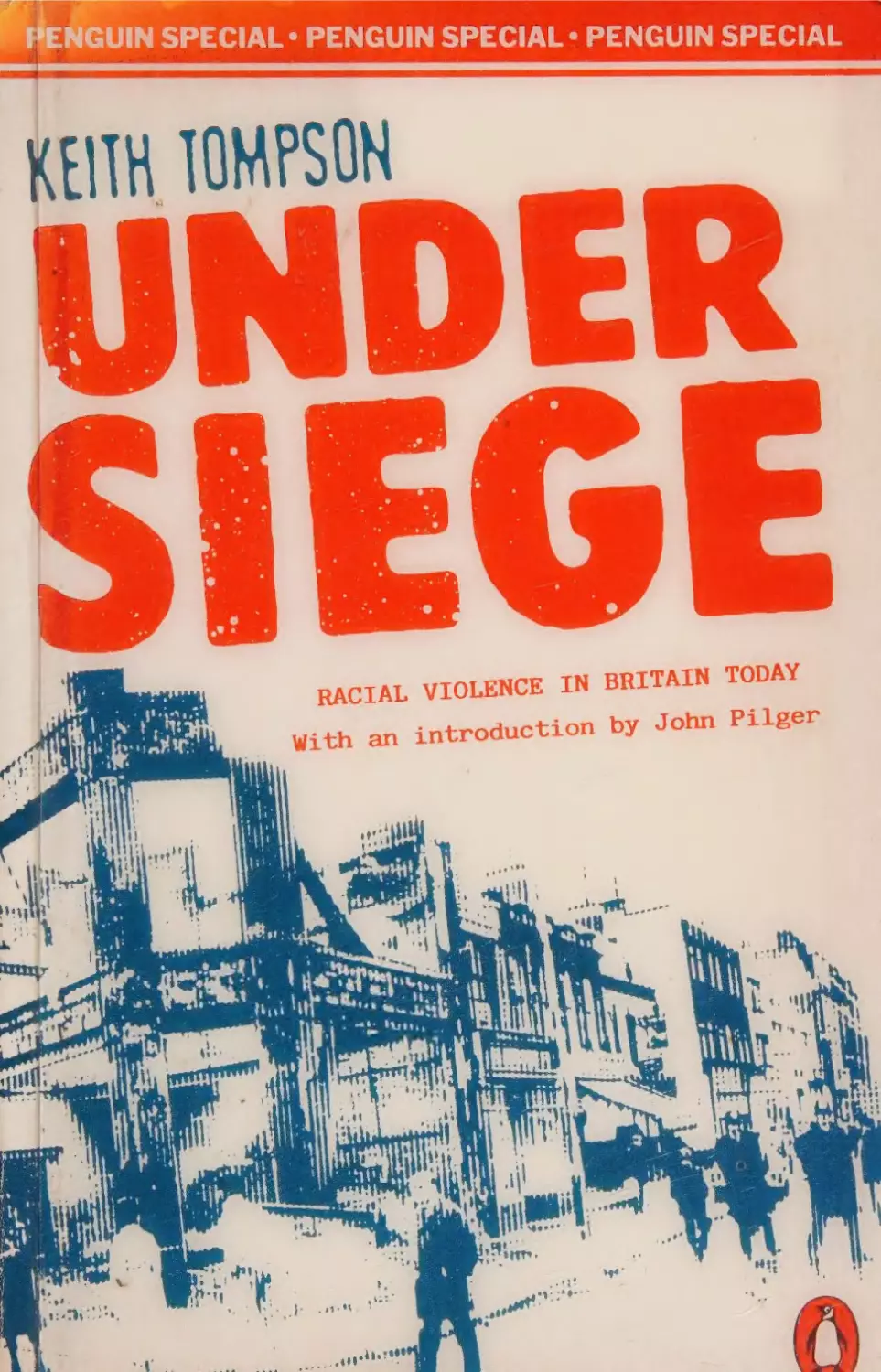


Author: Tompson K.
Tags: sociology racism history of great britain social problems crimes against humanity
ISBN: 0-14-052391-X
Year: 1988


Text
                    KEITH TOMPSON

oa}
o

CO

pecp

oe

\*

5

1

Ty

govt

tt
he

—

jes
a

oe

in

*

‘

|

sreunsesss
g

ga

;

Under Siege

WA 1026650 X

MINIM

Keith Tompson was born in 1954 in Scarborough, North Yorkshire.
He received an honours degree in politics and sociology, and studied
for a Ph.D., at the University of Kent. He joined Workers Against
Racism on its formation in 1979 and was the East London organizer
from 1981 to 1983. He was then a lecturer at Birmingham Polytechnic until 1984. Since 1985 Keith Tompson has been National
Organizer of Workers Against Racism. A founder member of the
Revolutionary Communist Party (1981), he contributes regularly to
its weekly newspaper, The Next Step. He is the author of The Roots
of Racism (1985, 1986).

THE POLYTECHNIC OF WALES LIBRARY
Llantwit Road, Treforest, Pontypridd.
Telephone: Pontypridd 480480
Books are to be returned on or before
the last date below

07. JUN

ite

01. OCT

bp

19. ae

a.”
ee

ao ®

aq, wir 97

P

24 APR 189

Keith Tompson

Under Siege
Racism and Violence in Britain Today

FOREWORD

PENGUIN

BY

JOHN

PILGER

Cc

{ 1S

BOOKS

Bie rhe

PENGUIN

BOOKS

Published by the Penguin Group
27 Wrights Lane, London W8 5TZ, England

"

Viking Penguin Inc., 40 West 23rd Street, New York, New York 1oo10, USA
Penguin Books Australia Ltd, Ringwood, Victoria, Australia

i

Penguin Books Canada Ltd, 2801 John Street, Markham, Ontario, Canada L3R 1B4
Penguin Books (NZ) Ltd, 182-190 Wairau Road, Auckland 10, New Zealand

Penguin Books Ltd, Registered Offices: Harmondsworth, Middlesex, England

First published 1988
LONGUS. 27645043 2) T
Copyright © Keith Tompson, 1988
Foreword copyright © John Pilger, 1988
All rights reserved
Made and printed in Great Britain by Richard Clay Ltd, Bungay, Suffolk
Filmset in Monophoto Plantin

Except in the United States of America, this book is sold subject
to the condition that it shall not, by way of trade or otherwise, be lent,
re-sold, hired out, or otherwise circulated without the
publisher’s prior consent in any form of binding or cover other than
that in which it is published and without a similar condition
including this condition being imposed on the subsequent purchaser

This book is for my mother Iris,
who is always telling me to get a proper job.
I believe she may now think that I have
found the right one.

____ Digitized by the Internet Archive
in 2023 with funding from
Be~
Kahle/Austin Foundation
|

|

:
,T

Contents

Preface

Foreword by Fohn Pilger
Introduction

The public and racial violence
Institutional harassment
Racism: roots and development

The official opponents of racism
nA
ww
&
N
W

A new anti-racist movement

134

Appendix 1: Manifesto for an anti-racist
movement

154

Appendix 2: Statistical information

158

Notes and references
Further reading

173
19I

Index

193

om
me
an

a
a
teh

Preface

When I completed the manuscript for Under Siege, in February 1988, London’s Camden Council had, through its
policy of singling out the ‘intentionally homeless’, in effect
refused to house Asian and Irish families and begun a policy
that would send them back to their country of origin. Camden
argued that, though a Labour-controlled local authority, it
could not provide housing for such people. This, to me,
seemed a warning of what was to come and the end of the
line for what I will describe in this book as municipal antiracism. If there was any doubt about it then, the report into
the killing of Ahmed Iqbal, at Burnage High School in Manchester, further confirmed that municipal anti-racism has
fuelled the fires of racial hatred: the opposite of its intention.
In November 1987 the Conservative government had announced a new Bill on immigration, aimed at repatriating
Asian males. By preventing Asian men from bringing their
wives and children to Britain, it demanded that they either
go to where they had come from or live a life separate from
their families.
These episodes sum up the problems of the moment. The
round-up of foreigners — for that, unfortunately, is indeed
what we are witnessing today — has finally arrived. It is a
worrying time for black people. Those opposed to racism are
trapped in a strategy that only adds to the problem.
How, in a period of growing racial harassment, backed by
both local and national government, can an effective response
to racism be prepared? I believe that what is needed is nothing
less than a massive new anti-racist movement, independent
of officialdom and uncompromising in its defence of black
people. Thus, while this book may offer encouragement to

x

UNDER SIEGE

Britain’s black community and show its members that they
are not alone, I hope above all that it will result in many new
applications to join such a movement. These applications,
and they alone, will decide whether Under Siege is a success
or a failure.
It is traditional in a preface to thank those who have helped
to prepare the book. There are many debts to be acknowledged. I owe a debt first to Kennan Malik, who is a regular
contributor to The Next Step and did most of the research
for chapter 4. I would also like to thank others who have
served as an inspiration for many of the idéas in the book,
namely Frank Richards, Joan Phillips and James Wood. Only
their previous work, their availability for constant discussion
and their patience have made Under Siege possible. It was
John Pilger who originally encouraged me to take on this
project; and his interest in the book has matched his concern for the victims of racism themselves; I am most grateful
for it. Finally, I would like to thank Jon Riley at Penguin for
patiently awaiting the final manuscript and for his sound
advice on its construction, and Gemma Forest for editing my
semi-literate English into its present form.
I should point out that the use of the word ‘black’ in the
book refers to all non-whites and thus includes Asian people
and others affected by racism.

Foreword
by John Pilger

On the night of 25 January 1982 a gang of forty attacked the
home of the Saddique family in the East End of London.
‘They threw stones, smashing the shop windows and narrowly
missing the family crouched inside in darkness. They daubed
swastikas, gave Nazi salutes and chanted, ‘Fucking Pakis out!’
They did this for six straight hours without intervention
from the police. Nasreen, the eldest daughter, then aged 14,
wrote in her diary: ‘When the trouble started, we phone the
police, but they never came. Then again we phone the police,
but they never came. Then my father went to the police
station to get the police; we had a witness. The police said
they didn’t need a witness.’
The entries in Nasreen’s diary for the days, weeks, months
and years that followed, often written by candlelight or in
freezing darkness as the family huddled in an upstairs room,
were repetitive and to the point: ‘Trouble. Got no sleep.
Three or four of them throw stones at our window.’ The
‘three or four’ would sit outside and watch for movement.
Then shit would be smeared on the front door, then there
would be more rocks, then an uncertain silence until dawn.
For most of these six years the Saddiques have stayed
together in their one large room overlooking the street. They
seldom go outside after seven o’clock at night; neither do
they go downstairs after dark. Only their dog, a worrying
beast called Soldier, is downstairs in the front room that
used to be the father’s tailor shop and until recently was barricaded at the urging of the police, who say they can do
nothing.
I have become a close friend and adviser of the Saddiques.

xii

UNDER SIEGE

Our friendship is conducted mostly by phone. Seldom a week
passes when I do not speak to Nasreen. She is the voice of
her parents, who came to Britain from Pakistan twenty-one
years ago. The conversations with Nasreen run to a pattern.
‘Nasreen ’ere,’ she says in her Cockney accent. “They’re at
the door now. Hear ’em? I’ve called the police and they’re
comin’, so they say. That’s all. ’Bye.’
She may ring back to say they are all right. She may ask
me to ring Newham Council the next day, and occasionally
the police that night, but usually she asks nothing; she is
merely making contact with the world outside her barricade.
She reminds me of Anne Frank, the Jewish girl who hid in
the attic of her home in Amsterdam during the Nazi occupation and kept a diary of her life. That the analogy is not
at all far-fetched ought to be enough to prompt decent people
to reflect anxiously upon the political nature of the society in
which we now live.
Keith Tompson begins his important book with the Saddiques’ story and is right to do so for it is both shocking and
typical. In the late 1980s racist attacks in London have
reached a level reminiscent of that of the violence against
Jews during the early part of the century. I have yet to meet
an Asian family in the East End who has not been subjected
to constant, casual brutality, ranging from the daily tormenting of children to petrol-bombing, and I have yet to meet a
black person under siege who has been adequately protected
by the police or given sustained support by the authorities.
Keith Tompson refers to the sheaf of letters that Nasreen
Saddique has written to politicians — from Margaret Thatcher
to her Labour MP -— as well as to her local council and
others. Their responses, such as they are, have changed
nothing. She received one letter from the Home Office that,
in its unguarded honesty, urged her to keep reporting every
attack to the police ‘even if the police are unable to take
effective action’.
Nasreen refuses to give up. Many others refuse to give up.
Keith Tompson is one of them. I met Keith in the early

FOREWORD

xiii

1980s through Workers Against Racism, then and now the
only organized group in London offering twenty-four-hour
protection and support to families under siege.
It was Keith and the other young men and women of
Workers Against Racism, black and white, who camped on
the floor of the Saddiques’ home and perhaps saved their
lives. It was Keith and his comrades who protected a single
Bangladeshi father with three children on an all-white council
estate and, through remarkable skill and patience, isolated
the racists on the estate and mobilized decent people against
them. ‘We canvassed every home on his 500-dwelling estate,’
writes Keith. ‘We discovered more than 300 anti-racists. Of
these thirty were invited to private meetings. We explained
what had happened and asked for their help .. . The attacks
on Mr Ali stopped as rapidly as they had begun ... The
racists have become the outcasts.’
I know Mr Ali. I remember his account of the first attack
on his children, by a man with a frothing German Shepherd
dog. When the police turned up, after an interminable delay,
they demanded to see Mr Ali’s rent book to check that he
was ‘legal’ — that is, legally entitled to be in Britain — which
he was. Then they left. Nobody was arrested; nobody was
cautioned.
Most families under siege are simply too terrified to call
the police for fear of being prosecuted themselves. This is
not, as some might say, an anti-police observation. Police
behaviour in cases of racial violence is well documented — as,
indeed, are police attitudes and the political encouragement
they receive. The evidence is in the pages of this book.
What is so compelling about Keith Tompson’s investigation and analysis, not to mention his fine Swiftian anger, is
that it spares no shibboleth: for example, that racism is endemic in white working-class people. At its inception, he
writes, racism was the property only of a patriotic elite. It
was the rise of the nation-state, seeking ever expanding markets, and, with it, the rise of patriotism that gave ‘the vocabulary and culture of racism a systematic form’, and it was the

xiv

UNDER SIEGE

oppression of colonial peoples that gave ‘nationalism its racist
form’.
Certainly when I was growing up in a far corner of the
British Empire, racism and imperialism were indivisible. The
fairytales of racial superiority that were poured into my head
at school and elsewhere came from one source. Thus the
Encyclopaedia Britannica could inform me that the black man
in Australia was ‘an animal of prey and more ferocious than
the lynx, the leopard, or the hyena [and] devours his own
species’. This was typical of the nonsense that had justified
the dispossession and slaughter of an indigenous people by
patriotic Christian gentlemen seeking to ‘open up’ a continent
and its ‘natural wealth’, which they had ‘discovered’.
The same notions of patriotism justifying racism were expressed in another guise and to great effect by one Enoch
Powell, who always seemed to me to embody the colonial
experience reproduced in Britain. I spent part of an election
campaign in the Midlands with Powell, in his black Homburg
and pre-war pinstripes. His bitter longing for the ‘lost’ Raj of
India (which he had served) permeated almost every speech
he made about race. At one noisy rally in Wolverhampton a
Sikh man asked him with courage and some deference, ‘Mr
Powell, if you are again in a position of power, will you move
to send us and our children out of this country?’
With that, Powell’s aloofness and his affectation of
Churchill-in-the-wilderness collapsed. Moving to the edge of
the platform, jabbing his finger down at the questioner, he
bellowed, ‘Listen, my man, this is not your country, nor your
children’s country. Your place in human society was set for
you and was right where you came from — and that’s where
you should be!’
This utterly crude and vindictive side of Powell was then
not often represented in the press and that is certainly still
true today. If anything, Powell has been legitimized as the
racism of government has become more and more overt and
shameless, as people are regularly killed, maimed, sacked,
deported and imprisoned because of their ethnic origins. At

FOREWORD

xv

the time of writing, the twentieth anniversary of Powell’s
‘rivers of blood’ speech is being celebrated by much of the
British press, and not merely in the tabloids — and ‘celebrated’
is the correct word. An article in the Independent is headed
‘Enoch Powell, midwife to the spirit of the nation’. Alas, in
one sense I would not contest the accuracy of that.
I hope that the promoters of such fashionable, effete views
of Powell, those who praise his constitutional stands and his
intellect, will read this book. They then may reflect that the
incidence and severity of racist attacks, including murder,
are closely related to the type of mass resentment that Powell
and other respectable propagandists, especially the instigators of ‘immigration scares’, have stirred so successfully.
I was in Kenya in 1968 to report one such ‘scare’. In
response to Conservative baiting that the Labour government
was ‘soft’ on immigration — rather like accusing the United
States Congress of being soft on communism — the Home
Secretary, James Callaghan, hurried through a draconian Immigration Bill that took away people’s nationality and the
value of their British passports and was unabashed in its
racial motivation. This caused the stampede of thousands of
Asian people whose forebears had been shipped en masse to
East Africa to service the British Empire. At Nairobi Airport
I joined in rescuing children caught underfoot in the panic.
Uncertainty and fear had been dispensed at great distance
and without immediate responsibility. Callaghan went on to
become Prime Minister.
Perhaps the most interesting analysis in this book derives
from the author’s trenchant criticisms of those whom he calls
‘municipal anti-racists’. “Today,” he writes, ‘the great majority of anti-racist groups in east London are on the payroll of
a local council.’ He castigates those Labour councils that do
not just ‘divert’ people from tackling racial violence but actively ‘deter’ them from doing so. “While councils did battle
against “‘unconscious racism”’, all too conscious racists waged
a real war on black people. In 1986 a quarter of Newham’s
Asian population suffered racist attacks, yet the council

xvi

UNDER SIEGE

responded by creating a special “hit squad”’ to remove racist
graffiti and by sending its housing staff on yet more antiracist training courses.’ He also contends that by allowing a
genuine anti-racist like the teacher Maureen McGoldrick to
be pilloried for allegedly making racist remarks (after a
governor’s inquiry had cleared her), Brent Council actually
caused a hardening of racist attitudes in the community and
exposed black people to more violence.
I accept the logic of that, but I éannoi share all of Keith’s
strictures on those local authorities that, with ever-dwindling
resources, at least have tried to attack the roots of racism: the
‘consciousness’ and the vocabulary. They may not have done
this very well; they may even at times be ‘silly’, as he says;
but they have occupied, and they still occupy, ground that
would have been submerged by the tide of racist authoritarianism.
That London councils such as Camden, which have been
denied the right to spend community money on housing and
basic services, should now be offering people air tickets as an
alternative to homes says more about the success of Thatcherism than about their own indecency. And if black and antiracist groups had not been supported by the GLC and by
Labour authorities, what would have become of them?
However, Keith is right when he takes issue with councils
and the Commission for Racial Equality over their policy of
priority transfer for victims of racial attack. This represents
an insidious defeatism. For example, whenever an Asian shopkeeper I know is attacked by thugs, he is urged by the police
to close down his business and move on. But why should he?
Why should the racists win? Various officials have wanted
the Saddique family to move on; yet it is only in recent
months that Newham Council has moved to get rid of the
mini-cab office next door that has been a prime source of the
family’s suffering. And there is the example of Mr Ali, whom
Tower Hamlets wanted to move on. He and his children now
live in peace on a once notorious estate because the initiative
was taken away from the racists by bold, radical community

FOREWORD

xvii

action that worked. Moreover it would not have worked had
there not already existed a base of goodwill among ordinary
people, who, unlike the elites, are a living part of this multiracial society.
It is this positive vision of this book that I much appreciate.
Keith tells a number of stories similar to Mr Ali’s, in which
white working people have been persuaded that they are not
the beneficiaries of racism and that by standing up both to
organized and insidious racism, they too are strengthened.
I believe that, in spite of the silence of many of the media,
people are aware that authoritarianism is accelerating in
Britain, that fragile freedoms are being lost. At present black
people just happen to be at the dirtiest end of a stick being
wielded across racial lines, but that is changing, and changing
fast, as the judiciary and state violence are used more and
more to subdue those who are struggling for a livelihood and
who are not black.
With the Thatcher ‘revolution’ virtually unopposed in Parliament and by the institutions, British politics are nothing if
not volatile. And people are never still. In 1984, when the
South Wales Striking Miners’ Choir entertained an entirely
black audience in Walsall, one of the choristers paid tribute to
the ‘ethnic minorities’ who had been so outstanding in their
support during the strike. To which a black leader responded,
‘The Welsh are the ethnic minority in Walsall!’ And both
audience and choristers stood and cheered. “The strike,’ said
the writer Hywel Francis, who recounted this story, ‘has
begun to teach all of us that none of us are minorities.’

Introduction

In the Thirties it was the Jews. Now it is Pakistanis who are the
victims of racial violence in London’s East End in a wave of thuggery
and intimidation. Many are even afraid to go out to work. They
have good reason to fear.
:

Scarcely a week passes without another racial attack. On women
and children as well as men. Sometimes in broad daylight.
They are attacked on the streets and in their homes. Air guns are
fired at them. They are beaten up. Blazing rags are pushed through
letter boxes. The windows of their shops and clubs are smashed.'

It is not only on the streets of London that these horrific
incidents now take place in Britain. On 17 September 1986
Ahmed Iqbal, a 13-year-old Bangladeshi boy from the Manchester area, was brutally stabbed in the playground of his
school. Iqbal died in a police car on the way to hospital.
The day before, Iqbal had gone to the defence of another
Bangladeshi boy who had been under threat from racist attackers. One attacker told him, ‘I will get you tomorrow, you
Paki.’ His killing the following day was a premeditated racist
murder. His sister, Selina, explains: ‘On Monday my brother
defended a Bengali boy from being bullied. On Tuesday the
bullies picked a fight with my brother, but they came off the
worse. On Wednesday the bully picked another fight with
my brother, but this time he stabbed him.”
Iqbal’s father has had a heart attack and is seriously ill as a
result of the shock. Iqbal’s sister postponed her marriage
because she has had to look after her grieving parents. Another
sister has had to give up her place at Lancaster University.
The attack has devastated the entire family.
Iqbal’s murder was part of a pattern that reaches back over

INTRODUCTION

xix

a decade. In 1978 Altab Ali was stabbed by racists and left in
a gutter in east London’s Whitechapel Road; later Ishaque
Ali was bludgeoned to death on the streets of Hackney. In
August 1979 Kayimarz Anklesaria was kicked to death at
Bromley-by-Bow Tube station, east London. The following
summer Akhtar Ali Baig was stabbed in broad daylight in
East Ham. In February 1981 racists wrecked the Hindu
temple in Coventry’s Stoney Stanton area. That same year
skinheads in Coventry stabbed a young Asian, Satnam Singh
Gill, to death. In Walthamstow, north-east London, Mrs
Khan and her three young children lost their lives in a firebomb attack on their home. Two years into Margaret Thatcher’s first term as Prime Minister the streets of Britain’s
major cities were not safe for Asians to walk or live on.
By the mid 1980s reported attacks on black people in east
London had more than doubled. In Newham reported attacks
rose from seventy-seven in 1982 to 146 by 1984; in 1987 it
was estimated that one in four of the borough’s Asian community had been the victim of a racial attack, and even police

reports acknowledged that there were 188 attacks in a year.
The figure for London as a whole was 960 reported racist attacks.*
These figures record only those attacks that have been
reported to the police. They drastically underestimate how
bad things have become for black people in and around east
London. In July 1984 West Indian railman Peter Burns was
racially abused by commuters, then murdered when a metal
stake was pushed through his eye. Three months later a halal
butcher’s shop in Newham was blown to pieces by an enormous bomb, while another Asian shopkeeper’s car exploded
when he turned on the ignition. In July 1985 Shamira
Kassam, a pregnant woman, died with her three small sons
in a firebomb attack on her home in Ilford, Essex. ‘Under
siege’ may seem a melodramatic way of describing the plight
of black people in Britain today. But, as the Home Office
admitted early on in 1981, racially motivated attacks are
common, on the increase and fifty or sixty times more likely

xx

UNDER SIEGE

to happen to black people than to whites.5 Black people really
are under siege — and not just by local racists but also by
employers, the police, the courts and the immigration
authorities.

I_

The public and racial violence

On 14 January 1987 the Metropolitan Police issued a special
pamphlet for victims of racial harassment. The advice included the following:
If you find your windows are constantly being smashed, you could
replace the glass with reinforced plastic. This makes them less dangerous ... On returning home late at night, have your house keys
ready to let yourself in quickly ... Don’t encourage peeping toms!
Draw your curtains at night and remove clothes from your outside
line ... Keep a dog... Never walk home alone at night ... Keep
your hands out of your pockets. . . If you are cornered or threatened,
try and attract attention by screaming and shouting. If you’re actually attacked, you can fight back using anything to hand, such as an
umbrella or your shoes.

The Met’s advice is of little relevance to the victims of racist
attack. It simply amounts to a demand that black people look
after themselves. It holds the victim, and nobody else, responsible for defending life and limb.
Umbrellas and shoes are of little use against knife-wielding
attackers who roam in gangs and attack at random. Yet this is
but the first of many examples we shall find of society turning
its back on the needs of black people. As we shall see, the
experiences of the Saddique and Lone families, and of Trevor
Ferguson, suggest that black people do not need the Met’s
kind of advice. Self-defence comes naturally to those under
attack. What is needed is a way of stopping the attacks in the
first place.

2

UNDER SIEGE

The Saddique family
John Pilger, writing in the Independent, presented a catalogue
of racial violence against east London’s black community. Of
the Saddiques he said:
Last week Nasreen phoned me to say: ‘We have a new neighbour
who is nice to us. We are taking down the barriers and we are
hoping for the best; but we are frightened.’
I have known Nasreen and her family for four years and this is
the first good news. Almost every night since 25 January 1982 they
have stayed together in their one large room, overlooking their
street in the East End of London. They seldom go out after seven
o’clock at night, neither do they go downstairs after dark.”

Nasreen has many tales to tell. The following is about an
occasion in 1982, soon after she and her family had moved
into their new home.
There was a violent knock at the front door and an enormous crash
against the boarded-up window. Voices echoed through the letterbox: ‘Fucking Pakis.’ I was upstairs peering through the bedroom
curtain, lights out, hoping it wouldn’t be like the previous night,
hoping they would disappear into the darkness and leave me and
my parents alone.
Experience told me that it was unlikely. This had been happening
every night for weeks. There seemed to be no end to it all.

Nasreen Saddique is a young Asian woman who, together
with her family, has been living under siege for almost six
years. She is now 20 years old but was a young 14 when I was
first called to her home in the early months of 1982. The
family had just moved into a new house in the West Ham
district of east London. They had chosen the house because
it had a shop-front downstairs: there was thus space both for
living accommodation and for a business.
The house was part of a circle of houses with a small park
in the middle. Next door on one side was a mini-cab office
and, on the other, a pub. Opposite was a newsagent and
other retail traders. The houses were three storeys high, providing plenty of room. Nasreen shared the house with her

THE PUBLIC AND RACIAL VIOLENCE

3

parents and her sister and two brothers. Her parents’ bedroom, on the first floor, overlooked the park. Nasreen’s room
lay above it.
The Saddiques hoped to decorate the ground floor and
open a business but, from day one they were subject to persistent harassment. A gang of youths would congregate in the
park and shout abuse, often throwing projectiles and smashing the windows of the ground floor. It was only days before
the entire ground floor window had to be boarded up. Nas_ reen’s mother began a nightly vigil from her bed overlooking
the park, waiting for trouble.
The police and the council seemed unprepared to help.
Something had to be done. Mrs Saddique is an asthmatic,
and throughout her six years of torment her condition has
worsened to such a degree that, because of countless sleepless
nights, she has to be admitted to hospital regularly. Mr Saddique has been unable to open a business.
My first visit to the Saddiques’ home happened a few
short weeks after they had moved in. I and other volunteers
from East London Workers Against Racism (ELWAR)
became more or less a permanent feature for the Saddiques.
For them, as for many familes in east London, we were very
much a last resort.
Formed in 1979 by members of the Revolutionary Communist Party,
EL
W AR was a response to a wave of murders
of Asians in Tower Hamlets and Newham. At the time the
Anti-Nazi League had gained a temporary popularity by
focusing on pockets of fascists, replying to them with its
famous ‘Rock against Racism’ concerts. ELWAR, by contrast, had a broader, more practical aim. It focused on a less
histrionic but more widespread problem — racism. It worked
to give the victims of racism physical support when they
encountered difficulty.
ELWAR achieved some rapid successes in dealing with
racial violence. By 1982 we had won a name for our efficient
protection of families and individuals
under attack.
ELWAR’s activities were described as ‘vigilantism’; in

4

UNDER SIEGE

reality, however, they were an attempt to bring white
working-class people to the black community’s aid. In addition, EL WAR’s politics stressed the need not to be reliant
on the police — a view that bitter experience had confirmed
was right but that both Conservative and Labour politicians
were quick to denounce.
Today, more than five years after we first came to their
aid, the Saddiques are still under continual harassment. Nasreen now works for Newham Council, but her entire adolescent life has been scarred. For her, going through a racist
assault is not unlike the experience of air-raids that east
London families had during the Second World War. ‘It’s
like living under a table,’ she says. “The whole time you’re
looking for where the next attack is coming from.’
Nasreen began to keep a diary of the attacks on her and her
family. For a frightened but defiant young girl this was the
only way to come to terms with what was going on. The
diary now runs to some two hundred pages. Often repetitive,
it nevertheless gives a gripping account of life under the
table. Within a week of its commencement the diary recorded
that fighting went on from 6.30 p.m. to midnight. From then
on the story was the same: 26 January, “Trouble. Got no
sleep’; 27 January, “Trouble. Got no sleep.’ The diary tells a
tale of police indifference and describes conditions in the
street.
The mini-cab office next door to the Saddiques acted as a
magnet for the racists. Its proprietor had installed space invaders machines as a way of supplementing his income, so
the premises were full of young people who used them as a
base from which to launch salvos against the family: 28
January, ‘Every night we have to call the police but the police
didn’t do anything. Two youths kick our front door and
went in the mini-cab office’; 29 January, ‘My uncle came
round and before he came there was trouble. My uncle came
in and the youths were swearing. Three or four youths were
standing in the church and they threw stones at our house
and broke windows (three times). The police came four times

THE PUBLIC AND RACIAL VIOLENCE

5

and did nothing but told the youths to go away. When the
windows were being broken, the glass just missed my father’s
head.’
The saga of the Saddiques is not a sensational one. They
are still alive. There are hundreds of east London Pakistanis
who have been through all their torments — and hundreds of
thousands of blacks in Britain who have suffered some of
their misery. But for them life is one long encirclement.
Today Nasreen explains:
My mum is getting on. She is ill anyway, to the extent that she has a
respirator by the side of her bed. She doesn’t speak a lot of English,
though she understands most things. The past six years have ruined
her life, to the point where she can’t sleep at night. During the
evening she just sits at the window at the front of the house overlooking the trouble spot. She doesn’t move from that window. My
father will not venture out alone. Only a few weeks ago they stole
his van during the night and smashed it up.

As soon as their Calvary began, the Saddiques asked local
politicians and local police to do something. Eventually they
took their case to 10 Downing Street. At every stage the
responses they encountered revealed a lot about official complacency towards racial attacks. It is not that the British
authorities do not know about the treatment black people
receive from white racists. It is, rather, that they do not want
to know.
One month after first moving into Newham Nasreen wrote
to her local Labour MP, Arthur Lewis, to tell him what had
been happening: how the police had failed to come to her
family’s assistance, how a crowd of about forty people would
gather outside her house, how problems had arisen every
single night. Mr Lewis’s reply, on 16 February 1982, was to
the point:
Of course I express my sympathy and understanding of your problem and condemn unreservedly all concerned in these fascist ac-

tivities. You will readily appreciate that this is a police matter and I

6

UNDER SIEGE

have no power or control over the police. All that I can do... is to
call upon the police for a report and action upon these matters. I
will keep you posted upon developments.

Disheartened by this response, Nasreen once more applied
to Lewis for help. Three weeks on, in a lengthy plea, she
noted:
Since we last wrote to you things have got worse. One evening a
group of youths painted NF [National Front] slogans all over our
door. Lots of youths on motorbikes drive past the house all the
time, shouting and making lots of noise. Our door is always being
kicked and stones are still being thrown at the windows and at the
doors. The police have not done anything at all and we are frightened that the attacks will get worse until finally we will have petrol
bombs thrown.
When we came to this house we did not think that we would be
treated like this. I don’t think we can live like this any more — I
don’t think my mother and father can stand it any more.
You are the only person who can help us now — we have no one
else to turn to. The attacks are just going to carry on getting worse
and worse and no one is doing anything to help us — so we are
relying on you.
We would also like you to come and visit us to see what state we
are living in — or if you cannot come personally, we would like you
to send someone on your behalf. My mother and father are very
depressed because no one seems to be really concerned about what

is happening to us. You are our last hope.?

Lewis’s response was to repeat the points contained in his
first letter, to promise again to raise the matter with the
police and to refer to the family’s difficulties not as racial
harassment but as a run-of-the-mill housing matter. Nasreen’s reply was forthright:
We have written to you
our problem.
The police seem to
write to them or when
such as you. Since the
person. And now they

twice and both times you have nicely avoided
come only when you either phone them or
they feel they are being watched by people
attacks began, they have failed to arrest one
rarely turn up even once a week.

THE PUBLIC AND RACIAL VIOLENCE

7

You say in your letter that our problem is housing. We have a
house, Mr Lewis, and we want to stay in the house. But these kids
won’t let us — so please don’t avoid us in that way.
I again ask for your help. To come and visit us and see what our
problem exactly is. To ask your local Labour Party members to
defend us. About 14 people have died this year, Mr Lewis, by
attacks on Asian houses.
I hope you will respond to my letter and take up my suggestion.

In the end the tenacity of a 15-year-old girl ensured that
what had been a local affair was transformed into a House of
Commons issue — one discussed, indeed, by Mrs Thatcher
herself. But while Arthur Lewis used his parliamentary
position to gain a high public profile over the Saddiques,
he continued with his previous stance in private:
Whilst I can fully understand and appreciate your concern it is not
true to say that I have avoided your problem because previously

and now I have explained the
FACT that the question of the
enforcement of the law rests with the police and I have no power,
control, say, voice or influence in any way whatsoever over their
actions (or inactions). I have raised this matter in the House of
Commons and with the police and like you I regret that they are so
dilatory and lacksaidasical [sic] that they do not take any action.*

The Saddiques were fortified by the publicity they had
gained, but, as Nasreen told Lewis in a letter, the Commons
discussion had ‘little consequence’ for them.* What had a
much more direct effect, both on the family and on Arthur
Lewis, was the intervention of ELWAR. After she had in-

vited him to a meeting that
behalf Lewis told Nasreen:

EL WAR

had organized on her

I am afraid that due to a very long-standing prior engagement it will
not prove possible for me to attend the meeting to which you make
reference and whilst I am in no way suggesting that it is the case in
this instance, I am usually rather loth to attend some meetings
which are called to exascerbate [sic] and inflame genuine and proper
grievances and matters of complaint for ulterior and sometimes
wrong political motives. I repeat that I am not suggesting that this
is the case in this instance, but I always take great care to see that

8

UNDER SIEGE

offers of help and support are made for genuine reason of trying to
resolve the problems rather than to ‘increase difficulties’ and to ‘stir
up’ problems for the purpose of gaining political advantages.®

When, in 1983, Newham North West saw Tony Banks take
over from Arthur Lewis as its local MP, the Saddiques were
full of hope. Unlike Lewis, Banks visited the family in person.
In September 1983, however, Banks told the family that it
would be best for them to move and, like his predecessor,
spoke of a housing problem rather than one of racial violence.
Then in April 1984, after drivers from the mini-cab agency
had themselves begun to harass the Saddiques, Banks wrote:
I sympathize with the problem you have over the mini-cab firm,
and I will raise this with the police. However, the basis of the
problem lies in the fact that your street is only partly residential and
therefore actually more suitable for a mini-cab firm than most streets
in Newham, and while it is operating there will always be a conflict
of interest.
I realize how hard it is for you to be in the middle of all this, but
despite the fact that your family does have a genuine grievance, your
parents are going to have to make some hard decisions about moving.”

One year later, after more attacks, Banks wrote:
Minor infractions of the bye-laws regarding noise do not give sufficient excuse or reason to the Council or the Police to act except in
a fairly ineffective way.

He concluded:
You believe the mini-cab firm are still making life difficult for you,
while the Council and the Police say there is very little evidence to
back this up, given that Church Street North is not an ideal residential
area and is in fact fairly suitable for a mini-cab firm to operate from.®

Like Lewis
the argument.
was living on
months after

before him, Banks tried to alter the terms of
In fact, his whole argument — that the family
a commercial street — was bogus. About twelve
Banks’s letter Newham Council itself allowed

THE PUBLIC AND RACIAL VIOLENCE
houses to be built opposite the
really been happening was this:
succession of polite attempts
influence her parents to move
her parents were Asian.

9

Saddiques’ home. What had
two Labour MPs had made a
to persuade a young girl to
— for the simple reason that

Nasreen next wrote to Mrs Thatcher. The reply she received
came not from the Prime Minister but from the Home Office.
Unlike the police, the Home Office acknowledged that attacks
were indeed taking place and that they were racially inspired.
It spoke of the family’s ‘continuing troubles’ and the harassment suffered. The Home Office’s letter concluded: ‘I am
sorry that I am not able to give a more helpful reply, but let
me take this opportunity to assure you that the government
does care about the incidence of racial attacks and is committed to a multi-racial society in which we all can go without
fear of racial violence or abuse.’”?
This statement says everything about British officialdom’s
attitude to racial violence. Quite simply, the attitude is ‘tough
luck’. It exemplifies why this country’s police systematically
fail to show up when the victims of a racist attack report one
in progress. It explains why the Saddiques’ nightmare has
gone on.
Day in, day out, Nasreen’s diary is full of the abuse she
and her parents have received — of the sticks, the punches
and the graffiti. On 7 July 1985 drivers from the mini-cab
office throw litter inside the family’s door and tell Mrs Saddique that litter is good for her. On 4 November “They kick
our van and start swearing at us and threaten us, saying, ‘““We
are going to put petrol down your letterbox.”’’ Even today
the Saddiques still have trouble with the mini-cab drivers.
Although they have won a court order for the removal of the
office, it has yet to go. Meanwhile, to make their lives even
more tragic, new racists have appeared — the builders constructing the houses opposite them.
Throughout

six years

of intimidation

and

violence

the

10

UNDER SIEGE

Saddiques have not persuaded the police or the council to take
their problems seriously. On 6 April 1982, at West Ham
police station, I attended a meeting at which Chief Inspector
Ferguson added his voice to those suggesting that the street
was not suitable for the Saddique family to live in. Three
years later, in a letter to Tony Banks, Chief Superintendent
Barrett wrote: “The arrival of a demonstrative Asian family
in a predominantly whites’ playground area had unpleasant
effects ... The cul-de-sac environment is unsuitable for
peaceful residential purposes . . . police do feel that there is a
case for re-housing this family.’*° Barrett only stated more
boldly what everybody else had hinted at — that the Saddiques
were to blame for their choice of a ‘whites’ playground’ and
that the solution to their problems was not for the racists to
be made to desist but for the family to be uprooted.
Even more than Arthur Lewis, the police were concerned
about EL WAR
rather than racial attacks. On 9 February
1982 five EL WAR volunteers and an independent photographer were at the Saddiques’ home. After the photographer
had taken pictures of those responsible for harassing the
family a van-load of police, called in by the attackers on the
grounds that the Saddiques had ‘strange people’ in the house,
piled into the family’s property. ‘I don’t want any photos
taken or I will arrest you all,’ announced the officer in charge.
He went on to say that his men were looking for ‘strange
people’ and to warn the family not to have anything to do
with EL W AR and its ‘vigilantes’.
On 24 July 1985 Inspector Hoskin, from West Ham police,
told Nasreen that her family should have expected all along
that living next to a mini-cab office would lead to problems.
He also told her to stop asking the journalist John Pilger to
telephone the police on her behalf.
While the police tried to dissuade Nasreen from seeking to
publicize the case, the council was not particularly helpful.
In a letter to Tony Banks, Newham Council’s Environmental
Health Department deputy, A. J. Griffin, stated that the
family’s complaints ‘had nothing to do with racial harass-

THE PUBLIC AND RACIAL VIOLENCE

11

ment’ and that they were of ‘relatively minor importance’.
Even now Nasreen’s diary continues. It is a diary that
Britain’s Asians could duplicate many times over.

The Lone family
There’s always attacks round here. Recently an Afro-Caribbean
guy was attacked because he had a white girl with him, and two
black guys were beaten up by a gang outside the fish-and-chip
shop. The police ignored both incidents.

When Naeem and his dad were beaten up, I spoke to the sister at
the Newham General emergency department. She said that no black
person was safe on a Friday or a Saturday night along the Barking
Road — every night she was sure to get a case, some so badly hurt
you couldn’t recognize them.
If the police really want to know about racist attacks, they should
speak to the hospital emergency department.’

Like the Saddiques, the Lones live in Newham. Naeem is 17
years old and works in a London office of the Department of
Health and Social Security. His father is Mubasha; his uncle,
Ezaz Hayat, runs a Southern Fried Chicken fast-food shop
on the Barking Road. The Barking Road area of Newham is a
notorious scene of racial violence. Local gangs inhabit the
streets and intimidate Asian pedestrians and businesses.
There is a whole string of closed restaurants and shops, once
owned by Asians. This is how Hayat describes life for black
people in Barking Road:
There is no shop here which is free of trouble. One at a time, all the
shops get it. At the moment it is mostly me.
When I opened the shop up about six months ago, they used to
come in causing confusion, changing their orders, trying to steal off
the counter, abusing us, saying, ‘Hey, nigger/Paki, hurry up.’ I
used to speak to them and try to be friendly, but it was no good.
They used to take food and run out without paying and leave less
money than they should have paid.
Then they started threatening us, about sixteen to twenty of them,
all white boys, but they get support from older brothers and fathers.

12

UNDER SIEGE

One day they gave the staff a lot of abuse. They didn’t want to leave
the shop and were asking us out for a fight. We told them to leave
but they started throwing food about the shop.
We went outside ... They started throwing things, and a few of
them pulled out knives.*3

Hayat manages the shop. Dalton Macauley, whose family are
from Africa, co-owns it with him. From its opening in July

1986 onwards,

the place has met with one disaster after

another.
The southern stretch of Barking Road, from Canning
Town docks up to Plaistow and East Ham, has long been a
no-go area for blacks. For years the effect of Newham’s Labour
council’s housing policy has been that the south of the borough is virtually white-only and that blacks are consigned to
low-grade estates north of the Barking Road divide. Today
the Croydon Road Gang still patrols the frontier between the
two territories. It was on the Barking Road that the gang left
its mark on Naeem and his father Mubasha.
In statements to the police Dalton Macauley takes up the
story in the months following the opening of the shop. His
account is worth quoting in full:
On Friday, 29 August, at about 12.30 a.m, we had finished trading
and had locked up the shop and were just about to go home. I could
see a number of youths standing on the opposite side of the Barking
Road, near the off-licence. I went outside the shop and could also
see a number of other youths standing in Croydon Road. I recognized those youths as having been banned from the shop because
of the trouble they had caused in the past by coming to the shop,
shouting racial abuse at me and threatening myself and the rest of
the staff. When I went outside to have a look, they shouted at me:
“You black bastard, you come here.’ I went back inside the shop
where Mr Hayat, a friend and my younger brother was.
I then saw Jason Swale'* come from Croydon Road, run across
the Barking Road and then stand opposite the shop near Clove
Street. I could see that he was carrying two bottles, one in each
hand. Swale was wearing a black jacket and chequered trousers. I
knew Jason Swale because he came into the shop every day over the

THE PUBLIC AND RACIAL VIOLENCE

13

last three months: he has blond, short, spiky hair, like a crewcut — he
is quite distinctive. Swale then disappeared round the corner into
Clove Street. I then came out of the shop into the Barking Road and
the youths that were still in the street were shouting racial abuse at
me. Swale then came running from the crowd: I could see that he
had a milk bottle in his hand and that the top of it had a rag in it and
that it was on fire. Swale then came into the middle of the Barking
Road and threw the bomb towards the shop and myself. The bomb
exploded on the pavement and in Braemor Road, about fifteen to
twenty feet from myself. I saw the flames from the bomb go up and
felt the heat from the fire. At that point I went back into the shop
and locked the door. I was frightened for my safety.
At the junction of Barking Road and Clove Street, where the
group of youths was standing, I saw Jimmy Smart. He was holding
a milk bottle, which was on fire: he ran a few steps and threw the
bomb, which exploded in the road. Smart was wearing a green
jacket with a hood and blue jeans. I know Smart because he comes
into the shop regularly and he has threatened me a number of times,
and has also tried to run me down with a car. The group of youths
were armed with sticks and, before the bombs were thrown, I saw

Smart with a cricket bat in his hand.
On Friday, 19 September 1986, at about 10 p.m. I was working
in the shop with Mr Hayat and there were about eight customers
waiting to be served. A white youth came into the shop, aged about
18 to 20 years. He had fair hair: I don’t know his name but I know
he is one of the Croydon Road Gang, who live around that area and
cause trouble for local shopkeepers and residents. The youth came
up to the counter and said, ‘Are you going to serve me?’ I said, ‘No,
I’ve got instructions not to serve any of you.’ The youth said, ‘I’ve
got nothing to do with that stupid Croydon Road Gang.’ I said,
‘They are friends of yours. You are always with them. I’m not
going to serve you — we don’t want any more aggravation from you
lot.’ At this point Smart came in and produced a knife from his

pocket. It was about six inches in length. Smart said, “You black
bastard, I’m going to kill you — you are going to get shot.’ I said,
‘OK, I’ve had enough of this aggravation, racial abuse, and threats.’
I went to the public part of the shop. Smart ran outside the shop
and I saw him kick the large plate-glass window, smashing it. I saw
that the customers inside the shop were showered by the flying
glass; fortunately, none of them were injured. Smart ran off.*®

14

UNDER SIEGE

Three weeks later, in another statement to the police, Macauley continued:
On Thursday, 6 November 1986, it all came to a head. I was working
in the shop at 257 Barking Road and Mr Lone and his son Naeem
Lone came over. I had a chat with Naeem, and Mr Hayat spoke to
his father. At about 10.30 p.m. Mr Lone was walking out of the
shop into the Barking Road when Jimmy Smart got out of the car,
crossed over the road and started shouting abuse like ‘Paki’, ‘you
Paki cunt’. Mr Lone went to his car and Smart was still shouting
abuse at Mr Lone. Mr Lone was standing there taking all this
abuse. Smart shouted to Mr Lone, ‘Wait, you wait there,’ and then
went into Raffles, a public house.
A short time later Smart came out of the pub with his mates: the
two youths who were later arrested came out with Smart, Eddie
Banstead and several others, whose names I don’t know but who I
have seen around and can recognize. The group of about fifteen to
twenty youths came rushing towards Mr Lone. Smart went up to
Mr Lone and started shouting abuse at him and then threw a glass
of beer over him, at which point the rest of the group threw their
glasses at Mr Lone’s car, smashing his side windows. I could see
that the group was armed with sticks, steel poles and knives. I saw
that Smart had a knife and a stick. I also saw in the crowd a large
knife like a kebab knife, about two and a half feet long.
Then they turned on Mr Lone and started to punch, kick, hit him
with the sticks. I also saw the knives being used and I heard Mr
Lone screaming. I then saw him fall to the ground and the blows
continued to rain down on him.
Mr Lone’s son Naeem went to help his father and he picked up
two bits of wood about a foot long to try and defend himself and his
father, who was lying on the ground being beaten. Naeem went into
the crowd to help his dad and I saw him hit a few of them. The
crowd then turned on Naeem, kicking, punching, hitting him with
sticks and knives. I saw Naeem being beaten to the floor like his
dad. I heard him screaming. I saw a girl sit on Mr Lone, take her
shoe off and hit Mr Lone on the head with her shoe.
This all happened very quickly, so I ran across the road to help
Mr Lone and Naeem, since they were both unconscious on the
ground, I grabbed hold of Mr Lone and started to pull him away,
but Mr Lone couldn’t walk or stand and I had to drag him. The

THE PUBLIC AND RACIAL VIOLENCE

15

group then started hitting me. Smart hit me across the back with a
stick, a blond-haired boy hit me over the back with a crutch, and
the two youths who were arrested in the pub were also hitting me

with sticks. I could see that Mr Lone was bleeding heavily from the
face. Once I got Mr Lone clear, I then went back for Naeem and
again I got hit with sticks and various things across the back by
Smart, the blond-haired boy and the two who were arrested. Naeem
was also bleeding from the face: there were bruises to his hands and
he was screaming about his arm. Once I had got them clear I saw
Smart, the blond-haired youth and the two that were arrested come
running after me. I noticed that all of the group of four had knives
and sticks. I had to leave Naeem and run to the shop to get something to protect myself. Smart and the others chased me to the
shop. I heard Smart shout, ‘Get him!’ I was frightened for my
safety and also for the safety of Naeem and Mr Lone.
I got into the shop and I got hold of a stick, at which point the
group saw that I had one and so ran off. The police arrived shortly
afterwards and two men who had been involved in the fight were
placed in the police vehicle.*®

Naeem’s hand was broken. His father suffered a broken
nose, multiple bruises and a slash wound to the face and
head; Mubasha needed eight stitches to the face and three to
the head.
Newham police do not come well out of the Lone affair.
Hayat reports that when he first went to the police after a
tip-off that he was about to be attacked, they said they couldn’t
spare anybody to help and that helping wasn’t what they
were in Newham to do. Hayat goes on:
They said that if the gang did do anything, we should give the
station a call. I said, ‘But by that time one of my staff might be
seriously hurt. I can’t take that chance.’
So I rang for my friends to come round, some West Indian, some
Indian. Two minutes after they arrived, two police cars with dogs
were outside and, a minute later, a van-full came. The police came
in and sent everyone upstairs; then the head of East Ham police
station came down with two cars. The police said, ‘What are you
doing?’ I said that my friends were there because their colleagues
had said they couldn’t help. The police asked what weapons we

16

UNDER SIEGE

had, but we had none. They said, ‘If you hurt one of them, it’ll
cause a gang war and we’d have to arrest the whole lot of you.’
There were a lot of police around that day.
The next day I saw twenty youths. I rang the police. I said, ‘I
can’t keep calling my friends — can you help?’ The police asked if
the gang was doing anything yet. I said, “They are looking threatening.’ The police said, ‘Only call us if they do anything.’ I rang
again, for there were more and more youths gathering. I asked the
police to send just one person. They said no, that they were too
busy. I was to tell them if anything happened. I said I was going to
close the shop and asked them to send someone who could prevent
us being jumped.
‘
Twenty minutes later a policeman came and told us to hurry up
and close.’”

After MrLoneand Naeem werebeatenupthepolicedidarrest
two people: but even this happened only with the assistance of
Naeem and Mubasha, who took them into Raffles, the pub, and
identified one of the whites who had previously been attacking
them by pointing to the blood on the man’s clothing as proof.
The man was arrested. Jimmy Smart was also arrested
because he was named by the Lones. However, when the
case came to court an all-white jury recorded not-guilty verdicts against both culprits. Indeed, when Jimmy Smart and
his petrol-bomb attack were discussed one member of the
jury inadvertently revealed an interesting device tattooed on
his arm: a swastika.
The trials over, Hayat commented: ‘After that, I no longer
believe that there is any justice in this country. It seems that
the only thing you can do is keep your mouth shut and forget
about it.’%8
Later that year Hayat’s shop was attacked yet again. Youths
were smashing down the door and windows. Mr Hayat was
on the phone to the police all the while, but a car took twenty
minutes to arrive. Once there, the car’s occupants kicked off
by questioning Hayat — while his attackers looked on from
the other side of the street. The police said they wanted a
description of the men. Hayat reports:

THE PUBLIC AND RACIAL VIOLENCE

17

I said, “Look, you can see for yourselves. There they are.’ But the
police did not arrest anyone, and as soon as they had gone, the
youths came back. They began to punch my cousin, calling him a
Paki bastard and a ‘grass’. The police returned and arrested two
men. I was taken to East Ham police station, but the CID interviewed me and accused me of stealing a gold bracelet.?°

Eventually the youths were brought to trial, and Newham
magistrates found them guilty. Mr Hayat was awarded £500
damages — for damage that had cost him £3,000. His shop is
now likely to close because of the debts incurred through
constant repairs.
Barking Road has dozens of Asian shops and restaurants
that are now derelict because of experiences like Ezaz
Hayat’s. Naeem and Mubasha have now joined a local campaign against racist attacks. It seems likely that many other
east London Asians will be forced to follow their example.

Trevor Ferguson
If you are the victim of racial harassment, report the matter immediately to your local police station. Speed is of the essence... If
the victim of any attack sees a racial motive, it will be given high
priority by the police... The definition of a racial incident used by

the Metropolitan Police is simple: any incident in which it appears
to the reporting or investigating officer that the complaint involves
an element of racial motivation; or any incident which includes an
allegation of racial motivation made by any person.”°

When they are not suggesting the repulse of petrol-bombs by
‘using anything to hand, such as an umbrella or your shoes’,
the police recommend calling on their services in times of
difficulty. As with the Saddiques and the Lones, however,
the constabulary’s professed concern about racist attacks contrasts vividly with its practical indifference towards them.
When, early in 1987, housewife Cherry Reid held a party in
Beaconsfield Road, east London, she and her guests found
this out to their cost.

18

UNDER SIEGE

Shortly after the party had started, Reid’s guests began
choking, and some of them vomited. Nobody was quite sure
what was happening. Trevor Ferguson, later to be the victim
of a brutal assault, arrived late and knocked on the door. He
looked through the letterbox and his eyes began to water.
Putting one and one together, he surmised that something
must have been put through the letterbox to cause the choking and vomiting. Racists had tear-gassed Reid’s house. She
remembers: ‘We called the police immediately and told them
to get down to the house. The woman who answered the
phone just said, “Sorry, Beaconsfield Road doesn’t exist.”
There I was with a house full of people terrified and in pain
and she was telling me the road I lived on didn’t exist. Then
she hung up.’
After several neighbours had rung the police, they finally
turned up at the house. Everybody was sure that the attackers
had come from another party across the road, so the police
said they would keep watch. Some time later the racists came
back with the tear gas. Reid thought the police would get
them. When she opened the door the police were nowhere:
“They’d gone.’
Ferguson and Reid’s cousin, Gary, had seen two men run
across the road and went out to tell them to grow up and
pack it in. As they entered the ground floor of the apartment
block opposite and climbed the stairs, ‘a whole gang of white
boys pounced on the two boys, kicking them to the ground.
They were shouting, “‘Kill the niggers, kill the niggers!”
They had bottles and smashed one into Trevor’s face. His
eye almost came out of his head. They smashed bottles on
Gary too, and he got slashed on the back of the neck.’
Trevor Ferguson lost the sight of his eye. Reid was stunned
by the police reaction to this incident and that of the officers
who attended:
The next day, when the police came round, the first thing they said to
me was, ‘It wasn’ta racist attack last night. The other people were just
jealous of your party.’ I hadn’t said it was racist, yet this was the

THE PUBLIC AND RACIAL VIOLENCE

19

first thing they came out with. There’s no doubt in my mind it was
racist.
The thing I remember most about the incident was the attitude
of the police. They didn’t come to help when we first rang. They
hung the phone up on us, and when they came round one said, ‘I
suppose you’ll be putting in for a transfer now.’ The cheek of it!
Suggesting I would use the attack just to get a quick move.

Trevor Ferguson will never use one eye again: it had to be
removed under surgery. Despite the fact that the attack took
place from a house just over the road from the victims, the
police have pressed no charges.
From the experiences of the Saddiques, the Lones and
Trevor Ferguson it is clear that Asians and West Indians in
Britain can expect only viciousness from white racists among
the general public, coupled with casual indifference and cynicism from the police. In Britain black people are second-class
citizens. Few institutions are more involved in confirming
this status than the police.

2

Institutional harassment

On the whole most blacks are unemployed, like rastafarians who go
around with big floppy hats, roller skates and stereo radios, smoking
pot and sponging money off the state.*

In the wake of initiatives like the Met’s pamphlet guide for
the racially harassed, many people in Britain have tried to
believe that the police have changed their illiberal ways. After
all, police forces throughout Britain have made efforts to
draw in black recruits — though few have come forward.
White policemen have also been sent to language laboratories
to learn the dialects of ethnic minorities, and many have been
tutored in the sociology of black people in Britain. Several
‘bad apple’ police officers have been convicted of assaulting
blacks. However, racism among the forces of law and order
runs extraordinarily deep.
Asked to write essays on black people, cadets at the national
police training college, Hendon, recorded the following insights:
All blacks are pains and should be ejected from society.
Wogs, nig-nogs and Pakis ... come into Britain take up our homes
our jobs and our resources and contribute relatively less to our once
glorious country. They are, by nature, unintelligent, and can’t at all
be educated sufficiently to live in a civilized society of the Western
world. It is my opinion that they themselves would be better off
living in their native lands, so send them packing, carpet bags,
funky music, curries, all their relatives and stereo transistor radios.

Questions asked by the cadets included ‘Can a twelve-bore
shotgun blast a black man into tiny pieces at twelve yards?’
and ‘Do black people burn better with oil or petrol on
them?’?

INSTITUTIONAL HARASSMENT

21

Loathing for blacks is not just a phenomenon among young
police cadets. It stretches right to the very top of the force.
In June 1982, shortly after he was first appointed to oversee
the fight against crime in London, Met Chief Kenneth
Newman told a journalist working for the American magazine
Police: ‘In the Jamaicans, you have people who are constitutionally disorderly ... It’s simply in their make-up.’
Jamaicans were, he said ‘constitutionally disposed to be antiauthority’.* Five years later Superintendent John Ellis,
responsible for the Leeds Chapeltown district, made similarly hostile remarks that were secretly taped by Omprakash
Sharma, chair of the Leeds United Asian Organization,
during a conversation in which Sharma was complaining
about the poor police response to an assault on him. Ellis
said: “There are 15,000 West Indians in this locality, and I
can tell you that 15,000 West Indians are very difficult to
police. They create all sorts of problems. Drugs is one, prostitution, brothels and vice are others.’*. Ellis’s remarks were
closely followed by similar ones by Bill Ganley, a superintendent responsible for the Harlesden station in north London.

He said, ‘Ninety-nine per cent of muggers are black.”®
If black people are, for the police, congenital deviants,
then housing estates lived in by blacks also have inherent
defects. In July 1986 the Met announced that estates in the
London boroughs of Brent, Southwark, Hackney, Newham,
Lambeth, Haringey, Ealing, Hammersmith, Westminster,
Lewisham and Greenwich were ‘disturbance-prone’ and
‘high-risk’. Flats in these boroughs were thus marked not
only by ‘a high density of population and ethnic mix’ but
also by ‘hostility towards police’.° Black unruliness, in the
view of the police, is built into the very fabric of Britain’s
inner cities.
It is, however, the deaths and injuries suffered by black
people while in police custody that provide the most telling
indictment of police racism. To die or to be beaten up at the
hands of supposedly impartial enforcers of the law is the
ultimate degradation. It also means that if you are attacked

22

UNDER SIEGE

by ordinary racists, you think twice before notifying the
police. Held in captivity by the police, Clinton McCurbin
and Colin Roach learned too late about the kind of treatment
that black people can expect from uniformed officers in Britain. Detained in police cells, Trevor Monerville joined a
host of other black people who today owe their lives to luck.
Let us now turn to racial violence of the ‘official’ type.
Death in police custody
Clinton McCurbin

Wolverhampton, 20 March 1987. Clinton McCurbin, a 23year-old unemployed black youth, goes to Next, the fashion
chainstore, in Wolverhampton town centre. The manager
suspects him of using a stolen credit card and calls the police.
A squad car pulls up; two policemen get out. They wrestle
McCurbin to the floor and he dies.
At first official spokesmen claim that McCurbin took drugs
and so met with a heart attack. Later it is announced that he
died of ‘asphyxia consistent with restraint during a violent
struggle’.’? At a press conference Superintendent Burton is
evasive about the causes of death: ‘I would not say it was
choking,’ he argues. ‘I would not say it was strangulation.”®
Eye-witnesses saw the treatment of McCurbin differently.
One explained: ‘The policemen held him face down... One
had his hand cupped under his chin and was pulling back on
his chin, while the other was kneeling on his back. Then he
went limp and lifeless.” Another recorded: ‘One of the crowd
stepped forward and said, “‘You’re killing him. You’re killing
him,” and was told to get out.’? McCurbin was left on the
floor for more than an hour before an ambulance arrived.
Then his corpse was dragged feet-first from the front of the
shop into the back, away from public view.
Later West Midlands Chief Constable Geoffrey Dear said
that he saw no reason to suspend the officers responsible for
the death, PC Michael Hobday, 29, and PC Neil Thomas,

INSTITUTIONAL HARASSMENT

23

23. Instead the two were granted sick leave so as to recover
from their ordeal.'°
When people in Wolverhampton called for a demonstration
to protest against the McCurbin affair, all police leave in
West Mercia, Staffordshire, Greater Manchester and Northamptonshire was cancelled. A police spokesman said that
extra officers would be drafted into the town ‘in anticipation

of a large crowd from all over the country’ — a crowd that
would, he said, ‘include a massive nucleus of dissidents who,
from our information, are hell-bent on causing violence’.'!

Thus although the demonstration was, in the event, angry
but peaceful, the police skilfully swept aside the issue of the
violence done to McCurbin, preferring instead to raise fears
about the public exercise of democratic rights.
Asked to investigate the McCurbin case by West Midland
police, the Police Complaints Authority issued a report in
August 1987. It concluded that although McCurbin’s death
occurred while he was being restrained, it was not a matter
for legal or internal police discipline. As a result the Director
of Public Prosecutions decided that no charges should be
preferred. Today McCurbin is dead and buried — as far as
the police are concerned. Wolverhampton’s black community
is angry: its members know that some policemen may now
think they have carte blanche to kill and get away with it.
On 31 January 1988, almost a year after his killing, the
inquest into the death of Clinton McCurbin opened. Legal
advisers won a delay so that a high court could consider the
right of the family to veto jurors in order to get a mixed jury.
In an area with a large black population not one of the eleven
originally asked to attend was black.”
Colin Roach

Stoke Newington, north London, 12 fanuary 198 3. Shortly after
his release from a twenty-one day jail sentence in Pentonville
prison Colin Roach, a young unemployed black man not
long out of school, is found in the foyer of Stoke Newington

24

UNDER SIEGE

police station with gunshot wounds in his head and a sawnoff shotgun nearby. Roach, the police say, used the gun to
commit suicide; at the subsequent inquest a jury endorses
this view. And yet...
The gun had no fingerprints or blood on it. The police
argued that Roach had carried it into and out of their premises
— but the bag they held up as evidence was too small to
contain it. The police also told the national press that Roach
had a history of mental illness, but this claim too has been
proven to be untrue.
Roach died at 11.35 p.m. His father, James, arrived at the
station an hour later. At 1.50 a.m. the police issued a press
statement on the death — as in the case of Clinton McCurbin,
before a proper autopsy had been conducted. Only at 3 a.m.
however, did the police bother to inform James Roach of the
fate of his son.
Colin Roach’s death provoked huge demonstrations. More
than eighty people were arrested, including James Roach.
The Economist could make ‘neither head nor tail’ of Roach’s
last hours.’ But two previous incidents connected with Stoke
Newington police station suggest that its notoriety is well deserved.
In 1971 Aseta Simms, a black woman, died at the station.
Police said that she fell and hit her head, but to this day her
family is unconvinced. Although there was conclusive medical evidence that Simms was the victim of repeated blows
administered to her skull, the coroner, Douglas Chambers,
returned a verdict of ‘death by misadventure’. Twelve years
later the same coroner dealt with the inquest of Colin Roach
— and once again the police were exonerated.

Not quite dead in police custody
Trevor Monerville'

In January 1987 PC Macarthy, stationed also at Stoke Newington police station, was found guilty of forcing a Nigerian

INSTITUTIONAL HARASSMENT

25

woman, Adebola Makenjuola, to have sex with him. He told
her that she was an illegal immigrant but that, for sexual
favours, he would ensure that she could remain in Britain.’
While Makenjuola has recovered from her ordeal, Trevor
Monerville, a 19-year-old West Indian boy, has not. Having
spent three days in the custody of Stoke Newington police,
the physical and mental damage he has suffered will be with
him for life. As Trevor’s father, John, puts it, “Trevor’s past
I will not talk about, simply because I’ve got to accept Trevor
as he is now, but I cannot get the old Trevor back, so I will
not discuss the old Trevor.’'®
The Monervilles live in Hackney and Stoke Newington.
John runs a television and hi-fi repair shop, and his brother,
three sisters and parents all live locally. Before he received
his injuries Trevor was training to take part in John’s business. Then, on New Year’s Eve 1986, Trevor went out on
the town with two of his aunts, Carol and Cassy.
After a few drinks the three made their way to a nightclub
in Stoke Newington’s Church Street. On arrival, Trevor, a
shy individual not given to frequent partying, decided not to
go in. Because one of his two aunts was already ensconced,
however, the other went in to retrieve her so that they could

all go home. Five minutes later the two women came out to
find that Trevor had vanished. Worried, they went to a
nearby mini-cab office to see if he had taken a taxi — but he
hadn’t. It was not like Trevor just to go off. By now it was
after 1.30 a.m. on New Year’s Day. Carol and Cassy went
home to telephone the rest of the family to find out if Trevor
was with any of them. Again they had no luck.
Later that morning Trevor was still at neither his father’s
house nor his grandparents’. His father became increasingly
concerned. By the afternoon the family had decided to go to
Stoke Newington police, only to be told that they would
have to come back the following day if they wanted to file a
missing person report.
On Friday, 2 January 1987, at about 4 p.m., John and Carol
returned with a photograph of Trevor. Asked if the young

26

UNDER SIEGE

man was in the cells, the police duty officer replied that he
was not and duly filed a missing person report. Yet Trevor
Monerville was in police custody. He had been locked up for
at least sixteen hours before his family’s visit — a fact that the
police were later forced to admit.
John and Carol were distraught. John spent all Friday
night and the following day looking for Trevor but to no
avail. Then on Sunday, after spending hours telephoning all
London’s police stations and prisons, John at last learned of
Trevor’s whereabouts. Monerville was in the hospital wing
of Brixton prison. At no point had thé police notified his
family that he was in their custody. Only because of their
persistence did the family find the boy.
On Monday, 5 January, John Monerville and his brotherin-law, Larry, visited Trevor in Brixton prison. John, in a
legal statement following his visit, takes up the tale:
I was asked by a senior officer, named Brown, whether there had
ever been any epilepsy in my family. I asked him why. He replied
that my son had had three epileptic fits and that he had had to wash

him twice today, since he had been shitting and urinating in bed. I
was told that I should not expect too much when I see him.

Quite understandably, John Monerville was deeply upset by
these remarks and feared that Trevor had suffered some terrible accident. He was then taken to see Trevor.
I was profoundly shocked upon seeing my son after five days and
seeing the injuries he had sustained during this time. On touching his
head, which was extremely sore and covered with bumps, making him
jump back in pain, I also noticed a severely blackened, puffed-up and
perforated left eye. His right eye was fixed in an abnormal position and
could not focus on me whilst I was talking to him. The inside of his
mouth was perforated and covered in blood, and his jaw was swinging
to the right. His left shoulder and the back of his head was heavily
bruised. His chest was heavily bruised also, and his ribs, especially on
the left hand side of his body, showed signs of severe bruising.
This bruising also extended to his thighs and buttocks. From his
knees to his feet, his legs were covered in congealed blood and

INSTITUTIONAL HARASSMENT

27

scabs. His feet, above and below, were covered in round bruising
marks. He told me he had severe pains all over his body and acute
headache and abdominal pains. His hair was covered in dry vomit,
and his overall condition was extremely distressing for him and to
me.

In this condition Trevor Monerville was laid out on a
mattress on the prison floor, totally naked. He had been
there since Saturday, 3 January 1987, except for a brief
visit to King’s College Hospital, where he had had a brain
scan.
On Thursday, 8 January, Monerville underwent emergency surgery at the Maudsley Hospital in south London. A

blood clot and swelling on the brain were treated, but the
whole left side of his body remained paralysed. Doctors remarked that Trevor appeared to have been dealt a blow or
blows to the head. Today he is unlikely ever to recover
fully. Even now he cannot remember what happened to
him. All there is to go on is a series of facts gleaned
from police records. Monerville’s whereabouts between
1.30 a.m. and 10.40 p.m. on New Year’s Day 1987 are still a
mystery.
Police admit to arresting Monerville at 10.40 p.m. after a
motorist, whom they describe as ‘a member of the public’,
found Trevor sleeping on the back seat of his car on the
Kingsgate Estate, near Dalston in east London. The car had
a broken front offside window, and Monerville was arrested
for criminal damage. Strangely, police claim that Monerville
was sleeping so deeply when apprehended that he could
not be roused throughout the thirty-four hours that he spent
in Stoke Newington police station.
Monerville was visited by police surgeons five times and
was taken to Homerton Hospital twice. On his last medical
inspection, which was held at 1.45 a.m. on 3 January, a police
doctor said that he would need a brain scan if his condition
did not improve by daylight. His condition did not improve
— but no scan was done. Instead he was taken to Highbury
magistrates’ court, where he was charged with criminal

28

UNDER SIEGE

damage. Too poorly to go into court, Monerville was remanded in custody by a magistrate who saw him in his cell.
Since he was unconscious, he could ask for no legal advice.
He never knew he had been charged or remanded. Then he
was taken from the court, by police, to Brixton prison.
There are three other relevant pieces of information. First,
on 2 January Monerville was forcibly fingerprinted by six
officers at 8.06 p.m. — one minute after being told, while still
unconscious, that he was to be detained for failure to give his
home address. According to police records, the whole exercise took all of five minutes. One hour later a police doctor
remarked that Monerville had a discoloured left eyelid and
that his right pupil was dilated and sluggish. He advised that
the patient was not in a fit condition to be detained and that
he should instead go to hospital.
Second, prison officials destroyed some of Monerville’s
clothing after his arrival at Brixton. This was done without
his permission or that of his family or their legal advisers.
Finally, as soon as Monerville’s circumstances in Brixton
emerged, Stoke Newington police issued a statement saying
that he had a brain tumour. This was not true. It is still
unclear why the statement was made.
Police dropped all charges against Monerville on 8 January
1987, reputedly for humanitarian reasons. But they still need
to answer the following questions.
1. Did Monerville have bruises and cuts over the length of
his body when the police found him? If so, why was he
denied hospitalization and instead charged with an offence?
If not, which policeman inflicted these injuries on him later?
Either way, why were these injuries not discovered during
the five visits that Monerville received from five police doctors or during the two that he made to Homerton Hospital?
2. Why did it take six officers five minutes to fingerprint an
unconscious man? Why, immediately after this fingerprinting, was

it necessary

for Monerville

to see three

within six hours? What happened to cause this?

doctors

INSTITUTIONAL HARASSMENT

29

3. Why did police not inform the Monerville family that they
were holding Trevor?
4. Why
clothes?

did prison officers

destroy

some

of Monerville’s

5. Why did the police invent a brain tumour for the man?
6. Why did the police suddenly drop all charges against him?
On 31 March
local community
Walters. It was
the Friends and
The letter stated
ves. One passage

1987 Stoke Newington police circulated, to
groups, a letter signed by Inspector Terence
directed against what by then had become
Family of Trevor Monerville Campaign.
that Monerville’s family had ‘sinister’ motiwas remarkable for its hypocrisy:

A campaign is currently being waged in Hackney concerning a
young man who, after being in police and prison custody, underwent
an operation at Maudsley Hospital. The innuendo being that his
injuries were caused as a result of his treatment by police. Such
innuendo is totally presumptuous at this stage. We are more anxious
than anyone that this matter be properly investigated.*’

Chief Superintendent John Peck of Stoke Newington police
made a similar point when interviewed in the Voice on I
April 1987. Conceding that the failure to tell John Monerville
of his son’s whereabouts was a ‘mistake’ and one that deserved an apology, he added, “This situation is being manipulated by political agitators.’
During June 1987 Stoke Newington police station was
closed down so that a new building could be erected on its site.
Officers were dispersed to other stations in the Hackney area.
In the spring of 1987 junior Health Minister Edwina
Currie called a public inquiry into Monerville’s stay in hospital. But what the Monervilles want to know is: who inflicted the injuries the boy received? The Police Complaints
Authority is supposed to be investigating this, but, thirteen
months after Monerville became paralysed it has still to make
a report — despite claims that it clears up complaints within
thirty-seven days.*®

30

UNDER SIEGE

General harassment by the police
There is in our inner cities a very large minority of people who are
not fit for salvage ... The only way in which the police can protect
society is quite simply by harassing these people and frightening
them so they are afraid to commit crimes.'?
There are two conflicting demands. One is to stop harassing young
blacks in the inner cities. The other is to stop young blacks harassing
other people in the inner cities. Which demand do you respond to?
It has to be the second.?°
1. Are you visible after sunset?
:
2. Hobbies: mugging, prostitution, pimping (tick as applicable).
3. Please tick your diet: curry, pet food, potatoes.
4. Asians only: when and where did you illegally enter Britain?
5. Asians only: are you toilet-trained?
6. Name of father if known (West Indians should list all possibilities
on a separate sheet).
7. Father’s occupation: peat cutter, bus conductor, lavatory cleaner,
underground guard.”

These public, premeditated comments by police officers and
the extract from a ‘jocular’ Middlesbrough police questionnaire reveal that the police do more than simply lash out at
black people. They act against blacks not only violently
and on impulse but also in a lower-key yet more sustained,
fashion. The case of Russell Christie, as well as those of a
succession of black recruits to the police force, show the
pattern all too clearly.

Russell Christie?

Russell Christie is a driver/labourer working for the London
borough of Hammersmith. Until a few years ago his nextdoor neighbour was Roger Turner, a special constable at
Shepherds Bush station. In May 1985 Christie was charged
with threatening to kill Turner following an altercation between them outside their homes. He spent more than six
months remanded in custody before being acquitted, in a

INSTITUTIONAL HARASSMENT

31

trial that lasted no more than ten minutes, in November
1985. During his detention his girlfriend suffered a miscarriage. Turner moved house when Christie was let out of
prison, and for some time the two didn’t meet — except for a
brief encounter when Turner joked about Christie’s incarceration and his girlfriend’s miscarriage.
The story from then on is a disturbing case of racist victimization by police officers. The quotations below are all taken
from court records relating to Russell Christie’s case. They
were made available to me by John Fitzpatrick and Beverley
Brown, the lawyers representing Christie at his trial.
On 28 January 1987 Christie and a friend named Smiler
pulled into a local garage for petrol. Christie was in the queue
to pay when he heard a menacing voice from behind. He
looked round, saw Turner and told him to leave him alone.
An argument ensued. Turner said to Christie, ‘I’ll get you
seven years this time.’
On 12 February Turner put his words into action. Christie
was arrested and charged with making a threat to kill, under
a law that dated back to 1861. Turner argued that Christie
had spat at him and had said, ‘I’m going to kill you.’ Christie
was again remanded in custody. He applied for bail three
times, but all applications were refused, and Christie found
himself in prison, awaiting trial, for more than three months.
It materialized later that police from Shepherds Bush
station had, a day before Christie’s application for bail, interviewed Suresh Majithia, the owner of the garage in which
the exchange between Christie and Turner had taken place.
In the interview Majithia had contested Turner’s version of
events, saying that there had been no spitting and no threats
to kill on his premises. Majithia had also stated that Smiler
had proposed to Christie that he avoid a confrontation and
that Christie had seemed keen to do just that. However Majithia’s statement was not released by the police either to Chris-

tie’s bail judges or to the defence until vigorous protests had
been made. If it had been released properly, it is unlikely
that Christie would have remained in custody.

32

UNDER SIEGE

After a two-day trial held at Knightsbridge Crown Court
in May 1987, a jury concluded unanimously that Christie
was not guilty. Indeed, the trial judge said that he had never
heard of such a case before, demanded to know why it had
been brought and asked for an inquiry into the police station
that had brought it - Shepherds Bush. After months behind
bars, Christie may seek damages from the police for malicious
prosecution. One of the factors behind Christie’s eventual
acquittal was the defence made on his behalf by John Fitzpatrick, a Hammersmith solicitor and a member of War Against
Racism (W AR). Fitzpatrick told me that*the Christies had
suffered police harassment before.”?
Victor Ranger
On 22 February 1987 Victor Ranger, a black man from Handsworth, Birmingham, made the mistake of parking his BMW
on the zig-zag lines marking a zebra crossing. Approached
by a police officer, he was asked where he had stolen the car
he had been driving. When he replied that he had bought it
himself, the police officer was reported to have said, ‘Where
did you get the money to buy a car like this from — pushing
drugs?’
Ranger was then asked to produce a driving licence on the
spot. He could not, so the police officer followed him home
to Hampstead Road, in the Lozells area of Birmingham,
where his licence was. Realizing, as he emerged from his
house with papers in hand, that he had picked up the wrong
documents, he turned to go back for the correct ones. Within
minutes no fewer than fourteen police cars arrived on the
scene.
There were three other people in the house: Ranger’s girlfriend Maeve, her daughter Peggy and Maeve’s 70-year-old
mother. They came out to see what was happening and tried
to stop it. The old lady claims to have been knocked to the
ground and told that she would be arrested for obstruction if
she didn’t get back inside. She was eventually taken to hos-

INSTITUTIONAL HARASSMENT

33

pital. Ranger was finally arrested and charged with having a
faulty licence, damaging a police helmet and possessing an
offensive weapon.
Ranger’s case didn’t come to court until September 1987,
after more than six months of uncertainty had elapsed. By
that time only the charge relating to the driving licence remained. The police alleged that Ranger had had two driving
licences and that, when they had apprehended him, he had
tried to tear up one that was ‘a strange colour and typed with
a manual typewriter, not a computer’. They alleged that he
had then passed this licence to Maeve and that she had disappeared inside the house with it. This was odd, given that
Maeve says that, like her mother, she had been knocked to
the ground at the time. As for the bogus licence, this has
never been seen.
The police, confronted with a weak case, went to the
trouble of doing a great deal of investigation into Ranger’s
background. Eventually they came up with the following additional charges:
1. Obtaining pecuniary advantage by deception when insuring the BMW in 1979.
2. Abusing the 1972 Traffic Act by parking on a zig-zag line.
3. Assault on a police officer with actual bodily harm —
namely, a thumb so badly sprained that the officer had to
take a whole day off work.
4. Assault on a police officer while resisting arrest — namely,
a kick in the back of the leg.
The magistrate considering the case found Ranger guilty
on all five counts, gave him two suspended three-month
prison sentences and fined him £350. When sentencing him
the magistrate observed that the court had been ‘used’ by
him ‘to weave an intricate web of lies about racial harassment’. He then authorized an investigation into Ranger’s
income. Finally he said of Ranger, ‘If he can run a car, he can
pay costs.’*4

34

UNDER SIEGE

Black police recruits: Booth, Edwards, Lall
In the face of cases like that of Russell Christie, it is not
surprising that police campaigns to recruit black people to
the force have largely failed. However, that has not prevented
a nearly all-white force from harassing black recruits.
Nicholas Orlando Booth joined West Yorkshire police as a
probationary constable in April 1985. The Times reported

that on training courses he found himself called a “black
bastard’ and ‘nigger’.?5 He was rapidly disillusioned and left
the force.
;
Once a South London policeman, Mark Edwards left the
force after meeting with experiences similar to Booth’s. Since
his resignation Edwards has found himself charged with
minor offences on no fewer than six occasions, only to be
acquitted each time. Edwards, who now works in a South
London pharmacy is rueful:
I have experienced police racism from the inside. I’ve been persistently hounded since deciding to leave. Even when I was in the force
they used me like a pet animal — wheeling me out, together with the
mascot, every time T V cameras were looking for a story. I can see
no possibility of black people getting a fair deal from the kind of
people I came across in the force. Before I didn’t believe a lot of the
stuff about police racism and so on, now I know it is all too true.?°

Asian police officer Krishnand Lall had the misfortune to
take a holiday with white police colleagues. As reported in
the Sun, he was called a ‘bloody Paki’ and clubbed with
bottles by his fellow officers. As a result, his ear was partly
severed and he spent four days in hospital.?”
Even when they are in numbered blue uniforms, black
people can expect a special kind of handling from the forces
of law and order. Reassuring leaflets, language lessons and
ethnic recruitment are unlikely to change the distrust in
which police are held by black people. The kind of handling
they receive from the police is what sparks the periodic uprisings Britain has seen in its inner cities.

INSTITUTIONAL HARASSMENT

35

Broadwater Farm

Violence from neighbours, intimidation by supervisors, violence and general harassment on the part of the police: black
people know what to expect in modern Britain. On Broadwater Farm, Tottenham, London, hundreds of West Indians
made this discovery. Accompanied by a media panic directed
against black lawlessness, the Farm affair stands as a symbol
of what blacks in Britain can look forward to in the 1990s.
In March 1987 three young men were sentenced to life
imprisonment, convicted of the murder of PC Keith Blakelock. Winston Silcott, Mark Braithwaite and Engin Raghip
have since begun their thirty-year terms in Wormwood
Scrubs prison. The convictions were secured after a trial that
was the subject of intense media interest. A few publications,
notably the Guardian and the New Statesman, expressed
some concern over the judicial procedure used to gain convictions. That there was no wider outcry over the fate of the
three men, however, was a salient feature of their case. On
the contrary, the overwhelming majority of Britain’s printed
and broadcast media succeeded in persuading the population
that, even if the three men were not responsible for Blakelock’s death, they were guilty by association and thus deserved everything they got. Apart from various anti-racist
organizations, only Amnesty International, in its February
1988 report on the Broadwater Farm prisoners, has stood out
and described the three imprisoned for murder, and the many
others locked up for minor offences, as political prisoners.”*
Clearly, the events at Broadwater Farm, in which a black
mother and a white policeman died in the space of fortyeight hours, were horrifying for those directly or indirectly
involved. The killing of Blakelock gripped the mind of the
public, and that of Mrs Cynthia Jarrett, coming as it did a
week after the shooting of Cherry Groce in Brixton, spread
fear among Britain’s black community. The sense of outrage
at Blakelock’s murder, exacerbated by media treatment of
the events, has, I am convinced, denied a fair trial to the

36

UNDER SIEGE

three youths and also allowed the police to gain convictions
by the use of methods of investigation that included hearsay
and rumour. The near-unanimous acceptance of the outcome
of the trial makes countering the jury’s verdict a lonely enterprise. Yet there was, quite literally, nothing in the evidence
presented to justify the convictions.
The events surrounding the eruption of Broadwater Farm
on 6 October 1985, and the eventual verdict on the three
defendants, need inspecting in some detail in order to sustain
these claims. It is our belief that, if the verdicts remain unchallenged, then the methods used at Broddwater Farm will
soon become commonplace, and a further erosion of demo-

cratic rights in Britain will take place.
The saga begins at about I p.m. on Saturday 5 October 1985,
when Floyd Jarrett, a young man of West Indian parentage,
was driving his BMW along Roseberry Avenue in Tottenham. He came across a familiar situation when he was
stopped by police and asked whether he owned the car he
was driving. This kind of random car stop is often carried
out on black youth in the inner cities.
One of the three officers accosting Jarrett, PC Allen, filled

out a form requiring him to take his driving documents to
the police station. Another, PC Casey, contacted the Police
National Computer to check up on the car — a step rarely
taken over minor car offences but all too often made when
those suspected of them are black. (Later, after the case came
up in the magistrates’ court, counsel for Jarrett’s defence
asked PC Casey whether a National Computer check would
have been carried out had he, Jarrett’s white solicitor, been
stopped; the answer was no. Casey could give no reason for
his actions other than that Jarrett was black and driving an
expensive car.)??
Although Casey’s check showed that car and occupant were
in order, Jarrett was arrested for the theft of a motor vehicle.
Alarmed, he ran across the road. The arresting officers
claimed that he aimed two blows in their direction, one of

INSTITUTIONAL HARASSMENT

37

which hit Casey in the face. An independent witness, an
architect, later testified in court that no punches were thrown.
Nevertheless, Jarrett was charged with assault, only to be
acquitted when brought to court in December 1985. On this
occasion the presiding magistrate insisted that costs amounting to £350 be awarded against the police. As for the charge
of theft, this had to be dropped.
By 3.30 p.m. that day, however, Tottenham police had
established Jarrett’s identity, charged him and put him in a
cell. A little more than one hour later Detective Constable
Michael Randall, an off-duty CID officer doing paperwork
at Tottenham station, visited Jarrett and, as the station’s
custody record notes, recognized him. Randall concluded
that the prisoner’s home should be searched, persuaded the
duty officer, Inspector Clarke, to go about this and determined to go on the search himself — despite being off duty.°°
For a house search to be made after an arrest for a motoring
offence and an assault is, again, most peculiar. The conduct
of the search itself revealed that the officers making it were
unsure what they were looking for. Randall claimed to have
detailed information to the effect that Jarrett was guilty of
handling stolen goods, yet neither the source for this information, nor any evidence that it was true, has ever come to
light.
The space on the search warrant where police normally
enter what they are looking for contained the legend ‘diverse
goods’. The search was amateurish, suggesting that the police
knew that they would find no stolen goods: indeed, told that
a locked room in the Jarrett house was left unchecked, a
coroner later described the search as ‘the most ridiculous
thing I have ever heard’.3*
It is unlikely that the officers had a proper search warrant
when they visited the Jarrett household. It may have been
issued after the search but not before it. Inspector Clarke
says that the warrant was signed at 5 p.m.: DC Randall
claims that it was issued by the magistrate at 5.15 p.m. The
magistrate himself gave three differing times: he told later

38

UNDER SIEGE

investigators from Essex police that he had signed the warrant
at 6.30 p.m. — well after the search of the Jarrett house; he
told an inquest that he had signed it at 5.45 p.m.; finally, ina
second interview with Essex police, he explained that he had
signed the warrant between 5.30 and 6.15 p.m. In the police
record of the outcome of the search DC Randall failed to fill
out the part of the form asking for the name of the magistrate
agreeing to the operation. When it was later put to him that
this was because no warrant authorizing the search had been
obtained in the first place, he replied, ‘I can’t remember why
I missed it out.’3? Patricia Jarrett, Jarrett’s sister, claims that,
although it was requested, no warrant was ever shown to
her.
The course of events during this search has since become
clear. Four police officers arrived at the Jarrett home at about
5.45 p-m.:
DC Randall, Sergeant Parsons, PC Casey and
PC Allan. Although off duty,
DC Randall took charge. The
house was entered not by knocking and being admitted #7 but
by means of Jarrett’s keys, which
DC Randall took from the
police station without signing them out with the duty officer,
Sergeant Bowell.
Mrs Cynthia Jarrett, her daughter Patricia, a 2-year-old
child, and Jerome, her grandson, were all in the house. They
were extremely shocked when they discovered police officers
walking into their home, and they knew that Sergeant Parsons
was lying when he told them that their front door had been
open. After searching the upstairs bedrooms, DC Randall
moved towards the dining room. Mrs Jarrett was in the doorway. Patricia Jarrett takes up the story:
DC Randall went into the dining room. My mother had put Jerome
into the armchair and was standing in the doorway. He took his left
arm, pushed her out of the way. She fell with one arm in the armchair and the rest of her body towards the armchair ... I tried to
help her up. She was gasping for breath and gasping quite heavily.*4

Cynthia had had a serious fall — one that had broken a small
table. Patricia telephoned for an ambulance and was told that

INSTITUTIONAL HARASSMENT

39

one was on its way.
DC Randall paid no attention throughout: instead, he scrutinized the Jarretts’ hi-fi and television
and the contents of a number of chests of drawers.
At this point Michael Jarrett, Floyd’s brother, came in. He
asked an officer if he had a warrant but received no reply.
Meanwhile DC Randall embarked on a visit to the loft. By
now Cynthia was breathing hard. Then Patricia recounts:
She tumbled sidewards out of the dining room chair, lying on her
side. I rushed over and started talking to her. . . I put my ear to her
mouth to see if I could feel any breath. I felt for her pulse but did
not feel any pulse. I blocked her nose, opened her mouth and gave
mouth to mouth resuscitation. Nothing was happening. She looked
up at me, her eyes keeled over, her head slumped back and she was
completely still. I ran from the house screaming into the street.*°

The ambulance arrived at 6.11 p.m. Mrs Jarrett was pronounced dead on arrival at North Middlesex Hospital at 6.35

p.m.
At the subsequent inquest the police tried to blame Mrs
Jarrett’s death on the excitable behaviour of her daughter.
But the police themselves did not find Patricia Jarrett troublesome, for at 5.55 p.m. DC Randall radioed Tottenham
station with the message that there were ‘no problems’. There
were no problems — except that Mrs Jarrett was already on
the floor and an ambulance had already been called.
Mrs Jarrett had high blood pressure and heart disease. But
it was police action that prompted her death. At the inquest
the jury acknowledged this by refusing to pass a verdict of
death by natural causes. Unable to conclude that D C Randall
had purposely caused her death, it recorded a verdict of accidental death.
In summary: police stopped Floyd Jarrett and went beyond
normal procedure in checking up on his car; they charged
him with an assault of which he was later acquitted; they
entered his house using his keys; they searched his home;
and they pushed Mrs Jarrett over and, during her last minutes of consciousness, continued with their search. Later the

40

UNDER SIEGE

Police Complaints Authority found that the police officers
had done nothing wrong. It was agreed that no criminal or
disciplinary charges should be made against them.
Floyd Jarrett was released at 7 p.m. The police didn’t
bother to tell him that his mother was dead, but they did try
to explain things to the media. On the following day the Mail
on Sunday dutifully reported that, according to Scotland
Yard, Cynthia ‘became ill after she was in a struggle with
officers who visited her home following the arrest of her
son’?°
As a result of the extensive media coverage of Mrs Jarrett’s
death, everybody on her estate knew about it within twentyfour hours. Speaking at an inquiry into the disturbances,
Stafford Scott, a member of the Broadwater Farm Youth
Association, described the feeling:
Because it has happened before — police officers have taken away
people’s keys and entered their homes without alerting the people
inside — it was easy for people to believe it had happened in this
instance. Because people have seen police manhandling members of
their families whilst raiding, it was easy to believe in this instance.
So what was actually taking place was a lot of emotional transferral.
They weren’t just thinking, ‘Floyd Jarrett’s mother died today’;
they were thinking in terms that it could very easily have been their
mother. So people were feeling very sickened by what had happened. People were very upset.*’

As is typical in inner-city ‘hot spots’, the police responded
by implementing both a ‘soft’ and a ‘hard’ strategy simultaneously. They organized a meeting for local community leaders
and the Jarrett family, and they sent in reinforcements.
At the meeting Deputy Assistant Commissioner Richards
spoke from the chair and said that he and his men could
neither discuss the case nor suspend the officers involved,
since the whole matter had been placed in the hands of the
Police Complaints Authority. But this was untrue. The Police
Complaints Authority is a formally independent body that
when requested, asks the officers of one force to investigate a

INSTITUTIONAL HARASSMENT

41

complaint against another. The Authority has no power to
make issues sub judice; neither does it have the power to
suspend internal police disciplinary procedures.
Told that the police would not discuss the case, a meeting
of the Broadwater Farm Youth Association later resolved to
picket Tottenham police station to indicate its anger — an
emotion that ran so deep that even Bernie Grant, a left-wing
Labour man and leader of the local council, was not allowed

to address the meeting. Stafford Scott’s mother later described her plea for calm at the meeting: ‘I shouted at them
and asked them to listen to what Bernie had to say. But they
thought Bernie was more white-minded. That was the
opinion of most of them, that Bernie wasn’t going to give
them their rights.’** At 6.45 p.m. the meeting broke up.
People began to move off in small groups towards the police
station.
By this time the police had drafted 200 extra officers into
the area. As black youths leaving for the police station neared
the edge of the estate, three transit vans packed with officers
in full riot gear drove into the Farm. They were greeted by a
rain of blows on their doors and sides. Within minutes, riot

squads had surrounded the estate, refusing to let people leave.
From this point on local people began to barricade the entrances to the estate and to prevent the police from coming in.
New Society reporter Steven Platt records the atmosphere:
A black couple trying to leave the area via Willan Road were turned
back at the police lines, to a chorus of the monkey noises used to
abuse black footballers ‘by racists at football matches. ‘Fuck off,
niggers,’ yelled one of the policemen. ‘Go and live in a zoo’... ‘Get
back in your rat hole, vermin,’ echoed another, ‘we’ll be in to get
you soon enough.’#?

The independent inquiry into the Broadwater Farm events,
conducted by Lord Gifford, estimated that perhaps 2,000
police were deployed on the estate. Peter Grey, a local eyewitness, describes events:
When

I

first

heard

about

Cynthia

Jarrett

I was

watching

42

UNDER SIEGE

television and everyone went quiet. We thought it was really bad. I
mean — what had she done to anybody? She was just a black woman.
Later I was going past on a bus when I saw this fire and I jumped
off to have a look. This was at about seven o’clock. There were
loads of police. Youths were throwing bricks and bottles at the police,
but the police were giving as good as they got. They were throwing
the stuff back, and every now and then they’d rush into the crowd
and grab someone — not to arrest them, but to give them a good
Iniaingvee.°

In the course of these events a group of police officers, including PC Keith Blakelock, were sent into the estate and became
separated from their colleagues. Isolated, they were set upon
by anumber of angry tenants;
PC Blakelock was stabbed and
died instantly. The following day the papers were full of
accounts of bloodthirsty ‘black mobs butchering an innocent
policeman’. The gruesome details of Blakelock’s murder were
scattered across the tabloid press.
As in most cases of violent conflict, there were, no doubt,
some individuals who relished the situation. But the street
fighting in Tottenham stemmed not from a mad bloodlust
but rather from the sense of outrage most tenants now felt
towards the police. Mrs Jarrett died following an unorthodox
police entry into her home. Blakelock was murdered. After
that, further police sorties began.
Once the situation had calmed down, in the early hours of 6
October 1985, Broadwater Farm was occupied by perhaps as
many as 300 police. They were seen entering in large numbers
at about 4.30 a.m. George Martin, a community leader and a
member of the West Indian Leadership Council, describes
the invasion:
I was standing at the door of the Youth Association, and we saw the
police as they came upstairs, and they went towards the supermarket, and I saw one of them hitting something. I was trying to
see, but it was in darkness. He had a shield and he had a baton.
He was hitting this thing, down like this. Eventually when I

INSTITUTIONAL HARASSMENT

43

managed to look, he picked this thing up and chained it against the
door. Then I realized it was a young chap.*1

The door to the Youth Association was smashed by truncheons. The officers came equipped with plastic bullets. One
youth was taken out and systematically beaten. The officers
then spread out and occupied the entire estate.*?
Mrs Jarrett’s fate was submerged by media dominated by
Blakelock’s death and the use, during civil unrest, of firearms
against the police for the first time in mainland Britain. Public
outrage supported the ensuing police campaign on Broadwater Farm. Between 7 October and 16 December 1985 the
independent inquiry found that the following numbers of
police were deployed:

7 October
8,9 October
10-14 October
15-18 October
19-20 October
21-27 October
28 October — 4 November
5-11 November
12-18 November
19-25 November
26 November — 2 December
3-9 December
10-16 December

1,409
S752
9,165
3,044
3,044
25213
3,744
3,744
3,104
1.736
1,715
Ie7Ls
1,051

Between 10 October 1985 and May 1986 police searched 271
homes, broke down eighteen doors with sledge-hammers,
arrested 362 people, charged 167 people with offences relating to the events of 6 October 1985 and held no fewer than

six for Blakelock’s murder. More than 70 per cent of those
arrested were black on an estate in which nearly half the
inhabitants were white. Mrs Scott’s experience is instructive:

44

UNDER SIEGE

While I was ironing I heard the gate open and two persons talk, so I
thought somebody was coming to the door. I looked, but I didn’t
see anybody. Then I saw someone rush across the window, and I
saw one officer pointing a gun up. I went over to look and I saw one
pointing to my bedroom, one at the gate with his hand on the
trigger, pointing straight at the front door and one next door pointing like this. I heard my daughter scream, the youngest one. She
was partly dressed in the bathroom, and there were three pointing
guns at her... Others surrounded the place.**

Seven armed police entered Mrs Scott’s home with weapons,
saying they were searching for guns. They took food, clothes,
photographs and personal belongings. Mrs Scott’s son, Stafford, was arrested the same day. He was detained for thirtysix hours without charge.
The 362 arrested were taken to fourteen police stations,
where many of them were held without access to their families
or to legal advice. Tottenham police station was never used.
The police were apparently intent on interrogating suspects
without interruption and for long periods. A total of 167
people were charged, while 195 were released with no charge.
Of those charged the largest number — seventy — were charged
with affray. Three were charged with riot, twenty with threatening behaviour, one with making petrol bombs, twelve with
possessing petrol bombs, thirteen with possessing stolen
goods, eight with having an offensive weapon, seven with
theft, four with obstruction, four with arson and three with
assault on police. The remainder were charged with offences
not directly associated with the events of 6 October.
Of the above cases sixty-eight were heard at the Old Bailey.
There nineteen people pleaded guilty and forty-nine not
guilty. Of those pleading not guilty the majority, twenty-six
were cleared. This was not too surprising, given that no fewer
than thirty-seven of those claiming their innocence were
charged on the basis of confessions alone.** Nearly all of
these confessions were disputed in court; those signing them
claimed that they had been made under duress.
Up to a hundred people were held for two, and sometimes

INSTITUTIONAL HARASSMENT

45

three, days without charge. Many of them suffered further
detention for up to seventy-two hours at the instruction of
local magistrates.
The case of Howard Kerr is revealing. Kerr, 17 years old,
was detained for sixty hours, during which he told police
that, on the night of 6 October 1985, he had been in Windsor.
Later, however, he confessed to taking part in the events,
named twenty others who had done the same, referred to the
existence on the estate of a ‘factory’ for making petrol bombs
and described what he had seen happen to PC Blakelock.
Kerr’s statement ran to fifty typed pages. But it later became
clear, through independent witnesses, that he had indeed
been in Windsor at the critical moment and could not have
seen any of the things he had described. Kerr told us that,
while in custody, he had been so frightened that he had
conveyed to his tormentors anything they wanted to hear.
This pattern is central to the case of the three men accused of
murdering PC Blakelock.
Peter Grey’s experience is also relevant here. Grey told
us:
When I was in the police cell they beat me up. They came into
cell in the morning and beat me up. Then they came back in
afternoon and beat me up again, just kicking and punching
pushing me around.
Then they took me upstairs, told me to stand against a wall

the
the
and

and
asked me what I had in my top pocket. Before I could answer, this
policeman punched me in the stomach, then elbowed me and walked
away. Then he turned around, elbowed me in the chest, grabbed
hold of my head, shoved it against a table and then rubbed it into a
table. He said that if I didn’t answer their questions, they were
going to hit me some more.**

Peter Grey is black. Police claimed that a black man, looking
like Mr T. from the television series The A Team, had organized the fighting at Broadwater Farm and had killed PC
Blakelock with a machete. Although Grey looks nothing like
Mr T., he was arrested for murder while in the public gallery
at Tottenham magistrates’ court during the trial of a friend.

46

UNDER SIEGE

Held for three days at Wood Green police station, he confessed’ to participating in the fighting and was eventually
released on curfew.
Grey finally appeared at the Old Bailey. He was locked up
between every session of the court, and allowed access to his
barrister only once. Yet he won his case. His barber testified
that he had never had.a Mr T. haircut, and, after police
witnesses gave conflicting and confused stories, the jury
threw out the case against him.
7"
The quotations that follow are all taken from records of the
trial of the man charged with Blakelock’s killing.
Mark Pennant was the first of six youths to be arrested for
murder. Fifteen years old, he was held for three days, questioned six times for a total of ten hours and, at one stage, put
in a cell on his own for four hours. When Pennant’s solicitor
arrived at the police station, police turned him away.
In his statement Pennant claimed to have been § yards
from the spot where Blakelock had fallen. He said he had
kicked and cut Blakelock before wiping his knife and giving
it to somebody else. He also claimed to have made petrol
bombs, and he named others who had hit Blakelock.
All of this may have seemed convincing but for one snag:
Pennant was severely retarded. He could not read, do figures
or remember very much at all. He had been under duress.
Dismissing the case against him, the judge, Justice Hodgson,
argued, ‘Four hours of isolation, for a boy of 15 with a mental
age of 7, who should not have been in a cell at all, is oppression.’ The judge also pointed out that the manner of the
arrest of Pennant was illegal, that holding him in a cell was a
violation of the Young Persons Act 1969 and that denying
him a solicitor, access to his parents and details of the allegations against him were all irregular.
Jason Hill, 13 years old and the only white defendant, was
held for four days and interrogated five times for a total of
fifteen hours. He first claimed that he had only watched
the men surrounding Blakelock’s body, but, under further

INSTITUTIONAL HARASSMENT

47

questioning, he admitted to cutting Blakelock with a sword.
After being taken to court and seeing a solicitor, he immediately retracted his statements, saying that the police had
pressurized him to give the account he had and contending
that he had not been at the scene of the killing.
Justice Hodgson recommended a not guilty verdict on all
counts. Hill, it emerged, had been held incommunicado for
forty-eight hours and had been allowed to wear only underpants when questioned. His statements were described by
Hodgsonas ‘fantastical’, ‘strange’, ‘make-believe’ and ‘aritualistic account of the happenings’. There were no marks on
Blakelock’s body that could have resulted from the blows
Hill was supposed to have struck.
The police were aware of this. Hodgson criticized them for
failing to place Hill in the care of a local authority overnight,
as is required of juveniles. Speaking of Hill, the judge made a
statement that is remarkable in the light of the fate of the
three men who were later convicted of Blakelock’s murder:
“This case has given me sleepless nights. The treatment of
the child would be oppressive enough to justify acquittal
even in the case of an adult.’*°
Mark

Lambie,

another

juvenile, was arrested on

10 Oc-

tober at his house. At first he told police that he had been at
home throughout the fighting. Then he admitted that he had
thrown bricks at the police but argued that he had not gone
near Blakelock. The state called 18-year-old Jason Cobham
to testify to the contrary, but under cross-examination he
agreed he had lied about this. Cobham also admitted that
police had provided him with accommodation, twenty-four
hour ‘minding’ and money — enough to pay most of his bills.
At the direction of the judge the court discharged Lambie.
The cases of Pennant, Hill and Lambie provide ample
evidence of a conspiracy by police to bring about convictions.
They were acquitted — but the three other men charged with
murder, all of whom received the same kind of handling,
were not.
Engin Raghip, 20, was arrested on 24 October, held for

48

UNDER SIEGE

four days and interviewed ten times for a total of fifteen
hours. Originally he said that he had gone to the Farm with
friends and that he had thrown stones at the police. Later he
claimed to have wielded a broom-handle near the body of
PC Blakelock but to have been unable to get near enough to
hit him. In court Raghip retracted his statements, which he
said were made to appease his questioners. A witness confirmed that he and his friends had left the estate long before
Blakelock’s death. Raghip cannot read. He was interrogated
without the benefit of representation. Following two days’
detention, a magistrate ordered that a solfcitor be present
during further interviews, but Raghip went on to be interrogated four more times without representation. Despite this,
Justice Hodgson allowed statements made during these interrogations to be seen by the jury.
Mark Braithwaite, 18, was arrested late in February 1986.
Held for two days, he was interviewed without a solicitor on
seven occasions for about thirteen hours. Initially he said
that he had been at his girlfriend’s house on 6 October 1985,
later that he had seen Blakelock killed, later still that he had
used a bar to hit another officer on the leg. In court, however,
Braithwaite withdrew his statements, saying that they had
been made under duress. A witness testified that he had been
at a friend’s home the entire night. The police provided no
evidence to support Braithwaite’s earlier admissions.
Winston Silcott, 26, was arrested on 12 October 1985.
Interrogated five times over two days, he refused to answer
questions in his first four interviews except to deny involvement and to say that he had been staying with his girlfriend.
In his final interview Silcott was shown a photograph of
somebody else. He reacted by telling police that they would
get nobody to testify against him. He swore at the police and
insisted that they had no evidence against him. It is even in
doubt that this much was said, since Silcott refused to sign a
document attributing these remarks to him. The sum total of
the evidence brought by the police against Winston Silcott
was their report that he had said that they had no evidence.

INSTITUTIONAL HARASSMENT

49

Asked by the Youth Association to sit in at Silcott’s trial, an
American judge, Margaret Burnham, observed:
The conviction of Silcott represents a serious miscarriage of justice.
We have in mind the insubstantiability and ambiguous tenor of the

statements he is alleged to have made to the police; the fact that he
was not acting under a solicitor’s advice when he made these statements; and that the Crown offered no evidence at all to corroborate

the alleged ‘confession’ . . . To imprison a man for life on the gravest
of offences - murder — on such evidence as the government offered
here offends the fundamental sense of justice.4”

During the forty-four-day trial not one witness identified any
of the accused as having been at the scene of the killing.
Instead the prosecution played up to the media with stories
about mobs ‘baying for blood’, about Blakelock’s body being
reduced to a ‘rag doll’, about rioters who were ‘pecking like
vultures’ at him and about people who wanted to ‘parade his
head on a pole’. Silcott was presented as a criminal mastermind who had led his underlings on a trail of violence. The
result was three life sentences, with a stipulation that Silcott
should serve thirty years.
The day after the verdict government Ministers attacked
the bail laws under which Silcott had, before the uprising on
the Farm, been allowed to ‘roam free’ after being charged for
another murder. They wanted to make it easier in future for
police to remand people in custody — even though many
defendants had been remanded for months before being
finally acquitted. More recently Metropolitan Police Commissioner Peter Imbert and Home Secretary Douglas Hurd
have attacked the right of those arrested to have their choice
of silence under questioning not to be reported in court.
Should they have their way, the refusal to speak under duress
will itself be regarded as evidence of guilt in all cases — as it
was in the case of Winston Silcott.
The events at Broadwater Farm constitute a grisly catalogue of violence. From the stopping of Floyd Jarrett and his
mother’s death, through the invasion of the estate to the

50.

UNDER SIEGE

beatings, the interrogations, the sentences handed down to
the defendants and the harassment of their relatives, the
Broadwater Farm affair seems a mockery of justice.
Being under siege cannot, then, be regarded as a matter of
isolated incidents or errant individuals. It is a plight that
Britain’s black community has to face minute by minute,
day and night, from birth to grave. The myth created by
government, that only black criminals have anything to fear
from the authorities, is just that - a myth. But why has this
disastrous situation arisen? In the next chapter we try to explain.

3

Racism: roots and
development

Racial attacks and racial harassment do not occur in a vacuum but take
place in a social and political context which can either be more or less
favourable. In Britain the social and political climate is quite conducive to racial violence and harassment if for no other reason than that
the breeding ground of such attacks and harassment -— racism itself—is
so fertile and undisturbed. Not only is the existence of racism routinely denied, but Britain has for long been a country where immigration policies have consistently defined the presence of black
people as a problem whose entry and growth must be controlled.

No, racial attacks do not occur in a vacuum. In September
1987, when a group of families in the Dewsbury area of West
Yorkshire refocused national attention on the race issue by
withdrawing their children from a predominantly Asian
school, they did no more than express the views of millions.
How, though, has mass racism come to be such a dominating
reality in Britain?
To understand the cascade of racial violence around us, it
is vital to look at current events in historical perspective.
People born since the war often think that racism and racial
violence are as natural to the world we live in as the earth or
sky. But this unconscious standpoint, which eternalizes
racism, only shrouds the reasons for its existence in mystery.
It suggests that nothing can be done about the problem, that
you can’t change human nature — a cliché we’ve all heard.
Yet racial violence has moved from the sporadic to the
relentless only since Britain’s post-war economic expansion
began to falter — that is, only since the early 1960s. Further,
assaults on black people became prevalent only when racism
emerged as a national issue on which elections could be won

52

UNDER SIEGE

or lost. Britain’s Empire had for decades created a climate in
which black people were seen as inferior to whites,” but
racism as a potent and seemingly universal social force came
into the open less than thirty years ago with the advent of
cross-party agreement that the immigration of black people
into the UK had to be controlled.
It is not that immigration led to racism. That argument is
still used today by apologists for immigration control: they
mutter that bringing more blacks into the country will encourage backward elements in society to raise the level of
racial tension. No, the connection between immigration and
racism is more subtle than many commentators allow.
The basis of racism lay in the emergence of free-market
systems based on the nation-state. With the rise of international competition, the nationalism bound up with this
development took on a strongly anti-foreign tone. Yet the
ideology of British supremacy — an establishment invention —
became part of mass culture only with the rise of the Empire:
it was the oppression of colonial peoples that gave nationalism
its racist form. Then, for racism to move millions, labour
migration had first to become systematic and the colonial
situation reproduced within the British nation-state. Once
this had happened the encounter with racial discrimination
from entry onwards — or, more recently, from birth onwards
— became a harsh, relentless and quite pivotal aspect of the life
of black people in modern Britain.
There have been four major phases in the growth of British
racism. In the century leading up to the end of the Second
World War racism became established as an underlying current in Britain but did not loom large in most of society.
From 1945 to 1962 it gathered momentum and became part
of popular consciousness. In the years 1962 to 1979 racism
acquired a real dynamic in society, backed by the state, political parties and labour-movement organizations. Racist killings reached a peak in 1979. In its latest phase, since that
year, racism has become an accepted part of everyday life
and, indeed, of national life. It has become respectable.

RACISM: ROOTS AND DEVELOPMENT

53

The prehistory of modern racism
Before the development of competitive, market-based wealth
production in the nineteenth and twentieth centuries, race
was not a political issue. Of course, racial prejudices existed
on a wide scale: among village-based communities of precapitalist Europe, indeed, they were probably more diverse
and more vicious than they are today.
But then things were very different. People were selfsufficient, inward-looking, and identified with their locality
before all else, viewing strangers with caution, if not hatred.
Where a narrow outlook prevailed superstition was the natural
response to the strange and the unknown. Thus the inhabitants
of one continental or regional area would acquire a reputation
for dishonesty, those of another would be regarded as thrifty
and skilled people would be held to possess magical powers.
Over time some prejudices became fixed beliefs. When conflicts erupted stereotypes emerged to impress a pattern on the
way in which disputes were conducted. The traditional rivalry
between north and south is one example of a conflict between
groups of people with firmly held parochial prejudices. In
medieval Europe fear of the unfamiliar led to suspicion of
people who spoke a different dialect or language, who worshipped in a different church or who had a different type of skin.
At first sight, such traditional prejudices appear to have a
lot in common with modern racism. Both express antagonism
between two groups of people; both rely on irrational, if not
mythological, assumptions; both result in the use of force
against the ‘outsider’. However, there is a fundamental difference between old-fashioned prejudice and modern racism.
Prejudice was the reflex of isolated communities towards
people of an alien disposition. It was characterized by its
restricted focus and rarely went beyond the confines of a
particular area. Because it was based on parochialism, prejudice was directed in an arbitrary and indiscriminate manner
— all intruders were treated in roughly the same fashion.
Prejudices also had little substantial long-term impact.

54

UNDER SIEGE

Once predominantly a feudal response to the unknown,
prejudice today has little significance. Certainly, the generalization of prejudice into national feeling was, in the distant
past, extremely rare. For most people on these islands the
notion of pride in being British did not exist: in most cases
strong local identities overrode nationalist sentiments. Fighting for the nation against the French, for example, had little
popular appeal in Britain. Soldiers either joined up for a
share of the loot or, more commonly, had to be compelled
into service.
Contemporary political conditions are entirely dissimilar
to those in which prejudice flourished. The precondition for
modern racism was the existence of a mass national consciousness — patriotism.
The kind of state we know today was first established
through the struggle against parochialism. The drive to accumulate capital brought together fragmented communities
into nations. All local barriers were an obstacle to development; a national economy and a national market were essential to progress. It is for this reason that the first consistent
nationalists were capitalist entrepreneurs. (Incidentally, it is
not widely realized that Samuel Johnson’s oft quoted remark,
‘Patriotism is the last refuge of the scoundrel’, was in fact a
reactionary protest against the irresistible tide of capitalist
nationalism. )
The nation-state created a framework both for economic
growth and for technological breakthroughs based on a sophisticated division of labour. People’s perspectives were widened by urbanization and the breakdown of the petty rural
world-view — a development that undoubtedly contributed to
social advance. It is ironic, therefore, that those who were
once the strongest opponents of parochial prejudice, who
came to power with the slogans of liberty, equality, fraternity
and national unity emblazoned on their banners, should eventually go on to create modern racism — the politics of division,
oppression and inequality.
In their earliest days the employers used the nation-state

RACISM: ROOTS AND DEVELOPMENT

55

to force landless peasants into factories. The state was their
most important instrument, but as long as coercion was its
most conspicuous feature, it enjoyed little popular support.
Thus nationalism had yet to become a mass ideology. Most
people saw the nation state as a repressive agency — one that
was used against them.
In the late eighteenth and the early nineteenth century the
British establishment had great difficulty in rallying the lower
orders around what it defined as the national interest. Politicians and dignitaries were shocked by widespread enthusiasm
for the French Revolution and by the manifest unpopularity
of their war against Napoleon. A series of draconian laws was
passed against dissent. Reaction at home and gunboat diplomacy abroad were the order of the day.
As decades passed, nationalism turned from being a watchword for progress into a rallying cry against domestic sedition
and overseas adversaries. In the nineteenth century in particular it became increasingly anti-foreign in content. Then
and only then did race become an issue in society. No sooner
had the youthful nation-state concluded its direct assistance
to the accumulation of capital and given way to the classical
free-market economics of laissez-faire than the progressive,
anti-parochial aspect of nationalism disappeared. In its place
emerged an ideology that justified every act of domination by
Britain over other countries.
It is important to note that, at its inception, British racism
was the property only of a patriotic elite. In the 1820s millions
of town and city dwellers signed petitions demanding an end
to slavery and mill workers boycotted cotton from the
American South — despite the threat that this move posed to
their own livelihoods. By the close of the nineteenth century,
however, racism had permeated most sections of society and
had begun to influence significant parts of the working class.
Race emerges with the colonies
In the final two decades of the nineteenth century Britain

56

UNDER SIEGE

moved to a consolidation of Empire. Yet as their business
grew more international, British industrialists became more
dependent than ever on the nation-state. This dependency,
indeed, was replicated throughout the developed world. In
Europe, the USA and Japan the quest for great-power
influence prompted an explosion of national antipathies.
In the industrialized nations an imperial dynamic led to a

qualitative breakthrough in the scale of production. In Britain, in particular, the plunder of*“colonies generated vast
wealth and strengthened the status quo. For the first time a portion of the surplus at the disposal of big business could be used
to pay for social reforms. As a result, what social status there
was to be had was frequently tied to the success of Empire.
Higher living standards and social reforms helped to cohere a consensus of support for foreign domination. The
nationalist views spread, infecting circles much wider than
the narrow elite that it had reached in the past. For the first
time a substantial fraction of workers began to identify with
the nation-state:

it seemed

that their livelihoods,

jobs and

welfare depended on Britain’s remaining top dog.
All this, however, meant the enslavement of Africa, Asia,
Latin America and the Middle East. As a handful of wealthy
nations came to run the world, the ideology that some human
beings were racially superior to others gained a new legitimacy. In the colonies nationalism was not a matter simply of
economic or territorial rivalries. The metropolitan powers
asserted their right to colonize by treating indigenous populations as subhuman species.* Jt was in the colonial context that
the vocabulary and culture of racism acquired systematic form.
In the industrialized nations racism could certainly be encountered, but its consequences did not gain the immediacy
that they had in colonial situations. With the exception of
the United States, where slavery and the suppression of the
Indians made race a key issue from the start, racism came into
its own only with the mass migrations that have characterized
the twentieth century.

RACISM: ROOTS AND DEVELOPMENT

57

Immigration generalizes racism
Racism emerged from the changing relations between the
industrialized powers and regions we now know as the Third
World.
To stay competitive, industry needs workers. Without workers production would grind to a halt. The demand for labour
is not an even one, however. When production expands a
free-market economy can provide relatively full employment
and may even experience shortages of labour. But for most of
the time a percentage of workers is jobless, and in periods of
recession, millions are forced to look for work.
The existence of a large pool of unemployed tends to lead
to a drop in real wages. In this the employers always have an
interest. Thus when production went international, around
the turn of the century, so too did the employers’ use of the
unemployed. Colonial subjects were from the beginning treated as a mobile reserve army of labour, a second-class section
of a now international labour force. With a world-wide division of labour came packed ocean liners. Chinese were dispatched to Hawaii and Malaysia, Tamils to Sri Lanka and
Malaysia, Indians to Fiji, South Africa and East Africa.
Labour migration not only buffeted the colonial world but
also brought change to the metropolitan countries. Britain,
France, Germany and the USA purchased the energies of
immigrants cheap, taking care to give their ‘guests’ limited
rights and an unmistakably subordinate social position.
When their services were no longer required, dismissal and
banishment were immediate. These trends were new.
Today the economically advanced nations survive only
with the aid of vast numbers of immigrants. Each nation has
devised its own means of restricting the immigrants’ freedom.
In West Germany Turkish Gastarbeiter are denied political
rights and regularly sent home in large numbers. In France
Moroccan and Algerian labourers are the target of hate campaigns and are treated brutally by employers, state officials

58

UNDER SIEGE

and the police: in the 1980s thousands have been repatriated
to Africa. Throughout northern Europe, indeed, there is a
trend towards the victimization of immigrant labourers.
It was labour migration from the colonies that first gave
racism a distinct resonance in Britain. Racism already existed
as one side of John Bull nationalism, but it brought direct
social consequences with it only once large-scale labour migration began. Immigration recreated important aspects of the colonial situation within the advanced countries. The use of black
people as cheap labourers, together with a refusal to grant
them democratic rights, came straight out of experience in
the colonies. The gulf between the industrialized world and
less developed regions was reflected in Britain through a
series of formal and informal measures that highlighted the
distinction between indigenous and foreign workers.
The first targets of nationalist outrage were immigrants
from Ireland. After the famine of 1845-50 led tens of thousands of Irish to sail east for Liverpool, feeling against the
new arrivals reached monstrous proportions. Despite the
colour of their skin, Irish people were portrayed as a degenerate race apart. Cartoons, for example, depicted them as bestial. Hatred towards the Irish was shaped by two important
factors. First, immigration brought to Britain the tensions of
colonial Ireland — and the determined character of the movement for Irish independence provoked a frenzy not only in
Liverpool or Glasgow but in Westminster circles as well.
Second, British trade unions tended to see the Irish not as
potential allies, deserving the same pay and working conditions as British workers, but as a threat — a tool that the
employers found useful in depressing wages and frustrating
strikes. As a result of this narrow trade-union outlook the
British working class suffered considerably.*
After the Irish, Jews were the next group of nineteenthcentury immigrants to be singled out for special treatment.
Since Jewish immigration was numerically less significant
and more localized than Irish, anti-semitism in Britain never
reached the same pitch as anti-Irish chauvinism. But in cer-

RACISM: ROOTS AND DEVELOPMENT

59

tain areas, and most notoriously in the East End of London,

anti-Jewish feeling ran high. Led by the Trades Union Congress (I UC), Britain’s unions launched a campaign against
cheap Jewish labour. Right-wing politicians denounced Jews
for criminal behaviour and political conspiracy and warned
that their diseases and unsanitary habits threatened the survival of the average Briton. Eventually anti-Jewish agitation
led to the enactment of the 1905 Aliens Act, the first modern
anti-immigrant law in Britain.
The most steadfast campaigner against Jewish immigrants
and the strongest advocate of immigration controls was the
T UC. Because the T U C’s early stance has been maintained
by Britain’s official labour movement

ever since,

a number

of commentators have concluded that it is the working class
that is the most racist section of British society. How right
are they?
Superficially there is much evidence to support them. After
all, while unions have often seen immigrants as unwanted
competitors, employers have often seen them more favourably — as pawns in their game. However, it is wrong to locate
racism as a problem peculiar to the working class. It is employers, not workers, who benefit from racism. As we have
seen, it is the establishment that originated racism and has
clung tenaciously to it - much more so than the common
people. Moreover, we should distinguish between the campaigns of the TUC, which by 1905 was a completely proEmpire organization, and the more open attitudes of the mass
of ordinary trade unionists and non-unionized workers.
Despite the considerable strength of nationalism in Britain
between 1905 and 1939, race was not prominent in everyday
British life. Racism existed behind the scenes but rarely intruded into public life. During the Second World War the
situating of the racially segregated
US Army on British soil
led to new informal colour bars, but these were never backed
by British whites. The episode reinforces our point that the
indigenous white working class is neither the originator nor
the chief bearer of responsibility for racism.

60

UNDER SIEGE

During the war certain restaurants, hotels and social clubs
were declared out of bounds to black soldiers. This treatment,
however, was fostered by
US Army commanders and British
government ministers. Black GIs were generally more\popu-

lar than white ones among white workers. Numerous studies
have shown that British women were more interested in black
US soldiers as companions than in white soldiers — something
that irked the US
authorities no end. War minister P. J.
Grigg and Labour’s Herbert Morrison, the Home Secretary,
were also obsessed with this. In the autumn of 1942 the War
Cabinet concluded that it was desirable ‘that the people of
this country should avoid being too friendly with coloured
American troops.’ One recent writer has pointed out:
The British people, in general, were much more welcoming. They

tended not to believe the stories spread by white GIs: that, for
instance, black people had tails and barked like dogs. The segregation insisted on by the American authorities went against the grain,
and was widely resented. One West Country farmer was reported as
saying: ‘I love the Americans but I don’t like those white ones
they’ve brought with them.’ Pubs were said to display signs reading:
‘For British people and coloured Americans only.’”

Ata time of heightened social tension and strengthened patriotic sentiment, the ‘man in the street’ was more anti-racist
than racist. Racial ill-feeling was much more the property of
politicians than of the mass of the population.
Racism post-war: an emergent political consensus
As has been shown, racism predated the early 1960s, though
what Britain had experienced before that period was racism
on a relatively modest scale. More vital for our purposes
here, it is party political unanimity on the need for immigration control that is the central, if generally unnoticed,
backdrop to racial violence today.
Some of the current Conservative government’s very first
moves, following its re-election on 12 June 1987, were to
disclose that a new immigration Act would soon make bring-

RACISM: ROOTS AND DEVELOPMENT

61

ing a second wife to Britain illegal in order to prevent new
immigrants from claiming social security and to deny them
unemployment benefit or access to public housing. Thus
were polygamy and scrounging explicitly associated with
black people and deemed problems of national concern.
Other black ‘sins’ had previously been outlined. In the last
year of her second term Mrs Thatcher made it a legal requirement of visitors to Britain from Nigeria, Ghana, Bangladesh,
Pakistan and India that they have a visa before setting off.
Why? Because, without visa restrictions, hordes of blacks
had apparently scurried into Britain ‘on false pretences’. To
a long list of intrinsic character defects afflicting black people
mendacity was added. No charge was too outrageous to be

laid at their door.
The race scares of the late 1980s are the culmination of a
quarter-century of state clamp-downs on blacks. Before 1962
any Commonwealth citizen could settle in the UK. After
that date not only settlement but entry itself was made more
and more difficult. By 1971 legislation was so restrictive that
only a trickle of blacks from overseas could come to live in
the
UK.
Since then, successive governments have turned from keeping blacks out to controlling those already here. In the 1970s,
under both Conservative and Labour governments, deportations became a regular occurrence. The immigration police,
dispassionately dubbed the ‘Illegal Immigration Intelligence
Unit’, routinely demanded of black people that they produce
their passports. The Intelligence Unit conducted notorious
‘fishing raids’ on workplaces harbouring illegals and encouraged housing offices, hospitals, unemployment benefit offices and academic institutions to refuse their services to
those unable to prove their legal status as upright Britons.
In the 1980s these measures have been intensified. They
have also been accompanied by a ruthless legislative and
police offensive against inner-city black ghettos. It is never-

theless important to understand that long-standing all-party
support for the basic principle of immigration control is what

62

UNDER SIEGE

gives racism its current ferocity. Today’s ‘neutral’ official
guidelines to immigration officers indicate quite clearly that
their job is to repel external threats:
The function of immigration control is broadly to ensure that people
who wish to come to the United Kingdom from abroad are admitted
only in such numbers and for such purposes as are consistent with
the national interest. In detail the objectives of the control are to
prevent the entry of people who are personally unacceptable, for
example because of a criminal record, to protect the resident labour
force and to keep the rate of immigration within limits at which it
will not give rise to serious social problems.®
>

The ground rules by which British politicians operate have
for years differed little from those applied at Dover or Heathrow. In the 1987 general election campaign all three main
parties called for immigration control to be continued.
Labour’s manifesto wanted it ‘firm but fair’; so did the Conservative manifesto. It is true that certain Labour MPs had,
before the election, opposed some deportations and objected
to certain legislative clauses on immigration control. But to
the principle of control there was no objection.
In an otherwise divided Britain there was complete consensus about the need to keep black people out. Everybody
agreed that to bring more blacks in would be to invite more
lawlessness, unemployment
and inner-city aggravation.
How, though, did such an unwholesome and monolithic state
of opinion come about? Here we need a little history.

“Pros and Santis’,

1946-62

As early as 1946, when there were only 25,000 black people
in Britain, Labour Home Secretary Chuter Ede told a Cabinet committee that he would be much happier if foreign
immigration ‘could be limited to entrants from the Western
countries, whose traditions and social background were more
nearly equal to our own’.? Two years later, when a boat-load
of West Indians arrived on the Empire Windrush, a Labour
MP told the Commons, ‘I hope no encouragement is given to

RACISM: ROOTS AND DEVELOPMENT

63

others to follow their example.’!° In 1950 the Labour government concluded that ‘serious difficulties would arise if this
immigration of coloured people from British colonial possessions were to continue or to increase’. It duly set up a Cabinet
committee to stop the rot. When the committee reported, it
made the following point about blacks overseas:
The social services in the UK, particularly the right of which any
destitute person can avail himself under the National Assistance
Act, must inevitably act as a considerable attraction. We recognize
that a very large increase in such migration in the future might
produce a situation in the UK rendering legislation for its control
essential.'?

Here is a logic quite seminal in its significance. Blacks in the
Third World are poor and so want to take advantage of Britain’s more plentiful resources; these resources are finite;
therefore legislative controls against immigration are essential.
It is this ‘finite resources’ logic that forms the kernel of the
racist world-view. First promulgated by Labour figures, it
was even taken up throughout the years in which manpower
shortages made the recruitment of black immigrants to British
jobs a vital necessity. In 1954, when secret discussions on this
issue took place inside the Conservative Cabinet, Secretary of
State for the Colonies Alan Lennox-Boyd sent a memo emphasizing that ‘It is virtually certain that this government, or
its successor, will be driven by events to enact legislation
controlling the immigration
of British subjects from
overseas.’!? To clarify that it was black people who were in the
firing-line, the Cabinet actively considered formal discrimination against black people in employment. Home Secretary
Sir David Maxwell-Fyfe concluded, however, that this would
be impossible.*? Instead control at the point of entry was
considered more realistic. Although Conservative leaders
were reluctant to make race an issue,’* the Secretary of State
for Commonwealth Relations, Lord Swinton, accepted that
the basis for any future legislation could only be racist:

64

UNDER SIEGE

I appreciate the force of the contention that, if we are to legislate
for restrictions on the entry of British subjects and their employment
here, the legislation should be non-discriminatory in form. This
will not, however, conceal the fact that the problem with which we
are in fact concerned is that of coloured immigrants from colonial territories.*>

To emphasize the racism underpinning the discussion, a
paper on the recruitment of blacks to the Civil Service, written by Chancellor of the Exchequer Rab Butler, admitted
the existence of informal colour bars in that sector. Butler
noted that blacks only worked in the lowest grades of the
service and that among a total of 46,000 applications for
posts in 1952 only six blacks were successful. Butler concluded, therefore, that there was no need for a formal bar: it
would involve ‘difficulties’ that were ‘out of all proportion to
any practical advantage’. Anyway, that a ban was operating
would become public knowledge — or so he argued.’®
Although not in government, Labour was in accord with
the Conservatives’ subtle approach. Its contribution was to
make a case for racism on behalf of the white working class.’
In 1955 south London’s Labour-controlled Lambeth Council argued that it was because of this constituency that West
Indians would, in effect, just have to wait before they got
decent housing: ‘If we put the immigrants into council property, then it must be to the detriment of the people of Lambeth who have been waiting for houses for many years.”!7 In
1957 five London Labour MPs followed up by forcing a
parliamentary debate on housing and immigration. While
spokesmen for the Conservative government of the day, conscious of the employers’ continued need for extra hands,
called for no change to Britain’s long tradition of letting
Commonwealth citizens ‘come and go as they please’,!® the
debate that Labour initiated reinforced the view that immigrants were to blame for London’s post-war housing shortage.'°
It took only the succeeding year’s anti-black riots in Notting Hill for doubts about Britain’s capacity to accept more

RACISM: ROOTS AND DEVELOPMENT

65

immigrants to spread further. The Conservative Party conference of 1958 swung round in favour of immigration control.
In addition, Notting Hill’s local Labour MP used the riots
tomounta public
ic
denunciation
of blacks:

‘Some West Indians,’

he said, ‘make no effort
to adapt
adSOAs A
here .. . Naturally there
is r
resentment
ment that
nat West In nscan
buy homes here. 2” Racism was
out in the«
open air, bat the
heed for more black” labour made immigration controls a
non-starter. In
the 1959 general election
immigration did not
become an issue: in Notting Hill, for example, Oswald
Mosley lost his deposit. It was not until 1961 that laws ban-

ning immigrants were drawn 1up) and not till 1962 that the
they
came into effect.
~Two factorsg
gave rise to this policy shift. First, in the brief
economic crisis of 1957 unemployment increased, and unskilled workers were no longer in scarce supply. As black
unemployment shot up, the importing of foreign labour
became less urgent. Second, pouicrans now saw an asset in

servatives recognized thatea

EE

was

a gambit that could distract popular attention from their
poor ‘performance iingovernment. Here Enoch Powell’s transition was symptomatic. Between the 1950s and the 1960s
Powell moved from quiet ministerial duties involving the
recruitment of Caribbean workers to dramatic speeches predicting ‘rivers of blood’ if immigration were not checked.
At this juncture, however, there was still no real consensus
about the urgency of halting immigration. Labour leader
Hugh Gaitskell could still oppose controls out of nostalgia
for Empire: the Conservatives, he argued, were ‘betraying
the Commonwealth’. The Daily Express, not renowned for
its liberal attitudes, concurred. Its headline: ‘Labour spoke
for the Empire’.** Yet beneath their differences both ‘pros’
and ‘antis” on ‘aonioree ca on
sea.control “saw “black: people as
oi

the ‘antis” wanted them to stay ‘but as part of a cheap labour
force. The dispute over the issue of immigration disguised
=

nt

66

UNDER SIEGE

the unanimous verdict that black and white were not, and
neither could nor should be; equal. This view was to have
Seer

onaensiaga Fe

took its place at the centre of Hhational political live: The Act

made Britain’s race-relations ‘atmosphere restrictive but arranged for Ministry of Labour entry vouchers to be issued to
those blacks whose skills were needed. The Act for the first
time gave immigration officers the right to refuse admission.
Ownership of a UK passport no longer guaranteed right of
entry into the UK. Citizens of the New Commonwealth
(Pakistan, India, Bangladesh and the West Indies) could no
longer enter Britain without a voucher. Thus, at a-stroke, |
were

more

than 300 million

British citizens in the Third

‘World shut
degrading
out. In
style the1962
962 Act instigated
three types of voucher: ‘A’ for skilled workers, ‘B’ for the
semi-skilled and ‘C’ for the unskilled.
From this point on, black people inside Britain found their
lives going from bad to worse.
The 1960s: Labour governments reinforce the consensus on the
need for controls.
It was not until 1964 that Labour came to accept the need for
immigration control. Like all immigration controls, the 1962
Commonwealth Immigrants Act endowed racism with respectability. It brought to the fore concerns about the threat
posed by immigration and encouraged hard-line racists to
take things further. Those who in 1962 opposed immigration
control were soon isolated: for the great majority of the British population, the need for control was no longer at issue.
One of theaomoments in Labour'sS_ transformation vwas
“Labour MP, Patrick Gordon- Walker, ‘lost to a Conservative
and the catchy slogan ‘If you want a nigger ffora
a neighbour,
vote > Labour.’ Gordon- Walker” was an1 odd target: he was
Nn

a

RACISM: ROOTS AND DEVELOPMENT

67

certainly not famous for upholding the rights of his black
constituents. In 1954 he had joined other Labour MPs in
calling foriimmigration, controls. Once he was asked about the
1962 Act. He replied, “This is a British country with British
standards of behaviour. The British must come first.’
Gordon-Walker’s defeat sent an electric shock through the
Labour leadership. Roy Hattersley, defender of free immigration until 1964, won applause from Conservative backbenchers when he admitted his errors in 1965: ‘Looking back
on the original Act which limited the entry of Commonwealth
citizens into this country I feel that the Labour Party of that
time should have supported it ... I make this point with no
great joy because I was a passionate opponent of the Act.’??
Shortly after the Smethwick débacle, Labour was returned
to office. One of the opening gambits of the new government
was to renew the 1962 Commonwealth Immigrants Act.
Harold Wilson was unambiguous about the matter. He went
so far as to suggest that Labour had never been in favour of
free immigration: “That we accept, and have always AC RDEET
We must have an effective control, whatever we have.”
By 19641
I
Labour was
w
irrevocably committed to
to immigration
controls. The diaries of Richard Crossman, a senior member
of Wilson’s Cabinet, confirm this point. In 1961 Crossman
was proud that Labour
had led the fight against the govern-

ment’s Immigration Bill. By 1964, however,
he had changed
his opinion. In thatyear hernoted, with characteristic candour,
that immigration could ‘be.“the greatest potential vote loser’ if
the Labour Party were ‘seen to be permitting a flood of immigrants to come in and blightthe central areas of our cities. |

In 1965 the Labour government set about proving that it was
strongly concerned about black immigration and that it would
actpoy to stop it. The 1965 White Paper Immigration jfrom

dorie by abolishing ‘C’ vouchers for the unskilled. nee again
Crossman’s comments about the underlying motives for

68

UNDER SIEGE

Labour’s actions are revealing. In the 1966 general election__
Labour won back some of the votes in the West Midlands that
it had lost in 1964, to racist Conservative candidates. Writing
in the wakeof his party’s success at the polls, Crossman had
this to say about preventing more than 20,000 Commonwealth
citizens from enjoying their rights and about preserving Conservative obstacles to the entry of millions of others:
This has been one of the most difficult and unpleasant jobs the
government has had to do. We have*become illiberal and lowered
quotas at a time when we have an acute shortage of labour ...
Nevertheless I am convinced that if we hadn’t done this we would
have been faced with certain electoral defeat in the West Midlands

and the South East. Politically, fear of immigration is the most
powerful undertow today.”*

The only principle driving Labour on the race issue was
opportunism. In 1968 it had yet another chance to show its

colours. That year the Kenyan” “Asian ‘crisis” €fupted. The
arrival of several thousands of British Asians from Kenya
led Conservative back-benchers to mount a vitriolic antiimmigration campaign. Desperate to prevent blacks from
coming into Britain, civil servants made a series of anxious
but unsuccessful visits to Kenya. When it became clear that
their efforts had failed, the Labour Party panicked, drewup _
the 1968 Commonwealth Immigrants Act and rushed it
through Parliament in just th
three days. Ina landmark decision
Labour «enforced a tight quota on the entry of British Asians
from Kenya —becausé they _were_
|
Asians. The_Times com-

mented: ‘The
1¢ Labour Party nov
now hasa new iideology. It does
not any longer profess to believe in the
the equality
ofman. It
does Rot
no even believe. in
in tthe“equality of
ofBritish
sh citizens. It
~ The si,
Significanceof mren
1968 Gonmidad ale Immigrants
CG
Act was that it
i implicitly introduced thee concept of patriality.A
Kenyan Asians were excluded, formally because their parents
or grandparents had not been born in the U K but in practice
because they were black. Citizens of the UK and Colonial
erritories, as defined by the 1948 Nationality Act, became

*

RACISM: ROOTS AND DEVELOPMENT

69

subject to immigration control unless they could show that
they, or at least one parent or grandparent, had been born in
the United Kingdom. Even then a voucher for entry was a
necessity for most. For the first time the place of birth of
immigrants, their parents and their grandparents became a
legal matter. Unless ‘British blood’ could be proved, immigrants could not be assured of getting into the United
Kingdom. The whole legal apparatus clearly favoured white
Commonwealth

citizens

(Australians,

Canadians,

etc.) and

just as clearly excluded black ones from the Third World.
Labour had earlier joined the Conservative-led racist
consensus on immigration legislation. Now it became an
architect of that consensus in its own right. By the time of
the 1970 general election, race no longer divided the two
major parties. It was not debated at the polls.
Anti-immigrant bipartisanship in the 1970s
The newly elected Conservative government carried on
where Labour had left off. It introduced a new Immigration
Act.
The 1971 Immigration Act did away with entry vouchers.
Instead it formally and explicitly named as ‘patrials’ those
persons not subject to control. Patrials were ‘citizens of
the UK and Colonial Territories’ whose parents or grandparents, or who themselves, had been adopted, naturalized or

registered in the UK. The main result of this Act was to
reduce immigration to negligible proportions: only dependants of existing immigrants continued to settle. In other
words, ‘primary’ immigration ended, leaving only the ‘secondary’ sort to continue.
In 1972, before the new Act came into force, the Conservative government took measures to ensure that of the
50,000 Ugandan Asians entitled to come to Britain only a
much smaller number would be allowed in. Eventually
27,000 entered the country. For some people even this figure
was too high. Boosted by important recruits from the

70

UNDER SIEGE

Conservative Party, Britain’s ultra-reactionary National Front
began a rise to prominence.
As Britain moved right in the 1970s, so the effects of Labour
bipartisanship with the Conservatives
on immigration
became more evident. In 1976 Labour’s Bob Mellish, MP, a
former government chief whip, summed up the prevailing
British wisdom on immigration for the Daily Express. His
terms were vivid:
I am not a racist but I am not a humbug. This tiny island of ours is
not much more than a dot on the map and the time has come to face
the problem. It won’t go away ... We’re bulging with more than a
million unemployed, there’s shortage of housing, and every family
in the land, just about, is battling to maintain standards ... My
views are not really different than Labour’s policy over the years.
We instituted the voucher system and that, after all, is a system of
entry control. I am opposed to the floodgates being opened so that
everyone can come crowding in, much as I sympathize with the
people who need help.”8

In 1977 Labour, in a move that many have since forgotten,
produced a Green Paper on nationality — one that formed the
basis of Mrs Thatcher’s duplicitous Nationality Act of four
years later. Finally, in 1979, Labour Home Secretary Merlyn
Rees humiliated Asians by sanctioning the compulsory medical testing, in cubicles at Heathrow Airport, of young Asian
brides for ‘proof’ of their virginity. As early as the mid 1970s
racial feeling at the rightist end of Britain’s political spectrum
began to dominate and lead opinion of a more liberal stripe.
In particular the N F began to increase in popularity. It won
more than 8 per cent of the vote at a by-election in Birmingham Stetchford in 1977 and, in the local polls of May that
year, stood in ninety-one of London’s ninety-two Greater
London Council seats, collecting a total of 120,000 votes.
Both Conservative and Labour parties began openly to express racist views in an attempt to win back the votes of those
absconding to the NF camp.”° In a famous interview conducted in 1978, when she first began campaigning for Downing Street, Margaret Thatcher said:

RACISM: ROOTS AND DEVELOPMENT

71

If we went on as we are, then by the end of the century there would
be 4 million people of the New Commonwealth and Pakistan here.
Now that is an awful lot and I think it means people are really
rather afraid that this country might be rather swamped by people
of a different culture and, you know ... the British character has
done so much for democracy, for law, and done so much throughout
the world, that if there were any fear that it might be swamped,
people are going to react and be rather hostile to those coming in.
So, if you want good race relations you have got to allay people’s
fears on numbers.*°

The response of Labour Home Secretary Merlyn Rees
was to uphold his party’s record of kicking black people out
of Britain. Rees reported that he had deported more than
1,100 immigrants and ‘removed’ a further 500 illegals. ‘The
exclusion figures,’ he argued, ‘speak for themselves.’3*

The role of the unions
It was not only politicians who were responsible for promoting hatred of immigrants. Trade unions also played a role in
this.
From the earliest days of immigration British unions have
regarded foreigners as a menace to the wages and job security
of their members. Racism in the unions has its roots in the
desire of union officials to have a stable labour market in
which to bargain. Thus when Jewish immigrants came to
Britain at the turn of the century the TUC expressed its
displeasure for all to hear. Then when Poles came to work in
Britain’s mines after the Second World War they too were
made to feel unwelcome. The leader of the Communist Party
of Great Britain, then an important force in the T UC, commented: ‘I ask you, does it make sense that we allow 500,000
of our best young people to put their names down for emigration abroad, when at the same time we employ Poles who
ought to be back in their own country . .?’3* Throughout
the 1950s British trade unions called for immigration controls. At the transport workers’ annual conference in 1957

72

UNDER SIEGE

freshly appointed General Secretary Frank Cousins summed. up his organization’s feelings about ‘coloured immigrants’: ‘We cannot afford,’ he said, ‘that these people

should be allowed unrestricted entry into this country.’*?
The debate about ‘unrestricted entry’, like that about Britain’s being flooded or ‘swamped’ by an alien ‘influx’, could
not but consolidate racism in Britain. Statements such as
Cousins’s could only confirm rank-and-file trade unionists
in their view that immigration was a threat. As a result,
racism became a regular feature of the everyday working
atmosphere in factories, offices and elsewhere, compounding
the deep-seated discrimination that immigrants met with at
the hands of employers. Indeed, employers, having taken
immigrants on to do jobs that indigenous workers would not,
were often pleasantly surprised to discover that unions were
frequently keener on such discrimination than they.
Even in the 1950s, when there was still a shortage of labour,
unions began to organize against the employment of black
workers in skilled and supervisory jobs. In most cases the
issue of competition for jobs acquired a racial dynamic and
quickly extended from union offices down to workplace level.
In the Midlands for example, unions agitated to preserve jobs
in services for whites only. Despite local criticism of its
stance, Coventry’s transport union branch came out, in 1955,
with emphatic opposition to the recruitment of black drivers
and conductors: it went so far as to complain that the Indian
Workers’ Association, which had roundly criticized its policy,
was ‘adopting a dictatorial attitude and eventually no doubt
would like to rule the whole city’.*4
The posture adopted by the Transport and General Workers’ Union (T GWUV) in Coventry was not an isolated one.
In foundries, in machine-tool factories and in the car industry
shop stewards’ committees demanded that black workers be
confined to unskilled jobs. In 1961, for example, a shop stewards’ committee at the Alfred Herbert machine-tools factory
in Coventry demanded limits to the promotion of black workers.** In the machine shop of an engineering firm in Keigh-

RACISM: ROOTS AND DEVELOPMENT

73

ley sixty-four workers came out on strike when two Pakistanis
were taken on as machine operators.** At Leicester in 1974,
when Asian workers at Imperial Typewriters came out on
strike against management efforts to reduce their bonuses,
local TGWU official George Bromley announced: ‘They’ve
got to learn to fit in with our ways, you know. We haven’t got
to fit in with theirs . . . in a civilized society the majority view
will prevail. Some people must learn how things are done.’”
Leicester TGWU chairman Bill Batstone was even more
direct: ‘Sooner or later somebody had to stand up and be
counted. The Asians cannot come here and make their own
rules.’** Not surprisingly, the strikers lost. The barely disguised racism of the
TGW U made their isolation from mainstream labour-movement support complete.
In 1978 the TUC’s Hotel and Catering Committee went
to remarkable lengths to defend what it regarded as the interests of its members. It argued that the police, the newly
named Immigration Service Intelligence Unit and other authorities should be ‘afforded substantially more resources to
trace overstayers’ and to ‘tackle all aspects of illegal immigration’. The TUC committee also agreed to tell Home
Secretary Merlyn Rees that his proposal to manipulate Britain’s National Insurance system so as to identify immigrants
without authority to work was ‘worthy of further consideration’; it agreed too to recommend that the government should
provide ‘more resources’ to ‘improve enforcement’.*?
Right-wing elements in the leadership of Britain’s unions,
then, had no compunction in calling for tougher state surveillance and harassment of immigrant workers. But in practice
the conduct of officials who were members of left-wing unions
was little better. In 1979 a court investigating a Birmingham
factory found the union of Furniture, Timber and Allied
Tradesmen, one well known for the degree of Communist
Party influence within it, guilty of colluding with employers
to discriminate against Asian employees.*° Two years later,
in 1981, a similar court decision was made in the case of two
relatively senior members of the engineering union, the

74

UNDER SIEGE

AUEW, which was still a left-wing union at that time. The
court decided that managers at the British Leyland (BL)
Castle Bromwich car plant had acted on racial grounds in
refusing a black man a job — but it also implicated a pair of
AUEW shop stewards in the managers’ actions. BL’s defence was that the stewards refused to work with the black
man: they, not the company, had discriminated against him.
The BL judgment uncovered active trade-union support for
informal colour bars in British industry. One worker at Ford’s
Dagenham plant spells out what this means in vivid terms:
The Ford management has used racism to build its huge empire.
The unions have the power to do something about it but only if we
have a different leadership. I’ve been at Ford’s for over ten years,
and during that time there has been no improvement. Black workers
have the worst jobs on the line and in the foundry. We are pushed
around and abused by white foremen. Some years ago there were
big fights. They were racial — black workers responding to abuse.
The unions didn’t do anything: in fact they went out of their way to
deny that the fights were motivated by racial abuse.*!

Unpalatable though it may be, the fact is that British
unions have done more to spread racism than to end it. Of
course, the T UC and its affiliates have grown more careful.
Before now they have produced pamphlets on equal opportunities and even today occasionally claim to abhor
racism. Yet there have been no campaigns against immigration controls or informal colour bars. Moreover, when
unions have defended black workers under attack, their preference has been to highlight cases of individual plight at the
expense of tackling the general racism encouraged by this
country’s legislation.
So long as black workers are chained to the most lowly
paid, least attractive jobs in Britain, the unions’ willingness
to challenge discrimination must remain suspect. From the
Attlee government to the BL shop steward, consensus on the
undesirability of immigration and immigrants means that
racism is now so entrenched in this country that it goes largely
unnoticed. Racist attacks take place on an enormous scale,

RACISM: ROOTS AND DEVELOPMENT

75

but apparently they rarely rear their head as an issue to be
concerned about. In the 1980s three Conservative administrations have played a big part in this.

Race in the 1980s: the Conservatives up the stakes
The Nationality Act and its consequences
The use of immigration scares has been a key plank in Conservative policy. The Conservatives swept to power in 1979
on a wave of popular support for tighter immigration controls. Their election manifesto promised to ‘end persistent
fears about levels of immigration’ and contained proposals
for a tough quota system, restrictions on the rights of dependants to enter the country, a register of dependants, ‘firm
action against illegal immigrants’ and ‘help’ for immigrants
wishing to leave the country.*” The significance of Conservative policy was that it aimed not to stem the minuscule
numbers of immigrants coming into Britain but to create a
system of internal surveillance and control over blacks al_ready in this country. Here the implementation of another
key manifesto promise — to introduce a new Nationality Act —
played a vital role.
We have already noted the Labourist origins of Mrs Thatcher’s 1981 Nationality Act; it only remains for us to explain
why the term we applied to it — duplicitous — is accurate.
Formally the Act brought Britain’s nationality rules into line
with its immigration laws and, in this respect, represented a
helpful rationalization of the two. In practice, however, the
purpose of the Act was to surround blacks with a maze of
nationality definitions complex enough both for them to feel
insecure about their status and for their harassers to have
carte blanche to act against them.
The Act ended the 1948 category of Citizen of the UK and
Colonial Territories and replaced it with three separate categories of citizenship: British, British ‘Dependent Territories’
and British ‘Overseas’. Today, as a result, a black person is a

76

UNDER SIEGE

British citizen only if he or she was a citizen of the UK and
Colonial Territories and had the right of abode in the UK
in
1981, when

the Act became

law. In other words, not only

are ‘patrials’ the sole category of person eligible to enter the
UK (because of the 1968 and 1971 immigration legislation)
but they are also the sole category to have the privilege of
British citizenship. Moreover, birth in the UK no longer
gives an individual British citizenship by itself. Only if one
of a child’s parents is a British citizen or ‘settled’ in the UK
with full rights does the child automatically become British
itself. Without such a background, anybody born in Britain
must register as a British citizen if he or she is to be accepted
as such in law.
If all of this is confusing, so are the Nationality Act’s other
provisions. Thus citizens of the U K and Colonial Territories
who did not have the right of abode on 1 January 1983 — the
date on which the Act came into effect — are today either
British Dependent Territories citizens or British Overseas
citizens. ‘Dependent’ means being connected with a dependent territory through birth, adoption, naturalization or registration of yourself, one of your parents or one of your
grandparents. ‘Overseas’ means being a citizen of what was
once the UK and Colonial Territories, not being connected
to a dependent territory but nevertheless being subject to
control under the 1971 Immigration Act. Neither Dependent
nor Overseas citizens today have the right to enter or to live
in the UK.
The Act has had extensive consequences for all black
people in Britain. Many had to register as British citizens
before 31 December 1987 in order to become British. Those
who failed to do so lost the right to citizenship. Poor advertising of this fact meant that many entitled to citizenship have
not acquired it. All black people are now subject to crossexamination about their status and are likely to have their
nationality checked regularly by schools, welfare services,
health services and so on.
Dividing black people into different citizenship groups

RACISM: ROOTS AND DEVELOPMENT

77

establishes the legal framework for the practical exercise of
discrimination. It also means that ai/ black people are popularly perceived as foreign, irrespective of birthplace. In turn
this leads to the ridiculous call to ‘send them back’ — a call
that retains its credibility in certain circles even though a growing percentage of Britain’s black population is born here.
No black person in Britain can feel secure about the future
now that the Nationality Act is in operation. Rights under
the 1948 Nationality Act have been removed; it also appears
that it will not be long before more legislation reduces still
further the right of black people to live in Britain. Above all,
the Nationality Act encourages poor whites to see black
people as ‘outsiders’ who are taking resources that are not
their due. It thus incites racial violence. Between Labour’s
Green Paper of 1977 and the ‘right of abode’ cut-off date of 1
January 1983 racial attacks in Britain grew considerably in
numbers and ferocity. Forty-three black and Asian people
lost their lives at the hands of white racists during this period.
By targeting immigrants as a problem, successive administrations have effectively allowed an atmosphere to develop in
which mass harassment of blacks, widespread injury and a
terrifying series of violent deaths have occurred.

Media panics about immigration
Alongside the Nationality Act Conservative regimes have instigated a media outcry each time black people in any quantity
have tried to set foot on British soil. Through frequent campaigns against Asians and Africans the Conservatives have
boosted their party’s popularity and put pressure on their
parliamentary critics. In May 1985 Conservative Home Secretary Leon Brittan spoke out against the arrival, at Heathrow
Airport, of Tamil refugees from Sri Lanka. He claimed that
they were a threat to British workers’ jobs and living standards;
and even the normally sober Financial Times agreed. “The last
thing the country needs,’ proclaimed the paper never lost for
comment, ‘is a flood of new immigrants.’43 The gutter press

78

UNDER SIEGE

was more succirict.‘Keep those Tamils out of here!’ screamed
the headline in the Sun.** For the Daily Telegraph the Tamils
not only stole British jobs but were also ‘terrorists’.*°
Eighteen months later the Conservatives saw another opportunity when passengers from Africa and the Indian subcontinent, many with young children, were forced to sleep for
days on the floor of Heathrow’s Terminal Three while immigration officials considered what to do with them. The
reason for the chaos was that these same officials had begun
to bar many more tourists from Africa and the Indian subcontinent from entering Britain than they had previously:
while an average of 277 visitors a month had been excluded
between April and June 1985, the figure rose to an average of
672 between January and March 1986.*° Nevertheless, in a
customarily adroit manoeuvre the Conservatives arranged for
the immigrants themselves to be blamed for the turmoil at
Heathrow. They announced that they would impose visas on
tourists from India, Pakistan, Bangladesh, Nigeria and
Ghana and set up a special investigation squad to track down
those ‘illegals’ who, posing as tourists, had slipped through
the net to live permanently in Britain.
The rules were enforced against the Asian nations first.
From the date of enforcement it would become necessary for
visitors to the U K to get a visa before travelling. The acquisition of a visa was by no means automatic and, even when
agreed, could take months to get. Alarmed by the new restrictions, hundreds of families from the Indian subcontinent
then tried to enter the country legally before visas became
mandatory. The tabloids went wild. “They’re still flooding
in,’ screamed the headline in London’s Evening Standard.*’
‘In former times,’ wrote the Daily Mail, ‘such invasions
would have been repelled by armed force.’4* For its part the
Sun demanded that all black immigrants be excluded for all
time. “The axe,’ it claimed, using a specially vivid metaphor,
‘should fall without delay.’4? Many immigrants were thrown
into detention centres like those at Harmondsworth and Ashford; still more were thrown out of the country altogether.

RACISM: ROOTS AND DEVELOPMENT

79

All this occurred on the back of scares about immigration.
Removals and deportations of black people have risen dramatically under the Conservatives. In 1978, 540 ‘illegal immigrants’ were removed and 1,234 people deported. By 1980
the figures had shot up to 910 removals and 2,472 deportations. They have remained at this level since.*° Perhaps the
most disturbing trend is that towards mass deportations. In
May 1986, for example, after helping to bomb Tripoli, the
Conservatives deported 357 Libyans, arguing that they were
all a threat to national security.*!
In Britain the incidence of racist attacks has been closely
related to the level of government and media-inspired mass
resentment against immigration. Of the sixty-four racist murders that took place between 1970 and 1986, no fewer than
fifty occurred in the five years — 1976, 1978, 1979, 1980,
1981 — when immigration scares reached fever pitch.
The day after visas were imposed on visitors from Bangladesh, Pakistan and India in 1987 racist thugs attacked an
Asian-owned shop in east London and spray-painted the words
‘3,000 more’ all over the proprietor’s premises. That was a
slogan taken from the previous day’s headlines in the gutter
press.5? The following day a gang of white youths took out
their frustrations on a mosque in Tower Hamlets. Their
chant? ‘Pakis out,’ and “Three thousand too many.’*?
The Conservative propaganda war against immigrants has
been overwhelmingly successful. It does much to embolden
white racists in the violence that they mete out to blacks.
But if Conservative laws and disinformation heighten antiimmigrant feeling, so does Cabinet-approved repression.

The chase for ‘illegals’, benefits and ‘ethnic
monitoring’
Empowered by the Conservatives’ new statutes, the Metropolitan Police’s Illegal Immigration
Intelligence Unit
(III U) has run riot. Between 1973, the year of its foundation,
and 1978 the III U mounted about twenty-five ‘fishing raids’

80

UNDER SIEGE

on suspected illegals. Within the first six months of 1980, by
contrast, the unit (under its new name) made no fewer than
six such raids, each involving more than twenty arrests.
Then, immediately after the fateful day of 1 January 1983, it
raided more than thirty homes in London alone.
As we have seen in chapter 2, the police are all too keen to
turn black victims of crime into criminals themselves. In the
summer of 1985 a police inquiry into the fire-bombing of
Asian families in east London was: turned into a trawl for
illegals. Announcing that one of their arson suspects was an
Asian man with doubtful immigration status, police launched
a nationwide hunt to find him. At the same time they questioned more blacks than whites. No arsonist was ever apprehended — but six or more ‘illegals’ were discovered.*4
Apart from police actions in their own right, the Conservatives’ great achievement has been to link a wide variety
of allies in their increasing efforts to purge Britain of unwanted blacks. A passport raid on British Telecom (BT)
offices in the City of London in March 1986 demonstrates
how closely employers and government now co-operate in
these initiatives.
Two hours before BT’s night cleaners arrived thirty-six
police and immigration officers entered the company’s building and lay in wait. When the cleaners, nearly all of whom
were black, clocked on they were herded by BT security
guards into a rest-room, where they were put in front of six
immigration officers who had Home Office files on all of
them. One by one each worker was interrogated. The questions were unimportant — the officials already had the information in front of them. They simply wanted to catch out as
many people as possible.
Eventually nineteen workers were arrested and taken for
intensive questioning. Within a week two made what the
Home Office called ‘voluntary departures’ from Britain.
Others were forcibly deported.**
How has Britain come to such a pass? The answer is that
over nearly a decade such powers as BT and the police ex-

RACISM: ROOTS AND DEVELOPMENT

81

ercised have been invoked regularly enough for them to have
become regarded as normal. Almost as soon as the Conservatives came to power in 1979 they issued a circular to all
London’s health authorities. Delicately entitled ‘Gatecrashers’, the document warned hospital staff about abuse of
National Health Service (NHS) facilities by illegal immigrants and encouraged checks on the status of all black
patients.%©
In 1981 the government went further, announcing plans to
charge all overseas visitors for NH S facilities. Health Minister Patrick Jenkin claimed that there was ‘fairly widespread
abuse of the NHS
by foreigners’, and a modified version of
the scheme came into operation in 1982.57 The purpose of
the new charges, however, was not to make money for the
NHS: in their first year of operation they brought in only
£374;,459 of an expected £5m.**® Rather the aim was, in the
government’s own words, ‘the effective control of the use of
the National Health Service by visitors’, which was of ‘great
importance’.>?
After this, passport checks became common in British hospitals. In many cases too health officials passed on information about ‘undesirables’ to the Home Office. In November
1979, for example, a Cypriot woman attended St Bartholomew’s hospital for an appointment with a consultant
surgeon. A hospital clerk, suspicious of the woman’s immigration status, contacted the Department of Health and
Social Security (DHSS), which in turn checked up on her
through the Home Office. Within minutes Home Office computers revealed that the woman had earlier appealed against
deportation. In return for this information the clerk helpfully
passed on to the DHSS
the woman’s home address and the
date of her next appointment.
When they are not being forced out of Britain, blacks are
routinely refused state assistance because they cannot prove
their immigration status. In 1981 a school in the London
borough of Newham refused to accept two Asian children
until they produced their passports.®°® A Pakistani woman

82

UNDER SIEGE

doctor was refused antenatal care for the same reason.*
Then in 1986 the Conservatives vetoed the recourse by
dependants of immigrants to ‘public funds’ in the form of
supplementary benefit, housing benefit, family income supplement and housing under the Housing (Homeless Persons)
Act of 1977. That veto is being furthered through the provisions of the 1987 Immigration Bill. The 1986 regulations also
impose strict guidelines on how those dependants who have
made it to Britain can live. Fiancés from the Indian subcontinent can stay for just three months, spouses for twelve.
Good behaviour is rewarded with a twelve-month extension,
bad with deportation.
Many local authorities have taken advantage of regulations
like these to deprive blacks of their rights and, in particular,
their right to housing. Back in 1978, when Slough Council
offered a homeless woman, married to a foreigner, a loan to
leave the country rather than meet its obligation to house
her, its deputy leader acknowledged, “This is a repatriation
scheme.’ In 1979 Hillingdon Council refused to house a
Kenyan Asian family and sent it off in a taxi for the Foreign
Office to deal with. More recent examples abound. In 1988
both Camden and Hammersmith councils refused to house
immigrants on the grounds that if they returned to their
country of origin, they would have a suitable home awaiting
them. Hence they were categorized as intentionally homeless
and effectively liable to deportation.
In order more easily to deny blacks benefits, Conservative
administrations have insisted that officials administering
them should ‘monitor’ the colour of claimants, usually
through what are known as ‘visual assessments’. For more
than five years rank-and-file trade unionists at unemployment benefit offices, actively supported by Workers Against
Racism, succeeded in stopping such initiatives, but in
January 1987 the government managed to get its way in a
different arena — job centres. Since that success, several attempts have been made to spread ethnic monitoring in more
job centres, to reinstate it at unemployment benefit offices and

RACISM: ROOTS AND DEVELOPMENT

83

to introduce it into offices of the
DH S S that dispense supplementary benefit. Thus in October 1987 staff at 111 job centres
were told to ask black people to identify themselves as black,
Asian, white or ‘other’ when they registered for work.®
Such race checks summon up parallels with South Africa’s
apartheid. Through them the authorities can match the
ethnic origin of claimants with National Insurance numbers,
laying the basis for a comprehensive, computerized record of
the entire unemployed black population. With this data the
government will be able to redouble its discrimination against
black people. How the authorities will go about this is uncertain, but all today’s trends suggest that greater discrimination
in entitlement to benefit is becoming a more regular feature
of British race relations.
The success of the Conservative strategy on race can be
seen in the way that left-wing Labour councils, such as those
of Brent, Hackney and Lambeth in London, have also introduced ethnic monitoring. The councils argue that the
measure is essential because it helps to identify discrimination

against

blacks.

It seems

to

us,

however,

that

con-

temporary evidence of the scale of discrimination is more
than enough to make extra surveys by government departments and employers unnecessary. We see no tendency on
the part of the government or employers to champion the
fight for the rights of black people and can only draw the
conclusion that they are more likely to do the opposite. Experience demonstrates the sense of this approach. Ethnic monitoring will lead to more repression and discrimination, not less.
Where discrimination is uncharted it should be anti-racists
who gather figures to illustrate it. In the hands of anyone else
such figures have been used only to intensify racism.
:
Just as the deportation and imprisonment of newly arrived
immigrants lead, as we have seen, to mob revenge, so the
chase for ‘illegals’, the refusal to grant state assistance and a
sinister growth in ‘monitoring’ all foster unofficial racism.
The same is true of open discrimination against black people
under Conservative rule.

84

UNDER SIEGE

Discrimination under the Conservatives

In 1984 the government funded a Policy Studies Institute
(PSI) investigation into the circumstances facing black
people in Britain. In a passage that we believe deserves to
be quoted at length the P SI concluded:
As we systematically compare the jobs, incomes, unemployment
rates, private housing, local authority housing, local environments
and other aspects of the lives of people with different ethnic origins,
a single argument emerges in respect of the way the circumstances
of black people came to be and continue to be worse than those of
white people... Asian and West Indian immigrants came to Britain
not as a result of a spontaneous migratory fervour, but as a result of
the availability of jobs that offered rates of pay that were higher
than those that could be obtained by the migrants in their country
of origin. There were openings for immigrants because the expanding economy of the 1950s and early 1960s created demands for
labour that could not be satisfied from within the indigenous workforce. However, these openings were located at the lower levels of
the job market, in jobs left behind by white workers who could in
this period more easily become upwardly mobile. The result was
that even highly qualified immigrants found themselves doing
manual work, while those without qualifications were given the
very worst jobs. The same mechanism operated with regard to housing and residential area. Asians and West Indians settled in those
areas that white people were leaving, and in the poor housing stock
no longer wanted by whites: who could afford to move on or who
were housed by the council
... Many of the forces that initially
prevented immigrants obtaining better jobs and housing continued
to act in this way, and were augmented by new forces that emerged
from the reaction of the white population.
The processes of direct and indirect racial discrimination in employment operate as if to recognize the legitimacy of recruitment of
black workers to some jobs but their exclusion from others... The
movement of the economy into recession has also had a grave impact
on the circumstances of black people because it has eaten away part
of the narrow foothold on which many immigrant workers are forced
to rest: unemployment has disproportionately affected lower-paid
manual jobs and those in the older manufacturing industries in the
conurbations. Thus although the conditions of black people in this

RACISM: ROOTS AND DEVELOPMENT

85

country are still moulded by the historical circumstances of their
settlement here, the economic imperatives that established those
circumstances have disappeared. But the collapse of the demand for
labour has not only created higher rates of unemployment among
blacks: it has also provided extra fuel for racialism and discrimination among whites. We therefore find that many Asian and West
Indian people feel that these problems have worsened.

The reality of the Conservative economic miracle has been
to force up unemployment in such a way as to compound
discrimination against black people. Indeed, such discrimination extends from jobs through housing to health care. It is
worth reviewing the evidence in these sectors, the better to
flesh out the wider context of racial violence today.
Employment

According to the P SI, at least one in three British employers
discriminates against black applicants for jobs, while white
men on average earn £18 a week more than Asians and £20
more than West Indians.® In 1986 a Labour Research investigation into employment practices in local councils
showed that in only two instances — Lambeth and Hackney —
did the number of black employees begin to approach the
proportion in the local population. In every case blacks were
employed on the lowest grades.®* A parliamentary Select
Committee report in February 1987 came to the same conclusion.®” Another official study has shown that while 8 per cent
of white graduates remain unemployed a year after graduation, the figure is twice as high for Asians.
Unemployment
In 1985 a survey of Britain’s labour force by the Department
of Employment showed that the rate of unemployment for
West Indian men was 21 per cent, more than double the rate
for white workers. For Bangladeshis and Pakistanis the figure
was more than 30 per cent.®® Today it is widely acknowledged

86

UNDER SIEGE

that in many inner-city areas rates of unemployment among
black youth approach Ioo per cent. Nor is the situation much
better in government schemes designed to hide unemployment. In October 1985 a research pamphlet by West
Midlands County Council accused the Manpower Services
Commission of discrimination in its Youth Training Scheme
(Y TS) and concluded that the Y T S was ‘reproducing racial
disadvantage in the labour market’.
Housing

.

In 1982 Bengalis formed more than a quarter of the population of the London borough of Tower Hamlets. They received, however, just 5 per cent of the housing on the superior
estates owned by the Greater London Council (GLC) in the
area.”° Three years later nothing had changed, despite promises of action from the GLC.”! Since the GLC’s demise the
council has begun to demand the deportation of Bengali
home-seekers. Surveys by the Commission for Racial
Equality (C RE) have revealed similar results in Hackney and
Liverpool.
The PSI has shown that while three-quarters of white
council tenants live in houses, less than half of Asians do;
most get by in flats. Similarly, while 5 per cent of white
council tenants have more than one person to a room, 20 per
cent of West Indians and 43 per cent of Asians suffer at least
this level of overcrowding.” As for private housing, a CRE
survey published in October 1985 noted that blacks were
twice as likely to be refused a mortgage as whites.7°

TheNHS
A CRE report published in January 1987 showed that black
doctors in Britain are confined to unpopular and low-grade
jobs: nearly one in three black doctors has to make more than
ten applications before he or she gets a job, and many more
work as locums than do whites. Almost 70 per cent of white

RACISM: ROOTS AND DEVELOPMENT

87

doctors become consultants, compared with a third of black
doctors.”* Another
CRE survey has revealed similar levels of
discrimination against black nurses,’> and a survey of equal
opportunity policies in health authorities has reinforced its
findings.’”°
If ‘caring professions’ such as British medicine are deeply
tainted by discrimination, it cannot surprise that uncaring
British whites are tainted with something even more repellent. All that is necessary to give final impetus to this trend is
for the government to hawk the equation ‘black = a problem’
in one more area: not only at ports or airports but also on
inner-city streets, which the media portray as the chief arena
of crime.
The criminalization of black youth
Under the Conservatives the most dramatic attempt to
associate blacks with crime came in 1982. Then the Metropolitan Police published statistics on street robberies that
purported to show that 4,967 of recent assailants had been
white and 10,399 black. The press seized upon these figures
with glee: ‘Black violence double that by white’ ran one
headline.’”
In fact, the affair was a carefully orchestrated panic. ‘Mugging’, the term employed by the Met to describe street robberies, was not recognized as an offence in law. It became a
word that was substituted for handbag snatches, street theft
of all descriptions and theft with violence. The word ‘mugging’ established a new image of black criminality. It provided the Met with a convenient way of reinforcing popular
antipathy towards a section of society that was increasingly
giving it trouble — West Indian youth. It also enabled senior
policemen to suggest that these youths were making it impossible to enforce the law in areas like Brixton’s Railton
Road, Notting Hill’s All Saints Road or Hackney’s Sandringham Road. The message to white racists was implicit:
‘Your prejudices are justified.’

88

UNDER SIEGE

Today drugs and music festivals have joined street robbery
in the official litany of ‘black crime’. In July 1986 nearly
2,000 police sealed off a large area of Brixton in ‘Operation
Condor’, a raid for drugs carried out on Railton Road’s AfroCaribbean Club. The manoeuvre was organized with military
precision; the police, many of them armed, arrived in a chartered train. Roadblocks were maintained for more than five
hours. Eventually eighty-six people, mainly black, were arrested.”® Within a month similar raids were made in Handsworth in Birmingham and in Newham. In the latter case
police mounted their biggest-ever operation in the borough,
carrying arms and equipping a helicopter with searchlights
... all to raid one pub frequented by blacks.”?
The 1987 Notting Hill Carnival was also a chance for the
Conservatives to pursue their strategy of criminalization. Beforehand radio stations played jingles stressing the danger of
being mugged and advising that valuables should be left at
home. Afterwards Peter Imbert, the Metropolitan Police
Commissioner, capitalized on the brutal murder of a street
vendor among the 1 million-plus carnival-goers to launch
one campaign against ownership of knives and another
against ‘steaming’ — that is, groups of black youths rampaging
through a crowd and robbing people in the process.
There is no evidence to suggest that black youths are any
more prone than white youths to carrying and using knives
or to collectively organized pickpocketing, purse-snatching
and the like. Nevertheless many white people now believe
this to be the case — and not a few too anticipate the justice
that Imbert would like to dispense by themselves resorting
to knife attacks on blacks.
Despite all the laws banning racial discrimination and violence, the government and the police treat black people more
and more as second-class citizens. Thus are individual racists
encouraged to feel that they have a free hand. Without official
racism, racial attacks would not and could not take place in
Britain on the scale or with the severity that they do.

RACISM: ROOTS AND DEVELOPMENT

89

The bitter truth is that since the decline of the British
economy of the early 1960s every significant section of British
society has gone along with this tendency. There has been no
anti-racist current of any social weight. Britain’s entire discussion of race has taken place on the terms of those opposed
to immigrants and their children. It has therefore been relatively easy for the racist view to become legitimized — and
acted upon.
In this chapter we have dwelt in some detail on the political
consensus about blacks as a problem. We now turn to the
other side to that consensus: the need for carefully designed
political mechanisms with which to contain black rage so as
to ensure that the existence of racial oppression does not
destabilize the British way of life.

4

The official opponents of racism

Taking place, as it does, in the middle of a recession, the
treatment meted out to black people in Britain is not just
devastating for them but also symptomatic of a dangerous
trend towards the politics of scapegoating. The increase in
racial violence demands action against it; yet at present there
is no anti-racist movement capable of providing this.
The absence of such a movement is a tragic legacy of the
past twenty years — years in which a series of national administrations has managed to suppress anti-racist dissent. In this
chapter we examine the inability of anti-racism, as it currently
exists, to challenge the growth of racial violence.

The story of Britain’s race-relations industry
The first thing to note about anti-racism in Britain is that it
began as, and continues to be, a government-created phenomenon. At the same time as they first developed a consensus
on the issue of keeping black people out of the country,
politicians of all parties also concurred on the need to disperse, through their kind of anti-racism, the anger that such
a divisive policy was always bound to stir up.
Speaking in 1965 in a major Commons debate on racerelations legislation, Roy Hattersley summed up establishment views on the link between immigration control and the
need to contain anti-racist sentiment through a process of
economic, political and social integration. Without limits to
immigration, he said, integration would be ‘impossible’: in
other words, the only way black people already on this island
could ever play a full part in British society would be if their
compatriots from overseas stopped coming here. At the same

THE OFFICIAL OPPONENTS OF RACISM

91

time Hattersley was careful to point out that immigration
control without integration would be inexcusable.! What he
meant was that for the establishment to neglect the business
of absorbing anti-racist feeling would be to shirk responsibilities. Immigration control fuels racism and racial
violence, which in turn fuel black alienation and social instability. Without a conscious effort to integrate blacks into the
system, immigration control would, on its own, lead to urban
upheaval — or so Hattersley thought.
Much later, in the aftermath of Lord Chief Justice Scarman’s report on the inner-city uprisings of 1981,” Sir George
Young, Conservative minister responsible for race relations,
was even more honest than Hattersley:
We’ve got to back the good guys, the sensible, moderate, responsible
leaders of ethnic groups. If they are seen to deliver, to get financial
support from central government for urban projects, then that reinforces their standing and credibility in the community. If they don’t
deliver, people will turn to the militants.?

Young went on to say that money made available by central
government would not insulate inner-city areas against economic recession: ‘We have never,’ he stressed, ‘made out that
it could do so.” Rather, the purpose of state support for black
organizations was much narrower than this. At the time that,

Young made his statement, the Sunday
accurate assessment of that purpose:

Times carried an

The creation in Britain of a small but prosperous black middle class
is now one of the government’s priorities. According to its reasoning, unless this happens quickly, black working-class communities
in our inner cities will lose what little confidence they might have in
the economic system.*

Ruling circles began to accept this approach as a sensible
precaution, and it is one that still prevails today. After Mrs
Thatcher had declared, on the night when she won her third
general election, that she would pay special attention to
inner-city areas long-time Conservative guru John Biffen was

92

UNDER SIEGE

quite clear about what such attention meant. It did not mean
simply more money, nor even a quest for more electoral
support. The object was to quell unrest:
I accept at once that it is a natural and proper imperative to try and
restore the fortunes of the Conservative Party in the greater cities.
But, that said, the overwhelming reason for trying to restore a better
social and economic condition in our city centres is that without
such a revival those areas would become the flashpoints for acute
social dissatisfaction.
“
I find the case for doing something in the cities to stand wholly in
its own right in social and economic terms before you even start
counting your Conservative votes.®

British politicians have long had clear aims for the machinery
of race relations. They want a quiescent black population,
one that is unresponsive to the needs of those who come
under attack. Not only do they single out black people as a
problem, therefore, but they also seek to monopolize the
framework within which black dissent is articulated.
There are quite clear colonial parallels here. In the colonies
British politicians often promoted black political leaders and
created toothless legislative institutions that could be trusted
to pacify those who opposed London’s rule. This is the historic precedent that lies behind Britain’s race relations industry. Of course, the industry is superficially designed to look
after the interests of black people. The problem for victims of
racial violence, however, is that the industry offers no defence

against their attackers. Those caught up in the officially organized anti-racist milieu today all too often ignore this. They
take at face value the stated goals of the race-relations industry — equal rights for blacks — and miss its real one: containment. Rather than being out and about, responding to the
needs of the situation, they spend the bulk of their time in
conference with minor officials and government dignitaries.
We will argue that the race-relations industry, most of
which has until very recently centred on local councils, not
only fails to deal with racial violence but actually compounds
it. This may surprise those well-intentioned opponents of

_ THE OFFICIAL OPPONENTS OF RACISM

93

racism who continue to work within, and have hopes for, the
industry, but we believe that the construction of an effective
anti-racism, one really able to counter racial violence, is urgent enough to make the point an essential one. Pride must
take second place to a sober assessment of what needs to be
changed if black people are to live in peace.
The race-relations industry is a mysterious beast. Most
people encounter it only through tabloid accounts of ‘race
spies’ in Brent or the ‘black Mafia’ in Haringey. Historically,
though, the industry began life as a creation of central government. It still enjoys central government funding.

Early central government devices and the arrival of Lord
Scarman
In 1965 Labour’s Race Relations Act established a Race Relations Board (RRB) and Community Relations Councils
(CRCs) to act as watchdogs against discrimination. These
state bodies had little influence over, or contact with, the
mass of black people and even less credibility with them.
The RRB, it is generally acknowledged, was entirely ineffectual: during its lifespan of six years only seven of the 2,987
cases of discrimination it took up ever reached the courts.®
Another Race Relations Act, a decade after the first,
established the Commission for Racial Equality. The CRE
incorporated all previous state race-relations organizations,
including the CRCs, and brought under one roof civil servants, upwardly mobile black people and trade-union officials. Its first chairman was David Lane. An old Etonian,
Lane had been Conservative minister in charge of immigration at the Home Office from 1973 to 1974 and adviser to
the Association of Chief Police Constables from 1975 to 1976.
The CRE did little better than the old RRB. Criticism
came from all quarters: grass-roots black organizations held
the body in contempt, while ministers felt it to be ineffectual
as a means of defusing black anger. After 1981 an official
inquiry into the CRE, held in the wake of the ‘riots’, acknow-

94

UNDER SIEGE

ledged that it was irrelevant to the needs of the black community — and to those of the British establishment.”
The 1981 events persuaded the authorities of the need for
a new layer of black activists, one that would have closer
links with the black community and thus greater clout with
it. As a result Michael Heseltine was dispatched to Merseyside and George Young made minister for race relations.
Meanwhile the government sought out blacks who could
mediate between it and the most-oppressed youth in the
inner cities. By allocating black projects and organizations
central government funds, the Conservatives hoped to give a
section of the black community a stake in the economic and
political status quo and, by so doing, calm widespread black
antipathy to police harassment.
It was Lord Scarman who, in his famous report, recommended that black people should gain a stake in the community
through business, and it was he who warned that ‘social stability must be secured’ through a ‘co-ordinated approach to
inner-city problems’.* The government accepted his recommendations, and its policy has been guided by them ever since.

Central government initiatives of the 1980s: the Urban
Programme, ‘Section 11° funding, Task Forces
After 1981 the Urban Programme, the main source of special
Department of the Environment funding for local authorities
and for voluntary and community projects, became an important means of creating a buffer to soften black resistance. The
Programme has a state-led, centralized and co-ordinated approach to inner-city problems, both racial and non-racial. It
brings together central and local government and voluntary
and private agencies to devise a strategy for the inner cities.
Each local authority receiving Urban Programme money has
to produce an ‘Inner Area Programme’ document, which
identifies needs, policies and priorities for spending. Every
strategic plan, and every project funded, must receive prior
approval from the Department of the Environment.

THE OFFICIAL OPPONENTS OF RACISM

95

London boroughs such as Hackney, Lambeth, Haringey,
Brent, Newham, Tower Hamlets, Islington, Greenwich,
Wandsworth, Hammersmith and Fulham, and Kensington
and Chelsea all receive Urban Programme money. Other
areas around the country with large black populations, including Birmingham, Liverpool, Manchester, Bristol and Bradford, are also in the Programme.
It is by means of the Urban Programme that the Conservatives have done much to pacify leaders of the black
community. In the financial year 1981/82 £7.5 million of
Urban Programme money went to projects involving black
people; by 1984/85 this figure had risen to £27.6 million and
by 1986 to £38.8 million.? The proportion of overall Programme funds going on black projects has risen even more
dramatically. In 1981/82, 20 per cent of Programme cash for
voluntary organizations went to black groups. In 1986 more
than half did, though black organizations receiving grants
made up only 30 per cent of the total. As a result black
organizations received a larger grant than did other groups.

That this came about under a government that had set
its face against ‘swamping’ should have alerted those being
courted to what was really at issue.
The Urban Programme is not the only mechanism by
which the Conservatives use central government resources to
entice the black community. Britain’s local authorities are by
law required to ‘make special provision ... in consequence
of the presence within their areas of substantial numbers of
immigrants from the Commonwealth’. In practice this means
that they can obtain extra money from the Home Office
through what is known as ‘Section 11’ funding, after the
relevant section of the Local Government Act. This money
is available on condition that, in each scheme funded, half of
its users are black.1° Section 11 funding has dramatically
increased in recent times.
Of late, Urban Programme money has been cut — from
£338 million in 1985/86 to £317 million in 1986/87. Yet,
along with Section 11, the Urban Programme looks set to

96

UNDER SIEGE

remain an important element in the control of metropolitan
trouble spots. The reason is that, in a move to control public
spending more tightly in both quantitative and political
terms, the Conservatives have begun to use central government, rather than local government, as the provider of cash
for grant-aided schemes.
Another central government initiative has grown in importance since the second bout of inner-city disturbances in 1985.
Then renewed conflict between the black community and
the police showed that what the Sunday Times had described
as the creation of a prosperous ‘black middle class’ had
not been achieved. A Cabinet committee, chaired by Mrs
Thatcher herself, examined the problem, and both the employment minister, Lord Young, and his deputy, Kenneth
Clarke, were dispatched to solve it.
In February 1987 Young and Clarke duly came up with an
answer by setting up Task Forces, conceived as means of
promoting black small businesses, in seven inner-city areas
with a high concentration of black people: Chapeltown in
Leeds, St Paul’s in Bristol, Handsworth in Birmingham,
Notting Hill and North Peckham in London, Moss Side in
Manchester and Highfields in Leicester. Eight more Task
Forces were established in April 1987.
Task Force money is limited to £1 million per project.
The aim is not to pour money into the inner city but rather
to create an ‘enterprise culture’ among black people and to
co-ordinate other funding programmes.'? A second area of
Task Force activity has been to provide money aimed at
creating an infrastructure for black business. In Chapeltown,
for example, nearly £1 million has been spent on converting
a warehouse into a design centre comprising small studios,
workshops and galleries. In Liverpool £2 million has gone
towards creating a business park, hotel and conference centre.
The final purpose of Task Forces has been the establishment
of training courses for aspiring black entrepreneurs. One
scheme, set up jointly with the Industrial Society and the
Manpower Services Commission, is intended to provide ‘busi-

THE OFFICIAL OPPONENTS OF RACISM

97

ness training’ for 3,000 inner-city young people. A number
of job-training courses are already off the ground: in Chapeltown £93,000 has gone to provide instruction for work in
banks, building societies and insurance companies. In Handsworth £55,000 has equipped a workshop for training in hairdressing, beauty therapy, food preparation and retailing.
Behind these sparkling new departures lies a more sordid
reality. Many of the new enterprises are simply reliant on
cheap labour.'? Many Task Force projects work closely with
discredited schemes such as the Manpower Services Commission’s Community Programme, which is well known for
paying the lowest possible wages. Task Force has so far failed,
and failed heavily. In both Notting Hill and Peckham less
than £100,000 of the 1986/87 budget of £1 million were ever
spent; Highfields Task Force spent less than 10 per cent of
its budget; Moss Side had more than £700,000 of its allocated
£850,000 left unspent. Britain’s inner-city blacks are rightly
sceptical of the worth of the scheme.
It might seem ironic that a Conservative administration
that constantly inveighs against public spending is nevertheless prepared to throw money at black projects. But, in fact,
central government largesse is only part of a wider picture.
The attempt to cultivate a layer of mediators in the black
community has also been pursued vigorously through local
government. Indeed, for most of the period since Lord Scarman’s report this has been the main strategy of containment.

Municipal anti-racism: its foundation and basic
dynamics
In the early 1980s the Conservative Party, though anxious to
bridge the gap between it and the black community, was
badly positioned to do so. The party of outright racism was
- unlikely to gain support from the ghetto. The Conservatives
had had little success in cultivating’a black middle class and
could make no headway with black militants. David Lane
had no credibility with black people; Michael Heseltine’s

98

UNDER SIEGE

intervention in post-riot Toxteth in 1981, which consisted
mainly of proposals to plant more trees — resulting in the
Liverpool Garden Festival of 1986 — ensured that he was
actively resented.
Fortunately for the Conservatives, nation-wide black uprisings coincided with the establishment of radical Labour
councils in many inner-city areas following the local
government elections of 1981. The left-wing activists who
dominated the new councils were, in-the main, committed on
paper to a policy of fighting racism. Clearly it was these local
councils that would best be able to incorporate black disgust
at physical attacks in an acceptable race-relations framework.
Thus, although deploring left-Labour town halls in general,
Whitehall well understood that on racial matters they, and
only they, were equipped to deal with the combustible
material of urban Britain.
It is worth noting that the Conservatives specifically urged
local authorities to find new channels of communication with
the black community. In 1981 the House of Commons Home
Affairs Committee on Racial Disadvantage encouraged local
authorities to ‘make as much direct contact as possible with
minorities’ and to ‘rid themselves of the notion that the local
CRC is, or should be, their sole spokesman’.** It went on to
illustrate how councils could set up means of ‘communication
and consultation’ with ethnic groups:
Some councils have joint committees with local ethnic minority
representatives, others have specialized sub committees of their functional committees with ethnic minority representation. Each council
will develop its own modus vivendi, but none can afford to neglect
the interests and concerns of its ethnic minority citizens.'5

London, where getting on for half Britain’s black population
was and still is concentrated, became the key arena for municipal anti-racism. So it was that the GLC led the way in
creating a race-relations industry for the conflict-ridden
1980s. To a gathering crowd of admiring black activists and
anti-racists the
GLC represented a new beginning. It seemed

THE OFFICIAL OPPONENTS OF RACISM

99

an entirely different proposition from the unpopular Community Relations Councils of the past, and the notoriety that
Ken Livingstone enjoyed in the gutter press confirmed this
impression. The GLC promised to eradicate racial discrimination in municipal provision and to combat racial prejudice. It promoted itself as a challenge to racist attackers.
In late 1981 Herman Ousley, the GLC’s first Principal
Race-relations Adviser, provided a useful outline of its approach and of the general policy of municipal anti-racism. In
Ousley’s view progressive local authorities should:
e adopt an equal opportunity policy statement;
e implement such a policy with positive action programmes;
e establish a race relations committee of elected members
(or some other equivalent);
e appoint special race/ethnic advisers;
e agree codes of practice covering personnel matters;
e run anti-racist or racism-awareness training for existing
staff;
e introduce an ethnic dimension into policy-making procedures;
e conduct
consultation
programmes/arrangements
with
local black or ethnic minority groups;
e monitor equal opportunity in employment by race or
ethnic group;
e review service take-up/relevance/access for black and
ethnic minority consumers;
e support programmes for black self-help initiatives (usually
through grant aid);
e influence public opinion on race matters through promotional, information and publicity programmes.*®

Ousley’s proposals fall broadly into two types. First, local
authorities should forge fresh links with the black community.
Second, councils should, by promoting equal-opportunity
policies, tackle racism within their own structures, both as
employers and as providers of council services.
The politics of equal opportunities will be dealt with in the

100

UNDER SIEGE

second half of this chapter. Here, though, it will be seen that
Ousley’s first, external focus for municipal anti-racism — funding for black and anti-racist groups — not only helped to
create a new race-relations industry but also allowed local
government to finance and limit many of the political issues
taken up by the black community’s activists.17 Patronage improved the GLC’s anti-racist image, made radical blacks
financially reliant on the state machinery and, above all, enabled the GLC to determine the agenda of the anti-racist
struggle. While London’s black population still suffered
abuse, injury and death, its most charismatic advocates found
themselves filling out applications for grants and quarrelling
over which committee to sit on.
The sponsorship of black struggles by the GLC
and other
local councils meant a change in the pattern of black resistance. In place of direct, militant action against racist thugs
and police villainy, the struggle against racism now meant
setting up working parties and participating in town-hall debates. On the streets resistance subsided. The content of the
struggles also changed, and not just in Greater London. A
report by Bradford Council noted that its race-relations initiatives had succeeded in narrowing the horizons of black activists: “There is now a greater appreciation amongst the
ethnic minorities of both the limitations of the local authority
and its powers. Expressions of demand are now more realistic
and well thought out.’*®
As the focus for black activists shifted from riots to ‘realism’, Conservative efforts to get local councils to do their
bidding now bore fruit. It was not so much that radicals were
bought off (though some undoubtedly were) but rather that
their whole outlook became shaped by the new race-relations
machinery. Activists grew dependent upon council grants,
resources and facilities to maintain their momentum. Oakpanelled committee rooms, dingy community centres — these
became a way of life.
Even one of Britain’s most incisive radical blacks, Institute
of Race Relations director A. Sivanandan, succumbed to

THE OFFICIAL OPPONENTS OF RACISM

101

municipal anti-racism. Just after the 1981 riots Sivanandan
echoed the views of most black militants. In charting the
course of the black struggle in Britain he wrote approvingly
of organizations that had not ‘compromised with government
policy or fallen prey to government hand-outs .. . or looked
to the Labour Party for redress’.1° Two years and millions of
pounds later Sivanandan argued, ina speech toa G L C conference, that anti-racists should not be ‘purists’, should not
‘stand outside’. He continued: ‘We can’t fight the system
bare-handed.

We don’t have the tools, brothers and sisters;

we’ve got to get the tools from the system itself and hope that
in the process five out of ten of us don’t become corrupt.’?°
Sivanandan and others recognized the dangers inherent in
the GLC
strategy but could pose no alternative. Meanwhile
the ‘tools’ which the Conservatives had helped to provide
them hammered their own politics into a new shape. More
and more activists became accountable not to the black community and the victims of racial violence but to the councils
for which they worked. Their aspirations were moulded not
by what black people needed but by what local authorities
could deliver. Stafford Scott, one of the leaders of the Broadwater Farm Youth Association, expressed this clearly: ‘A few
months ago I would have said that all politicians were rubbish. Now I understand how the political process works and
the problems they have. The Labour Party has given us
workers and money and supported our call for an independent inquiry. What more can they do?’?t The snag with Labour
Party workers and money, however, was that they did not
come without the stifling politics of ‘moderation’ on race.
Indeed, the shift from the unchecked militancy of 1981 to
the more sober and responsible municipal anti-racism of
more recent times is well captured by considering what an
‘inquiry’ meant then and now.
In 1981 black activists boycotted Lord Scarman’s inquiry
into the Brixton riots, holding it to be an exercise in containment. In 1986, by contrast, Stafford Scott could advocate an
inquiry and Labour peer Lord Gifford produce an inquiry

102

UNDER SIEGE

report. Bernie Grant, then left-wing leader of Haringey Council and well on the way to becoming the MP he is today,
promised to act upon that report — but what did it say? Lord
Scarman was unequivocal: ‘Stripped of some of its rhetoric,’
he argued, its proposals were ‘very much the same’ as those
in his report of five years before.
Inquiries dissipate emotions but never convince racists.
Yet since the mid-1980s the trend for militants to turn
mediators has, if anything, become‘more pronounced. Thus
have councils compromised activists. Such are the basic
dynamics of municipal anti-racism. In the’ pages that follow
we trace these dynamics in greater detail, concentrating on
the experience of the Labour-controlled GLC in the years
preceding its abolition (1981-6) and on that of east
London.
Municipal anti-racism in London:

consult, spend,

bureaucratize, professionalize
In 1982 the
GL C’s newly established Ethnic Minorities Unit
initiated a series of meetings with local black and ethnic minority groups, the better to discover the needs of their communities. With whom did the GLC consult? On average
little more than forty people at each gathering. Those attending themselves acknowledged that the GLC consultation was a fraud: it left the vast majority of black people in
London untouched. Nevertheless the process allowed the
GLC to target radical individuals and organizations who
could help it to develop more far-reaching links.
Out of consultation emerged the basis for the G L C’s funding programme. Consultation was the first step away from
the old CRE towards a new, more credible and legitimate
race-relations structure. It led to the coming together, at an
early stage, of all the key groups that would form the core of
that structure. It gave the GLC its first active municipal
anti-racists, drawn from all over London.
The second stage was the launch of grant funding.?? By

THE OFFICIAL OPPONENTS OF RACISM

103

providing black community activists with titles, money, offices, computers and other signs of status, anti-racism was
transformed: instead of active resistance to attacks on black
people it now meant co-operation with — and, indeed, employment by — the government. In contrast to the old CRE but
in line with Conservative government strategy, the GLC
began devoting massive resources to voluntary organizations
and to black projects in particular.
In the year 1980/81 — the last year of the Conservative
GLC administration — some £5 million was dispensed to
voluntary organizations. Eighteen months later after Livingstone took control of it the GLC gave out £8 million;
in the final year before its demise the figure climbed to
no less than £77 million.’ Also in 1983 the GLC introduced
a special ‘stress borough’ funding programme to help
councils like Tower Hamlets, Hackney and Lambeth. In
1985/86 a further £77 million was handed over through
this programme.”4 Meanwhile the GLC’s Industry and
Employment Committee approved grants to twenty black
businesses and community enterprises; the Arts and Recreation Committee funded forty-seven black arts projects; the Planning Committee aided black community
groups; and the Greater London Training Board supported
seventeen organizations charged with training unemployed
blacks.?5
Money just spilled out of County Hall. In 1983/84 the
Ethnic Minorities Unit dispensed more than £2.3 million to
247 groups. In its final year the GLC allocated more than
£6.2 million to some 300 groups.”° Other GLC organs also
joined in. The
GLC’s police committee funded local groups
monitoring police harassment and racist attacks. The Greater
London Enterprise Board spent more than £1 million on
black businesses and co-ops. Both the women’s and the arts
and recreation committees made substantial contributions to
black groups.
Most GLC grants went to traditional organizations, such
as the London Union of Youth Clubs and (more oddly) the

104

UNDER SIEGE

Duke of Edinburgh Award Scheme. Equally well favoured
were black cultural, welfare and youth organizations and old
race-relations organizations such as the CRE and the CRCs,
particularly in boroughs such as Ealing, Enfield, Bexley and
Harrow, where black organizations were poorly developed.?”
The increasing availability of grants not only meant funds
for already existing groups; it also led to the spawning of new
ones. As a result a whole layer of black activists indentured
to the
GLC emerged.
’
To gain the support of the
GLC, as of any other council, a
project or group had to show grace and to win favour. To
turn County Hall backing into hard cash involved the extensive personal lobbying of council officers, for it was only
they who could get approval for funds. The effect was to
ensure that anti-racist groups became completely dependent
on County Hall. Down at street level this dependence
weighed heavily on every group considering how to pursue
issues within its locality. Any actions that the GLC might
disapprove of were thought about extremely carefully and, in
most cases, ruled out. With the GLC the government had
unwittingly constructed the perfect trap. It did not coerce
activists overtly — rather, it was the concern of these activists
to maintain patronage that resulted in the effective containment of the black community. What was a political strategy
constructed at the highest levels of central government, as we
have seen, appeared to local activists to be merely the result
of their own pragmatic decisions — decisions based on the
need to keep cash rolling in.
The third phase of municipal anti-racism in London was
the nurturing of a bureaucracy whose sole job was to contain
the capital’s response to racial violence.
Take London’s Hackney as an example. In 1979 there
were fewer than a dozen black community groups in Hackney. Today there are more than 300, all reliant on council
hand-outs. The council has used an explosion of projects to
create a new black leadership answerable to its funding body.
Moreover, it has also centralized this stratum by creating

THE OFFICIAL OPPONENTS OF RACISM

105

umbrella organizations for the whole of Hackney’s black community.
Initially Hackney Council looked to old race-relations machinery to act as a sounding-board. The local CRE played a
significant role in picking out the projects to be funded; it
benefited from the council’s generosity itself and today employs more than thirty staff. Hackney CRE also acted as the
umbrella body for black organizations. Because Labour councillors wanted to co-opt black representatives on to their
multiplying council committees, they asked Hackney CRE
to organize the elections for those blacks who wanted to be
drafted on to the decision-making apparatus of the local council.
Although the
CRE was useful, the council eventually set up
its own umbrella organizations. At first it arranged forums for
different ethnic groups such as the Hackney African Organization, the Hackney Asian Association and so on. In 1983 it
gathered all the blacks co-opted on to different council committees into the Hackney Ethnic Minorities Alliance (HEMA)
and invested that body with the right to organize any subsequent election of co-optees. The council has thus arranged
for black ‘representatives’, themselves first chosen through a
council-funded body, to become the forum for selecting all
further ‘representatives’. This is quite an achievement.
HEMA
has allowed Hackney to draw a layer of black
activists into alliance ... with itself. At the same time it has
acted as a filter, ensuring that only those people acceptable
to the council become co-opted on to its committees.
Alongside GLC consultation and GLC grants, then, a
select bureaucracy was set in motion. Yet it was in the nature
of the umbrella groups established that they were utterly
removed from the black community.
The fourth movement in municipal anti-racism in London
was the professionalization of the bureaucracy already
formed. This meant founding council race-relations committees, as well as informal agencies, for the promotion of equal
opportunities.

106

UNDER SIEGE

Over the past decade most London councils have turned
their temporary race-relations working parties into permanent standing committees. Working parties brought together
council officers, council members and representatives from
black groups: they had little power or influence, and the
black representatives on them were usually seen as ‘Uncle
Tom’ figures. Standing committees, by contrast, have been
much more successful in integrating black activists.
Blacks and other minorities get’on to these committees by
being co-opted. Camden’s Race and Community Relations
Committee has one representative co-opted from each of the
following bodies: the Irish Centre, the Cypriot Centre, the
Afro-Caribbean Organization, the Bengali Workers’ Action
Group, the Chinese Centre, the Black Women’s Working
Group and the Camden Committee for Community Relations. Likewise the six black people on Lewisham’s Race
Relations Committee come from its Council for Community
Relations and five black groups in the borough. All of these
groups receive funds from the council.”®
In many cases black representatives are also co-opted on to
other council committees. In Lewisham there is one black
representative on all committees. In Hackney there are three
— an Asian, an Afro-Caribbean and a Cypriot. Hackney has
been careful to ensure, however, that blacks do not have too
much power. Blacks are excluded from the all-powerful
Policy and Resources Committee, which controls Hackney’s
financial and staffing resources. Nor are they on the Policy
and Resources Committee’s secret offshoots, such as its
Budget,
Campaign
and
Capital
Programme — subcommittees.”?
These committees and informal agencies house-train a
much wider layer of London’s black community than would
be possible through race-relations committees alone. They
acquaint black activists with the exigencies of local politics
and the limits to local funds. They scrupulously avoid the
issue of racial violence.
Another
mechanism
for professionalizing the race-

THE OFFICIAL OPPONENTS OF RACISM

107

relations bureaucracy was the employment of some of its
members in especially designated units or as ‘race-relations
advisers’. Most of London’s race-relations committees have
established race-relations units, complete with full-time staff,
both to service them and to implement council policy. Black
activists who began their careers in radical community groups
funded by local authorities have tended to wind up in these
posts. Hackney’s Race Relations Unit, set up in 1982 with
six members of staff, now occupies the most prestigious offices in the Town Hall: the best organizers from the CRE
and from local black groups have been hand-picked to build
a large department.
The devastating impact of municipal anti-racism is perhaps
most apparent in east London, if only because, from the
1930s onwards, the area has had a tradition both of racial
violence and of militant opposition to it. Back in 1976 local
black groups formed the Anti-racist Committee of Asians in
East London and, in Tower Hamlets, marched from Brick
Lane to Leman Street police station to denounce racist at-

tacks and police harassment. At the same time militant youth
organizations, such as the Bangladeshi Youth Association
and the Bangladeshi Youth Movement, emerged to provide
physical defence against the racists. On 17 July 1978, 20,000
Bengalis came out on a protest strike against racist attacks
and murders. Large and vocal outcries met the murder of
Altab Ali in 1978, that of Akhtar Ali Baig in 1980 and those
of the Khan family in 1981. In Newham local black youth
agitated against racial attacks and police hooliganism and
formed the Newham 7 and Newham 8 Defence campaigns.
In Hackney the notorious Stoke Newington police station
became the target of militant protests.
Today the situation is completely different. Municipal
anti-racism has impressed upon yesterday’s militant blacks
that taking to the streets is old-fashioned and that career
moves in local government are the main prospect for the
future. In August 1985 barely 200 people attended a march
in Tower Hamlets to show their anger over an unprecedented

108

UNDER SIEGE

spate of racist firebombings in the area. In March 1987, after
the sentencing of Winston Silcott, fewer than a hundred came
to a picket of Tottenham police station, and most of them
were whites employed in the race-relations industry. Fewer
still bothered when Trevor Ferguson was half-blinded in a
racist attack or when Trevor Monerville was half-paralysed
in police custody.
The radical black journal Race Today has asked: ‘What has
happened to the political leadership which ought to come
from within the ranks of young blacks?’%° The answer is that
black political leadership has disappeared from the neighbourhood and has emerged in the endless corridors of local government. It has been quangoized.
Today the great majority of anti-racist groups in east
London are on the payroll of a local council. The process was
begun by the
GLC and, since its demise, has been continued
by local councils. Organizations that were created as a result
of spontaneous black anger against racists and that often gave
vent too to a profound hostility toward the council, have all
been recruited into the municipal framework. Equally
London councils not only financed durable anti-racist
organizations; they also backed more shortlived campaigns.
As a consequence, even the more militant of these have
effectively expired.
The record of municipal anti-racism in London shows that
councils cannot protect black victims of racial violence. Although they do not carry police truncheons, councils still
divide and harass black people. They discriminate against
black employees and users of services just as much as the
private sector does in its operations. For all the G L C’s courting of black activists, therefore, ordinary black people gained
nothing from it, as we shall see.
The circus-like character of municipal anti-racism is, however, not confined to London or its eastern annex. This much
has become apparent in a series of disputes over the role and
status of black race-relations advisers employed by local
government in the provinces. Between 1985 and 1987 in“=

THE OFFICIAL OPPONENTS OF RACISM

109

fighting over such experts in Liverpool and Bristol showed
just how widespread systems of race relations are in Britain
today. Despite its weight in the capital, municipal anti-racism
is a dangerous national phenomenon.

Consensus and witchhunts

On top of Britain’s longstanding consensus in favour of immigration control, a remarkable new political consensus has
developed over the past five years. Today the issue of race
relations is very much a part of mainstream politics. From
the Conservative Bow Group’s Improving Our Inner Cities,
through the Church of England’s Faith in the City and the
Roman Catholic With You in Spirit?, to the Liberals’ Promoting Greater Involvement, countless reports have put forward
policies for improving race relations. All have advocated that
local government implement these policies. The remarkable
characteristic of every document, as of earlier ones such as
the GLC’s Future Strategy Report, is that their component
parts are almost entirely interchangeable. The differences
between them are only ones of emphasis and tone.
Although left-Labour councils are politically unpopular,
right-wing Conservative ones agree with them on the principle
of integrating the black community. The following letter to
the Guardian, for example, is worth quoting in full. It comes
from Conservative-controlled Merton Council:
The council’s policy for combating racism on housing estates includes funding the employment of a project worker whose job includes addressing racial harassment problems. The authority is also
committed to making its services accessible to all residents of our
multi-cultural borough and tries to stamp out racial harassment and
racial attacks.
New finance from the council’s budget is being allocated for staff
working in the community to tackle racial harassment as well as to
support the interests of the ethnic minority communities. The council’s grants programmes will allocate £2 million to the voluntary
sector this year. Over 10 per cent of this is for schemes managed by

110

UNDER SIEGE

black groups. THis programme includes a Racial Harassment Unit
(£22,000), the Community Relations Council (£50,000), the Pakistan Welfare Centre (£90,000) and the Victims Support Service
(£21,000).
The Section 11 Programme is being expanded with new posts
in housing, social services and libraries as well as an Economic
Development Officer (ethnic minorities business advice), a policy
co-ordinator (race relations), a translation and interpretation coordinator and an Asian elderly development worker, plus a number
of staff from the proposed community centre for ethnic minorities
and other voluntary organizations.
Merton council set up a police community*consultative group in
1982 and was among the first authorities in the country to_do so.
This group, which contains strong representation from black and
Asian people, regularly monitors racial harassment and incident
statistics. It also took the initiative to set up a joint consultative
committee in 1984 bringing together ethnic minority groups with
leading councillors and officers. This group has been fully consulted
and has expressed support for a range of new provision funded by
the council including the proposed Community Centre.
These measures, and others which have been taken, are being
reviewed regularly to ensure their effectiveness.**

In contrast to Merton, Brent Council has a reputation for
being run by the ‘loony left’. What is striking about Brent’s
policies, however, is not their lurch towards radicalism but
their continuity. From 1973 to 1983 the council was run by
Labour; a defection of a black Labour councillor to the Conservatives then gave the Conservatives the balance of power.
In May 1987 Labour swept back to office under Merle
Amory, Britain’s first black woman council leader. Through

all this Brent’s line on racism remained the same.
With the council evenly balanced between Labour and
Conservative and 60 per cent of the population black, race
issues have always had a high profile in Brent. Both parties
have fought hard for the black vote. As a result Brent’s Conservatives have been forced to implement policies on race
that local Labour figures deem ‘progressive’. Most of Brent’s
race-relations edicts were introduced under the Conserva-

THE OFFICIAL OPPONENTS OF RACISM

111

tives — including, as it happens, one under which Maureen
McGoldrick, a local headmistress with an unobjectionable
record on race, was made the subject of an outrageous suspension. The initial request for ‘race advisers’ in the classrooms was also made by Brent’s Conservatives.
The problem for the British establishment, however, is
that neither Labour nor the Conservatives have come up
with real solutions to black unrest over the past five years.
All that has changed is the willingness of both parties to
ingratiate themselves with the black community. In London,
from Haringey to Merton, there is general unanimity that
local councils should play a major role in developing a racerelations strategy for Britain. But as the municipal anti-racists
have multiplied, become more distant from their constituents
and more costly to maintain, so this unanimity has itself been
dragged rightwards. As a result the race-relations industry’s
most recent coup has been to withdraw support from some of
the very community groups that it once set up — and to close
a number of them down.
Since the abolition of the
GLC and the squeeze on finance
from central government, many councils have been faced
with bills for maintaining and subduing black activists that
they cannot meet. Yet, since they have already succeeded in
pulling the most able of these activists right into the heart of
their machinery, councils now feel the time is right to dispense with the services of others.*”
To sum up: in Britain a few thousand black and white
politicians and administrators have been won round to acquiescence in the harassment of more than 2 million people. This
is the logic of Roy Hattersley’s immigration control, ‘integration’ and George Young’s efforts to win black people away
from the ‘militants’. Altogether the story of Britain’s racerelations sector is the story of a bogus alternative to practical
action against racial violence. More seriously, its result has
been to reinforce the grip of racism as a result of the misguided means that it has chosen of responding to it. The
impact of this, moreover, has been most damaging at local

112

UNDER SIEGE

rather than national level. It is therefore to the politics of
municipal anti-racism that we now turn.

The politics of municipal anti-racism
Discredit to our cause

The problem presented to black people by the municipal
race-relations industry is not mérely the numbing of community groups or the defusing of campaigns. During most of
the 1980s the gutter press has sold laughs by ridiculing the
anti-racist policies of ‘loony-left’ councils. To underline the
point that no sane person would ever associate him- or herself
with the fight against racism it has seized on a series of incidents, some imaginary, some real. We set out below several
real examples.
e December

1983, Lambeth.

The Social Services Committee

spends £25,000 to buy special black dolls for the borough’s
nurseries. This follows an incident in which the committee’s
chair, Janet Boateng, expresses ‘concern’ about black children being forced to play with white dolls. ‘If they can play
only with white toys,’ she argues, ‘they will grow up with
images of a white-dominated society. They should have toys
which reflect a multi-racial society.’ The dolls, complete with
‘authentic negroid features and hair’, are specially imported
from Italy at a cost of £30 each. Lambeth’s Social Services
Committee also authorizes the purchase of jigsaws and
picture-books depicting black people and African musical instruments.%?

@ January 1984, GLC. The Ethnic Minorities Unit announces the production of an ‘anti-racist space-fantasy video
game’. Cost? £20,000. Among the game’s questions: ‘Do you
think blacks are in the best housing?’ Players answering ‘yes’
see their spaceships disintegrating on the screen, hear a loud
computer-generated musical raspberry and realize that their
journey to the stars is over.

THE OFFICIAL OPPONENTS OF RACISM

113

e January 1984, Camden. The council’s Race and Community
Relations Working Party suggests that Cecil Rhodes House,
the name of a block of council flats in King’s Cross, is ‘racist’;
it resolves that the block should be renamed as a ‘contribution
to the Greater London Council’s anti-racist campaign’.*4
e August 1985, Islington. The council advertises for an ‘antiracist adviser’ for children of pre-school age. According to
the advertisement, applicants for the post need a grasp of
racism and ‘a clear idea of how strategies can be developed to
challenge it in the field of under-§s’.*5
e September 1985, Inner London Education Authority. The
Authority’s anti-racist strategy advisory group declares
Rupert Bear books racist.*° This follows several years during
which attempts have been made to censor ‘offensive’ books
including Mark Twain’s Huckleberry Finn.
The renaming of streets and public buildings has been a
consistent feature of municipal anti-racism. Camden Council
created a Mandela Street in the borough ‘to encourage people
to live in harmony with each other and to find peaceful solutions to problems’.*” Hackney gave Britannia Walk a new
name — Shaheed-e-Azam Bhagot Singh Avenue — amid great
controversy and, in honour of the West Indian writer, established the C.L.R. James Library in Dalston. Lambeth named
roads after Bob Marley and Marcus Garvey. In February
1984 Camden Works Department celebrated the GLC’s
anti-racist year by suggesting that its dustcarts should be
named after prominent black leaders such as Nelson Mandela, Malcolm X and Martin Luther King.**
Alongside the renaming of streets councils have made the
exorcising of racist language a prominent issue. In Sheffield
the Race Equality Officer, Jim Baker, prepared a list of alternatives for words like ‘black market’, ‘blackmail’, ‘black list’
and ‘black spot’ after the local council, in June 1986, ordered
its employees not to use phrases that included the word
‘black’. Southwark Council has produced a similar list. In

114

UNDER SIEGE

February 1986 it was reported that Hackney Council was
‘discouraging’ playgroups and nurseries from using the wellknown rhyme ‘Baa Baa Black Sheep’ because it reinforced ‘a
derogatory and subservient use of the word black among
youngsters’.*°
The struggle against golliwogs has been particularly important to municipal anti-racism. Lewisham Council spent
£15,000 on a video to’combat the influence of the golliwog.
The GLC banned Robertson’s jam and marmalade from its
canteens because the firm used the golliwog as a branding
device. Hackney’s Race Relations Unit pressured Liberty’s,
the West End store, to abandon its range of golliwog products.*° Similarly the publishers Jonathan Cape bowed to
pressure in February 1988 and created a ‘non-racist’ version
of Hugh Lofting’s Dr Dolittle — one in which Prince Dumpo,
a black African who wants to be white, no longer appears.**
What attitude should genuine anti-racists have to antics
like these? Of course the way in which past colonialist glories
are celebrated in the names of public buildings is racist. Of
course the golliwog is a caricature. But municipal anti-racism,
which substitutes for a determined fight against racial murders a few bleatings against Rupert Bear, helps to reinforce
the views of its opponents. It reduces racism to its superficialities while ignoring both its political content and its
lethal effects. The politics of municipal anti-racism are a
caricature grosser even than the golliwog. By pursuing them
in a period of growing repression and reaction, their advocates discredit genuine anti-racism. Worse — and this is the
most important practical point — they have created a climate
in which more white workers than ever are hostile both to
black people and to the anti-racist cause.
Municipal anti-racism begins from a view of the problem
that is reminiscent of classical liberalism of the seventeenth
century — indeed, reminiscent almost of the Enlightenment.
The political focus is on individual ‘ignorance’, prejudice
and attitudes. In the municipal conception the problem of
racism is also one that reveals the need for social, and especi-

THE OFFICIAL OPPONENTS OF RACISM

115

ally educational, reform — key theme of liberalism in the early
twentieth century. For the municipals racial violence has
dropped out of the picture. We are no longer in a world of
beatings and deportations but in one of ideas, ‘modes of
presentation’ in the media and the imagery of advertising.
Naturally, images that depict black people as second-class
are symptomatic of a racist society. However, children who
are presented with images that suggest that black people are
equal will have them contradicted the minute they leave the
classroom and emerge into the everyday world. There they
will see black people in inferior jobs and as the targets of
government campaigns against muggers and illegal immigrants. There they will find that real life is not at all like
the fantasies that they have been offered at school. To this
extent an anti-racism that concentrates on symptoms — the
dolls that children grow up with or the picture-books that
they read — will leave the essence of racism untouched. It will
be powerless to stop the spread of racial violence.
Municipal anti-racists have failed to understand the origins, reproduction or universal impact of racial oppression.
Indeed, in so far as the municipals have a theory it is entirely
compatible with the government’s own.
‘It’s allin the head’: educating against prejudice
In 1981 Margaret Thatcher’s government sponsored the
Rampton Inquiry into the education of black people in Britain.
The inquiry argued that racism was a psychological problem
afflicting the individual. The genesis of racism — government-created discrimination — was not examined; instead the
inquiry attacked ‘well-intentioned’ racism, contending that
an ‘apparently sympathetic person, may, as a result of his
education, experiences or environment, have negative, patronizing or stereotyped views about ethnic minority groups
which may affect his attitude and behaviour towards members of those groups’.*”
By shifting discussion about racism towards a debate about

116

UNDER SIEGE

individual prejudice Rampton could cast the real problems
of racism in British education to one side. That black children
in Britain were concentrated in poorly funded schools, with
the least well-trained teaching staff, bothered him little. He
was not interested in staff shortages in such schools or in the
racial attacks suffered by black schoolchildren, or in the likelihood that, on leaving, those children would join their
brothers and sisters on the dole, His inquiry made no mention
of the all-encompassing nature of government-inspired antiblack propaganda or of how it shapes the view that white
children have of black people. Instead Rampton held the
individual solely responsible for his or her prejudices. These
prejudices were treated as if they were sad anomalies: in
truth, it is the child who does not have such prejudices who is
very often the odd one out.
Despite the Rampton Inquiry’s liberal tone and content,
Mrs Thatcher’s first administration firmly welcomed it.
Indeed, Rampton proved the catalyst for a whole number
of plans to deal with individual racial prejudice. Both the
Labour Party and the Conservatives implemented the Inquiry’s recommendations.
In 1981 Conservative-controlled Berkshire Education
Committee established an Advisory Committee for Multicultural Education. Its report, Education for Equality, is now
the standard text for what has become known as multicultural education. Through an Anti-racist Strategies Team
the Inner London Education Authority (I LEA) adopted the
Berkshire document as its own ‘Policy for Equality’.*?
What does this policy consist of ?
According to Berkshire and the ILEA, racism embraced
not just discriminatory practices but also ‘unequal relations
and structures of power’ and ‘negative beliefs and attitudes’.
The ILEA wanted ‘an education service from which racism,
sexism and class discrimination and prejudice have been elim-

inated’.** It encouraged schools to ‘reassess their work in
order to take full account of the multi-racial nature of British
society’ and to use ‘new teaching and learning material which

THE OFFICIAL OPPONENTS OF RACISM

117

more positively reflects the culture and achievements of different racial groups’.*5 Such was the background of received
wisdom on education that led Lord Scarman, in 1981, to
urge whites to understand the ‘cultural backgrounds and attitudes’ of ethnic minorities*® and David Waddington, Con-°
servative minister for immigration, to state his commitment
to ‘training’ in race relations.
From Conservative statesmen to Labour Councils, everybody was agreed: racism was located not in the economic and
political foundations of British society but in the untutored
heads of individual white bigots. Labour radicals in particular
felt that local reforming administrations could mount educational initiatives to good effect. Moreover, people from all
walks of life could benefit from such initiatives. The GLC
both welcomed and developed the view that racism was an
individual problem and could be dealt with at the level of
psychology. ‘A realistic programme of anti-racist activity’,
according to a GLC report, would ‘encourage employers
and trade unions to work for race equality’ and would ‘seek
commitments from the main political parties, central and
local government, and other statutory agencies to adopt race
equality programmes’.*” Thus even those responsible for enforcing racism could have their prejudices scrubbed clean.
According to the GLC’s Ethnic Minorities Unit, racism
could be defined as prejudice plus power. Prejudice was ‘an
unfavourable opinion or feeling formed beforehand or without knowledge, thought or reason, often unconsciously and
on the grounds of race, colour, nationality or ethnic or
national origin’. Power was the ‘ability to make things happen
or to prevent things from happening’. To eliminate racism,
therefore, the
GLC advocated mounting a twin challenge: to
people’s behaviour, wnich was ‘conditioned by racially
prejudiced attitudes’, and to ‘institutional structures’, where
power was located.*® Let us take each of these two issues in
turn.

Prejudice was, for the municipal anti-racists, born of
‘attitude-conditioning moulded by biased output through the

118

UNDER SIEGE

media, schools, school textbooks, history lessons and generational influences’.*? Prejudice meant that one of the GLC
‘key objectives’ had to be to refute all racist publications and
media output guilty of perpetuating bias.°° There was another
point. For the
GL C’s Ethnic Minorities Unit much of racism
was unconscious: white people unknowingly ran into the negative images of blacks that are ever-present in society and
went on to internalize racist attitudes. The struggle to expunge such attitudes from the man in the street’s brain

became, therefore, Item One on County Hall’s agenda.
Given the significance that the GLC
and other municipal
anti-racists accorded individual prejudice, the task was not to
fight racial violence, racist immigration controls or police
brutality but rather to make the liberal reformer’s plea for
the capture of ‘hearts and minds’. White people had to ‘unlearn’ their prejudices. To let everybody know when people
had done their unlearning a second main GLC objective
was to secure ‘anti-racist commitments’ from ‘as many of
London’s inhabitants as possible’.*t The photo-opportunity,
at which liberally minded actors, celebrities and GLC officials would unveil a monument or a children’s art exhibition
as a tribute to their own anti-racist credentials, became a
tool in the GLC’s campaign to educate the masses in antiracism. At the ILEA massive resources were devoted to
displaying anti-racist commitments on hoardings, school
noticeboards and elsewhere.
Turning now to institutions, we may note that the GL C’s
third key objective was to transform bodies that, in their
work, produced ‘racist and discriminatory effects’.52 However, changing such bodies was to be effected not directly
but by methods complementary to the liberal idealism we
have just met.
For Herman Ousley the change had to come about not so
much by active measures against ‘deliberate or direct discrimination’ but by disputing ‘policies, practices, structures,
procedures, rules and regulations’ that, having developed
Over time, were now ‘embedded in the customs and practices

THE OFFICIAL OPPONENTS OF RACISM

119

of the institution’. Ousley’s target was ‘people in powerful
positions (predominantly male and white)’ who had ‘themselves been conditioned by racism’.*? In institutions, therefore, the focus returned to individual mental prejudice.
For the GLC, institutions were racist because they are
‘controlled by racially biased personnel’. The solution was to
train existing staff to ‘identify racist conditioning’, so that
white staff could have their racism exposed and confronted
before trying to implement race-equality programmes and
policies.** In all seriousness, the ILEA printed glossy brochures telling its employees that they should deal with racism
by explaining that it was ‘contrary to natural law’.*> One can
imagine the profound impact this had on young racists.
In place of real protection for black people in the firing
line, the municipals offer blackboards and chalk. For them
the way to fight racism is to put non-racists on the payroll
and to paint a less patronizing picture of blacks. In short, the
imperative 1s to act as if society were not racist and hope that,
by so doing, people will begin to behave accordingly. This is a
view of racism that derives from the response of the White
House and US mayors to the riots that swept America’s
black ghettos in the 1960s.°° What the municipals have done
is to take up the stirring anti-racist example set by Lyndon
Johnson and his ‘Great Society’ programme of token reforms.
That programme eventually created a layer of middle-class
blacks but left the vast majority as poor as ever. Yet our antiracists refuse to learn its lessons.
The municipals’ ideas are utopian because adopting a high
moral tone, living out a spotless, anti-racist life and fulminating against whites with narrower horizons will never change
the social construction of racism. Their ideas, moreover,
impede the cause of genuine anti-racism. Why? Because the
only effect that municipal campaigns can possibly have on
their ‘uneducated’ targets is to reinforce them in their racist
views. For the municipals, attacks on blacks do not issue
from every workplace, street or housing estate. They are,
rather, a consequence of poor socialization, un-modern

120

UNDER SIEGE

thinking and stupidity. To deter racist thugs an education in
liberal values will suffice. Attend a course on racism awareness and all will be well.
We can now understand why municipal anti-racism has
run rife in British schools and why local councils themselves
have tried to play the teacher. One way in which this whole
approach has been consolidated is through the growing popularity of multi-cultural education.
Multi-cultural education, through which children of
widely varied backgrounds learn about each other, is by itself
unexceptionable: the broadest possible knowledge of different cultures is obviously a goal worth striving for. However,
in recent years this kind of education has been put forward as
more than just a useful addition to the student’s knowledge:
it has been proposed as an answer to the problem of racism.
That it certainly is not.*”
What has been applied in the classroom has been attempted
in wider society — particularly by poster. In 1982 the GLC
established London as an ‘Anti-racist Zone’ and declared
1984 an ‘Anti-racist Year’. The centrepiece of its strategy
was a declaratory poster campaign. ‘Where would Mrs
Thatcher have got to if she had been black?’ asked one of
the original posters. ‘To the front of the housing queue,’
answered racist graffiti artists, unconvinced. To confront the
mental agony caused by racism another GLC campaign
asked racists: ‘Haven’t you got enough problems already?’
Lambeth Council duly plastered its walls with the sermonizing ‘You would be much nicer if you weren’t.’
Alongside their street-hoarding pleas local authorities set
up ‘racism-awareness courses’ for their staff. In Newham
these featured a ‘variety of approaches, including experiential techniques and games’. Lewisham Racism Awareness
Training Unit organized special courses for blacks so as to
‘enhance and strengthen ... practices that lead to power
acquisition particularly within the confines of white organizations and society in general’.** Meanwhile the G LC campaigned to teach white people about black culture, sponsoring

THE OFFICIAL OPPONENTS OF RACISM

121

black music, art, theatre and dance. In schools pupils learnt
about the Koran, drew maps of India and read about Marcus
Garvey. Children could now play in steel bands and not just
in traditional orchestras. Racist school books were censored,
and new texts were written that depicted blacks in a positive
fashion.
It would be nice if eradicating racism could ever be that
easy. The difficulty is that racism cannot be trained or educated away. Racist ideas are not the product of bad teachers or
myopic school materials. They come about as a result of the
real social conditions under which black people are forced to
live. Instructing whites in black culture will not rid them of
the fear that the presence of blacks in Britain makes getting a
job or a house a more difficult business. It is the organized,
overt racism of the authorities, not the personal upbringing
of philistine individuals, that has legitimized racist ideas and
racist behaviour.
The educational dynamic of the politics of municipal antiracism has not just diverted people from tackling racial violence: it has actively deterred them from doing so. While
councils have battled against ‘unconscious racism’, all-tooconscious racists have waged a real war on black people. In
1986 a quarter of Newham’s Asian population suffered racist
attacks, yet the council responded by creating a special ‘hit
squad’ to remove racist graffiti and by sending its housing
staff on yet more anti-racist training courses.
The dogma of racial ‘awareness’ is not just silly; it also
allows local authorities to hide the truth. For all the selfsatisfied liberal aura that surrounds municipal initiatives in
anti-racist education, the practical function of such initiatives
is to cover up the racist practices of local authorities and to
serve as a pretext for attacking those who beg to take issue
with it.
In education municipal anti-racism, through its pettiness
and absurdity, speeds the growth of reaction. As a dramatic
outburst of hostility to Asian schoolchildren in Dewsbury,
West Yorkshire, has shown, multi-cultural educators and

122

UNDER SIEGE

white racists tend to feed off each other.*® The multi-cultural
approach allows right-wing forces to portray all anti-racists,
including those independent of the municipal circus, as
‘loonies’. If, in the public’s perception, being against racism
is to drink ‘coffee without milk’ rather than ‘black coffee’,
what sane person would call him- or herself an anti-racist,
still less do something about racial violence?
The segregation of schools implicit in the Bill proposed by
education minister Kenneth Baker.in November 1987 promises to make the classroom just as much.an arena for racial
violence as the street and the council estate. But extra teaching modules on the development of slavery will not be enough
to bar racial violence from playgrounds or infuriated white
parents from school gates. For that to happen, the ivorytower world of liberal educationalists will have to give way to
a cold and accurate appraisal of the full extent and horror of
the racial scourge.

The failure of equal opportunities in employment
Municipal anti-racists hailed Hackney and Lambeth councils
as beacons of progress. In both, it is true, the proportion of
blacks in the workforce has increased fourfold in the past five
years. But the benefits for black people have been largely
illusory. The increase in the proportion of blacks in the workforce in the two years after Hackney introduced its target
system was the same as in the two years before.®° More important, equal opportunities offered jobs only for a few hundred
blacks in the borough; a quick walk down Sandringham
Road, Hackney’s ‘front line’, shows that, for the vast majority
of young blacks the dole is still the only answer.
A May 1986 survey by Labour Research helps to put equal
opportunities in perspective. Apart from Hackney and Lambeth, there is not a single council workforce in which the
proportion of blacks even begins to approach the local ethnic
mix. Even at the GLC blacks occupied just 10 per cent of
the workforce — while they made up 20 per cent of the Greater

THE OFFICIAL OPPONENTS OF RACISM

123

London population. In some councils blacks face an astonishing degree of discrimination. Labour-controlled Newham, a
borough in which 30 per cent of the population is black,
employs fewer than 300 among a workforce of 11,000. Liverpool Council employs fewer than 300 blacks out of 30,000
council workers.
In every council surveyed by Labour Research, including
Lambeth and Hackney, black workers were concentrated in
the lowest grades. Even the ‘successes’ claimed by some
councils were a sham. When the GLC introduced a special
recruitment policy to increase the number of blacks in the
fire service, the proportion increased by more than a third,
but that meant a rise from I.2 to 1.6 per cent of the total
workforce. There were fewer black firemen in London at the
time of the abolition of the GLC than there were under the
old London County Council in 1948.
Equal opportunities in employment have worked — but
only in the sense that they have divided exploited whites
from oppressed blacks. For, in the midst of council cutbacks,
frozen posts and declining workforces, talk of positive discrimination in favour of black people has been interpreted in
the only possible way by predominantly white workforces:
namely, that their members must make sacrifices so as to
‘even up’ the racial balance on behalf of their employers.
As a result, black and white workers are set against each
other.
While equal opportunities make whites resentful, many
black people themselves view its corollary, ‘positive discrimination’, with distaste. They prefer instead to be recruited on merit, not skin colour. Conversely, whites often
feel themselves the victims of those blacks who are promoted
over their heads in what are often transparently obvious cases
of council window-dressing. Positive discrimination produces effects that are wholly negative.
The arguments in favour of racial equality in employment
are obvious. All the facts suggest, however, that it is much
more likely to be achieved by a thriving, eloquent and force-

124

UNDER SIEGE

ful anti-racist movement, rooted in workplaces, than by
Britain’s local authorities. We have seen that central government promotes racism at every point, and we know that local
government is now under the thumb of Whitehall after more
than half a century of gentle but increasing subordination.
Genuine ‘equal opportunities’ in hiring, promotion and recruitment, then, cannot be a gift in the hands of local government, cannot be assured by a mandatory piece of small print at
the bottom of job advertisements on the public appointments
pages of the Guardian. Equal opportunities, like freedom
from racial violence, can only be won. This is a message that
is foreign to the complacent world of municipal anti-racism
but is already understood by anybody who has bothered to
look at how hiring and firing really work in Britain today.

The failures over housing and racist attacks
‘Equality’ in municipal employment has had its counterpart
in municipal housing. In 1982 a report on housing in Tower
Hamlets showed that on ten estates to which Bengalis would
have liked to move the proportion of black tenants was less
than § per cent. On some estates the proportion of blacks was
as low as 0.3 per cent. The report concluded: ‘Effectively the
GLC
has picked out certain old estates on which it will make
offers to Bengalis, and is keeping others almost exclusively
white.’©? Municipal anti-racists have spent much of the 1980s
trying to counteract circumstances like these — but to no avail.
The Tower Hamlets report, which was written by a local
housing group, accepted the GL C’s contention that it could
not provide decent homes for all. Instead of this the report
argued for a fairer distribution of existing resources. With
cuts in the budget for new housing programmes, it pointed
out, the salient feature of anti-racist house-allocation policy
would be that it could make at least a start, in that it could
distribute fairly such housing as was available. ‘This,’ the
report added, ‘does not cost money; it only asks for a firm
and continuing commitment from GLC members.’®

After five years of torment Nasreen still has to fight against
harassment

(Pandora Anderson).

Trevor Ferguson
after the removal
of his left eye. His
attackers are still at
liberty.
Brain-damaged
Trevor Monerville
two days after
spending time with
Stoke Newington
police (Pandora
Anderson).

Metso Moncrieffe and Janet, his wife, on the march in Birmingham
(Dave Rourke).

( [a
av NSae

Ma
meh:
aNchester Sieet Worked
Jointt Sh
Op Stewards

“ayNO to Deportation

GEORGE ROUCOU

me pin

George Roucou and his wife Kim lead a huge workers’ demonstration
through Manchester.

yd Jarrett consoles Winston Silcott’s father, Walter, after the life sentence
sed on Winston. Floyd said, ‘It is as if they have killed my mother all
r again’ (John Voos).

P

f

DEMAND THEIR UNLOCK PHEIR CELLS
THE TRUTH WILL

| Broadwater Farm residents march against the convictions meted out to Engin
feeship, Winston Silcott and Mark Braithwaite (Pandora Anderson).

<p
3
nt

oa

are

3 3
33

poo
ae ak

wa
-

Mr Ali from Tower Hamlets, who is now living in peace thanks
to a timely intervention from W AR activists.

sntration-camp-style surroundings for those refused the right
y in Britain (Joe Boatman).

Tamils incarcerated on a prison ship at Harwich pending their
removal from the country.

Lambeth

Council’s attempt to fight racism.

Mayhem outside Wolverhampton’s Next shop after the death of
Clinton McCurbin

(Krysia Rozanska).

THE OFFICIAL OPPONENTS OF RACISM

125

The GLC gave that commitment. It acted on the report,
started monitoring which of its houses went to whom and set
up a Race and Housing Action Team to shake things up.
‘Two years later a fresh report observed that the situation on
the estates had not changed fundamentally. Just 5 per cent
of allocations on Tower Hamlets’ better estates went to
blacks. On three brand-new estates, built in the intervening
period, black allocations amounted to a princely 1 per cent.
‘Somewhere, somehow,’ concluded the new report, ‘deliber-.
ate decisions must have been taken over which estates [Bengalis] were going to be “allowed” to live on ... Nothing
said or done by the GLC administration over the last three
years has changed this.’®
The situation is little different under other radical councils.
Throughout this chapter we have stressed that municipal
solutions are not ‘better than nothing’ but, rather, counterproductive. This is as true of housing as it is of education
and employment. Here the example of Newham is a telling
one.
In 1984 Newham Council hit the headlines when it evicted
Rosina McDonnel and her three children from their council
flat in Canning Town. They had been racially harassing a
black neighbour. The eviction was part of Newham’s new
anti-racist policy, which, among other measures, involved the
distribution of leaflets to every household in the borough
threatening the eviction of racist tenants.
Through these actions Newham inflamed racist passions
while breaking records for hypocrisy. For decades the Labour
council had treated blacks in the borough as pariahs. Its
housing policies had led to no-go areas and ghettos alike.
More than 70 per cent of Newham Council’s housing still
lies in the most racist areas in the south of the borough.
Because most council tenancies arise only in this area, black
families who want to avoid racial harassment have little choice
but to move into the private sector. In a borough where 30
per cent of the population is black, blacks are allocated just
14 per cent of council tenancies.

126

UNDER SIEGE

Until 1985 Newham operated a five-year residential qualification for council housing, the effect of which was to lower
black people’s chances of finding council accommodation.
Moreover, 85 per cent of ordinary housing transfers in 1985
went to whites. In fact, there was only one housing-allocation
category in which blacks did relatively well — transfer because
of racist harassment. Even here, however, almost Io per cent
of allocations went to tenants who were white.®
Despite the best of intentions on the part of Newham Council their effect seems to be that thousands of whites in
Newham see large areas of the borough as their own. The
failure to build new houses and the subsequent squeeze on
existing stock have encouraged white tenants to hang on to
what they have more fiercely than ever before. Blacks are
seen as competitors who must be excluded. Forced out of an
all-white housing estate in south Newham, a black family was
told: ‘We’ve never had blacks in this area and we’re not
going to have any now.’®”? A council survey published in
March 1987 showed that one in four blacks in the borough
had suffered from racist attacks in the past year.
While Newham institutionalized racism through its housing policies, its eviction of the McDonnels created a racist
backlash among white tenants. Demonstrations of support
for the racist family broke out on the McDonnels’ estate. Yet,
although eviction remains the policy of Newham Council, the
McDonnels have been the only racists to suffer from it. As
we have mentioned, far more common has been the lengthy
process of ‘transfer’ for black tenants who fall prey to racial
harassment from their neighbours. Like the McDonnels
affair, this policy too has exacerbated racial tensions.
Transferring blacks out of racist territory means that such
territory will be even more intolerable for those black families
who remain or for those who venture into it. As one housing
officer in Newham has commented, while the council may
wish to eliminate no-go areas, ‘Practically, this is not
possible.’°® Moreover, because of the enormous numbers of
black council tenants facing racist attacks, the average waiting

THE OFFICIAL OPPONENTS OF RACISM = 127
time for a transfer is more than six months. In those parts of
Newham where the problem is particularly acute, such as
Custom House, Canning Town and north Plaistow, more
than a year must be endured by black tenants before the
council acts.°?
Having accepted that it has no solution to the problem of
racist attacks, the council has developed a new policy — keeping blacks out of hostile areas. Thus Newham’s housing department can stop black tenants from moving into white
fortresses and can veto a transfer when it feels that such a
move is likely to lead to racist attacks. In a manner all too
reminiscent of South Africa, the council effectively dictates
to black people where they can and cannot live.
To avoid the charge of ghettoizing immigrants, Newham
does target some predominantly white areas into which to
move its black tenants. In these locations it allows vacant
council premises to remain empty until a cluster of a dozen
or so dwellings builds up, then it moves black families in en
masse to afford them protection.’° The bleak results are clear
in the statistics for racial harassment in the borough, which
reveal that white tenants, reacting against Newham’s sordid
public-relations gestures, regularly take out their frustrations
on black tenants.
The divisive consequences of municipal housing policies
are not restricted to Newham. In October 1987 a CRE document, Living in Terror, put forward a national policy to
combat the high incidence of racism on Britain’s council
estates. It wanted racial harassment to be recognized as
worthy grounds for eviction, the ‘high-priority transfer for
victims where necessary’ and ‘regular liaison with the police
on housing’.”1 But the CRE has learned nothing. It recognizes that the transfer of harassed black tenants amounts
to little more than a walkover for white racists, yet it argues
that the victims’ individual ‘choice’ of where to live should
be paramount. But when an iron bar is put to your door or
stones are thrown through your window, you have no choice.
If the alternatives are to remain under attack or to move,

128

UNDER SIEGE

only a fool would remain. Given a means to stop attacks and
isolate those guilty of them, many families would choose to
avoid being uprooted. But municipal anti-racists, whether
on the CRE or on Britain’s councils, have no policy to
arrange for this. As a result the transfers go on, and more
racial polarization is stored up for future years.
Municipal anti-racism in today’s climate of cuts
In municipal hands equality means the more even reallocation of dwindling resources. What, in turn, does this mean?
A Hackney Labour councillor, John Bloom, has given an
honest answer: ‘We’re trying,’ he said in 1984, ‘to find a way
of ensuring that the misery is shared out equally and fairly.’”?
In municipal politics one part of the population is forced to
make sacrifices for another. Inevitably this leads white workers
to regard black people as the source of their problems.
It is municipal policies of ‘equality’ as much as a speech
by Mrs Thatcher or an editorial in the Sun that reinforce
the popular suspicion that blacks take white jobs. Instead
of uniting black people and white through an independent
fight against harassment and discrimination and for decent
employment and housing for all, council policies heighten
racial divisions.
While councils have used anti-racist rhetoric, they have
also cut their expenditures. In 1985 the collapse of the campaign against rate-capping showed that Labour councils had
given up doing anything about “Tory cuts’. Several leading
anti-racist councils, such as Brent, were not even threatened

with rate-capping: they had done their cutting earlier. Today,
however, things are even worse. Under Labour, municipal
austerity has put paid to every plan for combating racism by
official means. Thus although Hackney Council has created
about 500 jobs for blacks, it-has frozen 1,400 town-hall posts
altogether.7?
Being but the local sector of the British state, municipal
authorities are as thoroughly permeated by racial discrimina-

THE OFFICIAL OPPONENTS OF RACISM

129

tion as any other government body. It is ridiculous to expect
agencies that enforce racism to lead the fight against it.
Indeed, the recessionary late 1980s have made it clear that
even arm-waving about anti-racism has had its day. In 1986
left-wing Islington Council refused to house a Turkish family,
the Ozberbers, because its members had made themselves
‘intentionally homeless’... by leaving Turkey. According to
local officials, it was ‘unreasonable’ for the Ozberbers to ‘move
into an area that is already under severe housing and employment stress’.”* A municipal aberration? Not at all. In Tower

Hamlets an Alliance-dominated council has used the same
argument to threaten 100 Bengalis with deportation. In
Camden the same policy has been adopted. There a left-wing
Labour leadership has embarked on repatriation: Irish and
Bangladeshi families have been offered air tickets as an alternative to homes. As in the case of Tower Hamlets, Camden
has accused such families of making themselves ‘intentionally
homeless’.’>
In Camden’s expulsions municipal anti-racism has met the
end of the road. Labour’s consensus with the Conservatives
on immigration control, on the need for containment of the

black community through local authority action, on the phenomenon of ‘prejudice’ and the need for education against it,
has led to vicious ‘economies’ in council-provided accommodation and general services. But the story does not end there.
Precisely because black council employees are also at the
sharp end of the ‘caring cuts’, left-wing municipals have the
nerve to claim that they will protect ‘equal opportunities’ by
making more whites redundant than blacks. They then turn
around and throw the charge of racism at white opponents of
such cuts.
The Maureen McGoldrick affair in Brent is a disturbing
example of this trend. In October 1986 Brent teachers went
on strike against the suspension of McGoldrick, head of Sudbury Infants’ School, for allegedly making racist remarks. A
governors’ inquiry had earlier cleared her, but Brent Council
ruled that she had to face another disciplinary hearing, this

130

UNDER SIEGE

time conducted by its members. Among council employees
the black workers’ group, along with many on the left, opposed the teachers’ strike, supporting the council’s right to
‘implement its anti-racist policies’. Finally, in a remarkable
and bitter about-turn, Brent backed down after education
minister Kenneth Baker appeared on the scene to rescue
McGoldrick, a genuine anti-racist, from its clutches.
Brent’s decision to discipline McGoldrick sparked off a
hysterical media campaign against the council’s ‘loony-left’
policies. The campaign was fuelled by the subsequent news
that Brent was to employ in its schools 180 ‘race advisers’,
whose job would be to tackle racism in the curriculum.
Despite the fact that it was the previous Conservative administration that had proposed them, Arthur Steele, former
Conservative education chief in Brent, called the race
advisers ‘spies in the classroom’ and went on to draw parallels
with the Nazis. Even BBC’s Panorama, normally a sober
programme, alleged that Brent was trying to ‘censor teachers’
thoughts’.
The real story behind the McGoldrick dispute reveals how
cynically Britain’s municipals have begun to use anti-racist
rhetoric to divert attention from cuts in council spending.
For Brent Council McGoldrick’s real crime was not racism —
there was no evidence of this — but vociferous opposition to
teacher shortages and overcrowded classrooms in Brent.’°
The schools worst hit by Brent’s education crisis — Sudbury,
Chalkhill, Uxendon Manor, Preston Park, Oliver Goldsmith,
Brentfield and Oakington Manor — were predominantly
black. At Sudbury four teaching posts out of twenty-two
were unfilled. Yet when McGoldrick made a written application to recruit more staff Brent Council’s Education Department denied knowledge of it, claiming that it had been
‘lost’. Just a week before McGoldrick was suspended, an
angry meeting at her school denounced Labour councillors
for failing to reverse the cuts. When Brent Council then
replied by accusing McGoldrick of racism, pandemonium
broke out.

THE OFFICIAL OPPONENTS OF RACISM

131

Brought against a teacher who herself had long supported
Brent’s anti-racist policies, the charge of racism was always
implausible, and the backing that McGoldrick received from
black children at her school and their parents made it even
less likely. Nevertheless, silencing McGoldrick offered the
Labour council the means of eliminating one of the fiercest
critics of its austerity policies — and, at a pinch, the chance to
polish up its radical image among the black community.
Brent took that chance. The council’s attack on McGoldrick
provoked local whites, however, making the position of blacks
in the borough even more insecure. The dénouement of the
affair was sickening too: in exonerating McGoldrick, Kenneth Baker appeared more fair-minded than the most militant
municipal anti-racist. What the McGoldrick episode shows
incontrovertibly is that the municipal methods can lead to
disaster.
The myth of a multi-racial Britain
Behind municipal anti-racism is the belief that social engineering can create a harmonious multi-racial Britain. For years
educationalists, churchmen and the TUC
have urged
Conservative ministers to accept that ours is, and should be
officially recognized as, a multi-racial society. Although
Conservatives have repeatedly demurred at this, our liberal
friends greet their response with incomprehension. Why can
the authorities not make more frequent denunciations of the
injustice of racism and the horror of racial violence? It would
be fine if racial harmony could coexist with a free-market
economy — if customs officials, policemen, landlords, employers and headmasters all rushed to counter racial violence
and discrimination. Unhappily, however, they do not. Such
behaviour on their part would contradict the essential character of the society in which we live.
Resources are shrinking as the profits from industry
shrink. In the wake of the financial crash of October 1987 the
government has shown itself more willing than ever to scape-

132

UNDER SIEGE

goat foreigners, arguing that the Americans, West Germans
and Japanese are to blame for Britain’s economic troubles.
Ever since the Falklands war nearly every political issue in
Britain has revolved around varying but fundamentally
united party-political conceptions of national security and
identity, around the threat to the country posed by Irish
republicans, Libyan bombers and Soviet agents — not to speak
of football fans and the sexually promiscuous. Here is how
the Financial Times summed up its report of Mrs Thatcher’s
triumphant post-election address to the October 1987 Conservative Party conference:
;
Underlining the importance of introducing Trident submarines to
modernize the deterrent, Mrs Thatcher contended that peace was
only maintained by resisting violence and intimidation at home and
standing up to terrorists abroad.
She said: ‘That is the true spirit of the British people. It sustained
them through two world wars. It guides us still.’

What price a multi-racial society in this climate? What price
such a society when every British government since the 1960s
has in practice shown its total commitment to ‘our kith and
kin’ in South Africa?
Britain has played a historic role in colonizing the Third
World and oppressing black people. When it left its colonies
Britain installed a loyal and trusted band of black politicians
and administrators. Today it makes a similar effort back
home. Yet while all economic and political trends today run
counter to mixing ‘multi-racialism’ alongside the much more
féted ‘enterprise culture’, those caught up in the municipal
apparatus have yet to realize this fact. They have — or at least
had — their little niche, and that, it seems, is all that matters to

them.
Black people will be used as cheap labour in times of labour
shortage and will be depicted as parasites in times of unemployment. There is no chance that any of us will ever see a
truly multi-racial society unless it is one with expanding production and employment. In other words, although the fight

THE OFFICIAL OPPONENTS OF RACISM = 133
against racial violence must begin now, it will advance most
quickly as part of the fight for a completely new kind of Britain.
Every aspect of racism will have to be countered if the
whole phenomenon is to be ended. The central obstacle will
be government itself as the main enforcer of racial oppression.
That is why genuine anti-racism is such a potentially revolutionary force. For black people really to be equal demands a
transformation in the society in which we live. This also
explains why governments of every stamp have been so keen
to contain anti-racism. If black people and white anti-racists
by the million withdrew their consent from the British state,
we can be sure that one of the most severe political crises in
the history of modern Britain would break out.
For black people the immediate future looks gloomier than
ever. Municipal anti-racism will be powerless to help them.
A new anti-racist movement, with politics that are far removed from the legacy of Lord Scarman and the mirage of
a multi-racial country, is an urgent necessity. In our final
chapter we look at how such a movement could be built.

=-

5

Anew anti-racist movement

Personal experience has taught me that building a new antiracist movement will not be simple. Three Conservative
governments have entrenched racism more firmly in Britain
than ever before. As we have seen, the Conservatives have
launched a series of propaganda offensives targeting immigrants as the cause of a multitude of British problems: declining
moral standards, inner-city decay, the ‘culture’ of ‘dependence’ on state benefits and even the creation of ‘impossible’
working conditions for passport officers at Heathrow.
British politics has taken on a new pattern. Many people
accept state clamp-downs on everyday life as legitimate and
necessary. The Public Order Act limits the right to demonstrate; the Police and Criminal Evidence Act limits the
rights of those in police custody. Trade-union rights have
virtually disappeared, and the denial of the right to strike in the
public sector is mooted more and more frequently. While
Parliament decides to restrict women’s right to have abortions,
about the activities of the services it decides nothing. Authors,
journalists, publishers, broadcasters, civil servants —each have
had experience of pressure being brought to bear by Whitehall.
Any movement to oppose the state’s legalized interference
in the lives of black people has to contend with this general
environment. It is easy to be pessimistic. However, once it is
realized that Mrs Thatcher has not yet had to face a serious
opposition, the prospectus changes. After all, Labour has
conceded Mrs Thatcher political ground on every issue —
and especially on race.
Labour has failed to oppose the drift towards a more authoritarian state because it agrees with the Conservatives on all
the basic issues. When two people died in fighting between

A NEW ANTI-RACIST MOVEMENT

135

police and black youth in Birmingham in 1985 Neil Kinnock
was quick to attack what he described as ‘tribal attitudes’ of
the latter, while Birmingham MP Roy Hattersley saw black
behaviour as ‘an act of criminal mayhem’.1 When Mrs Thatcher’s third administration began to devise its first new proposals to restrict entry to the UK Gerald Kaufman, shadow
Foreign Secretary, led a delegation whose purpose it was to
warn the Home Secretary, Douglas Hurd, ‘not to pretend
that Labour wanted to open the immigration floodgates’.?
Britain’s longstanding party-political consensus on race is, if
anything, firmer than ever.
The pattern is all too familiar. During the early part of
1987 Neil Kinnock visited India and made a series of promises to the Indian government about the changes that he would
make to Britain’s laws concerning immigration and nationality were he to be elected Prime Minister. On his return,
however, Kinnock met with Conservative criticism: it was
said that he wanted to loosen immigration procedures, allow
more people into the country, etc. His response? Outrage
that Labour’s commitment to firm immigration control had
been called in question, to insist that no more people would
be allowed into Britain under a Labour government than
under a Conservative one and to stress that, in all this, he
was only restating Labour Party policy.
With such an opposition in front of Mrs Thatcher, it is no
wonder that people are pessimistic about overcoming her on
race. But if we centre our opposition on two issues — issues
that, to adopt Mrs Thatcher’s phrase for a moment, are matters of ‘conviction politics’ - we can win the day. Those two
issues are ones that I have seen as priorities since my earliest
involvement with W AR: racially motivated violence and the
full panoply of immigration controls.

Countering racism: a two-pronged offensive
Racist attacks and immigration controls are matters that are
both immediate and far-reaching. On the one hand, time is

136

UNDER SIEGE

short. Beatings multiply each year; so do forcible expulsions.
On the other hand, the fight against racism is an inescapable
prerequisite for broader social change. Without mass contempt for the way in which black people are treated by the
authorities and individual racists, any significant repulse to
the onward march of reaction in Britain is inconceivable. Indeed the establishment’s broad diffusion of racism fosters an
atmosphere in which every British citizen, black and white,
can look forward only to more restricted democratic rights. _
A real anti-racist movement will, for the first time, give
the government some explaining to do. But we must be realistic. A movement that asserts that the state is the main enforcer
of racism must be prepared to question what has become
orthodoxy and be prepared too to be the harbinger of a new
political outlook. In short, successful anti-racism will have to
overturn the current consensus on race and replace it with a
new one. Nothing less will do.
It will not be good enough to focus on the most extreme
manifestations of racism or to ask people to be charitable
towards the victims of these. Such action would ignore the
permeation of racism throughout everyday life; it would leave
racism intact. A new movement is an urgent project, which
will not be achieved unless we make a break with the past.
If they are to win any serious support, anti-racists must
answer the question ‘Why should we care?’ It is appalling
that people are regularly killed, maimed, sacked, deported
and imprisoned because of their ethnic origin: but those who
see black people as competitors for jobs and housing will
lose little sleep over such incidents. What needs explaining
is why the defence of black people is crucial even to those
poor whites who presently see blacks as rivals.
Our appeal must be not to humanitarianism but to selfinterest. We propose the defence of black people not simply
out of pity, and not at all out of a desire to ‘re-educate’ the
guilty, but because we are democrats. Any trend towards the
restriction of black rights is bound, in the current climate, to
harm the mass of the population too. We propose the defence

A NEW ANTI-RACIST MOVEMENT

137

of black people because state-organized or state-backed oppression of black people puts the future of all civil liberties in
Britain in peril. We also propose such a defence because
racial oppression creates a poisonous atmosphere in which
‘foreigners’ become the enemy, not only at home but abroad
too. So long as attacks on black people are accepted, Britain’s
armed forces will be able to attack targets overseas with impunity. Every racist murder, if left politically unchallenged,
increases the danger of another and greater massacre, such as
the sinking of the General Belgrano.
We live in an increasingly protectionist world economic
system — one in which the global experience of recession
opens up national antagonisms as never before. Since, as we
have seen, the seeds of racism were first sown by the nationstate, we have no choice but to fight racism from a resolutely
anti-nationalist standpoint. Thus we must oppose immigration control not just because of the suffering it causes
but because we are proud to reject national division and
hostility and because we identify a thousand times more with
the victim of racism than with the perpetrator — the government of Britain. Again, we must counter racist attacks not
just with indignation but with the clear understanding that
each successful new attack both strengthens the trend towards repression at home and facilitates support for British
military intervention abroad. To poor whites we point out
that the Home Office ‘fishing exercise’ today leads to the
DHSS
snoopers-versus-scroungers raid tomorrow; that the
council estate attack on Asians ends up in the Heysel stadium
massacre; that a floating prison for Tamils opens the way to
the building of more prisons for all dissenters. Britain’s white
working class has a direct interest in investing its energies in
a fight against racism if it is not to be rounded up, politically
degraded and made to lose all identity and self-respect.
National chauvinism and racism are so central to British
political culture that charitable sentiments will do nothing to
dent them. What we must create is an attitude that recognizes
the practical and immediate political benefits of upholding

138

UNDER SIEGE

solidarity with the world’s oppressed. Every time a British
trade unionist refuses to believe what the employers, the
media and the government say about immigrants and black
people, so.much the less likely is he or she to accept the next
austerity measure. Every time we refuse to cast our potential
allies as villains, we will come to know better our real adversaries. In this sense anti-racism is not separate from broader
economic and social struggles. Genuine anti-racism, based
on a defence of foreign people against British oppressors, is
the prelude to the defence of civil liberties and economic
conditions at home. By standing up to thé racists, those who
want to protect and extend democratic rights will be strengthened. This is the only way to eliminate racial violence.
There has never been a real campaign against immigration
controls. Those half-hearted protests that have occurred have
been directed not at the principle of controls but at specific
pieces of legislation, such as the Nationality Act or the 1971
Immigration Act. Likewise Britain has seen a mere handful
of concerted actions against racist violence, all of which have
been limited in duration and in geographical scope.
This state of affairs is a disgrace. Immigration laws are
nothing less than an attempt to widen the chasm between a
few relatively wealthy nations and a mass of very poor ones.
In effect, they are a Western message to the Third World:
“Yes, we have taken your wealth, we control your resources
and we have even taken your people to work for us — but, no,
we are not prepared to share any of our gains with you, for
we intend forcibly to remove you whenever we wish.’ In this
respect Britain’s immigration rules recall the pass laws of
South Africa — except that they control not travel within one
nation but world travel.
Although Britain’s immigration controls are inevitably
racist, opposition to them takes the form of a polite request
for the government to implement non-racist laws.? But there
can be no such thing as non-racist immigration laws. Why?
Because the bulk of those who wish to settle in Britain come
from the poor countries of the world, and those countries are

A NEW ANTI-RACIST MOVEMENT

139

without exception non-white. Thus any measures that restrict entry will, irrespective of their wording, in practice restrict the entry of black people. The only consistent position
for opponents of racial violence is to refuse to accept all
immigration legislation.
In Britain the response to racist attacks has been equally
pitiful. There are worries about right-wing death squads in El
Salvador, but little is said about their imitators over here. It is
possible to mobilize tens of thousands of people over apartheid
and hold packed rallies on Central America, but when new
racist measures are enacted or petrol bombs are put through
letterboxes, few people register that something has happened.
The closer to home the problem is, it seems, the less willing
the British are to organize against it. Where race is concerned,
what happens at most is that a few intellectuals make the odd
TV programme — for a specialist audience, of course.
The time for arm’s-length gestures is over. Telling the
victims of racial assault to stand up for themselves and calling
on the police to take action over harassment are simply excuses for inaction. The real need is not for black self-defence,
and even less for police intervention, but for the mobilization
of white people so that they want actively to eradicate harassment. In this latter endeavour there have been some notable
successes.

Taking action: three successful challenges to racism
In August 1982 Mr Ali, a single Bangladeshi father with
three children, was one of the first Asians in Labourcontrolled Tower Hamlets to be moved by the council into the
all-white Glamis estate in London’s notorious Er district.
The council had alerted the tenants’ association in advance —
but the association was then led by a racist. Weeks before Mr

Ali moved in, therefore, a campaign of intimidation was launched against him. Excrement was pushed through his letterbox; the words ‘No Pakis here!’ were daubed on the door.
On the day Mr Ali was due to move in a ‘reception committee’

140 UNDER SIEGE
of local residents demanded that he did no such thing. The
committee was led by the leader of the tenants’ association.
W AR had expected something of this kind. We turned up
with Mr Ali and helped to move his furniture into the flat.
Then the police were called. Instead of confronting the racists
the police demanded to see Mr Ali’s rent book and passport,
so that he could prove he had the right to move in. After a
scuffle a local Community Relations Council employee, Ali
Asghar, was hit.
ti
I remember the day well. While at a conference on racism
held at County Hall, I received an emergericy call from W AR
volunteers explaining the situation, so I took the floor of the
conference to announce what was happening. To his credit
Labour’s Russell Profitt, then a Lewisham councillor, accompanied several WAR supporters to the scene. There,
despite much experience of racially charged situations, I was
shocked by the sheer venom directed against W AR activists
by racists surrounding Mr Ali. We were ‘Paki-lovers’ and ‘a
disgrace to our colour’. Violence literally hung in the air.
Because it was obvious that we could not leave Mr Ali and
his sons alone in his new house, three W AR volunteers offered to stay overnight in case of problems. But we could not
mount an endless vigil to safeguard Mr Ali. The council
seemed unwilling to offer any practical aid except for the
suggestion that Mr Ali might go back to his run-down home.
We knew that, somehow, we had to get local people organized
in Mr Ali’s defence. We immediately set about this task.
Later that summer W AR planned a march against racism
running from Tower Hamlets to the TUC Conference in
Brighton. We decided that, rather than go around telling
everyone about Mr Ali — which might have sparked off a
more united lobby of racists - we would solicit support for
the march and mention Mr Ali only to those who backed it.
Then, over three evenings, we canvassed every home on his
500-dwelling estate. We discovered more than 300 anti-racists.
Of these thirty were invited to private meetings, first at the
home of Mr Ali, then at that of local anti-racist John Rees.

A NEW ANTI-RACIST MOVEMENT

141

We explained what had happened and asked for help. From
that point onward other residents of the estate stayed overnight at Mr Ali’s home and kept a round-the-clock watch on
his children. A neighbour, a Jewish woman who needed no
convincing of the importance of anti-racism, even went so far
as to patrol the area around Mr Ali’s door every night for two
weeks, threatening to shoot any tormentors with her son’s air
rifle.
The mobilization of local people proved far more effective
than that of the police. The attacks on Mr Ali stopped as
rapidly as they had begun. The tenants’ association was taken
over by anti-racists. Today there are a number of other
Bengali families living on Glamis estate, and they are not
subjected to attack. The racists have become the outcasts and
are now isolated from their fellow residents.
Since 1982 many black families have faced Mr Ali’s predicament but have not had the support he enjoyed. Yet WAR’s
experience on Glamis estate should become a model for defence against racist attack. It is an approach that works because it enthuses local people and creates an atmosphere in
which racial violence is not tolerated. This is something that
police forces and councils have proved wholly unable to
achieve.
Another case that illustrates what is possible is that of George
Roucou. Originally from the Seychelles, Roucou now works
in the direct labour department of Manchester City Council.
He is a shop steward in his union,
UCATT.
I met George on a demonstration in support of another
deportee, Rose Alaso, in Leeds on 13 September 1986. At the
time George had been under threat of deportation for more
than two years. His legal adviser, Wythenshawe Law Centre’s
David Graham, had set up a campaign to oppose his deportation, but it had yet to make a real impact. It had collected about
1,500 signatures on a petition; it had received asmall amount of
local press coverage and the favourable attention of Manchester
City Council’s working party on deportations. But that was all.

142

UNDER SIEGE

Something needed to be done. Manchester WAR organizers Charles Longford and Pam Lawrence visited
Roucou and his common-law wife Kim on Monday, 15 September. It was then that we first learned the nature of the
Home Office case against him.
Roucou had come to Britain from the Seychelles in 1975.
He held a British passport. Before taking up his present post
he had worked as a hotel porter and a bus conductor. Home
Office rules on residence required that Roucou send his passport to the Home Office every year. All went smoothly until
1979, when the Home Office failed to return the passport,
claiming that it had never arrived. Roucou was told to apply
to the Seychelles for a new passport. However, by then the
Seychelles were no longer a British colony. After much difficulty Roucou eventually received a Seychelles passport in
1983. Even then immigration officials kept it from him and
refused him a work permit for six months.
In August 1986 Roucou was informed that he was to be
deported since he no longer had a right to stay. The argument
ran that his wife’s British citizenship had been the only reason
for his presence in the country, that his marriage had since
broken down and that therefore he had to go. This was all a
fabrication. After five years in Britain Roucou had the right
to permanent residence. This had been denied him only because the Home Office had lost his passport. Roucou’s presence in Britain was founded on his independent desire to be
here, not on his ex-wife’s citizenship. Since breaking up with
his wife, Roucou and Kim had lived together and raised
three children. His threatened deportation would split up a
family of five.
Two things were immediately clear. First, Roucou was the
victim of British immigration laws. Second, as a member of a
trade union Roucou might gain some support from his colleagues. The only way to secure Roucou’s and Kim’s future
was to persuade enough council workers to give him their
backing. This was not easy. Manchester’s direct works department had a reputation for racism, and very few black workers

A NEW ANTI-RACIST MOVEMENT

143

were employed in it. Nevertheless, we were conscious that
it was in the direct works department that we had to seek
support. The Home Office is rarely moved by arguments
for compassion, but it might be swayed by overwhelming
evidence of solidarity with Roucou among white trade
unionists.
The first requirement was to get some publicity. In Manchester city centre we held a soapbox meeting on Roucou and
found local television and newspapers eager to cover his case.
By the end of September most Mancunians had heard of
Roucou and his plight. To up the stakes we invited a member
of West Germany’s Green Party to the city to speak about
racism. The speaker and Roucou shared a platform, and the
two were interviewed on BBC radio. Then, in November
1986, Roucou spoke at a conference on racism in Europe that
WAR held in Birmingham. At the event 1,500 delegates
heard his case.
With this work under our belt we approached local
UCATT
officials for support, as well as other council
unions, including NALGO and NUPE. As a result, more
than thirty union activists attended a meeting at Manchester
Town Hall and resolved to call for a demonstration, in working hours, on 6 February 1987. Roucou was jubilant. At the
time he pointed out, ‘I have waited eighteen months for a
meeting like this. At last we are going to see some action.
Remember, I’m not the only one. This government is using
racism to divide our movement. Fighting racism is the only
way to unite us against the government.’> At its December
1986 meeting the Joint Shop Stewards’ Committee of Manchester City Council’s direct works department endorsed the
stewards’ previous resolution. From then on Billy Gill, the
organizer of the shop stewards, and Tony Whiston, a
UCATT steward, attended campaign meetings.
Gill and Whiston had to place a huge amount of faith in
W AR’s Charles Longford. The reason was simple: we were
arguing for something that many thought impossible — a
walk-out, in working hours, by white male manual workers on

144

UNDER SIEGE

behalf of a black deportee. This kind of solidarity was what
anti-racism had to mean in practice, and we had always known
was possible. But the shop stewards’ committee was not optimistic, particularly given the past unwillingness of Manchester workers to take action over more bread-and-butter
issues such as wages, jobs and working conditions. However,
the committee was prepared to give the exercise a go and
deserves much praise for doing so.
Gill organized workplace meetings at more than fifty
depots. Through these meetings, held between 16 January
and 5 February 1987, Roucou or one of his supporters addressed every worker employed in Manchester’s direct
works department — more than 3,000 in all. In addition, more
than sixty other meetings of all descriptions were called over
the same short period. About 3,000 letters were sent out, and
a motorcade, complete with balloons, music, speeches and
leaflets, steamed through Manchester on a busy Saturday.
White council workers also erected, over one of Manchester’s
main thoroughfares, a banner in support of Roucou.
The complicated logistics of the Roucou campaign were
one problem, but gaining support for the man was far more
taxing. Initially some of Roucou’s backers wanted to play
down the issue of immigration laws and racism and instead
to emphasize that he was a trade unionist who had been
badly treated. But in the campaign’s very first workplace
meeting one right-wing worker shattered this strategy and all
the illusions upon which it was based. He stood up and
spouted the most extreme racist filth that anybody could
recall hearing. ‘Why support blacks? They breed like rabbits!’
he exclaimed, going on to urge deportation with the remark,
‘What’s wrong with the Seychelles? I wouldn’t mind going
there.’
The Roucou campaign showed that, even in the defence of
a single black worker’s democratic rights, it is impossible to
ignore the general argument about racism. Racists themselves
brought the issue up. The only way to win support for
Roucou was to take their politics on directly. That is what we

A NEW ANTI-RACIST MOVEMENT

145

did. Every meeting turned into a polarized forum, with racists
on the one side and anti-racists on the other. Workers who
would probably never have spoken at, or even attended, a
union meeting were getting to their feet and denouncing the
racists.
Controversy was a positive benefit to the campaign. Any
concessions to the racists, any attempt to avoid taking on
their arguments, would have meant that those without strong
opinions could have sat quietly on the fence. But early on
WAR decided that at every meeting its representatives
should urge a vote on whether those present should attend
the demonstration on Roucou’s behalf. When we did this
there were very few abstentions. Manchester Council’s entire
workforce became politicized over the issue of Roucou and
the wider threat to rights if he was deported. The racists
were effectively isolated: because of the big majorities in
favour of action, there was no hiding place for them. Everybody knew who they were.
On 6 February 1987, 1,500 workers left work at lunchtime
to demonstrate their support for George Roucou. The
demand on the placards they carried was ‘NO DEPORTATIONS’. It was an exhilarating experience to be there.
From then on nobody could argue that workers were
irredeemably racist and that nothing could be done.
The shop stewards were overwhelmed with the success of
the stoppage. Indeed, they made the point that, through the
campaign’s grass-roots approach to rank-and-file trade union- |
ists, they had for the first time developed a real knowledge
of their members. The campaign had helped strengthen their
union immeasurably as a result. Thus George Roucou was
not the only beneficiary of the campaign. The entire workforce had gained in decisiveness, morale and consciousness — an invaluable step forward in the climate of austerity
around it. Nevertheless, Roucou was still under threat of
deportation. We had to continue the campaign’s momentum.
On 13 March 1987 Roucou was due to appeal against the
Home Office. We set ourselves the target of mobilizing a

146

UNDER SIEGE

large lobby of the hearing. Once again we organized workplace meetings and sent out thousands of letters so as to have
a large number of banners from trade-union organizations on
the day. In the event more than 500 people, representing
fifty organizations, turned up at Aldine House, the government’s immigration appeals office in Manchester.
From the start the atmosphere of the hearing seemed
strange to those with experience of other deportation cases.
Home Office representatives were’ subdued, as if they expected to fail. As the hearings adjudicator noted in his statement, there had been ‘no shortage of representations on the
appellant’s behalf’; indeed, ‘large demonstrations’ had taken
place in Roucou’s support. The adjudicator ended by allowing Roucou’s appeal against deportation.
This outcome was greeted with celebration all round: after
three years of nightmarish uncertainty Roucou, his wife and
children were safe. But, above all else, the local political
situation had been transformed. A large number of trade
unionists had been mobilized to defend a black deportee —
and they had won. The campaign had been an inspiration
not only to all anti-racists and victims of racism but also to
all those who want to resist the move towards a more repressive, more nationalistic Britain. George Roucou:
We had the idea of going to the unions before, but we didn’t get
anywhere until we got support from W AR. The housing section of
NUPE was the first bit of really concrete support. Me and Charlie
Longford went to the meeting and won the lot of them over. Then
we went to the engineers’ union, and then NALGO, and then we
put pressure on UCATT. WAR also expanded the campaign to
Liverpool, Birmingham, London and Bristol. They worked out a
full diary for me.
Some people criticized W AR when they got involved. But I said to
David Graham, ‘We’ve been sat down here for two bloody years. This
organization is prepared to do the work, and they’re welcome.’ We
didn’t have the full backing of the council or the union. But we went
out and we won it. We spread the word and we shared the work. When
we tested our strength we found we had more than we thought.®

A NEW ANTI-RACIST MOVEMENT

147

David Graham sent us a letter of which we remain proud. In
it, he pointed out:
The Adjudicator referred to public support for George as one of the
reasons for that decision. Nobody could be in any doubt of that
support following the major demonstration by George’s fellow
workers on 6 February and other events organized jointly by WAR
and local union members.
The contribution made by WAR members in developing the
campaign’s contacts with trade unions and in the labour movement
and in terms of pure hard work has been enormous and is deeply
appreciated.’

More important than pure hard work, however, was the fact
that we were prepared to take on racist ideas and to show
Manchester workers that racism was not in their interests.
UCATT shop steward Tony Whiston:
It was a unique situation. Even during a major dispute, like the
direct works strike in 1977, you didn’t get the organized meetings
that we’ve had here to win support for George. There was a tremendous amount of interest raised and it’s still going on. Now it will be
clear to people that we can achieve some success.
I never had any illusions about racism in the workplace. It’s a
feature of every depot you work in. But I was taken aback and
almost demoralized by some of the meetings we had. Some people
said the law of the land should determine whether George should
stay or not. Then there was sheer, unadulterated racism that said
George was black and he should go back with the rest of them. But
the most fundamental opposition was that George was an immigrant
and immigrants were taking jobs. There were some very heated
meetings, and there were suggestions that we should limit the campaign to the question that George is a trade unionist. But even if we
had wanted to, we wouldn’t have been able to. Either antagonistically or otherwise, people saw the race issue and raised it in
a wider political context.
The trade union took on board a campaign which involved far
more than bread-and-butter issues. Unless trade unions do this
and recognize the political nature of the attacks on all of us, they

won’t be able to withstand government attacks. The most important
thing now is to carefully consider what’s been achieved. I’m very

148

UNDER SIEGE

optimistic about the future. The whole issue of immigration laws
should be a subject for discussion in the trade-union movement.

By fighting a deportation an atmosphere was created in
which government manoeuvres of every type were seen as
suspect. Such an atmosphere assists the defence of all democratic rights. Without such rights, not only black but also
white workers will suffer.
The Roucou campaign was only a beginning. It shows that
the rights of black people can be defended — but on two
conditions. First, we cannot hope to skirt dround racist arguments: they need to be tackled head-on, with an implacable
logic that explains why whites have an interest in opposing
attacks on black people. Second, it is not enough to win the
arguments: mobilizing people to give practical support has to
follow the arguments right away if racists are to be isolated in
society and their ideas made illegitimate and unpopular. The
case of Metso Moncrieffe and his supporters illustrates this
strategy.
In 1978 Moncrieffe, 17, left his grandparents in Jamaica to
join his mother in Birmingham. On arrival, he attended a
college of further education, sat O-levels and began a course
in electrical engineering, only to give it up because of financial problems. A keen cricketer, Moncrieffe became a
member of Warwickshire County Cricket Club and was
picked for the junior team.
After making a series of efforts to secure a grant for his
studies, Moncrieffe was forced to leave his parent’s house so
that, as an independent adult, he would be more likely to
qualify for finance. He moved into a room in Handsworth in
Birmingham and was forced to claim social security. He got
into financial difficulties and eventually grew desperate. By
this time he was 21 and married; he and his wife Janet were
expecting their first child.
At this point Moncrieffe succumbed to his frustrations
and joined two other men in the theft of the sum of £69 from
a woman coming out of a local branch of the Midland Bank.

A NEW ANTI-RACIST MOVEMENT

149

Later in court it was acknowledged that his role in the robbery was minor, but, as he was the only one of the three men
who had been caught, he was given a formidable sentence —
five years.
For somebody with no previous criminal record, who had
played a minor role, it was unusual for a custodial sentence
to be passed, let alone one of this length. On appeal, Moncrieffe’s sentence was cut to four years. The police asked for
the sentence to include a deportation order, but the judge
refused to recommend this, saying that the sentence alone
was enough. However, on his release from prison, on 2 November 1984, Moncrieffe discovered that he had been made the
subject of a deportation order.
The Home Office was categorical. It argued that the theft
of £69 was a very serious offence and that, though Moncrieffe’s stepfather and brothers and sister were settled here
and he had been regularly visited by his mother while in
prison, there was no reason why, having spent his formative
years

in Jamaica,

he could

not

‘start afresh

there’.

The

Home Office concluded: “The Secretary of State could find
no sufficient compassionate circumstances relating to the
appellant which would render his exclusion undesirable.”®
Despite the deportation order, Moncrieffe was allowed back
to Handsworth. First he lived with his parents, then he moved
to his own flat. He did voluntary work with old people at a local
community centre and enrolled in an electrical engineering
course at Garretts Green Technical College. On 11 June 1985
police accosted Moncrieffe in the street, bundled him into the
back of a van and took him to Winson Green prison, where,

on Home Office orders, he was to be detained pending his
removal. Moncrieffe found this experience shocking. Janet,
who had already suffered a miscarriage under the stress of
the deportation order, was not informed of his detention.
In July 1986 two supporters of WAR disrupted a cricket
test match at Edgbaston, Birmingham, on Moncrieffe’s
behalf. They ran on to the pitch and unfurled a banner bearing the legend ‘Metso Must Stay!’. The protest — during

150

UNDER SIEGE

which one of the participants, a woman, put two bails down
her knickers — hit the front page of all the tabloids. Next, in
October 1986, a group of Birmingham Labour councillors,
led by Phil Murphy, tried to win Moncrieffe the backing of
the Labour-dominated local authority. They were not only
turned down: for his pains Murphy found himself removed
from his post by his Labour colleagues. Finally, in December
1986, 1,000 local people marched in support of Moncrieffe.
That was the beginning of a U-turfi by the Home Offfice.
In September 1987, more than three years after his deportation had been ordered and more than five since he was first
arrested, Moncrieffe was told he could stay. His comments:
I was tried and convicted and served my sentence. That was my
punishment. Then they tried to punish me again by deporting me.
This couldn’t happen to an English person.

If it hadn’t been for the fact that a campaign was fought to keep
me here, I would now be out of the country and Janet would be
here on her own. It’s taken three years out of our lives. It’s been
constant strain and depression. At times we had to be invisible — in

hiding for two and three months at a time. I just didn’t exist. I
couldn’t sign on or go to work.
I’m up to my neck in debt. What kind of system is it that tries and
convicts you, gives you a sentence a white person would never get
and then, against the judge’s wishes, tries to deport you, to punish
you a second time, all for a theft of £69?°

Shaping the future
It should be the aim of anti-racists to build a movement
against Britain’s pass laws and their violent consequences.
Our success will aid all those under Mrs Thatcher’s hammer
and will help to build an opposition in a period when Her
Majesty’s official one has ceased to have any credibility. To
the view that white British workers will never support the
freedom of black people to enter this country and will never
be concerned about the violence that they encounter, we
have a counter-argument that works.

A NEW ANTI-RACIST MOVEMENT

151

Underlying acceptance of the need to control immigration
is the argument that a large population is the cause of poverty
and unemployment — an argument that stretches back to the
writings of the Reverend Thomas Malthus. In a period of
prosperity this contention has little or no consequence, but
during a period of recession it accelerates the search for scapegoats. In France Algerians and Moroccans are blamed; in
West Germany, Turks; in America, Hispanics. Malthusian
economics are alive and well and living all over the West.
Of course the problem before society is not population
size, but rather the inability of free-market economies to
generate enough profit to provide new homes, services and
jobs. The deportation of all of Britain’s 2.5 million blacks
would not change this situation. The collapse of manufacturing profitability is a phenomenon, indeed, that stretches from
Ohio to Osaka. The misery it brings is the fault of the economic system, not of immigration.
Opposing immigration controls, insisting on an open-door
policy, is the only guarantee that blacks will not be targeted
as the culprits responsible for economic decline. It is the
only stratagem that offers any hope of a real escape from
contracting resources. Concession to a racist standpoint, in
the form of acceptance of the need for some immigration
controls, simply gives Mrs Thatcher and her cohorts full
rein.
Would virginity or genetic tests ever be applied to white
Americans? Would the British government set up special
visa offices in Sydney to delay Australians in the way that
Indians are delayed? There is one law for the rich and white,
another for the poor and black. It is not so hard to convince
white British workers of this, for it accords with much of
their experience.
There are millions of white anti-racists in Britain. There
are also millions of black and Asian people. The raw material
for a massive anti-racist movement exists. Such a movement
would have to deal with the issues that this book raises. A
mass

anti-racist movement,

we

repeat,

is needed

as much

152

UNDER SIEGE

by white working class people as it is by blacks. The government and its various agencies will not fight racism. An effective anti-racist movement must be based on large numbers
of people regularly organizing action against racist violence
and racist laws; it cannot be a top-heavy campaign for pressurizing prominent personalities through the ‘normal channels’. It must be a radical movement for the defence and
extension of rights, and it must be entirely independent of
national or local government. Its. funds should come from
donations from anti-racists. In addition to campaigning it
will have to offer practical assistance to the victims of racial
violence, immigration laws, police harassment, legal injustice
and racial discrimination.
No anti-racist movement can be successful unless it
moves large numbers of white people to oppose racial violence. Only then will we be able to break up, once and for all,
the racist consensus created over the past thirty years. In
Appendix I we present a manifesto that, we believe, can
form the basis for a mass campaign against racism. Once this,
or something like it, has been widely adopted, there will be a
new beginning in this country. When millions of ordinary
British people begin to repudiate the daily diet of nationalism
with which they are now presented, life will be very different.

Postscript
Under Siege is both a warning and a solution. We have shown
the scale of racism and the impact that it has on those who
suffer its consequences. We have also argued that only the
foolish can afford to be indifferent to racial violence. If racial
hatred spreads and intensifies it will claim many victims — of
all colours.
In this sense a genuine movement against racism cannot be
merely a ‘single-issue’ campaign. It will be an unmistakeable
challenge to the worst aspects of the British way of life. Here it
would be as well to register our disagreement with the Labour
Party notion that people in their millions have been won

A NEW ANTI-RACIST MOVEMENT

153

across to Mrs Thatcher’s ideas. In our view, millions of
working-class people have deserted Labour not because they
have become Conservatives but because they have yet to be

provided with a credible opposition to Mrs Thatcher, one
that does not feel awkward about standing up for the poor
and the oppressed.
We are well into a period in which the consensus politics
of the prosperous 1960s has given way to polarization and
division. The political solutions of the past are not relevant
to the future. Labour’s demise and the paralysis of the other
political parties are acute signs of this. The fight to end
racism is a fight for unity in the midst of fragmentation and
for a new kind of politics that fits the needs of our times. It is
a fight for our survival against those who would prefer us to
fight each other. We have said that the stakes are high; indeed,
we believe that the future of mankind itself is at stake. Yet we
are confident that a genuine anti-racism will irrevocably set
its stamp on Britain before the millennium is out.

Appendix 1
Manifesto for an anti-racist
movement

=

A 1,500-strong conference held in Birmingham in November
1986 passed the following manifesto as the basis on which a
European-wide anti-racist movement can be created. The conference, initiated by Workers Against Racism, was attended
by representatives from scores of anti-racist and immigrant
organizations from Britain and Europe. It also had representatives from a wide spectrum of political opinion, including a delegation from West Germany’s Greens.
Please ask your own organization to discuss and adopt this
manifesto, and let us know of your support. If you would like
to contact W AR, please telephone us on (01)-729 0414.
THE

BIRMINGHAM

MANIFESTO

Racism is on the rise throughout Europe. Public hostility against
immigrants, refugees from the Third World and black people in
general has reached unprecedented proportions. Among European
governments it is now the done thing to promote an aggressive
xenophobia. Politicians and the media work together to create a
climate of opinion in which racism is allowed to flourish.
One government after another puts through new immigration
regulations and fresh internal controls over the activities of immigrants and black people. New legislation is backed by a propaganda barrage which seeks to target foreigners as objects of suspicion,
or even of hatred. The policy of labelling foreigners as a potential
menace to society allows the security forces to stop, search and
question anybody whose face does not fit in a crowd of respectable
white Europeans. In London, Paris and Berlin, only the language is
different: the message that non-Europeans are not welcome is the
same.

MANIFESTO FOR AN ANTI-RACIST MOVEMENT

155

All the signs suggest, however, that the anti-immigrant drive is
only in its early stages. The emergency conference against terrorism,
attended by EEC Home Affairs ministers in London at the end of
September 1986, gave an indication of the way things are moving.
All European governments have taken advantage of the panic about
terrorism to tighten up supervision over border crossings, step up
the public profile of the military and to invoke the need for more

repressive measures.

Criminalization

Officially sponsored campaigns against narcotics, crime, prostitution and immorality generally incorporate a more or less openly
racist theme. Blacks are blamed for peddling drugs, muggings, turning respectable areas into red-light districts, and for transmitting
AIDS
from Africa. Public scares around these issues are used to
justify police raids, mass arrests and tough sentences, as well as
stricter controls on immigration. They also provoke physical attacks
on ethnic minorities by white racists.
Labelling all blacks and foreigners as potential criminals is a key
aspect of the racist campaign. All European governments have made
law and order a central theme of official policy. Artificially created
panics distract attention from the problems of industrial decline
and mass unemployment and help to consolidate public opinion in
defence of the existing order.
The rulers of the major European nations aim to foster an atmosphere of fear and insecurity in which all classes will rally together
against imagined threats to stability. Their object is to encourage
people to forget about the difficulties of finding or holding down a
decent job; instead they urge people to stand together against alien
evils. They want to turn immigrants and blacks into scapegoats for
the failures of their economic and political system.

Our response
Until now it has been the racists who have monopolized political
discussion in Europe. Though many people are disgusted with the
anti-foreign stance of politicians and just as many loathe the racist
features and cartoons that fill the popular press, anti-racists have
for the most part been disorientated by the ferocity of the racist

156

UNDER SIEGE

offensive, if not corrupted by the pull of state institutions. Many,
too, have remained largely inactive.
As a result of these developments, immigrants and black people
are isolated from the rest of society and are generally forced to
defend themselves alone. But it is an urgent necessity to change this
state of affairs. The growth of racism must be countered by an antiracist movement that links up every European country. We need a
movement that is not prepared to make the slightest concession to
racism in any of its manifestations — one that is ready to act against
racism, not just sigh about it. Such a movement can be built around
the following principles.

* No to all racist laws!

Laws which discriminate against immigrants help to establish a
framework for the policies of divide and rule. It is vital that antiracists oppose immigration controls in any form. Equally, everybody
who lives in Britain should have the same rights, irrespective of
their national or ethnic origin. Another key point is that all forms
of ‘ethnic monitoring’ by the state must be opposed. Information
gathered in this way can only be to the detriment of black people
and immigrants.
* Full rights for refugees!
European governments must be forced to take full responsibility for
refugees fleeing Western-sponsored oppression in the Third World.
Refugees should be granted full civil rights, in whichever country
they choose to settle in.

* Stop police repression!
It is essential to stand up against the criminalization of black people.
The identification of blacks with crime strengthens the prejudice
that immigrants are the central problem facing society. Our aim
should be to turn people’s anger against the real cause of poverty
and their sufferings — the free-market capitalist system. Those falsely
imprisoned,

as in the case of the Broadwater

Farm

trial victims,

should be released at once. They are nothing less than political
prisoners — the victims of the racist offensive.

MANIFESTO FOR AN ANTI-RACIST MOVEMENT

157

* Resist racial violence!

The state cannot be relied upon to combat racial violence. On the
contrary, the policies of every state in Europe have helped to make

racism respectable. The only way to deal with racist
mobilize direct action by workers and anti-racists.
sponsibility of anti-racists to organize political and,
sary, physical support for those on the receiving
oppression.

violence is to
It is the rewhere necesend of racial

* Co-ordinated international action

Although racism has distinct national features, it is a danger that
threatens every country in Europe. To meet this danger effectively

requires the active co-operation of anti-racists throughout the continent.

Appendix 2
Statistical
information

In writing Under Siege it became apparent that there were no
easily available statistical data on Britain’s black community
or even simple information about immigration and racial violence. This appendix by no means supplies all that is needed,
but it does give some idea of the history of immigration.
A word of warning is required. Many anti-racists have
attempted to substitute statistics for argument when opposing racism. Tables 1 and 2, for example, show quite
clearly that the population of Britain has declined by about
500,000 since 1951: in other words, emigration has more
than offset immigration. A fact such as this, however, does
little to convince racists that their concern about ‘swamping’
is irrational, although in the 1970s the Anti-Nazi League and
the Socialist Workers Party thought that it did. A pamphlet
entitled ‘The Case Against Immigration’, published by the
Socialist Workers Party in 1978, argued:
41,500 more people /eft the United Kingdom than entered it in
1976-77. And who were the immigrants? The largest group — 22,000
—came from Australia, followed by 21,000 from the Common Market
countries and 16,000 from the African Commonwealth.

Two other
statistics are interesting. In 1976-77 slightly more West Indians left
the country than entered it. Moreover, there was a net inflow of
200 immigrants from South Africa.
Many black people will feel that it is insulting and degrading
to them even for socialists to argue about the immigration and
birth-rate figures in the way we have done. Why shouldn’t black
people enter the country freely and have as many children as they
want? It is, none the less, important to let people have the facts on
the issue."

STATISTICAL INFORMATION

159

Despite the noble intentions of this argument it concedes
ground to racism. For the ordinary reader it implies that
immigration would be a problem only if there were large
numbers entering the country. It invites a counter-argument:
‘All very well, but a complete end to immigration would still
help our economy, which can’t afford the slightest extra
strain.’ It fails to acknowledge that for a racist housed in a
predominantly black ghetto a surplus of emigration over immigration does not change the fact that black people are
‘swamping’ the area. It also neglects another fact — that when
the overall population shrinks it is likely that a higher proportion of those remaining will be black. Black people represented
0.4 per cent of Britain’s population in 1951, I per cent in 1961,
2.3 per cent in 1971 and 3.9 per cent in 1981; they constituted
4.3 per cent of the population in 1987 (see Figure 9).
Racism cannot be fought by playing the numbers game.
Statistics cannot replace the need to argue that the defence of
the rights of black people is in the direct and immediate
interests of all ordinary people in Britain.

Immigration and emigration, 1951-81

Table 1

Decade

1951-61
1961-71

Population change
due to
immigration
and emigration
+ 12,000
— 320,000

1971-81

— 391,000

Total

— 699,000

Source: Office of Population and Census Surveys, 1982.

160

UNDER SIEGE

Figure 1

+ 100,000

0

SELL

LAL

IE:

-100,000

-200,000

-300,000

-400,000
1951-61

1961-71

1971-81

Source: Office of Population and Census Surveys, 1982.

Migration to and from Britain, 1972-83
Table 2

Year

Population change due to
immigration and emigration

1972

— 11,000

1973

— 50,000

1974

— 85,000

1975
1976

— 41,000
— 19,000

1977

— 46,000

1978
1979

;

— 5,000
+ 6,000

1980
1981
1982
1983
Total

Source:

Office

— 55,000
= 79,000
— §7,000
nae @relele)
— 430,000

of Population

Trends series, 1984.

and

Census

Surveys,

Population

STATISTICAL INFORMATION

161

Figure 2
+50,000

¥ L,
Z
]Z
WH

-50,000

WY
-100,000
N
~
fon)
pa

(oe)
_
(on)
=

i
~
fon)
©

oO

ioe)

~

1975

(op)
-

5

OTT

fo?)
pas

1979

ro)
oO
fon
pated

1981

N
©
oz)
=S

1983

Source: Office of Population and Census Surveys, Population Trends
series, 1984.

Immigration from the New Commonwealth, 1953-62
Table 3 and Figure 3 show the pattern of New Commonwealth immigration following the Second World War.
Until 1953 there was virtually no immigration. From that
date the first Afro-Caribbean immigrants began to arrive,
followed by Asians a couple of years later. By 1962 there was
a large increase in numbers, partly because the 1962 Commonwealth Immigrants Act raised fears in the Third World
that families already partly settled in Britain would not be
able to bring in relatives.

/

162

UNDER SIEGE

Table 3
West
Year

Indians

Indians

Pakistanis

Others

Total

1953
1954

2,000
11,000

1955

275500

5,800

1,850

7500

42,650

1956
1957
1958
1959

29,800
23,000
15,000
16,400

5,600
6,600
6,200
2,950

2,050
5200
4,700
850

95350
7,600
3,950
1,400

46,800
42,400
29,850
21,600

1960
1961
*1962

49,650
66,300
31,800

53900
23,750
19,050

25500
25,100
25,080

= 1350

$7700

21,250
18,970

136,400
94,900

Total

272,450

75,840

67,330

69,670

485,300

2,000
II,000

_

Source: Z. Leyton Henry, The Politics of Race in Britain, 1984.
Note: *The figures for 1962 apply only to the first six months of that year,
before the new Act became operative.

Figure 3
80,000

—+— W. Indies
India
Pakistan

—O—
—x—

60,000

—vV—

others

40,000

20,000

-20,000
1953

1954

1955

1956

1957

1958

1959

1960

1961

Source: Z. Leyton Henry, The Politics of Race in Britain, 1984.

1962

ow
STATISTICAL INFORMATION

163

The replacement of primary by secondary
immigration, 1963-71
Table 4 and Figure 4 illustrate the impact of initial first postwar statutes on immigration — statutes that prevented entry
to the UK unless the entrant had a voucher for work. The
overall effect was to put a stop to primary immigration and to
restrict immigration to the dependants of those already here.
By the time of the 1971 Immigration Act entrants from the
New Commonwealth ran at half the 1962 figure and were declining.

Table 4
Year

Voucher
holders

Dependants

Total*

1963
1964
1965

28,678
13,888
12,125

24,459
355738
39,228

56,071
52,840
53,650

1966

5,141

39,130

46,602

1967
1968
1969
1970

4,716
45353
3,512
3,052

50,083
42,036
275984
21,337

57,648
50,160
333942
26,562

1971

2,407

18,712

23,611

Source: Home Office statistics, extracted in Runnymede Trust Statistical Bulletin, 1973.
Note: * The figure in the total column is greater than the sum of the other
two because it includes those who were neither dependants nor voucher
holders.

164

UNDER SIEGE

Figure 4
60,000

—+— voucher —holders

Us

50,000

x

xX.

—O— dependants

fie

Nees

40,000

30,000 ‘
oO

ae x

au

20,000

al

ee

10,000
ap

ee

$—

-

—__-

0

N963>

19645

19657

1966)

1967

"1968.

91969)

197

Omit

Source: Home Office statistics, extracted in Runnymede Trust Statistical Bulletin, 1973.

Immigration from the New Commonwealth and
Pakistan since 1953
Figure 5 shows that the trend of immigration has been markedly downwards with the exception of the years directly
before a new piece of legislation has become operative. Since
the Nationality Act took effect in 1983 the trend has again
been sharply downwards. The new legislation proposed for
1988-89 will accelerate this trend.

STATISTICAL INFORMATION

165

Control Procedures Investigation,

1985,

Figure 5
150,000

100,000

50,000

Source:

CRE,

Immigration

and Labour Research, November 1987.

Britain’s ethnic minorities: size and proportion
born in Britain
We now turn to the current composition of Britain’s ethnic
minority in terms of overall numbers and the percentage of
these born here. Altogether getting on for half Britain’s ‘immigrants’ are native to the UK.

166

UNDER SIEGE

Table 5

Ethnic group
W. Indian and Guyanese
Indian
Pakistani
Bangladeshi
African
Chinese

Arab

Number

Percentage
born here

530,000
760,000
380,000
90,000
100,000
I 10,000

54
43
42
31
35
20

60,000

Mixed origin

10

210,000 -

75

Other

100,000

25

Total

25,340,000

40

Source: Survey of Current Affairs,

HMSO, February 1987.

Figure 6
800,000

600,000
400,000
Numbers

200,000

0
oO
”
o

e
ise)
>
=>}

oO
ra)

Pakistani

Arab
African Chinese

Bangladeshi

=
He
ne)
i
Source: Survey of Current Affairs, HMSO,

Mixed
origin

February 1987.

es

STATISTICAL INFORMATION

167

Figure 7
(oe)oOos

x

> oO

Percentage
here
born
(=

a)©
{wy
%
ise)

a

Bangladeshi

origin
Mixed

Guyanese
&
Indian
W.

Source: Survey of Current Affairs, HMSO,

February 1987.

Where the black community lives and its numbers as
a proportion of the total population
Most of Britain’s black inhabitants live in urban areas. Table
6 shows the geographical spread of the black community and
reveals why so much municipal anti-racism is based in
London. Figure 8 shows Table 6 in graphic form; Figure 9
shows the proportion of the total population represented by
black people.

168

UNDER SIEGE

Table 6

P ercentage of
national black

Metropolitan area
London
(inner
outer)
West Midlands

Numbers

community

914,000

39.06

372,000

15.90

and

Greater Manchester
West Yorkshire
Other areas
Total

143,000

6.11

118,000
793,000
2,340,000

5.04
33.89
100.00

Source: Office of Population
cember 1986.

:

and Census

Surveys, Monitor, De0

Figure 8

London

HHA West Midlands

39%

=a Greater Manct
AN West Yorkshiri

EEE Other areas

Source: Office of Population
cember 1986.

and Census

Surveys, Monitor, De-

STATISTICAL INFORMATION

169

Figure 9

5

Percentage

1953

1961

Source: Office of Population
cember 1986.

1971

1981

and Census

Surveys,

1987

Monitor,

De-

Deportation orders and racist murders
At first sight the last two tables and figures appear unconnected, but on closer inspection their similarity is striking. A
surge in the number of deportations is strongly correlated
with a surge in the number of racist killings. Figures for
attempted killings for the period 1970-85 are not available,
though from experience in east London I would say that
these were the most horrific years. Table 7 and Figure 10
show the number of deportation orders issued between 1973
and 1982, Table 8 and Figure 11, racist killings (by individuals), over a slightly longer period.

170

UNDER SIEGE

Table 7

Number of deportation
orders issued

Year

1973

465

1974
1975

427
545

1976

789

1977

=

1,157

1978

1,234

1979
1980
1981
1982
Total

+

1,275
2,472
2,195
1,986

12,545

Source: Home Office Statistics Bulletin,

HMSO, 1983.

Figure 10
2,500

2,000

es oloOoO

— Ooi=)oO

Deportation
orders

0
1973

1974

1975

1976

1977

1978

1979

1980

Source: Home Office Statistics Bulletin, HM SO, 1983.

1981

1982

;

STATISTICAL INFORMATION

171

Table 8

Year

Number of racist
murders

1970
197I
1972

2
I
fe)

1973
1974
1975
1976
1977
1978

3
°
2
5
fo)
8

1979

3

1980
1981
1982
1983
1984
1985
Total

6
26
fe)
fe)
I
6
63

Source: Paul Gordon, Runnymede Trust Survey, 1986.
Figure 11
30

on

—_

10
murders
Racist

1983
-O 1984 1985
Source: Paul Gordon, Runnymede

Trust Survey, 1986.

g
Notes and references

Introduction

1. Daily Mirror, 21 August 1980.

2. Interview with Pam Lawrence of Manchester WAR,
ber 1987.

Septem-

3. Guardian, 16 February 1988, p.7.

4. ibid.
5. Home Office, Racial Attacks, 1981.

I

The public and racial violence

1. Metropolitan Police Community Relations Branch, Racial Harassment Action Guide, January 1987, pp. 6-9.
2. Independent, 2 February 1987.
. Letter from Nasreen to Lewis,

7 March 1982.

. Letter from Lewis to Nasreen, 23 March 1982.
. Letter from Nasreen to Lewis, 27 March 1982.
. Letter from Lewis to Nasreen, 3 April 1982.

. Letter from Banks to Nasreen, 9 April 1984.
Wa
SOV
COON
oa
. Letter from Banks

to Nasreen, 30 March 1985.

9. Letter from C. D. Inge, Home Office, to Nasreen, 11 February
1983.
10. Letter from Chief Superintendent Barrett, West Ham
to Banks, 13 February 1985.

police,

11. Letter from Newham Council to Banks, 15 February 1985.

12. Ezaz Hayat, speaking to a member of
1986.

ELWAR,

12 December

174

UNDER SIEGE

13. Interview with

EL WAR,

12 December 1986.

14. For legal reasons false names have been inserted here.

15. Statement of Dalton Macauley, 15 October 1986.
16. Statement of Dalton Macauley to the police,
17. Interview with ELWAR,

7 November

1986.

12 August 1987.

18. ibid.
19. ibid.

.

20. Metropolitan Police, Racial Harassment Action Guide, January
1987.
2

Institutional harassment

1. Cited in Policing London, No. 4, November

1982, p. I.

2. ibid.
3. Daily Mirror, 30 June 1982. The journalist, Bruce Porter, is a
respected ex-Newsweek man: he taped Newman’s remarks only to
have their existence officially denied.

4. Caribbean Times, 28 August 1987, p. 5.

5 . Daily Express, 6 November 1987.
6. London Weekend Television broadcast, 11 July 1986.
7. Sunday Times, 22 February 1987.
8. ibid.
9g. Eyewitness to the killing of Clinton McCurbin, quoted in the
Guardian, 23 February 1987.
10.

The Times, 27 February 1987.

11.

Wolverhampton Express and Star, 6 March 1987, p. I.

12. Guardian, 1 February 1988, p. 2.
13. Economist, 2 July 1983.

14. Thanks are due to the Monerville family, in particular Annette
and John Monerville, for their co-operation in the writing of this section.
15. Guardian, 19 January 1987.
16. Interview with

W AR, 15 January 1987.

17. Inspector Terence Walters, letter to Hackney and Stoke Newington community groups, 31 March 1987.

NOTES AND REFERENCES

175

18. Hansard, 22 October 1986.

19. Inspector Basil Griffiths, deputy chair of the Police Federation,
speech to the Conservative Party Monday Club, quoted in The
Times, 7 October 1982.
20. Police Federation spokesman, Guardian, 20 November 1982.

21. Middlesbrough home-beat officer PC Hudson was caught handing out a leaflet headed ‘Questionnaire for Employment’ (minorities
division). It caused a sensation in the local press (see Middlesbrough
Evening Gazette, 1 March 1987). Leaflet kindly lent by Abdul
Choudhray, Westlane, Middlesbrough.
22. Thanks are due to John Fitzpatrick and Beverley
Hammersmith Law Centre for their co-operation.
23. Interview with

W

Brown

of

AR, September 1987.

24. Report of trial by a supporter of WAR.
25.

The Times, 17 June 1987.

26. Interview with

W AR, February 1987.

27. Sun, 22 May 1987, p. 24.
28. New Statesman, 26 February 1988, p. 3.
29. Records of Tottenham magistrates’ court, December 1985.
30. What follows is taken from the coroner’s court record of the
inquest into the death of Mrs Cynthia Jarrett.

31. Coroner’s comment in the record of the inquest into the death
of Mrs Cynthia Jarrett, Tottenham coroner’s court, 1985.

B2s ibid:
33. The officers claim to have knocked before entering, but none
could remember the type of door knocker on the door.
DC Randall,
who says he did the knocking, described it entirely wrongly in his evidence.
34. Record of the inquest evidence, op. cit.

35. ibid.
36. Mail on Sunday, 6 October 1985.
37. Lord Gifford, QC,
London, 1986, p. 89.

38. ibid., p. 95.

et al.,

The

Broadwater

Farm

Inquiry,

176

UNDER SIEGE

BOs ibid paki.

40. Interview with WAR, 20 March 1987.
41.

The Broadwater Farm Inquiry, op. cit., p. 120.

42. After the previous weekend, when there had been fighting in
Brixton following the police shooting of Cherry Groce, the Guardian
reported, ‘There was a large contingent from the Revolutionary
Communist Party (RCP), which, like other extremist groups
present, appeared to be doing its best to revive enthusiasm for
attacking the police verbally or physically when the violence was in
fear of flagging.’ The RCP denied this, white emphasizing its support for black youth resisting police attacks. Then, after Tottenham,
Sir Kenneth Newman told a press conference at Scotland Yard that
groups of Trotskyists and anarchists, black and white, orchestrated
the disturbances in both Tottenham and Brixton. Indeed, the Daily
Express reported that ‘street-fighting experts trained in Moscow
and Libya’ were behind the uprisings. By 17 October, however,
Scotland Yard recanted on Broadwater Farm. A statement declared,
‘No evidence of agitation before the riot by politically inspired
groups has been found by police. We don’t believe outside agitators
were responsible for what happened.’

43.

The Broadwater Farm Inquiry, op. cit., p. 133.

44. Report by the Broadwater Farm Youth Association into the
trials of those arrested, October 1987.
45. Interview with WAR, cited in The Next Step, 20 March 1987,
joy ite
46. Interview with Peter Kane of the Daily Mirror. Kane was
handed documents about the case found on a rubbish tip in east
London: he reported their contents in the Daily Mirror , 19 October
1987.
47. Margaret Burnham, Draft Report of International Observers at
the Broadwater Farm Trial, pp. 9 -10.
3

Racism: roots and development

1. Paul Gordon, Racial Violence and Harassment,
Trust Research Report, March 1986, p. 36.

Runnymede

2. Even the left was imbued with the colonial mentality. In 1933

NOTES AND REFERENCES

177

the Labour Party document The Colonies, Policy Report No. 6,
stated: “There are territories, for example, in the West Indies, where
people are probably already capable of managing their own affairs.
There is no reason why they should not be given a large measure of
self-government. On the other hand, the African territories are, in
this respect, entirely different. Their people are in a condition which
would make it impossible for them to take over the government of
their country on modern lines. In such cases what is required is
education and preparation with the definite object of training the
population in self-government.’ The Labour left was particularly
open about its allegiance to Empire. In 1947, in its manifesto Keep
Left, it encouraged Labour Prime Minister Clement Attlee to strengthen Britain’s grip on the Third World: ‘Once we give up the attempt to hold the Middle East by force, we can concentrate our
manpower and resources on the African development which should
be our main colonial responsibility in the next thirty years ... It is
not an exaggeration to say that the future of European socialism depends on the success of our combined colonial policies in the African
continent.’ Tribune, the leading paper of the Labour left, declared a
year later: ‘We do not need to apologize for our mission in Africa.
Whatever the reasons which took our forbears there we must stay,’
(20 August 1948).
3. The career of Thomas Carlyle illustrates this development. In
his youth Carlyle was a courageous critic of British society and a

passionate reformer in the best traditions of the nascent bourgeoisie.
However, the European revolutions of 1848 prompted him to rethink his position. Threats to political stability made Carlyle acutely
aware of the danger of the masses to his peers: he therefore decided
to put his considerable talents as a publicist to use on the latter’s
behalf. Carlyle glorified the English race and justified Britain’s
oppression of inferior people by arguing that they were appointed
by God to serve his country. See Peter Fryer, Staying Power, Pluto
Press, London,

1988, who

describes

this period in considerable

detail.
4. Fryer, op. cit.
5. Karl Marx, writing at the time, noted this: “The English bourgeoisie has not only exploited the Irish poverty to keep down the
working class in England by forced immigration of poor Irishmen,
but it has also divided the proletariat into two hostile camps. The
English worker hates the Irish worker as a competitor who lowers

.-

178

UNDER SIEGE

wages and the standard of life. He feels national and religious antipathies for him. He regards him somewhat like the poor whites of
the Southern states of North America regard their black slaves.
This antagonism among the proletarians of England is artificially
nourished and supported by the bourgeoisie. It knows this scissor is
the true secret of maintaining its power’ (Marx and Engels, Ireland
and the Irish Question, Progress Publishers, Moscow, 1978). The
parallel that Marx drew between black people in America and the
Irish in Britain was not an arbitrary.one. Racism unites people of
different skin colour in a common experience — that of oppression.
6. Peter Fryer, New Statesman, 4 December 1987, p. 29.

Fx Hoyel:
8. Quoted in Commission for Racial Equality, Immigration Control
Procedures: Report of a Formal Investigation, London,1985, p. 13.
9g. Cabinet Foreign Labour Committee, Minutes, 14 March 1946.
ro. Hansard, 8 June 1948.

11. Cabinet Papers, 1951.
12. Cabinet Papers, 1954.

13. ibid.
14. Maxwell-Fyfe reported to the Cabinet on the immigration figures of his day and concluded: “These figures do not seem to me to
justify any departure from the view which has hitherto been taken
that so far no such evil consequences of this immigration have
appeared as would amount to a case for legislation directed against
the immigration of British subjects, with all the political and administrative difficulties to which it would give rise’ (Cabinet Papers,

1954).
15. ibid.
16. ibid.
17. South London Press, 28 January 1955.
18. Hansard,

5 December 1958.

19. They were Albert Evans (Islington South), Eric Fletcher
(Islington East), B. J. Parker (Paddington North), W. Gibson
(Clapham) and Marcus Lipton (Brixton).
20. Kensington News, 5 September 1958.
21. Daily Express,

15 November 1961.

NOTES AND REFERENCES
22.

Cited in The Roots of Racism, Junius Publications,

179

London,

1985; p. 39.
23. Hansard, 24 March 1965.
24. Hansard, 17 November

1964, Col. 290.

25. Richard Crossman, The Diaries of a Cabinet Minister, Volume
1, Hamish Hamilton and Jonathan Cape, London, 1975.

26. ibid.
27.

The Times,

1 March 1968.

28. Daily Express, 19 May 1976.
29. Incidentally, this, rather than the mythical success of the AntiNazi League in discrediting the National Front’s policies, is the
explanation for the present decline of the far right in British politics.

30. World in Action, 30 January 1978.
31.

The Times, 16 February 1978.

32. Harry Pollitt, Looking Ahead, Communist Party of Great Britain publication, 1947.
33. Guardian, 11 July 1957.
34. Coventry Evening Telegraph,

5 November

1958.

35. Coventry Evening Telegraph, 21 October 1961.

36. Telegraph and Argus, 27 July 1961.
37. Interview with Radio Leicester quoted in Race Today, October

1974.
38. Race Today, September 1974.

39. TUC Hotel and Catering Industry Committee, Minutes,
July 1978.

19

40. Guardian, 5 May 1979.
41. Interview with Ford Dagenham foundry worker. ee
preserved to protect against victimization.

42. Conservative

Central

Office,

1979.
43. Financial Times, 31 May 1985.
44. Sun, 29 May 1985.
45. Daily Telegraph, 30 May 1985.

Conservative

Party

vee

Manifesto,

180

UNDER SIEGE

46. Anne Owers, ‘Servants lead masters astray’, Guardian, 8 September 1986.
47. London Evening Standard, 14 October 1986.
48. Daily Mail, 15 October 1986.
49. Sun, 15 October 1986.

50. Control of Immigration Statistics, 1082, Cmnd

8944, HMSO,

1983.

51. See The Next Step, 2 May 1986.

~

52. Hackney Gazette, 17 October 1986; New Life, 24 October 1986.
53. City Limits,

6 November 1986.

:

54. Home Office press release, 4 October 1972.
55.

The Next Step, 11 April 1986.

56. DHSS, ‘Gatecrashers’, 3 October 1979.
57. Quoted in Paul
1982, p. 80.

Gordon,

Policing Immigration,

Pluto

Press,

58. Hansard, 17 November 1983.
59. Hansard, 2 April 1980.
60. Guardian, 31 October 1981.
61. Guardian, 29 May 1981.
62. Daily Mail, 28 April 1978.

63. Although a vote for strike action was taken, only twenty-six out
of 111 job centres affected voted to strike. Of these twenty-five
were in London; only one, in Liverpool, was outside the capital.
The ethnic monitoring went ahead.
64. Colin Brown, Black and White Britain: The Third
Policy Studies Institute, London, 1984, p. 316-17.

P

SI Survey,

65. PSI, 1985, and ibid.
66. Labour Research, May 1986.
67. House of Commons Employment Committee, Discrimination in
Employment, session 1986-87,
HMSO, 1987.
68. John Brennan and Philip McGeevor, Employment of Graduates
from Ethnic Minorities, CRE, 1987.
69. ‘Ethnic origin and employment
January 1987.

status’, Employment

Gazette,

NOTES AND REFERENCES

181

70. Spitalfields Housing and Planning Rights Service, Bengalis and
GLC
Housing Allocation in Er, 1982.
ie

ADIGE

72. Colin Brown, Black and White Britain, p. 318.
73. Race and Mortgage Lending, CRE, 1985.

74. Muhammed Anwar and Ameer Ali, Overseas Doctors: Experience and Expectations, CRE, 1987.
75. Ethnic Origin of Nurses Applying for and in Training, CRE,
1987.
76. No Alibi, No Excuse, Greater London Action for Racial Equality, 1987.

77. Daily Mail, 11 March 1982.
78. Guardian, 26 July 1986.
79. Guardian, 30 August 1986.

4

The official opponents of racism
1. Hansard, 23 March 1965, cols. 378-85.

2. Lord Scarman,
worth, 1982.

The

Scarman

Report,

Penguin,

Harmonds-

. ‘A good knight’s solution’, Sunday Times, 10 October 1982.

. ibid.
. Independent, 5 October 1987.

. The Roots of Racism, Junius Publications, London, 1985, p. 51.
. House of Commons Home Affairs Committee, Commission for
YN
WwW
ff
ANU
Racial Equality,
HC 46-1, HMSO, 1981.

8. The Scarman Report. The report has had a seminal impact on
the British race-relations scene. It urged for the institutionalization
of black radicals in a network of committees and monitoring projects. It was welcomed by the right for its condemnation of the
rioters and by a naive left for its acceptance that the roots of the
riots were in the alienation of black youth from society. The left’s
main criticism of the report was not of its substance but rather of
the slow pace by which it was adopted by government at national
and local level. Scarman’s achievement was to win support for conciliation from angry black activists.

182

UNDER SIEGE

9. National Council for Voluntary
Sheet No. 27, January 1987.

Organizations,

Information

10. For three years each time Section 11 pays 75 per cent of the
salaries of those employed on approved schemes. It thus brings

revenue to councils operating such schemes. One result of this is that
councils provide the Home Office with regular statistics on the
racial make-up of their workforces as well as the ethnic mix of users
of their Section 11 schemes.
11. Section II money won by the London borough of Hackney
rose from £50,727 to £1,533,243 in the three years following the
street fighting of 1981, while that allocated to Tower Hamlets leapt
from £102,989 to £1,243,946. Both Camden and Islington received
windfalls of more than 400 per cent over the same period. Southwark
sustained an increase of more than 300 per cent, while Brent and

Lambeth more than doubled their share. Hansard, 17 May 1985.
12. As part of the Task Force project, government ministers and
City financiers have worked together to set up a new enterprise
agency to finance black business. It is run by Winston Collymore,
the director of an ‘ethnic greetings card’ company and, until 1986,
principal economic development officer for Haringey Council in
London. Collymore’s philosophy is that discrimination is unavoidable, but if more black business is created, there will be more black
jobs. He at least is convinced by the government’s rhetoric.

13. For example, Linford Dennis, Earl Smith and Byron Morgan
run a clothing shop in Handsworth’s Villa Road. The shop is funded
through the Handsworth Employment Scheme. “There’s no trouble
finding a workforce,’ says Linford. ‘Every day there’s people coming
around for a job. Unemployment in Handsworth is not just high,
it’s ridiculous, crazy.’ Interview with the Guardian, cited in The
Next Step, 25 September 1987.

14. House of Commons Home Affairs Committee, Racial Disadvantage, HC 24, HMSO, 1981.

15. ibid.
16. Herman Ousley, ‘Local Authority Race Initiatives’, in Martin
Body and Colin Fudge, Local Socialism, Macmillan, London, 1984.

17. In its final year the GLC financed the two most important
political campaigns in Newham - the Newham 7 Campaign (£5,800)
and the Justice for the Pryces (£9,000). The Hackney Anti-

NOTES AND REFERENCES

183

deportation Campaign received £8,700; the Turkish Solidarity Campaign, £19,673. Among many other campaigns in receipt of GLC
largesse were the Mark Ponambalam campaign (£4,776), the Tamil
Refugee Action Group (£6,000), the Refugee Forum (£3,010) and
the Campaign Against Racism and Fascism (£18,903). See GLC
Ethnic Minority Committee, Grants Approved for 198 5-86, 1985.

18. City of Bradford Metropolitan Council Policy Unit, Race Relations in Bradford: The Council’s Approach, 1985.
19. A. Sivanandan, ‘From Resistance to Rebellion’, Race and Class,

Autumn 1981/Winter 1982.
20.

A. Sivanandan, ‘Challenging Racism’, Race and Class, Autumn

1983.
21. Stafford Scott, quoted in Steve Platt, ‘Return to Broadwater
Farm’, New Socialist, April 1986.

22. Even before the GLC’s consultation exercise, County Hall
money was channelled to selected black organizations. On taking
power in 1981 the new Labour administration approved a number
of black projects. Then, as soon as the Ethnic Minority Unit’s parent,
the Ethnic Minority Committee, was established, it allocated
£895,000 in grants over the financial year 1982-83. By January
1983, 101 black groups had received monies worth 15 per cent of all
the grants made by the GLC in that period. See GLC Ethnic
Minorities Unit, ‘Achievements’, September 1983.
23. National Council for Voluntary Organizations, After Abolition:
A Report on the Impact of the Abolition of the MC Cs and the GLC
on the Voluntary Sector, NC VO, 1986.

24. ibid.
25. GLC Ethnic Minorities Committee, The GL C’s Work to Assist
Ethnic Minorities, 1983.

26. GLCEthnic Minorities Committee, Grants Approved for 198 5—
86, 1985.
27. ibid.

28. Who distributes these funds? The Race Relations Committee
on which these groups’ cooptees themselves sit. Thus not only are
‘independent’ black representatives on the council payroll but they
are responsible for perpetuating this system.
29. Many councils have also established other agencies to shore up

184

UNDER SIEGE

their race-relations committees. In 1982, for example, Camden set
up five working parties on specific topics, each of which had to
report to the Race Relations Committee. Two of these still survive.
Again individual council departments — particularly housing and
social services — are also usually awash with race-relations working
parties and sub-groups. Race and housing forums bring together
council officers, council members, housing department racerelations advisers, housing organizations and black groups. Equally,
Hackney’s social services department, for example, has set up a
policy/advisory group, a Social Needs Steering Group, a Social
Services Race Panel, a Welfare Needs Group, a Research Interest
Group and a Social Services Black Caucus. All either deal ex- clusively with black issues or have a large input from the black community.
30. Editorial, Race Today, January 1986.
31. Letter from W. A. McKee, chief executive, London Borough
of Merton, Guardian, 14 October 1986.

32. In Hackney, for example, a large number of black community
groups have been rocked by corruption scandals. Of course, graft
has always been vital to the race-relations industry, to the extent
that it has often been encouraged by councils themselves. Today,
however, Hackney is anxious to expose frauds and incompetence on
the part of black community groups — so as to close these down.
The council has openly admitted that it has failed to monitor community groups in a professional manner: it has thus established a
new council audit section, called in the district auditor to investigate
matters and invited the Fraud Squad to investigate the Hackney
Asian Association.
The confidence with which Hackney has gone on the offensive
against black groups shows its success in raising a layer of obsequiously loyal black activists. Indeed, Hackney uses black activists
themselves to monitor their former colleagues. This must count as
one of the race-relations industry’s greatest successes.
33. Daily Telegraph,

9 December 1983.

34. Guardian, 22 February 1984.
35. London Evening Standard, 8 August 1985.

36. Daily Telegraph, 14 September 1985.

NOTES AND REFERENCES

185

37. Voice, 4 February 1984.
38. Daily Telegraph, 11 October 1984.
39. Sun, 20 February 1986.

40. Morning Star, 18 September 1985.
41.

The Times, 15 February 1988.

42. Anthony Rampton (chairman), Report of the Committee of Inquiry into the Education of Children from Ethnic Minority Groups,
HMSO, 1981.
43.
ILEA, Race, Sex and Class, No. 2: ‘Multi Ethnic Education in
Schools’, 1983.
44. ILEA, Anti-Racist Statement, August 1983.

45. Camden Council for Community Relations,

JL EA’s Anti-racist

Policy: What it Is: What it Will Do, How it Should Work, CCCR,
1984.

46. The Scarman Report.
47. GLC Ethnic Minorities Committee, Proposals for Special Programme of Anti-racist Activities 198 3-84, Report
EM 104, June 1982.
48. GLC Ethnic Minorities Committee, Anti-racist Programme of
Activities 1983-85: Objectives and Outline Working Arrangements,
Report EM 270, 10 May 1983.
49. ibid.
50. ibid.

51. ibid.
52. ibid.
53. Ousley, ‘Local Authority Race Initiatives’, p. 171.

54. ibid.
55. ILEA, Race, Sex and Class, No. 3, 1983.

56. In the mid 1960s the

USA was rocked by growing black mili-

tancy. From the Harlem revolt of 1964 to the rioting that shook 125
cities after Martin Luther King was assassinated in 1968, black
communities acted to protect themselves. The US establishment’s
response was to send in the troops — and to set up special inquiries
into the causes of the riots.
The Kerner Commission in 1968 and the US Commission on

186

UNDER SIEGE

Civil Rights in 1970 both admitted that racism was a ‘white problem’.
According to Kerner, the riots were ‘in large part the culmination
of 300 years of prejudice’. ‘What white Americans have never understood,’ wrote Kerner, ‘is that white society is deeply implicated in
the ghetto.’ Likewise the Civil Rights Commission defined racism
as ‘any attitude, action or institutional structure which subordinates
a person or group because of his or their colour’.
Beneath the radical language lay a more sober message: the American state bore no responsibility for racial oppression. Racism as a
‘white problem’ was a phrase borrowed from the Black Power movement. For black radicals it meant that oppression was the product
of (white-dominated) American capitalism; for Kerner and others it
meant that racism was the work of the white individuals.
Indeed, racism was held to be contrary to the American way of
life. Gunnar Myrdal, the liberal social scientist, had already drawn
attention to the conflict between ‘American ideals of equality, freedom, God-given dignity of the individual, inalienable rights’ and ‘the
practices of discrimination, humiliation, insult, denial of opportunities to Negroes and others in a racist society’. The new
breed of anti-racists tried to resolve this conflict by ‘changing the
behaviour of whites’. The Civil Rights Commission made a distinction between ‘overt racism’ and ‘indirect subordination’: the latter
was regarded as central to the tackling of racism, since it resulted
from prejudices ‘deeply embedded in white people from a very
early age’, prejudices that were also maintained through a racist
‘cultural and belief system’. As Kerner put it, ‘Whites need to understand the ghetto.’
Judy Katz, a prominent American educationalist, identified the
logic that underlay this concept of racism. For Katz racism was a
psychological problem — indeed, it was the ‘number one mental
health problem in the United States’. ‘The disease of racism runs
deeply through every white citizen,’ she wrote. “Because reality is
distorted when one is mentally ill, there is difficulty in coping with
reality.’
With racism conceived as a branch of insanity, anti-racism meant
therapy and education. Therapy came in the form of ‘racism-awareness training’, which confronted individuals with their own prejudices. At the same time campaigns were launched to teach whites
about black culture and to root racism out of American culture. The
Chicago Campaign for One Society produced an ‘Inventory of

NOTES AND REFERENCES

187

Racism’, which taught people how to look for the institutional sort.
Educationalists, in particular, set up initiatives to improve both the
image of blacks and the behaviour of whites. Patricia Bidol, Michigan’s school superintendent, produced a very influential ‘multimedia social studies curriculum’ for the teaching of race relations
at secondary level. The GLC went so far as to send members of its
Ethnic Minority Unit to the USA to bring back US experiences
such as these.
The GLC
echoed, a decade after she first wrote it, Bidol’s definition of racism — ‘prejudice plus institutional power’. As for Katz,
her ‘Systematic Handbook of Exercises for the Re-education of
White People with Respect to Attitudes and Behaviourism’ is today
the Bible of race-relations training in Britain.
57. As with racism-awareness training, the municipal anti-racists
took the notion of multi-cultural education from the liberal integrationist movement in the
USA.
58. Quoted in A. Sivanandan, ‘RAT and the Degradation of the
Black Struggle’, Race and Class, vol. 26, no. 4, 1985.

59. For a full discussion

on Dewsbury

and its implications see
The Next Step, 18

Kennan Malik, “The British School of Racism,’

September 1987.
60. Hackney Council, Headcount, 1985.
61. Labour Research, May 1986.
62. Spitalfields Housing and Planning Rights Service, Bengalis and
GLC
Housing Allocation in Er, 1982.

63. ibid.
64. Spitalfields Housing and Planning Rights Service, Bengalis and
GLC
Housing Allocation in Er: An Update Report, 1984.

65. ibid.
66. Figures from an internal Housing Department paper, quoted in
The Next Step, 22 August 1986.

67. ibid.
68. ibid.
69. Because of Newham’s multiplying homeless, the council has
given priority to housing them: homeless people, predominantly
white, now receive ninety of the 100 lets that are on average made

188

UNDER SIEGE

available each month. As a result, sixty black families in Canning
Town alone just have to sit tight, wondering how many more attacks
on their homes will be perpetrated before they finally move.
70. ibid.

71. Commission
1987, p. 14.

for Racial Equality,

Living in Terror, London,

72. West Indian World, 10 October 1984.
73. Hackney Council internal memorandum,
74. Islington Council, Housing

1986.

Committee

1986.

Minutes,

September

:

75. For more information see The Next Step, 9 October 1987, p. 4.
76. At the start of the autumn term in 1985, during the final year of
Conservative rule, there were eighty-nine vacant posts in Brent
schools. By the spring of 1986, 1,500 children in Brent received
only part-time education. Labour came to power in May, promising
to reverse any school cuts imposed by the previous administration.
Three months later, however, matters were even worse than under

the Conservatives. There were now 172 vacancies — almost double
the number of the year before. Twelve schools were without heads,
and the average time for posts to be filled had risen to more than
four months. (Figures taken from Brent Council Education Committee Minutes.)

5

Anew anti-racist movement
1. The Next Step, 20 September 1985, p. 2.
2. Guardian, 30 October 1987.

3. David Cook et al. in Marxism Today, January 1988.

4. Inits nine years of existence W AR has had considerable experience of fighting to win support for the defence of the victims of racial
violence. Nasreen Saddique and her family are just one of many
cases. For our efforts we have often been described as ‘vigilantes’
and have been criticized for being outsiders resorting to the same
methods as the racists. Those employed in the race-relations industry seem to take particular exception to our work.
W AR has never been a vigilante movement of ‘outsiders’. However, we do not believe that it is fruitful to expect the police to deal

NOTES AND REFERENCES

189

with racial violence. We believe that only locally based anti-racists
can be relied upon to defend those under attack. Our strategy is
based on a simple truth: that those responsible for racial violence
are always a small minority and that, as such, they can be isolated if
the majority of the community is mobilized behind those under
attack.
Our aims in every situation are, first, to alert those who are appalled by racial violence to what is happening and to organize them
to take a stand; and second, to explain to those who don’t care why
they should and why they too should take a stand. How we fulfil
these aims depends on the situation. Sometimes we fix fire-proof
letterboxes to the insides of doors, thereby saving lives. Sometimes
we sit in the homes of those consistently subject to attack in order to
give them confidence and to prove that they are not alone. Sometimes we confront the perpetrators of an attack with force. There
can be no blueprint for dealing with racial violence, for every
situation is specific. However, there is one over-riding principle —
that the victim’s safety must be the most important factor in determining our response.
In all cases we begin by ensuring that we know who the attackers
are. Then it is often enough merely to be on hand when an attack is
about to be carried out for the attackers to desist. The possibility of
Opposition is a constant factor that makes racists think twice about
proceeding. More frequently than not, they are cowards — people
who will attack only an unprotected and weak opponent. Here
W
AR’s mere preserice solves the problem.
W AR cannot always nip an attack in the bud. That is why it is
crucial to involve the local community in protecting black people.
To be sure that neighbours and local residents are aware of what is
happening, we canvas door to door, asking people about their views
on immigration and racism. When we identify anti-racists we discuss what is happening with them and, before long, get to know
those people who are prepared to do something about it. In this way
we begin the process of successfully isolating the attackers.
5. George Roucou, speaking in Manchester Town Hall, 26 November 1986.

6. Interview with

W AR, 3 April 1987.

7. Letter to WAR from David Graham,
Roucou Defence Campaign, 4 April 1987.

chair of the George

190

UNDER SIEGE

8. Letter from the Home Office to Metso Moncrieffe, 21 August
1984.
g. Interview with

W AR, 11 September 1987.

Further reading

There is a wealth of written material on racism. Here is some of the
most useful reading for those interested in doing something about the
issue.

Regular publications
The Caribbean Times and the Asian Times are news weeklies covering developments in the West Indian and Asian communities.
Race Today, published by the Race Today Collective, and Race
and Class, published by the Institute of Race Relations, are radical
journals carrying discussion of current developments in racism and
the response to it.
The Next Step, weekly newspaper of the Revolutionary Communist Party, includes all Workers Against Racism theoretical and
agitational material.
The Runnymede Trust Bulletin is published monthly and includes
coverage of all important developments in the race field.
The Department of Employment Gazette often covers discrimination in the job market.
The Office of Population and Census Surveys’ Monitor carries

information regarding the state of the black community in terms of
housing, education, etc.

Books

Muhammad Anwar, Race and Politics, Tavistock, London, 1986.
Peter Fryer, Staying Power, Pluto Press, reprinted 1988.

Zig Layton Henry, The Politics of Race in Britain, Allen and Unwin,
London, 1984.
A. PhizackleaandR. Miles, Labour and Racism, Routledge and Kegan
Paul, London, 1980.
The Roots of Racism, Junius Publications, London, 1985.

192

UNDER SIEGE

Reports and surveys
Report of the Findings of the Independent Inquiry, Roach Family
Support Campaign, 1988.
Racial Attacks: Report of aHome Office Study, HMSO, 1981.
Policing Against Black People, Institute of Race Relations, 1987.
Living in Terror, Commission for Racial Equality, 1987.
Lord Gifford, QC, et al., Report of the Independent Inquiry into the
Broadwater Farm, Broadwater Farm Youth Association, 1986.
o

Index

activists
councils and, III

under GLC
anti-racism, 100—102, 104
as ‘representatives’, 105, 106, 107
Acts of Parliament
Commonwealth
Immigrants
(1962), 66-7, 68, 161
Housing
(Homeless
Persons)

(1977), 82
Immigration (1971, 1987), 60-61,

69, 163
Nationality

(1948,

1981,

1983),

75-7> 164
Police

and

Criminal

Evidence,

134
Public Order, 134
Race Relations (1965, 1975), 93
Advisory Committee for Multicultural Education, 46
158,
Africa,
immigration
from,
161
Afro-Caribbeans see West Indians
Alfred Herbert factory, 72
Ali, Altab, xix, 107
Ali, Ishaque, xix
Ali, Mr, xiii, 139-41
Allen, PC, 36
Amnesty International, report on
Broadwater Farm, 35

Amory, Merle, 110

Anklesaria, Kayimarz, xix
anti-immigrant bipartisanship,
pi
anti-nationalism, 137-9
Anti-Nazi League, 3

69—

anti-racism
municipal, 99, 112-28; and cuts,
128-31; foundation and dynamics, 97-112; in London, 102-9
new movement of, 134-53; manifesto for, 154-7
‘anti-racist adviser’, child, 113
Anti-racist Committee of Asians in
East London, 107
anti-racist groups, 108
Anti-racist Strategies Team, 116

Arts and Recreation Committee, 103
Asians
attacks on, xix, 79
harassment of, I0O-II, 17; police
recruits, 34
housing discrimination against, 86
illegal immigrants, 80
Immigration Bill and, ix
immigration

statistics,

I6I-2,

164-5
Kenyan/Ugandan

emigration,
68-9, 69-70
percentage born in UK, 166
refusal of benefits to, 81-2
unemployment among, 85
union discrimination against, 73

virginity testing of brides, 70
visitor visas for, 78-9
workers’ strike, 73
attacks
police, 21-2; in Broadwater Farm
affair, 43-5

by racists:

British

139;

Conservative

109;

municipal

response

to,

policy

on,

failures

over,

194

INDEX
.

Blakelock,

attacks — cont.
126-8; W AR and, 188-9
see also beatings, harassment, mur-

P C Keith, 35, 42-9

Bloom, John, 128
Boateng, Janet, 112

ders
AUEW, discrimination by, 73-4
Australia, immigration from, 158

books, ‘racist’, 113
Booth, Orlando, 34
Bradford Council, 100
Braithwaite, Mark, 35, 48

‘Baa Baa Black Sheep’, exorcism of,

Brent,

II4
Baig, Akhtar Ali, xix, 107
Baker, Kenneth, 122, 130, 131

Bangladeshi

Youth

Association/

Movement, 107
Bangladeshis, percentage

born

in

UK, 166
Banks, Tony, 8-9, 10
Barking Road, harassment in, 11-12
Barrett, Chief Superintendent, 10
Batstone, Bill, 73

beatings, police, 21-2, 43-5
benefits, 81-2

Bengalis
deportation of, 129

housing of, 86, 124-5
Berkshire

Education
Committee,
116
Bidol, Patricia, 187
Biffen, John, 91-2
Bills, Immigration (1987), ix, 82

bipartisanship, anti-immigrant, 69—
71
Birmingham
Manifesto, 154-7
police harassment in, 32-3
unrest in, 135
Task Force funding in, 96, 97

posts
vacant
school
188
Brent Council, xvi, 110-11
cuts and, 128

in,

McGoldrick and, 129-31
Britain
:
ethnic minorities born in, 165-7
GIs in wartime, 59-60
migration
statistics
(1951-83),

159-65
myth of multi-racial, 131-3
race-relations industry in, 90-97
British citizenship, 75-7
British Dependent Territories, 76
British Empire, xiv, 52, 55-6
British Leyland, 74
British Overseas, 76
British Telecom (BT), 80
Brittan, Leon, 77
Brixton, 88, 176

Broadwater Farm, 35-50, 156
Broadwater Farm Youth Associa-

tion, 40-41,
42-3, 49
Bromley, George, 73
bureaucracy, anti-racist, 104-7
Burnham, Judge Margaret, 49
Burns, Peter, xix

“business training’, inner-city, 96-7
Butler, Chancellor Rab, 64

Black Power, 186

blacks
communities, spread of, 167-9

criminalization of youth, 87-9
police view of, 20

as second-class citizens, 65-6
uprisings (1981), 98
see also individual peoples

Callaghan, James, xv
Camden Council, xvi

Race and Community
Committee, 106

renaming by, I13
repatriation by, ix, 129
working parties, 184

Relations

INDEX
campaigns, anti-racist, 139-50
capitalism, 54-5, 156
Carlyle, Thomas, 177
‘Case Against Immigration, The’,
158

Casey, PC, 36-7
central government, 93-7
Christie, Russell, 30-32
citizenship, definitions of, 68-9, 75-

r|
civil liberties, black oppression and,

136-7
Civil Rights Commission, 186
Civil Service, colour bars in, 64
Clarke, Inspector, 37
Clarke, Kenneth, 96
colonies and colonization, xiv, 55-8,
92, 132
colour bars, 64, 74
Commission
for Racial
(CRE), xvi, 93-4
in Hackney, 150
Living in Terror, 127-8
report on housing, 86
committees

Equality

61; race-relations initiatives of,

94-7
consultation,
GLC, 102
councils
Conservative, 103, I09-IO
and ethnic minority contacts, 98

funding/sponsorship by, 100-102,
108

see also individual councils, Labour
County Hall, dependence of antiracists on, 104
Cousins, Frank, 72
Coventry

union agitation in, 72-3
cricket match, WAR
protest

countries,

im-

migration from, 158
Commonwealth

Conservative(s)
councils, 103, 109-103 see also individual councils
criminalization by, 87-9
governments, 75-9, I3I-2, 134-53
discrimination under, 84-7; Immigration Act (1987) of, ix, 60—

racist murders in, xix

equal opportunity, 105-6
race-relations, 106, 183-4
Market

Farm, 44-

5> 46; 47, 48, 49

‘loony-left’, 112-15
spending cuts and, see cuts

activists on, 105, 106, 107

Common

confessions, Broadwater

195

citizens,

im-

migration of, 61, 68-9,

161-2,

161-5
;
Commonwealth
Immigrants
Act
(1962), 66-7, 68, 161
Communist Party, 71
communities, statistics on black,
167-9
Community Programme, 97
Community
Relations
Councils

(CRC), 93
conferences

Birmingham, 154-7
EECHome Affairs Ministers, 155

at,

149-50
criminalization, black youth, 87-9
opposition to, 155, 156
Crossman, diaries of Richard, 76-8
Currie, Edwina, 29
cuts, spending, 128-31

Daily Express reports, 70, 176
Dear, Chief Constable Geoffrey, 22
deaths
in police custody, 22-4; neardeaths, 24-9
see also murders
democracy, racism and, 136-8
Department of the Environment,

Urban Programme funding of,

94

196

INDEX

Department of Health and Social
Security (DHSS), 81
dependants
immigration statistics of, 163-4
restrictions on (1986), 82
deportations, 79, 80
statistics, 79, 169-70
success against, 141-8, 148-50
detention, police
in Broadwater Farm affair, 37,
39-40; 44-S; 46-7, 48

of Russell Christie, 30-31
detention centre, immigrant, 78
Dewsbury, 51, 121

discrimination, 83-7, 93
positive, 123
doctors,

discrimination

against

black, 86-7
Dr Dolittle, non-racist version
114
drugs raids, 88
dustcarts, naming of, 113

of,

employers
immigrant workers and, 59
nation-state use by, 54-5
unions and, 72, 73-4

employment
discrimination in, 84-5
equal opportunities failure
122-4

in,

Encyclopaedia Britannica, black man
. described in, xiv
‘enterprise culture’, creation of, 96
entry vouchers, 66, 69, 70
equal opportunities
committees, 105-6
failure in employment, 122-4
ethnic minorities, statistics on, 165
Ethnic Minorities Unit, 102-3, 112,
117-18
Ethnic Minority Committee, funding by, 183
‘ethnic monitoring’, 82-3
action against, 156, 180
Europe, rise of racism in, 154-7

East End

anti-semitism in, 59
Broadwater Farm incident, 3550
municipal anti-racism in, 107-8
racial violence in, xi—xii, xix, 2-5
see also individual districts
East
London
Workers
Against
Racism (EL WAR), 3-4, 7, 10
economics
nationalism and, 131-2
poverty and, 151
protectionist, 137
Ede, Chuter, 62
education, 115-22

Education for Equality, 116
Edwards, Mark, 34
Ellis, Superintendent John, 21

emigration

statistics

(1951-81),

158-60
Empire, British, xiv, 52, 55-6

families, violence against
Lones, II-I7
Saddiques, xi—xiii, xvi, 2-11
Ferguson, Chief Inspector, 10
Ferguson, Trevor, 17-19

Financial Times reports, 77, 132
fire service, blacks in, 123

firebomb attacks, xix
flats, renaming of, 113
Ford, union discrimination in, 74
‘foreigners’ as enemy, 137, 154
France, immigrant
labourers
in,

57-8
free-market system
opposition to, 156
poverty and, 151
racism and, 52, 55
funding, 182-3
by anti-racists, 152
central government, 94-7

ae

INDEX
cuts in, III

197

Griffin, A. J., 10-11
Guardian reports, 109-10, 176

inner-city, 91-2, 97
municipal, 100, 102-4, 109-10

Hackney Council, 104-5
committees/working parties, 106,
184
corruption scandals in, 184
cuts and, 128
employment inequalities in, 122—

Gaitskell, Hugh, 65
Gastarbeiter, Turkish, 57
Gifford, Lord, 101-2

Gill, Billy, 143-4
Gill, Satnam Singh, xix
Glamis estate, transfer of Asians to,

139-41
golliwogs, banning of, 114
Gordon-Walker, Patrick, 66-7

government
central, 93-7
local, 94-5, 96; see also councils
European, 155
see also Conservative government,
Labour government
graduates, unemployment among,

85
Graham, David, 147
Grant, Bernie, 41, 102
grants, see funding

‘Great Society’ programme,
Greater London Council
102-9
anti-racism of, 98-104,
187
banning of golliwogs by,

I19
(GLC),

virginity testing of brides at, 70
120-21,
114

education under, 120-22

employment of blacks in, 122, 123
Ethnic Minorities Unit, 117-18
funding, 182-3
housing in, 86, 124-5
and institutional racism, 118-19

press reports on, I12-13
Greater London Enterprise Board,

103
Greater

London

Training

Board,

103
Green Paper on nationality (1977),

70
Grey, Peter, 45-6

3
exorcism of racist toys and nursery rhymes in, I14
Race Relations Unit, 107, 114
renaming by, I13
Hackney Ethnic Minorities Alliance
(HE MA), 105
harassment
of black tenants, 125-8
council policy on, 109
institutional, 20-50
police and, 9, 30-4
see also specific incidents
Hattersley, Roy, 67, 90-91, 135
Hayat, Ezaz, 11-17
Heathrow Airport
immigration chaos at, 78
Heseltine, Michael, 94, 97-8
Hill, Jason, 46-7

Hillingdon Council, 82
history of racism

1980s, 75-9
post-Second World War, 60-71

pre-Second World War, 53-6
Hobday,
PC Michael, 22-3
Hodgson, Justice, 47, 48
Home Affairs Committee on Racial
Disadvantage, 98
Home Office
and Metso Moncrieffe, 149-50
and George Roucou, 142-3, 145-6
and Saddique family, 9
and Section 11 funding, 95
homelessness, Newham and, 187-8

198

INDEX

Hoskin, Inspector, 10
hospitals, control of NHS

facilities

in, 81

House of Commons
discussion of Saddique case, 7
Home
Affairs
Committee
on
Racial Disadvantage, 98
housing, 84
black transfers in, 124-8
council refusal of, 82
Condiscrimination
under

Independent article on Powell, xv
Indian Workers Association, 72
Indians, immigration
162, 166

statistics

individuals, prejudice of,

of,

114-16

industrialists, nation-state and, 56

industry, job segregation in, 72-3
Industry and Employment Committee, 103
inequality, black, 65-6

injury, police, 24-9
‘Inner Area Programme’ document,

servatives, 86

municipal failures over, 124-8
in Newham, 187-8
Housing (Homeless Persons)
(1977), veto of, 82
Hudson, PC, 175

94
inner

Act

Hurd, Douglas, 49
illegal immigrants, 61, 79-81
Illegal Immigrants Intelligence Unit
(III UV), 61, 79-80
Imbert, Commissioner Peter, 49, 88

immigration
control, 62; Conservatives and,
62, 63, 65, 68-70, 75-9; Labour

cities, government
for, 91-2

support

Inner London Education Authority
(ILEA), 113, 116-17, 118
institutions, harassment by, 20-50,
118-19
‘intentional homelessness’, 82, 129

international anti-racist action, 157
intimidation, see harassment
Iqbal, Ahmed, xviii
Ireland and Irish, 58, 177-8

Islington Council, 113, 129
isolation, black/immigrant, 156

and, 62-3, 64, 65, 66-9, 70-71;

need to oppose, 137-9; popula‘tion and, 151; racism and, 52,
138-9; unions and, 71-2
entry vouchers, 66, 69, 70

and generalization of racism, 5760

primary/secondary

statistics,

163-4
‘pros’ and ‘antis’, 62-6
statistics, 158, 159, 161-2, 164-5
Immigration Act (1971, 1987), 6061, 69, 163
Immigration Bill (1987), 82
Immigration from the Commonwealth
(White Paper), 67
Imperial Typewriters, Asian workers’ strike at, 73

Jarrett, Cynthia, 35, 38-40, 41-2
Jarrett, Floyd, 36-7, 39-40

Jarrett, Michael, 39
Jarrett, Patricia, 38-9
Jews, racism against, 58-9, 71
job centres, ethnic monitoring

83
jobs, refusal of, 74
Johnson, Lyndon, 119
Kane, Peter, 176

Kassam, Shamira, xix
Katz, Judy, 186-7

Kaufman, Gerald, 135
Kenyans, immigration of, 68-9
Kerner Commission, 185-6
Kerr, Howard, 45

at,

INDEX
Khan family, xix, 107
killings, see deaths, murders
Kinnock, Neil, 135
knives, carrying of, 88

Lewisham Council
exorcism of golliwogs by, 114
Race Relations Committee, 106
Racism Awareness Training Unit,

labour, migration of, 57-9, 84-5
Labour

and blacks, 1o1, 134-5
councils, xv—xvi; and cuts, 128—
31; ethnic monitoring by, 83;
and Metso Moncrieffe affair,
150; after 1981 uprisings, 98;
and race relations, 109,

IIO-II;

see also individual councils
desert of support from, 153
government:
Immigration
(1968), xv; immigration
on

trols, 66-9
Third
World
176-7

Labour

Research

Bill
con-

government,

employment

re-

ports, 85, 122-3
Lall, Krishnand, 34

press and, 112
renaming by, 113
Lambie, Mark, 47
Lane, David, 93, 97

south, police harassment in, 34
Task Force funding in, 96, 97
Urban Programme funding in, 95
see also individual districts
Lone family, 11-17
Longford, Charles, 142, 143, 146
‘loony-left’ councils, 112-15

McCauley, Dalton, 12-15
McCurbin, Clinton, 22-3
McDonnel, Rosina, 125, 126 -~
McGoldrick, Maureen, xvi, aes
129-31
Mail on Sunday report on Cynthia

leaders, black, 91-2, 95, 108
Leeds
police racism in, 21
Task Force funding in, 96, 97
left-wing activists, 98
Task

56; 57
Livingstone, Ken, 99, 103
local government, 94-5, 96
see also councils
London
blacks as percentage of population, 167-9
councils, 102-9, 1113; see also individual councils

Macarthy, PC, 24-5

113-14

laws, racist, 156

Leicester,

120
Libyans, deportation of, 79
Liverpool
blacks employed by council, 123
Garden Festival, 98
Irish in, 58
Task Force funding in, 96
Living in Terror, 127
living standards, nationalism and,

racist attacks in, xviii—xix

Lambeth, employment inequalities
in, 122-3
Lambeth Council
housing policy of, 64
poster campaign, 120

language, ‘racist’,

199

Force

Jarrett’s death, 40

funding

in,

Secretary

of

Makenjuola, Adebola, 25

96, 97
Lennox-Boyd, Alan,
State, 63
Lewis, Arthur, 5-8

Majithia, Suresh, 31
Manchester
blacks as percentage
tion, 168

of popula-

200

INDEX

Manchester — cont.
racist killing in, xviii

success against deportation in,
141-8
Task Force funding in, 96, 97
Manpower Services Commission,

National Front, 70-71
National Health Service, discrimination in, 81, 86-7
National
Insurance
system, dis-

crimination and, 83
nationalism, development

of,

§2,

54-5,
56, 58, 59

96, 97
Marx, Karl, 177-8
Maxwell-Fyfe, Sir David, 178
media, panics in, 77-9

nationality, definitions of, 75-7
Nationality Act (1948, 1981, 1983),

Mellish, Bob, 70
Metropolitan Police
harassment advice of, 9, 17

New

‘high-risk’ areas and, 21
Illegal Immigration Intelligence
Unit (II1U), 79-80
statistics on street robberies, 87
and Trevor Ferguson attack, 17—

19
see also individual districts
middle class, creation of black, 91,

96; 97
Midlands, union action in, 72-3
migration,
statistical information
on, 158-72
see also immigration
millworkers, boycott by, 55
Moncrieffe, Metso, 148-50
Monerville, John, 25-7
Monerville, Trevor, 24-9
mortgages, discrimination in, 86
Mosley, Oswald, 65

Sai

164

Commonwealth,

statistics

5
New

Society report on Broadwater
Farm, 41
Newham
black defence campaigns in, 107
Council, xv—xvi; blacks employed
by, 123; housing policy of, 12,
125-7; ‘racism-awareness’ courses, 120; refusal of benefits by,
81; response to racist attacks,
121; and Saddique family, 1o—
II
homelessness in, 187-8
police, 15-17
racial harassment in, 11
Newman, Kenneth, 21

Notting Hill, 64-5, 96, 97
Carnival, 88
nurses, discrimination in, 87

mosques, attacks on, 79

‘Operation Condor’, 88

‘mugging’, definition of, 87
multi-cultural education,
116-17,
120-22
murders, racist, xviii-xix, 79, 88,

Ousley, Herman, 99, 118-19

107, 137
statistics, 169, I7I
Murphy, Phil, 150
music festivals, 88

Myrdal, Gunnar, 186
nation-states, rise of, 52, 54-5, 56

of

immigration from, 161-2, 164—

Ozberger family, 129
Pakistan,

immigration _ statistics

from, 162, 164-5

Panorama,

McGoldrick

affair and,

130
patriality, 68-9
‘patrials’, definition of, 76
patriotism, rise of, 54-5
Peck, Chief Superintendent John, 29

INDEX
Pennant, Mark, 46
Pilger, John, 2
Poles, T UC opposition to, 71
police
beatings by, 21-2, 43-5
and Broadwater Farm affair, 35—

59, 41, 43-4
committee (GLC), 103
community consultant group, r1o
fear of, xiii
harassment by, 30-34; see also
specific incidents
(near-)deaths in custody of, 22-4,

of ‘loony-left’ councils,

201

112-15

of McGoldrick affair, 130
of street robbery statistics, 87
see also individual publications
Profitt, Russell, 140
psychological problem, racism as,
115-16
public, racial violence and the, 1-19
Public Order Act, 134

racist attitudes of, 20-22, 41

‘race advisers’, III, 130
Race and Housing Action Team,
125
race relations, 90-97, 107, 183-4
Race Relations Acts (1965, 1975),

report of London uprisings, 176
repression, Birmingham
Mani-

93
‘race-relations advisers’, 107, 108-9

24-9

festo and, 156

response to harassment, 4-5, 6, 8,
IO-II
see

also individual forces
stations
Police Complaints Authority,

and

29,

40-41
Police and Criminal Evidence Act,

134
‘Policy for Equality’, 116-17
Policy Studies Institute (PSI), 84-

5, 86
politics

Raghip, Engin, 35, 47-9
raids
IIIU, 61, 79-80

police, 37-40, 42-4, 88

consensus on immigration, 60-62,
66-9, 109-12

of municipal anti-racism,
and race relations, 92-3

112-28

see also Conservatives, Labour, in-

dividual politicians
population statistics, 158-72
Porter, Bruce, 174

poster campaigns,

Race Relations Board (RRB), 93
Race Today article, 108
‘racial incident’, Met definition, 17
racism
causes of, 115-16, I2I
challenges to, 90-133, 135-50
development of, 51-89
‘racism-awareness’ courses, I20—-21,
186-7

GLC, 120

Rampton Inquiry, 115-16
Constable
Randall,
Detective
Michael, 37-9, 175
Ranger, Victor, 32-3
rate-capping, 128
recession, economic, 84-5, 137
Rees, Merlyn, 70, 71, 73
refugees, Third World, 156
Reid, Cherry, 17-19

Powell, Enoch, xiv—xv, 65

renaming, building/street/language,

prejudice, §3—4, 114-22
press coverage, 77-8, 79
of Broadwater Farm, 35, 40, 41-

113
repatriation, 82, 129
‘representatives’, black, 105, 106

2; 49

residents, mobilization of, 140-41

202

INDEX

resources, ‘finite’, 63
Revolutionary
Communist

Party

(RCP), 3, 176
Richards,

Deputy

Assistant

Com-

missioner, 40
rights, democratic, 148, 156
riots (1981), effect of, 93-4
Reach, Colin, 23-4

‘Rock against Racism’, 3
Roucou, George, 141-8
Saddique family, xi—xiii, xvi, 2-11
Scarman, Lord, 94, IOI, 102, 117

report of, 94, 181
schools, cuts and, 130

Scott, Mrs, 41, 43-4
Scott, Stafford, 40, 44, 101
‘Section 11’ funding, 95, 110, 182
Sharma, Omprakash, 21
Sheffield,

exorcism

of

the

word

‘black’ in, 113
Shepherds Bush police station, 3032
shop stewards, support from, 143-4,

145
shops, harassment of, 11-15

Silcott, Winston, 35, 48-9, 108
silence, right of, 49
Simms, Aseta, 24
Sivanandan, A., Ioo-IOI
slavery, petitions against, 55
Slough Council, repatriation by, 82
Smart, Jimmy, 13, 14-15, 16
social reforms, nationalism and, 56

social services, immigrant influx
and, 63
Socialist Workers Party, 158
South
Wales
Striking
Miners’
Choir, xvii
stabbings, xix
standing committees, race-relations,
106
statistics
Met report on street robberies, 87

on migration, 158-72
status, nationalism and, 56, 57
‘steaming’, 88
Steele, Arthur, 130
Stoke Newington police station
attacks on blacks, 23-9

protests at, 107
streets, renaming of, 113
‘stress borough’ funding, 103
strikes
against black workers, 72-3
by black workers, 73
Sun reports, 34, 78
Sunday Times report, 91
Swale, Jason, 12-13
Swinton, Lord, Secretary of State,

63-4
Tamil refugees, arrival of, 77-8
Task Force, 96-7, 182
Thatcher, Margaret, 70-71, 96
on inner-city areas, 91
Labour and, 134
and Saddique case, 9
Thomas, PC Neil, 22-3
Times, The, reports, 34, 68
Tottenham, reports on uprising in,
176
Tottenham police station
and Broadwater Farm affair, 36—

49
picket of, 108

Tower Hamlets
black housing in, 86, 124, 139-41
council,

‘intentional

homeless-

ness’ and, 129
demonstrations in, 107-8
toys, black, 112

trade

unionists, campaign against
‘visual assessments’ by, 82
trade unions, 71-5
and Conservative governments,

134
and George Roucou, 143-5, 147-8

INDEX
nationalism of, 58-9

Trades Union Congress, 59, 73
training courses, Task Force, 96-7
Transport and General Workers
Union (T GW UV), 72-3
Turner, special constable Roger,
30-31
Uganda, entry of Asians from, 69—
7O
UK

and Colonial Territories, citi-

zens of, 68-9, 75-6
umbrella organizations, 104-5
unemployment
discrimination
under
Conservatives, 85-6
and immigrant workers, 84-5
1957 rise in, 65
Union of Furniture, Timber and
Allied Tradesmen, 73
unions see trade unions
Urban Programme, 94-6
urbanization, 54-5
USA, black militancy in, 185-7

203

West Ham
police, 10

violence, 2-5
West Indian Leadership

Council,

42-3
West Indians
attacks on, xix; see also specificinci-

dents
boat arrival of, 62-3
criminalization of youths, 87-8
housing discrimination against,

86
immigration statistics, 158, 161-2,
166
police and, 21, 25; Broadwater
Farm incident, 35-50

unemployment among, 85
views of, 21, 63
West Midlands
blacks as percentage of population, 168-9
County Council report on YTS
discrimination, 86
police, McCurbin and, 22-3

West Yorkshire
village communities,
racial prejudice in, 53-4
violence, racial
Birmingham Manifesto and, 157
race relations, 92-3
see also attacks, harassment, murders, police, specific incidents
virginity testing (at Heathrow Airport), 70
visas, 61, 78-9
‘visual assessments’, 82
vouchers, immigrant entry, 66, 69,
70
statistics, 163-4

Waddington, David, 117
wages, discrimination in, 85
Walters, Inspector Terence, 29
West Germany, Gastarbetter in, 57

blacks as percentage

of popula-

tion, 168

police harassment in, 34
Whiston, Tony, 143, 147-8
White Paper, Immigration from the
Commonwealth (1965), 67
whites
housing areas of, 124-7
individual prejudices of, 117-18
need for anti-racism in, 137-8
Wilson, Harold, 67
witchhunts, political consensus and,

109-12
wives
banning of second, 61
virginity testing of new, 70
Wolverhampton, police attack
22-3
work, see employment, labour

in,

204

INDEX

workers
discrimination among, 71-5

working class

migrant, 57-9
mobilization of, 143-6, 157
(un)employment figures, 85
Workers Against Racism (WAR),

racism and, 59-60
working parties, race-relations, 106
workplace, racism in, 148

Xili, 188-9

and
Birmingham
Conference,
151-7
and George Roucou, 142-8
and Metso Moncrieffe, 149-50
and Mr Ali, 140-41
workforce, blacks in, 122-3

need for anti-racism in, 137-8

World War II, black US

soldiers in,

59-60
Young, Lord, 96
Young, Sir George, 91, 94
Youth Training Scheme (Y T S), discrimination in, 86
youth, criminalization of black, 87-9

a
~

FOR THE BEST IN PAPERBACKS, LOOK FOR THE

In every corner of the world, on every subject under the sun, Penguin
represents quality and variety — the very best in publishing today.

For complete information about books available from Penguin —
including Pelicans, Puffins, Peregrines and Penguin Classics — and how
to order them, write to us at the appropriate address below. Please note
that for copyright reasons the selection of books varies from country
to country.

In the United Kingdom: For a complete list of books available from Penguin in the
U.K., please write to Dept E.P., Penguin Books Ltd, Harmondsworth,
Middlesex, UB7 0DA
In the United States: For a complete list of books available from Penguin in the
U.S., please write to Dept BA, Penguin, 299 Murray Hill Parkway, East
Rutherford, New Jersey 07073
In Canada: For a complete list of books available from Penguin in Canada, please
write

to Penguin

Books

Canada

Ltd, 2801 John

Street,

Markham,

Ontario

L3R1B4
In Australia: For a complete list of books available from Penguin in Australia,
please write to the Marketing Department, Penguin Books Australia Ltd, P.O.
Box 257, Ringwood, Victoria 3134

In New Zealand: For a complete list of books available from Penguin in New
Zealand, please write to the Marketing Department, Penguin Books (NZ) Ltd,
Private Bag, Takapuna, Auckland 9

In India: For a complete list of books available from Penguin, please write to
Penguin Overseas Ltd, 706 Eros Apartments, 56 Nehru Place, New Delhi, 110019

In Holland: For a complete list of books available from Penguin in Holland,
please write to Penguin Books Nederland B.V., Postbus 195, NL-I1380AD Weesp,
Netherlands
In Germany: For a complete list of books available from Penguin, please write to
Penguin Books Ltd, Friedrichstrasse 10 —12, D-6000 Frankfurt Main 1, Federal
Republic of Germany

In Spain: For a complete list of books available from Penguin in Spain, please
write to Longman Penguin Espana, Calle San Nicolas 15, E-28013 Madrid, Spain

a

FOR THE BEST IN PAPERBACKS, LOOK FOR THE
A CHOICE OF PENGUINS AND PELICANS
The Second World War (6 volumes)

Winston S. Churchill

The definitive history of the cataclysm which swept the world for the
second time in thirty years.

1917: The Russian Revolutions and the Origins of Present-Day Communism
Leonard Schapiro
A superb narrative history of one of the greatest episodes in modern
history by one of our greatest historians.

Imperial Spain 1496-1716

J. H. Elliot

A brilliant modern study of the sudden rise of a barren and isolated
country to be the greatest power on earth, and of its equally sudden
decline. ‘Outstandingly good’ — Daily Telegraph

Joan of Arc: The Image of Female Heroism

Marina Warner

‘A profound book, about human history in general and the place of
women in it’ — Christopher Hill

Man and the Natural World: Changing Attitudes in England 1500-1800
Keith Thomas
‘A delight to read and a pleasure to own’ — Auberon Waugh in the Sunday

Telegraph

The Making of the English Working Class_E. P. Thompson
Probably the most imaginative — and the most famous — post-war work of
English social history.

FOR THE BEST IN PAPERBACKS, LOOK FOR THE
A CHOICE OF PENGUINS AND PELICANS
The French Revolution

Christopher Hibbert

‘One of the best accounts of the Revolution that Iknow.

. . Mr Hibbert is

outstanding’ — J. H. Plumb in the Sunday Felegraph

TheGermans

GordonA. Craig

x

An intimate study of a complex and fascinating nation by ‘one of the ablest
and most distinguished American historians of modern Germany’ — Hugh
Trevor-Roper

Ireland: A Positive Proposal

Kevin Boyle and Tom Hadden

A timely and realistic book on Northern Ireland which explains the
historical context — and offers a practical and coherent set of proposals
which could actually work.

AHistory of Venice

John Julius Norwich

‘Lord Norwich has loved and understood Venice as well as any other
Englishman has ever done’ — Peter Levi in the Sunday Times

Montaillou: Cathars and Catholics in a French Village 1294-1324
Emmanuel Le Roy Ladurie
‘A classic adventure in eavesdropping across time’ — Michael Ratcliffe in
The Times

Star Wars

£.P. Thompson and others

Is Star Wars a serious defence strategy or just a science fiction fantasy?
This major book sets out all the arguments and makes an unanswerable
case against Star Wars.

FOR THE BEST IN PAPERBACKS, LOOK FOR THE (
A CHOICE OF PENGUINS AND PELICANS
The Apartheid Handbook

Roger Omond

This book provides the essential hard information about how apartheid
actually works from day to day and fills in the details behind the headlines.

The World Turned Upside Down =Christopher Hill
This classic study of radical ideas during the English Revolution ‘will stand
as a notable monument to. . . one of the finest historians of the present
age’ — The Times Literary Supplement

Islam in the World

Malise Ruthven

‘His exposition of “the Qurenic world view” is the most convincing, and
the most appealing, that I have read’ —- Edward Mortimer in The Times

The Knight, the Lady and the Priest

Georges Duby

‘A very fine book’ (Philippe Aries) that traces back to its medieval origin
one of our most important institutions, marriage.

A Social History of England

NewEdition

Asa Briggs

‘A treasure house of scholarly knowledge. . . beautifully written and full
of the author’s love of his country, its people and its landscape’ — John
Keegan in the Sunday Times, Books of the Year

The Second World War

AJP

Tavior

A brilliant and detailed illustrated history, enlivened by all Professor

Taylor’s customary iconoclasm and wit.

FOR THE BEST IN PAPERBACKS, LOOK FOR THE
A CHOICE OF PENGUINS AND PELICANS
A Question of Economics

Peter Donaldson

Twenty key issues — the City, trade unions, ‘free market forces’ and many
others — are presented clearly and fully in this major book based on a
television series.
.

The Economist Economics

Rupert Pennant-Rea and Clive Crook

Based on a series of ‘briefs’ published in the Economist in 1984, this
important new book makes the key issues of contemporary economic
thinking accessible to the general reader.

The Tyranny of the Status Quo

Milton and Rose Friedman

Despite the rhetoric, big government has actually grown under Reagan
and Thatcher. The Friedmans consider why this is — and what we can do
now to change it.

Business Wargames _ Barrie G. James
Successful companies use military strategy to win. Barrie James shows
how — and draws some vital lessons for today’s manager.

Atlas of Management Thinking

Edward de Bono

This fascinating book provides a vital repertoire of non-verbal images — to
help activate the right side of any manager’s brain.

The Winning Streak

Walter Goldsmith and David Clutterbuck

A brilliant analysis of what Britain’s best-run and successful companies
have in common — a must for all managers.

FOR THE BEST IN PAPERBACKS, LOOK FOR THE((
A CHOICE OF PENGUINS AND PELICANS
Lateral Thinking for Management

Edward de Bono

Creativity and lateral thinking can work together for managers in developing new products or ideas; Edward de Bono shows how.

Understanding Organizations

Charles B. Handy

Of practical as well as theoretical interest, this book shows how general
concepts can help solve specific organizational problems.

The Art of Japanese Management Richard Tanner Pascale and
Anthony G. Athos With an Introduction by Sir Peter Parker
Japanese industrial success owes much to Japanese management techniques, which we in the West neglect at our peril. The lessons are set out in
this important book.

My Years with General Motors
John Egan

AlfredP.Sloan

With an Introduction by

A business classic by the man who took General Motors to the top — and
kept them there for decades.

Introducing Management

Ken Elliott and Peter Lawrence (eds.)

An important and comprehensive collection of texts on modern management which draw some provocative conclusions.

English Culture and the Decline of the Industrial Spirit Martin J. Wiener
A major analysis of why the ‘world’s first industrial nation has never been
comfortable with industrialism’. ‘Very persuasive’ — Anthony Sampson in
the Observer

fe

FOR THE BEST IN PAPERBACKS, LOOK FOR THE
A CHOICE OF PENGUINS AND PELICANS
Dinosaur andCo

Tom Lloyd

A lively and optimistic survey of a new breed of businessmen who are
breaking away from huge companies to form dynamic enterprises in
microelectronics, biotechnology and other developing areas.

The Money Machine: How the City Works

Philip Coggan

How are the big deals made? Which are the institutions that really matter?
What causes the pound to rise or interest rates to fall? This book provides
clear and concise answers to these and many other money-related questions.

Parkinson’sLaw

C. Northcote Parkinson

“Work expands so as to fill the time available for its completion’: that law
underlies this ‘extraordinarily funny and witty book’ (Stephen Potter in
the Sunday Times) which also makes some painfully serious points for
those in business or the Civil Service.

Debt and Danger

Harold Lever and Christopher Huhne

The international debt crisis was brought about by Western bankers in
search of quick profit and is now one of our most pressing problems. This
book looks at the background and shows what we must do to avoid
disaster.

Lioyd’s Bank Tax Guide 1987/8
Cut through the complexities! Work the system in your favour! Don’t pay
a penny more than you have to! Written for anyone who has to deal with
personal tax, this up-to-date and concise new handbook includes all the
important changes in this year’s budget.

The Spirit of Enterprise

George Gilder

A lucidly written and excitingly argued defence of capitalism and the role
of the entrepreneur within it.

ad

PENGUIN SPECIAL * PENGUIN SPECIAL» PENGUIN SPECIAL

WHY DO ASIANS SUFFER CONSTANT
RACIAL HARASSMENT AND ASSAULT?
WHY HAVE SO MANY BLACKS BEEN
ASSAULTED OR EVEN KILLED WHILE IN
POLICE CUSTODY? HOW CAN BLACK
PEOPLE’S EXPERIENCE OF RACISM BE
RECONCILED TO THE CLAIM THAT BRITAIN
IS AFREE COUNTRY?
These issues are at the centre of this powerful book in

which Keith Tompson grippingly communicates a
sense of what it is to be black, and under attack, in

modern Britain. The author surveys the attempts that
have been made since 1981 to cometoterms withthe ~
needs of the black community, from ‘equal
opportunities’ to community policing. He also looks at
the ways in which black people can successfully resist
racism and atthe dangers to democratic rights if racial
oppression goes unchallenged.
Under Siege is essential reading for anyone concerned
with the future of Britain’s inner cities and justice
On our streets.

A PENGUIN SPECIAL

1saN 0-14-052391-x

Politics

900m

Current Affairs

~

U.K.

1B

AUST.

£3.99
$12.99

(recommended)

N.Z.

$14.99

(incl.

| GST)

CAN.

$9.95

9 "780140"52391

1