/




Text
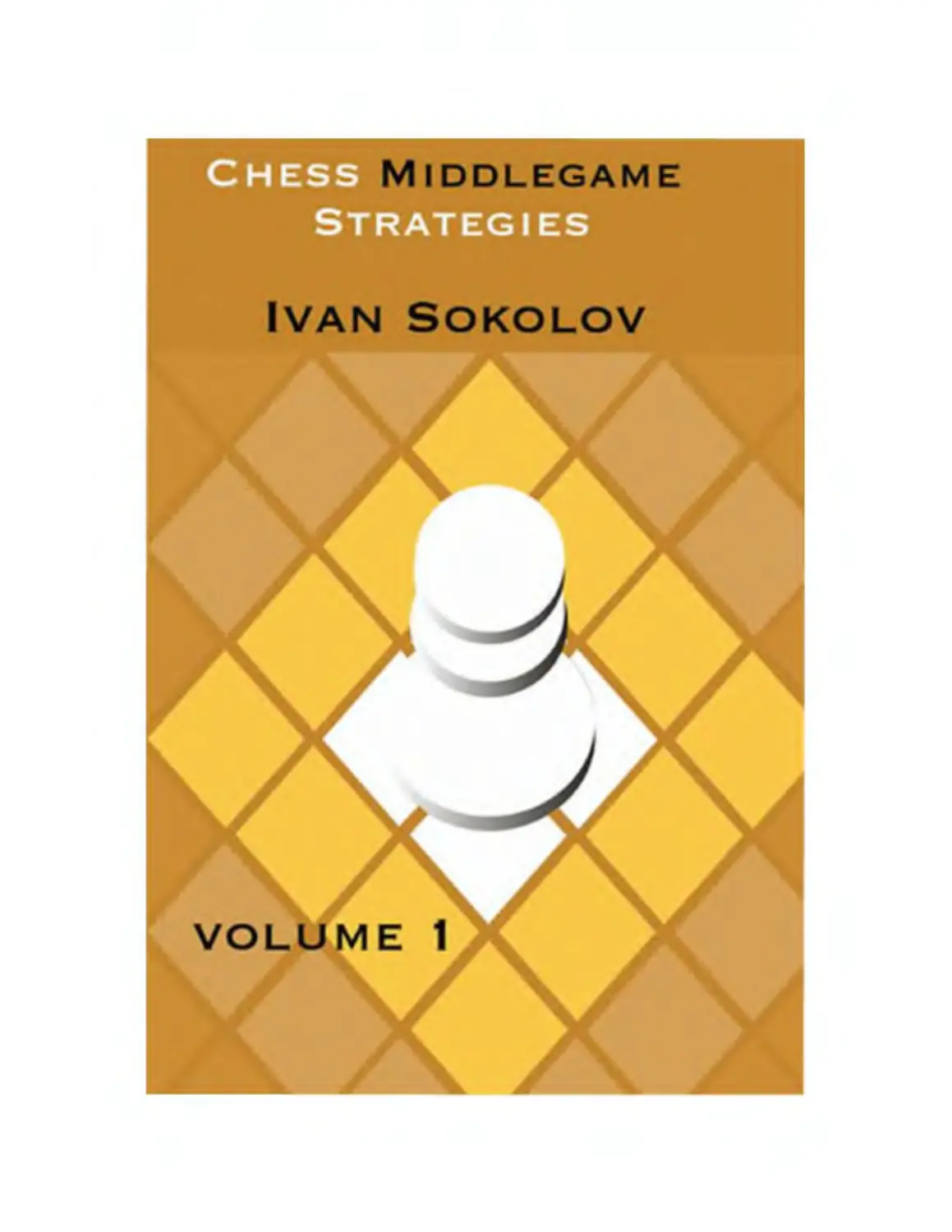
CHESS
MIDDLEGAME
STRATEGIES
Volume 1
by
Ivan Sokolov
A
Thinkers Publishing
www.thinkerspublishing.com
Managing Editor
Romain Edouard
Assistant Editor
Daniel Vanheirzeele
Graphic Artist
Philippe Tonnard
Cover design
Iwan Kerkhof
Typesetting
i-Press <www.i-press.pb
First edition 2017 by Thinkers Publishing
Chess middlegame strategies. Volume 1
Copyright © 2017 Ivan Sokolov
All rights reserved. No part of this publication maybe reproduced, stored in a retrieval system
or transmitted in any form or by any means, electronic, mechanical, photocopying, recording
or otherwise, without the prior written permission from the publisher.
isbn 978-94-9251-001-3
wd/2016/13730/6
All sales or enquiries should be directed to Thinkers Publishers, 9000 Gent, Belgium.
e-mail: info@thinkerspublishing.com
website: www.thinkerspublishing.com
TABLE OF CONTENTS
KEY TO SYMBOLS	5
PREFACE	7
1.	UNUSUAL ROOK LIFTS	9
2.	BACKWARD KNIGHT MOVES	39
3.	BACKWARD BISHOP MOVES	45
4-	MINORITY VS MAJORITY	53
5.	VOLUNTARY PAWN STRUCTURE DAMAGE	77
6.	OPPOSITE-COLOURED BISHOPS	89
7.	DEFENDING WITH LIMITED RESOURCES	115
8.	VOLUNTARY KING RUN	135
9.	MATERIAL IMBALANCE	149
EXERCISES	217
SOLUTIONS	225
KEY TO SYMBOLS
!	a good move
?	a weak move
!!	an excellent move
??	a blunder
!?	an interesing move
?!	a dubious move
□	only move
=	equality
00	unclear position
3	with compensation for the sacrificed material
±	White stands slightly better
?	Black stands slightly better
± White has a serious advantage
+	Black has a serious advantage
+- White has a decisive advantage
-+ Black has a decisive advantage
with an attack
T	with initiative
±5	with counterplay
A	with the idea of
n	better is
<	worse is
N	novelty
+	check
#	mate
PREFACE
The work database’ collection for this book which I started about two years
ago meant the initial plan was for just one volume on Chess Middlegame
Strategies.
However, the way my work and material built up and progressed, it soon be-
came obvious that this 'one volume’ would be approximately 500 pages long
- so, the decision was taken to split the material into two volumes. The second
volume is planned for the second half of 2017.
In this first volume I have annotated 37 games representing different aspects
(chapters) of 'chess middlegame strategies’.
Readers will see that the vast majority of the games selected belong to the
works of ‘contemporary artists’.
Notwithstanding the ‘traditional/golden classics selection’, I preferred to use
the‘contemporary learning examples’ feeling that: A) younger/middle genera-
tion reader will more easily associate with them and B) they perfectly mirror
the middlegame strategies used in modern top-class chess (i.e. today’s chess
at the highest level).
Opening play is in general not the subject of this book, although I did pay at-
tention to opening ideas in the cases where I felt I had something useful to say
on the subject (in the particular game selected).
The aim of this book is to offer the reader a spectrum of middlegame ideas/
strategies, thereby inspiring and improving their practical tournament play.
Besides this book’s ‘practical aim’, I hope that the reader will also gain purely
aesthetic pleasure from playing over the games selected (and variations given).
Enjoy!
Ivan Sokolov
December 4th 2016
1. UNUSUAL ROOK LIFTS
The rook lift is a very common (most-
ly attacking) theme/manoeuvre dealt
with in many books (including my
own ‘Sacrifice & Initiative’ 2013).
The most common purpose of a rook
lift is to bring the ‘heavy artillery’ to
a flank and exert pressure on the en-
emy there.
In this chapter, I deal with unusual
rook lift(s) — anyhow I (based on my
knowledge/experience) have found
them ‘non-standard’.
So, let me give some explanation
(one-by-one) as to why I chose them
for this book.
FIRST EXAMPLE
SEIRAWAN-KARPOV
An original ‘out-of-the-box’ idea by
Seirawan in a very popular variation.
The idea found no followers (only
three games —all played by Yasser).
This should help the reader to also
think ‘out-of-the-box’ in similar po-
sitions and can also be used as open-
ing preparation (the idea is sound and
the opening line is topical).
SECOND EXAMPLE
SALOV-KARPOV
The aim of this example is to under-
stand the extra possibilities/strategies
in hedgehog positions in which the
white knight is developed to di (in-
stead of the more common C3 square).
This knowledge can be used in simi-
lar positions in practical play. I un-
derstood the full scope of the con-
cept only after deeply analysing the
game mentioned. I have also included
some general guidelines for the open-
ing line here.
THIRD EXAMPLE
TOPALOV-CORI
Topalov’s plan of attack in thi;s game
can be used by White in a closed Cat-
alan, KID attack (i.e. KIA as White),
French (as in this game). The rook lift
played by Topalov (non-standard in
such positions), combined with (on
several occasions) a JLg5 piece sacri-
fice-sacrificing a piece to open the
h-file route to the enemy king —is
very instructive!
10
Chess middlegame strategies
FOURTH EXAMPLE
ALEKHINE-KMOCH
‘Chess from the last century’ ©. In
standard isolated pawn positions
a rook lift is a ‘common thing’, while
a double rook lift is not. Using a dou-
ble rook lift, Alekhine skilfully sus-
tains the pressure until his opponent
collapses.
FIFTH EXAMPLE
TOMASHEVSKY-
MCHEDLISHVILI
I was walking around the boards at
the European Team Championships
in Reykjavik, saw this game, remem-
bered Alekhine-Kmoch, and almost
instantly had a ‘deja vu moment!
A standard isolated pawn position,
a double rook lift, skilful play by To-
mashevsky.
In both these games (fourth and fifth)
please notice that, contrary to ‘com-
mon knowledge’, the exchange of the
light pieces did not help the side fight-
ing against the isolated pawn, as the
double rook lift provided the opposi-
tion with extra attacking possibilities.
I hope these five examples prove use-
ful (to give you ideas) in similar posi-
tions in your practical play.
1
> Y. Seirawan
► A. Karpov
London, 1982 [D53]
f3	2.C4e6 3.^3 ds 4.(Ц ^.ey
5. &g5 h6 6. ^.h4 0-0 7. Sci b6
Karpov goes for his favourite Bond-
arevsky/Makagovov (or also in many
books called Tartakower) variation.
8.cxd$ £lxd5 9,^xd5 exds lo.&xey
Wxey n.g3
abcdefgh
n...^e8
The other main move here is 11...
&аб (at the top level Black has
also tried here some other bishop
moves, such as 11...^.b/ and 11...
^.f$) 12,63 C5 There is a very in-
structive game from Tigran Pet-
rosian I would like to show here:
i3.^.xa6 (i^.dxcs was the theoreti-
cal subject in Korchnoi,V (2695)—
Karpov,A (2700) Merano 1981) 13...
£ixa6 14.0-0 £}cy15.Ьз Eac8 16.22ei
Sfd8 17.I14 i8.Wd3 Wf6 I9.&g2
cxd4 2O.exd4 Exci 2i.Sxci Because
1. Unusual rook lifts
11
of his c-file control White has a small
advantage. Black wants to neutralize
this by active play. 21... Wf4 Black uti-
lises tactics. White’s rook is attacked,
and if it moves Black will play... Wg4
creating the threat of ..АИ4. Black’s
queen on f4 ‘obviously’ cannot be
taken as Black will recapture with
his knight and, owing to a simple
fork, White will 'lose’ a pawn.
Here comes a moment of superb
judgement from Petrosian!!
a b c d e f g h
22.gxf4!! The ninth World Cham-
pion allows Black to execute his idea!
In the resulting endgame White will
have lasting pressure worth more
than the sacrificed pawn. Simply
great judgement by Petrosian! 22...
?bxf4+ 23.&g3 £ixd3 24.HC3 <c)b4
25Л3 £}аб 2б.Ь4 ^Tb8 27.^07
a b c d e f g h
The resulting position of White’s
pawn sacrifice idea. The active rook
on C7 compensates for more than
a pawn here and Black is doomed to
a passive defence. 27..Л5 28.b5 £}d7
29.&f4 h$ (29...Q/2J зо.^сб fog6+
3i.&g4	32^5 does not improve
Black’s situation.) 30.^65! <c)f8 (30...
foxes	3i.Sb7 f6 $2.foc6
£}g6+ 33.^g3 Hd6 34.^xb6 Se6
35.Hb8+ £if8 зб.Еа8 Sei 37.£}d8
Ф117 з8.Ьб Sbi 39.b7 ®d7 4O.Sxas
1-0 Petrosian,T (2640)—Portisch,L
(2645) Palma de Mallorca 1974.
12.SC3!?
abcdefgh
A very unusual rook lift (for such
a standard QGD position). White's
idea has a tactical element, combin-
ing the already existing c-file pres-
sure with a timely Нез threat (after
developing his queen to a4). With
the 2ез move White also breaks
Black e-file pressure. The drawback
of this 12. Нез!? Idea? It costs time
by delaying the white kingside’s de-
velopment. It is interesting that this
original idea from Yasser Seirawan
did not find any followers (!). In
my database all three games were
played by Yasser himself. i2.^.g2 is
a common move here, seen in many
top games.
12
CHESS MIDDLEGAME STRATEGIES
ix..£ia6
Direct central play with 12...05, aim-
ing to take advantage of White’s de-
layed kingside development, looks
perhaps the most principled response
for Black and was played by anoth-
er QGD connoisseur Efim Petro-
vich Geller: i3.dxcs bxcs (13...£}сб
i4.cxb6 (14.^2? §.a6+) 14...^.by
15.^2 axb6 (15... &.аб 1б.о-о! &.XC2
i/.'&xds±) i6.o-o±) i4.Wxd5 ikby
i5.Wd2 <£c6 1б.2ез (i6.±Lg2 Had8
i/.йез/ W/8 transposes to the game.)
16...Wf8 17. ^.g2 2ad8 18.2хе8 Wxe8
19.Шез £)d4 20. Wxe8+ 2xe8
a b c d e f g h
2i.&di (2i.£ixd4 may be an im-
provement on the game; 2i...^.xg2
22.^gi £.d5 White seems (to me) to
have a small advantage in this ending.
23.^3 (23^/5 §.xa2 24.<&d2 S.e6
25.^63^) 23...^b8 24.^2 C4 (24...
&хЬз 2$.ахЬз ЁхЬз 26S^C2± This rook
ending should be a draw, but it is def-
initely better to sit behind the white
pieces here.) 25.^101 2хЬг+ 26.ФС3Т)
2i...2d8 22.£)ei £.xg2 23.^xg2 Eb8
24.ФС1 (24.Ьз C4=) 24...£ixe2+ 25.ФС2
£}d4+= 1/2-1/2 Seirawan,Y (2600)—
Geller, E (2575) Linares 1983;
12... ^.by can lead to interesting
complications: i3.Wa4^dy! i4.2xcy
Hac8 15.SXC8 (is.^xd? ^64!-+) 15...
2xc816. £g2 2ci+ 17. ^d 2 Sc4 i8.Wa3
Шхаз 19.Ьхаз ^f6~
a b c d e f g h
This is a tactically sharp end-
ing; while the engine evaluation is
around 0.00, to a human it simply
looks like 'sharp play’. 2O.£)e5 2xd4+
21.Фсз Sa4 22.Нс1йхаз+23.ФЬ2^а5
24,£)xfy (24. Sc/ 2^5+ 25. Фш d4*T)
24...Sb5+ 25.&ai; 12...£.аб i3.Wa4
leads to some White plus, for exam-
ple: 13...C6 14.2ез (14'631?) i4...Wd8
I5.2xe8+ Wxe8 гб.ез We4 17.^.хаб
Wxf3 18.0-0 £ixa6 i9.Wxa6±
i3.Wa4
ab. cdefgh
13-C5?
Facing a novel idea, Karpov goes
for a tactical solution and definitely
overlooks something in his calcula-
tions. 12. Нез!? The idea will now (for
1. Unusual rook lifts
13
White) work to perfection! Facing the
same position (against the same op-
ponent!) for the second time, the 12th
World Champion came better pre-
pared and went for i3...b5l removing
the white queen from the a4-e8 di-
agonal in order to, after 14.W5, play
actively (i4.Sxbs? Hb8+) with 14...
We4! i5.«id2!
abcdefgh
15...Же6
(i5...Wbi can lead to complica-
tions resulting in a peaceful ending:
i6.Wxb5 сб 17. £g2 Sxhi {ij...Sxa2
i8.Sbj Sas ig.Sas Sb$ 20.^5
Hb8 2i.Hai±) i8.Wxc6 £d7 (18...
Sxg2?? 19-Sxe8+	2О.Жхс8+-)
i9.£xhi £.хсб 2O.Hxc6£ib4 21.He?
£}xa2 22.£te5 £ib4 23.£.xd5 ^3xds
24-Sxds S£ed8= This ending should
be a draw.) 1б.Ьз? The move Yasser
played in the actual game,but White
simply does not have the time (here)
for such a (positional) approach.
Karpov takes advantage of White’s
tempo loss and swiftly develops
a mating attack. (16.^63! is defi-
nitely the move Yasser wanted to
play when facing Geller a year later.
Play is sharp and White has reason-
able hopes for an advantage: 16... Wbi
17.Шаз 2сб 18.2е8+ ФЬ/ 19-Wd3+
Wxd3+ 2O.exd3 £}b4
abcdefgh
An unusual position with many ide-
as. I prefer White. 21.аз (2i.£lei fexcu
22&C2&) 21...^C2+ 22.ФеЗ^Сб 23.I14
a)	23. ^.g2 ЛхЬг 24.Ec! £b7 2$.Еха8
£xa8 26.£h3^ (26&14 bj!) 26...b4
2/axb4Sxb4 28.£f5+ g6 29.^.d?^;
b)	23.£.113?! £xh3 24.Exa8 £te7=;
23... Eb8 24. £e2 b4 (24... &.£6 25. Hxb8
%}xb8 26.Hbi±) 25.axb4 (25.
Hxb2 26.^5+? hxgs 2/.hxg5+ <&g6
28fy &.g4!-+; 25.a4 Hxb2 2б.На b$!
2/.ИхСб??Нх£2+! 28.<&X£2 Ь2~+) 2$...
6xb4 2б.2Ь1Т) 1б...Ь417-^ез (i/.Hds
C5-+) i7...Wbi 18.£хеб Wb2+ 19.&di
£xe6 2O.Wxa6 ®ai+ 2i.<±>d2 ®сз+
22.&di
abcdefgh
Obviously Black (here) wants
more than a draw. 22...£f5l 23.^61
ЖЬ8-+ Another rook lift brings
the black rook to the c-file, aiding
14
CHESS MIDDLEGAME STRATEGIES
the queen in attack and deciding
the battle. 24,Wxa; (or 24.63 Ш)б
2$№ха7 Sc6-+) 24.„^b6 25.63 JSc6
26..&C4 Wai+ 2/.Фс2 Wb2+ 28. ^di
(28.Ф/1 £./13+ 29.^gi №сз-+) 28...
dxc4 29-Wa8+ Ф117 зо.Шхсб сз o-i
Seirawan,Y (2595)—Karpov,A (2700)
Hamburg 1982;
An immediate i3...We4? runs into
a nice tactical refutation: i4^d2!
^.d; ls.Wxd/ Wxhi i6.Wa4l± and
Black loses his knight on a6.
1б.Ш)з!+-
White will evacuate his king and
his material advantage will prove de-
cisive.
i6...&fs
1б...Шс5 17.Ш3 &f5 i8.Wxd4 Wa5+
i9.Wd2 Wxa2 20.^4+-
17. JL g2 JtC218. xd4 ЛхЬз 19. £) хЬз
Black is running out of threats and
White has a material advantage.
Bringing his king to a ‘safe place’ will
mean the game has been decided.
i9...3ac8
!9...Wb4+ 2О.ФГ1+-
20. Jtf3 Eci 21.0-0 Bxbz 22. £di Hd8
23.^4 Sdy 24.£ic6 We8 25.^1x37
^C7 26.34 Wa8 27. ^xds Wxay
28. Sd8+ ФЬу 29.Wd3+ fs 30. Wxf5+
g6 31. We6 1-0
2
> V. Salov
► A. Karpov
H00govens Wijk aan Zee [7],
24.01.199S [E15]
1Л4 £if6 2x4 e6 3.£lf3 b6 4.g3 £a6
5.£ibd2
This development of the white
knight leads to different strategic
possibilities compared to standard
(^сз development) positions.
In this game, the positions we will
examine will be hedgehog-related.
After I once lost (a terrible) game to
Lembit ОП (mentioned later in the
comments) and later analysing posi-
tions comingfrom this game (hedge-
hog-type play), I have formed the
opinion that aiming for ...ds —and
(often) hanging pawns in the cen-
tre after subsequent Black ...C5 po-
sitions is Black’s best. The reason is
that the white knight developed on
d2 (compared to £кз) is not pressur-
ing Black’s centre (compared to а £кз
hitting the central ds square). This
opinion, however, is personal and is
a matter of taste.
1. Unusual rook lifts
15
5...M7
5...ds for example can (later) lead to
'hanging pawns in the centre’-type
positions.
Black is aiming for a hedgehog-type
position and here we often get plenty
of‘direct play’lines also. 6... £.67 7.0-0
0-0 8.Ьз d$ 9.cxd5 exds as seen in many
games, leads to a strategically different
kind of play, where White (as already
mentioned above) needs to prove that
his knight developed on da brings him
advantages (again compared to the
’standard’ £кз development).
7.e4!
White wants to take advantage of
Black’s loss of time with 4...^.a6 and
then 5... .sLb; and so opts for tactical-
ly-based, dynamic central play (aim-
ing to take space).
7...cxd4
7„.£ixe4?? is a blunder and should
lead to an opening disaster for Black:
8.£k5 ds (8..Лкз loses a piece to
9^hsg6 io№h3!+~ ii.cxds exds
12.0-01-0 O11,L (2600)—Guimaraes,)
(2305) Oviedo 1992) 9.cxds exds (9-
£)xd2 io.Wa4+ £ld7 n.^.xd2 -&xds
I2.£.xd5 exds 13.0-0 with Black’s
king in the middle of the board,
White has a winning advantage here.
i3...f6 i4.Sfei fxes is.Sxes+ ^.e/
a b c d e f g h
16. Saei (i6.&.gs? strangely enough,
lets it slip 16...b$!= i/.^xbs %b818. ^c6
%b6 19.	Ub4 2o№c6 Ш)61/2-1/2
Goldin,A (2535)—Smirin,! (2490)
Moscow 1989) 16...0-0 х/.Жхе/
18.&gs Wd6 19.И1еб+-) io.Wa4+
Фе/ (io...$hc6 u.^xe4+~; 10...^dj
11.^1x64 dxe4 12. S-hs is hopeless for
Black as 12....&C8 loses to 13. Wc6! Sb8
I4.^xf7!+-) n.^xe4 dxe4 i2.dxc$
We8 (i2...Wd5 13. &f4 fs i4-$-g5+ 1-0
Skytte,R (2416)—Nikcevic,N (2429)
Budapest, 2014) 13x6 £)xc6 i4.Wxe4
£ixes 15-Wxb7+ &f6 16.0-0 Sb8
i7.We4 g6 i8.Sei JLd6 19.WI14+ 1-0
Chernin,A (2605)—Podolchehko.E
(2463) Ohrid 2009.
8.0-0!
Arguably the most challenging
move for Black to face! White com-
pletes his development, maintaining
the tension. 8.es
16
Chess middlegame strategies
a b c d e f g h
This was seen between the same op-
ponents (some years earlier) leading to
a peaceful outcome: 8...£te4! (8...£}g4?
is a mistake I once made, leading to dis-
aster: 9.0-0 Wcy юЛе1£1с611.I13 £>h6
I2.£>e4 £)g8 {12.. .^xes?? 13^X65 Wxe5
14. &.f4 №fs 15.&xh6 gxh6 i6.^xd4+-
) 13. jtf4± White has an obvious ad-
vantage and I got slaughtered soon in
O11,L (2585)—Sokolov,! (2640) Wijk
aan Zee 1993) 9.0-0 (9^X64 S.xe4
io№xd4 &.b4+ 11.&d2 hxfy 12. Q-xfy
13.&.ХС6 &.xd2+ i4&xd2 dxc6
I5.№xd8+ ^xd8+ 16S&C3 1/2-1/2 Epis
hin,V (2675)—Karpov,A (2740) Dos
Hermanas, 1994) 9...£ixd2 io.&xd2
^.xf3 n.Wxf3 i\c6 i2.Wxc6 dxc6
13. £xc6+ Wd714. ^.xd7+ *^xd7= 1/2-
1/2 Salov,V (2660)—Karpov, A (2725)
Wijk aan Zee 1993.
8...d6
White has a developmental advan-
tage and Black needs to be careful.
‘Active’ moves do not work for Black
here: 8...£)xe4? 9,^65 d5 lo.cxds
exd$ ii.Wa4+ £}dy i2.£)xe4 dxe4
I3.£.h3+-;
8..Лк6?! 9.e5 ^g4 ю.Ьз £ih611.^4
£lf5 I2.g4 £)a5 (i2..JZ\h4?? I3$\xh4
^xh4 I4.&.g5+-) i3.Wd3 ^.xe4
14. Wxe4 £}e7 i5.^xd4?;
8....&С5?! 9.e5 ^4 (9...&}g4 io.b4!
(ю.^\Ьз±) io...^.xb4 n.£)xd4
ixg2 i2.Wxg4 ^.xfi i3.Wxg7 Sf8
14<£)е4 &XC4 (14... We/ isJ&f6+ <&d8
i6.£Lg5+-') i5.£if6+ Wxf6 i6.exf6+-
1-0 Bellon LopezJ (2490)—Gomez
EstebanJ (2495) Oropesa del Mar
1996) 10.£lei d$ n.exd6 £ixd6 (11...
f5? lands Black in a lost position:
12.£) xe4 fxe4 (12... &xe413. &.xe4fxe4
I4.b4 &xd615.'^xd4+-') 13, WI15+ &dy
(i3...g614.^65) 14.^3 JLxd6 15.^ei
White has a large advantage) i2.b4
Black does not get (nearly) enough for
a piece here. i2...^.xg2 i3.^xg2 0-0
i4.bxc5 bxcs i5.^d3±
9.£}xd4
abcdefgh
After some opening lines (to provide
practical help to players should they
decide to play this line) we finally
come to our main position of interest!
Looking at the pawn structure, we
obviously see a ‘standard hedgehog’
position. What differs from a ‘stand-
ard hedgehog’ is the fact that White’s
knight bi has been developed to d2
(instead of the more usual сз) square.
This white knight development to d2
1. Unusual rook lifts
17
does offer here middlegame strate-
gies* normally not applicable (with
a knight on сз). It is useful to pay at-
tention (!) — as you may get to use
this in practice! The main advantage
of the white knight on d2 is that here
White wants to advance his a-pawn
with a4, as and, after Black captures
...bxas, White will play £1263 with
£ixa5 to follow. In a regular hedge-
hog position White’s knight does not
get to as so easily. With a knight on as
(executing the afore-mentioned plan)
White has an advantage. It is not easy
to evaluate the size of the advantage
(computer engines normally start
with 0.40), but White definitely has
an edge. Karpov in this game aimed
to stop the plan (and got to face some-
thing else!) I will also give some other
lines as to the way the game might
proceed.
9...a6
9„.Wd7 10. 34! (10. Sei ^.e/ ii.£\bi
Qc6 12.^C3 I3^xd4 0-0=
0-1 Ivanchuk, V—Karpov,A, Linares
1994) ю...£кб (10....& 67 n.as! 0-0 (11...
&.d8 12.Ш5Т a6? i$&ixd6+ ^xd6
14.65 Wxe515. &.xb/ Sa/16. S.g2± 1-0
Atalik,S (2532)—Genov J* (2473) Ath-
ens 2001; n...bxas 12. Sei Ъсб i3&hxc6
&xc6 14.^3 Ub8 i5&}xas± 1/2-1/2
Browne,W (2516)—Henley,R (2435)
Parsippany 1999) I2.b4±) n.£ixc6
^.хсб I2.b4 ^.67 i3.bs Browne,W—
Ivanov,A, USA(ch)i997 13.,.^.b7
i4.as± 1-0 Browne,W (2530) —
Ivanov,A (2270) Chandler 1997;
9...£)bd7 10. Sei Wc8 (10... ii.es
&xg2 i2.exf6 &xf6 i3.£\xe6 fxe6
I4.<&xg2±) 11.34! аб (n... ^.ey i2.as
bxas 13&2Ьз± ^xc4? i4&\xa$
iS&xb? '^xb/ 16.es ^ds i/.exd6
$Lxd6 18&хе6+-) 12.as es (12...bxas
13.^2Ьз±) 13-^fs g6 14.£|ез± i-o
011,L—Kengis,E. Riga zt 1995;
9...£.67 io.es -&xg2 n.exf6 .&xf6
12.£}хеб fxe6 i3.&xg2±
10. Sei Wc7
The position can easily become very
tactical here: io...£ibd7 ii.es! &xg2
I2.exf6 &b7 (i2..№xf6 I3&xe6!fxe6
I4.&xg2± 1-0 Browne,W—Burger,K.
World Open 1990) i3.fxg7 £.xg7
14.^4 ^.xe4 (Black here needs to
be active with 14...0-0! is&}xd6 6hes
i6.$Axe6 fxe6 i/.^Axb/ ^e? 18. &J4
&Лс6 19.^}з ^xby 2o.Bxe6 $}as
2i№xb? $}xb7 22.^.xb6±) i5.Sxe4
o-o 16. Sg4-* and White has a strong
attack, as i6...^es? loses to i7.^c6!
£}хсб i8.^.h6+-
11.34! T
a b c d e f g h
n...£k6
In the case of n...&)bd7 White car-
ries on with his plan: 12.35!
ц.^гЬз Sd8 I4.axb6 £}xb6 is.£}as±
18
Chess middlegame strategies
and White soon won inBoensch, U—
Chuchelov,V, Berliner Sommer 1996.
12.£iXc6 -&ХСб
In the case of i2...Wxc6 White again
continues with the now standard
13.35 &e7 I4.axb6 Wxb6 15.^3 0-0
i6.^ia5±
13.35 ЖЪ8
I3.„bxa5 14,£)Ьз ^b8 (14...<24
I5&}d4±) i5.£)xa5±
i4.axb6 Wxb6
abcdefgh
A position Karpov has been (with
his last few moves) aiming for: White
(due to Black’s b-file pressure) cannot
transfer his knight to 35. Black has to
finish his development and....then it
looks like (more-or-less) a regular
balanced hedgehog doesn’t it? Here,
however (due to the knight being de-
veloped to d2) White has a plan usu-
ally never applicable or available in
a ‘normal hedgehog’. White’s rook on
ei will, by means of a ‘rook lift’, come
to target the black queenside!
i5.gej!±
Yes! With his knight developed
to di, the 3rd rank is an ‘open high-
way’ for White’s ei-rook to access the
queenside! Black is in deep trouble!
This strategy is worth remember-
ing, as you may easily find yourself
in a situation in which you can use it!
i5...£ld7
15... ^7?? blunders a piece: 1б.^Ьз
Wc7 I7.^xb8+ Wxb8 18x5 £xg2
I9.exf6+-
1б.Ш>зВа7
16...WC7 17. S хаб simply costs Black
a pawn, since after 17-..^хЬз 18.£)хЬз
®b7 19.^33 £.xe4 20.&xe4 Wxe4
2i.£id4 £e7 22.S&7+-
abcdefgh
Black loses because he cannot solve
his ‘king in the centre’ problems.
17. Ш>аз ЛЬ7
In hindsight, giving up a pawn (for
the sake of finishing development)
with 17...£1C5 18.£}Ьз НхЬз 19.НхЬз
£1хЬз 20'.®хЬз JLe7 21.®аз± offered
Black some practical saving chances
a pawn down.
1. Unusual rook lifts
19
18... .&e7 19.65+
19.Ш4
White should be winning- after this.
A standard positional idea—19.^Ьз+
bringing White’s knight to as — also
promises White a clear advantage,
since i9...Wxb4? loses to zo.Clas £ks
21.^.ез ^.a8 22x5+- ^.xgz 23.<^xg2
dxes 24.ЛХС5 ^.xc5 (24...WXC5
25>Wa4++-) 25.^3 winning the
queen.
This runs into a tactical refutation.
20...65! ± was the only way to continue
the struggle, although White is clear-
ly better after zi.^fi (21	21.,.
Wc/ 22.£}ез±
2i.esl+-
Now, due to multiple pins and a king
in the middle of the board, Black has
to lose a piece.
2i...^.xe5
2i...dxe5 22.Ed3 Wc7 23.^64+-;
2I...^.Xg2 22.exf6 £c6 23,fxg7 Sg8
24.WC2+-
22x5! Wcy
22...Wbs 23-Wxb5 axbs 24.^.xes
£xg2 (24...dxes 25x6+") 25.^.xd6+-
23.^.xe5 dxes
23...£.xg2 24. &xd6 Wb7 25.£xb8+-
24..&xb7Hxb7
24...Wxb7 25x6+-
25.C6 £ib6 2б.Шхаб Wxc6
2б...ЖЬ8 27.Wa71+- and White’s
passed pawns will decide.
27^04!+-
abcdefgh
20
Chess middlegame strategies
27... ^b8
In the case of 27...WXC4 28.Wxby
£}c8, Black’s problem is that he is
also set to lose his knight: 29. Hd3’
o-O3O.^a<h g6 3i.^d8+-;
27...WC7? 28.Wxb7+-;
27...0-0?? 28.^35+-
28	.£)xb6 0-0
28...	Wxb6 29.Wxb6 ^xb6 30. Жа8++-
28...	ЖхЬб 29.Wa8++-
29	.^4
The smoke has cleared and Black is
a full piece down.
29...	We4 30. ^ез Wdg 3i.£ixeg Sfc8
32«Wd31-0
A very instructive game for under-
standing the available hedgehog-po-
sition strategies related to White’s
knight d2 development.
3
> V. Topalov
► J.T.M.Cori
40th Olympiad (Men] Istanbul [5*1],
01.09.2012 [C04]
i.e4 еб 2Л4 dg 3.£id2 £ic6
A seldom-seen line of the French.
Our focus will be on the middlegame
plans a bit later on in the game.
4.£jgf3 £if6 g.eg £}dy б.£)Ьз ад 7.34
^.e7 8.^.bg 0-0 9.0-0 £icb8 lo.^ei
b611.g3 c6 12. ^.fi JLa6
a b c d e f g h
The first interesting moment: to
keep or not to keep the bishops? The
pawn structure here (though with
a white pawn still on С2) and plans
actually resemble a closed Catalan.
Keeping a light-squared bishop cer-
tainly has its merits (for White) here,
as the bishop can later (after push-
ing h4) come to Ьз and exert some
pressure on the Ьз-с8 diagonal and
be an important attacking piece. To-
palov, however, decides that A) with-
out a bishop on аб Black’s queenside
counterplay will be more difficult to
create and B) time is a factor(!)
13. fk. хаб хаб 14.I14 h615x3
Topalov decides to stabilize his cen-
tral pawn chain and focus on building
a kingside attack. Another approach
was 15. We2—with С4 to follow — try-
ing to build on the general space ad-
vantage White has, but this leads to
a rather passive mode of play.
ig...cg ib.C^hzSeS
White chances here are obviously
related to his kingside attack, but
how to conduct it? Should White try
to bring his £}Ьз to the kingside so
1. Unusual rook lifts
21
that he will have an extra attacking
piece there? Topalov comes up with
a very effective plan — involving an
unusual rook lift (anyhow, I had not
seen this rook-lift idea in such posi-
tions before).
the black king. 22...hxg5 23.hxg5 g6
24.WI14 схЬз 25.^g2+- with Shi to
follow and Black will soon get mat-
ed. Black, despite being two pieces up,
has no counterplay (due to the closed
nature of the position).
17. Wg4 ФЬу 18. WI15 ^g8
a
7
6
5
4
3
2
1
abcdefgh
abcdefgh
19.^3! .&f8 2O.gf3
Forcing a weakness.
20...g6
2o...We7 trying not to touch the
kingside pawns loses to 2i.£ig4! 04
abcdefgh
(21...g6? 22&xh6+ ФЬ/
^xgs24.^.xj7++~) 22.^5!! Remem-
ber this attacking idea (!!), as it (as
we are about to see) simply (always!)
works here for White! The bishop is
sacrificed to open an h-file route to
22.WI13
Topalov builds his attack on the
(just shown) -&g5 idea. However, it
could have been implemented imme-
diately! 22.&g5H hxg5 23.hxg5
abcdefgh
Black is a piece up here, however
(again due to the closed nature of the
position) he does not have any coun-
terplay and therefore White can take
his time to utilize the h-file, build-
ing a winning attack. It is interesting
that it takes computer engines quite
22
CHESS MIDDLEGAME STRATEGIES
some time to understand that Black is
doomed after the 22.^.g51! sacrifice!
23...£jс6 24.W4^.g7 25.^404 (25...
SeciS 26.&g2 &f8 27.^6+-; 2$...cxd4
26.cxd4 does not change the situa-
tion) 26.£ld2 ФГ8 27.^g2 with Shi,
£)f 6 to follow wins for White. Black is
‘a sitting duck’ here, passively watch-
ing White building up his mating at-
tack. The immediate 27^/6 should
win as well.
22...&g7
22...C4 23.£}d2±
23-^g4 &h7
23...Ш 24Л5+- g5 25-£.xg5 hxg5
2б.Ьб+-
24.-&g5!
Black is now not forced to (immedi-
ately) take the bishop.
24...Wf8
abcdefgh
An interesting moment.
25. <£g2
Topalov is quite pragmatic in build-
ing his attack. Another — more di-
rect— solution was 25.I15! forcing
Black to take the bishop, opening
the h-file: 25„.hxg5 26.^2! with Shi
tO follow <26.hxg6+ &Xg6 27^g2??
№h8-+) 26...Wh8D 27. Sxfy &g8
28.hxg6 ®хЬз+ 29.ФхЬз
a b c d e f g h
Black has difficulty in developing, so
White is sure to win a bit more mate-
rial: 29...Sf8 (29... ^a7 30^/6+ £}xf6
3i.Sxa/+) 3O.Sey Say 3i.Sxe6±
White already has three pawns (for
a piece) and is likely to win one more
(the dj-pawn), and so holds a big ad-
vantage here.
25» h5
In the event'Black delays this move,
White would have pushed h.5 himself,
opening a route to the black king.
2б.£)ез £кб 2y.g4
a b c d e fgh
1. Unusual rook lifts
23
27„.£)dxe5
This piece sacrifice idea is the only
way for Black to create counterplay
here. However, a better version (for
Black) was 27„.cxd4 28.cxd4 ©dxes!
29-dxe5 £}xe5 as now Black has the
square 64 for his queen: 3O.gxhs
gxhs 31. gg3 ®4°c) 31..Иц
32.£idi± although his compensation
for the sacrificed piece does not look
to be enough.
28.dxe5^xe5 zp.gxhs gxhs
29...£ixf3 3o:Wxf3±
3O.Hgi
3O.gg3±
3o,..fs 31.ФЬ1 Say 32.^ci <Ц 33.cxd4
cxd434.£>g2
a b c d e f g h
34...£)g4
34...£ixf3! 35-Wxf3 Wf7« was (prob-
ably) the best way for Black to fight.
The position actually looks unclear
36.^f4 es 37.^xhs £.h8 з8.£Тб (38.
£%3 e4 39-^xj5~ ^xfs 40^xfs d3°o)
38...Wb7«=
35.f4 Wf7 зб.£1се2 es?
abcdefgh
This blunder runs into a relatively
simple tactic. зб...^с7^ was the way
to fight on.
37	.£)xh5!+- e4
37...	Wxhs 38.^xfs ^h6 39,.&xh6
Wxh6 4O.£lg3 Wc6+ 4i.f3+- and
White gets a mating attack.
38	.^4 ез 39-Sgxg4 fxg4 40-Sxfy
Hxf7 4i.Wxg4 exfi 42.^eg3 gei+
43.<£h2 £es 44- -&f4	45-^xes
^xe546«Wc41-0
4
▻ A. Alekhine
► H, Kmoch
San Remo (7]. 24.01.1930 [E51]
i.d4 £Иб 2.C4 ебз.^кз ^.644.^2
Nowadays this a very seldom played
line. However, it has its logic and
White’s chances for an opening ad-
vantage are actually similar to oth-
er — 'more common — lines.
4...0-0 5.ез ds 6.£Из cs 7.Л3 £хсз
8. & хсз £le4 9. £ci 4}хсз 10. Sxc3 схсЦ
24
Chess middlegame strategies
abcdefgh
n.exd4
Alekhine opts for an isolated pawn-
type position. For players interested
in opening theory there was a re-
cent practical test here: 11. Wxd4 £k6
12.W2 Wf6 i3.cxd5 exd$ 14. JLe2±
abcdefgh
A similar position to that which
we can get from different opening
variations. White is a little better.
i4...Hd8 Aiming for a ...d4 pawn
push. i5.^id4! transforming an iso-
lated pawn position into favourable
‘central pawn symmetry*. i5...£}xd4
i6.Wxd4 Wxd4 i7.exd4 c-file control,
a centralized king and (above all) the
central pawn symmetry favouring
White’s light-squared bishop (com-
pared to his colleague) guarantees
White a long-term advantage here.
17...^.еб i8.&d2 Sac8 19.SI1C1 and
Black either loses control of the c-
file or his ds pawn, since after 19...
Нхсз (19...Ф/8 20.Sc/ was in 1-0
Sandipan,C (2599)—Vishnu,P (2463)
Al-Ain UAE 2014 and White went
on to win this endgame) 20.HXC3
Sc8 2i.Sxc8+ ^.xc8 22..&f3 &e6
23.ФС3 and a white king march (to
C5) cannot be stopped since 23...a$?
loses to 24.b4+-
ll...£k6 12.&62 dxC4 I3.JLXC4 Wf6
14.0-0 Sd8 15. Ш3 ^.d716. Sei
So far a regular isolated queen pawn
(IQP) position.
16... £e8
i6...£)a5 17.^32 &b5 i8.Hde3 £k4
19.SC3 Sac8 20.Wc2 £}d6 with bal-
anced play.
iy.Wd2 £te7
abcdefgh
Here Alekhine starts an original
plan that will involve a double rook
lift (to the kingside).	1
i8.£ig5 £}dg 19. Ш3 We7 2O.Sg3 h6
2i.£tf3 Wf6
1. Unusual rook lifts
25
a b c d e f g h
A single rook lift in an IQP position
is a "regular thing’» but a double rook
lift is rarely seen!
22.^e41
White’s knight now goes to its most
natural attacking square.
23.£le5
Alekhine is skilfully able to keep
up the pressure (with his two "lifted’
rooks).
general—and a light pieces trade in
particular—usually favour the side
fighting against an isolated pawn’. In
the case of 26... We/ (probably Black’s
best) 27.^2 f6 Black was prob-
ably nervous about possibilities like
28.411g4 h5 29.^xf6+ gxf6 3o.Sg3+S
2/.£ixc4 Wg5
Here (compared to a regular IQP
positions) we have a very specific sit-
uation. White’s two lifted rooks» ac-
companied by his queen and knight»
form a strong attacking army. Black’s
king has no real defenders (as the
bishop e8 is protecting the crucial £7
square, but doing nothing for g7 and
h6 protection). White has easy play
here and Black soon collapses.
28.1g3Wd5
28...Wxg3 29.fxg3 Sxc4± was per-
haps a reasonable practical decision
for Black.
24. Ш3 gac8 25.I13 ^d6 26.
abcde fgh
26...£}XC4
Blackfollows a "standard rule’: "in an
isolated pawn position piece trades in
ЗО.ФЬг! Wei
3O...Wd6 3i.^fg4	3i-g6
32.И114 h5 33J5? (33. tLxhs? ^xd4+)
26
Chess middlegame strategies
3i.Wb4J± Wc7 32Л5!
White’s pieces co-ordinate perfectly
in the kingside attack.
32...Д5 зз.Ше4+-
abcdefgh
33... ^d6
33...exd5 34-Ш4+-
34.We5g635.Wh5
35.^g4+-
35-..Sxd5 36.£}xd5 exds 37.Wxh6
Wes 38.Ш14 Wg7 39. Wxg7+ 1-0
5
▻ E. Tomashevsky
► M. Mchedlishvili
20th European Teams Reykjavik ISL
[6.2], 19.11.2015 [D16]
1.C4 c6 2.^f3 ds 3Л4 £)f6 4.£>C3
dxc4 5-Я4 еб б.ез C5 7.&XC4 £ic6
8.0-0 cxd4 9.exd4 £.e7 io.We2 0-0
11.3Sdi
A standard IQP position.
ii...£]b412. JLg5 h6
a b c d e f g h
White decides here to give up his
bishop pair, in order to improve his
knight and enable his ‘Rai’ rook lift.
I3.£xf6 £.xf6 i4.4be4 b6 I5.£te5
£.114
abcdefgh
16. Ж аз!
A standard rook lift plan in such
a position.
16... £.Ьу17. lh3 £-ds
Just as in the previous game Alekh-
ine-Kmoch, Black is assuming that
a light pieces (minor pieces in other
parlance) trade 'must be’ favourable
1. Unusual rook lifts
27
to him, 17...СИ5 was probably a bet-
ter choice.
18.4}сз Jsixc4 19.WXC4 2O.We2
gc8
This situation is in some ways
similar to our previous (Alekhine-
Kmoch) game. Yes, the bishop on ey
is a better defender than the one on e8
(as in the previous game), but still, if
the other rook also gets ‘lifted’, Black
will be under pressure.
2i.Wg4^h7
2i...f5± solves some problems, but
is (in a practical game) never an easy
move to play
22. Hg3 .&f6 23*£te4 Iky 24J14 Wey
a b c d e f g h
25.Ф112!
An excellent move, preparing a hid-
den threat
25...£id5
Black tries to bring an extra piece to
the defence. 25...S£d8?? blunders into
the simple 26.£)xf6+ Wxf6 27.%%+-
while in the case of some random
move such as 25...as, the idea behind
25.	ФЬг! becomes clear after 26. Hci! ±
^xci? 27.‘£ixf6+ Wxf6 28.£ki7+-
26.£)xf6+!
26.	Sci here would not be as strong,
because after 26... JLxes 27.dxes f6! the
position is not so clear.
26...Wxf6
a b c d e f g h
27.	Sdds!
Tomashevsky goes for a double rook
lift. Using the idea created by 25.Ф112!
with 27. Sci? was definitely possible,
but White simply judged a double
rook lift as being more efficient here.
27... ^by± (or giving up his queen
with 27...ЖХС1 28Jz} dy Hg8 2^.^}xf6+
Qxf6 hoping to build a fortress) are
no better for Black.
27...	^ie7 28.Sgf3	29.g3
Similar to the Alekhine game, Black
is under pressure (on the kingside)
and he collapses...
29... &g8
29...2ИС8 3O.We4 &g8 3i.d£T
30Ж4
28
Chess middlegame strategies
a b c d e f g h
3O...Sd8
30... gb7 3i.d5±;
30...£id6! was probably Black’s best,
hoping to reach a ‘holdable’ ending in
the caseof31.Wxf6gxf632.Sxf6
33.g4 &g7 34.1xf7+ Sfxf7 35.£ixf7
&xfy 36.gxf5=
3i.d$! Sc2?
This runs into a (simple) tactical ref-
utation. 3i._Scc8 32.b4±
Black has to lose at least a piece.
32...Sf8
32... Sxds? 33,Sxd5 exds 34.Wxfs+-;
32...^xf7? 33.dxe6+ Фхеб
34.Hxd8+-
33.dxe6 Sc5
33„.Wxe6 34.Wxf$ Wxfs 35.Hxfs+-
34,b41-0
After already delivering my ‘unu-
sual rook lift(s)’ chapter, I went to
the Baku Chess Olympiad. Walking
around the tables, two games caught
my eyes and I decided to add them
to this chapter! One game involves
an interesting idea of Shirov’s to use
a pawn sacrifice in order to achieve
the desired rook lift.
6
▻ A. Shirov
► E. Bareev
42nd Olympiad Baku [10.1],
12.09.2016 [B12]
i.e4 c6 2.d4 ds 3.65 JLfs 4.£^з e6
5.^.e2 £)e7 6.0-0
Bareev chooses a little-played move
here.
6,..Ck8
6...C5; 6...h6; 6...^.g6; or 6...£id7 are
all much-more-often-played moves
here.
7.^d3	'
Shirov’s decision has its logic:
Black’s knight (with his ...£k8 move)
gave up its control of the fs-square, so
he wants to (now) trade the bishops.
1. Unusual rook lifts
29
7Л4 or y.^ibda have been seen in top-
level games.
7».^.xd3 8.Wxd3 4)b6
8...C5 9.C4± should (owing to his
advantage in development) favour
White.
9.a4 а? ю.£кз &.e7
10...C5 ii.&bgt
n,£ie2 £}6d7
abcdefgh
Now it is very interesting to see how
the brain of Alexei Shirov works here!
Alexei already "sees’ his ai rook on g3,
but there are some ‘small’ problems
to overcome to achieve this — Black’s
bishop on ey controls the аз square,
while White’s queen on d3 and knight
on f3 also stand in the way. So, Alexei
sacrifices a pawn!
12.I14!?
White was certainly not forced into
this adventure and had reasonable
prospects of securing an advantage
after 12. ^di 0-013 f4 C514x4* and
the centre should open in White’s fa-
vour. Alexei definitely understood
this, but like he once told me when
describing one of his original ideas:
‘What can I do? This is simply strong-
er than me!’
12...C5
In the case of i2...^.xh4 13-£)x114
Wxh4
abcdefgh
14.^33! 0-0 ig.Wdw Shirov’s idea
comes to its fruition. White’s kingside
attack looks promising here indeed.
13x3 cxd4
After correctly forcing White’s pawn
to сз (to stand in the way of the 3rd-rank
rooklift), Bareev ‘forgets’ White’s idea
and unnecessarily ‘clears the high-
wa/ for the rook’s transfer! The text
move is not exactly a mistake, but it
does probably make White’s practical
play easier. An immediate i3...^.xh41
does not allow White to execute his
rook lift idea and most likely Alexei
would have continued 14.^ xh4 (14.C4
dxc4 15&4 &.e7 i6.'&xbj This
pawn grabbing on by idea does not
fit with Shirov’s style (besides the fact
that probably only Black can be bet-
ter here).) i4...Wxh415^4! (There is no
point in White first sacrificing a pawn
and then trying to regain it as quickly
as possible with 15.^5?! o-oie.^xb?
з...£)с6 i6.f5
30
Chess middlegame strategies
a b c d e f g h
White’s attacklooks dangerous, The
following move is a computer solu-
tion for Black: i6.„g5!? (trying to limit
White on the kingside) 17. ^.ез« Re-
gardless of engines giving around
-0,20 solutions, a ‘human feeling’ tells
me that White has suffident compen-
sation. (17. Wbj 0-0-018,Паз leads to
a forced draw after 18...C4 i9.b$
2o№xas 2i№b$ ^)Я7=)
I4.cxd4 &XI14 i5.£ixh4 Wxh4
i6.Wb5!
abcde fgh
The third rank has been cleared.
16... Say?
Black cannot afford to waste time
defending this (non-vital) pawn and
furthermore placing his rook on
a passive square! In fact, this mistake
will cost Black the game.
A king evacuation was logical, and
after 16...0-0 17.I&3 Паб we may
get an entertaining line, leading to
adraw:i8.^g3^c8! (18...%Ь6 ig.^xas
Rc8 2O.Wei±) 19. ^Lg5 We4 ic.Wxby
Жссб 2i.^.f6 (2i.%bsh622.21...
ЖаЬб! (2i...g6? 22.иЬз+-) 22,Sxg7+
^f8 23. Way Sa6 24. Why Sab6=;
i6...Sa6 17. Паз 0-0 transposes to
16...0-0.
ly.HajH 0-0 i8.Hg3
With his passive rook on ay, Black
has no counterplay.
18...Ф118
i8...h6 19.I3!-> £)c6? 2O.Sg4+-
19. Jtg5 We4 2О.£)сз
Again the rook on ay proves to be
badly placed!
2O...Wf5 21.We2
22. £>bg followed by 23.£)d6 looks
unpleasant too.
21... f6
abcdefgh
1. Unusual rook lifts
31
22.£}b5
A forcing path leading to a solid
pawn up advantage for White was
22.exf6 £ixf6 23. JLxf6 ^xf6 (23...
Sx/6 24^/3 Wg6 25.Wxe6+-) 24. Sf}
Wd8 25.Sxf8+ ®xf8 2б.ШГхеб±
22... Лаб 23.exf6 £ixf6 24. &xf6 Sxf6
25.Sf3 Wg6 26.Wes ЗМ7 27*Sxf6
£ixf6 28.Wb8+ We8 29«Wxb7
abcdefgh
White’s potential passed pawn on
the а-file would be difficult (impos-
sible) to stop; Black doesn’t have ade-
quate counterplay to balance White’s
queenside advantage.
29... Sc6
29...Wa8 3O.Wxa8+ (3O.W//Sc6=)
3O...Sxa8 3i.Sci± and White should
win this endgame.
3O.£k7l Wd7 3i.Wa8+ £)g8 32.^5
SC2
a b c d e f g h
Here Shirov opts for a variation
leading to a trade of rooks.
33.Wxa5
ЗЗ.Ьз was probably also sufficient
for a white win 33...Sb2 (33..,h6
34^xas+~) 34-Ла? Sxb3 35.Sai I15
36.WC7+ and White’s passed a-pawn
should decide the outcome.
33„.Sxb2 34.WC3 Se2 35. Sei Sxei+
36. Wxei £ie7 37. Wb4+-
a b c d e f g h
Black’s only chance to save the game
is with some perpetual check, but
Black’s queen is too passive for that
to be realistic.
32
Chess middlegame strategies
37... ^g8 38.WC5 Wd8 39.£id6
39.^107! Wdy 4o.a5+-
39«..Wa8
39„.Wb8 4O.£ib5 (40.Я5? allows the
black queen to get ‘out of the box’ and
create perpetual check threats: 40...
Ш 41^2 Wcto) 40...Ш8 (40...
4i.Wd<5 Ф/7 42.WdS ^/5 43-g4
^e744.^xe7+ foxe? 45Л15+-)
8
7
б
5
4
3
2
1
abcdefgh
41.^07! transposes to the 39,£107!
comment above
40. Wc7 1-0
And Bareev resigned, not wishing
to see 40..ЛИ5 41Ж7+ Ф118 42.£ie8!
with either a mate on f8 or a queen
win after 42..J16 43.Wf8+ Ф117
44.^f6++-
The other game I noticed somewhere
in the ‘middle section’. An unknown
(to me) Mongolian player used a rook
lift in a fianchetto position to devel-
op a deadly sacrificial attack. I was
quite impressed by the vigour with
which the Mongolian player handled
the attack!
▻ G. Munkhgal
► M. Al-Modiahki
42nd Olympiad Baku (3.1),
04.09.2016 [E63]
1Л4 £if6 2x4 g6 зЛкз ^.gy 4.£)f3
0-0 5«g3 d6 6.^g2 £te6 7.0-0 a6
8.£f4
a b c d e f g h
Most probably a dever move (I was
for some reason unaware of its merits
until having'a look at the game for
this book). White makes a develop-
ing move, and retains flexibility by
keeping all his options open. The first
strong player to play it (according to
my database) was the famous Dane
Bent Larsen, however in recent years
a number of top players have advo-
cated this move, and with success.
8.ds; 8.I13; 8,Ьз and 8. Жег are the other
main moves here.
8...^h5?I
I am not sure what the best move for
Black is here, but it’s certainly not this
continuation! Ultimately, this knight
(on hs) will need to go back to f6 and
1. Unusual rook lifts
33
White is sure to get a good version of
something. I will give now some very
short guideline info on Black’s other
possibilities (as this is not an opening
book). Readers interested in theory
should naturally investigate further.
8„.Ш)8 jj.JSci h61? is an interesting
idea preparing ...gs and generating
quite original play.
a)	9-..b5 ю.Ьз &d7 ii.Wd3±;
b)	9.-^7 ю.аз leads to White’s
advantage (io.e4 is a known clas-
sic (one of the first top games in
this line) io...££e8 li.ds £ias i2.Se2
с? 13.es £)hs 14.^.ез bs is.cxbs axbs
i6.e6 fxe617.dxe6 &xe6 i8.©xbs f6
(i8...Wd7«) i9.b4* ^.d7 20.a4 cxb4
2i,£)C7 Ьз 22.^xe8 Sxe8 23.^.d2±
i-o Larsen,В (2595)—Nunn,J (2565)
Tilburg 1982) io...b5 n.cxb5 axbs
I2.b4^e8 i3.ds ^3714x4^ 1/2-1/2 Bu
Xiangzhi (2693)—Ding Liren (2714)
Danzhou 2014;
ю.Ьз (io.h3 g5 (10... b5«>) 11. &d2 (11.
£-S3 g4 i2,hxg4 foxg4) ii...es«=) io...g5
n.ds gxf4 I2.dxc6 fxg3 I3.hxg3 b6<*
o-i Giri,A (2734)—Wang Hao (2735)
Beijing 2013 (13...^);
8...£.fs is for some reason very sel-
dom played, but looks to me quite
reasonable for Black here. Black wants
a standard ...£)e4 plan (exchanging
a few pieces and equalizing), while
should White push 9. ds and direct
the game into Yugoslav variation-
type positions, it is well known that
a white pawn on e4 (instead of on e2)
is not always advantageous for White
(so ...JLfs is not really a tempo loss)
9Л5 (9.^:2 leads to ‘solid’ positions
9...^e4 io.$\xe4 &xe4 n.ds
i2.^d2C5 White may choose here to
take on c6 (13. dxc6) or to leave it be
and opt instead for 13. JL113 Ji.xf3 14.
gxf3 when the game looks balanced.)
9-„^as io.£)d2 C5 n.e4 This apparent
‘tempi gain’ should not really worry
Black here: u...^.d7 i2.^ei?! £ig4’
13.WC2 b$ и.схЬэ axbs 15-^ez b4
i6.£)f3 JLbs+ 0-1 Radjabov,T (2793)—
Ding Liren (2702) Beijing 2012.
8...^.g4 and 8...£ig4 have both been
tried, but (in my opinion) lead to
a white advantage. 8...Hb8 9. Жа h6!?
or 8... £ fs look to me like Black’s best
choices.
9-^g5
White wants to provoke 9...h6, so
that (the black h6 pawn will be hang-
ing and) he can retreat with his bish-
op to dz. 9. .&ез has been also played
and looks better for White too.
Black’s best is probably to try to
get some sort of Dutch Leningrad-
type play with 9...fs (9...2Sb8 20. ^ci
S-d? 11x565 I2xxd6 cxd613.dxes ^xe5
14.^64? 1-0 Kekelidze >M (2494)—
Liu,Q (2509) Philadelphia 2012) io.ds
£ies (ю...£)а5 11x5 £>0412.£d4 dxes
13..&XC5
abode Г g h
34
CHESS MIDDLEGAME STRATEGIES
13...ФН8 (1J...^X&2	&.XC3
leads to tactical play, White emerg-
ing on top (due to, amongst other
things, Black’s misplaced knight on
hs) i$.d6+ e6 i6.dxcy ^d$ 17^x03
$\04 i8,Waj ip.^fdi ^c6
2O.^aci №xc7 2i.^xc5± Black is
a pawn up but (due to his undevel-
oped pieces) probably has a lost posi-
tion) 14-Wb3± 1-0 HalkiaSjS (2581)—
Bodnaruk,A (2425)/St Petersburg
2012/EXT 2013 (27)) n.^xes dxes
(11... ^.xe5±) 12.C5±
a b c d e f g h
This position resembles some Dutch
Leningrad lines. White should have
the advantage.
9...h6 10.
abcdefgh
io„.^.g4
Blackforces White’s next move, how-
ever the black bishop on g4 will prove
to be badly-placed here. Should Black
instead try to opt for Dutch Lenin-
grad-style play with io..f 5, then after
n.dj £ie5 12Axes dxes, here —ow-
ing to the fact that white bishop is
on d2 — White has an extra possi-
bility of pushing e4 13.64 f4 14.^4
Wd6 15. Sci Wf616. Sc3 Ьб I7.b4 ^.d/
i8.£ib2± 1-0 Khalifman,A (2613)—
Kuderinov,K (2465) Moscow 2015.
io...£lxd4 n.£ixd4 ^.xd4 I2.^.xh6
^.g7 I3.^xg7± White’s advantage is
quite stable here. Black’s potential
counterplay is limited and with such
play as dynamic KID players are nor-
mally not happy.
u.ds ^ia5
11...L2.£ixe5 dxes I3.£te4 b6
14.&C3 is definitely better for White
(Black’s bishop on g4 now stands in
the way of any ...f5 ideas).
12.Ьз C5
I2...b5 13.SCI Black’s position is pas-
sive 1з...Ьхс4 i4.b4 ^67 15. ^.ез Wdy
i6.£jd2±
I3.dxc6!
Not an easy choice for Black here.
i3...^xc6z
This will lead to English Opening-
type positions — but an excellent ver-
sion for White.
I3...bxc6 however also leads to
a (clear) White advantage after 14.Sc!
1. Unusual rook lifts
35
a b c d e f g h
14... S£b8 (14...C5 15.^5 £c6 16J13
and Black’s bishop g4 and knight
hj (in combination with the knight
on c6 not being defended) prove to
be quite unfortunately placed here.
Black loses a pawn for no compensa-
tion at all. 16... &e6
a)	16... Jtd7 again a pawn goes for noth-
ing after the simple I7.g4^f6 i8.^xf6+
exf6 (i8...£.xf6 i9.$Lxh6±) 19. ^.£4+;
b)	i6...^.xf3 i/.^.xf3 Sc8 i8.£.xh5
gxhj 19.114 and Black is set to lose his
pawn on h?;
i7.g4 £>f6 i8.^xf6+ exf6 19.^4+)
15x5! dj (i5...dxcs 16.$}а4 C4 iy.Wei±)
i6.h3 -&xf3 (16...	i/.e4±) i7-^.xf3
£}f618x4 d4 i9.£la4 ej 2O.We2±
15... Jtdy?
In a higher sense, a losing move!
I assume that Black’s logic was that
the bishop will need to move from g4
anyway and he also wanted to create
a ...£lg4 possibility.
However, now Black’s rook will re-
main stuck (undeveloped) on a8.15...
^c8 was the only move. Yes, White
is better, but the position remains
dynamic and Black is definitely
very much still in the game. i6.Wd2
(or 16.h$ &I7 i7$Sds foxds i8.cxds
£165 19.^1 xe$ dxe$±) 16...Ф117 17^13
£e6 (17... £(/7 i8,^ds §Уе4 i$№c2
f$ 2o.k\h4±) i8.£id4± (18.6 d$ ^4
ig.^C2fs^)
i6	.^ds! £}xdg
i6...	Wa5 simply loses a pawn for
nothing: I7.^xf6+ exf6 (17...йх/6
i8.£.xh6 ifd8 19.^ d 2+) i8.Wxd6
^ad8 19-Wd2±
I7	.cxd5 Clb8
Black’s rook stuck on a8 is now
a problem.
iS.WdiW?!
14.ПС1 £)f6 15.-&ез
abcdefgh
a b c d e f g h
36
Chess middlegame strategies
Black probably did not anticipate
the white attack being quite as dev-
astating as it proves to be. i8...h5±
!9.Hc4’+- hg
i9...Sh8 2O.^fci+-
20. hj
White goes for a mating attack!
Mating attacks involving a rook lift
on the 4th rank are rather unusual
in these fianchetto-type positions.
I liked it very much while watching
the game‘live in the playing hall’ and
immediately made a note to place it in
this book! A little-known Mongolian
player executes an excellent attack.
The positional 2O.^fci+ playing on
the queenside should (soon) lead to
a winning advantage for White also.
20...a 5
This move is a sad consequence of
15...&d7? Black is hoping to develop
his knight on b8 and rook on a8, but
this is too slow now.'
21... JLf6
2i...^h8 22.g4 &g8 23.gxhs gxh$
(23...^xhs 24^xhs gxhs 25J&h2+-)
24.Ф112+- with 25.Hgi to follow and
a devastating attack.
22.^g5^.Xg5
22...^g7 23.g4+-
23.^xg5+ ^g7 24-g4 f6
abcdefgh
With the black knight & rook still
‘sleeping’ on the queenside, White
goes in for the kill!
25,gxh5’
White was not in the mood to al-
low Black to develop his knight after
25,^e6+ &xe6 26.dxe6 gaining
seme survival chances 27.gxhs ^h8+
25„.fxg5 26.Wxg5 es
Or 26...Sf6 27.^4 We8 28.Ф112!
Jlf5 29.hxg6 зо.Жез £.xe4
3i.^gi+-'
27.Wxg6+ ФЬ8 28.Wh6+ <£g8
29.^4
I Unusual rook lifts
37
abcdefgh
Due to continuous mating threats,
Black does not have time to grab the
white rook (hanging) on h4.
29...
A known situation (and-one I un-
derlined many times in my book
‘Sacrifice & Initiative’) of ‘attackers
& defenders’! White is attacking with
full capacity, while Black’s pieces are
sleeping on the queenside. The Mon-
golian player handles the attack ex-
cellently—straightforward energetic
play!
33.^g6+ &f6
33...^xg6 34,hxg6+ <^f6 35-g7+ ^7
36.Ш15+ &f6 (зб...Фх§7 3?№h7+
mates) 3/.Wh8+-
34-^xgiWg8 35-^g4! 1-0
And Black resigned as 35...Фе/
36.Wg5 runs into a mate while 35...
^.xg4 simply loses a queen (and
also soon runs into a mate) after
36. .&h7++-
2. BACKWARD KNIGHT MOVES
‘Backward knight moves’ is a strate-
gy normally not easy to decide on (or
often even to think of) as it ‘feels’ as
though knights are pieces which are
meant to go forward, to be placed in
the centre of the board (but definitely
not to go ‘backwards’).
In this chapter I have given a game
of Korchnoi’s in which — in a 'stand-
ard hanging pawns in the centre po-
sition’— White uses a ‘backward
knight move’ to regroup and increase
the pressure on Black’s centre.
The same plan has also been used by
Magnus in a similar position. Pay at-
tention to it, as you can use it in simi-
lar positions.
The second example is just a beautiful
illustration of‘out of the box’ think-
ing by Caruana, using a ‘backward
knight move’ to realize his material
advantage.
The third example is a dazzling tacti-
cal solution by Bacrot (again, natural-
ly, using a 'backward knight move’).
Bacrot’s tactical solution is not an
easy one to find and here you can test
your own skills!
8
о V. Korchnoi
► E. Geller
Candidates qf2 Moscow (5),
1971 [D58]
i.d4 ds 2x4 e6 3.^X3	4.^^
£if6 5.£g5 o-o б.ез h6 7. £.114 b6
8. £.ei Jlby 9.£.xf6 £.xf6 io.cxd5
exdg 11.0-0
abcde fgh
A standard Bondarevski / Mak-
agonov (or Tartakower) QGO
(Queens Gambit Orthodox).
n...We7
An immediate 11...C5 is also possible
for Black. White players have mostly
opted for i2.dxc5 £.хсз 13.Ьхсз bxcs
14. Sbi but Black is about equal after
14...WC7 is.&es Же8 i6.£id3 £}d7= as
in Timman, J (2635)—Vaganian,R
(2640) Riga 1995.
40
CHESS MIDDLEGAME STRATEGIES
i2.Wb3 Md8 13. Sadi cs
13... сб i4.Z£fei is usually better for
White, as he comes with a timely e4
central break.
I4.dxcs &хсз 15.WXC3
White can opt for isolated pawn-
type play with 15.C6 £}хсб 16.WXC3
a b c d e f g h
Black can now use dynamic means
to ‘get rid’ of his isolated pawn: 16...
d4 (1б...%ас817.^d4 ^£518.^3 Scs
Computer engines evaluate this 0.00,
but I think White is probably slight-
ly better (in practical play)) i/.®xd4
£}xd4 i8.Hxd4 Sxd4 i$).Wxd4 Hd8
2О.Шсз (2O.Wf4^d2 21. &C4 g5> (21...
Hxb2 22.^diX) 22.Ж5 <^?g7 23.^3
Wf6 24.WI17+ ФТ8 25.^04 Фе7=
White is the one who has to be care-
ful here,i/2-i/2 Cvitan,0 (2575)—Van
der Sterren,P (2490) Bern 1993) 20...
Wg5 2i.f3 {21.g3	(other moves
are also possible for Black) 22./3 %c8
23.'^3 ^xa2 24.^7 ^d$ 25.^1
^c6=) 21... Se8 22.e4 Sc8 23.W3 (23.
№b3 №d2T) 23-..Ш8=
I5...bxc5
A standard ‘hanging central pawns’
position. Korchnoi now devises an
interesting strategic plan based on
a ‘backward knight move’ (the same
plan also being used by Carlsen in
a recent game).
8
7
б
5
4
3
2
1
abcdefgh
16. So £d717. Sc2
The Carlsen game went 17.Шаз Wf6
i8.Sfdi Wb6 19J13 as
abcdefgh
20.£}ei! just as in the Korchnoi
game, the knight is heading to d3 aim-
ing at the black cs weakness (while
White’s e2-bishop can be placed on
f3 or like in Korchnoi’s game, g4—to
exert pressure on the Ьз-с8 diagonal)
20... Sac 8 (Georgiev will continue to
refuse to go for a central 20... d4 pawn
break, obtaining dynamic balance
2i.exd4 cxd4 22.^Ьз №хЬз 2з.ахЬз
£>e5=) 2i.Wb3 (it is interesting that
Carlsen refrains from 21.&g4 Scy
22.4)d3 forcing Black to make a move
he is not happy to make here. 22...
C4. With the black pawn advance to
2. Backward knight moves
41
C4, a central d4-break becomes im-
possible for Black, while White gets
a beautiful blockading square on d4
(22... &.a6 loses a pawn after 23. S-xd?
&.xd3 24.^xd3 Udxdy 25.^3
2бЯЬ5±) 23.£.xd7 (23.^/4±) 23...
Hdxd; 24.^65 S£d8 25.Шсз±) 21...
Wxb3 22.ахЬз g6 23.^5 £>b6 24.Жа1
Ha 8 (24.,.d4! 2s.^xas dx&3 26.%xd8+
%xd8 2?,fxe3 ^di=) 25>^d3± 1-0
Carlsen, M (2881)—Georgiev.K
(2644) Dubai 2014.
17... Hab8 i8.bj We619. Idi Wb6
a b c d e f g h
How to regroup for White?
2o.£)ei!
White’s bishop aims for g4 strik-
ing along the Ьз-с8 diagonal (and
at Black’s knight on d7), while his
knight heads to d3 increasing pres-
sure on Black’s C5 pawn. Black now
needs to be smart, keeping a central
...d4-break possibility (to maintain
the dynamic balance).
2O...Hbc8 21. ^.g4
abcdefgh
21...Wg6?
Geller wants to combine W+£. pres-
sure on g2 (connected to the ...d4
central break). There is certainly logic
behind this, however it is simply not
working here. White will (place his
knight to d3 and) increase pressure
on the black cs-pawn, then collect
it. His plan with 20. £)ei! is about to
work to perfection.
2i...a5 22.£id3 d4 23.^2 a4=;
2i...Hc7= with ...£)f6 to follow.
22. jLh3 Hey 23.^3 £)f6?
abcdefgh
Aiming for active play, Black blun-
ders. 23...Wd6 was arguably Black’s
best, however he still lands in a dif-
ficult position: 24. &xd7 d4 2$.exd4
42
Chess middlegame strategies
Wxd/ 2б.£)е5 (2б,^хс5?^хс52^хс5
^c8-+) 26...Wd5 27/3+
24. Was!
An unpleasant hit, deciding the
game.
24...^e8 25.2XC5 Sxc5 26.WXC51-0
Perhaps a bit early to resign, how-
ever White is a clear pawn up plus he
has a positional advantage.
9
▻ A. Chandra
► F. Caruana
ch-USA 2016 Saint Louis (11.1),
25.04.2016 [C88]
abcdefgh
43...EXC4
Black is a sound pawn up, however
White is bothering him with active
rooks keeping drawing chances.
44.	I&4 45. Sdi Ш4 46.Hbi
abcde fgh
Here Caruana solves his problems
beautifully with a ‘backward knight
move’, Black’s dominant knight on f4
goes all the way back (to stabilize the
position —defending the f? weak-
ness)!
I love this ‘out of the box’ thinking!
Most players would not even consider
bringing back (all the way to d8!) the
active knight £4!
46...&te6! 47.ЙЫ17 £id8! 48. Sbcy
48.^bd7 C4-+
48... £f6
Black’s knight on d8 is not only de-
fending the f7 weakness, it is also
controlling White's rooks. Black now
wins quickly...
49-f4
49.Hed7 Hxd7 5o.Sxd7 foe6 5i.£)g3
C4-+
49...Sdi+ 50.Ф112 exf4 5i*e5+ ^g5
52.^xc5 <£>e6 53-Нсз Sdd2 0-1
2. Backward knight moves
43
10
> E. Bacrot
► E Iturrizaga
TCh-ESP Div Honor Linares (3.3),
06.09.2014 [A70]
abcdefgh
I was playing in this competition
and in the playing hall at the time,
watching this game 'live’. In a stra-
tegically complicated Benoni battle,
Black committed some mistakes (al-
lowing White some favourable stra-
tegic trades) ending up in a white
£кз vs black &b7 position — nor-
mally a good deal for White in Beno-
ni structures. Yes, Black’s king is
vulnerable — a ‘king chase’ position
perhaps? However, Black’s queen on
eg is excellently placed and a draw
looks inevitable. Bacrot, just having
received additional time (after the
40th move) sunk into deep thought
and came up with a brilliant solution!
42.^1!!+-
A phenomenal move! Bacrot under-
stands that A) the white knight on di
cannot be taken (not very difficult to
see) and B) that a knight on ез pro-
tecting the g4 square is needed to cre-
ate a mating net (quite difficult to see
in a practical game!). I was (standing
next to their board) calculating some-
thing like 42.g4+ &g5= and simply
not seeing more than a draw by per-
petual check (being achieved in a dif-
ferent ways) 43.Wd8+ Ф^4 44.Wf8+
&g5 the fact that White’s g4 pawn
is unprotected here, does not allow
him any I14+ ideas creating a mating
net. 45.£ie4+ Wxe4 46.Wd8+ &h6
47.Wf8+ <±>g5=
42...JLxd5
Collecting the knight with 42...
Wei+ 43.ФЬ 2 Wxdi runs into a mate:
44.g4+ &g5 45. f4+ Ф114 46.WI16#;
42...C3 does not change anything, as
White weaves his mating net just as
in the game: 43-^e3 C2 44.g4+ &g5
45J14+ Фх114 46.WI16++-
43-£te3
abcdefgh
The square g4 is now protected. 44.
g4 &g5 45. h4 &xh4 46. Wh6+ is
a mating threat and to prevent mate
Black has to lose a full piece. Chang-
44
CHESS MIDDLEGAME STRATEGIES
ing the move order with 43-g4+?? ^g5
44.^ез would have been a grave mis-
take and allowed Black to escape with
a draw after 44,..Wai+ 45.^fi ^5=
43-..Wai+
43-^еб 44.g4++- &g5 45-h4+
&xh4 46.WI16+;
43...g5 does not help Black either:
44-£lxd5 Wxd5 45>g7 g4 4<5.hxg4+
ФЬ.4 47.Ф112 with 48. g3+ to follow.
44.Ф112 JLxgi
44...We5+ 45.£4 Wxe3 4<5.g4+ ФЬ4
47.Wh6#
45.^xg2Wd446.^g4Wd5+ 47-Ф112
Wd2 48.W7 <3 49.Sf6+ 1-0
3. BACKWARD BISHOP MOVES
Backward bishop moves are (in gen-
eral) nothing unusual since bishops
belong to 'long range artillery’.
However, in a recent game (played by
the young Dutch talent Jorden van
Foreest) a ‘backward bishop move’
came as part of a beautiful idea.
White retreats his bishop in order to
conduct a ‘bishop swap’ on ‘his own
terms’ gaining a tempi to develop his
rook (to the ‘c’-file).
The other (more) important rea-
son I chose this game is that it is
a good learning example to under-
stand a particular complex middle-
game!
The middlegame we got in this game
can come from different lines of the
Italian Game or the Ruy Lopez, now-
adays rather popular on the top level.
Hence, it is rather likely the reader
will reach a similar middlegame in
one of his/her/ games. Black needs to
deal with a white bishop on g5 which
is creating an annoying ‘h4-d8’ diag-
onal pin. A complex position, easy to
go wrong!
I advise the reader to study this game
closely as it will be very beneficial to
his/her practical play!
11
▻ J, Van Foreest
► P. Leko
loM Masters Douglas ENG [5,6),
05-10.2016 [C54]
i.e4 e$ £k6 3.&C4 Лс5 4.0-0
5Л3 d6 6x3 a6 7.a4 0-0
abcde fgh
This Italian Game (or ‘Giuoco Pi-
ano’) position has been a subject (of
discussion) in many recent top-level
games. In this game White goes for
(what I think is) the most challeng-
ing option.
8.£g5!
This white bishop development
(pinning Black’s knight on f6) is
rather challenging for Black here
(and also in similar Ruy Lopez po-
sitions) as it will require a ‘radical
response’. An ‘h4-d8’ diagonal pin
46
CHESS MIDDLEGAME STRATEGIES
will (very soon) need to be solved,
as Black cannot live with this in the
long run. Had Black’s d-pawn still
been on dy, such a pin can often be
solved by the simple bishop retreat
...^.cj-ey. Now, with Black’s pawn
already on d6, this pin will need to
be solved in a radical away. By ’radi-
cal way — Black will need to either:
A) allow White a £xf6 gxf6 transac-
tion damaging the kingside pawn
structure or
B) chase the white bishop away with
...h6, ...g5 also making Black’s
kingside pawn structure (and his
king’s position) more vulnerable.
In this game Black goes for the lat-
ter solution. A typical Italian game
build up with 8.h3 ^.ay 9. Her £}ey
io.d4 £)g6 has been seen (for exam-
ple) at the Baku Olympiad in top-lev-
el duels such as Nepomniachtchi,!—
So,W and Kramnik—Radjabov.
8...h6
In this position I am personally
more inclined to go for solution A)
and opt for 8...£>ey!?
abcdefgh
The point being that (I think)
Black should not fear the kingside
pawn structure damage (created by
9.JLxf6 gxf6) here. Black’s basic plan
is simple: 9„.£lg6 with 10... h6 to fol-
low solving the *h4-d8’ diagonal pin.
9.£)h4
a) 9.^.xf6 gxf6 leads to sharp posi-
tions, Black not being worse. Black’s
damaged kingside pawn structure is
amply compensated by
A) the bishop pair,
B) potential g-file counter play (after
...Ф118, ...Sg8 and
C) an ...f6-f5 pawn push 'correct-
ing’ the doubled pawns and being
ready to seize the initiative with
(after first moving ...ФЬ8) either'
Ci) „.£4 with another ...fjto follow or
C2) ...fxe4, dxe4 —in both cases
creating an attack on the kingside;
b) 9Л4 &ay should not concern Black
as White now needs to spend a move
on defending his e4 pawn: lo.^bdz
(10. S.x/6 gxf6 as explained above
should not worry Black) 10 ...£}g6 and
with n...h6 next Black solves the h4-
d8 diagonal pin;
9„.ФЬ8! Black needs to be able to re-
capture on g6 here with his f-pawn
(as he will need his h-pawn to chase
White’s bishop away with the ...h6
move), lo.^dz
a) In the event of 10. ^.xfo gxf611. W3
£)g6 I2.£)f5 ^.xfj 13-Wxf5? (i3.exfs
E&e? is at least ok for Black) 13...^ £4!+
we see the importance of the g-file,
as Black has a terrible threat here:
...^g8 with ...Sg5 to follow trapping
the white queen on f$;
3. Backward bishop moves
47
b) 10. Wf3? runs into a tactical refuta-
tion io... £g411. Wg3
abode f g ti
n...£e2! 12.Sei (i2.£xf6?! gxf6
13. Sei lets Black develop a devas-
tating attack'13... Sg8 14.Ш13 £g4
15. Wg3 ds i6.exd5 ^xds+ we see here
the above mentioned A) and B) co-
operating excellently. White is los-
ing material e.g. I7.£xd5 (17 £1^2?
&J15 i8.^h3	19.^fs S55-+) 17...
Wxd$ i8.£ld2 £e2 19.WI13 £xd3+)
i2...^xe4’+;
10...<£)g6 n.£ixg6+ fxg6 with ...h6 to
follow and the ‘h4-d8* diagonal pin
gets solved, Black having an equal
game.
9. .£h4 g5
a b c d e Г g h
io.£g3
This is a good moment to evaluate
the strategic pros and cons and take
stock. Black has (temporarily any-
how) solved his ‘h4-d8’ diagonal pin
problem. However, (as a consequence
of the ...h6, ...g5 pawn pushes) Black’s
kingside is vulnerable. White’s bish-
op on g3 is not as ‘dead’ as it may
seem!! Do not get fooled by this ‘the-
ory’! I have lost two games as Black
(against Kasimdzhanov at the Turin
Olympiad in 2006 and also against
Akopian at the Gibraltar Open in
2007) in a very similar position after
fooling myself that White’s £g3 was
a ‘dead’ piece! In both games, I do
not really know what I did wrong and
I encourage the reader to find them
and play over my two losses — it will
be very instructive! White has here
a permanent ‘d4-pawn push’ threat
bringing (often by means of a pawn
sacrifice) his £g3 back to ‘life1 (some-
thing which bothered me in my loss
versus Kasimdzhanov). Any idea to
further push the black pawns on the
kingside (hoping to create an attack)
will make the black king position
even more vulnerable, and may run
into sacrifices (like in our game or in
the comments to io...g4). A potential
minor piece trade on the kingside
(e.g. Black’s knight on f6 and bishop
on c8, for White the bishop on g3 and
knight on f3), may give White long-
term, light-square kingside positional
pressure (which caused my downfall
in the mentioned game versus Ako-
pian). Based on my personal experi-
48
CHESS MIDDLEGAME STRATEGIES
ence, I would assess those positions
as easier to play as White.
A standard piece sacrifice io.£ixg5?!
hxg5 n.£xg5
abcdefgh
does not work here for White: 11...
&g7 i2.Wf3 Sh8 I3.£id2 &g6! 14.114
.&g415.^.xf6 Wd; i6.Wg3 ФхГб 17J4
exd418.е5+ Фе; i9.£ie4 Sag8 2O.£)f6
Wf$ (2O...€)xe5 2i.^xd7^.xdy 22.^4
Sg4-+) 21. .&d3 We6-+ and Black
went on to win in Caruana,F (2804)—
Nakamura,H (2787) Paris 2016. It has
to be mentioned that this game was
not a ‘classical time-limit game’ but
rather blitz.
io... Фа7
In the case of io...g4
abcdefgh
a piece sacrifice based on the ‘h4-d8’
diagonal pin works here for White!
11. £.114! A beautiful concept! White
is to get only one pawn for his sac-
rificed piece and have no immediate
threats, however the powerful ‘h4-d8’
diagonal pin will keep Black com-
pletely tied up! (nJZ\h4 12.§}аз
13.	2 £.07 1/2-1/2 Black was
fine in Jakovenko,D (2733)—Вок,В
(2572) Gibraltar 2015) n...gxf3 i2.Wxf3
It is interesting to note that compared
to Caruana-Nakamura above (10.
£ixg5?!) here Black has an extra pawn
(the h6-pawn) which does not really
help him (!) since White's bishop on
I14 cannot be attacked by any ...Sh8
move, while an extra pawn on h6 still
does not bring Black’s king his de-
sired shelter. I2...^?g7i3.£id2 (White
is playing with a 'draw in his pocket’
^h7i4^f3=) 13*-^g8 (U-
14^4 exd41516&IXC5
dxes i7-^g3+^h818,65+) 14- Sfei The
‘h4-d8* diagonal pin is a nightmare
for Black here, White having (at least)
full compensation. i4...&g6 (i4„.£M
15Л4 &.C17 16. dxes dxes	^bd7
18. Uadi ^e8	14...hs is.hs^)
15.I13 -йеб
abcdefgh
Most probably White could have
achieved a large advantage with i6.£i fl
(The actual game went 16. ^.ds We7
ly.^fi Saf818. ^.хсб Ьхсб I9.£)g3 Se8
2O.d4» ^.a7 21. Sadi -&c8 22.^5 (22.
&di5 £}xh$ 23. &xe7 Uxe7±) 22,.. Wd8
(22...W/S 23,^xf6 &xf6 24&xd6+
3. Backward bishop moves
49
25&хе8+ Wxe8±) 23.35 &I17
24.dxe5 lxe5 25^xh6 (25.^4 ^,g6
2б.$Лхс6 ^e8 27^xaj^xe4 28&}xc8
$\g5 2$.&.xg5 Uxei+ 30.%xei Wxei+
31.Ф112 Bxg5 32.^fxf7+ %g7 33^fs+
&g8-) 25„.lg6 26.£ixf7 We7 27^X65
Wxes 28.Sd3 £ih5 29.W7+ Sg7
3O.Wf8 lg8= 3i.Wf7+ lg7 32.Wf8
lg8 33.Wf7+ 1/2-1/2 SchroederJ
(2507)—Fressinet,L (2677) Helsingor
2016) i6...£)b8 i7.£ig3 £}bd7 i8.£ih5
c6 I9.d4? exd4 (19... &.C17 2O.ds cxd$
2i.exds &-fs 22.g4+~) 2O.cxd4 £.xd4
2i.e5 -&XC4 22.exf6 Was 23. £1 £4+ Ф117
24.We4+ ih8 25.Wxd4±
ii.^lbdz
Another top-level game here went
11.£>аз £}e7 12.£>C2 Ф^7 13.ФЬ1 £}hs
i4.d4 £5 is.exfs The game was again
played at a quickplay time-limit (ei-
ther rapid or blitz), but nevertheless
shows how easy it is to get in trou-
ble playing Black in these positions!
i5„.e4? (i5..J&xfs i6,dxes±) i6.^xgs
£xg3+ i7fxg3 hxgs
abcdefgh
i8.f6+! Ixf6 i9.1xf6 Фх£б
2O.Whsl+- and Black simply gets
mated (20.W/1+ &-fs± 1/2-1/2
So,W (2770)—Anand,V (2770) Leuven
2016) 2O...d5 21.Ш1+ £.£5 22.£1ез dxc4
23.WI16+ ФТ7 24.£}xfs+-
ii...&g712. lei
abcdefgh
I2.„£ih7
Now White (by means of a pawn
sacrifice) brings his ’seemingly dead’
^.g3 back to life! In the event of 12...
g413.£.114! (i3&di4 fohs 14^/1 ^g5
15&ез± is a positional solution) 13...
gxf3 i4.Wxf3 leads to a theme seen
above in Schroeder-Fressinet, 2016.
13.44! g4
It is logical that Leko did not want to
enter positions such as after i3„.exd4
I4^xd4 £ixd4 i5.cxd4 £.xd4 16.£) £3
.&xb2 (16...&/6 17.es dxe$ i8№c2±)
i7.1bi £.сз 18.1ез^ where for only
two pawns this looks like strong com-
pensation for White.
I4^h4 exd4 i$.cxd4 -&xd4
I5„.^xd4 1б.^Ьз^
i6.£)fi
Black is a pawn up, however his
weak kingside offers White ample
compensation.
50
Chess middlegame strategies
16...&f6
Black decided that snatching an-
other pawn i6...^.xb2 i7.Sbi was not
worth placing White’s rook on b-file
and likely at some stage taking with
Sxb7.
I7.^f5+ Jlxf5 i8.exf5115
abcdefgh
Black is a pawn up, White has dou-
bled f-pawns and Black controls the
dark squares on the kingside — it
seems as though Black has stabilized
the situation. How to continue for
White?
19.	£.£4!
This brings the white knight into the
story, hitting hs and once again plac-
ing the accent on the vulnerable black
kingside!
19» ^g5
i9...	^.xb2 2o.Sbi ^.сз 21.^ез ^.es
(21...§.сЦ 22.^64^ 22.£lg3?
20.	^g3 ФЬб
abcdefgh
A brave defensive move! But really
just trying to defend the hs-pawn.
Now comes ‘a backward bishop
move’ I like!
2i.	Jkci!±
White is now planning to recapture
on ci with his rook, exerting immedi-
ate c-file pressure. 2i.Wci? would play
exactly into Black hands: 2i...^.xf4
22.Wxf4+ Wg5+;
Working on this game for the book,
the computer showed me a beautiful
tactical idea -reminding us that there
is always ‘more’ in chess! 2i.®xh5l!
removing the defensive pawn shield
and setting the stage for a king chase!
21...Фх115
abcdefgh
22. Sa3? A rook lift! (23. Ш13+ is a ter-
rible threat) 22...^.xf4 (22...^es loses
3. Backward bishop moves
51
to 23.&xes dxes 24,^3 №f6 25.E/13+
&J14 26.g3+-; 22...<&h6 falls to 23^xg4
'Wf6 24.Ж/13+ Ф#7 25. Exh/- \§xh?
26. $Lxgs+-) 23. EI13+ ^»g5 24. Exh/ £}es
'abcdefgh
Even if Jorden van Foreest saw the
2i.^xhs!! ФхЬз 22.Еаз idea, it is dif-
ficult to blame him if he stopped his
calculations here. Black is a full piece
up, has a strong knight on es and
seems to be defending...
However, a king chase ensues!
25.h4+! It appears the black king can-
not find a shelter 25...Фх£$ (25.,.Ф1б
26.Wd4 We8 27.Ф111! (27.Wx/4? £}/з+
28.gxfs Wxei+«) 2/...Wxa4 28.Wxf4
Фе/ (28...Eg8 2p.Wxe5+ any move
wins for White here, but mate is nice
29...dxes 30.%xf7#) 29.Exes+ dxes
3O.Wxes+ &d8 3i.kxf7+-) 26.EI15+
ФТб 2/.Ee4 Wd/ (27..g3 28, kxf4+ ^7
2^.Же4 gxf2+ зо.Ф/i Ee8 By remov-
ing the remaining pawn cover, White
continues the chase! 31. &xf7!.+- &xf7
32.Ш16 &g7 33.^5 %h8 34-%g4+
^xg4 3S-^g6+ &f8 36,%xh8+ Фе7
37^h7+ &f838^/7#) 28.Exf4+ Фе7
29-Wds Eae8 3o.Wxb/+- Black has
survived ‘mate’, but White has a large
advantage (the attack continues) and
should win this.
21...	-&XC1
2i...£ie5 loses to 22.I14 £1xc4 (22...
gxh3 23/4; 22... &xci 23.Wxc.n- Ф&7
24.^xh$+ Ф/18 25.W/16 Eg8 2б^хе$
dxes 27&xf7 №f8 28.^еб+-) 23.hxgs+
£ixg5 24>f6 Wxf6 25.^64+-
22.ЙХС1 £he5
abcde fgh
23. JLa2
23. .&Ьз!± was probably stronger: 23...
£>f6 (23.../14/24.^64!) 24.Ш2+ Ф117
25.Wgs Eg8 26.WI14 ФЬб 2/.Exes’
dxes 28. Edi one of the points behind
23. £.b3! — the rook is now protected.
28...We/ 29.£ixh5+-
23...^f6
23...I14! 24.^64? was Black’s best,
staying in the game.
24.Wd2+ Ф117 zs.Wgs Eg8 26.WI14
£}fd/
26... Eg/! was arguably Black’s best,
however White has a nice exchange
sacrifice idea here: 27.^3! (get-
ting back to the idea shown under
23.^Ьз!) preparing Edi (after an
exchange sacrifice on es) 2/...<jt?g8
28.Exes’ dxes 29.Edi ^d/ 3o.Wxhs
(3o.Wxd8+ Exd8 3i.$hxhs %gs
52
Chess middlegame strategies
32.^f6+ &g7±) 30... Wey 3i.£te4 Wb4
32.^5^ c6 33-f6 cxdg 34-fxg7 ®xg7
35-^g3+-
abcdefgh
28/6+! Wxf6
28...£}xf6 29.^5+ &f8 3O.Wh6+
Фев 3i.^xc7Wxc7 32.Wxf6+-
29. Sxcy Ф£8 зо.НхЬ7+-
Black is forced into a lost endgame.
3o...Wg6 3i.Wfg Wxfg 32.^xf5 Hg6
33-b4
a b c d e f g h
The smoke has cleared: White is
a pawn up and has also a better posi-
tion. The rest of the game does not
really require comment.
33...Sf6 34.^3 Sc8 35.&bi Sf4
36. ^.fg Sb8 37. Say £jf6 зв.Жхаб
Ebxb4 39.^xd6 £}e8 40. Sdg f6
41. £c2 Sb2 42. Sai £te4 43-Sbg
Sxbg 44-axbg ^хез 4g.fxe3 ЙС4
46. ^.g6 ^d6 47. Ши g3 48.hxg3 Sc7
49. JLd3
abcdefgh
49-..£c8
Or 49...SC3 50.&.e2 Sxeg 51.£.f3
Se8 52.b6 Sb8 53^7 “^e7 54.Sai ^d7
55.Sa8 Фс7 g6.Sxb8 ФхЬ8 57.Ф£2+-
and by creating a passed g-pawn
White wins.
5O.<&f2 Ф b6 51. Sai Sdy 52. Жаб Sd6
53. ^.e4 Фе7 54. ^3 i-o
4.	MINORITY VS MAJORITY
abcdefgh
This chapter I have called ‘minority
vs majority’ and deals with a pawn
structure potentially arising from
countless opening variations.
White has an extra pawn on the
queenside (three vs two), while Black
has an extra pawn on the kingside
(four vs three). The pawn structure
(not being symmetrical) by definition
warrants dynamic play here.
I have picked five examples as a learn-
ing tool and have tried to draw some
general conclusions (general guide-
lines for practical play in those po-
sitions).
a)	a light-squared bishops swap
is a good trade for White;
b)	it is usually clever for White to
trade one pair of knights and keep
the other pair on the board;
c)	(provided all other pieces have
been traded) W+£j vs
should favour White (see Botvin-
nik-Smyslov);
d)	Black should try to take space on
the kingside, but should be care-
ful when pushing his e-pawn as it
surrenders control of the dj and
f5 squares (as in Kasparov-Ivan-
chuk);
e)	a trade of Black’s b-pawn for
White’s c-pawn is usually good for
Black as (with the white C4-pawn
removed) Black gets an outpost on
d$ (as in Portisch-Andersson);
f)	Black can unleash the dynam-
ic power of his mobile f- and
e-pawns mobility (possibly in-
cluding a pawn sacrifice, as in Se-
vian-Holt);
g)	once all four knights are removed,
Black’s chances to block White’s
queenside pawn advance and fo-
cus on his own kingside pawn
majority increase (as in Lalic-Tiv-
iakov).
These given guidelines are of a gen-
eral nature and the reader should, of
course, judge the concrete situation
he has on the board.
54
Chess middlegame strategies
12
▻ M. Botvinnik
► V. Smyslov
Moscow training m2,
10.1951 [D94]
i.d4 dg 2x4 c6 з.£кз £if6 4x3 g6
5.^3 &g7
The opening is not of interest to us
in this game.
6. £.e2 o-o 7.0-0 Ьб 8.Ьз JLby 9.JLb2
e6 10.Wc2 £}bd7 n.^fdi 12x4
dxe413/Tixe4 eg
abcdefgh
We are coming to the middlegame
position which is of interest to us. It
is already obvious that the d4 and eg
pawns will be traded and we will get
a standard ‘minority’ vs ‘majority’
position.
14.^1 xf6+
The first interesting moment. Black
has to decide how he wants to enter
a ‘minority’ vs ‘majority’ position.
Recapturing on f6 with the bishop
will speed up a dark-squared bishop
trade, while keeping light-squared
bishops on the board (often an ok
deal for Black).
I4„.£ixf6
i4...^.xf6 ig.dxcg (Keeping the d-file
tension with 15.^2 Shd8 i6.S£adi is
not as clever as it may look, as White’s
rook on d2 becomes clumsily placed
after i6...cxd4 i7.£ixd4 (ij.Q-xdi es
18.&.С3 e4 is ok for Black) 17... ^.gg!
18.Ш3 £}cg?) ig...£ixcg i6.b4 £}e4
17.33 ^xb2 i8.Wxb2 Hfd8 with an ok
game for Black. It is useful to take
note that due to the light-squared
bishops’ presence, the black knight
on e4 is well-protected in the cen-
tre. This very same position without
bishops on e2 and b/ would have been
slightly better for White.
ig.dxcg Wxcg
abede fgh
We now have a standard ‘minority’
vs ‘majority’ position. I have called
this a ‘minority’ vs ‘majority’, natu-
rally because both sides have respec-
tive extra pawns on different sides
of the board. Now comes a general
4. Minority vs Majority
55
strategic question here: ‘what to trade
and what to keep?’
From the White perspective alight-
squared bishop trade is in general
a good strategy here (executed by
many great players). Once the bish-
ops on ez and by disappear:
a) Black’s counterplay along the a8-
hi diagonal (and a knight jump to
64) will not exist and
b) with White’s knight placed on
e5 and queen on £3 White will
get tactical ideas himself related
to the (light-coloured) сб and d/
squares. Interestingly enough, in
those positions (though a pawn
down on the kingside) White of-
ten gets a kingside attack (as in
this game as well). Naturally the
basic White idea of rolling his
pawns and creating a ‘passer’ on
the stronger (queenside) side is
a constant strategic objective.
What does Black want? Black should
naturally try to play on the side he
has a pawn majority on (the king-
side). Black should (if he can) try to
roll his e- and f- pawns. Rolling the
e-pawn, for example, can also surren-
der the ds-and £5- squares to White
(as in Kasparov-Ivanchuk), so Black
needs to show good timing.
My impression (though it is not easy
to generalize) is that Black should in
principle try to keep the pieces on the
board (the more pieces the better for
Black). Reducing White’s queenside
pawn majority mobility (as we are to
see in Portisch-Andersson and Lalic-
Tiviakov) is naturally desirable for
Black. Let’s now see how those the-
ories worked in practice in the five
games selected in this chapter. Bot-
vinnik’s first step is indeed to go for
a light-squared bishop trade.
The first part of Botvinnik’s plan
has been accomplished. After this
bishop trade the white knight on es
will threaten to jump to сб, so Smys-
lov decides to use a little tactic to
chase it away from e$.
i8...4bg4
The other (tactical) way to remove
the white knight from es — and in
this case also enforce trades — was
i8...^e4 i9.^.xe4 (ig&xgd?! does
not bring White anything after
I9...hxg6 20.&xg7 Qlxfa! 2i.%xd8+
^xd8 only Black can be better here)
i9...Hxd4 zo.^xd4 £.xes 21. Hadi
£xd4 22.Hxd4 £.xe4 23.Wxe4 Hd8
leads to a drawn queen endgame as
White does not get the time to cre-
ate a passed c-pawn. Keeping rooks
on the board 23... Uc8 24g! also leads
to drawish positions, where I would
nevertheless prefer to be White.
56
Chess middlegame strategies
i$>..&xb7 Wxby 20.^£3 &xd4
2i.^xd4 Wcy 22.£>f3
abcdefgh
Now comes a critical moment.
Smyslov decides to trade all four
rooks and this decision will be the
start of his problems in this game!
22...JSxdl+
It was a better idea to trade the
knights!
22„.£ie5 23.We4 £)xf3+ 24.Wxf3 this
position is very drawish in a differ-
ent ways, but for example again af-
ter 24...Hxdi+ 25.3Sxdi Sd8 the en-
suing queen endgame is a draw as
White has no time to create a passed
c-pawn. It is important to notice that
a queen ending here is an easy draw,
while vs (which will oc-
cur in this game) can be quite a dif-
ferent story!
23. Mxdi Sd8 24.3xd8+ WxdS
It seems as though both sides have
accomplished what they wanted! The
presence of knights on the board does
afford White tactical possibilities so
he definitely has ‘a puli’ here! Take
note as this is a standard type of posi-
tion (can easily appear in one of your
games) and with this pawn structure
and vs W+£i White is usually
the one ‘pushing’!
a b c d e f g h
25J13 £if6 26.ФЙ
Botvinnik wants to bring his king to
centre, in order to also have the idea
of a queen trade available leading to
a better knight ending. The other idea
was an immediate c-passer creation
with 26.b4! Wcy 27x5! bxcs 28.bxcs
Again the presence of the knights
here gives White tactical possibili-
ties! 28...£id7 It is quite possible that
Botvinnik did not evaluate correct-
ly the size of White’s initiative here
29x6 £}b8
abcdefgh
Pay attention to how beautifully
White’s are working togeth-
er here! 30.^65! f6 3i.£ig4 ^g7 now
4. Minority vs Majority
57
White provoke a weakness on the
f5-square 32.WC1! g5 33.WC3 (Also
promising looks 33.^2 es 34.^7
35.cxb7±) 33...es 34.^63! £ixc6
(34..№xc6 loses to 35,^5 as White
answers 35... ^h8 with 36^аз! with
a double threat, while other king moves
lead to а £ч-£| or Ф+W fork) 35.^55+
Black is in bad shape here; he will first
lose his extra pawn, while his king (and
likely further material loss) will remain
a problem. 35...Ф^7 36.WC4+ Фе8 (36...
<&f8 37^e6+-) 37.We6+ (37^8+ Фс/7
38№xh7+±) 37„.£ie738.g3±
26...Wd6 27. Фе2
Smyslov decides to push his e-pawn,
hoping for counterplay.
27„.e5
abcdefgh
With his king already in the middle
of the board Botvinnik would like to
trade queens.
28,Wd2Wc5
28...Wc6 likely gives Black enough
counterplay to hold the balance: 2<).g4
We4+ зо.Шез Wc2+ 31.^fi
abcdefgh
3i...^d7l= (з1...е4? is not as "active’
as it may look, as it gives White (dark)
es & f4 square control. 32.^65 Again
White’s work together beauti-
fully 32... &g7 (32...^xa2'> 33^/4 ^g7
34&+-) 33-&g2 (33>/4 h6 34.h4 ез!
ЗЗ^хез foxg4l36&ixg4 №di+=) 33...
Wxa2 34.Wf4 ез (34-^35^4 ej 3&g5
hxg537.hxgs) 35*g5 ^g8 36.Wxe3± and
again the presence of knights and tac-
tical possibilities associated with this
clearly favours White) 32.^1x65 £}xes
33. Wxes Wxa2 without knights on the
board this is naturally a complete
draw.
29.Wg5 £}dy 3O.Wd8+ £Я8 3i.Wf6
&id7 32. Wd8+ £}f8 33.£}g5
abcdefgh
With his Botvinnik creates
tactical threats.
58
Chess middlegame strategies
33 ...Ф87?
A losing error. 33... Ваз! still keeps
the balance: 34.Wds Wxaz+ 35.Ф£з
ШхЬз+ 36.&g4 £}еб З7.^хеб fxe6
38.Wxe6+ Ф£8=
34.^64! 'Ваз
34...Wc6 35.^1 d6+- White’s
are simply working excellently to-
gether, creating all sorts of threats.
Black’s position can no longer be de-
fended. 35-..Bd7 (35-.№xg2 36.^67+4
Зб.^/б W737^xes+-; 35--
^e636,^67 ^/4+37&d2+--) зб.^)е8-1-
ФИб 37.WI14#
4O.^xf4 exf4+ 4i.<&xf4 Black
escapes mate, but lands in a totally
lost knight endgame.) 39.Ф114 Wd4+
4o.g4+-
13
t> G. Kasparov
► V. Ivanchuk
Interpolis Tilburg [5],
20.09.1989 [E15]
1Л4 £)f6 2x4 еб з.€Из b6 4'g3 £a6
5«Ъз £b4+ 6.&d2 ^.ey 7.&g2 c6
8..Й.С3 65 9.£ibd2 £)bd7
a b c d e f g h
And Smyslov resigned here as Black
soon runs out of checks and White
will deliver a deadly Wxf/+ blow.
Note the excellent £)d6 and in gen-
eral the importance of the knight’s
presence (W vs W alone would have
been a ‘dead draw’!) White easily es-
capes the checks, e.g.
36.£)d6! Wb2+ (зб...Шхаг+ 37.ФГЗ
ВхЬз+ 38. ^g4 h$+ (38... Wdi+ Зр.Ф^З
W3+ 40.Ф/12+-) 39.ФЬ4+-) 37.ФГз
Wc3+ з8.Ф£4 h5+ (38...	39.Ф53
10.0-0
Another possibility is io.Wcz 0-0
and after 11x4 dxe4 i2.£ixe4 £ixe4
i3.Wxe4 ^by (13..,cs!? looks more dy-
namic for Black) 14.0-0 Wcy 15.Hadi
Had8 i6.Hfei Hfe8 (16... Д/617.^5/ ±;
16..X517.ds &f6 i8,^gs! Sl-Xgs i9.d6±)
I7.£)e5k£lxe5 i8.dxes±
This position definitely does: not
come under our ‘minority vs majority’
structures label.
4. Minority vs Majority
59
abcdefgh
Фч1у 34.Фаз Фсу 35. Фа4 Феб 36.g4 h6
37.g5 hs 38.f3 Фсу 39-ФЬ5 ФЬ7 40Л4
Фсу 41.Фаб Феб 42.Фа7 Фсу 43.f4
1-0 Khalifman,A (2669)—Nyback,T
(2554) Tallinn 2004.
10...0-0 11. Sei JLby 12.e4 dxe4
13.^1 xe4 eg
I was simply so impressed by Khalif-
man’s endgame technique that I want-
ed to share it in this book. Just look
how he won this! i8...a5 19J14 Sxdi
2O.Sxdi Hd8 2i.Sxd8+ Wxd8 22. £Тз
Id; 23.&g2 ^.b4
abcdefgh
24.Wd4> Wxd4 25.^.xd4 C5 26. ^.b 2
£.xf3+ 27.ФхГз Yes, the black queen-
side pawns (all on the colour of his own
bishop) are obviously a problem, but.,
this ‘must’ be a draw, no?! WelL.let’s
see! 27... Jcd2 28.Фе2 JLh6 29.&C3 g6
abcdefgh
30. £d 2! ^.xd2? (30... ^//±)
3i,^xd2+- the pawn ending is lost
for Black 3i...&f8 32.ФС3 Фе7 зз.ФЬг
abcdefgh
A position of interest As in the Bot-
vinnik game, we will see White quite
happy to trade the light-squared bish-
ops off!
14AW2
In another game played 5 years earli-
er — in his first World Championship
match — Kasparov opted for 14.^fg5
and White’s ideas are similar to the
ones shown in the Botvinnik game.
Let’s see how it goes: i4...cxd4
15. JLxd4 Wey (i5...^ixe4 i6.£)xe4 Wcy
abcdefgh
60
Chess middlegame strategies
was played in another high-profile
(though rapid) game. The 12th World
Champion followed here the ‘estab-
lished White-play pattern’ i/.Скз
‘trade off the light-squared bishops in
this structure1i7„.Had8 Black wants
to keep the tension (heading to an
ending withi7...^.xg2 i8.&xg2 W&/+
19.W/3 2О.Фх/з± is somewhat
better for White) iS.^dj!
abcdefgh
i8...^.xd5 I9.cxd5 es?l Black wants
to keep counterchances. His prob-
lem here is his weak сб-square. If
pawns were allowed to move back-
wards, and Black could only play
a pawn move, then after ‘...Ьб-Ьу* his
position would have been very nice,
but as it is White is able to penetrate
with his rook to сб! (i9„.4)f6! 20. Hci
l^d6 (20...W&8?? 2i.£.e5+-) 21. £xf6
£xf6 22.dxe6 fxe6± Yes, White is
a bit better, but likely a draw) 20.Hci
Wb8 2i.£.b2 ^.C5 22.аз as 23.HC4 f$
24Л54 axb4 25.axb4 .&d6 26.Wd2
e4 2y.Hc6± 1-0 Karpov,A (2690)—
Kramnik,V (2809) Prague 2002)
i6.£lxf6+ ^xf6 Now a standard
‘light bishops trade’. iy.^.xby Wxby
Now also a dark-squared bishops
trade, while keeping the knights
i8.£)e4 £.xd4 i9.Wxd4 Had8 Please
notice again that, without knights
on the board, this position (with
heavy pieces only) would have been
equal. The knight’s presence obvi-
ously improves White’s chances
here. 20. Hadi Wa8 21.WC3 £ib8±
a b c d e f g h
And now something happened
which I do not quite understand.
The 13th World Champion decided
(as White) to force a draw by play-
ing 22.4} f6+ as after the knight is
taken with 22...gxf6, the white queen
will come in 23. Wxf6 and give
Wg5+/Wf6+ perpetual check 1/2-1/2
Kasparov,G (2715)—Karpov,A (2705)
Moscow 1984.
On both 22. Hd6 or 22. ^d3 the en-
gines evaluate it as pleasant for White
and it simply looks better. White will
start rolling his queenside pawns,
and Black is definitely on the defen-
sive here.
14...аб
Black can also play another ‘use-
ful move*, namely 14... He8 and
after 15. Шег Шсу 16. Hadi Had8
I7.dxc5 ^.xcs again White decided
on a ‘standard trade’. i8.£ig5 ^.xgz
I9.^xg2 h6
4. Minority vs Majority
61
abcdefgh
2O.^ge4 ^.ey Here White took an
interesting strategic decision with
21T4 This move aims to improve
White’s control over the eg-square,
but it also weakens his king. An-
other option was 2i.£ixf6+ £xf6
22.£te4 ^.хсз 23.£|хсз aiming for
Q+N vs Q+N playing like Botvinnik.
2i..£)xe4 22.£ixe4 £5! 23.^2 £.f6
24*^>xf6 Cixf6 White’s king is open
so Black has enough counterplay
25*Sxd8 Wxd8 26. Udi Wcy 27. Wes
Wby+ 28.^gi 29.Ш6 W3 30. Wei
Wby 31. We 51/2-1/2 Kramnik,V (2758)
—PolgarJ (2658) Wijk aan Zee 2000.
15. Wei cxd4
abcde fgh
How to recapture? With the knight
of course! The ‘light-squared bishops’
swap is again part of White’s strategy.
i6.^xd4 &xg2 xy^Xgi Wcy 18. 2f3
Wby
abcde fgh
A dynamically-balanced position.
White is going to use his majority
on the queenside to seize some space
there, while Black is going to try to
create counterplay related to his e-
pawn push. This e-pawn push is (as
we are soon to see) going to create ds-
and fj-square weaknesses in Black’s
camp.
I9.b4
It looks as if Ivanchuk was unde-
cided about his plan for counterplay
This delay will get him in trouble.
i9...Hfc8
i9...Hfe8 aiming immediately for
the e-pawn push-type of counterplay
was probably better.
20. Нас 1 JLf8 2i.^?gi Hey
Admitting a tempo loss with 21...
He8!? in order to more quickly aim
for ...es counterplay was certainly
worth considering.
62
Chess middlegame strategies
22,аз^е8 23.Jlb2
White does not have a ‘clear cut’
plan and Black is not forced to act
(with his e-pawn). Ivanchuk decides
to push his e-pawn to e4 in order to
take space. This ‘space taking’ will
prove deceptive as Kasparov is able
to take advantage of the ds- and f$-
squares — no longer under Black con-
trol (since his pawn moved from e6).
23...es 24*£if5 e4 25.^3h4 £)es
26.Hedi h6
abcdefgh
Black cannot get active: 2б.,.£к1з?
27. £.xf6 £ixci (2y...gxf6? 28.^xdj+-)
28.Wg4±
27. Jlxes!
An excellent strategic decision lead-
ing to a clear positional advantage for
White. The source of Black’s counter-
play has been eliminated (there are no
longer potential jumps to d3 or fs).
White will have an excellent block-
ading knight on ез and his queenside
pawn majority, d-file control and
excellent knights will all cooperate
nicely. Black’s bishop on ft now turns
into a useless piece.
27...^xe5 28.£)ез le6 29.^hg2l ^7
Hoping to bring the knight to es in
order to create counterplay.
32.Ш4!
By hitting e4 White prevents the
...fees jump.
32... ^ce6 33.h4 Wb8
Since Black has no counterplay,
White calmly improves his position.
‘Just in case’, it is a good idea not to
live under a potential ...£Из+ check.
34.^g2 Bes 35. Ш5
abcdefgh
4. Minority vs Majority
63
White correctly judges that a queen
trade is not going to make Black’s sit-
uation easier.
35»g6?
This leads to a decisive material loss.
Necessary was 35... Wxfs зб-^xfs Нсб
Here it is probably clever for White
to remove a pair of knights from the
board: 37.^67+	38. Sxd7 -&f8
39-^ез
abcdefgh
White advantage is obvious because:
a) his excellent knight on ез is pre-
venting any movement of the
black pawns on the kingside,
b) White certainly can and will move
his own queenside pawn majority
and
c) White is controlling the only open
file.
However, there is still work to be
done. It is interesting to note again
that Black would have had an ex-
cellent position here if the rules of
chess would allow a ‘backward pawn
move’ — pawn e4 back to еб!
Зб.Шхед Жхед 37.^07+-
Black is now forced into a deadly
pin.
37... Hd8 38. Mei as 39»Mcd2 axb4
4o.axb4 Жеу 4i.£kd51-0
And Ivanchuk resigned here, as
he cannot prevent massive material
losses, e.g. 4i.£)cd5 ^еб 42.£)f4 Se7
43.®ed5 Hee8 44.£)xb6+-
14
> L. Portisch
► U. Andersson
Milan [6], 26.08.1975 [А30]
1x4 £if6 2.£|сз e6 3-^f3 b6 4.g3
&b7 5.&g2 es 6.0-0 a6 7-d4 cxd4
8. Wxd4 d6 9.Ъз £}bd7 io.e4
abcdefgh
11. £аз
This move is aimed at forcing our
‘minority vs majority’ pawn structure
positions. 11. &b2 0-0 leads to hedge-
hog positions.
ii...Wb8i2.^adi
The pawn on d6 is attacked, so
Black’s knight on d7 needs to move
from the controlling es-square.
64
CHESS MIDDLEGAME STRATEGIES
I2...£k513-^fei o-o
And now Portisch forces a pawn-
structure transformation.
After starting off as a hedgehog, our
standard ‘minority vs majority* pawn
structure position has been reached.
The first question facing Andersson
is: ‘to trade or not to trade queens?*
Andersson correctly decides to keep
queens on the board.
i5..,Wc8
i5...Wa7 achieving the same aim was
also possible.
i5-.Wxe5? would have been wrong
and definitely leads to a clear White
advantage, e.g. 1б.£)хе5 ^.xg2
i7.&xg2± A strong knight on es,
a mobile queenside pawn majority,
tactical threats (£)a4 or £кб), d-file
domination —all this combines into
a clear White advantage in this end-
ing.
16.
abcde fgh
Portisch wants to create tactics
on the ai-h8 diagonal. A standard
light-squared bishop trade’ plan with
1б.Шез He8 i7.^es± was definitely an
option to consider for White here as
well.
16...	&c6
This allows White tactical possibili-
ties. Andersson could have also opted
(just like later in the game) for im-
mediate pawn action on the queen-
side with i6...bs!?oo This is one of the
standard plans for Black in these
positions, so — pay attention! What
does Black want:
a)	A general removal of White’s C4-
pawn gives Black’s (knight or
bishop) an outpost on ds;
b)	v.cxbs axbs This transaction
(like later in the game) opens the
а-file for a black rook and also
makes — in this situation any-
how— the white queenside pawn
majority less mobile, as Black’s bs
pawn will be, for the time being
anyhow, holding White’s a- ?and
b-pawns;
c)	Should White get into a I7...bxc4
i8.bxc4 transaction, his passed c-
4. Minority vs Majority
65
pawn will not be a serious concern
as Black’s knight on C5 is an excel-
lent blockader here;
d)	Black also has (if the situation per-
mits) ...b4 ideas hitting on White’s
сз knight and damaging his piece
coordination;
e)	White is, at the moment, domi-
nating the d-file—so opening
more files looks like a good idea
for Black.
All of those reasons make a move
like i6...b5 here one of the standard
plans for Black in such positions. It
is also useful to notice that the white
queen placement on es enables Black’s
i6...b5 pawn break, as in the case of 17.
b4? Black has I7...4^cd7 tempi. 17. Ж4
a)	One natural white reaction is us-
ing an e-file pin for a standard tac-
tical motif 17.M5 this seems to lead
to equality: i7...exds i8.Wxe7 5=£e8
i9.Wd6 ^ce4 2O.ffi4 dxc4 2i.bxc4
bxc4 (21...WXC4 22&\h4&) 22.^Lxf6
£ixf6 2з.^хе8+ Wxe8 24. Wxc4=;
b)	Trying to build on the d-file dom-
inance and ready a rook lift with
17. Sd4 does not quite work for White
after 17... ^d8 i8.Hedi Hxd4 i9.Hxd4
abode f g h
Now Black can go for £d)’ 19.^4!?
White’s pieces start to lack coordina-
tion. The tactical solution does not
workfor White here: 20.£}d5 (20,^62
as with ...a4 to follow) 20.,.£>xd5!+
and White does not have a good way
to 'get rid’ of his rook on d4 (to make
the We$/Bb2 battery work) 2i.^xds?
(2i.cxd$	21...f6—1-;
i7...bxc4 (17..,b4?? here is a tacti-
cal blunder and fails to the simple
i8JZ}ds+- with a huge White advan-
tage) i8.Wxc4 a$!=
abcdefgh
Securing the black knight’s posi-
tion on c5 leads to an ok position for
Black.
White’s queenside pawns are not go-
ing to roll anytime soon, Black has
an outpost on ds and with his knight
on C5 also well-placed, Black should
not be worse here. Likely best for
White is to resort to a standard ‘stra-
tegic swap’ of light-squared bishops
with 19.^65 — and again the position
looks balanced.
17.W4
White decides for a ‘standard plan
swap’ — the light-squared bishop
trade. In this position, however,
White could have chosen a more di-
66
Chess middlegame strategies
rect method of play with i7.^ds±.
We have here an (already mentioned)
situation with White having possi-
bilities for a kingside attack! 17... .&d8
i8.£}f4 Wb/ 19.Л2Т
abcdefgh
i9...a$! Securing the knight’s 05 po-
sition is probably Black best. Most
probably White’s best is to resort
again to the 'standard strategic ex-
change’.
a)	19... ^.67 now White should use
the possibility to hit Black’s knight
C5 with 2o.b4! The black pieces now
lack coordination and White can
use this moment to gain an advan-
tage (2o.^d5 now does not prom-
ise White anything special 2o...exds
21. Ле/ Ле/ 22.Ихе/ dxc4 23.bxc4
^ad8 and a draw is the most likely
result) 2O...£ia4 (2О...$Усе4?? blunders
a piece to 21.^65+-) 21. ^.es
abcdefgh
2i...Sad8
ai) 21... &xb4? blunders into a mat-
ing attack 22.&xf6 gxf6 (22...
&xei 23$3xei gxf6 24.^4+ ^h8
25.^h4+~) 23ЛШ5 Black’s mon-
arch has damaged pawn defences
and no defenders around him,
so it is not so strange that White
has a mating attack here: 23...
&h8 (23...&.xei 24.^5+-; 23...£.27
24.^25+-) 24.Л3 22g8 25.^65!
^.xg2 26.Ш7+-;
аз) 2i...^ac8 22.b5 axbs 23.cxb$
^.xf3 24.^.xf3 Л7 25. ^.c6±;
22.Hxd8 &xd8 (22... Hxd8?? 23.faxe6+-
fxe6 24,$.xf6 &xf6 25^x26+ <&f8
26.&g5 S-Xgs 27. &хсб ^/728. ^.xa4+-
) 23-bs axbs 24.cxb5 -&xf3 25. &xf3 Wa7
It is not easy for me to evaluate the size
of White’s advantage here, but it is ob-
vious that White is better.
b)	19...b$ This pawn break does not
work here for Black due to tactical
reasons: 2O.cxb$ axbs 2i.Sci±
abcde fgh
and Black does not have a good
move: 2i...£kd7 (21... ^.e/?? loses to
the prosaic 22.^.xf6 gxf6 23^4 £^7
24^x26+-) 22.1хсб (22&X26 %e8
23&xd8 ^axd8± is less convinc-
ing) 22...Wxc6 23.^5 ®a6 24.^xd7
4, Minority vs Majority
67
®xd7 25.£xa8 Wxa8 26.Wxbs±and
White is a sound pawn up;
2o.®h4 (exchange sac ideas such as
20. ISd6 Sc8 2i. Sxc6 Wxc6 22.®d4
(or 22.® e5 We8) 22...Wd7 do not look
convincing) 20... -&Xg2 21.®hxg2±
and with a ® ез- ® g4 plan White can
aim for a kingside attack (his bishop
b2 is a strong piece here).
17...I&718.®е5±
So, White goes for his strategically
favourable trade.
i8...^.xg2 i9.^xg2 ®cdy
abcdefgh
To keep the all four knights on the
board or to trade a pair of them?
Probably analogous to (similar pawn
structure) Botvinnik-Smyslov —
it might make sense for White to
trade this pair of knights off here.
As we know, Botvinnik liquidated to
a W+® vs W+® ending and won in
the same pawn structure! Portisch
declines to trade, instead deciding to
keep all the knights on the board.
20.® fjj
20.®xd7! looks like the way togo: 20...
Ixd7 (20...®^^/? looks illogical and is
in fact a simple tactical blunder: 2i.®d5
&.C5 22.№g4 g6 2gb4 exds 24-bxcs Q^xcs
25'^4 f626.cxd$±) 2i.Mxd7
abcdefgh
2i...Wxd7 Likely Black’s best (21...
®xd7 allows White a kingside initia-
tive with 22.® d$ -&.C5 23.Wg4g6 24.® £4
a)	24.®сз Wc6+ 25.We4 Wxe4+
2б.®хе4± looks like a better ending
for White;
b)	24.®f6+ ®xf6 25.^.xf6 ^€7!
26..&C3 (26. §Lxey Wb/+ should end
as a draw) 2б...Шсб+ with ...ISd8 to
follow is equal;
24...Wc6+ 25.&gi as 26.h4? and
White definitely has a kingside ini-
tiative here — this also being one of
the "standard way attacking plans
for White in such positions.) 22.Ш1
Wc6+ 23Ж3
abcdefgh
68
Chess middlegame strategies
23...WC8 (23..№х/з+ 24.Фх/з±)
24.^4 ISd8 2g.^xd8+ efxd8 26.h4±
The position is drawish, however not
entirely equal — White has a ‘puli’.
20... ^e8
abcdefgh
This position is evaluated by en-
gines at around 0.00, but it is not
easy to play for White. His queen-
side cannot move easily and Black
has ...bj pawn-break ideas. White’s
kingside attacking ideas related to
his g-pawn push will (as we are soon
to see) also weaken his ownking po-
sition. Keeping all four knights on
the board did not do Portisch any
good.
21.^gl?l
Running away from the potential
a8-hi diagonal pin, but somehow it
does not feel right and Andersson
seizes the moment! 2i.g4 £)f8 22.£)eg
£jg6 23.£)xg6 hxg6 24.£le4 admit-
ting the advantage disappeared, was
a reasonable option. White is not
better, but also definitely not worse
here.
The same can be said for 2i.£ie4=
but this goes into the pair of knights
trade which Portisch (under bet-
ter circumstances!) declined only
a move ago!
21... bg! 22.cxbg axbg 23.b4
White wants to secure his knight’s
сз position. 23.£ixb5? ISxa2 is better
for Black.
23...^аб
Another possibility was 23...Scy
24.£ixb5 ISc4 25. IU4 IM4 26.Wxd4
Wby 27.Wd3 Jixb4 and the position
looks (to me) easier to play as Black.
24.33 £ib6
abcdefgh
Black wants to make use of his new-
ly-created (as a result of the 2i...b5!
22.cxbg transaction) outpost on dg.
With the removal of White’s pawn
on C4, we are now starting to see
one of the advantages of the black
kingside pawn majority. Black has
an extra pawn on the kingside, so
he controls an extra central square
and gains a beautiful outpost for his
knight on dg!
4. Minority vs Majority
69
25.£te5^c826.^d3 ^.f8!
Andersson liberates his £if6 to go
to its centralised d$ destination. Run-
ning out of plans, Portisch hopes to
dynamically balance things with
a kingside attack (but now the pre-
conditions for White to launch
a kingside attack are rather different
compared to some moves ago).
27-g4
8
7
6
5
4
3
2
1
abcdefgh
£}bd5 28.£ixd5 ©xdj
White now commits a terrible blun-
der, putting an end to this interesting
game!
29.Wd4??
Your engine will probably tell you
29. We4 is 0.00 — but in ‘human play’
I would prefer Black here.
29...f6!-+
White now loses a full piece.
Зо.^Ьз
In the event of 30.^3 ИС4-+ the
white queen is trapped in the middle
of the board.
3O...fxe5 3i.Wxeg Sfy 32.Whs h6
33.1g3 gc2 34.^4 £>£4 35.Wes
Wd6 36. We4 Sc4 0-1
15
▻ S. Sevian
► C. Holt
UT Dallas vs USA Juniors Richardson
USA (8.4), 18.03.2015 [D46]
i.d4 ds 2.C4 c6 3.£)f3 £if6 4.ез еб
5.£кз £lbdy 6.Wc2 Ьб
This unpretentious move has often
been played by a number of Meran
experts (like Alexei Dreev, for exam-
ple) when wishing to avoid long theo-
retical lines. Though perhaps looking
a bit passive, it is not a bad option:
White is a bit better, but probably not
more.
7.^3 £.b7 8.0-0 ±e7
Trying to get a reasonable version of
the QGA (Queen’s Gambit Accept-
ed) with 8...dxc4 9..&XC4 C5 results
in a better position for White after
10. Sdi Wc8 n.ds! exds iz.^ixds ^.xds
I3.£.xd5 £ixds i4.gxds ^.ey 15.64^
i-o Wang Yue (2739)—Carlsen,M
(2776) Wijk aan Zee 2009.
9-Ьз
This move enables White to (also)
recapture with his pawn on C4 and
prepares lkb2 and an e4-push — set-
ting the stage for our ‘minority vs
majority’ pawn structure. One time,
in my own practice, I opted for a dif-
ferent plan and gained an advantage
70
Chess middlegame strategies
(because Black did not react correct-
ly) 9.Hbi o-o (9...CIXC4! 10.&XC4 c$=
solving Black’s opening problems was
the correct reaction (compared to the
Wang Yue—Carlsen comment above,
Black will be a tempo up) io.b4 dxc4
П..&ХС4 as iz.bxas! Reacting as in
QGD Tartakower positions; Black’s
Ьб-pawn usually proves weaker here
than White’s a-pawn 12... Hxa5 13.64
jLa6 14.^ хаб Ихаб 15.34 h6 i6.Hdi
Wa8 I7.£.f4± 1-0 Sokolov,! (2625)—
Hector J (2505) Malmo 1998.
9,..0-0 ю.&Ьг
abcdefgh'
White’s main plan here is to push
his e-pawn. After the ез-е4 pawn
push, trades on e4 usually follow and
White has some advantage due to the
extra space he has.
io„.g6!?
An interesting idea — aimed at
having a resource once White
pushes his e-pawn! io...Hc8 or 10...
Wcy 1-0 Jakovenko,D (2721)—
Pridorozhni,A (2517)/ Khanty-Man-
siysk 2013 have been played more of-
ten.
11. Hadi
White follows his basic plan.
n...Wc7 i2.e4 dxe4 1з.А1хе4 Aixe4
14	. Лхе4
abcdefgh
A typical Meran-type position.
White has more space a nd Black usu-
allytries to execute the.. ,сб-с5 pawn
push, which is not easy as on ...C5
White often has d$ as a strong reac-
tion. White also has here a standard
positional pawn sacrifice idea with
the C4-C5 push. Now we get to see the
idea behind the 10...g6!? move.
14—<5!
14..A	)f6?! is.Aies £)xe4 i6.Wxe4
with dark-squared weaknesses
around Black’s king was naturally not
the idea behind 10...g6.
15	.^3 C5
Now the idea behind 10...g6 becomes
clear. Black is not afraid of White’s
bishop on Ьг and potential threats
along the ai-h8 diagonal (because he
will place his own bishop on f6) and
with the h7~g6-f5 pawn formation he
wants to kill White’s ШсгЛ&Яз bat-
4. Minority vs Majority
71
tery. White has two principled re-
actions: one is a central pawn break
with 16. ds, trying to open diagonals
to the black king, while the other one
is the game continuation.
i6	.We2?!
With this move White must have
thought he had created a iy.Wxe6+
threat. Well... did he? Let’s see what
happens after i6.d5
abcdefgh
Black’s best appears to be :6...^.f6!
the idea being to first trade off the
dark-squared bishops. White’s sac-
rificial ideas now start to dimin-
ish. Black begins to develop tactics
against the white king.
a)	The first thing which comes to mind
for Black is probably i6...e5, temporar-
ily closing the ai-h8 diagonal, keep-
ing mobile central pawns and trying
to place a (piece) blockade on d6. Most
likely White in that case gets a dan-
gerous initiative by means of a posi-
tional piece sacrifice: xy.Hfei &.f6 (In
the case of iy.,.64 White can opt for
i8.^.xe4>fxe4 19^X64 &.f6 2O.Udei&
This looks like a promising piece sac-
rifice for White. He has already col-
lected two pawns, dominates the e-
file, Black’s king is weak (a pawn on g6
is definitely a disadvantage for Black
here) and the bishop on by is for the
time being a ‘dead’ piece.) 18.&xf5!
abcdefgh
A positional piece sacrifice I like.
(i8.Wci e4 I9.£kg5 Wd6 leads to un-
clear consequences: zo.£le6 (20.
&xe4!? does not seem to quite work
for White: 20...&xb2 2i№xb2 fxe4
22&\xe4 №/4! 2$.g3 Wes and I am not
convinced about White’s compensa-
tion here) 20... ^fy 21.Ji.xf6 41xf6^
and this is not an easy position to
evaluate) i8...gxfs i<).Wxf5 Wd6 (19...
64?? 2O.^gs+-) 2O.£id2 (20.%в4& is
the other way to utilize the e4-out-
post for White) 20...^.gy 21.^64^
White definitely has compensation
here. A strong knight on e4, e-file
pressure (White can double on the e-
file), a potential kingside attack (the
Hd3-Sg3 rook lift) and White has al-
ready collected two pawns.
b)	Grabbing a pawn with i6...exd5??
iy.cxd5 ^.xds opens diagonals towards
the black king and looks crazy, but it is
always good to know why. White has
a number of wins here, the simplest
one being to immediately win a piece
with 18.Ji.b5 a6 (18... $Lc619.&.C4++-)
i9.Wd2 &xf3 (19...£>/б 20.&xf6+~)
20..&С4++-;
72
CHESS MIDDLEGAME STRATEGIES
Developing his last piece and keeping
the tension with i/.Sfei looks logical
for White, but Black has his resourc-
es too. (17. Jixf6 £ixf6 i8.£ig5 (Being
‘clever’ with 18. d6? does not work here
for White after i8...^xd6 i^.&xfs
'Шеу and White does not have a good
move. 20. &d$ &xfy 2i.gxf$ ^hs+)
18... Паев (also possible is i8...exds
19%Ле6 №d6 2oJ&xf8 Qg4^) i9.Hfei
(19.^хеб 'и.хеб 2O.dxe6 $hg4 2ify
£)e,3=) I9...exd5 2o.£te6 Пхеб 2i.Sxe6
£ig4 when the tactics start working
for Black and he probably has more
than just compensation for his mini-
mal material sacrifice. 22.g3 d4T) 17...
Наев i8.dxe6
abcdefgh
Here Black has a beautiful ‘back-
ward knight move’ resource! 18...
£kb8!l Black’s knight is heading to d41
a)	i8...^.xf3 leads by force to
a drawish, though more pleasant for
White ending I9.exd7 ikxdi 2o.dx-
e8N! (ao.dxeSW &.xc2 2i№e6+
22.$Lxf6 &xd$=) 20...&XC2 21.£iXC7
.&xd3 22.1kxf6Sxf6 23.6$ Hf7 24.£id5
f4=;
b)	i8...^.xb2 i9.Wxb2±;
19	. Лег (desperately trying to hold his
extra e-pawn for as long as possible
and allowing kingside pawn struc-
ture damage with 19.&xfo 2 o.gxjj
is risky for White 20...&.xb2 2i.^xb2
with ...£Щ to follow looks
fine for Black 22. ^.dy ^xd? 23.exd?
Exei can only be better for Black, as
24^d2? runs into 24...$}d4+) 19...
Wg7 20. Jkxf6 Sxf6 Black has a good
game. 21.^5 h6 22.^7 £ic6=;
i6.dxc5?l again allowing structural
damage on the kingside simply looks
wrong i6...1kxf3 i/gxfj £ixc5 Your
computer will probably give around
0.00, but this looks quite ugly for
White (i7...bxcs!? i7....&xc5/?);
i6.^.e2^.f6=;
i6	.Sfei?! ^.xf3 I7.gxf3 cxd4 also
looks unsightly for White (or 27...
&f6).
i6...£.f6!
abcdefgh
Nope! Black ignores the ‘threat’ and
seizes the initiative! i6...jLxf3 iy.Wxf3
(i7.Wxe6+ Д/7 i8.gxf3	17... ^.f6
18.	Hfei Паев i9.^.fi=
4. Minority vs Majority
73
i7.Wxe6+
White wants to stay principled» al-
though i7.Sfei was perhaps some-
thing to consider.
I7...&g718.5^5
White tries to justify his play. 18. Шез
^fe8 ip.Wdi Jlxf3 2O.gxf3 cxdzp is
not something White wants: 21.
ISad8 22.^.xd4 ^5 23.WC1 (23.^2??
^xd4 24.1%xcl4 Qc6~+) 23.J£ixf3+
24.^.xf3 jSxd4? perhaps White will
make a draw, but he will struggle
for it.
18...	^ad8
Probably unhappy with his position,
Sevian still insists on justifying his
pawn grabbing (i6.We2, i7.Wxe6+)
idea and sacrifices a piece.
19.	^xf??!
White could still have opted for the
less heroic i9.£lxd7 ISxd7 20.We2
^.xd4 2i.^.xd4+ ^xd4?
The position looks messy. However,
with precise defence Black obtains
a winning advantage! 20. Wxf$ cxd4+
2O...^xe$ 2i.dxe5 Jth4! 22.£d6
22.12Ьз ^.c8“+ traps the white
queen. Well...White can save his
queen, but only by landing in a piece
down endgame after 23.Wd6 Wxd6
24.exd6+ iif6.
22».We7l-+
It is important for Black to move his
king to the g8-square out of the sights
of the "white bishop sniper on Ьг’ 22...
ФЬ8? 2зЖЬб We7 24.gg6->
23.WI16+ <£g8 24.g3
24T4? allows a queen trade 24...
Wg7-+
24.» &g5 25.Ш5
abcdefgh
Although having played an excel-
lent game, here Black misses the best
finish.
25... Exd6
25... ^.d2!-+ could have quickly con-
cludedthe game, as the white king can
find himself in trouble, so White needs
to go for a trade of queens 26.^xd8 (26.
%di runs into a mate after 26...&xd6
2/.exd6 ^e4-+) 26-Sxd8 27.Wxfs
74
CHESS MIDDLEGAME STRATEGIES
W7 28.Wg4+ Wg6 29.Wxg6+ hxg6
and technically with his three pawns
for a piece (at this moment) White has
material equality. However, due to his
weak light squares, this position is ut-
terly hopeless for him.
26.exd6 W(d8 27Л7?
White could still have put up a fight
with 27.£.65	28^4! (iS^xfs £lc8
29. &xf6 &xfs 30. &xd8 ^xd8 31. ^di
&f7-+) 28...Wd7 zp.^diT
27...^,f6-+ 28.Jtxf6 Wxf6 29. Sdl
&c6 3O.g4 fxg4 3i.Wxg4+ ^h8
32.Wg3 Hd8 33-Wg4 М3 34.Wxf3
Wxf3 0-1
16
> B. Lalic
► S. Tiviakov
1st Etna Open Nicolos) ITA (5.1),
07.12.2014 [E18]
abcdefgh
We have here a balanced position
where a ‘minority vs majority’ struc-
ture is likely to surface. It is instruc-
tive to see how Black will outplay
White to gradually gain the advan-
tage in the ensuing ending.
17. Idi £if6
Given the ‘a8-hi’ diagonal pin,
White goes for a queen swap.
i8.Wxb7
Keeping queens on the board with
i8.We2 was actually possible also, as
after i8...cxd4 ig.^bj the game looks
unclear.
i8...^xb7 i9.dxc5
White wants to take advantage of
the fact that Black now needs to re-
capture with his bishop (leaving his
knight still on the edge of the board)
I9.d5 was definitely an option.
19....&XC5
abcdefgh
20.^5
So, wehavea standard ‘minority vs ma-
jority’ pawn structure. Light-squared
bishops have been swapped—so, prob-
ably better for White. Queens have been
swapped too—which can be good for
White if he manages to roll his queen-
side pawns.
4. Minority vs Majority
75
Black will try to push his pawns
on the kingside and also trade the
knights. Here again a trade of all four
knights would turn out well for Black.
2O...Sc8 21.Ьз
White cannot easily get his queen-
side pawns rolling, as after гъаз £)e8!
22.b4 &d6 the pawn on c4 will need
to be sacrificed.
2i„.^b8!
The useless knight on a6 is to be
traded for White’s dominant knight
on е$. Where to develop the white
bishop on c2 is not an easy call. White
decides to develop it on the ai-h8 di-
agonal.
White is about to play stereotyped
moves and will slowly become slight-
ly worse.
23. Ш3
Given later developments, perhaps
it made sense here for White to take
space on the kingside with 23^4! £lc6
24.£1xc6 Hxc6 25*g5 £)e8 2б.£)е4
when the development plan of the
bishop b2 is now also justified. 26...
&e7 27.1Из
abcdefgh
It probably makes sense for Black
here to try to trade a pair of knights
with 27...£Иб and for White perhaps
to refrain from it with 28.£}g3.
Black can now follow with a plan sim-
ilar to Portisch-Andersson (although
here Black is obliged to recapture on
b$ with a piece) with 28...b5 and after
29.cxb5 Uxbs 30. ^adi± it appears that
White has a small advantage.
23.24.^хсб Ихсб 25.^adi
^.ey 2б.Ф£з
Black wants to stop White’s g-pawn
push ideas.
26...I15!
abcdefgh
76
CHESS MIDDLEGAME STRATEGIES
27.^4?!
Trading the remaining pair of
knights — again something that
White is better advised to refrain
from! 27.^2 was (I think) a better
decision though the position looks
equal.
27...£)xe4 2&Фхе4 f6!
White now needs to be careful not
to become worse. The bishop on b2
has been neutralized and Black will
start to move his kingside pawns,
taking advantage of his extra pawn
on that side. White decides that the
trade of a pair of rooks will make it
easier for him to hold the balance. He
might well have been right here but
on the other hand he has difficulty
taking advantage of his extra pawn
on the queenside.
29. JSdy Hcc7 30. ^xc7 Sxc7 31.34
White was probably worried that
Black’s ...bs move might come at an
inopportune moment.
31...Фе8 32.&CI ^.cg зз.&ез Феу
abcdefgh
Black has achieved his strategic ob-
jectives: his two pawns easily White’s
three on the queenside, while on the
kingside Black is simply a pawn up.
However, due to the reduced mate-
rial, White can hold the draw
34.Hai as 35.^3 ^dy+ зб.Фег es
37. JSbi Феб?
Black is definitely better, but not
enough to win.
38J3 £хез
Perhaps Black should have delayed
this swap, but I do not see how to
pose White real problems.
39.Фхез Ш4 40T4 g6 4i.fxe5 fxe$
42. Sfi lg4 43. ФГз g5 44-hxg5 Hxgs
45.	e4+ 4б.ФТ2
4б.Фхе4 Sxg3 47.Sd$ transposes to
the game.
46...1И5+ 47.Фез 48.Фхе4
^xg3
abcdefgh
49. Ш5 £ахЬз so.lxhs ^d6 51.ФчЦ
Феб 52.Hh6+ ФЬу 53x5 Hb4+
54.<&d5bxc5 55.ФХС5 1/2
5. VOLUNTARY PAWN STRUCTURE
DAMAGE
Some recaptures in chess we take for
granted. We see them as ‘automatic’
based on ‘common knowledge’.
One of the most basic ‘common
knowledge’ rules is — ‘keep your
pawn structure intact!’
Do not damage your pawn structure
unless you have to! Well, every rule
has an exception.
In our first game we see (an original
idea of) Kramnik doing “voluntary
damage” to his own pawn structure,
in a position where probably 95% of
players would recapture 16. йхез in
a split-second decision! I like Kram-
nik’s idea both for its ingenuity and
also its objective value.
Take your time to analyse this game,
understand the ideas behind i6.fxe3
and remember it — as you can defi-
nitely use it in similar positions!
Our second game is a recent one
played in the (just finished) Baku
2016 Olympiad.
Fressinet as White does something
similar to Kramnik. Yes, the pawn
structure is (a bit) different, but the
ideas are similar.
17
> V. Kramnik
► P. Leko
Corus Wijk aan Zee [2),
17.01.2010 [E15]
1Л4 f6 2x4 e6 3.£ff3 b6 4.g3 &a6
5.Ьз Ab4+ 6.£d2	7.£.g2 c6
8..&С3 ds 9.£ibd2 £ibd7 ю.Шсг eg
ii.dxcg bxcg 12.0-00-013.^2 ^c8
abede fgh
I have notmadeany opening observa-
tions, as this is not the prime objective
of this book. We obviously have one
of the well-known (and often played)
QID 4.g3 lines. White here is look-
ing for a convenient moment to cap-
ture with cxdg, creating (most of the
time) after the recapture exdg a ‘hang-
ing pawns in the centre’ position (for
Black). Black, on his part, is anticipat-
ing such a development and therefore
staying flexible with his options. Now
78
CHESS MIDDLEGAME STRATEGIES
Kramnik tries to force Black to take
a central (pawns) decision.
i4.^fei!?
White’s rook has been removed
from the аб-fi diagonal pin and he is
now ready for 15. exds exds 16. e4 ex-
ecuting a standard idea seen in hang-
ing pawns positions. Leko decides to
stop the afore-mentioned plan and
plays...
I4...d4
White naturally wants to keep the
diagonal open for his bishop on ba
(and also not to give Black a space
advantage) and plays...
15x3 dxe3
abcdefgh
And now comes a very interesting
moment, certainly given the i4.Hfei
move played! Instead of‘logically’ fol-
lowing up on 14. Sfei and recapturing
with his rook by хб.Лхез (this move
looking like an ‘automatic recapture’
and also favoured by computer en-
gines) — Kramnik thinks ‘out of the
box’ and plays... (is...es i6.exd4 exd4
17^4! leads to dynamic play favour-
ing White).
i6.fxe3l?
What could be Kramnik’s idea be-
hind voluntarily damaging* his own
pawn structure? Well, White is ready
to take space with an €4-65 pawn
push, the f-file is also open for a white
rook (in that respect White would
have been better off with his rook still
on fi, but then Black probably would
not have pushed 14...d4) and different
kingside attacking ideas now appear
for White. What we are about to see
is that although the initial initiative
will be on White’s side, the long term
pluses will favour Black. White took
a positional risk (with his original
i6.fxe3 idea) and we will see the pros
and cons for both sides as the game
develops! Leko anticipates White
pushing e4-e5 and goes for a prophy-
lactic decision (removing his knight
from a potential es pawn tempo).
1б..Л)е8
Let’s have a look at two other logical
Black replies...
16... ^.by improving the bishop’s po-
sition, leads to some White advantage
17.64 Wc7 i8.es Thanks to the 16. fxe3
decision White has now taken space
i8...£)g419.I13 £ih6
a b c d e f g h
5. Voluntary pawn structure damage
79
2o.g4 Keeping the blackknight pas-
sive on h6 looks logical for White
here (20.^64 fofc 2i.g4 &lh4 22.§\xh4
&.xh4 23.^3 allows Black to cap-
ture on e$ 2з...^хе$ and leads to un-
clear consequences 24.^d6 ^3+!
25.&.xf3 &xf3 26.2 &a8 2^xc8
№fxc8&; 20. Hadi probably also leads
to a White plus 2o.Afs 2i.g4 §№4
22.%3xh4 $Lxh4 23. Q-xb? ^xb?
24.Ufi± with 25. £)e4 to follow) 20...
^fd8 2i.£)e4 £)f8 22.Wf2 £}g6 гз.Шез
The black knight is badly placed on
h6 so White should be better here.
i6...	Wc7 trying to stop White’s e-
pawn advance to es, after 17.64 es
abcdefgh
leads after the backward ‘knight
move’ i8.£ibi! (with $Усз and £id$ to
follow) to White’s advantage.
17. Eadi
Kramnik takes a logical decision,
first developing his rook from ai to
its most natural square and keeping
all his options open. An immediate
17.04 was also possible, leading mostly
to transpositions since di is a natu-
ral development square for the rook
on ai.
i7».Wb6
An interesting moment. Kramnik
decides to bring his d2 knight to
g5 — tempting, as it is done with tem-
po (the black knight on dy is hang-
ing). On 17...WC7 White can pursue
a strategic possibility created by his
16. fxes capture and take space by
pushing his e-pawn. 18.64 f6 Black
was not obliged to play 18..T6, how-
ever if Black chooses not to react,
White will push 19x5 with 20.^64 to
follow, keeping Black passively boxed
in’! (Again i8...es ig.^ibi! with Скз-
£}d5 to follow leads to clear White ad-
vantage) 19.65 fj
abcdefgh
Now the already-seen ‘standard’
backward knight move in such
a position improves White’s situa-
tion again. 2o.£)bi! ^.by 21.£)сз a6
22.£)e2!± (A standard piece sacrifice
motif. 22.^ds exds 23.cxds likely leads
to a boring draw after 23...C4I 24.de
Qxd6 25.exd6 kxd6 2б."Шхс4+ №xc4
2/.bxc4 £lcs+=) The white knight
travels to f4 and Black is in trouble
as 22... ^.xf3? 23.£.xf3 £1x65? loses to
the prosaic 24. Jixe5 Wxes 25.£}f4+-
i8.£te4
The previously seen plan here, 18.64
80
Chess middlegame strategies
abcdefgh
taking space, once again looks good
for White: i8...ft? 19.es fs 2O.£ibiT with
£кз-	£>f4 to follow, or £кз-Ф1п-
sacrificial ideas. The position
looks promising for White. (20.^5!?
&.xgs 21.^3 &.h6 22. Hxd? Sc/±)
18... Sd8 i<).£teg5 g6
abcdefgh
A critical moment. White has three
logical plans here:
a)	maintain the d-file pressure;
b)	push the e-pawn and seize space;
c)	transfer the queen to the kingside,
increasing the attack (Kramniks
choice in the game).
2O.We4
20. Sd2± is a positional choice, but
it is completely understandable that
Kramnik wants to ‘seize the moment’.
2o.e4 leads to straightforward play.
Black needs to react with 2O...f6! (In
the event of Black ‘not touching’ his
pawns, White takes more space and
gains promising attacking prospects,
e.g. 20... £b7? 2i.e5 C^g7 22.g4 Black’s
knight on g7 is very passive here (just
a piece without a future). 22...6b8
23.Sxd8 (taking Black’s bishop pair
with 23.^4 &.xe4 24^x64 leads to
an obvious White advantage) 23...
Hxd8 24.Wf2->) 21ЛМ13 (2i.£)xe6?
looks flashy, but sadly does not work
after 21._^хеб 22.es Wb6! (22...W/5
23^xfs gxfs 24.66 foes 23 foxes fxes
26.Hd? ^xd^ 2?.exd7 fof6 28.£xes
&f7 29.^xfs= likely leads to an ul-
timately peaceful outcome; 22...fs??
blunders horribly to 2j.4ig5+-) 23.ee
£lb8 24.£>h4 Sd4+ killing White’s
bishop on b2 and dashing White’s at-
tacking hopes) 2i...e$ 22.^fz a knight
on d4 is desirable for Black here. So,
another ‘backward knight move’! 22...
£ib8! (22...hs?I 23.g4^ or 23.^.ЬзТ)
23.£}g4 £k6 An important moment!
‘Dumping’ a piece on ds in order
to take space is vital for White here
24.Sd$!
a b c d e f g h
(24 foes fod4 25.^f2 foc7*>) 24...
4£}d41 With the white bishop on b2
being ‘cut-off from the ai-h8 diago-
5. Voluntary pawn structure damage
81
nal, his attack is not so easy to de-
velop (Being greedy with 24...£)b4?!
25.Wdi £)xd5 is likely to end (with
Black) being sorry, as White now de-
velops a strong attack— thanks to his
powerful bishop (i.e. not having his
activity ‘cut’ by a black knight placed
on d4>) 26.exd5 &c8 27.£)h6+
28.g4!-> hitting Black’s f6/es pawn
chain, the ai-h8 diagonal opens for
White’s bishop Ьг! 28,..g5 29Ж4 gxh4
(29.,.<&xh6 3O.hxgs+ i?g/ 3i.gxf6+
^xf6 32.%hxe5+~) 3O.g5 White has
a devastating attack 3o...fxg5 31^X65
&f6 32.£}xg5+-) 25.Wd2 ^.c8 with an
original position and complicated
play.
20... ^.by 21.WI14 h$ 22.g4 £Mf6
23.I13 £)g7
25.^.xf6^.xf6 26.Wxf6&xf327.&xf3
hxg4 28.hxg4 Was the defects in the
white pawn structure are starting to
be felt and Black has adequate coun-
terplay.
24...£tfe8
Black definitely has his positional
trumps here! We are now starting to
see the downside of White i6.fxe3 de-
cision! White’s kingside pawn struc-
ture is damaged and should Black
manage to trade dark-squared bish-
ops and a pair of knights, White will
run out of his kingside initiative and
will stand worse. Kramnik under-
stands the risk and tries to keep his
attacking chances alive.
25.I14
abcdefgh
abcdefgh
Black has organized his defences
whereas White’s attack is running
out of steam and the positional risks
associated with the voluntary pawn
structure damage’ taken with 16.
Гхез’? are slowly starting to show.
24-^g3
An interesting tactical motif was
24.£)h7l? However, after 24...ФхЬ/
25... £f6
25... &d6! was probably a fine move,
leading to complications that are
good for Black 26.^65! (26.^65 f6+
White does not have a clever way to
sacrifice here, while after 2?.&xd6
§hxd6-+ he has to retreat with
28.£fti3? and then 28...£^4 29.Ж4
es—ь brings the game to an end)
82
CHESS MIDDLEGAME STRATEGIES
26...£.xg21 (26... f6 can lead to a nice
draw: 2/.^ixg6 £.xg3 (2y...fxg5 leads
to an unclear game: 28.W/13 &xg2
2$№xg2 %f730gxhs& though a piece
down, White has — due to Black’s
open king and White’s powerful
bishop on b2 — a strong attack here)
2 8. £>7+ Ф118 29.^6+- with a per-
petual check) 27. gxhs (27. Wxg2 &.xes
28. ^.xesf6^; 27^xd6^xd6 28№xg2
^d2 White’s attackis simply not there:
29. tie 2 №di+ 30.&h2f6! $i&\xg6fxg5
32.^\xf8 №d6+! 33.^3 ^xf8~+) 27...
Лхе$ (2/...^x/i5 28.№xg2-> &.xe$
29.&xe5 ^xdi? 3O.^xdi f6? 31.^64
32№d3+-) 28. jLxes Sxdi 29-Sxdi
.&a8 зо.Ьб f6 3i.hxg7 £lxg7+ your
engine is probably going to show you
some drawing chances for White.
However, from a human prospective,
White’s situation looks grim! He has
to give up a piece with vague hopes
for a draw.
25..	.f6?! 26.^1 Ьз? with £^4 to follow.
26	. £.e5
Kramnik understands that he is on
the edge of a positional disaster (due
to his kingside pawn structure weak-
nesses) and does his best to ‘keep the
lire burning’.
2б...	&хГз!
Leko clears up the situation, getting
a positionally superior game (notice
White’s g2 bishop becoming inferior
to the black knights!).
27	.£ixf3 hxg4’ 28.Wxg4
abcdefgh
29. £.112!
The correct decision. Kramnik bad-
ly needs ‘threats creation’ to compen-
sate for his pawn structure weakness-
es and keeping both of his bishops on
the board is essential for this.
29....&C3 30. fifi 3i.Wg5 £le4
32.Wg4
abcdefgh
Leko decides to force a peaceful end
to this interesting game.
32...^ef6
Black was probably better here'and
shouldhave continued with 32... Sxdi
33.^xdi £ief6 34-Wg5
5. Voluntary pawn structure damage
83
abcdefgh
While all the white pieces are on the
kingside. White’s queenside pawns
become vulnerable 34... Was! 35jS^es!
Now a cold-blooded, steady hand
from Black is needed (35x14 ^b4~-)
35... Wxai 36. Sfi ШхЬз! 37.2xf6 £ixf6
38.Wxf6 Wdi+ 39. ^.fi aj! 4O.We7 a4
41.	2c8
a b c d e f g h
42.£)e5 (If Black is to play for a win,
he needs to gives up his bishop.
42ЛИ6+ is ultimately favourable for
Black in the ensuing tactical tussle
42...<Slg7 43<^e4 Wf3! 44.£)g5 Wf6
(44...Шхез+ leads to a forced draw
45.&g2 Wd2+ 46.^3 №di+ 47.$Le2
^hi+ 48.^63 'ici* 49-&f3=) 45.Wa7
Now Black has a beautiful rook lift
(based on the vulnerability of the
white king) 45... 2d8 46.Wxa4 Sd4’
47. JLe2 (47.exd4?? runs into mate
47... &.xd4+-+) 47...Sxh4?) 42... .Sixes
(42... Ef8 43&d7=) 43.&xe5T ...which
looks totally unclear to me, though
your computer engine will probably
tell you it is better for Black. Given
the scope of the complications shown
above, it is easy to understand Leko
opting for a draw by move repetition.
A very interesting strategic and tacti-
cal battle—one full of ideas! Kram-
nik’s original 16. fxe3 plan in this
game can certainly be considered in
similar positions.
33-Wg5 1/2
18
> L. Fressinet
► Z. Hracek
42nd Olympiad Baku [11.3),
13.09-2016 [E16]
i.d4 £if6 2x4 e6 3.g3 ds 4.,&g2
jkb4+ s.Cldz 0-0 6.£lgf3 b6 7.0-0
&by 8.£tes
ab cdefgh
This type of position has been seen
a lot in recent QID 4-g3 or Catalan
4...^.b4+ 5.£}bd2 games. In the re-
sulting middlegame positions Black
is likely to have hanging pawns in the
centre. White will try to prove that
84
CHESS MIDDLEGAME STRATEGIES
his knight placement on da brings ad-
vantages compared to a knight on сз
(considerably more common in sim-
ilar positions). Personally, I do not
believe in a white advantage with his
knight on da in this type of position,
but Fressinet will utilize a plan aim-
ing to prove otherwise.
8...1e8
A sensible, flexible move. Black an-
ticipates the cxds exds central devel-
opment, so he places his rook on the
e-file. Black’s bishop on b4 will need
to retreat, however it is not easy to say
whether d6 or ey is a better square
for its retreat — hence Black wants
to keep his options open. A number
of other moves have also been tried
at the top-level in this position, with
8... JLey and 8...£)bdy being the most
frequently played.
9.£idf3
Fressinet is aiming for a £)g5 jump,
trying to use the possibilities con-
nected to his 41dz development. In
reality, the £}gs jump here (hitting
on fy) will bring nothing positive to
White, as his knight on g5 will ulti-
mately need to retreat.
9...£d6
In an older game, Black went for an
interesting solution: 9... ^.f8l? io.£)g5
ge7
For a brief moment, the black pieces
look perhaps a bit ‘strange’, however
very soon Black will have perfect co-
ordination.
abcdefgh
п.Ьз (u.&hs №e8 I2.^exj7? h6+)
n...h6 sending White’s knight back
I2.£lgf3 C5 13. ^.Ьг £1аб i4.gci gc8
15.63 gecy= with a balanced game
in 1/2-1/2 Ivanchuk, V (2735)—
Salov,V (2665) Reggio Emilia 1992.
io.£lg5
abcde fgh
io...Sf8
Black could also have played 10... Жеу
here, as compared to Ivanchuk-Salov
above White has tactical motifs (creat-
ed by the black bishop being placed on
d6), however those tactical possibili-
ties seem not to bring any advantage
to White: n.e4 (11. ^.Ьз leads to unclear
positions (with Black not being wcirse):
n...We8 (n...dxc4 i2.£)exfy (iiJtyxfy
We8«>) i2...We8«=) i2.£jexfy h6 (22...
dxc4/?*>) 13.^) xd6 cxd614.^13 dxc4«>)
5. VOLUNTARY PAWN STRUCTURE DAMAGE
85
n...dxe412x5!? leads to an equal end-
ing: 12... Ji xes I3.dxe5 Wxdi (15... S d??!
14.^C2 h6 i5^xf7 %xf7 i6.exf6 'Bxf6
17.&xe4±) i4.^xdi £id515.£)xe4 £кб
i6.^.f4 h6= I can well imagine that in
over the board’ play those lines looked
messy to Hracek, however with 10...
<§f8 he is not preventing White’s 11.
.&h3 ideas.
11.WC2
White is playing stereotyped moves,
so Black now sends White’s knight
packing. An inventive way to contin-
ue, trying to prove the advantages of
the £)f3-£)g5 idea, was и.^.Ьз!
abcdefgh
as now Black’s best is probably 11...
Jlc8! when the white bishop on I13
does not need to retreat to g2, but
Black’s bishop will definitely return
to b7. Proving an advantage for White
will not be easy however.
a)	n...We7? blunders into material
losses after i2.^exf7 Sxf713. ^.хеб h6
14. ^.xf7+ &f8 X5.J^.g6 hxg5 i6.cxd5
^.xds (16...foxds 17.64+-) i/..&xg5+-;
b)	11... -&xe5 likely leads to White ad-
vantage after i2.dxe5 £te4 13.^1 хеб!
fxe6 14.^.хеб+ <&h8 i5.^,xd5± In
this materially imbalanced position,
White looks likely to have the better
prospects.
12. ^.f4 h6 i3.£}gf3^ (There is also
a tactical possibility for White here in
iS.fogxfr!? Uxf714^xf7^xf7 is.cxds
exds 16.&XC8 №xc8 I7.&xd6 cxd6
i8.^ci- computer engines are nor-
mally enthusiastic for the S+Д side
in such Ж+Д vs 2^ positions. To me
it looks about equal.)
n.„h6 i2.£igf3 С5
White now decides to go for the
"central connected hanging pawns*
structure.
>3.dxc5 bxc5 i4.cxd5 exdg 15.Ьз Se8
16. Jtbi
abcde fgh
A critical moment. With his aimless
knight jump (with no deeper strategy
behind it) White has achieved noth-
ing, and Black has excellent play here.
For the side playing with ‘central con-
nected hanging pawns’, flexibility is the
key! Pawns should preferably be pushed
only if A) forced to do so or B) achiev-
ing a desired objective. White’s knight
on e5 is actually a loose piece here while
86
CHESS MIDDLEGAME STRATEGIES
Black’s pieces are well coordinated.
White is not even close to putting any
pressure on the black central hang-
ing pawns, so Black can calmly devel-
op — enjoying his space advantage and
postponing the "pawn push’ decisions.
This move has likely been made
while anticipating White’s recapture
with his knight as granted. 19...SC8!
developing his last piece and keep-
ing the tension was the way to go for
Black, likely maintaining the balance.
20. Sadi
i6...d4?I
This plays into White’s hands, as he
now finally knows what to do with his
knight on es. i6...a5 with the strategic
threat of ...34, 17.M3 ^bd/ (or 17...
£}a&) or an immediate 16...Мб with
...Hc8 to follow both lead to rather
pleasant positions for Black.
abcdefgh
17. M4 £f818.ез±
abcde fgh
Black has pushed his ...d4 too early
and White can now boast of some ad-
vantage.
18...M619.33
19. Sadi not being worried about
the 19...M4 knight jump, should
also lead to White’s advantage after
20.Wci £}xa2 2i.Wai M4 22.exd4
cxd4 23.£.xd4± М2 24.^.xf6 Wxf6
25.Wxf6 gxf6±
i9...dxe3?I
20...M5! 2i.£ih4 (2i.^}fe5 $Lxg2
22.&Xg2 №ds+ 23.^)^ &iXC4 24.bxC4
^e4 leads to a drawish outcome
25.Wxe4	26.exd4 $hd6 27.Sc!
cxd4 28.cs ^4 29-&-xd4 $Axcs=) 21...
^.аб Black keeps active play (21...
&.xg2 22.^xg2± is perhaps a small
plus to White) 22.M5 МЬз looks
like a forced liquidation into a draw
(22...g6 is also playable 23.exd4 cxd4
(Tactics favour White in the case of
23-Sxfs 2-4-dxcs №e7 25.£xd6 &.xfi
2б.^.х/1Т) 24.Sxd4 (24.^/ез ^.C5«=)
24,„Wb6! 25.Мез Wxb3=) 23.Wxb3
Sb8 24.WC2 ^.xc4 25.WXC4 Sxb2
26.exd4 cxd4 2/.Sxd4 Was 28.£ld6
£.xd6 29.Sxd6 Wxa3 30. Наб We/
3i.Wd4=
2o.fxe3l!±
A strong response and likely to have
been totally underestimated by Black.
White’s pawn on ез is preventing
Black’s ...M4 jump (his main coun-
terplay idea) the rook on fi is actively
5. Voluntary pawn structure damage
87
placed, both white bishops are active,
with various knight jumps ideas also
available. Just as in the Kramnik game,
the ‘voluntary pawn structure damage’
taken by 20.6сез helps White to devel-
op the initiative. Probably taken by
surprise, Black does not respond well
and soon lands in a lost position. Just
like in Kramnik’s game, 20.<£)хез was
a perfectly sound decision, offering
possibilities to fight for an advantage.
2O...£te4?
2O...£)g4 was a better move, though
White still has a clear advantage:
2i,Saei (2i.£)fe5 also looks good for
White, as after 2i...£kxe5. 22.&xb7
Sb8 23. Sadi Wg5 24.I14 Wey (24...
'№g6 2$№xg6 foxg6 26.&CI5+; 24...
faxej?? blunders into 25.hxgs faxc2
26.&ds+-) 25. Jid5 The bishop on d$
is excellently placed, and White holds
the initiative 25...Ф118 2б.^хе5 £)xes
2/.Sf4±) 2i...Wcy (21...Wey?/ 22./13
23&}h4± the queen on ey is only
placed under a ^£5 tempo hit) 22.I13
£)f6 23.^.xf6 gxf6 24.£)h4±
White forces exchanges into a stra-
tegically won position!
2i...£}xe5 22. Дхез f6 23. Дхе4 Axe4
24. Wxe4 fxes 25. Sadi
abcdefgh
White has a strategically won game.
White’s (everlasting) knight (on C4)
is obviously dominant against the
black bishop here and his light-square
domination (in general) plays a deci-
sive role. The execution is played with
a steady hand.
25...WC8 26.Wd5+
White forces a queen trade but
could have also decided to build upon
his light-squared domination with
26. Sd3± or simply by taking a pawn
with 2б.£)хе5 We6 27.WC4+
26„.We6
26...Ф118 27.^xe5+-
27.e4 Sab8 28.Sf3 Wxds 29. Sxdg
Sby 3O.<£f2 Seb8 31. Sdd3
White did not want to bother cal-
culating 3i.£)xe5 Sxb3 32. Sxb3 Sxb3
33. Sd8 though Black cannot save his
88
CHESS MIDDLEGAME STRATEGIES
bishop and the endgame is won for
White зз.,.Нхаз 34.^6+-
31... за.Фе!
abcde fgh
Notice the white knight’s domi-
nance over the black bishop here!
Black does not have any opportuni-
ties for counterplay. White calmly
brings his king to C2 in order to de-
fend his only weakness (the Ьз pawn)
thereby releasing one of his rooks
from defensive duties there.
32...Jif6 33.&di ФЬу 34.ФС2 &g6
35. Md6 Se7 36.I13 hg 37.^5 ФЬб
38.g4
Black now loses his bishop and this
puts an end to the game.
38...hxg4 39-hxg41-0
6. OPPOSITE-COLOURED BISHOPS
Opposite-coloured bishops is a well-
known strategic theme (already ex-
plored in a number of middlegame
books).
I have tried here to have model games
from recent examples (apart from the
Karpov-Larsen classic all other games
are from recent top level encounters).
A general repeating theme is that of
dominance in bishop activity playing
a crucial role.
Due to the opposite-coloured bish-
ops’ nature, a dominant bishop can-
not be opposed.
In Karpov-Larsen and (perhaps even
more striking) Adams-Matlakov we
see that if a defending bishop is pas-
sive, an extra pawn is not really rel-
evant.
In Kramnik-Sjugirov and Carlsen-
L’Ami we see ‘pure attacking pow-
er1 based on a ‘monster’ unopposed
bishop.
In Carlsen-Cordova we have an ex-
cellent example of a mutually well-
played game, both sides fighting for
‘their’ strategic objectives.
19
> A. Karpov
► B.Larsen
Interpolis Tilburg [3],
21.09.1980 [С43]
i.e4 eg 2.£}f3 £}f6 3Л4 £}xe4 4. Jldg
dg g.^ixeg
abcdefgh
6,We2
White’s idea (based on pawn-grab-
bing) has fallen out of fashion as
Black gets ample compensation (and
in general Black gets ‘easy play’).
Readers interested in opening theory
should probably focus their analyti-
cal efforts in the direction of 6.£ixd7
jLxdy 7.0-0 £d6 though Black seems
to be getting equality in this line also:
90
Chess middlegame strategies
abcdefgh
8.Wh5 This move has been seen
in recent top games. (8x4 c6 9.CXCI5
cxd$ lo.Whs 0-0 n.Wxd5 is another
pawn-grab idea which should bring
White nothing after и.- ^.сб 12.WI15
g6 13.WI13 £ig5 14-Wg4 £ie6 15. £.h6
abcdefgh
Here we have a nice example of
taking over the initiative by means
of ‘ignoring the threat’, as Black can
play I5...^.f41! (It is interesting that
about 15 years ago (so weaker com-
puter engines) this tactical shot was
not spotted by a number of top guns
(Kasparov, Kramnik, Anand, Kar-
pov...) and games went in the direc-
tion 15.,. Же816&X3 when White
actually has prospects for an advan-
tage, e.g. 17. &.xf4 ^xd4 18. &.e4 fs
19.^'di №xdi 2O.ifxdifxe4 21.&.ез±
and White went on to win this bet-
ter ending 1-0 Kasparov,G (2812)—
PiketJ (2609) Wijk aan Zee 1999)
16. &xf4 (16.&xf8 №xd4+ Black wins
back his material investment with
interest) i6.,.Wxd4? Black gets his
piece back and it is White who needs
to worry about maintaining the bal-
ance) And now 8...Wf6! seems to
lead to equality: (8...^f6 was seen in
a nice game of Magnus* which went
9. Жег+ Ф/810. We2 Black now tries to
use tactics 10..&3g4 n.h$ 'Шц n.W/3
&h2+	$\xf2 I4.^xf2 &-g3
i5^d2 ^/6+ 16.&gi &.xei j/.Wxei
№xd4+ i8.&h2 but the end of these
tactical exchanges leaves White on
top i8...Re8 I9^g3 ^5 2o№xe5
^xes 21. &J4 Жег
abcdefgh
Black hopes that a back-rank pin
will compensate for his material
deficit. Interestingly enough, this
active rook is soon to become a li-
ability 22. &.XC7 a6 23, ^.as^di 24x4!
(preventing) 24... ^.bs 24...Фе/
25. £td2l The ‘active’ black rook has
been trapped! 23..,^c8 26x3 d4 27x4
g6 28.&e2+- and White soon won in
1-0 Carlsen,M (2826)—Wang Yue
(2732) Nanjing 2010) 9.£1c3 ^xd4
10. £.ез Wes n.Wxes+ £.xe5 i2.£>xds
^f6
6. Opposite-coloured bishops
91
abcdefgh
We6! 13.Шхеб+ fxe6 Black’s bishop
pair is powerful and White is the
one potentially in trouble here. Play
might continue 14.Ф£г g$! is.fxgs
^.C5+ i6.<it?g3 h4+ 17.ФЬз ^e418.£кз
^.£5+ I9.g4hxg3+ 2O.&g2 (2О.Фл#з??
blunders into 2O...^hj+ 2i.&g2 ^хсз
гг.Ьхсз $Le4+-+) 2O...gxh2+
i3.^aeil? £}xd5 14.^4 0-0-0
Black i s active and White cannot cap-
italize on his bishop pair ‘advantage’.
I5.^.xe5f6 i6.^.g3 £ib417.&C4 She8
18x3 b$!= 1/2-1/2 Vachier-Lagrave,M
(2757)—Fridman,D (2635) Douglas
2014.
6...£)xe5 7. Jtxe4 dxe4 8.Wxe4 &e6
abcde Fgh
This position is a result of White’s
6. Wei idea. White won a pawn and
now has to decide how to recap-
ture on ej. Either way Black’s light-
squared bishop (a piece White cannot
oppose) will be a monster.
9.Wxeg
In the case of 9-dxeg Black can build
on his light-squared dominance with
9...£,d5 io.Wg4 h5 11.WI13 We7 i2.f4
9...Wd710.0-0 0-0-0
abcde Fgh
A position (resulting almost by force
as a consequence of 6.Шег) which
both players have been aiming for!
So, let’s try to take stock. White has
(obviously) won a pawn. The question
is: was this pawn grab really worth
it?’ I think... NOT! Black’s bishop
pair is powerful here. White is be-
hind in development (as Black will
win some tempi on White’s exposed
queen). White’s king can also be eas-
ily vulnerable here.
11.	^.ез ^.b4
Larsen wants to:
a)	provoke 12x3 in order to take
that square away from the white
knight’s development and
92
Chess middlegame strategies
b)	cover the as-square from White’s
queen placement, to be ready for 12...
f6 in the case of both 12.аз or 12.C3.
An immediate 11... ^.d6 was certain-
ly possible and could have led to in-
teresting tactics: 12. Was ^5! Black’s
bishop pair strike at the white king,
i3....Wg4 (or i3„.^.xg2) being threats.
13.I13 (ij.Wxci/?? fails under a mating
attack i3...Wg414.fi ^h4 ^3 ^g3~+)
I3...b6! (13...Wed? 14&ьсз!±) i4.Wxa7
White has grabbed another pawn, but
his queen is out of play. Pay attention
to the fact that the white king has no
defenders around him 14...WC6
abcdefgh
White already needs to start giving
back his extra material and (also) to
find the only move here: 15.c4! (15.
f3? loses to 15.,.&d/! and the white
queen is trapped id. Wad &.С4 17.ds
№xds 18.№а4+ bs ig.^a? &xfi-+)
i5...^.xg2. This leads to different
forced draws. Black can also be am-
bitious with 15... &.XC4 as after id.Sci
^dy! in order to save his queen,
White needs to give back his other
(extra) pawn, 17. ds ^xds 18.W014+
bs iff.^C2 if somebody is better here,
it can only be Black.) i6.Wa6+ (rd.
ds leads to an immediate draw: 16...
'^XC4 ty&xg2 ^64+ i8&gi ^g6+=)
16...ФЬ8 17Я5 We8 i8.£.xb6 (i8.&xg2
^64+ I9.&gi №g6+ 20.&И1 ^e4+=)
i8...We4 i9.Wa7+ Фс8 2O.Wa6+ (20.
Wfl8+? Фй/ 2i.Wcd+ Фе/ 22.&.XC?
&xhi~+) 2O..^d7 21..&XC7! Фхс/
22.Wc6+ ФЬ8 23.Wb6+=
12.	£кз?
Karpov probably did not like his
position and was hoping that in an
opposite-coloured bishop position,
he will somehow be able to bail out
with a draw As we are to see, this will
prove to be a completely wrong strate-
gic judgement! This game was played
during the best years of the 12th World
Champion and it is very unusual to
see Karpov committing such a ‘stra-
tegic blunder’! Most likely Karpov did
not like variations of the type: 12x3
£d6 (i2.../d/?^) i3.Wa5 W
a. b c d e f g h
i4-g3
a)	14-Wxa7? Wg4 15.^3 ^4 16.g3
ixg3 i7.Wa8+ Фd7 i8.Wa4+ сб
i9.Wc2ghe8+;
b)	i4.h3 Wc6+ 15x4 (15/3 ^he8t) 15...
JL XC416. Hci Wa6T;
i4„.We6 15.^2 Jtxg3 i6.fxg3 (id.
hxg3 №h3 17.fi №xg3+ i8.&hi^d6-+)
i6...Wxe3+ I7.1f2+;
6. Opposite-coloured bishops
93
Most probably White’s best was
12.аз£б !3.We4^.d6
abcdefgh
Black will push his pawns on the
kingside and has a bishop pair where-
as White has an extra pawn. It will
be a ‘three results’ fight. Karpov will
soon find himself in ‘two results play’
agony!
13....&XC3’
Of course!
14.Ьхсз hs?
The position Karpov aimed for with
his 12Лкз? Let’s evaluate. White is
still a pawn up, but — ‘which kind
of pawn? White’s queenside pawn
structure has been damaged and he
will have problems protecting his a-
and c- pawns. Black’s bishop placed
on d$ (or C4) will become a ‘light-
squared monster’. Due to the nature
of opposite-coloured bishop posi-
tions, there is no way for White to
oppose Black’s light-square domina-
tion here!
Black will also roll his pawns on the
kingside, obtaining an easy attack on
the white king. White’s bishop will
prove completely useless. Simply put,
terrible judgement by Karpov (to en-
ter this)!
I5.h4
This move is aimed at stopping
Black’s kingside advance. In my da-
tabase I found another (more recent)
game -nicely won by Black. ij.Sfdi gs
i6.Wf3 ЖЬб i7.We2 Wc6
abode f g h
Black is calmly rolling his pawns on
the kingside, White is without any
counterplay. Just like Karpov will do
in our main game, White gives up
a pawn hoping to open diagonals for
his bishop and create counterplay.
i8.ds ^.xds 19-Wd3 Hhh8 2O.Wfs+
ФЬ8 21. ^.d4 Шб 22J3 ^hd8 23.^1
Ьб 24.Ьз g4!—h 25.^3 (25.hxg4 hxg4
26'^xg4 &g8 27^/4 &.xf3~+) 25„.gxf3
26.gxf3 ^.еб 27.Wxh5 ^d$ 28.Wh4
ISg8+ 29.Ф111 ^dg5 зо.^ае! Sg3 0-1
94
CHESS MIDDLEGAME STRATEGIES
Zelcic.R (2540)—Kasimdzhanov.R
(2680) Jahorina 2003.
16. £3
The pawn on g5 cannot be taken
as Black gets a mating attack in the
event of i6.hxg5? h4 i/.Wf4 Ьз-+
White does not have a good defence
available: i8.g3 h2+ ip.^hi fxg5
2O.Wxg5 &d5+ 21T3 Hdg8 22.We5
Wg4 23,Wxd$ Wxg3-+ with ,...Wg2
or ...Wgi to follow.
i6...Sdg817. Ш2 Wc6 iS.&da
abcdefgh
Karpov has stopped the direct on-
slaught on his king so Larsen now de-
cides to give up on his g-file pressure
in exchange for an even bigger light-
square domination.
i8...g4! 19-U
White no longer needs to worry
about the g-file, but the central lights
squares are fully dominated by Black.
19... JlC4
Black has no immediate threats,
however he will slowly build on the
e-file. The difference in activity of
the two bishops is striking! White’s
is passive without any prospects and
Karpov now sacrifices a pawn hoping
to achieve some counterplay.
20. dg
Karpov was not in the mood for
passive defence: 2о.аз 22e8 21T5 ^e4
22. ^.£4 She8 23.Ф112 &d5+
White’s аз, сз and g2 pawn weak-
nesses combined with second rank
(...Пег) penetration will ultimately
prove decisive.
20... JLxds 21T5 ^e8 22.33 Se4 23. Sei
2he8 24. Sxe4 Sxe4
ab cdefgh
6. Opposite-coloured bishops
95
White’s problem is that he will start
losing pawns on the queenside.
25. Ф112 Wcg 26. jL £4 Sei 27. ^.di Hai
28.Вез Wd6+ 29. ^£4
A queen trade does not help White
here because the ending is easily lost
after 29.Wf4 Wxf4+ 3O.Hxf4 Вхаз
3i.Sd4 &c6-+ and White will lose
his C2-pawn too.
29„.b6!
The most precise execution. Desper-
ately hoping for counterplay, Karpov
gives another pawn.
30x4
3O.We8+ <&b7 3i.Wxh5 £xg2
32. Wxg4 JLc6-+
30... .&XC4 3i.Wd4 Wxd4 32.^xd4
£bg 33. JLh6 Вхаз 34--^g7 ^7
35. Sf4 Hag 36. £xf6 &xfg-+
abcdefgh
Black is two sound pawns up and
the rest of the game is just agony for
Karpov.
37x3 &-e6 38.&g3 Hdg 39 ^4 ^d7
4O.^.eg Sdi 41.^4 Sxg2 42,&gg
Sc2 43.Фх115 g3 44*-&xg3 ^хсз
45--&eg Sc4 4б.Вез -&dg 47.Ваз
47.^g5 Ше4 48. Bxe4 &xe4-+
49.Ф116
49.Шха/ lc6-+
49—ag go.<&g7 ^?g4 gi.^f6 a4
52. Вез &£з 53. ^.ei Жс1 g4.Se7 ФЬз
gg. ,&d2 ^C4 дб. Вез ^g2 5Л 2ci
g8.&d2 Bdi 59. -&C3 eg 6o.Be7 bg
61.&eg аз 62.BI17b4 63.I15 Ьз 64.I16
b2 6g.Bg7+ ^f2
abcdefgh
66.^.g3+
66.hy Bhi-+
96
CHESS MIDDLEGAME STRATEGIES
6б...Фез o-i
Very likely the most horrible ‘stra-
tegic defeat’ Karpov suffered in his
entire career!!
20
▻ M. Adams
► M. Matlakov
31st ECC Open Skopje
MKD (7.4), 24-10.2015 [С93]
i.e4 eg £кб з.&Ьд аб 4. Jia4
£if6 5.0-0 ^ey 6.Hei bg 7,^3 0-0
8x3 d6 9.I13 He8 io.d4 &b7 n.^bdi
Л.Г8
The mainline Zaitsev position.
White has tried many moves here but
the opening phase is not of interest to
us in this game.
12.аз h613. dg £)b8
i4.^hi ®bdy ig.£}g4 £kg i6.£ixf6+
fcf6 17. ^.C2 c6
abcdefgh
White’s dg and Black’s сб pawn will
be traded and the position will soon
resemble a Sicilian structure. White’s
idea will be to capitalize on Black’s
dg-square weakness, so Adams aims
to swap his knight for the blackbish-
op on b7.
i8.b4 £)dy 19.^Ьз cxdg 2O.^ag Sab 8
2i;£ixb7 Sxby 22-Wxdg Scy
abcdefgh
abcdefgh
Black will soon push ...су-сб gener-
ating counterplay, so White wants to
exchange the black knight on f6 to
more easily fight for the dg square.
With'Black’s light-squared bishop
gone, White has dg-square control.
However, Black has c-file pressure
and will bring his knight to C4, thus
limiting White’s light-squared bishop
6. Opposite-coloured bishops
97
(and its potential activity on a2-g8 di-
agonal).
23.Wd3 Иес8 24.^.di £ib6 25.34
£)c4
abcdefgh
26.axb5 axbs
White needed to calculate a little
tactical sequence here: 26...£lxd2?
2/.b6! 2хсз 28.b/ £lxe4 29.bx-
c8W! (29.^64? Жхс2°с) 29...Wxf2+
ЗО.ФЬг! (30.Ф111 Sxc8 3i.Wxe4 (31.
Жб2?? Wx£2 32^X62 £}g3+-+) 31...
^xc2«) зо...^хс8 31.^2! and White
gains a decisive material advantage
31..Ж4+ 32.g3+-
27. ^.Ьз!?
A positional sacrifice aimed at get-
ting a ‘superior bishop’ in an oppo-
site-colour bishops position — the
first critical position!
27..&C1 £)b6 28.^.d2 £1c4= could
have led to a repetition.
27„.£lxd2
Black misses (for the first time) 27...
ds! A central pawn break, opening
the fS-аз diagonal for the black bish-
op! 28, ^.ез (28.exd$ %}xd2 29.'^xd?
28...d4 2p.cxd4 £.xb4 Black is
at a minimum ok here.
28.Wxd2^xc3
A product of White’s pawn sacrifice
idea. White’s bishop is superior to his
black adversary. Black’s pawn weak-
ness on bs can also become a serious
problem: if thatpawn falls, White’s ‘b’
passer can quickly become a queen.
29. ^ез!?
Aiming to A) exchange a pair of
rooks thereby limiting Black’s coun-
terplay and B) open the f-file for the
white rook. Another option was
29. £.ds Пег зо.Шез^ and White’s
dominant bishop ds (at least) com-
pensates for the sacrificed pawn.
29»..Жхез
29... И3С7 30. Hf3 Wd8 31. &ds±
3o.fxe3’±
Adams doubles his own pawns in
order to obtain f-file pressure. Here
Black commits an amazing strategic
blunder! Black does not realize the
urgent need to sacrifice his d6-pawn
98
CHESS MIDDLEGAME STRATEGIES
and open the fS-аз diagonal for his
bishop. An extra pawn on d6 is most
definitely NOT Black’s friend here!!
Nevertheless, Black blindly sticks to
his material advantage’ and plays...
30... Hey??
It was the last chance for 30.^5!
opening the diagonal for his bishop
on f8 and saving the game.
31.^5!+-
Black is now ‘in the box’! A com-
bination of f-file pressure and weak
black bs-pawn make this position
easily winning for White. Black sim-
ply has no counterplay. Black is to
lose his b5 pawn and White’s b-passer
will simply queen. Black now makes
a futile attempt to create counterplay
3i.»g6 32. Wd3 Wg5 33. Sfi I15 34. Sfj
WI14 35.Ф112 ^.h6
abcdefgh
Зб.ШхЬд
An important black pawn has fall-
en, with all the problems remaining.
Game over.
36...Ф117 37.We8 £g7 38.£xf7 Hey
39.Wd81-0
This game is a nice example of a top
GM (in this case Matlakov) not un-
derstanding that in an opposite-col-
oured bishops positions the bishop’s
activity is (usually) more valuable
than a useless extra pawn.
21
▻ V. Kramnik
► S. Sjugirov
Qatar Masters Open Doha
(6.2], 01.12.2014 [A07]
1.£Из	2.g3 ds 3*&g2 сб 4M3
&g4 5«o-o £ibd7 6. Wei es 7.e4 Ad6
8.I13
abcdefgh
Never an easy decision for Black in
such positions. Here Sjugirov decides
to retreat his bishop to hs.
8... JLI15
To part immediately with the bish-
op pair by 8...£.xf3 9.£.xf3 dxe4 (or
9...0-0) io.dxe4 leads to positions
where your engine will give you
6. Opposite-coloured bishops
99
around o.oo, but are probably easier
to play as White.
9.£)h4 0-0
Now in order to take the bishop
pair Kramnik needs to compromise
his pawn structure on the kingside.
Black’s strategy also involves a (tem-
porary) pawn sacrifice.
io.g4 ^.g6 n.g5 £1115 n.exd5 cxd5
i3.£ixg6 hxg614. .&xd5
abcdefgh
White is (temporarily) a pawn up.
However, his compromised kingside
pawn structure affords Black tactical
motifs.
14...^ f415. Jlxf4 exf4 i6.h4 Wc8
A very sharp position has arisen.
Black needs to use tactical motifs in-
volving weaknesses around the white
king and his own lead in develop-
ment. White has to build a strategy
based on his powerful light-squared
bishop.
i7.We4
A critical moment.
abcdefgh
17...WxC2?1
Sjugirov misjudges the power of
White’s light-squared bishop and
this will cost him dearly! Aiming for
a direct attack on White’s king with
17„.£}е5? simply does not work after
18. JLxb? Ж13 ip.Wg2 Wxh4 20. Jtxa8
f3 2i.Wg3+- as Black runs out of
threats and material.
Black had to continue increasing his
lead in development with 1у...Не8!
and the position is probably about
equal: i8.Wxg6 (18. &.xb7 leads to an
approximately equal endgame 18...
№c7i9№c6%ac8!
abcdefgh
2O.Wxc7 ^xc7 2it^.e4 ^XC2=) 18...
i9.We4
100
CHESS MIDDLEGAME STRATEGIES
abcdefgh
(19.W15?? blunders into a mating
net: I9...g6 2O.^di/3 21.&х/з 'ШЬз
22, &-g2	23.^х/з Ш2#) 19...£)g6
And here probably the most sensible
approach for White is to allow a draw
by perpetual check Qp...№g4+ 20. №g2
№xh4 looks like an unnecessary risk
for Black2i.£)d2/j 22. Wgj±) 2O.Wxg6
Wg4+ 2L<£hi Wxh4+=
18.£кз Wxba i<j.Wxg6
abcdefgh
A dilemma for Black. To enter white
bishop vs black knight positions or to
continue the opposite-coloured bish-
ops fight?
19... Лс5?!
A final mistake! In this opposite-
coloured bishops’ fight. White’s light-
squared monster will prove superior
to his dark-squared adversary! 19...
Wxc3 2O.Wxd6± was a better choice
for Black, though White has the ini-
tiative: 2O...£)e5 2i,Saci Wd4 22.SC4
Wb2
abcdefgh
White has different idea here to
try to capitalize on his dominant
bishop 23.Hei!? (23.^64?) 23...Sae8!
(23...ЙХС4 24.dxc4->) 24.3Sxf4 £lf3+
25.Sxf3 Sxei+ 26.^2 Wei
abcdefgh
27.Sf4 (27.^xf7 leads to a forced
draw: 27...Sxf7 28.Wd8+ Ф117
29. ^.xf7 Hgi+ 30.^3 Wdi+=
31.Фез Wei+ (3i...Sez+ 32.Ф/4
Wd2+ 33^g3=) 32.^3=) 27...Shi
Both kings are open, a draw being
the most likely result here 28.£.xf7+
Sxfy 29.Wd8+ ФЬу 3O.g6+ <&xg6
3i.Wg5+ Ф117 32.Wh5+ ^g8
33.Wxf7+ ФЬ7=
2o.£te4!
6. Opposite-coloured bishops
101
abcdefgh
White’s W+.&+£i attacking combi-
nation is deadly here! Kramnik’s en-
tire strategy is based on his power-
ful bishop and because Black simply
cannot get out of a2-g8 diagonal pin,
White’s light-square dominance sim-
ply decides here!
2O...We5
2O...S£ad8 doesn’t save Black:
2i.^abi Wes (21...	22.^3 №xd3
23.^fi+- <&h8 24^bdi ^f3 2s.^xdj
^xdy 26&3XC5+-) 22.&C4+-
a b c d e f q h
Black cannot solve the multi-
ple White threats. 22...f3 (22„№d4
23.^5+-; 22...Ьб 23.^fei+-) гз.^хЬ/
Wf4 24.^f6+ £}xf6 25.&xf7+ Ф118
26,gxf6 Wh6 (26...Wx/627.m5+Whd
28.WXC5+-) 27.I15+- Black is not (im-
mediately) getting mated, however he
is two pawns down and lost here.
21. &Ьз+-
abcdefgh
The only thing White needs to take
care of here is to keep his bishop!
S£ei with £lf6+ to follow is his main
threat. If Black’s queen leaves the es
square, White will play Ж5 with g6
to follow. Unable to solve his prob-
lems, Sjugirov goes for a desperate
piece sacrifice.
21... JLxf2+
2i...£.d4 22.^aei+-;
2i...Wb2 22.W5+-
22.£ixf2 f3 23.^4 Ш4+ 24.Ф111
Wb2 25.£)f6+ 1-0
An impressive game by Kramnik!
His seemingly open king was never in
danger. Light-square dominance was
the theme with a striking difference
in the power of the opposite-coloured
bishops and a ‘monstrous* a2-g8 di-
agonal pin. Great play by White!
102
Chess middlegame strategies
22
pawn majority and obtain an attack.
For example I5.dxc5 dxc$ 1б.£)сз M7
▻ M. Carlsen
► E. L’Ami
Corus-B Wijk aan Zee (i),
14.012006 [C91]
i.e4 e5 £)c6 3.^5 аб 4.JLa4
5.0-0 Ле7 б.Же1 65 7. JLbs d6
8.C3 0-0 9.d4 &g4 ю.&ез exd4
n.cxd4 £13512. Jkc2 C513.I13
abcdefgh
Black now gives away his bishop
pair, hoping that his dynamic play in
centre will compensate for it
i3...£xf3
i3...^Lh5 (the move I personally pre-
fer here) or I3...cxd414.^.xd4^.h5 are
other, often played, alternatives.
i4.Wxf3
Black decides to ‘clean up’ some of
the central tension andgo for dynam-
ic piece play.
i4...cxd4
Holding the tension with a move
such as i4...£iC4 gives White the pos-
sibility to form a dangerous kingside
abcdefgh
l/.Sadi! A correct pawn sacrifice 17...
^xbz i8.^d5-> Black’s bz-knight is
out of play, while White gets a strong
kingside attack. i8...We8 19.65 £ib6
and now 2o.^.h6! gives White a big
advantage (zo.^xcs Jlxc5 21.&.XC5
was also better for White, who
went on to win in i-o Jakovenko,D
(2627)—Grischuk,A (2720) Saint Vin-
cent 2005) 2o...f5 2i.exf6 Sxf6 22. Sfs
Sxh6 23.Ж17 Wd; 24.’Srxd7 £ixd7
25;Sxe7 £)f6 2б.^ХС5+-
15. &xd4 Sc'8
Black has a d6-pawn weakness and
White also has the bishop pair advan-
tage. We often see an opposite-col-
oured bishops position here (White’s
d4-bishop being traded for one of the
black knights). Black is hoping, with
active piece play on the dark squares,
to compensate for his d6 weakness
and White’s potentially strong light-
squared bishop. I definitely prefer
Whitehere.
i6.Wdi
In the case of 16. ^.Ьз £ic6 i7.Wdi
Black has a nice pawn sacrifice (com-
pensation will be based on a domi-
6. Opposite-coloured bishops
103
nant bishop in an opposite-coloured
bishops scenario).
abcdefgh
17..	.d$! iS.exds £}xd4 i9.Wxd4 .&C5
io.Wd3' Wb6 White’s (extra) ds
pawn is not important here. Black’s
dominance on the dark squares pro-
vides ample compensation. 2i.Wf3
as 22.^03 1/2-1/2 Svidler,P (2738)—
Bacrot.E (2729) Gothenburg 2005.
i6...£te6
Carlsen himself (playing Black) just
a few months before this game, opt-
ed for i6...£}d7 which is perhaps bet-
ter as Black immediately focuses on
dark-square counterplay and a dark-
squared bishop trade. 17.ЙС3 jLf6
abcdefgh
In such positions Black is prob-
ably better off fighting with his 2
£}s vs White’s £}+(light squared)^.,
rather than fighting vs ,
since the white bishop will be more
dominant (and Black will not be able
to oppose it). i8.Sci (i8.Se2 ^.es
I9.^.xe5± (i^^ds ^сб 20.&.C3 $3b6
21 %ci ^xds 22.exds bi 2$.dxc6 Ьхсз
24.bxc$ %хсб= 1/2-1/2 Gelfand,В
(2724)—Bacrot,E (2729) Gothen-
burg 2005) i8...£k6 I9.^xf6 (19. Дез
£ic5^ 1/2—1/2 Timofeev,A (2658)—
Carlsen,M (2570) Skanderborg 2005)
i9,..^xf6±
17.^3 b4 i8.£te2 £}xd4 i9.€}xd4 g6
2O.Wd2 ^Ьб
abcde fgh
One of the positions of interest to
us. White’s bishop placed on the a2-
g8 diagonal will be aiming directly
at the black king and therefore more
dominant than his black colleague
on the h8-ai diagonal (often hitting
into ‘empty space’). Black’s d6 pawn
weakness remains a concern so he
should try to create dynamic coun-
terplay.
21.	Sadi
21.	ДЬз± was perhaps a better
move-order, after 2i...6d7 22. Sadi
transposing to the game (trying to
be ‘clever’ with 22.%he6 will not work
for White and now Black gets strong
dark-squared counterplay! 22...fxe6
104
CHESS MIDDLEGAME STRATEGIES
23. $Lxe6+ &h8 24. &.xd7&cd8 25. &Lg4
d$! and White should take care to
keep the balance 26. exds Uxf2 г/Шез/
M5 28.Wej+ W/б 2p.Wx/6+ %xf6+
3O.^hi ^.xds=).
2i...^d7
Here Black had an interesting tacti-
cal possibility for counterplay in 21...
Ьз!? 22.^.хЬз (22.хЬз ds 23. Wd4
^xd4 24^xd4 dx&4 2$.^.xe4 £}xe4
2б.^хе4 $Lf6=) 22...ds this pawn
break enabling ...^.67-^4 is the
tactical point behind 21...Ьз!? 23.65 (23.
&.C5 24.es &.xd4 2$№xf6 №xf6
26.exf6 §.xb2 27,Hxds &~xf6 28. Rd?
White’s pressure on fy should not
be enough for anything meaningful
(there are simply not enough pieces
left on the board).) 23... £.64 24.Шез
£xei 25.Sxei Hfe8
abcdefgh
Here it is probably wiser for White
to get his exchange back 26. £34
^xb2 (26...Se/?? 27.ЗЦ/5+-) 27.^.xe8
S£xe8 28.Se2 and he probably has
a (very) small advantage.
22.	ЛЬз £tes
22...	Мб?
abcdefgh
is wrong here because of 23.^66!
fxe6 24.^.xe6+ &g7 (24...^/7
25.^4	26.%xd6 "&C7 27&xf7
M5 28.SXCZ7 &.xf4 2^.^xc7 ^xc7
3o.£.ds±) 25.Mcdy Black does not
get enough counterplay here 25... ^C4
26. S£e2±
23.	M5 Мб 24.^3 ^g7
abcdefgh
An interesting position. Owing to
his dominant bishop on ds, White
slightly better. However Black is sol-
id, and his f6-blshop combined with
a ...£ia4 jump promises counterplay.
The young Carlsen goes for a violent
attack and demolishes Black’s posi-
tion in a couple of moves!
6. Opposite-coloured bishops
105
25.^1 ha!
25.h4 h$ 2б.2ез* was, for example,
a (quiet) choice among many (main-
taining the pressure-but also not re-
ally making any progress).
25..J15
A critical moment Black goes for an
‘automatic’ reaction—protecting his
pawn and placing his rook on an active
spot (as the Ъ’-file is about to open).
27.&g2!
The immediate 27^5 does not prom-
ise White an advantage: 27.,. ikes
28.^g2 Ьз 29.ахЬз (29/4? ^e6+) 29...
£1хЬз=
27».hxg4
Black was probably not happy to
bring White’s knight into the attack,
but alternatives are not satisfactory
either, e.g. 27.^34 28.gxhs Sxhs
abcdefgh
29.^4! £,e5 (29...^.хЬ2зо.^.Ьз &.C3
3i.^f4±) 30-SciT;
or 27...Ьз 28.ахЬз ^хЬз 29. Wf4±
26... Sh8
26...£te6 was probably a better move.
White is forced to part with his ^.ds
(due to Black’s dark-squared activ-
ity) 27.^.xe6 (27.#x/i5?/ &.gs 28.^dj
^f4 29.W/3	is better for Black;
27^1/3 &es leads to exchanges and
a drawish outcome 28,^-хеб fxe6
2$&\xe5 dxes 3O.gxhs ^cd8 3i№e2
Uxdi 32.Rxdigxhs33.%d3 %f4=) 27...
fxe6 28.gxh5 gxhs (28... &.es 29.^4
&f4 3O.h6+ Ф/17 31,Ш4з±) 29.Ф111
White king is safer (£4, £}f3, es or fs
is one plan, ^gi, £Из the other).
White is better here as Black still has
problems to solve.
28.^ xg4 ?)d7
abcdefgh
Black has maintained dark square
control and has active rooks but the
position resembles a Sicilian and
looks unclear...
106
Chess middlegame strategies
29. ^.xf/!!
Removing the defensive pawn-
shield around the enemy king is often
a path to demolition!
29...<&xf7 3O.Wf4!!
Only this way!
3O.Wd5+ Фе/ 31.es
abcdefgh
looks (at first glance) equally strong,
but it does not win! 31... JLI14! (31...
&xes 32&xes foxes зз.^хе5+ dxes
34№xe5+ Black loses his extra rook
34... Wed 35. Wg7+ &e8 36.^xh8+ ^{7
37,^h7+ Фе8 38.^4+-) 32.exd6+
(32.We4? Wed/ 33.2^5 Ш15 34.exd6+
<&f8+) 32...Ф&!
abcdefgh
This appears to lead to a draw.
(32...^d8 зз.^е/! ^C5 34-We4 Sf8
35.Ф1и!-> White runs away from
potential checks on the second rank
and Black does not really have any
good moves (35/4? Ьз+) 35-И5 (35--
Wed зб.^хсб Uxc6 37. %xd7+ &xd7
38.^ie5+±; 35. ^3 Зб.а4) 36.f3 Wc6
(36...Ьз 37-^es (З7.«3~*) 37-^хе5
(37..£ixe538.Wxh4+-) з8.^хе5^хе5
39.Wxh4+ Фс8 40. We/^) 3/.Wxc6
1хсб 38. Sxd/+ ^xd/ 39.£te5+±)
33-^7 (33-^d3 ^g7 34-^3 ^cf8
35.^xf8 Sxf8 зб.Не7+ ФЬ8 37.Wd2
^.хе/ 38.WI16+ (38.dxe7? №c6+
39<&gi Se8-+) 38„.&g839.Wxg6+=)
33...&xe/ 34.dxe/+ ^g/ 35-eSW
Shxe8 36,Wxd7+ ФЬ8 37-Sd6 Sed8
38.Sxb6 2£xd/ 39-Sxb4=
30...^еб?
This loses immediately, however
there was no really good defence.
30... g5
abcde fgh
3i.Wf5 Фе7 was arguably Black’s
best:
a)	31...Wc6 32.Ф112 Фе/ (32...%cd8
33.es dxes 34- ^xd7+ ^xd7 35^X65+)
33x5 &xe5+ 34^xe5 £)xes 35.Sxe5+
dxes 36.Wxe5+ Ф£/ 3/.Wf5+ Фе8
38. Sei+ Ф<18 39. Wxg5+ Фс/ 40. Eci+-;
b)	3i.dWb5 32.es+s
1
32.es Wc6+ 33^gi &xe5 34.£)xe5
£ixe5 35.§xd6 Wxd6 зб.2хе5+ Фd8
37.Ш5 Фс/ 38. Mxd6 Фxdб 39.Wf6+
Фс5 4O.Wxa6 White should win this.
6, Opposite-coloured bishops
107
31.4} xf6
abcdefgh
3i...4}xf6
3i...Ehf8 32.4}xd/ ^xdy 33.Wg4+
Фсу 34.^d2+-
32.es+-
Highways to Black’s monarch are now
open and the game ends in a few moves.
32...Wb7+ 33-^gi dxes 34.^xes+
abcdefgh
34...	&f7 35.1d6 Щ13 36.Wxf6+
&g8 37.^8+ 1-0
It took Carlsen only five moves from
a seemingly-balanced position to ex-
ecute a total demolition! It would be
interesting to knowhow much he saw
(of the lines given).
23
▻ M. Carlsen
► E. Cordova
42nd Olympiad Baku (8.i),
10.09.2016 [E18]
1Л4 4}f6 2x4 e6 3.4}f3 b6 4.g3 £67
5--&g2 £ey 6.0-0 0-0 7.4}сз 4}e4
8.&d2.&f6 9.^ci
abcdefgh
A well-known position, with Black
having three strategic choices here:
a)	a Benoni-type structure (as in this
game);
b)	a QID ds-set-up (as in Kasparov-
Ponomariov);
c)	a KID type set-up (as for example
given in Gris chuk-Gelfand).
9...C5
9...ds lo.cxds exds is a standard QID
fianchetto line pawn structure, an old
game of Kasparovs being a model ex-
ample of White’s play n.^f4 4}хсз
12.Ьхсз 4}a6
108
Chess middlegame strategies
abcdefgh
13,64! dxe4 i4,£id2 g5 (14... S£e8
15. Sei g5 i6.£ixe4 & xe417. Sxe4 gxf4
i8.Sxe8+ Wxe8 i9.Wd3l (ip.ixa8
WxflS 2o№g4+ &f8 2i.^xf4±) 19...
fxg3 20.hxg3Sd821.Sxa6 and White
emerges a pawn up) 15. ^.ез Se8 the
weakblackkingposition gives White
plenty of compensation for the sac-
rificed pawn 1б.?4! exf317.£xf} ^.ds
i8.^.xd5 Sxd5 19-Sxf6 Нхез 2O.Wg4
abcdefgh
Black’s problem (apart from his
kingside weaknesses) is his mis-
placed knight on a6 (Black is sim-
ply a piece down on the kingside).
2O...Se6 2i.Sf5 Wc6 22.Wxg5+ Sg6
23.WI15 Sf8 24.^3 f6 25.£ih4 Sg7
26. Wh6± White has (due to the weak
blackkingside) a large advantage and
went on to win in 1-0 Kasparov,G
(2847)—Ponomariov,R (2734) Lin-
ares 2003.
9.,.£ixd2 io.Wxd2 d6 can lead to
KID-type pawn structures 11.d$
es I2.h4 £^7 13.£.Ьз g6 14.I15 &g7
15.&g2 £if6 i6hxg6 hxg6 17.64
abcdefgh
Contrary to KID-type play, Black
has difficulty in creating active play
here; these positions are passive
for Black. White went on to win in
Grischuk,A (2728)—Gelfand,В (2720)
Moscow 2008.
io.d5 exd5 n.cxds £)xd2 i2.^xd2 d6
abcdefgh
Wehave a Benoni-type pawn struc-
ture. Black’s f6-bishop maylookmore
active than White’s bishop on g2,
White however will push his pawns
and take space on the kingside.
i3.£ide4
13.£ic4 &a6 i4.Wb3 &XC4 15.WXC4
аб 16Д4 ^idy According to the pawn
structure it looks like a standard Beno-
6. Opposite-coloured bishops
109
ni-type position. In the Benoni, how-
ever, White normally has his dark-
squared bishop too. Opposite-coloured
bishops (like here) rarely come into the
question in the Benoni. The position
here can probably be evaluated as bal-
anced, although White went on to win
in 1-0 Karpov, A (2725)—Portisch,L
(2630) Tilburg 1988.
13... &£7
Black is getting ready to quickly
push _.f5, stopping White’s advance
on the kingside. A young Kasp-
arov—at his first Olympiad—had
a pretty win playing White here after
13... 2Ie814. Wd2 аб
abcdefgh
Black wants to play a Benoni 15^4!
-&e7 (is.'.cxb4? i6&hxf6+ ^xf617.^64
18№хЬ4+~) 1б.Ьхс5 bxcs 17.Ш4!
Hitting on d6, preventing Black’s ...
£lb8 development (to dy). Black’s
position is already difficult 17...WC7
i8.£)a41 Was (i8.t.&xds 19.E,xc5+-)
i9.Hbi+- ^.xds 2O.£)b6 £.xe4
2i.^.xe41£а722.£}с8! £кб (22...ЁХС8
23.^5+-) 23^xa7 £ixa7 24.^5
1-0 Kasparov,G (2595)—Ligterink,G
(2455) La Valetta 1980.
Playing over different top games,
I found one nice Black win: 13... &es
i4.Wd2 Jta6 15. Sfei g6
abcdefgh
Black is playing a flexible Benoni-
type set-up. White (as usual in this
line) takes space on the kingside by
means of rolling his pawns. i6.g4
We7 17T4 &g7 i8.g5 &)d7 19Л4 Black
takes some time to understand/de-
cide how to regroup 19... Паев?! го.ез
Now Black decides on a different set-
up (for his pieces) 20... Hd8 2i.h4 Hfe8
22.Ьз £tf8
abcdefgh
White has pushed his pawns, cor-
rectly placing them on the dark
squares (opposite to his bishop’s col-
our). White faces problem to further
improve matters on the kingside.
However White probably needed to
be consequent in his approach and
take more space. If White hesitates,
Black comes up with a nice piece
sacrifice idea! 23.£}g3?! (23.115! was
consequent: 23- £c8 (23...h6 24,hxg6
fxg6 2$.gxh6 &xh6 26.&.f3±) 24.h6
^.h8 25.Wf2±) 23... ^.c8 24.if3 h6!
110
Chess middlegame strategies
25^ce4 £}h7 26.Wd3 fs! 27.^2 hxgs
28.hxg5
a b c d e f g h
28„.£}xg5! 29.fxg5 Wxg5 Black’s
piece sacrifice is of a positional na-
ture. He already has two pawns and
his dark-squared bishop is also very
strong. 3O.£ldfi ФГу 31.^C2 Hh8
32. Hg2 ^.e5
abcdefgh
Not seeing a clear way to entan-
gle, White collapses — falling un-
der multiple pins. 33.Wd2? (33.^2
П4 34&fg3°°) 33--Wf6 34.^ee2
Sh3 35-ig4 ^4 36.^3 Hh3 37--&g4
Should Black take a draw? Nope! 37...
fxg4! 38.Hef2^.f5 39.64 WI14! 4O.exfs
g5-+ Black es-bishop is a monster.
White has no counterplay, so Black
can take his time to increase the pres-
sure: White cannot prevent decisive
material loses. 4i.Wd3 Hh8 42.Пег
^.d4+ 43. Нез Se8 44.Ф£г Hhi 45.Фег
ШЬз 46.^2 Hxfi+ 47.ФХЙ £.хез and
Black soon won in Sjugirov.S (2635)—
Alekseev,E (2673) Moscow 2012.
14.f4
abcdefgh
I4„.f5
Black stops White immediate king-
side pawn advance — in order to
avoid Salov’s fate in his game against
Karpov. In this well-known game
Black (Salov) played I4...£id7 and
Karpov rolled his kingside pawns
(a standard White strategy here) I5.g4
a6 16.a4He817.g5 ^.f8 18.Ф111
abode f g h
In order to obtain queenside coun-
terplay, Black decided on a pawn sac-
rifice: i8...bs I9.axbs axbs 2O.^)xb5
Wb6 21.£1Ьсз l?b4 22.ВД3 £ib6 Kar-
pov is focused on his kingside attack.
23.Wg3 Ф118 24. Hcdi £1c4 25.Ьз £ib6
6. Opposite-coloured bishops
111
abcdefgh
Black is hoping for ...Лаз, ...^хЬз
counterplay. White executes a Sicil-
ian type attack. Black’s bishop f8 (as
often seen in Sicilians) is riot much
of a defender while ‘the show goes
on’ on the light squares. 26.g6! fxg6
2/.f5 gxfs 28.^xf5 ^id; 29. eldfi £es
3O.^$f4 Wb6 3i.£}g5 £g6 32.£f7+
*g8
abcdefgh
Now comes a beautiful final move
33.Wxg6! 1-0 Karpov,A (2725)—
Salov,V (2660) Linares 1993.33...hxg6
34-Sh4 delivering an unstoppable
mate in one. A lovely attacking game
by Karpov!
I5.£f2 -&аб 1б.а4 Jlf6 ly.Sei £dy
18.ез Sb8
Just like in the other (given) games,
White will look for his chances on
the kingside by means of a pawn
push (trying to use his pawn major-
ity there).
19.WC2 g6 2О.£Ь$ Jlxbs 2i.axb5
&g7
abcdefgh
An opposite-coloured bishops po-
sition. White wants to improve his
bishop’s activity by opening the I13-
c8 diagonal. Black will fight for the
dark squares (trying to utilize his
own bishop). An interesting strategic
fight will ensue.
22.Ji.h3!
In the case of 22.64 Black fights for
the dark squares by the means of 22...
&d4 23. £h3 (n.exfc gs! this move,
fighting for the central es-square,
is often a key strategic move for
Black here 24.I&4 gxf4 25.tLxf4 №e8
26.Фhi 6 27.^4 'Axbs^') 23...g51*>
24. £.xf5 gxf4 White has to b e careful
now... 25.gxf4? (25.Ф^2/«=) 25...WI14
26.Wd2<£h8+
22...Ф118
22...I15 23.64+;
22...£lf6 23.64 £ixe4 24.£xe4 fxe4
25.Лхе4±
23.e4
112
CHESS MIDDLEGAME STRATEGIES
abcdefgh
for him to hold the balance. White
may or may not trade the queens,
but he definitely needs to keep rooks!
White should hereby NO means end
up in a .& vs 4} only position.
24..X4
24...£teg?l is not advisable for Black
as White can sacrifice an exchange
2g.exfg £Яз+ 26.^2 £ixei+ 27.Uxei
Wxgg 28. Se6±
This is again the key strategic move
for Black, as White has to give up
his control of the eg-square. 23...Wf6
24.exfg gxfs This ‘transaction — with
White’s stable pawn on f4 controlling
the central eg-square — is good for
White here. 2g.Uai? (25.^6 №xb2
26.%xd6 Ubd8<*>).
24.fxg5
In the event of 24. £xfg gxf4 Black is
fine: 25.^2 (25.gxf4?! ^.d^ with ...
®h4 to follow is good for Black) 25...
Ug8 (25...fxg3? is a mistake, opening
theh-file for White too early 26.hxg3
£ieg 27.Uhi h6 28.Wd2 Wf6 29.£kli3±
(2р.Н&4±)) 26.IM2 ^.eg 2/.£id3 fxg3
28.£)xeg £)xeg 2p.hxg3 Wgg=
abcdefgh
Black’s eg-knight is a monster here.
White’s h-file pressure is just enough
25. ^.f5
Magnus wants an open h-file (to
get to the black king). 2g.^g2 £leg
26. &fg Wxgg 27.^ Ьз f3+«
2g...fxg3 26.^h3
abcdefgh
26...gxh2+
Magnus decides to leave (for the time
being at least) a black pawn on h2. 26...
£teg? is a mistake as White again sac-
rifices the exchange 27.hxg3> £)f3+
28J^?g2 £}xei+ 29.Sxei-> White’s
bishop on fg is well-placed, limiting
theblackrooks and hitting the vital I17
square while Black’s g7-bishop is hit-
ting‘empty squares’. 29-..^.eg 30.Uhl
Ub7 3i.g6 Sg8 32.£)f4 Wgg (32... &xf4
6. Opposite-coloured bishops
113
33.gxf4 Sbgz (33...W/6 34№сз ^хсз
35'Ьхсз %bg7 36.Ф/3+-) 34.WC3+-)
33.SI15 Wf6 34.4иеб-> (34.%h3±).
27.ФЬ1
27.Wxli2 £e5 28.Wg2 lg8 29.ИС2
£b7«
27... Лед 28.We2 ^f7
Both bishops are doing their jobs.
Black's bishop controls the dark
squares, while White’s bishop block
any black f-file activity, hitting h7 and
controlling the h3-c8 diagonal.
29. ^C2 Sg7 30. Hfi We8 31. Wd3 ^f8
32.^g2
abcdefgh
32...^ g6
Black is becoming active and Carls-
en takes the correct decision (the best
computer move too) and parts with
his bishop! There is not much point in
Black delaying this knight jump and
playing instead 32...We7 33. We2 ^e8
since after 34. Whs Black would still
need to play 34...^ g6.
33.£xg6! Wxg6
Computer engines give 33...hxg6
as a viable choice. However 34.£}f2
with £)g4 to follow looks dangerous
for Black to me and therefore the text
(Cordova’s move) is the more human
recapture.
34-^f41?
I was in the playing hall at the time,
watching this game ‘live’, and this
trade surprised me! In this vs Л
position, White can try to capitalize
on the light squares and I actually
expected Magnus to continue 34. Sfg
Hf7 35>f3
8
7
6
5
4
3
2
1
abcdefgh
Black is probably ultimately forced
into capturing on fs, thereby improv-
ing White pawns. Play may continue
3S...^bf8 36.Sf2 ^xfs 37-exfs We8
I guess that in such positions, Mag-
nus simply did not trust White’s at-
tack. One entertaining line may go:
38.Ьз Wxb5 39.g6 hxg6 40.Ш4 ixf4
41. Wxf4 We8 42. ^xh2+ &g8 43.Wh4
ig7= 44<f6+ if7 45.Wh7+ &xf6 and
a draw by perpetual check 46.1И2+
<£g5 47.^g2+ i*f6=
34... £xf4 35-^xf4 Whg
A heavy pieces middlegame/end-
game has resulted, with the position
being balanced.
114
Chess middlegame strategies
37»*^f7?
Black blunders. 37... ^e8 leads to
a draw: 38.Wxd6 Wdi+ 39.Фх112
WI15+ 40. ^gi Wdi+ 41Ж2 (41Ц/1
W?) 41-W2+ 42.^3 Wdi+
43.^2 Wd2+=;
37„.Wg6 is also equal з8.Ьз Же8
39-^gg4 h5 4o.gxh6 Wxf6 4i.^xg7+
Wxg7 42.hxg7 sbxg7 43.ФхЬг Ш18+
44-^g2 Sh5=
38.We6?
Strangely enough» Magnus does
not take advantage of the situation!
38.Wh6! taking advantage of the bad
position of Black’s king was an easy
win 38...Wxh6 (38,..^g6 39.S/6/+-)
39.gxh6+ ФА8 4O.Hxf7+ ^xfy
41. Sg7+ and the rook ending is easily
won for White: 41... ФАб 42. Hxh7 ^d8
(42..,&g6 43.Rd? <&xh6 44.Rxd6+
&g5 45-e5+~) 43-^xa7+-
38...Hbf8
Now the position is equal again.
39...C4??
A final blunder spoiling this inter-
esting, well-played game. Black must
have thought that White has no real
threat, Unpinning the rook was an
easy draw: 39...^g7 40. ^f6 (4O.Wxd6
Rxfa 4i.Rxf4 №di+ 42,&xh2 Шез+
43-&g3	44- &g4 We2+=) 40...
®di+ 41.1 fi (41. &xh2?? ^h$+ 42<&gi
^Xg5+ 43.Rg2 ^Xg24 44.<&Xg2 Rxf6-
+) 4i...^xfi+ 42.Sxfi^xfi+ 43.Фх112
g8fz+ 44*^g3 ^f3+ 45*^g4 ^4+
46.<&g3Hif3+=
4O.g6!
Now Black loses either a rook or
a queen.
4O...Wdi+
4O...Wxg6 4i.Hg4+-
4i.Hfn-o
7. DEFENDING
WITH LIMITED RESOURCES
There is a line of thought in chess that
for a defence to succeed there should
be an equilibrium between the de-
fending and attacking powers, mean-
ing the number of‘defenders’ should
(more-or-less) match the number of
‘attackers’.
Likewise for an attack to succeed—the
number of‘attackers’ should outnum-
ber the number of‘defenders’.
This theory, based on my practical ex-
perience and common sense—looked
(to me) like a ‘no brainer’ and in my
‘Sacrifice & Initiative’ (NiC 2013)
book, I spent pages confidently de-
fending this theory.
I had second thoughts, however, after
(at the end of 2013) seeing game nine
in the World Championship match
between Anand and Carlsen.
It was an important moment in the
match, being Anand’s last chance to
win with White and get back into the
match.
To my astonishment Carlsen (play-
ing Black) in well-known posi-
tion, chose to release the central ten-
sion by playing an early 8...C4!? This
strategic decision has been consid-
ered wrong since the famous Botvin-
nik-Capablanca, AVRO1938 game!
I have included Kasparov’s comments
on this particular strategic decision
from his “My Great Predecessors”
book.
I could not agree with Kasparov
more. After Carlsens 8...С4!? (or Ca-
pablanca’s 14...C4) White gets the
possibility to ‘easily roll’ his central
pawns, getting a devastating attack
on the kingside!?
Yes, a move like 8...C4!? gives Black
the possibility to quickly focus on the
side of the board he is stronger on (the
queenside), but White has an extra
pawn on the kingside and White’s at-
tack (directed against the black king)
will ‘certainly’ prove ‘more decisive’.
White (Anand) rolls his pawns, while
Black (Carlsen) is focussed on the
queenside and (undisturbed) believes
that his limited defensive forces will
successfully hold White’s army of at-
tackers on the kingside.
The game ends when Anand blunders
horribly, however analyses show the
position^) to have been (mostly) dy-
namically-balanced.
116
Chess middlegame strategies
I advise the reader to study this game
(including comments on Botvinnik-
Capablanca line) carefully as it will
improve their positional understand-
ing of these types of structures.
In our second game, the situation is
a little different, as it is most likely
Carlsen left his king with a limited
number of defenders simply because
his position was already worse and he
could find no better way.
Interestingly enough, Nakamu-
ra—having overwhelming attack-
ing power — fails to deliver a deadly
blow and finally loses a nerve-wrack-
ing game.
Conclusion: I did not change my "at-
tackers vs defenders’ ratio theory,
however beware of exceptions!
Carlsen’s 8...C4!? completely challeng-
es modern understanding’ of such
positions and is an interesting stra-
tegic middlegame subject worthy of
further exploration!
24
> V. Anand
► M. Carlsen
World Championship Chennai [9],
21.11.2013 [E25]
1Л4 £if6 2x4 еб &b4 4Л3
The strategic ‘central dynamics’
decision later taken by Carlsen had
already been seen in a famous Bot-
vinnik-Capablanca game. The leg-
endary Cuban champion handled
the position in a similar manner (to
Carlsen), but lost, and consequently
such a strategic decision has been
condemned and seen as a ‘mistake’.
I have to say that until this Carlsen
game, I also considered such a "cen-
tral dynamic pressure’ decision to be
‘plain wrong’ — simply giving White
a free hand to roll his kingside pawns.
Here I will give the famous Botvin-
nik-Capa blanca game with a few
quotes by Kasparov (from his ‘My
Great Predecessors’ book). As we will
see Kasparov will also strongly con-
demn the strategic ‘central dynamics’
decision taken by Capablanca (and
here also Carlsen!)! I will also give
a rapid game of my own where a sim-
ilar strategy by Black was employed
and (to my astonishment) I did not
find it easy to create a mating attack.
So, let’s see. Readers should pay at-
tention as thexentral pawn dynam-
ics strategic fight will be very similar
to our main (Anand-Carlsen) game!
4x3 ds 5x3 .&XC3+ б.Ьхсз o-o y.cxds
exds 8.^.d3 C5 9-£)e2 b6 10,0-0 ^.аб
n.f3 (The famous Botvinnik-Ca-
pablanca game went и,£.хаб §^xa6
12. &.b2 №($713x14 %fe8 14,№($з
abcdefgh
7. Defending with limited resources
117
14...C4? A question mark given by
Kasparov and here I quote him: "This
serious positional mistake has a clear
historical background. The 50-year-
old Capablanca in his long chess ca-
reer never dealt with hidden dynam-
ic factors. His unique intuition and
rich experience didn’t send any dan-
ger signals here. Instead he counted
on using his opponent’s light squares
with the long manoeuvre ...£)аб-
Ь8-сб-а5-Ьз. Capablanca simply un-
derestimated the explosive power of
White’s position.’ I cannot agree with
Kasparov more. Indeed, the pressure
on White’s pawn centre has been (af-
ter 14...C4) released (no more pressure
on the white d4-pawn), so White has
a free hand to ‘free-roll’ his king-
side pawns 15.WC2 $\b8 i6.^aei £\c6
i7^g3 ^5
abcdefgh
18/3 fab3 White will roll his cen-
tral pawns, happily sacrificing his
a4-pawn in the process. 19.64 ^xa.4
Kasparov: ‘This miserable pawn has
played an important role as bait for
the tiger!’ So, the whole strategy em-
ployed by Capablanca (to focus on
the queenside and not be concerned
about white advancing his pawns on
the kingside) receives clear condem-
nation 20.es £№7 21.^2
abcdefgh
Kasparov: ‘Otherwise the isolat-
ed knight is able to come back into
the game extremely effectively after
... £}Ьз-С5’ Now Black has to take
his opponent’s threats more seri-
ously — the white knight is heading
for fs and d6, and the advancing f-
pawn could be a battering ram that
will crack open the black castled
position. But Capablanca cannot be
frightened by these shadows on the
horizon. The stubborn proponent
of economy was famous for an as-
tonishing ability to defend his king
with a minimum of resources while
his main army was gaining an ad-
vantage elsewhere.’
The king being defended by a min-
imum of resources — while gain-
ing advantages elsewhere — will be
exactly Carlsen’s strategy in this
game versus Anand! 21,,-g6 22/4/5
2з.ех/6 &x/6 24/5	25.Re8
2б.^еб!± i-o Botvinnik, M—Ca-
pablanca, J Netherlands 1938. Bot-
vinnik obtained a crushing attack on
the kingside (White’s b2-bishop lat-
er entered the fray via аз), the black
knight on Ьз remained a dead piece
and White won in style. The question
remained as to whether the whole Ca-
pablanca strategy was wrong or he
118
CHESS MIDDLEGAME STRATEGIES
just lost the game after being hit by
difficult-to-foresee tactics. Readers
interested in the wholegame and full
Kasparov comments are encouraged
to have a look at his ‘My Great Prede-
cessors” volumes) n...^.xd3 i2.Wxd3
2e8 I3.£)g3 £кб i4.±bi C4
My opponent takes a strategic de-
cision just like the one taken by Ca-
pablanca. Black will allow White to
roll his kingside and focus on his own
queenside play. (i4...cxd415.cxd4 h$
keeping dynamic pressure on the
white central pawns, did not work
well for Black as the white pawns
rolled anyway! i6.2aei g6 17.64! h4
i8.£ie2 £)h5 (i8,..dxe4? I9.fxe4 $Ьхв4
loses a piece after 20.WC4/ W7 21. ds
^>as 22.^d4f6 23,^1+-) 19.65 ^e7
2O.g4l hxg3 2i.hxg3 Wd7 22.g4! £}g7
23.3?f2 (23.Ф#2±) 23... ^f8 24. ^.ci
f5 25.exf6 2xf6 26.^.g5+- 0-1
Korchnoi,V (2645)—Tolnai, T (2450)
Austria 1996)
abcde fgh
i5.Wd2 Bd7 i6.2aei 2ad8 (Kasp-
arov has pleasant memories as
White here: 16...hs?! 17.64! gб 18.&.C1
£>/17 I9^h6 %еб 2ofy &C7 22/5
gxfs 22.№xhs dxe4 23&xfs ^xfs
24^xfs %ae8 25.^63 £g6 26.Ш13
1-0 Kasparov,G (2690) —Ivanovic,В
(2515) Niksic 1983) 17.64
abcdefgh
Playing the game, I felt very confi-
dent here. My central pawns are roll-
ing and my mating attack should soon
transp ire...or will it? 17,..ФЬ8! An in-
teresting positional concept by Black
18. .&ci £}g8! a logical follow up to
17...Ф118 and a prophylactic decision.
Black is running away from White’s
e4-e5 push tempo, taking some of the
dynamic power out of White’s attack
i9.£ih5 f6 2o.Wf2 Black’s kingside
has been (for the time being) secured
and he starts his queenside play 20...
b5-2i.Se2a5
abcdefgh
Hoping for a mating attack, I de-
cided to keep my knight on an ac-
tive post, on h$ 22.Hfei (Houdini in-
dicates 22.£1/4/ ± dxe4 23.fxe4 b4?l
24.axb4 axb4 25.ds $\es 26.cxb4 %c8
2/№g3±) 22...dxe4 23.2xe4 (23.7x64
i?4°o) 23-..b4«> 24. £.b2 2xe4 25.2xe4
2b8 Black has created substantial
queenside counterplay, while it is not
7. Defending with limited resources
119
easy for White to hit at the black king
26. Wei Ьхсз 27..&XC3 ЛЬз
abcdefgh
There was quite a bit of time-pres-
sure here. 28.I13 creating a hiding-
place for my king (28.^4? W/5
29^x57 WW3-+) 28...a4 It is interest-
ing that Black can afford such a calm
move here (28...Uxas 29.^4-*)
29.Sg4 £key! (29... W/5? ^o&xgy
Wc/з 3i.Wed+-) зо.£| xg7? (I (objec-
tively) had to settle for 30. Sxgz ac-
cepting a draw as the outcome 30...
W/5 31.&h2 ^xhs 32.^xey %Sxe?
ЗЗ.'&хеу №g6=) 30...M5 31.&d2 сз
32. JLci Sbi Black is in the driving
seat with White’s S + £) not doing
much (Black’s king is much safer
that I thought it would be) 33.Ф112
Wc7+ 34-^g3
abcdefgh
34...Wf4? Now I took advantage
of my lucky stroke (34... We7l might
have punished White’s risky strat-
egy 35-Wdi (35.Sxc2-+) 35...
We3-+) 35ЛИ15+- Wb8 (З5,,.2хс1
36. Wed Wxg3+ з/.Фх^з+-) 36 .We6
Sxci 37-Wf7 1-0 Sokolov,! (2598)—
Sharif,M (2424) Sharjah Chess Club
2014. This game made me rethink the
assessment of the ‘well-known posi-
tional blunder’ of playing a too early
...C4 in similar positions...
4...ds 5.33 ^.хсз+ б.Ьхсз C5 y.cxds
exds 8.ез
a b c d e f g h
Here Carlsen goes for a strategic
plan similar to Capablanca’s.
8...C4!?
This move (besides Capablanca’s
strategic decision against Botvin-
nik being widely condemned) does
not have a great reputation (based
on Kasparov—Polgar given below,
amongst others). Carlsen obviously
has an opinion of his own and is not
afraid of White’s rolling pawns on the
kingside.
9	.£)e2 £кб
9...	I15 Stopping White from advanc-
ing his g-pawn definitely has it logic,
however it did not serve Black well
in a recent top level encounter: io.g3
120
Chess middlegame strategies
£ic6 n.£g2 h412.0-0 hxg3 I3.£ixg3
£e6
a b c d e f g h
14.04! Wd7 15.-&g5 £>117 16T4 £ixg5
i7.fxg5 £^ey (17...0-0-0 18.exds &xds
i9.&xd5 Ы 2O.^fs ^d6 21№fl±)
i8.Ha2 0-0-0 ip.SSafi Hh4
abode f g h
2O.Hxf7! ^.xfy 2i.Hxfy Wd6
22.Wfi dxe4 23.^.xe4 (23.WXC4+/
ФЬ8 24.&.xe4^>) 23...ФЬ8 (23...%dh8
24.^xc4+ <&d8™) 24.^xg7± 1-0
Volkov, S (2609)—Alekseev,E (2636)
St Petersburg 2016.
io	.g4 0-0
io...	h6 is a famous Kasparov game.
His opponent, Judit Polgar, wanted to
stop a further advance of White’s g-
pawn 11. Jlg2 £ia512.0-0 £)Ьз 13. Наг
0-0 I4.£)g3 .M7 is.Wei He8
abode f g h
Here Kasparov went for a text-book
pawn sacrifice 16.64! dxe4 i7.fxe4
£jxg4 (i7.'.foxci i8.^xci ^xg419^/4
2O.h$	21.e5->) 18. Jkf*4 now
Black's Ьз-knight remains a "dead
piece’. Note that White’s play devel-
ops smoothly mainly owing to the
fact that his pawn centre is stable
(as a consequence of Black pushing
...C4) i8...1irh4 19.113 £if6 2O.e5 Had8
(2O...^.xh3 2i.^.xh3 ^xh3 22.Hg2->)
2i.Wf2 £1115 22..&xh6 Hey 23.^5
Wxf2+ 24.1fxf2 Неб 25. £.ез &сб
26.^.fi! f6 27..&XC4+-1-0 Kasparov,G
(2820)—Polgar,J (2670) Tilburg 1997.
11. ^.gi £)a512.0-0 £)Ьз 1з.Наг b5
abcdefgh;
Anand will roll his pawns while try-
ing to avoid sacrifices.
7. Defending with limited resources
121
>4.^g3
White could have played in Kasp-
arov (versus Polgar) fashion and gone
for 14.64!? Note that if Black refuses
to snatch a pawn, the white pawns
(after 15.65) will roll faster. i4...dxe4
i5.fxe4 ^xg4 (is,.£\xci i6.№xci ^xg4
i6.^.f4 (16. a 4^) 1б...а5 17J13
4)h6 (i7...£if6 i8.^lg5 Жаб 19.65 h6
20.^.114 g5 2i.Sxf6 (2i.&f2? £}ds+)
2i...^xf6 22.exf6 gxh4 23.Wfw)
i8.ds (i8,£.xh6 gxh6 19.^4^ leav-
ing Black’s knight on Ъз a ‘dead
piece’ looks more logical to me) 18...
Wh4 19.^4^ 1-0 Volkov,S (2623)—
Tunik,G (2420) Taganrog 2014.
>4...a5 I5.g5
Again 15.64 was an option: i5-..dxe4
(15...£1xci 16. Wxci dxe4 i7.g5 ^e8 (17...
exffl? i8,gxf6fxg219.^xg2+-) i8.fxe4?)
16. -&g5 (i6.fxe4& copying Kasparov’s
play looks promising) i6...h617. JLxf6
Wxf6 i8.fxe4 Wg5 19.65 ^.xg4 20. Wei
Sad8 2i.£ie4 Wg6 22,ФЬ1 b4 23.axb4
axb4 24^5 Жа8 25.Жа£г Sai 2б.Шез
Sxfi+ 27.jLxfiSe8 28.Wf4
abcdefgh
28...Жа8? (28...Ьхсз! 29^x03 №hs
30,&.xc4 Uxes 31,^4	32.^3 Же8
It is difficult for White (due to his weak
king) to prove his compensation) 29.I13
£,c8 зо.£Иб+ 1-0 Volkov,S (2615)—
Smirnov,A (2429) Khanty-Mansiysk
2013. Black resigned, not wishing to see
the pretty mate: 30.C1/64- &h8 3i.^g2
Wbi 32. ^xh6+ gxh6 33. %g8#)
15„.С)е81б.е4 £ixci xy.Wxci Жаб
abcde fgh
i8.eg
A principled decision. 18T4 dxe4
I9.£ixe4 (19.S.xe4 b4*>) i9...b4 should
not worry Black.
i8...£te7!
Carlsen is focused on his queenside
counterplay and lets White roll his
kingside pawns: 18... g6?! trying to slow
White down, will only make it easier
for White to get a kingside attack (as
Black cannot prevent White’s king-
side advance) 19^4 £)g7 20.Wbi ЖЬб
21. ЖЬ2 Wdy 22T5! £lxf5 23.1xf5 (23.
^xfs gxfs 24.h4t) 23...gxf5 24.£ih5->
19T4
i9.Sb2 preventing 19.. .b4, does not
seem to work for White as after 19...
We7 2O.f4 Wxa3 (collecting White’s
a-pawn and letting White roll on the
kingside — similar to Capablanca)
21T5 b4 22.Sf3 Ьз+ it doesn’t look like
White has enough on the kingside.
122
Chess middlegame strategies
2O.axb4
Anand trusts that his advanced
kingside pawns will provide him
with a mating attack. It was probably
smarter for White to keep all four
rooks on the board and continue
instead with 2o.fs! Ьхсз 2i.£ie2 ISb6
22.£}хсз 2Ьз 23.^af2 with h4-hs to
follow. An extra rook (on the attack!)
will make a difference on the kingside
and Black is in trouble here.
and White’s kingside attack looks
devastating. Black’s king (more-or-
less as in the Capablanca game) does
not have many defenders. An attack-
ers vs defenders’ (attacking forces
versus defending forces) logic should
definitely work here for White! How-
ever, how to get it done? I did not find
more than a (few different) draws.
23.Wf4
23.£)h5 also looks logical, however
does not promise White more than
a draw 23...^cy 24.^3 £)bs 25. Uf2
&h8 26.Й5 g6 27.4И4 ^еб
abcdefgh
2O...axb4 21. ^xa6 £}xa6 22.fs Ьз
abcdefgh
28.h4 (28.^3 $\C7 with a white
pawn still on h2, looks ok for Black)
28...Was 29.£ixe6 (2p.&.xds &.xds
SO.^xds b2-+) 29*..fxe6 30.W113 b2
3i.^xb2 Wai+ 32.Ф112 Wxb2 33.Wxe6
Wf2 34. We 7 Wxh4+ (34--35J7
№xh4+=) 35.^gi Wei+=
23. ..£ky 24-f6
24.£)h5 £>bs 25.£if6+? gxf6 26.gxf6
Ф118 27.^f3 loses due to black b-pas-
ser: 27.; .b 2-+
Black has a far-advanced, defended
‘passer’ on Ьз. However Black still
does not have any immediate threats
24...g6
Carlsen is confident in his defensive
abilities. Another option (perhaps
a better one) was 24...gxf6!
7. Defending with limited resources
123
abcdefgh
Black king looks very open (and
with very few defenders around!)
however it seems as though White
cannot take advantage of it 25.£}h5
a)	2$.gxf6 Ф118+;
b)	25.Wh4 Ф118 26. Sxf6 £ie6 (26...
b2 27%b6±) 27.^.xd5 Wxd5 28.S2h6
£)xg5 2<?.Wxg5 Wf3 is also better for
Black;
25-.fxg5 26.£}f6+ $t?h8 27.Wxg5 Sg8
28.WI16 lg7 29.&hi £ie8+ 3O.£ixh7
(30&xe8 Hxe8 31. &.xds &.e6 32.^4
№d8+) 30...^g8! 31ЛИ6+ £lxf6
32.exf6Sg6-+
26.Wh6
Anand goes for a standard mating
plan here: Sf4-^h4-Wxh7#. 2б.£)е2
improving the knight was anoth-
er possibility: 26...Wa5 27.^4 JLe6
28. AI13 &xh3 29.ШхЬз Ьг!
abcdefgh
Black is just in time with his coun-
terplay and here we have many lines
likely resulting in a draw. зо.£)еб
a) 3O.£ixg6 hxg6 3i.e6 ^d6 (3i...fxe6?
32.№хеб+ <&h8 33-f7+-) 32.Wh6 £if5
33.exf7+ (33. Uxfs b№+ 34-^.fi '^xfi+
35&xfi №ai+=) 33-&xf7 34*^7+
Феб 35* Sen- (з5-Шх#б £1ез-+) 35...
&d6 зб.ШЬ7 ^хсз 37.1ГЬб+
38.Wb7+=;
b) зо.еб Cid6 3i.£ixg6 hxg6 transpos-
es to 3O.£ixg6.
30... Wai! 3i.£ixf8 Фх£8
a b c d e f g h
124
Chess middlegame strategies
32.e6! (32.WX/17? №xfi+ H.&xfi
b№+ 34.&g2 Wc2+ 35.^gi №di+
36.&f.2 W15-+) 32„.£id6 33.Wh6+
Фе8 34-exf7+ £}xfy 35.WI13 Фс18
36Ж3 biW 37.Wxds+ Фе8 38.WC6+
&d8 39.Wds+ Фе8 40.We6+ <£d8
4i.Wey+ Фс8 42.Шеб+ <&d8=
2б.,,Ь2!
abcdefgh
27. еЩ
Not a losing move, but Anand
was clearly on the wrong path here!
27.£ie2! improving the knight while
’keeping the black b-pawn’s promo-
tion in check, was likely White’s best.
The position however seems dynam-
ically-balanced and with (both sides)
best play should result in a draw
27...Was 28.&еб 29-^хеб fxe6
30. М3
abode f g h
3o...Wa6! (3O..№b6 31^1 %f7
327Ш14 ^а7зз. &g2 %ai34-f7+ &xf7
35. W/2+ Фе/ зб'^хЬ2±) 31.WI14’
there is no longer a mating threat on
g7, however (due to Black’s b-pawn
promotion threat) White needs to
improve his queen’s position (31.
gbi Sf7 32.WI14 Wa2 33.Wei £}c7
34-Wdi (34. ^4 S/S) 34-.Sf8
35-WC2 gb8 36.^.g4 ^Ьз+ 37.h4
Ихсз 38.Wxbz Wxbz 39.^xb2 Sb3+
4O.^a2 Sg3+ 4i.^f2 Hxg4~+) 31...
^ig7 (31...E/7?/ 32. W/2 Wai 33. WC2
^a7 34. &xe6+ <&f8 35. &xds №xfi+
36.&xfi ¥Lai+ з7.Фе2 bi№ 38.^xbi
%xbi 39.&.XC4 Rgi 4o.h4±) 32.Hbi
Wa2 (32..&hs 33-^4-+) 33.Wei
£lf5 34.^,xfg gxfs 35.h4 Sb8 36.115
2Ьз 37.g6 hxg6
abcdefgh
This crazy position should end
peacefully with best play: 38.ФТ2
(38.hxg6?? ^хсз-+) 38..ЛХС3 39-Wgi
i*f8! (39...EC2+? 4О.Ф/з Ф/8 4i.hxg6
42£7 ^7 43.Uei+- with Whi
to follow) 4o.hxg6 Way 4i.g7+ &g8
42.Фе2'Ис2+ 43-Фез ^сз+ 44.Фе2=
(44.Фс?2?? Rci-+)
27„.biW+
7. Defending with limited resources
125
abcdefgh
abcde fgh
28.£ifl??
Likely frustrated by not being able
to find a ’killer punch*, Vishy makes
a terrible blunder. 28. could have
led to approximate equality-: 28...Wdi
29.^h4 WI15 3o.£)xh5 gxhs 3i.Sxhs
^.£5 32.g6 (32.&.h3 S.g6 зз.еб ^hxf6
34-gxf6 №xf6T) 32...&xg6 33.Eg5
abcdefgh
The threat is h4-h5, so Black needs to
give his piece back 33...£)xf6 34.exf6
Wxf6 35.^xds (35./14?	A...13ei)
35-.>f3 Зб.^С5 Wxc3 37>f4 Wei
38.Ихс4=
28... Wei o-i
After 29. ^h4 Wxh4, Black is simply
a rook up. This game and the calm
defence by Magnus made me rethink
some ’postulates*.
25
▻ H. Nakamura
► M. Carlsen
Zurich Chess Challenge
SUI (3.2), 01.02.2014 [E20]
i.d4 £if6 2x4 еб з.Ф<з £.b4 4T3 ds
5.аз &e7 6.e4 dxeq y.fxe4 es
abcdefgh
8.ds
Black is hoping that his dark-square
control will compensate for the space
which White is taking. I believe that
space counts and White is better in
the resulting positions.
126
Chess middlegame strategies
8,.. ^.C5
A move favoured by Keres. The tac-
tical 8.,.£lg4 is another option, how-
ever after 9.£}f3
abcdefgh
io.b4’ (io&\a4 &f2+ п.Фе2 &.h4
i2.g3 &e7 13J13	I4^d3 0-0
the position is not really clear
since White needs to lose time to
bring his king to a safe position.)
io...^f2+ 11.Фе2 C5 I2.dxc6! (12.
h3 &.d4*>; 12.Ы5 a6 13. Wa4 axbs
i4.^xa8 &I4 i$^xd4 cxd4 led to
crazy complications eventually won
by Black in Malaniuk,V (2520)—
Ivanchuk,V (2625) Moscow 1988) 12...
<^xc6 i3.Wxd8+ ^xd8 14J13 ^.d4
(24...^id4+ is&d3 %}xf3 i6.gxf3 £\f6
17^012) 15. JLdz £}f6
abcdefgh
16. ^di± should be a (relative) risk-
free advantage for White: i6...£)h5
I7.^xd4* exd4 (i7.JZ\xd4+ i8.&f2±)
18. &ei £}f4+ 19.Ф£з	2o.£id5±
9.&g5O-o
A classic from the legendary 1959
Candidates saw 9...a5* Black is trying
to secure his cj-bishop position and
dark-square control. I will give the
game, as it is (for readers probably)
interesting to see how recklessly Tai
played this Candidates tournament
which he won! ю.£Из We/ 11. ^.d3
£2)bd7 12. Wei Black has a beautiful
bishop on C5, however this is the only
thinghe has. Space countsand White
is better here.
abcdefgh
I2...h6 I3.^.d2 (13.^./14± and Black
has problems with solving the h4-d8
diagonal pin. I3...g5 (weakening his
kingside) Black does not really want
to play this, but in the case of i3..JZ\f8
White seizes the initiative with 14.^04
^715x5!) 13...C6 14.^34 jtd4i5.£}xd4
exd4 Black has given up his bishop
pair, but in return received an outpost
for his knight on ej. 16. JLf4 €^5
abcdefgh
7, Defending with limited resources
127
Here Tai goes for a completely crazy
piece (and later two pieces) sacrifice,
showing how reckless his style was
those years!
17.£}Ьб?! (i/.o-o/± was a safe White
advantage. Black has an excellent
knight on es, but White has every-
thing else) 17... ^.g4 i8.Wc2 £ixd3+
i9.Wxd3 Sa6
abcdefgh
And now Tai heedlessly goes for the
planned piece sacrifice by 17. £)Ьб?!
20.0-0?! ЖхЬб and now comes even
the more astonishing! 21. ^.d6?! Tai
just gave up two pieces, and not even
for a single pawn???!!! No, it was not
a blitz game, it was a Candidates tour-
nament (!), a Candidates which Tai
won to play Botvinnik! {21.es was not
great, but necessary 2i...^hs 22.
C5+) 2i...Wxd6 22.es We7 23.Haei {23.
ех/6^ез+~+) 23...^dy
abcdefgh
has to return one piece to bring his
king to safety. 24x6 fxe6 25x5 (25.
Wg6+ &d8 26№xg4 cxds~+) 25...
£ixc5 26.Wg6+ &d8 27.b4 axb4
28.Wxg4 cxds-+ and soon Black
won in Tal,M—Keres,P Belgrade 1959
Candidates.
Though Tai lost this game, his abil-
ity to make such sacrifices must have
played an important psychological
Terrorising’ role on his opponents;
9...Jld4 is the move Keres choose
five years later. The strategic idea is
similar to the one chosen by Carls-
en, however Keres does not want to
commit his king to castling yet The
game had an interesting conclusion
(as well as play). 10. £,d3 h611. &h4 сб
12.£1 ge2 ^.g4 13.WC2 JLxe2 14.^1x62
£ез
abcdefgh
Again, Black has a strong bishop and
White has everything else! is.£ig3 g6
i6.£ifi ^.d4 17.0-0-0 (i?Ai2±) 17...
£ibd7 i8.£}d2 White will soon attack
Blacks d4-bishop with his knight
(and kick him out), so Keres hopes
to solve things with active play 18...gs
19. ^g3 £^g4
White is two full pieces down, not
having any meaningful threat. Black
128
Chess middlegame strategies
abode f g h
20АИ3! Correctly sacrificing an
exchange! 2о...^ез+ (20...£>ез was
a better way to grab an exchange
21.^2 £lxdi 22.£ixd4 ^хЬг! (22...
exd4 23,Hxdi±) гз.ШхЬг exd4
24.Wxd4s White has obvious com-
pensation, but perhaps not more)
2ьФЬ1 Black’s problem is thathe sim-
ply cannot keep the position closed
21...Wb6 22.113! £tf2 23.£ixe5± £ixdi
24.Hxdi £ixe5 25.^.xe5 It is obvious
that Black is in trouble: White al-
ready has a pawn (for an exchange)
and Black’s king cannot find safety
25...0-0 26.&d6 cxds 27x5 Wa5
abcdefgh
and here, believe it or not, the
players agreed to a draw! 1/2-1/2
Gheorghiu,F—Keres,P Hastings
1964. The Romanian Grandmaster
Gheorghiu was famous for his "rab-
bit heart’, but...this goes a bit over
the top! After 28.exds+- White is as
a minimum going to gethis exchange
back and be a sound pawn up with
a better position! Engines for exam-
ple estimate the position at 3.60...
psychology in chess is an important
thing!
lo.&ft &g4
Black eliminates White’s fij-knight
in order to maintain dark-square
control.
11.I13 &xf3 ixWxf3 £)bd713.0-0-0
abcdefgh
White has more space and it’s not
easy for Black to utilize his dark-
square control. White’s h4-d8 diag-
onal pin is unpleasant for Black and
White will also soon start pushing
his pawns on the kingside (creating
an attack).
13... &d4
At the Baku Olympiad, Black tried
to improve on Carlsen’s play withi3...
2x8!? Black anticipates the opening of
the e-file and wants to be ready. i4.g4
This plays into Black’s hands; giv-
ing him a good version of our main
game {14.^3 сб is.&bi looks better
for White) i4...^ld4 i5.£)e2
7. Defending with limited resources
129
abcdefgh
15 ...сб! With his rook already on e8,
Black (has an improved version of
Carlsen situation and) can go for this
counterplay 16. £g2 (i6&\xd4 exd.4
ij.%xd4 'ШЬб 18.£.ез cs ip.^di
was likely part of Flores1 opening
homework) i6...Wb6 Black is fullyuti-
lizing the dark squares i7.£ixd4 exd4
i8.^.xf6 (18.W/4 cxd$ 19-cxds kac8+
20.Фbi E&3+) i8...£)xf6 i9.Wf5 ЖЬз
a b c d e f g h
2о.ФЬ1 (2O.gs? foxe4 21.&.XZ4 Wej+
22. Hd2 ^xe4+ 0-1 Studer,N (2445)—
Flores,D (2595) Baku 2016) 2O...Wg31
(20..№xc4 2i.gs ^ihs 22.Rhftt; 20...bs
2iW£f±)2i.HhgiC5 (2i...Kes 22, jUu/±)
22.g5 ^e5 23. JLhi Wxgi 24.Sxgi liixfj
25*exf5 £)e8 The position is probably
balanced after 26. JLe4 £id6 27.^3=
i4.£te2
Now Carlsen—because he cannot
go for ...сб style counterplay—needs
to defend his bishop.
14...С5
abcdefgh
Black’s bishop on d4 is a strong
piece, however this is (for the time be-
ing anyhow) Black’s only trump. Na-
kamura will let this ‘lonely attacker’
stay on d4 and focus on attacking the
kingside. Carlsen will try to organize
counterplay based on his bishop’s d4
position, but it will take time...
I5*g4 a5 1б.ФЪ1 Даб I7.^g3 g6
abcdefgh
Not an easy move to play, howev-
er Black did not want to see a white
knight on fs. i7...^b6 i8.Sh2 likely
transposes to the game.
18.I14!
White is not in a hurry to take the
exchange with 18. &h6 since Black
130
Chess middlegame strategies
gets some kind of blockade after 18...
НЬб! (i8..№b6 19.^2 %fa8 2o.h4±;
i8...^e8?? i9-g5+~) ip.^hi £)e8 20.I14
Bf6 2i.Wd3 ^d6^
18...3419. SI12 Wag 20. &d2 Wcy
White is in a good situation: his
attack is simply faster. Nakamura
wants to open the h-file as quickly as
possible.
21.g5
21.I15 was also a reasonable choice
and White is likely to win an ex-
change under good circumstanc-
es: 2i...Hb6 22..&h6 £}e8 (22...^a8
23.hxg6 fxg6 (23...hxg6 24.^fs+~)
24.g5 £ie8 25.^.h3+-) 23.hxg6 fxg6
24.£.xf8 £W8 25.g5±
2i...£)e8 22.I15 ЖЬб 23.&C1 ЖЬ3
abcdefgh
24-Wg4!
Nakamura is not afraid of ghosts,
correctly judging his attack to be fast-
er and wants to keep an extra rook for
his attack!
24, ^d3 eliminating Black’s attack-
ing rook was also good for White 24...
Sxd3 25. JLxd3 £id6 26.fi!± White
plans to play £ie3 next and in order to
stop the white knight from getting to
g4 creating mating threats, Black will
be forced to part with the pride of his
position, his d4-bishop. 2б...Ьд (26...
&.b6 27,^e2±) 27.Wh3 £)b6 28.cxbg
C4 29..&C2 £)xbg 3o.£te3±
24...	£}b6 25. &.e2 £)d6
Carlsen has mobilized his pieces
on the queenside and has created
threats. However, the black king has
(almost) no defenders. The attackers
vs defenders’ ratio on the kingside is
overwhelmingly in White’s favour
and as a rule White should win with
a mating attack here!
abcdefgh
26.^dhi
Definitely not throwing the win
away, howeveritis not easytounder-
stand whyNakamura refrained from
the simple 26.hxg6!+- opening the
h-file immediately and leading to an
easy win: 26...fxg6
a)	26...hxg6? 27. S£dhi with mate in two;
b)	26...Wd7 is not really a serious
move, as after 27.gxhy+ ФЬ8 White
is two pawns up and can choose be-
7. Defending with limited resources
131
tween a mating attack with 28.£rf5
(or a won ending aS.Wxd? faxdy
29. Ш16+-) 28...£}bxc4 29. &XC4 £ixc4
3o.g6 fxg6 3i.Wxg6 Hb6 32.Wg4+-
and White has a deadly threat in 33.
Hg2 Wf7 34. Shi with 35. Wg8 mate
to follow;
27.We6+ Ф118 28.Sdhi and Black’s
position collapses. Black’s problem
is that even after taking ...£ibxc4, he
still does not have a "deadly threat
28...£lbxc4 (28...Sxg3 29.Sxh7+
should also win) 29...
Wxhy 3o.Sxh7+ Фх117 3i.Wxd6
Sf7 32.Wxb6+-) 29.&ХС4 £)xc4
3o.Wxg6+-
26... &xb2
Magnus is doing his best to compli-
cate matters.
defenders. White is to move first and
with his ‘army of pieces’ on the king-
side a mate should imminent Naka-
mura goes for arguably the ‘most hu-
man’ move...
3O.g7
Your engine will show you 3o.gxf7+
^xf7 3i.£) 115! and White’s knight get
to f6 with devastating consequenc-
es 3i...Hxb2+ 32.Фа1 Sbch2 33ЛИ6+
^g734.^xh2+-
30... ^d8
3o...Sbcb2+ З1.фа1+- will transpose
to the game.
31.WI14!
A mate-in-one is always a powerful
threat!
27.^.xbz ^bxc4 28..&XC4 £}xc4
29.hxg6
3i,..^xb2+ 32.Фа1 Hxh2 33.^xh2
abcdefgh
abcdefgh
The white pawn on g6 cannot be
taken, so Black is forced to play...
29...^b6
Black will get his sacrificed piece
back, however the black king has no
34.^ fg!
White’s attack is in full swing, while
Black has no threats on the queenside.
34-35-Wg4
The threat is 36. Sh6 winning the
queen.
132
Chess middlegame strategies
35-..Wb6
abcdefgh
36.Ж3
Here probably the most natural win
for White was 36. W3! with the 37.
£ih6+	38. Wxf7 threat forcing
Black to return his queen to g6: 36..,
Wg6 and now with Black’s queen no
longer threatening mate on Ьг, White
has 37.ISxh7! (Your computer engine
will give you (the difficult to under-
stand for a human in time pressure!)
37^3!
abcde fgh
and (amazingly enough) Black is in
zugzwang (!!), as After 37.^5 White can
go for the Nakamura game solution
with 38,d6! £\xd6 39&\xd6 %d8 and
here 4oJZ\fs wins, as after 4o...^di+
41. &b2+- Black’s pawn on b$ is protect-
ing White’s king from ...Wb6+ check)
37,..Wxhy 38.&U16+ Wxh6 39<gxh6+-
and White wins in a few moves.
Being short of time — and probably
frustrated that his overwhelming at-
tacking force cannot produce an im-
mediate "easy’ solution—Nakamura
goes for...
37.d6? £ixd6! 38.£ixd6 ^d8
abcdefgh
All of a sudden the situation has
become unclear; the White king be-
comes open to attack too.
39^C4
39.£)f5?? now, with Black’s pawn
on by, blunders into mate 39,..^di+
40. Фаг We6+ 41.^2 Wb6+-+;
39.£k8! was White’s best 39„.&xg7
40.^7 ISdi+ 41. Фаг We 6+ 42.Wxe6
fxe6 43.Hh6±
7. Defending with limited resources
133
39.»Wxe4<«
Black’s king on g8 is now safer than
his white counterpart so White has
to be careful here! Under the illusion
that he is still the "attacker’, Nakamu-
ra blunders.
40. Whs?
4О.«£)ез! was necessary, with a peace-
ful outcome likely 40... Wd4+ 41.фаг
Wd? 42.^fs Wxh3 43.Sxh3 ISd2+
44.ФЬ1 Efz=
40...Ш3-+
Now owing to mating threats to his
king, White is forced to land himself
in a lost endgame.
41.Ш14 Wf5 42.We2
42.g6 Wxg6 43.Wxg6 fxg6 44.^1 xes
2хаз+ 45-ФЬг Ш>з+ 46.Фаг bs-+
42...b5 43.£}d2
abcdefgh
43...Wxg5
43„.^хаз+ also wins: 44.ФЬг ^g3
45<Wxb5 аз+ 4б.Фа1 Sgi+ 47. ^bi аг
48.Фхаг Wf2+ 49.Wb2 Wxh4-+
44. Wxd3 Wxh4 45.^4 &xg7
Black simply has too many pawns.
abcdefgh
46.Wf3
46.xc5 Wd4+ (46...Wei+ 47.^2
'$/2+ 48.^C2 Wxc2+ 4р.Фхсг /15-+)
47. Wxd4 exd4 and Black queens (one
of his pawns), e.g. 48.ФЬг h$ 49.ФС2
h4 50.Ф^з Ьз 5i.£te4 Ьг 52.^g3 b4
53.axb4 аз-+
46...Wf4 47.Wg2+ ф£8
abcdefgh
The rest is easy as White simply can-
not stop Black from promoting one of
his pawns.
48.ФЬг hg 49.£}d2 h4 50.ФС2 b4
5i.axb4 cxb4 52.Wa8+ i>g7 53. Wxa4
Ьз 54-ШЬз h2 55.Wd5 e4 56. Whg ез
57.£lf3 ег 58.ФЬз f6 59.^1 Wg3+
бо.Фа4 Wgi 6i.Wxe2 Wa7+ 0-1
8. VOLUNTARY KING RUN
A "king chase’ is in general one of the
most exciting attacking themes in
chess.
Normally a sacrifice is needed to
force an opponent to bring his mon-
arch out into the centre in the mid-
dlegame. Sometimes however it can
be a voluntary decision.
Our thinking process is often based
on a ‘set of rules’ embedded in our
brain and this ‘set of rules’ can give
rise to limitations in our thought pro-
cesses.
In Caruana-Kramnik we see those
‘limitations’ affecting even the very
best!
It is quite obvious that Kramnik un-
derstood his king to be a problem that
he needed to solve.
However, an ‘embedded set of rules’
(like ‘do not voluntarily run with
your king to the centre in the mid-
dlegame’) clearly affected Kramnik’s
thought processes and prevented him
from finding the best move 28. ^d^
A ‘voluntary king run’ would have
improved Kramnik’s king position
and been the solution to the problem!
In Bukavshin-Lysyj, we see White go-
ing for (in a similar position) a stand-
ard 13.^ xfy sacrifice and Black decid-
ing to allow White a king chase!
The situation culminates after White’s
2О.Ьхсз when Black—undisturbed
by his king’s position — calmly de-
velops with 20... Ee8 and a move later
decides on (the best move) 2i...&d5!
Black king is in the middle of the
board, a board full of pieces!
This spectacular ‘king chase’ game
ultimately finishes peacefully.
Bukavshin-Lysyj can also serve as
an excellent training example to im-
prove your calculation abilities.
Finally game three (Grandelius-An-
tipov), which I included after almost
finishing the chapter. This game is
simply amazing!
After finding himself in trouble, An-
tipov sacrifices a piece and takes his
king straight to the centre!
Interestingly enough, White has only
one single (difficult to find!) road to
a win!
136
Chess middlegame strategies
Most likely simply astonished that
the black king ‘alone in the centre’
cannot be mated, Grandelius does
not find the narrow path’ and the
game ends peacefully.
This game is also an excellent train-
ing example to improve on/test your
calculating abilities.
A ‘voluntary king run’ (in the mid-
dlegame) naturally rarely works,
however it is a good idea to have an
open mind when assessing your op-
tions in any given position.
26
▻ V. Kramnik
► F. Caruana
43rd GM Dortmund GER [5],
03.07.2015 [D78]
8
7
6
5
4
3
2
1
abcde f g h
Ihe position of interest to us. After
some sharp play we have reached an
interesting situation where Black has
a minimal material advantage, how-
ever this is not really important in
this unusual position.
Both kings are quite weak, however
there are no immediate threats from
either side. White has three logical
ways to continue here:
a) a pass’ move,
b) a knight jump to e? creating
a threat to fy;
c) try to improve his king position.
Kramnik chooses option ‘a’—a ‘pass’
move. *c’— the ‘active* 1 28.£ie5 will
not work (see comment below). What
could possibly be ‘b’ — the way for
White to improve his king position?
28.Ш7
28.<&d4!= King straight to the cen-
tre improves the white king’s posi-
tion! Black has no time to lose and
should be smart and make a quick
draw 28...Wg2 (28...%di+ also leads
to a draw 29.ФС5 ^g2 3O.'$xh6'&f2+
3i.&b4 'Bxe2 32.^igs+=) 2p.Wxh6
Wxe2 White is now forced to make
a draw by perpetual check. (29...
W/2+?? sends White’s king to f6
and a mate on gy will be delivered
ЗО.Фе5+-) 3O.Wg5+=;
Ihe ‘active’ 28.^65? leads to a dis-
aster, as Black will be the first to de-
liver mate, e.g. 28...Wxh2 2p.Sxfy
(29.^ xfy УШ/2+ 3O.&d2 Wer+ White
either gets mated or loses his queen
on ft>:	Шсй+32.фез Wcr+-+)
29„.^gi+! (29...Wxg3+? A king run
saves White here 30.^d4! Wf2+
(30...WX/4+? 31.ФС5 loses as
the white king escapes: 32.ФХС6
1Se4+ 33/&C7 ^xes+ 34^X65 ^xf7+
35.ФЬб+-) зьез gdi+ 32.ФС5 ®хез+
ЗЗ.Фхсб We4+ 34.Фс7^с8+! 35.ФХС8
8. Voluntary king run
137
Wa8+ зб.Фс/ Wa/+ 37-Фсб Ш’аб+=)
ЗО.Фс1з Mdi+
abcde fgh
and White gets mated: 31.Фс2
Mci+ 32.&di (32.ФН ^bi+ 33. Фаз
^a8+ 34,ФЬ4 ^b8+ mates) 32...Wdi+
33-Фез ШхЬз+ 34.ФГ2 Wb6w
28... Hbi
28...C5! was perhaps better. I guess
that Caruana did not want to allow
rook trade. 29. Md8 (29.Ш77 Wg2+)
29...Sxd8 3O.Wxd8+ ig73i.Wc7^bi
32.£id2 Mei 33.WXC5 Wxh2?
29...C5!
Preventing the white king from es-
caping via d4.
30. Mbs 3i.£}d2?
31. Mxcs! was best and consequent,
however White is still fighting for
a draw after Black’s best play:
3i...Mxf3+! (31...^g2 32.Wxh6 Wf2+
(32...^xf3+33.exj3 ^gi+34-^2^xc5
3s№g5+=) 33-^2 Wxcs (33...Md8+
34.^5=) 34.Wg5+=) 32.exf3 Wxh2
33.MC7 Wxg3?
31...I1C1! 32.Wb2
32.£lf3 Ш1! 33.MXC5 Mc2-+
32...Mdi
abcdefgh
33«Wci
In just a few moves the white queen
on f6 and rook on the 7 th rank (from
active positions) have retreated into
passivity. White no longer has threats
on the black king, while the white
king on ез remains a problem. Caru-
ana executes his opponent efficient-
ly. 33.^3 Wg2 34.Wf6 Mfi 35.Wxh6
Wf2+ 36.&d2Md8+-+
33...MI11 34-£}f3
White’s queen is far away from its f6
post and Black’s h6-pawn is no longer
hanging, giving Black the opportuni-
138
Chess middlegame strategies
ty to improve his queen bringing the
game to an end.
34-Wg2-+
abcdefgh
35.Wc3^fi36.Wf6Hf2
36...Wf2+ also wins: з/.Фдг ISai
38.Wxai Ш8+-+
37.&d3 lxe2 38.^g5 o-i
27
▻ L Bukavshin
► I. Lysyj
68th Russian Championship Chita
(1.6), 09.08.2015 [E54]
i.d4 еб 2x4	3.&C3 ^44x3 o-o
5. £d3 d5 6.^(3 C5 7.0-0 cxd4 8.exd4
dxc4 9.^xc4b6 io.^.g5 Jlby n.£)e5
h6 i2.^Lh4 £ibd7
A standard ‘isolated pawn’ position
and White goes for a ‘standard sac-
rifice’.
abcdefgh
i3.£lxf7H
How to recapture?
i3».^xf7!?
Black is ready for a king run! In tak-
ing with his king Black consciously
gives White the opportunity for
a full-blooded king chase! This de-
cision (sitting behind my computer
and watching the game Tive’-on line)
surprised me a lot. It is next to impos-
sible (for Black) to calculate the con-
sequences of. the ensuing full-blown
chase. White is in a (much) better
situation, as White will have a per-
petual check in ‘his pocket’ and he
can then take his time and then, from
‘closer range’, try to calculate the king
chase. Black also had a very viable al-
ternative in i3...^xf/ 14,^.хеб Wf8
15-Wb3 ^.хсз 1б.Ьхсз Se8 (idea 17...
1£хеб) 17. Дс4 2x8 ultimately we will
get Ж+2 pawns vs 2^)s —so a mate-
rial balance. Computer engines indi-
cate a small White plus (like 0.25) but
it looks quite balanced to me.
14.^.хеб+
8. Voluntary king run
139
White has to play consequently.
14. ШЬз? allows the black king to es-
cape to safety 14...&XC3 i5.^.xe6+
&g6 1б.Ьхсз ФЬ/т
19... Лхсз
Black eliminates the white ‘attacker’
and also (after го.Ьхсз) closes the c-
file (so his king can hide).
14„.Фхеб i5.Wbs+
abcdefgh
15...ФГ5 Forced.
i6.Wc2+ Феб 17.ШЬз+ Ф£$18. Шеи-
Феб
abcdefgh
The time has come for White to de-
cide: A) an early draw by perpetual
check or B) going for a full-blown
king chase (being two pieces down!).
i9.Wg6!
Another consequent decision!
White has secured only two pawns
for two black knights, however
Black’s king is stuck in the middle of
the board. One may expect Black here
to be in a ‘panic’ to solve his central-
ized king position... what does he do
here?
2О...Же8!
Black ‘calmly’ develops!
21. ^fei+
abcdefgh
140
CHESS MIDDLEGAME STRATEGIES
A tough call for Black. Where to
go? ‘Logical1 is to keep king closer to
‘base’ — right?
21...Ф<15!
Straight into the centre! 21. ..Фс16
Keeping the king‘closer’ to ‘the base’
would have landed Black in a lost
position after 22.Wg3+ Феб Again
the white pawns are ‘protecting’ the
black king, so White needs to try to
get rid of them. (22...^ds? runs into
a forced mate, the only thing White
needs to do is ‘get rid’ of his pawns
(so ‘highways’ for white rooks will be
open to hit the black king): 23x4+!
Фхс4 24^Ьз+ &xd4 25. %adi+ &cs
2б№сз+ ФЬз 2?.%bi+ Фаб 28.^аз#)
23.d5+!
abcdefgh
23...ФС5 (23..,%}xds 24.&xd8+- is
hopeless for Black) 24x4! 25.^3+
is a deadly threat and Black has no
good defence here. 24...b$ (24... ^xei+
25.Sxei ^.xds (25...bs 2б№ез++-
soon mates.) 26.cxd$+- Here Black
will either get mated or lose a ton of
material.) 25.^xe8 ®xe8 26.WC7+
ФЬ4 27.1bi+ Фа4 28.аз! (a forced
mate—29.^64+ Фхаз 30.Ж5# — is
always a credible threat) 28...£}b6
29.Wxb7 ®c8 30.®xg7 White has
a winning attack, while now we have
material equality. 3O...Wf5 31.^4+
Фхаз 32.2хЬ$+-
22x4+
8
7
6
5
4
3
2
1
abcdefgh
Again a tough call. Stay ‘closer to
base’ or ‘centralize’ king further and
eat another pawn?
22... Феб!
Staying ‘closer to base’ is sensible
here. 22...^>xd4 was (interesting-
ly enough) also possible, as White
needs to find a number of best moves
to achieve an advantage. 23.WC2! Es-
caping immediately to C5. (Getting
rid of the c-pawn, to have black king
‘defenceless’ in centre, does not quite
work here for White: 23x5? %xei+
24.^xei №g8!-+ and the black king
will escape (White not even having
a draw!) 23...ФС5 Leads to another
position, Black needing to give back
all his extra material to escape mate.
(It is obvious that the black king
needs to try to hide on C5. Black can
first trade a pair of rooks. 23...^xei+
24.^xei Фс5 25.®a4
8. Voluntary king run
141
abcdefgh
£idg (J7...£ib6 з8.Лс5±) 38.£ei+
£ib4 39.^.xb4+ Wxb4 4O.Wdg+ фаб
4i.Wxa8±) 29.Wxa4 as 30. ISe6 (30.
&g3 b&) 30...SC8 31T3 Wg8 32.Wb3
(32. £./2+? Ф^5 33. Шз+.? Ec4-+) 32...
Wxe6 33.Wxe6 ФЬд Though quite
sharp, White should be better here.)
24.Wa4
25... Jlc6! (25...a6 26.J3+- and White’s
£.114 entering the fray decides.)
2б.Шаз+ Фхс4 Interestingly enough,
there is no mate here! With best play
White, however, does get an advan-
tage. 27.ШЬз+ (27. Sdi? cutting off the
king’s escape route will not work for
White here. 27...We8 (27..is also
possible, as Black has simply collect-
ed enough material for a queen.) 28/3
(28.W&3+ Фс5 29. W«j+ Ф&5 30.%bi+
Фс431.Ш&з+Фс532.^з^)е5-+) 28...
^C5*-+) 27...ФС5
abcdefgh
28.34! A ‘quiet’ move in a crazy
position. Black does not really have
a satisfactory answer here. In order
to escape mate, the material balance
is now to change in White’s favour.
28...£xa4! (28...bg 29.We3+ ФЬ4
3O.Sci! bxa4 31.WC3+ ФЬд 32.Wxc6+
Фад 33.Wc3+ Фаб 34.WC4+ Фад
White needs an extra piece in his at-
tack. 35/3! Wb6+ 36. £fz Wbs 37.We6
abcde fgh
24...	£аб! The only move! (24.^64?
2s.^edi+-) 25.ISedi! Another only
move, leading to White’s advantage.
a)	25.Wxa6? Фсб+;
b)	25T3 Sxei+ 26.^xei £xc4 Can
lead to a long variation and a draw.
27. £fz+ &ds (27...&d6? 28.WXC4+-)
28. Sdi+ Феб 29.WXC4+ Фе7 3o.£g3
Wc8 31. &.C7	32.£d6+ Фе8
33.^ei+ &d7 34. Sdi Феб зд.£хсд
bxes 36.Wa4+ ФС7 37.Wag+ Феб
38.Wa4+=;
c)	White does have the ‘safety of
a draw’herein 2g.Wa3+ Феб 26.Wfj+
Фс5 (2б...Фс7?.?27. £#з++-) 27. Wa3+=;
25....&XC4 26.^aci Se4 (2d...Z>5
27. Wfl3+ Ф&6 28. %d6+ Фс/ 29. ^.g3+-)
27. f4 bg 28.Wa6
142
Chess middlegame strategies
a b c d e f g h
28...Wb6 The only move! 29.£f2+
Фсб зо.^хЬб £lxb6 3i.Sei Black
still has a problem with his king and
White is better here.
24...Wg8!
How to continue for White? Well...
another ‘quiet’ move!
25. Hci!
Black now (to stay alive) needs to
give back some material.
25...£ic5!
25...Же8? 26.d5+ Фс5 г/.Шаз-н &d4
28. ^.g3 Blackgets mated here.
26.dxc5
abcdefgh
26...We6!
Improving the queen is necessary!
By controlling the light squares,
Black eliminates mating threats.
26...ФХС5?? 27,Wc7+ &c6 28.We/+
<&d4 29.1ШГез#;
2б...Ьхс5 27. Wf3+ ^*C7 28. ^.g3+ Фс8
29.Wf5+ <&d8 (29...	30^/4 №d8
31.^ei £\f6 32.^5+	33.^h5+-
(with 34. ^e8 to follow) 33...^f6
34^xc5+ &dj 35^/5+ Феб збМ>$#)
27.^lxg7 £ld7
White got (most of) his material
back, however his attack (as usually
happens in such situations) has lost
steam Time for White to make a draw
abcdefgh
8. Voluntary king run
143
28. ^.g3 ^g8 29.^03 £)xc5 30. Heil
30. Hdi £k4 31. Ж3 Wxc4+
3O...Wf5’
33...£kl7 Staying ‘away’ from a draw
does not make much sense for Black,
as White can choose between forcing
a draw with З4.^еб+ Wxe6 35.Wf3+
Фс5 зб.Шаз+ ^d4 37.Wbi+ <&d3
3&ШЬз+ Фе 4 39.Wc2+= or playing
for compensation with either 34.h^;
or 34. W&33.
34.Bei 1/2
And this amazing game finally ends
peacefully. Lysyj’s decision to volun-
tarily march with his king to the cen-
tre produced one of the most amazing
‘king chase’ games I have ever seen.
31-Sey!
31. Wd4? ^.a8+ and the black king es-
capes 32. Wd6+ ФЬу зз.ШхЬб Фаб We
do now have material equality, how-
ever Black is the one that will get an at-
tack (his own king is perfectly safe on
the queenside), White’s pawn weak-
nesses on the queenside also making
any ending a disaster for White.
28
▻ N. Grandelius
► M. Antipov
14th Euro Indiv Legnica POL (8.64),
13.05.2013 [Ею]
Another position of interest to
us —an ‘opposite-coloured bishop
middlegame’. Both kings are unsafe
and at this moment we probably have
a ‘dynamic balance’.
8
7
6
5
4
3
2
1
a b c d e f g h
33...Wbi+
144
Chess middlegame strategies
3i.Wb5 32.Wb6 Haa8?
This move allows White to start
‘pushing’ the black king towards cen-
tre. A much better defence was 32...
^dy! and the game likely finishes in
a draw by perpetual check: зз.^-xdy
(33. Wed	33—hxg3
a b c d e f g h
34-^h3 (Or 34>fxg3 ^xg3 35^7
Sgi+ 36.%xgi hxg]№+ 37-^xgi W12+
38.&fi ^hi+ з$.Фе2 ^xe4+ 4O.&di
^d3+ 41.&CI ^сз+ 42&di=) 34...
Wxh3 35.WC7+ Ф£8 36.fxg3 f6 when
because of the threats to his own
king. White has nothing better than
a perpetual check. 3/.Wd8+
(37-^£7-? 38.We7+ &h8 39.^xf6+-)
38.Wc7+<£f8=
Black is not in good shape but Anti-
pov takes an excellent decision!
34 ..hxg3l!
The natural’ 34... £.d4 would have
led to a relative "no brainer’ win for
White after 35.g4+- <&g7 36.g5 Whs
37.Wey! Had8 38.g6 ggf8 39.gxfy+-
and Black simply does not have a de-
fence against 40. &xg2 with 41. Hgi to
follow or 40. ^e2-^g2. White’s rook
on the g-file means ‘mate’ here. 39...
Wh6 (39... Wx/y loses a queen 40. Wg5+
Ф/18 41. W/16+ &g8 42.Ae6) 4О.Йе2+-
35,fxe$+ Фхе5
abcdefgh
33-Wb7+ &f6 34-f4
abcdefgh
An amazing position! White is
a piece ahead, has the move and the
black king is literally in the mid-
dle of the board (with no defenders
around!)! Yet White has (according to
my analysis) only one way to win this
position!! Test yourself, test your cal-
culation abilities and try to find this
‘elusive’ win.
36. .&I13!
Setting the black king further into
his ‘journey’ and then deciding what
8. Voluntary king run
145
to do. 36.We/+ already throws away
the win! 36... <^?d4 It seems the dark
squares are the key here, the black
king strolling along them and White
not having more than a draw. 37.2di+
(37.£Ьз Ш7 (or 37--£2+ transpos-
ing to a drawing line from the
game: 38.&.xg2 Bxg2 3$.&xg2 hiW+
4O.^xhi ^d2+ 41.Ф/3 ^d3+ 42.^4
№d2+ 43-&/5	44-&g5 ^g2+=)
38. Wxay Wxh3 39. Sdi+ &сз=) 37...
Фсз 38.^2 Hae8! 39,Wxfy We3
abcdefgh
(39...h№+ 40.%xhi 'Шез 41.&.g4
Hef8=) 40. Whs This move leads to a
draw
a)	4o.Wf6+ ^es 41.^3? is anoth-
er way for White to lose: (4iHci+!=
with perpetual check) 4i...Wxf3+!
42.<£xf3 g2 43.Wxd6 ^xf5+ 44.exf$
giW 45.We5+ ФхЬз-+;
b)	40. Ш3? loses for White due to
the same motif as above: 40... Wxf3+!
4i.<£lxf3 g2 42.Wxe8 hiW -+;
4O...hiW+ 4i.Hxhi Wf2+ 42.Ф113 g2
and it is the high time for White to
take the perpetual check 43.^01+
ФЬг 44.Sbi+=
36...g2+ 37. &Xg2 Sxg2
abcdefgh
A critical moment. Which rook to
take?
38.We7+?
‘Improve the queen and then collect
the rook, looks logical’ - must have
been what Grandelius was thinking.
Well, this throws away the win! After
this ‘smart’ check Black escapes!
Correct was the Tess logical’
38.Wxa8! and White wins with pre-
cise play! This position would be a
good starting point to test your cal-
culating skills! 38...WI13!
abcdefgh
This threatens 39... Egi with a per-
petual check and forces White to find
a narrow path to victory!
a) 38...^gi+ leads to a lost queen
endgame: 39. ^xgi hxgiW+ 4o.^xgi
Wgs+ 41.ФН! (41.Ф/2? ^d2+ 42.^1
146
Chess middlegame strategies
Wd3+=) 41...Ш4+ 42.^e2 Wg4+
43.Фдз W3+
abcde fgh
and now White jettisons his rook
to enable his king to escape and
reach a won queen endgame: 44.^4
®C3+ 45-ФЬэ Wxei 46.^h8+ <££4
47Ж6++-;
b) 38... Wg7? 39,We8+ ^4 40. Wey+s
39.We8+! White’s best. (39.Ш5+ being
able to take on gi with the other rook
and ‘freeing the passage’ for a king es-
cape maylook (very) logical. Howev-
er (amazingly enough) it only leads to
a draw! 39... &d4 White must improve
his queen and has two logical and dif-
ferent ways to do so: 40.Wa6 (40. Wd8
Sg6 41. Sfz It is quite amazing that in
such a position, a ‘quiet move’ will do!
4i...<^?d3!! Removing the black king
from a Wh8+ check and also taking
away the square ei from a white king
run! (4i...Wg4? 42.W/18++-) 42.Wb8
(It is never too late to do something
stupid (and lose): 42.^7?? Wg4?-+
and White gets mated.; 42.We8
43^xgi hxg№+ 44.&xgi №g3+
45.Ф/1 Wi3+=) 42...Hgi+ 43.1xgi
hxgiB+ 44.<^Jxgi Wg3+ 45.<&fi (45.
Ig2 Wei+=) 45...Wh3+=) 4o...lgi+!
(40...Uc2?41^/1+-) 4i.^xgi hxgiS+
42.^xgi Wg3+ 43.ФН WI13+ 44.Фе2
(44.&ei puts Black to the test: to find
(for a human at least!) a not so easy
draw: 44...^^+! 45.^2 Wej+ 46.^2
'Шхе4+ 47-^/з ^g4+ and interesting-
ly enough the white king cannot es-
cape a perpetual check here 48.^3
We4+=; 44.&f2 №h2+ 45.^ei Фез=)
44-..Wg2+ (44...Шез+= may look like
an easier draw, but I like the main
line underlining the misplaced white
queen on аб) 45. <£di
abcde fgh
Phew! Finally the white king has es-
caped the checks. A ‘quiet move’ does
the job again! 45...Фез! and White
should actually be quite happy with
a draw here: 46.ФС1 Wd2+ 47.ФЬ1
Wdi+ 48.&b2 Ш4+ 49.^2 Wd2+
5О.ФЬ1=) 39...&d4
abcdefgh
Now the narrow path to victory is
not so easy to find! 40. ^di+! (40. Hxfy
^g4 is a draw: 41.W/18+ ^3 42^0.1
Hgr+ 43. &xgi hxg№+ 44-^xgi W/15+
8. Voluntary king run
147
4s№h2 ^xfj 46.^xd6 c4 in a queen
ending the pawns which count are
pawns that run (!), Black not being in
any danger here.) 40...ФС3 4i.2xf7!
Now the situation is different! (41.
2/5?? is another 'brilliant’ way (for
White) to lose 41...%Lgj! 42.^2
^g4~+) 4i.-Wg4
abcdefgh
42.Wh8+! (Again, it is always pos-
sible to do something incredibly stu-
pid: 42.Uffi?? ^gi+ 4^xgi hxgi№+
44.ll.xg1 №h3#) 42...<^?хЬз Now, yet
again, only one move wins! (42...
Фс2?! now loses to 43. Wai! 2gi+ (or
43...ФхЬз 44.^bi+ ЕЬг 45.^(I3+ Фаг
46^/3+-) 44.Exgi hxgiW+ 45.Wxgi
and with his king on the second
rank, Black is unable to collect the
white rook: 45...Wh5+ 46.Whz++-)
43.1d3+! (43.gffi? Wxe4
a b c d e f g h
4б№сб+ Фа$=) 45...2gi+ 4б.Фх112
2xfi 47-Sxfi We2+= (here Black can
also show ambition with 47... C4!?™))
43...ФС4 (43...Фаг 44.Wh3l+- The
key defensive move! 44...Wxh3 (44...
2gi+ 45&xh2+~) 45.gxh3 2c 2 46.35
and White’s a-passer decides: 4б...Ьз
47.a6 bz 48.2b7 bi2+ 49.2xbi <^?xbi
5О.2аз+-) 44.WI13! Again! 44*..Wxh3
45.2хЬз2аг
abcdefgh
White concludes the game with a
mating attack! 46.es! ^xds 47.exd6
<&xd6 48.2115! Ьз 49-2f6+ Фс7
50.2b6+- and Black either loses his
b-pawn or White delivers a mate in
two with 51.2117+ and 52.2b8#.;
38.<^?xg2 hiW+! (j8...2g8+??з$.Фк1
^g6 40.^67+ ФсЦ 4i№f6++-)
39.2xhi 2g8+ 40.^3 Wf4+ 41.Фе2
2g3 (4i...<&d4=) 42.We7+ <&d4
43.2di+ &С3 44.2ci+ ФхЬз 45.2bi+
Фаз=
38... &d4
Now this amazing game comes to
a peaceful end.
forces White to find the only move to
draw here! Can you find it? 44. Ш3+!!
Фха4 45*Sdf3 (45.Wa8+ ФЬ$
148
CHESS MIDDLEGAME STRATEGIES
abcdefgh
39^xg2
39.2di+ doesn’t change anything
39...ФС3 4o.^xg2^g8+ 41.ФЬ12gi+
42.Hxgi hxgiW+ 43,&xgi Шез+
44. Ф6 Wf3+ 45.Фе1 Вез+=
39„.hi®+ 4o.^xhi Wdz+
White cannot escape a perpetual
check.
4i.&f3 W3+ 42.^4 Wd2+1/2
Draw agreed.
43.ЁТ5 W2+ 44-&g5 Wg2+= gets
White nowhere.
Simply an amazing game! An excel-
lent (practical) defensive decision by
Antipov (not being scared with his
king in the middle of the board). The
most interesting thing (I think) is the
fact that objectively — at least accord-
ing to my analyses — White had only
one, a single, solitary one (!) narrow
path to a win!
9.	MATERIAL IMBALANCE
9.1.	MATERIAL IMBAL-
ANCE-QUEEN
Material imbalances involving the
queen is something I have always
found the most difficult (in practical
play) to deal with.
The queen in itself is the most power-
ful piece in chess but still (often) can-
not win the game on its own.
The queen is a lousy defender and (in
the situation of queen versus differ-
ent combined pieces) you cannot re-
ally sacrifice it.
Material imbalances, transforma-
tions and other pieces coordinating
(most of the time) come to play a cru-
cial role.
I have taken here three different ex-
amples hoping to help readers under-
stand the dynamics better.
The first example is one well-known
position arising from the Gruenfeld
Defence. In this position for White
(playing with three minor pieces ver-
sus queen) coordination is the key!
Refraining from the urge to ‘chase
the material balance’ (as White starts
materially behind) and focusing on
his piece coordination is the key for
White success here. In the ensuing
positions we are often to see White’s
three minor pieces cooperating bet-
ter than rook + two minor pieces, so
giving back an exchange (changing
the material imbalance again) is often
Black’s defensive idea. Pushing the
black pawns as far as possible and re-
ducing the space available to the white
pieces is also a theme repeating itself.
Our example number two — featur-
ing one of my own games — is an in-
teresting position coming from the
Open Ruy Lopez’s so called ‘grande
variante’.
Piece coordination for the side (again
White) fighting versus the queen is
again the key. A direct attack on the
black king here is crucial for White
(in order to balance Black’s running
pawns) and we often see the black
queen being a terrible defender. The
ensuing positions are calculation
rich, very difficult in practical play
and (as we are to see) huge blunders
occur easily.
The third example is from a recent
top-level game showing excellent
positional judgement from Fabiano
Caruana (and a surprisingly smooth
‘execution part’).
150
Chess middlegame strategies
29
> J. Timman
► K. Lahno
Marianske Lazne, 2009 [D97]
1Л4 4)f6 2.C4 g6 з.^сз dg 4.£)f3
&g7 5*Wb3 dxc4 6.Wxc4 0-0 7.64
аб 8.£.e2 b5 9.ШЬз 4кб!?
a b c d e f g h
A cheeky move» inviting White into
a queen sacrifice. 9...C5 is played more
often and is considered the main line.
io.es
Moves like io.ds or 10. <&ез bring
White no advantage.
io„. Jle6 n.exf6!
The most principled approach!
White will get three pieces for his
queen (and a few pawns) 11. Wcz 4}ds
12.0-0 or n.Wdi 4}d5 12.0-0 have
also been seen in Grandmaster prac-
tice.
и...^.хЬз i2.fxg7 <&xg7 13-ахЬз
4}xd414.£ixd4 Wxd415.0-0
abcdefgh
The position of interest to us! There
is an obvious material imbalance on
the board: White has three pieces,
Black has queen and a two pawns. Us-
ing the 'basic scale’ (or the ‘language
of patzers’ -if you wish ;-)) Black has
11, while White has only 9. So, Black is
technically speaking two full pawns
up! What we are to see here (in ensu-
ing positions) is that White’s piece co-
ordination is more important for him
than material gain (to re-balance the
‘basic scale’). Most of the time here,
an exchange win (for White) works in
Black’s favour, as with less pieces on
the board it (often) becomes more dif-
ficult for White to maintain the pres-
sure. In general, both sides need to
constantly evaluate the transforma-
tion of present material imbalance
into a different one. Some general
rules, however, we are to see tran-
spire:
a)	rook(s) trades favour Black;
b)	pawns pushed (hence space tak-
en!) favours Black;
c)	avoiding an urge to re-establish
material balance (by capturing an
exchange) and focusing on piece
9. MATERIAL IMBALANCE
151
coordination (instead) — should
be White’s trade here (1).
Computer engines are (initially) fa-
vourable to Black — however do not
be fooled (!), White has strong com-
pensation here!
i5..<Wb4
The most-played move. Black sim-
ply wants another pawn! 15...C6 is
amongst top computer proposals
and interestingly enough was played
in both the first and (at the moment
of this writing) the last game in this
line! 16. £.f3 Bfc8 17. Sei the afore-
mentioned game in this position,
played at the Baku Olympiad, went
as follows iy...e5
abcdefgh
Salgado follows ‘guideline B’- push
pawns, take space! The further the
pawns pushed, the less space for
White to coordinate his pieces.
Computer engines are (as already
mentioned) initially evaluating this
position as favourable to Black (and
this might have influenced Salgado’s
judgement) i8.£)e4 A critical mo-
ment (18. £g5 also promises White
compensation i8...f619. Sadi (19. Sedi
Way (i9...fxgs 2o.Hxd4 exd4 2i.^e4'X)
2О.£,ез Wey 2i.£)e4 Sd8 22.&C5 (22.
Sdci /5 23. kgs ^f7 24&C5 64^) 22...
Wfy 2$.b4 fs 24.^d6 Wey 25.Sd2s
(25.g4l?&)) 19...Way (i9,.Jxg520&xd4
exd4 2i.^&4	22.Ф/1 £25 23&hd6±
likely draw though) 20.&ез Wey
2i.^ie4s) i8...f5? Salgado still fol-
lows ‘guideline B’- push pawns, take
space (and do not bother if White
wants to take an exchange here). The
problem for Black here is that a white
rook will enter the 7th rank, exposing
Black’s king. (i8...Wb4 pre-emptively
moving away from a Sdi tempi was
Black’s best. White has compensa-
tion, but perhaps not more 19.^63
(i9.kd2 ^хЬз 20,^.сз/б2L%e$ ^еб
22,&as&; 19.^1 ^d8 20,&.gs Uxdi+
2i.^>xdi Be8 22.&J6+ &g8= 23>h4^)
19...f5 2О..&С5 Wxb3 2i.^d6 e4~)
i9.Sdi!± Way 20. £ез Wfy 2i,£id6
Wxb3 22.£ixc8 Sxc8 23.Sdy++-
abcdefgh
23...if 6 (23...Ф^8 24^xa6 f4
25.&.C5 ^xb2 26, Wci+ 27, ^.di
№xcs 28.£g7+ Ф/8 29,^xhy ^Шхау
3O.Hxay+- White should win this)
24.Sadi+- White has a mating at-
tack 24.. f 4 25.Sid6+ if 5 26.g4+ fxg3
2y.hxg3 hg 28. £.di Wg8 (28...Wxb2
runs in 29.K/7+	30. Д/з#) 29. Hey
Black’s most ‘active’ piece is his (soon
to be mated) king! 29*..e4 30^3 exfs
31.&C2+ i-o Ferreira, Jorge Viterbo
-Salgado Lopez, Ivan, 42nd Olympi-
152
CHESS MIDDLEGAME STRATEGIES
ad 2016 (Portugal-Spain). After this
painful defeat» I talked to Ivan Salga-
do and he regretted putting his faith
in the computer engines judgement
(!) and only during the game realised
how difficult it is to play it from the
black side.
White is (correctly) in a hurry to
coordinate his pieces (not to grab an
exchange on a8, but to coordinate his
pieces!!) and'does not want to waste
time protecting his Ьз pawn. In the
case of 16. Паз Black gets a good (bet-
ter) game i6...Hfd8? 17.Ji.f3 Hac8
i8.£kl5 (or i8.Uxa6 ^хЬз 19. Нсб
Hd4+) i8...Wd6 I9.b4 C5 zo.&di
es! White’s knight on ds is not sta-
ble 21. Hfai (21..&C3 Шебт) 21...e4
22..&C3+ &f8 23.^.xe4 We6?
An interesting moment! Black has
just snatched another pawn, so based
on the ‘basic scale’ (or ‘language of
patzers’) Black is currently 3 up (!).
Should White grab some material
back or keep his focus on good piece
coordination? Piece coordination
(of course!) should be preferred!
17. Паз!
The exchange grab i7.^.xa8? was
seen in the first game (Timman that
time playing Black) played in this
position. Timman handled the po-
sition excellently. 17...Иха8 18. ^.ез
White did grab an exchange, but
as a consequence lost his ‘fire-pow-
er’— Black’s queen now‘feeling safe’
on Ьз. Timman also follows ‘guide-
line b)’—push pawns! i8...as 19-Hfdi
a4+ 2o.h3 es! (take space, push pawns)
2i.£le4 Wxb2! 22.&g5 Наб 23.^05
Hd6 24.^4 Hc6
abcdefgh
25. Haci? White’s situation is bad,
however trading rooks (running into
guideline a)’ does not help, Black’s
queenside passers will now only queen
that much more easily (25.ИЯ&1/ Wc2
26.fj was the way to struggle 26... a£!
27. and thanks to Black’s vul-
nerable king, White lives 27...W&3
28.Sxc6,№xdi+ 29.Ф/12 a2 30.^6+
&h6 3i'.$Lg5+) 25...ПХС1 26.Hxcrh6!
27.^.f6+ ФЬу 28.Hdi gs!-+ opening
a route for the king and eliminating
White’s last glimmer of hope. 29T3
аз o-i Van der Sterren,P (2550)—
Timman,J (2635) WijkaanZee 1998.
9. Material imbalance
153
An interesting option for White is
17.^5 e6
abcdefgh
18.Жаз1 Black is probably well-ad-
vised here to change (the current)
material balance! (Being impatient to
grab back the material with i8.^xcj?
^ac8 i$JZlxa6 proved wrong for
White again! I9...^fd8 20./13 ЗЗД
21. Jte2 Ud4 22.&ез He4 23.&/3 Now
(again) the road for Black is to change
the present material balance situa-
tion! 23„.%хез! White’s three pieces
(£)+2.&s) were co-ordinating well...
Д+41+Д coordinate less well 24/хез
Wxe3+ 25.Ф/11 П3+ the white piec-
es have poor coordination here
and Black went on to win in Piket J
(2619)—Svidler,P (2713) Internet 1999)
i8...Wxa3! (keeping the ‘existing ma-
terial balance’ with i8..№c4 19.^3
^h4 2O.g3 №d8 2i^xc7^c8 22. £/4?
looks promising for White) 19.Ьхаз
exds 2O.^.b2+ f6 21.Ис1
abcdefgh
The position is objectively in dy-
namic balance 21...C5! (the actual
game went 21...c6? 22.Sxc6 g5 (22...
23.&xf6+) 23.^xd5+- 1-0
Onischuk.A (2664)—Perelshteyn,E
(2552) Tulsa 2008) 22.ЖХС5 Иас8
23.Hxc8 (23-^xd5? is the way for
White to lose 23...^C2 24. Jtai ^ci+
25.Ш1 Hxdi+ 26.£.xdi ^d8! 27.^4
(27. Jte2 Ud2 28.&.fi ^Д2-+) 27...
Hd3-+) 23...ЖХС8 24.£.di!= control-
ling the entry points of the black
rook. This ending is most likely to
end as a draw.
17...WC4 i8.£id5!
abcdefgh
Playing this position from the White
side, Timman coordinates his pieces
excellently!
18..Л>419. ^ез еб го.Ьз Wd4 2i.fle2!
22. £.b2 is a powerful threat. Black’s
situation does not look good: how
does he save his queen?
21...C6!
Black (Lahno) does not want to ‘save
it1 — she is ready for a material imbal-
ance transformation!
154
Chess middlegame strategies
abcdefgh
Now we have a critical moment.
Playing excellently until now, Tim-
man misses the best continuation for
his piece coordination build-up!
22.^7
Trying to improve the knight and
snatch Black’s сб-pawn (in the pro-
cess). 22. Jlb2 Wxb2 23. ЛхЬ2 Cxdj
24.Hai= was a material imbalance
transformation Black wasaiming for,
again a draw being the most likely re-
sult here.
Much stronger was 22.£)f6!T put-
ting Black on the ropes! Computer
engines do not (initially) recognize
the value of this (flashy move) and
evaluate the position as equal—how-
ever in truth White has a strong at-
tack and Black is in trouble! 22...Wd3
23. £b2 Wxb3 Technically, Black
is four pawns up here — however
White’s excellent piece coordina-
tion more than compensates for this.
24. £e5
Only computer engines are calm in
such positions as Black! White has
great piece coordination and devel-
ops a deadly attack.
abcdefgh
24...a5 25.Лез ^c4 2б.£.е2± Wa2
(26...Ш/14? blunders into 27.^68+
28.Л/13+- Wx/13 2р.^/б+
3o.#x/i3+-) 27. 2ai Wc2 Having a ‘draw
in his pocket’ while Black needs to
reckon with all the potential discov-
ered checks, White is (psychologi-
cally) in good shape here 28. Jidj Wb3
29. ^.64! (29. Л h3 h6 looks highly suspi-
cious for Black, but I do not see a clear
breakthrough for White) 29... Wc4
abcdefgh
Now the route to Black’s king seems
to open after 30.I14! Л fd8 3i.hs Ла 7 (31...
a4 loses to 32.^xhy+ ФхЬу (32...&g8
33^f6+ &f8 34Я6+-) 33.hxg6++- fxg6
34.2113+^8 35<^.xg6 &f8 36.Hf3+
(36.&f6+-also wins) зб...Фе7 (з6.„Ф#8
37-&&++-) 37^7+ Фе8 38.2f4++-)
32.hxg6 fxg6 33. Л££з+- Black does not
have a good defence against 34.^g4+
&g8 35.£>h6# In the lines given above
we see minor piece coordination vs
a queen at its very best.
9. MATERIAL IMBALANCE
155
24.£ie5
Timman continues to believe in his
pieces potential for coordination.
With 24. Ш2! White could have (and
probably should have) forced anoth-
er material imbalance transforma-
tion 24„.^xc6 (practically forced,
as Black’s queen does not have good
squares) 2g.^xd6 Sxd6 technically
we have material equality now, but
White looks to be a bit better.
24...gfd8
24.„a5?
25.^.h6+ &g8 26. £g5
abcdefgh
26... Нез!
Again Black is happy to give an ex-
change in order to reduce White’s
‘fire-power’.
27.4^4 Ж7 28. &xd8 Wxd8 29. Ш2
Wg5 30. Ш7
Black decides to force a draw, con-
cluding this exciting game.
3O«. Sxf3
ЗО...НхЬз1? 31.I14! Wxh4 32.4id6^
and it looks like White has enough
activity to keep the balance
31.I14 Wxh4 32.gxf3 Wg5+ 1/2
30
> S.Tiviakov
► L Sokolov
Groningen (1), 1994 [C82]
i.e4 eg 2.^/3 з.£Ьд a6 4.^34
£if6 5.0-0 £)xe4 6Л4 bg 7. ЛЬз dg
8.dxeg JLe6 9x3 ^.cg io.^bd2 0-0
11. JLC2 fg 12.£}Ьз
I2.exf6 £lxf6 хз.^Ьз jlb6 i4.£)bd4
4Lixd4 ig.£lxd4 Wd/ leads to equal
positions.
12...-&Я7 I3.£)fd4 £)xd4 I4.£}xd4
JLxd4 ig.cxd4
ig.Wxd4 eg i6.Wdi h6 17/3 £)gg
18. ^.ез Hc8± is another main-line
here.
156
Chess middlegame strategies
15..J416.f3
8
7
6
5
4
3
2
1
abcdefgh
i7.hxg3
For readers interested in theory it is
probably good to know that 17. Hfz!
is better for White. One interesting
practical example followed i7...1ifh4
18. ^.di ^ae8 Black’s queenside is
weak, so kingside counterplay (at-
tack) is urgently needed here. The
problem is that the «attack1 simply
isn’t there! 19.Jl.b4!	20.34! Jtc8
(20...&CI7 2i.axbs &.xbs 22.&d3 ^/5
23. &.xbs axbs 24^d3±) 2i.axb5 Неб
a b c d e f g h
And now an absolutely unbelievable
thing happened!! Black’s threat here
is a primitive’ mate in three and Gel-
ler’s blunder is incredible! 22.bxa6??
(After 22.h3 White easily fights off
the attack, getting a winning advan-
tage 22...Sh6 (22...axbs 23.&18 £e8
24.^3+-) 23.bxa6 (2j.Wei also wins
23... &.xh3 24.gxh3 'ШхИ.з 25. Eg2 ^hi+
26.^2 ^h4 27%xa6+-) 23...^.xh3
24.gxh3 Wxh3 25. Sg2 £te4 2б.£.хе4
dxe4 27.37 ^hi+ 28.&f2 ез+ (28...
^h4+29&e2 ех/з+3o,^d3~-) 29.^2
Wxg2+ 30.^3 Wg6+ 31.ФС3 Wc6+
32.Xc5 Wa8 зз.ШЬз+-) 22...Wxh2+
0-1 Geller,E (2590)—Garcia,G (2365)
Bogota 1978.
i7—fxg3 i8.Wd3
The point of White’s play, leading to
a queen sacrifice 18. Hei? Wh419. -&ез
&g4+
18... £.£>
18...WI14?	19.WXI17+ Wxh7
20. -&X117+ Фх117 2i.Jld2±;
i8...g6?? 19,Шез Wh4 20.Wh6+-
19. Wxfs Sxfe 20. ^.xf5 Wh4 21. JLI13
The mate threat on h2 has been
eliminated and Black now collects
two more pawns.
2i...Wxd4+ 22.	1 Wxe5
abcdefgh.
The position of interest to us! White
has Rook+two Bishops versus Queen
+ 3 pawns, so almost a material bal-
9. Material imbalance
157
ance. White’s plan is an attack on the
black king] Most of the time this at-
tack is achieved by an f-pawn march
destroying Black’s king pawn defenc-
es. Defence is not easy for Black here
as the queen is (in such situations)
a lousy defender! Black will (for his
part) try to push his pawns as far as
possible and get White being ‘busy’!
Also Black will (once his queenside
pawns advance far enough) often try
to aim for a ‘new material imbalance’
by means of an exchange sacrifice
(similar to what we saw in our first
example)! Computer engines are (in-
itially anyhow) assessing such posi-
tions as fine for Black. My impression
is that in ‘human over the board play’
it is easier to be White here! The re-
sulting positions are original, calcu-
lation-rich and (as you will see from
the given examples) it is very easy to
make blunders here!
23. £d2
Here I decided to (following a game
of Tai’s) grab a pawn on bi and focus
on pushing my d-pawn.
23-.Wxb2
23...es was seen in an old game fea-
turing Boleslavsky. Black (Ragozin)
wanted to push the c- and d- pawns,
keeping both of them. 24.Haei Wxbi
25. Jif4 Wf6 26. £xg3 d4 27. Неб! Wgs
28.Ф112 C4 Now, just as in his game
versus Botvinnik (played a year later
— see comment on 26.Ji.e5 under)
Boleslavsky pushes his f-pawn, aimed
to open routes to Black’s king. 29^4!
Whs (29...W5 3O.fs±) 30T5
abcdefgh
White’s forces are coordinating well,
Black’s pawns are still relatively far
from their promotion squares, while
Black’s king can easily fall into a mating
net. In practical ‘human play, this posi-
tion is easier to playas White! 3o...d3?
a)	3O...Sf8 leads to some nice
lines, showing the attacking pow-
er of well-coordinated white forces:
31. Jtd6 He8 32.f6! gxf6 (з2..Лхе6??
33-/7+ 34.lsi.xe6 №xe6 35-%f8)
33. Hexf6 d3 Due to his unprotected
king, Black is lost here 34. Hif3 di
35.gg3+ Ф118 36. £b4 Wes (36...diN
37. &.f8+~) 37.Hfi Wbi 38. &C3+ Wxc3
39.ИХС3 Hei 4O.Hf8+ ^gy. 41.
diW 42.2g3+ ФЬб 43<^h4+ Wh5
44.Hxh5+ &CI15 45.IU3+-;
b)	зо...Же8! is probably Black’s best
and looks to lead to a draw 3i.Hfei
(31/6?? Hxe6-+) 3i...Sd8 32.f6 d3
33.16es # 33-g5! 34- di 35-&f8
Зб.Не8+ Hxe8 37. -&d6+ ^g7 38.±es+
ФЬб 39-Hf6+ *g7 4O.Hfi+=;
31.f6 gxf6 (3i..d2 32/7+ Wx/733.^/7
diW 34.Hee/ Wd4 35. Hd/ Wte
36. H/e/-i- with 37. <&es to follow)
32.Sfs! Wg6 33.Hexf6 Wg7 34.£f4 сз
35- Hgs Hd8 36. £.еб+ Ф118 37. Jtes 1-0
158
Chess middlegame strategies
Boles lavsky,I“Ragozin,V, Moscow
1942.
24..Л4
Blackmust keep his d-pawn running.
24...C5? focusing on a c-pawn push
turns out to be too slow, an old game
of Smyslov’s being a good example
25.£.еб+ ФЬ8 26.^.xd5 Sd8 27. Sadi
C4 28.£.xg3C3 29.^.e5 Due to the pin,
Black’s c-pawn cannot run further,
while White develops his mating at-
tack. Note the black queen actually
stranded on b2 here. 29„.b4 30. £.Ьз
(30. Д/7 ^d2 31. £./4!+- also wins) 30...
Sd2 and here Smyslov missed the rel-
atively simple 3i.£f4 (31/4 hs± 1-0
Smyslov,V— Reshevsky,S radio 1945)
3i...Sxdi32. Sxdi
abcdefgh
Attackers & defenders. White is at-
tacking with three pieces (S + 2^.),
while there are no defenders around
black king (the queen on b2 being
completely useless) 32...I15 (32...h6
33. %d8+ <ih? 34. &g8+ <&g6 35. %d6+
3&g3 g6 37‘^f7+-) 33.Sd8+ ФЬ/
34.£.g8+ &g6 35»Sd6+ &fs 36.g3 g6
37-^7+-
25^xg3
White judges that eliminating
Black’s g3 pawn is a priority 25. JLxcy
d3~ was seen in Tseshkovsky—Tai,
URS-Ch Leningrad 1974 (0-1).
25...C5
In the case of 25...d3? 26.Sadi Sd8
White’s 25. ^xg3 will achieve its full
aim, as White now (still) collects on
C7 and with temp 27.&ХС7+
26. -&e5
26. Saei was seen in a ‘classic’, the 6th
World Champion defending Black’s
cause. I would like to give the game
in its entirety as we have some beau-
tiful lines emphasizing White’s piece
coordination (attacking abilities) and
also incredible (further) material im-
balance transformations. 26...d3
abcdefgh
9. Material imbalance
159
27. JLes? A strange decision (Bole-
slavsky could have achieved exactly
the same (as in the game) while keep-
ing his ai-pawn "alive1 with 2y$Le6+
^h8 28.&es& following the game
plan. Computer engines are (again
initially at least) happy being Black,
but I am under the impression that
White’s kingside attacking poten-
tial, related to the f-pawn push (as
in the game) is quite strong.) 27...
Wxa2 28. £.d6 l?b2 (28...C4 29.^27^)
29. ^.еб+ (A pawn grab 29. $Lxcs? de-
stroys White’s coordination 29...C/2
3o,Udi Se8-+) 29...Ф118 30. ^.es (30.
&xcs?? d2 3iHdi Wes-+) 30...fd2
abcdefgh
31J4! This f-pawn push (threaten-
ing to destroy Black’s king pawn de-
fences) will force Black to place his
rook on f6 stopping White’s f-pawn
advance. 31...C4 32.f$ Sf8 33.Se4 сз
34.Sef4 (34.f6 Wh6+ 35.^gi and
now (similar to our previous Gruen-
feld example) giving up an exchange
reduces White ‘fire-power’! 35...Sxf6!
(35--gxf636.^x03^) 36.&xf6 gxf6-+)
34 ...Sf6!
abcdefgh
35.^4fz Wh6+ 36.^gi b4 Think-
ing about my comment on the 27th
move—a pawn on a2 would have been
quite useful for White here. 37.Hf3 d2
Black has (no fewer than) four con-
nected passed pawns on the queenside!
White’s pieces, however, coordinate so
well that the game remains unclear
(and as we are to see) easy to err in for
Black! з8.£.Ьз Wh4 39.Ш3 Sf8 (39.../15
40. Hd8+ &hy 41. ^dy as 42. en-
gines give around -2.00, but it looks less
clear to me (as Black remains ‘pinned-
down to his g7 protection)) 40. Hg3 (40.
Hdy could have led to a nice drawing
variation: 40...W55 41Щ3 h6 42.^3
Hd8 4S.$Lxgy+ &hy 44.$Lxh6+ Hxdy
45.^.xgs di^+ 46.kxdi ^xdi+ 4y.&f2
Ьз 48.^хсз b2 4<?.Ису+ <&g8 so.%c8+
51. £cy+=) 4o...We7 41. £d4
abcdefgh
4i...Sf6! 42. ^ез Wd? 43.^£4 as Bot-
vinnik defends against the threats
and keeps pushing his pawns. How-
160
Chess middlegame strategies
ever, the position is very tense and
difficult to play, and Botvinnik will
soon to make a mistake. 44. Hfe4 Sf8
45.f6gxf6 46. Sg3 h6? Black unneces-
sarily weakens his kingside position
(46..Ж/5! 47.Se/ h$-+ White runs
out of threats and Black’s advanced
pawns will decide) 47.Ш14 ФЬ/
48.Ф112 f$ 49-^.ез Wc6 5O.^f4 Sd8
51.^65 Sby (51..^g6 52.Sxg6 &xg6
53,Hd4+-) 52. Леб lf8
abcdefgh
53. £f4lhis also forces Black to give
up his queen, but this time fora rook.
a)	53.1Sgh31 Would have had forced
Black to give up his queen for only
a bishop 53...Wg7 54,^xg7 &xg7
55.ЛЬз with а ^+Л vs 4 pawns posi-
tion which is winning for White (the
exposed black king playing a role) 55...
a4 56. Лха4 21 a8 57. ЛЬз Наз 58.Sg3+
Ф^8 (58...Ф/659. Sxh6+ Фе5 6o.Se6+
6i.Sfo+ &g5 62.ЛС2+-) 59.2Sg8+
Фе7 6o.22xh6 §хЬз 6i.Sg7+ 'J’fS
62. Ш>7 ^g8 63. 2Sc6+-;
b)	Naturally White is not interest-
ed in forcing a draw with 53-Sxh6+
ФхЬб 54. Ш13+=;
53-Wg7 54-Sxg7+ &xg7
abcdefgh
A dramatic material imbalance
transformation has taken place!
Now we have two bishops vs four
pawns (a sizeable material advan-
tage for White). However Black’s
advanced pawns make the execu-
tion far from trivial. 55. ЛЬз Sd8
5б.Ле5+ <&g6 57.1Щ Se8 58.^4
(58.^5/ Я4 59.Л.ХД4 Sa8 6o.Sd6+
&g5 6i^g3+-) 58...Hei 59<Sd6+ <&g7
(59...Ф/17 6о.Лс2 h$ 6i.&xf5+ <&g8
б2.Лс2±) 6о.ЛхЬб+ ФЬу
abcdefgh
Playing a ‘materially imbalanced po-
sition’ for such a long time has made
both players tired and Boleslavsky
commits a terrible blunder 61. Л-gs??
Now Botvinnik escapes (6i.$Lf8!+-
threatens an unstoppable’ mate in
one!!) 61...Sbi 62.Л.С2 Sci 63, ^xf5+
&g7 64.^7+ &f8 6s.&xd2 cxd2
66.Sxd2 Ьз 6y.Sd8+ Феу 68.Sa8
Sai 69.g4 <&f6 70.2Sb8 a4 71. Sb4 <&g5
72.^2 if6 73,Sb6+ Фе5 74.Sb5+
9. Material imbalance
161
Фйб 75-^Ьб+Фе5 76. Hb4<£f6 77.^2
<ct?g5 78. Hbs Sa 79. JLdy+ ^4
abcdefgh
80. ^.еб (White’s best was 8o.Hi?4+
&g5 8i.$Lxa4 b2 82.^xb2 &xg4 to
test the ‘Patriarch’ defensive abili-
ties in a theoretically-drawn posi-
tion (but one that so many GMs have
lost)) 8o...Hc2+ 81.ФЬз bz 82.^2 аз
83.H £5+ Фез 84. Saj Нез 85. Ф114 Ф14
86. Ha 4+ Фе 5 8y.g5 Hci 88.Нхаз Sai
89.Sb3 Sxa2 1/2-1/2 Boleslavsky,!—
Botvinnik,M Sverdlovsk 1943 —an
amazing game!
I gave it in full because I like the way
Boleslavsky kept coordinating his
pieces and maintaining the pressure.
Later, the four passed pawns vs two
bishops is a material imbalance we do
not often see on the board.
26.».Se8 27.f4 Шег
abcdefgh
Black’s queen on I15 is in general
well-placed here.
z8.Haei?
Better was 28.^7! and it looks
like the complications unfold in
White’s favour 28...He7 (An imme-
diate check with 28...WI15+ is prob-
ably not a good idea for Black: 29.^1
Hey (29„.Sd8 зо.^.еб+ <&h8 3i^fy±
and White builds an attack similar
to Boleslavsky-Botvinnik) 30. &.c6
d3 31.34! b4 32.^5+ Ф£8 (32...&h8
33.£adi ^62 34-^fei Wc2 35-&xg7+
<&xg7 з6.^хе7++- with 37. Hdei to
follow and the black king finds him-
self in a mating net) 33. Hadi We2
34.Hfei (34. &.d6? We3+ 35.Ф/12 d2+)
34... Whs 35. Hxd3±) 29. £.c6 d3 30. ^.£3
Вез 31. Haei
abcdefgh
and now Black can (as already of-
ten seen) try to improve his defen-
sive chances by sacrificing an ex-
change 3i...Hxe5l 32.fxe5! (32.^5+
^xd$ зз.Ихез C4 probably leads to
a draw 34. He5 Hd^ 35. Hc5 i?4 36.^1
d2 37. %Ldi сз 38. Ф/2 He4=) 32... Wh6+
33.<igi We6 34.£.di±
We have a strange material imbal-
ance here. White should be better.
162
CHESS MIDDLEGAME STRATEGIES
28... Whs
Greed was good here! 28...Wxa2!
29.Sai Wf7 зо.ЖГз b4 зх.Нхаб C4
32. Jlxd4 сз+ and stopping the black
pawns will cost White a piece.
29.Ha d3 30.HXC5 Wez
3o...d2! was a better move, lead-
ing by force to a pawn-up rook
endgame: 31. Ш5 Wf/ 32.Hd7 (32.
Hc5? Sd8 33.Ш1 (or 33.^2 ^15-+)
33...WI15-+) 32,..Hxes 33-Hxf7 Sei
З4.^.еб Hxfi+ 35.&112 Hhi+ 36.^3
Sei 37.Sd7+ (37 &Ьз?? Нез+ з&Ф/з
Нх&з-+) 37„.Жхеб 38.Hxd2+
31. HgiHdS
3i...d2 32. Ш5 &f7 (32...g5 33--&C3
h6 34-^xd2 (34/xg5? Wc4-+) 34-
We3 35.&a5 Wxf4~) 33-^3 (33-^2
34.&hi g5-+ 35-&C3 gj) зз...Пез
34. Hxd2 Hxh3+ 35.gxh3 Wf3+ зб.ФЬг
Wxc3 with a likely draw.
32.НС7
abcdefgh
Threatening 33. Jle6+ with a forced
mate to follow.
32...<&f8! 33. £.xg7+Фе8 34. £.g4
34. ^.f6 could have led to a nice draw,
e.g. 34...d2 3S.£xd8 diW 36.-&gs
Wdd3 37.Hgci
abcdefgh
White’s pieces are coordinating ex-
cellently and Black has to bail out
with a perpetual check 37...WXI13+!
38.gxh3 Wfs+=
34... Wxg4 35.Sei+ We2
abcdefgh
As we have seen in a number of ex-
amples here, in tense, materially im-
balanced positions, dramatic blun-
ders often happen!
36.Hxfi2+??
36. Jtc3 was a forced draw: 36...
Wxei+ 37.^.xei d2 38.^.xd2 Hxd2
39.Hxh/ Нхаг 4о.ЖЬу Hf2 4i.Hb6
Hxf4 42.Hxa6 Фбу 43.ФЬх=
9. Material imbalance
163
38...Sci!-+
White must have completely blun-
dered with this simple pin.
39-Sc8+
39. ^C5 eiWl 4o.^.xei^xcs-+
39...^dy 4О.ЛЬ8 2хсз 4i.Sxh7+
&d6 42.ЛЬб+ &d5 43.Ш15+ <±^4
0-1
31
▻ F. Caruana
► A. Giri
4th Sinquefield Cup Saint Louis USA
(9.5]. 14.08.2016 [C81]
i.e4 e5 2.^^ £jc6 3.^5 аб 4.^La4
Of6 5.0-0 £ixe4 6Л4 bs 7-^Ьз ds
8. dxes -&e6 9-We2 £tes lo.Hdi ^хЬз
Many Open Spanish lines are good
for pawn structures/middlegame
strategies understanding (this one
being no different). White has an in-
teresting choice here.
abcdefgh
н.схЬз
In taking this decision. White puts
an accent on d- and c-files pressure
п.ахЬз This opens the а-file for the
rook on ai and aims for a C2-C4 pawn
push (attacking the centre) 11...&e7
Is a modern top-level continuation,
though I am not sure it equalises for
Black (In the first high-level games,
Black went for 11...'Wc8 (wrongly)
thinking that by removing the queen
from the d-file pin the C4 pawn push
has been stopped.
We have here a nice example of
a pawn sacrifice based on develop-
ment advantage.
12x4! White temporarily sacrifices
a pawn (banking on his development
advantage and Black’s king still being
stuck in the centre) i2...dxc4 i3.bxc4
.&XC4 i4.We4
abcdefgh
164
Chess middlegame strategies
Black’s knight does not have a good
square. i4...£ib4
a)	I4...£ie7 15.^133+ A tactical point
behind White play. Combining an at-
tack on the c4-bishop with an a-file
pin, White gets his pawn back thus
obtaining a big advantage: 15...C6 (15...
ЛЬз гб.Ж^з £te6 i7.£}xbs±) i6.£)xc4
bxc4 17.WXC4 1-0 Smyslov, V—
Euwe.M The Hague/Moscow 1948.
b)	i4...£ld8 i5.Sxd8+! Фхб8 (15...
Wxd8? i6.Wc6++-) i6.£.g5+ Ле7
17. аз±;
15.^аз± Again this idea is devas-
tating to Black. (15. &.gs h6 i6d&d8+
№xd8 17. &xd8 Rxd8 18&М2± 1-0
Petrosian,T—Lilienthal.A Moscow
1957) 15- ЛЬз (15... Леб i6^xbs±)
i6.£ixb5
a b c d e f g h
Black’s king in the middle of the
board now proves decisive! All the
tactics are working for White here
as the black pieces simply lack any
coordination and White’s attack is
unstoppable. White’s £}d6+ motif
utilising the misplaced black king on
e8 keeps on repeating (and working)
over and over again.
i6...1b8 (i6...£xdi i7.£id6+ &xd6
(i7..cxd6 i8.exd6+ <&d8 ip.^.g5+ f6
2o.^xdi fxgs 2i.^xb4+~) i8.exd6+
&f8 19J7 Wxd7 2O.Wxa8+ We8
2i.Wb7l+-) i7.£id6+ cxd6 i8.exd6+
We6 19^7+ &d8 2O.Wf4 Sb7
2i.£ig5+“) 12x4 b4 aiming to pre-
vent the bi-knight’s development to
сз (12.. ,o-o 13&сз±) 13.^1 bd2 (i3.cxd5
To fight for an advantage here ...it is
advisable for White to maintain the
pressure and delay this decision. 13...
£xd5
abcdefgh
14. Wd3 (14.^3!? looks enterprising,
but does not bring White any advan-
tage 14...Ьхсз 15.Ьхсз 0-0 (15. ..Wd/?
16x4 kxf3 I7.^xj3 №e6 i8.^d6!+-)
1б.Шез Йе8 17x4 £d6! iS.cxds (18.
Hxds ^hxes lynxes %Lxes=) 18...
£)xe5=) 14„.Ле4= i5.We2 Л-ds
16.ВД3 Ле4 17.We2 ^ds i8.Wd3 1/2-
1/2 Yu Yangyi (2734)—Wei Yi (2737)
Taizhou CHN 2015) 13...0-0 14.^fi
(14.^4 leads to a material imbalance
probably favouring Black I4...dxe41
i5,^xd8 <£fxd8T) i4...Wd7 15. &g5
(15.%fd8=) 15... ixg5 i6.£)xg5±
looks to me slightly better for White
(and hence for readers interested in
opening theory, п.ахЬз looks like it’s
worth analysing). 16.exds $Lg417.dxc6
№xc6 18.^d4 kxf3	^xf3
9. MATERIAL IMBALANCE
165
2O.gxfy is perhaps a very small White
plus» but looks rather drawish.
ii... &.e7 иЛкз o-o 13.-Skej
White does indeed have c- and d-
file pressure here» however Black
is fine — aiming for ...f6 in order to
open the position for his bishop pair,
or by improving his сб-knights posi-
tion.
14.I13
Here we have a critical moment! It is
obvious that i4...f6 (in order to open
the position for his bishop pair) is
a logical idea for Black. Giri however
plays first a ‘lazy cliche1 move -a deci-
sion he is to regret! Shortly after this
game, at the Baku Olympiad, top-
class Chinese player Ding Liren opted
for this position as Black (likely plan-
ning, on move 14» to go for the im-
provement given in the comments).
His game however went 14. Hdz and
here we have a backward ‘knight
move’ typical for this Open Spanish
pawn structure i4...£id8! Black aims
to improve his knight’s position to еб
(or b/) while the pawn on 65 can al-
ways be supported with the ...сб move
15. gci сб i6.£ie4 Jkg417J13 .&xf3 (17...
^./1500) i8.Wxf3
abcdefgh
i8...ge8 (18...^еб= accomplishes
Black’s strategic plan (started with
14...M8) and equalizes. I assume that
Ding Liren simply wanted (to get)
more complicated play.) 19-Wg3 ФЬ8
20. ^.C5 £ib/ 21. JLd4 JLf8 22.£lg5 &g8
23.Wd3 g6 24.Wg3 C5 25. ^.ез ^.g7“
0-1 Perez Ponsa,F (2585)—Ding Liren
(2753) Baku 2016.
I4„.gad8?
Most likely Giri thought here:
Well.. White has to play‘some move’»
my next is 15...f6 and I am at a mini-
mum equal’.
Here Caruana takes an excellent
(positional judgement-based) deci-
sion forcing a materially imbalanced
position where the pawn structure
particulars will give him the upper
hand. An immediate i4...f6! (the move
Ding Liren likely wanted to play) leads
to good play for Black. The position
opens and White does not get the time
to exert the d-file pressure. i5.exf6 (15.
&J4 Uae8T) i5...gxf6 i6.£ig5 (16.^4
Ж#6Т) i6...Sf5 if someone is better
here.Jt can only be Black.
166
Chess middlegame strategies
15.IM2! f6 16. Hadi £ixe5 17.^xe5
fxeg i8.£)xd5 ^xd5 i9.Hxd5 Wxd5
20. Hxds Sxd5
a b c d e f g h
The position Caruana was (with
15. Hdz!) aiming for! Following a ‘ba-
sic scale’ (orthe ‘language of patzers’)
White is a pawn down (2 Hs are 10
while W is 9).
There are no immediate threats
and this probably deceived Giri.
Caruana has to (due to Black’s 65-
pawn weakness and White having
full light-squares control) place his
queen on the dominant e4-square
and start pushing his pawns on the
kingside. Left with no counterplay,
Black is soon to find himself in ter-
rible shape!
It may sound strange, but it is
quite possible that Black’s situation
can no longer be saved. For the rest
of the game White’s play goes with
a smooth flow (as if almost being
played by itself).
2i.Wc2 eg 22.g3 ФЬ8 23.h4 Hfd8
24.We4±
A clever move preventing Black get-
ting any ideas of pushing ...e4 — sac-
rificing it and getting counterplay.
Black’s pawn on es is simply useful
for White here.
24...116 25.<t=?g2 £.f6 26.Ф113
abcdefgh
The threat is the g3-g4-g5 push. Once
White’s pawn gets to g5, Black’s king
position will become vulnerable. Giri
temporarily prevents this pawn push,
but it brings him other problems.
26..J15
2б...а5 27.g4 Ш3 28.^g3± with f3 to
follow.
27Л4
27.Wg6 was also possible, however
Caruana was not in a hurry (as Black
simply has no counterplay) 27..X4
28.^хе4 ^.xbz 29. £.g5 £f6 3O.Wg6±
Ihe vulnerability of the black king
should be a decisive factor, but Caru-
ana probably did not want to give
Black even a glimpse of c-pawn coun-
terplay.
27... Ш3 28.axb5 axbg 29.Wg6
9. MATERIAL IMBALANCE
167
abcdefgh
29„.e4
Black is desperate to get rid of his e$
pawn and hope for some counterplay,
but his weak king position proves de-
cisive.
3O.Wxhg+ ^g8 3i.Wf5 Jlxbz
32<Wxe4 С4
32...H3d5 33--&g5 H8dy 34-"We8+
Ф117 35-We2 £.d4 36.f4+-
33.bxc4 bxc4 34. Wxc4+ S&ds 35-g4+-
abcdefgh
Black could have safely resigned
here.
35...ФЬ8 36.gg &d4 37--&xd4
Sxd4 38. W7 H8dy 39,We8+ ФЬу
4O.Whg+ <&g8 41.g6 He4 42.Ш17+
Ф18 43.Wh8+ Феу 44.Wxg7+ Феб
45<Wh8 Ш3+ 4б.ФЬ2 1-0
It is quite impressive how dominant
the white queenovertwoblackrooks
was — and also how easily the execu-
tion phase went.
9.2.1. MATERIAL IMBAL-
ANCES-‘RELATIVE MA-
TERIALVALUE’
“Do not count (like an accountant!),
pieces on board’, do count pieces ‘in
play’” — is something that can be
found in numerous books. I also de-
voted some pages in my book ‘Sacri-
fice & Initiative’ (NiC 2013) explain-
ing a part of this phenomenon.
WelL.though we would all (the ma-
jority anyhow) like to play like an
‘artist’ and no-one (or anyhow very
few) to have their chess labelled ‘ac-
counting’... itis easier said than done!
A material imbalance based on rel-
ative piece value, valuing the pieces
‘in play’ to balance (sacrificed) mate-
rial ‘out of play’, is per definition of
a temporary nature and takes a true
mastery to judge the ‘balance’ of the
sacrificed material compared to the
time-span given to capitalize on the
elusive moment of the ‘present’!
Perhaps the greatest of all at under-
standing the elusive effect of ‘now’
was Mikhail Tai.
168
Chess middlegame strategies
In this classic game we will see Tai
voluntarily choosing material im-
balance to create tension & confu-
sion — unbalancing both the position
and his opponent.
This ‘relative pieces value* phenome-
non enabled Tai, being ‘tons of materi-
al* down, to still keep the tension and
get his formidable opponent to err.
To this game — analysed in many
books — I believe I have brought
some new insights! Hope you enjoy it!
Our second game is probably one of
the most interesting games of 2016.
A complex middlegame (arising from
the opening) and different ways to
reach a different material imbalance,
Kramnik, on the attack (likely) blun-
ders to a defensive resource and the
tables are turned...
To keep the tension Vladimir sacri-
fices (more-or-less) a full queen!!
For his queen, Vladimir is to get an
exchange and a few pawns. There
are no immediate threats; Kram-
nik’s compensation is (largely) based
on the fact that the black rook and
knight are out of play...
In ‘accounting’ terms Kramnik is
massive material down, while on
‘pieces in play’ terms — he is doing
just fine!
Pay attention to my comment to
White’s 29th move (29.^2!? instead
of the actually played 29.g6) and the
ensuing positions!
A nice example of ‘relative material
value’: White’s massive material defi-
cit, no immediate threats.„and yet...
full compensation!
32
> L. Portisch
к M.Tdl
Amsterdam Interzonal [2],
21.05.1964 [E62]
i.£f3 £f6 2.g3 d6 3,d4 g6
•&g7 5.0-0 0-0 6x4 &g4 7.£сз
abcdefgh
7...^c8!?
A bit of an unusual move, the main
purpose of which (I suppose) is to
create a.bit of conf usion. Black’s pawn
on by is not really hanging and the
light-squared bishops trade ...^Ьз
with ... Jtxg2 to follow is not a posi-
tional threat (in general White does
not complain about a light bishops
9. Material imbalance
169
trade here). One idea for Black could
be that after, say, 8...C5 9.dxcs dxes
(with a queen on c8) he does not need
to worry about a queen trade. Howev-
er, the main aim of y..^c8 is to take
the game off the ‘well-trodden" paths.
7,..&ic6 is a common move here, seen
in many top games.
abcdefgh
8. Sei
8. JLg5 is another move here, as 8...
Л Ьз 9.e4± is not something for White
to complain about.
8.„Se8
Tai wants to be flexible (with his
plans), still postponing any central de-
cision. 8...C5 has been played by a player
famous for looking for ‘less-trodden’
paths—the great Dane Bent Larsen. An
old game of his went 9Л5 €da610. ££4
£jc7 11.64 ^d? 12-h3 £х£з 13-Wxf3 es
14. £d2 fs and here is something to
learn (a standard positional plan in
similar pawn structure positions),
White can take advantage of Black’s
light-squared bishop absence and seize
the advantage with is.exfs! (is-g4 one
game went i$...fxg4 i6^xg4 0-1
Blom,K—Larsen,В Holstebro 1964)15...
gxfs i6.g41± and the e4-square control
(White is to get) promises White a dear
advantage. Black’s light-squared bishop
absence will be felt here!
9.®b3
9. JLg5 was played in an old Smyslov
game and I would like to give it due
to the (likely wrong) strategic deci-
sion Smyslov took in that game: 9...
h6 io.^.f4^.h3
n.^.hi?! Black now gains the ex-
cellent g4-square for his knight (n.
«4 was (I think) logical, as White
should not complain about the light-
squared bishops trade here (and in
most Kings Indian lines in general).
n...&xg2 i2.&xg2±~} n...£ibd7 i2.ds
£if8 (i2...£}g4°o) 13-Wd2 ^g4l 14.WC2
es I5.dxe6 £lxe6 16. ^.dz £>es lynxes
dxes i8.We4 сб i9.Wh4 Wd8 zo.Wxh3
Wxdz zi.llabiT and Black agreed to
a draw in a somewhat better position,
Smyslov,V—TaimanoyM Moscow 1956.
9„.£k6 io.d5 £135
10... ^.xf3 was an option, however af-
ter 11. exfj ^412. Wdi M713. ^.ез £ff5
14. ^.dz White has some advantage.
n.Wa4 b6 iz.^idz
abcdefgh
170
Chess middlegame strategies
12.
12... ^.Ьз!? was an option to consid-
er here, as after 13.64 (13. hi
is —just as in Smyslov-Taimanov giv-
en above —fine for Black) i3...^.xg2
I4.^xg2 Yes, the light-squared bish-
ops have been traded, but here White
has taken on some commitments (by
already pushing ds) andBlackgets an
ok game playing 14... c6=. The position
is balanced: 15.ФЬз cxds 16. cxds (16.
^3xa5?l d4+) 16...^C4 and White can-
not capitalize on Black’s c6-square
weakness 17. Cid 4 Ckly i8.Ck6?l (18.
Wdi=) 18....&XC3! 19.Ьхсз Cices?
A critical moment True to himself,
Tai goes for an ‘adventure’! As with
most Tai sacrifices, it was not really
forced (far from it) — it was a choice!
A choice to unbalance the position
(and his opponent!).
14...£}xc41?
(Initially) a piece sacrifice.
i4..Aib7 15.&b2 with a somewhat
better for White, ‘controlled’ game, is
something Portisch was likely count-
ing on.
15.С1ХС4 cxds 1б.£)аз
What did Tai get for his sacrificed
knight? He got two pawns, c-file and
h8-ai diagonal pins, a white strand-
ed knight on аз... in other words he
got ‘something’....which might easily
evaporate into ‘nothing’. In order to
keep the initiative and momentum,
Tai sacrifices further.
abcdefgh
16..Л4!
16...as (or similar decisions) could
have, after I7.b5 ^.fs 18.ШЬз £ie4
i9.C)xe4 dxe4 20. £ез, led to a ‘stable’
White advantage. (20. &b2??blunders
a piece 2o...^.e6-+)
iy.jLxa8!
Correctly, White takes up the chal-
lenge. The timid ly.^di would have
given Black excellent compensation
17...ds i8.Wb3 es!
9. Material imbalance
171
abcdefgh
Black’s central pawns are rolling,
while to take on d$ is (to say the least)
risky for White I9.^.xd5?! £ixd5
2O.Wxd5 ^.еб zi.'ifbs as! and here
White does not have a satisfactory so-
lution: 22. .&b2 axb4 23.Sc! (23.
&.f8 24.^b$ &хаз Black is a sound
pawn up, with a better position) 23...
Ьхаз! 24.SXC8 Sexc8 Black at this
moment only has a rook for a queen,
however white b2-bishop will be lost
and Black is better here.
i7„.Wxa8 i8.£teb5 Sc8 19-Wdi
abcdefgh
The position Tai was with his
14....&1C4!? sacrifice (likely) aiming
for. Let’s evaluate it a bit White is
a ‘sound’ rook up! Black has grabbed
two pawns for a rook, but this is far
from enough (and also Black’s d4
pawn might fall). So, what is Tai bas-
ing his compensation on? Tai’s com-
pensation has been based on White’s
stranded knight (particularly the
one on аз — it will take quite some
time to bring this piece back into
play) and a general discoordination
of White’s pieces. Black will attack
on the kingside and (due to White’s
stranded knights) for quite some
time have a material advantage on
that side of the board f attackers’ &
‘defenders’). The material imbalance
Black has chosen (and the compen-
sation he hopes to get) is based on
the belief that White will not be in
time to coordinate his pieces! What
is quite special about this sacrifice
is that Black, being a rook down,
does not have any immediate threat.
There is no point in White placing
his queen ‘under tempi’ with 19.Ж13
.&f5 20.Ж11 d3^
i9„.£te4
Logically, Tai needs to make the
maximum use of his pieces and
(hence) he brings his knight into
play. However, he also had another
interesting possibility at his disposal!
During my years in the United Arab
Emirates (as their national coach),
I spent one afternoon (in the chess
club Sharjah) analysing this position
with their best player Salem AR Sa-
lem and in this position Salem pro-
posed Black should bring his queen
into play with 19 Wd$! This Tai game
has been over-ana lysed, however the
above-mentioned move (and the idea
172
Chess middlegame strategies
to follow) was, to my knowledge, not
given anywhere.
abcdefgh
So...a famous Tai game...an over-
analysed game at that... the move
i9...Wd5 (not mentioned anywhere)
‘must be’ trash (so I initially thought
anyhow) and first I tried to ‘refute it’
by my ‘own powers’. After thinking
for almost an hour...(realising that
Black’s plan is to swing his queen
across with 20...Whs, followed by
2i...£)g4 and after 22.I14 g5 try to
break open White’s undefended
kingside) Not finding a ‘confident’
defence, I finally opted for an ‘easy
solution’ — silicon friend advice.
Turning the silicon friend on and
analysing further, it became clear
that ‘artificial intelligence’ is still far
from understanding everything!!
At the start computer thinks Black
has no more than a few ‘cheapoes’
and confidently gives 2o.£ixd4.
You can feel free to checkyour com-
puterengine here! It takes quite some
time for the computer engines to ap-
preciate the scope of the black attack!
After initially giving more than +2
evaluations, it turns out Black is the
one pushing here! White needs to
find a narrow road to a draw.
a) The move likely repelling Black’s
attack (not the first computer choice)
is 2O.Wd3! £ig4 (20... £/5 2iWxd4/+-
now Black’s bishop from d/ has
movedand the white knight on b5 no
longer hangs) 21. f3 ^хЬг! (21..Aes
22.We4+-) 22.We4! (22.&xh2 ^hs+
2$.&gi W/13 24,0/4 65= Black has at
the minimum a draw (by perpetual
check)) 22...Wxe4 23.fxe4 d3 24.Hbi
g 4 Queens are off the board, White
is a rook up and has (or so it looks)
only one way to refute Black attack!
abcdefgh
25.£}ха7> Now the black rook needs
to either leave his active c-file position
or come to an unfortunate (сз) square.
ai) 25.exd3 a6 Black will only be
an exchange down and have good
compensation 26.£lxd6 (26^0.7
2с/ is better for Black) 26,..exd6^;
ai) 25. &b2 looks like it leads to
a forced draw 25...d2 26. Sedi ^.xb2
гуНхЬгаб 28.^4^03 29.^3 (29.
£}bi??.%xg3+	£кз+-+) 29...
Hci 30.Sbl Нсз=;
25...^C3 (25...	2б&\$Ь5+-) 26.^2!
now more (Black) pieces disappear
from the board and the attack loses
its steam
9. Material imbalance
173
abcdefgh
(26.^765? leads to Black’s advantage
26...d2? 27.^.xd2^xg3+ 28.^fi £}f6?
29.^03 (29.65?? &.h3+ 30J&f2 $\e4#)
29...^.113+ зо.^Гг ^хсз 31.&XC3
45xe4+ 32.^3 £1хсз?) 26...^.d4+
(26...d2 27.tsL.xc3 ^.хсз 28.^edi &.C14
2^.^/Ьз±-) 27.ФЬ1 d2 28.&XC3 ^.хсз
29. JSgi! ^.a4 зо.£к8 and White wins:
3O...diW 3i.^bxdi ^.xdi 32.£}xe7+
&g7 33*^5+-;
b) 2O.Wxd4? blunders the white
knight on b$ for nothing 2O.„ &xb5?;
Due to a lack of defenders (knight аз,
bishop Ьг, rook ai—all on the queen-
side) White’s king is in trouble (the
computer still far from understand-
ing it!) 23-Wd3 (23.64 gxh4 24.^3
hxg3 25-^xg3 <&h8! transposes to
the main line) 23„.gxh4 24. Saci! (24.
e4 lands White in trouble: 24...hxg3
25.Wxg3 Ф118+ 26.&g2 £.€5! Likely
Black’s best. (26„.&.xd4 27.&.xd4+
es 28. Uhi ^g6 is also promising for
Black) 27.^ hi (27J4 ^g8-+) 27...Wg6
28I4 Wxe4+ 29.Wf3 ^g6+
abcdefgh
3O.fxe5 (зо.2ас1Sg8 31.^113 ^.xd4!
32.^.xd4+ es 33.^.Ьг and here the
most precise for Black is 33... JLe6! 34...
jLds being a deadly threat (зз...ЗЬез-F
34-^fa &xh3 35-&X63 &g2 3&%gi
&xfi 37^xg6 Jxg6 38faes %f8 39.66+
<&g8 40,67^68-+) 34-fxes ^.d$-+) 30...
£lxe5+ 3i.Wg3 We4+ 32.Ф112 Sg8
Black wins the white queen and has
collected many pawns in the process.
ЗЗ.^аег Wb7 34-^hgi ^xg3 35-^xg3
f6+) 24...HXCI 25.SXC1 egs
abcdefgh
2б.£1сб! (26.IC7? loses to 2б...Ьз!
27. №3 e4 28.^hi (28.W/4 h2+ 29.Ф/Ц
W13 30.1ci &h6—1-) 28...112+ 29.&g2
(29.Ф/1 ^h3+ зо.&е! ез 3ifae3 ^xg3+
32.&CI2 ^хез+ 33.&C2 &xd4-+) 29...
£.xd41-+ 3O.^.xd4 (3O.^xd7 &xb2
174
CHESS MIDDLEGAME STRATEGIES
31&C4 Wfs wins) зо...£)ез+ 3i.fxe3
Wxe2#) 26... ^.f6
abcdefgh
Now 27.^4! defends, as after 27... Ьз
White destroys the terrifying black
attacker on g4 28.S£xg4+! &xg4 29.f3
h2+ зо.ФЬх ШЬз 3i.fxg4 (3x.Wdx
Jtetfoo) 3i...Wfi+ and it all ends peace-
fully 32.ФхЬ2 Wf2+ зз.ФЬз Wi+= It
would have been interesting to know
why Tai rejected i9...Wds (a move ar-
guably posing White more problems
than the game continuation).
2O.f3
abcde fgh
2o.^xd4+- looks to be winning for
White, e.g. 2О...^сз 2i.Wd3 es 22.£>Ьз
ds 23.^2+-
20...a6
20... d3 was possible, however it clears
the air’ and leads to White’s advan-
tage 21. Sbi (2ifae$ &.xai 22.ехс1з аб
23&C2 ^XC2 24'№xc2 axb$ 25.^.b2±)
21...Sxci 22.S&C1 d2 23.fxe4 dxeiW+
24.Wxei Wxe4 25.Ш2 ^.сб гб.^хсб
^fxc6 27.£ixa7 We4 28.Ci7b5±
2i.£)xd4 ВД5 22. ^.ез Жсз 23-^dc2
abcde fgh
Pay attention, the white knight is
still stranded on аз!
23...Ж5 24^g4
24.^.d4! was winning for White:
24...£lxg3 25.&XC3! A confident ref-
utation of Black's attack here.
a)	25.hxg3?? Wh3 26. ££2 £es= with
at least a draw for Black;
b)	25.^.xg7? is actually not that clear
25...Wg5 26. ^.h6 ^xe2+ (26...Wxh6
2/.Wd4/+- the only move that wins)
27.&hiHxf3
abcdefgh
9. MATERIAL IMBALANCE
175
гв.Жхег! (28.&xgs &lc6 leads to
a nice draw. White is a queen, a rook
and a piece up but cannot escape the
perpetual! 29.^2 Uf4+ 30. Ф/13 &dy+
3i.ig2 &.c6+=) 28...Wxh6 (28..,£.сб
29.^2+-) 29. ^g2 ®4±
White has a sizeable material ad-
vantage, however engines give only
about 2.10 and to a ‘human eye’ (at
least mine) this position does not
look clear;
25...JS.XC3 26.hxg3 Wh3 27.ФГ2 and
Black runs out of checks (and materi-
al) 27...Wh2+ 28.^ез Wxg3 29.Wds+-
White is two rooks up.
24-..We6 25. .&d4115 26.^.xg7
abcdefgh
Here Tai plays one of the most
amazing moves I have ever seen! Be-
ing already a rook and a piece down,
Tai is in no hurry to get his material
back and (ignoring the white bishop
on g7!) ‘calmly’continues...
26...hxg41?
This move must have (finally) pro-
duced (a desired and aimed for) psy-
chological shock on Portisch as he is
soon to lose his way!
27.^4
27..&XC3 was winning for White,
however after 27„.g3 White needs to
find 28. Wd4! the only move to win!
28...gxh2+ 29.Ф111 £}g3+ зо.ФхЬг
(even stronger is 30.^2! HSh3+
31.Ф/2+-) 30...WI13+ 31-^gi Whi+
32.&f2 Wh2+ зз.Фез £if5+ 34.&d2
£}xd4 35.^.xd4+- White simply ends
up having an ‘army of pieces’ for
a queen.
27„.^d5 28,fxe4 Wxe4
abcdefgh
29.^^
29. .&h6 was winning for White:
29... ЖЬ3 (29„.Жхаз зо,ез+-) White
needs to be precise with 30.Wd2!
(30x3? g3^ 31. Жег! (31^/3 gxh2+
32.^2 &g4~+) 3i...gxh2+ 32.Sxhz
ЖхЬг зз.ФхЬг (зз-W/з Ш/з 34-^х/з
%xh6°<>) 33...WI14+ 34-^gi (34-&Z2??
&h3+-+) 34-..Wg3+ 35-^hi (35.if1-
&h3+ 36.&e2 &g4+ 37.^3 &xdi+)
35...Wh3+=) 30...g3 (30.^5 3^C4+-)
31.^3+-
176
Chess middlegame strategies
Black is at the moment a rook and
two pieces down—simply too much
material down (here) to think about
"collecting’ anything back at this mo-
ment! Black’s only chance is the maxi-
mum activity/coordination of his (lim-
ited) remaining pieces on the board!
30...&C6!
30...&xg7?? 3i.Wd4++-
3i.Sfi?
abcdefgh
Portisch finally goes wrong! White
likely had better defensive solutions,
but nevertheless still did not spoil the
win. Now (probably crazed by all this
mess created by Tai) Portisch errs.
3i.£iC2! improving the stranded аз-
knight (!) was the road to the win: 31...
Wfi 32. &d4 Black is simply too much
material down. 32...gxf3 33. Jlxfi fxe2+
34.&gi exdiW 35. Saxdi П XC2 36. Hci-r-
3i...Sxa3?!
A pity. Tai correctly judges that the
time has come to collect his sacrificed
material back, but better was to cap-
ture the white bishop on g7 after 31...
gxfs! 32.exf3 (32.ЙХ/3 Фх&7Т) 32...
^xg7 зз.£)с2 ixf3+ 34-^xf3 Wxf3+
35.Wxf3 gxf3T technically a ‘materi-
al balance’ but White is probably the
one fighting for a draw here!
32.WC1
(In likely mutual time pressure)
Portisch misses the chance to grab an
advantage 32.2ci gxf3 33.exf3 JLxt3+
8
7
6
5
4
3
2
1
abcdefgh
Now White needs to find 34.&_h6H
&xf3+ 35.№xf3 ^xf3+ ЗбЯх/з %xf3
37. Sc8+ Ф/17 38.&f8±) 34-^xf3
Wxf3+ 35.Sxf3 Sxf3 36.^.d4 fs
37.£.xb6±
32-gxf3
32...Wxe2 leads also to either equal-
ity or a game transposition: 33.WXC6
9. Material imbalance
177
(33.^1 Sxf3 34-Wxc6 g3 35,gxf3 (35.
№c8+ &xg7 36. УШ13 gxh2+ 37^x112
^ез+ 38Jig2 'Ше2+ 39.&gi=) 35...
Wxh2+ 36.ФТ1 g2+ 37.Фе2 gi®+
38. Фдз Wgg2
abode f g h
39.We8+ &xg7 4O.Sxf7+ ФЬб
41.№В+ ^g5 42.Wxe7+ &g4 43.^6+
&g5 44>^ез+ <&g4 45-Wd4+ (45.
We6+ Ф^5) 45...^g5 46.Wf6+ ФЬб
47.Ж18+=) 33...gxf3 34. Igi (34№c8+
^xg735.^h3 e5“) 34-^xg7 35-^aei
Wd2 36. Hdi transposing to the game.
33. Wxc6 fcei 34. ^gi ^xg7 35. ^aei
Wdz 36. Idi We2 37-^dei Wd2
38. Sdi
abcdefgh
38...We2
A bit of a pity that Tai did not go for
38...Wxb4l? 39.Hgfi Wc5 40.®xc5 bxcs
abcdefgh
An incredible position, which the
computer evaluates at o.oo, I would
prefer to be Black.
38...Wxa2? would have been a mis-
take: 39.We4> We2 4o.Wxe2 fxe2
41. Sdei±
39.Sdei 1/2
and this amazing game ends peace-
fully!
33
t> V. Kramnik
► R. Buhmann
44th GM Dortmund GER (3.4),
12.07.2016 [Cn]
i.e4 еб 2Л4 £5 з.£кз	4.e5 ^ifdy
5T4 C5 6.^f3 ^.ey
a b c d e f g h
178
Chess middlegame strategies
I am not really fond of Black’s open-
ing plan chosen in this game (though
a number of famous players also
went for this strategy). 6...£k6 7-^.ез
Леу 8.аз Compared to our Kram-
nik game, White will get a worse
version 8...0-0 9.Wd2 b6 was Mag-
nus’ choice and he went on to win in
Ivanchuk,V (2765)—Carlsen,M (2823)
Sao Paulo/Bilbao 2011.
7. &ез b6 8.Wda 0-0 9.114 £кб
abcdefgh
10. £.b5
10.I15 was seen in another recent top-
level game io...f6 n.exf6 (Throwing in
n.h6g6 is always worth considering
for White here) n...£)xf612. ^.b5 cxd4
I3.£)xd4 £)xd4 i4.£xd4 JLdy i5.We2
abcdefgh
White likely missed Black’s re-
ply (is.^xdy ^xdj 16.0-0-0
i5„,6e4! i6.^.xdy Wxdy 17.0-0 (17.
<£6x04? drops a pawn to 17...^>/4/)
iy...£ig3 i8.Wg4 ^if5 19.^2 Лс5?
1/2-1/2 Kryvoruchko,Y (2682) —
Ivanchuk, V (2710) Varadero 2016.
io...^C7
Black maintains the central tension.
io...£)xd4 n.£ixd4 cxd4 i2.£.xd4 is
a typical ‘French central transaction’
seen in a number of Grandmaster
games.
11.0-0-0 a612. Jld3
Black tries to stop White’s kingside
pawn advance and the classic bishop
sacrifice on hy.
12... f5
Kramnik logically wants to break
on the kingside. 12...04? is a blunder
and runs into the ‘classic sacrifice’
mentioned above: 13.&XI17+ ФхЬу
I4^g5+ &g8 15-We2 g6 i6.Wg4+-
and White wins with an attack.
I3g4 C4
abcdefgh
A moment of decision! White has
many promising sacrificial ideas
here — however it is difficult to work
9. Material imbalance
179
out something clear’. Many central
sacrifices and counter-sacrifices are
on the table. Understanding pawn
structures, blockade, different mate-
rial imbalances and having pure tac-
tical feeling & calculation is of the es-
sence here. A very complex position!
Kramnik goes for arguably one of the
most logical choices — trying to col-
lect’ Black’s pawn centre.
I4.gxf5
i4.^g51? was another promising-
looking line, however matters are
far from clean i4...cxd3! is the way
for Black to go, with unclear conse-
quences as Black gets excellent light-
square control!
a)	I4,..^xg5? opens the h-file corridor
for White’s heavy pieces and leads to
a disaster is.hxgs cxd3 i6.Whz h6 This
position probably looked unclear to
Kramnik (and to a human it indeed
does!!), however White has a winning
attack I7.gxh6 g6 18.I17+ ФИ8
abcdefgh
This position may (at the first sight)
look unclear, however the g-file opens
and the white attack strikes home:
i9.Wh6 £)e7 zo.gxfj! Black does not
have a good way to recapture 20...
£ixf5 (2O..,exfs 2i,e6+-; 2O..,^xfs
2i№g7++-) 2i.Wxg6
abcdefgh
22.	Sdgi with 23.Wg8+ to follow is
a deadly threat. 2i...£lb8 (22...^хез
22. ^dgi+~) 22.^dgi Wg7 23. Whs Жа7
(23... We? 24.^8++-) 24.1xg7 Hxg7
25. &f2+- Black can struggle a bit but
White has a winning advantage;
b)	i4...^dxe51? is interesting, but
does not really work due to 15. -&xfs’
(25.dxes cxd3 i6№xd$ h617-gxfs &xfs
is not so clear) i5...exfs i6.fxe5~> f4
(i6...&xgs? ip.hxgs i8,^xh7+-)
i7.£}xds fxe3
abcdefgh
18.We2! White now collects some
material and gets a sizeable advantage
i8...Wd7 19.WXC4 Ф118 zo.Hdfi £.b7
2i.e6 Wd6 22.^xe7 £ixe7 23.^xf8+
^xf8 24.^f7+ ^xf7 25.exf7 £}g6
26.Hei±;
15.Ф xe6 Wb7
180
CHESS MIDDLEGAME STRATEGIES
abcdefgh
i6.gxf5 (i6.£ixf8 £ixf8 I7.^fxd3 (17.
&xds dxc2+) 17... ^.еб leads to a fine
position for Black iS.gxfs? being
a positional'mistake due to i8...£)b4
19.Ш1 ^.xfs? and Black has strik-
ing light-squared control) i6...^xfs
V-^dgi &f8 i8.Wxd3 £te7«> The po-
sition looks rather unclear.;
I4.£.xf5l? exfs I5.£ixd5
abode f g h
is another promising-looking sac-
rifice, however the situation is again
far from clear 15...Wb7! i6.gxf5 S£xfs
i7.^hgi £}f8 i8.£)xe7+ £)xe7 ip.ds
abcdefgh
And once again Black uses his light-
square domination and gets a good
position afteri9...^.e6!;
i4.^fi keeping the light-squared
bishop (and the tension) is the main
computer suggestion, however after
I4„.b5 I5.gxfs b4 1б.£)а4 Sxf$1/.ФЬ1
abcdefgh
Regardless of computer engines
being quite optimistic for White, to
a human this looks rather unclear
and I can well imagine Kramnik be-
ing worried about Black sacrificing
an exchange on £5 (after White plays
.&11з) and running him over (with his
pawns) on the queenside.
14...exds i5.fxe6
abcdefgh:
I5„.£)db8
A rather optimistic decision by
Black. Black believes that his (ensu-
9. MATERIAL IMBALANCE
181
ing) light-square control will with-
stand White’s central pawn levee and
attack! Black had an interesting solu-
tion in the (positional) counter-sac-
rifice i5...£idxe5! 16.£1 xe$ Jkxe6 Yes,
Black is a pawn down, but his strong
light-squared bishop may compen-
sate for this;
First snatching a pawn I5...dxc2?
16. ^dgi and then going for 16...
£idxe5 does not work due to White’s
rook already being on the g-file, gen-
erating a winning attack by l/.fxe?
^.хеб i8.^h6
abcdefgh
18...^f/ lp.^xgy Hxg7 2O.Wh6!+-
(It would be a mistake (for White) to
think that 20. %xg?+? &xg? 2i.Ugi+
&h8 22.^h6 might also work, as
it loses to 22...Ug8 23.№xe6 ^xgi+
24&Xgl
abcdefgh
24.Jbxd4! 25.№xd5 №хсзИ 2б,Ьхс$
Jhg+-+)
i6.£ixd5 Wd817.^1x67+ £)xe7
abcdefgh
Black does indeed have strong light-
squared control stopping White from
advancing his central pawn levee.
Kramnik sacrifices another piece to
open the h-file.
i8.£lg5! h6 ig.Wxds hxg5 2O.hxg5
abcde fgh
To allow or not to allow the White
check on hy?
20... Ji xe 61
20...Ж5? 2i.d5 ^.хеб!? Black tries to
‘save the day’ by getting a queen swap,
(sacrificing the queen with 2i..№xds
22.№e2 &xe62$№hs ^xdi+ 24&xdi
<&f8 2$.$Lxb6 leads to a large White
182
CHESS MIDDLEGAME STRATEGIES
advantage—though probably in ‘over
the board* play less ‘winning* than
the computer engine may indicate.)
22.^.xb6! Nope, no queen trade!
22..	.Wxb6 (22...Wxd5
) 23.dxe6 Wxe6 (23... gay 24.W/13
Wxe6 25. Hd6 26,g6+~) 24-Wd8+
gf8 (24...Ф/7 2$.%h8+-) 25.HI18+!
ФхЬ8 26.Wxf8+ 5^?h7 Again one of
the moments when your pawn helps
the enemy king to hide! 27. g6 4-1 &xg6
28.ggi+ Ф115 29-Wxg7+-
21	. Why+ Ф£у
abcdefgh
Black, having light-squared control,
threatens a blockade on these light
squares, so files need to open!
22	.CL5! £.£5!
A cold-blooded defence. 22...£.xd5?
allows White to run Black over with
his kingside pawns starting with
23.f5+-
23	.e6+
Kramnik is impatient to collect
Black’s gy-pawn, blundering to a tac-
tical nuance. 23.WI15+! JLg6 24.Wf3->
was quite promising for White.
White has four pawns for Black’s two
knights, however Black cannot devel-
op in a suitable way (without losing
a sizeable material).
23...Фе8
a b c d e f g h
24	.Wxg7?
24.g61 was probably the correct solu-
tion for White (given the Black game
tactics), however Black certainly has
his resources. 24...WC7 (24...&xg6?
loses to 25.Wxg7+- as the bishop on
g6 now'hangs and the game tactic is
impossible) 25.SI12 Ihe threat is d6
and Black does not have the tactical
shot ...£lxd5 available (as in the game)
9. Material imbalance
183
abcdefgh
25„.£к8! Black will establish
a blockade on d6 (and can also de-
fend the 7th rank with ...^7). He may
be cramped, but he has a material ad-
vantage and there is no clear break-
through for White here. (25„.£ixg6!?
may look crazy, however is not so
clear: 26.d6 Wc4 (threat is.27...Wxe6)
27Л7+ £ixd7 28.exd7+ ^7 29.^4
Sg8 30.Whs We6 3i.Shd2 White
has compensation, but does he have
more...it’s not easy to say (ц.&хЬб??
%h8-+).
24...WC7!
abcdefgh
This small trick (connected with 25...
£)xds to come), is what Kramnik has
likely blundered. The tables are now
turned...
25. ^h2
25.Ш2 xds 26.Wd4 ^.хеб White
starts to lose his pawns and it is not
easy to continue the attack 27.^4
Wc6 engines evaluate this close to
0.00, but it’s rather understandable
that Kramnik did not fancy it.
Not liking his position, Kramnik
goes for an amazing sacrifice!
26	.Wxft+l?
Of course, this could also be an ex-
ample for the first part of this chap-
ter —“Material Imbalance—Queen”!
26.Wd4 ‘with dynamically-balanced
play’ is a computer suggestion. To
a human (at least to me anyhow) it
looks as though after 2б...£)е7 the
white attack is slowly running out of
steam.
26...	Фх£8 27.IS xds
So, let’s see what Kramnik got for
his sacrificed queen? For (almost)
a full queen — White got just an ex-
change and a couple of pawns (!!) He
has no obvious ‘deadly threats’ and
184
Chess middlegame strategies
Black does not have an obvious win!!
Simply amazing!! Black’s fs-bishop
needs to move but where to move
it? I guess that (given the enormous
material advantage he has) Buhmann
simply thought that if he stabilizes his
position a bit, it is ‘obviously’ going
to be won...
27	.» £hy
Black decides to stop the white rook
from entering on the h-file. After this
move the position is about equal! 27...
£g6!! was the wayto go. Black threat-
ens 28».Wc4 and wins after 28.Ьз (It
is a matter of tempi! If the white king
had been on b2 here, the position is
about equal!) (28.^hd2 W17-+) 28...
Шсз! and White crumbles 29,£d4
Wei+ зо.ФЬг ’Srxe6-+
28.bj
abcdefgh
28...Фе8
28..,Wc3 now does not work the
same 29.£d4 Wei+? (29...W/3 leads
to a messy position: 30.^8+ Фе/
31.6+ Фхеб 32.%xh/& A ‘rela-
tive value of pieces’ —Black is play-
ing without his rook a8 & knight b8)
ЗО.ФЬг Шхеб 3i.S£d8+ Феу 32. £ f6+!
Wxf6+ 33.gxf6+ ^xd8 34.1xh7 &e8
35.C4 and White has a massive (prob-
ably winning) advantage, as Black
cannot (with his rook & knight) get
‘out of the box’ 35...£id7? 36S7+ Феу
37.f8W+! &xf8 38.HI18++-
29-g6
Kramnik calculates sharply and
liquidates into a more-or-less forced
draw. But White had an amazing
‘quiet’ solution in 29,^2!?»
abcdefgh
Material imbalance- ‘relative pieces
value’ at its best! Black cannot de-
velop his robk a8 or knight b8 and
the game remains dynamically-bal-
anced. The most striking (underlying
this relative pieces value’) being my
main line. 29„.£e4 Where to move
the white rook? Nowhere!
a)	29...^ay 30x4! the more space
White takes (with his pawns) the
less space there is available for the
black queen (remember ‘material
imbalance — queen’ rules!!) зо...ЦЬ7
(developing the knight runs Black
into trouble 30..&C6? 31. Rd/ ^xdy
32.exd/+Rxd/33.&xb6±;3O...bs
9. Material imbalance
185
abcdefgh
trying to break the white pawn
chain, leads to a likely draw 31x7/
This tactical shot wins material for
White here 31...^ xe? 32. 'Res №xe$+
33.fxe$=) 31.67! Breaking Black coor-
dination and winning material again
3i...Wxe7 (31...^c632.%xh7&) 32.^5
Wxe5+ 33.fxe5 £k6 34.Sh6= we now
have a ‘material balance’ and likely
draw;
b)	29...b5 stopping White’s c-pawn
advance does not quit work for Black
due to 30. &d4T (Sa8, &lb8 remain-
ing doomed) зо...£кб? 31. Hd/+-;
30x4!!
abcdefgh
The engine evaluation is 0.00! White
has (positional) compensation! 30...
£.xd5 (Black’s likely best 30... W/
forces a draw: 31/5! again —push
pawns! Remember ‘material im-
balance-queen’ rules! 3i...^xds
32. Uh8+ Фе/ 33. S h/+ Фс/б 34. &f4+
&C535. -&ез+=) 3L Sh8+ Фе/ 32. Shy-i-
Фdб 33.ЖХС7 Фхс/ 34.cxd$
abcdefgh
‘Relative pieces value’ again! White’s
pawn chain is always preventing
Black from developing his ££a8 &
£lb8 34...<^d6 35.^.xb6 Фxd5 Now
a little tactic helps White: 36.67! £ic6
37. £d8 and Black is the one fighting
for a draw.
29...^.xg6 3o.Sh8+ Фе/
abcdefgh
3»-f5
A sequence well-calculated by
Kramnik.
31... JLxf5 32. Exfg Wc3
32...Фхеб 33.Sfh5« Black’s rook on
a8 and knight on b8 are still ‘in the
box’.
186
CHESS MIDDLEGAME STRATEGIES
34.^f6+fcf6
Огз4...Ф(15 35-Sd8+ Фе$ зб.Йе8+=
35. xf6 Фх£б 36. £h6+ Фе5
37. ЖхЬб=
abcdefgh
Likely the end of Kramnik s calcu-
lation started with 294*6. Black can-
not make use of his minimal material
advantage and this ending is an easy
draw.
37...&d5 зв.ФЬг foc6 39.33 Фсд
40. Ш?7 Sg8 41. ^h7 ^g2 42.Ж115+
i*d6 43*Фсз ^g3+ 44.*^b2 Hg2
45.ФС3 Hg3+ 4б.ФЬ2 ^g21/2
Definitely one of the most amazing
games of 2016!
9.2.2.	MATERIAL IMBAL-
ANCE-A BISHOP PAIR
OR A PAWN
A material imbalance ‘a bishop pair
or a pawn’ is something naturally
rather difficult to generalize about.
Open diagonals and bishop-pair
domination is *a must’ for the side
with the material deficit to succeed.
However, every situation has its par-
ticulars.
The game I have chosen illustrates
well a strategic fight within known
pawn structure positions (here com-
ing from a Meran-but also appearing
from other variations) and the plans
(for both sides) associated with it.
I would advise the reader to:
	pay attention to the ‘central fight’
arising after i2.e4 (instead of the
game move 12. Edi);
	have a look at Bukavshin’s ‘g2-f3-
e4* pawn-chain plan aimed at neu-
tralizing the black bishop on b7;
	fociis on Gelfand’s 20th move,com-
ments (20....®c7! instead Of the
move played 20... ^.xes);
	appreciate the long term compen-
sation/domination idea behind
Ding Liren’s pawn sacrifice.
9. Material imbalance
187
The plans given in this game are
rather typical, and the pawn struc-
tures featured can come from differ-
ent opening variations, so you can
use this knowledge in practice.
34
t> L Ding
► B. Gelfand
Wenzhou CHN [4), 19.07.2015 [D46]
i.d4 ds 2x4 сб з.£Яз 4.^x3 e6
5x3 £ibdy 6.Wc2 ^.d6 7.^3 0-0
8.o-o dxc4 9..&ХС4 bg 10. Ad3 &b7
н.аз
abcdefgh
n...h61?
This line dates to a relatively mod-
ern period. n...ag has also been tried
here, while 11...Ec8 has been seen in
a number of recent top games.
u...a6 I2.b4 ag used to be the main-
line, however the pawn sacrifice
13. Ebi axb4 i4.axb4 Wey 15x4 eg
i6.£ie2 ^.xb4 iy.£ig3 scored well for
White in practice. With ii...h6l? Black
actually (in the case of i2.b4) aims to
reach a good version of this line by
playing ...ay-ag in one go.
12.Edl
A natural developing move, decid-
ing on central issues* later. Taking
the centre immediately with 12.64
looks principled for White and I will
give a few examples here (as the re-
sulting middlegame positions are
useful to be acquainted with) i2...eg
13-dxeg £ixeg i4.4^xeg Jlxeg ig.hg
abcdefgh
A relatively typical situation. White
has a pawn majority on the kingside
and would like to ‘roll it*. Well...easier
said than done, as Black can gener-
ate counterplay (using his queenside
pawn majority and activating his
by-bishop). ig...Ee8 a flexible move,
developing the rook to its natural
square and keeping options open
became Black main choice here (15...
аб defending the bg-pawn , in or-
der to prepare the ...c6-cg push , did
not work well for Black 16. Лез Ee8
1/fy! Лхсз 18,Ьхсз eg 19x5 c$ 20. Л/5
White*s kingside pawn majority is
obviously the dominant factor here!
20...Лс8 2i.Uadi Лх/s 22^xfs №c8
23УШС2 'ШЬу 24.%d4± and White
went on to win in Leko,P (2yog)—
BukavshinJ (2бду) Moscow 201g; 15...
188
CHESS MIDDLEGAME STRATEGIES
&d4 stopping (temporarily anyhow)
White’s f-pawn advance, also did not
equalize for Black 16&№2 Ьб I7^3g3
He 818. &.f4 ^d?19. Hadi ^еб 20. Hfei
аб 21.езТ Radjabov,T—Aronian.L,
Beijing 2013) 1б.^.ез ^.d4
a b c d e f g h
By trading bishops Black runs away
from the f4 tempo and slows White’s
kingside pawn advance i7.^.xd4 (17.
Sfei аб i8.£xd4 Wxd4 19. Sadi has
been seen in a recent top game 19...
We$ 2O.£te2 White aims for a quick
f4-push. 20...C5 21I4 Where to go
with the queen? 21... We7 not the best
queen retreat! (21... Sc//was stronger,
with an unclear game 22.es C41 23. &.fs
&ds°°) 22.05! £1d5 {22...C4 now may
lead to an inferior endgame for Black
23.exf6 Вез+ 24.Ф/1 cxd3 2$№xd3
gxf6 2б№хез Black’s kingside
pawn weaknesses give White an
edge here) 23.SC1 Sad8 24. £04 &a8
25.Ф112±
abcdefgh
White has taken space on the king-
side and is ready to attack Black is
inferior here, but his next moves
definitely do not help 25 ...hs? 26.^g3
g6 here White could have gotten
a large advantage with the simple
27. ^.?з! with 28.^04 to follow, tar-
geting d6&f6 jumps with his knight
(in the game itself, White must have
thought he was winning by force
with 27&.xds Hxds 28.Hxds &xds
2^.fs but has obviously missed some-
thing, as the game finished in a per-
petual check after 29.../14/ 30.^15
gxhs 31 fi	32^g5+ &h7 33^6
&хеб 34. Нхеб Ихеб 3S-№xh$+ &g8=
1/2—1/2 Navara,D (2734)—Wang Hao
(2717) Huai’an 2016) i7„.Wxd4
abcdefgh
18. ladi makes sense for White as he
(more-or-less) forces the black queen
to retreat to Ьб (18... Se$? comes, now
with the white rook still on fi, under
an 19Д tempo) 18...Wb6 i9,^fei Se7
2О.^ез^ае8 2i.We2
a b c d e f g h
9. Material imbalance
189
White increases his kingside pressure
and is ready to roll his pawns 21. ..as?
did not go well for Black (2i...a6 is like-
ly an improvement for Black here (and
we may see it in some future games),
however White gets some kingside
initiative 22. ^.bi! preparing 23.es (22.
es 23,&xd5 cxds~ this position is
probably around equal, as 24. Her d^
25.^3 ^хе$! 2б.'Шхез Hxes 27^X65
Ф/8 28.b4 can be better only for
Black) 22...WC7 23. JSei Wes 24.b4
abcdefgh
24...es (24...gsl? stops White’s f4
push, but does also weaken some
squares in the black camp 25.Wf3l
£.c8 (25...'Ф#/ 26.^2! &x8 27.^0+
with £id3 (or ^Ьз) to follow) 26.£ie2
JLe6 27.^ci±) 25.bxc5 Wxcs 26.es
White does not immediately threat-
en 27.exf6 (due to 27... Нез 28. fxe3
Шхсз), however White will push f4
and seems to have some pressure.)
22.es ^^7 23. ^.f$->
abcdefgh
23...£}xes (23...&1/8 does not really
help Black either 24.^4! £xe$ loses
to 25.^g4! &h8 26, id6!+- and White
has a winning attack) 24. ^.dy! win-
ning an exchange 24... Hxdy 25. Sxdy
^.c8 26.Hd6± 1-0 Sethuraman,S
(2647)—Sengupta,D (2543) Tashkent
2016.
i2.,.a6
abcdefgh
i3.b4
There was a game of Bukavshin’s,
instructive for understanding the
strategic concept White had (because
it can be applied in different openings
with a similar pawn structure) — so,
I will give it here: 13.64 e$ 14.I13 Wcy
15. £.ез Hfe816.Ф111 gad817. ^.fi exd4
i8.£>xd4 £.f4
abcdefgh
190
Chess middlegame strategies
Black seems to be doing very well
White’s kingside pawns are not going
to roll» Black’s development is fine and
the central dark-square control (the £4
& eg squares) is also in Black hands...
however, this will all prove deceptive.
White will keep his g2-f3-e4 pawn
chain ‘killing’ Black’s by-bishop, while
at the same time White will push аз-
a4 causing some weaknesses in Black’s
camp on the queenside squares. Let’s
see how it went i9..&xf4 Wxf4 20.fj!
eg 21.4b fg £if8 22.£ie2
abcde Fgh
22...Weg (22.. .Wey keeping the queens
on probably made more sense for
Black here!) 23.WC3! ^хсз 24.^1x03
£je6 25.34! An unpleasant situation for
Black He is being forced to surrender
some vital squares on the queenside
(25^d6 Hey 26xi4±) 25 ...b4 26. '<ba 2
(z6£\d6 also leads to White’s advan-
tage, as he is clearly better in the case
of 26...%xd6 2/.^xd6 Ьхсз 28.Ьхсз+ )
26-.ag 27-^.bg Sf8 28.£ld6 ^.a8
abcde fgh
Also note the passivity of black a8-
bishop 29.£k4 ^4 зо.£)хад± with
a large advantage for White (1-0)
in Bukavshin,! (2647)—Kozionov,K
(2401) Voronezh 2015. White’s knights
dominate in the case of зо...^хЬд
Зт.ахЬд ^b8 32.£ki! Sxbg зз.^сЬз
with £k4 to follow. Note once more
the passivity of Black’s a8-bishop
and the white pawn chain. Remem-
ber this strategy as you can use it in
similar positions!
13 ...ад 14. Sbi
White’s main aim is to prevent
Blackfrom pushing ‘...сб-сд’. i4.bxag!?
Another (more dynamic) strategy for
White was i4„.^xag ig.e4 this leads
to dynamic central play (seen in a re-
cent top-flight game) 15 ...eg°o
abcde fgh
We have a sort of a standard sharp
Meran central fight here (full of dy-
namic possibilities) 16. Л Ьг Wb817J13
(The thematic 17^3 is tricky here since
after 17...С5/ the position will open up
and White will suffer from a weak
a8-hi diagonal.) 17... ^e8 i8.Wd2 Wa8
19. &C2 and in this rather unclear
position Black (Adhiban) blundered
horribly with
9. Material imbalance
191
abcdefgh
19...^хаз?? (i9...exdi 2o.^xd4
£}e5°°) ю.^хаз ^хаз 2i.dxes £ixe5
22.^xe5 likely missing that after 22...
Жхе5 White wins back a full rook
(staying a piece up) with a simple
'backward knight move’! 23.^bi4--,
Instead, the game went 22...%as
23.$}g4 and White easily won in
Fedoseev,V (2659)—Adhiban,B (2674)
Baku 2015.
i4...axb4 i$.axb4
abcdefgh
Not being able to push '...сб-сз’ Gel-
fand (correctly) transforms the cen-
tral pawn structure.
I5...£)d5! i6.£i xdg exds
What did Black get with this pawn
structure transformation? He gained
the well-defended C4~square for his
knight (also Black prevents White
from taking the centre with an e4-
pawn push). Black’s problem here?
His passive bishop on by. Ding Liren
now comes up with a positional pawn
sacrifice idea.
17.jLh7+
17.64 gets White nowhere: I7...dxe4
18. £. xe4 and now Black is fine in the
event of both 18 ...£}f6 and 18...WC7.
17...ФИ818. JLfs He819. &d2 £ib6
8
7
6
5
4
3
2
1
abcdefgh
Black’s knight heads to C4, and then
Black will play ... ^.c8 improving his
bishop. If mission is accomplished,
Black will get a better game (he will
have a clear strategic advantage).
Ding Liren goes for a pawn sacrifice
that he had likely planned for quite
some time.
20.^5!?
Looking at this position while play-
ing over the game, I thought: “the
situation is quite clear. White will
push fz-f4 next and given Black’s
light-square weaknesses on the king-
side, a white knight on es will be un-
192
Chess middlegame strategies
pleasant (for Black) — as he cannot
kick this knight out with... For
better or worse Gelfand needs to take
that knight, collect the pawn and see
what happens! Well... (if it’s any ex-
cuse) most likely Gelfand thought the
same! 2O.e4 dxe4 21. &xe4 £)c4=
20... ^.xe5
A silicon brain however is not so
easily impressed by "visual threats’
and quickly suggests 20...WC7! 2i.f4
(21. Jlcj ^\c4 can only be better for
Black) 2i...£c8! improving the bish-
op 22. Jldj 22.,.£}c4T and claims
Black is better! After the logical-look-
ing sequence 23. Sai ^.еб White does
not have anything direct here, so it
might make sense to make a useful
move 24, h3
abcdefgh
The silicon brain unperturbed
plays 24...f6! and it turns out that
all those "light square weaknesses’
around black king amount to one
big deception! 25.^6+ <£g8 26.£ih4
Say! Black follows up with ...Sea8
taking the а-file and has an advan-
tage indeed, as White’s threats sim-
ply amount to nothing after 27. ^.hy+
Ф118. It is interesting how "visual
projections’ have their effect on hu-
mans.
2i...Sxe5?l
This will land Black in trouble. Nec-
essary was 21... £>04! and the game is
balanced. 22.^3 ^.c8!? The silicon
brain’s suggestion. (22...£}аз 23.Wb3
Wg5 (taking an exchange with 23...
I would not advise to Black
as 24. £.xbi& looks like strong com-
pensation for White (excellent white
bishops, kingside attacking poten-
tial)) 24.Sai Wxfs 25.^хаз Жхаз
26.Wxa3	,
abcdefgh
And here Black equalizes with 26...
C5! 27.13! (27.&XC5?? blunders into?/..
d4 28.exd4 &xg2l-+) 27... Sa8 28. Wb2
04= with a likely draw) 23.^3 Jtg4
24. Sei Now the engine goes for an
exchange with 24... £)аз 25.Wb2^)xbi
26. Jtxbi
9. Material imbalance
193
abcdefgh
being quite happy with Black (giv-
ing Black an advantage). To me it
looks like (full) compensation for
White and an unclear fight ahead.
22. JsLc3°o
abcdefgh
Now Ding Liren got what he was
hoping for. White's bishops domi-
nate, providing White with excel-
lent long-term compensation (likely
worth more than a pawn). Black's ex-
tra pawn is not a factor here.
22... ^e8 23. »ai №7 24. ^.d4 £k4
25.WC3 Wg5 26. ^.c 2
One of Black's problems here is that
he does not have a clever way to im-
prove his bishop — bringing his by-
bishop to...say...e6, as White’s a-file
penetration kills those ideas.
26...&g8
26...^xai? zy.llxai £Ia8?? 28.Hxa8+
£xa8 29.Wai+-
27.Жха8
Ding Liren goes for an immediate
а-file penetration. 27.Wd3g6 28.^03^
weakening the black kingside further
and then deciding on a course of ac-
tion, certainly looks promising for
White as well.
27...Жха8
27...£xa8? 28.^ai±
28. ^ai Sxai+ 29-Wxai
abcdefgh
Not willing to be stuck with a pas-
sive defence, Gelfand tries to create
counterplay.
29„.Wg4?
A passive defence. 29...£}d6 30.Way
Wd8 was perhaps Black’s best. It looks
(rather) ugly, but there is no immedi-
ate breakthrough for White.
30.113! We2
30..	. Wg5 loses (at least) a pawn (and
gets nothing solved) 3i.Wa7 £c8
32.Wa8 Wd8 33.Wxc6±
194
Chess middlegame strategies
3i,&f5£)d6
31	. ..^dz? 32.^.xg7-n
32	. &g4 Wdz
abcdefgh
33	.Wa7l+-
Black’s king weakness and his ter-
ribly-placed bishop on b7 decide.
Black is not even close to creating any
meaningful threats. 33. &xg7? would
actually have offered Black surviv-
al chances after 33...^4 34. ^.xh6
Wxfz+ 35.ФЪг Wf6 36.Wxf6 £ixf6
37.^f5^e4 38.g4C5±
33-h5
33...	Wxb4?? 34.Wb8+ Ф117 35.Wf8
Wbi+ (35...f6 56.&-f5+/+-) 36.Ф112
Wg6 37-&h5 Wg5 38.f4+-
34	.Wb8+ Ф117 35..&х115?
Not throwing away the win, but
certainly missing the best execu-
tion. 35.Wf8! was a relatively easy (to
see) execution 35...f6 36.^.xf6 (36.
also wins) 36...gxf6 37.We7+
^g6 38.^.xh5+ Фх115 (38...Ф/16
3^xf6++-) 39.Ш7+ <£g5 4°-f4#
35...£)e4 36.Wf4Wei+37.Ф112 Wxfz
abcdefgh
38. ±xf> Wxf4+
38... &c8 39.ie8+-
39.exf4
Now White has a winning endgame.
39...M6
39... £c8 40. &e8+-
40. Jke6 JLc8 41.&ХС8 C^xc8
abcdefgh
42.&C5!
The knight c8 stays Tn the box’.
42...<£g6 43*84 &f7 44-f5	45-h4
Фе5
45...^ey 46.g5+ Ф£7 47.£xe7 Фхе7
48.115 is a won pawn endgame: 48...
9. Material imbalance
195
C5 49.I16 gxh6 5o.gxh6 51.I17 ^g7
52.bxc5 64 53x6 Ьз 54x7 bz 55,h8W+
ФхЬ8 56X8W++-
46.I15 <Ц 47. ^g3 1-0
9.2.3. MATERIAL IMBAL-
ANCE-‘E VS
In the pre-computer era there was
a common perception (or anyhow
I had that perception) that bishop
+ knight (unless a forced calamity
is present) should in general ‘always
as minimum’ hold versus a rook +
pawn (or often ‘just hold’ vs rook
+ two pawns).
I was initially surprised by the silicon
brain evaluating many rook + pawn
vs bishop + knight positions equal (or
often somewhat better for the ‘rook’
side).
Positions with rook + two pawns vs
bishop + knight are (almost invari-
ably) in favour of the ‘rook side’.
Two bishops (working together) are
a different story, but bishop + knight
are often less able to exert an equally
powerful coordination.
Naturally, it is very much concrete
position dependent and not very easy
to generalize.
In the Kramnik game chosen, I was
impressed by the power of the pins
his rooks were creating (and an abun-
dance of tactics).
Kramnik had to see all this from
(rather) afar and it was superb judge-
ment!
35
> V. Kramnik
► D.Vocaturo
42nd Olympiad Baku [113J.
13.09.2016 [A49]
1Л4 a.&fs g6 3.g3 &g7 4.^.g2
0-0 5.0-0 d6 б.Ьз
abcdefgh
Nowadays Vladimir Kramnik’s
opening repertoire as White involves
fianchetto-based systems, avoiding
the ‘top theory’, but nevertheless
scoring extremely well! In this im-
portant game (for his Russian team
in the Olympiad) Vladimir chooses
an unpretentious’ opening line.
196
Chess middlegame strategies
6...	e5 7. dxes
How to recapture (on e>) was not an
easy call for Vocaturo here.
7.	..dxes
A number of top players have opted
to recapture on es with the knight
and gone for 7...£)g4 or y.-.^fdy.
8.	Лаз
Likely the most precise for White.
Black was getting good positions and
scoring well in the case of 8. ЛЬг e4
9.Wxd8 Sxd8 io.£}fd2 (or io&gs
&f5) io...^.fs o-i Li Chao2 (2746)—
Mamedyarov,S (2761) Moscow 2016.
8...	Wxdi
Less-often played here, although
probably quite viable also, is 8... Se8.
9.Sxdi
abcdefgh
A queenless middlegame. Do not
(wrongly) assume that ‘queenless’
equates to ‘pure positional & boring’,
as we are to see plenty of tactical mo-
tifs in this complex position!
9... Se8 10.C4!?
This move must have come as a sur-
prise to Vocaturo as it has not really
been played before and also Kramnik
recently went for (what is considered
to be) the ‘main-line’ here. The ‘main-
line’ here is considered to be ю.£кз
and after ю...аб (ю...сб n&dzt) n.e4
was Kramnik’s choice at the World
Rapid about a year prior to this game,
however it should not bring White
an advantage after n...£)c6 (White
seems to have an edge after n.£id2!
£)bd7 (in the event of n...e4 tactics
start to sparkin this “calm’ queenless
position I2.^dxe4.' £)xe4
a '-b c d e f g h
13.^5! (or 13^X64/5 145
i5.h4 h6 i6Jz}h3 £_xai i/.^xaix) 13...
Лха1 i4.Hxai Black cannot pro-
tect against £1x07 forking rooks and
(also) his knight hanging on e4, so
White gets his material back keep-
ing some advantage 14...C6 (14... &.fs
iS.^xcy $\c6 1б.^ха8 Bxa8 i?.g4±)
15.^07 £)f6 i6.£ixa8 Ехег 17. Sdi ЛТ5
18. ЛТ3 Se819.C4±) 12.^04 e413. Sabi
bs i4.£ia5± also leads to a white ad-
vantage as the knight is well placed on
a$, eventually 1-0 Meier,G (2654)—
Vovk,Y (2617) Berlin 2015) 12.^ ds
£)xds i3.exds
9. MATERIAL IMBALANCE
197
abcdefgh
abcdefgh
i3...e4 (i3...£)d4!? should also equal-
ise I4.£ixd4 exd4I5.^.b2^.f5 i6.Sd2
Se7 17-Ьз Sae8 i8.g4 Sei+ (18... §_xc2?I
19. S xc2 Лз 20. ^d2 %e2 21. xgj 1 xd2
22.&.h6+) 19. JLfi Sxai 2O.^.xai Sei
2i..&xd4 ^.xd4 22.gxf$ ^.05=) I4.dxc6
&xai i5-^g5 Jcg7 16. £.xe4
abcdefgh
Now it looks like Black can (more-
or-less) force a draw with 16... £g4l
(in the case of i6...bs White defi-
nitely has strong compensation after
i7&ds &.e6 18.&хе6 fxe6 iQ.^dj^;
in the afore-mentioned game, Black
went for i6...bxc6? 17.&XC6 &g4 18/3
£/5 i9,£.xa8 ^xa8 20.^4 Kramnik
was a pawn up and emerged victo-
rious in Kramnik,V (2777)—Vovk,Y
(2617) Berlin 2015.) i7xxby Sab8 18. f3
(iS.Sdj?? hd-+) i8...Sxe4’ i9.£ixe4
^.xf3 20.Sei
20... £.d4+ (of course not 2O...Sxb7?.?
2i.^f6+ kxf6 22. Se8+	23. &/8+
&g8 24.$Lh6#) 2i.&fiSxb7=
io...e4 ii.£}d4
abcdefgh
11... c6
Most likely Black had to choose the
tactical n...£ig4!? with unclear play
after i2.£ic3 ез! 13.f4 сб 14.^64 when
the position is rich in tactics: I4_.f5!
abcdefgh
198
Chess middlegame strategies
I5.£)d6 (‘The ‘flashy’ is&ibs does
not achieve its aim after is...fxe4
16$}C7 lyfoxaS £.xai i8.^xai
White has problems with his
trapped a8-knight 19b4 &.dj! 20.^di
2i.&b2 $Lg4+) 15... Ш8 (White’s
d^knight is pinned, while 16 ...^fz is
a threat—the best for White here is
to sac an exchange) (in the case of 15...
%f8? White has (in a sort of way simi-
lar to the game) tactics resulting in
a £ vs &+£} material imbalance, the
rook dominating the scene! i6.^}xby!
IsLxb? 17. $Lxf8 &xf818.&еб £}аб
abcdefgh
jp.Hdy a dominant rook! 19...%b8
20. cLadi+- with 21. Hd8 to follow and
decisive material win) i6.£iC2 JLxai
17. Bxai £)аб 18.Ьз £if6 ip.^xej-»
A ‘dynamically-balanced’ ‘mate-
rial imbalance’! White has compen-
sation for an exchange, but perhaps
not more.
12.£|сз £)a613.ез
Black now uses a tempo move to
connect his rooks. Ihe coming se-
quence of moves looks forced.
abcdefgh
13... -&g414. Hd2 ^ad8 15.113 JLc8
Ihe threat is 16... C5.
i6.^adi
White wants 174*4.
16..Л15
abcdefgh
A critical moment! Kramnik spots
some nice tactics and calculates them
well! In the resulting positions White
will have S+A(s) vs £.+£). White’s
rook(s) will dominate the 8th (and also
7lh) rank paralyzing Black’s minor piec-
es. Various tactics and material imbal-
ances will ensue, White remaining on
top. Great judgement by Kramnik!
9. MATERIAL IMBALANCE
199
17. &e71! ^xd4 18.^xd4 Sxey
19. ^d8+
a bcdefgh
The position Kramnik was aiming
for with his 17.^7!! At this moment
White has (only) a 2 vs £.+£>, how-
ever Black’s e4-pawn is set .to fall and
White’s rook on the 8th rank pins the
black pieces, likely resulting in White
collecting some more pawns.
i9..Ate8
i9„.Se8 was also possible, White
having an advantage after 2O.S£xe8+
£)xe8 21.S£d8 &f8 22.£ixe4 £e6
23.£)d6 Фе7 (23...^ ас/? 24.^8 Фе/
2$.^\xe8 %Sxe8 2б.^хЬ/++-) 24.^1 xb/
^ec7 although Black has reasonable
saving chances.
2O.^xe4 Jle6 21. Жа8
White goes for another pawn.
21..	. Лед 22. Hdd8 &f8
To collect a pawn or to keep up the
pressure? Kramnik goes for the pawn.
abcde fgh
23.	^xay
"Keeping the pressure’ could have
produced some nice tactics 23.^5!
suppressing the greed for mate-
rial was likely White best! 23... &.C7
24.£ixe6+ Лхеб (24„.fxe6? brings
Black under a deadly pin 25.^dc8
&b6 26.4 $hac/ 2/.kxg6! £)xa8
28.%xa8 es 29.&.xhs+- White will
advance his h-pawn and Black can’t
(without losing his knight) get out of
the 8th rank pin.) 25.^7 (2$.%dc8?
&b6 leads White into a situation
where he is hoping for a draw) 25...
SSe7 2б.^хе7 Фхе7 г/.Нха/ £id6
abcdefgh
The white rook is (almost) trapped,
but White has resources available
to force another favourable mate-
rial imbalance 28. Лхсб! (28.b4?&b8
29.^88 ^bxc4 зо.Ьз &\b6 3i.bxa6
200
CHESS MIDDLEGAME STRATEGIES
faxa8 32.axby fac? зз.&хсб &d6%)
28... ^.Ьб 29,Жа8! <йс73о.^.хЬ7 £ixa8
3i.£.xa8 ^.C5± White definitely has
good winning chances here.
23...	.&C7
Likely the decisive mistake! Kram-
nik now plays (until the end) with
computer-like precision! Black could
have saved the game with 23...££5!
24^g5 (24.Uda8 &g7=) 24...&C7
(24...&g7??25.&.XC6+-) 25.^da8
a b c d e f g h
With a relatively limited number
of pieces left we have plenty of tac-
tics here 25... &b6! (25...f6 leads to
some interesting 'material imbal-
ances’ 26.Sxb7 £ic5 27.Sbay fxg5 At
this moment White has 2S+3&(s) vs
2^i+^.> the strong rooks creating 8th &
7th rank pins giving him the initiative
28.b4 (28.&.XC6 &d8! 29.^xd8 %xa7
3O.Uxe8+ &f73i.%a8 &xa8 32.&xa8
&.xh3 an 'equal evaluation —but a lot
of play ahead!) 28...M3
abcdefgh
White now needs to find 29.g4!!
(29..&XC6 ^.d8J?) 29...hxg4 3O.hxg4
&xg4 (30... §.e631,&xc6 &f7 32.bs±)
31. £.xc6 £ixb4! (with Black’s bishop
on g4 and the d3-knight undefended
31..,&d8? no longer works 32.Uxd8
%xa733.%xd3 (threat is 34.Sd8) 33-
^e734.a4±) 32.^xe8+ Sxe8 33. &xe8
Фхе8 34.^XC7 £}xa2 35.^05 £)сз
36.^xg5 ^.hjli and a draw looks
like a likely result (36... ^.fs 37J3
<&f7 З8.е4±)) 26.^xb7 (in the case of
26. £хаб Ьхаб 27. Пхаб&d8 28. Slxc6
abcdefgh
White’s g5-knight gets stranded:
28...&C8! 29.%a8	3o.^h7+ Фе7
3i.&dsf6 3'2.h4 %\d6 Computer en-
gines might be giving 0.00» but to hu-
mans this is a mess with play left for
all three results) 26...^xby 27..&XC6
a b c d e f g h
Now Black gets active and has noth-
ing to worry about: 27...£jac7’ (27...
Hb8 28.^xa6f6 29.^4 &c8 30.^4
&xh3 3i.$.xe8 &xe8 32&xf6+±)
9. MATERIAL IMBALANCE
201
28.Sxe8+ £}xe8 ip.^Lxby ikbi 30.a4
3i.b4 .&XC4 with a likely draw
24.	Ша8 -£b6
8
7
6
5
4
3
2
1
abcdefgh
25.^хаб Ьхаб z6.£lf6!
A powerful white rook on a8, a par-
alyzing 8th rank pin! гб.^хаб ^b/=
26... JLdy
Otherwise 27.&.С6 collecting black
knight e8.
27.64!
The most precise! 27.£}xd7+ Sxd7
28.ikxc6 Sdi+ (28...^d8 2^.^xa6+)
29.^2 ^.d8 3O.Sxa6±
27...С5
27... &C7 28x5+- as 2<?.bxa5 and the a-
pawn queens: 29... ^g7 3O.£ixd7 Sxd7
31. JLxc6 ^di+ 32.*st?g2 зз.аб ckh
34*a4+-
28. ^d?! JLc6 29.2 хаб JLxd5
30	. £.xd5 .&d8
abcdefgh
3i	.b5+- Ш7
3i...	£)c7 32.Z£d6 Se8 33.&C6 .&X7
34. Ш7 £)еб 35.34+- and White’s
queenside passed pawns decide.
32	.b6 Феу 33.67 &.C7 34. Жа8 £}f6
34„.ld8 35.^c8+- ^d7 does not
help due to the simple 36. ^.c6+ Фхсб
37.b8W+-
35. Sc8 Jld6 36. Jtc6 2d8
abcdefgh
Now White’s a-pawn runs, deciding
the battle.
202
Chess middlegame strategies
37.34 £kl7 38.35 £b8
38...£ib8 39.^.b5 g5 4O.a6 £jxa6
4i.£xa6+- and the white king now
gets into play deciding the game.
4O	.££xb8§xb8
4O...	£ixc6 4i.Hxd8 ^xd8 42.37+-
41	.^5! 1-0
An impressive game by Kramnik!
9.2.4. MATERIAL IMBAL-
ANCE - A WAY TO KEEP
THE TENSION
‘Material imbalance’ brings, by defi-
nition, its own ‘risk & tension’.
In the previous examples, the deci-
sion to create a material imbalance
was also ‘technically, chess-wise’
probably the best move in the posi-
tion.
In this subchapter I have offered two
examples where the creation of a "mate-
rial imbalance’ serves the sole purpose
of invoking tension; hoping to unbal-
ance the opponent and make him err.
In our first game we have Fischer
finding an interesting way (actually,
showing a middlegame concept) to
deal with a ‘boring line’, creating ac-
tive play for Black. Readers take note
(!) as you can use the very same con-
cept in your games to fight for a win
against this boring line!
7he critical moment comes after the
queen swap. Having a comfortable
(likely slightly better) ending, Fis-
cher senses that ‘normal play’ will
lead to a draw and so he sacrifices
an exchange to create some tension
and give Korchnoi the possibility to
err! With this sacrifice—though in-
volving some risk—Fischer however
never crosses the line (as the game re-
mains dynamically-balanced).
In our second game we have a topical
opening line (readers pay attention to
my opening suggestions there!) re-
sulting in a complex middlegame.
This middlegame (the plans and mo-
tifs given) is useful to study to im-
prove yoiir understanding of such
positions, as the featured pawn struc-
ture is rather common.
After interesting and dynamic play,
Kramnik faces a seemingly inevita-
ble draw by move repetition.
9. Material imbalance
203
Unhappy with a draw as the outcome,
Kramnik takes a risk forcing (differ-
ent possibilities of) a "material imbal-
ance’ to create some tension and al-
low Meier to err. Though the decision
crosses the line’ of objectivity and in-
volves a considerable risk...it pays off
in practice!
36
▻ V. Kortschnoj
► R. J. Fischer
Sousse Interzonal Sousse [8],
1967 [A35]
This move order chosen by White
is currently rather popular, aimed
at limiting Black’s "playing for a win’
possibilities. ‘Colour-blind’ Fischer,
trying to win every single game, goes
for an interesting set-up. For Black
players aiming for a ‘three results
fight’, I strongly recommend delving
deeply into Fischer’s ideas from this
game.
4-&g7
4-..^f6 is currently a popular grand-
master choice at the top level, lead-
ing after 5.d4 cxd4 6.exd4 d5 y.cxds
(7. &.g5 forcing matters into a regular
Panov variation is also not everyone’s
preference (as Black)) y...£lxd5 8.ШЬз
abcdefgh
8...£|хсз (8...e6 is a line I can ad-
vise for Black here, as it is difficult
for White to gain any advantage af-
ter 9.^g5 (or P..&&5 &g7 io.o~o 0-0
11.&.XC6 bxc6=) 9...^.e710.£.116 ^.f8!
n.^.xf8 ^xf8=) 9..&.C4 £)d5 10.jS.xd5
еб п.^.хсб-1- Ьхсб 12.0-0 to a posi-
tion we have seen in plenty of top-
classgames lately. Personally, I would
not be in a hurry to take up the Black
cause here. Due to his favourable
pawn structure, White has a (long-
term) relatively risk-free advantage
and the luxury of "two results’ play.
I always found it surprising that so
many top-level players (as Black)
willingly opt to defend this passive
position, having a draw as their prime
objective and rather limited winning
chances.
5.d4 d6 6.d5
204
Chess middlegame strategies
abcdefgh
6...6es!
Another choice is 6...6as but I al-
ways found the black knight to be
misplaced on as.
7.£kh
Korchnoi follows the theory that the
side with a space advantage (in this
case White) should in general try to
keep more pieces on the board.
7.6xes Jlxe5
a b c d e f g h
has also (and more often) been tried>
usually leading to.Benoni-type posi-
tions after 8.&d3 (8.^.d2 ^.g7 (8...
еб 9J4 S.g7 lo.&ds 11,0-0 exd$
i2.cxd$ 0-0 Black had an OK Benoni
in Boudreaux,F—Shabalov,A, 2001)
9. $Le2 6 f6 (9.. fit? following Fischer’s
idea is also possible for Black) 10.0-0
0-0 u.Wc2 e6
abcdefgh
judging that after 12... exds 13-cxds
Black gets a good Benoni, White goes
for a different pawn structure I2.dxe6
Jtxe6 13. Sadi ds 14. ikci d4 is.exd4
cxd416 .6b 5 Jtfs 17.^3 ^.g418. Jte2
(18/3 £.еб«>) i8...^fs= 19.ШЬз 604
Black had a good game and went
on to win in Kovalyov, A (2636)—
Smirin,! (2647) USA 2014) 8,..fs!?
a b c d e f g h
resembles Fischer’s play and is the
plan I like here.
a)	8...e6 also leads to Benoni-type
positions, Black having satisfactory
play, e.g. 9.e4 6e7 (9...6/6=) io.Jkh6
exds n^xds fs (n...6g8=) 12.0-0 6g8
i3.Jtd2 f4M 1/2-1/2 Milos,G (2589)—
Cheparinov,! (2635) Turin 2006; ..
b)	8,..6h6 keeping the (Fischer-like)
...f$ possibility ‘in play, I tried once in
an open tournament 9.0-0 еб 10.I13
0-0 n.dxe6 ^.хеб i2.6d$ f$ 13T4
9. MATERIAL IMBALANCE
205
^.g7 14-Wf3 Wdy 15. Sdi ФЬ8=<> o-i
Galojan,1,(2275)—Sokolov,! (2645) Al-
Ain UAE 2014;
с)	8....&XC3+? <?.bxc3 es trying to play
a Nimzo structure has its logic, how-
ever White can use the drawbacks in
the black pawn structure (the pawn
on g6 and dark-square weaknesses!),
the following game being an instruc-
tive example: io.e4 &d7?!
abcdefgh
This ‘flexible’ move is a loss of time
that Black will regret! n.f4!± This
standard positional solution works
excellently for White here! 11...WC7
12.0-0 f6 13.34! A multifunctional
move, taking space on the queen-
side and enabling a Sa2-fz possibil-
ity 13...0-0-0 I4.fxe5 dxes (14..foes
15^/7 i6.ia2l± with Saf2 to
follow, maintaining the domination
of the f7-rook) 15.35 ФЬ8 1б.^.ез hs
i7.Wb3 Sh7 18>а3 Sc8
abcdefgh
White has a clear advantage, but
how to ‘break Black’? White’s fol-
lowing (standard) plan is instructive!
19. Sabi Wd6 20. Sb2 &e8 2i.Sfbi
Due to his weak king position, Black
cannot prevent White from penetrat-
ing on Ьб 21... Sf7 22.Sb6! White col-
lects the black pawn on C5 after which
Black’s position collapses. 22...W8
(or 22... Wc/8 23. .Sixes! Sxc5 24.^xcs
axb6 2$.axb6+-) 23.de £.c6 24.^.xcs
Ше8 25.Sa6 fs 26.Sxay 1-0 Iturriza-
ga Bonelli,E (2605)—Popov,! (2582)
Puerto Madryn 2009;
9. &d2 £ih6 io.e4 f4 ii.g3 0-0 i2.Wci?!
abcde fgh
The white king stuck in the middle
of the board can be a target here and
Black had a strong possibility in {12.
/3!?°°) I2...^g4l {i2...gs 13-gxfy gxf4*>
Van der Sterren,P (2490)—Lobron,E
(2620) Wijk aan Zee 1993) i3-gxf4 £.d4
14.M1 es! and Black gets a winning
attack after i5.dxe6 (or 15^4 exf4-+)
15...Ш114-+
7».f5l
206
Chess middlegame strategies
abcdefgh
Fischer’s strategic idea resembles
the Dutch Defence Leningrad Vari-
ation in some ways. Black gets good
dynamic play and the game is unclear
with all three results 'in play. Simply
a perfect weapon for a ‘fighter’ against
this (seemingly safe) white system!
8. £.62
Taking space with 8.e4 £if6 9T4
might easily turn ugly for White:
9...£ieg4 10.-&d3 0-0 n.£if3?! (n./zj
was a better choice, although Black
is fine after 11...i2.We2 fxe4
i3&dxe4 n...fxe4 12.£1 xe4
^xe4 1з.£.хе4 b$! Black has seized
the initiative 14.0-0 (ty.cxbs Wfl5++)
i4...bxc4+ Strikovic,A (2520)—
Markovic,! (2502) Budva 2003.
8...£)f6
Just as in the Dutch Leningrad,
White will find it difficult to advance
his pawn centre, while Black will get
counterplay by pushing his e-pawn
(...e6 or ...es).
9-h3
9T4 £if7 10.0-0 0-0 11. ^.f3 JSb8
12. Hei es I3.a4g5« 1/2-1/2 Dorfman,J
(2585)—Hamdouchi,H (2555) Cap
d’Agde 1998;
9.0-0 ю.аз o-o n.Hbi e$ i2.b4
e4 13.£.b2 £.d7~ was the stem game
Stein,L—Borisenko,G Kiev 1964, fea-
turing the 7., T5! idea.
9...0-0
abcdefgh
Facing Black counterplay related to
the ...e6 move, Korchnoi decided to
push Black’s knight on f6 backwards
(to e8) and also take some space on
the kingside.
10T4 СИ7 n.g4l? es I2,dxe6
Not taking on e6, and instead play-
ing 12.g5
abcdefgh
trying to 'keep things closed’ does
not really work for White here: 12...
£ie8 (probably even better for Black
was 12.,.%}е4! and the centre is likely
9. Material imbalance
207
to open in Black’s favour i3.fodxe4
fxe4 14Я4 &fs 15/15 exf4 i6.exf4 ез!
17. &.хез&XC3+ 18.Ьхсз with 19...
Лае8 to follow and a large advantage
for Black.) i3.Wfc2 £k7 I4.h4 Jld/
White’s kingside attack takes a long
time to develop, while Black is faster
on the queenside i5.£}fi аб i6.^.d2
65? 0-1 Meier,G (2659)—Agopov,M
(2419) Germany 2010.
12,..Лхеб 13.55 ^e8 14. ^.f3 ЛЬ8
15. a4 ^C7
abcdefgh
Anticipating Black’s central pawn
push, Korchnoi wants to improve his
rook.
Korchnoi was likely not in the mood
to allowa queen sacrifice after 18. Sd3
£}хез i9.Hxd8
abcdefgh
(19.Ихез?? Ле8-+) I9...^bxd8! (19...
$}xdi 20. Hxb8 Hxb8 2iStlxdi looks
balanced) гоЖЬз ^.d4 The position
appears promising for Black 21.^2!
§Te8 22.&g3 £id6 Computer engines
(interestingly enough) evaluate this
at 0.00. To my 'human vision Black’s
position looks rather promising
and —quite understandably —Ko-
rchnoi wanted to avoid this).
i8...^.xd5
Black has the initiative, so White
forces a queen swap aimed at neu-
tralising it.
16. Лаз ^5
As usual Fischer’s play is logical
and straightforward. Black could
also have considered i6...Wd7 and
after (let’s say) 17.^2 first improv-
ing his f7-knight’s position I7...£id8
i8.h4 ^сб 19.I15 £ib4? with (a later)
...d? to follow under more favourable
circumstances for Black.
I7.^xd5 £}xd5 i8.cxd5
19. ££d3 &xf3 20. Л xd8 Jlxdi 21. Л xb8
abcde fgh
208
Chess middlegame strategies
A critical moment Following the
‘logical path’, Fischer is worried the
game will peter out to a draw, so
he sacrifices an exchange in order
to keep the tensionl Is it necessary?
‘NO’. Is it Black’s best move? ‘Prob-
ably also NO’. Does it keep the ten-
sion, making the decision-making
process difficult (and hence mistakes
possible)? ‘YES”! Does it involve mu-
tual risk. ..with Fischer confident in
himself and believing he will NOT be
the one to err? ‘YES’! In some ways
this resembles the famous Spassky-
Fischer game one from the Reykjavik
1972 match with Fischer taking 29...
^.xh2?! His decision here, however, is
much sounder and White’s task ac-
tually far from easy. With this ‘prac-
tical exchange sacrifice’ the tension
has been kept and Korchnoi forced
to ‘keep performing’ under pressure!
21». Лха4!?
2i...2xb8 22.fadi £id6 is likely to
be your computer-engine choice and
also the choice of many top players!
Black has an ‘academic’ advantage
sitting on the ‘better side’ of a draw.
Fischer simply judges that Korchnoi
will draw this ending without dif-
ficulties and therefore went for the
exchange sacrifice in order to cre-
ate more possibilities for White to go
wrong! Fischer clearly underlines his
belief that chess is a ‘fight between
two personalities’ and his decision
represents the ‘judgment of a fighter’!
Fischer is playing partly on position
and partly on...Korchnoi! However,
Korchnoi remains calm and (as we
are to see) easily keeps the balance.
However, there are so many games
Fischer won because of this strategy!
22.2xf8+ Фх£8 23.2112 -&c6 24.bj
Феу
abcde fgh
Black has а .&+Д vs 2, so White is
technically a pawn up. Black’s queen-
side pawn majority and good piece
coordination compensates for this
minimal material deficit
25.'^di65 26.2ег Феб
Black takes-on a bit of additional
risk to provoke White into a fight!
26...£id6 was probably objectively the
best, e.g. 27.ФС2 Феб transposing to
the game.
27.ФС2
White could have gone for 27.64!
Фd7 28.exf$ (28.65?/ is a positional
mistake, as.after 28...^)d8 the black
knight will go to e6 (an excellent
blockading square), the g7-bishop
will move to f8 and Black will start
pushing his queenside pawn major-
ity.) 28...gxf5 29.ФС2 Jld5
9. MATERIAL IMBALANCE
209
a b c d e f g h
(29...as 3o.h4±) 30.£.b2 (30.^4/^
looks better for White) 30....&f8!
Black needs to keep both his bishops
on the board here! In materially-im-
balanced positions it is of the utmost
importance to understand what to
trade and what to keep! 31.I14 Now
we get a messy, probably balanced
position. 31... ^.d6 32.I15 ^.xf4 33.g6
hxg6 34.hxg6 £>h6 35. £.es (35g7&>d6
36. &es S-e/I Keep the bishops!) 35...
^.g5’ Keep the bishops! 36.g7 £}g8~
Naturally, Fischer keeps the bishops!
28... ^.f 8! 29.Жехаб
29-..a5 30. Sai ^b/ 31. &e$ ^.ds 32.114
<±d7«
30. Sai ^.by 31.I14 £)c8
The knight is traveling to d$.
3±.^d3 JLd6
8
7
6
5
4
3
2
1
abcde fgh
Korchnoi correctly senses the need
for active play!
33.64! £}b6!
33...£xf4 34. Sfi &g3 35-exf5+ gxfs
36.h5± and White creates a ‘passer’
which Black has difficulty in stop-
ping.
34.exf5+
34.Фез! ± maintaining the central
tension, could lead to a promising
(potential) pawn sacrifice for White
34„.fxe4 35.^xe4 ^ds+ 36.^2!
.&xf4+ 37.ФегТ
34.»&xf5 35--&C5-&f8
Fischer is not interested in a pawn,
instead preferring to keep the bish-
ops. 35„.^.xe5 36.fxe5 i^xes could
have led to equality after 37. Sei+ $^4
38.^7 £.c8 39.Hxhy ^.fs+ 4О.Фег
^d$=
210
Chess middlegame strategies
Зб.Пе1
8
7
6
5
4
3
2
1
abcdefgh
Fischer’s strategy has achieved
its aim: Black has a good game and
White has possibilities to go wrong.
However, the game is still objective-
ly balanced, Korchnoi does not go
wrong and this interesting game ul-
timately ends peacefully.
36... a5
36..ЛИ5!? 37.£b8 &g7 33..&e5 (з&
45») 38... ^.xe5 39.fxe5 (39. Sxe5+
ф£4=) 39...^ f4+ 40.ФС2 £ig2 4i.^fi+
Фхе$ 42.Ш7 £.c8 43.^xhy £.f5+
44.ФЬгФ£4 45.h5=
37. ^cy £)d5 38. Se5+
38. He8 ^.g7 39.^.xa5
abcde fgh
£)xf4+ 43.ФС3 (43.ФС2 £1еб=) 43...
£)ds+ 44.Фс2 ^7=
38...&g4 39. Se8
Fischer now decides to (more-or-
less) force a draw.
39...^)XC7
39... ^.g7 was possible for Black,
however it does not looks like a win-
ning attempt after 40. ^.es Jtc6 41. ^c8
^.d7 42.HXC5 £}xf4+ 43.Фез
4O.Sxf8 £}еб 4i.Sf7 £ixf4+
a b'C d e f g h
42. ^ез
42.Фсз &d5 43.S£xh7 a4 44.bxa4
bxa4=
42...£ig2+ 43.^f2^ds 44.nxh7?)f4
44,..£ixh4 45. Ic7 04=
45.Sa7 Фх114 4б.^ха5 b4 47.^3
0?ig2+ 48 .Фе 2 £}f4+ 49-Фез £)g2+
5О.Фе2
39...I15! (з9...£)х/4+ 4О.Фс2±)
4O.gxh6 ^.xh6 4i.^b8 &c6 42.ДС8
9. Material imbalance
211
37
▻ G. Meier
► V. Kramnik
39th GM Dortmund GER (2],
22,07.2011 [E15]
1.(Ц£Яб 2.C4 еб з.^£з Ьб 4,g3 &аб
5,Ьз ЛЬ4+ 6.^d2 &.е7 7.£g2 0-0
8.£кз (I5 9.cxd5 exds 10.0-0
abcdefgh
A standard QID-type position and
pawn structure. ‘Hanging connect-
ed pawns in the centre’ or ‘isolated
queen pawn’ IQP positions are like-
ly to result here (as Black is going to
push ...C5). Black faces a number of
choices here:
- to develop his b8-knight to dy or
аб?
- to retreat the bishop on аб to by or
not?
- to hurry with а ...С5 pawn push?
Black has tried all different plans
here. Kramnik instead takes another
sensible approach; in any case Black’s
rook on f8 will be well-placed on e8,
so.Jet’s develop this rook first and
then see...
10... He8
One ‘old classic* is interesting to see
here: 1о...£М/ n.^ies ^.b/ 12. ^.£4
He8 13.Ha £lf8 14.	i5*^.xf6
^Lxf6 16x3
abcdefgh
16...С6 (16...C5/? 17.^54 cxd4 i8.^hxf5+
№xf6 i9&>xds &.xds 20.&xds ^ad8
21.64 ^c5 22/3 ^5=) 17.4}03 Wd6
i8.Hei (18.b4 as i9.b$ c$=) i8...Had8
(18...C519.dxes bxc5^) i9.b4 He/ 20.34
Hde8?! This e-file rook doubling does
not bring Black anything here, as
White now pressures the dj-square,
making the ...C5 pawn push impossi-
ble. 21. ^Ьз Hd8 22. Hedi Hed/
abcdefgh
Petrosian now correctly decides
to trade his сз-knight for Black’s on
еб. This trade will stop Black’s ...C5
pawn-push counterplay. 23.^2! g6
24.^ef4 Hey 2$.Hd2 Jtg5 гб.^хеб
fxe6 2/.Hdc2 Hdc8 28.^.113+ White
had long-term pressure, Black no
counterplay but White later erred and
212
CHESS MIDDLEGAME STRATEGIES
Black even won in Petrosian,T (2645)
—Kortschnoj,V (2645) Ciocco 1977.
n.Sci
Kramnik now decides to retreat his
bishop to by (and develop a knight to
a6) in order to be more ready for his
...C5 pawn push.
11... £b7
An immediate 11...C5!?
Kraemer,M (2437) Germany 2007)
20.&d3 £xd3 2i.exd3 Ж5 22.Sfdi
^d4= and a draw looks inevitable
here.) 12....&XC5 (i2...bxc5? may in-
deed bring Black into trouble on the
‘hi-a8’ diagonal 13.^5 ^.f8 (13... &.b?
I4.$.g5±) 14.£)C4±) !3--&g5 £lbd7
14.M4 Now Black has an Tsolani’ on
ds, but also active piece play. Let’s see
how it might continue: 14...h6 15.^4
Sc8 16. .&h3
abcdefgh
abcdefgh
hitting at the centre (and not losing
the time), while the bishop is still ac-
tive on its a6 spot is something which
comes to mind (as a natural "flow of
play’). Naturally, the ‘hi-a8’ diagonal
problems are something which also
spring to mind! So, let’s see how seri-
ous those 'problems’ are: i2.dxc5 (12.
Ji.g5 has been tried in one of the very
few games involving the immediate
11...C5!? move. Black looks as though
he equalises by force i2„.£lbd7I3.£ie5
fixes' I4.dxe5 ^4 i5.^.xe7 Wxe7
i6.^xe4 dxe4 i7-^.xe4 Sad8 18.WC2
Wxe$ i9.^.xh7+ and anticipating
a heavy pieces ending, the black king
is better on f8. i9...^f8! (The actual
game saw 19...ФМ 20.&d3 &хЛз
2i.exd3 №ег 22.^fdi Hd4 23.Ids Wed
24.Wdr± White ultimately winning
this in Kasimdzhanov,R (2683)—
Black looks pinned and ‘boxed-m.
However, here Black has an unusual
solution in i6...£)f8! Black is set to get
excellent piece play-should White de-
cide to accept an exchange sacrifice
here 17. ^.xc8 (ly&cbs seems to lead
to equality, viz: iy...&xbs iSJZhxbs
^ed= with ...^4 to follow) 17...WXC8
White has problems with his king po-
sition and this provides Black with
ample compensation i8.b4 (18./3 gs
19.&d6 $Lxd6 2O.faxds £&xds 21. Жхс8
i8&g2? &.xd4 I9^xd4
2o.^d2 d4y+) i8...Jlxd4 i9.Wxd4
WI13 20J3 £ie6 2i.Wd2 d4 22.£)e4
£kl5 23.<&е5 ^ез 24.^2 Hd8~ This
position is of theoretical interest and
I advise readers (having this line; in
their opening repertoire) to study my
proposed lines (looking to me quite
viable) on 11...C5!?
9. MATERIAL IMBALANCE
213
13...h6
Kramnik plays another 'useful
move’. He does not want to bother
about White’s ^.gs pin (in. response
to his ... ^.f8), while also creating the
possibility of a ...g5 pawn push which
may embarrass White’s f4-bishop at
a suitable (for Black) moment. A gen-
eral disadvantage of too many ‘useful
moves’ is a time-loss.
An immediate 13...cs is however
probably not equalizing for Black af-
ter 14.M5 M4 is.dxcs! ^.xcs (15...
bxc$? 16.&.хе4 dxe4 17&IC4+) 16. М3
Wd/ 17.a 4 d4
abcdefgh
which initially looks rather dynam-
ic, however it peters out into an infe-
rior endgame (17... Же/ iS.^xcj! This
move seems to lead to White advan-
tage without any hassle. (18. Wei gsl?
this speculative sacrifice worked well
for Black in practice: 19. &e5 (19. &.xe4
^xe4 20.&xg5 ^ae8 21.es d4&>) i9...d4
2O.f3 Жае8 Quite principled (though
perhaps not working) 2i.fxe4 Жхе$
22.^1 xes Жхе$
abcdefgh
23.Ф111? (23. Wd2/hitting g5 and cre-
ating a 24.63 threat could have made
Black’s life difficult here) 23...^xe4
24.&xe4 Жхе4 2$.Wd2 h6 26.1И2
M4 2/.ЖсН Же7+ White’s bj-knight
is out of play 28. Ж f6 Wd5+ 29. Ж 1£з g4
3O.^6f5 gxfj 0-1 Laznicka.V (2681)
—Sasikiran.K (2676) New Delhi
2011) i8...bxc5 (i8.'JZ\axc5±') 19J3 Мб
20. ^.d6 and Black is forced to sacri-
fice his es pawn or an exchange, ei-
ther way not getting enough compen-
sation) i8.b41 Mb4 I9.£lxb4 &xb4
2O^c/Wd5 2i.Wxd4 Wxd4 22.Md4
^.аб 23.M5 £c5
abcde fgh
214
CHESS MIDDLEGAME STRATEGIES
and now White took a strange
decision to force exchanges (and
equality) 24.2x05?! (24. &-f3± forc-
es Black to fight for equality) 24...
£ixc5= 25.£.xa8 Иха8 26.^07 S£d8
27.Йха6 1/2-1/2 Fridman,D (2661)—
Miroshnichenko,E (2690) Eforie
Nord 2009.
I4.^b5 ^.fS
abcde f g h
15--&h3
Here White had the possibility to
seize the moment—punishing Black
for 'too many useful moves’ — with
a promisingpawnsacrifice idea: 15.33!
C5 (otherwise White plays 16. 64 and
has an obvious advantage) 16*64! cxb4
17.3x64 ^xb4 i8.®a4s Black’s pieces
coordinate poorly and White’s com-
pensation is probably worth more
than a pawn.
15...C5
Now Black is fine. We have typical
(for similar positions) dynamic bal-
ance with plenty of tactics.
хб.аз £ie417.ЖС2
abcde fgh
I7„.g6
Kramnik was likely reluctant to play
an immediate I7...g5 due to 18. ^.ci
^.g7 I9.f3 £id6 20.®xd6 ®xd6 21Д
and it is not easy to deal with the
white knight on es, while White has
an advantage after 2i...cxd4 22.^^;
i7...cxd4 also leads to White’s advan-
tage after 18.£кб ^.хсб 19.I&C6.
18. Wei gg!?
With his pawn now hanging on
h6 and the white queen placed on ci
allowing extra tactics, Kramnik de-
cides to push ...g5 (after all). Black
had an interesting tactical possibility
in i8...cxd4!? 19.^06 £.xc6 20. Sxc6
£iac5 Compared to the comment on
i7...cxd4, White’s queen is now on ci
so the Ьз pawn hangs, this knight
jump now being a tempo gain. 2i.b4
abcdefgh
9. Material imbalance
215
Now the white queen on ci allows
Black (compared to previous posi-
tions) tactical motifs, e.g. 21. ..<13!
22.bxc5 dxe2 23.^ei .&ХС5 24^X62
£ixg3«
19.^3 -&g7
22,£}хау£к16
In order to ‘rescue* his ay-knight,
White needs to push a4 (vacating the
b4-square for Black’s аб-knight, the
idea behind the 21... XXad81? pawn sac-
rifice).
abcdefgh
23^4
abcdefgh
20	.£}fe?I
‘Backward knight moves’ in such
positions usually surrender the ini-
tiative and momentum. 20^3! £id6
(20...cxd4?? blunders into 2i.^xf7+-)
2i.£ixd6 Wxd6 22.£4= had to be
played, White having some advan-
tage.
2O...We7
20...	£c6 21.^03 Jtd/т was an easy
solution for Black to obtain an excel-
lent position.
21	. Udi lad8!?
Likely ‘feeling the blood* Kramnik
starts complicating matters (and will
carry on that way until the end of the
game). This pawn sacrifice was defi-
nitely not necessary as Black could
have had a good game with 21... £c6
22.^03 Had8
23.„^b4l?
Kramnik carries on with the 'maxi-
mum complications’ policy. Relative-
ly simpler was 23...IU8 24.^5 £}xbs
25.axb$ £№4 26.^cd2 ^5 regaining
the sacrificed pawn and fine for Black
as 27.dxc5? blunders to 2y...Eai+
24.dxc;bxc5 25. ^xc5 C^a2 26.WC2!
26.Wbi?l deprives White of his Scy
threat, so Black‘takes over’ with 26...
£te4 27.Wxa2
abcde fgh
216
Chess middlegame strategies
27...d4l! Plenty of pieces are now
hanging, the white pieces lack co-
ordination and the tactics are work-
ing for Black (27...£)xc5 28$}d4± es-
tablishes a blockade on d4, gaining
a clear advantage due to the supe-
rior pawn structure) 28.£)c6 Wxc5
29.£kd8 ^xd8^ 30. £.d2 d3 31.63 Wc2
32. Wbi £.сз-+
A critical moment! This interesting,
mutually well-played game seems to
have come to a peaceful conclusion,
a draw by move repetition looking
like the inevitable outcome. Kramnik
(unhappy with a draw) spots a tacti-
cal motif and takes a risk—tempo-
rarily sacrificing a piece to imbalance
the position!
27...£k41?
The exclamation mark is for the
courage, the question mark for the
move being (objectively) a mistake.
28.bxc4 d4
abcdefgh
29.	£.xg5?
In the heat of the battle, Meier
trembles and Kramnik gets reward-
ed for the risk taken! 29.^xd4 Wxcs
3O.£iab5± (30&fs Hxdi+ $i№xdi
№xc4 32.'№dj ib8 33.%^c8 %xc8
34.^xb^) or 29. Sxd4 Hxd4 3o.£ixd4
Wxc5 3i.£iab5± were both (and actu-
ally both not difficult to see) leading
to a clear White advantage and could
have made Kramnikregretsuch risky
choices!
29...	WXC5
Now Black is better and Meier
quickly collapses.
30.	£xd8 d3 3i.£tei?
A blunder in a difficult situation.
31.64 Wxa/ 32.£.h4 Sxe4-> 33.£.g2
Wxa4 34.6d2? ^e2-+ 35.il.xb7 £ia2
36. Wbi £)сз-+
3i...Hxe2 32.Wf4Mxf2O-i i
Yes, luck is usually on the side of the
courageous ones!
EXERCISES
ID
(2)
> Y. Seirawan
► A. Karpov
London,
1982
▻ V. Salov
► A. Karpov
Hoogovens Wijk aan Zee,
24.01.1998
abcdefgh
abcde fgh
How did Seirawan punish Karpov's last
move 13...05?
Which important - nowadays well-known
move - did Salov use to beat Karpov as
White?
218
CHESS MIDDLEGAME STRATEGIES
(3)
(5]
> V. Topalov
► J.T. M. Cori
Istanbul ol (Men] 40th Istanbul.
01.09.2012
> E. Tomashevsky
► M. Mchedlishvili
20th European Teams Reykjavik ISL,
19.11.2015
a b c /d e f g h
abcde Fgh
Which smart move did Topalov play in
order to continue his attack?
Which move did Tomashevsky play to win
the game?
И)
(6)
> V. Topalov
► J. T. M. Cori
40th Istanbul ol (Men],
01.09.2012
▻ G. Munkhgal
► M. Al-Modiahki
42nd Olympiad Baku AZE,
04.09.2016
abcdeFgh	abcdefgh
And now? White to move again!
Which nearly decisive positional move did
White play in this position?
Exercises
219
(7)
(91
> A, Chandra
► F. Caruana
ch-USA Saint Louis,
25.04.2016
t> J. Van Foreest
► P. Leko
loM Masters Douglas ENG,
05.10.2016
abcdefgh
abcde f g h
Which simple move did Caruana play to
put an end to White's counterplay?
Which nice technical move did White play
in order to get all his minor pieces in play?
(8]
do]
t> E. Bacrot
► E. Iturrizaga
TCh-ESP Div Honor Linares,
06.09.2014
t> L. Portisch
► U. Andersson
Milan,
26.08.1975
abcde f g h
abcdefgh
Which amazing winning move did Bacrot
find with White?
What logical move did Andersson play
with Black, following the ‘minority vs ma-
jority' rules?
220
Chess middlegame strategies
(11)
(13)
> S. Sevian
► C. Holt
UT Dallas vs USA Juniors Richardson USA,
18.03.2015
> L. Fressinet
► Z. Hracek
42nd Olympiad Baku AZE,
13.09.2016
abcdefgh
abcdefgh
White sacced a piece to target the black
king: how did Black refute this idea?
How should White take the pawn back
on ез?
(12)
(14)
▻ В. La lie
► S. Tiviakov
1s1 Etna Open Nicolosi ITA,
07.12.2014
o A. Karpov
Larsen
Interpods Tilburg,
21.09.1980
abcdefgh
abcdefgh
Which logical move should White have
played in order to improve his space ad-
vantage?
How did Larsen seize a small advantage
with Black against Karpov?
Exercises
221
(15)
(17)
▻ M. Adams
► M. Matlakov
31st ECC Open Skopje MKD,
2410.2015
▻ M. Carlsen
► E. L’Ami
Corus-B Wijk aan Zee,
1401.2006
abcdefgh
abcdefgh
Which necessary move did Matlakov
not play with Slack?
How did Carlsen concretize his initiative
here as White?
(161
(18)
> V. Kramnik
► S. Sjugirov
Qatar Masters Open Doha,
01.12.2014
▻ M. Carlsen
► E. Cordova
42nd Olympiad Baku AZE,
10.092016
abcdefgh
abcdefgh
Should Black here accept to swap his
bishop for the white knight (going 19...
Wxc3), or should he keep all the minor
pieces going 19... -&C5?
Black just played the slow 39...C4; how
did Carlsen punish that move?
222
Chess middlegame strategies
(19)
(21)
> V. Anand
► M. Carlsen
World Championship Chennai IND,
21.11.2013
> V. Kramnik
► F. Caruana
43rd GM Dortmund GER,
03.07.2015
abcdefgh
abcdefgh
How should Anand have covered
the check in order to keep a balanced
position?
Which very smart move should Kramnik
have played here with White, in order to
get a balanced position?
(20)
(22)
> H. Nakamura
► M. Carlsen
Zurich Chess Challenge SUI,
01.02.2014
▻ N. Grandelius
► M. Antipov 2
14th Euro Indiv Legnica POL,
13.05.2013
abcdefgh
abcde'fgh
Nakamura just played 37-d6: how did
Carlsen create excellent counter chanc-
es?
In this analysis of the game Grandelius-
Antipov, can you remember what was
the drawing move for Black?
Exercises
223
(23)
(25)
t> J. Timman
► K. Lahno
Marianske Lazne,
2009
> L. Portisch
► M. Tai
Amsterdam Interzonal,
21.05.1964
abcdefgh
abcdefgh
What is the best move for White
in this position?
Here Portisch did not play 32. Sei, prob-
ably being afraid of 32...gxf3 33<exf3 Sd3.
Was he correct?
(24)
(26)
> S. Tiviakov
► I. Sokolov
Groningen,
1994
t> V. Kramnik
► D. Vocaturo
42nd Olympiad Baku AZE,
13.09.2016
abcdefgh
abcdefgh
How can Black win the game?
Which wonderful white move was found
by Kramnik to seize an advantage against
Vocaturo?
SOLUTIONS
(i)
> Y. Seirawan
► A. Karpov
14. §ез’ ^.еб 15. Wxa6 схсЦ 16. НЬз!+-
See game Seirawan—Karpov on page 10.
(2)
t> V. Salov
► A. Karpov
7Л4! cxd4
7...£ixe4?? 8.£ie5+-
8.0-0!
Aes
8„.d6
8...£ixe4? 9.^65+-
9.£ixd4±
See game Salov—Karpov on page 14.
(3)
▻ V. Topalov
► J. M. Cori
19.^ез’->
ARfj
See game Topalov—Cori on page 20.
(4)
▻ V. Topalov
► J. M. Cori
24.&g5!±
See game Topalov—Cori on page 20.
(5)
▻ E. Tomashevsky
► M. Mchedlishvili
32.£ixf7!+-
See game Tomashevsky—Mchedlishvili on
page 26.
(6)
о G. Munkhgal
► Al-M. Modiahki
19. Жс4’+-
ARh4
See game Munkhgal—Al-Modiahкi on
page 32.
(7)
▻ A. Chandra
► F. Caruana
4б...£)е6! 47.Sbb7 £id8!-+
See game Chandra—Caruana on page 42,
226
Chess middlegame strategies
(8)	(12)
> E. Bacrot ► E. Iturrizaga	▻ B. Lalic ► S. Tiviakov
42.^1	23.^3?!
See game Bacrot—Iturrizaga on page 43.	23-g4—
	23.. .£}c6=
(9)	See game Lalic—Tiviakov on page 74.
▻ J. Van Foreest ► P.Leko	(13)
19. ^.£4! ± ANg3	> L. Fressinet ► Z. Hracek
See game Van Foreest—Leko on page 45.	2оЛхез!!± playing for the initiative on the f-file.
(10)	See game Fressinet—Hracek on page 83.
▻ L. Portisch ► U. Andersson	(14)
2i...b5l=	t> A. Karpov
See game Portisch—Andersson on page63.	► B. Larsen
(11)	13... .&XC3! Granting Black the light squares to create one-sided problems on the kingside. 14.Ьхсз I15? See game Karpov—Larsen on page 89.
▻ S. Sevian ► C. Holt 2O...^xe5l 21. dxes &h4!-+ £.c8
See game Sevian—Holt on page 69.
Solutions
227
▻ M. Adams ► М. Matlakov 30... Sc7?? 3O..,d5i= 3i.£d5’+- See game Adams—Matlakov on page 96. (16) > V. Kramnik ► S. Sjugirov 19... Jlcs?! 19...WXC3! 2o.Wxd6± 2O.£ie4!-» See game Kramnik—Sjugirov on page 98. (17) ▻ M. Carlsen ► E. L’Ami 29.£xf7’! Фх£у 3O.Wf4’!+- See game Carlsen—L’Ami on page 102. (18) ▻ M. Carlsen ► E. Cordova 4O.g6I+- See game Carlsen—Cordova on page 107.	> V. Anand ► M. Carlsen 28. ^fi?? 28. 28... Wei See game Anand—Carlsen on page 116. (20) > H, Nakamura ► M. Carlsen 37„.£)xd6! 38.^xd6 ^d8!^ See game Nakamura—Carlsen on page 125. (21) > V. Kramnik ► F. Caruana 28. W! 28.^d4’= Running away! 28... Sbi 29.Sb7C5lT See game Kramnik—Caruanaonpage 136. (22) > N. Grandelius ► M. Antipov 41...Фйз’’= A.„S£gi+ SeegameGrandelius—Antipovonpagei43-
228
CHESS MIDDLEGAME STRATEGIES
(23)
> J. Timman
► K. Lahno
ii.exf6! JLxbs i2.fxg7 ^?xg713.ахЪз
£)xd414. £) xd4 Wxd415.0-os
See game Timman—Lagno on page 150.
(24)
▻ S. Tiviakov
► I. Sokolov
37... Sdi+ 38.Ф112 Hci!-+
See game Tiviakov—Sokolov on page 155.
(25)
> L Portisch
► M. Tai
32.Wci
Indeed White should play 32.^01!
with the idea 32...gxf3 зз.ехГз Sd3?l
34. ^.h6!!±
32...gxf3 зз.Шхсб Wxe2«
See game Portisch—Tai on page 168.
(26)
▻ V. Kramnik
► D. Vocaturo
i7	.£e7!! Hxd4
i7...	^xe7? i8.£)xc6!+-
i8	.Hxd4 Sxe7 19.^d8+ £}e8
20. xe4±
See game Kramnik—Vocaturo on page 195.
Chess
Middlegame
Strategies
volume 1
After h«t. outstanding book from 2008,
"Wnning Cheas Mddtogames Grandmaster
Man Sokoto* takes us о step tortber into
his dungeon of mddiegsme dolh h Н»
wok knovn style and onccnau*mg|y book,
he Iocuum on the ddlemwt aspects of the
oomptox middlegame
Aa uaua1 Ivan breaks new grcusd a«d
provdos is with a varety of mtructno
cxamp'es. Many were extracted from the
very recent top loud totrnament practice
Matome 2 w' be pubtohed later In 2017.
www.thinkers publishing, com
hwi Sokoto* was bom in Botrua о 1968
He was and tbi a one of the most
flamboyant attack ng players <H he tm.
reecfimg sever s' tmee, over a period Ы
13 years, t*iC top 12 spot n the HDE ranking.
He notably has beaten world chess
champone Ike Smydov, Kasparov, KramnA,
Anand end Topato* We remember hm
wnrwng most recent the World Open n
PhSadertphia 2012 and tne gold mod* lor
best performance at the European Teams
n Waraarw 2013 He e a guccmaM writer wAh
bostsehen as *Wmnr«g Ow« Middlegames'*,
‘The Ruy Loper Reverted*. 'The Strategic
Nmvo-lndan' and ‘Secrd<o and InrtiaUre*,
Mo coltrnns и the last Chess Iniormanu
are also widely appraised The is he second
book for Thinkers Putiishrg after bo ptjblnhod
hesbography ManiCbetaJourney' Hoe
currently bertg employod *n ban as a national
team coach