/


Author: Michelson D.A.
Tags: religion christianity orthodoxy history of religions worship
ISBN: 978-0-19-872296-0
Year: 2014



Text
OX F O R D E A R LY C H R I S T IA N ST U D I E S
General Editors
Gillian Clark Andrew Louth
THE OXFORD EARLY CHRISTIAN STUDIES series includes scholarly volumes on the thought and history of the early Christian centuries. Covering a wide range of Greek, Latin, and Oriental sources, the
books are of interest to theologians, ancient historians, and specialists
in the classical and Jewish worlds.
Titles in the Series Include:
OROSIUS AND THE RHETORIC OF HISTORY
Peter Van Nuffelen (2012)
DRAMA OF THE DIVINE ECONOMY
Creator and Creation in Early Christian Theology and Piety
Paul M. Blowers (2012)
EMBODIMENT AND VIRTUE IN GREGORY OF NYSSA
An Anagogical Approach
Hans Boersma (2013)
THE CHRONICLE OF SEERT
Christian Historical Imagination in Late Antique Iraq
Philip Wood (2013)
CHRIST IN THE LIFE AND TEACHING OF GREGORY OF NAZIANZUS
Andrew Hofer, O.P. (2013)
ASCETIC PNEUMATOLOGY FROM JOHN CASSIAN TO GREGORY THE
GREAT
Thomas L. Humphries Jr (2013)
CONTEMPLATION AND CLASSICAL CHRISTIANITY
A Study in Augustine
John Peter Kenney (2013)
THE CANONS OF OUR FATHERS
Monastic Rules of Shenoute
Bentley Layton (2014)
GREGORY OF NYSSA’S TABERNACLE IMAGERY
In its Jewish and Christian Contexts
Ann Conway-Jones (2014)
JOHN CHRYSOSTOM ON DIVINE PEDAGOGY:
The Coherence of his Theology and Preaching
David Rylaarsdam (2014)
CYRIL OF ALEXANDRIA’S TRINITARIAN THEOLOGY OF SCRIPTURE
Matthew R. Crawford (2014)
The Practical
Christology of
Philoxenos of
Mabbug
DAV I D A . M IC H E L S O N
1
1
Great Clarendon Street, Oxford, OX2 6DP,
United Kingdom
Oxford University Press is a department of the University of Oxford.
It furthers the University’s objective of excellence in research, scholarship,
and education by publishing worldwide. Oxford is a registered trade mark of
Oxford University Press in the UK and in certain other countries
© David A. Michelson 2014
The moral rights of the authorhave been asserted
First Edition published in 2014
Impression: 1
All rights reserved. No part of this publication may be reproduced, stored in
a retrieval system, or transmitted, in any form or by any means, without the
prior permission in writing of Oxford University Press, or as expressly permitted
by law, by licence or under terms agreed with the appropriate reprographics
rights organization. Enquiries concerning reproduction outside the scope of the
above should be sent to the Rights Department, Oxford University Press, at the
address above
You must not circulate this work in any other form
and you must impose this same condition on any acquirer
Published in the United States of America by Oxford University Press
198 Madison Avenue, New York, NY 10016, United States of America
British Library Cataloguing in Publication Data
Data available
Library of Congress Control Number: 2014940446
ISBN 978–0–19–872296–0
Printed and bound by
CPI Group (UK) Ltd, Croydon, CR0 4YY
Links to third party websites are provided by Oxford in good faith and
for information only. Oxford disclaims any responsibility for the materials
contained in any third party website referenced in this work.
To my parents:
Thank you for teaching me to love the Author of all creation;
may I do the same.
ἔστιν δὲ καὶ ἄλλα πολλὰ ἃ ἐποίησεν ὁ Ἰησοῦς, ἅτινα ἐὰν
γράφηται καθ’ ἕν, οὐδ’ αὐτὸν οἶμαι τὸν κόσμον χωρήσειν
τὰ γραφόμενα βιβλία. ἀμήν
John 21:25
Acknowledgements
This project would not have been possible without the support and
encouragement of many. The book began life as a dissertation supervised by Peter Brown at Princeton University. His kindness and
insight has made my research a love. He has both urged me on in my
work and been quick to remind me with Joseph Hazzaya that “reading
without moderation destroys the mind.” Through joys and despairs,
he and his wife Betsy have been the best sort of teachers, that is fellow
pilgrims. Thank you for your continued friendship over the years.
This project made it into final book form thanks to the support and
advice of Gillian Clark, Andrew Louth, Tom Perridge, and an anonymous reviewer at Oxford University Press. I am grateful for their time
and attention in helping me see that the book could make even broader
connections between Philoxenos and late-antique Christianity than
I had first intended. I also appreciate the work of Saipriya Kannan,
Henry MacKeith, Karen Raith, Fiona Barry, and others at Oxford
University Press in helping me prepare the final copy.
A number of other scholars gave incredibly generously of their time
to help me as the project took shape. In the UK, Averil Cameron was
wise to advise me to always think of this project as a book, even when
it wasn’t yet one. She, along with Sebastian Brock, Alison Salveson,
and David Taylor made possible a productive time of research in
Oxford and London, where I learned to love Syriac manuscripts and
the British Library. Thank you for making my family also feel welcome. In Princeton, Emmanuel Papoutsakis taught me to love Syriac
grammar by encouraging me to always “read another five lines”!
Maria Mavroudi and Slobodan Ćurčić each offered valuable comments on my finished dissertation as I began revisions. I am grateful
for three scholars whom I first met in Princeton and who have continued to encourage me in my study of Philoxenos over the long haul
of this book: Mary Hansbury, Bob Kitchen, and Luk Van Rompay.
Thank you for your encouragement and for helping me see that my
work on Philoxenos might be of interest to someone other than just
myself. In particular, it has been my pleasure to labor alongside Bob
Kitchen in making Philoxenos better known. Bob’s encouragement
and publications helped propel my own research along. So too, I have
viii
Acknowledgements
benefitted from George and Christine Kiraz’ vision to connect and
foster younger scholars in the field.
I am also indebted to many other scholars, interacting with whom
has benefitted my writing, in several cases because they commented
on conference papers I gave. I wish to especially thank Aaron Butts,
Brian Daley, Robin Darling Young, Muriel Debié, Mark DelCogliano,
Patrick Gray, Theresia Hainthaler, Linda Jones Hall, Susan Harvey,
Jennifer Hevelone-Harper, Cornelia Horn, Joel Kalvesmaki, Jamie
Kreiner, Derek Kruger, Adam McCollum, Fergus Millar, H. E.
Mor Polycarpus Aydin, Ute Possekel, Andy Radde-Gallwitz, Ilaria
Ramelli, Helmut Reimitz, Andrea Sterk, Columba Stewart, Jacob
Thekeparampil, Baby Varghese, Cynthia Villagomez, Joel Walker,
Tony Watson, Ed Watts, and Philip Wood. Of course, any mistakes
remain my own.
I also feel particularly grateful that divine providence has arranged
for me to study Syriac in an historical moment when there are so many
academics who are both better scholars than I am and also people of
deep kindness. I am thankful for their friendship and advice along
the road of writing this book, especially that of Thomas Carlson,
Jon Loopstra, Jeanne-Nicole Saint-Laurent, Dan Schwartz, and Jack
Tannous, whose regular weekly or monthly encouragement means
a lot to me. I am also grateful to Kutlu Akalin, Scott Johnson, Maja
Kominko, Volker Menze, Ute Possekel, and Jamey Walters, and the
honorary Syriac scholars, Jelena Bogdanović, Matt Milliner, and Ross
Wagner, all of whom it is an honor to call friends. Thank you to all of
you for your encouragement as I wrote this book. (And an extra thank
you to Bob Kitchen, Jon Loopstra, and Jack Tannous for reading over
significant chunks of the manuscript and offering advice one last time.
I am sure you were right—even when I rejected your advice.)
Besides the assistance of scholars in the field, this book was made
possible through essential institutional support. Vanderbilt University
provided the leave time in the Spring of 2013 that made it possible
to complete my revisions. My colleagues Dale Andrews, Jay Geller,
Robin Jensen, Paul Lim, Viki Matson, and Bruce Morrill provided
the long-suffering collegiality needed to humor me as I worked. The
Heard Library at Vanderbilt University never let me down in procuring resources needed. In the summer of 2011, the University of
Alabama awarded me an RGC summer salary grant that funded me
to write a proposal to send to publishers. My colleagues at Alabama,
Steve Bunkerchat, George McClure, Jimmy Mixson, Renee Raphael,
Acknowledgements
ix
and Dan Riches were a constant source of motivation, pacing,
prayers, and/or comic relief as I worked. The Gorgas Library staff at
the University of Alabama were helpful and accommodating at every
turn. At Princeton, the Center for the Study of Religion and its staff
(Barbara Bermel, Anita Kline, Jenny Legath, and Bob Wuthnow) can
rightly claim to have had a hand in the earliest stages of this book,
as did a Harvey Fellowship financial award from the Mustard Seed
Foundation.
Writing this book over several years could have been even more
chaotic were it not for the selfless work of several students, who
served as my research assistants and literally kept the pages of this
book between its unbound covers. Justin Arnwine, Robert Aydin,
Tony Davis, Ed Gray, Kayla Light, Anna Megill, Sarah Porter, and
Christopher Sherril all deserve more credit for helping a quirky
scholar than I can express here. In particular, I am grateful to Chris
Sherrill for inspiring me as a teacher and scholar; may you rest in
peace. I am in awe at the generosity of Sarah Porter in reading and
re-reading this manuscript and helping this project make it across the
finish line. Tony Davis was not only divinely sent at just the moment
I needed a map for the book, but he even taught me to love maps
more in the process. Thank you to all of you!
I also owe thanks to many friends and Christian sisters and brothers who have supported me in my work on this book not because
they care about Philoxenos but because they love me. Jimmy Mixson,
I can’t say thank you enough (did you notice you were thanked
already?). Sam Torode helped me with the cover illustration and as
chief archivist of nostalgia. Bill and Becky Brewbaker, Dick and Scotty
Cain, Andy Michel, Brent and Monica Pettus, and Daniel and Caryn
Pruet all made time to pray for me at key moments. Faith Hamilton’s
family and Corinne Michel’s family not only prayed for me but helped
take care of my family. Thank you!
Finally, and most importantly, it was my family who supported me
throughout this research. It was my father who first interested me in
that complicated world of the monophysites and monotheletes. My
mother never stopped asking about my progress. Other family members put up with the cost of this book in terms of time. Thanks Paco,
Hee-Eun, Sharry, Tirzah, Matt, Julie, and Ben!
Simeon, Joel, Anna, Elisabeth, and Wills made sacrifices in their
own way, such as learning to color on blurry Syriac manuscript printouts rather than store-bought coloring books (I’ve hidden a surprise
x
Acknowledgements
for you in this book, but don’t rip the map page out). And Bethany
was simply her ever-encouraging self, believing that I would finish
sooner rather than later and always knowing me better than I know
myself. She also constantly reminded me that ultimately everything is
dependent on God’s provision. Thank you!
Permissions and Rights
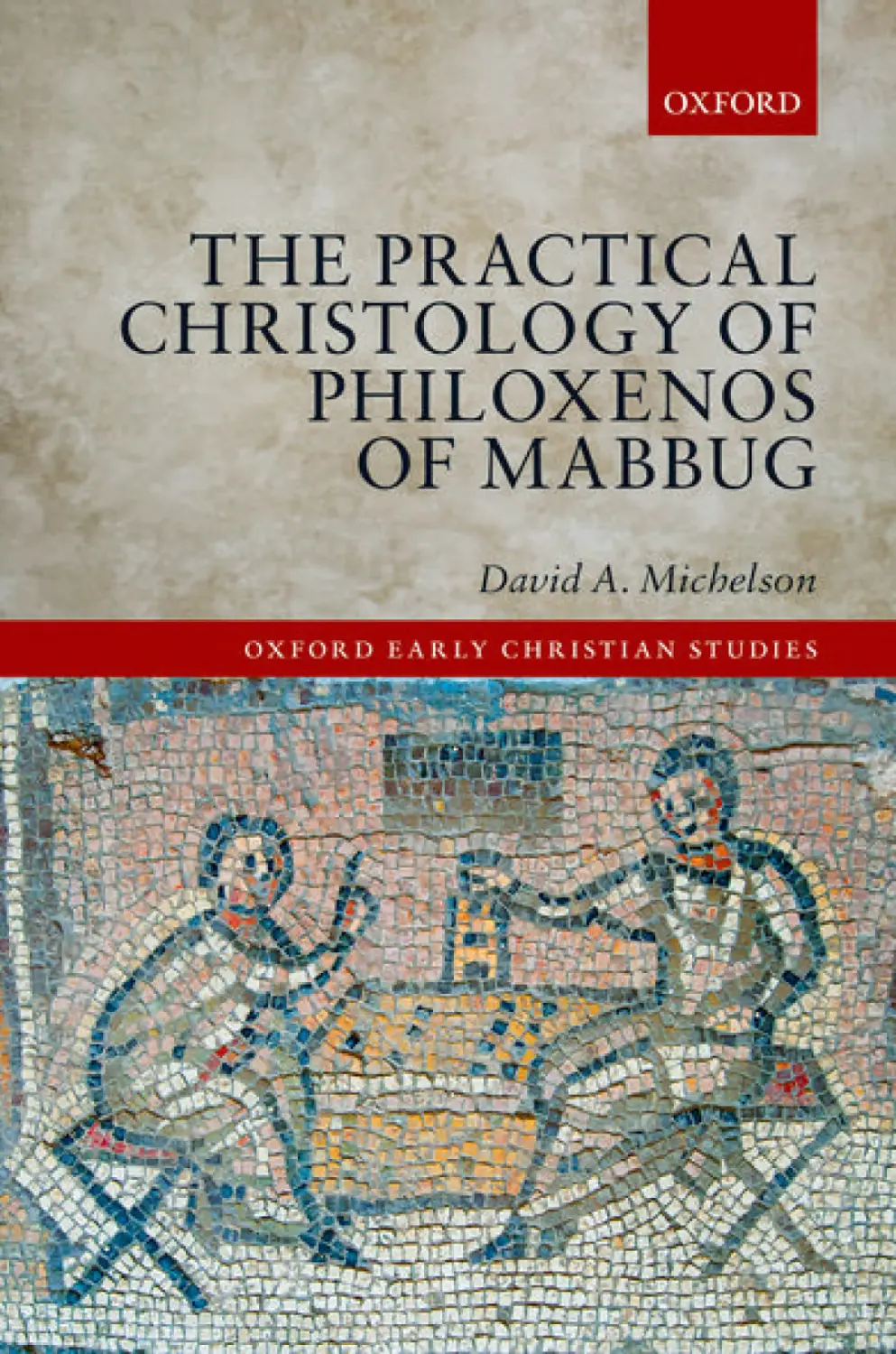
The cover image is a gaming scene from the border of the
Megalopsychia Hunt mosaic in the Yakto Complex, Antioch. The
photo is used by permission of Dick Osseman. Copyright 2014 by
Dick Osseman. Published online, <http://www.pbase.com/dosseman/
image/140539626>.
The map, “The World of Philoxenos of Mabbug,” is used by permission of the Publishers from Anthony D. Davis, with David A.
Michelson, “The World of Philoxenos of Mabbug” (Delorme/ESRI)
Copyright © 2014.
Quotations from The Discourses of Philoxenos of Mabbug, translated by Robert A. Kitchen, are used by permission of the Publishers.
Copyright 2014 by Order of Saint Benedict. Published by Liturgical
Press, Collegeville, Minnesota. Reprinted with permission. Publica
tion information is available at <http://www.cistercianpublications.org/
Products/CS235P/the-discourses-of-philoxenos-of-mabbug-.aspx>.
Some passages and translations in Chapter 4 of this book are used
by permission of the Publishers from David A. Michelson, “ ‘It is not
the custom of our Syriac language . . .’: reconsidering the role of translation in the Polemics of Philoxenos of Mabbug,” in Shifting Cultural
Frontiers in Late Antiquity eds. David Brakke, Deborah Deliyannis,
and Edward Watts (Farnham: Ashgate, 2012), pp. 7–22. Copyright ©
2012.
Chapter 5 of this book is a revision of a previous publication and
used by permission of the Publishers from David A. Michelson,
“ ‘Though He cannot be eaten, we consume Him’: Appeals to Liturgical
Practice in the Christological Polemic of Philoxenos of Mabbug,” in
Malphono w-Rabo d-Malphone: Studies in Honor of Sebastian P. Brock,
ed. George A. Kiraz (Piscataway, N.J.: Gorgias Press), pp. 439‒76.
Copyright © 2008.
Contents
Abbreviations
xv
Map: Philoxenos of Mabbug: geographic extent of influence,
late fifth to early sixth centuries A.D.
xvi
1. Introduction: The World of Philoxenos of Mabbug—A
Practical Context for Understanding Late-Antique
Christology
1
2. Ordaining Satan: Practical Considerations in the
Divine Oikonomia
33
3. In Pursuit of Divine Knowledge: Patristic Sources of
Philoxenos’ Theological Epistemology
61
4. Proof Texts for the Ineffable: On Knowing Christ
through Scripture
113
5. “Though He cannot be eaten, we consume
Him”: Christological Threats to Liturgical Practice
144
6. Beginning the Discipleship of Christ: Theological
Conflict as Ascesis and Spiritual Struggle
178
7. Conclusion: Christological Polemics in the Context of
Spiritual Practice
204
Bibliography
Index of Scriptural References
General Index
Index of Places
213
237
239
245
Abbreviations
BL
BO
CAH
CSCO
NPNF
OCA
PG
PO
SC
TTH
Vat.
British Library
Bibliotheca Orientalis Clementino-Vaticana
The Cambridge Ancient History
Corpus Scriptorum Christianorum Orientalium
Nicene and Post-Nicene Fathers
Orientalia Christiana Analecta
Patrologia Graeca
Patrologia Orientalis
Sources Chrétiennes
Translated Texts for Historians
Bibliotheca Apostolica Vaticana
The World of
ARMENIA
Philoxenos of Mabbug
EUPHRATENSIS
MESOPOTAMIA
r
r
tie
tie
ro
n
ro
n
NS
ass
a
La & nid
Fe khm
de
ra id
tes
RR
Gh
TE
DI
ME
EA
D
RE
SE
PALESTINA I & II
SeluciaCtesiphon Sassanian
Empire
PE
RS
IA
N
G
UL
F
A
Jerusalem
E
S
MEDITERRANEAN
Alexandria
NS
tes
IE
ra
BETH GARMAI
THRACE
Philippopolis BLACK SEA
Gangra
Constantinople
Roman
Ephesus Empire
IA
Tyre
N
W
Sidon Damascus
This work is licensed under a Creative
Commons Attribution 4.0 International License.
Map Authors: Anthony D. Davis, with David A. Michelson
SP
ph
Chalcis (Mar Aqiba)
is
OR
N
Eu
Ti
gr
CA
EA
Mar John of Nayrab (?)
˘
IA
R
SY
ica
II
SI
S
eg
Apamea
AN
N
nF
yn
Mabbug/Hierapolis
ma
˘
SYRIA I
Edessa (Senun)
OSRHOENE
RA
TE
Tell Ada
Mar Bassus
Antioch
C
Beth Gaugal
Serug
© Delorme/ESRI, 2014
nF
PH
nia
I
Doliche
EU
Mopsuestia
Province/Region
Roman Diocese
Approximate Frontier
ssa
Tarsus
Ro
Anazarbus
A
ORIENS
Amida
Germanicia Samosata
Sa
CILICIA I CILICIA II
RI
City and/or Bishopric
(Monastery) in/near Ciyty
CAPPADOCIA
U
SA
Monastery
0
50 100
200
300
Kilometers
400
Philoxenos of Mabbug: geographic extent of influence, late fifth to early sixth centuries A.D.
Najran
1
Introduction
The World of Philoxenos of Mabbug—A Practical Context
for Understanding Late-Antique Christology
THE LIFE AND WORKS OF
PHILOXENOS OF MABBUG
. . . some of them turned aside toward falsehood out of prejudice,
and some of them on account of bodily affection, and others
because they were [already] heretics, and others because they
were troubled, and again others because the fear of God was
contemptible in their eyes, and others from ignorance, and again
others because they were flattered, and others because it did not
concern them if error should seize the Church instead of faith,
and again others because it happened that they were angry with
their neighbors, because those neighbors were honored more
than them and pressed upon by the visits from the faithful. And
for that reason, they preferred—miserable ones—to move to the
side of the heretics because they saw that the orthodox faithful
did not wish to agree with them. And while the reasons vary
why the whole lot of those monks who were traitors are counted
among the heretics, they are gathered under one head: because
they were not willing to acknowledge the truth. Indeed, they did
not know it because they were not worthy to know it. For this reason they have held to falsehood instead of the truth, just as was
said about similar ones by the Apostle, “They held wickedness
as truth” and again “Because they did not choose to acquire the
knowledge of God, he handed them over to a reprobate mind.”1
—Philoxenos of Mabbug, Letter to the Monks of Senun
1
Philoxenos of Mabbug, Letter to the Monks of Senun, published as Lettre aux
moines de Senoun (texte), edited by André de Halleux, CSCO 231 (Leuven: Secrétariat
2
The Practical Christology of Philoxenos of Mabbug
Born in the mid-fifth century, Philoxenos of Mabbug (d. 523) was a
prolific author and polemicist who left behind the largest surviving
body of work in all of Syriac literature.2 A metropolitan bishop in
Syria from 485 onward, he was one of the last ecclesiastical and intellectual leaders of the one-nature theological party before the permanent separation of the eastern churches over Christology. As a subject
for scholarly study, Philoxenos has been known (when he is known at
all) either for his ardent attachment to the one-nature Christological
doctrine or for his ascetic theology.3 This book, Practical Christology,
offers a new holistic view of Philoxenos’ life and works as a means
of better understanding the post-Chalcedonian Christological
controversies.
Engaging with Philoxenos’ Christological polemics from the
perspective of various practical contexts, this study argues that
Philoxenos’ overarching concern in the Christological controversies
was to promote and safeguard proper access to divine knowledge.
For Philoxenos, knowledge of God was attained or preserved largely
du CorpusSCO, 1963), 89–90. The final allusion is likely a literal or mirror-style
Philoxenian rendering of the Greek text of Romans 1:18 & 28. In his Lexicon Syriacum,
Sokoloff notes that Philoxenos frequently employed “ ”ܩܢܝas his verb of choice for
the “acquisition” of knowledge. Michael Sokoloff, Lexicon syriacum (Piscataway,
N.J.: Gorgias Press and Eisenbrauns, 2009), s.v. ܩܢܝ.
2
Philoxenos’ corpus has been estimated to be over 500,000 words (see David
A. Michelson, “A Bibliographic Clavis to the Works of Philoxenos of Mabbug,” Hugoye
13.2 (Summer 2010), 278. <http://www.bethmardutho.org/index.php/hugoye/
volume-index/443.html>.
3
The existing secondary literature on Philoxenos is limited but useful. Specifically,
there are five monographs of note. Four are theologically or philosophically oriented: Joseph Lebon, Le Monophysisme sévérien: Étude historique, littéraire et
théologique sur la résistance monophysite au Concile de Chalcédoine jusqu’à la constitution de l’Église jacobite (Leuven: Josephus Van Linthout, 1909); Roberta C. Chesnut,
Three Monophysite Christologies: Severus of Antioch, Philoxenus of Mabbug, and Jacob of
Sarug (Oxford: Oxford University Press, 1976); Guy Lardreau, Discours philosophique
et discours spirituel: autour de la philosophie spirituelle de Philoxène de Mabboug
(Paris: Editions du Seuil, 1985); Jad Hatem, La Gloire de l’un: Philoxène de Mabboug
et Laurent de la résurrection (Paris: Harmattan, 2003). The fifth study is broader and
more historically oriented: André de Halleux, Philoxène de Mabbog: Sa vie, ses écrits,
sa theologie (Leuven: Imprimerie Orientaliste, 1963). The present study is designed to
complement de Halleux’s work, which has done much of the requisite chronological,
codicological, and textual work needed for a cultural and historical study of Philoxenos.
Of recent scholarship, particular mention should be made of T. Bou Mansour, “Die
Christologie des Philoxenos von Mabbug,” in A. Grillmeier and T. Hainthaler, eds, Jesus
der Christus im Glauben der Kirche: Die Kirchen von Jerusalem und Antiochien nach 451
bis 600 (Freiburg: Herder Verlag GmbH, 2004), 500–69 which synthesizes the work of
de Halleux and brings some additional insights as well.
Introduction
3
through forms of praxis such as the oversight of religious communities, mystical contemplation, the reading of scripture, participation
in the liturgical mysteries, and ascetic practices of spiritual combat.
This theological epistemology gave Philoxenos’ anti-Chalcedonian
writings their rhetorical strength. Philoxenos’ Christological polemics were not just ideological exercises; they had practical implications
for those seeking knowledge of God. Accordingly, Philoxenos’ ardent
attachment to the one-nature Christological doctrine must be understood in the light of the role he assigned right practice in the attainment of divine knowledge. In fact, one might say that for Philoxenos,
“practice led to theory.” Such an observation should not be mistaken
for a Hegelian cliché—a deeper sense of the word practice is intended
here. The defense of Christian orthodoxy was one practice among
many in a larger spiritual struggle. In technical terms, Philoxenos saw
this struggle as part of the divine economy of salvation (drawing on
the Greek concept of oikonomia, referring to the divine design, governance, and action in the created world). Philoxenos’ polemical concerns over the economy of the Incarnation took their meaning from
this context, i.e. his larger vision of the divine economy of creation
and salvation.
This practical yet theoretical contextualization of the Christological
controversies is evident in the above passage from Philoxenos’ Letter
to the Monks of Senun. His remark offers a convenient starting point
for this inquiry because it is a retrospective written at the end of his
life, after Philoxenos’ deposition by his theological opponents. In
this letter Philoxenos makes a concise and impassioned appeal to his
monastic followers at Senun, urging them to maintain the “confession
of the true faith” and exhorting them to anathematize Christological
heretics.4 Writing from exile just before his death in 523, Philoxenos
sought thus to explain to the monks of Senun why so many of
their brethren from other monasteries of Mesopotamia, Syria, and
Palestine had changed sides and abandoned the miaphysite creed
when its fortunes fell in 519. His explanation reveals the lens through
which he viewed the Christological controversies. Of the many reasons he listed as to why monks might join those they had previously
considered heretics, doctrinal agreement was only one among many.
In addition to indifference to doctrine, Philoxenos mentions a variety of reasons that he classified as failure in ascesis, ignorance, or the
4
Philoxenos of Mabbug, Letter to the Monks of Senun, CSCO 231, 95.
The Practical Christology of Philoxenos of Mabbug
4
result of turmoil within the ecclesiastical community. Summing up
these practical explanations for why the monks would change their
Christological position, Philoxenos offered one overarching reason—failure in the knowledge of God: “Indeed, they did not know
it because they were not worthy to know it.”5 For Philoxenos, finding
the right path to the knowledge of God was the theological thread
connecting both Christological controversy and the practice of the
Christian life in contemplation, reading scripture, liturgical participation, and ascesis.
“Heresy” and “orthodoxy” have long been of interest to scholars
of early Christianity.6 While the descriptive value of such concepts
is a highly debatable question, there is little doubt that the rhetoric
of struggle between heresy and orthodoxy profoundly shaped both
the production of Christian texts and the resolution of ecclesiastical
conflicts in late antiquity.7 This study of Philoxenos offers an opportunity to reconfigure some of these scholarly paradigms. Traditionally,
the procession of theological debates, creeds, and ecumenical church
councils of the fourth through eighth centuries has been described
as a progressive triumph of Orthodoxy, a teleological and dialectical
process of doctrinal divergence and correction.8 More recently, scholars have been quick to point out that many of the events which have
traditionally been acclaimed as markers of unity in orthodoxy, i.e. the
ecumenical councils, in fact served to intensify and exacerbate the
intense intra-Christian disputes of the era.9 Indeed, one such case,
Philoxenos of Mabbug, Letter to the Monks of Senun, CSCO 231, 89–90.
See the broad range of literature stretching from Walter Bauer, Rechtgläubigkeit
und Ketzerei im ältesten Christentum (Tübingen: Mohr Siebeck, 1934 [1964]) and
Orthodoxy and Heresy in Earliest Christianity, trans. by a team from the Philadelphia
Seminar on Christian Origins, ed. by Robert A. Kraft and Gerhard Krodel
(Philadelphia: Fortress Press, 1971) to the essays in Holger M. Zellentin and Eduard
Iricinschi, eds, Heresy and Identity in Late Antiquity (Tübingen: Mohr Siebeck, 2008).
7
See Holger M. Zellentin and Eduard Iricinschi, “Making Selves and Marking
Others: Identity and Late Antique Heresiologies,” in Heresy and Identity, 1–27, and
Averil Cameron, “The Violence of Orthodoxy,” in Heresy and Identity, 102–14.
8
See for example the teleological language in Alois Grillmeier, Christ in Christian
Tradition: From the Apostolic Age to Chalcedon (451) (Atlanta: John Knox, 1975). In
this regard, Grillmeier’s nevertheless valuable work is a product of its era. The teleo
logical approach, however, is notably reduced in the subsequent volumes in the series
edited by Theresia Hainthaler.
9
Kurt Aland has eloquently summed up the failure of the Chalcedonian formula
this way: “Thus they believed they had solved the problem. In fact, as in the Arian
controversy, they had only created a formula. With it they described the unity of God
5
6
Introduction
5
the Council of Chalcedon (A.D. 451), proved so divisive that permanently separate churches formed based on acceptance or rejection of
the Christology of the council.10 The doctrinal and ecclesiastical break
at Chalcedon proved to be enduring, lasting into the present era.11
Although the central point in dispute at Chalcedon has been summarized as the deceptively simple theological difference between “one”
and “two,” Practical Christology argues that the differences between
the two sides went deeper than doctrinal formulations can indicate.
The theological question was in what way Christ was to be considered both human and divine—did he have one nature (i.e. Christ’s
single nature was at the same time human and divine, the miaphysite
position) or two natures (i.e. Christ had two separate natures for his
humanity and divinity, the dyophysite position)?12 As simple as the
mathematical rigor of this question may seem, adherence to the various Christological positions turns out to be determined by complex
factors.13 Through the life and works of Philoxenos, it is evident that
doctrinal disagreement over the number of natures should be understood as only the formal cause of the Christological controversies.
These doctrinal positions were shaped and informed by a variety of
and man in Christ, but the how still remained unexplained, just as before, simply
because it was inexplicable. . . . Instead, the controversy about Christology really began
to take on its full force after Chalcedon, after the argument had theoretically come
to a conclusion.” Kurt Aland, A History of Christianity, trans. James L. Schaaf, 2 vols.
(Philadelphia: Fortress Press, 1985), 1:202.
10
These separations have persisted to the present in the division between the
Chalcedonian churches (e.g. Roman Catholic, Greek Orthodox, and Melkite) and the
non-Chalcedonian churches (e.g. Syrian Orthodox, Coptic Orthodox, and Armenian
Orthodox).
11
In the twentieth century these divisions were lessened to some degree by ecumenical dialogue and new scholarly research into the nature of the distinctions. See
S. P. Brock, “The ‘Nestorian’ Church: A Lamentable Misnomer,” Bulletin of the John
Rylands University Library of Manchester 78, 3 (1996): 23–35.
12
The preferred usage is now “miaphysite,” which is both grammatically correct and
not considered a term of opprobrium. The older term “monophysite” should be abandoned as it both misrepresents the views of the one-nature party and has its origins as
a term of derision. For a further discussion see Dietmar W. Winkler, “Monophysites,”
in G. W. Bowersock, Peter Brown, and Oleg Grabar, eds, Late Antiquity: A Guide to
the Postclassical World (Cambridge, Mass.: Belknap Press of Harvard University Press,
1999), 586–8.
13
I do not mean to imply that the numerical difference was of no consequence
or something to be deconstructed or reduced to social factors, but I do argue that
any approaches which attempt to take the numeric quarrel seriously must be sensitive to the cultural and religious contexts for Christology which the adherents themselves experienced. In this regard, I disagree with L. R. Wickham over the simplicity
of the dispute but do agree with him that “to enter sympathetically into this ancient
6
The Practical Christology of Philoxenos of Mabbug
overlapping or even overdetermining contexts of practice which made
the Christological formulas meaningful to adherents.14 This monograph is an investigation into those historical contexts. Specifically,
Practical Christology asks the following questions: What were the
contexts that informed and gave import to the post-Chalcedonian
theological conflicts? How was adherence to a particular Christology
shaped by the perceived place of Christological doctrine within larger
social, intellectual, and spiritual contexts? What can the doctrinal
polemicists’ rhetorical strategies reveal about the construction of
Christological allegiances?
New answers to these questions can be found by viewing theological controversy as one among many intertwined religious practices in
late-antique Christianity. Adherence to a particular Christology must
be understood through the lens of its relationship to other authoritative
forms of Christian praxis. Doctrinal disputes over creedal statements
certainly played a role in the rejection of the Council of Chalcedon,
but at a deeper level opposition to the Council and its creed arose
from competing visions of the right path to divine knowledge. This
interpretation is not to suggest either that Christology was simply a
matter of empty words (ματαιολογίαις as the miaphysites’ opponents
might have put it) or that Christological doctrine can be explained
through reduction to its social or political contexts.15 Instead, I argue
that at least in some cases the clash over Chalcedonian orthodoxy
must be understood as being the product not just of doctrinal dis
agreement but of competing epistemologies and orthopraxies. This
anti-Chalcedonian nexus of theology and practice can be seen vividly
in the world of Philoxenos of Mabbug.
quarrel . . . one must feel the sharp paradoxes” (L. Wickham, review of R. Chesnut,
Three Monophysite Christologies, in Journal of Theological Studies 28 [1977], 567–571).
14
In terms of the classical Aristotelian divisions of causes, doctrinal divergence
may be taken as the formal cause, but not to the exclusion of other “final causes” which
made the doctrinal divergence a matter worth fighting over. In this regard, the interpretive work of I. A. Richards concerning the overdetermination of meaning is suggestive; see I. A. Richards, The Philosophy of Rhetoric (New York: Oxford University
Press, 1965). Further insights can be found in Louis Mackey, “Theory and Practice in
the Rhetoric of I. A. Richards,” Rhetoric Society Quarterly 27, 2 (April 1997): 51–68,
<http://www.jstor.org/stable/3886360>.
15
See the ancient slurs in Leontius of Jerusalem’s Against the Monophysites published as Patrick Gray, ed. and trans., Leontius of Jerusalem: Against the Monophysites
(Oxford: Oxford University Press, 2006). For modern equivalents, see the theories
rebuffed by A. H. M. Jones in “Were Ancient Heresies National or Social Movements
in Disguise?,” Journal of Theological Studies n.s. 10, pt 2 (1959): 280–98.
Introduction
7
WHY MIAPHYSITE CHRISTOLO GY AND
WHY PHILOXENOS?
My purpose here is not to propose a new universal interpretation that can explain the entire formation of Christian orthodoxy.
Such an attempt would be to repeat the errors of previous monolithic approaches to historical questions concerning Christology.
Nevertheless, the aim of this book is to open up new avenues for
understanding adherence to doctrinal formulations in late-antique
Christianity. To do so, we must consider new and neglected source
materials.
In particular, Practical Christology is focused on the postChalcedonian Christological disputes because they remain some of
the most complex and, as yet, understudied theological conflicts of
late antiquity. Ancient observers marveled (or despaired) at the labyrinthine alliances, formulae, anathemas, and compromises over the
long period of debate.16 Given how such a summary judgment was
attractive to participants in the controversies, it should not be surprising that this view has continued, mutatis mutandis, to shape our
views in the present.17 Indeed, this judgment, compounded with the
historical marginalization of the losing side as heretical, has meant
that for many scholars of late antiquity and the early Middle Ages
much of the Christological controversies remain terra incognita, with
“miaphysites” as an exotic species of that land.18
The scholarly neglect of the one-nature party has been further
compounded by a problem of source materials. Only recently have
16
See Evagrius Scholasticus, Ecclesiastical History published as The Ecclesiastical
History of Evagrius Scholasticus, trans. Michael Whitby, TTH 33 (Liverpool: Liverpool
University Press, 2000), 166–7.
17
Thus one recent textbook describes the arguments as “abstruse” and marked by
“obduracy.” While such a description is in some ways accurate (and the textbook in
question does make a good faith effort to trace the outlines of the controversies), such
judgments have also served in some instances as justification for scholarly neglect.
Even a scholar who clearly has a profound grasp of the minutiae can be found to
lament “the confusion and embarrassment which predominated in the church’s
Christology from Ephesus right up to the Monothelete dispute” (Grillmeier, Christ in
Christian Tradition, vol. I, 445).
18
Happily it does not seem that this will be the case for much longer in the field,
as any number of the recent publications in the bibliography of this study will witness. See for instance Volker Menze, Justinian and the Making of the Syrian Orthodox
Church (Oxford: Oxford University Press, 2008) and Pauline Allen and Robert
Hayward, Severus of Antioch (London: Routledge, 2004).
8
The Practical Christology of Philoxenos of Mabbug
historians of late antiquity begun to turn to the sources in Syriac,
Coptic, and Armenian which can provide primary access to the
development of the one-nature vision of orthodoxy.19 The geographic
divide between the western Greek and Latin sources and the eastern
Syriac and Coptic sources maps almost perfectly onto the doctrinal
split between one-nature and two-nature forms of Christianity. In
the end, scholarship has been hampered by these two overlapping
blind spots. The end result has been that the one-nature side in the
Christological disputes has been relatively neglected both because it
was the losing side and because its Syriac sources have not been as
readily accessible to scholars. As a correction, my study takes as its
focus the life, work, and theology of Philoxenos, a prolific author and
key Syriac bishop in the controversies of the late fifth century, who
has only gradually been rediscovered in the past century.
PHILOXENOS: SURVEY OF HIS LIFE AND WORKS
From his birth in Persia to his exile and death in Thrace,
Philoxenos’ life spanned remarkably varied geographic, political,
and religious environments (for the geographical context, see the
map at the beginning of the chapter). Strategically positioned in
his bishopric on the Euphrates, Philoxenos took on theological
opponents in both Persia and Antioch and was willing to travel
to Constantinople as needed. Given the differing settings and levels of success that met Philoxenos’ polemical endeavors, a brief
outline of his biography is in order. This task is greatly facilitated by the biographical study of André de Halleux, Philoxène
de Mabbog: Sa vie, ses écrits, sa théologie, to which the reader is
referred for more detail.20 For additional information concerning
the corpus of Philoxenos’ works (including manuscript and textual
history), readers are also referred to my own bibliographic “Clavis”
which provides an update to de Halleux.21
19
Indeed, I claim no extraordinary expertise in all of these languages; the scope of
this present study is largely confined to sources in Greek and Syriac.
20
De Halleux, Philoxène de Mabbog: Sa vie, 3–105. A more recent brief biog
raphy is found in T. Hainthaler, “Philoxenos von Mabbug,” in Syrische Kirchenväter,
ed. W. Klein (Stuttgart, 2004), 180–90.
21
Michelson, “A Bibliographic Clavis,” 273‒338.
Introduction
9
Origins (Mid-Fifth Century)
Little is known about Philoxenos’ origins.22 He was born in the mid-fifth
century (perhaps the 440s or 450s) in the Persian region of Beth
Garmai (the Tigris river valley). Eventually either he or his family settled in Roman Mesopotamia, and at an undetermined date Philoxenos
was educated at the School of the Persians in Edessa.23 Later allegations against Philoxenos indicate that this education was dyophysite.24
At some point, however, Philoxenos came to side with the miaphysite
Christology. Little else is known from this early period. De Halleux has
convincingly argued that later medieval traditions which claim that
Philoxenos sojourned in various monasteries in this period are not reliable.25 Nevertheless, Philoxenos’ training at the School of the Persians
would have involved exposure to asceticism in Edessa and classic texts
of monasticism such as the works of Evagrius.26 Given the paucity of
22
There are a few medieval hagiographies of Philoxenos. The most notable is a
thirteenth-century vita: Eli of Qartamin, Memra on Mar Philoxenos, published as
Memra sur S. Mar Philoxène de Mabbog Texte, ed. André de Halleux, CSCO 233
(Leuven: Secrétariat du CorpusSCO, 1963). Eli’s vita was adapted in a later anonymous life translated by Alphonse Mingana and edited by Sebastian Brock: History
of Mar Philoxenos, published as “New Documents on Philoxenus of Heirapolis and
the Philoxenian Version of the Bible,” trans. Alphonse Mingana, The Expositor 19,
110 (1920); History of Mar Philoxenos, published as “Tash`ita d-Mar Aksenaya,” ed.
Sebastian Brock, Qolo Suryoyo 110 (1996). Biographical details on Philoxenos as well as
an analysis of the reliability of the various ancient sources can be found in de Halleux,
Philoxène de Mabbog: Sa vie, 3–17. A review of further manuscripts by Vööbus should
be used with care: Arthur Vööbus, “La Biographie de Philoxène: Tradition des manuscrits,” Annalecta Bollandiana 93 (1975): 187–93.
23
See Simeon of Beth Arsham, Letter on Nestorianism published as Epistola Simeonis
Beth-Arsamensis de Barsauma episcopo Nisibeno, deque haeresi Nestorianorum, in
Bibliotheca orientalis Clementino-Vaticana, ed. and trans. Giuseppe Simone Assemani
(Rome: Sacrae Congregationis de Propaganda Fide, 1719), 353.
24
See the comment on this by Habib recorded by Philoxenos. See Philoxenos
of Mabbug, Memre Against Habib (IX–X) published as Sancti Philoxeni episcopi
Mabbugensis dissertationes decem de uno e sancta trinitate incorporato et passo
(Memre contre Habib), ed. and trans. M. Brière and F. Graffin, PO 40.2 (Turnhout,
Belgium: Brepols, 1980), 344, 10§186–7.
25
De Halleux, Philoxène de Mabbog: Sa vie, 2. Andrew Palmer is similarly inclined,
but does suggest that there were relations between Philoxenos and Tur Abdin monasteries later in Philoxenos’ career. Andrew Palmer, Monk and Mason on the Tigris
Frontier: The Early History of Tur Abdin (Cambridge: Cambridge University Press,
1990), 113–16.
26
Adam Becker has rightly cautioned, however, against making overly specific
claims about the School of the Persians given the problems with the sources. Adam
H. Becker, Fear of God and the Beginning of Wisdom: the School of Nisibis and Christian
Scholastic Culture in Late Antique Mesopotamia (Philadelphia, Penn.: University of
Pennsylvania Press, 2006), 41–3.
10
The Practical Christology of Philoxenos of Mabbug
comments from Philoxenos about this early dyophysite period, little
more can be said. Moreover, no works from this early period survive or
have been identified.
Early Polemical Engagement (470s to 484)
More details are available for the next period in Philoxenos’ life. In
the 470s, Philoxenos came to Antioch to join the growing circle of
miaphysites under the patriarch Peter the Fuller (either in 470‒471
or 475‒476).27 At this point, he became involved in the dispute over
Peter’s miaphysite addition to the Trisagion hymn.28 These were tumultuous years for the miaphysites. While in Antioch, Philoxenos would
have experienced rapid shifts in ecclesiastical and imperial authority.29 In 475‒476, the Emperor Zeno was challenged by a usurper,
Basiliscus. To gain support in Antioch and Alexandria, Basiliscus
(who had seized power in Constantinople) condemned Chalcedon.
Peter the Fuller then endorsed Basiliscus. In retribution, after Zeno
had defeated Basiliscus, he also removed Peter from the Antiochene
patriarchate. It appears that Philoxenos remained in the vicinity of
Antioch in this period. It is also likely that he began to compose
polemical letters to continue the debate which Peter had begun over
the Trisagion. His Letter to the Monks on Faith was written for this
purpose circa 482.30
The year 482 brought yet another disruption. Tensions between the
competing miaphysite and Chalcedonian claims to the patriarchal throne
in Antioch had heated up with the murder of the Chalcedonian patriarch
Stephen II in 479.31 In 482, the Emperor Zeno issued the Henoticon—a
De Halleux, Philoxène de Mabbog: Sa vie, 33.
See the discussion of this controversy in Dana Iuliana Viezure, “Verbum crucis,
virtus dei: A study of Theopaschism from the Council of Chalcedon (451) to the Age
of Justinian,” Ph.D. dissertation, University of Toronto, 2009.
29
For a general history of the Antiochene Patriarchate, see the data assembled in
Robert Devreesse, Le Patriarcat d’Antioche, depuis la paix de l’église jusqu’à la conquête
arabe (Paris: J. Gabalda, 1945).
30
Philoxenos of Mabbug, Letter to the Monks on Faith, in Three Letters of Philoxenus,
Bishop of Mabbogh (485‒519): Being the Letter to the Monks, the First Letter to the
Monks of Beth-Gaugal, and the Letter to Emperor Zeno, ed. and trans. Arthur Adolphe
Vaschalde (Rome: Tipografia della R. Accademia dei Lincei, 1902), 93–105, 127–45.
31
Alois Grillmeier, Christ in Christian Tradition: Volume Two: From the Council of
Chalcedon (451) to Gregory the Great (590‒604), trans. Pauline Allen and John Cawte
(London: Mowbray, 1987), 250.
27
28
Introduction
11
restraining order on theological debate that he hoped would end the
controversy. Nevertheless in Antioch, the new Chalcedonian patriarch Calendion was taking a hard line against miaphysites and expelled
Philoxenos from the city. Philoxenos was quite prolific during this exile
(482‒484) as he traveled from monastery to monastery rallying support.32
In particular, he traveled to Constantinople in 484 to lobby the Emperor
Zeno for the deposition of Calendion. A profession of faith made to
Zeno by Philoxenos survives from this audience.33 Other works from
this period include several letters to various monasteries (Beth Gaugal
and Tell ʿAda among others).34 Perhaps most significantly, Philoxenos
wrote his first extended piece of polemic in this period (482‒484), the
Volume against Habib. This Volume eventually came to contain an initial letter by Philoxenos, excerpts from a rebuttal by a dyophysite monk
named Habib, two responses by Philoxenos (one short and the other
consisting of ten treatises, collectively titled Memre against Habib), and
a lengthy florilegium of Christological citations from earlier authors.35
Early Episcopal Administration (485‒498)
In 484, Philoxenos’ fortunes changed again. His enemy, Calendion,
had sided with the pro-Chalcedonian usurpers Leontius and Illus.
When Zeno regained control of Antioch in 484, Calendion was
deposed and Peter the Fuller restored yet again to the patriarchal
De Halleux, Philoxène de Mabbog: Sa vie, 37.
Philoxenos of Mabbug, Letter to the Emperor Zeno, in Three Letters of Philoxenus,
Bishop of Mabbogh (485–519) (ed. Vaschalde), 118–26, 163–73.
34
Philoxenos of Mabbug, First Letter to the Monks of Beth Gaugal, in Three Letters
of Philoxenus, Bishop of Mabbogh (485–519) (ed. Vaschalde), 105–18, 146–162;
Philoxenos of Mabbug, First Letter to the Monks of Tell ʿAda., published as La lettera
di Filosseno: Ai monaci di Tell’addâ: Memoria del socio Ignazio Guidi, ed. and trans.
Ignazio Guidi (Rome: Tipografia della R. Accademia dei Lincei, 1886).
35
The Volume against Habib was published in several parts: Philoxenos of Mabbug,
Memre Against Habib (I‒II), published as Sancti Philoxeni episcopi Mabbugensis
dissertationes decem de uno e sancta trinitate incorporato et passo (Memre contre
Habib), ed. and trans. Maurice Brière, PO 15 (Turnhout, Belgium: Brepols, 1920);
Philoxenos of Mabbug, Memre Against Habib (III‒V), published as Sancti Philoxeni
episcopi Mabbugensis dissertationes decem de uno e sancta trinitate incorporato et passo
(Memre contre Habib), ed. and trans. M. Brière and F. Graffin, PO 38.3 (Turnhout,
Belgium: Brepols, 1977); Philoxenos of Mabbug, Memre Against Habib (VI‒VIII),
published as Sancti Philoxeni episcopi Mabbugensis dissertationes decem de uno e
sancta trinitate incorporato et passo (Memre contre Habib), ed. and trans. M. Brière
and F. Graffin, PO 39.4 (Turnhout, Belgium: Brepols, 1979); Philoxenos of Mabbug,
Memre Against Habib (IX‒X), PO 40.2 (Turnhout, Belgium: Brepols, 1980).
32
33
12
The Practical Christology of Philoxenos of Mabbug
throne. In addition to Calendion, Zeno deposed nine other bishops
throughout the diocese of the Oriens. Thus in 485, Peter the Fuller
chose Philoxenos to fill one of these sees as the metropolitan bishop of
Mabbug (ancient Hierapolis), a see which he would hold until 519.36
As he settled into his new episcopal duties in Mabbug/Heirapolis
(capital of the eastern border province of Euphratensis), Philoxenos
had time to devote to writing. In the period from 485 to 498,
Philoxenos most likely wrote his most elaborate Christological treatise, the lengthy Book of Sentences, and also his most developed ascetic
writings, the Discourses.37 In addition to these works, Philoxenos gave
his attention to cultivating the Christian community under his pastoral care. Hierapolis was still the cult center for the worship of the
Syrian goddess Attargatis. Although evidence is limited, it appears that
Philoxenos contributed to the increasing Christianization of the city.38
He also established several new monastic communities throughout his
diocese and elsewhere. While most were small (five to ten monks),
these new establishments did include the large monastery of Senun
near Edessa, of which Philoxenos spoke proudly at the end of his life.
In this same period, Philoxenos continued his efforts to oppose
the Council of Chalcedon under the banner of the Henoticon that
had been maintained by Zeno’s successor, the Emperor Anastasius
(r. 491‒518). While Anastasius’ ecclesiastical politics were not
overtly pro-miaphysite, he did facilitate the expansion of miaphysites
in Syria. Judging from the fact that Mabbug quickly reverted back
to Chalcedonian orthodoxy after Philoxenos’ tenure, it seems that
Philoxenos was not particularly successful in converting his city to a
miaphysite theology.39 Nevertheless, he held his bishopric for more
than three decades and used its influence and authority to bolster
See the summary of this in de Halleux, Philoxène de Mabbog: Sa vie, 38–9.
Philoxenos of Mabbug, The Book of Sentences, published as Tractatus tres de trinitate et incarnatione (textus), ed. Arthur Adolphe Vaschalde, CSCO 9 (Leuven: Peeters,
1907); Philoxenos of Mabbug, Discourses, in The Discourses of Philoxenus, Bishop of
Mabbôgh, A.D. 485‒519, ed. and trans. E. A. Wallis Budge (London: Asher & Co.,
1894). On the Discourses, readers are advised to consult the new translation by
Robert Kitchen which was released too late to be taken fully into account for this
study: Robert A. Kitchen, The Discourses of Philoxenos of Mabbug, Cistercian Studies
235 (Collegeville, Minn.: Liturgical Press, 2013).
38
For a discussion of Philoxenos’ claims to have Christianized Mabbug, see de
Halleux, Philoxène de Mabbog: Sa vie, 42–5.
39
Philoxenos’ predecessors on the episcopal throne of Mabbug had been committed dyophysites for several generations (back to the time of Alexander of Mabbug,
36
37
Introduction
13
the miaphysite cause throughout the Roman East and beyond. From
Mabbug, he kept alert to the spread of dyophysite theology in Persia and
was perhaps involved in the closure of the School of the Persians in 489.
Of even greater strategic importance were his ordinations. The miaphysite missionary Simeon of Beth Arsham reported that Philoxenos
had ordained the first two bishops of Najran on the Arabian Peninsula,
including the martyr-bishop Paul II.40 More significantly for the miaphysite ascendancy, it was Philoxenos and his five loyal suffragen
bishops of Euphratensis who formed the miaphysite core leadership in
the period before Severus’ ordination.41
Campaign against Flavian of Antioch (498‒512)
Philoxenos’ success at rallying the church hierarchy for the miaphysites led him to an even bolder endeavor. In 498, the pro-Chalcedonian
Flavian was made patriarch in Antioch. Philoxenos, who had now
assumed a senior position among the miaphysite leadership, spent
the next fourteen years trying to unseat Flavian. His strategy for
this endeavor is discussed in Chapter 2, but it should be noted here
that this period was also one of the most productive for Philoxenos
in terms of scholarship and polemic. By this point, he had set up
a scriptorium in Mabbug whose crowning achievement was a fresh
translation of the New Testament into Syriac, completed in 507 or
508. Based on this translation, Philoxenos himself wrote polemical
commentaries on portions of Matthew, Luke, and John.42 He also
continued to write lengthy letters, mainly to monks and monastic
who had refused to compromise with Cyril at Ephesus in 431). Though de Halleux is
perhaps too optimistic about what Philoxenos achieved in Mabbug, nevertheless he
is right to point out that Philoxenos was successful in Syria if not in his own city. De
Halleux, Philoxène de Mabbog: Sa vie, 46.
40
Simeon of Beth Arsham, New Letter, published as Simeon’s New Letter (G),
in The Martyrs of Najrân: New Documents, ed. and trans. Irfan Shahîd, Subsidia
Hagiographica 49 (Bruxelles: Soc. des Bollandistes, 1971), vi.
41
De Halleux, Philoxène de Mabbog: Sa vie, 78.
42
Philoxenos of Mabbug, Commentary on the Prologue of John, published as
Commentaire du prologue johannique (Ms. Br. Mus. Add. 14,534), texte, ed. André de
Halleux, CSCO 380 (Leuven: Secrétariat du CorpusSCO, 1977); Philoxenos of Mabbug,
Commentary on Matthew and Luke, published as Fragments of the Commentary
on Matthew and Luke (Text), ed. J. W. Watt, CSCO 392 (Leuven: Secrétariat du
CorpusSCO, 1978).
14
The Practical Christology of Philoxenos of Mabbug
communities on both ascetic and doctrinal topics such as his Letter
to Patricius.43
From Philoxenos’ correspondence, it can be seen that the struggle
in Antioch was not his sole focus. In 502‒505, the Roman Empire was
at war with Persia. Mabbug was a garrison town that saw substantial troop presences during this period.44 Philoxenos also waged his
own theological conflict across the Persian border with attacks on the
dyophysite leadership in the Church of the East. Strikingly, sometime
during or just after the war, he composed a heresiology against the
dyophysites that he sent as a letter to the Lakhmid Phylarch, the main
ally of the Persians along their Roman frontier.45 Moreover, after the
war was completed, Philoxenos played a role in supporting the work of
Simeon of Beth Arsham in Armenia against the dyophysites. Finally,
it is likely that Philoxenos had both the conflict with Flavian and the
fate of the miaphysites in Persia on his agenda when he undertook
an embassy to the Emperor Anastasius in Constantinople in 507.46
Philoxenos enjoyed imperial support (or at least imperial toleration)
in his attempts to force out Flavian as the patriarch of Antioch at synods in Antioch (509) and Sidon (511).
Later Episcopal Administration (512‒519)
With the tacit support of Anastasius, Philoxenos’ struggle against
Flavian led to one of the greatest (and last) victories for the miaphysites of Syria and Anatolia—the consecration of Severus as patriarch of
Antioch in 512. Chapter 2 will consider the challenges of this period
in detail. It suffices here to note that Philoxenos served as a senior and
seasoned advisor to Severus. In particular, Philoxenos and Severus
struck a moderate tone as they now sought to consolidate and expand
the miaphysite control of the churches in Syria and Anatolia. Philoxenos
continued to write letters advising both Severus and various monasteries
43
Philoxenos of Mabbug, Letter to Patricius (Longer Recension), published as La
lettre à Patricius de Philoxène de Mabboug, ed. and trans. René Lavenant, PO 30.5
(Paris: Firmin-Didot, 1963).
44
Geoffrey Greatrex, Rome and Persia at War, 502‒532 (Leeds: Francis Cairns,
1998), 106, 116.
45
Philoxenos of Mabbug, Letter to Abu Yaʿfur, published as “Lettre de Philoxène
de Mabbūg au phylarque Abū Yaʿfūr de Hīrtā de Bētna’mān (selon le manuscrit no 115
du fond patriarcat de Šarfet),” ed. and trans. Paul Harb, Melto 3, 1‒2 (1967): 183–222.
46
De Halleux, Philoxène de Mabbog: Sa vie, 64.
Introduction
15
in this period, such as his Letter to the Lector Maron of Anazarbus and
his Letter to Abraham and Orestes.47
Exile (519‒523)
The miaphysite ascendancy, which culminated in Severus’ ordination,
was short-lived. In 518, Justin I succeeded Anastasius as Emperor and
declared himself in favor of the Chalcedonians and the Christology of
the church in Rome. Severus, Philoxenos, and most of the miaphysite
hierarchy in Syria and Anatolia were driven into exile in Philippopolis
(in Thrace). Nevertheless, even in these final four years of his life,
Philoxenos continued what had been one of his main polemical activities, writing letters to monks encouraging them to fight for the miaphysite Christology. Such exhortation can be found in all three of his
surviving exilic letters: the Letter to the Monks of Senun, which included
another patristic florilegium; his Letter to Simeon, Abbot of Tell ʿAda;
and his Letter to the Monks of the Orient.48
Philoxenos died in 523 under house arrest while in exile. While later
reports that he was murdered are difficult to substantiate, it is likely that
the stress of deportation combined with his old age was the cause. Due
to his prolific writings and successful leadership of the Syriac-speaking
miaphysites, Philoxenos’ reputation continued to grow after his death.
Numerous sixth- and seventh-century manuscripts survive with portions of his works.49 Indeed due to the changing circumstance of preservation in the period, the early manuscript evidence for Philoxenos’
47
Philoxenos of Mabbug, Letter to the Lector Maron of Anazarbus, published as
“Textes inédits de Philoxène de Mabboug,” ed. and trans. J. Lebon, Le Muséon 43, 1–2
(1930): 17–84; Philoxenos of Mabbug, Letter to Abraham and Orestes, published
as Letter of Mar Xenaias of Mabûg to Abraham and Orestes, Presbyters of Edessa,
Concerning Stephen Bar Sudaili the Edessene, in Stephen Bar Sudaili the Syrian Mystic
and the Book of the Hierotheos, ed. and trans. A. L. Frothingham, Jr (Leiden: E. J. Brill,
1886), 44.
48
Philoxenos of Mabbug, Letter to the Monks of Senun (CSCO 231); Philoxenos
of Mabbug, Letter to the Monks of the Orient (Part I), published as “Textes inédits de
Philoxène de Mabboug,” ed. and trans. J. Lebon, Le Muséon 43, 1‒2 (1930): 57, 83–
4; Philoxenos of Mabbug, Letter to the Monks of the Orient (Part II), published as
“Nouveaux textes inédits de Philoxène de Mabbog: II. Lettre aux moines d’orient,” ed. and
trans. André de Halleux, Le Muséon 76 (1963): 5–26; Philoxenos of Mabbug, Letter to
Simeon, Abbot of Tell ʿAda, published as “Textes inédits de Philoxène de Mabboug,” ed.
and trans. J. Lebon, Le Muséon 43, 1‒2 (1930): 150–220.
49
Unfortunately, they are preserved primarily in catenae and florilegia rather than
in their entirety.
16
The Practical Christology of Philoxenos of Mabbug
works is unprecedented compared to earlier late-antique authors or
even to his Latin and Greek contemporaries.50
As we return to consider various aspects of Philoxenos’ career in the
chapters that follow, it will be useful to keep in mind the five periods just
discussed: his early polemical engagement (470s‒484); his early episcopal administration (485‒498); his leadership in the struggle against
Flavian of Antioch (498‒512); his later episcopal administration under
the patriarchate of Severus (512‒519); and his exile (519‒523).51 Having
played the many roles of experienced bishop, proven monastic leader,
rigorous theologian, learned exegete, prolific polemicist, and would-be
imperial counselor in these periods, Philoxenos’ theological agenda was
tightly interwoven with his vision of Christian practice and community.
Accordingly, his diverse ecclesiastical career and writings provide ample
material to contextualize the late-antique Christological conflicts.
PHILOXENOS’ CHRISTOLO GY
Although the primary focus of this book is on the contexts which
shaped Philoxenos’ Christological polemics, it will be useful to briefly
survey at the outset the main intellectual themes of Philoxenos’
approach to Christological doctrine and debate. An overview is sufficient, because we can draw on reliable scholarly analysis of Philoxenos’
Christology, notably the magisterial monograph of de Halleux and a
more recent synthesis by Tanios Tanios Bou Mansour.52 Their interpretations provide an accurate foundation for our inquiry.
In particular, both de Halleux and Bou Mansour forefront the “intuitive” character of Philoxenos’ theology.53 For de Halleux, Philoxenos
This is in part due to the separation of the Syrian Orthodox Church shortly after
Philoxenos’ death. See the list of manuscript evidence in de Halleux, Philoxène de
Mabbog: Sa vie, 517–20.
51
It should again be emphasized that this periodization, as well as much of the
preceding survey, is dependent on de Halleux, Philoxène de Mabbog: Sa vie, 3–105.
52
See the second half of de Halleux, Philoxène de Mabbog: Sa vie, 311ff, and T. Bou
Mansour, “Die Christologie des Philoxenos von Mabbug,” in A. Grillmeier and
T. Hainthaler, eds., Jesus der Christus im Glauben der Kirche: Die Kirchen von Jerusalem
und Antiochien nach 451 bis 600 (Freiburg: Herder, 2002), 500–69. It would be redundant to reproduce their work here in detail, so the reader is referred to the works.
53
De Halleux, Philoxène de Mabbog: Sa vie, 311, 314–15 and Bou Mansour,
“Christologie,” 567. This concept is independent of the more general “intuitive theologian” concept developed by Philip Tetlock in the field of social psychology.
50
Introduction
17
was not an analytic or systematic theologian in the sense of adhering to a particular philosophical method.54 Instead, Philoxenos
seems to have been guided by an allegiance to certain fundamental
convictions that shaped all of his Christological statements.55 Bou
Mansour concurs with this interpretation, arguing that Philoxenos
is best understood through the interrelation of foundational ideas
concerning Christology, soteriology, and epistemology.56 Questions
of Christology and the anti-Chalcedonian struggles occasioned the
majority of Philoxenos’ works and determined their content. Judging
by pages filled and energy spent in controversy, there is little doubt
that the Christological debates had a consuming importance for
Philoxenos. De Halleux and Bou Mansour have noted that nearly
all of Philoxenos’ works are marked by repeated appeals to only a
small core set of Christological concepts, most of which remained
constant over the course of Philoxenos’ career. For our purposes, a
brief examination of two works will suffice to give a summary of these
Christological commitments. The first work is one of Philoxenos’ earliest, Letter to the Monks on Faith (written before he became a bishop
in 485). The second work, Letter to the Monks of Senun, is one we
have already encountered. This work is also an apt source because it
is a retrospective written after 519. In his letters, whose composition
spans his career, Philoxenos gives a concise and impassioned appeal
to his monastic followers to maintain the “confession of the true faith”
and exhorts them to anathematize Christological heretics.57
At this point one caveat is in order. While a theological overview is an essential starting point for the study of Philoxenos, we
must not make the mistake of reducing Philoxenos merely to his
legacy as a Christological controversialist or even his role as a lateantique theologian. Indeed some of the most striking aspects of
Philoxenos’ theological writings are their opposition to doctrinal
54
“Das Denken des Philoxenus is weniger analytisch und systematisch
als vielmehr intuitiv und repetitiv angelegt.” A. de Halleux, “Philoxenos von
Mabbug” in Theologische Realenzyklopädie, vol. XXVI (Berlin: Walter de Gruyter,
1996), 578.
55
De Halleux, Philoxène de Mabbog: Sa vie, 316.
56
Bou Mansour, “Christologie,” 505. De Halleux and Bou Mansour also refer to
the useful schema of describing Philoxenos’ incarnational theology according to its
answers to the questions of the “who, whence, why [“quoi et pourquoi”], and how” of
the incarnation. Cf. de Halleux, Philoxène de Mabbog: Sa vie, 330.
57
Philoxenos of Mabbug, Letter to the Monks of Senun (CSCO 231), 95.
18
The Practical Christology of Philoxenos of Mabbug
speculation and an emphasis on the human limits of theological
knowledge. On one hand, a certain inconsistency is suggested by
the fact that Philoxenos spent so much effort writing theological
treatises that discouraged doctrinal speculation. On the other, it
cannot be denied that Philoxenos consistently, and across all genres of his work, pointed his readers away from speculative theology
towards a practical, ascetic, and mystical apprehension of God. It
is this central paradox in the intellectual world of Philoxenos that
will be explored in the chapters that follow. Our entry point into
that paradox is to investigate the primary theological themes of his
works, both his Christological concepts and the underlying epistemology grounded in praxis.
Letter to the Monks on Faith
This letter was written to an unidentified miaphysite monastic community during a period of pro-Chalcedonian ascendancy (very likely
476‒484).58 From allusions in the letter, one may conclude that the
community was, like Philoxenos himself, subject to political and
ecclesiastical pressure because of its Christology.59 The occasion for
the letter was Philoxenos’ campaign to defend the miaphysite doctrine
known as theopaschism—the view that the unity of the Incarnation
included the Divine nature experiencing suffering and death.60
Philoxenos acknowledged that some might have been troubled by the
statement “God was crucified for us,” but he argued that such a paradoxical becoming (in which God seemingly defied His own nature)
was essential for the economy of salvation:
The Ancient of days became a child; the Most High became an infant
in the womb, and God became man in the womb. The Spiritual One
became corporeal; the Invisible One was seen; the Intangible One was
handled . . . . Invisible, we see Him; not tangible, we handle Him; not
capable of being eaten, we eat Him; not capable of being tasted, we
drink Him; we embrace Him Who is all powerful; we kiss Him Who
is infinite. Of Him, Who is immortal, we believe that He died for us; of
Him, Who is impassible, we confess that He suffered for us.61
See discussion of the date in de Halleux, Philoxène de Mabbog: Sa vie, 189.
Philoxenos of Mabbug, Letter to the Monks on Faith published in Three Letters of
Philoxenus, Bishop of Mabbogh (485‒519) (ed. Vaschalde), 128–9.
60
Philoxenos of Mabbug, Letter to the Monks on Faith (ed. Vaschalde), 137–8.
61
Philoxenos of Mabbug, Letter to the Monks on Faith (ed. Vaschalde), 139–40.
58
59
Introduction
19
Philoxenos then condemned both Eutyches and Nestorius, each for
failing to fully comprehend one half of the paradox. Philoxenos condemned Eutyches for denying Christ’s humanity and Nestorius for
denying that His divinity was completely united with that humanity. The letter concludes with a brief anathema (a genre which
Philoxenos would come to employ to rhetorical effect): “Anathema
upon Nestorius and Eutyches, and their doctrines and their disciples;
upon every one who agrees with them; upon every one who does
not anathematize them with mouth and heart, and does not confess
that Christ, God the Word, one of the Trinity, was crucified for us.”62
Although this letter by Philoxenos is short, it contains the seeds of
many common themes that would play out across his career and find
much fuller expression in his lengthy Letter to the Monks of Senun.
Letter to the Monks of Senun
This letter begins with the central concept of incarnation as “becoming.”63 Next, Philoxenos proceeds to the soteriological imperative of
this “becoming” which he finds in the subsequent phrase in John 1:14,
“the Word became flesh and dwelt in us.”64 Philoxenos reminds the
monks that the Incarnation occurred “for us” so that Christ might
dwell “in us.”65 Following Alexandrian tradition, Philoxenos argues
that through the Incarnation the unique son of God became human
and by his act opened the possibility for all humankind to become
children of God through a restoration (or re-creation) of human
nature in the new pattern of Christ where “God is man and man [is]
God.”66
Having explained the “why” of the Incarnation, Philoxenos
raises the question of “how.”67 This, he insists, is a question which
cannot be answered due to the limits of human knowledge and
the deficiency of natural ability to comprehend the miracle of the
Incarnation. Following this argument, Philoxenos condemns the
Philoxenos of Mabbug, Letter to the Monks on Faith (ed. Vaschalde), 144.
Philoxenos of Mabbug, Letter to the Monks of Senun (CSCO 231), 4.
64
Philoxenos interprets this passage not as “dwelt among us” but more literally “dwelt in us,” i.e. the indwelling of the Holy Spirit is made possible because the
Incarnation has bridged the gap between humanity and divinity.
65
Philoxenos of Mabbug, Letter to the Monks of Senun (CSCO 231), 6–8.
66
Philoxenos of Mabbug, Letter to the Monks of Senun (CSCO 231), 6–8.
67
Philoxenos of Mabbug, Letter to the Monks of Senun (CSCO 231), 9–10 and
explicitly at 60–1.
62
63
20
The Practical Christology of Philoxenos of Mabbug
errors of the heretics and those at Chalcedon for their lack of humility concerning human knowledge and their futile efforts to explain
the miraculous.68 In opposition to Chalcedon, Philoxenos develops
a Christology which defends the reality of the divine Incarnation
based on Nicene Trinitarian doctrine.69 He argues that the crucified
Christ must be considered as fully one of the Trinity.70 To support
his position, he then introduces a lengthy florilegium of patristic
quotations which situate opposition to Chalcedon as an extension
of Nicene orthodoxy.71 Following the florilegium, Philoxenos returns
to the paradoxical nature of the Incarnation which is beyond human
comprehension. He argues that the paradox of the Trinity provides
the model for understanding the mystery of the Incarnation, particularly the simplicity and unity of the persons of Christ and the
Father.72 Just as the Father is simple, i.e. perfect, and not a composite
being, so the incarnate Christ could not be a divided being, but must
have one simple and unified nature. Finally, Philoxenos concludes
the doctrinal portion of his letter with a last attack on the pretensions of heretics who presume to explain the Incarnation.73 In all,
Philoxenos devotes about two-thirds of his letter to developing his
Christological position.
Because it was written at the end of Philoxenos’ career, the letter reveals some shifts in Philoxenos’ Christological views over
time. Nevertheless, it also offers the reader ready access to the core
Christological ideas which de Halleux and Bou Mansour have identified as persisting across the whole Philoxenian corpus: “becoming,”
“the economy of salvation,” “unity and trinity,” “the mystery of the
Incarnation,” “error and heresy,” and “faith and simplicity.”74 Since
these are terms which will recur in the chapters that follow, a brief definition for each is given here.75
Philoxenos of Mabbug, Letter to the Monks of Senun (CSCO 231), 13–27.
Philoxenos of Mabbug, Letter to the Monks of Senun (CSCO 231), 27–8.
70
Philoxenos of Mabbug, Letter to the Monks of Senun (CSCO 231), 28.
71
Philoxenos of Mabbug, Letter to the Monks of Senun (CSCO 231), 32–58.
72
Philoxenos of Mabbug, Letter to the Monks of Senun (CSCO 231), 60–1, 64, 65–8.
73
Philoxenos of Mabbug, Letter to the Monks of Senun (CSCO 231), 72 ff.
74
Compare the tables of contents in de Halleux, Philoxène de Mabbog: Sa vie, 569–
70 and Bou Mansour, “Christologie,” xxii‒xxiii.
75
Since the place of these terms in the works of Philoxenos has been adequately
documented in both de Halleux, Philoxène de Mabbog: Sa vie and Bou Mansour,
68
69
Introduction
21
Incarnation as Becoming
Perhaps the most significant concept for Philoxenos’ Christology,
indeed even for his entire theology, is that of “becoming” ()ܗܘܐ, a
concept which he develops out of John 1:14.76 For Philoxenos this
is the preferred scriptural phrase for describing the Incarnation
(an allocution less susceptible to misunderstanding than language
of assumption, clothing, or indwelling). In addition to giving this
term an extended analysis in his “Commentary on the Prologue of
John,” Philoxenos invoked the concept of “becoming” frequently in
his anti-dyophysite polemics. “Becoming” referred to the ontological
miracle and act of the Incarnation. This “becoming” occurred without any change in the divinity of Christ; without compromising the
unity of his person or his position in the Trinity. “Becoming” also
held an even broader import since Christ’s Incarnation served as the
mirror model for humankind’s “becoming” or theosis in union with
Christ.77 Indeed, it was this “becoming” that provided Philoxenos
with the soteriological purpose (the “why”) for Christ’s “becoming.”
The significance of “becoming” is so strong that de Halleux made the
following observation:
The two terms “become” ( )ܗܘܐand “economy” ( )ܡܕܒܪܢܘܬܐare more
over synonyms under the pen of Philoxenos: for example by “economy”
he regularly indicates the act of divine providence toward which all
others converge, i.e. the mystery of the incarnate word; and on the other
hand, if he intends properly at first by “becoming” the economy [of the
Incarnation] in its inaugural act, i.e. the inhomination of God the Word,
he subsequently applies the principle [of becoming] to the whole course
of the life of the Savior, as if he sees the primordial mystery progressing
in some way from the birth to the redemptive death of God the Word.78
In short, “becoming” was not only a Johannine description of the
moment of incarnation but a description of the entire mechanism and
process of salvation—the “economy of salvation.”
“Christologie,” I add minimal references in the section that follows. Readers are
referred to the above works for a more detailed analysis.
76
Philoxenos’ most extended discussion of this concept comes in his Commentary
on the Prologue of John (CSCO 380). See also the Letter to the Monks of Senun (CSCO
231), 3 ff. Further references are found in The Commentary on Matthew and Luke,
Letter to the Monks on Faith, and The Book of Sentences among others.
77
See Bou Mansour, “Christologie,” 548–50.
78
De Halleux, Philoxène de Mabbog: Sa vie, 320.
22
The Practical Christology of Philoxenos of Mabbug
Economy of Salvation
In late-antique theological parlance, the term “economy”—a term perhaps best left transliterated as oikonomia (οἰκονομία in Greek or the
synonyms in Syriac ܡܕܒܪܢܘܬܐand —)ܦܘܪܢܣܐreferred to God’s providential workings. This term applied specifically to the Incarnation,
which Philoxenos described as the “oikonomia which is in the flesh of
Christ ()ܡܕܒܪܢܘܬܐ ܕܒܒܣܪ ܕܡܫܝܚܐ.”79 Given that the post-Chalcedonian
controversies centered on issues of the Incarnation, Philoxenos
had plenty of opportunities to reflect on the nature of the “oikonomia which is in the flesh.”80 For example, in his Commentary on the
Prologue of John, Philoxenos declared the “becoming” of John 1:14 to
be “the foundation of the entire edifice of the oikonomia in the flesh.”81
Certainly the concept of oikonomia (in its incarnational and
soteriological sense) was foundational to Philoxenos’ polemics. In
the Commentary on the Prologue of John alone he discussed it over
forty times.82 In his Commentary on Matthew and Luke, Philoxenos
charged that the error of his opponents was that “they reject the corporality of God and his oikonomia for our salvation (ܡܕܒܪܢܘܬܗ ܚܠܦ
)ܦܘܪܩܢܢ.”83 This two-part phrase reveals what for Philoxenos was the
natural extension of the doctrine of the Incarnation: God became
flesh, “for our sake.”84 In Philoxenos’ Christological polemic, he created a strong rhetorical tie between the Incarnation and its salvific
purpose. Christological errors were not merely misguided philosophical formulations but implicit denials of God’s purposes for human
salvation. The importance of the Incarnation came from its status as
the central act of God in “his oikonomia for our salvation.”
Unity and Trinity
Following Cyril and Athanasius, Philoxenos was strongly committed to an understanding of salvation as a form of union between the
human and the divine. The purpose of the Incarnation for Philoxenos
Philoxenos of Mabbug, Book of Sentences (CSCO 9), 152.
See for example: Philoxenos of Mabbug, Book of Sentences (CSCO 9), 33ff;
Philoxenos of Mabbug, Commentary on the Prologue of John (CSCO 380), 31–2.
81
Philoxenos of Mabbug, Commentary on the Prologue of John (CSCO 380), 207.
82
Philoxenos of Mabbug, Commentary on the Prologue of John (CSCO 381), 26.
83
Philoxenos of Mabbug, Commentary on Matthew and Luke (CSCO 392), 65.
84
See Bou Mansour, “Christologie,” 550–1.
79
80
Introduction
23
was to bring humanity and divinity into union so as to effect a renewal
or re-creation of human nature. The fallen nature of humanity would
be restored through its union with Christ, who as the second Adam
was both creator and perfect creature. This concept of unity ()ܚܕܝܘܬܐ
in Christ held a prominent place in Philoxenos’ Christology.85 The
source of the Philoxenian emphasis on unity was not, however,
Christological but Trinitarian. As de Halleux notes, according to
Philoxenos all technical Christological discussion was an extension
of Trinitarian theology which informed his understanding of Christ.86
In this way the “unity” of the natures in Christ was closely tied to the
“unicity” of Christ in the Trinity.87
Philoxenos argued that the single person of Christ could have only
one nature, because he was, like the other members of the Trinity, a simple (i.e. perfect) and single hypostasis within the Trinity.88 Philoxenos
argued that to allow division in Christ (as he interpreted the dyophysite and Chalcedonian positions to be doing) was incompatible with
Nicene understanding of the Son’s equality with the Father. If both
natures of the divided Christ were fully a part of the Trinity, then, in
Philoxenos’ estimation the Trinity had become a quaternity.89 On the
other hand, if Christ’s humanity was not closely united with his divinity then only half of Christ was part of the Godhead.90 In that scenario,
Philoxenos would argue, the divine purpose of the Incarnation—to
bring humanity into contact with God—had not been accomplished.
The Mystery of the Incarnation
Following a familiar pattern, Philoxenos’ anti-dyophysite polemics
tended to eventually circle back around to the paradoxical nature of
the Incarnation—the fact that the ontological gulf between creature
and creator had been bridged in the Incarnation. This mystery of
the Incarnation served as the irreducible fideist core to Philoxenos’
85
Cf. Philoxenos of Mabbug, Book of Sentences (CSCO 9), 47, and Memre Against
Habib (III‒IV), 494–6.
86
De Halleux, Philoxène de Mabbog: Sa vie, 363.
87
Bou Mansour, “Christologie,” 537.
88
See Philoxenos of Mabbug, Letter to the Monks of Senun (CSCO 231), 54 and 56,
and also the discussion in Bou Mansour, “Christologie,” 513.
89
Philoxenos of Mabbug, Letter to the Monks on Faith (ed. Vaschalde), 142.
90
Philoxenos of Mabbug, Letter to the Monks of Senun (CSCO 231), 28.
24
The Practical Christology of Philoxenos of Mabbug
Christology, a mystery that could not be explained or elaborated
through human knowledge.91 To the monks of Senun, he observed:
For the mystery of the union is incomprehensible, and the act of the
assumption is ineffable; because that which occurs in the divine hypostasis is miraculous, and cannot be caught by the mind of creatures.92
In this view, the Incarnation was an act which rested beyond the limits of human knowledge.93 This mystery was accessible only through
revelation (such as the words of John 1:14) and through the act of
the Incarnation itself (and thus by extension through the indwelling of the Holy Spirit and the divine presence in Baptism and the
Eucharist).94 The miraculous access to the Divine made possible in
the Incarnation should be approached with humility and wonder and
not as the subject of human explanation or speculation.95
Error and Multiplicity/Faith and Simplicity
Given Philoxenos’ emphasis on the mystery of the Incarnation, it
should come as little surprise that one of his primary charges against
his opponents was the impropriety of their inquiry into a subject
which was incomprehensible. In this regard, Philoxenos followed the
pattern of Ephrem’s pro-Nicene polemics, which accused the Arians
of falling into error through illicit investigation of the Incarnation.96
For Philoxenos the only result of such misguided human attempts to
“explain” the ineffable “how” of the Incarnation would be the proliferation of errors. Against this rationalistic stance of his opponents
and their multiplicity of false Christologies, Philoxenos advocated
approaching the mystery of the Incarnation through the eyes of faith
(which functioned for Philoxenos as a “sixth” spiritual sense).97 With
faith, Philoxenos paired simplicity as the state of the mind and the
soul that enabled knowledge of Christ (who was himself, like his
Father, defined as perfect in simplicity).
91
De Halleux, Philoxène de Mabbog: Sa vie, 430. See also de Halleux,
“Monophysitismus und Spiritualität nach dem Johanneskommentar des Philoxenos
von Mabbug,” Theologie und Philosophie 53:1 (1978), 359 et passim.
92
Philoxenos of Mabbug, Letter to the Monks of Senun (CSCO 231), 9.
93
See the discussion in Bou Mansour, “Christologie,” 559–64.
94
See Philoxenos of Mabbug, Letter to the Monks of Senun (CSCO 231), 5–6.
95
See de Halleux, Philoxène de Mabbog: Sa vie, 423 ff.
96
Bou Mansour, “Christologie,” 560.
97
Bou Mansour, “Christologie,” 564.
Introduction
25
In this regard, Philoxenos’ Christological polemic did not
always offer an explicit Christology. His polemics were marked by
a call to faith, simplicity and direct revelation of the mystery of
the Incarnation. Although he did argue in favor of a “one-nature”
miaphysite Christology, it was not the number of natures that
interested him.98 Instead, he was interested in opposing those
who, guided by a spirit of error, approached the mystery of the
Incarnation outside of what he considered to be the bounds of
faith and simplicity.
As Philoxenos saw it, the post-Chalcedonian controversies were
less a question of conflicting doctrinal formulations and more a matter of competing understandings of the nature of divine knowledge.
While he did object to the conclusions of dyophysite Christology,
it was its speculative method that disturbed him more. It is in
this regard that the importance of epistemology for Philoxenos’
Christology becomes clear. As we shall see in the chapters that follow, a variety of Nicene, anti-Eunomian, and Evagrian influences
underlay Philoxenos’ Christology and anchored his approach to
divine knowledge.
CONTEXTS OF PRAXIS
The aim of this study is to demonstrate how the pursuit of divine
knowledge linked disputes over Christology to contexts of praxis.
Taking Philoxenos as a profitable and understudied source, the
chapters which follow build up a cumulative context for his opposition to the Council of Chalcedon. In particular they examine
how he understood the Christological disputes in relation to arenas of practice, including: the oversight of religious communities,
contemplative practices, the reading of scripture, participating in
the liturgical mysteries, and ascetic practices of spiritual struggle. Each chapter places Philoxenos’ polemics within an increasingly wide contextual circle of praxis in order to demonstrate how
98
Indeed he often attacks the idea of numeration within the Trinity or the incarnate
Christ, c.f. de Halleux, Philoxène de Mabbog: Sa vie, 357.
26
The Practical Christology of Philoxenos of Mabbug
competing approaches to religious knowledge shaped his concerns
over Christology.
Chapter 2: Oikonomia
We begin our contextualization of Philoxenos’ Christological
polemics by considering them through the lens of his episcopal
administration. While Philoxenos has attracted scholarly attention for the vehemence and partisan nature of his polemics, few
have examined his record as an administrator and strategist. His
ardent opposition to heresy notwithstanding, details of his episcopal administration reveal that Philoxenos was actually highly
pragmatic in the oversight of his clergy, monks, and laity—many of
whom were not supportive of his theology. This chapter examines
how Philoxenos and his colleague Severus of Antioch tolerated and
even promoted a remarkable level of compromise when it fit their
vision of divine “oikonomia.” Philoxenos’ and Severus’ embrace of
oikonomia (and its inherent pragmatism) may seem startling given
their reputations as ardent polemicists, commited to the miaphysite
agenda. It is, however, this very juxtaposition that suggests we must
find a more nuanced understanding of how miaphysites viewed the
Chalcedonian controversy.
The term oikonomia was used by Philoxenos to describe both episcopal administration and his vision of God’s providential workings for
human salvation, in particular God’s condescension in the Incarnation
to make divine knowledge possible. In advocating compromise in the
name of oikonomia, Philoxenos was appealing to a concept of a higher
order beyond the disputes over Christology. Accordingly, Philoxenos’
involvement in the Christological controversies cannot be reduced to
a single-minded attachment to a particular theological expression. At
the same time, however, it is evident from Philoxenos’ life and writings
that these conflicts over Christological formulae were of paramount
importance to him. Theology as a practice both informed and was
itself informed by other practices, including contemplation, scriptural
interpretation, liturgical rites, and ascetic piety. It was to this realm
of praxis that Philoxenos appealed when he sought to rally support
against his theological opponents. In his holistic vision of oikonomia,
the conflict between heresy and orthodoxy was but one constituent
part of a cosmic scheme of divine revelation. For Philoxenos, success in defeating Chalcedon was not merely winning an intellectual
Introduction
27
argument over doctrine, but ensuring that laity, monastics, and clergy
had right access to God.
Chapter 3: Sources of Theological Epistemology
If, for Philoxenos, both his own Christological polemics and the larger
divine oikonomia of the Incarnation shared a common end of enab
ling human knowledge of the divine, then it is worth inquiring into
the epistemology that shaped this vision of divine knowledge. This
chapter demonstrates that Philoxenos’ Christology was grounded in
what he construed as a broadly Nicene anti-speculative epistemological tradition. Philoxenos’ theology of divine knowledge echoed
both anti-Eunomian exhortations to theological humility in Basil of
Ceasarea and the Cappadocians and also Ephrem’s anti-speculative
theology of wonder.
In addition, Philoxenos also drew a similar anti-speculative theo
logical epistemology from the fifth-century Syriac adaptation of
Evagrius Ponticus (c.345‒399). The roots of Philoxenos’ “practical”
Christology are closely tied to the reception history of Evagrius in
Syriac. Philoxenos was a beneficiary of a Syriac redaction tradition which privileged the practical elements in Evagrian asceticism
while obscuring or purging Evagrian tendencies toward speculation.
Working in this Syriac redaction tradition, Philoxenos argued that
divine knowledge was a matter of proper ascetic practice and not of
human speculation. Philoxenos followed Evagrius’ two-fold system
of spiritual progress through ascesis. The monk began with ascetic
practice (praktike) and used it to subdue the passions and demons
which troubled his soul. Once a state of stillness had been reached,
the ascetic turned away from bodily practice to spiritual knowing.
The monk then progressed through stages of spiritual contemplation
(theoria) until his soul was directly receiving infinite and ineffable
knowledge of God. Philoxenos did not allow doctrinal reflection at
either stage of the path to divine knowledge, because the ultimate goal
was to move beyond the use of words (hence beyond theology in the
doctrinal sense) to an ineffable knowledge of God.
As will become apparent in Chapters 4 through 6, a common theo
logical epistemology tied Philoxenos’ vision of divine knowledge
through ascetic practice to his Christological polemics. In both cases,
Philoxenos was motivated by a strong epistemological opposition to
speculative attempts to know God. It was epistemologically impossible
28
The Practical Christology of Philoxenos of Mabbug
for humans to know God through the natural means of human knowledge. For Philoxenos, practice was the true path to divine knowledge.
In claiming to offer an alternate path, Christological speculation was
a false means of divine knowledge that must be opposed.
Chapter 4: Reading Scripture
The next three chapters present case studies of arenas of practice which
Philoxenos promoted as paths to divine knowledge. In each case, these
practices are then used to contextualize Philoxenos’ Christological
polemics within his larger concern for access to divine knowledge.
The first of these practical contexts to be considered is the role of reading and interpreting scripture. Philoxenos’ invested significant energy
into promoting and safeguarding the right reading and interpretation
of scripture. His scriptorium in Mabbug undertook to retranslate the
New Testament into Syriac to rectify certain passages of the earlier
Syriac translation (the Peshitta) that Philoxenos felt earlier translators
had left open to misinterpretation. Moreover, he also wrote his own
lengthy Gospel commentaries in part to counter the authority that
the dyophysite commentaries of Theodore of Mopsuestia enjoyed. In
these commentaries, Philoxenos did not merely offer alternative proof
texts to support his miaphysite Christology; his disagreement with
Theodore went deeper. The miaphysite and dyophysite approaches
to scripture reflected conflicting ways of knowing God. Philoxenos
objected that in their speculative method of interpretation, the dyophysites impeded the process of simple faith through which scripture would deliver the mysteries of the Incarnation to the believer.
His commentaries instructed the readers to eschew speculation. Here
Philoxenos drew upon his anti-speculative theological epistemology
with its roots in the Cappadocians and the Syriac version of Evagrius.
In this model, scripture was an aid to ascetic contemplation and
achieving mystical divine knowledge and as such was to be read in a
simple and straightforward manner. Philoxenos was keen to remind
those under his care that knowledge of divine things was not acquired
“by research, nor discussion, nor probing, nor by controversy.”99
In short, while Philoxenos’ disagreement with the dyophysite commentators focused on interpreting Christological passages, that was
99
Philoxenos of Mabbug, Commentary on the Prologue of John (CSCO 380), 187.
Introduction
29
only an initial point of conflict. At its core, the disagreement was a
deeper one about the correct way to gain knowledge of God from
scripture. And since for Philoxenos such divine knowledge was ultim
ately ineffable, commentary and explanation, as such, were inappropriate. Accordingly, we may interpret his efforts to rebuff dyophysite
commentary as an extension of his endeavor to promote a wordless
Evagrian contemplation of the divine.
Chapter 5: Liturgical Practice
For another context of praxis, we move from the practices of reading
to the ritual mysteries of baptism and the Eucharist. As in his polemics against dyophysite commentary, Philoxenos was concerned with
access to the Divine in his polemical appeal to the liturgy. Specifically,
he had three related concerns about dyophysite Christology vis-à-vis
the liturgy.
In the first place he continued his attack against theological investigation, per se, as incompatible with right worship. Following the position
of Ephrem against the Arians, Philoxenos maintained that Christ and
the Incarnation should be adored in silence, not subjected to theological speculation. In this regard, he was being true to the Evagrian system
of contemplation, where knowledge of the Divine and even the divine
presence are received passively and directly. A similar function occurred
in the Eucharist and baptism where the faithful had direct access to the
divine. This access was threatened, however, by theological error.
His second liturgical objection to the dyophysite Christology was
that in setting an impenetrable boundary between God and humanity, the dyophysites ended up denying the central mysteries of the
liturgy, thereby cutting off human access to the divine. Philoxenos
maintained that if Christ’s humanity and divinity were separate (as
the dyophysites claimed), then Christ’s divinity could not be present in the Eucharist. Moreover, Philoxenos argued that if humanity and divinity remained separate in Christ, then human aspirations
to divinization through baptism could not be realized. In short, for
Philoxenos, the implications of the dyophysite theology contravened
the logic of the liturgy and the symmetry of the Incarnation.
This led him to a final, grave charge. Philoxenos maintained that in
disrupting the bridge between humanity and the Divine in the mysteries, dyophysite theology hindered the work of the Holy Spirit both
in Christ’s Incarnation and in its indwelling in each believer. This sin
The Practical Christology of Philoxenos of Mabbug
30
against the Holy Spirit was grievous and subject to the strongest of
Philoxenos’ polemical attacks.
Chapter 6: Asceticism and Spiritual Struggle
This chapter reveals how Philoxenos subsumed theological conflicts
with heretics as a category within a greater “contest of the spirit.”100
In his polemics, Philoxenos urged monks to join him in the theological struggle as part of their monastic labors. Such an appeal couched
in monastic vocabulary was more than a pragmatic attempt to
rally monastic centers. A detailed examination of Philoxenos’ main
Christological arguments reveals that his response to dyophysite theology was largely drawn from the concepts of his ascetic system (i.e. the
Evagrian concepts discussed in Chapter 3). In particular, three aspects
of Philoxenos’ anti-dyophysite polemics stand out as originating from
his ascetic schema: his dogmatic approach to doctrine, his rejection
of human knowledge in favor of a hermeneutic of simplicity, and his
model of spiritual combat. All three of these themes are readily apparent in Philoxenos’ ascetic magnum opus, the Discourses. In the context
of the Discourses, however, these concepts were applied not to doctrinal
controversy but to the monk’s internal spiritual battle undertaken in
pursuit of the discipleship of Christ. In this light, Philoxenos’ polemic
can be understood as a constituent part of a larger mystical enterprise.
Contention over Christology was only one aspect, albeit a pressing one,
of a larger spiritual endeavor of the discipleship of Christ.
In sum, there were concerns beyond “right doctrine” which motivated the monks to eschew the supposed error and craftiness of the
heretics. Philoxenos held that heresy stood in the way of the life of
perfection, which is the ultimate goal of Christ’s disciples. Thus for
Philoxenos, attaining and keeping the true faith were integral and
essential parts of the path to perfection.
Chapter 7: Christological Polemics and
Spiritual Practice
This final chapter draws on the many contexts considered through the
book to show how Philoxenos explained Christological “heresy” in
100
Philoxenos of Mabbug, Discourses (ed. Budge), 1:12–18, 316.
Introduction
31
terms of epistemological concerns. He understood the Christological
controversies as part of a cosmic struggle in which God was working, through the oikonomia of the Incarnation, to bring humanity into
divine knowledge. This progress in divine knowledge, however, faced
spiritual opposition from the demonic forces who used Christological
heresy as a barrier to divine knowledge. By situating the Christological
controversies in this spiritual context, Philoxenos subsumed his fight
against heresy within a larger struggle to attain the knowledge of God.
Divine knowledge was not achieved through human understanding or doctrinal inquiry but through a variety of practices including contemplation, scripture reading, the liturgical mysteries, and
ascetic discipline. Seen in this practical context, it is apparent that
the Christological controversies of late-antique Syria were more than
merely semantic, numerical, or doctrinal disagreements over Christ’s
nature(s). These conflicts represented epistemic clashes between
competing paradigms of religious knowledge and practice.
CONCLUSION
In sum, the contexts under consideration in this book (the practice of Evagrian contemplation, reading scripture, liturgical
action, monastic life, and the pragmatic constraints of ecclesiastical community) demonstrate that Philoxenos’ participation
in the late-antique Christological controversies must be understood within a framework of praxis. His objection to dyophysite
Christology stemmed from more than just a desire for exactitude
in doctrinal terminology. He held pastoral, liturgical, and spirit
ual duties that he believed were threatened by his opponents’
Christology. His response was, therefore, not merely that of a theologian, but that of a bishop, and it was guided by a desire to ensure
the proper functioning of the oikonomia of salvation. The priorities
he placed on the divine oikonomia meant that Philoxenos had to
be zealous to prevent false teaching from obscuring the oikonomia
of the Incarnation, but also to check zeal for right doctrine when it
threatened the ability of the church to play its role in the oikonomia
of salvation. In short, Philoxenos rightly earned a reputation as an
ardent opponent of heresy, but he did not do so in the service of
theological erudition or controversy. The potency of his miaphysite
32
The Practical Christology of Philoxenos of Mabbug
rhetoric had its anchor in the concrete realities of Christian practice. In the end, Philoxenos conceived of theological polemics as
part of a larger ascetic and spiritual struggle, rather than simply as
an intellectual exercise. In the end, miaphysite Christology offered
an answer to a deeper core question than merely how many natures
Christ had. Miaphysite Christology addressed the question “How
does one know the divine?”—a question to which Philoxenos was
determined to give a “practical” answer.
2
Ordaining Satan
Practical Considerations in the Divine Oikonomia
“Since we have left the city [to go into exile], the Lord has
extraordinarily aroused the spirit of the faithful everywhere. . . .
And thus there are found everywhere those who are worthy of
the confession which is in Christ, only the city in which misfortune befell me has been kept from this blessing [of confessing
Christ]. . . . As it is said, certain ones have joined the number of
the persecutors rather than to those being persecuted and were
found on the side of those who contend against Christ and not
in the group of those who suffer for him and with him. And,
it is said, it was especially certain clergy. . . . What tears I shed
before the Lord when I heard these things! . . . The whole clergy
except one had received ordination from me and I had, myself,
enlisted all of the brothers and sisters, and—as said—baptized
two-thirds of the city, for which I have received as repayment an
anathema as a heretic!”1
—Letter to the Monks of Senun (written after 519)
Stinging defeat marks many of the writings which survive from
Philoxenos’ exile in 519. The passage above from the Letter to the
Monks of Senun reveals yet another aspect to Philoxenos’ lament—the
human costs of the controversy. In spite of his efforts as a bishop to
ordain clergy and strengthen monastic communities, his former ecclesiastical constituents had swiftly abandoned the miaphysite side when
it became impolitic. His bitter words from exile reveal the importance
to Philoxenos of the human aspect of the doctrinal conflicts over
1
Philoxenos of Mabbug, Letter to the Monks of Senun (CSCO 231), 80–4.
34
The Practical Christology of Philoxenos of Mabbug
Christology. Attention to these human or practical aspects of ecclesiastical leadership adds a new and significant nuance to our understanding of Philoxenos’ commitment to miaphysite theology.
In an effort to shine further light on these human factors, this
chapter places Philoxenos’ Christological struggles in the context of
his goals in episcopal administration. As a bishop, Philoxenos was
willing to make pragmatic concessions over doctrinal adherence or
purity. Close attention to how he justified these concessions reveals
that he did not consider them to be a compromise of the overarching
pastoral goal which drove him to oppose the Council of Chalcedon—
for Philoxenos, success in defeating Chalcedon was not merely winning an intellectual argument over doctrine, but ensuring that laity,
monastics, and clergy had right access to God. Our attempt to put
Philoxenos’ episcopal administration and his Christological polemics
into context will proceed in three parts.
Much of Philoxenos’ early career was spent earning a reputation as
the de facto leader of the miaphysites in Antioch and Roman Syria.
It must be remembered that in the late fifth century, Antioch was a
vibrant and volatile city that played a frequent role in imperial and
ecclesiastical instability. A roughly contemporary depiction of the
city found in the Megalopsychia mosaic from the Yakto Complex in
Antioch offers a glimpse of the animated urban population of this
period.2 Philoxenos developed a leadership role by skillfully building
a miaphysite community of monasteries in Syria and Mesopotamia
which he could use to influence ecclesiastical politics in Antioch. In
his writings to these communities, Philoxenos crafted a stridently
(even virulently) anti-Nestorian polemical style and sought to create a
shared identity based on explicit opposition to Chalcedon. His efforts
were meant to counter the uncertain allegiances of a period in which
the patriarchate of Antioch shifted sides frequently. This work building
a monastic network bore fruit during the long campaign that finally
deposed the pro-Chalcedonian Antiochene patriarch Flavian in 512.
Enthroning a miaphysite patriarch, Severus of Antioch, was the
high point of Philoxenos’ influence in Antioch and thus serves as the
2
Readers are referred to the front cover of this book for a scene from the Mega
lopsychia mosaic in which two residents of Antioch argue at a gaming table. This
image (which perhaps dates one generation before Philoxenos) is evocative of the
tumultuous urban environment in Antioch that served as the context for Philoxenos’
Christological polemics.
Ordaining Satan
35
second focus of this chapter. In this period of miaphysite ascendancy
(512‒519), Philoxenos and Severus had to shift their tactics and priorities from theological offensive to the more difficult task of miaphysite
episcopal administration in the face of entrenched opposition.3 This
chapter examines two specific issues that Philoxenos and Severus faced
in this period—crises of qualification and of allegiance. The response of
the miaphysite leaders to these challenges drew on a theology of church
leadership whose pragmatism seems incompatible with their earlier
“take-no-prisoners” rhetoric in the Christological conflicts. An investigation of this incongruity offers the possibility for a deeper interpretation
of what was at stake for miaphysites in the Christological controversies.
Our study concludes with an examination of Philoxenos’ and
Severus’ theological vision of church leadership, a theology which
attempted to bridge an interesting gap between strictness in their
rhetoric and leniency in their actual practice of administration. This
vision, which the miaphysites inherited from the general theological
development of Christianity in the fourth and fifth centuries, has historically been expressed by a single Greek technical term, oikonomia
(οἰκονομία). While the Greek term oikonomia can be translated literally as “economy,” such a literal English translation does not capture
its rich theological significance and overtones in late antiquity. Even
3
While this chapter is primarily concerned with Philoxenos, a number of documents related to Severus are also useful for our study. Frédéric Alpi’s La Route
Royale : Sévère d’Antioche et Les Églises d’Orient (512‒518), 2 Vols (Beyrouth: Institut
français du Proche-Orient, 2009) has reconstructed the patriarchal registers of
Severus’ letters and assembled a very useful set of related documents. Alpi has also
given an excellent overview of the events of Severus’ reign. Accordingly, the letters
of Severus are used here to fill lacunae in the letters of Philoxenos where appropriate. References are primarily taken from the first edition of letters edited by Severus
of Antioch, Select Letters, published as The Sixth Book of the Select Letters of Severus,
Patriarch of Antioch, in the Syriac Version of Athanasius of Nisibis, ed. and trans.
E. W. Brooks (London: Williams and Norgate, 1902). Please note that citations will
give the reference to the text rather than Brooks’ translation. Prior to the work of
Alpi, these topics had received scant attention, though there are some notable studies,
especially Volker Menze, “Priest, Laity and the Sacrament of the Eucharist in Sixth
Century Syria,” Hugoye 7, 2 (2004), <29‒146, <http://www.bethmardutho.org/index.
php/hugoye/hugoye-author-index/159.html>, and Menze, Justinian and the Making
of the Syrian Orthodox Church. Menze focuses primarily on a later period than this
chapter, viz. after Severus’ exile in 519. A bibliography may also be found in Allen and
Hayward, Severus of Antioch. Finally, for the general historical context of the intersection of political and ecclesiastical conflicts of the era, the reader is referred to Philippe
Blaudeau, Alexandrie Et Constantinople, 451‒491: De L’histoire À La Géo-Ecclésiologie.
(Rome: Ecole française de Rome, 2006).
36
The Practical Christology of Philoxenos of Mabbug
to translate the term between Syriac and Greek more than one term
was needed—in some cases two Syriac words ( ܡܕܒܪܢܘܬܐand )ܦܘܪܢܣܐ
were alternately used to render the Greek term. As a descriptive term,
oikonomia referred to the “household affairs” or administration of
the church. In a normative sense, it evoked an ideal of “churchmanship”—the right governance of the church as achieved by the bishop.4
Oikonomia was an important Christological term as well, referring
both to Christ’s Incarnation (the oikonomia which is in the flesh) and
also to God’s guiding providence in a general sense. From this latter sense, the bishop’s governance or oikonomia took its cues from a
theological narrative in which the divine oikonomia condescended to
guide human history into increasing knowledge of the Divine through
revelation. As such, oikonomia was both a matter of pragmatism and
yet also of the highest order of theology.
Negotiations through correspondence and other documents from
both Philoxenos and Severus offer insight into how they, as miaphysite bishops, navigated and maintained oikonomia during a period of
theological flux. What these documents reveal is somewhat start
ling, especially given Philoxenos’ ardent, even violent, commitment
to the miaphysite agenda. Philoxenos saw himself as a guardian of
Orthodoxy, but that role was built on a particular view of what it meant
to be a bishop and churchman, roles which also called Philoxenos to
be, in a way, a champion of moderation. It is this nexus of pragmatism
and theology that this chapter presents as the first context for our
study of Philoxenos’ Christological concerns.
“CHALCED ON WAS NEITHER OPENLY
PRO CLAIMED . . . NOR INDEED UNIVERSALLY
REPUDIATED”: MIAPHYSITE ASCENDANCY IN A
TIME OF CRISIS
In the late fifth and early sixth centuries, Philoxenos’ reputation as
a leading miaphysite was built largely on two pillars: his prolixity
4
As we shall see throughout our study, none of the terms in Syriac and Greek
that communicate this sense of “church leadership” or “right governance” are easy
to render into English. Ignoring the historical specificities, the best but still limited analogy might be found with how the term “churchmanship” was used in the
nineteenth-century Church of England.
Ordaining Satan
37
as a vehement polemicist and his relative success as a metropolitan
bishop overseeing a large province situated on the Roman side of the
Mesopotamian frontier. Since his elevation to the metropolitan see of
Euphratensis in 484, Philoxenos had been responsible for the clergy
of the capital city, Mabbug (ancient Hierapolis), and also for twelve
lesser bishops who ruled sees throughout the province. Between 484
and 512, Philoxenos and his suffragans made up the core of the fledgling miaphysite leadership in the Syriac- and Greek-speaking East.5
In time, Philoxenos was able to turn his more than 25 years of episcopal and polemical experience into a triumph when in 512 he oversaw
the ordination of Severus as patriarch of Antioch. The elevation of
Severus gave the miaphysites at least nominal authority over more
than 120 bishoprics throughout Anatolia, Syria, and Mesopotamia. In
order to understand the challenges that Philoxenos, Severus, and the
miaphysite hierarchy faced in their moment of ascendancy after 512,
we need to consider briefly the long-running conflict that preceded
the ordination of Severus.6 It is particularly essential to realize that
the miaphysite victory came after more than four decades of highly
unstable ecclesiastical politics in Antioch and the Syrian provinces.
Uncertainty in Antioch
It is likely that Philoxenos’ first polemical engagements came in the
liturgical struggles under the miaphysite patriarch of Antioch, Peter
the Fuller. Due to the volatile situation of the time, Peter the Fuller
(d. 488) was twice deposed and reinstated, actively serving as patriarch
of Antioch from 470‒71, 475‒76, and 484‒88.7 It was during Peter’s last
period of exile (476‒84) that Philoxenos came to the fore as a leader of
5
Their influence is well documented by that fact that six of the twelve bishops
who consecrated Severus in 512 were from Philoxenos’ see of Euphratensis. Ernst
Honigmann, Évêques et évêchés monophysites d’Asie antérieure au VIe siècle, CSCO
Subsidia 2 (Leuven: L. Durbecq, 1951), 15.
6
As these events have been adequately presented by several scholars, most notably de Halleux, it will suffice to review them here. For further detail, see de Halleux,
Philoxène de Mabbog: Sa vie, 49–74; Grillmeier, Christ in Christian Tradition: 2/1, 236–
317; Pauline Allen, “The Definition and Enforcement of Orthodoxy,” in The Cambridge
Ancient History: Late Antiquity: Empire and Successors, A.D. 425‒600, eds Averil
Cameron, Bryan Ward-Perkins, and Michael Whitby, CAH 14 (London: Cambridge
University Press, 2000), 816–20.
7
F. L. Cross and Elizabeth A. Livingstone, The Oxford Dictionary of the Christian
Church, 3rd ed. (Oxford: Oxford University Press, 2005), s.v. Peter the Fuller.
38
The Practical Christology of Philoxenos of Mabbug
the Syrian miaphysites.8 Peter the Fuller is principally remembered for
his anti-Chalcedonian additions to the liturgy both through increased
invocation of the theotokos and through introducing new theopaschite
language into the Trisagion hymn.9 The disputed addition of “who
wast crucified for us” to the divine acclamation served as a rallying
cry for much of Philoxenos’ polemics of the period.10 Support for this
theopaschite liturgical practice was actually strong enough in Antioch
that even when Peter the Fuller was temporarily removed from office,
his pro-Chalcedonian rival Calendion (patriarch from 482‒84) did not
risk removing the revered line from the liturgy.11 Instead, Calendion
sought to change the meaning of the phrase by clarifying that its referent was not God but “Christ the King.”
It was this liturgical controversy that occasioned the earliest datable polemical works by Philoxenos: Letter to the Monks on Faith,
the Volume against Habib, Letter to the Emperor Zeno, First Letter to
the Monks of Tell ʿAda, and First Letter to the Monks of Beth Gaugal.12
In these works, Philoxenos continued previous miaphysite efforts to
influence the liturgy but also pushed the polemical use of theopaschite language into a new direction.13 Iuliana Viezure has shown that
Philoxenos began to appeal to the theopaschite Trisagion not only
in debates over the interpretation of the liturgy but in polemics concerning Christology more broadly.14 Philoxenos’ strategy seems to
have been to parlay widespread liturgical acceptance of the phrase
“one of the trinity was crucified for us” into a more comprehensive
De Halleux, Philoxène de Mabbog: Sa vie, 33–6.
Here I am particularly reliant on the excellent studies by Iuliana Viezure: I. Viezure,
“Argumentative Strategies in Philoxenos of Mabbug’s Correspondence: From the Syriac
Model to the Greek Model,” Hugoye 13:2 (2010), 149–75; I. Viezure, “Philoxenus of
Mabbug and the Controversies over the ‘Theopaschite Trisagion,’ ” in Studia Patristica
XLVIII (2010): 137–46; and I. Viezure, Verbum Crucis, especially pp. 123 ff.
10
See the discussion of this in Chapter 1. For evidence of how Philoxenos’ reputation had already formed by the early sixth century, see Simeon of Beth Arsham’s
inclusion of Philoxenos at the head of a list of anti-Chalcedonians who opposed
the teaching of Ibas of Edessa. Cf. Simeon of Beth Arsham, Letter on Nestorianism
(BO I), 351–2.
11
Viezure, Verbum Crucis, 135.
12
Or more precisely, this controversy is prominent enough to comprise the first
datable events alluded to in Philoxenos’ works. There are other partially surviving
works that cannot be dated and thus could be earlier, but we have no means of dating
them due to their fragmentary nature. See Viezure, Verbum Crucis, 122 n. 398.
13
Viezure calls this strategy an attempt at “owning the liturgy” (Verbum Crucis,
124).
14
Viezure, Verbum Crucis, 135–7, 157–8.
8
9
Ordaining Satan
39
condemnation of Chalcedonian Christology. To achieve this
end, Philoxenos honed his skill at penning rhetorically powerful
anathemas.
We have already encountered (in Chapter 1) what may be the
earliest of these anathemas in Philoxenos’s Letter to the Monks on
Faith: “Anathema upon Nestorius and Eutyches, and their doctrines
and their disciples; upon every one who agrees with them; upon every
one who does not anathematize them with mouth and heart, and does
not confess that Christ, God the Word, one of the Trinity, was crucified for us.”15 We can see Philoxenos refining this style of anathema
over his other works of this period.
Philoxenos’ use of particularly sharp anathemas should be seen
as an effort to combat the uncertainty of the age in which he wrote.
Seeking to insulate themselves from the frequent changes in church
leadership, clergy and ascetics may have been reluctant to take very
strong stands on Christology, since they could not predict what the
consequences of such a stand would be.16 From Philoxenos’ perspective, however, hesitation over Christology threatened to obscure
from the faithful the knowledge of God manifest in the paradox of
the Incarnation. Accordingly, Philoxenos adopted a polemical style
which encouraged strong condemnations of his opponents as a way of
affirming the reality of access to God through the Incarnation.
The boldest examples of such anathemas are perhaps in the First
Letter to the Monks of Beth Gaugal, where Philoxenos weaves together
thirty-six Chalcedonian doctrines with corresponding forms of anathema and damnation to demonstrate how the logic of Chalcedonian
doctrine cuts off access to the incarnate Christ.17 Representative selections include the following (this list has been numbered and abbreviated for ease of reading):
1. Therefore he who is scandalized at the mention of “death,” does not
believe that the Son of God is God.
2. He who distinguishes Christ into two, does not worship the Trinity.
3. He who says that Christ is a man, is a partner of the heathens and
the Jews . . .
15
Philoxenos of Mabbug, Letter to the Monks on Faith (ed. Vaschalde), 104. See the
discussion in Viezure, Verbum Crucis, 135.
16
See Philoxenos of Mabbug, Letter to the Monks on Faith (ed. Vaschalde), 129,
143–4.
17
This passage is also briefly discussed in Viezure, Verbum Crucis, 136.
The Practical Christology of Philoxenos of Mabbug
40
8. He who does not hold for certain that He Who was crucified
was one of the Trinity, has not received the freedom and joy of
baptism . . .
9. Whosoever is ashamed to declare that Christ is God, him shall
Christ put also to shame before God and before His holy angels.
10. The disciple who does not confess that the Impassible One suffered,
and the Immortal One died for us, is a heathen, not a disciple.
11. . . . has not the odor of Christ . . .
13. . . . has not been numbered among the host of the chosen ones of
God.
14. .. . has not been written in (the book) of the adoption of the
Heavenly Father.
15. . . . is anathematized by the word of Jesus.
16. . . . is a stranger to the Gospel of the Apostles and to the preaching
of the Prophets.
17. . . . such a one denies the faith and is worse than those who do not
believe.
18. . . . such a one is as yet a servant of sin, and has not received the
freedom of Christ.
19. . . . is filled with the malice of the devil.
20. . . . is cut off from the redemption which Christ wrought by His
Cross . . .
22. . . . has no relationship with Christ . . .
25. . . . is filled with the malice of the devil . . .
27. . . . may experience the wandering of Cain all the days of his life.
28. . . . in such a one dwells Legion whom Jesus drove out.
29. . . . such a one is an embodied devil.
30. . . . in such a one the evil spirit dwells . . .
32. . . . is a disciple of Mani and Marcion . . .
35. He who does not confess that the Word became the seed of David
and Abraham in the flesh, and took a body really and without
change from the Virgin who brought Him forth, has not as yet
changed from the old error.
36. He who does not anathematize Nestorius with his whole soul and
Eutyches with his whole mind, and their abominable doctrines
which are dangerous to men, is anathematized in his soul and in
his body.18
Even when abbreviated, the rhetorical strength of these condemnations is resounding. Philoxenos was uncompromising in his demand
that one anathematize not only those who openly affirmed Chalcedon
18
First Letter to the Monks of Beth Gaugal (ed. Vaschalde), 110–14.
Ordaining Satan
41
but also those who refused to condemn the Council. Indeed across
most of his Christological polemics, Philoxenos’ efforts are less
directed at converting dyophysites and more toward persuading
wavering miaphysites to draw a strict line of demarcation between
themselves and Chalcedonians so as to keep the mystery and paradox
of the Incarnation undefiled by speculation.19
Most of these early works were written while Philoxenos was himself expelled from Antioch during the reign of Calendion (482‒4).
Philoxenos took advantage of this exile to travel to many of the monasteries of Syria to rally support for the miaphysites. These monasteries were Philoxenos’ primary audience. Many of the works then have
specific appeals attempting to persuade the monks that their ascetic
duties included defending the true (miaphysite) faith. The following
examples from Philoxenos’ Letter Concerning Zeal cannot be dated
but are representative of how he crafted his Christological anathemas
specifically for a monastic audience:
2. A monk who takes the side of a man, does not know God.
5. A monk who puts on sackcloth but becomes silent about the truth,
has the leprosy of Gehazi for his garment.
6. A monk who is attended to by Grace but becomes silent regarding the
faith, on the last day his mouth shall be shut like that of the Legion.
7. A monk who is a companion to the new Jews, crucifies God together
with the old Jews.
8. A monk who at a time of when he is expected for war, on the pretext of the peace of the ministry remains silent, is a servant of Satan
()ܡܫܡܢܗ ܗ ̣ܘ ܕܣܛܢܐ20
In short, Philoxenos’ strategy was to rally monastic communities as
centers of opposition to pro-Chalcedonian or wavering bishops such
as Calendion, and later Flavian.
The second prong of this strategy seems to have been to hope that
sufficient opposition on the ground might then provoke an imperially instigated change of leadership in Antioch, either because the
19
In fact in a work ostensibly written directly to a dyophysite, the Volume against
Habib, Philoxenos hints at this: “I write against you, then, not because your words
deserve an answer, but for the reformation of those led astray by you who do not know
you, or who do know you and have exchanged truth for falsehood. . . . Indeed, I rejoice
in this that the lot fell to you to put yourself against my words” (Philoxenos of Mabbug,
Memre against Habib (I‒II), 101–2, section 72).
20
Philoxenos of Mabbug, Letter Concerning Zeal published in A. Vööbus,
Syriac and Arabic Documents Regarding Legislation Relative to Syrian Asceticism
(Stockholm: Estonian Theological Society in Exile, 1960), 51–54.
42
The Practical Christology of Philoxenos of Mabbug
imperial government favored the miaphysites or at least because it
wanted to pacify unrest in Antioch. In pursuit of this, Philoxenos
undertook a mission to the Emperor Zeno (r. 473‒491) to plead for
the miaphysite theology.21 Zeno’s own involvement in the debate
over Chalcedon is similarly indicative of the instability of the period.
In 476, Zeno had exiled Peter the Fuller as part of his defeat of the
pro-miaphysite usurper Basiliscus. Then in 482, Zeno had encouraged rapprochement between the theological parties and had tried to
end Christological debate with a gag order known as the Henoticon
(issued in 482). For his troubles, Zeno faced imperial usurpers (this
time backed by the Chalcedonian patriarch of Antioch, Calendion),
a schism with Rome which would last 35 years, and a declaration by
the bishops in Persia rejecting the theology of Constantinople. After
he put down the pro-Chalcedonian usurpation attempt in 484, Zeno
reversed his earlier exile of Peter the Fuller and restored the miaphysite patriarch to the see of Antioch.
From Antioch to Mabbug and Back
With Peter’s return to Antioch, Philoxenos found his efforts as a
polemicist rewarded. The next year (485), Philoxenos was made metropolitan bishop of Mabbug. An important garrison city on the Roman
border with Persia, Mabbug was the capital of the Roman province of
Euphratensis. Zeno had evicted its pro-Chalcedonian bishop in 484,
allowing Peter the Fuller to choose a miaphysite replacement.
While Philoxenos’ elevation to the see of Mabbug in 485 should be
seen as a major step in the miaphysite ascendancy which culminated
in the consecration of Severus in 512, at the time it was far from obvious that the miaphysites would gain the upper hand. Both pro- and
anti-Chalcedonian factions could claim strategic victories. In 489, the
miaphysites succeeded in having the dyophysite-leaning School of
the Persians closed in Edessa, perhaps due to Philoxenos’ pressure.
In 491, however, the pro-Chalcedonian crowds of Constantinople
were able to wring a promise of loyalty to Chalcedon from the
miaphysite-friendly emperor Anastasius (491‒518) in exchange
21
This confession is preserved as a letter to the emperor: Philoxenos of Mabbug,
Letter to the Emperor Zeno, in Three Letters of Philoxenus, Bishop of Mabbogh
(485–519): Being the Letter to the Monks, the First Letter to the Monks of Beth-Gaugal,
and the Letter to Emperor Zeno, ed. and trans. Arthur Adolphe Vachalde (Rome:
Tipografia della R. Accademia dei Lincei, 1902), 118–26, 163–73.
Ordaining Satan
43
for permitting him to take the imperial throne.22 Moreover, in 498
Anastasius permitted the pro-Chalcedonian Flavian to take the patriarchal throne of Antioch. Flavian was a moderate willing to comply
with the terms of the Henoticon and accordingly unwilling to condemn or discuss Chalcedon. From the miaphysite perspective, however, Flavian’s obedience to the Henoticon was viewed as wavering or
even subterfuge.
Flavian’s position was, in fact, the status quo in the first decade of the
sixth century. Writing at the end of the same century, the Antiochene
historian Evagrius Scholasticus summed up the situation this way:
And so, during this period [Anastasius’ reign], whereas the Synod at
Chalcedon was neither openly proclaimed in the most holy churches,
nor indeed universally repudiated, each of the prelates conducted himself
according to his belief. And some adhered very resolutely to what had been
issued at it, and made no concession with regard to any syllable of what had
been defined by it, and did not even indeed admit a change of letter; rather,
with great frankness they also recoiled from, and absolutely declined to tolerate communion with those, who did not accept what had been issued
by it. Others, on the other hand, not only refused to accept the Synod at
Chalcedon and what had been defined by it, but even encompassed it and
the Tome of Leo with anathema. Others relied on the Henoticon of Zeno, and
that even though they were at odds with one another over the one and the two
natures, since some were deceived by the composition of the missive, while
others inclined rather to greater peace. As a result all the churches were
divided into distinct parties, and their prelates had no communion with
one another.23
Evagrius’ observations are accurate on two points. First, in the period
before 512, neither side had a clear advantage. This is exemplified by
the defeats that Philoxenos and the miaphysites suffered at synods
attempting to depose Flavian in 509 (Antioch) and 511 (Sidon).24
Second, under the cover of the Henoticon both miaphysites and
Chalcedonians sought to consolidate their hold upon the church hierarchy in Antioch and its hinterland.
22
For an extended discussion of Anastasius in relation to Philoxenos see Fiona
Haarer, Anastasius I; Politics and Empire in The Late Roman World (Cambridge: Francis
Cairns, 2006), 139–45.
23
Evagrius Scholasticus, Ecclesiastical History, published as The Ecclesiastical
History of Evagrius Scholasticus, trans. Michael Whitby, TTH 33 (Liverpool: Liverpool
University Press, 2000), 166–7.
24
On these synods see de Halleux, Philoxène de Mabbog: Sa vie, 64–73.
44
The Practical Christology of Philoxenos of Mabbug
Manipulating the Troubled Times
The ecclesiastical politics surrounding the Henoticon are most evident in Philoxenos’ strategy against Flavian. After his defeat in 509,
Philoxenos laid out part of the miaphysite strategy against Flavian
in his Letter to the Monks of Palestine.25 The line of attack centered
around pressuring Flavian into accepting a miaphysite understanding of the Henoticon by adding to his acceptance of the Henoticon
the following statements: an anathema of Nestorius’ teachers and
partisans (namely Theodore of Mopsuestia and Diodore of Tarsus);
an acceptance of Cyril’s twelve chapters, including their condemnations of Cyril’s opponents (Theodoret and Alexander of Mabbug
among others); and finally a profession of a single-nature Christology
against Chalcedon.26 It would seem that Philoxenos’ strategy with
these demands was based less on the hope that Flavian would actually
accept them than it was on the fact that Flavian’s refusal would give
Philoxenos’ powerful leverage for his removal.27
In any event, the latter scenario was how Philoxenos’ plan of attack
played out. When Flavian refused to anathematize Chalcedon in full
at the Synod of Sidon in 511, Philoxenos used this refusal to rally the
opposition with his now standard appeal. Philoxenos’ resources were
twofold. In the first place, he had evidence with which to make a case
against Flavian before the Emperor Anastasius. Second, Philoxenos
could use these polemical accusations to raise monastic discontent.
By this point, the miaphysites were enjoying solid and loyal support
from monasteries in Palestine and Syria.28 Several talented monks
were already among the miaphysite leadership at Sidon in 511, such
as the theologians Severus (the future patriarch) and Cosmas of Mar
25
De Halleux has identified these demands in de Halleux, Philoxène de Mabbog: Sa
vie, 50–1; Philoxenos of Mabbug, Letter to the Monks of Palestine, published as
“Nouveaux textes inédits de Philoxène de Mabbog: I. Lettre aux moines de Palestine—
Lettre Liminaire au Synodicon d’Éphèse,” ed. and trans. André de Halleux, Le Muséon
75, 1–2 (1962): 49. De Halleux does not, however, explicitly connect this to Philoxenos’
plan to use monastic violence as I do below. He does note that imperial pressure was
involved. See Philoxenos of Mabbug, Letter to the Monks of Palestine, 49–50.
26
Philoxenos of Mabbug, Letter to the Monks of Palestine, 36–7.
27
Thus de Halleux notes, “Pareil programme ne fut certes pas adopté spontanément par les chalcédoniens d’Orient . . . “ de Halleux, Philoxène de Mabbog: Sa vie, 49.
28
Cornelia B. Horn, Asceticism and Christological Controversy in Fifth-Century
Palestine: The Career of Peter the Iberian (Oxford: Oxford University Press, 2006),
106–11; de Halleux, Philoxène de Mabbog: Sa vie, 72.
Ordaining Satan
45
ʿAqiba.29 Moreover, the miaphysites also enjoyed traditional monastic support of the less intellectual type. It was the violent monks of
the Cynegica district (in Syria Prima) whom Philoxenos brought
to Antioch as shock troops to protest against Flavian.30 While these
monks seem to have suffered an initial defeat in the city, the uproar
they caused (with the help of equally rowdy Chalcedonian monks)
served as a sufficient pretext for the Emperor Anastasius to dismiss
Flavian and install Severus in 512.
“BECAUSE THEY ARE DEVOID OF THE
GRACE OF THE HOLY SPIRIT ”: CRISES OF
QUALIFICATION AND ALLEGIANCE
For Philoxenos and the miaphysites the elevation of Severus was a
major success. As we have seen, however, it was a hard-won victory
in a period where allegiances were far from sure.31 Moreover, given
the confusing status of the Henoticon, it was often not clear where
the boundary lines between Chalcedonians and anti-Chalcedonians
should be drawn. These uncertain conditions continued after 512
in spite of the miaphysite ascendancy. Accordingly, Severus and
Philoxenos directed their attention to consolidating the miaphysite
coalition through the administration of their sees.32 Both bishops had
to devote a good deal of effort to reminding laity and priests that the
church ought to be “a collection of pious men which is joined in one
union by right belief.”33 This use of right belief to define the church
De Halleux, Philoxène de Mabbog: Sa vie, 72.
See both the Chronicle of Zachariah of Mitylene and Evagrius’ own account.
Zachariah of Mitylene, Syriac Chronicle, published as The Syriac Chronicle Known as
that of Zachariah of Mitylene, trans. F. J. Hamilton and E. W. Brooks (London: Methuen
& Co., 1899), 180; Evagrius Scholasticus, Ecclesiastical History (TTH 33), 174–5, §3.32.
31
For a related discussion of these events see Alpi, La Route Royale, 200–5, where
many of the same issues are analyzed but from the primary perspective of Severus.
32
The sources in this section are almost entirely taken from texts which I date to
the period before Severus and Philoxenos were deposed from their sees (518–19).
These same themes can be found in their later works, but they are describing a different situation for the miaphysite clergy. The travails of the miaphysite clergy after 519
have been admirably discussed by Menze in Justinian and the Making of the Syrian
Orthodox Church.
33
Severus of Antioch, Select Letters, 1:2:283, § IV.1.
29
30
46
The Practical Christology of Philoxenos of Mabbug
had the corollary of denying any validity to those who held divergent
theological beliefs.
Sometime during or just after the end of the Roman and Persian
War of 502‒5, Philoxenos elaborately explained how the dyophysites lost access to knowledge of God in response to a query from a
Lakhmid governor who ruled the marches between the Roman and
Persian border:
But after they [the dyophysites] had blasphemed [at the council of
Chalcedon] and torn the true faith and gone out of the sheepfold of
life, they were excommunicated and rejected. The Holy Spirit did not
remain with them but [instead] a spirit of error and of Satan. And they
became devoid and stripped of baptism and of the priesthood and of
every mystery of the holy Church.34
Such an idealized view, very useful in the anathemas that Philoxenos
crafted in the struggle for theological ascendancy, was not without
its difficulties in actual practice. Upon becoming bishops, Philoxenos
and Severus inherited monks, clergy, and a church hierarchy divided
by the theological controversies, many (a majority?) of whom would
have very recently fallen under Philoxenos’ anathema for their wavering or lack of true knowledge of God. Writing to Philoxenos “about a
matter upon which we have often already counseled and deliberated,”
Severus laid out the predicament of receiving those priests ordained
by his dyophysite predecessor.35 In addition to the fact that these
clergy had formerly belonged to the dyophysite party, it had come to
light that some ordinations had occurred in a manner which violated
long-standing canons (rules recognized by dyophysites and miaphysites alike). These two concerns were no small matters; in fact they
were symptoms of two dilemmas confronting miaphysite bishops in
this period.
34
Philoxenos of Mabbug, Letter to Abu Yaʿfur (ed. Harb), 221. The authenticity
of this text has been questioned, and rightly so, as there is one clear anachronistic
interpolation. Nevertheless, this passage and much of the letter carries the themes
and vocabulary of other pieces reliably attributed to Philoxenos. Thus, I concur with
de Halleux’s tentative attribution of the text to Philoxenos. Cf. de Halleux, Philoxène
de Mabbog: Sa vie, 207. See the discussion in M. Dickens, Turkāyē: Turkic Peoples
in Syriac Literature prior to the Seljüks, Ph.D. thesis, University of Cambridge, 2008,
227–36.
35
Severus of Antioch, Select Letters, 1.1.145, § I.48. For another reference to similar
discussions between Philoxenos and Severus see Severus of Antioch, Select Letters,
1:1:100.
Ordaining Satan
47
We may summarize the two crises as being matters of qualification
and allegiance. Years of theological conflict had driven priests and
bishops into exile and cut down on the number of new ordinations
(only a bishop could ordain priests and if a region did not have a
miaphysite bishop, priests had to be imported). As Volker Menze has
shown, some rural areas had been without priests for a generation. In
an extreme case, Menze notes a saint’s life set in 515 which describes a
whole region near the Euphrates (i.e. Philoxenos’ backyard!) as without priests or deacons.36 Beyond their prerequisite for a profession of
the miaphysite theology, Philoxenos and Severus could hardly afford
to be too particular about their clergy’s reputation. Miaphysite priests
of perfect pedigree were in short supply.37 Thus many members of
their clergy were under a cloud either from lack of moral qualification for their office or due to a past allegiance to the dyophysite party.
Crisis of Qualification
Both Severus and Philoxenos faced crises over the moral qualifications of their clergy. We have already noted that some of the clergy
Severus had inherited in Antioch had been improperly ordained.
Specifically, they had paid his predecessor Flavian a fee to hold their
offices; a common practice, but nevertheless a violation of the canons with ties to the ancient sin of Simon Magus.38 In this particular
See Menze’s commentary on John of Ephesus’ “Life of Simeon the Mountaineer,”
in Menze, “Eucharist in Sixth Century Syria,”; cf. John of Ephesus, Lives of the Saints,
published as Lives of the Eastern Saints, ed. and trans. E. W. Brooks, PO 17.1, 18.4, 19.2
(Paris: Firmin-Didot, 1923), 17:233.
37
Cf. Philoxenos’ claim in Letter to the Monks of Senun (CSCO 231), 84, that he had
ordained all but one member of his clergy. Even though this is most likely an exaggeration, one wonders how many loyal clergy welcomed his takeover in 485. It is not likely
that there were many as Hierapolis had been a bastion of dyophysitism since the first
council of Ephesus in 431. See Devreesse, Patriarcat d’Antioche, 283.
38
This was specifically forbidden in canon two at Chalcedon: “If any bishop performs an ordination for money and puts the unsaleable grace on sale, and ordains for
money a bishop, a chorepiscopus, a presbyter or a deacon or some other of those numbered among the clergy; or appoints a manager, a legal officer or a warden for money,
or any other ecclesiastic at all for personal sordid gain; let him who has attempted
this and been convicted stand to lose his personal rank; and let the person ordained
profit nothing from the ordination or appointment he has bought; but let him be
removed from the dignity or responsibility which he got for money. And if anyone
appears to have acted even as a go-between in such disgraceful and unlawful dealings, let him too, if he is a cleric, be demoted from his personal rank, and if he is a
lay person or a monk, let him be anathematized.” Canons of Chalcedon, published as
36
48
The Practical Christology of Philoxenos of Mabbug
case, public opinion seemed to favor granting leniency, but Severus
was nevertheless sufficiently “troubled and harassed” to write to
Philoxenos for advice on how to proceed.39
For his own part, Philoxenos faced hostile accusations about the
moral quality of his clergy. Specifically they were said to “steal, commit adultery, oppress, plunder, and swear falsely.”40 The indignation of
Philoxenos’ response is enough to suggest that the accusations may
have indeed fit his own clergy. In any case, it is worth noting that this
objection over the moral standing of the clergy was itself a product
of the age. Philoxenos had, in his own theological polemics, asserted
that the Holy Spirit did not descend upon the altars of the heretical
dyophysites because their incorrect belief had separated them from
the true church.41 Similar criticism of immoral priests may have been
a retort from Philoxenos’ opponents which was taken seriously by
some of his own followers.42
In his response, Philoxenos chose to downplay the importance of
the morality of the priest. While priests in serious sin ought to be
deposed, he asserted that their sin did not impugn the efficacy of
access to God through their ministry. The validity of their Eucharistic
oblations was dependent upon God’s grace and proper ordination by
the “hand of God” through the Church.43 Although he did not say so
The Council of Chalcedon—A.D. 451: Canons, in Decrees of the Ecumenical Councils,
ed. and trans. Norman P. Tanner (London: Sheed & Ward, 1990), 1:87–8. Severus was
likely referring to an older canon from the time of Chrysostom to which this canon
also refers. Cf. Severus of Antioch, Select Letters, 1:1:145; Canons of Chalcedon, published as The Seven Ecumenical Councils, trans. Philip Schaff and Henry Wace, NPNF
14 (Edinburgh: Charles Scribner’s Sons, 1900), 14:268, notes.
39
Severus of Antioch, Select Letters, 1:1:146.
40
Philoxenos of Mabbug, Memra on the Faith by Questions and Answers (Part II),
Vatican City, Bibliogeca Apostolica Vaticana, Borgia Collection, MS Vat. Borgia syr.
10, fol. 104v.
41
De Halleux, Philoxène de Mabbog: Sa vie, 278 n. 11. See my discussion of this in
the previous chapter.
42
One should bear in mind how closely concerns of proper priestly behavior and
proper theological belief lay in the mind of late antique Christians. The Council of
Nicaea was held in the highest regard as a symbol of identity by almost all Christians
in the early sixth century; not only for its creed, but also for its twenty canons which
were equally important in giving the Christian church a sense of unity. While two of
the canons do address issues of heresy, the majority address issues concerning the
clergy (fifteen of the twenty canons). See Canons of the First Council of Nicaea, published as First Council of Nicaea—325: Canons, in Decrees of the Ecumenical Councils,
ed. and trans. Norman P. Tanner (London: Sheed & Ward, 1990), 10–11.
43
ܝܡܝܢܐ ܕܐܠܗܐPhiloxenos of Mabbug, Memra on the Faith by Questions (Part II),
fol. 104r.
Ordaining Satan
49
explicitly, Philoxenos understood the canonical laying on of hands
to be an ordination which had the proper approval of a miaphysite
bishop. Therein lay the difference between a priest who was immoral
and a priest who was a heretic. In Philoxenos’ estimation, the former
would still be a means of access to the Divine as long as he had a
proper link to the true Church. The latter had, by falling under anathema, broken the link and was no longer a means to God. Swinging
into rhetorical full stride, Philoxenos swept away all concerns about
the character of a priest; what mattered to him was a canonical link
to the church:
I swear to you. . . . If upon Satan are laid the hands of ordination to the
priesthood, and if he breaks the holy elements, they are valid for me and
I receive [them] from him. And thus it is considered by me to be like
that which Simon Peter broke and nothing is lacking from it!44
Canonically ordaining Satan to the priesthood would be quite a task
for any bishop; nevertheless, it was not the crisis of qualification but
the crisis of allegiance which Philoxenos and Severus considered to
be the greatest challenge of their episcopal administration.
Crisis of Allegiance
When the miaphysite Severus assumed the patriarchal throne in 512,
he inherited a clergy of questionable loyalty who now sought to join
the miaphysite communion. This placed Severus in a precarious position. Thanks to Philoxenos’ efforts, Severus’ predecessor had been
deposed on the grounds of being insufficiently stringent in his opposition to Chalcedon. Accordingly, it would hardly be acceptable for
Severus to be too lenient. On the other hand, if Severus were too strict
in his treatment of former Chalcedonians, he risked alienating perhaps the majority of his clergy.
In looking for solutions to this dilemma, Philoxenos and Severus
were obliged to change some of the tactics that had brought them to
positions of leadership. In this regard, they turned to the historical
practices of the Church in the wake of previous controversies.45 Both
Philoxenos of Mabbug, Memra on the Faith by Questions (Part II), fol. 106r.
Iuliana Viezure has argued that there is a notable “historical turn” in Philoxenos’
style of argumentation after the beginning of the reign of Severus and certainly after
their exile in 519. See Viezure, “Argumentative Strategies.”
44
45
50
The Practical Christology of Philoxenos of Mabbug
the Arian controversies of the fourth century and the earlier rounds
of Christological controversy offered a range of precedents for how to
handle clergy who changed their theological allegiance.46 Some bishops (following the model of Cyril of Alexandria after Ephesus) argued
that it was enough for repentant dyophysite clergy to anathematize
their heresy and then be restored to their offices as priests as had been
done in the case of repentant Arians. Others took a stricter view and
suggested that former dyophysite clergy needed to be re-baptized and
re-ordained as Nicaea’s Canon XIX had mandated for the followers of
Paul of Samosata:
Concerning the former Paulinists who seek refuge in the catholic
church, it is determined that they must be rebaptised unconditionally.
Those who in the past have been enrolled among the clergy, if they
appear to be blameless and irreproachable, are to be rebaptised and
ordained by the bishop of the catholic church. But if on inquiry they are
shown to be unsuitable, it is right that they should be deposed.47
Some miaphysites took an even more strict view and wrote to Severus
to argue that “men coming from them [the dyophysites] are not to be
received, but their ‘end is to be burned,’ because they are devoid of the
grace of the Holy Spirit.”48
Such extreme views should come as no surprise when situated in
the context of the anathemas that Philoxenos had employed in the
polemics leading up to the miaphysite ascendancy. As we saw in his
letter to the Lakhmid governor, Philoxenos had argued that the liturgies and ordinations of the dyophysites were devoid of the Holy
Spirit. Indeed, even after Severus’ triumph Philoxenos continued to
use stark rhetoric against the Chalcedonians, such as in his Letter to
Maron of Anazarbus, where he asserted: “Therefore, those who anathematize the [dyophysite] heretics are not anathematizing bishops but
[they are anathematizing] people who have become ministers of the
Accuser.”49 Dyophysite bishops were not real clergy.
46
Lebon summarizes the dominant three views in his introduction to the Letter to
Simeon, Abbot of Tell ʿAda, p. 153.
47
Canons of the First Council of Nicaea (ed. Tanner), 15.
48
Severus of Antioch, Select Letters, 1:2:331 §V.6.
49
Philoxenos of Mabbug, Letter to Maron of Anazarbus, 36. It should also be noted
that Severus agreed with Philoxenos’ argument about the absence of the Holy Spirit,
and he mentioned a similar line of thought in Severus of Antioch, Select Letters,
Ordaining Satan
51
“Ministers of the Accuser” or not, however, both spiritual and practical concerns dictated that Severus and Philoxenos had to find a way
to rehabilitate repentant dyophysite clergy. From a spiritual perspective, Severus sought to imitate earlier church leaders in longing “for
the abolition of divisions and for church unity” as beneficial to the
spiritual health of the Church.50 Receiving these clergy also had pragmatic benefits for the miaphysite cause. For example, Severus took a
pragmatic view in the affair over a certain hieromonk named Mark
at a monastery lying somewhere between Tarsus and Antioch. Mark
was a former supporter of Chalcedon who was almost unanimously
favored by monks of his small monastery to become abbot. Writing
to the Bishop of Tarsus, Severus urged that if Mark was willing to
anathematize Chalcedon in writing, his past allegiance should not be
held against him and he should be named abbot.51 In a second letter
on the affair, Severus explained that given the small size of the monastery and Mark’s popularity: “it is better that he should be canonically
received now while he is humbled, than that, desired as he is by many
persons, . . . he should get the monastery under his control with liberty
to follow the impiety with his head bare and unashamed.”52
At times, Philoxenos was even more lenient than Severus. In two
retrospective letters likely written from exile, Philoxenos defended
himself against criticism that he was not strict enough.53 For example,
some time after 513, Philoxenos protested against Severus’ official but
fruitless efforts to depose popular Chalcedonian suffragen bishops of
Apamea. He argued that such action would humiliate the patriarch
because it could not be carried out and hurt the miaphysite cause by
sowing discord.54 Related evidence from Severus’ correspondence
1:2:331 §V.6. See Chapters 5 and 6 for a more detailed treatment of this language of
spiritual struggle in Philoxenos’ works.
50
Severus of Antioch, Select Letters, 1:2:354 §V.6.
51
Severus of Antioch, Select Letters, 1:2:325–9.
52
Severus of Antioch, Select Letters, 1:2:322 §V.4.
53
Philoxenos’ letters, both preserved in fragments of the same catenae manuscript are Letter on the Monks of the Orient (also titled “Letter on the Economy of the
Church”) and Letter on Ecclesiastical Affairs to Simeon, Abbot of Tell ʿAda. One might
also include the fragmentary letter Letter to the Monks in Defense of Dioscorus, that He
Canonically Received Eutyches. Unfortunately so little of that letter has survived that
we cannot date it, other than to say that it appears similar in tone.
54
Philoxenos of Mabbug, Letter to the Monks of the Orient (Part II), 6, 21. See the
discussions of these events in Alpi, Route Royale, II: 78–9.
52
The Practical Christology of Philoxenos of Mabbug
reveals that Severus made repeated attempts to peacefully reconcile
with the bishops and was even under imperial pressure to do so.55
These examples from Severus and Philoxenos reveal yet another
side to the crisis of allegiance. Miaphysite leaders had to take into
account the powerful force of monastic and lay loyalty to particular bishops and priests.This attachment expressed itself most clearly
in the liturgical practice of reading the names of bishops (both living and dead) and saints immediately before the consecration of the
Eucharist.56 With regard to the living, these lists of names read from
liturgical diptychs indicated horizontal lines of communion in the
present to the various church hierarchies. With regard to the departed
faithful they indicated a vertical line of communion through the past
up to the Apostles and Christ himself. As we have seen, Philoxenos
and Severus sought to limit communion to those who accepted miaphysite right belief. Making this a reality in the diptychs, however, was
a difficult task. A strict policy would have meant removing the names
of popular bishops, some of whom had died before the battle lines of
the current controversy were clear.
From this conflict we can see that popular allegiances to some
bishops and priests were not based on which theology they held but
on spiritual relationships and social networks. Removing the name
of a bishop could bring into the question the validity of all of the
ordinations, baptisms, and oblations that bishop had performed.57
Clergy who had received ordination and laity who had received salvation (through baptism and the Eucharist) did not take such gestures well, and on occasion were agitated enough by the removal of
names to revolt against their miaphysite bishops.58 Philoxenos was
aware that such a strict policy on invalidating ordinations could
See Severus of Antioch, Select Letters, 1:1:78–9, §I.20, 1:1:93, §I.24; 1:1:113, §I.34.
On the diptychs see Menze, Justinian and the Making of the Syrian Orthodox
Church, 76ff; F. Cabrol and H. Leclercq, Dictionnaire d’archéologie chrétienne et de liturgie, 15 vols. (Paris: Letouzey et Ané, 1907‒70), s.v. diptyques; Robert F. Taft, A History
of the Liturgy of St. John Chrysostom: The Diptychs, Orientalia Christiana Analecta 238
(Rome: Pontificium Institutum Studiorum Orientalium, 1991), 53–6, 121–4, 178–80.
57
See the related objections raised in Severus of Antioch, Collection of Letters,
published as A Collection of Letters of Severus of Antioch: From Numerous Syriac
Manuscripts, ed. and trans. E. W. Brooks, PO 12, 14 (Paris: Firmin-Didot, 1919‒20),
12:387, Letter XLV.
58
In one case, Severus lamented an overzealous miaphysite bishop whose lack of
tact on the names in the diptychs caused an uprising among the dyophysite clergy who
had been ready to convert. Severus of Antioch, Select Letters, 1:1:85–6, §I.22.
55
56
Ordaining Satan
53
have embarrassing effects. As Philoxenos pointed out in his letter to
Simeon of Tell ʿAda, notable fourth-century orthodox figures including Basil of Ceasarea and Melitius of Antioch had received ordination
from those who had at one time been “Arians.”59
“ THAT THE CREATION MIGHT BE UNITED TO
THE CREATOR”: A DIVINE SOLUTION
Given both the complexity of the crises they faced and the nature
of their episcopal responsibilities, we should not be startled that
Philoxenos and Severus sought out a moderate course of action.
What may be surprising is that the pragmatic solution they settled
on required renegotiating some of the same stark distinctions which
were part of their earlier strategy for ascendancy. As we shall see, the
difference between polemic and administration was the same as the
difference between strictness and leniency.
Strictness
Strictly speaking, in Philoxenos’ judgment the dyophysite clergy were
not priests at all, but ministers of Satan. On the other hand, strict
speech was not always appropriate. Severus explained in a letter to the
monks of Mar Bassus:
For, if we are about to require strictness like our strictness which we
observed when we were living in seclusion in monasteries, we shall not
suffer presbyters or archimandrites, or anyone else who assented to the
synod of Chalcedon, to be named [in the liturgical diptychs]. But, if we
have regard to the complete conjunction and unity of the holy churches,
which extends to many countries and churches, it is not easy suddenly
to observe or think of any such rule: and, if we do, we shall unwittingly
fall into useless confusion, and upset everything, since such things are
not of a kind to stand at all in the way of the general benefit of peace.60
Canonical strictness (ἀκρίβεια in Greek, ܚܬܝܬܘܬܐin Syriac) was
useful in miaphysite polemic against the dyophysite hierarchy but
59
60
Philoxenos, Letter to Simeon, Abbot of Tell ʿAda, 176.
Severus of Antioch, Collection of Letters (PO 12), 305, Letter XL.
54
The Practical Christology of Philoxenos of Mabbug
had to be sacrificed in the miaphysite administration of their own
hierarchy. Severus argued that the wise physician must apply the
medicine which best fits the disease.61 Not given to moderate rhetoric, Philoxenos wrote to Simeon of Tell ʿAda to give a resounding
defense of this moderate position: “Strictness is that which troubles
the church and disturbs the faith and must be considered as cruelty
and as a matter that angers God.”62
Oikonomia
In place of strictness, Philoxenos turned to “oikonomia,” a concept
which had become a watchword for the pro-Nicene party in the Arian
controversy (οἰκονομία in Greek or the linked pair in Syriac ܡܕܒܪܢܘܬܐ
and )ܦܘܪܢܣܐ.63 These terms, which in the patristic period carried the
meaning of “right government” in the manner of God’s gracious right
government of spiritual affairs, had a distinguished pedigree by the
time they reached the sixth century. Basil of Caesarea had introduced
the term into the discussion of receiving heretics in his first letter to
Amphilochius (Letter 188), in which he explained that some heretics
were not required to be re-baptized (even though that would have
been canonically appropriate). The reason for such leniency was “for
the sake of the right ruling (οἰκονομία) of the many.”64 Following the
First Council of Ephesus, Cyril of Alexandria made a similar appeal to
Severus of Antioch, Select Letters, 1:2:334 §V.6.
Text fragment cited in the anonymous thirteenth-century text, A Discourse
Concerning Ecclesiastical Leadership, in The Synodicon in the West Syrian Tradition, ed.
and trans. Arthur Vööbus, CSCO 375 (Leuven: Secrétariat du CorpusSCO, 1975), 172.
This fragment was one of two from Philxoenos that Vööbus was unable to identify. My
comparison reveals that the fragment I quote above is a variant reading of a passage
found on page 179 of Lebon’s edition of Letter to Simeon, Abbot of Tell ʿAda. Similarly
the fragment on page 178 of Vööbus’ text appears to be a possible paraphrase of a passage on pages 176–9 of Lebon’s edition.
63
I am grateful to Yannis Papadoyanakis for his insight into these terms. There
is a large bibliography on oikonomia in early Christian and Byzantine theology. Of
particular note is André de Halleux, “ ‘Oikonomia’ in the First Canon of Saint Basil,”
Patristic and Byzantine Review 6 (1987): 53–64. It is ironic that de Halleux makes no
reference to Philoxenos in this article! With regard to oikonomia in the Syriac tradition, the most recent literature is mentioned in H. Kaufhold, “Sources of Canon Law
in the Eastern Churches,” in The History of Byzantine and Eastern Canon Law to 1500,
ed. Wilifried Hartmann and Kenneth Pennington (Washington D.C.: CUA Press,
2012), 250–1. See also H. Kaufhold, ‘Ein syrischer Brief über die kirchenrechtliche
Oikonomia,’ Oriens Christianus 73 (1989) 44–67.
64
“οἰκονομίας ἕνεκα τῶν πολλῶν,” Basil of Caesarea, Letter 188, to Amphilochius,
On the Canons, published as Letter CLXXXVIII, in Saint Basil: The Letters III, ed.
61
62
Ordaining Satan
55
οἰκονομία when he put the peace of the church before canonical strictness in his agreement with John of Antioch.65 The two letters which
Philoxenos wrote from exile to justify his use of oikonomia make
appeals to the influence of both the Cappadocians and Cyril (and
specifically to the way in which repentant heretics were readmitted to
communion after the councils of Constantinople and Ephesus).66 The
emphasis on oikonomia in these letters is so pronounced (Philoxenos
tended to strong rhetoric) that the traditional titles of the letters each
contain a Syriac term for oikonomia. Philoxenos’ Letter to the Monks
of the Orient is also known as Letter on the Economy ( )ܡܕܒܪܢܘܬܐof
the Church and the full title of his Letter to Simeon, Abbot of Tell ʿAda
is sometimes reported as Letter on Ecclesiastical Affairs ( )ܦܘ̈ܪܢܣܐto
Simeon, Abbot of Tell ʿAda.67
In these letters, Philoxenos was concerned that his moderation,
grounded in oikonomia, should not be considered carelessness or a
deviation from the miaphysite standards.68 As de Halleux explained
this was not mere opportunism, but based on theological principles
and a vision of the good of the Church.69 As Severus proclaimed,
allowing a few extra-canonical leniencies did not threaten the triumph of right belief. These anomalies would be soon corrected in
God’s providence:
But, if the holding of the orthodox faith, and an anathema of every
heresy reigns in the churches, and whole countries and provinces and
populous churches confess one uncorrupted confession, then names
which are thought to pollute are inundated by the multitude of streams.
It is good that no particle of a dead body should be introduced even
into a large quantity of water; but if it in fact happens to be introduced,
it is cleansed by the quantity of streams, and swamped by the quantity
of cleansing.70
and trans. Roy J. Deferrari, Loeb Classical Library 243 (Cambridge, Mass.: Harvard
University Press, 1930) 3:16.
65
Cyril of Alexandria, Letter to Maximus, published as Ad Maximum diaconum
antiochenum, in S.P.N. Cyrilli . . . opera . . . omnia, ed. and trans. Joannis Auberti and J. P.
Migne, Patrologia Graeca 77 (Paris: J.-P. Migne, 1859), 77: 320–1.
66
Philoxenos of Mabbug, Letter to the Monks of the Orient (Part I), 211–15.
67
See Philoxenos of Mabbug, Letter to the Monks of the Orient (Parts I and II) and
Letter to Simeon, Abbot of Tell ʿAda.
68
Philoxenos of Mabbug, Letter to the Monks of the Orient (Part I), 216.
69
Philoxenos of Mabbug, Letter to the Monks of the Orient (Part II), 21.
70
Severus of Antioch, Collection of Letters (PO 12), 311, Letter XLIV.
56
The Practical Christology of Philoxenos of Mabbug
By combining such faithful optimism with a pragmatic realism about
what would be tolerated on a popular level, both Philoxenos and
Severus practised oikonomia in refraining from purging all the names
of their opponents from the diptychs. Indeed, although he sometimes
urged purging the diptychs, in the end Philoxenos also left questionable names, including that of his predecessor, a vacillating supporter
of Chalcedon and dyophysite theology, on the very diptych kept in
his cathedral at Mabbug.71 Likewise Severus sought to admit repentant clergy “in a course of lenient mildness . . . a course perhaps not
wholly inconsistent with canonical strictness.”72 This repudiation of
strictness was not a contradiction. It was a calculated part of miaphysite efforts to win over the dyophysites and thereby strengthen the
(miaphysite) church as a whole.
For Philoxenos and Severus, this calculation is perhaps best exemplified in their embrace of the Henoticon edict, a compromise solution which was essentially an imperial gag rule on theological debate.73
Severus found support for such an approach in the words of the apostle
Paul: “To the weak I became weak, that I might win the weak. I have
become all things to all men, that I might by all means save some.”74
As we shall see below, it is this soteriological goal which provides the
key to understanding the paradoxical concept of episcopal oikonomia.
A Greater Oikonomia
Thus far we have considered oikonomia in its narrow technical sense
of administration or governance. In late-antique theological parlance,
however, the term had a far more common usage referring to God’s
providential workings known as the divine oikonomia or the “oikonomia which is in the flesh of Christ (ܡܕܒܪܢܘܬܐ ܕܒܒܣܪ ܕܡܫܝܚܐ.).”75 This
Severus of Antioch, Select Letters, 1:1:20, §I.3; Severus of Antioch, Collection of
Letters, (PO 12), 296–7, Letter XXXIX. See Philoxenos’ discussion of this in Letter to
Simeon, Abbot of Tell ʿAda, 218.
72
Severus of Antioch, Select Letters, 1:1:146, §I.49.
73
Severus had to write in defense of Philoxenos to the Alexandrians when their
support for the Henoticon came under fire from miaphysite purists. Cf. Severus of
Antioch, Collection of Letters (PO 12), 296–7, Letter XXXIX.
74
Severus of Antioch, Select Letters, 1:2:347, §V.6. The Biblical citation is 1
Corinthians 9:22.
75
Philoxenos of Mabbug, Book of Sentences (CSCO 9), 152. See the comparison of
these two kinds of oiknomia made in Dumitru Stăniloae, “The Economy of Salvation
and Ecclesiastical ‘Economia’,” Diakonia, Vol. 5, No. 2 (1970): 119–22.
71
Ordaining Satan
57
oikonomia was summed up in Philoxenos’ cosmic vision in which
God mysteriously acted to save humanity through the Incarnation.
Given that the post-Chalcedonian controversies centered on issues
of the Incarnation, Philoxenos had plenty of opportunities to reflect
on the nature of the “oikonomia which is in the flesh.”76 Indeed, in
his Commentary on Matthew and Luke, Philoxenos summed up his
charge against the dyophysites as “they reject the corporality of God
and his oikonomia for our salvation ()ܡܕܒܪܢܘܬܗ ܚܠܦ ܦܘܪܩܢܢ.”77
In his Commentary on the Prologue of John, Philoxenos went even
further to charge that the dyophysites’ chief mistake was their erroneous interpretation of his preferred proof text (John 1:14, “The word
became flesh and dwelt in us”). This text was of such importance that
Philoxenos declared it “the foundation of the entire edifice of the
oikonomia in the flesh.”78 The accuracy of his assertion aside, it can
be confirmed that the concept of oikonomia (in its incarnational and
soteriological sense) was foundational to Philoxenos’ polemics. In the
Commentary on the Prologue of John alone he discussed it over forty
times.79
We will return to the structure of the Commentary on the Prologue
of John in Chapter 4; the question here is to determine the relationship between Philoxenos’ usage of oikonomia as an incarnational
term and his advocacy of oikonomia as a rule of moderation for episcopal administration. At first glance, the two concepts seem to be
unrelated; the former being descriptive and the latter normative; the
former referring in general to God’s providential action in human salvation and the latter a specific course for administration by bishops.80
Nevertheless, the two terms are linked both in their root reference to
governance and, more importantly, in the fact that divine oikonomia
was considered to set the standard for the bishop’s oikonomia.
In his polemical exchange with the dyophysite monk Habib (c. 484),
Philoxenos had laid out as a general principle that by definition in
76
See for example: Philoxenos of Mabbug, Book of Sentences (CSCO 9), 33ff;
Philoxenos of Mabbug, Commentary on the Prologue of John (CSCO 380), 31–2.
77
Philoxenos of Mabbug, Commentary on Matthew and Luke (CSCO 392), 65.
78
Philoxenos of Mabbug, Commentary on the Prologue of John (CSCO 380), 207.
79
See de Halleux’ comment in Philoxenos of Mabbug, Commentary on the Prologue
of John (CSCO 381), 26.
80
Indeed, standard lexical practice separates these two definitions. See the treatment in G. W. H. Lampe, A Patristic Greek Lexicon (Oxford: Clarendon Press, 1961),
s.v. οἰκονομία.
58
The Practical Christology of Philoxenos of Mabbug
God’s oikonomia ( )ܒܡܕܒܪܢܘܬܗit was God who governs and administers ( )ܡܕܒܪ ܘܡܦܪܢܣthe affairs of creation.81 Moreover, Philoxenos
repeatedly made the claim that God’s oikonomia was marked by paradox of divine accommodation to human limitation.82 For him, this
paradox was nowhere more evident than in the act of incarnation,
which was a condescension in which the divine oikonomia made
knowledge of God possible to limited human minds (a meaning
which is perhaps more evident in the Latin gloss given to this sense—
dispensatio). As Philoxenos explained, “Of Himself, He is without passion, but according to the oikonomia, He accepts the name of passion.
He is without form, but with us He is displayed in the appearance of
forms . . .”83 Or as he noted elsewhere, the purpose of the oikonomia
was to do the impossible—joining the creator and creature on the
creature’s terms: “So then the cause of the oikonomia in the flesh is
this, that there might come to fulfillment the mystery which had been
hidden in the foreknowledge of God and Father. . . . in order that in
this oikonomia the creation might be united to the creator.”84
Here, in the heart of Philoxenos’ Christology, we find a clue to
understanding his willingness to make pragmatic adjustments as a
bishop. The inherent contradiction of the accommodation of divine
knowledge to humanity in the Incarnation was part of the divine
oikonomia upon which episcopal oikonomia was based. In fact, the
willingness of Philoxenos and Severus to compromise on doctrinal
issues was not so much a contradiction of their theology as an effort
to follow it in its affirmation of paradox. Thus Philoxenos was willing to compromise on doctrinal issues as long as he was sure that
true knowledge of God would ultimately prevail under God’s governance. In short, Philoxenos’ vision of a divine oikonomia served as the
ultimate reference point for both his theological polemics and his
episcopal administration.
Philoxenos of Mabbug, Memre Against Habib (IX‒X), 204, 206, 9§10–11.
On the central place of paradox in the structure and rhetoric of late-antique
Christianity see Averil Cameron, Christianity and the Rhetoric of Empire: The
Development of Christian Discourse (Berkeley, Cal.: University of California Press,
1991), 155–88.
83
Philoxenos of Mabbug, Book of Sentences (CSCO 9), 9.
84
Philoxenos of Mabbug, Commentary on Matthew and Luke (CSCO 392), 6. I have
adapted Watt’s translation to show the dual occurrence of oikonomia in the two terms
ܦܘܪܢܣܐand ܡܕܒܪܢܘܬܐ.
81
82
Ordaining Satan
59
CONCLUSION
From this broader vision of divine triumph, we are in a position to
gauge the defeated tone of Philoxenos in exile with which we began
this chapter. Both Severus and Philoxenos saw their fortunes change
with the death of the Emperor Anastasius in 518. The next Emperor
Justin I (r. 518–27) favored the Chalcedonian theology, with the result
that Philoxenos, Severus, and many other miaphysite clergy were
exiled. Returning to Philoxenos’ lament, we can better understand his
anguish. His was not simply the complaint of a loser in an acrimonious battle which saw many casualties. His greatest sorrow came from
the fact that those who dealt him the hardest blows were those to
whom he had shown oikonomia. As he noted about his own anathema
by his former clergy:
Even if they were forced, like all the others, to accept the other bishop,
they did not have to anathematize me. . . . Indeed when I first became
[their bishop], I did not demand that any of them anathematize my predecessor . . . . Nevertheless their anathema does not separate me from
the priesthood, because it is the faith which they have anathematized
first and then me on account of it.85
In short, Philoxenos lamented that they had turned their back on true
knowledge of God.
As Philoxenos would have been the first to attest, the theological
controversies of the early sixth century were harsh and at times violent. Nevertheless, we should not assume that the combatants were
as unbending as their rhetoric. This contrast can be seen in the episcopal administration of Philoxenos and Severus. In his polemics,
Philoxenos was anxious to strictly separate the orthodox from the
heretics. On a human level, however, he used the administration of
his see as a tool of reconciliation. In adjusting his theological standards to the demands of his situation, Philoxenos affirmed as one of
the highest values of miaphysite theology that the knowledge of God
was a paradox and subject to a humble lowering to the human level.
In our examination of this paradox, we have considered several elements that we will meet again in later chapters. First, we have surveyed the highly unstable ecclesiastical environment within which
the late-fifth- and early-sixth-century Christological conflicts took
85
Philoxenos of Mabbug, Letter to the Monks of Senun (CSCO 231), 84.
60
The Practical Christology of Philoxenos of Mabbug
place. Allegiances were unclear and affiliations could change rapidly.
Against this, one of Philoxenos’ and Severus’ strategies was to use
sharp denunciations to demarcate boundaries. At the same time and
as circumstances changed, they also chose to show leniency and make
compromises to win over undecided parties. Guiding them in this
balancing act was their vision of oikonomia, a holistic understanding of the conflict between heresy and the orthodox faith writ large
in a cosmic scheme of divine action. As we shall see in the following
chapters, Philoxenos’ polemics were not merely matters of doctrinal
formulation or written in isolation from their contexts. Philoxenos’
engagement in the Christological controversies arose from a broad
vision of the Christian life and practice. His polemical appeals were
aimed at theologically undecided monks who were pursuing God
through ascetic practices without strict adherence to a particular
Christology (perhaps like the monks at the monastery outside Tarsus
who were set on making Mark the Hieromonk their abbot regardless of his Christological views). From Philoxenos’ perspective, such
monks needed to be convinced that opposition to dyophysite doctrine was essential to the true knowledge of God and the unfolding
of divine salvation. Accordingly, his polemics presented themselves
as one part of the divine oikonomia, of which Christ’s Incarnation was
the central act and in which the many tasks of monk, bishop, and layman each had a part.
3
In Pursuit of Divine Knowledge
Patristic Sources of Philoxenos’ Theological Epistemology
This is what is in it [my letter]: not merely my weak word, but
also that of the fathers and teachers, those who in their time
rightly ruled the true doctrines of the fear of God. It is necessary
that you should then add to your faith also ardent zeal for it.1
—Letter to the Monks of Senun
INTRODUCTION
Joining the weight of patristic authority to his own appeal, Philoxenos
sought to persuade the monks of Senun monastery that the ultimate
aim of both his own Christological polemics and of the larger divine
oikonomia of the Incarnation were one and the same—to enable
human knowledge of the divine. Given how attaining “knowledge”
served as a central principle for Philoxenos’ theological vision, it is
worth inquiring into the theological epistemology which shaped his
understanding of divine knowledge. In the previous chapter, we saw
how Philoxenos drew upon the concept of oikonomia as developed
by earlier Nicene theologians. In this chapter, we expand our inquiry
more broadly into the patristic sources for Philoxenos’ theological
epistemology and the related concept of ascetic “practice.”
1
Philoxenos of Mabbug, Letter to the Monks of Senun (CSCO 231), 92.
62
The Practical Christology of Philoxenos of Mabbug
Only in the last half-century have scholars even begun to reconsider Philoxenos as a fruitful source for the study of late-antique
theology. For this reason, the question of Philoxenos’ patristic sources is relatively unexplored territory for scholarship. The
first step in this process was the monumental work of André de
Halleux, who helped to rescue Philoxenos from a long and vacuous
reception history as the archetype of the nondescript “monophysite” Syriac “heretic.”2 Instead, de Halleux used a careful reading of
Philoxenos’ works to create a nuanced view of Philoxenos, with
particular attention to his Christology and his place in the development of Syriac Christianity.3 Because de Halleux’s portrait of
Philoxenos serves as the foundation for much of this present study,
we are able to expand the scope of our investigation here to examine
an even wider intellectual background than just Philoxenos’ Syriac
and anti-Chalcedonian contexts.4 We have already caught a hint of
this broader background in those passages of Philoxenos’ polemics
where he presented himself first and foremost as faithful continuer
Even after the watershed work of de Halleux, narrow descriptions of Philoxenos
such as the following continued to be published for at least a decade: “The harsh, puritanical views of . . . Philoxenos . . . represented the outlook of what was becoming a distinctly Syriac-speaking Monophysitism” (W. H. C. Frend, The Rise of the Monophysite
Movement: Chapters in the History of the Church in the Fifth and Sixth Centuries
[Cambridge: Cambridge University Press, 1972] p. 185). As Iuliana Viezure has noted,
there is little to gain from such approaches that treat miaphysites (or any late-antique
figures) as monolithic. Instead, she notes “more often than not, their argumentative
choices were dictated less by personal caprice and more by changing political and
intellectual contexts” (Viezure, “Argumentative Strategies,” 172).
3
De Halleux’s interpretation of Philoxenos’ theology (which takes up almost half of
his monograph, Philoxène: Sa vie) only treats two topics: Christology and soteriology.
Cf. de Halleux, Philoxène: Sa vie, 311–507.
4
This chapter continues questions I have raised elsewhere: “How do we approach
Philoxenos as one late antique churchman and ascetic theologian among many, and
interpret him in terms of broader trends of late antique Christianity? Conversely, how
can we use Philoxenos to learn about late antique Christianity writ large, not just as a
case study in miaphysite dogmatism or the particulars of the Syriac tradition?”
(Michelson, “Introduction”, Hugoye: Journal of Syriac Studies 13.1 [Winter 2010]: 3–8.
<http://www.bethmardutho.org/index.php/hugoye/volume-index/395.html>).
For example, I have argued that Philoxenos serves as a valuable source for the reception history of Evagrius of Pontus and of Basil of Caesarea. See David A. Michelson,
“Philoxenos of Mabbug and the Simplicity of Evagrian Gnosis: Competing Uses of
Evagrius in Early Sixth–Century Polemical Theology” in Evagrius and His Legacy,
ed. Robin Darling Young and Joel Kalvesmaki (South Bend, Ind.: University of Notre
Dame Press, forthcoming) and Michelson, “Philoxenos of Mabbug: A Cappadocian
Theologian on the Banks of the Euphrates?” in Religion, Politics, and Society, ed. J.
Kreiner and H. Reimitz (Turnhout, Belgium: Brepols, forthcoming).
2
In Pursuit of Divine Knowledge
63
of orthodoxy (for example, in the opening quote above). Such a
self-identification was not merely a rhetorically useful ploy, it was
also a sincere claim of perceived intellectual genealogy. Philoxenos
conceived of his duty as a bishop to be passing on “the true and
pure doctrine of the apostolic faith, which I received from the Holy
Scriptures and the fathers.”5
Exploring the whole range of Philoxenos’ works, this chapter
identifies the main “fathers” who were theological influences on
Philoxenos’ thought and traces how their views on divine knowledge
shaped his vision of the Christian faith as the pursuit of divine knowledge.6 An analysis of the citations in Philoxenos’ works reveals both
that he held closely a list of preferred patristic authorities whom he
cited repeatedly, but also that his theology was the result of a skillful
adapting and weaving of elements from varied (and even conflicting)
theological traditions. As several scholars have shown, Philoxenos’
own theology was not static. Over time, he shifted his theological
preferences for certain authors in response to the changing needs of
the Christological controversies. Accordingly, the intellectual sources
of Philoxenos’ theological vision vary thematically. On explicit questions of Christology, Philoxenos drew chiefly on expected authorities such as Ephrem the Syrian and increasingly Cyril of Alexandria,
but also on pseudonymous Apollinarian theologians, and on the
Cappadocians. On matters of theological epistemology, Cyril’s influence was less prominent. Philoxenos’ theology of divine knowledge
echoed both anti-Eunomian exhortations to theological humility in Basil of Ceasarea and the Cappadocians, and also Ephrem’s
anti-speculative theology of wonder.
Looking for Nicene voices in Philoxenos’ works reveals that there
is another—even more prominent—“anti-speculative” influence
in Philoxenos’ works (even though it is one which he intentionally
underemphasized). That source is Evagrius Ponticus. While scholars
Philoxenos of Mabbug, Letter to the Monks of Senun (CSCO 231), 93.
I am following Sebastian Brock (“spiritual world vision of Saint Ephrem”) and
Jan-Eric Steppa (“world vision of anti-Chalcedonian culture”) in using this wider term
for what we might call Philoxenos’ theology. Intending here something broader than
just an intellectual system, I include Philoxenos’ epistemology and his understanding of Christian practice. Cf. Sebastian Brock, The Luminous Eye: The Spiritual World
of Saint Ephrem, Cistercian Studies 124 (Kalamazoo, Mich.: Cistercian Publications,
1985), and Jan-Eric Steppa, John Rufus and the World Vision of Anti-Chalcedonian
Culture (Piscataway, N.J.: Gorgias Press, 2002).
5
6
64
The Practical Christology of Philoxenos of Mabbug
have long recognized the influence of Evagrius (as modified in the
Syriac tradition) on Philoxenos’ ascetical system, the Evagrian connection between ascetic practice and divine knowledge also shaped
Philoxenos’ theological epistemology and thus indirectly his
approach to Christological polemic. This chapter demonstrates that
Philoxenos’ modified Evagrian theory of practice was foundational to
his thought as a whole, providing not only the theological framework
for his ascetic system but also an epistemological motivation for his
engagement in Christological polemics. This modified Evagrian system (paired with the influences of Cyril, the Cappadocians, and other
Nicene authors) supported the strong nexus between “practice” and
“doctrine” which ran throughout Philoxenos’ vision of the Christian
faith.
In sum, Philoxenos’ theological vision was shaped by a wide
inheritance from the theologians of the fourth and early fifth centuries. As he proudly asserted that he had faithfully received from
these fathers “the true and pure doctrine of the apostolic faith,” at
the same time, Philoxenos also immediately made clear that this
faith was not transmitted “only in words” but also “by deeds.”7 The
struggle over Christology was not merely an ideological conflict, but
a controversy with practical implications for the pursuit of divine
knowledge through ascesis and contemplation. This importance
of practice in Philoxenos’ theology reveals that not only were his
polemics a product of his Syriac and miaphysite contexts, but they
were also part of a broader theological reception history in which
Philoxenos was an intellectual heir to—and interlocutor with—the
Cappadocians, Evagrius, and the wider discourses of late-antique
Christianity.8
Philoxenos of Mabbug, Letter to the Monks of Senun (CSCO 231), 93.
It should not surprise us that Philoxenos saw himself as part of a milieu much
larger than Syriac Christianity, as Peter Brown has noted: “Christians of the East
Roman empire of the sixth century knew that they lived in a wider world.” Brown
also explains, “for Eurasia as a whole, late antiquity and the early Middle Ages
were not a period characterized by insuperable boundaries. Goods, ideas, and persons travelled slowly but surely over huge distances . . .” (Peter Brown, The Rise
of Western Christendom: Triumph of Diversity, A.D. 200–1000, 10th Anniversary,
rev. ed. [Oxford: Wiley–Blackwell, 2013], xiii–xiv and 267). I would like to thank
Peter Brown, David Taylor, and an anonymous reviewer from Oxford University Press
for all suggesting at various points that I examine more broadly these patristic influences. Any mistaken interpretations, however, remain my own.
7
8
In Pursuit of Divine Knowledge
65
THE “ROYAL ROAD” FROM NICAEA TO
CYRIL: PATRISTIC AUTHORIT Y FOR
PHILOXENOS’ CHRISTOLO GY
We begin our study of Philoxenos’ theological influences with a
general examination of the role of patristic authority in his works.
Previous scholarship on this topic has rightly focused on a pair of
florilegia included in two of his works: The Volume against Habib and
Letter to the Monks of Senun.9 The Volume against Habib is a multi-part
dossier published as a point-by-point refutation of a Christological
opponent (Habib). The primary component of the Volume against
Habib is a subsection titled Memre against Habib, which consists of
ten orations (memre) refuting Habib. It also includes, as an appendix,
a lengthy florilegium citing a group of ten earlier patristic authors
(Ephrem, Eusebius of Emesa, John Chrysostom, Cyril of Alexandria,
Basil of Caesarea, Gregory of Nazianzus, Athanasius of Alexandria,
Atticus of Constantinople, Alexander of Alexandria, and Theophilus
of Alexandria). The Letter to the Monks of Senun (which we have
already encountered) is an epistle written from exile at the end of
Philoxenos’ life as an apologia and reaffirmation of faith. Philoxenos
incorporated a florilegium into the body of the letter, citing eight
patristic authors and the council of Ephesus (pseudo-Athanasius,
Gregory of Nazianzus, pseudo-Julius of Rome, Basil of Caesarea,
Cyril of Alexandria, Ephrem, Gregory of Nyssa, and pseudo-Gregory
Thaumaturgus).
“Great Lights”: Philoxenos as Student of
Ephrem and Cyril
The two florilegia have allowed for some ready observations about
how Philoxenos used patristic authority both in general and in particular in support of miaphysite Christology. In the comparison of these
florilegia the names of Cyril of Alexandria and Ephrem the Syrian
9
See the analysis of these florilegia in L. Van Rompay, “Mallpânâ dilan Suryâyâ.
Ephrem in the Works of Philoxenus of Mabbog: Respect and Distance,” Hugoye 7.1
(2004), 88 ff., <http://www.bethmardutho.org/index.php/hugoye/volume-index/158.
html>, Viezure, “Argumentative Strategies,” and Daniel King, The Syriac Versions of
the Writings of Cyril of Alexandria: A Study in Translation Technique (Leuven: Peeters,
2008), 344–52.
66
The Practical Christology of Philoxenos of Mabbug
come to immediate attention.10 Lucas Van Rompay has noted that in
florilegium contained in the Volume against Habib nearly half of the
citations are from Ephrem (105 out of 227).11 Indeed, Philoxenos cites
Ephrem three times more than the next frequently mentioned author
(Eusebius of Emesa).12 While passages from Cyril of Alexandria occur
with slightly less frequency, Cyril also enjoys a respectable position in
the Volume against Habib, where Philoxenos cites him as the fourth
most frequent author (approximately ten percent of the florilegium).
As Daniel King has found in his study of this florilegium, the works of
Cyril as cited in the Volume against Habib, “must have had a pronounced
influence upon the young Philoxenos.”13
Both King and Van Rompay point out that the Volume against Habib
offers a view of Philoxenos’ preferred patristic authorities at an early
stage in his career as a polemicist. Philoxenos himself offers a similar
snapshot of which patristic authors he favored in his Letter to the Monks
of Palestine written perhaps in the first decade of the sixth century:
These are the orthodox sentences concerning the faith which we truly
hold and keep, according to the teaching of the holy scriptures and the
tradition which we received from the true and churchly fathers, those
who became great lights in the whole world—I mean then Athanasius
and Theodosius, and Basil and both Gregories, and John and Cyril and
the blessed Ephrem, our very own teacher of the Syrians. . . . Guard for
us then, O spiritual fathers, the good deposit of the faith in the same
way that David left [guards] in the camp for the baggage.14
Cf. Van Rompay, “Mallpânâ dilan Suryâyâ.”
Van Rompay, “Mallpânâ dilan Suryâyâ,” 90. Of course, raw numerical analysis of
the number of citations can only roughly indicate Philoxenos’ respect for an author.
Nevertheless, in cases of authors with a high frequency of citation the numbers do
seem to correlate with other indications of which authors Philoxenos assigned a high
value as theological authorities.
12
Van Rompay, “Mallpânâ dilan Suryâyâ,” 91. The number of occurrences per
author (following the count of Van Rompay) in the Volume against Habib is as follows: Ephrem (105), Eusebius of Emesa (33), John Chrysostom (32), Cyril of
Alexandria (23), Basil of Caesarea (12), Gregory of Nazianzus (9), Athanasius of
Alexandria (8), Atticus of Constantinople (3), Alexander of Alexandria (1), and
Theophilus of Alexandria (1). See Philoxenos of Mabbug, Florilegium Patristicum,
published as Sancti Philoxeni Episcopi Mabbugensis dissertationes decem de uno e
sancta trinitate incorporato et passo (Memre contre Habib), ed. and trans. F. Graffin,
PO 41.1 (Turnhout, Belgium: Brepols, 1982), 138 ff.
13
Daniel King, “New Evidence on the Philoxenian Versions of the New Testament
and Nicene Creed,” Hugoye 13.1 (2013), 15, <http://www.bethmardutho.org/index.
php/hugoye/volume-index/435.html>.
14
Philoxenos of Mabbug, Letter to the Monks of Palestine, 38.
10
11
In Pursuit of Divine Knowledge
67
In this passage Philoxenos presents himself as the heir of the Nicene
tradition culminating in Cyril and transmitted in particular through
Ephrem.
The position of Ephrem in Philoxenos’ works was, however, subject
to change over time.15 In a comparison of the earlier florilegium in
the Volume against Habib with that of the later Letter to the Monks of
Senun, Van Rompay has demonstrated that Philoxenos shifted in preference toward Greek fathers and away from Ephrem.16 In Philoxenos’
Letter to the Monks of Senun, Ephrem has been markedly displaced in
favor of Greek authorities; Philoxenos only includes three citations
from Ephrem (out of a total of thirty-five).17 Moreover, in the midst
of his third citation of Ephrem, Philoxenos breaks off into a long discussion of the inadequacies of Syriac theological vocabulary (as compared with Greek) to express complex incarnational concepts.18
In addition to downplaying Ephrem, the Letter to the Monks of
Senun includes some of Philoxenos’ strongest words in praise of Cyril
of Alexandria, who is described as “the blessed Cyril, who in everything travelled the path of the holy fathers before him, without turning off to the left nor to the right from the royal road that they had
walked in.”19 Frédéric Alpi has noted that this metaphor of miaphysite
orthodoxy as a “royal road” to be followed (an allusion to Numbers
20:17) was used on multiple occasions by Severus of Antioch.20 Here
Philoxenos seems to be using it in the same sense; miaphysite orthodoxy as a long and divinely (“royal”) ordained path over which previous generations of the faithful have already trodden. Given Cyril’s
place in the history of the Christological disputes, it is hardly a
15
See Viezure, “Argumentative Strategies”; Van Rompay, “Mallpânâ dilan Suryâyâ”;
S. P. Brock, “From Antagonism to Assimilation: Syriac Attitudes to Greek Learning,”
in East of Byzantium: Syria and Armenia in the Formative Period, ed. N. Garsoïan
(Washington, D. C.: Dumbarton Oaks, 1982), 17–34; reprinted in S. P. Brock, Syriac
Perspectives on Late Antiquity (London: Ashgate, 1984), ch. V, and Philip Wood, “Syriac
and the ‘Syrians,’” in The Oxford Handbook of Late Antiquity, ed. Scott F. Johnson
(Oxford: Oxford University Press, 2012), 185–6.
16
Van Rompay, “Mallpânâ dilan Suryâyâ.” See also Viezure, “Argumentative
Strategies.”
17
Based on my own calculation.
18
Philoxenos of Mabbug, Letter to the Monks of Senun (CSCO 231), 54–5.
19
Philoxenos of Mabbug, Letter to the Monks of Senun (CSCO 231), 47.
20
On the phrase “royal road” in Severus, see Alpi, Route Royale, iii–v and 200–5.
Alpi sees the value of this phrase as sufficiently important for miaphysite identity that
he uses it to serve as the title for his study of Severus. Alpi does not, however, give an
extended study of what Severus meant by the phrase. Moreover, Alpi does not mention the above parallel passage in Philoxenos.
68
The Practical Christology of Philoxenos of Mabbug
surprise that Philoxenos would hold him up as the example of that
orthodoxy. Daniel King has extensively documented the reputation of
Cyril in Syriac authors, demonstrating that there was already a large
corpus of Cyrilliana in Syriac before the 470s.21 He notes that in particular “Cyril’s letters were foundational and identity-forming texts
for members of the increasingly independent Miaphysite church in
Syria. For these opponents of Chalcedon the letters affirmed that their
own position was also that of the Fathers . . .”22 In his discussion of the
Letter to the Monks of Senun, Van Rompay reaches this same conclusion for Philoxenos specifically: “The position of the Cyril quotations,
their number and length, along with Philoxenus’ elaborate introductions and comments make it clear that he definitely is the yardstick of
orthodoxy, against whom all the others should be judged.”23
Philoxenos as Nicene: Contextualizing the
Influence of Cyril
Van Rompay, King, and de Halleux are right to emphasize that Cyril
takes pride of place among the “fathers” in Philoxenos’ rhetoric.24
Nevertheless, this observation needs some contextualization to prevent misinterpretation. Cyril was indeed Philoxenos’ “yardstick of
orthodoxy,” but principally as regards the question of the Incarnation.
Thus Philoxenos frequently used Cyril’s Twelve Chapters as a means
of gauging or enforcing Christological orthodoxy.25 Cyril’s influence
on Philoxenos’ thought was never, however, ubiquitous or exclusive.
More properly, we may say that Philoxenos considered Cyril to be one
of the brightest lights in a constellation of “fathers.” In this regard, we
should add three clarifications to the modern portrait of Philoxenos
as a Cyrillian theologian.
First, we must bear in mind that Philoxenos viewed Cyril’s miaphysite Christology not as uniquely Cyrillian but as part of a larger Nicene
Daniel King, “New Evidence on the Philoxenian Versions,” 12.
Daniel King, “New Evidence on the Philoxenian Versions,” 11.
23
Van Rompay, “Mallpânâ dilan Suryâyâ,” 96.
24
Cf. King, Syriac Versions, 350–1.
25
See for example the reference to the Twelve Chapters made in Particular Chapters
[that We Should Anathematize Each One Who is Nestorian] in British Library, MS Add.
14529, ff. 66v–68r and MS Add. 14604, ff. 67r–68r. See also the role that the Twelve
Chapters played in Philoxenos’ efforts to depose Flavian, especially in Letter to the
Monks of Palestine, 35–6.
21
22
In Pursuit of Divine Knowledge
69
heritage. This was, of course, the same view of Cyril himself, who did
not consider his phrase “one nature of God the Word incarnate” to
be an innovation but to have a pedigree which presumed use of the
phrase by Athanasius, Julius of Rome, and Gregory Thaumaturgus.26
Because research has now shown that these texts were actually pseudonymous Apollinarian texts, contemporary scholars rightly assign to
Cyril much greater credit (or blame) for introducing and promoting
a single-nature Christology.27 We must, however, resist the temptation to read this modern historical perspective back onto Philoxenos.
While Philoxenos revered Cyril as the hero for defending orthodoxy against Nestorius, he would not have considered “miaphysite
Christology” to be decidedly Cyrillian but more properly part of an
older and broader Nicene legacy.28 This is demonstrated by the fact
that in the Letter to the Monks of Senun, Philoxenos actually cites the
pre-Cyrillian pseudo-Apollinarian literature twice as much as he cites
Cyril.29 Cyril is cited three times (albeit at length), but pseudo-Julius
of Rome is cited five times with one additional reference each to
pseudo-Gregory Thaumaturgus and pseudo-Athanasius.30 Thus taken
as a whole, we may say that Philoxenos viewed Cyril as the culmination rather than the origin of miaphysite Christology.
Understanding the place that Cyril occupied in Philoxenos’
vision of orthodoxy leads us to a second qualification or limitation
on Cyril’s influence on Philoxenos. We must observe that at certain
points in Philoxenos’ work Cyril is surprisingly absent. As King
has noted: “Similar as their theologies may appear, Philoxenos does
not, however, ever mention Cyril by name in his exegetical works.”31
Indeed, there appear to be no direct citations from Cyril’s commentaries in Philoxenos’ Commentary on Matthew and Luke or his
Commentary on the Prologue of John, even though there is a strong
See the discussion of this in Frances Young and Andrew Teal, From Niceae to
Chalcedon, 2nd ed. (Grand Rapids, Mich.: Baker Academic, 2010), 315–19.
27
Pace H. Van Loon, The Dyophysite Christology of Cyril of Alexandria (Leiden: Brill,
2009).
28
One could argue that Cyril himself would also hold such a view.
29
Based on my own calculations.
30
It is not clear if there are any pseudo-Apollinarian citations in the Volume against
Habib. It may be possible that there is one quote falsely attributed to Athanasius,
but I have not had the opportunity to compare it with any similar passages in the
pseudo-Apollinarian literature. See Philoxenos of Mabbug, Florilegium Patristicum,
94, no. 106.
31
King, Syriac Versions, 350.
26
70
The Practical Christology of Philoxenos of Mabbug
Cyrillian influence evident in Philoxenos’ Christological exegesis.32
It is difficult to make an argument from silence, but the absence of
Cyril from Philoxenos’ commentaries does indicate that Philoxenos
did not feel obligated to always cite Cyril’s authority, and at times he
thought it was enough to simply claim to be following the “fathers and
teachers” without singling out names.33 One could take this absence
as further evidence that—rightly or wrongly—Philoxenos sincerely
thought that miaphysite Christology stood on universal ground, not
merely or primarily on the authority of Cyril.
One final clarification along these same lines can also be made.
In contemporary scholarship, an emphasis on Cyril’s influence on
Philoxenos has largely obscured from view another strong post-Nicene
influence on his thought: that of the Cappadocians.34 As I have noted
in another publication, several of Philoxenos’ works show familiarity
with Basil of Caesarea, Gregory of Nyssa, and Gregory of Nazianzus.35
The florilegium in the Volume against Habib cites Basil (twelve times)
and Gregory of Nazianzus (nine times) among its ten authors (compared to twenty-three citations of Cyril).36 More significantly, there is
32
Although Cyril appears in the author index to the Commentary on the Prologue
of John, these are places where de Halleux is documenting allusions, not actual
citations. See Philoxenos of Mabbug, Commentary on the Prologue of John (CSC0
381), 258–9. See King, Syriac Versions, 350, and B. Aland, “Monophysitismus
und Schriftauslegung: Der Kommentar zum Matthäus und Lukasevangelium des
Philoxenus von Mabbug,” in Unser ganzes Leben Christus unserm Gott überantworten.
Studien zur ostkirchlichen Spiritualität. Fairy von Lilienfeld zum 65. Geburtstag, ed.
P. von Hauptmann (Göttingen 1982), 142–66.
33
Philoxenos of Mabbug, Commentary on the Prologue of John (CSCO 380), 59.
34
Contemporary scholarship has rightly begun to put a heavy emphasis on viewing the distinctions between the three “so-called” Cappadocian fathers. Nevertheless,
I have chosen to elide them here because in Philoxenos’ usage their works and writing
are used together. Thus even if we now rightly recognize that there was not one single “Cappadocian theology,” in Philoxenos’ reception there was an assumed harmony
between the two brothers and their friend.
35
Since I have presented most of my arguments concerning the influence of the
Cappadocians on Philoxenos in “Philoxenos of Mabbug: A Cappadocian Theologian
on the Banks of the Euphrates?,” I will only review them now (some portions of
that essay are revised and incorporated here). Other than my own essay, I am not
aware of any other extended treatment of Philoxenos and the Cappadocians, even
though as early as 1999, David Taylor had called for such: “It is clear, however, that
an investigation into the extent of Basilian influence on Philoxenos, as on other West
Syrian theologians, could potentially be of great interest” (The Syriac Versions of the
De Spiritu Sancto by Basil of Caesarea (Version), tran. David G. K. Taylor, CSCO 577
[Leuven: Peeters, 1999], xxxv).
36
See Van Rompay, “Mallpânâ dilan Suryâyâ”, 88 ff.
In Pursuit of Divine Knowledge
71
also a reference to Basil that occurs outside of the florilegium in the
main body of the Memre against Habib. Here, Philoxenos makes a
sophisticated and unique appeal to Basil’s On the Holy Spirit.37 This
use of Basil is insightful because, as David Taylor notes, the ad hoc
nature of Philoxenos’ comment allows us to be fairly certain that
it is Philoxenos’ own creation, not just the recycling of a commonplace Basilian proof text.38 The very context of this appeal implies
that Philoxenos seems to have correctly understood and agreed with
Basil’s theological method in the work.39
While the Volume against Habib offers some hints at the influence
of the Cappadocians on Philoxenos, the florilegium in the Letter to
the Monks of Senun is much more explicit. We have already noted
Van Rompay’s observation that over time Philoxenos increasingly
preferred Greek writers over Ephrem the Syrian.40 Van Rompay singles out the increase in authority for Cyril in this process, but we may
ask here if that same shift also resulted in an increased reliance on or
respect for the Cappadocians as well. The answer is a resounding yes.
While the Cappadocians represented only about ten percent of the
source material in the Volume Against Habib, their works take on an
increasing importance in the shorter florilegium found in the Letter
to the Monks of Senun. In this florilegium, Philoxenos offers about
35 patristic citations and brief interpretive commentary on most of
the passages. The florilegium has a decidedly Cappadocian flavor. It
See Philoxenos of Mabbug, Memre against Habib (IX–X), 330–2, and David
Taylor’s discussion in Taylor, Syriac Versions of the De Spiritu Sancto (CSCO 577),
xxxiv.
38
Taylor, Syriac Versions of the De Spiritu Sancto (CSCO 577), xxxiv.
39
Habib had criticized Philoxenos for citing the Trisagion hymn (in a theopaschite/miaphysite version) as theological evidence. Habib implied that Philoxenos was
reduced to appealing to a hymn because better scriptural evidence was not available.
In response, Philoxenos defended his appeal to the Trisagion with a lex orandi-style
argument about worship being the voice of the Church. To show the validity of his
theological method, Philoxenos then compared his own citation of the Trisagion
to the way in which Basil concluded On the Holy Spirit with a doxological section,
including a Trinitarian prayer. See Basil of Caesarea, On the Holy Spirit, published as
The Syriac Versions of the De Spiritu Sancto by Basil of Caesarea (Text), ed. David G. K.
Taylor. CSCO 576 (Leuven: Peeters, 1999), 146–7 and also Basil of Caesarea, On the
Holy Spirit, published as Basile de Césarée, Sur le Saint-Esprit, edited and translated
by Benoît Pruche, Sources Chrétiennes 17 bis (Paris: Cerf, 1968), chapter XXIX, section 205A, page 508. Taylor provides able evidence that a Syriac version was certainly
available to Philoxenos, and had likely even been translated in the late fourth century.
Cf. Basil of Caesarea, On the Holy Spirit, (CSCO 577), xxvi.
40
Van Rompay, “Mallpânâ dilan Suryâyâ.”
37
72
The Practical Christology of Philoxenos of Mabbug
includes six citations from Gregory Nazianzen, five citations from
Basil, and one from Gregory of Nyssa.41 Thus a third of the florilegium is Cappadocian material and in the manuscript versions, two
folio sides are dedicated to quoting and explaining Basil.42 It is also
striking to note that in total Basil receives more citations than either
Cyril of Alexandria or Ephrem.43 Moreover, while in the Volume
against Habib Basil had been titled merely as “bishop,” in his later
florilegium, Philoxenos refers to the Cappadocian as “Basil the Great,
that apostolic man!”44 In short, while it is still correct to describe Cyril
as Philoxenos’ measure of Christological orthodoxy, we should do so
with the caveat that Cyril’s influence on Philoxenos was by no means
exclusive. Philoxenos’ Christology was grounded in what he construed
as a broadly Nicene theological tradition which began with (pseudo-)
Athanasian texts, included the writings of the Cappadocians, featured
Cyril, and most importantly (as Fergus Millar has noted) extended to
the sixth-century Syriac opponents of Chalcedon.45
“NOT THROUGH KNOWLED GE, BUT THROUGH
WONDER”: SOURCES FOR PHILOXENOS’
THEOLO GICAL EPISTEMOLO GY
Attention to the Nicene influences on Philoxenos’ Christological
polemics opens up a new interpretative window on the epistemological assumptions that undergird his polemics. As we shall see in the
chapters that follow, many of Philoxenos’ objections to dyophysite
Christology were built on the contention that dyophysite theological
claims were the fruit of inappropriate hubristic speculation and thereby
Philoxenos of Mabbug, Letter to the Monks of Senun (CSCO 231), 32–5.
Philoxenos of Mabbug, Letter to the Monks of Senun (CSCO 231), 32–5.
43
Each receives five; there is one more citation of Basil later in the work. See the
index in Philoxenos of Mabbug, Letter to the Monks of Senun (CSCO 232), 83–4.
44
Philoxenos of Mabbug, Letter to the Monks of Senun (CSCO 231), 33.
45
Millar has rightly noted that Philoxenos held a position of influence at an early
“building” stage in the “evolution of a Syriac-speaking ‘orthodox’ church.” In other
words, Philoxenos and the scribes who worked preparing or translating florilegia
in his scriptorium were creating “a distinct historical tradition of the experiences of
the ‘orthodox.’ ” Fergus Millar, “The Evolution of the Syrian Orthodox Church in the
Pre-Islamic Period: From Greek to Syriac?” Journal of Early Christian Studies 21.1
(2013), 60, 90, and see also pp. 88–92.
41
42
In Pursuit of Divine Knowledge
73
not only crossed over into impiety but also impeded the faithful from
following the path of humble ascetic practice which led to true divine
knowledge. Attention to Philoxenos’ sources reveals that his arguments
drew on the anti-speculative stances of Ephrem and the Cappadocians
against the so-called “Neo-Arians,” for example the “Heterousian” party
led by Eunomious.46 Recent scholarship on these opponents of Eunomius
has highlighted the Nicene concern to defend the nature and limits of
human knowledge of the Divine against what they saw as Eunomius’
overreaching claims.47 Because of the similarity of Philoxenos’ protests
against Dyophysites with these anti-Eunomian polemics, it will benefit
our study to briefly review the earlier polemical literature of Ephrem and
Basil.48 In doing so we will begin to see how Philoxenos developed his
theological epistemology from these earlier Nicene sources.
46
Scholars have rightly emphasized that it is no longer proper to call the followers of Aetius and Eunomius “Arians,” even if that is how they were addressed by
their opponents. For a discussion, see the summary in Mark DelCogliano, Basil of
Caesarea’s Anti-Eunomian Theory of Names (Leiden: Brill, 2010), 3–15.
47
Most recently see Andrew Radde-Gallwitz, Basil of Caesarea, Gregory of Nyssa,
and the Transformation of Divine Simplicity (Oxford: Oxford University Press, 2009),
1–14, for a discussion of “theological epistemology” in Basil. On Ephrem, see Ute
Possekel, “Ephrem’s Doctrine of God,” in God in Early Christian Thought, ed. Andrew
McGowen, Brian Daley, and Timothy Gaden (Leiden: Brill: 2009), 195–238. On
Cyril, there is less evidence and less scholarship, but see Marie-Odile Boulnois, “The
Mystery of the Trinity according to Cyril of Alexandria,” in The Theology of St. Cyril
of Alexandria, ed. Thomas Weinandy and Daniel Keating (New York: T & T Clark,
2003), 79–83, and Van Loon, The Dyophysite Christology of Cyril of Alexandria, 93 ff.
On Ephrem’s similarity to the Cappadocians, see Paul Russell, St. Ephraem the Syrian
and St. Gregory the Theologian Confront the Arians (Kottayam, India: St Ephrem
Ecmenical Research Institute, 1994); Sebastian Brock, The Luminous Eye, 146; and
H. A. Golitzin, “A Contemplative and a Liturgist: Father Georges Florovsky on the
Corpus Dionysiacum,” St. Vladimir’s Theological Quarterly 43, 2 (1999): 151. (Golitzin’s
note that Philoxenos disapproves of Ephrem’s theology of silence is, however, mistaken.)
48
Cyril’s anti-Eunomian Thesaurus de Sancta et Consubstantiali Trinitate, (published in S.P.N. Cyrilli . . . opera . . . omnia, ed. and trans. Joannis Auberti and J. P.
Migne, Patrologia Graeca 75 [Paris: J.-P. Migne, 1864], tomus 8, col. 9–1074) also
echoes many of the same themes concerning the limits of divine knowledge, but
ultimately a comparison of Cyril’s theological epistemology is less fruitful here for
the study of Philoxenos. In the first place, we have only one identified citation by
Philoxenos of Cyril’s Thesaurus (cf. Philoxenos of Mabbug, Memra on the Faith by
Questions and Answers (Part I: On the Indwelling of the Holy Spirit), published as
“Memra de Philoxène de Mabboug sur l’inhabitation du Saint Esprit,” ed. and trans.
Antoine Tanghe, Le Muséon 73, 3–4 (1960): 67, n. 55). More importantly, although
Cyril’s Thesaurus does adopt roughly the same stance as Basil against Eunomius, Cyril’s
anti-Nestorian polemics (which did influence Philoxenos) contain only a very muted
reference to the limits of theological discourse or human knowledge. Accordingly, it
seems much more likely that Philoxenos’ opposition to speculation was due to the
74
The Practical Christology of Philoxenos of Mabbug
Before considering the works of Ephrem and the Cappadocians
directly, it is reasonable to ask whether their influence on Philoxenos
was mediated through Cyril of Alexandria. We can exclude Ephrem
quickly, since there is insufficient evidence that Cyril was familiar with
Ephrem’s works. It is true that Cyril knew the work of the Cappadocians,
and he shows that influence in an anti-Eunomian treatise, Thesaurus
de Sancta et Consubstantiali Trinitate, which shares some of the same
themes concerning the limits of divine knowledge.49 Ultimately, however, there is no direct evidence that Philoxenos was familiar with Cyril’s
Thesaurus.50 More importantly, although Cyril’s Thesaurus does adopt
roughly the same arguments as the Cappadocians against Eunomius,
Cyril’s anti-Nestorian polemics (which did influence Philoxenos’s own
polemics) contain at most only very muted references to ineffability
of the Incarnation or to the limits of theological discourse and human
knowledge.51 Thus Cyril’s anti-Nestorian polemics did not serve as the
models for the epistemological arguments which anchored Philoxenos’
Christological polemics. To find these models, we must turn to earlier
sources than Cyril, for example to Ephrem and to the sources Cyril
himself used: the Cappadocians.
Ephrem: “Advantageous Eloquence and
Prudent Silence”
Ephrem the Syrian’s Sermons on Faith (likely written in the early 360s
in Nisibis) and his Hymns on Faith (likely written in Edessa in the
direct influence of Basil and Ephrem rather than passing through Cyril. Nevertheless,
it is worth noting that Philoxenos’ opposition to speculation would not have been
incompatible with Cyril’s Trinitarian theology.
49
Cyril of Alexandria, Thesaurus de Sancta et Consubstantiali Trinitate (PG 75).
50
It is unclear if this Cyrillian text was fully translated into Syriac in Philoxenos’
lifetime or only later. See King, Syriac Versions, 29.
51
Most notably, in Cyril’s Explanatio duodecim capitulum there is only one clear
passage that claims that the divine nature is ineffable and even that claim is not a
central part of the polemic (see the explanation of chapter 12 in Cyril of Alexandria,
Explicatio duodecim capitum, published as S.P.N. Cyrilli . . . opera . . . omnia, ed. and
trans. Joannis Auberti and J. P. Migne, PG77 [Paris: J.-P. Migne, 1859]). Accordingly,
it would be difficult to argue that Philoxenos is using Cyril as a model for how to
incorporate claims about theological epistemology into his polemics. For the few
other examples of comments on ineffability, see Cyril of Alexandria, On the Unity of
Christ, trans. J. A. McGuckin (Crestwood, N.Y.: St Vladimir’s Seminary Press, 1995),
130; Cyril of Alexandria, Commentary on John, published as P. E. Pusey, Sancti patris
nostri Cyrilli archiepiscopi Alexandrini in D. Ioannis Evangelium (Oxford: Clarendon
Press, 1872), I:531; and Cyril of Alexandria, Contra Julianum, translated in Norman
Russell, Cyril of Alexandria (London: Routledge, 2000), 193, 198, 202–3.
In Pursuit of Divine Knowledge
75
early 370s) offer some of his most direct polemics against Eunomian
claims of divine knowledge.52 Ute Possekel has recently summarized
the main aspects of Ephrem’s doctrine of God and how they formed
in response to Eunomius.53 In particular, she notes Ephrem’s emphasis
on the ontological chasm between creature and creator which makes
human inquiry or speculation into knowledge of the Divine impossible.54 She quotes the opening of his first Sermon on Faith: “For higher
than every mind is the creator of every mind. By human beings (God)
cannot be investigated . . .”55 Ephrem was insistent that God could only
be known through His revelation in the mystery of the Incarnation
or in scripture, a theme which we shall see Philoxenos also gave a
central place in his own polemics. As Possekel has explained, Ephrem
was particularly opposed to what he saw as the arrogant rationalism of Eunomius’ claims to know God’s essence: “He consequently
cautioned against scrutinizing theological mysteries. . . . Immoderate
investigation, he warned, would lead to self-destruction.”56 Thus in
the fourth Sermon on Faith, Ephrem advocated a temperate approach
to knowing God: “We must not come (too) close (to God), lest we
move away (from God); we must not move away, lest we perish.”57 In
short, Possekel shows how Ephrem advocated a form of moderation
in divine knowledge to argue that “human knowledge of God must
not go beyond the divine revelation and must not inquire beyond the
limits of the divine names.”58 Ephrem summed this moderation up
with a doctrine of tension between theological discourse and reverent silence. He incorporated this into a prayer in Sermon on Faith
seventy-four: “May I neither debate presumptuously, nor be silent
52
Ephrem, Hymns on Faith, published as Des Heiligen Ephraem des Syrers Hymnen
de Fide, ed. and trans. Edmund Beck, CSCO 154–5 (Leuven: Imprimerle Orientaliste
L. Durbeca, 1955).
53
Possekel, “Ephrem’s Doctrine of God,” 202–17 and 230–7.
54
This ontological chasm and bridge of revelation are discussed in more detail in
Brock, Luminous Eye, 26–9, and Charis Vandereyken-Vleugels, “Chasm, Bridge, and
Response: Ephrem the Syrian’s View on the Human Approach and Attitude Towards
God as Seen in His Hymns on Faith,” Licentiaat Thesis, Evangelische Theologische
Faculteit, Leuven, 2006.
55
Translated by Possekel in “Ephrem’s Doctrine of God,” 203. Cf. Ephrem,
Sermons on Faith published in Des heiligen Ephraem des Syrers Sermones de Fide
(Text), ed. and trans. Edmund Beck, CSCO 212, SS 88, (Leuven: Secrétariat du
CorpusSCO, 1961).
56
Possekel, “Ephrem’s Doctrine of God,” 207.
57
Adapted from the translation by Possekel in “Ephrem’s Doctrine of God,” 208.
58
Possekel, “Ephrem’s Doctrine of God,” 209.
76
The Practical Christology of Philoxenos of Mabbug
ill-consideredly, but may I obtain advantageous eloquence and prudent silence.”59 As Possekel notes in conclusion, this approach had
much in common with the concurrent Cappadocian critiques of
Eunomian and Heterousian rationalism.60
Scholars have long pointed out Philoxenos’ debt both to Ephrem’s
theological epistemology and a concomitant opposition to theological speculation, so we need only review it briefly here.61 In particular, Edmund Beck noted similarities between Philoxenos’ Book of
Sentences and Ephrem’s Sermons on Faith.62 Beck cited several nearly
identical passages where both authors emphasize that only God can
truly impart knowledge of himself. Thus when Ephrem states: “He
(Christ) alone is capable of talking about you,”63 Philoxenos echoes:
“Only God is able to discourse about himself.”64 Among other similarities, Beck also marks Philoxenos’ appeal to knowledge through
divine names and the fact that divine revelation precedes human
understanding.65 Although Beck does not particularly examine the
anti-Eunomian character of Philoxenos’ Book of Sentences, it is worth
noting here that Philoxenos makes several references to Eunomius in
the Book of Sentences, as if to explain the development of Christological
heresy which led to the “Nestorians” of Philoxenos’ own day.66 While
such heretical “genealogies” often occur in other Philoxenian texts
as rhetorical tropes or simply lists of names for guilt by association,
the discussion of Eunomius here is more nuanced than mere namedropping. Philoxenos offers several accurate short summaries of
Eunomian doctrine about the Son suggesting that he was familiar
with Nicene objections to Eunomius. This fact is also observed by
Beck, who—although primarily interested in comparing Ephrem and
Possekel, “Ephrem’s Doctrine of God,” 211.
Possekel, “Ephrem’s Doctrine of God,” 209. On this topic see also Russell,
Ephraem and Gregory.
61
On Philoxenos’ use of Ephrem see Van Rompay, “Mallpânâ dilan Suryâyâ”;
Roberta C. Chesnut, Three Monophysite Christologies. Severus of Antioch, Philoxenus
of Mabbug, and Jacob of Sarug (London: Oxford University Press, 1976); de Halleux,
Philoxène: Sa vie; and E. Beck, “Philoxenos und Ephräm,” Oriens Christianus 46
(1962), 61–76.
62
Beck, “Philoxenos und Ephräm,” 64.
63
Ephrem, Hymns on Faith, published as Ephraem the Syrian: 80 Hymns on Faith,
trans. Paul Russell, Eastern Christian Texts in Translation 3 (Leuven: Peeters, forthcoming), 153.
64
Philoxenos of Mabbug, Book of Sentences (CSCO 9), 11.
65
Beck, “Philoxenos und Ephräm,” 64–7.
66
Philoxenos of Mabbug, Book of Sentences (CSCO 9), 54, 78, 173–5.
59
60
In Pursuit of Divine Knowledge
77
Philoxenos—does mention in the conclusion of his study one other
comparandum, Gregory of Nyssa. Although Beck does not go into
detail, he notes that where Philoxenos’ doctrine of the Trinity varied
from that of Ephrem the cause might be the influence on Philoxenos
of more philosophical Greek approaches such as that of Gregory of
Nyssa.67
Cappadocian Influence: “Perception of His
Incomprehensibility”
Since we have already seen that the Cappadocians held a very high
place of authority in Philoxenos’ works, it is worthwhile for the sake of
comparison with Philoxenos to briefly outline how the Cappadocians
(and Basil of Caesarea in particular) employed epistemology in their
anti-Eunomian polemics.68 It is likely that Philoxenos drew upon
the ideas of all three of the so-called Cappadocian fathers—Basil of
Caesarea, Gregory of Nyssa, and Gregory of Nazianzus—as evidenced
from his use of all three in his two florilegia.69 Due to the limitations
of space here, we will focus on the anti-Eunomian theology of Basil.
This focus should not be taken to imply that Basil alone influenced
Philoxenos; many of the common themes found in Philoxenos and
Basil can also be found in the two Gregories.70 Nevertheless, from
Philoxenos’ perspective looking backward from a later point in the
reception history of the Cappadocians, it was Basil who stood at the
head of the anti-Eunomian theological stream and represented the
whole tradition.
67
“Das Bild (of Philoxenos’ theology) stammt zweifellos aus greiechischen Vätern
vie Gregorius Nyssenus . . .” (Beck, “Philoxenos und Ephräm,” 75).
68
Portions of the section that follows are taken in part from my article “Philoxenos
of Mabbug: A Cappadocian Theologian.” Readers are referred to that article in full for
further discussion.
69
It should also be noted that most if not all of the themes discussed here from
Basil can also be found in Gregory of Nazianzus or Gregory of Nyssa. For example,
see Gregory of Nazianzus’ Oration 27 and Oration 28 for a discussion on the limits of
human knowledge (Gregory of Nazianzus, Orations 27 and 28, published in On God
and Christ: St. Gregory of Nazianzus: The Five Theological Orations and Two Letters to
Cledonius, ed. and trans. Lionel Wickham [Crestwood, N.Y.: St. Vladimir’s Seminary
Press, 2002], 27).
70
Nor should our treatment here be taken to imply that Basil’s polemics were identical to that of the two Gregories (a difference that modern scholarship on the three
authors has made clear).
78
The Practical Christology of Philoxenos of Mabbug
We are aided in our examination of Basil and Eunomius by the
recent work of Andrew Radde-Gallwitz and Mark DelCogliano. They
have summarized the contention between Basil and Eunomius as this
question: What kind of knowledge can creatures have of a divine creator who is simple in essence? Radde-Gallwitz situates Basil’s response
to this question as navigating between two traditional (and extreme)
horns of an epistemological problem designed to preserve divine
simplicity. On one extreme was the “identity thesis” of Eunomius,
who asserted that because the divine nature was simple, any knowledge of God must by definition be knowledge of the divine essence,
since a simple God could not be known only in part. In opposition
to Eunomius, Basil denied that it was possible to know the essence
of God. Basil did not, however, adopt a purely negative theology
(even though such a line of negative theology had been developing
since Clement of Alexandria).71 Instead, Basil sought a middle position. The divine nature itself was beyond human comprehension,
but incremental knowledge of God was still possible through partial
knowledge of propria or divine names.
Radde-Gallwitz and DelCogliano summarize several key arguments that Basil made in order to both deny that humans could have
knowledge of the divine essence and yet also affirm that some limited
type of divine knowledge was possible.72 The first, and perhaps most
important for our inquiry, was a strong rejection of human ability to
know the divine substance or essence. Using visceral rhetoric, Basil
tapped into a long Christian tradition of rejecting the presumptive
arrogance of human knowledge:
Generally speaking, how much arrogance and pride would it take for
someone to think he has discovered the very substance of God above
all? [ . . . Paul] peered into the particular reasons for the economy and
cried out with this voice, as if the vastness of what he contemplated
made him dizzy: O the depth of the riches and wisdom and knowledge of
God! How inscrutable are his judgements, and how unsearchable are his
ways! If these things are beyond the understanding of those who have
Radde-Gallwitz, Divine Simplicity, 38 ff.
Radde-Gallwitz, Divine Simplicity, 122. Basil’s points, as summarized by RaddeGallwitz, are: “1. ‘knowing that’ versus ‘knowing what’; 2. ‘knowing how (whence)’
versus ‘knowing what’; 3. absolute versus relative terms; 4. common versus particular;
and 5. positive versus negative terms.” We will not treat all of these here since some of
them do not appear to have a parallel in Philoxenos.
71
72
In Pursuit of Divine Knowledge
79
attained the measure of the knowledge of Paul, how great is the conceit
of those who profess to know the substance of God?73
DelCogliano summarizes:
Basil held that God’s substance was incomprehensible and ineffable. Basil employed three distinct arguments: (1) there is no source,
whether common notions, sense perception, or scripture, whereby one
may come to knowledge of God’s substance; (2) the impossibility of
knowing even the substance of created realities like earth underscores
the impossibility of substantial knowledge of the highest reality; and
(3) God chose to reveal his substance only to the Son and Holy Spirit.74
In short, Basil urged a profound epistemological humility when it
came to knowledge of God. This humility should lead the pious faithful to eschew speculation for the reverent silence of worship: “Do
not make what has been passed over in silence become the object of
pointless speculation.”75
Basil’s epistemological humility should not to be confused with
negative theology. Basil does assert that real but limited knowledge of
God is possible. In this regard, a linguistic distinction is instructive.
Radde-Gallwitz notes that Basil emphasizes a gap between “knowing
that God is” and “knowing what [in essence] God is.” 76 Basil raises
this distinction in rebuttal to the Eunomian challenge: “Do you worship what you know or what you don’t know?”77 Basil responds that
73
Basil of Caesarea, Contra Eunomius, translated as St Basil of Caesarea, Against
Eunomius, trans. Mark DelCogliano and Andrew Radde-Gallwitz, Fathers of the
Church 122 (Washington, D.C.: The Catholic University of America Press, 2011), section 1.12, pages 108–9. See the discussion of this passage in DelCogliano, Theory of
Names, 136.
74
DelCogliano, Theory of Names, 139–40.
75
“O the depth of the goodness of God and his love for humanity! In response to
his superabundant gifts we do not put our trust in our benefactor . . . O this absurd
and wicked ingratitude! The magi adore him but Christians inquire how God can be
in flesh, what sort of flesh he has, and whether the humanity he assumed was perfect
or imperfect! In the church of God such superfluous matters should be passed over in
silence. Hold in honor what we have long believed. Do not make what has been passed
over in silence become the object of pointless speculation,” (Homily 27, “On the Holy
Birth of Christ” in Basil of Caesarea, On Fasting and Feasts, trans. M. DelCogliano and
S. Holman [Yonkers, N.Y.: St Vladimir’s Seminary Press, 2013], 40 and cf. 27‒30). On
this passage see DelCogliano, “Tradition and Polemic in Basil of Caesarea’s Homily
on the Teophany,” Vigiliae Christianae 66 (2012): 30–55. I would like to thank Prof.
DelCogliano for providing me with an advance copy of his translation.
76
Radde-Gallwitz, Divine Simplicity, 122–4.
77
Basil of Caesarea, Letter 234, to the Same [Amphilochius], in Reply to Another
Question, published as Letter CCXXXIV in Saint Basil: The Letters, vol. III., ed. and trans.
80
The Practical Christology of Philoxenos of Mabbug
knowledge of God sufficient for faith and worship is possible without
needing (or presuming!) to know the divine essence:
I do know that He exists; what His essence is, I look at as beyond intelligence. How then am I saved? Through faith. It is faith sufficient to
know that God exists, without knowing what He is; and that “He is a
rewarder of them that seek Him.” So knowledge of the divine essence
involves perception of His incomprehensibility, and the object of our
worship is not that of which we comprehend the essence, but of which
we comprehend that the essence exists.78
Radde-Gallwitz has pointed out that for Basil to “know that He exists”
is not merely “a bare concept of existence.”79 The knowledge that God
exists includes the revelation of scripture and the insights of human
conceptualization and provides sufficient knowledge to provoke a
response of worship and belief. Thus Radde-Gallwitz notes: “the theologian does not and in principle cannot know the divine essence, and
so must proceed through scriptural names and images, using these as
signposts on the journey towards God.”80
In our discussion of Ephrem, we have already seen that Philoxenos
incorporated anti-Eunomian polemics in his Book of Sentences.
Although Philoxenos does not mention Basil by name in the work,
he does evoke Basilian doctrine and rhetoric. The most prominent of
these passages is a rejection of numbering the Trinity which several
scholars have noted can only be understood if read in the context of
the arguments of Basil’s On the Holy Spirit.81 This is only one of several arguments that are “Basilian” in tenor. The Book of Sentences is
divided into three sections, the first of which is concerned with the
rejection of trithesism, and if space permitted we could make the
argument that perhaps this entire first section is based on Basilian
themes and concepts. A brief list of concepts treated in that section includes: rejection of knowing the divine nature (“We can only
learn that he exists! [But] ‘How?’ or ‘Why?’, the mind is not able to
know nor words to speak”);82 an emphasis on the simplicity of the
Roy J. Deferrari, Loeb Classical Library 243 (Cambridge, Mass.: Harvard University
Press, 1930), section 1.1, p. 371.
78
Basil of Caesarea, Letter 234 (ed. Deferrari), 375.
79
Radde-Gallwitz, Divine Simplicity, 125.
80
Radde-Gallwitz, Divine Simplicity, 69.
81
Philoxenos of Mabbug, Book of Sentences (CSCO 9), 23–6. See the discussion by
Pruche in Basil of Caesarea, On the Holy Spirit, SC 17 bis (Paris: Cerf, 1968), 27–30.
82
Philoxenos of Mabbug, Book of Sentences (CSCO 9), 5.
In Pursuit of Divine Knowledge
81
divine nature;83 a theory of divine names;84 and an emphasis on the
appropriateness of worship rather than inquiry as a response to the
Trinity and Incarnation.85 Philoxenos’ interest here is to evoke a rejection of tritheism that was well known, even classical by his time. Basil
would be a logical choice to allude to in such a task. At the same time,
Philoxenos is also establishing a pedigree for himself as a Trinitarian
theologian in the Basilian mold so that he can marshal universally
accepted Trinitarian arguments into service in the Christological disputes over Christ’s divine nature of his own day. This purpose is seen
explicitly in the tripartite rhetorical structure of the Book of Sentences.
Section one is a defense of the unity of the Trinity against those who
charge tritheism. Sections two and three extend the Trinitarian logic
of section one to the unity of the Incarnation, defending it against the
extremes of Nestorian and Eutychian Christologies. The rhetorical
strategy is a strong one. Philoxenos extrapolates from Basil’s defenses
of the Trinity (which would have been widely accepted) to defend the
Incarnation. In doing so, Philoxenos presents himself as a moderate
voice between the extremes of Nestorian and Eutychian Christologies,
which he presents as correlated forms of denying the Incarnation.86
Philoxenos’ strategy is not merely pragmatic. He thought that Basil’s
epistemological defense of the divine begetting of the Son could also
be extended to a defense of the human begetting of the Son.87 In both
cases, Philoxenos’ preferred answer was to reject human inquiry into
the generation of God and embrace silent reverence. As noted above,
we could extend our discussion of influences on Philoxenos’ theological epistemology to include not only Basil but Gregory of Nyssa and
Gregory of Nazianzus as well. For example, we find a similar discussion of theological humility and even silence in Gregory of Nazianzus’
Philoxenos of Mabbug, Book of Sentences (CSCO 9), 8–9.
Philoxenos of Mabbug, Book of Sentences (CSCO 9), 9, see also pp. 143–4.
85
Philoxenos of Mabbug, Book of Sentences (CSCO 9), 21.
86
See Philoxenos of Mabbug, Book of Sentences (CSCO 9), “Sententia Prima,” p. 41
and “Sententia Secunda,” p. 43.
87
Philoxenos makes several references to Eunomius in the Book of Sentences, as
if to explain the development of Christological heresy leading to the Nestorians.
While in other Philoxenian texts such heretical “genealogies” often occur as rhetorical
tropes or simply lists of names for guilt by association, the discussion of Eunomius
here is more than name dropping, there are several short summaries of Eunomian
doctrine about the Son and it seems clear that Philoxenos is actually aware of Nicene
(Cappadocian?, Basilian?) objections to Eunomius (Philoxenos of Mabbug, Book of
Sentences [CSCO 9], 54, 78, 173–5).
83
84
82
The Practical Christology of Philoxenos of Mabbug
Oration 27 and Oration 28 and his first letter to Cledonius (which
Philxoenos cites in his Florilegium against Habib).88 Certainly, these
Cappadocian exhortations to silence find an echo in Philoxenos’ Book
of Sentences: “We should not inquire into how he became, but wonder
in admiration at these deeds!”89
EVAGRIUS: “DIVINE WORDS AND ANOTHER
KIND OF BLESSEDNESS”
We have seen that Philoxenos drew upon Ephrem and the
Cappadocians as models for the anti-speculative epistemological
arguments which lay underneath his Christological polemics. We
have also caught in those authors a brief sense of the intellectual and
spiritual dangers of speculation. For Ephrem, theological speculation
threatened self-destruction; looking too closely into the Divine could
have an ironic and unintended effect of turning one’s mind away from
God and thus lead to less divine knowledge rather than more: “We
must not come (too) close (to God), lest we move away (from God),
we must not move away, lest we perish.”90 A similar sentiment can
be found in the Cappadocians, for example in Gregory of Nazianzus’
Oration 27 he argues that “stillness” rather than excessive discourse is
the path to divine knowledge: “We actually need to ‘be still’ in order
to know God. . . . Just as excess of sound or food injures the hearing or
general health . . . we too must guard against the danger that the toughness, so to speak, of our discourses may so oppress and overtax our
hearers as actually to impair . . .”91 As we shall see in subsequent chapters of our study, Philoxenos’ theological vision shared these same
concerns about the practice of the pursuit of divine knowledge. The
term “stillness” (ἡσυχία/ )ܫܠܝܐwas for Gregory and Philoxenos a technical term describing the practice of contemplation. For Philoxenos,
Christological knowledge was not merely the product of a reasoned
88
Cf. Gregory of Nazianzus, Oration 27 in Wickham, God and Christ, 27 et passim.
See also the citations of Gregory in Philoxenos of Mabbug, Florilegium Patristicum
(PO 41.1), 141.
89
Philoxenos of Mabbug, Book of Sentences (CSCO 9), 59.
90
Adapted from the translation by Possekel in “Ephrem’s Doctrine of God,” 208.
91
Gregory of Nazianzus, Oration 27 in Wickham, God and Christ, 27.
In Pursuit of Divine Knowledge
83
discourse but rather the result of adherence to normative ascetic practices, without which divine knowledge was impossible. A system of
spiritual practice undergirded Philoxenos’ theological epistemology.
Philoxenos’ understanding of the relationship of divine knowledge and spiritual practice was strongly influenced by the theology of Evagrius Ponticus.92 Although his dependence on Evagrius
is intentionally muted in his works it should not surprise us to discover it, especially given that current scholarship has begun to
remind us of the theological connections between Evagrius and the
Cappadocians.93 This Evagrian influence on Philoxenos was mediated
through a Syriac reception history. The Syriac translators of Evagrius
had tailored and modified Evagrius’ vision of spiritual progress into a
two-step path to divine knowledge compatible with Nicene theology.
In this system, the monk defeated demons and controlled his passions through ascetic practice (praktike/ πρακτική/)ܦܘܠܚܢܐ. Reaching
stillness through correct practice, the monk then turned to “theory”
or contemplation (theoria/θεωρία), a mystical state of contemplation
beyond rational words (hence beyond doctrinal theology) that led to
a direct and ineffable “substantial knowledge” of God.94 This was true
theologia that Evagrius described as wordless and imageless prayer.95
92
See my essay “Philoxenos of Mabbug and the Simplicity of Evagrian Gnosis”
and also Robin Darling Young, “The Influence of Evagrius” in To Train His Soul in
Books: Syriac Asceticism in Early Christianity, ed. Robin Darling Young and Monica
J. Blanchard (Washington, D.C.: Catholic University of America Press, 2011), 157–
75; B. Daley, “What Did ‘Origenism’ Mean in the Sixth Century?” in Origeniana
sexta: Origène et la Bible (Leuven: Peeters, 1995), 627–38; and G. Lardreau, Discours
philosophique et discours spirituel: autour de la philosophie spirituelle de Philoxène de
Mabboug (Paris: Editions du Seuil, 1985), 101–9.
93
See Kevin Corrigan, Evagrius and Gregory (Farnham, UK: Ashgate, 2009),
and Julia Konstantinovsky, Evagrius Ponticus: The Making of a Gnostic (Farnham,
UK: Ashgate, 2009), 12–15. Konstantinovsky concludes, however, that “Evagrius’s
roots in this issue are not so much ‘Cappadocian’ as eclectic” (Konstantinovsky,
Evagrius, 48).
94
Konstantinovsky identifies three concepts in Evagrian thought related to this
direct and essential divine knowledge: “substantial knowledge,” “infinite ignorance,”
and “God’s transcendence and inexpressibility.” See Konstantinovsky, Evagrius
Ponticus, 61–6. In describing “substantial knowledge” in the works of Evagrius,
Antione Guillaumont described Evagrian theologia as “science, non pas discursive,
mais unitive, de Dieu” (Evagrius Ponticus, Praktikos published as Traité pratique: Ou,
le moine, ed. and trans. Antoine Guillaumont and Claire Guillaumont, SC 170–1
[Paris: Cerf, 1971], 498 n.1).
95
Columba Stewart, “Imageless Prayer and the Theological Vision of Evagrius
Ponticus,” Journal of Early Christian Studies 9, 2 (2001): 173–204.
84
The Practical Christology of Philoxenos of Mabbug
This modified Evagrian system provided a theological structure not
only for Philoxenos’ ascetic system but also his miaphysite polemics.
While previous studies of Philoxenos have noted the general influence of Evagrius, there has been little comment on how Philoxenos’
Evagrian epistemology influenced his Christology.96 As we shall
see, his Christological polemic was a subordinate part of his ascetic
system. When Philoxenos spoke about knowledge of Christ, the
Incarnation, or the Trinity, he was not appealing to a theoretical system of systematic doctrine but instead referring in a very literal sense
to a specific means of spiritual knowledge as defined ascetic practice.
Thus for Philoxenos, all discussion of divine knowledge was in the
first place a question of proper practice and only secondarily an intellectual statement about the limits of knowledge.97
The concluding half of this chapter traces the roots of this “practical”
Evagrianism. While the ascetic system of Evagrius is our starting point,
it is in fact his reception and translation history in Syriac that is of greatest interest for our inquiry. Philoxenos was a beneficiary of a Syriac
redaction tradition which privileged the practical elements in Evagrian
asceticism while obscuring or purging Evagrian tendencies toward
speculation (including claims of knowing the divine essence could have
96
This is the case for the studies of de Halleux (Philoxène de Mabbog: Sa vie) and Bou
Mansour (“Christologie”), but scholarly attention to the significance of Philoxenos’
Evagrianism has been gradually increasing. For example, in his early monograph,
de Halleux claimed that “the doctrine of religious knowledge does not constitute the
central idea of Philoxenian soteriology” (de Halleux, Philoxène de Mabbog: Sa vie,
423). A decade later, however, he was willing to argue that there was a developmental
link between Philoxenos’ Evagrian “gnoseology” and the “fundamental Monophysite
character” of Philoxenos’ understanding of the oikonomia of the Incarnation (André
de Halleux, “Monophysitismus und Spiritualität nach dem Johanneskommentar des
Philoxenus von Mabbug,” Theologie und Philosophie Freiburg 53, 3 [1978]: 362, 365).
Both de Halleux and Bou Mansour observed that Philoxenos advocated the Evagrian
practice of contemplation (theoria) as the only valid means of access to the knowledge
of the Incarnation (de Halleux, “Monophysitismus und Spiritualität,” 362, and Bou
Mansour, “Christologie,” 566, 569). This is correct, but even it does not fully express
the exclusive role which contemplation played in Philoxenos’ epistemology. Both de
Halleux and Bou Mansour touched on the relationship of epistemology to Christology
for Philoxenos, but their analysis of his epistemology was largely limited to discussing it as a philosophical system concerned with the limits of human knowledge. Such
an approach does not fully recognize the place of the pursuit of divine knowledge in
Philoxenos’ thought.
97
De Halleux reached this conclusion in his “Monophysitismus und Spiritualität”
but did not push this observation to its further implications, i.e. that Philoxenos’
entire theological outlook (viz. his understanding of the divine oikonomia) can only
be understood through “practical” Evagrianism.
In Pursuit of Divine Knowledge
85
raised anti-Eunomian alarms) and redacting any suspect Christological
or trinitarian elements (including Evagrius’ distinction of the human
Christ and the divine logos, which would not have sat well with miaphysites).98 This redacted “anti-speculative” Evagrianism was thus quite
compatible with the anti-speculative theology which we have already
seen Philoxenos appropriate from Ephrem and the Cappadocians.
Philoxenos’ connection to this Syriac redaction and translation tradition (most often referred to as S1) was quite close: in fact it is in his
works that we find the earliest textual evidence for these expurgated
translations of Evagrius. Moreover, it is clear that Philoxenos shared
not only the theological outlook of these Syriac redactors, but also
their agenda of “purifying” the Evagrian ascetic system and removing Evagrius’ name.99 Moreover, many of the elements of the Evagrian
system that Philoxenos valued most were also common late-antique
conceptions of ascesis—thus it may be that Philoxenos did not necessarily consider his own ascetic system as solely Evagrian.
Since an understanding of Philoxenos’ S1 reception of Evagrianism
is then essential background to our study of Philoxenos, we will
devote the remainder of this chapter to the systematic study of two
key Evagrian texts in their S1 versions; the Praktikos and the Gnostica.
It was from the Syriac version of these two texts—combined with
broader common themes of late-antique ascesis—that Philoxenos
based his understanding of divine knowledge as a matter of proper
ascetic practice and not of human speculation.
The Evagrian Path to Divine Knowledge
The recondite reputation of Evagrius’ spiritual philosophy notwithstanding, at its core was a very simple understanding of ascent toward
Konstantinovsky explains that Evagrius’ use of the phrase “God’s essence”
is not identical to the Eunomian usage and is actually partially compatible with a
Cappadocian theological epistemology—e.g. Evagrius never claims complete or
total knowledge of the divine essence. Nevertheless, she also notes that there is difference in emphasis between Basil and Evagrius (Konstantinovsky, Evagrius, 60–76).
On Evagrius’ Christology, see Konstantinovsky, Evagrius, 146–52: “Within the
Christological context, the two heresies Evagrius is wary about are Apollinarianism
and docetism. Numerically, distinct from the divine logos, Christ is not composite in
the sense of being ‘the logos become flesh.’ ”
99
Philoxenos only refers to Evagrius by name once and that takes a negative connotation. See Michelson, “Philoxenos of Mabbug and the Simplicity of Evagrian
Gnosis,” n.p.
98
86
The Practical Christology of Philoxenos of Mabbug
divine knowledge.100 In the opening of one of his most widely circulated works, The Praktikos, Evagrius summed up his teaching with
this statement: “Christianity is the doctrine of Christ our Saviour. It is
composed of the practical, the natural, and the theological.”101 As Julia
Konstantinovsky and others have noted, the three substantive adjectives
given here by Evagrius (praktike, physike, theologike) represent what he
considered to be the three steps of the life of spiritual progress: ascetic
practice, natural knowledge, and divine knowledge.102 These same
steps are referred to at several points by Evagrius and their structure
is even echoed by the fact that his magnum opus on the monastic life
was a trilogy of works: the Praktikos (Λόγος πράκτικος), the Gnostica
(Γνωστικὸς), and the Kephalaia Gnostica (Κεφάλαια γνωστικά).103
While Evagrius’ corpus reveals a love of Trinitarian numeric significance, it is important to note that he did not feel equally bound
to each part of his proposed tripartite structure. The middle stage of
natural knowledge was a weaker element in Evagrius’ teaching and
See Konstantinovsky, Evagrius, 82.
Robert E. Sinkewicz, Evagrius of Pontus: The Greek Ascetic Corpus
(Oxford: Oxford University Press, 2003), 97.
102
Konstantinovsky, Evagrius, 82. See also the discussion in Evagrius Ponticus,
Praktikos (SC 171), 498 n.1; Jeremy Driscoll, Steps to Spiritual Perfection: Studies on
Spiritual Progress in Evangus Ponticus (Mahway, N.J.: Paulist Press, 2005, 22; Augustine
Casiday, Evagrius Ponticus (New York, N.Y.: Routledge, 2006), 26–7; and Pierre Hadot,
Philosophy as a Way of Life, trans. Arnold Davidson (Malden, Mass.: Wiley-Blackwell,
1995), 137–8.
103
See the discussion in Andrew Louth, The Origins of the Christian Mystical
Tradition: From Plato to Denys (Oxford: Oxford University Press, 2007), 102–3ff. The
best editions of these works are all by Antoine and/or Claire Guillaumont: Evagrius
Ponticus, Praktikos (SC 170); Evagrius Ponticus, Gnostica, published as Le Gnostique: Ou
à celui qui est devenu digne de la science, ed. and trans. Antoine Guillaumont and Claire
Guillaumont, SC 356 (Paris: Cerf, 1989); Evagrius Ponticus, Kephalaia Gnostica, published as Les Six Centuries des Kephalaia Gnostica d’Évagre le Pontique: Édition critique de
la version syriaque commune et édition d’une nouvelle version syriaque, intégrale, avec une
double traduction française, ed. and trans. Antoine Guillaumont, PO 28.1 (Paris: Firmin–
Didot, 1958). Also relevant to the influence of Evagrius on Philoxenos is Evagrius’ On
Prayer (Περὶ προσευχῆς). For a translation of the Greek version see Evagrius Ponticus,
On Prayer, in Evagrius Ponticus, trans. Augustine Casiday (New York: Routledge, 2006),
185–201. An older English translation of both the Praktikos and On Prayer is found in
John Eudes Bamberger, The Praktikos [and] Chapters on Prayer, Cistercian Studies 4
(Spencer, Mass.: Cistercian Publications, 1970). English translations may also be found
in Luke Dysinger, “St. Evagrius Ponticus,” <http://www.ldysinger.com/Evagrius/00a_
start.htm>, consulted September 8, 2011. Unfortunately, Dysinger relies too much on
a Greek retroversion rather than on the Syriac. For further scholarship on Evagrius,
see the excellent bibliography compiled by Joel Kalvesmaki to serve as a supplement to
the Clavis Patrum Graecorum: Joel Kalvesmaki, “Guide to Evagrius Ponticus,” <http://
evagriusponticus.net/>.
100
101
In Pursuit of Divine Knowledge
87
we find he put a much greater emphasis on the beginning of ascesis
(the praktike) and its final ineffable goal (theologia). Indeed, Evagrius
often reduces his system into a twofold division of the spiritual life
into praktike and gnostike (or theoretike).104 William Harmless has
explained this two-part division:
Evagrius divides the spiritual life into two large stages: the life of ascetic
practice (praktike) and the life of mystical knowing (gnostike). . . . The
beginning of the ascetic life, of praktike, is the same as the beginning of
Christian life: faith. And, as Evagrius notes, the “offspring of true faith”
is “the fear of God.” Evagrius uses the Biblical term “fear of God” for
that sense of awe and gratitude for the wonders of what God has done.
This awe serves as a “custodian” that leads one “in keeping the commandments.” . . . The second stage is the life of mystical knowledge, what
Evagrius called gnostike, from the Greek word gnosis (“knowledge”).
Here the monk embarks on a life of genuine contemplation. . . . The end
point of the first stage of ascetic practice is passionlessness, which blossoms into love; the end point of this second stage is a mystical knowledge of God.105
As Konstantinovsky has noted, what Evagrius’ understood as the
knowledge of God can be further broken down under three headings: “substantial knowledge,” “infinite ignorance,” and “God’s transcendence and inexpressibility.”106 Evagrius claimed that God’s essence
could be known in a direct and unmediated way (“substantial knowledge”), but also “knowledge of God remains forever inexhaustible.”107
104
Moreover the three individual parts of the Evagrian trilogy vary widely in size,
with the middle text which perhaps corresponds to natural knowledge, the Gnostica,
being decidedly shorter than its counterparts. The Praktikos has 100 chapters (90+10),
the Gnostica has only 50 (45+5), and the Kephalaia Gnostica has almost 600 (6 x 90+60
added later). Thus Louth notes, “Evagrius does not dwell on this natural contemplation . . .” (Louth, Origins, 107).
105
William Harmless, Desert Christians: An Introduction to the Literature of Early
Monasticism (Oxford: Oxford University Press, 2004), 347–50. A. M. Casiday summarizes the Evagrian system as: “a three-part programme of spiritual development
whereby one progresses from ethical and ascetical practices, to a renewed understanding of the universe and its meanings, and thence to the vision of God.” Augustine
Casiday, Evagrius Ponticus (New York: Routledge, 2006), 36. See also the summary in
Evagrius Ponticus, Ad monachos, published as Evagrius Ponticus: Ad monachos, trans.
Jeremy Driscoll, Ancient Christian Writers 59 (New York: Newman Press, 2003),
1–37. With its glossary, tables, and historical background, Harmless’ introduction to
Evagrius is an essential reference and is relied on heavily in the following discussion.
106
Konstantinovsky, Evagrius Ponticus, 61–6.
107
Konstantinovsky, Evagrius Ponticus, 64.
88
The Practical Christology of Philoxenos of Mabbug
While some scholars have tended to describe this aspect of Evagrius’
thought as “basically speculative and metaphysical,” Augustine
Casiday and others have countered this view with a reminder that
Evagrius had as his goal “cultivating a way of life that leads to understanding, rather than . . . constructing an airtight philosophical worldview.”108 Casiday explains:
If we take that view of Evagrius’ programme of teaching, then we will
incline to think of him as a guide, perhaps a trainer, instead of . . . [a]
systematician. . . . This does not mean there is no system. Instead, it
means that the system is to be sought—not in the crystalline beauty of
a well-defined theory—but rather in the exhortations and practices that
prepare one to undertake the long journey to God. That is to say, the
Evagrian system is fundamentally pedagogic.”109
Similarly Andrew Louth observed, “[For Evagrius] Gnosis can only
be indicated, not explained; it is more a state of knowing, than any
amount of knowledge.”110 According to Louth, Evagrius’ lasting contribution to the Origenist tradition was not any particular metaphysical
doctrine but rather the way in which he inflected its mystical philo
sophy with his own “intense practical concern.”111 In short, Evagrius’
corpus was composed of wide-ranging (even competing) reflections
on the practice of and path toward divine knowledge. It was this practical aspect of the Evagrian approach to divine knowledge and not
any specific content of that knowledge which constituted the Evagrian
“system” known by Philoxenos through the S1 reception history.
Contested Evagrianisms
Casiday’s observation that “there are multiple trajectories of interpreting Evagrius” serves to remind us that late-antique readers of
108
Casiday, Evagrius, 27, and also 26 where he cites the work of Pierre Hadot,
Gabriel Bunge, and Robin Darling Young among others. Similarly, Robin Darling
Young has observed: “The Gnostica and other works of Evagrius often have been misread as a sort of systematic, even cartographic guide to a quasiphilosophical territory of intellectualist monastic life. Read as system or viewed as Christian adaptations
of Stoic and Neoplatonic ethics and philosophy, or as a heretical theological edifice,
they have been forced to yield a logical consistency and comprehensiveness for which
they were never intended, and which is false to Evagrius’ pedagogy, in which brief
sentences were meant to stimulate meditation” (Robin Darling Young, “Evagrius the
Iconographer: Monastic Pedagogy in the Gnostikos,” Journal of Early Christian Studies
9, no. 1 (2001): 62–3).
109
110
Casiday, Evagrius, 27.
Louth, Origins, 110 n. 21.
111
Louth, Origins, 113.
In Pursuit of Divine Knowledge
89
Evagrius also disagreed on a proper way to interpret his corpus.112
Philoxenos was heavily invested in the early sixth-century debates
ostensibly over Origenism that Brian Daley has now shown to actually be debates over the interpretation of Evagrius.113 This controversy
was less a conflict over specific doctrines and more a debate about
appropriate theological and ascetic method. A primary point of contention was over the propriety of metaphysical speculation. Antoine
Guillaumont has extensively shown that in the Syriac reception of the
Evagrian corpus speculative elements were heavily redacted.114 It was
Evagrianism as a practical and ascetic way of life that was adopted by
the Syriac ascetic tradition as the Evagrian legacy of enduring value.
Multiple versions of the Evagrian corpus survive in Syriac, most
notably the two recensions of the Kephalia Gnostica which Guillaumont
titled S1 and S2.115 The S1 is the so-called “expurgated” version of the
fifth century that removed or attenuated the “Origenism” of the original Greek text, while the S2 is the product of a slightly later attempt to
create a Syriac version more faithful to the original.116 The Kephalia
Gnostica are not the only Evagrian works for which competing Syriac
versions exist. The Praktikos and Gnostica are extant in three Syriac
versions, one of which—also numbered S1 by Guillaumont—exhibits
a similar effort at attenuating the text.117 As Guillaumont has noted,
these S1 versions circulated together and bore the marks of a shared
theological agenda on the part of their redactor(s).118 From surviving
manuscript evidence it is also apparent that the S1 texts had the widest
circulation of any of the Syriac translations and became the “common” Syriac version of the Evagrian corpus. Because of this received
Casiday, Evagrius, 29. See also, Darling Young, “The Influence of Evagrius”, 170.
Daley, “What Did ‘Origenism’ Mean in the Sixth Century?” 627–38.
114
See Guillaumont’s commentary in Kephalaia Gnostica (PO 28) and A.
Guillaumont, Les “Képhalaia gnostica” d’Évagre le Pontique et l’histoire de l’origénisme
chez les Grecs et chez les Syriens, (Paris: Editions du Seuil, 1962).
115
See also the earlier discussion in Irénée Hausherr, Les versions syriaque et arménienne d’Évagre le Pontique: leur valeur, leur relation, leur utilisation (Rome: Pontificium
Institutum Orientalium Studiorum, 1931).
116
See Hausherr, Les versions syriaque; David Bundy, “The Philosophical Structures
of Origenism: The Case of the Expurgated Version (S1) of the Kephalaia Gnostica of
Evagrius,” in Origeniana quinta (Leuven: Leuven University Press, 1992), 577–84; and
Robin Darling Young, “The Armenian Adaptation of Evagrius’ Kephalaia Gnostica,” in
Origeniana quinta (Leuven: Leuven University Press, 1992), 535–41.
117
See Evagrius Ponticus, Praktikos (SC 170), 319–34, and Gnostica (SC 356),
52–62.
118
The question of who the redactors were is an open one and beyond the scope
of this work. Guillaumont’s suggestion that it was Philoxenos is no longer reliable,
112
113
90
The Practical Christology of Philoxenos of Mabbug
status it is useful to think of the S1 “common version” as a collective
reception tradition which successfully overcame several other possible Evagrian interpretations competing for dominance within Syriac
intellectual circles of the fifth and sixth centuries.
Philoxenos knew the works of Evagrius via this common Syriac
translation of the S1. In fact, Philoxenos’ own citations are of particular scholarly interest because they are the earliest textual evidence
for the translation of the S1.119 Unfortunately, there is insufficient
evidence to answer the question of when or how Philoxenos first
had access to S1.120 Antoine Guillaumont suggested that perhaps
Philoxenos and his Mabbug scriptorium were responsible for the
production of S1.121 John Watt has revised Guillaumont’s interpretation to suggest that S1 predated Philoxenos and was perhaps used by
him as a student at the School of the Persians.122 Regardless of the
origins of S1, it is enough to note that Philoxenos’ dependence on the
S1 interpretation of Evagrius is evident in many of his works, both
ascetic and polemical.
To understand the Evagrianism of Philoxenos, we must turn to
the S1 tradition which was his access point for the Evagrian corpus.
Unfortunately, and in spite of the success the S1 tradition had within
Syriac monastic schools (both Eastern and Western), there has been
little study of this branch of Evagrianism. Modern scholarship, largely
driven by a primary interest in the historical Evagrius, has privileged
in part because the text upon which Guillaumont based his argument is no longer
attributed to Philoxenos. See Guillaumont, Évagre et l’histoire de l’origénisme, 207–13;
J. W. Watt, “Philoxenus and the Old Syriac Version of Evagrius’ Centuries,” Oriens
Christianus 64 (1980): 65–81; J. W. Watt, “The Syriac Adapter of Evagrius’ Centuries,”
Studia Patristica 17 (1982): 1388–95; P. Harb, “Faut-il restituer à Joseph Hazzaya la
Lettre sur les trois degres de la vie monastique attribuée à Philoxène de Mabboug?,”
Melto 4.2 (1968): 13–36; and King, Syriac Versions. King makes it clear that Greek into
Syriac translation work was flourishing well before Philoxenos, from which we may
conclude that it is not necessary to assume Philoxenos was responsible for the translation of Evagrius, though he may have been.
119
Cf. Antoine Guillaumont, “Le rôle des versions orientales dans la récupération
de l’oeuvre d’Évagre le Pontique,” Comptes rendus des séances de l’Académie des inscriptions et belles-lettres 129.1 (1985): 66. See also Paul Géhin, “En marge de la constitution d’un repertorium Evagrianum Syriacum: quelques remarques sur l’organisation
en corpus des oeuvres d’Évagre,” Parole de l’Orient 35 (2010): 285–6.
120
Robin Darling Young, “The Influence of Evagrius Ponticus,” 157–75. Further
exploration of this topic would be useful.
121
Guillaumont, Évagre et l’histoire de l’origénisme, 200–13. It is tempting to see the
work of the Mabbug scriptorium in this project, but the evidence is far from sufficient.
122
Watt, “Old Syriac Version,” 65–81; Watt, “The Syriac Adapter,” 1388–95.
In Pursuit of Divine Knowledge
91
the S2 tradition.123 Such a preference may be justified with regard to
understanding the original work of Evagrius, but at the same time it
also has obscured scholarly understanding of the S1 tradition, leading to an implicit modern assumption that the S1 reflects an expurgation or repudiation of Evagrianism. Such a judgment ignores the
fact that for many fifth- and sixth-century Syriac authors, the S1
redactions were actually seen as a preservation or even purification of
Evagrianism.124 As David Bundy has noted in his study of the S1 of the
Kephalaia Gnostica, “the redactor of the S1 . . . painstakingly crafted
the new version to be congruent with Evagrius’ text.”125 In this light,
the relationship between the S1 and S2 versions should not be seen as
one of fidelity and corruption, but rather as reflective of two competing interpretations of Evagrianism. The purpose of the S1 redaction was not to eradicate the influence of Evagrianism within the
Syriac intellectual milieu (an objective which would have been better
accomplished by not transmitting Evagrian texts at all!). Instead, the
existence of the S1 redaction reveals that within some Syrian monastic
circles there was a strong desire to preserve an Evagrian understanding of the path to divine gnosis, even in spite of the growing risks of
associating with the ideas of an author, Evagrius, whose orthodoxy
was increasingly in question. In fact, the purpose of the S1 version
was to combat a rival Evagrianism which threatened to divert ascetics
away from the “true” Evagrian path and into speculation and heresy.126
Theological Contours of the S1 Evagrian Tradition
It is not clear if the redactors of the S1 saw themselves as correcting
Evagrius or merely trying to prevent the misinterpretation of esoteric
passages.127 In either case, the purpose of the redaction was to preserve
the ascetic and gnostic system which could be gleaned from his works
while at the same time discouraging the sort of theological speculation
123
“S1 does not help us understand Evagrius. That much is certain.” Bundy,
“Expurgated Version,” 577.
124
See my discussion of this in Michelson, “Simplicity of Evagrian Gnosis.”
125
Bundy, “Expurgated Version,” 583.
126
See Michelson, “Simplicity of Evagrian Gnosis.”
127
It is likely that their aims were similar to the hermeneutic which Philoxenos
employed in his New Testament translation (discussed in Chapter 4), a desire to protect the reader of the text from being led away from true contemplation into unnecessary speculation.
92
The Practical Christology of Philoxenos of Mabbug
which was often associated with Origenism. In fact, the repudiation of
speculation may be taken as one of the distinctive elements which differentiate the competing Evagrian systems of the S1 and S2 traditions.128
As noted above, there has been little systematic exposition of the
theological agenda of the S1.129 What scholarly work has been done has
focused on the S1 version of the Kephalaia Gnostica.130 David Bundy
has proposed a reading of the S1 Kephalaia Gnostica “in its own right”
in which he identifies the primary purpose of the redacted text as “the
instruction of the individual gnostic (saint) in the possibilities and
procedures for divinization.”131 As Bundy notes, in the S1 redaction
the “metaphysical and theological discussions” of Kephalaia Gnostica
are made secondary to the primary role of the text as practical manual
for learning the Evagrian path of divine knowledge:
. . . reflections on Christology are illustrative of the author’s [i.e. of the
S1] discussion of divinity primarily in terms of its practical implications
for human persons rather than in terms of its theoretical significance.
128
This interpretation fits with Daley’s more general observation that the
sixth-century “Origenist” controversy was over the propriety of speculation in general
and less oriented around particular doctrinal positions. Daley correctly observes that
those opposed to such speculation also tended to fall into the camp of Christological
moderates (including Severus of Antioch) who rallied around the Henoticon or the
neo-Chalcedonian compromise. Daley mistakes Philoxenos’ Evagrianism, however,
as a sign of openness to speculative Origenism. While Daley is right to note that
Philoxenos’ views of divinization border on apokatastasis, he is mistaken to see this
as evidence of “interest in Origenist speculation” on the part of Philoxenos. Rightly
or wrongly, Philoxenos considered his understanding of divine union to be derived
directly from scripture (hence the appearance of these doctrines in his Biblical commentaries). It seems that Philoxenos’ Evagrian epistemology was so internalized that
he did not recognize it as extra-scriptural. As we shall see, opposition to speculation was a core theological value for Philoxenos and it led him to be a wholehearted
supporter of the Henoticon. See Daley, “What Did ‘Origenism’ Mean in the Sixth
Century?” 629–30.
129
Note the absence in Paul Géhin, “Les développements récents de la recherche évagrienne,” Orientalia Christiana Periodica 70, 1 (2004): 103–25. Although Guillaumont
devoted considerable effort on the S1 version of the Kephalaia Gnostica, he gives scant
attention to the theological themes of the S1 version of either the Praktikos or the
Gnostica in his editions of those works.
130
Bundy’s interpretation builds on an earlier study by J. W. Watt and that of
Guillaumont which identified several of the particular theological differences between
the S1 and the S2 of the Kephalaia Gnostica. For the most part these earlier studies
identified modifications made by the redactors of the S1 to the cosmology of the
text, such as the elimination of Evagrius’ doctrine of double creation. Short but useful expositions are found in Guillaumont, Évagre et l’histoire de l’origénisme, 227–59;
Bundy, “Expurgated Version”; Darling Young, “Armenian Adaptation”; Watt, “Old
Syriac Version”; and Watt, “The Syriac Adapter.”
131
Bundy, “Expurgated Version,” 580.
In Pursuit of Divine Knowledge
93
Theories of divinity are presented as they impinge upon human divinization and spirituality. . . . The philosophic structures [of the S1] which
sustain the spirituality require little speculation beyond the boundaries
of what an Alexandrian or Cappadocian reading of the biblical narratives could offer. S1 is removed from the original Evagrian monastic
context, becoming a “school” document. It is a text no longer concerned
with how developmental spirituality fits into the larger scheme of the
universe.132
In short, Bundy argues that the Kephalaia Gnostica of the S1 version
represents “a major rethinking” of the Origenist tradition which
sought to preserve its developmental spirituality (the Evagrian path
of spiritual progress) but without the risky theological baggage of its
speculative cosmology.
Bundy’s observations can be pressed further than he took them
in his study. Indeed, his conclusion that the primary interests of the
S1 Kephalaia Gnostica lie in the Evagrian process of divine knowledge, rather than in theological speculation, suggests a somewhat
surprising corollary observation about the S1 tradition as a whole.
Given such practical interests, it seems likely that the proponents of
the S1 tradition would have been inclined to place a greater value on
other Evagrian texts than on the Kephalaia Gnostica—even if that
text was taken as the epitome of the Evagrian corpus in some schools
of Evagrianism. This observation is born out in the manuscript tradition. Paul Géhin and others have noted that the Syriac manuscript
tradition tended to prefer short paraenetic Evagrian texts to the
longer speculative works.133 Moreover, Bundy’s observation that the
textual modifications in the S1 tradition are primarily indications of
when a part of the Evagrian corpus was deemed unnecessary suggests that the reverse may also be true. The texts which bore the least
modification in the S1 tradition are likely to indicate which parts of
the Evagrian system were most whole-heartedly adopted. Using these
standards, the S1 tradition seems to have preferred the Praktikos and
the Gnostica over the Kephalaia Gnostica for those seeking to learn
the Evagrian system.134 In fact, in the S1 manuscript tradition the
Bundy, “Expurgated Version,” 579 and 582–3.
This observation is supported by a table which Géhin has prepared documenting the group of ten manuscripts from the British Library related to BL MS Add.
14578. See Paul Géhin, “En marge de la constitution,” 285–301.
134
While the theological differences between the S1 and S2 versions of the Kephalaia
Gnostica are so numerous that a parallel edition is necessary to compare them, the
132
133
94
The Practical Christology of Philoxenos of Mabbug
Praktikos and the Gnostica often circulated as a single text numbered
together into 150 chapters (rather than separate texts of 100 and 50
chapters).
Other than limited notes in the apparatus of Guillaumont’s editions, no scholar has undertaken a systematic survey of the whole trilogy in the S1 version (Praktikos, Gnostica, and Kephalaia Gnostica).135
Accordingly what follows is only a preliminary study. Nevertheless
a comparison of the emendations across all three texts confirms
that the Syriac redactors of the S1 sought to promote a “practical”
Evagrianism. Both the Praktikos and the Gnostica do show the same
type of modifications to eliminate speculative or cosmological elements, but given their more practical and methodological subject
matter, these texts required fewer emendations. While it cannot be
proven that these texts were translated by the same translators as the
Kephalaia Gnostica, it is certainly true that they bear the marks of the
same theological agenda in their redaction of Evagrius’ path to divine
knowledge.136
The Praktikos in the S1 Tradition
Whether in its two-step or three-step version, the Evagrian path to
divine knowledge begins with his teaching on ascetic practice in the
first of his trilogy, the Praktikos, a work which survives in both the
Greek original and multiple Syriac versions. As the Greek title reveals,
this work is primarily concerned with the “practice” of ascesis and the
fruits that can be borne from it. In the Syriac translations, the understanding that ascetic practice would bear spiritual fruit was played out
in that praktike (πρακτική) was translated with ( ܦܘܠܚܢܐtoiling, as a
farmer working the land) further bringing out the agricultural metaphor.137 For Evagrius (and strongly echoed in Philoxenos’ reading
differences between the S1 and Greek original or other versions in the Praktikos and
the Gnostica amount to fewer than a dozen in each text based on my count (excluding
differences which are likely due to issues of translation rather than editorial agenda).
135
Unlike the articles cited above concerning the Kephalaia Gnostica, I am unaware
of any studies on the S1 of the Praktikos and the Gnostica other than the brief (and
unsystematic) mentions in the editions of Guillaumont. This is an area that demands
further study.
136
Compare, for example, the following passages in Evagrius, Praktikos (SC 170),
327 and Evagrius, Gnostica (SC 356), 58.
137
I am indebted to Emmanuel Papoutsakis for first explaining this and other
nuances of Syriac monastic vocabulary to me.
In Pursuit of Divine Knowledge
95
of Evagrius), this stage was summed up as “keeping the commandments” for the sake of achieving “purity of the soul”:
Praktikos 78: Praktike is the spiritual method for purifying the passionate part of the soul.138
Kephalaia Gnostica 6:34: By the praktike [Syr. toiling] of His commands,
God clothes us with the seal of His purity . . . 139
The function of praktike was catharsis. Through ascesis and obedience to the commandments, the monk was purified. This purity was
the first step in being able to draw near to God.
In general, there is little difference between the S1 version of the
Praktikos and its Greek original. There is only one individual change
related to cosmology.140 The main S1 modifications to the Praktikos
involved changes to seven chapters on involve the attainment of impassibility.141 The Syriac redactors modified the Evagrian text to preclude
an antinomian interpretation of the contemplative life, i.e. that upon
reaching perfection or impassibility and a state of pure contemplation
the ascetic was no longer bound by the more practical requirements
of his ascesis. To guard against this interpretation, the S1 redactor softened language of attaining impassibility into merely approaching
impassibility and opted to completely eliminate Chapter 68:
The one who is perfect does not practice abstinence and the one who
is impassible does not practice perseverance, since perseverance is for
the person subject to the passions and abstinence for the person who
is troubled.142
In addition to this change, there is one other noteworthy emendation
that is perhaps related. In Chapter 79, the Syriac redactor inserted
the term “faith” in place of the key Evagrian term “theoria” (contemplation) rendering “the actions of the commandments are not sufficient to heal completely the powers of the soul, if the corresponding
138
Evagrius, Praktikos (SC 171), 666. The Praktikos did survive in Syriac, but no
critical text has yet been established.
139
Evagrius, Kephalaia Gnostica (PO 28), 230. The English translation is my own.
140
Evagrius, Praktikos (SC 171), chapter 38.
141
Evagrius, Praktikos (SC 171), chapters 56, 58, 60, 64, 67, 68, and 70. Cf. the discussion by Guillaumont in Evagrius, Praktikos (SC 171), 103–4 n. 6 and 326 and in
Guillaumont, Kephalaia Gnostica (PO 28), 209–10 n. 36.
142
Evagrius, Praktikos (SC 171), chapter 68, English translation based on the Greek
from Sinkewicz, Evagrius of Pontus: The Greek Ascetic Corpus, 109.
96
The Practical Christology of Philoxenos of Mabbug
contemplations do not follow them in the mind” into “ . . . if the true
faith which correspond to them are [sic] not in it [the soul].”143 While
the implications of this substitution are not entirely clear, it seems
consistent with the general tenor of the S1 to discourage speculation
whether through dangerous cosmologies or through an exaltation of
contemplation over ascetic practice.
The Gnostica in the S1 Tradition
Having laid out the stage of ascetic practice (praktike) in the Praktikos,
Evagrius then turned to describe the stage of mystical knowledge
(gnostike) in the latter two parts of his trilogy, the Gnostica and the
Kephalaia Gnostica. Analysis of how these works were received in
the Syriac tradition is somewhat more complex than in the case of the
Praktikos because an original Greek text has not survived for either
work. In the case of the Gnostica, Greek fragments of only about 30
of the 50 chapters survive, with only seven of the chapters having
multiple attestations in Greek.144 While these textual constraints limit
our comparison of the S1 redaction of the Gnostica with the Evagrian
original, some general observations are possible.145
By far the shortest of the three works, this middle work in the
Evagrian trilogy seems to have held a marginal position. In the common version of the S1 the Gnostica was actually assimilated into the
Praktikos and its chapters enumerated as a continuation of that text,
thus reducing the trilogy to a two-part work which perhaps better fit
the two-step interpretation of the Evagrian path. This collapsing of the
Evagrian “system” from three steps to two may have taken place later
in the West Syrian tradition as scribes choose only to copy one work,
the expanded Praktikos (containing the Gnostica), while neglecting to
copy the Kephalaia Gnostica.
143
The plural verb which was not excised from the Syriac version serves as a clue
to the substitution. Cf. Sinkewicz, Evagrius of Pontus: The Greek Ascetic Corpus, 110;
Guillaumont, Évagre et l’histoire de l’origénisme, 210ff.
144
Evagrius, Kephalaia Gnostica (PO 28), 43–51.
145
There are fewer changes to note in the Gnostikos, in part because it is shorter
(only 50 chapters) and in part because less of the Greek text is extant for the sake
of comparison—making it more difficult to identify changes. Nevertheless through
comparison with the other Syriac versions and the Greek, I could identify only four
chapters (26, 35, 41, and 43) that seemed to have notable theological changes. This is
another area ripe for further investigation from the original manuscripts, since the
texts have not been edited.
In Pursuit of Divine Knowledge
97
In the Gnostica, Evagrius gave instructions on how the monk who
had progressed to purity might begin to teach younger monks and
also undertake contemplation (θεωρία/ )ܬܐܘܪܝܐof the divine.146 The
practice of contemplation was twofold, beginning first with contemplation of the physical universe (γνῶσις φυσική) and then moving to
the direct mystical apprehension of God in the Trinity (θεολογία).147
The final stage of contemplation was based on having successfully
completed the combat against the demons and having brought one’s
soul to a passionless state.
Just as the praktike had been a matter of the created order, so
the contemplation of the gnostike was a purely spiritual affair in
which the mind (νοῦς/)ܬܪܥܝܬܐ, which was itself spiritual, received
spiritual knowledge of God. In an early chapter of the Gnostica,
Evagrius wrote:
Gnostica 4: The knowledge that occurs in us from [things] outside of us
shows us its material through words, but that [knowledge] which
[occurs] inside of us by God’s grace shows things directly to the mind;
because in beholding them, it receives their words (λόγους/ ) . . . . 148
Divine knowledge was not mediated through the created order as
human knowledge was. Instead, in the Evagrian system God was
known directly by grace and without intermediaries.
In addition to the qualitative difference between profane and divine
knowledge, Evagrius stressed the difference in the means of acquiring the two and their limits. The spiritual knowledge of the monk
was arrived at through stillness (ἡσυχία/)ܫܠܝܐ, silence (ἄρρητον), and
awareness of the limits of human knowledge. As he explained in the
Gnostica:
Gnostica 41: If every question that exists makes known either different
genuses, or of forms, or accidents, or that which is composed of those
things, then there are none of those things in the Holy Trinity, nothing
See Evagrius, Gnostica (SC 356), 3.
See the tables in Christoph Joest, “Die Bedeutung von Akedia und Apatheia bei
Evagrios Pontikos,” Studia Monastica 35, 1 (1993): 16; Harmless, Desert Christians,
346.
148
Evagrius, Gnostikos (ed. Frankenberg, Syriac version), 546, cf. Evagrius,
Gnostica (SC 356), 92. English adapted from Evagrius, “Gnostica, or One who
is Worthy of Knowledge,” translated by Luke Dysinger, Saint Andrew’s Abbey,
<http://www.Idysinger.com/Evagrius/00a_start.htm>,
consulted September 8,
2011.
146
147
98
The Practical Christology of Philoxenos of Mabbug
of what has been said [here] is admissible. Therefore let the ineffable be
worshipped in silence!149
This passage (quoted here in the S1 version) is illustrative both of
Evagrius’ agenda in the Gnostica and also of how the S1 version reinforced a certain interpretation. In its rendering of Chapter 41, the
Greek text should be translated as “But on the subject of the Blessed
Trinity, nothing of what has been said [here] is admissible” but the
Syriac text makes it explicit for the reader that the Trinity did not contain “genus,” “difference,” etc.150 This subtle change in the Syriac text
is certainly not an expurgation or even an alteration as much as it is
an attempt to stave off speculation in a Eunomian vein. This theme is
repeated throughout the Gnostica, such as in c hapter 27, which warns:
Gnostica 27: Never say something about God, without consideration;
nor should you ever limit [God]: for it is only things which are composite that can be limited.151
In short, Evagrius’ system of gnosis was an intellectual exit strategy. Just
as the monk had fled human society to the desert, Evagrius hoped to
provide a path through which the monk could exit human thought with
its limits and definitions, entering into pure contemplation of God.152
Although epistemological themes pervade Gnostica, we must bear
in mind that its inclusion as part of the Praktikos in the S1 redaction
meant that it ought to be read as ascetic literature.153 Such a reading is supported by the paraenetic tone which Evagrius used to warn
the reader that contemplation was subject to its own temptations of
speculation (“explanation” or “inquiry”) and therefore inappropriate
for those who had not yet made progress in praktike. As might be
expected, the redactors of the S1 version took care to highlight and
elaborate this theme in at least two chapters of the Gnostica:
Gnostica 35: Persuade each one of the monks who come to you to
speak with you about the fear of God and the virtuous life (ܘܕܕܘܒ̈ܪܐ
Evagrius, Gnostica (Frankenberg, Syriac edition), 550, cf. Evagrius, Gnostica (SC
356), 166. English adapted from Gnostica (trans. Dysinger).
150
See also the notes in Evagrius, Gnostica (SC 356), 166–9.
151
Evagrius, Gnostica (ed. Frankenberg, Syriac version), 550–2, cf. Evagrius,
Gnostica (SC 356), 132. English adapted from Gnostica (trans. Dysinger).
152
Louth is right to note, however, that Evagrius’ teaching is “not the radical
unknowability of Gregory or Denys”; for Evagrius God is knowable, if only through
means other than human knowledge (Louth, Origins, 109).
153
No doubt a historical critical analysis of the text in light of Evagrius’ original
audience would also advocate such a reading.
149
In Pursuit of Divine Knowledge
99
)ܕܡܝܬܪܘܬܐ, but not [about] the doctrine of the knowledge of God
unless one is found who can speak of that in as much as he is able.
Gnostica 43: The sin of the Gnostica is false knowledge of things or
their meanings, which is born from some passion or because we are not
investigating ( )ܡܥܩܒܝܢܢthings themselves for a good reason.154
A comparison of the extant versions reveals that the Syriac of the S1
in these passages does not contradict or change their sense, but does
introduce additional wording to make the anti-speculative message
clear beyond doubt.155 These emendations reflect the general position of the S1 to encourage the pursuit of the ascetic life (here clearly
defined as the commandment-keeping stage or in the Biblical phrase,
the “fear of God”) and to avoid dangerous speculation about the divine.
The emphasis on the role of the “fear of God” in the pursuit of divine
knowledge was already a common trait in Syriac literature before the
Syriac reception of Evagrius and would have been appealing to the S1
redactors.156
The emphasis of the S1 on withholding of knowledge from those
who were not yet ready was certainly in the spirit of Evagrius’ teaching. The progression of knowledge with its levels of initiation was
essential to the structure of the Evagrian trilogy.157 Indeed, Evagrius
stressed this aspect in the very beginning of the Praktikos. In the prefatory letter, he explained that he had ordered his work to allow the
monk to progress through the various stages, but:
So as “not to give what is holy to the dogs or to cast our pearls before
swine” some of these matters will be kept in concealment and others
154
Evagrius, Gnostica (ed. Frankenberg, Syriac version), 550, 552. The Syriac text is
translated here so as to further bring out the affinities with Philoxenos’ ascetic system.
155
No Greek text is available for either passage, but Guillaumont’s critical comparison of the other ancient versions reveals how the S1 adds two or three words in each
(such as “fear of God and the virtuous life”) to make the meaning clear.
156
See the discussion of this phrase “ ”ܕܚܠܬ ܐܠܗܐin Adam Becker, “Martyrdom,
Religious Difference, and ‘Fear’ as a Category of Piety in the Sasanian Empire: The
Case of the Martyrdoms of Gregory and of Yazdpaneh,” Journal of Late Antiquity 2.2
(Fall 2009): 301–17 and Becker, Fear of God and the Beginning of Wisdom: The School
of Nisibis and the Development of Scholastic Culture in Late Antique Mesopotamia
(Philadelphia, Penn.: University of Pennsylvania Press, 2006), 15. A. Becker treats
Ephrem’s Memra on the Fear of God and the End (of the World) as genuinely by
Ephrem, while E. Beck did not consider it likely to be authentic (Becker, “Martyrdom,”
317 and Kees den Biesen, Annotated Bibliography of Ephrem the Syrian, student ed.
[rev. ed.] (Self-published, 2011), 42.
157
See Darling Young, “Evagrius the Iconographer,” for further on this theme.
100
The Practical Christology of Philoxenos of Mabbug
alluded to only obscurely, but yet so as to keep them quite clear to those
who walk along in the same path.158
The path led from the first spiritual battles of the Praktikos, to the
initial training in contemplation and teaching in the Gnostica, to the
ultimate divine vision in the Kephalaia Gnostica.
Kephalaia Gnostica in the S1 Tradition
It is with the Kephalaia Gnostica that we come to the greatest divergence between the S1 tradition and the Evagrian original. In the first
two volumes of his trilogy, Evagrius kept his system veiled from
“dogs” and “swine.” In the third and final section, however, he began
to lay out his path to divine knowledge in full. Judging both from the
size of the text (it is almost six times longer than the Praktikos) and its
placement at the end of the trilogy, Evagrius intended the Kephalaia
Gnostica to be the crowning piece of his pedagogy. The same significance was not, however, assigned to the Kephalaia Gnostica in the S1
Syriac tradition. The Kephalaia Gnostica were the part of Evagrius’
work which was most heavily emended along theological lines. Of the
540 chapters, only 123 appear to have been left intact by the S1 redactors.159 As noted earlier, the manuscript tradition itself is perhaps an
even greater indication of the fact that the Kephalaia Gnostica were of
lesser importance, at least in the West Syrian tradition.160 Specifically,
as Paul Géhin has noted, in the manuscript family of ten West Syrian
manuscripts of the Evagrian corpus only one of the later manuscripts
contains the Kephalaia Gnostica.161 Perhaps even more striking evidence comes from the works of Philoxenos. Although Philoxenos’
citations are the earliest witness to the Praktikos and the Gnostica
in their S1 versions, it is significant that he never directly cited the
Kephalaia Gnostica at all.162 Given this evidence, it is reasonable to
158
Evagrius, Praktikos (SC 171), 492, 494. English translation from Evagrius,
Praktikos (trans. Bamberger), 15. Evagrius alludes here to Matthew 7:6.
159
The Greek text does not survive, but a comparison of the S1 with the more
accurate S2 reveals only 123 chapters which show little or no signs of emendation.
Guillaumont puts the number of identical chapters at about forty. See Guillaumont,
Évagre et l’histoire de l’origénisme, 227.
160
It should be noted that in the East Syrian tradition the S1 Kephalaia Gnostica
were the subject of a commentary by Babai. See Guillaumont, Évagre et l’histoire de
l’origénisme, 259ff.
161
Géhin, “Repertorium,” 300–1.
162
See Watt, “Philoxenus and the Old Syriac,” 66ff.
In Pursuit of Divine Knowledge
101
conclude that the S1 tradition sought to emphasize the united text
of the Praktikos/Gnostica while either giving less importance to the
Kephalaia Gnostica or else taking such a high view of its esoteric
nature as to almost completely eclipse it from the textual record.
This preference by the S1 Syriac redactors does not mean that the S1
Kephalaia Gnostica had no influence in West Syrian circles, but it does
limit the relevance of the work to our inquiry into the influence of
Evagrius on Philoxenos. Nevertheless, the S1 Kephalaia Gnostica did
have some influence on Philoxenos’ understanding of divine knowledge. Comparing Philoxenos’ Commentary on Matthew with the S1
Kephalaia Gnostica, John Watt commented:
Particularly striking is Philoxenus’ enumeration of the five contemplations, exactly as in the Centuries. Following Evagrius he divides the
contemplation of Nature into two: the one, “true knowledge placed
in bodies”, equivalent to Evagrius’ second natural contemplation and
proper to corporeal beings; the other, “spiritual knowledge” equivalent to Evagrius’ first natural contemplation and proper to the angels.
Spiritual knowledge is the sustenance of the angels, but men too may
obtain it now. Essential knowledge, the knowledge of the Holy Trinity,
is also available to men in anticipatory fashion even now, although in
principle reserved for the consummation.163
Moreover, Watt also suggests that not only was Philoxenos in agreement with its general theological tenor, but that he played a creative
role in adapting Evagrius to the Syriac and miaphysite traditions:
The mitigated Evagrian cosmology and eschatology of S1 as it appears
in Philoxenus’ writings is integrated into a theological synthesis which
incorporates the Christological and sacramental teaching of the ecclesiastical tradition, something which even the ‘corrected’ Evagrianism of
the S1 does not do. . . . Philoxenus relates the spiritualization of the creation and the acquisition of spiritual knowledge to the whole economy
of the incarnation.164
163
Watt continues: “Like Evagrius Philoxenus interprets bodies as letters in which
God has placed his wisdom for the instruction of men. And in his assertion that
composition, evil, and error (or ignorance) are the three veils, before the mind preventing it from seeing the knowledge in bodies, that of the spiritual beings and that
of the Trinity respectively, he is no doubt dependent upon Evagrius’ teaching of the
three-fold renunciation of the world, of evil, and of ignorance. There can therefore be
no doubt that, as Bar-Salibi reports, Philoxenus knew the Centuries and thought very
highly of them” (Watt, “Philoxenus and the Old Syriac,” 67–8).
164
Watt, “Philoxenus and the Old Syriac,” 77–8.
The Practical Christology of Philoxenos of Mabbug
102
While Watts only devotes a few pages to this synthesis, his observations lay groundwork for further investigation by inviting us to
return to the central question of the role of Evagrius’ epistemology in
Philoxenos’ Christology.
Three epistemological motifs found in the S1 version of Kephalaia
Gnostica appear to be very similar to what we have seen already
in Philoxenos’ own theological epistemology. The first motif is the
repeated emphasis which Evagrius put on contemplation and the
resultant knowledge of God—not only as the zenith of monastic life
but even as the end of all creation:
Kephalaia Gnostica 1:85: Everything that came into being, came into
being for the sake of the knowledge of God; but everything that came
into being for the sake of something else is less than that for which it
came into being. For this reason the knowledge of God is superior to
everything, because everything was created for its sake.165
Progress toward the knowledge of God was the spiritual goal toward
which all three works of the Evagrian trilogy pointed their readers. As
we have seen, this was also a central theme in Philoxenos’ Christology.
A second epistemological motif is that although the pursuit of
divine knowledge was a central goal of his writings, Evagrius was
nevertheless circumspect and elusive about the content of this knowledge. In the S1 redaction, this circumspection was further heightened
by the translators as they sought to remove speculative comments
about divine knowledge and replace them with even more ambiguous
references to “contemplation of the Holy Trinity.” For example:
Kephalaia Gnostica 2:63: Among the [types of] knowledges there are
those that are without matter and those known to be in matter. But the
knowledge of the Holy Trinity is above all of them.166
Kephalaia Gnostica 3:30: The spiritual mind is the vision of the Holy
Trinity.167
Beyond this metaphor of divine vision, Evagrius (at least as represented in the S1 texts) limited his explicit discussion of the content or
nature divine knowledge.
Evagrius’ circumspection was in fact the result of a third epistemological motif in his works. Evagrius argued that although it could be
165
166
167
Evagrius, Kephalaia Gnostica (PO 28), 56. This is the reading of S1.
Evagrius, Kephalaia Gnostica (PO 28), 84. S1 reading.
Evagrius, Kephalaia Gnostica (PO 28), 110. S1 reading.
In Pursuit of Divine Knowledge
103
perceived, divine knowledge was ultimately ineffable. As he explained
in the Kephalaia Gnostica:
Kephalaia Gnostica 2:11: . . . God is not understood, nor is his dwelling
place.168
Kephalaia Gnostica 5:26: The one who has not seen God cannot speak
about Him.169
In addition to ineffable, divine knowledge was also infinite. One could
always learn more of God. From the coincidence of infinity with ineffability, an interesting paradox arose. In Evagrius’ system, knowledge
of God and human ignorance of God were both infinite:
Kephalaia Gnostica 1:71: The end of natural knowledge is knowledge of
the Holy Unity, but—as the fathers say—there is no limit to incomprehensibility [S2: ignorance] . . . 170
Ultimately, from the perspective of the S1 redactors, there was nothing
more that Evagrius could (or should) say. After arriving at “incomprehensibility without end” one had reached the experiential truth of
the Evagrian system: God could be known but only through mystical apprehension not natural human knowledge.171 It was this understanding of divine knowledge that Philoxenos took from Evagrius and
used as an epistemological framework in his Christology.
From this infinite progression in divine knowledge, we should conclude our survey of the S1 tradition by recalling the general structure
of Evagrius’ ascetic and gnostic path. Evagrius himself provided several concise summaries. In On Prayer, Evagrius had laid out both the
method of divine knowledge (prayer) and the two stages to his system:
On Prayer 61: If you are a theologian, you will pray truly, and if you pray
truly, you will be a theologian.172
On Prayer 113: Through true prayer, the monk becomes “equal to the
angels” yearning to “see the face of the Father who is in heaven.”173
Evagrius, Kephalaia Gnostica (PO 28), 64. S1 reading.
Evagrius, Kephalaia Gnostica (PO 28), 186. S1 reading. Interestingly the text of
S2 of this chapter is very close to the optic vocabulary used by Philoxenos in several
places.
170
Evagrius, Kephalaia Gnostica (PO 28), 50. S1 reading.
171
On this phrase see Irénée Hausherr, “Ignorance infinie ou science infinie?,”
Orientalia Christiana Periodica 25 (1959): 44–52.
172
Evagrius, On Prayer (trans. Casiday), 192.
173
Evagrius, On Prayer (trans. Casiday), 198.
168
169
104
The Practical Christology of Philoxenos of Mabbug
Through praktike, the monk approached the angelic state; through
contemplation (theoria) the monk drew near enough to see God
through divine vision. In the prologue of Praktikos, Evagrius explained
the same system this way:
The fear of God strengthens faith, my son, and continence in turn
strengthens this fear. Patience and hope make this latter virtue solid
beyond all shaking and they also give birth to apatheia. Now this apatheia has a child called agape who keeps the door to deep knowledge
of the physical universe. After this knowledge follow theology and the
final blessedness.174
Following the tendency of the S1 tradition to place a greater emphasis
on the “practical” nature of the path to divine knowledge (as opposed
to speculative pursuits), it was this progression from “straight faith”
to “keeping the commandments” to theology and blessed vision that
marked the S1 Evagrianism of Philoxenos’ ascetic and Christological
thought.
PHILOXENOS AS S 1 EVAGRIAN THEOLO GIAN
Although nearly all of Philoxenos’ works show the influence of the
Evagrian path to divine knowledge (as modified by West Syrian readers), there are actually only a few works in which Philoxenos makes
explicit by name his debt to Evagrius or where he gives a systematic
presentation of the Evagrian ascetic grounding of his epistemology.175
These works can be classified into two loose categories based on genre
and the nature of their relationship to the Evagrian tradition. In the
first group, we may place Philoxenian works that were intended as a
constructive theology in an S1 Evagrian mode. These texts emulate
the writings of Evagrius himself or elaborate on his themes. A second category of works may be distinguished from the first one based
on the occasion for their composition. Works in this second category
are reactions to competing schools of Evagrianism. These texts are
174
Evagrius, Praktikos (SC 171), 492. English translation adapted from Evagrius,
Praktikos (trans. Bamberger), 14. This prologue (although not this passage) is quoted
by Philoxenos in Commentary on the Prologue of John (CSCO 380), 172–4.
175
The paragraphs that follow are adapted from my essay “Simplicity of Evagrian
Gnosis.”
In Pursuit of Divine Knowledge
105
polemical interventions within the Evagrian tradition and attempt to
adjudicate specific questions concerning the correct interpretation of
Evagrius in favor of the S1 tradition. Texts in the first category include
Philoxenos’ fragmentary Biblical commentaries and his ascetic discourses on the path of perfection.176 Texts in the second category are
fewer, namely two letters—one to Patricius of Edessa and another to
Abraham and Orestes concerning Stephen Bar Sudaili.177
Philoxenos’ most systematic statements concerning Evagrian contemplation occur in his Biblical commentaries on Matthew, Luke,
and the prologue of John. In general these statements are made in the
context of explaining how the mind ought to approach the meaning
of the Biblical text or the mystery of the Incarnation. For example, in
his commentary on the prologue of John, Philoxenos directly quotes
from the prologue of the Praktikos (albeit without naming his source):
For thus have said some of the fathers and the ancient doctors, who
thus knew how to understand the meanings of the words of the holy
scriptures, that each one who wishes to become a full man in Christ,
and a seer of the knowledge of his mysteries, that he must be born again
of water and the Spirit, as Our Lord said. And instead of the milk that
feeds the natural born, he must suckle and grow through faith and learn
by that to fear God and to keep the commandments. And here are the
words said by them on this subject: “My sons, the fear of God confirms
faith, and abstinence from food guards faith, hope and perseverance
keep abstinence unwavering, and by these is also acquired impassibility, which begets spiritual love, which is the door to the vision of nat
ural knowledge, from whence one is transported to divine words and
another kind of blessedness.”178
This passage is representative of how Philoxenos integrated the
Evagrian path from praktike (ascetic practice) to theoria (mystical
contemplation) into his scriptural hermeneutic. For Philoxenos the
first step in acquiring divine knowledge was ascetic, i.e. keeping the
commandments and learning the fear of God. This ascesis then led
beyond words to “another kind of blessedness,” a direct knowledge of
God (perhaps corresponding to Evagrius’ “substantial knowledge”).
176
See the following by Philoxenos of Mabbug: Commentary on the Prologue of
John; Commentary on Matthew and Luke; and Discourses.
177
Philoxenos of Mabbug, Letter to Patricius (Longer Recension) and Letter to
Abraham and Orestes.
178
Philoxenos of Mabbug, Commentary on the Prologue of John (CSCO 380),
173–4; cf. Sinkewicz, Evagrius of Pontus: The Greek Ascetic Corpus, 96. Philoxenos’
106
The Practical Christology of Philoxenos of Mabbug
Following the S1 emendation of Evagrius, Philoxenos did not allow
doctrinal reflection at either stage of the path to divine knowledge. In
the first stage, praktike, the monk had not yet purified himself from
passion and as such was not worthy to discuss doctrine until he had
mastered the monastic life. In the second stage, theoria, the monk
could contemplate on scripture and doctrine (such as the concept of
the Trinity), but ultimately his goal was to move beyond the use of
words (hence beyond theology in the doctrinal sense) to an ineffable
knowledge of God, theology which in the Evagrian sense was a wordless and imageless form of prayer.
Since he shared the redaction values of the S1 tradition, it should
be no surprise that Philoxenos’ attachment to Evagrius was pragmatic
rather than slavish. For Philoxenos the value of the Evagrian corpus
was derived not from the authority of its author, but from the fact
that it eloquently epitomized a number of early Christian views concerning the nature of the ascetic life (for example, themes also found
in Origen, Athanasius, the Cappadocians, and the apophthegmata of
desert fathers). Thus not only did Philoxenos not appeal to Evagrius
by name (indeed he is only named once in all of the Philoxenian corpus), but he even attributes Evagrius’ words to a plural subject, for
example “some of the fathers and the ancient doctors.”179 A similar
observation can be made about Philoxenos’ preferred shorthand for
the Evagrian ascetic system, i.e. “keeping the commandments” and
“learning the fear of God.” Although these terms were frequently used
in the Evagrian corpus, they were also part of a widely shared monastic lexicon.180 In other words, much of what Philoxenos valued about
Evagrianism was not uniquely Evagrian.
commentary here is on John 3:5; his allusion to faith as nourishing milk references a
trope common in the New Testament corpus (I Cor. 3:2; Heb. 5:12; I Pet. 2:2).
179
Certainly, the fact that Evagrius’ legacy was suspect and embattled may also
have led Philoxenos to be reluctant to mention his name, but it is also true that at the
points in the commentaries where Philoxenos quotes Evagrius he is almost universally
doing so to illustrate a point that could be found in other authors. As came up in the
discussion which accompanied the papers in this volume, it may be that the value of
the Evagrian corpus was the fact that it could be used as a more systematic and practical application of the same traditions found in the Apophthegmata Patrum. In other
words, the attraction of Evagrianism to Philoxenos may be what Columba Stewart
has described as Evagrius’ own fascination, “a unifed theory of everything” (Columba
Stewart, “Imageless Prayer,” 181).
180
Jean Leclercq, The Love of Learning and the Desire for God: A Study of Monastic
Culture (New York: Fordham University Press, 1982), 76.
In Pursuit of Divine Knowledge
107
In his Biblical commentaries, Philoxenos frequently drew upon
“keeping the commandments” and the “fear of God” to explain how
the mind ought to approach the meaning of the Biblical text or the
mystery of the Incarnation. This use of the S1 Evagrian path to divine
knowledge is perhaps most evident in his commentary on Matthew.181
For example, Philoxenos explains at several points that divine knowledge is not received through a hyper-literal attention to the words of
the Biblical text:
It is necessary for those who desire to become receivers of knowledge
about these mysteries [of the Incarnation] that instead of study with
words, and especially of these which engender controversy, they should
be steadfast in the labours of life and keep the commandments which
were entrusted [to us] by our Saviour, by which they can gain wholeness
of soul and a purified mind and become impassible . . . And from there
they will be able to receive inside themselves the knowledge of these
things—things which are inward beyond the body and about which we
first receive instruction through the obedience of faith . . .182
In this passage the force of Philoxenos’ Evagrian epistemology stands
out in the phrase “instead of study with words”—a statement that one
would not readily expect to find in a Biblical commentary. Instead of
a focus on the Biblical text, Philoxenos argued that divine knowledge
is acquired through a specific formula for contemplation based on
ascesis.183 As we shall see in Chapter 4, Philoxenos’ approach to the
Biblical text was shaped by this “practical” Evagrian path of the S1
tradition.
In addition to Philoxenos’ Biblical commentaries, his thirteen
ascetic discourses offer a broad view of his ascetic theology and some
hints about his theological preferences in adapting the S1 Evagrian
The most salient fragments are nos 9, 10, 11, 12, 26, and 28 in Philoxenos’
Commentary on Matthew and nos 49 and 51 in his Commentary on Luke. Unfortunately,
this commentary has survived only in citations and excerpts, with the result that the
overall objective or scope of the work is no longer clear. Nevertheless, in the fragments
which survive the role of Evagrian theoria is particularly pronounced.
182
Philoxenos of Mabbug, Commentary on Matthew and Luke (392), 6–7.
Translation adapted from Watt.
183
For further analysis of this position by Philoxenos see David Michelson, “‘It is
not the custom of our Syriac language . . .’: Reconsidering the Role of Translation in
the Polemics of Philoxenos of Mabbug” in Shifting Cultural Frontiers in Late Antiquity,
ed. David Brakke, Deborah Deliyannis, and Edward Watts (Burlington, Vt.: Ashgate,
2012), 7‒21.
181
108
The Practical Christology of Philoxenos of Mabbug
tradition.184 The Evagrian element is less explicit in the Discourses
(for example, the term theoria does not appear) but as we shall see in
a subsequent chapter it is constantly present just below the surface.185
There is one direct citation of Praktikos 2, which follows the pattern
we have seen above, identifying the source of the quotation as “one of
the spiritual teachers.”186 Similarly, Philoxenos used Evagrian ascetic
terminology in the Discourses, though not to the exclusion of older
Syriac ascetic categories.187 As Irénée Hausherr has noted about the
Discourses:
Through knowledge of the theories of Evagrius . . . Philoxenos occupies
a very interesting place in the history of Syrian spiritual theology: the
intersection where the ancient spirituality of Aphrahat and Saint
Ephrem . . . meets philosophy. . . . Firmly attached to the Syrian tradition . . . [Philoxenos] is nevertheless open to receive Alexandrian speculations, on the condition that they do not disrupt [monastic] simplicity,
which is itself the mother of all the virtues and of faith itself.188
In short, Philoxenos valued the S1 Evagrian system to the extent that
it was compatible with or epitomized the broader traditions of asceticism to which he was already committed.
In addition to these positive uses of Evagrius, it is equally important to note the ways in which Philoxenos’ S1 Evagrian epistemology
differed from that of Evagrius himself. Julia Konstantinovsky has
observed that Evagrius claimed that God was knowable in His essence,
a statement that Basil and the Cappadocians would have denied.189
184
The Biblical commentaries can be securely dated to the middle of Philoxenos’
ecclesiastical career (sometime between 500 and 510, since the earliest MS bears
that latter date). The ascetic discourses may date from earlier, perhaps even before
Philoxenos was consecrated in 485. See Philoxenos of Mabbug, Commentary on
Matthew and Luke (Watt translation), 13*–14* and de Halleux, Philoxène de Mabbog,
287–8.
185
Irénée Hausherr has argued that Philoxenos intentionally conceals his knowledge of Evagrianism in the Discourses. See Hausherr, “Spiritualité syrienne,” 183.
186
Philoxenos, Discourses (ed. Budge), vol. 1, 297.
187
For an overview of some of the unique traditions of Syriac asceticism of which
Philoxenos was one of the last heirs, see Sidney Griffith, “Asceticism in the Church
of Syria: The Hermeneutics of Early Syrian Monasticism,” in Asceticism, ed. Vincent
L. Wimbush and Richard Valantasis (New York: Oxford University Press, 1995),
220–45.
188
Hausherr, “Contemplation et sainteté,” 175–6. In a later publication Hausherr
elaborated “En spiritualité, Philoxène est au carrefour où, en pays syriens, la mystique
vécue sans théorie rencontre l’enseignment de la théorie . . . ” (Hausherr, “Spiritualité
syrienne,” 185).
189
Konstantinovsky, Evagrius Ponticus, 66–76.
In Pursuit of Divine Knowledge
109
This was due, however, not so much to direct disagreement as to a different usage of the term “essence.”190 Konstantinovsky has noted that,
like the Cappadocians, Evagrius did safeguard God’s unknowability
but his objectives were different. The Cappadocians wrote to stave
off illegitimate speculation, while Evagrius’s goal was to encourage “a
small select circle of monastics” to persevere in contemplation to reach
direct knowledge of God.191 Philoxenos’ own epistemology seems to
have fallen somewhere between the Cappadocians and Evagrius. We
have already seen that Philoxenos shared the Cappadocian opposition to speculation and their anti-Eunomean commitment to the
unknowability of the divine essence. Accordingly, Philoxenos’ reception of Evagrius tended to leave out the more speculative elements
of Evagrius’ theology (in particular Evagrius’ two-nature Christology
and his Trinitarian speculations). Most notably, Philoxenos appears
to have preserved Evagrius’ theological epistemology while excising
the controversial vocabulary of knowing God’s essence. Thus siding with the Cappadocians, Philoxenos denied that one could know
God substantially, but with Evagrius, he nevertheless claimed that
one could reach a state of divine knowledge that was “another kind
of blessedness,” the kind of direct divine knowledge that Evagrius,
but not Philoxenos, would call “substantial.” Of note for our study,
Guy Lardreau has observed that Philoxenos was able to reconcile an
opposition to speculation with the “audace spéculative” of Evagrius
by framing this direct knowledge of God not as a metaphysical question but as the product of ascetic practice.192
Examples of Philoxenos’ nuanced pruning of the speculative strains
of Evagrianism can be seen in his Letter to Patricius and his Letter to
Abraham and Orestes. Philoxenos perhaps wrote these letters during
the first two decades of the sixth century when he was at the height of
190
“Rather than coinciding, Evagrius’ ‘God’s essence’ concept merely overlaps with
the corresponding Cappadocian one. In Evagrius, while ‘to know the essence of God’
signifies a true and direct encounter with God Himself, it does not suggest the grasping of the entirety of God’s being.” Konstantinovsky, Evagrius Ponticus, 76.
191
Konstantinovsky, Evagrius Ponticus, 76.
192
“Poser en termes purement pratiques, le problem métaphysique à la dimension
d’un simple problem moral” (Lardreau, Discours philosophique, 108). See also the differing views on double creation which Lardreau discusses in Discours philosophique,
109–10 and a brief discussion of Philoxenos’ differences with Evagrius in J. Hatem, La
Gloire de l’Un: Philoxène de Mabboug et Laurent de la Résurrection (Paris: L’Harmattan,
2003), 38.
110
The Practical Christology of Philoxenos of Mabbug
his influence as a bishop.193 Both letters reveal how Philoxenos mobilized the S1 adaptation of Evagrianism against speculative debates of
his day. Philoxenos wrote the Letter to Abraham and Orestes to refute
Stephen Bar Sudaili’s alleged promotion of apokatastasis.194 Little is
known about the specific contents or sources of Stephen Bar Sudaili’s
teachings.195 In his Letter to Abraham and Orestes, Philoxenos mentions two heretical sources by name in an effort to prove Stephen
guilty of heresy by association. One of these is Evagrius:
. . . we would ask, from what Holy Book, or prophet, or apostle, or
teacher, has he received this doctrine of a division into three orders?
For he understands, as he says, by the sixth day motion, having taken
the term motion from the monk Evagrius. . . . 196
This mention of Evagrius as the source for Stephen’s heretical ideas
reveals that Philoxenos’ own commitment to Evagrius was not merely
blind allegiance. There were certain interpretations of Evagrius that
Philoxenos considered inappropriate.
Philoxenos’ criticism of Evagrius becomes even more significant
when this passage from the Letter to Abraham and Orestes is seen
in the larger context of the Philoxenian corpus. This passage is not
able in that it is the only time that Philoxenos ever refers to Evagrius
by name. Moreover, it is also the only instance in his entire corpus
193
Hausherr has suggested that the period of 513–16 may be taken as possible dates
for Philoxenos’ letter to Abraham and Orestes (Hausherr, “Livre de Saint Hierothee,”
196–7).
194
Hausherr, “Livre de Saint Hierothee,” 47.
195
Traditionally Stephen’s name has been attached to the Book of the Holy
Hierotheos, a speculative work of cosmology, which scholars have connected with both
Evagrianism and the Pseudo-Dionysian corpus. Some scholars have proposed that this
work is a redaction consisting of an initial Evagrian text by Stephen and a later revision
which brought the work into conversation with the Corpus Dionysiacum. For recent
scholarship see Rosemary A. Arthur, “A Sixth-Century Origenist: Stephen bar Sudhaili
and his Relationship with Ps-Dionysius,” Studia Patristica 35 (2001): 368–73; R. Arthur,
Pseudo-Dionysius as Polemicist: The Development and Purpose of the Angelic Hierarchy
in Sixth-Century Syria (Aldershot, UK: Ashgate, 2008); Karl Pinggéra, All-Erlösung
und All-Einheit: Studien zum “Buch des heiligen Hierotheos” und seiner Rezeption in
der syrisch-orthodoxen Theologie (Weisbaden: Reichert, 2002); and István Perczel, “The
Earliest Syriac Reception of Dionysius,” Modern Theology 24, 4 (2008): 557–71. See also
L. Van Rompay, “Sṭephanos bar Ṣudayli,” in The Gorgias Encyclopedic Dictionary of the
Syriac Heritage (Piscataway, N.J.: Gorgias Press, 2011), 384.
196
Philoxenos of Mabbug, Letter to Abraham and Orestes, 34–7. For further background see Perczel, “Syriac Reception,” 571. See also Evagrius, Kephalaia Gnostica (PO
28), I.57 and II.64; and Guillaumont, Évagre et l’histoire de l’origénisme, 208.
In Pursuit of Divine Knowledge
111
in which Philoxenos portrays Evagrius in a negative light, i.e. as the
source of heretical ideas.
The Letter to Abraham and Orestes offers only a snapshot of
Philoxenos’ polemical intervention over the proper interpretation
of Evagrius. The Letter to Patricius offers further detail concerning
Philoxenos’ engagement in intra-Evagrian dispute. This letter is arguably Philoxenos’ most explicitly Evagrian work. The occasion for the
letter was an inquiry sent to Philoxenos concerning the correct way to
follow the Evagrian path to divine knowledge. In response, Philoxenos
made a spirited defense of his particular version of S1 Evagrianism.
Aware that other more speculative forms of Evagrianism were attractive to his audience, he went to great lengths to demonstrate that the S1
tradition had rightly interpreted the Evagrian system. In this regard, the
appeals to Evagrius in the Letter to Patricius diverge from Philoxenos’
usual practice of employing Evagrius as representative of the larger
monastic tradition. Instead, Philoxenos’ objective in this letter is to
establish his own Evagrian bona fides. To this end we find him directly
quoting Evagrius and explicitly referring to him in the singular (though
never by name) as “one of the blessed,” “one of the saints,” or “one of
the fathers.”197 Moreover, throughout the letter Philoxenos emphasizes
strict adherence to the Evagrian path toward divine love as set out in
the Praktikos and Gnostica. Comparison of the Letter to Patricius with
the rest of the Philoxenian corpus makes it clear that in this instance
Philoxenos made an extraordinary effort to mobilize the authority of
Evagrius behind his arguments in order to persuade his Evagrian audience that the anti-speculative S1 adaptation was true Evagrianism.
CONCLUSION
A prolific theologian, Philoxenos of Mabbug drew from and was
shaped by a number of theological resources. Not only did his theology take direction from the “royal road” of orthodoxy as found
in Cyril and Ephrem, but he was also in conversation with a wide
range of Nicene (and pseudo-Nicene) sources. In particular, the
anti-Eunomian epistemological polemics of the Cappadocians found
a strong reflection in his works. Philoxenos skillfully blended themes
197
Philoxenos of Mabbug, Letter to Patricius (Longer Recension), 92, 134–6, 152.
The Practical Christology of Philoxenos of Mabbug
112
and common loci from a variety of late-antique authors. His role in
the Syriac S1 reception (and “purification”) of Evagrius reveals that
Philoxenos should be viewed not merely as a Syriac author but as part
of a wider late-antique reception history through which the Greek
authors of the fourth century were received and adapted. In particular,
the influence of both the Cappadocians and Evagrius on Philoxenos
reveals how a common theological epistemology tied his vision
of divine knowledge through ascetic practice to his Christological
polemics. In both cases, Philoxenos was motivated by a strong epistemological opposition to speculative attempts to know God. It was
epistemologically impossible for humans to know God through the
natural means of human knowledge. Philoxenos’ epistemological
position was derived from both the anti-speculative polemics of the
late fourth century and also the S1 Evagrian system of mystical divine
knowledge attained through ascetic practice. For Philoxenos ascetic
practice was the true path to divine knowledge. In claiming to offer an
alternate path, Christological speculation was a false means of divine
knowledge that must be opposed. As he reminded the monks of
Senun, the authority of the “fathers and teachers . . . who in their time
rightly ruled” came not from any particular Christological orthodoxy
but from the fact that they “ruled the true doctrines of the fear of
God,” to which Philoxenos encouraged the monks themselves to add
their own “zeal.”198 This was the true, practical, and Evagrian path,
culminating in infinite and ineffable knowledge of the divine.
198
Philoxenos of Mabbug, Letter to the Monks of Senun (CSCO 231), 92.
4
Proof Texts for the Ineffable
On Knowing Christ through Scripture
The expressions which are said about the faith do not allow
commentary.1
—Commentary on Matthew and Luke
INTRODUCTION
According to a colophon, in the 819th year of Alexander (ad 507/508),
Polycarp, the chorepiscopus of Mabbug, completed a retranslation of
the Syriac New Testament under the direction of Philoxenos.2 Writing
perhaps just before that moment, Philoxenos gave this explanation of
the project in his Commentary on the Prologue of John:
Those of old who translated these scriptures erred in many things,
whether willfully or out of ignorance. These errors were not only in
1
The word for translate used here is ܦܫܩ, see Philoxenos of Mabbug, Commentary
on Matthew and Luke (CSCO 392), 78. English translation adapted from Philoxenos
of Mabbug, Commentary on Matthew and Luke (CSCO 393), 67.
2
The date of the Philoxenian-sponsored revision of the New Testament is given by
Moses of Aggel. Sebastian Brock, “The Resolution of the Philoxenian/Harclean Problem,”
in New Testament Textual Criticism. Its Significance for Exegesis. Essays in honor of Bruce
M. Metzger, ed. E. J. Epp and G. D. Fee (Oxford: Clarendon Press, 1981), 325, n. 2. The
deacon Polycarp is credited with the revision. Unfortunately, no manuscripts of the
Philoxenian New Testament survive. See the discussion in Günther Zuntz, The Ancestry of
the Harklean New Testament, British Academy Supplemental Papers 7 (London: Oxford
University Press, 1945), 12–24; Brock, “Philoxenian/Harclean Problem,” 340–3.
114
The Practical Christology of Philoxenos of Mabbug
what is taught about the oikonomia which is in the flesh, but also in the
rest of what is written about other doctrines. For this reason we have
now taken the trouble to have the holy scriptures of the New Testament
translated anew from Greek into Syriac.3
In this and other comments in his Biblical commentaries, Philoxenos
made clear his concern over the misuse of scripture in the
Christological disputes. His response to this crisis was to produce not
only a fresh translation of the Syriac New Testament, but also lengthy
polemical commentaries on portions of Matthew, Luke, and John.
Narrow arguments over interpreting specific scriptural passages
had a place in these commentaries, but Philoxenos’ objection to the
dyophysite use of scripture was broader than a matter of conflicting interpretations and competing proof texts. He argued that his
opponents were not merely wrong about the meaning of the text;
their error lay deeper. Their entire engagement with scripture was
misguided, even blasphemous. The conflict over scripture was thus
a matter of competing theological epistemology and practice. How
was one to approach the holy books? Philoxenos charged that in their
speculative method of commentary (in the tradition of Theodore of
Mopsuestia), the dyophysites had done more than just misread the
text. They had impeded the process of simple faith through which
scripture delivered the mysteries of the Incarnation, an intervention which prevented the acquisition of true spiritual knowledge.
Accordingly, when Philoxenos began to write his own commentaries,
he did so to advocate an alternative vision of scripture reading. In
this approach, which we have already seen was inherited largely from
the S1 Evagrian tradition, reading scripture was a means of first-hand
participation in the oikonomia of salvation. As an aid to contemplation, scripture disclosed the mysteries of the Incarnation directly to
the reader. This revelation was not a subject for intellectual inquiry.
Like prayer, it was an act of direct communion with God. Reading
scripture in this manner was incompatible with the exegetical way in
which Philoxenos’ opponents used scripture.
Navigating through Philoxenos’ scriptural studies, this chapter
explores the hermeneutic and epistemological conflict in three steps.
It begins by examining the specific polemical and historical setting of
3
Philoxenos, Commentary on the Prologue of John (CSCO 380) 53. English translation of this passage adapted from Brock, “Philoxenian/Harclean Problem,” 328.
Proof Texts for the Ineffable
115
Philoxenos’ scriptural commentaries and translation project. Then, as
a second step, it considers Philoxenos’ reasons for commentary writing. Having shown how Philoxenos framed the crux of the debate,
the third part of this chapter examines the alternative approach
to scripture which he advocated in his commentaries. From this
vision of how to read the scriptures, we can begin to put Philoxenos’
Christological polemic into context. He sounded an alarm about dyophysite Christology because it threatened to disrupt the simplicity of
the faithful and their progress toward true knowledge of the divine.
In Philoxenos’ opinion, the miaphysite and dyophysite approaches to
scripture reflected conflicting ways of knowing God.4
“ TO BYPASS EVERY EVIL PATH WHICH
LEADS TO ERRONEOUS D O CTRINE”: THE
SCRIPTORIUM AT MABBUG
Any investigating Philoxenos’ translation and commentary projects
must begin by noting the astounding survival of first-hand manuscript evidence, a valuable occurrence which is rare for our period.
The first piece is BL Add. 14528. This manuscript is a translation from
Greek into Syriac of the Antiochene Synodicon—records from several
councils including Nicaea and Chalcedon.5 According to its colophon, this Synodicon translation (and perhaps BL Add. 14528 itself)
4
In addition to the arguments here, readers are also referred to my essay “ ‘It
is not the custom of our Syriac language. . .’ in Brakke, Deliyannis, and Watts, eds,
Shifting Cultural Frontiers, 7–21, where I offer a discussion of Philoxenos’ philosophy of translation. I would also like to acknowledge here the encouragement of Prof.
Henry Walton Jones, Jr, formerly of Princeton, as I finished working on this chapter.
The knowledge that Dr Jones held a high view of “Michelson, chapters four and five”
spurred me on to finish my revisions with bemusing daydreams of him assigning it
to successive generations of bewildered undergraduates. I do regret that in spite of
his interest in my work, we were never able to meet in person. I have been told that
Dr Jones is very similar in his scholarly habitus to Dr Dan Schwartz, to whom even
more gratitude is due for encouraging me to finish this book. I am thankful for his
collegiality, friendship, and spiritual brotherhood. This chapter is the product of more
valuable discussions with him than I can count.
5
Antiochene Synodicon (BL Add. 14528), London, British Library, MS BL Add.
14528, fols 1r‒151v. Portions of the manuscript have been translated as Extracts from
the Syriac MSS, No. 14,528 etc. in the British Museum, in Syriac Miscellanies; or, Extracts
Relating to the First and Second General Councils . . . trans. Benjamin Harris Cowper
(London: Williams and Norgate, 1861), 5–25, 34–43. After comparison of Cowper’s
116
The Practical Christology of Philoxenos of Mabbug
was written in Mabbug in ad 501 (AG 812). As de Halleux has noted,
the translation is noteworthy for its use of several Syriac neologisms
which were championed in Philoxenos’ Christological polemics,
such as revised literal translations for ὁμοούσιον, σαρκωθέντα, and
ἐνανθρωπήσαντα.6 According to de Halleux, their appearance in BL
Add. 14528 and in Philoxenos’ Biblical commentaries of that period
marks the earliest systematic use in Syriac literature.7 De Halleux
rightly concluded that Add. 14528 is likely the product of a scriptor
ium in Mabbug operating under Philoxenos’ patronage.
In addition to this Synodicon, it is probable that two further products
of this same Philoxenian scriptorium survive in the British Library.
A heavily damaged manuscript, BL Add. 17126, is the sole witness to
the largest extant fragments of Philoxenos’ Commentary on Matthew
and Luke.8 According to its colophon, this manuscript was copied in
Mabbug in the year AD 511 (AG 822). The witness of this manuscript
edition with the manuscript, it should be noted that Cowper excluded what is perhaps
the most interesting aspect of this synodicon; the fact that it includes the canons of
Chalcedon without comment. See also William Wright, Catalogue of Syriac Manuscripts
in the British Museum: Acquired Since the Year 1838, 3 vols ([London]: Trustees of the
British Museum and Longmans, 1870; reprint [Piscataway, N.J.: Gorgias Press, 2004].),
2:1030–2, Item DCCCCVI.
6
Specifically, de Halleux notes the following shifts in terminology: ὁμοούσιον,
which was previously rendered ܒܪ ܟܝܢܐ, is translated ;ܒܪ ܐܝܬܘܬܐσαρκωθέντα, which
was previously rendered ܐܬܓܫܡ, is translated as ;ܐܬܒܣܪand ἐνανθρωπήσαντα,
which was previously rendered ܗܘܐ ܒܪܢܫܐ, is translated as ܐܬܒܪܢܫ. André de
Halleux, “La Philoxénienne du symbole,” in Symposium Syriacum 1976, OCA 205
(Rome: Pontificium Institutum Orientalium Studiorum, 1978), 302–3.
7
de Halleux, “La Philoxénienne du symbole,” 307.
8
Philoxenos of Mabbug, Commentary on Matthew and Luke, in MS BL Add.
17126, fols 1r‒10v, 14r‒38v. This manuscript is partially reproduced in Douglas
J. Fox, The “Matthew-Luke Commentary” of Philoxenus: Text, Translation, and Critical
Analysis (Missoula, Mont.: Scholars Press, 1979), 50–125. There is also an edited text
by Watt: Fragments of the Commentary on Matthew and Luke (Text), edited by J. W.
Watt, CSCO 392 (Leuven: Secrétariat du CorpusSCO, 1978). The edited text of Watt
is to be preferred as Fox has emended his reproduction manuscript without sufficient
notice. N.B. folia 35–8 of BL Add. 17126 in Fox’s reproduction are in Fox’s own hand,
not that of the original scribe. Cf. Fox, Matthew‒Luke Commentary, 49; André de
Halleux, “Le Commentaire de Philoxène sur Matthieu et Luc: Deux éditions récentes,”
Le Muséon 93, 1–2 (1980): 5–35. It should also be noted that MS BL 17126, fols 11–13
have been determined to be interpolations which probably belong to a Philoxenian
commentary on John if not to BL Add. 14528 per se. The text and de Halleux’ review
of the arguments are found in de Halleux, “Philoxène: Deux éditions récentes,” 18–26.
See also the discussion in Philoxenos of Mabbug, Commentary on Matthew and Luke
(CSCO 393), 9–10 and Wright, Syriac Manuscripts in the British Museum, 2:526, Item
DCLXXIV.
Proof Texts for the Ineffable
117
is strengthened by BL Add. 14534, which, although undated, is
similar in hand and in some orthographic and grammatical peculiarities.9 BL Add. 14534 is also the primary witness to Philoxenos’
Commentary on the Prologue of John.10 Both of these manuscripts must
be very close to the original manuscripts of Philoxenos’ commentaries. These commentaries were written c. 505 in conjunction with
the Philoxenian-sponsored revision of the New Testament which the
Mabbug scriptorium completed in 507/8 (and of which, unfortunately,
little of substance survives).11
From this body of evidence, we can begin to reconstruct the
historical context and chronology of the Mabbug scriptorium which
flourished under Philoxenos’ leadership in the first decade of the sixth
century.12 A key point in this chronology is the ordination of Flavian
as patriarch of Antioch in 498. We have already noted how Flavian’s
ordination tipped the precarious balance of power in the Diocese
of the Oriens toward the supporters of Chalcedon. Philoxenos took
up the leadership of the non-Chalcedonian opposition and began
waging a decade-long campaign that led to Flavian’s deposition in
512. Besides this anti-Chalcedonian “western front,” Philoxenos
was also constantly on guard on the “eastern front” against the
9
Philoxenos of Mabbug, Commentary on the Prologue of John (CSCO 380), x‒xi;
Wright, Syriac Manuscripts in the British Museum, 2:526, Item DCLXXV.
10
Philoxenos of Mabbug, Commentary on the Prologue of John, in MS BL Add.
14534, fols. 1r‒199v.
11
Polycarp may have also translated the so-called Euthalian prologue to the
Pauline Epistles in that same year (Brock, “Philoxenian/Harclean Problem,” 325, n. 2).
Regarding the Euthalian prologue, Brock has identified an authentic Philoxenian version surviving in an eighth-century East (!) Syrian manuscript (BL Add. 7157) and also
some excerpts preserved under the name “Of the Holy Philoxenos: the sayings used
by Paul (derived) from pagan wise men and from unknown books” in a ninth-century
manuscript (BL Add. 17193). Cf. Sebastian Brock, “Syriac Euthalian Material and the
Philoxenian Version of the New-Testament,” Zeitschrift Fur Die Neutestamentliche
Wissenschaft Und Die Kunde Der Alteren Kirche 70, 1–2 (1979): 120, 124–5. On
the date of Philoxenos’ commentaries, see Philoxenos of Mabbug, Commentary on
Matthew and Luke (CSCO 393), 13–14; Philoxenos of Mabbug, Commentary on the
Prologue of John (CSCO 381), xv. On the other hand, Fox wants to date the commentaries a bit earlier in the pre-Flavian era of calm in the Antiochene patriarchate which
lasted until the death of patriarch Palladius in 498. The difficulty with Fox’s view is
that it would increase the length of lag time between Philoxenos’ use of drafts of the
New Testament revision and its final release in 508. It seems unlikely that the revision
would be finished enough to be used regularly and in a uniform manner in 498 but
still not be completed for another decade. Cf. Fox, Matthew‒Luke Commentary, 12.
12
Much of the work of chronology has already been done in de Halleux, Philoxène
de Mabbog: Sa vie, 49–76.
118
The Practical Christology of Philoxenos of Mabbug
increasing organization of the dyophysites in Persia.13 Himself of
Persian origin, Philoxenos may have been influential in the closure
(on charges of heresy in 489) of the ascetic academy in which he had
first been trained, the School of the Persians in Edessa.14 Similarly,
there is epistolary evidence for his support of miaphysite missionary
activity among the Armenian and Persian dyophysites following the
Roman‒Persian peace of 505.15
Thus, the first decade of the sixth century was one of pressing
theological conflict on all sides for the bishop of Mabbug. Although
already a prolific author of Christological polemic, Philoxenos took
up a new strategy in the theological battles of the early 500s—Biblical
commentary.16 In doing so, he turned to attack what he saw as a root
of dyophysite heresy: troublesome interpretations of the Incarnation
grounded in speculative and faulty exegesis. Already in his Volume
against Habib (480s), Philoxenos had lamented how easily his opponents misinterpreted the words of scripture and of the Nicene Creed:
For also the holy scriptures, although there is one point of their words
and their whole proclamation aims at one truth, everyone understands their words as he wishes and pulls the divine phrases toward
the passions of his own opinion, but the scriptures are not to blame for
this. . . . rather the evilness of the heretics is responsible.17
As an alternative to what he saw as the misreadings and misleadings
of his opponents, Philoxenos sought to lay out a straight path for
the readers of his commentary and revised New Testament. In the
Commentary on the Prologue of John, he envisioned the right use of
scripture this way:
It is well known that life follows faith, if that faith follows scripture in
a straight manner and does not change in any way either the reading
13
On his relationship with Simeon of Beth Arsham see de Halleux, Philoxène de
Mabbog: Sa vie, 64.
14
I follow the usage of Adam Becker in designating the school at this stage, “The
School of the Persians.” Becker, School of Nisibis, 42. See his excellent re-evaluation of
the school and its closure. Becker, School of Nisibis, 41–76.
15
For Philoxenos’ enduring influence in Armenia, see Peter S. Cowe, “Philoxenos of
Mabbug and the Synod of Manazkert,” ARAM 5, 1–2 (1993), 115–29; de Halleux, Philoxène
de Mabbog: Sa vie, 64. On the war see Greatrex, Rome and Persia at War, passim.
16
Of course, Philoxenos did not abandon the proven polemical genres which he
knew well. His commentaries were followed very quickly by his most elaborate theological work, the Book of Sentences—a highly refined rebuttal to the speculative theology of his Christological opponents: de Halleux, Philoxène de Mabbog: Sa vie, 245.
17
Philoxenos of Mabbug, Memre Against Habib (IX‒X), 334–36, 3§168, 171.
Proof Texts for the Ineffable
119
of the word, or its force, or its interpretation. And, just as the senses
are accustomed to follow after sensory things, and also thoughts after
intellectual things, so it is right for faith to agree in everything with
scripture, lest it turn astray to the right or the left. . . . Thus its foot is
able to bypass every evil path which leads to erroneous doctrine and to
proceed without error on the roadway of the king upon which the holy
statements of the prophets, apostles, and evangelists are placed as mile
markers and road signs.18
Scripture was the guide of faith, but its power to guide was threatened
by misinterpretation. Philoxenos sought to safeguard the power of
scripture with his commentaries.
“SENDING FORTH BLASPHEMY . . .UNDER THE
PRETEXT OF COMMENTARY”: PHILOXENOS
AND THE PROBLEM OF COMMENTARY
We may analyze Philoxenos’ choice to write commentaries on three
levels. On one level, Philoxenos set his scriptorium to work to resolve
several shortcomings of Syriac theology which he had encountered
as he navigated the Christological disputes emanating from both the
Greek- and Syriac-speaking churches. In addition to this personal
concern, Philoxenos sought to combat the established authority of
previous commentators, such as Theodore of Mopsuestia. Finally, as
we shall see, Philoxenos had epistemological and spiritual concerns
about the act of commentary; ironically these concerns led him to
express himself in “commentaries” as well.
“Not the Custom of Our Syriac Language”
On a personal level, it seems that Philoxenos’ involvement in
Christological polemic (both in Antioch and in Constantinople) had
led to an increasing dissatisfaction with Syriac as an imprecise language of theological expression. Already such a concern was latent
in the Volume against Habib where Philoxenos occasionally noted
18
Philoxenos of Mabbug, Commentary on the Prologue of John (CSCO 380),
118–19.
120
The Practical Christology of Philoxenos of Mabbug
the possibility for divergence in terminology between Greek and
Syriac.19 By comparing the Volume against Habib with Philoxenos’
later works, Lucas Van Rompay has demonstrated how, over a period
of almost four decades, Philoxenos found that “in the controversy
over Nestorianism and Chalcedonianism, the categories and concepts
of early Syriac theology gradually proved insufficient and in need of
replacement.”20 As we have seen, Philoxenos distanced himself from
Ephrem’s Christological vocabulary and traditional Syriac terminology for the Incarnation. Writing at the end of his life, Philoxenos
noted: “ . . . it is not the custom of our Syriac language to express itself
in the strict phrases which are spoken among the Greeks concerning
the divine inhomination and the incomprehensible union.”21
Philoxenos’ discontent with Syriac vis-à-vis Greek was not unique.
Between the Aramaic cultures of Mesopotamia and the Greek world
of the Eastern Mediterranean, a new hybrid Syriac intellectual community developed west of the Euphrates in the fourth through seventh
centuries.22 Fergus Millar, Dan King, and others have argued that this
new West Syrian intellectual community should be properly understood as the product of the mixing of Christian, Greek, and regional
19
For example, he tried to assert the unity of Syriac and Greek Christological terminology against the claims of Habib: “This phrase of mixture and mingling is found
in all the books of the fathers, in Aramaic and in Greek” (Philoxenos of Mabbug,
Memre Against Habib (VI‒VIII), 692, 8§58).
20
Van Rompay, "Mallpânâ dilan Suryâyâ," 101–2. See also Sebastian Brock, “From
Antagonism to Assimilation,” 20.
21
Philoxenos of Mabbug, Letter to the Monks of Senun (CSCO 231), 51.
22
The overlap of Greek and Syriac intellectual discourse (or of “Syrians in Greek
intellectual dress” and vice-versa) has recently become the focus of scholarly attention, in part due to larger debates over bilingualism in the ancient world. In addition
to my essay “ ‘It is not the custom of our Syriac language,’ ” see the following recent
works: Daniel King, “New Evidence on the Philoxenian Versions,” 9–30; King, The
Syriac Versions; Fergus Millar, “Theodoret of Cyrus: a Syrian in Greek Dress?” in From
Rome to Constantinople: Studies in Honor of Averil Cameron, ed. Hagit Amirav and Bas
ter Haar Romney (Leuven: Peeters, 2007) 105–26; Millar, A Greek Roman Empire: Power
and Belief under Theodosius II 408‒450 (Berkeley, Cal.: University of California Press,
2006) 93–116 and Millar, “The Evolution of the Syrian Orthodox Church”; Bas ter Haar
Romeny, “A Philoxenian‒Harclean Tradition? Biblical Quotations in Syriac Translations
from Greek,” in Syriac Polemics: Studies in Honour of Gerrit Jan Reinink, ed. W. J. Van
Bekkum et al. (Leuven: Peeters, 2007) 59–76; G.W. Bowersock, “The Syriac Life of
Rabbula and Syrian Hellenism” in Greek Biography and Panegyris in Late Antiquity, ed.
Thomas Hägg and Philip Rousseau (Berkeley, Cal.: University of California Press, 2000)
255–71; R. B. ter Haar Romeny, A Syrian in Greek Dress: The Use of Greek, Hebrew, and
Syriac Biblical Texts in Eusebius of Emesa's Commentary on Genesis (Leuven: Peeters,
1997); and Sebastian Brock, “From Antagonism to Assimilation,” 17–34.
Proof Texts for the Ineffable
121
Semitic cultures of the Roman Near East.23 The cultural hybridity
of the nascent West Syrian community is particularly evident in its
ecclesiastical literature, which proliferated and became increasingly
Hellenized in the fifth through seventh centuries. By the time this
process of Hellenization reached its apex, West Syrian authors had
developed an elaborate system of “mirror-style of translation,”24
which was used not only to translate Greek texts into Syriac but also
to allow the literal reproduction in Syriac of Greek philosophical and
theological concepts and syntax.
Although origins of the “mirror-style” translation movement predates Philoxenos, the Mabbug scriptorium which he sponsored represents an identifiable moment in the development of the tradition.
Philoxenos’ role in this larger shift has been treated most recently in
a detailed study by King.25 King notes that over time translation from
Greek became “the principal input mechanism for Syriac theology
and for the inner development of Syriac religion and culture.”26 King
situates Philoxenos chronologically as a midway point of this trend, a
“vital period of development” at the beginning of the sixth century.27
The push toward philological accuracy intensified across the sixth
century as Syriac translators produced even more literal translations
into the early seventh century, eventually producing the Harclean
New Testament. Aland and others have characterized this movement
as a broad “Philoxenian‒Harclean translation tradition.”28
De Halleux has argued convincingly that Philoxenos’ efforts to
import Greek theological idioms into Syriac may have begun with his
commissioning of a retranslation of the Nicene and Constantinopolitan
creeds (the Antiochene Synodicon) which then led to the re-translation
See King, Syriac Versions, 360–88, and Millar, “Theodoret,”108.
25
This term is from King, Syriac Versions.
King, Syriac Versions, 2.
26
King, Syriac Versions, 25.
27
King, Syriac Versions, 359. King has subsequently stressed that Philoxenos
should not be seen as the instigator or starting point of this trend in translation technique. More likely, Philoxenos was following a pattern which had already been in play
with the translations of Cyril into Syriac in the earlier part of the fifth century. See
Daniel King, “New Evidence on the Philoxenian Versions,” 9–30. Accordingly, it is
more appropriate to consider Philoxenos as emblematic of the development or as one
of many promoters of the new style rather than its catalyst.
28
See Barbara Aland, “Monophysitismus und Schriftauslegung,” and B. Aland, “Die
philoxenianisch-harklensische Übersetzungstradition: Ergebnisse einer Untersu
chung der neutestamentlichen Zitate in der syrischen Literatur, “ Le Muséon 94 (1981)
321–83.
23
24
122
The Practical Christology of Philoxenos of Mabbug
of the New Testament.29 Philoxenos’ frustrations were certainly evident
throughout his commentaries. For example, commenting on the phrase
from Hebrews 5:7, “ἐν ταῖς ἡμέραις τῆς σαρκὸς αὐτοῦ” (“in the days of
his flesh”), Philoxenos pointed out the inherent danger of apparent carelessness in the Peshitta translation:
. . . in place of this they translated (“ )ܦܫܩܘwhen He was clothed in the
flesh,” and instead of Paul, they inclined to the position of Nestorius
who cast the body onto the Word as one does a garment onto an ordin
ary body, or as purple is put on kings.30
Such mistranslation in the Peshitta gave a foothold to the dyophysites and put Philoxenos at a rhetorical disadvantage. Accordingly,
Philoxenos’ dissatisfaction with previous poor translations can
be understood as his personal frustration at trying to write Syriac
polemic on themes determined by Greek theology and drawn from
the Greek New Testament.31
“The Interpreter”
Philoxenos’ decision to write in the genre of commentary must also
be understood within its Antiochene social and cultural context.32
The decision to call his works a “commentary” ( )ܦܘܫܩܐwould have
De Halleux, “La philoxénienne du symbole,” 302–3.
Philoxenos is assuming Pauline authorship of Hebrews. This translation is
adapted from that in Brock, “Philoxenian/Harclean Problem,” 329. Cf. Philoxenos of
Mabbug, Commentary on the Prologue of John (CSCO 380), 53. It should be noted
that this passage is perhaps a direct reaction to issues of exegesis and Christology
which Philoxenos faced in his dispute with Habib. See Habib, Tractatus (or Mamlla of
the Adversary), in Sancti Philoxeni episcopi Mabbugensis dissertationes decem de uno e
sancta trinitate incorporato et passo (Memre contre Habib), ed. and trans. M. Brière and
F. Graffin, PO 41.1 (Turnhout, Belgium: Brepols, 1982), 28, §52; Luise Abramowski,
“Aus dem Streit um das ‘Unus ex trinitate passus est’: Der Protest des Habib gegen die
Epistula dogmatica des Philoxenus an die Mönche,” in Jesus der Christus im Glauben
der Kirche: Die Kirchen von Jerusalem und Antiochien nach 451 bis 600, ed. Alois
Grillmeier and Theresia Hainthaler 2/3 (Freiburg: Herder, 2002), 619–20.
31
There is an infamous passage where Philoxenos’ own lack of facility in Greek
leads him to argue the opposite of what he intends when appealing to the Greek of
Matthew 1 (Philoxenos of Mabbug, Commentary on the Prologue of John (CSCO 381),
43). See de Halleux’s short list of similar erroneous translations in Philoxenos’ work
(de Halleux, Philoxène de Mabbog: Sa vie, 123–4).
32
There has been some debate over the genre of Philoxenos’ commentaries. Fox
considered that “ ܦܘܫܩܐcannot in this context mean an exegetical work in any narrow sense” (Fox, Matthew‒Luke Commentary, 205). De Halleux disagreed with Fox
but noted that ܦܘܫܩܐshould not be understood as a modern exegetical commentary
29
30
Proof Texts for the Ineffable
123
had a strong resonance in early sixth-century Syria.33 Indeed, to use
the term “commentary” ( )ܦܘܫܩܐwould have called to mind one of
the theological giants of the fifth century, Theodore of Mopsuestia
(c.350‒428), whom the Syrians called “The Interpreter” (or, more literally, “The Commentator” [)]ܡܦܫܩܢܐ.34
Of Theodore’s works, it was his commentaries that found widespread influence in Syria and Mesopotamia. His Biblical commentaries
were alternately praised and banned at the School of the Persians, and
may have been the textbooks from which Philoxenos learned exegesis
as a young man.35 More important than the actual commentaries of
Theodore, however, was the way in which his reputation as an exegete
had taken on mythic authority, especially in the Church of the East.36
The respect which Theodore enjoyed among some Syriac-speaking
Christians is perhaps best grasped from its inverted reflection in the
efforts of Philoxenos and other miaphysite authors to discredit him.
John Behr has documented how from the early 500s onward Theodore
(de Halleux, “Philoxène: Deux éditions récentes,” 30‒1). I concur with de Halleux and
would suggest that Philoxenos is intentionally appropriating the authority associated
with the genre of commentary literature ( )ܦܘܫܩܐwhile at the same time explicitly
repudiating a speculative exegetical approach. Accordingly, it is quite natural for
Philoxenos to title his works as commentaries even if in content they are in opposition
to the norm for the genre.
33
So reads the colophon of BL Add. 17126, which must have been written with
Philoxenos’ approval since it was written in his scriptorium: “The end of the fourth
book of the commentary of five chapters taken from the evangelists Matthew and
Luke done by God-loving Philoxenos, bishop of Mabbug. It was copied in the city of
Mabbug in the year 822 of Alexander of the Macedonian” (Philoxenos of Mabbug,
Commentary on Matthew and Luke (CSCO 392), 93 n. 4).
34
For the most recent work on the legacy of Theodore, see Daniel Schwartz, Paideia
and Cult: Christian Initiation in Theodore of Mopsuestia (Cambridge, Mass.: Center for
Hellenic Studies/Harvard University Press, 2012), 43–6. Similarly, Theresia Hainthaler
notes, “Zweifellos ist Theodor von Mopsuestia der Hauptvertreter der antiochenischen
Exegese und für die Ostsyrische Kirche der ‘Interpret’ schlechthin.” Theresia Hainthaler,
“Die ‘antiochenische Schule’ und theologische Schulen im Bereich des antiochenishen
Patriarchats,” in Jesus der Christus im Glauben der Kirche: Die Kirchen von Jerusalem
und Antiochien nach 451 bis 600, ed. Alois Grillmeier and Theresia Hainthaler, Jesus
der Christus 2/3 (Freiburg: Herder, 2002), 227–61. For Theodore’s legacy as a commentator see Becker, School of Nisibis, 113–25 and John Behr, The Case against Diodore and
Theodore: Texts and Their Contexts (Oxford: Oxford University Press, 2011).
35
Becker, School of Nisibis, 113–25; Hainthaler, “Die ‘antiochenische Schule’,” 250–
2; de Halleux, Philoxène de Mabbog: Sa vie, 25–7.
36
As Becker notes about the sixth century, “A process of mythologizing key Greek
patristic thinkers can be seen in the sources, a mythologizing that should be read
critically. Thus we should remain aware of how the figure of Theodore (and of other
fathers) also had a symbolic value that transcended the actual content of his writings,”
Becker, School of Nisibis, 116.
124
The Practical Christology of Philoxenos of Mabbug
figured increasingly prominently in the polemics of Philoxenos and
Severus.37 For example, in his Letter to Abu Yaʿfur (which dates to the
same period as his commentaries), Philoxenos advanced a history of
Theodore which both maligned his character and portrayed him as
an active co-conspirator with Nestorius.38 Similarly, the slightly later
heresiology of Simeon of Beth Arsham presented Theodore as a key
link in handing down heretical teaching from Caiaphas and Simon
Magus to later Nestorians.39
The revolt against Theodore’s symbolic authority was perhaps most
visible in Philoxenos’ maneuvering to have him posthumously condemned by Flavian, Patriarch of Antioch.40 Philoxenos was the mastermind behind this fourteen-year campaign (498‒512) to use the
condemnation of Theodore as wedge to force Flavian from office.41
In this light, Philoxenos’ Biblical commentaries should be seen as
yet another strategy to undermine the authority of Theodore, “the
father and cause of error and laxity.”42 Well aware of the influence of
Theodore, “The Interpreter” ()ܡܦܫܩܢܐ, Philoxenos decided to fight fire
with fire by writing his own Biblical commentaries ( )ܦ̈ܘ ܫܩܐfounded
upon a new translation of the Syriac New Testament.
In addition to the personal and social contexts for Philoxenos’ commentaries, we may add a moral dimension. Philoxenos blamed the
“books of Theodore the heretic” for what he considered to be the theological and moral decline of the church in Mesopotamia. In an undated
work titled Seven Chapters found in BL Add. 14604, Philoxenos wrote:
It is right that the books of the heretics, those of Diodore and Theodore
and Theodoret, should be anathematized. . . . [It is right] that the
Behr, The Case against Diodore and Theodore, 100–4.
Briefly, Theodore and Nestorius are presented as cousins descended from a pagan
Persian who fled to the Roman Empire to escape punishment for striking a pregnant
woman and causing an abortion! Of particular note here is the fact that this section,
which Harb and others have titled “Origine de Nestorius” is, in actuality, concerned
just as much, if not more, with Theodore. Indeed, Philoxenos’ strategy in the letter
is to erase any distinction theologically or morally between the two dyophysites. See
Philoxenos of Mabbug, Letter to Abu Yaʿfur (ed. Harb), 191–200.
39
Simeon of Beth Arsham, Letter on Nestorianism (BO II), 348.
40
Behr, The Case against Diodore and Theodore, 101–103 and de Halleux, Philoxène
de Mabbog: Sa vie, 50.
41
See the strategy discussed in Chapter 1 of this study and laid out in Philoxenos of
Mabbug, Letter to the Monks of Palestine, 36–7.
42
Philoxenos of Mabbug, Commentary on the Prologue of John (CSCO 380), 136
and cf. pp. 21, 52.
37
38
Proof Texts for the Ineffable
125
impious canons should be anathematized which were promulgated by
Acacius and Barsauma and the rest of the bishops of the country of the
Persians, who are against the true faith of the fathers and for the books
of Theodore the Heretic and against virginity, holiness, abstinence, and
asceticism.43
Although the Seven Chapters probably postdate Philoxenos’ commentaries, we have already seen that these moral concerns about
Theodore’s method can also be found in the Commentary on the
Prologue of John: “He [Theodore] become the father and cause of error
and laxity, and along with the word about the faith, he changed and
corrupted also the strength of the commandments.”44 With the phrase
“the commandments,” Philoxenos may have had in mind the synod
that the Church of the East held in 486 under Catholicos Acacius.45
In its first two canons, it had condemned miaphysite Christology
and condemned wandering monks, whom it charged with spreading the miaphysite heresy.46 Its third and final canon had scandalized
Philoxenos with its loosening of the ascetic regulations concerning
episcopal marriage.47
As we shall see below, for Philoxenos, rightly interpreting scripture
was closely tied to keeping scripture’s commandments. Playing fast
and loose with the text of scripture would lead to similar behavior in
other domains of clerical and ascetic life. The canons of Acacius were
all that Philoxenos needed to confirm the risk of moral decline inherent in the commentaries of Theodore.
43
Philoxenos of Mabbug, Seven Chapters against Those who Say that it is Fitting
that the Evil Portion of the Doctrines of the Heretics should be Anathematized, but that
it is not at all Right that they should be Rejected with their Whole Doctrine, London,
British Libarary, MS BL Add. 14604, fols 13ra, 14vb, 15ra. My translation was done
with Volker Menze, who brought the text to my attention. A partial French translation and note is found in Philoxenos of Mabbug, Commentary on the Prologue of
John (CSCO 381), 135 n. 19. See the introduction to the text in de Halleux, Philoxène
de Mabbog: Sa vie, 181–2.
44
Philoxenos of Mabbug, Commentary on the Prologue of John (CSCO 380), 136.
45
See the discussion in Philoxenos of Mabbug, Commentary on the Prologue of John
(CSCO 381), 135 n. 19. A general introduction is in Samuel H. Moffett, A History of
Christianity in Asia: Beginnings to 1500, 3 vols. (San Francisco: HarperSanFrancisco,
1992), 197–9.
46
Synod of 486 (Church of the East), published as Synode de Mar Acacius, in
Synodicon orientale, ou recueil de synodes nestoriens, ed. and trans. Jean Baptiste
Chabot (Paris: Imprimerie Nationale, 1902), 55.
47
Synod of 486, 56–59.
126
The Practical Christology of Philoxenos of Mabbug
Anti-Commentaries
Besides the collapse of ascetic discipline, Philoxenos saw another
spiritual threat in Theodore’s approach to scripture. With its emphasis
upon rational explanation, Philoxenos considered the Antiochene
approach to scripture to be fundamentally lacking in reverence for
the mysteries of the faith. In his comments on the Peshitta translation Philoxenos not only criticized the deformations of the Biblical
text, but also was wary of human opinion being introduced into the
text. He complained of the Peshitta translators: “Thus it can everywhere be recognized that they have not translated ( )ܦܫܩܘthe words of
the Apostle, but introduced their own opinion into their translations
̤ )ܒܦܘ.”48
(ܫܩܝܗܘܢ
This same charge of substituting heretical opinion in place of the
revered Biblical text also applied to Theodorean commentators. In
fact, it becomes difficult at times to tell in Philoxenos’ polemics which
he has in mind, since the Syriac term ܦܫܩenjoys a wide semantic range
from “translate” to “comment.”49 Accordingly, it was not a stretch for
Philoxenos to extend his critique of the translators to Theodore and
his students. Their fault was to have gone beyond what was written in
Scripture to explain the mystery of Christ’s Incarnation. The result of
such speculation was “sending forth blasphemy against him (Christ),
under the pretext of commentary ()ܦܘܫܩܐ.”50
Philoxenos’ primary objection was that Theodorean inquiries and
speculation into the Biblical text were an affront to the miracle of the
Incarnation. In the Commentary on the Prologue of John, he explained:
It is not permitted to ask how it was that He was when He had not yet
become, nor how he became although he was not changed. For the act
of inhomination is a wonder and it is not the custom of a wonder to
be inquired after or commented upon ()ܬܬܦܫܩ. . . . For every wonder is
either above nature, or not in nature, or apart from nature, or contrary
to nature. And because it is thus, it is not permitted to ask about it, nor
to judge it, nor to seek it out.51
Later in the same work, Philoxenos went on to offer an interesting
heresiological geneology in which he explicitly tied Theodore and
48
Philoxenos of Mabbug, Commentary on the Prologue of John (CSCO 380), 53–4.
The translation is adapted from Brock, “Philoxenian/Harclean Problem,” 329.
49
Sokoloff, Lexicon syriacum, s.v. ܦܫܩ.
50
Philoxenos of Mabbug, Commentary on the Prologue of John (CSCO 380), 19.
51
Philoxenos of Mabbug, Commentary on the Prologue of John (CSCO 380), 11.
Proof Texts for the Ineffable
127
Diodore to earlier “Arian” (Eunomian?) forbidden inquiries into the
“essence” of the logos:
For the heresiarchs of Nestorius, I mean Diodore and Theodore, were
accustomed to argue powerfully against the Arians over the words put in
the prologue of the book of John. And it was from these words that they
grew tired of showing that the Son is coessential with the Father and
that he is not like one of the creatures. . . . And even though the fathers
of this heresy [Diodore and Theodore] knew how . . . to fight against the
Arians (who, with evil intent, had understood and commented about
those things written concerning the essence of the Word)—I do not
know how, but as far as the things which they [Diodore and Theodore]
should have believed with us, their knowledge perished and instead
they employed the same art of inquiry as their opponents [the Arians]
and were foolishly caught by the things which they had wisely refuted
in the other heretics. . . . And this happened to them only because they
had changed the sense and meaning of the words [of scripture]. . . . For
commentary ( )ܦܘܫܩܐon those things which must be received by faith
is found to be blasphemy and not doctrine, an error and not that knowledge which is suitable to truth.52
In this light, Philoxenos’ contextualizes his objections to Theodorean
commentary as part of the long “royal road” of orthodoxy that he
saw as stretching from Nicaea to the Cappadocian opposition to
Eunomius to the miaphysite orthodoxy of his own day. Following
Cappadocian and Ephremian opposition to speculation in divine
knowledge, Philoxenos repudiated the endeavor of commentary on
the oikononmia of the Incarnation altogether.53
A cursory lexical examination of his commentaries confirms the
point. The verb ܦܫܩand its derivatives almost always have a negative
connotation in Philoxenos’ usage—with the exception of references to
Philoxenos’ own translation and commentary projects. This usage is
ironic, given Philoxenos’ appropriation of the term for his own work.
This seems, however, to be precisely the rhetorical point Philoxenos
wanted to make. To coin a phrase, Philoxenos’ “commentaries” on the
gospels perhaps should be seen as “anti-commentaries.” His rejection
of commentary was put forward in stark terms in the Commentary
Philoxenos of Mabbug, Commentary on the Prologue of John (CSCO 380), 21–2.
Ironically, Philoxenos’ charge against Theodore is one which the latter himself
made a particular effort to guard against. Daniel Schwartz has documented how
Theodore’s own pedagogy incorporated a “rhetoric of simplicity.” See my discussion of
this below and at Schwartz, Paideia and Cult, 107.
52
53
128
The Practical Christology of Philoxenos of Mabbug
on the Prologue of John, where Philoxenos repudiated the worldly
methods of Theodore and his followers:
Worldly knowledge is usually found through readings, and words, and
vocabulary (which are newly taught), and through disputation and
proof which is gathered from every thing. But that knowledge which is
above such knowledge is divine and of the Spirit. And it is not formed
out of research, nor discussion, nor probing, nor by controversy; those
things which are at motion in every one who inquires after words and
nouns!54
While such language is somewhat surprising in a work claiming to
be a commentary (and given the fact that Philoxenos was responsible
for the introduction of new Christological vocabulary into Syriac!), it
makes sense in light of the multiple polemical contexts that spurred
on Philoxenos’ commentary work.
On a personal level, Philoxenos hoped to avoid the errors which
sloppy translation had caused. Within the ecclesiastical society of
Syria and Mesopotamia, he hoped to depose Theodore from his position of authority as the authorized “Commentator” of the church. And
on a spiritual plane, Philoxenos charged that his opponents’ speculative method of interpretation (following Theodore of Mopsuestia)
had done more than just misrepresent the text—their inquiries had
impeded the process of simple faith through which scripture delivered the mysteries of the Incarnation. In each of Philoxenos’ various
concerns, we may also see the influence of the Cappadocian and S1
Evagrian understanding of divine knowledge. In place of Theodorean
scriptural interpretation ()ܦܘܫܩܐ, Philoxenos’ commentaries offered
an alternative miaphysite hermeneutic.
“ THUS IT IS NECESSARY FOR ONE TO READ IN
THE SCRIPTURE FOR A SHORT TIME”: TOWARD
A MIAPHYSITE HERMENEUTIC OF SIMPLICIT Y
Philoxenos’ opposition to what he saw as heretical forms of inquiry
and commentary led him to advocate a clear and direct method
for scripture reading, a hermeneutic of simplicity. In this approach
54
Philoxenos of Mabbug, Commentary on the Prologue of John (CSCO 380), 187.
Proof Texts for the Ineffable
129
(inherited in part from Ephrem and Evagrius), reading scripture
was part of contemplation, directly disclosing the mysteries of the
Incarnation to the reader. Thus, it was out of a desire to protect this
direct mystical function of scripture that Philoxenos initiated his
translation project and wrote his commentaries.
Ironically, Philoxenos’ method was in many ways the product of
his Antiochene training at the School of the Persians in Edessa, where
he had read both Theodore and Evagrius Ponticus and adopted hermeneutic techniques from both.55 Similar to Antiochene exegesis,
Philoxenos advocated a strict literal reading. With regard to matters
of the Incarnation, he allowed no wavering from what he considered
to be the immediate reading of the text:
. . . the expressions which are said about the faith [in scripture] do not
allow commentary ()ܦܘܫܩܐ. Thus, “God sent his Son and he became of
a woman”—as it is written, so it is to be believed and it does not admit
another meaning. “The Word became flesh and came to dwell in us”—
its commentary ( )ܦܘܫܩܐis its reading and faith accepts the same.56
For Philoxenos, this type of reading was necessary if the text were to
directly transmit the mystery of the Incarnation to the faithful. The
transmission of the mystery was built upon a threefold path for progress in divine knowledge developed from S1 Evagrian categories. The
first step, according to Philoxenos, was rejection of human knowledge
by the reader. The second step was for the reader to approach the text
with faith, simplicity, and the fear of God. The third and final step
was the reader’s direct experience of the Divine through the wonder
of the Incarnation in the scriptures.57 As a path to the Divine, scripture incorporated its hearers into the divine oikonomia and became
a means of divine knowledge. It was this revelatory process which
Watt, “Philoxenus and Evagrius’ Centuries,” 75. On the fusion of Antiochene and
Alexandrian forms of exegesis in Philoxenos, see the insightful comments in Edip [H.
E. Mor Polycarpus] Aydin, “The Christological Thought of Philoxenos of Mabbug in
Reaction to the Council of Chalcedon,” Bachelor of Divinity thesis Heythrop College,
University of London, 1995, 14.
56
Philoxenos of Mabbug, Commentary on Matthew and Luke (CSCO 392), 78.
English translation adapted from Philoxenos of Mabbug, Commentary on Matthew
and Luke (CSCO 393), 67. Here Philoxenos quotes first from Gal. 4:4, then from John
1:14.
57
On the relationship between Evagrian contemplation and exegesis, see David
Brakke, “Reading the New Testament and Transforming the Self in Evagrius of
Pontus,” in Asceticism and Exegesis in Early Christianity, ed. Hans-Ulrich Weidemann
55
130
The Practical Christology of Philoxenos of Mabbug
Philoxenos championed against the scriptural reading practices of his
dyophysite opponents.
“Silent as the Clay Is with the Potter”: Rejection of
Human Knowledge
We are already familiar, at least in outline, with Philoxenos’ rejection
of the Peshitta translation. We should recall, however, that his repudiation was not merely a linguistic judgment on the reliability of the
text. His objection was to what he saw as faulty human interpretation masquerading as reliable translation: “ . . . thus it can everywhere
be recognized that they [the Peshitta translators] have not translated
( )ܦܫܩܘthe words of the Apostle, but introduced their own opinion into
̈ )ܒܦ ܘ.”58 Philoxenos’ objections reveal a surtheir translations (ܗܘܢ
ܫܩܝ
prising and little-noted facet of his support for a more literal style
translation. While interested in accuracy, Philoxenos was not particularly interested in making the text more accessible to the reader.
In fact, we can make the case that Philoxenos did not think that the
translation should make the meaning of the text clearer in human
terms. Consider his condemnation of a particular Peshitta translator:
For we desire to shame the one who translated [the older Peshitta translation] with this: that more than the truth which was written, he put the
words which he thought were appropriate for the Syriac language or
which he thought proper for God—as if he knew better than Him which
words were appropriate for Him!59
In this argument are both the theological grounds in favor of literal
mirror-style translation and at the same time a rejection of translation, at least in the sense of moving concepts between the idioms
of two languages. This seeming tension can be resolved by understanding Philoxenos’ rejection of the Peshitta translation as part of a
larger Cappadocian- and S1 Evagrian-influenced epistemology which
(Göttingen: Vandenhoeck & Ruprecht, 2013), 284–99; and on the connection between
ascesis and exegesis see Elizabeth A. Clark, Reading Renunciation: Asceticism and
Scripture in Early Christianity (Princeton, N.J.: Princeton University Press, 1999).
58
Philoxenos of Mabbug, Commentary on the Prologue of John (CSCO 380), 53–4.
The translation is adapted from Brock, “Philoxenian/Harclean Problem,” 329) italics
mine).
59
Philoxenos of Mabbug, Commentary on the Prologue of John (CSCO 380) 47, see
also 42, 43, 46, 50–1, 53.
Proof Texts for the Ineffable
131
rejected the validity of human knowledge in matters pertaining to
knowledge of God.
This same rejection is evident in Philoxenos’ condemnation of
Theodorean commentary quoted above:
Worldly knowledge is usually found through readings, and words, and
vocabulary (which are newly taught), and through disputation and
proof . . . But that knowledge which is above such knowledge is divine
and of the Spirit. And it is not formed out of research, nor discussion,
nor probing, nor by controversy—those things which are accustomed
to be at motion in every one who inquires after words and nouns!60
This animus against commentary makes sense in light of the S1
Evagrian distinction between natural and divine knowledge which
anchored Philoxenos’ theology. As we have seen earlier, the S1 rendering of Gnostica placed an extreme emphasis on the fact that knowledge of the Trinity was beyond human knowledge. Echoing Ephrem,
Basil, and Evagrius, Philoxenos rejected as a form of vainglory the
efforts of purely human knowledge to understand scripture.61 Vain
erudition reflected the wrong approach toward God, the scriptures,
and the Incarnation:
Because of those things which the heretics now ask—how does God
exist; or in what way did He beget a son; or how the Word, His son,
become flesh; or how, in the beginning, He made the creatures from
nothing. . . . —because of these things and the like, the word of God
was clearly set down by Paul and Isaiah, that all men are obliged to
become as the clay is to the potter. . . . For concerning such things
which one may inquire about God, or about His providence or His
judgments, or about those other things which come about in the
oikonomia which is in the flesh, these things are indeed mysteries
which are very subtle and hidden and no knowledge about them has
been placed in us by the Creator. Thus it is right that we should be
silent as the clay is with the potter.62
Besides failing to show the right reverence toward God, such inquiries based on human modes of knowing failed to take into account
that the subject of their inquiries fell outside the domain of human
Philoxenos of Mabbug, Commentary on the Prologue of John (CSCO 380), 187.
Philoxenos of Mabbug, Commentary on the Prologue of John (CSCO 380), 168.
62
Philoxenos of Mabbug, Commentary on the Prologue of John (CSCO 380), 91.
Philoxenos’ use of the potter metaphor draws on a long history; he is quoting Paul
60
61
132
The Practical Christology of Philoxenos of Mabbug
knowledge. Philoxenos explained the metaphor of the potter in terms
of his S1 Evagrian theological epistemology:
. . .the knowledge which is in us about God—as it has already been
said—is natural [knowledge]. And that which is beyond that [knowledge] is found to be supernatural. And every movement which comes,
either concerning God, or concerning His creatures, or concerning His
oikonomia is supernatural, surpassing, and foreign to that knowledge
which is found to be placed in us. And he who seeks to inquire into
these things is rightly compared to clay and dust by the Apostle.63
In short, inquiry would not lead to the understanding of God or
scripture. As Evagrius had taught, spiritual knowledge was not to be
through human means.64 For Philoxenos, a hermeneutic based on
human modes of knowing failed to take into account that the subject
to be interpreted fell outside the domain of human knowledge.
Faith, Simplicity, and the Fear of God
The second step on the path to divine knowledge lay not in commentary but through faith. Philoxenos saw faith as the primary approach
to scripture. Indeed, faith had no need for the human interpretation
of scripture! Philoxenos explains the role of faith with regard to incarnational passages of scripture as a matter of experiencing rather than
explaining paradox:
It is seen then in every place that the heretics suppose that the “becoming [flesh]” of the Word must be explained ( )ܕܢܬܦܫܩas “assuming [a
body].” But this is the meaning only of their own supposition and
it is not the true meaning of the phrase [in question]. And it is not
permissible to think that because the phrase cannot be explained
( )ܕ�ܠܐ ܡܬܦܫܩܐits force is weakened. Rather its greatness is clearly
revealed through the fact that the phrase was not sufficient to reveal its
own explanation ()ܦܘܫܩܗ.
For it is known to every Christian that for
̇
the sake of the words, and deeds which are like them, faith was placed
in us by the Lord that in the manner of faith we might hold and guard
such things. This the apostles also understood, that every phrase or
in Ro. 9:20–1, but Paul is alluding to the Hebrew prophetic tradition (Jer. 18:1–6; Is.
29:16; Is. 45:9; Is. 64:8).
63
Philoxenos of Mabbug, Commentary on the Prologue of John (CSCO 380), 91–2.
64
Evagrius, Gnostikos (SC 356), 92.
Proof Texts for the Ineffable
133
deed of Christ requires faith. Thus they asked him, entreating, that he
might add to their faith.65
Faith (and not explanation) was the key to approaching scripture. The
interpreter was not allowed to pick and choose what to believe: “For
it is not fitting for the one who calls himself a disciple of the scriptures to receive some of the words which are set in them and to reject
others, to believe some and to doubt the rest.”66 For Philoxenos, the
entire text had to be believed; it was true because it was written in the
holy scriptures.
While Philoxenos refused to explain the mysteries of scripture—
simply appealing to faith as an alternative—he was, however, willing
to explain further the workings of faith. Following closely on the theology of faith found in Ephrem’s Hymns on Faith, Philoxenos identified
two spiritual qualities which were closely tied to the approach of faith
to scripture. These qualities were simplicity ( )ܦܫܝܛܘܬܐand the fear
of God ()ܕܚܠܬ ܐܠܗܐ. Just as the inquiring approach of Theodorean
commentary was to be condemned due to its wicked blasphemy, so
the Philoxenian approach carried with it corresponding virtues.
These virtues were not new; Philoxenos’ promotion of simplicity
( )ܦܫܝܛܘܬܐand fear of God ( )ܕܚܠܬ ܐܠܗܐechoed not only Ephrem
and Evagrius but even Philoxenos’ erstwhile teacher and opponent
Theodore of Mopsuestia. Daniel Schwartz has demonstrated that
Theodore himself had been influenced by the anti-Eunomian hermeneutic of the Cappadocians and Ephrem and had developed a “rhet
oric of simplicity” in his pedagogy.67 By the time of writing his Biblical
commentaries, Philoxenos had already worked out a theological system in which faith, simplicity, and the fear of God played key roles in
the ascetic pursuit of divine knowledge as laid out in his Discourses.68
Philoxenos incorporated this same system into his method of reading
scripture.
Philoxenos of Mabbug, Commentary on the Prologue of John (CSCO 380), 194–5.
Philoxenos of Mabbug, Commentary on the Prologue of John (CSCO 380), 134.
67
Schwartz notes: “Theodore was particularly sensitive to the idea that he might
appear to overstep the bounds of what his hearers could bear. At times he almost
apologizes, as in Homily 6, where he says, ‘I believe, however, that my speech has
exceeded the limits as the words (which express) the Economy of grace of Christ have
only been delivered to us (in short terms) as given above.’ He feared that he had needlessly complicated things by using so many more words than did the authors of the
creed.” Schwartz, Paideia and Cult, 107–11.
68
See Chapter 6. Faith is the topic of the first four discourses. Simplicity shares the
focus of the fourth and is treated in the fifth discourse. Fear of God is the theme of
65
66
134
The Practical Christology of Philoxenos of Mabbug
In this regard, Philoxenos’ doctrine of simplicity is the place to
begin because his aim was to demonstrate that simplicity was the
beginning not only of all faith but also of all knowledge.69 In his system, faith and simplicity worked together. Simplicity was a pathway to
the assumption of faith. The simple one did not challenge or inquire,
but was open to be taught. From this attitude of simplicity with its
implicit faith, the believer could then move on to an explicit faith:
For not only does the faith which is put in natural simplicity appear
before faith in Christ, but also in all human doctrine. And everyone who
learns is still a child and simple with respect to that which is handed on
to him. And when each one of the students has grown . . . they become
also seers of the hidden wisdom in both doctrines, divine and human.70
Seen in this light, simplicity was a mechanism for establishing faith in
the mysteries of the Incarnation.
Such faith was a matter of simplicity like the faith of a child and not
a matter of inquiries or questions. To this end, Philoxenos frequently
cited the example of the Biblical patriarch Abraham:
And it is known that in every place Faith corresponds to simplicity. . . .
For thus Abraham also took simplicity upon himself when he believed
in God and it was not by the craftiness of his thoughts that he heard
Him. . . . But the simplicity of Abraham was natural, that of a baby
toward its mother or wet-nurse. . . . Therefore, if we also listen in simplicity to the things which God has said to us through the scriptures,
and especially those which are words about the mysteries, our faith will
be like that of Abraham.71
discourses six and seven. Philoxenos of Mabbug, Discourses (ed. Budge), 1:3, 26, 52, 74,
120, 159, 191. See also the discussion in Eugène Lemoine, “La Spiritualité de Philoxène
de Mabboug,” L’Orient Syrien 2, 1 (1957): 352–5; Irénée Hausherr, “Spiritualité syrienne: Philoxène de Mabboug en version française,” Orientalia Christiana Periodica 23,
1–2 (1957): 171–85.
69
For a related Evagrian example, Bamberger noted: “Another important feature
of Evagrian doctrine on prayer is the stress that he places on its purity. By this purity
he means it is beyond all limiting concepts, beyond any idea, however noble or lofty
or elevated, that stands between the soul and the Trinity, who is not only beyond all
forms but is beyond multiplicity. The Trinity is Simplicity, and thus can be approached
only in the greatest simplicity of spirit. In this theology, all clear distinct ideas are a
form of ignorance; true knowledge is an infinite ignorance.” Evagrius Ponticus, On
Prayer (trans. Bamberger), 48.
70
Philoxenos of Mabbug, Commentary on the Prologue of John (CSCO 380), 185.
See the parallel passage in Philoxenos of Mabbug, Discourses (ed. Budge), 1:84.
71
Philoxenos of Mabbug, Commentary on the Prologue of John (CSCO 380), 147.
See the similar references to Abraham in Philoxenos of Mabbug, Commentary on
Proof Texts for the Ineffable
135
On a pragmatic level, then, the hermeneutic of simplicity served
as an alternative to the speculative inquiries which had fueled the
Christological controversies. Rather than ask questions, the believer
was to “merely believe that He exists. And no one should strive to
inquire about something superfluous, but instead approach Him with
service and worship and make perfect his entire will through keeping
His commandments.”72 In short, scripture did not exist to completely
reveal the divine mysteries. In the first instance, its focus was on practice; that is, leading humans to obedience and perfection.
Philoxenos’ appeal to simplicity should not, however, be seen as
solely pragmatic. As noted above, simplicity was a spiritually charged
category with a long theological history.73 In asceticism, the term
ἁπλότης had a distinguished pedigree as a description of the ideal
innocent state of the monastic mind.74 Philoxenos had explained in
his Discourses how this state of mind was essential to the ascetic life:
Our Lord has given us an easy and accesible beginning in His Gospel,
the genuine and true faith which moves naturally in simple thought,
so that through this faith one may obey Him, and keep His commandments, just as also all the ancient upright who were called by God had
heard His word with simplicity and had affirmed His promises with
faith. . . . It is then by faith alone and by simplicity that a person is able to
hear and receive, just as Abraham was called by and followed God . . .75
Simplicity led the believer to action, to obey the commandments
of scripture.76 Obeying the commandments was the next step after
faith and simplicity in the S1 Evagrian progression as laid out in the
Praktikos. In his Discourses, Philoxenos elaborated on this stage using
the term “the fear of God”:
the true fear of God is born out of true faith. Whoever believes truly, also
truly fears what he believes. Just as his faith exists not by strategies, so
the Prologue of John (CSCO 380), 79, 96, 130, and 135. It should also be noted that
Abraham is also frequently appealed to as proof of Christ’s humility by Philoxenos,
who cited Hebrews 2:16 ()ܙܪܥܐ ܕܐܒܪܗܡ.
72
Philoxenos of Mabbug, Commentary on the Prologue of John (CSCO 380), 86.
73
See also the discussion in Lardreau, Discours philosophique, 119.
74
Lampe, Patristic Greek Lexicon, s.v. ἁπλότης.
75
Philoxenos of Mabbug, Discourses (ed. Budge), 1:74–5, English translation from
Philoxenos of Mabbug, Discourses (trans. Kitchen), 56–7.
76
Simplicity was more than a hermeneutic; it was part of an active rejection of
evil, in this case the craftiness and inquisitiveness behind the Christological controversies. We shall return to this vice, which Philoxenos attributed to his opponents, in
Chapter 6.
136
The Practical Christology of Philoxenos of Mabbug
also his fear does not come from craftiness. When a person believes that
God exists, he begins to receive the learning of His commandments, for
faith is born out of the natural simplicity and moreover is established
and guarded by this same simplicity. But the commandments that faith
hears and receives, fear of God guards. For in the same way that simplicity guards faith, the fear of God keeps God’s commandments.77
As with simplicity, Philoxenos saw the fear of God as part of a direct
path to divine knowledge without any room for human reflection.
The scriptures are to be believed in simplicity and then obeyed.
THE INCARNATION AND SPIRITUAL
KNOWLED GE
Ultimately, the aim of such simple obedience was to lead the believer
into spiritual knowledge. Following Evagrius, Philoxenos explained
in his Commentary on Matthew and Luke:
It is necessary therefore for those who desire that they might become
receivers of the knowledge about these mysteries that instead of study
in words (and especially of those words which engender controversy),
they should persevere in the toils of life and keep the commandments
which were entrusted (to us) by our Savior, from which they are able to
gain wholeness of soul and a pure mind and to come into impassiblity,
which is the demonstration of the life of the new man.78
It is here that we begin to fully grasp how scripture functioned as
a source of divine knowledge in the third and culminating step of
Philoxenos’ method for reading scripture.
Again building on S1 Evagrianism, Philoxenos presented divine
vision as the summit of progress in asceticism and contemplation.79
In his Commentary on the Prologue of John, he laid out the steps by
77
Philoxenos of Mabbug, Discourses (ed. Budge), 1:162, English adapted from both
Discourses (trans. Budge), 2:156 and Discourses (trans. Kitchen), 129.
78
Philoxenos of Mabbug, Commentary on Matthew and Luke (CSCO 392),
7. Translation adapted from Philoxenos of Mabbug, Commentary on Matthew and
Luke (CSCO 393), 6.
79
On Evagrius’ doctrine of “the intellect’s vision of light” see Konstantinovsky,
Evagrius, 77–107.
Proof Texts for the Ineffable
137
which faith, simplicity, and keeping the commandments (fear of God)
led to spiritual knowledge and vision:
Because those who are about to learn this [the mystery of the
Incarnation] are for the most part adults, it is necessary that they are
born again and become children. And in this order they should come to
receive the doctrine concerning it. And they should grow in it by milk
through faith until they become adults. . . . For thus have said some of
the fathers and the ancient doctors [i.e. Evagrius], who thus knew how
to understand the meanings of the words of the holy scriptures, that
each one who wishes to become a full man in Christ, and a seer of the
knowledge of his mysteries, that he must be born again of water and
the Spirit, as Our Lord said. And instead of the milk that feeds the nat
ural born, he must suckle and grow through faith and learn by that to
fear God and to keep the commandments. And here are the words said
by them on this subject: “My sons, the fear of God confirms faith, and
abstinence from food guards faith, hope and perseverance keep abstinence unwavering, and by these is also acquired impassibility, which
begets spiritual love, which is the door to the vision of natural knowledge, from whence one is transported to divine words and another kind
of blessedness.” 80
So a childlike faith and an unquestioning keeping of the commandments were part of Philoxenos’ path to spiritual maturation.
This process would lead to understanding of the words of scripture and eventually to a divine knowledge of the mystery of the
Incarnation.
The aim of Philoxenos’ method of spiritual progress is clear. But one
aspect of this system is elusive in Philoxenos’ commentaries. In spite of
a lengthy presentation of the process, Philoxenos was circumspect about
the specific role of scripture. There are at least three reasons for this. The
first is that the role of scripture was perhaps so obvious that it ended up
being assumed. For example, in this passage one catches a veiled glimpse
of the role of scripture in attaining divine knowledge:
And to say it briefly, this spiritual wisdom, which is only taken from the
oikonomia which is in the flesh, is entirely interior to the [bodily] senses.
And only by spiritual perception or spiritual vision—beyond any composite words—is the mind able to perceive it, and that only if it is pure of evil
80
Philoxenos here is commenting on John. 3:5 and alluding to I Cor. 3:2; Heb. 5:12;
I Pet. 2:2. Philoxenos of Mabbug, Commentary on the Prologue of John (CSCO 380),
172–4. This citation is from the prologue of the Praktikos.
138
The Practical Christology of Philoxenos of Mabbug
passions and rightly holding the word concerning God and if it has the
assistance of the Spirit.81
The key to spiritual knowledge in this passage is that it is arrived at
through “the oikonomia which is in the flesh” which we have seen is
Philoxenos’ designation for the Incarnation.
For Philoxenos, the mystery of the Incarnation and humankind’s
salvation was an “ineffable mystery” made known to the faithful through scripture. In his Commentary on the Prologue of John,
Philoxenos commented on John 1:14 to explain how scripture directly
transmits knowledge of the Incarnation: “ ‘And the Word became
flesh and dwelt in us.’: We have been commanded to only believe in
this and not to discuss it or to inquire. And if the Lord did not know
that it would be applied to him. . . . He would not have allowed the
evangelist to put it in the scripture and to fix it as the foundation
of the whole edifice of the economy in the flesh.”82 Included in this
“economy in the flesh” was not only Christ’s Incarnation, indicated
by the first half of the verse, but also the symmetrical relationship
in which the faithful become children of God through baptism and
the indwelling of the Holy Spirit, as indicated by “dwelt in us.”83
Philoxenos followed a Cyrillian theology of theosis, noting that in
both cases (the Incarnation and theosis) there is an act of “becoming”
()ܗܘܝܐ. In his commentaries, Philoxenos identified these two themes,
the divine economy and the two types of human-divine becoming,
as the central message of scripture.84 He also then tied understanding the Incarnation to an Evagrian understanding of contemplation.
Scripture served to bear witness to the Incarnation (the oikonomia
which is in the flesh). In turn the mind ( )ܗܘܢܐreceived spiritual
wisdom from the Incarnation directly, spiritually, and without any
intermediaries, in exactly the way that Evagrius had described the
reception of divine vision.
Philoxenos of Mabbug, Commentary on the Prologue of John (CSCO 380), 178.
Philoxenos of Mabbug, Commentary on Matthew and Luke (CSCO 393), 55.
83
Philoxenos of Mabbug, Commentary on Matthew and Luke (CSCO 393), 52;
Philoxenos of Mabbug, Commentary on the Prologue of John (CSCO 380), 39.
84
According to de Halleux’s index, citations of John 1:14 or discussions of “becoming” occur over 175 times in the Commentary on the Prologue of John. Likewise there
are over 40 discussions of “economy.” Philoxenos of Mabbug, Commentary on the
Prologue of John (CSCO 380), 266–8. Similar patterns hold, although lesser in number,
for the Commentary on Matthew and Luke as well.
81
82
Proof Texts for the Ineffable
139
This leads us to the second reason for Philoxenos’ reluctance to
explain exactly how scripture passages about the Incarnation function to reveal the divine mystery. He viewed words as incapable of
expressing the process:
And we ought to understand that the words which are written about
the oikonomia which is in the flesh are mysteries and a demonstration
of something which is hidden. And there is no way that either a mystery or types of hidden things can reveal the hidden wisdom through
words, nor can words reveal the kenosis, the becoming, the conception,
the nativity, the needs and the passions, or the act of His death.85
Not only was Philoxenos wary of falling into the temptation of inappropriate commentary that afflicted his opponents, but also, on a
certain level, he contended that words could not explain the mysteries transmitted by scripture.86 How can one explain the ineffable?
Ultimately Philoxenos concluded with Ephrem and the Cappadocians
that it is enough to state only “that” a transmission happens, not
“how”: “The scriptures were not given to teach these things [about the
Incarnation], rather they were given so that we might take faith in the
mysteries from them.”87 Just as faith and the Incarnation were mysteries, so too the exchange between the two was beyond comprehension.
Beyond these two rhetorical explanations, there is a third reason
why the role of scripture was understated in Philoxenos’ path to
spiritual knowledge. This reason was not explicit in his commentaries. Instead we must return to the Letter to Patricius of Edessa which
Philoxenos wrote in perhaps the same period as his commentaries.88
This letter further explained the Evagrian system of spiritual knowledge which undergirded Philoxenos’ Biblical commentaries.
At the core of Philoxenos’ letter is the question of contemplation
(θεωρία/ )ܬܐܘܪܝܐand divine knowledge.89 He wrote in response to
a monk who sought advice on contemplation, asking if it was really
necessary to obey the commandments of scripture. Philoxenos
responded with instructions on the proper reading of scripture and
Philoxenos of Mabbug, Commentary on the Prologue of John (CSCO 380), 186.
Philoxenos compared this transmission to that of Paul’s preaching which is able
to draw its hearers to faith without words of human wisdom. Philoxenos of Mabbug,
Commentary on the Prologue of John (CSCO 380), 188.
87
Philoxenos of Mabbug, Commentary on the Prologue of John (CSCO 380), 116.
88
On the date, de Halleux estimates that it was during his episcopate but before 505
(de Halleux, Philoxène de Mabbog: Sa vie, 259).
89
See the discussion in Lardreau, Discours philosophique, 101.
85
86
140
The Practical Christology of Philoxenos of Mabbug
a reminder of his reasons for rejecting dyophysite speculation and
methods of commentary:
You wrote to me [asking] if it is right that all of the commandments
should be kept. This is, I think, superfluous to be asked! For the knowledge of Christ is not learned in questions of words, and is not captured
from many readings. For it is not from the inquiry of the soul but
from its purity. . . . For it is known that many readings make for many
thoughts in the soul, because the meanings which are found in the readings are variable. And it is necessary that the mind, which is moved in
accordance with the distinctions of the readings, is also moved by the
variety of the thoughts. And in as much as the multitude of the thoughts
increases in it, there is no stillness ( )ܫܠܝܐbecause so many dwell in it
and he is no longer a solitary in his solitude.90
Thus far, this admonition is what we would expect given the warnings against speculation and inquiry we have seen above. What is
different here is that Philoxenos goes further to reveal the monastic context for his polemic. The multiplicity of words and arguments destroy the simplicity and focus of the monk’s contemplation.
Philoxenos continued his advice to Patricius by warning him not to
read the Bible too much! “For this reason, I think, it is not necessary
that the solitary continue in many readings. For stillness is not made
in the readings, but trouble. And they do not collect the mind, but
distract it.”91
Of course Philoxenos was quick to explain that it was good to read
the Bible in small amounts and in the right way. He explained further
what function scripture served:
And if you say to me that it is written by one of the blessed ones
[Evagrius], that readings of the scriptures collect the thoughts, I say that
also this is true. It does collect the thoughts of he who answers the world
or he who turns toward the world and of he whose whole self is apart
from himself. Thus it is necessary for one to read in the scripture for
a short time until one becomes conscious that one’s thought has been
collected and then one should turn from reading to purity of prayer
lest in reading one seek the knowledge and explanation ( )ܦܘܫܩܗܝܢof
the words and fall again into the same state of distraction. Instead, one
90
§62.
91
Philoxenos of Mabbug, Letter to Patricius (Longer Recension), 808, §61 and 810,
Philoxenos of Mabbug, Letter to Patricius (Longer Recension), 812, §65.
Proof Texts for the Ineffable
141
should seek the spiritual contemplation of the words, for in that alone
does the heart take delight.92
Here the role of scripture in directing contemplation was stressed, but
even in this case, Philoxenos was much more concerned with steering
Patricius away from the real dangers of scripture reading to monastic
life.
Philoxenos elaborated these dangers in a passage that must reflect
overtones of the monastic world Philoxenos knew. This was an asceticism overly troubled by theological controversy and by too many
theologians and commentators (including Philoxenos himself?):
For not everyone reads the scriptures well or with knowledge, so there
is one who reads the scriptures in order to recite it, and another to
memorize it, and another desires to learn commentary ()ܦܘܫܩܐ, and
another to learn exercises of the knowledge of the soul, and another
disputation with heretics, and another is moved by passion for learning—though to tell the truth it is vainglory. And in any one of these
goals or in all of them, the mind reads until it is looking outside [itself].
For what need does a solitary have for what the explanation ( )ܦܘܫܩܐof
a certain word is or for what the meaning of such-and-such phrase is?
Walk the path before you and stand in the place of [spiritual] knowledge and you will have no need for questions about it [spiritual knowledge]. If then you do ask concerning it, it will be known that you stand
outside of the place of knowledge. For the eye of the body does not ask
but it sees the sun [directly], and the mind’s eye does not investigate and
then see spiritual knowledge, rather it [works] just the same as when the
eye in the sun comes upon its sight and is illuminated by it . . . . For it is
sufficient for the solitary that he should only wonder at the expression
of scripture. And if it is a commandment, he should keep it. And if it is
a story, he should know who told it and for what reason. And if it is a
parable, he should not allow himself the liberty to explain it ( ܗ
̇ )ܢܦܫܩܝ.
̇
And if it is a mystery, it suffices for him to know it and not to reveal it. . . .
For we can take only a word on these things from the scriptures and not
the knowledge about them; for all the words of the scriptures are given
to the hearing of faith.93
92
Philoxenos of Mabbug, Letter to Patricius (Longer Recension), 812, §65. Note
also the similar argument mentioned in Philoxenos of Mabbug, Commentary on the
Prologue of John (CSCO 380), 188.
93
Philoxenos of Mabbug, Letter to Patricius (Longer Recension), 812, §66 and 814,
§67‒§68.
142
The Practical Christology of Philoxenos of Mabbug
This was as much as Philoxenos was willing say about how scripture should be used. For the Philoxenian monk, arriving at divine
knowledge through scripture was both profoundly limited and open
to infinite ineffable possibilities. As Philoxenos explained in the
Commentary on the Prologue of John:
The nature of God is not enclosed in [earthly] natures, as if one might
seek and find Him in them or [even] in the Holy Scriptures. [Human]
knowledge about Him is put into the [earthly] natures and faith in Him
is put into the scriptures. Thus he is known by natures and believed
through scripture. And we have only [human] knowledge about him
and faith. But He, Himself, we leave to rest with his essence, above all
silence.94
For Philoxenos, the vision of God was approachable in stillness, but
not through human understanding of scripture. As Guy Lardreau has
noted, for Philoxenos, “toute exégèse est vaine.”95 Instead scripture,
when read properly, delivered a supernatural and direct interaction
with God. As David Brakke has noted for Evagrius, “reading is a process of self-transformation that includes what we would call exegesis,
but also requires conforming one’s life to Biblical patterns, above all
the life of Christ, through practices such as antirrhesis.”96 In short, for
Philoxenos and Evagrius reading scripture was more about reaching
divine vision than it was about understanding the natural meaning of
the text.
CONCLUSION
In his Commentary on Matthew and Luke, Philoxenos referred to the
evangelist as “the messenger of the mysteries.”97 For Philoxenos, the
greatest mystery of the Gospels (and indeed of the Christian faith)
was the Incarnation. In his view, the scriptures performed an essential
task in transmitting the mystery of the Incarnation to the faithful. For
this mystagogical function to succeed, scripture had to be believed
94
95
96
97
Philoxenos of Mabbug, Commentary on the Prologue of John (CSCO 380), 86.
Lardreau, Discours philosophique, 124.
Brakke, “Reading the New Testament,” 297.
Philoxenos of Mabbug, Commentary on Matthew and Luke (CSCO 392), 64.
Proof Texts for the Ineffable
143
in simplicity of faith. Such faith allowed one to perceive (although
not understand) the oikonomia in the flesh and its transformation of humankind into children of God. Following S1 Evagrianism,
Philoxenos understood this transformation in terms of ascetic matur
ity and the acquisition of knowledge of the divine.
The contemplative life that such a process of spiritual maturation
required was incompatible with the heated Christological controversies of the late fifth century. The commentaries of Theodore and
the Christological inquiries of the Antiochene school sought knowledge of God through searching the scriptures and the application
of rational categories. Influenced by the Cappadocians, Philoxenos
saw this approach to divine knowledge as following the same road
to heresy which the Eunomians had trodden a century before. It was
in response to this threat that his Biblical commentaries were written
and his New Testament translation project undertaken.
These projects of the Mabbug scriptorium pitted the Philoxenian
approach to scripture (with its Ephremian, Cappadocian, and
Evagrian influences) against the mythic authority of Theodore and
the Antiochene commentary tradition. Against this construction of
Theodore, Philoxenos argued that the real purpose of scripture was
not to provide the sort of human knowledge that Theodore and his
students sought to extract via commentary. In the end, scripture did
teach about the Incarnation, but by direct revelation to the one who
contemplated it in faith. Scripture was needed at the beginning to
teach obedience to the commandments and to begin contemplation
of the divine vision.
In short, while Philoxenos’ disagreements with the dyophysite commentators focused on interpreting Christological passages, that was
only one point of conflict. At its core, the disagreement was a deeper
one about the correct way to gain knowledge of God from scripture.
By examining Christological differences as competing approaches to
reading scripture we gain fresh insight into the nature of the theological conflict; it was a disagreement, at least in part, over spiritual practice. When proof texts collided with contemplation of the ineffable,
the single-mindedness of the ascetic was sure to be disturbed.
5
“Though He cannot be eaten, we
consume Him”
Christological Threats to Liturgical Practice
Invisible, we see Him.
Intangible, we touch Him.
[Though] He cannot be eaten, we consume Him.1
—Letter to the Monks on Faith
INTRODUCTION
Looking for contexts of practice, we have seen so far how Philoxenos
drew support for the miaphysite approach to divine knowledge by
tying it to an anti-Eunomian epistemology, an Ephremian hermeneutic of simplicity, and an Evagrian connection between ascesis and
exegesis. In doing so, Philoxenos also drew on the Apostle Paul’s dictum, “Faith is from hearing and hearing is from the word of God.”2
1
Philoxenos of Mabbug, Letter to the Monks on Faith (PO 41.1), 50. A previous version of this chapter was published in honor of Sebastian Brock as “ ‘Though He cannot be eaten, we consume Him’: Appeals to Liturgical Practice in the Christological
Polemic of Philoxenos of Mabbug,” in Malphono w-Rabo d-Malphone: Studies in
Honor of Sebastian P. Brock, ed. George A. Kiraz (Piscataway, N.J.: Gorgias Press,
2008), 439–76. It is revised and reprinted here with permission.
2
The text is from Romans 10:17 and quoted, inter alia, in Philoxenos of Mabbug,
Book of Sentences (CSCO 9), 194.
“Though He cannot be eaten, we consume Him”
145
In this chapter we turn to examine the primary occasion for hearing
the scriptures in late-antique Christianity—the liturgy. Like scripture and contemplation, Philoxenos viewed the liturgy as a point of
human access to knowledge of the Divine. Accordingly, the common
experiences of liturgical practice and the complex social and spiritual
system they constructed served as bedrock for Philoxenos’ polemics.
His criticisms of the Chalcedonian creed drew upon what he took
to be universal interpretations of key liturgical practices such as the
Eucharist, baptism, and the presence of the Holy Spirit in the rites.
In appealing to the liturgy, Philoxenos sought to rally support for the
miaphysite position through concerns over right worship, human
access to the Divine, and the spiritual struggle between the Holy
Spirit and Satan. In short, many of Philoxenos’ repeated polemical
barbs were aimed at what he perceived to be the problematic implications of dyophysite Christology for liturgical access to God.
Investigation of liturgical themes in Philoxenian polemic is greatly
facilitated by the work of Sebastian Brock, who has often highlighted
Philoxenos’ place in the development of the West Syrian baptismal
tradition.3 The works of Philoxenos preserve an early West Syrian
description of baptismal liturgy oft cited by Brock as well as other
liturgical scholars. What many scholars have often overlooked about
this passage, although Brock himself has repeatedly noted it, is that
Philoxenos’ commentary on the liturgy was made in the midst of a
160-folio anti-Chalcedonian theological treatise. It is this connection
that guides our inquiry here: how were Philoxenos’ Christological
polemics situated in a larger context of liturgical theology and practice?
Building on the work of Brock, this chapter analyzes Philoxenos’
polemical appeal to the liturgy in terms of three related concerns
about dyophysite Christology which he raised in his polemics. His first
3
I would like to especially thank Sebastian Brock for suggesting that I bring
Philoxenos’ baptismal theology and Christological polemic in context together. Any
mistaken interpretations of Philoxenos are, of course, my own. For the relevant commentary by Brock on Philoxenos see Sebastian Brock, The Holy Spirit in the Syrian
Baptismal Tradition, 2nd ed. (Pune, India: Anita Printers, 1998), 54; Brock, Spirituality
in the Syriac Tradition, 2nd ed. Moran ‘Etho’ 2 (Kottayam, Kerala, India: St Ephrem
Ecumenical Research Institute, 2005), 129–32; and Brock, “From Annunciation to
Pentecost: The Travels of a Technical Term,” in Eulogema: Studies in Honor of Robert
Taft S.J., ed. S. Parenti, E. Carr, A.-A. Thiermeyer, and E. Velkovska, Studia Anselmiana
110 (Rome: Pontificio Ateneo S. Anselmo, 1993), 76–8 (reprinted in Brock, Fire from
Heaven: Studies in Syriac Theology and Liturgy [Aldershot, UK: Ashgate Variorum,
2006], XIII).
146
The Practical Christology of Philoxenos of Mabbug
argument was a variant on similar epistemological arguments we have
already encountered. Philoxenos argued that dyophysite Christology,
with its emphasis on theological precision and investigation, was taking an irrelevant and unnecessary path to seek divine knowledge. The
liturgy and specifically the mysteries of baptism and the Eucharist provided knowledge of the Incarnation sufficient for worship. One need
not look to the speculations of Chalcedon or Theodore to understand
the Incarnation or know Christ. Alongside this argument, Philoxenos
raised a corollary objection. Not only was right worship sufficient to
teach right doctrine, but those who shamelessly chased after incoherent doctrine would find that it would lead them to incoherent worship as well. For example, Philoxenos charged that by demarcating an
impenetrable boundary between God and humanity, the dyophysites
ended up denying the central point of the liturgy, cutting off human
access to the divine. To these two arguments, Philoxenos added a final
and most serious charge. In rendering null the liturgical mysteries,
dyophysite theology ultimately had the effect of impeding the work
of the Holy Spirit. Accordingly, Philoxenos argued that dyophysite
position was not merely a misguided intellectual pursuit, or even a
disruption of worship, but a demonic effort to absent the Holy Spirit
from churches and rites.
Because Philoxenos made recourse to all three charges throughout
his polemical career, there is an order of logical relation that determines the order of their treatment here. At the most general level, he
attacked the critical theological approach of his opponents as being
foreign to the worship experience of the church. Wrong Christology
should be judged and rejected if it was incompatible with right worship. Following the anti-speculative theology of Ephrem and Basil,
he argued that the proper approach to Christ and to the Incarnation
was an attitude of awe, reverence, and adoration. Drawing upon
the Trisagion as well as the mysteries of the Eucharist and baptism,
Philoxenos argued that Christian worship practice, and not theological speculation, was the appropriate context for understanding the
Incarnation.
Yoking together divine knowledge and the liturgy allowed
Philoxenos to make a second argument—dyophysite inquiry into
the Incarnation would necessarily degenerate into confusion with
detrimental implications for the liturgy. Following Cyril, Philoxenos
warned that dyophysite Christology, with its emphasis on dividing
Christ, threatened the union of the faithful with God in the Eucharist.
“Though He cannot be eaten, we consume Him”
147
Similarly, due to its imperfect doctrine of incarnation, dyophysite
theology rendered inaccessible the divinization available in baptism.
In both cases, Philoxenos built his theological polemic upon a common sacramental and spiritual vision. The implications of dyophysite
doctrine contravened the logic of the liturgy and the symmetry of the
Incarnation.
Yielding to the dyophysite Christology, in Philoxenos’ mind, was
the same as breaking the liturgical link between God and man. It
was from the dangers of this broken link that Philoxenos drew his
third and final grievous cause for alarm—that the dyophysite “heresy”
impeded the work of the Holy Spirit. Philoxenos followed Basil in
seeing Christ’s Incarnation and the Holy Spirit’s indwelling as closely
related. Denial of the former prevented the occurrence of the latter
through the Eucharist and baptism. Thus Philoxenos argued that
erroneous teaching about Christ’s Incarnation impeded the Spirit’s
role in the oikonomia of salvation.
Warning about such a dangerous imposition was Philoxenos’ most
powerful rhetorical strategy against Chalcedon. From the common
liturgical experience of his audience, he was able to call his hearers
to defend a shared sacramental vision that he portrayed as imperiled by the two-nature Christology. It was his hope that attachment
of the faithful to the liturgy of the church could be transformed into
an active opposition to Chalcedon. In short, Philoxenos was guided
by an intuition that opposed the dyophysite position not merely as a
misguided intellectual pursuit, but out of concerns over access to God
in the rite.
“ TO LEAD THE MIND TO
WONDER”: CHRISTOLO GY AND
RIGHT WORSHIP
Appeals to the liturgy and an appropriate stance for worship are common across all of Philoxenos’ polemical writings, but can be especially found in the Volume against Habib and the Book of Sentences.
André de Halleux has dated these two works to the earlier part of
Philoxenos’ career. The Volume can be securely dated to the period
before Philoxenos’ consecration, most likely during his exile from
148
The Practical Christology of Philoxenos of Mabbug
Antioch under the Patriarch Calendion in 482‒4.4 Its immediate
casus belli was the Trisagion controversy.5 The Book of Sentences is
more difficult to date, but de Halleux is surely right to date it on stylistic grounds slightly later than the Volume but before the consecration
of Severus in 512.6 In both cases, these works reflect a moment in the
Christological controversies in which the liturgy served as a locus for
the dispute.
Taken in its broadest sense, Philoxenos’ main argument against the
dyophysites was that they did not take the correct path to understanding
the Incarnation; their speculations did not come from the perspective
of the worshiping church. In particular, Philoxenos objected to what he
considered to be a lack of reverence on the part of the dyophysites.7 For
example, in his commentary on Luke, Philoxenos rebuffed theological speculation in favor of wonder: “And it is not possible that wonders
[i.e., the Incarnation] be explained (;)ܕܢܬܦܫܩܢ
rather they are to lead the
̈
mind to marvel and to wonder at them.”8 In addition to Philoxenos’
rejection of Christological explanation, this passage reveals the positive dimension that he assigned to the wonders of the Incarnation. The
miraculous nature of the Incarnation was intended to have a specific
effect on those who consider it—namely to lead them to worship.
This theology of wonder was not new to Philoxenos. As we have
seen, he continued the approach to the Incarnation advocated in
Ephrem’s Hymns on Faith. As Paul Russell and others have noted,
Ephrem castigated the Arians for undertaking blasphemous inquiries
when they should have been silent in wonder or speaking in praise.9
De Halleux, Philoxène de Mabbog: Sa vie, 192, 237–8.
See the discussion later in this chapter.
6
De Halleux, Philoxène de Mabbog: Sa vie, 245.
7
As is true for most of Philoxenos’ polemical positions, one can find that his opponents accused him of the same error. Cf. Habib, Tractatus (or Mamlla of the Adversary),
(PO 41.1), §11, 42, or 45 as examples.
8
Philoxenos of Mabbug, Commentary on Matthew and Luke (CSCO 392), 54.
Translation from Philoxenos of Mabbug, Commentary on Matthew and Luke (CSCO
393), 47.
9
Ephrem, Hymns on Faith (trans. Russell), x; Paul Russell, “Ephraem the Syrian
on the Utility of Language and the Place of Silence,” Journal of Early Christian
Studies 8, 1 (2000): 21–37. For specific examples in Ephrem see Ephrem, Hymns on
Faith (CSCO 154), 23:15, 37:17, and 46:11. See also Edmund Beck, “Philoxenos und
Ephräm,” 61–76; Beck, Ephräms des Syrers Psychologie und Erkenntnislehre, CSCO
Subsidia 58 (Leuven: Secrétariat du CorpusSCO, 1980); Sidney Griffith, Faith Adoring
the Mystery: Reading the Bible with St. Ephraem the Syrian (Milwaukee: Marquette
University Press, 1997), 17 et passim; Charis Vandereyken-Vleugels, “Chasm, Bridge,
4
5
“Though He cannot be eaten, we consume Him”
149
Taking up this same theology of wonder in the Book of Sentences,
Philoxenos advocated that the response of the Christian to God
should be like that of Moses to the burning bush:
Do not come near; loose your sandals from your feet, for the place on
which you are standing is a holy place. Loose from yourself human
thoughts, which like sandals tread the earth, and are polluted in mud
and filth. Do not come in order to inquire ( )ܕܠܡܒܨܐbut come near in
order to wonder ()ܕܠܡܬܗܪ. For the deed is a miracle, and the revelation
is an ineffable wonder ()ܬܗܪܐ.10
Philoxenos’ theology of wonder was a fusion of traditional Syriac
approaches to the Incarnation (from Ephrem’s polemics against
inquiry) with the Evagrian system of divine gnosis (the source of
Philoxenos’ analogy with Moses’ sandals).11 In this light, we should not
view Philoxenian wonder as a dumbfounded stupor before the divine.
Indeed, it was just the opposite. As Robin Darling Young has noted, in
Philoxenos “to wonder” ( ܡܬܗܪor )ܡܬܕܡܪܘwas a step toward knowing
Christ through “the wonder” ( ܬܗܪܐor )ܬܕܡܘܪܬܐof the Incarnation.12
Thus for Philoxenos, wonder served a function akin to Evagrian contemplation; it was a means of knowing the ineffable divine.13
and Response: Ephrem the Syrian's View on the Human Approach and Attitude
Towards God as Seen in His Hymns on Faith,” Licentiaat Thesis, Evangelische
Theologische Faculteit, Leuven, 2006.
10
Philoxenos of Mabbug, the Book of Sentences (CSCO 9), 115. The imagery of
Moses and holy ground is drawn doubly from the Mosaic account (Ex. 3:5) and
Evagrius (see n. 11); it also appears in Acts 7:33.
11
Evagrius uses the same imagery of Moses before the burning bush in On Prayer
published as De Oratione, in S.P.N. Nili abbatis opera . . . omnia, ed. and trans. by J.-P.
Migne, PG 79 (Paris: J.-P. Migne, 1863), 1168.
12
Darling Young discusses this concept only in passing as part of a larger examination of Philoxenos’ doctrine of justification. Her entire comment is reproduced
here: “If there is one word that dominates, and sets the tone for Philoxenos’ thought
about Christ and Christian paideia/mimesis, it is the trilateral Syriac root dmar and
its various forms, including tedmurtha and the less frequently-used dmor. Dmar as a
verb means ‘to wonder, to be amazed,’ and the substantives derived from it translate
in the Peshitta the Greek words paradoxa (Lk 5:26), thaumasia (Mt 21:5) and terata
(Mk 13:22). The attitude of wonder at the person of Christ is a necessary precondition for recognizing him and, it might also be added, for understanding the physical
cosmos which was his work. But with regard to Christ himself, Philoxenos describes
the incarnation as ‘a miracle and nothing natural. Because of it we accept it by faith
alone.’ ” Robin Darling Young, “Philoxenos of Mabbugh and the Syrian Patristic
Understanding of Justification,” Communio 27 (2000): 692–3.
13
This observation does not absolve Eugène Lemoine’s conflation of theoria
( )ܬܐܘܪܝܐand wonder ( )ܬܗܪܐin his translation of Philoxenos’ Discourses, but his
150
The Practical Christology of Philoxenos of Mabbug
With respect to the Incarnation, Philoxenos further developed this
tension between human inquiry (which arises from the desire for
knowledge) and wonder (which in Philoxenos’ system is prompted
by faith’s impulse to worship). Faith apprehended the Incarnation
“not through knowledge, but through wonder and amazement.”14
Specifically, Philoxenos praised the example of the man blind from
birth in John’s gospel (John 9:38):
For the mystery of the Incarnation is deep. And it cannot be fathomed by human knowledge . . . nor through faith. Because faith has not
received the strength that it could comprehend, but only the power to
believe. . . . It is written that the Word who was visible in the flesh said to
the blind man, “Do you believe in the son of God?” and He urged him
to believe and not to understand ()ܠܡܕܥ. . . . [And the blind man] said,
“I believe Lord,” and he fell down to worship Him.15
To his readers, Philoxenos presented this response as the normative pattern for communion with God. When considering the
incarnate Christ, the appropriate response was to worship, not to
ask questions. Indeed, Philoxenos argued that intellectual understanding was inversely related to worship and wonder: “The
Creator is not thus [like the creatures], rather he is praised
because He is not understood. And He fills those who seek Him
with wonder in as much as He is not comprehended by them.” 16
Accordingly, Philoxenos exhorted his hearers to follow the example of John in his gospel in keeping a certain silence about the
Incarnation:
Be persuaded then to preach with the Son of Thunder, John: “The Word
became flesh.” And keep silence with him concerning the division [of
Christ], because it is a commentary on the act [of the Incarnation].
mistake serves to further demonstrate how closely these two means of apprehending
the divine were linked in Philoxenos’ thought. Cf. Philoxenos of Mabbug, Discourses,
published as Homélies, trans. Eugène Lemoine, SC 44 (Paris: Éditions du Cerf, 1956),
266 et passim; Irénée Hausherr, “Spiritualité syrienne,” 183; Paul Harb, “L'Attitude
de Philoxène de Mabboug à l'égard de la spiritualité ‘savante’ d'Évagre le Pontique,”
in Mémorial G. Khouri-Sarkis (1898‒1968), fondateur et directeur de l'Orient syrien,
1956‒1967, revue d'études et de recherches sur les Églises de langue syriaque, ed. F.
Graffin (Leuven: Imprimerie Orientaliste, 1969), 136.
14
Philoxenos of Mabbug, Book of Sentences (CSCO 9), 107.
15
Philoxenos of Mabbug, Book of Sentences (CSCO 9), 45.
16
Philoxenos of Mabbug, Book of Sentences (CSCO 9), 22.
“Though He cannot be eaten, we consume Him”
151
And in fear and reverence, worship from afar the marvelous and divine
mystery.17
The only human expression which Philoxenos permitted to break this
reverent stillness was reserved acclamation at the profundity of the
mystery.18 For example, Philoxenos himself often uttered such a doxological refrain in his Christological writings: “Oh act which is full
of marvel, and mystery which is hidden and ineffable that God has
revealed to us!” 19 Similarly he urged his readers to respond with reverence: “Stand in awe, oh discerning one, and wonder how the Word
of God was implanted in the womb and took on a body, and became
flesh.”20
“When They Had Seen That He Was Born in
Bethlehem”: The Christological and Doxological
Functions of the Nativity
Of the myriad examples of right worship which Philoxenos referred
to in his polemics, he gave pride of place to the acts of worship and
wonder which were made in response to Christ’s nativity. Here again,
Philoxenos followed Ephrem in citing the angels as an example for
humanity, writing in the Book of Sentences:
[This] is then a wonder which amazes not only men, but all of the heavenly hosts—that God dwelt in a womb . . . and descended as a child
from a woman. It is written that when these heavenly hosts had seen
that he was born in Bethlehem, they cried out praises to him, even
17
Philoxenos of Mabbug, Book of Sentences (CSCO 9), 74. Philoxenos is referring
here to the epithet given to James and John in Mk 3:17; he then quotes John 1:14.
18
To put this use of acclamation in context we should recall, as Averil Cameron
has noted, that Christianity whole-heartedly appropriated the Second Sophistic traditions of public and communal acclamation, adapting them to religious and public
liturgical contexts. Cameron observes, “ . . . long into Byzantium, verbal acclamation
was to remain a major part of public occasions.” Averil Cameron, Christianity and the
Rhetoric of Empire, 83–4.
19
Philoxenos of Mabbug, Book of Sentences (CSCO 9), 185.
20
Philoxenos of Mabbug, Book of Sentences (CSCO 9), 183. For a parallel
with Ephrem, see Hymnen De Nativitate, ed. and trans. Edmund Beck, CSCO 82
(Leuven: Secretariat du CorpusSCO, 1959), Hymn 21 (though there is some doubt
that this is authentic to Ephrem). Philoxenos draws upon the angels even more than
Ephrem; the latter tended instead to point to the magi as the exemplary worshipers
at the nativity.
152
The Practical Christology of Philoxenos of Mabbug
there, as ones who were filled with amazement because of the wonder
which they saw.21
Likewise, the magi served a didactic purpose. Quoting from
Chrysostom, Philoxenos noted approvingly: “The magi then not only
worshiped, but also their riches were opened, and they were giving
Him gifts. And the gifts were not as if to a man but as unto God.”22
This allusion to the magi reveals half of the twofold polemical
usage which Philoxenos made of the nativity. On an immediate level,
the nativity served in Philoxenos’ polemic as a summation of the
Incarnation as a whole. As such, he used the nativity stories to teach
about the Incarnation. In this example he combined an exegesis of
Isaiah 6:3 with an explanation of Luke 2:14:
For how God “is” and where He “is” not one of the creatures is able to
observe it . . . . Not even angels or the rest of the spiritual beings (whose
knowledge is thought to be more subtle than ours) are able to fix their
minds on the subtlety of His nature, because, although the angels are
more subtle than we are, the one who made them is more subtle than
they are. . . . Thus the Seraphim thrice cried “Holy” and said in unison, “The heavens and earth are filled from part of His glory. . . . ” So
what shall one say about His nature or where can one conceive of Him
being? In the heavens? That is filled from only part of His glory. On
earth rather? That is also filled up from part of it! And because they
are filled up from part of His glory, they do not suffice [to contain all
of it]. For this passage [Is. 6:3] proves it, “from part of His glory” and
not [merely] “by His glory.” For a little of His glory fills them; and they
are not enough to contain all of it. . . . And again, as it is written, also the
angels proclaimed glory to God in the highest and peace on earth when
He was born in Bethlehem. But they did not all approach the subject of
His nature.23
Philoxenos of Mabbug, Book of Sentences (CSCO 9), 248.
Philoxenos of Mabbug, Florilegium Patristicum (PO 41.1), 87. Unfortunately,
this portion of Philoxenos’ commentary on Matthew is lacking, so it is unknown
what, if anything, he had to say there about the magi and the nativity. The citation from Chrysostom is from John Chrysostom, Commentary on Matthew, published as Commentarius in Sanctum Matthaeum Evangelistam, in S.P.N. Joannis
Chrysostomi . . . opera omnia, ed. and trans. J.-P. Migne, PG 57 (Paris: J.-P. Migne,
1862), 57:83. Philoxenos is using this passage appropriately based on in its context.
23
Philoxenos of Mabbug, Book of Sentences (CSCO 9), 20–1. I am following
Philoxenos’ exegesis, which interprets the preposition ܡܢas having a partitive function.
21
22
“Though He cannot be eaten, we consume Him”
153
Beyond this didactic function, however, was a doxological level of
engagement with the nativity.24 For Philoxenos, the nativity was more
than just a theologically informative story; it was a locus and a model
of worship:
The Word . . . became flesh which it was not. And it remained the thing
which it was, God. And it is a wonder because it was each one of the
things that it was. It is right also for us that we should hold both things
in awe and faith, and not inquire concerning the mode of their existence, but marvel in awe at their occurrence. . . . Thus the mystery is
revealed and not explained ()ܐ̇ܬܦܫܩ. For the act is a marvel, and ineffable from any angle: neither from the point of view that a virgin should
give birth, nor from the point of view that God should be born.25
Philoxenos’ polemic here closely resembles a similar anti-Eunomian
argument made by Basil in his Homily on the Holy Birth of Christ: “O
this absurd and wicked ingratitude! The magi adore him but
Christians inquire how God can be in flesh, what sort of flesh he has,
and whether the humanity he assumed was perfect or imperfect!”26
Philoxenos was concerned to move his audience beyond a misguided
intellectual inquiry into the Incarnation to a liturgical and acclamatory relationship to it.
This intent is evident in one of his favorite diatribes—portraying his
opponents as ignorant of the liturgical rites. This disingenuous exaggeration, while not literally true (Habib was familiar with the controversy over the term “God-bearer”), served an important rhetorical
function by allowing Philoxenos to remind his readers of the shared
liturgical experience which bound them together and excluded heretics. So, in his Volume against Habib, Philoxenos took Habib to task
for ignorance of the proclamation of Mary as God-bearer. He used
both the nativity and its pursuant mention in the liturgy to prove his
anti-dyophysite argument:
The Church of God proclaims it openly and believes that He who was
born of the virgin is God. And if you are not in the habit of entering
24
By “doxological,” I mean that element of Philoxenos’ Christology that continually
returned to human engagement with the Divine as its reference point.
25
Philoxenos of Mabbug, Book of Sentences (CSCO 9), 59–60.
26
Basil of Caesarea, Homily 27, “On the Holy Birth of Christ” (trans. DelCogliano),
40. I am grateful to Prof. DelCogliano for sharing with me an advance copy of this
publication.
154
The Practical Christology of Philoxenos of Mabbug
a church and hearing that, ask others; and they will teach you that in
the moment of the miracle in which the divine mysteries are offered,
the deacon proclaims in a loud voice before the whole congregation
of the church and commemorates the virgin, and also he teaches
who is her child. And for the virgin, he calls her “the God-bearer”
()ܝܠܕܬ ܐܠܗܐ, she who gave birth and remained a virgin, so that everyone who approaches the communion of the mysteries might know that
the mighty mysteries which he receives are the body and blood of God.
Behold, the Church then . . . affirms about Him who was born, that it is
God who was born!27
Philoxenos was purposely blustering. Use of the term “God-bearer”
had long been a point of contention.28 And while it had been affirmed
as orthodox, Philoxenos made no effort to defend the term; rather
he presupposed it as established (“not even [our] enemies are able to
deny this”).29 Instead of debating Christology, Philoxenos appealed to
the liturgy to create a vision of the Church which had no place for dyophysite theology or even a dyophysite theologian (e.g. Habib).30 Here
Philoxenos came full circle in his doxological approach to questions
of Christology. The appropriate response to the Incarnation was to
worship, and if anyone should have questions about the Incarnation,
the answers could be found by looking to the worship practices of the
church (at least in the form which Philoxenos preferred to present
them).
27
Philoxenos of Mabbug, Memre Against Habib (IX‒X), 232, 9§73. See also a
similar argument at Philoxenos of Mabbug, Memre Against Habib (IX‒X), 332,
10§161.
28
On the earliest uses of the term see Marek Starowieyski, “Le titre θεοτόκος avant
le concile d'Ephèse,” Studia Patristica 19 (1989): 236–42; see also Maxwell Johnson,
“Sub Tuum Praesidium: The Theotokos in Christian Life and Worship Before Ephesus,”
in The Place of Christ in Liturgical Prayer: Christology, Trinity and Liturgical Theology,
ed. Bryan Spinks (Collegeville, Minn.: Liturgical Press, 2008), 243–67.
29
Philoxenos of Mabbug, Memre Against Habib (IX‒X), 332, 10§161.
30
In this regard, Philoxenos marshaled the experience of the liturgy in a manner akin to what Fentress and Wickham have called “the ordering and transmission of social memory.” James Fentress and Chris Wickham, Social Memory
(Oxford: Blackwell, 1992), 41–86. Specifically, Philoxenos evoked the very familiar
words and order of the liturgy so as to place Habib totally outside what was perhaps the most familiar experience that united late-antique Christians. In reality,
however, we should assume that Habib had been to church on occasion and most
likely he had even heard liturgies that did not include the miaphysite Trisagion or
the theotokos.
“Though He cannot be eaten, we consume Him”
155
“A COMMUNAL HYMN WHICH IS RECEIVED
IN ALL THE CHURCHES OF EACH LAND”: THE
TRISAGION AS TOUCHSTONE OF ORTHOD OXY
Acclaiming the virgin as “God-bearer” had been sanctioned as a test
of Cyrillian orthodoxy at Ephesus. Nevertheless, the acceptance of the
term at the Council of Chalcedon meant that it was not sufficient as
an indicator of miaphysite orthodoxy. Accordingly, the miaphysites
had bolstered their theological position through a spirited promotion
of their preferred version of the Trisagion, the hymn which was sung
by the congregation just before the Gospel reading.31 This short hymn
(in the miaphysite version) ran as follows:
Holy art thou, O God; holy art thou, O Mighty; holy art thou,
O Immortal who wast crucified for us; have mercy upon us.
Holy art thou, O God; holy art thou, O Mighty; holy art thou,
O Immortal who wast crucified for us; have mercy upon us.
Holy art thou, O God; holy art thou, O Mighty; holy art thou,
O Immortal who wast crucified for us; have mercy upon us.32
The disputed addition of “who wast crucified for us” most likely
occurred in Antioch under the patriarchate of Peter the Fuller
(d. 488), during Philoxenos’ tenure there. This addition, while clearly
polemical, was viewed as a clarification of what the miaphysites took
to be the traditional interpretation, that the Trisagion was addressed
to the Son alone as an acclamation of the Incarnation.33
31
For more details see Baby Varghese, West Syrian Liturgical Theology (Aldershot,
UK: Ashgate, 2004); Sebastian Brock, “The Thrice-Holy Hymn in the Liturgy,”
Sobornost/Eastern Churches Review 7, 2 (1985): 24–34; Edith Klum-Böhmer, Das
Trishagion als Versöhnungsformel der Christenheit: Kontroverstheologie im V. und VI.
Jahrhundert (München: R. Oldenbourg Verlag, 1979), 39–44. For a general introduction to the liturgy of St James in the Syrian tradition, see Baby Varghese, The Syriac
Version of the Liturgy of St. James: A Brief History for Students, Joint Liturgical Studies
49 (Cambridge: Grove Books Limited, 2001).
32
Adapted from the translation in The Syriac Liturgy of St. James, in Liturgies,
Eastern and Western: Being the Texts, Original or Translated, of the Principal Liturgies
of the Church., trans. F. E. Brightman and C. E. Hammond (Oxford: Clarendon Press,
1896), 75. The Syriac text is quoted by Philoxenos as . ܩܕܝܫ ܐܢܬ ܚܝܠܬܢܐ.ܩܕܝܫ ܐܢܬ ܐܠܗܐ
ܐܬܪܚܡ ܥܠܝܢ܀. ܕܐܨܛܠܒ ܚܠܦܝܢ. ܩܕܝܫ ܐܢܬ �ܠܐ ܡܝܘܬܐPhiloxenos of Mabbug, Letter to the
Monks on Faith, in Sancti Philoxeni Episcopi Mabbugensis dissertationes decem de uno
e sancta trinitate incorporato et passo (Memre contre Habib), ed. and trans. M. Brière
and F. Graffin, PO 41.1 (Turnhout, Belgium: Brepols, 1982), 50.
33
Sebastian Brock has convincingly argued that the different interpretations
concerning to whom the hymn was addressed began as regional liturgical variations
156
The Practical Christology of Philoxenos of Mabbug
Iuliana Viezure has shown that Philoxenos’ polemics on the
Trisagion reflect a moment which turned “a regional dispute over the
liturgy to a battle-cry, one that would be more and more present in
Christological debates over the following half century.”34 Interestingly
for our inquiry, this passage returns us to the influence of the Nicene
authorities discussed in previous chapters. Among others Philoxenos
relied on passages from Ephrem, Gregory Nazianzen, and Basil of
Caesarea.35 Philoxenos also cited the following passage from Gregory
Nazianzen in support of the miaphysite Trisagion: “Let him who
does not worship the one who was crucified be anathema, and let
him be numbered among the deicides!”36 For Philoxenos one’s worship revealed one’s Christology. This relationship was both descriptive and normative. Right worship, i.e. the miaphysite usage of the
Trisagion, could indicate which Christians had the right understanding of Christ and which were heretical in their Christology. Moreover,
this test was possible because, in Philoxenos’ estimation, worship was
normative for doctrine.
To make sense of Philoxenos’ appeal, liturgical tradition, a concept from liturgical theology, may prove useful. In the same period
as Philoxenos’ polemics, the tradition of lex orandi, lex credendi
was developing in Latin theology.37 Aiden Kavanagh has explained
which only later took on Christological implications. See Brock, “Thrice-Holy
Hymn,” 29. More recently, Bryan Spinks and Baby Varghese have argued for a
reversal of Joseph Jungmann’s view that miaphysite theology led to the introduction of ad Christum prayer in the West Syrian tradition. Instead, the miaphysite
addition to the Trisagion should be seen as drawing on an existing tradition of
prayer to Christ in support of a theological position, rather than vice versa. As
we shall see, this fits well with Philoxenos’ own position. Bryan Spinks, The Place
of Christ in Liturgical Prayer: What Jungmann Omitted To Say,” in The Place of
Christ in Liturgical Prayer: Trinity, Christology and Liturgical Theology, ed. Bryan
Spinks, (Collegeville, Minn.: Liturgical Press, 2008), 1–20; Baby Varghese, “Prayers
Addressed to Christ in West Syrian Tradition,” in The Place of Christ in Liturgical
Prayer, 88–111. For a general treatment of liturgical innovations and theological
controversy in the fifth and sixth centuries, see Derek Kruger, “Christian Piety
and Practice in the Sixth Century,” in The Cambridge Companion to the Age of
Justinian, ed. Michael Maas (Cambridge: Cambridge University Press, 2005),
291–315.
34
Viezure, Verbum Crucis, 75. See also pp. 75–133.
35
Philoxenos of Mabbug, Florilegium Patristicum (PO 41.1), 114.
36
Philoxenos of Mabbug, Florilegium Patristicum (PO 41.1), 120. The citation is
from Gregory of Nazianzus, First Letter to Cledonius (PG 37), 180.
37
See Paul De Clerk, “‘Lex orandi, lex credendi’: The Original Sense and Historical
Avatars of an Equivocal Adage,” Studia Liturgica 24 (1994): 178–200.
“Though He cannot be eaten, we consume Him”
157
how, in early Christian understanding, liturgy itself constituted a
type of theology.38 In fact, he argues that liturgy was considered the
primary type of theologia; that is, words directed to God. Against
this, Kavanagh asserts that what has become known as theology
in the post-scholastic and post-reformation sense of speculative
academic doctrinal theology would have been considered only a
secondary type of theologia; that is, merely words about God. (It
should be noted that Kavanagh is trying to make a normative argument within his own discipline about the true nature of theology.
That part of his argument is irrelevant here. What is useful is his
observation of the interaction between doctrine and liturgy in the
late-antique period.) One need not accept Kavanagh’s description as being universally applicable or a settled matter in the fifth
century. It is enough to know that for some late-antique authors
worship and devotion could be normative in shaping doctrine.
Liturgical contexts were not the only factors shaping Philoxenos’
theology, but Kavanagh’s analysis can be used on an ad hoc basis.
For Philoxenos, and perhaps for other miaphysite authors, the
liturgical context held an imaginative and intuitive power over
their conception of doctrine.
As we shall see in what follows, Philoxenos’ appeals to practice and
liturgy reveal just how powerfully such concerns could shape one’s
theology in the dauntingly complex Christological controversies.
For example, in the opening salvo of what became his long-running
polemical exchange with the monk Habib, Philoxenos cited the
Trisagion as proof of Christ’s divinity as if no further evidence was
needed:
But by His nature, He (Christ) is immortal because He is God. Thus the
whole Church of God cries out in the hymn, “Holy art thou, O God;
holy art thou, O Mighty; holy art thou, O Immortal who wast crucified
for us; have mercy upon us.” This one then is the holy, mighty, immortal
God who was crucified for us. And so the true Church believes and thus
the tongues cry out moved by truth.39
Aidan Kavanagh, On Liturgical Theology (New York: Pueblo, 1984), 89–93.
This section is hyperbolic on Philoxenos’ part, since this letter was likely written
during or just after the controversy over the addition to the Trisagion. Philoxenos
knew first hand that not all churches used the addition because he was instrumental in
lobbying for its acceptance and usage. Cf. Philoxenos of Mabbug, Letter to the Monks
on Faith (PO 41.1), 50.
38
39
158
The Practical Christology of Philoxenos of Mabbug
In fact, when this argument was questioned in a response by Habib,
Philoxenos at first refused to even recognize any need to defend the
miaphysite addition. He instead baldly asserted that the miaphysite
Trisagion could be considered “a communal hymn which is received
in all the churches of every land.”40 To show the validity of this theological method, Philoxenos then compared his own citation of the
Trisagion to the way in which Basil concluded On the Holy Spirit with
a doxological section (section XXIX), including a Trinitarian prayer.41
Beyond the supposed universality of the miaphysite Trisagion,
Philoxenos also appealed to its acceptance by the faithful as a sign
that it was not an innovation:
And if one should ask all the faithful who simply hold the mystery of the
faith, they hold the opinion that Christ is God. And together with that
fact that Christ was crucified, they also understand simply that God was
crucified. (This thought that we should not understand Christ as God
or that we should divide him in two, God and man, is found to come
from the disease of heresy.) It is not, then, my word which troubles the
simple as you have said, but these simple ones hold and believe thus
[themselves].42
This appeal to “simply hold the mystery of faith” is the same Evagrian
anti-theological hermeneutic which was at work in Philoxenos’
Biblical commentaries. Grounding this simplicity of the faith in the
liturgy provided a way for Philoxenos to engage his opponents doctrinally while simultaneously rejecting speculative theology. By appealing to the Trisagion, Philoxenos had a clear doctrinal statement whose
source was not theological reflection (which was open to debate), but
the established and received tradition of the church. Towards the end
of his refutation of Habib, Philoxenos addressed the issue head-on:
[You wrote] “We establish the testimony to these things from the scriptures, and we do not establish our argument from a chorus as you do.”
40
Philoxenos of Mabbug, Memre Against Habib (IX‒X), 332, 10§158. To be accurate, Philoxenos used this phrase to refer to Basil’s citation of a trinitarian hymn and
not directly to describe the miaphysite Trisagion, but the rhetorical effect he produces
amounts to doing so. Cf. Basil of Caesarea, On the Holy Spirit (CSCO 577), 153.
41
Note that this argument is also very similar to Basil’s own argument from the
liturgy in section XXVII of On the Holy Spirit. See Basil of Caesarea, On the Holy Spirit
(CSCO 577), 100.
42
Philoxenos of Mabbug, Memre Against Habib (IX‒X), 240, 9§91.
“Though He cannot be eaten, we consume Him”
159
But, senseless one, you thought that I brought to my argument a proof
taken from a hymn which is chanted in church because I did not have
testimonies from the scriptures. . . . it is not because I lack proof from
the holy scriptures or that the scriptures do not agree that God was
crucified for us. For the scriptures agree, and the doctors proclaim, and
also the Church of God cries out in a hymn that immortal God was
crucified for us.
And there is no blame in the fact that I gave as a testimony to my argument a common confession [of faith]. . . . For I did not, O fool, send the
hearers of my argument that they should learn from some other place
that God immortal died, but rather that they should guard that which
they already hold and that they should sing “Holy” as is their custom
and they should say—as had been handed to them—and confess in
orthodoxy as they had received: “Holy art thou, O Immortal who wast
crucified for us.”43
For Philoxenos, using the liturgy to settle issues of Christology was
superior to dyophysite theological reflection, because it did not introduce sources of authority outside of the church. In Philoxenos’ rhetoric, appealing to the liturgy merely referred the faithful to what they
already knew to be true.
“The Holy Mysteries Should Also Be for You
a Demonstration”: Liturgical Mystery as
Christological Mirror
Philoxenos utilized the Trisagion as a ready description of the incarnate Christ; a theological and doxological norm which was embedded in the worship of the church. It was not, however, the most
powerful Christological resource which he drew from the liturgy.
The Trisagion was a description of the Incarnation, but the liturgical mysteries of baptism, anointing, and the Eucharist served as
actual microcosms of the Incarnation.44 In the Book of Sentences,
Philoxenos argued:
Therefore, those things which are said about baptism and the holy mysteries should also be for you a demonstration concerning the fact that
the one who was full emptied himself, and that the infinite one was
Philoxenos of Mabbug, Memre Against Habib (IX‒X), 330–2, 10§156–8, 162.
For a concise, but not exhaustive, survey of Eucharistic passages in Philoxenos,
see de Halleux, Philoxène de Mabbog: Sa vie, 307.
43
44
160
The Practical Christology of Philoxenos of Mabbug
limited, and that He who “was” [also] “became,” and that the one who
begat was begotten.45
Later in the same work he elaborated how baptism was a demonstration:
And because it is difficult to be grasped in one’s mind how it was possible that God should become incarnate and yet remain what He is and
[it is difficult] that it should be confessed that what He was and that
which He became are the same, all of this is confirmed by the fact that a
man becomes a son of God through baptism without giving up the fact
that he is a man.46
This transformation of the Christian from bodily to spiritual through
baptism served as a reverse model of how God, who was Spirit, also
became flesh. In terms of his polemic, it is interesting to note that
Philoxenos assumed this baptismal theology not only as a given, but also
he appealed to it as a shared liturgical and spiritual experience, common
to all of his audience. Philoxenos anchored his Christological polemic in
what he considered to be universal interpretations of the liturgy. As with
the Trisagion, he sought to avoid and end the abstract arguments of the
Christological controversy through the tangible evidence of the liturgy.47
His Christological proof was, in fact, literally tangible. In his
Commentary on the Prologue of John (written slightly after the Book
of Sentences), Philoxenos made this appeal to both baptism and the
Eucharist:
That the Word was not changed from that which He was when He
became flesh, behold a demonstration which is set next to the act
[itself]: that each one of us became miraculously a child of God in the
womb of baptism, even though our nature is not changed from that
which we are and we appear as men. . . .
So also the holy mysteries that were handed on by Him teach that He
did not give up those [properties] which He had when He became
according to our [properties] which He did not possess: “He took the
bread and He blessed it and broke it and gave it to His disciples. And He
said, ‘This is my body.’ And again to cup he did the same thing and said,
‘This is my blood.’ ” And He called “body” that thing which appeared to
Philoxenos of Mabbug, Book of Sentences (CSCO 9), 126.
Philoxenos of Mabbug, Book of Sentences (CSCO 9), 150.
47
Here we should recall his claim about the Trisagion as being sung in the churches
of every land, Philoxenos of Mabbug, Memre Against Habib (IX‒X), 332, 10§158. See
also the discussion above.
45
46
“Though He cannot be eaten, we consume Him”
161
be bread and again also “blood” that which tasted like wine. And just
as each of the elements was what it had become, it did not depart from
what it was known to be before as if it could not be seen, or touched, or
tasted. So neither did the Word, when He became flesh, leave the fact
that He was God.48
It is what Philoxenos took for granted rather than what he hoped to
prove which is relevant here. He assumed that his readers would universally agree to this understanding of the real presence in the elements. He then wanted his audience to apply the intellectual grounding
of their belief in the real presence to belief in the Incarnation as
interpreted by miaphysite Christology. This move should be seen
as a hermeneutical shift. Consistent with the general theme of his
Commentary on the Prologue of John, Philoxenos wanted his hearers
to approach the mystery of the Incarnation through faith rather than
inquiry and explanation. In Philoxenos’ system, if faith was sufficient
grounding for belief in the liturgical mysteries, then it could be sufficient for Christology:
And it is not permissible to ask how He “is” when He had not [yet]
become [man], or how He became [man] while immutable. For the act
of the inhomination is a wonder and it is not the custom of a wonder
to be inquired into or explained ()ܬܬܦܫܩ. And that is not only the case
for this wonder which is thought to have come about [lit. become] in
God, but also those wonders which were done or are done in all the
rest of [His] works. . . . For there are other spiritually perceptible wonders, those which are repeatedly coming about [lit. becoming] in the
church. They are by no means understood by men. But they are believed
only: the water which becomes baptism, the oil which takes holiness. . . .
And we believe that they become these things. How they are becoming
is not understood. And the simple bread becomes the holy body and the
usual drinking wine becomes the precious blood. And we affirm that
these things become such. How is not known to us. . . . Just as we affirm
that all of the things come to be . . . so also it is right to believe that the
Word also became flesh as it was written.49
Philoxenos’ appeal to the liturgy was a practical extension of the hermeneutics of faith and simplicity which he advocated as an alternative
to theological controversy. As in the case of the Trisagion, Philoxenos
had found a way to establish the miaphysite theological position
48
49
Philoxenos of Mabbug, Commentary on the Prologue of John (CSCO 380), 16, 33.
Philoxenos of Mabbug, Commentary on the Prologue of John (CSCO 380), 11, 15.
162
The Practical Christology of Philoxenos of Mabbug
without resorting to the sort of theological reflection which he pilloried as illegitimate in his opponents. In addition, this appeal to the
liturgy also kept the elaboration of doctrine “within” the collective
understanding of the church by appealing to beliefs that were already
held.
For Philoxenos, an important function of this intuitive emphasis
on faith was that it brought to an end the cycle of inquiry which he
feared would result in an infinite regress. In the Book of Sentences,
Philoxenos warned:
Behold, if someone from the Jews or Pagans comes to you, and asks
to learn from you the mysteries celebrated inside the Church, and
says: “How is it possible that water can be a womb which gives birth
anew to men, and oil be power, and bread be body and wine be blood?
And how can he who is baptized in it and who is nourished by these
things be considered a son of God and from [being] bodily be considered spiritual?” You have no clear demonstration which you may offer
to persuade him concerning these things. But, I think you may say that
it is right for men to hold such things through faith alone and to be sure
that it is easy for God to do all things.50
In an Evagrian sense, faith was the beginning of knowledge.51 If
the inquirer was asking questions outside of faith, then no answer
would satisfy. In such a case Philoxenos advocated taking a different
approach. Since there are no demonstrations which will succeed, the
interlocutor should instead be shown his foolishness:
And if he strives to inquire after he hears this from you, that it is God
who does such things, then not only do I consider him an unbeliever
whom I despise, but also he is declared to you to be a fool and an ignoramus, for it is not possible to discern or understand if it is God who has
done them. It is not right to argue against [divine] acts nor to say to
Him: “How can these things come about [lit. become].”52
In sum, Philoxenos was confident that the stark contrast between reverent miaphysite right worship could point one to true divine knowledge (through an attitude of wonder, approaching the liturgy with
Philoxenos of Mabbug, Book of Sentences (CSCO 9), 123.
Note that Evagrius limited the understanding of the mysteries only to certain
worthy priests: “Gnostica 14: Answer only the priests, and only those who are worthy in the fear of God, who ask you what are the mysteries which are completed by
them . . .” Evagrius, Gnostica (ed. Frankenberg, Syriac version), 546.
52
Philoxenos of Mabbug, Book of Sentences (CSCO 9), 123.
50
51
“Though He cannot be eaten, we consume Him”
163
faith) and the irreverent speculative inquiries of the dyophysites was
in itself a rhetorically powerful demonstration of the errors of dyophysite Christology.
“HE WHO DISTINGUISHES CHRIST INTO T WO,
D OES NOT WORSHIP THE TRINIT Y”: WRONG
D O CTRINE AND WRONG WORSHIP
Having established that right worship should point one to right doctrine, Philoxenos developed a second argument that was in a way a
corollary. The wrong doctrine of the dyophysites did more than just
lead them into irreverent worship; it also entailed an active denial or
renunciation of right worship. Since the proper approach to Christ
and to the Incarnation was an attitude of reverence, dyophysite theology with its spirit of critical inquiry was bound to be disruptive of worship. Following a similar argument made by Apollinarius, Philoxenos
pointed out that making a distinction between the human and the
Divine in Christ would introduce a fourth member into the trinity
(i.e. composing the trinity of the Father, God the Son, the Holy Spirit,
and Christ the Man). This “quaternity” ( )ܪܒܝܥܝܘܬܐwas a frequent
focus of Philoxenos’ polemics, including in his dispute with Habib
and the Book of Sentences.53 Its implications for worship were also
sharply put to use in these short polemical barbs from Philoxenos’
First Letter to the Monks of Beth Gaugal (which like the exchange with
Habib was written in the early 480s): “He who distinguishes Christ
into two, does not worship the Trinity. . . . He who says that the person
of a man who was not [God] was made God, sets up an idol, forms an
image, and makes a new god.”54
Philoxenos also raised a second criticism against the dyophysite
“quaternity.” Not only did dyophysite doctrine lead the faithful astray
by introducing “strange” (meaning idolatrous) new objects of worship, it also served to confuse the models of right worship given in
scripture. Some examples of this objection from Philoxenos’ works
See the discussion in de Halleux, Philoxène de Mabbog: Sa vie, 361 n. 37.
Philoxenos of Mabbug, First Letter to the Monks of Beth Gaugal, 110, 152–3. On
the date of this text, see de Halleux, Philoxène de Mabbog: Sa vie, 198–201.
53
54
164
The Practical Christology of Philoxenos of Mabbug
were collected into a polemical florilegium in 569 by deacons at the
monastery of St John of Nayrab.55 Among the pithy citations from
Philoxenos in the manuscript, one finds these Philoxenian questions
for the interrogation of “Nestorians”:
III. If two natures be defined in Christ, which of the two did the magi
worship?
X. If He who was crucified in the days of Pontius Pilate is to be worshipped rightly, not only by us, but also by the celestial hosts, does He
not receive this worship as God?56
We should not be surprised to find Philoxenos falling back here on his
preferred scriptural paradigms for worship: the magi and the angelic
hosts. Just as both had stood as counter-examples to theological speculation, they could also serve as examples of how the dyophysite tendency
toward theological precision could divert right worship. For Philoxenos,
the point of this reductio ad absurdum was that the dyophysite theological
distinctions would distract or even misdirect the worship of the faithful.
In another fragment preserved in the same catena manuscript,
Philoxenos explained this criticism:
If there are two natures of Christ, a divine nature and a human nature,
then there is not one worship for both of them. For if the human nature
is accounted to be outside the divine nature, when you worship the
divine nature you do not worship the human nature. And if you do not
worship it, it must be something different [from the divine nature], and
if it is different, it must be a creature. And if you consider that human
nature equal in worship, while at the same time you account it to be
different from the divine nature, then it is the case that you worship
the creature with the creator! But if in the worship of God, His flesh is
55
Philoxenos of Mabbug, Against Those Who Divide Our Lord, British Library, MS
BL Add. 14597, fols 105v‒7v. Unfortunately, these catena selections from Philoxenian
writings cannot be dated. The terminus ante quem of 569, however, makes it likely
that they are authentic. Nevertheless, they are very similar in rhetoric and content
to Philoxenos’ Letter to the Monks on Faith, which provoked the dispute with Habib.
Accordingly, it is appropriate to introduce them as parallel evidence here. On the
manuscript from St John of Nairab, see de Halleux, Philoxène de Mabbog: Sa vie,
185–7; William Wright, Catalogue of Syriac Manuscripts in the British Museum: Acquired
Since the Year 1838, 3 vols. (London: Trustees of the British Museum and Longmans,
1870; reprint, Piscataway, NJ: Gorgias Press, 2004.), 648b‒51a.
56
Philoxenos of Mabbug, Against Those Who Divide Our Lord, published in The
Discourses of Philoxenus, Bishop of Mabbôgh, A.D. 485–519, ed. and trans. E. A. Wallis
Budge (London: Asher & Co., 1894), 2:c‒ciii; translation adapted from 2:xxxvi‒xxxvii.
“Though He cannot be eaten, we consume Him”
165
worshipped, then the nature of the incarnate God is one and His flesh is
not numbered different from Him.57
Philoxenos reasoned this way: dyophysite doctrine was incompatible
with worship of the incarnate Christ, but if God in the flesh was indeed
worthy of worship (as was assumed to be universally agreed between
Chalcedonians and miaphysites) then miaphysite Christology was the
necessary explanation of why the incarnate Christ ought to be worshiped as God. For Philoxenos, wrong doctrine would lead to wrong
worship, but right worship would lead to right doctrine. And in both
cases, it was by the liturgical practice that he rendered a verdict on the
Christological position.
“So Also You Blaspheme against the Mysteries Which
He Has Given Us”: Separating God from Man
Having established that dyophysite doctrine was incoherent, Philox
enos went even further to depict it as having a malevolent effect. He
claimed it uncoupled the link between God and humanity which was
proffered in the mysteries of the liturgical rite. Both the Eucharist and
baptism were jeopardized by dyophysite theology and communion.
As was the case with Philoxenos’ liturgical appeals to the Trisagion,
his Eucharistic argument was also a polemic with a pedigree. Henry
Chadwick and Patrick Gray, among others, have shown that soteriological concerns over the Eucharist were a driving force behind Cyril’s
visceral reaction to Nestorius’ Christology more than half a century
earlier.58 Jan Eric Steppa has noted that Philoxenos’ contemporary,
John Rufus, also made a strong argument against dyophysite doctrine
57
Philoxenos of Mabbug, Twenty Chapters Against Nestorius, in The Discourses
of Philoxenus, Bishop of Mabbôgh, A.D. 485–519, ed. and trans. E. A. Budge, Vol. 2
(London: Asher & Co., 1894), 2:cxxv‒cxxvi, my translation with reference to Twenty
Chapters, xl. Cf. Philoxenos of Mabbug, Twenty Chapters Against Nestorius, British
Library, MS BL Add. 14597, fol. 100r.
58
Henry Chadwick, “Eucharist and Christology in the Nestorian Controversy,”
Journal of Theological Studies n.s. 2, pt 2 (1951): 129–44; Chadwick’s article is reconsidered in Theresia Hainthaler, “Perspectives on the Eucharist in the Nestorian
Controversy,” in The Eucharist in Theology and Philosophy, ed. István Perczel et al.
(Leuven: Leuven University Press, 2005), 15; Patrick T. R. Gray, “From the Eucharist
to Christology: The Life-Giving Body of Christ in Cyril of Alexandria, Eutyches and
Julian of Halicarnassus,” in The Eucharist in Theology and Philosophy, ed. Perczel et al.
(Leuven: Leuven University Press, 2005), 23–36; Michel van Esbroeck, “L’implication
eucharistique dans le milieu antichalcédonien”, in The Eucharist in Theology and
Philosophy, ed. Perczel et al., 67–80.
166
The Practical Christology of Philoxenos of Mabbug
as a blasphemy of the divine presence in the Eucharist.59 Philoxenos
shared these concerns and at worst suspected his dyophysite opponents of denying Christ’s presence in the Eucharist. Setting aside the
issue of the accuracy of his suspicions, we find Philoxenos making
just this charge against Habib.60 In replying to the accusation of having created a “quaternity,” Habib had resorted to a liturgical argument
similar in structure, if not content, to that of Philoxenos:61
For the body was assumed only for the completion and the oikonomia
[of salvation]. For neither are the purple robes an addition to the king,
although He is worshiped in them, nor are the temple and the one who
dwells in it [related in that way]. So also we call the holy bread the body
of the son of God, but not because it is an addition to His body which
was assumed from the race of the house of David, as if there were two
bodies! But this one is established for the memory of that one. In the
same way that body which was assumed was assumed only for the oikonomia of the Word.62
While Habib looked to the liturgy to explain doctrine, his competing understanding of the liturgy proved to be a source of alarm for
Philoxenos. They clearly did not share a common understanding
of the Eucharist.63 Given Philoxenos’ view that wrong doctrine led
to wrong worship, this was as he expected. He wrote in response
to Habib:
But in the same way that you have blasphemed against the person of
Christ [with the doctrine of two natures and two persons], so you also
blaspheme against the mysteries which He has given us. For he who
59
Steppa cites John Rufus, Plerophories, section 89 and explains: “The mere veneration of the human properties of the Incarnate, for instance, by the words ‘body of
righteousness,’ would be, in that situation, not only senseless, but in fact a blasphemy
against the mystery of the Eucharist (Steppa, John Rufus, 156–7).
60
As Abramowski has noted, Philoxenos misconstrues the nature of Habib’s position. Habib did teach two hypostases, but did not teach two prosopa as Philoxenos
charged, Abramowski, “Aus dem Streit,” 632. On this question see also de Halleux,
Philoxène de Mabbog: Sa vie, 235.
61
Appealing to the liturgy was not, then, exclusive to Philoxenian polemic. Habib
also seemed to think that at least some disputed points of theology could be clarified by appealing to what was assumed to be a common understanding of the liturgy.
As noted above, in the case of Philoxenos’ appeal to reverence, many of Philoxenos’
polemical tactics were shared by his opponents.
62
Habib, Tractatus (or Mamlla of the Adversary) (PO 41.4), 28, §52. See the discussion of this passage in Abramowski, “Aus dem Streit,” 619–20.
63
They are in real disagreement. Nevertheless, Philoxenos seems to be particularly
pugnacious or even willfully malicious in his reading of Habib’s response.
“Though He cannot be eaten, we consume Him”
167
takes this holy bread is not permitted to think in that moment—as you
suggest—that the bread which is taken is a memorial of a different body
[than God’s].64
Philoxenos and Habib were at cross purposes. While Habib (at least
as can be discerned from limited context) was looking to safeguard
Christ’s divinity from being impinged upon by Christ’s humanity,
Philoxenos was concerned with preserving ineffable points of contact
between humanity and divinity, both in the Incarnation and in the
Eucharist.
In his retrospective Letter to the Monks of Senun, Philoxenos elabor
ated on how the faithful had access to God through the Incarnation
of the Eucharist:
. . . it became His own, that flesh which He took from us and not that of
another man who is considered separate from Him.
For this reason also, we confess that we take the living body of the living
God, and not the simple body of a man who is mortal. And we receive
the living blood of life in every holy sip and not the simple blood of a
man subject to decay such as one of us—as is thought by the heretics. . . .
He called the bread, body and the wine, blood. It was not that of someone else but His very own. And who is it that says these things? He
who, after a short while, was about to be crucified. . . . He whose side
was pierced by the lance of the soldiers, and it is written that blood and
water fell from it—baptism and at the same time atoning blood. For
through water, baptism was indicated and through blood, the divine
mysteries . . .65
In short, as he explained in the letter which provoked his dispute with
Habib, the paradoxical union of human and Divine in the Incarnation
was reflected in the Eucharist: “Invisible, we see [Him]; intangible, we
handle [Him]; though He cannot be eaten, we consume [Him]; not
capable of being tasted, we drink [Him]; . . . we believe in the immortal
one who died for us.”66
The Eucharist was not the only mystery which Philoxenos saw as
threatened by dyophysite theology. Just as dyophysite theology contradicted the link between divinity and humanity in the Eucharist, for
64
65
66
Philoxenos of Mabbug, Memre Against Habib (IX‒X), 290, 10§66–7.
Philoxenos of Mabbug, Letter to the Monks of Senun, (CSCO 231), 5–6.
Philoxenos of Mabbug, Letter to the Monks on Faith (PO 41.1), 50.
168
The Practical Christology of Philoxenos of Mabbug
Philoxenos, it also threatened to breach the access to divine sonship
which was available in baptism:
. . . if He who took on flesh is not God, but a man who became [thus] in
a simple manner ()ܫܚܝ�ܡܐܝܬ, then we do not receive the Holy Spirit in
baptism. For this reason, what we believe is proved false, that He was
conceived without union and born of a virgin, and to put it briefly, our
faith is empty and our hope vain . . . For [our] nativity by him through
baptism cannot be true, unless first his [nativity] which came about by
grace from a woman is believed. For because He who was by nature a
son [of God] was born of the virgin, so we also become by His grace
from baptism sons of God.67
This distress over the absence of the Holy Spirit from dyophysite baptism
led to, perhaps, the greatest of Philoxenos’ liturgical arguments. In linking Christological heresy to fears about the departure of the Holy Spirit
from the believer, Philoxenos developed a powerful rhetorical weapon.
“As a Result of the Holy Spirit Overshadowing
Them”: The Role of the Holy Spirit in the Liturgy
We have already caught in the quotation above a brief glimpse of how
Philoxenos saw the role of the Holy Spirit in the liturgy. It was on
this basis that Philoxenos sounded his third and gravest alarm—that
dyophysite theology would, by definition, cut off the faithful from the
presence of the Holy Spirit in the rite. Philoxenos argued that Christ’s
Incarnation and the Holy Spirit’s indwelling were related.68 Denial or
misconstrual of the former prevented the occurrence of the latter in
the mysteries. Taking this idea to its logical conclusions, Philoxenos
presented the rhetorically powerful argument that the dyophysite
heresy was an active opposition of the work of the Spirit in the church.
To get the full sense of Philoxenos’ polemic, we should begin by
briefly considering the role he saw the Spirit performing in the rite.
Fortunately, this has largely been done by Sebastian Brock, who has
discussed Philoxenos in several of his general surveys of Syriac liturgy and pneumatology.69 Brock highlights this passage in the Book
Philoxenos of Mabbug, Book of Sentences (CSCO 9), 87.
On the theology of the presence of the Spirit in the Eucharist see Baby Varghese,
“The Theological Significance of the Epiklesis in the Liturgy of Saint James,” in The
Eucharist in Theology and Philosophy, ed. Perczel et al., 375–6.
69
See the references at the beginning of this chapter. The following are also noteworthy: Emmanuel Kaniyamparampil, The Spirit of Life: A Study of the Holy Spirit in
the Early Syriac Tradition (Kottayam, Kerala, India: Oriental Institute of Religious
67
68
“Though He cannot be eaten, we consume Him”
169
of Sentences in which Philoxenos explains the role of the Holy Spirit
in the liturgy:
What can one say about those Mysteries that are performed in the midst
of the Church? Although by outward appearances they involve ordinary
species, yet as a result of the Holy Spirit overshadowing [ ]ܡܓܢthem,
they receive a power beyond nature. The water becomes a womb which
makes human beings spiritual instead of merely bodily; the oil takes on
a sanctifying power, which anoints and sanctifies both soul and body;
the bread and wine become the Body and Blood of God who became
inhominate. Whoever is baptized and nourished with these is someone
who has been created anew. . . . Who is capable of perceiving these wondrous changes with the eyes of the body? Who can speak of them in a
fitting way? For in the short time during which someone goes down to
the water to be baptized, at the invocation of the Father, Son and Holy
Spirit, they are born anew: they strip off the old person that they were,
and they are renewed, becoming once again the New Person, after the
likeness of the [Second] Adam who was from heaven, who for this very
reason was inhominate and was born of the Virgin so, that He might
effect our rebirth from the baptismal font—a second mother—as new
children for God the Father.70
For our purposes here, this passage illustrates both the active role
which Philoxenos saw the Holy Spirit performing in the liturgy and
the connection he drew between that work of the Spirit and the access
of the faithful to new life in Christ through baptism.71
In his discussion of Philoxenos’ view of baptism, Brock has noted
that the Syriac tradition represents a conflation between a “Johannine”
emphasis on baptism as rebirth and a “Pauline” interpretation of
Studies, 2003); Emmanuel Pataq Siman, L’Expérience de l’esprit par l’Église d’apres la
traditionne syrienne d’Antioche (Paris: Beauchesne, 1971). Paul Harb’s short study
focuses on Philoxenos specifically. Paul Harb, “La Conception pneumatique chez
Philoxène de Mabbūg,” Meltho 5, 1 (1969): 5–16.
70
Philoxenos of Mabbug, Book of Sentences (CSCO 9), 118. Translation by Sebastian
Brock in Brock, Spirituality in the Syriac Tradition, 132.
71
Also of note is Philoxenos’ phrase “the Holy Spirit is the soul of our soul” in the
Memre on the Faith by Questions and Answers. See Philoxenos of Mabbug, Memra
on the Faith by Questions and Answers (Part I: On the Indwelling of the Holy Spirit)
(ed. Tanghe), 52. Tanghe notes this draws on Cyril of Alexandria. See Cyril of
Alexandria, De Adoratione et Cultu in Spiritu et Veritate, in S.P.N. Cyrilli . . . opera . . .
omnia, ed. and trans. Joannis Auberti and J. P. Migne, PG 68 (Paris: J.-P. Migne, 1864),
68:148; Cyril of Alexandria, Thesaurus de Sancta et Consubstantiali Trinitate (PG 75),
75:584; Philoxenos of Mabbug, Memra on the Faith by Questions and Answers (Part I:
On the Indwelling of the Holy Spirit) (ed. Tanghe), 67, n. 55.
170
The Practical Christology of Philoxenos of Mabbug
baptism as death and resurrection.72 Philoxenos tended toward the
Johannine imagery, following Ephrem and earlier Syriac theologians
who had richly developed the image of baptism and anointing as a
rebirth or nativity.73 For Philoxenos it was part of the symmetry of
the Incarnation. Just as Christ was born of Mary, so the baptized were
born of the Spirit and became sons of God. In his commentary on
Luke 3:22‒3, Philoxenos explained:
For on this account He became man, to make us sons to His Father.
He was manifested a corporeal (being) to change us to His spirituality.
He was born of a woman that He might beget us of the Holy Spirit. . . .
And whereas flesh receives a soul within the womb, in baptism the Holy
Spirit is given to man . . . 74
The means of this rebirth was the water of baptism and also the
anointing. (As evident in the description which he gives of the rite
in the Book of Sentences, Philoxenos used a liturgy with an early version of the Syriac dual-baptismal anointing.)75 While these physical
elements of the mysteries were important, it was the indwelling of the
Holy Spirit which made baptism a mystery. In an undated fragment
(Memra on the Faith by Questions and Answers), Philoxenos went to
great lengths to remind his readers:
Neither the wetness of the water in which we are baptized, nor the oiliness of the oil with which we are anointed, remain with us after our
death, but the Holy Spirit, who is mingled in our souls and bodies
through the oil and the water, does remain with us, both in this life and
after our death. For he is our true baptism . . .76
Brock, Spirituality in the Syriac Tradition, 60–83.
Ephrem, Hymns on Virginity, published as Des heiligen Ephraem des Syrers Hymnen
de Virginitate (Text), ed. and trans. Edmund Beck, CSCO 94 (Leuven: Secrétariat du
CorpusSCO, 1962), 7§5–6. There is a discussion of this theme and passage in Brock,
Spirituality in the Syriac Tradition, 62–5.
74
Philoxenos of Mabbug, Commentary on Matthew and Luke (CSCO 392), 72,
83–4. Translation from Philoxenos of Mabbug, Commentary on Matthew and Luke
(CSCO 393), 62, 71–2.
75
Philoxenos of Mabbug, Book of Sentences (CSCO 9), 124. On the baptismal
anointing in Philoxenos, see Brock, Syrian Baptismal Tradition, 54, 209–21; Baby
Varghese, Les Onctions baptismales dans la tradition syrienne, CSCO Subsidia 82
(Leuven: Peeters, 1989), 162–9.
76
Philoxenos of Mabbug, Memra on the Faith by Questions and Answers (Part I:
On the Indwelling of the Holy Spirit) (ed. Tanghe), 46; the English translation is that
of Sebastian Brock published as On the Indwelling of the Holy Spirit, in The Syriac
72
73
“Though He cannot be eaten, we consume Him”
171
In sum, for Philoxenos, the indwelling of the Spirit was the true and
lasting effect of baptism.
With regard to this inhabitation of the Holy Spirit, Brock has
noted that Philoxenos provides some of the earliest evidence for an
interesting lexical development in which the verb ( ܐܓܢaggen; to
tabernacle, dwell, overshadow) moved from being an expression for
divine action (as in the Peshitta of the Hebrew Bible) to being used
as a technical term for the action of the Holy Spirit in the Christian
liturgy.77 Ultimately, this took hold in several seventh-century and
later liturgical prayers which introduced a neologism “tabernacling”
݁ ) in the epiclesis of the Eucharistic liturgy. Brock has iden(ܡܓܢܢܩܬܐ
tified Philoxenos’ usage of the term as an intermediary step in this
development.
For the purposes of our present investigation of Philoxenian
polemic, Brock’s identification bears further amplification, even
beyond his initial observation.78 When considered chronologically,
Philoxenos’ own use of the root shows the same development on a
݁ )
micro-scale. While Philoxenos did not use the substantive (ܡܓܢܢܩܬܐ
with direct reference to the liturgy, his uses of the term in other contexts are the earliest extant occurrences in West Syrian literature.79
Moreover, his use of the term shows a chronological development
bringing together the application of the term to the work of the Holy
Spirit in both the Incarnation and the liturgical rites.
݁
Philoxenos’ use of the term ܡܓܢܢܩܬܐ
to describe the role of the
Holy Spirit in the Incarnation was in recounting the conception of
݁
Christ. His earliest mention of ܡܓܢܢܩܬܐ
in any text is in the Memre
Against Habib, where he uses it for the overshadowing of the Spirit
Fathers on Prayer and the Spiritual Life, trans. Sebastian Brock, Cistercian Studies 101
(Kalamazoo, Mich.: Cistercian Publications, 1987), 112.
77
Sebastian Brock, “The Travels of a Technical Term,” 76–8.
78
Brock identifies the passages below, but does not draw the link in terms of development set out here. Brock, “The Travels of a Technical Term,” 76–8. It is also interesting that
Philoxenos did not use the term in either his Memra on the Faith by Questions and Answers
or the fragment of his Commentary on Luke which covered the annunciation, even though
there would have been ample opportunity to do so. Cf. Philoxenos of Mabbug, Memra
on the Faith by Questions and Answers (Part I: On the Indwelling of the Holy Spirit) (ed.
Tanghe), 43; Philoxenos of Mabbug, Commentary on Luke (Memra on the Annunciation),
published as “Der Sermo des Philoxenos von Mabbug De annuntiatione Dei Genetricis
Mariae,” ed. and trans. Paul Krüger, Orientalia Christiana Periodica 20, 1‒2 (1954): 158.
79
Brock, “The Travels of a Technical Term,” 76, 78. Brock notes that the East Syrian
author Narsai uses the term at about the same time as Philoxenos, though not with
respect to baptism.
172
The Practical Christology of Philoxenos of Mabbug
upon Mary.80 In his Second Letter to the Monks of Beth Gaugal, which
was written shortly after the Memre Against Habib, Philoxenos used
݁
ܡܓܢܢܩܬܐ
to describe the Incarnation as the “indwelling” of Christ in
81
humanity. In both cases, these occurrences parallel the use of the root
verb ܐܓܢby the Diatesseron and the Peshitta for the Holy Spirit overshadowing Mary in Luke 1:35 and the spiritual indwelling of Christ in
John 1:14.82 It is this latter verse, usually rendered as Christ dwelt “among
us” ()ܐܓܢ ܒܢ, which Philoxenos employed as a piece of Christological
evidence, preferring to translate it as Christ dwelt “in us” (meaning in
humanity as a genus).83
In Philoxenos’ later Biblical commentaries (c.507), we find the two
usages unified in his exegesis of Christ’s baptism and the descent of the
Holy Spirit (Luke 3:22‒3).84 Christ’s virgin birth and baptism were presented as types of the baptism and spiritual birth of all the children of
God. Philoxenos then semantically tied together the role of the Holy
Spirit in Christ’s conception and baptism by applying the vocabulary
of the former to the latter: “This [the spiritual rebirth of humanity] is
the mystery which was fulfilled in the baptism of our Saviour, which
(baptism) indeed the Father confirmed through His voice and the Spirit
݁ ).”85 With this comment, Philoxenos
by His overshadowing (ܡܓܢܢܩܬܗ
lexically linked the work of the Holy Spirit in the Incarnation to its
presence in the mystery of baptism. While the appeal to the rite of baptism is implicit here, Philoxenos made it explicit in a passage we have
already seen from the Book of Sentences: “What can one say about those
Mysteries that are performed in the Church? . . . as a result of the Holy
Spirit overshadowing ( )ܡܓܢthem, they receive a supernatural power.”86
While Philoxenos did not go as far as the later West Syrian Eucharistic
Philoxenos of Mabbug, Memre Against Habib (III‒V), 502, 3§31.
Philoxenos of Mabbug, Second Letter to the Monks of Beth Gaugal, published as
“La deuxième lettre de Philoxène aux monastères du Beit Gaugal,” ed. and trans. André
de Halleux, Le Muséon 96, 3‒4 (1983): 67, §47–8.
82
Brock, “The Travels of a Technical Term,” 71–4.
83
See the discussion of this uniquely miaphysite interpretation in de Halleux,
Philoxène de Mabbog: Sa vie, 373–8.
84
Brock, “The Travels of a Technical Term,” 71–4; Philoxenos of Mabbug,
Commentary on Matthew and Luke (CSCO 392), 80–2.
85
Philoxenos of Mabbug, Commentary on Matthew and Luke (CSCO 392), 82,
Fragment 53. Translation is adapted from Philoxenos of Mabbug, Commentary on
Matthew and Luke (CSCO 393), 70.
86
Philoxenos of Mabbug, Book of Sentences (CSCO 9), 118. Similarly in his
Commentary on the Prologue of John, Philoxenos made it clear that the Holy Spirit is
an essential part of the elements of the Eucharist, baptism, and anointing (Philoxenos
of Mabbug, Commentary on the Prologue of John [CSCO380], 191).
80
81
“Though He cannot be eaten, we consume Him”
173
݁
anaphorae which applied the term ܡܓܢܢܩܬܗ
to the action of the Holy
Spirit in the rite, his use of the root ܐܓܢmakes it clear that he considered the work of the Holy Spirit in the Incarnation (overshadowing
Mary) to be parallel to the work of the Spirit in the liturgy, both in the
birth of the new child of God (indwelling in baptism) and in the access
of the faithful to the incarnate Christ in the Eucharist (overshadowing
the elements).87
“The Denial of God . . . Is a Rebellion against the Spirit’s
Lordship”: Heresy and the Holy Spirit
From this parallel understanding of the Holy Spirit’s role in both the
Incarnation and the liturgy, Philoxenos shaped his most potent liturgical polemic. He concluded that if dyophysite theology denied the
overshadowing of Mary by the Spirit (as was the case in the homo
assumptus theology which Philoxenos imputed to Habib) then, by
definition the dyophysites had cut off the faithful from the presence
of the Holy Spirit in the rite. Philoxenos considered this alienation of
the spirit to be a grave danger.
Such a charge may seem surprising given that elsewhere Philoxenos
took a rather lenient view of what the Holy Spirit would tolerate
(including clergy who “steal, commit adultery, defraud, plunder, and
swear falsely”).88 Indeed, he generally downplayed concerns about
grieving the Holy Spirit. Nevertheless, at several points in his Memra
on the Faith by Questions and Answers (a treatise dedicated to questions about the Holy Spirit), Philoxenos highlighted one moment
when the Spirit could be grieved:
There is no sin which can deprive us of our baptism, not adultery, theft,
fornication, false-witness, nor any other action of this sort, except the
denial of God and fellowship with demons because in truth the Holy
Spirit distances itself from them and such like them and because the
Spirit does not agree to remain where Satan dwells.89
87
See the mention of similar Eucharistic usage by Jacob of Serug in Brock, “The
Travels of a Technical Term,” 85.
88
Philoxenos of Mabbug, Memra on the Faith by Questions and Answers (Part II),
in MS Vat. Borgia syr. 10., fol. 104v.
89
Philoxenos of Mabbug, Memra on the Faith by Questions and Answers (Part I:
The Indwelling of the Holy Spirit) (ed. Tanghe), 46, translation mine with reference to
Brock, Syriac Fathers on Prayer, 112–13.
174
The Practical Christology of Philoxenos of Mabbug
The Holy Spirit would leave the believer in cases of apostasy. This
exception is not surprising within the context of the Chalcedonian
Christological conflicts. Philoxenos made exactly this charge against
the dyophysites in his Letter to Abu Ya‘fur:
But after they [the dyophysites] had blasphemed [at the Council of
Chalcedon] and torn the true faith and gone out of the sheepfold of
life, they were excommunicated and rejected. The Holy Spirit did not
remain with them but [instead] a spirit of error and of Satan. And they
became devoid and stripped of baptism and of the priesthood and of
every mystery of the true Church.90
The rhetorical effect of such a pronouncement upon his readers must have
been marked. Questions about the indwelling of the Holy Spirit were of
great concern in the period. In his Memra on the Faith by Questions and
Answers, Philoxenos devoted the entire text (as preserved) to answering questions about the departure of the Spirit from sinful Christians.91
Similarly, Severus of Antioch’s letters show him responding to related
concerns about blaspheming against the Holy Spirit.92
In these writings, Philoxenos and Severus were primarily concerned with assuring their audiences of the faithful indwelling of the
Spirit. Accordingly, Philoxenos had to walk a fine line to justify this
sole case in which the Spirit could be lost. In the Memra on the Faith
by Questions and Answers, he made this distinction:
If then we are permitted to say that the Holy Spirit leaves the soul that
has received him at baptism, then it is as a result of these sins that he
leaves; that is to say, he departs in the face of this depravity—for it is not
right for such things to be called mere “sins”: denial of God is not just
a sin; it is open revolt against his dominion; it is a state of hostility that
wages open war with him.93
90
Philoxenos of Mabbug, Letter to Abu Yaʿfur (ed. Harb), 221. The authenticity
of this text has been questioned, and rightly so, as there is one clear anachronistic
interpolation. Nevertheless, this passage and much of the letter carries the themes
and vocabulary of other pieces reliably attributed to Philoxenos. Thus, I concur with
de Halleux’s tentative attribution of the text to Philoxenos. De Halleux, Philoxène de
Mabbog: Sa vie, 207. See also Sebastian Brock, “Alphonse Mingana and the Letter of
Philoxenos to Abu 'Afr,” Bulletin of the John Rylands Library 50 (1967): 199–206.
91
See the summary in de Halleux, Philoxène de Mabbog: Sa vie, 276–8.
92
See Letter 103, “Of the Holy Mar Severus from the Letter to Caesaria” in Severus
of Antioch, Collection of Letters (PO 14), 423–5.
93
Philoxenos of Mabbug, Memra on the Faith by Questions and Answers (Part I:
On the Indwelling of the Holy Spirit) (ed. Tanghe), 47. Translation from Brock, Syriac
Fathers on Prayer, 113.
“Though He cannot be eaten, we consume Him”
175
Philoxenos went on to compare the troubled soul to a city which has
overturned its imperial statues. On one hand, this might occur due to
popular unrest, in which case the Emperor might grant clemency. On
the other, if a usurper had led the revolt, the emperor would consider
the turmoil to be a rebellion which must be crushed (Philoxenos had
first-hand knowledge of this from having lived through two attempted
rebellions in Antioch). Philoxenos concluded by noting that the key
question was not the behavior of the city (which is the same in both
scenarios), but its statement of allegiance. The same is true for the
soul. If it sins, the Holy Spirit can offer forgiveness, but if it submits
to another lord then forgiveness is impossible. Philoxenos elaborated
with this example:
Today, if an unbaptized pagan or Samaritan approaches Holy Baptism,
even if such a person does not repent of his former bad conduct, yet the
very fact of his denying Satan and acknowledging Christ numbers him
among the righteous, and places him in the realm of Christ’s Kingdom.94
For Philoxenos, the key distinction was the conflict of allegiance
between the Holy Spirit and Satan. His proof text for this distinction
was 2 Corinthians 6:14‒16, a passage which Philoxenos also cited
in his Letter to the Monks of Senun. In that letter, his Christological
polemic was even more explicit as he congratulated the monks on
their faithfulness to the miaphysite cause:
For inasmuch as you heard the apostle crying, “What communion is
there of light with darkness, and of the Christ with Satan, and of the
believer with the unbeliever, and of the temple of God with that of
demons,” as wise disciples of the apostle, you separated yourselves from
communion which was with those who are ministers of Satan and temples of demons. For these learned from the Accuser, considering Christ
to be a simple man as also the Jews and heathen do.95
While such vocabulary of spiritual conflict was certainly part of
Philoxenos’ rhetorical flourish, it also reflected the pneumatology
underlying his Christological polemic. Heresy threatened to overthrow the indwelling of the Holy Spirit in favor of Satan. The mechanism for doing so was denying the role of the Holy Spirit in the
Incarnation. The “denial of God” about which Philoxenos warned was
Philoxenos of Mabbug, Memra on the Faith by Questions and Answers (Part I:
On the Indwelling of the Holy Spirit) (ed. Tange), 48. Translation from Brock, Syriac
Fathers on Prayer, 115.
95
Philoxenos of Mabbug, Letter to the Monks of Senun (CSCO 231), 3.
94
176
The Practical Christology of Philoxenos of Mabbug
both spiritual and literal. In his opinion, the dyophysites had denied
God in the humanity of Christ and as such had made themselves
enemies of the Spirit. Christological speculation was not merely an
intellectual matter; because of its spiritual implications, it was as serious and as dangerous as treasonous speech against a Roman emperor.
CONCLUSION
From a model for right doctrine to an endangered means of salvation,
the liturgy played a prominent role in Philoxenos’ polemics. His first
appeal was to the liturgy as an extension of the Christological controversy. Against the incessant theological discussion and debate of the
post-Chalcedonian era, Philoxenos called for an end to speculation
and advocated in its place the reverent right worship of the incarnate
Christ. This doxological focus took its cues from Biblical narratives
(especially the nativity) and also from long-running miaphysite and
even anti-Eunomian polemics concerning liturgical practices of the
church (such as the acclamations of the theotokos, the Trisagion, and
the mysteries). From these sources, Philoxenos was able to craft doctrinal responses to the dyophysites without resorting to the very same
form of theological discourse which he condemned in his opponents.
Appeals to the liturgy also had several powerful advantages over
more abstract arguments. They could claim to be based on universally accepted beliefs and practices and thus be presented as free from
competing interpretations. Similarly, as a shared experience, liturgical polemic could serve to bind together a group identity against heretics. Lastly, Philoxenos sought to use the liturgy (particularly the
mysteries) as a way to head off Christological inquiry and commentary. For those who had questions, the miracles of the mysteries provided microcosms of the miracle of the Incarnation. For those who
were not satisfied with such an explanation, no explanation would
suffice.
Philoxenos’ second liturgical polemic set out to demonstrate exactly
how dyophysite logic could never be satisfied, leading to endless
contradiction and eventually liturgical self-destruction. Philoxenos
argued that the dyophysite position confused and diverted worship
from the incarnate Christ. It made the Biblical accounts of worship
(such as the magi) incoherent and at its worst seemed to introduce a
“Though He cannot be eaten, we consume Him”
177
new object of worship, the merely human body assumed by Christ.
This polemic, as exaggerated as it was, was only Philoxenos’ first
foray. His real condemnation of dyophysite worship came from his
conclusion that the dyophysite separation of humanity and divinity
in Christ meant a similar separation between humanity and divinity in the mysteries. Those who took Christ’s body and blood in the
dyophysite Eucharist did not take the life-giving body of God, but a
merely human body. So too in baptism, access to the Holy Spirit was
threatened.
The implications of dyophysite theology for baptism and the role of
the Holy Spirit in the rite provided Philoxenos with the third and most
powerful of his rhetorical weapons. Building upon the rich Syrian
baptismal tradition, Philoxenos highlighted a link between the role of
the Holy Spirit in the Incarnation and the indwelling of the Spirit in
baptism.96 He argued that the dyophysites, by denying the role of the
Holy Spirit in the Incarnation were also denying its role in baptism.
He portrayed their erroneous teaching about Christ’s Incarnation
as a satanic effort to interrupt the Spirit’s role in the oikonomia of
salvation. This was an argument with broad rhetorical appeal. From
the common liturgical experience of his audience, Philoxenos was
able to draw upon a common sacramental vision imperiled by the
Christological heresies. In short, his call to arms in the Christological
controversies was presented as a summons to join the struggle of the
Holy Spirit against Satan. As we shall see in Chapter 6, this is a rhetorical trope which Philoxenos developed fully in his ascetical writings.
96
As several scholars have noted, an area for future study in this regard would
be to examine further Philoxenos’ dependence on Basil’s theology of the Holy Spirit,
a task beyond the scope of this current study. My observations in “Philoxenos of
Mabbug: A Cappadocian Theologian” may serve as a starting point for those wanting
to pursue this question.
6
Beginning the Discipleship of Christ
Theological Conflict as Ascesis and Spiritual Struggle
INTRODUCTION
But now, as I am hearing, you have also added apostolic service to your
monastic lifestyle and also zeal for the orthodox faith to your tested
righteousness. For it is fitting to the one who is wise in lifestyle, that to
this one there should also be knowledge of the faith. [And it is fitting]
for the one whose body is pure from lust that also his soul should be set
free from strange worship [i.e. idolatry]. [And it is fitting] for he who
was justified from sin through conflicts and toils, that also he should
prevail over error through the wisdom which is given by faith. For you
first humbled the fervor of the body and now, behold, you humiliate the
arrogance of heretics . . . 1
—Letter to the Monks of Senun
When considering the final context for Philoxenos’ Christological
polemics we should return to consider Philoxenos’ impassioned
appeal to the monks of the monastery of Senun with which we began
our study. Here he urged the monks to continue his doctrinal struggles (to maintain the anti-Chalcedonian cause in his absence), not
merely for his sake, but as a crowning achievement to their own
monastic labors. This appeal brings together two core elements in
Philoxenos’ Christological polemics: his effort to encourage monastic communities to join the controversy and his criticism of dyophysite Christology from the perspective of Christian practice. We
have seen how he urged those seeking knowledge of God to oppose
1
Philoxenos of Mabbug, Letter to the Monks of Senun (CSCO 231), 2–3.
Beginning the Discipleship of Christ
179
dyophysite Christology on the grounds that it threatened the access
to God found in contemplation, scripture reading, and the liturgical
mysteries. Philoxenos’ conflation of ascetic and theological labor in
his Letter to the Monks of Senun continues this same approach and
invites us to look at his polemics within a broader context: how did
Philoxenos construct the relationship between theological conflict
and the ascetic life?
In this chapter, we will answer this question by interpreting three
themes from Philoxenos’ polemics within the context of the larger
ascetic theology he presented in the Discourses. The three polemical
themes are Philoxenos’ dogmatic approach to affirming right doctrine (through creed, scripture, and liturgy), his rejection of human
inquiry and speculation (such as commentary) in favor of a hermeneutic of simplicity, and, lastly, his use of spiritual combat as a lens for
understanding the controversy. All three elements are readily evident
in Philoxenos’ ascetic system (which was itself based on the Nicene
and S1 Evagrian sources we have considered earlier) and are organized under the general rubric of the “contest of the spirit,” the internal
spiritual battle which was undertaken in pursuit of the discipleship
of Christ.2 In this regard, Philoxenos’ Christological polemic can be
understood as drawing on a larger mystical system for the pursuit of
divine knowledge (or as Philoxenos put it “perfection of wisdom”).3
Instead of emphasizing the distinction between Philoxenos’ polemic
and ascetic writings (which has often been made by modern scholars), this chapter uses the similarities of these two bodies of texts to
offer an insight into Philoxenos’ most powerful means for rallying
supporters in the Christological controversies: lauding theological
conflict as an ascetic practice to be undertaken as a further step in the
pursuit of spiritual perfection.
Looking to this ascetic context, this chapter argues that for
Philoxenos heretical doctrine was more than merely a human
Philoxenos of Mabbug, Discourses (ed. Budge), 1:12–16, 316.
The translation of this phrase is from Kitchen, Philoxenos of Mabbug, Discourses
(trans. Kitchen), 2. The reader is directed to the introduction of Kitchen’s edition for an
excellent recent survey of scholarship. There was also in 2007 a revision of Lemoine’s
older French translation: Homélies, translated by Eugène Lemoine. Nouvelle edition
revue par René Lavenant, S.J. SC 44 bis. (Paris: Éditions du Cerf, 2007). See the review
of this edition by Kitchen: Review of Philoxène de Mabboug. Homélies (1956 and
2007), trans. E. Lemoine and R. Lavenant, Hugoye 13.1 (2010), 65–73, <http://www.
bethmardutho.org/index.php/hugoye/volume-index/438.html>.
2
3
180
The Practical Christology of Philoxenos of Mabbug
misunderstanding of the relationship between God and man. Instead,
he subsumed theological conflicts with ‘heretics’ as part of a greater
“contest of the spirit.” For Philoxenos, heresy stood as an obstacle to
the life of perfection which was the ultimate goal of Christ’s disciples.
In his ascetic system, attaining and keeping the true faith were integral
and essential parts of the path to perfection and divine knowledge.
D O GMA, D O CTRINAL INQUIRY, AND
DEMONS: PHILOXENIAN POLEMIC OBSERVED
Leaving aside that Philoxenos could compromise when needed, his
credentials as a miaphysite polemicist are quite clear. Unlike his near
contemporary Jacob of Serug, Philoxenos’ theological works take
strong stands.4 From our study of Philoxenian polemic in previous
chapters, it is apparent that Philoxenos sought to rally support against
his dyophysite opponents by depicting Christological heresies as a
threat to Christian practice (for example, modified Evagrian contemplation in the S1 tradition, scripture reading and participation in the
liturgical mysteries). From the rhetoric of these appeals to practice,
three recurrent elements stand out for consideration as concepts
which were informed by his vision of ascetic life. These three themes
are: the use of dogmatic arguments in support of miaphysite doctrine (which we have seen in his appeal to simple faith in scripture
and the mysteries); repeated objections to theological inquiry which
relied on human knowledge (which we have seen in his criticism
of commentary and Christological explanation); and a tendency to
interpret the conflict in terms of conflicts between opposing spiritual
forces (which we have seen in his arguments regarding the absence
of the spirit from the dyophysite rite). As we have already treated
these three concepts to some degree, it will suffice to briefly review
them here before examining their counterparts in Philoxenos’ ascetic
schema.
4
See, for example, the numerous confessions of faith that survive under his name.
De Halleux, Philoxène de Mabbog: Sa vie, 168–78. On the now resolved but previously
uncertain position of Jacob of Serug, see Sebastian Brock, A Brief Outline of Syriac
Literature, Moran ‘Etho’ 9 (Kottayam, Kerala, India: St Ephrem Ecumenical Research
Institute, 1997), 37.
Beginning the Discipleship of Christ
181
Dogma
Summarizing Philoxenian theology, de Halleux enigmatically qualified Philoxenos’ thought as corresponding to a “génie intuitif mais
tumultueux. . . . toute la réflexion religieuse de Philoxène derive d’une
intuition théologique fondamentale . . .”5 Although De Halleux did
not elaborate in greater detail, one may catch a glimpse of this intuitive character in Philoxenos’ dogmatic appeals in support of miaphysite Christology. The strongest examples are the many instances
in which Philoxenos made a hyperbolic refusal to defend or explain
his Christology. For example, in the Commentary on Matthew and
Luke, he proudly spoke of apprehending the mystery of Christ by
faith alone:
For the oikonomia of God is an ineffable mystery, and we are not
ashamed to confess ( )ܕܢܘܕܐthat our doctrine is not understood or subjected to commentary ()ܡܬܦܫܩ, but in this do we the more boast, that
we lay hold of a mystery which may not be comprehended by knowledge. And while all wisdoms and all doctrines may be investigated and
understood, these things of ours remain in silence. They are only to be
believed, because they are not to be understood.6
For Philoxenos the key to laying hold of the mystery of Christ was
faith. Specifically, he considered faith to have access to Christ through
three sources—the Nicene Creed, scripture, and liturgy.
The role of faith in credal confession is perhaps the most ready
example of what Philoxenos saw as the appropriate dogmatic
approach to Christology. A creed was to be affirmed without justification and without making any exceptions. Thus in Severus of Antioch’s
Prosphonesis (of which Philoxenos was a prominent co-signer
and perhaps also co-author) we find a simple affirmation made
that the definition of the three-hundred-and-eighteen fathers was
5
The passage is found in de Halleux, Philoxène de Mabbog: Sa vie, 311–14. I am
grateful to Lucas Van Rompay, a former student of de Halleux, for indulging my lexical queries about some of the intriguing vocabulary that de Halleux used to describe
Philoxenos. Van Rompay himself calls attention to the term “fruste” which de Halleux
used elsewhere (Lucas Van Rompay, ‘‘Bardaisan and Mani in Philoxenus of Mabbog’s
Mēmrē against Habbib,” in Syriac Polemics: Studies in Honour of Gerrit Jan Reinink, ed.
Wout Jac van Bekkum et al., Orientalia Lovaniensia Analecta 170 [Leuven: Peeters,
2007], 77).
6
Philoxenos of Mabbug, Commentary on Matthew and Luke (CSCO 392), 63–4.
English translation adapted from Philoxenos of Mabbug, Commentary on Matthew
and Luke (CSCO 393), 54–5.
182
The Practical Christology of Philoxenos of Mabbug
the “one and only definition of faith” and that this definition did not
admit the possibility of two natures in Christ after the union.7 No
defense or justification was presented in this proclamation. In general, Philoxenos simply asserted his doctrine as true, an article of faith
which required no defense.
In addition to the Nicene Creed, scripture served a similar direct
relationship in transmitting the mysteries to faith. Against the heretics,
Philoxenos advocated not more explanation but less. His Ephremian
hermeneutic of simplicity was part of this same dogmatic defense of
the miaphysite Christology. We have already seen this sentiment in
the Biblical commentaries; it is found in his polemical tracts as well.
In the Book of Sentences he wrote:
You should not doubt that God became man and experienced suffering
and tasted death. . . . For it is right for you to believe these things for
two reasons—because they are spoken in the scriptures and because
they are written by God. And they should be a demonstration of faith
for you.8
In other words, for Philoxenos scripture carried sufficient authority to
ground faith. Just as with the creed, he deemed that nothing further
was needed in addition to scripture to support one’s belief.
A similar dynamic was at work in the liturgy. In his Commentary on
the Prologue of John, Philoxenos frequently cited the mysteries of the
liturgy as parallels for the mystery of the Incarnation. In one particular passage he explained how the act of faith in each mystery was also
analogous as a wonder:
And as each one of us fills his mind with wonder, let us increase in faith
instead of inquiry ( )ܒܨܬܐand instead of doubt, the assurance which is
in the confession ( )ܬܘܕܝܬܐwhich is fitting to the mysteries.9
In his schema, he considered that for all three sources of faith—the
Creed, scripture, the mysteries—“confession” was all that was needed.
All one must do is confess Christ, or as Philoxenos explained to the
monks of Beth Gaugal:
7
Severus of Antioch, Prosphronesis, published as “Allocution prononcée par Sévère
après son élévation sur le trône patriarcal d’Antioche,” ed. and trans. M. A. Kugener,
Oriens Christianus 2 (1902): 266.
8
Philoxenos of Mabbug, Book of Sentences (CSCO 9), 81.
9
Philoxenos of Mabbug, Commentary on the Prologue of John (CSCO 380), 203.
Beginning the Discipleship of Christ
183
I say with Paul: “I confess Christ Jesus. . . . ” In the name of Christ
I implore and testify. To what end? So that we might remain in the simplicity of faith which draws near to God, and so that we might guard
ourselves from the wicked doctrines invented by false men.10
Ultimately, miaphysite doctrine was construed as a matter received
from the traditions of the church. While Philoxenos thought the
believer needed to guard himself against the heretics, he held that
faith itself needed no defense. Indeed, faith served as the antidote to
heresy.
To be more precise, Philoxenos often placed faith in opposition
to “error” ()ܛܥܝܘܬܐ, warning his audience that to abandon faith for
the sake of human knowledge or commentary was certain to lead to
error.11 He advocated that the right path was to return to the profession of faith shared by the church. Thus he put forward this modus
operandi against Habib: “Let us reply to him simply from the word
of the confession which is common to us and to him [i.e. the Nicene
Creed].”12 Given his dogmatic view of faith, Philoxenos thought that
replies to a heretic ought to be made from the confession of faith—not
in addition to it.
Doctrinal inquiry
Closely linked to Philoxenos’ dogmatic defense of miaphysite doctrine was his rejection of doctrinal inquiry as a misguided attempt to
subject divine knowledge to the categories of human knowledge. In
his Commentary on the Prologue of John he warned:
It is not even allowed to begin inquiry ( )ܒܨܬܐor investigation ()ܥܘܩܒܐ
concerning Him [the Creator], it is permissible only to believe that He
exists and that He entirely does not fall subject to seeking ()ܒܥܬܐ, or
knowledge, or speech.13
Against inquiry, Philoxenos posed one of his key concepts: simplicity
()ܦܫܝܛܘܬܐ. We have already considered how simplicity was presented
as the means of preserving faith in the face of heresy. For Philoxenos,
10
Philoxenos of Mabbug, Second Letter to the Monks of Beth Gaugal, 41. Philoxenos
is quoting 1 Timothy 1:12 here.
11
Philoxenos of Mabbug, Commentary on the Prologue of John (CSCO 380), 22, 59.
12
Philoxenos of Mabbug, Memre Against Habib (IX‒X), 256, 9§134.
13
Philoxenos of Mabbug, Commentary on the Prologue of John (CSCO 380), 85.
184
The Practical Christology of Philoxenos of Mabbug
such simplicity stood in opposition to the speculative inquiry which
was the primary cause of Christological heresy:
How is it that someone could not seek to receive the doctrine concerning the divine mysteries . . . as a child, but instead foolishly make a spectacle of oneself and strive to judge and inquire into those things which
it is right to take up only by the faith and simplicity which accompany
youth?14
Moreover, in Philoxenos’ understanding simplicity was requisite
because the task in question, understanding divine doctrine, was a
simple matter. In the Book of Sentences he explained the conflict in
this way: “We distance ourselves from trickery ( )ܐܘܡܢܘܬܐof words
and from the cunning ( )ܨܢܝܥܘܬܐof opinions . . . because divine doctrine is simple and there is no need for trickery of words and the
invention of thoughts.”15 Of particular note here is the moral vocabulary which Philoxenos used to describe the heretical opinions. The
terms “trickery ( ”)ܐܘܡܢܘܬܐand “cunning ( ”)ܨܢܝܥܘܬܐwere morally
charged, indicating the insidious intent behind heretical opinions.
Demons
In his allegations of insidious intent behind heresy, Philoxenos did
not mince words. We have caught a glimpse already of the vehemence
with which he treated the inquiry and speculation of the dyophysites.
In addition to moral censure, he had an even more powerful condemnation. Drawing on a demonology that had been developing since
the earliest Christian literature, Philoxenos portrayed his theological
opponents as serving a Satanic scheme against the true faith. Thus in
his Second Letter to the Monks of Beth Gaugal, he concluded a long
discussion of dyophysite Christology with this condemnation: “Satan
invented these phrases of wickedness that through each of these
rash ones he might trouble the serenity of the simple.”16 Such a spiritual outlook was the norm for Philoxenos’ polemics, occurring in
nearly every work.17 Dyophysites were consistently labeled as “devils
Philoxenos of Mabbug, Commentary on the Prologue of John (CSCO 380), 156.
Philoxenos of Mabbug, Book of Sentences (CSCO 9), 33.
16
Philoxenos of Mabbug, Second Letter to the Monks of Beth Gaugal, 31.
17
Interestingly, this rhetoric is present on only one occasion in the Commentary
on the Prologue of John. Philoxenos of Mabbug, Commentary on the Prologue of
John (CSCO 380), 220. Nevertheless that passage is consistent with the point being
14
15
Beginning the Discipleship of Christ
185
̈
̈ ”18 “disciples of devils (ܕܫܐܕܐ
()ܫܐܕܐ,
)ܬܠܡܝܕܐ,”19 and “ministers to
20
the Accuser ()ܡܫܡܫܢܐ �ܠ ܐܟܠܩܪܨܐ.”
This demonology served to reinforce the battle lines drawn in
Philoxenos’ anti-Chalcedonian polemics. At the most basic level,
Philoxenos followed 2 Corinthians 6:14‒16 and used the simple logic
that if his opponents were opposed to Christ (as the miaphysites
defined him), then they must be laboring for Satan.21 We have already
seen such an argument at work in his polemics concerning the presence of the Holy Spirit in the liturgy.
Philoxenos’ approach varied. At times, his mention of demonic
opposition was a passing remark.22 At other times it became an elaborately developed demonology, such as in this litany of anathemas
from his First Letter to the Monks of Beth Gaugal:
He who says that, in the one person of Christ, there are the Giver and
the Receiver, one giving mercy and the other receiving mercy, and does
not confess that He is altogether the Giver and the Distributor of good
things to others, is filled with the evil of the devil . . .
He who says that Christ was justified by His works, and became the
equal of the Most High by the practice of His virtues, and that He is not
exalted and is not God by His nature, such a one is without any virtue
and is filled with the malice of the devil . . .
He who says that He Who cast out Legion from the man [in the Gospel]
is one, and He Who was comforted by the Angel at the time of His passion, another, in such a one dwells Legion whom Jesus drove out.
He who does not confess that glory and humiliation are of one Son,
Who is one person and one nature Who was embodied, such a one is
himself an embodied devil.23
made here. There are also two references in his Commentary on Matthew and Luke.
Philoxenos of Mabbug, Commentary on Matthew and Luke (CSCO 392), 27–9.
18
Philoxenos of Mabbug, First Letter to the Monks of Beth Gaugal, 149.
19
Philoxenos of Mabbug, Letter to the Monks on Faith (ed. Vaschalde), 131.
20
“Therefore, those who anathematize the [dyophysite] heretics are not anathematizing bishops but [they are anathematizing] people who have become ministers
of the Accuser” (Philoxenos of Mabbug, Letter to Maron of Anazarbus, 52). It should
also be noted that Severus agreed with Philoxenos’ argument about the absence of
the Holy Spirit, and he mentioned a similar line of thought in a letter (Select Letters,
1:2:331).
21
Philoxenos of Mabbug, Commentary on the Prologue of John (CSCO 380), 220.
22
Philoxenos of Mabbug, First Letter to the Monks of Beth Gaugal, 149.
23
Philoxenos of Mabbug, First Letter to the Monks of Beth Gaugal, 155–6.
186
The Practical Christology of Philoxenos of Mabbug
Such formulaic utterances served to create a repetitive and stark
delineation of the theological sides in the Christological dispute.
Philoxenos’ intention was polemical. If the heretics were indeed
demons and agents of demons, then he would allow no fellowship
with them. We have already seen in the preceding chapter how he
based this logic on the proof text of 2 Corinthians 6:14‒16 in his
Letter to the Monks of Senun:
For in as much as you heard the apostle crying: “What communion is
there of light with darkness, and of the Christ with Satan, and of the
believer with the unbeliever, and of the temple of God with that of
demons,” as wise disciples of the apostle, you separated yourselves from
communion which was with those who are ministers of Satan and temples of demons. For these learned from the Accuser, considering Christ
to be a simple man as do the Jews and heathen.24
In short, for Philoxenos, the dyophysites were not merely the victims
of theological carelessness; they had joined forces with the Deceiver
himself.
One can often glimpse specific polemical aims which were furthered by the demonological framework Philoxenos had constructed.
For example, in Philoxenos’ verdict on the absence of the Holy Spirit
from the dyophysite rite he was making a statement about dyophysite
ordinations. We have also seen a similar argument in his Letter to the
Lector Maron of Anazarbus, where Philoxenos argued that anathematizations of dyophysite clergy were acceptable:
And just as the serpent was cursed because of the one who spoke
through him, so also it is right to anathematize the heretic as a minister
of the Accuser. . . . And as it is known that Satan is at work in all heretics,
and they are vessels of his service, then for the same reason that the
serpent was cursed before, so also now every one of the heretics should
be anathematized, whether known [as a heretic] in life or after death.25
Philoxenos made a related usage of clergy in Satan’s service in his
Letter to the Monks of Palestine, where he condemned Flavian of
Antioch’s Christological wavering as a vain attempt to toil on behalf
of both Christ and Satan.26 It is easy to see how Philoxenos hoped
Philoxenos of Mabbug, Letter to the Monks of Senun (CSCO 231), 35.
Philoxenos of Mabbug, Letter to Maron of Anazarbus, 51. He also cites 2
Corinthians 6:14–16 later in this same passage.
26
Philoxenos of Mabbug, Letter to the Monks of Palestine, 35.
24
25
Beginning the Discipleship of Christ
187
such language would reinforce the sharp theological dichotomies he
wished to draw. Moreover, it could serve as a not-so-subtle prod to
the vacillating monastic communities which Philoxenos hoped to
persuade to join the miaphysite side.
From the preceding chapters, the outline of Philoxenos’ polemic
has become apparent. For Philoxenos, right doctrine was a matter of
faith. He considered its appropriate sources to be the Creed, scripture, and the liturgical mysteries. While faith itself was not a matter
of debate and needed no defense, Philoxenos portrayed the faithful
as being threatened by the forces of error. The principle threat was
that the insidious nature of such heretical inquiry about God would
disrupt their simplicity, a virtue which Philoxenos praised as integral
to faith. Moreover, Philoxenos considered this threat as more than a
mere intellectual pitfall, it represented a Satanic initiative to corrupt
the faithful. As we shall see, this allusion to spiritual opposition on
the path to divine knowledge was quite similar to Philoxenos’ general
ascetic system. Indeed, his polemics found a counterpart in his ascetic
works.
THE DISCIPLESHIP OF CHRIST AND THE
CONTEST OF THE SPIRIT: PHILOXENOS’
ASCETIC SYSTEM
As we begin our comparison of Philoxenos’ polemics with his ascetic
writings, it should be noted that to do so runs counter to the trend
in modern scholarship, where Philoxenos’ reputations as an ascetic
writer and as a polemicist have taken on a Jekyll-and-Hyde relationship. For example, William Frend condemned Philoxenos as “rabidly
puritanical.”27 But with regard to Philoxenos’ ascetic writings, Eugène
Lemoine championed them as gems of the monastic tradition and
“parfaitement orthodoxe,” noting that “l’erreur christologique, les formules christologiques inadmissibles n’ont aucune influence sur leur
27
Apparently unaware of Philoxenos’ appeals to oikonomia, Frend goes as far as to
condemn him as “a rigorist who interpreted anti-Chalcedonianism with ‘accuracy’.”
W. H. C. Frend, The Rise of the Monophysite Movement: Chapters in the History of the
Church in the Fifth and Sixth Centuries (Cambridge: Cambridge University Press,
1972), 215.
188
The Practical Christology of Philoxenos of Mabbug
enseignement ascétique et mystique.”28 Lemoine’s observations are
understandable, given that, as de Halleux noted, the Discourses have a
serene and neutral tone befitting their genre.29
We are misled, however, if we interpret this distinction in genre
between polemic and paraenesis as an indication of some sort of
ideological break in Philoxenos’ writings.30 The commonality of
anti-Eunomian and S1 Evagrian terminology in both Philoxenos’
understanding of the Christological controversies and in his monastic
vision reveals how closely Philoxenos associated the two endeavors.
This evidence, coupled with an understanding of Philoxenos’ views
on spiritual combat, leads us to the conclusion that for Philoxenos,
doctrinal conflict was a form of ascesis.
Before taking up the three themes we have identified from his
anti-heretical polemics (i.e. dogma, critique of an inquiring hermeneutic, and spiritual struggle), we should consider briefly the nature
of Philoxenos’ Discourses as a whole.31 These sermons and homiletic
essays (styled as both �ܡܐܡ̈ܪܐand )ܫ̈ܪܒܐwere designed as monastic exhortation. If indeed they were preached, they would have been
28
These words are those of Hausherr quoted approvingly but out of context by
Lemoine in Philoxenos of Mabbug, Discourses (SC 44), 25. For Hausherr’s original
remarks, which refer to Lebon’s interpretation of monophysitism and not to the
Discourses specifically, see Hausherr, “Contemplation et sainteté,” 173.
29
De Halluex described the Discourses as having a “ton serein et neutre, conforme
au genre parénétique.” De Halleux, Philoxène de Mabbog: Sa vie, 287.
30
While de Halleux does not do this explicitly, his division of Philoxenos’ oeuvres
between “oeuvres dogmatiques” on one hand, and “oeuvres morales, spirituelles et
liturgiques” on the other, does lend itself to bifurcation. He is, however, too careful a
reader of Philoxenos not to notice that themes of miaphysite doctrine are evident or
assumed in several passages of the Discourses. De Halleux, Philoxène de Mabbog: Sa
vie, 567–8 and 287.
31
In addition to de Halleux, the relevant introduction to the Discourses is found in
Philoxenos of Mabbug, Discourses (trans. Kitchen), vii‒lxxix. Readers are also referred
to Robert Kitchen, “The Development of the Status of Perfection in Early Syriac
Asceticism, with Special Reference to the Liber Graduum and Philoxenus of Mabbug,”
D.Phil. thesis, Oxford University, 1997; Kitchen, “Syriac Additions on Anderson: The
Garden of Eden in the Book of Steps and Philoxenus of Mabbug,” Hugoye 6, 1 (2003),
37‒50, <http://www.bethmardutho.org/index.php/hugoye/hugoye-author-index/147.
html>; and Kitchen, “The Lust of the Belly is the Beginning of All Sin: Practical
Theology of Asceticism in the Discourses of Philoxenos of Mabbug,” Hugoye 13:1
(2010), 49–63, < http://www.bethmardutho.org/index.php/hugoye/volume-index/437.
html>. The translations in this chapter from the Discourses are largely taken from
Kitchen’s translation, with my own additions or borrowings from Budge. All page references will be to the Syriac text of Budge’s edition, from whence the reader can easily
find the page numbers keyed in of Kitchen’s translation.
Beginning the Discipleship of Christ
189
given in a monastic setting. While Philoxenos’ authorship is established, the date is uncertain. It is likely the Discourses date from the
middle point of his career.32 In terms of their circulation and copies
(already numerous in the sixth century), de Halleux has noted that
the Discourses surpass Philoxenos’ polemics as his enduring legacy
to the miaphysite Syrian Christian tradition.33 For our purposes, we
should also note that they sealed his reputation, even within his own
lifetime, as a significant teacher of piety and ascesis.34
The Discourses themselves are written in a sequential order to demonstrate “how a man should begin the discipleship of Christ, and in
what laws and manner of life he should walk until he arrives at spiritual love, from which is born perfection [of wisdom].”35 Given the
importance of divine knowledge for Philoxenos it should not be surprising to find that the ultimate goal was “perfection of wisdom” or
that this wisdom was only attained through the refining practice of
ascetic struggle. Philoxenos summed up this entire endeavor under
the phrase “contest of the spirit.”36 In addition to the imagery of a
contest, Philoxenos also elaborated on the analogies for discipleship
found in Luke 14:25‒33. In particular, he frequently portrayed the task
of asceticism as building a tower of virtues culminating in wisdom.37
Philoxenos’ ascetic instructions followed a set order for building
this tower. This progression in the spiritual life was as follows: faith,
simplicity, fear of God, poverty, overcoming gluttony, abstinence,
and resistance to fornication. The dependency on S1 Evagrianism
De Halleux, Philoxène de Mabbog: Sa vie, 287–9.
Several copies from the sixth century survive, and these works were preserved
more than his others in later manuscript copies. See the analysis of the manuscripts in
de Halleux, Philoxène de Mabbog: Sa vie, 281–5. See also the older but still useful table
in Philoxenos of Mabbug, Discourses (ed. Budge), 2:xciv‒xcv.
34
See Severus’ comments in Select Letters, 2:1:19, 90. See also the ambivalent
comment by Pseudo-Joshua the Stylite in his Chronicle of 507. While Joshua does
not hold a high opinion of Philoxenos, he alludes to him as a teacher whose ܫܪܒܐ
was reputed (though ineffective) to be able to dissuade wickedness. Pseudo-Joshua
the Sylite, Chronicle, published as The Chronicle of Pseudo-Joshua the Stylite, trans.
J. W. Watt and Frank R. Trombley, TTH 32 (Liverpool: Liverpool University Press,
2000), 29, n. 142; Pseudo-Joshua the Sylite, Chronicle, published as The Chronicle
of Joshua the Stylite: Composed in Syriac A.D. 507, ed. and trans. William Wright
(Cambridge: Cambridge University Press, 1882), 25.
35
Philoxenos of Mabbug, Discourses (ed. Budge), 1:3; the implied phrase “perfection of wisdom” is found in full on page 4.
36
Philoxenos of Mabbug, Discourses (ed. Budge), 1:1 2–16, 316.
37
See, for example, Philoxenos of Mabbug, Discourses (ed. Budge), 1:5 et passim.
32
33
190
The Practical Christology of Philoxenos of Mabbug
is readily apparent here in that these steps mirror/parallel the first
stage of Evargrius’ system, corresponding roughly to the Praktikos.
Philoxenos’ instructions center around how the monk can begin to
purify his mind through the fear of God and obedience to the commandments (especially poverty, overcoming gluttony, abstinence, and
resistance to fornication).38 As many have noted, this progression also
owes much to the indigenous Syriac tradition, including Aphrahat.39
In particular, Philoxenos made use of the distinction between the
upright and the perfect found in an earlier Syriac works of ascetic
theory, such as the Book of Steps.40
The thirteen discourses can be divided into two sections. The
first seven discourses (on faith, simplicity, and fear of God) apply
to both the righteous and the perfect. The last six discourses (on
poverty, overcoming gluttony, abstinence, and resistance to fornication) are the steps to be taken only by those who have left the
world as solitaries to seek perfection.41 At various steps this ascetic
progression overlaps with Philoxenos’ Christological polemic, particularly with regard to faith and simplicity, but also in the monk’s
struggles with gluttony and fornication. In our examination here
we will begin with analyzing specific parallels between Philoxenos’
polemic and his ascetic Discourses, and then conclude with more
general observations.
38
See the summary of these themes by Budge in Philoxenos of Mabbug, Discourses
(ed. Budge), 2: lxxiii ff.
39
Budge included one of Aphrahat’s Demonstrations (“On Faith”) as an example of an earlier source in his edition. See Philoxenos of Mabbug, Discourses (ed.
Budge), clxxv. For a general survey of the state of scholarship on Syrian asceticism,
see Sidney Griffith, “Asceticism in the Church of Syria: The Hermeneutics of Early
Syrian Monasticism,” in Asceticism, ed. Vincent L. Wimbush and Richard Valantasis
(New York: Oxford University Press, 1995), 220–45. Additional bibliography on Syrian
asceticism can be found in Nancy Khalek, “Methods of Instructing Syriac-Speaking
Christians to Care for the Poor: A Brief Comparison of the Eighth Mēmrā of the
Book of Steps and the Story of the Man of God of Edessa,” Hugoye 8, 1 (2005): 13–25,
<http://www.bethmardutho.org/index.php/hugoye/hugoye-author-index/162.html>.
̈ ܟand the ܓܡܝ̈ܪܐin the Book of Steps, see the introduction to the
40
On the ܐܢܐ
Book of Steps, published as The Book of Steps: The Syriac Liber Graduum, trans.
Robert A. Kitchen and Martien F. G. Parmentier, Cistercian Studies 196 (Kalamazoo,
Mich.: Cistercian Publications, 2004), xxxviii‒xliv.
41
In the middle of discourse eight, Philoxenos actually reverses his position and
allows that the righteous may also have a place in poverty. Philoxenos of Mabbug,
Discourses (ed. Budge), 1:245.
Beginning the Discipleship of Christ
191
Faith and Error
Already in the prologue to his Discourses, Philoxenos mentioned the
dangers of communion with heretics as one of the passions that must
be overcome in this contest of the spirit, alongside other dangers to
the ascetic life such as lust, gluttony, and pride.42 This brief mention
was, however, just a passing note concerning what was to come. It is
from the first four full Discourses that we can begin to understand
why the terminology of Philoxenos’ ascetic theology would be so easily employed in his doctrinal polemic. Philoxenos introduced faith
and simplicity as the foundational principles for the discipleship of
Christ. The role of faith was explained in the second discourse:
Whoever wishes to approach the way of discipleship of Christ in an
orderly fashion should, before all else, take true faith into his soul,
which means believing God and not investigating [God]. [Faith] affirms
[God’s] words but does not investigate regarding his nature. It hears his
utterances but does not judge his actions. Faith believes God in everything [God] says, while not seeking witnesses and proofs for the truth
of His word. This veritable proof is sufficient for him—that God is the
one speaking . . . The fact that it is God who has spoken and acted is sufficient for the persuasion of our faith.43
For Philoxenos this emphasis on faith was the first step in the discipleship of Christ. This hermeneutic of direct reception is the basis for
Philoxenos’ dogmatic approach to Christology. He made this explicit
in the same memra:
Moreover, the word of faith teaches you concerning the persons to
affirm that That One who was begotten is not divided, and That One
who was born is not separated. But the Father is substantially with his
Son, and eternally with the Holy Spirit [who is] consubstantial with
them. You should profess only that they exist. But “how” and “since
when” or “how much” or “up to where,” and “in which form and order,”
and “how they are similar,” and “how they are three while they are not
distinguished from one another” . . . such things like these are received
by faith and without faith one is not able to hear them.44
Philoxenos of Mabbug, Discourses (ed. Budge), 1:13.
Philoxenos of Mabbug, Discourses (ed. Budge), 1:26; translation adapted from
Discourses (trans. Kitchen), 18.
44
Philoxenos of Mabbug, Discourses (ed. Budge), 1:32; translation adapted from
Discourses (trans. Kitchen), 23.
42
43
192
The Practical Christology of Philoxenos of Mabbug
This passage sounds as if it could be taken from the central argument of any of Philoxenos’ polemics, but in the context of the second
discourse, it is merely an excursus in a section whose primary purpose is to describe how the disciple is to receive the spiritual mysteries: “Faith is able to receive every word that is spoken about them (in
scripture) . . .”45 The ascetic context is that of the disciple progressing
in knowledge of God.
This ascetic context becomes even more explicit a little later, in the
fourth discourse, where Philoxenos points out that the ideal ascetic
state he is describing (in which the blasphemous questions of the
Arians and dyophysites are absent) is that of Adam and Eve enjoying
God’s presence in the innocence and simplicity of paradise:
Who does not know how much more simple was that first couple, the
first ones of the human race, and how they were simple regarding the
entire way of the world? They were not tempted or occupied with any
of its matters, because even occupation with worldly matters had not
yet been revealed. In this way they were close to [experiencing] divine
visions and God was speaking face-to-face with them continuously and
was found with them at all times in intimate conversation. . . . He was
showing them everything in detail like a human being, but they had not
thought about him in their mind, “Where indeed is the dwelling of That
One who was showing them? From when has he existed? If he is the one
who makes, was he made? And if he is made, who is the one who made
him? Why has he created us? . . .” These things were remote from their
minds because simplicity does not consider such things as these but is
completely drawn to give heed to whatever it hears, and all its thought is
merged entirely into the word of whoever is speaking to it, just like the
child [listens] to the word of whoever is speaking with him.46
We will address Philoxenos’ treatment of simplicity shortly, but to continue our examination of the role of faith, we should note that he conceives of the direct reception of the Divine as being the state enjoyed
in paradise. Adam and Eve are praised as the Philoxenian ideal of
“faith comes by hearing,” the human examples of a Biblical phrase
(Romans 10:17) which was a continual proof text in his commentaries. It should be noted that Adam and Eve were also, not coincidently,
Philoxenos of Mabbug, Discourses (ed. Budge), 1:32; translation adapted from
Discourses (trans. Kitchen), 23.
46
Philoxenos of Mabbug, Discourses (ed. Budge), 1:83–4; translation adapted from
Discourses (trans. Kitchen), 64.
45
Beginning the Discipleship of Christ
193
the idealized models for much of the late-antique monastic tradition.
Indeed, the monastic endeavor itself was construed as a return to
paradise.47
The role of faith, then, was not just to overcome the vagaries of
Christological doctrine. Philoxenos went on to champion faith—or
more precisely, the “eye of faith”—as the means of direct access to the
divine mysteries in discourse three:
The eye of faith does not see in the same way as the eye of the body, but
faith compels the vision of the body to see what is invisible to it. For it
sees bread, and wine, and oil, and water, but faith compels it to see with
its vision spiritually that which corporeally is not visible to it, that is to
say, instead of bread we eat the body, and instead of wine we drink the
blood, and instead of water we see the baptism of the Spirit, and instead
of oil the power of Christ. . . . And as the eye [of the body receives] the
sun, so also the sight of faith receives the spiritual light of the commandments of Christ. And as with the light of the sun, which makes
everything visible, nothing can be seen unless the eye receives it, so also
it is with the commandment of God, who is the maker of everything,
which is not made certain to us without faith. For the sun is luminous
by nature, and the word of God is mighty in its proclamation; but as the
natural light of the sun is weakened in blind eyes, and makes nothing
visible, so also the commandment of God is considered weak in the soul
in which there is no faith.48
For Philoxenos, not only was it impossible to have access to God
without faith, but even more crucially for the monk, it was impossible to begin to keep the commandments without faith. Accordingly,
Philoxenos set faith as the first step in the progress toward spiritual
perfection.49
Philoxenos’ encomium for faith reveals not only a possible origin
for the dogmatic aspect of his miaphysite advocacy; it also reveals
one motive for his ardent opposition to heresy. Faith, the revealer of
47
On the long tradition of seeing monasticism as a return to paradise, see the commentary and examples in Historia monachorum in Aegypto, published as The Lives
of the Desert Fathers: The Historia monachorum in Aegypto, trans. Norman Russell,
Cistercian Studies 34 (Kalamazoo, Mich.: Cistercian Publications, 1981), 43–4.
48
Philoxenos of Mabbug, Discourses (ed. Budge), 1:56, 60, see also 1:36–7, translation adapted from that of Budge rather than Kitchen. For some of the philological
background to the optic terminology in the Discourses, see J. N. Ford, “Two Syriac
Terms Relating to Ophthalmology and their Cognates,” Journal of Semitic Studies 47,
1 (2002): 23–38.
49
Philoxenos of Mabbug, Discourses (ed. Budge), 1:59–60.
194
The Practical Christology of Philoxenos of Mabbug
mysteries, was not without its rivals in the Philoxenian system. In
particular, faith labored against error ()ܛܥܝܘܬܐ.50 In this choice of
antonyms, we gain an interesting insight into how Philoxenos defined
faith. In his system, faith was opposed not to unbelief but to erroneous belief. Accordingly, Philoxenos concluded discourse three with
this plea for the beginning disciple:
That One who has set for us the struggle is not human. On account of
this, it is also not right that human laws should take hold of us in the
combat of this struggle, but only the will of him who sets up the struggle—Christ. Therefore this is the beginning of your departure from
the world, O one who begins on the journey of the heavenly road. By
faith you have taken off from yourself the garment of error of thoughts
entangled with the affairs of the world [that] deceives one to think
about something that does not exist as if it did exist. So then take care
not to be altered in your faith. Remember at all times the word of Paul,
and by it you will increase your faith and cleanse your thoughts of the
dirt of error as he said, “Whoever approaches God ought to believe that
God exists.” To [God] be glory forever. Amen.51
Here we see how Philoxenos contextualized doctrinal error within
his ascetic framework.52 In the Philoxenian ascetic system, error was
to be overcome by faith, but this was not the pursuit of right doctrine
simply for the sake of Christological accuracy. He urged the monk to
overcome error so that he might continue to “approach God,” i.e. to
make progress on the path to the divine vision.
Simplicity and Craftiness
Moving forward in the Discourses, we find that Philoxenos paired
faith with a second well-known virtue, simplicity ()ܦܫܝܛܘܬܐ. As we
have already seen in his scripture commentaries, faith and simplicity
were interrelated in Philoxenos’ epistemology. In discourse four, he
returned to optic imagery as a way of explaining this relationship:
This is the custom of faith that is mixed with simplicity. It does not
receive instruction by many arguments, but just as a healthy and pure
Philoxenos of Mabbug, Discourses (ed. Budge), 1:60.
Philoxenos of Mabbug, Discourses (ed. Budge), 1:73. The Biblical quotation is
from Hebrews 11:6; translation from Discourses (trans. Kitchen), 54.
52
See also the description of the relationship between faith, error, and the life of the
ascetic in Philoxenos of Mabbug, Discourses (ed. Budge), 1:61–2.
50
51
Beginning the Discipleship of Christ
195
eye does not receive a beam of light sent to it by crafty devices, as soon
as it is opened it investigates by its own power and its own light because
natural vision is healthy; so also, once the eye of faith that is placed
in the pupil of simplicity hears the voice of God, it recognizes it, and
the light of his word shines in it and cheerfully reaches out for it and
receives it . . . 53
As with faith, the ascetic context for Philoxenos’ panegyric of simpli
city is its capacity as the right state of mind for the reception of divine
knowledge. Earlier in discourse four, he described this state of mind
with another metaphor:
For simplicity is not that which is understood [as simplicity] in the
world, I mean stupidity, but the singleness of mind which . . . accepts and
does not inquire, ( )ܢܥ̇ܩܒlike a child receiving words from his nurse. . . .
For as the capacity of the child is too little to investigate human letters,
so also is the capacity of our mind too little to be able to understand the
interpretations ( )ܦܘ ܫܩܐof the divine mysteries.54
This childlike simplicity which Philoxenos urged upon those taking up
the discipleship of Christ is the same virtue we have already seen him
praise as the appropriate hermeneutic for approaching scripture.55 Indeed,
we catch a parallel to his anti-inquiry hermeneutic in this explanation of
simplicity in discourse four: “Simplicity has received a name suitable for
God, because we also call God ‘simple’ by the word of our profession,
because there are no sections and portions of members in him.”56
In the ascetic schema of the Discourses, however, Philoxenos’ aim was
not so much to correct mistaken views of God as to apprise the ascetic
novice of one more moral and spiritual step in the progression toward the
life of perfection. In the proem of discourse five, Philoxenos made clear
the moral value of simplicity by modifying again his optic metaphor:
For as the members cannot see without the eye, so neither can virtues
be cultivated without simplicity; and as when the eye is blind all the
53
Philoxenos of Mabbug, Discourses (ed. Budge), 1:77. Philoxenos’ use of a body
analogy may be rooted in Paul’s metaphor in I Cor. 12:12–21; translation adapted
from Discourses (trans. Kitchen), 59.
54
Philoxenos of Mabbug, Discourses (ed. Budge), 1:74; translation adapted from
Discourses (trans. Kitchen), 57.
55
See Chapter 4.
56
Philoxenos of Mabbug, Discourses (ed. Budge), 1:81; translation adapted from
Discourses (trans. Kitchen), 62. This passage seems to echo the anti-Eunomian
defense of divine simplicity that we have seen Philoxenos appropriated from the
Cappadocians.
196
The Practical Christology of Philoxenos of Mabbug
members are in darkness, so also in the absence of simplicity all good
things are obstructed. Now simplicity is especially appropriate for the
monastic way of life. And serenity of thought is fitting to those who
have forsaken the world, and who have come outside of it. For where
there are none of the forms of the world, the cunning ( )ܚܪܥܘܬܐof the
world is unnecessary.57
In the Philoxenian system, the ascetic context for simplicity was
commandment-keeping. Just as faith made it possible to truly hear
the commandments, for Philoxenos, simplicity gave one the childlike
innocence to obey them.
This spiritual virtue was not without opposition, however. Just as
Philoxenos set “faith” and “error” in opposition, so also he taught that
“simplicity” was opposed in the spiritual contest by “craftiness and
cunning” ()ܚܪܥܘܬܐ ܘܨܢܝܥܘܬܐ.58 He warned in discourse five that the
danger posed by these twin vices was simultaneously intellectual and
spiritual:
“Wisdom does not dwell in the soul that conspires with evil things,”
said the wise Solomon, and also, “Spiritual knowledge does not remain
inside a body that is defeated by sin.” The soul that conspires with evil
things is full of cunning ()ܚܪܥܘܬܐ, because cunning is the inventor
of evil things. Whoever desires to cultivate lusts rushes to become a
disciple of cunning, so that through what he has learned from it and
the iniquitous malicious deeds [cunning] shows to him, he contrives
to conceal his evil deeds and make excuses for the despicable things
performed by him.59
In Philoxenos’ view, cunning’s threat was twofold. He saw it as cause
of sin and as an opponent of spiritual knowledge. He warned that just
as simplicity aided one in following the commandments and gaining
spiritual knowledge, so craftiness permitted the monk to live in sin,
replacing spiritual knowledge with cunning worldly thoughts.60
In his ascetic vision of spiritual progress and struggle, cunning also
stood as an opposing force to simplicity. To illustrate this he returned
to his analogy of a spiritual tower in discourse five:
57
Philoxenos of Mabbug, Discourses (ed. Budge), 1:121; translation adapted from
Discourses (trans. Kitchen), 96.
58
See the analogy in Philoxenos of Mabbug, Discourses (ed. Budge), 1:115.
59
Philoxenos of Mabbug, Discourses (ed. Budge), 1:123; translation adapted from
Discourses (trans. Kitchen), 98. The scriptural quotation is from Wisdom 1:4.
60
“Craftiness is the teacher of all evils . . .” (Philoxenos of Mabbug, Discourses (ed.
Budge), 1:128).
Beginning the Discipleship of Christ
197
Cunning then is the most evil of all the evils, for cunning is the tower
of sin, so that when [sin] has fallen upon the roads and robbed every
person, [sin] rushes to the refuge of cunning in order that [cunning]
will make an excuse for [sin] to those who reprove it, and [sin] will
take shelter in [cunning] as in a fortress from the inquisitors of justice
who go out to search diligently for its tracks. Look, in which evil is your
glory, O wretched disciple, and in what are you proud, O wolf clad in
the skin of a lamb? If your cunning is in you, all of iniquity is with you.61
Portraying craftiness as a refuge or protection for sin, Philoxenos
described it as a fortress standing against the tower of faith from his
first discourse.
Having set up a dichotomy between error and cunning on one
hand and faith and simplicity on the other, it is not difficult to see how
Philoxenos’ polemics against the dyophysites fitted into his schema
of monastic perfection. Philoxenos found the machinations of craftiness in the blasphemous commentaries and opinions of his theological opponents. Indeed at two points in the Discourses, “heretics” as a
generic class are specifically condemned due to their cunning.62 Just as
he portrayed cunning in general as wielding a twofold threat—causing sin and obscuring spiritual knowledge—so Philoxenos warned
that heresy would do the same. We have already seen in his polemics
how he found confirmation of the former threat in the relaxation of
moral canons in the Church of the East under Acacius.63
Although he did not neglect warning about moral threats in his
Discourses, Philoxenos reserved his greatest energy for warning
against the danger which cunning posed to the attainment of divine
knowledge. As we have seen throughout our study, access to God represented perhaps Philoxenos’ greatest concern as a theologian. We see
this concern reflected in the Discourses. For example, in his appeal
to the simplicity of Adam and Eve in discourse four, Philoxenos also
made an attack upon cunning as a cause of intellectual discord and
rebellion from God:
The Holy Scriptures have shown us that in this manner a person should
draw near to God, in faith and in simplicity. On account of this, as long
61
Philoxenos of Mabbug, Discourses (ed. Budge), 1:129–30; translation adapted
from Discourses (trans. Kitchen), 102–3. Philoxenos’ wolf metaphor has its foundation in Mt. 7:15.
62
Philoxenos of Mabbug, Discourses (ed. Budge), 1:113, 157.
63
See Chapter 3.
198
The Practical Christology of Philoxenos of Mabbug
as Adam and Eve were living in natural simplicity and the faith that
was in them was not hardening through physical passions, as soon
as they heard the commandment of God, they received it and kept it.
God had said to Adam, “Do not eat. But if you eat you will die. And if
you keep the commandment, I will give to you eternal life.” In faith,
[Adam] received and kept [the commandment]. Through simplicity
[Adam] had not judged the commandment: “Why did he prohibit us
from one tree and give us authority over all the others, and [why] did
he promise to give me life if I keep the commandment?” On account of
his simplicity, Adam did not judge or inquire into ( )ܥܩܒthese things.
But when the enemy’s counsel came and found simplicity, he taught it
cunning and slyness ()ܚܪܘܥܬܐ ܘܨܢܝܥܘܬܐ, and sowed in that one simple
thought, another thought that was its adversary, his purpose being that
a single human being who was worthy of absolutely everything by his
simplicity might be divided into two in [his] thoughts. . . . 64
While Philoxenos did not explicitly draw the link between Adam’s sin
and heresy, he did not need to as the lexical and psychological link
made it clear. As we have seen in his polemics, one of Philoxenos’
primary criticisms of the dyophysites was what he considered to be
their inappropriate judging, seeking, and inquiry ( )ܥܩܒinto God’s
commands and God’s word. Philoxenos then continued in the same
passage, shifting from speaking of Adam and Eve to discussing the
effect of cunning upon the mind in general:
As long as they were living in simplicity they obeyed the commandment
of God. But after they had desired to become cunning, they became
recipients of the advice of the accuser, because cunning is on the side
of Satan, but simplicity is with those who belong to Christ. For no one
desires to become cunning and crafty and is [also] able to become a
disciple of Christ . . . The mind that is full of cunning at all times [both]
refutes and builds up opposing thoughts, binds and looses, says the
truth and lies . . . For the mind which is trained in cunning is a channel of confused thoughts . . . Simplicity does not know how to do such
things as these. Because of this at all times the mysteries of God were
entrusted to [simplicity], and it was worthy of divine revelations.65
Here we have another glimpse into the psychology of Philoxenos’
ascetic system. Just as he encouraged the monk to be simple in the
Philoxenos of Mabbug, Discourses (ed. Budge), 1:80; translation adapted from
Discourses (trans. Kitchen), 61–2.
65
Philoxenos of Mabbug, Discourses (ed. Budge), 1:81–2; translation adapted from
Discourses (trans. Kitchen), 61–2.
64
Beginning the Discipleship of Christ
199
pattern of pre-lapsarian Adam, so Philoxenos described the mind of
the cunning person (and of the heretic) as divided and confused in
the manner of Adam after the fall. The net effect was that Philoxenos
set up the heretic, his mind confused by cunning, to be the exact foil
for the ideal monk.
The juxtaposition of simple monk and crafty heretic is the
primary paraenetic point of the first five memre of Philoxenos’
Discourses. In the conclusion of this section, Philoxenos reviewed
his entire argument to explain that becoming a disciple of Christ
meant serving Christ alone (with simplicity) and not teachers of
other doctrines:
Examine therefore the simplicity of all believers, and see the youthfulness of mind of the disciples of Christ, for while they were not persuaded by the falsehood of the crafty ideas of heretics they were being
cautioned not to participate in it. . . . While they do not know the meaning of [these other] doctrines, they are persuaded by the ideas of their
[own] doctrine. And just as an [earthly] child knows only one master
and the fear of him rules over him, and he trembles at his commandment, and is terrified only of his rod and does not even know whether
there are any other teachers, so also one who is faithful like a child
[allows] only fear of the lordship of Christ to rule over his life, and other
teachers of doctrines are considered as nothing to him.66
War with Satan and Fornication of the Spirit
In Philoxenos’ discussion of craftiness, we catch a glimpse of demonological vocabulary similar to that found in his polemics. In discourse
five, he described the fate of a monk who has been corrupted from his
simplicity by craftiness. He made this charge against those he considered to be blasphemous corruptors of monks:
. . . although he be leading a life of [contemplative] stillness he will
reject this, and will honor and choose speech rather than stillness, and
craftiness rather than his earlier simplicity, and cunning rather than his
ignorance, and from being a sweet-tempered and peaceful man, you
will make him into a furious and wrathful man.67
66
Philoxenos of Mabbug, Discourses (ed. Budge), 1:157–8; translation adapted
from Discourses (trans. Kitchen), 124–5.
67
Philoxenos of Mabbug, Discourses (ed. Budge), 1:135.
200
The Practical Christology of Philoxenos of Mabbug
Recalling Philoxenos’ polemical descriptions of the dyophysites, it is
easy to see how he constructed the confused mind of the heretic as
one type of those beguiled by cunning. In Philoxenos’ judgment, this
“furious and wrathful man” had crossed over from the ranks of those
on the path to perfect wisdom to the side of cunning and the cunning
one, Satan. Philoxenos had already laid out this adversarial relationship earlier in discourse five: “For cunning is the possession of the
Accuser and of all his servants. Simplicity [is] the riches of Christ and
of all his disciples!”68 With this construction, Philoxenos added a further layer to his binary pitting crafty heretics against simple monks.
In this vision, each was serving an ultimate master. For Philoxenos,
the crafty heretic was a “minister” of the “Enemy” and “Calumniator”
whose intellectual ornamentation was not merely misguided but
actively set on spoiling and plundering the disciples of Christ.
Such language of spiritual combat with demons had long been a
fixture of ascetic literature, so it should not surprise us to see it in
the first section of Philoxenos’ discourses.69 In the second half of
the Discourses—the section reserved for the perfect—Philoxenos
68
Philoxenos of Mabbug, Discourses (ed. Budge), 1:123; translation adapted from
Discourses (trans. Kitchen), 97–8.
69
See David Brakke’s work for the pre-history of spiritual combat: David
Brakke, Demons and the Making of the Monk: Spiritual Combat in Early Christianity
(Cambridge: Harvard University Press, 2006), 10–14. Demonology was also a prominent aspect of the works of Evagrius. It is difficult to overemphasize the extent to
which this spiritual battle with demons was central to the Praktikos. Of the one hundred chapters in the work, sixty-seven mention demons. See the discussion of this in
Harmless, Desert Christians, 327–329 and Brakke, Demons, 48–77. The proper means
of combat against these demons, as laid out in the Praktikos and even more in Evagrius’
Antirrhetikos, was to reply to their temptations with scripture. The application of
scripture passages was formulaic and at times detached from the actual meaning of
the text. The passages were selected to serve easily and quickly as retorts (antirrhetikoi) to demonic overtures. It is perhaps best to understand Evagrius’ use of scripture
against demons as akin to the direct topical application of an antidote rather than as
reasoned reflection or contemplation on a Biblical text. Consider this example: “5.2
Against the angry thoughts that happen while one is on the way towards the right
[ascetic] lifestyle—‘Do not quarrel along the way.’ (Genesis 45:24).” This example and
translation adapted from Michael O’Laughlin, “The Bible, Demons and the Desert:
Evaluating The Antirrheticus of Evagrius Ponticus,” Studia Monastica 34, 2 (1992):
203. Cf. Evagrius Ponticus, Antirrhetikos, published as De octo vitiosis cogitationibus
(antirrheticus magnus) addit 14578, in Euagrius Ponticus, ed. and trans. Wilhelm
Frankenberg, Abhandlungen der Königlichen Gesellschaft der Wissenschaften
zu Göttingen, Philologisch-Historische Klasse n.s. 13, 2 (Berlin: Weidmannsche
Buchhandlung, 1912), 512. On the Antirrhetikos, see O’Laughlin, “The Bible, Demons
and the Desert,” 201–15 and David Brakke, Talking Back: A Monastic Handbook for
Combating Demons, (Collegeville, Minn.: Cistercian Publications, 2009).
Beginning the Discipleship of Christ
201
amplified his rhetoric of spiritual warfare and also made a very intriguing analogy. Philoxenos began his call to war in the ninth discourse:
May the departure of our Lord into the desert be the best example for
us to learn about renunciation. Through that model in which he moved
from dwelling with people to struggling with the power that opposes,
let us also depart from the world in battle against Satan.70
This imagery was repeated in the same discourse twice more.71 The
next instance made it clear that this spiritual combat included battle with heretics: “go forward also in his example. . . . go forward with
Him into the battle against the powers of error . . .”72 In light of these
passages, we may conclude that although Philoxenos’ most elaborate
efforts to connect the struggle against heresy with combat against
Satan are in the earlier section of the Discourses, this struggle is
assumed to continue in the later discourses, though it is less accented.
There is evidence of this assumption in the penultimate discourse,
number twelve, where we find a brief passage that subdivides the vice
of fornication into a hierarchy. The allusion to heresy is unexpected
and brief, but also reveals the importance which Philoxenos assigned
resisting heresy in his ascetic system. Moreover, in it we find the same
rejection of heresy (derived from 2 Corinthians 6:14‒16) that we have
seen elsewhere in his polemics:
There are different kinds of fornication: there is a physical fornication, a
fornication of the soul, and a spiritual fornication. . . . Spiritual fornication is when the soul has communion ( )ܡܫܘܬܦܐwith demons, or when
it accepts agreement with strange doctrines.73
The association of heresy with fornication here, though it is not developed elsewhere in the Discourses, is of the highest rhetorical strength.
Philoxenos placed fornication last in the Discourses as the final and
most difficult obstacle for the monk to overcome on his path to perfection. And in describing fornication, he placed “fornication of the
spirit,” i.e. heresy, as the pinnacle of the three types of fornication to
be overcome. If the Philoxenian monk was to succeed in his path to
70
Philoxenos of Mabbug, Discourses (ed. Budge), 1:257; translation adapted from
Discourses (trans. Kitchen), 204.
71
Philoxenos of Mabbug, Discourses (ed. Budge), 1:275 and 311.
72
Philoxenos of Mabbug, Discourses (ed. Budge), 1:275; translation adapted from
Discourses (trans. Kitchen), 216.
73
Philoxenos of Mabbug, Discourses (ed. Budge), 1:521–2; translation adapted
from Discourses (trans. Kitchen), 406.
202
The Practical Christology of Philoxenos of Mabbug
perfection and his combat with devils, he had to overcome the fornication of the spirit, that temptation to fellowship with the strange
doctrines of heresy.
CONCLUSION
We have seen how Philoxenos subsumed his doctrinal polemics
within his vision of the “contest of the spirit.” 74 In particular, three
aspects of his polemic took their place in his ascetic system: a dogmatic approach to doctrine, rejection of human knowledge in favor
of a hermeneutic of simplicity, and allusion to spiritual combat. The
context of these themes in the Discourses, however, was not so much
doctrinal controversy but the internal spiritual battle undertaken in
pursuit of the discipleship of Christ. Doctrinal controversy made up
only one constituent part of this contest. Philoxenos presented heresy
as an obstacle to the life of the disciple. As he saw it, heresy stood
in the way of right apprehension of the divine mysteries and attainment of the life of perfection, the ultimate goal of Christ’s disciples.
Attaining and keeping the true faith was an integral and essential
part of that path to perfection. As Philoxenos urged the monks of
Euphratensis under his care:
I exhort you also to be open defenders and preachers of the truth. Be
not afraid of man; do not desist from fighting zealously for the truth,
saying: “We are solicitous for the quiet of our ascetic life.” The ascetic
life is beautiful, and works of justice are worthy of praise, but these are
members whose head is truth, and if the head is cut off, the members
perish.75
From the demonic contortions of the crafty mind of the heretic to the
nearly perfect monk fighting against the “fornication of the spirit,”
Philoxenos dramatically wove fighting heresy into the general struggles of his ascetic Discourses. In his polemics, he used the language
of spiritual combat to heighten the distinction between the different claimants of orthodoxy and to reveal what he considered to be
the ultimate stakes in the battle over Christology. This usage was a
74
75
Philoxenos of Mabbug, Discourses (ed. Budge), 1:12–18, 316.
Philoxenos of Mabbug, Letter to the Monks on Faith (ed. Vaschalde), 143.
Beginning the Discipleship of Christ
203
microcosm of his theological epistemology with its anti-Eunomian
and S1 Evagrian influences. In the Discourses, he presented the fight
against heresy as one facet of the monk’s struggle against Satan to
obey the commandments, purify his heart, and gain spiritual know
ledge. For Philoxenos, divine knowledge was gained only after heresy
had been overcome.
7
Conclusion
Christological Polemics in the Context of Spiritual Practice
. . . . some of them turned aside toward falsehood out of prejudice, and some of them on account of bodily affection, and
others because they were [already] heretics, and others because
they were troubled, and again others because the fear of God
was contemptible in their eyes, and others from ignorance, and
again others because they were flattered, and others because it
did not concern them if error should seize the Church instead of
faith, and again others because it happened that they were angry
with their neighbors, because those neighbors were honored
more than them and pressed upon by the visits from the faithful.
And for that reason, they preferred—miserable ones—to move
to the side of the heretics because they saw that the orthodox
faithful did not wish to agree with them. And while the reasons vary why the whole lot of those monks who were traitors
are counted among the heretics, they are gathered under one
head: because they were not willing to acknowledge the truth.
Indeed, they did not know it because they were not worthy to
know it. For this reason they have held to falsehood instead of
the truth, just as was said about similar ones by the Apostle,
“They held wickedness as truth” and again “Because they did
not choose to acquire the knowledge of God, he handed them
over to a reprobate mind.”1
—Letter to the Monks of Senun
1
Philoxenos of Mabbug, Letter to the Monks of Senun (CSCO 231), 89–90.
Conclusion
205
Now that we have considered Philoxenos’ polemics from several
angles, we can conclude our study by returning to this now familiar passage in which Philoxenos sought to explain to the monks of
Senun why so many of their brethren from other monasteries of
Mesopotamia, Syria, and Palestine had changed sides and abandoned the miaphysite creed when its fortunes fell in 519. His explan
ation reveals the many contexts through which Philoxenos viewed
the Christological controversies. Philoxenos mentioned a variety of
reasons that could be classified as failure in ascesis (such as giving
into bodily affections, despising the fear of God, vanity, or seeking to
please others). As if summing up these causes, Philoxenos gave pride
of place to one overarching explanation—failure in the proper pursuit of divine knowledge. Philoxenos sought to apply the Biblical condemnations of Paul to the dyophysite “heretics” of Philoxenos’ own
day: “Because they did not choose to acquire the knowledge of God,
he handed them over to a reprobate mind.”2
Under this etiology of heretical affiliation we can locate several
key themes of our study of Philoxenian Christological polemics.
Philoxenos’ primary audience—for the overwhelming majority of his
works—was the monastic communities of Syria and the Levant. In
writing to persuade these communities to remain fervent in support
of the miaphysite cause, Philoxenos situated the doctrinal conflicts
within contexts of practice, and in particular ascesis. Epistemological
concerns grounded this connection between Christology and practice. Philoxenos understood the Christological controversies as part
of the struggle toward divine knowledge. He viewed God as working, through the oikonomia of the Incarnation, to bring humanity into
divine knowledge. This progress in divine knowledge, however, faced
spiritual opposition from the demonic forces who used Christological
heresy as a barrier diverting access to divine knowledge. By situating
the Christological controversies in this spiritual context, Philoxenos
subsumed his fight against heresy within a larger spiritual contest of
asceticism. In the end, both were part of the same struggle to attain
the knowledge of God.
Spiritual struggle was one of several theological categories that
Philoxenos had inherited and adapted from a variety of fourth-century
theologians including Ephrem, the Cappadocians, and Evagrius.
2
Philoxenos of Mabbug, Letter to the Monks of Senun (CSCO 231), 89–90.
206
The Practical Christology of Philoxenos of Mabbug
Imitating late-Nicene opposition to Eunomian theology, Philoxenos
argued that divine knowledge was not achieved through human
understanding or doctrinal inquiry. Instead, Philoxenos advocated
that true divine knowledge was arrived at through a variety of practices including contemplation, scripture reading, the liturgical mysteries, and ascetic discipline. Philoxenos’ emphasis on ascesis and
contemplation drew heavily upon the modified Syriac reception of
Evagrius which flourished in his day and likely under Philoxenos’
own influence. In sum, Philoxenos argued that the pursuit of divine
knowledge through these forms of praxis served as a guard against
the errant arrogance of theological inquiry that Theodore, Nestorius,
and the Council of Chalcedon had allowed to flourish.
A RESOLUTION TO CHRISTOLO GICAL
CONFLICT?
Having demonstrated that the Christological disagreements of
late-antique Syria were more than merely semantic, numerical, or
doctrinal disagreements over Christ’s nature(s), the depth of the division comes into focus. These conflicts represented epistemic clashes
between competing paradigms of religious knowledge and practice.
Even if the Emperors Zeno or Anastasius or anyone else had succeeded
in bringing about specific doctrinal agreements over the nature of
the Incarnation, the sources of conflict would have remained. Like a
monk agitated by the world, religious sensibilities built on traditions
of practice were easily disturbed.
In fact, it would be possible to write a history of the Christological
controversies in terms of conflicting notions of paying the right reverence to God. We have seen how the charge of irreverence was one of
Philoxenos’ most ready weapons in his polemic. Ironically, this was
also one of the most common charges made against him by his opponents!3 Given that a paradox lay at the core of the Christian narrative,
it is not surprising that sensibilities would be offended as different
theological interpretations of the Incarnation were proposed. What
3
For a brief example of this criticism being leveled against Philoxenos, see Habib,
Tractatus, §11, 42, or 45.
Conclusion
207
is interesting to note, however, is both the diversity and the assumed
uniformity of these sensibilities. While Philoxenos was conscious that
the practices he appealed to were at times problematic (most notably
the Trisagion), he nevertheless assumed that he could call upon forms
of Christian practice and assumptions about the correct pursuit of
divine knowledge as if they were universally accepted.
It is tempting to see such appeals as pragmatic rhetoric on
Philoxenos’ part. Similarly, one might note how conveniently his rhetoric of spiritual struggle lent itself to the “demonization” of his opponents. This interpretation is ultimately too facile, however. Although
his appeals to practice and ascesis were intentionally hyperbolic and
his use of demonology was purposefully confrontational, Philoxenos
did not create his polemical arguments ex nihilo. His intuitive use
of practice and his schema of spiritual struggle were created from
Nicene epistemological traditions forged out of nearly two centuries
of ecclesiastical and theological conflict. If competing sensibilities
and epistemologies ignited the dispute over Christology, it was established traditions for pursuing ascesis and opposing heresy that kept
the conflict burning.
ORTHOD OXY AND ASCESIS
In her analysis of ascetic discourse, Averil Cameron has noted how
the systematization of asceticism and heresiology “ran parallel” in
late-antique Christianity.4 The parallel relationship between ascesis and orthodoxy which we have seen in Philoxenos’ polemics fits
her observation quite well. The question remains, however, as to
Averil Cameron, “Ascetic Closure and the End of Antiquity,” in Asceticism, ed.
Vincent L. Wimbush and Richard Valantasis (New York: Oxford University Press,
1995), 157. Cameron derives this concept from the related studies of Brown and
Markus. Peter Brown, The Body and Society: Men, Women, and Sexual Renunciation
in Early Christianity (New York: Columbia University Press, 1988); R. A. Markus, The
End of Ancient Christianity (Cambridge: Cambridge University Press, 1990). I agree
with Cameron that this parallelism of ascetic and heresiological discourse deserves
further study. I am less inclined, however, to think that Cameron’s larger point about
“ascetic closure” is applicable to Philoxenos. Specifically, Cameron points to a period
of “ascetic closure”; a narrowing and transformation of ascetic discourse into the
orthodoxy of the Byzantine state: “Heretics and secularists . . . are the state’s demons
and heresiology the state’s ascetic discourse” (Cameron, “Ascetic Closure,” 158).
4
208
The Practical Christology of Philoxenos of Mabbug
how this parallel came to be obscured from view in our reception
of his works. As we have seen in Chapter 6, his theological legacy
has largely been separated into two opposing (and non-overlapping)
poles: virulent polemicist and ecumenically accessible ascetic teacher
of the Evagrian school. In the case of modern scholarship, this bifurcation may have something to do with the ecumenical needs and
strategies of La ressourcement and its style of patristic scholarship.
Nevertheless, some separation of Philoxenos’ miaphysite polemics from their ascetic contexts can also be seen in their medieval
reception. For example, some ascetic works were detached from
his Christological polemics. Indeed, a Greek version of Philoxenos’
Letter to Patricius circulated later among Chalcedonian dyophysite monasteries under the name of Isaac of Nineveh.5 Some other
Philoxenian materials (his sponsored translation of the Euthalian
Biblical prologues) which had circulated with his anti-dyophysite
New Testament revisions eventually came to be included in at least
one later East Syrian (that is anti-Chalcedonian dyophysite) Bible
manuscript!6 These are extreme cases, but illustrative nevertheless
of the degree to which Philoxenian polemic could be separated from
his ascetic and other writings.
Within the scriptoria of the Syrian Orthodox Church it seems that
the preservation of Philoxenos’ miaphysite doctrinal standards also
occurred in a manner that at times obscured from our view the epistemological framework which connected Philoxenos’ Christology
with his ascetic system. The sixth-century miaphysite scribes who
preserved Philoxenos’ Christological works tended to epitomize
them into short polemical “chapters” or anathemas in the manner of
Cyril (several prominent examples are preserved in two sixth-century
manuscripts: BL Add. 14597 and BL. Add. 17201). As de Halleux
has rightly noted, these “chapters” are sufficiently abbreviated and
adapted that their authenticity is tenuous.7 Nevertheless, they are
5
The Greek translation was made from an abbreviated Syriac version of the letter
which circulated with the works of Isaac. Philoxenos of Mabbug, Letter to Patricius
(Shorter Recension), in MS Vat. syr. 125, fols 145r‒158r. This manuscript has now
been edited and made available as part of Syriac Manuscripts from the Vatican
Library: Volume 1, ed. Kristian S. Heal and Carl W. Griffin, DVD-ROM (Bibliotheca
Apostolica Vaticana and Brigham Young University, 2005). See the discussion of the
manuscript and translation history in de Halleux, Philoxène de Mabbog: Sa vie, 255.
6
See Brock, “Syriac Euthalian Material,” 120–30.
7
De Halleux, Philoxène: Sa Vie, 178 ff.
Conclusion
209
recognizably Philoxenian in vocabulary and scriptural loci. It seems
likely that they were being redacted from longer Philoxenian works to
fit the needs of the moment.8 It is clear that within a half-century of his
death, Philoxenos had already become an authority similar to Cyril,
Chrysostom, and the Cappadocians, who could be cited with regard
to a variety of matters, doctrinal, scriptural, and ascetic. This theological authority, however, tended to be abstracted from the historical contexts and original audiences of Philoxenos’ polemics, such that
one finds only the slightest hints of Philoxenos’ modified Evagrianism
in the Philoxenian “chapters”—just enough to betray that the doctrinal barbs of the chapters don’t quite have the same meaning standing alone in a polemical handbook that they would have had when
embedded in a letter addressed to a monastic audience wavering on
repudiating Chalcedon.
We should not, however, let this later development of miaphysite
orthodoxy eclipse the fact that Philoxenos stands at an earlier stage.
He did seek to defend miaphysite Christology, but he did not view it
purely as a doctrinal matter. His concern was with knowledge of God
broadly understood. His system of religious gnosis, derived from earlier Nicene sources and from a modified reception of Evagrius, placed
the locus of Christological knowledge in ascetic contemplation and
the liturgical mysteries. In appealing to this system of spiritual knowledge, Philoxenos purposefully repudiated theological discourse even
as he engaged in it.
To play with the Evagrian terminology, we may say that Philoxenos
advocated a “practical Christology” in which “practice” (praktike) led
to the divine knowledge of “theory” (theoria). Or, more precisely, he
thought that correct ascetic practice led one to the correct spiritual
state to receive knowledge of God. The inverse was also true: without
correct ascetic practice and the requisite stillness and reverence, one
could not arrive at right doctrine. This axiom was Philoxenos’ main
weapon in the Christological controversies. By attacking his opponents’ theological method and practice as incompatible with true
knowledge of God, he could discredit their theology without having
8
In this regard the parallelism which the Philoxenian chapters serve vis-à-vis
the Cyrillian chapters in BL Add. 17201 suggests why the scribes would be interested in preserving Philoxenos in this manner. BL Add. 17201 is perhaps meant to
be a uniquely Syrian attempt to claim Cyril’s mantle from Alexandria in the tritheist
controversy.
210
The Practical Christology of Philoxenos of Mabbug
to engage in the sort of doctrinal discourse he had repudiated as the
cause of heresy. The path he advocated to true knowledge of God lay
in the opposite direction:
It is impossible for it to be attained by research, nor by discussion, nor
probing, nor controversy. But if one should increase in virtue; and proceed to faith, righteousness, the confession of the divine words, and the
keeping of the holy commandments; and reach the level of [spiritual]
adulthood . . ., [then] to such a one the wisdom of the Spirit is revealed—
this is not so that one may put it into words, for that is not possible, but
only so that one may see it; perceive it; and be perfected by it.9
OBSERVING UNIT Y AND DIVERSIT Y IN
LATE-ANTIQUE CHRISTIANIT Y
We can conclude by considering the implications that this study of
Philoxenos has for the traditional scholarly narrative of the development of orthodoxy in late antiquity. This narrative is in part a product
of the heresiological rhetoric and dialectic of the Christological controversies themselves.10 Because of this legacy, our inquiry into the
disputes has often faced a problem of anachronism or circular definition created by our later historical perspective: our received cate
gories for describing the controversies are themselves end results of
the very processes we are seeking to describe.
This dilemma arises because orthodoxy as a category purports
to be both normative and descriptive. This blurring of normative
and descriptive functions has created some blind spots, most notably in the present case with regard to the declaration by the Council
of Chalcedon (451) that its two-nature Christology was the logical
and legitimate continuation of earlier orthodoxy (i.e. the Council
of Nicaea in 325). This assertion, which should be understood as a
normative judgment meant to displace competing claims, has instead
traditionally been taken as an accurate historical description of the
Philoxenos of Mabbug, Commentary on the Prologue of John (CSCO 380), 187.
This point is made well by J. Rebecca Lyman, “Heresiology,” in Cambridge History
of Christianity, vol. 2, ed. Augustine Casiday and Frederick Norris (Cambridge,
Cambridge University Press, 2007), 308–309.
9
10
Conclusion
211
development of doctrine from the Council of Nicaea to the Council
of Chalcedon, along with a corollary conclusion that one-nature
Christology was an innovation incompatible with Nicaea.
At least two blind spots have resulted from this confusion. First,
until relatively recently scholars have accepted a priori the historical
condemnation of one-nature Christology as out of line with Nicaea.11
While one may disagree with the theological validity of Philoxenos’
miaphysite Christology, this study has sought to show clear evidence
that Philoxenos’ theological system, and especially his theological
epistemology, was built firmly on a Nicene foundation, namely that
of Ephrem and the Cappadocians. Thus although Philoxenos did see
himself as carrying the mantle of Cyril, he also saw the miaphysite
cause as part of a much longer and larger “royal road” which stretched
back to Nicaea.
There is also another way in which the anachronistic nature of
orthodoxy as an analytic category creates conceptual impediments
to understanding the historical contexts of one-nature Christianity.
Scholars have noted that the nature of theological authority shifted
over the four-century course of the ecumenical councils.12 Orthodoxy
was adjudicated one way in the fourth century but differently by the
seventh century. By the end of the period of ecumenical councils,
orthodoxy had narrowed to become a matter of theological argumentation through competing proof texts designed to demonstrate
conformity to earlier credal and patristic standards. This vision of
orthodoxy was then filtered through an additional millennium of
scholastic theology in the West, where matters such as Christology
were ultimately delimited to the domain of dogmatic theology. Given
its long period of historical development, using orthodoxy as a cate
gory of analysis carries with it a strong risk of anachronism, especially if the later doctrinal version of orthodoxy, i.e. the final historical
11
For egregious examples, see John Henry Newman, An Essay on the Development
of Christian Doctrine (London: James Toovey, 1846), or A. A. Luce, Monophysitism
Past and Present: A Study in Christology (London: Society for Promoting Christian
Knowledge, 1920), where monophysitism functions as a static category to which individual instances are assumed to conform. It was not until the twentieth century that
scholars, led by Joseph Lebon, began to reject the use of essentialized theological vocabularies (e.g. monophysitism, Nestorianism). Cf. Lebon, Le Monophysisme sévérien.
12
See Susan Wessell, “Theological Argumentation: The Case of Forgery” in The
Oxford Handbook of Late Antiquity, ed. Scott F. Johnson (Oxford: Oxford University
Press, 2012), 916–34.
212
The Practical Christology of Philoxenos of Mabbug
conception of orthodoxy, is taken to be the only vision of orthodoxy
at play in the Christological controversies.
Nevertheless, it is this narrow definition of orthodoxy (defined
as a matter of doctrinal theology) that has generally shaped scholarly approaches to the Christological controversies. As might be
expected, confessional historians have led the approach in seeing
the conflicts primarily from a doctrinal standpoint, fixing the conflicting Christological locutions as the crux and dynamism of the
matter.13 Reacting against this orientation, other scholars have used
the doctrinal disagreement to find evidence of different conflicts,
such as political interests in the empire or factionalism within the
church hierarchy.14 These scholarly approaches have each, to a varying degree, brought useful insights. Indeed, contemporary scholarship has reached a refined understanding of the various incarnational
theologies and much profitable work has been done to understand
the maneuverings and machinations of the factions as they promoted
their ideas and spheres of authority. To move forward from this point,
however, the study of Philoxenos suggests that we need to recognize
the limitations of relying on a late and narrowly doctrinal concept
of orthodoxy. 15 By implicitly accepting the dominant narrative that
defining orthodoxy was synonymous with defining doctrine, such a
doctrinal orientation risks anachronism through ignoring the fact
that in late-antique Christianity, orthodoxy and doctrine were themselves concepts in formation. They reflected a deeper core question—
how does one know the Divine?—a question to which Philoxenos was
determined to give a “practical” answer.
13
See J. N. D. Kelly, Early Christian Doctrine, rev. ed. (San Francisco: HarperCollins,
1978) or Grillmeier, Jesus der Christus.
14
See the discussion (and rejection of these approaches) in Paul Gavrilyuk, The
Suffering of the Impassible God (Oxford: Oxford University Press, 2006), 133–40, and
A. H. M. Jones, “Were Ancient Heresies National or Social Movements in Disguise?”
Journal of Theological Studies n.s. 10, pt 2 (1959): 280–98.
15
This is not to deny that for some participants in the controversies orthodoxy was
about doctrine. Such an observation is accurate and the number it describes increases
over time. My point here is to note that the equation of doctrine with orthodoxy was
only one of several competing trajectories. Since it ultimately proved to be the dominant one, scholars have at times forgotten that it was not always so.
Bibliography
Manuscripts Consulted
Birmingham, Selly Oak Colleges, Edward Cadbury Charitable Trust:
Mingana Syr. 71*
London, British Library:
BL Or. 760
BL Or. 761
BL Or. 2307
BL Or. 2732
BL Or. 4065
BL Add. 12154
BL Add. 12155
BL Add. 12164
BL Add. 12167
BL Add. 14520
BL Add. 14528
BL Add. 14529
BL Add. 14532
BL Add. 14533
BL Add. 14534
BL Add. 14538
BL Add. 14577
BL Add. 14587
BL Add. 14597
BL Add. 14601
BL Add. 14604
BL Add. 14613
BL Add. 14617
BL Add. 14621
BL Add. 14628
BL Add. 14642
BL Add. 14649
BL Add. 14663
BL Add. 14670
BL Add. 14726
214
Bibliography
London, British Library, cont.:
BL Add. 14728
BL Add. 17125
BL Add. 17126
BL Add. 17178
BL Add. 17181
BL Add. 17191
BL Add. 17193
BL Add. 17201
BL Add. 17206
BL Add. 17214
BL Add. 17215
BL Add. 17216
BL Add. 17262
BL Add. 17264
BL Add. 18817
Manchester, John Rylands University Library, University of Manchester:
Rylands Syr. 59
Vatican City, Biblioteca Apostolica Vaticana:
Vat. Borgia syr. 10*
Vat. syr. 58*
Vat. syr. 125*
Vat. syr. 126*
Vat. syr. 135*
*Indicates manuscripts consulted in microform or other facsimile.
Works Cited
This bibliography is only a list of texts, editions, and manuscripts cited in
this present study. For a complete catalogue of the works of Philoxenos
and a fuller review of related secondary literature, readers are referred to:
Michelson, David A. “A Bibliographic Clavis to the Works of Philoxenos of
Mabbug.” Hugoye 13.2 (Summer 2010), 273–338, <http://www.bethmardutho.org/index.php/hugoye/volume-index/443.html>.
Works Cited—Works of Philoxenos of Mabbug
Against Those Who Divide Our Lord. In The Discourses of Philoxenus, Bishop
of Mabbôgh, A.D. 485–519, edited and translated by E. A. Wallis Budge,
vol. 2, xxxvi–xxxvii, c–civ. London: Asher & Co., 1894.
Bibliography
215
Against Those Who Divide Our Lord. London, British Library, MS BL Add.
14597, fols. 105v‒107v.
The Book of Sentences. Published as Tractatus tres de trinitate et incarnatione
(textus), edited by Arthur Adolphe Vaschalde. CSCO 9 (Series Secunda
26). Leuven: Peeters, 1907.
The Book of Sentences. Published as Tractatus tres de trinitate et incarnatione
(versio), edited by Arthur Adolphe Vaschalde. CSCO 10 (Series Secunda
27). Leuven: Peeters, 1907.
Commentary on Luke (Memra on the Annunciation). Published as “Der Sermo
des Philoxenos von Mabbug De annuntiatione Dei Genetricis Mariae,”
edited and translated by Paul Krüger. Orientalia Christiana Periodica 20,
1–2 (1954): 153–65. It is not clear if this work is a fragment of the larger
commentary below.
Commentary on Matthew and Luke. London, British Library, MS BL Add.
17126, fols. 1r‒10v, 14r–38v.
Commentary on Matthew and Luke. Published as Fragments of the
Commentary on Matthew and Luke (Text), edited by J. W. Watt. CSCO
392. Leuven: Secrétariat du CorpusSCO, 1978.
Commentary on Matthew and Luke. Published as Fragments of the
Commentary on Matthew and Luke (Translation), translated by J. W. Watt.
CSCO 393. Leuven: Secrétariat du CorpusSCO, 1978.
Commentary on Matthew and Luke. Facsimile edition published in Douglas
J. Fox. The “Matthew-Luke Commentary” of Philoxenus: Text, Translation,
and Critical Analysis, 50–125. Missoula, Mont.: Scholars Press, 1979.
Commentary on the Prologue of John. London, British Library, MS BL Add.
14534, fols. 1r‒199v.
Commentary on the Prologue of John. Published as Commentaire du prologue
johannique (Ms. Br. Mus. Add. 14,534), texte, edited by André de Halleux.
CSCO 380. Leuven: Secrétariat du CorpusSCO, 1977.
Commentary on the Prologue of John. Published as Commentaire du prologue
johannique (Ms. Br. Mus. Add. 14,534), version, translated by André de
Halleux. CSCO 381. Leuven: Secrétariat du CorpusSCO, 1977.
Confession of Philoxenos (BL Add. 17201). London, British Library, MS BL
Add. 17201, fol. 6r–v.
Confession of Philoxenos (Mor Gabriel MS). In The Christological Thought of
Philoxenos of Mabbug in Reaction to the Council of Chalcedon, edited and
translated by Edip Aydin, 11–13. London: Bachelor of Divinity Thesis,
Heythrop College, University of London, 1995.
Discourse on the Monastic Life. London, British Library, MS BL Add. 14604,
fols. 96v‒98v.
Discourses. In The Discourses of Philoxenus, Bishop of Mabbôgh, A.D.
485‒519, edited by E. A. Wallis Budge, vol. 1, 3–625. London: Asher &
Co., 1894.
216
Bibliography
Discourses. In The Discourses of Philoxenos of Mabbug, translated by Robert
A. Kitchen. Cistercian Studies 235. Collegeville, Minn.: Cistercian
Publications and Liturgical Press, 2013.
Discourses. Published as Homélies, translated by Eugène Lemoine. SC 44.
Paris: Éditions du Cerf, 1956.
Discourses. Published as Homélies, translated by Eugène Lemoine. Nouvelle
edition revue par René Lavenant, S.J. SC 44 bis. Paris: Éditions du Cerf,
2007.
First Letter to the Monks of Beth Gaugal. In Three Letters of Philoxenus, Bishop
of Mabbogh (485‒519): Being the Letter to the Monks, the First Letter to the
Monks of Beth-Gaugal, and the Letter to Emperor Zeno, edited and translated by Arthur Adolphe Vaschalde, 105–18, 46–162. Rome: Tipografia
della R. Accademia dei Lincei, 1902.
First Letter to the Monks of Tell ʿAda. Published as La lettera di Filosseno: Ai
monaci di Tell’addâ: Memoria del socio Ignazio Guidi, edited and translated
by Ignazio Guidi. Rome: Tipografia della R. Accademia dei Lincei, 1886.
Florilegium Patristicum. In Sancti Philoxeni episcopi Mabbugensis dissertationes decem de uno e sancta trinitate incorporato et passo (Memre contre
Habib), edited and translated by M. Brière and F. Graffin, 58–129. PO 41.1.
Turnhout, Belgium: Brepols, 1982.
Letter Concerning Zeal. In Syriac and Arabic Documents Regarding
Legislation Relative to Syrian Asceticism, translated by A. Vööbus, 51–54.
Stockholm: Estonian Theological Society in Exile, 1960.
Letter to Abraham and Orestes. Published as Letter of Mar Xenaias of Mabûg
to Abraham and Orestes, Presbyters of Edessa, Concerning Stephen Bar
Sudaili the Edessene. In Stephen Bar Sudaili the Syrian Mystic and the Book
of the Hierotheos, edited and translated by A. L. Frothingham, Jr., 28–48.
Leiden: E. J. Brill, 1886.
Letter to Abu Yaʿfur. Published as “Lettre de Philoxène de Mabbūg au phylarque Abū Yaʿfūr de Hīrtā de Bētna’mān (selon le manuscrit no 115 du
fond patriarcat de Šarfet),” edited and translated by Paul Harb. Melto 3,
1–2 (1967): 183–222.
Letter to the Emperor Zeno. In Three Letters of Philoxenus, Bishop of Mabbogh
(485‒519): Being the Letter to the Monks, the First Letter to the Monks
of Beth-Gaugal, and the Letter to Emperor Zeno, edited and translated
by Arthur Adolphe Vaschalde, 118–26, 163–73. Rome: Tipografia della
R. Accademia dei Lincei, 1902.
Letter to the Lector Maron of Anazarbus. Published as “Textes inédits de
Philoxène de Mabboug,” edited and translated by J. Lebon. Le Muséon 43,
1‒2 (1930): 17–84.
Letter to the Monks of Palestine. Published as “Nouveaux textes inédits de
Philoxène de Mabbog: I. Lettre aux moines de Palestine—Lettre Liminaire
au Synodicon d’Éphèse,” edited and translated by André de Halleux. Le
Muséon 75, 1‒2 (1962): 31–62.
Bibliography
217
Letter to the Monks of Senun. Published as Lettre aux moines de Senoun
(texte), edited by André de Halleux. CSCO 231. Leuven: Secrétariat du
CorpusSCO, 1963.
Letter to the Monks of the Orient (Part I) (or Letter on the Economy of the
Church). Published as “Textes inédits de Philoxène de Mabboug,” edited
and translated by J. Lebon. Le Muséon 43, 1‒2 (1930): 57, 83–4.
Letter to the Monks of the Orient (Part II) (or Letter on the Economy of
the Church). Published as “Nouveaux textes inédits de Philoxène de
Mabbog: II. Lettre aux moines d’orient,” edited and translated by André de
Halleux. Le Muséon 76 (1963): 5–26.
Letter to the Monks on Faith. In Three Letters of Philoxenus, Bishop of
Mabbogh (485‒519): Being the Letter to the Monks, the First Letter to the
Monks of Beth-Gaugal, and the Letter to Emperor Zeno, edited and translated by Arthur Adolphe Vaschalde, 93–105, 127–45. Rome: Tipografia
della R. Accademia dei Lincei, 1902.
Letter to the Monks on Faith. In Sancti Philoxeni Episcopi Mabbugensis dissertationes decem de uno e sancta trinitate incorporato et passo (Memre contre
Habib), edited and translated by M. Brière and F. Graffin, 38–57. PO 41.1.
Turnhout, Belgium: Brepols, 1982.
Letter to One Having Become a Disciple from Judaism. Published as “Une
Lettre inédite de Philoxène de Mabboug à un juif converti engagé dans
la vie monastique,” edited and translated by M. Albert. L’Orient Syrien 6
(1961): 41–50.
Letter to One Newly Become a Disciple. Published as “A Letter of Philoxenos
of Mabbug Sent to a Novice,” edited and translated by Gunnar Olinder.
Göteborgs Högskolas Årsskrift 47 (1942): I–20.
Letter to Patricius (Longer Recension). Published as La lettre à Patricius de
Philoxène de Mabboug, edited and translated by René Lavenant. PO 30.5.
Paris: Firmin-Didot, 1963.
Letter to Patricius (Shorter Recension). Vatican City Biblioteca Apostolica
Vaticana, MS Vat. syr. 125, fols. 145r‒58r.
Letter to Recluse Monks. London, British Library, MS BL Add. 14577, fols.
101vb‒2vb.
Letter to a Scholasticus Having Become a Monk. Published as “Une Lettre
inedite de Philoxène de Mabboug à un avocat, devenu moine, tenté
par Satan,” edited and translated by F. Graffin. L’Orient Syrien 5, 2
(1960): 183–96.
Letter to Simeon, Abbot of Tell ʿAda. Published as “Textes inédits de Philoxène
de Mabboug,” edited and translated by J. Lebon. Le Muséon 43, 1‒2
(1930): 151–220.
Memra on the Faith by Questions and Answers (Part I: On the Indwelling
of the Holy Spirit). Published as “Memra de Philoxène de Mabboug sur
l’inhabitation du Saint Esprit,” edited and translated by Antoine Tanghe.
Le Muséon 73, 3‒4 (1960): 39–71.
218
Bibliography
Memra on the Faith by Questions and Answers (Part I: On the Indwelling of
the Holy Spirit). Published as On the Indwelling of the Holy Spirit. In The
Syriac Fathers on Prayer and the Spiritual Life, translated by Sebastian
Brock, 106–27. Cistercian Studies 101. Kalamazoo, Mich.: Cistercian
Publications, 1987.
Memra on the Faith by Questions and Answers (Part II). Vatican City,
Biblioteca Apostolica Vaticana, Borgia Collection, MS Vat. Borgia syr. 10,
fols. 104v‒6r.
Memre Against Habib (I‒II). Published as Sancti Philoxeni episcopi
Mabbugensis dissertationes decem de uno e sancta trinitate incorporato et
passo (Memre contre Habib), edited and translated by M. Brière. PO 15.
Turnhout, Belgium: Brepols, 1920.
Memre Against Habib (III‒V). Published as Sancti Philoxeni episcopi
Mabbugensis dissertationes decem de uno e sancta trinitate incorporato
et passo (Memre contre Habib), edited and translated by M. Brière and F.
Graffin. PO 38.3. Turnhout, Belgium: Brepols, 1977.
Memre Against Habib (VI‒VIII). Published as Sancti Philoxeni episcopi
Mabbugensis dissertationes decem de uno e sancta trinitate incorporato
et passo (Memre contre Habib), edited and translated by M. Brière and F.
Graffin. PO 39.4. Turnhout, Belgium: Brepols, 1979.
Memre Against Habib (IX‒X). Published as Sancti Philoxeni episcopi
Mabbugensis dissertationes decem de uno e sancta trinitate incorporato
et passo (Memre contre Habib), edited and translated by M. Brière and
F. Graffin. PO 40.2. Turnhout, Belgium: Brepols, 1980.
Particular Chapters [that We Should Anathematize Each One Who is Nestorian]
British Library, MS Add. 14529, ff. 66v‒8r and MS Add. 14604, ff. 67r‒8r.
Second Letter to the Monks of Beth Gaugal. Published as “La deuxième lettre
de Philoxène aux monastères du Beit Gaugal,” edited and translated by
André de Halleux. Le Muséon 96, 3‒4 (1983): 5–79.
Seven Chapters against Those who Say that it is Fitting that the Evil Portion of
the Doctrines of the Heretics should be Anathematized, but that it is not at
all Right that they should be Rejected with their Whole Doctrine. London,
British Library, MS BL Add. 14604, fols. 13r–15r.
Twelve Chapters of Philoxenos (version a). London, British Library, MS BL
Add. 14597, fols. 91r‒8v.
Twelve Chapters of Philoxenos (version b). London, British Library, MS BL
Add. 17201, fols. 14r‒15v.
Twenty Chapters Against Nestorius. London, British Library, MS BL Add.
14597, fols. 98v‒105v.
Twenty Chapters Against Nestorius. In The Discourses of Philoxenus, Bishop of
Mabbôgh, A.D. 485-519, edited and translated by E.A. Wallis Budge, vol. 2,
xxxix‒xlivi, cxxiii‒cxxxvi. London: Asher & Co., 1894.
Volume (Phenqitho) against Habib. This Volume consists of Philoxenos’
Memre Against Habib (I‒X), Habib’s Tractatus (or Mamlla of the Adversary),
Bibliography
219
Philoxenos’ Brief Refutation and Philoxenos’ Letter to the Monks on Faith.
See the individual entries above for citations for each of these works which
were published serially in the Patrologia Orientalis.
Works Cited—Other Primary Sources
Antiochene Synodicon (BL Add. 14528). London, British Library, MS BL
Add. 14528, fols. 1r‒151v. Portions of the manuscript have been translated as: Extracts from the Syriac MSS, No. 14,528 etc. in the British
Museum. In Syriac Miscellanies; or, Extracts Relating to the First and Second
General Councils . . . translated by Benjamin Harris Cowper, 5–25, 34–43.
London: Williams and Norgate, 1861.
Basil of Caesarea. Contra Eunomius. Published as Basile de Césarée. Contre
Eunome. 2 vols, edited and translated by Bernard Sesboüé. Sources
Chrétiennes 299 and 304. Paris: Cerf, 1982 and 1983.
Basil of Caesarea. Contra Eunomius. Published as St. Basil of Caesarea, Against
Eunomius, translated by Mark DelCogliano and Andrew Radde-Gallwitz.
Fathers of the Church 122. Washington, D.C.: Catholic University of
America Press, 2011.
Basil of Caesarea. Homily 27, “On the Holy Birth of Christ.” In On Fasting
and Feasts, translated by S. Holman and M. DelCogliano, 27‒40. Yonkers,
N.Y.: St. Vladimir’s Seminary Press, 2013.
Basil of Caesarea. Letter 188, to Amphilochius, On the Canons. Published
as Letter CLXXXVIII. In Saint Basil: The Letters, volume III, edited and
translated by Roy J. Deferrari, vol. 3, 4–47. Loeb Classical Library 243.
Cambridge, Mass.: Harvard University Press, 1930.
Basil of Caesarea. Letter 234, to the Same [Amphilochius], in Reply to
Another Question. Published as Letter CCXXXIV. In Saint Basil: The
Letters, volume III, edited and translated by Roy J. Deferrari, vol. 3, 370–
7. Loeb Classical Library 243. Cambridge, Mass.: Harvard University
Press, 1930.
Basil of Caesarea. On the Holy Spirit. Published as Liber de Spiritu Sancto.
In S.P.N. Basilii Caesareae Cappadociae archiepiscopi opera omnia que
exstant, edited and translated by J.-P. Migne, 67–1113. PG 32. Paris: J.-P.
Migne, 1886.
Basil of Caesarea. On the Holy Spirit. Published as Basile de Césarée. Sur le
Saint-Esprit, edited and translated by Benoît Pruche. Sources Chrétiennes
17 bis. Paris: Cerf, 1968.
Basil of Caesarea. On the Holy Spirit. Published as The Syriac Versions of the
De Spiritu Sancto by Basil of Caesarea (Text), edited by David G. K. Taylor.
CSCO 576. SS 228. Leuven: Peeters, 1999.
Basil of Caesarea. On the Holy Spirit. Published as The Syriac Versions of the
De Spiritu Sancto by Basil of Caesarea (Version), translated by David G. K.
Taylor. CSCO 577. SS 229. Leuven: Peeters, 1999.
220
Bibliography
The Book of Steps. Published as The Book of Steps: The Syriac Liber Graduum,
translated by Robert A. Kitchen and Martien F. G. Parmentier. Cistercian
Studies 196. Kalamazoo, Mich.: Cistercian Publications, 2004.
Canons of Chalcedon. Published as The Council of Chalcedon—A.D.
451: Canons. In Decrees of the Ecumenical Councils, edited and translated
by Norman P. Tanner, vol. 1, 87–103. London: Sheed & Ward, 1990.
Canons of Chalcedon. Published as The Seven Ecumenical Councils, translated
by Philip Schaff and Henry Wace. NPNF 14. New York: Charles Scribner’s
Sons, 1900.
Canons of the First Council of Nicaea. Published as First Council of
Nicaea—325: Canons. In Decrees of the Ecumenical Councils, edited and
translated by Norman P. Tanner, vol. 1, 6–15. London: Sheed & Ward,
1990.
Cyril of Alexandria. De Adoratione et Cultu in Spiritu et Veritate. In S.P.N.
Cyrilli . . . opera . . . omnia, edited and translated by Joannis Auberti and
J.-P. Migne, 134–1126. PG 68. Paris: J.-P. Migne, 1864.
Cyril of Alexandria. Commentary on John. Published as Sancti patris nostri Cyrilli archiepiscopi Alexandrini in D. Ioannis Evangelium, edited by
P. E. Pusey, 2 vols. Oxford: Clarendon Press, 1872.
Cyril of Alexandria. Contra Julianum. Published as Against Julian. In Cyril of
Alexandria, translated by Norman Russell, 190‒203. London: Routledge,
2000.
Cyril of Alexandria. Explicatio duodecim capitum. Published as S.P.N.
Cyrilli . . . opera . . . omnia, edited and translated by Joannis Auberti
and J.-P. Migne, Tomus 9, col. 294–312. Patrologia Graeca 76. Paris: J.-P.
Migne, 1864.
Cyril of Alexandria. Explicatio duodecim capitum. Published as An
Explanation of the Twelve Chapters. In Cyril of Alexandria, translated by
Norman Russell, 175–89. London: Routledge, 2000.
Cyril of Alexandria. Letter to Maximus. Published as Ad Maximum diaconum antiochenum. In S.P.N. Cyrilli . . . opera . . . omnia. edited and
translated by Joannis Auberti and J.P. Migne, 519–22. PG 77. Paris: J.-P.
Migne, 1859.
Cyril of Alexandria. On the Unity of Christ. Translated by J. A. McGuckin.
Crestwood, N.Y.: St. Vladimir’s Seminary Press, 1995.
Cyril of Alexandria. Thesaurus de Sancta et Consubstantiali Trinitate. In
S.P.N. Cyrilli . . . opera . . . omnia, edited and translated by Joannis Auberti
and J.-P. Migne, Tomus 8, col. 9–1074. Patrologia Graeca 75. Paris: J.-P.
Migne, 1864.
A Discourse Concerning Ecclesiastical Leadership. In The Synodicon in the
West Syrian Tradition, edited and translated by Arthur Vööbus, 167–80.
CSCO 375. Leuven: Secrétariat du CorpusSCO, 1975.
Eli of Qartamin. Memra on Mar Philoxenos. Published as Memra sur S. Mar
Philoxène de Mabbog Texte, edited by André de Halleux. CSCO 233.
Leuven: Secrétariat du CorpusSCO, 1963.
Bibliography
221
Ephrem. Hymns on Faith. Published as Ephraem the Syrian: 80 Hymns on
Faith, translated by Paul Russell. Eastern Christian Texts in Translation
3. Leuven: Peeters, forthcoming.
Ephrem. Hymns on Faith. Published as Des Heiligen Ephraem des Syrers
Hymnen De Fide, edited and translated by Edmund Beck. CSCO 154–5
(Scriptores Syri 73–4). Leuven: Imprimerie Orientaliste L. Durbecq, 1955.
Ephrem. Hymns on the Nativity. Published as Hymnen De nativitate, edited
and translated by Edmund Beck. CSCO 82. Leuven: Secrétariat du
CorpusSCO, 1959.
Ephrem. Hymns on Virginity. Published as Des heiligen Ephraem des Syrers
Hymnen de Virginitate (Text), edited and translated by Edmund Beck.
CSCO 94. Leuven: Secrétariat du CorpusSCO, 1962.
Ephrem. Sermons on Faith. Published as Des heiligen Ephraem des Syrers
Sermones De Fide (Text), edited and translated by Edmund Beck. CSCO
212. SS 88. Leuven: Secrétariat du CorpusSCO, 1961.
Ephrem. Sermons on Faith. Published as Des heiligen Ephraem des Syrers
Sermones De Fide (Version), edited and translated by Edmund Beck.
CSCO 213. SS 89. Leuven: Secrétariat du CorpusSCO, 1961.
Evagrius Ponticus. Ad monachos. Published as Evagrius Ponticus: Ad
monachos, translated by Jeremy Driscoll. Ancient Christian Writers 59.
New York: Newman Press, 2003.
Evagrius Ponticus. Antirrhetikos. Published as De octo vitiosis cogitationibus
(antirrheticus magnus) addit 14578. In Euagrius Ponticus, edited and translated by Wilhelm Frankenberg, 472–547. Abhandlungen der Königlichen
Gesellschaft der Wissenschaften zu Göttingen, Philologisch-Historische
Klasse n.s. 13,2. Berlin: Weidmannsche Buchhandlung, 1912.
Evagrius Ponticus. Gnostikos. In “Gnostikos, or One who is Worthy of
Knowledge,” translated by Luke Dysinger. Saint Andrew’s Abbey. <http://
www.ldysinger.com/Evagrius/02_Gno-Keph/01_gnost.htm#_ftn1>.
Evagrius Ponticus. Gnostikos. Published as Le Gnostique: Ou à celui qui est
devenu digne de la science, edited and translated by Antoine Guillaumont
and Claire Guillaumont. SC 356. Paris: Cerf, 1989.
Evagrius Ponticus. Gnostikos (Syriac Version, MS BL Add. 14578). Published
as Gnosticus addit. 14578. In Euagrius Ponticus, edited and translated
by Wilhelm Frankenberg, 546–53. Abhandlungen der Königlichen
Gesellschaft der Wissenschaften zu Göttingen, Philologisch-Historische
Klasse n.s. 13, 2. Berlin: Weidmannsche Buchhandlung, 1912.
Evagrius Ponticus. Kephalaia Gnostica. Published as Les Six Centuries des
Kephalaia Gnostica d’Évagre le Pontique: Édition critique de la version
syriaque commune et édition d’une nouvelle version syriaque, intégrale,
avec une double traduction française, edited and translated by Antoine
Guillaumont. PO 28.1. Paris: Firmin-Didot, 1958.
Evagrius Ponticus. On Prayer. Published as De Oratione. In S.P.N. Nili abbatis
opera . . . omnia, edited and translated by J.-P. Migne, 1165–1200. PG 79.
Paris: J.-P. Migne, 1863.
222
Bibliography
Evagrius Ponticus. On Prayer. In The Praktikos [and] Chapters on Prayer,
translated by John Eudes Bamberger, 43–80. Cistercian Studies 4. Spencer,
Mass.: Cistercian Publications, 1970.
Evagrius Ponticus. On Prayer. In Evagrius Ponticus, translated by Augustine
Casiday, 185–201. New York: Routledge, 2006.
Evagrius Ponticus. Praktikos. In The Praktikos [and] Chapters on Prayer,
translated by John Eudes Bamberger, 1–42. Cistercian Studies 4. Spencer,
Mass.: Cistercian Publications, 1970.
Evagrius Ponticus. Praktikos. Published as Traité pratique: Ou, le moine,
edited and translated by Antoine Guillaumont and Claire Guillaumont.
SC 170–1. Paris: Éditions du Cerf, 1971.
Evagrius Scholasticus. Ecclesiastical History. Published as The Ecclesiastical
History of Evagrius with the Scholia, edited by Joseph Bidez and Léon
Parmentier. London: Methuen & Co., 1898.
Evagrius Scholasticus. Ecclesiastical History. Published as The Ecclesiastical
History of Evagrius Scholasticus, translated by Michael Whitby. TTH 33.
Liverpool: Liverpool University Press, 2000.
Extracts from the Syriac MSS, No. 14,528 etc. in the British Museum. In
Syriac Miscellanies; or, Extracts Relating to the First and Second General
Councils . . ., translated by Benjamin Harris Cowper, 5–25, 34–43. London:
Williams and Norgate, 1861.
Gregory of Nazianzus. First Letter to Cledonius. Published as Ad Cledonium
presbyterum contra Apollinarium: Epistola I. In Sancti patris nostri Gregorii
Theologi . . . opera . . . omnia, edited and translated by J.-P. Migne, 175–90.
PG 37. Paris: J.-P. Migne, 1862.
Gregory of Nazianzus. First Letter to Cledonius. In On God and Christ: St.
Gregory of Nazianzus: The Five Theological Orations and Two Letters to
Cledonius, edited and translated by Lionel Wickham, 155–66. Crestwood,
N.Y.: St. Vladimir’s Seminary Press, 2002.
Gregory of Nazianzus. Orations 27 and 28. In On God and Christ: St. Gregory
of Nazianzus: The Five Theological Orations and Two Letters to Cledonius,
edited and translated by Lionel Wickham, 25–68. Crestwood, N.Y.: St.
Vladimir’s Seminary Press, 2002.
Habib. Tractatus (or Mamlla of the Adversary). In Sancti Philoxeni episcopi
Mabbugensis dissertationes decem de uno e sancta trinitate incorporato
et passo (Memre contre Habib), edited and translated by M. Brière and F.
Graffin, 10–33. PO 41.1. Turnhout, Belgium: Brepols, 1982.
Historia monachorum in Aegypto. Published as The Lives of the Desert
Fathers: The Historia monachorum in Aegypto, translated by Norman Russell.
Cistercian Studies 34. Kalamazoo, Mich.: Cistercian Publications, 1981.
History of Mar Philoxenos. Published as “New Documents on Philoxenus
of Heirapolis and the Philoxenian Version of the Bible,” translated by
Alphonse Mingana. The Expositor 19, 110 (1920): 149–60.
Bibliography
223
History of Mar Philoxenos. Published as “Tash`ita d-Mar Aksenaya,” edited
by Sebastian Brock. Qolo Suryoyo 110 (1996): 244–53.
John Chrysostom. Commentary on Matthew. Published as Commentarius in
Sanctum Matthaeum Evangelistam. In S.P.N. Joannis Chrysostomi . . . opera
omnia, edited and translated by J.-P. Migne, 13–472. PG 57. Paris: J.-P.
Migne, 1862.
John of Ephesus. Lives of the Saints. Published as Lives of the Eastern
Saints, edited and translated by E. W. Brooks. PO 17.1, 18.4, 19.2.
Paris: Firmin-Didot, 1923.
Leontius of Jerusalem. Against the Monophysites. Published as Leontius of
Jerusalem: Against the Monophysites, edited and translated by Patrick Gray.
Oxford: Oxford University Press, 2006.
Pseudo-Joshua the Sylite. Chronicle. Published as The Chronicle of Joshua
the Stylite: Composed in Syriac A.D. 507, edited and translated by William
Wright. Cambridge: Cambridge University Press, 1882.
Pseudo-Joshua the Sylite. Chronicle. Published as The Chronicle of
Pseudo-Joshua the Stylite, translated by J. W. Watt and Frank R. Trombley.
TTH 32. Liverpool: Liverpool University Press, 2000.
Severus of Antioch. Collection of Letters. Published as A Collection of Letters
of Severus of Antioch: From Numerous Syriac Manuscripts, edited and
translated by E. W. Brooks. PO 12, 14. Paris: Firmin-Didot, 1919–20.
Severus of Antioch. Prosphronesis. Published as “Allocution prononcée par
Sévère après son élévation sur le trône patriarcal d’Antioche,” edited and
translated by M.A. Kugener. Oriens Christianus 2 (1902): 265–85.
Severus of Antioch. Select Letters. Published as The Sixth Book of the Select
Letters of Severus, Patriarch of Antioch, in the Syriac Version of Athanasius
of Nisibis, edited and translated by E. W. Brooks. London: Williams and
Norgate, 1902.
Simeon of Beth Arsham. Letter on Nestorianism. Published as Epistola
Simeonis Beth-Arsamensis de Barsauma episcopo Nisibeno, deque haeresi Nestorianorum in Bibliotheca orientalis Clementino-Vaticana, edited
and translated by Giuseppe Simone Assemani, 2: 346–58. Rome: Sacrae
Congregationis de Propaganda Fide, 1719.
Simeon of Beth Arsham. New Letter. Published as Simeon’s New Letter (G).
In The Martyrs of Najrân: New Documents, edited and translated by
Irfan Shahîd, i‒xxxii. Subsidia Hagiographica 49. Brussels: Société des
Bollandistes, 1971.
Synod of 486 (Church of the East). Published as Synode de Mar Acacius. In
Synodicon orientale, ou recueil de synodes nestoriens, edited and translated by
Jean Baptiste Chabot, 53–60, 299–307. Paris: Imprimerie Nationale, 1902.
The Syriac Liturgy of St. James. In Liturgies, Eastern and Western: Being the
Texts, Original or Translated, of the Principal Liturgies of the Church, translated by F. E. Brightman and C. E. Hammond, 69–109. Oxford: Clarendon
Press, 1896.
224
Bibliography
Syriac Manuscripts from the Vatican Library: Volume 1, edited by Kristian
S. Heal and Carl W. Griffin. DVD-ROM. Biblioteca Apostolica Vaticana
and Brigham Young University, 2005.
Zachariah of Mitylene. Syriac Chronicle. Published as The Syriac Chronicle
Known as that of Zachariah of Mitylene, translated by F. J. Hamilton and E.
W. Brooks. London: Methuen & Co., 1899.
Works Cited—Secondary Sources
Abramowski, Luise. “Aus dem Streit um das ‘Unus ex trinitate passus est’: Der
Protest des Habib gegen die Epistula dogmatica des Philoxenus an die
Mönche.” In Jesus der Christus im Glauben der Kirche: Die Kirchen von
Jerusalem und Antiochien nach 451 bis 600, edited by Alois Grillmeier and
Theresia Hainthaler, vol. 2/3, 570–647. Freiburg: Herder, 2004.
Aland, Barbara. “Die philoxenianisch-harklensische Übersetzungstradition:
Ergebnisse einer Untersuchung der neutestamentlichen Zitate in der
syrischen Literatur,” Le Muséon 94 (1981): 321–83.
Aland, Barbara. “Monophysitismus und Schriftauslegung. Der Kommentar
zum Matthäus und Lukasevangelium des Philoxenus von Mabbug.” In
Unser ganzes Leben Christus unserm Gott überantworten. Studien zur ostkirchlichen Spiritualität. Fairy von Lilienfield zum 65. Geburtstag, edited by
P. von Hauptmann, 142–66. Göttingen: Vandenhoeck und Ruprecht, 1982.
Aland, Kurt. A History of Christianity. Translated by James L. Schaaf. 2 vols.
Philadelphia: Fortress Press, 1985.
Allen, Pauline. “The Definition and Enforcement of Orthodoxy.” In The
Cambridge Ancient History: Late Antiquity: Empire and Successors, A.D.
425‒600, edited by Averil Cameron, Bryan Ward-Perkins and Michael
Whitby, 811–34. CAH 14. Cambridge: Cambridge University Press,
2000.
Allen, Pauline, and Robert Hayward. Severus of Antioch. London: Routledge,
2004.
Alpi, Frédéric. La Route Royale: Sévère d’Antioche et Les Églises d’Orient
(512‒518), 2 vols. Beyrouth: Institut français du Proche-Orient, 2009.
Arthur, Rosemary A. “A Sixth-Century Origenist: Stephen bar Sudhaili and
his Relationship with Ps-Dionysius.” Studia Patristica 35 (2001): 368–73.
Arthur, Rosemary A. Pseudo-Dionysius as Polemicist: The Development
and Purpose of the Angelic Hierarchy in Sixth-Century Syria. Aldershot,
U.K.: Ashgate, 2008.
Aydin, Edip [H. E. Mor Polycarpus]. “The Christological Thought of
Philoxenos of Mabbug in Reaction to the Council of Chalcedon.” Bachelor
of Divinity Thesis, Heythrop College, University of London, 1995.
Bamberger, John Eudes. The Praktikos [and] Chapters on Prayer. Cistercian
Studies 4. Spencer, Mass.: Cistercian Publications, 1970.
Bibliography
225
Bauer, Walter. Rechtgläubigkeit und Ketzerei im ältesten Christentum.
Tübingen: Mohr Siebeck, 1934 [1964].
Bauer, Walter. Orthodoxy and Heresy in Earliest Christianity. Translated by
a team from the Philadelphia Seminar on Christian Origins, edited by
Robert A. Kraft and Gerhard Krodel. Philadelphia: Fortress Press, 1971.
Beck, Edmund. “Philoxenos und Ephräm.” Oriens Christianus 46
(1962): 61–76.
Beck, Edmund. Ephräms des Syrers Psychologie und Erkenntnislehre. CSCO
Subsidia 58. Leuven: Secrétariat du CorpusSCO, 1980.
Becker, Adam H. Fear of God and the Beginning of Wisdom: the School of
Nisibis and Christian Scholastic Culture in Late Antique Mesopotamia.
Philadelphia: University of Pennsylvania Press, 2006.
Becker, Adam H. “Martyrdom, Religious Difference, and ‘Fear’ as a Category
of Piety in the Sasanian Empire: The Case of the Martyrdoms of Gregory
and of Yazdpaneh.” Journal of Late Antiquity 2, 2 (Fall 2009): 301–17.
Behr, John. The Case against Diodore and Theodore: Texts and Their Contexts.
Oxford: Oxford University Press, 2011.
Blaudeau, Philippe. Alexandrie et Constantinople, 451-491: De L’histoire À La
Géo-Ecclésiologie. Bibliothèque des Écoles françaises d’Athènes et de Rome
fasc. 327. Rome: École française de Rome, 2006.
Brakke, David. Demons and the Making of the Monk: Spiritual Combat in
Early Christianity. Cambridge, Mass.: Harvard University Press, 2006.
Brakke, David. Talking Back: A Monastic Handbook for Combating Demons.
Collegeville, Minn.: Cistercian Publications, 2009.
Brakke, David. “Reading the New Testament and Transforming the Self
in Evagrius of Pontus.” In Asceticism and Exegesis in Early Christianity,
edited by Hans-Ulrich Weidemann, 284–299. Göttingen: Vandenhoeck &
Ruprecht, 2013.
Brock, Sebastian. “Alphonse Mingana and the Letter of Philoxenos to Abu
‘Afr.” Bulletin of the John Rylands Library 50 (1967): 199–206.
Brock, Sebastian. “Syriac Euthalian Material and the Philoxenian Version of
the New-Testament.” Zeitschrift Fur Die Neutestamentliche Wissenschaft
Und Die Kunde Der Alteren Kirche 70, 1‒2 (1979): 120–30.
Brock, Sebastian. “The Resolution of the Philoxenian/Harclean Problem.”
In New Testament Textual Criticism. Its Significance for Exegesis. Essays in
honor of Bruce M. Metzger, edited by E. J. Epp and G. D. Fee, 325–43.
Oxford: Clarendon Press, 1981.
Brock, Sebastian. “From Antagonism to Assimilation: Syriac Attitudes to
Greek Learning.” In East of Byzantium: Syria and Armenia in the Formative
Period, edited by Nina G. Garsoïan, 17–34. Washington, D.C.: Dumbarton
Oaks, 1982.
Brock, Sebastian. The Luminous Eye: The Spiritual World of Saint Ephrem.
Cistercian Studies 124. Kalamazoo, Mich.: Cistercian Publications, 1985.
226
Bibliography
Brock, Sebastian. “The Thrice-Holy Hymn in the Liturgy.” Sobornost/Eastern
Churches Review 7, 2 (1985): 24–34.
Brock, Sebastian. “From Annunciation to Pentecost: The Travels of a
Technical Term.” In Eulogema: Studies in Honor of Robert Taft SJ, edited
by S. Parenti, E. Carr, A.-A. Thiermeyer and E. Velkovska, 71–91. Studia
Anselmiana 110. Rome: Pontificio Ateneo S. Anselmo, 1993.
Brock, Sebastian. “The ‘Nestorian’ Church: A Lamentable Misnomer.”
Bulletin of the John Rylands University Library of Manchester 78, no. 3
(1996): 23–35.
Brock, Sebastian. A Brief Outline of Syriac Literature. Moran ʾethoʾ 9.
Kottayam, Kerala, India: St. Ephrem Ecumenical Research Institute
(SEERI), 1997.
Brock, Sebastian. The Holy Spirit in the Syrian Baptismal Tradition. 2nd edn.
Pune, India: Anita Printers, 1998.
Brock, Sebastian. Spirituality in the Syriac Tradition. 2d edn. Moran ʾethoʾ
2. Kottayam, Kerala, India: St. Ephrem Ecumenical Research Institute
(SEERI), 2005.
Brock, Sebastian. Fire from Heaven: Studies in Syriac Theology and Liturgy.
Aldershot, U.K.: Ashgate Variorum, 2006.
Brown, Peter. The Body and Society: Men, Women, and Sexual Renunciation
in Early Christianity. New York: Columbia University Press, 1988.
Brown, Peter. The Rise of Western Christendom: Triumph of Diversity, A.D.
200‒1000. Tenth Anniversary, rev. edn. Oxford: Wiley-Blackwell, 2013.
Bou Mansour, Tanios. “Christologie des Philoxenus von Mabbug.” In Jesus
der Christus im Glauben der Kirche Band 1: Von der Apostolischen Zeit bis
zum Konzil von Chalcedon (451), edited by Alois Grillmeier and Theresia
Hainthaler, 500–69. Freiburg: Herder, 2004.
Boulnois, Marie-Odile. “The Mystery of the Trinity according to Cyril of
Alexandria.” In The Theology of St. Cyril of Alexandria, edited by Thomas
Weinandy and Daniel Keating, 79–83. New York: T & T Clark, 2003.
Bowersock, G.W. “The Syriac Life of Rabbula and Syrian Hellenism.” In Greek
Biography and Panegyris in Late Antiquity, edited by Thomas Hägg and
Philip Rousseau, 255–71. Berkeley: University of California Press, 2000.
Bundy, David. “The Philosophical Structures of Origenism: The Case of
the Expurgated Version (S1) of the Kephalaia Gnostica of Evagrius.” In
Origeniana quinta, edited by Robert J. Daly, 577–84. Leuven: Leuven
University Press, 1992.
Cabrol, F., and H. Leclercq. Dictionnaire d’archéologie chrétienne et de liturgie.
15 vols. Paris: Letouzey et Ané, 1907–70.
Cameron, Averil. Christianity and the Rhetoric of Empire: The Development of
Christian Discourse. Berkeley: University of California Press, 1991.
Cameron, Averil. “Ascetic Closure and the End of Antiquity.” In Asceticism,
edited by Vincent L. Wimbush and Richard Valantasis, 147–161.
Oxford: Oxford University Press, 1995.
Bibliography
227
Casiday, Augustine. Evagrius Ponticus. New York: Routledge, 2006.
Chadwick, Henry. “Eucharist and Christology in the Nestorian Controversy.”
Journal of Theological Studies n.s. 2, pt. 2 (1951): 129–44.
Chesnut, Roberta C. Three Monophysite Christologies: Severus of Antioch,
Philoxenus of Mabbug, and Jacob of Sarug. Oxford: Oxford University
Press, 1976.
Clark, Elizabeth A. Reading Renunciation: Asceticism and Scripture in Early
Christianity. Princeton: Princeton University Press, 1999.
Corrigan, Kevin. Evagrius and Gregory. Farnham, U.K.: Ashgate, 2009.
Cowe, Peter S. “Philoxenos of Mabbug and the Synod of Manazkert.” ARAM
5, 1‒2 (1993): 115–29.
Cross, F. L., and Elizabeth A. Livingstone. The Oxford Dictionary of the
Christian Church. 3rd edn. Oxford: Oxford University Press, 2005.
Daley, Brian. “What did ‘Origenism’ mean in the Sixth Century?” In
Origeniana sexta: Origène et la Bible, edited by Gilles Dorival and Alain Le
Boulluec, 627–38. Leuven: Peeters, 1995.
De Clerk, Paul. “ ‘Lex orandi, lex credendi’: The Original Sense and Historical
Avatars of an Equivocal Adage.” Studia Liturgica 24 (1994): 178–200.
De Halleux, André. Philoxène de Mabbog: Sa vie, ses écrits, sa theologie.
Leuven: Imprimerie Orientaliste, 1963.
De Halleux, André. “Monophysitismus und Spiritualität nach dem
Johanneskommentar des Philoxenus von Mabbug.” Theologie und
Philosophie Freiburg 53, 3 (1978): 353–66.
De Halleux, André. “La Philoxénienne du symbole.” In Symposium Syriacum
1976, 295–315. OCA 205. Rome: Pontificium Institutum Orientalium
Studiorum, 1978.
De Halleux, André. “Le Commentaire de Philoxène sur Matthieu et Luc: Deux
éditions récentes.” Le Muséon 93, 1‒2 (1980): 5–35.
De Halleux, André. “ ‘Oikonomia’ in the First Canon of Saint Basil.” The
Patristic and Byzantine Review 6 (1987): 53–64.
De Halleux, André. “Philoxenos von Mabbug.” Theologische Realenzyklopädie,
vol. XXVI, 576‒80. Berlin: Walter de Gruyter, 1996.
DelCogliano, Mark. Basil of Caesarea’s Anti-Eunomian Theory of Names.
Leiden: Brill, 2010.
DelCogliano, Mark. “Tradition and Polemic in Basil of Caesarea’s ‘Homily on
the Teophany’ ”. Vigiliae Christianae 66 (2012): 30–55.
den Biesen, Kees. Annotated Bibliography of Ephrem the Syrian. Student
Edition [rev. edn.]. Self-published, 2011.
Devreesse, Robert. Le Patriarcat d’Antioche, depuis la paix de l’église jusqu’à la
conquête arabe. Paris: J. Gabalda, 1945.
Dickens, Mark. Turkāyē: Turkic Peoples in Syriac Literature prior to the
Seljüks. PhD thesis. University of Cambridge, 2008.
Driscoll, Jeremy. Steps to Spiritual Perfection: Studies on Spiritual Progress in
Evagrius Ponticus. Mahway, N.J.: Paulist Press, 2005.
228
Bibliography
Dysinger, Luke. “St. Evagrius Ponticus.” Saint Andrew’s Abbey. <http://www.
ldysinger.com/Evagrius/00a_start.htm>.
Fentress, James, and Chris Wickham. Social Memory. Oxford: Blackwell,
1992.
Ford, J. N. “Two Syriac Terms Relating to Ophthalmology and their
Cognates.” Journal of Semitic Studies 47, 1 (2002): 23–38.
Fox, Douglas J. The “Matthew-Luke Commentary” of Philoxenus: Text,
Translation, and Critical Analysis. Missoula, Mont.: Scholars Press, 1979.
Frend, W. H. C. The Rise of the Monophysite Movement: Chapters in the History
of the Church in the Fifth and Sixth Centuries. Cambridge: Cambridge
University Press, 1972.
Gavrilyuk, Paul L. The Suffering of the Impassible God: The Dialectics of
Patristic Thought. Oxford: Oxford University Press, 2006.
Géhin, Paul. “Les développements récents de la recherche évagrienne.”
Orientalia Christiana Periodica 70, 1 (2004): 103–25.
Géhin, Paul. “En marge de la constitution d’un repertorium Evagrianum
Syriacum: quelques remarques sur l’organisation en corpus des oeuvres
d’Évagre.” Parole de l’Orient 35 (2010): 285–6.
Golitzin, H. A. “ ‘A Contemplative and a Liturgist’: Father Georges Florovsky on
the Corpus Dionysiacum.” St. Vladimir’s Theological Quarterly 43, 2 (1999):
131–61.
Gray, Patrick T. R. “From the Eucharist to Christology: The Life-giving Body
of Christ in Cyril of Alexandria, Eutyches and Julian of Halicarnassus.” In
The Eucharist in Theology and Philosophy, edited by István Perczel et al.,
23–36. Leuven: Leuven University Press, 2005.
Greatrex, Geoffrey. Rome and Persia at War, 502-532. Leeds: Francis Cairns,
1998.
Griffith, Sidney. “Asceticism in the Church of Syria: The Hermeneutics of
Early Syrian Monasticism.” In Asceticism, edited by Vincent L. Wimbush
and Richard Valantasis, 220–245. New York: Oxford University Press, 1995.
Griffith, Sidney. Faith Adoring the Mystery: Reading the Bible with St. Ephraem
the Syrian. Milwaukee, Wis.: Marquette University Press, 1997.
Grillmeier, Alois. Christ in Christian Tradition. Volume One: From the
Apostolic Age to Chalcedon (451). Translated by John Bowden. Atlanta: John
Knox, 1975.
Grillmeier, Alois. Christ in Christian Tradition. Volume Two: From the Council
of Chalcedon (451) to Gregory the Great (590‒604). Translated by Pauline
Allen and John Cawte. London: Mowbray, 1987.
Grillmeier, Alois. Jesus der Christus im Glauben der Kirche. Edited and continued by Theresia Hainthaler. 5 vols in 2 bands. Freiburg: Herder, 2004.
Guillaumont, Antoine. Les “Képhalaia gnostica” d’Évagre le Pontique et l’histoire
de l’Origénisme chez les Grecs et chez les Syriens. Patristica Sorbonensia 5.
Paris: Editions du Seuil, 1962.
Bibliography
229
Guillaumont, Antoine. “Le rôle des versions orientales dans la récupération
de l’oeuvre d’Évagre le Pontique.” Comptes rendus des séances de l’Académie
des inscriptions et belles-lettres 129, 1 (1985): 64–74.
ter Haar Romeny, Bas. “A Philoxenian-Harclean Tradition? Biblical
Quotations in Syriac Translations from Greek.” In Syriac Polemics: Studies
in Honour of Gerrit Jan Reinink, edited by Wout Jac. van Bekkum, Jan
Willem Drijvers, and Alex C. Klugkist, 59–76. Orientalia Lovaniensia
Analecta 170. Leuven: Peeters, 2007.
Haarer, Fiona. Anastasius I; Politics and Empire in The Late Roman World.
Cambridge: Francis Cairns, 2006.
Hadot, Pierre. Philosophy as a Way of Life. Translated by Arnold Davidson.
Malden, Mass.: Wiley-Blackwell, 1995.
Hainthaler, Theresia. “Die ‘antiochenische Schule’ und theologische Schulen
im Bereich des antiochenishen Patriarchats.” In Jesus der Christus im
Glauben der Kirche: Die Kirchen von Jerusalem und Antiochien nach 451
bis 600, edited by Alois Grillmeier and Theresia Hainthaler, 227–61. Jesus
der Christus 2/3. Freiburg: Herder, 2004.
Hainthaler, Theresia. “Philoxenos von Mabbug.” In Syrische Kirchenväter,
edited by W. Klein, 180–90. Stuttgart: Kohlhammer, 2004.
Hainthaler, Theresia. “Perspectives on the Eucharist in the Nestorian
Controversy.” In The Eucharist in Theology and Philosophy, edited by István
Perczel et al., 3–22. Leuven: Leuven University Press, 2005.
Harb, Paul. “Faut-il restituer à Joseph Hazzaya la Lettre sur les trois degres de
la vie monastique attribuée à Philoxène de Mabboug?” Melto 4, 2 (1968),
13–36.
Harb, Paul. “L’Attitude de Philoxène de Mabboug à l’égard de la spiritualité
‘savante’ d’Évagre le Pontique.” In Mémorial G. Khouri-Sarkis (1898–1968),
fondateur et directeur de l’Orient syrien, 1956-1967, Revue d’études et de
recherches sur les Églises de langue syriaque, edited by F. Graffin, 135–55.
Leuven: Imprimerie Orientaliste, 1969.
Harb, Paul. “La Conception pneumatique chez Philoxène de Mabbūg.” Melto
5, 1 (1969): 5–16.
Harb, Paul. “La Vie spirituelle selon Philoxène de Mabbūg.” Ph.D. diss.,
L’Université de Strasbourg, 1968.
Harmless, William. Desert Christians: An Introduction to the Literature of
Early Monasticism. Oxford: Oxford University Press, 2004.
Hatem, Jad. La Gloire de l’Un: Philoxène de Mabboug et Laurent de la résurrection. Paris: Harmattan, 2003.
Hausherr, Irénée. Les versions syriaque et arménienne d’Évagre le Pontique: leur
valeur, leur relation, leur utilization. Rome: Pontificium Institutum
Orientalium Studiorum, 1931.
Hausherr, Irénée. “Contemplation et sainteté: Une remarquable mise au
point par Philoxène de Mabboug († 523).” Revue d’ascétique et de mystique
4 (1933): 171–95.
230
Bibliography
Hausherr, Irénée. “Spiritualité syrienne: Philoxène de Mabboug en version
française.” Orientalia Christiana Periodica 23, 1‒2 (1957): 171–85.
Hausherr, Irénée. “Ignorance infinie ou science infinie?” Orientalia Christiana
Periodica 25 (1959): 44–52.
Hevelone-Harper, Jennifer. Disciples of the Desert: Monks, Laity, and Spiritual
Authority in Sixth-Century Gaza. Baltimore: Johns Hopkins University
Press, 2005.
Honigmann, Ernst. Évêques et évêchés monophysites d’Asie antérieure au VIe
siècle. CSCO Subsidia 2. Leuven: L. Durbecq, 1951.
Horn, Cornelia B. Asceticism and Christological Controversy in Fifth-Century
Palestine: The Career of Peter the Iberian. Oxford: Oxford University Press,
2006.
Joest, Christoph. “Die Bedeutung von Akedia und Apatheia bei Evagrios
Pontikos.” Studia Monastica 35, 1 (1993): 1–53.
Johnson, Maxwell. “Sub Tuum Praesidium: The Theotokos in Christian
Life and Worship Before Ephesus.” In The Place of Christ in Liturgical
Prayer: Trinity, Christology and Liturgical Theology, edited by Bryan
Spinks, 243–67. Collegeville, Minn.: Liturgical Press, 2008.
Jones, A. H. M. “Were Ancient Heresies National or Social Movements in
Disguise?” Journal of Theological Studies n.s. 10, pt. 2 (1959): 280–98.
Kalvesmaki, Joel. “Guide to Evagrius Ponticus.” <http://evagriusponticus.
net/>.
Kaniyamparampil, Emmanuel. The Spirit of Life: A Study of the Holy Spirit in
the Early Syriac Tradition. Kottayam, Kerala, India: Oriental Institute of
Religious Studies, 2003.
Kaufhold, H. “Ein syrischer Brief über die kirchenrechtliche Oikonomia.”
Oriens Christianus 73 (1989): 44–67.
Kaufhold, H. “Sources of Canon Law in the Eastern Churches.” In The History
of Byzantine and Eastern Canon Law to 1500, edited by Wilifried Hartmann
and Kenneth Pennington, 250–1. Washington D.C.: CUA Press, 2012.
Kavanagh, Aidan. On Liturgical Theology. New York: Pueblo, 1984.
Kelly, J. N. D. Early Christian Doctrine. Rev. edn. San Francisco: Harper &
Row, 1978.
Khalek, Nancy. “Methods of Instructing Syriac-Speaking Christians to Care for
the Poor: A Brief Comparison of the Eighth Mēmrā of the Book of Steps and
the Story of the Man of God of Edessa.” Hugoye 8, 1 (2005), 13‒25, <http://
www.bethmardutho.org/index.php/hugoye/volume-index/162.html>.
King, Daniel. The Syriac Versions of the Writings of Cyril of Alexandria: A Study
in Translation Technique. Leuven: Peeters, 2008.
King, Daniel. “New Evidence on the Philoxenian Versions of the New
Testament and Nicene Creed.” Hugoye 13, 1 (2010), 9‒30, <http://www.
bethmardutho.org/index.php/hugoye/volume-index/435.html>.
Bibliography
231
Kitchen, Robert. “The Development of the Status of Perfection in Early Syriac
Asceticism, with Special Reference to the Liber Graduum and Philoxenus
of Mabbug.” D.Phil. thesis, Oxford University, 1997.
Kitchen, Robert. “Syriac Additions on Anderson: The Garden of Eden in
the Book of Steps and Philoxenus of Mabbug.” Hugoye 6, 1 (2003), 37‒50,
<http://www.bethmardutho.org/index.php/hugoye/volume-index/147.
html>.
Kitchen, Robert. “The Lust of the Belly is the Beginning of All Sin: Practical
Theology of Asceticism in the Discourses of Philoxenos of Mabbug.”
Hugoye 13, 1 (2010), 49–63, <http://www.bethmardutho.org/index.php/
hugoye/volume-index/437.html>.
Kitchen, Robert. Review of Philoxène de Mabboug. Homélies (1956 and 2007),
translated by E. Lemoine and R. Lavenant. Hugoye 13.1 (2010), 65‒73,
<http://www.bethmardutho.org/index.php/hugoye/volume-index/438.
html>.
Klum-Böhmer, Edith. Das Trishagion als Versöhnungsformel der Christenheit:
Kontroverstheologie im V. und VI. Jahrhundert. München: R. Oldenbourg
Verlag, 1979.
Konstantinovsky, Julia. Evagrius Ponticus: The Making of a Gnostic. Farnham,
U.K.: Ashgate, 2009.
Kruger, Derek. “Christian Piety and Practice in the Sixth Century.” In The
Cambridge Companion to the Age of Justinian, edited by Michael Maas,
291–315. New York: Cambridge University Press, 2005.
Lampe, G. W. H. A Patristic Greek Lexicon. Oxford: Clarendon Press, 1961.
Lardreau, Guy. Discours philosophique et discours spirituel: autour de la
philosophie spirituelle de Philoxène de Mabboug. Paris: Editions du Seuil,
1985.
Lebon, Joseph. Le Monophysisme sévérien: Étude historique, littéraire et
théologique sur la résistance monophysite au Concile de Chalcédoine
jusqu’à la constitution de l’Église jacobite. Leuven: Josephus Van
Linthout, 1909.
Leclercq, Jean. The Love of Learning and the Desire for God: A Study of
Monastic Culture. New York: Fordham University Press, 1982.
Lemoine, Eugène. “La Spiritualité de Philoxène de Mabboug.” L’Orient Syrien
2, 1 (1957): 351–66.
Lemoine, Eugène. “Physionomie d’un moine syrien: Philoxène de Mabboug.”
L’Orient Syrien 3, 1 (1958): 91–102.
Louth, Andrew. The Origins of the Christian Mystical Tradition: From Plato to
Denys. Oxford: Oxford University Press, 2007.
Luce, A. A. Monophysitism Past and Present: A Study in Christology.
London: Society for Promoting Christian Knowledge, 1920.
Lyman, J. Rebecca. “Heresiology.” In The Cambridge History of
Christianity: Constantine to c. 600, vol. 2, edited by Augustine Casiday and
232
Bibliography
Frederick Norris, 296–316. Cambridge, U.K.: Cambridge University Press,
2007.
Mackey, Louis. “Theory and Practice in the Rhetoric of I. A. Richards.”
Rhetoric Society Quarterly 27, no. 2 (April 1, 1997): 51–68.
Markus, R. A. The End of Ancient Christianity. Cambridge: Cambridge
University Press, 1990.
Menze, Volker. “Priest, Laity and the Sacrament of the Eucharist in Sixth
Century Syria.” Hugoye 7, 2 (2004), 29‒46, <http://www.bethmardutho.
org/index.php/hugoye/volume-index/159.html>.
Menze, Volker. Justinian and the Making of the Syrian Orthodox Church.
Oxford: Oxford University Press, 2008.
Michelson, David A. “ ‘Though He cannot be eaten, we consume Him’:
Appeals to Liturgical Practice in the Christological Polemic of Philoxenos
of Mabbug.” In Malphono w-Rabo d-Malphone: Studies in Honor of
Sebastian P. Brock, ed. George A. Kiraz, 439–76. Piscataway, N.J.: Gorgias
Press, 2008.
Michelson, David A. “A Bibliographic Clavis to the Works of Philoxenos of
Mabbug,” Hugoye 13.2 (Summer 2010), 273–338. <http://www.bethmardutho.org/index.php/hugoye/volume-index/443.html>.
Michelson, David A. “Introduction.” Hugoye: Journal of Syriac Studies 13.1
(Winter 2010): 3–8. <http://www.bethmardutho.org/index.php/hugoye/
volume-index/395.html>.
Michelson, David A. “ ‘It is not the custom of our Syriac language . . .’:
Reconsidering the Role of Translation in the Polemics of Philoxenos of
Mabbug.” In Shifting Cultural Frontiers in Late Antiquity, edited by David
Brakke, Deborah Deliyannis, and Edward Watts, 7–21. Burlington,
Vt.: Ashgate, 2012.
Michelson, David A., ed. Syriaca.org: The Syriac Reference Portal. <http://
syriaca.org/>.
Michelson, David A. “Philoxenos of Mabbug: A Cappadocian Theologian on
the Banks of the Euphrates?” In Religion, Politics, and Society, edited by J.
Kreiner and H. Reimitz. Turnhout, Belgium: Brepols, forthcoming.
Michelson, David A. “Philoxenos of Mabbug and the Simplicity of Evagrian
Gnosis: Competing Uses of Evagrius in Early Sixth-Century Polemical
Theology.” In Evagrius and His Legacy, edited by Robin Darling Young and
Joel Kalvesmaki. Forthcoming.
Millar, Fergus. A Greek Roman Empire: Power and Belief under Theodosius II
408-450. Berkeley: University of California Press, 2006.
Millar, Fergus. “Theodoret of Cyrus: a Syrian in Greek Dress?” In From Rome
to Constantinople: Studies in Honor of Averil Cameron, edited by Hagit
Amirav and Bas ter Haar Romney, 105–26. Leuven: Peeters, 2007.
Millar, Fergus. “The Evolution of the Syrian Orthodox Church in the
Pre-Islamic Period: From Greek to Syriac?” Journal of Early Christian
Studies 21.1 (2013): 43–92.
Bibliography
233
Moffett, Samuel H. A History of Christianity in Asia: Beginnings to 1500.
3 vols. San Francisco: HarperSanFrancisco, 1992.
Newman, John Henry. An Essay on the Development of Christian Doctrine.
2nd edn. London: James Toovey, 1846.
O’Laughlin, Michael. “The Bible, Demons and the Desert: Evaluating the
Antirrheticus of Evagrius-Ponticus.” Studia Monastica 34, 2 (1992): 201–15.
Palmer, Andrew. Monk and Mason on the Tigris Frontier: The Early History of
Tur Abdin. Cambridge: Cambridge University Press, 1990.
Perczel, István. “The Earliest Syriac Reception of Dionysius,” Modern
Theology 24, no. 4 (2008): 557–71.
Pinggéra, Karl. All-Erlösung und All-Einheit: Studien zum “Buch des heiligen Hierotheos” und seiner Rezeption in der syrisch-orthodoxen Theologie.
Sprachen und Kulturen des christlichen Orients 10. Weisbaden: Ludwig
Reichert, 2002.
Possekel, Ute. “Ephrem’s Doctrine of God.” In God in Early Christian Thought,
edited by Andrew McGowen, Brian Daley, and Timothy Gaden, 195–238.
Leiden: Brill, 2009.
Radde-Gallwitz, Andrew. Basil of Caesarea, Gregory of Nyssa, and the
Transformation of Divine Simplicity. Oxford: Oxford University Press,
2009.
Richards, I. A. The Philosophy of Rhetoric. New York: Oxford University
Press, 1965.
Russell, Paul. St. Ephraem the Syrian and St. Gregory the Theologian Confront
the Arians. Kottayam, India: St. Ephrem Ecumenical Research Institute
(SEERI), 1994.
Russell, Paul. “Ephraem the Syrian on the Utility of Language and the Place
of Silence.” Journal of Early Christian Studies 8, 1 (2000): 21–37.
Schwartz, Daniel Louis. Paideia and Cult: Christian Initiation in Theodore of
Mopsuestia. Cambridge, Mass.: Center for Hellenic Studies, distributed by
Harvard University Press, 2012.
Siman, Emmanuel Pataq. L’Expérience de l’esprit par l’Église d’apres la traditionne syrienne d’Antioche. Paris: Beauchesne, 1971.
Sinkewicz, Robert E. Evagrius of Pontus: The Greek Ascetic Corpus.
Oxford: Oxford University Press, 2003.
Sokoloff, Michael. Lexicon syriacum. Piscataway, N.J.: Gorgias Press and
Eisenbrauns, 2009.
Spinks, Bryan. “The Place of Christ in Liturgical Prayer: What Jungmann
Omitted To Say.” In The Place of Christ in Liturgical Prayer: Trinity,
Christology and Liturgical Theology, edited by Bryan Spinks, 1‒20.
Collegeville, Minn.: Liturgical Press, 2008.
Stăniloae, Dumitru. “The Economy of Salvation and Ecclesiastical
‘Economia’,” Diakonia, vol. 5, No. 2 (1970): 119–22.
Starowieyski, Marek. “Le titre θεοτόκος avant le concile d’Ephèse.” Studia
Patristica 19 (1989): 236–42.
234
Bibliography
Steppa, Jan-Eric. John Rufus and the World Vision of Anti-Chalcedonian
Culture. Piscataway, N.J.: Gorgias Press, 2002.
Stewart, Columba. “Imageless Prayer and the Theological Vision of Evagrius
Ponticus.” Journal of Early Christian Studies 9, 2 (2001): 173–204.
Taft, Robert F. A History of the Liturgy of St. John Chrysostom: The Diptychs.
Orientalia Christiana Analecta 238. Rome: Pontificium Institutum
Studiorum Orientalium, 1991.
Tanner, Norman P., ed. Decrees of the Ecumenical Councils. 2 vols.
London: Sheed & Ward, 1990.
Tanner, Norman P. A Syrian in Greek Dress: The Use of Greek, Hebrew,
and Syriac Biblical Texts in Eusebius of Emesa’s Commentary on Genesis.
Leuven: Peeters, 1997.
Van Esbroeck, Michel. “L’implication eucharistique dans le milieu antichalcédonien.” In The Eucharist in Theology and Philosophy, edited by István
Perczel et al., 67–80. Leuven: Leuven University Press, 2005.
Van Loon, H. The Dyophysite Christology of Cyril of Alexandria. Leiden: Brill,
2009.
Van Rompay, Lucas. “Mallpânâ dilan Suryâyâ. Ephrem in the Works of Philoxenus
of Mabbog: Respect and Distance.” Hugoye 7, 1 (2004), 83‒105, <http://www.
bethmardutho.org/index.php/hugoye/volume-index/158.html>.
Van Rompay, Lucas. “Bardaisan and Mani in Philoxenus of Mabbog’s
Mēmrē against Habbib.” In Syriac Polemics: Studies in Honour of Gerrit
Jan Reinink, edited by Wout Jac. van Bekkum, Jan Willem Drijvers,
and Alex C. Klugkist, 77–90. Orientalia Lovaniensia Analecta 170.
Leuven: Peeters, 2007.
Van Rompay, Lucas. “Sṭephanos bar Ṣudayli,” in The Gorgias Encyclopedic
Dictionary of the Syriac Heritage, edited by Sebastian P. Brock, Aaron
M. Butts, George A. Kiraz, and Lucas Van Rompay, 384‒5. Picataway,
N.J.: Gorgias Press, 2011, 384.
Vandereyken-Vleugels, Charis. “Chasm, Bridge, and Response: Ephrem the
Syrian’s View on the Human Approach and Attitude Towards God as Seen
in His Hymns on Faith.” Licentiaat Thesis, Evangelische Theologische
Faculteit, Leuven, 2006.
Varghese, Baby. Les Onctions baptismales dans la tradition syrienne. CSCO
Subsidia 82. Leuven: Peeters, 1989.
Varghese, Baby. The Syriac Version of the Liturgy of St. James: A Brief History
for Students. Joint Liturgical Studies 49. Cambridge: Grove Books Ltd.,
2001.
Varghese, Baby. West Syrian Liturgical Theology. Aldershot, U.K.: Ashgate,
2004.
Varghese, Baby. “The Theological Significance of the Epiklesis in the Liturgy
of Saint James.” In The Eucharist in Theology and Philosophy, edited by
István Perczel et al., 363–80. Leuven: Leuven University Press, 2005.
Bibliography
235
Varghese, Baby. “Prayers Addressed to Christ in West Syrian Tradition.” In
The Place of Christ in Liturgical Prayer: Trinity, Christology and Liturgical
Theology, edited by Bryan Spinks, 88–111. Collegeville, Minn.: Liturgical
Press, 2008.
Viezure, Dana Iuliana. Verbum Crucis, Virtus Dei: A Study of Theopaschism
from the Council of Chalcedon (451) to the Age of Justinian. Ph.D. thesis,
University of Toronto, 2009.
Viezure, Dana Iuliana. “Argumentative Strategies in Philoxenos of Mabbug’s
Correspondence: From the Syriac Model to the Greek Model.” Hugoye
13, 2 (2010), 149‒75, <http://www.bethmardutho.org/index.php/hugoye/
volume-index/440.html>.
Viezure, Dana Iuliana. “Philoxenus of Mabbug and the Controversies
over the ‘Theopaschite Trisagion.’ ” Studia Patristica XLVIII (2010):
137–46.
Vööbus, Arthur. “La Biographie de Philoxène: Tradition des manuscrits.”
Annalecta Bollandiana 93 (1975): 111–14.
Watt, J. W. “Philoxenus and the Old Syriac Version of Evagrius” Centuries.”
Oriens Christianus 64 (1980): 65–81.
Watt, J. W. “The Syriac Adapter of Evagrius’ Centuries.” Studia Patristica 17
(1982): 1388–95.
Wessell, Susan. “Theological Argumentation: The Case of Forgery.” In The
Oxford Handbook of Late Antiquity, edited by Scott F. Johnson, 916–34.
Oxford: Oxford University Press, 2012.
Wickham, Lionel. Review of R. Chesnut, Three Monophysite Christologies. In
Journal of Theological Studies 28 (1977), 567–71.
Winkler, Dietmar W. “Monophysites.” In Late Antiquity: A Guide to the
Postclassical World, edited by G. W. Bowersock, Peter Brown, and Oleg
Grabar, 586–8. Cambridge, Mass.: Belknap Press of Harvard University
Press, 1999.
Wood, Philip. “Syriac and the ‘Syrians.’ ” In The Oxford Handbook of Late
Antiquity, edited by Scott F. Johnson, 170‒94. Oxford: Oxford University
Press, 2012.
Wright, William. Catalogue of Syriac Manuscripts in the British Museum:
Acquired Since the Year 1838. 3 vols. [London]: Trustees of the British
Museum and Longmans, 1870. Reprint, Piscataway, NJ: Gorgias Press,
2004.
Young, Frances and Andrew Teal, From Niceae to Chalcedon, 2nd edn. Grand
Rapids, Mich.: Baker Academic, 2010.
Young, Robin Darling. “The Armenian Adaptation of Evagrius’ Kephalaia
Gnostica.” In Origeniana quinta, edited by Robert J. Daly, 535–41.
Leuven: Leuven University Press, 1992.
Young, Robin Darling. “Philoxenos of Mabbugh and the Syrian Patristic
Understanding of Justification.” Communio 27 (2000): 688–700.
236
Bibliography
Young, Robin Darling. “Evagrius the Iconographer: Monastic Pedagogy in
the Gnostikos.” Journal of Early Christian Studies 9, 1 (2001): 62–3.
Young, Robin Darling. “The Influence of Evagrius of Pontus.” In “To Train
His Soul in Books”: Essays on Syrian Asceticism in Honor of Sidney
H. Griffith, edited by Robin Darling Young and Monica J. Blanchard, 157–
75. Washington, D.C.: Catholic University of America Press, 2011.
Zellentin, Holger M. and Eduard Iricinschi, eds., Heresy and Identity in Late
Antiquity. Tübingen: Mohr Siebeck, 2008.
Index of Scriptural References
Genesis
45:24 200 n. 69
Exodus
3:5 149
Numbers
20:17 67, 111, 127, 211
Isaiah
6:3 152
29:16 131–2
45:9 131–2
64:8 131–2
Wisdom
1:4 196
Matthew
1:1 122 n. 31
7:6 100
Mark
3:17 151
Luke
1:35 172
2:14 152
3:22–3 170
14:25–33 189
John
1:14 19, 21–2, 24, 57, 129, 138, 151
n. 17, 172
3:5 105–6, 137
9:39 150
Acts
7:33 149
Romans
1:18–28 1–2, 204–5
9:20–1 131–2
10:17 141, 144 n. 2,
192
1 Corinthians
3:2 105–6, 137
9:22 56
2 Corinthians
6:14–16 175, 185–6,
201
Galatians
4:4 129
1 Timothy
1:12 183
Hebrews
2:16 135
5:7 122
5:12 105–6, 137
11:6 194
I Peter
2:2 105–6, 137
General Index
Abraham, Biblical person 40, 134–5
Acacius, catholicos 125, 197
Adam and Eve, Biblical persons 23, 169,
192, 197–9
Aland, Barbara 70, 121
Alexander of Alexandria 65–6
Alexander of Mabbug 44
Alpi, Frédéric 67
Anastasius, Emperor 12, 14–15, 42–5,
59, 206
anathemas against heretics 3, 7, 17, 19,
33, 37–42, 44–7, 50–1, 55, 59,
124–5, 156, 185–6, 208
angels 40, 101, 103–4, 151–2, 164, 185
Antiochene Synodicon, see manuscripts,
MS BL Add. 14528
Aphrahat 108, 190
apokatastasis 92, 110
Apollinarian forgeries 63–9, 72, 111,
185, 163
apophthegmata patrum 106
ascetic practice (πρακτική, )ܦܘܠܚܢܐ2–3,
9, 12, 18, 25–8, 30–2, 41,
60–4, 73, 83–7, 94–9, 104–9, 112,
133–6, 178–203, 209; see also
“keeping the commandments”
asceticism, see ascetic practice
Athanasius of Alexandria 22, 65–6, 69,
106
Atticus of Constantinople 65–6
baptism
as mirror of incarnation 24, 29, 138,
145–7, 159-63, 168–77, 193
invalid due to heresy 40, 46, 52
Johannine imagery 169–70
Basil of Ceasarea 27, 53–4, 61–74,
77–82, 85, 108, 131, 146, 153,
156, 158, 177 n. 96
Contra Eunomius 78–9
Homily 27, “On the Holy Birth of
Christ” 79, 153
Letter 188, to Amphilochus 54–5
Letter 234, to the Same
[Amphilochus] 79–80
On the Holy Spirit 70–1, 158
Basiliscus, imperial usurper 10, 42
Beck, Edmund 76–7, 99 n. 156
“becoming” ( )ܗܘܝܐ18–22, 85 n. 98,
103, 105, 107, 131–2, 134,
136–40, 160–2, 168–9
Behr, John 123–4
blasphemy 46, 114, 119–28, 133, 148,
165–8, 174, 192, 197–9
Book of Steps 190
Bou Mansour, Tanios 16–25, 84 n. 96
Brakke, David 142
Brock, Sebastian 63 n. 6, 117 n. 11,
145–7, 156 n. 33, 168–73, 180 n. 4
Brown, Peter 64 n. 8, 207 n. 4
Bundy, David 91–4
Calendion 11–12, 38, 41–2, 148
Cameron, Averil 58 n. 82, 151 n. 18,
207–8
Casiday, Augustine 88
Chadwick, Henry 165
Chalcedon, canons of 47–8, 116; see
also Antiochene Synodicon
Chronicle of Pseudo-Joshua the
Stylite 189 n. 34
Clement of Alexandria 78
clergy
doctrinal allegiance 33, 35, 49–53, 56
doctrinal indifference 39, 178–9
moral qualifications 35, 45–9, 173
validity of ordination ()ܝܡܝܢܐ ܕܐܠܗܐ
35, 45–53, 56, 59, 173–4, 186
commentary ()ܦܘܫܩܐ, see interpretation
contemplation (theoria, θεωρία, )ܬܐܘܪܝܐ
27–31, 64, 82–8, 95–109, 129,
136–43, 149, 179, 200, 206, 209;
see also stillness; wonder
Cosmas of Mar ʿAqiba 44
craftiness ()ܨܢܝܥܘܬܐ, see cunning
creator and creatures 23–4, 53, 58, 75,
78, 127, 131–2, 150, 152, 164, 183
cunning ( )ܚܪܥܘܬܐ30, 134–6, 184,
194–200
Cyril of Alexandria 22, 44, 50, 54-5,
63–74, 111, 121, 138, 146, 155,
165, 208, 209, 211
240
General Index
Cyril of Alexandria (Cont.)
Commentary on John 74 n. 51
Contra Julianum 74 n. 51
De Adoratione et Cultu in Spiritu et
Veritate 169 n. 71
Explicatio Duodecim Capitum 74 n. 51
Letter to Maximus 55 n. 65
On the Unity of Christ 74 n. 51
Thesaurus de Sancta et Consubstantiali
Trinitate 73–4, 169
Twelve Chapters 44, 68, 218
Daley, Brian 89, 92 n. 128
De Halleux, André 8–9, 13 n. 39, 16–25,
44 n. 25, 55, 62, 68, 84 n. 96, 116,
121–3, 139 n. 88, 147–8, 181,
188–9, 208
DelCogliano, Mark 78–81
̈
demonology, demons (ܫܐܕܐ
and
̈
̈
ܕܫܐܕܐ
)ܬܠܡܝܕܐ
27, 40–1, 46, 49,
53, 83, 97, 145, 173–7, 180–203
Diatesseron 172
Diodore of Tarsus 44, 124, 127
diptychs, liturgical 52–3, 56
economy, see oikonomia
Ephesus, First Council of 7, 13, 50,
54–5, 65, 154–5
Ephrem the Syrian 63, 65–7, 71–4,
74–7, 108, 111, 131–3, 139,
146–8, 151, 156, 170, 205, 211
Hymns on Faith 74–6, 133, 148–9
Hymns on the Nativity 151 n. 20
Hymns on Virginity 170
Sermons on Faith 74–5
epiclesis 171
episcopal administration, see oikonomia
epistemology, theological 3, 17–18,
25–8, 61–112, 130–2, 144, 194,
203, 211; see also humility,
theological; simplicity
incomprehensibility of God 23–4,
27, 29, 74, 77–82, 83, 87, 98, 103,
106, 112, 113–43, 146, 149–51,
153, 167, 181–4
knowledge of God 1–6, 18–20,
24–31, 36, 39, 46, 58–60, 61–112,
114–15, 127–43, 144–6, 150, 152,
162, 175, 178–80, 183, 187, 189,
192, 195–7, 202–11
error ( )ܛܥܝܘܬܐ1, 20, 22, 24–5, 29–30,
40, 46, 101, 119, 124–7, 174, 178,
183, 187, 191–7, 201, 204
Eucharist 52, 171–3
as mirror of incarnation 24, 29,
145–7, 159–60, 165–8, 193
anaphorae 173
invalid due to heresy 48, 52, 177
Eunomius of Cyzicus 25, 27, 63, 72–81,
85, 98, 109–11, 127, 133, 143–4,
153, 176, 188, 195, 203, 206
Eusebius of Emesa 65–6
Eutyches 19, 39–40, 51
Evagrius Ponticus 27–31, 63–4, 82–112,
114, 149, 158, 162, 200, 205–9
Antirrhetikos 200 n. 69
Gnostikos 85–9, 92–4, 96–101, 111,
131, 132, 162 n. 51
Kephalaia Gnostica 86–7, 89, 91–7,
100–3, 110
On Prayer 86, 103, 134, 149, 170,
173–5
Praktikos 83, 85–7, 89, 92–6, 98–101,
104–5, 108, 111, 135, 137, 190,
200
S1 Evagrian tradition 85–112,
128–43, 179–80, 188–90, 203
S2 Evagrian tradition 89–93, 100 n.
159, 103
Evagrius Scholasticus, Ecclesiastical
History 7, 43, 45
exegesis, see interpretation
explanation ()ܦܘܫܩܐ, see interpretation
faith 1, 3, 20, 24–5, 28, 46, 54–5, 59–66
74–6, 80, 87, 95–6, 104–8, 113–
14, 118–19, 125–43, 148–53, 158,
161–3, 178, 189, 191–202, 210
eye of 141, 193–5
“fear of God” ( )ܕܚܠܬ ܐܠܗܐ1, 61, 87,
98–9, 104–7, 112, 129, 132–7,
162 n. 51, 189–90, 204–5
Flavian, patriarch of Antioch 13–14, 16,
34, 41–7, 68, 117, 124, 186
florilegia 65-82, see also Philoxenos of
Mabbug
Frend, William 62 n. 2, 187
Géhin, Paul 93, 100
Gray, Patrick 165
Gregory of Nazianzus 65–72, 77–82
First Letter to Cledonius 156
Orations 77, 82
Gregory of Nyssa 65–72, 77–82
Guillaumont, Antoine 83 n. 94, 89–90,
100 n. 159
General Index
Habib, monk 9–11, 41 n. 19, 57–8, 65,
153–4, 157, 173, 183
Tractatus (or Mamlla of the
Adversary) 122 n. 30, 148 n. 7,
158, 166–7, 206 n. 3
Harmless, William 87
Hausherr, Irénée 108, 110 n. 193,
187–8
Hellenization of Syriac theology 65–72,
119–22
“mirror-style” translation 121, 130
Henoticon 10–12, 42–5, 56, 92
heresy, heretics 1, 3–4, 7, 17, 20, 26,
30–1, 33, 48–55, 59–60, 76, 81,
88, 110–11, 118, 124–8, 131,
141–7, 156–8, 167–8, 173–88,
191–3, 197–210; see also error
hesychia, see stillness
Holy Spirit 19, 24, 71, 138, 158–9,
163, 191; see also incarnation,
indewelling
rejection by 29–30, 45–50, 145–7,
168–77, 185–6
homo assumptus theology 173
humility, theological 24, 27, 75, 81
incarnation 17–29, 31, 36, 39, 57–8,
60–1, 67–8, 74–5, 81, 84, 101, 105,
107, 114, 118, 120, 126–9, 131–4,
136–9, 142–3, 146–56, 159, 161,
163, 167–77, 205–6, 212
as union ( )ܚܕܝܘܬܐ18, 22–3, 81, 165–8
indwelling ( )ܡܓܢof Holy Spirit 19 n.
64, 21, 29, 138, 147, 168–75
ineffability, see epistemology,
theological
inquiry ( ܥܘܩܒܐor )ܒܨܬܐ24, 31,
75, 81, 91–4, 98, 114, 127–36,
140, 146, 148–54, 159–63, 176,
179–87, 195, 198, 206
interpretation ( )ܦܘܫܩܐ29, 98, 113–43,
148, 150–1, 161, 176, 180–2, 195
investigation ()ܥܘܩܒܐ, see inquiry
Jacob of Serug 180
Jews 39, 40, 162, 175, 186
John Chrysostom 48 n. 38, 65–6, 209
Commentary on Matthew 152
John of Antioch 55
John of Ephesus, Life of Simeon the
Mountaineer 47 n. 36
John Rufus 165–6
Justin I, emperor 15, 59
241
Kavanagh, Aiden 156
“keeping the commandments” 95,
104–7, 125, 135–40, 143, 193,
196, 203, 210
King, Daniel 66–70, 120–21
Konstantinovsky, Julia 85–8, 108–9
Lardreau, Guy 109, 142
Lemoine, Eugène 187–8
Liber Graduum, see Book of Steps
Liturgy 29, 38, 144–77, 182
lex orandi, lex credendi 71, 156, 165
Louth, Andrew 87–8, 98 n. 152
Magi, Biblical persons; see nativity,
Christ’s
manuscripts
MS BL Add. 14528 115–16, 121
MS BL Add. 14529 68 n. 25
MS BL Add. 14534 116–17
MS BL Add. 14578 93 n. 133
MS BL Add. 14597 164–5, 208
MS BL Add. 14604 68 n. 25, 124–5
MS BL Add. 17126 116, 123
MS BL Add. 17193 117 n. 10
MS BL Add. 17201 208–9
MS BL Add. 7157 117 n. 10
MS Vat. Borgia syr. 10: 48, 173
MS Vat. syr. 125: 208 n. 5
Mary, Biblical person 40, 168–70,
172–3
Theotokos ( )ܝܠܕܬ ܐܠܗܐ38, 153–5
Megalopsychia Mosaic 34
Melitius of Antioch 53
Menze, Volker 35 n. 3, 47
miaphysite Christology 5 n. 12, 32
Millar, Fergus 72, 120
monasticism, see ascetic practice
monophysite, see miaphysite
Christology
Moses, Biblical person 149
multiplicity 24, 134 n. 69, 140; see also
error
mysteries, liturgical, see baptism;
Eucharist
nativity, Christ's 79, 139, 151–4, 164,
168, 172, 176; see also Mary,
Biblical person
natures, Christological 2–8, 23, 25, 32,
43, 69, 109, 142, 147, 164–6, 182,
185, 210–11
negative theology 78–80
242
General Index
Nestorius 19, 39–40, 44, 69, 122, 124,
127, 165, 206
New Testament versions
Harclean 121
Peshitta 28, 113, 118–22, 126, 130–1,
149, 171–2
Philoxenian 2, 13-14, 91, 113-43, 208
Nicaea, Council of
canons 50
Nicene creed 48 n. 42, 115–18,
121–2, 133 n. 67, 181–3
pro-Nicene Trinitarian theology 20,
23–7, 54, 61–85, 111, 156, 179,
207, 209, 211
see also “royal road”
oikonomia (οἰκονομία, ܡܕܒܪܢܘܬܐ,
)ܦܘܪܢܣܐ22, 35–6, 54–8, 181, 187
economy of salvation
( )ܡܕܒܪܢܘܬܐ ܚܠܦ ܦܘܪܩܢܢ3, 18,
20–2, 26–7, 56–8, 78, 127, 129,
138, 147, 166, 177
episcopal administration 33–60
“oikonomia which is in
the flesh of Christ”
()ܡܕܒܪܢܘܬܐ ܕܒܒܣܪ ܕܡܫܝܚܐ,
see incarnation
Origenism 88–93, 106
overshadowing, see incarnation,
indwelling
“pagans” 12, 39–40, 124 n. 38, 162–3,
175, 178, 186
Paul of Samosata 50
Peter the Fuller 10–12, 37–8, 42, 155
Philoxenos of Mabbug
Against Those Who Divide Our
Lord 164
biographical survey 8–16
Book of Sentences 12, 21–3, 56–8,
76, 80–2, 118, 144, 147–53,
159–60, 162, 168–70, 172,
182, 184
Christology 16–25
Commentary on Matthew and
Luke 13–14, 21–2, 57–8, 69, 101,
105, 107–8, 113–43, 148, 152,
170, 172, 181, 185
Commentary on the Prologue of
John 13–14, 21–2, 28, 47, 57,
69–70, 74, 104–5, 113–43, 160–1,
172, 182–5, 210
Discourses 12, 24, 30, 64, 82, 105,
107–8, 133–6, 149–50, 164–5,
178–203
First Letter to the Monks of Beth
Gaugal 10–11, 38–40, 163, 185
First Letter to the Monks of Tell
ʿAda 11, 38
Florilegium Patristicum, see Volume
(Phenqitho) against Habib; see
also Letter to the Monks of Senun
Letter Concerning Zeal 41
Letter on Ecclesiastical Affairs to
Letter to Simeon, Abbot of Tell
ʿAda, see Letter to Simeon,
Abbot of Tell ʿAda
Letter on the Economy of the
Church, see Letter to the Monks
of the Orient
Letter to Abraham and Orestes 15,
105, 109–11
Letter to Abu Yaʿfur 14, 46, 124, 174
Letter to Maron of Anazarbus 15, 50,
185–6
Letter to Patricius 14, 105, 109, 111,
139–41, 208
Letter to Simeon, Abbot of Tell
ʿAda 15, 50, 53–6
Letter to the Emperor Zeno 10–12,
38, 42–3
Letter to the Monks of Palestine 44,
66–8, 124, 186
Letter to the Monks of Senun 1–4,
12, 17, 19–24, 33, 47, 59, 61,
112, 120, 167, 175, 178–9, 186,
204–5
Florilegium 15, 20, 63–72
Letter to the Monks of the Orient 15,
51, 55
Letter to the Monks on Faith 10,
17–19, 21, 23, 38–9, 144, 148–9,
155, 157, 164, 167, 185, 202; see
also Volume (Phenqitho) against
Habib
Memra on the Faith by Questions and
Answers 48, 73, 169–76
Memre Against Habib, see Volume
(Phenqitho) against Habib
Particular Chapters [that We Should
Anathematize Each One Who is
Nestorian] 68
Philoxenian New Testament, see New
Testament versions
General Index
reception history 187–8, 208–9
Second Letter to the Monks of Beth
Gaugal 172, 183–5
Seven Chapters against Those who
Say that it is Fitting that the
Evil Portion of the Doctrines
of the Heretics should be
Anathematized, but that it is
not at all Right thtat they should
be Rejected with their Whole
Doctrine 124–5
Twenty Chapters Against
Nestorius 165
Volume (Phenqitho) against
Habib 9–11, 23, 38, 41, 57–8,
118–20, 147–8, 153–67, 171–3,
183
Florilegium Patristicum 11, 65–72,
82, 120, 152, 156
Polycarp, chorepiscopus of
Mabbug 113, 117
Possekel, Ute 75–6
praktike, see ascetic practice
propria 78
pseudo-Athanasius see Apollinarian
forgeries
pseudo-Gregory Thaumaturgus see
Apollinarian forgeries
pseudo-Julius of Rome see Apollinarian
forgeries
“quaternity” ( )ܪܒܝܥܝܘܬܐ23, 163, 166
Radde-Gallwitz, Andrew 78–81
Roman-Persian War of 502–5 14, 46, 118
“royal road” 65–72, 111, 127, 211
Russel, Paul 148
Samaritans 175
Satan, see demonology, demons
Schwartz, Daniel L. 115 n. 4, 123, 127, 133
seeking ()ܒܥܬܐ, see inquiry
Severus of Antioch 13–16, 26, 33–60,
67, 124, 148, 174
Letters 35, 45–8, 50–6, 174, 185, 189
Prosphonesis 181–2
Simeon of Beth Arsham 9 n. 23, 13–14,
38 n. 10, 118 n. 13, 124
Simon Peter, Biblical person 49
simony 47, 124
243
simplicity ( )ܦܫܝܛܘܬܐ20, 24–5, 80,
108, 115, 127 n. 53, 140, 143–4,
183–4, 187–202
hermeneutic of simplicity 30, 91 n.
127, 105, 114, 128–36, 158, 161,
179, 182–4, 191–5, 202
speculation ()ܥܘܩܒܐ, see inquiry
Stephen Bar Sudaili 105, 110
Steppa, Jan Eric 63 n. 6, 165–6
stillness (hesychia, ἡσυχία, )ܫܠܝܐ27,
82–3, 97, 140, 142, 151, 199, 209;
see also contemplation
strictness (ἀκρίβεια, )ܚܬܝܬܘܬܐ
35, 53–6
Synod of 486 125, 197
Synods of Antioch (509) and Sidon
(511) 14, 43–4
tabernacling, see incarnation,
indwelling
Theodoret 44, 124
theologia (θεολογία) 83, 87, 97, 157
theopaschite controversy 18, 38, 40, 58,
71; see also Trisagion
Theophilus of Alexandria 65
theoria, see contemplation
theosis 21, 29, 92, 138, 147; see also
“becoming”
translation ()ܦܘܫܩܐ, see interpretation
trickery ()ܐܘܡܢܘܬܐ, see cunning
Trinity 19–25, 38–40, 77, 80–1, 84,
97–8, 101–2, 106, 131, 134,
163–5
Trisagion 10–11, 38, 146, 148, 154–61,
165, 176, 207
Van Rompay, Lucas 66–72, 76, 120,
181 n. 5
Viezure, Iuliana 38–9, 49, 62, 156
Watt, John 90, 101–2
wonder ( ܬܕܡܘܪܬܐor )ܬܗܪܐ24, 27,
63, 72–7, 82, 87, 126, 129, 141,
147–54, 161–2, 182; see also
contemplation
Young, Robin Darling 88 n. 108,
149–50
Zeno, emperor 10–12, 42–3, 206
Index of Places
For disambiguation, this index is keyed to the unique geographic identifiers published
in Thomas A. Carlson and David A. Michelson, eds., The Syriac Gazetteer, Syriaca.org:
The Syriac Reference Portal (2014), <www.syriaca.org/geo>.
Alexandria <http://syriaca.org/
place/572> xvi, 10, 56 n. 73
Anatolia <http://syriaca.org/
place/504> xvi, 14–15, 37
Antioch <http://syriaca.org/
place/10> xvi, 10–11, 13–16,
34–5, 37–45, 47–53, 117–19,
148–55, 175
Apamea <http://syriaca.org/
place/11> xvi, 51
Armenia <http://syriaca.org/
place/576> xvi, 14, 118
Mar ʿAqiba, monastery <http://syriaca.
org/place/2551> xvi, 44–5
Mar Bassus, monastery <http://syriaca.
org/place/343> xvi, 53
Mar John of Nayrab, monastery <http://
syriaca.org/place/400> xvi, 164
Mesopotamia <http://syriaca.org/
place/124> xvi, 3, 9, 34, 37,
120–8, 205
Beth Garmai <http://syriaca.org/
place/33> xvi, 9
Beth Gaugal, monastery <http://syriaca.
org/place/384> xvi, 11, 38–40,
163, 172, 182–5
Oriens <http://syriaca.org/
place/2550> xvi, 12, 117
Constantinople <http://syriaca.org/
place/586> xvi, 8, 10, 11, 14, 119
Cynegica <http://syriaca.org/
place/2549> xvi, 45
Edessa <http://syriaca.org/
place/78> xvi, 9, 12, 42, 74, 105,
118, 129
Euphratensis <http://syriaca.org/
place/79> xvi, 8, 12–13, 42, 47,
202
Euphrates, river <http://syriaca.org/
place/82> xvi, 8, 47, 120
Hierapolis, see Mabbug
Mabbug <http://syriaca.org/
place/122> xvi, 12–15, 28, 42
episcopal diocese <http://syriaca.org/
place/2344> 12-15, 37, 42, 56,
113, 118
scriptorium 56, 90, 116–17, 121, 143
Najran <http://syriaca.org/
place/464> xvi, 13
Palestine <http://syriaca.org/
place/149> xvi, 3, 205
Persian Empire <http://syriaca.org/
place/150> xvi, 14, 118, 124, 125
Philippopolis <http://syriaca.org/
place/1458> xvi, 15
Sassanian Empire, see Persian Empire
Senun, monastery <http://syriaca.org/
place/362> xvi, 3, 12, 24, 122, 205
Sidon <http://syriaca.org/
place/187> xvi, 14, 43–4
Syria, Roman province <http://syriaca.
org/place/175> xvi, 2, 3, 14–15,
31, 34, 37, 41, 44–5, 123, 128,
205–6
Tarsus <http://syriaca.org/
place/196> xvi, 51, 60
Tell ʿAda, monastery <http://syriaca.
org/place/198> xvi, 11, 53–6
Thrace <http://syriaca.org/
place/1459> xvi, 8, 15
Tigris, river <http://syriaca.org/
place/202> xvi, 9