/


Tags: общее школьное образование общеобразовательная школа английский язык
ISBN: 978-5-222-49059-4

Text
                    a
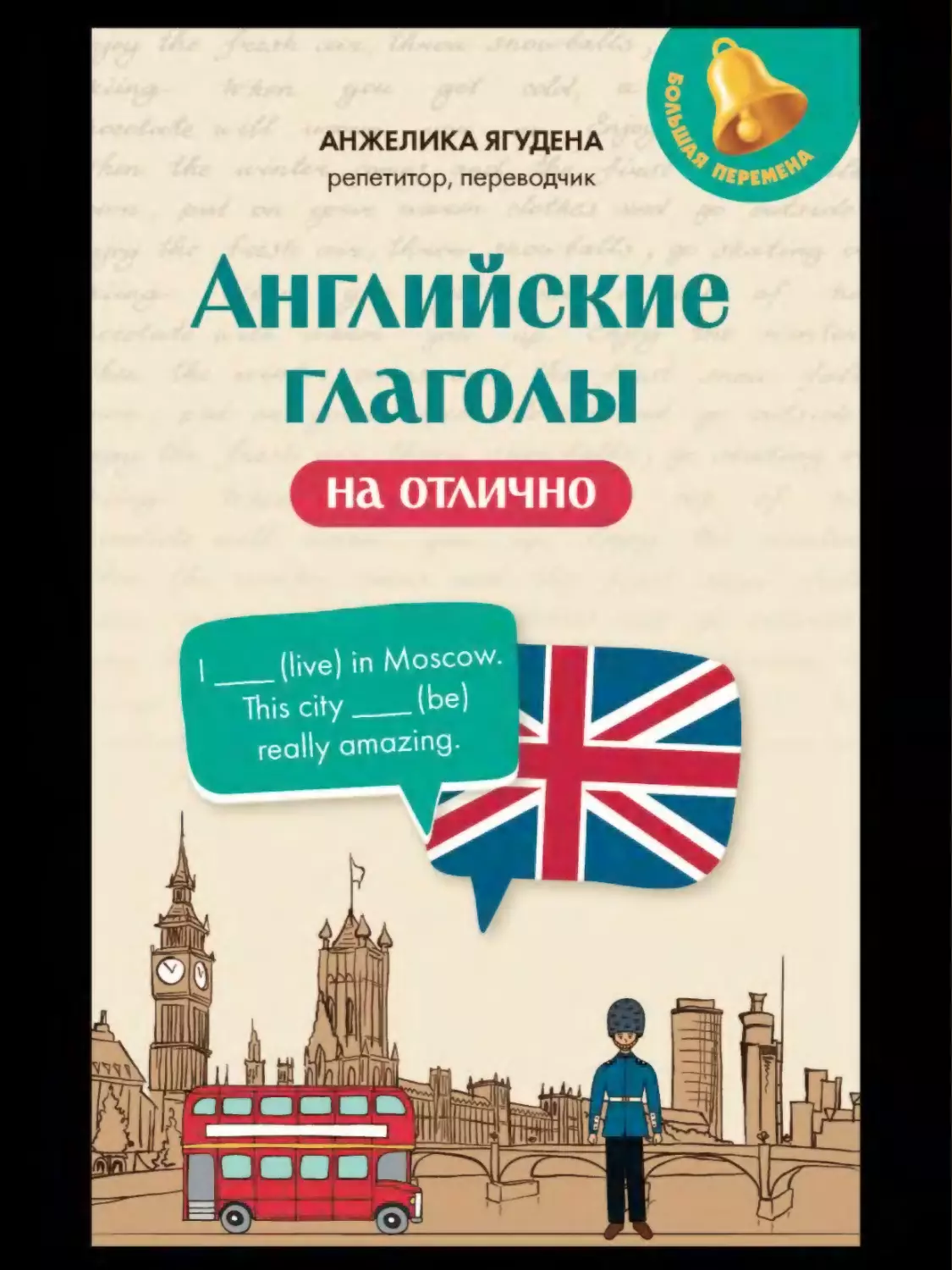
«Большая перемена»

Анжелика Ягудена

Английские
глаголы

НА ОТЛИЧНО

Электронное издание

Ростов-на-Дону
«Феникс»
2026
УДК 373.167.1:811.111

ЕВК 81.432.1я72

КТК 441

Я31

Ягудена, Анжелика.

। Английские глаголы на отлично [Электронный ресурс]/ Анжелика
Ягудена. — Электрон, текстовые дан. (1 файл pdf: 160 с.). — Ростов н/
Д : Феникс, 2026. — (Большая перемена).

ISBN 978-5-222-49059-4

Времена глагола — это фундамент английской грамматики и одновре-
менно камень преткновения для большинства учащихся. В данной книге
мы попытаемся придерживаться правила «просто о сложном». Наш курс
интенсив нацелен на развитие практических навыков учащихся, а его глав
ной особенностью является принцип «меньше теории, больше практики».
Цель настоящей книги состоит в том, чтобы читатели могли подружиться
с английскими временами и раз и навсегда избавиться от проблем выбора.
Основной девиз курса — систематизировать знания и выстроить логику
видо-временной системы, а не просто выучить таблицу времен наизусть.
Сборник рассчитан на старшеклассников, он может заинтересовать всех,
кто уже отчаялся в своих попытках разобраться во временах английского
языка, а также тех, кто находится в начале изучения этого раздела грам-
матики.

Материал курса представлен в доступной форме. Каждый теоретиче-
ский блок сопровождается подразделом Summary, где в сжатой форме из-
ложена вся основная информация главы. После изучения теоретической
части читатели имеют возможность выполнить упражнения, которые по
могут развить чувство языка и довести навык употребления грамматиче-
ских конструкций до автоматизма. В приложении находятся таблицы вре-
мен английского языка и список самых распространенных неправильных
глаголов, сгруппированных по определенному принципу для легкого и бы
строго усвоения. Предложенная схема поможет вам запомнить эти слова
как таблицу умножения!

УДК 373.167.1:811.111

БЕК 81.432.1Я72

Издатель и изготовитель: ООО «Феникс».

Юр. и факт, адрес: 344011, Россия, Ростовская обл.,
г. Ростов-на-Дону, ул. Варфоломеева, д. 150.

Тел./факс: (863) 261 89-65, 261-89-50.

©Ягудена А., текст, 2026

© ООО «Феникс», оформление, 2026

©В книге использованы иллюстрации
по лицензии Shulterstock.com
INTRODUCTION

Времена глагола — это фундамент английской грамматики
и одновременно камень преткновения (stambling block) для боль-
шинства учащихся. Как известно, в изучении видо-временных
форм действительно есть трудности, поскольку система времен
в английском языке сильно отличается от привычной нам сис-
темы в русском. Но не все так сложно, как может показаться на
первый взгляд. В этой книге мы попытаемся придерживаться
правила «просто о сложном». Этот курс-интенсив нацелен на
развитие практических навыков учащихся, а его главной осо-
бенностью является принцип «меньше теории, больше пра-
ктики». Цель настоящей книги состоит в том, чтобы читатели
могли подружиться с временами английского языка и навсегда
избавиться от проблем выбора. Основной девиз курса — систе-
матизировать знания и выстроить логику видо-временной сис-
темы, а не просто выучить таблицу времен наизусть.

Материал книги представлен в доступной форме. После-
довательно рассмотрены особенности употребления времен
групп Present, Past и Future, при этом основное внимание уде-
ляется отработке и повторению изученного, а также анализу
типичных ошибок. Так, для закрепления материала каждый
тематический блок сопровождается подразделом Summary,
где в сжатой форме изложена вся основная информация гла-
вы. После рассмотрения каждой из групп (Present, Past, Future)
представлены сравнительные таблицы, которые помогут си-
стематизировать и обобщить знания. Читатели также смогут
выполнить специально разработанные упражнения для трени-
ровки времен английского глагола. Особое внимание в книге
уделяется упражнениям по перевод)’ с русского на английский.
С их помощью читатели смогут развить чувство языка и довес-
ти навык употребления грамматических конструкций до авто-
матизма. После изучения всех разделов читателю предлагается
рассмотреть усвоенные времена с другого ракурса (времена
групп Simple, Continuous, Pei feet и Pei feet Continuous) и провести
их сравнительный анализ.

В приложении читатели найдут таблицы времен англий-
ского языка и список наиболее употребительных неправильных
глаголов, сгруппированных по определенному принципу для
легкого и быстрого усвоения. Я надеюсь, что предложенная схе-
ма поможет вам запомнить эти слова как таблицу умножения!

Best wishes for your new adventure in the world of verb tenses!
TO BE

Глагол to be — «быть», «находиться», «являться» — это один
из наиболее часто используемых глаголов, который играет клю-
чевую роль в грамматике английского языка. Сами того не осоз-
навая, мы используем его повсеместно: когда рассказываем о
себе, своей работе, возрасте, национальности, внешности; когда
описываем свои чувства или говорим о погоде. Убедитесь в этом
сами, прочи тав типичный рассказ о себе.

Му name is Angelika. Гт Russian. Гт 18.1 am a first-year student.
I am tall and slim. I'm so happy to see you. Меня зовут Анжелика. По
национальности я русская. Мне 18 лет. Я учусь на первом курсе.
Я высокая и стройная. Я счастлива вас видеть.

Мы использовали глагол to be в каждом предложении.
Я надеюсь, теперь вы убедились, насколько он важен и почему
правила его употребления нужно знать как таблицу умножения.
В этой главе мы рассмотрим основные формы и функции глаго-
ла to be.

Сразу скажу: это уникальный глагол. Он изменяется не толь-
ко по временам, но и по лицам и числам. Так, глагол to be имеет
три формы настоящего времени (am / is / аге), две формы про-
шедшего времени (was / were) и одну форму будущего времени
(will be). Давайте разберем правила спряжения подробнее.

Настоящее время
(Present Simple of the verb to be)

В настоящем времени форма глагола to be зависит от лица и
числа подлежащего.

I (я) — ат

Не (он) / she (она) / it (оно) — is

You (ты, вы, Вы) / we (мы) / they (они) — аге

Отрицательная форма (-) образуется при помощи части-
цы not, которая ставится непосредственно после глагола to be.
Обратите внимание: в речи часто используют сокращенные
формы:

I am not = Гт not

You / we / they are not = you / we / they aren’t
He i she / it is not = he / she / it isn't

Чтобы задать вопрос (>), нужно поставить глагол to be в соот-
ветствующей форме (am / is / аге) перед подлежащим:

Am I...?

Are you / we / they...?

Is he / she / it...?

Прошедшее время
(Past Simple of the verb to be)

I / he / she / it — was

You / we / they — were

Отрицательная и вопросительная формы строятся анало-
гично вышеуказанному способу.

Отрицание (-): was not (wasn't) / were not (weren’t)

Вопрос (?): Was I / he / she / it...? Were you / we / they...?

Будущее время
(Future Simple of the verb to be)

В современном английском языке у глагола to be в будущем
времени есть всего лишь одна форма — will be. Отрицательная
и вопросительная формы образуются так же, как описано выше.

Отрицание (-): w ill not (won't) be

Вопрос (?): Will 1 / you / we / they / he / she / it be...?

Давайте сформулируем краткие тезисы. У глагола to be в на-
стоящем времени три формы: am / is / аге; в прошедшем вре-
мени — две: was / were; в будущем — одна форма для всех лиц и
чисел: will be. Давайте потренируемся на простом примере:

S 1 am at h ome. We / they / you are at home. He / she / it is at home.

I / she / he was at home. We / they / you were at home.

I / we / you / they / he / she / it will be at home.
Предлагаю перейти к изучению функций глагола to be. Как
показывает практика, грамматические ошибки, которые совер-
шают учащиеся, чаще всего связаны с незнанием типов глагола.
Дело в том, что to be может выполнять сразу несколько функ-
ций: глагола-связки, вспомогательного глагола и смыслового.
Давайте разбираться.

1.	Глагол связка to be является частью именного сказуемо-
го и обычно не переводится на русский язык. Именным
сказуемым называется сказуемое, которое состоит их
двух частей: глагола-связки и именной части, выражен-
ной существительным, прилагательным, наречием и т. д.
Именная часть обычно выражает основное лексическое
значение. Поэтому глагол-связка to be не имеет смысло-
вого значения и не переводится.

I am happy. Я счастлива.

S John is from England. Джон из Англии.

s Му sister is married. Моя сестра замужем.

WATCH OUT!

В английском языке фиксированный порядок слов, при кото-
ром сказуемое всегда следует за подлежащим. Запомните: мы
не можем обойтись без этих двух членов предложения! На ан-
глийском языке нельзя сказать: 1 Inna (Я Инна). Правильно бу-
дет: I am Inna (ат — часть сказуемого).

Очень важно понимать, что в словарях глаголы указаны в
инфинитиве: be mad about, be in a hurry, be in a mess, etc. Мы не
можем сказать: I be tired. (Я устала.) Вместо этого мы скажем:
I am tired.

2.	Смысловой глагол to be всегда несет смысловую нагрузку
и имеет значение «быть», «находиться», «являться»:

z То be, or not to be, that is the question. Быть или не быть —
вот в чем вопрос.

I want to be here. Я хочу быть здесь.

✓ I was at the gym yesterday. Вчера я был в спортзале.
Смысловой глагол to be часто используется для выражения
местонахождения в следующей конструкции: to be + предлог +
существительное.

Ex. I was at home yesterday. Вчера я был дома.

3.	Вспомогательный глагол to be служит для образования
времен группы Continuous и форм страдательного залога
(Passive Voice):

J I am looking for a job. Я ищу работу.

I will be working at this time tomorrow. Завтра в это же вре-
мя я буду работать.

This house was built over 50 years ago. Этот дом был постро-
ен более 50 лет назад.

Common Expressions

to be busy (with) — быть занятым — Are you busy? Вы заня-
ты?

to be sorry (fur) — сожалеть о чем-либо — I’m sorry for
blaming you. Прости меня за то, что обвиняла тебя.

J to be worried (about) — волноваться, беспокоиться о ком-
либо — I’m worried about you. Я беспокоюсь о тебе.

✓	to be good (at) — преуспевать, иметь способности или та-
лант к чему-либо — I’m good at housekeeping. Я хорошая
хозяйка.

✓	to be tired (of) — быть уставшим — I am so tired. Я так устал.

✓	to be bored — скучать — Гт bored. Let’s go out. Мне скучно.
Пойдем погуляем.

J to be angry (with) — сердиться — I hope you’re not angry
with me. Надеюсь, ты на меня не злишься.

J to be hungry — быть голодным — Гт always hungry after а
workout. Я всегда голоден после тренировки.

✓	to be afraid / scared (of) — бояться —• I’m afraid of snakes.
Я боюсь змей.

J to be ready (for) — быть готовым — Are you ready? Вы го-
товы?
J to be late (for) — опаздывать — I hate to be late, especially for
work. Я не люблю опаздывать, особенно на работу.

J to be in time — приходить вовремя (в нужное время) —
You’re just in time. Ты как раз вовремя.

to be sure (of) — быть уверенным — Fm sure you will succeed.

Я уверена, у тебя все получится.

J to be fond (of) — любить, увлекаться — I’m fond of dancing.
Я увлекаюсь танцами.

J to be right / wrong — быть правым / заблуждаться — Tm
sure you’re wrong. Я уверена, что ты заблуждаешься.

J to be over — завершаться, заканчиваться — It is over. Все
кончено.

J to be in a hurry — спешить — Fm in a hurry. Jack is waiting
for me. Я спешу. Джек меня ждет.

to be back — возвращаться — FU be back. Я вернусь.

S to be interested (in) — интересоваться — My dad is interested
in politics. Мой папа интересуется политикой.

to be in high / low spirits — быть в приподнятом I плохом
настроении — Tom was in high spirits last night. Том был в
приподнятом настроении прошлой ночью.

J to be on good terms (with) — быть в хороших отношениях —
Linda is on good terms with her husbands relatives. У Линды
хорошие отношения с родственниками мужа.

✓	to be at a loss — быть в растерянности — I don’t really know
what to do. I am at a loss. Я действительно не знаю, что де-
лать. Я в растерянности.

✓	to be eager to do something — делать что-либо с большим
желанием — I am eager to help you. Я с радостью помогу
тебе.

J to be born — родиться — He was born in Ireland. Он родился
в Ирландии.

J to be married — быть женатым / замужем — Tm married.
Я .замужем.

f to be therefor someone — быть готовым помочь кому-ли-
бо, поддержать или утешить — I’ll always be there for you.
Я всегда буду рядом с тобой.
Summary

1.	То be — am / is / аге (настоящее), was / were (прошед-
шее), will be (будущее).

2.	Сокращенные отрицательные формы:

•	настоящее: is not = isn’t, are not = aren’t. Исключение:
I am not= I’m not;

•	прошедшее: was not = wasn’t, were not = weren’t;

•	будущее: will not = won’t.

3.	Вопросительные предложения: to be в любой форме (на-
стоящего, прошедшего или будущего времени) ставится
перед подлежащим: Am I right? Я прав? Are you busy? Ты
занят? Is he okay? С ним все в порядке? Was he too slow? Он
был слишком медлительным? Were they happy? Они были
счастливы? Will you be there? Ты будешь там?

4.	Глаго.а-связка to be = часть именного сказуемого: Т ат
from Russia. Я из России. Не is tired. Он устал.

5.	Смысловой глагол to be имеет значение «быть», «нахо-
диться», «являться» и несет смысловую нагрузку: То be, or
not to be. Быть или не быть.

6.	Вспомогательный глагол to be используется для образо-
вания времен группы Continuous и форм страдательного
залога. Present Continuous: I am reading now. Я читаю сей-
час. Passive Voice: The room is cleaned daily. Комната уби-
рается каждый день.

7.	Устойчивые выражения: to be about to do something, to be
ready for something, to be angry with somebody, etc.
Exercises

Ex. 1. Choose the correct forms of to be (am / is / are) for the
gaps below.

1.		you tired ? Yes, I___

2.	your name Emily? Yes, it_________.

3.	_____it Sunday today? Yes, it____

4.	Hi, Mary. How_______you?

5.	John______my best friend.

6.	you a doctor? No, Ia nurse.

7.	“We_______the champions”________a song by the British rock

band Queen.

8.	My friend and I happy to see you here.

9.	Tigers wild animals.

10.	My grandparents retired.

11.	Jessica____Brazilian but lives in Spain.

12.	Nick and Pam not at home. They at school.

13.	How old_______Sam? He__________22. And how old______you?

I 21.

14.	your friends from Italy? No, they from Portugal.

15.	This house____very expensive. I wish I could live here.

16.	It____cold and windy today. 1 don’t feel like going out.

17.	How are you feeling, Mark? I____okay, thanks.

18.	My wife a housewife, and 1 a policeman.

19.	James____my fellow worker.

20.	I___in a hurry. Tom is waiting for me.

Ex. 2. Rewrite the sentences using the short forms of to be.

Example: We are happy. — We’re happy.

1.	I am so scared______

2.	They are good guys______

3.	We are a big family.____

4.	Jan e is my yo un ge r siste r._

5.	He is in the park_____
6.	You are right_____

7.	You are my soulmate______

8.	lam from New York________

9.	We are neighbours.

10.	She is the happiest person in the world__

Ex. 3. Rewrite the following sentences using the negative
and interrogative forms of the verb to be in the Present Sim-
ple Tense. Use contractions where possible.

Example: They are my classmates. — They aren’t my classmates. Are
they my classmates?

1.	She is always tired after work.

2.	1 am in high spirits_____

3.	We are afraid of spiders____

4.	She is at home______

5.	We are interested in art____

6.	They are students______

7.	He is always busy._____

8.	This is the most spectacular waterfall in the world.

9.	This house is for sale___

10.	They are brave and highly skilled warriors___

Ex. 4. Fill in the gaps with the correct Present Simple forms
of to be.

1.	My name_______Pamela. 1_____from Brazil. 1______24.

2.	Where . you from? I. from Japan.

3.	Where_______Jack? He_____in the park.

4.	you busy? No, I not.

5.	My granny_______the kindest person in the world.

6.	1_____deeply sorry for my behaviour.

7.	My parents______proud of me because 1_____the best student

in my math class.

8.	It rainy and foggy today. I don’t feel like going out
anywhere.
9.	(Jeorge____my best friend. He___loyal and caring.

10.	We _____ all confused. We must consider everything

carefully.

Ex. 5. Translate into English using the correct Present Sim-
ple forms of the verb to be.

1.	Меня зовут Анна. Мне 18 лет. Я студентка первого курса
университета.

2.	Моя мама домохозяйка. Она отлично готовит (to be good
at).

3.	Это моя подруга Роза. Она очень общительная и добрая.

4.	С тобой все в порядке? Я беспокоюсь о тебе.

5.	Анна и Тим — мои соседи. Они очень дружелюбные и от-
зывчивые люди.

6.	Моей сестры нет дома. Она в школе.

7.	Мы счастливы видеть вас. Вы как раз вовремя.

8.	Хуго и Том не из Бразилии. Они из Мексики.

9.	Вы готовы пойти со мной?

10.	Приятно познакомиться. Я Мэтью, а это Ольга.

Ех. 6. Translate into English using the correct Present Sim-
ple forms of the verb to be. Use common expressions where
possible.

1.	Я беспокоюсь о тебе. Ты всегда такой невнимательный.

2.	Ты на меня злишься?

3.	Я не силен в языках, но у меня есть музыкальные способ-
ности.

4.	Ты мой лучший друг. Помни, что я всегда рядом.

5.	Мне не терпится увидеть тебя завтра (to be eager).

6.	Извините, я очень спешу.

7.	Джон — хороший парень. Он добрый и заботливый.

8.	Моя лучшая подруга очень веселая и беззаботная. Она
всегда в хорошем настроении.

9.	Я так сегодня устала. Я совершенно без сил.
10.	Сегодня солнечно и тепло. Посмотри! На небе ни об-
лачка.

11.	Я устал и голоден.

]	2. Я всегда готова помочь люцям из моего окружения.

13.	Джон в хороших отношениях со своими соседями.

14.	Пожалуйста, поправьте меня, если я не прав.

15.	Я слишком занята учебой.

Ех. 7. Complete the sentences using was / were.

1.	Yesterday my friend and I___at the cinema. We watched a

brilliant comedy. The plot funny and moving.

2.	The weather______awful yesterday. The sky_____grey and

overcast.

3.	I so tired last night that I fell asleep immediately.

4.	Peter and James____in the park yesterday.

5.	Both men the same height and age.

6.	I_____excited when Jessica shared her secret.

7.	I phoned you last night, but the line	busy.

8.	It____good to hear from you again.

9.	I	happy to be reunited with my best friend.

10.	Freddy didn’t invite Mary to the party. She ___ realty

disappointed and upset.

Ex. 8. Rewrite the following sentences using the negative
and interrogative forms of the verb to be in the Past Simple
Tense. Use contractions where possible.

Example: They were my best friends. — They weren’t my be st friends.
Were they my best friends?

1.	It was my sister’s birthday yesterday____

2.	James was really tired last night.

3.	11 was cold and windy yesterday.______

4.	We were at home last night.

5.	They were afraid to ta 1 k to us___

6.	I was born in Italy.

7.	Jack was realty disappointed in his best friend____
8.	You were late yesterday.______

9.	1 was sorryr to hear that.

10.	] was in Itai}? two years ago____

Ex. 9. Rewrite the sentences below in the Past Simple.

Example: 1 am happy. — I was happy.

1.	Are you married?_______

2.	I am not alone______

3.	She is my best friend.

4.	Jeffrey is a police officer.__

5.	We are not strangers to you.

6.	Are you satisfied with the results?

7.	They are hungry._______

8.	Where are your friends?

9.	It is cloudy and windy outside______

10.	Jessica is a cheerleader.

Ex. 10. Translate into English using was/ were.

1.	Вчера я очень устала после работы.

2.	Прошлой ночью мы были дома.

3.	Ты был вчера в школе?

4.	Прошлым летом мы с друзьями были в Испании1.

5.	Я никогда не опаздывал в школ}?.

6.	Экзамен был очень сложным.

7.	Мои друзья были не очень рады этому.

8.	Мистер Смит был очень дружелюбен к нам.

9.	Мои родители были вчера в кино.

10.	Моя собака была очень дружелюбной и энергичной.

1 В английском языке в предложениях типа Му friends and I на
первое место принято ставить не себя, а других людей. Фразу «Мы
с друзьями» нельзя сказать по-английски We with ту friends или I and
ту friends. Следует отметить, что носители языка в разговорной речи
часто говорят: Me and ту friends, хотя с точки зрения грамматики эта
конструкция является неправильной.
Ех. 11. Rewrite the following sentences using the negative
and interrogative forms of the verb to be in the Future Simple
Tense. Use contractions where possible.

Example: They will be happy. — They won’t be happy. Will they be
happy?

1.	Mark will be there tomorrow____

2.	We wi 11 b e st run ge r._

3.	1 will be helpful.

4.	We will be happy to solve your problems__

5.	He wi 11 be a big boss one day.

6.	She will be the first female president of France_

7.	David will be pleased to see you.

8.	Mary will be at your house at 11 a.m_

9.	My husband will be at the airport tomorrow morning__

10.	The party will be a great success_

Ex. 12. Translate into English using the correct Present,
Past or Future forms of the verb to be.

1.	Я буду дома через пару часов.

2.	Я обещаю, что больше не буду опаздывать.

3.	Я дома, а Джек на работе.

4.	Мы одна большая счастливая семья.

5.	Прошлым летом я была на море. Нам повезло с погодой.
Было тепло и солнечно.

6.	Я буду всегда рядом, когда тебе понадоблюсь.

7.	Ты чем-то расстроен? Знай, что я всегда готов помочь
тебе.

8.	Я не умею рисовать. Честно говоря, я немного завидую
тем людям, у которых есть талант к искусству.

9.	Моя сестра — парикмахер, а я домохозяйка.

10.	Почему я даже не удивлен?
PRESENT SIMPLE/
ПРОСТОЕ НАСТОЯЩЕЕ ВРЕМЯ

В этой главе мы поговорим о простом настоящем времени
Present Simple. Это время мы используем для описания регуляр-
ных последовательных действий и событий. В Present Simple мы
говорим о привычках, повседневной деятельности, не делая ак-
цент на моменте речи, а лишь констатируя факт. Более деталь-
но использование Present Simple изложено в разделе «Значение
и употребление».

Образование

(+) Утвердительные предложения в Present Simple образу-
ются при помощи глагола в начальной форме для всех лиц и чи-
сел, кроме 3-го лица ед. ч.: I love you. They live in Spain. We work
hard. You read a lot.

•	Если подлежащее стоит в форме 3-го лица ед. ч. (he,
she, it, my dog, John, Mary, the car), то к глаголу добавля-
ется окончание -s/-es: She reads a lot. He likes golf. It goes
without saying.

(?) Вопросительные предложения строятся при помощи
вспомогательного глагола do (для всех лиц и чисел: I, we, you,
they) и does (для 3-го лица ед. ч.: he, she, it). Вспомогательный
глагол стоит перед подлежащим: Do you know him? Does she like
David? Do my parents love me? Do John and Mary study Spanish?
Where do Mary and John live? What does Tom look like?

•	Одной из распространенных ошибок является добавле-
ние к смысловому глаголу окончания -s в вопроситель-
ных предложениях: Does he knows the truth? Это грам-
матическая ошибка. Правильным будет сказать: Does he
know the truth?

(-) Отрицательные предложения образуются с помощью
вспомогательных глаголов: do (I, you, we, they) или does (he, she,
it) и отрицательной частицы not. В современном английском
языке чаще можно встретить употребление сокращенных форм
don’t и doesn’t: Ex. 1 don't know. He doesn’t like it.

(<)	(-)	(?)
I / we / you / they work	I / we / you / they do not (“donl) work	Do I / we /you/they work?
He / she / it works	He / she / it does not (=doesn’t) work — окончание -s не добавляется к основному глаголу	Does he / she / it work? — окончание -s не добавляется к основному глаголу

WATCH OUT! В британском разговорном английском в Present
Simple вместо глагола to have в значении «.иметь» очень часто
используется оборот have / has got. Следует отметить, что дан-
ная конструкция и глагол to have синонимичны. Однако обо-
рот have / has got, так же как и to be, НЕ подчиняется общим
правилам образования Present Simple. Это означает, что для
формирования вопросительных и отрицательных предложе-
ний НЕ используются формы вспомогательного глагола do /
does. Например:

Во ycru married? Are you married? Вы замужем? Boes she
busy? Is she busy? Она занята? Bo you have got Have you got
a pet? У тебя есть питомец? Boes she have-got Has she got a
car? У нее есть машина?

Однако в случае употребления глагола to have в значении
«:иметь» работает общее правило и используется вспомогатель-
ный глагол do / does — Во you have a dog? У тебя есть собака? Boes
she have any friends? У нее есть друзья?

Правописание окончания глагола
н 3-м лице ед. ч.:

+ -s у большинства глаголов: speak — speaks, like — likes,
read — reads;

z + -es у глаголов с окончанием -s, -ss, sh, ch, x, z, o: buzz —
buzzes, watch — watches, go — goes;
J + -ies у глаголов с окончанием -у (если перед -у стоит со-
гласная): try — tries, fly — flies;

BUT! Если перед -у стоит гласная, то добавляется окончание
-s: play — plays, say — says; исключения: have — has.

Значение и употребление

1.	Повторяющиеся действия, привычки. Мы говорим о дей-
ствиях или событиях, которые происходят регулярно,
а не в текущий момент времени. В этом случае мы часто
используем наречия времени (always, every day, twice a
week):

S She goes to the gym twice a week. Она ходит в спортзал два
раза в неделю.

z Do you always walk so fast? Ты всегда так быстро ходишь?

J 1 don’t often invite my friends over. Я нечасто приглашаю
друзей в гости.

2.	Факты о нас и окружающих людях:

J I enjoy travelling. Я люблю путешествовать.

z Mary has a talent for drawing. У Мэри есть талант к рисо-
ванию.

3.	Общеизвестные факты, общепринятые понятия, вечные
истины, пословицы:

J Russian people like pancakes and caviar. Русские любят бли-
ны с икрой.

J Vegetarians don’t eat meat. Вегетарианцы не едят мясо.

J Fortune favours the bold. Смелость города берет.

✓ Water freezes at 0 Celsius. Вода замерзает при 0 по Цель-
сию.

4.	Передача будущего времени (расписание):

S The train arrives at 6 p.m. Поезд прибывает в 6 часов ве-
чера.

J The film starts at 5 p.m. Фильм начинается в 5 часов вечера.
5.	Выражение собственной точки зрения, предположения,
надежды:

I’m sure he is at home, Я уверен, что он дома.

I think you are right. Думаю, что ты прав.

6.	Использование статичных глаголов:

•	чувственного восприятия (to see, to hear, to feel, to smell,
to taste);

•	умственной деятельности (to know, to understand, to
think, to believe);

•	чувств и желания (to love, to adore, to hate, to like, to want,
to wish, to desire, to prefer);

S I feel unwell. Я плохо себя чувств)то.

Использование некоторых других глаголов (to belong,
to be, to have, to cost, to seem, to appear, to look like, to
resemble).

This house belongs to Jack Wilson. Этот дом принадле-
жит Джеку Уилсону.

7.	Пересказ сюжетов фильмов, книг, историй из жизни, а так-
же в заголовках газет и журналов:

J It’s an amazing story. I see Jack, who looks tired and
confused, and I go up to talk to him. Then I notice my best
friend, who comes out of nowhere and looks angry. Это
поразительная история. Я вижу Джека, который выгля-
дит уставшим и расстроенным, подхожу к нему, чтобы
поговорить. Затем я замечаю своего лучшего друга, ко-
торый появляется из ниоткуда и выглядит сердитым.

Маркеры времени

•	every day (year, month, week, morning, two hours) — каждый
день (год, месяц, каждую неделю, каждое утро, каждые два
часа)

•	every other day — через день

•	once / twice / three times a day (year, month, week) — раз I
два / три раза в день (год, месяц, неделю)
•	always — всегда

•	never — никогда

•	usually — обычно

•	generally — как правило, в основном

•	often —часто

•	sometimes — иногда

•	seldom / rarely — редко

•	regularly — регулярно

•	at weekends / at the weekend — по выходным

•	on Sundays, Mondays, etc. — по воскресеньям, понедельни-
кам и т. д.

WATCH OUT! Наречия частотности (always, often, usually,
seldom, regularly) ставятся перед смысловым глаголом, но по-
сле глагола to be:

S I often call my friends (наречие ставится перед смысловым
глаголом call): Я часто звоню своим друзьям.

I am often tired after school (наречие ставится после глаго-
ла to be): Я часто устаю после уроков.

Summary

1.	(+) Используем основной глагол в начальной форме со
всеми лицами и числами (I work / they like). В 3-м лице
ед. ч. (he / she I it) к глаголу добавляем окончание -s/-es
(he forgets / she reads / it works).

2.	(-) Используем вспомогательный глагол и частицу not:
do not (don't) / does not (doesn’t): I don’t like it. Мне это не
нравится. Не doesn’t want to go there. Он не хочет туда
идти.

3.	(?) Следуем формуле: вспомогательный глагол do / does
ставится перед подлежащим: Do you know him? I’M его
знаешь? Does she live in Spain? Она живет в Испании?

4.	Запоминаем, что have / has got и глагол to be не подчи-
няются общим правилам образования Present Simple.
В этих случаях следуем таким алгоритмам:
•	В вопросах меняем порядок слов (have / has ставим пе-
ред подлежащим, после добавляем got и остальную
часть; глагол to be в соответствующей форме ставим
перед подлежащим): Have you got a pet? Has she got a car?
Is he tired? Am I crazy? Are you busy?

•	В отрицаниях используем частицу not: I haven't got a car.
She hasn’t got any friends. I’m not at home. He isn’t here. We
aren’t the same.

5.	Запоминаем значение и употребление (регулярные дей-
ствия, факты, вечные истины, расписание, статичные
глаголы, пересказ сюжетов).

6.	Обращаем внимание на маркеры времени (usually,
always, never, often, seldom).
Exercises

Ex. 1. Write the third person singular forms.

have —______; play —___; scream —_______; cry —____; blame —

; kiss —__	; try —	: catch —	; go —	; take —

_____; tidy up —_____; sleep —____; write —______; notice —____;
smile —	; drink — _; paint —

Ex. 2. Fill in the gaps with a suitable verb in the third per-
son singular.

Example: I work for a big company. — She works for a big company.

1.	I often watch romantic comedies. — He______

2.	I like to play chess. — She____

3.	I want to say something. — Jack

4.	I brush my hair at least twice a day. — Mary

5.	I try to do my best to be a good friend. — He____

6.	I usually go jogging in the morning. — She

7.	I enjoy walking in the rain. — He_____

8.	I always start my day with a cup of tea. — She___.

9.	I spend too much time on social media. — He______

10.	J never talk about religion and politics. — My sister

Ex. 3. Fill in the gaps with the verbs in parentheses to com-
plete the following sentences and explain your choices.

1.	The train_____(arrive) at 6 p.m.

2.	She	(believe) in love.

3.	Jack_____(have) three brothers.

4.	Bad news . (travel) fast.

5.	The early bird______(catch) the worm.

6.	I always______(go) to bed late. So, I__(be) probably a night

person.

7.	Alex never______(watch) horror films.

8.	They often (play) football at weekends.

9.	I______(live) in Moscow. This city____(be) really amazing.

10.	1_____(like) the way you think.
Ех. 4. Choose the correct form.

1.	My grandfather doesn’t / don’t drive a car.

2.	1 don’t / doesn’t often drink coffee.

3.	Maggie doesn’t / don’t really like chocolate.

4.	I don’t / doesn’t want to talk about it.

5.	My sister doesn’t / don’t like wearing heels.

6.	We don’t / doesn’t have any food.

7.	My younger brother doesn’t / don’t often play computer games.

8.	They don’t / doesn’t usually get up early.

9.	I don’t / doesn’t work at the weekend.

10.	I doesn’t / don’t want to go there.

Ex. 5. Complete the sentences with have got or has got.

1.	Mary.	two elder sisters and one younger brother.

2.	I a lot of work to do.

3.	We	biscuits.

4.	She	a new dress.

5.	M a ry_____a b ally siste r.

6.		_ you___ any siblings?

7.		she_______any plans for tonight?

8.1	a lot of English books at home.

9.		you_____any suggestions?

10.	he any experience?

Ex. 6. Make the following sentences interrogative and
negative. Keep in mind the difference between have /has got
and have.

Example: I have got a problem. — I haven’t got a problem. Have I got
a problem/

I have a problem. — I don ’t have a problem. Do I have a problem?

1.	I’ve got some news for you. —____

2.	I have a headache today. —

3.	We have a flight to Paris at 10 p.m. —__

4.	They’ve got a new house. —_____

5.	I have a poor memory for names.—
6.	I have some questions for you. —____

7.	They have children. —______

8.	I’ve got a present for you. —___

9.	She’s got a lot of nice dresses.____

10.	I have got a lot of free time. —_

Ex. 7. Make the following sentences interrogative and
negative as shown in the examples.

Example: Mary lives in Scotland. — Mary doesn't live in Scotland.
Docs Mary live in Scotland?

I go shopping every other day. — I don’t go shopping every other day.

Do I go shopping every other day?

We are a big happy family. — We aren’t a big happy family. Are we a
big happy family?

Bill has got a good job. — Bill hasn't got a good job. Has Bill got a
good job?

1.	I always help my friends whenever they need it. —_____

2.	John usually goes out for a meal at the weekend. —

3.	We are all busy during the exam period. —____

4.	You have got a lot of friends. —

5.	She’s good at cooking. —

6.	I work hard every day to achieve success in life. —___

7.	Mary has too much free time. —

8.	I’ve got a lot of toys. —__

9.	1 often have dinner with my close friends. —

10.	She’s got a lot of responsibilities. —_

11.	We often go for a walk together. —_____

12.	My younger brother likes horror films. —____

13.	Tom usually works more than eight hours a day. —_____

14.	They often come home late. —_____

15.	George and Angela go to the cinema on Sundays. —_____

Ex. 8. Translate into English.

1.	Moil рабочий день обычно начинается е 9 утра.

2.	Я работаю в школе. Я учитель рисования.
3.	У меня много друзей. Мы обычно проводим много вре-
мени вместе.

4.	Джон выхолит на пробежку каждое утро.

5.	Мы живем по соседству.

6.	Я вовсе не жаворонок. Обычно я просыпаюсь в 10 утра.

7.	Каждое утро Джессика делает зарядку, принимает душ и
готовит завтрак.

8.	Мне не очень нравятся морепродукты, но я люблю икру.

9.	Мыс друзьями часто гуляем в парке и кормим белок.

10.	Мои родители всегда поддерживают меня.

11.	Ты знаешь этого человека? Он выглядит немного странно.

12.	Эта идея меня не привлекает.

13.	Я регулярно занимаюсь в спортзале и правильно питаюсь.

14.	Твой папа регулярно смотрит новости?

15.	Ты знаешь разницу между добром и злом?

16.	Мелисса знает всю правду? Я думаю, что тебе следует ей
открыться.

17.	Она не хочет двигаться дальше. Ты должен ей помочь.

18.	Я никогда не сдаюсь. Я всегда пытаюсь решать всевоз-
можные проблемы (to do one’s best).

19.	Моя мама всегда ложится спать в одно и то же время.

20.	Я часто вижу Джорджа, потому что мы живем по сосед-
ству.

Ех. 9. Correct the mistakes.

1.	I am agree with you.

2.	He usually have breakfast early in the morning.

3.	She doesn’t have got any plans for today.

4.	bVeryone enjoy going on holidays.

5.	Does you have any questions?

6.	Mary still don’t know the truth.

7.	A bad workman always blame his tools.

8.	Does he plays ice hockey well?

9.	I hasn’t any free rime.

10.	Matthew have got a lot of money.
PRESENT CONTINUOUS /
НАСТОЯЩЕЕ ДЛИТЕЛЬНОЕ ВРЕМЯ

В английском языке, в отличие от р}тсского, настоящее вре-
мя может быть представлено четырьмя аспектами: Simple (про-
стое), Continuous, или Progressive (длительное), Perfect (совер-
шенное) и Perfect Continuous (совершенное длительное). Чтобы
разобраться в данном вопросе и избежать возможных ошибок,
очень важно понять логику английских времен.

Прежде чем приступать к детальному разбору Present
Continuous, давайте сравним два предложения:

1)	I read a lot. Я много читаю (Present Simple).

2)	Гт reading now. Я читаю сейчас (Present Continuous).

В первом предложении мы констатируем факт, а во вто-
ром — сообщаем о действии, которое происходит в момент
речи. Очень важно научиться понимать разницу между этими
двумя аспектами.

Образование

be (am / is / are) + V-ing

(+)	(-)	(?)
1 am working.  Short form: am =’m	I am not working.  Short form: am not= ’m not	Am J working?
He / she / it is working. Short form: is= ’s	He / she / it is not working. Short form: is not = isn’t	Is he / she / it working?
They / we / you are working.  Short form: are = ’re	They / we / you are not working.  Short form: are not = aren’t	Are they / we / you working?

Так когда же следует использовать Present Continuous? Наи-
более часто это время используется, когда необходимо описать
действие, которое происходит в текущий момент времени,
и нужно подчеркнуть его длительность. Более подробно ис-
пользование Present Continuous описано в разделе «Значение и
употребление».

Значение и употребление

1.	Действие в момент речи:

I am learning а роет now. Я учу стихотворение сейчас.

Не is taking a shower. Он принимает душ.

2.	Процесс действия:

I am looking for a job. Я ищу работу (действие происходит
в настоящем времени, но не обязательно в момент речи).
I am teaching mj^ baby sister to walk. Я учу свою маленькую
сестренку ходить.

3.	Раздражающая привычка (выражение эмоций):

You’re always losing something. Вечно ты что-то теряешь.

✓ You’re always laughing for no reason. Вечно ты смеешься
без причины.

4.	Действие, запланированное на ближайшее будущее:
They are coming next week. Они приезжают на следующей
неделе.

I’m meeting him next Sunday. У меня встреча с ним в следу-
ющее воскресенье.

WATCH OUT!

Когда речь идет о планах на будущее или действии, которое
вот-вот произойдет, очень часто используется устойчивое
выражение to be going to do something — собираться что-
либо делать:

✓ The sky is overcast. It is going to rain. Небо затянуто тучами.
Собирается дождь.

z She is going to cry. Она вот-вот расплачется.

5.	Использование со статичными глаголами, если необхо-
димо сделать акцент на процессе совершения действия.
В этом случае глаголы меняют свое смысловое значение.
Ниже приведена сравнительная таблица.

Verb	Present Simple	Present Continuous
be	He is a very naughty buy. Он очень непослушный мальчик, (факт)	He is being naughty at the moment. Он очень плохо себя ведет. (То есть он не слушается в настоящий момент, хотя обычно может быть послушным ребенком.)
have	I have two cars. У меня две машины. (В значении «иметь» употребляется глагол в Present Simple; факт.)	Гт having a great time in London. Я отлично провожу время в Лондоне. (То есть в настоящий момент я нахожусь в Лондоне и делюсь впечатлениями.)
think	I think you are right. Я ду- маю, что ты прав.	Т am thinking of buying a new house. Я подумываю (планирую) купить новый дом.
see	Do you see him ? Ты видишь его? (В значении «видеть» употребляется глагол в Present Simple.)	Гт seeing him tonight. Я увижусь с ним сегодня ночью. (В значении «встречаться» употребляется глагол в Present Continuous.)
look	Не looks bred. Он выглядит усталым. (В значении «выглядеть» употребляется глагол в Present Simple.)	T’m looking at him with love.  Я смотрю на него с любовью. (Действие в процессе; в значении «смотреть» употребляется глагол в  Present Continuous.)
smell	The cake smells delicious. Торт аппетитно пахнет. (В значении «пахнуть» употребляется глагол в Present Simple.)	Am I smelling the fragrance of a rose? Я вдыхаю аромат розы? (В значении «нюхать» употребляется глагол в Present Continuous.)
taste	This sauce tastes sweet. У этого соуса сладкий вкус. (В значении «иметь вкус» употребляется гла- гол в Present Simple.)	Не is tasting our cook's new dish. Он пробует новое блюдо нашего повара. (В значении «пробовать» употребляется глагол в Present Continuous.)
Маркеры времени

•	now — сейчас

•	at the moment — в настоящий момент

•	at present — в настоящее время

•	still — все еще, до сих пор

•	currently — в настоящее время, сейчас

•	while — пока, в то время как

Summary

1.	(+) Образуем Present Continuous по формуле: вспомога-
тельный глагол to be (am / is / are) + V-ing.

2.	(-) Добавляем отрицательную частицу not к вспомога-
тельному глаголу: am / is / are not + V-ing.

3.	(?) Меняем местами подлежащее и вспомогательный
глагол to be в нужной форме: Am I working? Is he / she / it
working? Are they / you / we working?

4.	Запоминаем значение и употребление: момент речи;
действие в процессе; раздражающая привычка; заплани-
рованное действие (ближайшее будущее).

5.	Не путаем to be going somewhere (идти куда-либо) и to be
going to do something (собираться что-либо делать).

6.	Анализируем сравнительную таблицу статичных глаго-
лов в Present Simple / Continuous.
Exercises

Ex. 1. Complete the sentences with the verbs in parenthe-
ses. Use Present Continuous.

1.	My mum________(bake) a cake now. It smells delicious!

2.	I__ (see) George next Monday.

3.	Jim_____(work) on his project now.

4.	I’m afraid Julia can’t come to the phone now. She (have)
a bath.

5.	What you (do)? I _ (get) ready for school.

6.	Look! Mila_____(wear) such a nice dress.

7.	Lily (walk) in the park now.

8.	We______(h ave) a great time now.

9.	They (compete) for a prize.

10.	1___(do) the washing-up now.

Ex. 2. Write interrogative and negative sentences.

Example: I am reading now. — I’m not reading now. Am I reading
now?

1.	It is going to rain.

2.	Mary is getting on my nerves_____

3.	We are planning our trip to Mexico.

4.	Our kids are playing in the yard now____

5.	At present, I’m learning to drive.

6.	I’m having dinner now._____

7.	Jack is playing the guitar now.__

8.	The birds are singing outside____

9.	I’m looking for a job.___

10.	I’m revising for my exam now____

Ex. 3. Complete the dialogue with the verbs in parentheses
in Present Continuous.

— What. you _ (do) now?

— I_____(revise) for my exams. Why_____you______(ask)?
— I______(go out) tonight with Jim______you______(come) with

us?

— I’d love to, but I___(not feel) well. What about Anna?

— Well, she (have) money troubles. She is on a really tight
budget.

— She’s busy tonight. She____(work) on her project.

—__ you (kid) me? She is a complete homebody.

Ex. 4. Use the verbs in parentheses to complete the sen-
tences with to be going to.

Example: I (bake) a cake tonight. — I'm going to bake a cake
tonight.

1.	We (have) a picnic at the weekend.

2.	They (buy) a new house.

3.	I (give) you some background information.

4.	I_____(tell) you something.

5.	Tom_______(leave) the party.

6.	Jessica______(win).

7.		you_______(sell) this car?

8.	1 (take) a shower.

9.		he______(participate) in the tournament?

10.	We_ (be late).

Ex. 5. Complete the sentences with the verbs in parenthe-
ses. Decide if the verb refers to a stare or an action.

1.	I_____(think) she is Australian.

2.	1_____(think) of buying a new smartphone.

3.	Jack______(have) a great time in Spain. He____(look) happy

and relaxed.

4.	Tom_______(have) a baby sister.

5.	They______(have) a pool party on Sunday.

6.	1 (know) the right answer.

7.	Why_______you_______(cry)?

8.	Your perfume (smell) nice.

9.	1 always_____(feel) tired after classes.

10.	Kathy (look) so unhappy.
Ex. 6. Translate into English.

1.	Я собираюсь позвонить ему прямо сейчас.

2.	Мы собираемся купить новый дом.

3.	Мой младший брат спит в своей комнате.

4.	Мои родители сейчас обедают.

5.	Моя бабушка сейчас печет пирог. Пахнет восхитительно!

6.	На улице холодно и дождливо. Мы с Мэгги ждем автобус.

7.	Что ты сейчас делаешь? Ты работаешь над новым проек-
том?

8.	Где Билл? — Он гуляет с собакой в парке.

9.	Я все еще жду его.

10.	Наши дети сейчас пишут письмо Деду Морозу.

11.	Где Мэри? — Она говорит по телефону.

12.	Сейчас я гуляю в лесу. Здесь так тихо!

13.	Ты со мной говоришь? Я не понимаю, что происходит.

14.	Мои родители смотрят фильм, а я слушаю музыку в на-
ушниках.

15.	На чго ты сейчас копишь деньги?

16.	Я не собираюсь покупать новый телефон. Тот, который
мне нравится, стоит очень дорого.

17.	Она сейчас не ищет новую работу. Она работает над
диссертацией.

18.	Обычно по утрам я пью чай, а сейчас я пью кофе.

19.	Я встречаюсь с Полом на следующей неделе.

20.	Мы едем сейчас домой.
COMPARISON CHART:

PRESENT SIMPLE & PRESENT CONTINUOUS

	Present Simple	Present Continuous
Формула	VI  V -s/-es	am / is / are + V-ing
(+)	I / you / we / they work. He / she / it works.	I am working.  You 1 we / they are working. He / she / it is working.
(-)	I / we / you / they do not work. He / she / it does not work.	I am not working.  You / we / they are not working.  He / she / it is not working.
(?)	Do I / we / you / they work?  Doos he / she / it work? (окончание -s не добавляется к основному глаголу!)	Am I working?  Are you / we / they working?  Is he / she / it working?
Маркеры времени	everyday, usually, often, always, never, seldom, rarely, occasionally	now, at the moment, still, at present, currently
Значение и употребление	Регулярные события, привычки: I go to school every day.  Я хожу в школу7 каждый день.  I read a lot. Я много читаю.	События, которые происходят в момент речи, действия в процессе:  I am going to school now. Я иду сейчас в школу.  Гт reading now. Я сейчас читаю.

АНГЛИЙСКИЕ глаголы на отлично
w
Ln

	Prosenl Simple	Present Continuous
	Факты:  He is selfish. Он эгоист, (по харак- теру)	Временная ситуация, отражающая теку щий процесс:  Не is being selfish. Он себя ведет эгоистично, (в данной ситуации)
	Фиксированное расписание (для передачи будущего времени): The train comes at 6 p.m. Поезд прибывает в 6 часов вечера.	Действие, запланированное на ближайшее будущее:  I'm coming home next Sunday. Я возвращаюсь домой в следующее воскресенье.
Статичные глаголы	I think you're right. Думаю, что ты прав.  She is naughty. Она непослушная, (по характеру)  I have two sisters. У меня две сес- тры. (В значении «иметь» употре бляется глагол в Present Simple.)  I see you. Я вижу тебя.  (В значении «видеть» употребля- ется глагол в Present Simple.)	Гт thinking of buying a house. Я подумываю (планирую) купить дом.  She is being naughty. Она плохо себя ведет.  (в данной ситуации)  Гт having a great time. Я отлично провожу время. (В значении «проводить время» упо- требляется глагол в Present Continuous.) I'm seeing Mike next Sunday. Я встречаюсь с Майком в следующее воскресенье. (В значе- нии «встречаться» употребляется глагол в Present Continuous.)

COMPARISON CHART: PRESENT SIMPLE & PRESENT CONTINUOUS
Д	Exercises

Ex. 1. Put the verbs in parentheses into Present Simple or
Present Continuous.

1.	John usually (go) to school by bus.

2.	I’m in a hurry. John__(wait) for me.

3.	Mary always (go) to church on Sunday.

4.	My sister often (help) my mum with the cooking.

5.	The kids_____(have) fun in the amusement park.

6.	1 ____ (meet) George this afternoon. We need to talk.

7.	We______(think) about moving to Spain.

8.	You_____(look) gorgeous in your new dress.

9.	I_____(plan) to redecorate my office space.

10.	1____(work out) at the gym three times a week.

Ex. 2. Choose Present Simple or Present Continuous to com-
plete the sentences below.

1.	We usually have I are having breakfast at home.

2.	We have / are having breakfast now.

3.	J feel I am feeling that both options are okay.

4.	I feel I am feeling a bit under the weather. I’d better go home.

5.	It usually takes I is taking me half an hour to get to work.

6.	1 take / am taking my younger brother to the zoo next weekend.

7.	John often sends / is sending text messages to his friends.

8.	Wait a minute! I send I am sending an application letter.

9.	Mary often helps / is helping her mum around the house.

10.	Sony, I’m a bit busy. I help/ am helping my mum cook dinner.

Ex. 3. Translate into English using Present Simple and Pre-
sent Continuous.

Example: Я обычно работаю пять дней в неделю. — 1 usually work
five days a week.

Я сейчас работаю. — I am working now.

1.	Я всегда принимаю душ по утрам.

2.	Я сейчас принимаю душ.
3.	В свободное время я часто играю в теннис.

4.	Сейчас я играю в теннис со своим другом.

5.	Я часто разговариваю со своими друзьями по телефону.

6.	Скажи ей, что я разговариваю по телефону.

7.	Я пью чай каждое утро.

8.	Я сейчас пью чай.

9.	Я обычно не сплю в дневное время.

10.	Я не сплю сейчас. Я слушаю музыку в наушниках.

11.	Ты ходишь в спортзал каждый день?

12.	Ты сейчас идешь в спортзал?

13.	Ты часто навещаешь своих бабушку и дедушку?

14.	Вы плохо себя чувствуете или кого-то навещаете?

15.	Что ты обычно делаешь на выходных?

16.	Что ты сейчас делаешь?

17.	Что вы видите на картинке?

18.	Ты встречаешься с ним сегодня вечером?

19.	У него непростой характер. Он очень груб.

20.	Джон, вы грубите.

Ех. 4. Translate into English.

1.	I'Ll все время жалуешься!

2.	Обычно я гуляю со своей собакой два раза в день.

3.	Обычно я не смотрю фильмы ужасов. Я больше всего лю-
блю комедии.

4.	Я вот-вот опоздаю на встречу.

5.	Мне совсем не нравится, когда люди постоянно опазды-
вают.

6.	Я отлично провожу время. Ты хочешь к нам присоеди-
ниться?

7.	На улице темнеет. Я думаю, пора возвращаться домой.

8.	Я планирую купить новый ноутбук.

9.	Я не собираюсь тебя переубеждать.

10.	Мэри сейчас поливает цветы. Перезвоните, пожалуйста,
позже.

11.	Джон выглядит очень усталым.

12.	Вы работаете в больнице? Вы врач или медсестра?
13.	Я немного занят сейчас. Я работаю над своим новым
проектом.

14.	Честно говоря, я не очень часто вижусь с ним.

15.	Мне очевидно, что Мэри не хочет с тобой общаться.

16.	Неужели она действительно хочет знать правду?

17.	Ты все еще работаешь? Тебе стоит немного отдoxiтуть.

18.	Мы собираемся уехать из города через пару дней.

19.	Джессика вечно спорит с кем-то. Я не нахожу с ней обще-
го языка.

20.	Моя младшая сестра моет посуду, пока я убираю со стола.
PRESENT PERFECT I НАСТОЯЩЕЕ
СОВЕРШЕННОЕ ВРЕМЯ

Мы используем Present Perfect, когда говорим о действии,
которое произошло в прошлом, но имеет значение сейчас. Мы
не уточняем, когда именно произошло это действие или собы-
тие; нам важен результат. Рассмотрим простой пример: I can’t
get home because I’ve lost my keys. Я не могу попасть домой, по-
тому что потерял ключи.

Present Perfect также используется для описания незавер-
шенных ситуаций, которые продолжаются и актуальны на на-
стоящий момент времени. Например: I have known him for about
two years. Я знаю его около двух лет.

Образование
have I has + V-ed/V3

(+)	(-)	(?)
11 you / we / they have seen  1 / you / we / they have worked.  Short form: have = ’ve (I have = I’ve)	I / you / we / they have not seen.  I / you / we / they have not worked.  Short form: have not=haven’t (I have not = I haven’t)	Have I/ you / we / they seen?  Have 1/ you / we / they worked?
He / she / it has seen.  He / she / it has worked.  Short form: has = ’s (she has = she’s)	He / she / it has not seen.  He / she / it has not worked.  Shortf rm: has not = hasn ’t (she has not = she hasn’t)	Has he / she / it seen?  Has he / she / it worked?

В английском языке глаголы делятся на правильные — V-ed
(форма прошедшего времени образуется путем добавления
окончания -ей) и неправильные — V3 (форма прошедшего вре-
мени образуется не по общим правилам). Рассмотрим порядок
образования Present Perfect более подробно:
• have (I / you / we / they) + глагол с окончанием -ed (пра-
вильные глаголы) или 3-я форма глагола (неправильные
глаголы):

I have just seen her (have + V3). They have already talked to
him (have + V-ed).

* has (he / she / it) + глагол с окончанием -ed (правильные
глаголы) или 3-я форма глагола (неправильные глаголы):
Не hasj'ust called me (has + V-ed). I have already seen this
film (have + V3).

Существует три варианта правописания глаголов с -ed.

1)	Если глагол оканчивается на согласную + -у, то -у меняется
на. -i + -ed: carry — carried, marry — married.

НО! если перед -устоит гласная, тогда-у не меняется: enj'oy —
enjoyed, stay — stayed.

2)	Если глагол оканчивается на -е, то добавляется -d: live —
lived.

3)	Если глагол оканчивается на согласную, перед которой
есть краткий ударный гласный звук, то согласная дублируется и
к ней добавляется -ed: spot — spotted, stop — stopped.

NOTE! В приложении книги вы найдете таблицу часто упо-
требляемых неправильных глаголов, сгруп пиро ванных по фо-
нетическому принципу для более легкого и быстрого усвоения.
Предложенная схема поможет вам запомнить эти слова как таб-
лицу умножения!

Значение и употребление

1.	Недавно завершенное действие, результат которого оче-
виден или важен в настоящем:

z 1 have seen this film twice. Let’s try something different. Я уже
видела этот фильм дважды (результат). Давай посмотрим
что-нибудь другое.

2.	Действие, которое только что закончилось или все еще
продолжается к моменту речи. Период продолжительно-
сти действия, как правило, выражается с помощью since
(с тех пор как), for (в течение), lately (с недавних пор),
recently (недавно, в последнее время), today (сегодня; ис-
пользуется, если день еще не закончился), always (всегда;
используется для обозначения отрезка времени: дейст-
вие началось в прошлом и до сих пор продолжается):

J I have always liked him. Он всегда мне нравился (и продол-
жает нравиться до сих пор).

✓ I haven’t talked to him since we got back from Spain. Я не
разговаривал с ним с тех пор, как мы вернулись из Испа-
нии (главное предложение = Present Perfect; придаточное
предложение = Past Simple).

✓ I haven’t seen him recently. В последнее время я его не ви-
дел.

Запомните несколько типовых предложений в Present
Perfect, которые, подобно речевым клише, помогут лучше ори-
ентироваться в выборе видо-временных форм глагола:

J I haven’t seen you for ages. Я не видел тебя целую вечность.
z Have you ever been to England? Ты когда-нибудь был в Ан-
глии?

1 have been to Mexico twice. Я был в Мексике дважды (если
уже вернулись из поездки, то используем to).

1 have been in Amsterdam since last week. Я нахожусь в Ам-
стердаме с прошлой недели (если еще не вернулись, то
используем in).

J I have never been to Africa. Я никогда не был в Африке.

J I have just seen him. Я только что его видел.

This is the best film I’ve ever seen. Это самый лучший фильм
из всех, что я видел.

Where have you been? Где ты был?

S I have been busy lately. В последнее время я очень занята.

I have been a coach for ten years. Я работаю тренером де-
сять лет.

S She has gone to the library. Она ушла в библиотеку.
Where have I left my wallet? Где я оставил свой кошелек?
I have answered five questions so far. Я уже ответил на пять
вопросов.
This is the first time 1 have heard about it. Впервые об этом
слышу. — This is rhe first / second / third time + подлежащее +
Present Perfect.

s This is the funniest film I have ever seen. Это самый смеш-
ной фильм из всех, что я видела. — This is + прилагательное
в превосходной степени + существительное + Present Perfect.

WATCH OUT!

•	Следующие предложения следует употреблять в Past
Simple, а не Present Perfect:

J What did you say? 1 did not hear your question. Что вы сказа-
ли? Я не расслышал вашего вопроса.

•	Будьте внимательны при использовании в предложении
структуры have + существительное (to have breakfast — за-
втракать, to have a shower — принимать душ, to have fun —
веселиться и т. д.):

s 1 have just had a bath. Я только что принял ванну.

Мы использовали глагол have дважды: 1) как вспомогатель-
ный глагол; 2) как часть составного сказуемого.

Маркеры времени

•	already — уже (используется в утвердительных предло-
жениях; ставится между вспомогательным и основным
глаголом)

•	yet — уже, еще (используется в отрицательных и вопро-
сительных предложениях; ставится в конце предложе-
ния)

•	never — никогда

•	ever — когда-либо, когда-нибудь (используется в вопро-
сительных и отрицательных предложениях)

•	before — до, прежде

•	so far — пока что, до сих пор

•	since — с тех пор, с (какого-то времени)

•	for — в течение (какого-то времени)

•	lately / recently — недавно, в последнее время

•	once / twice / three times — однажды i дважды / трижды
•	today — сегодня (если день еще не закончился)

•	this week / month — на этой неделе / в этом месяце

Summary

1.	Формула Present Perfect: вспомогательный глагол have /
has + V-ed/V3.

2.	(+) I / you I we / they have worked; he I she / it has worked.

3.	(-) 11 you / we/ they haven't worked; he I she / it hasn’t worked.

4.	(?) Have 11 you / wTe / they worked? Has he / she / it worked?

5.	Обозначаем завершенное действие, результат которого
важен или очевиден в настоящем, или действие, которое
может все еще продолжаться в момент речи.

6.	Обращаем внимание на маркеры времени: since, for, just,
ever, never, yet, so far.

7.	Запоминаем типовые предложения: Have you ever been to
Africa? Ты когда-либо был в Африке?

8.	Учим неправильные глаголы (сразу три формы’).
Exercises

Ex. 1. Write the V3/V-ed forms of the following verbs.

Example: go — gone
work — worked

1.	buy—_______

2.	see—_______

3.	break —

4.	play —_____

5.	be—_____

6.	catch —______

7.	try —

8.	listen—______

9.	take —_____

10.	visit —

11.	hear —____

12.	walk —____

13.	make —______

14.	learn —

15.	get —_____

Ex. 2. Complete the sentences with the verbs in parenthe
ses using Present Perfect.

1.	My mum	already	(make) a cake.

2.	I	already______(see) that film.

3.	I____(know) Mark since high school.

4.	My parents_____never_____(be) to Italy.

5.	They_______(live) in this town for years.

6.	you ever (be) to France?

7.	I____not_______(see) James since he moved to Germany.

8.	Ann_____(answer) ten questions so far.

9.	We______already_____(have) our breakfast.

10.	you ever_________Mark (meet)?
Ex. 3. Write interrogative and negative sentences.

Example: Mark has been to England twice. — Mark hasn’t been to
England twice. Has Mark been to England twice?

They have already bought the tickets. — They haven't bought the tickets
yet. Have they bought the tickets yet?

1.	Mary has already packed her things. —______

2.	I have seen George before. —_____

3.	My best friend has been to China three times. —_____

4.	They have lived next door to me for years. —____

5.	Mrs. Smith has written five books. —____

6.	I have already had breakfast. —_____

7.	They have lived in Spain since 2000. —

8.	He has just called me to confirm his visit. —___

9.	My mum has seen this film twice. —

10.	I have travelled to fifteen countries since childhood. —__

Ex. 4. Choose for, since or yet to complete the following
sentences.

1.	We have known each other_______we were kids.

2.	Mary has had her laptop_____years.

3.	I haven’t been to the cinema last summer.

4.	I haven’t heard from Bill___many years.

5.	I haven't finished my project __

6.	Have you seen this film_____?

7.	Jessica hasn’t cried this hard__she was little.

8.	1 haven’t seen you ages.

9.	I haven’t figured it out____

10.	Monica and Geoffrey have known each other_____they were

at primary school.

Ex. 5. Open the parentheses and make up questions as in
the example.

Example: (try / drive/a car) — Have you ever tried to drive a car?

(be / Los Angeles) — Have you ever been to Los Angeles?

1.	(walk / in the dark) —
2.	(be / Tokyo) —_____

3.	(see / dolphins) —

4.	(play / basketball) —___

5.	(meet I someone famous) —______

6.	(stay awake / for an entire night) —_

7.	(regift I something) —

8.	(exp e rien ce / true love) —_

9.	(fin d / money) —____

10.	(plant / a tree) —

Ex. 6. Find mistakes and correct them.

1.	I have never be to Africa.

2.	They have married for five years.

3.	John has never been in Australia.

4.	Mary have been on the radio before.

5.	We have be neighbours since 2000.

6.	Jack has never sing karaoke.

7.	I haven’t breakfast yet.

8.	We have been in Amsterdam for last Sunday.

9.	Michael have just called me.

10.	This is the most delicious cake I ever tasted.

Ex. 7. Open the parentheses and make up sentences as in
the example.

Example: (the scariest film/1/ see) — This is the scariestfilm 1 ’vc ever
seen.

1.	(the best laptop / have) —____

2.	(the saddest story / hear) —___

3.	(the most expensive / car / buy) —___

4.	(the cutest puppy I see) —____

5.	(the tastiest cake / eat) —___

6.	(the hardest job / have) —____

7.	(the most beautiful song / hear) —___

8.	(the most important decision I make) — ____

9.	(the most boring game / watch) —_____

10.	(the happiest moment / have) —
Ex. 8. Translate into English.

1.	Ты когда-нибудь был в Италии? Да, был.

2.	Я читала эту книгу раньше.

3.	«Молчание ягнят» — это самый захватывающий фильм
из всех, которые я когда-либо видела.

4.	Я еще не завтракала.

5.	Джон не был в кино два года.

6.	Мы дружим уже десять лет.

7.	Моя младшая сестра была в Индии два раза.

8.	Я никогда не чувствовала себя такой счастливой, как
сейчас.

9.	Джон только что мне звонил. Ты знаешь, он еще не ре-
шил проблему.

10.	Джессика уже сдала экзамен.

11.	Мой лучший друг в последнее время очень занят.

12.	Я до сих пор не получила письмо от Джека.

13.	Я только что видела его. Он выглядит уставшим и рас-
строенным.

14.	Ты когда-нибудь терял свои ключи от дома?

15.	Ты когда-нибудь разговаривала по телефону больше двух
часов?

16.	Моя мама только что испекла торт с клубникой.

17.	Мы уже обсудили проблему.

18.	Меган и Марк еще до сих пор не вернулись.

19.	Я очень застенчив с самого детства.

20.	Что случилось? Ты такая бледная и напуганная.
PRESENT PERFECT CONTINUOUS /
НАСТОЯЩЕЕ СОВЕРШЕННОЕ
ДЛИТЕЛЬНОЕ ВРЕМЯ

Present Perfect Continuous обозначает действие, которое на-
чалось в прошлом и продолжается до сих пор. Следует отметить,
что Present Perfect и Present Perfect Continuous очень похожи по
значению и часто взаимозаменяемы. Главная отличительная
особенность Present Perfect Continuous — акцент на продолжи-
тельности действия. Мы используем данное время, когда нужно
подчеркнуть, как долго совершается действие.

Не забывайте также про статичные глаголы, которые не упо-
требляются в форме Continuous. В этих случаях вместо Present
Perfect Continuous мы используем Present Perfect.

Образование

have / has + been + V ing

(+)	(-)	(?)
I / you / we / they have been working.  Short form: have = ’ve	I / you / we / they have not been working.  Short form: have not= haven’t	Have I / you / we / they been working?
He / she / it has been working. Short form: has = ’s	He / she / it has not been working.  Short form: has not = hasn’t	Has he / she / it been working?

Чтобы проще запомнить формообразование, достаточно
выучить одно предложение, которое будет служить шаблоном.
Например: Tve been waiting for you since morning. Я жду тебя с
утра.
Значение и употребление

1.	Действие началось в прошлом и закончилось к моменту
речи:

S Where have you been, Mark? I have been waiting for you for
two hours. Где ты был, Марк? Я прождал тебя два часа. —
Действие только что закончилось (Марк пришел).

✓ Гт so happy. I’ve been dreaming about it all my life. Я так
счастлива. Я мечтала об этом всю жизнь. — Действие за-
кончилось (говорящий получил то, о чем мечтал).

2.	Действие, которое началось в прошлом и все еще продол-
жается к моменту речи:

s I’ve been working since morning. I’m so tired. But I have to
finish my project on time. Я работаю с утра. Я так устал.
Но я должен вовремя сдать проект. — Действие продол-
жается к моменту речи, так как говорящий собирается
продолжить свою работу.

s It has been raining for two hours already. Дождь идет уже
два часа. — Действие продолжается.

Маркеры времени

•	how long — как долго

•	since — с тех пор, с (какого-то времени)

•	for — в течение (какого-то времени)

•	lately / recently — недавно, в последнее время

•	for ages — целую вечность

•	for a long time — долгое время

•	for a while — некоторое время

•	all morning / day / week — все утро / день / неделю

•	all this time — все это время

Summary

1.	Формула Present Perfect Continuous: вспомогательные
глаголы have / has + been + V-ing.
2.	(+): I / you / we / they have been waiting; he / she / it has been
waiting.

3.	(-): I / you I we / they haven’t been waiting; he I she I it hasn’t
been waiting.

4.	(?): Have I j you / we / they been waiting? Has he / she / it been
waiting?

5.	Говорим о действии, которое началось в прошлом и толь-
ко что закончилось или еще продолжается; акцент на
длительности действия.

6.	Запоминаем, что Present Perfect Continuous не использу-
ется со статичными глаголами.

7.	Обращаем внимание на маркеры времени: how long, for а
long time, for a while, all this time.
з*	Exercises

Ex. 1. Open the parentheses and fill in the gaps with the
Present Perfect Continuous of the verbs in parentheses.

1.	It (rain) all day long. I can’t stand this weather.

2.	My dad_______(repair) his car since morning.

3.	Nick (sleep) for two hours already.

4.	Jack ______ (tight) with his younger sister for an hour.

Hopefully, their parents will come soon.

5.	Jessica is nervous about her English exam. She_____(revise)

since morning.

6.	My sister is quite good at English. She _ _ (learn) it since
primary school.

7.	Гт passionate about painting. I______(take) art courses for

some time now.

8.	I (think) about switching my job for awhile. But! haven’t
found a job that suits me.

9.	Tom looks tired. He______(work) since morning.

10.	How long .you	(wait) for me?

Ex. 2. Write interrogative and negative sentences.

Example: J have been learning Chinese for a couple of years. —
I haven't been learning Chinese for a couple of years. Have I been learning
Chinese for a couple of years?

1.	She has been crying all night. —_____

2.	I’ve been trying to call you for the past five hours. —

3.	Tom has been reading this book since last Sunday. —_____

4.	I’ve been waiting for your call since morning. —___

5.	Jill has been talking on the phone for two hours. —

6.	Jack has been painting for two hours. —

7.	They have been playing tennis since 10 a.m. —______

8.	I’ve been learning Spanish for two years. —____

9.	It has been raining all day. —___

10.	My dad has been working hard lately. —_____
Ех. 3. Translate into English.

1.	Вы хорошо спите в последнее время?

2.	Как долго вы работаете в этой компании?

3.	Я преподаю английский старшеклассникам около пяти
лет.

4.	Я жду тебя с самого утра.

5.	Джек занимается в спортзале уже два часа.

6.	Я работаю над своим новым проектом с прошлого поне-
дельника.

7.	Мой младший брат играет в футбол с раннего утра.

8.	Моя мама говорит по телефону уже два часа.

9.	Я готовлю праздничный ужин с раннего утра.

10.	Моя сестра копит деньги уже больше года.

11.	Джек ищет работу с прошлого мая.

12.	Они гуляют в парке уже более часа.

13.	Как долго ты учишь немецкий?

14.	Она сидит у окна уже пару часов.

15.	Мы уже два часа слушаем доклады.

16.	Моя жена пишет книгу уже два года.

17.	Мои соседи живут в этом доме всего несколько дней.

18.	Сегодня весь день идет дождь. Но я считаю, что у приро-
ды нет плохой погоды.

19.	Дети смотрят мультфильмы сутра.

20.	Чем ты занимаешься в последнее время?
COMPARISON CHART: PRESENT
PERFECT & PRESENT PERFECT
CONTINUOUS

	Present Perfect	Present Perfect Continuous
Формула	have / has + V-ed/V3	have / has + been +• V-ing
(<)	I / you /we / they have worked. He / she / it has worked.	I / you / we / they have been working.  He / she / it has been working.
(-)	I / you / we / they haven't worked.  He / she / it hasn’t worked.	I / you / we / they haven't been working.  He / she / it hasn’t been working.
(?)	Have I / you / we /they worked? Has he / she / it worked?	Have I / you / we / they been working?  Has he / she / it been working?
Маркеры времени	just, never, ever, so far, already, yet, twice, recently, lately, for, since	how long, for a while, for ages, for a long time, all day, since, for
Значение и ynoi ребление	Завершенное действие; ва- жен результат:  I’ve done my homework.  Я сделал домашнюю работу.  I’m so happy. I have finished my project. Я гак счастлив.  Я закончил свой проект, (действие закончено, виден результат)	Незавершенное действие; важ- ны процесс и длительность: I’ve been doing my homework since morning. Я выполняю домашнюю работу с утра.  I am so tired. I’ve been working on my project all morning. Я так устал. Я работаю над проектом с самого утра, (действие не закончено)
	How much / how many (о за- вершенных действиях): How many pages have you read so far? Сколько страниц ты уже прочитал?	How long (о действиях в про- цессе):  How long have you been read- ing this book? Сколько ты уже читаешь эту книгу?

WATCH OUT! Co статичными глаголами вместо Present
Perfect Continuous мы используем Present Perfect.

J How long have you been here? Как долго ты здесь нахо-
дишься?
Exercises

Ex. 1. Complete the sentences using Present Perfect or Pre-
sent Perfect Continuous.

1.	Tom _ (work) on his project all day.

2.	I_____(not I see) you for ages.

3.	My sister_____. (revise) for her exam all night.

4.	This is the most gripping novel I___ever_____(read).

5.	How long you _ (wait) for me?

6.	How many times_______you_______(be) to Spain?

7.	1_____(try) to reach James for a week.

8.	] (write) five letters today.

9.	We______(be) neighbours for over twenty years.

10	you ever___________(see) dolphins?

Ex. 2. Make questions using Present Perfect or Present Per-
fect Continuous as in the example.

Example: They are a good match for each other. How long__? —

How long have they been dating?

1.	They are married. How long_____?

2.	John is a bestselling writer. How many books____?

3.	Mary's English is very good. How long____?

4.	James is an English teacher. How long____?

5.	Jessica falls in and out of love very easily. How many times
?

6.	I'm fond of travelling and exploring new places. — How many
countries ?

7.	Tokyo is my favourite city for solo travel. — How many times

8.	Tommy is my new neighbour. — How long________?

9.	George is my best friend. — How long ?

10.	I’m sorry I’m late. — How long___?

Ex. 3. Translate into English.

1.	Я работаю на эту компанию уже два года. Я пытаюсь по-
строить карьеру.
2.	Мэгги занимается в спортзале уже два часа. Она очень
энергичная.

3.	Я всегда любила собак. Они такие милые.

4.	Том спит уже больше десяти часов. Как думаешь, разбу-
дить его?

5.	Сколько ты его уже ждешь? Пойдем выпьем кофе.

6.	Кто съел все конфеты?

7.	Мой папа чинит свою машину с раннего утра. Пойду ему
помогу.

8.	Дети играют в саду уже два часа.

9.	Ты не мог бы меня подвезти? У меня машина сломалась.

10.	У Ольги довольно хороший английский. Сколько време-
ни она прожила в Австралии?

11.	Я была в Мексике два раза. А сколько раз ты была в Ки-
тае? — Я никогда не была в Китае.

12.	Я не видела своего лучшего друга целую вечность. Нам
нужно многое обсудить.

13.	Моя сестра ищет работу с прошлого октября. В послед-
нее время она такая грустная. Но я уверена, с ней все бу-
дет в порядке.

14.	Я только что говорила с ним. Он в последнее время очень
занят.

15.	Как долго ты пытаешься ему дозвониться на мобильный
телефон?

16.	Я всегда мечтала посетить Токио.

17.	Это самая смешная история, которую я когда-либо слы-
шала.

18.	Я впервые увидел настолько большой и роскошный дом.

19.	Я не видела наших соседей целую вечность.

20.	Я видела этот фильм раньше.
UI
О'

REVISION: PRESENT TENSES

	Present Simple	Present Continuous	Present Perfect	Present Perfect Continuous
Значение	Регулярные дейст- вия, факты, распи- сание, привычки, общепринятые понятия	Момент речи, дей- ствия в процессе со- вершения, постоянно повторяющиеся дей- ствия, запланирован- ные действия	Действие, которое недавно закончи- лось, и результат очевиден. Акцент на результате	Действие, которое только что закончилось или до сих пор продолжается к моменту речи. Акцент на продолжительности
Маркеры	usually, often, always, seldom, every day / week / year, sometimes	now, ar the moment, at present, still	already, yet, iust, since, for, so far, lately, recently, once, twice	how long, since, for, for ages, fora longtime, all day / night
(<-)	I cook meals every day.  She cooks every day. — he / she / it + Vs	I am cooking now. They are cooking at the moment. He is cooking now.	I have just cooked dinner.  She has just cooked dinner.  — he / she / it * has	I have been cooking breakfast since 10 o’clock. She has been cooking since 10 o’clock.
(~)	I don't often cook. She doesn't often cook.	I'm not cooking now. They aren’t cooking now.  He isn’t cooking now.	I haven’t cooked dinner yet. She hasn’t cooked dinner yet.	I haven’t been cooking breakfast since 10 o’clock. She hasn’t been cooking breakfast since 10 o’clock.
(?)	Do you often cook? Does she often cook? — does = he / she / it	Am J cooking now?  Are they cooking now? Is he cooking now?	Have 1 cooked dinner yet? Has she cooked dinner yet?	Have 1 been cooking breakfast since 10 o’clock? Has she been cooking breakfast since 10 o’clock?
Revision Exercises:
Present Tenses

Ex. 1. Put the verbs in parentheses in the correct form. Use
Present Simple, Present Continuous, Present Perfect or Pre-
sent Perfect Continuous.

1.	Fllcall you back later. Fm a bit busy now. I_(cook) dinner.

2.	1 (see) this film twice. Let’s try something different.

3.	Where _______you ______ (be)? I _____ (wait) for you since

12 o’clock.

4.	Where are the kids? They______(do) the crossword puzzle.

5.	What time______the film ______(start)?

6.	For breakfast, 1 usually ..	_ (eat) something on the run, but

today is my day off. So, I____(have) porridge with berries

and nuts right now.

7.	You_______(look) tired. What____you______(do)?

8.	What a miserable weather! It (rain) since morning.

9.	Pam_______(not / change) since I last saw her.

10.	you ever (be) to Tokyo?

11.	I_____just______ (speak) to David. He ______ (come) back

tonight.

12.	I never (visit) any places outside Beijing.

13.	My friend_____(exercise) a lot recently.

14.	Nick isn’t at home. He . (hang out) with his friends now.

15.	Alice____(live) not far from her office. So, it usually__

(take) her about ten minutes to get there on foot.

Ex. 2. Translate the sentences into English.

1.	Что ты сейчас делаешь? Я смотрю свой любимый фильм.

2.	Чем ты занимаешься с утра? Я уже два часа чиню свою
машину.

3.	Чем вы зарабатываете себе на жизнь? Я работаю учите-
лем английского.

4.	Что ты сегодня сделал? Я только что закончил писать до-
клад.
5.	Я ждала этого момента всю мою жизнь.

6.	Мне нужно сейчас идти. Мои друзья ждут меня.

7.	Я никогда не жду подходящего момента. Я живу сегод-
няшним днем.

8.	Я учу английский с начальной школы.

9.	Ты сейчас учишь немецкий? Кстати, ты собираешься в
Германию?

10.	Я уже узнал много нового и полезного. Честно говоря, я
не собираюсь останавливаться на достигнутом.

]	1. Он живет по соседству со мной. Мы дружим с детства.

12.	Я живу здесь около месяца. Но раскрою тебе секрет: в
следующем году я собираюсь переезжать в Монако.

13.	Я знаю его пять лет. Он всегда был очень дружелюбным
и отзывчивым. Почему он сейчас такой холодный и рав-
нодушный?

14.	Боб готовится к экзамену с 10 утра.

15.	Я сейчас готовлюсь к поездке в Швейцарию.

16.	Я еще не подготовилась к собеседованию. Я собираюсь
сделать это сегодня вечером.

17.	Я готовлюсь к контрольной работе уже три дня.

18.	Я занимаюсь в спортзале через день.

19.	Джеймс не берет трубку. Он занимается сейчас в спор-
тзале.

20.	Я хожу в спортзал уже пять лет. Я считаю, что оставаться
здоровым — очень важно.
PAST SIMPLE / ПРОСТОЕ
ПРОШЕДШЕЕ ВРЕМЯ

Мы употребляем Past Simple, когда нам нужно рассказать о
событиях, которые произошли в прошлом. В отличие от Present
Perfect, для Past Simple не важен результат, а важно время совер-
шения действия: вчера, в прошлом году, два часа назад.

Правила образования Past Simple довольно просты: 1) вопро-
сительные и отрицательные предложения строятся с помощью
вспомогательного глагола did (для всех лиц и чисел) и начальной
формы основного глагола; 2) в утвердительных предложениях
используется вторая формгг основного глагола (V2). Прошедшая
форма правильных глаголов образуется с помощью добавления
окончания -ed к начальной форме основного глагола (watched,
smiled, jumped). Неправильные глаголы (caught, went, came) не-
обходимо выучить наизусть. В приложении вы найдете таблицу
неправильных глаголов, сгруппированных по фонетическому
принципу для более легкого и быстрого усвоения.

Образование

did+V3

(+)	(-)	(?)
1 / you / we / they / he / she / it worked — правильный глагол, начальная форма: work — Past Simple: worked.  I / you / we / they / he / she 1 it caught a cold yesterday — неправильный глагол, начальная форма: catch — Past Simple: caught	I / you / we / they / he / she / it did not (=didnt) work — окончание -ed не добавляется.  I / you/we/they didn't catch a cold yesterday — используется начальная форма глагола catch	Did I / you / we / they / he I she / it work? — окончание -ed не добавляется.  Did I / you j we / they catch a cold yesterday? — исполь- зуется начальная форма глагола catch
WATCH OUT! Напомним, в прошедшем времени глагол to be
имеет две формы: was (ед. ч.: I / he / she / it) и were (мн. ч.:
you / we / they). He забывайте, что to be в качестве смыслового
глагола в значении «быть», «находиться» не подчиняется об-
щим правилам грамматики. Это значит, что для образования
отрицательных и вопросительных предложений НЕ исполь-
зуется вспомогательный глагол did.

Не was ill yesterday. Не wasn’t ill yesterday. Was he ill
yesterday? He didn’t was ill yesterday. Did he was ill yesterday?
They were at home last night. They weren’t at home last night.
Were they at home last night? They didn’t were at home last

Значение и употребление

1.	Закопченное действие в прошлом, которое не имеет связи
с настоящим. Как правило, указывается время его совер-
шения (yesterday, last night, two hours ago):

I didn’t sleep well last night. Я плохо спал прошлой ночью.

✓ I was late for school yesterday. Я опоздал вчера в школ}7.

s I called him yesterday. Я звонил ему вчера.

2.	Последовательные события или повествование в прош-
лом:

Yesterday, I got up at 8 o’clock, took a shower, had breakfast,
and went to work. Вчера я проснулся в 8 утра, принял душ,
позавтракал и отправился на работу.

✓ It was late at night, and the streets were empty. Then, suddenly,
I saw a stranger. Была поздняя ночь, и улицы были пусты.
Затем неожиданно я увидел незнакомца.

3.	Вопросы, начинающиеся с when и where, в которых речь
идет о времени или месте в прошлом:

When did you call him? Когда ты ему звонил?

Where did you go yesterday? Куда ты вчера ходил?

4.	Оборот used to + V (см. с. 62) используется для описания
событий или привычек, которые регулярно происходи-
ли в прошлом, но уже неактуальны сейчас. Данная кон-
струкция переводится на русский язык с помощью наре-
чий «бывало» и «раньше»:

s I used to smoke. Раньше я курила (а сейчас — нет).

I didn't use to smoke. Раньше я не курила.

J Did 1 use to smoke? Я раньше курила?

5.	Оборот would + V используется для описания носталь-
гических воспоминаний прошлого или тех действий,
которые составляли привычку, и, как правило, употре-
бляется с глаголами движения без указания на конкрет-
ное время. Данная конструкция часто сопровождается
такими словосочетаниями, как when I was little, in my
childhood и т. д.:

J When we were kids, my sister and I used to play hide-and-seek.
I would hide behind the door and keep quiet, and she would
count to 10. She would always know where to find me. Когда
мы были маленькими, мы с сестрой часто играли в прят-
ки. Я пряталась за дверью и тихонько сидела, а она счита-
ла до 10. Она всегда знала, где меня искать.

WATCH OUT! Не путайте оборот used to + Vc конструкциями
to be used to и to get used to:

•	конструкция to be used to + noun (существительное) I
V-ing означает «.иметь выработанную привычку»: 1) Гт
used to drinking tea in the morning (to be used to + V-ing).
Я привыкла пить чай по утрам. 2) Tom is not used to
criticism (to be used to + существительное). Том не при-
вык, что его критикуют.

•	конструкция to get used to + noun (существительное) /
V-ing означает «привыкать», то есть формировать при-
вычку: 1) Гт getting usedto waking up early in the morning.
Я привыкаю просыпаться рано утром. 2) I got used to it.
Я к этому привык.

•	to get used to (в прошедшем времени) to be used to (в на-
стоящем времени) взаимозаменяемы в значении усто-
явшейся привычки: 1 got used to living in Spain. = 1 am
used to living in Spain. Я привык к жизни в Испании.
ст-


Used To, To Be Used To, To Get Used To

	used to + V  (бывало, раньше)  S только в Past Simple; вспомогательный гла- гол did	to be used to + noun or V ing  S во всех временах; вспомогательный глагол to be	to get used to + noun or V ing во всех временах; вспомога- тельный глагол в соответствии с используемым временем (do; did; will; have / has; had)
Значение	привычка в прошлом, ко- торая уже неактуальна	устоявшаяся при- вычка	процесс формирования при- вычки
(+)	I used to listen to rock music, but now I love jazz. Раньше я любила рок, а сейчас — джаз.	1 am used to living in the countryside. Я привык жить за городом.	1 find it hard to get used to isola- tion. Мне сложно привыкать к одиночеству.  I am getting used to isolation.  Я привыкаю к одиночеству.
(-)	I didn't use to read e-books.  Раньше я не читал электронные книги.	I was not used to this climate. Я не привык к такому климату.	I didn’t get used to this lifestyle. Я не привык к такому образ}^ жизни.
(?)	Did you use to play volleyball when you were in high school? Ты играл в теннис, когда учился в старших классах?	Are you used to it by now? Вы уже к этом}7 привыкли?	Have you got used to your new car? 'I'm привык к своей новой машине?

АНГЛИЙСКИЕ глаголы на отлично
Маркеры времени

•	yesterday — вчера

•	the day before yesterday — позавчера

•	last night —прошлой ночью

•	last year / month — в прошлом году / месяце

•	in 2000 — в 2000 году

•	two days ago — два дня назад

•	a long time ago — давно

•	the other day — на днях

Summary

1.	(+) Добавляем окончание -ed к правильным глаголам
(worked, watched) или используем вторую форму непра-
вильных глаголов (slept, went).

2.	(-) Используем вспомогательный глагол to do в прошед-
шей форме с частицей not (did not = didn’t) для всех лиц и
чисел и основной глагол в начальной форме: I didn’t see
him yesterday. Я не видел его вчера.

3.	(?) Используем вспомогательный глагол did перед под-
лежащим и начальную форму основного глагола: Did you
see him yesterday? Ты видел его вчера?

4.	Значение и употребление: завершенные последователь-
ные события в прошлом, специальные вопросы (when?
where?): Where did you go yesterday? Куда ты ходил вчера?

5.	Конструкции used to, to be used to, to get used to, would.

6.	Маркеры времени: yesterday, last night, in 2000.
Exercises

Ex. 1. Write the past participle of the following verbs.

1.	make______

2.	begin

3-	go------

4.	come

5-	get

6.	write_____

7.	talk

8.	study_____

9.	teach ____

10.	say____

11.	like

12.	want_____

13.	smile____

14.	see

15.	walk_____

Ex. 2. Write interrogative and negative sentences as shown
in the example. Pay special attention to irregular verbs.

Example: We were at home yesterday. — We weren ’tat home yesterday.

Were we at home yesterday?

I worked last night. — I didn’t work last night. Did 1 work last night?

I caught a cold last week. — I didn’t catch a cold last week. Didi catch
a cold last week?

1.	They flew to Paris last night. —__

2.	John played tennis last week. —___

3.	He was born in London. —	_ _

4.	1 went for a walk last night. —___

5.	David broke his arm a week ago. —

6.	Alice saw him yesterday. —_____

7.	1 was at the cinema yesterday. —

8.	Bob watched a thriller last night. —
9.	It rained a lot last week. —_

10.	1 worked in London last year. —_

Ex. 3. Complete the sentences with was / wasn't or were /
weren't.

1.		you at home yesterday? No, I-------

2.	Why you late for school yesterday?

3.	I_____alone and upset. There________no one to talk to.

4.	Where you born? 1 bom in Tokyo.

5.	James got a bad mark at school because he______ready for the

lesson.

6.	Jessica. at school yesterday because she_______ ill.

7.	Bob______happy. Tt______the best present in his life.

8.	Tom . brave and strong. He afraid of anything.

9.	We_______in the park yesterday. We had a great time together.

10.	Mary embarrassed when Jim asked her out.

Ex. 4. Fill in the gaps with the Past Simple form of the verbs
in parentheses.

1.	I_____(be) so happy when I______(buy) a new car last year.

2.	Jennifer and her husband (be) in Greece last summer
and__________(bring) some souvenirs.

3.	Yesterday, I (be) late for school because the alarm
(not / go off).

4.	Jessica______(not / sleep) well last night because she_____

nervous before her exam.

5.	I_____(catch) a cold because I______(go) outside without a

coat.

6.		you________(like) the film?

7.	I_____(meet) James the day before yesterday.

8.	Last nightl_____(come) home tired after work and, therefore,

I_____(sleep) like a baby.

9.	you (see) him the night before Christmas?

10.	When I______(be) a little kid, I___(be) scared of the chirk.
Ех. 5. Choose used to be, to get used to, to be used to or would
to complete the following sentences.

1.	I work as an accountant. Now, 1 have my own company.

2.	It was better when we were kids: we____sit by the fire and

tell horror stories.

3.	I_____take art classes, but now I’m more into sports than art.

4.	Jessica_____be overweight. Then she went in for sports and

lost weight. Now’, she is slim and athletic.

5.	George has recently moved to London, and now he_________

driving on the left side of the road.

6.	I_____waking up early in the morning. Honestly, I’m okay

with that.

7.	At first, it was rather difficult to combine study with work, but
then I . it.

8.	When I was a kid, I____jump into puddles and w’alk in the

rain.

9.	When 1 was in high school, I_____wear glasses. Currently,

I’m wearing contact lenses.

10.	I____walking alone. Actually, I’ve always spent a lot of time

daydreaming.

Ex. 6. Translate into English.

1.	Я жила и работала в Амстердаме два года назад.

2.	Ты ездил на море прошлым летом? — Да, конечно.

3.	Джек привык жить один. Он не хочет жениться.

4.	Раньше моя бабушка работала бухгалтером, а сейчас
она на пенсии.

5.	Дженнифер не ходила вчера в школу. Она плохо себя чув-
ствовала.

6.	Я виделась с Марком вчера. Мы отлично провели время
вместе.

7.	Джон работал на прошлых выходных.

8.	Я купила новую машину пару лет назад. Я была вне себя
от радости.
9.	Вчера я осталась дома, потому что у меня сильно болела
голова.

10.	Вы ходили вчера в кино? Вам понравился фильм?

11.	В прошлом году я сдала экзамен и получила водитель-
ское удостоверение.

12.	Пару лет назад я мечтала о переезде в Италию.

13.	Моя сестра приехала в аэропорт в 6 часов.

14.	Мой младший брат принял участие в вокальном конкур-
се и выиграл главный приз.

15.	Раньше я смотрела комедии, а сейчас мне нравятся де-
тективы.

16.	Раньше я жила за городом, но потом переехала в Москву.

17.	Я привыкаю к своей новой жизни.

18.	Я привыкла ложиться спать поздно ночью.

19.	Куда ты ходила вчера ночью? Я звонил тебе, но никто не
брал трубку.

20.	Вчера я играл в футбол со своими друзьями.
COMPARISON CHART: PAST SIMPLE &
PRESENT PERFECT

Как показывает практика, изучающие английский язык ча-
сто пугают два времени: Past Simple и Present Perfect. Вероятнее
всего, это происходит потому, что в русском языке нет анало-
га Present Perfect. В этой главе мы рассмотрим различия между
этими двумя временами. Мы используем Present Perfect, когда
хотим сообщить о событиях, которые начались в прошлом, но
имеют связь с настоящим. Когда же нам нужно сообщить о со-
бытиях, которые завершились в прошлом и никак не связаны с
настоящим, мы используем Past Simple.

	Past Simple	Present Perfect
Формула	V-ed/V2	have / has + V-ed/V3
(+)	1 / you /we / they / he / she / it worked.	I / you / we / they have worked.  He / she / it has worked.
(-)	I / you / we / they / he / she / it didn't work.	I /you/we / they haven’t worked He / she / it hasn't worked.
(?)	Eid I / you / we / they / he / she / it work?	Have I / you / we / they worked? Has he / she / it worked?
Маркеры времени	yesterday, a week ago, in 2020, last year	already, just, yet, ever, never, twice
Значение и употребление	Законченное действие в прошлом; важно время дей- ствия (вчера, прошлым ле том и т. д.):  I saw him yesterday. Я видел его вчера.  I watched this film last year. Я смотрел этот фильм в прошлом году.	Событие произошло в прош- лом, но имеет связь с наел о ящим; важен результат, а не время действия:  I’ve just seen him. He looks tired. Я только что его видел. Он выглядит уставшим.  I have watched this film twice. Let’s try something different. Я смотрел этот фильм два раза. Давай посмотрим что- нибудь другое.
Exercises

Ex. 1. Complete the sentences below with the Past Simple
or Present Perfect of the verbs in parentheses.

1.	I_ (see) this film twice.

2.	John (not I call) me since he________(move) to Spain.

3.	I_____(travel) to Belgium with George last summer.

4.	1_____(be) friends with Jessica for more than ten years.

5.	Tom________(help) me with my project last night.

6.	1_____(visit) ten countries so far.

7.	Tm looking for Melissa______you______(see) her?

8.	Johanna (come) home late last night. She	(be)

very tired.

9.	This book is a real page-turner. I (read) it twice.

10.	James_____(take) his dog for a walk two hours ago.

Ex. 2. Correct the mistakes.

1.	I didn’t see Michael lately.

2.	This is the most incredible story 1 ever heard.

3.	I have been at home last night.

4.	John has travelled to Australia last year.

5.	Mary arrived. She’s waiting for you.

6.	Mathew has finished school in 2020.

7.	I already took books to the library.

8.	I haven't heard from Pamela since she has moved to Chicago.

9.	My sister has gone to bed early last night.

10.	This is the first time I was at this shop. I really like it here.

Ex. 3. Translate into English.

1.	Я так устал вчера, что даже не принял душ перед сном.

2.	Это самый загадочный и захватывающий детектив из
тех, что я видел.

3.	Я простудился и решил остаться дома вчера.

4.	Ты был когда-нибудь в Японии? — Нет, не был, зато я два-
жды был в Китае.
5.	Ты когда-нибудь видел радугу?

6.	Джон купил свою первую машину пару лет назад. Он был
так счастлив и горд собой.

7.	Майкл Джексон родился в 1958 году. Его музыкальная ка-
рьера началась в возрасте пяти лет.

8.	Он сильно изменился с тех пор, как я последний раз ви-
дел его.

9.	Ты смотрел «Обитель проклятых» прошлой ночью?

10.	Он не играл в баскетбол с тех пор, как ему было пятнад-
цать лет.

11.	Я звонил ему вчера, но никто не ответил.

12.	Вчера я помыла посуду и легла спать. А что ты делал
вчера вечером?

13.	Я впервые вижу человека, который так искренне забо-
тится об окружающей среде.

14.	Я никогда не была в Италии. В прошлом году мне не дали
визу.

15.	В прошлом году мы с друзьями были на концерте в Сочи.

16.	Меган, ты слышала, что случилось вчера?

17.	Ты когда-нибудь пробовал водить машину?

18.	Когда я был подростком, я любил читать приключенче-
ские романы, а сейчас я заядлый читатель триллеров.

19.	Я привык вставать рано утром, потому что мой рабочий
день начинается в 8 утра.

20.	Я начал свой бизнес с нуля около двух лет назад.
PAST CONTINUOUS / ПРОШЕДШЕЕ
ДЛИТЕЛЬНОЕ ВРЕМЯ

Past Continuous обозначает действие в процессе, происходя-
щее в определенный момент времени в прошлом.

Past Continuous строится по той же схеме, что и Present
Continuous, но с одним отличием: вспомогательный глагол to be
используется в прошедшем времени: was / were + V-ing.

Форма was употребляется с I / he / she / it, a were — c you /
we / they.

Образование

be (was / were) + V ing

(+)	(-)	(?)
I / he / she / it w as working.	1 / he / she / it was not (=wasn’t) working.	Was I / he / she / it working?
You / we I they were working.	You / we / they were not ^weren’t) working.	Were you / we / they working?

Значение и употребление

1.	Длительное действие, происходящее в определенный мо-
мент в прошлом, который выражен:

•	обстоятельством времени (allday, all night, atlunchtime, at
noon, at midday, from 5 till 8p.m., at that moment, at 5 о clock):
] was reading my favourite book all last night. Я вчера всю
ночь читала свою любимую книгу.

•	другим прошедшим временем (Past Simple): When 1
came home yesterday, my younger brother was watching
cartoons. Когда я вчера вернулся домой, мой младший
брат смотрел мультики.

2.	Несколько параллельных действий, одновременно про-
исходящих в прошлом. Для связки часто используется
while:
Му mum was cooking breakfast while ] was getting ready for
work. Моя мама готовила завтрак, пока я собиралась на
работу.

3.	Запланированное в прошлом будущее действие (to be
going to do something):

I was going to call you anyway. В любом случае я собирался
тебе позвонить.

4.	Описание ситуации, на фоне которой ведется повество-
вание:

It was pouring with rain. The passing cars were sending
generous splashes onto the sidewalks. The people in the street
were walking fast to get out of the rain. Шел сильный дождь.
Из-под колес проезжающих мимо машин летели брызги
на тротуар. Люди на улице торопливо шли, чтобы поско-
рее укрыться от дождя.

Маркеры времени

•	at noon / at midday — в полдень

•	at lunchtime — в обеденное время

•	from 5 till/to 8 p.m. — с 5 до 8 вечера

•	at 5 o'clock — в 5 часов

•	at this time yesterday — вчера в это время

•	all day I all night (long) — весь день / вечер

•	all last night — вчера всю ночь

•	while — в то время как

Summary

1.	Формула: was / were + V-ing.

2.	(+): I / he/ she / i t was working. You/we/ they were working.

3.	(-): I / he / she / it wasn’t working. You / we / they weren’t
working.

4.	(?): Was 1/he/ she / it working? Were you /we / the}' working?

5.	Значение: длительное действие, происходящее в опреде-
ленный момент в прошлом. Момент выражен: а) обсто-
ятельством времени; b) другим прошедшим временем;
с) двумя действиями, происходящими одновременно в
прошлом (while).

6.	Конструкция to be going to в Past Continuous указывает
на намерения говорящего совершить какое-то действие
в прошлом (значение: собирался, намеревался, плани-
ровал).

7.	Маркеры времени: at this time yesterday, at noon, all last
night, from 5 till/to 6 p.m., yesterday.
Exercises

Ex. 1. Make interrogative and negative sentences in Past
Continuous as in the example.

Example: I was cooking at this time yesterday. — I wasn’t cooking at
this time yesterday. Whs I cooking at this time yesterday ?

1.	Little Bob was playing with his toy cars when Alice got back
home last night.

2.	I was cooking dinner at this time yesterday.

3.	Mary was revising for her exam all last night.

4.	My parents were celebrating their 10™ anniversary at mid-
day.

5.	James was working on his project from 5 till 9 p.m. yesterday.

6.	My dad was repairing his car all morning yesterday.

7.	My sister was walking in the park at this time yesterday.

8.	Jessica was playing the piano when her mum came home last
night.

9.	George was doing his homework when I called him last night.

10.	I was playing with my friend at this time yesterday.

Ex. 2. Fill in the gaps with the correct Past Continuous forms
of the verbs in parentheses.

1.	My younger brother_________ (watch) cartoons while I_______

(cook) breakfast.

2.	Bob______(play) the guitar when his friend called him.

3.	We	(have) dinner when someone knocked on the door.

4.	It_____(rain) heavily at this time yesterday.

5.	The children (play) computer games when their parents
came home.

6.	1 (watch) my favourite film when Alice called me last
night.

7.	Mark and Lesley________(listen) to music when the doorbell

rang.

8.	I______(check) emails when my boss called me into his office.
9.	Nancy_______(talk) on the phone when she heard someone

call her name.

10.	They____(feed) squirrels in the park at this time yesterday.

Ex. 3. Complete the sentences with the Past Simple or Past
Continuous of the verbs in parentheses.

1.	I (cook) breakfast while my sister (talk) on the
phone.

2.	From 5 till 6 p.m. yesterday, 1 (communicate) on social
networks with my friends.

3.	At this time yesterday, Maggie_____(have) morning coffee

with her cousin.

4.	We_______(work) in the garden all morning yesterday.

5.	Stephanie (sleep) at midday.

6.	Yesterday, I_____(go) to town and______(buy) a nice dress.

7.	Last winter, my family and I_____(go) to the mountains.

8.	We_______(walk) in the park when it____(start) to rain.

9.	I______(read) my favourite book while my little brother____

(play) in the sand.

10.	We______(watch) the news at 6 o’clock yesterday.

Ex. 4. Fill in the gaps with the correct Past Simple or Past
Continuous forms of the verbs in parentheses.

When I______(get) home yesterday, my friend Alice______ (wait)

for me. She_____(wear) a nice cocktail dress and_____(look) happy.

When Alice (see) me, she (run) up to me and (give)
me a hug. T_____(look) around and_________(see) that everyone was

just doing their own thing. My little sister__(play) with her toys

while my elder brother______(talk) on the phone. I___(offer) Alice

some coffee because I somehow________(know) that she_______(want)

to talk privately. Then I___(look) directly at her and (ask),

“Why are you smiling like that?” "Michael_____(propose) to me last

night. I’m so happy. We’re getting married next week,” she________

(reply).
Ех. 5. Translate into English.

1.	Вчера я всю ночь гуляла со своими друзьями.

2.	Я переходила через дорогу, когда неожиданно увидела его.

3.	Я готовила завтрак, пока моя младшая сестра играла со
своими куклами.

4.	Вчера я не ходил на работу, потому что у меня болел зуб.

5.	Когда я вернулся прошлой ночью домой, мой папа смо-
трел новости.

6.	Вчера в это время я ждала его звонка.

7.	Они собирались пожениться в апреле.

8.	Мой папа вчера весь вечер чинил свой мотоцикл.

9.	Я мыла посуду, в то время как моя мама убирала со стола.

10.	Я вчера всю ночь готовилась к экзамену.

11.	Вчера я сделал уроки, погулял с собакой в парке и лег
спать.

12.	Вчера с 9 до 10 утра я сдавал экзамен по английскому.

13.	Я не винил его. Я знал, что у него были свои причины.

14.	У вас была достаточная сумма денег?

15.	Вчера в это время я ехал домой на машине. Я очень спе-
шил. Так что я точно нигде не останавливался.

16.	Раньше я часто гулял с друзьями, а сейчас я люблю про-
водить время дома.

17.	Твои друзья вчера приходили тебя проводить?

]	8. В это время вчера я играл в баскетбол с друзьями.

19.	Вчера в 5 вечера мы играли в шахматы.

20.	Я собирался тебе позвонить вчера, но у меня сел мобиль-
ный телефон.
PAST PERFECT / ПРОШЕДШЕЕ
СОВЕРШЕННОЕ ВРЕМЯ

Past Perfect — это время, действие которого завершилось до
определенного момента в прошлом, то есть ^предпрошедшее»
действие. Запомните: Past Perfect употребляется только в контек-
сте прошедшего времени! Мы используем это время, когда рас-
сказываем о событиях, которые произошли в прошлом, и хотим
акцентировать внимание на том, что одно из действий произош-
ло раньше другого.

Приведем пример. Вы пришли на вокзал, а поезд уже ушел.
Чтобы подчеркнуть тот факт, что действие завершилось до опре-
деленного момента в прошлом (т. е. до того, как вы пришли на
вокзал), мы должны использовать Past Perfect: When we came to
the station, the train had already left (действие произошло раньше).

Образование
had + V-ed/V3

(+)	(-)	(?)
1 / you / we / they / he / she / it had worked / seen.  J worked — V-ed (правиль- ный глагол)  J seen — V3 (неправиль- ный глагол)	I / you / we / they / he / she / it had not (=hadn*t) worked / seen.	Hadi / you / we / they / he / she / it worked / seen?

Значение и употребление

1.	Действие, которое завершено до определенного момента
в прошлом. Этот момент обычно выражается с помощью
предлога by (by that time, by 6 o’clock, by January):

J By that time yesterday, I had already cooked breakfast. Вчера
к этому времени я уже приготовила завтрак.
2.	Действие в прошлом, завершенное раньше другого дейст-
вия в прошлом:

J When Т came to the party, everyone had already left. Когда я
пришел на вечеринку, все уже ушли (т. е. ушли do того,
когда я пришел).

3.	С составными союзами hardly ... when, по sooner ... than,
scarcely... when. Данные конструкции переводятся на рус-
ский язык как «.едва я ... как», «не успел я ... как». Обрати-
те внимание, что при составлении предложений с этими
конструкциями используется инверсия (обратный поря-
док слов), то есть вспомогательный глагол находится пе-
ред подлежащим. Предложения строятся по следующей
схеме: в главном предложении — Past Perfect, в придаточ-
ном — Past Simple:

Hardly had he taken a shower when someone knocked on
the door. He успел он принять душ, как кто-то постучал в
дверь.

WATCH OUT! Сравните два предложения:

When Tom came home, his sister left for work. Когда Том
пришел домой, его сестра ушла на работу (т. е. сестра
ушла после того, как пришел Том). Мы используем Past
Simple для описания последовательных действий в прош-
лом.

When Tom came home, his sister had already left. Когда Том
пришел домой, его сестра уже ушла на работу (т. е. се-
стра ушла на работу до того, как пришел Том). Мы ис-
пользуем Past Perfect, когда хотим акцентировать вни-
мание на событии, которое предшествовало основному
событию.

Маркеры времени

•	by this time last year — к этому времени в прошлом году

•	by 6 o’clock yesterday — к 6 часам вчера

•	by Sunday — к воскресенью

•	before — до того, как
•	just — ТОЛЬКО ЧТО

•	already — уже

•	yet — еще, уже

Summary

1.	Формула: had (для всех лиц и чисел) + V-edAf3.

2.	(+): I / you 1 we / they / he / she / it had worked.

3.	(-): 11 you / we / they / he / she I it hadn’t worked.

4.	(?): Had I/you / we / they /he/ she / it worked ?

5.	Значение и употребление: действие, которое завершено
раньше или до определенного момента в прошлом.

6.	Маркеры времени: by, before, already, just; конструкции:
hardly... when, no sooner... than, scarcely... when.
Exercises

Ex. 1. Make the sentences negative and interrogative.

Example: By this time yesterday, 1 had already packed my things. —
By this time yesterday, I hadn't packed my things yet. Had I packed my
things by this time yesterday?

1.	By 6 o’clock, Michael had already had breakfast.

2.	By Monday morning, John had gone to Paris.

3.	Before Ann came, we had already had breakfast.

4.	Patrick had called Pamela before his dad came home.

5.	By last Friday, I had finished working on my project.

6.	By the end of January, I had paid off all my debts.

7.	They had sold their cottage before Jill called.

8.	Stephanie had washed the dishes before her parents arrived.

9.	By this time yesterday, I had finished redecorating my room.

10.	John had fixed his car before his colleague called him.

Ex. 2. Complete the sentences using Past Perfect of the
verbs in parentheses.

1.	1 couldn’t get. into my house because I (forget) my keys
at work.

2.	Alice was confused and upset. By m idnight, Sally__never

_____(show up) at the party.

3.	There were no sweets in the box. Someone_______(eat) all of

them.

4.	Angela was pleased with herself. By the time she was 30, she
	(build) a brilliant career.

5.	When Sally came home, her husband___________already______

(leave) for work.

6.	By last Friday, my friends __(buy) a new house.

7.	Everything was new for me. I_____never______(be) overseas

before.

8.	George got really nervous when he ran into Megan at the
mall. He_________(not / see) her since they split up.
9.	Steve was worried because his son___(not! call) yet.

10.	The children (fall) asleep before she got home.

Ex. 3. Fill in the gaps and choose the correct Past Simple or
Past Perfect forms to complete the sentences.

1.	By 6 o’clock yesterday, it_(stop) raining.

2.	Mary (live) in London for two years before she
(move) to New York.

3.	Little Tom (be) very excited. He never (see)
a rainbow before.

4.	I (not / sleep) well last night because I (have) a
terrible toothache.

5.	Hardly I (cook) breakfast when someone
(ring) the doorbell.

6.	No sooner______I______(close) my eyes than I______(fall)

asleep.

7.	Last Sunday, we____(have) a great time at the party.

8.	By the time our mum came home, we______(clean) the house.

9.	Jack_____(go) to the party before Mr. Smith___(call) his

parents.

10.	By 9 p.m. yesterday, I_(finish) my homework.

Ex. 4. Translate into English.

1.	К тридцати годам Том уже посетил более десяти стран.

2.	Не успела я домыть посуду, как кто-то постучал в дверь.

3.	Не успела я подумать о нем, как он мне позвонил.

4.	К тому моменту, как Джессика добралась до дома, ее
мама уже приготовила праздничный ужин.

5.	Я сразу же узнала его, потому что он ничуть не изменил-
ся за эти годы.

6.	Не успела я добраться до дома, как пошел дождь.

7.	К этому времени вчера я купила билеты в Токио.

8.	Все казалось новым и необычным для меня. Я никогда не
была раньше в Китае.

9.	Я забронировала номер в отеле до того, как он пришел.
10.	Я не успела сделать домашнее задание дгj того, как IYim
пришел ко мне в гости.

11.	Когда Джессика пришла домой, Джона там не было. Оче-
видно, он уже ушел на работу.

12.	Джоанна была в ярости. Кто-то разбил ее любимую вазу.

13.	Было очевидно, что Джек продал свой мотоцикл еще до
развода.

14.	Едва я успела выйти из автобуса, как начался дождь.

15.	Я спросила Ника, что произошло с ним на прошлой не-
деле.
PAST PERFECT CONTINUOUS /
ПРОШЕДШЕЕ СОВЕРШЕННОЕ
ДЛИТЕЛЬНОЕ ВРЕМЯ

Past Perfect Continuous довольно редко встречается в раз-
говорной речи и в основном употребляется в связке с другим
прошедшим временем. По своему значению и правилам обра-
зования данная временная форма напоминает Present Perfect
Continuous.

Итак, Past Perfect Continuous строится по аналогичной с
Present Perfect Continuous схеме, но с одним отлштием: вспомо-
гательный глагол to have используется не в настоящем, а в про-
шедшем времени — had + been + V-ing.

Образование
had + been V-ing

(<-)	(-)	(?)
1 / you / we / they / he / she / it had been working.	1 / you / we / they / he / she / it had not (^hadn’t) been working.	Had I / you / we / they / he / she / it been working?

Значение и употребление

1.	Действие, которое началось раньше другого действия в
прошлом, но не закончилось. Акцент на продолжитель-
ности (т. е. как долго продолжалось действие). Ключевые
маркеры времени: for a long time, for three hours, for two
months, how long:

S When I got up, it was raining heavily. It had been raining for
five hours already. Когда я проснулся, шел сильный дождь.
Он шел уже пять часов. — Дождь начался еще до того, как я
встал, и все еще шел после моего пробуждения.
We had been writing an e.ssay for about half an hour when
Bob entered the room. Мы писали эссе около получаса, ког-
да Боб вошел в класс. — Мы писали эссе до того, как Боб во-
шел в класс, и продолжили свою работу после.

2.	Длительное действие, которое началось и завершилось
раньше другого действия в прошлом, причем заверши-
лось до определенного момента. Результат этого дейст-
вия очевиден:

z When 1 saw Mary, J knew right away that she had been crying:
her eyes were red and puffy. Когда я увидел Мэри, то сразу
понял, что она плакала: у нее были красные, опухшие гла-
за. — Результат действия очевиден: красные от слез глаза.

Маркеры времени

•	for some time — некоторое время

•	for a while — некоторое время, недолго

•	for two hours — в течение двух часов

•	for a long time — долго

•	all night j day — всю ночь / весь день

•	by a certain time — к определенному времени

Summary

1.	Формула: had (для всех лиц и чисел) + been + V-ing.

2.	(+):!/ you / we / they / he I she / it had been working hard.

3.	(-): 11 you I we I they / he / she / it hadn't been working hard.

4.	(?): Had 11 you / we / they / he / she / it been working hard?

5.	Значение: длительное действие в прошлом, которое на-
чалось раньше другого действия и все еще продолжалось
к моменту речи либо только что закончилось. Акцент на
продолжительности действия.

6.	Не употребляется со статичными глаголами, как и все
времена группы Continuous.

7.	Маркеры времени: for a long time, for a while, for two days.
g	Exercises

Ex. 1. Make the sentences negative and interrogative as in
the example.

Example: George and Angela had been sleeping for two hours before
their baby woke up. — George and Angela hadn't been sleeping for two
hours before their child woke up. Had George and Angela been sleeping
for two hours before their baby woke up?

1.	Bob had been playing hoard games for two hours before 9
p.m. last night.

2.	He had been reading for two hours last night before he fell
asleep.

3.	By the time we came home, she had been revising for her
exam for five hours.

4.	Ben had been looking for a gift for a week before he decided
to give money instead.

5.	I had been looking for a job for two months before I applied
for this position.

6.	Alice had been working on her project all day before her boss
called her into his office.

7.	Tom had been listening to music for two hours before his
parents came home.

8.	I had been looking for my key for two hours when George
found it.

9.	I had been waiting for my friend for an hour when he finally
called me.

10.	James had been watching TV for hours before he finally fell
asleep.

Ex. 2. Fill in the gaps with the correct form of the verbs in
Past Perfect Continuous.

1.	My dad (repair) his car for two days before he finally
did it.

2.	How long you (learn) English before you moved
to Canada?
3.	The children______(play) in the yard for two hours before it

suddenly started to rain.

4.	When I was relatively new to the company, John_____already

(work) there for five years.

5.	Bob was good at basketball. He_______(play) basketball since

he was a teenager.

6.	Jack was angiy because he (wait) for a taxi for half an
hour.

7.	Jessica____(walk) in the park for hours before James called

her.

8.	I__ (cook) dinner for an hour before Michael came to see

me.

9.	James (do) his homework for two hours before his
parents came home.

10.	We were tired because we (work) hard all day.

Ex. 3. Fill in the gaps with the correct Past Simple or Past
Perfect Continuous forms.

1.	They_______(celebrate) their 10th anniversary for two hours

when Jackie finally (arrived).

2.	Jack_______(be) unwell. He_______(sleep) for more than ten

hours.

3.	By the time Jessica____(decide) to quit her job ata marketing

company, she (work) there for two years.

4.	1 (learn) to drive for six months before 1_________(get) my

driver’s licence.

5.	We _	. (talk) on the phone for two hours before the lights

-----(go) off.

6.	By the time I_____(finish) cleaning the house, my little sister

_____(wait) for me for two hours.

7.	I____(sleep) for two hours when someone__________(knock) on

the door.

8.	1	. (get) an excellent mark because 1. (stud)7) hard all

last night.

9.	The children (watch) cartoons for two hours when their
mum (come) home.
10.	By the time we_____(arrive), our parents____(decorate) the

house for an hour.

Ex. 4. Translate into English.

1.	К тому времени, как Анна переехала в Лондон, она учила
английский уже пять лет.

2.	Анжела и Джордж встречались пять лет до того, как ре-
шили пожениться.

3.	К тому моменту, как он приехал, я мыла посуду уже час.

4.	Джек был рассержен. Он ждал Мэгги уже два часа.

5.	Я готовила обед уже два часа, прежде чем Эмили верну-
лась из школы.

6.	Как долго ты изучала английский до того, как вышла за-
муж за Джимми?

7.	Мы искали ее обручальное кольцо уже два часа, прежде
чем Джим наконец нашел его.

8.	Погода была ужасной. Шел сильный дождь уже три часа.

9.	Дети смотрели мультики два часа до того, как уснули.

10.	Я прождала полчаса, прежде чем наконец пришел авто-
бус.

11.	К тому времени, как опа вернулась домой, ее дети дела-
ли уроки уже два часа.

12.	К тому моменту, как я проснулась, моя мама уже полчаса
готовила завтрак.

13.	Я училась водить машину полгода, прежде чем получила
водительское удостоверение.

14.	Я убирала в доме два часа, прежде чем кто-то постучал в
дверь.

15.	К тому времени, как мои родители вернулись домой, я
говорила по телефону с подругой около часа.
REVISION: PAST TENSES

	Past Simple	Past Continuous	Past Perfect	Past Perfect Continuous
Значение	События в прош- лом; результат не важен, важны вре- мя и факт совер- шения действия	Длительное действие, происходящее в опреде- ленный момент в прош- лом. Важна длительность действия	Действие в прош- лом, которое про- изошло раньше другого действия. Важен результат	Действие, которое про- исходило раньше дру- гого действия прош- лом. Важна продолжи- тельность действия
Маркеры	yesterday, two days ago, last year / week / night, in 2010	from 5 till 6 yesterday, at 5 o’clock yesterday, at th is time yesterday, all day / night, while	by th is time yesterday, by Sunday, by 5 p.m., before	for some time, for a while, for a long rime, all day / night
(<)	I worked hard yesterday. — V-ed (правильные глаголы) или V2 (неправильные глаголы)	1 was working hard at 5 o’clock yesterday.  They were working hard from 5 till 6 p.m. yesterday. — I / he / she / it was + V-ing; you / w7e / they were + V-ing	1 had finished my work before he came to visit me.	1 bad been working for two hours before he came to visit me.
(-)	I didn’t work yesterday	1 wasn’t working hard at 5 o’clock yesterday.  They weren't working hard from 5 till 6 p.m.	1 hadn’t finished my work before he came to visit me.	1 hadn’t been working for two hours before he came to visit me.
	Did you work yesterday?	Was T working hard at 5 o’clock yesterday?  Were they working hard from 5 till 6 p.m.?	Had I finished my work before he came to visit me?	Had I been working for two hours before he came to visit me?
i1 Revision Exercises: Past Tenses

Ex. 1. Put the verbs in parentheses in the correct form. Use
Past Simple, Past Continuous, Past Perfect or Past Perfect
Continuous.

1.	Alice was thrilled. She_____(never / be) to Mexico before.

2.	Yesterday at 5 o'clock, I (have) coffee with my friend.

3.	When I___ (come) home last night, my sister (watch)

her favourite film.

4.	I_____(wait) for James for half an hour before he____(show

up).

5.	While 1______(feed) squirrels in the park yesterday, the kids

______(play) hide-and-seek.

6.	One day, while I_____(stroll) down the street, I_____(spot)

my childhood friend.

7.	It was evident that Jack	(sell) his car before they moved

to Chicago.

8.	It_____(rain) since morning. So, we______(decide) to stay at

home.

9.	When I_______(see) Tory last night, I____(know) right away

that she (cry). Iler eyes__________ (be) red and puffy.

10.	We______(talk) on the phone for two hours before the lights

_ .(gooff).

11.	Mary _____(live) in Sydney for five years before she______

(move) to Moscow.

12.	I____(not I go) to school yesterday because I____(be) ill.

13.	you (call) Edward yesterday?

14.	By the time Lucy (get) home, Olivier already______________

(do) his homework.

15.	By the age of 30, she__ . (build) a brilliant career.

Ex. 2. Translate into English.

1.	К тому времени, как мы добрались до кинотеатра, фильм
уже начался.

2.	Моя мама готовила завтрак, пока я собиралась на работу
3.	Когда я пришла домой, мои родители обсуждали пере-
езд в Амстердам.

4.	Куда ты ходил прошлой ночью? Я встречался со своим
другом.

5.	Я плохо спал прошлой ночью. У меня болел зуб.

6.	Джессика все еще спала, пока ее сестра принимала душ.

7.	К тома7 времени, как я позвонил Диане, она спала уже
двенадцать часов.

8.	Мэри призналась, что никогда ранее не ночевала в го-
стинице.

9.	Вчера я был занят, но в любом случае я собирался тебе по-
звонить.

10.	Когда он позвонил мне, я тренировалась в спортзале.

11.	Когда я пришел на вечеринку, все уже ушли.

12.	Не успел он принять душ, как кто-то постучал в дверь.

13.	Когда я позвонил ему, он уже неделю был в Лондоне.

14.	Элис работала над проектом весь день, прежде чем на-
чальник вызвал ее в свой кабинет.

15.	Джек был рассержен, потому что он ждал такси уже боль-
ше получаса.

16.	Вчера к этому времени я уже приготовила завтрак.

17.	'Гы вчера готовила праздничный ужин? — Нет. Вчера я
вернулась домой поздно ночью.

18.	Я была удивлена, когда Джордж позвонил и пригласил
встретиться. Я не видела его целую вечность.

19.	Вчера я проснулась на час позже обычного, позавтракала
и отправилась на прогулку.

20.	Мы искали подходящий дом больше года, прежде чем
нашли дом нашей мечты.
FUTURE SIMPLE / ПРОСТОЕ
БУДУЩЕЕ ВРЕМЯ

Future Simple считается одним из самых широко используе-
мых времен в английском языке. Мы используем Future Simple
повсеместно: когда даем обещания, делаем предположения, со-
общаем о событиях, на которые не можем повлиять, рассказы-
ваем о своих планах на будущее и т. д.

Правила образования и употребления этой временной фор-
мы обычно не вызывают сложностей у изучающих английский
язык. It's not rocket science. Для образования Future Simple ис-
пользуется вспомогательный глагол will и смысловой глагол
в начальной форме. Следует отметить, что в современном ан-
глийском языке форма will является универсальной и использу-
ется во всех лицах и числах.

Образование
win+v

(+)	(-)	(?)
11 you / we / they / he / she / it will help you. Short form: will = ’ll	I / you I we / they / he / she / it will not help you. Short form: will not = won’t	Will 1 / you / we / they /he / she / it help you?

Значение и употребление

1.	Только что принятое решение:

z I’m so tired. ГП go to bed. Я так устал. Я пойду спать.

2.	Предположение и уверенность в будущем (часто отдален-
ном): to think, to be sure, to suppose, to guess, probably, to be
afraid. Используется в сочетании с маркерами времени.

z I’m sure he will win the competitions. Уверен, он выиграет
соревнования.

z I’m afraid he won’t come. Боюсь, что он не придет.
3.	Неизбежные события в будущем, на которые невозможно
повлиять, прогнозы:

Tomorrow, ГП turn 20. Завтра мне исполнится 20 лет.

The weather forecast says it will rain tomorrow. По прогнозу
погоды, завтра будет дождь.

4.	Обещания, просьбы или предложения:

1	promise ГП help you. Обещаю, я тебе помогу.

Will you please give me a cup of tea? He могли бы вы мне
дать чашку чая?

5.	В сложноподчиненных предложениях с придаточными
времени (when, till, until, as soon as) и условия (if, in case,
on condition that): в главном предложении употребляется
Future Simple, а в придаточном — Present Simple:

J Г11 help you if you tell me the truth. Я помогу тебе, если ты
расскажешь мне правду.

✓ ГП stay here until you come home. Я побуду здесь до тех пор,
пока ты не вернешься домой.

6.	В придаточных изъяснительных предложениях, к перево-
дам которых можно поставить союз «что»:

Гт not sure if he will be there. Я не уверен, что он там будет.

Маркеры времени

•	tomorrow — завтра

•	the day after tomorrow — послезавтра

•	next time — в следующий раз

•	next year — в следующем году

•	soon — скоро

•	in a year I month / week, etc. — через год I месяц / неделю
и т. д.

Summary

1.	Формула: will + VI (глагол в начальной форме).

2.	(+):!/ you / we / they /he/ she / it will help.

3.	(-):!/ you j we / they / he / she / it won’t help.
4.	(?): Will I / you / we / they / he / she I it help?

5.	Значение: только что принятые решения, прогнозы,
предположения, обещания; сложноподчиненные предло-
жения (Future Simple — главное, Present Simple — прида-
точное), изъяснительные предложения («.что?»).

6.	Маркеры времени: tomorrow, in two days I years / weeks, next
time.
Exercises

Ex. 1. Make negative and interrogative sentences as in the
example.

Example: I’ll be there tomorrow. — 1 won’t be there tomorrow. Will 1
be there tomorrow? (Note: будьте внимательны, глагол to be высту-
пает здесь в роли смыслового, а не вспомогательного глагола. Если
в предложении есть самостоятельный смысловой глагол (to love, to
go, to read, to catch), то глагол to be не нужен. Смотрите пример
ниже.)

John will help you. — John won’t help you. Will John help you? (Note:
смысловой глагол в предложении — help.)

1.	I will go shopping tomorrow____

2.	It will rain tomorrow.

3.	Fil talk to him___

4.	Jim will be at home tomorrow______

5.	The weather will change tomorrow______

6.	I will survive____

7.	I’ll probably be back next week___

8.	M ary wi 11 get better._

9.	There will be a party tomorrow.

10.	I’ll come soon___

Ex. 2. Complete the sentences. Use will or won't.

1.	I’m afraid I___be late for school. I__take a taxi.

2.	He’s often absent from school. I’m afraid he _ pass his
exams.

3.	My uncle is alwrays late. But I’m sure this time he come
in time.

4.	My aunt is a judgemental and stubborn person. 1 guess it
	do any good to argue with her.

5.	I’m 20 years old. Next year, I_turn 21.

6.	I’m not sure if he	call you.

7.	It’s the last time I’ve helped you. Next time I_lift a finger

to do anything.
8.	It’s so stuffy in here. I_open the window.

9.	My daughter is very smart. Fingers crossed. I’m sure she
	win the competition.

10.	I’m good at keeping secrets. I promise I tell anyone.

Ex. 3. Fill in the gaps and choose Future Simple or Present
Simple.

1.	Tom_______(not / help) until you_(tell) him the truth.

2.	I (be) back as soon as] (find) him.

3.	I____(email) you as soon as I____(get) home.

4.	If J	(have) enough money, I	(buy) this car.

5.	If I____(get) this job, my parents_(be) proud of me.

6.	I’m sure John____(win) the prize.

7.	1 believe Jack (clear) everything up.

8.	I____(watch) the kids till you___(come back).

9.	I____ . (call) you when I__(get) home from work.

10.	They_____(calm down) as soon as you____(tell) the truth.

Ex. 4. Translate into English.

1.	Я обещаю, что буду здесь, когда ты вернешься.

2.	Если будет хорошая погода, мы завтра пойдем в парк.

3.	Я уверена, что все наладится.

4.	Вы добьетесь успеха, если будете усердно работать.

5.	Мы пойдем гулять, как только закончится дождь.

6.	Я не уверен, кто выиграет соревнования.

7.	В следующем году я обязательно вернусь в Париж. Ты бу-
дешь моим гидом?

8.	Я буду счастлива, если мои друзья приедут ко мне в го-
сти.

9.	Если ты последуешь моему совету, ты не попадешь в не-
приятности.

10.	Я позвоню тебе, если мне понадобится твоя помощь.

11.	Я буду очень удивлена, если они снова воссоединятся.

12.	Наша компания справится с любой задачей.

13.	Пожалуйста, дай мне немного времени, и я все тебе рас-
скажу.
14.	Я обещаю, что всегда буду рядом.

15.	Мы пойдем в кино, как только ты закончишь работу над
своим проектом.

16.	Ты почувствуешь себя намного лучше, когда примешь
лекарства.

]	7. Я думаю, она будет прекрасным врачом.

18.	У нас закончился хлеб. Я схожу куплю.

19.	Увидимся позже. Я заберу тебя после работы.

20.	Я уверен, ты примешь правильное решение.
FUTURE CONTINUOUS / БУДУЩЕЕ
ДЛИТЕЛЬНОЕ ВРЕМЯ

Мы используем Future Continuous, когда необходимо сделать
акцент на длительности и рассказать о событиях, которые будут
происходить в определенный момент в будущем. Этот момент,
как правило, выражен обстоятельством времени (at 5 o’clock
tomorrow, this time next week) или очевиден из контекста.

Образование
will + be + V-ing

(+)	(-)	(?)
1 / we / you / they / he / she / it will be working.	I / we / you l they / he / she / it will not be (=won’t) working.	Will I / we / you / they / he / she / it be working?

Значение и употребление

1.	Действие в определенный момент в будущем, который
обозначен:

•	обстоятельством времени (from 5 till 8 o’clock tomorrow,
this time next week, all day / night, at midnight / midday):

We’ll be staying with our friends this time next week. Мы бу-
дем гостить у наших друзей в это время на следующей
неделе.

•	другим действием в будущем (прерванное действие).
Используются придаточные предложения времени и
условия:

ГП be working on my report when you come home. Я буду
работать над своим отчетом, когда ты вернешься домой.

Future Continuous —в главном предложении, Present Simple —
в придаточном. Действие в процессе совершения (ГП be working
on my report), прерванное другим действием в будущем (when
you come home).

2.	Два одновременно происходящих действия в будущем
(Future Continuous — в главном предложении, Present
Continuous — в придаточном):

While we are flying to Mexico, John will be painting the walls
in our room. Пока мы будем лететь в Мексику, Джон будет
перекрашивать стены в нашей комнате.

WATCH OUT! Времена Future НЕ употребляются после while,
before, after, till, until, as soon as, if. Именно поэтому мы исполь-
зовали Present Continuous в вышеуказанном придаточном
предложении. Однако если мы используем and в значении
«в то время как», «-пока», то в обоих предложениях можем
употребить Future Continuous: ГП be revising for my exam, and
he will be working on his project. Я буду готовиться к экзаме-
ну, пока он будет работать над проектом.

3.	Вежливый вопрос, касающийся планов на будущее:
Will you be driving me home? Вы повезете меня домой?

Маркеры времени

•	(at) this time next week / tomorrow — в это время на сле-
дующей неделе/завтра

•	at 5 o’clock tomorrow — в 5 часов завтра

•	at midday / midnight next Friday — в полдень / полночь в
следующую пятницу

•	in 2 weeks’ / years’ time — через две недели / два года

Summary

1.	Формула: will + be + V-ing.

2.	(+): 1 / you / we / they / he / she will be visiting Jack this time
tomorrow.

3.	(-): I / you / we / they / he / she won’t be flying to London at
5 o’clock tomorrow.
4.	(?): Will you / we / they / he / she be revising for your exam at
5 p.m. tomorrow?

5.	Значение и употребление: длительное действие, проис-
ходящее в определенный момент в будущем; два парал-
лельных действия в будущем; вежливый вопрос.

6.	Маркеры времени: this time tomorrow / next week, at 7 p.m.
tomorrow, this time next week.
Exercises

Ex. 1. Make the negative and interrogative sentences.

1.	Fil be watching my favourite film this time tomorrow._____

2.	My mum will be talking on the phone with her boss at 9
o’clock tomorrow._______

3.	My aunt will be visiting her friend this time next week___

4.	We’ll be flying to Cancun this time tomorrow.

5.	Fil be working in the garden from 5 till 6 p.m. tomorrow._

6.	John will be staying with his grandparents this time next
week_________

7.	Nick will be sitting in a lecture hall from 9 till 10 a.m. tomor-
row. ________

8.	I’ll be doing my homework this time tomorrow____

9.	My sister will be walking in the park at the same time tomor-
row. ________

10.	My granny will be picking mushrooms and berries at that
time_________

Ex. 2. Complete the sentences using Future Continuous.

1.	This time next month,	I_(fly) to Brazil with my friend.

2.	This time tomorrow, I_(cook) a festive dinner.

3.	This time tomorrow, I_(wait) for you at the airport.

4.	What_____you_______(do) this time tomorrow?

5.	This time tomorrow, my uncle____(have) dinner with some

friends.

6.	In twro hours’time, we (swim) in the sea.

7.	This time on Monday, Mark_______(visit) his friends in To-

ronto.

8.	Bob______(celebrate) his birthday at the same time tomorrow.

9.	At 5 o’clock tomorrow, I ____ (play) basketball with my

friends.

10.	This time next week, we (celebrate) our 5th anniversary.
Ex. 3. Complete the sentences using Future Continuous,
Present Continuous or Present Simple.

1.	When you________(come) home, I____(bake) an apple-pie.

2.	This time tomorrow, I_____(cook) dinner, and John_____(re-

pair) his car.

3.	While I_____(surf) the net, my friend_____(make) notes.

4.	This time on Monday, Bob______(paint) the walls in his room,

and Jessica_____(decorate) the bathroom.

5.	At 5 o’clock tomorrow, Jane_____(have) coffee with Mark at

their favourite restaurant.

6.	While you_______(play) chess, I___(do) crossword puzzles.

7.	I_____(sing) at a charity event when you___(get) there.

8.	While you ______ (make) crafts, Billy_____ (decorate) our

house with LED lights.

9.	She______(travel) to Beijing with her husband at the same

time tomorrow.

10.	This time on Sunday, my uncle____(teach) me to drive a car.

Ex. 4. Answer the following questions. Use the prompts in
parentheses to complete the sentences.

1.	What will you be doing next New Year at midnight?_____(to

exchange presents with my family and friends).

2.	What will you be doing tomorrow at 6 o’clock?____(to have

dinner with someone).

3.	What will you be doing this time on Sunday?______(to play

beach volleyball).

4.	What will you be doing in 5 years’ time?___(to work as an

executive manager).

5.	What will you he doing at the same time tomorrow? (to
clear) the house).

6.	What will you be doing at 9 o’clock tomorrow?__ (to exer-

cise at the gym).

7.	What will you be doing at midnight tomorrow? _________ (to

sleep).
8.	What will you be doing this time on Monday?__(to wait

for a call).

9.	What will you be doing tomorrow between 5 and 6 p.m.?
(to watch a film).

10.	What will you be doing at the same time next Friday?_(to

do the shopping).

Ex. 5. Translate the sentences into English.

1.	В это время завтра я буду смотреть любимый сериал.

2.	Я буду ждать тебя здесь завтра в 8 часов вечера.

3.	Я буду готовить салат, а моя мама будет печь празднич-
ный торт.

4.	Пока я буду мыть посуду, моя сестра будет убирать со
стола.

5.	Я буду играть с детьми в гостиной, а ты будешь чинить
свою машину.

6.	Джессика будет работать в офисе завтра с 8 утра до 5 ве-
чера.

7.	Завтра в полдень я буду играть в шахматы со своим дру-
гом.

8.	Завтра в это же время я буду собираться на работу.

9.	Пока моя бабушка будет работать в саду, я буду печь бли-
ны.

10.	В это время на следующей неделе я буду пить кофе со
своим другом в ресторане.

11.	Завтра в это же время я буду пролетать над Лондоном.

12.	Когда Джордж придет ко мне в гости, я буду готовиться к
экзамену.

13.	Когда ты сойдешь с поезда, мы будем ждать тебя на плат-
форме.

14.	Вы повезете меня домой?

15.	Когда он позвонит, я буду выступать с докладом на кон-
ференции.
FUTURE PERFECT / БУДУЩЕЕ
СОВЕРШЕННОЕ ВРЕМЯ

Future Perfect — это время, действие которого завершится к
определенному моменту в будущем. Мы используем эту форму,
когда нам важен результат. В разговорной речи она встречается
довольно редко, но тем не менее следует узнать о ее особенно-
стях. И поможет нам в этом предлог by (к какому-то моменту),
который является указателем времени группы Perfect.

Познакомимся с правилами образования Future Perfect. Эта
форма образуется с помощью вспомогательных глаголов will +
have + V3 (третья форма неправильного глагола) или V-ed (пра-
вильный глагол + окончание -ed).

Образование

will + have + V3/V-ed

(<-)	(-)	(?)
1 / you / we / they /he / she / it will have worked.	1 / you / we / they / he / she / it will not (=won’t) have worked.	Will I / you / we / they / he / she / it have worked?

Значение и употребление

1.	Действие, которое завершится к определенному моменту
в будущем. Этот момент может быть выражен:

•	обстоятельством времени (by this time tomorrow, by

5 p.m., by midnight, by noon, by Sunday):

I will have fixed this problem by Sunday. Я решу эту пробле-
му к воскресенью.

•	другим будущим действием, выраженным в Present
Simple:

I will have cooked dinner by the time you get home. Я приго-
товлю обед до того, как ты доберешься до дома. В главном
предложении — Future Perfect, в придаточном — Present
Simple.

2.	Future Perfect используется вместо Future Perfect Conti-
nuous co статичными глаголами, поскольку они не упо-
требляются в форме Continuous:

В}7 the end of July, we’ll have been married for 5 years. К кон-
цу июля будет 5 лет, как мы поженились.

Маркеры времени

•	by next year I month — к следующему году I месяцу

•	by this time tomorrow — к этому времени завтра

•	by Monday / July — к понедельнику I июлю

•	by the end of the month — к концу месяца

•	by noon /midnight — к полудню / полуночи

•	by 2030 — к 2030 году

•	by then — к тому времени

Summary

1.	Формула; will + have + V3/V-ed.

2.	(+): 11 you / we / they / he / she will have finished working by
noon.

3.	(-): I / you / we / they / he / she won’t have finished working
by noon.

4.	(-): Will I / you / we / they / he / she have finished working by
noon?

5.	Значение и употребление: действие, завершенное к
определенному моменту в будущем.

6.	Маркеры времени: by this time tomorrow, by the end of the
month, by noon.
Л

Exercises

Ex. 1. Make the interrogative and negative sentences.

1.	By next June, we’ll have been friends for six years.

2.	I’ll have cooked breakfast by this time tomorrow.

3.	Kelly will have finished working on her project by Sunday
morning.

4.	Jerome will have repaired his car by noon tomorrow.

5.	They will h ave prepared all paperwork by midday tomorrow.

6.	Maty will have packed all her things by 6 o’clock tomorrow.

Ex. 2. Complete the sentences using Future Perfect.

1.	I_____(cope) with this task by this time tomorrow.

2.	Jessica (finish) cooking dinner by 6 o’clock.

3.	We_______(arrive) in Turkey by the end of the day.

4.	By the age of 30,1____(build) a successful career in IT.

5.	By what age Matthew (graduate) from college?

6.	Don’t worry! I____(pay) you back by next Friday.

7.	I bet Jane’s boyfriend___(propose) to her by the end of the

year!

8.	John’s dad_____(fix) his car by the end of next week.

9.	By this time tomorrow, I_____(finish) cleaning.

10.	By 2025, 1____(move) to Cyprus.

Ex. 3. Put the verbs in parentheses in the correct form. Use
Future Perfect and / or Present Simple.

1.	I_____(finish) my homework when my parents_________(come)

home.

2.	We_______(complete) all the arrangements by the end of this

week.

3.	I_____(graduate) from university by the time I turn 22.

4.	By next year, ] (known) George for five years.

5.	I_____(leave) for Beijing by 6 p.m. tomorrow.

6.	We_______(reach) home before the rain_____(start).

7.	John_____(recover) from the flu by the end of the week.
8.	By the time you____(arrive), I___(make) your favourite

salad.

9.	Matthew_____(go) to school by m idday tom orrow.

10.	We (finish) breakfast by 10 o’clock tomorrow.

Ex. 4. Put the verbs in parentheses in rhe correct form. Use
Future Simple, Future Continuous or Future Perfect.

1.	I’ve got a lot of work to do now. I hope I_(finish) it by

midnight, at best.

2.	By the end of May, we___(finish) renovating our house.

3.	This time tomorrow, I (relax) at the beach, and you
	(paint) a seascape.

4.	I promise I___(be) there for you if you need me.

5.	I____(help) you fix this problem if you tell me the details.

6.	When Bob comes home, his sister (talk) to Grandma on
the cell phone.

7.	I am sure my daughter___(grow up) to be a good person.

8.	My aunt (finish) reading this book by Sunday.

9.	I____(get) tickets for the concert by the end of the week.

10.	While Jessica	(do) her homework, little Bob (play)

with his toy cars.

Ex. 5. Translate the sentences.

1.	К концу июля будет десять лет, как мы женаты.

2.	К тому времени, как ты вернешься из Китая, я закончу
делать ремонт в нашей квартире.

3.	К следующему году я куплю новую машин}7.

4.	К понедельнику я уже точно получу свою посылку.

5.	К концу года я получу водительское удостоверение.

6.	Она закончит мыть посуду до того, как ее муж придет с
работы.

7.	Джессика уже сменит работу к тому времени.

8.	К концу года я закончу работу над своим новым проектом.

9.	К этому времени завтра мы уже приедем в Рио-де-Жа-
нейро.

10.	К концу рабочего дня я подготовлю все документы.
FUTURE PERFECT CONTINUOUS /
БУДУЩЕЕ СОВЕРШЕННОЕ
ДЛИТЕЛЬНОЕ ВРЕМЯ

Мы используем Future Perfect Continuous, чтобы подчерк-
нуть продолжительность действия, которое будет происходить
до определенного момента в будущем. И хотя в повседневном
общении Future Perfect Continuous встречается крайне редко
(once in a blue moon), мы должны освоить его, чтобы не рушить
выстроенную нами логическую цепочку видо-временных форм.

Чтобы понять это время, рассмотрим несколько типичных
предложений на русском языке с их переводом на английский,
которые в будущем помогут безошибочно определять, в пользу
какого времени следует сделать выбор.

J К том}7 времени, как они поженятся в следующем году,
они уже будут встречаться шесть лет. By the time they get
married next year, they will have been dating for six years.

s Через два года будет пять лет, как я работаю на эту компа-
нию. In two years, 1 will have been working for this company
for five years.

Образование
w il [ + have + been + V-ing

(+)	(-)	(?)
I / you / we / rhey / he / she / it will have been working.	I / you / we / they / he / she / it will not (=won’t) have been working.	Will I / you / we / they / he / she / it have been working?

Значение и употребление

1. Действие, которое начнется до определенного момента в
будущем или уже началось и все еще будет продолжаться
при наступлении этого момента. Действие может завер-
шиться к данному времени или до сих пор длиться. Ак-
цент — на его продолжительности.

✓ By the time you get home, we’ll have been celebrating our
wedding anniversary for two hours. К тому времени, как ты
вернешься домой, мы будем праздновать годовщин}' на-
шей свадьбы уже два часа.

s By the end of the day, she will have been reading this gripping
novel for six hours. К концу дня она будет читать этот за-
хватывающий роман уже шесть часов.

J By the end of the year, they will have been married for six
years. К концу'года будет шесть лет, как они женаты. NOTE!
Со статичными глаголами (ex. to be, to see, to hear) вместо
Future Perfect Continuous мы используем Future Perfect.

Маркеры времени

•	by the end of the year / month / week / day — к концу года /
месяца I недели / дня

•	by the end of June — к концу июня

•	by next Sunday — к следующему воскресенью

•	by 2030 — к 2030 году

•	in two years’ (time) — через два года

•	how long — как долго

•	for — в течение

Summary

1.	Формула: will + have + been + V-ing.

2.	(+): 1 / you / we / they / he / she / it will have been working.

3.	(-):!/ you / we / they / he / she / it won’t have been working.

4.	(?): Will 11 you / we / they / he / she / it have been working?

5.	Значение и употребление: длительное действие, кото-
рое начинается до определенного момента в будущем и
все еще продолжается при наступлении этого момента.

6.	Маркеры времени: by the end of the year, by 2030, for.
Exercises

Ex. 1. Make the interrogative and negative sentences.

1.	By the end of the day, the children will have been watching
cartoons for three hours.

2.	By the end of this week, 1 will have been working on this
project for ten days.

3.	By 2030, I will have been working for this company for ten
years.

4.	By the end of this year, Bob will have been living here for
three months.

5.	By the end of this week, Jane will have been looking for a new
job for two months.

6.	By lunch, my granny will have been cooking for five hours.

7.	By February, Jessica will have been learning Japanese for five
months.

8.	Next January, Stefania will have been working as a surgeon
for five years.

9.	By midday, this nice lady will have been choosing her wedding
dress for two hours.

10.	By May, Linda will have been studying art for a year.

Ex. 2. Use the Future Perfect Continuous of the verbs in pa-
rentheses.

1.	By the time you get home, our children____(play) hide-and-

seek for two hours.

2.	By the time you come home, they_______(talk) on the phone

for three hours.

3.	By July, Angelika and George	(date) for six years.

4.	By the end of the week, Kathy____(learn) to drive a car for

five months.

5.	This couple_____(sit) in the cafe for three hours by midnight.

6.	By the end of the month, I____(stay) with my friends for five

weeks.
7.	By midday, my mum _______ (cook) in the kitchen for three

hours.

8.	By the end of September, I___(teach) French in this college

for five years.

9.	By the end of the day my dad_______(repair) his car in the

garage for six hours.

10.	By the end of July, Dorothy_ (write) her new book for six

months.

Ex. 3. Complete the following sentences using Future Per-
fect or Future Perfect Continuous.

1.	By midday I______(cook) dinner for an hour and a half. So,

come over any time after 4 p.m.

2.	By 7 p.m., Bob	_ (do) his homework for two hours.

3.	By 8 p.m., Jane_____(finish) packing her bags. Her flight

leaves at 11 p.m.

4.	By next year, I__(buy) my own house with a sea view.

5.	By the end of the year, Maggie	(work) for The Guardian

for two years.

6.	By next year, Joe and his wife Megan____(live) together for

ten years.

7.	By 2030, Sam_____(finish) school.

8.	By th e time Josh comes to my place, I__(do) yoga for two

hours.

9.	By the time my husband picks me up from work, I___(wait)

for him for half an hour.

10.	By the end of the year, I (make) a lot of money.

Ex. 4. Translate the sentences.

1.	К середине года будет шесть лет, как я встречаюсь с
Джорджем.

2.	К концу этого месяца будет пять лет, как я преподаю ан-
глийский.

3.	К концу июня будет пять месяцев, как мы живем в этом
доме.
4.	К 20.30 будет четыре года, как я создаю веб-сайты.

5.	К концу этого месяца будет год, как я работаю на фри-
лансе.

6.	К полудню будет три часа, как мы сидим на террасе.

7.	Когда Джон придет домой, дети будут смотреть мульт-
фильмы более трех часов.

8.	Когда Мелинда придет домой, дети будут играть в на-
стольные игры уже два часа.

9.	К концу мая будет два месяца, как Джек учится играть на
гитаре.

10.	К полуночи снег будет идти уже более пяти часов.

U.K конц)7 месяца я буду работать над своим новым проек-
том три недели.

12.	К полудню Джонатан будет спать уже десять часов.

13.	К тому времени, как придет Майкл, Джоанна будет гово-
рить по телефону три часа.

14.	К концу августа будет три недели, как она живет за горо-
дом.

15.	К тому времени, как Боб доберется сюда, Анна будет
ждать его уже два часа.
WAYS OF EXPRESSING THE FUTURE /
СПОСОБЫ ВЫРАЖЕНИЯ БУДУЩЕГО

Эту главу мы посвятим обобщению и систематизации полу-
ченных знаний по теме будущих времен и рассмотрим способы
выражения будущего времени:

1.	Конструкция to be going to (собираться что-либо делать;
«вот-вот») используется:

•	когда есть очевидные доказательства того, что события
неминуемо произойдут в будущем (= предсказания):

The sky is overcast. It is going to rain. Небо затянуто тучами
(доказательство). Собирается дождь.

Her eyes are totally wet. She’s going to cry. У нее глаза на мо-
кром месте (доказательство). Она вот-вот расплачется.

•	когда мы говорим о своих намерениях и планах на бу-
дущее (точное время неизвестно, нет предварительной
договоренности):

We are going to get married next month. Мы собираемся по-
жениться в следующем месяце.

2.	Present Simple используется, когда мы говорим о распи-
сании или программах:

The train leaves at 6 p.m. Поезд отходит в 6 часов вечера.

What time does the film start? В какое время начинается
фильм?

3.	Present Continuous используется, когда мы говорим о до-
говоренностях и согласованных планах (есть четкая дого-
воренность):

J I’m seeing George tonight. Я встречаюсь с Джорджем се-
годня вечером.

z I’m flying to Barcelona next Friday. Я лечу в Барселону в сле-
дующую пятницу.

4.	Future Simple используется:

• когда мы говорим о спонтанных решениях:
S It’s so stufiy in here. I’ll open the window. Здесь так душно.
Я открою окно.

• когда мы выражаем предположение или уверенность
(в сочетании с маркерами to think, to suppose, to be afraid,
to be sure, probably), даем обещания, озвучиваем просьбу
или предложение:

I’m afraid he won’t соте. Боюсь, что он не придет.

✓ I promise I won’t tell anyone. Обещаю, что никому не рас-
скажу.

S Will you come with me? Вы поедете co мной?

• неизбежные события, на которые невозможно повли-
ять, прогнозы:

S Tomorrow, ГП turn 25. Завтра мне исполнится 25 лет.
Exercises

Ex. 1. Open the parentheses using Future Simple, Present
Simple, Present Continuous or to be going to.

1.	I’m absolutely sure you (be) a good teacher.

2.	The plane____(arrive) at 2 p.m. Pacific Time.

3.	Watch out, it’s slippery! You (fall).

4.	Wait’] drive you home.

5.	The competition____(start) on the 25th of January.

6.	We’ve just talked on the phone and agreed to meet at a coffee
shop. So, I______(see) him tonight at 5 p.m.

7.	Kate looks so upset and confused. Something tells me she
	(cry).

8.	Mary has sold her old car. She (buy) a new one. Let’s
help her make the right choice.

9.	1 promise 1 (do) everything I can to help you fix this
problem.

10.	Don’t be scared! I_(not / hurt) you.

Ex. 2. Translate the sentences into English.

1.	Я собираюсь испечь яблочный пирог. Ты присоединишь-
ся ко мне?

2.	Я уверен, она добьется успеха в жизни.

3.	Вот билеты! Мы идем завтра в кино.

4.	Поезд прибывает в 6:15 утра. Ты не подвезешь меня на
вокзал?

5.	Я иду за покупками в обед. Вы поедете со мной?

6.	У меня кружится голова. Я вот-вот упаду в обморок.

7.	Я всегда буду рядом с тобой. Можешь на меня рассчиты-
вать.

8.	Собрание начинается в 8 утра. Пожалуйста, не опазды-
вайте.

9.	В следующий понедельник я улетаю в Париж.

10.	Я собираюсь посетить выставку, но не уверен, найду ли
я на это время.
11.	Что ты делаешь сегодня вечером? — Я встречаюсь с То-
мом в 6 часов.

12.	Я абсолютно уверена, из него выйдет прекрасный до-
ктор.

13.	Я обещаю, вы будете в безопасности.

14.	Я уезжаю в Амстердам в следующий понедельник.

15.	Ты настоящий гений, Том. Вне всяких сомнений, ты вы-
играешь соревнования.

16.	Я немного занята сегодня вечером. Я иду в спортзал.

17.	Я собираюсь переехать в Италию.

18.	Я голоден. Пойду сделаю бутерброды.

19.	Мне исполнится двадцать лет в следующую пятницу.

20.	Я собираюсь сменить прическу.
116

REVISION: FUTURE TENSES

	Future Simple	Future Continuous	Future Perfect	Future Perfect Continuous
Значение	Предположения, обе- щания, неизбежные события в будущем, прогнозы, вежливые просьбы, только что принятое решение	Длительное дей- ствие, происхо- дящее в опреде- ленный момент в будущем	Действие, за- вершенное к определенному моменту в бу- дущем. Важен результат	Действие, которое началось до определенного момента в будущем и все еще будет про- должаться при наступлении этого момента. Важна продол- жительность действия
Маркеры	tomorrow, next time, soon, in a year / month / week	from 5 till 6 tomorrow, this time next week, all day / night, while	by this time tomorrow, by Sunday, by 2030, before	by the end of rhe year, by 2030, by noon / midnight
(+)	He will succeed in the future.	I will be visiting him this time next week.	I will have finished working by noon.	I will have been working for two hours by noon.
(-)	He won’t succeed in the future.	] won! be visiting him this time next week.	I won’t have finished working by noon.	I won’t have been working for two hours by noon.
(?)	Will he succeed in the future?	Will you be visiting him this time next week?	Will you have finished working by noon?	Will you have been working for two hours by noon?
Revision Exercises:
Future Tenses

Ex. 1. Use the verbs in parentheses in Future Simple, Fu-
ture Continuous, Future Perfect or Future Perfect Conti-
nuous.

1.	Гт sure all your wishes_____(come) true.

2.	Tomorrow, I_______(turn) 25 years old.

3.	Гт afraid I_______(be) late for school. I__take a taxi.

4.	You . (make) breakfast, and 1_________(clean) the house.

5.	We_______(stay) with our friends this time next week.

6.	At5 o’clock tomorrow, 1	(play) volleyball with my frien ds.

7.	By the time you get home, I___ (cook) dinner.

8.	By the end of this year, 1__(know) George for five years.

9.	By 2030, 1 (work.) for this company for ten years.

10.	By the end of May, I____(learn) Chinese for two years.

11.	J (help) you solve this problem as soon as you tell me
the truth.

12.	By 2030, they (be married) for eight years.

13.	By 2030, Jack____(finish) school.

14.	Jane (work) on her report when her husband gets home.

15.	I’m not sure if he (show up) at our party.

Ex. 2. Translate into English.

1.	По прогнозу погоды завтра будет дождь.

2.	Он часто прогуливает школу. Боюсь, он не сдаст экза-
мены.

3.	Что ты будешь делать завтра в 6 часов вечера? Я буду ужи-
нать со своим другом.

4.	Она закончит мыть посуду до того, как ее муж придет
домой.

5.	Завтра в полдень я буду играть в шахматы со своим луч-
шим другом.

6.	К концу дня она будет читать эту книгу пять часов.
7.	К тому времени, как ты придешь домой, мы будем празд-
новать годовщину нашей свадьбы пять часов.

8.	К концу этой недели будет пять месяцев, как я учусь иг-
рать на гитаре.

9.	Подожди минутку! Я подвезу тебя до вокзала.

10.	К концу июля будет пять месяцев, как они встречаются.

11.	Я думаю, что мы вернемся из отпуска в воскресенье.

12.	Когда ты придешь ко мне в гости, я испеку праздничный
торт.

13.	Я буду всегда рядом, если понадоблюсь.

14.	Я позвоню тебе, как только узнаю новости.

15.	К концу февраля будет три месяца, как я работаю над
этим проектом.

16.	Когда Джон придет домой, его жена будет ждать его три
часа.

17.	К концу этого года я добьюсь всех поставленных целей.

18.	К тому времени, как Боб придет домой, его отец уже по-
чинит свою машину.

19.	Пока мой папа будет читать газету, я буду делать уроки.

20.	В это время завтра дети будут играть в парке.
ALL TENSES COMPARED /
ВСЕ ВРЕМЕНА В СРАВНЕНИИ

Эту главумы посвятим систематизации знаний и закрепле-
нию пройденного материала. Мы рассмотрим все изученные
времена с нового ракурса и в другой последовательности. Это
поможет нам еще лучше разобраться в правилах их употреб-
ления.

Все времена английского делятся на три главных времени:
настоящее, прошедшее и будущее. Мы рассмотрели их именно
в этой последовательности. Каждое из этих времен подразделя-
ется еще на четыре группы: Simple, Continuous, Perfect и Perfect
Continuous. Давайте кратко охарактеризуем каждую из них. It’s
not rocket science.

1.	Группа времен Simple (простые) указывает на факт со-
вершения действия (важен сам факт, а не длительность
или результат). Эти простые времена используются для
описания регулярных, повторяющихся действий, привы-
чек, фактов о нас и окружающем мире.

J Present Simple: I go to the gym every other day. Я хожу в спорт-
зал через день.

Past Simple: Last night I watched my favourite film, took a
shower, and went to bed early. Прошлой ночью я посмотрел
фильм, принял душ и рано лег спать.

Future Simple: The weather forecast says it will rain tomorrow.
По прогнозу погоды завтра будет дождь.

2.	Группа времен Continuous (длительные) используется
для обозначения действий, происходящих в определен-
ный момент в настоящем, прошедшем и будущем. Неза-
конченные действия в процессе. Акцент на процессе дей-
ствия в конкретный момент времени.

z Present Continuous: I am working on my report now. Я рабо-
таю над своим отчетом сейчас.
Past Continuous: I was working out at the gym this time
yesterday. Я тренировалась в спортзале в это время вчера.
Future Continuous: I will be having dinner with Tom tomorrow
at 7 o’clock. Я буду ужинать с Томом завтра в 7 часов.

• Обратите внимание на сходство формообразования
данной группы: to be + V-ing.

Present: ат/ is/ are + V-ing;

Past: was/ were + V-ing;

Future: will be + V-ing.

3.	Группа времен Perfect (завершенные) выражает дейст-
вие, завершенное к определенному моменту в настоя-
щем, будущем и прошедшем.

V Present Perfect: I have seen this film twice. Lets try something
different. Я видела этот фильм дважды. Давай посмотрим
что-нибудь другое.

✓ Past Perfect: By 6 o’clock, my sister had already packed all the
things. К 6 часам моя сестра уже упаковала все вещи.

Future Perfect: 1 will have cooked dinner by this time tomorrow.
Я приготовлю ужин к этому времени завтра.

• Обратите внимание на указатель времени by (к како-
му-то времени) и сходство формообразования данной
группы.

Present: have /has + V-ed/V3;

Past: had + V-ed/V3;

Future: will have + V-ed/V3.

4.	Группа Perfect Continuous (длительные завершенные)
указывает на длительные действия, происходящие в тече-
ние некоторого времени до указанного момента в настоя-
щем, прошедшем и будущем. Акцент на длительности.
Present Perfect Continuous: I have been waiting for you since
morning. Я жду тебя с утра.

V Past Perfect Continuous: By the time he came, I had been
waiting for him for two hours. К том)7 времени, как он при-
шел, я ждала его два часа.
V Future Perfect Continuous: By the end of July, we’ll have been
dating for six years. К концу июля будет шесть лет, как мы
встречаемся.

• Обратите внимание на сходство формообразования
данной группы.

Present: have / has been + V-ing:

Past: had been + V-ing;

Future: will have been + V-ing.

Verb Tenses Chart

Verb Tense	Present	Past	Future
Simple	I work in a bank.  She works in a bank.	1 worked in a bank.	1 will work in a bank.
Continuous	lam working now. She is working now. They are working now.	1 was working at 6 p.m. yesterday. They were working all night yesterday.	I will be working at 6 p.m. tomorrow.
Perfect	I have worked for this company before. She has worked here before.	I had worked as a babysitter before 1 got rich.	By the time he makes a deal with me, I will have worked here for two years.
Perfect Continuous	I have been working (работаю до сих nop) here ever since. She has been working here for five years.	1 had been working here for five years before I moved to Spain.	By next year, I will have been working here for two years.
Exercises

Ex. 1. Translate the sentences.

1.	Мы женимся на следующей неделе.

2.	В следующем году будет шесть лет, как мы женаты.

3.	Мы поженились пять лет назад.

4.	Мы живем в Испании пять месяцев.

5.	Я никогда не была в Японии. А ты когда-нибудь был за
границей?

6.	Когда я пришел домой, дети играли в прятки.

7.	Когда я пришел домой, моя племянница уже приготови-
ла ужин.

8.	Я буду мыть посуду, пока ты будешь принимать душ.

9.	Я буду готовить ужин, а ты будешь работать над своим
отчетом.

10.	Я хожу в кино раз в две недели.

11.	Я уверен, мой сын построит блестящую карьеру.

12.	Я немного занята. Я говорю по телефо ну со своим на-
чальником.

13.	Когда Джек придет домой, его племянник будет гово-
рить по телефону уже два часа.

14.	Когда я пришел домой, моя сестра разговаривала по те-
лефону.

15.	Где ты был? Я жду тебя с раннего утра.

16.	Я не видела тебя целую вечность. Знаешь, а ты совсем не
изменился с нашей последней встречи.

17.	Джек был совершенно без сил. Он работал над своим
проектом с 8 утра.

18.	К концу июля будет десять лет, как мы знакомы с Джор-
джем.

19.	Завтра с 5 до 6 вечера я буду заниматься английским с
репетитором.

20.	Вчера с 5 до 6 вечера я смотрела свой любимый фильм.

21.	Вчера я проснулась раньше обычного, приняла душ и от-
правилась за покупками.

22.	Сколько раз ты задумывался о смене работы?
23.	Сколько времени вы встречались с Джорджем, прежде
чем он сделал тебе предложение?

24.	В конце сентября будет два года, как я учу китайский язык.

25.	У Боба проблемы с деньгами. Он ищет работу уже три
месяца. Я надеюсь, мой дядя даст ему мудрый совет.

26.	Я не видела Мэгги с понедельника. Надеюсь, у нее все
отлично.

27.	Мы провели прошлое лето в Испании. Было очень весело.

28.	Моя сестра не любит молоко, а у меня аллергия на море-
продукты.

29.	Моя племянница регулярно посещает стоматолога. Ведь
нет ничего хуже зубной боли!

30.	Мы только что поговорили по телефону. Он собирается
предложить тебе работу.

Ех. 2. Translate the text into English.

1.	Вчера я спала дольше обычного. К тому времени, как я
проснулась, дождь шел три часа. Погода была ужасной.
Было ветрено и холодно. Честно говоря, я не выношу та-
кую погоду! Я отправилась в ванную комнату, приняла
душ и оделась. Затем я пошла на кухню, чтобы приго-
товить себе завтрак. Я съела каш)7 и выпила чашку чая с
молоком. Раньше я ела нездоровую пищу, а сейчас я при-
держиваюсь правильного питания.

2.	Сегодня отличная погода. Светит ярко солнце, и поют
птички. Я собираюсь на работу. Только что я разгова-
ривала с Джорджем по телефону, и мы договорились о
встрече. Я увижусь с ним сегодня вечером в нашем лю-
бимом месте. Я не видела его целую вечность. Я тебе уже
рассказывала о нем? Мы живем по соседству больше де-
сяти лет. Два года назад он уехал в длительную коман-
дировку. С тех самых пор я очень скучала по нему. Нако-
нец-то я его увижу. Надеюсь, он совсем не изменился с
тех пор. Я думаю, мы отлично проведем время вместе.
Я подумываю пригласить его в гости. В общем, пожелай
мне удачи.
ANSWER KEYS

To be

Ex. 1. 1) are, am; 2) is, is; 3) is, is; 4) are; 5) is; 6) are, am; 7) are,
is; 8) are; 9) are; 10) are; 11) is; 12) are, are; 13) is, is, are, am; 14) are,
are; 15) is; 16) is; 17) am; 18) is, am; 19) is; 20) am

Ex. 2.1) I’m so scared. 2) They’re good guys. 3) We’re a big family.
4) Jane’s my younger sister. 5) He’s in the park. 6) You’re right. 7) You’re
my soulmate. 8) I’m from New York. 9) We’re neighbours. 10) She’s
the happiest person in the world.

Ex. 3.1) She isn’t always tired after work. Is she always tired after
work? 2) I’m not in high spirits. Am I in high spirits? 3) We aren’t
afraid of spiders. Are we afraid of spiders? 4) She isn’t at home. Is
she at home? 5) We aren’t interested in art. Are we interested in art?
6) They aren’t students. Are they students? 7) He isn’t always busy.
Is he always busy? 8) This isn’t the most spectacular waterfall in the
world. Is this the most spectacular waterfall in the world? 9) This
house isn’t for sale. Is this house for sale? 10) They aren’t brave and
highly skilled warriors. Are they brave and highly skilled warriors?

Ex. 4. 1) is, am, am; 2) are, am; 3) is, is; 4) are, am; 5) is; 6) am;
7) are, am; 8) is; 9) is, is; 10) are

Ex. 5.1) My name is Anna. I’m 18 years old. I’m a first-year student
at the university. 2) My mum is a housewife. She is good at cooking.
3) This is my friend Rose. She is very sociable and kind. 4) Are you
okay? I’m worried about you. 5) Ann and Tim are my neighbours.
They are very friendly and sympathetic people. 6) My sister is not at
home. She is at school. 7) We are happy to see you. You are just in time.
8) Hugo and Tom aren’t from Brazil. They are from Mexico. 9) Are you
ready to come with me? 10) Nice to meet you. 1 am Matthew, and this
is Olga.

Ex. 6. 1) I’m worried about you. You are always so inattentive.
2) Are you angry with me? 3) I’m not good at languages, but I have
a special talent for music (= I’m good at music). 4) You’re my best
friend. Remember, I’m always there for you. 5) I am eager to see you
tomorrow. 6) Sorry, I’m in a hurry. 7) John is a good guy. He is kind-
hearted and caring. 8) My best friend is very funny and carefree.
She is always in high spirits. 9) I’m so tired today. I’m completely
exhausted. 10) It’s sunny and warm today. Look! The sky is cloudless.
II) 1 am tired and hungry. 12) I’m always eager to help people around
me. 13) John is on good terms with his neighbours. 14) Please, correct
me if I’m wrong. 15) I’m too busy with my studies.

Ex. 7.1) were, was; 2) was, was; 3) was; 4) were; 5) were; 6) was;
7) was; 8) was; 9) was; 10) was

Ex. 8.1) It wasn’t my sister’s birthday yesterday. Was it my sister’s
birthday yesterday? 2) James wasn’t really tired last night Was James
really tired last night? 3) It wasn’t cold and windy yesterday. Was it
cold and windy yesterday? 4) We weren’t at home last night. Were
we at home last night? 5) They weren’t afraid to talk to us. Were
they afraid to talk to us? 6) I wasn’t bom in Italy. Was I born in Italy?
7) Jack wasn’t really disappointed in his best friend. Was Jack really
disappointed in his best friend? 8) You weren’t late yesterday. Were
you late yesterday? 9) I wasn’t sorry to hear that. Was 1 sorry to hear
that? 10) I wasn’t in Italy two years ago. Was I in Italy two years ago?

Ex. 9.1) Were you married? 2) I was not alone. 3) She was my best
friend. 4) Jeffrey was a police officer. 5) We were not strangers to you.
6) Were you satisfied with the results? 7) They were hungry. 8) Where
were your friends? 9) It was cloudy and windy7 outside. 10) Jessica was
a cheerleader.

Ex. 10. 1) Yesterday, I was really7 tired after work. 2) Last night,
we were at home. 3) Were you at school yesterday? 4) Last summer,
my friends and I were in Spain. 5) I was never late for school. 6) The
exam was really difficult. 7) My friends weren’t veiy happy about it.
8) Mr. Smith was very friendly to us. 9) My parents were at the cinema
yesterday. 10) My dog was very friendly and energetic.

Ex. 11. 1) Mark won’t be there tomorrow. Will Mark be there
tomorrow? 2) We won’t be stronger. W’ill we be stronger? 3) I won’t be
helpful. Will I be helpful? 4) We won’t he happy to solve your problems.
Will we be happy7 to solve your problems? 5) He won’t be a big boss
one day. Will he be a big boss one day? 6) She won’t be the first female
president of France. Will she be the first female president of France?
7) David won’t be pleased to see you. Will David be pleased to see you?
8) Mary won’t be at your house at 11 a.m. Will Mary be at your house
at 11 a.m? 9) My husband won’t be at the airport tomorrow morning.
Will my husband be at the airport tomorrow morning? 10) The party
won’t be a great success. Will the party be a great success?

Ex. 12.1) I’ll be at home in a couple of hours. 2) 1 promise I won’t
be late again. 3} I am at home, and Jack is at work. 4) We’re one big
happy family. 5) Last summer, I was at the seaside. We were lucky
with the weather. It was warm and sunny. 6) 1’11 always be there for
you when you need me. 7) Are you upset? Just know, I’m always eager
to help you.. 8) I’m not good at drawing. Honestly, I’m a bit jealous of
people who have a talent for art. 9) My sister is a hairdresser, and I
am a housekeeper. 10) Why am I not surprised?

Present Simple

Ex. 1. has; plays; screams; cries; blames; kisses; tries; catches;
goes; takes; tidies up; sleeps; writes; notices; smiles; drinks; paints.

Ex. 2.1) He often watches romantic comedies. 2) She likes to play
chess. 3) Jack wants to say something. 4) Mary brushes her hair at
least twice a day. 5) He tries to do his best to be a good friend. 6) She
usually goes jogging in the morning. 7) He enjoys walking in the rain.
8) She always starts her day with a cup of tea. 9) He spends too much
time on social media. 10) My sister never talks about religion and
politics.

Ex. 3.1) arrives (расписание); 2) believes (точка зрения); 3) has
(статичный глагол); 4) travels (пословица); 5) catches (послови-
ца); 6) go (привычка), am; 7) watches (факт); 8) play (привычка);
9) live (факт), is (статичный глагол / состояние); 10) like (статич-
ный глагол).

Ex. 4.1) doesn’t; 2) don’t; 3) doesn’t; 4) don’t; 5) doesn’t; 6) don’t;
7) doesn’t; 8) don’t; 9) don’t; 10) don’t

Ex. 5. 1) has got; 2) have got; 3) have got; 4) has got; 5) has got;
6) have got; 7) has got; 8) have got; 9) have got;
10) has got

Ex. 6. 1) I haven’t got any news for you. Have I got any news for
you? 2) I don’t have a headache today. Do I have a headache today?
3) We don’t have a flight to Paris at 10 p.m. Do we have a flight to
Paris at 10 p.m.? 4) They haven’t got a new house. Have they got a new
house? 5) 1 don’t have a poor memory for names. Do I have a poor
memory for names? 6) J don’t have any questions for you. Do 1 have
any questions for you? 7) They don’t have any children. Do they have
any children? 8) I haven’t got a present for you. Have I got a present
for you? 9) She hasn't got a lot of nice dresses. Has she got a lot of
nice dresses? 10) I haven’t got a lot of free time. Have I got a lot of free
time?

Ex. 7. 1) 1 don’t always help my friends whenever they need it.
Do I always help my friends whenever they need it? 2) John doesn’t
usually go out for a meal at the weekend. Does John usually go out for
a meal at the weekend? 3) We aren’t busy during the exam period. Are
we busy during the exam period? 4) You haven’t got a lot of friends.
Have you got a lot of friends? 5) She isn’t good at cooking. Is she
good at cooking? 6) I don’t work hard every day to achieve success
in life. Do I work hard every day to achieve success in life? 7) Mary
doesn’t have too much free time. Does Mary have too much free time?
8) I haven’t got a lot of toys. Have 1 got a lot of toys? 9) I don’t often
have dinner with my close friends. Do I often have dinner with my
close friends? 10) She hasn’t got a lot of responsibilities. Has she got
a lot of responsibilities? 11) We don’t often go for a walk together. Do
we often go for a walk together? 12) My younger brother doesn’t like
horror films. Does my younger brother like horror films? 13) Tom
doesn’t usually work more than eight hours a day. Does Tom usually
work more than eight hours a day? 14) They don’t often come home
late. Do they often come home late? 15) George and Angela don’t go
to the cinema on Sundays. Do George and Angela go to the cinema on
Sundays?

Ex. 8. 1) My working day usually begins at 9 a.m. 2) 1 work at
school. I am an art teacher. 3) I’ve got a lot of friends. We usually
spend much time together. 4) John goes jogging every morning.
5) We live next door. 6) I’m not a morning person. J usually wake up at
10 a.m. 7) Every morning, Jessica does her exercises, takes a shower,
and makes breakfast. 8) 1 don’t really like seafood, but I love caviar.
9) Му friends and I often walk in the park and feed squirrels. 10) My
parents always support me. 11) Do you know this person? He seems
a little odd. 12) This idea doesn’t appeal to me. 13) I regularly work
out at the gym and eat right. 14) Does your father watch the news
regularly? 15) Do you know the difference between good and evil?
16) Does Melissa know'the whole truth? I think you should open up to
her. 17) She doesn’t want to move on. You should help her. 18) I never
give up. J alw'ays do my best to solve all possible problems. 19) My
mum always goes to bed at the same time. 20) 1 often see George as
he lives next door to me.

Ex. 9. 1) am — ошибка; в предложении уже есть смысловой
глагол agree; 2) has вместо have (3 лицо, ед.ч.); 3) doesn’t have
any plans или hasn’t got any plans; 4) enjoys (everyone относится к
3 лицу, ед.ч.) 5) do you (2-е лицо, ед. или мн. число); 6) doesn’t вме-
сто don’t (3-е лицо, ед. число); 7) blames вместо blame (3-е лицо,
ед. число); 8) play вместо plays (есть вспомогательный глагол,
основной не изменяется); 9) I haven’t got или I don’t have; 10) has
вместо have (3-е лицо, ед. число).

Present Continuous

Ex. 1.1) is baking; 2) am seeing; 3) is working; 4) is having; 5) are
____doing, am getting; 6) is wearing; 7) is walking; 8) are having;
9) are competing; 10) am doing

Ex. 2. 1) It isn’t going to rain. Is it going to rain? 2) Mary isn’t
getting on my nerves. Is Man7 getting on my nerves? 3) We aren’t
planning our trip to Mexico. Are we planning our trip to Mexico?
4) Our kids aren’t playing in the yard now. Are our kids playing in the
yard now? 5) At present. I’m not learning to drive. Am I learning to
drive at present? 6) I’m not having dinner now. Am I having dinner
now? 7) Jack isn’t playing the guitar now. Is Jack playing the guitar
now? 8) The birds aren’t singing outside. Are the birds singing outside?
9) I’m not looking for a job now. Am I looking for a job now? 10) I’m
not revising for my exam now\ Am I revising for my exam now?

Ex. 3. are doing; am revising, are asking; am going out, are
coming; am not feeling; is having; is working; are kidding
Ex. 4. 1) are going to have; 2) are going to buy; 3) am going to
give; 4) am going to tell; 5) is going to leave; 6) is going to win; 7) are
_____going to sell; 8) am going to take; 9) is_going to participate;
10) are going to be late

Ex. 5. 1) think; 2) am thinking; 3) is having, looks; 4) has; 5) are
having; 6) know; 7) are__crying; 8) smells; 9) feel; 10) looks

Ex. 6. 1) Гт going to call him right now. 2) We are going to buy a
new house. 3) My younger brother is sleeping in his bedroom. 4) My
parents are having dinner now. 5) My grandma is baking a cake now.
It smells delicious! 6) It’s cold and rainy outside. Maggie and I are
waiting for a bus. 7) What are you doing now? Are you working on
your new project? 8) Where is Bill? He is walking his dog in the park.
9) Гт still waiting for him. 10) Our children are w’riting a letter to
Grandfather Frost. 11) Where is Mary? She is talking on the phone.
12) Now I’m walking in the forest. It's so peaceful here1 13) Are you
talking to me? 1 don’t understand what’s going on. 14) My parents
are watching a film, and Гт listening to music on my headphones.
15) What are you saving money for? 16) I’m not going to buy a new
phone. The one I like costs a bomb. 17) She isn’t looking for a new
job now. She’s working on her thesis. 18) I usually have tea in the
morning, but now I’m drinking coffee. 19) I’m meeting Paul next
week. 20) We are driving home now.

Comparison Chart: Present Simple &
Present Continuous

Ex. 1.1) goes; 2) is waiting; 3) goes; 4) helps; 5) are having; 6) am
meeting; 7) are thinking; 8) look; 9) am planning; 10) work out

Ex. 2.1) have; 2) are having; 3) feel; 4) am feeling; 5) takes; 6) am
taking; 7) sends; 8) am sending; 9) helps; 10) am helping

Ex. 3. 1) I always take a showTer in the morning. 2) I’m taking a
show’er now. 3) In my free time, I often play tennis. 4) I’m playing
tennis with my friend now. 5) I often talk to my friends on the phone.
6) Tell her that I’m talking on the phone. 7) I drink tea every morning.
8) I'm drinking tea now. 9) I don’t usually sleep in the daytime.
10) I’m not sleeping now. I’m listening to music on my headphones.
11) Do you go to the gym every day? 12) Are you going to the gym
now? 13) Do you often visit your grandparents? 14) Are you feeling
sick, or are you visiting someone? 15) What do you usually do at the
weekend? 16) What are you doing now? 17) What do you see in the
picture? 18) Are you seeing him tonight? 19) He’s a difficult person.
He is very rude. 20) John, you’re being rude.

Ex. 4. l)You re always complaining. 2)1 usually walk my dog twice
a day. 3) I don’t usually watch horror films. I like comedies best. 4) I’m
going to be late for the meeting. 5) I can’t stand it when people are
always late. 6) I’m having a great time. Do you want to join us? 7) It’s
getting dark outside. I think it’s time to go back home. 8) I’m planning
to buy a new laptop. 9) I’m not going to persuade you. 10) Mary is
watering flowers now. Call back later, please. 11) John looks very
tired. 12) Do you work at a hospital? Are you a doctor or a nurse?
13) I’m a bit busy now. I’m working on my new project. 14) Honestly,
I don’t see him very often. 15) It seems clear to me that Mary doesn’t
want to be in touch with you. 16) Does she really want to know the
truth? 17) Are you still working? You should get some rest. 18) We’re
going to leave town in a couple of days. 19) Jessica is always arguing
with someone. ] don’t get along with her. 20) My younger sister is
doing the dishes while I am clearing the table.

Present Perfect

Ex. 1.1) bought; 2) seen; 3) broken; 4) played; 5) been; 6) caught;
7) tried; 8) listened; 9) taken; 10) visited; 11) heard; 12) walked:
13) made; 14) learnt / learned; 15) got I gotten

Ex. 2. 1) has____made; 2) have______seen; 3) have known;

4) have been; 5) have lived; 6) have been; 7) have
seen; 8) has answered; 9) have__had; 10) have____met

Ex. 3.1) Mary hasn’t packed her things yet. Has Mary packed her
things yet? 2) I haven’t seen George before. Have I seen George before?
3) My best friend hasn’t been to China three times. Has my best friend
been to China three times? 4) They haven’t lived next door to me for
years. Have they lived next door to me for years? 5) Mrs. Smith hasn’t
written five books. Has Mrs. Smith written five books? 6) I haven’t
had breakfast yet. Have I had breakfast yet? 7) They haven’t lived in
Spain since 2000. Have they lived in Spain since 2000? 8) He hasn’t just
called me to confirm his visit. Has he just called me to confirm his
visit? 9) My mum hasn’t seen this film twice. Has my mum seen this
film twice? 10) I haven’t travelled to fifteen countries since childhood.
Have I travelled to fifteen countries since childhood?

Ex. 4.1) since; 2) for; 3) since; 4) for; 5) yet; 6) yet; 7) since; 8) for;
9) yet; 10) since

Ex. 5. 1) Have you ever walked in the dark? 2) Have you ever
been to Tokyo? 3) Have you ever seen dolphins? 4) Have you ever
played basketball? 5) Have you ever met someone famous? 6) Have
you ever stayed awake for an entire night? 7) Have you ever regifted
something? 8) Have you ever experienced true love? 9) Have you ever
found money? 10) Have you ever planted a tree?

Ex. 6.1) I have never BEEN to Africa. 2) They have BEEN married
for five years. 3) John has never been TO Australia. 4) Mary HAS been
on the radio before. 5) We have BEEN neighbours since 2000. 6) Jack
has never SUNG karaoke. 7) I haven’t HAD breakfast yet. 8) We have
been in Amsterdam SINCE last Sunday. 9) Michael HAS just called
me. 10) This is the most delicious cake I HAVE ever tasted.

Ex. 7.1) This is the best laptop I’ve ever had. 2) This is the saddest
story I’ve ever heard. 3) This is the most expensive car I’ve ever
bought. 4) This is the cutest puppy I’ve ever seen. 5) This is the tastiest
cake I’ve ever eaten. 6) This is the hardest job I’ve ever had. 7) This is
the most beautiful song I’ve ever heard. 8) This is the most important
decision I’ve ever made. 9) This is the most boring game I’ve ever
watched. 10) This is the happiest moment I’ve ever had.

Ex. 8. 1) Have you ever been to Italy? Yes, I have. 2) I’ve read this
book before. 3) The Silence of The Lambs is the most gripping film I’ve
ever seen. 4) I haven’t had breakfast yet. 5) John hasn’t been to the
cinema for two years. 6) We’ve been friends for ten years already.
7) My younger sister has been to India twice. 8) I’ve never been as
happy as I am now. 9) John has just called me. You know?, he hasn’t
solved the problem yet. 10) Jessica has already passed her exam.
11) My best friend has been very busy lately. 12) I haven’t received
a letter from Jack yet. 13) I’ve just seen him. He looks tired and sad.
14) Have you ever lost your house keys? 15) Have you ever talked on
the phone for more than two hours? 16) My mum has just made a
strawberry cake. 17) We’ve already discussed the problem. 18) Megan
and Mark haven't returned yet. 19) I’ve always been very shy since I
was a kid. 20) What’s happened? You look so pale and scared.

Present Perfect Continuous

Ex. 1.1) has been raining; 2) has been repairing; 3) has been
sleeping; 4) has been fighting; 5) has been revising; 6) has been
learning; 7) have been taking; 8) have been thinking; 9) has been
working; 10) have___been waiting

Ex. 2. 1) She hasn’t been crying all night. Has she been crying
all night? 2) I haven’t been tiying to call you for the past five hours.
Have I been trying to call you for the past five hours? 3) Tom hasn’t
been reading this book since last Sunday. Has Tom been reading this
book since last Sunday? 4) 1 haven’t been waiting for your call since
morning. Have I been waiting for your call since morning? 5) Jill
hasn’t been talking on the phone for two hours. Has Jill been talking
on the phone for two hours? 6) Jack hasn’t been painting for two
hours. Has Jack been painting for two hours? 7) They haven’t been
playing tennis since 10 a.m. Have they been playing tennis since
10 a.m.? 8) I haven’t been learning Spanish for two years. Have I been
learning Spanish for two years? 9) It hasn’t been raining all day. Has it
been raining all day? 10) My dad hasn’t been working hard lately. Has
my dad been working hard lately?

Ex. 3. 1) Have you been sleeping well recently? 2) How long have
you been working at this company? 3) 1 have been teaching English
to high school students for about five years. 4) I’ve been waiting for
you since morning. 5) Jack has been working out at the gym for two
hours. 6) I have been working on my new project since last Monday.
7) My younger brother has been playing football since early morning.
8) My mum has been talking on the phone for two hours already. 9) I
have been cooking a festive dinner since early morning. 10) My sister
has been saving money for over a year. 11) Jack has been looking for a
job since last Maj7.12) Thej/ have been walking in the park for over an
hour. 13) How long have you been learning German? 14) She has been
sitting by the window for a couple of hours. 15) We’ve been listening
to reports for two hours already. 16) My wife has been writing a book
for two years. 17) My neighbours have been living in this house just
a fewr days. 18) It has been raining all day. But 1 think that there is
no bad weather in nature. 19) The kids have been watching cartoons
since morning. 20) What have you been doing lately?

Comparison Chart: Present Perfect &
Present Perfect Continuous

Ex. 1.1) has been working; 2) haven’t seen; 3) has been revising;
4) have____read; 5) have____been waiting; 6) have____________been;

7) have been trying; 8) have written; 9) have been; 10) have_seen

Ex. 2.1) How long have they been married? 2) How many books
has John written? 3) How long has Mary been studying English?
4) How long has he been working at school? 5) How many times has
Jessica been (fallen) in love? 6) How many countries have you visited
so far? 7) How many times have you been there? 8) How long has
Tommy been living in your neighbourhood? 9) How long have you
been friends with George? 10) How long have you been here? / How
long have you been waiting for me?

Ex. 3.1) I've already been working for this company for two years.
I’m trying to build a career. 2) Maggie has already been working out
at the gym for two hours. She is very7 energetic. 3) I’ve always loved
dogs. They’re so cute. 4) Tom has been sleeping for more than ten
hours. Do you think we should wake him up? 5) How long have you
been waiting for him? Let’s have some coffee. 6) Who has eaten all
the sweets? 7) My dad has been fixing his car since early morning.
I’ll go help him. 8) The children have been playing in the yard for two
hours already. 9) Would you give me a lift? My car has broken down.
10) Olga’s English is quite good. HowT long has she lived in Australia?
11) I’ve been to Mexico twice. And how many’ times have you been to
China? — I’ve never been to China. 12) I haven’t seen my best friend
for ages. We have much to talk about. 13) My sister has been looking
for a job since last October. She has been so sad lately. But I’m sure
she’s going to be okay. 14) I’ve just talked to him. lie has been very
busy lately. 15) How long have you been trying to reach him on his
cell phone? 16) I’ve always dreamed of visiting Tokyo. 17) This is the
funniest story I’ve ever heard. 18) This is the first time I’ve seen such
a large and luxurious house. 19) I haven’t seen our neighbours for
ages. 20) I have seen this film before.

Revision Exercises: Present Tenses

Ex. 1.1) am cooking; 2) have seen; 3) have_been, have been

waiting; 4) are doing; 5) does___start; 6) eat, am having; 7) look,

have _____ been doing; 8) has been raining; 9) hasn’t changed;

10) have_____been; 11) have____spoken, is coming; 12) have never

visited; 13) has been exercising I exercised a lot; 14) is hanging out;
15) lives, takes

Ex. 2. 1) What are you doing now? I’m watching my favourite
film. 2) What have you been doing since morning? I’ve already been
repairing my car for two hours. 3) What do you do for a living? I
work as an English teacher. 4) What have you done today? I have just
finished my report. 5) I’ve been waiting for this moment all my life.
6) I’ve got to go now. My friends are waiting for me. 7) 1 never wait for
the right time. I live here and now. 8) I’ve been learning English since
elementary school. 9) Are you learning German now? By the way, are
you going to Germany? 10) I’ve already learned a lot of new and useful
things. Honestly, I’m not going to stop there. 11) He lives next door to
me. We’ve been friends since childhood. 12) I’ve been living here fora
month. But let me tell you a secret: I’m. going to move to Monaco next
year. 13) I’ve known him for five years. He has always been friendly
and caring. Why is he being so cold and indifferent now? 14) Bob has
been revising I preparing for his exam since 10 a.m. 15) I’m preparing
for a trip to Switzerland now. 16) I haven’t prepared for a job interview
yet. I’m going to do it tonight. 17) I’ve been preparing for a test for
three days. 18) 1 work out at the gym every other day. 19) James is not
picking up. He is working out at the gym now. 20) I’ve been going to
the gym for five years. I believe that it’s important to stay healthy.
Past Simple

Ex. 1. 1) made; 2) began; 3) went; 4) came; 5) got; 6) wrote;
7) talked; 8) studied; 9) taught; 10) said; 11) liked; 12) wanted;
13) smiled; 14) saw; 15) walked.

Ex. 2.1) They didn’t fly to Paris last night. Did they fly to Paris last
night? 2) John didn’t play tennis last week. Did John play tennis last
week? 3) He wasn’t born in London. Was he born in London? 4) J
didn’t go for a walk last night. Did 1 go for a walk last night? 5) David
didn’t break his arm a week ago. Did David break his arm a week ago?
6) Alice didn’t see him yesterday. Did Alice see him yesterday? 7) 1
wasn’t at the cinema yesterday. Was I at the cinema yesterday? 8) Bob
didn’t watch a thriller last night. Did Bob watch a thriller last night?
9) It didn’t rain a lot last week. Did it rain last week? 10) I didn’t work
in London last year. Did I work in London last year?

Ex. 3.1) were, wasn’t; 2) were; 3) was, was; 4) were, was; 5) wasn’t;
6) wasn’t, was; 7) was, was; 8) was, wasn’t; 9) were; 10) was

Ex. 4. 1) was, bought; 2) were, brought; 3) was, didn’t go off;
4) didn’t sleep, was; 5) caught, went; 6) did_like; 7) met; 8) came,

slept; 9) did see; 10) was, was

Ex. 5. 1) used to; 2) would; 3) used to; 4) used to; 5) is getting
used to; 6) am used to; 7) got used to; 8) used to; 9) used to; 10) am
used to

Ex. 6. 1) I lived and worked in Amsterdam two years ago. 2) Did
you go to the seaside last summer? Surely, I did. 3) Jack is usedto living
alone. He doesn’t want to get married. 4) My granny used to work
as an accountant. Now, she is retired. 5) Jennifer didn’t go to school
yesterday. She felt unwell. 6) J went to see Mark yesterday. We had a
great time together. 7) John worked last weekend. 8) 1 bought a new
car a couple of years ago. I was beside myself with joy. 9) Yesterday,
I stayed at home as 1 had a terrible headache. 10) Did you go to the
cinema yesterday? Did you like the film? 11) Last year, I passed the
driving test and got my driving licence. 12) A couple of years ago,
I dreamt about moving to Italy (= my dream was to move to Italy).
13) My sister arrived at the airport at. 6 o’clock. 14) My younger brother
took part in a singing contest and won the grand prize. 15) 1 used to
watch romantic comedies, but now I’m keen on detective stories.
16) I used to live in the country, but then 1 moved to Moscow. 17) I’m
getting used to my new life. 18) I’m used to going to bed late at night.
19) Where did you go last night? 1 called you, but no one answered.
20) Yesterday, I played football with my friends.

Comparison Chart:
Past Simple & Present Perfect

Ex. 1. 1) have seen; 2) hasn’t called, moved; 3) travelled; 4) have
been; 5) helped; 6) have visited; 7) have seen; 8) came, was;
9) have read; 10) took.

Ex. 2. 1) haven’t seen (маркер Present Perfect: lately); 2) I have
ever heard (конструкция, характерная для Present Perfect); 3) was
(маркер Past Simple: last night); 4) John travelled (маркер Past
Simple: last year); 5) has arrived (событие имеет связь с насто-
ящим); 6) Mathewr finished (маркер Past Simple: in 2020); 7) have
taken (маркер Present Perfect: already); 8) she moved (в придаточ-
ном предложении используется Past Simple); 9) went вместо has
gone (маркер времени: last night); 10) have been вместо was (кон-
струкция, характерная для Present Perfect).

Ex. 3. 1) I was so tired yesterday that I didn’t even take a shower
before going to bed. 2) This is the most mysterious and gripping
detective film I have ever seen. 3) I caught a cold and chose to stay
home. 4) Have you ever been to Japan? — No, T haven’t. But I’ve been
to China twice. 5) Have you ever seen a rainbow? 6) John bought his
first car a couple of years ago. He was so happy and proud of himself.
7) Michael Jackson was born in 1958. His career in music began at
the age of five. 8) He has changed greatly since I last saw him. 9) Did
you see Stonehearst Asylum last night? 10) He hasn’t played basketball
since he was fifteen. 11) I called him yesterday, but no one answered.
12) Yesterday, I washed the dishes and went to bed. And what did you
do last night? 13) It’s the first time I’ve seen someone who truly cares
about the environment. 14) I have never been to Italy. Last year, I
was denied a visa. 15) Last year, my friends and 1 were at the concert
in Sochi. 16) Megan, did you hear what happened yesterday? 17) Have
you ever tried driving a car? 18) When I was a teenager, I used to read
adventure novels, but now I’m an avid thriller reader. 19) Гт used to
waking up early in the morning, as my working day begins at 8 a.m.
20) 1 started my own business from scratch about two years ago.

Past Continuous

Ex. 1. I) Little Bob wasn’t playing with his toy cars when Alice
got back home last night. Was Bob playing with his toy cars when
Alice got back home last night? 2) I wasn’t cooking dinner at this
time yesterday. Was 1 cooking dinner at this time yesterday? 3) Mary
wasn’t revising for her exam all last night. Was Mary revising for
her exam all last night? 4) My parents weren’t celebrating their
10th anniversary at midday. Were my parents celebrating their
10th anniversary at midday? 5) James wasn’t working on his project
from 5 till 9 p.m. yesterday. Was James working on his project from
5 till 9 p.m. yesterday? 6) My dad wasn’t repairing his car all morning
yesterday. Was my dad repairing his car all morning yesterday? 7) My
sister wasn’t walking in the park at this time yesterday. Was my sister
walking in the park at this time yesterday? 8) Jessica wasn’t playing
the piano when her mum came home last night. Was Jessica playing
the piano when her mum came home last night? 9) George wasn’t
doing his homework when I called him last night. Was George doing
his homework when I called him last night? 10) 1 wasn’t playing with
my friend at this time yesterday. Was I playing with my friend at this
time yesterday?

Ex. 2. 1) was watching, was cooking; 2) was playing; 3) were
having; 4) was raining; 5) were playing; 6) was watching; 7) were
listening; 8) was checking; 9) was talking; 10) were feeding

Ex. 3.1) was cooking, was talking; 2) was communicating; 3) was
having; 4) were working; 5) was sleeping; 6) went, bought; 7) went;
8) were walking, started; 9) was reading, was playing; 10) were
watching

Ex. 4. got, was waiting, was wearing, looked, saw, ran, gave,
looked, saw, was playing, was talking, offered, knew, wanted, looked,
asked, proposed, replied
Ех. 5.1) I was hanging out with my friends all last night. 2) I was
crossing the road when 1 suddenly saw him. 3) 1 was making breakfast
while my younger sister was playing with herdolls.4) Yesterday, Ididn’t
go to work because I had a toothache. 5) When I came back home last
night, my dad was watching the news. 6) At this time yesterday, I was
waiting for his call. 7) They were going to get married in April. 8) My
dad was fixing his motorbike all evening yesterday. 9) 1 was washing
the dishes while my mum was clearing the table. 10) J was getting
ready for my exam all last night. 11) Yesterday I did my homework,
walked my dog in the park, and went to bed. 12) Yesterday from 9
till 10 a.m., I was taking my English exam. .13) I didn’t blame him. T
knew he had his reasons. 14) Did you have enough money? 15) At this
time yesterday, I was driving home. I was in a hurry. So, I definitely
didn’t stop anywhere. 16) I used to hang out with my friends, but now
I like to spend time at home. 17) Did your friends come to see you off
yesterday? 18) At this time yesterday 1 was playing basketball with
my friends. 19) Yesterday at 5 p.m., we were playing chess. 20) I was
going to call you, but my cell phone died.

Past Perfect

Ex. 1. 1) By 6 o’clock yesterday Michael hadn't had breakfast
yet. Had Michael had breakfast by 6 o’clock yesterday? 2) By Monday
morning, John hadn’t gone to Paris yet. Had John gone to Paris by
Monday morning? 3) Before Ann came, we hadn’t had breakfast yet.
Had we had breakfast before Ann came? 4) Patrick hadn’t called
Pamela before his dad came home. Had Patrick called Pamela before
his dad came home? 5) By last Friday, I hadn’t finished working on my
project. Had 1 finished working on my project by last Friday? 6) By
the end of January I hadn’t paid off all my debts. Had I paid off all my
debts by the end of January? 7) They hadn’t sold their cottage before
Jill called. Had they sold their cottage before Jill called ? 8) Stephanie
hadn’t washed the dishes before her parents arrived. Had Stephanie
washed the dishes before her parents arrived? 9) By this time
yesterday, I hadn’t finished redecorating my room. Had I finished
redecorating my room by this time yesterday? 10) John hadn’t fixed
his car before his colleague called him. Had John fixed his car before
his colleague called him?

Ex. 2. 1) had forgotten; 2) had never shown up; 3) had eaten;
4) had built; 5) had left; 6) had bought; 7) had never been; 8) hadn’t
seen; 9) hadn’t called; 10) had fallen

Ex. 3.1) had stopped; 2) had lived, moved; 3) was, had never seen;
4) didn’t sleep, had; 5) had cooked, rang; 6) had closed,
fell; 7) had; 8) had cleaned; 9) had gone, called; 10) had finished

Ex. 4.1) By the age of thirty, Tom had already visited more than
ten countries. 2) No sooner had I washed the dishes than someone
knocked on the door. 3) Hardly had I thought of him when he called
me. 4) By the time Jessica reached home, her mum had already
cooked a festive dinner. 5) I recognised him at once because he
hadn’t changed over the years. 6) No sooner had 1 reached home
than it started to rain. 7) By this time yesterday, 1 had already bought
tickets to Tokyo. 8) Everything seemed new and unusual to me. I had
never been to China before. 9) I had booked a hotel room before he
came. 10) I hadn’t had time to do my homework before Tim came to
see me. 11) When Jessica came home, John wasn’t there. Obviously,
he had already left for work. 12) Joanna was outraged. Someone had
broken her favourite vase. 13) It was evident that Jack had already
sold his motorbike before the divorce. 14) No sooner had I got off
the bus than it started to rain. 15) I asked Nick what had happened
to him last week.

Past Perfect Continuous

Ex. 1.1) Bob hadn’t been playing board games for two hours
before 9 p.m. last night. Had Bob been playing board games for two
hours before 9 p.m. last night? 2) He hadn’t been reading for two
hours last night before he fell asleep. Had he been reading for twTo
hours last night before he fell asleep? 3) By the time we came home,
she hadn’t been revising for her exam for five hours. Had she been
revising for her exam for five hours by the time we came home?
4) Ben hadn’t been looking for a gift for a week before he decided
to give money instead. Had Ben been looking for a gift for a week
before he decided to give money instead? 5) I hadn’t been looking for
a job for two months before I applied for this position. Had 1 been
looking for a job for two months before I applied for this position?
6) Alice hadn’t been working on her project all day before her boss
called her into his office. Had Alice been working on her project all
day before her boss called her into his office? 7) Tom hadn’t been
listening to music for two hours before his parents came home.
Had Tom been listening to music for two hours before his parents
came home? 8) I hadn’t been looking for my key for two hours when
George found it. Had I been looking for my ke)^ for two hours when
George found it? 9) I hadn't been waiting for my friend for an hour
when he finally called me. Had J been waiting for my friend for an
hour when he finally called me? 10) James hadn’t been watching TV
for hours before he finally fell asleep. Had James been watching TV
for hours before he finally fell asleep?

Ex. 2. 1) had been repairing; 2) had______been learning; 3) had

been playing; 4) had been working; 5) had been playing; 6) had been
waiting; 7) had been walking; 8) had been cooking; 9) had been doing;
10) had been working

Ex. 3.1) had been celebrating, arrived; 2) was, had been sleeping;
3) decided, had been working; 4) had been learning, got; 5) had been
talking, went off; 6) finished, had been waiting; 7) had been sleeping,
knocked; 8) got, had been studying; 9) had been watching, came;
10) arrived, had been decorating

Ex. 4. 1) By the time Anna moved to London, she had already
been learning English for five years. 2) Angela and George had been
dating for five years before they decided to get married. 3) By the
time he came, I had been washing the dishes for an hour already.
4) Jack was angry. He had already been waiting for Maggie for two
hours. 5) I had already been cooking dinner for two hours before
Emily came back from school. 6) How long had you been learning
English before you married Jimmy? 7) We had already been looking
for her wedding ring for two hours before Jim finally found it. 8) The
weather was nasty. It had already been raining for three hours. 9) The
children had been watching cartoons for two hours before they fell
asleep. 10) I had been waiting for half an hour before the bus finally
arrived. 11) By the time she got home, the children had already been
doing their homework for two hours. 12) By the time I woke up, my
mum had been cooking breakfast for half an hour. 13) I had been
learning to drive a car for six months before I got a driver’s licence.
14) I had been cleaning the house for two hours before someone
knocked on the door. 15) By the time my parents got home, J had
been talking with my friend on the phone for about an hour.

Revision Exercises: Past Tenses

Ex. I. 1) had never been; 2) was having; 3) came, was watching;
4) had been waiting, showed up; 5) was feeding, were playing; 6) was
strolling, spotted; 7) had sold; 8) had been raining, decided; 9) saw,
knew, had been crying, were; 10) had been talking, went off; 11) had
been living, moved; 12) didn’t go, was; 13) did_call; 14) got, had

done; 15) had built

Ex. 2.1) By the time we got to the theatre, the film had already
begun. 2) My mum was cooking breakfast while I was getting ready
for work. 3) When I got home, my parents were talking about moving
to Amsterdam. 4) Where did you go last night? 1 went to see my friend
(= 1 was meeting with a friend). 5) I didn’t sleep well last night. 1 had
a toothache. 6) Jessica was still sleeping while her sister was taking a
shower. 7) By the time I called Diana, she had already been sleeping
for twelve hours. 8) Mary admitted that she had never slept in a hotel
before. 9) I was busy yesterday, but I was going to call you, anyway.
10) When he called me, I was working out at the gym. 11) When
1 came to the party, everyone had already left. 12) Hardly had he
taken a shower when someone knocked on the door. 13) When
I called him, he had already been in London for a week. 14) Alice
had been working on her project all day before her boss called her
into his office. 15) Jack was angry as he had been waiting for a taxi
for more than half an hour. 16) By that time yesterday, 1 had already
cooked breakfast. 17) Did you cook a festive dinner yesterday? No,
I didn’t. Yesterday I came back home late at night. 18) I was surprised
when George called and invited to meet. 1 hadn’t seen him for ages.
19) Yesterday, I woke up an hour later than usual, had breakfast, and
went for a walk. 20) We had been looking for a suitable house for
more than two years before we found our dream house.

Future Simple

Ex. 1. 1) I won’t go shopping tomorrow. Will I go shopping
tomorrow? 2) It won’t rain tomorrow. Will it rain tomorrow? 3) I won’t
talk to him. Will I talk to him? 4) Jim won’t be at home tomorrow. Will
Jim be at home tomorrow? 5) The weather won’t change tomorrow.
Will the weather change tomorrow? 6) I won’t survive. Will I survive?
7) I probably won’t be back next week. Will 1 be back next week?
8) Maty won’t get better. Will Mary get better? 9) There won’t be a
party tomorrow. Will there be a party tomorrow? 10) 1 won’t come
soon. Will 1 come soon?

Ex. 2.1) will, will; 2) won’t; 3) will; 4) won’t; 5) will; 6) will; 7) won’t;
8) will; 9) will; 10) won’t

Ex. 3.1) won’t help, tell; 2) will be, find; 3) will email, get; 4) have,
will buy; 5) get, will be; 6) will win; 7) will clear; 8) will watch, come
back; 9) will call, get; 10) will calm down, tell

Ex. 4. 1) I promise I’ll be here when you come back. 2) If the
weather is fine, we’ll go to the park tomorrow. 3) I’m sure everything
will work out. 4) You’ll succeed if you work hard. 5) We’ll go for
a walk as soon as it stops raining. 6) I’m not sure who will win the
competition. 7) Next year, I will definitely be back in Paris. Will you
be my guide? 8) I’ll be happy if my friends come to visit me. 9) If you
take my advice, you won’t get into trouble. 10) I’ll call you if I need
your help. 11) I will be surprised if they get reunited once again.
12) Our company will handle any task. 13) Please, give me some
time, and I’ll tell you eveiything. 14) I promise I’ll always be there
for you. 15) We’ll go to the cinema as soon as you finish working on
your project. 16) You’ll feel much better when you take some meds.
17) I suppose she’ll be a brilliant doctor. 18) We’re out of bread. 1’11
go buy some. 19) See you later. I’ll pick you up after work. 20) I’m
sure you’ll make the right decision.
Future Continuous

Ex. 1. 1) I won’t be watching my favourite film this time
tomorrow. Will 1 be watching my favourite film this time tomorrow?
2) My mum won’t be talking on the phone with her boss at 9 o’clock
tomorrow. Will my mum be talking on the phone with her boss at
9 o’clock tomorrow? 3) My aunt won’t be visiting her friend this time
next week. Will my aunt be visiting her friend this time next week?
4) We won’t be flying to Cancun this time tomorrow. Will we be flying
to Cancun this time tomorrow? 5) I won’t be working in the garden
from 5 till 6 p.m. tomorrow. Will I be working in the garden from 5 till
6 p.m. tomorrow? 6) John won’t be staying with his grandparents this
time next week. Will John be staying with his grandparents this time
next week? 7) Nick won’t be sitting in a lecture hall from 9 till 10 a.m.
tomorrow. Will Nick be sitting in a lecture hall from 9 till 10 a.m.
tomorrow? 8) I won’t be doing my homework this time tomorrow.
Will 1 be doing my homework this time tomorrow? 9) My sister won’t
be walking in the park at the same time tomorrow. Will my sister be
walking in the park at the same time tomorrow? 10) My granny won’t
be picking mushrooms and berries at that time. Will my granny be
picking mushrooms and berries at that time?

Ex. 2. 1) will be flying; 2) will be cooking; 3) will be waiting;
4) will___be doing; 5) will be having; 6) will be swimming; 7) will

be visiting; 8) will be celebrating; 9) will be playing; 10) will be
celebrating

Ex. 3.1) come, will be baking; 2) will be cooking, will be repairing;
3) am surfing, will be making; 4) will be painting, will be decorating;
5) will be having; 6) are playing, will be doing; 7) will be singing, get;
8) are making, will be decorating; 9) will be travelling; 10) will be
teaching

Ex. 4. 1) I will be exchanging presents with my family and
friends. 2) I will be having dinner with someone. 3) I’ll be playing
beach volleyball. 4) I’ll be working as an executive manager. 5) I’ll be
cleaning the house. 6) I’ll be exercising at the gym. 7) I’ll be sleeping.
8) I’ll be waiting for a call. 9) I’ll be wTatching a film. 10) 1’11 be doing
the shopping.
Ех. 5.1) This time tomorrow, ГП be watching my favourite series.
2) I’ll be waiting for you here at 8 p.m. 3) I’ll be making a salad, and
my mum will be baking a birthday cake. 4) While I am washing the
dishes, my sister will be clearing the table. 5) 1’11 be playing with the
kids in the living-room, and you’ll be repairing your car. 6) Jessica
will be working in the office from 8 a.m. till 5 p.m. tomorrow.
7) Tomorrow at midday, I will be playing chess with my friend. 8) At
the same time tomorrow, I’ll be getting ready for work. 9) While my
granny is working in the garden, I’ll be making pancakes. 10) This
time next week, I’ll be having coffee with my friend at a restaurant.
11) This time tomorrow I’ll be flying over London. 12) When George
comes to see me, I’ll be preparing for my exam. 13) When you get
off the train, we’ll be waiting for you on the platform. 14) Will you
be driving me home? 15) When he phones me, I will be presenting a
paper at the conference.

Future Perfect

Ex. 1. 1) By next June, we won’t have been friends for six years.
Will we have been friends for six years by next June? 2) I won’t have
cooked breakfast by this tim e tomorrow. Will 1 have cooked breakfast
by this time tomorrow? 3) Kelly won’t have finished working on her
project by Sunday morning. Will Kelly have finished working on her
proj'ect by Sunday morning? 4) Jerome won’t have repaired his car by
noon tomorrow. Will Jerome have repaired his car by noon tomorrow?
5) They won’t have prepared all paperwork by midday tomorrow. Will
they have prepared all paperwork by midday tomorrow? 6) Mary
won’t have packed all her things by 6 o’clock tomorrow. Will Mary
have packed all her things by 6 o’clock tomorrow?

Ex. 2. 1) will have coped; 2) will have finished; 3) will have
arrived; 4) will have built; 5) will_have graduated; 6) will have

paid; 7) will have proposed; 8) will have fixed; 9) will have finished;
10) will have moved

Ex. 3.1) will have finished, come; 2) will have completed; 3) will
have graduated: 4) will have known; 5) will have left; 6) will have
reached, starts; 7) will have recovered; 8) arrive, will have made;
9) will have gone; 10) will have finished
Ex. 4. 1) will have finished; 2) will have finished; 3) will be
relaxing, will be painting; 4) will be; 5) will help; 6) will be talking;
7) will grow up; 8) will have finished; 9) will have got; 10) is doing,
will be playing

Ex. 5.1) By the end of July, we’ll have been married for ten years.
2) By the time you come back from China, I’ll have finished renovating
our fiat. 3) By next year, 1’11 have bought a new car. 4) By Monday, I’ll
have got my parcel, for sure. 5) By the end of the year, I will have
got my driver’s licence. 6) She will have finished washing the dishes
before her husband comes from work. 7) Jessica will have switched
jobs by then. 8) By the end of the year, I will have finished working
on my new project. 9) By this time tomorrow, we’ll have arrived in
Rio de Janeiro. 10) By the end of the working day, I will have got the
paperwork ready.

Future Perfect Continuous

Ex. 1. 1) By the end of the day, the children won’t have been
watching cartoons for three hours. Will the children have been
watching cartoons for three hours by the end of the day? 2) By the
end of this week, 1 won’t have been working on this project for ten
days. Will 1 have been working on this project for ten days by the end
of this wTeek? 3) By 2030,1 won’t have been working for this company
for ten years. Will I have been working for this company for ten years
by 2030? 4) By the end of this year, Bob won’t have been living here
for three months. Will Bob have been Jiving here for three months by
the end of this year? 5) By the end of this week, Jane won’t have been
looking for a new job for two months. Will Jane have been looking
for a new job for two months by the end of this week? 6) By lunch,
my granny won’t have been cooking for five hours. Will my granny
have been cooking for five hours by lunch? 7) By February, Jessica
won’t have been learning Japanese for five months. Will Jessica
have been learning Japanese for five months by February? 8) Next
January, Stefania won’t have been working as a surgeon for five years.
Will Stefania have been working as a surgeon for five years next
January? 9) By midday, this nice lady won’t have been choosing her
wedding dress for two hours. Will this nice lady have been choosing
her wedding dress for two hours by midday? 10) By May, Linda won’t
have been studying art for a year. Will Linda have been studying art
for a year by May?

Ex. 2.1) will have been playing; 2) will have been talking; 3) will
have been dating; 4) will have been learning; 5) will have been sitting;
6) will have been staying; 7) will have been cooking; 8) will have been
teaching; 9) will have been repairing; 10) will have been writing

Ex. 3. 1.) will have been cooking; 2) will have been doing; 3) will
have finished; 4) will have bought; 5) will have been working; 6) will
have been living; 7) will have finished; 8) will have been doing; 9) will
have been waiting; 10) will have made

Ex. 4.1) By the middle of the year, I will have been dating George
for six years. 2) By the end of this month, I will have been teaching
English for five years. 3) By the end of June, we’ll have been living
in this house for five months. 4) By 2030, I will have been building
websites for four years. 5) By the end of this month, I will have been
working as a freelancer for a year. 6) By midday; we’ll have been sittin g
out on the terrace for three hours. 7) When John gets home, the kids
will have been watching cartoons for more than three hours. 8) W hen
Melinda gets home, her children will have been playing board games
for two hours. 9) By the end of May, Jack will have been learning to
play the guitar for two months. 10) By midnight, it will have been
snowing for five hours. 11) By the end of the month, Г11 have been
working on my new project for three weeks. 12) By midday, Jonathan
will have been sleeping for ten hours. 13) By the time Michael comes,
Joanna will have been talking over the phone for three hours. 14) By
the end of August, she will have been living in the country7 for three
weeks. 15) By the rime Bob gets here, Anna wrill have been waiting for
him for two hours.

Ways Of Expressing The Future

Ex. 1. 1) will be; 2) arrives; 3) are going to fall; 4) will drive;
5) starts; 6) am seeing; 7) is going to cry; 8) is going to buy; 9) will do;
10) won’t hurt
Ex. 2. 1) Гт going to make an apple pie. Will you join me? 2) I’m
sure she’ll succeed in life. 3) Here are the tickets! We’re going to the
cinema tomorrow. 4) The train arrives at 6:15 a.m. Will you drive me
to the stati on? 5) Гт going shopping at lunchtime. Will you come with
me? 6) 1 feel dizzy. I’m going to faint. 7) 1 will always be there for you.
You can count on me. 8) The meeting starts at 8 a.m. Please, don’t
be late. 9) Next Monday, I’m flying to Paris. 10) Гт going to visit the
exhibition, but I’m not quite sure if I make time for it. 11) What are
you doing tonight? I’m seeing Tom at 6 p.m. 12) Гт absolutely sure
he’ll make (= will be) a brilliant doctor. 13) I promise you’ll be safe.
14) I’m leaving for Amsterdam next Monday. 15) You’re a real genius,
Tom. No doubt, you’ll win the competition. 16) I’m a bit busy tonight.
I’m going to the gym. 17) I’m going to move to Italy. 18) I’m hungry.
I’ll go make some sandwiches. 19) I’ll turn twenty next Friday. 20) I’m
going to change my hairstyle.

Revision Exercises: Future Tenses

Ex. 1. 1) will come; 2) will turn; 3) wall be, will take; 4) will be
making, will be cleaning; 5) will be staying; б) will be playing; 7) will
have cooked; 8) will have known; 9) will have been working; 10) will
have been learning; 11) will help; 12) will have been married; 13) will
have finished; 14) will be working 15) will show up

Ex. 2.1) The weather forecast says it will rain tomorrow7. 2) He is
often absent from school. I’m afraid he won’t pass his exams. 3) What
w’ill you be doing at 6 p.m. tomorrow? I’ll be having dinner with my
friend. 4) She’ll have finished washing the dishes before her husband
gets home. 5) Tomorrow at midday, I’ll be playing chess with my best
friend. 6) By the end of the day, she’ll have been reading this book for
five hours. 7) By the time you get home, wTe’ll have been celebrating
our wedding anniversary for five hours. 8) By the end of this week,
I will have been learning to play the guitar for five months. 9) Wait
a minute! I’ll drive you to the station. 10) By the end of July, they
will have been dating for five months. 11)1 guess we’ll be back from
holiday on Sunday. 12) When you come to visit me, I’ll make a festive
cake. 13) I’ll always be there for you if you need me. 14) 1*11 call you
as soon as I have any news. 15) By the end of February', I’ll have been
working on this project for three months. 16) When John gets home,
his wife will have been waiting for him for three hours. 17) By the end
of this year, 1 will have achieved all my goals. 18) By the time Bob gets
home, his dad will have repaired his car. 19) While my dad is reading
the paper, T will be doing my homework. 20) This time tomorrow, the
kids will be playing in the park.

All Tenses Compared

Ex. 1. 1) We are getting married next week. 2) Next year, we’ll
have been married for six years. 3) We got married five years ago.
4) We have been living in Spain for five months. 5) 1 have never been
to Japan. Have you ever been abroad? 6) When I got home, the kids
were playing hide-and-seek. 7) WThen I got home, my niece had
already cooked dinner. 8) I’ll be washing the dishes while you are
taking a shower. 9) I’ll be cooking dinner, and you’ll be working on
your report. 10) 1 go to the cinema every other week. 11) I’m sure my
son will build a brilliant career. 12) I’m a bit busy. I’m talking on the
phone with my boss. 13) When Jack gets home, his nephew will have
been talking on the phone for two hours. 14) When I got home, my
sister was talking on the phone. 15) Where have you been? I’ve been
waiting for you since early morning. 16) I haven’t seen you for ages.
You know, you haven’t changed at all since I last saw you. 17) Jack was
really tired. He had been working on his proj’ect since 8 a.m. 18) By
the end of July, I’ll have known George for ten years. 19) From 5 till
6 p.m. tomorrow, I will be working / studying with an English tutor.
20) Yesterday from 5 till 6 p.m., I was watching my favourite film.
21) Yesterday, I woke up earlier than usual, took a shower, and went
shopping. 22) How many times have you thought about changing
jobs? 23) How long had you been dating George before he proposed
to you? 24) By the end of September, I’ll have been learning Chinese
for two years. 25) Bob has got money troubles. He has been looking
for a job for three months. I hope my uncle will give him some wise
advice. 2б) I haven’t seen Maggie since Monday. I hope she’s doing
great. 27) We spent last summer in Spain. We had a lot of fun. 28) My
sister doesn’t like milk, and I am allergic to seafood. 29) My niece
goes to the dentist s regularly. After all, there's nothing worse than a
toothache! 30) We have just talked on the phone. Ue is going to offer
you a job.

Ex. 2. 1) Yesterday, I slept longer than usual. By the time 1 woke
up, it had been raining for three hours. The weather was dull. It was
windy and cold. Honestly, I can’t stand this kind of weather. I went
to the bathroom, took a shower, and got dressed. Then I went to the
kitchen to make breakfast. I ate some porridge and drank a cup of tea
with milk. 1 used to eat junk food, but now I’m a healthy eater.

2) The weather is awesome today. The sun is shining brightly,
and the birds are singing. I’m getting ready for work. I’ve just talked
with George on the phone, and we agreed to meet. I’m seeing him
tonight at our favourite place. I haven’t seen him for ages. Have I
told you about him yet? We’ve been living in the neighbourhood for
more than ten years. Two years ago, he went on a long business trip.
I have missed him ever since. I’ll finally get to see him. I hope he
hasn't changed since then. 1 think we’ll have a great time together.
I’m thinking of inviting him over. Anyway, wish me good luck.
APPENDIX

Irregular verbs / неправильные глаголы

INFINITIVE	PAST SIMPLE	PARTICIPLE II
I. cut	cut	cut	резать
cost	cost	cost	стоить
forecast	forecast	forecast	предсказывать
hit	hit	hit	ударить
hurt	hurt	hurt	ранить, обидеть
let	let	let	позволять
put	put	put	класть
read |ri:d]	read [red]	read [red]	читать
shut	shut	shut	закрывать
spread	spread	spread	распространять
quit	quit	quit	прекращать
II. bring	brought	brought	приносить
buy	bought	bought	покупать
catch	caught	caught	ловить
fight	fought	fought	драться
seek	sought	sought	искать
teach	taught	taught	учить
think	thought	thought	думать
III. build	built	built	строить
dream	dreamt	dreamt	мечтать
deal	dealt	dealt	иметь дело
feel	felt	felt	чувствовать
get	got	got	получать
feed	fed	fed	кормить
find	found	found	находить
INFINITIVE	PAST SIMPLE	PARTICIPLE II
have	had	had	иметь
hear	heard	heard	слышать
hold	held	held	держать
keep	kept	kept	хранить
lead	led	led	вести
leave	left	left	покидать, уезжать
lend	lent	lent	одалживать
lose	lost	lost	терять
make	made	made	делать
mean	meant	meant	значить
meet	met	met	встречать
pay	paid	paid	платить
say	said	said	говорить
sell	sold	sold	продавать
sit	sat	sat	сидеть
shoot	shot	shot	стрелять
sleep	slept	slept	спать
spend	spent	spent	тратить, проводить (время)
stand	stood	stood	стоять
sweep	swept	swept	подметать
tell	told	told	сказать
understand	understood	understood	понимать
win	won	won	выигрывать
IV. be	was / were	been	быть
begin	began	begun	начинаться
become	became	become	становиться
break	broke	broken	ломать
INFINITIVE	PAST SIMPLE	PARTICIPLE II
сап	could		мочь
соте	came	come	приходить
choose	chose	chosen	выбирать
draw	drew	drawn	рисовать
drink	drank	drunk	пить
do	did	done	делать
forget	forgot	forgotten	забывать
forgive	forgave	forgiven	прощать
forbid	forbade	forbidden	запрещать
give	gave	given	давать
go	went	gone	идти
grow	grew	grown	расти
know	knew	known	знать
ring	rang	rung	звонить
run	ran	run	бежать
see	saw	seen	видеть
show	showed	shown	показывать
sing	sang	sung	петь
steal	stole	stolen	красть
speak	spoke	spoken	говорить
swim	swam	swum	плавать
take	took	taken	брать
wake	woke	woken	будить, просыпаться
write	wrote	written	писать
Verb tenses chart No 1

153

	Simple  регулярные, повторяющи- еся действия, привычки, факты, расписания	Continuous действия, происходя- щие в определенный момент времени; события в процессе	Perfect  действия, завершенные к определенному моменту времени; важен резуль- тат	Perfect Continuous действия, происходящие до указанного момента; акцент на длительности
Present	V/V+fiXes)  1 love you.  She works a lot.  (?) / (-): do / does I don’t know.  She doesn’t like it.  Do you like him?  Does he work here?  Маркеры: usually, often, always, seldom, sometimes, every day/ week /year	am / is / are + V-ing I ат reading now. Не is sleeping now. We are not singing now.  Are you following me? Маркеры: now, at the moment, still, at present	have / has + V3/V-ed_ I have just seen him. He has lived here since 2000.  I haven’t seen you for ages.  Have you ever travelled abroad?  Маркеры: just, ever, never, once, twice, since, for, recently, lately	have / has been + V-ing  I have been waiting for you since 10 a.m.  He has already been working for 2 hours.  1 haven’t been waiting long.  Has he been painting since morning?  Маркеры: all morning/ day, since, recently, lately, for
Past	V~cd/V2	was / Wfti*e + V-ing	liatl + V-cd/V3	lixid	+ V—ing
	1 called him last night.  She caught a cold last week. (?)/(-): did  I didn’t, go to work yesterday.  Did you hear me?  Маркеры: yesterday, last night / week / year in 2020, the other day	I was -eading when he came last night.  They were playing foot- ball at 3 p.m. yesterday. I wasn’t sleeping when he called me last night. Were you cooking at 5 p.m. yesterday?  Маркеры: at 5 о 'clockyes terday. from 5 till 8 p.m., at this time last night	Ann had already gone when we got there. She felt like she hadn’t learned anything. Had you packed the things by the time he arrived?  Маркеры: hardly... when, before, after, by the time, by Monday	1 had been working for two hours when he got home.  I hadn’t been working for this company when we first met.  Had she been cooking when you called her last night?  Маркеры: for, some time, for a while, all night /day, for a longtime

APPENDIX
154

	Simple  регулярные, повторяющи- еся действия, привычки, факты, расписания	Continuous  действия, происходя- щие в определенный момент времени;  события в процессе	Perfect  действия, завершенные к определенному моменту времени: важен резуль- тат	Perfect Continuous действия, происходящие да указанного момента; акцент на длительности
Future	will + V  I’m sure you will come in time.  (-): won’t  will not  1 won’t buy it.  Will you help me?  Маркеры: tomorrow, next summer / week/year, soon	will be + V-ing  In an hour 1 will be flying over Paris.  They won’t (= will not) be sleeping when 1 get back.  Will you be waiting for me this time tomorrow?  Маркеры: for a long time, at this time tomorrow, in a week/ month /year, from 5 till Sp.m.	will have + V-ed/V3  I will haveread this book by Sunday.  I hope you won’t have finished my project by 3 o.m.  Will they have built our house by next year?  Маркеры: by 5 o’clock, ly noon, by this time tomorrow. by the end of the year, by then	will have been + V-ing By the end of the year, I will have been dating him for 2 years.  By the end of 2024, she will not have been working here for 10 years.  Will they have been working on this project for 2 days by next Tuesday?  Маркеры:  by next Frit lay, by 3 p. m. tomorrow, by that time next year

АНГЛИЙСКИЕ глаголы на отлично
155

Verb tenses chart No 2

	Simple	Continuous	Perfect	Perfect Continuous
Present	I work for myself, and Tom works in a bank.Я работаю сама на себя, а Том работает в банке.	1 am working while Tom is sleeping. The kids are playing games now. Я работаю, покаТом спит. Дети играют сейчас.	1 have worked for this company before. Я раньше работала на эту компанию. Tom has just finished his report. Том только что закончил свой доклад.	1 have been working on my project since morning. Я работаю над своим проектом с утра.  Tom has been working in the garden for two hours. Том работает в саду два часа.
Past	I worked late last night. Я работала допоздна прош- лой ночью. Tom went to bed early. Том рано лег спать.	While I was working on my project, Tom was sleeping. Пока я работала над проектом, Том спал.	Tom asked me where I had worked before. Том спросил меня, где я работала раньше.  Tom had dune his homework before I got home. Том закончил делать уроки до того, как я вернулась домой.	I bad been working for this company for two years before I decided to change jobs. Я проработала на эту компанию два года, прежде чем решила сменить работу.
Future	Hopefully, it will work out. Будем надеяться, что это сработает.	This time tomorrow we will be working out at the gym. В это время завтра мы будем тренироваться в спортзале.	1 will have worked here for two years by the time I get married. Я проработаю здесь два года к тому моменту, как выйду замуж.	By next month. I will have been working for this company for five years.  В следующем месяце будет пять лет, как я работаю на эту компанию.

APPENDIX
REFERENCES

Vince, M., Sunderland, P. Advanced Language Practice (with key):
English Grammar and Vocabulary. Macmillan Publishers, 2003, 326 p.

Murphy, R. English Grammar in Use: A self-study reference and
practice book for intermediate learners of English. Cambridge Univer-
sity Press, 2012, 398 p.

Eastwood. J. Oxford Practice Grammar Intermediate (with key).

Oxford University Press, 2006, 439 p.

Mann, M., Tay!ore-Knowles, S. Destination B2: Grammar and Vo-
cabulary (with answer key). McMillan Publishers Limited, 2008,254 c.

Oxford Learner’s Dictionary. Retrieved from w^vw.oxfordleamers-
dictionaries.com.
СОДЕРЖАНИЕ

INTRODUCTION..............................................3

ТО BE.....................................................5

Common Expressions......................................8

Summary................................................10

Exercises..............................................11

PRESENT SIMPLE / ПРОСТОЕ НАСТОЯЩЕЕ ВРЕМЯ.................17

Summary................................................21

Exercises..............................................23

PRESENT CONTINUOUS I НАСТОЯЩЕЕ
ДЛИТЕЛЬНОЕ ВРЕхМЯ..................................... 27

Summary................................................30

Exercises..............................................31

COMPARISON CHART: PRESENT SIMPLE & PRESEN Г
CONTINUOUS.............................................34

Exercises..............................................36

PRESENT PERFECT / НАСТОЯЩЕЕ СОВЕРШЕННОЕ ВРЕМЯ............39

Summary................................................43

Exercises..............................................44

PRESENT PERFECT CONTINUOUS / НАСТОЯЩЕЕ
СОВЕРШЕН HOE ДЛИТЕЛЬНОЕ БРЕМЯ..........................48

Summary................................................49

Exercises..............................................51

COMPARISON CHART: PRESENT PERFECT & PRESENT
PERFECT CONTINUOUS.....................................53

Exercises..............................................54

REVISION: PRESENT TENSES.................................5b

Revision Exercises: Present Tenses.....................57

PAST SIMPLE / ПРОСТОЕ ПРОШЕДШЕЕ ВРЕМЯ....................59

Used To, To Be Used To, To Get Used To.................62

Summary................................................63

Exercises..............................................64

COMPARISON CHART: PAST SIMPLE & PRESENT PERFECT..........68

Exercises..............................................69

PAST CONTIN UOUS / ПРОШЕДШЕЕ ДЛИТЕЛЬНОЕ ВРЕМЯ............71

Summary................................................72

Exercises..............................................74
PAST PERFECT / ПРОШЕДШЕЕ СОВЕРШЕННОЕ ВРЕМЯ................77

Summary................................................79

Exercises..............................................80

PAST PERFECT CONTINUOUS / ПРОШЕДШЕЕ
СОВЕРШЕННОЕ ДЛИТЕЛЬНОЕ ВРЕМЯ...........................83

Summary................................................84

Exercises..............................................85

REVISION: PAST TENSES.................................... 88

Revision Exercises: Past Tenses........................89

FUTURE SIMPLE / ПРОСТОЕ БУДУЩЕЕ ВРЕМЯ.....................91

Summary’...............................................92

Exercises..............................................94

FUTURE CONTINUOUS / БУДУЩЕЕ ДЛИТЕЛЬНОЕ ВРЕМЯ..............97

Summary................................................98

Exercises.............................................100

F UTURE PERFECT / БУДУЩЕЕ СОВЕРШЕННОЕ ВРЕМЯ..............103

Summary...............................................104

Exorcises.............................................105

1 UTURE PERFECT CONTINUOUS / БУДУЩЕЕ
СОВЕРШЕННОЕ ДЛИТЕЛЬНОЕ ВРЕМЯ..........................107

Summary...............................................108

Exercises.............................................109

WAYS OF EXPRESSING THE FUTURE / СПОСОБЫ
ВЫРАЖЕНИЯ БУДУЩЕГО....................................112

Exercises.............................................114

REVISION: FUTURE TENSES..................................116

Revision Exercises: Future Tenses.....................117

ALL TENSES COMPARED / ВСЕ ВРЕМЕНА В СРАВНЕНИИ............119

Exercises.............................................122

ANSWER KEYS..............................................124

Tobe..................................................121

Present Simple........................................126

Present Continuous....................................128

Comparison Chart: Present Simple & Present Continuous.129

Present Perfect.......................................130

Present Perfect Continuous............................132

Comparison Chart: Present Perfect & Present Perfect Continuous.133

Revision Exercises: Present Tenses....................134

Past Simple...........................................135

Comparison Chart: Past Simple & Present Perfect.......136
СОДЕРЖАНИЕ

Past Continuous............................................137

Past Perfect...............................................138

Past Perfect Continue us...................................139

Revision Exercises: Past Tenses............................141

Future Simple..............................................142

Future Continuous..........................................143

Future Perfect.............................................144

Future Perfect Continuous..................................145

Ways Of Expressing The Future..............................146

Revision Exercises: Future Tenses..........................147

All Tenses Compared........................................148

APPENDIX......................................................150

Irregular verbs / неправильные глаголы.....................150

Verb tenses chart No 1.....................................153

Verb tenses chart No 2.....................................155

REFERENCES....................................................156