/















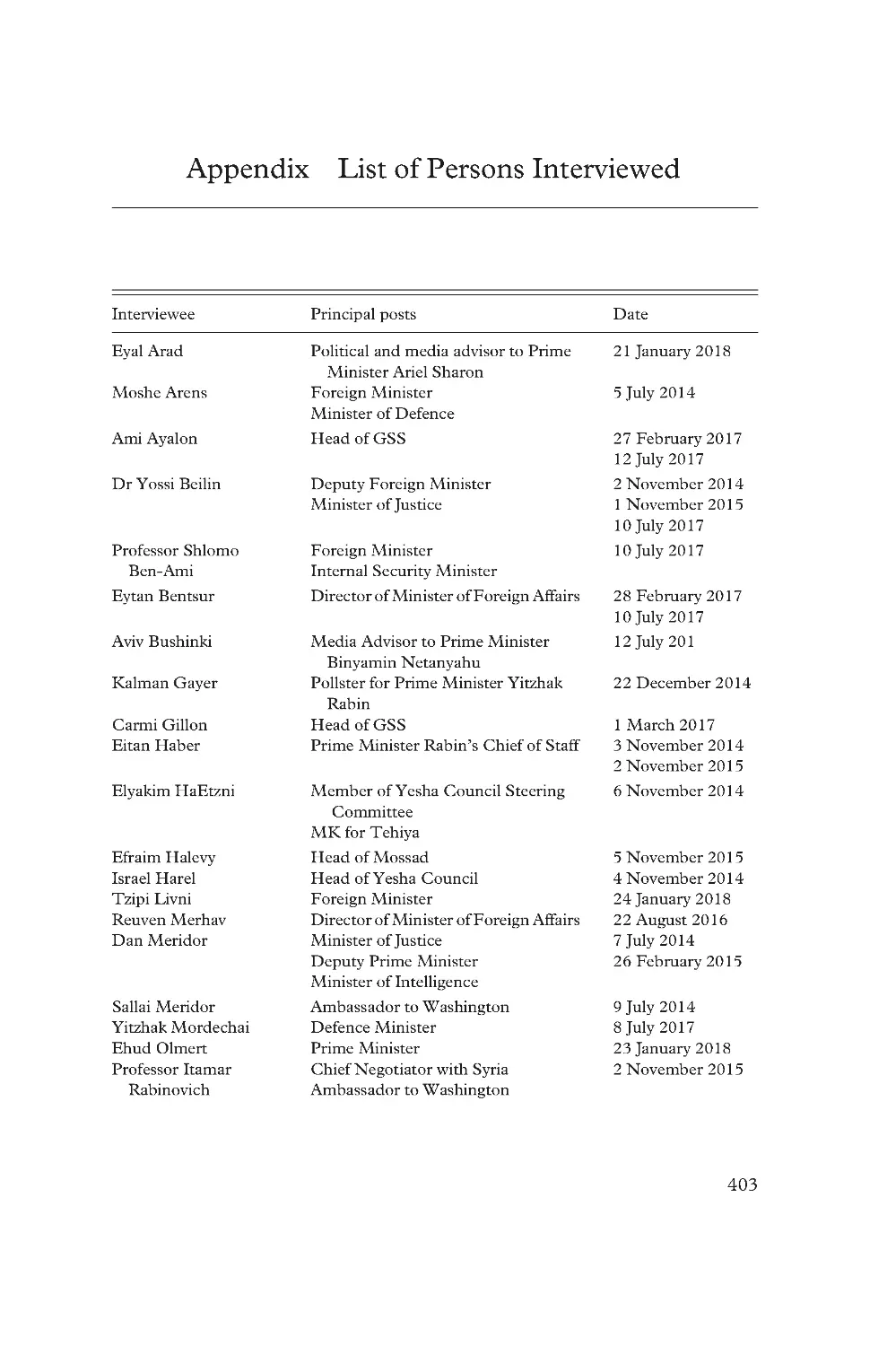






Text
                    Israeli Foreign Policy since the End of the Cold War
This is the first study of Israeli foreign policy towards the Middle East
and selected world powers including China, India, the European Union
and the United States since the end of the Cold War. It provides an
integrated account of these foreign policy spheres and serves as an
essential historical context for the domestic political scene during these
pivotal decades. The book demonstrates how foreign policy is shaped by
domestic factors, which are represented as three concentric circles of
decision-makers, the security network and Israeli national identity. Told
from this perspective, Amnon Aran highlights the contributions of the
central individuals, societal actors, domestic institutions and political
parties that have informed and shaped Israeli foreign policy decisions,
implementation and outcomes. Aran demonstrates that Israel has pur-
sued three foreign policy stances since the end of the Cold War –
entrenchment, engagement and unilateralism – and explains why.
amnon aran is Senior Lecturer in International Politics of the Middle
East at City, University of London where his main research focuses on
the Arab-Israeli conflict and the foreign policy of Middle Eastern states.
He has contributed to the EU’s Middle East Peace Task Force and he
comments on Middle Eastern affairs for the BBC, Bloomberg, Financial
Times and the Guardian.

Cambridge Middle East Studies
Editorial Board
Charles Tripp (general editor)
Julia Clancy-Smith
F. Gregory Gause
Yezid Sayigh
Avi Shlaim
Judith E. Tucker
Cambridge Middle East Studies has been established to publish books on the
nineteenth- to twenty-first-century Middle East and North Africa. The series
offers new and original interpretations of aspects of Middle Eastern societies
and their histories. To achieve disciplinary diversity, books are solicited from
authors writing in a wide range of fields including history, sociology,
anthropology, political science, and political economy. The emphasis is on
producing books affording an original approach along theoretical and empirical
lines. The series is intended for students and academics, but the more accessible
and wide-ranging studies will also appeal to the interested general reader.
A list of books in the series can be found after the index.

Israeli Foreign Policy since the
End of the Cold War
Amnon Aran
City, University of London

University Printing House, Cambridge CB2 8BS, United Kingdom
One Liberty Plaza, 20th Floor, New York, NY 10006, USA
477 Williamstown Road, Port Melbourne, VIC 3207, Australia
314–321, 3rd Floor, Plot 3, Splendor Forum, Jasola District Centre,
New Delhi – 110025, India
79 Anson Road, #06–04/06, Singapore 079906
Cambridge University Press is part of the University of Cambridge.
It furthers the University’s mission by disseminating knowledge in the pursuit of
education, learning, and research at the highest international levels of excellence.
www.cambridge.org
Information on this title: www.cambridge.org/9781107052499
DOI: 10.1017/9781107280618
© Amnon Aran 2021
This publication is in copyright. Subject to statutory exception
and to the provisions of relevant collective licensing agreements,
no reproduction of any part may take place without the written
permission of Cambridge University Press.
First published 2021
A catalogue record for this publication is available from the British Library.
ISBN 978-1-107-05249-9 Hardback
Cambridge University Press has no responsibility for the persistence or accuracy of
URLs for external or third-party internet websites referred to in this publication
and does not guarantee that any content on such websites is, or will remain,
accurate or appropriate.

To my family

Contents
List of Maps
page ix
List of Figures
x
Acknowledgements
xi
Chronology
xiii
List of Abbreviations
xx
Introduction
1
1 Entrenchment
12
2 Redirection
33
3 On the Brink of Peace?
59
4 Engagement Incomplete
87
5 Engagement under Assault
104
6 The Dividends of Engagement
124
7 Unpicking the Oslo Accords
148
8 Backtracking
169
9 Just Beyond Reach
195
10 Between Engagement and Unilateralism
215
11 In Search of a Foreign Policy Paradigm
239
12 A Perfect Storm
262
13 The Road Map for Regime Change
283
14 The Resurgence of Unilateralism
300
15 Events Dear Boy, Events
326
vii

16 The End of the Road
342
17 Vulnerable Ties
366
Epilogue
387
Appendix: List of Persons Interviewed
403
References
405
Index
419
viii
Contents

Maps
0.1 Israel and its neighbours
page xxii
0.2 Israel political map
xxiii
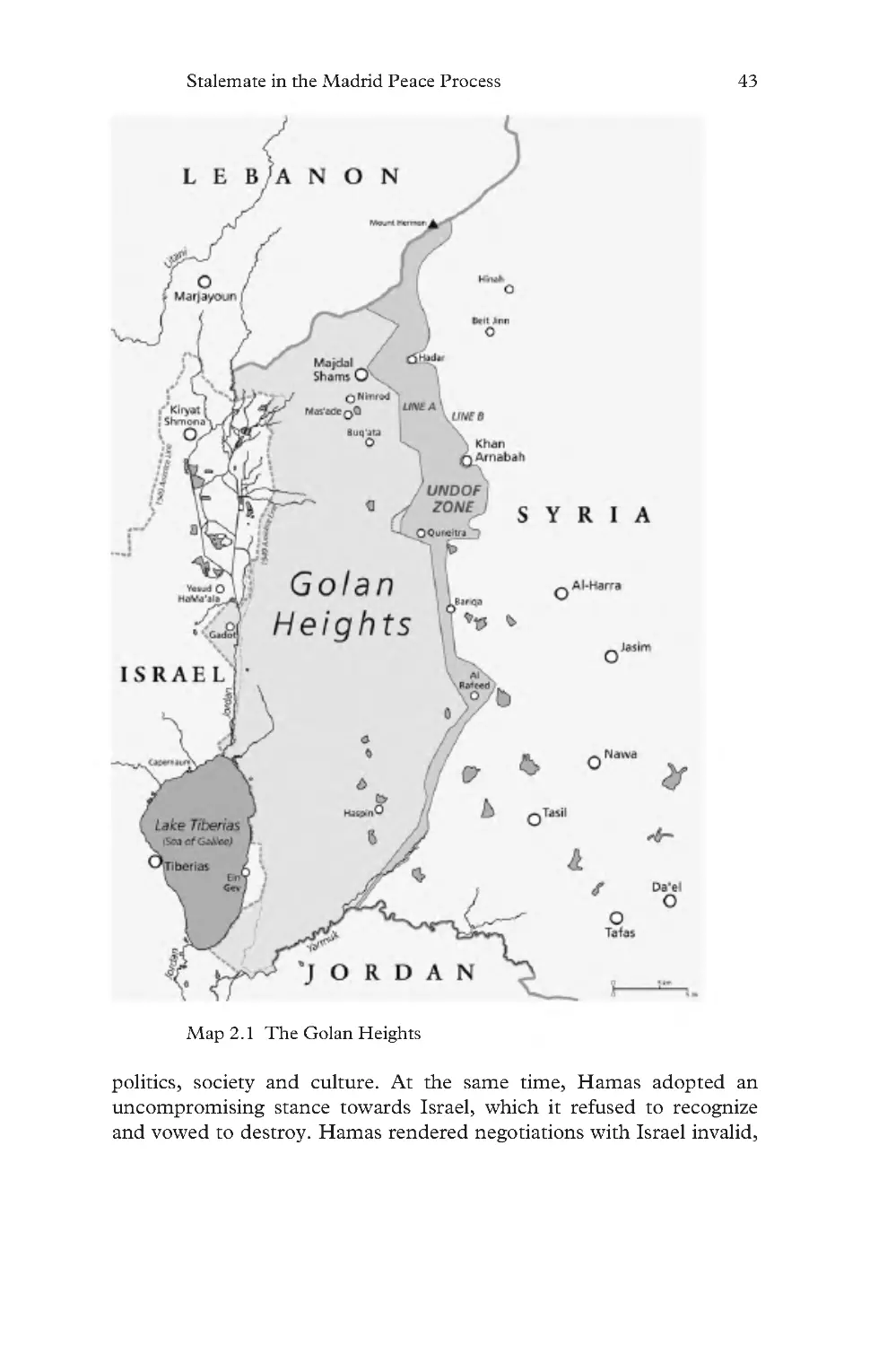
2.1 The Golan Heights
43
ix

Figures
5.1 Rubble of building and car
page 120
5.2 Prime Minister Shamir delivering a speech
121
5.3 Shimon Peres (L) Yitzhak Rabin, Hosni Mubarak, Yasser
Arafat and Warren Christopher (R)
121
5.4 Yasser Arafat and Yitzhak Rabin
122
5.5 Blown-up Egged bus
122
5.6 Caricature of Yasser Arafat
123
5.7 Yitzhak Rabin, King Hussein and President Clinton
123
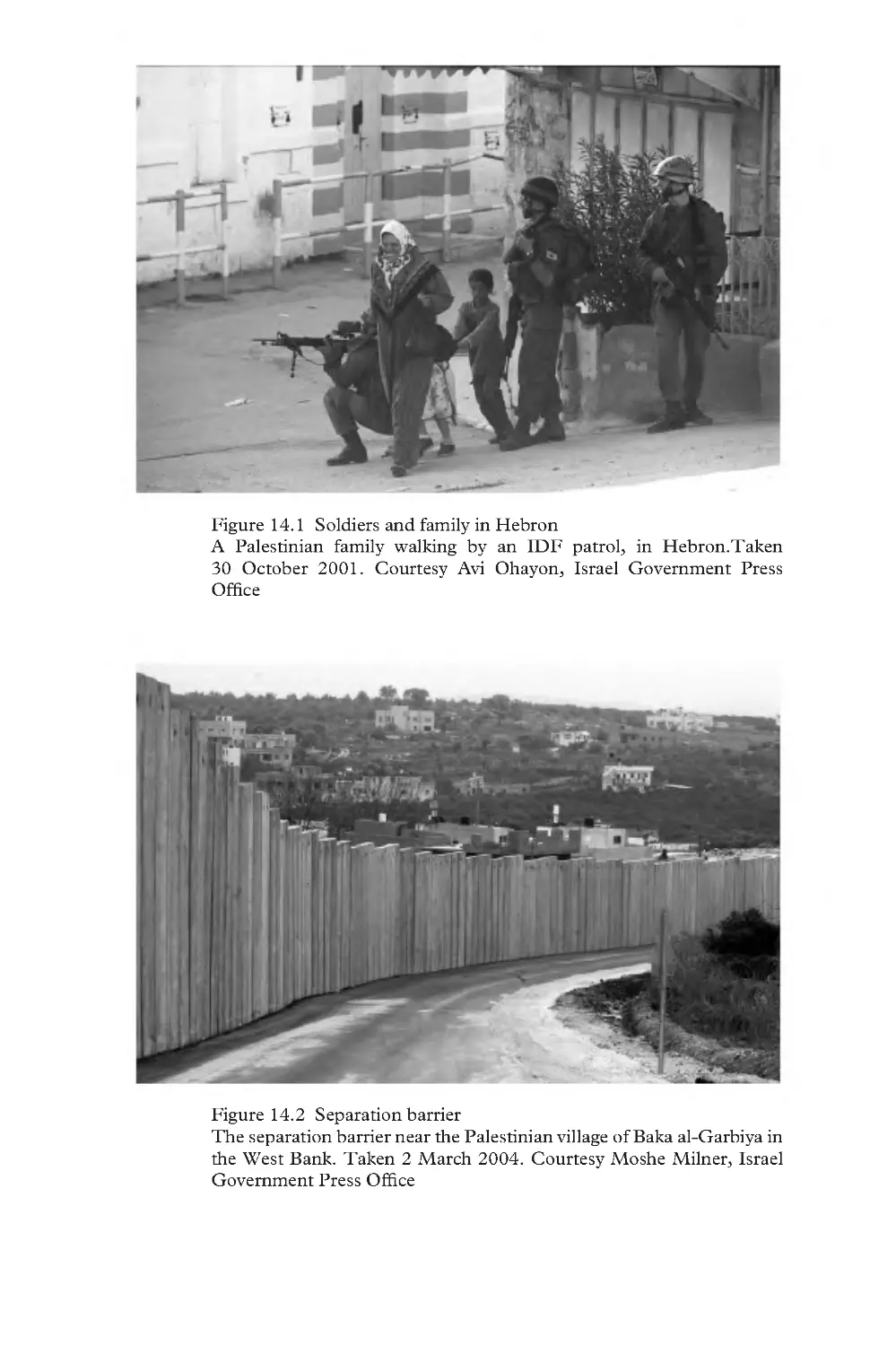
14.1 Soldiers and family in Hebron
322
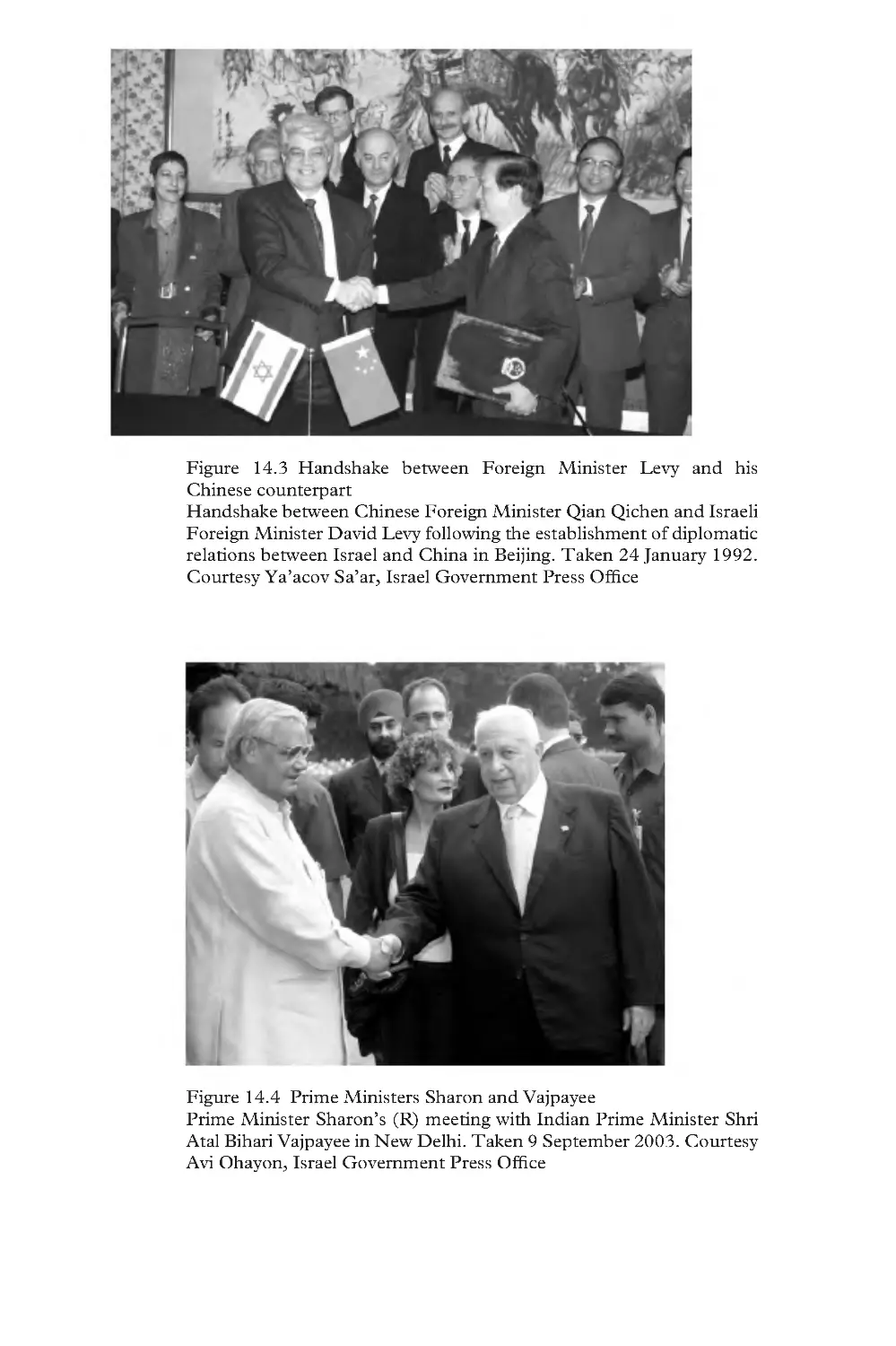
14.2 Separation barrier
322
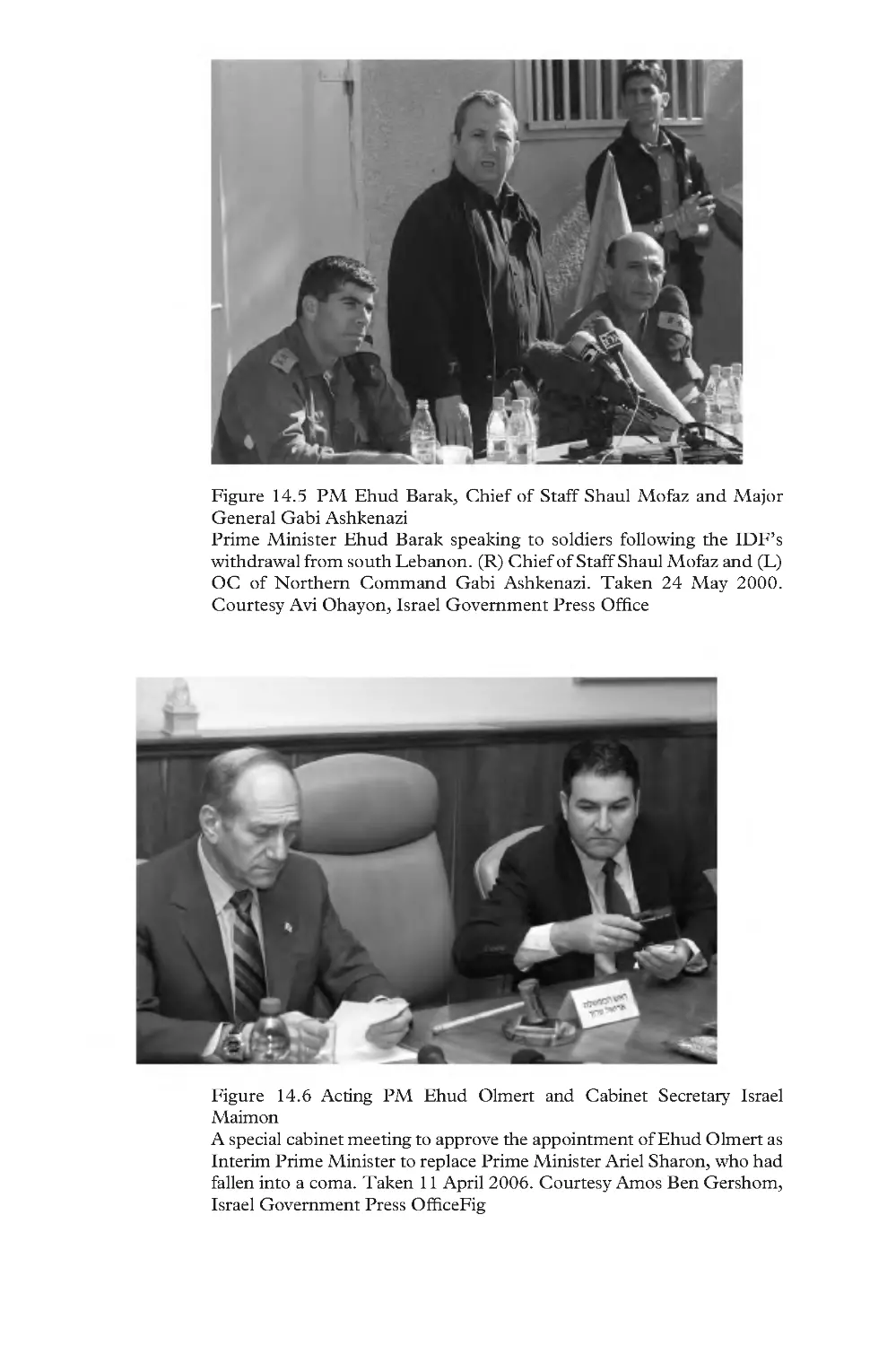
14.3 Handshake between Foreign Minister Levy and his Chinese
counterpart
323
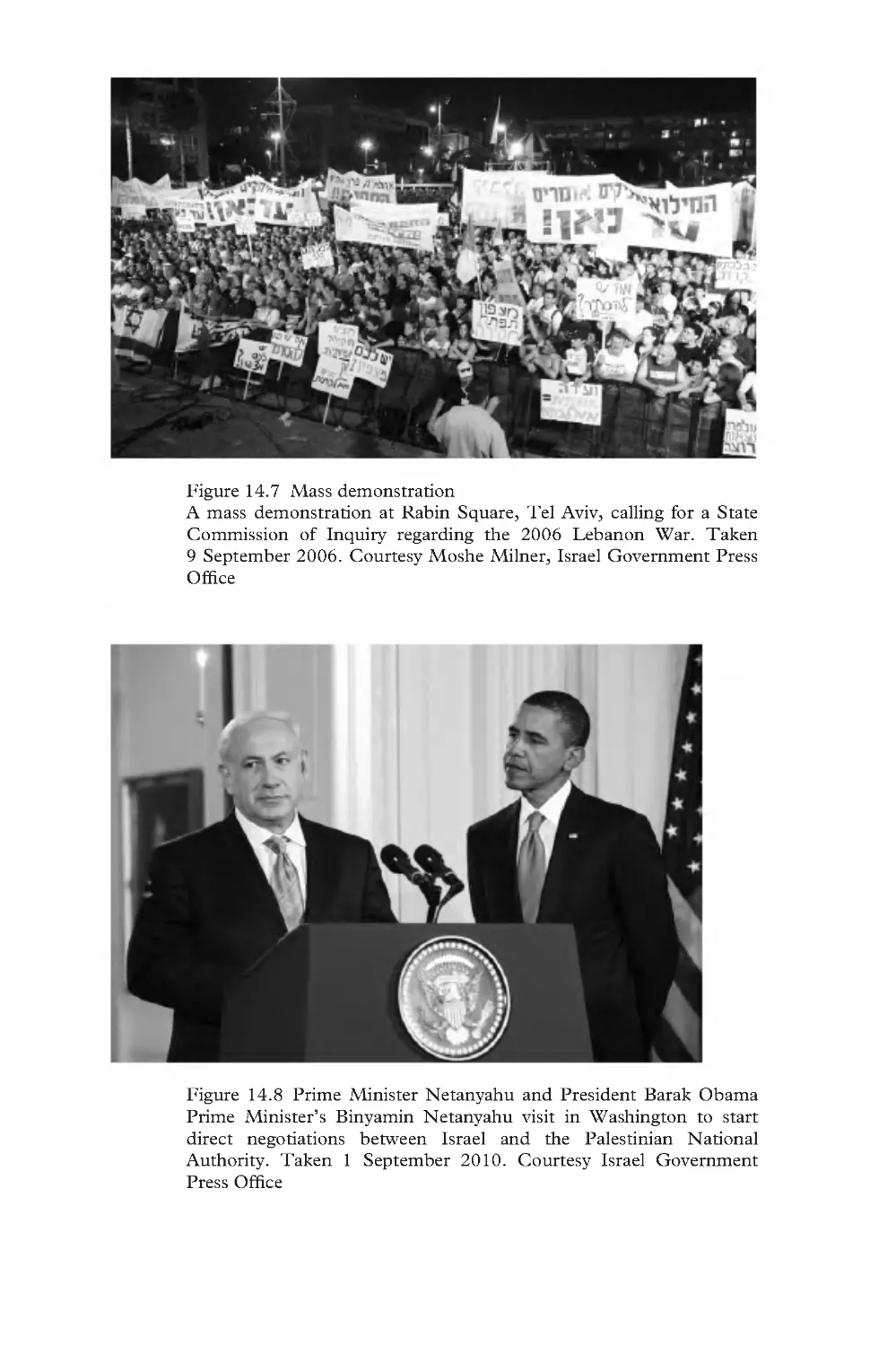
14.4 Prime Ministers Sharon and Vajpayee
323
14.5 PM Ehud Barak, Chief of Staff Shaul Mofaz and Major
General Gabi Ashkenazi
324
14.6 Acting PM Ehud Olmert and Cabinet Secretary Israel
Maimon
324
14.7 Mass demonstration
325
14.8 Prime Minister Netanyahu and President Barak Obama
325
x

Acknowledgements
I have been extremely fortunate along the journey that led to the publica-
tion of this book. My colleagues at the Department of International
Politics at City, University of London, provided me with invaluable
support. Anastasia Nesvetailova, Ronen Palan and Inderjeet Parmer,
who served as heads of department, deserve special mention, as well as
Dina Fainberg, Leonie Fleischmann, Iosif Kovras, Sandy Hager, Stefano
Pagliari and Gadi Yishayahu. I am also grateful to a number of colleagues
in other institutions including Chris Alden, Ronit Ben Dor, Klaus
Brummer, Katerina Dalacoura, Rami Ginat, Christopher Hill, Clive
Jones, Juliet Kaarbo, George Lawson, Cynthia Little, Oren Barak,
Colin Shindler, Asaf Siniver, Karen Smith and Charles Tripp. All of
them have been helpful in so many ways. My deep appreciation is
extended to my friend, Dr Moshe Fox, for his continuous support of
my research, and my interviewees, who spared the time to see me and
answer my questions. My thanks go also to the team at Cambridge
University Press, Maria Marsh, Daniel Brown and Atifa Jiwa, who were
patient, responsive, professional and attentive to detail.
I owe an immensely profound debt of gratitude and friendship to Avi
Shlaim, who has redefined and transformed our understanding of Israel’s
foreign relations with the Arab world. For the past twenty years, Avi has
been a constant source of stalwart support, inspiration and guidance. Avi
read every chapter of this book since I began writing, and met with me
over lunches at St Antony’s College, University of Oxford, to provide me
with the most extensive and insightful feedback I could have asked for.
I also would like to extend my deepest thanks to Rory Miller, a brilliant
scholar of the international relations of the Middle East. Throughout my
career, I have benefited from Rory’s resolute support, stimulating intel-
lectual engagements, friendship and guidance.
Over the years of writing this book, I have been extremely fortunate to
receive love and support from my dear family and friends: Natalie Aran,
Tom and Mog Aslan, Tony Ducket, Shai Eisen, Ezra Gabbai, Amina
Harris, Keren, Guy, Lea and Thea Gelkoff, clan Gera, Itamar, Ifat and
xi

Amit Orgad, Nechemya Orgad, Gil Rabinovich, Guy Shinar, Yoav
Shaked, Ophir, Jonathan and Abigail Salomon, Atalya (Kipi) and Kobi
Wolf. Having reached the end of writing this book, I cannot but express
my heartfelt feelings and love to my parents, Shai and Michael Aran, who,
through thick and thin, were always there for me. To my wife, Shani
Orgad, thank you for all your care, love and support. You are everything
I have ever wished for from a partner to life, the ultimate companion with
whom I have been blessed to be singing our own ‘songs in the key of life’.
Last, but by no means least, my sons, the Aran brothers, Yoav and Assaf.
Every day you fill my life with love, light, meaning and joy. All the above
deserve my deepest thanks and gratitude.
For any shortcomings the book might have, I alone am responsible.
xii
Acknowledgements

Chronology
1990
11 – June Yitzhak Shamir forms a government.
2 – August Iraqi Invasion of Kuwait.
1991
17 – January to 28 February The Gulf War.
25 – December Dissolution of the USSR.
1992
24 – January Israel and China establish diplomatic relations.
29 – January Israel and India establish diplomatic relations.
23 – June Labour defeats Likud in national election.
13 – July Yitzhak Rabin becomes prime minister.
16 – December Israeli deportation of 415 Hamas activists.
1993
19 – January Knesset repeals ban on contact with the PLO.
25 – July Israel launches Operation Accountability.
4 – August Assad rejects the Rabin ‘deposit’.
29 – August Israeli cabinet approves the DoP.
10 – September Israel and the PLO exchange formal letters of
recognition.
13 – September Israel-PLO DoP signed in Washington, DC.
10–17
–
October first state visit to China by an Israeli prime
minister, by Yitzhak Rabin.
1994
25 – February Massacre of Palestinians at Tomb of the Patriarchs
in Hebron.
6 – April Hamas’s first suicide attack kills eight people in Afula.
4 – May Israel and the PLO reach agreement in Cairo on limited
Palestinian autonomy and establishment of the Palestinian
Authority (Oslo I).
1 – July Yasser Arafat enters the Gaza Strip.
xiii

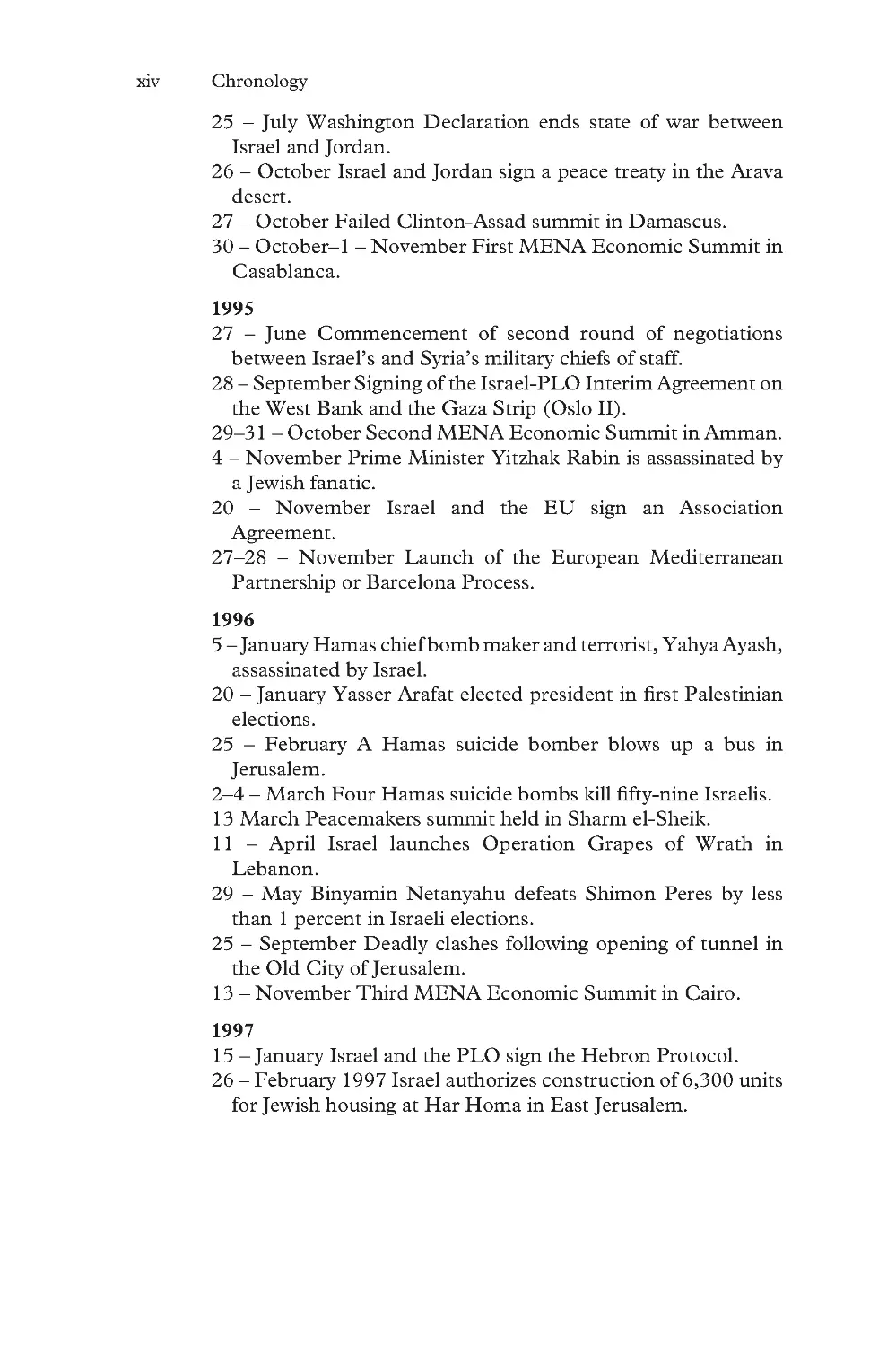
25 – July Washington Declaration ends state of war between
Israel and Jordan.
26 – October Israel and Jordan sign a peace treaty in the Arava
desert.
27 – October Failed Clinton-Assad summit in Damascus.
30 – October–1
–
November First MENA Economic Summit in
Casablanca.
1995
27 – June Commencement of second round of negotiations
between Israel’s and Syria’s military chiefs of staff.
28 – September Signing of the Israel-PLO Interim Agreement on
the West Bank and the Gaza Strip (Oslo II).
29–31 – October Second MENA Economic Summit in Amman.
4 – November Prime Minister Yitzhak Rabin is assassinated by
a Jewish fanatic.
20 – November Israel and the EU sign an Association
Agreement.
27–28 – November Launch of the European Mediterranean
Partnership or Barcelona Process.
1996
5 – January Hamas chief bomb maker and terrorist, Yahya Ayash,
assassinated by Israel.
20 – January Yasser Arafat elected president in first Palestinian
elections.
25 – February A Hamas suicide bomber blows up a bus in
Jerusalem.
2–4
–
March Four Hamas suicide bombs kill fifty-nine Israelis.
13 March Peacemakers summit held in Sharm el-Sheik.
11 – AprilIsraellaunchesOperation Grapes of Wrath in
Lebanon.
29 – May Binyamin Netanyahu defeats Shimon Peres by less
than 1 percent in Israeli elections.
25 – September Deadly clashes following opening of tunnel in
the Old City of Jerusalem.
13 – November Third MENA Economic Summit in Cairo.
1997
15 – January Israel and the PLO sign the Hebron Protocol.
26 – February 1997 Israel authorizes construction of 6,300 units
for Jewish housing at Har Homa in East Jerusalem.
xiv
Chronology

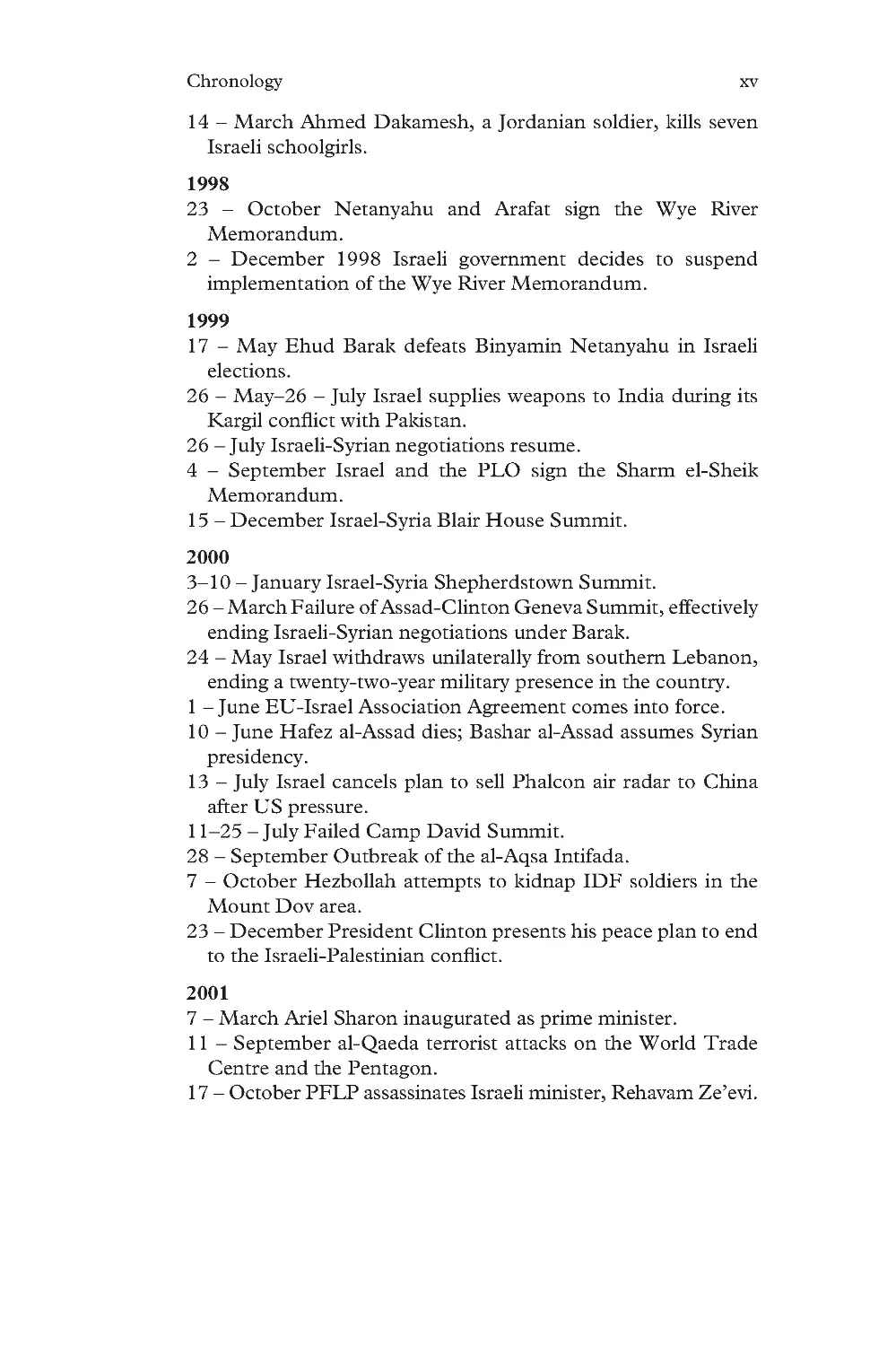
14 – March Ahmed Dakamesh, a Jordanian soldier, kills seven
Israeli schoolgirls.
1998
23 – October Netanyahu and Arafat sign the Wye River
Memorandum.
2 – December 1998 Israeli government decides to suspend
implementation of the Wye River Memorandum.
1999
17 – May Ehud Barak defeats Binyamin Netanyahu in Israeli
elections.
26 – May–26 – July Israel supplies weapons to India during its
Kargil conflict with Pakistan.
26 – July Israeli-Syrian negotiations resume.
4 – September Israel and the PLO sign the Sharm el-Sheik
Memorandum.
15 – December Israel-Syria Blair House Summit.
2000
3–10 – January Israel-Syria Shepherdstown Summit.
26 – March Failure of Assad-Clinton Geneva Summit, effectively
ending Israeli-Syrian negotiations under Barak.
24 – May Israel withdraws unilaterally from southern Lebanon,
ending a twenty-two-year military presence in the country.
1 – June EU-Israel Association Agreement comes into force.
10 – June Hafez al-Assad dies; Bashar al-Assad assumes Syrian
presidency.
13 – July Israel cancels plan to sell Phalcon air radar to China
after US pressure.
11–25 – July Failed Camp David Summit.
28 – September Outbreak of the al-Aqsa Intifada.
7 – October Hezbollah attempts to kidnap IDF soldiers in the
Mount Dov area.
23 – December President Clinton presents his peace plan to end
to the Israeli-Palestinian conflict.
2001
7 – March Ariel Sharon inaugurated as prime minister.
11 – September al-Qaeda terrorist attacks on the World Trade
Centre and the Pentagon.
17 – October PFLP assassinates Israeli minister, Rehavam Ze’evi.
Chronology
xv

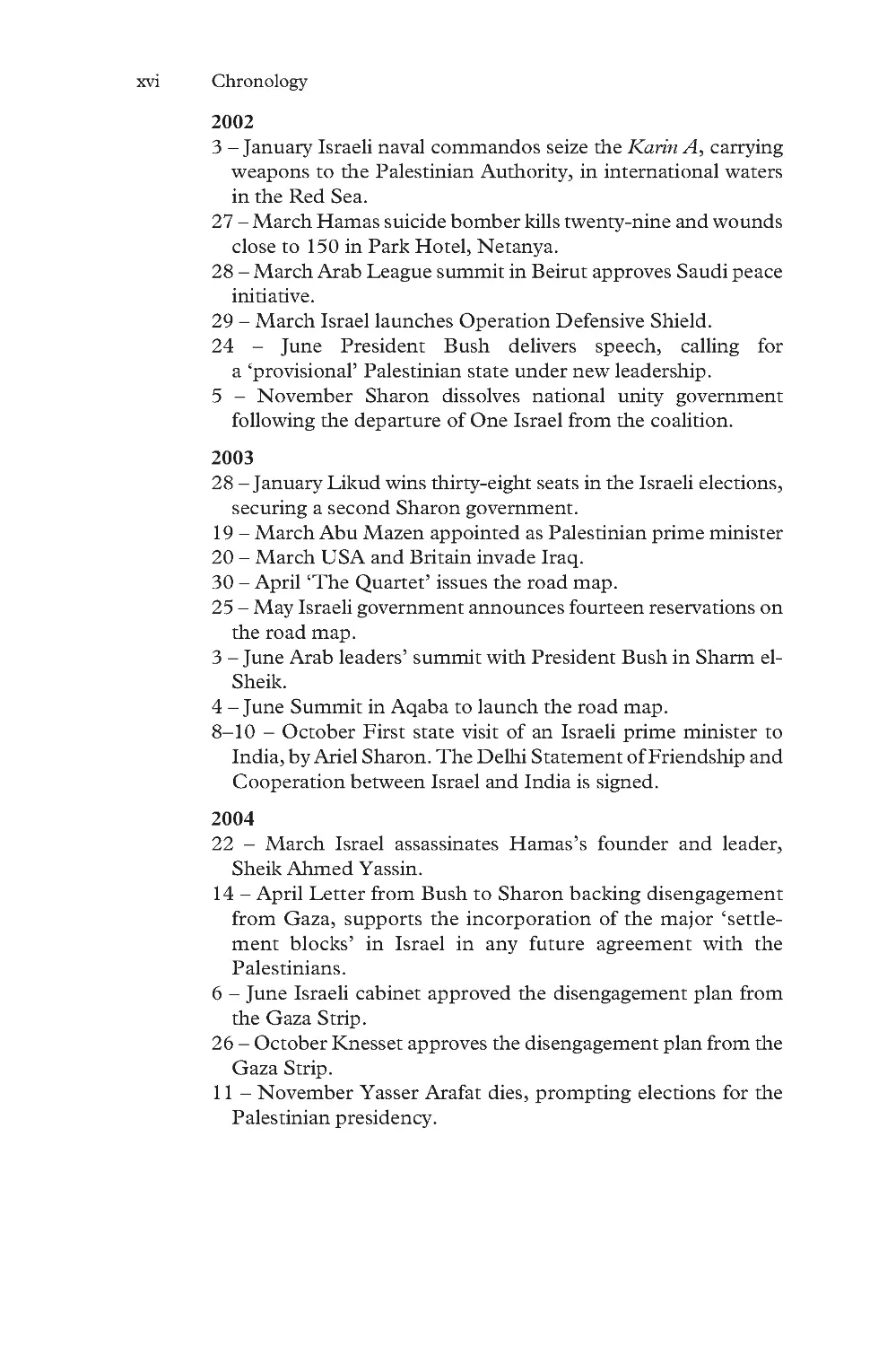
2002
3 – January Israeli naval commandos seize the Karin A, carrying
weapons to the Palestinian Authority, in international waters
in the Red Sea.
27 – March Hamas suicide bomber kills twenty-nine and wounds
close to 150 in Park Hotel, Netanya.
28 – March Arab League summit in Beirut approves Saudi peace
initiative.
29 – March Israel launches Operation Defensive Shield.
24 – June President Bush delivers speech, calling for
a ‘provisional’ Palestinian state under new leadership.
5 – November Sharon dissolves national unity government
following the departure of One Israel from the coalition.
2003
28 – January Likud wins thirty-eight seats in the Israeli elections,
securing a second Sharon government.
19 – March Abu Mazen appointed as Palestinian prime minister
20 – March USA and Britain invade Iraq.
30 – April ‘The Quartet’ issues the road map.
25 – May Israeli government announces fourteen reservations on
the road map.
3 – June Arab leaders’ summit with President Bush in Sharm el-
Sheik.
4 – June Summit in Aqaba to launch the road map.
8–10 – October First state visit of an Israeli prime minister to
India, by Ariel Sharon. The Delhi Statement of Friendship and
Cooperation between Israel and India is signed.
2004
22 – March Israel assassinates Hamas’s founder and leader,
Sheik Ahmed Yassin.
14 – April Letter from Bush to Sharon backing disengagement
from Gaza, supports the incorporation of the major ‘settle-
ment blocks’ in Israel in any future agreement with the
Palestinians.
6 – June Israeli cabinet approved the disengagement plan from
the Gaza Strip.
26 – October Knesset approves the disengagement plan from the
Gaza Strip.
11 – November Yasser Arafat dies, prompting elections for the
Palestinian presidency.
xvi
Chronology

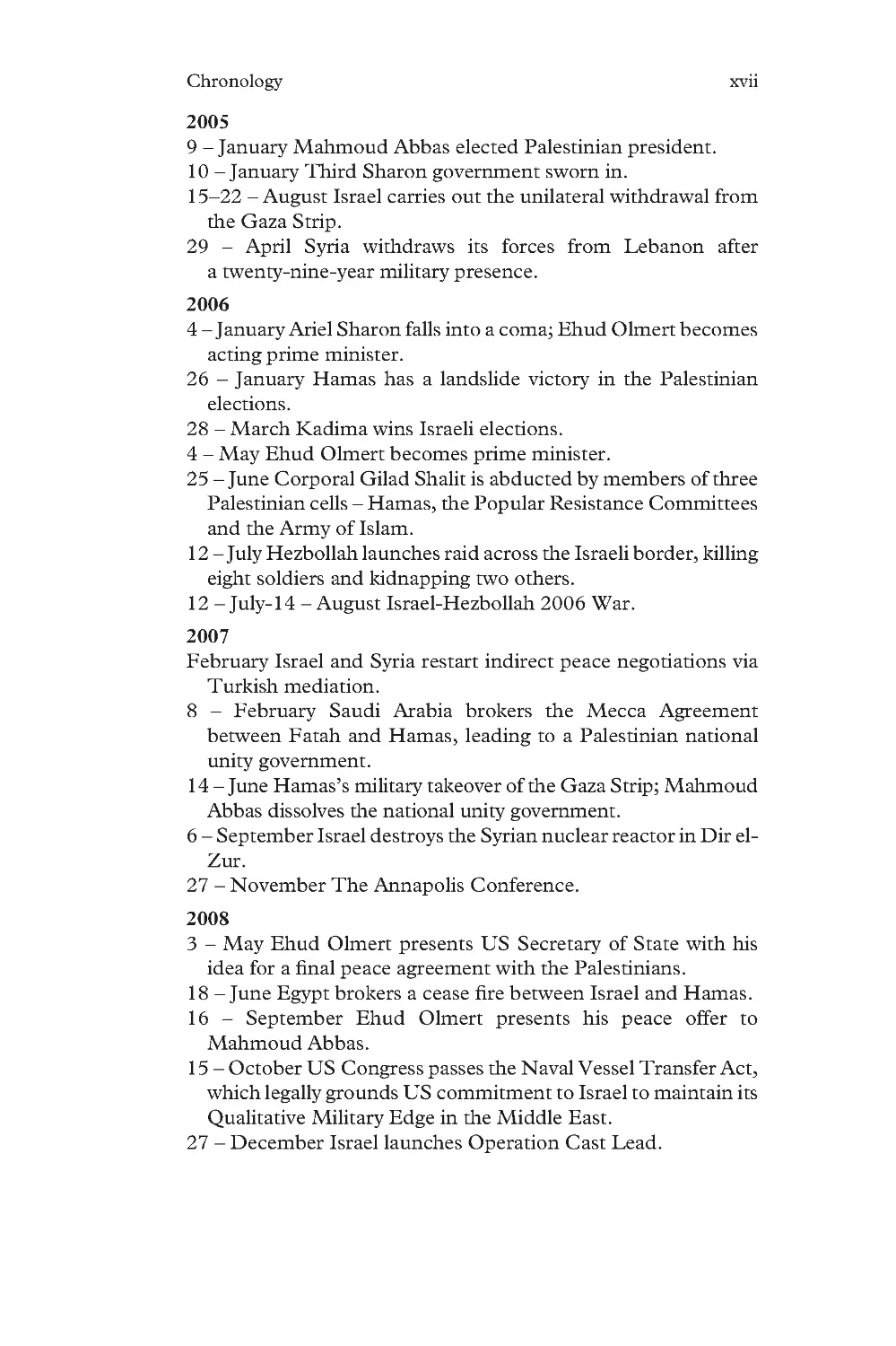
2005
9 – January Mahmoud Abbas elected Palestinian president.
10 – January Third Sharon government sworn in.
15–22
–
August Israel carries out the unilateral withdrawal from
the Gaza Strip.
29 – April Syria withdraws its forces from Lebanon after
a twenty-nine-year military presence.
2006
4 – January Ariel Sharon falls into a coma; Ehud Olmert becomes
acting prime minister.
26 – January Hamas has a landslide victory in the Palestinian
elections.
28 – March Kadima wins Israeli elections.
4 – May Ehud Olmert becomes prime minister.
25 – June Corporal Gilad Shalit is abducted by members of three
Palestinian cells – Hamas, the Popular Resistance Committees
and the Army of Islam.
12 – July Hezbollah launches raid across the Israeli border, killing
eight soldiers and kidnapping two others.
12 – July-14
–
August Israel-Hezbollah 2006 War.
2007
February Israel and Syria restart indirect peace negotiations via
Turkish mediation.
8 – February Saudi Arabia brokers the Mecca Agreement
between Fatah and Hamas, leading to a Palestinian national
unity government.
14 – June Hamas’s military takeover of the Gaza Strip; Mahmoud
Abbas dissolves the national unity government.
6 – September Israel destroys the Syrian nuclear reactor in Dir el-
Zur.
27 – November The Annapolis Conference.
2008
3 – May Ehud Olmert presents US Secretary of State with his
idea for a final peace agreement with the Palestinians.
18 – June Egypt brokers a cease fire between Israel and Hamas.
16 – September Ehud Olmert presents his peace offer to
Mahmoud Abbas.
15 – October US Congress passes the Naval Vessel Transfer Act,
which legally grounds US commitment to Israel to maintain its
Qualitative Military Edge in the Middle East.
27 – December Israel launches Operation Cast Lead.
Chronology
xvii

2009
31 – March Binyamin Netanyahu sworn in as prime minister
for second time.
14 – June Netanyahu concedes the need for a Palestinian state in
his Bar-Ilan speech.
25 – November Israeli security cabinet approves partial ten-
month settlement freeze.
2010
17 – December Arab uprisings erupt.
2011
11 – February Egyptian president, Hosni Mubarak, ousted.
2012
14 – November Israel launches Operation Pillar of Defence.
2013
22 – January Likud wins Israeli elections.
18 – March Netanyahu becomes prime minister for the third
time.
2014
7 – July–26 – August Israel-Hamas war or Operation Protective
Edge.
2015
14 – May Netanyahu becomes prime minister for the fourth time.
14 – July Iran nuclear deal signed between the Islamic Republic
of Iran, five members of the UN Security Council plus
Germany and the EU.
2016
13 – September The USA finalizes a $38 billion package over ten
years, of military aid to Israel.
21 – February US Secretary of State, John Kerry, presents his
peace plan to Binyamin Netanya in Aqaba, Jordan; Netanyahu
rejects the proposal.
2017
6 – December President Trump recognizes Jerusalem as Israel’s
capital and orders the US Embassy to move there.
2018
8 – May USA withdraws from the Iran nuclear deal.
xviii
Chronology

2019
19 – July Israel passes nationhood basic law.
2020
28 – January US President Donald Trump launches ‘Deal of the
Century Peace Plan’.
Chronology
xix

Abbreviations
AIPAC
American Israeli Public Affairs Committee
API
Arab Peace Initiative
BJP
Bharatiya Janata Party
CIA
Central Intelligence Agency
CNPC
China National Petroleum Corporation
DIC
Disseminated Intravascular Coagulation
DoP
Declaration of Principles
EEC
European Economic Community
EESP
Economic Emergency Stability Plan
EMP
European Mediterranean Partnership
ENP
European Neighbourhood Policy
EU
European Union
FAPS
Framework Agreement on Permanent Status
FTA
Free Trade Agreement
GCC
Gulf Cooperation Council
GSS
General Security Service
GWoT
Global War on Terror
IAEA
International Atomic Energy Association
IAF
Israeli Air Force
MENA
Middle East and North Africa
MFA
Ministry of Foreign Affairs
MIT
Massachusetts Institute of Technology
MK
Member of Knesset
MSM
Million Cubic Metres
NATO
North Atlantic Treaty Organization
NPT
Non-Proliferation (of Nuclear Weapons) Treaty
NSC
National Security Council
OECD
Organization for Economic Cooperation and
Development
PA
Palestinian Authority
PFLP
Popular Front for the Liberation of Palestine
PIJ
Palestinian Islamic Jihad
xx

PKK
Kurdistan Workers’ Party
PLO
Palestinian Liberation Organization
PRC
People’s Republic of China
QME
Qualitative Military Edge
SLA
South Lebanese Army
UK
United Kingdom
UN
United Nations
UNIFIL
United Nations Interim Force in Lebanon
UNSC
United Nations Security Council
UNSCOM United Nations Special Commission
UNSCR
United Nations Security Council Resolution
USA
United States of America
WWI
World War I
WWII
World War II
List of Abbreviations
xxi

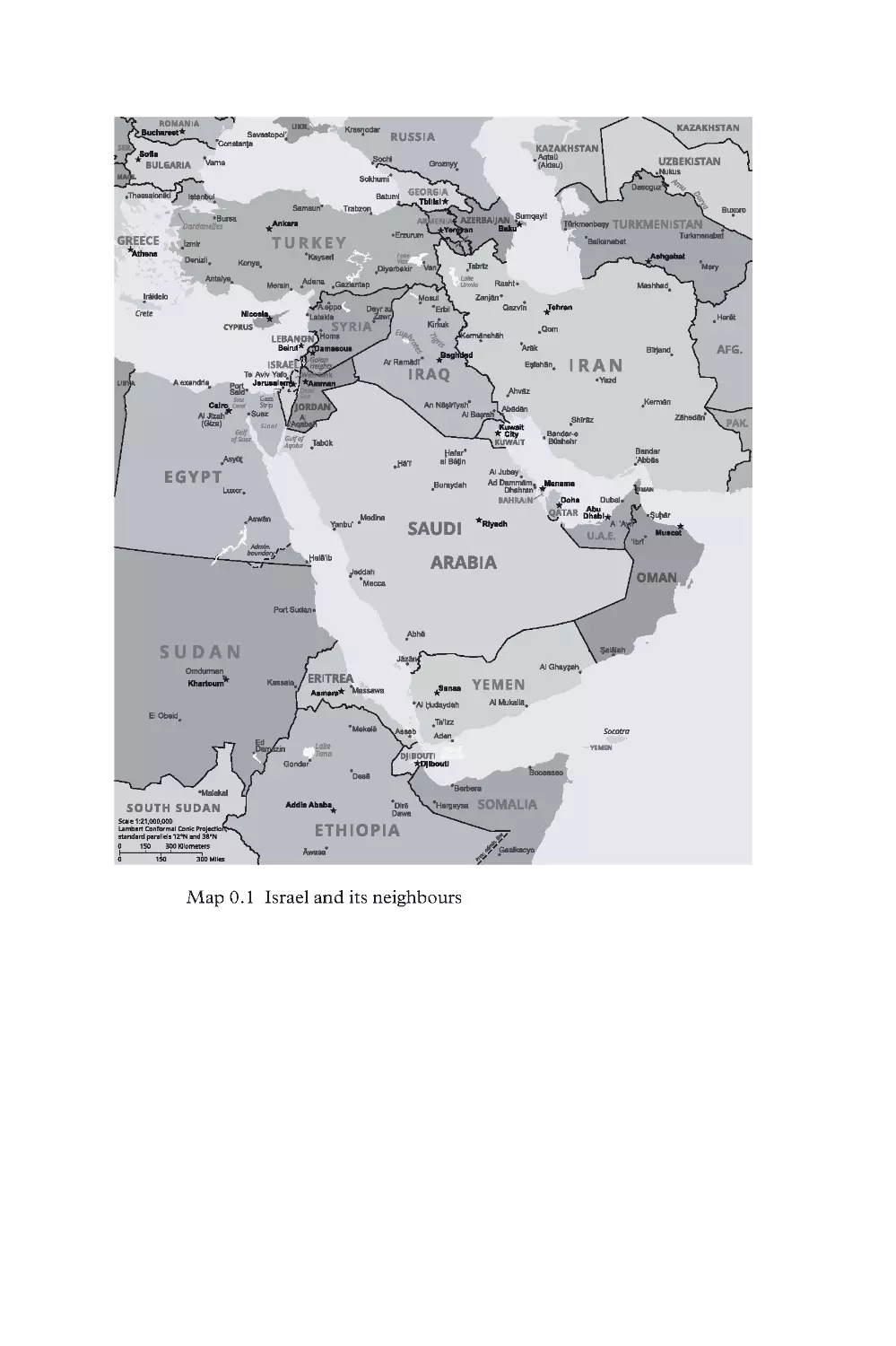
Map 0.1 Israel and its neighbours

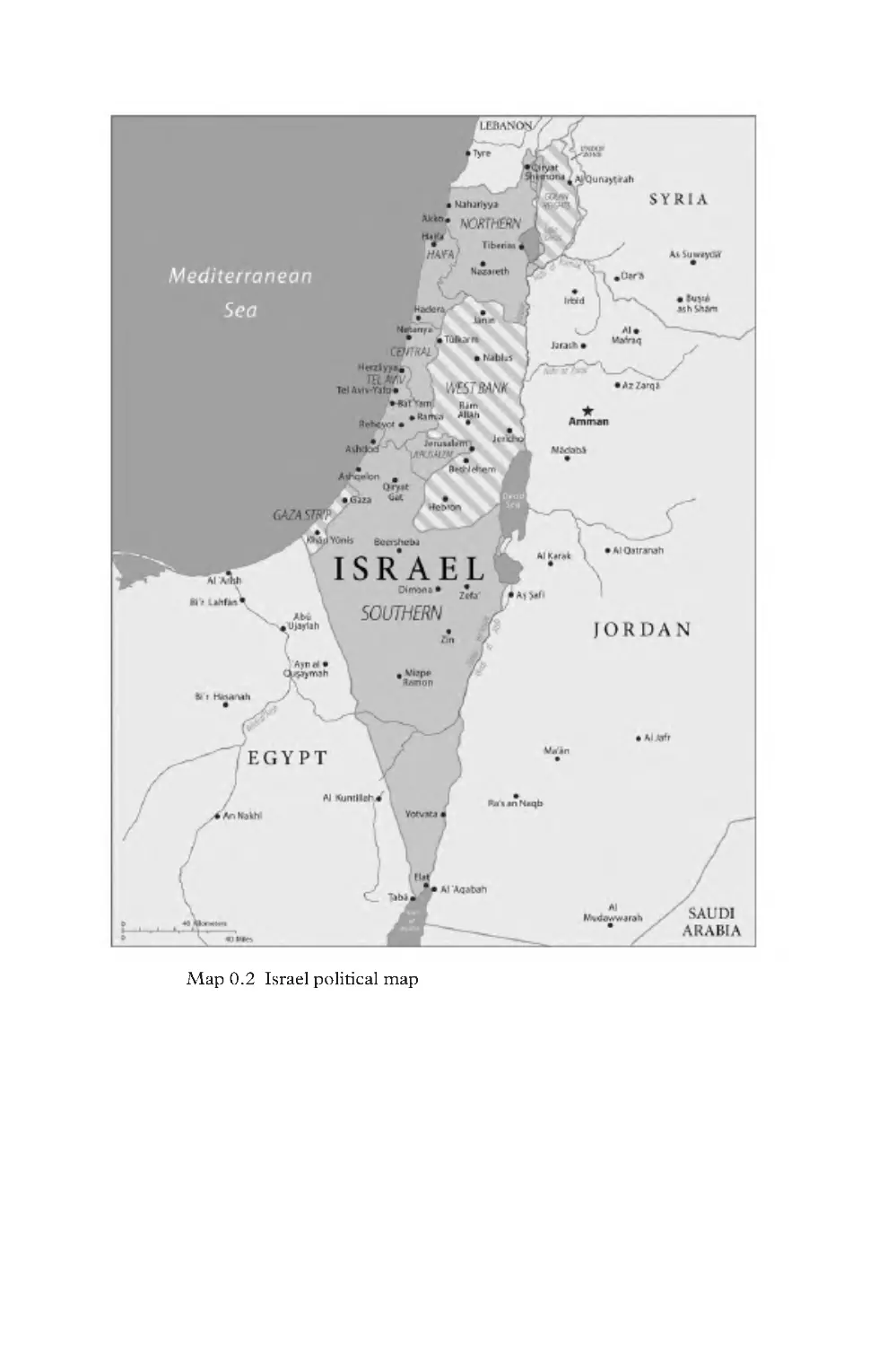
Map 0.2 Israel political map

Introduction
The end of the Cold War ushered in a new period in Israeli foreign policy,
situating it in an unprecedentedly strong strategic position. The collapse
of the Soviet Union, which had supported Israel’s Arab foes, ended the
bipolar world order and established the United States, Israel’s closest ally,
as the world’s sole superpower. Shortly, thereafter, in the 1990–1 Gulf
War, a US-led coalition expelled Iraqi forces from Kuwait, exposed deep
divisions within the Arab world and weakened the Palestinian Liberation
Organization (PLO), which supported Iraqi president Saddam Hussein
during the conflict. These dramatic international shifts were coupled with
changes within Israel. The successful restructuring of the Israeli economy
via the 1985 Economic Emergency Stability Plan (EESP) and arrival of
close to a million immigrants from the former USSR greatly increased
Israel’s state capacity to seize the opportunities and tackle the challenges
generated by the end of the Cold War.
This book accounts for Israeli foreign policy since the end of the Cold
War by proposing a new argument, namely, that it revolved around three
foreign policy stances: entrenchment, engagement and unilateralism. As
the Cold War drew to a close, Israeli foreign policymakers were deeply
divided about which of these foreign policies to pursue. Prime Ministers
Binyamin Netanyahu and Yitzhak Shamir, leaders of Likud, Israel’s
largest centre-right party, opted for retaining what I describe as Israel’s
foreign policy of entrenchment. This foreign policy position hinged on
basing Israel’s regional foreign policy on its iron wall of military might
rather than on diplomacy and making peace with the Arab world in
exchange for peace not territory. The Palestinians residing in the West
Bank and Gaza Strip, which Israel had captured during the 1967 Arab-
Israeli war, would be granted limited autonomy, but remain under Israeli
military occupation.
Prime Ministers Yitzhak Rabin and Shimon Peres, the leaders of the
Labour party, Israel’s largest centre-left party at the time, favoured
a different foreign policy stance. Both were more optimistic than
Shamir about the opportunities presented by the end of the Cold War,
1

but were more pessimistic about the prospects of prolonged occupation of
the West Bank and the Gaza Strip. Rabin and Peres pursued what I term
Israel’s foreign policy of engagement. This involved making peace with
the Arab world in exchange for returning territories that Israel had occu-
pied in the 1967 Arab-Israeli war, putting a premium on diplomacy rather
than on military force when engaging with the Middle East and down-
scaling the Israeli occupation.
The limits to entrenchment and engagement became clear within the
decade after the end of the Cold War, giving rise to what I call Israel’s
foreign policy of unilateralism. It will be seen that unilateralism was
associated mostly with prime Ministers Ehud Barak, Ariel Sharon and,
to a lesser extent, Ehud Olmert. It was based on the recognition that
downscaling the occupation was in Israel’s national interest, but not via
an agreement with an Arab counterpart, once Israeli foreign policymakers
deemed it unachievable. Instead, Israel would negotiate its unilateral
territorial withdrawal to recognized borders with the international com-
munity. Since the withdrawals were carried out without mutually binding
agreements, Israel would manage the consequences of unilateralism by
deploying military, diplomatic and economic foreign policy tools.
Thus, unilateralism, like engagement, embodied an understanding that
was shared by five of the seven Israeli prime ministers since the end of the
Cold War. Although Yitzhak Rabin, Shimon Peres, Ehud Barak, Ariel
Sharon and Ehud Olmert were of different political persuasions, they all
concluded that occupation of the Gaza Strip and the whole of the West
Bank was not in Israel’s interest. During their periods of office, to lesser or
greater degrees, all sought to change the territorial status quo that had
emerged following the 1967 Arab-Israeli war and Israel’s 1982 invasion of
Lebanon. In contrast, Yitzhak Shamir and Binyamin Netanyahu, during
their premierships, opposed engagement, citing ideological and security
reasons and had no faith in unilateral foreign policy moves. Why did
Israel’s prime ministers choose to pursue these particular foreign policy
stances? What explained their respective foreign policy records? These
vital questions are explored by this book.
Israel’s foreign policy towards its most immediate and acute foreign
policy arena, the Middle East, was linked inextricably to its wider foreign
policy. The end of the Cold War presented Israel with some fundamental
questions concerning its relations with the USA. The strategic alliance
between the two states was forged during the Cold War as the USA
identified Israel as a bulwark against Communism. Could the alliance
survive the collapse of the USSR? Israel also faced serious dilemmas over
its relations with the European Economic Community (EEC), harbinger
of the European Union (EU), which, towards the end of the Cold War,
2
Introduction

backed the Palestinian struggle for an independent state more vocally and
explicitly than in the past. Could Israel’s ties with the EEC, its largest
trading partner, endure amid the deepening rift?
Shifting the spotlight to the east, Israeli foreign policymakers had other
matters to consider. Russia, which emerged as a weak state following the
collapse of the USSR, was constrained in its ability to exert influence
externally; it took the best part of ten years for it to rebuild itself amid US
international domination. Meanwhile, China and India became rising
powers. These countries, which are the world’s most populous, have
space programmes and nuclear weapons and rapidly developing econ-
omies, had refused to normalize relations with Israel during the Cold
War. In fact, China and India were strongly supportive of the Arab states
and especially the Palestinians. China was the first non-Arab country to
recognize the PLO in 1965, while India likened the Palestinian struggle
against Israel to its own anti-colonial path to independence from Britain.
Did the end of the Cold War create an opportunity for Israel to normalize
relations with these erstwhile hostile states? These intriguing questions
are explored in Chapters 6 and 17, which draw links between Israel’s
foreign policy towards the Middle East, established powers, such as the
EU and the USA, and rising powers, namely, China and India. These
chapters are designed to place Israel’s policy in the Middle East in a global
context rather than to provide a comprehensive account of Israel’s rela-
tions with these established and emerging powers.
Israeli foreign policy since the end of the Cold War is hardly a neglected
topic. As the Cold War drew to a close a group called the Israeli revision-
ist, or ‘new’ historians, Avi Shlaim, Benny Morris, Ilan Pappe and Simha
Flapan, closely scrutinized the standard Zionist version of the Arab-
Israeli conflict. Avi Shlaim’s monumental study, The Iron Wall: Israel
and the Arab World and Benny Morris’s own history of the conflict from
1881 to 2001, entitled Righteous Victims, remain the most enduring
contributions of the new historians.
1
These ground-breaking studies
challenged the claim that the fundamental cause of the Arab-Israeli
conflict since 1948, including during the post-Cold War period, was the
Arabs’ rejection of Israel’s legitimacy to exist and Arab diplomatic
intransigence. Although Benny Morris changed his political views in the
wake of the Palestinian al-Aqsa intifada, laying the blame at the door of
the Palestinians, the impact of the new historians is irreversible. The
Zionist and pro-Zionist historiography’s portrayal of Israel as a country
1
Avi Shlaim, The Iron Wall: Israel and the Arab World (London: Penguin, 2000); Avi Shlaim,
The Iron Wall: Israel and the Arab World (London: Penguin, 2014, 2nd ed.); Benny Morris,
Righteous Victims: A History of the Zionist-Arab Conflict 1881–2001 (New York: Vintage
Books, 2001).
Introduction
3

that goes to war only when there is no other choice has been shattered
beyond repair.
In addition to the literature generated by Israeli foreign policy towards
the Arab world, students have benefitted from excellent studies on Israel’s
bilateral relations with, inter alia, Iran, the USA, the EU, India and
China, in addition to the several excellent scholarly accounts of particular
episodes in Israeli foreign policy.
2
However, the extremely rich studies of
Israeli foreign policy towards various arenas – the Middle East, the EU,
the USA and Asia – are usually kept in separate compartments.
I have tried in this book to provide a more integrated narrative by
placing Israel’s foreign policy towards the Middle East in the context of
its relations with the EU, USA, China and India. The structure of the
book reflects the relative weight of each foreign policy arena. For example,
US-Israeli relations attract more attention because they are more signifi-
cant to Israeli foreign policy than any of the other bilateral relations.
Similarly, Israel’s most fateful foreign policy decisions – concerning war
and peace – are taken in relation not to the EU, China or India, but to the
Middle East, which dominates this book. However, in a departure from
current debate, I place Israel’s Middle Eastern foreign policy within the
wider context of its relations beyond the region. The story I present
examines how, when and why Israel’s distinct approaches – entrenchment
engagement, and unilateralism – to the Middle East, intersect with its
foreign policy further afield, but also how each foreign policy trajectory
evolved separately.
The Domestic Sources of Israeli Foreign Policy
The story of Israeli foreign policy since the end of the Cold War is told
here from the perspective of how domestic factors shape foreign policy.
3
The emphasis on the domestic arena does not imply that the external
environment is less important – Israel’s regional environment is compel-
ling and its ties with external powers, above all the USA, are crucial.
Rather, the focus on the internal environment is informed by the assump-
tion that the effects produced by the regional and broader international
external environments depend on how they are filtered, understood and
interpreted by the domestic actors, which then shaped Israeli foreign
policy towards a range of issues, in significant ways. However, my
2
The literature on these bilateral relations is reviewed extensively throughout the book.
3
Explaining foreign policy in terms of its domestic sources is a well-established approach in
foreign policy analysis, which I and others have developed elsewhere. See Chris Alden and
Amnon Aran, Foreign Policy Analysis: New Approaches (London: Routledge, 2016);
Christopher Hill, Foreign Policy in the 21st Century (London: Palgrave, 2016).
4
Introduction

approach does not follow Henry Kissinger’s dictum that Israel has no
foreign policy, only domestic politics. Instead, the book is based on
a novel analytical framework that locates the domestic sources of Israeli
foreign policy within three concentric circles, each of which represents the
proximity of certain factors to, and their influence on, Israeli foreign
policy.
The Decision-Makers
The decision-makers, above all the prime minister, comprise the most
inner and influential circle. They operate in a particular decision-making
structure, which is conditioned strongly by Israel’s proportional represen-
tation electoral system. Parties need to pass an electoral threshold defined
by the minimum number of votes needed to win a seat in the Knesset,
Israel’s parliament, which comprises 120 members. This electoral thresh-
old of 3.25 per cent of the votes is low and has resulted in Israeli govern-
ments consisting of coalitions of several parties that govern according to
a coalition-cabinet system.
4
Political scientist, Charles Freilich, has observed that Israeli prime
ministers have no institutionalized or formal sources of control over
their ministers – especially those from rival parties. This severely con-
strains the prime minister’s political authority over his cabinet members,
who are political figures in their own right, with their own political
agendas. Consequently, the task of maintaining the coalition becomes all-
consuming and affects the decision-making process; even the most junior
coalition partners can topple the government based on a narrow parlia-
mentary majority. As a result, Israeli cabinets are prone to leaks and
political discord.
5
Nevertheless, and in contrast to the conventional wisdom in relation
to studies of Israeli foreign policy decision-making, Israeli prime minis-
ters tend not to be buffeted by the political forces of the government.
6
They rely on a small, private and loyal circle of trust rather than using
their cabinets and the government to formulate and deliberate on sensi-
tive foreign policy matters. It is within the narrow confines of this
intimate circle of individually appointed confidants that, often fateful
4
‘Elections for the Knesset, Knesset Official Website, https://main.knesset.gov.il/en/mk/pag
es/elections.aspx, accessed 15 February 2019.
5
Charles D. Freileich, ‘National Security Decision Making in Israel’, Middle East Journal,
60, 4, 2006: 645, 649.
6
Studies following this conventional wisdom include Yehuda Ben Meir, Civil-Military
Relations in Israel (New York: Columbia University Press, 1995); Yehezkel Dror, Israeli
Statecraft (London: Routledge, 2011); Charles D. Freileich, Zion’s Dilemmas: How Israel
Makes National Security Policy (Cornell: Cornell University Press, 2013).
The Domestic Sources of Israeli Foreign Policy
5

decisions are deliberated and agreed. This represents the relative auton-
omy of the prime minister to set the direction of Israeli foreign policy, an
autonomy that is enhanced by the political, symbolic and institutional
resources accompanying the office. The chapters in this book trace how
Israeli prime ministers bypassed and marginalized formal state institu-
tions, especially the Ministry of Foreign Affairs (MFA), which often is
led by a political rival of the prime minister. We will see how prime
ministers sidestepped the MFA by deploying personal envoys, Mossad
and General Security Services (GSS) personnel reporting directly to the
prime minister, and even family members. Some have also assumed the
position of defence minister alongside their position as prime minister,
marginalizing the MFA still further. Since the government enjoys an
almost automatic parliamentary majority, the Knesset cannot exercise
significant oversight over the course of Israeli foreign policy once it has
been established. Moreover, the Foreign Affairs and Defence
Committee, responsible mainly for statutory oversight to manage gov-
ernment foreign policy, has historically been under-resourced and, thus,
weak.
However, it would be a mistake to assume that Israeli prime ministers
enjoy complete independence in decision-making, which is why I prefer
the term ‘relative autonomy’ to describe their ability to shape Israel’s
foreign policy. The government, cabinet and parliament can – and often
do – resist the prime minister’s chosen foreign policy course. Yet this is far
from a straightforward political task. To begin with, the prime minister
has the prerogative to decide the agenda of government meetings. More
significantly, however, confronting the prime minister over his chosen
foreign policy path often involves also challenging the US president.
Every one of Israel’s prime ministers has sought to secure their most
fateful foreign policy decisions by obtaining US backing before the issue
was presented to the Israeli government. This direct and exclusive access
to the US administration constitutes one of the most significant sources of
the relative autonomy of Israeli prime ministers. Any attempt to oppose
the prime minister’s chosen foreign policy path, once it received US
blessing, could be construed as opposing the US president. The political
costs of such a confrontation, in terms of political standing within the
Israeli public, would be significant, which has helped to suppress cabinet
revolts.
The Security Network and its Limits
If the prime minister and the decision-makers comprise the inner circle of
Israeli foreign policymaking, then the second concentric circle is
6
Introduction

constituted by the ‘security network’.
7
Israel’s highly informal, but very
potent security network includes serving and retired Israeli Defence
Force (IDF) generals, members of Israel’s broader defence establish-
ment, politicians, bureaucrats and private entrepreneurs. Their tight-
knit structure around the defence establishment socializes them and
instils shared values, perceptions and material interests, pursued via
their influential civil roles, to determine key foreign policy issues.
The influence of the security network on Israeli foreign policy is com-
pounded by institutionalized and formalized inroads into foreign policy-
making made by the IDF over time. Of crucial importance is the Military
Intelligence Directorate – Israel’s main military intelligence-collecting
agency and analyst of regional and international strategic developments.
It produces the annual National Intelligence Estimate, which is the main
strategic assessment made available to Israeli foreign policymakers on
issues such as war and peace and regional and global processes. The
IDF’s Planning and Policy Directorate, which, since the early 1970s,
has been the main unit in the military providing strategic and political
assessments, represents the military’s second institutional inroad into
foreign policymaking.
8
At the same time, the IDF’sinfluence is tempered by a number of
factors. The legal framework, in the form of the Military Basic Law
(enacted in 1976) and later amendments to it, defines the relationship
between the military and the government. The influence of the defence
establishment is tempered also by its reliance, for its daily functioning, on
resources generated by the civil sphere. For instance, the IDF is depend-
ent on a constant civilian presence in its large reserve core, which, for
many years, epitomized the notion of the IDF as a ‘people’s army’. Thus,
the IDF is not a closed corporate entity insulated, as professional mili-
taries are, from the civil sphere.
9
Consequently, extra-parliamentary
movements and the media have developed mechanisms for calling the
IDF to account.
10
On balance, therefore, the security network is signifi-
cant in shaping foreign policy, although not outright determining it.
7
Gabriel Sheffer and Oren Barak, Israel’s Security Networks (Cambridge: Cambridge
University Press, 2013).
8
Yoram Peri, Generals in the Cabinet Room: How the Israeli Military Shapes Israeli Policy
(Washington: United State Institute for Peace, 2006), pp. 50 –76 .
9
Dan Horwitz, ‘The Israeli Defense Forces’ in Roman Kolowicz and Andrzej Korbonski
(eds.), Soldiers, Peasants and Bureaucrats (London: George Allen & Unwin, 1982), pp.
77–106; Peri, Generals in the Cabinet Room, pp. 19, 23; Sheffer and Barak, Israel’s Security
Network,p.2
.
10
Ben Meir, Civil-Military Relations in Israel, pp. 43–50; Stuart Cohen, ‘Changing
Civil-Military Relations in Israel’, Israel Affairs, 12, 4, 2006: 775; Yagil Levy, Israel’s
Materialist Militarism (Lanham: Lexington Books, 2007), p. 52 .
The Domestic Sources of Israeli Foreign Policy
7

Beyond Decision-Makers and the Security Network
A third concentric circle that shapes Israeli foreign policy is comprised of
national narratives, which constitute Israeli identity. In thinking about the
link between national narratives and foreign policy, five national discourses
stand out. The first is Israel as a Jewish state. Although the specific mean-
ings and practices of what being a Jewish state entails are disputed, there is
a virtual consensus among the Jewish majority in Israel that religion must
play some part in defining the state and everyday life.
11
The second is Israel
as a Zionist state, which has different expressions. However, all strands of
Zionism converge around the core idea that rather than being only
a religious community the Jews are a nation, with the right to self-
determination in the Land of Israel or parts of it. This view of Zionism is
adopted by the majority of Israelis (bar some ultra-orthodox Jews and
Palestinian citizens of Israel) as an integral part of their national identity.
12
A third aspect of Israel’s national narratives is the notion of Israel as
a ‘start-up nation’, which developed since the mid-1980s in tandem with
the advances of the Israeli economy, technological pioneering and innov-
ation. The restructuring of the economy by the aforementioned EESP
created access, for the first time in Israel’s history, to capital that was not
allocated by the government. This fundamental shift enabled the rise of
an Israeli business community, which forged ties with global elites, global
institutions and private sectors abroad. This vibrant, assertive, and inde-
pendent-of-government, globally oriented business community, plays
a pivotal role in shaping Israel’s economic and diplomatic ties beyond
the Middle East.
13
The fourth national discourse concerns the Holocaust, which is deeply
embedded in Israeli identity via a national Commemoration Day, legisla-
tion and museums, such as Yad Vashem. It emerges strongly in moments
of crisis and conflict and has led political leaders to brand Israel’s foes –
from the PLO to Iran – as Nazi incarnations, amplifying the already high
perception of Israeli foreign policymakers of the threats under which they
operate.
14
The Holocaust is a long and threatening shadow that looms
large over Israel and its foreign policy.
11
See the excellent survey of the state of religion in Israel by Guy Ben Porat, Between State
and Synagogue (Cambridge: Cambridge University Press, 2013).
12
Shlomo Avineri, The Making of Modern Zionism (London: Basic Books, 1983);
Gershon Shafir and Yoav Peled, Being Israeli: The Dynamics of Multiple Citizenship
(Cambridge: Cambridge University Press, 2002).
13
See Gershon Shafir and Yoav Peled, The New Israel (Boulder: Westview Press, 2000);
Dan Senor and Saul Singer, Start Up Nation: The Story of Israel’s Economic Miracle
(New York: Twelve, 2011).
14
Idit Zertal, Israel’s Holocaust and the Politics of Nationhood (Cambridge: Cambridge
University Press, 2011).
8
Introduction

The fifth narrative is Israel as a democracy – within its 1967 borders it
has a free press, free and fair elections, a competitive party system,
universal suffrage and respect for freedom of speech. However, Israeli
democracy has been seriously impaired by the prolonged and deepening
occupation of the Gaza Strip (until 2005) and the West Bank where
Palestinians are not granted Israeli citizenship, cannot vote for the
Israeli Parliament and are subject to severe limitations on their personal
movement and their movement of goods.
15
These national narratives impose certain contours that determine what
is possible and impossible and legitimate and illegitimate in the context of
Israeli foreign policy. Israeli foreign policymakers use these categories to
justify and legitimize certain foreign policy positions and to suppress
others. Political parties – by dint of their central role in mobilizing
group action, defining policy options and articulating alternative future
paths – also play a critical role in shaping the contours of Israel’s foreign
policy. As the end of the Cold War approached, two political parties,
Labour and Likud, dominated the Israeli domestic political landscape.
The narrative supported by Likud was based on the saga of unceasing
persecution of the Jews, the redemption and protection provided by
Jewish military power and the right to settle the whole of Israel and the
occupied territories. The Labour party was less clear on these issues. It
articulated a narrative of Israel as sustainable without the territories,
which offers a more hopeful appraisal of progress and peaceful
coexistence.
16
The debate over foreign policy issues between the two parties was part
of a broader conflict over defining the domestic contours of Israeli foreign
policy. The Jewish Settler Movement, the most powerful grassroots
movement to have been established in Israel, supported Likud and its
narrative. Its ideo-theology, which hinged on the idea that the people of
Israel and the Land of Israel must remain inseparable if national salvation
were to be achieved, was consistent with the political programme pro-
posed by Likud. In contrast, Labour drew its popular support from
individuals and organizations affiliated to Kibbutzim and the
15
There are several studies on the Israeli occupation, for example Yael Berda, Living
Emergency: Israel’s Permit Regime in the Occupied West Bank (Stanford: Stanford
University Press, 2017); Neve Gordon, Israel’s Occupation (Berkeley: University of
California Press, 2008). There is a debate about the degree to which Israeli democracy
is applied to its 20 per cent strong Palestinian minority. For two opposing views see
Dan Shiftan, Palestinians in Israel: The Arab Minority and the Jewish States (Or Yehuda:
Kineret, Zmora Bitan, 2011) (in Hebrew); Ilan Peleg and Dov Waxman, Israel’s
Palestinians: The Conflict Within (Cambridge: Cambridge University Press, 2011).
16
Yaron Ezrahi, Rubber Bullets (New York: Farrar Straus, & Giroux, 1997); Colin Shindler,
‘Likud and the Search for Eretz Israel, Israel Affairs,8,1–2, 2001: 91–117 .
The Domestic Sources of Israeli Foreign Policy
9

Histadroot, or the Labour Federation. By the end of the Cold War,
Kibbutzim and the Histadroot had significantly declined as Israel was
no longer a socialist country promoting collectivist economic and social
policies to nation-build, which severely weakened the grassroots support
for Labour. In the successive chapters of this book, I show how the
unbalanced grassroots’ support in favour of the centre-right impeded
certain foreign policy options and facilitated others.
A Note on Sources
I should state at the outset that this is not an all-encompassing account of
Israeli foreign policy since the end of the Cold War. The emphasis
throughout is on Israel – on the perceptions, attitudes and thinking of
its leaders, the influence of particular institutions and specific foreign
policy determinants that lie beyond government and the Israeli state.
The structure of the book is chronological, although I have made every
effort to critically evaluate Israeli foreign policy rather than simply to
provide a sequential narrative of events. In my reconstruction of Israel’s
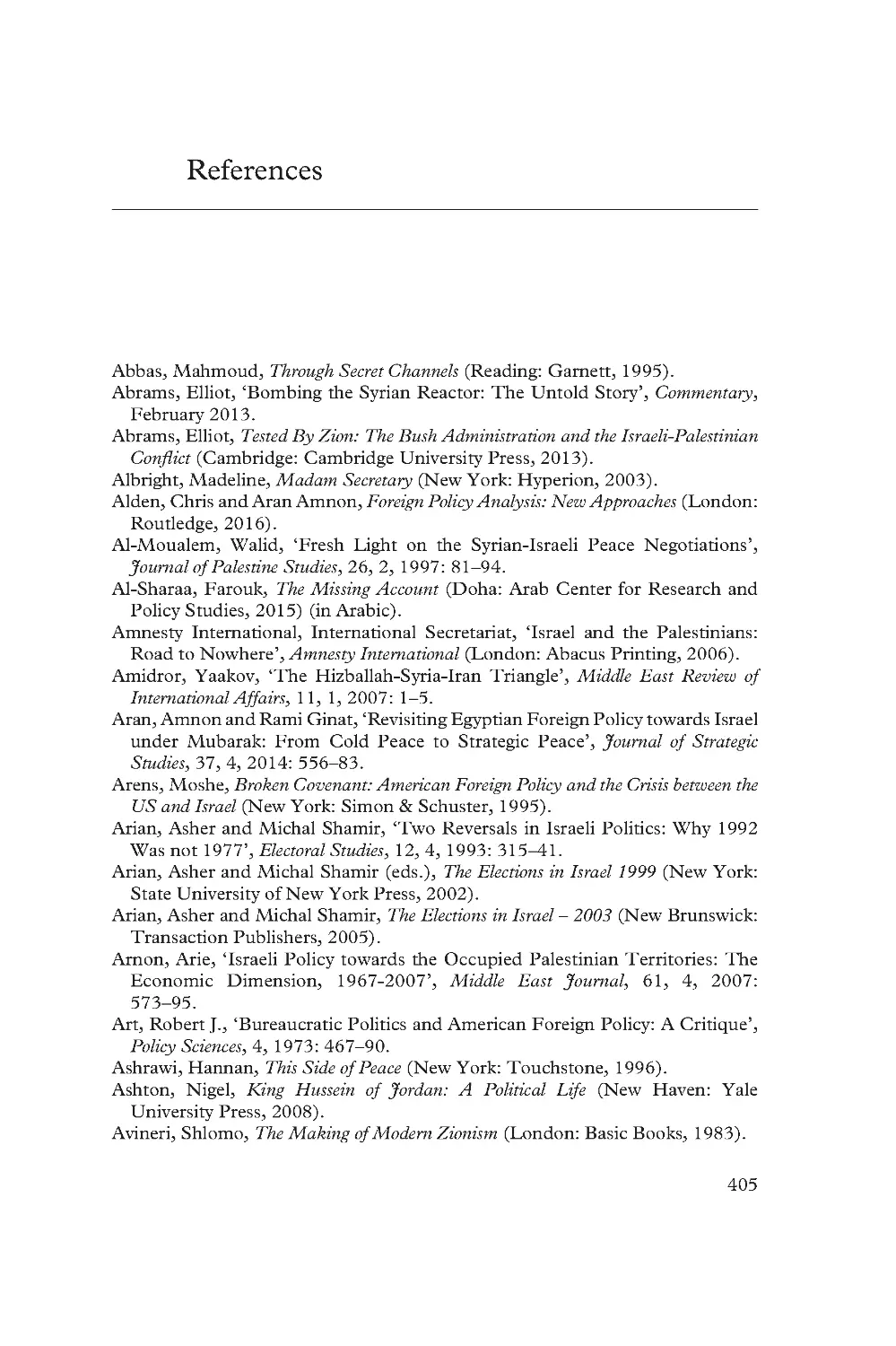
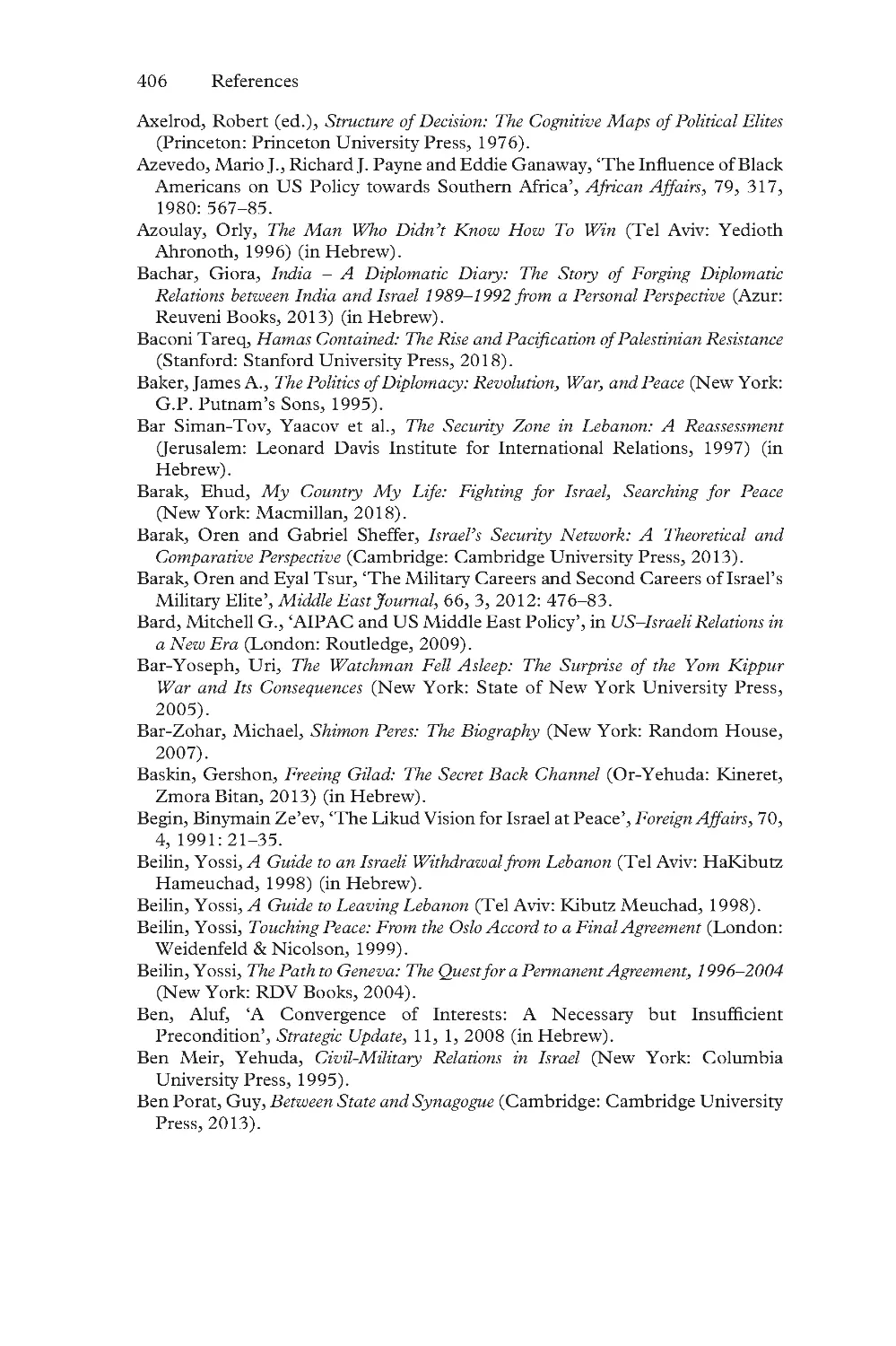
foreign policy, I have relied, wherever possible, on primary sources. It is to
Israel’s credit that much of its foreign policy documents are freely avail-
able to researchers. Students of Israel’s foreign policy are well served by
the Israeli Ministry of Foreign Affairs series Documents on the Foreign
Policy of Israel, which is now digitized and is available in different formats
on the MFA website. I used this excellent resource extensively.
However, under the thirty-year rule, official documents from the Israeli
archives pertaining to the period covered by this book are not yet avail-
able. I have tried to bridge this gap by using other types of primary sources
and triangulating them. I have consulted memoirs in English, Hebrew
and Arabic, authored by the leading decision-makers and practitioners,
diplomatic diaries, media interviews and transcripts of Knesset debates
and public lectures, government-appointed commissions of enquiry, US
Congressional reports and documents released via the WikiLeaks
website.
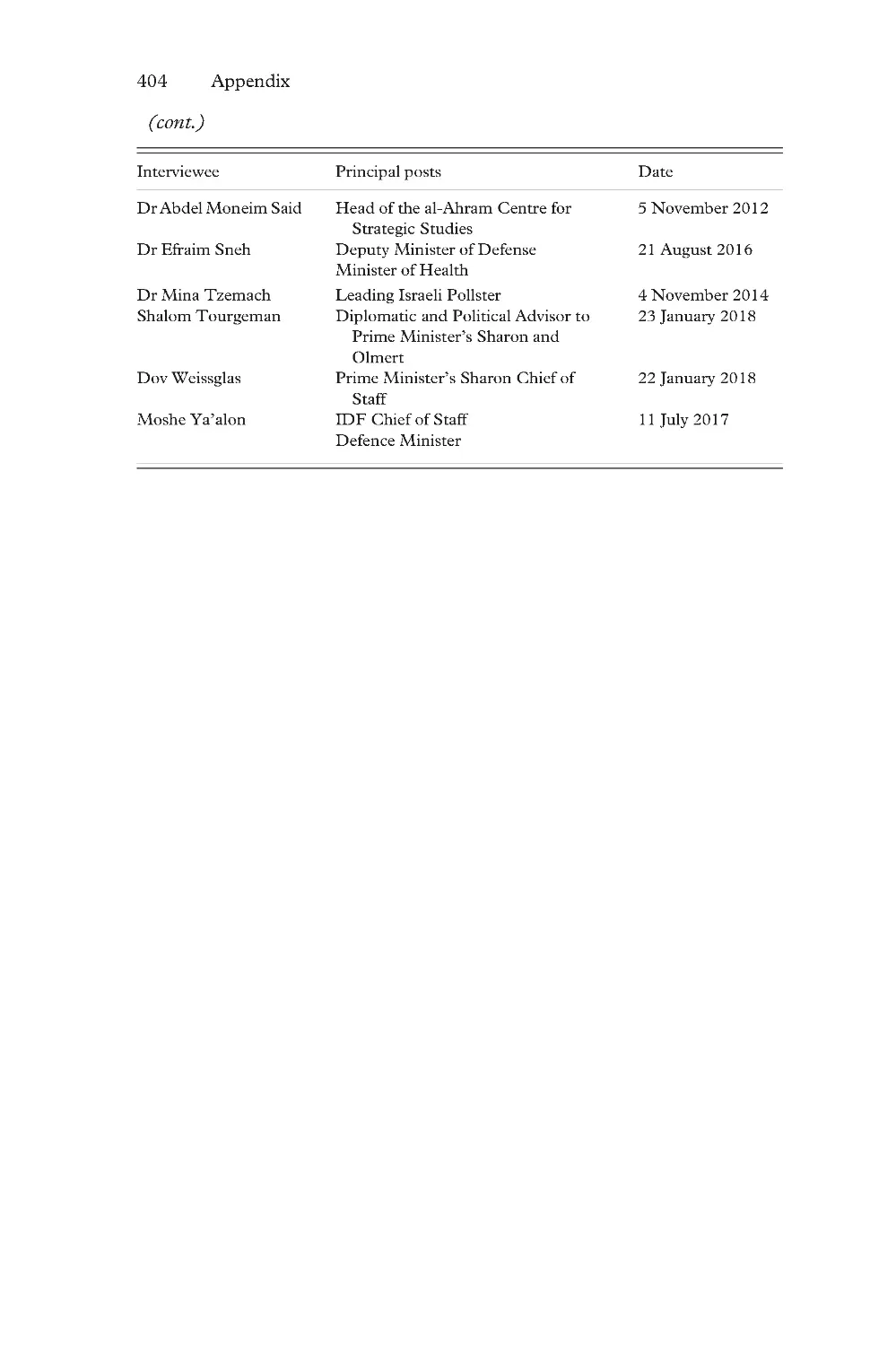
I have also made extensive use of information gained from almost thirty
interviews I conducted with the chief policymakers and participants in the
events described here: pollsters, leading political activists, heads of
Israel’s security services and foreign ministry, parliamentarians, ministers
and one prime minister. As Avi Shlaim observed long ago, using inter-
views as evidence involves several problems, including faulty memory,
self-serving accounts, distortions and deliberate falsifications.
17
17
Shlaim, The Iron Wall, p. xvii.
10
Introduction

Nevertheless, the interviews I conducted were indispensable for filling
some of the blanks. Interviews cannot replace documented history, but
they are an essential complementary tool. I list my interviewees in the
bibliography and I am grateful to all of them for their time and generosity
in responding to my questions.
A final word refers to the debate over Israeli foreign policy, which
evokes strong sentiment. For some, the very word ‘Israel’ is as toxic as
the term apartheid was before its final demise. For others, ‘Israel’ is
synonymous with a country that struggles to defend itself in the face of
an implacably hostile region. These perceptions are unhelpful; they mask
the intricacies of Israel and its foreign policy. The final call, therefore, is
for scepticism towards categorical readings of Israel’s foreign policy and
the embracing of complex interpretations in their stead.
A Note on Sources
11

1 Entrenchment
Introduction
In August 1989, Solidarity, the first non-Communist party-controlled
trade union in a Warsaw pact country, formed a government in Poland.
The leader of Solidarity, Lech Wałesa, became president of Poland in
December 1989, replacing General Wojciech Jaruzelski, Poland’s last
Communist leader. These dramatic events marked the end of
Communist rule in Poland, precipitating and also giving momentum to
the collapse of the entire Communist bloc in Eastern Europe and the end
of the Cold War. These momentous events were observed closely by
Israel. By 1990, its key foreign policymakers were left in no doubt that
the ‘vast political, social, and economic construct of the USSR and its
satellites [had] lurched and crashed.’
1
Israel’s foreign policymakers, like
Robert Frost’s traveller, stood long, and looked down as far as they could.
The time had come to choose between the foreign policy course less
travelled or keeping to familiar ways.
Foreign Policy Orientation and the Decision-Making
Circle
The government tasked with responding to the end of the Cold War was
established by Likud leader and prime minister, Yitzhak Shamir, on
11 June 1990. Apart from Likud, the coalition government included
three ultra-orthodox parties, Agudat Israel, Shas and Degel HaTora,
and three ultra-nationalist parties, Tehiya, Tzomet and the National-
Religious Party, Mafdal. This ultra-religious ultra-nationalist coalition
government, which, on its inception, commanded a slim majority of two
members of the Knesset (MKs), had a clear foreign policy orientation.
2
1
Moshe Arens, Broken Covenant: American Foreign Policy and the Crisis between the US and
Israel (New York: Simon & Schuster, 1995), pp. 104 –5 .
2
Party and government composition, Knesset Official Website, https://main.knesset.gov.il
/About/History/Pages/FactionHistory12.aspx, accessed 31 October 2018.
12

Its basic lines reflected its resolute opposition to relinquishing any terri-
tories Israel had occupied during the 1967 Arab-Israeli war in exchange
for peace. In addition, the government was committed to expanding
Jewish settlements established by Israel in the Golan Heights, the West
Bank, Gaza Strip and East Jerusalem.
3
The core foreign policy decision-making circle consisted of Prime
Minister Yitzhak Shamir, Defence Minister Moshe Arens and their con-
fidants. These included the newly appointed minister of justice, Dan
Meridor, his brother, Sallai Meridor, Arens’s chief aide, and two civil
servants, Elyakim Rubinstein, and the prime minister’s military secretary,
Brigadier Azriel Nevo. David Levy, the foreign minister, who Shamir
deemed as ‘unfit to serve in the highest policy-making posts’, was
bypassed in sensitive foreign policy matters.
4
Another vocal rival the
prime minister sidestepped was former general and defence minister,
Ariel Sharon, who was appointed minister for construction and housing
and was a cabinet member.
5
Yitzhak Shamir and Moshe Arens brought considerable experience to
the decision-making table. Shamir formed his 1990 government follow-
ing three previous terms as Israel’s prime minister while Arens, prior to his
re-appointment as defence minister, had served terms as Israel’s ambas-
sador to the USA (1982–3), defence minister (1983–4), and foreign
minister (1988–90). Both men were Likud veterans and political allies,
and had long service in Israel’s security network. Shamir was a member of
Mossad between 1956 and 1965, while Arens was appointed chief engin-
eer in the Israeli aircraft industry in 1962.
6
Prime Minister Shamir, the chief decision-maker, was born Yitzhak
Yzernitsky in 1915, in the small Polish town of Rzhnoi, in a household
that blended ardent Zionism with Jewish tradition or Yidishkeit. However,
Shamir was a deeply secular man and held in contempt the rabbinical
institution that opposed Zionism.
7
In 1935, Shamir emigrated – or in
Zionist parlance, ‘made Aliya’–from Poland to British Mandated
Palestine, which saved him from the fate met by the rest of his family.
3
Government Policy Guidelines, 8 June, 1990, in Meron Medzini, Israel’s Foreign Relations:
Selected Documents, 1988–1992 (vol. 12) (Jerusalem: Ministry of Foreign Affairs, 1993),
pp. 345–9.
4
Yitzhak Shamir, Summing Up (Tel Aviv: Yedioth Ahronoth, 1994), p. 176 (in Hebrew);
Interview Sallai Meridor, 9 July, 2014, Jerusalem; Interview 1 Dan Meridor, 7 July, 2014,
Jerusalem.
5
Ariel Sharon, Knesset Official Website, https://main.knesset.gov.il/mk/Pages/MKGovRo
les.aspx?MKID=125, accessed 31 October, 2018.
6
Shamir, Summing Up, pp. 100 –8, 119–29, 139–75; Arens, Broken Covenant, pp.
10–12, 140.
7
Interview 1 Dan Meridor.
Foreign Policy Orientation and Decision-Making
13

Shamir’s father, mother and two sisters were murdered in the Holocaust.
Shamir summed up his feelings thus: ‘I can’t forget and I will never
forgive.’
8
This searing experience coloured Shamir’s view of the world and of the
Arab-Israeli conflict in particular. He was convinced that the Arab stance
towards Zionism had ‘nothing to do with the quest for self-
determination’, but rather was an extension of anti-Semitism and,
hence, was perpetual.
9
Shamir’s bleak conviction was that there was
nothing Israel could offer the Arab side in exchange for recognizing its
existence, and that Israel should not make peace with the Arab states until
they realized that fighting against Israel was futile. Only then could peace
be exchanged for peace, rather than territory.
10
This Hobbesian zero-sum
-game approach was emblematic of the views espoused traditionally by
the Israeli right, which formed the political and ideological core of the
Shamir government.
Prime Minister Shamir and his defence minister personified another
core ideological and political tenet of the Israeli right. Throughout his
career in Likud, Shamir was renowned for his staunch support for retain-
ing the territories Israel occupied during the 1967 Arab-Israeli war.
Shamir’s position was grounded in the belief that Jews had a more just
claim to the Land of Israel than the Arabs’ claim to that land.
11
Somewhat
differently, Arens supported Israel’s retention of the territories it occu-
pied in the 1967 war, on the grounds of the strategic depth they provided
to Israel rather than on purely nationalistic grounds. Through this prism,
Arens saw the Gaza Strip, which Israel captured from Egypt in the 1967
war, as a demographic liability. It was heavily populated by 642,000
Palestinians while the Jewish presence amounted to only a few thousand
settlers, who physically controlled just 25 per cent of the Strip, but
40 per cent of its arable land.
12
The zero-sum -game view of the Arab-Israeli conflict and the oppos-
ition to a land-for-peace exchange, hinged on the assumption that time
was on Israel’s side. Shamir personified the view that prevailed among the
Israeli right that, as the years went by, Israel could compel its Arab foes to
accept its existence by building an impregnable iron wall of military
strength.
13
However, until then, Israel must survive by the sword.
8
Shamir, Summing Up, pp. 9–16.
9
Shamir, Summing Up, p. 30 .
10
Haim Misgav, Conversations with Yitzhak Shamir (Tel Aviv: Sifriyat Poalim, 1997) (in
Hebrew).
11
Shamir, Summing Up, p. 177; Arens, Broken Covenant, p. 18.
12
Arens, Broken Covenant, p. 208; population data from Israeli Central Bureau of Statistics,
Statistical Abstract of Israel (Jerusalem: Government of Israel, 1993), p. 758.
13
Shamir, Summing Up, p. 22.
14
Entrenchment

Prime Minister Shamir and Defence Minister Arens concurred that pre-
mature deviation from this course could lead only to the Arab side making
further demands on Israel, which then would be dealing with them from
a significantly weaker position.
14
Shamir’s belief in the iron wall was ingrained in his political outlook by
the fate met by his family, his leadership roles in the pre-state Jewish
resistance group – the Fighters for the Freedom of Israel (Lehi) or the
Stern Gang – and his service in Mossad.
15
His long experience of service
in clandestine militarized organizations left him sceptical and suspicious
of diplomacy, which was anathema to his secretive, distrustful and
reserved personality.
16
Instead, Shamir subscribed heavily to the view
that military force was the most effective means to a political end and he
had no inherent commitment to democracy.
17
Integral to the foreign policy orientation of Shamir, Arens and their
confidants, was the view that strategic alliance with the USA was indis-
pensable to Israel’s security and prosperity.
18
Arens was convinced that
the US-Israeli alliance was forged on the basis of these two countries’
common ideals and democratic values.
19
Shamir, adopting a realpolitik
approach, opined that the alliance would endure as long as Israel did not
burden the USA and was confident that differences – short of a direct
clash of interests – could be resolved within the ongoing US-Israeli
dialogue. Accordingly, Shamir’s foreign policy approach to the USA
hinged on manoeuvring between safeguarding what the Israeli leadership
defined as its ‘red lines’ and the demands imposed on Israel by the USA.
20
A Threat from Iraq
Israel’s initial reaction to the end of the Cold War was made crystal clear
in a meeting of top US and Israeli officials, held on 20 July 1990. In
attendance on the American side were Defence Secretary Dick Cheney,
Undersecretary for Defence Paul Wolfowitz and Defence Intelligence
Agency Head Lieutenant General Harry Soster. Israel was represented
by the IDF head of intelligence, Major General Amnon Shahak, the head
of Mossad, Shabtai Shavit and Defence Minister Arens, who laid out
Israel’s position: ‘Whereas in Eastern Europe there is glasnost and the
14
Misgav, Conversations, p. 66; Arens Broken Covenant, pp. 35 –6.
15
Shamir, Summing Up, p. 193 .
16
Shamir, Summing Up, pp. 22–38.
17
Shamir, Summing Up, pp. 111–12; Avishai Margalit, ‘The Violent Life of Yitzhak
Shamir, New York Review of Books, 14 May 1992.
18
Arens, Broken Covenant, p. 191.
19
Interview with Moshe Arens, 8 July, 2014, Savion.
20
Interview Sallai Meridor; Interview 1 Dan Meridor; Misgav, Conversations, pp. 108–9 .
A Threat from Iraq
15

beginnings of democracy’, Arens explained, ‘the Middle East, except for
Israel, continued to be ruled by dictators, and Muslim fundamentalism
was running rampant. The Soviet Union and the Eastern European
countries were disarming while the arms race in the Middle East was
intensifying.’
21
The message coming out of Israel via its defence minister, regarding the
significance of the end of Cold War for the Middle East, was that nothing
much had changed. From the Israeli vantage point, the significance of the
end of the Cold War lay elsewhere, most crucially, in the ‘opening up of
the gates’ to a massive Jewish Aliya from the Soviet Union to Israel. In
addition, the ending of the conflict between the two super powers was
seen in Jerusalem as creating the conditions that might prompt Eastern
European countries and the USSR to renew the diplomatic relations with
Israel that had been severed in 1967.
22
By February 1990, former
Czechoslovakia, Hungary and Poland had restored diplomatic relations
with Israel.
23
Through this lens, the end of the Cold War was perceived
not as requiring a foreign policy rethink but rather confirmed that the
foreign policy course Israel had pursued during the Cold War was sound.
Israel now should take advantage of the new opportunities to consolidate
in order to confront the challenges that lay ahead.
24
One of those challenges was the threat posed by Iraq, whose president,
Saddam Hussein, issued a clear warning to Israel. In a speech he delivered
on 2 April 1990, Hussein threatened that, were Israel to attempt to launch
another strike similar to the one in 1981 that had destroyed the Iraqi
Osirak nuclear reactor, Iraq would retaliate with binary chemical weap-
ons: ‘By God, we will make the fire eat up half of Israel if it tries to do
anything against Iraq.’
25
It is unclear whether there was an Israeli plan
afoot to attack Iraq. However, it is apparent that the Israelis viewed Iraq’s
concern over a potential Israeli strike as a threat in and of itself.
26
The
Israeli view was shaped in part by the prime minister’s and defence
minister’s perception of Saddam Hussein as a new Hitler after the Iraqi
president authorized use of chemical weapons in 1984 against Iranian
troops and in 1988 against Iraqi-Kurdish civilians in the village of
Halabja.
27
Understandably, in early 1990, following completion of the
construction of six Scud missile launchers in western Iraq, Israel saw itself
21
Arens, Broken Covenant, p. 149.
22
Shamir, Summing Up, pp. 251–4; Arens, Broken Covenant, pp. 104–6; Efraim Halevy,
Man in the Shadows: Inside the Middle East Crisis with a Man Who Led the Mossad (Tel Aviv:
Matar, 2006), p. 24 (in Hebrew).
23
Medzini, Israel’s Foreign Relations, p. 332 .
24
Interview 1 Dan Meridor.
25
Quoted in Arens, Broken Covenant, p. 130.
26
Arens, Broken Covenant, p. 147 .
27
Arens, Broken Covenant, pp. 150, 213; On Iraqi attacks, see Charles Tripp, A History of
Iraq (Cambridge: Cambridge University Press, 2007), p. 236.
16
Entrenchment

as vulnerable to a ballistic attack that might have a chemical
component.
28
Another source of Israeli concern was the lack of direct
communication lines with Iraq, which risked misperceptions, miscalcula-
tions and misunderstandings, on both sides, resulting in an unintended
escalation. In these circumstances, Israeli intelligence rendered the threat
posed by Saddam Hussein’s 2 April speech, ‘an immediate danger’.
29
From this point, events moved quickly. On 2 August 1990, Iraqi forces
invaded Kuwait, which was occupied and claimed by Saddam Hussein as
the nineteenth province of Iraq. The invasion was followed by a long
period of waiting, during which a US-led coalition of western states, the
USSR and Arab states was built to evict the Iraqi forces from occupied
Kuwait. The countdown to the military showdown began on
29 November 1990, after the passing of Resolution 678 by the United
Nations Security Council (UNSC), authorizing the use of ‘all necessary
means’ against Iraq unless it withdrew its forces from Kuwait by
15 January 1991.
30
It was clear to Prime Minister Shamir that, if the US-led coalition
attacked militarily, then Iraq would seek to drive a wedge between the
Arab states and the rest of the US-led coalition by drawing Israel into the
conflict.
31
Israel was particularly concerned about an Iraqi attack from
Jordan, which shared the longest international border with Israel. These
concerns were well founded. In early 1990, Iraq and Jordan had forged
a military alliance and established a joint air squadron, enabling Iraq to
reconnoitre the Israeli side of the Jordan valley from Jordanian airspace.
King Hussein of Jordan, a close friend of the Iraqi president, believed
wholeheartedly that Saddam Hussein could provide the leadership
needed to restore pride and dignity to the Arab world. His assessment
of the Iraqi president, which he repeated in private conversations, includ-
ing with his Israeli Mossad contact, Efraim Halevy, was echoed by the
wide pro-Iraqi sentiment within Jordan itself.
32
Speaking in the Knesset on 7 August, 1990, Arens issued the stern
warning that were Israel to see any ‘entry of the Iraqi army into Jordan, we
shall act’.
33
The warning was acknowledged by King Hussein, who, a few
28
James A. Baker, The Politics of Diplomacy: Revolution, War, and Peace (New York: G.P.
Putnam’s Sons, 1995), p.267; Arens, Broken Covenant, p. 163.
29
Arens, Broken Covenant, pp. 135, 148; Shlaim, The Iron Wall, p. 472; Dick Cheney, In My
Time: A Personal and Political Memoir (New York: Threshold Editions, 2011), p. 182 .
30
UNSCR Resolution 678, http://unscr.com/en/resolutions/678, accessed 5 November 2018.
31
Shamir, Summing Up, p. 264 .
32
Halevy, Man in the Shadows, pp. 31 –3; Nigel Ashton, King Hussein of Jordan: A Political
Life (New Haven: Yale University Press, 2008), pp. 258–60.
33
Arens, Broken Covenant, p. 153.
A Threat from Iraq
17

days later, announced publicly that Jordan would ‘not open its borders to
“tourist visits” by foreign armies from either East or West’.
34
At the same time, Israel and Jordan had cooperated covertly for many
years, on a wide range of strategic issues and, especially, following the
1970–71 ‘Black September’ events. During that period, the PLO had
tried to topple King Hussein, who had fended off the attempt with the aid
of Israel and Jordan’s Western backers, Britain and the USA.
35
Subsequently, Israel and Jordan had established an infrastructure for
secret collaboration, which was also used following the Iraqi invasion of
Kuwait. On 4–5 January, 1991, Israeli and Jordanian top brass met in
King Hussein’s home in Ascot, England. The Jordanian side was repre-
sented by King Hussein and his military advisor, General Zeid bin
Shaker.
36
Representing Israel were Prime Minister Shamir, Mossad’s
Efraim Halevy, IDF Deputy Chief of Staff Ehud Barak, Cabinet
Secretary Elyakim Rubinstein and Director General of the Prime
Minister’sOffice, Yossi Ben Aharon. The main objective of the meeting
was to avoid an unintended clash between the IDF and the Jordanian
army. To this effect, King Hussein pledged to the Israelis that his armed
forces would be mobilized solely for defensive purposes and that he would
not allow Iraqi forces to use Jordanian sovereign space. However, he
emphasized that he could not control ‘the outer space’, which would be
penetrated if Iraq launched a missile attack against Israel.
37
Equally, King
Hussein refused to grant the Israeli request to use Jordanian airspace in
the event of an Iraqi attack on Israel.
38
The meeting assuaged the tensions
in Jerusalem regarding the threat posed to Israel from its immediate
eastern flank. However, not all were persuaded. Minister of housing
and cabinet member, Ariel Sharon, for instance, opposed the diplomatic
signals the government sent to Jordan. He advocated using military force
in the event of an Iraqi attack, irrespective of the Jordanian position.
39
The long waiting period also required liaison with the USA. On
8 August 1990, US ambassador to Israel, Bill Brown, met Defence
Minister Arens. The ambassador relayed the US request that Israel exer-
cise the utmost restraint during the crisis and take no pre-emptive action
against Iraq. The Israeli leadership construed the request as a US decision
to sideline Israel in order to secure Arab cooperation with the US-led
international effort against Iraq and, possibly, beyond. It was in sharp
34
Ibid.
35
Moshe Zak, King Hussein Makes Peace (Ramat-Gan: Bar-Ilan University Press, 1996) (in
Hebrew).
36
Shlaim, The Iron Wall, p. 478 .
37
Interview 1 Dan Meridor.
38
Ashton, King Hussein of Jordan, pp. 275–6; Halevy, Man in the Shadows, pp. 35 –6 .
39
Shlaim, The Iron Wall, p. 479.
18
Entrenchment

contrast to the strategic-ally role previous US administrations had
ascribed to Israel during most of the Cold War. Now, as the first major
post-Cold War international crisis was unfolding, Israel was, at best,
immaterial to realization of US interests in the Middle East and, at
worst, a liability.
40
Tellingly, as Israel’s ambassador to the US, Zalman Shuval, recalls,
Israel was not among the countries the USA had briefed about how to
prepare for a possible war against Iraq.
41
In fact, the waiting period was
fraught with US-Israeli tensions. The USA stalled over Israeli requests for
cooperation. Instead, it provided assurances that the US air force would
neutralize any threat to Israel, especially in western Iraq. The USA also
offered to deploy US-manned Patriot anti-ballistic weapons systems in
Israel, an offer that Israel declined.
42
In summing up the view from
Jerusalem regarding cooperation with the USA, Minister of Defence
Arens noted that he was ‘frustrated by the distrust that coloured’ the
US attitude towards Israel.
43
Political strains compounded the tensions generated by the disagree-
ments over the extent of US-Israeli military cooperation. In 1990, the
popular uprising by the Palestinians against Israeli occupation of the West
Bank, East Jerusalem and the Gaza Strip, dubbed the Intifada, entered its
third year. Saddam Hussein sought to exploit the prolonged conflict by
suggesting, early in the crisis, on 12 August, that Iraq might withdraw
from Kuwait if Israel withdrew from all the occupied territories and Syria
withdrew from Lebanon. Clearly, Saddam Hussein was trying to trans-
form the conflict that had begun as a dispute between Iraq and a wide-
based international coalition into an Arab-Israeli clash. This would put
political pressure on the Arab states to leave the US-led coalition or be
perceived as cooperating with Israel in a war against another Arab
country.
44
Linking the Israeli-Palestinian conflict and the Kuwait crisis
was a cunning move. It created a source of concern throughout the
waiting period since there was virtually no prospect of a change of the
Shamir government policy towards the Palestinian Intifada. In fact,
senior cabinet colleagues, such as Ariel Sharon and former chief of staff,
Raphael Eitan, chided Prime Minister Shamir and Defence Minister
Arens for being ‘too soft’ on the Palestinian insurgency.
45
40
Shamir, Summing Up, pp. 265–8; Arens, Broken Covenant, p. 151.
41
Zalman Shuval, Diplomat (Rishon Le Zion: Miskal, 2016), p. 174 (in Hebrew).
42
Arens, Broken Covenant, pp. 158, 171; Halevy, Man in the Shadows, p. 34; Cheney, In My
Time, p. 211 .
43
Arens, Broken Covenant, p. 175.
44
Shlaim, The Iron Wall, pp. 475 –6; Baker, The Politics of Diplomacy, p. 292.
45
Arens, Broken Covenant, p. 163 .
A Threat from Iraq
19

By early January 1991, military confrontation between the US-led
coalition and Iraq was inevitable. The Israeli government had signifi-
cantly stepped up preparations on the home front and had begun distrib-
uting gasmasks to the entire population. Concurrently, cooperation with
the USA was tightened. A secure telephone line, codenamed ‘Hammer
Rick’, was installed to enable direct communication between Defence
Minister Arens and his US counterpart, Dick Cheney. A system was put
in place to allow US satellites to provide early warning of Iraqi missiles
launched against Israel, directly to the Israeli ministry of defence, via
Hammer Rick. Nevertheless, the cooperation fell short of what Israel
wanted. The USA continued to reject Israeli requests for real-time intel-
ligence and a framework for military cooperation. It was concerned that
the information might be exploited by Israel for a pre-emptive attack
against Iraq, which could break up the US-led international coalition.
46
The 1991 Gulf War
On 17 January 1991, two days after expiry of the international ultimatum
issued to Iraq to withdraw its forces from Kuwait, the US-led coalition
launched an attack on the Iraqi forces. The 1991 Gulf War, which came
to be known as Operation Desert Storm, lasted for six weeks, from
17 January to 28 February. It consisted of a long period of airstrikes by
the US-led coalition, coupled with a ground invasion on
24–28 February.
47
The war reflected the fast moving geopolitical changes following the
end of the Cold War. The USA and USSR cooperating with Arab coun-
tries, including Syria, which until recently had been a Soviet client, to
fight a fellow Arab country, Iraq. Israel, officially at least, was not part of
the conflict. However, Iraqi President Saddam Hussein confirmed the
earlier intelligence prediction that he would try and draw Israel into the
war. Throughout Operation Desert Storm, Israel was subjected to salvos
of ground-to-ground missiles from Iraq. Some thirty-eight Iraqi versions
of Scud missiles fell in nineteen missile attacks, targeting Israel’s most
densely populated areas. Shortly after the attacks began, Defence
Minister Arens reversed the earlier Israeli decision and requested US
Secretary of Defence Dick Cheney, that US-manned Patriot missile
batteries be deployed in Israel. However, as the USA eventually
46
Arens, Broken Covenant, pp. 169–71; Cheney, In My Time, p. 211; Shamir, Summing Up,
p. 266.
47
For an extended account of the conflict, see Ephraim Karsh and Lawrence Freedman,
The Gulf Conflict, 1990–1991: Diplomacy and War in the New World Order (London: Faber
& Faber, 1993).
20
Entrenchment

conceded, the Patriot missiles proved ineffective for intercepting the Scud
missiles launched by Iraq on Israel. A report by the Israeli Air Force
(IAF), which was presented to the Americans by Defence Minister
Arens, concluded that Patriots succeeded in eliminating Scud missiles
in only 20 per cent of attempts.
48
Nonetheless, the total damage caused
by the attacks was limited: one direct fatality, 208 injured and 7,667
properties hit.
49
Even so, the Scud attacks had a demoralizing effect;
they caused significant disruption to everyday life as residents of Haifa
and the greater Tel-Aviv area sought refuge in areas that were not targeted
by the Iraqi missiles. Also, the fear that Iraq would launch a chemical
attack against Israel remained acute throughout the war.
50
Israeli foreign policymakers fiercely debated Israel’sresponsein
regular meetings between cabinet ministers and senior IDF members
during the war. Israel needed to strike a balance between stopping (or
at least limiting) the Scud attacks, the real risk of an Iraqi chemical
strike against Israel, and the impact of Israeli foreign policy actions
on the US-led international coalition. Two factions emerged. There
wasagroupofhardlinerswithinthecabinet– Likud’sArielSharon,
Tzomet’s leader and former general chief of staff, Rafael Eitan, and
Professor Yuval Ne’eman from Tehiya – who demanded a military
response with or without US approval: ‘Send the aircraft to photo-
graph!’, demanded Sharon of Defence Minister Arens in the cabinet
meeting following the first Scud attack. ‘Even without coordinating
with the US’,queriedArens?‘Notify them and fly!’, thundered
Sharon.
51
As the Scud attacks continued, these hardliners, more
explicitly and more publicly, demanded that Israel put a stop to
them and punish Iraq.
52
Prime Minister Shamir, Defence Minister Arens, their confidants and
Foreign Minister Levy, took a different line centred on the notion that
Israel must have US permission and a joint military framework for such an
attack. Failing this, Israel must continue to comply with the US demand
for forbearance in order to thwart the Iraqi attempt to drive a wedge
48
Shuval, Diplomat, p. 207.
49
Israeli Ministry of Foreign Affairs, The Gulf War (1991), http://mfa.gov.il/MFA/AboutI
srael/History/Pages/The%20Gulf%20War%20-%201991.aspx, accessed 5 November,
2018.
50
Confirmed by former Head of the Iraqi Intelligence, General Wafiq al-Sammarai in
Cheney, In My Time, p. 220; for the Israeli awareness see Shamir, Summing Up, p. 270;
Baker, The Politics of Diplomacy, p. 408.
51
Arens, Broken Covenant, p. 180.
52
Ibid, p. 197; David Landau, Arik: The Life of Ariel Sharon (New York: Alfred A. Knopf,
2013), p.263.
The 1991 Gulf War
21

between the USA and the Arab members of the coalition by drawing
Israel into the conflict.
53
Forbearance was untypical of Israel, whose deterrence policy hinged on
not just response to military attacks, simple tit-for-tat, but on
escalation.
54
However, the understandings reached with King Hussein
on the eve of the war were a significant factor in restraining the Israeli
response.
55
More significant, however, was the US stance. The US presi-
dent’s special envoy to Israel during the conflict, Lawrence Eagleburger,
emphasized the resolute US objection to an Israeli military strike on Iraq.
The USA, he stressed, ‘would do nothing to enable an Israeli attack’.
56
Matching words to deeds, throughout the war, the intelligence provided
by the USA to Israel was out of date, and the USA refused to create a joint
military framework.
57
Domestic factors also mattered. The IDF’s top brass does not seem to
have been eager for Israel to ‘go it alone’ against Iraq.
58
This was very
evident in the diplomatic mission to the USA by Major General Ehud
Barak, the deputy chief of staff, and the director general of the ministry of
defence, David Ivri, on 27–29 January, 1991, in the midst of the conflict.
Their brief from Defence Minister Arens was to relay Israel’s determin-
ation to take military action, even if the Americans withheld the coordin-
ation needed for such an operation. After their debriefing on their return
to Israel, Arens felt that the generals ‘had not made that point with
sufficient emphasis’.
59
The IDF’s preparations for attacking the Scud
launchers in western Iraq continued notwithstanding, but the view of
the military was that ‘the potential gains of such a mission were balanced
by the attendant risk’.
60
Furthermore, the Israeli politico-military top
brass itself was sceptical about whether an attack by the IDF would
yield a better military result than the combined US and UK airstrikes
that were pounding western Iraq daily.
61
However, the most significant restraint on Israel’s response to the Iraqi
attacks was the posture of forbearance championed by Prime Minister
Yitzhak Shamir. Although in the midst of the war, Arens veered increas-
ingly towards the view that Israel should react militarily to the Iraqi
attacks, Shamir remained resolute. Throughout the war, he put all his
political weight in the cabinet on preserving Israel’s restraint, a decision
53
Arens, Broken Covenant, p. 191; Shamir, Summing Up, p. 270.
54
Avner Yaniv, Deterrence without the Bomb: The Politics of Israeli Strategy (Lanham:
Lexington Books, 1987), pp. 164–6.
55
Conversation with Professor Avi Shlaim.
56
Baker, The Politics of Diplomacy, p. 389; Cheney, In My Time, p. 214 .
57
Interview 1 Dan Meridor.
58
Interviews 1 Dan Meridor; Interview Arens.
59
Arens, Broken Covenant, p. 198.
60
Ibid, pp. 200, 208, 211.
61
Interview 1 Dan Meridor.
22
Entrenchment

that the prime minister described as the most difficult in his political
career.
62
Opting for forbearance was driven by a simple calculation,
which was consistent with Shamir’s realpolitik world view. Shamir was
intensely aware of the risk of the US-led international coalition splintering
were Israel to retaliate, and that this would significantly undermine the
already strained US-Israeli relations and spare Iraq. Shamir reasoned that
the price exacted from Israel would be higher than any gains that could be
achieved by a targeted Israeli attack on Iraq’s Scud launchers. A majority
in the cabinet sided with the Prime Minister, as did the majority of the
Israeli public according to opinion polls conducted during the war, and
this kept the hardliners in the cabinet in the minority.
63
A mixed picture emerged as the dust of Desert Storm began to settle.
The 1991 Gulf War was the first time that the Israeli heartland had been
hit. Israel’s untypical forbearance response had created a sense of humili-
ation and concern that Israeli deterrence had been dented, and had
highlighted Israel’s vulnerability to a ballistic attack. The result was
more investment in anti-missile technology, such as the Arrow missile,
which was designed to intercept tactical-ballistic missiles.
64
At the same
time, Iraq had been defeated, its army dealt a mighty blow and the
country subjected to harsh sanctions and Saddam Hussein’s international
standing had been weakened significantly. Within six weeks, Iraq had
been transformed from a formidable threat to Israel to that of a contained
risk. The demise of the USSR, the patron of Israel’s Arab foes during the
Cold War, meant that no Arab state – including either Syria or Libya –
was capable of taking on Iraq’s aim to lead the Arab world in an assault
against Israel.
Preparing Arab-Israeli Negotiations
Following the end of the Gulf War, policy makers in the USA esti-
mated that its credibility was at its highest since the end of World
War II, and at the zenith of its influence in the Middle East.
A jubilant USA set out to establish a ‘new world order’ that would
include Arab-Israeli peace.
65
Having emerged as the sole world super
power and leader of the coalition that had defeated Iraq, the USA
was well placed to act as the sole mediator in the Arab-Israeli conflict.
Negotiations would be based on UN Security Council Resolutions
(UNSCR) 242 and 338, which stipulated that Israel withdraw from
62
Interview 1 Dan Meridor; Interview Sallai Meridor; Shamir, Summing Up̧ p. 263 .
63
Shamir, Summing Up, pp. 270–71; Arens, Broken Covenant, p. 203.
64
Ze’ev Schif, ‘Israel after the War’, Foreign Affairs, 70, 2, 1991: 19–33.
65
Baker, The Politics of Diplomacy, pp. 412 –15 .
Preparing Arab-Israeli Negotiations
23

lands it occupied in 1967 in exchange for peace with the Arabs.
66
Crucially, its overwhelming power notwithstanding, the USA would
not try to enforce peace. Rather, it saw its role as a catalyst for peace
through the breaking of the taboo on direct talks between Israel and
the Arab governments. Hitherto, bar Egypt, Arab governments had
refused to engage directly with Israel.
67
US Secretary of State James Baker, who led the US mediation team,
used sticks and carrots to draw Israel and the Arabs into direct negoti-
ations. He sought to get the parties to the negotiations invested in the
process ‘so it’s not so easy to walk away from it’. ‘We want them to build
their stake in its success’, Baker wrote, ‘and increase the cost to them of
failure’.
68
In this vein, Secretary of State Baker threatened to ‘lay the dead
cat at the doorstep’ of any party he deemed responsible for failing his
diplomatic mission.
69
Equipped with this mediation ‘toolkit’ Baker
embarked on a shuttle-diplomacy mission where he would try and take
ideas that Israel could ‘live with’ and ‘sell’ them, to the Arab
negotiators.
70
The launch of Baker’s shuttle diplomacy mission, during a two-day
visit to Israel, on 9–10 April 1991, was sensitive; previous US medi-
ation efforts in 1988–9 had ended in failure, which Baker attributed
to Prime Minister Shamir’s intransigence and reluctance to respect
his previous commitments.
71
‘Battered, beaten, and betrayed’,wa
s
how Baker and President Bush felt during that acrimonious round of
negotiations.
72
The Israelis felt equally let down, particularly by
Baker’sdemandto‘lay aside once and for all the unrealistic vision
of a Greater Israel’.
73
How, wondered Shamir, could the adjective
‘Greater’ be applied to a tiny country like Israel?
74
Further, on
1 March 1990, the USA conditioned $US400 million of loan guar-
antees for housing for Soviet Jewish immigrants, on Israel’s agree-
ment to halt the construction of new settlements in the occupied
territories.
75
Aghast, Prime Minister Shamir charged the USA with
pressurising Israel to make political concessions to the Arab side by
curtailing its capacity to deal with the ‘humanitarian issue’–housing
for new immigrants.
76
66
Ibid, pp. 415-17.
67
Dennis Ross, The Missing Peace: The Inside Story of the Fight for Middle East Peace,
1988–2000 (New York: Farrar, Straus, & Giroux, 2004) pp. 65 –6 .
Baker, The Politics of Diplomacy, p. 506.
68
Ibid, p. 444.
69
Ibid, pp. 443–70 .
70
Ibid, p. 416; Ross, The Missing Peace, p. 55.
71
Ibid, p. 116.
72
Ibid, pp. 123, 128.
73
Ibid, p. 121.
74
Shamir, Summing Up, p. 244.
75
Baker, The Politics of Diplomacy, pp. 123–8, 542.
76
Shamir, Summing Up, pp. 255–8.
24
Entrenchment

The cloud of the previous encounter hung over the 9 April 1991 meet-
ing between Baker and the Israeli leadership.
77
However, on hearing
Israel’s opening positions, Baker felt ‘relieved’ that they had ‘moved
a little’ from some of their previous stances.
78
Israel agreed to participate
in a one-off regional ‘meeting’, to be followed immediately by direct
Arab-Israeli negotiations, whereas in the past the Israelis had rejected
outright participation in an international conference. The Israelis con-
sented to the USA and the USSR co-hosting the meeting, but objected to
active roles of the EEC and the United Nations (UN), both of which
Israel perceived as biased towards the Arab side.
During the following eight months, Secretary of State Baker made eight
visits to the Middle East, which focused on negotiating the conditions for
opening an Arab-Israeli dialogue. Israel’s position was shaped by two sets
of determinants that pushed and tugged in different directions. On the one
hand, there was a set of domestic factors that included the decision-makers’
ideological commitment to the integrity of the Land of Israel, the political
requirement to keep intact the right-wing Shamir government, and lobby-
ing from the settlers. Members of Likud, especially and, most vocally, Ariel
Sharon, were subjecting the prime minister and his allies to intense political
criticism and accusing the prime minister of making too many concessions
to US demands. The ultra-right wing parties, Tzomet, Tehiya and
Moledet – a party that Shamir had brought into the government during
the Gulf War and which advocated physical transfer of Palestinians from
Israel – added to the prime minister’s coalition woes. This troika, which
threatened to topple the government, accused the prime minister of selling
out the Land of Israel. At the same time, the USA was insisting that Israel
find some common ground with the Arab positions, which, by definition,
were far removed from the Israeli right agenda.
79
Balancing this two-level game, Israel conceded to US demands con-
cerning procedural matters. It retracted its initial objections to calling the
meeting a ‘conference’ and where such a ‘conference’ might be held. The
Israelis settled ultimately for Madrid after initially insisting it should take
place in the Middle East. They also agreed to EEC participation in the
meeting, with UN presence as an observer.
80
These concessions on
procedural matters were a shrewd tactic to increase Israel’s ability to
77
The content of this meeting is derived from: Baker, The Politics of Diplomacy, pp. 444–7;
Interview 1 Dan Meridor; Arens, Broken Covenant, pp. 224 –6; Ross, The Missing Peace,
pp. 70–71.
78
Baker, The Politics of Diplomacy, p. 444.
79
Interviews Sallai and Dan Meridor; Arens, Broken Covenant, pp. 226, 238; Shamir,
Summing Up, p. 278 .
80
Israeli Ministry of Foreign Affairs, ‘Madrid Letter of Invitation’, 30 October 1991, www
.mfa.gov.il/mfa/foreignpolicy/peace/guide/pages/madrid%20letter%20of%20invitation
Preparing Arab-Israeli Negotiations
25

hold firm on issues its decision-makers deemed substantive or irreconcil-
able with domestic politics. For example, it was clear to the Israelis that
the USA, the USSR and the Europeans wanted to see a return to the 1967
borders and this was what the Arabs would demand.
81
Thus, the opening
positions of most of the prospective participants in the conference were in
stark contrast to the stance of the Israeli government, which was staunchly
opposed to the land-for-peace formula. Israel was, a priori, in a vulnerable
minority position, which was why it objected to negotiating within the
format of an international conference.
82
Israel also resisted any negotiating format that would afford the
Palestinians statehood status, not least through independent Palestinian
delegation participation in the conference.
83
In this context, Israel
rejected the PLO as a negotiating partner, in spite of its recognition by
the Arab League since 1974 as the ‘sole, legitimate, representative of the
Palestinian people’. Israel still regarded the PLO as a terrorist organiza-
tion, which had publicly supported Saddam Hussein’s invasion of Kuwait
and the recent Iraqi attacks on Israel. On this point, there was cross-party
consensus within both the government and the Israeli parliament. Also,
Prime Minister Shamir was convinced that negotiating with the PLO
would lead inevitably to negotiation over establishing a Palestinian state
on part of the Land of Israel. Herein ‘lay the seeds for the destruction of
Israel’, argued Shamir, personifying the revisionist Zionist claim that the
indivisibility between the people of Israel and the Land of Israel was at the
heart of Israeli spiritual and material fortitude.
84
Moreover, Shamir was
convinced that the territorial strategic depth afforded by controlling the
‘Land of Israel’ was a sine qua non for Israeli security.
85
It was the only way
that Israel could limit its enemies’ ability to use the territory as a launch
pad for attacks against Israelis.
86
As Baker conceded, Israel ultimately got its way. The Palestinians
participated in the Madrid peace conference as part of a joint Jordanian-
Palestinian delegation, and their representatives were vetted by Israel.
Palestinian representatives who were residents of Jerusalem were banned
from participation lest it be construed as Israel acknowledging Palestinian
claims to the city that Israel insisted was its eternal indivisible capital. The
PLO also was banned from attendance and confined to its headquarters
. a spx, accessed 5 November 2018; Shamir, Summing Up, pp. 274–8; Arens, Broken
Covenant, p. 227 .
81
Arens, Broken Covenant, p. 242.
82
Interview Arens.
83
Shamir, Summing Up, p. 242; Interview Sallai Meridor.
84
Interview, Sallai Meridor; Misgav, Conversations with Yitzhak Shamir, p. 96 .
85
Interview Sallai Meridor; Misgav, Conversations with Yitzhak Shamir, pp. 100–1, 131.
86
Misgav, Conversations with Yitzhak Shamir, pp. 111–12; Interview Sallai Meridor.
26
Entrenchment

in the Tunisian capital, Tunis, from where it communicated with the
Palestinian representatives at the conference via fax. The outcome
strongly reflected the weak position of the PLO and Jordan, which,
publicly supported Iraq in the 1991 Gulf War. This strategically flawed
decision was at the cost of Jordan and the PLO losing both support of the
Arab Gulf States and the USA.
Israel stood firm on another issue, namely, expanding its settlements.
The uncompromising Israeli stance was determined by an absolute belief
in the integrity of the Land of Israel and the political requirement to keep
the ultra-right Shamir government intact. The implications of settlement
expansion to deepen the occupation of a growing non-citizen Palestinian
population played no role in informing the Israeli stance on this issue.
Among the points on which Israel did not budge, settlement was the most
charged. The occupied Palestinians considered that the land expropri-
ated by Israel and used for settlement expansion, belonged to them. For
the Arab governments, the issue of settlements was a yardstick to gauge
US even-handedness with respect to the peace process. Amid these high
stakes, the USA rendered the settlements and their chief patron, Ariel
Sharon, ‘an obstacle to peace’ in the Middle East.
87
The Loan Guarantees Feud
US-Israeli differences over the settlement issue came to a head in
September 1991.
88
On 6 September, Israel submitted a request to the
US Congress for $US10 billion in loan guarantees, for finance it intended
to raise in loans from the international markets to fund the absorption of
Soviet immigrants. In the period 1989 to 1991 alone, approximately
345,000 immigrants had arrived in Israel from the Soviet Union.
89
The request for loan guarantees was tendered at a very sensitive
moment; it coincided with the final stages in the resolution of issues
related to convening the Madrid peace conference. Were the USA to
accept the Israeli request without a clear commitment to a settlement
freeze, the Arab side would perceive the USA as economically endorsing
Likud’s commitment to the integrity of the Land of Israel. At the same
time, a public US-Israeli dispute over the settlement question risked
Shamir refusing to participate in the Madrid conference and calls for
new elections in Israel, which would derail the budding peace process.
87
Baker, The Politics of Diplomacy, pp. 542, 545, 547.
88
I draw on a number of sources to describe the unfolding events: Ross, The Missing Peace,
p, 83; Arens, Broken Covenant, pp. 245 –54; Shamir, Summing Up, pp. 281–2.
89
Yinon Cohen et al., ‘Who went where? Jewish Immigration from the Former Soviet
Union to Israel, the USA, and Germany, 1990–2000, Israel Affairs, 17, 1, 2011: 9.
The Loan Guarantees Feud
27

Therefore, the Bush administration did not reject the Israeli request
outright. Instead, it suggested, cunningly, that Congress ‘defer’ discus-
sion of the request for loan guarantees for 120 days, that is, until after the
direct Arab-Israeli negotiations had begun and the process was well
underway. However, the Israelis refused to link the loan guarantees and
the peace process and rejected this formula, setting the Shamir govern-
ment and the Bush administration on a collision course. The Israeli
government, via the American Israeli Public Affairs Committee
(AIPAC), the most powerful pro-Israeli advocacy group, lobbied
Congress to vote in favour of Israel’s request for loan guarantees. The
Bush Administration, whose influence was still high following the Gulf
War, counter-campaigned. President Bush weighed in by publicly criti-
cizing what he defined as ‘powerful political forces amounting to thou-
sands of lobbyists’ fighting ‘one lonely guy’.
90
In a televised address, he
stated that US citizens and representatives must choose between support-
ing the administration’s efforts towards peace or not.
91
Ultimately, the administration triumphed after Congress and Senate
approved deferral of discussion of the Israeli request for 120 days. Prime
Minister Shamir was decisive in Israel’s participation in the Madrid
conference, the American decision notwithstanding. In contrast to the
conventional wisdom that he was an uncompromising arch ideologist,
Shamir’s response, in this instance, reflected his foreign policy manoeuv-
ring among Israeli ‘red lines’, and avoiding a direct clash with US inter-
ests. As he told Baker: ‘[T]his is an American decision, we’d like it to be
otherwise, but we’ll live with this decision.’
92
The Madrid Peace Conference
Resolution of the loan guarantee feud paved the way for the Madrid peace
conference. The delegations were positioned to form three sides of
a rectangle table, facing the conference presidency, comprising the USA
and the USSR, the co-hosts. The conference, which included represen-
tatives of Israel, Syria, Egypt, Jordan, Lebanon and the Palestinians, was
scheduled for 30 October to 2 November 1991. Then US President
George H. Bush and his Soviet counterpart, Mikhail Gorbachev, repre-
sented the co-host countries. The Arab states were represented by their
90
Baker, The Politics of Diplomacy, p. 552 .
91
Associated Press, ‘Excerpts from President Bush’s News Session on Israeli Loan
Guarantees, New-York Times, 13 September 1991, www.nytimes.com/1991/09/13/
world/excerpts-from-president-bush-s-news -session-on -israeli-loan-guarantees.html,
accessed 1 November 2018.
92
Baker, The Politics of Diplomacy, p. 553 .
28
Entrenchment

foreign ministers, and Israel by Prime Minister Shamir; Foreign Minister
David Levy was left out. The conference had no authority to impose
solutions on the parties or to veto any agreements that might be reached;
it had no authority to make decisions for the parties and no power to vote
on results; the conference could be reconvened only with the consent of
all the parties.
93
In hindsight, the Madrid peace conference seems primarily
a ceremonial event. Although, after forty-three years of bloody conflict,
the taboo against Arabs talking directly to Israelis was broken in Madrid,
the ensuing discussions were a ‘dialogue of the deaf’. The Arab partici-
pants and Israel used the occasion polemically to reiterate their previous
positions of entrenchment towards each other rather than to advance
peace negotiations.
94
Syria’s foreign minister, Farouk al-Shara focused
on criticizing Israeli foreign policy, branding it as ‘settler-colonialist’ and
‘inhumane’. Shamir, in his turn, delivered a hardline speech, which
focused on Arab rejection of Israel and questioned the Arab’s basic desire
for peace. Only one speech, delivered by the head of the Palestinian
contingent of the joint Palestinian-Jordanian delegation, Dr Haidar
Abdel-Shafi, was forward looking and showed empathy for the other
side.
95
The Israeli delegation left the conference on Friday 1 November –
one day before its official conclusion – on the pretext that it could not
observe the Jewish Sabbath outside the borders of Israel. This was per-
plexing even to some Israeli diplomats since Israeli government represen-
tatives routinely observed the Sabbath outside Israel. One prominent
Israeli diplomat questioned whether his country was signalling that the
Madrid peace conference was a trivial affair and not an event that could
constitute a cornerstone of a peace process.
96
93
Israel Ministry of Foreign Affairs, ‘ Madrid Letter of Invitation’, http://mfa.gov.il/
MFA/ForeignPolicy/Peace/Guide/Pages/Madrid%20Letter%20of%20Invitation.as
px, accessed 17 July 2014.
94
Eytan Bentsur, Making Peace: A First-Hand Account of the Arab-Israeli Peace Process
(Westport: Praeger Publishers, 2001), pp. 120 –7; Shamir, Summing Up, pp. 285 –91;
Baker, The Politics of Diplomacy, p. 512.
95
‘Statement of Mr Farouk al-Shara 31 October 91’, IMFA, www.mfa.gov.il/MFA/F
oreignPolicy/Peace/MFADocuments/Pages/STATEMENT%20OF%20MR%20FAR
OUK%20AL-SHARA%20-%2031-Oct-91 .aspx; ‘Address by Mr Yitzh ak Shamir’,
31 October 1991, IMFA www.mfa.gov.il/MFA/ForeignPolicy/Peace/MFADocumen
ts/Pages/ADDRESS%20BY%20MR%20YITZHAK%20SHAMIR%20-%2031-Oct-
91.aspx Statement by Dr Haider Abdul Shafi, 31 October 1991, IMFA, https://mfa
.gov.il/mfa/foreignpolicy/peace/mfadocume nts/pages/address%20by%20dr%20haider
%20abdul%20shafi-%20-%2031-oct-91 .aspx, links ac cessed 5 November 2018 and
1 March 2019.
96
Bentsur, Making Peace, p. 124.
The Madrid Peace Conference
29

Both the tone of the dialogue and the decision to leave the peace
conference early reflected the Israeli foreign policy position towards
a possible peace, which was outlined by prominent Likud MK, Benny
Begin. Under Likud, Israel entered the process assuming that it had
complied fully with the stipulation in UNSCR 242 – to exchange land
for peace – well before the Madrid conference, in 1979 in fact, by return-
ing to Egypt the Sinai Peninsula which comprised 90 per cent of the
territories Israel occupied in 1967. Thus, in Madrid, Israel was prepared
to accept peace in exchange for peace but not territory. In relation to the
Palestinians in the occupied territories, Israel was willing to grant them
religious and cultural autonomy and responsibility for administrating
various spheres: justice, finance, budgeting, taxation and a local police.
However, they would remain under Israeli ‘sovereignty’, a euphemism for
deepening occupation.
97
This Israeli foreign policy posture represented
a yawning divide with Arab demands, which centred on return of the land
lost in 1967, an end to the Israeli occupation and establishment of
a Palestinian state.
Israel’s foreign policy position remained unchanged during the bilateral
negotiations, which opened in December 1991 in Washington, following
the Madrid peace conference. The talks continued in January in Moscow
and later transferred to other European capitals. Israel’s position con-
sisted of hard negotiating over procedural matters and no substantial
concessions. Likewise, the Arab countries and the Palestinians remained
fixed in their position. Unsurprisingly, as two senior participants in the
negotiations observed, the negotiations yielded no significant results.
98
So why the Israeli government decided to participate in the Madrid
peace conference and the ensuing negotiations is a question that has not
received sufficient attention. Shamir saw participation as an opportunity
to rehearse the Israeli ‘narrative’ of the Arab-Israeli conflict on a global
stage, which was one of the main reasons why he decided to represent
Israel at the peace conference and to deliver the speech that he did.
99
More importantly, however, was the willingness of the Arab governments
to hold direct bilateral talks with Israel, which made no concessions over
any matters of substance. Although the conference and ensuing talks
might not have yielded a peace agreement, Arab readiness to directly
engage with Israel without preconditions gave further support to grudging
acceptance of Israel into the Middle East region. Shamir, as Dan Meridor
97
Binyamin Ze’ev Begin, ‘The Likud Vision for Israel at Peace’, Foreign Affairs, 70, 4,
1991: 21–35 .
98
Bentsur, Making Peace; Hannan Ashrawi, This Side of Peace (New York: Touchstone
Books, 1996), p.200.
99
Shamir, Summing Up, pp. 284 –90.
30
Entrenchment

presciently observed, saw this as an achievement in itself.
100
Meanwhile,
the Palestinians attended the conference as part of a joint delegation with
Jordan, which symbolically underlined the tie between Jordan and the
Palestinians rather than Palestinian claims to being an independent
entity.
Finally, the decision to participate in Madrid reflected Israeli foreign
policy manoeuvring within a two-level game. On one level, conceding to
some of the requests made by the USA; on another, using these com-
promises as leverage in the negotiations to increase Israeli influence over
what were deemed core issues such as maintaining the integrity of the
Land of Israel and not negotiating with the PLO. In these circumstances,
the Israelis were willing to go along with the process on the assumption
that they could prolong negotiations for years without making further
concessions, which, ultimately, might cause the Arab but not the Israeli
side to derail the process. It was a question of who blinked first.
101
Keeping to Familiar Ways
The end of the Cold War was viewed by Israel through the prism of how it
could exploit the changing international landscape to consolidate, amid
what was perceived as an essentially unchanged and implacable Arab
world. In contrast, US decision-makers were intent on creating a new
world order within which the role of Israel was uncertain. Accordingly,
Israel manoeuvred between responding to the demands made by the USA
and the limits imposed by domestic determinants. These included the
deeply entrenched world view, images and perceptions of the key deci-
sion-makers regarding the Arab-Israeli conflict; the political composition
of the government; and a defence establishment that was reluctant to take
risks in war or peacemaking.
The logic of a two-level game defined Israel’s foreign policy during this
period. As long as its foe, Iraq, was being dealt a severe blow, Israel would
hold its fire despite being attacked. The defeat of Iraq removed the main
Arab country with the capability to pose an existential threat to Israel.
However, even as the dispersing fog of war highlighted the enfeebling of
Iraq and demise of the USSR, Israel offered a vision of peace that was a far
cry from what the Arab side was willing to entertain. Essentially, Israel
continued to subscribe to a foreign policy of entrenchment towards the
Middle East that was based on the notion of peace for peace not territory;
remaining committed to relying on its iron wall of military force rather
100
Interview 1 Dan Meridor.
101
Shamir Interview with Yosef Harif, Ma’ariv̧ 26 June, 1992; Interview Sallai Meridor.
Keeping to Familiar Ways
31

than engaging more in diplomacy, and granting limited autonomy to the
Palestinians as long as they remained under Israeli military occupation.
Shackled by politics, the past and the deeply entrenched views of its
leadership, the government of Yitzhak Shamir showed itself disinclined
to travel the road not yet taken.
32
Entrenchment

2 Redirection
Introduction
The 1991 Madrid peace conference left Yitzhak Shamir’s Likud-led
government between a rock and a hard place. The USA had exerted
pressure on Israel to advance the budding peace process and stop settle-
ment expansion. Elements within Likud and its right-wing coalition
partners – Tzomet, Tehiya and Moledet – strongly resisted these
demands. In February 1992, the Shamir government collapsed after
these three parties announced their departure from the coalition, prompt-
ing a national election on 23 June 1992.
1
The election campaign pitted two post-Cold War visions against one
another. Likud, claiming that the end of the Cold War had little signifi-
cance for Israel’s position in the Middle East, advocated its entrench-
ment foreign policy stance. Labour, opposing this view, stressed that the
end of the Cold War, the Iraqi debacle and the influx of Soviet immi-
grants placed Israel in an unprecedentedly strong strategic position.
Labour’selectioncampaignaccusedLikudof stalling the peace process,
weakening the strategic relationship with the USA, further slowing the
Israeli economy and undermining immigrant absorption.
2
Between
1990 and 1992 alone, 400,000 immigrants, mostly from the crumbling
1
My account of the 1992 election draws on Arens, Broken Covenant, pp. 270–2;
Barry Rubin, ‘ US –Israeli R elations and Israel ’s 1992 Elections’,inAsherArianand
Michal Shamir, The 1992 Elections in Israel (New York: State University of New York
Press, 1992); Leon T. Hadar, ‘The 1992 Electoral Earthquake and the Fall of the
“Second Israeli Republic”’,
Middle East Journal, 46, 4, 1992: 594–616;
Sammy Smooh a and Don Peretz, ‘Israel’s 1992 Knesset Elections: Are they Critical?’
Middle East Journal, 47, 3, 1993: 444–63; Asher Arian and Michal Shamir, ‘Two
Reversals in Israeli Politics: Why 1992 Was not 1977?’ Electoral Studies, 12, 4, 1993:
315–41.
2
For unemployment rates, see ‘Israel Unemployment Rate’, Trading Economics, www
.tradingeconomics.com/israel/unemployment-rate;forinflation rates, see ‘Key Indicators
for the Israeli Market’, Bank of Israel, www.boi.or g.il/he/DataAndStatistics/Pages/Indicators
Dynamic.asp x?Level=1&IndicatorId=7&sId=2, both links accessed 20 March 2015.
33

USSR, arrived in Israel, increasing its 4.8 million population by
8percent.
3
Foreign Policy Orientation and the Decision-Making
Circle
On election night, Labour won a clear parliamentary majority over Likud,
of forty-four to thirty-two seats. Although the Likud-led right-wing bloc
received a larger number of votes, many were effectively lost because they
were cast for right-wing splinter parties that did not achieve the electoral
threshold. Thus, there was a significant gap between the resounding
parliamentary victory of Labour over Likud and actual public support,
which, in terms of the number of votes cast, favoured the political centre-
right. Indeed, Labour’s ability to form a government hinged on support
from the centre-left bloc comprising Labour, Meretz – a threesome of
secular-liberal pro-peace factions – and two Palestinian-Israeli parties:
the Arab Democratic Party and the Palestinian-Israeli-led New
Communist List. This centre-left bloc of parties accounted for sixty-one
of the 120 Knesset seats, the slimmest possible majority.
Against this complex domestic background, in 13 July 1992, Yitzhak
Rabin became prime minister for the second time. Rabin was born on
1 March 1922 in the Yishuv, the pre-state of Israel Jewish community in
mandated Palestine. At the age of nineteen, he was drafted to the
Haganah, the underground military arm of the Jewish agency in man-
dated Palestine and joined its leading fighting unit, the Palmach. He spent
the next twenty-five years in the Israeli military before being appointed
IDF chief of staff in 1963. The climax of his military career was the
resounding Israeli military victory in the 1967 Arab-Israeli war. During
his time in the IDF, Rabin grappled with the issue that was to most shape
his foreign policy views – security. Rabin viewed the world through
a state-centric lens and placed great emphasis on his country’s security
needs and the military means to promote them. He saw the Arab states –
rather than the Palestinians – as the main threat, encountered in war and
at the negotiating table.
4
A strong IDF was indispensable to Israel’s
3
Lili Galili and Roman Bronfman, The Million that Changed the Middle East: The Soviet
Aliya to Israel (Tel Aviv: Matar, 2013), p. 47 (in Hebrew); Nurit Yafe, ‘The Population of
Israel 1990–2009: Demographic Statistics’, The Israeli Central Bureau of Statistics
(Jerusalem: Central Bureau of Statistics, 2010), p.1; Yinon Cohen, Yitchak Haberfeld
and Irene Kogan, ‘Who Went Where? Israel Affairs, 17, 1, 2011: pp. 8 –9 .
4
Yitzhak Rabin, The Rabin Memoirs (Berkeley: University of California Press, 1996), pp.
331–4 .
34
Redirection

survival and convincing ‘the Arab leaders that the only course open to
them was political negotiations’.
5
Yitzhak Rabin’s foreign policy outlook was also influenced strongly by
his experience as Israeli ambassador to the USA, following his retirement
from the IDF in 1968. He was captivated by the USA and this experience
instilled in Rabin a deep conviction that US support of Israel was abso-
lutely essential.
6
As his Chief of Staff, Eytan Haber, put it: ‘Yitzhak Rabin
believed that, for Israel, there was no life without the US, we would simply
not be here, and we would simply not exist.’
7
His term as ambassador also
spared him from implication in Israel’s debacle during the 1973 Arab-
Israeli War, which stood him in good stead for his election in 1974 to
Israeli prime minister on his return from the USA.
During his first term as premier, Rabin’s main foreign policy objective
was to gain time. Rabin explained to the then Director General of the
Foreign Ministry, Shlomo Avineri, that Israel had been weakened by its
performance in the 1973 Arab-Israeli War, the hike in oil prices, Europe’s
dependence on oil and continuing superpower rivalry in the Middle
East.
8
Therefore, it was imperative that Israel rebuild itself strategically,
psychologically and diplomatically before attempting to negotiate a peace
accord with neighbouring Arab states, in exchange for Israel withdrawing
from most of the territories it occupied in the 1967 Arab-Israeli war.
Rabin explained to Avineri that areas with dense Arab populations in
the West Bank and the Gaza Strip could not remain under Israeli rule
indefinitely. However, Jerusalem, the Jordan Valley and specific locations
of strategic value were envisaged by Rabin as continuing under Israeli
control in any future peace deal. Meanwhile, all Israel could do was buy
time without alienating the USA or conceding to Arab demands that
Israel withdraw to the 4 June 1967 borders and establish a Palestinian
state.
9
Thus, throughout his first term, Rabin espoused a relatively hawk-
ish line, which consisted of refusing to recognize or talk to the PLO or to
relinquish the Golan Heights. At the same time, Rabin advocated that
Israel should give up a ‘piece of land’ in return for a ‘piece of peace’,
a principle that informed his successful negotiation of the Sinai I and II
agreements with Egypt – harbingers of the permanent 1979 Israeli-
Egyptian peace treaty.
10
5
Ibid, p. 242.
6
Ibid, p. 172.
7
Interview 2 Eitan Haber, 2 November 2015, Ramat Gan.
8
Shlaim, The Iron Wall, p. 328.
9
Shlomo Avineri, ‘Leader in the Grip of Political Constraints’, Ha’aretz, 1 December,
1995.
10
Rabin, The Rabin Memoirs, p. 245 .
Foreign Policy Orientation and Decision-Making
35

Unlike his predecessor, Yitzhak Shamir, Rabin was not haunted by
European anti-Semitism, neither was he driven by ‘big ideas’ or fixed
ideologies. In fact, he was somewhat disdainful of intellectual deliber-
ations and thought that committing his thoughts to paper was a waste of
time.
11
Eitan Haber, his loyal and diligent chief of staff, did that for him.
A quintessential ‘doer’, Rabin derived his foreign policy outlook from the
lessons drawn from his first-hand experience as statesman, chief of staff,
diplomat and politician. Rabin applied this experience to his foreign
policy, which he was known to pursue cautiously, through trial and
error, paying great attention to detail.
12
During his first term in office, Rabin was scarred by domestic politics.
A political novice, he lacked the political acumen to control his govern-
ment. The burden of the rivalry with his minister of defence and arch
political rival, Shimon Peres, hampered the whole of this first term.
13
During their numerous political confrontations, Rabin branded Peres
a ‘relentless subverter’, a label that tainted Peres’s entire political
career.
14
Having been the first Labour prime minister to lead his party
to an election defeat against Likud, in 1977, Rabin was extremely sensi-
tive to the potential for Israeli parliamentary politics to upset the govern-
ment’s foreign policy.
15
Thus, he approached his second premiership
with determination and a sense of urgency.
16
Boasting one of the most distinguished military track records in Israel,
Rabin’s ability to exercise authority over the security network was undis-
puted. He was well aware of his reputation and his image as Israel’s
‘Mr. Security’. This led to his assuming the position of defence minister
(a post he had held twice before during the 1984–90 Likud-Labour
national unity governments) alongside his position as prime minister.
Taking on the defence portfolio had a clear political dimension: it mar-
ginalized the influence of Shimon Peres on foreign policy decision-
making. However, Rabin could not completely overlook Peres, who had
received the votes of more than one-third of the party members. So he
grudgingly appointed him foreign minister, but with significantly reduced
functions. A written agreement signed by both Peres and Rabin, barred
the former from engaging in US-Israeli relations and participation in the
11
Interview 1 Dr Yossi Beilin, 5 November 2014, Tel Aviv.
12
Interview 1 Haber; Interview 1 Beilin.
13
Rabin, The Rabin Memoirs., pp. 239–40, 289, 307–8; Michael Bar-Zohar, Shimon Peres:
The Biography (New York: Random House, 2007), pp. 295, 299, 301, 305–6, 321–4,
328, 338–44, 348.
14
Bar Zohar, Shimon Peres, pp. 347–8; Interview 1 Beilin .
15
Shimon Peres led the Labour party during the elections following Rabin’s resignation,
but it was Rabin who led the party during the period that led to Labour’s defeat.
16
Interview Professor Itamar Rabinovich, 2 November, 2015, Tel Aviv.
36
Redirection

bilateral Arab-Israeli negotiations prompted by the Madrid peace confer-
ence. Being limited only to participation in Arab-Israeli multilateral talks,
which were not expected to form a political basis for resolving the Arab-
Israeli conflict, left Peres ‘humiliated, constrained, and gloomy’.
17
In addition to the personal divide between Rabin and Peres, the gov-
ernment’s foreign policy decision-making process was heavily politicized.
The coalition government, comprising sixty-two MKs, included the
Labour party, Meretz and Shas. Meretz, the senior coalition partner,
championed the land-for-peace foreign policy approach, was staunchly
secular and advocated the separation between church and state. Shas or
the Association of Sephardic Torah Keepers, the junior coalition partner,
was of a different ilk. It advocated a strong anti-liberal agenda, seeking to
subordinate the state to religious authority and instil Judaism in Israeli
public and private life.
18
On foreign policy and, especially, the prospect of
exchanging land-for-peace, its position was opaque. It derived from
a religious opinion, published by its spiritual and political leader, Rabbi
Ovadia Yosef, in 1979, in the context of the Israeli-Egyptian peace
negotiations. In it, Yosef stated that it was permissible – rather than
necessary or preferable – in the name of Pikuch Nefesh or the primacy
of preserving Jewish lives, to relinquish parts of the Land of Israel in
exchange for peace.
19
In formulating his foreign policy, Rabin was wary about using his
politicized cabinet, which was prone to leaks. He preferred to conduct
foreign policy by exploiting his exclusive access to US officials, his
control over the defence establishment, the prime minister’soffice and
the support he derived from his circle of confidants. These included IDF
ChiefofStaff,EhudBarak,andRabin’s military secretary, Danny
Yatom. The General Manager of the Prime Minister’sOffice, Shimon
Sheves, and Rabin’s Chief of Staff, Eitan Haber, were also significant.
Rabin kept his confidants in distinct clusters in preference to having
a single cohesive forum, which enabled decision-making in small, intim-
ate groups. This gave Rabin exclusive control of all information, which
was divulged selectively to his clusters of confidants.
20
To secure
internal government support for his policies, Rabin appointed his
17
Interview 1 Beilin.
18
Ami Pedahtzur, The Triumph of Israel’s Radical Right (Oxford: Oxford University Press,
2012), p. 7; Peled, ‘Towards a Redefinition of Jewish nationalism in Israel’, pp. 717 –21.
19
Ricky Tesler, In the Name of God: Shas and the Religious Revolution (Jerusalem: Keter
Books, 2003), pp. 59 –60 (in Hebrew).
20
Interview 1 Haber; Interview Mr Kalman Gayer, 22 December 2014, Tel Aviv;
Itamar Rabinovich, The Brink of Peace: The Israeli-Syrian Negotiations (Princeton:
Princeton University Press, 1998), p. 57.
Foreign Policy Orientation and Decision-Making
37

political allies in the Labour party, such as Efraim Sneh and David Libai,
to ministerial posts.
21
Rabin set out his foreign policy agenda on 13 July 1992, in a speech
delivered to the Knesset when presenting his government. He emphasized
that Israel must find a fit with the changing world around it. ‘No longer
are we necessarily “a people that dwells alone”’, he proclaimed, ‘and no
longer is it true that “the whole world is against us”.’
22
Rabin urged
Israelis to overcome the sense of isolation to which Israel had been in
thrall since its establishment. As he put it: ‘We must join the international
movement toward peace, reconciliation and cooperation that is spreading
over the entire globe these days – lest we be the last to remain, all alone, in
the station.’
23
He emphasized that ending the Arab-Israeli conflict by
taking vigorous steps towards peace, was a central goal of his
government.
24
The prime minister’s remarks conveyed the sense that
time was of the essence if Israel were to seize the opportunities presented
by the collapse of the USSR, growing Jewish immigration and the Iraq
debacle, which Rabin and his government described as creating ‘new and
great possibilities’ for the state of Israel.
25
However, since Rabin was a realist, his view of the post-Cold War
world was not wholly sanguine. He stressed that the Middle East was
still ‘fraught with danger’, meaning that Israel would ‘concede nothing’
when it came to security, which ‘took preference over peace’.
26
The
possibility that one of Israel’s enemies – especially Iraq or Iran – would
develop nuclear weapons, concerned Rabin deeply. Therefore, achieving
Arab-Israeli peace was urgent in that it could facilitate a US-led effort
‘against nuclear arms proliferation, including Iran’.
27
Contemplating
failure to achieve this was particularly worrying for Rabin; he believed
firmly that, increasingly, secular pro-Western Arab regimes were being
threatened by the rise of Islamist forces.
28
21
For the composition of Rabin’s government see Knesset official website, www
. knesset.gov.il/govt/heb/GovtByNumber.asp?govt=25, accessed 14 November 2018.
22
Yitzhak Rabin, ‘Address to the Knesset by Prime Minister Rabin Presenting his
Government – 13 July 1992’, www.mfa.gov.il/mfa/foreignpolicy/mfadocuments/year
book9/pages/1%20%20address%20to%20the%20knesset%20by%20prime%20minis
ter%20rabin.aspx, accessed 20 March 2015.
23
Ibid.
24
Ibid 25 Ibid.
26
Rabin,
‘Address to the Knesset by Prime Minister Rabin Presenting his
Government’13 July 1992’ , www.mfa.gov.il/mfa/foreignpolicy/mfadocuments/year
book9/pages/1%20%20address%20to%20the%20knesset%20by%20prime%20minis
ter%20rabin.aspx, accessed 20 March 2015.
27
Interview Prime Minister Rabin on Israel Television – 15 July, 1992, Israeli Ministry of
Foreign Affairs, http://mfa.gov.il/MFA/ForeignPolicy/MFADocuments/Yearbook9/Page
s/3%20Interview%20with%20Prime%20Minister%20Rabin%20on%20Israel%20Te
. a spx, accessed 17 March 2015.
28
Interview 1 Dr Efraim Sneh, 25 December 2014, Herzliya.
38
Redirection

As those around him observed, Prime Minister Rabin was worried also
that Israelis had ‘grown soft’ and was doubtful about how long they could
withstand the taxing price of the Arab-Israeli conflict. In this respect, the
exodus of Israelis from Tel Aviv during the 1991 Gulf War and the
increasingly materialist lifestyles – especially of the social circles sur-
rounding Rabin himself – made him extremely apprehensive.
29
Finally,
Rabin had harboured a concern about the ability of Israel, amid its
deepening occupation of the Palestinians, to remain a Jewish and
a democratic state. Therefore, during his election campaign, Rabin
vowed to reach agreement on Palestinian autonomy in six to nine
months.
30
Moreover, his government promised to redirect the vast
resources invested by Likud in the occupied territories, to Israel proper,
and to impose a freeze on what Rabin described as ‘political settlements’–
settlements established solely to serve the ideology of the Jewish settlers
and Likud.
31
Stalemate in the Madrid Peace Process
This speech from Rabin revealed his approach to peacemaking, which he
saw not as an end in itself, but rather as a tool to advance Israel’s interests.
This line of thinking informed Israel’s approach to the negotiations that
emerged from the Madrid peace conference, which Rabin’s Labour-led
government inherited from Likud. They involved three tracks: between
Israel and Syria, between Israel and Lebanon and between Israel and
a joint Palestinian-Jordanian delegation. According to Professor Itamar
Rabinovich, a seasoned academic and Syria expert, appointed by Rabin as
the leading Israeli negotiator with the Syrians, Rabin had some reserva-
tions about the Madrid framework. For instance, he felt it was wrong to
‘predicate an Arab-Israeli peace process on a negotiation between Israel
and the Arab collective’ because this meant negotiations would ‘be radic-
alized by the most extreme Arab participant’.
32
However, since Israel had
committed to the Madrid framework under the Shamir government,
29
Interview 1 Beilin; Itamar Rabinovich, Yitzhak Rabin: Soldier, Leader, Statesman (New
Haven: Yale University Press, 2017), p. 193.
30
Yair P. Hirschfeld, Oslo: A Formula for Peace from Negotiations to Implementation (Tel Aviv:
Am Oved, 2000), p. 111 (in Hebrew); Rabinovich, The Brink of Peace, p. 47; Uri Savir,
The Process (Tel Aviv: Yedioth Ahronoth, 1998), p. 19 (in Hebrew).
31
The Israeli Labour Party, The Israeli Labour Party Manifesto to the 13th Knesset (Tel Aviv:
The Israeli Labour Party, 1992) (in Hebrew); Basic Policy Guidelines of the 25th
Government, Israeli Ministry of Foreign Affairs, http://mfa.gov.il/MFA/AboutIsrael/Stat
e/Government/Pag es/2%20Basic%20Policy%20Guideli nes%20of%20the%2025th%2
0Government-. a spx, accessed 1 December 2018.
32
Rabinovich, Yitzhak Rabin, p. 175.
Stalemate in the Madrid Peace Process
39

Rabin ‘saw no point in trying to rattle or alter the Madrid framework right
at the outset’ and resigned himself to it.
33
According to Jacques Neriah, one of Rabin’s chief policy advisors
between 1992 and 1994, Rabin fully understood the importance of nego-
tiating with the Palestinians. From Rabin’s perspective, Neriah explains:
‘[T]he Palestinians were the nub of the conflict. An agreement with them
would remove the main motivation of the Arab states to fight against
Israel.’
34
In addition, according to Itamar Rabinovich, Rabin estimated
that ‘King Hussein [of Jordan] would not move before any actions he
might take were legitimized by an earlier agreement by either Syria or the
Palestinians.’
35
This was the background to the sixth and seventh rounds of negoti-
ations between Israel and the Palestinian contingent of the joint
Palestinian-Jordanian delegation. Elyakim Rubenstein, who had been
appointed by Likud and was retained by Rabin, led the Israeli delegation.
The Palestinian contingent of the joint delegation, which was headed by
Dr Haider Abdel-Shafi, comprised residents of the West Bank and Gaza
Strip, but no PLO activists. The profound gaps between Israel and the
Palestinians quickly emerged during these negotiations, which convened
during August and November 1992 in Washington, DC. According to
a chief Palestinian negotiator, Hannan Ashrawi, the Palestinians came to
the negotiations with a clear aim in mind: concluding an interim self-
government arrangement, which would pave the way to ending Israeli
occupation on the basis of UNSC 242, and establishing a Palestinian
state.
36
Israel, however, was hell-bent on Palestinian self-rule as the end
point of the process.
37
The format of the negotiations was unsuitable for bridging this funda-
mental gap. Although the Palestinian delegation was described as offi-
cially representing the Palestinian population in the occupied territories,
they were no more than messengers. Abdel-Shafi and his colleagues were
bound by the decisions made by the PLO leadership in Tunis, which, as
long as it remained officially excluded from the negotiations, was deter-
mined to obstruct them. Writing rather somberly in her memoirs,
Hannan Ashrawi described the Palestinian delegation as being ‘haunted
by the question’ of its ‘mandate and mission’.
38
The profound differences
33
Ibid.
34
Jaques Neriah, Between Rabin and Arafat: A Political Diary (Jerusalem: Jerusalem Centre
for Public Affairs, 2016), p. 26 (in Hebrew).
35
Rabinovich, Yitzhak Rabin, p. 177 .
36
Hanan Ashrawi, This Side of Peace (New York: Touchstone, 1996), pp. 212–18 .
37
Interview Prime Minister Rabin, Israel Television, 15 July, 1992; Basic Policy Guidelines
of the 25th Government – July 1992.
38
Ashrawi, This Side of Peace, p. 245 .
40
Redirection

over substance, which were compounded by the flawed negotiating for-
mat, resulted in the sixth and seventh rounds of Israeli-Palestinian nego-
tiations ending in stalemate.
The sixth and seventh rounds, which were held in Washington, also
involved discussion of the Israeli-Syrian track. Following the Israeli elec-
tions, US Secretary of State, James Baker, travelled to Israel to relay the
message from the then Syrian President, Hafez al-Assad, that he was
interested in making peace with Israel. This appealed to Rabin on several
grounds. Syria had all but turned Lebanon into a client state following its
1976 invasion of that country. For this reason, Rabin was confident that
an Israeli-Syrian peace accord would lead to an Israeli-Lebanese treaty.
Also, Rabin hoped that an Israeli-Syrian peace accord would undermine
Syria’s alliance with Iran, forged following the 1979 Iranian revolution.
Finally, Rabin estimated that an Israeli-Syrian deal would pressurize the
Palestinians into concluding a deal with Israel, freeing the Arab states in
North Africa and the Gulf to normalize relations with Israel.
39
To realize this ambitious foreign policy agenda, Rabin departed from
the ‘peace-for-peace stance’ propagated by Shamir’s government during
the Madrid peace conference. However, he imposed some conditions of
his own. He stated publicly that Israel expected that any withdrawal from
the Golan Heights would be part of a comprehensive Israeli-Syrian peace
accord, which would be concluded irrespective of progress in the parallel
peace tracks. Until Syria would agree to these conditions, Israel was
unwilling to discuss the possible scope of its withdrawal from the Golan
Heights.
40
Syria responded by underlining its demand for Israel to with-
draw from the Golan regardless of whether a full Syrian-Israeli peace
agreement was concluded. Itamar Rabinovich, Rabin’s chief negotiator
with Syria, described the Syrian proposal as an offer of ‘glorified non-
belligerenly in return for full withdrawal’.
41
The format of the negotiations did not help to bridge the gaps. The
discussions, which were public, received intensive coverage in the Arab
and Israeli media. This intense scrutiny forced the Israeli and Syrian
diplomats to maintain their traditional and irreconcilable positions. In
this context, the Israeli delegation faced serious domestic political con-
strains. Most of the Golan settlers and, certainly, their leadership, formed
39
Rabinovich, The Brink of Peace, p. 47; Martin Indyk, Innocent Abroad: An Intimate Account
of the American Peace Diplomacy in the Middle East (New York: Simon & Schuster, 2009),
pp.18, 21; Aaron David Miller, The Much Too Promised Land (New-York: Bantam Books,
2009), p. 247.
40
Rabinovich, The Brink of Peace, pp. 57–8, 72, 75–7; Rabin, ‘Opening speech of the
Knesset Winter Session’, 26 October 1992, Pursing Peace: The Peace Speeches of Prime
Minister Yitzhak Rabin (Tel Aviv: Zmora Bitan, 1995), pp. 74 –5 (in Hebrew).
41
Miller, The Much Too Promised Land, p. 253; Rabinovich, The Brink of Peace, p. 62.
Stalemate in the Madrid Peace Process
41

a single-issue constituency, focused on thwarting an Israeli-Syrian agree-
ment. The Golan lobby, as it came to be known, had several allies,
including the inhabitants of northern Galilee, the settlers in the West
Bank and the Gaza Strip and Israeli right-wing political parties. The
Golan lobby’s anti-withdrawal campaign was extremely effective and
stressed the critical importance of the Golan Heights (see Map 2.1) for
dominating northern Galilee and controlling the main water sources
feeding Israel’s sweet water reservoir, the Sea of Galilee. US and Israeli
negotiators observed that President Assad’s cold and enigmatic public
statements and speeches during the September–December 1992 negoti-
ation phase helped the settlers to make a case against any withdrawal from
the Golan.
42
Rabin and his negotiating team had to take serious account of the
Golan lobby. A majority of the Golan settlers, who had moved to the
area when the prospect of peace with Syria was very remote, supported
Labour but, more specifically, Rabin. Moreover, the prime minister had
vowed, during the election campaign, not to withdraw from the Golan
Heights. Rabin and the Israeli negotiators with Syria were walking
a tightrope between soothing the Golan settlers without, ipso facto,
sending a message to the Syrians that domestic politics rendered an
Israeli-Syrian peace impossible.
43
This delicate balancing act resulted in
Israel’s flexible foreign policy position towards the negotiations with Syria
that ‘the depth of the withdrawal will reflect the depth of peace’.
44
However, fettered by domestic constraints and faced with an obstinate
Syrian counterpart, the sixth and seventh rounds of Israeli-Syrian negoti-
ations in Washington yielded no significant progress.
The Arab-Israeli talks following the Madrid peace conference, which
entered their eighth round in December 1992, were rudely interrupted by
a spate of attacks launched by the military wing of Hamas, between 7 and
13 December. The perpetrators killed three Israeli soldiers in the Gaza
Strip and kidnapped an Israeli border policeman, who was found dead
two days later. The Arabic word hamas means zeal and is also an acronym
of Harakat al-Muqawamah al-Islamiyya, the Islamic Resistance
Movement. The movement was formed in 1987 as the military wing of
the long-established Muslim Brotherhood Movement in Palestine, which
Israel initially supported in the hope of dividing the Palestinian camp and
weakening the PLO. As the Palestinian Intifada progressed, Hamas
retained some features of the Muslim Brotherhood. It developed an
elaborate welfare system and established deep roots in Palestinian
42
Rabinovich, The Brink of Peace, p. 73; Miller, The Much Too Promised Land, p. 256 .
43
Rabinovich, The Brink of Peace, pp. 67, 72–3, 81–3.
44
Ibid, p. 83 .
42
Redirection

politics, society and culture. At the same time, Hamas adopted an
uncompromising stance towards Israel, which it refused to recognize
and vowed to destroy. Hamas rendered negotiations with Israel invalid,
Map 2.1 The Golan Heights
Stalemate in the Madrid Peace Process
43

insisting that the end of Israeli occupation could be achieved only through
the use of military force. Accordingly, Hamas objected to Palestinian
participation in the Madrid peace process, which it sought to derail by
attacking Israeli military and civilian targets. Presenting a clear political
alternative, Hamas would emerge as the most significant challenge to the
leadership and authority of the secular PLO.
45
In response to Hamas’s December attacks, which were an early indica-
tion of the disruptive impact terrorism was to have on the peace negoti-
ations, Rabin decided on 16 December on the unorthodox and dramatic
step of deporting 415 Hamas members to Lebanon for a maximum two-
year exile. This decision, taken in consultation with his closest confidants,
but, significantly, not the government, was presented to the cabinet as
a fait accompli, which the supine cabinet approved. From Rabin’s per-
spective, the logic behind the deportation decision was straightforward.
As a prime minister who had once lost an election to Likud, Rabin was
particularly aware that the negotiation timeframe could exceed his four-
year term of office.
46
Rabin was convinced that the key to securing
domestic support from the public – critical for his re-election – was drastic
security measures, such as the deportation, amid any attempts to derail
the peace process. As he stated in his opening speech, it would signal to
Israelis that security took precedence over peace and would deter
Hamas.
47
However, the domestic gains Rabin sought were outweighed by the
international repercussions of his decision. In the wake of the deport-
ations, the Arab delegations withdrew their participation in the eighth
round of the Washington talks and refused to set a date for their resump-
tion. Active US mediation might have prevented this outcome, but the
American team, established following the election victory of the
Democratic presidential candidate, Bill Clinton, was ineffective.
Presided over by the newly appointed Secretary of State, Warren
Christopher, the US mediators exhibited ‘hesitancy and vagueness, in
which loose ends would be left to threaten the whole process’.
48
Rabin
45
Hamas has attracted wide academic interests see, inter alia, Tareq Baconi, Hamas
Contained: The Rise and Pacification of Palestinian Resistance (Stanford: Stanford
University Press, 2018); Khaled Hroub, Hamas: Political Thought and Practice
(Washington: Institute for Palestine Studies, 2000); Beverly Milton Edwards and
Stephen Farrel, Hamas (Cambridge: Polity, 2010); Shaul Mishal and Avraham Sela,
The Palestinian Hamas: Vision, Violence and Co-Existence (New York: Columbia
University Press, 2006).
46
Interview Rabinovich.
47
Interview Rabinovich; Interview 1 Haber; Rabinovich, The Brink of Peace, p. 84;
Hirschfeld, Oslo, p. 105 .
48
Ashrawi, This Side of Peace, p. 236; Interview 1 Beilin.
44
Redirection

also had to reckon with international condemnation of the deportation
and critique of Israel’s flagrant violation of international law.
49
Ultimately, in February 1993, Israel had to readmit the deportees as
a condition for renewal of the peace talks in Washington – the sojourn
in south Lebanon proving a blessing in disguise for Hamas. The deportees
had worked to consolidate relations with Hezbollah and Iran’s revolu-
tionary guard. The leadership cadre of Hamas was boosted as was
Hamas’s popularity and recognition among the Palestinians and across
the Middle East.
50
Establishing the Oslo Process
In December 1992, amid the stalemate in the peace negotiations, the
Knesset began to debate cancellation of a six-year old law prohibiting
meetings between Israelis and PLO members. The debate, which was
driven by Deputy Foreign Minister, Yossi Beilin, led to the law being
repealed on 19 January 1993. This legislative change ushered in a period
in which, initially in a private capacity, Israelis could meet with members
of the PLO to explore how to break the evident deadlock in the
Washington talks. In this context, two Israeli academics and peace activ-
ists, Dr Yair Hirschfeld and Dr Ron Pundak, met privately with a team led
by Ahmed Qurie, known also as Abu Ala, who was Yasser Arafat’s most
important economic advisor and director of the Sumud fund.
51
Dan
Kurtzer of the US State Department was kept informed. Terje Rod
Larsen, from the Oslo-based Fafo research foundation, secured financial
and logistical support from the Norwegian government for this secret
channel, which became known as the Oslo process. During the first
phase of the discussions, December 1992–February 1993, Abu Ala and
his team reported directly to Yasser Arafat and Mahmoud Abbas, who
oversaw all aspects of Israeli-PLO negotiations; however, initially only
one Israeli government official – Deputy Foreign Minister Dr Yossi
Beilin – was informed of the talks.
52
Hirschfeld’s and Pundak’s decision to seek support from Beilin was not
coincidental. Beilin was a confidant of foreign minister Peres. As cabinet
secretary, political general manager of the Israeli MFA, a MK and deputy
49
Ashrawai, This Side of Peace, pp. 221 –5; Rabinovich, The Brink of Peace, p. 84; Shlaim,
The Iron Wall, pp. 509–10 .
50
Milton-Edwards and Farrell, Hamas, p. 65; Rabinovich, Yitzhak Rabin, p. 179 .
51
Ron Pundak, Secret Channel (Tel Aviv: Aliyat Gag, 2013), pp. 104–5 (in Hebrew);
Yossi Beilin, Touching Peace: From the Oslo Accord to a Final Agreement (London:
Weidenfeld & Nicolson, 1999), p. 51 .
52
Pundak, Secret Channel, pp. 40–68, 104; Hirschfeld, Oslo, pp. 90–7; Beilin, Touching
Peace, pp. 51, 56.
Establishing the Oslo Process
45

minister of finance, Beilin was a strong advocate of a liberal-progressive
domestic agenda, negotiations with the PLO and the establishment of
a Palestinian state.
53
His political views, policy experience and proximity
to Foreign Minister Peres combined to render Beilin ideal for potentially
translating the Oslo process into official Israeli foreign policy.
54
The political rivalry between Rabin and Peres significantly influenced
how Beilin approached these early and informal liaisons with the PLO.
Initially, he decided not to inform Rabin, Peres or the government about
the secret Oslo channel. He believed that were he to report the negotiations
to Peres, the foreign minister would be obliged to inform Rabin, who, given
his mistrust of Peres, would ‘demand an end to the process before it had
begun’.
55
Beilin, exploiting Israel’s informal decision-making structure to
the full, authorized Hirschfeld and Pundak to proceed with the talks and to
report exclusively to him. As the talks unfolded, the PLO representatives
expressed views that departed from the organization’s hitherto complete
rejection of dialogue with Israel. They agreed to unprecedented economic
cooperation with Israel and to Israeli withdrawal from Gaza as the prelim-
inaries to a gradual, phased, peace process.
56
The revised PLO position reflects its weakness following the end of the
Cold War. It had lost an important supporter – the USSR – and remained
on the US State Department’s terrorism list.
57
The PLO’s coffers were
empty as the rich Gulf States had withdrawn their financial support
following the PLO’s gravely mistaken support for the 1990 Iraqi invasion
of Kuwait. In the meantime, the PLO was losing ground domestically to
Hamas.
58
Phase two of the Oslo process began on 9 February 1993, when Beilin
presented Peres with a position paper summarizing the understandings
reached by Hirschfeld and Pundak, operating in a private capacity, with
the team led by Abu Ala. Peres, terrified of again being branded by Rabin
a relentless subverter and suffering retaliation, duly informed the prime
minister of the secret channel.
59
Rabin authorized its continuation, but
insisted it remain a private initiative, which allowed the Israelis to deny
any involvement if these negotiations were revealed. In fact, at this stage,
Rabin decided to treat the Oslo process as auxiliary to the stalled
Washington talks.
60
53
Shayke Ben-Porat, Talks with Yossi Beilin (Tel Aviv: Ha Kibbutz Hameuchad, 1996), pp.
49–50, 79–80, 83–4, 102, 112 (in Hebrew).
54
Hirschfeld, Oslo, pp. 92 –102, 106.
55
Beilin, Touching Peace, p. 62.
56
Ibid, pp. 65–7.
57
Indyk, Innocent Abroad, pp. 19–20.
58
Milton-Edwards and Farrel, Hamas, p. 65.
59
Interview 1 Beilin.
60
Hirscheld, Oslo, pp. 110 –17; Pundak, Secret Channeļ pp . 90–146; Beilin, Touching Peace,
pp. 65 –6, 73; Bar-Zohar, Shimon Peres, pp. 427 –9.
46
Redirection

The balance between the two negotiation tracks changed gradually,
with the Oslo process taking precedence over the official Washington
talks. The main driver of this shift was Foreign Minister Peres, who
brought his full political and personal clout to bear to control the Oslo
process and persuade Rabin to prioritize it. Peres was convinced that the
Washington negotiations were futile because the Palestinian delegation
could not effect a breakthrough without the PLO’s agreement. In this
sense, Peres was more realistic than Rabin about Palestinian politics.
With an eye to Israeli domestic politics, Peres realized that
a breakthrough in Oslo would pave the way to his return to the centre of
foreign policymaking, from which he had been excluded by Rabin since
Labour’s election victory.
61
In other words, there was a strong personal
domestic political incentive driving Peres’s support for a secret Israel-
PLO channel.
Ultimately, Rabin’s decision to prioritize the Oslo secret channel over
the Washington talks was also driven by domestic considerations. The
Washington talks, which Rabin was sceptical about, continued to dither,
while the tide of violence increased. In March 1993 alone, thirteen Israelis
were murdered in attacks carried out primarily by members of Hamas’s
military wing. Israeli reaction continued to reflect Rabin’s proclivity to
shore up his domestic support by combining drastic security measures
with his peace efforts. In response to the attacks, Israel imposed a closure
on the West Bank and Gaza Strip, which barred Palestinian workers from
entering Israel and restricted movement of people and goods within the
occupied territories. The closure policy had the immediate effect of
reducing Israeli casualties and the longer term effect of initiating social
and economic separation between Israelis and Palestinians in the occu-
pied territories. Also, it set the pattern for Israel’s response to attacks on
its soldiers and civilians – by Hamas or other Palestinian factions – of
punishing the Palestinian population in the West Bank and the Gaza Strip
collectively.
It was increasingly clear to Rabin that he was in danger of not fulfilling
his election campaign promise to complete negotiations within nine
months on an interim settlement on a Palestinian autonomy. The pro-
spect of failing to meet his pledge precipitated his May 1993 decision to
upgrade the Oslo secret channel. Rabin authorized Uri Savir, general
director of the foreign ministry, to meet secretly with Abu Ala and his
team on the condition that the Washington talks resumed. Hence, almost
a year after his re-election, Rabin finally aligned his peace strategy to the
61
Ben Porat, Conversations with Yossi Beilin, p. 115; Interview 1 Beilin; Pundak, Secret
Channel, pp. 134 –5, 169–70.
Establishing the Oslo Process
47

balance of power in Palestinian politics, which clearly favoured PLO
leadership over the participation of Palestinian delegates in the
Washington talks. Savir was given the task of exploring the progress
made by the academics involved in the Oslo process and reporting back
to Rabin and Peres.
62
In addition, at the prime minister’s request, Yoel Singer became an
official member of the Israeli negotiating team and Rabin’s de facto
representative at the Oslo talks. At the time, Singer was employed by
the Washington-based law firm, Sidely & Austin; previously, he had
headed the IDF’s international law section when Rabin was minister of
defence. Trusted by both the prime minister and the group of men
surrounding Peres, Singer became legal advisor to the Israeli delegation
at the Oslo talks.
63
To all intents and purposes, Israel was embarking on direct and official
negotiations with the PLO, breaking one of the strongest taboos that had
shaped Israeli foreign policy since 1967. The option of denying that
Israeli-PLO talks were taking place, possible only as long as only
Hirschfeld and Pundak were meeting with the PLO officials in a private
capacity, was no longer available. It is telling that this momentous deci-
sion was taken by the Israeli prime minister without consultation with his
close confidants or the relevant state agencies – Mossad, GSS and the
IDF. The Israeli government was kept in ignorance in spite of varying
levels of involvement in the Oslo process from the Egyptian, US and
Norwegian governments.
64
Rabin’s ability to exploit his position as prime minister to advance the
secret negotiations with the PLO was indispensable for maintaining the
Oslo negotiations. However, at the same time, several Israeli ministers,
who were unaware of the Oslo channel, had been authorized by Rabin to
effect a breakthrough in the stalled Washington talks. These efforts
included private talks between Dr Nabil Shaath and the Israeli health
minister, Dr Efraim Sneh, contact between the Head of Meretz, Shulamit
Aloni and PLO officials and a secret channel that had been established
between Haim Ramon, an influential Labour leader and the minister of
health, and Mahmoud Abbas.
65
The flurry of secret talks reflected Rabin’s proclivity to explore several
options in parallel, while keeping them separate, before making a final
62
Savir, The Process, pp. 18, 20; Pundak, Secret Chanel, pp. 195, 205–7, 216–20; Beilin,
Touching Peace, pp. 84–5; Bar Zohar, Shimon Peres, pp. 433 –4 .
63
Pundak, Secret Channel, p. 233; Beilin, Touching Peace, p. 89 .
64
Ben Porat, Conversations with Yossi Beilin, pp. 113–14; Savir, The Process, pp. 59 –63;
Hirschfeld, Oslo, p. 122 .
65
Beilin, Touching Peace, p. 75; Rabinovich, Yitzhak Rabin, p. 189.
48
Redirection

decision.
66
This foreign policy tactic risked misperceptions and miscal-
culations and, therefore, was risky. For instance, the PLO leadership
suspected the Israelis of speaking with a forked tongue ‘with the intention
of dragging the negotiations across the two tracks – Oslo and
Washington – indefinitely’.
67
The PLO feared that Israel would try to
use the Oslo process to achieve superficial agreement in Washington and
accelerate progress to making deals with Jordan and Syria, leaving the
Palestinians out in the cold.
68
In June 1993, Rabin, who understood that
Israel’s foreign policy cacophony was jeopardizing the budding peace
process, decreed that the Oslo process should be the sole secret channel
between Israel and the PLO representatives.
69
Henceforth, having
received intelligence reports that Arafat was ‘determined to avoid any
alternative to Oslo’, Rabin would personally oversee the process.
70
Forcing the Prime Minister’s Hand
During July and August 1993, several processes came together. The
Israeli-Syrian track had made almost no progress in the ninth round of
the Washington talks held in April 1993.
71
This virtual stalemate was
exacerbated by the ongoing conflict between Israel and Hezbollah.
Hezbollah, which in Arabic means the ‘Party of God’, was established
in 1982 against the backdrop of the Israeli invasion of Lebanon and by
Iran, which was keen to export its 1979 revolution model to other parts of
the Middle East. During the 1980s and 1990s, Hezbollah developed into
a proxy of Iran, which provided it with political, military and financial
support. Syria, Iran’s ally, supported and facilitated Iran’s backing of
Hezbollah and its attacks on the IDF in south Lebanon.
72
Lebanon defined the IDF presence in the south of the country as
outright occupation. Meanwhile, Israel insisted that the area was
a ‘security zone’ that was indispensable to its defence of its northern
border. This security zone was established by Israel in 1985 as part of
a broader redeployment of its army following its 1982 invasion of
Lebanon. It comprised two elements. One was a Mossad and IDF pres-
ence, which, in clear violation of Lebanese sovereignty, erected a chain of
66
This tendency of Rabin is reported in Rabinovich, Yitzhak Rabin, p. 183.
67
Pundak, Secret Channeļ pp. 246, 269, 271.
68
Beilin, Touching Peace, pp. 75, 102.
69
Pundak, Secret Channel, p. 271; Ahmed Qurie, From Oslo to Jerusalem: The Palestinian
Story of the Secret Negotiations (London: I.B . Tauris, 2006), pp. 167, 179.
70
Pundak, Secret Channel, pp. 298–301; Qurie, From Oslo to Jerusalem, pp. 157, 161; Beilin,
Touching Peace, pp. 94–6; Rabinovich, Yitzhak Rabin, p. 190.
71
Rabinovich, The Brink of Peace, pp. 85, 93–9; Ross, The Missing Peace, p. 100.
72
Yaakov Amidror, ‘The Hezbollah-Syria-Iran Triangle’, Middle East Review of
International Affairs, 11, 1, 2007: 1–5.
Forcing the Prime Minister’s Hand
49

military posts stretching ten kilometres north of the Israeli border.
The second was a local militia, the South Lebanese Army (SLA), com-
posed primarily of Lebanese Christians, commanded by General Antoine
Lahad and backed financially and militarily by Israel.
73
Iran and Syria supported Hezbollah’s attacks on the IDF, which were
primarily aimed at achieving an Israeli withdrawal from south Lebanon.
However, since the beginning of the Israeli-Syrian peace negotiations,
Syria’s support for Hezbollah had acquired another dimension. Assad
refused to extend any confidence-building measures or public diplomacy
towards Israel until a breakthrough in negotiations and an agreement in
principle had been achieved. Instead, he supported Hezbollah’s guerrilla
campaign against the IDF as a means to put pressure on Israel in the
negotiations.
74
Hezbollah increased its rocket attacks on Israel proper during
July 1993, arguing that its attacks were retaliation for Israel’s use of
military force beyond the borders of the security zone. Israel rejected
the claims. Instead, it contended that Hezbollah’s attacks were part of
Assad’s foreign policy tactics of influencing the Syrian-Israeli negotiations
through the use of force. Against this combustible backdrop, in
25 July 1993, the IDF launched Operation Accountability, which escal-
ated the violence several notches. In addition to targeting Syrian posi-
tions, the logic underlying Operation Accountability was to set in motion
an exodus of Shi’ite Lebanese civilians towards Beirut. The Israelis
assumed mistakenly that this would put pressure on the Lebanese gov-
ernment to plead with Assad to rein in Hezbollah’s attacks on Israel
proper. However, the Lebanese government lacked the capacity to exert
this pressure on the Syrian president, who remained unperturbed by the
plight of the southern Lebanese.
75
Ultimately, the feud between Israel and Hezbollah was settled by a US-
brokered ceasefire. Boosted by this success, US Secretary of State
Christopher began a pre-planned visit to the Middle East from 1 to
5 August 1993.
76
On 3 August, Christopher held a critical meeting with
Rabin. Dennis Ross and Itamar Rabinovich sat in as notes takers. In the
meeting, Rabin requested Christopher to pose three questions to
President Assad. These came to be known as Rabin’s ‘deposit’ because
73
Gal Luft, ‘The Israeli Security Zone – ATragedy?Middle East Report, 3, 2000: 13–20, www
.m eforum.org/70/israels-security-zone-in-lebanon-a-tragedy, accessed 20 March 2015.
74
Rabinovich, The Brink of Peace, pp. 101–2.
75
Rabinovich, The Brink of Peace, pp. 102–3; Ross, The Missing Peace, p. 110.
76
My account of the meeting between 3 and 5 August 1993 is based on Rabinovich, The
Brink of Peace, pp. 104–6; Ross, The Missing Peace, pp. 111 –12; Miller, The Much Too
Promised Land, p. 254; Warren Christopher, Chances of a Lifetime: A Memoir (New York:
Scribner, 2001), pp. 220–2.
50
Redirection

Rabin intended for the Americans to raise these questions to Assad
hypothetically rather than as an official Israeli position. Only if the
Syrians agreed to the conditions outlined by Rabin would the Israeli
offer change from hypothetical and indirect to direct and affirmative.
The questions were as follows. Would Syria agree to sign a peace treaty
with Israel in return for an Israeli commitment to the USA to withdraw
fully from the Golan, irrespective of progress in other peace tracks? Was
Syria ready for a peace that encompassed trade, tourism, diplomatic
relations and other attributes of ‘normalization’? Was Syria ready to
offer elements of peace before Israel withdrew fully from the Golan,
which Rabin proposed would be achieved within five years? Rabin sought
satisfactory security arrangements based on the USA manning the early-
warning sites in the Golan and guarantees to safeguard Israel’s water
supply. Finally, Rabin stated explicitly that Israel could not move forward
along two peace tracks simultaneously because the Israeli public would
not stomach the concessions demanded by the conclusion of multiple
agreements. Therefore, Rabin preferred, first, to make progress with
Syria and Lebanon and then to settle for limited simultaneous progress
with the Palestinians on the basis of a ‘Gaza First’ plan.
On 4 August 1993, Christopher and Ross presented Rabin’s questions
to the Syrian President and, on 5 August, they flew back to meet with
Rabin. They reported that Assad had refused to accept the principle
underlying the proposal made by Rabin – that Israeli-Syrian normaliza-
tion and the first phase of Israeli withdrawal from the Golan would occur
simultaneously. Neither was Assad willing to accept the five-year time-
frame envisaged by Rabin for an Israeli withdrawal – his counter-
suggestion being six months. Finally, Assad’s response as to whether
Syria would be willing to move forward irrespective of the progress
made in other tracks was extremely vague although his discomfort with
the term ‘normalization’ was explicit. Rabin was deeply disappointed by
Assad’s reaction. Given the similarity of his requests to the principles
underlying the peace accords signed by Israel and Egypt in 1979, Rabin
had hoped Assad would respond positively. Rabin told Dennis Ross and
Warren Christopher that the Syrian response was minimal and indicative
that Assad was not minded to move quickly to a peace agreement. At this
point, the US mediators perhaps expected Rabin to haggle with Assad,
but their mediation tactic had made a critical mistake. Immediately after
reporting back to Rabin, Christopher and his team announced their
return to the USA for their summer vacation, which left Rabin completely
unclear about whether he had a Syrian option.
77
77
Rabinovich, The Brink of Peace, p. 139; Rabinovich, Yitzhak Rabin, p. 197 .
Forcing the Prime Minister’s Hand
51

Assad’s tepid response tilted the main thrust of Israeli peace negoti-
ations towards the Palestinians. This foreign policy redirection was far
from self-evident in that the Israeli-Palestinian track was patently more
complicated than negotiation with Syria. In August 1993, Israel and the
PLO officially still refused to recognize one another, which made it
unclear who would be negotiating with Israel on behalf of the
Palestinians. In contrast, the identity of Syria’s negotiating partner was
unambiguous. In addition, the argument with Syria hinged on the single
issue: the relationship between the extent of Israeli withdrawal from the
Golan and the degree of normalization of relations between the two
states. By contrast, the range of issues Israel was required to resolve
with the Palestinians, was wide and diverse. It included, inter alia,
Palestinian statehood, the fate of Jerusalem, security arrangements,
Palestinian refugees and Jewish settlements.
So, did the decision to prioritize the Palestinian track, following the
response from Assad, reflect Rabin’s reconciliation towards endorsement
of the stance towards the PLO purported by Peres’s confidants, whom,
according to Peres’s closest confidant, Rabin ‘loathed’?
78
The evidence
suggests that this was far from true. In fact, as late as June 1993, Rabin
ordered Peres, in writing, to stop the negotiations on the grounds that the
Israeli negotiators were conceding too much to PLO demands. It was only
after assurances to the contrary from his confidant Yoel Singer, that
Rabin authorized renewal of the negotiations on 10 June, 1993.
79
However, as a participant, intimately involved in the peace negotiations,
recalls, Rabin remained ‘ambivalent about making a deal with the PLO
and suspicious of Peres’.
80
Indeed, according to Avi Gil, Peres’ closest
confidant, Rabin informed his foreign minister in a private conversation,
held 2 August 1993, that he is ‘inclined to go with the Syrian option’.
81
So why did a cautious statesman such as Rabin decide, on his own,
against further bargaining with Assad in favour of a more complex and
multifarious peace track with the Palestinians? The fundamental explan-
ation is that Rabin’s hand was forced. By July–August, 1993, after five
rounds of tough negotiating in the Oslo process, the Israeli-Palestinian
negotiators felt that the moment was nigh for their respective political
leaders to clinch a deal.
82
At this stage, as Rabin’s closest advisor on
78
Avi Gil, The Peres Formula: Diary of a Confidant (Hevel Mod’iin: Kineret, Zmora Bitan,
2018), p. 115 (in Hebrew).
79
The full version of the letter is provided in Gil, The Peres Formula, pp. 129–30.
80
Rabinovich, Yitzhak Rabin, p. 189 .
81
Gil, The Peres Formula, p. 134.
82
Qurie, From Oslo to Jerusalem, pp. 165–236; Savir, The Process,53–9, 63; Pundak, Secret
Channel, pp. 275 –356; Beilin, Touching Peace, pp. 102–16 .
52
Redirection

negotiations with Syria, Itamar Rabinovich, explains, it was virtually
impossible for Rabin to continue to prioritize the Syrian track:
Opting for the Syrian track over the Palestinian track in August 1993 would have
entailed a direct political confrontation with Peres. If Rabin had a concrete Syrian
offer he could have perhaps done so, but the elusive response from Assad made
that impossible. Rabin was convinced that if he continued to prioritize the Syrian
track over the Oslo Process, Peres would have portrayed him as the enemy of
peace, perhaps even split the Labour party, which would lead Rabin to losing his
majority in the Knesset.
83
This nightmare scenario, which haunted Rabin during
his constant conflicts with Peres in his first premiership, proved decisive in the
decision by Rabin in August 1993 to prioritize the Israeli-PLO track over the
negotiations with Syria.
84
Rabin’s concerns were real. As Peres’s closest confidant, Avi Gil, recalls,
Peres clearly outlined the stakes to Rabin. ‘I can’, Peres told the prime
minister, ‘have with you a gentlemen’s agreement. If you proceed in the
path of peace, you will find in me your most loyal friend. However, if you
deviate from it, you will not recognize me. I will be a predator.’
85
The Israeli-PLO Declaration of Principles
Unless he was willing to risk an open clash with his arch rival, Shimon
Peres, Rabin had no choice, but to endorse the Oslo peace process. Taking
advantage of a prescheduled diplomatic visit to Scandinavia, Rabin author-
ized Peres to conduct a telephone conversation with PLO leader, Yasser
Arafat, on the night of 17 to 18 August, with Norwegian Foreign Minister,
Joergen Holst, acting as go-between. During this seven-hour phone call,
which was interrupted nine times for Peres to confer with Rabin, Peres and
Arafat finalized agreement on what became known as the Declaration of
Principles (DoP) on Interim Self-Government Arrangements. On
19 August, in Oslo, the agreement was initialled in secret by Uri Savir
and Abu Ala and, on 27 August, it was presented by Foreign Minister Peres
and his Norwegian counterpart, Joergen Holst, to an utterly surprised
Secretary of State Warren Christopher and Dennis Ross.
86
The Clinton
administration quickly recognized Oslo as an opportunity that had dropped
into its lap, and the ‘president was smart and ambitious enough to know
that it could not let it go.’
87
The USA affirmed its enthusiastic support for
83
Interview Rabinovich.
84
Interview Rabinovich.
85
Gil, The Peres Formula̧ p . 124.
86
Qurie, From Oslo to Jerusalem, pp. 237 –60; Savir, The Process, pp. 76–84; Pundak, Secret
Channel, pp. 356 –65.
87
Miller, The Much Too Promised Land, p. 251 .
The Israeli-PLO Declaration of Principles
53

the accord, despite having had no involvement in the process that had led to
its conclusion.
88
US backing, a sine qua non for Rabin, paved the way to the presenta-
tion of the DoP before the Israeli government in a special meeting held
on 29 August 1993. Ministers were asked to vote on the agreement and
all bar two – Labour’s Shimon Shitrit and Shas’sAryeDeri– supported
it. How was this transformation of the PLO from being utterly repre-
hensible and unmentioned in any official communication into
a potential peace partner achieved so swiftly as to result in a near
consensus government vote? It was based simply on Rabin’sand
Peres’s complete identification with support for the DoP, which meant
a vote against the initial agreement would be tantamount to a vote of no
confidence in the prime minister and his foreign minister.
89
This simple
domestic political fact trumped any misgivings government ministers
might have had.
The issue of who would sign the DoP was settled duly, thereafter, with
the exchange of two letters via Foreign Minister Holst on 10 September.
In a letter from Chairman Arafat to Prime Minister Yitzhak Rabin, the
PLO described the DoP as representing a ‘new era in the history of the
Middle East’. Accordingly, the PLO committed to Israel’srighttoexist
in peace and security and accepted UNSCR 242 and 338. The PLO
confirmed that those articles and provisions of the Palestinian Covenant
that denied Israel’s right to exist, were invalid and, in due course, would
be submitted to the Palestinian National Council for formal amend-
ment. Pledging itself to peaceful resolution of the conflict, the PLO
rejected all forms of terrorism and other acts of violence, although
other Palestinian organizations – most importantly Hamas – were not
bound by this commitment. Tersely, Rabin responded that in light of
the commitments set out in the PLO letter, the government of Israel
would recognize the PLO as the representative of the Palestinian people
and commence negotiations with the PLO within the Middle East peace
process.
90
The exchange of these letters of mutual recognition removed a serious
obstacle to the signing of the Israeli-PLO DoP by Foreign Minister Peres and
the PLO’s Mahmoud Abbas. It took place on the south lawn of the White
88
Beilin, Touching Peace, pp. 120–3; Ross, The Missing Peace, pp. 117 –18.
89
Beilin, Touching Peace, pp. 123–6.
90
‘Israel-PLO Mutual Recognition, Letters and Speeches, 10 September 1993’, Israeli
Ministry of Foreign Affairs, www.mfa.gov.il/mfa/foreignpolicy/mfadocuments/year
book9/pages/107%20israel-plo%20mutual%20recognition-%20letters%20and%20spe
. a spx, accessed 17 March 2015; Beilin, Touching Peace, pp. 127–31; Qurie, From Oslo to
Jerusalem, pp. 263–4, 266–71, 278–83; Pundak, Secret Channel, pp. 372–6.
54
Redirection

House on 13 September 1993. President Bill Clinton, acting as master of
ceremonies, had to nudge Prime Minister Rabin and Chairman Arafat to seal
the document’s signing with a historic handshake.
At the time, the DoP was perceived by many as symbolizing a new
era of Israeli-Palestinian peace, but it was not a peace agreement.
Rather, it was a statement of intent related to a number of issues over
which Israel and the PLO agreed to negotiate within a finite time-
frame. The two sides agreed to establish a ‘Palestinian Interim Self-
Government Authority’ intheWestBankandtheGazaStrip,for
a transitional period ‘not exceeding five years’. Its composition would
be determined by Palestinian elections to be held no later than nine
months after the DoP came into force. In addition, the DoP laid
down that Israel and the PLO should reach agreement – within two
months – about Israel’s withdrawal from populated areas in the Gaza
Strip and the Jericho region. Then, within a further two months,
Israel would physically redeploy its forces. Concurrently, the Israeli
military government and its Civil Administration would begin trans-
ferring authority to ‘authorized Palestinians’, who would assume
responsibility for five key issues: education and culture, health, social
welfare, direct taxation and tourism. While it was agreed that the
Palestinians would also establish ‘a strong police force’,comprised
primarily of Arafat supporters, Israel wouldretainoverallresponsibil-
ity for external security, foreign affairs, Jerusalem, settlers and mili-
tary locations.
The gradual, phased peacemaking approach stipulated by the DoP
meant that the negotiators had to address multiple issues during the five-
year ‘interim period’. To this end, a joint Israeli-Palestinian Liaison
Committee and an Israeli Palestinian Economic Cooperation
Committee were set up to develop and promote joint ventures related
to water, electricity and energy production, transport and communica-
tions, trade, industry and the environment. In addition, Israel and the
PLO agreed to cooperate to establish an emergency fund to encourage
financial and economic support of the multilateral peace efforts in the
Middle East, with a focus on the West Bank and the Gaza Strip. The
Development Programme for the Middle East, as described in the DoP,
would be initiated by the G7, Organisation for Economic Cooperation
and Development members, regional Arab states and institutions and
theprivatesector.TheDoPdidnotincludeissuessuchasthefutureof
Jerusalem, Jewish settlements, Palestinian refugees, Palestinian state-
hood, the status of the Israeli occupation or the Israeli record of human
rights violations in the West Bank and the Gaza Strip. These aspects
The Israeli-PLO Declaration of Principles
55

were left to negotiations between the two parties during the interim
period.
91
Thus, the DoP presented Israel with two major advantages, which,
as Rabin was later to explain, constituted key considerations in his
decision to sign the DoP.
92
First, the PLO signed the agreement –
albeit interim – while Israel retained sovereignty over Jerusalem.
Second, the DoP reversed the precedent set by the Israeli-Egyptian
Camp David accords, which included evacuating Jewish settlements in
the Sinai; the interim agreement signed between Israel and the PLO
stipulated clearly that all settlements would remain intact.
Nonetheless, the DoP merited the appellation ‘historic’ in that it was
the first mutual recognition by Israel and the Palestinians after years of
mutual negation. Had either side tried to address some of the more
fundamental disagreements between them, there would likely have
been no accord.
93
Between Engagement and Entrenchment
Labour’s victory over Likud in the 1992 national elections prompted
a redirection of Israeli foreign policy, which was shaped significantly
by domestic factors. Prime Minister Rabin’sabilitytoexploitthe
foreign policy decision-making structure was the most significant.
He adopted a highly personalized, secretive, foreign policy decision-
making style, which compartmentalized his closest aides, marginalized
his foreign minister and state agencies and virtually excluded the
government. Consequently, the key decisions during this period – to
deport 415 members of Hamas, reprioritize the PLO track over the
negotiations with Syria and recognize the PLO – were made by Rabin
alone or in consultation with only a handful of individuals.
Consequently, Israeli foreign policy post-1992 bore the strong imprint
of Rabin’s personal foreign policy outlook. The prime minister was utterly
convinced that Israel’s fortunes were tied to US support and power.
Thus, the emergence of the USA as the sole superpower after the Soviet
collapse was perceived by Rabin as presenting Israel with unprecedented
opportunities. Rabin’s own Labour party and the coalition’s senior
91
Declaration of Principles on Interim Self-Government Arrangements 13 September 1993,
Israeli Ministry of Foreign Affairs, www.mfa.gov.il/mfa/foreignpolicy/peace/guide/pages/declar
ation%20of%20principles.aspx, acces sed 17 March 2015.
92
‘Remarks by Prime Minister Rabin to the Committee of Editors of the Israeli
Newspapers’ 8 December 1993, IMFA, http://mfa.gov.il/MFA/ForeignPolicy/MFADo
cuments/Yearbook9/Pages/140%20Remarks%20by%20Prime%20Minister%20Rabin
%20to%20the%20Committ.aspx, accessed 26 January 2016.
93
Shlaim, The Iron Wall, p. 517 .
56
Redirection

member, Meretz, shared the prime minister’s foreign policy outlook. This
contrasted starkly with the view of Yitzhak Shamir and his government
that the ending of the Cold War was of small significance to Israel. These
distinct interpretations of what this period promised explain why, within
a period of three years, in the wake of that international event, Israeli
foreign policy took two distinct directions – entrenchment or
engagement.
However, even as dominant a prime minister as Rabin did not
operate in a domestic political vacuum. His main foreign policy
decisions during this period were shaped partly by the domestic
constraints he faced and his reading of how to deal with them.
Accordingly, to shore up his domestic support, he implemented
drastic security measures, such as deportation and closures, which
amounted to collective punishment. Rabin realized that, unless he
switched between the Syrian and Palestinian tracks, he would be
unable to fulfil his election promise to reach an agreement with the
Palestinians within six to nine months. Unfettered by ideology, the
question of whether to engage with the PLO, for Rabin, ultimately
was tactical.
In contrast to his first premiership, in his second term, Rabin was intent
on making foreign policy gains rather than gaining time. It was Rabin’s
disappointment at Assad’s tepid response to the three questions posed to
him by the US secretary of state that led him to prioritize the Palestinian
track over negotiations with Syria. At that point, domestic dictates meant
that further bargaining with Assad was not an option. The elusive Syrian
response made it politically impossible for Rabin to present it as a viable
peace alternative to the Peres-led Oslo framework without risking his arch
political rival launching a direct challenge to his leadership. The relentless
political rivalry between the two Labour leaders, which so significantly
influenced the course of the negotiations with Syria, also had serious
bearing on the breakthrough with the PLO. Peres’s support of the Israel-
PLO negotiations was shaped significantly by his analysis that
a breakthrough would pave the way to his return to the centre of Israeli
foreign policymaking.
Nevertheless, Rabin remained master of his own house. In just over
a year after the elections, his government had broken a historic taboo by
recognizing the PLO and signing the DoP. The significance of the Israeli-
PLO accord lay beyond the breakthrough it represented in the relation-
ship with Israel’s erstwhile nemesis. Signing the DoP marked a historical
juncture in that it pitted two clear foreign policy alternatives against one
another. The accord with the PLO launched Labour’s foreign policy of
engagement, which hinged on scaling down the Israeli occupation,
Between Engagement and Entrenchment
57

relinquishing territory in exchange for peace agreements with the Arabs
and putting a premium on diplomacy while keeping military force as
a viable foreign policy tool. The alternative, entrenchment, championed
by Likud, was based on the notion of peace for peace not territory,
retaining the Palestinians under Israeli occupation and basing Israel’s
regional foreign policy on its military might. The contours of the debate
over Israeli foreign policy following the end of the Cold War were
finally set.
58
Redirection

3 On the Brink of Peace?
Rabin’s Security-Driven Approach to Implementing
the DoP
Yitzhak Rabin, who spent his life leading Israel’s fight against the PLO,
remained profoundly suspicious of the organization and of Arafat’s inten-
tions towards Israel. Initially, recalled Eitan Haber, ‘Rabin did not believe
one word of Arafat and would not rely on him for one second.’
1
Thus,
Rabin approached the first stage of implementing the DoP, which
involved redeployment of the IDF in the Gaza Strip and the Jericho
area, with great caution. He told the Knesset that its implementation
would be ‘a quasi-test of the ability of the Palestinians to implement the
DoP’ and to ‘pacify’ those areas subject to the transfer of control.
2
Rabin
commented, rather condescendingly, that, unlike the IDF, the PLO
could ‘deal with the problems in the Gaza Strip without being account-
able to B’Tselem’ [ the leading Israeli Human Rights organization] and
the Israeli Supreme Court’.
3
Suspicious and cautious, Rabin adopted a security-driven approach
towards the negotiations for the implementation of the DoP, which
caused him to restructure the Israeli negotiating team to the peace pro-
cess. Ahead of the official talks, which were due to start on
13 October 1993 in the Egyptian resort of Taba, Rabin sidelined
Deputy Foreign Minister Yossi Beilin and Uri Savir. Both men, who
had been instrumental in the success of the Oslo secret channel, were
replaced, respectively by the then IDF Deputy Chief of Staff, Amnon
Likpkin-Shahak, and Generals Dani Rothschild and Uzi Dayan, who
took charge of negotiations with the PLO.
4
1
Interview 1 Haber; Savir, The Process, p. 128.
2
Yitzhak Rabin, ‘Statement in the Knesset by Prime Minister Rabin on the Israel-PLO
Declaration of Principles—21 September 1993, https://mfa.gov.il/MFA/ForeignPolicy/
MFADocuments/Yearbook9/Pages/110%20Statement%20in%20the%20Knesset%20b
y%20Prime%20Minister%20Rab.aspx, accessed 30 November, 2018.
3
Yedioth Ahoronoth, 3 September, 1993 (in Hebrew).
4
Savir, The Process, p. 118; Interview 1 Beilin.
59

The changes Rabin put in place were significant. Yossi Beilin, Uri Savir
and the Israeli academics who had established the Oslo secret channel
with the PLO were rooted in the Israeli peace movement while Generals
Shahak, Rothschild and Dayan came from the IDF. Close observers of
the negotiations noticed that the generals were unable to make the transi-
tion from considering the Palestinians as ‘prisoners’ and ‘subjects’ to
seeing them as equals.
5
Serving in leading positions within the very
organization that enforced the West Bank and Gaza Strip occupations
instilled in the generals a sense of entitlement to impose the Israeli agenda
on their Palestinian interlocutors. Arafat was to complain repeatedly, but
unsuccessfully, to Rabin that the Israelis were imposing decisions because
‘prime minister, your Excellency, you have the upper hand’.
6
Instead of the win–win approach underpinning the negotiations during
the secret phase of the Oslo peace process, the generals were guided by
a zero-sum -game attitude. This negotiation method, as Uri Savir noted
while observing the negotiations, was problematic. It hinged on plans for
a worst case scenario and was predicated on deterrence rather than
confidence-building measures.
7
Gradually, the generals subordinated
the DoP implementation process to Israel’s short-term security concerns,
which, by definition, were unaccommodating to Palestinian political
aspirations.
8
Why did Rabin decide to restructure the Israeli negotiating team, given
the success of the Oslo secret channel? His decision seems to have been
shaped by two domestic factors, which, from the outset, had haunted
Rabin’s premiership: maintaining Israel’s day-to-day security and pre-
serving domestic support for and the legitimacy of the peace process with
the PLO. Retaining legitimacy became a particularly acute concern as
Rabin’s coalition government began to fray. By September 1993, as the
breakthrough with the PLO was announced, the Israeli police brought
charges of bribery against Raphael Pinchasi and Arie Deri from Shas.
Shas responded by resigning from the government, rendering it
a minority government of fifty-six MKs rather than the former majority
of sixty-two.
9
Rabin was convinced that Shas’s departure undermined the
legitimacy of the peace process with the PLO because the government
had lost its ‘Jewish majority’ in parliament. This apprehension was one of
5
Halevy, Man in the Shadows, p. 68; Savir, The Process, pp. 195, 228, 237, 245; Interview 2
Haber.
6
Interview 2 Beilin; Interview 2 Haber.
7
Uri Savir, Peace First (Tel Aviv: Yedioth Ahronoth Books, 2007), p. 60 (in Hebrew).
8
Savir, The Process, p. 121 .
9
Reuven Y. Hazan, ‘Intraparty Politics and Peace-Making in Democratic Societies: Israel’s
Labour Party and the Middle East Process, 1992–1996’, Journal of Peace Research, 37, 3,
2000: 367.
60
On the Brink of Peace?

the main reasons why Rabin incorporated the IDF into the negotiations.
As the then head of the GSS recalled, Rabin was sending a clear signal to
Israeli Jews that the IDF approved the nascent peace process and that
Israeli security remained Rabin’s utmost consideration.
10
Rabin’s security-driven approach to implementing the DoP contrasted
starkly with the goals the PLO set out to achieve. According to leading
Palestinian negotiator, Dr Nabil Sha’ath, these goals included separating
from Israel, ending the occupation and creating the conditions for an
independent Palestinian state.
11
In contrast, Israel’s opening position
reflected its historical negation of Palestinian statehood and the
unchanged positions of Rabin and Peres in this regard. Tellingly, the
Israelis refused adamantly, in the official documentation, to refer to
Arafat as ‘President’ lest this should imply that he was the head of
a state in the making, or to describe the Palestinian Interim Self-
Government Authority as a ‘national’ authority.
12
The security-driven approach of Rabin and the generals seriously
impinged on the negotiations. This was evident in Israeli demands
regarding Jewish settlements, especially in the Gaza Strip. Israel insisted
on retaining control over the settlements, the land usurped by the settlers
for agriculture, plus the three main lateral routes joining the settlements
to the Green Line.
13
Consequently, the lives of the approximately
750,000 Palestinian residents of the Gaza Strip at the time were severely
impinged by the short-term security concerns of some 6,234 Jewish
settlers.
14
In refusing to recognize any aspect of Palestinian statehood and by
privileging security over Palestinian political aspirations, the Israeli
approach to the negotiations perpetuated the existing power asymmetry
favouring Israel – an occupying state – and the non-state actor status of
the PLO. This diminished the principle of Israeli-PLO parity underpin-
ning the DoP and the Israeli-PLO letters of mutual recognition. These
documents explicitly acknowledged the mutual ‘legitimate and political
rights’ of Israel and the Palestinian people, and was understood by the
PLO as ushering in a period of Palestinian statehood.
10
Carmi Gillon, Shin-Beth Between the Schisms (Tel-Aviv: Yedioth Ahronoth, 2000), pp.
149, 284 (in Hebrew).
11
Nabil Shaath, ‘The Oslo Agreement. An Interview with Nabil Shaath’, Journal of Palestine
Studies, 23, 1, 1993: 12.
12
Hirschfeld, Oslo, pp. 152–4; Ross, The Missing Peace, p. 123.
13
Savir, The Process, p. 120 .
14
Data on settlers drawn from ‘Twenty Years after Oslo the Two State Solution Is Still
Alive’, Peace Now Official Website, http://peacenow.org.il/20-years-to-oslo, accessed
5 March 2019.
Rabin’s Security-Driven Approach to Implementing the DoP
61

Domestic Response to the DoP
Once the DoP became public knowledge it sparked a visceral anti-peace
campaign led by Likud, the Yesha Council and settler splinter groups
such as Zoo Artzeinu or This is Our Land. They accused the prime
minister of losing his moorings, of betraying the Land of Israel, Judaism
and Zionism, of not disclosing to Israelis that the DoP was the midwife of
Palestinian statehood and of transferring responsibility for Israeli security
from the IDF to the PLO.
15
In a scathing critique of the DoP when it was
presented to the Knesset, the then leader of the opposition, Binyamin
Netanyahu, asked rhetorically: when the DoP talks about ‘the mutual
political rights between us and the Palestinians what does that mean?
A state for them too.’
16
This anti-peace campaign, which involved fierce attacks on the govern-
ment in parliament, mounting mass demonstrations and increasingly
rabid public rallies, was determined to expose what it described as the
‘dangers and delusions’ of negotiating with the PLO.
17
Significantly,
there was no counter-campaign mounted during this turbulent period.
The main Israeli pro-peace umbrella organization, Peace Now, was well
aware of the unpatriotic stigma, which, for many years, had marked the
peace movement. Therefore, it feared that campaigning openly in support
of the government’s policy towards the PLO could delegitimize the entire
peace process and the government itself.
18
Did the fierce anti-peace campaign affect Israeli foreign policy towards
the peace negotiations? By all accounts, Rabin was neither by nature nor
ideology an ardent solicitor of public affection.
19
Therefore, the public
campaign did not cause him to divert from seeking a political settlement
with the PLO. However, it did have a bearing on the negotiations. One of
Rabin’s first actions as newly elected prime minister in 1992 was to
nominate Kalman Guyer as special advisor for surveys. Guyer imple-
mented surveys on a variety of political issues and presented the results
to Rabin. Rabin’s need to retain the public’s support for his ambition and
15
Interview Mr Israel Harel, 4 November 2014, Tel-Aviv; Interview Mr Elyakim Haetzni,
6 November 2014, Kiryat Arba; Feiglein Moshe, In the Place Where There Are No People
Strive to Be a Person (Jerusalem: Metzuda, 1997), pp. 34, 36 (in Hebrew); Uri Elitzur and
Hagai Uberman, The Oslo Agreement: A Report on Its Achievements, September 93–
September 94 (Beit-El: Ha Likud, Mafdal, Tzomet, and Yesha Council, 1994) (in
Hebrew).
16
Divrei Yemei Ha-Knesset, Knesset Archives, 21 September 1993 (in Hebrew).
17
Interviews Harel and Haetzni.
18
Tamar Hermann, The Israeli Peace Movement: A Shattered Dream (Cambridge:
Cambridge University Press, 2009), pp. 123, 135.
19
Interview 2 Haber; Interview former Head of Mossad, Efraim Halevy, 5 November,
2015, Tel-Aviv.
62
On the Brink of Peace?

ability to pursue his foreign policy pushed him to recheck on and consider
public opinion in his decision-making process.
20
In this context, Guyer was keeping close tabs on the level of support for
the Oslo process among the Israeli public – especially Jews – amid
attempts by Likud and the settlers to discredit the peace process. The
data, which were presented to the prime minister at frequent intervals,
showed consistent support from more than half of the Israelis surveyed for
the government-led peace process. However, the polls also revealed that
this support hinged on Rabin’s showing complete resolve to continue the
process and make the Palestinians ‘work hard’ to get something out of the
negotiations.
21
This is one explanation for the slow and painstaking
process pursued by the Israeli negotiators, which tallied with preserving
public support for and enhancing the credibility of Rabin in the wake of
the anti-peace campaign.
Another explanation was the personalized, secretive and exclusionary
foreign policy style, adopted by Rabin during the secret phase of the
negotiations, which did not allow government and relevant state agencies
to plan ahead. As a result, the Israeli and Palestinian negotiators faced
many unexpected problems in the course of implementation of the DoP
and, especially, the security arrangements related to the areas to be
transferred to Palestinian control and Israel proper.
22
The deceleration of the peace process undermined another key prin-
ciple of the DoP: its self-imposed timeframe. It was not until April 1994
that Israel and the PLO finalized agreement to Palestinian rule in the
Gaza Strip and Jericho area, which the DoP decreed should be concluded
in two months. For Arafat, as Dennis Ross recalls, to miss this date was ‘to
violate the agreement’.
23
In contrast, Rabin declared that ‘there were no
sacred dates’.
24
‘That was a terrible mistake’, lamented former Deputy
Foreign Minister Beilin and rightly so.
25
Declaring that there were ‘no
sacred dates’ legitimized breaching of the commitments stipulated by the
DoP and slowing the pace of negotiations. Inadvertently perhaps, Rabin
had undermined this important mechanism of a self-imposed timeframe,
which would have held Israel and the PLO accountable simultaneously.
Without it, Israel, the occupying power, retained firm control over the
scope and pace of DoP implementation.
20
Interview Mr Kalman Gayer, 22 December 2014, Ramat Gan; References to poll data in
interview given by Rabin in Haaretz, 6 July 1994 in http://mfa.gov.il/MFA/ForeignPolicy/
MFADocuments/Yearbook9/Pages/197%20Interview%20with%20Prime%20Minister
%20Rabin%20in%20Haaretz.aspx, accessed 26 November 2018.
21
Interview Gayer.
22
Interview 2 Haber; Savir, The Process, pp. 126–31, 136–44 .
23
Ross, The Missing Peace, p. 124.
24
Interview 2 Beilin; Ross, The Missing Peace, p. 124.
25
Interview 2 Beilin.
Domestic Response to the DoP
63

Assaulting the DoP: the Settlers and Hamas
Besides opposition using democratic means, the settlers resorted to direct
and often illegal actions, aimed at reversing the peace process. The most
important of these was expanding the settlements in spite of the restric-
tions imposed by the Rabin government. As senior figures in the settler
movement confirm, its leadership was well aware of the contrasting
reading of the DoP by Israel and the PLO and the lack of trust between
Rabin and Arafat. Therefore, they reasoned correctly, that ‘settlement
activity at this stage had the potential of neutralizing the whole [peace]
process.’
26
To this end, the Yesha Council spearheaded the expansion of
settlements, whose population increased between 1992 and 1996 from
105,400 to 146,900.
27
The expansion of settlements may not have vio-
lated the letter of Oslo per se, but it seriously undermined the logic of
gradually scaling down the Israeli occupation.
However, the most direct attempt to derail the peace process within the
first few months was the growing violence of the settlers, which culmin-
ated in a terrorist act committed by a US-born practising physician and
settler from Kiryat Arba, Dr Baruch Goldstein. On 25 February 1994,
Goldstein entered the Tomb of the Patriarchs wearing an IDF uniform.
Then, in a shooting spree, he singlehandedly murdered twenty-nine
Palestinians and wounded another 125 as they knelt in prayer during
the holy month of Ramadan. The massacre was followed by clashes
between the Israeli security forces and Palestinians protestors, in which
five more Palestinians were killed; following this, Hebron was placed
under curfew.
28
The victims, it seems, had to pay the price for the actions
of their perpetrator and the monumental incompetence and systematic
failure of Israeli security forces to enforce the law against armed Jewish
settlers.
29
The massacre, which was perpetrated as Israeli and PLO negotiators
were finalizing the agreement on Palestinian self-rule in the Gaza Strip
and the Jericho area, was clearly timed to derail the peace process.
30
In the
wake of the carnage, the PLO suspended talks, agreeing to their
26
Interview Haetzni; Feiglin, In the Place, pp. 52, 73.
27
Feiglein, In the Place, pp. 62–89; for the data on the number of settlers, see ‘The Number
of Settlers Per Year, Peace Now Official Websitȩ http://peacenow.org.il/settlements-
watch/matzav/population, accessed 5 March 2019.
28
Danny Yatom, The Confidant: From Sayeret Matkal to the Mossad (Tel Aviv: Yedioth
Ahronoth, 2009), p. 96 (Hebrew); Ross, The Missing Piece, p. 126.
29
For key security flaws, see Yatom, The Confidant, p. 105.
30
Israel-PLO statement on the Cairo Talks, 23 February 1994, Israel Ministry of Foreign
Affairs, https://mfa.gov.il/MFA/ForeignPolicy/MFADocuments/Yearbook9/Pages/159
%20Israel-PLO%20Statement%20on%20the%20Cairo%20Talks-%2023%20Fe
. a spx, accessed 29 November 2018.
64
On the Brink of Peace?

resumption on condition that Israel removed Jewish settlers from the Tel-
Rumeida area in Hebron to the settlement of Kiryat Arba, established
a Palestinian police force in Hebron and deployed an international force
to protect the city’s Palestinian population. In addition, the PLO sought
a UNSCR condemning the massacre, holding Israel accountable and
allowing the despatch of an international force to Hebron.
The Israeli response to the crisis and the demands made by the PLO are
telling in terms of the influence the settlers were able to exert on decision-
making. On 15 March 1993, a delegation headed by Shahak, clarified to
the PLO that these conditions were unacceptable to Israel, which halted
the negotiations. On 19 March, Peres and Rabin considered options for
how to respond to the crisis. Initially, they were inclined to remove some
of the settlers from Hebron, both to defuse the tensions in the city and as
a gesture of goodwill to Arafat.
31
However, when the Yesha Council
became aware of the government’s idea for a partial settler evacuation,
it sent a discreet, but clear message via the security services and members
of the opposition. It threatened that any attempt to evacuate the settlers
from Hebron would be met with stiff resistance and that each evacuated
settler would be replaced by a new cohort. This increased the IDF’s and
the GSS’s opposition to the idea of a partial evacuation of the settlers from
Hebron.
32
Rabin was clearly taken aback by this clear threat, which was why,
ultimately, he decided against the partial evacuation. On 20 March,
Shahak informed Arafat of the prime minister’s decision, adding that
Israel would consider establishing an international observer presence in
Hebron in the form of the Red Cross. Following two days of extremely
tense deliberations in Tunis, Arafat accepted the Israeli offer, despite its
being designed to avoid conflict with the settlers rather than to deal with
the crisis prompted by the Hebron massacre.
33
Two factors influenced Arafat’s decision. First, Israel and the USA had
recently announced Syria’s return to the negotiations, which the
Palestinians were concerned would weaken their bargaining position
with Israel.
34
Second, at this crucial juncture in the peace process,
Arafat remained politically committed to the DoP. It is revealing that he
rejected outright the suggestions from some of his aides to revert to armed
struggle rather than accepting the Israeli proposal to progress
31
Savir, The Process, pp. 147, 149–54; Hirschfeld, Oslo, p. 156.
32
Interview Harel; Ross, The Missing Peace, p. 126.
33
Savir, The Process, pp. 149 –56.
34
Joint Press Conference Clinton-Rabin, the White House, 16 March 1994, Israeli Ministry
of Foreign Affairs, www.mfa.gov.il/mfa/foreignpolicy/mfadocuments/yearbook9/pages/1
70%20joint%20press%20conference%20clinton-rabin-%20the%20whit.aspx, accessed
22 June 2015.
Assaulting the DoP: the Settlers and Hamas
65

negotiations. Dennis Ross and Uri Savir, who had held meetings directly
with Arafat during this tense period, both noted his unambiguity on this
point.
35
Furthermore, Arafat told Shahak and Savir that ‘he trusted that Prime
Minister Rabin would deal with the settlers appropriately in due
course.’
36
However, Rabin never did, which was a grave mistake on his
part. It sent a clear message to the settlers that the government was
susceptible to their threats and that they could break democratic rules
and norms with impunity. For Arafat, in turn, it eventually became clear
that his calculated personal and political risk had not paid off. Ultimately,
Israel conceded little in the wake of the massacre. It authorized a toothless
commission of inquiry, outlawed the Jewish settler movement fringes and
accepted the rather innocuous UNSCR 904.
37
The tame response of Rabin’s government to the Hebron massacre
assisted Hamas. It provided a pretext to scale up its terror campaign
against the Israelis, aimed at promoting the ‘relentless war’ Hamas had
declared on the peace process from the outset. Hamas argued, deceiv-
ingly, that the massacre demonstrated Israel’s indiscriminate distinction
between fighters and unarmed civilians, which ‘forced [Hamas] to treat
the Zionists in a similar manner’.
38
The unambiguous threat in Hamas’s
statements was realized once the official forty-day period of mourning for
the victims of the massacre ended. In the following two weeks, Hamas
introduced a new weapon in its conflict with Israel: suicide bombers, who,
in the space of a week, blew up two packed commuter buses in the Israeli
towns of Afula and Hadera, killing thirteen Israelis and wounding several
others.
39
This was a deliberate political attack by Hamas on the peace process
and compounded the impact of the Hebron massacre. These terrorist
attacks undermined one of the cornerstones of the DoP, namely, use of
the interim period to create a network of cooperation that would facilitate
resolution of the more difficult issues in a more benign climate. Instead,
amid the Goldstein massacre and the suicide bombing campaign by
Hamas, negotiations over the interim settlements were marred by
35
Ross, The Missing Peace, pp. 132 –3; Savir, The Process, pp. 149 –56, 158.
36
Savir, The Process, p. 158.
37
United Nations Website, http://daccess-dds-ny.un.org/doc/UNDOC/GEN/N94/139/8
5/PDF/N9413985.pdf?OpenElement, accessed 13 January 2016.
38
Milton-Edwards and Farrel, Hamas, pp. 70 –1, 78.
39
Suicide and Other Bombing Attacks in Israel Since the Declaration of Principles
(Sept 1993), IMFA, http://www.mfa.gov.il/mfa/foreignpolicy/terrorism/palestinian/
pages/suicide%20and%20other%20bombing%20attacks%20in%20israel%20since
. aspx, accessed 22 November 2018.
66
On the Brink of Peace?

distrust, violence and dissolution, which spread among Israelis,
Palestinians and their respective leaderships.
The Oslo I Agreement
By May 1994 – eight months after the signing of the DoP – the peace
process was marked by contradictions. Despite several setbacks, Israel
and the PLO had made some progress. On 4 May, in Cairo, the DoP was
finally translated into specifics when Israel and the PLO signed the
Agreement on the Gaza Strip and the Jericho Area, which became
known as the Oslo I Agreement. An economic appendix to the agreement
was signed in Paris on 29 April.
40
Oslo I paved the way to Yasser Arafat’s
return to the Gaza Strip on 1 July 1994, amid fierce demonstrations in
Israel, which revealed the visceral hatred still felt by many towards the
Palestinian leader. Arafat would preside over a twenty-four-member
Palestinian Authority (PA), which was set up by the agreement, for
a period of five years. The PA would be in charge for all the legislative
and executive powers and responsibilities, transferred to it by Israel,
within parts of the Gaza Strip and the Jericho area.
Oslo I also established a joint Coordination and Cooperation
Committee and three District Coordination and Cooperation Offices –
for the Gaza, Khan Yunis and the Jericho districts – to institutionalize
cooperation between the Israeli security forces and their nascent
Palestinian counterparts. Further, Oslo I stipulated that responsibility
for tourism, education and culture, health, social welfare and direct
taxation would be transferred from Israel’s civil administration to the
PA. Importantly, the accord set a final deadline, 4 May 1999, for con-
cluding final agreement on all outstanding issues. In all these respects, the
Oslo I agreement constituted a scaling down of the Israeli occupation and
a partial transfer of authority from Israel to the PA.
However, Oslo I also reflected the extent to which Rabin’s security-
driven approach dismantled the original framework created by DoP.
Tellingly, rather than ending the occupation of Gaza – as the term Gaza
initially implies – Israel merely redeployed the IDF. The areas that fell
under PA jurisdiction remained firmly within reach of the IDF, which still
occupied 35 per cent of the Gaza Strip through deployment in the Gush
Katif settlement block, the Erez settlements, the Gaza Strip-Egyptian
border and the lateral roads in the Gaza Strip.
40
Gaza-Jericho Agreement Annex IV – Economic Protocol, IMFA, http://mfa.gov.il/MFA/
ForeignPolicy/Peace/Guide/Pages/Gaza-Jericho%20Agreement%20Annex%20IV%20-
%20Economic%20Protoco.aspx, accessed 13 January 2016.
The Oslo I Agreement
67

Reflecting the continuing objections of Rabin and Peres to establishing
a Palestinian state and in order to preserve public support, the govern-
ment ensured that Oslo I denied almost all expression of Palestinian
statehood. Israel retained control over foreign affairs, external security,
the airspace and the vetting of people and goods moving in and out of the
areas under Palestinian self-rule. Furthermore, the PA was, in several
respects, a seriously constrained institution, which reflected Israel’s abil-
ity to impose its demands on the PLO. For instance, Oslo I included
a stipulation that Israel be kept informed of the names of the twenty-four
members comprising the PA. Any change in the PA’s membership would
require an exchange of letters between the PLO and the Israeli govern-
ment. It also decreed that Israel had the right to veto members of the
Palestinian police force. Similarly, Oslo I allowed Israel to challenge
proposed PA legislation if it was deemed not to accord with Israel’s
security, to ‘threaten other significant Israeli interests’ or if Israel judged
it likely to cause ‘irreparable damage or harm’.Reflecting the asymmetry
of power between the occupier, Israel, and the PLO, the agreement meant
that the Palestinians were not afforded similar rights over Israeli legisla-
tion. In fact, in certain respects Oslo I prolonged Israel’s occupier status:
it allowed its occupation laws and military orders to remain in force unless
amended or abrogated by mutual agreement. Consequently, any issue
that could not be resolved by negotiation was subject to the provisions of
Israeli rather than international law and, particularly, the Fourth Geneva
Convention. Although it seemingly went unnoticed at the time, Oslo
I embodied a trend that ultimately would seriously undermine the peace
process. The facade of short-term success suggesting progress obscured
the dismantling of the foundations underpinning the DoP, through
Rabin’s security-driven approach to the negotiations. The infrastructure
supporting the peace process in the longer term was weakened signifi-
cantly in this process.
Prioritizing the Jordanian Track
As Rabin had anticipated, the signing of the DoP in September 1993
created new opportunities for Israeli foreign policy towards the Arab
states. A charged debate developed within the Israeli foreign policy com-
munity and between the Israeli and the US leaderships on how to pro-
ceed. The IDF, via the military intelligence directorate, recommended
that Israel pursue a ‘Syria first’ approach. The US administration, includ-
ing President Clinton, supported this approach on the grounds that were
negotiations with Syria to be postponed, President Assad would seek to
derail the whole peace process. In contrast, a peace deal with Syria would
68
On the Brink of Peace?

surely pave the way to a deal with both Jordan and the Palestinians.
However, Rabin and Peres took a very different view. They were con-
vinced that the Jordanian peace track should be prioritized because,
compared to the Syrian and Palestinian tracks, the areas of dispute
between Israel and Jordan – over territory, water and Jerusalem – were
minor.
41
In addition, both Israel and Jordan had a clear interest in concluding
a peace accord. For Israel, a peace agreement would dramatically dimin-
ish the prospect of an Arab invasion from the east. It was also in line with
Israel’s tactic of playing off the Palestinian, Syrian and Jordanian tracks
against one another: headway in one direction meant Rabin would slow
progress in the other two. For Jordan, a peace agreement represented the
only way it could ensure that implementation of the DoP would not
threaten its interests. Specifically, Jordan sought to guarantee that further
Israeli-PLO agreement would not undermine the Hashemite Monarchy’s
status as Guardian of the Holy Muslim Shrines in Jerusalem and would
address the issue of Palestinian refugees in Jordan. The Jordanians also
perceived that an accord with Israel would be the key to restoring its
erstwhile strategic relationship with the USA, which had collapsed fol-
lowing King Hussein’s decision to support Iraq during the 1990–1 Gulf
War. Realizing the economic potential of an Arab-Israeli peace, which
was crucial for the feeble Jordanian economy, was another important
consideration.
42
The convergence of interests between the two countries
was reflected in the Israel-Jordan Common Agenda, signed on
14 September 1993, which held that a peace treaty was a mutual
objective.
43
Nonetheless, initial relations with King Hussein following the signing
of the DoP were complicated. Hussein felt betrayed and threatened by his
exclusion from the secret negotiations that led to the Israeli-PLO DoP,
which referred to Jordan only once, in the 12th clause.
44
At the same time,
41
Indyk, Innocent Abroad, pp. 95–96; Rabinovich, The Brink of Peace, p. 124.
Savir, The Process, p. 107.
42
On Jordanian and Israeli interests, see Ashton, King Hussein of Jordan, pp. 292–4, 302–3;
Shimon Shamir, The Rise and Decline of the Warm Peace with Jordan: Israeli Diplomacy in
the Hussein Years (Tel Aviv: Hakibbutrz Hameuchad Publishing House, 2012), pp. 52–9
(in Hebrew); Halevy, Man in the Shadows, p. 75.
43
Israel-Jordan Common Agenda, Israeli Ministry of Foreign Affairs, http://mfa.gov.il/MFA/
ForeignPolicy/Peace/Guide/Pages/Israel-Jordan%20Common%20Agenda.aspx,accessed
30 November 2018.
44
Mahmoud Abbas, Through Secret Channels (Reading: Gar nett, 1995), p. 187; Avi Shlaim,
Lion of Jordan: The Life of King Hussein in War and Peace (London: Penguin, 2007), pp.
522–4; Declaration of Principles on Interim Self-Government Arrangements,
13 Septembe r 1993, Israeli Ministry of Foreign Affairs, www.mfa.gov.il/mfa/foreignpolicy/pe
ace /guide/pages/declaration%20of%20principles.aspx, ac ce ssed 30 November 2018.
Prioritizing the Jordanian Track
69

Hussein recognized the advantages of the DoP. While the Madrid con-
ference removed the Arab taboo on negotiating with Israel, the Oslo
process removed the Palestinian taboo, which conferred on King
Hussein the legitimacy previously lacking, to pursue an independent
peace accord with Israel.
45
Against this background, on 6 October 1993 King Hussein met secretly
with the Israeli prime minister. Rabin was keen to restore King Hussein’s
trust, following his exclusion from the Oslo process, and to explore how
Israeli-Jordanian relations might develop in light of the Israeli-PLO
breakthrough.
46
Thus, Rabin assured Hussein that Israel remained firmly
committed to upholding his regime, to protecting Jordanian interests
while dealing with the Palestinians and to coordinating closely on
a future peace strategy. This meeting was significant: King Hussein
emphasized to Rabin that Jordan would be willing to conclude a peace
deal with Israel irrespective of progress on the other peace tracks.
However, the two leaders could not agree on the sequence of the negoti-
ations. The Israelis were keen to sign a peace treaty and then attend to the
detail later. The Jordanians, in contrast, would not agree to sign until
outstanding issues related to borders, border crossings, security, refugees,
trade, water and the environment had been resolved. This resulted in
a ‘real stalemate’.
47
Nevertheless, the convergence of interests between the two countries
kept the peace process on track. On 1 October 1993, Foreign Minister
Peres met publicly with Crown Prince Hassan in Washington, during the
international donor conference for the Middle East. This encounter,
which was presided over by President Clinton, produced the Israeli-US-
Jordanian Trilateral Economic Community, whose remit was to promote
a common economic and environmental agenda.
48
Therefore, despite the
Rabin-Hussein stalemate, Peres believed that Jordan was ready to sign an
independent peace accord with Israel.
49
The opportunity to test his thesis came on 2 November 1993.
Accompanied by Mossad’s Efraim Halevy, who was sent by Rabin to
45
Ashton, King Hussein of Jordan, p. 300 .
46
My account of this meeting draws on Rabin’s Military Secretary Danny Yatom’s, recol-
lections of the meeting, in Yatom, The Confidant, pp. 277 –9; Efraim Halevy’s interview
with Ari Shavit in Ari Shavit, ‘Smiley Stopped Smiling’, Ha’aretz, 2 September, 2003 (in
Hebrew); Shlaim, Lion of Jordan, p. 525; Ashton, King Hussein of Jordan, p. 301; Indyk,
Innocent Abroad, pp. 93, 95.
47
Halevy, Man in the Shadows, p. 90.
48
Statements by President Clinton, Crown Prince Hassan and Foreign Minister Peres, the
White House, 1 October 1993, http://mfa.gov.il/MFA/ForeignPolicy/MFADocuments/
Yearbook9/Pages/113%20Statements%20by%20President%20Clinton-%20Crown%2
0Prince.aspx, accessed 30 November 2018.
49
Savir, The Process, p. 107 .
70
On the Brink of Peace?

monitor his foreign minister, Peres met King Hussein in Amman. The
conditions of the meeting were that it be kept secret because King
Hussein was fearful of Assad’s reaction; should the Syrian president
discover that the Jordanian monarch was meeting with the Israelis, he
would likely try to derail the process. At this meeting, Peres presented
a far-reaching economic vision for an Israeli-Jordanian peace and ways to
secure Jordan’s custodianship of the Holy Muslim Shrines in Jerusalem.
However, on his return to Israel, Peres acted recklessly. ‘Put
3 November in your calendars as a historic date’, he told journalists,
insinuating that Israel and Jordan were on the verge of a peace agreement.
According to Efraim Halevy’s account of the meeting and the memoirs of
US diplomats, Peres conveyed a similar message to the Americans and
Rabin, without consulting King Hussein.
50
In addition to breaking the
promise of a secret meeting, Peres seriously misrepresented the content of
his encounter with Hussein. It is true that, in their meeting, Peres and
King Hussein had agreed on the general parameters to an Israeli-
Jordanian peace, summarized in a ‘non-paper’ initialled by Peres and
Hussein.
51
However, fundamental disagreements remained. The thorni-
est problem was border demarcation. During the late 1960s, Israel
absorbed 380 square kilometres, which, according to the borders outlined
in the 1949 armistice agreement, was Jordanian land.
52
Peres claimed
that, in the meeting, Hussein had agreed to Israel’s leasing the area. In
turn, Halevy contended that the King had rejected this proposal outright,
which seems more plausible since the issue of this contested piece of land
resurfaced in later Israeli-Jordanian negotiations.
53
What explains Peres’s reckless behaviour? Some attribute it to his
‘overexcited’ and ‘euphoric’ mood following the meeting.
54
However,
this explanation fails to convince since, according to those who worked
closely with Peres, he had a very measured temperament, seldom dis-
played his feelings and thoroughly thought through his public
statements.
55
What is more conceivable is that Peres’s personal rivalry
with Rabin led to concern over whether the prime minister would allow
him to be part of the negotiations with Jordan. His press leaks were
cunning and designed to secure for himself a central role in Israeli peace-
making with Jordan, based on public perception that he and not Rabin
had been the main driving force. However, since it was not the first time
50
My account of the content of the meeting is based on Halevy, Man in the Shadows, p. 91;
Ross, The Missing Peace, p. 167; Indyk, Innocent Abroad, pp. 102 –3.
51
Shamir, The Rise and Decline of the Warm Peace, p. 63 .
52
Shlaim, The Iron Wall, p. 543.
53
Halevy, Man in the Shadows, p. 89.
54
Bar-Zohar, Shimon Peres, p. 455; Shlaim, The Iron Wall, p. 529.
55
Interview 1 Beilin; Savir, The Process, p. 175; Yatom, The Confidant, p. 284.
Prioritizing the Jordanian Track
71

that Peres had reneged on commitments made to King Hussein, his plan
backfired.
56
Hussein lost all faith in Peres and insisted that he be excluded
from the peace process.
57
Cooperation across the Jordan
Rabin used Peres’s calamitous handling of the meeting to exclude his
foreign minister from covert negotiations with Jordan. Thereafter, they
were conducted by the tight-knit political-military elite surrounding King
Hussein and Rabin’s confidants from the prime minister’soffice and
Mossad. The Israeli group included Eitan Haber, Danny Yatom and
Efraim Halevy, the last of whom was the most instrumental of the three
subordinates. Halevy had been Mossad’s representative in Washington
when Rabin was ambassador; he had established a working relationship
with Rabin, which extended over more than twenty-five years and had
gained his full trust. Likewise, as the key Israeli interlocutor with Jordan,
Halevy had King Hussein’s complete trust. Reflecting the enduring
impact of the Peres-Rabin rivalry on foreign policymaking, Halevy was
under strict orders from Rabin not to brief Peres or his ministerial staff on
developments.
58
The concentration of secret talks in a handful of individuals inside the
Jordanian and Israeli military-political elites is key to understanding the
success of the negotiations between the two countries. In April 1994,
King Hussein felt increasingly threatened by the imminent signing of the
Oslo I agreement, which established PLO rule over parts of the Gaza strip
and the Jericho area. The agreement constituted a steppingstone to an
extended PLO presence in other parts of the West Bank. It made more
real the prospect of Israel and the PLO signing further agreements that
might jeopardize Jordan’s core interests. Against this background,
Hussein sent a message to Rabin, via Halevy, that Jordan was keen to
move towards a permanent agreement.
59
According to Hussein, Syria,
which in the past had been fiercely opposed to any Arab country negoti-
ating independently with Israel, would not object. However, Halevy
stressed that progress with Israel was contingent on the USA restoring
its strategic relationship with Jordan to its pre-1990–1 Gulf War status.
56
Previously, Peres had reneged on the commitment he made to Hussein during negoti-
ations over the botched 1987 London agreement. See Shlaim, The Iron Wall, pp. 442–7.
57
Interview 2 Haber; Yatom, The Confidant, p. 282.
58
Halevy, Man in the Shadows, p. 77.
59
My account of the May–April breakthrough is based on Halevy, Man in the Shadows, pp.
71–5; Indyk, Innocent Abroad, pp. 126–7, 129; Ross, The Missing Peace, pp. 168–9.
72
On the Brink of Peace?

His position in Mossad and Rabin’s and Hussein’s trust in him stood
Halevy in excellent stead to break the Israeli-Jordanian stalemate. Halevy
used the message from the King to pave the way to a secret meeting
between Hussein and Rabin, in London, on 19 May 1994. In this meet-
ing, Rabin was more forthcoming than he had been in the talks held in the
previous September. He assured Hussein that Israel would exert its
influence in Washington in relation to accession to the Jordanian requests
and would consider positively Jordan’s demands relating to borders,
water and preservation of Hashemite guardianship of the Muslim Holy
Shrines in Jerusalem. Martyn Indyk’s memoirs cast light on the domestic
considerations driving Rabin to be more amenable to King Hussein’s
demands in May than in their October meeting:
A warm peace was worth a great deal to Rabin at that point when the latter was
trying to convince his people of the wisdom of his deal with Arafat while preparing
them for full withdrawal from the Golan. For that, Rabin would be willing to
pay.
60
Halevy used his unique position as deputy director of Mossad and confi-
dant of Rabin and Hussein to translate the understandings from the
London meeting into specifics. The first task was to harness the support
of the US negotiating team, which was sceptical about the prospects of an
Israeli-Jordanian peace. The opportunity arose during a visit by the US
mediators in late May 1994. Secretary of State Christopher, in a move
that once more reflects his poor instinct in the context of peacemaking,
preferred to retire to his hotel room rather than to be briefed by Halevy on
progress in the Israeli-Jordanian talks. Halevy was left to communicate
King Hussein’s keenness for a breakthrough with Israel to Dennis Ross,
who, through his own contacts in Jordan, verified Halevy’s version.
During a formal visit to Washington by King Hussein on 18 June 1994,
the advantages of pursuing negotiations with Jordan via Mossad were
made further apparent. King Hussein sought to achieve a number of goals
in exchange for Jordan publicly breaking the mould with the Israelis.
These goals included lifting of the maritime quarantine imposed by the
USA on Jordan during the 1990–1 Gulf War, resumption of US military
support to Jordan and the passing of a bill by Congress to wipe out the
$700 million Jordanian debt. It is significant that, throughout the US-
Jordanian high-level talks, Halevy acted as liaison between the Israelis,
the Jordanians and the Americans. His lobbying of the Americans to
support the Jordanian case was so fervent as to prompt Dennis Ross to
60
Indyk, Innocent Abroad, p. 135.
Cooperation across the Jordan
73

ask whether he were representing Israel or Jordan. ‘Both’, replied Halevy,
without batting an eyelid.
61
In a key meeting between President Clinton and King Hussein, the
USA outlined its proposal. It conditioned acceding to Jordan’s requests
on a ‘demonstrable move in peace-making’, which meant agreeing to
conduct, for the first time, high-level Israeli-Jordanian meetings in the
respective countries.
62
The constructive attitude adopted by Halevy,
which helped to further cement the trust that existed between Rabin
and Hussein and the effective US mediation, bore fruit. On 4 July,
Hussein agreed to the US demands and, on 9 July, the King committed
publicly to the peace process: ‘If it would help to meet Jordan’s needs’,
Hussein told the Jordanian Parliament, ‘he would meet with Prime
Minister Rabin.’
63
Three highly symbolic developments ensued. First, the Israeli-
Jordanian bilateral negotiations, which up to that time had been held in
the USA, were held in Ein-Evrona, on the Israeli-Jordan border, on
18–19 July.
64
Second, on 20 July, Foreign Minister Peres, Jordan’s
Prime Minister Majali and Secretary of State Warren Christopher con-
vened the Trilateral Economic Committee meeting on the East Bank of
the Dead Sea; this was the first Israel-Jordanian-US ministerial meeting
held on Jordanian soil.
65
Third, King Hussein and Prime Minister Rabin
agreed to meet publicly on 25 July for the announcement of what came to
be known as the Washington Declaration, which would determine the
framework for the Israeli-Jordanian peace treaty.
66
These three encounters embodied the three parallel strands of the
Israeli-Jordanian peace negotiations: the economic talks, the expert dis-
cussions and the political negotiations, these last being the most substan-
tive. At this point, in line with his increasingly top-down, centralized,
secretive and personal foreign policymaking style, Rabin allowed only two
people – Haber and Halevy – to be privy to the content of what would
constitute the Israel-Jordan Washington Declaration. Even the
61
Halevy, Man in the Shadows, pp. 75–9.
62
Ross, The Missing Peace, pp. 170 –6; Indyk, Innocent Abroad, p. 127.
63
Shamir, The Rise and Decline of the Warm Peace with Jordan, p. 69.
64
Opening remarks by Elyakim Rubenstein at the Israel-Jordan Peace Talks in Ein-Evrona,
18 July 1994, Israeli Ministry of Foreign Affairs, http://mfa.gov.il/MFA/ForeignPolicy/M
FADocuments/Yearbo ok9/Pages/203%20Openi ng%20Remarks%20by%20Elyakim%
20Rubinstein%20at%20the%20I.aspx, accessed 30 November 2018.
65
‘Addresses by Secretary of State Christopher-Prime Minister Majali and Foreign
Minister Peres at the opening of the US-Israel-Jordan Trilateral Economic Committee
at the Dead Sea—20 July 1994’, IMFA, www.mfa.gov.il/mfa/foreignpolicy/mfadocu
ments/yearbook9/pages/207%20addresses%20by%20secretary%20of%20state%20chri
stopher-%20p.aspx, accessed 30 November 2018.
66
Ross, The Missing Peace, pp. 178 –80.
74
On the Brink of Peace?

Americans, who were due to host the Declaration signing ceremony were
‘cut out’ by Rabin and Hussein from the deliberation over its content.
67
The Israeli-Jordanian Peace Treaty
The Washington Declaration defined the framework for negotiating the
final Israel-Jordanian peace accord, which was signed within three
months, on 26 October 1994. This compares to the six months it took
Israel and Egypt to translate the framework for their peace agreement into
an accord and the failure of Israel and the PLO and Israel and Syria to sign
a peace agreement. Apart from Israeli-Jordanian mutual interests, what
explains this rapid shift towards finalizing the peace treaty?
The fact that the areas of dispute between Israel and Jordan were minor
compared to the Palestinian and Syrian tracks is not a sufficient explan-
ation. For instance, Israel and Saudi Arabia, which have no direct mater-
ial disputes, have yet to sign a peace treaty. It is clear that other factors
were at play, such as the covert and intimate relationship King Hussein
had established with his various Israeli counterparts, including Rabin,
over the previous thirty years.
68
In their memoirs, Israeli and Arab nego-
tiators describe how this relationship created a degree of trust and mutual
respect that the Syrian and PLO tracks lacked.
69
The confidence imbued
by Rabin and Hussein was instilled into the tight-knit group of confidants
surrounding them. The negotiators trusted one another implicitly and
avoided the leaks that had blighted the earlier phase of the peace process.
The trust between the negotiating teams produced a significant and
proactive Israeli commitment to concluding the peace accord. This was
reflected in the emotionally charged, joint appearance by Rabin and
Hussein before the US Congress on 26 July 1994, aimed at securing the
House’s support for accession to Jordan’s military requests and waiving of
its debt.
70
In this context, the Israeli government employed AIPAC to
support Jordan’s requests, a move that ‘stunned’ the Jordanians.
71
67
Ross, The Missing Peace, p. 181; Indyk, Innocent Abroad, p. 134.
68
On these encounters, see, inter alia, Zack, Hussein Making Peace; Avi Shlaim, Collusion
Across the Jordan (Oxford: Oxford University Press, 1988); Shamir, The Rise and Fall of the
Warm Peace with Jordan, pp. 19–52.
69
Yatom, The Confidant, p. 274; Elyakim Rubenstein, ‘The Peace Agreement with Jordan’,
Hamishpat, 6 December, 1995 (in Hebrew); Bouthaina Shaaban, Damascus Diary: An
Inside Account of Hafez al-Assad’s Peace Diplomacy, 1990–2000 (Boulder and London:
Lynne Rienner Publishers, 2013), p. 83 .
70
‘Address by Prime Minister Rabin to the US Congress, 26 July 1994, IMFA, www.mfa.gov.il
/mfa/foreignpolicy/mfadocuments/yearbook9/pages/214%20address%20by%20prime%20
minister%20rabin%20to%20the%20us%20cong.aspx, accessed 1 December 2018.
71
Queen Noor of Jordan, Leap of Faith: Memoirs of an Unexpected Life (London: Phoenix,
2003), p. 378.
The Israeli-Jordanian Peace Treaty
75

Clearly, there was not the same level of commitment to reaching a final
agreement with the Palestinians. Indeed, whereas Rabin dubbed the DoP
with the PLO a ‘quasi-test’, he referred to the Washington Declaration as
a ‘gift’ to the Israelis and Jordanians and represented it to the Knesset with
‘satisfaction and great pride’.
72
Finally, the Israeli-Jordanian peace treaty did not entail any significant
Israeli concessions. Therefore, it was less vulnerable to the destructive
impact of domestic opposition on the Israeli-Syrian and Israeli-
Palestinian peace tracks. Even Binyamin Netanyahu described the Israeli-
Jordanian Peace Treaty as ‘a real peace’ that ‘brings good tidings to both
nations and unites both parts’ of the Knesset, which ratified the accord by
105 votes to three.
73
In contrast, at the end of a three-day debate, the DoP
was ratified by sixty-one to fifty votes with nine MKs abstaining.
74
Unfettered by domestic opposition, the Israel-Jordanian Peace Treaty
reflected an optimistic post-Cold War attitude to sharing sovereignty and
human and economic cooperation. It defined ‘economic development
and prosperity as pillars of peace, security, and harmonious relations
between states’,reflected in the various programmes for economic and
human cooperation to which Israel and Jordan committed. In turn, the
minor land disputes were settled through the adoption of a flexible
approach to sovereignty. For instance, the problem of the contested
border in Wadi Arava was settled on the basis of a land exchange, which
meant Israel retained eighty of the 360 square kilometres it had absorbed
during the 1960s and which it continued to use for agriculture. In
exchange, Jordan received an equivalent area of parched land on the
Israeli side of the border. A ‘special regime’ was established in
Naharayim/Baqura and Zofar/Al-Ghamr, which recognized the sover-
eignty of Jordan over both areas while permitting Israelis to continue to
use this land for tourism and agriculture for a period of twenty-five years.
The attitude to sovereign rights over joint water resources was also quite
72
‘Remarks by President Clinton, King Hussein and Prime Minister Rabin at the Signing
Ceremony of the Washington Declaration, 25 July 1994’, IMFA, https://mfa.gov.il/MFA/
ForeignPolicy/MFADocuments/Yearbook9/Pages/212%20Remarks%20by%20President
%20Clinton-%20King%20Hussein%20and.aspx; Statement in the Knesset by Prime
Minister Rabin on the Washington Declaration, IMFA, https://mfa.gov.il/MFA/ForeignP
olicy/MFADocuments/Yearbook9/Pages/219%20Statement%20in%20the%20Knesset%
20by%20Prime%20Minister%20Rab.aspx, both links accessed 26 November 2018.
73
Statement in the Knesset by the Chairman of the Likud Benjamin Netanyahu,
27 October, 1994, IMFA, http://mfa.gov.il/MFA/ForeignPolicy/MFADocuments/Year
book9/Pages/244%20Statement%20in%20the%20Knesset%20by%20the%20Chai rma
n%20of%20th.aspx, accessed 1 December 2018.
74
‘The 131st meeting of the 13th Knesset’, 23 September 1993, Knesset Official Websitȩ
https://main.knesset.gov.il/Activity/plenum/Pages/SessionItem.aspx?itemID=437304,
accessed 5 March 2019.
76
On the Brink of Peace?

relaxed. Jordan could tap forty million cubic metres (MCM) more fresh
water from the Jordan and Yarmukh rivers than Israel and would receive
another ten MCM of desalinated water from salty springs near the Sea of
Galilee. Also, Israel and Jordan committed to alleviating water shortages
by cooperating, on a regional basis, to prevent contamination and reduce
wastage.
Amid this more relaxed attitude to sovereignty and human and eco-
nomic cooperation, the Israeli-Jordanian peace treaty dealt with three
sensitive issues. One was security, with the two sides committing to
combating terrorism and refraining from joining hostile coalitions, and
committing to ending the state of belligerence between them. Manifesting
the post-Cold War climate, Israel and Jordan committed, also, to the
creation of a regional model of security – the Conference of Security and
Cooperation in the Middle East. Refugees and displaced persons were
another key issue. Jordan, which directly borders four states, was always
susceptible to movements of refugees and displaced people, which it
absorbed en masse following the 1948 and 1967 Arab-Israeli wars, and
the 1990–1 Gulf War. Israel, in its turn, was bent on preventing the return
of Palestinian refugees and displaced persons to its territory.
Despite the importance of this issue, the language used in the agree-
ment was nebulous. Buried under the heading of ‘general principles’, the
agreement stipulated that the parties ‘believe that within their control
involuntary movements of persons in such a way as to adversely prejudice
the security of either Party should not be permitted’. This phrasing did
not begin to address the remote, but possible prospect of mass forced
movement of Palestinians from the West Bank to Jordan, in the case of
serious Israeli-Palestinian conflagration, which would significantly alter
the demography of Jordan. Finally, the Peace Treaty incorporated Israel’s
commitment in the Washington Declaration to ‘respect’ and give ‘high
priority’ to the special historic role of the Hashemite Monarchy in the
Muslim Holy Shrines in Jerusalem.
75
The swift conclusion to the Israel-Jordanian peace treaty masked some
of its problematic aspects, which were to surface in subsequent years. One
significant issue was coordinating the negotiations with Jordan and the
other tracks. Israel’s agreement with Jordan made mutually exclusive
commitments, especially with regard to the status of Jerusalem.
Although the Israeli-Palestinian DoP stipulated that discussion on the
status of Jerusalem would be left to negotiations over the permanent
75
Treaty of Peace Between the State of Israel and the Hashemite Kingdom of Jordan,
26 October 1994, IMFA, www.mfa.gov.il/mfa/foreignpolicy/peace/guide/pages/israel-
jordan%20peace%20treaty.aspx, accessed 1 December 2018.
The Israeli-Jordanian Peace Treaty
77

agreement, in the Washington Declaration, Israel accorded ‘high priority’
to preserving Jordan’s historic role in relation to the Muslim holy sites in
Jerusalem. In this specific case, the pledges to Jordan contradicted the
commitments made by Israel to the PLO in relation to Jerusalem.
Jordan’s Queen Noor observed in her memoirs that Arafat was ‘incensed’
by this.
76
Formalizing the special role of Jordan – an Arab and a Muslim country –
in Jerusalem was part of a broader effort by Rabin, which has gone
unnoticed in the literature. Rabin used the breakthrough with the PLO
and the peace with Jordan to create new relations between Israel, and
Arab and Muslim countries within and beyond the Middle East. In this
context, Rabin emphasized Israel’s determination to keep Jerusalem
under Israeli sovereignty. However, as in the case of Jordan, Israel was
signalling that it was willing to recognize and accept meaningful expres-
sions of the religious and historical significance of Jerusalem to the
Muslim world.
77
During the last months of 1994, this strategy seemed to be bearing
fruit. The peace with Egypt, which had been a Cold Peace since its signing
in 1979, began to change. From reluctant peace partner during the 1980s,
in the early 1990s, Egypt emerged as an active peace mediator and
legitimator of the political dialogue between Israel and the
Palestinians.
78
Further, the first Middle East-North Africa Economic
Summit, which convened between 30 October and 1 November 1994
in the Moroccan city of Casablanca, brought together 1,114 business-
people and statespersons from the Middle East, North America, Africa
and Europe.
79
Within a month of the Casablanca conference, Israel
opened offices for interest building in Morocco and Tunisia and,
a senior Israeli official, Deputy Foreign Minister Beilin, visited Oman
76
Noor, Leap of Faith, p. 380.
77
Interview 2 Haber; Efraim Halevy, The Man, the Statesman, and the Strategist: As
I Knew Him’ in Anita Shapira and Nurit Cohen-Levinovsky, Three Shots and Twenty
Years (Tel Aviv: Yitzhak Rabin Center, 2015), pp. 107 –9 (in Hebrew); see Rabin’s
remark in ‘Joint Press Conference with Prime Minister Rabin and President Clinton,
Jerusalem, 27 October, 1994, IMFA, http://mfa.gov.il/MFA/ForeignPolicy/MFADocu
ments/Yearbook9/Pages/246%20Joint%20Press%20Conference%20with%20Prime%2
0Minister%20Rab.aspx, accessed 1 December 2018.
78
Amnon Aran and Rami Ginat, ‘Revisiting Egyptian Foreign Policy towards Israel under
Mubarak: From Cold Peace to Strategic Peace, Journal of Strategic Studies,37, 4, 2014:
556-83.
79
The Casablanca Declaration of the Middle East-North Africa Economic Summit,
1 November, 1994, IMFA, www.mfa.gov.il/mfa/foreignpolicy/mfadocuments/year
book9/pages/248%20the%20casablanca%20declaration%20of%20the%20middl e%20
east-. a spx, accessed 1 December 2018.
78
On the Brink of Peace?

for the first time outside the multilateral framework of the negotiations.
80
Meanwhile, the GCC lifted the secondary and tertiary boycott of Israel.
The growing transformation in Israeli foreign policy towards the
Middle East from entrenchment to engagement was receiving inter-
national recognition. In December 1994, Yasser Arafat, Yitzhak Rabin
and Shimon Peres were awarded the Nobel Peace Prize. However, there
was a significant gap between the international backing for Rabin’s for-
eign policy of engagement and the domestic support it received in Israel.
A poll conducted on the eve of Rabin’s and Peres’s departure to receive
the prize showed that only one-third of those polled thought they should
attend the ceremony. Given the ongoing anti-peace terrorist campaign
mounted by Hamas and its supporters, the majority of respondents
believed that the presentation of the awards should be delayed until
‘real peace’ was achieved.
81
The Stalled Syrian Track
In stark contrast to the breakthroughs achieved between Israel, Jordan
and the Palestinians, the negotiations between Israel and Syria had
stalled. To a certain extent, the logjam emanated from a set of domestic
constraints facing Rabin, which he outlined to President Clinton on
13 September 1993, during a private lunch. Following the signing of
the DoP, Rabin told the president that the Israeli public was not ready
for simultaneous moves along the Syrian and Palestinian tracks.
Therefore, rather than another written peace agreement, Rabin preferred
first to implement the DoP, let the Israeli public digest it, appreciate its
benefits and move on to the next agreement.
Influencing public opinion, critical for securing a peace deal with Syria,
was not the only domestic impediment faced by Rabin. He was acutely
aware of the gap between the commitment he had given during the 1992
election campaign not to withdraw from the Golan Heights and the
serious territorial concessions that an agreement with Syria would entail.
The issue of Rabin’s personal legitimacy was exacerbated by the fact that,
since September 1993, he had presided over a minority government with
the departure of Shas from the coalition. This meant that even were an
80
Summary of a Visit to Oman by Deputy Foreign Minister Beilin, 7–8 November, 1994,
IMFA, http://mfa.gov.il/MFA/ForeignPolicy/MFADocuments/Yearbook9/Pages/249%
20Summary%20of%20a%20Visit%20to%20Oman%20by%20Deputy%20Foreign%2
0M.aspx, accessed 1 December 2018.
81
Maariv, 9 December, 1994; for details on terrorist attacks see ‘Suicide and other
Bombing Attacks in Israel Since the DoP, IMFA, www.mfa.gov.il/MFA/ForeignPolicy/
Terrorism/Palestinian/Pages/Suicide%20and%20Other%20Bombi ng%20Attacks%20i
n%20Israel%20Since.aspx, accessed 1 December 2018.
The Stalled Syrian Track
79

agreement with Syria achieved, Rabin would not necessarily achieve
majority agreement in the Knesset required for its ratification. He needed
to invoke a mechanism that would allow him to bypass parliament in the
case that progress with the Syrians was achievable. Therefore, Rabin
made it clear to President Clinton that any major agreement with Syria
would have to be approved by referendum, otherwise it would suffer
a severe legitimacy deficit and might not be feasible politically.
82
The connections Rabin drew between the domestic constraints he
faced and the foreign policy Israel would pursue towards Syria had clear
implications. While Israel sought to implement the DoP and secure
a peace agreement with Jordan, the negotiations with Syria would be
placed on the foreign policy backburner.
83
This sequential approach,
which coincided with Rabin’s tactic of decoupling the peace tracks so
that Israel could play off its Arab counterparts against one another, also
helped Rabin to deal with the domestic constraints he faced.
Rabin’s inclination to sideline the Syrian peace track, a view shared by
Peres, explains the prime minister’s reaction to the 16 January 1994
summit between Presidents Assad and Clinton, held in Geneva.
According to Martin Indyk, who was present at a debriefing by the
Americans to the Israelis in Tel Aviv, on the following day, Chief of
Staff Barak and the head of the IDF’s military intelligence, Major
General Uri Sagie were much impressed by the Assad-Clinton summit.
Both agreed that Assad’s simultaneous reference to Israel and normaliza-
tion, in the presence of the US president, was highly significant. The US
mediators concurred. By contrast, Rabin made every effort to belittle the
Syrian president’s public declarations. Reverting to semantics, Rabin
claimed that the Arabic word used by Assad (aadi) to refer to relations
with Israel, meant ‘usual’ rather than ‘normal’ (tabi’i). In addition, Rabin
argued that Assad’sdefinition of a comprehensive Arab-Israeli peace –
including Israel, Jordan, Syria and Lebanon without the Palestinians – was
an attempt to constrain King Hussein by linking the three tracks.
Demonstrating the immense power he wielded within his own foreign
policy circle, including the IDF and vis-à-vis the Americans, Rabin vehe-
mently rejected the attempt by the US peace team to divert him from his
Jordan-first approach: ‘If there is any option to go with Jordan’, he told
the disappointed US team, ‘then forget about Syria.’
84
Rabin was, perhaps, overly dismissive of the change reflected in Assad’s
public statements. However, given the formidable domestic constraints
82
Account of a private lunch, in Rabinovich, The Brink of Peace, p. 121 .
83
Rabinovich, The Brink of Peace, pp. 123, 126–7; Ross, The Missing Peace, p. 137 .
84
Indyk, Innocent Abroad, pp. 107–9, emphasis in original.
80
On the Brink of Peace?

a peace agreement with Syria faced, Rabin’s Jordan-first approach was
sensible. The obstacles included public opposition to an agreement with
Syria, questions over the legitimacy of Rabin reneging on his election
promise not to withdraw from the Golan Heights and the tenuous polit-
ical standing of Rabin’s minority government. Furthermore, any progress
with Syria was risky because it would galvanize an alliance between the
settlers in the Golan Heights, the West Bank and the Gaza Strip. These
groups, although not sharing an ideology, were represented by MKs
outside and within the Labour Party, who were bent on preventing
Israeli withdrawal from these respective areas. Therefore, any prospect
of territorial concessions to Syria would have created a cross-party alli-
ance, posing a direct threat to the survival of the fifty-six-MK minority
government, the budding peace process with the PLO and any prospects
of peace with Jordan. This was a risk that Rabin, justifiably, was unwilling
to take before the DoP had been implemented.
The signing of the Oslo I agreement in May 1994 created a new
opportunity to progress negotiations with Syria. To this end, Rabin
made an important public statement about his willingness to dismantle
settlements in the Golan as part of the peacemaking.
85
This statement
was the background to a revised peace proposal conveyed by Israel to
Syria, on 28 April 1994. The package deal was described as ‘a table with
four legs’, which represented normalization, security arrangements and
a timetable for their fulfilment, alongside withdrawal from the Golan
Heights.
86
Unlike previous offers, the proposal reduced the timespan
for Israeli withdrawal from five to four-and-a -half years and included
handing over a Druze village in the Golan as part of the first phase of
withdrawal. In return, Syria would normalize relations with Israel.
The Syrian counter-offer rejected the proposed Israeli security arrange-
ments and agreed to normalization only after Israel completed its with-
drawal from the Golan, which Syria expected to be accomplished within
six months.
87
In addition, the Syrians added another prerequisite, which
the American peace team considered ‘highly controversial’.
88
Syria con-
ditioned any peace agreement on full Israeli withdrawal to the
4 June 1967 lines – the position of the two sides on the eve of the 1967
Arab-Israeli War – rather than to the internationally recognized border
recorded on most maps. This international border was the border
85
Ha’aretz, 22 April 1994.
86
Walid al-Moualem, ‘Fresh Light on the Syrian-Israeli Peace Negotiations’, Journal of
Palestine Studies, 26, 2, 1997: 84.
87
For the Israeli offer and Syrian counter response, see Rabinovich, The Brink of Peace, pp.
140–5; Ross, The Missing Peace, pp. 145–6; Shaaban, Damascus Diary, pp. 100–3 .
88
Christopher, Chances of a Lifetime, p. 223.
The Stalled Syrian Track
81

mandated by Britain and France in 1923 following World War I and the
establishment in 1919 of the League of Nations. The key difference
between the two delineations lay in where the border ran in relation to
the Sea of Galilee and the strategic area of al-Hammah. The 1923
demarcation leaves the border ten metres east of the shores of the Sea of
Galilee and the al-Hammah area under Israeli control. In contrast, the
4 June 1967 Israeli-Syrian border left part of the northeastern shore of the
Sea of Galilee and the al-Hammah area under Syrian control.
The Syrian counter offer came at a time when opposition, within the
Israeli public, to withdrawal from the Golan was swelling and was con-
solidating politically. Likud, which was consistently opposed to any with-
drawal, opened a new front by lobbying US congress. The Likud-led
campaign was geared towards convincing the US Congress that US
peacekeepers would be required to enforce an Israeli-Syrian peace
accord, were one to be signed. The Likud campaigners urged US legisla-
tors to oppose any Israeli-Syrian accord on the grounds that deploying US
troops as peacekeepers risked American soldiers’ lives, claiming the
Golan was a highly dangerous area.
89
This claim lacked substance.
Since the ceasefire agreements following the 1973 Arab-Israeli war
between Israel and Syria, not one violent incident was recorded across
the border between the two countries.
The challenge posed by the Likud-led campaign abroad was com-
pounded by domestic political developments. In June 1994, the Third
Way movement was established, comprised mostly of Golan settlers, their
sympathizers and Labour party members, many with military back-
grounds. Third Way members argued that the Rabin government’s nego-
tiations with Syria and the Palestinians had veered too much to the left
and vowed to return Labour to its centrist position.
90
At any given time,
a group of two to six Labour MKs, aligned to the right-wing opposition,
could scupper any progress on the Syrian front via legislation. Rabin
responded to these domestic challenges by authorizing Deputy Defence
Minister, Mordechai Gur, to announce in the Knesset that, were an
agreement involving significant territorial concessions to be reached, the
government would submit it to national referendum. The announcement
of possible referendum, which was a tool Rabin could deploy in case he
needed to bypass parliament in negotiations with Syria, was intended,
also, to signal to Assad that he should be ‘more forthcoming’ if he wanted
to achieve a settlement with Israel.
91
89
Rabinovich, The Brink of Peace, pp. 165–8.
90
On the Third Way, see Hazan, ‘Intraparty politics’, p. 369.
91
Ha’aretz, 18, 20, 26 January 1994 (in Hebrew); Interview with Prime Minister Rabin on
Israel Radio, 1 August 1994, IMFA, http://mfa.gov.il/MFA/ForeignPolicy/MFADocu
82
On the Brink of Peace?

Strategic Steadfastness
Almost two years into his term of office, Rabin’s Syria foreign policy was
still hamstrung by fierce domestic opposition and his intransigent Syrian
counterpart, Hafez al-Assad. This was precisely why Christopher,
Clinton, Ross and Rabin had all implored Assad to engage in public
diplomacy. However, the Syrian president maintained his posture of
strategic steadfastness. This meant waiting for further Israeli concessions
while leaving the Syrian offer unchanged. Why did the Syrian President
adopt this uncompromising stance when the domestic constraints faced
by Rabin in relation to negotiations with Syria were laid bare?
By 1994, Assad was well established as a ‘monarchical president’ with
‘a monopoly over foreign policy’.
92
However, he could not simply disre-
gard the effect of his foreign policy on his domestic constituencies and his
personal standing. Accordingly, he felt obliged to demonstrate that he
could secure a better agreement than other Arab leaders – Sadat, Hussein,
Arafat – had obtained in their negotiations with the Israelis. How, other-
wise, could he legitimize the sacrifice exacted from the Syrians by retain-
ing the state of war with Israel for more than fifteen years after Egypt
signed its agreement with Israel? This serious consideration was com-
pounded by the fact that Assad was minister of defence during the 1967
war, which meant that he bore personal responsibility for the loss of the
Golan Heights to Israel. These personal factors were particularly signifi-
cant in mid-1994 as Hafez al-Assad began grooming his son, Bashar al-
Assad, to succeed him, after his preferred heir, Bassel al-Assad was killed
in a car accident. As Ross and Rabinovich observed during the negoti-
ations, Assad was worried that any gestures towards Israel might be
perceived as personal weakness, fearing it would be exploited by potential
challenges to his attempt to introduce this new dynastic element into
Syrian politics.
93
The influence of personal and political considerations was coupled to
aBa’athist ideology, which had been used by the regime to indoctrinate
Syrians since Assad’s rise to power in 1970. An Israeli-Syrian peace
agreement that recognized the 1923 international border was incompat-
ible with the Ba’athist political credo, which utterly rejected the division
ments/Yearbook9/Pag es/218%20Intervi ew%20with%20Prime%20Mini ster%20Rabin
%20on%20Israel.aspx, accessed 1 December 2018; Rabinovich, The Brink of Peace,
p. 156.
92
Raymond A. Hinnebusch, ‘Does Syria Want Peace? Syrian Policy in the Syrian-Israeli
Peace Negotiations’, Journal of Palestine Studies, 26, 1, 1996: 44.
93
Ross and Rabinovich both observed this independently in the course of the negotiations.
See, respectively, Ross, The Missing Peace, p. 142 and Rabinovich, The Brink of Peace, pp.
131, 142.
Strategic Steadfastness
83

of the Middle East by the borders imposed by Britain and France follow-
ing WWI. Further, any significant concessions to Israeli land demands –
while the Palestinians remained under occupation – were equally prob-
lematic; Ba’athist ideology defined the ‘liberation’ of Palestine as a key
element in its struggle against ‘colonialism’.
94
These domestic constraints
were amplified by direct opposition, from Iran – Syria’s key regional ally –
and Hezbollah, to the notion of US-Syrian rapprochement and engage-
ment with Israel. Assad remained highly committed to his regional allies,
which was why, throughout the negotiations, he refused to commit to
disarming Hezbollah as part of an agreement with Israel.
95
Thus, in May 1994, there was no ‘missed opportunity’ in terms of the
peace negotiations between Israel and Syria. Rather, the Syrian regime
and the Israeli government faced domestic constraints that prevented
them from adopting a more mutually flexible stance in the negotiations.
As a result, during the next few months, they offered procedural conces-
sions, a tactic adopted frequently by Israel and the Arabs to avoid progress
on substance. Rabin improved on his hypothetical and indirect commit-
ment to the Americans to include withdrawal from the Golan to the
4 June 1967 line, but attached to it a set of stringent security demands.
Assad, meanwhile, was willing to extend the timeframe for Israeli with-
drawal from Golan to sixteen months, and to authorize negotiations to
proceed in a less formal format and on a higher level.
Against this backdrop, in July, Itamar Rabinovich and the Syrian
ambassador to the USA, Walid al-Muallem, inaugurated a private
‘Ambassadors’ Channel’.
During the last two weeks of
December 1994, secret meetings were held between the IDF’sChief
of Staff, Ehud Barak, and his Syrian counterpart, Hikmat Shihabi. The
‘security dialogue’, as the meeting came to be known, was the highest
point of the Israeli-Syrian peace process, since it was born during the
1991 Madrid peace conference. The two chiefs of staff were the heads of
their armies and close politically to Rabin and Assad, respectively.
Nevertheless, the hopes that this high-level meeting would produce
a substantive breakthrough were dashed when it produced ‘nothing’
on substance; it merely constituted what Rabin and Assad called
a ‘procedural breakthrough’.
96
Indeed, the inauguration of the ‘security dialogue’, which related to the
format of the negotiations, concealed the more fundamental vicious circle
94
On Ba’athist ideology within the broader context of Arab Nationalism, see
Adeed Dawisha, Arab Nationalism in the 20th Century: From Triumph to Despair
(Princeton: Princeton University Press, 2003).
95
Shaaban, Damascus Diary, pp. 108–9.
96
Shaaban, Damascus Diary, p. 121; Ross, The Missing Peace, p. 158 .
84
On the Brink of Peace?

entrapping the Syrian-Israeli track.
97
The Syrian regime and the Israeli
government were bound by mutually exclusive domestic factors, which
prevented either from making a peace offer that the other could accept. As
Rabin prioritized the Jordanian and Palestinians tracks, Assad’s posture
of strategic steadfastness deepened during the latter half of 1994. He
offered little by way of public diplomacy and refused to establish
a direct secret channel with Rabin, which previous Arab leaders negotiat-
ing with Israel had done.
Of all the rebuffs from Assad, the most conspicuous was his handling of
a state visit by President Clinton, on 27 October 1994. President Clinton
agreed to conduct a summit with Assad in Damascus, in the wake of the
Israeli-Jordanian agreement, in spite of Syria’s being on the US adminis-
tration’s list of countries that supported terrorism. Clinton’s intention
was to give Assad a strong incentive and a forum for publicly embracing
the peace process and to demonstrate US commitment to the Israeli-
Syrian peace process. However, Assad fumbled. He failed to keep
a commitment to denounce terrorism and refused to express regret over
a terrorist bombing in Tel Aviv a week earlier. The Americans, dismayed
by the failure of the Syrian president to make a public gesture in a joint
forum, ‘regretted’ have agreed to the US-Syrian presidential summit in
the first place.
98
A Mixed Bag
The record of Israeli foreign policy after two years of a Labour-led
government is mixed. In several respects, the transition in Israeli foreign
policy towards the Arab world, from entrenchment to engagement, was
unprecedented. A second peace accord with an Arab country, Jordan, was
concluded in October 1994. Israel was also engaged in budding negoti-
ations with Arab countries in the Gulf and the Maghreb. Meanwhile,
negotiations with the PLO and Syria continued.
At the same time, Israel’s foreign policy shift from entrenchment to
engagement faced formidable problems. The negotiations between Israel
and the PLO were undermined by the violent and rabid anti-peace
campaign mounted by Likud and the settlers and the deadly terrorist
attacks launched by Hamas and its ilk. The government’s response to
these domestic challenges, which was to slow the pace of the peace
process, co-opt the IDF into the negotiations and impose Israel’s
97
On the substantive points covered within the security dialogue, see Itamar Rabinovich,
The Brink of Peace, pp. 171 –2; Yatom, The Confidant, pp. 154–60; Ross, The Missing Piece,
pp. 152–3.
98
Christopher, Chances of a Lifetime, p. 223; Ross, The Missing Peace, pp. 150–1.
A Mixed Bag
85

security-driven approach on the peace process with the PLO, was utterly
inadequate. It unravelled the principles laid down by the DoP to sustain
the peace process in the longer run, evident in the strong tilt of the Oslo
I agreement towards Israeli demands and placed severe limitations on the
Palestinians.
Hostile public opinion, a legitimacy deficit and political opposition
even from within the Labour party, hampered Israeli negotiations with
Syria. Under these circumstances, Rabin could not significantly improve
his hypothetical offer to the Syrian President, presented in August 1993,
via the Americans. The government’s approach to dealing with the
domestic difficulties it faced in negotiations with Syria was badly flawed:
it was too much focused on exerting pressure on the Syrian president to
engage in public diplomacy, which would mitigate the domestic oppos-
ition the government faced. However, the Syrian dictator was unwilling to
follow the direction set by all the other Arab leaders before him. Faced by
domestic constraints of his own, and given the longstanding alliance with
Iran and Hezbollah, which rejected the Israeli-Syrian negotiations abso-
lutely, President Assad was willing to make only minor procedural con-
cessions. On the substantial issues, he maintained his strategic
steadfastness.
In these circumstances, the short-term progress that Israel achieved
with the PLO and Syria was a chimera. Nearing the brink of peace
obscured the less visible but highly significant fact, namely, that both
processes were enfeebled by domestic challenges. The redirection from
entrenchment to engagement that began with the signing of the DoP in
September 1993 remained reversible.
86
On the Brink of Peace?

4 Engagement Incomplete
By 1995, Israeli foreign policy had made significant progress in relation to
the Arab world. Israel had concluded a comprehensive peace agreement
with Jordan, the Oslo I accord with the PLO and negotiations with Syria
were ongoing. Nonetheless, the shift from Israel’s entrenchment policy
under the Shamir government, towards a full-blown foreign policy of
engagement remained incomplete. Two significant goals remained:
a breakthrough with Syria and a second interim accord with the
Palestinians that would redefine the relationship between Israel and the
PLO with respect to governing the West Bank and Gaza.
The Oslo II Agreement
In terms of prioritizing Israeli foreign policy, the orientation was clearly
towards finalization of a second agreement with the PLO, which was
signed on 28 September 1995, in Washington, DC. The Israeli-
Palestinian Agreement on the West Bank and the Gaza Strip, or Oslo
II, as it came to be known, expanded the authority transferred from Israel
to the PA significantly. It removed direct Israeli control over the majority
of the Palestinian population in the occupied territories and enlarged the
territorial base in the West Bank that was under the PA’s direct military
and civilian control. It made provision for elections to a Palestinian
Council, transfer of legislative authority to the Council and withdrawal
of Israeli forces from Palestinian centres of population.
The West Bank was divided into three zones. Zone A comprised
4 per cent of the West Bank and included the largest and most populated
Palestinian towns – Jenin, Nablus/Shechem, Kalkilya, Tulkarem,
Ramallah, Bethlehem and Hebron/Halil, villages and hamlets. In these
areas, the PA had civil and military control. Zone B comprised 27 per cent
of the West Bank and included Palestinian villages and less densely
populated areas, over which the PA had civil control (including public
order), but ‘overriding responsibility for security’ was retained by Israel.
It was planned that, within eighteen months of the date of inauguration of
87

a Palestinian Council, the PA would gain control over areas A and B. In
Zone C, the remaining 69 per cent of the West Bank, which included
unpopulated areas, Jewish settlements and military bases, Israel had
exclusive control.
1
Oslo II was a highly significant attempt to downscale Israeli occupation of
the Palestinians in the West Bank and the Gaza Strip while diplomatic
relations between Israel and the PLO were consolidating. However, the
diplomatic breakthrough, symbolized by the signing of the agreement,
maskedwhat,inhindsight,wasmoresignificant process: the unravelling of
the peace process by a set of formidable domestic challenges. One of these was
the ideology and practice of Likud and the settlers, enshrining the integrity of
the Land of Israel and Jewish settlements, which fuelled the visceral campaign
against the negotiations leading to the Oslo II agreement. Rabin was branded
a ‘murderer’,a‘traitor’ and a ‘liar’ by demonstrators, who reminded him of
his election promise not to negotiate with the PLO and caused major disrup-
tions to public order.
2
At the same time, Likud was actively lobbying US
Congress. Its aim was to shut down PLO representation in the USA by
securing enough votes against extending the 1993 waiver on legislation,
which, hitherto, had precluded an American relationship with the PLO.
3
Thus, Rabin’s government was facing a two pronged anti-peace campaign –
from within Israel and in the form of Likud’s campaign in the USA.
Significantly, there was little visible public mobilization to counter the anti-
peace campaign. Peace Now, still wary of its unpatriotic stigma, was con-
cerned that rallying its cadres to support the government would hinder rather
than enhance the Oslo process.
4
Meanwhile, Israel’s business community,
which had been assigned a central place in the peace process, was, in fact, not
playing any significant role. The high wages and expensive services and the
focus on exporting expensive high-tech products meant Israeli businesses had
little to offer to neighbouring countries, whose imports consisted mainly of
cheap consumer goods. Moreover, political resistance from within wide
segments of the Arab world against the forging of economic ties with Israel
remained daunting, in spite of the agreements signed with Jordan and the
PLO.
5
1
Israeli-Palestinian Interim Agreement on the West Bank and the Gaza Strip, Israeli
Ministry of Foreign Affairs, www.mfa.gov.il/mfa/foreignpolicy/peace/guide/pages/the%20i
sraeli-palestinian%20interim%20agreement.aspx, accessed 10 December 2018.
2
See Yedioth Ahronoth, 5 July, 1994; Gillon, Shin-Beth Between the Schisms, pp. 265–74 .
3
Savir, The Process, pp. 234–5; Ross, The Missing Peace, p. 204.
4
Hermann, The Israeli Peace Movement, pp. 135 –6 .
5
Interview Gabby Bar, Senior Regional Director Middle East & North Africa Division,
Israeli Ministry of Trade, Jerusalem, 30 October 2012; Ben Porat, Global Liberalism, Local
Populism, pp. 178 –9.
88
Engagement Incomplete

The absence of public support for the peace process left the anti-peace
campaign narrative purported unchallenged. There was no counter-
discourse that might have provided a safe space for exploring and nurtur-
ing alternative positions and identities.
6
Instead, debate over the peace
process evolved, progressively, into direct confrontation between individ-
ual politicians within the government, especially Rabin and Peres, and the
anti-peace campaigners. In this context, Rabin often portrayed Likud and
the settlers as ‘assistants’ of Hamas, accusing both of trying to derail the
peace process.
7
The tactic of tackling the anti-peace campaign by a frontal
attack on Likud and the settlers proved utterly unsuccessful; it merely
fuelled the anti-peace campaign, which was steadily eroding domestic
support for and the legitimacy of the Oslo process. Thus, between August
and October 1994, public support for the Oslo process fell from
54 per cent to below 50 per cent and remained at this level for the next
twelve months.
8
Diminishing Legitimacy and Parliamentary Support
The decline in the public support for and the legitimacy of the Oslo
process percolated through the Labour party. Three of its MKs were
part of the ‘Third Way Movement’, which came together in 1994 to
block a withdrawal from the Golan and was critical of the Oslo
process.
9
Given the extremely precarious position of Rabin’s minority
government, their relative political weight exceeded the three seats they
occupied; were they to defect to the opposition, they had the capacity to
bring down the government – or at the very least to block its policies. With
the coalition fraying, the government’s foreign policy depended on the
support of the five Palestinian-Israeli opposition members. Given the
concern of Rabin and his intimate circle over obtaining a Jewish majority
to support the government’s foreign policy, the prime minister was far
from eager to invite the Palestinian-Israeli MKs to join his coalition
government.
10
In their turn, the Palestinian-Israeli MKs would not join
an Israeli government – even in the context of a peace process – for as long
as the occupation of the West Bank and Gaza Strip remained intact.
6
On counter-discourses, see Michael Warner, Publics and Counterpublics (New York: Zone
Books, 2002).
7
Ha’aretz, 26 March, 1995; Yedioth Ahronoth, 26 July 1994.
8
Tamar Hermann, Efraim Yaar and Arieh Nadler, The ‘Peace Index Project’: Findings and
Analyses (Tel Aviv: Steineitz Center for Peace, 1996), pp. 121 –2; Hazan, ‘Intraparty
Politics’, p. 368; Interview Dr Mina Tzemach, leading polster, 5 July 2014, Herzliya.
9
Rabinovich, The Brink of Peace, p. 189 .
10
Interview 2 Haber.
Diminishing Legitimacy and Parliamentary Support
89

Rabin, a prime minister who had once lost an election, was acutely
aware of the precariousness of his government’s parliamentary position
and the potential for his foreign policy to be overturned. To stave off this
threat, the support of Palestinian-Israeli MKs was obtained through what
might be called informal co-option. ‘In an unprecedented step’, recalls
Rabin’s chief of staff, ‘we began inviting Arab MKs to briefings at the
Prime Minister’soffice.’‘Twenty years I am in the Knesset’, quipped one
Palestinian-Israeli MK, ‘and this is the first time I have seen the Prime
Minister’soffice from within,’
11
Haber, himself, was tasked with finding
ways to assist Palestinian-Arab MKs in matters concerning their constitu-
encies, which were better resourced than in the past as part of the Rabin
government’s stated policy of reorganizing Israeli national priorities.
12
Likud was very aware of the government’s informal co-option of
Palestinian-Israeli MKs and used it as a major plank in its campaign to
delegitimize the government and its foreign policy. Facetiously,
Netanyahu stated that the Rabin government ‘benefits from a non-
Zionist majority’, which reflected the ethnocentric approach of Likud
and its supporters to Israeli democracy.
13
It would seem that Likud saw
the votes of five Palestinian-Israeli MKs – representing the bulk of the
20 per cent Palestinian minority in Israel – as carrying less weight than the
votes cast by Jewish MKs.
Attempts to expand the coalition continued, amid concern over lack of
a Jewish and parliamentary majority. In January 1995, Gonen Segev, Alex
Goldfarb and Esther Salmovitch split from their party, Tzomet, and
created a new parliamentary faction, Yiud – a Free and Democratic
Israel. They had actually defected from Tzomet, which was located firmly
on the Israeli right. The prime minister’s Chief of Staff, Eitan Haber, was
given the task of persuading the three MKs to join the coalition govern-
ment. These effective vote stealers were offered two ministerial positions.
Gonen Segev, leader of Yiud, who, years later, was convicted of spying for
Iran, was appointed energy minister and Alex Goldfarb was appointed
deputy minister for housing and construction.
These appointments, clearly, far exceeded the relative weight of this
body of three MKs. Haber admitted that, luring these political defectors
to join the coalition government, was an attempt to secure the govern-
ment’s foreign policy by ‘horse trading’, which constituted an ominous
signal.
14
The government was obliged to choose between its political
11
Interview 2 Haber.
12
Interview 2 Haber; ‘Israeli Labour Party Report Summarizing two Years of the Labour
Government’, July 1993–June 1994’, p. 7 (in Hebrew).
13
Divrei Yemei Ha-Knesset, 5 October 1995 (Jerusalem: Knesset Publications, 1995).
14
Interview 2 Haber.
90
Engagement Incomplete

short-term survival and its legitimacy within the Israeli public – and it
opted for the former. This strategy was absolutely critical for ensuring
progress in the Oslo II negotiations. However, in the longer run, these
crude methods to co-opt Palestinian-Israeli MKs and the material entice-
ments offered to vote stealers in exchange for political support, seriously
tainted the legitimacy of the government and its foreign policy.
The challenge to the government’s legitimacy was compounded by the
deteriorating security situation.
15
In February 1995, following
a particularly deadly spate of attacks, Rabin defined terrorism as ‘a
strategic threat’. He admitted to the head of the GCC, Carmi Gillon,
that terrorism had ‘caused the government to change or defer decisions’,
such as releasing Palestinian prisoners and opening the safe passage
between the Gaza Strip and the West Bank. It had also had a severe
impact on ‘Israeli public morale’.
16
Domestic Challenges and Foreign Policy Change
The domestic challenges faced by the Rabin government did not prompt
a shift in Israel’s foreign policy goals and orientation towards the PLO.
However, they did engender a very significant tactical change, that is,
a change to the methods and instruments used to secure implementation
of the Oslo I agreement and the negotiations leading to Oslo II.
17
For
example, the government’s response to the deteriorating domestic secur-
ity situation increasingly centred on imposing on the Palestinian popula-
tion coercive measures: arrests, confiscation of weapons, courts martial
and using informants to penetrate and intercept terrorist cells. The most
severe measure on which Israel relied was closures, which were imposed
more frequently than in the past, especially in response to the terrorist
campaign mounted by Hamas and the Palestinian Islamic Jihad (PIJ).
15
See various statements in this regard: Cabinet Communiqué, 22 January 1995, IMFA,
www.mfa.gov.il/mfa/foreignpolicy/mfadocuments/yearbook10/pages/cabinet%20com
munique-%2022%20january%201995.aspx; this was echoed by Savir, ‘Foreign Minister
Director-General Savir Briefing on talks with Palestinians on an Interim Agreements,
9 January 1995, IMFA, http://mfa.gov.il/MFA/ForeignPolicy/MFADocuments/Yearbo
ok10/Pages/Foreign%20Ministry%20Director-General%20Savir%20Briefing%20o
.a spx; ‘Briefing by Foreign Minister Peres to foreign correspondence, 2 March 1995,
IMFA, http://mfa.gov.il/MFA/ForeignPolicy/MFADocuments/Yearbook10/Pages/Brief
ing%20by%20Foreign%20Minister%20Peres%20to%20foreign%20corr.aspx, all links
accessed 10 December 2018.
16
Gillon, Shin-Beth Between the Schisms, p. 201 .
17
On strategic and tactical change, see Charles F. Hermann, ‘Changing Course: When
Governments Choose to Redirect Foreign Policy’, International Studies Quarterly, 34, 1,
1990: 3–21.
Domestic Challenges and Foreign Policy Change
91

The closures greatly restricted the movement of Palestinian labour and
goods between the West Bank, the Gaza Strip and Israel and between the
West Bank and Gaza. Consequently, they had a devastating effect on the
Palestinian economy. The number of Palestinians working in Israel
dropped from respectively 30 per cent and 40 per cent to 18 per cent
and 6 per cent of West Bankers and Gazans prior to the Oslo agreement.
In addition, the government introduced a policy of replacing Palestinian
labourers, who were prevented from accessing Israel due to the closures,
with low-paid non-Israeli labourers, especially in the construction and
agriculture sectors.
18
As a result, Palestinian unemployment rose to
18 per cent; real GDP growth went from –4 .9 in 1994 to –8 .5 in 1995;
child labour increased; and there was a sharp dip in Palestinian private
consumption.
19
These methods, which characterized an occupying
power rather than a state seeking peace with a former adversary, were
commensurate with Rabin’s approach to the negotiations. As his chief of
staff recollects, he believed that to ‘make a dramatic and drastic peace one
needs to take dramatic and drastic security measures.’
20
In spite of the West Bank and Gaza Strip’s being among the world’s
major recipients of aid, on a per capita basis, aid money did not compen-
sate for this dramatic economic and social decline. Palestinian institution
building was in its infancy and aid money was used very inefficiently.
21
In
a bid to buttress his political position, Arafat exacerbated the situation by
using aid money to finance administrative positions for his supporters in
the PA, which further deprived the Palestinian economy of badly needed
funds.
22
In these social and economic circumstances, closures amounted to
a form of collective punishment. They were more akin to a tool that
allowed Israel to tighten its political and military control over the occu-
pied Palestinian population than an attempt to buttress the peace process
by tackling the terrorist campaign conducted by Hamas and the PIJ.
18
Cabinet Communiqué on the closure of the areas, 29 January 1995, IMFA, http://mfa.gov.il
/MFA/ForeignPolicy/MFADocuments/Yearbook10/Pages/Cabinet%20Communique%20
on%20the%20closur e%20of%20the%20areas.aspx , accessed 10 December 2018.
19
For economic data, see Arie Arnon, ‘Israeli Policy towards the Occupied Territories: The
Economic Dimension, 1967–2007’, Middle East Journal, 61, 4, 2007: 587;
Stanley Fischer, Patricia Alonso-Gamo and Ulrich Erickson von Allmen, ‘Economic
Developments in the West Bank and Gaza since Oslo’, Economic Journal,111, 2001: 256.
On closures more broadly, see Sara Roy, ‘Separation or Integration: Closure and the
Economic Future of the Gaza Strip Revisited’, Middle East Journal,48, 1, 1994: 12;
Sara Roy, ‘De-Development Revisited: Palestinian Economy and Society since Oslo,
Journal of Palestine Studies, 28, 3, 1999: 69.
20
Interview 1 Haber.
21
Fischer et al., ‘Economic Developments’, 264.
22
Fischer et al., ‘Economic Developments’, 262; Ross, The Missing Peace, p. 189; Savir, The
Process, p. 170.
92
Engagement Incomplete

Closures were imposed with increasing frequency and eroded the prin-
ciple enshrined in the DoP of economic cooperation as the foundation
stone of Israeli-Palestinian peace. Thus, rather than promoting peace and
cooperation, as laid down by the DoP and its economic protocol, the Paris
agreement, closures became the seeds of segregation, which deepened in
subsequent years. In parallel with its oppressive measures towards the
Palestinians, the Israeli government made constant demands on Arafat.
Reflecting a somewhat partial commitment to Palestinian democracy, it
pressed Arafat to wage ‘war on Palestinian terrorism’ and, if necessary, to
breach human rights.
23
As the terrorist campaign waged by Hamas and PIJ intensified, posing
a direct threat to the peace process, Arafat reluctantly employed some of
the security measures that Israel was demanding. He ‘was finally acting on
security’, acknowledged Dennis Ross and Israeli policymakers began
condemning it publicly, while the PA’s security forces were also sustain-
ing casualties from terrorist attacks.
24
However, Israelis were not made sufficiently aware of Palestinians
efforts. As Eitan Haber recalls somberly, we ‘were completely unsuccess-
ful in conveying the message that Hamas’s terror attacks were not only
killing Israelis but also seriously challenging and undermining Arafat’.
25
In addition, Israel failed to couple its security demands on Arafat with the
political and economic measures necessary to buttress the PLO and the
PA. For instance, during the Oslo II negotiations, General Oren Shachor,
head of the Israeli civil administration in the territories, recommended
increasing the number of Palestinian prisoners released by Israel to
strengthen Palestinian public support for the Oslo process.
26
Nevertheless, the government was selective in its response to the PLO’s
requests to release Palestinian prisoners and lift the closures and it
23
Savir, The Process, pp. 171–4, 176, 179, 180–2, 191–2,195, 200, 247, 297; Ross, The
Missing Peace, p. 189, 192; Gillon, Shin-Beth Between the Schism, pp. 205, 218.
24
Ross, The Missing Peace, p. 193; ‘Concluding Statement of the Cairo Summit,
2 February 1995’, IMFA, http://mfa.gov.il/MFA/ForeignPolicy/MFADocuments/Year
book10/Pages/Concluding%20Statement%20of%20the%20Cairo%20Summit.
aspx; ‘Remarks by Prime Minister Rabin on Israel Radio and Television on Ramat Gan
Attack’, 24 July 1995, IMFA, http://mfa.gov.il/MFA/ForeignPolicy/MFADocuments/Y
earbook10/Pages/Remarks%20by%20Prime%20Minister%20Rabin%20on%20Israel
%20Radio%20an.aspx; ‘Statement by Prime Minister Rabin on Israel Radio Following
Terrorist Attack on a Jerusalem Bus’, 21 August 1995, IMFA, http://mfa.gov.il/MFA/
ForeignPolicy/MFADocuments/Yea rbook10/Pages/Statem ent%20by%20Pri me%20M
inister%20Rabin%20on%20Israel%20Radio.aspx; ‘Reaction by Foreign Minister Peres
to Bus Attack in Jerusalem’, 21 August 1995, IMFA, http://mfa.gov.il/MFA/ForeignPo
licy/MFADocuments/Yearbook10/Pages/Reaction%20by%20Foreign%20Minister%2
0Peres%20to%20bus%20attack%20i.aspx, all links accessed 10 December 2018;
Gillon, Shin-Beth Between the Schisms, p. 205 .
25
Interview 1 Haber.
26
Savir, The Process, p. 247.
Domestic Challenges and Foreign Policy Change
93

enforced the settlement freeze only partially.
27
For instance, in
January 1995, the government approved the construction and population
of some 2,200 units in the settlements to accommodate the ‘natural
growth of the population’. Plans were also underway to confiscate land
to build bypass roads – for the use of Jewish settlers – around the
Palestinian cities that Israel would later transfer to the PA. At the same
time, permits issued by the IDF were still required for nearly every facet of
Palestinian life – from building, to starting a business, travelling or
engaging in import and export activities.
28
Palestinian negotiator, Abu Ala, reflecting Palestinian frustration, lam-
basted his Israeli counter-parts: ‘You turned our autonomy into a prison’,
he told them. ‘Once occupiers, you have now become prison wardens
monitoring our every movement.’
29
In addition to promoting a sharp
decline in the Palestinian economy, the government’s response hampered
the attempts of the PLO and the PA to garner Palestinian political support
for and ownership of the Oslo process. Rather, the period of negotiation
between the Oslo I and II agreements increasingly resembled
a repackaged Israeli occupation, with the PLO and Arafat its local
enforcers.
Tactical Foreign Policy Change Explained
Why, amid the confluence of domestic challenges, did the government
pursue a tactical foreign policy change that undermined its own peace
policy by weakening the PA’s political standing and undermining the
Palestinian economy? Public opinion certainly percolated through the
prime minister’s immediate foreign policy decision-making circle. ‘Our
feeling, recalled Rabin’s chief of staff, ‘was that imposing closures
reduced terrorism and coincided with what the public desired’.
30
Yet
this was only part of the explanation. Another justification was that,
during negotiations over Oslo II, Rabin had further increased the number
of high-ranking security chiefs in his immediate decision-making circle.
These included GSS head, Carmi Gillon, the newly appointed head
27
See, for example, the measures taken by the Israeli Cabinet following a suicide attack in
the Beit-Lid junction, Cabinet Communiqué, 22 January 1995, Israeli Ministry of Foreign
Affairs, www.mfa.go v.il/mfa/foreignpolicy/mfadocuments/yearbook10/pages/cabinet%2
0communique-%2022%20january%201995.aspx, accessed 10 December 2018; Savir,
The Process, p. 200.
28
Ross, The Missing Peace, p. 190 . On Israel’s permit regime, see Yael Berda, The
Bureaucracy of the Occupation (Jerusalem: Van-Leer Jerusalem Institute, 2012), pp.
53–9 (in Hebrew).
29
Quoted in Savir, The Process, p. 192.
30
Interview 2 Haber.
94
Engagement Incomplete

negotiator-cum IDF chief of staff, Amnon Lipkin Shahak, and Dani
Yatom.
31
Although Rabin consulted his political colleagues, especially Foreign
Minister Peres, the influence of his security circle was decisive. ‘Within
this forum’, Itamar Rabinovich recalled, ‘he felt most at ease to discuss
and deliberate the sensitive issues. Here you could see an entirely different
individual than when Rabin convened with government Ministers or the
party apparatchiks. Five or six men, with Rabin sitting between them, the
security chiefs for Rabin were his natural milieu, and they saw him as their
leader.’
32
Rabin’s highly homogenous all male decision-making environment –
mostly military, Ashkenazi, secular and Zionist – resulted in what FPA
scholars describe as tunnel vision. That is, fixation on a single solution to
the exclusion of all others. In this context, the prime minister approached
the negotiations on the basis of two flawed assumptions. First, that the
inclusion in his decision-making circle of venerated generals would shore
up his public legitimacy. Second, that this monolithic group was best
placed to provide a response that would stem terrorism. This approach,
which was the product of an ingrained security-driven position developed
during Rabin’s long service in the Israeli security network, had
a destructive effect. The focus on deploying security measures came at
the expense of developing a systematic political strategy to counter the
anti-peace campaign and it weakened the standing of the PLO and PA
within Palestinian politics and society.
Furthermore, by January 1995, three months after the signing of Oslo
II, Rabin seems to have had doubts about the principle of mutuality
underlying the peace process with the PLO. Carmi Gillon, the then
head of the GSS, who had worked closely with Rabin, recalls that the
prime minister was increasingly propagating the notion of ‘separation’
rather than reconciliation and cooperation.
33
Rabin’s comments during
a televised speech on 23 January 1995, following a terrorist attack in the
Beit-Lid junction, reinforce Gillon’s testimony:
The Palestinians in the territories are an entity different from us, religiously,
politically, nationally. This path must lead to a separation, though not according
to the borders prior to 1967; Jerusalem will remain united forever. The security
31
Gillon, Shin-Beth Between the Schisms, pp. 209–12; Savir, The Process, pp. 190–1.
32
Interview Rabinovich; Dror More, The Gatekeepers, p. 109; Ilan Kfir and Danny Dor,
Barak: Wars of My Life (Or-Yehuda: Zmora Bitan, 2015), pp. 173, 175–6 (in Hebrew).
33
Interview Carmi Gillon, 1 March 2017, Mevaseret Zion; see expressions of Rabin’s
preference for separation in, for instance, his response to a motion of no confidence
from the opposition on 8 April 1993: Rabin, Pursing Peace, pp. 83–4; Yedioth Ahronoth,
25 January 1995.
Tactical Foreign Policy Change Explained
95

border of the State of Israel will be situated on the Jordan River. We want to reach
a separation between us and them. We do not want a majority of the Jewish
residents of the State of Israel, 98% of who live within the border of sovereign
Israel, including a united Jerusalem, to be subjected to terrorism. In the short and
long terms, we will achieve separation between you [the Palestinians] and us,
though not according to the borders which existed prior to the Six Day War. We
must break this cycle of hatred.
34
The Hamstrung Israeli-Syrian Negotiations
In tandem with the negotiations over Oslo II, Israel continued talks with
Syria. In February 1995, ambassadors al-Moualem and Rabinovich
resumed their direct diplomatic channel. They focused on developing
a common Israeli-Syrian security agenda, aimed at breaking the deadlock
following the failed meeting in December 1994 between IDF Chief of
Staff Ehud Barak and his Syrian counterpart, Hikmat Shihabi. The
revamped ambassador channel produced a non-paper entitled ‘Aims
and Principles of the Security Arrangements’, which was not well
received. Syria’s Foreign Minister, Farouk al-Sharaa, considered its lan-
guage too general while not being binding enough.
35
The then IDF chief
of intelligence, Uri Sagie, concurred, noting that the non-paper was prone
to ‘vastly different interpretations’ from both sides.
36
The limited result of the Israeli-Syrian negotiator’s efforts during this
period is somewhat surprising since their agenda was less complex and
less sensitive compared to the charged Israeli-PLO talks. Rabin had, after
all, conceded to Assad’s main demand in the form of his ‘deposit’ with the
Americans of full withdrawal from the Golan Heights to the 4 June 1967
line. Rabin’s only requirement was that Israel’s security needs and nor-
malization demands be met in full. Nevertheless, the Syrian-Israeli peace
track stalled whereas negotiations over Oslo II had progressed in spite of
formidable problems.
Why, then, was the pace of the Israeli-Syrian negotiations so glacial?
The deeply held suspicions of the two key decision-makers, Rabin and
Assad, who had joint monopoly over the negotiations, constituted an
insurmountable psychological barrier. The Syrian president told Dennis
34
‘Remarks by Prime Minister Rabin on Israel Television, 23 January 1995, IMFA, www
. mfa.gov.il/mfa/foreignpolicy/mfadocuments/yearbook10/pages/remarks%20by%20prime
%20minister%20rabin%20on%20israel%20televisi.aspx, acc esse d 3 December 2018.
35
Farouk al-Sharaa, The Missing Account (Doha: Arab Center for Research and Policy
Studies), pp. 327–30 (in Arabic); Rabinovich, The Brink of Peace, pp. 171–5; Yatom,
The Confidant, pp. 154–60, 447, where a photocopy of the original transcript of the paper,
with Yatom’s handwritten remarks, appears.
36
Uri Sagie, The Israeli-Syrian Dialogue (Houston: Rice University Press, 1999), p. 40.
96
Engagement Incomplete

Ross that he felt that he had received ‘nothing’ in return for his negoti-
ations with Israel since the 1991 Madrid peace conference. In fact, Assad
suspected Rabin of not negotiating in good faith with Syria, but rather of
manipulating the Israeli-Syrian peace process to legitimate and nurture
Israel’s budding relations with the Palestinians, Jordan and the Gulf and
Maghreb states. Rabin, for his part, doubted that the strategic steadfast-
ness approach adopted by Assad in the negotiations was aimed not at
making peace with Israel, but rather to use the peace talks to improve US-
Syrian relations.
37
Assad’s refusal to open a direct channel with Rabin
meant that neither leader had an opportunity to allay these concerns.
An attempt to break the mould emerged in the second negotiating
round between the Israeli and Syrian military chiefs of staff, which
began on 27 June 1995.
38
The Syrian delegation, headed by Shihabi,
met with its Israeli counterpart, led by the newly appointed Israeli Chief
of Staff, Amnon Lipkin-Shahak, who had replaced Ehud Barak on
1 January 1995. The two sides failed to develop any personal chemistry,
which reflected the mutual suspicion of Rabin and Assad towards the
negotiations. In fact, Israel’s stance was premised on the idea that Syria
would remain a potential enemy state even after a peace treaty was signed.
Similarly, the Syrians approached the negotiations under the assumption
that peace would not end the geopolitical competition between the two
states. Accordingly, Foreign Minister al-Sharah was convinced that the
peace process was part of a US-Israeli ploy to advance ‘globalization’ in
the aftermath of the Cold War and Israel’s integration into it.
39
Determined by mutual suspicion, the approach of the Israeli and Syrian
military-led delegations was highly risk averse. They were able to make
progress on only one issue: the definition of ‘relevant zones’. These were
demilitarized areas and zones of limited military deployment, which
would exist on both sides of the border. The agreement on ‘relevant
zones’ was in line with the Israeli approach that the scope of the demili-
tarization should reflect the geographical reality following the peace
treaty. The Israelis emphasized that Syria was nine times bigger than
Israel and the Golan Heights had strategic control over northern Israel.
Shihabi accepted the logic of the Israeli argument. He agreed that the
ratio of demilitarization on both sides of the border should be ten to six in
Israel’s favour, which constituted a softened position compared to
37
Ross, The Missing Peacȩ p. 162; Rabinovich, On the Brink of Peace, p. 164; Yatom, The
Confidant, p. 160.
38
My account of the Shahak-Shihabi meeting draws on Rabinovich, The Brink of Peace, pp.
180–2; Yatom, The Confidant, pp. 174–8.
39
Farouk al-Sharaa, The Missing Account (Doha: Arab Centre for Research and Policy
Studies, 2015), p. 328.
The Hamstrung Israeli-Syrian Negotiations
97

negotiation rounds when Syria had insisted on absolutely symmetrical
security arrangements.
40
However, the two sides failed to agree on many of the other key issues.
For example, the Israelis demanded the establishment of an early warning
station in the Golan Heights to compensate for the reduced strategic
depth they would have after the Golan was returned to Syria. The
Syrians rejected this on grounds that the Israelis were attempting ‘to
show that they are in the Golan against Syrian sovereignty’ and insisted
that air surveillance should suffice.
41
Similarly,theIsraeliswereadamant that a peace agreement should
set clear limitations on the size and deployment of Syrian forces.
Given the proximity of Israeli cities and towns to the would-be
border, this request was reasonable. However, the Syrians rejected
this demand outright, on the grounds that it constituted ‘undue
interference’ in internal Syrian decisions. This rather abstract phrase
obscured a more pernicious factor shaping the Syrian response. The
extent of its authoritarianism meant that the Syrian regime had to
maintain large forces to defend Damascus – not only from the Israelis
but also from potential internal challenges. This was demonstrated,
spectacularly, by the outbreak of the Syrian civil war in 2011, but was
not raised explicitly by the Syrians during the talks. However, it was
patently clear to the Israeli negotiators that it significantly shaped
Syrian calculations.
42
The deep-seated and mutual suspicion and animosity between the
politico-military Israeli and Syrian elites, which significantly hampered
the negotiations, was compounded by the lack of foreign policy coord-
ination on the Israeli side. Rabin’s chief of staff joked that Rabin was so
suspicious that he ‘did not share his thoughts with his own shoes, let
alone other people’.
43
Accordingly,theforeignpolicystyleheadopted
in his negotiations with Syria remained personal, centralized and highly
secretive. Deeply apprehensive of leaks, Rabin excluded Foreign
Minister Peres from the negotiations; neither did he brief his Chiefs of
Staff Barak and Lipkin-Shahak about the ‘deposit’.
44
This caused con-
fusion since the Israeli security chiefs had predicated their security
demands on the assumption that any future Israeli withdrawal from
the Golan Heights would not involve a return to the 4 June 1967 line.
This was inconsistent with the ‘deposit’ offered to Assad by the
40
Sagie, The Israeli-Syrian Dialogue, p. 38.
41
Al-Moualem, ‘Fresh Light on the Syrian-Israeli Peace Negotiations’, 87.
42
Interview Rabinovich.
43
Interview 2 Haber.
44
Yatom, The Confidant, p. 149; Ross, The Missing Peace, p. 212.
98
Engagement Incomplete

Americans on behalf of Rabin and was the reason why the Syrians
rejected it out of hand.
45
Moreover, during the Shahak-Shihabi negotiations, an IDF internal
analysis of its security demands in the event of peace with the Syrians was
leaked, in full, to the Israeli press. The so-called ‘Shtauber Paper’, named
after the general who authored it, was not meant to be published, which
made its leak so significant. First, it was evidence of the opposition, within
some circles in the Israeli security network, to the idea of an Israeli
withdrawal from the Golan. Second, its content reflected Shahak’s posi-
tions, rather than that represented by Rabin’s ‘deposit’, which the
Americans had presented to Assad.
46
This disjuncture between an
internal IDF document and the proposals Rabin was relaying privately
to the Syrians via the Americans, was extremely problematic. The Syrians
‘did not know how to read it’, recalled Itamar Rabinovich, Israel’s chief
negotiator. ‘They wondered whether the Chiefs of Staff really did not
know about the deposit or if Rabin was simply playing the Syrians’, which
would signal that he was not negotiating in good faith.
47
In these circumstances, the prolonged period when the ‘deposit’ was
kept secret severely dented the already low confidence of the Syrians in
the peace process and further fuelled their suspicion. ‘What we said’,
President Assad told Dennis Ross in a meeting shortly before the gen-
erals’ dialogue, ‘was complete withdrawal for complete peace. The entire
world knows what Syria is willing to offer.’
48
By contrast, he continued, ‘a
very small circle of people’ know of the Israeli position.
49
Visibly irritated,
Assad made a single demand: that the Israelis prepare the world and their
public for the need to withdraw fully from the Golan to the 4 June 1967
borders, by publicly acknowledging it.
50
Throughout 1993–4, Rabin had alluded publicly to the prospect of
a withdrawal. So, why did he not formalize the deposit and commit to it
openly, which would have allayed Syrian suspicions and placed the onus
on Assad? The reason was the growing domestic opposition Rabin faced
to his negotiations with Syria, which hamstrung him completely. One
impediment emanated from the linkage between the backlash against the
Israeli-PLO negotiations and the talks with Syria. In this context, the role
played by the ongoing terrorist campaign waged by Hamas and the PIJ
was crucial. As chief negotiator, Rabinovich was acutely aware that the
45
My account of the Shahak-Shihabi meeting draws on the reports from the following
attendees: Rabinovich, The Brink of Peace, pp. 180 –2; Yatom, The Confidant, pp. 174–8;
Uri Sagie, Lights Within the Fog (Tel-Aviv: Miskal-Yedioth Ahronoth, 1998), pp. 246 –53.
46
The Shtauber Document is available in Yedioth Ahronoth, 29 June 1995 (in Hebrew).
47
Interview Rabinovich.
48
Shaaban, Damascus Diary, p. 124.
49
Ibid.
50
Shaaban, Damascus Diary, p. 126.
The Hamstrung Israeli-Syrian Negotiations
99

terrorist campaign ‘contributed to further controversialize the Rabin
government’s peace policies’, including towards Syria.
51
Rather tellingly,
since 1994, 60 per cent of the Jewish-Israeli public had been opposed to
a peace agreement with Syria that involved withdrawal from the Golan
Heights.
52
Another constraint was the swelling parliamentary opposition to the
negotiations. The political brass band was led by the Golan Lobby, which
included members of Rabin’s own Labour party. In this sense, Rabin’s
decision to exclude Peres from the peace talks with Syria was a mistake.
Peres had equal, if not greater sway than Rabin over the Labour party.
However, after being excluded from the Syrian track, Peres had little
incentive to quell opposition within Labour to the negotiations with Syria.
The parliamentary domestic challenge to the negotiations with Syria
climaxed with an attempt to pass what became to be known as the
‘Golan Entrenchment Law’. A parliamentary motion, alongside the
Lipkin-Shahak-Shihabi negotiations that were gathering pace, was put
to the vote on 26 July 1995 by Labour MK and former war hero, Avigdor
Kahalani. The defiant legislators proposed a bill, which, had it passed,
would have had far-reaching ramifications for the prospects of an agree-
ment with Syria. It proposed that a qualified majority of seventy of the
120 MKs, or at least 50 per cent of registered voters in national referen-
dum, be required to ratify any peace treaty that included a withdrawal
from the Golan. This motion, which was part of an effective political and
public relations campaign waged by the Golan Lobby, ended in a fifty-
nine vote tie.
53
This stalemate meant that the Golan Entrenchment Law was not
passed, but it sent a clear signal to Syria. Even had Rabin been intent
on making peace, it is doubtful that he had the necessary majority in the
Knesset to ratify an agreement that involved a withdrawal from the
Golan. Moreover, as the signing of Oslo II with the PLO approached,
Rabin was reluctant to make further concessions towards Syria. ‘He was
not willing to risk the survival of his government’, remarked chief negoti-
ator Rabinovich, ‘over a negotiation that, he suspected, Assad was not
really determined to bring to conclusion’.
54
Justifiably, the risk of losing
51
Rabinovich, The Brink of Peace, p. 189.
52
‘The Peace Index’, Tel Aviv University Evens Program for Peace and Conflict Resolution
website, www.peaceindex.org/indexMonth.aspx?num=201, accessed 13 May 2016.
53
‘The Struggle Over our Home’, Golan Settlements Committee, www.golan.org.il/h/558/
&mod=download&me_id=1025, accessed 13 May 2016 (in Hebrew); Rabinovich, The
Brink of Peace, pp. 190–1; Hazan, ‘Intraparty Politics’, 369.
54
Rabinovich, The Brink of Peace, p. 191.
100
Engagement Incomplete

the support of more MKs on the eve of the agreement with the
Palestinians was one that Rabin was unwilling to take.
The Emerging Challenge from Iran
The stalemate in Israeli-Syrian negotiations had significant implications
for Israeli regional foreign policy. Part of the Israeli peace strategy
involved isolating Iran by delinking it from Syria, the Islamic Republic’s
only Arab ally. IDF intelligence chief General Uri Sagie and MK
Dr Efraim Sneh were among the central Israeli policymakers observing
the growing Iranian influence in the aftermath of the Cold War and the
stalled Israeli-Syrian negotiations. Since Israeli domestic opinion was, for
the most part, focused on Arab-Israeli peacemaking, policymakers such
as Sneh and Sagie had significant leeway to influence Israeli foreign policy
towards Iran through their personal and political proximity to Prime
Minister Rabin.
Sagie and Sneh raised the spectre of Iran’s military consolidation,
which, they were convinced, included the realization of an Iranian nuclear
capability within three to seven years. They drew attention, also, to the
coordination between Iran, Syria, Hezbollah, Hamas and the PIJ –
cooperation that Hezbollah officials rarely denied. Throughout 1994–5,
this unholy alliance was aimed at derailing the Oslo process and achieving
an Israeli withdrawal from south Lebanon.
55
With the Israeli-Syrian negotiations at an impasse, the Iran-Syria-led
axis remained firm and in conflict with Israel. Hezbollah clashed militarily
with Israel’s proxy in south Lebanon, the 2,500 strong SLA and the IDF.
This conflict in the Israeli-occupied ‘security zone’, was governed by
informal ‘rules of the game’, based on an understanding between Israel
and Hezbollah in 1993 following Operation Accountability. According to
these rules, Israel would not attack civilian targets in Lebanon and
Hezbollah agreed to focus its attacks on Israeli targets within the security
zone rather than on civilians.
56
The rules, which were monitored and
observed by United Nations Interim Force in Lebanon (UNIFIL) with
a concern for fair play that an umpire at Lord’s Cricket Ground could not
have faulted, reflected a simple fact. Unable to resolve the conflict
55
Efraim Sneh, Responsibility: Israel After Year 2000 (Jerusalem: Yedioth Ahronoth Books,
1996), pp. 99–100 (in Hebrew); Sagie, The Light within the Fog, pp. 173, 208–9; Efraim
Sneh, ‘The Place of Israel in a Changing World’, transcript of a lecture given at the Davis
Institute for International Relations at the Hebrew University of Jerusalem, April 1993,
p. 4 (in Hebrew); Naim Qassem, Hizbullah: The Story Within (London: Saqi Press,
2005), pp. 236 –8, 241–2.
56
Norton, Hezbollah, pp. 83 –4; Qassem, Hizbullah, p. 111; David Hirst, ‘South Lebanon:
The War that Never Ends?’ Journal of Palestinian Studies, 28, 3, 1999: 5–18.
The Emerging Challenge from Iran
101

between Israel, Iran, Syria and Hezbollah, the international community
would settle for keeping the conflict in south Lebanon contained.
Efraim Sneh, who at the end of the 1990s took over the Iranian nuclear
portfolio as deputy minister of defence, provides some insights into the
Israeli response to the challenges posed by Iran at this early stage. Sneh
recalls that Rabin ‘recognized the salience of the threat posed by the
budding nuclear Iranian program, but he did not think it was urgent’.
This would suggest that Rabin leaned towards seeing the Iranian threat
materializing within a timeframe of seven rather than three years.
Accordingly, containing Iraq and advancing the peace process with
Syria, Jordan and the Palestinians were afforded higher priority by
Rabin in the context of Israel’s foreign policy of active engagement.
Crucially, Sneh felt that, not one of Rabin’s intimates was willing to
challenge the prime minister’s approach. Thus, the thrust of Israeli intel-
ligence had not yet shifted towards monitoring the threat posed by Iran,
which meant that there were no plans in place at state level, to develop
a strategy to tackle this threat. Neither was there a designated budget for
the development of an action plan to deal with the multiple challenges
posed by Iran.
57
Engagement Incomplete
Under Yitzhak Rabin, in the wake of the ending of the Cold War, Israel’s
foreign policy towards the Arab world changed from entrenchment to
engagement. Engagement was premised on the assumption that there was
no purely military solution to the Arab-Israeli conflict, which the govern-
ment sought to end by exchanging land for peace. The government
treated the occupation of West Bank and Gaza Strip not as a nationalist
or a religious imperative, but as a liability; the occupation of millions of
Palestinians residing in the territories posed a direct threat to the exist-
ence of Israel as a Jewish and democratic state. By the same token, the
Golan Heights were deemed expendable to achieve peace with Syria that
met Israel’s security requirements and vision of normalization.
Accordingly, Israel recalibrated its foreign policy tools and its primary
reliance on use of military force against the Arab world. The Rabin
government deployed diplomacy and dialogue with the Arabs more
than at any other period in Israeli foreign policy. By late 1995, the
diplomatic potential of pursing a foreign policy of engagement was
unmistakable. Israel had signed a comprehensive agreement with
Jordan, was implementing interim accords with the Palestinians, was
57
Interview 2 Efraim Sneh, 21 August 2016, Herzliya.
102
Engagement Incomplete

negotiating with Syria and was engaged in growing its budding relations
with the Gulf and Maghreb countries.
At the same time, Israel’s foreign policy of engagement was undercut by
the security-driven approach of Rabin and the security network. It eroded
the principles of the DoP, which were designed to uphold the peace
process with the Palestinians over the long run. Moreover, it weakened
the Oslo peace process by undermining the political standing of the PA,
harming the Palestinian economy by imposing closures and collectively
punishing the Palestinians.
As it was encroaching on the legitimacy of the peace process, Rabin’s
security-driven approach failed to quell terrorist attacks and the political
threat posed by Hamas. Likewise, it proved ineffective for maintaining the
government’s legitimacy and parliamentary support. In this specific
regard, Rabin’s tactic to place the negotiations in the hands of IDF
generals in the hope of shoring up public support, was a serious mistake.
His government failed to develop a strategy to counter the violent and
visceral anti-Oslo campaign, which, amid the deteriorating security situ-
ation, was gaining ground and legitimacy within the Israeli public and the
Knesset. As the leader of a minority government that remained depend-
ent on the support of Israeli-Palestinian MKs and three defectors from
Tzomet, Rabin was a vulnerable and beleaguered prime minister.
The other factor hampering Israel’s foreign policy of engagement was
the intrinsic and mutual suspicion between the Israeli and Syrian leader-
ships. Shaped by years of conflict, Rabin and Assad were extremely
reluctant to take risks to advance the negotiations between the two
countries. Syria’s president, Hafez al-Assad, refused to engage in public
diplomacy, which pulled the rug from under Rabin’s feet in relation to his
approach to dealing with the domestic challenges he faced in his negoti-
ations with Syria. Presented with these domestic restrictions, Rabin felt
unable to formalize the deposit he had given to Assad via the Americans,
in August 1993. Fraught with domestic challenges, Israel’s foreign policy
of engagement towards the Arab world remained vulnerable and
incomplete.
Engagement Incomplete
103

5 Engagement under Assault
The Assassination of Yitzhak Rabin
Israel’s foreign policy of engagement reached an important juncture on
5 October 1995, as the Knesset convened for a special session to ratify the
Oslo II agreement. Opposition parties and extra-parliamentary organiza-
tions campaigning against the agreement gathered that night in Zion
Square, central Jerusalem. Reflecting how visceral, rabid and hateful the
campaign against the peace process had become, several demonstrators
displayed effigies of Rabin dressed as an SS officer. Meanwhile, oppos-
ition leaders, including Binyamin Netanyahu, watched the mob from
a balcony overlooking the square.
The highly charged atmosphere outside the Knesset was echoed by the
angry, disorderly and bitter debate in the House. Rabin was heckled as he
approached the podium to deliver a speech, which offered a clear concep-
tion of how Israel would be transformed by peace with the Palestinians.
Rabin claimed that a key aim was ending the ‘control’–a euphemism for
Israeli occupation – over the then 2 million Palestinians in the West Bank
and the Gaza Strip. As a result, Israel would emerge smaller, more
democratic and demographically more cohesive, with a population com-
prised 80 per cent of Jews. Security also featured prominently in his
speech with Rabin repeating his commitment not to withdraw to the
pre-1967 borders. Israel, he emphasized, ‘would retain control over the
majority of Mandated Palestine’, including Greater Jerusalem, the Jordan
valley, the Gush Etzion and the Ma’ale Edumim settlement blocks.
Clearly sensitive to his domestic opposition, Rabin’s address did not
contain a public statement of his vision of Palestinian statehood. He
merely committed his government to accepting, alongside Israel, ‘a
Palestinian entity, less than a state’, which ‘will be responsible for running
the lives of Palestinians’.
1
1
‘The 376 Meeting of the Knesset’, 5 October 1995, Divrei Yemei Haknesset (Jerusalem:
Knesset Publications, 1995).
104

In private, however, Rabin was slightly more revealing. Informally, he
shared his ideas with his confidants, Haber and Yatom, regarding what
a Palestinian state might entail as part of such an accord. As his chief of
staff revealed with candour, Rabin was prepared to accept ‘a demilitarized
Palestinian state covering the Gaza Strip and 50%–60% of the West
Bank’.
2
That this was far from what the Palestinians were willing to accept
did not faze Rabin. Confident that the balance of power leaned firmly
towards Israel, Rabin was convinced that Israel could impose on the
Palestinians this weak and geographically divided state, which would be
utterly dependent on Israel – both militarily and economically.
3
It is telling that the Oslo II agreement, which made no explicit commit-
ment to a Palestinian state, was ratified in the Knesset by the slimmest of
majorities, sixty-one to fifty-nine votes. To the opposition’s chagrin, the
votes cast by the two defectors from Yiud tilted the balance in favour of
the coalition government. The unavoidable feeling that the government
was buying support for the Oslo II accord was underscored by the scath-
ing remarks from the opposition during the charged debate.
Also, the government had to rely on the support of five MKs from the
Arab and the ex-Communist parties, neither of which was a part of the
coalition and that primarily represented Palestinian-Israeli constituents.
Consistent with its ethnocentric, religious and nationalist approach to
Israeli democracy, the opposition made a unique demand. It insisted that
Oslo II be ratified by a specific majority to neutralize the ‘Arab votes’ in
the Knesset, which were held to be Arafat’s stooges and, therefore, were
considered disqualified from deciding on matters so vital to Jewish people
in Israel and abroad.
4
That the Oslo II agreement might have significance
for the Palestinian-Israelis, who constituted 20 per cent of the population,
was a fact that the opposition members chose to gloss over.
The serious allegations made by the opposition certainly struck a chord
within the Jewish-Israeli public, the majority of whom opposed the Oslo II
agreement.
5
It was against this clear challenge to the legitimacy of the
foreign policy course of Rabin’s government that Peace Now, the largest
umbrella group of Israeli peace organizations, launched a peace rally in
support of the Oslo Process and the Rabin government. The gathering of
some 150,000 demonstrators in Tel Aviv’s central square was the largest
show of public support for the peace process since the DoP was signed in
1993. In a short, but powerful speech at the rally, Rabin voiced his most
2
Interview 2 Haber.
3
Interview 2 Haber; Yatom, The Confidant, pp. 302 –3 .
4
The 376th meeting of the Knesset, pp. 51, 54, 55, 56, 83, 91.
5
Ephraim Yuchtman-Yaar, Tamar Herman and Arieh Nadler, Peace Index Project: Findings
and Analysis, June 1994–May 1996 (Tel Aviv: Steinmetz Centre for Peace Research,
1996).
The Assassination of Yitzhak Rabin
105

public endorsement of the PLO to date by referring to it as a ‘partner for
peace’. ‘This rally’, he continued, brimming with vitality as he was reach-
ing his closing remarks, ‘must send a message to the Israeli people, to the
Jewish people around the world, to the many people in the Arab world,
and indeed to the entire world, that the people of Israel want peace,
support peace.’
6
Yet, ever the realist, Rabin also referred in his speech to the deep divide
in Israeli society and its ominous presence since the beginning of the Oslo
process. ‘Violence’, Rabin cautioned, ‘erodes the essence of Israeli dem-
ocracy. It must be condemned and isolated.’
7
These comments, which
were made in reference to the ad hominem anti-peace campaign that had
haunted Rabin since the signing of the DoP, proved harrowingly to be
apt. As he descended the steps of the podium, walking towards his car at
the Kings of Israel Square in Tel Aviv, three bullets fired from a pistol at
close range on that Saturday evening, 4 November 1995, by a Jewish
fanatic, Yigal Amir, fatally wounded Yitzhak Rabin, who died in hospital
an hour later. By assassinating Rabin, Amir told his interrogators, he
wanted to ‘change the course of history’.
8
Yigal Amir had received his formative education in mainstream reli-
gious institutions. In Yishuv Hadah, an elitist Haredi institution where
Amir spent his high school years, teachers emphasized the precepts of
Jewish law and preached contempt for secular state law. Accordingly, for
Amir and his ilk, if civil law and democracy clashed with religious dictate
and law, civil law and democracy must yield. During his subsequent
studies at Kerem D’Yavneh Yeshiva, where most students were the sons
of religious-nationalist families, Amir developed his belief in the suprem-
acy of the people of Israel, the Torah of Israel and the Land of Israel.
Through this prism, Amir told the Shamgar State Commission of
Inquiry, which investigated the assassination of Yitzhak Rabin, ‘The
Arabs’ are ‘our antithesis in every way. We can’t live peacefully with
them.’
9
In line with his extreme views, in the 1992 elections, Amir cast
his ballot for Moledet, the Homeland Party, which was led by the retired
racist general, Rehavam Ze’evi, and which preached the doctrine of
‘transfer’: expulsion of the Palestinians and annexation of the occupied
territories. Evidently, to Yigal Amir the Oslo agreement was abhorrent
and must be opposed.
6
Rabin, Pursing Peace, p. 253 .
7
Ibid.
8
Quoted in Eldar and Zartal, The Settlers and the State of Israel 1967–2004 (Or-Yehuda:
Kinneret-Zmora Bitan, 2005), p. 111 (in Hebrew).
9
Quoted in Michael Karpin and Ina Friedman, Murder in the Name of God: The Plot to Kill
Yitzhak Rabin (London: Granta Publications), p. 9.
106
Engagement under Assault

Yigal Amir was influenced heavily by a broader group of vigilantes
within the settler movement, who promoted violence – first against the
Palestinians, later against IDF officers, policemen, soldiers and politi-
cians. Not all had the capacity to murder, but those who inspired Amir
did. They included the perpetrator of the Hebron Massacre, Baruch
Goldstein, and Yehuda Etzion, who in 1984 was sentenced to seven
years’ imprisonment. Etzion was a member of a Jewish underground,
which, during the 1980s, seriously injured a number of prominent
Palestinian mayors, planned to blow up buses packed with Palestinian
commuters and conspired to blow up a mosque on the Temple Mount in
Jerusalem.
10
Vigilantes such as Amir and Goldstein did not operate in a vacuum.
They were part of a highly significant minority within the settler move-
ment that was politically organized within the ranks of the Kach and
Kahane Chai movements. Affiliates of these organizations, which were
outlawed after the Hebron massacre, idealized Baruch Goldstein in
a book written in his honour, Baruch HaGever, Blessed Be the Man.
11
The vigilantes were inspired also by a group of militant orthodox rabbis
living in Israel and abroad. By January 1995, a prominent group of
rabbis – Eliezer Melamed, Dov Lior Daniel Shilo and Nachum
Rabinovitvh – had embarked on an exchange with their counterparts in
Israel and abroad. They debated whether two ancient religious edicts, din
mosser and din rodef, which laid down the duty to kill a Jew who imperils
the life or property of another Jew, could be applied to Prime Minister
Rabin.
12
The significance of this debate, which was summarized in a document
circulated by the GSS to the higher echelons of the Israeli government,
was that it gave religious sanction to an assassination attempt on Rabin.
13
The debate over reviving din mosser and din rodef echoed the accusations
levelled at Rabin of ‘murderer’ and ‘traitor’ in the public rallies organized
by Likud, the settlers and their followers. In operating in the political and
intellectual context that emerged from within the settler movement, Yigal
Amir was not alone. Rather, he personified the maturing of a messianic
and militant domestic constituency that posed a direct threat to the
10
My account of Amir’s background draws on Karpin’s and Friedman’s excellent investi-
gative book: Karpin and Friedman, Murder in the Name of God, pp. 7 –28; Hagai Segal,
Dear Brothers: The West Bank Jewish Underground (Jerusalem: Keter, 1987) (in Hebrew).
11
Michael Ben-Horin et al., Blessed Be the Man (Jerusalem: Shalom Al-Yisrael, 1995) (in
Hebrew).
12
Karpin and Friedman, Murder in the Name of God, pp. 114–20.
13
Gillon, Shabak Between the Schisms, pp. 243, 319.
The Assassination of Yitzhak Rabin
107

democratic ability of any Israeli government to implement a foreign policy
of peace towards the Arab world.
Flying High and Fast
Shimon Peres succeeded Yitzhak Rabin as both prime minister and
defence minister. One of his first tasks on assuming the premiership for
the second time in his career was to attend to Rabin’s funeral. The leaders
of more than eighty countries gathered in Jerusalem, at twenty-four
hours’ notice, to pay tribute to Rabin. The impressive international
cohort included President Clinton and several Western and Arab leaders,
including President Mubarak of Egypt, King Hussein of Jordan and the
foreign ministers of Oman, Qatar, Tunisia and Morocco. This impressive
show of international solidarity shattered the notion of Israel as a people
who dwell alone.
However, Peres and his close foreign policy circle realized that the
unprecedented international embrace by Israel and its foreign policy of
engagement towards the Arab world could not compensate for the waning
domestic support and legitimacy prior to the assassination. Therefore,
domestic factors figured prominently in determining how to proceed with
the peace process, and at what pace. ‘For now’, as Uri Savir put it to
Dennis Ross, ‘the right in Israel was on the defensive’ and, as a result of
the assassination, public opinion shifted sharply towards supporting the
peace process.
14
Presciently, added the seasoned negotiator, ‘no one
could tell how long it would last.’
15
This domestic and international context following the assassination of
Rabin was the backdrop to Shimon Peres’s emergence as chief foreign
policy decision-maker. Ehud Barak, former IDF chief of staff, was
appointed foreign minister and included in the close decision-making
circle surrounding Peres. This coterie of intimates included, also,
Peres’s aide, Avi Gil, Uri Savir, director general of the foreign ministry
and confidant of Peres, and Yossi Beilin, who was appointed minister
without portfolio.
16
Peres faced a dilemma on assuming the premiership. During the previ-
ous two years, former deputy foreign minister Yossi Beilin had been
negotiating secretly with the PLO’s number two, Mahmoud Abbas,
popularly known as Abu Mazen, over the parameters to a final Israeli-
Palestinian peace accord. The informal talks, which were held without the
14
Herman, The Israeli Peace Movement, p. 276 .
15
Ross, The Missing Peace, p. 213; Savir, The Process, p. 296.
16
Savir, The Process, p. 296; Kfir and Dor, Barak: Wars of My Life, pp. 187–8.
108
Engagement under Assault

knowledge of both Rabin and Peres, were not binding. Nonetheless,
crafted as it was by two political figures with direct access to Peres and
Arafat, the document was significant.
On 11 November 1995, Beilin presented the document to Peres. What
became known as the Abu Mazen-Beilin agreement, advocated establish-
ing Israeli and Palestinian states – the two-state solution. The territory
that was home to the majority of the settlers – around 100,000 – would be
annexed to Israel. In addition, Israel would retain a military presence in
the Jordan valley, which would remain its eastern border. In return, the
Palestinians would receive an equivalent area of territory, adjacent to the
Gaza Strip, in Holot Halutza. The settlers remaining in the area desig-
nated a Palestinian state could choose between remaining under
Palestinian rule or relocating to Israel and receiving compensation.
The document also laid down that there should be no en masse return
of Palestinian refugees to Israel. Areas populated by Palestinians in the
Greater Jerusalem area would be transferred to the Palestinians, includ-
ing an ex-territorial area that included the Dome of the Rock, which Jews
were prohibited to enter and would be administered by the Jerusalem
Waqf. Israel would retain control over the remainder of Jerusalem,
although the final status of the city would be decided by further negoti-
ations after the peace was signed.
Beilin recalls that, during the meeting, ‘Peres seemed like someone who
did not exactly realize what was happening to him’, so shortly after the
assassination of Rabin.
17
Avi Gil, another of Peres’s close confidants,
concurred, noting that ‘the horrors of the murder and the burden of his
new post made Peres lose sleep ...Since the murder, it seemed to me that
Peres had aged rapidly.’
18
Still visibly shocked, Peres did not seem able to
muster the energy to adopt the ambitious plan. He was concerned that
there was a serious risk that finalizing the negotiations over the Abu
Mazen-Beilin document would extend beyond the date set for the forth-
coming Israeli elections. Focusing on implementing the Oslo II agree-
ment rather than seeking a comprehensive Israeli-Palestinian peace
appeared to be a more realistic goal to Peres. Without further consult-
ation, he flatly rejected Beilin’s document.
19
Peres prioritized, instead, the concluding of a comprehensive Israeli-
Syrian peace agreement within a year.
20
This chimed with his penchant
for bold and ambitious moves, which, in the past, he had found difficult to
realize because he lacked sufficient credibility and legitimacy within
17
Interview 2 Beilin.
18
Gil, The Peres Formula, pp. 208–9.
19
Beilin, Touching Peace, pp. 181 –4.
20
Ross, The Missing Peace, p. 212; Savir, The Process, p. 299 .
Flying High and Fast
109

Israel. Peres presented his vision of peace to Dennis Ross, during their
first working meeting on 20 November 1995. His plan was shaped sig-
nificantly by public opinion. A deal with Syria that required giving up the
Golan, explained Peres, could ‘only be sold if it really ended the Arab-
Israeli conflict’. It had to be part of a ‘deal with the region’ on which Peres
hoped to base his re-election platform. Therefore, and unlike the slow
negotiation pace adopted by Rabin, Peres was inclined towards swift
implementation of an Israeli-Syrian peace accord, which would be part
of a comprehensive regional peace agreement signed between Israel and
at least fifteen other Arab states.
21
Swift implementation was not the only aspect that distinguished
Shimon Peres’s and his predecessor’s approaches to the negotiations
with Syria. As Peres told Ross bluntly, the IDF ‘tended to be stubborn
when it came to its security needs’ and it was advocating to slow down the
negotiations with Syria following Rabin’s assassination. By contrast,
Peres and his close circle wanted to ‘fly high and fast’ in order to capitalize
on the shift in public opinion in support of the peace process and the
Israeli right being on the defence.
22
In this regard, the IDF was perceived
by Peres as a potential liability in the negotiations.
Uri Savir was appointed to lead negotiations with the Palestinians and
Syria, which was a clear signal that Israel’s approach to the negotiations
would differ from the military-led security-driven agenda promoted by
Rabin. It would be premised, instead, on the New Middle East Vision,
which Peres had been advocating since the 1993 Arab-Israeli
breakthrough.
23
This vision was inspired by a liberal reading of how
European economic cooperation had transformed historical enmity into
peaceful political cooperation.
24
This chequered reading of European
history overlooked the fact that European economic cooperation emerged
only after the great European empires could no longer fight following two
devastating world wars and were facing a common enemy, the USSR. By
contrast, the Middle East states had no common enemy and their military
capabilities were intact. The new Middle East vision was also based on
21
Ross, The Missing Peace, p. 226; Rabinovich, The Brink of Peace, pp. 200, 215, 216;
Yatom, The Confidant, p. 183.
22
Ross, The Missing Peace, pp. 219, 223–4, 234.
23
Savir, The Process, p. 302; Rabinovich, The Process, p. 201; Yatom, The Confidant, pp.
182–3.
24
Shimon Peres, The New Middle East: A Framework and Processes Towards an Era of Peace
(Tel Aviv: Steimatzky, 1993) pp. 19, 93 (in Hebrew); Shimon Peres, ‘Address by Foreign
Minister Peres to the Jerusalem International Business Forum, 31 October 1993’,in
Israeli Ministry of Foreign Affairs, http://mfa.gov.il/MFA/ForeignPolicy/MFADocuments/
Yearbook9/Pages/127%20Address%20by%20Foreign%20Minister%20Peres%20to%
20the%20Jerus.aspx̧ accessed 14 December 2018.
110
Engagement under Assault

a flawed reading of what the end of the Cold War signified. The end of the
conflict between the two powers, Peres was convinced, marked a new
epoch in human history, distinguished by the triumph of capitalism,
democracy and the retreat of the nation state. In this brave new world,
state power no longer derived primarily from military force, but from
technological capacity, ability to compete in the global economy and the
extent to which states were democratic. Therefore, at the heart of Peres’s
notion of a New Middle East were peace economies – economies that
would be sustained by investments from developed states, multinational
corporations (MNCs) and foundations and would be geared towards
enhancing human development.
The New Middle East of Shimon Peres was, effectively, a post-
sovereign vision for the region that left no room for an independent
Palestinian state. Instead, Peres advocated that the Palestinians form
a political confederation with Jordan, which would be economically con-
nected to Israel via ‘soft’ borders – that is, borders that would allow
complete freedom of passage of people and goods. In this sense, the
New Middle East vision was far less radical than how it was actually
presented by Prime Minister Peres. Essentially, it repackaged his erst-
while preferred solution to the Israeli-Palestinian conflict – the ‘Jordanian
option’–in a post-Cold War framework.
25
For Peres, the New Middle
East vision would provide the foundations of an Israeli-Syrian peace
accord, which would be guaranteed by shared economic interests and
stakes rather than by security arrangements.
The direct Israeli-Syrian negotiations, held at the Aspen Institute’s
Wye River Plantation, which extended from end of December 1995 to
end of February 1996, were shaped by Peres’ New Middle East approach.
Whereas previous negotiations had been conducted by military delega-
tions and focused on security, the Wye negotiations brought together
several Israeli and Syrian experts with a mandate to discuss the multiple
issues underlying Israeli-Syrian relations: a comprehensive regional
agreement, its timeline, normalization, security arrangements and eco-
nomic cooperation. In a move that was without precedent, the members
of the Syrian delegation were permitted by Assad to spend a lengthy
period with their Israeli counterparts and to socialize with them.
Another promising sign was that Israel and Syria committed to restraining
their respective forces in south Lebanon during the negotiations, to avoid
clashes between the IDF and Hezbollah.
26
25
Peres, The New Middle East, pp. 68 –71, 88, 149–150.
26
Ross, The Missing Peace, pp. 228–34, 237–8; Savir, The Process, pp. 304–5, 308–15;
Rabinovich, The Brink of Peace, pp. 212, 218–22; Yatom, The Confidant, pp. 184–7;
Shaaban, Damascus Diary, p. 133.
Flying High and Fast
111

The high hopes generated by this auspicious setting were dashed by the
limited progress made in the Wye negotiations. The main obstacle was
Syria’s intransigence. Although the Israeli’s leaned towards rapid imple-
mentation of an agreement, the Syrians remained entrenched in their
erstwhile position. They insisted on a sequence of Israeli withdrawal to
4 June 1967 lines followed by partial normalization only and rejected
establishment of mutually binding bilateral economic relations. By impli-
cation, Israeli-Syrian economic cooperation in the Golan Heights was
a non-starter.
27
The rejection of Peres’s terms and failure to provide any real prospect
of a timely agreement was due to Assad’s and his foreign policy circle’s
deep-seated suspicion towards Israel and its intentions. For example,
Syria’s then foreign minister commented that Israel ‘negotiated only to
procrastinate and evade the requirements of peace’, whereas Peres was
explicit that he wanted to move quickly.
28
Likewise, rather than treating
the New Middle East vision as an economically driven peace plan, the
Syrians construed it as a ploy to enhance Israeli hegemony in the Middle
East. What Peres viewed as an economically driven peace vision for
a borderless Middle East, Assad interpreted as Israeli economic colonial-
ism by stealth.
29
These innate apprehensions were exacerbated by the impact of internal
Israeli politics and foreign policy discord in the Wye negotiations. By the
time negotiations began, members of the Third Way movement had split
from Labour to form their own independent faction, which left Shimon
Peres presiding over a minority government. He was faced with the choice
of calling a snap election or sticking to the original 29 October 1996
election date. With an eye to the prospect of party primaries in the event
of an early election, several members of his Labour party became critical
of the negotiations with Syria. Particularly significant in this regard were
the statements made by Foreign Minister Barak. Appealing to a sceptical
Israeli public regarding the talks with Syria, Barak said that ‘we will do
everything to prevent the Syrians from [dipping] their toes in the
Kinneret’ (the Sea of Galilee).
30
Such statements, which contradicted what Savir was conveying pri-
vately to the Syrians, created discord at the heart of Israeli foreign policy-
making. Assad, whose grip on Syrian foreign policymaking was absolute,
saw the dispute between the Israeli prime minister and his foreign
27
Rabinovich, The Brink of Peace, pp. 213, 219.
28
Al-Sharaa, The Missing Account, p. 334.
29
Rabinovich, The Brink of Peace, p. 213.
30
Kfir and Dor, Barak: Wars of My Life, p. 190.
112
Engagement under Assault

minister as ominous. In his view, Peres was either acting duplicitously
towards him or was unable to deliver on his peace plan.
31
The doubts harboured by the Syrian leadership were compounded by
how it viewed the cementing of relations between Israel and other
regional powers, especially Turkey. In February 1996, Israel and
Turkey signed a defence cooperation pact and, in March, they set up
a free trade zone agreement. On the Turkish side, the agreement with
Israel was central to the internal political contest between the Islamist
government, led by Necmettin Erbakan, and the Turkish military estab-
lishment, which had long been the protector of the secular Kemalist
legacy. The agreement with Israel was supported – at least in part – by
the Turkish military establishment, because Erbakan and the Islamists
were campaigning against it. Interstate interests, such as the potential for
economic and security cooperation and the common threat posed to the
two states by a rising Iran, also played a role.
32
Syrian assessments of the evolving Israel-Turkish relations were
skewed by their inherent suspicion and distrust of the Israelis. The
entente between the two countries, which clearly served multifaceted
goals, was seen by Walid al-Moualem as serving one purpose only and
that was ‘isolating Syria’.
33
It was this deep-seated suspicion, risk
aversion and hostility towards Israel’s intentions that prompted Assad
to decline the several public and private requests from Peres for
asummit.
34
Assad was evasive, telling the Americans that ‘he could
not commit to a date’.
35
Peres interpreted this correctly as a stalling
tactic that removed any support for the re-election strategy Peres had
devised.
31
Ross, The Missing Peacȩ p. 242; Savir, The Process, pp. 315 –6 .
32
On the Israeli-Turkish Alliance, see Ofra Bengio, The Turkish-Israeli Relationship
(Basingstoke: Palgrave, 2004); Neil Lochery, ‘Israel and Turkey: Deepening Ties and
Strategic Implications, 1995–1998’, Israel Affairs, 5, 1, 1998: 48.
33
Al-Moualem, ‘Fresh Light on the Syrian-Israeli Peace Negotiations’, 88.
34
Gil, The Peres Formula, p. 211; Shaaban, Damascus Diary, p. 134; ‘Statement to the
Knesset by Acting Prime Minister Peres’, IMFA, http://mfa.gov.il/MFA/ForeignPolic
y/MFADocuments/Yearbook10/Pages/Statement%20to%20the%20Knesset%20by%
20Acting%20Prime%20Minister.aspx, assessed 14 December 2018; ‘Intervie w with
Prime Minister Peres in US News and World Report’, IMFA, www.mfa.gov.il/mfa/fo
reignpolicy/mfadocuments/yearbook10/pages/interview%20with%20prime%20minis
ter%20peres%20in%20us%20news%20and.aspx, accessed 14 December 2018;
‘Address by Prime Minister Peres to a Joint Session of the US Congress’,
12 December 1995, http://mfa.gov.il/MFA/ForeignPolicy/MFADocuments/Yearboo
k10/Pag es/Address%20by%20Prime%20Minister%20Peres%20to%20a%20Joint%2
0Session.aspx, accessed 14 December 2018.
35
Savir, The Process, p. 316.
Flying High and Fast
113

Fateful Decisions
From the start of the negotiations with Syria, Peres had been guided by
a simple principle: he was willing to ‘lose the Golan or the elections, but
not both’.
36
Assad’s tepid response to Israeli overtures, in mid-February
1996, prompted Peres to announce that the elections would be brought
forward to 29 May 1996. An electoral law, which became effective with
the elections to the 14th Knesset, stipulated two separate ballots: one for
prime minister and one for the list of party members of the Knesset.
37
Peres, Israel’s veteran politician, entered the 1996 national election cam-
paign from a seemingly advantageous position. Initially, the assassination
of Yitzhak Rabin had produced a rallying effect around the Labour camp.
Also, the Israeli economy had improved significantly since 1992 and US
President Bill Clinton, considered a hero by many Israelis since Rabin’s
funeral, supported Shimon Peres throughout the campaign.
38
However, Peres’s campaign was to encounter serious challenges.
A month before the announcement to bring forward the elections, the
GSS had devised a plan to assassinate Hamas’s most notorious bomb-
maker, known as Yahya ‘the Engineer’ Ayash. As the then head of the
Israeli GSS, Carmi Gillon, recollected years later, Ayash ‘not only had
a highly advanced technological sense of how to build bombs. He was also
an excellent military tactician and, above all, he had endless charisma ...
after all he needed to recruit individuals to give their lives away. That is no
simple matter.’
39
Israel had been in pursuit of Yahya Ayash since 1991. In
1994, Rabin authorized the GSS to arrest or kill Ayash should the oppor-
tunity arise. ‘Rabin would drive me crazy on this matter’, recalled Carmi
Gillon. ‘Every meeting he would ask me if there is “anything new on this
issue”.’
40
On assuming office, Peres retained the authorization given by
Rabin to assassinate or imprison Ayash.
41
On 5 January 1996, the GSS
acted on the prime minister’s authorization, carrying out the successful
assassination of Ayash in Beit Lahiya, northern Gaza. ‘The Engineer’ was
killed by an explosive device hidden inside a mobile telephone supplied by
Israeli intelligence agents to a Palestinian collaborator.
Ayash’s assassination occurred at a particularly sensitive moment.
During this period, Palestinian factions were in the midst of inter-
factional dialogue, to try to resolve the ongoing frictions between the
PA and Hamas. Towards the end of 1995, they had reached agreement
36
Ross, The Missing Peace, p. 225.
37
Gregory S. Mahler, ‘The Forming of the Netanyahu Government: Coalition-Forming in
a Quasi-Parliamentary Setting’, Israel Affairs,3,3–4, 1997: 3.
38
Giora Goldberg, ‘The Electoral Fall of the Israeli Left’ in Daniel J. Elazar and
Shmuel Sandler, Israel at the Polls 1996 (London: Frank Cass, 1998).
39
Interview Gillon.
40
Interview Gillon.
41
Interview Gillon.
114
Engagement under Assault

on a period of calm (Tahdiyah) that included suspending attacks on
Israeli targets.
42
Indeed, since August 1995 suicide and other bombing
attacks on Israelis had ceased.
43
According to an Israeli investigative journalist, Shlomi Eldar, who has
researched Hamas thoroughly, Arafat sought to build on this promising
political climate. He began negotiations with Hamas, via his emissary,
Samir Masharawi, to incorporate Hamas’s military wing in the PA’s
security forces. Had this succeeded, it would have been the first signifi-
cant step towards disarming Hamas and creating a single, unified
Palestinian security force. The emerging agreement laid down that, in
return for ceasing its military activities and accepting the Oslo agree-
ments, Israel would desist from pursuit of Hamas leaders, whom would
be allowed to resume routine life in the PA’s territories. Throughout, the
Israeli secret services were kept abreast of these negotiations.
44
Eldar’s narrative, which strongly suggests that the assassination of
Ayash was a critical factor in scuppering the imitative, is inadequate. It
ignores a significant factor, namely, the influence of Hamas’s external
leadership under Khaled Mashal, based in Damascus. According to then
GSS head, Carmi Gillon, Hamas’s external leadership was more antag-
onistic towards the PA than the Gaza-based leadership of the movement,
which is why it vetoed Masharawi’s budding initiative.
45
From this per-
spective, it would appear that Ayash’s assassination was important not for
torpedoing the Palestinians intra-factional reconciliation, but rather for
facilitating the resumption of Hamas’s terrorist campaign. Soon after the
traditional forty-day mourning period ended, Hamas launched its deadli-
est terrorist campaign since the onset of the peace process. In the space of
nine days, between 25 February and 5 March 1996, fifty-nine Israelis
were killed in just four terrorist attacks.
46
Was Hamas, through its slew of terrorist attacks, attempting to interfere in
the Israeli elections by politically weakening Peres – the champion of the
Oslo process? According to chief of the Israeli GSS, Carmi Gillon, and his
successor, Ami Ayalon, there is no evidence that this was the case.
47
Also,
a leading Hamas figure, Musa Abu Marzuk, denied that Hamas was trying
to influence the Israeli elections, explaining that: ‘We can’t tie our future
with the Labour party or Likud party or who wins the elections.’
48
So was
42
Milton-Edwards and Farell, Hamas, p. 218.
43
‘Suicide and Other Bombing Attacks in Israel since the Declaration of Principles’, IMFA.
44
Shlomi Eldar, Eyeless in Gaza: Recollection of an Israeli Reporter (Tel Aviv: Miskal, 2005),
pp. 203–7.
45
Interview Gillon.
46
Savir, The Process, p. 318 .
47
Interview 2 Ami Ayalon, 12 July 2017, Tel Aviv. Interview Gillon.
48
Quoted in Milton-Edwards and Farrell, Hamas, p. 82.
Fateful Decisions
115

the spate of suicide bombings prepared and executed in revenge for the
assassination of Ayash? Former heads of the Israeli GSS thought this
unlikely. The timeframe necessary for recruiting the suicide bombers, pre-
paring the devices and executing four devastating attacks would require
longer than the fifty days that had elapsed since the assassination.
49
This assessment suggests strongly that the attacks launched by Hamas
had been planned and prepared during the period of calm, possibly under
Ayash’s instructions. Their execution after Ayash’s assassination had an
element of revenge, but, more fundamentally, were part of a Hamas
tactic. The Islamic Resistance Movement sought to establish a balance
of deterrence with Israel by retaliating to the killing of one of its leaders
with suicide attacks. Beyond this, the February–March spate of terrorist
attacks was commensurate with Hamas’s political stance towards Israel.
Just nine years after its establishment, Hamas was still a highly zealous
movement. The preamble to its 1988 covenant stated that ‘Israel will exist
and will continue to exist until Islam will obliterate it, just as it obliterated
others before it.’ Article 11 of the covenant discounted any prospect of
a two-state solution in stating that ‘Palestine is an Islamic Waqf land
consecrated for Moslem generations until Judgement Day.’
50
Did Peres take an undue risk in maintaining the authorization to
assassinate Ayash when Palestinian inter-factional dialogue was under-
way and he was contemplating bringing forward the Israeli elections?
After all, since August 1995, as part of the Palestinian inter-factional
dialogue, Hamas had ceased its suicide and other bombing attacks against
Israelis. In theory, Peres could have overturned Rabin’s decision, but, in
practice, this would have been an extremely tall task from the prime
minister. Reversing his decision would have shattered his security creden-
tials vis-à-vis the security network and, if it had become known more
widely, with the broader public. Indeed, for Peres, his standing with the
security network was a sensitive issue. Unlike Yitzhak Rabin, Ariel
Sharon, Ezer Weitzman and every other political leader of his generation,
Peres had never served in the IDF. He had climbed the ranks via his
successes in civil service and government roles. Peres’sofficial biography
shows that his not serving in the IDF haunted him throughout his entire
political career. Despite his heavy involvement in establishing and devel-
oping Israel’s security network, Peres never succeeded in fully establish-
ing his credentials as someone who could be trusted on security matters
51
49
Interview Gillon; Interview 2 Ami Ayalon.
50
Hams Covenant, 1988, The Avalone Project: Documents in Law, History, and Diplomacy,
http://avalon.law.yale.edu/20th_century/hamas.asp, accessed 6 December 2018.
51
Bar Zohar, Shimon Peres, pp. 68–74 .
116
Engagement under Assault

Therefore, claims Peres’s close confidant, Avi Gil, Peres chose to retain
the defence portfolio following Rabin’s assassination, rather than to
appoint Ehud Barak defence minister. He was determined to shore up
his security record by proving that, like Rabin, he could manage both roles
simultaneously and successfully.
52
Revoking the authorization to assas-
sinate Ayash that Rabin had maintained for years would have dealt
a devastating blow to Peres’s already weak security credentials.
Psychologically and politically, this was something he absolutely could
not contemplate.
Conscious of Peres’s precarious position, President Clinton convened
the Summit of Peacemakers on 13 March 1996, in Sharm El-Sheik. The
meeting brought together representatives from Israel, the PLO and
twenty-nine states including fourteen Arab countries. Two months earl-
ier, on 20 January 1996, Yasser Arafat was elected Palestinian president
with a landslide majority, in the first free and fair elections conducted
under PA rule. His victory reinforced the mandate he had from the
Palestinians for his policy towards Israel. The summit represented an
unprecedented demonstration of international support for the belea-
guered Israeli premier in the wake of the terrorist campaign waged by
Hamas during February–March 1996.
53
The Summit of Peacemakers had a limited influence; Peres’s security
credentials were tested again, although this time not by Hamas. By
March 1996, both Israel and Hezbollah were more frequently breaching
the verbal understandings reached after Operation Accountability in
1993. On 9 April 1996, the ‘rules of the game’ collapsed entirely. Peres,
who was engaged in a hard-fought election campaign, with the polls
showing a tie between him and his rival, Binyamin Netanyahu, needed
to demonstrate his security standing to a disillusioned Israeli public. As
Ehud Barak, who was intimately involved in the campaign, wrote in his
memoirs: ‘[T]he last thing Shimon wanted was for tens of thousands of
people in the north of Israel to be cowering in shelters during the final
stretch of the campaign.’
54
This domestic consideration was the background to authorizing the
launching of Operation Grapes of Wrath.
55
The operation was designed
to trigger a chain effect by displacing half a million south Lebanese. The
underlying logic was that a civilian stampede would compel the Lebanese
government to pressure Syria to curb activities of Hezbollah, its ally.
52
Gil, The Peres Formula, p. 221 .
53
Ross, The Missing Peace, pp. 248 –9, 257.
54
Ehud Barak, My Country My Life: Fighting for Israel, Searching for Peace (New York:
Macmillan, 2018), p. 296.
55
On the operation from an Israeli perspective, see Savir, The Process, pp. 323–5; Ross, The
Missing Peace, pp. 249–55; Barak, My Country My Life, p. 296.
Fateful Decisions
117

However, this Machiavellian logic backfired. On 18 April 1996, a stray
artillery missile, launched by the IDF in the midst of the operation hit the
UN base in Qana killing 102 refugees and prompting a frantic diplomatic
effort by the USA to bring an end to hostilities on 27 April. Thus, Peres’s
attempt to assert himself as ‘Mr Security’ failed utterly as the limits to
what could be achieved by use of military force were glaringly exposed. All
Operation Grapes of Wrath had achieved was a return to the status quo
ante, whereby the rules of the game governing the conflict between Israel
and its ally, the SLA, Iran, Syria and Hezbollah were restored.
Rejecting Engagement
Rabin, one of Israel’s least eloquent prime ministers, had left no written
text explaining his foreign policy creed. Instead, the legacy of Yitzhak
Rabin’s foreign policy of engagement was marked by his bold measures
during his dynamic premiership. There was a common denominator to
his peace accord with Jordan, budding relations with the Gulf and
Maghreb countries and his negotiations with Syria and the PLO.
Israel’s foreign policy of engagement under Rabin hinged on relinquish-
ing territory in exchange for peace agreements with the Arabs. It relied on
prioritizing diplomacy and keeping military force as a viable alternative. It
was based on scaling down the Israeli occupation, resulting in a smaller,
more democratic and demographically more cohesive Israel, with
80 per cent of the population Jews.
Rabin’s foreign policy engagement was under constant attack. It was
challenged by the Israeli right and was contested continuously by parlia-
ment, the public and the vigilante segments of the Jewish settler move-
ment. It was assaulted, too, by the relentless anti-peace terror campaigns
launched by Hamas and the PIJ. Rabin’s efforts to shore up his domestic
support through his negotiations with his Arab counterparts were only
partially successful. Crucially, his counterpart in his negotiations with
Syria was Hafez al-Assad, whom Rabin found to be extremely reluctant
and elusive and not willing to extend any positive gestures towards Rabin
or engage in public diplomacy. The lethal damage inflicted by Yigal Amir,
Rabin’s assassin, to Rabin’s foreign policy of engagement was clear. What
is less obvious is what might have resulted had Rabin not been killed.
Given the challenges he faced, could he have brought his foreign policy of
engagement to fruition. We will never know. History does not disclose
alternatives.
On becoming (acting) prime minister, Shimon Peres sought to advance
Israel’s foreign policy of engagement in line with his New Middle East
vision, but this was ill conceived. It took no account of the discrepancies
118
Engagement under Assault

between post-World War II Europe and the Middle East and was insensi-
tive to the deep-seated hostility within large segments of the Arab world
towards potential Israeli economic dominance. This was reflected most
strongly in talks with Syrian negotiators, who proved inflexible and inher-
ently suspicious of Israeli intentions. Despite Peres’s overtures, Assad
persistently opposed the idea of peace with Israel being based on mutually
beneficial economic ties. In fact, the New Middle East utopia continued
to be bedevilled by old and familiar challenges: terrorism, mutual suspi-
cion between Israeli and Arab elites and domestic opposition to peace.
Still reeling from the assassination of Yitzhak Rabin and rocked by the
confrontations with Hamas and Hezbollah, Shimon Peres proved unable
to champion Israel’s foreign policy of engagement in an election cam-
paign. Rabin’s murder seemed to have sapped the energy for which Peres
was renowned, while the party he led entered the 1996 election campaign
with an institutional deficit. Its core political institutions, such as the once
mighty Workers’ Federation, Histadroot, as well as the Labour move-
ment, were in decline.
56
In contrast, Peres’s opponents, the ultra-orthodox community, the set-
tlers and the well-prepared Likud, were the most politically mobilized in
Israeli society. Their ranks were expanded by the vast former Soviet Union
immigrant community, which, in 1992, had supported Labour en masse.
However, by 1996, it was no longer committed to Labour. As a result of its
grievances towards the absorption policies of Likud and Labour, several of
its more prominent figures, led by former Refusnik, Natan Sheranski,
joined forces to establish a new political party, Israel Ascending (Israel
Ba’aliya). The party centred on representing the new Russian immigrants
and was highly sceptical of Israel’s engagement foreign policy.
57
This nationalist, religious and ethnocentric coalition accused Labour
of abandoning immigrants and ties to the Land of Israel, and forsaking the
Jewish nature of the Israeli state and Zionism. Its campaign culminated in
the divisive rallying cry, ‘Netanyahu – Good for the Jews’, around the
leader of the opposition.
58
Meanwhile, Peres was accused of planning to
‘divide Jerusalem’ and Likud was running an effective campaign to pos-
ition itself at the centre of Israeli politics.
59
Without referring explicitly to
the Oslo Accords, the Likud platform stated that ‘the party will continue
56
Lev. L Greenberg, The Histadroot Above All (Jerusalem: Nevo, 1993) (in Hebrew).
57
Galili and Bronfman, The Million that Changed the Middle East, pp. 89–102 .
58
Sam Lehman-Wilzig, ‘The Media Campaign: The Negative Effects of Positive
Campaigning’ in Daniel J. Elazar and Shmuel Sandler, Israel at the Polls 1996 (London:
Frank Cass, 1998), p. 183.
59
Obituary Shimon Peres, Guardian, 28 September 2016, www.theguardian.com/world/2
016/sep/28/shimon-peres-obituary, accessed 8 March 2017.
Rejecting Engagement
119

to respect international agreements’ and ‘abide by the facts created by
them’.
60
Promising ‘peace and security’, it committed to ‘firmly resist
a Palestinian state’.
61
The fierce terrorist campaign waged by Hamas and the institutional
advantage of Likud, combined with its shrewd election campaign, resulted
in the victory of Binyamin Netanyahu. Peres, who lost the election by just
1 per cent, had reinforced his reputation as the candidate who won every poll
and lost every election. No wonder Orly Azoulay titled her 1996 biography
of him The Man Who Didn’t Know How to Win.
62
Asignificant yet often
overlooked result of the campaign was the 7 per cent reduction in the
number of votes cast for centre-left political parties.
63
Israelis had delivered
a clear verdict rejecting the Rabin-Peres government policy of engagement.
Figure 5.1 Rubble of building and car
Security forces among the ruins in south Tel Aviv following an Iraqi
Scud missile attack. Taken 18 January 1991. Courtesy Nathan Alpert,
Israel Government Press Office
60
Likud-Gesher-Tzomet, A Platform: A Plan for Action, Elections 1996 (Jerusalem: Knesset
Publications, 1996), p. 3 (in Hebrew).
61
Ibid.
62
Orly Azoulay, The Man Who Didn’t Know How to Win (Tel Aviv: Yedioth Ahronoth,
1996) (in Hebrew).
63
Appendix to the Results of the Elections to the 14th Knesset (Jerusalem: Central
Elections Committee), p. 3 quoted in Elazar and Sandler, Israel at the Polls 1996, p. 28.
120
Engagement under Assault

Figure 5.2 Prime Minister Shamir delivering a speech
Prime Minister Yitzhak Shamir addressing the Madrid peace
conference. Taken 30 October 1991. Courtesy Ya’acov Sa’ar, Israel
Government Press Office
Figure 5.3 Shimon Peres (L) Yitzhak Rabin, Hosni Mubarak, Yasser
Arafat and Warren Christopher (R)
Foreign Minister Shimon Peres, Prime Minister Yitzhak Rabin,
Egyptian President Mubarak and US Secretary of State Warren
Christopher, trying to convince PLO Chairman Yasser Arafat to sign
maps of Oslo I agreement. Taken 4 May 1994. Courtesy Tzvika Israeli,
Israel Government Press Office

Figure 5.4 Yasser Arafat and Yitzhak Rabin
Prime Minister Yitzhak Rabin meeting in Casablanca with PLO
Chairman Yasser Arafat. Taken 30 October 1994. Courtesy Ya’acov
Sa’ar, Israel Government Press Office
Figure 5.5 Blown–up Egged bus
The shell of a number 18 Jerusalem bus blown up by a Hamas suicide
bomber at the intersection of Jaffa and Shlomzion Hamalka Streets.
Taken 3 March 1996. Courtesy Avi Ohayon, Israel Government Press
Office

Figure 5.6 Caricature of Yasser Arafat
Hamas propaganda against PLO Chairman Yasser Arafat portrayed as
a dove and his dreams of peace. Taken 3 February 1993. Courtesy
Tzvika Israeli, Israel Government Press Office
Figure 5.7 Yitzhak Rabin, King Hussein and President Clinton
Prime Minister Yitzhak Rabin (R) and Jordan’s King Hussein shake
hands after signing the Israel-Jordan Peace Accord as US President Bill
Clinton applauds on the White House lawn. Taken 25 July 1994.
Courtesy Ya’acov Sa’ar, Israel Government Press Office

6 The Dividends of Engagement
Post-Cold War Dilemmas beyond the Middle East
The end of the Cold War presented Israeli foreign policymakers with
challenges and opportunities beyondtheMiddleEast.Thedisintegra-
tion of the USSR gave birth to a weak, fractured and unstable Russian
Federation, shifting attention towards rising powers, such as China and
India. Both countries had recognized Israel, but throughout the Cold
War had refused to establish diplomatic relations. Could Israel exploit
the end of the Cold War to forge new relations with these two Asian
powers?
The stakes were even higher in the case of the established powers.
Israeli relations with the European Economic Community (EEC),
harbinger of the EU and Israel’s largest trading partner, were increas-
ingly strained because of diverging views towards the Arab-Israeli
conflict. Could the end of the Cold War be harnessed to narrow
the deepening disagreements? Paramount, however, were relation-
ships with the USA. With the US-USSR conflict drawing to
a close, would the Israeli-US strategic relationship endure or was it
set to decline?
The Evolution of the US-Israeli ‘Special Relationship’
Contrary to claims made by US presidents and Israeli prime ministers,
the alliance between the two states was not ‘eternal’ or ‘forever’.
1
The
special relationship dated back to the 1970s and the specific circum-
stances produced by the Cold War during that period. Following the
embroilment of the USA in Vietnam, its approach to the Cold War
shifted. US policymakers abandoned the 1957 Eisenhower Doctrine,
which stipulated direct intervention by the USA in countries seeking its
1
‘Barak Obama Hails Eternal US-Israeli Alliance at Start of Middle East Visit’, Guardian,
20 March 2013, available at www.theguardian.com/world/2013/mar/20/obama-eternal-
us-israel-alliance, accessed 20 December 2018.
124

‘protection from “international communism”’.
2
Instead, in 1969, the
USA adopted the Nixon Doctrine, which advocated US containment of
the USSR via regional proxies. The recalibration of US foreign policy
came shortly after the 1967 Arab-Israeli war. Having displayed its military
prowess, Israel was designated a US proxy in the Middle East, alongside
Turkey and Iran.
3
The useful role played by Israel as a bulwark against Soviet expansion-
ism quickly became apparent. In 1970, King Hussein of Jordan – an
important Western ally in the region – faced a PLO attempt to topple
his regime that became known as ‘Black September’. Israel played an
important part in foiling the challenge. It positioned IDF forces near the
Jordanian-Syrian border, which deterred Syria, a key Soviet ally, from
deploying military to support PLO forces. The events in Jordan were
a catalyst for the development of the Israeli-US alliance.
4
During the
1970s and 1980s, it consolidated rapidly and was grounded in
Memoranda of Agreements and Memoranda of Understandings on
Strategic Cooperation. The memoranda, which were signed by consecu-
tive US administrations, codified and formalized the military, economic
and political aspects of Israel-US relations.
5
They were defined as ‘execu-
tive agreements’ and differ, legally, from ‘international agreements’.
Whereas executive agreements have a constitutional basis, international
agreements enter into force, with respect to the USA, only after two-
thirds of the US Senate has given its advice and consent.
6
The benefits accruing to Israel from the evolving special relationship
were immense. In 1986, the USA designated Israel a ‘major non-NATO
ally’, which increased the range of Pentagon contracts for which Israeli
companies could bid and gave Israel’s defence industries access to previ-
ously restricted US technologies. Also, US economic assistance to Israel
grew substantially. In the early years of the Cold War, it comprised
2
Michael C. Hudson, ‘The United States in the Middle East’ in Louise Fawcett,
International Relations of the Middle East (Oxford: Oxford University Press, 2013), p. 323.
3
Shlaim, The Iron Wall, p. 313.
4
Bernard Reich, Securing the Covenant: United States-Israel Relations after the Cold War
(Westport, Praeger, 1995), pp. 37–9.
5
See Israeli-United States Memorandum of Understanding, 1 September 1975, IMFA,
www.mfa.gov.il/mfa/foreignpolicy/mfadocuments/yearbook2/pages/112%20israel-united
%20states%20memorandum%20of%20understandi.aspx; US-Israel Memorandum of
Understanding on Strategic Cooperation, IMFA, 30 November 1981, www.mfa.gov.il/
mfa/foreignpolicy/peace/guide/pages/us-israel%20memorandum%20of%20understand
ing.aspx; Memorandum of Agreement between Israel and the United States IMFA,
21 April 1988, www.mfa.gov.il/mfa/foreignpolicy/mfadocuments/yearbook7/pages/355
%20memorandum%20of%20agreement%20between%20israel%20and%20the.aspx, all
links accessed 20 December 2018.
6
‘Treaty vs. Executive Agreement’, US Department of State website, www.state.gov/s/l/tr
eaty/faqs/70133.htm, accessed 20 December 2018.
Evolution of the US-Israeli ‘Special Relationship’
125

economic and humanitarian aid; by the 1980s, it included a significant
military component. Out of a $3 billion package of grant aid provided by
the USA to Israel annually, which marked Israel as the top recipient of US
aid, $1.8 billion was earmarked for military assistance. In trade terms, in
1970 the US market accounted for 10 per cent of Israeli exports, but, by
the end of the Cold War, this had grown to 30 per cent. In 1985, the two
countries signed a free trade agreement, the first FTA ever signed by the
USA.
7
The special relationship was also marked by cooperation in spheres
such as counterterrorism, intelligence, military and civilian research and
by joint manoeuvres between the IDF and the US army.
8
The deepening
security cooperation gave rise to US-Israeli joint security forums, includ-
ing the Joint Military Political Group (JMPG), established in 1984 to
coordinate common security issues, and the 1988 Joint Security
Assistance Planning (JSAP) Group, which reviews Israel’s requests for
security assistance.
9
Thus, as the Cold War came to an end, the founda-
tions of the special relationship seemed firm.
However, the 1990–1 Gulf War underscored the potential challenges
to the special relationship in a post-Cold War era. Israel’s foreign policy-
makers could not fail to notice Israel’s exclusion from the US-led anti-
Iraq coalition during the Gulf War, which raised concerns that its stra-
tegic importance for the USA was diminishing.
10
In this context, ensuing
feuds between Shamir’s government and the Bush administration were
deeply problematic. The disputes over settlement expansion, the deepen-
ing Israeli occupation and the Palestinian Intifada – ongoing since 1987 –
cast doubts over whether the notion of US-Israeli ‘common values’ could
be sustained. Personal tensions, for example, between Prime Minister
Shamir and Secretary of State Baker, exacerbated the deepening rift.
Shamir was ‘appalled’ by the strong hints given by Baker to the
Palestinians, in a meeting two weeks after the end of the Gulf War, that
the USA would not tolerate the continued Israeli occupation.
11
Similarly,
7
‘Israel-US Free Trade Area Agreement’, IMFA, www.mfa.gov.il/mfa/mfa-archive/1980–
1989/pages/israel-us%20free%20trade%20area%20agreement.aspx, accessed 21 July,
2018.
8
Reich, Securing the Covenant, pp. 45, 92–3, 95–6; see BIRD website, www.birdf.com/?
CategoryID=317&ArticleID=374, accessed 16 September, 2016; Elyakim Rubenstein,
Ways of Peace (Tel Aviv: Maarachot, 1992), p. 179 (in Hebrew).
9
Reich, Securing the Covenant, p. 43; Memorandum of Agreement between Israel and the
United States, 21 April 1988.
10
Shamir, Summing Up, p. 265; report produced by the Jaffe Centre for Strategic Studies,
a leading Israeli think tank: Dore Gold, ‘Following the American Elections: Preparing for
Trends in Israel-US Relations’, Memorandum No. 37, December, 1992, p. 1 (in
Hebrew); Interview Moshe Arens.
11
Shamir, Summing Up, pp. 274–5.
126
The Dividends of Engagement

according to Zalman Shuval, then Israeli ambassador to the USA, the
meetings between Prime Minister Shamir and President Bush were ‘usu-
ally tense’.
12
Shuval wrote that the two men ‘fundamentally disagreed
over how to handle the Arab-Israeli conflict and Israel’s settlement
policy’.
13
The growing tensions were reflected during several incidents following
the 1990–1 Gulf War. For instance, in March 1992, the US administra-
tion withdrew military aid over and above the annual $1.8 billion that had
been approved by Congress. More significant was the leaking of docu-
ments to the American press by US officials, accusing Israel of passing US
technology to South Africa and Ethiopia and selling Patriot parts and
technology to China.
14
Indeed, Secretary of state Cheney raised this issue
in a meeting with his Israeli counterpart, Moshe Arens, on
16 March 1992.
15
Dismayed, Arens was convinced of a decision to ‘put the screws on
Israel’. ‘Poison arrows’, he concluded, were ‘fired at Israel and directed
first and foremost, against the Likud government to show the Israeli
public that no improvement should be expected in US-Israeli relations
as long as the Likud was in power’.
16
Arens’s melodramatic language
reflected deep concern within Israel’s inner foreign policy decision-
making circle that a continuing Israeli entrenchment foreign policy post
the Cold War would stall relations with the USA in the short run and
might threaten the alliance in the long run.
This was precisely why the Israeli foreign policy shift under Yitzhak Rabin,
from entrenchment to engagement, significantly influenced US-Israeli rela-
tions. The memoirs of Ambassador Shuval, who had been appointed by
a Likud government and, hence, could not be suspected of being overly
biased towards Prime Minister Rabin, are pertinent in this context. Shuval
recalls that Rabin was received by the president’s administration, Congress,
the organized Jewish community and the press as a ‘hero’ and a ‘saviour’.
17
Rabin’s foreign policy style towards the USA differed from that of his
predecessor. The fraught relationship with George H. Bush compelled
Yitzhak Shamir to adopt a highly confrontational style towards Bush’s
administration via Congress and the Israel lobby – defined as ‘a loose
coalition of individuals and groups that seeks to influence American
foreign policy in ways that will benefit Israel’.
18
This aggressive approach,
12
Shuval, Diplomat, p. 191.
13
Ibid.
14
Arens, Broken Covenant, pp. 281 –4; Shuval, Diplomat, pp. 286–7.
15
Arens, Broken Covenant, p. 280.
16
Arens, Broken Covenant, p. 281 .
17
Shuval, Diplomat, pp. 300, 311.
18
John Mearsheimer and Stephen Walt, The Israel Lobby and US Foreign Policy (New York:
Farrar, Straus, & Giroux, 2007), p. viii.
Evolution of the US-Israeli ‘Special Relationship’
127

which produced the loan guarantee crisis, contrasted starkly with the
personal, centralized and direct foreign policy style of Rabin. ‘Visits to
the US’, recalls his chief of staff, ‘were integral to his routine. Every three
or four months we aimed to travel to the US for what Rabin referred to as
“maintenance visits”, which were geared towards reinforcing the bilateral
relationship and the personal networks Rabin had in the US since his
ambassadorial days.’
19
Indeed, Rabin sought to limit the Israel lobby’s intermediation in
Israel’s relations with the USA. Instead, he used intergovernmental ties
and his personal relationship with the president to bolster the special
relationship with the USA. To assert his primacy over the Israel lobby,
during his first visit to the USA as prime minister in August 1992, Rabin
lambasted AIPAC for confronting the administration in the feud over the
loan guarantees. Typically gruff, he informed his audience that it was his
and his government’s responsibility not AIPAC’s, to negotiate with the
administration.
20
This approach, which was consistent with his foreign
policy style, had a clear political rationale. As we have seen, the Israel
lobby had strongly supported the previous Likud government by being
against negotiating with the PLO and territorial concessions, which was
counter to the posture of engagement pursued by Rabin.
The personalized foreign policy style of Rabin and the shift from
entrenchment to engagement had immediate effects on US-Israeli rela-
tions. Secretary of State Baker recalls how ‘the unremitting friction’ over
the settlement issue was immediately removed.
21
Subsequently,
President Clinton’s memoirs reveal the extent of his special relationship
with Rabin:
In the two and half years we had worked together, Rabin and I had developed an
unusually close relationship, marked by candour, trust, and an extraordinary
understanding of each other’s political positions and thought processes ... with
every encounter, I came to respect and care for him more. By the time he was
killed, I had come to love him as I had rarely loved another man.
22
Moreover, in positioning itself at the forefront of the peace process, Israel
became an indispensable partner in US efforts during the post-Cold War
era, to reshape the Middle East in line with three principles: containing
Iran and Iraq, achieving Arab-Israeli peace and securing a reasonably
priced free flow of oil from the Gulf. The contrast with Israel’s peripheral
strategic position during the 1990–1 Gulf War could not have been
greater. Israel’s foreign policy shift under Rabin had normative
19
Interview 1 Haber.
20
New York Times, 22 August 1992.
21
Baker, The Politics of Diplomacy, p. 557 .
22
Bill Clinton, My Life (New York: Knopf Publishing Group, 2004) p. 679 .
128
The Dividends of Engagement

implications for US-Israeli relations, too. Its limitations notwithstanding,
engagement entailed a commitment to scaling down the Israeli occupa-
tion, which was critical for sustaining the notion that Israel and the USA
had shared values of democracy and individual freedom.
The convergence of personalities, strategies and normative directions
between the USA and Israel under Rabin and Peres, marked a high in the
US-Israeli special relationship. On 5 October 1992, Congress authorized
payment of $10 billion of the previously deferred loan guarantees, for
a period of five years.
23
In addition, a US inspection team concluded that
the accusations of sales of Patriot parts to China were unfounded.
Concurrently, according to Samuel W. Lewis, who directed the State
Department’s Policy Planning in 1993 and 1994, during the Clinton
administration, security cooperation between the USA and Israel
strengthened. The USA agreed to sell F-15i fighter jets to Israel and
authorized exports of Israeli space equipment and technology to the
USA.
24
The Changing Ties between Israel and the EEC/EU
Israeli foreign policy towards the EEC, established by the 1957 Treaty of
Rome, stands in stark contrast to US-Israeli ties. The centuries of Jewish
persecution in Europe, culminating in the Holocaust, left significant
residues of mistrust and alienation. Relations with West Germany
remained extremely sensitive in the aftermath of the Holocaust, while
liaison with France experienced extremes. The close military and political
alliance forged between Israel and France during the first twenty years of
Israel’s existence, collapsed in the wake of the 1967 Arab-Israeli War. The
then French President, Charles de Gaulle, imposed a weapons embargo
on Israel, holding it responsible for the outbreak of hostilities. Israel’s
foreign policy elite perceived the French volte face as ‘betrayal’.
25
This uneasy relationship between Israel and the EEC, evidenced in its
ties with two of the founding member states, Germany and France, was
23
Shimon Peres, ‘Ministry of Foreign Affairs Brief’, IMFA, May 1993, p. 2 (in Hebrew);
Baker, The Politics of Diplomacy, p. 557 .
24
‘Two Years of a Labour Government Brief’, p. 4; Shuval, Diplomat, p. 316; ‘Letter from
President Clinton to Prime Minister Rabin Authorizing the Export of Israeli Space
Equipment and Technology to the US, 19 January 1994’ IMFA, http://mfa.gov.il/MF
A/ForeignPolicy/MFADocuments/Yearbook9/Pages/155%20Letter%20from%20Presi
dent%20Clinton%20to%20Prime%20Ministe.aspx, accessed 21 September 2016.
Samuel W. Lewis, ‘The United States and Israel: Evolution of an Unwritten Alliance’,
Middle East Journal, 53, 3, 1999: 371.
25
Yochanan Meroz, ‘The Role of Europe in the State’s Foreign Policy System’ in
Moshe Yegar et al., The Ministry of Foreign Affairs: The First 50 Years (Jerusalem: Keter,
2002), p. 336 (in Hebrew).
Changing Ties between Israel and the EEC/EU
129

compounded by growing divergence towards the Arab-Israeli conflict.
The EEC Summit of the Nine, held in Copenhagen on
6 November 1973, reflects this. Its closing statement laid down that
UNSCR 242 required Israel to withdraw from all the territories it occu-
pied in 1967, although the original phrasing of the resolution does not
state this explicitly; it called for Israel to withdraw from ‘territories’–
rather than the territories – it occupied in 1967.
Thus, the November 1973 Copenhagen summit reflected a shift in
EEC foreign policy towards supporting the Palestinian struggle for inde-
pendence and ending the Israeli occupation. This shift was completed
seven years later when the 1980 Venice Declaration included EEC
endorsement of the PLO, support for full Palestinian self-determination
and direct criticism of Israeli territorial occupation.
26
This contrasted
with Israel’s stance, which, during the 1980s, constituted a deepening
of the occupation, refusal to recognize the PLO, and denial of Palestinian
right to self-determination. This increased divergence was a source of
serious friction in EEC-Israel relations.
The political friction between Israel and the EU was contrasted by their
bilateral economic relations. Historically, Israeli foreign policymakers
had always recognized the significance of Europe for Israel’s economic
prosperity. When the EEC was established, Israel’s first Prime Minister,
David Ben-Gurion predicted that it would become a central force in
world affairs and strove to forge close ties with it. Consequently, Israel
became the third country to establish a diplomatic mission with full
ambassadorial status in Brussels, which was critical to its budding trade
relations with the EEC. On 4 June 1964, Israel signed its first trade
agreement with the EEC, which, on 29 June 1970, was upgraded to
a Preferential Agreement, leading to a phased reduction of Israeli tariffs.
In 1975, despite considerable diplomatic pressure from the Arab world,
Israel was the first Mediterranean country to sign a major FTA with the
EEC, opening Western European markets to Israeli industrial goods and
agricultural produce.
27
The waning of the Cold War and the demise of the USSR raised the
stakes for Israeli foreign policy and its relations with the EEC. The
26
Rory Miller, Inglorious Disarray: Europe, Israel and the Palestinians since 1967 (London:
Hurst, 2010), pp. 7–14, 34, 36, 52, 78–80, 83. ‘Agreement between the European
Economic Community and Israel—11 May 1975, IMFA; Venice Declaration,
13 June 1980’, European Union official website, https://eeas.europa.eu/mepp/docs/veni
ce_declaration_1980 _en.pdf, accessed 20 December 2018.
27
‘Agreement between the European Economic Community and Israel—11 May 1975’,
IMFA, http://mfa.gov .il/MFA/ForeignPolicy/MFADocuments/Yea rbook2/Pages/82%2
0Agreement%20between%20the%20European%20Economic%20Communi.aspx,
accessed 20 December 2018.
130
The Dividends of Engagement

Maastricht Treaty, negotiated in 1991 and made effective in 1993, would
transform the EEC into a twelve-member state EU comprising three
pillars. The first was the single market, which included free movement
of goods, services, people and money. The second, admittedly less devel-
oped, consisted of a common foreign policy and security framework. The
third entailed deepening cooperation on justice and home affairs issues
and was geared towards combating international crime.
28
Thus, as lead-
ing academic, Karen Smith, argues convincingly, the end of the Cold War
raised ‘internal and external expectations that the Community would take
a greater international role’.
29
However, this seems not to have been imprinted on Israeli foreign
policymakers at that time. Yossef Ben-Aharon, director general of the
Israeli prime minister’soffice, was quite clear about Israel’s predicament
at this crucial juncture. In a publicized press conference, he stated that
‘we are very closely tied, economically, to the European Community and
the European Market.’ Yet, he added, Israel had ‘a problem with the
Community’ because it adopted a ‘very clear-cut position in support of
total withdrawal [and] the PLO’.
30
Prime Minister Shamir’s attitude to the EEC was also affected by
a black-and-white perception of EEC hostility to Israel’s position.
31
He
claimed, before EEC officials, that, in Europe, ‘there is insufficient
understanding of all the problems which Israel confronts – with respect
to both its foreign relations and its treatment of internal problems.’
32
That the EEC’s stance was not due to a misunderstanding of Israel’s
problems, but rather reflected increased endorsement of the PLO from
segments of the international community and criticism of the Israeli
occupation, was conveniently overlooked. Indeed, in his meetings with
EEC officials, Shamir urged the EEC to revise the 1975 FTA while
refusing to modify Likud’s foreign policy position in the Arab-Israeli
peace process. Shamir remained committed to granting the Palestinians
28
Karen E. Smith, European Union Foreign Policy in a Changing World, 3rd ed. (Cambridge:
Polity, 2014), pp. 28 –43.
29
Smith, European Union Foreign Policy in a Changing World, p. 27.
30
‘Press Conference with Director General of the Prime Minister’sOffice Ben-Aharon’,
23 May 1991, Israel’s Foreign Relations, p. 523.
31
‘Interview with Prime Minister Shamir in the Jerusalem Post’, 15 June 1990’, IMFA ht
tps://mfa.gov.il/MFA/ForeignPolicy/MFADocuments/Yearbook8/Pages/145%20Intervi
ew%20with%20Prime%20Minister%20Shamir%20in%20the%20Je.aspx,
accessed
18 December 2018.
32
Summary of meeting between Prime Minister Shamir and EEC Commissioner Matutes,
11 July 1991, IMFA, https://mfa.gov.il/MFA/ForeignPolicy/MFADocuments/Yearboo
k8/Pages/221%20Summary%20of%20a%20meeting%20between%20Prime%20Mini s
ter%20Sh.aspx, accessed 18 December 2018.
Changing Ties between Israel and the EEC/EU
131

autonomy – rather than an independent state and securing peace between
Israel and the Arab states, in exchange for peace not territory.
33
Seeking revisions to the EEC-Israel 1975 FTA while rejecting the
EEC’s stance towards the budding Arab-Israeli peace process was
a deeply flawed foreign policy approach. Israeli Ambassador to the EEC
Avi Primor’s recollection of this period help explain the fundamental
problem in Israel’s EEC foreign policy stance under Shamir:
The deterioration of our image in European public opinion meant that the
achievement of securing the 1975 free trade agreement was gradually lost.
Although the Europeans never annulled the agreement, due to political reasons
they refused to update it or adjust it to the changing nature of the EEC and the
world economy. Consequently, by 1991, the value of the 1975 free trade agree-
ment for Israel had substantially decreased.
34
It was precisely for this reason that the shift from entrenchment to
engagement under Rabin was so significant for Israeli-EEC/EU relations.
It collapsed the political differences marking EEC-Israeli relations since
the publication of the 1980 Venice Declaration. What seemed impossible
under Likud – that Israeli and EU foreign policies towards the Arab-
Israeli conflict would converge significantly – came to pass under Labour.
The effect was transformative. As Ambassador Primor recalls: ‘[T]he
atmosphere after the signing of the Oslo Agreements changed. We
could now enter into negotiations over adjusting, updating, and even
expanding the 1975 agreement.’
35
Primor’s comments capture the thrust of Israeli foreign policy tactics
towards the EEC during the period of engagement. They hinged on
convincing the EEC to reward Israel for the risks it took to achieve
peace, by renegotiating the obsolete 1975 FTA.
36
Cunningly, as
a quintessential US-centrist, Prime Minister Rabin would consign
Europe to a secondary role in the peace process. In an address to the
European Parliament in Strasburg, Prime Minister Rabin showed some
degree of hutzpa in all but demanding that his European audience play
a limited role in the peace process by assisting it economically, mitigating
33
‘Summary of a Meeting between Prime Minister Shamir and EEC Ministerial
Delegation’, 7 March, 1991, IMFA, https://mfa.gov.il/MFA/ForeignPolicy/MFADocu
ments/Yearbook8/Pages/193%20Summary%20of%20a%20meeting%20between%20P
rime%20Minister%20Sh.aspx, accessed 18 December 2018.
34
Avi Primor, Israel and the EU in Yager et al., The Ministry of Foreign Affairs: The First 50
Years, p. 342 (in Hebrew).
35
Primor, Israel and the EU, p. 342 .
36
‘Address by Prime Minister Rabin to the Hebrew University Conference on Europe-
Middle East Relations’, 8 November 1993, IMFA, http://mfa.gov.il/MFA/ForeignPolic
y/MFADocuments/Yearbook9/Pages/128%20Address%20by%20Prime%20Minister%
20Rabin%20at%20the%20Hebrew.aspx, accessed 20 December 2018.
132
The Dividends of Engagement

opposition to it from the Arab world and working to end the Arab boycott
on Israel.
37
Israel’s foreign policy towards the EEC bore fruit rapidly. In
December 1994, just over a year after the signing of the DoP, the EU
Foreign Ministers Council, held in Essen, declared that: ‘Israel should
enjoy a special status in its relations with the EU on the basis of reciprocity
and common interests.’
38
On 31 October 1995, Israel and the EU con-
cluded a Research and Development Agreement, which meant Israel
became the first non-European country to be fully associated with the
EU framework programmes.
39
On 20 November 1995, Israel and the EU signed an Association
Agreement (AA), which dramatically expanded the erstwhile 1975
FTA. Previously, political dialogue between Israel and the EEC had
been occasional and, usually, within broad ministerial forums; the AA
provided for annual meetings, at all working levels, to be devoted to
discussing myriad issues defining EU-Israeli relations. Also, the AA
reshaped EU-Israeli economic relations by expanding the free trade
parameters. Among the key advantages for Israel were improved access
to public and government procurement markets, removal of customs
duties on imports and exports between the parties, updated rules of
origin, regulation of flows of agricultural goods, phased freedom of move-
ment in financial services and a call to abolish the restrictions on capital
movements. Israeli companies, which were operating in a far more eco-
nomically liberalized domestic environment than when the 1975 FTA
was signed, were permitted to establish branches in European countries
and vice versa.
40
In spite of the EU’s becoming the largest contributor of international
efforts to support the Palestinian economy and Israel’s foremost trading
37
‘Address by Prime Minister Rabin to the Parliamentary Assembly of the Council of
Europe’, Strasbourg, 26 January 1994, IMFA̧ http://mfa.gov.il/MFA/ForeignPolicy/M
FADocuments/Yearbook9/Pages/156%20Address%20by%20Prime%20Minister%20R
abin%20to%20the%20Parliam.aspx, accessed 20 December 2018.
38
‘European Council Meeting on 9 and 10 December in Essen Presidency Conclusions’,
European Parliamenţ
www.europarl.europa.eu/summits/ess1_en.htm,
accessed
6 October 2016.
39
Sharon Pardo and Joel Peters, Uneasy Neighbours: Israel and the European Union (Lanham:
Lexington Books, 2010), p.50.
40
For the full text of the Association Agreement, see European Mediterranean Agreement
Establishing an Association between the European Communities and their Member
States, of the one Part, and the State of Israel, of the other part, Delegation of the
European Union to Israel official website, http://eeas.europa.eu/delegations/israel/docu
ments/eu_israel/asso_agree_en.pdf; ‘Israel-EU Trade Agreement’ to be signed,
20 November 1995, IMFA, www.mfa.gov.il/mfa/pressroom/1995/pages/israel-
european%20union%20trade%20agreement%20to%20be%20signed.aspx, both links
accessed 20 December 2018.
Changing Ties between Israel and the EEC/EU
133

partner, it failed to become a political player in the peace process. There
were a number of factors that determined this outcome. These included
the proclivity of Israeli foreign policy towards the USA, which wanted to
retain its monopoly over the peace process, the belief on the Arab side that
only the Americans could deliver Israel and the EU’s internal competition
and lack of cohesion. Thus, Israeli foreign policy towards the EU during
its engagement phase endowed it with what its foreign policymakers
perceived as the best of both worlds. European political influence in the
Arab-Israeli conflict was kept at bay, while EU-Israeli economic cooper-
ation and financial support for the peace process was maximized.
This was demonstrated by Israel’s reluctant participation in the
European Mediterranean Partnership or the Barcelona Process, launched
by the EU in 1995. The Barcelona Process was an ambitious attempt by
the EU to reposition itself centre stage in the Arab-Israeli peace process.
The initiative was driven by the EU’s prevailing perception that economic
underdevelopment and social inequality were the main causes of instabil-
ity in the Mediterranean basin. It believed that these issues should be
tackled in a multilateral framework, based on economic incentives, pro-
motion of democracy and cultural dialogue across the Mediterranean
region.
41
However, Israel was reluctant to shift the balance in its bilateral liaison
with the Arab states via US mediation. Furthermore, the Mediterranean
basin was still perceived by Israel as tainted by Arab-Israeli relations,
while the EU continued to be seen as far less attractive than the USA as
leader of the peace process. Consequently, the focus of Israeli activity on
economic cooperation with its neighbours was maintained in the MENA
Economic Summits held in Rabat (1994) and Amman (1995). These
summits, which were linked more closely to a US-led bilateral Arab-
Israeli peace process, cast a shadow over Europe’s attempt to integrate
the Mediterranean basin in its leadership.
42
As eminent historian, Rory
Miller, put it, the EU remained a payer but not a player.
Walking through the Cracks of the Great Wall of China
Israeli foreign policy towards the People’s Republic of China (PRC)
evolved differently from that of its ties with Western powers.
43
In 1949,
41
Constanza Musu, European Union Policy towards the Arab-Israeli Peace Process
(Basingstoke: Palgrave-Macmillan, 2010), p. 57 .
42
Pardo and Peters, Uneasy Neighbours, pp. 33–7.
43
My background account draws closely on the following works: P.R . Kumaraswamy,
Israel’s China Odyssey (New Delhi: Institute for Defence Studies and Analysis, 1994);
E. Zev Sufott, A China Diary: Towards the Establishment of China-Israel Diplomatic
134
The Dividends of Engagement

Israel adopted a foreign policy of non-identification and, on
9 January 1950, was the seventh non-Western state and the first Middle
Eastern country to recognize the PRC. However, amid the eruption of
conflict between the PRC and the USA in the Korean War (1950–3),
Israel abandoned its non-identification policy. Cautious of antagonizing
the USA, Israel hesitated to establish full diplomatic relations with the
PRC. Consequently, Israel-China liaisons during the first years of state-
hood were sporadic.
The prospects of establishing full diplomatic relations were diminished
greatly by the April 1955 conference of non-aligned states, which was
convened in Bandung, Indonesia. Following strong pressure from the
Arab states, Israel was excluded from the conference, during which the
PRC was recognized by the Arab League. A year later, during the 1956
Suez Crisis, which involved a coordinated Israeli-British-French attack
on Egypt, the Chinese leadership and media described Israel as an instru-
ment of Western imperialism. From that moment, until the late 1970s,
the PRC supported the Arab states in their conflict with Israel, becoming,
in 1965, the first non-Arab country to recognize the PLO officially and to
provide the organization with political and military support. Relations
with Israel were all but severed. The PRC’s stance towards the Arab-
Israeli conflict should be viewed in light of the deterioration of Soviet-
Chinese relations during the early 1960s. During this period, the PRC
challenged the notion of ‘peaceful coexistence’ with the capitalist world,
advocated by the USSR. Instead, it promoted an antagonistic stance
towards the capitalist West. Its position towards Israel was integral to its
efforts to raise its international standing in the anti-West camp.
However, China’s foreign policy stance mollified following its admis-
sion to the UN on 25 October 1971, the ensuing thaw in US-Chinese
relations, the death of Mao Ze Dong and the end of the Cultural
Revolution. Under Mao’s successor, Deng Xiaoping, the PRC moder-
ated its foreign policy, aimed at economic development and moderniza-
tion reforms in agriculture, science and technology, national defence and
industry. The change in China’s foreign policy coincided with the Israeli-
Egyptian peace agreement, prompting a limited shift in Chinese-Israeli
relations. From 1979, the two countries engaged in covert military trade,
consisting of Israeli upgrading of Soviet supplied and designed, near
Relations (London: Frank Cass, 1997); Moshe Yegar, The Long Journey to Asia: A Chapter
in the Diplomatic History of Israel (Haifa: Haifa University Press, 2004), pp. 237–72 (in
Hebrew); Aron Shai, China and Israel: Equivocal Ties: Jews, Chinese, Jerusalem, Beijing
(Tel Aviv: Miskal, 2016), pp. 39–65, 88–91, 106–10 (in Hebrew); Jonathan Goldstein
and Yitzhak Shichor, China and Israel: From Discord to Concord (Jerusalem: Magnes,
2016).
Walking through the Cracks of the Great Wall
135

obsolete weapons and systems, seized during the 1973 Arab-Israeli war.
This military assistance to China, which in 1979 was engaged in a bloody
and unsuccessful conflict with Vietnam, was significant. An Israeli
tycoon, Shaul Eisenberg, presided over this covert trade via his global
company, United Development Incorporated, which had a network of
businesses in China. Exploiting his ties to Israeli security policymakers,
Eisenberg charged a commission for his services as the middleman
between Israeli defence companies and the Chinese. In the absence of
reliable data, it is difficult to estimate the volume of trade during this
period; valuations vary from values of around $27 million to $3.5 billion
per annum.
44
Against this backdrop, the waning of the Cold War proved particularly
significant for Israeli foreign policy towards the PRC. A few years earlier,
in 19 December 1984, the UK and PRC governments concluded an
agreement on the restoration of Hong Kong to China by 1 July 1997.
45
The agreement was significant in that it laid the legal foundations for
establishing official Israeli representation in China after the recovery of
Hong Kong. Clause XI of the agreement states:
Foreign consular and other official or semi-official missions may be established in
the Hong Kong Special Administrative Region with the approval of the Central
People’s Government. Consular and other official missions established in
Hong Kong by states which have established formal diplomatic relations with
the People’ s Republic of China, may be maintained. According to the circum-
stances of each case, consular and other official missions of states having no
formal diplomatic relations with the People’s Republic of China may either be
maintained or changed to semi-official missions.
46
This resulted in Mossad veteran, Reuven Merhav, being installed by
Prime Minister Yitzhak Shamir in Israel’s foreign affairs ministry. The
epitome of an entrepreneurial civil servant, in 1985, Merhav was
appointed Israeli general consul in Hong-Kong. His previous experience
was in unconventional diplomacy in Iran, Kenya, Ethiopia and Arab
countries. For ten months during 1983, he had manned an Israeli liaison
office in Beirut, during which time he reported directly to Prime Minister
Shamir and Defence Minister Arens. This hugely competent and discreet
44
See, respectively, Yitzhak Shichor, ‘Israel Military Transfers to China and Taiwan,
Survival, 40, 1, 1998: 68–91; Yegar, The Long Journey to Asia, p. 266 .
45
‘Joint Declaration of the Government of the United Kingdom of Great Britain and
Northern Ireland and the Government of the People’s Republic of China on the
Question of Hong Kong’, UK Legislation official website, www.legislation.gov.hk/blis_
pdf.nsf/6799165D2FEE3FA94825755E0033E532/84A057ECA380F51D482575E
F00291C2F/$FILE/CAP_2301 _e _b5.pdf, accessed 14 October 2016.
46
Joint Declaration, p. 7.
136
The Dividends of Engagement

individual, who had the trust of both Arens and Shamir, was given the
task of setting up a base in Hong Kong from which Israel could seek to
establish formal diplomatic relations with the PRC. Accountable directly
to Shamir and Arens – rather than the MFA bureaucracy that opposed his
appointment – Merhav led a small and intimate group, which had a virtual
‘free hand’ to formulate Israeli foreign policy towards the PRC.
47
The approach adopted by Israel, which was chronicled carefully by
Merhav, was linked inextricably to the waning of the Cold War.
48
In
December 1985, reflecting the mellowing international context, the
then Chinese Foreign Minister, Wu Xueqian, made an important declar-
ation during an official visit to Cairo. He stated that: ‘There needs to be
a distinction between the Israeli authorities and the Israeli people ...
Israeli experts and academics are allowed to visit China as individuals to
attend conferences organized by international organizations and scholarly
associations.’
49
This stark departure from previous Chinese policy, which
excluded any contact with Israelis, created an opportunity to forge scien-
tific ties. During an academic visit to China in April 1986, Yehoshua
Yortner, Vice President of the National Israel Academy of Sciences,
obtained authorization for Israeli scientists to participate in conferences
held in China.
These promising academic links proved invaluable. Merhav debriefed
the tens of Israeli scientists who visited China, which provided him with
intelligence about the PRC’s scientific needs. The information was used
to further bilateral relations with Israel. This was a core component of the
tactic of bypassing the Chinese foreign ministry, which, Merhav con-
cluded, remained biased after years of advocating support for Arab states
in their conflict with Israel. Therefore, in his efforts to forge initial ties,
Merhav focused on the ministerial committee for technology, which, he
determined, had more political clout than the MFA with the PRC’s
bureaucratic hierarchy.
50
Concurrently, informal diplomatic exchanges continued. In
September 1987, Israeli Foreign Minister Shimon Peres met his Chinese
counterpart on the neutral territory of a UN General Assembly session.
This encounter, the first of its kind at this high level, set a precedent for
subsequent annual meetings. Moreover, in April 1987, Merhav achieved
47
Interview Reuven Merhav, 22 August 2016, Jerusalem.
48
My account of evolving Israel-China relations during the late 1980s draws heavily on
Reuven Merhav, ‘The Dream of the Red Chambers – from the Scented Port to the
Forbidden City/from Hong-Kong to Beijing’ in The Ministry of Foreign Affairs: The First
50 Years.
49
Quoted in Merhav, ‘The Dream of the Red Chambers’, p. 570.
50
Interview Merhav.
Walking through the Cracks of the Great Wall
137

a first covert meeting with a Chinese official, in the Lee Gardens Hotel in
Hong Kong. Merhav used the opportunity to make a strong case for Israel-
PRC cooperation. He emphasized the historical lack of animosity between
Jews and Chinese; the potential contribution to international stability of
relations between Israel and the PRC, a permanent member of the UNSC;
and the common interest of the PRC and Israel in agricultural, scientific
and technological cooperation.
The Israeli consulate followed up by the provision of a list of some 200
relevant Chinese officials seeking to expand unofficial economic ties, who
were sent print and audio-visual material on Israel. On the Consulate’s
recommendation, in 1988, the Israeli MFA purchased Copeco –
a dormant company registered in Hong Kong – which, henceforth, was
coordinated by the MFA and the Ministries of Agriculture, Finance,
Trade and Industry. Its aim was to represent civilian Israeli companies
seeking to do business in China, informally and indirectly.
51
The three foreign policy tools Israel employed towards the PRC –
covert diplomacy, exchange of scientific knowledge and indirect eco-
nomic relations – resulted in the first secret, but official visit by Merhav
to mainland China in 1988. Merhav achieved a formal agreement
between the PRC and Israel to establish non-governmental offices.
Israel would set up the Beijing Liaison Office of the Israel Academy of
Sciences and Humanities while China would open the China
International Tourist Service in Tel Aviv.
The idea behind the establishment of the Beijing Liaison Office was
relayed by the MFA to its designated head, water-use efficiency expert,
Professor Yoseph Shalhevet. He was told that: ‘The academic centre,
which constituted the first institutionalized Israeli presence in China, was
in fact an embassy in the making.’
52
A full-time diplomat, Yoel Gilat,
worked alongside Shalhevet and Copeco was integrated with the Liaison
Office to form an economic branch. Meanwhile, Merhav, who had been
recalled to Israel to follow up on the progress of bilateral relations with
China from Jerusalem, was promoted to director of the MFA.
53
The Israeli Liaison Office, which was officially opened on
15 June 1990, encountered formidable political obstacles from the outset.
Its expanding activities to disseminate Israeli agricultural technology in
China, coordinate scientific exchanges and cooperate on renewable
energy generated limited coverage in the official Chinese press. The
51
Merhav, ‘The Dream of the Red Chambers’, p. 571; Interview Merhav.
52
Joseph Shalhevet, China and Israel: Science in the Service of Diplomacy (Kiryat Ono:
Smirim, 2009), p. 14 (in Hebrew).
53
Merhav, ‘The Dream of the Red Chambers’, pp. 571 –6; Shalhevet, China and Israel, pp.
12–13.
138
The Dividends of Engagement

Chinese authorities urged foreign embassies not to engage with Israeli
representatives. The amount of business created by Copeco under its new
director, Amos Yoden, was modest. Meetings proved difficult to arrange
since, in several quarters, Israel was still perceived as a hostile state.
Indeed, PRC officials made it clear to the Israeli delegation that China’s
relationship with Israel would remain at the people-to-people not the
state level. With some frustration, Shalhevet noted that the Chinese
‘were keen to receive Israeli expertise and technologies at the lowest
political costs’, which meant the Chinese MFA remained out of
bounds.
54
In a sobering note to the Israeli MFA, Shalhevet pinpointed
the cause of the political confines in which he was operating: ‘A significant
change in the diplomatic relationship between the PRC and Israel’,he
concluded, ‘could only arrive were there a salient shift in Israeli-
Palestinian relations.’
55
Shalhevet was not alone in this assessment. In early March 1991, he
was joined in Beijing by Zev Sufott, who was appointed special advisor to
the academic liaison office. This somewhat innocuous title concealed
Suffot’s actual role; as a seasoned diplomat, he was sent to Beijing as an
ambassador in the making.
Suffot, who was ideally positioned to assess the evolving ties between
Israel and the PRC, chronicled events in his China Diary.
56
Shortly after his
arrival, an important precedent was set by the first official – albeit covert –
meeting between the PRC and Israeli officials in Beijing. The Israeli side
was led by Special Advisor Sufott and Merhav. The Chinese delegation was
headed by Vice Foreign Minister, Yang Fuchang. The following month,
between 22 and 26 April, a reciprocal meeting was held in Israel. These
meetings provided a good opportunity for the Israelis to assess the pro-
spects of advancing existing contacts, which the Chinese viewed ‘favour-
ably.’ However, PRC officials emphasized that ‘their further development
would be a process, extending over a period of time, the hope being that
favourable developments in the Middle East and in Arab-Israeli relations
would make possible the establishment of diplomatic relations’.
57
The
PRC delegates stressed, also, that ‘the Palestine question and the Israeli-
Arab dispute are at the heart of the Middle East problem and the main
cause for regional instability’. Its solution, they emphasized, should be
addressed through ‘direct Israeli-PLO negotiations’.
58
At the same time, Chinese perceptions were by no means fixed. The
Chinese were critical of the PLO for supporting Iraq during the 1990–1
54
Shalhevet, China and Israel, pp. 31, 36, 128, 138, 172, 187–8, 197–8.
55
Ibid, p. 193.
56
Zev E. Sufott, A China Diary: Towards the Establishment of China-Israel Diplomatic
Relations (London: Frank Cass, 1997).
57
Sufott, A China Diary, p. 19 .
58
Ibid, pp. 39, 42.
Walking through the Cracks of the Great Wall
139

Gulf War, but commended Israel for its forbearance in the wake of the
Iraqi Scud attacks. This restraint was considered by the Chinese as having
prevented the war from descending into a ‘chaos’ that would have harmed
China’s material interests in the Middle East. Also, the intra-Arab con-
flict entailed by the Gulf War challenged the erstwhile Chinese view that
the Arab-Israeli conflict was the main source of instability in the Middle
East.
59
Thus, Israel’s forbearance stance was an important element in creating
the opportunity for normalization between Israel and China following the
1990–1 Gulf War. Equally significant was the international context pro-
duced by the shuttle diplomacy being conducted by US Secretary of State
Baker, which led to the Madrid peace conference. The small Israeli
decision-making circle engaging with China sought to link Israel’s par-
ticipation in the US-led peace initiative with the normalizing of relations
with the PRC. China’s goal, Suffot observed presciently, ‘was to partici-
pate and play a role in the peace conference process and framework – not
to be excluded by the lack of relations with a major party to the dispute’.
60
He believed that China’s ‘delayed participation could only prove negative
for her international standing, including her position in the Middle East
and the Arab World’.
61
Israel’s approach towards the PRC built on Suffot’s insights. It was
shrewd and can be summarized as no (Chinese) participation in the peace
process without normalization of relations with Israel. The yields were
swift and significant. In early October 1991, Chinese officials were dis-
cussing normalization with Israel being achieved within one to three
years. However, following assurances in mid-October that the Madrid
peace conference would go ahead, the Chinese began work on imminent
normalization of relations. As a result, meetings between Chinese and
Israeli officials were upgraded to government-to-government level, cul-
minating in Vice Foreign Minister Yang’sofficial visit to Israel, where he
extended an official invitation to establish formal relations.
62
The deci-
sion to expedite normalization, according to Sufott, was taken to facilitate
participation of China in the multilateral working group sessions resulting
from the Madrid conference, which were due to start on 28 January 1992,
in Moscow.
63
The Israeli strategy of linking the Arab-Israeli peace process to relations
with the PRC was reinforced by the launch of the Oslo process. Merhav,
who had maintained close ties with his Chinese colleagues, believed that it
59
Interview Merhav.
60
Sufott, A China Diary, p. 93.
61
Sufott, A China Diary, p. 117 .
62
Sufott, A China Diary, pp. 102 –5, 109–12, 114–25.
63
Ibid, p. 125.
140
The Dividends of Engagement

was a key ‘enabling factor’; it allowed Israel to fend off ‘any criticism in the
Chinese MFA by pointing to the process with the Palestinians, the peace
accord with Jordan, and Egypt’.
64
Moshe Yegar, head of the Asia, Africa,
Oceania section of the Israeli MFA, concurred. He recounts how rela-
tions expanded rapidly in tandem with the Oslo process. Public diplo-
matic exchanges at the highest levels became routine and a series of
bilateral agreements, including a most favoured nation trade agreement,
were signed. Trade between the two states increased between 1991 and
1997, from $22.8 million to $71.3 million annually. Scientific cooper-
ation in agriculture and technological ventures thrived and involved
thousands of participants.
65
At the same time, some constraints to trade continued. They included
growing US concern that Israeli military exports to China would result in the
transfer of American technology to the PRC. Consequently, as leading
Sinologist Ytizhak Shichor explains, the USA had imposed restrictions on
Israeli military exports to the PRC, although these were loosened during the
early 1990s.
66
Another limitation was the unsuccessful Israeli attempts to
reduce Chinese arms sales to Arab countries, an issue that was raised directly
by Prime Minister Rabin during Foreign Minister Qian Qichen’s visit to
Israel on 17 September 1992. A third constraint was China’sdemandthat
Israel should not sell weapons to Taiwan, to which the Israelis acquiesced.
67
These conditions notwithstanding, Israel’s strategy of linking the Arab-
Israeli peace process to PRC-Israel bilateral relations was resoundingly
successful in that it redefined the remit of Israeli diplomacy. As the Cold
War drew to a close, Israel had, for the first time, full diplomatic ties with
all five permanent members of the UNSC. Moreover, the limited conces-
sions made by Israel during the Madrid peace conference and the Oslo
peace process created further opportunities in Asia.
Forging the Israel-India Partnership
One of these opportunities was to forge official diplomatic ties with India,
which had rejected several attempts to establish full diplomatic relations
since it recognized Israel on 16 September 1950.
68
Having freed India
64
Interview Merhav.
65
Yegar, The Long Journey to Asia, pp. 280 –1 .
66
Shichor, ‘Israel Military Transfers to China and Taiwan’, p. 74.
67
‘Summary of a Meeting between Prime Minister Rabin and Foreign Minister Qian
Qichen of China’, 17 September 1992, IMFA, http://mfa.gov.il/MFA/ForeignPolicy/M
FADocuments/Yearbook9/Pages/15%20Summary%20of%20a%20meeting%20betwee
n%20Prime%20Minister%20Rab.aspx, accessed 18 December 2018.
68
My background account of Israeli-India relations during the Cold War is based on Yegar,
The Long Journey to Asia, pp. 140–63; P.R . Kumaraswamy, India’s Israel Policy
(New York: Columbia University Press, 2010).
Forging the Israel-India Partnership
141

from the yoke of British imperialism, India’s founding fathers, Mahatma
Gandhi and Jawaharlal Nehru and their Indian Congress Party, opposed
political relations with Israel. From their standpoint, especially following
the 1956 Suez Crisis, Israel was identified with European imperialism and
perceived as a foreign implant in the Middle East.
Domestic political considerations also impeded diplomatic ties.
Successive Indian governments were concerned that formal relations
with Israel would prompt a harsh reaction from the sizeable Muslim
minority in India. These worries were exacerbated by India’s relations
with Pakistan, which defined itself as an Islamic republic that had been in
conflict with India since partition. The prospect of Pakistan manipulating
diplomatic ties between India and Israel, to agitate Indian Muslims and
forge an anti-Indian international Islamic block, were a formidable obs-
tacle to Israeli-Indian rapprochement.
These political considerations were accompanied by economic con-
cerns. A growing number of the Indian nationals working in the Arab
world since the 1973 oil boom, were sending home valuable foreign
exchange remittances, which had become an important source of capital
for the Indian economy. Senior Indian officials were concerned that
relations with Israel might prompt repatriation.
69
In addition, India’s
modernization and trade depended on imported Arab oil and free navi-
gation through the Suez Canal. Upgrading relations with Israel posed
a risk to these material interests in the Arab world. Finally, establishing
diplomatic ties with Israel could jeopardize India’s leading role in the
non-aligned movement, which hinged on anti-colonialist African-Asian
solidarity and was personified by bonhomie between Nasser and Nehru.
India’s foreign policy behaviour towards Israel throughout the Cold
War reflected these considerations. It wholly supported the Arab states
during the main Arab-Israeli wars; it backed the oil embargo imposed by
OPEC in the wake of the 1973 Arab-Israeli war; and it voted in favour of
UN General Assembly Resolution 3379, which ‘determined that Zionism
is a form of racism and racial discrimination’.
70
Consistently, India
conditioned normalization on Israeli withdrawal to the pre-1967 borders
and endorsed the right to Palestinian self-determination.
71
Significantly, throughout the Cold War, Israeli representation in India
was confined to a small, remote and heavily restricted consulate in
69
J.N. Dixit, My South Block Years: Memoirs of a Foreign Secretary (New Delhi: UBS
Publishers, 1996), p. 310.
70
‘Elimination of All Forms of Racial Discrimination’,UNofficial website, https://docu
ments-dds-ny.un.org/doc/RESOLUTION/GEN/NR0/000/92/IMG/NR000092.pdf?O
penElement, accessed 2 November 2016.
71
Kumaraswamy, India’s Israel Policy, p. 125.
142
The Dividends of Engagement

Bombay, 1,200 km from New Delhi, the capital city and centre of political
activity. Israeli efforts to reverse India’s foreign policy stance via personal
diplomacy, and supplying India with weapons during its major conflicts
with China (1962) and Pakistan (1965, 1971), proved futile. For almost
four decades, non-relations remained the hallmark of India’s foreign
policy towards Israel.
The shift to formal diplomatic ties between Israel and India, in some
respects, resembled the pattern of Israel-China relations.
72
The rise of
India’s Prime Minister Rajiv Gandhi, following the assassination of his
mother, Indira Gandhi, in 1984, was a watershed moment. Rajiv Gandhi,
like Deng Xiaoping, led a dramatic shift by moving away from the socialist
tradition instilled by his Congress Party, towards modernization, liberal-
ization and closer ties with the West. Consequently, his government’s
foreign policy position was less informed by anti-Western stances and the
legacy of colonialism. This significant change in India’s domestic politics,
combined with the waning of the Cold War, prompted Israeli foreign
policymakers to renew their efforts to establish formal ties with India.
Giora Bechar, Israel’s first consul general in Bombay since 1982, who
had arrived in August 1989, was entrusted with this job. The brief he
received from General Director Merhav was laconic. He was to present
‘the Israeli positions to Indian policy-makers’ and establish ‘a framework
for routine diplomatic contacts’.
73
However, as Bechar’s memoirs reveal,
the close circle surrounding Israeli Prime Minister Shamir was focused on
the more strategic aim of establishing formal diplomatic ties.
74
The young diplomat was dealt a weak hand. Entrenchment, the foreign
policy stance pursued by the Shamir-led government in the Middle East,
exacerbated the deeply seated historical and political impediments to
Indian-Israeli rapprochement. Entrenchment was certain to deepen the
Israeli occupation, expand Israeli settlements and prolong the Palestinian
Intifada, which resonated with the non-violent anti-colonialist struggle,
championed by Gandhi, against the British. Thus, despite feverish efforts
by Bechar to instigate normalization, relations remained ‘completely
frozen’ well into 1991.
75
Nonetheless, the foreign policy environment of the consul and his small
team was changing. In the run-up to the 1990–1 Gulf War, the Israeli
72
This background information is drawn from Kumaraswamy, India’s Israel Policy, pp.
224–9 .
73
Giora Bachar, India – A Diplomatic Diary: The Story of Forging Diplomatic Relations between
India and Israel 1989–1992 From a Personal Perspective (Azur: Reuveni Books, 2013), p. 15
(in Hebrew).
74
Bachar, India – A Diplomatic Diary, p. 15.
75
Bachar, India – A Diplomatic Diary, pp. 16–36, 41; Kumaraswamy, India’s Israel Policy,
p. 233.
Forging the Israel-India Partnership
143

Consulate issued entry visas for leading Indian journalists keen to cover
the Gulf War from Israel. This was a strategic move: reports of Israeli
forbearance and images of gasmasked Israelis prompted an attitudinal
change. As Bechar notes in his diary: ‘[G]eneral public opinion, parts of
the intelligentsia, the media, and even state bureaucrats, were more
sympathetic towards us.’
76
The mindset changes observed by Bechar were significant in the wake
of the international changes provoked by the Gulf War and the onset of
peace diplomacy by the USA. Hitherto, as a possessor of a common
socialist economic outlook with the USSR, India had pursued an anti-
American foreign policy during long periods of the Cold War. However,
the demise of the USSR, which was a key ally of India and its chief
weapons supplier, coupled with reforms to liberalize the economy,
prompted the Indian government to seek closer ties with the USA.
American support was critical for successful implementation of the eco-
nomic liberalization reforms promoted by the Indian government in the
immediate aftermath of the Cold War.
A report from Bechar to the MFA in Jerusalem reveals that the intimate
circle of Israeli foreign policymakers working on normalizing relations
with India, were well aware of the opportunity created by these dramatic
changes.
77
Indeed, Israel sought to exploit the imminent Madrid peace
conference to challenge previous Indian positions. ‘Why’, the Israelis
asked their counterparts in Delhi, ‘was India still boycotting Israel when
the Arab states are willing to meet?’
78
Furthermore, in the absence of
direct diplomatic ties, the Israelis piggybacked on the US Embassy in
Delhi to relay diplomatic proposals. Bill Clark, US Ambassador to India,
clarified to his Indian counterparts that any Indian participation in the
Arab-Israeli peace process would be conditioned on normalization with
Israel.
79
Moshe Yegar, head of the Asia-African-Oceania section of the Israeli
MFA, had an excellent vantage point from which to observe the subse-
quent unfolding of events. On 2 July 1991, he was dispatched from
Jerusalem on what was portrayed as a purely humanitarian diplomatic
mission: releasing an Israeli backpacker kidnapped by Jammu and the
Kashmir Liberation Front. However, on Merhav’s instruction, he also
used the visit to hold informal talks in Delhi on Israeli-Indian relations.
80
76
Bachar, India – A Diplomatic Diary, pp. 47, 49–50, 54, 81, 83.
77
Bachar, India – A Diplomatic Diary, p. 110; Yegar, The Long Journey to Asia, p. 163.
78
Bachar, India – A Diplomatic Diary, pp. 84, 92.
79
Bachar, India – A Diplomatic Diary, pp. 88 –9, 94; Yegar, The Long Journey to Asia, p. 163.
80
Interview Merhav.
144
The Dividends of Engagement

His recollections from this period reveal that Israeli-India normaliza-
tion was not just connected to the budding peace process. It was also
tightly linked to Indian interest in strengthening ties with the USA to
improve India’s feeble economy and, specifically, to secure a $2–$5 billion
loan from the International Monetary Fund (IMF) and the World Bank.
In this context, the Israelis mounted a significant campaign in the USA,
via the Israel lobby. The goal was to relay to the Indian government, via
US officials, that the Americans would not support India’s request for
economic assistance unless it changed its policy towards Israel. Bill Clark,
US Ambassador to India, who coordinated with Bechar, conveyed the
same stern message to his Indian counterparts.
81
The significance of this concerted foreign policy activity became evi-
dent in India’s timing of its official announcement of official diplomatic
ties with Israel, on 29 January 1992. The proclamation came a day after
the opening in Moscow of multilateral talks following the Madrid confer-
ence from which India was excluded because it lacked diplomatic rela-
tions with Israel. In addition, 29 January 1992, was the day before a state
visit to the USA by the Indian prime minister. Meanwhile, China
announced its intention to normalize relations with Israel on
24 January 1992.
In his declaration of diplomatic relations, Prime Minister Rao of India
sought to resolve these outstanding issues. Indeed, India’s softened
stance towards Israel resulted from a ‘fundamental re-examination’ of
its non-relations position. Indian Foreign Secretary Dixit, who was close
to Rao, presided over the process. Dixit’s memoirs confirm that, after
lengthy deliberations, Prime Minister Rao and the majority of his cabinet
accepted that relations with Israel should be resumed. It was considered
that, in the aftermath of the Cold War, a position of non-relations was
more costly than beneficial.
82
Nevertheless, the general normalization trajectory following the estab-
lishment of diplomatic relations was linked closely to the shift in Israeli
foreign policy from entrenchment to engagement. While Israel main-
tained its entrenchment approach to the Arab world, India was willing
to make only small steps towards normalization. For instance, Prime
Minister Rao did not respond to an invitation from Yitzhak Shamir to
visit Israel. Diplomatic contacts were restricted to the bureaucratic level.
Moreover, according to Foreign Secretary Dixit, rapprochement with
Israel was linked to Israel-PLO ties. India, Dixit claims in his memoirs,
81
Yegar, The Long Journey to Asia, pp. 165 –7; Bachar, India-A Diplomatic Diary, pp. 88–9.
82
‘Historical Overview’, Embassy of Israel in India, http://embassies.gov.il/delhi/AboutT
heEmbassy/India-Israel-Relations/Pages/default.aspx, accessed 7 November, 2016;
Bachar, India – A Diplomatic Diary, p. 112; Dixit, My South Block Years, pp. 310 –15.
Forging the Israel-India Partnership
145

was made aware of informal Israeli-PLO talks as early as 1991. This
timing is highly unlikely given that the Shamir government was in
power in that period. However, the broader point conveyed by Dixit,
namely, that India’s decision to normalize and improve relations was
linked closely to and facilitated by the PLO’s own ‘normalization’ with
Israel, is significant.
83
It might explain why, as unconfirmed reports of Israeli-PLO rela-
tions were emerging, in May 1993 Shimon Peres was the first Israeli
foreign minister to be granted an official visit to India.
Accompanying Peres was a delegation including chief executives
from Israel’s defence industry, such as Israeli Aerospace Industries
Ltd, Elbit Systems Ltd and Elul Technologies Ltd. During this visit,
Peres signed an economic memorandum of understanding and
a delegation of Israeli businessmen participated in a symposium
with their Indian counterparts.
84
Also in May 1993, Indian Defence Minister Sharad Pawar visited
Israel. These high-profile diplomatic exchanges effectively laid the foun-
dations for Israeli-India security and military trade cooperation. India’s
Foreign Secretary Dixit recollects being attracted by Israeli experience
in counterterrorism and proven ability in improving Soviet origin weap-
ons systems that could be utilized by India.
85
In this context, the Israeli
security network was extremely well placed to play a paramount role in
enabling Israeli foreign policymakers to forge rapid and closer ties with
India.Tothisend,avisittoIndiabyDeputyForeignMinisterYossi
Beilin,focusedonthepotentialsaleofIsraeliunmannedaerial vehicles
to India. In the same year, a large delegation comprising the chiefs of
Israel’s defence industries and ministry of defence, general director of
the Defence Ministry, David Ivri, also visited India to increase military
ties.
86
The foundations for security cooperation were coupled with intensive
activity to develop non-military economic ties. Mutual visits by Israeli
andIndianofficials kickstarted agricultural, medical and scientific
cooperation, tourism and the start of direct flights between India and
Israel. By 1993, these meetings were upgraded to ministerial level and
resulted in the signing of several agreements on cooperation in agricul-
ture (1993) and telecommunications (1994), economic and commercial
cooperation (1996) and promotion and protection of investments
83
Dixit, My South Block Years, p. 309.
84
‘Summary of a Visit to India by Foreign Minister Peres’, 18 May 1993, IMFA, http://mfa.gov
. i l/ M FA/ForeignPolicy/MFADocuments/Yearbook9/Pages/79%20Summary%20of%20a%
20Visit%20to%20India%20by%20Foreign%20Minister.aspx, accessed 20 December 2018.
85
Dixit, My South Block Years, p. 310.
86
Yegar, The Long Journey to Asia, pp. 172–3.
146
The Dividends of Engagement

(1996).
87
The economic yields were significant, with bilateral trade –
excluding defence – rising steadily from $200 million in 1992 to
$500 million in 1995.
88
The Dividends from Engagement
It is impossible to say whether, in the absence of the Madrid conference
and ensuing Oslo process, Israel would have established diplomatic ties
with India and China and significantly upgraded its relations with the EU
and USA. However, it is obvious that the gradual, but clear transition
from entrenchment to engagement had a transforming effect on Israeli
foreign policy. By the end of the Rabin–Peres government, Israeli foreign
policy had a truly global remit. Also, Israel had established full diplomatic
relations with all five members of the Security Council, the foundations
for trade relations with emerging powers had been laid and the economic
and diplomatic ties with the USA and EU had greatly expanded. This
impressive diplomatic record refutes the claims made by the Israeli right
that the shift to engagement – with the Oslo process at its centre – was
a disaster for Israel. Far from it: the dividends from engagement secured
Israel’s relations with established powers and created the global remit
Israeli foreign policymakers had craved since the establishment of the
State of Israel. These substantial rewards reflected the prevailing view
within the international community that engagement was pursued in
good faith and was on course for success. This optimistic assumption
was to be put to the test with the rise to power of a young and as yet
inexperienced Israeli prime minister: Binyamin Netanyahu.
87
Nicolas Blarel, The Evolution of India’s Israel Policy: Continuity, Change, and Compromise
since 1922 (Oxford: Oxford University Press, 2015), pp. 262, 267, 331; ‘Overview of
India-Israel Bilateral Trade and Economic Relations’, Israeli Ministry of Economy and
Industry, http://itrade.gov.il/india/israel-india/, accessed 8 November 2016.
88
Yegar, The Long Journey to Asia, p. 177 .
The Dividends from Engagement
147

7 Unpicking the Oslo Accords
Binyamin Netanyahu and his Coalition Government
On assuming power at the age of forty-seven, Binyamin Netanyahu was
the first prime minister of Israel born after the state had been established.
When Netanyahu was fourteen, his family emigrated to the USA, where
his father, Ben-Zion Netanyahu, a hardline revisionist Zionist, historian
and onetime political secretary to Ze’ev Jabotinski, secured an academic
post. On achieving the age of eighteen, Netanyahu returned to Israel and
spent five years serving in the IDF as a captain in the elite commando
unit, Sayeret Matkal.
Prior to his election to the highest position in the land, he had gradu-
ated from the Massachusetts Institute of Technology (MIT) and
embarked on a short-lived and not particularly successful business mar-
keting career. He subsequently established and directed an antiterrorism
institute in the USA, which attracted the attention of the then Israeli
ambassador to Washington and future foreign minister, Moshe Arens. In
1982, Arens appointed Netanyahu Deputy Head of the Mission in
Washington, which launched Netanyahu’s public life. Fluent in English
and a powerful speaker, Netanyahu soon became a familiar face on US
television and was an effective advocate of the case for Israel. In 1984, he
was appointed Israel’s permanent representative at the UN in New York,
which instilled in his political thinking the conviction that conveying
powerful messages in public was ‘an indispensable element in the waging
of political and military struggles’.
1
On his return to Israel in 1988,
Netanyahu was elected to the Knesset and soon was appointed deputy
foreign minister.
2
1
Binyamin Netanyahu, A Place among the Nations (London: Bantam, 1993), p. 379 .
2
For biographical notes on Netanyahu, see official Knesset website, www.knesset.gov.il/
mk/heb/mk.asp?mk_individual_id_t=90, accessed 2 January 2019; Michael Keren,
‘Elections 1996: The Candidates and the “New Politics”’ in Elazar and Sandler, Israel
at the Polls 1996, pp. 263, 265.
148

Following the 1992 defeat of Likud by Labour, in March 1993
Netanyahu was elected chairman of Likud. The contest with his rival,
David Levy, had been bitter and acrimonious and resulted, in autumn
1995, in Levy leaving Likud to form his own party, Gesher. However, in
an effort to buttress the Israeli political right prior to the 1996 elections,
Netanyahu lured Levy back with the promise of a cabinet position. In
addition, seven ‘safe’ seats in the ranking of Likud to the Knesset were
allocated to members of Gesher, which, together with another centre-right
faction, Tzomet, was incorporated into the Likud-Gesher-Tzomet union.
3
The Likud-Gesher-Tzomet triumvirate was a highly fractured political
construct. Indeed, the relationship between Binyamin Netanyahu and his
inner cabinet may be described as a war without peace. Netanyahu’s
personal and political rival, David Levy, who was appointed foreign
minister based on his strong position in the Likud, challenged him from
the outset.
4
In response, as a key insider’s account reveals, ‘foreign
minister Levy was excluded from the majority of decisions that concerned
his office’, which eventually caused him to resign.
5
Equally problematic
were the liaisons between Netanyahu and his Defence Minister, Yitzhak
Mordechai, which were described by Cabinet Minister Danny Nave, as
‘replete with tensions and distrust’.
6
Netanyahu suspected his defence
minister, a member of his own party, was continuously ‘trying to consoli-
date himself politically and publicly to compete with Netanyahu for the
premiership’.
7
Another Likud heavyweight, Ariel Sharon, was appointed
to the inner cabinet, albeit ‘grudgingly’ and only after Levy made it
a precondition of his joining the government.
8
These fraught relations were compounded by the complex composition
of the coalition government. Under the new electoral system, it was
possible to vote directly for the prime minister and to vote separately for
the Knesset. In other words, the choice of political party did not have to
coincide with the prime ministerial candidate vote. This resulted in a clear
increase in the number of smaller parties in the Knesset and
a corresponding contraction in the number of Labour and Likud seats,
respectively ten and five fewer compared to the previous elections.
9
3
Mahler, ‘The Forming of the Netanyahu Government’, 12; Efraim Inbar, ‘Netanyahu
Takes Over’ in Elazar and Sandler, Israel at the Polls 1996, p. 34.
4
Mahler, ‘The Forming of the Netanyahu Government’,20–2 .
5
Avigdor Liberman, My Truth (Tel Aviv: Ma’ariv, 2004), p. 74 (in Hebrew); Interview with
high-level MFA official on condition of anonymity.
6
Danny Nave, Executive Secrets (Tel Aviv: Yedioth Ahronoth, 1999), p. 17 . Hebrew
7
Ibid, p. 18.
8
Mahler, ‘The Forming of the Netanyahu Government’,20–2.
9
See the Israeli Knesset official website for the 1996 and 1992 party composition, http://
main.knesset.gov.il/About/History/Pages/FactionHistory14.aspx, http://main
. knesset.gov.il/About/History/Pages/FactionHistory13.aspx, accessed 4 January 2017.
Binyamin Netanyahu and his Coalition Government
149

This change marked a significant shift. Since 1977, the year that Likud
first rose to power after defeating Labour, Israeli politics had been based
on Labour and Likud. While the smaller parties could tip the balance in
either’s favour, the coalition government was dominated by one or the
other main party. However, in 1996, Labour and Likud won only
27.5 per cent and 25.8 per cent respectively of the votes.
10
These
decreased shares significantly expanded the number of parties required
by Netanyahu to form his coalition government, which commanded
a majority of sixty-six seats in the Knesset. These included the National
Religious Party, the United Torah Party, Shas, Yisrael BaAliya and the
Third Way – a Labour party breakaway group opposing withdrawal from
the Golan.
11
The Prime Minister’s Inner Decision-Making Circle
and its Foreign Policy Outlook
When Binyamin Netanyahu assumed power as the ninth prime minister
of Israel, he had no seasoned political allies, his relations with his inner
cabinet were tense and he was presiding over a multiparty, fragmented
coalition. Conscious of the threat posed by his coalition government,
Netanyahu exploited the new direct system for electing the prime minister
to develop a presidential-style foreign policy decision-making structure. It
hinged on marginalizing his inner cabinet as much as possible and distan-
cing his political rivals in the coalition from the locus of decision-making.
As a result, the inner foreign policy decision-making circle surrounding
Binyamin Netanyahu comprised the prime minister, a small group of
non-elected trusted aides and some of Netanyahu’s personal
acquaintances.
The political thinking of Binyamin Netanyahu, the key decision-maker,
had developed under the towering influence of his father, his long stay in
the USA and the traumatic death of his brother, Yonatan Netanyahu,
who had commanded the daring Israeli Entebbe raid in 1976 and was
accorded mythic status of national hero in Israel.
12
Prior to his election,
Netanyahu published A Place among the Nationş commonly perceived to
be the blueprint for his political thinking. The book proposes a purist
10
The Israeli Knesset official website, http://main.knesset.gov.il/About/History/Pages/Fac
tionHistory14.aspx, accessed 4 January 2017.
11
Shlaim, The Iron Wall, p. 590 .
12
Ari Shavit, ‘In the Shadow of History’, Ha’aretz, 1 May 2012. Binyamin Netanyahu and
Ido Netanyahu, The Letters of Jonathan Netanyahu (Jerusalem: Gefen, 1980), Kindle
edition, www.amazon.com/Letters-Jonathan-Netanyahu/dp/9652296295, accessed
17 November 2016.
150
Unpicking the Oslo Accords

conception of Zionism and of the Israeli cause. It provides a blinkered
portrayal of the absolute, inalienable and exclusive right of the Jews to the
Land of Israel. Accordingly, the establishment of the state of Israel was
reduced to the Zionist idea of the Jewish Return to the ancient homeland
and the myth that it was empty of any other people.
13
The Palestinians are
depicted as a ‘phantom nation’ with no ‘expressed ties’ to Palestine;
14
‘there is a Palestinian state’, wrote Netanyahu, ‘in Jordan’.
15
At the same time, and somewhat conflictingly, Netanyahu was
a territorial maximalist. Throughout the book, he repeated the
claim that the rightful borders of Israel – promised to the Zionist
movement at the 1919 Versailles conference – include the east bank
of the River Jordan. In his words, ‘the creation of Transjordan by the
British lopped off nearly 80 percent of the land promised [to] the
Jewish people.’
16
Revealingly, he depicts Israel within its internation-
ally recognized pre-1967 borders as a ‘truncated ghetto-state
squeezed onto a narrow shoreline’.
17
Like Aristotle’s world of the excluded middle, Arab-Israeli relations are
depicted in binary terms. The core cause of conflict in the Middle East is
attributed to Arab aggression, which is portrayed as deriving from
a number of sources. These include ‘the Pan-Arab nationalist rejection
of any non-Arab sovereignty in the Middle East, the Islamic fundamen-
talist drive to cleanse the region of non-Islamic influences, and the par-
ticularly bitter historic resentment of the West’.
18
Arab politics are described as predisposed to ‘violence and strife’,
which is a rather limited depiction.
19
It ignores, for instance, Egypt’s
decision in 1979 to sign a peace agreement with Israel, which clearly
limited Egypt’s ability to use violence. Also, in 1994, Jordan signed
a similar agreement. Moreover, it implies that Israel lacked agency to
shape the conflict. Indeed, throughout the book, Israel is portrayed as the
perpetual ‘victim’. Criticisms levelled against it are reduced to Arab
‘propaganda’, the pernicious influence of the UN, pro-Arab Western
diplomats and anti-Semitism.
20
Accordingly, ‘the real root of the [Arab-Israeli] conflict’ is ‘the persist-
ent Arab refusal to recognize Israel within any boundaries’.
21
Furthermore, Netanyahu argues, the ‘theology of Arab resentment treats
Israel as a weapon by which the Western governments can inflict further
13
Netanyahu, A Place Among the Nations, pp. 36–41, 180–4 .
14
Ibid, pp. 24 –7, 42.
15
Ibid, pp. 148, 343–5, 357. In later versions, these references to a Palestinian state in
Jordan were caveated to allay Jordanian concerns about Netanyahu. On this point, see
Shamir, The Rise and Decline of the Warm Peace with Jordan, pp. 322 –3.
16
Netanyahu, A Place among the Nations, pp. 50, 348.
17
Ibid,p.6
.
18
Ibid, p. 124 .
19
Ibid, p. 238.
20
Ibid, pp. 79–83, 88.
21
Ibid, pp. 149, 187.
Foreign Policy Outlook and Decision-Making
151

defeats and humiliations upon the Arab nation.’
22
Therefore, Netanyahu
contends, ‘the Arabs do not hate the West because of Israel; they hate Israel
because of the West’.
23
This stark, monochromatic vision informed the type of peace that
Netanyahu envisaged between Israel and its neighbours: a peace of deter-
rence. Any other type of peace is depicted as a prelude to the next war.
Therefore, Netanyahu insisted that peace is ‘proportional to Israel’s
ability to project a strong deterrent posture’.
24
It consists of military
strength, warning time and the minimum space required by Israel’s
army to deploy.
25
In this context, the protective wall of the West Bank
is rendered invaluable. Contrastingly, a state under the control of the
PLO – with whom Israel was negotiating – is presented as ‘a hand poised
to strangle Israel’s vital artery along the sea’.
26
Indeed, Netanyahu advo-
cated that the Palestinians should be granted autonomy, not a state,
‘primarily applicable to urban centres’, consigning them to perpetual sub-
servience under Israeli occupation.
27
Netanyahu’s notion of a peace of deterrence is devoid of Israeli-
Palestinian reconciliation and dialogue. It is based on a skewed analysis
of demographics, discussed exclusively in terms of whether Jews can
outnumber Palestinians.
28
Even if Netanyahu’s somewhat contestable
demographic projection of an assured Jewish majority within mandated
Palestine is accepted, there remains the fundamental problem of recon-
ciling Israel’s self-definition of being a democracy, with the deprivation of
the millions of Palestinians under its occupation, of their basic rights,
including citizenship. This fundamental issue is not tackled in the book’s
467 pages, which refuse to recognize any Arab contribution to either
history or civilization.
What guided the foreign policy outlook of Israel’s primary decision-
maker was a cosmos of his own construction, which created a gap between
his psychological environment and the actual foreign policy environment
in which he operated. This gap was compounded by the long shadow of
the Holocaust, which looms over the entire political thinking presented in
the book. For instance, Netanyahu takes great pains to demonstrate the
links that existed between Haj-Amin al Husseini and the Nazis, implying –
and not so subtly – a direct linkage between the Nazis and the Palestinian
leadership. Perceiving Israeli-Palestinian relations in Holocaustian terms
at a time when the Jewish nation was indisputably more powerful than it
was during WWII, reflects the prime minister’s perception of an amplified
22
Ibid, direct quotes pp. 78, 116; see also pp. 91–103, 106–16 .
23
Ibid, p. 123, emphasis in original.
24
Ibid, p. 253, 342.
25
Ibid, p. 260.
26
Ibid, pp. 271, 282.
27
Ibid, p. 351, emphasis in original, 352–4 .
28
Ibid, pp. 294–328.
152
Unpicking the Oslo Accords

threat and a pessimistic world view. A minister who had worked for many
years with Netanyahu, elaborates: ‘Prime Minister Netanyahu sees the
world as a place ridden by conflict. The Jews, Netanyahu is convinced,
have been hated and rejected by the world throughout history. This is an
axiom in the eyes of the Prime Minister; a fact that does not need
proving.’
29
The Inner Decision-Making Circle
Binyamin Netanyahu’s inner circle, which shared the prime minister’s
inexperience and lack of a decision-making track record, was cast in
Netanyahu’s monolithic and bleak foreign policy outlook. Cabinet
Secretary Danny Nave, who was a key confidant, is a good example.
Nave was thirty-six when he was appointed cabinet secretary. His only
experience was in a bureaucratic role in the Israeli national health service
and as media advisor to former Defence and Foreign Minister, Moshe
Arens. Nave had a nationalist religious background and described himself
as an ardent follower of the Land of Israel dream and the political
tradition of Herut – the political offspring of Zeev Jabotinsky. He referred
to the pre-1967 borders of Israel as the ‘Auschwitz Borders’ and was
adamantly opposed to the Oslo agreements.
30
Nave’s involvement in student politics led him to an encounter with
another key member of the inner decision-making circle, Avigdor (Ivet)
Liberman. Like Binyamin Netanyahu, Liberman was a Likud outsider
and a political novice. He was born in Kishinev (Moldova) and emigrated
to Israel in 1978, aged twenty. He lived in the Jewish settlement of
Nokdim and quickly became involved in Likud after his military service
and was close to Netanyahu from 1988. After Netanyahu was elected
party chairman, he appointed Liberman General Manager of Likud.
31
At
the age of thirty-eight, following Likud’s 1996 election victory, Liberman
was appointed Director General of the Prime Minister’sOffice, which
provoked significant tensions among Likud’s old guard.
32
Inabookhe
wrote, My Truth, Liberman describes his political outlook. The book
derives from the thinking of revisionist Russian Zionist intellectuals but
above all, from Jabotinski, whose ideas Liberman sought to adjust and to
apply to modern Israel and its foreign policy.
33
The composition of the group of aides and confidants surrounding
Binyamin Netanyahu had a significant influence on the foreign policy
29
Interview 2 Meridor.
30
Nave, Executive Secrets, pp. 10 –11, 65–66.
31
Liberman, My Truth, p. 119.
32
Ibid, pp. 145, 149–50 .
33
Liberman, My Truth, pp. 24, 28, 29, 31–3 .
The Inner Decision-Making Circle
153

decision-making structure. ‘Netanyahu’, observed Efraim Halevy, who
worked under Netanyahu as head of Mossad, ‘lacked someone that would
dare to tell him to stop, wait, and think through the issues carefully before
he makes a final decision’.
34
Also, unlike the prime ministerial regimes of
Rabin and Shamir, Netanyahu and his close group had no experience of
negotiating with Arab leaders within or outside of Israel. Consequently,
as a senior GSS official, who was involved intimately in the decision-
making process, observed: ‘Netanyahu and his group around him could
not put themselves in the shoes of the Arab side. They could not under-
stand how the situation looks from the perspective of the Arabs.’
35
The ideologically monolithic and inexperienced foreign policy struc-
ture created a serious blind spot in Israeli decision-making, especially in
relation to the Arab world. The only person close to Binyamin Netanyahu
who could challenge the group’s thinking was Yitzhak Molcho, who was
Netanyahu’s personal attorney and confidant. Acting as his personal
emissary, he was given a leading role in negotiations with the
Palestinians and the Americans. Molcho’s political centre-left leanings
meant he was the only member of the prime minister’s immediate inner
circle who did not perceive Arafat as the ‘ultimate demon’.
36
However, the relative influence of this pragmatic envoy on the decision-
making process was limited because he lacked a political power base. The
views of similarly pragmatic cabinet members with experience of dealing
with the Arabs, such as David Levy and Yitzhak Mordechai, did not have
sufficient weight. The more rational foreign policy direction espoused by
them was perceived by Netanyahu and his immediate circle as motivated
by rivalry with the prime minister rather than an impartial assessment of
Israel’s foreign policy interests.
37
An Unmistakable Threat to Peace
Given the hardline foreign policy outlook of Netanyahu and his closest
confidants, it was not surprising that US President Bill Clinton deemed
Netanyahu’s potential election ‘an unmistakable threat to peace’.
38
The
foreign policy pursued by the Netanyahu-led government confirmed the
deep concerns harboured by the US president. During the first three
months after his election, Netanyahu refused to meet Arafat. The sombre
34
Halevy, Man in the Shadows, p. 121 .
35
Interview 1 Ami Ayalon, 27 February 2017, Tel Aviv.
36
Ross, The Missing Peace, p. 352; Iinterview 1 Ayalon.
37
Interview 1 Ayalon; Interview with former media advisor to Binyamin Netanyahu, Mr
Aviv Bushinsky, Tel Aviv, 27 February 2017.
38
Ross, The Missing Peace, p. 257.
154
Unpicking the Oslo Accords

handshake between the two men when they finally met, on
4 September 1996, as the result of mounting US pressure, reflected the
deep chasm between Israel and the PLO. The widening of the gulf
between the two sides was caused primarily by Israel’s unilateral measures
since Netanyahu’s rise to power. Most significantly, the Netanyahu gov-
ernment reversed the settlement-freeze policy imposed by the Rabin-
Peres government and authorized the construction of 1,500 new settle-
ment units in the West bank.
39
Settlement expansion was a particularly sensitive matter. The former
GSS head, Ami Ayalon, explained that: ‘[T]hrough my meetings with the
Palestinians I witnessed how they felt increasingly deceived by the Oslo
Process. They were concerned that in continuing to build settlements and
roads [Israel] was trying to buy time and reach a situation where eventu-
ally it will be “too bloody late” for the Palestinians to have a state.’
40
The deterioration in Israeli-PLO relations was precipitated by a self-
inflicted crisis. On 24 September 1996, the government decided to open
a second gate to the second-century BC, eighty-metre long Hasmonean
Tunnel in East Jerusalem. The Waqf or Muslim Religious Authority had
previously opposed the opening of a second gate because it was located
just outside the perimeter of Haram al-Sharif. Waqf believed that opening
this second gate to the tunnel would alter the character of the Muslim
quarter in East Jerusalem and claimed it could affect the mosques located
in Haram al-Sharif – known to the Islamic world as the Noble Sanctuary –
the third holiest Muslim shrine. The Waqf’s allegations were exaggerated.
Since 1967, Israel had taken significant measures to safeguard the
mosques, including foiling a plot hatched by the Jewish Resistance to
blow them up.
41
Nonetheless, the Waqf’s declarations rendered the
question of whether or not to open a second gate to the tunnel an
extremely sensitive political issue. According to Dennis Ross, every
Israeli government since the tunnel had been excavated in 1987 had
refrained from opening it.
42
The signing of the Oslo agreements raised
another objection to opening the second gate: creating a second exit went
directly against the spirit of Israel’s commitment in the Oslo agreements,
39
Ross, The Missing Peace,p
.2
63;‘Guidelines of the Government of Israel,
17 June 1996, IMFA, http://mfa.gov.il/mfa/foreignpolicy/mfadocuments/year
book11/pages/2%20address%20in%20the%20knesset%20by%20president%20weiz
man%20on%20t.aspx, accessed 15 December 2016; ‘Government Communiqué on
Settlement Activities in Judea and Samaria, 2 August 1996, IMFA, http://mfa.gov.il/
MFA/ForeignPolicy/MFADocuments/Yearbook11/Pages/18%20Government%20co
mmunique%20on%20settlement%20activities.aspx, accessed 15 December 2016.
40
Interview 1 Ayalon.
41
Hagai Segal, Dear Brothers.
42
Ross, The Missing Peace, p. 254.
An Unmistakable Threat to Peace
155

to do nothing to change the status quo in Jerusalem before it was
negotiated.
What was the reason for this provocative decision? It reflected the
substance and style of the prime minister and his immediate foreign policy
decision-making circle. The intimate group around Prime Minister
Netanyahu ignored the Palestinian connection to Jerusalem and was
unwilling to assess the situation from a Palestinian perspective.
Moreover, the prime minister and his immediate circle were inexperi-
enced and complacent, which is why the decision was taken with no
consultation. According to the former head of the GSS, Ami Ayalon,
the Israeli internal security service was excluded from the process and
there was no serious liaison with the Palestinians.
43
Astonishingly, the
prime minister also paid no heed to a written warning from the MFA. In
a report compiled by the head of the MFA’s research division, David
Afek, the MFA issued a stark warning against the opening of the second
exit to the tunnel, predicting that it would plunge the peace process into
violent crisis.
44
However, the prime minister authorized its opening, this
unambiguous warning notwithstanding, and left immediately for Europe.
Foreign Minister David Levy was also abroad.
45
As the MFA had predicted, the opening of the second gate to the tunnel
sparked a violent crisis, which posed a direct threat to the Oslo peace
process. It became clear that, throughout the crisis, Netanyahu’s pre-
existing views of the PLO were guiding his decision-making. In his
conversations with the Americans and the Europeans, Netanyahu refused
to concede that his unilateral actions had caused the violence to erupt.
Instead, the Israeli prime minister accused Arafat of using the incident ‘to
unleash violence and exert pressure on Israel’.
46
In pinning the blame on the Palestinians, the Israeli prime minister
ignored the role of his own policies since his election in generating the
crisis. Netanyahu refused to acknowledge that, to some degree, the tunnel
crisis emanated from the stalemate in the Oslo peace process following
the February–March 1996 terror attacks waged by Hamas and the
1996 May elections. Since that time, the new Israeli premier had shunned
the Palestinians and negotiations all but stopped. In addition, Israel had
reversed the settlement-freeze policy imposed by the Rabin-Peres govern-
ment and the prime minister had broken the commitment to maintain the
status quo in Jerusalem, by his unilateral decision to open the Hasmonean
Tunnel. In these circumstances, Arafat had no incentive to cooperate
43
More, Gate Keepers, pp. 212 –13.
44
Interview 1 Eitan Bentsur, 28 February 2017, Tel Aviv.
45
Shamir, The Rise and Fall of the Warm Peace with Jordan, p. 223.
46
Nave, Executive Secrets, p. 37 .
156
Unpicking the Oslo Accords

with a government he did not trust. Instead, he opted to consolidate his
ranks by supporting Palestinian rioters, backing the Palestinian police
who were firing on Israeli soldiers and being vociferous about the threat
posed by the tunnel to the Haram. As the crisis spread quickly, from
Jerusalem to Joseph’s Tomb in Nablus/Shchem, where rioting
Palestinians engulfed an Israeli platoon, Netanyahu was focused on
exerting pressure on Arafat. He told the Palestinian leader that ‘he
[would] not allow him to yield any political fruits from the crisis’ and
threatened ‘massive military reprisal’ if the violence continued.
47
The October 1996 Washington Summit
After three days of violence, the stakes were extremely high, with fourteen
Israelis and fifty-four Palestinians killed.
48
It was clear that the ability to
resolve problems directly with the PLO, which had characterized the
Rabin-Peres era, had been shattered by Netanyahu’s advent to power.
Indeed, resolution of the tunnel crisis depended on direct intervention
from President Clinton, who invited Netanyahu and Arafat to attend
a summit in Washington. During this summit, held between
30 September and 2 October 1996, Netanyahu was ‘riveted on his polit-
ical base rather than on the needs of the [peace] process’, in other words,
the Israelis were making no concessions.
49
The obstinacy displayed by the prime minister at the summit was
integral to his domestic political strategy since his election campaign.
A former minister in his government observed that, gradually,
Netanyahu transformed Likud from a nationalist-liberal movement to
a more pure nationalist political party. Netanyahu formulated a political
strategy that was predicated on his being the political leader of the Israeli
national-religious right, which became his power base.
50
A high-level
MFA official echoed Meridor’s views. He recalled that: ‘The settlers
were represented disproportionally in the Prime Minister’soffice.
Netanyahu was very attentive to the relatively high political weight of
this group.’
51
The prime minister’s domestic political moorings shaped his position
in the summit. According to Cabinet Secretary Danny Nave, who was
present throughout the negotiations, Netanyahu was hoping to use the
summit to ‘lay the seeds for renegotiating the redeployment in Hebron’,
47
See quotations in, respectively, Nave, Executive Secrets, p. 37; Ross, The Missing Peace,
p. 265.
48
Shlaim, Lion of Jordan, p. 562 .
49
Ross, The Missing Peace, p. 267 .
50
Interview 2 Dan Meridor, Jerusalem, 26 February 2017.
51
Interview with high-level MFA official on condition of anonymity.
The October 1996 Washington Summit
157

which had been postponed by the Peres government following the terror-
ist attacks waged by Hamas in February and March 1996.
52
Netanyahu
argued that ‘the security arrangements agreed by the Rabin-Peres gov-
ernment needed to be modified.’
53
The discussions during the October 1996 summit made it clear that the
resolution to the tunnel crisis hinged on Netanyahu’s abiding by the Oslo
II agreement and redeploying the IDF in Hebron. This represented
a highly symbolic decision for the prime minister. Jews and Muslims
venerate the city of Hebron because of its association with Abraham. In
addition, it is the only major Palestinian city that is also home to a small
but particularly zealous community of 400 Jewish settlers. Redeploying
the IDF was a litmus test that would determine whether the Netanyahu
government would honour the Oslo agreements and breach an important
taboo of both Likud and the prime minister: exchanging land for peace.
Sitting side by side with Arafat during the Washington Summit,
Netanyahu assured him that: ‘We can surprise the world, we can reach
an agreement quickly.’
54
However, the prime minister faced stiff opposition. The GSS was strongly
opposed to signing an agreement without exacting a price from the
Palestinians for the deaths of seventeen IDF soldiers killed during the tunnel
crisis. The GSS believed that signing a deal under these circumstances
would be seen by the Palestinians as ‘surrender by Israel’.
55
The GSS’s
opposition was compounded by the profound symbolism of an agreement
over Hebron and the political opposition Netanyahu faced from within his
political power base, which resulted in extremely tedious negotiations.
The Palestinians also contributed to slowing the negotiations. By
October 1996, Arafat had lost all trust in Binyamin Netanyahu.
Reluctant to renegotiate the Hebron Agreement he had signed with the
Rabin-Peres government, throughout the negotiations Arafat’s behaviour
was erratic; he constantly backtracked from agreements he had reached
with Dennis Ross. In turn, the chief American negotiator could not fail to
note the transformed role of the USA in the negotiations. From being
a presence in the background during the Rabin-Peres negotiations, the
USA had become a full-time mediator and was indispensable for broker-
ing compromises. This was the reason why the Hebron Protocol was
sealed only after Secretary of State Christopher had set a precedent in
the Oslo peace process by providing his own letter of assurances.
56
52
Nave, Executive Secrets, p. 41 .
53
Ibid.
54
Ross, The Missing Peace, p. 267.
55
Interview 1 Ayalon.
56
Ross, The Missing Peace, pp. 268, 286, 291, 316, 320; Nave, Executive Secrets, pp. 32, 48,
52; Miller, The Much Too Promised Land, p. 269; ‘Comments by Prime Minister
Netanyahu on the Security Situation and Political Negotiations’, 3 November 1996,
158
Unpicking the Oslo Accords

The Hebron Protocol and its Significance
The revised Hebron Protocol was significant in that it marked the first
agreement between Likud and the PLO that involved ceding land to the
Palestinians in the context of a peace process. Hebron was divided into
two areas, H-1 and H-2, governed by different security arrangements.
The Palestinian police assumed control over H-1, the Palestinian zone,
which covered about 80 per cent of the city. H -2, which was located in
Hebron’s commercial centre, remained under Israeli control and was
home to 400 Jewish settlers and 20,000 of Hebron’s then 160,000 strong
Palestinian population.
57
The redrafted Hebron protocol was important in another sense. It
established the Israeli foreign policy tactic under Likud, of unpicking
the Oslo accords, but not breeching the framework completely. The
method adopted by Prime Minister Netanyahu in this context, outlined
in his statement to the Knesset over the Hebron protocol, was extremely
shrewd. He explained that it was based on a meticulous and intricate
legalistic distinction between the ‘written and oral laws’ of the Oslo
agreements.
58
By exploiting this distinction, Netanyahu was able to
impose his own reading of the agreements and alter them accordingly.
The Hebron Protocol strongly reflects this. While the original Interim
agreement laid down that Israel should redeploy from 60 per cent of the
West Bank by September 1997, the Hebron Protocol extended the time-
frame to ‘no later than mid-1998’.
59
Furthermore, based on a letter of
assurances provided by the US Secretary of State Warren Christopher,
the Israelis obtained the support of the USA for Israel to determine the
nature and scope of further redeployments. Christopher’s letter con-
firmed, also, that ‘The key element in the US approach to the deal’ was
‘recognition of Israel’s security requirements’.
60
Thus, the division of
Hebron into H-1 and H-2, which disproportionately favoured the 400
IMFA, vol. 16, 1996–1997; ‘Letter from Secretary of State Christopher’, January 1997,
IMFA, www.mfa.gov.il/MFA/ForeignPolicy/Peace/Guide/Pages/Letter%20from%20Se
cretary%20of%20State%20Christopher.aspx, accessed 2 January 2019.
57
Shlaim, The Iron Wall, p. 682; ‘Protocol Concerning Redeployment in Hebron, IMFA,
www.mfa.gov.il/mfa/foreignpolicy/peace/guide/pages/protocol%20concerning%20the%
20redeployment%20in%20hebron.aspx, accessed 20 December 2016.
58
Statement to the Knesset by Prime Minister Benjamin Netanyahu ‘On the Protocol
Concerning Hebron’, IMFA, http://mfa.gov.il/MFA/MFA -Archive/1997/Pages/PM%
20Netanyahu%20Statement%20to%20Knesset%20on%20Hebron%20Protoc.aspx,
accessed 20 December 2016.
59
Letter to be provided by US Secretary of State Christopher to Benjamin Netanyahu at
the time of the signing of the Heron Protocol, IMFA, www.mfa.gov.il/MFA/ForeignP
olicy/Peace/Guide/Pages/Letter%20from%20Secretary%20of%20State%20Christop
her.aspx, accessed 20 December 2016.
60
Ibid.
The Hebron Protocol and its Significance
159

Jewish settlers in the Israeli-controlled 20 per cent of the city, laid the
groundwork for a permanent division of the city along those lines.
The added Note for the Record of the Hebron Protocol incorporated
the new principle of reciprocity into the Israel-PLO framework of the
negotiations.
61
Accordingly, Israel assumed certain obligations, which
included reaffirming commitment to Israeli redeployments in the West
Bank, release of female Palestinian prisoners and resumption of negoti-
ations over the issues underpinning the interim and permanent agree-
ments. However, in line with the principle of reciprocity, Israel was
expected to fulfil its side of the bargain only after the Palestinians had
met a number of conditions. These included combating terrorism and
incitement, collecting illegal weapons, amending the Palestinian National
Covenant, extraditing Palestinians to Israel on the latter’s request and
reducing the size of the Palestinian police force.
62
The ‘reciprocity’ requirement, constituted a complete reversal of the
principle laid down by Yitzhak Rabin, who pledged to fight terrorism as if
there were no peace process and to pursue the peace process as if there
were no terrorism.
63
Viewed through a strict security prism, it made sense
to more strongly condition progress in the Oslo peace process on
a Palestinian commitment to confront the terrorist campaign being
waged by Hamas. However, within the fraught and untrusting relation-
ship that had developed between Israel and the PLO under Likud,
demand for reciprocity meant something other. It linked Israel’s commit-
ment to continue with the peace process to Palestinian ability to ensure
Israel’s security, as defined by a nationalist, pro-settler government,
which was explicit about its dissatisfaction with the Oslo peace process.
Therefore, the Palestinians found this demand for reciprocity hard to
digest, particularly in view of the intentions proclaimed by the Israeli
government following the agreement over Hebron. In his statement to
the Knesset concerning the Hebron protocol, the prime minister stated
simply that his government was committed to ‘preserving and consolidat-
ing’ the Jewish community in Hebron, which he vowed not to leave and
that further redeployments were postponed.
64
Thus, ten months after his
61
Note for the Record, IMFA, www.mfa.gov.il/MFA/ForeignPolicy/Peace/Guide/Pages/
Note%20for%20the%20Record.aspx, accessed 20 December 2016.
62
Nave, Executive Secrets, ‘Protocol Concerning Redeployment in Hebron’, pp. 56 –7 .
63
The policy dictum paraphrased Ben-Gurion’s presentation of his strategy related to the
need to fight the British White Paper while supporting Britain in its war against Hitler.
See Shlomo Ben-Ami, Scars of War Wounds of Peace: The Israeli-Arab Tragedy (London:
Weidenfeld & Nicolson, 2005), p. 215 .
64
‘Statement to the Knesset by Prime Minister Benjamin Netanyahu on the Protocol
Concerni ng Hebron’, IMFA, http://mfa.g ov.il/MFA/MFA-Archive/1997/Pages/PM%
160
Unpicking the Oslo Accords

assuming power, the Palestinians had only civil and security responsibil-
ities in area ‘A’, which comprised 2.9 per cent of the West Bank.
Although for Likud to sign an agreement with the PLO and cede
territory in Hebron was unprecedented, Israel’s foreign policy towards
the Palestinians under Netanyahu was diverging from its previous
engagement posture. Nevertheless, the Hebron protocol met with stiff
resistance from the government, especially Ministers Ariel Sharon and
Benny Begin. It was passed on 14 January 1997, by eleven votes to seven,
not before Benny Begin resigned, protesting that it set a dangerous pre-
cedent and declaring he could not support the further Israeli redeploy-
ments suggested.
65
The backlash was exacerbated by the settler lobby’s
criticism of the new government’s policies. In a publication, ‘100 Days of
Disappointment’, the settlers branded the government’s settlements
expansion record as too modest.
66
Meanwhile, former Prime Minister
Yitzhak Shamir, accused Netanyahu of ‘betraying the idea of Greater
Israel’ and called on Likud to find ‘an alternative candidate to lead the
national camp’.
67
The campaign waged by the settler lobby and government members
opposing the Hebron deal was effective. In line with his domestic political
strategy, it prompted the prime minister to try to regain his standing
within his power base – the ethnocentric, nationalist and religious coali-
tion that had got him elected. Accordingly, the government took
a decision that significantly reversed the progress represented by the
signing of the Hebron protocol. Despite US requests to reconsider,
Israel authorized the building of ‘2,000 housing units for Jews in the
Har Homa neighbourhood’–known in Arabic as Jabal Abu-Ghneim –
on the outskirts of Jerusalem and 3,500 homes for Palestinians through-
out the city.
68
‘I have no choice’, claimed Netanyahu in making his case to
Dennis Ross.
69
The seeming equilibrium in the construction of houses for Jews and
Palestinians was as false as the prime minister’s claim that he had no
alternative. As Cabinet Secretary Nave recalls, the Har Homa construc-
tion was aimed clearly at ‘creating a continuity of Jewish neighbourhoods
20Netanyahu%20Statement%20to%20Knesset%20on%20Hebron%20Protoc.aspx,
accessed 20 December 2016.
65
Nave, Executive Secrets, p. 52 .
66
The publication is quoted in Eldar and Zartal, Lords of the Land, p. 218.
67
Yedioth Ahoronoth, 16 January 1997.
68
‘Conversation between Prime Minister Netanyahu and President Mubarak’,
26 February 1997, IMFA̧ http://mfa.gov.il/MFA/ForeignPolicy/MFADocuments/Year
book11/Pages/88%20Conversation%20between%20Prim e%20Minister%20Netanyah
u%20a.aspx, accessed 22 December 2016.
69
Ross, The Missing Peace, p. 330.
The Hebron Protocol and its Significance
161

in southern Jerusalem to prevent any future territorial contiguity between
Bethlehem and Eastern Jerusalem’s Arab neighbourhoods’.
70
In contrast,
the Palestinian homes would blend into existing neighbourhoods.
Consistent with the opening of the Hasmonean Tunnel, the decision to
build in Har Homa went directly against the understanding in the Oslo
accords about not changing the status quo in Jerusalem, in a way that was
likely to prejudge the final settlement. A UNSC debate, which called for
Israel to halt construction in the neighbourhood, underlines this point.
Only a US veto on a resolution condemning Israel protected the
Netanyahu government from mounting international pressure.
71
However, by imposing this veto, the USA was all but condoning the
decision to build in Har Homa, which compromised its honest broker
role. The Israeli MFA, which was seeking a more proactive Israeli peace
policy, was becoming increasingly frustrated. As a well-placed official
observed: ‘[T]he US peace team always reacted to events, rather than
tried to shape them’ and ‘focused on adapting themselves to every new
US administration, every new Secretary of State, and to the stronger
political current in Israel at any given moment. They were as conjectural
as they come.’
72
Backsliding
The tensions created by the decision to build in Har Homa were increased
by the Israeli interpretation of the Hebron Protocol in relation to Israel’s
Further Redeployments in the West Bank. According to Binyamin
Netanyahu, Arafat told the Israelis that the Palestinians always expected
to receive 90 per cent of the West Bank before the start of negotiations
over the permanent status agreement.
73
Uri Savir, chief Israeli negotiator
in the Rabin-Peres government, recalls that the expectation was
a minimum of 51 per cent, which still would give the Palestinians control
over a majority of the West Bank before negotiations over the permanent
agreement.
74
However, under Netanyahu, the Israelis’ proposed that
the second phase of the Further Redeployments would include the trans-
fer of just 9 per cent of the West Bank to full PA control: 7 per cent of this
70
Nave, Executive Secrets, p. 60 .
71
Paul Lewis, ‘US again Vetoes a Move by UN Condemning Israel’, New York Times,
22 March 1997.
72
Interview with high-level MFA official on condition of anonymity.
73
‘Statement by Prime Minister Netanyahu upon his Return from Washington’,
25 October, 1998, IMFA, https://mfa.gov.il/MFA/ForeignPolicy/MFADocuments/Yea
rbook12/Pages/78%20Statement%20by%20Prime%20Minister%20Neta nyahu%20up
on%20his.aspx, accessed 29 March 1998.
74
Ross, The Missing Peace, p. 363.
162
Unpicking the Oslo Accords

would be included in the transfer of security authority from Israel to the
PA in area B, where the Palestinians already had civil responsibility, the
other 2 per cent to include areas in which the Palestinian had not had
control prior to the signing of the Hebron Protocol.
75
The PA rejected Israel’s proposal outright; it was far from the area of
land they had expected to receive as part of Israel’s Further
Redeployments. At the same time, the PA reduced the pressure it
imposed on Hamas and Islamic Jihad following the February–
March 1996 terror attacks. Arafat began to reach out to these organiza-
tions via what he described as ‘national reconciliation dialogue’.
76
The
Israeli-PLO negotiations had reached an impasse that was deepened in
March 1997 by two anti-Israel terrorist attacks. On 14 March, Ahmed
Dakamesh, a Jordanian soldier, killed seven Israeli schoolgirls who were
visiting a shared patch of land in the Jordan Valley known as the Island of
Peace. A week later, a Palestinian suicide bomber killed four Israelis in
Apropos, a Tel Aviv café.
77
Israel’s response was to adopt a foreign policy of backsliding the peace
process, which, combined with terrorist attacks, caused a deadlock of several
months in the negotiations. During this period, there was fierce debate
within the Israeli security network. The IDF military intelligence claimed
that the Palestinian ‘national reconciliation dialogue’ was an Arafat ploy and
that Arafat had authorized Hamas and Islamic Jihad with the ‘green light’ to
carry out terrorist attacks in Israel. Netanyahu’s immediate decision-making
circle accepted the IDF’s analysis, although it contradicted the views of the
GSS – the specialist agency dealing with the Palestinians.
78
With characteristic candour, the then head of the GSS, Ami Ayalon,
challenged the claim that Arafat had authorized the Hamas and Islamic
Jihad terrorist attacks. He believed that: ‘[U]nder the Netanyahu govern-
ment cooperation with the Palestinian security services was as important
as the work of the GSS itself in the increased security of Israelis.’
79
‘It was
not because they believed Bibi’, he continued, ‘but because they had faith
in Clinton. The Palestinians believed that Clinton would act on their
behalf, provided that they tackled Hamas.’
80
This required Arafat’s
agreement, which seriously questioned the IDF intelligence assessment.
75
Nave, Executive Secrets, p. 63; Ross, The Missing Peace, p. 374.
76
Ross, The Missing Peace, p. 318.
77
Serge Schmemann, ‘Jordanian Soldier Kills 7 Israeli School Girls’, New York Times,
14 March 1997; Serge Schmemann, ‘4 Arabs Killed in a Suicide Bombing in Tel Aviv’,
New York Times, 22 March 1997; Ashton, King Hussein of Jordan, p. 330 .
78
Nave, Executive Secrets, pp. 72–3.
79
Moreh, Gate Keepers, pp. 223–4. Ayalon’s deputy, Yuval Diskin, dismissed this view
absolutely.
80
Interview 1 Ayalon.
Backsliding
163

American sources echoed the views expressed by Ami Ayalon, as nego-
tiator Aaron David Miller explained:
Our focus on security performance would also witness the CIA’s open involve-
ment in the peace process. And we milked this aspect of the relationship with
Arafat for all we could get ... [CIA Director] Tenet and Arafat developed an
unusually close relationship that ... contributed significantly to giving Arafat
a stake – at least during the [Netanyahu] years in delivering more than he’d ever
done and would do again on security.
81
Nevertheless, the ingrained hostility of the prime minister’s decision-
making circle to the Oslo process, the PLO and Arafat, skewed its judge-
ment in relation to uncritical acceptance of the IDF intelligence view.
Subscribing to the IDF’s assessment of the Palestinians was in line with
Likud’s foreign policy tactic, which consisted of backsliding in relation to
the negotiations and holding the PA and Arafat responsible for the terror-
ism. Accordingly, following two suicide bombings, on 30 July and
4 September, 1997, which killed twenty-one Israelis, the cabinet’s
response was decisive. It announced that ‘the political process will not
move forward’–especially the second and third Further Redeployments
mandated by the Oslo II agreement – for ‘as long as the PA does not fight
terrorism’.
82
The result, which only consolidated the stalemate, was fuelled by
domestic politics, which Efraim Halevy, head of Mossad under
Netanyahu, felt were always paramount in the prime minister’s decision-
making calculus.
83
Dennis Ross concurs, observing presciently that
Netanyahu was content ‘to go slow, satisfy his cabinet, and show that he
did not have to make concession after concession – indeed, any conces-
sions at all’.
84
Ross elaborated that this brought the Palestinians to believe
that the Israeli game plan was ‘creating the illusion of progress while
81
Miller, The Much Too Promised Land, pp. 272 .
82
‘ Conversation between Prime Minister Netanyahu and PA Chairman Arafat
Following Bombing in Jerusalem’, 30 July 1997, IMFA, http://mfa.gov.il/MFA/Fore
ignPolicy/MFADocuments/Yearbook11/Pages/127%20Conversation%20between%
20Prime%20Minister%20Netanyahu.aspx, ‘Cabinet Communiqué on Bombing in
Jerusalem, 30 July 1997, IMFA, http://mfa.gov.il/MFA/ForeignPolicy/MFADocum
ents/Yearbook11/Pages/129%20Cabinet%20communique%20on%20bombing%20i
n%20Jerusalem-%2030.aspx, ‘Government Communiqué on the Struggle against
Terror’ , 3 August 1997, IMFA, www.mfa.gov.il/MFA/ForeignPolicy/MFADocume
nts/Yearbook11/Pages/131%20Government%20communique%20on%20the%20str
uggle%20against.aspx, ‘ Cabinet Communiqué on the Peace Process, 23 November’,
1997, IMFA, www.mfa.gov.il/MFA/ForeignPolicy/MFADocuments/Yeabook11/Pa
ges/161%20Cabinet%20communique%20on%20the%20peace%20process-%2023
%20No.aspx, all accessed 4 January 2017.
83
Interview Ephraim Ha-Levy, Tel Aviv, 5 November 2015.
84
Ross, The Missing Peace, p. 350.
164
Unpicking the Oslo Accords

actually trying to reverse the Oslo process’.
85
Palestinian suspicions were
understandable given Israel’s provocation in Har Homa, its meagre offer
regarding the second Further Redeployment and the accelerated settle-
ment expansion in the West Bank, which, as Cabinet Secretary Nave
revealed, was designed to ‘enhance the Jewish grip over the land.’
86
By late 1997, the divergence of Israeli foreign policy from its previous
engagement position was well underway. The Oslo peace process, which
under Rabin and Peres, had been driven by Israel and the PLO, was kept
intact by international stakeholders. The EU remained the largest funder
of the peace process, while the Clinton administration focused its efforts
on effecting the second Israeli Further Redeployment in the West Bank.
To this end, newly appointed Secretary of State Madeleine Albright made
her first visit to the region in early September to try to restart the negoti-
ations. Albright’s first stab at the Israeli-Palestinian peace process
reflected the USA’s ‘light touch’ mediation. She demanded of the
Palestinians a ‘100 percent effort to fight terror’ and that the Israelis
should refrain from ‘taking unilateral steps such as the Har Homa
construction’.
87
However, she did not attach a price to a renege by either
side. The effectiveness of US mediation was weakened further by the
Monica Lewinski scandal. On 21 January 1998, the Washington Post led
with a story that President Clinton had had inappropriate relations with
a White House intern, one Monica Lewinski. This, as both the president
and his chief negotiator, Dennis Ross, observed, reduced President
Clinton’s clout over Israel and the Palestinians.
88
Meanwhile, the coalition government in Israel was coming under
strain. The moderate Foreign Minister, David Levy, resigned in
December 1997, accusing the prime minister of constructing ‘obstacles
for peace’.
89
The Third Way, government’s moderate centre-left partner,
threatened to leave if Israel continued to reject the US Further
Redeployment proposal for the West Bank of 10 per cent to
15 per cent. At the same time, a group of seventeen politicians loyal to
the settlers, the Eretz Yisrael Front, threatened to topple the government
if Netanyahu conceded to America’s demand.
90
Netanyahu exploited his political predicament astutely. He played
down the objections from the moderates while highlighting the
85
Ibid, p. 349.
86
Nave, Executive Secrets, p. 84 .
87
Madeleine Albright, Madam Secretary (New York: Hyperion, 2003), p. 374 .
88
Ross, The Missing Peace, pp. 398, 401; Clinton, My Life, p. 774 .
89
Levy’s Choice, Haaretz Editorial, 4 January 1998.
90
Nave, Executive Secrets, p. 91; ‘Cabinet Communiqué’, 4 January 1998, IMFA, www
.mfa.gov.il/MFA/ForeignPolicy/MFADocuments/Yearbook12/Pages/1%20Cabinet%2
0communique-%204%20January%201998.aspx, accessed 5 January 2017.
Backsliding
165

opposition from the hardliners as an insurmountable domestic political
obstacle to acceptance of the package proposed by the Americans. At the
core of the American plan was the idea that Israel would complete the
overdue second Further Redeployment by transferring 13 per cent of
the West Bank to PA control. In exchange, the Palestinians would devise
and implement a plan, vetted by the Israelis, to clamp down on terrorism.
The negotiations over a deal combining these elements, which began in
March 1998 and was to last a year, was dogged by the Monica Lewinski
scandal that dominated the Clinton administration. The US president
and Foreign Secretary Madeleine Albright were keen to get Israel and the
Palestinians to attend a summit in the USA, to demonstrate that the
president remained focused and was dealing actively and visibly with
highly sensitive issues.
91
It was unclear who needed the summit most –
the Clinton administration, Israel or the Palestinians. The debilitated and
beleaguered US president was reluctant to confront the Israeli prime
minister, in spite of Albright’s urging.
92
The weakness of the Americans gave Netanyahu the advantage. In his
bargaining with them, he was relentless in his security demands and in
stressing the internal political obstacles to implementation of the pro-
posed 13 per cent Further Redeployments.
93
However, the façade com-
prising domestic political issues and security demands hid a more
ambitious foreign policy aim: reducing as much as possible the transfer
of land and authority from Israel to the PA.
Accordingly, during negotiations with the Americans, the Israelis
insisted on collapsing the second and third Further Redeployments in
the West Bank into one action. They reached an understanding with the
US administration that, in exchange for transferring 13 per cent of the
West Bank to Palestinian control in a second Further Redeployment –
and an additional 14 per cent from area B to area A – the third Further
Redeployment would not exceed 1 per cent.
94
Consequently, prior to
negotiations over the permanent agreement, the Palestinians would con-
trol a maximum of 41 per cent of the West Bank, that is, 50 per cent less
91
Ross, The Missing Peace, p. 401.
92
Ross, The Missing Peace, p. 377; Nave, Executive Secrets, p. 98; Miller, The Much Too
Promised Land, pp. 273 –4 .
93
Albright, Madam Secretary, p. 372; ‘Remarks by Prime Minister Netanyahu on the Peace
Process, 9 June 1998’, IMFA, http://mfa.gov.il/MFA/ForeignPolicy/MFADocuments/
Yearbook12/Pages/48%20Remarks%20by%20Prime%20Minister%20Netanyahu%20
on%20the%20peac.aspx; ‘Briefing by Prime Minister Netanyahu to Members of the
Diplomatic Corps’ 3 July 1998, IMFA, http://mfa.gov.il/MFA/ForeignPolicy/MFADoc
um ents/Yearbook12/Pages/56%20Briefing%20by%20Prime%20Minister%20Netanya
hu%20to%20members.aspx, accessed 22 February 2019; Ross, The Missing Peace, pp.
378–414; Nave, Executive Secrets, pp. 88–103 .
94
Nave, Executive Secrets, pp. 101 –4; Ross, The Missing Peace, pp. 386, 390, 412.
166
Unpicking the Oslo Accords

than the 91 per cent Arafat had expected. It is clear that this interpret-
ation, promoted by the Israeli negotiating team, was not based solely on
internal political constraints, although these were significant. It was
a well-considered foreign policy, aimed at reducing the area of land the
Palestinians would receive prior to negotiations over the permanent
agreement. Indeed, in his later memoirs, Dani Nave describes this as
‘possibly the greatest achievement of the Netanyahu government’.
95
The Alternative not Taken
When the Netanyahu government had achieved two years in office, it had
a clear balance sheet towards the Palestinians. It had been the first Likud
government to sign an agreement with the PLO and to cede territory in
a peace process with the Palestinians. At the same time, this government
determinedly and consistently unpicked the Oslo accords. The opening of
the Hasmonean Tunnel, followed by the provocative decision to build in
Har Homa went against the understanding of retaining the status quo in
Jerusalem in a way that could prejudge the final settlement. In stalling
over Further Redeployments in the West Bank, the government reduced
the process of Israeli withdrawal from the West Bank and scaling down of
the occupation. These retractions occurred alongside a significant decline
in terrorist attacks. The head of the GSS and the Americans were report-
ing the cooperation with the Palestinian security forces as unprecedented.
Israel’s foreign policy to unpick the Oslo accords was, perhaps, not
unexpected. Binyamin Netanyahu was elected after his denouncement of
the Oslo process, which he sincerely believed posed a security threat to
Israel and was a betrayal of Zionist ideology. He and most of the members
of his immediate circle were convinced that the Oslo process was
a mistake of historic proportions. His political power base, the ultra-
orthodox, national religious and the secular Israeli right were all equally
vehement in their opposition to the Oslo process. Moderate members of
his inner cabinet, such as David Levy and Yitzhak Mordechai, were
sidelined. Thus, faced with a US administration that was heavily invested
in the Oslo peace process, Netanyahu preferred continuously to unpick
rather than to formally breach the Oslo accords.
Given Netanyahu’s ideological deposition, the composition of his
immediate circle and his political power base did he have an alternative?
The answer must be a resounding ‘yes’. Throughout the period of stale-
mate, Eitan Bentsur, MFA director general, had implored the prime
minister to take a different path. If the Oslo framework were the problem,
95
Nave, Executive Secrets, p. 103.
The Alternative not Taken
167

Bentsur, a committed civil servant, argued, then why not revert to the
framework of the Madrid peace conference, in which Netanyahu partici-
pated and which was a product, in part, of Likud diplomacy?
However, there were some serious obstacles to this foreign policy
alternative, revealed by the scepticism of the prime minister and his
supporters towards the very notion of Arab-Israeli peace. ‘Although
Netanyahu participated in Madrid’, recalled Bentsur, ‘the great feat of
bringing Arabs and Israelis together for the first time never really captiv-
ated him. It did not challenge his inherent concern and doubts. He shared
the scepticism of Shamir, plus, plus, plus.’‘When I made some attempts
to approach the Prime Minister on this issue’, Bentsur recollected, ‘his
immediate circle of aides and confidents also proved a real obstacle.
There was nobody around the Prime Minister with the foreign policy
expertise or willingness necessary to reorient Israeli foreign policy back
towards the Madrid framework. I had no one to work with. I was all
alone.’
96
The US peace team did not explore Bentsur’s intuition, but remained
bent on keeping the Oslo process intact. In clinging to the Oslo frame-
work, which the Israeli government was all too eager to frustrate, the
peace process was reduced to a quest for the next summit. However,
rather than a summit that might represent a breakthrough in the process,
the proposed high-level encounter between Israel and the Palestinians,
under US mediation, was to focus on securing the second Further
Redeployment in the West Bank. The time and political capital required
by the USA to maintain negotiations over the summit are testament to the
profound setback to Israeli-Palestinian relations under Binyamin
Netanyahu’s premiership.
96
Interview 1 Mr Eytan Bentsur, former director general of the Israeli MFA,
28 February 2017, Tel Aviv.
168
Unpicking the Oslo Accords

8 Backtracking
To Engage or not to Engage?
The Rabin-Peres Labour government bequeathed Binyamin
Netanyahu’s incoming Likud-led coalition Israel’s warm peace agree-
ment with Jordan, fledgling ties with Arab countries in the Gulf and the
Maghreb and a framework for negotiations with Syria. Would Israel’s
newly elected prime minister follow in the steps of former Likud leader,
Prime Minister Menachem Begin, who had concluded the peace agree-
ment with Egypt after pledging not to withdraw even an inch from the
Sinai? Or would Binyamin Netanyahu’s stark world view, his govern-
ment’s domestic political commitment to the Israeli right and the political
composition of his coalition steer Israeli foreign policy away from engage-
ment? These profound uncertainties hung over the Netanyahu govern-
ment as it began engaging with an Arab world split between supporters
and detractors of the peace process with Israel.
Israeli Foreign Policy towards Jordan under Binyamin
Netanyahu
As negotiations over the 1994 peace agreement between Israel and Jordan
progressed, King Hussein sought to extend his ties with Israeli politicians
beyond the upper echelons of the Labour party. He began cultivating
relationships with the then head of the opposition, Binyamin Netanyahu,
in spite of his claims that the Palestinian state was in Jordan. Gradually, as
Israeli-Jordanian peace negotiations advanced, Hussein’s overtures
proved useful. Netanyahu’s pronouncements about Jordan mellowed,
leading Likud, in the Knesset, to support ratification of the Israel-
Jordan accord, which was passed by a majority of 105 to three.
1
Subsequently, in a rare show of Arab support for an Israeli candidate,
King Hussein invited Netanyahu to visit Amman during the 1996 election
1
Shamir, The Rise and Decline of the Warm Peace with Jordan, p. 322.
169

campaign. Hussein reasoned that dealing with Netanyahu, a novice
statesman, would be easier than negotiating with the then Labor candi-
date for the prime ministership, Shimon Peres, in whom Hussein had lost
trust.
2
Hussein suspected that peace agreements forged by Peres with
Syria and the Palestinians might threaten Jordanian interests. This was
less likely under Netanyahu given his and his party’s hostility towards the
PLO and opposition to withdrawal from the Golan.
3
King Hussein’s was virtually the only Arab voice expressing support for
Binyamin Netanyahu following his election victory. Hussein stated pub-
licly that: ‘There is no reason to necessarily see the election of Netanyahu
as an act against peace.’
4
However, these hopes were dashed by Israel’s
unilateral decisions to open the Hasmonean Tunnel and authorize con-
struction in Har Homa. In both cases, which impinged on the peace with
Jordan, Israel’s decision-making process was shaped significantly by
Netanyahu and his immediate circle. Their poor foreign policy judgement
resulted in dispatching Dr Dore Gold, Netanyahu’s trusted aide, to
Amman, less than thirty hours before the opening of the Hasmonean
Tunnel, for a routine briefing with King Hussein. Gold had not been
privy to discussions about the opening and, therefore, did not raise the
issue in his meeting with the King, which was leaked and received media
coverage. A similar pattern was followed shortly before the dispute over
Har Homa erupted. Just three days before authorizing the Har Homa
construction, Netanyahu paid a well-publicized visit to Jordan.
5
Why were these two meetings between top Israeli officials and their
Jordanian counterparts so problematic? The unilateral step to open
the second exit to the Hasmonean Tunnel breached Israel’s fundamental
commitment to Jordan, in article 9 of the peace agreement, to ‘respect’
and give ‘high priority’ to the special historic role of the Hashemite
Monarchy in the Muslim Holy Shrines in Jerusalem.
6
This clear contra-
vention of the agreement threatened bilateral relations and challenged
a key tenet of the Hashemite Monarchy’s legitimacy – its self-proclaimed
custodianship of the Muslim Holy Shrines in Jerusalem.
7
A meeting
2
I am grateful to Professor Avi Shlaim for drawing my attention to this last point; Halevy,
Man in the Shadows, p. 120 .
3
Shamir, The Rise and Decline of the Warm Peace with Jordan, pp. 324, 328–9.
4
Oded Granot, ‘King Hussein: There Is No Reason to Worry’, Ma’ariv, 2 June 1996.
5
Shamir, The Rise and Decline of the Warm Peace with Jordan, pp. 210, 212; Shlaim, Lion of
Jordan, p. 562 .
6
‘Treaty of Peace Between the State of Israel and the Hashemite Kingdom of Jordan’,
26 October 1994, IMFA, www.mfa.gov.il/mfa/foreignpolicy/peace/guide/pages/israel-
jordan%20peace%20treaty.aspx, accessed 10 November 2015.
7
On the connection between the Hashemite’s legitimacy and Jerusalem, see
Kimberly Katz, Jordanian Jerusalem: Holy Places and National Places (Gainesville:
University of Florida Press, 2005).
170
Backtracking

between a top Israeli official and King Hussein just thirty hours before the
breach of such a fundamental commitment in the peace agreement cre-
ated an impression of Jordan’s collusion or Israel’s disregard of the
commitment.
It was clear that Hussein’s initial unconditional support for the
Netanyahu government had backfired, while Netanyahu and his immedi-
ate decision circle had displayed poor foreign policy management in
relation to Jordan. Consistent with the prime minister’s blinkered histor-
ical outlook, which too easily denied the Arabs’ historic ties to Jerusalem,
the Netanyahu government disregarded the peace agreement clauses
about preserving Hashemite interests in the Holy City. Reflecting the
mood in Jordan’s royal palace, Queen Noor noted that, for Jordan, the
tunnel crisis emboldened critiques of the peace accord with Israel.
8
This was the background to King Hussein’s sharp comments during
the October 1996 Washington Summit, which was convened by the
Americans to resolve the tunnel crisis. In this closed forum, the King
expressed his deep frustration: ‘We are at the edge of the abyss’, he told
Netanyahu, ‘and regardless of our best efforts, we might be just about to
fall into it – all of us.’
9
The symbolism in the decision on 26 February 1997, only a few months
following the tunnel crisis, to authorize construction in Har Homa com-
pounded the effects of the tunnel crisis. Israel’s ambassador to Jordan,
Shimon Shamir, noted a surge in negative Jordanian public opinion
towards the agreement with Israel. In March 1997, the King’s utter
frustration with Israeli foreign policy was expressed publicly.
10
In two
letters from Hussein to Netanyahu, which were leaked to the Israeli press,
the king listed his complaints – unilateral steps in Jerusalem, stalling
economic cooperation, unpicking the Oslo accords and deliberate humili-
ation of the Palestinians.
11
These letters demonstrated Hussein’s loss of trust and disappointment.
Almost a year into Netanyahu’s premiership, it was evident that Israeli
foreign policy towards Jordan was driven not by the requirements of the
peace process but, rather, it was determined by the commitment of the
prime minister and his coalition government to their national-religious
power base and their Greater Israel ideology. These domestic determin-
ants of Israeli foreign policy, coupled with the prime minister’s and his
immediate circle’s entrenched scepticism towards the Arab world, ser-
iously undermined the Israeli-Jordanian peace. Gradually, as scholar
8
Noor, Leap of Faith, p. 400.
9
Noor, Leap of Faith, p. 401.
10
Shamir, The Rise and Decline of the Warm Peace with Jordan, p. 230.
11
Guy Bechor, ‘The King’s Nightmare’, Ha’aretz, 12 March 1997; ‘Editorial’ Ha’aretz,
12 March 1997; Shlaim, Lion of Jordan, pp. 567–8.
Foreign Policy towards Jordan under Netanyahu
171

Markus Bouillon describes, the lofty dreams of a warm peace based on
economic and social cooperation faded.
12
In this context, Israeli-Jordanian ties were tested to the limit when, on
14 March 1997, a Jordanian soldier, Ahmed Dakamesh, killed seven
Israeli schoolgirls at a northern border crossing known as the ‘Island of
Peace’. King Hussein, quickly grasping the gravity of the incident, cut
short a visit to Spain. On returning to Jordan, he travelled to Israel to pay
visits of condolence to each of the grieving Israeli families. Kneeling
before the mourners, he shared their and the Israeli nation’s profound
sorrow over the girls’ murders. He insisted that this powerful human
gesture be broadcast on Jordanian television, fully aware that, in some
Arab and Muslim quarters, it could be construed as submitting to the
Israelis. In an unpublicized gesture (which was accepted), he offered
$1 million to be distributed to the victims’ families.
13
This visit to Israel made it clear that the type of peace Hussein sought
was the antithesis of the peace of deterrence propagated by Binyamin
Netanyahu. The king’s reaction – in word and deed – left a strong impres-
sion on the Israeli leadership, creating the potential for renewed cooper-
ation between the two states and a foundation for an improved strategic
dialogue and security cooperation.
14
The Jordanians monitored Hamas
headquarters in Amman and, periodically, arrested Hamas activists plot-
ting attacks in Israel.
15
Israel reciprocated; for example, in an agreement
signed on 8 May 1997, it agreed to transfer $50 million of its US aid to
Jordan. It also increased water transfers by 25 million cubic metres,
although this was only half the amount promised by Israel in the peace
accord.
16
However, the potential for reviving the Israeli-Jordanian peace
was not realized. Consistent with the monolithic world view adopted by
the prime minister and his immediate decision-making circle, which was
inherently suspicious of the Arabs, Israel did not consider Jordan
a strategic partner. Consequently, Jordanian interests remained minor
in Israeli foreign policy calculus. Before long, this led to an acute foreign
policy crisis between the two states.
12
Markus E. Bouillon, The Peace Business: Money and Power in the Israeli Palestinian Conflict
(London: I.B. Tauris, 2004), pp. 75–105; Shamir, The Rise and Decline of the Warm Peace
with Jordan, pp. 334 –5 .
13
Shlaim, Lion of Jordan, p. 569; Noor, Leap of Faith, p. 405 .
14
Ashton, King Hussein of Jordan, p. 331 .
15
‘Jordan Arrests five Hamas Activists Planning Terrorist Attacks in Israel’, Ha’aretz,
18 August 1997.
16
Shamir, The Rise and Decline of the Warm Peace with Jordan, pp. 365–7, 369–70; Ashton,
King Hussein of Jordan, p. 334.
172
Backtracking

A Self-Inflicted Foreign Policy Crisis – the Botched
Assassination of Khaled Mashal
On 22 September 1997, King Hussein held a meeting with Mossad’s
David Silberg, who was responsible for its overt ties with Jordan.
According to General Ali Shukri, Hussein’s chief of staff, the King relayed
to the Israelis a Hamas offer of a thirty-year truce. King Hussein clearly
considered it a serious proposal and pledged his personal mediation were
Israel to agree to negotiate with Hamas. Hussein insisted that Silberg
transmit this message urgently to the prime minister and, on
22 September, Silberg confirmed it had reached Netanyahu’s desk.
17
King Hussein awaited Israel’s response to this proposition, about
which Head of Mossad Danny Yatom had been briefed by Silberg.
Silberg was unsure about the genuineness of Hamas’s proposition, but
Yatom was unequivocal: ‘Offers for Hudnas’ [an Arabic term for a truce],
he stated, ‘were constantly passed to Israel via Arab members of Knesset,
European envoys, informants, and the Israeli civil administration ...
However, they were always treated as amounting to nothing. Hamas
requested cease fires while it was weak to regroup, rearm, and regain
strength.’
18
Had the GSS and the IDF intelligence been privy to the offer
relayed by Silberg, Yatom argued, as with previous offers, it would have
been disregarded.
19
Yatom’s account is inaccurate on a number of points. For example, the
GSS would not necessarily have dismissed the notion of a truce with
Hamas. ‘By 1997 we recognized that the notion of a Hudna with Israel
was percolating Hamas’, recalls then Head of GSS, Ami Ayalon, ‘and by
1998 the leader of Hamas, Sheik Ahmad Yassin, theologically sanctioned
it.’
20
In this light, it is unclear that Hamas’s offer of a truce would have
been disregarded as readily as Yatom claimed.
There is also an issue about when Prime Minister Netanyahu was made
aware of the offer. While Shukri reported that the message had reached
the prime minister’s desk, Yatom claims that Netanyahu had not been
able to review it immediately. Yatom maintains that a technical mistake
meant that the prime minister, who had just returned from abroad and
was reported to be exhausted, did not receive the message about the truce.
The meeting, in which Yatom planned to brief Netanyahu face to face
about the offer relayed by King Hussein, was delayed.
21
17
Shlaim, Lion of Jordan, p. 571; Shamir, The Rise and Decline of the Warm Peace with Jordan,
p. 237.
18
Yatom, The Confidant, p. 40 .
19
Ibid.
20
Interview 2 Ayalon.
21
Yatom, The Confidant, p. 41 .
The Botched Assassination of Khaled Mashal
173

Whether Shukri’s or Yatom’s account is more accurate is difficult to
determine. However, it seems clear that there was no serious foreign
policy evaluation of the Hamas proposal. It certainly reached the head
of Mossad and, possibly, was seen by the Israeli prime minister. However,
the GSS and the MFA, as a well-placed official confirmed, were not aware
of the offer.
22
Furthermore, Efraim Halevy recalls that, ‘at no point was
there a systematic analysis about whether engaging with Hamas solely by
military means was the most effective way to deal with the organization.’
23
A Crisis Erupts
It is against this backdrop that we need to assess the Israeli decision, on
25 September 1997, to authorize a Mossad hit squad of eight to assassin-
ate Kahled Mashal, head of the Hamas Bureau in Amman, whom Israeli
intelligence had linked to several terrorist operations.
24
In Yatom’s view,
the offer relayed from Hamas just three days earlier did not justify
a rethinking of the assassination operation.
25
The attempt on Khaled
Mashal’s life was carried out by two Mossad operatives, in Amman city,
in broad daylight, by means of a slow-acting poison sprayed into Mashal’s
ear. It was a complete blunder. The two assassins were captured and
detained by Jordanian security forces, four of the team sought refuge in
the Israeli embassy, the other two Mossad operatives remained at large.
26
A few hours later and clearly alarmed, Head of Mossad Yatom was
dispatched by the prime minister to brief the king on the incident before
the story was broken by the media. The meeting was also attended by
General Ali Shukri and General Samih Batikhi, head of Jordan’s General
Intelligence Department. Danny Yatom had served previously as military
secretary to Yitzhak Rabin and was integral to negotiations with Jordan,
which had contributed to the development of a personal relationship with
King Hussein. For instance, less than two months before the botched
assassination attempt, King Hussein had invited Yatom and his family to
holiday in Aqaba.
27
Thus, King Hussein anticipated that Yatom’s visit,
on 25 September 1997, was to discuss Hamas’s truce offer. As the
22
Interview 2 Ayalon; Interview with high-level MFA official on condition of anonymity.
23
Halevy, Man in the Shadows, p. 133 .
24
Yatom, The Confidant, pp. 15–16; Interview 1 Ayalon.
25
Yatom, The Confidant, p. 41 .
26
Shlaim, The Lion of Jordan, p. 571; Shamir, The Rise and Decline of the Warm Peace with
Jordan, pp. 235–6; Paul MacGeough, Kill Khalid: The Failed Mossad Assassination of
Khalid Mashal and the Rise of Hamas (New York: New Press, 2009), p. 184.
27
Yatom, The Confidant, p. 13; Shlaim, Lion of Jordan, p. 572; Halevy, Man in the Shadows,
p. 133.
174
Backtracking

purpose of the impromptu trip to Amman became apparent, Hussein felt
personally betrayed.
28
The effect of the assassination attempt was severe. King Hussein had
received no prior notice of Israel’s plans neither was he made aware by the
Israelis that Khaled Mashal was directly responsible for terrorist attacks.
29
Thus, in just over twelve months, Israel had violated its agreement with
Jordan. Article 2, which states that Israel and Jordan will ‘recognize and will
respect each other’ssovereignty’ and ‘develop good neighbourly relations’,
had been breached. Similarly, article 4, which acknowledged that ‘mutual
understanding and co-operation in security-related matters will form
asignificant part of their relations’ was also infringed.
30
Besides violating the Israeli-Jordanian peace accord, the failed Israeli
operation put the king in an extremely awkward position vis-à -vis
a number of constituencies. These included the Jordanian public, which
was weary of the agreement with Israel and the Islamist groups, in
particular. Likewise, Arab regimes were critical of the accommodation
Jordan had shown towards Israel after Netanyahu’s election. Meanwhile,
the PLO resisted any move that might embolden Hamas. In this context,
the botched assassination attempt so close to King Hussein’s offer to
mediate, not only rendered Hamas’s proposal of a truce stillborn. It also
suggested strongly that Jordan was either too weak to control the Israelis
on its own soil or, worse, that it was collaborating with the Israelis.
‘Hussein’s conclusion was simple: Netanyahu was out to destroy
peace.’
31
Incensed, he briefed President Clinton by phone. Hussein
threatened that if Mashal died he would expose the story, suspend the
peace treaty with Israel and put the attackers on public trial in Jordan.
Concurrently, the Jordanians demanded the antidote to the poison that
had been injected into Mashal’s ear, suspended security cooperation with
Israel and readied their army units to storm the Israeli Embassy to arrest
the four Mossad operatives it was sheltering.
32
Thus, the assassination
attempt on Khaled Mashal constituted, for Israel, a self-inflicted foreign
policy crisis. It threatened a strategic asset: peace with Jordan and limited
the length of time before the situation became irreversible. The potential
for military escalation was real.
33
28
Shlaim, Lion of Jordan, p. 573 .
29
Shamir, The Rise and Decline of the Warm Peace with Jordan, p. 237.
30
Quotes are from the ‘Israel Jordan Peace Treaty’, IMFA.
31
Shlaim, Lion of Jordan, p. 576 .
32
Shlaim, Lion of Jordan, pp. 572–3; Ashton, King Hussein of Jordan, p. 332; Yatom, The
Confidant, pp. 18–22, 27; Nave, Executive Secrets, p. 172; Halevy, Man in the Shadows, pp.
134–5.
33
For a discussion on the foreign policy crisis, see Michael Brecher and
Jonathan Wilkenfeld, A Study of Crisis (Ann Arbour: University of Michigan Press, 1997).
The Botched Assassination of Khaled Mashal
175

What led Israel to take such a perilous foreign policy course? The prime
minister’s decision to authorize the assassination was prompted by
Hamas’s 30 July and 4 September terror attacks. Yet, in the planning
stages for the assassination, Mossad stressed that it would have only
a ‘temporary’ effect on Hamas because Mashal’s place would quickly be
filled.
34
The GSS supported this assessment.
35
Why, then, especially
given the sensitivities involved in an assassination attempt in Jordan, did
the prime minister authorize the operation? The answer lies in the weak-
ening effect that the terrorist attacks were having on Binyamin
Netanyahu’s domestic political standing. We have seen that the prime
minister was unable to match the security credentials of his predecessors,
Yitzhak Rabin and Yitzhak Shamir. His tactic was to cultivate a hardline
antiterrorist stance and his promise of ‘peace and security’ hinged on this
image. The assassination of a key member of Hamas, although it would
have a fairly insignificant impact on Hamas, would sustain the image of
Binyamin Netanyahu as both hardline and antiterrorist.
It is ironic, therefore, that the resolution to the self-inflicted foreign
policy crisis was contingent on creating the reverse effect. In the early
stages of the crisis, Hussein refused flatly to meet any Israeli.
36
This is
evidence that the foreign policy pursued by the Netanyahu government
since its rise to power had burned the final bridge with Israel’s only ally in
the Arab world. The sole potential remaining link to the Jordanian mon-
arch was Mossad veteran, Efraim Halevy, one of the architects of the
accord between the two states, who, at the time, was Israeli ambassador to
the EU. Following an urgent summons to Israel, the incapability of the
Israeli side to view the crisis from Hussein’s perspective, was clear to
Halevy: ‘When I joined the initial deliberations on how to respond’,he
recalls, ‘which were held by the Chief of Staff, Head of Mossad Yatom
and others, a number of proposals were floating around’. They revolved
around ‘offering a supply of infrared night sights for Jordan’s military
tanks, or perhaps upgrading some of the Jordanian air force’s aging
fleet’.
37
In contemplating the possibility of resolving the crisis via these
minor gestures, it was clear that the top brass in Israel’s security network
were unaware of the gravity of the crisis and the predicament faced by
King Hussein. They were preoccupied only with the narrow perspective
of Israel. As Mossad’s head, Yatom, confirms: ‘[W]hat was at the top of
my agenda during those moments was not the relationship with Jordan
34
Yatom, The Confidant, p. 14 .
35
Interview 2 Ayalon.
36
Shlaim, Lion of Jordan, p. 573; Halevy, Man in the Shadows, p. 133 .
37
Interview Halevy.
176
Backtracking

and with the King but how do I rescue my people and return them safely
to Israel.’
38
What Yatom did not appreciate was that the two elements were inter-
twined, which was the reason for Halevy’s absolute rejection of his
approach. Halevey later observed: ‘We had to propose a deal that King
Hussein could defend to his own people and that would clarify beyond
any doubt that he was not a Mossad agent, which he was not.’ Halevy
suggested a ground-breaking idea. In exchange for freeing the Mossad
agents, Israel would release Hamas’s leader and founder, the blind para-
plegic, Sheik Ahmad Yassin, who had been held prisoner in Israel since
1991. The idea was put to the prime minister on the evening of Friday
26 September, by Halevy, but was rejected flatly: ‘Think of a different
solution!’ demanded Netanyahu.
39
Two incidents that occurred on the following day, the Sabbath,
27 September, are revealing of the prime minister’s foreign policy
decision-making. Having returned to a Mossad facility that morning
Halevy received a phone call from Binyamin Netanyahu. ‘Do you
recall speaking to me about someone yesterday’,a
skedtheprime
minister. ‘Who do you mean? I want you to say explicitly who are
you talking about’, retorted Halevy. ‘Yassin’, replied the prime min-
ister curtly, after a pause. ‘Go and finish it.’
40
Halevy agreed, but during the same conversation, requested that his
role in the affair remain secret. The Mossad veteran was aware that his
relationship with the king was not merely personal, but was also an Israeli
national asset. Therefore, any association with the sordid Mashal affair
would erode his intimacy with King Hussein and undermine his value as
a national asset. Technically, given the tight censorship imposed on the
affair in Israel at the time, there should have been no problem honouring
Halevy’s sensible request. However, forty-eight hours after the meeting,
Halevy’s role in it had been leaked to the Israeli media.
Why was the prime minister reluctant to utter Yassin’s name and why
did the part played by Halevy reach the Israeli media? Why did
Netanyahu so quickly backtrack from his initial rejection of the idea to
release Yassin? International factors certainly played a part in the release
decision. There was a real prospect of the Israeli-Jordanian accord col-
lapsing. Canada was aggrieved by the Mossad agents having used
Canadian passports.
41
The USA was harshly critical of Netanyahu.
42
38
Yatom, The Confidant, p. 21 .
39
Interview Halevy.
40
Interview Halevy.
41
Rory McArthy, ‘The Mossad’s Foreign Operations Have often Embarrassed Israel,
Guardian, www.theguardian.com/world/2010/feb/16/mossad-operations-passports-
israel-embarrassment, accessed 30 May 2019.
42
Ross, The Missing Peace, pp. 356–8; MacGeough, Kill Khalid, p. 182.
The Botched Assassination of Khaled Mashal
177

However, Halevy was of the opinion that another factor, which was
a common thread running through the prime minister’s decision-
making, had tilted the balance during the crisis: Netanyahu’s domestic
standing and political survival. It was for precisely this reason that the
prime minister had tried to disassociate himself from the proposal to
release Yassin during his phone conversation with Halevy and why the
media got wind that the proposal made by Halevy had prepared the way to
the sealing of a deal with Jordan. ‘In doing so’, Halevy observed presci-
ently, ‘the Prime Minister shifted the spotlight from the decision-maker to
the civil servant making the proposal’, creating, in the eyes of his constitu-
ency, an artificial boundary between the prime minister and the actual
decision.
43
In so doing, the prime minister had prioritized preservation of his own
‘antiterrorist’ domestic political image over protecting a crucial national
asset. Furthermore, said Halevy, reflecting rather sombrely on his period
of working with the prime minister as head of Mossad, ‘you will not find
a brave decision taken by Binyamin Netanyahu on a substantive matter
that contradicted his own personal political interest to remain in
power.’
44
GSS officials and former ministers who worked closely with
the prime minister had arrived at the same conclusion as the former head
of Mossad.
45
In retrospect, there is no evidence that the attempt to assassinate
Khaled Mashal was part of a coherent foreign policy attempt to destroy
the peace with Jordan, which was how King Hussein perceived it initially.
Only Yatom, head of Mossad, and, possibly, the prime minister, were
aware of the offer made by Hussein. It would seem, rather, that the
foreign policy crisis provoked by the assassination attempt was unin-
tended, and that the assassination plan was motivated by domestic con-
siderations – not least the prime minister’s political standing.
Nonetheless, the event and its subsequent management by the prime
minister and the then head of Mossad posed a direct threat to the peace
agreement between the two countries.
Ultimately, the Mashal affair was resolved by a negotiated deal. Israel
agreed to release Ahmad Yassin and seventy Jordanian and Palestinian
prisoners. In return, Jordan allowed the two remaining Mossad operatives
being held in custody to return to Israel, the other six members of the
assassination team having already been allowed to leave Jordan. However,
the affair reflected a rapid cooling of the Israeli-Jordanian peace. From
43
Interview Halevy.
44
Interview Halevy.
45
Interview 2 Ayalon; Interview with former minister in Netanyahu’s government on
condition of anonymity.
178
Backtracking

a peak under the Rabin government, a series of poorly managed and
reckless decisions under Netanyahu brought the relationship to its
nadir. As Cabinet Secretary Nave recalled: ‘[W]hile the Mashal affair
was resolved the deep wound in Israeli-Jordanian relations continued
haemorrhaging.’
46
Whither the Israeli-Jordanian Peace?
The diminution of relations between Israel and Jordan following the
Mashal affair notwithstanding, certain underlying elements of the peace
remained intact. The prospect for Israeli-Jordanian security coordination
resurfaced with the renewed threat of a confrontation between Iraq and
the USA. Since October 1997, Iraq had been blocking a series of inspec-
tions by the United Nations Special Commission (UNSCOM).
UNSCOM was put in place following the 1990–1 Gulf War to supervise
the elimination of Iraq’s ‘weapons of mass destruction and ballistic mis-
siles with a range greater than 150 kilometres’.
47
Over the course of two
months, Iraq ordered American personnel in UNSCOM’s monitoring
centre in Baghdad to leave the country and declared the presidential
compounds off limits for inspections. In response, the USA strengthened
its forces in the Gulf and threatened use of military power.
48
The poten-
tial for renewed escalation in the Gulf, reminiscent of the 1990–1 Gulf
War, prompted Prime Minister Netanyahu to declare that Israel would
respond militarily if attacked.
49
This set the background to a renewal of Israeli-Jordanian cooperation
in January–February 1998. During this period, Defence Minister
Mordechai and Efraim Halevy, who replaced Yatom as the head of
Mossad, met with the Jordanian security top brass to coordinate Israel’s
and Jordan’s reactions to further escalation in the Gulf. Israel’s assumed
that if Saddam Hussein felt his regime to be under direct threat, he would
attack Israel, to transform his conflict with the USA and Britain, into an
Arab-Israeli feud.
50
In this context, Jordan adopted the position it had
taken during the 1990–1 Gulf War. It made clear to Israel that it would
not allow its airspace to be used by Israel to attack Iraq and that any such
attempts would jeopardize the peace agreement.
51
46
Nave, Executive Secrets, p. 176.
47
‘United Nations Special Commission’, United Nations official website, www.un.org/D
epts/unscom/General/basicfacts.html, accessed 1 February 2017; Indyk, Innocent
Abroad, pp. 186, 188.
48
Indyk, Innocent Abroad, pp. 186, 188–91.
49
Nave, Executive Secrets, pp. 162 –3.
50
Nave, Executive Secrets, p. 162.
51
Shamir, The Rise and Decline of the Warm Peace with Jordan, pp. 373 –4; Shlaim, Lion of
Jordan, p. 580 .
Whither the Israeli-Jordanian Peace?
179

The coordination over security in the wake of the escalation in the Gulf
is indicative of the type of peace that developed between Israel and Jordan
under the Netanyahu government. It was a far cry from the warm peace
envisaged by Hussein when Israel and Jordan signed the 1994 peace
accord. Israeli foreign policy towards Jordan amounted to a strategic
peace, a peace devoid of societal and economic relations between
Israelis and the Jordanians and limited trust between the leaders.
This strategic peace foreign policy stance adopted by Israel hinged on
three other elements: resolute US support for the accord; converging
interests between Israel and the House of Hashem, especially in relation
to curbing terrorism and radical Arab states; and a consensus among the
Israeli and Jordanian top political echelons that peace – with all its
limitations – was preferable to the alternative. Leading this process on
the Jordanian side was Crown Prince Hassan Bin-Talal, who, with the
publication of his book, Search for Peace, had laid the intellectual founda-
tions for why peace with Israel was in Jordan’s interests.
52
On the Israeli
side, the process was slower, but was virtually complete by the mid-1990s.
The conventional wisdom within senior Israeli foreign policymaking
circles was that a stable Jordan would provide Israel with the strategic
depth that, historically, it had lacked.
53
Indeed, these material and idea-
tional foundations of the Israeli-Jordanian peace accord prevented its
collapse under the perilous foreign policy adopted by Israel towards
Jordan under Netanyahu.
From Negotiation to the Brink of War
Relations with Jordan and the Palestinians were not the only aspects of
Israel’s foreign policy towards the Arab world to be threatened by the
election to power of Binyamin Netanyahu. It posed a direct challenge to
the fragile Syrian-Israeli negotiations, which had been taking place in the
previous four years under the Rabin-Peres government. The foreign
policy tactic adopted by Netanyahu towards negotiations with Syria was
similar to his foreign policy approach to the Oslo accords. Under the guise
of a different negotiating tactic, Israel proposed new conditions to Syria,
which would allow the prime minister to redefine the negotiating frame-
work without formally disavowing it.
Most significant in this context was the decision to inform the
Americans and Syria that Israel was not committed to the understandings
52
Hassan Bin Talal, Search for Peace: The Politics of the Middle Ground in the Arab East
(London: Macmillan, 1984).
53
Interview with senior Israeli security official on condition of anonymity,
29 October 2012, Tel Aviv.
180
Backtracking

reached under the Rabin-Peres government. Two issues were rejected by
Netanyahu as early as July–August 1996. He clarified that he did not
endorse the promise, made by Rabin and Peres, that Israel would with-
draw fully from the Golan to the 4 June 1967 line, conditional on
adequate security arrangements and full normalization. In addition,
Netanyahu emphasized that he would not be bound by the security
understandings outlined on 22 May 1995, in the ‘Aims and Principles
of Security Arrangements’ non-paper. Instead, he reverted to the Shamir
government’s entrenchment foreign policy stance. This depended on
participation in negotiations without preconditions, and rejection of the
land-for-peace formula in favour of the principle of peace for peace.
54
Concomitantly, Israel proposed a ‘Lebanon first’ initiative, premised
on the demand that the Lebanese government disarm Hezbollah, secure
the Israeli-Lebanese border and assign an official role to Israel’s proxy,
Antoine Lahd, and his SLA. Only if these conditions were met would
Israel withdraw its forces. Israel’s proposal amounted to an extremely
caveated interpretation of UNSCR 425, which called on Israel, immedi-
ately and unconditionally, to withdraw its military forces from Lebanon.
Therefore, Syria and Lebanon dismissed Israel’s ‘Lebanon first’ initia-
tive, which was perceived as an attempt by Israel to separate their respect-
ive peace tracks and negotiate a withdrawal from Lebanon while
remaining in the Golan.
55
The Israeli decision to renege on the understandings reached by the
Rabin-Peres government was driven by domestic determinants. First,
a majority of Israelis and the political establishment remained opposed
to withdrawal from the Golan. Second, the political composition of the
coalition government included parties firmly opposed to a withdrawal.
‘Israeli sovereignty over the Golan’, the government baselines stated
clearly, ‘would form the basis for any peace agreement with Syria’.
56
Third, was the strategic significance attributed by the prime minister to
the Golan Heights. Capturing the Golan in 1967, he maintained, enabled
Israelis to gaze ‘down at the Syrians for the first time’, a strategic advan-
tage he was unwilling to surrender.
57
These domestic factors clearly
determined Israel’s foreign policy stance towards Syria at the onset of
the Netanyahu government.
54
Nave, Executive Secrets, pp. 152 –3; Al-Sharaa, The Missing Account, pp. 358–9.
55
Patrick Seale, ‘The Syria Israel Negotiations: Who Is Telling the Truth’, Journal of
Palestinian Studies, 29, 2, 2000: 77.
56
‘The Basic Lines of the 27 Government’,Knessetofficial web site, http://main.knesset.gov.il
/mk/government/documents/kaveiyesod1996.pdf, accessed 9 February 2017.
57
Netanyahu, A Place Among the Nations, p. 137 .
From Negotiation to the Brink of War
181

At this point, it might have been expected that the USA would put
pressure on Israel to reverse its decision to reject the understandings
arduously negotiated under the previous government. However, the USA
demonstrated poor judgement as a mediator and failed to challenge this
clear attempt by Israel to reshape the negotiating framework; in fact, the
USA all but condoned it. In a confidential letter dated 18 September 1996,
Secretary of State Christopher confirmed to Netanyahu that the 1995
‘Aims and Principles of Security Arrangements’ non-paper had no stand-
ing in international law and, therefore, was not binding on Israel.
58
Christopher was correct that a ‘non-paper’,bydefinition, is not legally
binding. However, the non-paper was significant in providing an important
basis for continued negotiations, which, in one diplomatic masterstroke,
Christopher managed to nullify. Furthermore, as Syria’s foreign minister,
al-Sharaa recalls, the confidence of the Syrian leadership in the secretary of
state’s ‘integrity’ and ability to be an honest broker, was seriously
undermined.
59
In this respect, Christopher’s letter was ‘aseriousblowto
the peace process’.
60
Israel’s redefinition of the negotiating framework took place against the
earlier suspension of Israeli-Syrian talks, in February 1996. Following
that, Israel had signed a defence treaty with Turkey and, as we have seen,
in April 1996, launched a devastating attack on Lebanon in Operation
Grapes of Wrath. This sequence of events, according to Patrick Seale, one
of the leading chroniclers of Syria and a confidant of its regime, recon-
firmed Hafez al-Assad’s long-held view of Israel as an inherently aggres-
sive and an expansionist state. The confluence of these events was
perceived by the ever-suspicious top Syrian foreign policymakers as
ominous. The prevailing view was that Israel was attempting to exert
military pressure on Syria via a show of force in Lebanon and to margin-
alize it regionally and isolate Iran through its alliance with Turkey, which
would destabilize the Assad regime.
61
Based on the available evidence, it is unclear whether this was Israel’s
intention. However, it is apparent that Israel’s decision to try to redefine
the negotiating framework, rather than resume talks, created a very dan-
gerous situation. In June 1996, after a meeting between Syrian
Ambassador Walid al-Moualem and senior advisor to the Israeli prime
Minister Dr Dore Gold, direct contact ceased completely, making very
58
Al-Sharaa, The Missing Account, p. 360.
59
Al-Sharaa, The Missing Account, p. 361.
60
Ibid.
61
Patrick Seale with Linda Butler, ‘Assad’s Regional Strategy and the Challenge from
Netanyahu’, Journal of Palestine Studies, 26, 1, 1996: 27–8; al-Sharaa, The Missing
Account, p. 364.
182
Backtracking

real the prospect of foreign policy miscalculation leading to conflict
between the two longstanding rivals.
62
Syria’s concern emanated from the assumption that Israel sought to
coerce it into accepting its renegotiating terms by exerting military pres-
sure. Israel’s suspicion, by way of contrast, was based on a fabricated
report that had been prepared by a Mossad operator, Yehuda Gil. Gil
officially was retired, but remained active in Mossad under the pretext of
having a Syrian source who would meet only with him. This alerted Head
of Mossad, Danny Yatom, who ordered an internal investigation, which
revealed that, for twenty-three years, Gil had submitted fictitious reports
about supposed meetings with this alleged exclusive source.
63
In one of these reports, submitted in September 1996, Gil claimed that
he had concrete proof that the Assad regime had given up on the
Netanyahu government and was planning to attack Israel militarily.
This would demonstrate the cost involved in stalling negotiations with
Syria and return Israel to the negotiating table. The redeployment of
around one-third of Syria’s forces in Lebanon, to within striking distance
of Mount Hermon, lent credibility to Gil’s claims. Syria’s aim, according
to Gil’s report, involved capturing the sophisticated Israeli communica-
tion complex on Mount Hermon in a land grab rather than full-scale war.
Syria, the fabricated report argued, had a shrewd foreign policy plan. It
hoped the UN would impose a ceasefire and compel the two sides to
negotiate, leaving Syria in control of the land it had retrieved during the
surprise attack, which would provide it with an advantage in the resumed
negotiations.
64
Endorsement of the fabricated Gil report was similar in some ways to
the government’s endorsement of the IDF’s intelligence assessment that
Arafat was giving the green light to terror, as we examined in Chapter 7.
In both cases, the information provided coincided with the views of the
prime minister and his immediate circle that Arab violence towards Israel
was unremitting. This position, which was central to the prime minister’s
psychological environment, too easily overlooked a number of counter-
arguments. For instance, the contention that Assad was a prudent leader
and was deeply concerned with preserving relations with the USA and
with President Clinton, who Assad ‘considered to be a friend’.
65
Netanyahu and his close circle also disregarded the assessment of former
62
Nave, Executive Secrets, p. 152; al-Sharaa, The Missing Account, p. 360; Yatom, The
Confidant, p. 194.
63
Yatom, The Confidant, pp. 50–1.
64
My account is based on information inferred in Nave, Executive Secrets, p. 150; Yatom,
The Confidant, pp. 47–8.
65
Shaaban, Damascus Diary, p. 158.
From Negotiation to the Brink of War
183

IDF intelligence chief, General Uri Sagie, following the 1991 Madrid
conference, that Syria had made a strategic choice to make peace with
Israel.
66
Why were these counterarguments not afforded more consideration?
They were inconsistent with the black-and-white view of the prime min-
ister and his close circle, of perpetual Arab hostility towards Israel. Sagie’s
approach, also, was incompatible with the deep political opposition from
the government’s supporters, to any territorial concessions towards Syria,
which was a precondition for resuming the negotiations and, thus, was
virtually dismissed.
Ultimately, the brewing crisis was defused by discreet Russian and US
interventions, which prevented full-scale military confrontation.
67
However, the Israeli-Syrian negotiations remained frozen for several
months. They were blocked by the deeply entrenched Israeli foreign
policymaking view that, strategically, the Golan was indispensable; by
the political consensus within the Netanyahu government against
a withdrawal; and by Israeli public opinion, which, overall, was against
withdrawing from the Golan.
As negotiations stalled, to Syria’s chagrin, Israel expanded its military
cooperation with Turkey. This included high-level meetings between
Chief of Staff Lipkin-Shahak and Defence Minister Mordechai and
their Turkish counterparts and joint military manoeuvres. In
January 1998, following attempts to mend fences after the Mashal affair,
Jordan sent an observer to the joint naval manoeuvres, which were both
relatively small and civic in nature. Nonetheless, Jordan’s interest indi-
cated King Hussein’s continued willingness to take a stance against Arab
detractors of his ties with Israel.
68
The joint naval manoeuvres, which were conducted facing the Syrian
and Lebanese shorelines, coincided with deepening tensions between
Syria and Turkey on a number of issues. These included shared use of
water from the Euphrates and Syria’s support for certain anti-Turkish
Kurdish groups such as the PKK – the Kurdistan Workers’ Party. The
combination of US assaults in Iraq, on the one hand, and joint Israeli-
Turkish-US manoeuvres, on the other, were perceived by the mistrustful
Syrian leadership as a threat. The Syrian leadership’s impression of
increasing isolation in the region and stalled peace negations, made the
Syrian leadership fearful of an imminent Turkish-led military offensive
66
Communication from Sagie to Shamir conveyed to me by Mr Dan Meridor.
67
Nave, Executive Secrets, pp. 151 –2; Yevgeny Primakov, Russia and the Arabs (New York:
Basic Books, 2009), p. 298.
68
Neil Lochery, ‘Israel and Turkey: Deepening Ties and Strategic Implications 1995–98’,
Israel Affairs, 5, 1, 1998: 54.
184
Backtracking

against it, which increased the prospect of a miscalculation leading to
conflict.
69
Missed Opportunities in the Gulf
The formative years of the Oslo process, which accelerated the slow
normalization between Israel and the Arabs, prompted by the Madrid
peace conference, created new foreign policy opportunities for Israel in
the Gulf.
70
Israel’s recognition by the PLO and the ensuing negotiations,
reduced the political obstacles to the forging of official ties. Concurrently,
Shimon Peres’s framework for the realization of a new Middle East vision,
was taking shape. The 1994 MENA Economic Summit, which took place
in Casablanca, brought together Israeli and Arab business people, gov-
ernments and international stake holders. It was a powerful illustration of
how the new Middle East vision could be translated from theory into
practice. Whereas the New Middle East vision had limited traction when
it came to deepening the peace between Israel, Jordan and the
Palestinians, it had more traction when it came to forging ties between
Israel and the rich Arab Gulf states.
In the context of these political and economic regional breakthroughs,
Israel forged its first meaningful ties with the Arab Gulf States following
the end of the Cold War. Qatar was the first Arab Gulf State to exploit this
opportunity. Its bold foreign policy towards Israel was led by its Emir,
Hamad al-Kahlifa Al-Thani, who rose to power following the
27 June 1995 palace coup he had launched against his father, Sheik
Khalifa bin Hamad al-Thani.
71
Carving out for Qatar an independent
foreign policy course from its powerful neighbours, Saudi Arabia and
Iran, Qatar signed a memorandum for the sale of gas to Israel, during
the 1995 MENA Summit in Amman.
72
This was a significant step in that
Qatar had publicly disassociated itself from the Arab states imposed
boycott on companies trading with Israel. Moreover, it reinforced the
underpinnings of the new Middle East vision propagated by Shimon
Peres, in which economic cooperation would be the basis for Arab-
Israeli peace. As a result, six months later, on 2 April 1996, Prime
Minister Peres paid an official visit to Qatar. He was received in full
69
Al-Sharaa, The Missing Account, pp. 369 –70.
70
Uzi Rabi, ‘Qatar’s Relations with Israel: Challenging Arab and Gulf Norms’, Middle East
Journal, 63, 3, 2009: 448.
71
Uzi Rabi, ‘Qatar’s Relations with Israel’, 443–59.
72
Sammy Revel, Israel at the Forefront of the Persian Gulf: The Story of an Israeli Mission in
Qatar (Tel Aviv: Miskal, 2009) pp. 51–2 (in Hebrew); Rabi, ‘Qatar’s Relations with
Israel’, 447–8.
Missed Opportunities in the Gulf
185

state ceremony and signed an agreement to establish the first Israeli Trade
Representation Office in Doha. By then, Israel had forged diplomatic
relations with another Gulf Emirate, Oman, and three Maghreb coun-
tries – Morocco (1994), Tunisia (1996) and Mauritania (1996).
73
Against this backdrop, when Binyamin Netanyahu came to power in
1996, his government was presented with a historic opportunity: consoli-
dating ties with Arab Gulf states. The Qatari leadership certainly recog-
nized this and adopted towards the newly elected Israeli prime minister
a similar stance to that espoused by Jordan in the aftermath of the Israeli
elections. Sammy Revel, an Israeli diplomat who headed the first Israeli
diplomatic mission in Qatar, was well placed to observe Qatari foreign
policy in the wake of Likud’s return to power. Qatar’s objective, recalled
Revel, was to continue the peace process and safeguard the gains already
achieved between the two states.
74
However, the foreign policy adopted by the Likud towards the Israeli-
Palestinian peace process proved a significant obstacle. As we have seen,
during the first few months in power, Prime Minister Netanyahu refused
to meet Yasser Arafat and reversed the settlements freeze imposed by
the Rabin-Peres government. This produced a serious transformation in
Israeli-Qatari relations. Revel explained that, a few months before the
election of Netanyahu ‘everyone was speaking in terms of regional
cooperation and gradual normalization between Israel and the
Arabs.’
75
In contrast, a few months after the rise to power of the
Netanyahu government, ‘advancing the bilateral relations with Israel
became contingent upon Israel freezing settlements’.
76
‘We were
shocked’, Revel recalls, ‘by the radical shift that occurred within such
a short period of time.’
77
With the benefit of hindsight, the linkage established by the Qatari
leadership was perhaps not surprising. It reflected the inextricable link
between resolving the Israeli-Palestinian conflict and accepting Israel into
the Middle East. Accordingly, while the Oslo process was progressing,
Arab states in the Maghreb and the Gulf, such as Oman and Qatar, were
proactively advancing their relationship with Israel. However, the unpick-
ing of the Oslo accords by the Netanyahu government, stopped the
entente between Israel and Arab Gulf states in its tracks. Qatar put on
hold its decision to establish a representation in Tel Aviv, which was to
73
‘Israel Among the Nations: The Middle East and North Africa’, IMFA’, www.mfa.gov.il
/mfa/aboutisrael/nations/pages/israel%20among%20the%20nations-%20middle%20ea
st%20-%20north%20afri.aspx, accessed 23 March 2017.
74
Revel, Israel at the Forefront of the Persian Gulf, pp. 82–3.
75
Revel, Israel at the Forefront of the Persian Gulf, p. 87.
76
Ibid.
77
Ibid.
186
Backtracking

open in reciprocation for the establishment of the Israeli Trade
Representation Office in Doha.
78
The deterioration in relations between Israel and Qatar was com-
pounded by Israel’s decision, in August 1996, to open the Hasmonean
Tunnel. The Qatari leadership perceived the decision as a deliberate
Israeli attempt to undermine the peace process. Meanwhile, observed
Revel, the majority of Qatari society, which subscribed to the Wahabi
strand of Sunni Islam, interpreted the Israeli government’s decision in
starker terms. Mediated through the lens of Wahabism, which is
a particular purist strand of Sunni Islam, the decision to open the tunnel
was seen as an intentional religious assault, aimed at harming the third
holiest site to Islam.
79
Qatar’s interpretation of Israel’s decision to open the Hasmonean
Tunnel exposes an interesting aspect of the interplay between domestic
determinants, Israeli foreign policy behaviour and outcomes. The deci-
sion to open the Hasmonean Tunnel was shaped by several domestic
factors. These included the foreign policy inexperience of the prime
minister and his immediate circle, their disregard for the interests and
sensitivities of Israel’s Arab peace partners and the unwavering commit-
ment of the government to its ethno-religious-nationalist power base. We
have seen how the confluence of these domestic determinants produced
a foreign policy behaviour that challenged the negotiations with the
Palestinians and the peace with Jordan. The abrupt ending of the Israeli-
Qatari entente reveals how the same domestic foreign policy determinants
undermined another aspect of Israel’s regional foreign policy: the embry-
onic framework of Arab-Israeli economic cooperation, which was
intended to create a more favourable regional environment for resolving
the Israeli-Palestinian conflict.
The blow dealt to Israeli-Qatari relations by the tunnel crisis was ampli-
fied by the February 1997 Israeli decision to backtrack on the memoran-
dum to purchase Qatari gas. The final decision to withdraw from the deal
was taken by the then Israeli minister of infrastructure, hardliner Ariel
Sharon. It is unclear whether this decision was connected to the deterior-
ating relations with Qatar or resulted from an economic cost-benefit ana-
lysis. Either way, it reflected the disdain of the prime minister towards
forging a new Middle East. In a wide-ranging interview with Ha’aretz afew
months earlier, Netanyahu branded the concept of a New Middle East ‘a
very amusing idea’ that has ‘no grounding in reality’.
80
78
Revel, Israel at the Forefront of the Persian Gulf, p. 86.
79
Revel, Israel at the Forefront of the Persian Gulf, p. 107 .
80
Ari Shavit, ‘A New Middle East? What an Amusing Idea’, Ha’aretz, 22 November 1996.
Missed Opportunities in the Gulf
187

Cancelling the Israeli-Qatari gas deal just a few months after the tunnel
crisis halted official relations between the Israeli and Qatari
governments.
81
Likewise, the limited economic cooperation between
the Israeli and Qatari business communities, in relation to joint agricul-
tural ventures and exports of Israeli hi-tech products, also stalled.
Furthermore, Revel recalled that the Qatari government conditioned
any expansion of relations with Israel on progress in the Israeli-
Palestinian peace process. Thus, in 1998, the stalled Israeli-Palestinian
peace process prompted Qatar to rethink its foreign policy towards Israel.
Qatar’s Foreign Minister Hammad bin Jassim al-Thani issued the stern
warning that if the Israeli-Palestinian peace process did not get back on
track, Israeli representation in Qatar would be terminated.
82
Revel recalled, sombrely, how the statement by the Qatari foreign
minister cast a shadow over Israeli foreign policy towards the Emirate
by giving the impression that the Israeli Trade Representation Office in
Doha would soon close. Consequently, Revel and his staff devoted most
of their time to damage containment rather than to exploiting the oppor-
tunities created during the heyday of the Oslo process. The main reason
for continued Israeli-Qatari relations was the pleas from the USA – the
guarantor of Qatari security – to maintain formal relations with Israel.
83
The Downfall of the First Netanyahu Government
The Failed Lauder Mission
Towards the summer of 1998, Prime Minister Binyamin Netanyahu
faced two foreign policy options in relation to the Arab-Israeli peace
process. He could participate in an Israeli-Palestinian-US summit,
which the Americans had been pressing for during the previous fourteen
months or try to revive the stalled Israeli-Syrian track. On 7 August 1998,
a US business tycoon, Ronald Lauder, arrived in Damascus. Lauder, the
son of Estée Lauder, the cosmetics manufacture, was personally and
politically close to Binyamin Netanyahu. A staunch Republican and
a vocal Likudnik on all matters relating to Israel, he had backed
Netanyahu since the 1980s and was a leading figure in the US Zionist
Jewish Community.
84
Having no in-depth knowledge of the Arab-Israeli
conflict and, not least, Syria, his main asset in his bid to rekindle the
81
Revel, Israel at the Forefront of the Persian Gulf, p. 113.
82
Raviv Druker, Ma’ariv, 23 July 1998; Al-Hayat, 2 October 1998; Ha’aretz,
2 December 1998; Revel, Israel at the Forefront of the Persian Gulf, pp. 213, 216.
83
Revel, Israel at the Forefront of the Persian Gulf, p. 220.
84
Shlaim, The Iron Wall, p, 620.
188
Backtracking

Israeli-Syrian negotiations was his personal charisma and contacts.
Lauder’s brief from Binyamin Netanyahu, as described to his first
Syrian contact, Ambassador al-Mouallem, was to engage in ‘very inten-
sive and very unofficial talks’.
85
Over five weeks during summer and
autumn 1998, Lauder shuttled between Jerusalem and Damascus.
During this period, he held nine meetings, which produced what came
to be known as the Lauder ten-point document.
86
These negotiations, conducted by a private citizen, took place outside
any governmental framework. However, a relatively large number of
individuals on the Israeli and Syrian sides were made privy to their
content. These individuals included Prime Minister Netanyahu,
Defence Minister Mordechai, Dr Uzi Arad, the prime minister’s diplo-
matic advisor, and Cabinet Secretary Nave. Others involved included
aide to Defence Minister Mordechai, Yaakov Amidror, and Shimon
Shapria, the prime minister’s military secretary. On the Syrian side,
President Assad, whose health was beginning to deteriorate, depended
on Foreign Minister al-Sharaa and Ambassador al-Mouallem.
87
During the talks, the Syrians made two key concessions. They agreed to
maintenance of an early warning system (EWS) on Mount Hermon for
ten years after total withdrawal and, according to Lauder, the EWS would
be an ‘American-French facility under their total auspices and
responsibilities’.
88
Bouthaina Shaaban, the official interpreter and
advisor to President Assad, who participated in the negotiations, main-
tained that the agreement included integrating Syrian personnel in the
EWS.
89
Whatever the truth, the Israelis would be dependent on the good
will of foreign governments for information.
The Syrians agreed, also, to extend the period of Israeli withdrawal
from fourteen to eighteen months, to be effected in three stages. Shaaban
claimed that normalization would deepen after each withdrawal.
Accordingly, at the beginning of the withdrawal, the two countries
would exchange ambassadors and achieve full normalization at the end
of the third stage.
90
Lauder, in contrast, does not refer to the sequencing
of the withdrawal and normalization, which had been a stumbling block
85
Shaaban, Damascus Diary, p. 161.
86
Information on what the document contained was gleaned from a letter of clarification
sent by Lauder to President Clinton. The letter is reproduced in its entirety in Yatom, The
Confidant, pp. 448 –50. I also consulted Butheina Shaaban’s record; Shaaban was present
at all the talks.
87
Daniel Pipes, ‘The Road to Damascus: What Netanyahu almost Gave Away [to Assad in
1998], www.danielpipes.org/311/the-road-to-damascus-what-netanyahu-almost-gave-
away, accessed 21 February 2017.
88
Lauder letter to Clinton quoted in Yatom, The Confidant, p. 450 .
89
Shaaban, Damascus Diary, p. 166.
90
Ibid.
Downfall of the First Netanyahu Government
189

since negotiations had begun under Rabin. On less disputed matters,
Israel and Syria agreed to base security arrangements on the 1995 ‘Aims
and Principles of Security Arrangements’ non-paper. Water rights would
be addressed in line with international norms.
The outcome of the Lauder mission – albeit limited – was significant.
Documents prove that Binyamin Netanyahu was more willing than either
Rabin or Peres had been to concede to Syrian demands. He relayed to the
Syrians, via Lauder, that Israel was willing to withdraw to a border based
on the 4 June 1967 line, while Rabin and Peres had made a hypothetical
commitment only and that contingent on Syria agreeing first to Israel’s
demands with regard to normalization and security. In contrast,
Netanyahu offered to withdraw from the Golan without conditioning
the offer on Syria first providing assurances to Israel about normalization
and security arrangements.
91
Why was the prime minister so forthcoming in verbal negotiations with
the Syrians conducted by his American interlocutor? The Lauder mission
coincided with increasing US pressure on Israel to agree to a deal on the
pending Further Redeployments in the West Bank. It is conceivable that
Netanyahu maintained the Syrian track, via Lauder, solely to avoid
progress on the Israeli-Palestinian track. This interpretation is reinforced
by the fact that the Lauder initiative failed once it showed signs of
becoming substantive. Pinning Netanyahu down to track II diplomacy
that Netanyahu had himself initiated, President Assad made a simple
request for a map marking what Israel perceived to be the 4 June 1967
line. ‘The talks’, as Lauder stated explicitly in a letter to president
Clinton, ‘could not be finalized until a map of the June 4 1967 line was
provided by Israel’, which Netanyahu refused to make available.
92
Why did the prime minister retract at this critical juncture? Debilitated
politically, Netanyahu could not afford to provide the Syrians with a map;
it was clear that his immediate circle remained utterly against an Israeli
withdrawal. For this reason, the prime minister’s confidant and Cabinet
Secretary, Danny Naveh, pressed Netanyahu not to provide the map and
continued to advocate for Israel not withdrawing from the Golan.
93
Opposition from ministerial colleagues was also significant. Former
head of Mossad, Danny Yatom, who had the opportunity to debrief the
American peace team on the Lauder initiative, revealed that Defence
Minister Mordechai objected strongly to the idea of furnishing a map.
He was unhappy with the security arrangements it outlined.
94
There was
91
Ross, The Missing Peace, p. 528; Yatom, The Confidant, p. 198; Kfir and Dor, Barak. Wars
of my Life, p. 215.
92
Lauder letter to President Clinton reproduced in Yatom, The Confidant, p. 448.
93
Nave, Executive Secrets, p. 160.
94
Yatom, The Confidant, p. 198 .
190
Backtracking

also a clear public opinion constraint, which influenced how the Israeli
prime minister operated in the negotiations. From the outset, he made it
clear to the Syrians that he could not ‘go public with the initiative as it
contradicted the pledge he made during the election of not withdrawing
from the Golan’.
95
Since Netanyahu was aware all along of these political
constraints, it is doubtful that the politically beleaguered Israeli prime
minister had entered the negotiations in good faith. It explains why he
preferred to negotiate with the Syrians via a private citizen, Lauder,
enabling him, the prime minister, and his immediate circle, to retain full
deniability and stall on the Palestinian track for as long as possible.
96
The Wye Plantation Summit
Netanyahu and his immediate circle were extremely attentive to Israeli
domestic public opinion.
97
Netanyahu’s chief media advisor, Aviv
Bushinski, recalls that they worked under the assumption that public
opinion imposed clear boundaries on their foreign policy, which was
that ‘the Oslo process must continue. The show must go on. We could
argue about how, at what pace, and impose conditions, but we strongly
believed that public expected from us to continue the Oslo process.’
98
Therefore, the retractions on every front of the Arab-Israeli peace pro-
cess, exposed the Netanyahu-led government to mounting domestic
pressure.
Against this backdrop and being prodded by the Clinton administration,
Netanyahu agreed to a summit with the Palestinians to try to break the
diplomatic deadlock. The Israeli delegation to the summit, which was con-
vened at Wye Plantation, Maryland, between 15 and 23 October 1998,
consisted of the prime minister, Defence Minister Mordechai, Absorption
Minister Sheranski and Ariel Sharon, who was recently appointed foreign
minister. In the months before the summit, Sharon positioned himself as
staunchly opposed to a withdrawal from more than 9 per cent of the West
Bank, which he rendered in the past an existential threat to Israel. However,
never one to ignore an opportunity, Sharon relaxed his position slightly in
return for his appointment as Israeli foreign minister. He agreed, in principle,
to a 13 per cent withdrawal, which was what the US peace team had been
demanding. ‘I was responsible for facilitating this political deal’,revealed
95
Yatom, The Confidant, p. 195.
96
For instance, Danny Nave’s response to the piece by Daniel Pipes. ‘The Road to
Damascus’, www.danielpipes.org/311/the-road-to-damascus-what-netanyahu-almost-
gave-away, accessed 7 May 2017.
97
Interview Bushinski.
98
Interview Bushinski.
Downfall of the First Netanyahu Government
191

Aviv Bushinki.
99
It seems that, as for Sharon, personal domestic politics
could trump Israeli national security considerations.
The Wye summit culminated in a twenty-seven -hour negotiation
marathon during which US President Bill Clinton and an effective inter-
vention from King Hussein secured a deal. For Hussein, it was one of his
last diplomatic achievements before his death from lymphoma. The Wye
agreement hinged on Israeli-occupied territory on the West Bank being
exchanged for Palestinian antiterrorist measures that would be monitored
by the CIA. The Palestinians committed, also, to summoning a broad
assembly of Palestinian delegates to review the 1968 Palestinian National
Charter and expunging the clauses that contravened the PLO’s commit-
ment to denouncing terrorism and recognizing and living peacefully
alongside Israel.
100
The Israeli government and the Knesset ratified the
agreement on 11 and 17 November 1998 respectively. While the govern-
ment approved the deal reluctantly, the Knesset endorsed it by seventy-
nine votes to nineteen, with nine abstentions.
101
The clear majority
confirms the view that the Israeli public, expressed via its elected repre-
sentatives, wished to see the Oslo process continue.
However, after authorizing the first of three withdrawals agreed on at
Wye, on 2 December 1998, the Israeli government took a significant
decision. Following an attack on an Israeli soldier in Ramallah, the
cabinet charged the PA with ‘encouraging acts of violence in an attempt
to pressure Israel’ and put a halt to the process of Further
Redeployments.
102
Nevertheless, the Palestinians continued to honour
their part of the bargain. On 14 December, the Palestinian National
Council convened a meeting in Gaza, in the presence of President
Clinton, to delete the clauses calling for the destruction of Israel.
103
A day later, Israel proposed a litany of further conditions on the
99
Interview Bushinski.
100
The Wye River Memorandum, IMFA, www.mfa.gov.il/mfa/foreignpolicy/peace/guide/
pages/the%20wye%20river%20memorandum.aspx, accessed 29 March 2017;
Albright, Madam Secretary, pp. 389–405; Miller, The Much Too Promised Land, pp.
275–8; Nave, Executive Secrets, pp. 113–38; Ross, The Missing Peace, pp. 415 –60;
Shlaim, The Iron Wall, p. 634.
101
Cabinet Communiqué, 19 November 1998, IMFA, http://mfa.gov.il/MFA/ForeignPol
icy/MFADocuments/Yearbook12/Pages/93%20Cabi net%20communique-%2019%2
0November%201998.aspx, accessed 29 March 2017.
102
Cabinet Communiqué on Wye Memorandum, 2 December 1998, IMFA, http://mfa
. gov.il/MFA/ForeignPolicy/MFADocuments/Yearbook12/Pages/99%20Cabinet%20
communique%20on%20Wye%20Memorandum-%202%20Decembe.aspx, accessed
27 March 2017.
103
‘Reactions of Prime Minister Netanyahu and Defence Minister Mordechai to the PNC
Vote on the PLO Charter’, 14 December 1998, IMFA, http://mfa.gov.il/MFA/Foreign
Policy/MFADocuments/Yearbook12/Pages/120%20Reaction%20by%20Pri me%20M
inister%20Netanyahu%20and%20Defen.aspx, accessed 29 March 2017.
192
Backtracking

Palestinians before Israel would implement its part of the Wye River
memorandum.
104
This was a clear attempt to upset the process, rather than a reaction to
Palestinian violations. ‘The penny dropped’, recalled the prime minister’s
chief media advisor, ‘right after the signing of the Wye memorandum.
Netanyahu understood that it amounted to severing his ties with the
ideological right’, his main political base.
105
Given the fraught relations
with his cabinet members, Netanyahu was completely exposed politically,
so he decided to perform ‘a 180 degrees turn’ and effectively hollow out
the Wye agreement.
106
However, this tactic, which had been effective for
the prime minister following the signing of the Hebron Protocol, failed.
By now, the prime minister was out of touch with his public, 74 per cent of
whom supported the Wye agreement.
107
He had lost touch, also, with the
Israeli parliament, which voted for a dissolution by a majority of eighty to
thirty MKs. After fewer than three years in power, the countdown to the
1999 elections started.
The Consequences of Backtracking
The first Netanyahu government was the only Likud-led coalition that
transferred land in exchange for peace negotiations with the Palestinians.
However, this clear compromise on the ideological commitment to the
Greater Land of Israel principle, was dwarfed by the overall influence
exerted by the foreign policy of backtracking on the Arab-Israeli peace
process. The first Netanyahu government demonstrated a clear prefer-
ence for satisfying its core political constituency, overtaking the measures
necessary to advance the peace process. As a result, the opening of the
Hasmonean Tunnel, the decision to build in Har Homa and the pro-
longed stalemate in negotiations with the Palestinians undermined the
Arab-Israeli peace. The Oslo process was intentionally slowed; the warm
peace with Jordan became a cooler strategic peace. Relations with the
Gulf countries were frozen and the Maghreb states all but severed their
ties with Israel.
The retraction from the foreign policy of engagement was entirely in
line with the unmitigated, hostility of the prime minister and his immedi-
ate circle towards the Arab world and the Palestinians, in particular.
Despite the progress achieved by the Rabin-Peres government’s foreign
104
‘Statement on Israel-U.S. -P A Meeting at Erez’, 15 December 1998, IMFA, http://mfa
.gov.il/MFA/ForeignPolicy/MFADocuments/Yearbook12/Pages/122%20Statement%20o
n%20Israel-US-PA%20meeting%20at%20Ere z-%2015.aspx, accessed 27 March 2017.
105
Interview Bushinski.
106
Interview Bushinski.
107
Survey data quoted in Shlaim, The Iron Wall, p. 634.
The Consequences of Backtracking
193

policy of engagement, Binyamin Netanyahu continued to subscribe to the
world view that the Arab world was unremittingly antagonistic towards
Israel. He was unable to conceive of the Arab world as a potential partner.
Thus, he violated the peace agreement with Jordan, was indifferent to the
moves of the Gulf States to forge closer relations with Israel and entered
into negotiations with Syria in bad faith. Ultimately, Binyamin
Netanyahu failed to seize the historic opportunity he was presented
with. He could have emulated Menachem Begin by revisiting his erst-
while views and pursing a foreign policy aimed at improving Arab-Israeli
relations via a land-for-peace deal. Lacking the leadership qualities of
Begin and of his own predecessors, Shamir and Rabin, the youngest
prime minister in Israel’s history opted for a different foreign policy
path. Driven by his reified view of history, his political power base and
a right-leaning coalition, the first Netanyahu government backtracked.
This approach, which was out of sync with the Israeli public and the
American administration, not only posed a real threat to Arab-Israeli
relations; it also brought about the downfall of Netanyahu’s first
government.
194
Backtracking

9 Just Beyond Reach
The 1999 Election Campaign
With few accomplishments during his three years as prime minister, it was
a battered and bruised Binyamin Netanyahu who entered the 1999
general election campaign following a motion of no-confidence in his
government, which received eighty-one against thirty votes. The ensuing
election campaign was for prime minister and for the list of party mem-
bers of the Knesset.
1
Ehud Barak, leader of the opposition and recently
elected Leader of the Labour party, was locked in a fierce political battle
with the incumbent prime minister, Binyamin Netanyahu. The two men,
who had served and fought together in Sayeret Matkal, knew one another
well.
2
Binyamin Netanyahu presented himself as responsible for the decline
in terrorist attacks since his 1996 election victory, arguing that Barak and
his future administration would compromise Israeli security in their peace
negotiations.
3
However, this campaigning tactic backfired. Barak, the
most decorated soldier in the history of the IDF and former IDF chief
of staff, had solid security credentials. They proved an important cam-
paigning asset, swaying the votes of immigrants from the former Soviet
Union in his favour.
4
Equally important was the creation of a new alliance, One Israel. Based
on the Labour party, One Israel included Meimad, a liberal religious
party, and the Gesher party. David Levy, leader of Gesher, had served
as a minister in all the Likud-led governments since 1977, resigning after
serving as foreign minister under Binyamin Netanyahu. Barak promised
Levy the Foreign Ministry and Gesher three seats in the first group of
1
Daniel J. Elazar and M. Ben Mollov (eds.), Israel at the Polls 1999 (London: Frank Cass,
2001), pp. 1–3.
2
Kfir and Dor, Barak. Wars of my Life, pp. 54, 64–8, 78–80.
3
Elazar and Mollov, ‘Introduction’ in Israel at the Polls 1999,p.7
.
4
Vladimir Khanin, ‘Israeli, Russian Parties and the New Immigrant Vote’ in Elazar and
Mollov, Israel at the Polls 1999, pp. 126 and 133 footnote 97.
195

thirty Labour representatives. Identified closely as a leading Sephardi
politician and allied to the Israeli centre right, Levy was perceived to be
an asset who would strengthen Ehud Barak’s domestic legitimacy.
Similarly, by including Meimad, which was promised one ministerial
position, One Israel hoped to shed the highly secularist image of the
Labour party that had dogged the Rabin-Peres government.
5
One Israel’s campaign tactic favoured Ehud Barak, who defeated
Binyamin Netanyahu on election day, 17 May 1999, by a margin of
56 per cent to 44 per cent, in the direct election for the premiership.
Barak, who had positioned himself as heir to Yitzhak Rabin, presented an
image of security and strength, which he committed to combining with
cautious pursuit of an agreement with the Palestinians and Syria.
Crucially, Barak pledged to withdraw the IDF from Lebanon by
June 2000.
6
While Ehud Barak’s personal victory over Binyamin Netanyahu was
absolute, his party, One Israel, won only twenty-six seats. Likud per-
formed even worse, securing only nineteen seats. The less than impressive
results of the two largest parties reflected an important shift in Israeli
politics. Labour and Likud were weakened significantly after winning
forty-four and thirty-two seats respectively in the 1992 elections.
Commensurately, the number of parties promoting the interests of spe-
cific groups within Israeli society – Palestinian-Israelis, Sephardi ultra-
orthodox, new immigrants – grew. This result was a clear indication that
the dual system of separate votes for prime minister and Knesset had
fragmented the Israeli parliament, which, after the 1999 elections, was
comprised of small and medium sized parties.
7
Political Fragmentation and the Foreign Policy
Decision-Making Structure
Although Barak was elected prime minister by a wide margin, his main
constituency, the Zionist centre-left One Israel and Meretz parties,
together secured only thirty-six out of 120 seats.
8
These parties, which
would form the core of his coalition government, had several common
5
Kfir and Dor, Barak, p. 199; Gideon Doron, ‘Barak, One – One Israel, Zero, Or, How
Labour Won the Prime Ministerial Race and Lost the Knesset Elections’ in Arian and
Shamir, The Elections in Israel 1999, pp. 182, 185.
6
Gerald Steinberg, ‘Foreign Policy in the 1999 Elections’ in Elazar and Mollov, Israel at the
Polls 1999, pp. 174, 195.
7
Asher Arian and Michal Shamir (eds.), The Elections in Israel 1999 (New York: SUNY
Press, 2002), p. 12 .
8
Party composition in the 15th Knesset, http://main.knesset.gov.il/About/History/Pages/
FactionHistory15.aspx, accessed 3 May 2017.
196
Just Beyond Reach

features. They were Zionist, secular and social democratic in their eco-
nomic orientation and supported Israel’s foreign policy of engagement.
9
However, to secure the parliament majority needed to pass legislation and
govern, Barak needed to include in his coalition at least one party from the
Israeli centre right.
The offer to become the main coalition partner was made to Shas, the
Association of Sephardic Torah Keepers, whose number of parliamentary
seats increased from ten to seventeen. Barak was convinced that the
ambiguous position adopted by Shas on the question of land for peace,
provided the government with the domestic legitimacy, lacked by the
Rabin-Peres government, to rekindle the peace processes.
10
Achieving
legitimacy was clearly significant for Ehud Barak, who sought a wide
coalition representing the various strands of Israeli Jewish society. He
included in his coalition government a number of religious parties, which
were located squarely within the Israeli right. These included the
National Religious Party (five seats), which represented the settlers, and
the ultra-orthodox Yahadut HaTorah (five seats); Israel Ba’aliya (six
seats), which was formed largely of former immigrants from the USSR;
and the centrist party (six seats), which included former Likud and
Labour politicians. Thus, the coalition government Barak presented to
the Knesset commanded a significant majority of seventy-five seats.
11
However, this broad coalition had several innate political tensions. One
was the rift between religious parties and Meretz on social issues. Another
conflict was between the National Religious Party’s complete rejection of
Israel’s engagement foreign policy, which was fully endorsed by Meretz,
the majority of One Israel and parts of the Centrist Party. The politically
fractured structure of the government was reproduced in the cabinet,
which was too divided and too politicized to be a constructive and
meaningful forum for foreign policy decision-making and deliberation.
Even Barak’s own party, One Israel, was unfit for that purpose. Barak
sought to distinguish himself from the dovish elements in his party and to
contain them politically. His party’s leading figures, such as Shimon
Peres, Dr Yossi Beilin, Professor Shlomo Ben-Ami and Haim Ramon –
who were all well qualified to play significant foreign policy roles – were
sidelined. They were appointed to ministries that had little or no bearing
on Israel’s foreign relations. Bitter and disappointed for the most part,
these capable politicians were prevented from making any constructive
9
Data on parties available on the Knesset official website, http://main.knesset.gov.il/Abo
ut/History/Pages/FactionHistory15.aspx, accessed 26 April 2017.
10
Kfir and Dor, Barak, pp. 206–7; Barak, My Country My Life, p. 327.
11
Knesset official website, political parties since the establishment of the state, www
. knesset.gov.il/faction/heb/FactionListAll.asp?view=1, accessed 12 June 2017.
Political Fragmentation and Foreign Policy Decision-Making
197

contribution to the government’s foreign policy process.
12
Barak, like
Rabin and Peres before him, further centralized the foreign policy
decision-making process by taking on the defence portfolio in addition
to his position as prime minister.
13
The composition of the new prime minister’s close decision-
making circle was revealing of his decision-making style. It bore
clear traces of his long service in Sayeret Matkal, which, according
to his authorized biography, was ‘formative’ of his leadership style.
14
Ehud Barak was accustomed to a hierarchical, highly secretive and
centralized chain of command. Trained for many years in the art of
deception, he lacked almost all trust in his subordinates. His head of
Mossad, Efraim Halevy, recalls: ‘Ehud Barak was extremely distrust-
ful towards those surrounding him. He kept a distance from his civil
servants, did not share with them crucial information, which created
a deep sense of suspicion between him and them.’
15
The arts of
persuasion, charm, negotiation and personal relationships, not always
necessary in a military context, but absolutely essential in politics,
eluded Barak.
16
‘He was accustomed’, noted his close confidant
Gilad Sher, ‘to seek solitude, concentrate, and think on his own’.
17
Equally lacking was a clear ideological or principled world view.
Instead, like his mentor, Yitzhak Rabin, Ehud Barak was
a quintessential ‘doer’ andhisforeignpolicyoutlookderivedfrom
his own cost-benefit analysis. However, unlike Yitzhak Rabin, Ehud
Barak lacked the political experience, diplomatic exposure and policy
record that his role model had brought to his second term as prime
minister.
The Contradictory Foreign Policy Agenda of Ehud Barak
Ehud Barak presented his foreign policy agenda during his first face-to-
face meeting with the Clinton administration on 15–16 July 1999.
18
In
line with his centralized decision-making style, before that meeting he
refused to hold any preparatory discussions below presidential level.
Danny Yatom, Barak’s chief confidant, recalls that Barak tended to rely
12
Gilad Sher, Just Beyond Reach: The Israeli-Palestinian Peace Negotiations 1999–2001 (Tel
Aviv: Yedioth Ahronoth, 2001), p. 19 (in Hebrew); Gil, The Peres Formula, pp. 223–8.
13
Raviv Druker, Harakiri: Ehud Barak the Failure (TelAviv: Miskal-Yedioth Ahronoth,
2002), pp. 48–52 (in Hebrew); Kfir and Dor, Barak, p. 208 .
14
Kfir and Dor, Barak, p. 67 .
15
Halevy, Man in the Shadows, p. 123.
16
Druker, Harakiri, pp. 22, 28–9, 56–60.
17
Sher, Just Beyond Reach, p. 19.
18
My account of the content Barak presented at the meeting is derived from: Ross, The
Missing Peace, pp. 498 –501; Indyk, Innocent Abroad, p. 246; Yatom, The Confidant, pp.
203–6; Albright, Madam Secretary, pp. 602–3.
198
Just Beyond Reach

on liaising with other leaders directly and ‘face to face’ rather than using
personal envoys.
19
During the meeting, Barak told an enthusiastic Bill
Clinton that he wanted to reach an agreement with Syria and the
Palestinians by spring 2000. His timeframe was determined by his con-
cern that breaching this deadline would risk Iraq or Iran acquiring nuclear
weapons. In these circumstances, Barak believed that the Israelis would
recoil from any concessions to Syria and the Palestinians. In addition,
Barak was convinced that Arafat and Assad, the only political leaders in
their respective societies with whom he could strike a deal, might not have
long to live.
Barak continued his presentation with proposals for some foreign
policy changes. With respect to Syria, Barak refused to reaffirm the
‘Rabin deposit’, given by Rabin when he was prime minister to
Secretary of State Warren Christopher, in August 1993. Subsequently,
it had been reconfirmed by Peres and Netanyahu. Strategically, Barak
was concerned that the terms of the Rabin deposit jeopardized Israel’s
control of its main freshwater source, Lake Kinneret. He was worried,
also, that, were he to reaffirm the deposit, he ‘would give up the only
negotiating card he had vis-à -vis Syria before Assad indicated that he was
serious about making peace’.
20
Politically, he was apprehensive that
accepting the Rabin deposit would undermine his ability to achieve an
agreement through referendum. In relation to the Palestinians, Barak
proposed extending the timeframe for Further Redeployments in the
West Bank from the twelve months that Israel had agreed to under the
Wye River memorandum, to twenty-four months.
The demand to renegotiate previous agreements and understandings,
rather than to continue negotiations from the point where they had
broken off, was inconsistent with Barak’s own foreign policy goals. It
posed a threat to the tight timeframe for achieving peace that Barak had
presented to the US president, who duly raised this concern during his
meeting with the Israeli premier.
21
A further challenge to the self-imposed
twelve-month deadline stemmed from how Ehud Barak envisaged the
interplay between domestic Israeli politics and foreign policy. The Rabin-
Peres government progressed in the peace process with the slightest of
majorities in the Knesset. Conversely, to avoid the legitimacy deficit that
had blighted the Rabin-Peres government, Barak wanted the ‘mainstream
of Israel with him on peace.’
22
However, the Israeli mainstream remained
opposed to a withdrawal from the Golan and was ambivalent towards the
19
Yatom, The Confidant, p. 200.
20
Barak, My Country, My Life, pp. 333–4.
21
Yossi Beilin, The Path to Geneva: The Quest for a Permanent Agreement, 1996–2004
(New York: RDV Books, 2004), p. 107.
22
Ross, The Missing Peace, p. 498.
Contradictory Foreign Policy Agenda of Ehud Barak
199

Oslo peace process. Therefore, harnessing the support of the mainstream
for peace with Syria and the Palestinians would have required protracted
and arduous political campaigning.
When presenting his foreign policy agenda to his American hosts, Ehud
Barak made clear that his first priority was peace with Syria. In addition to
ending the conflict between the two states, an accord with Syria was
critical for achieving the pledge made by Barak during the elections, to
withdraw the IDF from Lebanon within a year.
23
In the absence of an
agreement with Syria, the powerbroker in Lebanon since it had invaded
the country in 1976, there was an undeniable risk that withdrawal of the
IDF would not be peaceful and that attacks on Israel from south Lebanon
would continue. An agreement with Syria could break this pattern once
and for all and, critically, turn Syria from an ally of Iran to an ally of the
USA. These significant strategic considerations were coupled with the
Israeli prime minister’s perception of the key decision-makers. Barak was
deeply suspicious of Arafat. By contrast, he believed Hafez al-Assad to be
a tough enemy, who kept his word and, unlike the Palestinian leader,
commanded a real state with a formidable army. Under certain circum-
stances, it could wage a war against Israel.
24
Resuming the Syrian Track
Barak assembled around him a small and discrete foreign policy team,
which was cast in his own image, to negotiate with the Syrians. Former
military intelligence director, Uri Sagie, who, since 1991, had maintained
that Syria had taken a strategic decision to make peace with Israel, in
exchange for receiving all the territories it lost to Israel in 1967, was
appointed chief negotiator.
25
Fewer than half a dozen men, all from the
security establishment, including Chief of Staff Shaul Mofaz and Head of
Mossad Efraim Halevy, were made aware of the renewed contact with the
Syrians.
26
However, apart from Barak, no member of the government was
involved in the secret resumption of the Syrian-Israeli track. In fact, as
a prominent member of his government recalls, most of his ministers
objected to Barak’s ‘Syria first’ strategy, which they thought made the
Palestinian leader look ‘humiliated, restless, alienated, and hostile’.
27
Why did the prime minister proceed nonetheless? ‘He knew he would
not face opposition from within the cabinet’, explained the then internal
23
Beilin, The Path to Geneva, pp. 103 –4 .
24
Ross, The Missing Peace, p. 509; Kfir and Dor, Barak. Wars of My Life, p. 217.
25
Uri Sagie, The Frozen Hand (Tel Aviv: Miskal-Yedioth Ahronoth Books, 2011), pp. 21 –4
(in Hebrew).
26
Sagie, The Frozen Hand, p. 39.
27
Ben-Ami, Scars of War Wounds of Peace, p. 241.
200
Just Beyond Reach

security minister, Professor Shlomo Ben-Ami. Because the idea of nego-
tiating with Syria might facilitate an Israeli withdrawal from Lebanon, it
was supported in the government.
28
The question remained how to
sequence the Syrian and the Palestinian tracks.
The sense of urgency exhibited by Ehud Barak yielded quick results.
Israeli and Syrian negotiators met in secret on 26 August 1999, in Bern,
Switzerland, and on 15–16 September in Washington, DC. Sagie led the
negotiations on behalf of the Israeli side. The USA was represented by
Dennis Ross. The Syrians sent Riad Daoudi – a businessman and former
legal advisor to the Syrian MFA, who had been at the 1996 Israeli-Syrian
talks at Wye. The briefing given by Barak to Sagie strongly reflected the
prime minister’s awareness of the domestic opposition towards negoti-
ations with Syria.
29
Sagie was tasked with finding a formula to reopen the
Israeli-Syrian track, while minimizing Barak’s exposure to his domestic
opponents. Thus, Sagie was instructed not to put anything in writing. ‘I
don’t want any documents!’, Sagie recalls Barak exclaiming during their
preparatory meeting. Barak also banned his chief negotiator from raising
the issue of the Rabin deposit or giving assurances that Israel was pre-
pared to withdraw from the Golan to the 4 June 1967 line. The talks
would be based on the principle that nothing would be agreed until
everything was agreed.
30
The Israeli team came to these secret talks extremely well prepared.
During the long and often heated debates, Sagie and his team demon-
strated that the so-called 4 June 1967 border line was unclear. In fact, it
had not been formally delineated on a map. Sagie, reverting to maps
showing Israeli and Syrian military deployments pre-5 June 1967, showed
how contested the 4 June 1967 line was. Indeed, Sagie’s presentation bore
out an important point, namely, that according to certain interpretations,
the 4 June 1967 line awarded Syria less territory than recognized by the
1923 international border.
31
Building on this claim, Sagie proposed
a creative and flexible negotiating approach. ‘We need’, he told his
Syrian counterparts, ‘to find a way to draw the 4 June 1967 line to satisfy
your principle and meet our needs.’
32
By Israel’s ‘needs’, Sagie meant
Israeli sovereignty extending over the shores of Lake Kinneret and the
northern sections of the River Jordan.
33
28
Interview Professor Sholomo Ben-Ami, 10 July 2017, Kfar Saba; Interview 3 Beilin.
29
Barak outlined his views on this issue in Barak, My Country My Life, pp. 338 –9 .
30
Sagie, The Frozen Hand, pp. 38–9, 46; Yatom, The Confidant, p. 210; Ross, The Missing
Peace, p. 518; al-Sharaa, The Missing Account, p. 387.
31
Sagie, The Frozen Hand, pp. 57–62; Ross, The Missing Peace, pp. 525–6; Yatom, The
Confidant, p. 217.
32
Quoted in Indyk, Innocent Abroad, p. 248; al-Sharaa, The Missing Account, p. 396.
33
Sagie, The Frozen Hand, p. 62; Ross, The Missing Peace, p. 526.
Resuming the Syrian Track
201

Deeply suspicious of Israel’s intentions, the Syrians rejected Sagie’s
approach outright. An irritated Daoudi told Dennis Ross that if the USA
accepted Sagie’s presentation then ‘it would be preferable that the
[Rabin] deposit remained in President Clinton’s pocket.’
34
‘Foreign
Minister al-Sharaa was even blunter, accusing Sagie of trying to deliber-
ately ‘confuse’ matters and to ‘blow up’ the Rabin deposit’.
35
Lest there
be any misunderstanding, during a meeting with President Clinton and
Madeline Albright on 28–29 September 1999, al-Sharaa repeated the
Syrian position towards the 4 June 1967 line. He stated that Syria’s
territory had to extend to the body of water in the north east of Lake
Kinneret and the northern section of the River Jordan.
36
The Bern and Washington meetings did not yield substantive progress
on the core issues – withdrawal, security arrangements, the timing of their
implementation and normalization. However, Sagie and Daoudi devel-
oped a rapport and were able to signal to their respective leaders that the
other side had come to the negotiations in good faith and with intent. This
set the conditions for the first Israeli-Syrian direct, bilateral, high-level
foreign policy summit since negotiations had begun.
The Israeli-Syrian Encounter at Blair House
Chief negotiator Uri Sagie lived in Kfar Biyalik, a small community in
northern Israel. He was an infantry battalion commander during the
fighting that led to Israel’s occupation of the Golan Heights. After his
appointment as chief negotiator, members of his community and some of
his former soldiers confronted him. Some were anxious, others were livid;
they asked how he, a seventh-generation northern Israel farmer, could
lead the charge to return the Golan to Syria. As his critics grew more
hostile, the GSS received information that West Bank settlers planned to
harm Sagie, who was put under tight security. Concurrently, the Golan
Lobby revived its fierce campaign against withdrawal.
37
The criticism levelled at Sagie was not merely significant in terms of the
stress it imposed on the chief Israeli negotiator. It also reflected the deeply
emotional and political opposition that the government would need to
overcome to win a referendum vote for a withdrawal from the Golan. By
December, domestic opposition to an agreement with Syria had become
an acute issue. President Assad, following the Bern and Washington talks,
authorized direct negotiations. Syria would be represented for the first
34
Al-Sharaa, The Missing Account, p. 400.
35
Al-Sharaa, The Missing Account, pp. 394, 396.
36
Ross, The Missing Peace, pp. 528 –9; al-Sharaa, The Missing Account, p. 404 .
37
Sagie, The Frozen Hand, pp. 93–108.
202
Just Beyond Reach

time by a high-level politician, Foreign Minister Farouk al-Sharaa, which
symbolized Syria’s implicit recognition of Israel. Uncharacteristically, no
preconditions were attached to the unprecedented level of negotiations.
38
The only Syrian request was that Ehud Barak should be the counterpart:
‘Foreign Minister Levy’, they told Dennis Ross, ‘was not a decision-
maker and did not have much influence.’
39
Why was Assad willing to take the step he had avoided for so many
years? ‘Barak is serious’, Assad told Dennis Ross and Madeline Albright
when he met them in Damascus on 7 December 1999. ‘He wants to reach
agreement quickly and so do I.’ In addition, Dennis Ross suspected that
Assad was aware of his own deteriorating health and wanted to relieve his
heir apparent, the inexperienced Bashar al-Assad, from having to take
‘the difficult step to make peace with Israel’.
40
Ehud Barak’s personality was stamped significantly on the foreign
policy approach Israel adopted towards the first negotiations with Syria
at the political level. His secretive and suspicious nature got the better of
him; concerned about leaks, Barak did not trust Foreign Minister al-
Sharaa to keep the content of private conversations confidential.
Therefore, Barak refused to hold any private meetings with the Syrian
foreign minister on this high-profile occasion, which undermined the
symbolism of the proposed encounter and the potential for a rapport
between the Syrian foreign minister and the Israeli premier. Moreover,
Barak insisted that the historic meeting focus on process rather than
substance.
41
Why was Barak so circumspect regarding the first political encounter
with the Syrian leadership, set for 15 December 1999, at Blair House,
Washington, DC? His stance was determined by his domestic opposition,
which had more bearing on him personally and politically than previ-
ously. In the past, Barak had sent representatives whom he could disavow
as having exceeded his instructions. However, now that Barak was nego-
tiating himself, he would be held accountable for how the negotiations
developed. It was clear to Barak that, in any substantive discussion, the
Syrians would demand reaffirmation of the Rabin deposit.
42
US negoti-
ator, Marin Indyk, recalled that Barak was concerned that conceding to
the Syrian demand would signal to the Israeli public that he had given up
on the Golan before finding out what he would be offered in return.
43
Worried that this would significantly reduce the chances of winning any
38
Indyk, Innocent Abroad, p. 251.
39
Ross, The Missing Peace, p. 537.
40
Ross, The Missing Peace, p. 537; Albright, Madam Secretary, p. 604 .
41
Ross, The Missing Peace, p. 539.
42
Ross, The Missing Peace, p. 540.
43
Indyk, Innocent Abroad, p. 252.
The Israeli-Syrian Encounter at Blair House
203

referendum, the Israeli prime minister refused to discuss any substantive
issues during his first encounter with al-Sharaa.
The Syrian approach to the launch of official, direct, political negoti-
ations with Israel was similarly unhelpful. Instead of working towards
creating the inspirational imagery generated by past Arab-Israeli sum-
mits, Syria’s conduct during the summit exacerbated the Israeli prime
minister’s domestic woes. Foreign Minister al-Sharaa delivered a militant
opening speech, which focused on denouncing Israel’s occupation and
Israeli aggression:
44
‘You killed him with your speech’, President Clinton
remarked to al-Sharaa in private.
45
Adding insult to injury, the Syrian
delegation refused to shake hands with their Israeli counterparts ‘until an
agreement was signed’.
46
Refraining from engaging in public diplomacy in this highly symbolic
event spoke volumes about the rigid approach the Syrians adopted
towards the negotiations, which reinforced Barak’s mistrust of al-Sharaa:
‘If it took al-Sharaa two minutes to break a promise he made to the US
president’, which was that only Clinton would deliver opening remarks at
Blair House, ‘what will be the fate of Syrian promises on more significant
issues’, protested Barak to the Americans.
47
Moreover, US and Israeli negotiators felt that the speech delivered by
al-Sharaa made Prime Minister Barak look weak and naïve before his own
public and at a particularly sensitive time.
48
Although the Knesset had
endorsed commencement of the negotiations, by a majority of forty-seven
to thirty-one, the vote exposed the deepening opposition within the coali-
tion government to agreement with Syria. During the vote, which was
held on the eve of Barak’s departure for Washington, there were twenty-
four abstentions – mostly members of Shas. The ambiguity of Shas
towards the prospect of exchanging land for peace seemed to have been
replaced by a growing unease towards the prime minister’s peace foreign
policy. Two coalition members – the National Religious Party and Yisrael
Ba’aliyah – voted against the decision to open negotiations with the
Syrians.
49
44
‘ Statements by Prime Minister Barak, President Clinton, and Syrian Foreign
Minister al-Sharaa at the opening of Israel-Syria talks – the White House –
15 December 1999’, IMFA, http://mfa.gov.il/MFA/ForeignPolicy/MFADocument
s/Yearbook13/Pages/74%20Statements%20by%20Prime%20Minister%20Barak-%
20President%20C.aspx, accessed 25 May 2017.
45
Al-Sharaa, The Missing Account, p. 419.
46
Al-Sharaa, The Missing Account, p. 418; Yatom, The Confidant, pp. 218–9.
47
Yatom, The Confidant, p. 221.
48
Sagie, The Frozen Hand, pp. 113–14; Ross, The Missing Peace, pp. 540 –1; Yatom, The
Confidant, pp. 219 –21.
49
For the voting breakdown, see ‘Address to the Knesset by Prime Minister Barak,
13 December’, IMFA, document number 73, retrieved 4 November 2015.
204
Just Beyond Reach

The awkward public display by Foreign Minister al-Sharaa was fol-
lowed by a private discussion between the Israelis, the Americans and the
Syrians. Al-Sharaa made it clear that he would not return for another
meeting unless it would address the ‘demarcation of the future Israeli-
Syrian border’.
50
Barak responded evasively: ‘While my government has
made no commitment on territory we don’t erase history.’
51
As vague as this reference was to the Rabin deposit – and to its subse-
quent reaffirmation by Peres and Netanyahu – it clearly left a significant
mark on the Syrian delegation. Following the meeting at Blair House, the
Syrian foreign minister attended an iftar – the meal that breaks the daily
fast in the holy month of Ramadan – at the Saudi ambassador’s residence
in Washington. At al-Sharaa’s request, all the Arab ambassadors to
Washington were invited. In this festive atmosphere, al-Sharaa asked
the ambassadors to inform their governments that Syria was about to
make peace with Israel. Al-Sharaa praised Barak as a statesman, empha-
sizing that during the Blair House meeting the two sides had agreed to
establish a border demarcation committee. Under the impression that
Barak had all but confirmed the Rabin deposit, a confident Syrian foreign
minister claimed that Syria would be able to retrieve the territory it lost
during the 1967 Arab-Israeli war.
52
However, this was far from the Israeli prime minister’s reading of the
Blair House summit, which shows how flawed the communication
between the two sides was. Barak emerged from the summit with growing
anxiety about his domestic opposition. He ‘was constantly thinking about
arguments that would help him gain the support he needed in the Knesset
and in a referendum to pass the agreement’, noted Danny Yatom in his
memoirs.
53
This was the background to demands made by Ehud Barak of
the Americans during the succeeding few weeks. They included initiating
peace negotiations between Israel and Lebanon in tandem with the
Israeli-Syrian negotiations; bringing Tunisia to re-establish diplomatic
relations with Israel, which had been cut off during the Netanyahu
government; and securing an improved US military assistance package
for Israel. These demands were drawn up on the basis of domestic polls,
which indicated to Barak that a linkage between these issues and the
negotiations with Syria would shore up domestic support for a final
agreement.
54
The deadline for when Barak aimed to achieve all these
complex tasks, 13 January 2000, reflected how his long years in the
military had imprinted his foreign policy conduct. Under stress, he failed
50
Al-Sharaa, The Missing Account, p. 421.
51
Ross, The Missing Peace, p. 542.
52
Indyk, Innocent Abroad, pp. 256 –7.
53
Yatom, The Confidant, p. 221.
54
Ross, The Missing Peace, pp. 546–7; Indyk, Innocent Abroad, p. 258 .
The Israeli-Syrian Encounter at Blair House
205

to internalize that international politics are often less compliant than the
military. Predictably, the Americans declared they were unable to offer
anything concrete in response to the demands made by Barak within his
requested timeframe.
55
In Shepherdstown without a Shepherd
When the Israeli and Syrian delegations resumed negotiations on
3 January 2000, in Shepherdstown, West Virginia, there was
a significant gap in their expectations. The foreign policy approach of
Prime Minister Barak was designed to address his domestic opposition
rather than to engage with the Syrians on substantive matters.
Accordingly, on his arrival in the USA, Barak made it clear that he
would not reaffirm the Rabin deposit. ‘I can’tdoit’, said Barak to the
astounded US negotiator, Marin Indyk, as he welcomed Barak with the
plane still on the tarmac; ‘Political circumstances have changed.’
56
Barak concluded that the domestic political landscape had changed on
the basis of the results of some polls following the Blair House summit.
The polls were held in the wake of false news published in the Israeli press,
claiming that Israel had agreed already to withdraw completely from the
Golan to the 4 June 1967 line. This prompted opposition party leader,
Ariel Sharon, to accuse the Barak government of surrendering to US
internal politics and Syrian dictates.
57
Amid lack of Syrian engagement
in public diplomacy during the Blair House summit, the Golan Lobby
continued its effective campaign of portraying the Syrians as untrust-
worthy partners for peace. In this charged atmosphere, the polls indicated
that the majority of Israeli Jews did not support any peace agreement with
Syria that entailed a withdrawal to the 4 June 1967 line.
58
This posed a significant challenge to the approach outlined earlier by
the prime minister of securing the support of the Israeli mainstream for
his foreign policy. Furthermore, Barak departed for the Shepherdstown
summit while the Knesset was discussing the Golan referendum law. Its
instigators sought a stipulation that any territorial concessions related to
the Golan would require an absolute majority of registered Israeli voters,
rather than a simple majority of referendum votes. As Barak departed for
Shepherdstown, his pollsters warned him that this public support was
simply absent.
59
55
Ross, The Missing Peace, p. 547.
56
Indyk, Innocent Abroad, p. 251 .
57
Druker, Harakiri, p. 70.
58
Indyk, Innocent Abroad, p. 251; Druker, Harakiri, pp. 71 –2.
59
Indyk, Innocent Abroad, p. 251 .
206
Just Beyond Reach

The constraint imposed by public opinion on the prime minister’s
foreign policy stance was compounded by the increasing fragility of his
coalition government. Between the meeting at Blair House and the
Shepherdstown summit a number of his own coalition members, includ-
ing Shas MKs, voted with the opposition on a number of key domestic
legislations.
60
As the negotiations with Syria entered their most critical
phase, the main coalition partner, Shas, was indicating, clearly, that its
support would be tentative at best.
In light of the mounting domestic constraints faced by the Israeli prime
minister, his pollsters recommended that he should adopt a tough nego-
tiating stance towards the Syrians from the outset.
61
This explains why,
contrary to chief negotiator Sagie’s counsel, Barak refused to reaffirm the
Rabin deposit at the start of the Shepherdstown summit.
62
Further hard-
ening his position, Barak insisted that he would not reaffirm the Rabin
deposit unless Syria supported simultaneous commencement of Israeli-
Lebanese negotiations.
63
The link between the Syrian and Lebanese
tracks, recalled Danny Yatom, was crucial for Barak ‘because he sensed
that the Israeli public was fatigued from the prolonged Israeli military
presence in Lebanon’. In tying together the two peace tracks, Yatom
noted that Barak was seeking to ‘persuade the Israeli public that the
concessions to Syria were worthwhile’.
64
However, chief negotiator Sagie was extremely critical of the tougher
position adopted by his prime minister. It created an insurmountable
tension – between satisfying Israeli domestic opposition and Syrian
demands – within Israel’s foreign policy approach towards the most
critical negotiation round with Syria to date. Sagie’s judgement of how
his prime minister chose to deal with his domestic constrains was harsh
and unequivocal: ‘The effort to sway Israeli public opinion by insisting on
resuming the Israeli-Lebanese negotiations’, ended up ‘blowing up the
negotiations’ with Syria.
65
Sagie’s frustration is understandable. By the third day of the summit,
the gap in Israeli and Syrian expectations had hardened. The Syrians
arrived assuming that, as soon as the direct talks at Shepherdstown began,
Barak would commit explicitly to the Rabin deposit. The USA, as
Madeline Albright revealed candidly, ‘had expected it too’.
66
There was
frustration that the summit was being consumed and undermined by
a fight about what to negotiate. Barak demanded that negotiations
60
Sher, Just Beyond Reach, p. 66.
61
Druker, Harakiri, p. 73 .
62
Ross, The Missing Peace, p. 551.
63
Sagie, The Frozen Hand, p. 121; Shaaban, Damascus Diary, p. 177.
64
Yatom, The Confidant, p. 230.
65
Sagie, The Frozen Hand, pp. 122–3.
66
Albright, Madam Secretary, p. 605; Sagie, The Frozen Hand, p. 15.
In Shepherdstown without a Shepherd
207

between the working groups on security and normalization should begin
before discussions took place over water and borders. As negotiator
Martin Indyk observed at the time, Barak ‘wanted to use this sequence
to help create the impression at home that he was negotiating Israel’s
concerns on security and peace before discussing Syria’s demand for full
withdrawal.’
67
As a result, progress was made only ‘around the edges’
with ‘little substantive work taking place.’
68
This prompted the Americans to make the bold move of tabling
a document outlining their understanding of the Israeli and Syrian posi-
tions. The Americans were exploring the limits to their flexibility with the
Israelis and the Syrians.
69
According to US mediator Dennis Ross,
Foreign Minister al-Sharaa made a significant concession on the border
question. Al-Sharaa agreed that ‘the Israelis would have sovereignty over the
lake; the Syrians would have sovereignty over the land, at least all the land to
the east of the 10 meters of the shoreline.’
70
The obstinate Israeli prime
minister was not to be moved. He remained convinced that, to overcome
his domestic opposition, he needed to have Israeli-Lebanese talks – other-
wise, ‘there was no way to do anything’ at Shepherdstown.
71
The two sides’ respective positions led Ross to conclude that ‘Barak
intended to leave after a week with the objective of being able to show his
public that he had made no concessions at Shepherdstown.’ He believed
he ‘would cement the political basis on which he could move to a -
conclusion’.
72
This foreign policy approach may have made sense in the
context of Israeli domestic politics. However, as a negotiating tactic
towards making peace with Syria, it was fatally flawed. Indyk and Ross
recall that, at Shepherdstown, the Syrians showed ‘uncharacteristic flexi-
bility on every issue’–water, normalization, security and definition of the
4 June 1967 border.
73
These were bold measures, particularly since
Foreign Minister al-Sharaa ‘was feeling the political heat from those
around Assad who doubted the wisdom of concluding a deal with
Israel’.
74
Thus, although the Syrian positions fell short of Israeli
demands, they should have elicited an encouraging Israeli response to
these Syrian openings. However, the unyielding Israeli prime minister
remained paralysed by his domestic constraints and shied away from
taking the fateful decision required to advance the peace process.
67
Indyk, Innocent Abroad, p. 256 .
68
Albright, Madam Secretary, p. 607; Ross, The Missing Peace, p. 552 .
69
Ross, The Missing Peace, p. 552.
70
Ross, The Missing Peace, p. 554, emphasis in original.
71
Ross, The Missing Peace, p. 555.
72
Ross, The Missing Peace, p. 555.
73
Ross, The Missing Peace, p. 551; Indyk, Innocent Abroad, p. 259 .
74
Indyk, Innocent Abroad, p. 258; Ross, The Missing Peace, p. 566 .
208
Just Beyond Reach

In his memoirs, President Clinton reflected on his disappointment with
the Israeli prime minister and, more significantly, his decision to base his
foreign policy stance on poll data. As Clinton explains:
Barak had not been in politics long, and I thought he had gotten some very bad
advice. In foreign affairs, polls are often useless; people hire leaders to win for
them, and it’s the results that matter ... if Barak had made real peace with Syria, it
would lift his standing in Israel and across the world, and increase the chances of
success with the Palestinians. If he failed, a few days of good poll numbers would
vanish in the wind. As hard as I tried, I couldn’t change Barak’s mind.
75
The uncompromising conduct at Shepherdstown seriously undermined
the already thin Syrian confidence in Israeli intentions. Al-Sharaa noted
bitterly in his memoirs ‘that Barak was playing a cunning game to
disavow himself from the Rabin deposit. He did not arrive to
Shepherdstown to conclude a peace agreement but to play other
games.’
76
The Syrian foreign minister conveyed this message powerfully
during the ‘Last Supper’ at Shepherdstown. In the presence of US
President Clinton, Prime Minister Barak and the key negotiators, al-
Sharaa announced that he would be obliged to tell his president that he
had been deceived at Shepherdstown and, therefore, that the talks had
failed. He would refuse to resume negotiations in the future unless
specifically ordered to do so by Assad.
77
Disillusioned and resentful, al-
Sharaa returned to Syria empty handed from the negotiations he had
believed would be decisive.
Syrian frustration was compounded by the leaking of the American
draft, summarizing US understanding of the Syrian and the Israeli posi-
tions, to the Israeli broadsheet, Ha’aretz, on 13 January 2000, three days
after the Shepherdstown talks concluded. The leaked document misrep-
resented the state of the talks. Whereas the purpose of the draft was to
identify US understanding of the gaps in the talks, the newspaper report
made the document look as if the two sides had agreed its content. It gave
the impression that ‘the Syrians had conceded the principles of peace to
Israel without any qualifiers and had not gotten Israeli acceptance of the
border in return.’
78
During a phone conversation with President Assad on
18 January 2000, President Clinton expressed his sympathy with Syria’s
frustrations, by laying the failure in Shepherdstown squarely at the door of
the Israeli prime minister. The next opportunity to negotiate, which
75
Clinton, My Life, p. 886.
76
Al-Sharaa, The Missing Account, p. 428.
77
Sagie, The Frozen Hand, pp. 13–14; Indyk, Innocent Abroad, p. 263 .
78
Ross, The Missing Peace, p. 566; Sagie, The Frozen Hand, p. 124; Indyk, Innocent Abroad,
p. 260.
In Shepherdstown without a Shepherd
209

would be in Geneva, Switzerland, would produce a better result for Syria,
promised Clinton.
79
The Geneva Summit
The summit meeting between Presidents Clinton and Assad, which was
scheduled for 26 March 2000, was eagerly anticipated. Following the
debacle in Shepherdstown, the Geneva summit was the make or break
moment in the Israeli-Syrian negotiations. Since the collapse of the
Shepherdstown talks in January, the Israeli and US negotiating teams
had worked intensively. The core group consisted of Prime Minister
Barak, his close confidant, Danny Yatom, and Martin Indyk, who had
been reappointed US Ambassador to Israel in January.
The Israel-US team developed a detailed proposal for peace, which
hinged on three elements. One was a small land swap, which would leave
Lake Kinneret, the River Jordan and a territorial corridor to the Banias
springs under Israeli sovereignty. In return, the Syrians would receive
land in the southern part of the lake, in the al-Hama region, which under
any interpretation of the 4 June 1967 border would otherwise have been
inside Israeli territory. The proposed land swaps, which consisted of
between 400 metres and 500 metres on each side of Lake Kinneret,
would be presented to the Syrians on a map depicting the borderlines
that Israel would accept.
80
The map proposed to keep all of Lake
Kinneret under Israeli sovereignty while the area occupied by five
Syrian villages prior to the 1967 Arab-Israeli war, on the shores of the
Lake Kinneret itself, would be under Syrian sovereignty.
81
This delinea-
tion was designed to meet al-Assad’s demand that a peace agreement
would involve a return to the pre-1967 borders and Israel’s requirement
to retain sovereignty over Lake Kinneret in its entirety.
The second element was that Israeli-Lebanese negotiations would be
conducted in tandem with Israeli negotiations with Syria, which would
prevent Hezbollah and Palestinian terror organizations under its control
from resorting to violence. The proposal also laid down that the EWS on
Mount Hermon would be managed by the Americans with seven Israelis
for five years. The third element was that Assad should adopt confidence-
building measures to help Barak contend with his domestic opposition.
79
Transcript of Clinton-Assad phone conversation, on 18 January 2000, quoted verbatim
in Shaaban, Damascus Diary, pp. 219 –22; and al-Sharaa, The Missing Account, pp.
437–40 .
80
Indyk, Innocent Abroad, pp. 272–3; Yatom, The Confidant, pp. 259 –62.
81
See map presented to Assad in Yatom, The Confidant, p. 289.
210
Just Beyond Reach

As a concession, Barak agreed to shorten the withdrawal timeframe from
three to two-and-a-half years.
82
If Ehud Barak were to blame for the collapse of the Shepherdstown
talks, President Assad was directly responsible for the failure of the
Geneva summit. The Israeli proposal may not have met the final require-
ments of the Syrian president. However, it offered concessions on every
major aspect of the Israeli-Syrian negotiations. Therefore, at the very
least, it should have elicited a Syrian response. However, President
Assad objected vehemently to the idea that the 4 June 1967 border
would be ‘commonly agreed’ on. Although this terminology was taken
from the sections in the Lauder document that Assad had accepted in the
past, the Syrian president now deemed this formulation ‘a problem’.
Efforts by Dennis Ross to show Assad that, in effect, the offer by Barak
left Syria with ‘100 percent of the Golan Heights’, particularly since the
waterline of Lake Kinneret had receded over the years, were in vain.
‘They do not want peace’, responded President Assad, who was visibly
angry and lost all interest in looking at the map further.
83
Moreover, contradicting the Syrian position at Shepherdstown, which
granted the Israelis sovereignty over Lake Kinneret, Assad insisted that he
would never cede any of the land. ‘He wanted’, he said to President
Clinton, ‘to sit on the shore of the lake and put his feet in the water.’
84
By the end of the meeting it was clear that Assad flatly rejected every
aspect of an offer that was utterly reasonable; it would enable Syria
effectively to recover the land it lost during the 1967 war while permitting
Israel to meet its security and water needs.
Why did the Syrians outright reject a deal similar to that which other
Arab states, such as Egypt and Jordan, had accepted in the past? One
explanation is that the only decision-maker who was able to make peace
with Israel, Hafez al-Assad, was simply too ill to do so. Although his
advisor, Butheina Shaaban, claims that the president was healthy at the
time of the Geneva summit, her assertion is unsustainable. The Israelis
were receiving reports, via Mossad, that during the last months of his life
Assad was on medication pills for his terminal illness that caused sharp
mood swings and fits of rage.
85
Indeed, President Assad’s poor physical
state was confirmed by his own Foreign Minister, Farouk al-Sharaa, who,
82
Indyk, Innocent Abroad, pp. 274–5; Ross, The Missing Peace, pp. 571–6, 583; Yatom, The
Confidant, pp. 262–8. Yatom claims Barak required a 3-and-a -half year timeline for
completion of the withdrawal.
83
Ross, The Missing Peace, pp. 584–6; Shaaban, Damascus Diary, pp. 192 –4; Albright,
Madam Secretary, p. 611; al-Sharaa, The Missing Account, pp. 447 –8 .
84
Clinton, My Life, p. 903.
85
Shaaban, Damascus Diary, p. 189; Kfir and Dor, Barak. Wars of my Life, p. 226 .
The Geneva Summit
211

on the eve of the summit was concerned ‘more than ever’ about Hafez al-
Assad’s health. The president, he recalls, barely slept during the two
nights preceding the Geneva summit.
86
Confirming the fears of al-
Sharaa, ten weeks after the Geneva summit, on 10 June 2000, al-Assad
died of a heart attack.
Yet President Assad’s poor health, which sheds some light on his
reaction to the proposal conveyed by President Clinton, accounts only
partially for his obstinate response in Geneva. By March 2000, agreeing
to make peace with Israel posed a serious threat to his last major ambition:
securing a smooth succession of his rule to his son, Bashar al-Assad. The
shared assessment of the Americans, the Israelis and the then President of
Egypt, Husni Mubarak, was that Assad was deeply worried in this regard.
He was concerned that, accepting the guidelines of the Israeli offer would
provide his opponents, who for decades had been forcibly silenced by
Assad, with political ammunition. These opponents included Syrian
Islamist groups, certain segments of Syria’s Sunni business elites and
members of the Ba’ath party seeking positions of power. Granting the
Israelis full sovereignty over Lake Kinneret, the northern section of the
River Jordan and the territorial corridor to the Banias might be seen as
a compromise, providing detractors of the regime with the opportunity to
launch a serious political challenge to the leadership of the Assad family at
the twilight of Hafez al-Assad’s life.
87
According to this interpretation, the anti-Israeli stance nurtured by the
Ba’ath regime in Syria for decades, which became one of the fundamen-
tals of its identity and its legitimacy, came back to haunt al-Assad at the
most critical moment in Syria’s post-Cold War foreign policy towards
Israel. The ethos promoted for years by the Ba’ath regime, left almost no
room for negotiation with Israel. For this reason, Assad, the personifica-
tion of this ethos, flatly rejected the Clinton offer rather than negotiate
over it.
At the same time, peace with Israel presented several opportunities for
Syria and it is, therefore, worth exploring why the positive prospects of
peace for Syria did not exert more influence during the Assad-Clinton
summit. To a great extent, American mediation was to blame. As the
Israelis and the Americans were preparing their offer, they failed to liaise
sufficiently with the Syrians. Chief negotiator Sagie, who admittedly was
less involved in the negotiations during this phase, was still in a position to
86
Al-Sharaa, The Missing Account, pp. 445 –6 .
87
For evidence of the link to Assad’s opposition, see Indyk, Innocent Abroad, pp. 278 –81,
283; Yatom, The Confidant, pp. 27–1; Kfir and Dor, Barak. Wars of my Life, p. 223; Sagie,
The Frozen Hand, p. 164.
212
Just Beyond Reach

observe that, at no point before the Geneva summit, did the Americans
discuss the evolving Israeli-US offer directly with Hafez al-Assad.
88
Sagie’s observation was echoed by the Syrian foreign minister. During
this last critical phase of the negotiations, al-Sharaa recalls that the USA
relied too heavily on the reports they received from Prince Bandar of
Saudi Arabia, who was shuttling between Washington and Damascus.
‘The Syrians will not stop the negotiations over a meter or two’, Bandar
told the Americans repeatedly.
89
However, al-Sharaa emphasizes that the
Syrian position in relation to the final agreement with Israel was far less
moderate than that which Bandar reported to the Americans.
90
Therefore, when the offer was finally conveyed by the Americans to
Assad in Geneva, it was perceived by the Syrian president as a repeat of
the discussion about what constituted the 4 June 1967 border. Assad felt
cornered, which was another reason for his defensive and hostile
reaction.
91
The chief American negotiator in the meeting, Bill Clinton, was not in
an ideal position to handle the situation. Prior to the meeting, revealed
Indyk in his memoirs, the president became ‘quite ill and had little time
for his prebrief. According to some involved in [the Geneva] session, by
the time he met Assad the president was eager to get the meeting over and
done with.’
92
Poor American mediation, Assad’s failing health and the
domestic challenges to the succession were the key reasons for the col-
lapse of the Israeli-Syrian peace process in Geneva.
A Hostage to Domestic Constraints
Israeli foreign policy towards Syria under Ehud Barak was strongly deter-
mined by the domestic constraints he faced. They included hostile public
opinion to the idea of withdrawing from the Golan, a fractured coalition
and attempts to impose tough conditions via legislation on passing
a peace agreement with Syria via referendum. During most of the negoti-
ations, the prime minister remained a hostage to these domestic con-
straints. As a result, until the Geneva summit, he adopted a highly
circumspect foreign policy approach, that was designed to address his
domestic constrains rather than respond to the demands of the Syrian
side. Instead of advancing on substance, he focused on the foreign policy
process.
88
Sagie, The Frozen Hand, pp. 160–1.
89
Al-Sharaa, The Missing Account, pp. 441 –2 .
90
Al-Sharaa, The Missing Account, pp. 441 –2 .
91
Sagie, The Frozen Hand, p, 173.
92
Indyk, Innocent Abroad, p. 276; Sagie, The Frozen Hand, p. 168.
A Hostage to Domestic Constraints
213

This foreign policy approach was seriously flawed. It delayed negoti-
ations, frustrated the American mediators, did nothing to buttress the
fragile coalition government and undermined Syrian trust in the peace
process. Ultimately, it did not shift Israeli public opinion, which became
increasingly hostile and disillusioned since the Syrians never missed an
opportunity to not engage in public diplomacy. By the time Ehud Barak
made a very reasonable offer to his Syrian interlocutors, President Assad
was in failing health and was too domestically constrained to negotiate
a compromise with the Israelis
Ehud Barak stands out in any comparison with his predecessors. Amid
Iraqi missile attacks, Yitzhak Shamir was unfazed by domestic demands
to retaliate. Yitzhak Rabin, for his part, sought to address his domestic
constraints by pushing ahead with his foreign policy of peace towards the
PLO rather than subordinating it to the domestic opposition he faced.
Conversely, the politically inexperienced Ehud Barak allowed his domes-
tic constraints to derail his foreign policy approach towards Syria, which
remained incompatible with Syrian demands throughout the negoti-
ations. This unbridgeable gap was at the heart of his failure to conclude
a peace deal with Syria, which he had identified as his first foreign policy
priority.
With the benefit of hindsight, the collapse of the Israeli-Syrian negoti-
ations was, perhaps, a blessing in disguise for Israel. In 2011, a brutal civil
war broke out in Syria. Had Israel withdrawn to the 4 June 1967 line
proposed by Ehud Barak, the Syrian civil war would have been waged on
the shores of Lake Kinneret. Contrariwise, had Israel and Syria struck
a deal, opening Syria to the West and its influences, perhaps the civil war
would have been averted. It impossible to say, as C.S. Lewis reminds us,
as ‘we can never know what might have been’.
214
Just Beyond Reach

10 Between Engagement and Unilateralism
In the Aftermath of Geneva
The failure of the Geneva summit, which ended the Israeli-Syrian peace
process under the Barak government, had implications for Israeli foreign
policy towards Iran. The Islamic Republic, in some respects, faced ser-
ious challenges, especially due to the US foreign policy of dual contain-
ment. This policy, imposed in 1992, involved deterring Iran by military
force and applying severe economic and diplomatic sanctions. At the
same time, several external threats that Iran had faced since 1979 reduced
significantly. Its eight-year war with Iraq ended in 1988 and the ensuing
defeat of Iraq by the US-led coalition in the 1991 Gulf War further
weakened Iran’s arch regional rival. Also, the threat posed by the
USSR, which had invaded Afghanistan in 1979, disappeared with the
breakup of the Soviet Union in 1991.
As a result, the ending of the Cold War left Iran better placed to expand
its regional influence than at any time since the 1979 revolution. Iran
boosted its military capabilities by developing long-range missiles capable
of reaching Israel. Simultaneously, it deepened its military, economic and
logistical support, via Syria, to its Lebanese proxy, Hezbollah. According
to Naim Qassem, Deputy Secretary General of Hezbollah, Iran’s aim to
expand its regional influence converged with Syria’s and Hezbollah’s goal
of evicting the IDF from south Lebanon via guerrilla warfare and
attrition.
1
Apart from improving its military capabilities and supporting
Hezbollah in Lebanon, Iran sought to destabilize the Arab-Israeli peace
process to prevent the formation of an Arab-Israeli coalition against it. To
achieve this goal, Israeli and US negotiators observed that Iran supported
the PIJ and Hamas. However, the relationship between Hamas and Iran
was far from straightforward.
2
‘As a Sunni organization affiliated to the
1
Qassem, Hizballah, pp. 235–8; see also, from the US perspective, Indyk, Innocent Abroad,
pp. 172–4.
2
Interview 1 Ayalon; Indyk, Innocent Abroad, pp. 171, 173.
215

Muslim Brotherhood’, former head of the GSS observed, ‘Hamas was
uneasy about the support it obtained from Iran. Hamas operatives were
being trained for months in Iran’, he further noted, ‘but, participating in
these training camps was very difficult for them from the point of view of
religious doctrine. Hamas sent Imams with its trainees in Iran to prevent
them from being subjected to Shiia influences. Ideologically, Hamas did
not see itself part of Iran or of its project.’
3
Nonetheless, the convergence of Iran’s and Hamas’s interests trumped
religious-doctrinal differences. Hamas needed an external backer that
would support its conflict with Israel and its resistance to the PA’s efforts
to suppress it. For its part, Iran was keen to bolster its regional credentials
by showing solidarity with the Palestinian groups in conflict with Israel,
which resonated in the Arab Middle East.
4
Yitzhak Rabin and Shimon Peres were well aware of the three-pronged
challenge posed by Iran – its growing military capabilities, support for
Islamist groups that clashed with Israel and its efforts to destabilize the
Israeli-Palestinian peace process. Indeed, their foreign policy of engage-
ment was geared towards creating an Israeli-Arab coalition against Iran.
In this context, one of Israel’s main motivations for pursuing peace
negotiations with Syria since 1992 was to drive a wedge in Syria’s alliance
with Iran and Hezbollah. However, amid the collapse of the Israeli-Syrian
negotiations, this foreign policy option became unviable for the foresee-
able future.
Thus, Israeli policymakers faced a number of serious foreign policy
dilemmas. Having failed to delink Damascus from Tehran, how should
Israel respond to the direct challenges posed by Iran in its bid for regional
influence? This question was related directly to another serious issue:
Prime Minister Barak’s election pledge to withdraw the IDF from
Lebanon by July 2000. The failure of the Assad-Clinton Geneva summit
made it clear that conflict with Hezbollah and Syria would persist.
Therefore, for Barak’s election pledge to be honoured would require the
creation of a foreign policy mechanism that would enable the IDF to
withdraw from Lebanon unilaterally and to defend northern Israel from
the international border. The continued ties between Iran and Hamas in
the wake of the collapse of the Israeli-Syrian peace process had a bearing
also on the Israeli-Palestinian peace process. What would be Israeli
foreign policy towards the PLO under these circumstances? Amid this
uncertain regional political environment, the fractured Barak coalition
government faced profound foreign policy dilemmas.
3
Interview 1 Ayalon.
4
Milton-Edwards and Farrell, Hamas, pp. 133, 224.
216
Between Engagement and Unilateralism

The Maturing of Israeli Foreign Policy towards Iran
Efraim Sneh, who was appointed Barak’s Deputy Minister of Defence, was
excellently placed to assess Israel’s foreign policy response to the multiple
challenges presented by Iran. Throughout the 1990s, Sneh observed that
Israeli prime ministers were not involved deeply in decision-making in
relation to Iran; Rabin’s, Netanyahu’s and Barak’s priorities were relations
with Syria and the Palestinians. None of them saw Iran as posing an
imminent threat, a view that was echoed by the MFA.
5
Consequently, there was no central umbrella organization coordinat-
ing Israel’s foreign policy towards Iran during this period. This foreign
policy vacuum was filled by the GSS, the IDF and Mossad, which were
cooperating on an ad hoc basis. These three security agencies, which
formed the core of the Israeli security network, achieved significant
autonomy to determine de facto Israeli foreign policy towards Iran
throughout the 1990s. Decision-making was bottom up, as the security
agencies were determining Israeli foreign policy towards Iran. The role of
the prime minister was to authorize, rather than formulate, this security-
driven foreign policy course.
6
Deputy Defence Minister Sneh introduced a subtle change in the
structure of decision-making towards Iran. He established a central com-
mittee within the Ministry of Defence that brought the separate agencies
dealing with Iran within one framework. Perhaps humorously, this was
code-named Amba, which is a spicy sauce used in Middle Eastern
cuisine.
7
According to Sneh, this may have been one of the first decision-
making structures since the end of the Cold War devoted solely to Iran
and it brought the various agencies that, hitherto had dealt with Iran
under one umbrella. Up to that point, Mossad, the GSS and the IDF
had coordinated their activities towards Iran – ad hoc – in the influential
Heads of Security Services Committee, which met regularly to liaise over
various national security issues.
8
Yet it is unclear how significantly Amba,
which focused solely on Iran, improved the capacity to develop a coherent
foreign policy response towards the Islamic Republic. In fact, as former
head of GSS reveals, it was not until the premiership of Ariel Sahron that
one security agency, Mossad, was designated responsible for gathering
intelligence and for intercepting the Iranian nuclear project. Moreover, as
head of GSS, he had no knowledge about Amba.
9
5
Interview Dr Sneh; Interview Bentsur.
6
Interview with a senior GSS official; Interview with the then head of military intelligence,
Moshe Ya’alon, 11 July 2017, Tel Aviv.
7
Interview Dr Sneh; Interview with a senior GSS official.
8
Interview Ya’alon.
9
Personal email correspondence with Mr Ami Ayalon, 15 April 2019.
Maturing of Israeli Foreign Policy towards Iran
217

Nevertheless, what is clear is that Israeli policy towards Iran cohered
during Ehud Barak’s premiership. Iran, like the rest of the international
community, assumed that Israel was in possession of a nuclear weapons
arsenal. Exploiting this assumption, Efraim Sneh pointed out that, ‘dur-
ing my time in office, we diversified the options to operate what we had.’
10
This was a direct reference from an Israeli foreign policymaker to the
nuclear secondary launch capabilities potential Israel was assumed to
have acquired via deployment of the Dolphin submarines that had
entered service in the Israeli Navy in 1999. In addition to diversifying its
deterrence options, Israel was enhancing its defensive capabilities by
consolidating the Arrow missile system – in cooperation with and based
on funding from the USA – which became the bedrock of Israel’s defence
system against long-range ballistic threats.
11
The deterrent and defensive components of Israeli foreign policy
towards Iran ran parallel to efforts to convince the USA and the EU
that Iran’s nuclear programme included a military component. By
1997, the Americans were convinced and by 2000, the EU was per-
suaded. This resulted in Israel’s two-pronged foreign policy. The thrust
of its foreign policy towards Iran consisted of relying on the USA to lead
international efforts to curb the Iranian nuclear programme.
12
At the
same time, Israeli security agencies were preparing for the possibility
that these US-led efforts might fail by enhancing Israel’s capabilities to
intercept and delay Iran’s nuclear programme.
13
A senior GSS official
recalled that: ‘From the mid-1990s, we developed our signal intelligence
and human intelligence capabilities, which were critical for delaying the
progress of the Iranian nuclear program. In this respect, our success was
significant.’ Concurrently, he recalled that the ‘security services scup-
pered the efforts of Iran to develop an intelligence network in Israel by
apprehending agents it tried to recruit.’
14
Thus, by 2000, Israeli foreign
policy towards Iran had matured around four principles – deterrence,
defence, interception and support for multilateral efforts to curb Iran’s
nuclear programme. This reflected a subtle, but important shift away
from the Rabin-Peres vision, which hinged on harnessing Israel’s foreign
policy of engagement to create an Arab-Israeli coalition against Iran.
10
Interview Dr Sneh.
11
‘Address by Prime Minister Barak to the National Defence College’, IMFA, http://mfa.gov.il
/MFA/ForeignPolicy/MFADocuments/Yearbook13/Pages/24%20Address%20by%20Pri
me%20Minister%20Barak%20to%20the%20National.aspx, accesse d 8 August 2017.
12
Interview Ya’alon.
13
Confidential interview with minister in the Netanyahu governments, who had access to
the Iran portfolio.
14
Interview 1 Ayalon.
218
Between Engagement and Unilateralism

Corrosion of the Security Zone in South Lebanon
Ehud Barak had pledged to withdraw the IDF from the security zone in
south Lebanon within twelve months from his election and had hoped to
coordinate this with a peace agreement with Syria. His plan was utterly
frustrated by the collapse of the Clinton-Assad Geneva summit in
March 2000, at which point his government faced tough choices.
Should it, given the collapse of the Israeli-Syrian peace negotiations,
unilaterally withdraw the IDF from the security zone in south Lebanon?
Or should Israel maintain the status quo by keeping its troops deployed in
a foreign country?
The military stakes involved in unilaterally withdrawal of the IDF from
south Lebanon were high. At any given time, between 1,000 and 1,500
IDF soldiers were engaged in maintaining the security zone, which
extended three to twelve miles beyond the Israeli border, into Lebanon.
Alongside the IDF, 2,500 soldiers from the SLA, Israel’s proxy, were
deployed.
15
In certain military respects, the security zone was highly successful.
Since it had been established in 1985, it had prevented infiltration across
the Israeli-Lebanese border, of Hezbollah, Amal and the Palestinian
rejectionist groups. Only nine guerrilla squads had succeeded in reaching
the Israeli-Lebanese border; two had crossed the border, but they were
killed before they could reach civilian targets.
16
In this respect, the secur-
ity zone was an effective buffer between Israeli towns and villages on the
northern border and Lebanese guerrilla groups. Losing this element of
strategic territorial depth was one of the key reasons why the IDF objected
to unilateral withdrawal from Lebanon.
However, the shortcomings of the security zone outweighed its
advantages. For instance, it failed utterly to prevent mortar and
Katyusha attacks on Israel. Between 1985 and 2000, more than
4,000 Katyusha rockets landed in Galilee. These attacks claimed
seven lives, a relatively small number of fatalities, but the disruption
to the everyday lives of the 200,000 Israelis within range of the
Katyusha missiles was significant.
17
Another issue was the increas-
ingly untenable military architecture of the security zone. Since the
zone had been established, the SLA had sustained high casualty rates.
Ithadlostmorethan450menfromatotalpopulationofaround
15
Luft, ‘Israel’s Security Zone in Lebanon – A Tragedy? p. 14; a higher number of over
2,500 is reported in Amos Gilboa, The True Story of How Israel Left Lebanon – Code Name
Dawn (Jerusalem: Efi Meltzer, 2015), p. 15 (in Hebrew).
16
Luft, ‘Israel’s Security Zone in Lebanon’, p. 14 .
17
Luft, ‘Israel’s Security Zone in Lebanon’, pp. 14–15.
Corrosion of the Security Zone in South Lebanon
219

100,000 Lebanese linked to the SLA.
18
Gabi Ashkenazi, the then
IDF Head of the Northern Command, who was in daily contact with
the SLA soldiers, saw that Barak’s election pledge to withdraw the
IDF had provoked deep anxiety within the SLA.
19
If Israel were to
withdraw unilaterally from Lebanon without an agreement with
Syria, this would leave the SLA’s situation very unclear. Would its
soldiers be subject to legal penalties imposed by the Lebanese gov-
ernment on citizens collaborating with Israel? Would its soldiers be
exposed to reprisals by Hezbollah? Under such a circumstance,
would Israel abandon the SLA?
The prospect of a unilateral Israeli withdrawal cast a long and dark
shadow over the SLA. From May 1999, the GSS recorded a hike in
defections from the SLA to Hezbollah. The morale and composure of
the remaining soldiers was declining rapidly.
20
The failure of the Geneva
summit exacerbated the tensions within the SLA and posed a real threat
to its survival as a pillar of the Israeli security zone in Lebanon. At the
same time, Hezbollah’s military and intelligence capabilities were
improving. This was exemplified by the assassination in February 1999
of the head of the IDF’s liaison unit in Lebanon, Brigadier General Erez
Gerstein.
21
A double agent, Amil Nasser, an SLA commander, provided
Hezbollah with information about the travel plans of Brigadier Gerstein
and his three companions, who were killed instantly when their car hit
a roadside bomb planted by Hezbollah.
22
In total, since Israel had established the security zone in 1985, 256
Israeli soldiers had been killed in combat and 840 wounded.
23
Hezbollah,
which was well aware of the growing domestic sensitivity within Israel to
IDF casualties, embarked on an effective psychological war by transmit-
ting live broadcasts of its successful attacks against IDF soldiers, includ-
ing the assassination of Gerstein.
24
18
Luft, ‘Israel’s Security Zone in Lebanon’, p. 14; a higher number of over 500 is reported
by Amos Gilboa, The True Story of How Israel Left Lebanon – Code Name Dawn (Jerusalem:
Efi Meltzer, 2015), p. 15 (in Hebrew).
19
Margalit and Bregman, The Pit (Kinneret: Zmora-Bitan, 2011), p. 61.
20
Interview 2 Ayalon; Margalit and Bregman, The Pit, p. 61 .
21
Yossi Beilin, A Guide to an Israeli Withdrawal from Lebanon (Tel Aviv: HaKibutz
Hameuchad, 1998), p. 14 (in Hebrew).
22
Kfir and Dor, Barak, pp. 230–1.
23
Luft, ‘Israel’s Security Zone in Lebanon’, p. 16; Gilboa records the lower figure of 235 in
The True Story of How Israel Left Lebanon p. 15; a higher estimate of the number of
wounded in ‘the thousands’ is reported in Belin, A Guide to an Israeli Withdrawal from
Lebanon, p. 20 .
24
Margalit and Bergman, The Pit, p. 59; Beilin, A Guide to an Israeli Withdrawal from
Lebanon, p. 30 .
220
Between Engagement and Unilateralism

The continuing IDF fatalities and clear shortcomings of the security
zone were not just a military problem. They constituted a strategic liabil-
ity for Israeli foreign policymakers. The protracted Israeli occupation of
the 328-square-mile security zone in south Lebanon was having an
increasingly corrosive effect on the IDF. Israel, which never had territorial
claims on Lebanon, was engaged in an inconclusive and unwinnable war
against an indigenous guerrilla force, Hezbollah, which was supported by
Iran and Syria.
25
Barak’s confidant, Danny Yatom, recalls that
Hezbollah, Iran and Syria used the security zone as a bargaining chip to
impose pressure on Israel via attacks on the IDF.
26
The military pressure exerted by Hezbollah on the IDF also had
a political dimension related to the mounting domestic opposition to
the Israeli quagmire in Lebanon. Dr Yossi Beilin, Justice Minister during
the Barak government, was a longstanding advocate of IDF withdrawal
from Lebanon. In 1997, he established the ‘Citizens Movement for
Leaving Lebanon in Peace’, which was backed by Labour, Meretz and
some Likud MKs, academics, policymakers and former army generals.
Domestically, the movement was significant in that it highlighted the
follies of the protracted Israeli presence in Lebanon.
27
Leading research
institutes, such as the Leonard Davis Institute in the Hebrew University,
were also reviewing the premises for maintaining the IDF in Lebanon.
28
The crux of the critique was that there was no military imperative to
maintain the IDF in the security zone. Instead, advocates of a withdrawal
argued, Israel could defend its northern towns and villages equally well
from the international border by developing deterrence, interception and
defensive capabilities vis-à -vis Hezbollah.
29
Hence, the pro-withdrawal
campaign was able to present an alternative security paradigm to defend-
ing the northern border, to that offered by the IDF. The effective public
campaign that was unfolding drew its agenda from this alternative intel-
lectual framework.
The opposition to the IDF’s presence in Lebanon from the dovish
Labour party members, such as Beilin, was predictable, but the campaign
waged by more mainstream groups was perhaps less anticipated. The
‘Four Mothers Movement’, which was founded in 1997, is a case in point.
The movement was formed by mothers of soldiers on active service and
25
Shlaim, The Iron Wall (2nd ed.), p. 617 .
26
Yatom, The Confidant, p. 359.
27
Yossi Beilin, A Guide to Leaving Lebanon (Tel Aviv: Kibutz Meuchad, 1998), pp. 10, 18
(in Hebrew).
28
See, for example, Yaacov Bar Siman-Tov et al., The Security Zone in Lebanon:
A Reassessment (Jerusalem: Leonard Davis Institute for International Relations, 1997)
(in Hebrew).
29
Beilin, A Guide to an Israeli Withdrawal from Lebanon, pp. 47–9, 62–75.
Corrosion of the Security Zone in South Lebanon
221

bereaved mothers, following a mid-air collision on 4 February 1997,
between two helicopters carrying soldiers to Lebanon, which killed all
seventy-three of its IDF soldier passengers. Sociologist Yagil Levy con-
vincingly identifies the significance of the movement. He argued that it
effectively mainstreamed the arguments being made by the political cam-
paign for withdrawal from Lebanon, by linking two fundamental social
roles in Israeli society: motherhood and soldiering. Israeli women were
expected to express their motherhood by supporting their sons’ service in
the IDF. However, Four Mothers was conspicuous in its criticisms of the
IDF, especially after incidents that claimed the lives of Israeli soldiers in
south Lebanon. Its denunciations did not focus on the IDF as such, but
rather on the protracted deployment of IDF troops in south Lebanon.
30
The effect of the Four Mothers movement, via its social activism, was
palpable and provoked a harsh reaction from within the IDF General
Staff. Former Chief of Staff, Dan Haloutz, noted in his memoirs:
There can be no doubt that the Four Mothers Movement reflected a deep shift
within Israeli society, as far as its willingness to make sacrifices for the national
interest is concerned. The test of how many soldiers we lose became the definitive
parameter. We have seen with our own eyes how the most important decision-
makers get cold feet when mothers stand by their side. The feeling was that
nobody wants to bear the responsibility for the last [IDF] victim in Lebanon ...
I have always thought, and still think, that they, Four Mothers, and similar
movements, are an unwelcome phenomenon, which cast a question mark over
the survival of Israel in the long run. They represent an Israeli society of ‘the here
and now’, a society that cannot accept the price of living in a violent
neighbourhood.
31
The former chief of staff’s remarks are evidence of the degree to which the
IDF was entrenched. Rather than engaging directly with the critique from
the pro-withdrawal movement, he reduced it to an emotionally driven
campaign reflecting flaws in Israeli society.
The Rise of Israeli Unilateralism under Ehud Barak
On balance, then, it is clear that the deficiencies of the security zone
outweighed its limited military advantages, which is why Israeli for-
eign policymakers, for some years, had been floating the idea of
withdrawing the IDF from Lebanon. As foreign minister in the
Peres government, Ehud Barak had explored this idea with Dennis
30
Yagil Levy, The Other Army of Israel: Materialist Militarism in Israel (Tel Aviv: Yedioth
Ahronoth, 2003), pp. 204 –5 (in Hebrew).
31
Danny Halutz, Straightforward (Tel Aviv: Miskal-Yedioth Ahronoth, 2010), p. 218 (in
Hebrew).
222
Between Engagement and Unilateralism

Ross in 1996.
32
Similarly, the Netanyahu government had examined
alternatives for defending the Israeli northern border, which included
withdrawing the IDF from Lebanon.
33
Why then did Israeli foreign policy towards Lebanon continue
unchanged? A key reason for remaining was that the IDF top brass
opposed any change to the status quo. ‘The army began to believe its
own propaganda that it was essential to risk the lives of IDF soldiers in
Lebanon to protect the towns and villages in northern Israel’, recalled
Yossi Beilin, solemnly.
34
Two informed observers reported that previous
governments had preferred not to confront the IDF directly on this
matter.
35
In addition, as we have seen, until the collapse of the Assad-
Clinton Geneva Summit, Israel’s foreign policymakers sought to with-
draw the IDF from Lebanon as part of a peace agreement with Syria.
Prime Minister Barak, unlike his predecessors, was willing and able to
confront the IDF general staff. Bound by his election pledge to withdraw
the IDF, the conviction that the security zone was a strategic liability and,
backed by growing domestic support for IDF withdrawal, Ehud Barak
became the first post-Cold War Israeli prime minister to develop
a unilateralist foreign policy posture.
36
In his position as Minister of
Defence as well as Prime Minister, Barak purposely sidelined the IDF
from his development of a unilateralist stance. For example, the IDF
military intelligence was not invited to present its assessment to the
government before its unanimous vote on 5 March 2000 to unilaterally
withdraw the IDF from Lebanon.
37
Barak’s decision to marginalize the IDF from the decision-making process
was the result of friction over the issue of unilateral withdrawal between the
government and the military top brass, which showed clear signs of group-
think during the period of forming Israeli unilateralism. Groupthink occurs
when decision-makers seek rapid internal agreement, even at the expense of
the issue at hand. Those involved cling to the consensus in the face of
contradictory evidence. Criticisms of the orthodoxy – especially when asso-
ciated to the group’sleader– become especially difficult. Consequently,
32
Ross, The Missing Peace, pp. 251–2 .
33
Margalit and Bregman, The Pit, p. 59 .
34
Interview 3 Dr Yossi Beilin, 10 July 2017, Tel Aviv.
35
Margalit and Bregman, The Pit, p. 59.
36
According to Yossi Beilin, the public polls conducted by the pro-withdrawal campaign
saw a sharp rise in support from 18 per cent in 1997 to 72 per cent in 1999. Interview 3
Beilin.
37
Gilboa, The True Story How Israel Left Lebanon, p. 172; Yedioth Ahronoth, 6 March 1997;
Government resolution regarding the redeployment from Lebanon, 5 March 2000,
IMFA, http://mfa.gov.il/MFA/ForeignPolicy/MFADocuments/Yearbook13/Pages/94%
20Government%20Resolution%20regarding%20the%20redeploymen.aspx, accessed
19 July 2017.
Rise of Israeli Unilateralism under Ehud Barak
223

groupthink develops dangerous gaps between the decision-makers’ psycho-
logical environment and the actual foreign policy environment they face.
38
In line with this group thinking, the IDF general staff subscribed to the
view expressed by Chief of Staff Shaul Mofaz. Mofaz breached the
delicate boundary between his role as chief of staff and politics, by
publicly expressing his opposition to unilateral withdrawal.
39
Echoing
its commander in chief, the general staff presented a unified position to
the prime minister, against unilateral withdrawal, one day after the gov-
ernment had voted in favour of it.
40
Similarly, in April 2000, more than
a month after the decision to withdraw had been taken, senior ministers
expressed the view that the generals were being unduly alarmist; they
were presenting worst case scenarios and were ignoring possible oppor-
tunities related to IDF withdrawal.
41
However, by April 2000, the IDF’s top brass’s opposition to unilat-
erally withdrawing from Lebanon became unsustainable as the cracks
within the SLA widened. According to a report prepared by the IDF
liaison unit in Lebanon, there were acute tensions between SLA soldiers
and their commanders, while the number of defectors continued to rise.
42
The evident fractures within the SLA were exacerbated by a sharp decline
in the motivation of IDF soldiers serving in Lebanon, who were becoming
more risk averse. The Israeli media was reporting that the troops, fre-
quently and macabrely, were asking one another who wanted to be the
last soldier to be killed in Lebanon.
43
In these circumstances, the IDF was in no position to resist the
government’s decision to withdraw, which became the basis for
Israel’s unilateralist foreign policy approach. On 14 and
17 April 2000 respectively, the Israeli government formally informed
the USA and the UN of its intention to withdraw from Lebanon in
line with UNSCR 425.
44
Implementing UNSCR 425 required Israel
to withdraw to the international border, which would be recognized
by the UN; to cease all military activity against Lebanon, which
included dismantling the SLA; and to establish a UN ‘interim
force for Southern Lebanon for the purpose of confirming the with-
drawal of Israeli forces, restoring international peace and security
38
On groupthink, see Hill, Foreign Policy in the 21st Century, p. 76 .
39
Kfir and Dor, Barak. Wars of My life, p. 228; Yatom, The Confidant, p. 364.
40
Gilboa, The True Story of How Israel Left Lebanon, p. 65 .
41
Margalit and Bregman, The Pit, p. 65; Gilboa, The True Story How Israel Left Lebanon, pp.
99–101 .
42
Interview 2 Ayalon.
43
Yedioth Ahronoth, 10 February 1997; Margalit and Bregman, The Pit p. 62.
44
Yatom, The Confidant, p. 360.
224
Between Engagement and Unilateralism

and assisting the Government of Lebanon in ensuring the return of
its effective authority in the area’.
45
Carrying out UNSCR 425 was a highly significant step. It enabled
Israel to anchor the withdrawal from Lebanon in an agreement with the
international community, embodied by the UN, instead of in an agree-
ment with Syria, the preferred Israeli option since 1992. This shift intro-
duced a new paradigm into Israeli foreign policymaking. Rather than
withdrawing from territory in exchange for peace, which was what
Israel’s foreign policy of engagement had hinged on, Israel sought inter-
national legitimacy to withdraw unilaterally from areas it occupied.
The logic behind grounding Israel’s unilateral withdrawal from
Lebanon in international legitimacy was revealed by Barak in an official
testimony to the Winograd Commission a few years after he had left
office. The testimony was not supposed to be made public. Therefore,
the unilateralist approach presented by Barak before the commission
should be seen as reflecting his genuine thinking rather than as an attempt
to make political gain. He explained that, in his view, unilateral with-
drawal of the IDF from Lebanon to the international border would deny
Hezbollah legitimacy to continue attacks on Israel. By the same token,
with the IDF deployed on the international border, there would be
international and domestic legitimacy for Israel to retaliate fiercely against
Hezbollah attacks to create deterrence.
46
Thus, Israeli unilateralism
under Ehud Barak was designed to rest on two pillars: international
legitimacy and deterrence.
In terms of Israeli-Hezbollah relations, the prime minister’s analysis
was broadly correct. After Israel had complied in full with UNSCR 425,
Hezbollah confined its attacks on Israel to the small Sheba Farms area,
which, Hezbollah argued, was Lebanese territory and, hence, under
Israeli occupation. However, this claim was rejected by the UN certifying
that Israel had complied with UNSCR 425, which indicated that
Hezbollah was looking for a pretext to continue the military conflict
with Israel. Nevertheless, the intensity of the conflict decreased substan-
tially. Between 1985 and 2000, Israel sustained approximately twenty
casualties per annum compared to the same number between 2000 and
2006. Subsequently, bar the eruption of the 2006 Israel-Hezbollah war,
the level of incidents across the Israeli-Lebanese border post-withdrawal
remained extremely low compared to the 1985–2000 period.
45
UNSCR 425, UN official website, http://unscr.com/en/resolutions/425, accessed
19 July 2017.
46
Ehud Barak, Testimony before the Winograd Commission, 28 November 2006, pp. 8–9,
18 (in Hebrew).
Rise of Israeli Unilateralism under Ehud Barak
225

At the same time, certain aspects of Israel’s unilateralist approach were
problematic. The SLA, Israel’s ally and proxy for the best part of the
eighteen years it had maintained the security zone, imploded more rapidly
than anticipated by Barak and his close circle. As the IDF reduced its
forces in Lebanon in preparation for the withdrawal, the SLA was in
limbo about its future. Meanwhile, Hezbollah was increasing its attacks
on IDF and SLA posts and offering immunity to any SLA soldiers who
defected to Hezbollah after killing an IDF soldier.
47
Moreover, Hezbollah
was organizing huge human processions towards SLA posts and the
remaining IDF outposts. By 21 May 2000, the situation had become
unsustainable. Hezbollah attacks were intensifying and it was encour-
aging the ever-increasing numbers marching on the IDF and SLA out-
posts while Israel was offering no assurances to the SLA. Finally, the SLA
imploded.
Without their Lebanese proxy to help maintain the security zone, the
Israelis brought forward the planned July withdrawal, to 23 May. By
07.00hrs on 24 May 2000, Israel’s fifteen-year occupation of the security
zone in south Lebanon had ended after a hasty, but successful retreat by
the IDF the previous night. This hurried withdrawal sent a strong signal
that proxies, such as the SLA, could not rely on Israel. Some took refuge
in Israel, but many had to surrender to the Lebanese authorities.
Moreover, Israel’s withdrawal from Lebanon under cover of darkness
was perceived in Israel and portrayed by Hezbollah, as an escape and
a defeat. This message was articulated most powerfully by Hezbollah
General Secretary Hassan Nasserallah, in a victory speech delivered in
the Lebanese town of Bint-Jbeil on 26 May 2000, celebrating Israel’s
withdrawal from Lebanon. Cunningly, in his first speech following Israeli
withdrawal, Nasserallah linked Hezbollah’s success to the Palestinian
struggle to end the Israeli occupation:
O, People of Palestine, the road to Palestine and your road to freedom follows the
path of resistance and intifada ... I tell you: the Israel that owns nuclear weapons
and has the strongest air force in the region is weaker than a spider’s web. O,
People of Palestine: if you put yourselves in God’s hands, He will give you victory
and make you strong. People of Palestine: if God is on your side, no one will ever
defeat you.
48
The speech perfectly articulated the direct linkage that had been estab-
lished between Israeli unilateral withdrawal from Lebanon and the stut-
tering Israeli-Palestinian peace process. The successful guerrilla war
47
Gilboa, The True Story How Israel Left Lebanon, pp. 134 –5 .
48
Nicholas Hoe, Voices of Hezbollah: The Statements of Sayyed Hassan Naserallah (London:
Verso, 2007), p. 242.
226
Between Engagement and Unilateralism

waged by Hezbollah was one of the key reasons why, after eighteen years
of occupation, Israel withdrew from Lebanon. In contrast, the
Palestinians were still occupied by the Israelis after nine years of negoti-
ations. The ideology and practice of Hezbollah, which combined guerrilla
warfare, complete negation of Israel and Islamist ideas inspired by the
Iranian revolution, were bolstered. By contrast, the notion of ending
Israeli occupation of the Palestinians via negotiations was increasingly
discredited. Against this charged political backdrop, the Israeli govern-
ment was redirecting its foreign policy from a focus on Syria and Lebanon
to concentration on the peace process with the Palestinians, which had
been on the backburner since Ehud Barak’s election to office.
The Neglected Peace Track
From the outset, Ehud Barak had been highly critical of the Oslo
peace process. As chief of staff, he described it as a ‘Swiss cheese full
of holes’. Subsequently, much to the chagrin of Prime Minister
Rabin, Barak abstained from the cabinet vote that approved the
Oslo II agreement.
49
On his election to prime minister, Barak con-
tinued to have reservations about the Oslo peace process, although,
unlike those of Binyamin Netanyahu, they were not based on ideo-
logical grounds. Rather, as Gilad Sher, one of the chief Israeli
negotiators with the Palestinians, explains, Barak’soppositionwas
based on a cost-benefit analysis. He believed that the step-by-step
approach underpinning the Oslo peace process had forced Israel to
make major concessions over interim agreements, which would leave
it with few bargaining chips once negotiations over the permanent
agreement commenced. The prime minister was convinced that this
was a very poor negotiating tactic.
50
Also, the prime minister opposed the step-by-step approach on
domestic political grounds. In his view, implementing the interim agree-
ments Israel had committed to in the past, the most recent being the
Wye accord, threatened his coalition government. The National
Religious Party, representing the settlers in the West Bank and Gaza,
was averse to concessions being made to the PLO. Shas, the senior
coalition partner, tied its support for concessions to the Palestinians,
to promotion of its own party’s narrow interests. In return for support-
ing the peace process, it demanded government fund El-Hamaayan, an
ultra-religious education system established by Shas some years earlier.
49
Kfir and Dor, Barak. Wars of My Life, pp. 182 –3 .
50
Sher, Just Beyond Reach, pp. 20, 27.
The Neglected Peace Track
227

Shas’s demands were anathema to the decidedly secular and liberal
party, Meretz, the junior partner in the coalition, which held the educa-
tion portfolio. Its leader, Yossi Sarid, vehemently rejected these
demands on the grounds that El-Hamaayan did not equip its students
with the tools needed to cope in the modern world.
51
This left the prime
minister in a serious domestic political bind. Implementing the interim
agreements stipulated by the Oslo process risked plunging the coalition
government into a political crisis.
Barak’s view that negotiating with the Palestinians on the basis of
interim agreements was a flawed negotiating tactic and the domestic
political challenge it presented to him, strongly influenced his foreign
policy towards the PLO. Accordingly, one of the first foreign policy
decisions taken by Ehud Barak was to reopen negotiations over the Wye
River memorandum, which had taken two years of intense US diplomacy
to secure. Instead of implementing another interim accord, Barak sought
to subsume the Wye agreement in a permanent settlement. A two-month
negotiating round during July and August 1999 culminated with the
Sharm el-Sheik memorandum on 4 September 1999. This date was
significant because it coincided with the original self-imposed five-year
deadline laid down by the Oslo accords for Israel and the Palestinians to
agree on a framework agreement to end the conflict.
However, the Sharm el-Sheik memorandum showed how far Israel and
the PLO were from achieving this goal. It established 13 September 2000
as the new date for agreement on the permanent status of Israel and the
Palestinians, which delayed by a year, the deadline Israel and the PLO
agreed to in the 1993 DoP. The memorandum provided a milestone in
the journey to an agreement on the permanent status, namely, achieving
a conceptual Framework Agreement on Permanent Status (FAPS) within
five months. The FAPS would address all ‘outstanding issues’, which
were disputed issues that Israel and the PLO had agreed, in the 1993
DoP, to defer until the permanent status negotiations. These included
Jerusalem and the Holy Sites, Palestinian refugees, permanent borders,
settlements, security issues and relations with neighbouring states.
52
The
Sharm memorandum stipulated, also, that Israel release 350 prisoners, in
two phases, and laid down that the Wye Further Redeployments would be
implemented between September 1999 and January 2000. For its part,
the PLO reiterated its security commitments, which included collecting
51
Ross, The Missing Peace, pp. 600 –1 .
52
Declaration of Principles, IMFA, www.mfa.gov.il/mfa/foreignpolicy/peace/guide/pages/
declaration%20of%20principles.aspx, accessed 25 July 2017.
228
Between Engagement and Unilateralism

illegal weapons, arresting suspects and submitting lists of Palestinian
policemen for prospective vetting by Israel.
53
At the time, the signing of the Sharm memorandum was well received
by Israeli, Palestinian, Arab and US negotiators. However, in retrospect,
it should be considered as typifying a major flaw that deepened as the Oslo
peace process unfolded. Instead of adhering to the obligations stipulated
by the signed agreements, each new Israeli government renegotiated
them. This applied to the Wye River memorandum, which renegotiated
aspects of the Oslo II agreement. Subsequently, it applied to the Sharm
memorandum, which reopened the Wye River accord. No deadline or
interim agreement was deemed sufficiently important to stand.
Furthermore, since the Barak government was focused on negotiations
with Syria and unilateral withdrawal from Lebanon, implementation of the
Sharm memorandum was partial and the Israeli-Palestinian peace track was
marginalized. Domestic political considerations were at the heart of the
foreign policy sequencing adopted by the Israeli prime minister. As Dennis
Ross recalls, Barak ‘was reluctant to commit to anything with the
Palestinians that might undo his political base for doing a deal with
Syria’.
54
Hence, the chief negotiator with the Palestinians post remained
vacant for nearly two months until the appointment of Dr Oded Eran in
November. In the meantime, Barak rejected the Americans’ repeated pro-
posals for a back channel with the Palestinians. Consequently, Israel and the
PLO were negotiating only via the official and open channel, between Oded
Eran and his Palestinian counterpart, Yasser Abed-Rabbo.
The open channel was under constant media and political scrutiny, which
deprivedthenegotiatorsofthetimeandspacerequiredtodevelopandtest
new ideas. Moreover, as Dennis Ross observed, while Barak might have
‘proclaimed his intent to achieve the FAPS with the Palestinians, he would
not grant anyone on his side the mandate to offer serious ideas for shaping
such a deal.’
55
Meanwhile, the Palestinians were adopting maximalist posi-
tions and Arafat was reverting to his past practices. Bent on preventing any
one negotiator from gaining too much political power, the Palestinian leader
created multiple negotiating channels. Vying for power and proximity to
Arafat, the negotiators constantly undermined one another’schannels.
56
Consequently, as more than one close observer noticed, the Eran-Abed-
Rabbo discussions were a mere formality that yielded no significant results.
57
53
Sharm el-Sheik Memorandum, IMFA, www.mfa.gov.il/MFA/MFA-Archive/1999/Pa
ges/Sharm%20el-Sheikh%20Memorandum%20on%20Implementation%20Timel.as
px, accessed 24 July 2017; Ross, The Missing Peace, p. 508.
54
Ross, The Missing Peace, p. 591 .
55
Ibid.
56
Ross, The Missing Peace, p. 591.
57
Sher, Just Beyond Reach, pp. 63, 67, 70; Beilin, The Path to Geneva, pp. 118–19; Ross, The
Missing Peace, pp. 603 –9.
The Neglected Peace Track
229

Between September 1999 and March 2000, Ehud Barak was hedging
all his bets on negotiations with Syria. Thus, he stalled on completing the
Wye River memorandum’s Further Redeployments – perhaps Israel’s
most significant commitment in the Sharm memorandum. According to
Dennis Ross, Barak conveyed to Arafat that he could not implement the
last Wye Further Redeployments in January, which coincided with the
culmination of his negotiations with the Syria. Insensitive to Palestinian
politics, the prime minister, via the Israeli media, also publicly rejected
a request made privately by Arafat that when the Further Redeployments
were implemented, it would include three villages bordering Jerusalem:
Abu Dis, al-Eizariya and al-Ram.
58
At this point, it became clear that the
approaching deadline for completing the FAPS, February 2000, also
would be breached.
The handling of the last Wye Further Redeployments is indicative. It
reflects how significantly the domestic politics of the coalition govern-
ment shaped the prime minister’s negotiating approach to the
Palestinians. Barak was convinced that his government and the Israeli
public could not cope with concessions to both the Syrians and the
Palestinians simultaneously.
59
He felt obliged to choose which peace
track to prioritize. Up to March 2000, his choice was clear; the steps
Ehud Barak took on the Palestinian track ‘were derivative of those he took
on Syria’, which remained his priority.
60
However, his foreign policy of marginalizing the Palestinian track as
a means to contain domestic political challenges was flawed. The prime
minister and his close circle failed to recognize that the government’s
domestic political problems were worsening irrespective of whether Israel
met its commitments to the Palestinians. The National Religious Party’s
opposition to any concessions towards the Palestinians was increasing
and Shas was unrelenting in its linking support for the peace process to
funding El-Hamaayan. By 1 March 2000, the government suffered what
Minister of Justice Beilin branded its worst parliamentary defeat.
Twenty-six members of the coalition government voted in favour of
a law proposed by Silvan Shalom, a prominent Likud opposition mem-
ber, which required a supermajority in any referendum on relinquishing
territory. The intent behind drafting the law in these terms was clear: to
prevent Palestinian citizens of Israel from casting the deciding votes. This
was the bill’s first reading, but, as Beilin recalls, ‘the results reverberated
through Israel and around the world.’
61
58
Ross, The Missing Peace, p. 592.
59
Interview Ben-Ami.
60
Ross, The Missing Peace, p. 603.
61
Beilin, The Path to Geneva, p. 132.
230
Between Engagement and Unilateralism

While stalling on the Sharm accord had little effect in terms of improv-
ing the domestic standing of the coalition government, it had serious
repercussions for the Palestinians. In numerous meetings, the
Palestinian leadership spelt out to its Israeli counterparts that, by drag-
ging their feet on implementing the Wye River memorandum, the Israeli
government had humiliated the Palestinian leadership and betrayed its
trust. Moreover, the Palestinians emphasized that Barak’s foreign policy,
in certain respects, was worse than the foreign policy behaviour of
Binyamin Netanyahu. The Palestinians had expected Netanyahu to stall
and unpick the Oslo accords, but had envisaged that Ehud Barak would
promote and enhance it. Furthermore, under Barak, several representa-
tives of the peace camp, such as Yossi Beilin, Yossi Sarid and Shlomo
Ben-Ami, had held ministerial positions.
However, although these leading peaceniks had held prominent posi-
tions, nothing seemed to have changed. In fact, in the Palestinians’ view,
the situation was deteriorating. The Palestinian leadership could no
longer say to its constituents that, once the Israeli peace camp returned
to power, things would get better. During candid conversations with their
Israeli counterparts, the Palestinians voiced their profound and acute
concern over the failure of the Oslo process to end Israeli occupation
and the growth of settlements. During the first half of 2000, there was
a 96 per cent increase in new constructions in the settlements and the
settlement population grew by 12 per cent.
62
The Palestinians made clear
that, at a certain point, it would become impossible to contain Palestinian
frustrations. Interestingly, the individuals with most responsibility for
Israeli security independently raised precisely the same concerns with
the Americans.
63
A Critical Juncture
In both Israeli and Palestinian history, 15 May is a charged date, for on
that date, Israelis celebrate their Day of Independence and the
Palestinians commemorate al-Nakba,
‘the catastrophe’,
which
Palestinians maintain occurred as a result of the creation of the State of
Israel. Commemoration days are useful for political mobilization and
15 May 2000 was no exception. The Israeli Prime Minister, Ehud
62
Data from the Israeli construction ministry quoted in Zertal and Eldar, Lords of the Land,
pp. 238–9.
63
Beilin meetings with leading Palestinians February–April 1999 in Beilin, The Path to
Geneva, pp. 132 –4; Ben-Ami meetings with Muhammad Dahlan, A Front without
a Rearguard, p. 63; Ross meetings with Chief of Staff Shaul Mofaz and Head of GSS
Ami Ayalon, in Ross, The Missing Peace, p. 593.
A Critical Juncture
231

Barak, was engaged in a political battle to obtain the Knesset’s approval to
transfer the three villages bordering Jerusalem from partial to full
Palestinian authority. The domestic political challenge he faced in imple-
menting this decision was patently clear to his ministerial colleagues.
64
As Barak was fighting in the Knesset to win this approval, Palestinian
demonstrations turned extremely violent. According to Yossi Beilin,
a sworn peacenik, the orders to deploy violence were given a few days
earlier by the leaders of Tanzim, an organization founded by Fatah Youth
in 1983, which was rehabilitated following the September 1996 tunnel
crisis. Subsequently, Tanzim members took up arms and became influ-
ential players in the politics of Fatah and the PLO. In a meeting before al-
Nakba Day, Beilin implored Marwan Barghouti, who had close connec-
tions to the Tanzim and recently been appointed Fatah’s general secre-
tary, to try to quell any planned violence. ‘The instructions for tomorrow
have already been given’, replied Barghouti, callously, throwing up his
hands like someone unable to deliver.
65
The consequences were dire. During the demonstrations, Palestinian
policemen opened fire on Israeli soldiers for the first time since the
September 1996 tunnel crisis. In the ensuing clashes, twelve Israeli sol-
diers were wounded, one seriously; five Palestinians were killed and 188
were injured.
66
The violent events surrounding al-Nakba Day, which
continued for a week after the Palestinians announced two ‘Days of
Rage’ on 21 and 22 May, reflected the vulnerability of the Israeli-
Palestinian peace process in May 2000.
Concurrently, the prime minister was losing his grip on the coalition
because of the Shas-Meretz dispute.
67
This intractable feud, which
prompted Shas to threaten to leave the government, was compounded
by the deep reservations held by Yisrael Ba’Aliya, a party backed primarily
by Jewish immigrants from the former Soviet Union. Its leader, Natan
Sharansky, conveyed to Dennis Ross that, based on reports in the Israeli
media, rather than information from the prime minister directly, Barak
was planning to make concessions to the Palestinians that he, Sharansky,
could not support.
68
The tendency for Barak not to confide in his coali-
tion partners and his predilection for centralizing foreign policy were
exacerbating the domestic political crisis of his coalition government.
However, given the proclivity of the cabinet members to leak information,
it is difficult to see how the prime minister could have squared this circle.
64
Ben-Ami, A Front without a Rearguard, p. 65.
65
Beilin, The Path to Geneva, p. 142 .
66
Beilin, The Path to Geneva, p. 143; Indyk, Innocent Abroad, p. 296 .
67
Kfir and Dor, Barak, pp. 247–8; Sher, Just Beyond Reach, p. 239.
68
Ross, The Missing Peace, p. 625.
232
Between Engagement and Unilateralism

Under these conditions, the influence of domestic politics on the peace
process became pervasive. Shlomo Ben-Ami, Internal Security Minister,
recently appointed by the prime minister to join the leading team negoti-
ating with the Palestinians, explained the situation to his Palestinian
counterpart in plain terms: ‘Currently’, Ben-Ami told his Palestinian
counterpart, Abu Ala, ‘the internal Israeli political constellation prevents
from the government to implement the commitments it made to the
Palestinians in the Sharm memorandum.’
69
The coalition government’s problems had a curious effect. Rather than
halting the process, they forced the prime minister into a fast-track peace
process with the Palestinians. As Barak explained to Dennis Ross, he felt
that if he brought Israel to the brink of a historical breakthrough with the
Palestinians, it would make it difficult for his coalition partners to play
petty politics.
70
Therefore, he insisted that the time had come to move to
an endgame summit with the Palestinians.
71
Kissinger’s dictum that Israel has no foreign policy, only domestic
politics, was certainly vindicated in this particular instance. Trying to
resolve the internal political difficulties of the coalition government by
pushing for an endgame summit – where Israel and the Palestinians
would be forced to resolve all outstanding issues – revealed Ehud
Barak’s political inexperience. There was no guarantee that the centre-
right coalition partners would support the compromises Israel would
have to make on core issues, such as Jerusalem, settlements and refu-
gees, to achieve a permanent agreement. Neither were there indications
that the internal political divides within the fragmented coalition gov-
ernment, which embodied core questions concerning the relationship
between religion and state in Israel, would be put aside to support
a peace deal.
The domestic political determinant of Barak’s demand for an endgame
summit was not the only factor shaping his foreign policy thinking.
During a meeting with President Clinton on 1 June 2000, Barak revealed
another consideration. ‘In a summit’, he told the president, Arafat would
‘have to face up to the moment of truth, and then we would know if he was
a partner for settling the conflict.’
72
This foreign policy approach, which according to Ben-Ami conformed
to the image Barak maintained of leaders meeting to take fateful, historic
decisions, was problematic. In the run-up to the negotiations, the
Americans were unable to get either Barak or Arafat to commit to
69
Ben-Ami, A Front without a Rearguard, p. 95 .
70
Ross, The Missing Peace. 623; Kfir and Dor, Barak, p. 244 .
71
Ross, The Missing Peace, p. 622.
72
Ross, The Missing Peace, p. 628.
A Critical Juncture
233

positions that would signal that a breakthrough was possible.
73
Publicly,
as Secretary of State Albright observed during her visit to the region to
assess the chances of the summit, ‘the two sides were committed to widely
disparate positions’.
74
Moreover, the PLO issued a warning that condi-
tions were not ripe for a summit, a message echoed strongly by the Israeli
MFA. Foreign Minister Levy told Madeline Albright that failure of the
summit would unleash unprecedented violence and, for this reason, Levy
chose not to participate in it.
75
These warnings were timely. Barak and Arafat had not developed any
level of the trust that would be needed to bridge the various gaps and
achieve a permanent agreement.
76
So, why was the prime minister
demanding an endgame summit? A private conversation with Ami
Ayalon, by then retired from the GSS, is revealing. Barak saw everything
through the prism of his interests. Ayalon recalled that, over the Camp
David talks, ‘Barak told me that he will make Arafat an offer that he
cannot refuse’, to which Ayalon responded, rather taken aback, ‘Ehud,
this is not the wild west. This is a partnership. If Arafat thinks that you are
not a partner he will not go with you ... he wants to shake your hand and
know that in five years’ time you will be with him on the same path you
agreed upon [in the negotiations].’ Barak chided Ayalon for his naïveté
and told him that Arafat ‘will not have a choice’. ‘He will not have
a choice’, retorted Ayalon, perplexed. ‘Arafat would rather return to
Tunis and start all over again than enter the annals of Palestinian history
as a leader who betrayed the cause of national liberation.’
77
Ultimately, it was for the Americans to make the decision about calling
a summit. Based on the available information, the success of the summit
was by no means assured.
78
Nevertheless, with ‘inherent optimism deeply
encoded in his political DNA’, President Clinton decided that ‘the cost of
going to a summit is far less than the cost of not trying and seeing
a collapse of the process’.
79
His confidence that ‘maybe he could pull
this off’, tilted the balance towards issuing invitations for the decisive
Camp David summit.
80
73
Ross, The Missing Peace, pp. 630 –47.
74
Albright, Madam Secretary̧ p. 615.
75
Interview with high-level MFA official on condition of anonymity; Akram Hanieh, ‘The
Camp David Papers’, Journal of Palestine Studies, 30, 2 (2001): 76.
76
Interview Ben-Ami; Ross, The Missing Peace, p. 647 .
77
Interview Ben-Ami; the same message was conveyed by President Mubarak to the
Americans, see Indyk, Innocent Abroad, p. 301.
78
Ben-Ami, A Front Without a Rearguard, p. 131.
79
Ross, The Missing Peace, p. 645; Miller, The Much too Promised Land, p. 295.
80
Miller, The Much too Promised Land, p. 295.
234
Between Engagement and Unilateralism

Playing Chess with Oneself
The Camp David summit commenced on 11 July 2000 and ended in the
early hours of the morning of 25 July. It was a climactic foreign policy
event, which was aimed at concluding a final status agreement between
the PLO and Israel. After fourteen days of tough negotiations, it was clear
that the summit had failed. The multiple accounts of the summit help to
explain why.
81
As the Camp David summit unfolded, the assumptions that had driven
Barak to push for a summit collapsed. A key reason for Barak wanting the
summit was to confront Arafat with ‘a moment of truth’. At the same
time, Barak subjected his coalition government to a moment of reckon-
ing. However, his centre-right coalition partners did not wait to see how
the summit would develop. Shas, the National Religious Party, and
Yisrael Ba’aliya, resigned on the eve of the Camp David summit. The
prime minister’s calculation that the prospect of a fateful decision would
solidify his coalition, in fact precipitated its collapse.
82
Hence, even had
Israel struck a deal with the PLO at Camp David, the majority needed to
pass it in the Knesset did not exist. The agreement would have had to be
passed via referendum or elections, called by a minority government. This
reinforced the Palestinians’ doubts about Barak’s leadership. Since he
had not delivered on the Sharm memorandum and had arrived at Camp
David as head of a minority government, was he able to implement
a permanent agreement?
The domestic political latitude of the Palestinian leadership was also not
wide, which was an issue the prime minister did not sufficiently appreciate
given his focus on Arafat’s role. The violence provoked by the Tanzim in
May, indicated that, besides Hamas, elements within the PLO were ser-
iously opposing the Oslo peace process and the PA’sroleinit.
83
Simultaneously, by July 2000, Israel had completely withdrawn its forces
from Lebanon and the offer made by Barak to Hafez al-Assad – which,
included withdrawing to the 4 June 1967 borders – was made known.
81
Albright, Madam Secretary, pp. 616–33; Ben-Ami, A Front Without a Rearguard, pp.
129–235; Clinton, My Life, pp. 911–16; David Miller, The Much too Promised Land, pp.
295–315; Haniyeh, ‘The Camp David Papers’, pp. 75 –97; Indyk, Innocent Abroad, pp.
306–41; ; Robert Malley and Hussein Agha, ‘Camp David: The Tragedy of Errors’,
New York Review of Books, 9 August 2001; Ross, The Missing Peace, pp. 650–712; Sher,
Just Beyond Reach, pp. 153 –231.
82
‘Briefing to the cabinet by Prime Minister Barak Regarding the Camp David Summit’,
IMFA, http://mfa.gov.il/MFA/ForeignPolicy/MFADocuments/Yearbook13/Pages/139
%20%20Briefing%20to%20the%20cabinet%20by%20Prime%20Mini ster%20Bar.asp
x, accessed 2 August 2017; ‘Address to the Knesset by Prime Minister Barak Regarding
the Camp David Summit 10 July 2000’, IMFA, vol. 118, 1999–2001, document 140.
83
Interview 1 Ayalon.
Playing Chess with Oneself
235

Martin Indyk, US Ambassador to Israel and negotiator at Camp David,
observed that the confluence of these domestic and international factors
reduced the degree to which the PLO could compromise.
84
If Israel with-
drew from Lebanon completely and offered to return to Syria all the
territory it occupied in the 1967 War in exchange for peace, why would
the Palestinians settle for less?
85
In this context, as chief negotiator Shlomo Ben-Ami observed at
the time, the positions of the Israelis and Palestinians at the Camp
David negotiations were very different. The Palestinian leadership
entered the Oslo peace process under the assumption that it had
made a major concession in 1993 DoP by recognizing Israel and,
therefore, giving up 78 per cent of what they perceived as historical
Palestine. By contrast, the Israelis considered the DoP the starting
point for negotiations, which it saw as culminating with the Camp
David summit.
86
This is perhaps the source of the debate over the nature of the offer
made by Prime Minister Barak to the Palestinians at Camp David. In
a nutshell, it included a Palestinian state comprised of 100 per cent of the
Gaza Strip and 91 per cent of the West Bank; negotiating a satisfactory
solution to Palestinian refugees; and an end-of-conflict agreement. In
addition, the Israelis proposed Palestinian sovereignty over Palestinian
neighbourhoods on the outer ring of Jerusalem; divided authority in the
city’s Palestinian inner neighbourhoods; and Palestinian sovereignty over
the Muslim and Christian quarters of the Old City. The Palestinians
would be awarded custodianship of the Haram al-Sharif/Temple Mount
while Israel would remain sovereign.
From the Israeli perspective, this was a generous offer, especially since,
on his departure for Camp David, the prime minister had promised ‘a
united Jerusalem under Israeli sovereignty’.
87
Indeed, a united Jerusalem
had become an integral part of the identity and geography of Israel since its
annexation in 1967. Nonetheless, as Arafat’s close advisor and participant
in the talks relayed, in his version of the summit, from a Palestinian point of
view, this offer was a difficult one to accept. The Palestinians would not be
given 100 per cent of the land occupied by Israel in 1967; the Haram
would remain under Israeli sovereignty; and the solution to the refugee
84
Indyk, Innocent Abroad, pp. 295, 297.
85
Arafat posed the question directly to Ben-Ami. See Ben-Ami, A Front Without
a Rearguard, p. 149.
86
Ben-Ami, A Front Without a Rearguard, p. 149.
87
‘Address to the Knesset by Prime Minister Barak Regarding the Camp David Summit’,
10 July 2000, IMFA, http://mfa.gov.il/MFA/PressRoom/2000/Pages/Address%20to%
20the%20Knesset%20by%20PM%20Barak%20on%20the%20Camp%20Dav.aspx,
accessed 4 August 2017.
236
Between Engagement and Unilateralism

problem would remain unclear.
88
The surrender of 78 per cent of historical
Palestine by Arafat’s signing of the DoP in 1993 raised the spectre of his
being accused by the Muslim and Arab worlds of having ‘sold Jerusalem to
achieve [his] state’.
89
Thus, Arafat rejected all proposals made by the
Americans that did not include Palestinian sovereignty over the Haram.
A personal relationship based on trust between the two leaders, Ehud
Barak and Yasser Arafat, might have served to bridge these highly signifi-
cant gaps. However, the essential ingredients of joint political leadership
and trust did not exist. At Camp David, aside from during two joint
meetings with President Clinton – on the first and last days of the
summit – the two leaders never spoke directly.
90
The warning conveyed
by former GSS head Ayalon to Ehud Barak came back to haunt him as
Arafat refused his offer at the eleventh hour of the summit. The
Palestinian leader did not oblige by making the move that the Israeli
prime minister had intended. Ehud Barak was confronted with the stark
reality that his idea of an endgame summit had been reduced to his
playing chess against himself. Barak became a recluse for two days and
disengaged from the summit negotiations.
91
In the past, US mediation had compensated for the lack of trust and
rapport between the Arab and Israeli leaders. For example, at the Madrid
conference, James Baker broke the taboo against Arab and Israelis nego-
tiating directly with one another. However, at Camp David, the gap
between the position of the USA as the world’s sole superpower and its
influence over Israel and the Palestinians was palpable. Consequently,
US mediation failed in the face of what was admittedly a more complex
task than assembling the Madrid conference. More specifically, the
American mediation strategy was to present Israel and the Palestinians
with the parameters of an agreement and then to work on bridging the
differences. Astonishingly, this negotiating approach was discarded on
the first day following the first sign of opposition from Prime Minister
Barak; this threw the US negotiating plan into disarray. ‘We were not
taking control of the summit at the outset’, recalled Ross, and backed off
too easily in the face of Israeli and Palestinian demands.
92
This approach
was in stark contrast to the mediation style of James Baker, who, by
employing carrot-and-stick tactics, had effectively brought Israel and
the Arabs closer to his positions. Bill Clinton relied too much on
88
Haniyeh, ‘The Camp David Papers’, p. 92.
89
Indyk, Innocent Abroad, p. 333; see also Haniyeh, ‘The Camp David Papers’, pp. 86, 90.
90
Haniyeh, ‘The Camp David Papers’, p. 93.
91
Ben-Ami, A Front Without a Rearguard, p. 206 .
92
Ross, The Missing Peace, pp. 656, 662; Albright, Madam Secretary, p. 617; Indyk, Innocent
Abroad, pp. 308, 329.
Playing Chess with Oneself
237

persuasion and soft interventions. More than one negotiator believed that
Clinton lacked toughness – the courage to walk away and impose on Israel
and the Palestinians the costs for saying no.
93
However, there was also
a political dimension to the president’s limited influence. Bound by the
approach of the end of his second term in office, Clinton was negotiating
with the last ‘fumes of his political fuel’.
94
The Unfulfilled Promise of Engagement
The collapse of the Camp David summit, which followed the breakdown
of the Clinton-Assad meeting in Geneva, was a milestone. Taken together,
these events demonstrated the limits to Israel’s foreign policy of engage-
ment. In both cases, the proposals put forward by the Israeli government
were not backed by a parliamentary majority. Also, public support was
questionable and Ehud Barak was not the type of prime minister to be able
to influence that. He was highly inexperienced as a politician and was
unable to galvanize domestic support. Neither was he successful in per-
suading his Arab counterparts, Hafez al-Assad and Yasser Arafat, to
accept his offer. Assad remained imprisoned by Ba’thist ideology and, by
March 2000, was fixated on the transfer of power to his son. Yasser Arafat
was unwilling to make further concessions on the key issues of the refu-
gees, Jerusalem and territory, beyond the compromises the Palestinian
National Movement had agreed to in 1993. Similarly, although the
Israeli delegation to Camp David had a strong secular tilt, it could not
cross the Rubicon of relinquishing sovereignty over the Haram Al-Sharif
/Temple Mount. Thus, in spite of nine years of negotiations, rigid histor-
ical, national and religious narratives were still preventing a land-for-peace
exchange to end Israel’sconflict with Syria and the Palestinians.
Israeli relations with Lebanon were free of these shackles, which is why
Ehud Barak could order the IDF to withdraw unilaterally from Lebanon
in the short timespan of three months. His foreign policy style, which was
based on untying Gordian knots swiftly and decisively, was a clear advan-
tage in this case, as the domestic political conditions were ripe and
international legitimacy was forthcoming. Under certain conditions, as
Barak’s tenure demonstrated, Israel could benefit from taking bold uni-
lateral steps. Against his failure to realize the promise of engagement, the
imminent collapse of the peace process and unilateralism would prove to
be long lasting legacies of Ehud Barak.
93
Ross, The Missing Peace, p. 684; Miller, The Much too Promised Land, p. 509; Interview
Ben-Ami.
94
Ben-Ami, A Front without a Rearguard, p. 223; Indyk, Innocent Abroad, p. 304.
238
Between Engagement and Unilateralism

11 In Search of a Foreign Policy Paradigm
The Eruption of the Al-Aqsa Intifada
The failure of the Camp David summit produced a serious domestic
backlash in Israel. David Levy and his Gesher faction resigned, citing
differences with the prime minister over Jerusalem, joining Shas, the
National Religious Party and Yisrael Ba’Aliya, who left the coalition on
the eve of the Camp David summit.
1
Even members of Barak’s own
party – around half according to Barak’s estimate – opposed him follow-
ing Camp David.
2
From a political and domestic legitimacy point of view,
the disintegration of the Barak government was significant. It demon-
strated that the PLO was not alone in rejecting Barak’s offer. The majority
of the Israeli public, as reflected by the MKs, were also opposed to the
peace proposal made by its government at Camp David.
This domestic political context was fertile ground for the fierce criti-
cism mounted by the opposition against the government. The rhetoric
used by opposition leader, Ariel Sharon, was suffused with religious and
national jingoism, centring on Jerusalem and the Temple Mount.
3
In
a highly symbolic step, Sharon asked to visit the Temple Mount/Haram
al-Sharif on 28 September 2000, which coincided with the anniversary of
the Oslo II accords.
Wearing dark glasses and protected by a 1,000 strong police cordon,
Ariel Sharon ascended the Temple Mount/Haram Al-Sharif to ‘examine
archaeological sites’.
4
On the eve of the visit, Head of the PA’s
Preventative Security Services in the West Bank Jibril Rajoub, told
Shlomo Ben-Ami, Israel’s Internal Security Minister, that if Sharon
1
‘Remarks to the Cabinet by Prime Minister Barak Regarding the Peace Process’,
20 August 2000, IMFA, http://mfa.gov.il/MFA/ForeignPolicy/MFADocuments/Yearbo
ok13/Pages/153%20%20Remarks%20to%20the%20cabi net%20by%20Prime%20Mini
ster%20Bara.aspx, accessed 11 August 2017.
2
Ben-Ami, A Front Without a Rearguard, p. 241; Kfir and Dor, Barak, p. 265.
3
Landau, Arik, pp. 338–9 .
4
Ahron Bregman, Elusive Peace: How the Holy Land Defeated America (London: Penguin,
2005), p. 126.
239

avoided entering the mosques, the PA could control any violence.
5
Sharon, flanked by half a dozen Likud members, respected this advice
and did not enter the mosques. However, standing on the holy site Sharon
boasted that ‘the Temple Mount is in our hands and will remain in our
hands.’
6
This statement and the ascent of Sharon to the Temple Mount/Haram
al-Sharif was not prompted by any deep religious beliefs on Sharon’s
part – he was thoroughly secular. Rather, it had clear domestic political
aims. Over the summer, in the course of thirty-eight meetings, US, Israeli
and Palestinian negotiators continued batting about ideas related to how
to proceed with the peace process. Sharon sought to position himself and
Likud firmly against these negotiations.
7
The day after this visit saw numerous Palestinian demonstrations, both
spontaneous and planned. On the Haram itself, Israeli police responded
using live ammunition against the rioters. The images of Palestinian
fatalities in the Haram were contagious and the following day there
were demonstrations in the West Bank and the Gaza Strip, some of
which were violent. The IDF’s retaliation was severe. In the first few
days of the violence, more than fifty Palestinians were killed and hundreds
were wounded, compared to only five Israeli civilian deaths. There was
a particularly harrowing incident on 30 September when a twelve-year-
old boy, Muhammad al-Dura, died in the arms of his father, Jamal, after
being caught in crossfire between IDF and Palestinian militants near the
Netzarim junction. Palestinian negotiator, Abu Ala, recalled that the
agonising images of a helpless father and his son attempting to find
cover, created the first martyr, a Shahid, of what Palestinians now refer
to as the al-Aqsa Intifada.
8
Less than two weeks later, on 12 October, as
the violence spiralled, two non-combatant Israeli reserve soldiers, Yossi
Avrahami and Vadim Nurzhitz, were lynched after entering central
Ramallah by mistake.
9
The brutality of the murderers, who displayed
their bloodied hands gleefully to a cheering mob, shocked the Israeli
public. Positions on both sides began to harden and a tit-for-tat dynamic
of deadly violence gathered momentum.
10
The violence spread quickly to Israel proper. Between 1 and 2 October
Palestinian-Israelis organized mass demonstrations that turned violent as
5
Ben-Ami, A Front Without a Rearguard, p. 287.
6
Bregman, Elusive Peace, p. 126.
7
Ross, The Missing Peace, pp. 712–27; Ben-Ami, A Front Without a Rearguard, pp. 235 –50,
268–85; Sher, Just Beyond Reach, pp. 236–81 .
8
Ahmed Qurie, Peace Negotiations in Palestine: From the Second Intifada to the Road Map
(London: I.B . Tauris, 2014, p. 14 .
9
Bregman, Elusive Peace, p. 127; Druker and Shelah, Boomerang, p. 28; Ross, The Missing
Peacȩ p . 731.
10
Shlaim, The Iron Walļ p . 690.
240
In Search of a Foreign Policy Paradigm

protestors blocked one of the country’s main transport arteries, Highway
65. The police response to the demonstrations, which for Israeli Jews
created the impression that the boundaries between the West Bank, the
Gaza Strip, and Israel proper were blurring, was disproportionate: thirteen
Israeli-Palestinian citizens were shot dead in counter-riots between Israeli
Jews and Palestinian-Israelis. On 7 October 2000, Hezbollah tried to open
another front by kidnapping three Israeli soldiers in the Mount Dov area,
just four months after the unilateral withdrawal from Lebanon.
11
Despite
previous pledges from Prime Minister Barak following the unilateral with-
drawal – that his government would respond forcefully to Hezbollah
attacks – this clear provocation by Hezbollah prompted no response.
The IDF’s Undeclared War
The events following Ariel Sharon’s visit to the Temple Mount/Haram al-
Sharif marked the beginning of the most significant and protracted erup-
tions of violence since the signing of the Oslo process. Until that point, the
Israeli security network had been divided between two approaches to
Palestinian violence. One was personified by the outgoing head of the
GSS, Ami Ayalon. He saw this violence as reflecting the humiliation,
hopelessness and hatred that had been brewing in Palestinian society for
some years. He explained that: ‘This is what caused people to go on the
streets being fully aware that some of them will be wounded or killed ...
that’s what people feel when they have nothing to lose.’
12
Moshe (Bogie) Ya’alon, embodied a position at the other end of the
spectrum. Since becoming the IDF’s military intelligence head, he had
been convinced that Yasser Arafat was not preparing the Palestinians for
peace. Ya’alon first voiced his view to Prime Minister Rabin in
August 1995. Later, the 1996 tunnel crisis reinforced Ya’alon’s opinion
about Arafat. It also increased his concern over Israeli society’s internal
cohesion. Instead of dealing with the fact that Arafat was not committed
to peace, he recalled, ‘we were arguing between ourselves and weakening
our own immune system.’
13
Subsequently, in 1999–2000 and especially during the unilateral with-
drawal from Lebanon, Ya’alon perceived Palestinian violence as part of
a broader campaign against Israel. ‘When Hassan Nasserallah delivered
the speech that compared Israel to a spider web’, explained Ya’alon, ‘he
described Israel as a Zionist entity in retreat’, a nation that ‘was no longer
willing to make sacrifices’. Following Nasserallah’s speech, which left
11
Druker and Shelah, Boomerang, p. 29.
12
Interview 2 Ayalon.
13
Interview Ya’alon.
The IDF’s Undeclared War
241

a profound mark on Ya’alon while he was head of the Israeli Central
Command, he summoned all battalion heads in active service and the
reserve to attend a conference in May 2000. Ya’alon stated in the confer-
ence that ‘in September there will be a war’ and ordered the training
regime of the units under his command to be intensified to prepare for
what he anticipated would be a prolonged and violent clash with the
Palestinians.
14
Ya’alon was not the only senior IDF officer to subscribe to this
view, which was set out formally in July 1999 in a document entitled
‘Towards September’. Similar views were being endorsed by the IDF
general staff and, most importantly, by its Chief of Staff, Shaul
Mofaz.
15
Mofaz saw the events that unfolded following the unilateral
withdrawal from Lebanon, to the violence surrounding the 15 May
Nakba Day, to the outbreak of the al-Aqsa Intifada, through the same
prism as Ya’alon. Accordingly, prior to the outbreak of the al-Aqsa
Intifada, Mofaz had declared that 2000 would be a year of
‘preparedness’.
16
Important evidence of the type of preparations
made by the IDF was provided in a documentary shown on Israeli
TV entitled ‘A Million Bullets in October’. Brigadier General Zvika
Fogel, a high ranking officer in the IDF’s Southern Command,
described how the IDF had increased the size of its forces in the
occupied territories and improved its fortifications in preparation for
conflict. Concurrently, the IDF trained additional snipers and pur-
chased weapons considered appropriate for the type of conflict
expected with the Palestinians.
17
Furthermore, as early as 1998, the
IDF had prepared a contingency plan, ‘Field of Thorns’, to reoccupy
areas A, which were under full Palestinian control.
18
It was against this background that the IDF’s violent response in the
aftermath of Sharon’s visit to the Temple Mount/Haram al-Sharif needs
to be understood. As Ya’alon explains, it was an attempt to reverse the
Oslo peace process, which, by 2000, was perceived by him and other
leading IDF officers as constituting a major retreat. As Ya’alon explains:
The ‘land-for-peace paradigm’, which came out of a feeling of strength and power
following the six day war, and out of a sincere desire by Israel to end the Arab-Israeli
14
Interview Ya’alon; Ya’alon, The Longer Shorter Way (Tel Aviv: Yedioth Ahronoth Books,
2008), pp. 89–90.
15
Ya’alon, The Longer Shorter Way, pp. 90, 98.
16
Druker and Shelah, Boomerang, pp. 48–9; Ya’alon, The Longer Shorter Way, p. 98 .
17
‘A Million Bullets in October’, scripted and directed by Moish Goldberg, transmitted on
Israeli TV Channel 8, on 1 December 2007; Druker and Shelah, Boomerang, p. 49 .
18
Ya’alon, The Longer Shorter Way, p. 97 .
242
In Search of a Foreign Policy Paradigm

conflict, has developed during the last two decades into a strategy of retreats out of an
Israeli perception (wrong in my view) of weakness.
19
It is within this context that the Israeli reaction to the al-Aqsa Intifada
should be assessed. The response, as Ya’alon reveals, was not merely
a counterterrorist measure:
It was a strategic response in the construction of the Iron Wall. As long as the
Palestinians saw that terrorism leads to Israeli withdrawals why would they want to
negotiate with us? They can bring Israel to make concessions via the use of force.
Therefore, it was important to rebuild the Iron Wall and to stop withdrawing. To
stand tall, pay a price, not surrender ... change course from retreating to attacking.
20
The strategic thinking outlined by Ya’alon explains the IDF’s dispropor-
tionate use of force in the wake of the Palestinian violence that erupted in
2000. This was strongly reflected in the number of fatalities during the
first six weeks of the conflict. According to the IDF’s own data, a month
after the outbreak of the Intifada, the Palestinian death toll soared to 129
while there were only twelve Israeli fatalities.
21
During the same period,
the head of the IDF’s military intelligence, Amos Malka, confirmed that
the army had asked for 1 million bullets to replenish the ammunition that
had been used during the first month of the confrontation with the
Palestinians.
22
The IDF all but declared war on the PLO, the PA and
its affiliated organizations, such as Tanzim, as well as on Hamas and PIJ.
According to Palestinian negotiator, Abu Ala, the discrepancy between
the number of Israeli and Palestinian casualties ‘undermined the position
of the Palestinian leadership.’
23
Shlomo Ben-Ami, Israeli Internal Security Minister and chief negoti-
ator with the Palestinians, who was well placed to observe the course of
action taken by the IDF, was harsh in his judgement of its conduct.
‘Whereas the government sought to contain events’, he notes in his
memoirs, ‘the IDF’s command had a different agenda’, which ‘expanded
the vicious circle of violence rather than reduced it’.
24
‘It was conducting
a war’, he continues, ‘as it saw fit’, which ‘increased the Palestinian level
of rage to unprecedented levels’.
25
Thus, ‘the army dictated the pace of
events’ while the government failed to impose its decisions on it.
26
Former chief of staff and minister in the Barak government, Amnon
19
Ya’alon, The Longer Shorter Way, p. 31, emphasis in original.
20
Interview Ya’alon; Ya’alon, The Longer Shorter Way, p. 107.
21
‘Monthly Breakdown of Fatalities’, Ha’aretz, www.haaretz.co .il/hasite/images/daily/D2
90905/700info.jpg, accessed 9 August 2017.
22
Druker and Shelah, Boomerang, p. 28; Ya’alon, The Longer Shorter Way, p. 121.
23
Qurie, Peace Negotiations in Palestine, p. 17.
24
Ben-Ami, A Front without a Rearguard, p. 319.
25
Ibid, 320.
26
Ben-Ami, A Front without a Rearguard, p. 320.
The IDF’s Undeclared War
243

Lipkin-Shahak, echoing Ben-Ami’s view, described how decisions made
by the government ‘evaporated’ on their way to the IDF.
27
‘These were’,
concluded Ben-Ami sombrely, ‘dark days for our democratic rules and
procedures, as far as the distance between the government and the mili-
tary were concerned, with each fighting its own war with its own logic.’
28
However, the IDF was not alone in fuelling the violence. Since
May 2000, the role played by the Palestinian security services, Tanzim,
Hamas and PIJ, in propelling the violence and fuelling the Intifada was
also significant. Some Israeli and American policymakers argued that
Arafat had orchestrated the violence with two strategic aims in mind.
First, to escape being cornered into a peace agreement based on the
Camp David proposal, which he did not want. Second, to exert pressure
on Israel to make further concessions via the use of violence.
29
It is true that the Palestinian leader did not make significant efforts to
curb the violence. Nevertheless, arguing that the eruption of the al-Aqsa
Intifada was stage managed, with Arafat a puppeteer of Palestinian vio-
lence, is a view that is not supported by the evidence. In fact, certain
elements within the IDF’s MID, its Planning and Policy Directorate and
the GSS, refused to lay all the blame at Arafat’s door. They observed that
Arafat was not in complete control of his own system.
30
Moreover, Khalil
Shikaki, an authoritative academic with no axe to grind, provides a further
explanation for the violent eruption of the al-Aqsa Intifada. Shikaki
conducted seventy-five public surveys between 1993 and 2001. Based
on these reliable responses, he demonstrates forcefully that, following the
Camp David summit, support for Arafat fell by 47 per cent while support
for Fatah declined by 33 per cent. Shikaki argues that the violence
pursued by the Palestinian security services, Hamas and PIJ, was part of
a challenge to Arafat’s rule – not just to Israel.
31
An emerging young Palestinian guard, which had little influence in the
PLO’s political institutions, but wielded considerable power within
Fatah’s semi-militias, such as Tanzim and the al-Aqsa Brigades, mounted
a challenge to the Oslo peace process paradigm. This young guard and the
Palestinian Islamist organizations, which were inspired by the Hezbollah
model, sought to end the Israeli occupation by armed popular resistance
and to present an alternative to the PA’s rule. As Shikaki demonstrates,
the failed peace process, deteriorating economic conditions, official
27
Quoted in Sher, Just Beyond Reach, p. 368 .
28
Ben-Ami, A Front without a Rearguard, P. 320.
29
Ben-Ami, A Front Without a Rearguard, pp. 299–300, 302, 316; Indyk, Innocent Abroad,
p. 352; Ross, The Missing Peace, p. 730 .
30
Peri, Generals in the Cabinet Room, p. 112 .
31
Khalil Shikaki, ‘Palestinians Divided’, Foreign Affairs, 81, 1, 2002: 92.
244
In Search of a Foreign Policy Paradigm

corruption and the failing Palestinian democracy, were bleeding Arafat
and Fatah of their supporters. Thus, the poor policy record of Arafat and
his close circle meant that the Palestinian leader no longer had the degree
of authority and legitimacy ascribed to him by the Israeli and American
policymakers, to halt the violence. Indeed, to show credibility with the
younger leadership, Arafat had to tolerate their alliance with the Islamists
in their violent confrontation with the IDF. This significantly constrained
his and his close circle’s abilities to deal with the crisis, which also explains
why Arafat consistently refused to condemn Palestinian violence
explicitly.
32
As Abu Ala recalls: ‘[W]e felt that any attempt to stem this
movement would leave the leadership looking isolated from the street.’
33
It is somewhat ironic that Ehud Barak and Yasser Arafat found
themselves in similar situations. Their control over their respective
security networks, which had developed their own ideas of how to
confront ‘the enemy’, was partial. Neither leader was able to admit
this publicly so each pinned the blame for the collapse of the peace
process on the other.
A Janus-Faced Foreign Policy towards the PLO
In the wake of the collapse of the Camp David summit and the eruption of
violence, Israeli foreign policy under the Barak government was incon-
sistent. On the one hand, the minority government continued on the
foreign policy path begun at Camp David, which, despite the failed
summit, broke important taboos. In the past, Israeli foreign policymakers
had subscribed to the dictum that Jerusalem was indivisible. On the other,
Camp David prompted a more informed discussion about Jerusalem’s
future as grounded in this binational and multi-religious city’s demo-
graphic, geographic and religious realities. Likewise, the Palestinians’
treatment of the Right of Return was problematized. Israeli and US
negotiators underscored its incompatibility with Israel’s self-
determination as a Jewish state, which was supported by the overwhelm-
ing majority of its Jewish population. Following Camp David, the Israeli
and Palestinian delegations continued negotiations with two aims in
mind: developing the ideas promulgated at Camp David and stopping
the violence. In the period July and December 2000, over fifty meetings
between the Israeli and Palestinian negotiating teams were held,
32
Shikaki, ‘Palestinians Divided’,92–5, 97–8; A similar view was voiced by former Head of
GSS Ami Ayalon, and former Chief of Staff, Amnon Lipkin-Shahak, who was still serving
as a minister in the Barak government. See Indyk, Innocent Abroad, p. 354.
33
Qurie, Peace Negotiations in Palestine, p. 26.
A Janus-Faced Foreign Policy towards the PLO
245

including summits in Paris and Sharm El-Sheik on 4 and 16 October
respectively.
34
At the same time, the government was implementing measures that
undercut its own aims. Most crucially, on returning from Camp David,
Prime Minister Barak stated that: ‘We did not succeed because we did not
find a partner prepared to make discussions on all issues.’
35
Furthermore,
in a number of high-level meetings, Israeli foreign policymakers echoed
the thesis promoted by Ya’alon and the generals that Arafat was orches-
trating the violence.
36
Meanwhile, in negotiations with Arafat, Barak
accused him of being a ‘liar’ and the ‘leader of a gang of thugs’.
37
The
harsh judgement passed on Arafat and the rendition that there was ‘no
partner’ on the other side had an immediate effect on the Palestinians. As
Abu Ala recalls, the declared Israeli positions ‘sowed doubt about the very
feasibility of ever reaching a negotiated solution’.
38
Veering between negotiating with the PLO and denouncing it, amid the
undeclared war between the IDF and the Palestinians, Israeli foreign
policy towards the PLO resembled the behaviour of a bat flying in day-
light. The PLO was equally erratic in its approach; Arafat swung between
accepting agreements to stop the violence and withdrawing from them
shortly thereafter.
The Clinton Parameters – Exposing the Limits
of the Two-State Solution
Israeli and Palestinian negotiations entered a critical round of negoti-
ations on 20 December at Bolling Air Force Base, near Washington, DC.
It was clear to the Americans and members of the Barak government that,
in the wake of the Intifada, the political ground in Israel was shifting to the
right.
39
The Clinton presidency was effectively over, following confirm-
ation that George W. Bush had won the 2000 presidential elections
against Al Gore. Bush would ascend to the White House in the following
January. Despite the clear sense of urgency, the negotiations remained
34
Ross, The Missing Peace, pp. 734–42; Sher, Just Beyond Peace, pp. 292–9, 304–7; Ben-
Ami, A Front Without a Rearguard, pp. 309–12, 322–4 .
35
‘Statement by Prime Minister Barak on his return to Israel from Camp David’,26July,
IMFA, http://mfa.gov.il/MFA/ForeignPolicy/MFADocuments/Yearbook13/Pages/14
9%20%20Statement%20by%20Prime%20Minister%20Barak%20on%20his%20retu
. a spx, accessed 11 August 2017.
36
Ben-Ami, A Front without a Rearguard, pp. 299–300, 302, 310, 316, 313.
37
Sher, Just Beyond Reach, pp. 292, 307, 329.
38
Qurie, Peace Negotiations in Palestine, p. 28.
39
Clinton, My Life, p. 936; Ben-Ami, A Front Without a Rearguard, p. 310; Indyk, Innocent
Abroad, p. 356.
246
In Search of a Foreign Policy Paradigm

trapped by the gaps that had separated Israel and the PLO since
September. Both sides requested that the Americans break the deadlock
by presenting the US position on core issues, to which Israel and the
Palestinians would respond.
40
The Americans agreed on condition that their ‘proposals’ be presented
verbally as ‘ideas’. The reason for not wanting these ideas to be presented
in a formal document was due to American concern that the Palestinians
would seek to negotiate over the ideas presented by the US president.
This was something the Americans were not willing to do; the president’s
ideas would constitute the endpoint of the negotiations.
41
Under these conditions, the Israeli and Palestinian negotiators were
invited to the White House Cabinet Room on 23 December 2000 to hear
the president present what came to be known as the Clinton
parameters.
42
To underline the informality of the occasion, the president
wore jeans and a casual shirt. When everyone had taken their seats,
Clinton began reading aloud from a script. He read slowly to ensure
that the negotiators could record every word. It was made clear that
further negotiations within the parameters could take place, but that
those parameters were themselves non-negotiable. Each side would
have four days to formulate yes or no responses.
43
The essence of the Clinton parameters was as follows.
44
On territory,
Clinton recommended a Palestinian state on 100 per cent of the Gaza
Strip and between 94 per cent and 96 per cent of the West Bank, with
a land swap from Israel of 1 per cent to 3 per cent and an understanding
that the land retained by Israel would include 80 per cent of the settlers in
blocs. Territorial contiguity in the West Bank would be assured, while the
number of Palestinians absorbed into the areas the Israelis annexed would
be minimized.
On security, Clinton suggested that Israeli forces should withdraw over
a three-year period while an international force was gradually introduced,
on the understanding that a small Israeli presence in the Jordan Valley
could continue for a further three years, answerable to the international
forces. The Israelis also could maintain three EWS in the West Bank with
a Palestinian liaison presence. In the event of an ‘imminent and demon-
strable threat to Israel’s security’, there would be provision for emergency
deployments in the West Bank. The new state of Palestine would be ‘non-
40
Ross, The Missing Peace, p. 749; Ben-Ami, A Front Without a Rearguard, pp. 365–7; Sher,
Just Beyond Reach, pp. 354–8.
41
Ross, The Missing Peace, pp. 749–50.
42
Sher, Just Beyond Reach, pp. 292–9, 304–7, 354–64; Ross, The Missing Peace, pp. 734 –42.
43
Ross, The Missing Peace, pp. 750–1; Sher, Just Beyond Reach, p. 360.
44
Ross, The Missing Peace, pp. 752–3; Clinton, My Lifȩ pp. 936 –7 .
The Clinton Parameters
247

militarized’, but would have a strong security force, sovereignty over its
air space with special arrangements to meet Israeli training and oper-
ational needs and an international force for border security.
On Jerusalem, Clinton recommended that the Arab neighbourhoods be
in Palestine and the Jewish neighbourhoods in Israel and that the
Palestinians should have sovereignty over the Temple Mount/Haram and
the Israelis should have sovereignty over the Western Wall and the ‘holy
space’ of which it was a part. There should be no excavations around the
wall or under the Mount, at least without mutual agreement. On refugees,
the new state of Palestine was designated the homeland for refugees dis-
placed in the 1948 War and after, but without ruling out the possibility that
Israel would accept some of the refugees according to its own laws and
sovereign decisions, giving priority to the refugee populations in Lebanon.
The president recommended an international effort to compensate refu-
gees and assist them to find houses in the new state of Palestine, in the land-
swap areas to be transferred to Palestine, in their current host countries, in
other willing nations or in Israel. Both parties would agree that this solution
satisfied UN resolution 194 and that the overall agreement satisfied
UNSCR 242 and 338. Finally, the agreement would clearly mark the
end to the conflict, the finality of all claims and an end to all violence.
The Clinton parameters were very significant. They were the first
proposal by the administration of a judiciously considered package por-
traying what the end of the Israeli-Palestinian conflict might resemble.
The Israeli and Palestinian responses to the parameters provoked
extremely charged debate. The verdict of President Clinton, Secretary
of State Albright and chief US negotiator, Dennis Ross, was unambigu-
ous. They claimed that the Israeli government’s response to the param-
eters was a historic ‘yes’ and that the Palestinians’ response was
equivocal.
45
According to Albright, in a written response, Arafat argued
against Israeli sovereignty over the Western Wall, against an Israeli pres-
ence in the Jordan valley, against a compromise on the right of return and
in favour of a complete Israeli withdrawal within months not years.
46
Dennis Ross described Arafat’s reservations as ‘deal-killers’.
47
Ben-Ami,
who cites excerpts from the Palestinian letter, reached similar
conclusions.
48
Prince Bandar of Saudi Arabia, who followed the last
phase of the negotiations closely, branded Arafat’s reply as negative and
as ‘a tragic mistake – a crime, really’.
49
45
Clinton, My Life, p. 944; Ross, The Missing Peace, pp. 3 –5; excerpts of the Israeli
response are in Sher, Just Beyond Reach, pp. 372 –4 .
46
Albright, Madam Secretary, p. 631 .
47
Ross, The Missing Peace, p. 756 .
48
Ben-Ami, A Front without a Rearguard, pp. 394–5.
49
Interview Elsa Walsh, ‘The Prince’, New Yorker, 24 March 2003.
248
In Search of a Foreign Policy Paradigm

In contrast, Clayton Swisher, who wrote an investigative report on the
Camp David summit and its aftermath, disagreed. Having gained access
to Arafat’s response letter to the Americans, Swisher asserted that his
conditions were within the Clinton parameters. Therefore, presenting
them in writing was a minimal fulfilment of his historical role as
a Palestinian leader.
50
Moreover, Palestinian negotiator, Abu Ala,
claimed that, in a meeting on 2 January 2001, Arafat told Clinton that
‘the Palestinian leadership would agree to all his proposals, which Arafat
described as constituting the basis of an agreement that the Palestinians
would accept.’
51
Dennis Ross, who was present at that meeting, contends
that Arafat’s views still fell short of meeting the parameters.
52
Analysing the personal role played by Arafat in the fate of the Clinton
parameters is important. However, any such examination should be
placed in the broader context in which it took place, which is something
that detractors of Arafat frequently ignore. For example, by the time the
Barak government had accepted the Clinton parameters, the distrust
between Ehud Barak and Yasser Arafat was profound. Indeed, it is likely
that Arafat continued – and for good reason – to have reservations about
whether Barak would fully implement the agreement. The Barak govern-
ment’s record over implementing the 1999 Sharm agreement was very
poor. Moreover, the prime minister was being buffeted by the crosswinds
of violence and diplomacy, which was why, by January, he was contem-
plating a complete discontinuance of the negotiations. However, follow-
ing the collapse of his broad government, his cabinet was heavily
dominated by Labour’s doves and the architects of the Oslo process.
This group exerted heavy pressure on Barak to continue the negotiations
and was the main reason, according to Ya’alon, that the IDF recommen-
dation to ‘declare Arafat as an enemy’ was rejected.
53
Moreover, Yossi
Beilin threatened to accuse Barak publicly for abandoning the peace
process were he to decide to suspend negotiations.
54
This would lay
responsibility for the failure of the peace process squarely at the prime
minister’s door.
The doubts harboured by Arafat about Barak’s ability to deliver on an
agreement could only have been increased by the domestic response the
Clinton parameters provoked in Israel. During the cabinet meeting to
discuss the parameters, Chief of Staff Mofaz referred to them as an
‘existential danger to the state of Israel’, which was consistent with his
50
Clayton Swisher, The Untold about Camp David: The Untold Story about the Collapse of the
Middle East Peace Process (New York: Nation Books, 2004), pp. 399–403 .
51
Qurie, Peace Negotiations in Palestine,p.7
.
52
Ross, The Missing Peace, pp. 11–12.
53
Ya’alon, The Longer Shorter Way, p. 105.
54
Ben-Ami, A Front without a Rearguard, p. 398; Ross, The Missing Peace, p. 737.
The Clinton Parameters
249

strategy since the outbreak of the al-Aqsa Intifada. He then made his
views public in clear breach of the delicate boundary between his role as
chief of staff and the political sphere.
55
The fierce opposition mounted by Mofaz and the lack of trust between
Arafat and Barak were not the only impediments to the Clinton param-
eters. Another serious hindrance was the Barak government’s lack of
domestic legitimacy to accept the parameters in the first place. At the
time, the government had been left with no parliamentary base.
Furthermore, Ehud Barak had already resigned as prime minister,
which started the countdown to an election scheduled for
February 2001. The resignation of Barak, who had been elected prime
minister under the direct vote system, meant that the MKs would not
stand for election. Only candidates for the premiership would seek elec-
tion by the Israeli public. This created the curious situation of Barak
serving as caretaker prime minister until the February elections, which
would determine whether he or his rival, Likud leader, Ariel Sharon,
would become the next prime minister of Israel.
This domestic political limbo understandably led Israeli Attorney
General Elyakim Rubenstein to pass harsh judgement on the govern-
ment’s decision to accept the Clinton parameters. ‘Legal but immoral’
was his verdict, recalled Ben-Ami, somewhat sadly from his position as
acting foreign affairs minister. Putting his finger on the heart of the
problem, Israel’s leading diplomat recalls that: ‘We were criticized for
being a minority government that was trading with strategic and historic
assets.’
56
Meanwhile, the election polls were favouring the Likud candi-
date, Ariel Sharon, which cast doubt on the ability of the Israeli govern-
ment to implement the parameters. As chief negotiator Sher noted, Barak
had made it clear that before the elections he would not sign any agree-
ment that would be subject to referendum.
57
The domestic Israeli context
casts the response of the Palestinians to the Clinton parameters in
a somewhat different light than presented by the detractors of the
Palestinian leader. Arafat may well have equivocated in his responses to
the Clinton parameters. However, the bulk of the Israeli political and
military top brass also rejected them.
Could the PLO have disregarded the domestic Israeli response and
placed its trust in the USA to force Israel to implement the Clinton ideas,
even had Ariel Sharon ascended to power? In December 2000, this would
have constituted a huge gamble by the Palestinians. By then, the
55
Ben-Ami in ‘A Million Bullets in October’; Sher, Just Beyond Reach, pp. 367 –8.
56
Ben-Ami, A Front Without a Rearguard, p. 321; Druker and Shelah, Boomerang, pp.
29–30.
57
Sher, Just Beyond Reach, p. 374 .
250
In Search of a Foreign Policy Paradigm

Palestinian leadership had no trust in the US mediation team, especially
Dennis Ross. ‘His name’, wrote AffifSafieh, a leading Palestinian diplo-
mat in his memoirs, ‘will always be associated with bias, partiality and the
absence of American even-handedness in the quest for peace in the
Middle East.’
58
Besides the issue of trust there was the question of timing, which the US
mediation team seemed to have got completely wrong. Had the Clinton
parameters been presented at the end of the Camp David summit, they
may have stood a better chance of being accepted. The president still had
five months in office and the violence had yet to become full blown.
However, with the president ‘no longer effective’, as the Israeli acting
foreign, minister put it, Barak trailing Sharon in the election campaign,
relentless violence continuing and Arafat facing his own significant
domestic challenges, the tabling of the Clinton parameters was too late.
Thus, it is clear that several problems loomed like a dark cloud over the
Clinton parameters, which is why explaining the Palestinian response, as
Dennis Ross does, solely in terms of Arafat being ‘unwilling to confront
history and mythology’ is simplistic.
59
Given what we know now, Arafat may have well missed a historic
opportunity by not accepting the Clinton parameters unequivocally.
However, their presentation was badly timed and they were submitted
against an extremely volatile political and military context, which made
them a less solid and clear-cut offer than suggested by detractors of
Arafat. In fact, the failure of the Clinton parameters to produce a final
peace agreement clearly exposed the limits to Israel and the Palestinians
agreeing on a peace that was based on the two-state solution. A last gasp
attempt by both sides, in Taba – this time without American mediation –
reproduced the pattern set at Camp David. While some of the gaps
between Israel and the Palestinians narrowed, they remained
unbridgeable.
60
The Resistible Rise of Ariel Sharon
Ehud Barak was elected with a personal mandate to make peace with
Syria and the Palestinians. The Geneva and Camp David summits
58
AfifSfieh, The Peace Process: From Breakthrough to Breakdown (London: Saqi Books,
2010), pp. 240 –1 .
59
Ross, The Missing Peace, p. 758.
60
On the Taba negotiations, see Ben-Ami- A Front Without a Rearguard, pp. 432–55; Sher,
Just Beyond Reach, pp. 397–412; Beilin, The Path to Geneva, pp. 227–52; ‘Joint Israeli-
Palestinian statement regarding the Taba Talks’, 27 January 2001, IMFA, http://mfa
.gov.il/MFA/ForeignPolicy/MFADocuments/Yearbook13/Pages/231%20%20Joint%20
Israel-Palestinian%20statement%20regarding.aspx, accessed 13 August 2017.
The Resistible Rise of Ariel Sharon
251

exposed the limits of the land-for-peace formula, which had been at the
heart of Israel’s engagement stance during Barak’s term as prime minis-
ter. It was against this background that Ariel (Arik) Sharon, a staunch
opponent of Israel’s engagement stance, won the February 2001 elections
by a majority of 62.39 per cent.
61
Sharon was born Ariel Scheinerman, on 26 February 1928, in Kfar
Malal, a semi-collective farm or moshav. Sharon had not published a book
of ideas neither was he renowned for his political speeches. Information
on his complex character and main sources of influence comes from
biographies written by students of Israeli history, personal accounts and
interviews with his close confidants and his son, Gilad Sharon.
62
Like
many of his generation, Sharon’s most formative experience was his long
and chequered military service in the IDF. Twice, in 1967 and 1973, he
had been associated with outstanding military campaigns. In 1967, he led
the Israeli forces’ conquest of Abu Agheila, which opened the main axis to
the IDF’s advancement into the Sinai.
63
In 1973 Sharon was associated,
perhaps more than any other Israeli general, with the IDF’s counter-
offensive to Egypt’s surprise attack launched on 6 October 1973. By the
end of the war, Sharon had led his forces across the Suez Canal into the
Egyptian mainland, which was a turning point in the war.
64
The role he
played in both these wars made him a national hero, renowned as Arik
King of Israel.
At the same time, Sharon’s brute force was infamous and had marked
his career since his early days as commander of the IDF’s 101 commando
unit. This unit was instrumental in Israel’s ‘reprisal policy’ of cross-
border raids during the 1950s. In one such reprisal attack, in the West
Bank village of Qibya, Ariel Sharon’s unit blew up 45 houses. Sixty-nine
civilians, two-thirds of them women and children, were killed in the
attack. A UN report on the incident concluded that the killings were
intentional.
65
Subsequently, in 1971–1972, as commander of Israel’s
southern front, Major General Sharon fought a merciless campaign in
the Gaza Strip. Sharon used collective punishment, forced displacement
61
‘Elections February 2001 – Special Update’, IMFA, www.mfa.gov.il/mfa/aboutisrael/hi
story/pages/elections%20february%202001%20-%20special%20update.aspx, accessed
14 August 2017.
62
See, for instance, Ariel Sharon with David Cahanoff, Warrior: An Autobiography
(London, 1989); Uri Dan, Ariel Sharon – An Intimate Portrait (Tel Aviv: Miskal, 2007);
Nir Hefetz and Gadi Bloom, Ariel Sharon: A Life (New York: Random House, 2006);
Landau, Arik; Gilad Sharon, Sharon – The Life of a Leader (Tel Aviv: Meter, 2011);
Dov Weissglas, Ariel Sharon – A Prime Minister (Tel Aviv: Yedioth Ahronoth, 2012).
63
Landau, Arik, pp. 62–3.
64
Jacob Even and Simcha B. Maoz, At the Decisive Point in the Sinai: Generalship in the Yom
Kippur War (Lexington: Kentucky University Press, 2017).
65
Shlaim, The Iron Wall, p. 96.
252
In Search of a Foreign Policy Paradigm

and a shoot-to-kill policy to crush Palestinian resistance and confront
terrorist attacks.
66
If there were any enduring influences from his military career on the
foreign policy outlook of Ariel Sharon, they were boldness, daring and the
use of brute force to attain his goals. Above all, as a key member of
Sharon’s inner circle observed: ‘Sharon always strove to maintain the
initiative.’
67
These features also became the trademarks of his political
career. From his early days in Israeli politics, Sharon was wedded to the
settler movement in the form of Gush Emunim, the Block of the Faithful.
Since his first ministerial position in Menachem Begin’s 1977 govern-
ment, Sharon led the charge to expand the number and size of Jewish
settlements in the occupied territories. The locations were carefully
chosen to restrict the expansion of Palestinian towns and, geographically,
to dominate the West Bank and Israel’s Coastal Plain. Above all, the drive
to create ‘facts on the ground’, as the settlement expansion was often
described in revisionist Zionist parlance, was designed to render impos-
sible any future territorial compromise. As Jewish settlements expanded
in number and size, Sharon came to be known as the bulldozer, based on
his desire to build settlements and the brutal means he used to accomplish
it. Perhaps more than other Likud politician of his time, Sharon was
identified with Israel’s settlement project and transformation into
occupier.
68
‘He does not stop at a red light’, was how one critical biog-
rapher summed up his conduct.
69
The ties that bound Sharon to the settlers were not religious. He was
a deeply secular man, with a strong attachment to Jewish heritage, history
and culture, but not religion. As Zeev Hever, a leading figure in the settler
movement, who developed an intimate relationship with Sharon, recalls,
‘the ideological thinking of Ariel Sharon was designed to show the Arabs
that the Jews are strongly rooted in the land. We had to show that we are
not a temporary phenomenon, that this is our land, and that we are not
going anywhere.’
70
In addition, Sharon’s perception of Israel’s possession
of the West Bank and Gaza Strip was linked inextricably to demography.
As his political strategist Eyal Arad put it, rather bluntly: ‘Sharon ultim-
ately believed that areas where Jews settled and lived will be ours whereas
places where the number of Jews was insufficient would not remain under
Israeli control.’
71
The link between demography and control over the
66
Landau, Ariķ pp. 81–4.
67
Interview Eyal Arad, 21 January 2018, Ramat Gan.
68
Eldar and Zertal, Lords of the Land, pp. 84 –8; Landau, Arik, pp. 157 –8 .
69
Uzi Benziman, He Does Not Stop at a Red Light (Tel Aviv: Am Oved, 1985).
70
Zeev Hever, ‘Zeev Hever (Zambish)’ in Ari Shavit, Partition: Disengagement and Beyond
(Jerusalem: Keter 2005) (in Hebrew).
71
Interview Arad.
The Resistible Rise of Ariel Sharon
253

land was part of the deeply ethnocentric outlook of Ariel Sharon. He
preferred to use the term Jews rather than Israelis and was convinced that
the Jewish people were, indeed, the chosen people. ‘There is nothing
nobler than to be Prime Minister of Jews’, he would tell his confidant,
Dov Weissglass.
72
Besides being a leading advocate of the settlers, Sharon became
a driving force in domestic Israeli politics. In 1973, he became MK for
the capitalist Liberal party, befitting one of Israel’s largest cattle ranchers.
Not one to be contained by a political shell, Sharon became instrumental
in creating the Likud bloc by joining his Liberals and other smaller
factions to Menachem Begin’s Herut, as the senior partner.
Subsequently, he contested the 1977 elections after breaking away from
the Liberals to head his own Shlomtzion (Peace of Zion) party. Despite
pledging not to return to Likud, he did so after Shlomtzion’s poor per-
formance in the elections, when it won only two seats. This period of
political manoeuvring was critical for Sharon’s consolidation as
a politician. His detractors accused him of deceit, mendacity and political
promiscuity. For instance, the then leader of the Liberals, Simcha
Ehrlich, remarked bitterly that ‘Sharon is a man without principles,
without human feelings, and without any moral norms whatsoever.’
73
The political mendacity of Ariel Sharon and his proclivity for brutal and
indiscriminate use of military force to achieve his goals were displayed to
the full during his tenure as defence minister in 1981–3 . While holding
the most important portfolio in the second Begin government, Sharon
developed a plan to transform Lebanon, which was in the midst of civil
war, into a vassal Israeli state. His strategy was to use the IDF’s military
might to destroy the PLO’s infrastructure in Lebanon and to establish
a new political order under the leadership of Israel’s proxy, the Christian
Phalanges. Their leader, Bashir Gemayel, backed by Israeli military force,
would form a government that would sign a peace agreement with Israel.
The then Chief of Staff Raphael Eitan, supported the plan, which was
codenamed Big Pines.
However, Big Pines was rejected by the IDF intelligence chief and the
head of Mossad. Most of the cabinet also objected to the plan, which led
Sharon to pursue it discretely and incrementally. Rather than authorizing
Big Pines, Sharon persuaded the government to sanction the more mod-
est version, Little Pines, which was presented to the government as
a military campaign to destroy PLO targets in Lebanon. However, what
Sharon did not disclose to his cabinet colleagues was that the enemy’s
response to this limited IDF campaign would be used as a pretext to
72
Dov Weissglas, Ariel Sharon, pp. 7, 95.
73
Quoted in Landau, Arik, p. 151
254
In Search of a Foreign Policy Paradigm

expand its military operations to the scope originally envisaged by the Big
Pines plan.
74
This was the background to the 1982 Israeli invasion of Lebanon,
which backfired badly, exacting a heavy personal and political price
from Sharon. The main objective of the Big Pines plan – crowning
Bashir Gemayal as the leader of Lebanon – collapsed with Gemayal’s
assassination on 14 September 1982. The Christian Phalanges seeking
revenge, committed massacre on the refugee camps of Sabra and Shatila,
killing at least 800 Palestinian men, women and children.
75
There was
a sense of real shock and outcry in Israel, which prompted the government
to set up a Commission of Inquiry, headed by Supreme Court Justice
Yitzhak Kahan. The investigating committee concluded that Sharon bore
personal responsibility for not anticipating that the entry of the enraged
Phalanges to the refugee camps would invite carnage. Its recommenda-
tion that Sharon be dismissed from the defence ministry and denied that
ministerial position in the future was implemented by the cabinet. It
removed Sharon by a majority of sixteen to one votes, with Sharon’s
being the only dissenting vote.
76
The 1982 Lebanon war, in contrast to the 1967 and 1973 wars,
damaged Ariel Sharon’s political career and public standing. ‘For us the
young liberals of Israel’, wrote leading journalist Ari Shavit, Sharon
became ‘Arik the Leper, who, in 1982, led the country into
a catastrophic war in Lebanon and bore a great measure of responsibility
for the massacres at the Sabra and Shatila refugee camps.’
77
Confidants of
Sharon saw how the personal and political price of pursuing divisive
policies, deceiving his government colleagues and overreliance on the
military had become ingrained in Ariel Sharon’s political outlook.
78
Ehud Olmert, who would serve as Sharon’s deputy and would succeed
him, commented that Sharon was tempered by ‘the hump he carried with
him from the 1982 Lebanon war.’
79
Sharon’s close aides, Eyal Arad and
Dov Weissglas, also noticed a change in Sharon over the years. ‘He was an
idealist’, remarked Weissglas, ‘but over the years he also developed a deep
sense of pragmatism.’
80
The election of Ariel Sharon to prime minister at the age of seventy-
three represented an astonishing political comeback after his barring,
74
Shlaim, The Iron Walļ pp . 407–9.
75
Shlaim, The Iron Wall, p. 418 .
76
Shlaim, The Iron Walļ p . 429.
77
Ari Shavit, ‘The General: An Israeli Journalist’s Six Years of Conversation with Ariel
Sharon, New Yorker 23 January 2006, www.newyorker.com/magazine/2006/01/23/the-
general-5, accessed 14 August 2017.
78
Weissglas, Arik Sharon, p. 125.
79
Interview former prime minister, Ehud Olmert, 23 January 2018, TelAviv.
80
Interview Arad; Interview Dov Weissglas, Tel Aviv, 23 January 2018.
The Resistible Rise of Ariel Sharon
255

twenty years earlier, from ever again holding the defence portfolio.
Sharon brought to the decision-making table the different strands that
marked his career in the IDF and politics. An iron-fisted, renowned
general and a territory-expanding Zionist, he was patron of the settlers
and the nemesis of the Palestinians. His political conduct in the later part
of his career was driven more by his personal contacts and his analysis of
how people and political leaders operate than by ideology. Above all,
Sharon was a quintessential ‘doer’, a man of action through and through,
who sought, in his disruptive thinking, to shape rather than to be defined
by reality. In light of his age, Sharon knew that he would not be prime
minister for more than eight years, which instilled in him a pragmatism
and ‘a sense of urgency’ to get things done.
81
Having experienced, first hand, the price attached to causing public
splits and attracting international condemnation, Sharon sought to gov-
ern amid national unity. This explains one of his first acts as prime
minister, which was to form a broad government rather than a narrow
rightist-religious coalition. He appointed Shimon Peres, architect of the
Oslo process, as his foreign affairs minister, and another Labourite,
Binyamin Ben-Eliezer, as his defence minister. In addition to Labour,
the senior partner in the coalition, the first Sharon government included
the ultra-religious Shas and Yahadut HaTora parties. Yisrael BaAliya,
which was supported primarily by immigrants from the Soviet Union, the
ultra-nationalist HaIchud HaLeumy-Yisrael Beiteinu and two centrist
factions – Derech Hadasha and Am Echad – ensured the national unity
government of Ariel Sharon an overwhelming majority in parliament.
82
Sharon’s inner decision-making circle was comprised of a small, intim-
ate group of aides and confidants, including his sons, Omri and Gilad,
who formed the locus of foreign policymaking. Uri Shani, who had been
appointed Likud’s general director by Sharon, became director general of
the prime minister’soffice. After April 2002, he was replaced by Dov
Weissglas, Ariel Sharon’s personal attorney since the 1980s. Reuven
Adler and Eyal Arad, the main campaign strategists, were also central in
Sharon’s immediate personal circle.
83
Arie Genger, an Israeli-turned-
American businessman, acted as unofficial messenger between the
Israeli prime minister and the White House until he was replaced by
Weissglas.
84
It was clear that the members of intimate group were
81
Weissglas, Arik Sharon, p. 97; Interviews Arad and Weissglas.
82
15th Knesset: the 29th Government, Knesset official website, www.knesset.gov.il/govt/
heb/GovtByNumber.asp?govt=29, accessed 19 October 2017.
83
Sharon, Sharon – The Life of a Leader, p. 331; Druker and Shelah, Boomerang, pp. 102–3;
Interview Arad; Interview Weissglas.
84
Landau, Ariķ p. 361.
256
In Search of a Foreign Policy Paradigm

pragmatic rather than ideological, markedly civilian and utterly loyal to
Sharon. This reflected the shift made by Sharon during the latter part of
his political career. Although Sharon had, for years, been a patron of the
settlers, he did not include a settler representative in his close circle.
Muddling Through
The first five months of Ariel Sharon’s premiership were marked by
a certain irony. The prime minister, who had a reputation of uncomprom-
ising resolve, determination and tenacity, struggled to develop a coherent
foreign policy course. By his inauguration on 7 March 2001, he had had
two phone conversations with his arch enemy, Yasser Arafat.
Subsequently, he sent his most trusted confidant, his son Omri, and
Yossi Ginossar, to prepare the ground for an accord with the PA that
would end the violence. The choice of Ginossar, who had served Prime
Ministers Rabin and Barak as a discreet messenger to the PA before going
into business with Palestinian partners, was significant. It suggests that
the intent to reach an accord along the following lines was serious.
The agreement Israel proposed was based on a commitment to with-
draw the IDF to its positions prior to 28 September – the day Sharon
visited the Temple Mount; reopen negotiations in April; implement the
third Further Redeployment in the West Bank; and refrain from unilateral
action in Jerusalem and the construction of new settlements. In return,
Arafat would denounce terrorism, and the Palestinians would commit to
fighting terrorism. According to two well-informed accounts and as
Sharon would later state, it was Arafat who decided to back away from
the plan.
85
At the same time, Sharon was unrelenting in his demands to the
military to crush the Intifada, which, by September 2001, had claimed
188 Israeli lives.
86
Since one of his election pledges was ‘no negotiations
under fire’, the cessation of violence was important, not only from
a security point of view, but also from a domestic political perspective.
Thus, Sharon and Defence Minister Ben-Eliezer made it clear to the IDF
that, as far as the government was concerned, it had a great deal of leeway
to respond to the Palestinians, which the IDF then exploited.
87
85
Amos Harel and Avi Isacharoff, The Seventh War (Tel Aviv: Yehioth Ahronoth, 2004), pp.
110–11 (in Hebrew); Bregman, Elusive Peace, p. 153; ‘PM Shar on’s Address to the Knesset’,
IMFA, http://mfa.gov.il/MFA/PressRoom/2002/Pages/PM%20Sharon-s%20Address%20t
o%20the%20Knesset%20-%208-Apr-2002 .aspx, accessed 5 October 2017.
86
Harel and Isacharoff, The Seventh War, Appendix.
87
Harel and Isacharoff, The Seventh War, p. 115.
Muddling Through
257

However, it was clear to the prime minister, who had waged his own
war on terror in Gaza thirty years earlier, that as long as the violence
continued, the IDF was failing to quash the Palestinian Intifada using
military means. In fact, the rising death toll and tougher security measures
imposed by the IDF in the West Bank and Gaza Strip, exemplified that
the al-Aqsa Intifada was intensifying rather than abating. This had severe
regional repercussions as Egypt and Jordan, with whom Israel had formal
peace agreements, recalled their ambassadors.
88
For its part, Saudi
Arabia beseeched the Americans to take immediate steps to curb the
IDF. The Saudis threatened to stop considering US interests unless the
administration took their views on the Palestinian issue more seriously.
According to Elliot Abrams and Aaron David Miller, who were deeply
involved in the negotiations, the clear Saudi threat prompted President
Bush to commit himself, in a letter sent in August 2001 to Crown Prince
Abdallah of Saudi Arabia, to a ‘viable Palestinian state’.
89
The notion of
a Palestinian state was, of course, integral to the peace proposals laid
down by the Clinton administration. However, the letter from Bush to
King Abdallah ‘established for the first time that the US policy henceforth
would be to support a two-state solution’.
90
Previous American adminis-
trations had not crossed this Rubicon.
What, if any, were the foreign policy determinants accounting for the
seemingly inconsistent Israeli foreign policy, which sought to address the
Intifada via simultaneous negotiations and brute military force? Sharon
assumed the premiership heading a party of nineteen MKs and following
a controversial political career. The decision to forge a national unity
government with Labour was aimed at addressing these two issues. It
established him as prime minister of a broad government, which secured
him a wide majority in parliament. It also allowed him to pursue his
foreign policy without creating the domestic divides that had exacted
such a heavy personal and political price during Israel’s 1982 Lebanon
War. Yet Labour, which was identified directly with the Oslo process,
could not disavow the PLO overnight. Therefore, to maintain his broad
government and domestic consensus for his policy, Sharon was obliged to
make overtures to the PLO although his preference was that the IDF
crush the Intifada. However, Sharon never considered trying to strike
a peace agreement with Arafat, whom he distrusted completely and
loathed personally. Instead, as his close political strategist, Eyal Arad
observed:
88
Meital, Yoram, Peace in Tatters (Jerusalem: Carmel, 2004), pp. 154–5.
89
Miller, The Much too Promised Land, p. 333.
90
Ross, The Missing Peace, p. 786.
258
In Search of a Foreign Policy Paradigm

Sharon’s engagement with Arafat at this stage was purely tactical. It was aimed at
concluding certain pragmatic arrangements that would reduce the violence
between Israel and the Palestinians. But the fundamental assumption was, and
continued to be, that Arafat was an enemy of Israel and would do anything he
could to harm it.
91
The domestic political considerations driving Ariel Sharon’sforeign
policy towards the PLO went hand-in-hand with another key consid-
erationthatinformedtheSharongovernment during its early days:
the prime minister’s need to rehabilitate his international reputation,
especially in the USA. From the outset, Sharon was at pains to
establish a good working relationship with the George W. Bush
administration. As the then US Ambassador to Israel, Martyn
Indyk, observed:
For a decade he [Sharon] had been persona non grata in Washington after his
exploits in Lebanon in the early 1980s, and his encouragement of settlement
building in the early 1990s, had damaged his relationships with the Reagan and
earlier Bush administrations. Now, returning as prime minister, Sharon was
determined to avoid any show of daylight between himself and the new president.
He had taken note of how both Yitzhak Shamir and Bibi Netanyahu, the two
previous Likud leaders, had mismanaged relations with American presidents,
which had contributed significantly to their electoral defeats ... He wanted to
find a common language with Bush.
92
What would be the basis of US-Israeli common language in the wake of
the collapse of the peace process? US Secretary of State Colin Powell was
the only member of the administration who still aspired to renewing the
peace process. To this end, he tried to build US foreign policy around
a fact finding report prepared by George Mitchell, which investigated the
events that led to the eruption of the second Intifada. The report recom-
mended cessation of Palestinian terrorism, Israeli withdrawal to the pos-
ition held by the IDF prior to 28 September, renewed security
cooperation and a settlement freeze.
93
Whatever Powell’s vision of his activities, for too many in the
administration they seemed to be an unwanted continuation of
Clinton’s approach.
94
Elliot Abrams, deputy national security advisor
and White House national security staff member in charge of Israeli-
Palestinian affairs, was well placed to offer an insider assessment of
US foreign policy during this period. He concluded that, although the
91
Interview Arad.
92
Indyk, Innocent Abroad, p. 378; Weissglas, Arik Sharon, p. 155.
93
Sharm El-Sheikh Fact-Finding Committee Report ‘Mitch ell Report’,EUofficial website ,
http://eeas.europa.eu/archives/docs/mepp/docs/mitchell_report_2001 _en .pdf,
accessed
8 September 2017.
94
Abrams, Tested by Zion, p. 7; see also Miller, The Much too Promised Land, p. 330.
Muddling Through
259

Bush administration endorsed the Mitchell report, there was no
appetite to implement it. ‘Where the administration could go with
this [Mitchell] report’,henoted,‘remained unclear’.
95
‘Our goal’,
Abrams recollects, ‘was simply to calm down the region’ and engage
in ‘conflict management’.
96
Thus, the foreign policy of Israel was determined by different factors
pushing in different directions. The strategic relationship with the USA,
in which Sharon had a personal and political vested interest, had
a tempering effect on the foreign policy of Israel towards the PLO.
During his first few months as Israel’s premier, Sharon was unable to
pursue a foreign policy that would undermine the US goal of conflict
management. Likewise, the position of Labour, the initiator of the Oslo
peace process, as the senior coalition partner, meant that Israel would
not completely reject diplomacy as a foreign policy tool towards the
PLO.Atthesametime,thesecuritychallengeposedbytheal-Aqsa
Intifada prompted the government and the security network to use
military means to try to quell the uprising. Under these conditions,
Israeli foreign policy lacked direction and cohesion; it was simply mud-
dling through.
In Search of a New Foreign Policy Paradigm
The period between 1967 and 2000 was characterized by two distinct
foreign policy paradigms: the two-state solution and Greater Israel.
The two-state solution formed the basis of Israel’s foreign policy of
engagement while Israel’s foreign policy of entrenchment hinged on
maintaining a Greater Israel. The Barak government failed to achieve
its self-proclaimed goals of achieving peace with Syria and the
Palestinians. Subsequently, the notion, instilled into public debate
by Barak and the Clinton administration, that there was no
Palestinian partner was followed by the eruption of the al-Aqsa
Intifada. As a result, the idea of ending the Arab-Israeli conflict,
based on a territorial compromise, descaling the occupation and
diplomacy, was now seriously discredited by the majority of Israel’s
foreign policy and security elites. At the same time, Israel remained
signed up to the Oslo peace agreement, which the USA had backed
for the best part of a decade. Although the Clinton parameters were
never formally consigned to the diplomatic record, they could not
95
Elliot Abrams, Tested by Zion: The Bush Administration and the Israeli-Palestinian Conflict
(Cambridge: Cambridge University Press, 2013), p.7.
96
Abrams, Tested by Zion,p.5
.
260
In Search of a Foreign Policy Paradigm

simply be erased from the collective memory. Therefore, while
Israel’s engagement stance was discredited, the idea of restoring its
foreign policy of entrenchment and its corollary of clinging to
a Greater Israel also seemed unfeasible. Israeli foreign policymakers
were involved in a search for a foreign policy paradigm.
In Search of a New Foreign Policy Paradigm
261

12 A Perfect Storm
The 9/11 Attacks and their Immediate Aftermath
On 11 September 2001, the USA experienced the worst terrorist attack in
world history. A Jihadi-Islamist terrorist global network, al-Qaeda,
hijacked four civilian passenger planes and used them as flying bombs,
crashing two into the World Trade Center buildings in New York City,
and crashing one on the Pentagon in Washington, DC. A fourth plane
that had been destined for the White House, crashed near Shanskville,
Pennsylvania, killing all of its passengers and crew. A total of almost 3,000
people – including nineteen hijackers – perished in the attacks.
1
For a short period following what came to be known as the 9/11 attacks,
Israeli foreign policymakers experienced a feeling of déjà vu. During the
1990–1 Gulf War, the USA had assembled an international coalition to
evict the Iraqi army from Kuwait. There had been a risk that Iraq would
try to draw Israel into the conflict, to transform it from a US-led campaign
against Iraq, to an Arab-Israeli war. This would have resulted in the Arab
countries withdrawing their support from this US-led international effort.
US concerns were similar post-9/11; it feared that the Israeli-Palestinian
violence, ongoing since 2000, might hinder Arab and broader Muslim
support for its imminent invasion of Afghanistan to oust the Taliban
government, which was sheltering al-Qaeda. This apprehension had
a clear effect on US foreign policy, as Aaron Miller, the only civil servant
during the Clinton era who continued to work in the Bush administration,
noted in his memoirs: ‘The White House’, he wrote, ‘realized that mobil-
izing coalitions to fight the war against terror might be easier if the United
States signalled interest in Arab-Israeli peace-making.’
2
This was the background to President Bush’s speech to Congress, on
2 October 2001, in which he declared that ‘the idea of a Palestinian state
has always been part of a vision, so long as the right to Israel to exist is
1
Shlaim, The Iron Wall, p. 727; ‘The 9/11 Terrorist Attacks’, BBC, www.bbc.co .uk/history/
events/the_september_11th_terrorist_attacks, accessed 20 February 2018.
2
Miller, The Much too Promised Land, p. 336.
262

respected.’
3
That had been true, perhaps, since the beginning of the Oslo
peace process, but had never been articulated so formally or explicitly by
a US president. Further, the Americans demanded that the Sharon
government take measures to reduce the violence with the Palestinians
and authorized a summit between Arafat and the then Israeli Foreign
Minister, Shimon Peres, who was keen to renew regular negotiations with
the Palestinians. It gave him the opportunity to lead an initiative that
might break the cycle of violence, possibly restore Israel’s engagement
stance and strengthen his position in the Sharon government.
4
The pressure mounted on Sharon by the USA and the motivations of
his foreign minister resulted in a secret negotiating track between Peres
and veteran Palestinian negotiator, Abu Ala. The meetings, which took
place between September and December 2001 in Jerusalem, Gaza and
Rome, yielded a position paper proposing a sequenced approach to
resumption of negotiations. The first phase involved ending the
Palestinian military fragmentation by creating a unified Palestinian secur-
ity force, which, together with the IDF, would enforce a ceasefire. After
a few months with no violence, negotiations over a permanent agreement
could resume. Abu Ala sought, first, the recognition of a Palestinian state
according to the 4 June 1967 borders and then an immediate declaration
of state in areas A and B and parts of C in the West Bank, and the whole
Gaza Strip. Peres, referring to UNSCR 242, insisted that the size of the
Palestinian state should continue to be negotiated.
5
The veteran PLO leadership had a clear interest in the negotiations
succeeding. Arafat had been on the wrong side of the Americans during
the 1990–1 Gulf War and understood perfectly the severity of the
Palestinian situation post-9/11. As Abu Ala explains:
Bush asked every country to clarify its position as either ‘with America or with the
terrorists’. Abu Ammar [Araft] was told that if he did not lend his support to this
war, and if Sharon succeeded in his bid to portray him as the devil, that he would
be condemned to political oblivion. President Arafat took this advice seriously.
6
Arafat was put to the test amid the outpourings of joy at, and support for,
the 9/11 attacks, both in the West Bank and Jerusalem. According to Abu
Ala, the demonstrations were quelled by the PA’s security forces on
3
‘Bush Endorses Palestinian State’, BBC, 2 October 2011, http://news.bbc.co .uk/1/hi/wo
rld/middle_east/1575090.stm, accessed 14 September 2017.
4
Bregman, Elusive Peace, pp. 161 –2 .
5
Harel and Isacharoff, The Seventh War, pp. 174 –6; Qurie, Peace Negotiations in Palestine,
p. 60. The full document is reproduced in Qurie, Peace Negotiations in Palestine, pp.
269–70.
6
Qurie, Peace Negotiations in Palestine, p. 58; Ya’alon reached precisely the same conclu-
sion; see Ya’alon, The Longer Shorter Way̧ p. 123.
The 9/11 Attacks and their Immediate Aftermath
263

Arafat’s orders. The Palestinian president also demanded that Hamas
and other Palestinian factions ‘halt armed operations’ and ‘cease doing
anything that could make the Palestinians ...guilty of wrongdoing’.
7
This
demand was significant – especially since, during September–
November 2001, there was a sharp rise in Palestinian causalities from
clashes with the Israelis, compared to the preceding three months.
8
The response from the Palestinian factions reflected Arafat’s limited
control and how ingrained the Intifada had become. Although the suicide
bombings declined in number – resulting in a corresponding reduction in
Israeli fatalities – other forms of Palestinian attack, especially shootings,
continued.
9
The most significant assault occurred on 17 October 2001,
when a cell of the Popular Front for the Liberation of Palestine (PFLP)
assassinated Rehavam Ze’evi, which was revenge for the slaying of PFLP
leader, Abu Ali Mustafa, on 27 August 2001. Ze’evi was a close friend of
Sharon, a cabinet minister and head of the Moledet party, which sup-
ported physical transfer of Palestinian-Israelis from Israel. His killing, like
that of Abu Ali Mustafa, was a political assassination.
10
In his memoirs, Abu Ala reports that Arafat knew the names of the assas-
sins, whom the Israelis and the Americans demanded Arafat should arrest.
However, in practice, Arafat ‘was unable to detain the men, who were
protected by their factions and were beyond the reach of the Palestinian
Authority’ssecurityforces’.
11
Undermining Arafat’s internal position further,
all the commitments made by Hamas and other factions to cooperate with the
PA and modify their tactics towards Israel quickly evaporated. It was, as Abu
Ala recalled with some frustration, the result of ‘internal squabbles between
the factions’ and ‘the determination of some within the Palestinian opposition
forces to damage the Palestinian Authority at all costs’.
12
Such was Arafat’s
limited control and authority over the Palestinians in October 2001.
The secret Peres-Abu Ala track also faced a formidable obstacle in
Israel in the form of Prime Minister Sharon. Sharon was concerned
about the overlap between President Bush’s speech endorsing
a Palestinian state, and US demand that he authorize the Peres-Abu Ala
negotiations. The correspondence between the two events, according to
close observers of the prime minister, convinced Sharon that the USA was
‘going to sacrifice Israel in order to create a new coalition in the Gulf’.
13
7
Qurie, Peace Process in Palestine, p. 58.
8
Harel and Isacharoff, The Seventh War, Appendix.
9
On the reduction in Israeli casualties during this period, see Harel and Isacharoff, The
Seventh War, Appendix.
10
Bregman, Elusive Peace, p. 165; Harel and Isacharof, The Seventh War, p. 193.
11
Qurie, Peace Process in Palestine, p. 59 .
12
Qurie, Peace Process in Palestine, p. 58.
13
Quoted in Abrams, Tested by Zion, p. 21; Dan, Ariel Sharon, p. 285 .
264
A Perfect Storm

Even though US support for Israel was a staple of his foreign policy
outlook, Sharon expressed his view publicly and in no uncertain terms.
In a defiant public statement, delivered on 5 October 2001, he said:
We are currently in the midst of a complex and difficult diplomatic campaign.
I call on the Western democracies, and primarily the leader of the Free World –
the United States. Do not repeat the dreadful mistake of 1938, when enlightened
European democracies decided to sacrifice Czechoslovakia for a ‘convenient
temporary solution’. Do not try to appease the Arabs at our expense – this is
unacceptable to us. Israel will not be Czechoslovakia. Israel will fight terrorism.
14
The foreign policy message of the speech equated the actions of the US to
Europe’s appeasement of Nazi Germany in 1938 and thereby likened
George W. Bush to Neville Chamberlain. While Sharon would permit his
foreign minister to negotiate, he himself was adamantly opposed to any
concessions – especially towards the Palestinians – that might help the
USA to rally an international coalition. Thus, like his predecessors,
Yitzhak Shamir and Binyamin Netanyahu, when faced by American
pressure to act on foreign policy matters, Sharon was willing to concede
on foreign policy process matters such as authorizing the Peres-Abu Ala
negotiations. However, he was not willing to yield anything on substance.
Accordingly, on 23 December, Sharon disavowed the Peres-Abu Ala
understandings. Arafat echoed this rejection, despite both leaders having
authorized the channel.
15
The opposition of Sharon and the majority of
the Palestinian factions, to the Peres-Abu Ala negotiations, foiled the
attempt to rekindle Israel’s engagement foreign policy immediately fol-
lowing the 9/11 attacks.
A Transformed Foreign Policy Environment
The collapse of the Peres-Abu Ala secret channel reflected a decisive shift
in the balance of power from the supporters to the opponents of engage-
ment in Israel and among the Palestinians. The timing of this shift was
significant in coinciding with the US launch of its Global War on Terror
(GWoT), which was a sharp departure from US foreign policy towards
the Middle East since the end of the Cold War. In the aftermath of the
conflict between the two great powers, US foreign policy rested on three
pillars: containing Iraq and Iran, maintaining the free flow of oil from the
14
Statement by Israeli Prime Minister Ariel Sharon, 4 October 2001, IMFA, http://mfa
.gov .i l/MFA/PressRoom/2001/Pages/Statement%20by%20Israeli%20PM%20Ariel%2
0Sharon%20-%204-Oct-2001 .aspx, accessed 20 September 2017.
15
Harel and Isacharoff, The Seventh War, p. 176; Qurie, Peace Negotiations in
Palestine, p. 69.
A Transformed Foreign Policy Environment
265

Gulf and acting as mediator in the Arab-Israeli conflict. In contrast, post-
9/11, US foreign policy hinged on pre-emptive and preventative use of
military force, regime change, counterterrorism and intelligence
gathering.
The GWoT frequently was justified by the US administration as neces-
sary for promoting democracy, which became one of the main bench-
marks used by the USA to distinguish friend from foe. The US
administration subscribed to the notion that undemocratic regimes,
such as those in Afghanistan, Iran, Iraq and Syria, were breeding grounds
for terrorists and, therefore, preferably, should be replaced. Curiously,
however, Saudi Arabia and Egypt, the origin countries of all the 9/11
hijackers, were conspicuously absent from this list. Instead, they
remained designated strategic allies, which shows how, in the aftermath
of the 9/11 attacks, the use of democracy and terrorism to distinguish
America’s supporters and opposition was selective and politicized.
The reformulation of US foreign policy in the wake of the 9/11 attacks
had significant implications for Israel. Even before the attacks, key figures
in the Bush administration had clearly been predisposed towards Israel.
For instance, President Bush, when still governor of Texas, was intro-
duced to the Arab-Israeli conflict in 1998 during a visit to Israel. His guide
on a helicopter tour of the country was none other than the then Foreign
Minister, Ariel Sharon. Bush’s main takeaway from this visit was ‘Israel’s
vulnerability in a hostile neighbourhood’ and this shaped his administra-
tion’s policy significantly, after he came to power.
16
His national security
advisor recalled that from the first day of the George W. Bush adminis-
tration, it ‘was determined that [the US] would support Israel’s right to
defend itself.’
17
The 9/11 attacks, by the President’s own admission,
refined his position:
I refused to accept the moral equivalence between Palestinian suicide attacks on
innocent civilians and Israeli military actions intended to protect their people. My
views came into sharper focus after 9/11. If the United States had the right to
defend itself and prevent future attacks, other democracies had those rights, too.
18
Apart from strengthening the pro-Israeli orientation of the administra-
tion, the 9/11 attacks engendered a broader shift towards the Israeli-
Palestinian conflict. Post-9/11, the US administration had discarded the
view that hitherto had informed its foreign policy towards the conflict,
namely, that it was a political dispute over specific issues: occupation,
Jerusalem, settlements, refugees, security and borders. Instead, as Aaron
16
George W. Bush, Decision Points (London: Virgin Books, 2010), p. 400.
17
Condoleezza Rice, No Higher Honor (New York: Simon & Schuster, 2011), p. 54 .
18
Bush, Decision Points, p. 400.
266
A Perfect Storm

Miller recalls, post-9/11, the Israeli-Palestinian conflict was viewed as
subsidiary to a far more important struggle – an epic fight between
democracy and authoritarianism, moderates and extremists, terrorists
and antiterrorists. Through this foreign policy prism, the Bush adminis-
tration saw an end to the Israeli-Palestinian conflict with only a change in
the nature of the Palestinian leadership towards greater democracy.
19
As
for Palestinian violence, it was viewed by the Bush-Cheney leadership as
‘a war imposed on us by enemies’ and was rejected utterly and branded as
terrorism.
20
Significantly, the USA had also abandoned its pretence of acting as an
honest broker between Israel and the Palestinians. Bush, Rice and
Cheney were all convinced that Arafat was ‘a failed leader’, ‘a terrorist
and a crook’.
21
‘As a Nobel Peace Prize recipient’, Bush condemned
Arafat, in his memoirs, ‘he sure didn’t seem very interested in peace.’
22
Secretary of Defence Donald Rumsfeld, who had never been anything
other than utterly unsympathetic towards the Palestinian cause, referred
to the West Bank and Gaza as ‘so-called occupied territory’.
23
These
uncompromisingly bleak views of Arafat greatly benefitted Israel. As
Miller observed, during this period, ‘when it came to fighting terror,
seeking peace, and promoting democracy’ Israel was perceived by the
administration as ‘being on the right side of the line. Arafat and the others
had chosen the wrong side.’
24
The only dissenting voice was that of Secretary of State Colin Powell,
but the balance of political power within the Bush administration had
turned decidedly against him. Outnumbered, Powell could only witness
the diminishing scope of US diplomacy. The first peace envoy appointed
by the Bush administration, General Anthony Zinni, a former com-
mander-in-chief of the US Central Command, experienced this shift
first hand. Zinni’s brief was to revive the security cooperation between
Israel and the Palestinians on the basis of a plan that had been drawn up in
the previous June by George Tenet, then head of the CIA.
Conspicuously, Zinni’s remit did not include engaging with political
issues and he was urged to avoid any peace plans.
25
Aron Miller, who accompanied Zinni on his mission, knew, from his
experience during the Clinton administration, that this approach was
a non-starter; it would be impossible to resume security cooperation
without, at the same time, addressing the political issues. During their
19
Miller, The Much too Promised Land, pp. 325–6 .
20
Abrams, Tested By Zion, p. 20.
21
Rice, No Higher Honor, p. 54; Cheney, In My Time, p. 380; Bush, Decision Points, p. 404.
22
Bush, Decision Points, p. 399.
23
Miller, The Much too Promised Land, p. 330.
24
Miller, The Much too Promised Land, p. 336.
25
Miller, The Much too Promised Land, pp. 337–9; Bregman, Elusive Peace, p. 170.
A Transformed Foreign Policy Environment
267

meetings with Zinni, the Palestinians conveyed the same message.
26
However, Zinni had no room for manoeuvre and, as Miller recalls, had
‘no mandate to do anything’.
27
Unlike his predecessor, Dennis Ross,
Zinni was not backed by a president who was personally and politically
invested in the peace process. President Bush made this position clear to
Secretary of State Powell in the conclusion to his first briefing with general
Zinni. ‘Colin’, he said, referring to the Zinni mission, ‘this is your baby.’
28
With no mandate to engage with political matters and with little support
from the White House, General Zinni was an envoy without a mission,
which was why his activities between November 2001 and April 2002
yielded nothing.
In the post-9/11 transformed foreign policy environment, Miller
recalls, the ‘administration accorded like-minded democracies such as
Israel, engaged in similar struggles against terror and extremism, high
value and wide latitude of action in the common battle’.
29
Israeli policy-
makers were well aware of this shift and the IDF deputy Chief of Staff
Moshe Ya’alon, expressed the view that the 9/11 attacks were ‘an oppor-
tunity that will not return’.
30
This backdrop produced a watershed moment on 3 January 2002
when Israeli naval commandos seized the vessel, Karin A,ininter-
national waters in the Red Sea. The Israelis presented evidence to the
Americans tying Arafat inextricably to the arms seized by the IDF’s
naval commandos. The Karin A was carrying fifty tons of weaponry,
including antitank missiles, mines and explosives, which was in com-
plete breach of the Oslo accord’sbanonthePA’s possessing such
weapons. Fuad al-Shawbaki, the PA’s finance officer, was shown to
have handled payment for the weapons, which were supplied by Iran
via Hezbollah operatives. Arafat denied involvement and proposed the
establishment of a committee of enquiry, which only exacerbated his
situation vis-à-vis the Americans.
31
As President Bush explains in his
memoirs:
We and the Israelis had evidence that disproved the Palestinian leader’s claim.
Arafat had lied to me. I never trusted him again. In fact, I never spoke to him
again. By the spring of 20002, I had concluded that peace would not be possible
with Arafat in power.
32
26
Qurie, Peace Negotiations in Palestine, p. 57 .
27
Miller, The Much too Promised Land, p. 338.
28
Ibid.
29
Miller, The Much too Promised Land, p. 335.
30
Ya’alon, The Longer Shorter Way, p. 123.
31
Qurie, Peace Negotiations in Palestine, pp. 71–2.
32
Bush, Decision Points, p. 401.
268
A Perfect Storm

The Karin A incident was a transformative moment. It cemented the US
shift during the Clinton era, from treating Arafat as a partner in US
diplomacy, to considering him a ‘terrorist, working with Iran and
Hezbollah, at the moment when America was in a global war against
terror’.
33
Fifteen months after the eruption of the al-Aqsa Intifada, the
Palestinian president became persona non grata in the eyes of the Bush
administration, in line with the official foreign policy stance adopted by
Israel two weeks earlier. On 12 December, following a severe spate of
terrorist attacks, the security cabinet communiqué stated that: ‘Arafat is
no longer relevant from Israel’s point of view, and there will be no more
communication with him.’
34
In full alignment, the USA and Israel began
discussing ‘alternatives to Arafat’ and ‘his marginalization’.
35
To Assassinate or not to Assassinate?
Moshe Ya’alon held Ariel Sharon in high esteem during his first term as
prime minister. He branded his decision-making ‘very impressive’ and
described him as a leader with a ‘very sober perception of reality’, one who
‘understood the environment we operated in’.
36
During Sharon’s second
term as prime minister, he and Ya’alon fell out, very publicly, over the
direction that Israel’s foreign policy should pursue. The rift deepened,
which is why it is unlikely that Deputy Chief of Staff Ya’alon would have
had any interest in unduly complimenting his prime minister. It would
seem rather that Ya’alon’s commendation reflected the agreement among
key Israeli foreign policy decision-makers during Ariel Sharon’s first term
as Israel’s prime minister.
It was against this backdrop that a gradual strategic foreign policy
change vis-à -vis the Palestinians occurred, aimed at ending Israel’s for-
eign policy of engagement. The harbingers of this foreign policy change
had emerged during the first few months following the 9/11 attacks, when
Israel stepped up its targeted assassinations. It also embarked on more
frequent and more prolonged incursions into areas A – where the PA had
33
Quoted in Abrams, Tested by Zion, p. 25; see also Miller, The Much too Promised Land, pp.
340–1, Rice, No Higher Honor, p. 136.
34
Security Cabinet Decision, 12 December 2001, IMFA, http://mfa.gov.il/MFA/Pre
ssRoom/2001/Pages/Security%20Cabinet%20Decision%20-%2012-Dec-2001.asp
x, accessed 20 September 2017; Israel submitted an official complaint to the UN
secretary general, which provides full details of what the attacks entailed; see
‘Letter Dated 13 December 2001 from the Permanent Representative of Israel to
the United Nations addressed to the Secretary-General’ ,U
Nofficial website,
http://mfa.gov.il/MFA/PressRoom/2001/Pages/Security%20Cabinet%20Decision%
20-%2012-Dec-2001 .aspx, accessed 20 September 2017.
35
Rice, No Higher Honor, p. 136; Gilad Sharon, Sharon, p. 402; Interview Weissglas.
36
Ya’alon, The Longer Shorter Way, p. 170.
To Assassinate or not to Assassinate?
269

full control – which was in violation of the Oslo accords.
37
The decision to
assassinate Raid Karmi, a commander in the al-Aqsa Martyr Brigades in
the Tulkarem area, was another sign of the gradual, but consistent shift
towards terminating Israel’s engagement policy. Karmi, who was twenty-
eight, was charismatic, brave and admired hugely by young Palestinians.
The Israelis, by contrast, considered him a terrorist with blood on his
hands, who had used explosives and machine-gun fire against the IDF
and civilians.
38
On 14 January 2002, Karmi was in the sights of the Israeli GSS. The
forum that was to determine whether or not to authorize his assassination
was assembled and was faced with a serious dilemma. Defence Minister
Ben-Eliezer had recently reported to the cabinet ‘there has been
a decrease in the level of violence and the scope of attacks’ during the
previous two weeks.
39
The relative reduced violence continued into
January as the PA tried to contain the fallout from the Karin A incident.
Ben-Eliezer’s concern was that assassinating Karmi would destroy any
chance of achieving a full ceasefire that might restore Israel’s engagement
stance towards the Palestinians. On these grounds, Ben-Eliezer objected
to the GSS plan to assassinate Karmi.
However, the defence minister was opposed by Prime Minister Sharon,
Chief of Staff Mofaz, Deputy Chief of Staff Ya’alon, and GSS head Avi
Dichter, who supported the assassination on pure security grounds. They
argued with Ben-Eliezer that Karmi was, by virtue of his past, ‘a ticking
bomb’. For this group of men, once a terrorist always a terrorist. So, if the
opportunity were presented to exterminate Karmi, and Israel had the
capability and the political will to do it then he should be assassinated.
The longer term political ramifications, such as whether the assassination
would reduce the prospects of a ceasefire and restore engagement, were
regarded as secondary.
40
This aspect of the decision-making process was extremely disturbing.
In fact, it prompted four former GSS heads – Yaakov Shalom, Carmi
Gilon, Ami Ayalon and Yaakov Peri – to question whether the GSS had
lost capacity for independent thinking vis-à -vis the government. In
a highly unusual step, these former GSS heads requested a meeting
37
Ya’alon, The Longer Shorter Way, pp. 125, 180; Harel and Isacharoff, The Seventh War,
pp. 172–4, 224–5.
38
Bregman, Elusive Peace, p. 173 .
39
Cabinet Communiqué – 22 December 2001, IMFA, http://mfa.gov.il/MFA/Press
Room/2001/Pages/Cabinet%20Communique%20-%2022-Dec-2001 .aspx, accessed
27 September 2017.
40
On the decision-making process leading to the assassination, see Bregman, Elusive Peace,
p. 174; Harel and Isacharoff, The Seventh War, pp. 186, 230–1; More, Gate Keepers, pp.
290, 297.
270
A Perfect Storm

with the current head of the GSS, Avi Dichter, to voice their concerns.
During a stern interchange with Dichter, he was told that he had too
readily transformed the practice of targeted assassinations from being
a counterterrorist tactic to being state policy. The result, these veteran
GSS chiefs continued, was that the number of targeted assassinations was
growing exponentially, the number of innocent civilians killed in ‘collat-
eral damage’ was increasing and the capacity to monitor the utility of
targeted assassinations was diminishing. This was the essence of the
problem related to increased use of targeted assassinations as an Israeli
state policy, a change that the veteran GSS chiefs considered was being
driven primarily by Sharon. The four expressed themselves adamantly to
Dichter that the GSS should have exercised more independence and
resisted Sharon’s line.
41
It is, of course, unclear whether not assassinating Karmi would have led
to an eventual ceasefire or created the conditions for restoring Israel’s
engagement stance. However, what is evident is that the assassination
erased all chances of a ceasefire and a return to engagement. ‘If there will
not be security in Tulkarem there will be no security in Tel-Aviv’,
declared Marwan Bargouti, head of the Tanzim, following the assassin-
ation. ‘The ceasefire is cancelled’, he continued, ‘Sharon has opened the
gates of hell before the Israelis.’
42
The unveiled threat from Barghouti was acute; the al-Aqsa Martyr
Brigades, the group to which Karmi had belonged, intensified their
terrorist attacks to avenge his death. Other secular Palestinian factions,
such as Tanzim, joined the Palestinian Islamists in dispatching suicide
bombers. In the absence of a physical barrier between the West Bank and
Israel, the effect was immediate. Within a month, between mid-January
and mid-February, Israeli fatalities soared from thirty to seventy-six.
43
The removal of one ‘ticking bomb’, Karmi, had highlighted the complex-
ity of the situation. Although an individual terrorist could be eliminated,
as long as his ideologies and the environment fuelling further attacks
remained intact, there would always be a supply of willing people ready
to engage in attacks. The death toll in March 2002 showed that dealing
with one ticking bomb had merely detonated multiple others.
As the number of Israeli and Palestinian fatalities rose, Jibril Rajoub
and Muhammad Dahlan, two of the heads of the PA’s security apparatus,
embarked on talks with the Israelis. GSS head, Avi Dichter, and Major
General Giora Eiland, head of the IDF’s planning unit, represented the
Israeli side. At the end of February, Defence Minister Ben-Eliezer joined
41
More, Gate Keepers, pp. 286 –7 .
42
Harel and Isacharoff, The Seventh War, p. 213.
43
Harel and Isacharoff, The Seventh War, pp. 214 –5, Appendix.
To Assassinate or not to Assassinate?
271

the talks in a last-ditch attempt to set the terms for a ceasefire, which he
then submitted to the cabinet. However, by then, the political balance had
shifted from Labour to the parties opposing engagement. The proposal
presented by Ben-Eliezer was duly rejected and the cycle of reciprocal
violence escalated.
44
March 2002 proved the most fatal month since the
outbreak of the al-Aqsa Intifada: in one month alone, 133 Israelis and 239
Palestinians were killed.
45
A particularly horrific suicide attack occurred on 27 March. Guests had
assembled at the seaside Park Hotel in Netanya to celebrate Seder, the ritual
feast for the Jewish celebration of Passover. In the midst of the traditional
dinner, a twenty-five-year-old Hamas terrorist, Muhammad Abd al-Basset
Oudeh, entered the hotel. Oudeh, who once had worked at the Park Hotel,
detonated his explosive belt, blowing himself up, killing another thirty people
instantly and wounding close to 150 more.
46
It was the most devastating
single suicide bombing since the outbreak of the al-Aqsa Intifada in 2000.
Defence Minister Ben-Elizer broke the news to Prime Minister Sharon.
‘Arik’, he told him over the phone, ‘a catastrophe has happened’,towhich
Sharon responded furiously: ‘Listen,wehavetodestroy,destroy!’
47
Sharon’s
son, Gilad, who was observing his father as he took the phone call, felt that,
for the prime minister, ‘that was it. He had had enough’.
48
Two ensuing
suicide bombings just four days later meant the die was cast.
49
A Frontal Attack on Engagement
Sharon’s Chief of Staff, Dov Weissglas, once explained that, ‘after his bitter
personal and political experience during the 1982 invasion of Lebanon the
Prime Minister was well aware that any prolonged military campaign was
doomed to fail unless it is widely supported domestically.’
50
In this respect,
the attack on the Park Hotel was a watershed moment. ‘It was only then’,
Weissglas recalled, ‘that Sharon was convinced that he enjoyed a “wall-to-
wall” support from the Israeli-Jewish public to embark upon a prolonged
military campaign.’
51
Against this background, the government authorized
44
Harel and Isacharoff, The Seventh War, pp. 230–1.
45
Harel and Isacharoff, The Seventh War, Appendix.
46
More, Gate Keepers, p. 275; Bregman, Elusive Peace, p. 182; ‘Passover Suicide Bombing
at Park Hotel in Netanya’, 27 March 2002, IMFA, https://mfa.gov.il/MFA/MFA -
Archive/2002/Pages/Passover%20suicide%20bombing%20at%20Park%20Hotel%20in
%20Netanya.aspx, accessed 11 March 2019.
47
Bregman, Elusive Peace, pp. 182–3.
48
Sharon, Sharon – Life of a Leader, p. 408.
49
‘Israel’s History of Bomb Blasts’, BBC, http://news.bbc.co .uk/1/hi/world/middle_east/1
197051.stm, accessed 8 October 2017.
50
Weissglas, Arik Sharon, p. 126.
51
Weissglas, Arik Sharon, p. 127; Ya’alon, The Longer Shorter Way, p. 128.
272
A Perfect Storm

the launch of Operation Defensive Shield, which Sharon described as part
of a ‘warforceduponus’.
52
‘Its goal’, stated the prime minister in his
address to the nation, was one of ‘uprooting the terrorist infrastructure
which Arafat built to continue attacking us’. Israelis, he declared, were
fighting for their ‘home’.
53
Depicting Operation Defensive Shield, which was launched on
29 March 2002, solely in terms of a war of no choice, waged to quash
Palestinian terrorism, does not reveal the full foreign policy agenda
behind the military offensive authorized by the government. Indeed,
Operation Defensive Shield epitomized Sharon’s disruptive thinking,
his tendency to shape reality by wielding brute force rather than allowing
the external environment to determine his foreign policy course.
Alongside being a counterterrorist campaign, Operation Defensive
Shield was designed to dismantle the last vestiges of Israel’s foreign policy
of engagement, which first emerged as the country’s foreign policy
towards the Middle East in 1993. Accordingly, during Operation
Defensive Shield, Israel reoccupied the West Bank by taking control of
large parts of area A. This contravened a founding principle of engage-
ment, namely, scaling down the occupation. The notion of using diplo-
macy and negotiation as the main foreign policy tools in Israel’s dealings
with the Palestinians – another tenet of engagement – was replaced by use
of brute military force. Arafat was besieged for forty days in his headquar-
ters, the Muqataa compound, which was reduced mostly to rubble, and
was banned from attending the 2002 Beirut Arab League Summit.
Israel conditioned the lifting of the siege on Arafat on surrendering the
killers of Minister Ze’evi and Fuad al-Shawbaki, who had financed the
purchase of the arms found on the Karin A. Security cooperation with
the PA ceased with the IDF’s intent, revealed by its then deputy chief of
staff, to ‘demolish the military rationale of the Oslo process’.
54
This goal
was achieved as Israel reoccupied the West Bank and restored its control
over the whole area, the government’s rendition of Arafat as an ‘enemy’
and the decision to isolate him in his headquarters.
55
Amid this
52
There are various accounts of the operation and its impact, among them Qurie, Peace
Negotiations in Palestinȩpp.79
– 82; Bregman, Elusive Peace, pp. 187 –222; Harel and
Isacharoff, The Seventh War, pp. 235 –69; ‘Operation Defensive Shield’, IMFA, https://
mfa.g ov.il/MFA/MFA-Archive/2002/Pages/Operation%20Defensive%20Shield.aspx,
accessed 11 March 2019.
53
‘PM Sharon’s Address to the Nation’, IMFA, www.mfa.gov.il/mfa/pressroom/2002/pa
ges/pm%20sharon-s%20address%20to%20the%20nation%20-%2031-mar -2002 .asp
x, accessed 5 October 2017.
54
Ya’alon, The Longer Shorter Way, pp. 129, 135.
55
Cabinet Communiqué 29 March 2002, IMFA, www.mfa.gov.il/mfa/pressroom/2002/p
ages/cabinet%20communique%20-%2029-mar-2002.aspx, accessed 5 October, 2017.
A Frontal Attack on Engagement
273

demolition of engagement, Abu Ala summed up the view of Operation
Defensive Shield from Ramallah:
On the night when the Israeli army crossed its last remaining red line by invading
the city of Ramallah and the Muqataa complex, the headquarters of the
Palestinian President, Yasser Arafat, the peace process completely collapsed,
and its remaining validity was lost.
56
The frontal attack on engagement – encapsulated by Operation Defensive
Shield – had broader regional aims, which were made explicit by deputy
chief of staff, Ya’alon. Since the eruption of the al-Aqsa Intifada, Ya’alon
had portrayed the conflict with the Palestinians as a test case for the idea
conveyed by Hassan Nasserallah – that Israel appeared strong, but was, in
fact, as weak as a spider’s web. Ya’alon was convinced that Israel must
challenge the spider’s web conception if it wanted to avoid being regarded
as a ‘wounded animal by its enemies, who would be thinking only about
how and when to attack it’.
57
In this respect, Ya’alon perceived the al-Aqsa Intifada in existential
terms, branded it as the most significant conflict Israel had engaged in
since 1948, and regarded Operation Defensive Shield as a decisive moment
in this confrontation. Ya’alon’s view reflected a broad consensus, which
emerged among the Israeli policymaking top brass. Emblematically,
a cabinet communiqué issued in the midst of the operation described
Defensive Shield as a ‘fateful fight for our homeland’.
58
Ya’alon had no
qualms about admitting that the use of military force was designed to ‘sear
into the consciousness of the Palestinians’ that the use of violence does not
pay, demonstrate Israel’s material power and steadfastness and deter its
regional enemies.
59
‘Defensive Shield began as a show of force’,recalled
Ya’alon; it proved that we were ‘not made out of spider webs’.
60
Similarly,
Head of the GSS Avi Dichter remarked that the ‘generation of Palestinians
that was born in the territories after 1967 experienced for the first time the
real military prowess of Israel. The idea that Israel could be defeated by
terrorism’, he told two senior Israeli journalists, ‘which gained traction
within the Palestinians after the withdrawal from Lebanon, was powerfully
disproven.’
61
The use of military force towards the Palestinians also had an explicit
domestic political engineering dimension. ‘The people of Israel’,Ya’alon
56
Qurie, Peace Negotiations in Palestine, p. 82 .
57
Ya’alon, The Longer Shorter Way, p. 107 .
58
Cabinet Communiqué 7 April 2002, IMFA, http://mfa.gov.il/MFA/PressRoom/2002/P
ages/Cabinet%20Communique%20-%207-Apr-2002.aspx, accessed 5 October 2017.
59
Ya’alon, The Longer Shorter Way, pp. 107 –8 .
60
Ya’alon, The Longer Shorter Way, p. 133.
61
Harel and Isacharoff, The Seventh War, p. 266 .
274
A Perfect Storm

contended, ‘were awash by a propaganda campaign that peace was just
beyond reach and was rejected by us.’ We needed to ‘change this mind-set
to instil into the Israeli people’s awareness that they were in conflict’.
62
The idea of the IDF transforming the domestic Israeli environment from
above was not new. Israel’s founding father and first Prime Minister,
David Ben-Gurion, saw it as central to the evolution of the Jewish state,
to Zionism and to the creation of a new type of Jew in Israel, the Warrior-
Sabra. Similarly, Ya’alon subscribed to the view that the IDF was entitled
to engage in domestic political engineering and that this would instil in
Israeli the consciousness that the country would face a long and arduous
struggle for many years to come.
63
A Diplomatic Alternative
By the end of March 2002, as the Israeli government’s decision was being
taken to implement Operation Defensive Shield, another foreign policy
alternative emerged. The Arab summit in Beirut, on 27–28 March 2002,
adopted a resolution that came to be known as the Arab Peace Initiative
(API). This was a modified version of a Saudi proposal devised by Crown
Prince Abdallah and outlined in an interview with the American journal-
ist, Thomas Friedman, a month earlier.
64
The API required Israel to withdraw fully from the territories seized in
the 1967 war and agree to the establishment, in the Gaza Strip and West
Bank, of a Palestinian state, with East Jerusalem as its capital. It laid down
that the Palestinian refugee problem should be resolved in accordance
with UN Resolution 194, which required that Palestinian refugees who
wanted to return to their homes and live in peace with their neighbours
should be permitted to do so at the earliest practicable date. The API also
stipulated that the manner in which UN 194 would be implemented must
be agreed by all parties, which clearly included Israel.
65
These conditions
attached to the API not only agreed to recognition of Israel’s existence
and the right of Israelis to live in peace, it also expressed a willingness to
establish full, normal relations with Israel.
66
The opaque phrasing of the
API suggests that whatever the sides could agree on would be accepted by
the Arab League with a view to achieving an end to the Arab-Israeli
62
Ya’alon, The Longer Shorter Way, p. 105.
63
Ya’alon, The Longer Shorter Way, p. 105.
64
Elie Podeh, Chances for Peace: Missed Opportunities in the Arab-Israeli Conflict (Austin:
University of Texas Press, 2015, p. 304 .
65
Elie Podeh, ‘Israel and the Arab Peace Initiative, 2002–2014: A Plausible Missed
Opportunity’, Middle East Journal, 68, 4, 2014: 588.
66
For a full text of the API, see ‘Arab Peace Initiative’, Guardian, www.theguardian.com
/world/2002/mar/28/israel7, accessed 6 October 2017.
A Diplomatic Alternative
275

conflict. Thus, the API constitutes the most conciliatory pan-Arab nego-
tiation position towards Israel since the beginning of the Arab-Israeli
conflict.
However, it elicited little response from Jerusalem. There were some
indications that the Israelis tried to establish direct contact with the
Saudis via ‘Adil al-Jubayar, a top Saudi foreign ministry advisor, and
through Andrey Vdovin, a special Russian envoy to the Middle East’.
67
Also, in a public address to the Knesset, Sharon offered to meet with the
leaders of the Arab states.
68
These secret and public overtures were
rejected outright by the Arab states, which saw the Israeli response as an
attempt to achieve formal recognition before negotiations had even
started.
Henceforth, Israel ignored the API, a stance shaped decisively by Prime
Minister Sharon. While acknowledging that there was a ‘positive compo-
nent’ to the API, Sharon underlined ‘the extreme demands included in
the resolutions of the conference of Arab leaders in Beirut’.
69
Subsequently, during a meeting with President Bush on 5 May, Sharon
presented the Americans with an intelligence dossier implicating the
Saudis in funding the families of suicide bombers.
70
This was a clear
effort to further undermine the standing of Saudi Arabia, the sponsor of
the API, in US eyes. Sharon’s opposition to the API was a product of his
political outlook throughout his tenure as prime minister that no agree-
ment was possible as long as Yasser Arafat remained leader of the
Palestinians. In this sense, as Sharon’s chief of staff would observe later,
the API was ‘premature’.
71
The obstacle posed by Sharon’s disposition towards Arafat before the
API was compounded by the political shackles imposed by his own party,
Likud. In May 2002, members of Likud’s central committee, the party’s
main member electing body, adopted a resolution, promoted by
Binyamin Netanyahu, which restated Likud’s unequivocal opposition to
a Palestinian state. The resolution constituted a significant domestic
obstacle to Israel’s further exploration of the API.
72
Likud’s resistance
was predictable, but the fact that the Labour party, still the senior partner
in the government, did not demand that the API should be explored
further is somewhat baffling. Even Foreign Minister Shimon Peres’s
response was unwaveringly lukewarm. While he acknowledged that the
67
Podeh, ‘Israel and the Arab Peace Initiative, p. 587 .
68
PM Sharon’s address to the nation, IMFA.
69
PM Sharon’s address to the nation, IMFA.
70
Sharon, Arik Sharon – A Life of Leader, p. 423.
71
Interview Weissglas, 22 January 2018, Tel Aviv.
72
Weissglas, Arik Sharon, pp. 170 –1 .
276
A Perfect Storm

API was ‘important’, Peres hastened to add that ‘it is liable to flounder if
terrorism is not stopped’ and that Israel cannot ‘ignore the problematic
aspects which arose at the Beirut Summit and the harsh and rejectionist
language used by some of the speakers’.
73
The foreign minister’s reaction, which so closely echoed Sharon’s
remarks, reflected a deeper trend in Israeli domestic politics. After two
years of Intifada, appalling violence and a security establishment bent on
demolishing the foundations of Israel’s engagement foreign policy, the
centre ground of Israeli domestic politics had shifted firmly to the right.
This is exemplified by the API’s being not only ignored by the Israeli
government but also receiving no public support for its further examin-
ation. Even Israeli intellectuals were not interested at the time; the first
international academic conference to discuss the API, which was organ-
ized in Israel by Professor Yoram Meital, did not take place until eight
years later.
74
The first academic study of the API in Hebrew was pub-
lished only in 2010.
75
The underwhelming response to the API was symptomatic of
a profound trend within the Israeli Zionist left. During this period,
politicians and intellectuals were describing how they had ‘sobered up’
from their dreams that Israel-Palestinian peace was achievable. Benny
Morris, who during the late 1980s, emerged as part of a group known as
the New Historians, which refuted many myths of Zionist historiography,
is an excellent case in point. In an article published in the Guardian,
a British broadsheet, on 21 February 2002, he stated that ‘my thinking
about the current Middle East crisis and its protagonists has in fact
radically changed during the past two years.’‘Peace?’ he asks in the article
rhetorically. ‘No chance!’
76
The claims of Morris and others such as
73
‘Response by FM Peres to the Decisions Taken at the Arab Summit in Beirut’, IMFA,
http://mfa.gov.il/MFA/PressRoom/2002/Pages/Response%20of%20FM%20Peres%20t
o%20the%20decisions%20of%20the%20Arab.aspx, accessed 6 October 2017; see also
‘Response by Deputy Prime Minister and Foreign Minister Shimon Peres to a Tabled
Agenda on the Subject of the Saudi Initiative, Yearbook of Official Documents 2002, IMFA,
pp. 79–91, https://issuu.com/israelmfa/docs/yearbo ok2002?lay out=http%253A%252F
%252Fskin.issuu.com%252Fv%252Fcolor%252Flayout.xml&backgroundColor=2
a5083&showFlipBtn=true, accessed 6 October 2017.
74
Akiva Eldar, ‘How Israel managed to Dry Up the Arab Peace Initiative, Ha’aretz,
22 June 2010.
75
Efraim Lavie (ed.), Israel and the Arab Peace Initiative (Tel Aviv: Tammy Steinmetz
Centre for Peace Research, 2010) (in Hebrew).
76
Benny Morris, ‘Peace? No Chance’, Guardian, www.theguardian.c om/world/2002/f
eb/21/israel2, accessed 13 October 2017; Morris continued to advocate similar line
publically, see, for instance his interview with Ari Shavit, ‘ Survival of the Fittest’,
Ha’aretz, 8 January 2004, www.haaretz.com/survival-of-the-fittest-1.61345, accessed
13 October 2017.
A Diplomatic Alternative
277

renowned author and peacenik, Amos Oz, who in an interview also
claimed to have sobered up, represented a forceful intellectual challenge
to the very essence of Israel’s erstwhile engagement stance.
77
Its de-legitimation by intellectuals was amplified by prominent Israelis’
depictions of Palestinian behaviour as bordering on racism. For example,
former Prime Minister Ehud Barak described Arafat’s ‘mendacity’ during
their negotiations as the ‘product of a culture in which to tell a lie ...
creates no dissonance. They [the Palestinians] don’t suffer from the
problem of telling lies that exists in Judeo-Christian culture.’
78
Such equivocal claims made by leading Israeli intellectuals and
a former prime minister are revealing. They reflect the extent to which
the Israeli centre left was plunged into political and intellectual crisis
following the collapse of the Camp David summit and two years of the al-
Aqsa Intifada. Under these circumstances, the political constituency,
which, once, would have demanded ‘peace now’ in response to an initia-
tive such as the API, had all but vanished in under three years.
Explicit US backing for the API might have given it the diplomatic
impetus it needed given its unenthusiastic response from Israel. However,
being fully aware of Sharon’s disposition brought Rice to the conclusion
that the API’s ‘timing could not have been worse.’‘Sharon’, she explains,
‘was elected to defeat the intifada – not to make peace. There was no trust
in Arafat as a partner, an assessment we shared.’
79
President Bush clearly
attached little importance to the API; it is not mentioned once in his
presidential memoir, Decision Points.
A New Vision for Peace?
The end of Operation Defensive Shield brought to a head a number of
processes. The greatest Israeli military offensive against the Palestinians in
the West Bank since 1967 had weakened the PA significantly. Forced to
rely on a fragmented, enfeebled and defeated security apparatus, Arafat’s
and the PA’s already limited control over the Palestinian territories became
even weaker. Local Palestinian militias gained more influence in the main
cities of the West Bank and were disinclined to take orders from the PA.
80
A more significant challenge to the PA and to Arafat, in particular,
came from the USA. Since the launch of the GWoT, the Bush
77
Interview Amos Oz, Ha’aretz, 10 January 2003 (in Hebrew).
78
‘Camp David and After: An Exchange’ (Interview 1 Barak), New York Review of Books,
June 13 2002 issue, www.nybooks.com/articles/2002/06/13/camp-david-and-after-an-
exchange-1-an-interview-wi/, accessed 13 October 2017.
79
Rice, No Higher Honor, p. 136.
80
Harel and Isacharoff, The Seventh War, pp. 288–9.
278
A Perfect Storm

administration had paid little attention to the Israeli-Palestinian conflict.
In the words of Elliot Abrams, it was ‘pushed back’ after previous admin-
istrations had tried and failed.
81
At the same time, the administration
could no longer remain disengaged since, by April 2002, US foreign
policy towards the Israeli-Palestinian conflict had become increasingly
entwined with the diplomatic and military preparations related to the US-
led invasion of Iraq. The Saudis, whose support the USA required, were
frustrated by the lack of an American response to the API. Tony Blair,
Britain’s Prime Minister, and the USA’s main ally in the preparations for
the offensive against Iraq, was, according to Abrams, peppering the
president with advice about how to move things forward. Blair argued,
both publicly and privately, that to take action on Iraq required an initia-
tive on Israeli-Palestinian peace and was urging the Americans to reen-
gage as mediators.
82
As the planning for the attack on Iraq intensified,
President Bush became more receptive to his allies’ requests, in order to
secure their support.
At this point, as Miller observed during his time in office, George
W. Bush had to choose between conflicting approaches to how to deal
with Blair’s request. The state department under Colin Powell’s leader-
ship expressed the view that the USA should design a proposal based on
previous US diplomacy and propose a peace conference.
83
However, Vice
President Cheney and Defence Secretary Rumsfeld were against the USA
adopting any type of initiative. They argued that ‘supporting a Palestinian
state in the midst of an intifada would look like rewarding terrorism.’
84
The president was unwilling to revert to the foreign policy course pursued
by the Clinton administration but, at the same time, feared that ignoring
the Saudi and British pleas might alienate his allies. Striking a balance of
his own, he opted for a different foreign policy approach, which he
outlined in an important speech delivered on 24 June 2002.
85
The speech, which was pitched as a vision for peace, was, in fact,
something rather different. As Dov Weissglas, Sharon’s chief of staff,
quickly recognized, it was a blueprint for how the US intended to ‘man-
age’ Israeli-Palestinian relations.
86
As the president’s speech progressed,
it became clear that it consolidated the Bush administration’s departure
81
Abrams, Tested by Zion, p. 19; Marwan Muasher, The Arab Center: The Promise of
Moderation (New Haven: Yale University Press, 2008), p. 104.
82
Abrams, Tested By Zion, p. 39 .
83
Rice, No Higher Honor, p. 142 .
84
Rice, No Higher Honor, p. 143; Miller, The Much Too Promised Land, p. 347; Bush,
Decision Points, p. 404.
85
Full text available at ‘President Bush Calls for New Palestinian Leadership, White Housȩ
https://georgewbush-whitehouse.archives.gov/news/releases/2002/06/20020624-3.html,
accessed 10 October 2017.
86
Weissglas, Ariel Sharon, p. 182, emphasis in original.
A New Vision for Peace?
279

from US foreign policy towards the Israeli-Palestinian conflict under
Clinton and George Bush Sr. It made clear that US foreign policy towards
the Israeli-Palestinian conflict would no longer hinge on mediation.
Instead, it would be based on transformative diplomacy, regime change
and democratization. It was in this context that, in his speech, President
Bush called on the Palestinians to ‘elect new leaders’, making it clear that
the USA no longer considered Yasser Arafat a legitimate leader. The
president urged the Palestinians also to conduct reforms, ‘which will
require entirely new political and economic institutions’.
87
This was
presented as a precondition for future US support for the Palestinians.
The speech’s absence of specific reference to the political issues under-
pinning the Israeli-Palestinian conflict was conspicuous. There were only
general calls to freeze the settlements, end the Israeli occupation and
make peace on the basis of UNSCR 242 and 338.
88
However, these
rather general calls did not impose a price in the event that Israel did
not comply. Also, they represented a dramatic withdrawal from the
positions expressed by President Clinton a mere eighteen months earlier.
Based on Bush’s 24 2002 June speech, the Palestinians could look for-
ward in the immediate future only to a state with provisional borders. In
its tone and its content, President Bush’s speech encapsulated how polit-
ically weakened the Palestinians had become by the al-Aqsa Intifada. So
much so that, in his memoirs, Dov Weissglas reports that, following the
speech, Sharon was convinced that Israel would not in the foreseeable
future be subject to international pressure to negotiate a final agreement
with the current PA.
89
The shift in US policy has been mostly connected to the foreign policy
agenda being pursued by the president’s national Security Advisor,
Condoleezza Rice. The dialogue she was conducting with Sharon’s
Chief of Staff Dov Weissglas and Minister Natan Sheranski was instru-
mental in shaping the president’s speech.
90
However, there was a more deep-seated element to the 24 June 2002
speech, which stemmed from the close liaison between the Israeli and US
security intelligence services. According to the then Head of Mossad,
Ephraim Halevy, during Operation Defensive Shield, Mossad had begun
advocating a new foreign policy approach to the Palestinians. The inten-
tion was to create an alternative power centre to President Arafat, within
the Palestinian parliamentary system. To this end, the Palestinians should
consolidate their fragmented security forces and create a new post of
87
‘Bush Calls for New Palestinian Leadership’, White House.
88
‘President Bush Calls for New Palestinian Leadership’, White House.
89
Weissglas, Ariel Sharon, p. 178.
90
Miller, The Much too Promised Land, pp. 349 –50; Interview Weissglas.
280
A Perfect Storm

prime minister, who, effectively, would become leader of the Palestinian
executive branch. Mossad’s plan included the appointment of a finance
minister, who would restructure the Palestinian financial system and
report directly to the new prime minister rather than to Arafat. The
architects of this plan envisaged the balance of power within the PA
shifting from President Arafat’soffice to the office of the prime minister,
which eventually would achieve sufficient authority and power to replace
Arafat in negotiations with Israel. The plan, Halevy recalled with some
pride, ‘was an ambitious attempt of regime change directly within our
chief rival’.
91
Before the 24 June speech, Halevy and Prime Minister Sharon’s
Military Secretary, Moshe Kaplinski, had sought support for Mossad’s
plan in Arab capitals, in Europe and in the USA. Halevy could assess the
impact of his endeavour after listening to the 24 June speech. ‘At 3:47 in
the afternoon’, Halevy noted in his memoirs, after the speech ended, ‘I
could not recall a case where the intelligence community was able to reach
such an achievement in terms of setting in motion regional strategic
trends.’
92
News of regional strategic trends, however, was premature since Israeli
foreign policymakers faced some profound questions. How would the
rhetoric used by the president in his 24 June speech translate into prac-
tice? At what point would the US-led invasion of Iraq commence and how
would it affect the regional landscape? Would the attempt at regime
change succeed? If so, who would replace Arafat and what foreign policy
direction would his replacement pursue? As these weighty questions
remained hanging in the air for several months, the influence of US
foreign policy reformulation outlined by Bush remained unclear.
A Perfect Storm
The 9/11 attacks and the launch of the GWoT radically changed the
foreign policy environment in which Israel had operated since the begin-
ning of the al-Aqsa Intifada. Post-9/11, the IDF was given more legitim-
acy to act against the Palestinians and, eventually, to destroy the last
vestiges of Israel’s foreign policy engagement stance. Prime Minister
Sharon and his immediate circle were instrumental in exploiting the
international context generated by the 9/11 attacks, to push for this
change in Israeli foreign policy. Centring Israeli foreign policy on quash-
ing the Palestinian Intifada by force and promoting regime change, was
91
Halevy, Man in the Shadows, pp. 167 –8.
92
Halevy, Man in the Shadows, pp. 166 –7 .
A Perfect Storm
281

entirely consistent with the foreign policy outlook espoused by Prime
Minister Sharon throughout his military and political career.
The foreign policy direction promoted by the prime minister and his
immediate circle was backed fully by the security network. Since the
eruption of the al-Aqsa Intifada, the IDF general staff, under the leader-
ship of Mofaz and Ya’alon, and the GSS, under the stewardship of Avi
Dichter, had been seeking to end Israel’s foreign policy of engagement.
They perceived this foreign policy direction as posing a mortal threat to
the country. Post-9/11, as Ya’alon stated repeatedly, Israel had to refute
the notion of Israel likened to a spider’s web, which had been promoted
by Hassan Nasserallah.
This monochromatic foreign policy outlook explains the lack of sup-
port for exploring the API in more detail. Such a response a few years
earlier would have been opposed by the Israeli left. However, by the time
of Operation Defensive Wall, this constituency had mostly disappeared.
The Labour party, the champion of the Oslo peace process, was the senior
partner in the coalition that sought to dismantle Israel’s engagement
stance. Thus, there was no political alternative to the foreign policy path
pursued by Sharon and the generals. Furthermore, the collapse of the
Camp David summit and the eruption of the al-Aqsa Intifada stripped the
Israeli centre left of its previous wide intellectual support. The notion that
Israel had no choice but, via the use of force, to sear into Palestinian
consciousness that violence does not pay off, rapidly gained traction.
Amid these domestic trends in Israel, the USA washed its hands of its
mediator role. The Bush administration was steadily applying the prin-
ciples that shaped its GWoT, to its foreign policy towards the Israeli-
Palestinian conflict. A perfect domestic and international political and
military storm left Israel’s foreign policy engagement stance in tatters.
282
A Perfect Storm

13 The Road Map for Regime Change
The 2003 Election Campaign
On 5 November 2002, Ariel Sharon asked the Israeli President, Moshe
Katzav, to dissolve the Knesset and announce an early election. The
prime minister’s decision was prompted by the departure of One Israel
from the coalition government on the pretext of its opposition to the
proposed annual budget.
1
In previous elections – 1996, 1999 – Israelis
had been asked to vote for a prime minister and for MKs.
2
Following
these elections, it had become clear that this seriously fragmented the
domestic parliamentary system. Therefore, one of earliest measures taken
by the first Sharon government was to rescind the law allowing direct
election of the prime minister.
3
Consequently, the 28 January 2003 elec-
tion was based on the erstwhile proportional representation single ballot
system.
The 2003 election campaign pitted Likud and Labour against one
another, after David Levy’s Gesher party broke away from One Israel –
the political compact created by Ehud Barak in the midst of the 1999
election campaign. In the run-up to the elections, which took place on
28 January 2003, the Labour party elected a new Chairman, Amram
Mitzna, a former army general and mayor of Haifa. Mitzna defeated the
incumbent Chair, Binyamin Ben-Eliezer, who was accused by a powerful
group of dovish Labour MKs of kowtowing to Sharon. The party plat-
form for the 2003 campaign reflected the strong influence of Labour
doves such as Yossi Beilin, Haim Ramon and Avraham Burg. They
were all strong supporters of Mitzna, sometimes described as ‘Beilin
with a beard’.
4
Essentially, Labour’s platform comprised a bid to restore
1
Asher Arian and Michal Shamir, The Elections in Israel—2003 (New Brunswick:
Transaction Publishers, 2005), pp. 3–4; Sandler and Mollov, ‘Israel at the Polls
2003, p. 6.
2
The 2001 elections were solely for the premiership. MKs did not stand for election.
3
Gideon Alon, ‘The Direct Voting Electoral Law is Erased from the Law Book’, Ha’aretz
7 March 2003, https://www.Ha’aretz.co .il/misc/1.684838, accessed 19 October 2017.
4
Beilin, The Path to Geneva, p. 260 .
283

Israel’s foreign policy of engagement or, failing that, to revert to unilat-
eralism. It committed in its platform to resuming negotiations with the
Palestinians from the point at which, under Barak, they had halted and to
sign a peace deal based on the Clinton parameters. If the peace negoti-
ations failed, Labour pledged to ‘separate from the Palestinians’ by devel-
oping ‘a unilateral plan founded on security considerations.
5
Labour’s
platform presented Israelis with a starkly different prospect from the
foreign policy record of the first Sharon government, which hinged on
quashing the Intifada by military force.
Faced with two clear alternatives, the verdict of the Israeli electorate in
the 2003 national election was decisive. Likud secured thirty-eight MKs
compared to Labour’s nineteen. Labour’s devastating defeat was due, in
part, to personal factors. Amram Mitzna was a novice in national politics
whereas, by 2003, Ariel Sharon had become almost a father figure in
Israel. Having presided over a national unity government since 2001,
Sharon was no longer regarded as a divisive politician. In fact, he had
garnered wide domestic support, which is perhaps why several corruption
scandals surrounding Sharon and his sons left him untainted. Sharon’s
political support at home was reinforced by the US president’s backing –
an important electoral asset. At the same time, Sharon’s toning down of
his erstwhile hawkish views was helping to cultivate his new image as
respectable statesman. Frequently during the campaign he declared him-
self willing to make ‘painful territorial concessions’ for a political settle-
ment with the Palestinians.
6
While these factors might explain Labour’s defeat by Likud, they do
not explain the distribution of votes between right and left in parliament.
The block of right-wing parties in the Knesset won sixty-nine of the
Knesset’s 120 seats whereas parties associated with the centre left secured
only thirty-six. This resounding victory by the right-wing party block
broke the political tie between the Israeli left and right that had existed
since the mid-1980s. In this respect, the outcome of the 2003 elections
was extremely significant in reflecting a decisive shift to the right of the
domestic Israeli political centre ground. Clearly, the potential of Israel’s
engagement foreign policy stance to inspire voters and galvanize sufficient
political support to win an election was exhausted. The main foreign
policy plank of the Israeli Zionist-Liberal left had reached the end of its
domestic political road.
5
The 2003 Labour Party Platform, The Moshe Sharet Labour Party Archive, www.Ha’ar
etz.co .il/misc/1.684838, accessed 19 October 2003.
6
Diana Bachur, ‘ Sharon in the Editors’ Committee: Ready for Painful Concessions’,
Ynet 5 December 2002, www.ynet.co .il/articles/0,7340,L-2296153,00.html, accessed
19 October 2017.
284
The Road Map for Regime Change

The Second Sharon Government
and the Decision-Making Process
By the time Ariel Sharon formed his coalition government, the tally of
Likud MKs had increased by two, going from thirty to forty following
a merger with Natan Sheranski’s party, Yisrael BaAliya, which in 1999
had secured seven seats. The decline in the support for Yisrael BaAliya
reflected a broader sociological phenomenon. Over the preceding decade,
the 1 million-strong community of immigrants from the former USSR
had become increasingly integrated into Israeli politics, society, economy
and culture and this affected the voting patterns. In a shift from support-
ing parties, such as Yisrael BaAliya, which represented needs specificto
the absorption process, more and more immigrants from the former
Soviet Union were backing parties with a national agenda such as Likud.
7
Sharon was keen to maintain the broad domestic support he had
obtained during his first term and, therefore, positioned Likud at the
centre of his coalition government. On its right flank was the National
Union – a compact of four ultra-nationalist secular parties – and the
National Religious Party, which represented the settlers. Shinui, meaning
change, which was positioned on Likud’s left, was led by the media
firebrand, Yossef (Tommy) Lapid. It was anti-clerical on social matters,
economically it was neoliberal and was centrist in its foreign policy. It
appealed to voters who found Meretz and Labour too left leaning on
foreign policy and the economy, which explains why its number of MKs
leapt from six in 1999 to fifteen in the 2003 elections.
8
Ariel Sharon’scoalitiongovernmentcommanded a majority sixty-
eight seats. Its broad political contours provided it with wide foreign
policy manoeuvring space. While recognizing the importance of settle-
ment, ‘in all its forms, as a national project’,thegovernment’sbasic
lines acknowledged also that making peace would entail ‘painful con-
cessions’. Furthermore, these basic lines stated that government would
seek to make peace with Syria and the Palestinians on the basis of
UNSCR 242 and 338, principled on ‘land-for-peace’.Significantly,
the prospect of establishing a Palestinian state was not ruled out
completely.
9
Within these wide foreign policy contours, Prime Minister Sharon had
significant autonomy. Empowered by his enhanced domestic standing
7
Sandler and Mollov, ‘Israel at the Polls, 2003’, p. 15 .
8
Efraim Torgovnik, ‘Shinui’s to Capture the Centre of Israeli Politics in Shmuel Sandler, in
M. Ben Mollov and Jonathan Rynhold, Israel at the Polls 2003: A New Turning Points in the
History of the Jewish State? (London: Routledge, 2005).
9
‘The 30th Government Basic Lines unde r the Premie rship of Ariel Sharon’,Knessetofficial
website, www.knesset.gov.il/docs/heb/kaveiyesod2003.htm, accessed 19 October 2017.
Second Sharon Government and Decision-Making
285

with the Israeli public and within Likud, Sharon was in a position to
exploit the full autonomy inherent in the prime minister’soffice by
centralizing the foreign policy decision-making process. His ministerial
appointments strongly reflected this. The only Likud member who could
challenge Sharon’s decisions politically, Binyamin Netanyahu, was
removed from the foreign policy circle after grudging acceptance of the
finance ministry portfolio. Silvan Shalom, a leading Likud politician, but
not someone who could challenge Sharon, was appointed to the foreign
affairs ministry, but with reduced responsibility. Sharon and his confi-
dants made it clear to Shalom that Middle East affairs and relations with
the USA were outside his purview.
10
Consequently, as a senior American
observer concluded, Shalom would never be a ‘powerful member of the
government’ and Sharon’s Chief of Staff, Weissglas, was ‘in effect his
foreign minister and chief interpreter – interpreter of the world to Sharon
and of Sharon to the world’.
11
Sharon perhaps would have liked to follow his predecessors – Rabin,
Peres and Barak – and assume the defence portfolio in tandem with his
prime ministerial duties. However, as we have seen, there was a legal ban
on his doing so. Sharon addressed this issue with characteristic cunning-
ness by appointing former Chief of Staff Shaul Mofaz as his minister of
defence. Having retired from the IDF only in July 2002, Mofaz was in
a cooling-off period and was not eligible to contest a seat for the Knesset.
This was advantageous for Sharon; without an independent political base
of his own the defence minister could not counterbalance the prime
minister. In fact, Mofaz was virtually subordinate to Sharon and
depended on his good will to stay in office. This fundamental imbalance
in the decision-making structure was deliberate and designed to centralize
the foreign policy decision-making process in Sharon and his immediate
circle of confidants. Moshe Ya’alon, then IDF Chief of Staff, recalls his
deep unease at witnessing Sharon ‘castrating his security cabinet’.
12
The tightknit group of individuals around Sharon became known as the
‘Ranch Forum’ because they often met at Sharon’s Sycamores Ranch.
The Ranch Forum was the locus of Israeli foreign policy decision-making
during the second Sharon government and included Sharon’s Chief of
Staff, Weissglas, the prime minister’s sons, Omri and Gilad, and the
political strategists, Eyal Arad and Reuven Adler. The main criterion for
inclusion in this forum, which Sharon frequently consulted and encour-
aged to engage in free-flowing discussion, was personal loyalty.
13
10
Interview Weissglas.
11
Abrams, Tested by Zion, pp. 63, 73.
12
Ya’alon, The Longer Shorter Way, p. 168.
13
Interviews Arad and Weissglas.
286
The Road Map for Regime Change

Lobbying Efforts
The second Sharon government, which was sworn in on 28 February 2003,
faced an uncertain international environment. Since summer 2002, it had
become clear that the USA was planning to invade Iraq to topple Saddam
Hussein, which it did on 20 March 2003. The memory of Iraq’sunpro-
voked attack on Israel twelve years earlier was still fresh. Equally vivid, was
recollection of US proactive diplomacy following the 1991 Gulf War, to
promote Arab-Israeli peace negotiations, which yielded the Madrid peace
conference. President Bush’s speech on 24 June 2002 was delivered in
a similar context. As Jordan’s Foreign Minister Muashar put it, the USA
had to make a credible effort to further the peace process before invading
Iraq if it was to convince the Arab public ‘that America meant what it said
about democracy and freedom’.
14
However, Bush’s 24 June speech merely sketched the US view of
Israeli-Palestinian negotiations. Since the USA was preparing to invade
Iraq, the specifics of its diplomacy had yet to be formulated. This was the
context for Israel’s and the pro-western Arab countries – Egypt, Jordan
and Saudi Arabia – two-level diplomatic lobbying to influence the course
of US diplomacy towards the Arab-Israeli conflict. It consisted of trad-
itional bilateral diplomacy between these states and the USA and diplo-
matic liaisons with the ‘Quartet’–the diplomatic foursome including the
UN, the USA, the EU and the Russian Federation, established in
April 2002.
The Quartet was an initiative of Colin Powell. According to Jordan’s
Foreign Minister, Marawan Muasher, who was immersed in these diplo-
matic efforts during this period, it enabled Powell to ‘articulate a position
that was more balanced than that of the United States but in which the
United States would be represented’.
15
Elliot Abrams saw the Quartet as
serving a different aim, namely, curbing the diplomacy of individual
European states and Russia by incorporating them under a US
umbrella.
16
Muashar’s and Abram’s perspectives constitute two sides of
the same coin. The Quartet would indeed play a continuing role in
coordinating the views and policies of the US administration, the
Europeans, the UN and Russia throughout the tenure of George
W. Bush.
Jordan, Saudi Arabia and Egypt led the Arab lobby efforts, which are
described in Foreign Minister Muasher’s memoirs. Ahmed Maher, the
then Egyptian Foreign Minister, his Saudi counterpart, Crown Prince
14
Marwan Muasher, The Arab Center: The Promise of Moderation (New Haven: Yale
University Press, 2008), p. 166.
15
Muasher, The Arab Centre, p. 136 .
16
Abrams, Tested By Zion, pp. 33, 58.
Lobbying Efforts
287

Saud and Muasher himself took the diplomatic lead. Notably, for the first
time since the 1991 Madrid peace conference, the Palestinians did not
represent themselves in diplomatic discussions that had direct bearing on
them. This was an illustration of how the ongoing Intifada in the post-9/11
context had significantly weakened the Palestinians’ international diplo-
matic standing.
The stakes were highest for Jordan. Its economy, energy supplies, demo-
graphic composition and security were threatened by the imminent US
invasion of Iraq and the ongoing Israel-Palestinian conflict.
17
Jordan’sgoal
was to reduce the threat posed to it by the Israeli-Palestinian conflict by
bringing about a US-sponsored peace plan. To this end, Jordan’sKing
Abdallah II and Muasher broached the idea of a road map for peace, in
a meeting with President Bush on 1 August 2002. The Jordanian-led road
map proposed a Quartet-led peace plan, with the API at its centre,
designed to rekindle and link the Israeli-Lebanese, Israeli-Syrian and
Israeli-Palestinian peace tracks. All parties would fulfil their commitments
in parallel to prevent any from stalling of the process. A Palestinian state
would be established within three years, which corresponded with the
timeline proposed by President Bush in his 24 June 2002 speech.
18
Dov Weissglas, Prime Minister Sharon’s closest confidant, was respon-
sible for coordinating the Israeli counter-lobbying effort. He was assisted
by Shalom Tourgeman, the prime minister’s chief political aide. ‘The
pair’, recalls Elliot Abrams, who in autumn 2002 was US NSC director
for Near East and North African affairs, ‘had become Israel’s two-man
foreign ministry when it came to dealing with the United States’.
19
The Israelis were presented with a first version of the road map during
a planned state visit by Sharon to the USA in mid-October 2002. This was
the seventh of his twelve visits to the United States as prime minister. The
draft, which was prepared by William Burns, US Assistant Secretary of
State for Near Eastern Affairs, so dismayed the Israelis that they refused
even to discuss it; they promised a response after returning to Israel.
20
Subsequently, Weissglas established a steering committee comprised of
representatives from Mossad, the MFA, the prime minister’soffice, the
IDF and the NSC. The steering committee, which reported directly to
Sharon, was responsible for negotiating with the Americans over the final
draft of the road map and coordinating the lobbying effort.
21
Weissglas’s
17
On the ramifications of the war in Iraq for Jordan, see Muasher, The Arab Centre, pp.
168, 180.
18
Muasher, The Arab Centre, pp. 154–63; Miller, The Much too Promised Land, pp. 350 –1.
19
Abrams, Tested by Zion, p. 50 .
20
Podeh, Chances for Peace, p. 328; Abrams, Tested by Zion, p. 50.
21
Weissglas, Arik Sharon, p. 181; Sharon, Sharon, p. 470 .
288
The Road Map for Regime Change

first action was to buy some time. He argued that the road map should not
be published before the outcome of the Israeli elections, to avoid its
becoming politicized during the campaign. The Israelis also demanded
that, before the road map was published, the Palestinians should appoint
an ‘empowered’ prime minister. Ultimately, although the text of the road
map had been approved for publication by 20 December 2002, it was not
published until 30 April 2003.
Weissglas’s memoirs of this period reveal the profound gap between
what Israel and the three Arab states sought to achieve by the road map.
While the Arab states hoped it would become a peace plan, the Israelis
wanted to use it to ‘manage’ the negotiations with the Palestinians.
22
The
team led by Weissglas used the excellent lobbying capacity of AIPAC to
influence Congress and rally public opinion towards the Israeli position.
23
In addition, it capitalized on the support of neoconservative officials in the
White House, especially Elliot Abrams. Abrams described himself as
a ‘neocon’ and strong proponent of the closest possible relations between
the USA and Israel, which made him a key point of contact for the
Israelis.
24
His appointment as director of Near East and North African
affairs in the NSC spoke volumes about the position of national security
advisor, Condoleezza Rice, on the issues raised during discussions over
the road map.
A Road Map for Peace?
The final version of the road map was published on 30 April 2003,
one day before the end of US military operations in Iraq. It was devised
by the Quartet and presented as a ‘Performance-Based Roadmap to
a Permanent Two-State Solution to the Israeli-Palestinian Conflict’.
25
Tony Blair, then UK Prime Minister, had been urging the Americans to
time publication of the road map to coincide with the end of the Iraq
invasion. Blair argued that some demonstration by the USA and the UK
of progression towards a peace plan leading to a Palestinian state would
add to the legitimacy in the Middle East of their invasion of Iraq.
26
The road map, which was launched as the first US-sponsored peace
initiative since Ronald Reagan’s peace plan published in 1982, involved
22
Weissglas, Arik Sharon, p. 182, emphasis in original.
23
Bregman, Elusive Peace, p. 245; Harel and Isacharoff, The Seventh War, p. 302 .
24
Abrams, Tested by Zion, p. 59.
25
‘A Performance-Based Road Map to a Permanent Two State Solution to the Israeli
Palestinian Conflict’, IMFA, www.mfa.gov.il/mfa/foreignpolicy/peace/guide/pages/a%20
performance-based%20roadmap%20to%20a%20permanent%20two-sta.aspx,a
c
c
e
s
s
e
d
27 October 2017.
26
Bush, Decision Points, p. 405; Abrams, Tested by Zion, pp. 38–9.
A Road Map for Peace?
289

three phases. Phase one was aimed at ‘ending terror and violence, nor-
malizing Palestinian life, and building Palestinian institutions’. Phase two
was portrayed as a ‘transition’ stage that included ‘the option of creating
an independent Palestinian state with provisional borders and attributes
of sovereignty, based on the new constitution, as a way station to
a permanent status settlement’. Phase three aimed at ‘a permanent status
agreement and end of the Israeli-Palestinian Conflict’.
27
A close reading of the document shows that it represented something
other than a peace plan and clearly reflected Israeli priorities. For
instance, the demands of Jordan, Egypt and Saudi Arabia to establish
the API as the basis for US diplomacy were ignored and there was no
recognition of the API. The road map referred merely to the ‘initiative of
Crown Prince Abdullah’, describing it as a ‘vital element of international
efforts to promote a comprehensive peace’. Similarly, the Arab troika’s
request for an immediate linkage between the Syrian-Lebanese-Israeli
and the Palestinian-Israeli peace tracks was kicked into the long grass.
The road map set out only that it would ‘support progress toward
a comprehensive Middle East settlement between Israel and Lebanon
and Israel and Syria, to be achieved as soon as possible’.
28
The road map’s stipulations regarding the Israeli-Palestinian conflict
reveal a similar tilt towards Israeli positions. The Palestinians were
required to ‘immediately undertake an unconditional cessation of vio-
lence’, ‘have leadership acting decisively against terror’ and carry out
a security and ‘comprehensive political reform’ as part of the first stage.
Security reforms included consolidating all Palestinian security forces
into ‘three services reporting to an empowered Interior Minister’–rather
than to President Arafat. Financial reforms required all donor countries
to channel their funds ‘through the Palestinian Ministry of Finance’s
single Treasury Account’, which would not be accessible to Arafat.
Clearly, both sets of reforms were designed to curb President Arafat’s
power.
The performance-based process governing implementation of the road
map also reflected Israeli preferences. It followed a sequential method –
an Israeli demand – rather than the Arab’s request that Israel and the
Palestinians should meet their benchmarks simultaneously. As Elliot
Abrams recalls, this was highly significant as it required, ‘first an end to
terror, then Palestinian reform and the departure from power of Arafat,
and only then the negotiations that would lead to Palestinian
statehood’.
29
27
Podeh, Chances for Peace, p. 324.
28
‘A Performance-Based Road Map’, IMFA.
29
Abrams, Tested by Zion, p. 55 .
290
The Road Map for Regime Change

In other words, a prerequisite for resuming peace negotiations was an
internationally sanctioned plan for a regime change in the Palestinian
territories, which bore a striking resemblance to the plan for regime
change developed by Mossad in April 2002. Thus, it was not surprising
that the road map was attractive to Sharon, who ‘suspected that the
Palestinians were unwilling or unable to fulfil the first stage of the Road
Map’. Therefore, as Weissglas explains, since the map’s progress
depended on the milestones specified in each stage being achieved,
Sharon saw it ‘as a guarantee that Israel would not have to negotiate
under any external pressure’.
30
Indeed, Weissglas speculated that it was
possible that Sharon thought that the road map would not reach the third
phase of realization of the two-state solution, because meeting the bench-
marks would fail.
31
Content with the final version of the road map, on 25 May 2003 Sharon
presented it to his government for discussion. At the end of intense debate
it was accepted by a majority of twelve votes to seven with four absten-
tions, but not before fourteen reservations were raised in the government
decision.
32
The Americans refused to include these conditions in the final
version of the road map, but agreed to address them ‘fully and seriously’
as and when the need arose.
33
Nonetheless, the fourteen reservation
conditions included by the Israeli government were important. Their
fulfilment would hinder progress from the first to subsequent phases of
the road map and rendered its fulfilment more difficult – perhaps even
impossible – compared to the original text. For instance, Israel reinforced
the requirement for the Palestinians to cease their violence. The Israeli
government’s first reservation required the PA’s ‘complete the dismant-
ling’ of all Palestinian factions and ‘collect[ion of] illegal weapons’–
something that the IDF had failed to do in the two and half years of the
Intifada. How, after being dealt the severe blow by Operation Defensive
Shield, the Palestinian security apparatus could meet these demands
could be described as a mystery wrapped in an enigma. Even with full
security capacity, dismantling the violent Palestinian factions would have
required all-out war against them and would have taken months, if not
years.
30
Weissglas, Arik Sharon, p. 182.
31
Weissglas, Arik Sharon, p. 183 .
32
‘Government Meeting about the Prime Minister’s Statement on the Road Map’,
25 May 2003, IMFA, www.mfa.gov.il/MFA/PressRoom/2003/Pages/Goverment%20meet
ing%20about%20the%20Prime%20Minister-s%20state.aspx, ‘Israel’sResponsetothe
Road Map’, IMFA, www.mfa.gov.il/MFA/ForeignPolicy/Peace/MFADocuments/Pages/Isr
ael%20Response%20to%20the%20Roadmap%2025-May-2003 .aspx, both links accessed
27 October 2017.
33
Bregman, Elusive Peace, p. 253; Abrams, Tested by Zion, p. 68.
A Road Map for Peace?
291

The fifth Israeli reservation was equally inhibiting. It insisted that the
provisional Palestinian state would embody only ‘certain aspects of sover-
eignty’ and that it would be subject to severe limitations on freedom of
movement. Weissglas was clear that Sharon envisioned this situation as
lasting for years if not decades.
34
Thus, besides breeching the three-year
outline stipulated by the road map, the fifth Israeli reservation meant that
the Palestinian state might be temporary and subject to reversal. This
formula resembled some of the ideas explored by Yitzhak Rabin on the
eve of his assassination in 1995. Were the Palestinians to accept the same
position in 2003, it would reverse the diplomatic progress achieved during
the 1990s, by almost a decade. The sixth reservation introduced a wholly
new feature – making explicit reference to the right of Israel to exist as
a Jewish state. The Oslo accords confined recognition of Israel to a state.
35
No, Prime Minister
Mahmoud Abbas, popularly known as Abu Mazen, was appointed first
Palestinian prime minister, by Yasser Arafat, on 19 March 2003. Since
September 2002, Abu Mazen had championed a domestic challenge to
Yasser Arafat, which, ultimately, resulted in the Palestinian president’s
cabinet resigning.
36
The main criticisms were set out in a letter to Arafat
on the second anniversary of the al-Aqsa Intifada. It was signed by Abu
Mazen and thirteen leading members of Fatah. Arafat was accused of allow-
ing a corrupt and undemocratic PA and of presiding over a failed violent
campaign against Israel. The signatories demanded that the armed
Palestinian factions be dismantled and that the violent attacks on Israel
end.
37
The budding internal opposition to Arafat emerged alongside
demands from the Quartet for Arafat to relinquish some of his power. Prior
to the publication of the road map, Arafat had responded to this internal and
domestic pressure by appointing Abu Mazen. On 30 April, following four
weeks of haggling with President Arafat, Abu Mazen presented his cabinet.
38
34
Ari Shavit, ‘In the Name of his Client, Ha’aretz, 7 October 2004, www.Ha’aretz.co .il/
misc/1.1004558, accessed 7 November 2017; Abrams, Tested by Zion, p. 68 .
35
‘Israel’s Response to the Road Map’, IMFA.
36
Molly Moore, ‘Cabinet Resigns as Legislators Challenge Arafat, Washington Post,
12 September 2002, www.washingtonpost.com/archive/politics/2002/09/12/cabinet-
resigns-as -legislators-challenge-arafat/5614d353-e9b2-4d88-8fb3-6dad08ebac10/?ut
m_term=.d0640d1ceefb, accessed 6 November 2017.
37
Arnon Regular, ‘For the First Time Arafat Comes Out Against Reformers: They Are
Plotting’, Ha’aretz, 29 September 2002, www.Ha’aretz.co .il/misc/1.827819, accessed
6 November 2017.
38
Qurie, Peace Negotiations in Palestine, pp. 112–13; Bregman, Elusive Peace, pp. 248–50 .
292
The Road Map for Regime Change

One of the Abu Mazen government’s first decisions was to accept the
road map ‘as it stood’ and without reservations.
39
However, meeting first-
phase milestones set for the Palestinians was impeded by a number of
factors. Abu Ala, speaker of the Palestinian Legislative Council (PLC),
who was well placed to follow events, offered an erudite explanation of the
domestic constraints faced by Abu Mazen. Abu Mazen, he recalled, was
in charge of a ‘mixed system in which the president and the prime minister
shared authority’.
40
Arafat refused to delegate authority to his prime
minister and was unwilling, in particular, to share control over the PA’s
security apparatus, which ‘remained under the President’s general
oversight’.
41
Abu Mazen was never able fully to exercise his authority,
particularly since President Arafat had the legal power to remove the
prime minister from office at any given moment.
42
This friction, which
was never resolved, led eventually to a complete breakdown of trust
between Arafat and Abu Mazen.
43
The obstacles presented by the limited authority of Abu Mazen in the
bifurcated Palestinian political system were compounded by Israeli
impediments. These were revealed during the first meeting between
Abu Mazen and Sharon, held on 18 May 2003. Abu Mazen was accom-
panied by the speaker of the PLC, Abu Ala, and by Palestinian Minister of
State, Muhammad Dahlan, who had vied unsuccessfully for control of
the PA’s security apparatus. Prime Minister Sharon, Dov Weissglas,
Shalom Tourgeman and Yoav Galant, the prime minister’s military sec-
retary, represented the Israeli side.
44
Abu Ala chronicled the meeting in detail and recalls that Abu Mazen
began by pledging to end the violence. He then set out a number of
requests to the Israelis, aimed at consolidating his domestic position in
the Palestinian territories and alleviating civilian suffering. These
included freezing the settlements, lifting the closures, reducing the num-
ber of checkpoints, transferring to the Palestinians $850 million of tax
monies collected by Israel on behalf of the PA, lifting the siege of Arafat
and releasing prisoners. He asked for priority to be given to political
prisoners, such as members of the PLC Marwan Barghouti and Hussam
Khader, who Israel regarded as terrorists because of their involvement in
attacks against civilians.
45
39
Qurie, Peace Negotiations in Palestine, p. 119.
40
Qurie, Peace Negotiations in Palestine, p. 111.
41
Qurie, Peace Negotiations in Palestine, p. 112.
42
Qurie, Peace Negotiations in Palestine, pp. 110–11; Muasher, The Arab Centre, p. 184 .
43
Qurie, Peace Negotiations in Palestine, pp. 113–15.
44
Qurie, Peace Negotiations in Palestine, pp. 121–22.
45
Qurie, Peace Negotiations in Palestine, pp. 123–4; $850 million is the figure quoted in
Druker and Shelah, Boomerang, p. 329.
No, Prime Minister
293

Significantly, Abbas rejected Israel’s offer of a speedy withdrawal of the
IDF from the centre of Palestinian cities. ‘We are too weak at the
moment’, he told Sharon, which showed how enfeebled the Palestinian
security forces had remained following Operation Defensive Shield. Abu
Mazen warned that if the IDF withdrew prematurely this would create
a ‘security vacuum’ that would be ‘filled by negative elements’ and this
persuaded Sharon to hold back on any withdrawal.
46
This was the only
Palestinian request to which Israel acceded. Sharon was, in Weissglas’s
words, very ‘stingy’ with regard to discussing what would happen after the
road map’s first phase was completed.
47
He refused to disclose, either
publicly or privately, his plans for a future Palestinian state, which meant
that Abu Mazen had no political prospects to offer the Palestinians in
return for fulfilling the demands set out in the first phase of the road map.
Israel also refused to reduce the sentences of Palestinian political prison-
ers, something that would have bolstered Palestinian popular support for
Abu Mazen. Instead, it released some 400 prisoners – mostly petty
criminals – an act that constituted a public humiliation for the belea-
guered Palestinian premier. At the same time, Sharon reneged on his
promise to dismantle the settlement outposts. The situation was
described, eloquently, by Condoleezza Rice: ‘[T]he illegal outposts
were going to be moved but [were] never quite moved’, while expansion
to existing settlements continued unabated.
48
Furthermore, by May 2003, Israel was involved in constructing
a physical barrier, between the West Bank and Israel proper, that had
been authorized by government the previous summer amid a sharp rise in
terror attacks. The barrier was constituted by a network of concrete walls,
electric fences, ditches and guard towers, which stretched for hundreds of
miles around the West Bank to stop suicide bombers from crossing into
Israel. Although still under construction in 2003, the barrier was already
proving effective and the number of suicide bombers getting through had
decreased. However, it was causing immense upheaval to the lives of
thousands of Palestinians living in its vicinity. Crucially, it deviated
from the Green Line, the internationally accepted border between Israel
and the West Bank. Combined with the expansion of Jewish settlements
and bypass roads, the effect of the barrier was to dissect the West Bank
into cantons and to cut off Arab East Jerusalem from part of the West
Bank. It eventually was to complicate the process of drawing up borders.
The Palestinians were well aware of the barrier’s implications, which was
46
Weissglas, Arik Sharon, p. 193.
47
Weissglas, Arik Sharon, pp. 196 –7 .
48
Harel and Isacharoff, The Seventh War, pp. 311 –15; Qurie, Peace Negotiations in Palestine,
p. 135; Rice, No Higher Honor, p. 219, emphasis in original.
294
The Road Map for Regime Change

why Abu Mazen asked Sharon and the Americans to stop its construction,
to which the Israelis responded with a flat refusal.
49
At the same time, targeted assassinations against the Hamas and PIJ
leadership persisted while President Arafat remained imprisoned in the
Muqataa. Wining and dining with US official and the Israelis while Arafat
remained besieged, the Palestinian prime minister was viewed increas-
ingly as an Israeli collaborator, perhaps even a traitor. Faced with these
constraints, how Abu Mazen could implement the first stage of the road
map was unclear. Even the then IDF Chief of Staff, Moshe Ya’alon – no
friend of the Palestinians – felt that Israeli foreign policy towards the
Abu Mazen government was a missed opportunity. Ya’alon conceded
that Israel had failed to support Abu Mazen’s government and demon-
strate to the Palestinians that, under a moderate leadership, their situ-
ation might improve dramatically.
50
Instead, Israel’s policies were
undermining the legitimacy and capabilities of the Abu Mazen
government.
Was Israeli foreign policy towards the Abu Mazen government war-
ranted? The answer is a resounding no. The Palestinian prime minister
was utterly committed to ending the Israeli-Palestinian conflict in line
with the road map. The speech he delivered at the 4 June Aqaba summit,
which officially launched the road map, reflected his sincerity towards its
orientation. After publicly acknowledging the suffering of the Jewish
people throughout history, Abu Mazen went on to say that ‘the armed
intifada must end’, emphasizing that ‘there is no military solution to our
conflict’. He continued by denouncing ‘terrorism against Israelis wher-
ever they might be’ and pledging to create a Palestinian state based on ‘the
rule of law, a single political authority, and weapons only in the hands of
those charged with upholding law and order’. He promised ‘a complete
end to violence and terrorism’ and that the Palestinians would be a ‘full
partner in the international war against terrorism’. Conspicuously, his
speech made no mention of Yasser Arafat, who remained besieged;
neither did it dwell on Palestinian grievances.
51
Muashar, Jordan’s foreign minister, and Weissglas, Sharon’s closest
confidant, commended the ‘courageous’ speech delivered by Abu Mazen,
especially amid the negative reaction it prompted within the Palestinian
territories. Abu Ala recalled that the five major Palestinian factions,
Fatah, Hamas, Islamic Jihad, the PFLP and the DFLP, pledged to
49
Bregman, Elusive Peace, pp. 268 –71; on the implications of the barrier from a Palestinian
perspective, see Qurie, Peace Negotiations in Palestine, p. 164 .
50
Ya’alon, The Longer Shorter Way, pp. 158–9.
51
Abbas Statement: Full Text, BBC website, news.bbc.co .uk/1/hi/world/middle_east/296
3516.stm, accessed 6 November 2017.
No, Prime Minister
295

continue the armed Intifada. Demonstrations organized by Hamas in the
Gaza Strip condemned the Aqaba summit, underscoring that it ignored
the Palestinians’ key problems.
52
This notwithstanding, the Palestinian prime minister matched his
actions to his words by taking a significant political and personal risk. In
early June, Abu Mazen persuaded Hamas to accept an Egyptian-brokered
ceasefire with Israel, for an initial period of six months.
53
The results were
felt immediately and the first weeks following the Aqaba summit were the
quietest since the Intifada had begun.
54
Dr Salam Fayyad, who took up
the PA’s finance portfolio after a successful tenure at the World Bank and
the IMF, presided over the fiscal reforms. Nathan Brown, an expert on
Palestinian politics, notes that Fayaad wrested control of some of Arafat’s
funds and began building state institutions to serve the interests of the
general Palestinian public rather than Arafat’s cronies.
55
According to
Weissglas, who was following events closely, Muhammad Dahlan sur-
vived at least one assassination attempt during the period when his
proposed security policies were taking effect.
56
Why, given the rhetoric and practice of the Abu Mazen government,
did Israel impose obstacles that were self-defeating for its foreign policy
aim of regime change in the Palestinian territories? For years, Weissglas
recalled, Sharon had seen the creation of a Palestinian state as a threat to
Israel. Therefore, he was never wedded to the second and third phases of
the road map – the stages leading to a Palestinian state – and did not want
to talk about them.
57
Thus, constraining the Palestinians ability to
advance implementation of the road map’s first phase was in line with
his continued objection to a Palestinian state.
It was consistent, also, with maintenance of his crucial domestic polit-
ical support. During his meetings with Abu Mazen, he stated that certain
‘points in the road map create problems for us because of internal oppos-
ition inside Israel.’
58
Here, Sharon was alluding to the references to
a Palestinian state, which was anathema to several of his party members
and his ultra-nationalist coalition partner, the National Union.
Furthermore, the recent election result was a reminder to Sharon that
the Israelis were against a return to engagement, the central plank of
52
Qurie, Peace Negotiations in Palestine, p. 133.
53
Harel and Isacharoff, The Seventh War, pp. 311–12; Miller, The Much too Promised Land,
p. 352; Qurie, Peace Negotiations in Palestine, p. 134 .
54
Weissglas, Arik Sharon, p. 203 .
55
Nathan J. Brown, ‘Evaluating Palestinian Reform ’, Carnegie Endowment Papers,No.59,
2005, pp. 10 –11, http://carnegieendowment.org/files/CP59.brown.FINAL .pdf, accessed
8 November 2017.
56
Weissglas, Arik Sharon, p. 203 .
57
Weissglas, Arik Sharon, p. 197 .
58
Qurie, Peace Negotiations in Palestine, p. 126.
296
The Road Map for Regime Change

Labour’s platform, and the two-state solution it entailed. Accordingly,
concessions to Abu Mazen posed a potential threat to the Sharon govern-
ment because of the political backlash from the ultra-right elements of his
government they would have unleashed. Clearly, Sharon had no faith in
Abu Mazen to risk his government in such a way. In a typically demeaning
way, Sharon referred to his Palestinian counterpart as ‘a chick that’s not
grown feathers’.
59
When reminded about the Palestinian prime minister’s qualities,
Sharon hastened to tell his audience that ‘Abu Mazen, too, is after all
an Arab.’
60
The huge reservoir of distaste and distrust towards Israel’s
neighbouring nation and its leaders is critical for understanding Sharon’s
policy towards the Abu Mazen government. It was at the heart of his
distrust of the most moderate Palestinian leader with whom Israel had
negotiated and Sharon’s suspicions about the second and third phases of
the road map.
During the Clinton administration, American mediation sometimes
helped the Palestinians to deal with impasses in the negotiations. For
example, during the first Netanyahu government, the Hebron and Wye
River memoranda were secured thanks to US mediation. Abu Mazen
certainly understood this. During his first meeting with George W. Bush,
he commented that ‘he seems to have gained worldwide support, but his
backing among the Palestinian population is not so strong.’ He pleaded
with the US president, saying: ‘You are the only person who can help me
by working with Sharon to change the situation.’
61
Frustratingly for the Palestinian prime minister, American diplomacy
towards the Israeli-Palestinian conflict during 2003 was high in symbolism,
but low on substance. Two highly choreographed summits – in Sharm El
Sheik and Aqaba – took place in June 2003 to support the road map.
During the summits, President George W. Bush made even more demands
on the Israelis.
62
Yet, US diplomats, such as Aaron Miller, remained
unsatisfied, since no serious American diplomacy followed the president’s
speech in Aqaba, and ‘for the remainder of the president’s first term’.
63
Indeed, the Americans failed to repeat their diplomatic feat following the
1991 Gulf War, which had enabled the Madrid peace conference. Unlike
James Baker, who was empowered in 1991, by George Herbert Bush, to
pursue a serious diplomatic manoeuvre with Israel and the Arabs, Colin
Powell’s position in Bush junior’s administration remained trimmed. As
59
‘Sharon: Abu Mazen is a Chick that’s Not Grown Feathers’, Walla, https://news
. walla.co .il/item/399612, accessed 8 November 2017.
60
Quoted in Druker and Shelah, Boomerang, p. 324.
61
Qurie, Peace Negotiations in Palestine, p. 139.
62
Bregman, Elusive Peace, p. 258 .
63
Miller, The Much too Promised Land, p. 352.
No, Prime Minister
297

Elliot Abrams reports, the state department ‘was informed and asked to
perform various helpful supporting roles’, but did not formulate policy.
64
Instead, the president was represented by Condoleezza Rice, whose meet-
ings with the Israeli and the Palestinian leadership seem symbolic rather
than substantive.
65
Neither did the administration appoint a high-level
envoy, of the calibre of Dennis Ross, to represent the president. Instead,
the administration chose John Wolf, a veteran foreign service officer with
little Middle East experience, who claimed, revealingly, that he was
appointed precisely because of his inexperience in Middle East affairs.
66
At a Dead End
Constrained by Arafat and the Israelis and lacking significant American
involvement, Abu Mazen’s premiership resembled the 1980s’ British
political satirical sitcom Yes, Prime Minister. Unable to deliver, recalled
Abu Ala, his ‘domestic situation went from bad to worse’.
67
The fragile
ceasefire he brokered with Hamas broke down after Israel and Hamas
resumed their tit-for-tat attacks. On 14 August, Israel assassinated
Muhammad Seder, Head of the PIJ’s military wing in Hebron. Hamas
and PIJ felt that if they did not respond they would appear weak.
68
Three
deadly terrorist attacks followed: the first on 19 August followed by two
more on 10 September. In the interim, Israel assassinated Ismail Abu
Shaenb, a member of Hamas’s political leadership and launched a failed
assassination attempt on Sheik Ahmad Yasin, the founder and spiritual
leader of Hamas.
69
It was clear to Abu Mazen that the al-Aqsa Intifada had restarted.
According to Dov Weissglas, the Palestinian prime minister requested
that President Arafat authorize emergency measures to curtail Hamas and
Islamic Jihad, which Arafat refused to do.
70
This was the last straw for
Abu Mazen, who stepped down and disengaged temporarily with the
Palestinian political scene. In summing up the reasons for his resignation,
the embittered former Palestinian prime minister identified ‘Israel’s
unwillingness to implement its road map commitments’ as the ‘funda-
mental problem’. He blamed the Americans for not ‘exerting sufficient
influence’ while accusing Arafat and his allies of ‘harsh and dangerous
64
Abrams, Tested by Zion, p. 69 .
65
Rice, No Higher Honor, p. 219 .
66
Miller, The Much too promised Land, p. 353 .
67
Qurie, Peace Negotiations in Palestine, p. 140.
68
Shlaim, The Iron Wall, 2nd ed., pp. 769–70 .
69
Bregman, Elusive Peace, pp. 272–6; Jean-Pierre Filiu, Gaza: A History (London: Hurst,
2012), pp. 269 –70.
70
Interview Weissglas.
298
The Road Map for Regime Change

incitement against the government and the obstruction of its functions’.
71
His successor, speaker of the PLC, Abu Ala, was more concerned with
maintaining Palestinian unity and his position vis-à -vis President Arafat
than advancing the road map. Thus, although never officially abrogated,
the road map to peace had reached a dead end.
71
Quoted in Chris McGreal ‘Ridiculed and Betrayed: Why Abbas Blames Arafat’,
Guardian, 8 September 2003, www.theguardian.com/world/2003/sep/08/israel, accessed
8 November 2017.
At a Dead End
299

14 The Resurgence of Unilateralism
The Unexpected Disengager
On a number of occasions since he rose to power in 2001, Ariel Sharon’s
statements contrasted with his erstwhile hawkish position on policies
supporting Greater Israel and the Jewish settler movement.
1
His concili-
atory remarks, prior to December 2003, may have been mere lip service to
maintain good relations with the Bush administration and his position at
the centre of Israeli domestic politics. Against this backdrop, the speech
he delivered on 18 December 2003 at the Herzliya Conference repre-
sented a watershed.
Sharon did not simply recycle his previous mollified rhetoric. Instead,
he used this high-profile forum to announce a strategic foreign policy
change towards unilateralism vis-à -vis the Palestinians. Sharon told his
audience that ‘he did not intend’ to wait ‘indefinitely’ for the Palestinians.
If progress on the road map was not forthcoming, which seemed the case,
then, Sharon declared, ‘Israel will initiate the unilateral security step of
disengagement from the Palestinians.’ To achieve this, Israel would
redeploy the IDF along new security lines and change the positions of
the settlements, ‘to reduce as much as possible the number of Israelis
located in the heart of the Palestinian population’. Sharon proposed to
‘relocate’ the settlements, as he put it, which he was convinced ‘would not
be in the territory of the State of Israel in the framework of any possible
future permanent agreement’. By the same token, Sharon sought to
1
For instance, ‘Statement by PM after the Aqaba Summit Meeting’. 4 June 2003, IMFA, www
. mfa.gov.il/MFA/PressRoom/2003/Pages/Statement%20by%20PM%20Ariel%20Sharon%2
0after%20the%20Aqaba%20Summi.aspx, accessed 10 November 2017; ‘Statement of
Sharon in Likud’s Central Committee on 4 June 2003’,seeIlanMarsiano,‘In Response to
Attacks in His Own Party Sharon Responds: The Occupation Must End’,Ynet, 26 May 2003,
www.ynet.co .il/articles/0,7340,L-2635195,00.html, accessed 10 November 2003; ‘Sharon’s
Speech at the Herzliya Forum Conference’, 4 December 2002, IMFA, http://mfa.gov.il/MFA/
PressRoom/2002/Pages/Speech%20by%20PM%20Sharon%20at%20the%20Herzliya%20
Conference%20-%204.aspx, accessed 10 November 2017.
300

strengthen Israeli control over areas he considered would ‘constitute an
inseparable part of the State of Israel in any future agreement’.
Sharon pledged to carry out what came to be known as the unilateral
disengagement plan, in line with the two foreign policy determinants that
had guided him since he had first assumed office: full coordination with
the USA and a ‘broad domestic consensus’.
2
Six weeks after the Herzliya
speech, the prime minister made his plans more concrete: ‘I have ordered
to evacuate, sorry, redeploy 17 settlements and their 7500 inhabitants
from the Gaza Strip to Israel’, plus ‘three problematic settlements’ in
Samaria, he told Ha’aretz columnist, Yoel Marcus.
3
The unilateral disengagement plan was to have significant ramifica-
tions for Israel. It redrew Israel’s southwestern border and created
a precedent for the evacuation of Jewish settlements from the occupied
Palestinians territories without any reciprocal gesture from the
Palestinians. This decision to adopt a unilateralist posture towards the
Palestinians was taken without any consultation with the top brass of the
Israeli security establishment and foreign policymakers, including the
government. It was deliberated solely within the Ranch Forum. The
subsequent interview with Yoel Markus rendered the shift to unilateral-
ism a fait accompli. Dov Weissglas, Sharon’s closest confidant, explains
why Sharon chose not to discuss with his cabinet his decision to
disengage:
The Prime Minister will never come to the cabinet with an idea that has not first
been tested within his intimate circle ... Members of the cabinet are not people
that you brainstorm with. For better or for worse, in our political system they are
[the Prime Minister’s] enemies. Those who sit with him around the table want to
substitute him. Nine out of ten want to replace him, nine out of ten are legitim-
ately waiting for the prime minister’s downfall. Therefore, they are not an appro-
priate forum for consultation.
4
What drove Sharon to perform this dramatic foreign policy volte face?
Since he had assumed power, he had pursued two foreign policy stances
towards the Palestinians. In the first two years, he had tried to bring the
Palestinians to surrender by using military force to quash the Intifada. By
September 2003, it was clear that this foreign policy course was not being
2
‘Address by PM Sharon to the 4th Herzliya Conference’, 18 December 2003, IMFA.
3
Yoel Marcus, ‘The Planned Evacuation: Twenty Settlements in the Gaza Strip and
the [West] Bank Within One or Two Years’ , Ha’aretz,2February2004,www
.haaretz.co.il/misc/1.943057, accessed 13 November 2017. Number of settlers was
in fact 9,000, see ‘Israel’s Disengagement from Gaza and Northern Samaria (2005)’,
IMFA, https://mfa.gov.il/MFA/AboutIsrael/Maps/Pages/Israels%20Disengagement%
20Plan-%202005.aspx, accessed 16 December 2019.
4
Interview Weissglas.
The Unexpected Disengager
301

entirely effective. Hamas resumed its suicide bombing campaign, some-
thing that Israel had hoped to curb with its assassination of the Islamic
Resistance Movement leadership. The limits to the Israeli response were
quickly exposed. By October 2003, Hamas terrorist attacks had claimed
seventy Israeli lives.
5
It had become clear, also, that with the resignation
of Abu Mazen, Sharon’s second foreign policy direction vis-à -vis the
Palestinians – engendering regime change in the occupied Palestinians
territories through the road map – had failed.
Privately, Sharon conceded that the status quo with the Palestinians
was ‘very, very bad’.
6
The Americans agreed. In September 2003, during
a sobering meeting with Weissglas, Condoleezza Rice acknowledged that
the road map had stalled and that Arafat was immovable. She warned
that, before long, even if the violence continued, the international com-
munity would begin to pressurize Israel to negotiate with the Palestinians
over a state. Cautioning Weissglas, she warned Sharon’s seasoned confi-
dant that the Bush administration might no longer be in office and have
the power to deflect this pressure. To avoid this situation, Rice told
Weissglas: ‘[W]e need something to break in the region; we need to
shake up the dynamics.’ She implored him to talk to Sharon and do
something ‘dramatic’.
7
Weissglas provided Sharon, who, since assuming power had regarded
US support as almost sacrosanct, with a verbatim account of this meeting.
The seeming wavering US resolve it reflected coincided with domestic
changes. By September–October 2003, a deepening rift was developing
within the top brass of Israel’s security decision-making circle, manifested
in the increasingly acrimonious relationship between Chief of Staff
Ya’alon and Defence Minister Mofaz. Mofaz informed Sharon that he
could no longer work with Ya’alon. He demanded that Sharon curtail the
chief of staff’s term in office, stating that, otherwise, he (Mofaz) could not
continue to serve as defence minister.
8
This growing rift among the security top brass was exacerbated by signs
of unease in parts of the elite IDF reserve units. For instance, on
23 September 2003, a group of twenty-seven Israeli reserve pilots signed
a letter addressed to the then head of the IAF, General Dan Haloutz, and
copied it to the editor of the popular broadsheet, Yedioth Ahronoth. In this
letter, which clearly left a deep impression on Haloutz, the pilots stated
that they ‘refused to participate in aerial attacks over civilian centres’. They
5
Harel and Isacharoff, The Seventh War, Appendix.
6
Conversation between Sharon and his military advisor, General Moshe Kaplinski, quoted
in Abrams, Tested by Zion, p. 89 .
7
Weissglas, Arik Sharon, pp. 208–9; Abrams, Tested by Zion, p. 87.
8
Interview Weissglas.
302
The Resurgence of Unilateralism

also warned that ‘the on-going occupation fatally harms Israel’s security and
moral standing’.
9
This letter was part of a wider phenomenon. Two
months later, a group of reserve officers in the semi-secret Israeli com-
mando unit, Sayeret Matkal, signed a letter that stated their refusal to
‘take part in the oppressive regime in the occupied territories’.
10
The prime minister and his close circle were quick to comprehend the
salience of these Refuseniks’ letters. They were written not by ‘abunch
of ponytailed esoteric youngsters shrouded in clouds of weed’,explains
Dov Weissglas, but ‘by the best of the best’.
11
‘Duringthesameperiod,
a joint interview, conducted by Yedioth Ahronoth, with four former
GSS heads – Avraham Shalom, Yaakov Peri, Carmi Gillon and Ami
Ayalon – served to reinforce the view of the prime minister’sclosest
confidant.
12
These prominent members of Israel’s security network
warned that the current situation means ‘Israel is in danger.’
13
The
Refusnik letters and the criticism levelled by the former GSS heads
struck a deep personal cord with Sharon, whose fall from grace as
defence minister in 1982 was precipitated by scathing critique from
the IDF’s reserve core. They also exposed cracks in the domestic con-
sensus Sharon had sought assiduously to cultivate since his rise to
power.
These were alarming signs for the prime minister. However, up to
December 2003, the unease exhibited by a small, but significant group
within the policymaking circle and the military, remained fragmented and
not able to develop into a foreign policy alternative. In this context, publi-
cation of the Geneva Agreement was a tipping point. It was developed
jointly by Labour MK, former minister Yossi Beilin and Yasser Abed-
Rabbo, a former PLO politician. In a nutshell, it proposed an end to the
Israeli-Palestinian conflict through the establishment of a demilitarized
Palestinian state in the Gaza Strip and near the whole of the West Bank.
The Palestinians would gain sovereignty over Haram al-Sharif in exchange
9
Letter quoted in Haloutz, Straightforward, p. 251, emphasis in the original.
10
Ynet, ‘Refusniks’; also in Sayeret Matkal, Ynet, www.ynet.co .il/articles/0,7340,L-2845
620,00.html#n; in January 2002, a group of fifty officers in IDF field units signed a letter
expressing their refusal to serve in the occupied Palestinian territories on the same moral
grounds, Haim Tal, ‘we will not continue to control, destroy, deport, eliminate, and
disgrace’, Ynet, www.ynet.co .il/articles/1,7340,L-1581749,00.html, both links accessed
24 November 2017.
11
Ari Shavit, ‘In the Name of His Client’, Ha’aretz, www.haaretz.co .il/misc/1.1004558,
accessed 6 March 2019.
12
Interview Doron More, Director of the Gate Keepers, by Nirit Anderman, ‘Former Head
of the Shabak Compares the IDF to the German Army During WW2’, Ha’aretz, www
.haaretz.co .il/gallery/cinema/1.1901878, accessed 15 December 2017.
13
Sima Kadmon and Alex Fishman, ‘Four Shin Bet Chiefs Warn: Israel is in Danger’,
Yedioth Ahronoth, 14 November 2003.
The Unexpected Disengager
303

for complete Israeli discretion over the number of Palestinian refugees it
would accept. Half of the Israeli settlements would remain intact and under
Israeli control.
14
The proposed agreement was supported by former high-
profile members of the Israeli security establishment, some left-wing poli-
ticians and international figures including former US President, Jimmy
Carter. Arafat was made aware of the agreement that was being promoted
by left-leaning members of the PLO.
Yossi Beilin had a proven track record in breaking foreign policy
moulds. He was the driving force behind Israel’s decision in 1993 to
recognize the PLO and the subsequent campaign to withdraw the IDF
unilaterally from Lebanon. Belin’s intention with the Geneva Agreement
was to achieve a resumption of public debate: ‘With the peace camp
wounded and withered’, he recalls, seeming ‘wall-to-wall support for
Sharon, and a national consensus that there was “no one to talk to” on
the other side, I believed it was imperative to present an alternative.’
15
His timing was prescient in that the Geneva Agreement coincided with
two other attempts to challenge Israel’s foreign policy stalemate with the
Palestinians. Former GSS head, Ami Ayalon, and Palestinian intellec-
tual, Sari Nusseiba, obtained more than 300,000 signatories to their
blueprint agreement. This hinged on complete Israeli withdrawal from
the occupied territories in return for the Palestinians abandoning the right
of return.
16
After its publication in the media and some favourable reac-
tions recorded in Israeli public polls, the agreement was signed in Geneva,
with former US President Jimmy Carter, acting as master of
ceremonies.
17
Significantly, Colin Powell agreed to meet the authors of
the Geneva accord, which signalled that the US State Department had
not ruled it out as an alternative to the current stalemate.
18
In combin-
ation, the Geneva Agreement and the Ayalon-Nusseiba national referen-
dum punctured the myth propagated by Ehud Barak, namely, that Israel
had ‘no partner’ on the Palestinian side.
The Geneva Agreement was not a formal accord. It was an agreement
signed by Israeli and Palestinian politicians who had become marginal in
their respective domestic peace camps. Therefore, according to Eyal
Arad, one of Sharon’s chief political strategists, the Ranch Forum did
not see the Geneva accord as an initiative that could galvanize support for
a domestic political alternative to Sharon. Nevertheless, Sharon per-
ceived the Geneva Agreement as a threat. He was concerned that, if the
road map continued to stall, the template offered by the Geneva accord
14
Beilin, The Path to Geneva, pp. 326 –62.
15
Beilin, The Path to Geneva, p. 261.
16
Drooker and Shelah, Boomerang, p. 357; Shlaim, The Iron Wall, 2nd ed., p. 774.
17
Beilin, The Path to Geneva, pp. 254 –63; Harel and Isacharoff, The Seventh War, p. 316.
18
Abrams, Tested By Zion, p. 87.
304
The Resurgence of Unilateralism

might be adopted as an alternative, especially by the EU.
19
Adamant
about keeping the initiative under his control, the prime minister pro-
posed an alternative to the stalled road map.
Sharon’s Ranch Forum was like a council of sages that deciphered the
world with the prime minister. Their social and personal profiles were
related to Israel’s globalized business community rather than to the
ideology and practice of the Jewish settler movement. Driven by
a strong sense of pragmatism and loyalty to Sharon, the Ranch Forum
members’ deliberations resounded as in an echo chamber. The unilateral
disengagement was presented as a panacea for the domestic woes facing
the prime minister and potential erosion of Israel’s international standing.
For example, Weissglas told Sharon, repeatedly, that the ‘only thing’ that
could reverse current foreign policy, domestic and military trends was ‘to
get out of Gaza’. This would, he continued, ‘directly address the grum-
blings of the IDF, reduce the territorial dispute between ourselves and the
Palestinians, and restore international support for Israel’.
20
Sharon’s sons, Omri and Gilad, concurred, emphasizing that ‘the
Israeli public was fed up with the death toll exacted by the Gaza
Strip.’
21
By the same token, Sharon’s confidants predicted that unilat-
erally withdrawing from the Gaza Strip would boost Israeli public morale,
which they considered to be very low. They warned Sharon that
a renewed terrorist campaign by Hamas and an ongoing economic reces-
sion in Israel had taken their toll on the Israeli public and Sharon’s
standing. Some polls suggested that his approval rate had plummeted
from 80 per cent to 30 per cent. Failure to act was presented by Sharon’s
intimate circle as very risky. It had the potential to submerge Ariel
Sharon’s premiership under waves of violence, demoralization and failed
foreign policy initiatives.
22
At the same time, Sharon was made abundantly aware of the domestic
political constraints he faced were he to adopt a unilateral foreign policy
stance towards the Palestinians. Eyal Arad, somewhat glibly, estimated
that ‘within three months you won’t have a government, within six
months the Knesset will be dissolved, within nine months you don’t
have a party, and within 12 months you are at home and out of office.’
‘What’s wrong with being at home’, retorted the prime minister wryly.
23
Yet, on considering the changing environment around him more ser-
iously, Ariel Sharon was departing from his previous views in support of
a Greater Israel. As his closest confidant, Dov Weissglas, explains:
19
Interview Arad.
20
Weissglas, Arik Sharon, p. 209 .
21
Sharon, Sharon, p. 488.
22
Weissglas, Arik Sharon, p. 210; Harel and Isacharoff, The Seventh War, p. 321.
23
Weissglas, Ariel Sharon, p. 211 .
The Unexpected Disengager
305

What pushed Sharon towards taking the decision to disengage from the Gaza
Strip was the reality. As Prime Minister, it became clear to Sharon that not one
country in the world, including and especially the United States, supported
Israel’s desire to remain in the Gaza Strip, Judea and Samaria. He concluded
that the nations of this world would simply not allow it ... Once he reached the
conclusion that remaining in all the territories Israel occupied in 1967 was
unfeasible the decision to withdraw from the Gaza Strip became self-evident.
24
Implementing Unilateralism
International actors
Fully aware of the domestic political constraints he faced, Ariel Sharon
first secured international support for the unilateral disengagement plan.
Egypt’s cooperation was crucial because it was the only other country that
shared a land border with the Gaza Strip. Weissglas was dispatched, in
secret, to meet Hosni Mubarak, then president of Egypt, to brief him
about Sharon’s decision to disengage unilaterally. It was significant that
this was revealed to the Egyptians while the IDF and the Israeli govern-
ment remained unaware of Sharon’s plan.
25
This discrete liaison attests
to a level of strategic cooperation, confidence and trust between Israel and
Egypt, unimaginable under Sharon’s predecessors, Binyamin Netanyahu
and Ehud Barak. What was it that led to this change?
During his premiership, Sharon had developed a level of personal
intimacy, confidence and, eventually, mutual trust with Mubarak.
Weissglas reveals in his memoirs that Mubarak showed much affection
for Sharon; their meetings involved mutual compliments and also jokes,
especially ‘at the expense of other leaders’. ‘There was [between them]
a kind of “old-boy camaraderie”’,reflected Weissglas, ‘of officers who in
the past had fought each other and now engaged in discussion’.
26
By
December 2004, Mubarak was describing Sharon as ‘the best chance for
peace’.
27
The unilateral disengagement plan added a strategic dimension to the
personal rapport between Sharon and Mubarak. As a result, the cold
peace Egypt and Israel had maintained since they had signed an accord
in 1979 was shifting gradually to a peace marked by common strategic
24
Interview Weissglas.
25
Weissglas, Arik Sharon, p. 269; Ya’alon, The Longer Shorter Way, pp. 171 –2 .
26
Weissglas, Arik Sharon, pp. 117, 268; see also reports of phone conversations with
Mubarak in Sharon, Sharon, pp. 520, 523–4.
27
AP, ‘Mubarak to the Palestinians: Sharon is the Only Chance for Peace’, Ynet, www
. ynet.co .il/articles/0,7340,L-3012687,00.html, accessed 14 December 2017.
306
The Resurgence of Unilateralism

interests. As American sources reveal, Egypt and Israel had a common
interest in containing Hamas – an offshoot of the Muslim Brotherhood
movement which opposed the military-led presidential rule of Hosni
Mubarak.
28
Abdel Monem Said, the then Head of the al-Ahram Centre
for Political and Strategic Studies, a think tank that worked extremely
closely with the Egyptian president, expanded on the reasons for Israeli-
Egyptian cooperation. ‘The whole Gaza issue’, explained Said, ‘needed
a lot of cooperation between Egypt and Israel ... because Gaza was
a problem for us and the Israelis ... Egypt sought to keep the pressure
on Hamas whilst preventing a humanitarian disaster occurring’.
29
In its liaison capacity, Egypt engaged in negotiations with the
Palestinian factions, including Hamas and PIJ, over how Gaza would be
run. Its aim was to establish a long period of calm or tahadi’a, without
formal commitment to a ceasefire.
30
In addition, the then Egyptian
Intelligence Minister, Omar Suleiman, played an important part in
coordinating between Israel and the Palestinians throughout the period
leading to unilateral disengagement.
31
Eventually, Egypt was entrusted
with oversight of the security arrangements between the Sinai Peninsula
and the Gaza Strip.
As much as Egyptian cooperation was desirable for the success of the
disengagement plan, US support was a sine qua non. It is against this
backdrop that a meeting was arranged with Elliot Abrams at the Cavalieri
Hilton in Rome, on 17 November 2003, a month before the Herzliya
speech. Abrams was eagerly anticipating this meeting and looking for-
ward to dining with Sharon. On entering the prime minister’s suite, he
reports seeing Sharon feasting on a platter of meat, which, Abrams
recalled, ‘sure looked like ham to me’. Abrams, an observing Jew, did
not eat pork and assumed that Sharon also did not. Unable to contain his
curiosity, he asked the prime minister of the Jewish State ‘what meat,
exactly, is that? ‘Elliot’, Sharon replied, ‘sometimes it is best not to ask.’
32
Sharon was less equivocal when it came to discussing foreign policy
substance. He began by rejecting a proposal from Abrams to renew
negotiations with Syria. ‘A nation’, he told Abrams, ‘has only a certain
ability to face problems ... don’t drag Israel now into an internal
struggle.’
33
Like Rabin and Barak before him, Sharon maintained that
28
Congressional Research Service, Report RL33003, pp. 23–4, http://wikileaks.org/wiki/
CRS-RL33003, accessed 18 April 2013; see also US-Egyptian dialogue in Abrams,
Tested by Zion, p. 103.
29
Interview Mr Abdel Moneim Said, 5 November 2012, Cairo.
30
Qurie, Peace Negotiations in Palestine, pp. 177, 208–10, 215–17 .
31
Weissglas, Arik Sharon, p. 270.
32
Abrams, Tested by Zion, p. 88.
33
Abrams, Tested by Zion, p. 88.
Implementing Unilateralism
307

Israel, politically, could not absorb simultaneous engagement on two
peace tracks. Sharon was also concerned that negotiating with Syria
would afford the Assad regime international legitimacy at a period when
its relations with the USA were fraught. Sharon was keen to avoid this.
34
Having concluded discussion on Syria, Sharon turned to the
Palestinian issue. Surprising his guest, Sharon made the case for his
plan for unilateral disengagement from the Gaza Strip and demanded
US assistance. Over the next two months, the Americans deliberated over
Sharon’s plan, which they committed to backing with one condition:
something also had to happen in the West Bank. Otherwise, explained
the Americans, the USA might be seen to be colluding with an Israeli ploy
to withdraw from Gaza, only to tighten its grip on the West Bank.
35
ADefiant Chief of Staff
Having secured US and Egyptian support, the most significant challenge
to realizing the disengagement plan was a domestic one. In this specific
respect, the IDF’s Chief of Staff, Moshe Ya’alon, was potentially a bitter
rival. Ya’alon saw the unilateral disengagement plan as ‘a disaster’. ‘We
created a precedent of withdrawing to the last millimeter in Gaza’ he
explained in an interview. ‘The world might have applauded us but
one day they would demand that we do exactly the same thing in Judea
and Samaria.’ Furthermore, Ya’alon reflected sombrely, until the idea to
disengage was made public: ‘We were on the offensive and the Americans
were on the offensive (in Iraq). Suddenly, we revert back to unilateral-
ism?! We thus destroyed a big chunk of the iron wall that we built with
blood and toil. In addition, we put the brakes on the attack launched by
the civilized Western world in Iraq on extremist Islam, providing a tail
wind to Islamic Jihadists.’ The chief of staff could not reconcile Sharon’s
strategic foreign policy course up to that point with his disengagement.
Therefore, he was convinced that Sharon had announced the disengage-
ment plan to deflect police investigations into allegations of bribery
against himself and his sons.
36
These serious allegations, ultimately, were settled by Israel’s Attorney
General Menachem Mazuz. In a forensic report published in 2004,
Mazuz argued that the facts and findings against Sharon ‘didn’t even
come close to a reasonable chance of conviction’. An appeal to the Israeli
34
Sharon, Sharon, p. 510 .
35
Weissglas, Arik Sharon, pp. 211–12, 226–8; Abrams, Tested by Zion, p. 100; Rice, No
Higher Honor, p. 281.
36
Direct quotations from interview with Ya’alon; see also, Ya’alon, The Longer Shorter Way,
pp. 160, 174.
308
The Resurgence of Unilateralism

Supreme Court, after Mazuz’s report was published, was quashed by a six
to one majority.
37
Ze’ev Zambish Hever, one of the few among the settler
leadership that had developed a genuine intimacy with Sharon, also
rejected Ya’alon’s theory outright. As he stated unequivocally: ‘I do not
believe that Sharon did what he did [that is, the disengagement] because
of his legal problems. I do not believe that personal motivations drove
Sharon to sacrifice national interests.’
38
Ya’alon was convinced that his principled opposition to the disengage-
ment plan was perceived by Sharon and his confidants as a ‘strategic
threat’ to Sharon and to the disengagement itself.
39
The prime minister
and his close circle responded in kind. Traditionally, Israel’s chief of staff
is appointed for a three-year term, with its being customary to extend to
a fourth year unless there are serious reasons not to. Sharon quashed the
domestic threat posed by Ya’alon simply by breaking with custom. In
February 2005, he authorized Defence Minister Mofaz – whose personal
relationship with Ya’alon had broken down irretrievably – to relieve the
chief of staff of his office after three years.
40
Almost offhandedly, Mofaz
informed Ya’alon that when his three years were up, he would be replaced
by Dan Haloutz, then Deputy Chief of Staff and former commander of
the IAF.
Ya’alon argues bitterly in his memoirs that his successor, Dan Haloutz,
was appointed IDF chief of staff because: ‘He wined and dined with the
Sharon family, befriended them, and served their personal interests.’
41
It
is, of course, impossible to fully corroborate this accusation, which
Haloutz denied vehemently.
42
However, Haloutz’s memoirs reinforce
the impression that discontinuing Ya’alon’s term was part of a broader
strategy to eliminate domestic opposition to the unilateral disengagement
plan. Typically blunt, Sharon told Haloutz in his first briefing after taking
office, that ‘he expected him to command an army that implements the
decisions of the government rather than thwarts them.’
43
While the IDF general staff may have been split over its view of
disengagement, it was united around a fundamental issue related to the
plan. Israel could not be seen as scurrying away from Gaza in disarray,
defeated, which was the impression that was left after its unilateral retreat
from Lebanon in 2000. This led to a qualitative shift in Israel’s targeted
assassination policy. In the run up to disengagement, Israel focused on
37
Quoted in Landau, Arik, pp. 476, 479.
38
Hever ‘Ze’ev Hever’,inPartition: Disengagement and Beyond, p. 125 .
39
Ya’alon, The Longer Shorter Way, p. 188.
40
Ya’alon, The Longer Shorter Way, p. 188; Weissglas, Arik Sharon, pp. 224–5 .
41
Ya’alon, The Longer Shorter Way, pp. 188–90.
42
Haloutz, Straightforward, p. 296.
43
Haloutz, Straightforward, p. 297.
ADefiant Chief of Staff
309

the top echelons of the Hamas leadership while, previously, its assassin-
ation plans had been aimed primarily at the movement’s military wing. By
April 2004, almost the whole of Hamas’s political leadership, including
Sheik Ahmad Yassin – following a double suicide attack at the port of
Ashdod – had been assassinated by the Israelis.
Yassin, founder and spiritual leader of Hamas, was accused by the
Israelis of promoting, motivating and overseeing terrorism. However, in
the Gaza Strip he was iconic. The austere manner of a quadriplegic, who
was nearly blind and was confined to a wheelchair, contrasted sharply
with the corrupt life styles adopted by large segments of Fatah and the PA
bureaucrats. His assassination by three Hellfire missiles, fired from an
Israeli helicopter as his wheelchair was pushed, frantically, down the
street following his emergence from his morning prayers, rendered him
in the eyes of the Palestinians, a Shahid, a martyr.
44
The assassination of Yasin enhanced the popularity of Hamas.
45
At the
same time, the targeted assassination of Hamas’s political leadership
significantly weakened the movement. Its consultative council, Majlis al-
Shura, recognized that it needed time to regroup, reorganize and cultivate
a new leadership. Thus, as Hamas expert, Shlomi Eldar, revealed, it
offered to stop the suicide bombings if Israel would halt the targeted
assassinations of Hamas’s political leadership. As we have seen, in the
past, Israel had flatly rejected such offers. However, in the context of the
run-up to the disengagement, Hamas’s proposal served both parties’
converging interests. Hamas was allowed time to recover, rebuild and
plan its next step of becoming integrated into the PA. Israel, particularly
after the assassination of Yasin, was able to continue its cultivation of an
image of not disengaging under military pressure from Hamas.
46
Although the vicious circle of political assassinations and suicide
bombings was put on hold, the IDF and Hamas continued to clash
militarily. Hamas fired Kassam rockets into Israel and engaged, militarily,
with the IDF and the settlers in the Gaza Strip. For its part, Israel
launched large-scale military offensives into the Palestinian territories in
the Gaza Strip. They included Operations Rainbow, Active Shield and
Days of Penitence, this last being the final large-scale incursion into the
Palestinian territories in the Gaza Strip before the disengagement.
47
The use of large-scale military force included the demolition of houses
and factories, workshops and physical infrastructure and the uprooting of
44
Eldar, Getting to Know Hamas (Jerusalem: Keter, 2012), pp. 53–6.
45
Filiu, Gaza, p. 273.
46
Eldar, Getting to Know Hamas, pp. 62 –63, 126–7.
47
‘Weapon Smuggling Tunnels in Rafah – Operation Rainbow’, IMFA, www.mfa.gov.il/
mfa/foreignpolicy/terrori sm/palestinian/pages/weapon%20smuggling%20tunnels%20in
%20rafah%20may%202004.aspx, accessed 10 December 2017.
310
The Resurgence of Unilateralism

many trees. Above all, the huge discrepancy in the loss of lives between
Israelis and Palestinians reflected the scale of the military offensive. For
example, between May and July 2004, 234 Palestinians were killed com-
pared to twenty-seven Israeli lives lost. Since Israel was about to withdraw
from rather than retain control of Gaza, the main thrust of this large-scale
military attack had two aims.
48
First, to weaken Hamas and PIJ and pave
the way for PA forces led by local strong man, Muhammad Dahlan, to
take control of the Strip once the IDF pulled out. It was designed, also, to
reinforce the image that Israel was not withdrawing under fire as had
happened when it pulled out of Lebanon in May 2000.
The Political Challenges to Disengagement
While Sharon was able to deal directly with the opposition within the
IDF, his control over domestic politics was more tenuous. Following his
Herzliya speech, the National Union, the National Religious Party and
a large segment of Likud’s MKs declared their opposition to the prime
minister’s plan. For Weissglas, the situation was crystal clear: the prime
minister was facing a ‘political mutiny’.
49
Sharon employed a number of
tactics to fend off this acute domestic political challenge. One was to enlist
‘political backing from the US’, which, as Abrams recalls, prompted
President Bush’s letter to Ariel Sharon on 14 April 2004.
50
This was an extraordinary document; the domestic problems being
experienced by Israel’s prime minister triggered what Condoleezza Rice
described as a ‘major departure of US policy toward the Middle East’.
51
As Abrams recalls, ‘when we met with Sharon [in March 2004] he again
pleaded for US help and support. There was a nasty campaign and
energetic campaign against him and his plans. If what the President says
isn’t clear’, emphasized Sharon, ‘I won’t be able to win the battle in
Likud; and that would be the end of disengagement, he added.’
52
The president responded to the prime minister’s plea by writing an
official letter, delivered at a meeting between the two men on
14 April 2004. In this letter, the president committed the USA formally
to supporting Israel on two key matters, determined by the Oslo accords
as final-status issues. On the subject of Palestinian refugees, the letter
restricted the ‘right of return’ only to the future Palestinian state. This
statement contrasted starkly to the Palestinians’ demand to apply the
right of return principle to Mandatory Palestinian in its entirety. On the
48
Harel and Issacharoff, The Seventh War, Appendix.
49
Weissglas, Arik Sharon, p. 214.
50
Abrams, Tested by Zion, p. 102.
51
Rice, No Higher Honor, p. 283.
52
Abrams, Tested By Zion, p. 103.
The Political Challenges to Disengagement
311

subject of territory, the letter stated that: ‘[I]n light of new realities on the
ground, including already existing major Israeli population centers, it is
unrealistic to expect that the outcome of final status negotiations will be
a full and complete return to the armistice lines of 1949.’
53
Thus, the US
president all but officially legitimized the de facto annexation by Israel of
large settlement blocks – Gush Etzion, Ma’ale Adumim, Ariel – in the
West Bank. This was in contrast to previous presidents’ references to
Israeli settlements as obstacles to peace.
It is true that the letter merely validated certain aspects of the Clinton
ideas. However, they had been presented as an informal offer. In contrast,
Bush’s letter constituted an official US foreign policy shift towards Israel
on two principles that the Palestinians had held dear since the onset of the
negotiations – Israeli withdrawal to the 1967 borders and the right of
Palestinians refugees to return to their former homes. The letter was
a severe blow for the Palestinians as their then Prime Minister, Abu Ala,
explained to Condoleezza Rice: ‘[W]ith the issues of borders and refugees
off the table’, he told her, ‘our negotiating position is intolerably weak. If
these issues were to be settled according to Sharon’s plans’, he continued,
‘we would lose half of our negotiating objectives before any talks could
even begin.’
54
The 14 April Bush letter became legally binding in June after it was
approved by Congress and Senate with majorities of respectively 407 to
nine and 95 to three. A week earlier, the G8 summit had expressed its
support for the plan after its earlier endorsement on 5 May by the
Quartet.
55
Having garnered international support and legitimacy, the
unilateral disengagement plan replicated the foreign policy tactic used
by Ehud Barak when he presided over Israeli unilateral withdrawal from
Lebanon. Amid failure to reach an agreement with an Arab partner –
Syria, in Barak’s case – Israel grounded its steps towards unilateral
withdrawal from Arab occupied territory, in the legitimacy and support
afforded to it by international fora.
After receipt of the letter setting out the US commitments, Sharon and
his close confidants returned to Israel. Weissglas and Gilad Sharon recall
that the euphoria among the prime minister’s team was boosted further by
53
‘Exchange of Letters Between PM Sharon and President Bush’, IMFA, www.mfa.gov.il
/mfa/foreignpolicy/peace/mfadocuments/pages/exchange%20of%20letters%20sha
ron-bush%2014-apr-2004 .aspx, accessed 6 December 2017.
54
Qurie, Peace Negotiations in Palestine, p. 175.
55
Mazal Mualem, Shlomo Shamir, Aluf Ben, ‘The US and Europe: It Is Necessary to
Implement the Disengagement from Gaza’, Ha’aretz, 5 May 2004, www.haaretz.co .il/
misc/1.963870; Yitzhak Ben Horin, ‘The Senate also Approves the Commitments of
President Bush’, Ynet, 25 June 2004, www.ynet.co.il/articles/0,7340,L-2937376,00
. html#n, both links accessed 14 December 2017.
312
The Resurgence of Unilateralism

the favourable public opinion polls supporting disengagement.
Complacently, the prime minister and his close circle calculated that
Likud members would not dare to torpedo the disengagement plan and
risk forfeiting the achievements represented by the Bush letter. However,
they were severely off mark. Sharon and his intimate circle underesti-
mated the principled nature of the opposition within Likud to the disen-
gagement plan, which betrayed Likud’s and the settlers’ Greater Israel
ideology. Indeed, the Bush letter was to have little effect on the Israeli
nationalist and religious right, which set out to thwart the disengagement
plan. The leaders of this effort, former Refusenik Natan Sheranski and
hardliner Uzi Landau, soon flexed their political muscles. On
2 May 2004, Sharon suffered a political defeat as the Likud convention
voted against the unilateral disengagement plan by a 60 per cent to
40 per cent majority.
56
Reeling from this result and facing a revolt in Likud and a defiant
cabinet, the prime minister convened the Ranch Forum to discuss his
next steps. The link between party politics and foreign policy was at the
heart of the discussion. Weissglas, who managed relations with the USA,
objected fiercely to the proposal made by Sharon’s political advisors. Eyal
Arad, Rueven Adler and Uri Shani pressed Sharon to retract or otherwise
risk losing his position as leader of Likud. They warned that, politically,
going against the results of the party referendum was unthinkable.
However, private polls commissioned by Sharon and his team showed
a growing divergence between the views expressed by the referendum in
Likud and the broader Israeli public, which overwhelmingly supported
the disengagement plan.
57
The gap between public support for the disengagement plan and the
opposition within Likud explains Sharon’s action during the ensuing few
months. The challenge he faced was how to translate public support into
political strength. Against this backdrop, the cabinet met on 30 May 2004
to vote on the disengagement plan. The decision-makers were presented
with an ‘amended’ version, which Sharon had devised as a response to the
vote in Likud against his original scheme. The so-called revised plan,
which was brokered by Minister Tzipi Livni, did not differ in its content.
Rather, the difference was in the ‘phased’ sequencing approach towards
evacuating the settlements, which were split into four groups.
58
The
cabinet was asked to approve the entire plan at the meeting, with the
56
Weissglas, Arik Sharon, pp. 240–2; Sharon, Sharon, pp. 501–2.
57
Quoted in Weissglas, Arik Sharon, pp. 240–3.
58
See revised disengagement plan in ‘The Cabinet Resolution Regarding the Disengagement
Plan’, IMFA, www.mfa.gov.il/MFA/ForeignPolicy/Peace/MFADocuments/Pages/Re vised
%20Disengagement%20Plan%206-June -200 4.aspx, ac cessed 18 December 2017.
The Political Challenges to Disengagement
313

proviso that a further vote would be held before each of the four settle-
ments clusters was evacuated.
This change notwithstanding, Sharon was poised to lose the cabinet
vote because eight Likud ministers threatened to side with the right-wing
parties in his coalition government. Faced by an imminent defeat, Sharon
adjourned the meeting, but not before issuing a clear threat to his unruly
cabinet ministers. ‘Likud’, he declared, ‘is very dear to us but Israel is
dearer. Therefore’, he continued, ‘I am determined to implement the
disengagement plan even if I have to change the composition of the
government or take other far-reaching measures.’
59
The steps Sharon took over the next week befitted his political nick-
name, the bulldozer. His track record of creating Likud in the early 1970s,
its reinvigoration from nineteen to thirty-eight seats in the 2003 elections,
and his unparalleled security credentials and long history of supporting
the settlers, gave Sharon sufficient political standing to ruthlessly quell the
domestic opposition he faced. He sent two letters of dismissal to the
National Union ministers, Transport Minister Avigdor Lieberman and
Tourism Minister Benny Elon. This highly unorthodox measure, which
the judiciary criticized as autocratic, but declared legal, ensured the
revised disengagement plan would receive majority support in the cab-
inet. On 6 June 2004, it was approved by fourteen to seven votes.
60
Yet, to
an experienced politician such as Sharon, it was clear that the cracks
within Likud were deepening. His inner circle estimated that at any
given moment he faced between thirteen and seventeen Likud rebels.
This acute domestic political threat cast doubt on the coalition govern-
ment’s survival and Sharon’s ability to implement the unilateral disen-
gagement plan.
61
The tension between domestic politics and the reorientation of Israeli
foreign policy vis-à -vis the Palestinians, to unilateralism, culminated, on
25 October 2004, in Sharon seeking Knesset approval for his disengage-
ment plan. In his speech to the house, Sharon described the decision it
was about to make as ‘fateful’ and the most difficult of his life. He
recapped the thinking that had caused him to embark on the disengage-
ment, citing demography as the main factor. He told the Knesset: ‘We
59
Mazal Mualem and Gideon Alon ‘Sharon to the Government: The Likud is Very Dear to
Us but Israel is Dearer’, Ha’aretz, 31 May 2004, www.haaretz.co .il/misc/1.970047,
accessed 14 December 2017.
60
Weissglas, Arik Sharoņ p . 248; Landau, Arik, pp. 491 –2; ‘The Cabinet Resolution
Regarding the Disengagement Plan’, IMFA, http://mfa.gov.il/MFA/ForeignPolicy/Peac
e/MFADocuments/Pages/Revised%20Disengagement%20Plan%206-June-2004.aspx#
C, accessed 17 December 2017.
61
Shavit, ‘In the Name of his Client’; Weissglas, Arik Sharon, pp. 248–50; Sharon, Sharon,
p. 503.
314
The Resurgence of Unilateralism

have no desire to permanently rule over millions of Palestinians who
double their numbers every generation. Israel’, he continued, ‘which
wishes to be an exemplary democracy, will not be able to bear such
a reality over time.’ His speech also included a personal and explicit
message to the Jewish settler movement, which he charged with develop-
ing ‘a messianic complex’.
62
This stinging accusation from Sharon was part of a tactic he had
employed throughout the campaign over the disengagement, which
hinged on delegitimizing the settler opposition to his plan. The settlers
employed the same tactic they had used against Rabin and Barak. The
more extreme groups sought to derail the process violently, recalled the
then GSS head, Yuval Diskin. There were plans to trigger a regional
conflagration that would halt the disengagement by launching a Jewish
terror attack on Haram al-Sharif (Temple Mount) in Jerusalem. There
was much talk, he continued, about harming Sharon.
63
The settlers
hoped, also, to interrupt the disengagement operation by flooding the
Gaza Strip with supporters from other parts of the country. Opting for yet
a different method, several rabbis issued religious decrees permitting
soldiers to refuse an order to evacuate the settlers on D-Day.
64
Amid the broader public support for the disengagement plan, the
settlers were engaged in a rear-guard battle, which made Sharon’s poign-
ant charge that they were being ‘messianic’, effective. When the time
came for the Knesset to vote on the disengagement, the majority of
Israelis had concluded that the Gaza Strip was a liability. Economically,
as Sara Roy shows quite clearly, the Gaza Strip was de-developed and was
becoming one of the world’s poorest regions.
65
On the military front, the
IDF was complaining about defending isolated settlements in the Gaza
Strip and the long defence lines necessary to secure the transportation
routes to and from the settlements.
66
Demographically, the 9,000-strong
Jewish settler community was completely outnumbered by the 1.5 million
Palestinian residents of the Gaza Strip. Most importantly, perhaps, for
the vast majority of Israelis, the Gaza Strip invoked no religious or
62
‘Prime Minister Ariel Sharon’s Address to the Knesset – Th
eV
ot
eo
nthe
Disengagement Plan’, IMFA, www.mfa.gov.il/MFA/PressRoom/2004/Pages/PM%20
Sharon%20Knesset%20speech%20-%20Vote%20on%20Disengagement%20Plan%
2025-Oct-2004.aspx, accessed 18 December 2017.
63
More, The Gatekeepers, pp. 329–30.
64
Efrat Weis, ‘Against Disengagement: Rabbis will Distribute Leaders Calling to Disobey
Orders, Ynet, www.ynet.co .il/articles/0,7340,L-2886634,00.html; Amos Harel and Nir
Hason, ‘Yesh Council: We Will Bring Thousands of People into Gush Katif’, Walla, ne
ws.walla.co .il/item/750414, both links accessed 21 February 2018.
65
Sara Roy, Failing Peace: Gaza and the Palestinian-Israeli Conflict (London: Pluto Press,
2007).
66
See Weissglas meeting with Rice in Rice, No Higher Honor, p. 280 .
The Political Challenges to Disengagement
315

nationalist sentiments. On these grounds, Sharon’s speech comfortably
separated him from the settler movement. As Weissglas revealed in an
interview, Sharon no longer viewed Gaza as ‘an area that Israel has any
national interests in’.
67
The content of Sharon’s speech not only reflects the rupture with the
Jewish settler movement, it also exhibited Sharon’s distance from the
right-wing faction of Likud, which was plotting a political coup against
him. Binyamin Netanyahu was at the forefront of this effort. In the midst
of the charged two-day debate in the Knesset on the disengagement plan,
Netanyahu threatened that, unless the prime minister allowed national
referendum on the disengagement plan, he, Netanyahu, would vote
against it. The National Religious Party, which had four members in the
coalition government and represented the Jewish settler movement,
issued an identical ultimatum.
Adamant, Sharon would neither budge nor negotiate. Sphinx like, he
remained seated at the government table in the parliament as Likud’s
conspirators plotted to derail his plan via a parliamentary vote. This political
melodrama was aired live on Israeli television, leaving the nation transfixed
and glued to their screens. Sharon calculated that a centrist-left coalition
government of MKs – spanning the Jewish Zionist parties and Palestinian-
Israelis – would allow the vote to be passed. This broad coalition, which
reflected public support for the disengagement plan, was a hurdle the Likud
plotters could not clear. After a debate lasting two days, the unilateral
disengagement plan, including compensation for would-be evacuees, was
approved on 26 October by a majority of sixty-seven to forty-five, with seven
MKs abstaining and one absent due to illness.
68
Nevertheless, domestic politics and the unilateral disengagement plan
remained entangled. The next hurdle Sharon faced was the vote on the
annual budget, which became entwined with the politics of disengage-
ment. Shinui, the staunchly anti-clerical centrist coalition partner,
refused to the support the 2005 annual budget. It objected to transferring
290 million New Israeli shekels – a modest allurement in relative terms –
that had been earmarked for ultra-orthodox yeshivas and schools.
Weissglas pleaded with Shinui’s leader, Tommy Lapid, to reverse his
party’s position. Otherwise, he warned, the disengagement plan, which
Lapid wholly supported, would collapse under the pressure of the feud
over the national budget.
69
The déjà vu of Prime Minister Barak’s pleas to
67
Sahvit, ‘In the Name of his Client’.
68
Weissglas, Arik Sharon, p. 270; Sharon, Sharon, p. 516; Gideon Alon, ‘Knesset Approves
PM Sharon’s Disengagement Plan’, Ha’aretz, www.haaretz.com/1.4726464, accessed
12 March 2019.
69
Weissglas, Arik Sharon, pp. 253–4; Sharon, Sharon, pp. 516 –17.
316
The Resurgence of Unilateralism

his junior coalition partner, the left-leaning Meretz, to reconcile its differ-
ences with Shas, in the midst of the negotiations with the Palestinians, was
inescapable. Shinui, like Meretz before it, would not countenance what it
perceived to be a nefarious political bribe. It voted against the first reading
of the budget bill, at which point Sharon sacked its five ministers from the
government.
This was the background to the invitation from Sharon to the Labour
party and Yahadut HaTora, a Lithuanian ultra-orthodox party, to join his
coalition government. These two parties would replace Shinui, the
National Union and the NRP, which had seceded from the government
following the disengagement vote. Sharon’s thirty years of experience in
Israeli politics and the personal rapport he had developed with his erst-
while political rival, the then head of the Labour party, Shimon Peres,
were critical for clinching the deal with Labour. On 10 January 2005, the
third Sharon government was sworn in, after an earlier vote of support in
the Likud convention.
70
It commanded a majority of sixty-four MKs.
The new structure of the coalition government enabled Sharon to
govern amid the rebellion from Likud. The inclusion of Yahadut
HaTorah in the coalition government was important in another sense.
The ultra-orthodox spiritual leader of Yahadut HaTorah, Rabbi Yosef
Shalom Elyashiv, legitimized the disengagement plan by allowing his
party to join the coalition government. The respect that the 94-year-old
rabbi commanded beyond his own immediate followers, persuaded other
clerics, such as Rabbi Ovadia Yosef, the spiritual leader of Shas, not to
publicly oppose the unilateral disengagement plan. As a result, only one
strand of Orthodox Judaism, the national religious settler movement,
publicly and collectively opposed the unilateral disengagement plan.
Consequently, the third Sharon government’s legitimacy was based on
segments of the Jewish ultra-orthodox clerical establishment that had
eluded the Rabin and Barak governments.
Sharon and the top echelon of the IDF exploited the legitimacy
afforded to the foreign policy shift towards unilateralism, to deploy the
police and the IDF against the mass demonstrations being mounted by
the settlers. In one particular incident, a group of 30,000 settlers were
besieged in the small Israeli village of Kfar Maimon, en route to offering
support to the prospective evacuees in the Gaza Strip. The combination
of legitimacy and state power crushed the settler’s resistance. In the space
of eight days, between 15 and 22 August 2005, 9,000 settlers, spread
across twenty-one settlements in the Gaza Strip and the IDF’s military
forces and four small settlements (Ganim, Kadim, Chomesh and Sa-Nur)
70
Weissglas, Arik Sharon, pp. 255–7.
The Political Challenges to Disengagement
317

in the north of the West Bank were evacuated. After the wreckers, at the
request of the PA, had demolished all the buildings, all that was left
standing were the synagogues, emptied of their Torah Arks, pulpits and
pews.
71
A ‘Blown Opportunity’?
On 29 October 2004, in the midst of the period leading to the Israel’s
unilateral disengagement, Yasser Arafat was released from his imprison-
ment in the Muqataa. He was in a visibly critical condition and was flown
by a Jordanian helicopter to Amman and, thence, was taken by a French
military aircraft to the Percy Military Training Hospital in Clamart,
outside Paris. He was diagnosed with a serious blood disorder – dissem-
inated intravascular coagulation (DIC) and nine days later, on
11 November 2004, after suffering a stroke three days earlier, the
Palestinian leader died. Rumours circulated that Arafat had been poi-
soned by the Israelis, who had gained access to him through a member of
his entourage. However, no evidence was ever produced while Israel
categorically denied the accusations. Moreover, according to Weissglas,
he personally had to convince Sharon to grant the release of Arafat based
on information he received from his Palestinian contacts; the IDF was
arguing that Arafat was suffering from a minor illness. Despite extensive
tests, the French doctors never discovered the specific cause of the infec-
tion that led to the DIC.
72
Mahmoud Abbas, who had resigned from the post of prime minister in
the previous August, became Arafat’s immediate successor. By virtue of
his position as number two in the PLO, and founder of the Fatah party,
Abbas was nominated president of the PLO Executive Committee and
a candidate for PA president. For sixty days, before the elections took
place, Rawhi Fattouh, speaker of the PLC, took on the presidency.
Shortly, thereafter, during December 2004–January 2005, Abbas con-
tested his first Palestinian elections against six minority candidates.
Hamas boycotted the elections on the grounds that they derived from
the Oslo agreements, which the Islamic Resistance Movement refused to
recognize or legitimate. Following Abbas’s victory by 62 per cent of the
71
The PA’s request that Israel demolish the buildings and infrastructure in the settlements
that were evacuated was to avoid the difficult political decision of how to redistribute the
properties among Palestinians. Qurie, Negotiations in Palestine, p. 222; Eldar, Getting to
Know Hamas, p. 132.
72
‘Q&A: Investigation into Yasser Arafat’s Death’, BBC, www.bbc.co .uk/news/world-
middle-east-20512259, accessed 20 December 2017; Qurie, Negotiations in Palestine,
pp. 186–93; Interview Weissglas.
318
The Resurgence of Unilateralism

votes, the head of the elections monitoring team, former President Jimmy
Carter, described the vote as a clear expression of the democratic will of
the Palestinian people.
73
The eminent historian, Avi Shlaim, observed that Abu Mazen ‘repre-
sented the obliging, nonviolent alternative to Arafat’ that Israel had been
calling for.
74
Why then did Israel proceed with its unilateralist stance after
this well-known, self-professed Palestinian leader was elected Palestinian
president? Did Israel, as some American officials thought at the time, ‘blow
an opportunity’ to rekindle the peace process?
75
Theoretically, the death of
Arafat could have prompted the Israelis to abandon the road to disengage-
ment and leap immediately towards final status negotiations. In practice,
however, this was not a viable foreign policy option. Most crucially, per-
haps, because Abu Mazen had not yet consolidated his position, the
Palestinians themselves decided ‘not to consult with the Israelis over the
withdrawal’,
except on security issues and certain logistical
arrangements.
76
They chose to remain ‘completely detached’ from the
disengagement process, which they feared was an Israeli ploy to withdraw
from Gaza only to tighten the grip on the West Bank.
77
In the context of
consolidating his domestic position following the death of Arafat, the risk of
being perceived to be colluding with the Israelis was one Abu Mazen could
not afford to take. Abu Mazen had to contend with the Arafat loyalists still
in power, lawlessness throughout the Palestinian territories resulting from
the breakdown of the security forces, and the political challenge posed by
Hamas.
78
The Israelis were aware that Abu Mazen did not want to be
associated politically with the disengagement. As Eyal Arad recalls, he was
given strict orders to ‘disassociate Abu Mazen from the political process
accompanying the disengagement plan’.
79
This was not the only obstacle to using the unilateral withdrawal from
Gaza as a springboard to restoring Israel’s engagement stance. Veering
from the disengagement track would have weakened the political support
for his plan that Sharon was assiduously building. In this respect, Aron
Miller’s assessment, ‘that if we pressed Sharon to negotiate Gaza the
Israelis would still be there today’, seems sound.
80
As we have seen, the
wide support of Israeli public opinion was oiling the wheels of the political
73
Grant Rumeley and Amir Tibon, The Last Palestinian: The Rise and Reign of Mahmoud
Abbas (Amherst: Prometheus Books, 2011), pp. 106 –11; Qurie, Peace Negotiations in
Palestine, pp. 195–6, 203.
74
Shlaim, The Iron Wall, p. 770, 2nd ed.
75
Miller, The Much too Promised Land, p. 355.
76
Interview Weissglas.
77
Abrams, Tested by Zion, p. 120; Qurie, Peace Negotiations in Palestine, pp. 163, 211, 218.
78
Rumley and Tibon, The Last Palestinian, pp. 114 –15; Qurie, Peace Negotiations in
Palestine, pp. 227–9.
79
Interview Arad.
80
Miller, The Much too Promised Land, p. 355.
A ‘Blown Opportunity’?
319

vehicle advancing the disengagement plan when Sharon was facing his
most serious domestic political challenges. This wide public support
emanated from the peripheral sentimental, strategic and economic
value of Gaza to the majority of Israelis. A return to negotiations over
a permanent status agreement, in the midst of the disengagement process,
would have evoked the opposition experienced by Rabin and Barak.
Could Sharon have succeeded where his predecessors failed? Perhaps, but
he was not willing to take the risk because Arafat’sdeathhadnotchangedhis
fundamental mistrust of the Palestinians and the Arab world generally. His
feelings were shared by his main confidants. For instance, Sharon’sbiog-
raphy by his son, Gilad, is replete with pejorative references to ‘the Arabs’.
81
Dov Weissglas, while emphasizing that Sharon as a leader had some respect
for the Palestinians, recalls two ‘slight flaws’ the prime minister often cited
when referring to them: ‘[T]hey are murderous and treacherous.’
82
Ze’ev
Hever,basedonmanyyearsofintimacywith the prime minister, maintained
that ‘a basic assumption of Sharon was that the Arabs are unreliable.’
83
This
unremitting mistrust is key to understanding why Sharon did not divert from
his unilateral foreign policy course even after the demise of his nemesis,
Arafat. While Sharon had met with Abbas and developed a rapport with him
and agreed to transfer security back to the PA in the main cities of the West
Bank, his distrust of the Palestinians steered him towards maintaining
a wholly unilateral position towards the PA.
The Consequences of Unilateralism
The shift to unilateralism towards the Palestinians was born out of the
failure of alternative foreign policy paradigms. The collapse of the Camp
David summit and the attempts to forge an agreement based on the
Clinton parameters, brought an end to the two-state solution paradigm.
Similarly, the failed attempt to quash the Palestinian intifada by military
might and to enforce regime change via the road map demonstrated the
limits to what was achievable using force. After three years of bloodlet-
ting, Ariel Sharon reached the conclusion that had been reached by three
of his predecessors, Yithak Rabin, Shimon Peres and Ehud Barak: that
the status quo with the Palestinians was not supported internationally,
was unsustainable demographically and posed a threat to the Jewish and
democratic identity of the state. Unilateralism was an attempt to address
those same issues that Labour governments had grappled with and with
which Sharon himself had been contending since he had assumed power.
81
Sharon, Sharon.
82
Weissglas, Arik Sharon, p. 117.
83
Ze’ev Hever (Zambish) in Shavit, Disengagement and Beyond, p. 121.
320
The Resurgence of Unilateralism

With the benefit of hindsight, we can see that implementation of the
unilateral disengagement plan had three key consequences. It created
a geographical divide between the Palestinian territories in the West
Bank and the Gaza Strip, which exacerbated the political and bureau-
cratic rift that had been developing throughout the al-Aqsa Intifada,
between the PA and the Palestinian Islamists. In this respect, the success-
ful implementation of the disengagement from Gaza had significantly
weakened the Palestinian National Movement, which, since that point,
had been deeply divided split between the PA and Hamas. In this context,
Hamas clearly gained politically from the disengagement by arguing that
the ‘resistance’ against the Israelis had driven them out of Gaza, while the
negotiations pursued by the PA had yielded no results. However, the
Palestinians’ ability to pursue the struggle for an independent state as
a unified national movement was weakened.
The disengagement from Gaza put an end to an Israeli presence in that
part of Mandatory Palestine, but significantly strengthened its hold in the
West Bank, a key aim of the disengagement plan.
84
The 14 April 2004
Letter of Assurance, written by President Bush, which was supported by
the Quartet, the US Senate and Congress, legitimized the de facto annex-
ation of the main settlement blocks. Furthermore, having withdrawn
completely from the Gaza Strip, Israel would able to deploy the IDF
even more forcefully in any future confrontation with the Palestinians.
Sharon may have won the battle, but it was far from clear that he had
won the domestic political war. The disengagement plan may have been
the boldest move since the end of the Cold War to free the country’s
foreign policy from its grip by the settlers; even left-leaning governments
refrained from evacuating settlements. However, while the settler move-
ment was bruised it was by no means defeated. In addition, the long
political journey Sharon had embarked on with the launch of his disen-
gagement plan split his own party, Likud. By August 2005, as unilateral
disengagement was completed, it was clear that Sharon’s leadership of
Likud would be perpetually contested. Binyamin Netanyahu, who had
resigned on the eve of the disengagement, was ideally placed to carry the
anti-Sharon banner. Conscious of the limited time he had available by
virtue of his seventy-seven years of age, Sharon remained adamant about
the need to move forward – Kadima. Could he quell the opposition in
Likud or would he, as he had done in the past, be forced to form a new
political framework? The prime minister was presented with an existential
political dilemma.
84
Interview Weissglas; Shavit, ‘In the Name of his Client’.
The Consequences of Unilateralism
321

Figure 14.1 Soldiers and family in Hebron
A Palestinian family walking by an IDF patrol, in Hebron.Taken
30 October 2001. Courtesy Avi Ohayon, Israel Government Press
Office
Figure 14.2 Separation barrier
The separation barrier near the Palestinian village of Baka al-Garbiya in
the West Bank. Taken 2 March 2004. Courtesy Moshe Milner, Israel
Government Press Office

Figure 14.3 Handshake between Foreign Minister Levy and his
Chinese counterpart
Handshake between Chinese Foreign Minister Qian Qichen and Israeli
Foreign Minister David Levy following the establishment of diplomatic
relations between Israel and China in Beijing. Taken 24 January 1992.
Courtesy Ya’acov Sa’ar, Israel Government Press Office
Figure 14.4 Prime Ministers Sharon and Vajpayee
Prime Minister Sharon’s (R) meeting with Indian Prime Minister Shri
Atal Bihari Vajpayee in New Delhi. Taken 9 September 2003. Courtesy
Avi Ohayon, Israel Government Press Office

Figure 14.5 PM Ehud Barak, Chief of Staff Shaul Mofaz and Major
General Gabi Ashkenazi
Prime Minister Ehud Barak speaking to soldiers following the IDF’s
withdrawal from south Lebanon. (R) Chief of Staff Shaul Mofaz and (L)
OC of Northern Command Gabi Ashkenazi. Taken 24 May 2000.
Courtesy Avi Ohayon, Israel Government Press Office
Figure 14.6 Acting PM Ehud Olmert and Cabinet Secretary Israel
Maimon
A special cabinet meeting to approve the appointment of Ehud Olmert as
Interim Prime Minister to replace Prime Minister Ariel Sharon, who had
fallen into a coma. Taken 11 April 2006. Courtesy Amos Ben Gershom,
Israel Government Press OfficeFig

Figure 14.7 Mass demonstration
A mass demonstration at Rabin Square, Tel Aviv, calling for a State
Commission of Inquiry regarding the 2006 Lebanon War. Taken
9 September 2006. Courtesy Moshe Milner, Israel Government Press
Office
Figure 14.8 Prime Minister Netanyahu and President Barak Obama
Prime Minister’s Binyamin Netanyahu visit in Washington to start
direct negotiations between Israel and the Palestinian National
Authority. Taken 1 September 2010. Courtesy Israel Government
Press Office

15 Events Dear Boy, Events
Following the unilateral withdrawal from the Gaza Strip, the opposition to
Ariel Sharon from within Likud mounted. Yet Sharon was determined to
maintain the political initiative. On 21 November 2005, he left Likud
to form a new party, Kadima or Forward, causing political upheaval.
Since 1977, Likud and Labour had dominated Israeli politics. Now,
emboldened by the unilateral withdrawal and Sharon’s national stature,
Kadima was set to emerge as Israel’s largest party in the 28 March 2006
national elections. However, Ariel Sharon’s term ended abruptly on
4 January 2006, when he suffered a massive stroke, which left him in
a vegetative state.
1
His enduring legacies remain the brutal suppression of
the al-Aqsa Intifada and Israel’s unilateral withdrawal from the Gaza Strip.
Deputy Prime Minister Ehud Olmert was nominated acting prime min-
ister and leader of Kadima. Olmert was born in Nachlat Jabotinsky to
a staunch Zionist-Revisionist family. He rose to the highest position in
the land as a career politician. In 1974, he became the youngest MK ever to
be elected to parliament. As his political career evolved, Olmert was
associated to a group of prominent Likud MKs that included Benny
Begin, Tzipi Livni, Dan Meridor and Binyamin Netanyahu. They were
described as ‘princes’ based on the leading roles played by their parents’ in
the pre-state Revisionist-Zionist movement.
2
Olmert’s father, Mordechai,
had been a member of the Irgun and Menachem Begin’s Herut Party.
3
When Ehud Olmert was appointed prime minister, on 4 May 2006, he
had experience of numerous ministerial positions and had held the posts
of deputy prime minister and acting prime minister.
4
In addition to his
1
Shlaim, The Iron Wall, 2nd ed., p. 792; Michal Shamir, Raphael Ventura, Asher Arian and
Orit Kedar, ‘Kadima’, in Asher Arian and Michal Shamir, The Elections in Israel 2006
(New York: Transaction Publishers, 2008), p. 15 .
2
Gil Samsonov, The Princes: How Did the Sons of the Warrior Family Conquer the Leadership of
the State (Or Yehuda: Kineret, Zmora-Bitan, 2015), pp. 32–9, 44–5, 98, 109–18 (in
Hebrew).
3
Samsonov, The Princes, p. 97 .
4
Knesset official website, http://main.knesset.gov.il/mk/Pages/MKGovRoles.aspx?MKI
D=3, accessed 20 February 2018.
326

ministerial experience, he had political decision-making skills and in-
depth knowledge of Israeli politics, governance and bureaucracy. For
most of his career, Olmert identified strongly with Revisionist-Zionism’s
Greater Israel ideology. He was so strongly committed to it that he voted
against the 1979 Camp David agreements with Egypt and evacuation of
the Jewish settlements in Sinai.
5
In 1993, Olmert was elected mayor of Jerusalem, a post he held for the
next decade. This period, as he explains, triggered in him a dramatic
political shift:
What led me to move away from my position within the Israeli right to the
moderate political centre was a process of sobering up. When I was mayor, we
were talking about integrating 250,000 Palestinians [of East Jerusalem] and about
the unity of the city. We were talking about Jews and Palestinians living together in
Jerusalem, which is a precondition for anyone who subscribes to the Greater Israel
ethos involving annexing the territories. And yet, I saw that where it is most
sensitive, most necessary, and most significant, precisely the opposite was hap-
pening and that this will never change. In Jerusalem we are destined to live with
the Arabs as second class citizens and we can’t do anything about it. We are
unwilling to pay the political and the economic price so that East Jerusalem will be
like the rest of Israel ... I would often ask myself as mayor ... what does it mean
that the city is unified and in what ways? Actually, there is no connection between
the people who live in the western and eastern parts of the city. It is all fake,
deception, a lie.
Like his predecessor, Ariel Sharon, Olmert was a once ardent supporter of
the Greater Israel ideology, who, over time, became committed to the
idea that the Israeli occupation should be scaled down.
The Foreign Policy Decision-Making Circle
The 2006 election result defined the foreign policy decision-making circle
surrounding Ehud Olmert. His Kadima party achieved twenty-nine votes
while Labour and Likud won nineteen and twelve seats, respectively. This
clear fragmentation of domestic Israeli politics compelled Olmert to form
a coalition government that included sixty-seven MK. Its seven-MK
majority included Kadima, Labour, Shas and the new Pensioners’ Party.
6
The composition of the coalition government, which eschewed parties
from the nationalist and religious Israeli right, was intentionally designed
by Olmert in line with the foreign policy agenda he had presented during
his election campaign. In relation to the Palestinians, Olmert argued that
5
Samsonov, The Princes, p. 144.
6
Knesset official website, http://main.knesset.gov.il/About/History/Pages/FactionHistor
y17.aspx, accessed 5 March 2018.
The Foreign Policy Decision-Making Circle
327

Israel ‘must establish a border as soon as possible that will reflect the
demographic reality on the ground’.
7
Olmert vowed to resume negoti-
ations with the Palestinians to end the conflict, promising that, should
these fail, he would act unilaterally and implement his Hitkansut or
convergence plan. Hitkansut hinged on a unilateral Israeli withdrawal
from 90 per cent of the West Bank and parts of Jerusalem, and the
establishment of a permanent border based on the barrier fence that
Israel had been constructing since the 2002 wave of terrorist attacks.
The notion of the wall forming a barrier between Israel and the
Palestinians, which was mooted in the first Sharon government by the
Labour party, now became central to Ehud Olmert’s policy towards
the Palestinians. Like Barak and Sharon before him, Olmert intended to
obtain international support for his unilateral action.
8
By his own admission, Olmert lacked Ariel Sharon’s ‘halo of a hero’
and this affected his authority over his senior ministers.
9
Foreign Minister
Tzipi Livni never fully accepted Olmert’s rise to the premiership, despite
his having led Kadima to an election victory. ‘She clearly dreamed to
replace me’, wrote Olmert in his memoirs, describing Livni as ‘lacking in
leadership and decision-making ability’.
10
The conflict between the prime minister and his Defence Minister,
Amir Peretz, was political rather than personal. Peretz emerged into
Israeli politics as a dovish MK and a dynamic Labour union leader. His
appointment as leader of the Labour party was the first time a major
political party had nominated a Sephardi candidate for the post of prime
minister.
11
However, Peretz never achieved a ministerial position, which
is why he found Ehud Olmert’s offer of the defence portfolio extremely
tempting. A successful term would have supported his contestation for
the position of prime minister in the next elections. Keen to bolster his
political credentials, Peretz accepted, but blinded by his ambition,
refused to appoint a deputy despite his profound lack of experience.
The leading foreign policy troika – Prime Minister Olmert, Defence
Minister Peretz and Foreign Minister Livni – was distinctive in its limited
7
‘Transcript of Acting Prime Minister Ehud Olmert’s Speech at the Hertzliya
Conference’, 4 February, 2006, Ha’aretz, www.haaretz.co .il/misc/1.1080167, accessed
20 February 2018.
8
Nachum Barnea and Shimon Shifer, ‘These Are my Borders’, Yedioth Ahronoth,
10 March, 2006 (in Hebrew); Abrams, Tested By Zion, pp. 170 –2; see also the speech
by Olmert on introducing his government, ‘Knesset Protocol’, 4 May 2006, pp. 16 –19 (in
Hebrew); Ehud Olmert, In Person (Miskal-Yedioth Ahronoth, 2018), p. 658 (in
Hebrew).
9
Olmert, In Person, p. 653 .
10
Olmert, In Person, p. 11.
11
Arian and Shamir, The Elections in Israel 2006,p.4;‘MK Amir Peretz’,Knessetofficial
website, http://main.knesset.gov.il/mk/pages/MkPersonalPrint.aspx?MKID=105, accessed
26 February 2019.
328
Events Dear Boy, Events

foreign policy and security decision-making experience. The problem was
exacerbated by Olmert’s sidelining of veteran foreign policymakers,
whom, he suspected, might challenge his authority. Former Defence
Minister and IDF Chief of Staff Shaul Mofaz and the veteran Shimon
Peres were both given marginal ministerial portfolios.
12
The personal and political friction between Olmert and his senior
ministers meant that the prime minister was threatened politically by his
own cabinet, which he preferred not to use for foreign policy formulation.
Olmert was more inclined to deliberate over foreign policy with his inner
circle. Its most senior members were Chief of Staff Dr Yoram Turbowics,
a doctoral graduate from Harvard, a former trade restrictions authority
commissioner and a successful businessman.
13
Shalom Tourgeman, one
of Ariel Sharon’s chief foreign policy advisors, maintained this role in
Ehud Olmert’s inner circle.
14
From Containment to War
Summer 2006 significantly tested Israel’s leading foreign policy decision-
makers. On 25 June, members of three Palestinian cells – Hamas, the
Popular Resistance Committees and the Army of Islam – tunnelled from
Gaza into Israel, killed two soldiers and kidnapped Corporal Gilad
Shalit.
15
Less than three weeks later, on 12 July, under cover of heavy
shelling, a Hezbollah fighter unit ambushed an IDF patrol on the north-
ern border, killing three Israeli soldiers, wounding two and kidnapping
Ehud Goldwasser and Eldad Regev. Two hours after the attack an Israeli
Merkava tank went in pursuit of the kidnapped soldiers, but hit
a landmine which killed its crew of four.
16
12
Knesset official website, http://main.knesset.gov.il/mk/Pages/MKGovRoles.aspx?MKI
D=720; Knesset official website, http://main.knesset.gov.il/mk/Pages/MKGovRoles
.a spx?MKID=104, both accessed 20 February 2018.
13
Amira Lam, ‘Olmert’s Right Hand Man’, Ynet, www.ynetnews.com/articles/1,7340,L-
3285552,00.html, accessed 19 February 2018.
14
Interview Olmert; Lam, ‘Olmert’s Right Hand Man’.
15
Amos Harel and Nir Hason, ‘The Abduction of Gilad Shalit Stage by Stage’, Ha’aretz,
www.haaretz.co .il/news/politics/1.1267807, accessed 20 April 2018.
16
The dramatic events of 12 July led Israel into what came to be known as the 2006
Lebanon War. Two reports prepared by a government-appointed commission of enquiry
following the war, the Winograd Commission, and the testimonies given to the commis-
sion, were made publicly available. The reports and most of the testimonies are available
on the Winograd Commission website, www.vaadatwino.gov.il (in Hebrew). The docu-
ments were retrieved from the website on 19 July 2017. The events of 12 July are
described in the Winograd interim report, p. 11. The Winograd Commission was
authorized to investigate the performance of the political and military echelons in relation
to all aspects of the war. These included the decision to go to war, its management by the
top political and security brass, the readiness of the IDF, the military achievements, the
From Containment to War
329

The 12 July Hezbollah attack was part of a policy towards Israel, post
the 2000 unilateral withdrawal, to maintain a low-intensity conflict.
Hezbollah variously justified its attacks on military and civilian targets
as deterring Israel; putting pressure on Israel to release Lebanese prison-
ers; and contributing to the effort to ‘liberate’ the Shebaa Farms, a small
strip of disputed land at the intersection of the Syria-Lebanon-Israel
border. Hezbollah maintained that Israel must withdraw its forces from
the Shebaa Farms, which, Hezbollah argued, were on Lebanese territory.
By contrast and challenging Hezbollah’s claims, UN maps show that the
farms were on the Syrian side of the border, which meant that Israel had
complied with the conditions laid down by UNSCR 425 of fully with-
drawing its forces from Lebanon.
17
Israel adopted a policy of containment towards Hezbollah, which, its
proponents argued, placed Hezbollah in a bind. Up to the IDF’s unilat-
eral withdrawal in 2000, the Lebanese government had deemed
Hezbollah’s armed struggle against the IDF national resistance.
18
However, following the IDF’s withdrawal, various groups in Lebanon
demanded Hezbollah halt its attacks on Israel and disarm.
19
These internal challenges were compounded by external pressures. In
September 2004, the USA and France initiated UNSCR 1559, calling for
a ‘disbanding and disarmament of all Lebanese and non-Lebanese mil-
itias’ in accordance with the 1990 Ta’if agreement, which ended the
Lebanese civil war.
20
In addition to Hezbollah, the Resolution referred
attention to the civilian rear and the ending of the war. See Winograd interim
report, p. 13 .
17
Augustus R. Norton, Hezbollah: A Short History (Princeton: Princeton University Press,
2007), pp. 92 –3; D. Sobleman, ‘Four Years after the Withdrawal from Lebanon: Refining
the Rules of the Game’, Strategic Assessment, 7, 2 (2004): 31, www.inss.org.il/wp-content/u
ploads/syste mfiles/Four%20Years%20after%20the%20Withdrawal%20from%20Lebanon
%20Refining%20the%20Rules%20of%20the%20Game .pdf, acce ssed 19 March 2019;
details of the attacks are available at ‘Main Events on the Israeli-Lebanese Border since
the IDF Withdrawal’, IM FA, www.mfa.gov.il/MFA/MFAArchive/2000_2009/2003/8/Mai
n%20Events%20on%20the%20Israel-Lebanese%20Borde r%20since%20th; ‘Re solution
425 Israel-Lebanon’, United Nations official website, http://unscr.com/en/resolutions/425,
both links ac cessed 13 July 2018.
18
Eyal Zisser, ‘Hezbollah: Between Armed Struggle and Domestic Politics’, in Barry Rubin
(ed.), Revolutionaries and Reformers: Contemporary Islamic Movements in the Middle East
(New York: State University of New York Press, 2003)’, pp. 91–6; Krista E. Wiegand,
‘Reformation of a Terrorist Group: Hezbollah as a Lebanese Political Party’, Studies in
Conflict and Terrorism, 32, 2019: 675.
19
For example, Gibran Tueni quoted in Norton, Hezbollah, p. 118; Walid Junblat, leader of
the Lebanese Druze and al-Mustakbal, the newspaper of Lebanon’s then prime minister,
Rafiq al-Hariri, also criticized Hezbollah; see Eyal Zisser, ‘Hezbollah and Israel: Strategic
Threat on the Northern Border’, Israel Affairs, 12, 1, 2006: 98.
20
‘Security Council Resolution 1559’,UNofficial website, http://daccess-dds-ny.un.org/doc/
UNDOC/GEN/N04/498/92/PDF/N0449892.pdf?OpenElement, accessed 17 November
2009.
330
Events Dear Boy, Events

to the 30,000 strong Syrian military force that had been present in
Lebanon since 1976. US and French pressure mounted, especially fol-
lowing the assassination of Lebanese Prime Minister, Rafiq al-Hariri, on
14 February 2005, in which Syria and Hezbollah were implicated.
Finally, on 29 April 2005, following a presence of twenty-nine years,
Bashar al-Assad withdrew the entire Syrian military contingent from
Lebanon.
21
Israel’s containment foreign policy stance was designed to exacerbate
these internal and external tensions, which the Israelis believed tempered
Hezbollah’s behaviour and, ultimately, would force it to disarm.
22
Containment also enabled Israel to avoid opening a ‘second front’ against
Hezbollah during the al-Aqsa Intifada.
23
Nevertheless, containment
attracted criticism, which was championed by then IDF Chief of Staff,
DanHaloutz.CriticsofcontainmentarguedthatiterodedIsraelideterrence,
allowed Hezbollah to strengthen its military capabilities uninterrupted,
deploy its forces right across the Israeli border, train and fund Palestinian
organizations.
24
Haloutz, who was keen to terminate containment, had
voiced his reservations to Prime Minister Olmert, in March 2006.
25
Against the background of this charged debate, the Israeli government
convened on 12 July 2006 at 20:00, to discuss how to respond to
Hezbollah’s most recent attack. Following a two-and-half-hour session,
the government authorized a large-scale IAF reprisal operation, code-
named Specific Gravity, which was carried out that night.
26
In the space
of thirty-five minutes, Israeli jets had destroyed most of Hezbollah’s long-
range rocket launchers. On 14 July, the IAF bombarded the Dahia
compound in southern Beirut, which, according to IDF reports, housed
Hezbollah’s command centre. Concurrently, Israel imposed a sea block-
ade on Lebanon and bombed parts of Beirut’s International Airport and
the Beirut-Damascus highway.
21
‘Syrian Troops Leave Lebanon after 29 Years Occupation’, www.nytimes.com/2005/04/
26/international/middleeast/syrian-troops-leave-lebanon-after-29year-occupation.html ,
accessed 17 April 2018; Bush, Decision Points, p. 411.
22
Ya’alon, Longer Shorter Way, p. 214
23
Winograd interim report, p. 44; Shaul Mofaz testimony to the Winograd
Commission, p. 7.
24
Weissglas, pp. 19 –20; Binyamin Ben-Eliezer, ‘Testimony to the Winograd Commission’,
Winograd interim report, pp. 39, 40, 45–6 .
25
Winograd interim report, p. 45.
26
My account of the 2006 Lebanon War is derived from a number of sources. They include
Avi Kober, ‘The Israel Defense Forces in the 2006 Lebanon War: Why the Poor
Performance? Journal of Strategic Studies, 31, 1, 2008: 1–8; Ofer Shelah and
Yoav Limor, Captives in Lebanon (Tel Aviv: Miskal-Yedioth Ahronoth, 2007) (in
Hebrew); Amos Harel Avi Issacharoff, Spider Webs (34 Days) (Tel Aviv: Miskal-
Yedioth Ahronoth, 2008) (in Hebrew); for a useful table of the main events during the
war, see Winograd interim report, pp. 156–64.
From Containment to War
331

After two days of conflict, Israel was at a critical juncture. On 15 July,
Fuad Siniora, then Prime Minister of Lebanon, proposed a ceasefire.
Israel rejected the proposal on the grounds that it would merely restore
the status quo ante that, initially, had led to the confrontation. This paved
the way to a serious diversion from the original government decision.
Foreign Minister Livni explained that: ‘[A]s far as I was concerned on
12 July we embarked upon an operation, which was due to end on the
same night or at the latest by noon the following day.’
27
These factors notwithstanding, on 17 July 2006, Prime Minister
Olmert delivered a defining speech in the Knesset, scaling up the large-
scale reprisal government had approved on 12 July to full-blown war; the
government neither voted on nor approved this. ‘When missiles are
launched at our residents’, stated Olmert, ‘our answer will be war with
all the strength, determination, valour, sacrifice and dedication that char-
acterizes this nation.’
28
The ensuing communiqué from the political-
security cabinet outlined Israel’s conditions for ending the conflict.
They included unconditional release of abducted soldiers; a halt to the
rocket attacks on Israeli targets; and full and complete implementation of
UNSCR 1559 including disarming of all armed militias, extension of the
sovereignty of the Lebanese government over all its territory and deploy-
ment of the Lebanese army along the border with Israel.
29
The shift from a large-scale military reprisal to full-blown conflict
launched the second phase of the 2006 Israel-Hezbollah confrontation.
During the next two weeks, Israel used the IAF and limited ground forces,
mostly Special Forces, to damage Hezbollah’s military capabilities and
remove its presence from across the Israeli border. Hezbollah, which
anticipated Israel’s military tactics, withstood the offensive and continued
to launch hundreds of rockets daily into Israel. Its fighters used simple,
but effective anti-tank and anti-ship missile, and guerrilla hit-and-run and
evasion tactics, which benefited from Hezbollah’s familiarity with the
terrain and the population. Hezbollah’s concealed bunker system – the
so-called nature reserves – remained intact and the organization’s decen-
tralized command and control system continued operating. ‘I cannot see
how the army creates for me the victory I need’, Olmert solemnly
remarked to his top security brass, in a closed meeting nine days into
27
Livni testimony before the Winograd Commission, p. 4.
28
‘Prime Minister’s Olmert Address to the Knesset During the Conflict in the North’,
PMO official website, www.knesset.gov.il/docs/eng/olmertspeech2006_eng.htm,
accessed 9 March 2018.
29
‘ Political-Security Cabinet Communiqué’, IMFA, http://mfa.gov.il/MFA/PressRoo
m/2006/Pages/Political-Security%20Cabinet%20communique%2019-Jul-2006 .aspx,
accessed 3 May 2018.
332
Events Dear Boy, Events

the conflict.
30
A week later, Chief of Staff Haloutz was hospitalized for
a few hours with severe stomach pains, which may have reflected the
immense stress he was under given the IDF’s unconvincing
performance.
31
The third and last stage of the conflict began on 5 August, with the
Israeli decision to prepare for a large-scale ground offensive involving
three divisions.
32
The military aim of the plan was to reduce Hezbollah’s
rocket-launching capability by seizing, within ninety-six hours, the area
between the Israeli border and the Litani River. Subsequently, the IDF
would need four to six weeks to clear the area of Hezbollah presence.
33
On 9 August, the plan was put before the Israeli cabinet, which faced
a tough choice: rejecting the only plan presented by the IDF or approving
it. It reluctantly chose the latter. Several ministers, including the prime
minister, were uneasy about authorizing a ground offensive since deliber-
ations in the UN over the terms of the ceasefire seemed to have entered
their final stages.
34
Prime Minister Olmert hoped a UNSCR, favourable to Israeli
demands, could be achieved without a large-scale ground offensive,
which is why he delayed authorization of the ground operation.
However, Defence Minister Peretz and IDF Chief of Staff Haloutz were
keen for the attack to begin, believing it would put pressure on the UNSC
deliberations. A UNSCR draft received by Israel on 11 August cast the
die. Chief Israeli negotiator, Shalom Tourgeman, deemed it a ‘disaster’
and ‘a victory for Hezbollah and a loss for Israel’.
35
Agonized, Olmert
authorized the major ground offensive, on Friday 11 August at 16:00,
with the intention of swaying the diplomatic discussions in Israel’s favour.
As Haloutz explained, ‘a wider maneuver by us will serve our diplomatic
efforts because it clarifies ... that there are some lines that we are not
prepared to compromise upon and we are moving forward.’
36
Israel’s final ground manoeuvre at the end of the war was a military
failure. The IDF failed to gain control over the area between the Israeli
border and the Litani River. Meanwhile, Hezbollah held strong and
continued daily to launch salvos of rockets into Israel until the war
ended.
37
However, it seemed to have influenced diplomacy. According
30
Winograd final report, p. 98.
31
Winograd final report, p. 128 .
32
For a detailed analysis of the ground offensive, see Winograd final report, pp. 377–92 .
33
Winograd final report, pp. 176, 178, 377, 520.
34
Winograd final report, pp. 141, 172, 180, 531–3; Olmert, In Person, p. 724.
35
Winograd final report, pp. 197, 202; Foreign Minister Livni testimony, p. 57; Haloutz,
Straightforward, p. 462.
36
Winograd final report, pp. 202–3; Defence Minister Peretz pursued the same line of
argument in his meeting with Olmert on the same day; Winograd final report, p. 201.
37
Winograd final report, p. 535 .
From Containment to War
333

to the Winograd Commission, the changes made to the draft resolution,
received by Israel on 11 August and UNSCR 1701, which ended the war,
helped to ensure that some of Israel’s key demands were met.
38
Most
importantly, UNSCR 1701 established that the area between the Israeli
border and the Litani River was a buffer zone ‘free of any armed personnel
assets and weapons other than those of the Government of Lebanon and
of UNIFIL’.
39
The buffer zone would be controlled by a 15,000-strong
Lebanese army force and a UNIFIL contingent, operating under Chapter
VI of the UN Charter, which authorized use of peaceful means to uphold
the terms of the ceasefire.
40
Thus, Hezbollah was prevented from return-
ing to the positions it held prior to the war across the border. In addition,
the large ground offensive may well have pushed the Lebanese govern-
ment to accept UNSCR 1701 and Hezbollah’s decision to respect the
ceasefire when it came into force at 08:00 on 14 August.
41
Hindsight allows a clearer picture of the 2006 Lebanon War. It was
a war of choice initiated by Israel, which fought under unprecedentedly
favourable conditions. The IAF had superiority in the air. Israel did not
face a conventional army since Syria was deliberately kept out of the
war.
42
The Israeli government received domestic support and, during
the initial phases of the war, from Western countries and pro-Western
Arab states. Admittedly, international support reduced significantly fol-
lowing an IDF air strike on the village of Qana on 30 July 2006, which
killed twenty-eight civilians, half of them children.
43
Israel achieved some gains from the war. From its ending to the time of
writing (May 2020), Hezbollah has not launched any cross-border attacks
on Israel. A comment from Hezbollah’s General Secretary, Hassan
Nasserallah, immediately after the war, to the effect that he would not
have ordered the kidnapping of the Israeli soldiers had he known Israel’s
reaction would be so fierce was significant. It suggests that Israeli deter-
rence played a part in Hezbollah’s restraint towards Israel since 2006.
44
However, other factors besides Israeli deterrence were also at play. Since
the beginning of the Syrian civil war in 2011, Hezbollah had diverted
38
Winograd final report, p. 537 .
39
‘Security Council Calls for End to Hostilities between Hezbollah, Israel, Unanimously
Adopting Resolution 1701’, www.un.org/press/en/2006/sc8808.doc.htm, accessed
9 March 2018.
40
Ibid.
41
Winograd final report, p. 567.
42
Haloutz, Straightforward, p. 460.
43
See ‘Statement by Group of 8 Leaders-G-8 Summit 2006, IMFA, http://mfa.gov.il/MF
A/MFA-Archive/2006/Pages/Statement%20by%20Group%20of%20Eight%20Leaders
%20-%20G-8%20Summit%202006%2016-Jul-2006.aspx, accessed 17 April 2018;
Haloutz, Straightforward, p. 393; Winograd Final Report, pp. 88, 119; Abrams, Tried
by Zion, pp. 186–188; Olmert, In Person, pp. 693, 716; Rice, No Higher Honor, p. 477 .
44
Nasserallah: ‘Soldiers Abductions a Mistake, CNN ̧ http://edition.cnn.com/2006/WOR
LD/meast/08/27/mideast.nasrallah/, accessed 27 April 2018.
334
Events Dear Boy, Events

significant resources and attention from its conflict with Israel to the civil
war by supporting the brutal repression of the Syrian uprising by the
Bashar al-Assad regime.
Alongside these achievements, the war exposed numerous and pro-
found failures. Forty-four Israeli civilians and 119 IDF soldiers were
killed, 300,000 residents were displaced and more than 1 million people
were forced to live in shelters. Almost one-third of Israel’s population –
over 2 million people – were exposed directly to the threat posed by the
4,000 missiles that Hezbollah fired into Israeli territory.
45
Indeed, as
summarized by the Winograd commission: ‘[F]or the first time in the history
of the wars of Israel, a war Israel was involved in ended without a clear military
victory ...A semi military organization of a few thousand fighters withstood for
weeks the attack by the strongest army in the Middle East.’
46
Across the border, at least 1,109 Lebanese were killed by Israeli attacks,
4,399 were injured, and an estimated 1 million were displaced.
47
Israeli
bombings, which included illegal use of cluster and phosphorous bombs,
affected civilian life for a considerable period after the war, while
Lebanon’s infrastructure was seriously damaged.
48
With regard to
Hezbollah, it is clear that it recovered from the war. Elliot Abrams and
others report that, although UNSCR 1701 called for full control of the
Lebanese territory by the government of Lebanon and the Lebanese
army, Hezbollah remained the dominant force in south Lebanon. It
replenished its rocket arsenal through shipments from Iran and Syria,
despite UNSCR 1701 declaring there should be no supplying of arms
without authorization from the Lebanon government. UNIFIL, as might
have been expected, was ineffective in resisting Hezbollah’s contraven-
tions of UNSCR 1701 and previous UNSCR resolutions, which called for
the disbanding and disarming of all Lebanese and non-Lebanese
militias.
49
45
‘Israel-Hezbollah Conflict: Victims of Rocket Attacks and IDF Casualties’, IMFA, www
.mfa .gov.il/mfa/foreignpolicy/terrorism/hizbullah/pages/isra el-hizbullah%20conflict-%2
0victims%20of%20rocket%20attacks%20and%20idf%20casualties%20july-aug%2020
06.aspx; ‘The 2006 Lebanon War’, IMFA, http://mfa.gov.il/MFA/ForeignPolicy/Terro
rism/Hizbullah/Pages/Hizbullah%20attack%20in%20northern%20Israel%20and%20I
sraels%20response%2012-Jul-2006.aspx both links accessed 27 March 2018.
46
Winograd interim report, p. 11, emphasis in original.
47
‘Why They Died: Civilian Casualties in Lebanon During the 2006 War’, Human Rights
Watch, www.hrw.org/report/2007/09/05/why-they-died/civilian-casualties-lebanon-
during-2006-war, accessed 9 March 2018.
48
‘Factbox: Costs of War and Recovery in Lebanon and Israel’, Reuters, www.reuters.com/
article/us-lebanon-war-cost/factbox-costs-of-war -and-recovery-in-lebanon-and-israel-i
dUSL0822571220070709, accessed 27 March 2018.
49
Abrams, Tried by Zion, p. 189; Ya’alon, Longer Shorter Way, p. 215; Olmert, In Person,
p. 710; see UNSCR 1559 and UNSCR 1680, which was adopted on 17 May, 2006,
‘Resolution 1680’, http://unscr.com/en/resolutions/1680, accessed 7 May 2018; Foreign
From Containment to War
335

Explaining a Botched War of Choice
Thus, in the final analysis, Israel botched the 2006 Lebanon War. To
a certain extent, long-term processes determined the poor result. During
the previous two decades, the IDF had become, primarily, a policing force
in the occupied territories and suffered from budget cuts.
50
As a result, its
fighting capabilities were weakened significantly and its stockpiles were
neglected. This was evident most acutely in the reserve units, which
arrived on the Lebanese battlefield undertrained and lacking equipment
and basic supplies.
51
The weakening of the IDF’s combat capabilities was compounded by
a profound change in its military doctrine. Traditionally, the IDF based
its military doctrine on ground manoeuvres aimed at swiftly transferring
the war into the enemy’s territory to minimize exposure of the Israeli
rear.
52
However, following the US-led campaigns in Iraq (1991, 2003)
and the Balkan Wars of the mid-1990s, the IDF adopted a new doctrine:
revolutions in military affairs (RAM). The RAM doctrine, of which Chief
of Staff Haloutz was one of the chief proponents, maintained that preci-
sion firepower would allow for swift campaigns with relatively low num-
bers of combat casualties.
53
Notably, in Iraq and the Balkans, the US-led
military forces faced standing armies, which did not pose a threat to the
civilian populations of the attacking forces. By contrast, in Lebanon Israel
faced a ‘populist-based guerrilla group, entrenched in densely populated
civilian areas’, which used well-hidden and mobile rocket launchers to
bombard civilians.
54
The 2006 Lebanon War demonstrated the flaws in
extrapolating the RAM doctrine to other combat arenas.
Application of RAM to the conflict with Hezbollah cannot be under-
stood without considering the legacy of Israel’s first Lebanon war in 1982.
The anxiety about entering another Lebanese quagmire was a key con-
sideration in Haloutz’s, Peretz’s and Olmert’s preference for firepower
and resistance rather than a large ground manoeuvre.
55
The potential for
high casualty rates, involvement in a prolonged guerrilla war and
Minister Livni testimony before the Winograd Commission, p. 5; Rice, No Higher Honor,
p. 494.
50
Winograd final report, p. 247 .
51
Kover, ‘The IDF in the 2006 Lebanon War’, p. 30; Asaf Siniver and Jeffrey Collins,
‘Airpower and Quagmire: Historical Analogies and the 2006 Lebanon War’, Foreign
Policy Analysis, 11, 2, 2015: 222; Olmert, In Person, p. 735; Winograd final report, p. 253
52
Winograd final report, p. 253 .
53
Winograd final report, pp. 273–4; Siniver, ‘Airpower and Quagmire’, p. 221.
54
On the influence of RAM, see Kover, ‘The IDF in the 2006 Lebanon War’,17–22.
55
Haloutz, Straightforward, pp. 376, 378; Winograd interim report, p. 61; Winograd final
report, pp. 82, 90, 106, 125; Amir Peretz testimony before the Winograd Commission,
p. 56; Olmert, In Person, p. 679.
336
Events Dear Boy, Events

reoccupation of Southern Lebanon as well as fears that Israeli society was
unwilling to pay these prices were compelling reasons against a large
ground offensive.
56
Thus, the thrust of the IDF’s war effort consisted of
massive firepower and short-term individual ‘raids’, which caused some
damage to Hezbollah’s forces and infrastructure, but did not have
a decisive influence on the battlefield.
57
These long-term processes influencing the IDF certainly affected the
outcome of the 2006 Lebanon War. However, the fateful decisions taken
by Israel’s primary decision-makers were also crucial. The scathing lan-
guage in the Winograd Commission report portrays Ehud Olmert, Amir
Peretz and Chief of Staff Haloutz as possessing significant decision-
making autonomy. The formal foreign policy and security forums oper-
ating during the war – government, the cabinet, the inner war cabinet and
the IDF general staff – were rarely convened and, thus, were marginal-
ized. Fear of the deliberations being leaked by participants and by the IDF
was the main reason for not exploiting these fora.
58
Cabinet met only
three times during the war, with the first meeting held two weeks into the
war.
59
The IDF general staff convened only once, on 12 July.
60
The inner
war cabinet met twice during the war compared to daily and sometimes
twice-daily meetings during previous wars.
61
Consequently, the most
experienced Israeli decision-makers, such as former Chief of Staff
Mofaz and veteran Shimon Peres, had little influence on the course of
the confrontation.
The government, which was convened only to authorize military reac-
tion to the 12 July attacks and resolution 1701, was not privy to the
deliberations over key decisions.
62
Yitzhak Hertzog, who had served as
cabinet secretary previous to his various ministerial positions in the
Olmert government, elaborated on this in his testimony to the
Winograd Commission:
The decisive part of the decision-making process, which we are not part of, is
undoubtedly before the government meeting. I have no idea how it took place, nor
at what level did the deliberations take place. In the [government] meeting we
talk, we take a decision, hear the briefings, but everything is by then very well
cooked. There is no real dialogue ... things are done in a rush because, ultimately,
whoever wants to pass the decision in the government knows what he wants. He
dictates the decision in his spirit, because he is the leader of the people.
63
56
Winograd final report, p. 526 .
57
Winograd final report, pp. 313, 520, 551.
58
Livni testimony before the Winograd Commission, p. 29, 34; Olmert testimony before
the Winograd Commission, pp. 36, 39; Haloutz, Straightforward, pp. 472 –3 .
59
Winograd final report, pp. 160, 516–17 .
60
Winograd final report, pp. 296, 408.
61
Winograd final report, p. 573 .
62
Winograd final report, p. 517.
63
Winograd interim report, p. 78.
Explaining a Botched War of Choice
337

Shimon Peres, who participated in the critical decision-making fora dur-
ing the war, concurred. He observed that ‘there has always been
a preliminary discussion between the Prime Minister, the Defence
Minister, and the military, so what was brought before the cabinet [or
the government] was to some extent cooked.’
64
The defence minister and
the prime minister, Peres continued, ‘are the key decision-makers and the
dominant politicians in the coalition-government, so if they come with
a focused proposal, it is very difficult to move one of them, they are
tied.’
65
Crucially, the deliberations within the leading Israeli troika to which
Hertzog and Peres referred were marked by an internal imbalance in
favour of Haloutz. He was the only person with a proven track record in
security, which is why he emerged as the driver of Israel’s response to the
12 July attacks and the ensuing war. Less than three hours after the 12 July
attacks, Haloutz had taken the lead. He argued that the kidnapping of the
two IDF soldiers, the shelling of the Israeli northern border and the
abduction of Gilad Shalit were linked and insisted that Hezbollah had
escalated the conflict.
66
During his initial meetings with his defence
minister, Haloutz was already urging Peretz to ‘bang on the table in the
hardest possible way and where it hurts the most’ and ‘take a number of
aggressive measures to establish new rules of the game’ with Lebanon.
67
To Prime Minister Olmert, Haloutz made a particularly extreme pro-
posal, namely, ‘to bomb Lebanon back to the stone age’.
68
This astonish-
ing recommendation was based on the unproven assumption that
collective punishment was the most effective to deal with the threat
posed by Hezbollah’s rockets.
69
Pressure from the Americans would
seem to be the main reason why Olmert and Peretz rejected Haloutz’s
extreme proposal. As Condoleezza Rice explained: ‘[W]e agreed to press
the Israelis on all fronts to refrain from attacks that punished our allies in
Beirut.’
70
Rice was referring to the Lebanese government of Fuad
Siniora, which the USA perceived as critical to pursuit of its freedom
agenda – a policy that called for democratization of the Arab world as
a means to prevent terrorism.
71
Olmert and Peretz did not challenge the chief of staff’s underlying
premise that Israel should respond forcefully to the 12 July attacks and
64
Winograd interim report, p. 81.
65
Winograd interim report, p. 81; Peres testimony before the Winograd
Commission, p. 12.
66
Defence Minister Peretz testimony before the Winograd Commission, pp. 15 – 16 .
67
Winograd interim report, p. 69.
68
Olmert, In Person, p. 695.
69
Haloutz, Straightforward, p. 443.
70
Rice, No Higher Honor, pp. 481, 491; Haloutz, Straightforward, p. 453.
71
Rice, No Higher Honor, p. 491.
338
Events Dear Boy, Events

abandon containment.
72
The prime minister and his defence minister,
having very limited foreign policy or security experience, were overly
reliant on the IDF chief of staff. Bewilderingly, neither of them asked to
review the contingency plans prepared by the IDF in case the conflict with
Hezbollah snowballed into full-blown war. This was a serious oversight.
The Winograd Commission established that the last contingency plan
approved by the IDF had been dated 2002. However, following the 2005
withdrawal of Syrian forces from Lebanon, large parts of this plan became
irrelevant and required modification. A new plan, code named Sky
Waters, which had been under development, was approved by the
Northern Command in June 2006. Chief of Staff Haloutz was scheduled
to authorize a revised version of Sky Waters, but only after it had been
tested in a second large-scale manoeuvre in October 2006. Inopportunely
for the Israelis, the 12 July attacks interrupted the process.
73
So when the
decision to break with containment was presented to the Israeli govern-
ment on 12 July, the IDF had no approved contingency plan for war with
Hezbollah. This critical issue, which clearly undermined the IDF’s entire
performance, was not brought to the attention of the Israeli
government.
74
The preeminent position of the chief of staff in the decision-making
process created other problems. Olmert and Peretz tended to reflect the
positions assigned by the IDF rather than shaping them. Olmert fre-
quently told his government colleagues that ‘he had always authorized
the plans submitted to him by the IDF’, but was hard pressed to find an
occasion when either he or his defence minister had determined the IDF’s
actions.
75
Consequently, Chief of Staff Haloutz was able to reject foreign policy
alternatives. For instance, in the 12 July government meeting, former
Prime Minister and Defence Minister Shimon Peres argued that applying
military pressure would yield little because the Lebanese government was
too weak to enforce its authority over Hezbollah. Peres also did not think
that it would weaken Hezbollah sufficiently since he believed Hezbollah
was already deployed in defence positions and prepared for IAF assaults.
Therefore, Peres proposed to apply the financial leverage of France and
the USA to the Lebanese government, to exacerbate the internal and
external pressure on Hezbollah to temper its behaviour and to disarm.
Clearly concerned, Peres urged Haloutz ‘to think one or two steps ahead.
Let’s say we do [what is proposed], they respond, what then?’ Haloutz,
72
Olmert, In Person, p. 696 .
73
Winograd interim report, pp. 55–7.
74
Winograd final report, p. 300 .
75
Peretz testimony before the Winograd Commission, p. 53 .
Explaining a Botched War of Choice
339

taking advantage of his dominant position within the decision-making
troika, replied dismissively: ‘I think two steps ahead, I also think four steps
ahead, but all these steps seem like the same step multiplied by four.’‘Can
anyone here give me a scenario that sees three or four steps ahead’,
Haloutz asked rhetorically. ‘I can’t’, he continued ‘but if anyone can
may he please put it on the table and I am happy to debate this scenario.’
76
Having secured departure from containment, Chief of Staff Haloutz
had a virtually free hand to determine the military tactics Israel deployed
during the 2006 Lebanon War. They reflected the confidence of
Haloutz – a former IAF commander – that airstrikes and firepower
would be the most effective military strategy against Hezbollah.
Notably, Mossad objected to this line of thinking. Its chief, Meir
Dagan, argued that Israel could not achieve its goals by relying predom-
inantly on airstrikes and firepower. Presciently, Dagan foresaw that Israel
would have to engage in a prolonged confrontation with Hezbollah,
which, eventually, would require ground troops, on a large scale, to
neutralize Hezbollah’s rocket-launching capabilities. However, these crit-
ical objections were never integrated into a foreign policy alternative.
Reflecting the preeminent position of Haloutz, the IDF was the only
agency to present its foreign policy position to the Israeli government.
77
Accepting the foreign policy course proposed by Haloutz on 12 July, but
with no exit plan, was a critical error. Moreover, at no point during the
war did the Israeli troika initiate debate over whether the course of action
championed by Haloutz should be retained, terminated or abandoned
even when it proved ineffective.
78
Instead, Olmert, Peretz and Haloutz
dithered, clinging to the flawed concept of engaging with Hezbollah.
79
In his memoirs, Prime Minister Olmert defended his decision to
respond forcefully to Hezbollah’s 12 July attacks and to depart from
containment, which, he contended, had exacted a heavy price on Israeli
deterrence. Olmert also defended his decision to respond swiftly to the
attack in order take advantage of ‘the international outrage and the
identification of world leaders with our right to defend ourselves’.
80
However, the balance sheet related to Israel’s war of choice would seem
not to favour this. Israel entered a war it initiated with its military,
unprepared and without clearly defined objectives. Israel’s political and
military top brass did not fully internalize engagement in a war as opposed
to a large-scale military campaign. Tellingly, only in March 2007, almost
76
Winograd interim report, p. 78.
77
Winograd interim report, pp. 61 –2, 71, 123; Winograd final report, pp. 88, 105.
78
Winograd final report, p. 521 .
79
Winograd final report, pp. 250, 524–5, 545–6.
80
Olmert, In Person, p. 693; Olmert testimony before the Winograd Commission, p. 61 .
340
Events Dear Boy, Events

a year after the confrontation with Hezbollah ended was the conflict
recognized officially as a war.
81
Derailed by War
It is said that former British Prime Minister Harold Macmillan was asked
by a journalist what might steer governments off course. He is said to have
replied, with Edwardian languor: ‘Events dear boy, events.’ In the first six
months of its term, Ehud Olmert’s government felt the full force of
Macmillan’s insight. The association with the failures of the 2006
Lebanon War politically weakened the leading Israeli troika, Ehud
Olmert, Amir Peretz and Chief of Staff Haloutz. In addition, the conflict
with Hezbollah, just six years after the unilateral withdrawal from the
Gaza Strip, cast doubt on a unilateral withdrawal from the West Bank. If
Israel withdrew, who could guarantee that the West Bank would not be
used by Hezbollah and Hamas to launch attacks? Six months after his
election, Ehud Olmert found himself weakened politically by a war that
derailed his flagship foreign policy plan.
81
Winograd interim report, p. 11.
Derailed by War
341

16 The End of the Road
The Political Fallout of the Second Lebanon War
The 2006 Second Lebanon War debilitated the leading Israeli troika.
Prime Minister Olmert remained in power but, on his own admission,
was ‘an unpopular Prime Minister’.
1
Chief of Staff Haloutz stepped down
in January 2007 and was replaced by General-in-Reserve Gabi Ashkenazi.
Ehud Barak forced Amir Peretz to resign from the defence ministry after
defeating him in the June Labour party leadership contest.
2
Olmert recalls
that Barak’s appointment as defence minister exacerbated the discord
within Israel’s foreign policy leadership:
It was clear to me that he would do anything to become Prime Minister again.
Barak did not hide this. In one of our conversations he said that ‘there is only one
really interesting post. Which, I replied. Prime Minister, he answered’. I told him
that he may be right, but his record in that job was abysmal.
3
In his weakened state, Prime Minister Olmert faced constant political
threats from his two key ministers, Barak and Livni, who were untainted
by the Winograd Report. The fraught relationship among these three
leading ministers was to dog foreign policy decision-making throughout
Olmert’s time in office.
Between War and Peace with Syria
In the early days of March 2007, Mossad agents broke into the Vienna flat
of Ibrahim Othman, head of the Syrian Atomic Energy Commission.
They downloaded top-secret documents from his computer that proved
that Syria was secretly constructing a plutonium nuclear reactor in the
1
Mazal Mualem, ‘Olmert: I Am Unpopular but Here to Get on With the Job’, Ha’aretz,
15 March 2007 (in Hebrew).
2
Hanan Greenberg, ‘An Earthquake: Chief of Staff Haloutz Resigns’, Ynet, www.ynet.co .il
/articles/0,7340,L-3353265,00.html;AtilaShumplavi,‘ Peretz Resigns, Ynet, www
.ynet.co .il/articles/0,7340,L-3413386,00.html, both links accessed 24 October 2018.
3
Olmert, In Person, p. 12.
342

northeastern district of Deir ez-Zur. The installation was almost identical
to that of the Yongbyon reactor in North Korea, which was assisting the
Syrians. Prime Minister Olmert convened an Israeli expert panel to
review the material; the panel concluded that the sole purpose of the
reactor was to produce an atomic bomb and recommended it be
destroyed.
4
Israel’s preference was that the USA should carry out the attack.
Olmert made the case for this in a meeting with President Bush on
16 June. He argued that Syria would not respond to a US strike, which
also would signal to Iran the risks involved in running a nuclear
programme.
5
The Bush administration was divided. Vice President
Cheney argued that a US strike would demonstrate that the USA was
serious about non-proliferation and would enhance its credibility in the
Middle East.
6
Secretaries Gates and Rice thought differently. Elliot
Abrams, note taker during the deliberations, reported that Gates was
absolutely against attacking a third Muslim country while still engaged
in the Afghanistan and Iraq wars. Rice, in her turn, was heavily influenced
by a CIA position paper, published during the deliberations.
7
Still dis-
credited by its failure to find any weapons of mass destruction in Iraq, the
CIA was unwilling to certify with ‘anything other than low confidence
that the reactor was part of a nuclear program’.
8
Thus, Gates and Rice
supported a diplomatic route that would require Syria to shutter and close
the reactor under International Atomic Energy Association (IAEA)
supervision.
9
Faced with a split among his leading policymakers,
President Bush decided he could not authorize a military strike on
a sovereign country on the basis of an inconclusive CIA report.
10
On 13 July, Bush informed Olmert that, in the case of Syria, the USA
would pursue a diplomatic route backed by the use of force.
11
This
decision posed a number of problems for Israel. Syria’s supporters in
4
Olmert, In Person, pp. 199, 204; Amos Harel and Aluf Ben, ‘The End of Ambiguity: How
Israel Attacked the Syrian Nuclear Reactor’, Ha’aretz, www.haaretz.co .il/news/politics/
MAGAZINE-1.4675626, accessed 21 March 2018. Elliot Abrams, ‘Bombing the Syrian
Reactor: The Untold Story’, Commentary, www.commentarymagazine.com/articles/bo
mbing-the-syrian-reactor-the-untold-story/, accessed 17 May 2018, pp. 6 –7 .
5
Olmert, In Person, p. 200 .
6
Cheney, In My Time, p. 471 .
7
David Makowski, ‘The Silent Strike’, New Yorker, www.newyorker.com/magazine/2012/
09/17/the-silent-strike, p. 18, accessed 18 May 2008; Abrams, Tested By Zion, p. 177;
Abrams, ‘Bombing the Syrian Reactor’, 10.
8
Rice, No Higher Honor, p. 708.
9
Elliot Abrams, ‘Bombing the Syrian Reactor: The Untold Story, Commentary,
February 2013, www.commentarymagazine.com/articles/bombing-the-syrian-reactor-
the-untold-story/, p. 7, accessed 28 February 2019
10
David Makovsky, ‘The Silent Strike’, New Yorker, 17 September 2012, p. 20.
11
Bush, Decision Points, p. 421.
Between War and Peace with Syria
343

the UN, especially Russia, were likely to protect it during the prolonged
diplomatic process; the IAEA’s record in relation to halting nuclear
programmes was poor; and were the reactor to be activated during diplo-
matic negotiations, the threat of a military strike would become all but
void. Once the reactor went ‘hot’, radiation resulting from its destruction
could harm millions of people and contaminate the Euphrates River,
which was the reactor’s cooling water source. Thus, Olmert was defiant
in his response to the American decision: ‘George’, he told the US
president, ‘this leaves me surprised and disappointed. I cannot accept
it.’
12
‘If you won’t do it we will!’
13
Bush raised no objections and assured
Olmert that the Americans would remain ‘buttoned up’ and, after ending
the phone call, remarked to Elliot Abrams that Olmert ‘has guts’.
14
Ehud Barak, Olmert’s defence minister, was less impressed. He was
concerned that the IDF had yet to develop a failsafe plan of attack on the
reactor that would not spark full-scale war with Syria and, probably,
Hezbollah.
15
Shockingly, according to Olmert, Barak would not rule
out striking the reactor after it became ‘hot’, the inevitable catastrophic
environmental damage notwithstanding.
16
Olmert, by way of contrast,
was convinced that the IDF attack plan was sound and that delaying it
could jeopardize the whole operation, especially if the reactor were to be
activated.
The rift between Israel’s primary decision-makers came to head during
a security cabinet meeting on 1 August. During this meeting, General Ido
Nehoshtan presented the IDF’s unequivocal recommendation to destroy the
reactor and began to outline the IAF’s operation plan. Barak, still determined
to halt the attack cut the presentation short, shouting ‘Sit down! I forbid you
to continue.’
17
The awkward silence was broken by Olmert. Conscious that
Nehoshtan was legally subordinate to Barak, the prime minister completed
the presentation in lieu of the astounded general.
18
The incident exposed how the personal rivalry between Olmert and
Barak impinged on the very heart of Israel’s foreign policymaking.
Following the 1 August meeting, Barak continued to lobby security
cabinet members to delay the attack. Olmert, who also held lengthy
consultations with all relevant foreign policy agencies and cabinet mem-
bers, was advocating an immediate strike.
19
Olmert invoked the Begin
12
Quoted in Abrams, ‘Bombing the Syrian Reactor’, 16; Bush, Decision Points, pp. 421–2.
13
Olmert, In Person, p. 206.
14
Makovsky, ‘The Silent Strike’, 25; Abrams, ‘Bombing the Syrian Reactor’, 17.
15
Ehud Barak, My Country My Life, p. 411.
16
Olmert, In Person, pp. 202, 218.
17
Olmert, In Person, p. 214.
18
Ibid.
19
Makovsky, ‘The Silent Strike’, 32; Olmert, In Person, pp. 214–15, 217–21, 225–8; Harel
and Ben, ‘The End of Ambiguity’,4–5.
344
The End of the Road

Doctrine, which was established after Israel destroyed Iraq’s nuclear
reactor in 1981. The essence of this was that no Israeli adversary in the
Middle East should be allowed to acquire a nuclear weapon. Olmert’s
methodical decision-making process, which contrasted sharply with the
haste preceding the 2006 Isarael-Hezbollah War, secured the support
needed by the politically vulnerable prime minister. On 5 September,
cabinet approved the attack, granting Olmert, Barak and Livni authority
to decide on its method and timing. Sometime between 12:40 and 12:53
am on 6 September 2007, IAF pilots uttered the computer-generated
codeword of the day, ‘Arizona’, indicating that seventeen tons of explo-
sives had been dropped on their target, which had been destroyed. The
Israeli strike was deliberately low signature in being aimed solely at
destroying the reactor. Israel did not take credit for the attack until eleven
years later, which allowed the Syrian president to deny that it had taken
place.
20
The military balance of power favouring Israel and its assured
support from the USA seem to have been the main factors determining
Syrian forbearance.
Assad’s decision to hold back was highly significant. Israel’s attack on
his nuclear facility took place in the midst of covert negotiations under
Turkish mediation, which had begun in February 2007.
21
Again, as with
the decision to destroy the Syrian reactor, Olmert was the driving force
behind the resumption of negotiations with Syria after a seven-year
hiatus.
22
Olmert perceived Turkey as a Syrian ally.
23
Its prime minister,
Recep Tayyip Erdo ̆gan, was a devout Muslim, leader of the Welfare and
Development Islamist party and political leader of a Muslim country.
This convinced Olmert that Turkey would be acceptable to Assad as
a mediator.
24
Olmert’s choice of Turkey to mediate between the two
sides was unusual in that, traditionally, Israel preferred US mediation.
However, the USA objected to the Israeli-Syrian negotiations. It believed
that Syria was deliberately undermining the US campaign in Iraq and it
had no faith in Assad.
25
Olmert’s confidants, Tourgeman and Turbowicz, took charge of the
talks. Ehud Barak and Tzipi Livni were notified about the process, but
excluded from it.
26
At the outset, Olmert presented his conditions for
peace with Syria. They included open borders, diplomatic and trade
relations and Syrian commitment to sever relations with Iran and
20
Harel and Ben, ‘The End of Ambiguity’,9–12; Makovsky, ‘The Silent Strike’,26–8;
Olmert, In Person, pp. 226 –8 .
21
Interview Shalom Tourgeman 23 January 2018, Tel Aviv.
22
Interview Olmert.
23
Interview Olmert.
24
Olmert, In Person, p. 756.
25
Interview Olmert; Olmert, In Person, p. 759.
26
Olmert, In Person, pp. 758, 760.
Between War and Peace with Syria
345

Hezbollah and close its border to terrorists wanting to fight US forces in
Iraq.
27
Significantly, Olmert refused to commit to the Rabin Deposit.
28
Syria, which was isolated internationally and motivated to conclude an
association agreement with the EU, was keen to negotiate, but not neces-
sarily to conclude a deal based on Olmert’s conditions. Syria’s represen-
tative at the talks was Dr Riad Daudi, who had negotiated with the Israelis
previously and was a close confidant of Assad. Heading the Turkish
mediation team were Ahmet Davuto ̆glu, Prime Minister’s Erdogan’s
key foreign policy advisor at the time, and Deputy Foreign Minister and
former ambassador to Israel, Feridun Sinirlio ̆glu.
29
Assad’s decision not to respond to the Israeli strike enabled these
indirect negotiations to continue beyond September 2007. However,
Olmert’s refusal to endorse the Rabin Deposit remained a serious
impediment to progress. Thus, whereas in 2000, top Israeli and Syrian
political leaders had met face to face, the peace talks under Olmert
remained indirect. The Israeli and Syrian delegations were housed in
different hotels in Ankara and the Turkish mediators shuttled between
them.
It would seem that domestic constraints were the main reason for
Olmert’sopeninggambit’s not being bolder. Israeli public opinion
remained consistently against withdrawing from the Golan Heights.
30
The 2006 Second Lebanon War and the ongoing conflict with Hamas
around the Gaza Strip stiffened opposition to voluntary withdrawal
from territory, including the Golan. Olmert,who,byhisownadmission,
was profoundly unpopular at the time, could not reverse this deep-
seated public sentiment. In addition, he lacked parliamentary support
for a more forthcoming position towards Syria. Even Olmert’sown
party, Kadima, Ha’aretz correspondent, Aluf Ben, reported at the
time, ‘was split on the question of the Golan’.
31
Heavily constrained
by domestic factors and lacking US support, the indirect Israeli-Syrian
negotiations were driven by process rather than substance. Frustrated,
in April 2008, Olmert described the talks as a car ‘driving full gas in
neutral’.
32
27
Olmert, In Person, pp. 756 –7.
28
Interview Olmert.
29
Olmert, In Person, p. 757; Interview Olmert.
30
A number of polls reported consistently that 73–75 per cent of Israelis opposed full
withdrawal from the Golan. See August 2007 and April 2008 peace index polls;
Yedioth Ahronoth, 23 May 2008.
31
Aluf Ben, ‘A Convergence of Interests: A Necessary but Insufficient Precondition’,
Strategic Update, 11, 1, 2008; 9 (in Hebrew).
32
Olmert, In Person, p. 760.
346
The End of the Road

Abandoning the Convergence Plan
The negotiations with Syria were not the only diplomatic impasse facing
Israel. The 2006 Second Lebanon War forced Olmert to abandon his
flagship foreign policy project, the convergence plan. As Olmert’s close
confidant, Yoram Turbowicz, explained to Condoleezza Rice, the con-
vergence plan had very little support because Israel was being attacked
from south Lebanon and Gaza after unilaterally withdrawing from both.
Dejected, Turbowciz conceded that Olmert was too weak to overcome
that resistance.
33
Retreat from the convergence plan created a foreign policy vacuum at
a very delicate moment. Nine months earlier, on 26 January 2006, Hamas
had won a landslide victory in the Palestinian elections, securing seventy-
four out of the 132 PLC seats. Its main rival, Fatah, won only forty-five
seats, due to internal splits, corruption and the poor Oslo Process record.
Hamas’s decisive victory was overseen by an eighty-four-member delega-
tion of international monitors, which reported a 77 per cent turnout of the
1.2 million registered Palestinian voters and deemed the elections free
and fair.
34
Following its election victory, Hamas was caught between a rock and
a hard place. The Quartet – comprised of the USA, the EU, Russia and
the UN – attached clear conditions to continuing foreign aid to the
Palestinians. It demanded from any future Palestinian government
a commitment to ‘nonviolence, recognition of Israel, and acceptance of
previous agreements and obligations’.
35
To govern, Hamas was in des-
perate need of foreign aid. However, accepting the Quartet’s conditions
would compromise Hamas’s political and ideological stance since the
signing of the Oslo accords. Politics and ideology trumped the govern-
ment’s practical considerations as Hamas rejected the Quartet’s condi-
tions, which was a serious mistake. As Condoleezza Rice reveals, had
Hamas complied with the Quartet’s conditions, the USA would have had
to reconsider its position towards Hamas, sowing division between Israel
and the Americans.
36
Rejecting the Quartet’s conditions gave to the Hawkish elements in the
Bush administration, the EU and Israel, a pretext to launch a fierce,
coordinated, international offensive.
37
The USA and the EU severed
33
Abrams, Tested by Zion, p. 200.
34
Filiu, Gaza, p. 290; Eldar, Getting to Know Hamas, p. 168; Baconi, Hamas Contained, pp.
94–5; Rumley and Tibon, The Last Palestinian, p. 125 .
35
Quartet Statement, London, 20 January 2006, www.un .org/news/dh/infocus/mid
dle_east/quartet-30jan2006.htm, accessed 25 May 2018.
36
Rice, No Higher Honor, p. 419.
37
Eldar, Getting to Know Hamas, pp. 148–51, 163–6 .
Abandoning the Convergence Plan
347

economic ties with the Hamas-led government, formed in March 2006
under the leadership of Ismail Haniyeh. Egypt and Saudi privately made it
clear that they would tailor their aid to ensure it could not reach Hamas.
Foreign aid to the Palestinians reduced following severe restrictions on
the banks dealing with the PA.
38
Meanwhile, Israel froze its monthly
transfers of taxes, tariffs and other fees it collected on the PA’s behalf.
39
In addition, Hamas’s PLC members based in Gaza were banned from
travelling to the West Bank. Gazan workers were not allowed to enter
Israel and the customs envelope allowing goods from Gaza and the West
Bank to enter Israel was withdrawn.
40
Concurrently, Israel intensified its military assaults on the Gaza Strip.
In June, it launched Operation Summer Rains, following the abduction of
Corporal Gilad Shalit by Palestinian factions, and this was followed by
Operation Autumn Clouds in November. By the end of November, these
large-scale military offensives and associated attacks had killed 524
Palestinians.
41
According to an Amnesty International report, some
eighty of those killed and more than 300 of the injured were children.
The collective punishing of the population caused ‘deliberate and wanton
destruction of civilian infrastructure and property in the Gaza Strip’.
42
Israel claimed that its attacks were aimed at freeing Corporal Gilad
Shalit and countering Palestinian terrorist and rocket attacks.
43
These
last referred to the 861 rocket hits sustained by Israel during 2006, which
had severely disrupted the everyday life of residents in the Western Negev.
However, the casualty rate – four deaths – was relatively low. In fact, the
majority (fifteen out of thirty-two) of Israeli casualties during 2006 were
38
Michele K. Esposito, ‘Quarterly Update on Conflict and Diplomacy’, Journal of Palestine
Studies, 35, 4, 2006: 101–4; Filiu, Gaza, p. 291; Milton-Edwards and Farrell, Hamas, pp.
270–1; Rice, No Higher Honor, p. 420 .
39
Cabinet Communiqué 19 February 2006; Filiu, Gaza, p. 291 .
40
‘The Gaza Strip: March Access Report, Closure at Karni Crossing’, United Nations:
Office for the Coordination of Humanitarian Affairs, https://unispal.un.org/DPA/DPR/uni
spal.nsf/0/9321873EB12052608525714F004D346B, accessed 27 February 2018.
41
‘Palestinian Killed in the Gaza Strip by the Israeli Security Forces from the Second
Intifada to Operation Cast Lead (not including)’, B’Tselem, www.btselem.org/hebrew/
statistics/fatalities/before-cast-lead/by-date-of-event/gaza/palestinians-killed-by-israeli
- se c urity-forces, accessed 4 June 2018.
42
‘Israel and the Palestinians: The Road to Nowhere’, Amnesty International,
December 2006, pp. 8–10.
43
‘Operation Summer Rains: IDF Enters Southern Gaza Strip to Secure Release of
Abducted Soldier’, IMFA̧ http://mfa.gov.il/MFA/PressRoom/2006/Pages/IDF%20ent
ers%20southern%20Gaza%20Strip%20to%20secure%20rele ase%20of%20abducted
%20soldier%2028-Jun-2006.aspx; ‘Beit Hanoun: A Hub for Terrorist Activity: IDF
Concludes Operation Autumn Clouds in Bet Hanoun’, IMFA, www.mfa.gov.il/mfa/for
eignpolicy/terrorism/palestinian/pages/beit%20hanoun-%20a%20hub%20of%20terror
ist%20activity%205-nov -2006.aspx, both links accessed 25 May 2018.
348
The End of the Road

caused by four suicide bombing attacks carried out by Fatah and the
PIJ.
44
The scope of the military force used by Israel towards the Palestinians
seems not to have been aimed solely at tackling these security threats.
Rather, as Olmert wrote in his memoirs, ‘we were conducting a punitive
campaign against Hamas.’
45
Following Shalit’s kidnap, Olmert wrote that
Israel ‘intended to convey a message to the population of the Gaza Strip that
their lives would become intolerable’.
46
This helps to explain why Prime
Minister Olmert ruled out two political initiatives relating to the kidnap of
Shalit. Gershon Baskin, a prominent Israeli peace activist, recounts in his
memoirs, how he established contact with Razi Hamed, then close advisor to
Prime Minister Haniyeh. Transcripts of the correspondence Baskin con-
ducted separately with Hamed and Olmert – via his daughter Dana – reveal
that the Israeli prime minister rejected an offer from Baskin to mediate
between Israel and Hamas to negotiate a prisoner exchange.
47
Khaled Mashal, Head of the Hamas bureau in Damascus, also
approached Olmert with an offer to negotiate, via a mediator, over
Shalit. According to a leading researcher on Hamas, Mashal’s proposals
were set out in a non-paper that was delivered to Olmert in
September 2006. GSS head, Yuval Diskin, and Israeli go-between,
Dr Nimrod Novik, were privy to this information. Mashal’s non-paper
proposed a prisoner exchange – including Shalit – and a plan for a twenty-
five-year ceasefire between Israel and Hamas.
48
It is unclear whether
either initiative would have yielded results. However, what is evident is
that Prime Minister Olmert rejected these political alternatives to his
policy of isolating and undermining the Hamas-led government by
employing large-scale military force, harsh economic sanctions and
imposing a blockade on the Gaza Strip.
Fatah, President Abbas’s political party, fully supported Olmert’sharsh
stance. Since its election defeat, it had disagreed with Hamas on basic issues
including how to control the Palestinian security forces, how to respond to
the Quartet’s conditions and the division of labour between the Hamas-led
government and the Palestinian president’so
ffice under Abbas.
49
Consequently, as a former aide to President Abbas recalled, after Hamas’s
44
‘TheNatureandExtentofPalestinianTerrorism’, IMFA, www.mfa.gov.il/mfa/foreign
policy/terrorism/palestinian/pages/palestinian%20terrorism%202006.aspx , accessed
30 May 2018.
45
Olmert, In Person, p. 688.
46
Olmert, In Person, p. 685.
47
Gershon Baskin, Freeing Gilad: The Secret Back Channel (Or-Yehuda: Kineret Zmora
Bitan, 2013), pp. 26–37, 42–7 (in Hebrew).
48
Eldar, Getting to Know Hamas, pp. 236–8.
49
Baconi, Hamas Contained, pp. 100 –12.
Abandoning the Convergence Plan
349

election victory he was concerned primarily with ‘how to preserve his
control’ amid the deepening political crisis with Hamas.
50
As the internal Palestinian political crisis intensified, Hamas and Fatah
engaged in deadly clashes, especially in the Gaza Strip. In 2006 alone,
forty-seven Palestinians were killed in internecine fighting.
51
Egypt,
Saudi Arabia and Qatar sought to mediate between Fatah and Hamas.
As the crisis in governance deepened, Hamas sought to form a national
unity government with Fatah to deal with the Quartet’s position. Saudi
Arabia, which was able to capitalize on this shift, in 8 February 2007,
brokered the Mecca Agreement between Hamas and Fatah. The two
leading Palestinian political movements agreed to form a cabinet that
would ‘respect’–rather than recognize – past agreements and the right of
return based on UN resolution 194 and that the PLO should negotiate
with Israel.
52
However, the agreement did not resolve the recurrent
differences over how to control the security forces and reform the PLO
to include Hamas, which impeded implementation of the accord. On
14 June 2007, amid an irreparable domestic political Palestinian crisis,
the agreement collapsed completely. In a dramatic turn of events, Hamas
forces gained control of the Gaza Strip in a brutal takeover that lasted four
days and involved killing, torture and execution several Fatah members in
the process.
53
In its defence, Hamas argued that the takeover was a pre-
emptive strike, which was correct. Only a few weeks earlier, a military plan
to crush Hamas in the Gaza Strip had been presented to Ehud Olmert by
Muhammad Dhalan, Head of the PA’s Security Forces in the Gaza
Strip.
54
Yet, while Hamas may have protected itself, the violent takeover of the
Gaza Strip ushered in a profound crisis. Split between the West Bank and
the Gaza Strip, the Palestinian National Movement was ruptured politic-
ally, economically, militarily and bureaucratically. Moreover, the Gaza
Strip was subjected to a tighter closure. All five crossings from Gaza to
Israel were closed as was the Rafah crossing between Gaza and Egypt.
Food shortages and a healthcare crisis emerged instantly as the Gazan
economy contracted rapidly. To meet the basic needs of the population in
50
Quoted in Rumley and Tibon, The Last Palestinian, p. 129; see also Baconi, Hamas
Contained, pp. 101 –2.
51
‘ Palestinians Killed by Palestinians from the Outbreak of the Outbreak of the
Second Intifada to Operation Cast Lead (not inclusive)’ , B ’Tselem, www
. btselem.org/hebrew/statistics/fatalities/before-cast-lead/by-date-of-event/gaza/pales
tinians-killed-by-palestinians, accessed 1 June 2018.
52
Baconi, Hamas Contained, pp. 121 –2, 125–9; Eldar, Getting to Know Hamas, pp. 185,
188–9, 245, 257–60.
53
Baconi, Hamas Contained, pp. 131–3; Eldar, Getting to Know Hamas, pp. 257–60.
54
Olmert, In Person, p. 805.
350
The End of the Road

Gaza, Hamas relied increasingly on aid organizations, such as the UN
Relief and Rehabilitation Agency and a growing ‘tunnel economy’ of
goods smuggled from the Sinai underground.
55
Meanwhile, President
Abbas dissolved the short-lived national unity government formed by
Hamas and Fatah following the Mecca Agreement, replacing it with an
emergency cabinet under Prime Minister Salam Fayyad.
The takeover of the Gaza Strip by Hamas also produced a significant
change to the international politics of the Israeli-Palestinian conflict. Pro-
Western Arab states and Israel supported the Fatah-led PA against
Hamas and its supporters – Iran, Syria and Hezbollah. A summit con-
vened in Sharm el-Sheik, a week after Hamas completed the takeover,
reflected this shift. Egypt hosted the summit, which included King
Abdullah of Jordan, Olmert and Abbas. Olmert used it to launch the
foreign policy of propping up the new Fatah-led PA government while
isolating and punishing Hamas. He announced that Israel would pass on
the frozen Palestinian tax monies it had collected on behalf of the PA,
release 250 Fatah prisoners and renew security and economic cooper-
ation with the PA. In addition, Abbas and Olmert agreed to meet every
other week to advance ‘all issues on their shared agenda’.
56
The Annapolis Conference and its Aftermath
The military takeover of the Gaza Strip by Hamas prompted US
Secretary of State Rice to reevaluate US foreign policy towards the Israeli-
Palestinian conflict. Rice had come to see the terms laid down in the 2003
road map, which conditioned Israeli-Palestinian negotiations on cessa-
tion of violence, as an impediment. Fatah’s defeat by Hamas in the
legislative elections and the takeover of the Gaza Strip reinforced her
concern that, in the absence of negotiations, the balance of power in
Palestinian domestic politics was shifting towards Hamas. Indeed, Rice
concluded that the only way President Abbas and Fatah could recover
politically was by negotiating an agreement with Israel.
57
To this end,
Rice advocated a new approach, namely, resuming negotiations irrespect-
ive of whether or not violence continued. Were negotiations to be suc-
cessful, only the implementation phase would be conditioned on
cessation of violence.
58
55
Baconi, Hamas Contained, pp. 135, 138, 14–3.
56
‘Statement by PM Olmert at the Sharm el-Sheik Summit, IMFA, www.mfa.gov.il/mfa/
pressroom/2007/pages/statement%20by%20pm%20ehud%20ol mert%20at%20the%2
0sharm%20el-sheikh%20summit%2025-jun-2007.aspx, accessed 7 June 2018.
57
Rice, No Higher Honor, p. 381.
58
Abrams, Tested by Zion, pp. 192, 196, 201, 215–16.
Annapolis Conference and its Aftermath
351

Olmert, who was against revising the sequence of the road map, was
hardly in a position to resist. The takeover of the Gaza Strip by Hamas
further weakened Olmert’s political standing. It cast the unilateralist
approach he had championed in his election campaign as another serious
error of judgement. Weakened domestically, Olmert could not afford
a public spat with Rice. Olmert’s Foreign Minister, Tzipi Livni, sup-
ported Rice’s efforts to unpick the road map, which rendered Olmert
even more vulnerable. His position reflected the deep personal and polit-
ical rift within the Israeli cabinet. An apprehensive Olmert, as Abrams
recounts, was concerned that ‘Rice was building a relationship with
Foreign Minister Livni that went beyond their diplomatic business and
looked more like Rice trying to pick his successor.’
59
In summer 2007, a buoyant Rice concluded that ‘the pieces were falling
into place for a big push towards a resolution of the Israeli-Palestinian
conflict.’
60
Rice’s optimism was fuelled, in part, by the subtle, but signifi-
cant realignment of international politics in the Arab-Israeli conflict as
pro-Western Arab states – Saudi Arabia, the United Arab Emirates,
Egypt and Jordan – were liaising covertly with Israel, against Iran.
61
This tacit cooperation and the divide between Fatah and Hamas created
the conditions for obtaining the backing of pro-Western Arab states for
the peace process.
62
This was the impetus for the Annapolis Peace Conference, which Rice
anticipated would give a ‘real push’ to the two-state solution.
63
The
conference, which epitomized Rice’s internationalizing of the Israeli-
Palestinian peace process, was held on 27 November 2007, at the US
Naval Academy in Annapolis, Maryland. It attracted representatives from
thirteen Arab countries, including Egypt, Saudi Arabia, Jordan and Syria,
the G8 group of industrialized countries, permanent members of the UN
Security Council, the Quartet, the Organization of the Islamic State, the
IMF and the World Bank.
64
The impressive size and scope of the gathering masked the profound
gap between symbolism and substance. The minutes of the meetings held
between the Israeli and Palestinian negotiators in preparation for
Annapolis reveal that the two sides could not bridge the gaps related to
core issues.
65
For this reason, the Joint Understanding, issued at the end
59
Abrams, Tested by Zion, p. 205 .
60
Rice, No Higher Honor, p. 582.
61
Olmert, In Person, p. 816.
62
Abrams, Tested by Zion, p. 255.
63
Rice, No Higher Honor, pp. 600–1 .
64
Carol Migdalovitz, ‘Israeli-Palestinian Peace Process’: The Annapolis Conference’, CRS
Report for Congress, p. 2, https://fas.org/sgp/crs/mideast/RS22768.pdf, accessed
28 February 2019.
65
See minutes of the negotiations in Clayton E. Swisher, The Palestine Papers: The End of the
Road? (Chatham: Hesperus, 2011), pp. 76 –101.
352
The End of the Road

of the conference, focused solely on the structure of the negotiations and
ignored substantive matters entirely.
66
Domestic constraints contribute to explaining why Israel and the
Palestinians were immovable. Hamas, which controlled the Gaza Strip
and won the Palestinian legislative elections, was excluded conspicuously
from the conference. Consequently, as Palestinian chief negotiator, Abu
Ala, observed, Hamas’s parameters for success in Gaza were ‘steadfast-
ness in the face of the occupier with no peace process working’.
67
Thus,
Abbas’s legitimacy to address substantive topics was challenged from the
outset.
In turn, Olmert’s negotiating position was curtailed by his coalition
partners. Shas, the Sephardi ultra-religious party, threatened to leave the
coalition government if the subject of Jerusalem were raised in the nego-
tiations – this being a prerequisite for any agreement with the
Palestinians.
68
Avigdor Liberman, head of the ultra-nationalist party,
Israel is Our Home, which joined the government shortly after the 2006
Second Lebanon War, rejected President Abbas as a viable negotiating
partner. Lieberman described Abbas as ‘surviving thanks to Israeli bay-
onets’ and as ‘not being able to deliver the goods’.
69
Thus, any significant
progress in the negotiations between Olmert and Abbas would certainly
have triggered a coalition government crisis.
Following the Annapolis Conference, Israeli-Palestinian negotiations
resumed amid these formidable domestic constraints. Foreign Minister
Livni and veteran Palestinian negotiator, Abu Ala, led their negotiating
teams.
70
The negotiation framework, comprising twelve subcommittees,
was extremely cumbersome. Livni and Abu Ala presided over the com-
mittee dealing with the core issues of Jerusalem, refugees, borders, settle-
ments, water and security.
71
The negotiations reached a critical phase between June and
August 2008. Minutes of the meetings, which were published on the
WikiLeaks website and collated in The Palestine Papers, reveal important
66
‘Joint Understanding Read by President Bush at the Annapolis Conference, US Department
of State, https://2001-2009.state.gov/p/nea/rls/95696.htm, accessed 8 June 2018.
67
‘Minutes from the Security Session Post Annapolis, Thursday 28 February 2008’,in
Swisher, The Palestine Papers, p. 122 .
68
‘Rabbi Ovadia Yossef: If Jerusalem Is Divided Shas Is Out’, Ynet, www.ynet.co .il/articles/
0,7340,L-3476007,00.html, accessed 8 June 2018.
69
Roni Sopher, ‘Liberman, Abu Mazen Lives in Judea and Samaria on Our Bayonets’,
Ynet, www.ynet.co .il/articles/0,7340,L-3470012,00.html, accessed 8 June 2018.
70
Omer Zanani, Annapolis Process (2007–2008): Oasis or Mirage? (Tel Aviv: Steineitz
Centre for Peace, 2015), p. 38 (in Hebrew).
71
Interview Foreign Minister Tzipi Livni, 24 January 2018, Jerusalem; ‘Minutes From 7th
Negotiation Meeting, 12 November 2007’,inThe Palestine Papers, p. 81.
Annapolis Conference and its Aftermath
353

details of the discussions.
72
The Palestinians made a number of proposals
to break the impasse. For instance, they declared themselves willing to
accept key Israeli security requirements, including maintaining EWS in
the West Bank provided they were manned by a third party. They sug-
gested that a joint operations room be created between Israel, the
Palestinians, third-party forces, Egypt and Jordan.
73
However, the
Israeli side remained entrenched in a conflict mentality and, seemingly,
was unable to make the cognitive leap towards a post-conflict peace
scenario. As chief Israeli negotiator, Udi Dekel, explained to his
Palestinian counterpart, Saeb Erikat: ‘I know that you think when there
is peace there will be security. We can’t and don’t think that way. For us,
in order to have peace, we need security first.’
74
Similarly, the Palestinians tried to initiate constructive discussion over
Jerusalem, which hit the brick wall of the domestic pressures the Olmert
government faced. Shas, a key coalition partner, checked with Livni
weekly on the negotiations; to prevent Shas from leaving the government,
Livni was obliged to give assurances that ‘nothing has been agreed upon’
in relation to Jerusalem.
75
This tough political constraint posed an obs-
tacle to discussion of Palestinian offers regarding Jerusalem, including
formulations that went beyond what the Palestinians had proposed at the
2000 Camp David summit.
76
For instance, during a critical meeting, held
on 30 June 2008, to evaluate the state of the negotiations, Abu Ala hoped
to tackle the issue of Jerusalem head on. ‘I want to put to you our position
on Jerusalem’, he appealed to Livni. ‘Since I cannot refer to it’, Livni
responded, ‘I am going to just listen.’
77
Abu Ala’s presentation was duly
received with a deafening silence.
Unlike the previous Israeli Foreign Ministers, Shimon Peres and
Shlomo Ben-Ami, Livni was immovable and, thus, it was impossible to
push the boundaries to the negotiations to achieve a breakthrough.
Livni’s lack of experience in negotiating with the Palestinians combined
with the unwieldy twelve subcommittee structure was a further impedi-
ment to progress. Consequently, the negotiations yielded meagre results
at a time when major advances were needed. It was clear to all parties that
the end of President Bush’s second term marked the end of the Annapolis
peace process.
72
Swisher, The Palestine Papers.
73
‘Minutes of Security Meeting, 2 July 2008’,inThe Palestinian Papers, pp. 189–91.
74
Minutes of Security Meeting, 2 July, 2008’,inThe Palestinian Papers, p. 190.
75
‘Meeting Minutes, 22 January 2008’, The Palestinians Papers, p. 102.
76
‘Minutes of the Trilateral Meeting, 15 June 2008’,inThe Palestine Papers, p. 163.
77
‘Minutes of the General Plenary Meeting, 30 June, 2008’,inThe Palestinian Papers,
p. 185.
354
The End of the Road

Take it or Leave it
Ehud Olmert was not surprised by the stalemate in the Livni-Abu Ala
negotiations. When he had appointed Livni, he had anticipated that she
and Abu Ala ‘would have good chemistry, they would talk, there would be
several meetings, but peace would not come out of it’.
78
This trajectory
suited Olmert, who, throughout, had intended to resolve the core issues
in his meetings with President Abbas.
79
During his premiership, Ehud
Olmert met President Abbas thirty-six times, with the first meetings
starting in December 2006.
80
The most critical phase, during which
President Bush expressed unwavering support for Olmert, followed the
Annapolis Conference. Poignantly, in intimate meetings with the Israeli
cabinet, Bush underlined that an Israeli-Palestinian peace agreement was
possible only while he and Olmert were in office.
81
Bush’s strong support
was a political asset for the otherwise vulnerable Israeli prime minister.
Another advantage for Olmert was the personal relationship he had
forged with Abbas. Feeling that his predecessors were ‘patronizing’ in
their negotiations with the Palestinians, Olmert adopted a different
stance.
82
Conscious of the importance of symbols, during the bilateral
meetings between Abbas and Olmert, the Palestinian flag was hoisted, for
the first time, at the Israeli prime minister’s residence. Attentive to detail,
Olmert agreed to release more Palestinian prisoners than the Palestinians
had requested, to transfer more funds than they had demanded and to
authorize bids for military equipment from the PA.
83
An auspicious
atmosphere allowed the two leaders a readier recognition of one another’s
limitations than in previous Israeli-Palestinian negotiations. For instance,
Olmert recalls the Palestinian president telling him that he did not ‘want
to change the nature of the state of Israel’.
84
This extremely significant
comment suggested that the Palestinian president would be content with
a symbolic gesture rather than full implementation of the Palestinian right
of return. For his part, Olmert accepted the principle that a peace agree-
ment required Israeli withdrawal to the 1967 lines or an equivalent area,
which would involve a one-for-one land swap.
85
This was a significant
retreat from the April 2004 letter, presented by President Bush to Israel,
which defined the starting point of the negotiations as the 1967 border
minus the three large Israeli settlement blocks.
78
Interview Olmert in ‘Hamakor’, broadcast 16 December 2015 on Israel’s TV Channel 10
(in Hebrew).
79
Olmert, In Person, p. 794.
80
Interview Shalom Tourgeman.
81
Abrams, Tested by Zion, p. 264.
82
Olmert, In Persoņ pp. 789, 802; Interview Olmert (in ‘Hamakor’).
83
Olmert, In Person, pp. 792 –3 .
84
Olmert, In Person, p. 795.
85
Olmert, In Person, p. 808.
Take it or Leave it
355

Olmert hoped to exploit President Bush’s strong support and his
personal rapport with Abbas to secure a permanent agreement. The
first policymaker to whom he presented his ideas in confidence was
Condoleezza Rice. ‘Given the several meetings Rice had conducted
with Israel and the Palestinians’, Olmert noted in his memoirs, ‘she
would be a reliable indicator to whether I could harness Abu Mazen to
my plan.’
86
This might have been true, but his decision to confide in Rice
rather than his own cabinet speaks volumes about the prime minister’s
political isolation. Over a dinner, held on 3 May 2008, a clearly emotional
Olmert made his pitch to Rice. Rice was riveted by the presentation, but
kept reminding herself to ‘concentrate, concentrate’ and overcome her
disbelief at Olmert’s words.
87
Her first comment after he concluded was
‘Prime Minister, this is remarkable’ and ‘I will try to help.’
88
Rice’s reception of Olmert’s ideas, which were very close to the offer he
made to President Abbas four months later, on 16 September 2008, was
understandable. On territory, Olmert proposed to Abbas that Israel
annex 6.3 per cent of the West Bank, which included the Jewish neigh-
bourhoods around Jerusalem and the large settlement blocks. As com-
pensation, Israel would transfer to the Palestinians 5.8 per cent of the land
within Israel proper. The remaining 0.5 per cent would be compensated
for by a forty-kilometre-long passage connecting the Gaza Strip and the
West Bank, which the Palestinians would control.
On Jerusalem, Olmert proposed that the Jewish neighbourhoods
should remain part of Israel and that the Palestinian neighbourhoods
should constitute the Palestinian state capital. Management of the Holy
Basin, home to the Holy Shrines for Judaism, Islam and Christianity,
would be entrusted to a five-state international committee. These
included Saudi Arabia, whose king was Custodian of Islam’s Two Holy
Shrines in Mecca and Medina, Jordan, whose peace agreement with Israel
granted it special status in Jerusalem’s holy sites, Israel and the
Palestinian state, by virtue of their historical and religious ties to the
Holy Basin, and the USA, which Olmert thought should represent
the Christian world.
On refugees, Olmert refused to accept the principle of the right of
return or the notion of family unification, claiming that the numbers of
some Palestinian extended families could be in the hundreds of thou-
sands. Instead, he proposed a symbolic gesture. At the time of his offer to
President Abbas, around a thousand illegal immigrants and asylum
seekers were entering Israel annually from the Sinai Peninsula. Olmert
86
Olmert, In Person, p. 829.
87
Rice, No Higher Honor, p. 652, emphasis in original.
88
Rice, No Higher Honor, p. 653.
356
The End of the Road

proposed that, for a period of five years, a similar number of Palestinians
should be allowed into Israel and that Israel would have full discretion
over who was allowed to enter. In return, the Palestinians would submit
a written declaration of the end to the conflict and its demands of Israel.
On security, Olmert emphasized that there would not be free passage
between the Palestinian state and Jordan. However, unlike his predeces-
sors, he did not require Israel to retain a presence in the Jordan Valley.
Instead, he proposed deployment, on the east bank of the Jordan River, of
an international force whose composition would be agreed by Israel,
Jordan and the Palestinians.
89
President Abbas, who took notes during Olmert’s presentation, could
not have failed to recognize its novel aspects. Jerusalem was to be
divided and internationalized. Israel would acknowledge the suffering
of Palestinian refugees, but not accept responsibility for it. The land
swap would produce a Palestinian state of an equivalent size to the areas
Israel occupied in 1967. President Abbas would recognize that Israel
would not retain its presence in the Jordan valley. As one might have
expected, President Abbas requested he be allowed a few days to study
the map proposed by Olmert, to which Olmert consented, on condition
that the Palestinian president agreed with its general principles by
initialling a copy of the map. Clearly, Olmert was concerned that the
Palestinians would ‘pocket’ his proposal and demand that negotiations
continue.
90
More than a decade later, there has still been no official Palestinian
response to Olmert’s offer, which critiques of the Palestinians could argue
proves they are not partners for peace. However, this argument does not
bear scrutiny. Olmert’s proposal was unprecedented, but the prospects
for its implementation were weak. A few months earlier, in May, it had
become known that the Israeli police were investigating Olmert’s rela-
tionship with an American businessman, Moshe Talansky, from whom, it
was suggested, Olmert had accepted a bribe. The enquiry was just one of
eight police investigations that plagued Olmert during his time in office.
The police investigations of the prime minister not only undermined his
political standing with the Israeli public but also dealt a mortal blow to
his – already shaky – position in his cabinet and the parliament. Unlike
Prime Ministers Rabin and Sharon, who imposed dramatic decisions on
their cabinets at the height of their political powers, Olmert had lost
command and authority over his colleagues.
Foreign Minister Livni told Rice that Olmert ‘has no standing in Israel’
and urged the US secretary of state ‘not to enshrine the Olmert
89
Olmert, In Person, pp. 838 –40.
90
Olmert, In Person, p. 840.
Take it or Leave it
357

proposal’.
91
Defence Minister Barak was even more outspoken. After
Moshe Talanksy’s witness evidence in Jerusalem’s District Court some
three months prior to Olmert’s proposal to Abbas, Barak had stated
publicly that ‘Olmert could not continue leading the country while resolv-
ing his “personal matters”.’
92
Bowing to this mounting political pressure,
before he made his offer to Abbas, Olmert announced that he would step
aside. In effect, Olmert’s offer to Abbas was made after it was abundantly
clear to all sides that he could not be Kadima’s prime ministerial
candidate.
However, under Israeli law, he would remain prime minister until his
successor, Foreign Minister Livni, could form a government or call an
early election. Years later, Olmert explained that he intended to use this
approximately five-month period to realize the offer he made to Abbas:
My starting point was that if I reached an understanding with the Palestinians,
which was signed and initialized, I would know how to sell it to the Israeli public in
my own way, regardless of whether they [Barak and Livni] agreed. It would not
even be dependent on the composition of the government or the Knesset. I was
thinking about a process that involved bringing our agreement to the UN, which
would approve it unanimously. We would then have a joint session of the US
Houses of Representatives, followed by the EU. Abu Mazen and I would then
invite the leaders of the world to a meeting point in Jerusalem at, say, the Holy
Basin. We would raise our hand and say peace, peace. We would then stand for
elections. I would receive the required support and he, Abu Mazen, would obtain
it. There is a difference between a theoretical proposal and an offer that had been
accepted by the UN and now needed to be approved. 70 percent of the Israeli
public would have supported me. I had no doubt about that.
93
It is clear that after securing international support for his proposal,
Olmert would try to escape from his evident political predicament by
appealing directly to the Israeli public. It is impossible to know whether
such a plan would have succeeded, although its prospects could not have
been high. Olmert did not have domestic political backing within either
parliament or his own party. In addition, although Rice supported
Olmert, some of the US president’s advisors were extremely sceptical
about his proposed plan of action. Elliot Abrams, for instance, believed
that ‘Olmert was in no position to bind Israel to anything’.
94
‘Any deal he
offered Abbas’, Abrams assessed, ‘would be seen by many Israelis as
designed to rescue his prime ministership, or at least his reputation’.
95
91
Rice, No Higher Honor, p. 713.
92
Barak, My Country, My Life, p. 413; Amnon Meranda and Roni Sopher, ‘Barak: Olmert
Cannot Run the Government’, Ynet, www.ynet.co.il/articles/0,7340,L-3548876,00
. html, accessed 5 July 2018.
93
Interview Olmert.
94
Abrams, Tested By Zioņ p . 279.
95
Abrams, Tested by Zion, p. 275.
358
The End of the Road

Indeed, Abrams thought that Olmert promoted his offer to ‘prove that he
was a consequential historical figure, not an accidental prime minister
who had failed in Lebanon and was mired in corruption charges’.
96
‘The
weaker he became politically’, commented Abrams, ‘the more Olmert
seemed willing to risk.’
97
The profound doubts raised by Olmert’s own cabinet ministers and
American officials, such as Abrams, are significant in the context of the
debate over whether the Palestinians were a partner for peace. The
Palestinians had not rejected a viable peace offer; rather, they preferred
not to respond to an offer from a prime minister whose public legitimacy
was in tatters following police investigations, a failed war and a flawed
unilateralist plan. Had they signed the agreement, they would have risked
forsaking two key demands – the right of return and sovereignty over
Jerusalem – only to see Olmert overtaken by his untenable political
position. Flanked by Hamas amid an irreparable chasm within the
Palestinian National Movement, this would have been an extremely
high risk, one that President Abbas was unwilling to take.
Between Ankara and Gaza
Unlike previous Israeli prime ministers, Ehud Olmert made no distinc-
tion between the Syrian and the Palestinian peace tracks. As he explained,
‘this myth that it is impossible to negotiate in parallel is baseless. If the
process is positive, and you believe that it will be backed by the public,
then why not do it all at once?’
98
Guided by this belief, as Olmert entered
the critical phase of his negotiations with the Palestinians, the government
made public the negotiations with Syria.
99
The Americans remained opposed to the Israeli-Syrian negotiations.
Convinced that Syria was assisting the insurgency in Iraq, the Bush
administration was bent on isolating Bashar al-Assad’s regime. Israel’s
public announcement that it was negotiating with Syria made it virtually
impossible for the Americans to maintain this stance. As Abrams reveals,
‘no one in the Bush administration, or at least the White House, could
figure out what Olmert was doing. The President told him so when they
spoke on the phone on June 4. “You are giving freebies to Assad”.’
100
96
Abrams, Tested by Zion, p. 206 .
97
Abrams, Tested by Zion, p. 233.
98
Interview Olmert.
99
Interview Olmert; Pinhas Wolf, ‘Negotiations with Syria and the Palestinians – in
Parallel’, Ynet, https://news.walla.co .il/item/1285834, accessed 5 July 2018; Olmert,
In Person, p. 760.
100
Abrams, Tested by Zion, p. 276.
Between Ankara and Gaza
359

Having neither domestic backing nor US support, Olmert’s foreign
policy of peace towards Syria relied wholly on his Turkish mediators
and the goodwill of President Assad. By August 2008, the Israeli and
Syrian delegations had conducted four rounds of talks. Each was devoted
to one of the core issues necessary to seal an agreement: security, normal-
ization, the border and water resources.
101
At this point, having already
stated that he would not seek re-election, Olmert told the Turkish inter-
locutors that he would agree to a summit with President Assad in Ankara.
However, this did not happen. During a marathon telephone conversa-
tion between Erdo ̆gan and Assad with Olmert sitting in a room adjacent
to the Turkish prime minister’so
ffice, the Syrians backtracked.
According to Olmert, the Syrians had demanded that the summit should
be about ‘the return of the Golan Heights to Syria’, which was a far cry
from what Olmert had in mind.
102
As he made clear from the outset, he
would only participate in a summit that would include discussion of a full
peace agreement, open borders and full diplomatic relations.
103
The two
sides were unable to reconcile these gaps.
There are two possible explanations for the Syrian retraction. One was
Olmert’s untenable domestic position. As he himself noted, the police
investigations made ‘a big impression’ in Israel and around the world at
a time when his negotiations with Syria were entering their most critical
phase.
104
Also, the Syrians were aware that Olmert, a weak prime minis-
ter, could not deliver on an agreement that involved full withdrawal from
the Golan. A second explanation was that Syria had not entered negoti-
ations in good faith. Rather, as the USA had always suspected, Syria’s aim
was to undermine the US policy of Syrian isolation rather than to con-
clude a peace agreement with Israel. When Olmert returned from Ankara,
it was clear that his strategy towards Syria and the Palestinians had failed.
While these delicate negotiations were underway, in June 2008 Egypt
brokered a ceasefire between Israel and Hamas, which was based on two
elements. Hamas, which controlled the Gaza Strip, would call a halt to
attacks by Palestinian armed groups against Israel and Israel would cease
its military operations in the Gaza Strip. The agreement also required Israel
gradually to lift the blockage it had imposed on the Gaza Strip since 2007.
105
Olmert, rather ominously, predicted that the ‘truce would be fragile and
could be short-lived’ while Hamas’s leader in Gaza, Ismail Haniya, said the
truce would ‘bring stability to Israel if they commit themselves to it’.
106
101
Interview Tourgeman; Olmert, In Person, p. 762.
102
Olmert, In Person, p. 763 .
103
Olmert, In Person, p. 762 .
104
Olmert, In Person, p. 761.
105
‘Israel and Hamas Cease Fire Begins’, BBC, http://news.bbc.co .uk/1/hi/world/mid
dle_east/7462554.stm, accessed 10 January 2019.
106
Ibid.
360
The End of the Road

The political context surrounding the June 2008 ceasefire was com-
bustible. Attempts to achieve Palestinian domestic reconciliation failed
and Hamas maintained its official rejection of the conditions proposed by
the Quartet. This context notwithstanding, three months into the truce it
was clear that the ceasefire had produced a rather dramatic effect.
A report compiled by a leading Israeli research centre shows that the
number of rockets and mortars fired at Israel fell dramatically compared
to previous months. In the first six months of 2008, 179 rockets were fired
from Gaza into Israel every month on average. Following the truce,
between July and October, the monthly average plummeted to three.
107
This sharp decrease indicated that Hamas was observing the ceasefire but
was unable to prevent other armed groups from firing the occasional
rocket.
On 4 November 2008, the delicate ceasefire was dealt a serious blow
when Israel launched a military raid into the Gaza Strip. The IDF said
that the target was a tunnel, which, it claimed, Hamas was planning to use
to capture Israeli soldiers positioned on the border fence 250 metres
distant. Hamas denied the claim.
108
While it is difficult to verify either
side’s claims, building a tunnel on the Gazan side of the border was not
a breach of the ceasefire whereas the military incursion most certainly
was. Israel and Hamas were on thin ice as it became apparent that Israel
had stalled on the second condition of the ceasefire, lifting of the blockade
which had been only slightly alleviated.
109
This was the background to the two-pronged tactic employed by
Hamas as the six-month ceasefire period ended. On 18 December,
Hamas stated publicly that it would not agree to a renewal of the ceasefire
on the grounds that it had been violated by Israel’s raid on Gaza and the
continuing blockade.
110
Over the next week, Hamas renewed its attacks
107
‘Summary of Rocket Fire and Mortar Shelling in 2008’, Intelligence and Terrorism
Information Centre at the Israeli Intelligence Heritage & Commemoration Centre, pp.
6–7, https://web.archive.org/web/20110524125511/http://www.terrorism-info.org.il/m
alam_multimedia/English/eng_n/pdf/ipc_e007.pdf, accessed 10 January 2018.
108
Rory McCarthy, ‘Gaza Truce Broken as Israeli Raid Kills 6 Hamas Gunmen’, Guardian,
5 November 2008, www.theguardian.com/world/2008/nov/05/israelandthepalesti
nians; Amir Buchbut, ‘Gaza: IDF Force Operated to Dismantle a “Ticking Tunnel”’,
Ma’ariv, 4 November 2008, www.makorrishon.co .il/nrg/online/1/ART1/807/233.html?
hp=0&loc=1&tmp=9926; Baconi, Hamas Contained, p. 154 .
109
Measures taken by the Israelis to alleviate the blockage are available in ‘Humanitarian
Assistance to Gaza During the Period of Calm (19 June –18 December 2008), IMFA,
https://mfa .gov.il/MFA/PressRoom/2008/Pages/Humanitarian_assistance%20_to_Gaz
a_since_June_19_calm_understanding_18_Nov_2008.aspx, accessed 11 January 2019.
110
Associated Press, ‘Hamas: The Period of Calm with Israel is over’, Ma’Ariv,
18 December 2008, www.makorrishon.co .il/nrg/online/1/ART1/827/576.html?
hp=0&loc=1&tmp=6383.
Between Ankara and Gaza
361

on Israel, launching more than one hundred rockets and mortars on
Ashkelon, Nevtivot and the broader western Negev area, and attempting
to plant an explosive device near the border fence.
111
In parallel with Hamas’s stepping up of its military attacks, it dis-
patched a proposal to the Israelis about a renewal of the ceasefire, via
Professor Bob Pastor. Pastor, who was working with former US
President, Jimmy Carter, had perhaps spent more time than any US
official with Hamas’s senior leadership. In his capacity as Senior
Advisor on Conflict Resolution in the Middle East to the Carter Centre,
he and former President Carter met with Khaled Mashaal, Chairman of
the Politbureaux of Hamas, in Damascus in mid-December 2008.
Mashal gave Pastor a written proposal for how to restore the ceasefire,
which was essentially the same agreement that Israel and Hamas had
reached in June 2008. Pastor travelled to Tel Aviv and delivered
Hamas’s proposal a few days later to Major General (ret.) Amos Gilad,
then director of the defence ministry’s political affairs bureau. He told
Gilad that if Israel accepted and agreed to implement the proposal, to
which it had previously consented, but had not implemented, Hamas
would stop firing rockets. According to Pastor, Gilad promised to com-
municate the proposal directly to Minister of Defence Barak and expected
an answer either that evening or the following day. The next day, Pastor
phoned Gilad’soffice three times, but received no response.
112
Shortly
afterwards, on 27 December 2008, Israel launched Operation Cast Lead.
Operation Cast Lead began with a ferocious air assault, followed by an
air-ground phase. Hamas and other Palestinian factions responded with
rocket fire into towns in southern Israel, maintaining a battery of around
thirty-five rockets and mortar shells a day on average.
113
The fighting
lasted three weeks, ending with a unilateral ceasefire, issued by Israel, on
16 January 2009. The toll of the conflict reflected Israel’s utter military
superiority over Hamas and the ferociousness of the assault. According to
the Israeli human rights organization, B’Tselem, 1,391 Palestinian were
killed in the Gaza Strip, 759 of whom were non-combatants and 344 of
whom were minors. On the Israeli side, six security personnel and three
111
‘Behind the Headlines: Rockets Rain Down on Southern Israel’, IMFA, https://mfa
. gov.il/MFA/ForeignPolicy/Issues/Pages/Behind_the_Headlines_Rockets_on _souther
n_Israel_Dec_2008.aspx, accessed 10 January 2019.
112
‘The Hamas File’, private papers of Professor Robert Pastor. I am grateful to Professor
Avi Shlaim for giving me access to the documents chronicling Pastor’s diplomacy
attempt.
113
‘Operation Cast Lead: Israel Strikes at Hamas Terror in Gaza’, IMFA, http://mfa.gov.il
/MFA/ForeignPolicy/Terrorism/Pages/Israel_strikes_back_against_Hamas_terror_infr
astructure_Gaza_27-Dec-2008.aspx, accessed 17 July 2018; Baconi, Hamas Contained,
pp. 156–7 .
362
The End of the Road

Israeli civilians were killed.
114
Similarly, physical damage on the Israeli
side was limited, whereas the destruction Israel wrought on the Gaza
Strip was extensive. Despite charged debate over the legality of the
Israeli attacks, it is undisputed that it caused major destruction in the
Gaza Strip via attacks on private property and numerous civilian infra-
structures, the destruction of mosques, government and UN Relief and
Works Agency buildings, food production areas, water and sewage infra-
structure facilities.
115
Why, given the message relayed to the Israelis via Pastor, a very credible
messenger, did the diplomatic option of renewing and implementing the
2008 ceasefire not elicit a response from the Israelis? It is, perhaps,
because Operation Cast Lead had already been planned.
116
Olmert
explains in his memoirs, that Israel waited ‘for the right time – in terms
of our ability to respond forcefully towards Hamas and reduce its motiv-
ation to attack us, and harnessing the international community to support
our forceful response’.
117
Therefore, it is clear that the operation was part
of Israel’s broader strategy towards Hamas, which could not be recon-
ciled with further exploration of the diplomatic option proposed by
Pastor. Comments made prior to the launch of Operation Cast Lead
(March 2008) by General Gadi Eisenkott, the then chief of the northern
command, and by other non-serving, but well-placed military thinkers,
provide insights into what this strategy might have entailed.
118
These
statements reflect the belief that Hamas should be deterred by punitive
military force, destruction of civilian infrastructure and assets and pres-
sure on the civilian population. This approach to confronting Hamas was
articulated in the Dahiya Doctrine, a plan developed and approved fol-
lowing the destruction wrought by the IDF on Hezbollah’s headquarters
in Dahiya, south Beirut, during the 2006 Israel-Hamas War.
119
114
‘Deaths During Operation Cast Lead’, B’Tselem, www.btselem.org/hebrew/statistics/fa
talities/during-cast-lead/by-date-of-event, accessed 16 July 2018.
115
For the debate, see United Nations Human Rights Council, Report of the United Nations
Fact Finding Mission on the Gaza Conflict (henceforth, the Goldstone Report), 2009, pp.
17, 19, 105–15; ‘ Gaza Operations Investigations: Second Update’, www.mfa.gov.il/N
R/rdonlyres/1483B296-7439-4217-933C-653CD19CE859/0/GazaUpdateJuly2010
. pdf, accessed 16 January 2012.
116
See the Goldstone Report, pp. 324–9; statement by DM Barak, Israeli Ministry of
Foreign Affairs, www.mfa.gov.il/MFA/Government/Communiques/2009/Statement_
DM_Ehud_Barak_3-Jan-2009.htm, accessed 13 December 2011.
117
Olmert, In Person, p. 765 .
118
Reuters, ‘Israel Warns Hezbollah War will Invite Destruction’, Ynet, 10 March 2008,
www.ynetnews.com/articles/0,7340,L-3604893,00.html, accessed 23 October 2018;
Giora Eiland, ‘The Third Lebanon War: Target Lebanon’, Strategic Assessment, 11, 2,
2008: 9–17; Dr Mati Steinberg, a former senior advisor to the Israeli General Security
Service, quoted in the Goldstone Report, p. 95.
119
Reuters, ‘Israel Warns Hezbollah War will Invite Destruction’.
Between Ankara and Gaza
363

The tactics used by the IDF during Operation Cast Lead encapsulated
the Dahiya Doctrine. IAF data state that ‘99 percent of the firing that was
carried out hit targets accurately’, meaning that the damage inflicted
during the first week of the aerial attacks was intentional, not
collateral.
120
Intensive use of unarmed aerial vehicles during the ground
phase of the operation suggests that high levels of accuracy in managing
firepower were maintained.
121
Thus, Israel’s attack on Gaza during
Operation Cast Lead should be seen as part of the broader policy it had
employed towards Hamas since its 2006 election victory. It was designed
to deter Hamas, keep it isolated via the blockade and collectively penalize
Gaza’s civilian population with the political aim of putting pressure on it
to repudiate Hamas. However, there was also a personal element to the
ferocious attack launched by Israel on Gaza. Defence Minister Ehud
Barak wanted to stop the operation after a few days because he felt its
objectives had been achieved. Yet Olmert was intent on prolonging the
attacks. Reflecting retrospectively on this episode, Barak suggested that
Olmert perhaps wanted to ‘balance the failures in Lebanon with “suc-
cess” in Gaza’ by ‘expand[ing] our attacks’.
122
Imprisoned
Ehud Olmert’s government launched the botched 2006 Lebanon War
and the most ferocious military attack on the Gaza Strip since the 1948
Arab-Israeli War. The prime minister had presided over the destruction
of a Syrian nuclear reactor while, simultaneously, negotiating with
President Assad. During Olmert’s time in office, the most forthcoming
peace proposal from an Israeli prime minister was made to the
Palestinians. Olmert’s ability to launch severe military strikes was not
surprising and they were supported by the Israeli public, the parliament
and Olmert’s cabinet. In contrast, his peace overtures to the Palestinians
and Syria were politically unviable. Indeed, Olmert’s proposals to Syria
and the Palestinians are a reflection more of Olmert’s personal journey
from the Revisionist Israeli right to the centre ground of Israeli politics.
Plainly, his interlocutors, Presidents Abbas and Assad, were aware of this,
which might explain why they did not respond when the crucial offers
were put on the table.
Throughout his term, Olmert was a beleaguered prime minister.
Delegitimized early on by the botched Israel-Hezbollah War, he lost
command over his cabinet – as well as parliament and the public – and
120
Quoted in the Goldstone Report, p. 327.
121
Goldstone Report, p. 328.
122
Barak, My Country, My Life, p. 415.
364
The End of the Road

was unable to carry through his ambitious plans. The numerous police
investigations as his time in office progressed weakened him further and,
eventually, brought about his downfall. These domestic constraints
limited his foreign policy of peace and determined his personal future.
After stepping down from office, Olmert became embroiled in numerous
trials. At the age of seventy, he became the first former Israeli head of
government to be charged with bribery and given a prison sentence, when
one of the numerous cases against him was upheld by Israel’s Supreme
Court.
123
His failure to conclude a peace deal with either the Palestinians
or Syria marked the end of the road for Israel’s foreign policy of exchan-
ging land for peace.
123
‘Ehud Olmert, Corruption Cases’, BBC, www.bbc.com/news/world-middle-east-1642
6018, accessed 17 July 2018.
Imprisoned
365

17 Vulnerable Ties
Immediately after the end of the Cold War, the USA was estab-
lished as the sole world superpower. However, the 2003 invasion of
Iraq and the later 2008 financial crash weakened US dominance
and gave rise to a de-centred international system. China has con-
tinued its ‘peaceful rise’;theEU’s ranks have expanded; and new
powers, such as India, were becoming increasingly influential inter-
nationally. These changes to the global landscape had raised serious
questions for Israeli foreign policy. Should Israel diversify its alli-
ances or try to further deepen its ties with the USA? Could the
rising powers in Asia, such as China and India, constitute an eco-
nomic alternative to the EU as Israel’s chief trading partner? Could
Israel separate its protracted conflicts in the Middle East, especially
with the Palestinians, from its foreign policy beyond that region?
The Enduring US-Israeli Strategic Alliance
Israel’s most consistent strategic foreign policy aim during the post-
Cold War period was to deepen and consolidate its strategic alliance
with the USA. As a Congressional report reveals, Israeli foreign
policy has been very successful in this respect. As of 2019, Israel
has been the largest cumulative recipient of US foreign assistance
since WWII, averaging $3 billion annually since the 1980s, mainly in
the form of Foreign Military Financing (FMF).
1
Civic aid, via
Economic Support Fund grants, was scaled down and then was
discontinued in 2008 with recognition of Israel as a fully industrial-
ized state.
2
Using FMF, Israel purchased various US-manufactured military
ordinances, including M-16 rifles, supersonic jet fighters, global position-
1
Jeremy M. Sharp, ‘US Foreign Aid to Israel’, 7 August 019, Congressional Research Service,
https://fas.org/sgp/crs/mideast/RL33222.pdf, accessed 19 December 2019.
2
Jeremy M. Sharp, ‘US Foreign Aid to Israel’, Congressional Research Service, 2010, p. 1.
366

ing systems and Patriot missiles.
3
Israel was allowed to use approximately
25 per cent of its FMF for in-country weapons procurement, a benefit not
granted to any other recipient of US military assistance.
4
This allowed
Israel’s defence industries to achieve economies of scale and produce
highly sophisticated equipment for certain niche markets. Thus, FMF
has been integral to Israel’s ascendance to a leading arms-exporting
country.
5
FMF is also essential for Israel’s defence proper. It has been
used to fund joint US-Israeli missile defence cooperation, which focuses
on systems intercepting rockets, conventional missiles and missiles with
nuclear-tipped warheads, which include the Iron Dome, David’s Sling
and the Arrow antimissile systems.
6
US direct aid, via FMF, has been complemented by US-backed loan
guarantees, which have helped to lower the rates related to Israel’s bor-
rowing from commercial sources. The benefits of this indirect form of aid
are significant. As we have seen, the Rabin government secured
$10 billion in loan guarantees to assist its absorption of immigrants
from the former Soviet Union. Subsequently, the Sharon government
received $12 billion in loan guarantees, which it used to alleviate Israel’s
2003 economic recession and to fund preparations for possible attacks
during the US war with Iraq. Congress extended authority to provide loan
guarantees to financial year 2023, with the proviso that they should be
used only within Israel’s pre-5 June 1967 borders. However, since the
Israeli budget is fungible, US loan guarantees free up resources that Israel
then can use in areas beyond these borders.
7
The US-Israel Strategic
Partnership Act, passed in 2014, puts decisions by any future
Administration to sell arms to other states in the Middle East under
further scrutiny and requires the USA to provide further capabilities
and training should Israel deem it necessary as a result of such sales.
8
The deepening US-Israeli alliance is evident not only in various forms
of US aid but also in stronger politico-military ties. Significant among
these, the longstanding US pledge to maintain Israel’s ‘Qualitative
Military Edge’ (QME) over neighbouring militaries. This pledge
obtained legal grounds with the Naval Vessel Transfer Act, passed by
Congress in 15 October 2008. The Act defines QME as:
3
Stuart A. Cohen, ‘Light and Shadows in US-Israeli Military Ties’, in Robert Freedman
(ed.), Israel and the United States: Six Decades of US-Israeli Relations (Boulder: Westview
Press, 2012), p. 145.
4
Sharp, ‘US Foreign Aid to Israel’,p.5.
5
Sharp, ‘US Foreign Aid to Israel’, pp. 5, 7.
6
Sharp, ‘US Foreign Aid to Israel’, p. 10.
7
Sharp, ‘US Foreign Aid to Israel’, 7 August 2019, p. 1 .
8
Sharp, ‘US Foreign Aid to Israel’, 7 August 2019, pp. 3 –4.
The Enduring US-Israeli Strategic Alliance
367

The ability to counter and defeat any credible conventional military threat from
any individual state or possible coalition of states or from non-state actors, while
sustaining minimal damage and casualties, through the use of superior military
means, possessed in sufficient quantity ... that in their technical characteristics
are superior in capability to those of such other individual or possible coalition of
states or non-state actors.
9
In addition, the Act requires the US president to carry out an ‘empirical
and qualitative assessment on an ongoing basis of the extent to which
Israel possesses a qualitative military edge over military threats to
Israel’.
10
It requires ‘certification’ for proposed arms sales to ‘any country
in the Middle East other than Israel’ to include ‘a determination that the
sale or export of the defense articles or defense services will not adversely
affect Israel’s qualitative military edge over military threats to Israel’.
11
What accounts for the expansion and deepening US-Israeli relations?
Eminent political scientists John Mearsheimer and Stephen Walt ascribe
it to ‘the political power of the Israel lobby’,defined as ‘a loose coalition of
individuals and groups that seeks to influence American foreign policy in
ways that will benefit Israel’.
12
According to Mearsheimer and Walt, the
lobby ‘played key roles in shaping US foreign policy towards the Israeli-
Palestinian conflict, the ill-fated invasion of Iraq, and the on-going con-
frontations with Syria and Iran’.
13
Although this analysis offers food for thought, it is inadequate. We have
seen, in contrast to the claim made by Walt and Mearsheimer that US and
Israeli foreign policy towards Syria diverged during Prime Minister
Olmert’s term. Israel engaged in peace talks with Syria, via Turkish
mediation, while the USA sought to isolate and penalize the Assad
regime. Similarly, Mearsheimer and Walt ignore foreign policy differ-
ences over Iran that were evident during the George W. Bush administra-
tion. In a private meeting with Ehud Olmert and Ehud Barak, Bush
outlined the US government’s formal position: ‘We are’, he explained,
‘totally against any action by you to mount an attack on the [Iranian]
nuclear plants ...We expect you not to do it. And we’re not going to do it,
either, as long as I am president. I wanted it to be clear.’
14
The depiction of Israel’s role in the US-led invasion of Iraq is similarly
inaccurate. According to Dan Meridor, who was intimately involved in
the US-Israeli strategic liaison over Iraq, Israel supported the invasion
9
Public Law 110–429, 15 October 2008, US Congress Official Website, p. 3, www
. c o ngress.gov/110/plaws/publ429/PLAW-110publ429.pdf, accessed 26 July 2018.
10
Ibid,p.3
.
11
Ibid,p.3
.
12
The chief exponents of the Israel lobby thesis are John Mearsheimer and Stephen Walt;
see Mearsheimer and Walt, The Israel Lobby, p. viii.
13
Ibid.
14
Barak, My Country My Life, p. 418.
368
Vulnerable Ties

‘because Saddam Hussein was a strong Arab leader who spoke about the
destruction of Israel. We would not stand in the way of anyone who
wanted to attack him.’
15
This position is consistent with the ample public
statements, made by Israeli politicians and pro-Israel groups in the USA,
supporting the invasion of Iraq.
16
However, Meridor hastened to add that
the invasion of Iraq ‘was not an Israeli initiative; it came purely from the
US. In fact, we always prioritized the threats posed by Syria and Iran’,
a point made repeatedly by Israeli officials.
17
Apart from overstating Israel-US foreign policy convergences, the
‘Israel lobby thesis’ also exaggerates the degree of cohesion in the pro-
Israel lobby. In fact, on certain issues it is divided internally and, at times,
is at odds with the Israeli government. For instance, AIPAC, the most
powerful pro-Israel group, for years lobbied against the PLO, which is
why it did not support the Rabin-Peres government peace process.
18
Afterwards, during the GWoT, the pro-Israel lobby was split over
Israel’s foreign policy towards the Palestinians. AIPAC focused on har-
nessing US support for Israel – via Congress – to deal with its security
threats. Its backing of attempts to revive the peace process was very slight.
J-Street, a lobby group established in April 2008, which described itself as
a ‘pro peace, pro-Israel movement’, adopted a different stance. It
reflected the growing criticism of Israel’s policies towards the
Palestinians from within segments of the US Jewish community and
backed the peace process strongly. Although no match for AIPAC, in
2010, it boasted 110,000 online supporters and a budget of $3 million.
At the other end of the political spectrum were the right-wing lobby
groups such as the Zionists of America and the Christian Zionist organ-
izations. These groups have benefited from close ties with Israeli prime
ministers, especially from Likud, and burgeoning institutional ties. For
example, in 2004, MK Dr Yuri Stern and MK representatives of the
broad Israeli electorate established the Knesset Christian Allies Caucus,
whose aim was ‘to strengthen the cooperation between Christian leaders
and the State of Israel’.
19
Right-wing Israel lobby groups supported
15
Interview 2 Dan Meridor.
16
Mearsheimer and Walt, The Israel Lobby, pp. 229–43.
17
Interview 2 Dan Meridor; Barak, My Country, My Life,p.418;AlanSipress,‘Israel
Emphasizes Iranian Threat’ , Washington Post, 7 February 2002, www
.w ashingtonpost.com/archive/politics/2002/02/07/israel-emphasizes-iranian-threat/b033e
c97-9ad4-4ed2-8b2c-c13e3dc823f0/?utm_term=.e717a8d6c697,a
c
c
e
s
s
e
d1Aug
u
s
t
2018.
18
Dov Waxman, ‘The Pro-Israel Lobby in the United States: Past, Present and Future in
Freedman’, Israel and the United States, pp. 90 –1; Neil Rubin, ‘The Relationship Between
American Evangelical Christians and the State of Israel’ in Freedman, Israel and the
United States, p. 241.
19
Knesset Christian Allies Caucus formal website, http://cac.org.il/site/about/, accessed
31 July 2018.
The Enduring US-Israeli Strategic Alliance
369

Israel’s use of strong military force while opposing Israel’s territorial
concessions, especially in Jerusalem. J-Street rejected these views while
AIPAC offered selective support.
20
In addition, the broader US Jewish
community majority was suspicious of Christian Zionist organizations’
end-time theology which sees a strong Jewish State as figurative and literal
cannon fodder for Armageddon. It is wary, also, of the Christian evangel-
ical emphasis on proselytizing, and its domestic politics towards abortion,
gun control and the separation between Church and state.
21
Given its flaws, the Israel lobby thesis does not help to explain the
enduring US-Israeli alliance. An alternative, which centres on decision-
makers, is more appropriate. Despite some instances of discord, overall,
all Israeli prime ministers since the end of the Cold War have aligned
Israeli foreign policy to the USA. Yitzhak Shamir acceded to the US
request not to respond to Iraq’s attacks during the 1991 Gulf War.
Then, throughout the Clinton administration, according to Dennis
Ross, the USA and Israel were ‘strategic partners for peace’.
22
Ross’s
depiction captures US-Israeli alignment during the peace negotiations
under Rabin, Peres and Barak, although not Netanyahu.
Similarly, albeit in a distinctly different context, Israel and the USA
were aligned strategically during George W. Bush’s presidency. In
a highly symbolic speech in the Knesset, marking the sixtieth anniversary
of the State of Israel, Bush forcefully expressed his views on Israeli and US
foreign policy alignment. As he put it:
Israel’s population may be just over 7 million. But when you confront terror and
evil, you are 307 million strong, because the United States of America stands with
you. America stands with you in breaking up terrorist networks and denying the
extremists sanctuary. America stands with you in firmly opposing Iran’s nuclear
weapons ambitions. Permitting the world’s leading sponsor of terror to possess
the world’s deadliest weapons would be an unforgivable betrayal for future
generations.
23
These comments were not mere rhetorical flourish. Under Bush Jr, the
US-Israeli strategic alliance had expanded and had become more institu-
tionalized via legislation, loan guarantees and FMF.
20
Waxman, ‘The Pro-Israel Lobby, pp. 91 –4; Rubin, ‘The Relationship Between American
Evangelical Christians’, p. 239.
21
Rubin, ‘The Relationship Between Evangelical Christians and Israel’, p. 247
22
Dennis Ross, Doomed to Succeed: The U.S.-Israel Relationship from Truman to Obama
(New York: Farrar, Straus, & Giroux, 2015), p. 215; Rabin’s chief negotiator with
Syria, Itamar Rabinovich, conveyed the same message; see Rabinovich, Yitzhak Rabin,
p. 180.
23
‘Address of President George Bush to the Knesset’, 15 May 2008, IMFA, https://knesset
. gov.il/description/eng/doc/speech_bush_2008 _eng.htm, accessed 1 August 2018.
370
Vulnerable Ties

In the same speech, Bush recognized a new element – the rise of Israel
as a start-up nation – which went beyond state-to-state relations and
served to deepen the US-Israeli strategic alliance. ‘When Americans
look at Israel’, the president told the Knesset, ‘we see a pioneer spirit
that worked an agricultural miracle and now leads a high-tech revolution.
We see world-class universities and a global leader in business and
innovation.’
24
Indeed, economic ties have become an important facet of
the US-Israeli alliance. When the US-Israeli FTA was signed in 1985,
exports to the USA totalled $2.1 billion, representing approximately
three-quarters of the aid Israel received.
25
By 2009, exports had increased
more than tenfold, to $28 billion, placing Israel among America’s top
twenty trading partners.
26
Hi-tech cooperation is also important. Several
joint foundations generate collaborations in industrial R&D, techno-
logical innovation and agricultural and scientific research.
27
Remarkably, by 2008, Israel accounted for more NASDAQ listed hi-
tech companies than any other country outside North America.
28
However, beneath this public veneer, Bush and some of his close
ministerial circle were aware of a developing gap between Israeli and
US ‘shared values’. Secretary of State Rice reveals in her memoirs that
she and the president were deeply disturbed by the visible and enduring
signs of Israeli occupation. Rice recalls that:
The President decided, against the wishes of the Israelis, to travel by car to
Bethlehem in the West Bank. When one goes by helicopter, it is easy to miss the
ugliness of the occupation, including the checkpoints and the security wall.
I insisted that the President needed to see it for himself and it would have been
an insult to the Palestinians if he didn’t. Riding in the car with him, I could see the
look on his face. We sped through wide-open barriers, but the graffiti-laden wall
couldn’t be ignored, even at high speed. “This is awful”, he said quietly.
29
These privately shared sentiments had little influence on US-Israeli rela-
tions, which remained underpinned by foreign policy alignment, institu-
tionalized US aid and increasing economic and technological ties. Mutual
public support reinforced these strong foundations. Eytan Gilboa,
24
‘Address of President George Bush to the Knesset’, 15 May 2008.
25
‘1985: U.S . Trade in Goods with Israel, US Census Bureau’, www.census.gov/foreign-
trade/balance/c5081.html#1985, accessed 29 July 2018.
26
‘2009: U.S . Trade in Goods with Israel, US Census Bureau’, www.census.gov/foreign-
trade/balance/c5081.html#2009, accessed 29 July 2018; ‘Israel and the United States:
The Special Bond between Two Nations and Two Peoples’,p.8
.
27
‘The United States and Israel’, p. 128; ‘Factsheet U.S-Israel Economic Relations’,US
Embassy in Israel website, https://il.usembassy.gov/our-relationship/policy-history/fact-
sheet-u-s-israel-economic-relationship/, accessed 30 July 2018.
28
‘The United States and Israel’, p. 132 .
29
Rice, No Higher Honor, pp. 622–3, emphasis in original.
The Enduring US-Israeli Strategic Alliance
371

a leading expert on US public opinion trends, maintains that some two-
thirds of Americans demonstrated a consistently favourable opinion of
Israel during the post-Cold War era. They identified Israel as a loyal ally
and the most reliable in the Middle East. Meanwhile, public support in
Israel for the alliance was overwhelming, which adds a domestic political
incentive for its foreign policy alignment to the USA.
30
Clearly, within
this broader context, the Israel lobby is highly significant. However, its
influence is confined to – rather than defines – the foreign policy param-
eters set by US presidents and broader public sentiment. This important
point is glossed over by the Israel lobby thesis.
Israel and China: A Partnership of Convenience
Israeli-Chinese relations, forged during the 1990s against the backdrop of
the Arab-Israeli process, solidified during the post-Cold War era. Various
Israeli government agencies were instrumental in expanding economic and
scientific bilateral ties. These included the foreign affairs, science and
technology, economy and trade ministries. Israel’s branding as a start-up
nation, its vibrant hi-tech community and private organizations, such as the
Israel Chamber of Commerce in China and Silicon Dragon Israel, brought
together Israeli and Chinese companies.
31
Israel’s hi-tech and chemical,
communications, medical optics and agriculture sectors were attractive for
China’s post-Cold War modernizing and its rapidly growing economy.
32
Within a decade, these activities resulted in a sharp rise in trade, from
$750 million in 2000 to $5.5 billion in 2008, positioning China as
Israel’s second largest trading partner in 2010.
33
In addition, since the
signing of joint scientific research and development agreements in 1993,
1995 and 2000, more than fifty joint projects have been completed in
diverse fields including: neuroscience, nanotechnology and computerized
learning.
34
By 2010, these scientific ties were upgraded with the signing of
30
Eytan Gilboa, ‘The Public Dimension in U.S . -Israeli Relations’, in Eytan Gilboaand
Efraim Inbar, US-Israeli Relations in a New Era: Issues and Challenges after 9/11 (London:
Routledge, 2009), pp. 56–9.
31
Israel Chamber of Commerce official website, www.ischam.org and Silicon Dragon
Israel official website, www.silicondragonventures.com/, both links accessed
16 August 2018.
32
Aron Shai, ‘The Evolution of Israeli-Chinese Friendship’, Research Paper No. 7 (Tel Aviv:
Daniel Abraham Centre for International and Regional Studies, 2014), p. 24 .
33
‘Israel’s Foreign Trade 2000–2010’, Central Bureau of Statistics, p. 6, www.cbs.gov.il/
www/statistical/trade_115 _e .pdf,accessed6August2018;YoramEvron,‘Economi cs,
Science and Technology in Israel-China Relations’, in Goldstein and Shichor, China
and Israel,p.202
.
34
‘International Relations China’, Israeli Ministry of Science and Technology website,
www.gov.il/en/Departments/General/most_intl_countries_cn, accessed 8 August 2018.
372
Vulnerable Ties

the China-Israel Cooperation Program for Industrial R&D, which com-
plemented similar agreements between Israel and Chinese provinces.
35
The expanding economic and scientific ties are linked inextricably to
the changing international political context of Israel-China relations.
Hussein Agha and Ahmad Khalidi, who negotiated on behalf of the
Palestinians at different points during the post-Cold War era, witnessed
this trend first hand. They explain that, during the Cold War, the
Palestinian national struggle found a natural home within the liberationist
and anti-colonial movements in Algeria and Vietnam, and was embraced
by emerging Asian powers as part of their new sense of independence.
However, the ending of the Cold War had the effect of ending this ‘Third
World Moment’. Emerging powers, such as China, chose ‘economic self-
interest in place of ideological commitment to their erstwhile partners in
the Third World’.
36
At the same time, there were certain constraints on Israel’s foreign
policy towards China. Paramount were US concerns over Israeli-
Chinese military ties. A formal report, issued by the US House of
Representatives in 1999 (the Cox Report), found that ‘significant trans-
fers of U.S . military technology’ took place ‘in the mid-1990s through the
re-export by Israel of advanced technology transferred to it by the United
States’.
37
These findings formed the background to the US veto of two
major deals Israel struck with China. In the mid-1990s, Israel agreed to
the sale to China of Phalcon, an Israeli improved version of the US
AWACS. Then, in 2004, Israel pledged to service and supply spare
parts for the Harpy-armed drone aircraft, several units of which it had
sold to China in 1994.
The American response to and outcomes of these deals are instructive.
The Pentagon was stiffly opposed to both. It referred to the risks involved
in transferring derivative US technologies to China, which might use the
weapons against Taiwan, a US ally. Under US pressure, which included
threats to cut FMF, Israel cancelled both transactions and compensated
China. In addition, Israel signed a memorandum of understanding with
the Pentagon, which required that Israel obtain authorization from US
35
‘China and Israel’, Israel Innovation Authority official website, www.matimop.org.il/ch
ina.html, accessed 16 August 2018.
36
Hussein Agha and Ahmad Samih Khalidi, ‘The End of this Road: The Decline of the
Palestinian National Movement’, New Yorker, 8 August 2017, p. 8, www.newyorker.co
m/news/news-desk/the-end-of-this-road-the-decline-of-the-palestinian-national-move
ment, accessed 6 August 2018.
37
Christopher Cox et al., The Cox Report, Volume I (Washington: US House of
Representatives, 1999), pp. 26 –7, https://china.usc .edu/sites/default/files/legacy/AppIm
ages/ch1.pdf, accessed 7 August 2018.
Israel and China: A Partnership of Convenience
373

officials to allow the sale to China of products containing civilian/military
US-Israeli dual technology.
38
Another constraint was China’s heavy dependence on Middle East oil.
Saudi Arabia, China’s largest supplier of crude oil from 2000 to 2010,
provided 20 per cent of the PRC’s crude oil needs. In 2009, trade between
the two states had reached $41.8 billion.
39
During the same period, Iran
was China’s third largest supplier of crude oil. Moreover, as Western and
European companies reduced their investments in Iran in response to
stricter US sanctions, Chinese companies moved in. In fact, the largest of
China’s national oil companies’ upstream projects in the Middle East are
in Iraq and Iran. Chinese firms have signed service contracts to develop
several large oilfields in both countries. China National Petroleum
Corporation’s (CNPC) development of the Rumaila oilfield in conjunc-
tion with BP is CNPCs top-producing overseas project, accounting for
almost half of CNPC’s net overseas oil and natural gas production.
40
The US factor and China’s heavy reliance on Middle East oil may
explain the meagre political dividends Israeli foreign policy gained from
its relations with China since normalization. Chinese weapons sales are
an example. Former head of Mossad, Efraim Halevy, and Israeli diplo-
mats claim that ‘China supports our most extreme enemies, refusing
successive Israeli requests not to supply them the knowhow and equip-
ment to develop WMDs.’
41
There is evidence to support Halevy’s claims.
During the 2006 Lebanon War, Hezbollah struck an Israeli Saar-5 des-
troyer with a C-802 radar-guided, anti-shipping missile, manufactured in
Iran using Chinese technology.
42
Similarly, contrary to Israel’s requests,
Beijing maintained its ‘balanced approach’ towards Iran’s nuclear
38
‘Fear for Early Warning Planes Hangs Over Jinang’s arrival in Israel’, New York Times,
www.nytimes.com/2000/04/13/world/deal-for-early-warning-plane-hangs-over-jiang-s-
arrival-in-israel.html, accessed 8 August 2018; Scott Wilson, ‘Israel Set to End China
Arms Deal Under US Pressure’, Washington Post, 27 June 2005, www.washingtonpost
. c o m/wp-dyn/content/article/2005/06/26/AR2005062600544.html, accessed 8 August
2018; Aron Shai, ‘Beijing and Jerusalem: Diplomatic Relations and the International
Arena’, in Goldstein and Shichor, p. 180.
39
‘Chinese President Meets Saudi Arabian King on Ties’, People’s Daily Online, http://en
. people.cn/90001/90776/90883/6589772.html, accessed 16 August 2018.
40
Yoram Evron, ‘China’s Diplomatic Initiatives in the Middle East: The Quest for a Great
Power Role in the Region’, International Relations, 31, 2, 2017: 126; Erica S. Downs
Testimony before the U.S .-C h ina Economic and Security Review Commission, ‘China-
Middle East Energy Relations’, Brookings Institute, 6 June 2013, pp. 2–3, www.brookings
. edu/testimonies/china-middle-east-energy-relations/m, accessed 8 August 2018.
41
Suffot, A China Diary, p. 144; Navit Zumer, ‘Foreign Control of a Strategic Asset Like
Tnuva – A Danger’, Ynet, www.ynet.co .il/articles/0,7340,L-4489097,00.html, accessed
9 August 2018.
42
News Agencies and Amos Harel, ‘Soldier Killed, 3 Missing After Navy Vessel Hit off
Beirut Coast’,Ha’aretz website, www.haaretz.com/1.4857613, accessed 9 August 2006.
374
Vulnerable Ties

programme, which hinged on diplomacy.
43
Another Chinese-Israeli for-
eign policy divergence is towards the Arab-Israeli conflict. Historically, as
Binyamin Netanyahu and Israeli diplomats recognized, Israel’s and
China’s pattern of voting in the UN was not ‘in consonance’.
44
In this
vein, China opposed the financial sanctions and boycott imposed on
Hamas by Israel and the West.
45
Israel’s and China’s foreign policy divergences towards the Middle East
and Israel’s tilt towards the USA explain Israel’s reticence about China’s
involvement in the Arab-Israeli peace process. In 2002, acceding to
a request from the Arab states, China appointed Wang Shijie its first
special envoy to the region. Since then, Shijie and other Chinese officials
have made several attempts to establish the PRC as a mediator between
Israel and the Arabs.
46
However, so far, China continues to be excluded
from being a potential mediator in the Arab-Israeli peace process and
remains outside the Quartet.
The stark contrast between expanding Chinese-Israeli economic rela-
tions and the limited political cooperation is significant. Israel’s strategic
alliance with the USA, China’s interests in the Gulf Cooperation Council
(GCC) and Iran and the different approaches to Arab-Israeli relations
have restricted Israel-China relations. As long as these factors prevail,
Israel-China ties will continue to represent a partnership of convenience.
Israel and India: A New Strategic Partnership?
Has Israel’s foreign policy towards India developed into more than
a partnership of convenience? The rise to power of the Hindu-
nationalist Bharatiya Janata Party (BJP), following its 1996 election vic-
tory, promoted Israeli-Indo ties following normalization in 1992.
43
Aluf Ben, ‘Olmert Request from the Chinese: Do not Support Iran’, Ha’ar etz, 8 January
2007, reported by Walla, https://news.walla.co.il/item/1037010, accessed 9 August 2018.
44
Suffot, A China Diary, p. 144; Raphael Ahren and Yifeng Zhou, ‘Netanyahu to Times of
Israel: I hope China’s “Superb” Economic Relations with Israel will Affect its UN Votes’,
Times of Israel, www.timesofisrael.com/netanyahu-to-tois-chinese-site-i -hope-beijings-
superb-relations-with-israel-will-affect-its-un-votes/, accessed 16 August 2018.
45
‘ Israel Protests Chinas Invitation to Hamas Foreign Minister’, Ha’aretz, www
. haaretz.com/1.4906601, accessed 7 August 2018; Haim Levinson and Amos Harel,
‘GSS Documents Reveal: This is how Hamas Transfers Money to Banks in China’,
Ha’aretz, www.haaretz.co .il/news/politics/.premium-1.2127897 (in Hebrew), both links
accessed 18 October 2018.
46
‘Steps to Advance the Middle East Peace Process and to Promote the Establishment of
a Nuclear-Weapon-Free Zone in the Middle East’, Report Submitted by the People’s
Republic of China, Ministry of Foreign Affairs of the People’s Republic of China official
website, www.fmprc.gov.cn/mfa_eng/wjb_663304/zzjg_663340/jks_665232/kjfyw
j_665252/t196479.shtml, accessed 16 August 2018.
Israel and India: A New Strategic Partnership?
375

Traditionally, the BJP, unlike the Congress party, had supported rap-
prochement with Israel. Its Hindu-nationalist agenda chimed well with
the definition of Israel as a Jewish and democratic state. Moreover, BJP
hardliners perceived Israel as ‘anti-Muslim’ and, therefore, expected
Israel to support India in its prolonged conflict with Pakistan and radical
Islamists.
47
The rise to power of the BJP coincided with a change in the foreign
policy perceptions of Indian civil servants and parts of the political elite
outside the BJP. Throughout the Cold War, India had supported the
Palestinians. In return, it had expected Arab states’ backing during its
conflict with Pakistan, but this was not forthcoming; instead, Pakistan
was supported on grounds of Islamic solidarity. The growing disappoint-
ment within India’s foreign policy circles over the Arab states’ pro-
Pakistan stance coincided with the launch, during the 1990s, of the Arab-
Israeli peace processes. This concurrence diminished India’s erstwhile
concern about antagonizing the Arab world by forging closer relations
with Israel.
48
The shift in India’s stance towards the Arab world, combined with the
ascent to power of the BJP, created auspicious political conditions for the
expansion of Israel-Indo ties based on military cooperation. India sought
military support following the collapse of the USSR and its Eastern
European satellite regimes, which, together, supplied 70 per cent of
India’s military equipment. India’s financial constraints did not allow it
to fill this gap by purchasing modern military hardware. Instead, it was
forced to rely on upgrading its existing armaments, acquiring force multi-
pliers and forging joint R&D projects in critical sectors. Israel’s defence
industries were well placed to supply India’s post-Cold War
requirements.
49
As N.A .K. Browne, India’s first military attaché in Tel
Aviv-turned IAF chief explains:
Israel enjoyed certain unique advantages over other arms suppliers. These
included its experience with weapons and systems of both the former Cold War
blocs, the no-questions-asked policy that governs its arms trade, its reputation as
a reliable supplier coupled with its expertise in technological innovation and
upgradation skills.
50
These considerations lay behind India’s decision to extend its military ties
with Israel and to establish a defence wing in its embassy in Tel Aviv in
47
Achin Vanaik, ‘Making India Strong: The BJP Government’s Foreign Policy
Perspectives’, South Asia: Journal of South Asian Studies, 25, 3, 2002: 333.
48
Kumaraswamy, India’s Israel Policy, pp. 267–8.
49
Farah Naaz, ‘Indo-Israel Military Cooperation, Strategic Analysis, 24, 5, 2008: 970–1 .
50
N.A .K. Browne, ‘A Perspective on India-Israel Defence and Security Ties’, Strategic
Analysis, 41, 4, 2017: 332.
376
Vulnerable Ties

1997.
51
Initially, military ties were confined to upgrading ancient MiG
aircraft and supplying patrol boats. Subsequently, they expanded to
include avionics, border management, small arms, missiles and anti-
missile systems and cooperation in space.
52
According to various high-
ranking Indian serving officers, Israel increased its credibility by providing
several strategic weapons systems to India during its 1999 Kargil conflict
with Pakistan. Critically, at that point, India was subjected to international
sanctions following its 1998 nuclear tests in Pokhran.
53
The GWoT added a political facet to the security ties. Historically,
India had been exposed to violence and terrorist attacks from non-state
Islamist groups. For instance, the late 1980s saw the emergence of
Pakistan-based groups, such as the Lashkar-e -Taiba and Jaish-e -
Muhammad, which opposed India’s sovereignty over Kashmir.
Subsequently, in the 1990s, home-grown groups, such as the Indian
Mujahedeen, emerged against the backdrop of Hindu-Muslim inter-
communal tensions.
54
Following the outbreak of the al-Aqsa Intifada, Israel’s and India’s
exposure to violence and terrorism converged. As Barry Buzan argues
convincingly, both countries linked violence and terrorist attacks directed
against them in the context of local and regional conflicts, to the
GWoT.
55
This common approach strengthened counterterrorism
cooperation and intelligence sharing between Mossad and its Indian
counterpart, the Research and Analysis Wing. Two years into the
GWoT, an Indo-Israel Joint Working Group on Counterterrorism had
been established. Meanwhile, India’s national security advisor, Shri
Brajseh Mishra, publicly discussed Israeli-Indian cooperation against
the ‘same ugly face of modern day terrorism’.
56
51
Browne, ‘A Perspective on India-Israel Defence and Security Ties’, 326; Naaz, ‘Indo-
Israel Military Cooperation’, 970–1.
52
P.R . Kumaraswamy, ‘Redefining ‘Strategic Cooperation’, Strategic Analysis, 41, 4,
2017: 361.
53
Alok Deb, ‘India-Israel Defence Engagement: Land Forces Cooperation’, Strategic
Analysis, 41, 4, 2017: 337; Browne, ‘A Perspective on India Israel Defence and
Security Ties’, 329–30.
54
Harsh V. Pant and Ivan Lidarev, ‘Indian Counterterrorism Policy and the Influence of
the Global War on Terror’, India Review, 17, 2, 2018: 181–5.
55
Barry Buzan, ‘Will the Global War on Terrorism be the New Cold War?’, International
Affairs, 82, 6, 2006: 1104.
56
‘India-Israel Joint Working Group on Counterterrorism Communiqué’, 28 May 2002,
India Ministry of Foreign Affairs, www.mea .gov.in/press-releases.htm?dtl/13665/India+I
srael+Joint+Working+Group+on+Counterterrorism; Address by Shri Brajesh Mishra,
National Security Advisor, at the American Jewish Committee Annual Dinner, Indian
Ministry of Foreign Affairs, www.mea .gov.in/Speeches-Statements.htm?dtl/4526/Addr
ess+by+Shri+Brajesh+Mishra+National+Security+Advisor+at+the+American+Jewish
+Committee+Annual+Dinner, both links accessed 23 August 2018.
Israel and India: A New Strategic Partnership?
377

The expansion of these closer and more visible political ties was show-
cased during the official state visit of Ariel Sharon in September 2003.
This first-ever visit by an Israeli prime minister and Palestinians’ nemesis,
at the height of the al-Aqsa Intifada, put the spotlight on Indo-Israeli
rapprochement. The Delhi Statement of Friendship and Cooperation,
which concluded the visit, reflected Israel’s and India’s interest-driven
relationship. It underscored their joint fight against terrorism and their
expanding bilateral economic relations and formalized new bilateral
cooperation agreements in several areas including protection of the envir-
onment, medicine, culture, education and the fight against trafficking
illicit substances. The Middle East peace process was conspicuously
marginalized, mentioned only fourteenth among the eighteen clauses in
the document.
57
Expanding military and political ties fuelled economic relations.
Bilateral trade rose from $200 million in 1992, when relations were
normalized, to $4,747.1 million in 2010. Machinery and equipment,
chemicals and fertilizers constituted 75 per cent of Israel’s exports to
India. These trade figures exclude the significant arms trade: Blarel’s
careful study shows that India’s cumulated arms procurements from
Israel grew from $US914 million to $US8,553 between 2000 and
2010.
58
By 2010, India was ranked sixth among Israel’s trade partner
countries and third in Asia after China and Hong Kong.
59
Importantly, the arms trade increased under both the Congress-led and
BJP-led governments, which shows that the gaps between the two parties
on India’s Israel policy had narrowed. The Bush Jr administration played
a significant role in the process by encouraging rapprochement between
Israel and India, two self-proclaimed partners in the US-led GWoT.
60
In
this context, the USA consented to Israeli sales to India of hi-tech military
ordinances, such as the Phalcon radar system, which had been denied to
China.
61
The significant progress in relations between Israel and India notwith-
standing, upgrading these ties to a strategic alliance remained impeded by
57
Delhi Statement on Friendship and Cooperation between India and Israel, IMFA, www
. mfa.gov.il/mfa/foreignpolicy/bilateral/pages/delhi%20statement%20on%20friendship
%20and%20cooperation%20betw.aspx, accessed 24 August 2018.
58
Blarel, The Evolution of India’s Israel Policy, p. 323.
59
Ranking and trade data in ‘Overview of India-Israel Bilateral Trade and Economic
Relations’, Israeli Ministry of Economy and Industry, https://itrade.gov.il/india/israel-
india/, accessed 24 August 2018.
60
Nicolas Blarel, ‘Assessing US Influence over India-Israel Relations: A Difficult Equation
to Balance’, Strategic Analysis, 41, 4, 2017: 394–5.
61
Ron Ben-Yishai, ‘ The Weapons Deal: A First Israeli Phalcon Lands in India, YNET,
www.ynet.co .il/articles/0,7340,L-3721379,00.html, accessed 24 August 2018.
378
Vulnerable Ties

the foreign policy divergences between the two countries towards the
Middle East. The foreign policy stance towards the GCC countries is
an example. Israel’s incipient ties with the GCC countries, such as Qatar
and Oman, and the prospects for Israel-Saudi diplomatic relations
remained unrealized amid the collapse of the Israeli-Palestinian peace
process. By contrast, India’s interests in the GCC countries deepened
during the post-Cold War period. The 2006 Delhi Declaration between
India and Saudi-Arabia – the mainstay among the GCC countries,
strongly reflects this trend and called for a wide-ranging partnership in,
inter alia, trade, energy and counterterrorism.
62
By 2010, these goals had largely been achieved. Indian-GCC bilateral
trade grew from $5.6 billion in 2001 to almost $102 billion post-2010
with the emergence of the GCC as India’s second largest trading
partner.
63
Crucially, it supplied 45 per cent of India’s petroleum.
64
In
addition, a common interest in securing the Straits of Hurmuz and Bab
el-Mandeb led to a series of joint naval exercises involving the Indian navy
and the GCC states.
65
These strategic interests were complemented by
migration, cultural and religious ties. In 2010, there were 5.4 million
Indians living in the GCC countries – the largest expatriate community
in the region, which, according to the World Bank, transferred
$25.5 billion in remittances to the Indian economy.
66
Israel’s and India’s foreign policy differences vis-à-vis Iran were more
pronounced than those towards the GCC states. Since the 1979 Islamic
Revolution, Israel and Iran have been in direct confrontation while, since
2003, India and Iran have been committed to mutual ‘strategic’
engagement.
67
By 2010, according to India’s Foreign Affairs Ministry,
bilateral relations with Iran had acquired ‘a strategic dimension,
62
‘ Delhi Declaration’ , Indian Ministry of Foreign Affairs offi cial website, www
.indianembassy.org.sa/india-saudi-arabia/delhi-declaration, accessed 26 August 2018.
63
‘India-GCC Relations’, Embassy of India in Saudi Arabia’ sofficial website, www
.indianembassy.org.sa/india-saudi-arabia/india-gcc-relations, accessed 26 Aug 2018.
64
Harsh V. Pant, ‘India’s Relations with Iran: Much Ado about Nothing’, Strategic
Analysis, 34, 1, 2011: 68.
65
Ibid.
66
‘Migration and Remittances Data 2010, World Bank official website, www.world
bank.org/en/topic/migrationremittancesdiasporaissues/brief/migration-remittances-da
ta, accessed 26 August 2018; figures on size of Indian community in GCC drawn
from Samir Pradhan, ‘India and the Gulf Cooperation Council: An Economic and
Political Perspective’, Strategic Analysis, 34, 1, 2010: 94–5 .
67
‘Tehran Declaration’, 10 April 2001, Indian Ministry of Foreign Affairs, http://mea
. gov.in/in-focus-article.htm?20048/Tehran+Declaration; ‘The Republic of India and
the Islamic Republic of Iran The New Delhi Declaration’, 25 January 2003, Indian
Ministry of Foreign Affairs, http://mea.gov.in/bilateral-documents.htm?dtl/7544/The+
Republic+of+India+and+the+Islamic+Republic+of+Iran+quotThe+New+Delhi+Dec
larationquot, both links accessed 27 August 2018.
Israel and India: A New Strategic Partnership?
379

flourishing in the fields of energy, trade, commerce, information, tech-
nology, transit’ and curbing terrorism emanating from Pakistan.
68
Critically, India opposed a military solution to Iran’s nuclear programme
and maintained its right to peaceful use of nuclear energy in line with the
Treaty on the Non-Proliferation of Nuclear Weapons (NPT).
69
The
Israeli-Palestinian conflict was another source of disagreement. India
consistently supports Palestinian rights and statehood, calls for ‘an end
of Israeli settlements in the occupied Palestinian territory’ and refuses to
recognize Jerusalem as the capital of Israel.
70
Israel’s rapprochement with India is not an emerging strategic alliance.
Instead, it should be seen as part of India’s drive to diversify its Middle
East foreign policy and to position itself as a great power, however
exaggerated this self-image. In this context, Israel has carved out
a foreign policy niche for itself, defined by its role of key security supplier
and its close ties to the USA. However, retaining this position will be
contingent on India delinking its foreign policy stance towards Israel, Iran
and the GCC countries and keeping domestic opposition groups at bay.
The political left and certain segments of India’s Muslim community
continue staunchly to oppose closer ties with Israel on the grounds of its
policy towards the Palestinians.
Israel and the EU: Decoupling Political and Economic
Relations
The EU remained salient to Israeli foreign policy throughout the post-
Cold War era. As the number of its member states expanded from fifteen
to twenty-eight, the EU continued to be Israel’s chief trading partner and
the largest international donor to the Palestinians.
71
However, EU-Israeli
relations have been shaped heavily by mutual differences over the Israeli-
Palestinian process. Since the EU’s 1980 Venice Declaration, the EU has
maintained its support for Palestinian self-determination while branding
Israel’s settlement building and policies in East Jerusalem contrary to
international law. In 2005, EU officials accused Israel of intending ‘to
68
‘Annual Report 2006–2007’, Indian Ministry of External Affairs, pp. vi, 45–6, www.mea
. gov.in/Uploads/PublicationDocs/168_Annual-Report-2006-2007 .pdf; ‘Annual Report
2009–2010’, Indian Ministry of External Affairs, pp. vi, 42, www.mea .gov.in/Uploads/
PublicationDocs/171_Annual-Report-2009-2010 .pdf, both links accessed 27 August
2018.
69
India-Iran New Delhi Declaration.
70
‘Annual Report 2009-2010’, p. 111.
71
‘New Assistance Package for Palestine’, Office of the European Union Representative, http
s://eeas.europa.eu/delegations/palestine-occupied-palestinian-territory-west-bank-and-
gaza-strip/39197/new-assistance-package-palestine-eu-strongly-committed-support-soc
io-economic-revival-east_en, accessed 17 September 2018.
380
Vulnerable Ties

turn the annexation of Jerusalem into a concrete fact’, in violation of both
Israel’s ‘Road Map obligations and International Law’.
72
These criticisms, which created friction in EU-Israel relations, have
been coupled to disputes at critical junctures in the Israeli-Palestinian
peace process.
73
For instance, the EU claimed that ‘fears of the
Palestinians that their position in Jerusalem was being eroded’ triggered
the 1996 Hasmonean Tunnel Crisis whereas Israel maintained that the
PA had provoked it deliberately.
74
Likewise, the EU deplored Israel’s
reneging on its obligations in the 1998 Wye River memorandum, while
Israel alleged that Palestinian violations had caused it to falter.
75
Subsequently, amid the collapse of the peace process, the EU continued
supporting Yasser Arafat’s leadership while, after 2002, Israel refused any
dealings with him.
76
The separation fence/wall/barrier has been another
source of contention. Israel declared it to be an indispensable security
measure, but the EU subscribed to the International Court of Justice
advisory opinion that the barrier was illegal and supported a UN General
Assembly Resolution condemning Israel for its construction.
77
The rare
moments of Israel-EU foreign policy convergence, such as around the
1997 Israel-PLO Hebron Accord and the 2005 unilateral withdrawal
72
Report obtained from the official website of MEP Jil Evans, www.jillevans.net/english/
jill_evans_mep_eu_jerusalem_report_2005 .pdf, accessed 10 September 2018.
73
Evidence reflecting EU-Israeli friction over core issues include ‘Re action by Foreign Minister
Sharon on the EU Stand on Jerusalem’, 11 March 1999, IMFA, http://mfa.gov.il/MFA/Fo
reignPolicy/MFADocuments/Yearbook12/Pages/149%20Reaction%20by%20Foreign%20
Ministe r%20Sharon%20on%20the%20EU.aspx; ‘EU Troika Representatives Meet with
Foreign Ministry Acting D-G 25 February 1997’, IMFA, http://mfa.gov.il/MFA/PressRoo
m/1997/Pages/EU%20TROIKA%20MEET%20WITH%20FOREIGN%20MINISTRY
%20ACTING%20D-G%20-.a spx; ‘Foreign Ministry Director-General: Israel Will
Reconsider Europe’s Involvement in the Peace Process’, 7 March 1997, IMFA, http://mfa
.gov.il/MFA/PressRoom/1997/Pages/FM%20Dir-Gen-%20Reconsider%20Europe-s%20I
nvolvement%20in%20the.aspx, all links accessed 14 September 2018.
74
‘Council Declaration on Middle East Peace Process’, 1 October 1996, European
Commission Press Release Data Base, http://europa.eu/rapid/press-release_PRES -96 -253
_e n.htm, accessed 28 October 2018.
75
‘Foreign Ministry Regrets EU Statement’, IMFA, http://mfa.gov.il/MFA/PressRoom/1
998/Pages/Foreign%20Ministry%20Regrets%20EU%20Statement.aspx; ‘Declaration
by the Presidency on Behalf of the European Union on the Decision by the Israeli
Government to Halt Implementation of the Wye Memorandum’, http://europa.eu/rapi
d/press-release_PESC -98 -156_en.htm; ‘Summary of a Meeting between Foreign
Minister Sharon and EU Envoy Moratinos’, http://mfa.gov.il/MFA/ForeignPolicy/MF
ADocuments/Yearbook12/Pages/138%20Summary%20of%20a%20meeting%20betwe
en%20Foreign%20Minister.aspx, all links accessed 14 September 2018.
76
Miller, Inglorious Disarray, pp. 162–3.
77
‘Israel: UN Vote Encourages Palestinian Terrorism’, IMFA, www.mfa.gov.il/mfa/press
room/2004/pages/israel%20disappointed%20by%20eu%20stand%20at%20unga%202
1-july-2004.aspx, accessed 21 September 2018.
Israel and the EU: Decoupling Political and Economic Relations 381

from Gaza, failed to alter the overriding pattern of political tension and
discord.
78
There has been a sharp decline in support and sympathy for Israel in
European public opinion. Consecutive surveys conducted during the
2000s, which identified Israel as a major threat to world peace, reflect
the growing abhorrence in Europe of Israel’s policies towards the
Palestinians. Several civil society groups, academics and cultural institu-
tions have campaigned for the imposition of sanctions and for divestment
and boycotting of Israel.
79
Clearly concerned by these actions,
a confidential report prepared by the Israeli MFA in 2004 warned that
Israel was on course to becoming ‘a pariah state’ in Europe.
80
European criticism touched a sensitive Israeli domestic nerve. It
reinforced what scholars Harpaz and Shamis refer to as the ‘antagonistic
approach’ in Israel towards the EU. Proponents of this approach are
prevalent in the conservative and Jewish religious segments of the Israeli
public and foreign policy elite. They argue that, whereas the EU claims to
pursue its foreign policy on the basis of values such as human rights,
peace, liberty and respect for public international law, Europe, in fact, is
interest driven and, worse, anti-Semitic. Consequently, advocates of the
antagonistic approach contend that the EU and most of its member states
are unbalanced and anti-Israeli.
81
The antagonistic approach, which
draws traction from the memory of Jewish persecution in Europe and
anti-Semitism, is significant. It provides domestic legitimacy to Israel’s
foreign policy of rejecting the EU’s positions on the peace process and its
bids to act as a mediator.
78
‘Javier Solana, EU High Representative for the CFSP, Comments on Israeli
Disengagement from Gaza and the Northern West Bank’, 17 August 2005, United
Nations, https://www.un.org/unispal/document/eu-high-representative-comments-on-is
raeli-disengagement-from-gaza-and-northern-west-bank-eu-press-release-non-un-docu
ment/, accessed 20 September 2018.
79
Rory Miller, ‘Troubled Neighbours: The EU and Israel’, Israel Affairs, 12, 4, 2006: 646,
654–55; calls to boycott Israeli academics and BDS activity in Europe movement are
cases in point; see ‘British Lecturers Renew Calls to Boycott Israeli Academics’, Ha’aretz,
6 April 2005, www.haaretz.com/1.4788678 ‘Palestinian Civil Society Groups Call for
BDS’, BDS official website, https://bdsmovement.net/call, both links accessed
11 October 2018.
80
Agencies, ‘Israel Could Become a Pariah State, WReport arns’, Guardian,
14 October 2004, www.theguardian.com/world/2004/oct/14/israel1, accessed
11 October 2018.
81
Guy Harpaz and Asaf Shamis, ‘Normative Power Europe and the State of Israel: An
Illegitimate EUtopia, Journal of Common Market Studies, 48, 3, 2010; 587–8; for an
indicative poll, see Konrad Adenauer Stiftung and Sharon Pardo, ‘Measuring the
Attitudes of Israelis towards the European Union and its Member States’ (Jerusalem:
Konrad Adenauer Stiftung, 2007); for a view from a public officeholder’s perspective, see
Avraham Burg, Victory Over Hitler (Tel Aviv: Yedioth Ahronoth and Chemed Books,
2007) (in Hebrew).
382
Vulnerable Ties

In contrast to the fraught EU-Israeli political relations, economic ties
have thrived. Bilateral economic relations were defined by the 1995 EU-
Israel AA, which entered into force on 1 June 2000.
82
The AA reinforced
the free trade area between Israel and the EU in industrial goods, liberal-
ized trade in agricultural goods and enhanced cooperation in several
areas: energy, transportation, agriculture, tourism, competition and pro-
vision of services.
83
Concurrently, Israel was integrated into the EU’s key
foreign policy framework towards the MENA region: the European
Mediterranean Partnership (EMP). The EMP, or Barcelona Process,
which was launched in 1995, mirrored EU efforts to export its successful
peace model based on democracy, democratization, financial cooperation
and dialogue. Ambitiously, the then EU15 and the twelve Mediterranean
partnership countries, including Israel, contracted to promote a common
area of peace and stability around three baskets of cooperation: economic,
political and cultural.
84
In 2003, the EU replaced the EMP with the European Neighbourhood
Policy (ENP). The ENP hinged on a differentiated, bilaterally driven,
tailor-made approach to integrate the economies of neighbouring coun-
tries, including Israel, with the enlarged EU, according to their specific
economic needs.
85
Its benefits for Israel included reinforcing political
dialogue, economic cooperation, trade, and integration of Israel’s internal
market in the EU.
86
A further series of bilateral agreements, initiated or
concluded in 2008, liberalized trade in services, the aviation sector and
further trade in processed food and agricultural and fishery products.
87
82
‘The Israel-EU Association Agreement’, June 2000, IMFA, https://mfa.gov.il/MFA/M
FA-Archive/2000/Pages/The%20Israel-EU%20Association%20Agreement%20-%20Ju
ne2000.aspx, accessed 13 March 2019.
83
Harpaz and Shamis, ‘Normative Power Europe and the State of Israel’, 586.
84
‘Barcelona Declaration Adopted at the Euro-Mediterranean Conference 27 and
28 November 1995’, European Commission, http://europa.eu/rapid/press-release_DOC -
95-7 _en.htm, accessed 18 September 2018; Amichai Magen, ‘Israel and the Many
Pathways of Diffusion’, West European Politics, 35, 1, 2012: 101.
85
‘The European Neighbourhood Policy and Israel’, 2004, Volume 4, European Union, htt
p://eeas.europa.eu/archives/delegations/israel/documents/home/010_070810 _eu_focu
s_enp_final_he.pdf, accessed 20 September 2018 (in Hebrew); Joel Peters, ‘Europe and
the Israel-Palestinian Peace Process: The Urgency of Now’, European Security, 19, 3,
2010: 519.
86
Peters, ‘Europe and the Israel-Palestine Peace Process’, 522.
87
On fishery and food process agreements, see ‘Countries and Regions: Israel’, European
Commission, http://ec.europa.eu/trade/policy/countries-and-regions/countries/israel/inde
x_en.htm; ‘Council Decision of 20 October 2009’, Official Journal of the European Union,
https://eur-l ex.europa.eu/LexUriServ/LexUriServ.do?uri=OJ:L:2009:313:0081:0082:E
N:PDF; ‘EU/Israel Relations’ , European Commission, http://europa.eu/rapid/press-
release_MEMO -95 -127_en.htm, all links accessed 24 September 2018; on aviation
and services agreements, see Raffaella Del-Sarto, ‘Plus Ça Change ... ? Israel, the EU
and the Union for the Mediterranean’, Mediterranean Politics, 16, 1, 2011: 121.
Israel and the EU: Decoupling Political and Economic Relations 383

The deepening economic relations have yielded significant divi-
dends for Israel. Between 1990 and 2010, exports to Israel grew
from €5.4 to €14.5 billion while EU imports from Israel trebled
from €3.6 to €11 billion.
88
Concurrently, the AA and the ENP
have enhanced EU-Israeli scientific and technological cooperation.
In 1996, Israel became the first non-European country to participate
in the EU’s Framework Programmes for Research and Technological
Development, which, in 2010, became Israel’s second-largest source
of research funding.
89
Israel has participated in EUREKA, the EU’s
leading research network since 2000 and in the Galileo EU satellite
navigation programme, since 2005.
90
How did Israel succeed in decoupling the economic and political
elements of its foreign policy towards the EU? Internal EU divisions
over its policy towards Israel have been a significant factor. Some
governments, such as Germany and the Tony Blair/Gordon Brown
UK governments, sought close relationships with Israel. Others, such
as France’s Jacques Chirac government and the government of
Ireland have been staunch critiques. Consequently, the EU was
unable to achieve a consensus over which foreign policy measures
to apply – sticks or carrots – to tilt Israel’s foreign policy closer to the
EU’s positions. Instead, the EU converged around the only possible
common denominator, namely, a critical foreign policy rhetoric
towards Israel.
91
Amid internal divisions, the EU refrained from conditioning its eco-
nomic agreements on Israel’s foreign policy shifting closer to the EU’s
position. The exception was when Israel was forced to accept the EU’s
distinction among exports from Israel proper and those from the territor-
ies it occupied in 1967. In 2004, following seven years of tedious negoti-
ations, Israel succumbed to the EU’s decision not to exempt exports from
the occupied territories from custom duties. The then Israeli Trade
Minister, Ehud Olmert, justified this climb-down on the grounds that
the continued export of all Israeli products to the twenty-five EU coun-
tries was at stake.
92
88
‘European Union Trade with Israel’, European Commission, http://trade.ec .europa.eu/d
oclib/docs/2006/september/tradoc_113402 .pdf, accessed 24 September 2018.
89
Pardo and Peters, Uneasy Neighbours, p. 50 .
90
‘EU-Israel Research and Innovation Cooperation – 20 Years of Success, Partnership, and
Friendship’, European Commission, https://ec.europa.eu/research/iscp/index.cfm?pg=is
rael, accessed 23 September 2018.
91
Musu, European Union Policy towards the Arab-Israeli Peace Process, pp. 12 –21 .
92
For an elaboration of the Rules of Origin Dispute, as it became to be known, see Pardo
and Peters, Uneasy Neighbours, pp. 52–7.
384
Vulnerable Ties

Olmert’s comments reflect a deep-seated pragmatism towards the EU,
prevalent among the centre-left Israeli foreign policy political elite, the
business community, left-leaning organized civil society and intellectuals.
This powerful domestic constituency, which counterbalanced Israeli cri-
tiques of the EU, underscores the importance of bilateral economic ties
and stresses EU-Israeli ‘common values’.
93
EU counterparts have been
receptive to this message. In contrast to the political divisions in the EU
over its Israel policy, there is a Brussels consensus that deepening eco-
nomic-technological ties are beneficial. Israel’s growing purchasing
power is increasingly evident in its ranking within the EU’s top twenty-
five trading partners. In addition, Israel’s high-value-added production
sectors and advanced technologies make it attractive to the EU
economies.
94
Thus, while political differences persist, economic ties
have developed apace.
Taking Stock
During the post-Cold War era Israel has expanded its bilateral ties with
the EU, the USA and rising powers in Asia, notably China and India. This
trend has been manifested clearly in its growing bilateral economic ties,
the persistent conflict between Israel and the majority of the Arab world
notwithstanding. In this respect, Israeli foreign policy has been highly
successful. At the same time, the EU, India and China remain firmly
opposed to Israel’s policies towards the Palestinians. Even in the USA,
which offered stalwart support to Israel throughout the post-Cold War
era, there are signs of concern over the enduring Israeli occupation.
93
This theme is consistent. See ‘Address by Deputy Prime Minister and Foreign Minister
Silvan Shalom before the European Union Council of Ministers 21 July 2003’, IMFA,
www.mfa.gov.il/mfa/pressroom/2003/pages/address%20by%20fm%20silvan%20sha
lom%20before%20the%20european%20un.aspx; remarks by Foreign Minister Livni in
‘The European Union Upgrades its Relations with Israel’, IMFA, http://mfa.gov.il/MFA/
PressRoom/2008/Pages/The%20EU%20and%20Israel%20upgrade%20relations%20
%2016-June-2008.aspx; for a business perspective see ’Address by Acting PM Ehud
Olmert to the 6th Annual Israel-Europe Conference’, 6 February 2006, IMFA, pp. 1–2,
www.mfa .gov.il/mfa/pressroom/2006/pages/address%20by%20acting%20pm%20ehud
%20olmert%20to%20the%206th%20annual%20israel-europe%20conference%206-fe
b-2006 .aspx; the Israel-European Union Chamber of Commerce and Industry official
website, http://www.ileucc.co .il/; and Magen, ‘Israel and the Many Pathways of
Diffusion’, pp. 99, 108–111; a vibrant intellectual Israel-EU forum has been the ‘Israeli
Association for the Study of European Integration, www.iasei.org.il/en/, all links accessed
1 October 2018.
94
Comparative data ranking Israel as an EU partner obtained from European Commission,
External and Intra-European Trade – Statistical Yearbook data 1958–2010 (Luxemburg:
Office for Official Publications of the European Communities, 2010), pp. 32–5. On
technological advantages, see Del-Sarto, ‘Plus Ça Change ... ? p. 126; Miller,
‘Troubled Neighbours’, 657–9.
Taking Stock
385

Furthermore, maintaining the current foreign policy trajectory towards
the EU, USA, India and China is dependent on their delinking their
interests in the Arab world – and to a lesser degree Iran – and their policy
towards Israel. Thus, as long as Israel’s conflict with the majority of the
Arab world persists, its ties with its key international partners remain
vulnerable.
386
Vulnerable Ties

Epilogue: Israel’s Wondrous Decade?
The elections for the eighteenth Knesset took place on 10 February 2009.
Binyamin Netanyahu’s right-wing party, Likud, which secured twenty-
seven seats, finished a close second behind the centrist Kadima party,
which won twenty-eight seats. This slimmest of margins masked the more
significant outcome of the elections. Labour and Meretz, the two parties
that had championed Israel’s foreign policy of engagement over the
previous two decades, secured thirteen and three seats, respectively,
while the centre-right block of parties achieved sixty-five seats. This
marked the collapse of the Zionist-political left block in the Knesset and
the die was cast according to simple political arithmetic. Following the
declaration by Tzipi Livni, Kadima’s leader, that she had no desire to join
a broad coalition, President Shimon Peres asked Binyamin Netanyahu to
form the country’s next government and assume the office of prime
minister.
1
Ten years later, Netanyahu has completed his third consecutive term as
prime minister and has surpassed David Ben-Gurion in being Israel’s
longest serving prime minister. Since 2009, his premiership has been the
main element of continuity in an otherwise changing decision-making
forum. Over time, policymakers who challenged Netanyahu either left
government or were removed from their posts. Remarkably, at the end of
his third successive term in office, Prime Minister Netanyahu also held
the health, defence and foreign affairs portfolios.
Netanyahu’s decade in power has been marked indelibly by what
quickly became known as the Arab uprisings, which erupted when
Mohamed Bouazizi, a Tunisian street vendor, on 17 December 2010
set fire to himself after a municipal officer confiscated his wares. The
despair signalled by this young man’s self-immolation sparked a wave of
anti-government demonstrations in Tunisia, Algeria, Bahrain, Egypt,
Libya, Yemen, Syria and Jordan and caused ripple effects throughout
1
‘The 34th Government – Current Composition’ ,KnessetOfficial Website, www
. knesset.gov.il/govt/heb/GovtByNumber.asp, accessed 6 February 2019.
387

the Middle East. Nine years later, Libya, Yemen and Syria have all but
imploded through their being plunged into civil war. Egypt’s longstand-
ing President, Hosni Mubarak, who had ruled the country since 1981,
was ousted on 11 February 2011. Just over a year later Mubarak was
replaced by Muhammad Mursi, a candidate fielded by the Muslim
Brotherhood, in the first democratically held elections in modern Egypt.
Muhammad Abdel Fatah el-Sisi, an army general, launched a military
coup that toppled Mursi, who, subsequently, was imprisoned and died in
jail. Meanwhile, Jordan’s and Saudi Arabia’s monarchies, the Gulf sheik-
doms and Lebanon have managed to weather the regional political
storms.
Netanyahu’sprolongedtimeinoffice and the concentration of
power in his hands have enabled him to significantly shape Israel’s
response to the Arab uprisings. Nine months into the unrest,
Netanyahu portrayed the uprisings as a ‘political earthquake of his-
toric proportions’ which unleashed an ‘epic struggle between “good”
and “evil”’.
2
Iran and the Islamist groups, argued Netanyahu, were
leading the Middle East region into ‘medieval barbarism’ and turning
it into ‘a dark, savage, and desperate Middle East’.
3
He argued that
Israel, in contrast, ‘stood out as a towering beacon of enlightenment
and tolerance’.
4
The epic struggle within the Arab world, which sent the region into
flux,wasseen,fromtheoutset,byNetanyahu as inherently threaten-
ing. ‘We are in a turbulent region’, Netanyahu told the Knesset, as
demonstrations against former Egyptian President, Hosni Mubarak,
began:
In such situations, we must look around with our eyes wide open. We must
identify things as they are, not as we’d like them to be. We must not try to force
reality into a preconceived pattern. We must accept that a huge change is taking
place, and while it is happening keep a watchful eye.
5
2
‘Statement by PM Netanyahu Following Events in Cairo’, IMFA, https://mfa.gov.il/MF
A/PressRoom/2011/Pages/Statement_PM_Netanyahu_events_Cairo_10-Sep-2011.aspx,
accessed 17 January 2019.
3
‘PM Netanyahu’s Speech at the AIPAC Policy Conference’, 2 March 2015, IMFA, http
s://mfa.gov.il/MFA/PressRoom/2015/Pages/PM-Netanyahu’s-speech-at-the-AIPAC -Pol
icy-Conference-2-March-2015 .aspx, accessed 17 January 2019.
4
‘PM Netanyahu Addresses the UN General Assembly’, IMFA, https://mfa.gov.il/MFA/
PressRoom/2015/Pages/PM-Netanyahu-addresses-the-UN -General-Assembly-1-Oct-2
015.aspx, accessed 17 January 2019.
5
‘PM Netanyahu Addresses the Knesset: The Situation in Egypt’, IMFA, https://mfa.gov.il
/MFA/PressRo om/2011/Pages/PM_Netanyahu_a ddresses_Knesset_situation_Egypt_2-
Feb-2011.aspx, accessed 19 January 2019.
388
Israel’s Wondrous Decade?

A few months later, he told parliament that: ‘Despite all our hopes, the
chances are the Islamist wave will wash over the Arab countries, an anti-
West, anti-Liberal, and ultimately an anti-democratic wave.’
6
This monochrome view of the Arab uprisings had significant implica-
tions for Israel’s negotiations with the Palestinians. Prior to the Arab
uprisings, Binyamin Netanyahu had grudgingly conceded the need for
a Palestinian state in a speech delivered at Bar Ilan University – where
Yigal Amir, Prime Minister Rabin’s assassin, attended as a student. In
this speech on 14 June 2009, Netanyahu laid down his principles for
a peace settlement between Israel and the Palestinians. ‘In my vision of
peace’, he stated, ‘the Palestinians must clearly and unambiguously rec-
ognize Israel as the state of the Jewish People’ and the ‘territory under
Palestinian control must be demilitarized with ironclad security provi-
sions for Israel.’
7
This demand that the Palestinians recognize Israel as
a Jewish state was extraordinary; it effectively asked the Palestinians to
validate Israel’s identity, something that, arguably, was for Israelis to
decide on. Netanyahu’s stipulation was also unprecedented in that,
when signing peace accords with Egypt and Jordan, Israel had not
required explicit recognition as a Jewish state. For this reason, some
members of Netanyahu’s cabinet, such as Ehud Barak, queried the
prime minister’s demand and were convinced that ‘his move was political
and tactical, aimed at staking out a position of power in the diplomatic
process’.
8
The Obama administration, which sought to capitalize on the Bar-Ilan
speech, continued to put pressure on Israel to advance the peace process.
Four months later, on 25 November 2009, Israel approved a ten-month
partial moratorium on settlement expansion. This included a freeze on
new residential housing construction in the West Bank settlements, but
excluded neighbourhoods inside the expanded city limits of Jerusalem
and works that were already underway.
9
The partial settlement freeze was not a sufficient guarantee for the
Palestinians, who have witnessed a dramatic expansion of Israeli settle-
ments since the end of the Cold War. By 2009, the number of settlers,
6
Excerpts from Netanyahu’s statement at the Knesset, 23 November 2011, IMFA, https://
mfa.gov.il/MFA/PressRoom/2011/Pages/PM_Netanyahu_statement_Knesset_23 -Nov-2
011.aspx, accessed 19 January 2019.
7
https://mfa.gov.il/MFA/PressRoom/2009/Pages/Address_PM _Netanyahu_Bar-Ilan_Uni
versity_14-Jun-2009 .aspx, accessed 17 January 2019.
8
Barak, My Country my life, pp. 420–1.
9
‘Behind the Headlines: The Ten-Month Israeli Moratorium on Settlement Building,
IMFA, https://mfa.gov.il/MFA/ForeignPolicy/Issues/Pages/Behind-the-Headlines-The-
Ten-Month-Israeli-Moratorium-on-Settlement-Building-26-Nov-2009 .aspx, accessed
21 January 2019.
Israel’s Wondrous Decade?
389

excluding in east Jerusalem, had reached 276,100 whereas in 1990 it was
but 81,900.
10
The Palestinians demanded a complete cessation of settle-
ment building, including in Jerusalem, which the Israelis refused.
11
The
USA was unable to resolve this impasse and the Israeli-Palestinian peace
process stalled.
The eruption of the uprisings provided a pretext for Netanyahu to kick
negotiations further into the long grass. In an important statement, a few
months into the uprisings, he rendered any exchange of land for peace –
a prerequisite for realizing his Bar-Ilan framework – as perilous and
leading to uncertainty. ‘No one can foresee who would control the
territory that would be transferred’, the prime minister told one
audience:
We left Lebanon, every inch of it, and Iran walked in. We left every inch of Gaza
and Iran walked in. The state of Israel cannot afford to step out without making
security arrangements, without suitable barrier from Judea and Samaria because
we cannot have this happen a third time.
12
Netanyahu’s statement was significant because it removed the land-for-
peace option from the negotiating table shortly after his government had
refused to extend the partial settlement freeze. Moreover, the then US
Secretary of State, John Kerry, revealed that Israel had refused to take
even modest collaborative measures towards the Palestinians. These
included requests from the USA and the Quartet to cooperate over
agriculture, natural resources and granting more building permits.
According to Kerry, these measures could have been taken ‘without
negatively impacting Israel’s legitimate security concerns’.
13
Closer to home, the policy of stalling rather than intensifying the
negotiations was criticized by prominent figures in Netanyahu’sown
cabinet and Israel’s security network. For example, Defence Minister
Barak, head of Mossad, Meir Dagan and GSS chief, Yuval Diskin,
argued that not resolving the Israeli-Palestinian conflict was a ‘disaster’
on two critical counts: it directly threatened the Jewish and democratic
nature of the Israeli state and it undermined Western allies’ support for
10
‘Number of Settlers by Years’, Israeli Bureau of Statistics, http://peacenow.org.il/settle
ments-watch/matzav, accessed 31 January 2019.
11
Vita Bekker, Daniel Dombey and Harvey Morris, ‘Netanyahu Offers Freeze on
Settlements’, Financial Times, 26 November 2009, www.ft.com/content/8c8320c4-
d9d3-11de-ad94-00144feabdc0, accessed 28 January 2019.
12
Excerpts from PM Netanyahu’s remarks in the Knesset, 23 February 2011, IMFA, https://
mfa.gov.il/MFA/PressRoom/2011/Pages/PM_Netanyahu_remarks_Knesset_23-Feb-201
1.aspx, accessed 17 January 2019.
13
‘Full Transcript: Kerry Blasts Israeli Government Presents Six Points of Future Peace
Deal’, Ha’aretz, www.haaretz.com/israel-news/criticizing-netanyahu-warning-against-
one-state-kerry-s -full-speech-1 .5479380, accessed 18 January 2019.
390
Israel’s Wondrous Decade?

Israel.
14
In this vein, in private conversations, Barak told Netanyahu
repeatedly that ‘it was nonsensical to argue that we were so threatened
by everything around us that we could not “risk” taking the initiative
required to disentangle ourselves from the Palestinians on the West
Bank.’
15
As he led Likud’s 2015 national election campaign,
Netanyahu, who rejected this analysis outright, stated categorically
that there would be no Palestinian state on his watch.
16
Kerry, who throughout his term was indefatigable in his attempts to
break the logjam, worked on developing a regional peace initiative that
would include an Israeli-Palestinian accord. A first draft of his proposal
was seen by Prime Minister Netanyahu during a meeting with Kerry in
Davos, Switzerland, on 21 January 2016. A month later, on
21 February 2016, he was presented with another version in Aqaba,
Jordan. Crucially, this version was commensurate with the Bar-Ilan con-
ditions in three key respects: agreement would be based on recognizing
Israel as a Jewish state; the Palestinian state would be demilitarized; and
Israel would be given security assurances from the USA. Further,
Jordan’s King Abdullah and President of Egypt Abdel Fattah el-Sisi
both supported this proposal. Likewise, the then head of the Israeli
opposition, Yitzhak Hertzog, confirmed in private to Netanyahu that he
would join his coalition if the prime minister embraced the Kerry
initiative.
17
In this context, on 17 May 2016, Hertzog spoke publicly about ‘a
unique opportunity that may never return’ giving Netanyahu, should he
wish it, the option to form a unity government with Labour and promote
14
Ronen Bregman, ‘Shimon Peres on Obama, Iran and the Path to Peace’, New York Times,
9 January 2013, www.nytimes.com/2013/01/13/magazine/shimon-peres-on-obama-iran
-a nd-the-path-to-peace.html?pagewanted=4&_r=0; Barak Ravid, ‘Netanyahu’s Aides:
Ex-Shin Bet Chief is “Frustrated and Sanctimonious”’, Ha’aretz, 4 December 2013, w
ww.haaretz.com/israel-news/.premium-1 .561866; Spencer Ho, ‘Ex-Shin Bet Chief:
Iranian Threat Dwarfed by Danger of Failed Peace Talks’, Times of Israel,
4 December 2013, www.timesofisrael.com/ex-shin-bet-chief-iranian-threat-dwarfed-by-
danger-of-failed-peace-talks/; Stuart Winer, . ‘Former Mossad Chief: We Don’t Need
Jordan Valley’, Times of Israel, 5 January 2014, www.timesofisrael.com/former-mossad-
chief-we -dont-need-jordan-valley/; Gidi Weitz, ‘Former PM Barak: Netanyahu Leading
Israel to Disaster’, Haaretz, 8 January 2015, www.haaretz.com/israel-news/.premium-1
.6 359 78, all links accessed 21 January 2019.
15
Barak, My Country, My Life, p. 437.
16
Maayan Lubell, ‘Netanyahu Says No Palestinian State as Long as he Is Prime Minister’,
Reuters, www.reuters.com/article/us-israel-election/netanyahu-says-no -palestinian-state
-a s-long-as-hes-prime-minister-idUSKBN0MC1I820150316, accessed 23 January
2019.
17
Barak Ravid, ‘Kerry Presented Netanyahu a Regional Peace Initiative During Secret
Meeting with El-Sisi and Abdullah a Year Ago; the PM was Reluctant’, Ha’aretz,
19 February 2017, www.haaretz.co .il/news/politics/.premium-1 .3870153 (in Hebrew),
accessed 7 January 2018.
Israel’s Wondrous Decade?
391

the Kerry initiative.
18
Two weeks after Hertzog’s announcement,
Binyamin Netanyahu took a rather different path, sounding the death
knell to the secret Kerry initiative. Instead of creating a national unity
government with Labour, Netanyahu widened his coalition by including
the ultra-nationalist Israel is Our Home party and appointing its leader,
Avigdor Lieberman, a settler and ardent opponent of the land-for-peace
formula, minister of defence.
Rejecting the Kerry peace initiative is highly revealing of Netanyahu’s
foreign policy path towards the Palestinians since the eruption of the Arab
uprisings. Rather than embrace a stance of engagement, which the Kerry
initiative would have facilitated, Netanyahu opted to revert to a foreign
policy of entrenchment. Thus, he rejected the Kerry initiative, which
would have involved exchanging land for peace, scaling down Israeli
occupation and a premium on negotiations and diplomacy. Instead, in
line with Netanyahu’s entrenchment foreign policy stance, Israel would
explore peace with the Arab world in exchange only for peace, not terri-
tory, would rely on its iron wall of military force rather than prioritizing
diplomacy and negotiations and would keep the Palestinians under occu-
pation by strengthening its grip on the West Bank.
The Toll of Wars
Israel’s entrenchment policy had severe implications for the Palestinians
in the Gaza Strip, which has been controlled by Hamas since 2007. Since
the return of Netanyahu to power, Israel and Hamas have been involved
in countless military skirmishes and two major clashes. In
November 2012, Israel launched Operation Pillar of Defence and in
summer 2014 the two sides clashed in a fifty-six-day war that Israel called
Operation Protective Edge. The Israelis argued that they were forced into
the ongoing conflict as an act of self-defence against Hamas attacks,
which included, but were not limited to, 6,572 rockets launched from
the Gaza Strip into Israel between 2009 and 2016.
19
Hamas’s attacks on Israel, which resulted in casualties and severe
disruption to everyday life, especially in the western Negev, could not
be ignored. Nevertheless, the IDF’s use of force seems to have far
18
Arik Bendar, ‘Hertzog in a Last Attempt to Promote a National Unity Government:
“There is an Opportunity that May Never Return”’, Ma’ariv, 17 May 2016 (in Hebrew),
www.maariv.co .il/news/politics/Article-541971, accessed 7 January 2018.
19
‘Rocket Fire from Gaza and Cease Fire Violations since Operation Cast Lead’, IMFA,
www.youtube.com/watch?v=_03uXQiz6eY&list=RD_03uXQiz6eY&start_radio=1&
t=3, accessed 21 January 2019. This figure does not include mortar shells fired or
misfired rockets that fell inside the Gaza Strip.
392
Israel’s Wondrous Decade?

exceeded the requirements of self-defence. This claim is particularly
relevant to the use of force during the Pillar of Defence and Protective
Edge operations, which has been examined judiciously in a recent study
by Yagil Levy and the Israeli human rights NGO, B’Tselem.
20
Levy’s
analyses the figures provided by different agencies such as the IDF,
B’Tselem and Palestinian organizations. He demonstrates clearly that
B’Tselem’s data are the most reliable because each Palestinian fatality
in the 2014 war was investigated individually by the organization’s
researchers. Levy also shows that B’Tselem was subject to less institu-
tional bias than the IDF and the Palestinian agencies, which were affili-
ated respectively to the Israeli government and Hamas.
During Operation Protective Edge, Israel used massive air power and
artillery to reduce the risks for Israeli soldiers engaged in ground warfare,
which, in turn, increased the number of civilian Palestinian deaths and
their proportions relative to Palestinian combatant fatalities.
21
Based on
B’Tselem data, 1,390 Palestinian non-combatants and 765 Palestinian
combatants were killed during the 2014 Israel-Hamas war.
22
Moreover,
the ratio of Gaza civilians killed by IDF fire to combatants killed is the
highest among previous Israeli military offensives in Gaza.
23
Levy argues
persuasively that Israel practiced ‘excessive lethality with relatively
limited distinction between combatants and non-combatants’.
24
B’Tselem’s account of the ratio of combatant to civilian fatalities
during Operation Pillar of Defence provides a similar picture. This oper-
ation took place between 14 and 21 November 2012. It was shorter in
duration than the 2014 Israel-Hamas war and, further, did not include an
IDF ground offensive. Nevertheless, the ratio of civilian fatalities caused
solely by Israeli aerial and artillery attacks during the operation involved
a high proportion of civilian Palestinian casualties. At least eighty-seven
out of a total of 167 deaths were civilians.
25
Could Israel have pursued a different foreign policy route vis-à -vis
Hamas which refuses to recognize Israel, previous agreements between
20
Yagil Levy, ‘The Gaza Fighting: Did Israel Shift the Risk from its Soldiers to Civilians?’
Middle East Policy, 24, 3, 2017: 117–32; ‘ Human Rights Violations during Operation
Pillar of Defense’, B’Tselem, www.btselem.o rg/download/201305_pillar_of_defense_o
peration_eng.pdf; ‘50 Days: More than 500 Children: Facts and Figures on Fatalities
in Gaza’, B’Tselem, www.btselem.org/2014_gaza_conflict/en/, both links accessed
9 January 2018.
21
Levy, ‘The Gaza Fighting’, 127.
22
The UN reports 1,523 civilians and 669 combatant deaths (Amnesty International,
2014) while Israeli MFA (2015) data report 936 combatant deaths and 761 civilian
fatalities out of a total of 2,125 casualties that includes 428 fatalities that the MFA claims
cannot be definitively categorized.
23
Levy, The Gaza Fighting’, 129.
24
Levy, ‘The Gaza Fighting’, 118.
25
‘Human Rights Violations during Operation Pillar of Defence’,9.
The Toll of Wars
393

Israel and the Palestinians and to renounce violence? The answer, accord-
ing to former US Secretary of State Kerry, would seem unequivocally to
be yes. Kerry revealed Israeli refusal of consistent calls during his term,
which began in 2013, to ease ‘the movement and access restrictions to
and from Gaza,’ made ‘with due consideration for Israel’s need to protect
its citizens from terrorist attacks’.
26
Instead, Israel maintained the foreign policy stance that emerged
with Operation Cast Lead, in 2009, namely, deterrence of Hamas by
massive use of military force, keeping it isolated via a joint Egyptian-
Israeli blockade on the Gaza Strip and penalizing Gaza’s civilian
population collectively, with the political aim of pressurizing it to
repudiate Hamas. Ten years later, this foreign policy seems to have
failed. Hamas remains entrenched in the Gaza Strip; its ongoing
conflicts with Israel suggest that it is undeterred; the toll on Gazan
lives is immense; and the security of Israelis residing in the western
Negev remains tenuous.
A New Arab-Israeli Axis?
Israel’s foreign policy of entrenchment under Binyamin Netanyahu was
linked inextricably to his view that the Arab uprisings opened new oppor-
tunities for Arab-Israeli cooperation in the face of two common dangers:
a nuclear-armed Iran and militant/terrorist Islamist movements gaining
ground in the Sunni world. As he explained in a speech at the UN
assembly in 2013:
The dangers of a nuclear-armed Iran and the emergence of other threats in
our region have led many of our Arab neighbours to finally recognize that
Israel is not their enemy. This affords us the opportunity to overcome
historic animosities and build new relationships, new friendships, and new
hopes. Israel welcomes engagement with the wider Arab world. We hope
thatourcommoninterestsandcommonchallenges will help us forge a more
peaceful future.
27
To some extent the prime minister’s approach has been vindicated. In
January 2019, Egyptian President Abdel Fattah al-Sisi confirmed that
Egypt’s military cooperation with Israel has reached unprecedented
levels, referring, primarily, to security cooperation against militant and
26
‘Full Transcript: Kerry Blasts Israeli Government Presents Six Points of Future Peace
Deal’, Ha’aretz.
27
PM Netanyahu’s Speech at the United Nation’s General Assembly, Prime Minister’s
Office, www.pmo.gov.il/English/MediaCenter/Speeches/Pages/speechUN011013.aspx,
accessed 23 January 2019.
394
Israel’s Wondrous Decade?

terrorist groups in the northern Sinai.
28
This statement came after an
Egyptian court, in 2015, listed Hamas a terrorist organization, which,
effectively, banned Hamas within Egypt.
29
Also, Netanyahu has become
the first Israeli prime minister since 1996 to make an official visit to
Oman, a country with no diplomatic relations with Israel, where he met
the country’s leader, Sultan Qaboos Bin Said, on 27 October 2018.
30
Less visible, but perhaps more significant, contacts have been develop-
ing secretly between Israel and Saudi Arabia, whose ruling royal family
has been threatened by Iran since the 1979 Islamic Revolution.
Addressing this issue directly, the Crown Prince of Saudi Arabia and
power behind the throne, Mohammed Bin Salman, referred to Iran’s
Supreme Leader, Ali Khamenei, as ‘the new Hitler of the Middle East’.
‘But’, he continued, ‘we learned from Europe that appeasement doesn’t
work. We don’t want the new Hitler in Iran to repeat what happened in
Europe in the Middle East.’
31
Revealingly, on 16 November 2017, that is, one week before Bin
Salman’s comments, the then IDF Chief of Staff, Gadi Eisenkot, declared
that ‘Saudi Arabia and Israel share common interests and that Israel is
willing to provide intelligence to Saudi Arabia if necessary.’
32
Dr Yuval
Steinitz, a member of the government’s inner cabinet, went further by
stating that Israel’s relations with ‘the moderate Arab world, including
Saudi Arabia, is helping us to halt Iran’.
33
The chances these comments
from such high-profile policymakers in Saudi and Israel were coincidental
are highly unlikely.
28
‘Egypt’s Sisi Confirms Unprecedented Military Cooperation with Israel’, Ha’aretz,
4 January 2019, www.youtube.com/watch?v=hVN9ckrREWY, accessed 23 January
2019.
29
‘Egypt Court Puts Hamas on Terrorist List’, BBC, www.bbc.co .uk/news/world-middle-
east-31674458, accessed 23 January 2019.
30
Noa Landau and Jack Khoury, ‘Netanyahu Visit Oman, which has no Diplomatic Ties with
Israel, Ha’aretz, 27 October 2018, www.haaretz.com/middle-east-news/netanyahu-secretly-
visits-oman-which-has-no-diplomatic-ties-with-israel-1 .6594761, acc esse d 5 February
2019.
31
Thomas Friedman, ‘Saudi Arabia’s Arab Spring, At Last’, New York Timeş
23 November 2017, www.nytimes.com/2017/11/23/opinion/saudi-prince-mbs-arab-
spring.html, accessed 23 January 2019.
32
Yoav Zeitun and Roi Kais, ‘Chief of Staff in a Rare Interview to a Saudi Website: ‘Full
Agreement in Relation to Iran”’, Ynet, 16 November 2017, www.ynet.co .il/articles/0,7
340,L-5043847,00.html, accessed 23 January 2019.
33
Yuval Steinitz interview on Israel’s military radio daily programme, Wilensky and Yaacov
Bardugo, https://glz.co .il /%D7%92%D7%9C%D7%A6/%D7%AA%D7%95%D7%9
B%D7%A0%D7%99%D7%95%D7%AA/%D7%95%D7%99%D7%9C%D7%A0%
D7%A1%D7%A7%D7%99-%D7%90%D7%AA-%D7%91%D7%A8%D7%93%D7
%95%D7%92%D7%95/%D7%95%D7%99%D7%9C%D7%A0%D7%A1%D7%A7
%D7%99-%D7%90%D7%AA-%D7%91%D7%A8%D7%93%D7%95%D7%92%D
7%9519-11-2017 -1701, accessed 23 January 2019.
A New Arab-Israeli Axis?
395

Saudi-Israeli secret ties, although perhaps significant, face serious
impediments; above all, the unresolved conflict between Israel and the
Palestinians. The former Head of Saudi Intelligence, Turki al-Faisal,
discussed this issue during the highly visible 2016 Munich security
forum. While not denying the encounters between Israel and the Gulf
countries, al-Faisal emphasized that ‘Sunni Arab countries are furious
with Israel over the occupation and its treatment of the Palestinians.’
‘Why’, he asked rhetorically, ‘should the Arabs feel friendship to you
when you do that [to the Palestinians]?’
34
A year later, Saudi’s Foreign
Minister, Adel al-Jubeir, echoed al-Faisal’s position, stating that normal-
ization between Israel and Saudi Arabia and other moderate Arab states
will take place only after an Israeli-Palestinian peace accord is achieved.
35
In this vein, Israel’s foreign policy of entrenchment remains an obstacle to
rather than a catalyst for forging a new Arab-Israeli axis.
The Offensive against Iran
Prior to Binyamin Netanyahu’s return to power, Israel had relied on the
USA to lead the international effort to curb Iran’s nuclear programme. Since
resuming premiership, Netanyahu has shifted his country’s foreign policy,
positioning Israel at the forefront of the international campaign against
Iran.
36
This change in Israel’s posture produced a serious clash with the
Obama administration, which, throughout its eight-year term, had sought to
engage Iran diplomatically. The dispute reached a climax in March 2015
when, in a speech in the US Congress, Netanyahu delivered a scathing
critique of the then US-led proposed deal with Iran regarding its nuclear
programme.
37
Netanyahu’s analysis of the deal, known as the Joint
Comprehensive Plan of Action (JCPoA), or the Iran nuclear deal, prompted
fierce reactions from within the Democratic party. President Obama
rejected it outright, arguing that Netanyahu had not presented ‘any viable
alternatives’ for how to prevent Iran from obtaining a nuclear weapon.
38
34
Barak Ravid, ‘Ya’alon: Israelis Secretly Meeting with Officials from the Gulf States’,
Haaretz, 14 February 2016, www.haaretz.com/middle-east-news/.premium-ya-alon-
israelis-secretly-meeting-with-officials-from-gulf-states-1.5404184, accessed 28 January
2019.
35
Roi Kais, ‘Saudi FM: This Is the Condition for a Peace with Israel’, Ynet,
21 November 2017, www.ynet.co .il/articles/0,7340,L-5045690,00.html, accessed
28 January 2019.
36
Interview Ya’alon.
37
The complete transcript of Netanyahu’s address to Congress, Washington Post, www.w
ashingtonpost.com/news/post-politics/wp/2015/03/03/full-text-netanyahus-address-to-c
ongress/?noredirect=on&utm_term=.62a1679c0104, accessed 24 January 2019.
38
‘ Obama Says Netanyahu’s Iran Speech Contains “Nothing New”’, BBC, www
.b bc.co .uk/news/world-middle-east-31722493, accessed 27 January 2019.
396
Israel’s Wondrous Decade?

Three months later, on 14 July 2015, the Iran nuclear deal was signed
between the Islamic Republic, five members of the UN Security Council
plus Germany and the EU. In a nutshell, it required Iran to limit its nuclear
programme in exchange for the lifting of certain Western sanctions.
These glitches notwithstanding, Netanyahu continued his diplo-
matic offensive against the deal and this has borne fruit following
the election of Donald J. Trump as President of the USA in
November 2016. Some eighteen months later, on 8 May 2018,
President Trump withdrew the USA from the JCPoA, which has
had severe implications for Iran’s economy and international stand-
ing. The Trump administration reimposed economic sanctions, tar-
geting core sectors of Iran’s economy including oil exports, shipping,
port operations and central bank transactions. Iran’spurchaseor
acquisition of US dollars and its ability to trade in gold, coal, steel,
cars, currency and debt have been significantly curbed. Companies
with existing contracts in Iran were demanded to wind down their
operations within ninety to 180 days, while companies seeking to
trade with Iran would be subject to the US sanctions.
39
In tandem with mounting a diplomatic campaign against Iran,
Israel invested significant resources in developing the capability to
launch a military strike on Iran’s nuclear installations. According to
Ehud Barak, the plan was to attack Iran before it entered what Israel
defined as the ‘zone of immunity’. This, as Barak explained, referred
to ‘the point at which the amount of damage we could do, and the
delay we could cause, to their nuclear program, would be too negli-
gible to worth the operational political and diplomatic risks from
such an attack’.
40
According to Barak’s account, by mid-2010,
Israel had acquired the operational capacity to launch an attack,
which was being seriously considered by Netanyahu’s inner cabinet,
the Forum of the Eight.
41
Israel’s offensive approach was shaped strongly by Netanyahu’sper-
ception that Iran’sregimewas‘evil’ and negotiation was impossible.
The then Defence Minister Barak and Foreign Minister Avigdor
Lieberman backed the prime minister’s position whereas President
Shimon Peres challenged it. He portrayed the conflict with Iran as
a ‘policy problem’ rather than a struggle between good and inherent
39
Katrina Manson, ‘What the US Withdrawal from the Iran Nuclear Deal Means’, Financial
Times, www.ft.com/content/e7e53c72-538c-11e8-b3ee-41e0209208ec ; Jonathan Marcus,
‘Trump Re-imposes Iran Sanctions: Now What? BBC, 3 November 2018, www.bbc.co .uk/
news/world-middle-east-46075179, both links ac ce ssed 28 January 2019.
40
Barak, My Country, My Life, pp. 424 –5.
41
Barak, My Country, My Life, p. 425.
The Offensive against Iran
397

evil, and stated his willingness to ‘meet Rouhani’, the recently elected
president of Iran.
42
IDF Chief of Staff (2011–15) Benny Ganz also distanced himself from
the prime minister, referring to Iran as a ‘rational player’ rather than ‘evil’
and portraying its leadership as ‘full of rational individuals.’
43
Echoes of
this view came from members of Netanyahu’s inner cabinet, including the
Strategic Affairs Minister Moshe Ya’alon, Finance Minister Yuval
Steinitz and Deputy Prime Minister Dan Meridor, who, significantly,
also held the intelligence and atomic agency portfolios. Meridor proposed
the persuasive argument that an Israeli strike would only temporarily set
back the Iranian nuclear programme. However, subsequently, Iran would
have the political legitimacy, on the grounds of self-defence, to accelerate
its nuclear programme including its military components.
44
The opposition to a military strike on Iran from within Israel doubt-
lessly constrained the prime minister, but the most significant impedi-
ment to an Israeli attack was US objection. Throughout the discussions
between Defence Minister Barak and his US counterparts, held between
2010 and 2012, the Americans consistently opposed an Israeli strike,
making it clear that diplomacy was their preferred option for dealing
with Iran’s nuclear programme.
45
What was likely to have been a very
costly war was narrowly averted.
Although the option of an Israeli military strike on Iran’s nuclear
installations was ‘effectively off the agenda’ by 2012, the prospect of
a clash between the two countries persisted.
46
Since the 1979
Revolution Iranian foreign policymakers have made frequent statements
explicitly denying Israel’s very right to exist and called for its
destruction.
47
Since Iran began supporting Syria’s President Bashar al-
42
Lazar Berman, ‘Peres: I Would Meet Rouhani; Iran Is not an Enemy’, Times of Israel,8
December 2013, www.timesofisrael.com/peres-i -would-meet-rouhani-iran-is-not-an-
enemy/, accessed 1 July 2016.
43
Amos Ha’erl, ‘IDF Chief to Ha’aretz: I Do Not Believe Iran will Decide to Develop
Nuclear Weapons’ ,Ha’aretz, 25 April 2012, www.haaretz.com/idf-chief-to-haaretz
- i-do-not-believe-iran-will-decide-to-develop-nuclear-weapons-1 .5216849, accessed
1 July 2016.
44
Interview 2 Meridor; Barak, My Country, My Life, pp. 426 –8.
45
Barak, My Country, My Life, pp. 428 –36.
46
Barak, My Country, My Life, p. 436 .
47
These include, inter alia, former Foreign Minister Ali Akbar Velayati, Iran and the
Question of Palestine (Tehran, 1997), p. 13; Ali Akbar Hashemi Rafsanjani, Israel and the
Beloved Jerusalem (Qom, 1984), p. 45; Ayatollah Khomeini, The Imam vs. Zionism
(Tehran, Ministry of Guidance, 1984), p. 21; ‘Ayatollah Khamenei, Illegitimate
Regime of Israel Will not Last’ , Press TV, 15 June 2018, www.presstv.com/DetailFr/
2018/06/15/565033/Iran-Leader-United-States-Middle-East-Trump-Muslim-nations
-e c ono my; ‘Leader’s Speech in Meeting with Students’, 23 July 2014, official website of
Ali Khamenei, http://english.khamenei.ir/ news/1934/Leader-s-Speech-in-Meeting-
with-Students, accessed 6 February 2019.
398
Israel’s Wondrous Decade?

Assad’s brutal suppression of the opposition to his regime, it has estab-
lished a significant military and political presence in Syria. Israel, which,
in response, has adopted a strategy of ‘zero tolerance’ to Iranian military
presence in Syria, carried out more than 200 airstrikes in Syria between
2016 and 2018 alone. The attacks, which targeted the forces of Iran’s
Revolutionary Guard, the Syrian army, and weapons shipments from Iran
to Hezbollah, were one element of Israel’s military effort against Iran’s
growing presence in Syria. Another element involved Israel’s secret arm-
ing, funding and humanitarian support to at least twelve Syrian rebel
groups in southern Syria. In exchange, these groups were given the task of
preventing Iranian-affiliated forces from establishing their positions near
the Israeli border.
48
As Iran’s efforts to consolidate in Syria continue, the prospects of
a direct and major confrontation with Israel remain acutely real. The
risks to Israel were a major confrontation to erupt are significant. In
addition to defending against Iran and its proxy, Hezbollah, and the
remaining Syrian army, Israel may face a threat from Russia, the key
international patron of Bashar al-Assad’s dictatorial regime. Unlike
during the Cold War, when the USA could be expected to counter
any Soviet expansion in the Middle East, Israel currently seems more
exposed. President Trump, who described Syria in two words, ‘sand’
and ‘death’ has reduced US involvement in Syria, giving Russia the
opportunity to increase its grip over the country. Amid these devel-
opments, Amir Eshel, until 2017 chief of the IAF and the man
responsible for orchestrating Israel’s air strikes on Syria, made these
sobering remarks: ‘There is no military capability’,heargued,‘that
can get [Iran] out of Syria. The only one who can get Iran out of
Syria is Russia.’ However, he warned, ‘there is a real possibility that
the Russians will turn on us.’ Eshel’s comments, which chime with
Russia’s emphatic ‘ruling out’ of Israel’s continuous attacks on Syria,
underscore Israel’s predicament.
49
48
Dan Williams, ‘Israel Says it Struck Iranian Targets in Syria 200 Times in Last
Two Years’, Reuters, www.reuters.com/article/us-mideast-crisis-israel-syria-iran/isr
ael-says-struck-iranian-targets-in-syria-200 -times-in-last-two-years-idUSKCN1L
K2D7;ElizabethTsurkov,‘Inside Israel’s Program to Back Syrian Rebels’, Foreign
Policy, https://foreignpolicy.com/2018/09/06/in-secret-program-israel-armed-and-
funded-rebel-groups-in-southern-syria/, both links accessed 24 January 2019.
49
Eshel’s comments and Russia’s position were cited in Yaniv Kubovich, ‘Israel’s Ex-air
Force Chief: Military Capability Won’t Get Iran Out of Syria, Only Russia Can Do It’,
Ha’aretz, 29 January 2019, www.haaretz.co .il/news/politics/1.6883415, accessed
30 January 2019.
The Offensive against Iran
399

A Wondrous Decade?
‘This was a wondrous decade’, announced Binyamin Netanyahu in his
speech to the Knesset at the opening of the 2018 winter session.
50
Netanyahu cited Israel’s stronger relations with the EU, which remains
its largest trading partner, and also highlighted the significant economic
development achieved in the last decade by Israel since becoming
a member of the OECD in 2010. Indeed, according to an OECD report,
in 2018, Israelis were ‘more satisfied with their lives than the residents of
most other OECD countries’, while the Israeli economy has continued to
record ‘remarkable’ macroeconomic and fiscal performance.
51
The prime
minister also celebrated the burgeoning diplomatic and economic rela-
tions with China and India and, especially, ‘the further consolidation of
our strong alliance with the US. Despite the disagreements I had with the
previous [Obama] administration’, he continued, ‘President Obama and
I agreed upon a $38 billion military support package’ over the next ten
years. ‘Under the Trump administration’, continued the prime minister,
boasting of his foreign policy achievements, ‘our relations have soared to
new heights’.
52
Here, Netanyahu was referring to President Trump’s
resolution to withdraw from the nuclear agreement with Iran and his
unprecedented decision to recognize Jerusalem as Israel’s capital.
In a characteristically polished and buoyant speech, the prime minister
conveniently glossed over some of the less attractive aspects of the previ-
ous ten years. While Israel maintains a democracy within its original
borders, within the West Bank it is an ethnocracy – a political system in
which one ethnic group has rule over another. The Jewish nationhood
law, which the fourth Netanyahu government celebrated as one of its
main achievements, cemented Israel’s deepening ethnocracy in what is
a de facto binational state.
53
The Jewish nationhood law was passed on
19 July 2018, as a basic law, which means that it becomes part of the
country’s constitutional foundation. Its text, which includes not one
mention of the word ‘equality’–a crucial ingredient of ‘democracy’–
a word also not mentioned is unequivocal. Plainly and simply, it asserts
that the Jewish people have an exclusive right to self-determination in the
state of Israel. This exclusionary terminology stands in stark contrast to
50
‘Prime Minister’s Remarks at the Opening of the 5th Session of the 20th Knesset’,
15 October 2018, Prime Minister’sOffice, www.gov.il/he/Departments/news/speech_kne
set151018, accessed 16 January 2016.
51
‘Economic Survey of Israel 2018’, OECD, www.oecd.org/israel/economic-survey-
israel.htm, accessed 31 January 2019.
52
‘Prime Minister’s Remarks at the Opening of the 5th session of the 20th Knesset.’
53
‘Basic Law: Israel-The Nation State of the Jewish People’, Knesset, https://knesset.gov.il
/laws/special/eng/BasicLawNationState.pdf, accessed 4 February 2020.
400
Israel’s Wondrous Decade?

Israel’s declaration of independence, which recognizes the equality of all
the state’s citizens ‘without distinction of religion, race, or sex’.
54
Israel’s foreign policy of entrenchment throughout Binyamin
Netanyahu’s decade in power has deepened Israel’s occupation of the
Palestinians in east Jerusalem and the West Bank. The only peace plan
that Israel accepted during this period is the so-called ‘Deal of the
Century’,
announced
by the Trump
administration on
28 January 2020.
55
This peace plan, which was concocted without con-
sulting the Palestinians, envisages the creation of a highly constrained
future Palestinian state. The plan stipulates that Israel will maintain
control of the airspace west of the River Jordan, will retain at least one
early warning station in the Palestinian territory and will have ‘overriding
security responsibility for the State of Palestine’, which will be ‘fully
demilitarized’.
56
In addition, several existing Jewish settlements will
remain ‘Israeli Community Enclaves’ under Israeli sovereignty within
the ‘contiguous Palestinian territory’, thus, fragmenting the future
Palestinian state. In terms of territory, the plan envisions land swaps
providing the State of Palestine with ‘land reasonably comparable in
size to the territory of pre-1967 West Bank and Gaza’, although it is less
land than offered to the Palestinians in previous peace plans and the
Jordan Valley would remain under Israeli sovereignty.
57
On the most symbolic and emotionally charged issues, the Trump
peace plan satisfies key Israel’s demands and outright rejects Palestinian
claims. Jerusalem will remain the ‘undivided’ sovereign capital of the
State of Israel, which will retain control over the city’s Holy Sites.
58
On
the issue of Palestinian refugees, the plan rejects the right of return by or
absorption of any Palestinian refugee into the State of Israel. Instead,
Palestinian refugees will be absorbed by the future Palestinian state, with
Israel having the right to disallow individual entries on security grounds.
Alternatively, refugees could be integrated in their host countries if those
countries agreed. Another route would entail 5,000 refugees a year, for up
to ten years, being resettled in individual Organization of Islamic
Cooperation member countries.
59
The plan envisages a ‘potential’
$50 billion new investment over ten years in a future Palestinian state,
requires Israel to impose a four-year moratorium on settlement expansion
54
The Israeli Declaration of Independence is available on the Knesset’sofficial web-
site, https://main.knesset.gov.il/About/Occasion/Pages/IndDeclaration.aspx, accessed
20 Feb ruary 2019.
55
‘Peace to Prosperity: A Vision to Improve the Lives of the Palestinian and Israeli People’,
White House official website, www.whitehouse.gov/wp-content/uploads/2020/01/Peace-
to-Prosperity-0120 .pdf, accessed 30 January 2020.
56
Peace to Prosperity, pp. 3, 21–2 .
57
Peace to Prosperity,p.12
58
Peace to Prosperity, pp. 17–18.
59
Peace to Prosperity, p. 32 .
A Wondrous Decade?
401

and demands that the Palestinians ‘dismiss all pending actions, against
the State of Israel’ and the USA ‘and any of their citizens before the
International Criminal Court of Justice, and all other tribunals’.
60
Finally, an Israeli Palestinian Peace Agreement based on the plan, ‘will
end the conflict between Israelis and Palestinians, and end all claims
between the parties’.
61
The plan would establish a truncated and fragmented Palestinian entity,
more akin to a subservient than an independent state. It is an instrument of
Palestinian surrender, a Palestinian Versailles. Its realization, amid
Palestinian division between Fatah and Hamas and an increasingly frag-
mented Arab world, would represent the apex of the Israeli right’spolitics
and a vindication of Prime Ministers Netanyahu’s and Shamir’sentrench-
ment foreign policy stance. However, it is for precisely this reason that any
Palestinian national leader would need to be extremely hard pressed to
accept this plan. Indeed, as long as the Palestinians continue to reject the
Trump peace plan, which they have, its implications for Israel will be
severe. The plan is more likely to deepen the Israeli occupation than to
deliver a longlasting Israeli-Palestinian peace and erode Israel’sdemocratic
and Jewish foundations while straining Israel’s relations with Arab states.
In the longer run, the continued occupation of the Palestinians and denial
of their rights puts into serious doubt the notion of common values based
on democracy and human freedoms, with the USA and the EU, Israel’s
traditional allies. Meanwhile, Iran continues to expand in the Middle East,
under the auspices of Russia, expansion that Israel cannot halt using
military means alone.
In this scenario, which is somewhat bleaker than that sketched by
Binyamin Netanyahu, Israel’s most recent decade does not seem so
‘wondrous’. Rather, Israel under Binyamin Netanyahu could be com-
pared to the Grande Armée under Napoleon Bonaparte. Netanyahu, like
Napoleon in 1812, appears to be leading his country from one victory to
another, during a period when, arguably, Israel has reached the apex of its
power. However, similar to Napoleon’s advances on Russia, it might as
well be that these triumphs will lead Israel to its own ‘harsh winter’. From
this gloomy perspective, as Israel ceases to be a Jewish and democratic
state, it will be unable to maintain its ties with Western liberal democra-
cies on the basis of the shared values of human freedom and democracy
and all this at a time when the Middle East is becoming increasingly
violent and unpredictable and, possibly, owning nuclear capabilities. In
this eventuality, the hand of history will be heavy and unforgiving.
60
Peace to Prosperity, pp. 19, 38–9.
61
Peace to Prosperity, p. 38.
402
Israel’s Wondrous Decade?

Appendix List of Persons Interviewed
Interviewee
Principal posts
Date
Eyal Arad
Political and media advisor to Prime
Minister Ariel Sharon
21 January 2018
Moshe Arens
Foreign Minister
Minister of Defence
5 July 2014
Ami Ayalon
Head of GSS
27 February 2017
12 July 2017
Dr Yossi Beilin
Deputy Foreign Minister
Minister of Justice
2 November 2014
1 November 2015
10 July 2017
Professor Shlomo
Ben-Ami
Foreign Minister
Internal Security Minister
10 July 2017
Eytan Bentsur
Director of Minister of Foreign Affairs 28 February 2017
10 July 2017
Aviv Bushinki
Media Advisor to Prime Minister
Binyamin Netanyahu
12 July 201
Kalman Gayer
Pollster for Prime Minister Yitzhak
Rabin
22 December 2014
Carmi Gillon
Head of GSS
1 March 2017
Eitan Haber
Prime Minister Rabin’s Chief of Staff
3 November 2014
2 November 2015
Elyakim HaEtzni
Member of Yesha Council Steering
Committee
MK for Tehiya
6 November 2014
Efraim Halevy
Head of Mossad
5 November 2015
Israel Harel
Head of Yesha Council
4 November 2014
Tzipi Livni
Foreign Minister
24 January 2018
Reuven Merhav
Director of Minister of Foreign Affairs 22 August 2016
Dan Meridor
Minister of Justice
Deputy Prime Minister
Minister of Intelligence
7 July 2014
26 February 2015
Sallai Meridor
Ambassador to Washington
9 July 2014
Yitzhak Mordechai
Defence Minister
8 July 2017
Ehud Olmert
Prime Minister
23 January 2018
Professor Itamar
Rabinovich
Chief Negotiator with Syria
Ambassador to Washington
2 November 2015
403

(cont.)
Interviewee
Principal posts
Date
Dr Abdel Moneim Said Head of the al-Ahram Centre for
Strategic Studies
5 November 2012
Dr Efraim Sneh
Deputy Minister of Defense
Minister of Health
21 August 2016
Dr Mina Tzemach
Leading Israeli Pollster
4 November 2014
Shalom Tourgeman
Diplomatic and Political Advisor to
Prime Minister’s Sharon and
Olmert
23 January 2018
Dov Weissglas
Prime Minister’s Sharon Chief of
Staff
22 January 2018
Moshe Ya’alon
IDF Chief of Staff
Defence Minister
11 July 2017
404
Appendix

References
Abbas, Mahmoud, Through Secret Channels (Reading: Garnett, 1995).
Abrams, Elliot, ‘Bombing the Syrian Reactor: The Untold Story’, Commentary,
February 2013.
Abrams, Elliot, Tested By Zion: The Bush Administration and the Israeli-Palestinian
Conflict (Cambridge: Cambridge University Press, 2013).
Albright, Madeline, Madam Secretary (New York: Hyperion, 2003).
Alden, Chris and Aran Amnon, Foreign Policy Analysis: New Approaches (London:
Routledge, 2016).
Al-Moualem, Walid, ‘Fresh Light on the Syrian-Israeli Peace Negotiations’,
Journal of Palestine Studies, 26, 2, 1997: 81–94 .
Al-Sharaa, Farouk, The Missing Account (Doha: Arab Center for Research and
Policy Studies, 2015) (in Arabic).
Amnesty International, International Secretariat, ‘Israel and the Palestinians:
Road to Nowhere’, Amnesty International (London: Abacus Printing, 2006).
Amidror, Yaakov, ‘The Hizballah-Syria-Iran Triangle’, Middle East Review of
International Affairs, 11, 1, 2007: 1–5.
Aran, Amnon and Rami Ginat, ‘Revisiting Egyptian Foreign Policy towards Israel
under Mubarak: From Cold Peace to Strategic Peace’, Journal of Strategic
Studies, 37, 4, 2014: 556–83 .
Arens, Moshe, Broken Covenant: American Foreign Policy and the Crisis between the
US and Israel (New York: Simon & Schuster, 1995).
Arian, Asher and Michal Shamir, ‘Two Reversals in Israeli Politics: Why 1992
Was not 1977’, Electoral Studies, 12, 4, 1993: 315–41.
Arian, Asher and Michal Shamir (eds.), The Elections in Israel 1999 (New York:
State University of New York Press, 2002).
Arian, Asher and Michal Shamir, The Elections in Israel – 2003 (New Brunswick:
Transaction Publishers, 2005).
Arnon, Arie, ‘ Israeli Policy towards the Occupied Palestinian Territories: The
Economic Dimension, 1967-2007’, Middle East Journal, 61, 4, 2007:
573–95 .
Art, Robert J., ‘Bureaucratic Politics and American Foreign Policy: A Critique’,
Policy Sciences, 4, 1973: 467–90.
Ashrawi, Hannan, This Side of Peace (New York: Touchstone, 1996).
Ashton, Nigel, King Hussein of Jordan: A Political Life (New Haven: Yale
University Press, 2008).
Avineri, Shlomo, The Making of Modern Zionism (London: Basic Books, 1983).
405

Axelrod, Robert (ed.), Structure of Decision: The Cognitive Maps of Political Elites
(Princeton: Princeton University Press, 1976).
Azevedo, Mario J., Richard J. Payne and Eddie Ganaway, ‘The Influence of Black
Americans on US Policy towards Southern Africa’, African Affairs, 79, 317,
1980: 567–85 .
Azoulay, Orly, The Man Who Didn’t Know How To Win (Tel Aviv: Yedioth
Ahronoth, 1996) (in Hebrew).
Bachar, Giora, India – A Diplomatic Diary: The Story of Forging Diplomatic
Relations between India and Israel 1989–1992 from a Personal Perspective (Azur:
Reuveni Books, 2013) (in Hebrew).
Baconi Tareq, Hamas Contained: The Rise and Pacification of Palestinian Resistance
(Stanford: Stanford University Press, 2018).
Baker, James A., The Politics of Diplomacy: Revolution, War, and Peace (New York:
G.P . Putnam’s Sons, 1995).
Bar Siman-Tov, Yaacov et al., The Security Zone in Lebanon: A Reassessment
(Jerusalem: Leonard Davis Institute for International Relations, 1997) (in
Hebrew).
Barak, Ehud, My Country My Life: Fighting for Israel, Searching for Peace
(New York: Macmillan, 2018).
Barak, Oren and Gabriel Sheffer, Israel’s Security Network: A Theoretical and
Comparative Perspective (Cambridge: Cambridge University Press, 2013).
Barak, Oren and Eyal Tsur, ‘The Military Careers and Second Careers of Israel’s
Military Elite’, Middle East Journal, 66, 3, 2012: 476–83 .
Bard, Mitchell G., ‘AIPAC and US Middle East Policy’,inUS–Israeli Relations in
a New Era (London: Routledge, 2009).
Bar-Yoseph, Uri, The Watchman Fell Asleep: The Surprise of the Yom Kippur
War and Its Consequences (New York: State of New York University Press,
2005).
Bar-Zohar, Michael, Shimon Peres: The Biography (New York: Random House,
2007).
Baskin, Gershon, Freeing Gilad: The Secret Back Channel (Or-Yehuda: Kineret,
Zmora Bitan, 2013) (in Hebrew).
Begin, Binymain Ze’ev, ‘The Likud Vision for Israel at Peace’, Foreign Affairs, 70,
4, 1991: 21–35.
Beilin, Yossi, A Guide to an Israeli Withdrawal from Lebanon (Tel Aviv: HaKibutz
Hameuchad, 1998) (in Hebrew).
Beilin, Yossi, A Guide to Leaving Lebanon (Tel Aviv: Kibutz Meuchad, 1998).
Beilin, Yossi, Touching Peace: From the Oslo Accord to a Final Agreement (London:
Weidenfeld & Nicolson, 1999).
Beilin, Yossi, The Path to Geneva: The Quest for a Permanent Agreement, 1996–2004
(New York: RDV Books, 2004).
Ben, Aluf, ‘A Convergence of Interests: A Necessary but Insufficient
Precondition’, Strategic Update, 11, 1, 2008 (in Hebrew).
Ben Meir, Yehuda, Civil-Military Relations in Israel (New York: Columbia
University Press, 1995).
Ben Porat, Guy, Between State and Synagogue (Cambridge: Cambridge University
Press, 2013).
406
References

Ben Porat, Shayke, Talks with Yossi Beilin (Tel Aviv: HaKibbutz Hameuchad,
1996 (in Hebrew).
Ben-Ami, Shlomo, Scars of War Wounds of Peace: The Israeli-Arab Tragedy
(London: Weidenfeld & Nicolson, 2005).
Ben-Ami, Shlomo, A Front Without a Rearguard (Tel Aviv: Chemed Books,
Yedioth Ahronoth, 2004) (in Hebrew).
Bengio, Ofra, The Turkish-Israeli Relationship (Basingstoke: Palgrave, 2004).
Ben-Horin, Michael et al., Blessed Be the Man (Jerusalem: Shalom Al-Yisrael,
1995) (in Hebrew).
Bentsur, Eytan, Making Peace: A First-Hand Account of the Arab-Israeli Peace
Process (Westport: Praeger Publishers, 2001).
Benziman, Uzi, He Does Not Stop at a Red Light (Tel Aviv: Am Oved, 1985).
Berda, Yael, The Bureaucracy of the Occupation (Jerusalem: Van-Leer Jerusalem
Institute, 2012) (in Hebrew).
Berda, Yael, Living Emergency: Israel’s Permit Regime in the Occupied West Bank
(Stanford: Stanford University Press, 2017).
Bin Talal, Hassan, Search for Peace: The Politics of the Middle Ground in the Arab
East (London: Macmillan, 1984).
Blarel, Nicolas, The Evolution of India’s Israel Policy: Continuity, Change, and
Compromise since 1922 (Oxford: Oxford University Press, 2015).
Blarel, Nicolas, ‘Assessing US Influence over India-Israel Relations: A Difficult
Equation to Balance, Strategic Analysis, 41, 4, 2017: 384–400, 394–95 .
Bouillon, Markus E., The Peace Business: Money and Power in the Israeli Palestinian
Conflict (London: I.B . Tauris, 2004).
Brecher, Michael and Jonathan Wilkenfeld, A Study of Crisis (Ann Arbour:
University of Michigan Press, 1997).
Bregman, Ahron, Elusive Peace: How the Holy Land Defeated America (London:
Penguin, 2005).
Brown, Nathan J., ‘Evaluating Palestinian Reform’, Carnegie Endowment Papers,
No. 59, 2005.
Browne, Norman A.K ., ‘A Perspective on India-Israel Defence and Security
Ties’, Strategic Analysis, 41, 4, 2017: 325–35 .
Burg, Avraham, Victory Over Hitler (Tel Aviv: Yedioth Ahronoth and Chemed
Books, 2007) (in Hebrew).
Bush, George W., Decision Points (London: Virgin Books, 2010).
Buzan, Barry, ‘Will the Global War on Terrorism be the New Cold War?’
International Affairs, 82, 6, 2006: 1101–18 .
Cheney, Dick, In My Time: A Personal and Political Memoir (New York: Threshold
Editions, 2011).
Christopher, Warren, Chances of a Lifetime: A Memoir (New York: Scribner,
2001).
Clinton, Bill, My Life (New York: Knopf Publishing Group, 2004).
Cohen, Stuart A., ‘Changing Civil-Military Relations in Israel: Towards an Over
Subordinate IDF?’, Israel Affairs, 12, 4, 2006: 769–88.
Cohen, Stuart A., ‘Light and Shadows in US-Israeli Military Ties, 1948-2010’,in
Robert O. Freedman (ed.), Israel and the United States: Six Decades of US-Israeli
Relations (Boulder: Westview Press, 2012).
References
407

Cohen, Yinon, Yitchak Haberfeld and Irene Kogan, ‘Who Went Where? Jewish
Immigration from the Former Soviet Union to Israel, the USA, and Germany,
1990-2000’, Israel Studies, 17, 1, 2011: 7–20.
Dan, Uri, Ariel Sharon – An Intimate Portrait (Tel Aviv: Miskal, 2007) (in
Hebrew).
Dawisha, Adeed, Arab Nationalism in the 20th Century: From Triumph to Despair
(Princeton: Princeton University Press, 2003).
Deb, Alok, ‘India-Israel Defence Engagement: Land Forces’ Cooperation’,
Strategic Analysis, 41, 4, 2017: 336–40 .
Del-Sarto, Rafaella, ‘Plus Ça Change ...? Israel, the EU and the Union for the
Mediterranean’, Mediterranean Politics, 16, 1, 2011: 117–34.
Dixit, Jyotindra N., My South Block Years: Memoirs of a Foreign Secretary (New
Delhi: UBS Publishers, 1996).
Doron, Gideon, ‘Barak, One – One Israel, Zero, Or, How Labour Won the Prime
Ministerial Race and Lost the Knesset Elections’, in Asher Arian and
Michael Shamir, The Elections in Israel 1999 (New York: State University of
New York Press, 1992).
Dror, Yehezkel Israeli Statecraft (London: Routledge, 2011).
Druker, Raviv Harakiri, Ehud Barak: the Failure (Tel Aviv: Miskal-Yedioth
Ahronoth, 2002) (in Hebrew).
Druker, Raviv and Offer Shelah, Boomerang (Jerusalem: Keter, 2005) (in
Hebrew).
Elazar, Daniel J. and Shmuel Sandler, Israel at the Polls 1996 (London: Frank
Cass, 1998).
Eldar, Akiva and Idit Zartal, Lords of the Land: The Settlers and the State of Israel
(Or-Yehuda: Kinneret-Zmora Bitan, 2004) (in Hebrew).
Eldar, Shlomi, Eyeless in Gaza: Recollection of an Israeli Reporter (Tel Aviv: Miskal,
2005) (in Hebrew).
Eldar, Shlomi, Getting to Know Hamas (Jerusalem: Keter, 2012) (in Hebrew).
Elitzur, Uri and Hagai Uberman, The Oslo Agreement: A Report on Its
Achievements, September 93-September 94 (Beit-El: Ha Likud, Mafdal,
Tzomet, and Yesha Council, 1994) (in Hebrew).
Esposito, Michele K., ‘Quarterly Update on Conflict and Diplomacy’, Journal of
Palestine Studies, 35, 4, 2006: 101–30 .
European Commission, External and Intra-European Trade – Statistical Yearbook
data 1958–2010 (Luxembourg: Office for Official Publications of the European
Communities, 2010).
Even, Jacob and Simcha B. Maoz, At the Decisive Point in the Sinai: Generalship in
the Yom Kippur War (Kentucky: Kentucky University Press, 2017).
Evron, Yoram, ‘Economics, Science and Technology in Israel-China Relations’,
in Jonathan Goldstein and Yitzhak Shichor, China and Israel: From Discord to
Concord (Jerusalem: Magnes, 2016).
Evron, Yoram, ‘China’s Diplomatic Initiatives in the Middle East: The Quest for
a Great Power Role in the Region’, International Relations, 31, 2, 2017: 125–44 .
Ezrahi, Yaron, Rubber Bullets (New York: Farrar, Straus, & Giroux, 1997).
Feiglein, Moshe, In the Place Where There Are No People Strive to Be a Person
(Jerusalem: Metzuda, 1997) (in Hebrew).
408
References

Fein, Aharon, ‘Voting Trends of Recent Immigrants from the Former Soviet
Union’, in Asher Arian and Michael Shamir (eds.), The Elections in Israel 1992
(New York: State University of New York Press, 1992).
Filiu, Jean-Pierre, Gaza: A History (London: Hurst, 2012).
Fischer, Stanley, Patricia Alonso-Gamo and Ulrich Erickson von Allmen,
‘Economic Developments in the West Bank and Gaza since Oslo’, Economic
Journal, 111, 2001: 254–75 .
Freilich, Charles, ‘National Security Decision-Making in Israel: Processes,
Pathologies, and Strengths’, Middle East Journal, 60, 4, 2006: 635–63.
Freilich, Charles D., Zion’s Dilemmas: How Israel Makes National Security Policy
(Cornell: Cornell University Press, 2013).
Galili, Lili and Roman Bronfman, The Million that Changed the Middle East: The
Soviet Aliya to Israel (Tel Aviv: Matar, 2013) (inHebrew).
Gil, Avi, The Peres Formula: Diary of a Confidant (Hevel Modi’in: Kineret, Zmora
Bitan, 2018) (in Hebrew).
Gilboa, Amos, The True Story of How Israel Left Lebanon – Code Name Dawn
(Jerusalem: Efi Meltzer, 2015) (in Hebrew).
Gilboa, Eytan, ‘The Public Dimension in US-Israeli Relations’, in Eytan Gilboa
and Efraim Inbar (eds.), US-Israeli Relations in a New Era: Issues and Challenges
after 9/11 (London: Routledge, 2009).
Gillon, Carmi, Shin-Beth Between the Schisms (Tel Aviv: Yedioth Ahronoth, 2000)
(in Hebrew).
Giora Eiland, ‘The Third Lebanon War: Target Lebanon’, Strategic Assessment,
11, 2, 2008: 9–17 .
Gold, Dore, ‘ Following the American Elections: Preparing for Trends in Israel-
US Relations’, Memorandum No. 37, December 1992, p. 1 (Tel Aviv: Centre
for Strategic Studies).
Goldberg, Giora, ‘The Electoral Fall of the Israeli Left’,inDanielJ.Elazar
and Shmuel Sandler (eds.), Israel at the Polls 1996 (London: Frank Cass,
1998).
Goldstein, Jonathan and Yitzhak Shichor, China and Israel: From Discord to
Concord (Jerusalem: Magnes, 2016) (in Hebrew).
Gordon, Neve, Israel’s Occupation (Berkeley: University of California Press,
2008).
Greenberg, Lev. L., The Histadroot Above All (Jerusalem: Nevo, 1993) (in
Hebrew).
Hadar, Leon T. ‘The 1992 Electoral Earthquake and the Fall of the “Second
Israeli Republic”’, Middle East Journal, 46, 4, 1992: 594–616 .
Hagai, Segal, Dear Brothers: The West Bank Jewish Underground (Jerusalem: Keter,
1987) (in Hebrew).
Halevy, Efraim, Man in the Shadows: Inside the Middle East Crisis with a Man Who
Led the Mossad (Tel Aviv: Matar, 2006) (in Hebrew).
Halevy, Efraim, ‘The Man, the Statesman, and the Strategist: As I Knew Him’,in
Anita Shapira and Nurit Cohen-Levinovsky (eds.), Three Shots and Twenty
Years (Tel Aviv: The Yitzhak Rabin Center, 2015) (in Hebrew).
Haloutz, Danny, Straightforward (Tel Aviv: Miskal-Yedioth Ahronoth, 2010) (in
Hebrew).
References
409

Haniyeh, Akram Hanieh, ‘The Camp David Papers’, Journal of Palestine Studies,
30, 2 (2001): 75–97.
Harel, Amos and Avi Issacharoff, The Seventh War (Tel Aviv: Yehioth Ahronoth,
2004) (in Hebrew).
Harel, Amos and Avi Issacharoff, Spider Webs (34 Days) (Tel Aviv: Miskal-
Yedioth Ahronoth, 2008) (in Hebrew).
Harpaz, Guy and Asaf Shamis, ‘Normative Power Europe and the State of Israel:
An Illegitimate Eutopia’, Journal of Common Market Studies, 48, 3, 2010:
579–616.
Hazan, Reuven Y. ‘Intraparty Politics and Peace-Making in Democratic
Societies: Israel’s Labour Party and the Middle East Process, 1992-1996’,
Journal of Peace Research, 37, 3, 2000: 363–78 .
Hefetz, Nir and Gadi Bloom, Ariel Sharon: A Life (New York: Random House,
2006).
Hermann, Charles F., ‘ Changing Course: When Governments Choose to
Redirect Foreign Policy’ ,
International Studies Quarterly, 34, 1,
1990: 3–21.
Hermann, Tamar, The Israeli Peace Movement: A Shattered Dream (Cambridge:
Cambridge University Press, 2009).
Hermann, Tamar, Efraim Yaar and Arieh Nadler, The ‘Peace Index Project:
Findings and Analyses (Tel Aviv: Steineitz Center for Peace, 1996).
Hever, Ze’ev, ‘Zeev Hever (Zambish)’, in Ari Shavit, Partition: Disengagement and
Beyond (Jerusalem: Keter, 2005) (in Hebrew).
Hill, Christopher, Foreign Policy in the 21st Century (London: Palgrave, 2016).
Hinnebusch, Raymond A., ‘Does Syria Want Peace? Syrian Policy in the
Syrian-Israeli Peace Negotiations’, Journal of Palestine Studies, 26, 1, 1996:
42–57 .
Hirschfeld, Yair P., Oslo: A Formula for Peace from Negotiations to Implementation
(Tel Aviv: Am Oved, 2000) (in Hebrew).
Hirst, David, ‘South Lebanon: The War that Never Ends?’ , Journal of Palestinian
Studies, 28, 3, 1999: 5–18.
Hoe, Nicholas, Voices of Hezbollah: The Statements of Sayyed Hassan Nasrallah
(London: Verso, 2007), p. 242 .
Horwitz, Dan, ‘The IDF: A Civilianized Military in a Partially Militarized
Society’, in R. Kolkowitz and A. Korbonski (eds.), Soldiers, Peasants and
Bureaucrats (London: Allen & Unwin, 1982).
Hroub, Khaled, Hamas: Political Thought and Practice (Washington: Institute for
Palestine Studies, 2000).
Hudson, Michael C., ‘The United States in the Middle East’, in Louise Fawcett,
International Relations of the Middle East (Oxford: Oxford University Press,
2013).
Inbar, Efraim, ‘Netanyahu Takes Over’, in Daniel J. Elazar and Shmuel Sandler
(eds.), Israel at the Polls 1996 (London: Frank Cass, 1998).
Indyk, Martin, Innocent Abroad: An Intimate Account of the American Peace
Diplomacy in the Middle East (New York: Simon & Schuster, 2009).
Israeli Labour Party, The Israeli Labour Party Manifesto to the 13th Knesset (Tel
Aviv: Israeli Labour Party, 1992).
410
References

Karpin, Michael and Ina Friedman, Murder in the Name of God: The Plot to Kill
Yitzhak Rabin (London: Granta Publications,1998).
Karsh, Ephraim and Lawrence Freedman, The Gulf Conflict, 1990–1991:
Diplomacy and War in the New World Order (London: Faber & Faber, 1993).
Katz, Kimberly Jordanian Jerusalem: Holy Places and National Places (Gainesville:
University of Florida Press, 2005).
Keren, Michael, ‘Elections 1996: The Candidates and the “New Politics”’,in
Daniel J. Elazar and Shmuel Sandler (eds.), Israel at the Polls 1996 (London:
Frank Cass, 1998).
Kfir, Ilan and Danny Dor, Barak: Wars of My Life (Or-Yehuda: Zmora Bitan,
2015) (in Hebrew).
Khanin, Vladimir, ‘Israeli Russian Parties and the New Immigrant Vote’.in
Daniel J. Elazar and Shmuel Mollov, Israel at the Polls 1999 ((London: Frank
Cass, 1998).
Kober, Avi, ‘The Israel Defense Forces in the Second Lebanon War: Why the
Poor Performance?’, Journal of Strategic Studies, 31, 1, 2008: 3–40 .
Konrad Adenauer Stiftung and Sharon Pardo, Measuring the Attitudes of Israelis
towards the European Union and its Member States (Jerusalem: Konrad Adenauer
Stiftung, 2007).
Kumaraswamy, P.R ., Israel’s China Odyssey (New Delhi: Institute for Defence
Studies and Analysis, 1994).
Kumaraswamy, P.R ., ‘Redefining “Strategic Cooperation”’, Strategic Analysis,
41, 4, 2017: 355–68.
Kumaraswamy, P.R ., India’s Israel Policy (New York: Columbia University Press,
2010).
Landau, David, Arik: The Life of Ariel Sharon (New York: Alfred A. Knopf, 2013).
Lavie, Efraim (ed.), Israel and the Arab Peace Initiative (Tel Aviv: Tammy
Steinmetz Centre for Peace Research, 2010) (in Hebrew).
Lehman-Wilzig, Sam, ‘The Media Campaign: The Negative Effects of Positive
Campaigning’, in Daniel J. Elazar and Shmuel Sandler (eds.), Israel at the Polls
1996 (London: Frank Cass, 1998).
Levy, Yagil, The Other Army of Israel: Materialist Militarism in Israel (Tel Aviv:
Yedioth Ahronoth, 2003) (in Hebrew).
Lewis, Samuel W. ‘The United States and Israel: Evolution of an Unwritten
Alliance’, Middle East Journal, 53, 3, 1999: 364–78 .
Liberman, Avigdor, My Truth (Tel Aviv: Maariv, 2004) (in Hebrew).
Lochery, Neil, ‘Israel and Turkey: Deepening Ties and Strategic Implications,
1995-1998’, Israel Affairs, 5, 1, 1998: 45–62 .
Luft, Gal, ‘The Israeli Security Zone – A Tragedy?’, Middle East Report, 3, 2000:
13–20.
MacGeough, Paul, Kill Khalid: The Failed Mossad Assassination of Khalid Mashal
and the Rise of Hamas (New York: New Press, 2009).
Magen, Amichai, ‘Israel and the Many Pathways of Diffusion’, West European
Politics, 35, 1, 2012: 98–116.
Mahler, Gregory S.,
‘The Forming of the Netanyahu Government:
Coalition-Forming in a uasi-Parliamentary Setting’, Israel Affairs,3,3–4,
1997: 3–27 .
References
411

Makovsky, David, ‘The Silent Strike’, New Yorker, 17 September 2012, www
.n e wyorker.com/magazine/2012/09/17/the-silent-strike, accessed 15 March 2019.
Malley, Robertand Agha Hussein, ‘Camp David: The Tragedy of Errors’,
New York Review of Books, 9 August 2001: 1–18 .
Margalit, Avishai, ‘The Violent Life of Yitzhak Shamir, New York Review of Books,
14 May 1992.
Margalit, Dan and Ronen Bergman, The Pit (Or-Yehuda: Kineret, Zmora Bitan,
2011) (in Hebrew).
Mearsheimer, John and Stephen Walt, The Israel Lobby and US Foreign Policy
(New York: Farrar, Straus, & Giroux, 2007).
Medzini, Meron, Israel’s Foreign Relations: Selected Documents, 1988–1992, vol. 12
(Jerusalem: Ministry of Foreign Affairs, 1993).
Meital, Peace in Tatters: Israel, the Palestinian and the Middle East (Jerusalem:
Carmel, 2004) (in Hebrew).
Merhav, Reuven, ‘The Dream of the Red Chambers – From the Scented Port to
the Forbidden City/from Hong-Kong to Beijing’,inThe Ministry of Foreign
Affairs: The First 50 Years (Jerusalem: Keter, 2002) (in Hebrew).
Migdalovitz, Carol, ‘Israeli-Palestinian Peace Process’: The Annapolis
Conference’ , CRS Report for Congress, https://fas.org/sgp/crs/mideast/R
S22768.pdf, accessed 19 March 2019.
Miller, Aaron D., The Much Too Promised Land (New York: Bantam Books,
2009).
Miller, Rory, ‘Troubled Neighbours: The EU and Israel’, Israel Affairs, 12, 4,
2006: 642–64 .
Miller, Rory, Inglorious Disarray: Europe, Israel and the Palestinians since 1967
(London: Hurst, 2010).
Milton-Edwards, Beverly and Stephen Farrel, Hamas (Cambridge: Polity, 2010).
Misgav, Haim, Conversations with Yitzhak Shamir (Tel Aviv: Sifriyat Poalim,
1997) (in Hebrew).
Misgav, Haim, Not the Same Sea: Conversations with Shimon Peres (Tel Aviv:
Poalim Library, 2004) (in Hebrew).
Mishal, Shaul and Avraham Sela, The Palestinian Hamas: Vision, Violence and Co-
Existence (New York: Columbia University Press, 2006).
More, Dror, The Gatekeepers (Tel Aviv: Yedioth Ahronoth, 2014) (in Hebrew).
Morris, Benny, Righteous Victims: A History of the Zionist-Arab Conflict 1881–2001
(New York: Vintage Books, 2001).
Moualem, Walid, ‘Fresh Light on the Syrian-Israeli Peace Negotiations’, Journal
of Palestine Studies, 26, 2, 1997: 81–94.
Muasher, Marwan, The Arab Center: The Promise of Moderation (New Haven: Yale
University Press, 2008).
Musu, Constanza, European Union Policy towards the Arab-Israeli Peace Process
(Basingstoke: Palgrave-Macmillan, 2010).
Naaz, Farah, ‘Indo-Israel Military Cooperation’, Strategic Analysis, 24, 5, 2008:
969–85 .
Nave, Danny, Executive Secrets (Tel Aviv: Yedioth Ahronoth, 1999) (in Hebrew).
Neriah, Jaques, Between Rabin and Arafat: A Political Diary (Jerusalem: Jerusalem
Centre for Public Affairs, 2016) (in Hebrew).
412
References

Netanyahu, Binyamin and Ido Netanyahu, The Letters of Jonathan Netanyahu
(Jerusalem: Gefen, 1980).
Netanyahu, Binyamin, A Place among the Nations (London: Bantam, 1993).
Noor, Queen of Jordan, Leap of Faith: Memoirs of an Unexpected Life (London:
Phoenix, 2003).
Norton, Augustus R., Hezbollah: A Short History (Princeton: Princeton University
Press, 2007).
Olmert, Ehud, In Person (Tel Aviv: Miskal-Yedioth Ahronoth, 2018) (in
Hebrew).
Pant, Harsh V. ‘India’s Relations with Iran: Much Ado about Nothing’, Strategic
Analysis, 34, 1, 2011: 61–74 .
Pant, Harsh V. and Ivan Lidarev, ‘Indian Counterterrorism Policy and the
Influence of the Global War on Terror’ , India Review, 17, 2, 2018:
181–5.
Pardo, Sharon and Joel Peters, Uneasy Neighbours: Israel and the European Union
(Lanham: Lexington Books, 2010).
Pedahtzur, Ami, The Triumph of Israel’s Radical Right (Oxford: Oxford University
Press, 2012).
Peled, Yoav, ‘Towards a Redefinition of Jewish Nationalism in Israel? The
Enigma of Shas’, Ethnic and Racial Studies, 21, 4, 1998: 703–27.
Peleg, Ilan and Dov Waxman, Israel’s Palestinians: The Conflict Within
(Cambridge: Cambridge University Press, 2011).
Peres, Shimon, ‘Ministry of Foreign Affairs Brief’ (Jerusalem: Ministry of Foreign
Affairs, 1993) (in Hebrew).
Peres, Shimon, The New Middle East: A Framework and Processes Towards an Era of
Peace (Tel Aviv: Steimatzky, 1993) (in Hebrew).
Peri, Yoram, Generals in the Cabinet Room: How the Military Shapes Israeli Policy
(Washington: United States Institute of Peace Press, 2006).
Peters, Joel, ‘Europe and the Israel-Palestinian Peace Process: The Urgency of
Now’, European Security, 19, 3, 2010: 511–29 .
Podeh, Elie, ‘Israel and the Arab Peace Initiative, 2002–2014: A Plausible Missed
Opportunity’, Middle East Journal, 68, 4, 2014: 584–603 .
Podeh, Elie, Chances for Peace: Missed Opportunities in the Arab-Israeli Conflict
(Austin: University of Texas Press, 2015).
Pradhan, Samir, ‘India and the Gulf Cooperation Council: An Economic and
Political Perspective’, Strategic Analysis, 34, 1, 2010: 93–103 .
Primakov, Yevgeny, Russia and the Arabs (New York: Basic Books, 2009).
Primor, Avi, ‘Israel and the EU’, in Yager et al., The Ministry of Foreign Affairs: The
First 50 Years (Jerusalem: Keter, 2002) (in Hebrew).
Pundak, Ron, Secret Channel (Tel Aviv: Aliyat Gag, 2013) (in Hebrew).
Qassem, Naim, Hizbullah: The Story Within (London: Saqi Press, 2005).
Qurie, Ahmed, From Oslo to Jerusalem: The Palestinian Story of the Secret
Negotiations (London: I.B . Tauris, 2006).
Qurei, Ahmed (Abu Ala) Peace Negotiations in Palestine: From the Second Intifada to
the Roadmap (London: I.B. Tauris, 2015).
Rabi, Uzi, ‘Qatar’s Relations with Israel: Challenging Arab and Gulf Norms’,
Middle East Journal, 63, 3, 2009: 443–59 .
References
413

Rabin, Yitzhak, ‘A Response to the Likud No-Confidence Measure in the Wake
of Increasing Terrorism, 21 December, 1992’,inPursing Peace: The Peace
Speeches of Prime Minister Yitzhak Rabin (Tel Aviv: Zmora Bitan, 1995) (in
Hebrew).
Rabin, Yitzhak, ‘Opening Speech of the Knesset Winter Session, 26 October,
1992’,inPursing Peace: The Peace Speeches of Prime Minister Yitzhak Rabin (Tel
Aviv: Zmora Bitan, 1995).
Rabin, Yitzhak, ‘Peace and Security or War: In Conclusion of the Discussion
Following the Presentation of the Rabin Government, 13 July 1992’,inPursing
Peace: The Peace Speeches of Prime Minister Yitzhak Rabin (Tel Aviv: Zmora
Bitan, 1995) (in Hebrew).
Rabin, Yitzhak, The Rabin Memoirs (Berkeley: University of California Press,
1996).
Rabinovich, Itamar, The Brink of Peace: The Israeli-Syrian Negotiations (Princeton:
Princeton University Press, 1998).
Reich, Bernard, Securing the Covenant: United States-Israel Relations after the Cold
War (Westport: Praeger, 1995).
Revel, Sammy, Israel at the Forefront of the Persian Gulf: The Story of an Israeli
Mission in Qatar (Tel Aviv: Miskal, 2009) (in Hebrew).
Rice, Condoleezza, No Higher Honor: A Memoir of My Years In Washington
(New York: Simon & Schuster, 2011).
Ross, Dennis, The Missing Peace: The Inside Story of the Fight for Middle East Peace,
1988–2000 (New York: Farrar, Straus, & Giroux, 2004).
Ross, Dennis, Doomed to Succeed: The U.S. - Israel Relationship from Truman to
Obama (New York: Farrar, Straus, & Giroux, 2015).
Roy, Sara, ‘ Separation or Integration: Closure and the Economic Future of the
Gaza Strip Revisited’, Middle East Journal, 48, 1, 1994: 11–30 .
Roy, Sara, ‘De-Development Revisited: Palestinian Economy and Society since
Oslo’, Journal of Palestine Studies, 28, 3, 1999: 64–82 .
Roy, Sara, Failing Peace: Gaza and the Palestinian-Israeli Conflict (London: Pluto
Press, 2007).
Rubenstein, Elyakim, Ways of Peace (Tel Aviv: Maarachot, 1992).
Rubenstein, Elyakim, ‘The Peace Agreement with Jordan’, Hamishpat,6
December, 1995: 6–12 .
Rubin, Barry, ‘US-Israeli Relations and Israel’s 1992 Elections’, in Asher Arian
and Michal Shamir (eds.), The 1992 Elections in Israel (New York: State
University of New York Press, 1992).
Rubin, Neil, ‘The Relationship Between American Evangelical Christians and the
State of Israel’ in Robert Freedman, Israel and the United States (Boulder:
Westview Press, 2012).
Rumley, Grant and Amir Tibon, The Last Palestinian: The Rise and Reign of
Mahmoud Abbas (New York: Prometheus Books, 2017).
Rynhold, Jonathan, ‘Labour, Likud, the “Special Relationship”, and the Peace
Process’, Israel Affairs,3,3–4, 2007: 239–62.
Sagie, Uri, Lights within the Fog (Tel Aviv: Yedioth Ahronoth, 1998) (in
Hebrew).
Sagie, Uri, The Israeli-Syrian Dialogue (Houston: Rice University Press, 1999).
414
References

Sagie, Uri, The Frozen Hand (Tel Aviv: Miskal-Yedioth Ahronoth Books, 2011)
(in Hebrew).
Samsonov, Gil, The Princes: How did the Sons of the Warrior Family Conquer the
Leadership of the State (Or-Yehuda: Kineret, Zmora-Bitan, 2015) (in Hebrew).
Sandler, Shmuel and Daniel Mollov, ‘Israel at the Polls 2003: A New Turning
Point in the Political History of the Jewish State’, Israel Affairs, 10, 4,
2004: 1–19 .
Savir, Uri, The Process (Tel Aviv: Yedioth Ahronoth Books, 1998) (in Hebrew).
Savir, Uri, Peace First (Tel Aviv: Yedioth Acronoth Books, 2007) (in Hebrew).
Schiff, Ze’ev, ‘Israel after the War’, Foreign Affairs, 70, 2, 1991: 19–33.
Seale, Patrick, ‘The Syria Israel Negotiations: Who is Telling the Truth’, Journal
of Palestine Studies, 29, 2, 2000: 65–77.
Seale, Patrick with Linda Butler, ‘Assad’s Regional Strategy and the Challenge
from Netanyahu’, Journal of Palestine Studies, 26, 1, 1996: 27–41.
Segal, Hagai, Dear Brothers: The West Bank Jewish Underground (Jerusalem: Keter,
1987).
Senor, Dan and Saul Singer, Start Up Nation: The Story of Israel’s Economic Miracle
(Boston: Twelve Books, 2011).
Sfieh, Afif, The Peace Process: From Breakthrough to Breakdown (London: Saqi
Books, 2010).
Shaaban, Bouthania, Damascus Diary: An Inside Account of Hafez Al-Assad’s Peace
Diplomacy, 1990–2000 (Boulder and London: Lynne Rienner Publishers,
2013).
Shaath, Nabil, ‘The Oslo Agreement. An Interview with Nabil Shaath’, Journal of
Palestine Studies, 23, 1, 1993: 5–13 .
Shafir, Gershon and Yoav Peled (eds.), The New Israel: Peace Making and
Liberalization (Boulder: Westview Press, 2000).
Shafir, Gershon and Yoav Peled, Being Israeli: The Dynamics of Multiple Citizenship
(Cambridge: Cambridge University Press, 2003).
Shai, Aron, ‘The Evolution of Israeli-Chinese Friendship’, Research Paper No. 7
(Tel Aviv: Daniel Abraham Centre for International and Regional Studies,
2014).
Shai, Aron, ‘Beijing and Jerusalem: Diplomatic Relations and the International
Arena’, in Jonathan Goldstein and Yitzhak Shichor, China and Israel: From
Discord to Concord (Jerusalem: Magnes, 2016).
Shai, Aron, China and Israel: Equivocal Ties: Jews, Chinese, Jerusalem, Beijing (Tel
Aviv: Miskal, 2016) (in Hebrew).
Shalhevet, Joseph, China and Israel: Science in the Service of Diplomacy (Kiryat
Ono: Smirim, 2009) (in Hebrew).
Shamir, Michael, The 1992 Elections in Israel (New York: State University of
New York Press, 1992).
Shamir, Michal, Raphael Ventura, Asher Arian and Orit Kedar, ‘Kadima’,in
Asher Arian and Michal Shamir, The Elections in Israel 2006 (New York:
Transaction Publishers, 2008).
Shamir, Shimon, The Rise and Decline of the Warm Peace with Jordan: Israeli
Diplomacy in the Hussein Years (Tel Aviv: Hakibbutz Hameuchad Publishing
House, 2012) (in Hebrew).
References
415

Shamir, Yitzhak, Summing Up (Tel Aviv: Yedioth Ahronoth, 1994) (in Hebrew).
Sharon, Ariel with David Cahanoff, Warrior: An Autobiography (New York:
Simon & Schuster, 1989).
Sharon, Gilad, Sharon – The Life of a Leader (Tel Aviv: Meter, 2011) (in Hebrew).
Sharp, Jeremy M., US Foreign Aid to Israel (Washington: Congressional Research
Service, 2010).
Sheffer, Gabriel and Oren Barak, Israel’s Security Networks: A Theoretical and
Comparative Perspective (Cambridge: Cambridge University Press, 2013).
Shelah, Ofer and Yoav Limor, Captives in Lebanon (Tel Aviv: Miskal-Yedioth
Ahronoth, 2007) (in Hebrew).
Sher, Gilad, Just Beyond Reach: The Israeli-Palestinian Peace Negotiations
1999–2001 (Tel Aviv: Yedioth Ahronoth, 2001) (in Hebrew).
Shichor, Yitzhak, ‘Israel Military Transfers to China and Taiwan’, Survival, 40, 1,
1998: 68–91 .
Shiftan, Dan, Palestinians in Israel: The Arab Minority and the Jewish States (Or-
Yehuda: Kineret, Zmora Bitran, 2011).
Shikaki, Khalil, ‘Palestinian Divided’, Foreign Affairs, 81, 1, 2002: 89–105 .
Shindler, Colin, ‘Likud and the Search for Eretz Israel’, Israel Affairs,8,1–2,
2001: 91–117 .
Shindler, Colin, The Land Beyond Promise: Israel, Likud and the Zionist Dream
(London: I.B . Tauris, 2002).
Shlaim, Avi, Collusion Across the Jordan (Oxford: Oxford Univ ersity Press ,
1988).
Shlaim, Avi, The Iron Wall: Israel and the Arab World (London: Penguin, 2000).
Shlaim, Avi, Lion of Jordan: The Life of King Hussein in War and Peace (London:
Penguin, 2007).
Shlaim, Avi, The Iron Wall: Israel and the Arab World, 2nd ed. (London: Penguin,
2014).
Shuval, Zalman, Diplomat (Rishon Le Zion: Miskal, 2016) (in Hebrew).
Siniver, Asaf and Jeffrey Collins, ‘Airpower and Quagmire: Historical
Analogies and the 2006 Lebanon War’, Foreign Policy Analysis,11
,2
,
2015: 215–31.
Smith, Karen E., European Union Foreign Policy in a Changing World, 3rd ed.
(Cambridge: Polity, 2014).
Smooha, Sammy and Don Peretz, ‘Israel’s 1992 Knesset Elections: Are They
Critical?’, Middle East Journal, 47, 3, 1993: 444–63 .
Sneh, Efraim, ‘The Place of Israel in a Changing World’, transcript of a lecture
given at the Davis Institute for International Relations at the Hebrew University
of Jerusalem, April 1993.
Sneh, Efraim, Responsibility: Israel After Year 2000 (Jerusalem: Yedioth Ahronoth
Books, 1996) (in Hebrew).
Sobleman, D., ‘Four Years after the Withdrawal from Lebanon: Refining the
Rules of the Game’, Strategic Assessment, 7, 2, 2004: 30–8.
Steinberg, Gerald, ‘Foreign Policy in the 1999 Elections’, in Daniel Elazar and
Shmuel Mollov, Israel at the Polls 1999 (London: Frank Cass, 1998).
Sufott, E. Zev, A China Diary: Towards the Establishment of China-Israel Diplomatic
Relations (London: Frank Cass, 1997).
416
References

Swisher, Clayton E., The Untold about Camp David: The Untold Story about the
Collapse of the Middle East Peace Process (New York: Nation Books, 2004).
Swisher, Clayton E., The Palestine Papers: The End of the Road? (Catham:
Hesperus, 2011).
Tesler, Ricky, In the Name of God: Shas and the Religious Revolution (Jerusalem:
Keter Books, 2003), pp. 59–60 (in Hebrew).
Torgovnik, Efraim, ‘Shinui’ s to Capture the Centre of Israeli Politics in Smuel
Sandler’ , in M. Ben Mollov and Jonathan Rynhold (eds.), Israel at the Polls
2003: A New Turning Point in the History of the Jewish State? (London:
Routledge,2005).
Tripp, Charles, A History of Iraq (Cambridge: Cambridge University Press,
2007).
Vanaik, Achin, ‘Making India Strong: The BJP Government’s Foreign Policy
Perspectives’ , South Asia: Journal of South Asian Studies, 25, 3, 2002:
321–41.
Warner, Michael, Publics and Counterpublics (New York: Zone Books, 2002).
Waxman, Dov, ‘The Pro-Israel Lobby in the United States: Past, Present and
Future’, in Robert O. Freedman (ed.), Israel and the United States: Six Decades of
US-Israeli Relations (Boulder: Westview Press, 2012).
Weissglas, Dov Ariel Sharon – A Prime Minister (Tel Aviv: Yedioth Ahronoth,
2012) (in Hebrew).
Wiegand, Krista E., ‘Reformation of a Terrorist Group: Hezbollah as a Lebanese
Political Party’, Studies in Conflict and Terrorism, 32, 2019: 669–80 .
Ya’alon, Moshe, The Longer Shorter Way (Tel Aviv: Miskal-Yedioth Ahronoth
Books, 2008) (in Hebrew).
Yafe, Nurit, ‘The Population of Israel 1990–2009: Demographic Statistics’,in
The Israeli Central Bureau of Statistics (Jerusalem: Central Bureau of Statistics,
2010) (in Hebrew).
Yatom, Danny, The Confidant: From Sayeret Matkal to the Mossad (Tel Aviv:
Yedioth Ahronoth, 2009) (in Hebrew).
Yegar, Moshe, The Long Journey to Asia: A Chapter in the Diplomatic History of
Israel (Haifa: Haifa University Press, 2004) (in Hebrew).
Yuchtman-Yaar, Ephraim, Tamar Herman and Arieh Nadler, Peace Index Project:
Findings and Analysis, June 1994–May 1996 (Tel Aviv: Steinmatz Centre for
Peace Research, 1996) (in Hebrew).
Zak, Moshe, King Hussein Makes Peace (Ramat-Gan: Bar-Ilan University Press,
1996) (in Hebrew).
Zanani, Omer, Annapolis Process (2007–2008): Oasis or Mirage? (Tel Aviv:
Steineitz Centre for Peace, 2015) (in Hebrew).
Zertal, Idit, Israel’s Holocaust and the Politics of Nationhood (Cambridge:
Cambridge University Press, 2011).
Zisser, Eyal, ‘Hizballah: Between Armed Struggle and Domestic Politics’,in
Barry Rubin (ed.), Revolutionaries and Reformers: Contemporary Islamic
Movements in the Middle East (New York: State University of New York Press,
2003).
Zisser, Eyal, ‘Hizballah and Israel: Strategic Threat on the Northern Border’,
Israel Affairs, 12, 1, 2006: 86–106 .
References
417

Official Reports
Annual Report 2006–2007, Indian Ministry of External Affairs, p. vi, pp.
45–6, www.mea.gov.in/Uploads/PublicationDocs/168_Annual-
Report-2006–2007 .pdf.
Annual Report 2009–2010, Indian Ministry of External Affairs, pp. vi, 42,
www.mea .gov.in/Uploads/PublicationDocs/171_Annual-Report-
2009–2010 .pdf.
Cox Report, Washington: US House of Representatives, 1999.
‘The Gaza Strip: March Access Report, Clos ure at Karni Crossing’, United
Nations: Office for the Coordination of Humanitarian Affairs, https://unispal
.un .org/DPA/DPR/unispal.nsf/0/9321873EB12052608525714
F004D346B.
Israeli Labour Party Report summarizing two years of the labour gov-
ernment, July 1993–June 1994.
Sharm El-Sheikh Fact-Finding Committee Report ‘Mitchell Report’,
EU Official Website, http://eeas.europa.eu/archives/docs/mepp/docs/
mitchell_report_2001 _en.pdf.
Uri Elitzur and Hagai Uberman, The Oslo Agreement: A Report on Its
Achievements, September 93–September 94 (Beit-El: Ha Likud, Mafdal,
Tzomet, and Yesha Council, 1994) (in Hebrew).
United Nations Human Rights Council, Report of the United Nations Fact
Finding Mission on the Gaza Conflict (New York: United Nations,
2009).
Winograd Commission’s interim and final reports into the Second
Lebanon War, www.vaadatwino.gov.il.
Newspapers
Guardian
Ha’aretz
New York Times
Ma’ariv
Washington Post
Yedioth Ahronoth
418
References

Index
Abbas, Mahmoud (Abu Mazen), 45,
48, 54–5
Abu Mazen-Beilin agreement, 109
Beilin negotiations with, 108–10
Olmert and, negotiations with, 355–9
as prime minister, 292–9
administration failures, 298–9
Israel Defence Force and, 294–5
limited authority of, 293
Road Map for Peace, 293
Abdel-Shafi, Haider, 29, 40
Abed-Rabbo, Yasser, 229, 303–4
Abrams, Elliot, 258, 259–60, 287, 290,
297–8, 307–8, 335, 358–9
Abu Ala (Ahmed Qurie), 45–6, 53, 94,
263–4, 273–4, 293
Abu Mazen (Mahmoud Abbas). See Abbas,
Mahmoud
Abu Mazen-Beilin agreement, 109
Adler, Reuven, 256, 313
Agha, Hussein, 373
AIPAC. See American-Israel Public Affairs
Committee
Albright, Madeleine, 165, 166, 202–3,
207–8
Aloni, Shulamit, 48
American-Israel Public Affairs Committee
(AIPAC), 28, 128, 369
Amidror, Yaakov, 189
Amir, Yigal, 106–7, 118, 389
Annapolis Peace Conference, 351–4
API. See Arab Peace Initiative
Al-Aqsa intifada, 3–4, 239–41, 270, 272,
274, 298–9
Arab Gulf States. See also specific countries
Netanyahu and, foreign policy approach
towards, 185–8
Arab Peace Initiative (API), 275–8
Arab uprisings, 387–9, 390, 392, 394
Arab-Israeli negotiations, 23–7, 394–6
European Economic Community in,
Israel objections to, 25
land-for-peace exchange in, 14–15
loan guarantees feud as factor in,
27–8, 129
Madrid Peace Conference and, 28–31,
39–45
Palestinian Liberation Organization
in, 26–7
under Rabin. See Rabin, Yitzhak
settlement expansion and, 27
under Shamir. See Shamir, Yitzhak
Sharon, as obstacle to, 25, 27
Soviet Union role in, 26
two-state solution in
Clinton parameters of, 247–51
as new foreign policy paradigm, 260–1
United Nations role in, Israel objections
to, 25
US role in, 23–8
Baker and, 24–7, 41
Arab-Israeli Wars. See also Netanyahu,
Binyamin; Olmert, Ehud; Second
Lebanon War
Gaza Strip and, Palestinians in, 1
India during, 142
Israeli occupation of territories after,
12–13
Rabin and, 34–5
Shamir and, 14–15
territorial acquisition after, 14–15
unilateral foreign policy after, 2
West Bank and, Palestinians in, 1
Arad, Eyal, 253–4, 255, 256, 258–9,
304–5, 313
Arad, Uzi, 189
Arafat, Yasser, 45, 121, 122, 123. See also
Palestinian Liberation Organization
Barak and, 234, 235–6, 237, 238, 241–5
lack of trust between, 249–50, 278
Declaration of Principles on Self-
Government Arrangements and,
role in, 53
election of, 117
419

Arafat, Yasser (cont.)
Israel-EU foreign policy and, 381–2
Netanyahu and, 158
refusal to meet with Arafat, 154–5, 186
after 9/11 attacks, negotiations with,
263–4
Nobel Peace Prize for, 79
Ross and, 158
Sharon and, 257, 276–7, 318
US assessment of, as legitimate leader,
279–80
Arens, Moshe, 13, 14–15, 127, 148, 153.
See also Gulf War
Ashkenazi, Gabi, 219–20, 324, 342
Ashrawi, Hannan, 40
al-Assad, Bashar, 83, 202–3, 398–9
al-Assad, Hafez, 41, 80–1, 83–5, 103, 118,
182. See also Syria
Barak and, 211–13, 235–6, 238
as monarchical president, 83
assassinations, political
of Ayash, 114–16
against Mashal, attempts at, 173–9
of Rabin, 104–8
by Amir, 106–7
din mosser as justification for, 107
din rodef as justification for, 107
Peres ascension after, 108–13
Sharon government and, 269–72
Association of Sephardic Torah Keepers.
See Shas Party
autonomy. See relative autonomy
Avineri, Shlomo, 35
Avrahami, Yossi, 240
Ayalon, Ami, 115–16, 155, 234, 270–1, 303
Ayash, Yahya “the Engineer,” assassination
of, 114–16
Azoulay, Orly, 120
Ba’athist ideology, in Syria, 83–4
Baker, James, 237–8, 297
Arab-Israeli negotiations and, 24–7, 41
shuttle diplomacy of, 24–5
Barak, Ehud, 2, 18, 22, 37–8, 84, 96,
108, 324
Al-Aqsa Intifada and, 3–4, 239–41
Arafat and, 234, 235–6, 237, 238, 241–5
lack of trust between, 249–50, 278
Beilin and, 231, 249
Clinton and, 199, 209–10, 213, 237–8,
246–51
parameters of two-state solution,
247–51
coalition government of
political fragmentation of, 196–8
religious fragmentation in, 197–8
domestic policy of
constraints against, 213–14
Knesset and, 204, 231–2
legitimacy of, 195–6
foreign policy under, 196–200
Camp David Summit and, 235–8
commemoration days as influence on,
231–4
contradictions in policy agenda,
198–200, 245–6
decision-making structure for, 196–8
engagement approach in, 238
towards Palestinian Liberation
Organization, 245–6
political fragmentation through, 196–8
unilateralism approach in, 219–27
US involvement in, 235–8
Hamas and, 215–16
Indyk and, 203–4, 206, 208, 210
Iran and, foreign policy towards,
215–18, 397
defensive components of, 218
deterrent components of, 218
maturation of, 217–18
Israel Defence Force and, 241–5
Lebanon and, foreign policy towards,
219–22
Four Mothers Movement and, 221–2
Hezbollah activities as factor in, 220–1
unilateralism approach in, 219–22
1999 election campaign, 195–6
Olmert and, 344, 345–6
One Israel Party, 195–8, 283
Oslo Peace process and, 227–31, 236
Peres and, 117
Ross and, 202–3, 208, 211, 229–30, 248
security zones under, 219–22
Sharon and, 206
Shas Party and, 197
Syria and, foreign policy towards, 200–14
al-Assad, Hafez, and, 211–13,
235–6, 238
at Blair House summit, 202–6
and Geneva summit, 210–13
resumption of, 200–2
at Shepherdstown summit,
206–10, 211
US involvement in, 201, 202–10
unilateral foreign policy under, 2
US and, foreign policy involvement by,
235–8
Yatom and, 198–9, 210
Barcelona Process, 134
Barghouti, Marwan, 271, 293
420
Index

Batikhi, Samih, 174–5
Bechar, Giora, 143–4
Begin, Benny, 30, 161, 326
Begin, Menachem, 253
Begin Doctrine, 344–5
Beilin, Yossi, 45, 59, 146, 197–8, 283,
303–4
Abu Mazen-Beilin agreement, 109
Barak and, 231, 249
negotiations with Abbas, 108–10
Ben, Aluf, 346
Ben-Aharon, Yossi, 18, 131
Ben-Ami, Shlomo, 197–8, 200–1, 231, 233,
236, 243–4
Ben-Eliezer, Binyamin, 256, 270
Ben-Gurion, David, 130
Bentsur, Eytan, 167–8
Bharatiya Janata Party (BJP), 375–7
Bin Laden, Osama. See 9/11
Bin Salman, Muhammad, 395
Bin Shaker, Zeid, 18
Bin-Talal, Hassan (Crown Prince), 180
BJP. See Bharatiya Janata Party
‘Black September’, 125–6
Blair, Tony, 279, 289
Brown, Bill, 18–19
Browne, N. A. K ., 376
Burg, Avraham, 283
Burns, Williams, 288–9
Bush, George H. W., 28–9, 127–8, 279–80 .
See also Gulf War
Bush, George W., 246–7, 259, 265,
287, 297
Blair and, 279
Israel-US strategic alliance, 368, 370–1
9/11 attacks and. See 9/11 attacks
Bushinski, Aviv, 191
Buzan, Barry, 377
Camp David Summit, 56, 235–8
Carter, Jimmy, 303–4, 362
Chamberlain, Neville, 265
Cheney, Richard, 15, 20
Gulf War and, 20–1
China
dependence on Middle East oil, 374–5
Israel foreign policy and, 134–41, 372–5
during Gulf War (1990–1991), 140
Hong Kong transfer and, 136–7
Israel Liaison Office and, 138–9
after Israeli-Egyptian peace agreement,
135–6
during Korean War, 134–5
Oslo Process and, 140–1
US opposition to, 373–4
PLO recognized by, 3, 135
support of Arab states, 3, 135
Chirac, Jacques, 384
Christopher, Warren, 44–5, 50–1, 53,
121, 199
Clark, Bill, 144
Clinton, Bill, 44–5, 54–5, 123
Barak and, 199, 209–10, 213, 237–8,
246–51
Clinton parameters for two-state solu-
tion, 247–51
Netanyahu and
on Netanyahu as threat to peace, 154–5
during Washington Summit (1996),
157–8
Peres and, political support for, 114–17
Summit of Peacemakers and, 117
Rabin and, 128
at Wye Plantation Summit, 192
Cold War
Eisenhower Doctrine during, 124–5
Middle East foreign policy after, 15–20 .
See also Iraq
Nixon Doctrine during, 124–5
concentric circles, in Israeli foreign pol-
icy, 8–10
convergence plan, abandonment of, by
Olmert, 347–51
Dagan, Meir, 390–1
Dahiya Doctrine, 363–4
Dahlan, Muhammad, 271–2, 296, 311
Dakamesh, Ahmed, 163, 172
Daoudi, Riad, 201, 345–6
Davuto ̆glu, Ahmet, 346
Dayan, Uzi, 59
decision-makers, in Israeli foreign policy,
5–6, 12–15. See also Prime Ministers;
specific persons
political parties and, 12–13. See also
specific parties
Declaration of Principles on Self-
Government Arrangements
(DoP), 53–6
advantages of, for Israel, 56
Arafat role in, 53, 65–6
domestic response to, in Israel, 62–3
anti-peace campaign, 62–3
Netanyahu opposition to, 62
Hamas and, 64–7
terrorist attacks by, 66–7
Jordan political interests and, 68–72
King Hussein and, 69–75
Oslo I Agreement and, 67–8
Oslo Peace Process and, 53–4, 60–1
Index
421

Declaration of Principles (cont.)
Palestine statehood and, 61
peace-making approach under, 55–6
Peres and, 54–5
security-driven approach to
implementation of, 59–61
settlement demands in, 61
settlements under, 64–7
expansion of, 64
Hebron, 65–6
Kiryat Arba settlement, 64–5
in security-driven approach to
implementation, 61
terrorist responses to, 64–5
US role in, 53–4
Yesha Council and, 64
Dekel, Udi, 354
democracy
in Gaza Strip, for Palestinians, 9
Israel foreign policy and, 9
in West Bank, for Palestinians, 9
Deng Xiaoping, 135, 143
Deri, Arye, 54, 60–1
Dichter, Avi, 270, 271–2, 282
din mosser, 107
din rodef, 107
Diskin, Yuval, 349
DoP. See Declaration of Principles on Self-
Government Arrangements
al-Dura, Muhammad, 240
Eagleburger, Lawrence, 22
Economic Emergency Stability Plan
(EESP) (1985), 1
EEC. See European Economic Community
EESP. See Economic Emergency Stability
Plan
Egypt. See also Arab-Israeli War; Gaza Strip
Israeli-Egyptian peace negotiations, 35,
37, 51, 56
China-Israeli relations influenced by,
135–6
Madrid Peace Conference and, 28–9
Sharon and, 307
Sinai I/II Agreements, 35
Eiland, Giora, 271–2
Eisenskott, Gadi, 363, 395
Eitan, Raphael, 19, 21
Eldar, Shlomi, 115
Elon, Benny, 314
Elyashiv, Yosef Shalom, 317
EMP. See European Mediterranean
Partnership
engagement, as foreign policy, 147
in Barak government, 238
in Netanyahu government, 169
in Peres government, 118–20
in Rabin government, 56–8, 79,
102–3, 118
entrenchment, as foreign policy, 392–4. See
also Shamir, Yitzhak
in Golan Heights, 100–1
in India-Israeli foreign policy, 143
limitations of, 2
by Netanyahu, 402
by Shamir, 402
Eran, Oded, 229
Erbakan, Necmettin, 113
Erdo ̆gan, Recep Tayyip, 345
Erikat, Saeb, 354
Etzion, Yehuda, 107
EU. See European Union
European Economic Community (EEC)
Israel and, 2–3, 124–34
Arab-Israeli negotiations and, 25
free trade agreements between, 130,
132–3
Maastricht Treaty and, 130–1
Palestinian Liberation Organization
endorsed by, 130
European Mediterranean Partnership
(EMP), 134, 383
European Union (EU)
Israel foreign policy and, 129–34, 380–6
Arafat and, 381–2
in Barcelona Process, 134
bilateral economic relationship
between, 130
exports and, economic importance of,
384–5
public opinion on, 382
Wye River memorandum and, 381–2
al-Faisal, Turki, 396
Fighters for the Freedom of Israel (Lehi), 15
Flapan, Simha, 3
FMF. See Foreign Military Financing
Fogel, Zvika, 242
forbearance approach, by Israel, during
Gulf War, 22–3
Foreign Military Financing (FMF), 366–8
foreign policy, Israel. See also Barak, Ehud;
Declaration of Principles on Self-
Government Arrangements;
engagement; entrenchment;
Netanyahu, Binyamin; Olmert,
Ehud; Peres, Shimon; Rabin,
Yitzhak; Shamir, Yitzhak; Sharon,
Ariel; unilateralism
China and. See China
422
Index

data sources for, 10–11
domestic sources of, 4–10 . See also
decision-makers; security network
concentric circles in, 8–10
national narratives for, 8–10
EU and. See European Union
Holocaust shadow as factor in, 8
India and. See India
Israel as democratic state and, 9
Israel as Jewish state as factor in, 8
Kissinger on, 4–5, 233
Labour Party and, 9–10, 34–9
Likud Party and, 9–10, 20–3
New Middle East in, 110–11,
118–19, 185
new paradigms in
Greater Israel as, 260–1
two-state solution as, 260–1
overview of, 31–2
relative autonomy in, 6
US alliance as element of. See United
States
Zionism as factor in, 8
Four Mothers Movement, 221–2
Framework Agreement on Permanent
Status (FPS), 228–9
free trade agreements (FTAs), between
European Economic Community
and Israel, 130, 132–3
Freilich, Charles, 5
FTAs. See free trade agreements
Further Redeployments
in West Bank, Palestinian control of,
162–3, 166–7
under Wye River memorandum, 230
Galant, Yoav, 293
Gandhi, Indira, 143
Gandhi, Mahatma, 141–2
Gandhi, Rajiv, 143
Gantz, Benny, 398
Gaulle, Charles de, 129
Gaza Strip
Arab-Israeli War and, Palestinians in, 1
democracy in, for Palestinians, 9
Hamas control of, 349–51
Palestinians in
during Arab-Israeli War, 1
democracy for, 9
population demographics for, 14
Gemayel, Bashir, 254
General Security Services (GSS), 6
assassination of Ayash by, 114–16
Netanyahu and, 158, 163–5
under Sharon, 270–1
Geneva Agreement, Sharon and, 304–5
Genger, Arie, 256
Gerstein, Erez, 220
Gil, Avi, 52, 53, 108, 109
Gil, Yehuda, 182–3
Gilad, Amos, 362
Gilat, Yoel, 138
Gilboa, Eytan, 371–2
Gillon, Carmi, 91, 94–6, 114, 270–1, 303
Ginossar, Yossi, 257
Golan Heights, 12–13
in Arab-Israeli negotiations, lobbying for,
42, 43
entrenchment policy in, 100–1
Israel withdrawal from, 81–2
Gold, Dore, 170, 182–3
Goldstein, Baruch, 64, 107
Gorbachev, Mikhail, 28–9
Gore, Al, 246–7
Greater Land of Israel principle
as foreign policy paradigm, 260–1
Jordan and, 171–2
Olmert and, 326–7
GSS. See General Security Services
Gulf War (1990–1991)
Cheney and, 20–1
China-Israeli relations during, 140
foundations of, 20–1
Hussein, Saddam, and, military response
to, 20–1, 179
Israel response to, 20–3
as deterrence policy, 22
domestic factors in, 22
forbearance approach in, 22–3
among hardliners, 21
Israel Defence Force and, 22
Israel-US alliance during, 370
Jordan during, 73–4, 179
Shamir during, 20–3
Soviet Union and, 20–1
US special relationship with Israel
during, 126–7
Gur, Mordechai, 82
Guyer, Kalman, 62–3
Haber, Eitan, 35, 36, 37–8, 59, 90, 93
Halevy, Efraim, 17, 18, 70–1, 72, 153–4,
174, 176, 200, 280–1
Haloutz, Dan, 222, 302–3, 309, 331, 336.
See also Second Lebanon War
El-Hamaayan (education system), 227–8
Hamas (Harakat al-Muqawamah al-
Islamiyya), 392–3
Ayash and, assassination plot against,
114–16
Index
423

Hamas (cont.)
Barak and, 215–16
Declaration of Principles on
Self-Government Arrangements
and, 64–7
terrorist attacks by, 66–7
electoral successes of, 347–8
Gaza Strip controlled by, 349–54,
359–64
Dahiya Doctrine and, 363–4
Operation Cast Lead and, 362–4, 394
Netanyahu and, 176
Peres and, 120
under Rabin, 42–5, 120, 122
deportation of Hamas members, 44–5
Haniyeh, Ismail, 347–8, 360
Harakat al-Muqawamah al-Islamiyya. See
Hamas
Haram al-Sharif (Temple Mount), 107,
236, 238, 242–3, 315
Israel Defence Force and, 240
Palestinian sovereignty over, 248
Sharon at, 239–40, 241, 257
violence at, 240
al-Hariri, Rafiq, 330–1
Hashemite Monarchy, 170–1
Hasmonean Tunnel crisis, 155–7, 187–8
Hebron, 65–6, 322
Hebron Massacre, 64–5, 66–7, 107
Hebron Protocol
Begin, B., and, resistance to, 161
Netanyahu and, 159–67, 193
construction limitations under, 161–3
Likud-PLO agreement and, 159, 161
reciprocity principle and, 160–1
Sharon, resistance to, 161
Hertzog, Yitzhak, 337, 391–2
Hever, Ze’ev, 253–4, 308–9
Hezbollah, 49–51
Barak and, 220–1
in Lebanon, 101–2
Olmert response to, containment strategy
for, 330–5
Hirschfeld, Yair, 45–6
Holocaust, 8
Holst, Joergen, 53
Hussein (King of Jordan), 17–18, 123. See
also Israeli-Jordan Peace Treaty;
Jordan
assassination attempt against Mashal,
173–9
‘Black September’, 125–6
Netanyahu and, conditional support of,
169–72, 173–9
Hussein, Saddam
during Gulf War, military response to,
20–1, 179
international reputation of, 23
invasion of Kuwait by, 17, 19
Palestinian Liberation Organization
response to, 26
threats to Israel, 16–17
al Husseini, Haj-Amin, 152–3
IAF. See Israel Air Force
IDF. See Israel Defence Force
India
during Arab-Israeli War, 142
Bharatiya Janata Party, 375–7
independence from British rule, 141–2
Israel foreign policy and, 141–7, 375–80
bilateral trade as part of, 378–80
entrenchment approach to, 143
Iran and, 379–80
normalization trajectory, 145–6
security cooperation as element of,
146–7
timing of diplomatic ties between, 145
Pakistan and, 142
Peres and, 146
support of Arab states, 3
on Zionism, 142
Indyk, Martin, 73, 80
Barak and, 203–4, 206, 208, 210
Sharon and, 259
invasion of Iraq (2003), 279, 281, 288, 366,
368–9
Iran, 396–9
Barak government policy towards. See
Barak, Ehud
Hezbollah and, 101–2
India-Israel foreign policy and, 379–80
Joint Comprehensive Plan of Action and,
396–7
Peres and, 216
during Rabin government, as emerging
challenge to Israel, 101–2, 216
Hezbollah and, 101–2
Syria and, 398–9
Iraq. See also Invasion of Iraq
invasion of Kuwait by, 17, 19
US response to, 17–18, 19–20
Jordan and, military alliance with, 17–18
Shamir and, 15–20
invasion of Kuwait, US response to,
17–18, 19–20
threats by Hussein, Saddam, 16–17
US invasion of, 279, 281, 288, 366,
368–9
Iron Wall, of military strength, 15
424
Index

The Iron Wall (Shlaim), 3
Israel. See also Arab-Israeli War;
Declaration of Principles on
Self-Government Arrangements;
entrenchment; foreign policy;
security network; unilateralism;
specific topics
electoral system in, 5–6
Prime Ministers, 5–6. See also
Netanyahu, Binyamin; Olmert,
Ehud; Peres, Shimon; Rabin,
Yitzhak; Shamir, Yitzhak; Sharon,
Ariel
European Economic Community and,
2–3, 124–34
Arab-Israeli negotiations and, 25
free trade agreements between, 130,
132–3
during Shamir government, 131–2
under Treaty of Rome, 129
in European Mediterranean Partnership,
134, 383
Framework Agreement on Permanent
Status and, 228–9
during Gulf War, foreign policy response
to, 20–3
deterrence policy, 22
domestic factors in, 22
forbearance approach in, 22–3
among hardliners, 21
Israel Defence Force and, 22
Israeli-Egyptian peace negotiations, 35,
37, 51, 56
Jordan and, strategic alliance between, 18
Peres and, 70–2
Rabin and, 72–9
US role in, 74–5
Knesset, 5, 6, 114
Members of the Knesset, 12–13
loan guarantees feud with USA,
27–8, 129
Ministry of Foreign Affairs, 6
One Israel, 195–8, 283
security network in, 6–7
Third Way movement in, 112
Washington Declaration and, 75, 77
Israel Air Force (IAF), 20–1
Israel Ascending (Party), 119
Israel Defence Force (IDF), 7
Abbas and, 294–5
Barak and, 241–5
during Gulf War (1990–1991), 22
under Military Basic Law, 7
Netanyahu and, 158, 163–5
Operation Accountability, 50, 101–2
Rabin and, 34–5, 99, 116
Sharon, redeployment of, 300–1, 302–6
as military force, 258
Syria and, 99, 110
Israeli-Egyptian peace negotiations, 35, 37,
51, 56
Israeli-Jordan Peace Treaty, 75–9
Netanyahu on, 76, 179–80
Washington Declaration and, 75, 77
Israeli-Palestinian Agreements, 87. See also
Oslo Accords
Israeli-US-Jordanian Trilateral Economic
Community, 70
Israel-Jordan Common Agenda, 69
Ivri, David, 22, 146
Jabotinski, Ze’ev, 148, 153
Jaruzelski, Wojciech, 12
Jerusalem, internationalization of, 357
Jewish people
Israel as nation for, 8
nationhood law, 400–1
Jewish Settler Movement, 9, 316–18
Joint Comprehensive Plan of Action (Iran
nuclear deal), 396–7
Jordan
‘Black September’, 125–6
Declaration of Principles on Self-
Government Arrangements and,
68–75
Greater Land of Israel principle and,
171–2
during Gulf War (1990–1991), 73–4,
179
Hashemite Monarchy, 170–1
Iraq and, military alliance between,
17–18
Israel and, strategic alliance between, 18
Peres and, 70–2
Rabin and, 72–9
US role in, 74–5
Israeli-Jordan Peace Treaty, 75–9
Netanyahu on, 76, 179–80
Washington Declaration and, 75, 77
al-Jubayar, ‘Adil, 276, 396
Kahalani, Avigdor, 100
Kahan, Yitzhak, 255
Kaplinski, Moshe, 281
Karmi, Raid, 270
Katzav, Moshe, 283
Kerry, John, 390, 391
Khader, Hussam, 293
Khalidi, Ahmad, 373
Kiryat Arba settlement, 64–5
Index
425

Kissinger, Henry, on Israeli foreign policy,
lack of, 4–5, 233
Knesset, 5, 6, 114
Barak and, 204, 231–2
Members of the Knesset, 12–13
Korean War, China-Israel relations during,
134–5
Kuwait, Iraq invasion of, 17, 19
US response to, 17–18, 19–20
Labour (Party). See also Rabin, Yitzhak
foreign policy platform, 9–10, 34–9
parliamentary majority for, 34–9
Peres and, 1–2, 119–20
Lahad, Antoine, 50, 181
Landau, Uzi, 312–13
land-for-peace exchange, 14–15
under Rabin, 37
Lapid, Yossef (Tommy), 285, 316–17
Larsen, Terje Rod, 45
Lauder, Estee, 188–9
Lauder, Ronald, 188–91
Lebanon
Arab-Israeli negotiations and, 49–50
Barak and, foreign policy and, 219–22
Four Mothers Movement and, 221–2
Hezbollah activities as factor in, 220–1
unilateralism approach in, 219–22
Hezbollah in, 101–2
Israel invasion of, unilateral foreign policy
after, 2
Madrid Peace Conference and, 28–9
Operation Grapes of Wrath in,
117–18, 182
Second Lebanon War, 329–30, 336, 346,
347, 353
Israel Defence Force and, 336–41
political fallout from, 341, 342
RAM Doctrine and, 336–7
South Lebanese Army, 50, 101, 181,
219–20, 224–5, 226
‘Lebanon first’ initiative, 181–2
Lebanon War (1982), 255
Lehi. See Fighters for the Freedom of Israel
Levy, David, 13, 28–9, 149, 154, 165,
195–6, 283, 323
Levy, Yagil, 222
Lewinski, Monica, 165, 166
Lewis, C. S., 214
Lewis, Samuel L., 129
Libai, David, 37–8
Lieberman, Avigdor, 153, 314, 353, 397–8
Likud (Party). See also Shamir, Yitzhak
electoral losses, 33–4
foreign policy under, 9–10, 20–3
Hebron Protocol and, 159, 161
leadership of, 1, 12–13
Netanyahu and, 1, 120, 149–50 . See also
Netanyahu, Binyamin
opposition to unilateral disengagement,
313–15
Oslo II and, response to, 89–91
Lipkin-Shakah, Amnon, 15–16, 59,
94–5, 97
Livni, Tzipi, 313–14, 326, 328, 345–6,
352, 387
Maastricht Treaty, 130–1
Macmillan, Harold, 341
Madrid Peace Conference
Arab-Israeli negotiations and, 28–31,
39–45
Middle East participants in, 28–9
Palestinian Liberation Organization and,
26–7, 28–31
Rabin and, 39–45
Shamir and, 30, 121
Maimon, Israel, 324
The Man Who Did Not Know How to Win
(Azoulay), 120
Mao Ze Dong, 135
Markus, Yoel, 301
Marzuk, Musa Abu, 115–16
Mashal, Khaled, 115, 173–9, 349, 362
Masharawi, Samir, 115
mass demonstrations, 325
Matkal, Sayeret, 148
Mazuz, Menachem, 308–9
Melamed, Eliezer, 107
Members of the Knesset (MKs), 12–13
Merhav, Reuven, 136–7
Meridor, Dan, 13, 326, 398
Meridor, Sallai, 13
MFA. See Ministry of Foreign Affairs
Military Basic Law, Israel (1976), 7
Miller, Aaron David, 258, 262, 267–8, 297
Miller, Rory, 134
Ministry of Foreign Affairs (MFA), 6
Mishra, Shri Brajseh, 377
Mitchell, George, 259
Mitzna, Amram, 283, 284
MKs. See Members of the Knesset
Mofaz, Shaul, 200, 224, 242, 286, 324, 329
Molcho, Yitzhak, 154
Mordechai, Yitzhak, 149, 154
Morris, Benny, 3–4, 277–8
Mossad, 6
assassination attempt against Mashal,
173–9
Sharon and, 217
426
Index

Yatom and, 37–8, 72, 94–5, 173–4
al-Moualem, Walid, 84, 113, 182–3
Muasher, Marawan, 287–8
Mubarak, Hosni, 121, 306–7, 387–8
Mursi, Muhammad, 387–8
Muslim Brotherhood Movement, 42
Mustafa, Abu Ali, 264
My Truth (Liberman), 153
Nasser, Amil, 220
Nasserallah, Hassan, 226, 241–2, 282,
334–5
Naval Vessel Transfer Act, USA (2008),
367–8
Nave, Danny, 149, 153, 157–8
Ne’eman, Yuval, 21
Nehoshtan, Ido, 344
Nehru, Jawaharlal, 141–2
Neriah, Jacques, 40
Netanyahu, Binyamin (Bibi), 104,
150–1, 326
Arab uprisings and, 387–9, 390, 392, 394
Arafat and, 158
refusal to meet with, 154–5, 186
Clinton and
on Netanyahu as threat to peace, 154–5
during Washington Summit (1996),
157–8
coalition government of, 148–50, 165–6
downfall of, 188–93
Sharon, in, 149
domestic policy approach
Hasmonean Tunnel crisis, 155–7,
187–8
Israel Defence Force and, 158, 163–5
to settlement expansion, 155–7
early years of, 148
foreign policy approach, 150–4
in Arab-Israeli relations, 151–2
engagement approach, 169
entrenchment approach, 402
to Gulf States, 185–8
influences on, 150–1
Oslo Peace Process and, 156–7, 165,
167–8, 227
Palestinian Liberation Organization
agreement, 167
peace of deterrence, 152
as territorial maximalist, 151
Washington Summit (1996) and,
157–8
Greater Land of Israel principle, 193
Hamas and, 176
Hebron Protocol and, 159–67, 193
historic length in office, 387–9, 400–2
inner decision-making circle for, 150–4
Nave as part of, 153
political inexperience of, 153–4
Jordan and, foreign policy towards,
169–80
assassination attempt against Mashal,
173–9
Greater Israel ideology and, 171–2
Hashemite Monarchy and, 170–1
Israeli-Jordan Peace Treaty, 76,
179–80
King Hussein and, conditional support
of, 169–72, 173–9
Lauder mission, 188–91
Syrian involvement in, 189–91
‘Lebanon first’ initiative, 181–2
Likud and, 1, 120, 149–50
1999 election campaign, 195–6
Obama and, 325
opposition to Declaration of Principles on
Self-Government Arrangements, 62
overview of, 193–4
Qatar and, 185–8
security approach under, 163–5
General Security Services, 158, 163–5
Israel Defence Force and, 158, 163–5
Shamir and, 161
Sharon and, 149, 286
Syria and, foreign policy towards, 180–5
Lauder Mission and, 189–91
redefinition of, 182–3
as threat to peace, 154–7
Clinton on, 154–5
Turkey and, foreign policy towards,
184–5
unilateral foreign policy under, 2
Wye Plantation Summit, 191–3
Clinton at, 192
on Zionism, 150–1
Nevo, Azriel, 13
New Middle East, in Israel foreign policy,
under Peres, 110–11, 118–19, 185
9/11 attacks, 262
aftermath of, 262–9
Israel foreign policy after, 262–72
Karin A seizure, 268–9
negotiations with Palestinian
Liberation Organization, 263–4
US involvement in, transformation of,
265–9
US foreign policy after
Global War on Terror, 265–9
Israel-US relations, transformations of,
265–9
marginalization of Arafat, 267–9
Index
427

Noor (Queen), 78. See also Jordan
Novik, Nimrod, 349
Nurzhitz, Vadim, 240
Obama, Barack, 325
Olmert, Ehud, 2, 324
Abbas and, negotiations with, 355–9
Barak and, 344, 345–6
early political career of, 326–7
foreign policy for
containment policy, 329–35
convergence plan, abandonment of,
347–51
decision-making circle in, 327–9
military response to Hezbollah, con-
tainment strategy in, 330–5
political legacy of, 364–5
Greater Land of Israel principle and,
326–7
Hamas takeover of Gaza Strip, 351–4,
359–64
ceasefire in, 361–2
Dahiya Doctrine and, 363–4
Operation Cast Lead, 362–4, 394
Rice and, 355–9
on Right of Return, 356–7
Second Lebanon War and, 336
Israel Defence Force and, 336–41
political fallout from, 341, 342
RAM Doctrine and, 336–7
Sharon and, 255
Shas Party under, as coalition part-
ner, 354
Syria and, foreign policy towards, 342–6
Annapolis Peace Conference and,
351–4
Begin Doctrine and, 344–5
Turkey involvement in, 359–64
US involvement in, 343–4, 351–4
unilateral foreign policy under, 2
in Winograd Commission of Inquiry,
337–8
One Israel (Party), 195–8, 283
Operation Accountability, 50, 101–2
Operation Cast Lead, 362–4, 394
Operation Defensive Shield, 272–8
Operation Desert Storm, 20. See also
Gulf War
Operation Grapes of Wrath, 117–18, 182
Operation Pillar of Defence, 392–4
Operation Protective Edge, 392–3
Oslo Accords (I/II), 87–9
Declaration of Principles on Self-
Government Arrangements
and, 67–8
foreign policy towards Syria after, 81
Palestinian state under, 105–6
purpose and goals of, 88–9
Rabin and, 88–9
Likud Party response to, 89–91
parliamentary support for, 89–91
Oslo Peace Process
Barak and, 227–31, 236
China-Israel relations and, 140–1
Declaration of Principles on Self-
Government Arrangements and,
53–4, 60–1
Netanyahu and, 156–7, 165, 167–8, 227
Othman, Ibrahim, 342–3
Oudeh, Muhammad Abd al-Basset, 272
Oz, Amos, 277–8
Pakistan, India and, 142
Palestine. See also Palestinian Liberation
Organization; Palestinians
closures in, by Rabin government, 91–3
as collective punishment, 92–3
under Declaration of Principles on
Self-Government Arrangements, 61
Haram al-Sharif and, sovereignty
over, 248
Muslim Brotherhood Movement, 42
under Oslo II Agreement, 105–6
refugees from, 401–2
Right of Return, 245–6, 356–7
statehood for, 61, 290. See also two-state
solution
unemployment in, 92
Palestinian Covenant, 54
Palestinian Legislative Council (PLC), 293
Palestinian Liberation Organization (PLO),
1. See also Declaration of Principles
on Self-Government Arrangements
Arab-Israeli negotiations and, 40–1,
45–9, 52–3
Barak and, 245–6
‘Black September’, 125–6
China’s recognition of, 3, 135
European Economic Community
endorsed by, 130
Framework Agreement on Permanent
Status and, 228–9
Hebron Protocol and, 159, 161
Iraq invasion of Kuwait supported by, 26
Madrid Peace Conference and, 26–7
Netanyahu and, 167
after 9/11 attacks, Israel foreign policy
and, 263–4
Peres and, negotiations with, 108–10
Shamir and, 26
428
Index

Sharon and, 259
Operation Defensive Shield and,
272–8
as terrorist organization, 26–7
Palestinian National Council, 54
Palestinians
Al-Aqsa intifada, 270, 272, 274
Barak and, 3–4, 239–41
Operation Defensive Shield and,
272–8
in Gaza Strip, after Arab-Israeli War, 1
as refugees, 401–2
Right of Return for, 245–6, 356–7
in West Bank, after Arab-Israeli War, 1
Pappe, Ilan, 3
Pastor, Bob, 362
Pawar, Sharad, 146
Peace Now, 62, 105–6
peace of deterrence, 152
People’s Republic of China. See China
Peres, Shimon, 121, 197–8, 256, 317,
397–8
ascension of, after Rabin assassination,
108–13, 119
Barak and, 117
Clinton and, 114–17
Summit of Peacemakers and, 117
Declaration of Principles on Self-
Government Arrangements
and, 54–5
domestic policy under, 108–13
Operation Grapes of Wrath,
117–18, 182
election campaign of, 114–17
foreign policy under, 108–13
Abu Mazen-Beilin agreement, 109
administrative appointments for,
108
engagement approach to, rejection of,
118–20
New Middle East vision, 185
Palestinian Liberation Organization in,
negotiations with, 108–10
Turkey and, 113
unilateral approach to, 2
Hamas and, 120
in India, 146
Iran and, 216
Jordan and, in foreign policy towards,
strategic alliance with Israel, 70–2
Labour Party and, 1–2, 119–20
Nobel Peace Prize for, 79
on Second Lebanon War, 338, 339–40
Syria and, foreign policy towards, 110–18
Israel Defence Force and, 110
in New Middle East approach, 110–11,
118–19
Peretz, Amir, 328, 337
Peri, Yaakov, 270–1, 303
Pinchasi, Raphael, 60–1
A Place Among Nations (Netanyahu), 150–1
PLC. See Palestinian Legislative Council
PLO. See Palestinian Liberation
Organization
Poland, Solidarity trade union in, 12
political assassinations. See assassinations
Powell, Colin, 259, 267, 279, 287, 297
Prime Ministers, 5–6 . See also Barak, Ehud;
Netanyahu, Binyamin; Olmert,
Ehud; Peres, Shimon; Rabin,
Yitzhak; Shamir, Yitzhak; Sharon,
Ariel
relative autonomy of, 6
Primor, Avi, 132
Pundak, Ron, 45–6
Qassem, Naim, 215
Qatar, 185–8
Qian Qichen, 141, 323
Qualitative Military Edge (QME), 367–8
Qurie, Ahmed. See Abu Ala
Rabin, Yitzhak, 121, 122, 123
Arab-Israeli negotiations under, 38–53.
See also Declaration of Principles on
Self-Government Arrangements
definition of peace in, 80
Golan Heights and, lobbying for,
42, 43
Lebanon and, 49–50
Madrid Peace Conference and, 39–45
Oslo Process, 45–9, 52–3
Palestinian Liberation Organization
involvement in, 40–1, 45–9, 52–3
Syria and, 39–40, 41, 50–3
Arab-Israeli War and, 34–5
assassination of, 104–8
by Amir, 106–7
din mosser as justification for, 107
din rodef as justification for, 107
Peres ascension after, 108–13
Clinton and, 128
domestic policy, challenges in, 91–4, 214
closures in Palestinian areas, 91–3
foreign policy under, 34–9, 83–5. See also
specific countries
changes in, 91–6
domestic factors in, 57
engagement approach to, 56–8, 79,
102–3, 118
Index
429

Rabin, Yitzhak (cont.)
entrenchment approach to, 56–8, 79
hawkishness of, 35
historical legacy of, 85–6
land-for-peace approach, 37
Shamir approach compared to, 56–7
unilateral, 2
US involvement in, 37–8
Hamas attacks under, 42–5, 120, 122
deportation of Hamas members
after, 44–5
Hezbollah attacks, 49–51
Iran as emerging challenge under,
101–2, 216
Hezbollah and, 101–2
Israel Defence Force and, 34–5, 116
Israel special relationship with USA
under, 127–9
Israeli-Jordan Peace Treaty and, 75–9
Netanyahu on, 76
Washington Declaration and, 75, 77
Jordan’s strategic alliance with Israel
under, 72–9
Labour Party and, 1–2
Nobel Peace Prize for, 79
Oslo II and, 88–9
Likud Party response to, 89–91
parliamentary support for, 89–91
Peace Now and, 62, 105–6
Peres as political rival, 36–7, 46
reciprocity principle and, 160
security networks and, authority
over, 36–7
security zones under, establishment of,
49–50
security-driven approach of, 59–61
settlement demands in, 61
Syria and, foreign policy towards, 79–82,
96–101
al-Assad, Hafez, role in, 80–1, 83–5
domestic factors in, 79–80
Israel Defence Force and, 99
negative public opinion towards, 86
after Oslo I agreement, 81
security dialogue as element of, 84–5
withdrawal from Golan Heights as
requirement, 81–2
tunnel vision of, 95
Rabinovich, Itamar, 39–40, 41, 84, 95, 99
Rabinovitch, Nachum, 107
RAM Doctrine. See Revolutions in Military
Affairs Doctrine
Ramon, Haim, 197–8, 283
Reagan, Ronald, 289–90
reciprocity principle, Rabin and, 160
redeployments. See Further Redeployments
relative autonomy, of Prime Ministers, 6
religious edicts. See din mosser; din rodef
Revel, Sammy, 186
Revolutions in Military Affairs (RAM)
Doctrine, 336–7
Rice, Condoleezza, 280, 289, 294, 297–8,
302, 311–12, 338, 347
Annapolis Peace Conference and, 351–4
Olmert and, 355–9
Right of Return, 245–6, 356–7
Righteous Victims (Morris), 3
Ross, Dennis, 51, 53, 63, 73–4, 96–7, 99,
108, 110
Arafat and, 158
Barak and, 202–3, 208, 211, 229–30, 248
on US-Israeli alliance, 370
Rothschild, Dani, 59
Roy, Sara, 315–16
Rubinstein, Elyakim, 13, 18, 40, 250
Rumsfeld, Donald, 267
Safieh, Affif, 251
Sagie, Uri, 96, 101–2, 183–4, 200, 201–3
Said, Abdel Monem, 307
Sarid, Yossi, 227–8, 231
Savir, Uri, 47–8, 53, 59, 60, 108, 162–3
Schichor, Yitzhak, 141
Seale, Patrick, 182
Second Lebanon War (2006), 329–30, 336,
346, 347, 353
Israel Defence Force and, 336–41
Peres on, 338, 339–40
political fallout from, 341, 342
RAM Doctrine and, 336–7
security network, 6–7. See also Israel
Defence Force
General Security Services, 6
assassination of Ayash by, 114–16
Netanyahu and, 158, 163–5
Mossad, 6
assassination attempt against Mashal,
173–9
Sharon and, 217
Yatom and, 37–8, 72, 94–5, 173–4
Rabin and, authority over, 36–7
security zones
under Barak, 219–22
under Rabin, establishment of, 49–50
Seder, Muhammad, 298
Segev, Gonen, 90
settlements. See also Gaza Strip; Golan
Heights; West Bank
under Declaration of Principles on Self-
Government Arrangements, 64–7
430
Index

expansion of settlements, 64
Hebron, 65–6
Kiryat Arba settlement, 64–5
in security-driven approach to
implementation, 61
under Netanyahu government, expansion
strategy, 155–7
under Sharon, 316–18
Shaaban, Butheina, 211–12
Sha’ath, Nabil, 61
Shachor, Oren, 93
Shalhevet, Yoseph, 138
Shalit, Gilad, 329, 338, 348–9
Shalom, Avraham, 303
Shalom, Silvan, 230
Shalom, Yaakov, 270–1
Shamir, Yitzhak
Arens and, as defense minister, 14–15
collapse of governmental coalition
under, 33–4
domestic policy of, 214
early years of, 13–14
European Economic Community and,
131–2
foreign policy under, 13–15
Arab-Israeli War and, territorial
acquisition after, 14–15
entrenchment approach in, 402
Iron Wall of military strength, 15
land-for-peace exchange, 14–15
Rabin approach compared to, 56–7
as unilateral, 2
US alliance as foundation of, 15
Gulf War (1990–1991) and, 20–3
Iraq and, 15–20
invasion of Kuwait, US response to,
17–18, 19–20
threats by Hussein, Saddam, 16–17
Likud Party and, 1, 12–13
loan guarantees feud with US, 27–8, 129
Madrid Peace Conference and, 30, 121
Netanyahu and, 161
Palestinian Liberation Organization
and, 26
Sharon as political rival, 13
US and, alliance between, 15
on US-Israel strategic alliance, 370
on Zionism, 13–14
Shanab, Ismail Abu, 298
Shani, Uri, 256, 313
Shapria, Shimon, 189
al-Sharaa, Farouk, 29, 202–3, 205, 211–12
Sharansky, Natan, 232, 285
Sharon, Ariel, 2, 19, 116
Arab-Israeli negotiations and, 25, 27
Arafat and, 257, 276–7, 318
Barak and, 206
early military history of, 252
foreign policy under. See also
unilateralism, as foreign policy
Arab Peace Initiative, 275–8
development of, struggles in, 257–60
engagement approach to, 272–5
General Security Services and, 270–1
legacy of, 326
peace initiatives as element of, 278–81
political assassinations as element of,
269–72
US influence on, 281–2, 289–92. See
also 9/11 attacks
on Gulf War (2003), 21
at Haram al-Sharif, 239–40, 241, 257
Hebron Protocol and, resistance to, 161
in India, 378
Indyk and, 259
Israel Defence Force and
redeployment of, in unilateral
disengagement foreign policy
approach, 300–1, 302–6
use of, as military force, 258
Lebanon War (1982) and, 255
Mossad and, 217
Mubarak and, 306–7
Netanyahu and, 149, 286
Olmert and, 255
Palestinian Liberation Organization and,
259. See also Arafat, Yasser
Operation Defensive Shield and,
272–8
political rise of, 251–7
second coalition government, 285–99
lobbying of, 287–9
political global context for, 287–9
political parties in, 285
road map for peace by, 289–92
US involvement in, 287–9
Shamir as political rival, 13
2000 election of, 250–1
2003 election of, 283–4
unilateral disengagement as foreign pol-
icy, 300–8
consequences of, 320–1
domestic political constraints of, 305–6
Egyptian role in, 307
implementation of, 306–8
international actors in, 306–8
Israel Defence Force in, redeployment
of, 300–1, 302–6
Jewish settler movement and, 316–18
Likud opposition to, 313–15
Index
431

Sharon, Ariel (cont.)
political challenges to, 311–18
public support for, 313–16
redrawing of borders in, 301
US involvement in, 311–12
Ya’alon role in, 308–11
unity government of
decision-makers in, 256–7
Peres in, 256
use of military force, 254
through Israel Defence Force, 258
Sharon, Gilad, 252, 256, 272, 286, 305,
312–13, 320
Sharon, Omri, 256, 286, 305
Shas Party (Association of Sephardic Torah
Keepers), 12–13, 37, 60–1, 79–80,
197, 204, 232
El-Hamaayan and, 227–8
under Olmert, as coalition partner, 354
Shavit, Ari, 255
Shavit, Shabtai, 15–16
Sher, Gilad, 198, 227
Sheranski, Natan, 119, 280, 312–13
Sheves, Shimon, 37–8
Shihabi, Hikmat, 84, 96
Shikaki, Khalil, 244
Shilo, Dov Lior Daniel, 107
Shitrit, Shimon, 54
Shlaim, Avi, 3
Shukri, Ali, 173, 174–5
Shuval, Zalman, 19, 126–7
Silberg, David, 173
Sinai I/II Agreements, 35
Singer, Yoel, 48, 52
Siniora, Fuad, 332
Sinirlio ̆glu, Feridun, 346
al-Sisi, Abdel Fattah, 387–8, 391, 394–5
SLA. See South Lebanese Army
Smith, Karen, 131
Sneh, Efraim, 37–8, 48, 101–2, 217
Solidarity (trade union), 12
Soster, Harry, 15
South Lebanese Army (SLA), 50, 101, 181,
219–20, 224–5, 226
Soviet Union
in Arab-Israeli negotiations, 26
Eisenhower Doctrine and, 124–5
expansionism of, USA’s special relation-
ship with Israel and, 125–6
Nixon Doctrine and, 124–5
start-up nation, Israel as, 8
Steinitz, Yuval, 395, 398
Stern, Yuri, 369–70
Stern Gang, 15
Sufott, Zev, 139
Suleiman, Omar, 307
Summit of Peacemakers, 117
Swisher, Clayton, 249
Syria
Arab-Israeli negotiations and, 39–40,
41, 50–3
al-Assad, Hafez, and, as monarchical
president, 83
Ba’athist ideology in, 83–4
Barak and, foreign policy of. See Barak,
Ehud
foreign policy towards
under Barak. See Barak, Ehud
under Netanyahu, 180–5, 189–91
under Olmert. See Olmert, Ehud
under Peres, 110–19
under Rabin. See Rabin, Yitzhak
Iran and, 398–9
Lauder mission and, 189–91
Madrid Peace Conference and, 28–9
Talansky, Moshe, 357, 358
Temple Mount. See Haram al-Sharif
Tenet, George, 267
al-Thani, Hammad bin, 188
Third Way movement, in Israel, 112
Tourgeman, Shalom, 293, 333
Treaty of Rome, 129
Trump, Donald, 397
Tunnel vision, of Rabin, 95
Turbowicz, Yoram, 347
Turkey
Israel-Syria foreign policy and,
involvement in, 359–64
Netanyahu and, 184–5
Peres and, 113
two-state solution
Arab Peace Initiative and, 275–8
Clinton parameters of, 247–51
as new foreign policy paradigm, 260–1
UN. See United Nations
unilateralism, as foreign policy, 2
in Barak government, 2, 219–27
by Sharon, A. See Sharon, Ariel
United Nations (UN), in Arab-Israeli
negotiations, 25
United States (USA). See also Gulf War
Arab-Israeli negotiations and, role
in, 23–8
on Arafat as legitimate leader, 279–80
China-Israel relations, opposition to,
373–4
Cold War foreign policy and
Eisenhower Doctrine and, 124–5
432
Index

Nixon Doctrine and, 124–5
Declaration of Principles on
Self-Government Arrangements
and, 53–4
invasion of Iraq by, 279, 281, 288, 366,
368–9
Iraqi invasion of Kuwait and, military
response to, 17–18, 19–20
Israel and, strategic alliance with,
366–72 . See also Clinton, Bill
during Bush, George H. W.,
administration, 28–9, 127–8, 279–80
during Bush, George W.,
administration, 368, 370–1
Foreign Military Financing as part of,
366–8
during Gulf War, 370
under Naval Vessel Transfer Act,
367–8
during Obama administration, 325
Qualitative Military Edge as result of,
367–8
Ross on, 370
Shamir on, 370
during Trump administration, 397
Israel foreign policy and
under Barak, 201, 202–10, 235–8
under Olmert, 343–4, 351–4
under Rabin, 37–8
under Shamir, 15
under Sharon, 281–2, 287–92,
311–12 . See also 9/11 attacks
unilateral disengagement as policy
approach, 311–12
Israeli-US -Jordanian Trilateral
Economic Community, 70
Israel-Jordan alliance and, 74–5
Joint Comprehensive Plan of Action and,
396–7
loan guarantees feud with Israel,
27–8, 129
Operation Desert Storm, 20
special relationship with Israel, 124–9
through economic assistance,
125–6
during Gulf War (1990–1991),
126–7
under Rabin, 127–9
through security cooperation, 126
Soviet expansionism limited
by, 125–6
Wye River memorandum and, mediation
in, 297
Vajpayee, Shri Atal Bihari, 323
Vdovin, Andrey, 276
Walesa, Lech, 12
Washington Declaration, 75, 77
Washington Summit (1996), 157–8
Weissglas, Dov, 255, 256, 272,
279–80, 288, 293, 298–9,
301, 320
Weitzman, Ezer, 116
West Bank, 322
Arab-Israeli War and, Palestinians in, 1
democracy for Palestinians in, 9
expansion of settlements in, during
Arab-Israeli negotiations, 27
Further Redeployments in, for
Palestinian control of, 162–3,
166–7
geographical division of, 87–8
Winograd Commission of Inquiry,
225, 329–30, 333–4, 335,
337–8, 339
Wolfowitz, Paul, 15
Wu Xueqian, 137
Wye Plantation Summit, 191–3
Clinton at, 192
Wye River memorandum, 111, 192–3, 199,
228, 229, 230, 231
EU involvement in, 381–2
Further Redeployments under, 230
US mediation in, 297
Ya’alon, Moshe, 241–3, 268, 269, 286,
295, 398
Sharon and, 308–11
Yad Vashem Museum, 8
Yang Fuchang, 139
Yassin, Ahmad (Sheik), 173, 178–9,
298, 310
Yatom, Danny, 37–8, 72, 94–5, 173–5,
176–7, 182–3
Barak and, 198–9, 210
Yegar, Moshe, 140–1, 144
Yesha Council, 64
Yortner, Yehoshua, 137
Yosef, Ovadia (Rabbi), 37, 317
Ze’evi, Rehavam, 264
Zinni, Anthony, 267–8
Zionism, 8
India on, 142
Netanyahu and, 150–1
Shamir on, 13–14
Index
433

Books in the Series
1 Parvin Paidar, Women and the Political Process in Twentieth-Century Iran
2 Israel Gershoni and James Jankowski, Redefining the Egyptian Nation,
1930–1945
3 Annelies Moors, Women, Property and Islam: Palestinian Experiences,
1920–1945
4 Paul Kingston, Britain and the Politics of Modernization in the Middle East,
1945–1958
5 Daniel Brown, Rethinking Tradition in Modern Islamic Thought
6 Nathan J. Brown, The Rule of Law in the Arab World: Courts in Egypt and the
Gulf
7 Richard Tapper, Frontier Nomads of Iran: The Political and Social History of
the Shahsevan
8 Khaled Fahmy, All the Pasha’s Men: Mehmed Ali, His Army and the Making of
Modern Egypt
9 Sheila Carapico, Civil Society in Yemen: The Political Economy of Activism in
Arabia
10 Meir Litvak, Shi’i Scholars of Nineteenth-Century Iraq: The Ulama of Najaf
and Karbala
11 Jacob Metzer, The Divided Economy of Mandatory Palestine
12 Eugene L. Rogan, Frontiers of the State in the Late Ottoman Empire:
Transjordan, 1850–1921
13 Eliz Sanasarian, Religious Minorities in Iran
14 Nadje Al-Ali, Secularism, Gender and the State in the Middle East: The
Egyptian Women’s Movement
15 Eugene L. Rogan and Avi Shlaim, eds., The War for Palestine: Rewriting the
History of 1948
16 Gershon Shafir and Yoar Peled, Being Israeli: The Dynamics of Multiple
Citizenship
17 A. J. Racy, Making Music in the Arab World: The Culture and Artistry of Tarab
18 Benny Morris, The Birth of the Palestinian Refugee Crisis Revisited
19 Yasir Suleiman, A War of Words: Language and Conflict in the Middle East
20 Peter Moore, Doing Business in the Middle East: Politics and Economic Crisis in
Jordan and Kuwait
21 Idith Zertal, Israel’s Holocaust and the Politics of Nationhood
22 David Romano, The Kurdish Nationalist Movement: Opportunity,
Mobilization and Identity

23 Laurie A. Brand, Citizens Abroad: Emigration and the State in the Middle East
and North Africa
24 James McDougall, History and the Culture of Nationalism in Algeria
25 Madawi al-Rasheed, Contesting the Saudi State: Islamic Voices from a New
Generation
26 Arang Keshavarzian, Bazaar and State in Iran: The Politics of the Tehran
Marketplace
27 Laleh Khalili, Heroes and Martyrs of Palestine: The Politics of National
Commemoration
28 M. Hakan Yavuz, Secularism and Muslim Democracy in Turkey
29 Mehran Kamrava, Iran’s Intellectual Revolution
30 Nelida Fuccaro, Histories of City and State in the Persian Gulf: Manama since
1800
31 Michaelle L. Browers, Political Ideology in the Arab World: Accommodation
and Transformation
32 Miriam R. Lowi, Oil Wealth and the Poverty of Politics: Algeria Compared
33 Thomas Hegghammer, Jihad in Saudi Arabia: Violence and Pan-Islamism
since 1979
34 Sune Haugbolle, War and Memory in Lebanon
35 Ali Rahnema, Superstition as Ideology in Iranian Politics: From Majlesi to
Ahmadinejad
36 Wm. Roger Louis and Avi Shlaim eds., The 1967 Arab-Israeli War: Origins
and Consequences
37 Stephen W. Day, Regionalism and Rebellion in Yemen: A Troubled National
Union
38 Daniel Neep, Occupying Syria under the French Mandate: Insurgency, Space
and State Formation
39 Iren Ozgur, Islamic Schools in Modern Turkey: Faith, Politics, and Education
40 Ali M. Ansari, The Politics of Nationalism in Modern Iran
41 Thomas Pierret, Religion and State in Syria: The Sunni Ulama from Coup to
Revolution
42 Guy Ben-Porat, Between State and Synagogue: The Secularization of
Contemporary Israel
43 Madawi Al-Rasheed, A Most Masculine State: Gender, Politics and Religion in
Saudi Arabia
44 Sheila Carapico, Political Aid and Arab Activism: Democracy Promotion,
Justice, and Representation
45 Pascal Menoret, Joyriding in Riyadh: Oil, Urbanism, and Road Revolt
46 Toby Matthiesen, The Other Saudis: Shiism, Dissent and Sectarianism
47 Bashir Saade, Hizbullah and the Politics of Remembrance: Writing the Lebanese
Nation
48 Noam Leshem, Life After Ruin: The Struggles over Israel’s Depopulated Arab
Spaces
49 Zoltan Pall, Salafism in Lebanon: Local and Transnational Movements
50 Salwa Ismail, The Rule of Violence: Subjectivity, Memory and Government in Syria
51 Zahra Ali, Women and Gender in Iraq: Between Nation-Building and
Fragmentation

52 Dina Bishara, Contesting Authoritarianism: Labour Challenges to the State in
Egypt
53 Rory McCarthy, Inside Tunisia’s al-Nahda: Between Politics and Preaching
54 Ceren Lord, Religious Politics in Turkey: From the Birth of the Republic to
the AKP
55 Dörthe Engelcke, Reforming Family Law: Social and Political Change in
Jordan and Morocco
56 Dana Conduit, The Muslim Brotherhood in Syria
57 Benjamin Schuetze, Promoting Democracy, Reinforcing Authoritarianism: US
and European Policy in Jordan
58 Marc Owen Jones, Political Repression in Bahrain
59 Dylan Baun, Winning Lebanon: Populism and the Production of Sectarian
Violence, 1920–1958
60 Joas Wagemakers, The Muslim Brotherhood in Jordan
61 Amnon Aran, Israeli Foreign Policy since the End of the Cold War