/


Text
I
J
a
.
GIll )IIB
'0- I
r
t
I
I
I
I
i
i
.
")
t
: ill: I ling
r
I
t
....
.
..
I
,.
-I
.
.
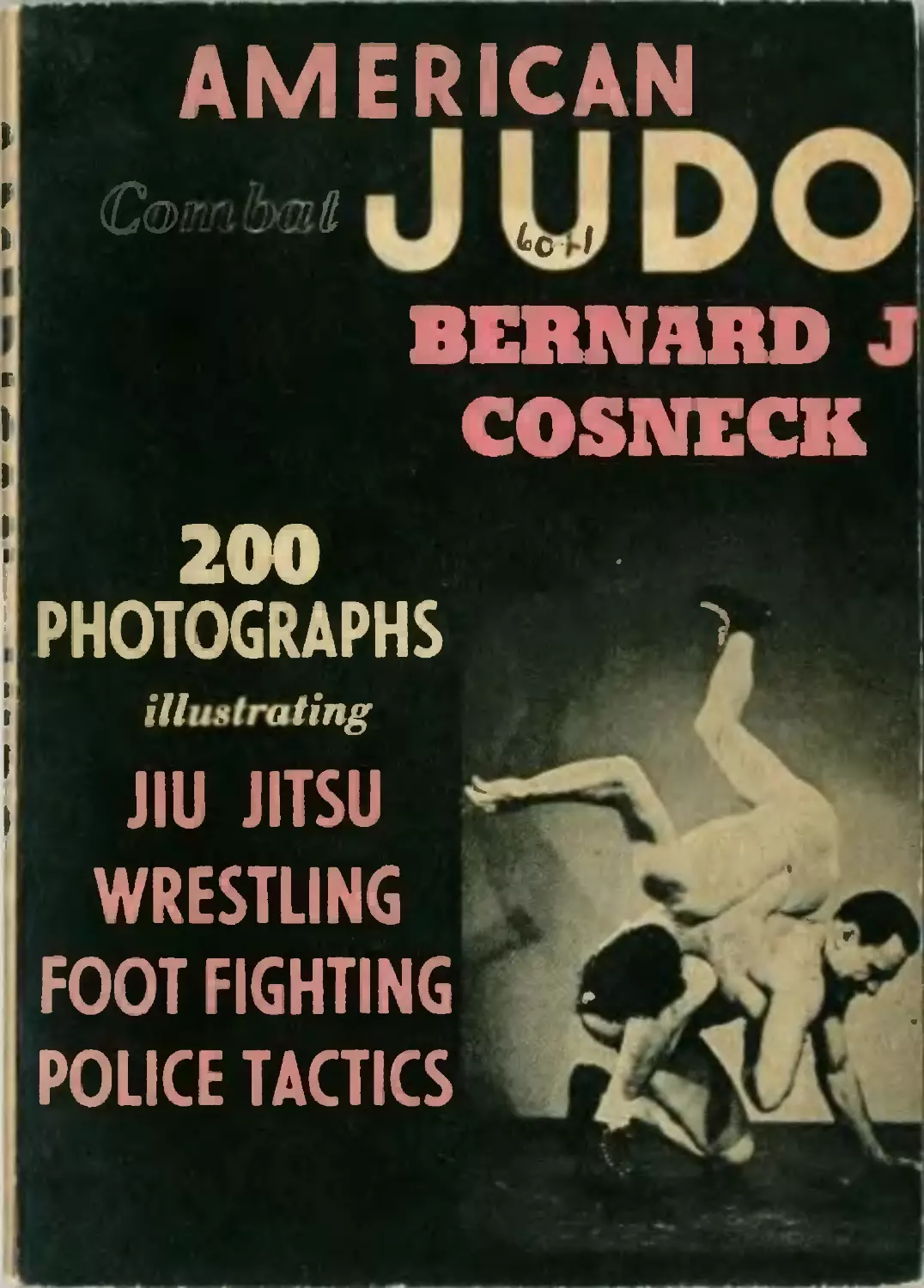
AMERICAN COMBAT JUDO
.
BERNARD J. COSNECK
graduated from the University of Illinois in 1934 where
he majored in Physical Education. He was twice Big Ten
Intercollegiate wrestling champion in 1932 and 1934. He
became interested in all forms of hand to hand lighting.
learning all the tricks of Japanese Jiu Jitsu. French foot-
lighting and Chinese boxing. In training thousands of
men for the United States Coast Guard. he helped devise
new methods in personal combat and tested and improved
old ones until he had gathered sufficient material for an
authoritative book on hand to hand lighting. As Chief
Boatswain mate he was Judo supervisor at United States
Coast Guard Station. Manhattan Beach. Brooklyn. N. Y.
Later he was assigned to several posts directing and teach-
ing the new fighting methods. He is co-author with
Lieutenant Commander Jack Dempsey of "HOW TO
FIGHT TOUGH".
COnlbat
by BERNARD J. COSNECK
200 PHOTOGRAPHS
ILLUSTRATING JIU JITSU
WRESTLING, FOOT - FIGHTING
AND POLICE TACTICS
SENTINEL BOOKS PUBLISHERS, INC.
NeW' York City
PREFACE
COPYRIGHT 1944 by
BERNARD J. COSNECK
.
This handbook of American Judo is a thorough study in
the methods and techniques of hand-fighting. It is based
upon the classic jiu-j\1tsu but incorporates the most recent
improvements in the scientific development of modes of
personal combat. It also borrow8 from wrestling, boxing
and la Savatte (footlighting), those special feature! that
are peculiarly adapted for a system of hand-fighting.
The purpose of The . merican Judo is twofold. The first
ia to develop a technique of disabling and, if necessary.
seriously injuring an opponent. The second and of no
leaser importance is to give the reader adequate skill and
knowledge in defendin himself against an assailant. In
both instances it is perfectly obvious how important it is
to perfect to the highest degree the mechanical efficiency
of the varioua holds, grips. etc., that are employed in the
8)"ltem of American Judo. I t cannot be over-emphasized
that the slightest defection in the application of any given
hold may mean serious injury. Furthermore, every super..
fluous movement, no matter how slight, must be elimi-
nated. The essence of success in the method of American
Judo is speed. combil1ed with a complete knowledge of the
proper moves based on the element of surprise. Another
point is that the holds taught are broken with the greatest
difficulty. Each hold is created with one dominant purpose:
to secure the maximum effect with the greatest economy
of time, movement and effort.
All rights reserved. No par' 01 tllls book may be reproduced
in any lorm without perznjssion in writing Irom the pulr
lishersl except by a reviewer who may quote briet passages
in a magazine or newspaper.
Composed and Printed in the U.S.A.
.
The large number and variety of holds and maneuver.
have been presented not with the intention of havinSl the
atudent master each and every one; rather. they have been
enumerated and illustrated to afford him an opportunity
v
to select thole best fitted to hi. personal physical equip-
ment. The hold that one man excels in cannot always be
mastered by another. In this conn tion it is well to
re embe that absolute proficiency in a few holds is a
Wiser policy than an incomplete maatery of 8 hundred.
VI
I
SUGGESTIONS TO THE READER
I. Whenever poslibl deliver a kid, or blow to the tea-
ticlea or to the Adam. s apple.
2. Every move must be made with a snap or jerk. A e\ow
move is absolutely worthless.
3. Any of the holds in this book can result in ext me
injury, therefore, exercise extreme caution in pra,- i :e.
.t. Don't try to resist your opponent. on the contrary. g:ve
way to his pressure and use his original force and
momentum to his own disadvantage. In fact, the
counter move for most Judo holds is to move with
your opponent'. hold faster than he expects you to.
In that way you can often escape nom an otheJ'W18e
unbreakable hold.
S. The secret of falling is to be completely relaxed. Thi.
ia often quite dif.icult, because when a penon feel.
himself fallinR his instinctive reaction is to tense }.is
muecle!. Although instinctive. this reaction is to be
avoided because muscular tension places a strain on
the bones to which the muscles are attached. enablil}K
these bones to be more ea!ily injured.
6. Work all the holcs from both sides 80 as not 10 limit
yourself to becoming .. one-sided" in your abiliti s.
7 Every moVe in Judo should be made with a maximum
of speed and carried through to ita logical conclusion.
Be sure that you have the procedures dearly in mind.
Never stop a movement half way because injuries to
yourself might ea!ilv result.
8. All moves shoule be smooth end Row one into the
other with no awkward halt! or d lay. between them.
VII
Paae
V
. VII
I I
12
13
21
... 22
... 24
lb
28
30
32
35
36
38
40
42
.. 44
46
48
SO
S2
54
S7
S8
60
62
64
66
68
10
12
14
76
79
. . _ . .. 80
82
84
. .... 86
.. 88
92
. _ _. 94
__ 96
" . .. .. ...... 98
CONTENTS
PJEfACE
n .........
SUGGESTIONS TO THE READER.. · · · · · .. · · · · · · · · · · · · · " .. · · · ... · ... ·
DISABLING BLOWS "................................" - · .. · · · · · · · · · ·
Hack .nd Jab ..
Chart of DiaobliDS Blow.......
HOLDS AND LOCKS .. · .. · · · · .. .. · " .. · .. · · · · · · · · · · .. .. · · · . .. · .. · · .. · ·
Rear Arm Stransle.. .. .. . . . '"' . .. . .. . '"' . . .. . . . . . . . . . .. _ . .. · · .. .. .. ..
Grab Bett or Crotch. . . . . " . . . . .. . . . . . . . . . . ... . .. . . . . ... .. . _ . ..
Wriat 1iold Vara.ationa ....................................
Gt ab from Behind-Arm. Free. · . . · · · · · · .. · · · · · · · · · · .. · · · · · · ·
Grab from Behind-Arm. Locked. · '"' · · .. .
Arm Dras from Behind .. . · · · · · · · · · · · · · · · · · · · · · · · · · · · · · · ·
BREAKS AN D REl..E.ASE.S . . . . . . . . . '" . . . . . . . . .. . . .. . . .. . . . . . . _ · · ..
Break from Front Body Sci.aor. · · · · · · .. · ... · · · · · .. · · .. · .. .. · · · · . · ·
Bre.k from Re.r Body Sciaaor. · · . · · · · · · · · · · · · · · · · · · · · · · · · · ..
Break from Full Nelaon . . . · · ... · .. · · ... . . · · · · · · · · · · . · · · · · · · .. · · ..
Break from Hammer Lock . . . . .. .. .. · . . · · · · · · · ·
Break from Front Finser Stransle.. . · · · .. · · · .. · · · · · · · · · · · · . · ·
Break from Grab Belt and Elbow. .. . . .. .. · .. . . · · ... · · · · · · · · · · . · · · ·
Break from Re.r StranEle . .. .. · · · · · .. . · · ... .. . . · · · · · · · · · · · · · . · . ·
Break from Arm Stranlle .. . · · .. · · · · · . . . . · .. · · · ·
Break from Hand Clasp . '" . .. .. . . . . . . . . · · · .. · · · · · · · · · · · · · · '" .. ·
Break from Front Bear Hug ... . . . . . . .. . ... . .. ... · · · · · · · · · · · · · .. · · · "
THROWS ,AND IPS ................. II . · · · .. · · · · · · . · . . · . · · ·
ShouJder T wi.t into St:-anllc .................... . · · · . · · .. · .. ·
Hip Throw .. . . . . . . . . . . .. . . . .. . · · .. .. .. · · · · · · · · · · · · . " .. · ... · · .. ·
Shoulder Throw . . . . . . . . . . .. . .. _ " _ . . . . . . . . . " . . . .. . . .. . . _ . · · "
Tip Ove I' ........................................................
Counter for Cheat Pu.h ..............................."...........
Pile Driver .. . .. . '" . . . . _ .. . ... .. .. · · · · · · ... .. .. .. · . ..
Ankle or Cuff Jerk . . . ... .. '" . . . . . . . . .. . . . . . . " . " . _ .. " · · · · · · · . · ·
L..apel Throw ...".... _ . . . . .. . . . .. . . . .. . .. . · . . . .. ... · · · . ... · · · · · · ·
Trip fro m Rea r ..".... _ . . . . . . . . . . . ... . . . · · · · · · . · · · . · · · .. " · '"
Trip fro m Be hiD d .. . .. .. . . . . . . . . .. . . .. . . . . · . . · · · · · · · · · · · · .. · ·
POUCE TACTICS
Fiahting Two Men at Once... .. . . . . . .. · . . ... . . .. · ... · · · · · · · ..
Rope Str.ngle .. I . " .. .. - . . . " . . . . . · · · · · · .. · . . " . · .. · · · · · · · · · ..
Hammer Lock Come-Alona . . " . . . . . . . . . . .. . . . . . _
Removins an Unwilling Person from a Chnir. . _ .. . · . .. · .. · · .. · ·
DiMrming an Aasailanl Who Ha. a Pi.tol Pointed at Your Back.
Diaarming an Auailanl Who I. Facing You with a Pi.tol. . . . . · . ..
Diaal'ming Opponent of Club . . . . .. .. " . .. . . . . . .
Cro..ec:J Arm Come-Alons ..................................."..
Re.u. itation .................
.. .
.............
. . . . . . . . .
. . ...
. . . ..
. . ...
. . .
. . . .
. .
. . ..
. . . ..
. .
. . .
. .
. . . .
. . .
.. . .
. . .
. .
. . .
. . "
_ .
. . .
. . ,. .
. . .
. . . .
. . I
. . .
. _
. .
.. ..
... . ..
. . .
. . . . . . .
.. -
. . .
.......
. . .
. .
. . . . .
.. _ .
. .
. . .
. . I
. . .
. . .
.. . .
. . .
. . . '" . .
. . .
. . . . .
. . . .
. ..
. .
. .
. . .
. .
. .
. . . .
- . .
" . .
- . .
.....
.. .
......
. . "
.. '" ..
.. .. ..
" . .
. ..
IX
I
--
POUCE TACTICS-(Con"'Ducd)
Pale
T eltinB an UnwiUinK Pr.eoncl .... . ... ........................ 100
How to Search a Pri80nc.... "...." ... . .. - . .. .. . - .. . · .. . . " . . .. 102
Blocking Hip or Shoulder 1 hrow ."................... ................. 104
Oi..rminll OppoDe'nl 01 a Kn fe . a .. . .. . . .. .. . .. .. " . . . .. . .. " .. .. .. 106
Blo kinl Kick to T eetiele. . .. . .. .. .. .. I . .. . . . .. . .. .. . . . .. . .. .. . .. . . " .. . . 108
Arm Hack CONe-AIo... .. .. eo .. . .... .. - ...........".............. 110
Arm T wlet ................................................................ · 112
W ri.t Lock Come-Alonl .................. .. .. .. . . .. .. .. . . . .. . . .. .. . .. .. .. , 114
Au.ck from the Cround ....... . .. .. . . . .. . .. . .. .. . . .. .. .. . . .. .. .. .. .. .. .. . · lit.
How to Gouae Oul an Eye.. . . . .. ... - - . . .... ................... I 18
SITU A TI 0'-5 ...... ... .................. _ ... . .. .. . .. . .. . .. . . .. . . . . . .. . . .. .. " '2 I
Belnll Auack"d from th«, Rear .... I .. .. . - .. .. . .. . .. .. · .. . .. .. .. · 12)
Rein. Stran.led with Hand... . .. .. . .. .. .. .. .. .. .. .. . .. . .. .. .. .. . .. .. .. .. .. " 12 J
Be in. Sc ra n.le-d wit h F orea m. .. .. .. .. . .. .. . . .. .. . .. . . . .. .. .. .. .. . II .. · " 1 2)
Beins Graeped by the W rie.. .. .. .. .. . .. .. .. I .. .. . .. .. . . . . . .. .. .. .. .. . .. .. .. · " 12)
Bcin. AUack.d Whik LyiDa face Down.. .. . .. .." .. ........... . " 12 J
Bean. Ru.hed Head-On ................. I . .. .. .. . .. .. . .. .. .. .. .. . - .. .. . · .. .. " 124
Fi.htiD. Fac. to Face....... ............................................... .124
Ma It anK an Au.,1t from t "e Rea r " .. .. .. . . .. .. . . .. .. .. .. .. .. .. . " .. .. . . " . · .. 1 24
DISABUNG BLOWS
x
THE HACK AND THE JAB IN JUDO
The hack i. a hand blow delivered with the little linger
side of the open hand_ The fingers are held extended. .tiff
and close together. The thumb mayor may not be ex-
tended. The blow is given with a swift. sharp, hack-
ing movement with such abrupt force that it can either
break a bone or paralyze a nerve. Continual practice of
pounding the underside of the hand upon a hard. flat
object such as a table is advised for toughening the striking
surface of the hand. After the hand is thus prepared it
can be further toughened by pounding the edge or comer
of an object.
TJPe of BM»w
Fig- 3. Hack
F 4. Hack
is-
Fig 5. Hack
When administering the blow. contact is made with that
surface 0 f the edge of the hand between the wrist and the
base of the little finger. The fingers themselves are not
used in Itriking, becauae they may slide over each other
And make the blow less effective.
Fig- 6. Hack
Fig-
The jab is made with the closed hst. the knuckle of the
middle finger protruding. The blow with the fist covers
too great an area, whereas the knuckle of the finger. being
pointed, will localize the blow and thereby intensify it.
Fig- 12. Hack 01
jab
.
Fil_ 13. Hack
...
Fig- 14. Hack
(Rabbit
punch)
G BLOWS
-
Temple and ear.
R
pain. broken nOle.
l00eened teeth
-
headache, pain. pol-
.
.ible unconIC10Ul-
ne.a
poeeibIe fracture
-
-
temporary paraly..
of arm
unbearable qony.
complete pualy....
colIapee
phy.ical collapee.
lagging and neu..
temporary paral
phyaica1 collapee
fracture
pouible di.l tion
and UDConKIOu.-
neaa
.
unconlClou.neu
and pouible bone
fracture
fractur
.tunninl pain. poe-
.ible unconaciou.
ne8e. followed by
vr'rfA hf-adach
CHART OF
Anu Alected
Uppe,Lip
7. liack.
punch.
8Queeze
or knee
U__L Adam-.Apple
Fig- 8. naCA
fig. 9. Hack or k.dney.
fi.t blow
- y-
Fig. I o. Hack or collar bone
jab
Fig- 11. Hack ude8 of jaw
-
W riat of bone.
of thumb
Blcepe mUlClee
teabcle.
temple bon
-
bridle of noae
6eck of neck
13
OIART OF DISABUNG BLOWS
CoDtioued
Type of 810.
Fil.. 15. Thumb
jab
Fis. 16. Thumb
jab
Fil_ '7. Thurnb
jab
Fia. 18. Thumb
jab
-
fia. 19. Thumb
j.b
Ana Affected
throat below
Adam-. Apple
Reaction.
-
garaml. naula
.
UUue over eye.
.
peln
hollow of armpit
pain
.
behind ear lobe
.
pain. temporary
diaabiJity
ln
twue between
jawbone and
throat
caJI
intrmal pain
Fig. 20. Thumb
jab
Fig. 21. KnuckJ
diK
Fig- 22. Punch
'-
.ide. of .pine
excruciatinl pain
toral or arm
pit
eclar plexu.
pain. diaab1in;r arm
Fig- 23. Punch
and twist
of fiat at
point of
contact
Fig.. 2.... Clap of
hand.
naU8ea, phy.ical
collap.e
..
ean
rupture .nd plUn
over een
-
Fil_ 25. Stamp IDatep
heel
Fis. 26. Clawed nostril.
hand
fracture aDd pain
tom and lacreraled
.
ti"Ue8. e%trelDe
..
naln.
I"
I t I
I
Fig. 3
Fig. 5
\\.
......
.
)
...
...
....
-
Fig. 4
'"
w
Fig. 6
"..
Fig. 7
Fig. 9
,
Fig. 8
-
-
Fig. 10
,
"",'
.. "
,
Fig. 11
a..
Fig. 12
I
.
....
Fig. 13
Fig. 14
l
,
t
.
....
'--..
Fig. 15
Fig. 16
\
-
..
.
..
.....
Fig. 17
Fig. 18
-
"'
}
,,'"
Fig. 19
Fig. 20
"f
F 11. 21
Fig. 22
..
-
....
.
...
-
-
Fig. 23
'\, ..
:-
.. "
J.
.
Fig. 25
.,.
,
I
\
HOLDS AND LOCKS
rig. 24
...
- ....
Fig. 26
REAR ARM STRANGLE
In executing an arm strangle. your arm must be in direct
contact with your OppOJlent-s tl1roat. The 110ld is worth-
less if his chin prevents (ontact with his throat. It is essen-
tial to exert the maximuol pressure immediately rather than
gradually because your opponent might squirm himself
into a less dangerous position.
POSITION : You are .tanding behind your opponent.
ACTION: I. Place your left arm around opponent.s neck
with Yol:r wrist bone pressing into his
Adames apple (Fig. 27).
2. Then place the back of your right arm
(above the elbow) across his right shoulder
and clasp your right biceps with your left
hand (Fig. 28).
3.. Bend your right ann toward your left hand
and place it behind his neck and grasp your
left .houlder or biceps with your right hand
(Fig. 29).
4. Pul) backwards with your left arm and
push forward with your right in a scissor...
like motion. thus strangling him (Fig. 30).
NOTE: If opponent is taller than you and the hold ia
awkward or difficult to perform after you have
encircled his throat with your left arm (or even
before), grab his hair with your right hand and
pull his head down backwards until he is down
to your size. Th n continue with the hold.
22
-
.............
-
,
,
..
,
.
\, "
a.
,
Fig. 27
Fig. 28
J
-
,
.
-
.
,
"" '
rll- 29
Fig. 30
GRAB BELT OR CROTCH
V ry oft n wh n you ar facing and talking to a belligerent
oppon nt, it is quite obvious that trouble betwe n you i.
immin nt. In that case don.t wait for him to take the
initiative but go into action yourself.
POSITION : You ar facing your opponent.
ACTION: I: Grab your opponent's belt or hi. clothes
at the wai8t, or else place your hand.
through his crotch (Fig. 31).
2. IE you are using your right arm for this
grasping purpose, pull it sharply backward
so that his body is arch d forward.
3. At the same time shove your left forearm
forcibly against his face or throat, pushing
the upper part of his body back (FiR. 32).
4. At the same time place your left foot behind
him. then bend your left knee 80 that hi.
arched body li s backward over your left
knee (Fig. 33).
5. ow that you have him 8tretched heJp-
les81y ov r your thigh. you can hack his
throat with your left hand or deliver a blow
to his te8ticl 8 with your right elbow with-
out changing your grip.
24
.f
..
It
\
Fig. 31
..
-
-
.,
.
A.
"
rig. 33
...
-
-
..,
.
..
Fig. 32
(
.
WRIST HOLD VARIATIONS
In combat you will freque!ltly ({raSp your adversary..
wrist, bend and twist it. From this position you can pro-
ceed to various holds.
POSTION: You have twisted and nl your opponentes
wrist.
.
Hack oppon nt's throat with your free left
hand (Fig. 34).
2. Twist wrist to the riRht and simultaneously
jerk his left elbow up with your left. Thi.
action should result in tearing ligamenta,
muscles and tendons of his should r.
3. Twist the wrist. Place your left foot out-
side and behind his left heel and trip him.
Your left hand can assist by pushillg at his
chest or face (Fig. 3S).
4. Twist the wrist. Drop to your right knee:
place your xtended left outside of his left.
Trip him.
:> . Twist the wrist. step forward on his right
foot and bring your left knee into his tes-
ticles (Fig. 36).
6. If your opponent has his fist clenched, it
will difficult to twist his wri t. In that
ev nt. grasp his fist with your hands. jerk
his arm to you abruptly and imm ()iately
twist the fist to th riRht. carrying opponent
to the ground on his left side. Do not delay
betw en jerking the arm and twistirlg the
fist (Fig. 37).
7. If you have difficulty in twisting adv r-
sary.s wrist. hack at his wrist with your left
hand. This will immediately sap his arm
strength and enable you to apply the twist.
t
ACTION: I.
26
...
J
,
,
Fig. 34
...
.
Fig. 36
'-
,
'-
Fig. 35
.
'"
...
"
Fig. 37
GRAB FROM BEHIND ARMS FREE
Sor.letimel, wh n you are grabbed from behind your arm.
Will be free. If you work quickly there will be no difficulty
in escl\pinR the hold.
POSITION : Your opponent has your body encircled
from the rear. your arms free (Fig. 38).
ACTIO : I. Bend forward. stretch your arms outside
your I gs end grasp his ankles or trouser
cuffs (Fig. 39).
2. Stand up abruptly. dragging hil ankles
with )'ou. He Yt.ill be thrown on -his back
(Fig. 40)_
3. Then let the whole weight of your body
fall on his stomach and execute any of the
toe holds ordinarily used in wrrstling..
28
9
,
...
,
Fig. 38
Fig. 39
.
CIi
...-
..
..,
Fig. 40
-
GRAB FROf\1 BEHIND-AR 1S LOCKED
-t.. r
"-
,
As a rule. an opponent who has had traininR in combat,
particularly a wrestler. will always try to g t hind you.
This is ordinarily a safe and effective position from w11ich
to work. However. the inform d combatant can me t the
situation and by means of the dctiol1S described below Rain
the up r hand.
POSI, aOl't : \ our opponent has your arms and body
encircled from the rear.
.
,
..
...
.
.t1.
ACTION: I. Drive the heel of your rigl..t foot into the
small bones of his right in8t p. These
bon s 11ave little resistanc and can be
broken as asily as an cRgshell. or.
2. Put the edge- of Jour riRht foot against hi.
shin bone jllst below the kr\ee and scrape
your shoe down the tontire I ngth of his
(FiR. 41). or..
3.. Grab his testicles wilh your hand and
squeeze (FiK- 41). or.
4. Snap your head back into }"is nose (Fig.
4 3 ). or.
5. Try to twist your arms free and jab your
elbow backward into his face. Or.
6. Shuffle your lege to compel your opponent
to mo'\'e. If he spreads his legs, bend for-
ward and bring"your h el backward into his
testicles (Fig. 44).
\,
t
Fig. 41
Fig. 42
j
4i-
(
,. ,
'-.
\
Fig. 43
rig. 44
30
ARM DRAG FROM BEHIND
.
It is always d sirable to be in back of your opponent.. Since
this hold will enable you to realize this position. it is there-
fore of great importance.
POSITION : You are facing your opponent.
ACTIO : I. Grasp opponent.s left "frist in your right
hand (Fig 45).
2. Step forward on your left foot and hook
your free cupped hand und r the upper
part of his left arm (Fig. 46).
3. Throw his left captured arm to your left.
Release it (Fig. 47).
4. Without any hesitation grab his left shoul-
der with your left hand; pull him around
al1d step behind him.
S. As your opponent is being twisted around,
wrap your right hand around his waist to
secure your newly acquired position
(Fig. 48).
Fig. 45
Fig. 47
32
\
.
I
..
"'
Fig. 46
.
Fig. 48
BREAKS AND RELEASES
RREA" FROM FROl'4i BODY SCISSORS
Body Scissors hav formerly been held in dread by mo
people as being t"xcessively painful and difficult to brea
Howev r. the tactic described will enable the reader t
eKape from almost any scissora hold. whether from th
frol1t or rear.
POSITION: Your opponent has you with a front Bod
Scissors. You are fac to face.
ACTION: I. With all the strength at your cornman.
dig your elbow into the soft tissue on th
inside of your adversary- s thigh (Fig.
and Fig. SO). Hie pain will be intense a
.hould cause an immediate release.
.
Fig. 49
.
.
Fig. 50
36
BREAK FROM REAR BODY SCISSORS
The method described below will enable you not only to
break this hold but also your enemy's leg or ankle. Be
cause of this latter probability, be especially careful when
practicing this hold on your partner.
POSITION: Your opponent has you with a rear Body
Scissors (Fig. ) I ).
ACTION: 1. Cross your legs .>ver his "scissors" (Fig.
52).
2. Throw your head back dnd your body for-
ward. Your action will create terrifl1c pres.
sure on his ankles. If you exert enough
pressure, you will break his h:g (Fig. ; 3) ·
38
.
.
,
I
.... ..
\
Fig. 51
...
"
\, .
Fig. 53
...
,j --. .I
\.
,
.
Fig. 52
BREAK FROM FULL NELSON
The F ull Nelson is familiar to most men from bo)' hood
days as an effective hold. However, the break from a Full
Nelson can be mastered by following the procedure out..
lin d below:
POSITION: Your opponent has applied. a Full Nelson
on you (Fig. 54).
ACTION: 1. Bend and twist your body to the left. bring-
ing your left foot around opponent" s leg.
2. Stand erect. leaR backwards and drive your
left elbow into his chest, or
3. Bend your body at the waist and Rrab
opponent under his knees (Fig. ))). Then
pick him off the ground as you stand erect.
The last move is to fall backward. the entire
weight of your body falling on him. This
should succeed in breaking a few of his rib
(Fig. 56).
,
Fig. 54
.
40
.
,
.
,
)
Fig. 56
"
,
,
t
.
Fig. 55
,
-
...-
BREAK FROM A I-IAMMER LOCK
The hammer lock is one of the most pdinful holds em-
ployed in combat and can be broken only with difficulty.
However, it can b done by catching your opponent off
guard.
POSITION : Your opponent has a hammer lock on you.
(Fig. ) 7 ) .
ACTION: I. Bend your body forward at the waist. This
movement will automatically straighten
your captured arm (Fig. 58).
2. Then. stand E-rect and twist to the right
(Fig. S9), if your right arm is held (or left
if left arm his held), completing the action
with a kick into your opponent-s testicles
(Fig. 60).
42
..
.....
...'"
,
..
..
\.
,
-
.
I
Fig. 57
,
111. '"
..
,
,
4
-
Fig. 59
-
&
"
t
,
-".
,
..
--
....
Fig. 58
Fig. 60
t
I"
'II,.
J
..
\
BREAK FROM FRONT FINGER STRANGLE
The front finger strangle is especially painful. However,
it can be broken in the following manner:
POSITION : You are facing your opponent, his fingers
grasping your throat.
ACTION: 1. Swing your right arm very forcefully in a
long, overhead motion toward the left and
over opponent' 8 both arms (Fig. 61 ). At the
same time bend at the waist and twist your
body very vigorously at the waist toward
your left (Fig. 62.) Your back is now turned
to his back and both his arms are locked
under your right armpit (Fig. 63). Hold on
to his arms with your left hand, thus releas-
ing your right arm. Then drive your right
elbow backward with a crash into his face
(Fig. 64). Or,
2. Hack both hands very vigorously at the
soft tissue just above his hip bones. I f you
do this vigorously enough, as it should be
clone. he will collapse.
...
..
Fig. 61
Y'
..
,
Fig. 63
44
"
't.
.
-
...
"
..
Fig. 62
.
..
.
..
...,.-.2
-.
'"
.
t
Fig. 64
"
..
J
BREAK FROM GRAB BELT AND ELBO,,"'
POSITION : Your opponent has your back arched over
his bent leg, as shown in illustration (Fig.
65 ).
ACTION: 1. \\Trap your right arm over and around the
upper portion of his left arm. Retain this
hold throughout this entire maneuver (Fig.
66).
2. \Vith a sudden -and sharp jerk twist your
body to the IE"ft so that you are off his knee
(Fig. 67). You will find that you have
pulled your enemy off his feet and that his
body is wrapped around your body (Fi't.
68) . He will be on his back. Now you can
swing your fist into his groin.
.
.
46
, .
...
....
'a
Fig. 65
-
,
Fig. 67
...
....
..
.
Fig. 66
.
Fig. 68
--
-
-
I
. .
.
..
BREAK FROM REAR STRANGLE
Th Rear Strangle illustrated here is the traditional hold
described in all Judo books as being unbreakable. How-
ever, it can be broken if you act before your opponent has
the opportunity to bend your body backward.
POSITION : Your opponent has a Rear Arm Strangle
on you (Fig. 69).
ACTION: 1. Reach up with either of your hands and
clasp the hand he has about your head
(Fig. 70).
2. Slide his arm upward and forward over
your head. This arm will now be straight
over your shoulder, the palm up (Fig. 71).
3. Now, with the aid of your other hand, bear
down on his arm. If you exert sufficient
pressure. you will break the arm at the
elbow (Fig. 72).
. ..
Fig. 69
-
,'"
.
\
...
.
Fig. 70
,,;-
..
..
"
.,
.
..
t
.
48
Fig. 71
,
Fig. 72
\
.
1
BREAK FROM ARM STRANGLE
The arm strangle can easily be broken, particularly if
your opponent is not given an opportunity to bend your
body backward.
POSITION: Opponent has rear arm strangle on you.
ACTION: 1. Immediately turn your head away from
his wrist which is pressing against your
throat and turn your head toward the angle
of his bent elbow. In this little space pro-
vided by the bend of his elbow you will
find sufficient room to ease the pressure on
your throat and thereby to catch a few
gasping breaths while you prepare for your
next move (Fig. 73).
2. Reaching up with your hands catch hold of
the forearm around your neck and hang on
to it tightly. Suddenly bend backward into
his abdomen. pulling him forward and
dear over your head. He will automati-
cally let go to catch himself (Fig. 74).
50
rr ,
-
,
Fig. 73
.
,
Fig. 74
BREAK FROM HAND CLASP
y ou wi1l encounter the hand clasp under various circum-
stances. Some combat maneuvers are begun from thit!
position. Or you might meet someone who will try to
impress you by seizing your hand in a crushing grip. This
is ho\ the hold is broken:
POSITION : You have gripped hands with your oppo-
nent, right to right.
ACTION: I. Place your left thumb against the back of
his right thumb (Fig. 7). faced in the same
directio!1, and bend it back as far as pos-
sible (Fig. 76)- This will immediately
loosen his grip and you can slide your hand
free.
,
-
"
-.\.1 \'
\..
.
Fig. 75
,, A.
" ,
4IJ
, ....... -
Fig. 76
.
52
BREAK FROM FRONT BEAR HUG
The Front Bear Hug is one of the most common and prim-
iti"e of all holds. The escape is based on a series of short,
simple moves, depending upon the nature of the hold.
POSITION: Your opponent has seized you in a front
bear hug.
ACTION: 1. If your arms are encircled, bounce your
head against your enemy' s face, particu-
larly his eyes. nose and teeth. At the same
time, force vour knee into his testicles.
2. In the e"ent the bedr hug has left your
.
arms free.
a) Circle your arm around his waist, jab
your thumb beneath his ear, and
force opponent to one side or the
other in order to break }\is grip. Or.
b) Force his head back by pulling at his
hdir and thfln hack at his throat
(Fig. 77). Also force your knee into
his testicles (Fi . 78). Or,
c) Prod your left thumb into the base of
his throat, your right thumb into his
nose and force 11im back (Fig. 79).
until you can deliver your kne into
his testicles (Fig. 80).
NOTE: In exercising the above. holds protect your tes-
ticles by turning your body to the right or left.
54
I
-
-
.'.:1
\..
\
J
\.
,
'-
Fig. 77
Fig. 78
.
t .
It-
<:
\'
'.
l
Fig. 79
Fig. 80
THROWS AND TRIPS
.
SHOULDER TWIST INTO STRANGLE
This is anoth r man uv r which can be employed wh n
you anticipate that your oppon nt is going to take the
initiative.
" -...
NOTE:
Y ou are facing your opponent..
Place a hand on each of his should rs and
grasp a handful of clothes. or grasp his coat
lapels, one in each hand (Fig. 81).
2. Vigorously twist his body around to one
sid by pushing one shoulder c\nd pulling
the other. This will spin him around side-
ways. placing your pushing arm in ideal
position for 8tr8nglinR (Fig. 82).
3. Bend him backward; kick his near knee
with your far foot (Fig. 83).
You can achieve your objective more quickly by
stepping around to his rear as you twist him.
Fig. 81
POSITIO :
ACTION: I.
58
,
'"
.
Fig. 82
.
...
,
.
.
..
Fig. 83
.....
,
HIP THRO\'
The hip throw is a favorite Japanese trick used in dose
physical combat. A minimum of strength is rt"ouired in
itl execution. It is primarily a matter of speed. leverage
and balance.
,t
Yau are facing your opponent.
Place your leh arm aU the way around his
waist lraving his right arm frt". (Fig. 84).
1. Pivot to the right on tht" right foot 90 that
you are now both facin the same direc-
tion. with your back to his chest. At this
point you mdY grasp his left wrist in your
ri ht hand if you can (although this is not
necessary for the succeSI of the operation).
Then be sure that your left fool. is far on
the outside of his left foot so that your leh
hip extends a little past the left of his body
(Fig. 85). In practice you should exagger-
ate this position a little more.
3. Bend forward to the right throwing your
opponent over your It-h hip (Fig. 86).
"' AI your opponent is being thrown. twist
him around by pulling his left wrist to-
wards the right and bringing your left knee
under him so that when he (aIls he will lie
prostrate and helpless acroSS your knee
(Fig. 87).
pOSlTIO ·
ACTIO : I.
60
..
IIIIi..
....
,
Fig. 84
.
-
Fig. 86
w
,
..
'-
...
Fig. 85
-
..
.
Fig. 87
SHOULDER THROW
The Shoulder Throw is very effective and spectacular.
Moreover. it demands extraordinary speed to bring it to 8
successful conclusion. Once this throw is started. it is of
the utmost importance that it be continued. Failure to
execute the complete hold may result in your opponent'!
disabling you.
POSITION: You are facing your opponent.
ACTION: 1. Grasp opponent's. right wrist in your left
hand (Fig. 88). (This grip never change-
throughout the entire procedure.) Raise
your arm upward and to your left.
2. Pivot on your left foot with your back snuS
against your opponent" s chest. Y oU noW
both face in the same direction, and your
right foot is outside his right foot. Keep
his arm stretched over your shoulder. See
Note below.
3. As you pivot. bring his right arm down
over your right shoulder. With your right
hand obtain a firm hold on his upper right
arm. Your right hand must not slide down
toward the elbow; the higher the grip of
your right ann the more throwing leverage
you have (Fig. 89).
4. Swing his right arm down in front of you
in a sweeping motion. Dip your knees and
at the same time thrust your hips back into
his aLdomen. This is important since it
places you at a lower level than your op-
ponent and makes the throw possible with
a minimum of effort. At the same time
twist to right and send him flying over your
.
...
\
.
.JII
t'
,
Fig. 88
.
"-
..
..
62
Fig. 90
,.
,\
... -
, ..
\
, \.
1
Fig. 89
.....
Fig. 91
J.
'-.
SHOULDER THROW (Continued)
.houlder to the ground. (Fig. 90). Now
you either loose your grip on him so that
he takes a hard fall or y u hold on to hie
wrist (Fig. 91 ) and proceed as follows: As
his body hits the ground. drop to your right
knee and stretch his right arm, palm up-
ward. across your left thigh. (Fig. 91).
Pressure will break the arm.
NOT£.: At this point. if you turn the palm of his captured
arm up and bear down on the wrist. you can
either break his arm at the elbow or go into a
come along.
.
"
r
.
,
to
V
,
... \ I
.
Fig. 92
TIP OVER
This is one of the simplest methods of dropping an op-
ponent when you are behind him.
POSITION : You are behind your opponent.
ACTION: I. Place your left arm around his waist or any
part of his upper body.
2. Then extend your hand through his crotch
from the rear far enough 80 that you can
grasp his belt. or a handful of do thing
(Fig. 92).
3. Now lift and pull backward with the arm
under the crotch so that he faUs forward on
his face (Fig. 93).
NOTE: This tip over is an excellent meane of Eorcins an
unwilling person through a door.
,
-
.
'"',
"
Fig. 93
64
.
COUNTER FOR CHE.t)T PUSH
The following steps may be taken when puehed or grabbed
in the region of the cheat:
POSITION: You are facing your opponent.
ACTION: ,. As opponent attelnpts to grasp your clothes
at your che8t or places his hand on you r
chest to push you (Fig. 94). pin his hand
to your chest by clapping the palms of both
your hands tightly over the back of hand
grasping above the bend of the wrist 80 that
he cannot jerk it away (Fig. 9 S ) .
2. Then quickly bend your body forward
from the waist (Fig. 96). dip your knee.
and twist your body away from opponent-.
free arm. He will then be forced to hi.
knees to avoid fracturinR his wrilt (Fig.
97).
NOTE : To escape this hold. do not at iempt to free hand
by drawing it straiRht back. On the contrary bend
it in the opposite direction of your opponent, and
at the same time move your captured hand
.harply down along the front of his body.
66
.
- --J
\...
Fig. 94
Fig. 96
..
.
.. ..
....
Fig. 95
"
"
rag. 97
PILE DRIVER
This maneuver should be t"xecuted cautiously in practice
as it can result in fracturing vour opponent" s neck.
POSI.fION : You are behind your opponent.
.
ACTION: I. Encircle his waist with your left arm. Reach
down with your riR:ht arm and grip his right
knee (FiR. 98). Then pick him up bodily
by means of the hold just secured (Fig.
99).
2. As you lift him you can easily turn him
upside down 50 that his head is crashed to
the ground. (Fig. I 00 and Fig. I 0 L) See
note.
NOTE: This proceS5 is simplified by lifting faster on the
leg than on thf' waist. Y au mdV find it <>asier to
lift your opponent by the following method:
With your left arm around his waist. place your
ri ht arm through his crotch and clasp your left
wrist.. thus forminR a saddle for your opponent
to ride on the way up. Then mt'rely stand up and
tilt him over tc the left and proceed as above.
68
-.
>
...
.
,
.. \
'w
t
I
\ -\
...
..
.
Fig. 98
Fig. 99
"
.
..
,
} f
.
\.
\ ,'.
....
.
.
Fig. 100
Fig. 101
ANKLE OR TROUSER CUFF JFRK
The al}kles or trouser cuffs can b used to throw your
opponen t.
..
1
posrrlON:
ACTION: I.
You are behind YOlJr ddversary.
Drop to your knees and slide your I..and
down along his legs to his ankles. Grasp
a trouser cuff in each hd11d, or, if you pre-
fer, retain your hold on his ankles (Fig.
) 02).
2. Jerk tl1e cuffs or ankles towaTds you, th\JS
forcing your adv rsary to fall forward
(Fig. 103).
3. A toe hold may now l,e applipd (Fig. 104
and Fig. i OS ) .
'"
...
..
-
.. "
Fig. 102
Fig. 103
..
.
" ..
".
-
.
Fig. 104
Fig. 105
70
.
.
LAPEL THROW
If }.our opponent is wearing a COdt with lapels, tIle follow-
ing procedure wi]] put him on his back very quickly.
POSITION: You are facing your opponent.
ACTION: I. Grasp his right ldpel securel:y in your right
hand (Fig. 106).
2. Then twist your body to the left (Fig. 107)
so that your back is to him (Fig. I 08) I
and drop to your right knee. This action
will pull him over your shoulder (Fig. 109).
r,
oj
Fig. 106
.. ,
..
-
.
.",.
,
....
..
Fig. 108
72
\.
......,
........ -
-....
I
. '..
,
Fig. 107
"
.
.
,
-
)
Fig. 109
TRIP FROM REAR
This action can easily be executed and is very effective. It
is a simplf" variation of some of the more complicated
rear trips.
Y au are to the rear of your opponent.
Clasp both your hands around his waist
and drop to your right knee (Fig. 110 and
Fig. III).
2. As you fall. twist your body to the left so
that you are facing in that direction and
extend your left foot strai ht ahedd of you
so that it is on the outside of ) our oppo-
nent.s right foot (Fig. 112).
3. Continue this mov( ment. kickin't your
opponent's right foot from under him with
your left foot and pulling him down and
to the right.
4. Your opponent is now on the floor. With
your right hand you can proceed to hack
at his neck or anv other vulnerablt> area of
his head or face (Fig. 113).
POSITION:
ACTION: 1.
74
,
Fig. 110
,.
A
.u.
......
...
-
.
.
Fig. 112
...
1)
..
"'. . ..4
\.
.
",'
T
Fig. 111
.
}
,
..
Fig. 113
.
TRIP FROM BEHIND
There are innumerable methods of bringing an opponenl:
down from the redr. The one described below can be exe..
cuted by anyone.
POSI1'ION : You are behind your opponent. YOlJr arms
clasped around his waist (Fig. 114)_
ACTI()N: I. Twist slightly to the left and place YOllr
right foot back of his left knee (Fig. 11 S ) ·
2. Foree his left knee forward with your rigl\t
foot as you twist him to the left and back-
ward (Fig. J 16).
3.. Drop to your left knee to complete t11e
fall.
76
...
I
4'
I
...
.
,
Fig. 114
.
- .....
,
,
Fig. 116
-
,
.
aO
-
.
....
b
.
..
...
J
"\
Fig. 115
I
.
POUCE TACTICS
FIGHTING TWO MEN AT ONCE
This is a situation that may occasionally arise and is at
beat none too favorable, even for the Judo expert.. Your
only hope for victory lies in surprising your opponent and
acting quickly.
POSITION: You are facing two opponents.
ACTION: I. Your primary move is to center all your
attention on one of the men by directing
your conversation and gestures to him,
thus t mporarily allaying the suspicions of
your second opponent.
2. Feint a hack at his throat (Fig.. 117). then
suddenly pivot toward the unprepared man,
using th original force to carry the same
blow to the latter (Fig. 118).
3. After this blow has landed. immediately
pivot and kick to the testicles of the first
man. This entire maneuver should not
take more than three seconds (Fig. 119).
.. w. =--
r. "
d- r,
ct.
, \
..
.....
. -
-
Fig. 117
Fig. 118
4 ';j
..
"
L'J1
....
-
.
Fig. 119
80
l
ROPE STRANGLE
This is primarily a commando tactic. The primary objec-
tive is to steal up unobserved on a sentry. The rope
strangle will be the only phase stressed here..
POSITION: Y ou are stealing up on a sentry from the
rear.
ACTION: I. Cast rope (about two and one-half feet
long) about sentry.s neck (Fig. t 20).
2. Immediately pull the rope back, against his
throat and cross the ends of the rope by
crossing your wrists as you turn your back
to him (Fig. 121).
3. Draw the crossed ends of the rope over
your shoulder as you bend forward (Fig.
122). thus rai5ing his feet off the ground.
The weight of his body against the taut
rope will cause him to strangle (Fig. 123).
It.
....
82
.
,
..
-
.
"f
\..
Fig. 120
Fig. 121
.
...
,
,
Fig. 122
Fig. 123
.
9
HA 1MERLOCK COME..ALONG
This hold requires practice in order to achieve the speed
and rhythmic action necessary for its successful perform-
ance.
You are facing your opponent.
Grasp opponent's left wrist in your left
hand (Fig. 124) and place your right hand
on the upper portion of the captured arm.
Now push up with your left arm and press
down with your right one bending your
opponent's arm (Fig. 125).
2. Throw this captured arm behind the upper
portiora of your right arm, bearing down
with your right hand and pressing up with
your elbow at the same time (Fig, 126).
3. Your right hand will .10W be free and you
can utilize it to grasp your adversary. 8
hair (Fig. I 27) .
POSITION:
ACTION: I.
,
84
.
1It.
-
A-
I
-
u
Fig. 124
Fig. 125
.
,
....
. j
.
1
-
,\ 'w
,
Fig. 126
Fig. 127
REMOVING AN UNWILLING PERSON FROM A
CHAIR
.rhe following method is used to remove a stubbornly
resisting person from a chair. Proceed as follows:
POSITION: Stand behind the seated person. facing the
same direction in which he is facing.
ACTION: I. Place your left arm or hand around his
head (Fig. 128).
2. Then dig your right thumb into the soft
tissue of his throat, at the angle of the jaw
(Fig. 129). Press in and upward (Fig.
I 30) . Your opponent' s efforts will cease.
.
--
,
.
....
l -
\
Fig. 128
86
OIl
..
;
..
I
Fig. 129
.
.
\.
t
Fig. 130
-
DISARMING AN ASSAILANT WHO HAS A PISTOL
POINTED AT YOUR BACK
POSITION : Your opponent has his gun pointed at your
back (Fig. 131).
ACTION: I. Keep talking to the enemy, saying anything
that comes into your mind. Plead with
him. break down and cry if you can, all in
an effort to distract him from your planned
action.
2. Keep the pistol against your back so that
you are informed of its exact positiQn.
Furthermore. this will also prevent your
opponent from constantly changing his
. .
position.
3. While you are talking to him learn in which
hand your enemy is holding the pistol. You
might do 90 by knowing his position, or by
glancing out of the corner of your eye. At
all times avoid revealing any intentions of
your movements such as changes in ex-
pression, or moving of your shoulder or
any other such action.
4. If you have learned that the pistol is in
your enemy' s right hand. then suddenly
and quickly twist your body to the right.
your right elbow extended. Jab his pistol
arm with your elbow and knock it out of
the line of fire (Fig. 132).
5. Whether the gun goes off or not, continue
the movement of your right arm and swing
it up. under and aroul1d your oppon nt's
oistol arm (Fig. 1 33) .
88
....
....-
- "
-
..
..
Fig. 131
-
,.-
,
.
Fig. 133
..,
ttl,
I ......
-.... ,...
\
'-
..
J....
-., -
Fig. 132
. ,
tar"" - «
"' \....
'\ .lJl
t,j
.
Fig. 134
DISARMING AN ASSAILANT WHO HAS A PIS1.OL
POINTED AT YOUR BACK (Cont.)
6. Then bend forward, to the left, thus secur-
ing the arm holding the pistol between
your arm and chest (Fig. 134).
7. Rapidly extend )'our left arm upward,
grasping the pistol and tear it out of your
opponent.s hand (Figs. 135 and 136).
8. With the pistol in your possession, your
opponent will expect tile worst and will
consequently be dangerous. Therefore,
without allY hesitation. slug your enemy
against the side of the head with the gun
(Fig. 1 37 ) . Then place the gun in your
shooting hand and be ready for anything
(Fig. 138).
90
tI"-
'
...,.,
.
Fig. 135
i
'\..
-
-
---.
Fig. 137
....
"'....
.
.
Fig. 136
"
Fig. 138
DISARMING AN ASSAILANT WHO IS FACING
YOU WITH A PISTOL
To attempt to disarm your opponent of a dangeroul
weapon requires courage and good judgment. The attempt
.hould be mad only under circumstances of life and death.
POSITION : You are facing an oppol1ent armed with 8
.. pistol.
ACTION: I. The normal reaction when confronted by
two objects raised at the same time is to
concentrate on the higher object. Conse-
quently, attempt this trick. When ordered
to raise your arms raise the hand on the
aide of the pistol slower than the other
(Fig. I 39). The action must not appear
deliberate nor hesitant. As your slow hand
reaches the level of the pistol, drop it on
the gun barrel and twist to the left: away
your body in the same direction to remove
yourself from a direct line of fire (Fig.
140). See note.
2. If you are holding the gun barrel in your
left hand, pivot to tl,e left. your back to
opponent. Then wrap your right arm
around and under opponent.! pistol arm.
R'raSpin2 your left wrist with your right
hand (Fig. 141) . Force the pistol back-
ward alld out of his hand. avoiding the line
of fire (Fig. 142).
NOTE: If for some reason your hands are raised when
confronted by ).our opponent. the action should
be reversed. That is, drop your Il0nda, the one
closer to the gun going faster and. in the process,
grasp the Run barrel and continue aa eet forth
above.
92
.
..
..
.....
..
--
"'
.
Fig. 139
Fig. 140
-
"
" J
, ,
..
"
\
..
, ,
\
rig. 141
Fig. 142
DISARMING AN OPPOf\.ENT OF A CLUB
The advantage you have in this situation is that a club
is ordinarily less lethal and generally more unwieldy than
a gun or a knife. The action described below is called the
"Wrap Around...
POSITION : Your opponent intends to club you.
ACTIO : I. Block the blow by extending your left for
arm against opponent's right (Fig. 143).
2. Slide your left arm around opponent.s right
elbow (Fig. 144).
3. Place your ri ht hand upon his striking
shoulder. at the same time grasping your
right wrist with your l ft hand (Fig. 145).
4. Exert pressure with your left arm. pres.sing
painfully up into the opponent's elbow.
5. ow you can either trip him to the ground
by extending your right foot behind his
right. or you can deliver your right knee
into his testicles (Fis;(. 146). Throughout
this dction do not release his 8triking arm.
94
'\
'-
i
Fig. 143
....
-
-
\
.
,
Fig. 145
.....
.
,
\
'"
Fig. 144
"
}
Fig. 146
CROSSED ARM COME-ALONG
This is a very dangerous hold. Care should be exercised
to protect your practice partner. Once you achieve the
hold you are complete master of the situation.
POSITION : You ar facing your opponent.
ACTION: 1. Grasp his right wrist in your left hand and
his left wrist in your right hand (Fi{(. 147).
2. Cross your right arm under your left arm
and twist to the left, brin ing his crossed
arms over your right shoulder. Your back
will now be to his chest (Fig. 148).
3. If you intend no harm, merely bear down
on his right wrist. This will cause pain and
your opponent will be rendered helpless.
If you are dealin with an enemy. apply
pressure sharply downward and break his
arm at the elbow (Fig. 149).
96
"
,
..
,
'"
Fig. 147
.
...
.
.
r
-
Fig. 148
..
--
" .
-"
,
Fig. 149
I
f{ESUSCIT A TION
In the author-s experi nc . the most effective method of
rc-viving an unconsciou8 victim is the one employed by
th japanc5e. called Kuatsu.
POSITION: The victim is lying unconscious on his
back.
ACTION. I. Stand at th 8id of victim's head and pick
him up at his armpit8 into a litting p08ition
(Fig. I 50), raising him with a quick jerk.
As you do so drive your knee sharply into
his spine (Fig. I 51 ). Deliver a blow with
your fist to the same rfl'gior1, keeping th
middl finger of your hand ext nded. but
bent, to int nsify the pain (Fig. 152).
2 Should the above Edit to restore the- victim
to consciousness, pick him up and driv
your kn into th base of hi8 spin (Fig.
153).
..
\
-
-,
.
j
Fig. ISO
Fig. 151
--
---
...
98
rag- 152
Fig. 153
-
J
TAKING AN UNWIlLING PRISONER THROUGH A
DOORWAY
At timf!S you may find it necessary to remove an unwilling
and stubborn person from one room to another. or to the
8!rret. This method will h lp you.
POSITION:
Person refuses to be moved dlld has braced
himself with his hands at the doorway.
Stand to the right and rear of the person.
Extend your right hand around his face 80
that your palm ts on th left 8ide of hi.
jaw. PJac your I ft hand on th right side
of J,is head (Fig- '54).
3. Now pull your rigl)t hand and push simul-
t.an ously with your left. You will twist
his head so sharply to the right that his
body will follow suit. Push him through
the door (Fig. I 55).
4. Another method is to grab his hair with
your left hand. pulling his head back and
al the sam tim punchinR his riRht but..
tock. This will force the p rson through
the door (Figs. I 56 and 157).
ACTION: I.
2.
...!
100
1\
.
.
.
"'
,
.
rig. 154
rig. 155
#'
...
,
J
J
'-
..
rig. 156
rig. 157
HO\V TO SfARCH A PRISONER
Situation : You are an officer, and hav 810pped a su pi...
cious looking person to search hin1. You dre armrd, but
you must search him alone in such a manner that he
cal1not turn on you or disarm you.
POSITION : You are about to s arch a suspicioiJS per..
son.
I
ACTION: I. Remain at least six feet ftway from the
rson.. Held your pistol at your right hip
and do not ext nd your shootIng arm be-
cause it might be captured and the pistol
knocked out of your hand (Fig. 158).
2. Direct th rson to fac a wall or some
oth r stationary obj ct and to pJdce his
OpCI1 hands thereon (Fig. I 59)_
3. Order him to cross I..is hands and his f et.
4. {\jow approach your prison r and place
your foot in front of his crossed fe t. You
can now proceed with the search (Fig. 160)..
NOTE: At the slightest sign of a threat ning mov on
the part of your prisol1pr, kick 11iH crosscd legs
out from under him and he will fl[,11 on Ilis face.
Immediat ly step away from him so that h
cannot secure a 110ld on your legs (Fig. 161).
102
.
-
,..
Fig. 158
rig. 160
-
,
" J
.
....
Fig. 159
"
- J
rig. 161
BLOCKING HIP OR SHOULDER THROW
Th Hip or Shoulder Throw is simple to block. No com-
plicated counter hold is Ilecessary.
POSITION : Your opponent haa you in pro r position
and is about to apply the Hip or Shoulder
Throw (Fia. 162).
ACTION: I. As your opponent comm nc s th throw.
relax your body so that its entire weight
counters hi. action and at the same time
securely grab his pants with your fr e hand
(Fig. 163). Or
2. BrinR the kn e opposite your capt11ced ann
sharply up into his buttocks. thus throwing
him forward and off balance ( Fig. 164). Or
3. Jab your fr thumb into the 90ft tiS8U
above his hip.
, .
\ Y -y
.\
'
, \
\..
..
,
..."
f
Fig. 162
Fig. 163
."
'-
104
Fig. 164
DISARMING AN OPPONEN r OF. A KNIFE
It is difficult to disarm an opponent of a knife d spite a
common belief to th contrary. A knife is a light and
dang rou8 weapon which can be wield d rapidly and in
succeBsive strokes. Consequ ntly. the essence of this
action is to avoid clofle contact with th en my. The
action described below has been testtlld and proven suc-
cessful under various circumstances.
POSITION : You are facing an opponent armed with 8
knife (Fig. 165).
ACTIO'" : I. Twist your body to th I ft or to the right.
bending in the same direction. Silift your
body weight to on leg. the other bent as
high as possible, ready to deliver a kick
(Fig. 166).
2. Drive your bent leg illtO oppon('.nt's kn e
with all the force you can command (Fig.
167) . This should succeed in breaking
your enemy' 9 leg.. Thp least this action
will do is to knock your oppon nt to th
Rround. thus granting you an opportunity
to proccrd to other holds described in this
book..
Fig. 165
106
I
.
"
"
Fig. 167
.
Fig. 166
BLOCKING A KICK TO THE TE5TICLES
You must be constantly on guard against a kick to the
t 8ticles. If it is attempted against you, block it in the
followinR way 80 that you obtain a hold on your oppo"
n nt.s extended I ..
POSITION : You ar fitC'ing an opponcllt who is direct-
ing a kick to your groin (Fig. 168)
.
ACTION: 1. AS8ume th def nse position as in Fig. 169.
Your body is bent forwdrd slightly at the
waist. one foot extended for balance. Your
forearms are crossed in the shape of an ..x...
2. Receive the kicking foot in the anRle
formed by your cro arms. Close your
arms around his ankle. Th secret of this
action is to permit I..is extended leg to com
to you and not to reach down for it. If hi.
kick is aimed at any of your vital or°;tns
it will reach into your extt"nded arm (Fig.
170) .
3. You nov. have your opponent standinll off
balance on one I g and CcJn deliver to him
th kick originally intendrd for yours lf
(Fig. 1 71 ) .
..
I
.....,
'"
.
.. \
\.
Fig. 168
108
Fig. 170
.
,
..
Fig. 169
,
\.
Fig. 171
ARM HACK COME-ALONG
This hold is effective because of its simplicity of execution
and the intense pain it produces. Come alongs are pri-
marily used in police work on unruly persons. Drunks
are somewhat impervious to such holds becaus alcohol
produces an insensitivity to pain. The intoxicated person
can be managed by a blow to his solar plexus which pro-
duces naUSCa and vomiting and wil] tak all the fight out
of him.
POSITION : Yon are facing your opponent.
ACTION: I. With your right hand grasp opponent'ft
riRht wrist and jerk his arm toward you
(Fig. I 72).
2. Simultaneously, pivot to the right and face
in the same direction. keeping his arm
stretched tightly across your chest (Fig.
173).
3. Throw your left arm over his ri ht arm.
If your opponent is particularly obstreper-
ous, jab your left elbow into his face. (Fig.
174). If not, proceed to the next move.
4. Wrap your left arm over, under and around
his right arm. just above his elbow. Secure
your left arm by grasping your cIotlling at
the chest. keeping your arm as high as
possiblr. Your left arm is pressing into his
right elbow . You can increase his pain by
pressinli! down on his right wrist (Fig.
I 7 S ) . If your opponent refuses to com
along you can break his arm.
...
110
""
..
o
--
"
. "-
"' .
........,
,
..
t
.
'\
\.
Fig. 172
Fig. 173
\
o
,
. <.,
,
\
-....
.
Fig. 174
Fig. 175
ARM T\VIST
This hold requires a gr..eat deal of practic.. to obtain the
necessary coordination and timing. Howev r. once
acquired, execution i. simple.
POSITION : You are facinll your opponent.
ACTION: I. Grasp opponent-. right wri t in your right
hand. Cup your left hand and plac it
behind hi. right elbow (Figs. 176 and
177).
2. Rais Bnd bend his c.aptur d arm 81 you
mak an about face. His arm is now bent
over the right shoulder (Fig. 178).
3. Pull him back and wrDp your left arm
around his right elbow (Fig. 179).
\
Fig. 176
t
Fig. 178
112
.
...
,
',to
':'
.
"
Fig. 177
.....
r
,
.
- -
..
\
,
Fig. 179
WRIST LOCK COME-ALONG
This come-alonR when correctly applied. is very effectiv .
A littl practice will make its application smooth and
Rowing.
You are fdcing your opponent.
Crab his right wrist with your right hand
and jerk his arm to you.
2. AI you apply the j( rk, closra in at 11is right
and hook your Ir!ft for arm und r and
around his right biceps a. tightly 8S pos-
sible. Retain this pressure (Fig. 180)..
3. B nd opponent.s right arm slightly above
your left hip. holding it in this position.
This arm must not be permitted to slid . or
r st on your chest or abdomen (FiR. 181).
4. Plac your left hand on his wrist. behind
your right. for additional support.
5. Without removinR your right hand, slide
it beneath his wrist. your thumb Ifl'ading.
to xert pr S8ure on th und r side of hi.
wri8t (Fill. 182).
6. Now apply opposinR pressure with both
your hands and bend his wrist double. Thi.
will cause him to extend his thumb.
7.. U.ith your left thumb stationary, Il:ather in
his thumb with your I ft hnRers and draw
it toward his wrist.
8. Finally. free your ri ht hand and ra8p hi.
riRht small fing r. Bend it back (Fili[.
183). It re-Quires little prt"ssure to break
The pain will be terrific and your opponent
can be led anywher ..
POSITION:
ACTION: I.
--
.....:
114
...
..
.-
-
rig. 180
-
-
-
Fig. 182
..
"
.
-
-.
"
,
.
Fig. t81
-
Fig. 183
.
..
,
.
,
A IT ACK FROM THE GROUND
In any conflict between two opponents. the ground work
is very important.. Many men nrt" quit eff ctive as long
as they are on their f t. but se m to lose all combative
ability when they are on the ground.
POSITION : You are on the ground in any position.
facing your opponent (Fig. 184).
ACTION: 1. Take a roiling leap to your oppon nt. s l g8
with the left side of your body 1 8ding..
2. As your I ft side contacts his forward leg.
immediately wrap your left arm. from the
outside. around his ankle (Fig. IS,).
3. Continue the twisting roll of your body in
the sam direction. pullinR his leg forward
as you roll. thus forcing him to fall back-
ward (Fig. 186).
4. Drive your right rlbow into hi, t sticlt:.
(Fig. 187).
\
.....
"r,
..
"
Fig. 184
to
"
116
Fig. 186
.a
...
..
......
,
.
Fig. 185
..
Fig. 187
.
..
HOW TO GOUGE OUT AN EYE
The following act may seem quite gruesome and brutal
and actually would be so f"xcept under circumstances when
a man is fighting for his life. In such a situation. it i.
beU("r for your opponent to lose an eye than for you to
lose your lift' or sufft'r permanent injury.
A haphazard poking at the eye wiU generally prove value-
less. Gouging out an eye requires a studird technique.
Between thr: skull and the eyeball there is a small art'a
composed of soh tissue. This spot permits an easy entry
into the eye socket.
POSITION: '" our left arm is firmly around your oppo-
nent's neck.
ACTION: I. Jab your index fin C':r into the loft tissue
of the eye (Fig. 188).
2. Hook the finger around the eyeball and
pull.
NOTE: Speed is required in executing this off. n8ive lict
since your oppont'nt's hands and feet are free,
permitting him to utilize innumerable defensive
holds.
l' 8
"
'-
Fig. 188
SITUATIONS
RELEASE ATTACK AND DEFENSE ATTACK
I. Being Attacked from Rear
A. Grasp testicles
B. Elbows or fists in ribs
C. Stamp on shin bones and instep
D. Kick bClckwards at shins or testicles
E. Bend over, pull foot through
F. Tear fingers away
G. Hip throw (if arms are over your shoulders)
H. Pin arms with your elbows if he reaches under
your arms
I. Snake around behind with legs and throw him
J. Double wristlock
K. Raise arms with force and slide down through
(if grabbed over your arms)
L. Grapevine legs, if he picks you up
M. Swin and o behind, if he picks you up
II. Being Strangled with Hands
A. For front strangle. bring hands up forcibly and
out through center; hack down on neck;
kick with foot or knee
III. Being strangled with Forearm
A. Releases
I. Duck chin
2. Turn head toward elbow
3. Grab forearm and try to pull it away
B. Tear fingers away; arm swing and pin arms,
kick knee; apply wrist twist
IV. Being Grasped by the Wrists
A. Kick or use knee
B. Pressure against thumbs
C. Cross-over break
V. Being Attacked \l'hile Lying Face Down
A. Roll over on back
B. Raise legs and kick
123
VI.
C. Pivot so that feet aim at opponent and kick
D. Kick opponent's knee, or hook his ankle
E. If opponent jumps at you, roll out of hi. way
and onto your feet
ing Rushed Head-On
A. Grasp arm or coat lapels and execute hip throw
B. Feint high, then fall at opponent's feet and trip
him
C. Kick at testicles or knee-cap
Fighting Face to Face
A. Attack
I. Kick or use knee
2. Grab belt and thrust forearm to throat
3. Go-behinds (arm dra5d
4. Step behind. trip, and use "Iron claw" to
face
S. Wrist-twist
6. Come-along.
7. Hip throw
8. Front strangle or neck-breaker defense
B. Defense
1. The perfect stand
2. Ready to block knee or kick
3. Ready to parry boxmg blows
4. Ready to parry knife attacka
C. Releases
I. Wrist twist
2. Arm breaker (down with armpit at elbow)
3. Kick or us<: knee
4. Wrist lock c.ome-along
S. Hip throw
6. Hacking at arm or nf"ck, etc.
Making an Attack From Rear
A. Pull head back. C':xert pressure at base of spine
B. Rear firm strangle
C. Pile driver .
D. Angle drop
E. Hack at n ck
F. Hip Throw
C. Drop to knee and
extended leg
VII.
VIII.
12-4
trip opponent over your
12;