/
























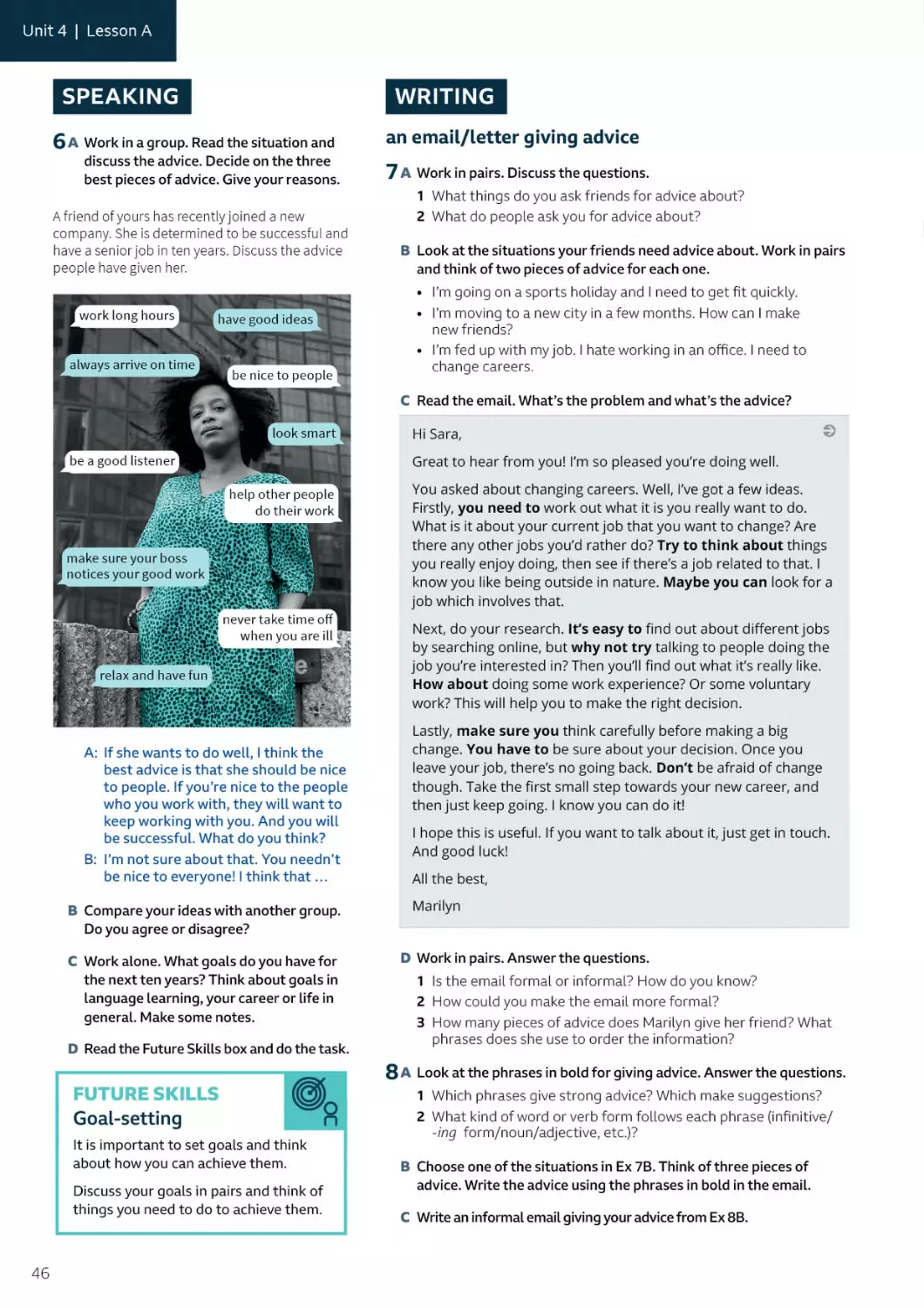
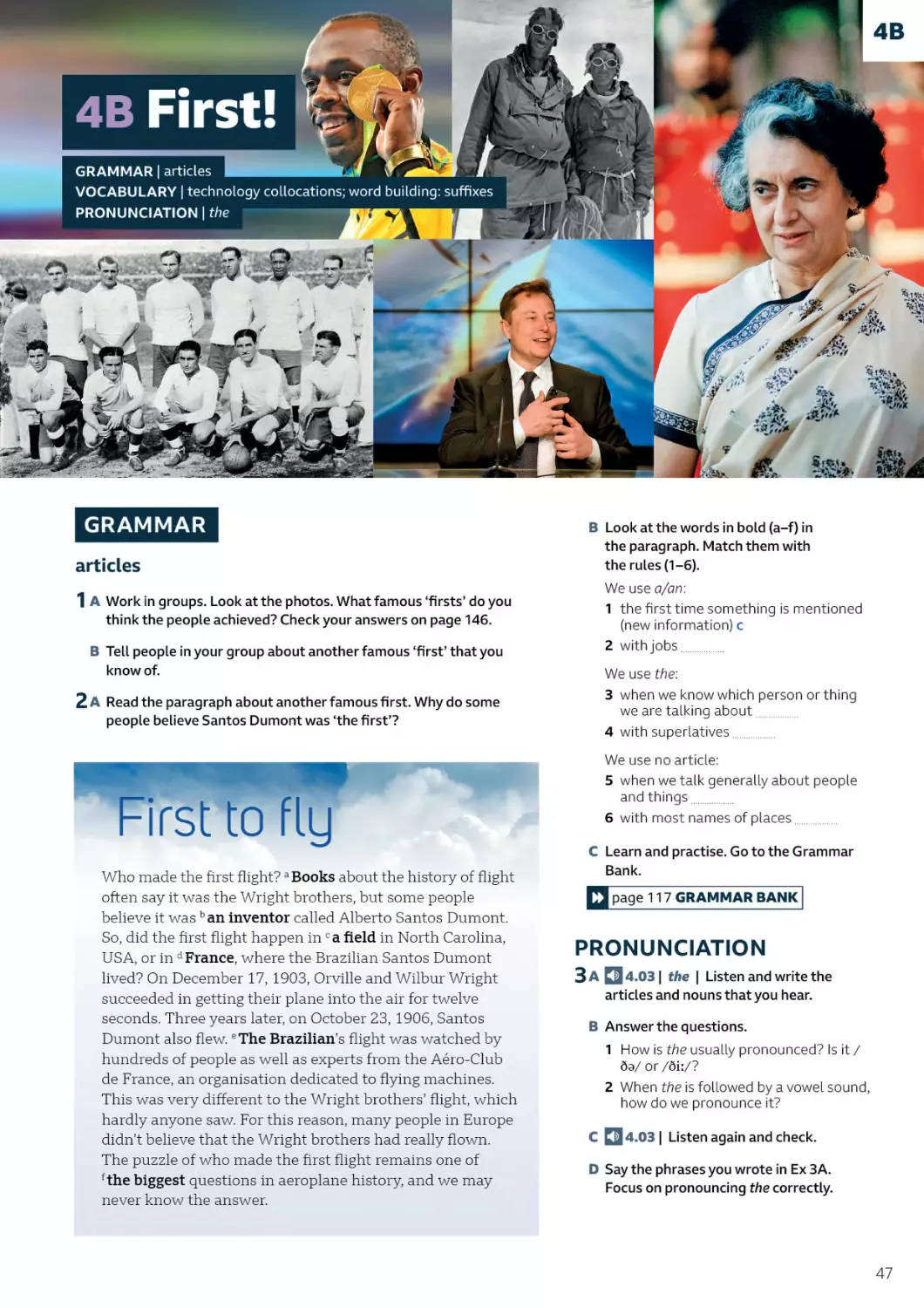


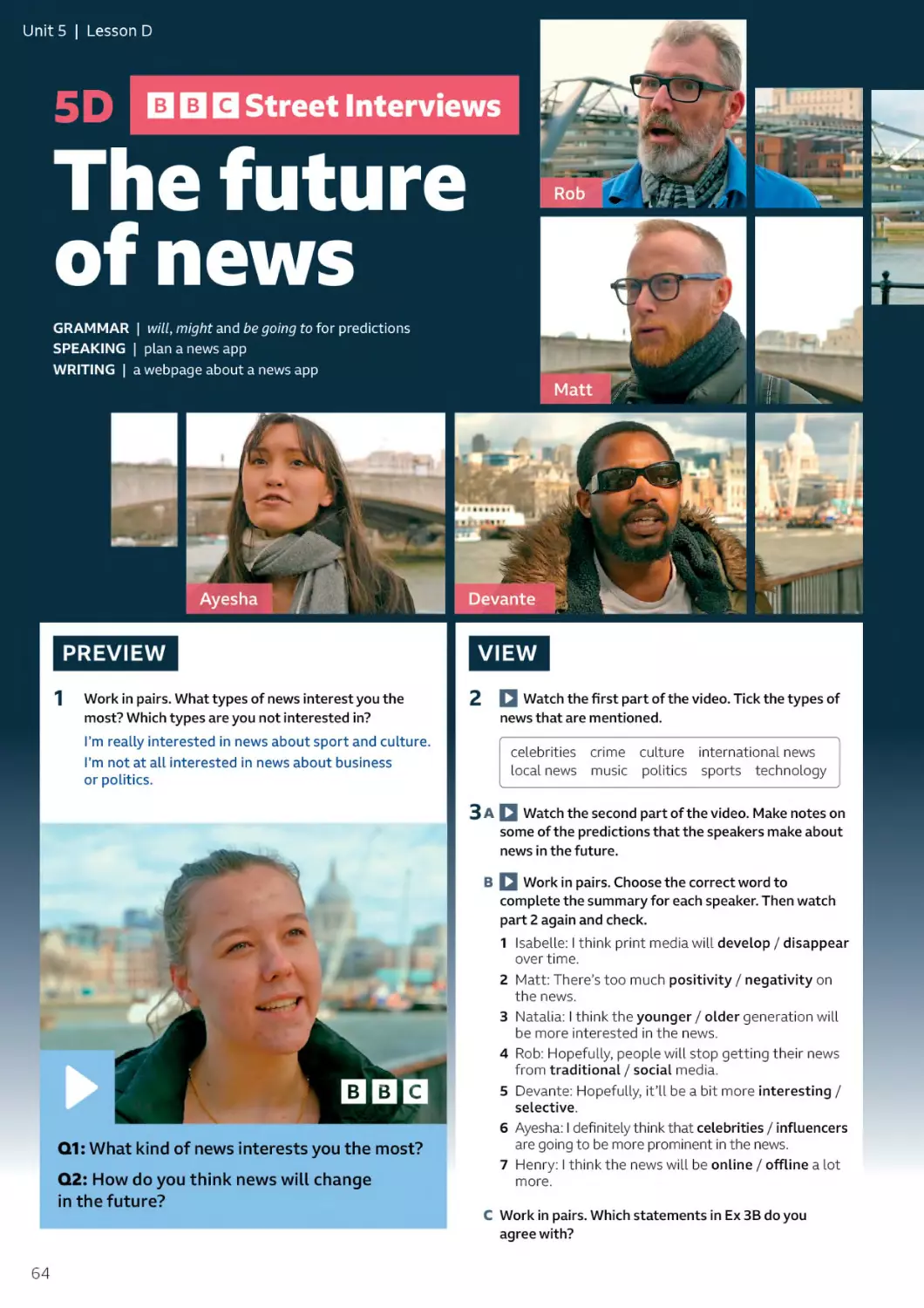


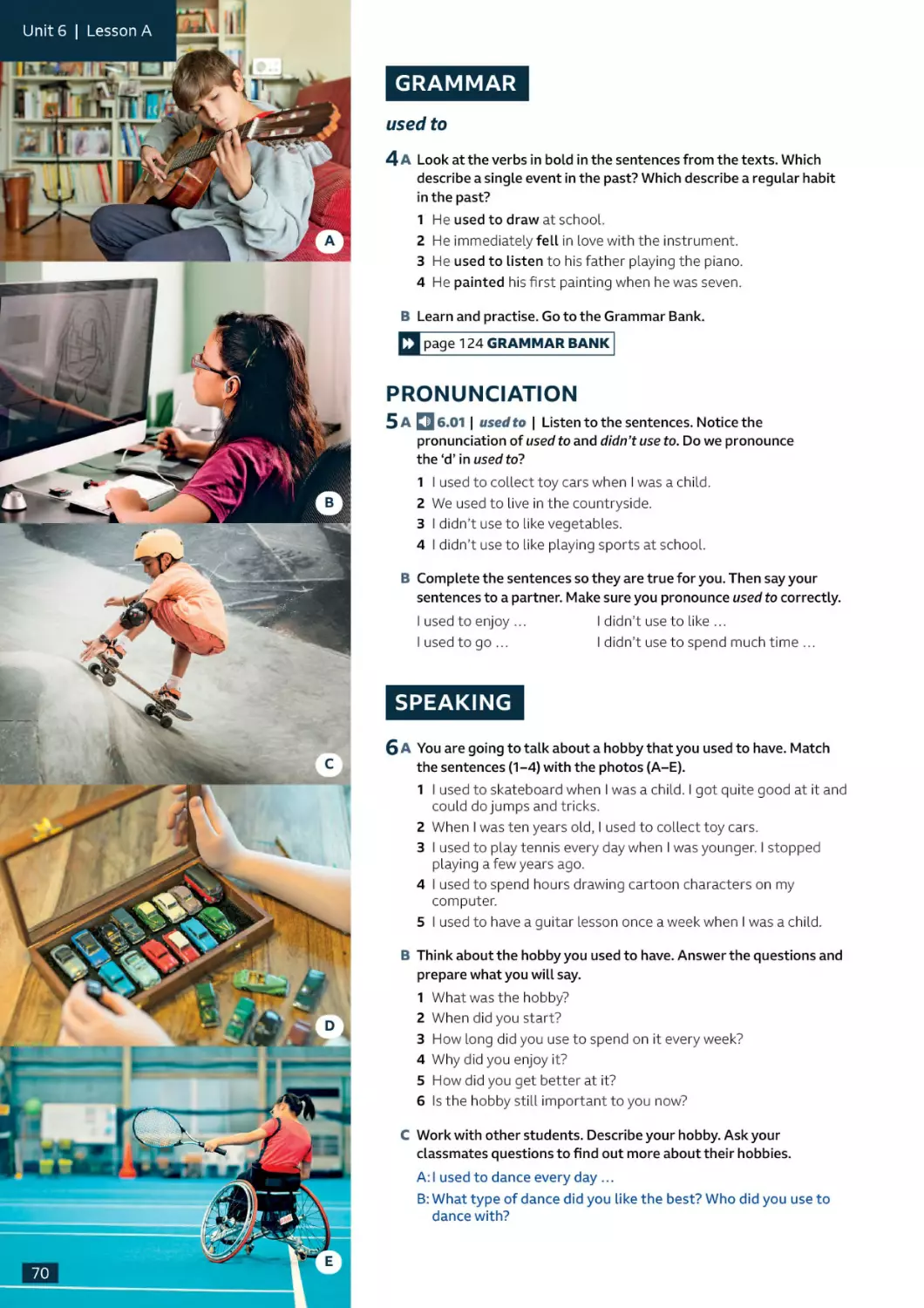






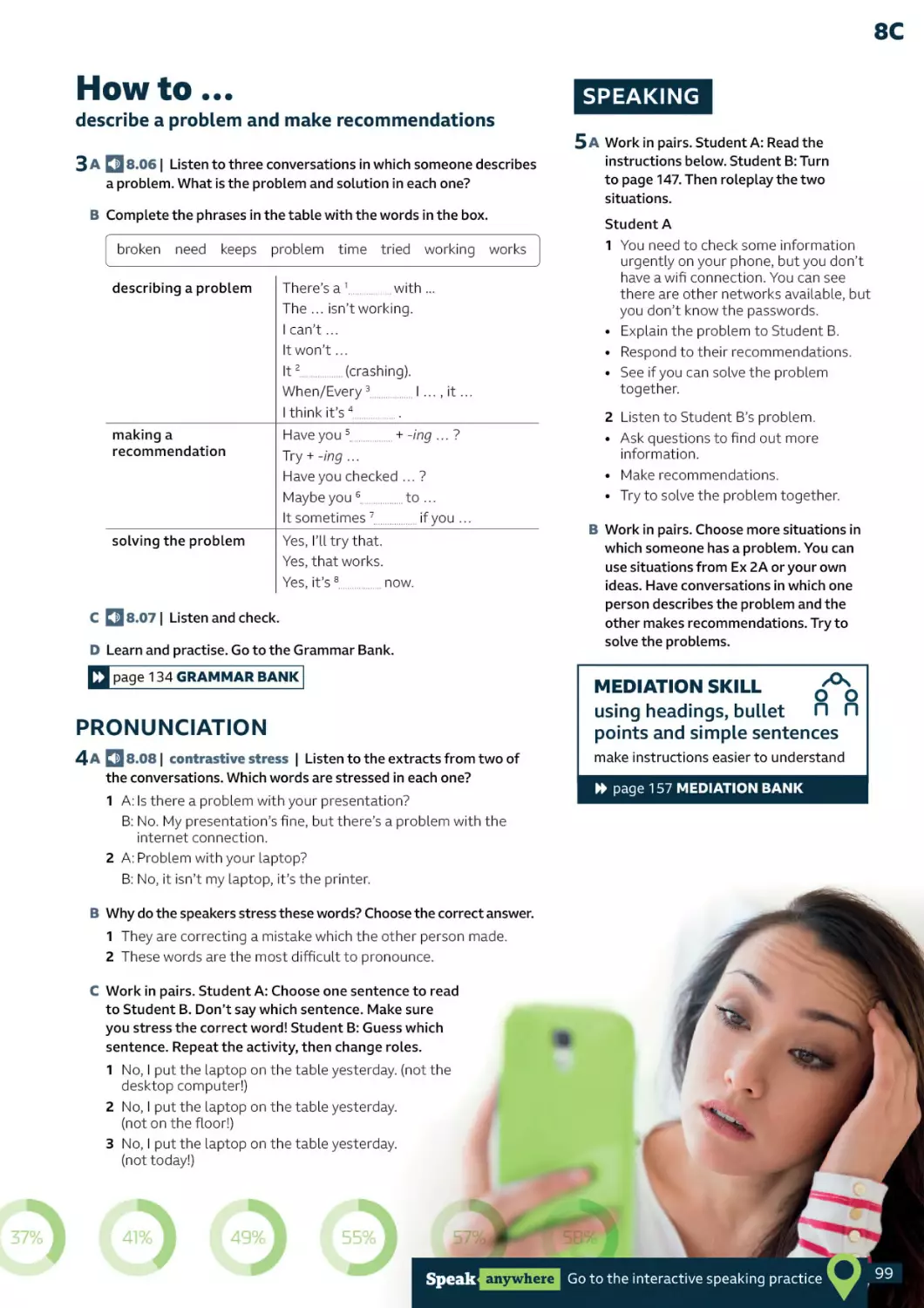


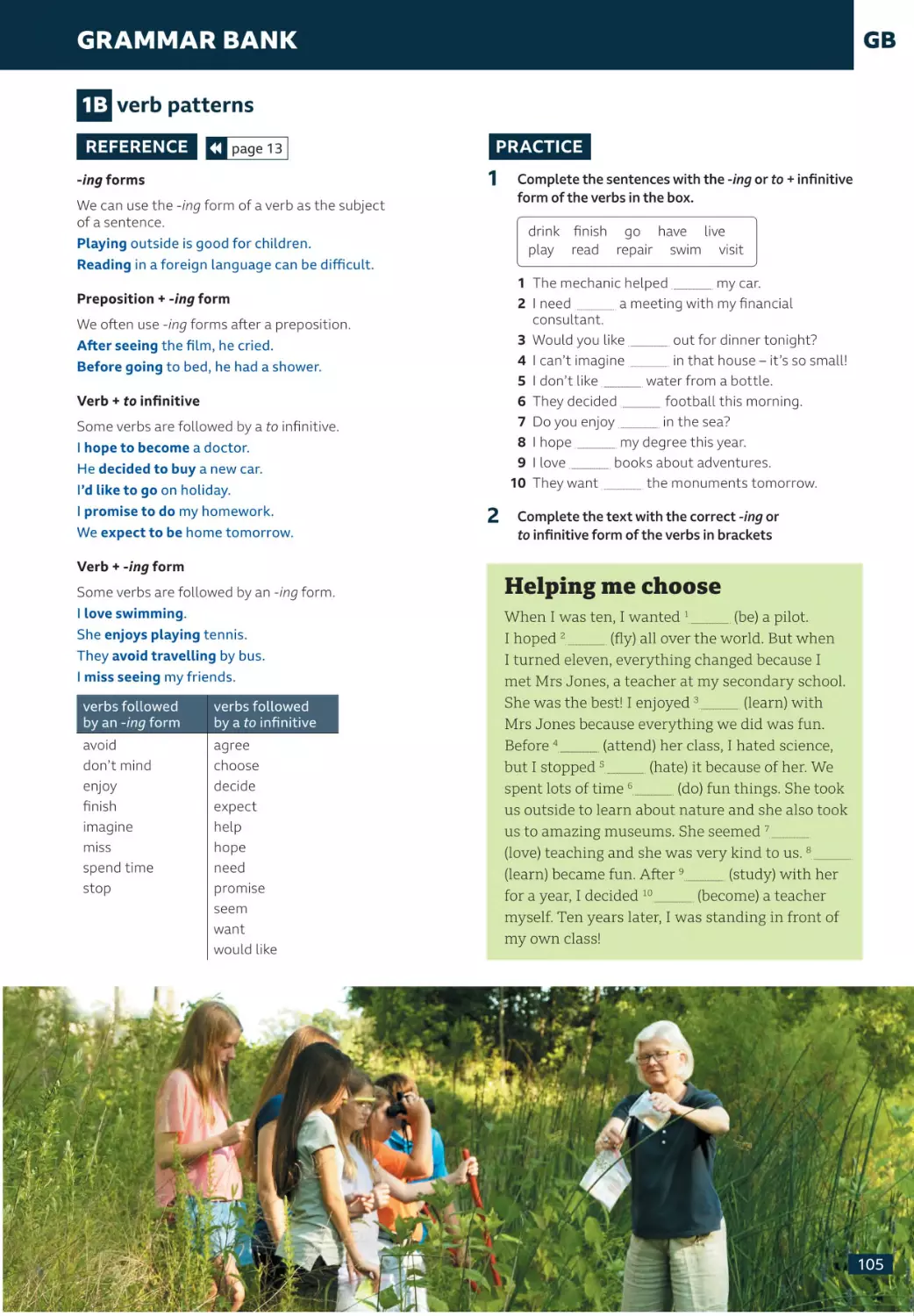


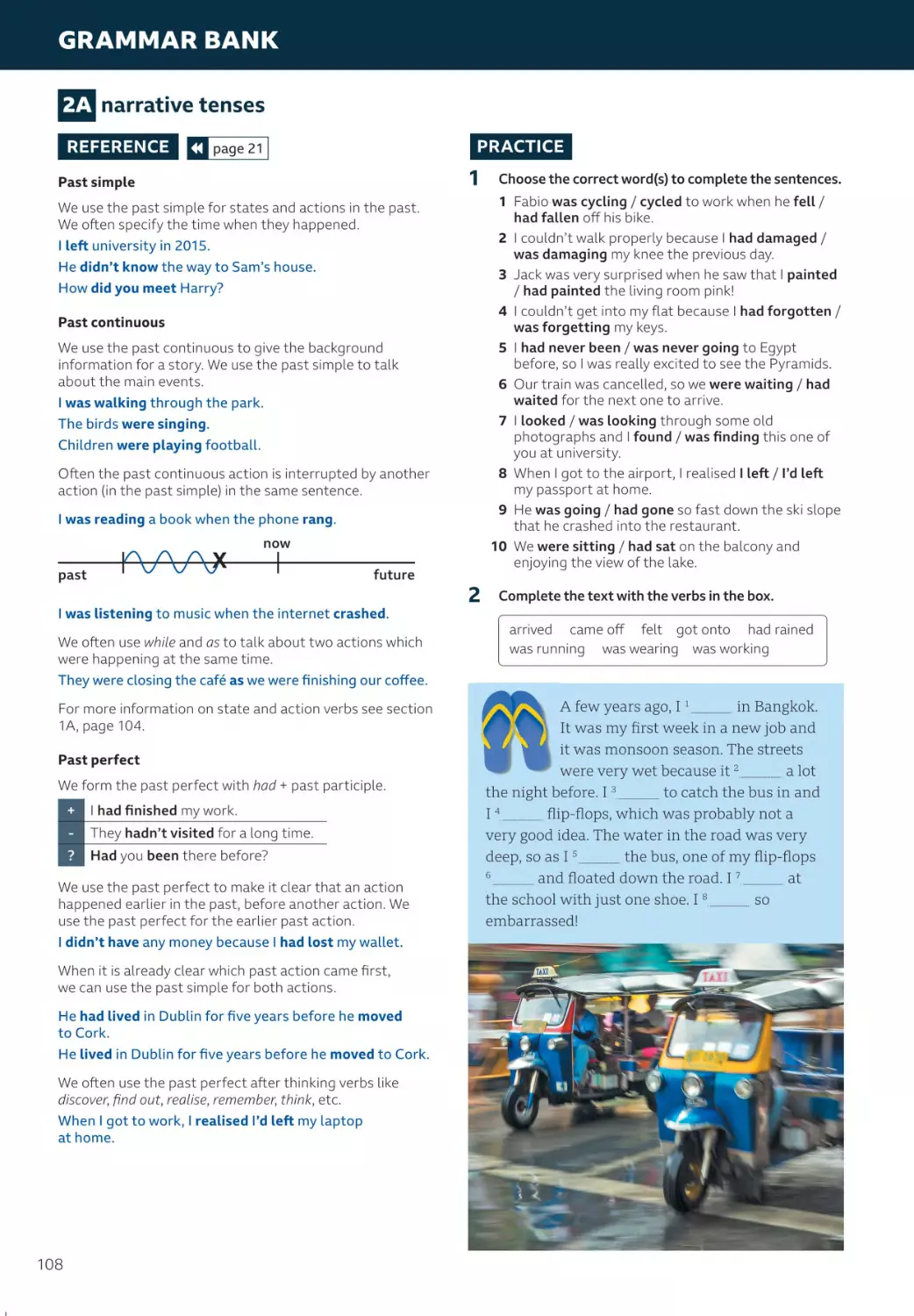


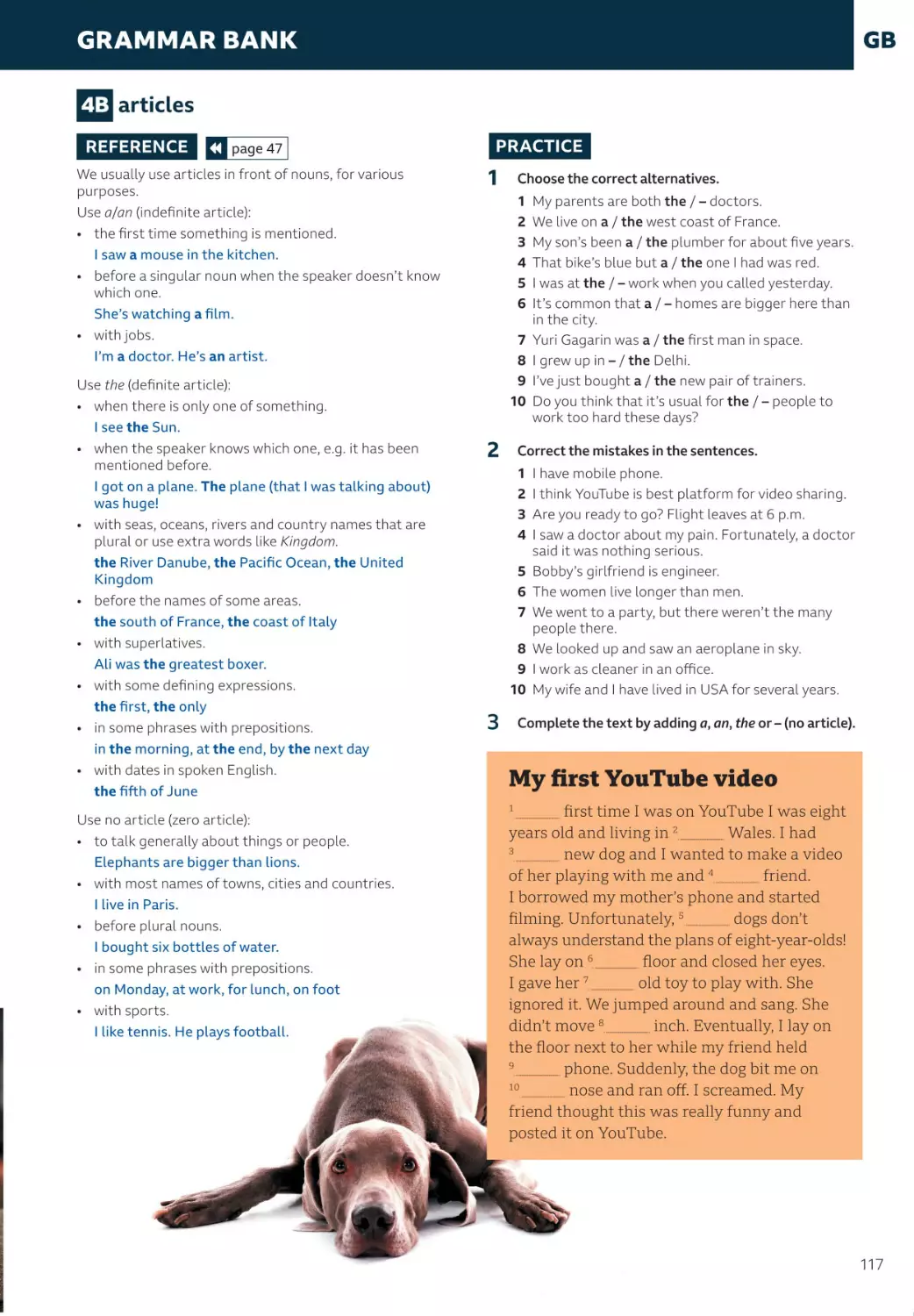












Text
                    S SOB
Antonia Clare | JJ Wilson
Student’s Book and eBook
with Online Practice
Pearson
Global
Scale of
English

□□□
Speakjout
3rd edition
Student’s Book and eBook
CONTENTS
LESSON	GRAMMAR/ FUNCTION	VOCABULARY	PRONUNCIATION	READING
LEAD-IN рб
1 people El El В VLOGS | How would your friends describe you?
1A	Who are you? p8	Present simple and present continuous; state verbs; adverbs of frequency	People and relationships; personality adjectives	Connected speech: do you
1B	Good people P11	Verb patterns	Jobs; work	Syllable stress	Read about people making a difference FUTURE SKILLS Social responsibility
1C	Let’s talk! p14	How to... start and end a conversation; keep a conversation going	Conversation topics	Rhythm and intonation	Read a text about the benefits of talking to strangers
1D	Lifestyle p16	Modifiers
UNIT1 REVIEW p18
2 taletellers El El В VLOGSI Tell me about a happy memory.
2A	What happened? p20	Narrative tenses	Adjectives for feelings; -ed/-ing adjectives	Weak forms of was, were and had
2B	Storytelling p23	Past simple and present perfect	Story words; types of film	Contracted have in the present perfect	Read about the history of storytelling
2C	A likely story p26	How to... apologise and give reasons	Collocations with get and make	Intonation for apologising
2D	The story of a place p28	prepositions of time
UNIT 2 REVIEW p30
3 questions El El В VLOGSI What things are you curious about and why?
ЗА	Facts and figures p32	Question forms	Knowledge; verbs and nouns	Stressed words in questions
ЗВ	Decisions P35	Future plans and intentions	Decisions	Weak forms of are you and going to	Read an article about making decisions
ЗС	Can I ask you ... ? p38	How to... make polite inquiries	Facilities; places in a city	Polite intonation	Read a webpage about Malta
3D	What matters most? p40	Phrasal verbs
UNIT 3 REVIEW p42
4 winners El El В VLOGS | Have you ever won anything?
4A	Success p44	Modals for rules and advice	Success	Silent letters
4B	First! p47	Articles	Technology collocations; word building: suffixes FUTURE SKILLS Self-management	the	Read an article about famous tech firsts
4C	Taking part p50	How to... explain rules and procedures	Sports and games	Can and can’t
4D	Top Gear: Nepal p52	Present perfect + superlative
UNIT 4 REVIEW p54
LISTENING/VIDEO
SPEAKING
WRITING
	Listen to people talking about the people and activities that are important to them	Use a diagram to describe people who are important to you	Write a personal profile page
		Tell a news story
	Listen to three conversations between strangers	Roleplay conversations with people you don’t know FUTURE SKILLS Communication MEDIATION SKILLS Agree on a community project
	BBB Street Interviews about lifestyle	Interview your partner about their lifestyle	Write a blog post about a day in your life
	Listen to a story about two friends travelling in India	Tell an anecdote about a personal memory FUTURE SKILLS Communication	Write a story about a memorable experience
		Complete a class questionnaire
	Listen to six conversations about problems	Conversations offering and accepting apologies MEDIATION SKILLS Solve a problem between work colleagues
	BBB Documentary Mediterranean with Simon Reeve	Talk about a place that is special to you	Write a review of a place
	Listen to two friends discussing a quiz	Ask your partner quiz questions FUTURE SKILLS Communication	Write an email asking for information
		Talk about future plans and intentions FUTURE SKILLS Leadership
	Listen to three conversations in which people make inquiries	Roleplay two situations and make inquiries	MEDIATION SKILLS Give a friend advice about where to study English
	BBB Street Interviews about what’s important in life	A conversation about what is important to you	Write an online forum comment
	Listen to a podcast about rules for success	Discuss advice about success at work and your personal goals FUTURE SKILLS Goal-setting	Write an email/letter giving advice
		Discuss your use of social media
		Give a presentation about a sport or game FUTURE SKILLS Communication MEDIATION SKILLS Help someone understand a qame
	BBB Entertainment Top Gear	Talk about a memorable journey	Write a travel writing competition entry
CONTENTS
LESSON	GRAMMAR/ FUNCTION	VOCABULARY	PRONUNCIATION	READING
5 news El El В VLOGS | How do you get your news?
5A	Fake news p56	Relative clauses	News and social media	wh-	Read an article about real and fake news FUTURE SKILLS Critical thinking
SB	Newsmakers p59	Reported speech	Social issues; the environment	silent letters FUTURE SKILLS Self-management
SC	Good news p62	How to... give and respond to personal news	Events and occasions	Intonation to exaggerate feelings
5D	The future of news p64	will, might and be going to for predictions
UNIT 5 REVIEW p66
6 Creators El El В VLOGS I What creative things do you do or are you interested in?
6A	The two Pablos p68	Used to	The arts; the arts: people, places, things	Used to	Read an article about Pablo Picasso and Pablo Casals
6B	Be creative p71	Comparatives and superlatives	Creativity: word building FUTURE SKILLS Creativity	Word stress in word families
6C	Why do you think that? p74	How to... ask for and give opinions and reasons	Extreme adjectives	Intonation for expressing opinions
6D	An artist at work p76	Present perfect + for, since and yet
UNIT 6 REVIEW p78
7 travel El El В VLOGS | Where do you feel happiest?
7A	Good tourists p80	First and second conditionals	Travel and tourism	Contractions	Read an article about responsible tourism
7B	Globetrotters p83	Quantifiers	New experiences; the natural world	Emphasising quantity
7C	You must see ...! p86	How to... make and respond to recommendations	Describing places	Sounding enthusiastic FUTURE SKILLS Communication	Read a travel guide for Shanghai
7D	Go solo? p88	Reflexive pronouns
UNIT 7 REVIEW p90
8 know-how Q El В VLOGS | Are you good or bad at fixing things?
8A	Doers and dreamers p92	Can, could, be able to	Practical abilities; abilities: phrasal verbs	Weak forms of can, could and be able to
8B	Video everywhere p95	Active and passive	Video collocations; technology 1	Emphasising important information	Read an article about uses of video
8C	Help! p98	How to... describe a problem and make recommendations	Technical problems; technology 2	Contrastive stress
8D	A gifted learner p100	-ing form
UNIT 8 REVIEW p102
GRAMMAR BANK p104 VOCABULARY BANK p136 COMMUNICATION BANK p146 MEDIATION BANK p150
LISTENING/VIDEO	SPEAKING	WRITING
		Retell a news story
	Listen to a podcast about young people in the news FUTURE SKILLS Social responsibility	Present a campaign to solve a local problem	Write an online comment offering a solution to a problem
		Share good and bad personal news MEDIATION SKILLS Agree on a plan
	El El В Street Interviews about types of news	Plan and present an idea for a news app	Write a webpage about a news app
		Talk about a hobby you used to have
	Listen to four people talking about creativity	Discuss ways to become more creative	Write a review
		Discuss your favourite things in art and media FUTURE SKILLS Critical thinking MEDIATION SKILLS Agree on a book to read for a book club
	El El В Documentary What do artists do all day?	Nominate someone for a creative genius award	Write a nomination for an award
		Discuss solutions to problems with tourism FUTURE SKILLS Social responsibility
	Listen to someone talking about about moving to Brazil	Talk about new experiences	Write a description of an experience
	Listen to a conversation about visiting Shanghai	Talk about a place and make recommendations MEDIATION SKILLS Tell someone useful information
	El El В Street Interviews about travelling	A discussion about travel	Write an essay about why we travel
	Listen to four people talking about their practical skills	Ask and answer questions about your abilities	Write an anecdote about learning a skill
		Plan or present a video or video channel FUTURE SKILLS Creativity
	Listen to three conversations about technical problems	Roleplay two conversations about technical problems MEDIATION SKILLS Make instructions easier to understand
	El El В Documentary Inside the Human Body	Discuss the best ways to learn a language	Write a forum comment about language learning
AUDIOSCRIPTS p158 VIDEOSCRIPTS p170 IRREGULAR VERB TABLE p174
LEAD-IN
GRAMMAR
COMMON ERRORS
1 A Choose the correct word to complete the sentences.
1 Do / Are / What you studying at university?
2 What do / have / did you eat last night?
3 How many countries do / have / did you been to?
4 What are / will / do you doing next weekend?
5 Where has / does / is your best friend live?
6 I not / wasn’t / didn’t working when she arrived.
7 I’m sure the school doesn’t / isn’t / won’t be
open tomorrow.
8 She is / has / did worked in several cities.
В Work in pairs. Check your answers, then choose two
questions to ask and answer.
2a Read the text. What do you have in common
with Yusuf?
Hi, I’m Yusuf. I’m from Turkey,
but at the moment I’m living in
London, which is an amazing
city. I’m going to stay here for six
months so that I can improve my
English. I love getting to know
new cities, and I’m really happy
that I chose to come to London. I’ve
4a Correct the mistakes in the sentences.
1 My sister don’t like football.
2 Which film you watch last night?
3 I’m from france.
4 We love listening music.
5 Let’s discuss about this later.
6 When I can go home?
7 I’m teacher.
8 I live here since 2018.
В Decide which mistakes in Ex 4A are connected with
these things.
1 a missing preposition
2 an extra preposition
3 a verb tense
4 word order
5 a missing auxiliary verb
6 punctuation or capitalisation
7 verb-noun agreement
8 a missing article
VOCABULARY
been to seven or eight fantastic museums and
art galleries, and I also really like the parks.
The best thing about London is that there are
so many interesting things to do, especially for
someone in their twenties, like me. The worst
thing is the weather. I really hate cold weather.
I arrived in January and it was freezing!
В Read the text again and find examples of
1 a present continuous verb.
2 a past simple verb.
3 a present perfect verb.
4 a verb form for future plans.
5 a superlative.
6 a modal verb.
7 a relative clause.
8 a verb + -ing form.
PRONUNCIATION
3 a Find pairs of words in the box that have the same
vowel sound.
bar boat fight heat heart mail oil put queue
seen show shy take through took toy
bar, heart
5 a Complete the common phrases with the verbs in
the box.
chat do (x2) go have listen to
post send take watch
1 have a meeting
2	out with friends
3 ......a photo on social media
4	to a colleague
5 ........ some work
6	.....an email
7	afilm
8	...some music
9.......some sport/exercise
10	a break
В Complete the table with the phrases from Ex 5A.
work	free time
have a meeting
В И L.O1 I Listen and check your answers.
C Work in pairs. Think of other words in English that use
the same vowel sounds.
C Work in pairs. Can you add any more phrases to the
table in Ex 5B? Which of these things do you do in a
normal day?
6
people 1
VLOGS
Q: How would your friends
describe you?
1	Q Watch the video. Note down
some of the adjectives that you
hear. Compare in groups.
2	How would your best friends
describe you?
GSE LEARNING OBJECTIVES
1A LISTENING | Understand people talking about the people
and activities in their life: people and relationships;
personality adjectives
Talk about different people and activities in your life: present
simple and present continuous; state verbs; adverbs of frequency
Pronunciation: connected speech: do you
Write a personal profile; use linking phrases
IB READING | Read a news article about people with unusual
jobs: jobs; work
Talk about jobs and work: verb patterns
Pronunciation: syllable stress
Invent a news story
1C HOW TO... | start and end a conversation; keep a
conversation going: conversation topics
Pronunciation: rhythm and intonation
ID BBC STREET INTERVIEWS | Understand people talking
about their lifestyles
Talk about your lifestyle: modifiers
Write a blog post about a day in your life
7
Unit 1 | Lesson A
personality adjectives
Pedro
PRONUNCIATION | connected speech:
do vnn	- -     —.
lAWho
GRAMMAR | present simple and present -
continuous; state verbs; adverbs of frequency
VOCABULARY | people and relationships;
VOCABULARY
people and relationships
1 A Work in pairs and discuss the questions.
1 What different groups of people are there in your life? Think
about work, college, family, hobbies, etc.
2 How often do you see each group?
3 What activities do you do together?
1 I’m part of a football team and I
get on well with my teammates.
We usually go out together
after a match. I think it’s really
important that teammates can
get on with each other on and off
the pitch. It helps you to play a
better game.
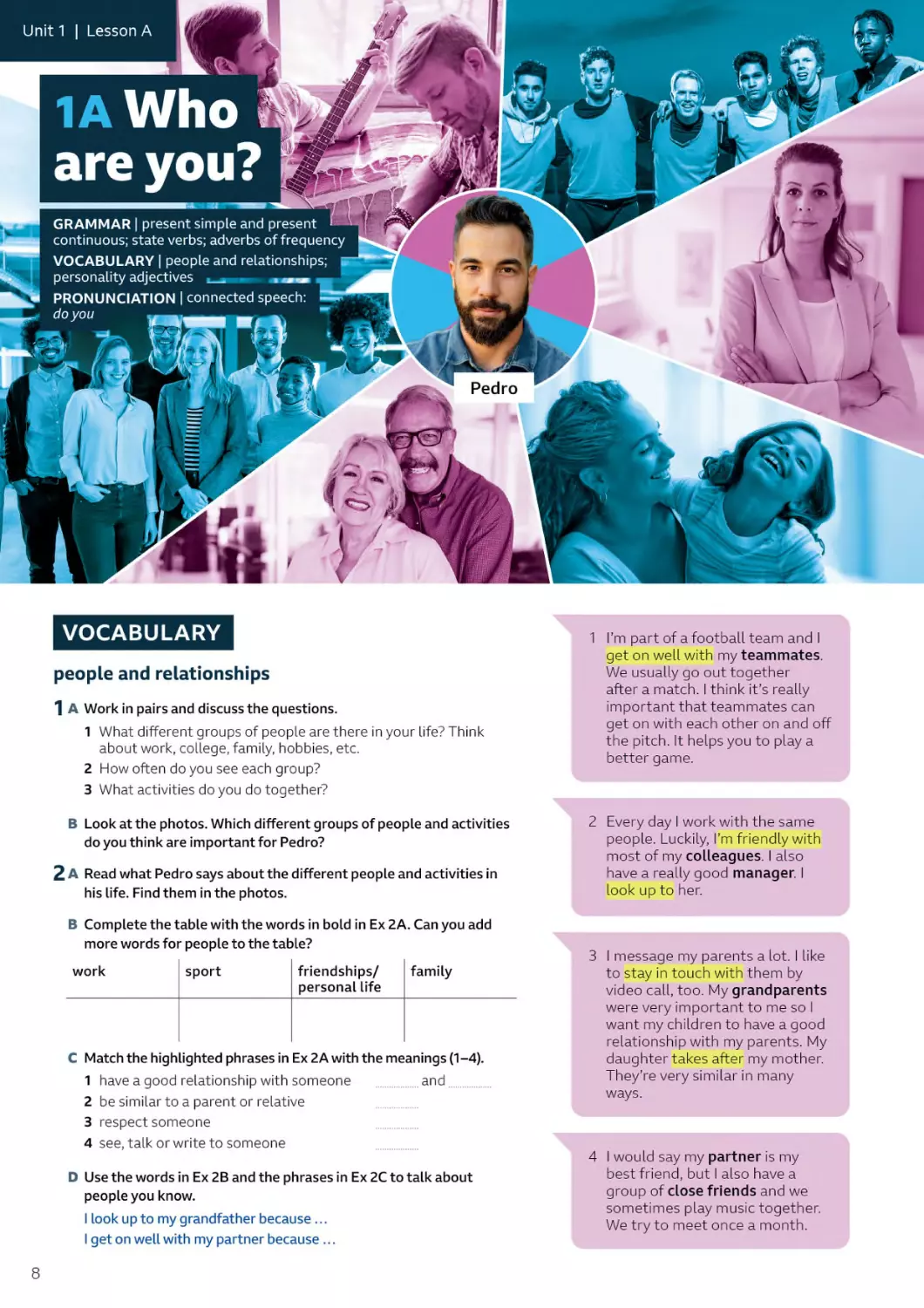
В Look at the photos. Which different groups of people and activities
do you think are important for Pedro?
2a Read what Pedro says about the different people and activities in
his life. Find them in the photos.
В Complete the table with the words in bold in Ex 2A. Can you add
more words for people to the table?
work	sport	friendships/ personal life	family

C Match the highlighted phrases in Ex 2A with the meanings (1-4).
1 have a good relationship with someone ..........and.........
2 be similar to a parent or relative
3 respect someone	_______
4 see, talk or write to someone
D Use the words in Ex 2B and the phrases in Ex 2C to talk about
people you know.
I look up to my grandfather because ...
I get on well with my partner because ...
2 Every day I work with the same
people. Luckily, I’m friendly with
most of my colleagues. I also
have a really good manager. I
look up to her.
3 I message my parents a lot. I like
to stay in touch with them by
video call, too. My grandparents
were very important to me so I
want my children to have a good
relationship with my parents. My
daughter takes after my mother.
They’re very similar in many
ways.
4 I would say my partner is my
best friend, but I also have a
group of close friends and we
sometimes play music together.
We try to meet once a month.
8
1А
LISTENING
GRAMMAR
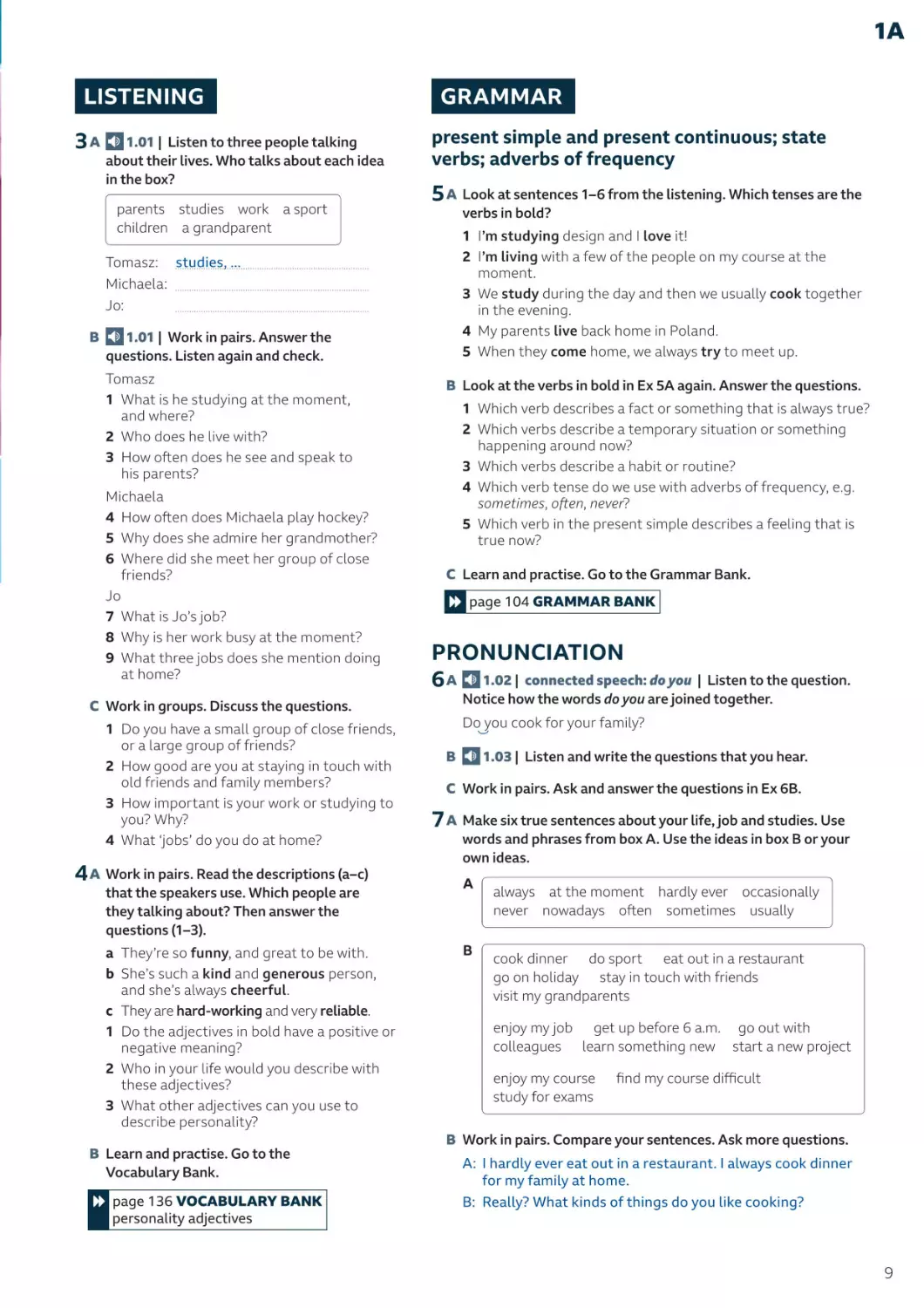
За Q11.01 | Listen to three people talking
about their lives. Who talks about each idea
in the box?
parents studies work asport
children a grandparent
Tomasz: studies,....
Michaela:
Jo:
В И 1.01 | Work in pairs. Answer the
questions. Listen again and check.
Tomasz
1 What is he studying at the moment,
and where?
2 Who does he live with?
3 How often does he see and speak to
his parents?
Michaela
4 How often does Michaela play hockey?
5 Why does she admire her grandmother?
6 Where did she meet her group of close
friends?
present simple and present continuous; state
verbs; adverbs of frequency
5 A Look at sentences 1-6 from the listening. Which tenses are the
verbs in bold?
1	I’m studying design and I love it!
2	I’m living with a few of the people on my course at the
moment.
3	We study during the day and then we usually cook together
in the evening.
4	My parents live back home in Poland.
5	When they come home, we always try to meet up.
В Look at the verbs in bold in Ex 5A again. Answer the questions.
1 Which verb describes a fact or something that is always true?
2 Which verbs describe a temporary situation or something
happening around now?
3 Which verbs describe a habit or routine?
4 Which verb tense do we use with adverbs of frequency, e.g.
sometimes, often, never?
5 Which verb in the present simple describes a feeling that is
true now?
C Learn and practise. Go to the Grammar Bank.
Jo
7 What is Jo’s job?
8 Why is her work busy at the moment?
9 What three jobs does she mention doing
at home?
C Work in groups. Discuss the questions.
1 Do you have a small group of close friends,
or a large group of friends?
2 How good are you at staying in touch with
old friends and family members?
3 How important is your work or studying to
you? Why?
4 What 'jobs’ do you do at home?
4a Work in pairs. Read the descriptions (a-c)
that the speakers use. Which people are
they talking about? Then answer the
questions (1-3).
a They’re so funny, and great to be with.
b She’s such a kind and generous person,
and she’s always cheerful.
c They are hard-working and very reliable.
1	Do the adjectives in bold have a positive or
negative meaning?
2	Who in your life would you describe with
these adjectives?
3	What other adjectives can you use to
describe personality?
В Learn and practise. Go to the
Vocabulary Bank.
page 136 VOCABULARY BANK
personality adjectives
Д page 104 GRAMMAR BANK
PRONUNCIATION
6a И 1.02 I connected speech: do you | Listen to the question.
Notice how the words do you are joined together.
Do you cook for your family?
В И 1.03 | Listen and write the questions that you hear.
C Work in pairs. Ask and answer the questions in Ex 6B.
7 A Make six true sentences about your life job and studies. Use
words and phrases from box A. Use the ideas in box В or your
own ideas.
always at the moment hardly ever occasionally
never nowadays often sometimes usually
cook dinner do sport eat out in a restaurant
go on holiday stay in touch with friends
visit my grandparents
enjoy my job	get up before 6 a.m. go out with
colleagues learn something new start a new project
enjoy my course find my course difficult
study for exams
В Work in pairs. Compare your sentences. Ask more questions.
A: I hardly ever eat out in a restaurant. I always cook dinner
for my family at home.
B: Really? What kinds of things do you like cooking?
9
Unit 1 | Lesson A
SPEAKING
WRITING
8a Look at the diagram about Kasia. Who
is Kasia’s best friend? Who does she
work with?
a personal profile
9a Read Matt’s personal profile. Where do you think you might read
this profile?
a in a job application
b on someone’s professional website
c in an application to college or university
Matt Erbrich
About me...
В Think about the important people in your
life. Make a similar diagram for yourself.
C Read the questions (1-4) and prepare
your answers. Make some notes for each
of the questions.
1 How do you know each person on
your diagram? What is their
relationship to you?
2 How can you describe them?
3 How often do you see each person and
how do you stay in touch?
4 What things do you usually do with
each person, and what things are you
doing with them at the moment?
D Work in groups. Tell others about the
people in your diagram. As you listen, ask
one or two questions about each of the
people that your classmates talk about.
A: Alice is my best friend. She’s
really funny, and she’s a bit crazy
sometimes. That’s why I like her. We
get on really well. I see her every
week, and we often go shopping
together. At the moment, we’re
planning a holiday. I can’t wait!
B: What does she do?
A: She’s a designer.
I believe photographs have the power to show emotion and
character as well as beauty. I am a portrait photographer and
I love taking photos of people.
I was born in Germany and grew up in the UK, but now I’m
living in New York. I love travelling, especially in Europe
because there are so many interesting countries to visit. I
enjoy working on city scenes and travel photography, too,
and at the moment I’m working on a travel book. I work
on photo projects around the world and I have also won
awards for my work. I love taking photographs of people in
their daily lives, for example colleagues working together
or grandparents playing with their grandchildren. I’m quite
patient and easy-going, so I’m happy to wait to get the right
photo! I hope you enjoy my photos. If you need a photographer,
get in touch!
Contact me: MattErbrich22xx@gmail.com ra a ®
В Work in pairs. What information does Matt include in his
personal profile?
address age awards won
education family hobbies
nationality personal beliefs
roles in life work skills
current projects
home town job name
professional experience
10 A Look at the linking phrases in bold in Matt’s profile. Notice how
they connect two ideas together. Which linking phrase:
a gives a reason? b adds a similar idea (хЗ)? c gives an example?
В Complete the sentences with the linking phrases in the box.
also as well as because for example too
1	I occasionally write articles for a local newspaper, and contribute
to their online blog,........
2	I sometimes do different jobs......., I work as a waiter,
a lifeguard and also a delivery person.
3	I’m studying biology... . I Love learning about nature.
4	I really enjoy surfing....skiing.
5	One of my passions is cooking, but I.....really enjoy music.
C Imagine you are setting up a new website based on something you
are interested in. Write your personal profile page for the website.
Use Matt’s profile as a model.
10
IB Good people
GRAMMAR | verb patterns
VOCABULARY | jobs; work I
PRONUNCIATION I syllable stress
VOCABULARY
jobs
1	A Write down five jobs that involve helping other people.
Medical workers save lives.
Teachers help us to learn.
В Work in groups. Compare your ideas. Then decide
which jobs help people the most.
2	А И 1.041 Listen to eight people talking about their
jobs. Match the speakers with the jobs (a-h).
a musician
b mechanic
c shop
assistant
d financial
consultant 1
C Work in pairs. Discuss the questions. How can you
describe the jobs in Ex 2A? Which would you like to
do? Why?
A chef is responsible for planning the menu and
creating new dishes.
I’d like to be a financial consultant because they earn
a good salary.
D Learn and practise. Go to the Vocabulary Bank.
Д page 136 VOCABULARY BANK work
PRONUNCIATION
3	a | syllable stress | Work in pairs. Which syllable is
stressed in these words? Which word has a different
stress pattern?
assistant consultant journalist
mechanic musician
e plumber
f chef g gardener h journalist
В Look at the jobs in Ex 2A again. In which jobs do people
1	work with numbers or words?
2	sell objects or food?
3	sell a service?
4	help people?
В И 1.05 | Listen and check. Is this statement true
or false?
The stress on three-syllable jobs is usually on the
second syllable.
C Make sentences about the jobs in Ex ЗА, then read
your sentences to a partner. Remember to stress the
correct syllable.
My brother is a journalist.
11
Unit 1 | Lesson В
READING
4a Work in groups of three. Student A: Read text A on this
page. Student B: Read text В on page 146. Student C:
Read text C on page 148.
В Complete the table with information from your text.
5a Use your notes to tell the other students in your group
about your text. Complete the table for the other
two texts.
В In your groups, discuss the questions.
1	What do you think the three people enjoy about
what they do?
2	Which person do you admire the most? Why?
C Find words or phrases in bold in your text to match the
meanings (1-5).
1	a list showing how much you have to pay
2	behaviour that shows you care for and want to help
others
3	the money that someone earns or receives regularly
4	to become popular
5	to do something so you can be certain of the result
D Work with other students. Read the Future Skills box
and discuss the questions.
FUTURE SKILLS	g
Social responsibility
The media often describes people like Lou, Zeal
and James as good people or heroes. Define a good
person. Are the people in the texts good people?
Which famous people do you think are good? Why?
Lou Ridsdale loves gardening. In a small
space next to her home in Ballarat, Australia,
she grows vegetables. One day, she heard
about a man in Los Angeles who grew food
to share with the community. He belonged to
an organisation called Food is Free. Ridsdale
saw that she had more vegetables than she
needed and decided to give them away, like
the man in Los Angeles.
In Ballarat, just 6.4 percent of people eat the
recommended amount of vegetables. A lot of
people in the city have low incomes and the
city has many problems connected to what
people eat: lack of affordable food and lack
of education about healthy eating. Ridsdale
wanted to change this.
12
GRAMMAR
verb patterns
6a Look at the highlighted words in your text. Find ...
1	an -ing form as the subject of a sentence.
2	a preposition + -ing form.
3	four verbs + to + infinitive.
В Correct the mistakes in the sentences. One sentence
is correct.
1	After leaving school, I decided do a plumbing course.
2	She hopes for become a chef.
3	You need to speaking to a financial consultant.
4	Working here is great -1 love it!
5	Before study to be a doctor, he worked as a
volunteer in a hospital.
C Learn and practise. Go to the Grammar Bank.
Д page 105 GRAMMAR BANK
SPEAKING
7 A Work in pairs. Choose one of the headlines and invent
a news story. Answer the questions (1-5) to help you.
100-year-old walks his dog and raises
€1,000,000 for hospital
WOMAN PLANTS A TREE EVERY DAY FOR A YEAR
After leaving the food outside her home,
she put up a sign inviting people to help
themselves. Soon volunteers were bringing
food for those in need. People usually bring
fruit and vegetables but sometimes plants
and seeds, too. There is no money involved,
no food bill to pay, only kindness. Helping
people is what Ridsdale does. She says that
no one is judged on what they bring or
take as long as they leave with a smile. She
makes sure they always do.
Apart from feeding people, Ridsdale
understands that education is the other
important part of the programme. Once the
programme was established, she began to go
into schools to talk about food. She believes
that young people need to learn about
healthy eating. This will help to make their
lives healthier and better. She hopes to see
her idea catch on all over Australia.
Recycling hero builds parks for kids
1 Where and when did it happen?
2 Who was involved?
3 Why did they decide to do this?
4 What difficulties did they have?
5 How did people hear about the story?
В Work together and prepare to tell your story. Make
notes, using at least five phrases from the box.
after + -ing form agreed to before + -ing form
decided to helped to needed to realising
wanted to
C Tell your story.
1 Work with your partner. Use your notes and practise
telling your story together.
2 Work with a different partner. Tell your story again
without using your notes.
D Work in groups. Do you know any real stories like the
ones you heard?
13
Unit 1 | Lesson C
1C Let’s talk!
HOW TO ... | start and end a conversation; keep a conversation going
VOCABULARY | conversation topics I---
PRONUNCIATION | rhythm and intonation
VOCABULARY
conversation topics
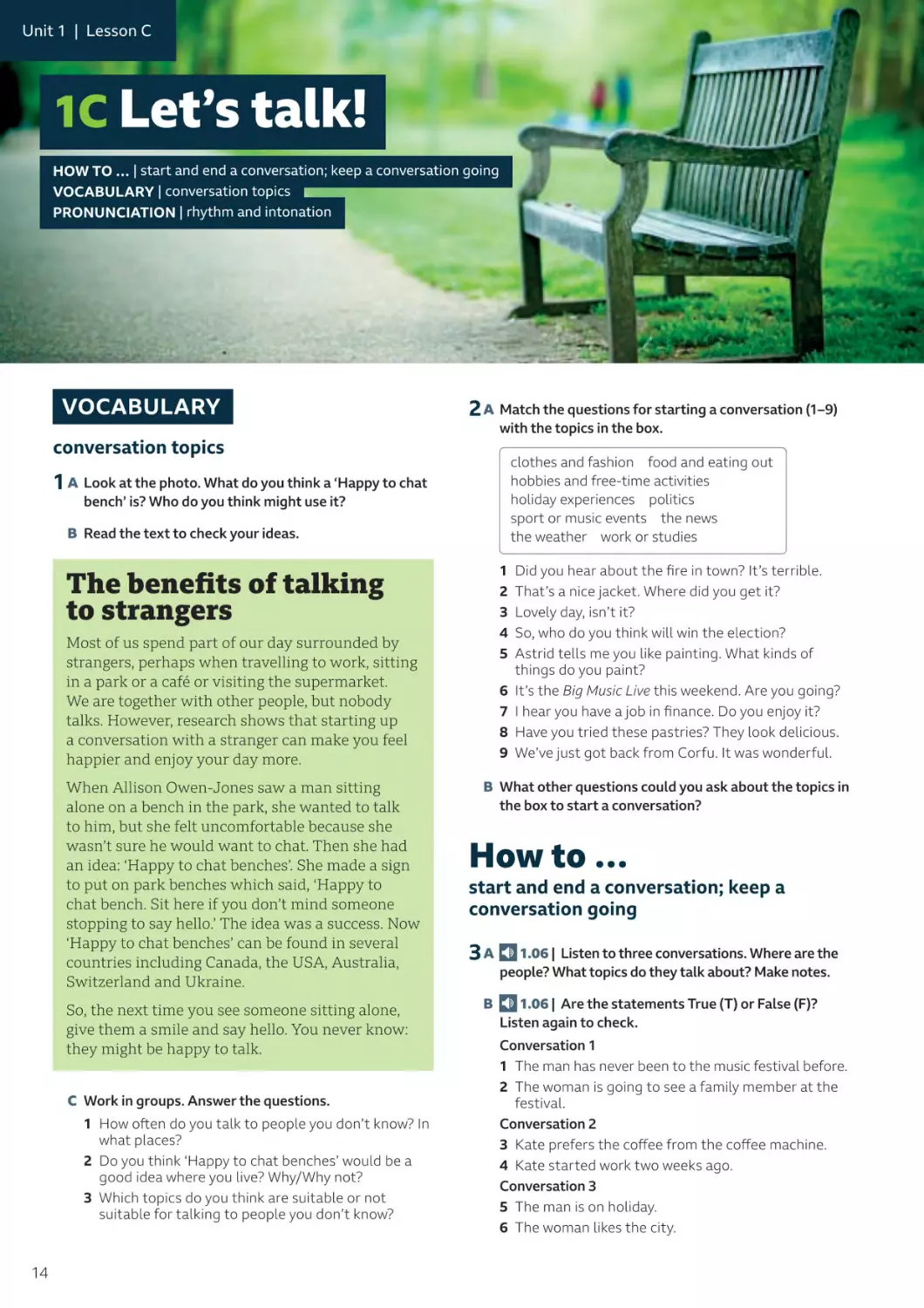
1 A Look at the photo. What do you think a ‘Happy to chat
bench’ is? Who do you think might use it?
В Read the text to check your ideas.
2a Match the questions for starting a conversation (1-9)
with the topics in the box.
clothes and fashion food and eating out
hobbies and free-time activities
holiday experiences politics
sport or music events the news
the weather work or studies
The benefits of talking
to strangers
Most of us spend part of our day surrounded by
strangers, perhaps when travelling to work, sitting
in a park or a cafe or visiting the supermarket.
We are together with other people, but nobody
talks. However, research shows that starting up
a conversation with a stranger can make you feel
happier and enjoy your day more.
When Allison Owen-Jones saw a man sitting
alone on a bench in the park, she wanted to talk
to him, but she felt uncomfortable because she
wasn’t sure he would want to chat. Then she had
an idea: ‘Happy to chat benches’. She made a sign
to put on park benches which said, ‘Happy to
chat bench. Sit here if you don’t mind someone
stopping to say hello.’ The idea was a success. Now
'Happy to chat benches’ can be found in several
countries including Canada, the USA, Australia,
Switzerland and Ukraine.
So, the next time you see someone sitting alone,
give them a smile and say hello. You never know:
they might be happy to talk.
C Work in groups. Answer the questions.
1	How often do you talk to people you don’t know? In
what places?
2	Do you think ‘Happy to chat benches’ would be a
good idea where you live? Why/Why not?
3	Which topics do you think are suitable or not
suitable for talking to people you don’t know?
1	Did you hear about the fire in town? It’s terrible.
2	That’s a nice jacket. Where did you get it?
3	Lovely day, isn’t it?
4	So, who do you think will win the election?
5	Astrid tells me you like painting. What kinds of
things do you paint?
6	It’s the Big Music Live this weekend. Are you going?
7	I hear you have a job in finance. Do you enjoy it?
8	Have you tried these pastries? They look delicious.
9	We’ve just got back from Corfu. It was wonderful.
В What other questions could you ask about the topics in
the box to start a conversation?
Howto...
start and end a conversation; keep a
conversation going
3 А И 1.061 Listen to three conversations. Where are the
people? What topics do they talk about? Make notes.
В И 1.061 Are the statements True (T) or False (F)?
Listen again to check.
Conversation 1
1	The man has never been to the music festival before.
2	The woman is going to see a family member at the
festival.
Conversation 2
3	Kate prefers the coffee from the coffee machine.
4	Kate started work two weeks ago.
Conversation 3
5	The man is on holiday.
6	The woman likes the city.
14
1С
4а Work in pairs. Complete the extracts from the conversations with
the missing words.
Woman:	Excuse me,1 sitting here?
Man:	No, go2.
Woman:	Thanks.
Man:	No3
Woman:	Have you been to the festival	before?
Man:	Yes, I go every year.	How4	you?
Woman:	Oh, it’s my first time.
SPEAKING
7 A Work in pairs. Read the Future Skills box
and discuss the question.
FUTURE SKILLS
Communication
Kate:	I’m Kate, by the5
Justine:	Hi, Kate. I’m Justine.
Kate:	Great. Well, Justine, I’ve6	 go.	Nice to meet you.
Justine:	Yes, nice to 7
Man:	Excuse me, do8.....if I charge my phone here?
Woman:	Not at all.9 my guest.
Man:	Thanks. That’s very kind.
Woman: Oh, that’s my train. Nice 10 to you.
Man:	Safe journey home!
To keep a conversation going, it is
important to listen actively and show
you are interested in what the other
person says. Ask questions like ‘How
about you?’ or other questions that
encourage the other person to talk.
Look at the audioscripts on page 158.
What questions do the speakers ask to
encourage the other person to talk?
В И 1.07 | Listen and check your answers.
5 A Match the sentences (1-8) with their uses (a-c).
1	Nice talking to you.	a starting a
2	Do you mind if I charge my phone here? conversation
3	Help yourself.	b responding/keeping
.	a conversation qoinq
4	I ve got to go.	3
_ ,	c ending a conversation
5	Is anyone sitting here?
6	Do you know if there’s a cafe near here?
7	What about you?
8	Nice to meet you.
В Work in pairs.
Student A: You are sitting on a ‘Happy to
chat bench’ near the station. Think about
where you are and why you are sitting
there. Someone comes to the bench to
talk to you. Continue the conversation.
Student B: You see someone sitting
on a ‘Happy to chat bench’ near the
station and decide to talk to them. Think
about why you are there. Then start a
conversation.
В Can you think of any other phrases for each of the categories (a-c)?
C Learn and practise. Go to the Grammar Bank.
Ц page 106 GRAMMAR BANK
PRONUNCIATION
6 a И 1.081 rhythm and intonation | Listen to the phrases we use
for responses. Notice that they all follow a similar rhythm and
intonation pattern.
Not at all. Go ahead. Help yourself. Be my guest.
No problem.
C In your pairs, reflect on the activity in
Ex 7B. Was it easy or difficult to start the
conversation and keep it going? Why?
D Work in a different pair. Think about a
different place for your ‘Happy to chat
bench’, and think about why you are
there. Then have a conversation. Talk
about different topics.
MEDIATION SKILL
managing turn-taking
agree on a community project
В Try saying these phrases. Do the phrases follow the same
or a different pattern?
» page 150 MEDIATION BANK
See you later. Nice to meet you. I’ve got to go.
Enjoy your weekend.
C
D
И 1.091 Listen and check.
Work in pairs. Make three short conversations using some of the
phrases in Ex 5A. Choose from the situations in the box.
first day at work in a cafe or canteen
meeting in a park on a bus or a train
Practise the conversations. Focus on the rhythm and intonation
in the phrases.
Speak	Go to the interactive speaking practice
Unit 1 | Lesson D

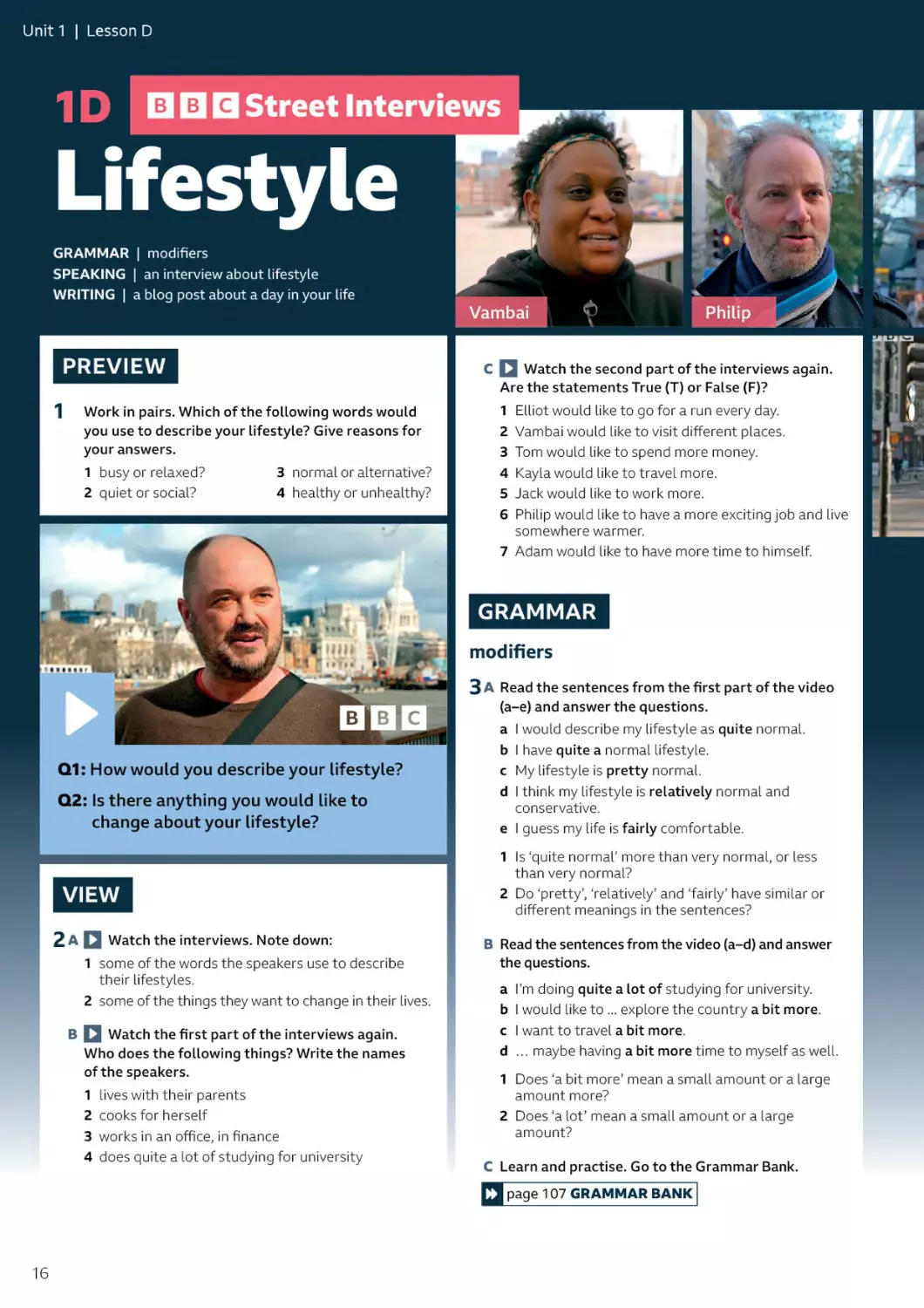
ID DDB Street Interviews
Lifestyle
GRAMMAR | modifiers
SPEAKING | an interview about lifestyle
WRITING | a blog post about a day in your life
PREVIEW
1 Work in pairs. Which of the following words would
you use to describe your lifestyle? Give reasons for
your answers.
1	busy or relaxed?
2	quiet or social?
3 normal or alternative?
4 healthy or unhealthy?
modifiers
Philip
Vambai
GRAMMAR
Is ‘quite normal’ more than very normal, or less
than very normal?
Do ‘pretty’, ‘relatively’ and ‘fairly’ have similar or
different meanings in the sentences?
3 A Read the sentences from the first part of the video
(a-e) and answer the questions.
a
b
С Q Watch the second part of the interviews again.
Are the statements True (T) or False (F)?
Elliot would like to go for a run every day.
Vambai would like to visit different places.
Tom would like to spend more money.
Kayla would like to travel more.
Jack would like to work more.
Philip would like to have a more exciting job and live
somewhere warmer.
Adam would like to have more time to himself.
1
2
3
4
5
6
d
e
1
2
VIEW
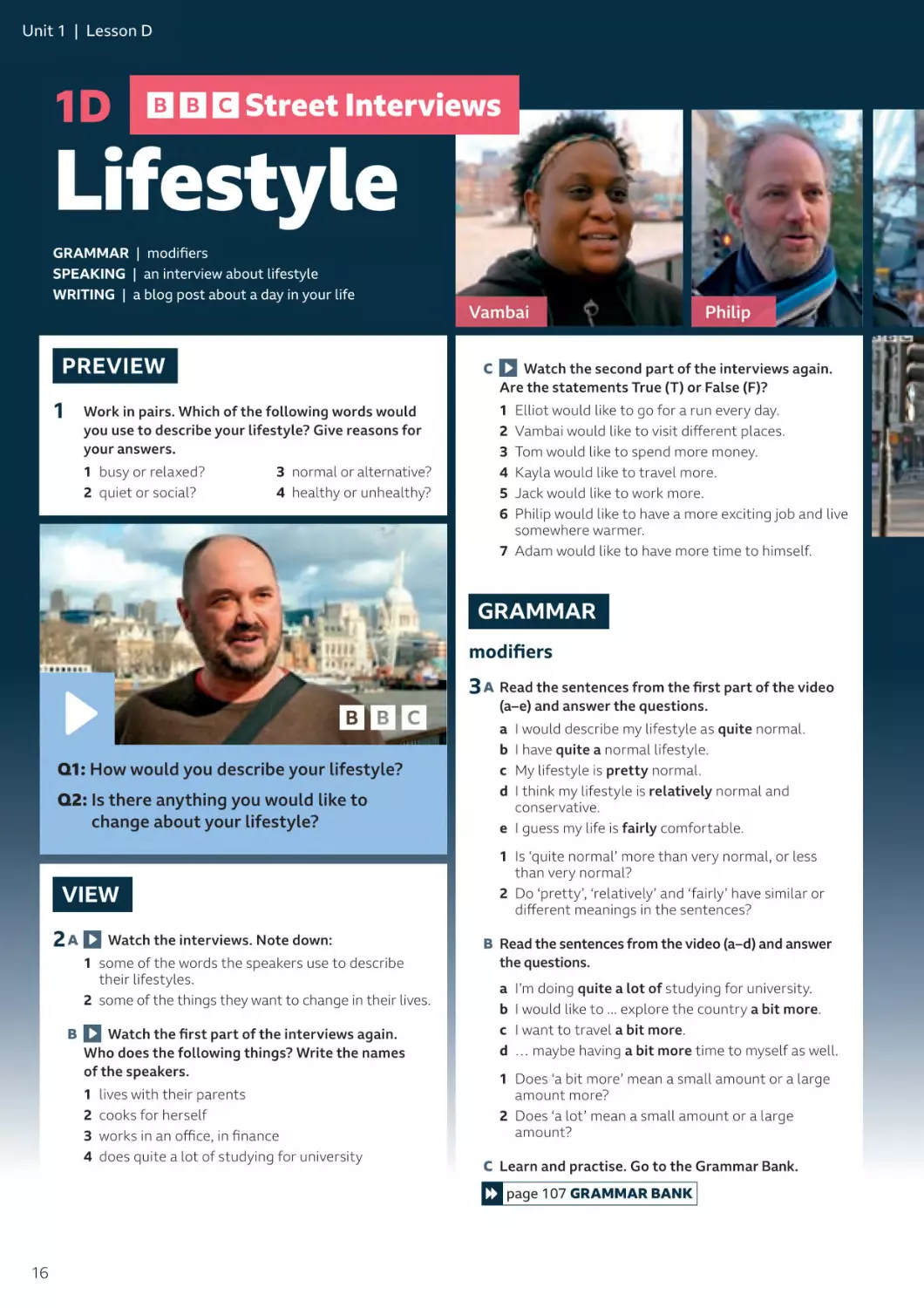
QI: How would you describe your lifestyle?
Q2: Is there anything you would like to
change about your lifestyle?
I would describe my lifestyle as quite normal.
I have quite a normal lifestyle.
My lifestyle is pretty normal.
I think my lifestyle is relatively normal and
conservative.
I guess my life is fairly comfortable.
2aQ Watch the interviews. Note down:
1	some of the words the speakers use to describe
their lifestyles.
2	some of the things they want to change in their lives.
В Q Watch the first part of the interviews again.
Who does the following things? Write the names
of the speakers.
lives with their parents
cooks for herself
works in an office, in finance
does quite a lot of studying for university
1
2
3
4
a
b
c
d
1
2
В Read the sentences from the video (а-d) and answer
the questions.
I’m doing quite a lot of studying for university.
I would like to ... explore the country a bit more.
I want to travel a bit more.
... maybe having a bit more time to myself as well.
Does ‘a bit more’ mean a small amount or a large
amount more?
Does ‘a lot’ mean a small amount or a large
amount?
C Learn and practise. Go to the Grammar Bank.
Д page 107 GRAMMAR BANK
16
SPEAKING
WRITING
an interview about lifestyle
4a You are going to interview your partner to find out
more about their lifestyle. Use the topics in the box
and write six questions about their lifestyle now and
things they would like to change.
books food freetime friends/family
health hobbies/interests music
social media sports TV
1	Do you spend your free time with friends or
with family?
2	What does your social media tell us about
your lifestyle?
В Work in pairs. Take turns to interview your partner
about their lifestyle. Make notes on their answers. Use
the Key phrases to help you talk about your lifestyle.
KEY PHRASES
I think I’m quite/relatively/fairly healthy because ...
My lifestyle is quite normal/alternative because ...
I spend quite a Lot of time ...
I’d like to ... a bit more.
Something I’d like to do is travel more/work less/
be a bit more healthy.
C What kind of lifestyle does your partner have? Tell the
class about the person you interviewed.
a blog post about a day in your life
5 A Read the blog post. In what ways is Kim’s lifestyle
similar and different to yours?
A day in my life
Kim, games designer (UK)
I’m a games designer and I live in Hackney in
London. On a typical day, my alarm goes off at
6.00 a.m. and I try not to look at my emails or start
work immediately. First, I do a bit of yoga and
make a cup of green tea. I have a fairly healthy
breakfast - some cereal with milk, or some toast,
and then I cycle to work. It takes about twenty
minutes and I find it really relaxing. At work, the
first thing I do is switch on my computer and
read my emails. For lunch, I get some noodles
or something from one of the Vietnamese cafes
or restaurants near to where I work. After work
I like to meet up with friends for dinner, or go
out somewhere. I love going to the cinema or the
theatre or just staying at home listening to music.
В Write a blog post about a day in your life. Use some
modifiers and write about:
•	what time you usually get up.
•	what you do first in the morning.
•	how you travel to work or college.
•	what you have for lunch.
•	what you enjoy doing in the evenings.
17
1
REVIEW
GRAMMAR
VOCABULARY
adverbs of frequency
1 A Match the questions (1-6) with the answers (a-f).
1	Do you usually go to bed after midnight?
2	How many texts do you send per day?
3	Do you regularly phone friends?
4	How often do you cook?
5	How frequently do you read novels?
6	Do you ever play ball sports?
a Usually about twenty, but sometimes more.
b Yes. Once in a while I play tennis.
c Rarely. I prefer books about history.
d Yes. Sometimes I only sleep for four or five hours.
e Hardly ever. I’m terrible in the kitchen.
f Yes. I speak to Janet every day.
В Work in pairs. Take turns to ask and answer the
questions in Ex 1A.
present simple and continuous
2 Work in pairs. Look at page 149 and follow the
instructions.
verb patterns
3 A Choose the correct verb forms to complete the
sentences.
1	He promised to give / giving me the money.
2	Everyone agreed to work / working together.
3	I spent a whole day writing / to write my essay.
4	We’d like to create / creating an app.
5	They don’t mind studying / to study together.
6	This hotel seems to be / being very luxurious.
В Work in pairs and discuss. When was the last time you:
•	finished making or doing something difficult?
•	decided to try something new?
•	spent time visiting friends or family?
modifiers
4a Complete the sentences with the words in the box.
a bit more fairly lot more quite a quite an
1	I would say that I lead....unhealthy lifestyle
because I don’t do a lot of exercise or eat healthily.
2	I work hard but I never seem to finish things on
time. I would like to be.....productive.
3	I have.....good social life. I enjoy spending time
with friends and going out.
4	I would love to have a....time for travel.
5	My work is usually...... . relaxed, so I’m not
stressed.
В Change the sentences in Ex 4A so that they are true for
you. Compare your ideas with a partner.
5a Add the missing vowels to complete the words in
the sentences.
1	It’s important to g_t on w_ll with your c_ll__g__s.
2	I’m a teacher, and in my pr_f_ss__n, you need to be
very p_t_ _nt.
3	I L _k up t_ my gr_ndp_r_nts - I respect them.
4	The most important quality of a p_rtn_r is that
they’re f_nny!
5	In my country it’s difficult for a m_s_c_ _n to work
f_ll-t_m_ even if they’re good!
6	A f_n_nc_ _l c_ns_lt_nt must be r_l_ _bl_.
В Work in pairs. Do you agree with the sentences
in Ex 5A?
C Choosefour of the sentences in Ex 5A. With your
partner, add an opinion to each sentence, beginning
with and or because.
I look up to my grandparents because they are good,
hard-working people.
6a Choose the correct options (A-C) to complete the text.
vso
VSO (Voluntary Service Overseas) is an
organisation that sends people to foreign countries
to work as 1	. They work on community
projects and spend time2 about the culture
and language of the host country.3 a lot of
them help to build houses or public buildings or
work in education or healthcare. The4
they earn is small, but it’s enough to live in the
country. The people on the programme5 end
up becoming6 friends. When they return
to their country, their time abroad is like a 7.
that they have gained. The skills they have learnt
can help in many different8	. An employee
who has been9 for organising a project in
another country often has an open mind and good
problem-solving skills. One VSO volunteer said, ‘A
lot of what 110....about the world comes from
my time living in Mozambique. It was amazing.’
1	A	volunteers	В	part time	C	salaries
2	A	to learn	В	learn	C learning
3	A	Enough	В	Quite	C Very
4	A	finances	в	dollars	C	wage
5	A	often	в	ever	C	at the moment
6	A	tight	в	close	c	near
7	A job		в	qualification	c	course
8	A	work	в	employment	c	careers
9	A	responsible	в	in charge	c	managing
10	A	am knowing	в	knew	c	know
В И R1.01 | Listen and check your answers.
18
LEAD-IN
GRAMMAR
COMMON ERRORS
1 A Choose the correct word to complete the sentences.
1	Do I Are I What you studying at university?
2	What do / have / did you eat last night?
3	How many countries do / have / did you been to?
4	What are / will / do you doing next weekend?
5	Where has / does / is your best friend live?
6	I not / wasn’t / didn’t working when she arrived.
7	I’m sure the school doesn’t / isn’t / won’t be
open tomorrow.
8	She is / has / did worked in several cities.
В Work in pairs. Check your answers, then choose two
questions to ask and answer.
2 A Read the text. What do you have in common
with Yusuf?
Hi, I’m Yusuf. I’m from Turkey,
\ but at the moment I’m living in
\ London, which is an amazing
I city. I’m going to stay here for six
months so that I can improve my
English. I love getting to know
new cities, and I’m really happy
that I chose to come to London. I’ve
4a Correct the mistakes in the sentences.
1	My sister don’t like football.
2	Which film you watch last night?
3	I’m from france.
4	We love listening music.
5	Let’s discuss about this later.
6	When I can go home?
7	I'm teacher.
8	I live here since 2018.
В Decide which mistakes in Ex 4A are connected with
these things.
1	a missing preposition
2	an extra preposition
3	a verb tense
4	word order
5	a missing auxiliary verb
6	punctuation or capitalisation
7	verb-noun agreement
8	a missing article
VOCABULARY
been to seven or eight fantastic museums and
art galleries, and I also really like the parks.
The best thing about London is that there are
so many interesting things to do, especially for
someone in their twenties, like me. The worst
thing is the weather. I really hate cold weather.
I arrived in January and it was freezing!
В Read the text again and find examples of
1	a present continuous verb.
2	a past simple verb.
3	a present perfect verb.
4	a verb form for future plans.
5	a superlative.
6	a modal verb.
7	a relative clause.
8	a verb + -ing form.
PRONUNCIATION
3a Find pairs of words in the box that have the same
vowel sound.
bar boat fight heat heart mail oil put queue
seen show shy take through took toy
bar, heart
5a Complete the common phrases with the verbs in
the box.
chat do (x2) go have listen to
post send take watch
1	have a meeting
2	out with friends
3	a photo on social media
4	to a colleague
5	some work
6	an email
7	a film
8	some music
9	.....some sport/exercise
10	a break
В Complete the table with the phrases from Ex 5A.
work	free time
have a meeting
В □ l.01 | Listen and check your answers.
C Work in pairs. Think of other words in English that use
the same vowel sounds.
C Work in pairs. Can you add any more phrases to the
table in Ex 5B? Which of these things do you do in a
normal day?
6
people 1
fl Global --------------------
^Eng°shf LEARNING OBJECTIVES
VLOGS
Q: How would your friends
describe you?
1П Watch the video. Note down
some of the adjectives that you
hear. Compare in groups.
2 How would your best friends
describe you?
1A LISTENING | Understand people talking about the people
and activities in their life: people and relationships;
personality adjectives
Talk about different people and activities in your life: present
simple and present continuous; state verbs; adverbs of frequency
Pronunciation: connected speech: do you
Write a personal profile; use linking phrases
1B READING | Read a news article about people with unusual
jobs: jobs; work
Talk about jobs and work: verb patterns
Pronunciation: syllable stress
Invent a news story
1C HOW TO ... | start and end a conversation; keep a
conversation going: conversation topics
Pronunciation: rhythm and intonation
1D BBC STREET INTERVIEWS | Understand people talking
about their lifestyles
Talk about your lifestyle: modifiers
Write a blog post about a day in your life
7
Pedro
Unit 1 | Lesson A
GRAMMAR | present simple and present ' '
continuous; state verbs; adverbs of frequency I
VOCABULARY | people and relationships; •
personality adjectives ,_
PRONUNCIATION | connected speech:
do you	1/	Hi h
VOCABULARY
people and relationships
1 A Work in pairs and discuss the questions.
1 What different groups of people are there in your life? Think
about work, college, family, hobbies, etc.
2 How often do you see each group?
3 What activities do you do together?
1 I’m part of a football team and I
get on well with my teammates.
We usually go out together
after a match. I think it’s really
important that teammates can
get on with each other on and off
the pitch. It helps you to play a
better game.
В Look at the photos. Which different groups of people and activities
do you think are important for Pedro?
2a Read what Pedro says about the different people and activities in
his life. Find them in the photos.
2 Every day I work with the same
people. Luckily, I’m friendly with
most of my colleagues. I also
have a really good manager. I
look up to her.
В Complete the table with the words in bold in Ex 2А. Can you add
more words for people to the table?
work	sport	friendships/ personal life	family

C Match the highlighted phrases in Ex 2А with the meanings (1-4).
1	have a good relationship with someone	and
2	be similar to a parent or relative
3	respect someone
4	see, talk or write to someone
D Use the words in Ex 2B and the phrases in Ex 2C to talk about
people you know.
I Look upto my grandfather because ...
I get on well with my partner because...
3 I message my parents a lot. I like
to stay in touch with them by
video call, too. My grandparents
were very important to me so I
want my children to have a good
relationship with my parents. My
daughter takes after my mother.
They’re very similar in many
ways.
4 I would say my partner is my
best friend, but I also have a
group of close friends and we
sometimes play music together.
We try to meet once a month.
8
1А
LISTENING
GRAMMAR
3aQi .01 | Listen to three people talking
about their lives. Who talks about each idea
in the box?
parents studies work asport
children a grandparent
4_________________________________«
Tomasz: studies,..,...................
Michaela:
Jo:
В Я 1.01 | Work in pairs. Answer the
questions. Listen again and check.
Tomasz
1 What is he studying at the moment,
and where?
2 Who does he live with?
3 How often does he see and speak to
his parents?
Michaela
4 How often does Michaela play hockey?
5 Why does she admire her grandmother?
6 Where did she meet her group of close
friends?
Jo
7 What is Jo’s job?
8 Why is her work busy at the moment?
9 What three jobs does she mention doing
at home?
C Work in groups. Discuss the questions.
1 Do you have a small group of close friends,
or a large group of friends?
2 How good are you at staying in touch with
old friends and family members?
3 How important is your work or studying to
you? Why?
4 What ‘jobs’ do you do at home?
4a Work in pairs. Read the descriptions (a-c)
that the speakers use. Which people are
they talking about? Then answer the
questions (1-3).
a They're so funny, and great to be with.
b She’s such a kind and generous person,
and she’s always cheerful.
c They are hard-working and very reliable.
1	Do the adjectives in bold have a positive or
negative meaning?
2	Who in your life would you describe with
these adjectives?
3	What other adjectives can you use to
describe personality?
В Learn and practise. Go to the
Vocabulary Bank.
page 136 VOCABULARY BANK
personality adjectives
present simple and present continuous; state
verbs; adverbs of frequency
5a Look at sentences 1-6 from the listening. Which tenses are the
verbs in bold?
1	I’m studying design and I love it!
2	I’m living with a few of the people on my course at the
moment.
3	We study during the day and then we usually cook together
in the evening.
4	My parents live back home in Poland.
5	When they come home, we always try to meet up.
В Look at the verbs in bold in Ex 5A again. Answer the questions.
1 Which verb describes a fact or something that is always true?
2 Which verbs describe a temporary situation or something
happening around now?
3 Which verbs describe a habit or routine?
4 Which verb tense do we use with adverbs of frequency, e.g.
sometimes, often, never?
5 Which verb in the present simple describes a feeling that is
true now?
C Learn and practise. Go to the Grammar Bank.
Д page 104 GRAMMAR BANK
PRONUNCIATION
6 А И 1.02 I connected speech: do you | Listen to the question.
Notice how the words do you are joined together.
Do you cook for your family?
В Q 1.03 | Listen and write the questions that you hear.
C Work in pairs. Ask and answer the questions in Ex 6B.
7 A Make six true sentences about your life, job and studies. Use
words and phrases from box A. Use the ideas in box В or your
own ideas.
A
В
always at the moment hardly ever occasionally
never nowadays often sometimes usually
cook dinner do sport eat out in a restaurant
go on holiday stay in touch with friends
visit my grandparents
enjoy my job	get up before 6 a.m. go out with
colleagues Learn something new start a new project
enjoy my course find my course difficult
study for exams
В Work in pairs. Compare your sentences. Ask more questions.
A: I hardly ever eat out in a restaurant. I always cook dinner
for my family at home.
B: Really? What kinds of things do you like cooking?
9
Unit 1 | Lesson A
SPEAKING
WRITING
8a Look at the diagram about Kasia. Who
is Kasia’s best friend? Who does she
work with?
Ela: teammate at
volleyball, friendly, fun
Maria: work colleague,
journalist, friendly
Shaun: my partner,
charming and kind
Alice: best friend,
funny, good at
languages, tidy
Filip: brother,
bossy!
a personal profile
9 a Read Matt’s personal profile. Where do you think you might read
this profile?
a in ajob application
b on someone’s professional website
c in an application to college or university
Matt Erbrich
About me...
В Think about the important people in your
life. Make a similar diagram for yourself.
C Read the questions (1-4) and prepare
your answers. Make some notes for each
of the questions.
1 How do you know each person on
your diagram? What is their
relationship to you?
2 How can you describe them?
3 How often do you see each person and
how do you stay in touch?
4 What things do you usually do with
each person, and what things are you
doing with them at the moment?
D Work in groups. Tell others about the
people in your diagram. As you listen, ask
one or two questions about each of the
people that your classmates talk about.
A: Alice is my best friend. She’s
really funny, and she’s a bit crazy
sometimes. That’s why I like her. We
get on really well. I see her every
week, and we often go shopping
together. At the moment, we’re
planning a holiday. I can’t wait!
B: What does she do?
A: She’s a designer.
I believe photographs have the power to show emotion and
character as well as beauty. I am a portrait photographer and
I love taking photos of people.
I was born in Germany and grew up in the UK, but now I’m
living in New York. I love travelling, especially in Europe
because there are so many interesting countries to visit. I
enjoy working on city scenes and travel photography, too,
and at the moment I’m working on a travel book. I work
on photo projects around the world and I have also won
awards for my work. I love taking photographs of people in
their daily lives, for example colleagues working together
or grandparents playing with their grandchildren. I’m quite
patient and easy-going, so I’m happy to wait to get the right
photo! I hope you enjoy my photos. If you need a photographer,
get in touch!
Contact me: MattErbrich22xx@gmail.com ra a ®
В Work in pairs. What information does Matt include in his
personal profile?
address age awards won
education family hobbies
nationality personal beliefs
roles in life work skills
current projects
hometown job name
professional experience
10a Look at the linking phrases in bold in Matt’s profile. Notice how
they connect two ideas together. Which linking phrase:
a gives a reason? b adds a similar idea (хЗ)? c gives an example?
В Complete the sentences with the linking phrases in the box.
also as well as because for example too
1 I occasionally write articles for a local newspaper, and contribute
to their online blog,
2 I sometimes do different jobs.	, I work as a waiter,
a lifeguard and also a delivery person.
3	I’m studying biology I Love learning about nature.
4	I really enjoy surfing skiing.
5	One of my passions is cooking, but I.... really enjoy music.
C Imagine you are setting up a new website based on something you
are interested in. Write your personal profile page for the website.
Use Matt’s profile as a model.
10
VOCABULARY
jobs
1 A Write down five jobs that involve helping other people.
Medical workers save lives.
Teachers help us to learn.
В Work in groups. Compare your ideas. Then decide
which jobs help people the most.
2aQi .041 Listen to eight people talking about their
jobs. Match the speakers with the jobs (a-h).
a musician
b mechanic
c shop
assistant
Г ьычп*|
d financial
consultant 1
C Work in pairs. Discuss the questions. How can you
describe the jobs in Ex 2A? Which would you like to
do? Why?
A chef is responsible for planning the menu and
creating new dishes.
I'd like to be a financial consultant because they earn
a good salary.
D Learn and practise. Go to the Vocabulary Bank.
Д page 136 VOCABULARY BANK work
PRONUNCIATION
3 a | syllable stress | Work in pairs. Which syllable is
stressed in these words? Which word has a different
stress pattern?
assistant consultant journalist
mechanic musician
e plumber
g gardener
h journalist
В Look at the jobs in Ex 2A again. In which jobs do people
1	work with numbers or words?
2	sell objects or food?
3	sell a service?
4	help people?
В Q| 1.05 | Listen and check. Is this statement true
or false?
The stress on three-syllable jobs is usually on the
second syllable.
C Make sentences about the jobs in Ex ЗА, then read
your sentences to a partner. Remember to stress the
correct syllable.
My brother is a journalist.
11
Unit 1 | Lesson В
READING
4a Work in groups of three. Student A: Read text A on this
page. Student B: Read text В on page 146. Student C:
Read text C on page 148.
В Complete the table with information from your text.
about your text. Complete the table for the other
two texts.
В In your groups, discuss the questions.
1	What do you think the three people enjoy about
what they do?
2	Which person do you admire the most? Why?
C Find words or phrases in bold in your text to match the
meanings (1-5).
1	a List showing how much you have to pay
2	behaviour that shows you care for and want to help
others
3	the money that someone earns or receives regularly
4	to become popular
5	to do something so you can be certain of the result
D Work with other students. Read the Future Skills box
and discuss the questions.
FUTURE SKILLS
Social responsibility
The media often describes people like Lou, Zeal
and James as good people or heroes. Define a good
person. Are the people in the texts good people?
Which famous people do you think are good? Why?
Lou Ridsdale loves gardening. In a small
space next to her home in Ballarat, Australia,
she grows vegetables. One day, she heard
about a man in Los Angeles who grew food
to share with the community. He belonged to
an organisation called Food is Free. Ridsdale
saw that she had more vegetables than she
needed and decided to give them away, like
the man in Los Angeles.
In Ballarat, just 6.4 percent of people eat the
recommended amount of vegetables. A lot of
people in the city have low incomes and the
city has many problems connected to what
people eat: lack of affordable food and lack
of education about healthy eating. Ridsdale
wanted to change this.
12
GRAMMAR
IB
verb patterns
6a Look at the highlighted words in your text. Find ...
1	an -ing form as the subject of a sentence.
2	a preposition + -ing form.
3	four verbs + to + infinitive.
В Correct the mistakes in the sentences. One sentence
is correct.
1	After leaving school, I decided do a plumbing course.
2	She hopes for become a chef.
3	You need to speaking to a financial consultant.
4	Working here is great -1 love it!
5	Before study to be a doctor, he worked as a
volunteer in a hospital.
C Learn and practise. Go to the Grammar Bank.
Q page 105 GRAMMAR BANK
SPEAKING
7 A Work in pairs. Choose one of the headlines and invent
a news story. Answer the questions (1-5) to help you.
100-year-old walks his dog and raises
€1,000,000 for hospital
WOMAN PLANTS A TREE EVERY DAY FOR A YEAR
After leaving the food outside her home,
she put up a sign inviting people to help
themselves. Soon volunteers were bringing
food for those in need. People usually bring
fruit and vegetables but sometimes plants
and seeds, too. There is no money involved,
no food bill to pay, only kindness. Helping
people is what Ridsdale does. She says that
no one is judged on what they bring or
take as long as they leave with a smile. She
makes sure they always do.
Apart from feeding people, Ridsdale
understands that education is the other
important part of the programme. Once the
programme was established, she began to go
into schools to talk about food. She believes
that young people need to learn about
healthy eating. This will help to make their
lives healthier and better. She hopes to see
her idea catch on all over Australia.
Recycling hero builds parks for kids
1	Where and when did it happen?
2	Who was involved?
3	Why did they decide to do this?
4	What difficulties did they have?
5	How did people hear about the story?
В Work together and prepare to tell your story. Make
notes, using at least five phrases from the box.
after + -ing form agreed to before + -ing form
decided to helped to needed to realising
wanted to
C Tell your story.
1 Work with your partner. Use your notes and practise
telling your story together.
2 Work with a different partner. Tell your story again
without using your notes.
D Work in groups. Do you know any real stories like the
ones you heard?
13
1C Let’s talk!
HOW TO ... | start and end a conversation; keep a conversation going
VOCABULARY | conversation topics |-
PRONUNCIATION | rhythm and intonation
VOCABULARY
conversation topics
1 A Look at the photo. What do you think a ‘Happy to chat
bench’ is? Who do you think might use it?
В Read the text to check your ideas.
The benefits of talking
to strangers
Most of us spend part of our day surrounded by
strangers, perhaps when travelling to work, sitting
in a park or a cafe or visiting the supermarket.
We are together with other people, but nobody
talks. However, research shows that starting up
a conversation with a stranger can make you feel
happier and enjoy your day more.
When Allison Owen-Jones saw a man sitting
alone on a bench in the park, she wanted to talk
to him, but she felt uncomfortable because she
wasn’t sure he would want to chat. Then she had
an idea: ‘Happy to chat benches’. She made a sign
to put on park benches which said, 'Happy to
chat bench. Sit here if you don’t mind someone
stopping to say hello.’ The idea was a success. Now
‘Happy to chat benches’ can be found in several
countries including Canada, the USA, Australia,
Switzerland and Ukraine.
So, the next time you see someone sitting alone,
give them a smile and say hello. You never know:
they might be happy to talk.
C Work in groups. Answer the questions.
1	How often do you talk to people you don’t know? In
what places?
2	Do you think ‘Happy to chat benches’ would be a
good idea where you live? Why/Why not?
3	Which topics do you think are suitable or not
suitable for talking to people you don’t know?
2a Match the questions for starting a conversation (1-9)
with the topics in the box.
clothes and fashion food and eating out
hobbies and free-time activities
holiday experiences politics
sport or music events the news
the weather work or studies
1	Did you hear about the fire in town? It’s terrible.
2	That’s a nice jacket. Where did you get it?
3	Lovely day, isn’t it?
4	So, who do you think will win the election?
5	Astrid tells me you like painting. What kinds of
things do you paint?
6	It’s the Big Music Live this weekend. Are you going?
7	I hear you have a job in finance. Do you enjoy it?
8	Have you tried these pastries? They Look delicious.
9	We’ve just got back from Corfu. It was wonderful.
В What other questions could you ask about the topics in
the box to start a conversation?
Howto...
start and end a conversation; keep a
conversation going
3a0i .061 Listen to three conversations. Where are the
people? What topics do they talk about? Make notes.
В И 1.061 Are the statements True (T) or False (F)?
Listen again to check.
Conversation 1
1	The man has never been to the music festival before.
2	The woman is going to see a family member at the
festival.
Conversation 2
3	Kate prefers the coffee from the coffee machine.
4	Kate started work two weeks ago.
Conversation 3
5	The man is on holiday.
6	The woman likes the city.
14
1С
4а Work in pairs. Complete the extracts from the conversations with
the missing words.
Woman:	Excuse me,1 sitting here?
Man:	No, go2
Woman:	Thanks.
Man:	No3
Woman:	Have you been to the festival	before?
Man:	Yes, I go every year. How4	you?
Woman: Oh, it’s my first time.
SPEAKING
7 A Work in pairs. Read the Future Skills box
and discuss the question.
FUTURE SKILLS
Communication
Kate:	I’m Kate, by the5
Justine:	Hi, Kate. I'm Justine.
Kate:	Great. Well, Justine, I’ve6	go. Nice to meet you.
Justine:	Yes, nice to7
Man:	Excuse me, do8 if I charge my phone here?
Woman: Not at all.9 my guest.
Man:	Thanks. That’s very kind.
Woman: Oh, that’s my train. Nice 10 toyou.
Man:	Safe journey home!
To keep a conversation going, it is
important to listen actively and show
you are interested in what the other
person says. Ask questions like ‘How
about you?’ or other questions that
encourage the other person to talk.
Look at the audioscripts on page 158.
What questions do the speakers ask to
encourage the other person to talk?
В И 1.071 Listen and check your answers.
5a Match the sentences (1-8) with their uses (a-c).
1	Nice talking toyou.
2	Do you mind if I charge my phone here?
3	Help yourself.
4	I've got to go.
5	Is anyone sitting here?
6	Do you know if there’s a cafe near here?
7	What about you?
a starting a
conversation
b responding/keeping
a conversation going
c ending a conversation
В Work in pairs.
Student A: You are sitting on a ‘Happy to
chat bench’ near the station. Think about
where you are and why you are sitting
there. Someone comes to the bench to
talk to you. Continue the conversation.
Student B: You see someone sitting
on a 'Happy to chat bench’ near the
station and decide to talk to them. Think
about why you are there. Then start a
conversation.
8 Nice to meet you.
В Can you think of any other phrases for each of the categories (a-c)?
C Learn and practise. Go to the Grammar Bank.
Д page 106 GRAMMAR BANK
PRONUNCIATION
6a □ 1.081 rhythm and intonation | Listen to the phrases we use
for responses. Notice that they all follow a similar rhythm and
intonation pattern.
Not at all. Go ahead. Help yourself. Be my guest.
No problem.
В Try saying these phrases. Do the phrases follow the same
or a different pattern?
C In your pairs, reflect on the activity in
Ex 7B. Was it easy or difficult to start the
conversation and keep it going? Why?
D Work in a different pair. Think about a
different place for your ‘Happy to chat
bench’, and think about why you are
there. Then have a conversation. Talk
about different topics.
MEDIATION SKILL
managing turn-taking
agree on a community project
» page 150 MEDIATION BANK
C
D
See you later. Nice to meet you. I’ve got to go.
Enjoy your weekend.
□ l .09 | Listen and check.
Work in pairs. Make three short conversations using some of the
phrases in Ex 5A. Choose from the situations in the box.
first day at work in a cafe or canteen
meeting in a park on a bus or a train
Practise the conversations. Focus on the rhythm and intonation
in the phrases.
Speak
anywhere
Unit 1 | Lesson D
ID 0130 Street Interviews
Lifestyle
GRAMMAR | modifiers
SPEAKING | an interview about lifestyle
WRITING | a blog post about a day in your life
Vambai
PREVIEW
1 Work in pairs. Which of the following words would
you use to describe your lifestyle? Give reasons for
your answers.
1	busy or relaxed?	3 normal or alternative?
2	quiet or social?	4 healthy or unhealthy?
QI: How would you describe your lifestyle?
Q2: Is there anything you would like to
change about your lifestyle?
VIEW
2aQ Watch the interviews. Note down:
1	some of the words the speakers use to describe
their lifestyles.
2	some of the things they want to change in their lives.
В Q Watch the first part of the interviews again.
Who does the following things? Write the names
of the speakers.
1	lives with their parents
2	cooks for herself
3	works in an office, in finance
4	does quite a lot of studying for university
C □ Watch the second part of the interviews again.
Are the statements True (T) or False (F)?
1	Elliot would Like to go for a run every day.
2	Vambai would like to visit different places.
3	Tom would like to spend more money.
4	Kayla would like to travel more.
5	Jack would Like to work more.
6	Philip would like to have a more exciting job and live
somewhere warmer.
7	Adam would like to have more time to himself.
GRAMMAR
modifiers
3a Read the sentences from the first part of the video
(a-e) and answer the questions.
a I would describe my lifestyle as quite normal.
b I have quite a normal lifestyle.
c My lifestyle is pretty normal.
d I think my Lifestyle is relatively normal and
conservative.
e I guess my Life is fairly comfortable.
1 Is ‘quite normal’ more than very normal, or Less
than very normal?
2 Do ‘pretty’, ‘relatively’ and ‘fairly’ have similar or
different meanings in the sentences?
В Read the sentences from the video (а-d) and answer
the questions.
a I'm doing quite a lot of studying for university.
b I would Like to... explore the country a bit more.
с I want to travel a bit more.
d ... maybe having a bit more time to myself as well.
1	Does 'a bit more’ mean a small amount or a large
amount more?
2	Does 'a lot’ mean a small amount or a large
amount?
C Learn and practise. Go to the Grammar Bank.
Д page 107 GRAMMAR BANK
16
11 JU 11
BIBIC
* lljj
Alice
SPEAKING
WRITING
an interview about lifestyle
4a You are going to interview your partner to find out
more about their lifestyle. Use the topics in the box
and write six questions about their lifestyle now and
things they would like to change.
—
books food freetime friends/family
health hobbies/interests music
social media sports TV
1	Do you spend your free time with friends or
with family?
2	What does your social media tell us about
your lifestyle?
В Work in pairs. Take turns to interview your partner
about their lifestyle. Make notes on their answers. Use
the Key phrases to help you talk about your lifestyle.
KEY PHRASES
I think I’m quite/relatively/fairly healthy because ...
My lifestyle is quite normal/alternative because ...
I spend quite a lot of time ...
I’d like to ... a bit more.
Something I’d like to do is travel more/work less/
be a bit more healthy.
C What kind of lifestyle does your partner have? Tell the
class about the person you interviewed.
a blog post about a day in your life
5a ead the blog post. In what ways is Kim’s lifestyle
similar and different to yours?
A day in my life
Kim, games designer (UK)
I’m a games designer and I live in Hackney in
London. On a typical day, my alarm goes off at
6.00 a.m. and I try not to look at my emails or start
work immediately. First, I do a bit of yoga and
make a cup of green tea. I have a fairly healthy
breakfast - some cereal with milk, or some toast,
and then I cycle to work. It takes about twenty
I minutes and I find it really relaxing. At work, the
first thing I do is switch on my computer and
read my emails. For lunch, I get some noodles
or something from one of the Vietnamese cafes
or restaurants near to where I work. After work
I like to meet up with friends for dinner, or go
out somewhere. I love going to the cinema or the
theatre or just staying at home listening to music.
В Write a blog post about a day in your life. Use some
modifiers and write about:
•	what time you usually getup.
♦	what you do first in the morning.
•	how you travel to work or college.
•	what you have for lunch.
♦	what you enjoy doing in the evenings.
17
1
REVIEW
GRAMMAR
VOCABULARY
adverbs of frequency
1 A Match the questions (1-6) with the answers (a-f).
1	Do you usually go to bed after midnight?
2	How many texts do you send per day?
3	Do you regularly phone friends?
4	How often do you cook?
5	How frequently do you read novels?
6	Do you ever play ball sports?
a Usually about twenty, but sometimes more.
b Yes. Once in a while I play tennis.
c Rarely. I prefer books about history.
d Yes. Sometimes I only sleep for four or five hours.
e Hardly ever. I’m terrible in the kitchen.
f Yes. I speak to Janet every day.
В Work in pairs. Take turns to ask and answer the
questions in Ex 1A.
present simple and continuous
2 Work in pairs. Look at page 149 and follow the
instructions.
verb patterns
3a Choose the correct verb forms to complete the
sentences.
1	He promised to give / giving me the money.
2	Everyone agreed to work / working together.
3	I spent a whole day writing / to write my essay.
4	We’d like to create / creating an app.
5	They don’t mind studying / to study together.
6	This hotel seems to be / being very luxurious.
В Work in pairs and discuss. When was the last time you:
•	finished making or doing something difficult?
•	decided to try something new?
•	spent time visiting friends or family?
modifiers
4a Complete the sentences with the words in the box.
a bit more fairly lot more quite a quite an
1 I would say that I lead unhealthy lifestyle
because I don’t do a lot of exercise or eat healthily.
2 I work hard but I never seem to finish things on
time. I would like to be.....productive.
3 I have good social life. I enjoy spending time
with friends and going out.
4 I would love to have a.....time for travel.
5 My work is usually relaxed, so I’m not
stressed.
В Change the sentences in Ex 4A so that they are true for
you. Compare your ideas with a partner.
5 A Add the missing vowels to complete the words in
the sentences.
1 It’s important to g_t on w_ll with your c_ll_ _g_ _s.
2 I'm a teacher, and in my pr_f_ss__n, you need to be
very p_t_ _nt.
3	I l__k up t_my gr_ndp_r_nts -1 respect them.
4	The most important quality of a p_rtn_r is that
they’re f_nny!
5	In my country it’s difficult for a m_s_c__n to work
f_ll-t_m_ even if they’re good!
6	Af_n_nc__l c_ns_Lt_nt must be r_l__bl_.
В Work in pairs. Do you agree with the sentences
in Ex 5A?
C Choose four of the sentences in Ex 5 A. With your
partner, add an opinion to each sentence, beginning
with and or because.
I look up to my grandparents because they are good,
hard-working people.
6a Choose the correct options (A-C) to complete the text.
vso
VSO (Voluntary Service Overseas) is an
organisation that sends people to foreign countries
to work as 1.... . They work on community
projects and spend time 2 about the culture
and language of the host country.3 a lot of
them help to build houses or public buildings or
work in education or healthcare. The 4
they earn is small, but it’s enough to live in the
country. The people on the programme5 end
up becoming 6 friends. When they return
to their country, their time abroad is like a 7
that they have gained. The skills they have learnt
can help in many different 8	. An employee
who has been9 for organising a project in
another country often has an open mind and good
problem-solving skills. One VSO volunteer said, ‘A
lot of what 110	about the world comes from
my time living in Mozambique. It was amazing.’
1	A	volunteers	В	part time	C	salaries
2	A	to learn	В	learn	C learning
3	A	Enough	В	Quite	CVery
4	A	finances	в	dollars	C	wage
5	A	often	в	ever	C	at the moment
6	A	tight	в	close	c	near
7	A job		в	qualification	c	course
8	A	work	в	employment	c	careers
9	A	responsible	в	in charge	c	managing
10	A	am knowing	в	knew	c	know
В Qri.01 I Listen and check your answers.
18
Л Global ------------------------------------------
J-lEngi®sbf LEARNING OBJECTIVES
VLOGS
Q: Tell me about a happy memory.
1	П Watch the video. Tick the topics
the people mention.
birthdays new possessions
pets relationships school
travel and holidays
2	Which memory did you enjoy the
most? Why?
2A LISTENING | Understand a sequence in a narrative:
adjectives for feelings; -ed/-ing adjectives
Tell an anecdote: narrative tenses
Pronunciation: weak forms of was, were and had
Write a personal story; use linking phrases
2B READING | Read an article about storytelling: story
words; types of film
Talk about films, books and plays: past simple and
present perfect
Pronunciation: contracted have in the present perfect
2C HOW TO ... | apologise and give reasons: collocations
with get and make
Pronunciation: intonation for apologising
2D BBC PROGRAMME | Understand a TV travel programme
telling the story of a place
Talk about a place and how it is changing: prepositions
of time
Write a review of a place
19
Unit 2 | Lesson A
2A What I
happened?
GRAMMAR | narrative tenses I___________________
VOCABULARY | adjectives for feelings; -ed/-ing adjectives
PRONUNCIATION | weak forms of was, were and had
VOCABULARY
adjectives for feelings; -ed/-ing
adjectives
1 Work in pairs. Discuss the questions.
1	Do you share stories on social media?
What types of story?
2	What stories do you enjoy telling
friends and family (about work,
studies, travel, other people, etc.)?
3	How do people tell stories differently
on social media and face to face?
В Complete the meanings with the words in bold in the story.
1 When you are afraid of something, you feel
2 If something is very good, it is
3 When you feel unhappy because something is not interesting,
you are..........
4 When something is not as good as you hoped, you feel
5 When you feel angry about something, you are
6 When you are looking forward to something in the future, you
are
7 When a situation makes your face go red, it is
8 When you are not expecting something to happen, but it does,
you are..........
2a Read the story. Choose the best final
sentence for it (a-c).
a He still hates painting now!
b I was sure it could never happen again!
c He’s still got photos to show our
‘artwork’!
This happened when my sister and I were
three and four years old. It was the summer
holidays and my granddad was looking
after us. We were bored, so we went into
the garage and were really excited when
we found all dad's paints. We decided to
surprise him by painting the house while he
was at work. We managed to paint a big area
of wall blue before my granddad noticed. I
think he found it a bit embarrassing that
he wasn’t watching us carefully enough. He
said to us, 'Your dad is going to be really
annoyed!' My sister and I were frightened,
but when dad came home, all he said was,
'I’m surprised you chose blue. I thought
you two preferred red.’ Now I look back,
it’s amazing that he was so calm. He was
probably disappointed with us, but he
didn’t show it.
C Look at the pictures. Which adjective ending do we use
1 to talk about how a person feels: -ed or -ing?
2 to talk about what causes the feelings: -ed or -ing?
Andy 2 reviews ® GB A day ago
За Complete the adjectives in the questions with -ed or -ing.
1	What’s the most amaz book you have read?
2	Can you remember a time when you were really
bor ?
3	What’s the most embarrass......thing that has ever happened
to you?
4	What sorts of things do you find annoy ? Why?
5	Have you ever been surpris on your birthday?
6	When did you feel really excit	about something?
7	Have you ever been very frighten by something? What
was it?
8	Can you think of a time when you were disappoint	?
В Work in pairs. Ask and answer the questions in Ex ЗА.
C Do you know any more adjectives for feelings? Learn and practise.
Go to the Vocabulary Bank.
Д page 137 VOCABULARY BANK adjectives for feelings
20
2А
LISTENING
GRAMMAR
4a Work in pairs. You will listen to a story
about two friends, Beth and Jane,
travelling in India. Look at the pictures
(A-F) showing six events from their
journey. What do you think happened
to them?
В □ 2 .01 | Listen and check your ideas.
C □ 2.01 | Number the events from the
story (A-F) in the order they happened.
Listen again and check.
A
В 1....
c
D
E
F
D Work in pairs. Answer the questions with
as much detail as possible.
1	How did Beth and Jane feel when they
were by the lake?
2	What did they think the journey to
Varanasi would be like? Were they
correct?
3	How did they feel on the train?
4	Why was Beth worried?
5	What happened to Jane?
6	Who helped Jane? How did he help her?
5 Work in pairs. Discuss the questions.
1	Would you like to go on a long train
journey? Why/Why not?
2	When was the Last time you made
a long journey?
3	Was the journey easy or difficult?
Tell your partner about it.
narrative tenses
6a Read the sentences from the story. Answer the questions.
They were sleeping on the floor.
Suddenly, the train stopped in the middle of nowhere.
1	What tenses are the verbs in bold in the sentences?
2	Which tense do we use for background information to the story,
or to set the scene?
3	Which tense do we use for the main events in the story?
В Read the example sentences and look at the verbs in bold. Answer
the questions.
Jane woke up on the railway track. She had fallen off the train.
1 Which event happened first, Jane waking up or falling off the train?
2 Which tense do we use to describe an earlier event in the past?
C Look at the audioscript on page 159 and find more examples of the
three narrative tenses.
D Learn and practise. Go to the Grammar Bank.
Q page 108 GRAMMAR BANK
PRONUNCIATION
7 A □ 2.021 weak forms of was, were and had | Listen to the sentences.
Notice how was, were and had are pronounced as weak forms.
1 I was beginning to get really worried.
2 They were sitting on the roof.
3 She had fallen off the train.
В И 2.03 | Listen and write the three sentences. Then practise
saying them.
C Work in pairs. Ask and answer the questions. Focus on pronouncing
was, were and had with weak forms.
1 What were you doing at this time yesterday?
2 Where were your parents living when you were born?
3 How many places had you lived in by the time you were fifteen
years old?
21
Unit 2 | Lesson A
SPEAKING
WRITING
8a You are going to tell your partner an
anecdote about a personal memory.
Choose one of the situations below, or
your own idea, and plan your anecdote.
Answer the questions below to help you.
a personal story
10 A A magazine has asked its readers to send in stories of memorable
experiences. Read about what happened to Rob. How was he left
on the island off Okinawa?
Talk about a time
when...
•	you visited an amazing place.
•	you went to a fun event, e.g. a
sports or music event, or a party.
•	you saw or met someone famous
or interesting.
•	something unusual happened
to you.
•	something went wrong, e.g. you
lost or forgot something.
Left on an island
off Okinawa
When was it?
Where were you?
Who were you with?
What happened?
How did you feel?
What happened in the end?
В Read the Future Skills box and plan some
phrases you can use in your anecdote.
FUTURE SKILLS
Communication	nn
When you are telling an anecdote, it is
important to think about the order of
events. You can use phrases to help you
organise the anecdote, e.g. ‘The next
thing I knew,... ’, ‘And then ...’, ‘In the
end,... ’, ‘Finally,... ’.
Look at your plan and think about how
you can use phrases to make the order of
events clear in your anecdote.
This happened when I was travelling in Japan. 1......,
I decided to visit one of the small islands off Okinawa on
a jet ski. I’d never been on one before, so I was really excited.
The weather was beautiful and we had an amazing journey
to the island.2......we arrived, the jet ski driver left me
on the beach and we arranged a time for him to collect me.
I spent an hour walking around the island and taking
photos. The only problem was that3........1 was walking
around, I got lost and couldn’t remember the exact beach
where we had arranged to meet. I walked up and down the
different beaches, getting very hot and thirsty.4.....
I found the right place, the driver had already left. I could
see him in the distance, so 5 I tried shouting from the
beach, but he couldn’t hear me.5 I tried to call his
mobile, but there was no signal. I couldn’t swim back to the
larger island because I had my phone, a camera, and a fear
of sharks! So I just had to wait.7	, I was saved by a
passing boat. But I had spent six hours without water in
the very hot sun, so it wasn’t a great day!
В Read the story again and complete it with the correct linking
phrases in the box.
after that as soon as at first by the time
in the end one day while
C Work in groups. Tell your anecdotes. Add
as much detail as you can. Ask questions
about your classmates’ anecdotes.
9 0 Bring a photo to the next class
showing an important event in your life.
Share it with other students and tell them
why it is important to you.
C Match the linking phrases in Ex 10B with the meanings (1-7).
1	This describes two actions that were happening at the same
time:
2	This describes something that happens at the end of the
story:
3	This describes something that happens immediately after
another action:
4	This refers to the action that happens next:
5	This refers back to an action that happened previously:
6	This sets the scene at the beginning of the story:
7	This refers to the action at the beginning:
D Write your story to send to the magazine. Use narrative tenses and
some of the linking phrases in Ex 10B.
22
2В
2В Storytelling
GRAMMAR | past simple and present perfect
VOCABULARY | story words; types of film
VOCABULARY
story words
1 A Work in pairs. Read the 10-word summaries of famous
films. Which films are they about? Go to page 147 to
find out.
1	Boys go on long journey to throw away dangerous ring.
2	Girl travels to find sister who can stop ice age.
3	Great-grandma remembers the worst, most famous
boat trip in history.
4	World’s best theme park becomes world’s most
dangerous theme park.
5	Boy accidentally misses family holiday. Helps catch
burglars at home.
В Work in pairs. Write a summary of a well-known film
in 10 words. Read it to other students. Can they guess
the film?
C Work in groups. Discuss the questions.
1	Which of the films in Ex 1A have you seen? Did you
enjoy the story? Why/Why not?
2	What kinds of film do you enjoy most?
3	Do you like seeing films of books you have read?
Why/Why not? Give examples.
4	What do you think makes a good story?
2 А П 2.041 Listen to three people talking about what
makes a good story. What ideas do they mention?
В И 2.041 Complete the sentences the people said with
the words in the box. Listen again and check.
characters ending fairytales hero
performances plot storyteller TV shows
1	I think having an exciting is important.
2	You need a that you like.
3	I like a happy , too.
4	My grandmother told me
5	It’s the same with and films.
6	Everything depends on the......
7	I love the actors’
8	They bring the to life.
C Match the words in Ex 2B with the meanings (a-h).
a the main person in a story hero
b the people in a story
c when people act or sing in front of people
d the way a story finishes
e a person who tells the story
f programmes which are shown on television
g traditional stories for children
h the main events in a story
D Work in groups. Think of a book, film or TV show that
you like. Tell other students why you like it. Use some
of the words from Ex2B.
23
Unit 2 | Lesson В
READING
GRAMMAR
3a Read the article. What is the main topic?
1 ways in which storytelling has changed
overtime
2 differences in the way different
cultures tell stories
3 how heroes are different in traditional
and modern stories
В Read the article again. Tick the ideas that
are mentioned.
1 Storytelling is a very old art.
2 We can learn a Lot from stories.
3 Schools don’t usually teach fairytales.
4 People who play video games help
create the story.
5 Technology has changed the way we
tell stories.
6 Writers spend a lot of time writing
TV shows.
7 Some stories remain popular for a
long time.
C Work in groups and discuss the questions.
1 Do you agree that ‘good stories last
forever’? Can you think of any old
stories that have lasted a long time?
2 What types of storytelling do you
Like best, and why? Which do you like
least? Talk about the ideas in the box,
or your own ideas.
past simple and present perfect
4a Read the extracts from the article. Which verbs in bold are in the
past simple and which are in the present perfect?
1 In December 2019, researchers in Indonesia found a cave
with paintings.
2 People in the Middle East have told the story of Little Red Riding
Hood for a thousand years.
3 New technologies have brought exciting new ways to tell stories.
В Which verb tense (present perfect or past simple) do we use
to describe:
1 an event that started and finished at a specific time in the past?
(We know exactly when it happened.)
2 something that started in the past and continues, or is still
important, now?
C Learn and practise. Go to the Grammar Bank.
Д page 109 GRAMMAR BANK
PRONUNCIATION
5 a И 2.05 | contracted have in the present perfect | Listen to
four sentences with the present perfect. In which of the sentences
is have contracted?
В Complete the sentences with your own ideas. Then read them aloud
to a partner. Use contracted forms of have where appropriate.
I have never...	Have you ever... ?
What have you ... today? I have not seen ...
books films theatre performances
TV shows video games
SPEAKING
D Find two types of film in the final
paragraph of the article. What other
types of film do you know?
E Learn and practise. Go to the
Vocabulary Bank.
I page 137 VOCABULARY BANK
[types of film
6 Move around the classroom. Ask your classmates questions and find
a name to add to each activity in the table. Ask more questions and
add extra information to the table.
A: Have you ever watched a really frightening horror film?
B: Yes, I have.
A: What did you think of it? Where did you see it? When did you ... ?
Find someone who...	name	extra information
has watched a really frightening horror film.
has been to the cinema recently.
has seen every episode of a TV show.
has read more than fifty books.
has played a lot of different video games.
has read or seen a play by William Shakespeare.
has acted in a film, TV show or play.
has met a famous writer, actor or YouTuber.
The lives of stories:
from cave paintings
to video games
In December 2019, researchers in Indonesia found a
cave with paintings on its walls. The paintings were
40,000 years old. The researchers realised that this was
the earliest story ever told through art.
Storytelling is as old as language. Stories are
everywhere and in every culture. India, China and
Mexico all have their own version of the fairytale
Cinderella. People in the Middle East have told the
story of Little Red Riding Hood for a thousand years.
Australian First Nation people tell stories about how
the first people sang the world into existence.
Good stories last forever because they entertain us
and teach us important life lessons. They show that
there are good and bad people, dangers, problems and
solutions. Stories often help us to see ourselves more
clearly and to see how we can become better people.
Stories have always been important, but the ways
we tell them have changed through time. Before the
development of writing, people told their stories aloud.
Then writing and books came along and changed all
that. Now, with virtual reality and gaming technology,
stories are more interactive than before. The players
help to create the story. They choose names for their
heroes, and decide where characters go, what they do
and how they interact with other characters.
Video games and online media are a way for us to
become storytellers. Video games are the world’s most
popular form of entertainment, bigger than films or TV
shows, and their popularity grows every year. It seems
that we all enjoy taking control and getting involved in
stories, rather than just reading or watching them.
Humans are the storytelling animal. The things we love
about stories don’t change - an exciting plot, interesting
characters, a great hero, humour in comedies, fear
in horror films and maybe a happy ending. New
technologies have brought exciting new ways to tell
stories, and no doubt storytelling will continue to
change and develop in the future.
Unit 2 | Lesson C
HOW TO ... | apologise and give reasons
VOCABULARY | collocations with get and make
PRONUNCIATION | intonation for apologising
VOCABULARY
В Complete the text with the correct form of get or make.
collocations with get and make
1 A Work in pairs. Read the definition below. Which of the
photos show good reasons for being late? Which show
bad excuses?
excuse (n) a reason given or invented to explain
why you did something wrong
В Read these reasons people often give for being late or
missing something. Which do you think are the most
common? Which have you heard or used?
Sorry I'm late...
I got lost!
I got off at the
wrong bus stop!
I had to make
an urgent call.
My little sister made
a mess and I had to
clean it up.
Sorry I missed the party ...
I got the wrong day!
I got held up at work.
I made a mistake
with the address.
My partner made other
plans and I didn’t know
until it was too late.
2a Look again at the reasons in Ex 1B. Find collocations
with get and make. Write the collocations next to
their meanings.
get
1	to leave a bus or train
2	to not know where you are
3	to be delayed
4	to understand something wrongly
make
5	to do something wrong
6	to phone someone
7	to agree to do something at a certain time
8	to make something dirty or untidy
That’s a bad excuse!
Are you planning an excuse for not going to work?
Then try to make it a good one. Here are some of the
worst excuses we’ve ever heard.
‘My dog’s unwell.’ Don’t1 the mistake of
saying your pet is ill when everyone knows you
don't have one.
'I fell asleep, so I didn’t2.off the bus.’ No good
when your boss knows that you drive to work.
'I thought it was Saturday today.’ So, you3 the
wrong day? Do you want your colleagues to think
you don’t know what day it is?
‘I fell over and broke my toe.’ This is OK, but you need
to4 a plan to get back to work. You’ll have to
pretend you can’t walk properly for a few weeks!
'First 15 held up in a traffic jam, so I drove a
different way, but then 16 lost.’ You’ve worked
at the same place for five years, but can't find your
way to work?
And finally, ‘I spilled my breakfast and it7 a
mess on my shirt, and I don’t have a clean one.’
Do you want our advice? If you can’t think of a good
excuse, don’t even8 the call to the office!
C Work in pairs. Discuss the questions.
1	When was the last time you got lost?
2	Who usually makes a mess where you live?
3	When was the last time you got held up at work or
somewhere else? What happened?
4	What plans have you made for the next few days?
5	Have you ever taken a train or bus and got off at the
wrong place?
6	What was the Last call you made?
26
2С
How to...
apologise and give reasons
3a □ 2.06 | Listen to six conversations.
Match the conversations (1-6) with the
problems (a-f).
a a problem with a train
b a mistake with a class schedule
c a difficulty with technology 1
d a late Right
e a mistake with a package
f forgetting to charge a phone
В □ 2.06 | Listen again. Complete the
sentences from the conversations (1 -6).
1	Sorry to .....you waiting!
2	I got the time wrong. Sorry....that.
3	The taxi driver lost! I’ll be there
as soon as
4	It was our . We sent the wrong
one. There was a problem with the
boxes - they look the same. I
5	Never . You’re here now.
6	My train got
C Complete the table with the phrases in
the box.
I got lost. I’ll call you back.
It was our fault. Nevermind.
Sorry about that.
saying sorry	Sorry I’m Late./Sorry to keep you waiting. I apologise. 1
giving a reason	There was a ... delay/ problem with ... My train/flight was delayed/cancelled. 1	got the date/day/time/ address wrong. The traffic was terrible. 2
accepting responsibility	1 made a mistake. 3
taking action	I’ll be there as soon as possible. 4
responding and reassuring	Don’t worry. No problem. It’s/That’s fine. 5
PRONUNCIATION
4 А ГЯ2.07 I intonation for apologising | Listen to four apologies.
Choose the correct answer to complete the sentence.
When someone apologises, their voice
1	starts high and gets lower.
2	starts low and gets higher.
В Q| 2.07 | Practise saying the sentences in pairs. Then listen again
to check your intonation.
1	Sorry! I made a mistake.
2	I apologise. It was my fault.
3	Sorry I’m late. I got the time wrong.
4	I’m really sorry. There was a problem with my ticket.
5a Choose the correct words to complete the conversations.
1	A: Sorry to keep you waiting. My flight was delayed.
B:	That’s OK. / I made a mistake.
2	A: Sorry, this line’s really bad. Never mind. / I’ll call you back.
B:	No problem.
3	A: I'm really sorry! I got lost / There was a problem with
my wifi.
B: It’s fine. Are you ready to start now?
4	A: I apologise. I made a mistake / That’s OK with the address.
B: That’s fine.
5	A: Sorry! I got / I apologise the time wrong.
B: Don’t worry. I’ve just arrived, too.
В □ 2.081 Listen and check your answers.
C Work in pairs. Practise the conversations in Ex 5A, but think of a
different reason or excuse. Try to use a collocation with get or make.
1 Sorry to keep you waiting. I got held up at college!
SPEAKING
6	Roleplay two situations. Student A: Read the situations below.
Student B: Read the situations on page 148.
Student A
1 You missed a work meeting.
•	Apologise.
•	Accept responsibility and give a reason.
•	Explain how you will take action.
2 You made a plan to have dinner with a friend at a restaurant.
The friend is very late.
•	Accept your friend’s apology.
•	Check they are OK.
•	Ask if they still want to eat.
D Learn and practise. Go to the Grammar
Bank.
Д page 110 GRAMMAR BANK
MEDIATION SKILL
asking questions to deal with disagreements К к
solve a problem between work colleagues
» page 151 MEDIATION BANK
Speak	Go to the interactive speaking practice
a
27
Unit 2 | Lesson D
2D|eiob Documentary
The story
of a place
GRAMMAR | prepositions of time
SPEAKING | the story of a place
WRITING | a review of a place
PREVIEW
VIEW
2 a □ Watch the BBC video clip. Number the topics
in the order they are mentioned.
a modern tourism
b a celebration
c Matera in the past
В □ Complete the summary of the video with one or
two words in each gap. Then watch again to check.
People lived in the caves in Matera until the1...
The government moved people out of the caves and
into 1 2	. Now, Matera is turning the caves into
holiday homes and 3	. Before, families shared
the caves with 4	. Many towns and villages
in southern Italy have been depopulated as young
people move away, but a local5 is a sign that
Matera has a6.........
1 A Work in pairs. Look at the photos and discuss
the questions.
1	Where do you think this is?
2	What do you think is special about this place?
C Work in pairs. Discuss the questions.
1	Do you think the government did a good or bad
thing by moving people out of the caves? Why?
2	Would you enjoy visiting Matera and staying in one
of the caves? Why/Why not?
В Read the programme information and answer
the questions.
1 What is the Mediterranean well known for?
GRAMMAR
2 What is Simon Reeve trying to show us with
the programme?
3 What town does he visit?
prepositions of time
3 a Complete the sentences about Matera using the
prepositions before, until and during.
1 The old way of life continued in Matera.... the
Italian government moved people out of the caves.
2 .....they moved into modern homes, families
shared the caves with their animals.
3 The changes happened the 1950s.
В Learn and practise. Go to the Grammar Bank.
Д page 111 GRAMMAR BANK
Mediterranean with Simon Reeve
Simon Reeve goes on an extraordinary journey around
the Mediterranean, an area that attracts about a third
of the world’s tourism with its beautiful beaches and
fascinating historical sights. Simon travels around
the Mediterranean trying to uncover the everyday
reality and the history behind what tourists see. In
this programme Simon visits the town of Matera, in
southern Italy, where he learns about the history of its
famous caves.
2D
SPEAKING
WRITING
the story of a place
a review of a place
4a Work in pairs. Discuss the questions. Do you know any
places which have changed a lot, or are changing a lot
at the moment? What is changing?
6a Read the review. How has Cornwall changed,
according to the writer?
В You will hear someone talking about Barcelona in the
past and present. What do you think he will say about
the topics in the box?
Olympic Games football stadium architecture
historical centre art/artists food market
tourists live music events accommodation
С И 2.09 | Listen and check your ideas.
D □ 2 .09 I Listen again and tick the phrases that
you hear.
KEY PHRASES
When I first visited ..., it was ...
...is well known/famous for its ...
The city has changed a lot. Before ... it was ...
It has a wonderful atmosphere/a fantastic history/
great food/amazing art galleries ...
The city has a lot to offer.
You can explore/enjoy/visit...
Nowadays,...
I really recommend it.
5a Plan to talk about a place that is special to you
(or a famous place in your country). Make some
notes about the place in the past and now.
В Work in groups. Take turns to tell the story of
your place. Use the Key phrases to help.
Other students: listen and ask questions to
learn more.
Cornwall: Then and now
I first went to Cornwall on a family holiday when I
was a child. At that time, the villages were very small
and the beaches were usually empty. Historically,
the area was known for its fishing. I remember we
used to spend all day on the beach and then walk into
town in the evening to eat fish and chips. The towns
and villages were quiet and only a few people were
wandering around. Nowadays, Cornwall is one of the
most popular tourist destinations in the UK, and it’s
becoming more popular every year. In the past, there
were only a few campsites and one or two cheap
hotels. Nowadays, the campsites are full and you have
to book months in advance and the hotels are more
expensive. Cornwall is still one of the most beautiful
places to visit. It’s well known for its beaches and
surfing, and there are lots of places you can explore.
I really recommend it for families or for anybody who
enjoys exploring beautiful coastlines.
В

Write a review of a place that you know. Write about:
•	when you first went there.
•	what it was like then.
•	how it has changed.
•	what it is like now.
•	who you would recommend it for and why.
2
REVIEW
GRAMMAR
narrative tenses
1 Complete the story with the correct form of the verbs
in brackets.
Tim 1....	(sit) at home when his friend, Angela,
2 (send) him a message. She 3 (wait)
for him at a restaurant. Tim 4 (forget) they
were planning to have dinner. He apologised and
5 (ask) Angela to wait. He quickly6 (leave)
the house and got on his bicycle. He7 (cycle)
about 1 km and then realised that he8... (leave)
his wallet at home. He went back to get it. He 9...
(start) cycling again. It10.(rain) and he couldn’t
see very well. He 11...(not see) a red light. A car
was driving towards him and he nearly12 (fall)
off his bike. A police officer stopped Tim and fined him
for dangerous cycling. By the time Tim arrived at the
restaurant, Angela13 (eat) her meal and Left!
past simple and present perfect
2a Write sentences to say which things you have and
haven’t done. Use I’ve..., I haven’t... and I've never....
climb a mountain go on a long journey
go skiing/surfing go to university play in a band
ride a horse run a marathon write a song/poem
I’ve never climbed a mountain.
В Choose three situations from Ex 2 A. Tell your partner
what happened.
prepositions of time
3 Correct one or two mistakes in each sentence.
1	We can’t Leave during six o’clock.
2	She has worked very hard at these last two months.
3 She’ll meet us in eight o’clock at Saturday morning.
4 Marco Polo travelled to China on the 1200s.
5	Sam stayed with us on March and September.
VOCABULARY
4a How would you feel in the situations (1-6)? Choose the
best adjective(s) from the box for each situation.
5 Complete the sentences by choosing from the words
in brackets.
1 I'm going to the theatre tonight to see a really
funny . The .............starts at 7.30.
(comedy / ending / horror film / performance)
2 If I’m really enjoying a book, especially if it’s a
and I want to know what happens, I sometimes read
the.........before I’ve read the middle of the story,
(adventure film / mystery / plot / ending)
3 It’s a great with lots of exciting car chases,
but the is a bit boring, unfortunately.
(western / action film / plot / fairytale)
4 There aren’t any TV I enjoy watching
at the moment. I’d like to watch an interesting
which teaches me about history, or something,
(shows / animation / documentary / horror film)
5 The book has got some wonderful in it. I
really like the......-he’s great!
(biopic / characters / fairytales / hero)
6 I love watching which tell us about a famous
person’s life. I can’t watch though. They
terrify me and then I can’t sleep!
(biopics / animations / comedy / horror films)
6a Choose the correct option (A-C) to complete the text.
How to tell better stories
1 a story about something that happened to
you and found that by the end of the story, nobody
2	to you? They3	their phones instead.
Me, too. Here are a few things that 14 to
help me become a betters.........
6 you start telling your story, you need to
get the listener’s interest. Use strong adjectives to
introduce the story. Try things like,
‘The most7 thing just happened to me!’
Tell your story as if you were the8....in a
film. Make it dramatic. Use eye contact and hand
gestures. Say things like, T was 9 of what was
happening to me.’
Ask the listener if they can guess the 10 of
the story. For example: T met Adam Sandler in the
gym the other day. Guess what he said to me?’
amazed annoyed bored calm disappointed
embarrassed excited exhausted frightened
nervous proud relaxed surprised worried
1	Your flight is delayed, annoyed, bored
2	You send a private email to all your colleagues.
3	A friend sends you some flowers unexpectedly.
4	You fail your exams.
5	You are enjoying a care-free holiday by the sea.
6	You have just finished running a marathon.
В Write some situations for the other adjectives in the
box in Ex 4A.
amazed: A beautiful sunset when the whole sky goes red.
1 A	Did you tell	В	Were you telling	C	Have you ever told
2 A	listens	В	listened	C	was listening
3 A	were checking	В	checked	c	check
4 A	have learnt	В	had learnt	c	was learning
5 A	hero	В	character	c	storyteller
6 A	Until	В	During	c	Before
7 A	amazing	В	amazed	c	amazes
8 A	plot	В	hero	c	performance
9 A	terrifying	В	terrified	c	terrify
10 A	heroes	В	characters	c	ending
В Д R2.01 | Listen and check your answers.
30
questions 3
fj Global --------------------
]JfngiBhf LEARNING OBJECTIVES
VLOGS
Q: What things are you curious
about and why?
1	□ Watch the video. Note down the
topics the people mention.
2	Which of the topics mentioned are
you curious about? What other
topics are you curious about?
ЗА LISTENING | Understand a discussion about a quiz:
knowledge; verbs and nouns
Talk about things that are important to you: question forms
Pronunciation: stressed words in questions
Write an email asking for information; use phrases for emails
3B READING | Read an article about making decisions: decisions
Talk about future plans and intentions: present continuous,
going to, might and will
Pronunciation: weak forms of are you and going to
3C HOW TO ... | make polite inquiries: facilities; places in a city
Pronunciation: polite intonation
3D BBC STREET INTERVIEWS | Understand people talking
about what is important in their life
Talk about what is important to you: phrasal verbs
Write an online forum comment
31
Unit 3 | Lesson A
<CJ
$>№ Slkfi
ЗА Facts
* and figures
GRAMMAR | question forms
VOCABULARY | knowledge; verbs and nouns
i z ' PRONUNCIATION | stressed words in questions
1 -3 4 i
7 * t ,


I is r -H
A
HVI -s---
X-rr S*

A - L Ъ °> ij
VOCABULARY
knowledge
1 Work in groups. Discuss the questions.
1	Do you enjoy watching quiz shows? Are they
popular in your country?
2	What do you think you know a lot about? What
don’t you know much about?
2a Read what two people say about things they know
about. Which person is more like you? Why?
Marta: My general knowledge is fine, although
I don’t know much about sport! I read all
the time and I have a good memory, so I
remember what I’ve read about. At work, I
need to understand data and I’m quite good
with numbers. I love to do quizzes and solve
problems, too. I think my mind works that way.
Jack: I’m studying for exams at the moment, so
I have to learn a lot of facts. I note down new
information, and I use my notes to revise
for exams. With multiple-choice exams, I
try to choose the best option, but if I don’t
know the answer, I just guess! Even if I get
a good score, I forget everything immediately
afterwards! And I’m terrible at quizzes!
В Match the words and phrases in bold in Ex 2A with the
meanings (1-10).
1	the part of you that thinks and understands things
mind
2	to write something to help you remember it
3	to prepare for a test by studying books and notes
4	your ability to rememberthingsand not forget them
5	a thing you can choose
6	to find the correct answer to a problem
7	to answer a question without knowing if you are right
8	information on many different subjects
9	the number of points you get during a game or test
10	information, especially numbers or facts
C Choose six words and phrases in bold in Ex 2A. Write
sentences about yourself. Compare with a partner.
I always note down new English words.
D Learn and practise. Go to the Vocabulary Bank.
Д page 138 VOCABULARY BANK verbs and nouns
LISTENING
3a Work in pairs. Read the general knowledge quiz and
choose the correct answers.
1 Can fish live out of water?
(a)	Yes. Some fish can breathe air and move on land.
(b)	No. Out of water, all fish die after a few minutes.
2 Why do we have eyebrows?
(a)	To warm our skin so our eyes don’t freeze
in winter.
(b)	To protect our eyes, e.g. from dirt.
3 Why do we use the colour red in ‘stop’ signs?
(a)	Because in the past only kings wore red clothes
and other people stopped when the king was in the
street.
(b)	Because red means ’danger’ and we can see it
from far away.
4 Who wrote the Sherlock Holmes stories?
(a) Sir Arthur Conan Doyle (b) Roald Dahl
5 How many different materials does a
smartphone contain?
(a)	About 70, including the precious metals gold
and silver.
(b)	Over 150, most of them in tiny amounts.
6 Where was paper first invented?
(a) China (b) France
7 What did Tim Berners-Lee invent?
(a) Virtual reality (b) The World Wide Web
В □ 3.01 | Listen to two friends discussing the quiz.
Listen for the quiz answers.
С Я 3.01 | Are the statements True (T) or False (F)?
Listen again and check.
1	The man thinks he will do well in the quiz.
2	The woman gives extra information about fish that
live out of water.
3	The woman gives an example of how eyebrows
protect our eyes.
4	The man has never read a Sherlock Holmes book.
5	The woman mentions four of the materials in
smartphones.
6	The man’s final score is five out of seven.
D □ 3.02 | Choose the correct words to complete the
phrases. Listen and check. Why do the speakers use
these phrases?
1	By the way / time, there are about fifty types of...
2	Moving off / on to the next one,...
3	That reminds / remembers me: I think ...
4	This is completely the topic / off-topic, but...
32
ЗА
GRAMMAR
SPEAKING
question forms
4a Read the examples (а-d) below and answer the
questions (1-3).
a What do you know a lot about?
b Who wrote the Sherlock Holmes books?
c Why do we have eyebrows?
d What did Tim Berners-Lee invent?
1	Which question ends in a preposition?
2	Which three questions use an auxiliary verb? Which
auxiliary verb is in the past?
3	Which question does not use an auxiliary verb?
В Work with a partner. Look at the questions and
answers in bold. Discuss the questions (1-3).
A:	Who invented the World Wide Web?
B:	Tim Berners-Lee invented the World Wide Web.
A:	What did Tim Berners-Lee invent?
B:	Tim Berners-Lee invented the World Wide Web.
1	Which question asks about the subject of
the sentence?
2	Which asks about the object?
3	Which one uses an auxiliary verb?
C Learn and practise. Go to the Grammar Bank.
Д page 112 GRAMMAR BANK
PRONUNCIATION
5A 03.031 stressed words in questions | Listen to the
questions. Notice how we stress the important words
(question words, main verbs, nouns and adjectives).
1	Do you have a good memory for names?
2	Did you always revise for tests at school?
3	Where do you study?
4	What do you know about India?
В Work in pairs. Underline the stressed words in the
questions, then ask and answer them. Remember to
stress the important words.
1	When did people first land on the Moon?
2	Who played the Black Panther in the 2018 film?
3	Where is the Pink Palace?
4	What object related to weather did Benjamin
Franklin invent?
C0 3.041 Listen and check. Did you get the
answers right?
6a Work in pairs. You are going to test your partner’s
general knowledge. Student A: Write questions from
the prompts on page 148. Student B: Write questions
from the prompts on page 146.
В Test your partner! The answers are on page 147 (A)
and 149 (B). Who has the best general knowledge?
7 A You are going to create a personal quiz. Write the
name of one person, one object, one date and one
place that is important to you.
My personal quiz
Person
Object
Date
Place
В You are going to find out information about your
partner’s answers. Read the Future Skills box and
answer the question.
FUTURE SKILLS
Communication
Listening carefully is an important part of
communication. Asking follow-up questions is a
good way to show that you are listening. If someone
tells you, ‘I met my partner in 2018,’ what follow-up
questions can you ask?
C Look at your partner's information. Prepare some
questions to ask about each person or thing to find out
why they are important to your partner.
D Ask your questions from Ex 7C. Listen to the answers
and ask follow-up questions. Find out as much
information as you can. You have two minutes.
When did you go to ... ? How old is ... ?
What did you do ... ? Is this your... ?
E Tell the class something interesting about your partner.
Unit 3 | Lesson A
WRITING
an email asking for information
8a Work in pairs. Think of three situations where you write
to someone or message them to ask for information.
В Look at these situations. Which ones require formal
writing? Think of one question to ask in each situation.
apply for a job ask a friend where you’re meeting
ask a neighbour to feed your cat
join a language course rent a holiday home
9a Read the two emails. What information do the
writers want?
Dear Sir/Madam,
I am writing to express my interest in applying for
a six-month internship at Leavis and Dunn. Before I
formally apply, I would like to ask some questions.
In the advertisement, there is no mention of
accommodation. Does Leavis and Dunn provide
help with finding housing? If so, would this be
shared housing? I would also like to know the type
of work involved in the internship. Would I be
working in the office or with clients?
Thank you for your attention and I hope to hear
from you soon.
Yours faithfully,
Andrea Boesman
To:	egavaskar1998@gmail.com	В
Subject:	French class
Hi Liz,
Nice to chat the other day!
В Work in pairs. Answer the questions.
1	Which email uses short sentences, and which uses
longer ones?
2	Which one uses full forms of verbs (/ am) and which
uses contractions (Гт)?
3	Which one uses short forms of words, e.g. info
(information)?
4	Which one uses full sentences, and which uses
sentences with some words missing, (e.g. Hope
to ... instead of I hope to ...)?
5	Which one uses polite phrases, and which uses
informal ones?
6	Which one sounds more like spoken English?
7	Which email is formal and which is informal?
C Complete the table with phrases from the emails.
	formal	informal
greeting	1	Hi/Hello
request for information	Could you tell me ... ? 17	know	...	Can you send me/ tell me ... ?
thanking	Thank you for 3	Thanks!
sign off	4	All the best/Love/ See you soon.
10 Read the situations below. Choose one and write your
email. Think about who you are writing to, and think
about whether your email should be formal or informal.
Situation 1
You would like to have private English lessons. A friend
gives you the email address of her Australian friend,
who sometimes teaches English.
Information you need:
•	teacher - available?
•	cost per hour?
•	materials?
•	at my house?
Can you send me some info about that French class
you mentioned? What's the cost? Are the lessons in
the teacher's home or in a public place (cafe, library,
etc.)? Also, what time's the class? I'm working till
6 p.m. so need evening classes.
Thanks! Hope to see you soon.
Situation 2
You are going to work in a different country for six
weeks. You will contact your employer there.
Information you need:
• working hours?
• dress code (What clothes you should wear)?
• office for you?
• anything else you should know?
GRAMMAR | future plans and intentions
VnCARIII ARV I rlpricinnc
PRONUNCIATION | weak forms of are you and going to
3B Decisions
Our lives are full of decisions. There are small, day-to-day

READING
1 Work in pairs. Discuss the questions.
1	Are you good or bad at making
decisions? What kinds of decisions do
you find easy and difficult?
2	When you have an important decision
to make, who do you discuss it with?
Why?
When I have an important decision
to make, I usually discuss it with
my partner...
decisions like what clothes to wear or what to have for dinner,
and bigger life-changing decisions that will affect our future,
like where you choose to live, or what career you decide to
have. If you find it hard to make up your mind, there are a few
things that can help.
Some scientists studying the brain have seen that all decisions
- big or small - use the same amount of energy. We get tired
when we make decisions all day and this makes it difficult to
focus on the important choices we need to make, at home or
at work. When you take away the smaller decisions, you allow
your brain to focus on the bigger problems.
2 A You are going to read an article about
making decisions. Read the title and the
paragraph headings. What is the main
message of the article?
a Life is full of decisions - either you
are good at making them or you
are not.
b There are different ways to arrive at
the best decision.
c It is always a good idea to sleep
before you make a big decision.
В Read the article. Then work in pairs and
answerthe questions.
1	What two types of decision does the
article talk about?
2	Why is it important to reduce the
number of decisions you make in
a day?
3	What did Barack Obama do to help
him make important decisions?
4	What is the problem with always
choosing the easy option?
5	Is it always a good idea to consider
the advantages and disadvantages?
Why/Why not?
6	How does sleep help you to make
a decision?
C Work in groups. Which ideas in the text
do you agree with? Which ones seem
like bad ideas? Why?
When Barack Obama was U.S. president, he chose to remove
one decision from his daily life: what to wear. He always wore
a blue or a grey suit with a white shirt. This ‘uniform’ allowed
him to focus his energy on the more important decisions he
needed to make. When you have a really important decision to
make, don’t waste energy on smaller decisions that aren’t going
to make a difference to your life.
When trying to reach a decision, we often select the easiest
option, rather than the one which might be difficult or involve
more effort. When you make an important choice, think of the
option that will help you to develop as a person, rather than
choosing the easy option and missing an opportunity.
For some decisions, you might consider all the advantages and
disadvantages, but at other times a quick decision is best. Our
brain makes quick judgements about people and situations all
the time. We decide on a person’s character within the first 100
milliseconds of seeing their face for the first time. After that, we
don’t usually change our mind. It’s the same for other decisions,
too. Sometimes it is more difficult to make a decision if you think
too much, and following your gut instinct is the better choice.
Sometimes it makes sense to stop thinking about the decision
and wait for a while. In fact, if you’re making a complex decision
that requires you to consider different factors, research shows
that allowing the brain to work on the problem while you’re
asleep often helps you decide on the best course of action.
35
Unit 3 | Lesson В
VOCABULARY
GRAMMAR
decisions
future plans and intentions
3a Look at the words and phrases from the article in the
box below. Find:
1 two that mean to think about something.
2 three that mean to decide.
3 two that mean something you decide on.
4 one that means to seem like a good idea.
5 one that refers to the good and bad points
something has.
advantages and disadvantages choice
choose consider decisions focus on
make sense make up your mind select
В Choose the correct words to complete the comments
on the article.
Anya Poland
If I’ve got a decision / choose to make, I
list the advantages and disadvantages
/ select - it helps me to make the right
3focus / choice.
In myjob, people need answers quickly,
so it’s important to’select / make up
your mind. If I need to Schoose / choice
between two options, I try to Sfocus /
select the one that will benefit most
people.
Tom USA
When I have a big decision to make, I try
notto think about it too much. I wait a
few days, ’choose / consider all the
options, and then do what I think 3makes
sense / makes up my mind.
Jasmine UK
C Write your own comment like the ones in Ex 3B.
Describe how you make decisions. Use at least three
of the words and phrases in Ex ЗА. Then compare with
other students.
D Read the Future Skills box and do the activity.
FUTURE SKILLS
Leadership
When you make a decision in a group or team, it is
important to listen to different ideas and opinions
before you decide what to do.
Talk to a partner about a time when you listened to
other people before you made a decision. How did
their ideas and opinions help you?
4a 0 3.05 | Listen to two conversations about making
decisions. What decision does each person need to
make?
В Я 3.05 I Listen again. Match the extracts (1-4) to the
conversations.
1 I might get a job in a Local restaurant.
2 Next week we’re looking at a house in a village.
3 We’ll see if we can find somewhere nice, then we’ll
make our decision.
4 They’re going to travel around South America.
C Match the tenses and verb forms (а-d) with the
examples in Ex 4B (1-4).
a present continuous to talk about a future arrangement
b going to for future plans
c will for a decision made at the time of speaking
d might for a plan which you are not sure about
D Learn and practise. Go to the Grammar Bank.
Д page 113 GRAMMAR BANK
PRONUNCIATION
5 a 03.06 | weak forms of are you and going to |
Listen to the questions. Notice the weak sound /а/
in are you /aja/ and going to /gana/.
1 What are you planning to do next year?
2 What are you going to do this summer?
В Make questions from the prompts.
1	What / doing / later?
2	What/cooking / dinner tonight?
3	Are / going / have / holiday soon?
4	What / going / do / after this lesson?
5	What / planning / do / next year?
C 03.07 | Listen and check.
D Work in pairs. Ask and answer the questions in Ex 5B.
Remember to use weak forms of are you and going to.
36
SPEAKING
talk about future plans and intentions
6a Prepare to talk for one minute about one or two
of the topics below. Think about what you want
to say and make notes.
Plans for this evening: What? Who? Where?
Food? Entertainment?
Plans for the weekend: Sports? Activities? Social
plans? Family?
Plans for your next holiday: Where? When? Why?
How / travel? Places / visit?
Plans for the rest of the year: Career? Studies?
Courses? Work? Marriage?
В Talk to other students about your plans and
intentions. Ask questions to find out more
information.
Unit 3 | Lesson C
HOW TO ... | make polite inquiries " I.
VOCABULARY | facilities; places in a city
PRONUNCIATION | polite intonation —
3C Can I ask
M ...	. .

Have you considered
work and study abroad
in Malta?
VOCABULARY
facilities
1 Work in pairs. Discuss the questions.
1	Have you ever worked or studied abroad? Would
you like to? Why/Why not?
2	Where did you go, or where would you choose to
go? Why?
2a Read the webpage about Malta. Complete it with the
words in the box.
campus employment office gym
halls of residence language schools library
sports centre study areas theatres
В Read the webpage again. Are the statements
True (T) or False (F)?
1	Most people in Malta speak English.
2	If you live in the EU, you don’t need a visa.
3	There is only one university on the island.
4	It’s very expensive to study in Malta.
5	The weather is not very good.
C Work in pairs. What are the advantages of working or
studying in Malta? Make a list.
D Would you consider a work or study trip to Malta?
Why/Why not?
E Work in pairs. Make a list of other useful places and
facilities in a town or city. Check your ideas in the
Vocabulary Bank.
bank, post office...
Д page 138 VOCABULARY BANK places in a city
It can be a great way to improve your skills
and experience, and perhaps even study the
language while you’re there. We answer your
top five questions.
1	Can I register for an English course?
Ninety percent of the population of Malta speak
English, so this a wonderful study or work abroad
option for students who want to improve their
English. You can register for a course at one of the
many1____	. on the island.
2	What jobs can I do and do I need a work visa?
EU citizens can work and study in Malta, but people
coming from outside the EU need to apply for a
work permit from the 2.......  Many	people find
jobs in finance or tourism.
3	Is there a university?
There are several private universities in Malta. The
University of Malta is the only public university, and
is one of the oldest and most respected universities in
the world. The university3 offers all the facilities
you need. Lecture4 are located in beautiful,
historical buildings. There are outside5 where
students can study together, as well as the main
, which has a huge selection of books.
4	How much does the accommodation cost?
You can stay in university7 or with home-stay
families, where you will learn about Maltese culture.
Living in Malta is not too expensive. In fact, Malta is
one of the cheapest places to study in Europe.
S	What about leisure activities?
Malta is a fantastic place to practise water sports,
with beautiful beaches and warm weather for much
of the year. If you are studying at the University of
Malta, the campus also has a 8 with football
pitches and a swimming pool, or you can join the
university 9.......
38
зс
How to...
make polite inquiries
3a □ 3.08 | Listen to three conversations in which
people make inquiries about working or studying in
Malta. What information do they need? Write notes,
then compare with a partner.
Conversation 1 ..................................
Conversation 2...................................
Conversation 3
в □ 3.08 | Listen again. Are the statements True (T) or
False (F)? Correct the false sentences.
Conversation 1
1	The caller is planning to work in Malta but
not to study.
2	He doesn’t need a work visa.
Conversation 2
3	You can walk from the accommodation to the
campus in fifteen minutes.
4	There’s a bus if you don’t want to walk.
Conversation 3
5	Students at the university can use the swimming
pool for free.
6	The gym is closed in the mornings.
4a 0з.09 | Complete the phrases to make inquiries.
Then listen to check.
1	Could you me which country you’re planning
to work in?
2	Can I if you’re going to register for an
English course?
3	Can you me where the university halls
of residence are?
4	Do you	if there’s a bus?
5	I'd to know if the facilities are free.
6	Do you what time the gym opens in
the morning?
В The questions in Ex 4A are indirect questions. What do
you notice about the word order? When do you think
we use indirect questions?
C Choose the correct indirect question forms (a or b).
1	a Could you tell me where is the sports centre?
b Could you tell me where the sports centre is?
2	a Do you know what time the library opens?
b Do you know what time does the library open?
3	a I’d like to know if the accommodation is near
the beach.
b I’d like to know if is the accommodation near
the beach.
4	a Can you tell me do I need a visa?
b Can you tell me if I need a visa?
D Learn and practise. Go to the Grammar Bank.
Ц page 114 GRAMMAR BANK
E Rewrite the inquiries using indirect questions, to make
them more polite. Use the prompts in brackets.
1	Where is the swimming pool? (Can / tell... ?)
Can you tell me where the swimming pool is?
2	What time does the accommodation office close?
(I’d like / know ...)
3	What time does the bus leave? (Can / ask ... ?)
4	Is there free wifi? (I’d like ... /whether...)
5	Can I use the gym? (Could you / if I... ?)
6	Do I need a visa? (Do I know if... ?)
7	Where is the university campus? (Can / tell... ?)
8	How can I apply for a job? (I’d like / know how ...)
PRONUNCIATION
5 A 03.10 | polite intonation | Listen to two inquiries
from Ex 4E. Notice how the intonation goes up and
down a lot, to sound polite.
В 03.11 | Work in pairs. Practise making the inquiries
in Ex 4E. Use intonation to sound polite. Then listen
and check.
SPEAKING
6 Work in pairs. Roleplay situations 1 and 2. Student A:
Read the instructions below. Student B: Go to page 147.
Student A:
1 You want some information about language courses
at Elio Language School. Use indirect questions to
make polite inquiries. Use the prompts to help you.
You are doing an intensive course.
•	How many hours / study a day?
•	miss lessons?
•	receive / a certificate / end of the course?
•	a study area / on campus?
•	borrow books / library?
•	free wifi?
•	where / go shopping / near the school?
Can you tell me how many hours I will study a day?
2 You work at a sports centre. Your partner will
make some inquiries. Use the information below to
answer their questions.
•	The sports centre is in the town square, opposite
the theatre, next to the taxi rank.
•	Anybody can use the sports centre facilities. You
don’t need to be a member.
•	Prices for the gym: €10 per hour.
•	There is a swimming pool open from 6 a.m.-8 p.m.
•	Gym is open from 6 a.m.-10 p.m.
MEDIATION SKILL	'
describing advantages	П
and disadvantages
give a friend advice about where to study English
H page 152 MEDIATION BANK
Speak	Go to the interactive speaking practice
a
39
Unit 3 | Lesson D
3D I□□□ Street Interviews
What
matters
most?
Devante
GRAMMAR | phrasal verbs
SPEAKING | a conversation about what’s
important to you
WRITING | an online forum comment
VIEW
2a
Q Watch the video. Which of the ideas in the box in Ex 1 do the
speakers mention?
в
PREVIEW
1 Work in pairs. Talk about different people
you know. Say which of the things in the
box are important to them and why.
creative activities family food
freetime friends music sport
travel trends
П Watch the first part of the video again. Are the statements
True (T) or False (F)?
1
2
3
4
Lily is probably artistic.
Lotte and Saffi socialise a lot with friends.
Natalia sings to change her mood.
Gerard has ajob.
c
A:	My brother’s an athlete, so sport is
obviously very important to him.
B:	Yes, and I suppose food is also
important to him because an athlete
has to eat well.
□ Complete the things that the speakers say are or aren’t important
to them. Watch the second part of the video again and check.
Lily: Other people’s opinions are not very
Lotte: I’m more interested
Mon Zer: I don’t care
Gerard: I’m not really
1
2
3
4
.....current events,
new trends that much,
brands at all.
D
Work in pairs. Read what the speakers say. Do you agree with them?
Do you have these things in your life now?
1 ‘Making sure there’s a good balance between my work and my
personal life/my free time is important.’
2 ‘Structure is really important to me.’
GRAMMAR
phrasal verbs
3 A Read the sentences from the video. Which words are phrasal verbs?
1 Putting on a certain song can uplift you.
2 [It’s important to] look out for each other.
В Read the pairs of sentences. Are the a and b sentences both
correct? What do you notice about the position of the object?
1	a I put on a song.
b I put a song on.
2	a My friends and I look out for each other.
b My friends and I look for each other out.
Q2: What things aren’t important in
your life?
C Learn and practise. Go to the Grammar Bank.
Д page 115 GRAMMAR BANK
40
on Ze
BIBIC
SPEAKING
WRITING
a conversation about what’s important
to you
4a Work in pairs. Have a conversation.
1	Talk about three things or activities that are
important to you. Why are they important? What
part do they play in your life?
2	Talk about three things or activities that aren’t
important in your life.
3	Which things do you and your partner agree about?
В Read the Key phrases. Did you use any of these in your
conversation? Complete four of the sentences in the
box so they are true for you.
KEY PHRASES
The things that are important in my life are ...
Spending time with ... is important.
Spending time relaxing/socialising/working ...
It's important to look after...
I’m not interested in ... at all.
I don’t care about... that much.
I’m not really into ...
C Work with a new partner. Have a new conversation
about the ideas in Ex 4A. Use the Key phrases to help.
an online forum comment
5a Read a comment from an online forum. What is
important to Alex and how frequently does he
do the activity?
What’s important in your life?
Alex, Maine, USA
The things that are important in my life are spending relaxed
time at home and making delicious food. I’m very interested
in cooking and I like to experiment with new dishes. I started
cooking as a teenager and I still love it twenty years later. It’s
a very creative hobby and it's fun to try different types of food.
I’m not really into shopping in big supermarkets, so I try to
buy local ingredients from the farms and street markets near
where I live. I cook at least once a day. Some dishes take two
hours or more, but it’s worth it!
В Write a comment about an activity that is important in
your life. Write about:
•	what the activity is.
•	why you enjoy it and why it is important to you.
•	when you first became interested in it.
•	how much time you spend doing it.
41
3
REVIEW
GRAMMAR
VOCABULARY
question forms
1 A Correctthe mistakes in the questions. One of the
questions is correct.
1	When you started studying English?
2	Who did help you to learn English?
3	Did you to learn anything important at school?
4	Do you enjoy learning languages?
5	When you imagine the perfect career, what you think
of?
В Choose four of the questions to ask your partner.
future plans and intentions
2a Put the words into the correct order to make questions.
1	later / you / doing / are / what / today?
2	you / time / to / going / what / get / up /
are / tomorrow?
3	you / this / doing / are / interesting /
anything /weekend?
4	going / are / you / next / on / where / your / holiday?
5	planning / next / you / to / are / how / your / celebrate
/ birthday?
В Match the questions in Ex 2 A with the answers (a-e).
a Yes! I’m going to see a film with my partner.
b Maybe to a small town by the sea.
c This year I’m going to invite my friends to a party!
d At about 6 a.m.
e After this lesson, I’m going to the library.
C □ R3.01 | Listen and check your answers.
phrasal verbs
3 Read the paragraph and look at the phrasal verbs in bold.
Decide if the different word order (1 -11) is correct.
A Day in the life of a writer
My alarm ’goes off at 4.00 a.m. 11 2get up quickly and get
dressed. After a cup of coffee, 13put my coat on and leave
the house at 4.30.14get on the 4.40 bus and I’m in my office
by 5.00. Most writers work from home, but I rent an office.
15switch on my computer and begin work. Most of my
day is spent writing and 6looking up information. I use the
computer, but I also 7write things down on paper. Even if I
6throw away the paper at the end of the day, writing helps
me to process the information. I don’t like 9sitting down all
day so I have regular breaks. 110go out at about 11.00 and
have lunch in a restaurant. At 4.00 p.m., I ’’shut down my
computer and take the bus home.
1 goes at 4.00 a.m. off
not correct
2 get quickly up
3 put on my coat
4 get the 4.40 bus on
5 switch my computer on
6
7
8
9
10
11
looking information up
write down things
throw the paper away
sitting all day down
go at about 11.00 out
shut my computer down
4a Complete the advice with the words in the box.
consider knowledge library mind note revise
Tips for language students
1	down new words in a special notebook.
2	Join a	that has lots of books and
magazines in English, or read them online.
3	taking lessons from a private teacher.
4	grammar and vocabulary every day.
5	Watch videos in English, so you learn the
language and improve your general
6	Train your to translate everything you
hear and read into English.
В Work in pairs. Discuss the questions.
1	Are the ideas in Ex 4A good or bad advice? Why?
2	What other advice can you think of?
5 A Choose the correct options (A-C) to complete the text.
Online or face-to-face?
For schools and universities, online learning has
many 1	. You don’t need classrooms, study
2 or dining facilities, and teachers can work
from home. But what do students think of it? How
many have tried online learning this year, and
how many will 3	next year?
T love learning online,’ says Jeanette Willis, a
business student. I live quite a long way from the
university4	, so online learning makes5
for me because I don’t need to travel. I 6 the
same next year.’
T hate it,’ says Petrus Schwartz, an engineering
student. T like studying with other people. They
help me to 7 on the tasks. Also, I always
8 for exams with friends - that’s how my
9....works. Next year I’m definitely 10 do
face-to-face classes only.’
1	A	problems	В	sense	C	advantages
2	A	areas	В	campus	C	halls
3	A	stick it with	В	stick with	c	stick with it
4	A	stadium	в	campus	c	office
5	A	sense	в	meaning	c	help
6	A	do	в	’m doing	c	will
7	A	score	в	consider	c	focus
8	A	revise	в	note down	c	solve
9	A	data	в	mind	c	thought
10	A	going to	в	might	c	will
В Work with other students. Discuss the question. Do
you prefer learning online or face-to-face?
42
winners 4
Global
tnXhf LEARNING OBJECTIVES
VLOGS
Q: Have you ever won anything?
1 П Watch the video. Note down the
situations and activities the people
mention. What unusual prizes do
they mention?
2 Have you ever won anything? What
was it? When? Where?
4A LISTENING | Understand a podcast about success: success
Pronunciation: silent letters
Discuss your personal goals: modals for rules and advice
Write an email/letter giving advice; use phrases for
giving advice
4B READING | Read about famous technology firsts:
technology collocations; word building: suffixes
Pronunciation: the
Talk about social media and websites: articles
4C HOW TO ... | explain rules and procedures: sports
and games
Pronunciation: can and can’t
4D BBC PROGRAMME | Understand a TV programme about
a car race in Nepal
Talk about a memorable journey: present perfect + superlative
Write a travel writing competition entry
43
Unit 4 | Lesson A
4A Success
GRAMMAR | modals for rules and advice
VOCABULARY | success
PRONUNCIATION | silent letters
petitive
VOCABULARY
success
1 A Work in pairs. Do the questionnaire. Choose
one answer for each question which reflects
your ideas.
В Read the quiz results on page 147. Do you
agree with what it says about you?
2a Study the words in bold in the questionnaire.
Then choose the correct words to complete
the sentences.
1	She’s a really talented / success dancer -
she’s so good!
2	He mostly works from home, so he needs
to be strict / talented about when he
starts work.
3	She's giving up / doing well at school and
getting good grades.
4	He hates it when his team doesn’t win. He’s
a bad loser / failure.
5	She’s giving up / working hard so I’m sure
she’ll be successful.
6	The brothers are very carry on /
competitive. They always want to win.
В Ask and answer the questions with a partner.
1	Are you stricter in some areas of your life
than others? Can you give examples?
2	What things do you think you are most
talented at?
3	Were you competitive when you were a
child? Are you competitive now, at work or
in your studies?
4	What successes are you proud of in your life
so far?
Do you always try to win? Do the questionnaire
to find out.
1	You can’t do well and have success in life without:
A working hard.
В being talented, so you are naturally good at something.
C being lucky.
2	You’re doing well in a game against a child. Do you
A stop trying and let them win?
В take it easy and see what happens?
C carry on playing and not stop until you win?
3	When I know that a task will be difficult,
A I try to forget about it and wait as long as possible
before starting.
В I’m very strict with myself, so I start the task as soon
as possible.
С I think about it and prepare carefully before I start.
4	Are you a bad loser who hates not winning? When
you lose, do you
A try to understand what you did wrong and then
try again?
В accept failure?
C get angry or sad?
5	Which of the following suits your philosophy of life?
A You win some, you lose some.
В The difference between winning and losing is not
stopping or giving up.
C It’s not winning or losing, it’s how you play
the game.
6	You won! Now what do you do?
A Party, party!
В Treat yourself to something nice.
C Nothing special. You won and that’s good enough
for you.
44
4А
GRAMMAR
LISTENING
За Read the information about a podcast. Think of
your own three rules for success, then compare with
a partner.
Podcast: Rules for success
We all have dreams-to play international football, become
a senior manager in a company orwrite a best-selling book.
Only a few people achieve their dreams. What do these
'winners’ share, and what can we learn from them? Are there
rules we can all follow to achieve success?
В И 4.01 | Listen to the podcast. Number the main
points in the order you hearthem. Were any of your
ideas mentioned?
a Work harder than other people.
b Be friendly to the people you meet.
c Decide what you want to achieve. 1
d Take action - don’t wait before you start.
e Don’t stop when you experience problems.
f Relax and enjoy time off work.
C И 4.01 I Are the statements True (T) or False (F)?
Listen again and check.
1	Novak Djokovic decided he wanted to win
Wimbledon when he was young.
2	He made himself a Wimbledon trophy out of wood
and metal.
3	The speakers agree that when you have a plan, you
should start immediately.
4	The actor Will Smith thinks he's successful because
he worked while other people slept.
5	Walt Disney had a boss who believed in his talent.
6	The speakers agree that it’s important to be nice to
people if you want to be successful.
D Work in pairs. Do you agree with the points in Ex 3B?
Why? Can you add any more points to the list?
modals for rules and advice
4a Read the sentences (1-6) from the podcast. Match the
words in bold with their meanings (a-d).
1	You need to set goals. You have to know what you
want to achieve.
2	You don’t have to be more talented than everyone
else, but you have to make more effort.
3	You must work really hard.
4	You mustn’t give up.
5	You should be nice to people.
6	You needn’t work all the time.
a It’s a good idea to do this.
b This isn’t necessary. and
c It is necessary to do this. You have no choice.
and
d Don’t do this. It isn’t allowed or it isn’t advised.
В What verb form follows the modals?
C Learn and practise. Go to the Grammar Bank.
Д page 116 GRAMMAR BANK
PRONUNCIATION
5A 04.02 | silent letters | Listen to the sentences.
Notice the pronunciation of mustn’t, should and
shouldn’t. Do we pronounce the highlighted letters?
1	You mustn’t give up.
2	You should be nice to people.
3	You shouldn’t wait for the perfect moment.
В Work in pairs. Write three ‘Rules for success’ for one
of the situations below. Use need to, have to, should/
shouldn’t and must/mustn't.
•	run a marathon
♦	become a famous film star, actor or musician
•	start a successful business
•	be a professional sportsperson
♦	pass exams with good grades
•	learn a language fluently
•	be an online influencer
C Work in different pairs. Take turns to read out your
sentences. Remember to pronounce should/shouldn’t
and mustn’t correctly. Can your partner guess which
situation your sentences refer to?
45
Unit 4 | Lesson A
SPEAKING
WRITING
6a Work in a group. Read the situation and
discuss the advice. Decide on the three
best pieces of advice. Give your reasons.
A friend of yours has recently joined a new
company. She is determined to be successful and
have a senior job in ten years. Discuss the advice
people have given her.
A: If she wants to do well, I think the
best advice is that she should be nice
to people. If you’re nice to the people
who you work with, they will want to
keep working with you. And you will
be successful. What do you think?
B: I’m not sure about that. You needn’t
be nice to everyone! I think that...
В Compare your ideas with another group.
Do you agree or disagree?
C Work alone. What goals do you have for
the next ten years? Think about goals in
language learning, your career or life in
general. Make some notes.
D Read the Future Skills box and do the task.
FUTURE SKILLS
Goal-setting
It is important to set goals and think
about how you can achieve them.
Discuss your goals in pairs and think of
things you need to do to achieve them.
an email/letter giving advice
7 A Work in pairs. Discuss the questions.
1	What things do you ask friends for advice about?
2	What do people ask you for advice about?
В Look at the situations your friends need advice about. Work in pairs
and think of two pieces of advice for each one.
•	I’m going on a sports holiday and I need to get fit quickly.
•	I’m moving to a new city in a few months. How can I make
new friends?
•	I’m fed up with my job. I hate working in an office. I need to
change careers.
C Read the email. What’s the problem and what’s the advice?
Hi Sara,
Great to hear from you! I'm so pleased you're doing well.
You asked about changing careers. Well, I've got a few ideas.
Firstly, you need to work out what it is you really want to do.
What is it about your current job that you want to change? Are
there any other jobs you'd rather do? Try to think about things
you really enjoy doing, then see if there's a job related to that. I
know you like being outside in nature. Maybe you can look for a
job which involves that.
Next, do your research. It's easy to find out about different jobs
by searching online, but why not try talking to people doing the
job you're interested in? Then you'll find out what it's really like.
How about doing some work experience? Or some voluntary
work? This will help you to make the right decision.
Lastly, make sure you think carefully before making a big
change. You have to be sure about your decision. Once you
leave your job, there's no going back. Don't be afraid of change
though. Take the first small step towards your new career, and
then just keep going. I know you can do it!
I hope this is useful. If you want to talk about it, just get in touch.
And good luck!
All the best,
Marilyn
D Work in pairs. Answer the questions.
1	Is the email formal or informal? How do you know?
2	How could you make the email more formal?
3	How many pieces of advice does Marilyn give her friend? What
phrases does she use to order the information?
8a Look at the phrases in bold for giving advice. Answer the questions.
1	Which phrases give strong advice? Which make suggestions?
2	What kind of word or verb form follows each phrase (infinitive/
-ing form/noun/adjective, etc.)?
В Choose one of the situations in Ex 7B. Think of three pieces of
advice. Write the advice using the phrases in bold in the email.
C Write an informal email giving your advice from Ex 8B.
46
GRAMMAR
articles
1 A Work in groups. Look at the photos. What famous ‘firsts’ do you
think the people achieved? Check your answers on page 146.
В Tell people in your group about another famous ‘first’ that you
know of.
2a Read the paragraph about another famous first. Why do some
people believe Santos Dumont was ‘the first’?
В Look at the words in bold (a-f) in
the paragraph. Match them with
the rules (1-6).
We use a/an:
1	the first time something is mentioned
(new information) c
2	with jobs
We use the:
3	when we know which person or thing
we are talking about
4	with superlatives
First to tty
Who made the first flight?a Books about the history of flight
often say it was the Wright brothers, but some people
believe it was b an inventor called Alberto Santos Dumont.
So, did the first flight happen inc a field in North Carolina,
USA, or in d France, where the Brazilian Santos Dumont
lived? On December 17, 1903, Orville and Wilbur Wright
succeeded in getting their plane into the air for twelve
seconds. Three years later, on October 23, 1906, Santos
Dumont also flew. eThe Brazilian’s flight was watched by
hundreds of people as well as experts from the Aero-Club
de France, an organisation dedicated to flying machines.
This was very different to the Wright brothers’ flight, which
hardly anyone saw. For this reason, many people in Europe
didn’t believe that the Wright brothers had really flown.
The puzzle of who made the first flight remains one of
fthe biggest questions in aeroplane history, and we may
never know the answer.
We use no article:
5 when we talk generally about people
and things
6 with most names of places
C Learn and practise. Go to the Grammar
Bank.
Д page 117 GRAMMAR BANK
PRONUNCIATION
3 А И 4.03 I the | Listen and write the
articles and nouns that you hear.
В Answer the questions.
1	How is the usually pronounced? Is it /
дэ/ or /di:/?
2	When the is followed by a vowel sound,
how do we pronounce it?
С П4.03 | Listen again and check.
D Say the phrases you wrote in Ex ЗА.
Focus on pronouncing the correctly.
47
Unit 4 | Lesson В
READING
4a Do you know when different kinds of
technology were first used? Work in
pairs. Look at the questions about ‘firsts’
and choose the correct date.
When was the first... ?
1 webpage (1981 / 1991 /2001)
2 video game (1958 / 1978 / 1998)
3 YouTube video (1995/2000/2005)
4 Instagram post (1990 / 2000 / 2010)
5 call made on a mobile phone
(1973/1999/2010)
6 selfie (1839/1950/1989)
7 text message (1982 / 1992 / 2002)
8 Tweet (1996 / 2006 / 2016)
В Read the text to find the answers to Ex 4A.
How many did you guess correctly?
5a What extra information is in the text? Choose the correct
option (a, bore).
1	Martin Cooper’s invention
a became famous immediately.
b was heavy and took a long time to charge.
c was very expensive.
2	Robert Cornelius
a sat still for a long time for the first selfie.
b worked with Louis Daguerre to make the first camera.
c took a picture of his family.
3	The first YouTube video and Instagram photo both involved
a food.
b animals.
c family members.
4	Tim Berners-Lee and Jack Dorsey
a invented the same piece of technology at the same time.
b both used mobile phones to develop a new product.
c included messages about their new invention when they first
showed it to the world.
C What content did the technologies in
Ex 4A first show? Find the information
in the text.
В Work with other students. Discuss the question. How have the
inventions in the text changed the way we communicate, spend
our free time and learn things?
Famous Tech Firsts
Frenchman Louis Daguerre invented the camera.
But Robert Cornelius made changes to the
invention and in 1839 tried an experiment using
his own image. To take the picture, he sat still for
fifteen minutes. The result was the very first selfie.
The first mobile phone call took place in 1973.
Martin Cooper, an employee of the mobile phone
company Motorola®, made it. And who did he call?
His loved ones? His manager? No. He made a call to
a competitor and explained that he'd won the race
to invent the mobile phone. The invention weighed
more than I kg and took ten hours to charge.
The first YouTube video appeared on 23 April,
2005. It was called 'meet me at the zoo' and it
consisted of eighteen seconds of a boy talking
about elephants! It didn’t exactly go viral, but it did
launch a website that has been incredibly popular
ever since.
The first Instagram post was a photo of a dog next
to a woman's foot. The photo was taken by the co-
founder of Instagram, Kevin Systrom. The date was
July 1Б, 2010, the place was a taco stand in Todos
Santos, Mexico, and the foot belonged to Systrom's
girlfriend. From these simple beginnings, Instagram
became the place to share videos and photos.
1839
1958
1973
1992
200Б
2010
William Higinbotham and Robert Dvorak created
the world's first video game in 1958. It was a
version of tennis. They developed the game to
show to visitors at the Brookhaven National
Laboratory, where they worked. Many years later,
a similar game, called Pong, became famous. Now
if you want a video game, you don't need to go to
any lab - you just download an app
The first webpage went live on 6 August, 1991. Tim
Berners-Lee's invention showed how to create
webpages! People read it to find information that,
eventually, changed the world.
The first text message appeared on 3 December,
1992. Neil Papworth, working on SMS for
Vodaphone, sent the message 'Merry Christmas'.
The new development grew quickly: now about
5 billion people [65 percent of the world's
population] send and receive texts.
The first tweet appeared at 12.50 p.m. PST on 21
March, 2006, sent by the co-founder of Twitter,
Jack Dorsey. It read 'just setting up my twttr'.
At the time, Twitter was still called Twttr. Since
then, 1.3 billion people have created accounts on
Twitter, and there have even been tweets sent by
astronauts from space.
48
4В
VOCABULARY
SPEAKING
technology collocations
6a Look at the phrases in bold in the text. Complete the
sentences (1-12) with the correct form of the phrases.
Make any other changes necessary.
1	When we launched a website Last year, we didn’t
expect so many people to visit it so quickly!
2	Some of her videos on YouTube have
and been watched millions of times.
3	1	............to Jenny yesterday, but I
don’t think she’s read it yet!
4	Excuse me, can I borrow your phone? I need to
_______________________and it’s urgent.
5	My new website	tomorrow afternoon!
Take a look!
6	The food looked amazing, sol
on my phone. I’ll send it to you.
7	1	this morning saying I should
call this number.
8	It’s easy to	on their website.
You just use your email address and add a
password.
9	I’m going to.	so I can sell my
products online.
10	I use this website to	about different
subjects I’m interested in.
11	I	with my friends on Instagram, and
they do the same. I love watching them.
12	Why don’t you.....................onto	your
phone so you can keep track of your fitness goals?
7 A Read questions 1-4 and think about
your answers.
1	What social media do you use and for what reasons
(personal, professional, etc.)?
2	Do you take pictures or make videos on your
phone? What types of things? Do you post them on
social media?
3	Can you remember the first or last time you did
these things?
commented on a webpage downloaded an app
found a great website shared a video or photo
4	What are your favourite websites for the following
activities? Why do you like them?
getting news online shopping
planning holidays/travelling
studying watching videos
В Work in groups. Discuss your answers to the questions
in Ex 7A. Do you have similar experiences?
C IE] Think of some important ‘firsts’ in your Life (your
first day at school or college, your first flight, your first
home, etc.). Do you have a photo? Bring it to the next
class to talk about.
В Work in groups. How can you use websites and apps to
help you learn English? Read the Future Skills box and
discuss the questions.
FUTURE SKILLS
Self-management
Apps and websites can be a great way to improve
your learning.
Which websites and apps do you use to learn English?
How often? How much time do you spend on them?
Which are the most useful? Why?
C Look at the text again. What nouns are related to the
verbs invent, employ, compete and manage?
invent - invention
D Learn and practise. Go to the Vocabulary Bank.
page 139 VOCABULARY BANK
word building: suffixes
Unit 4 | Lesson C
4C Taking part
HOW TO ... | explain rules and procedures
VOCABULARY | sports and games
PRONUNCIATION | can and can't
VOCABULARY
sports and games
1 A Read the text. What does the writer want people to write
comments about?
Is it a sport?
Can we call board games like chess a sport? If you are
really good at computer games and take part in e-sports
competitions, are you a sportsperson? Some people would call
these activities games rather than sports, but not everyone
agrees, and some organisations recognise them as sports.
So, what makes a sport? First, it’s an activity that requires
physical skill and fitness. Secondly, it has a set of rules. And
lastly, you can play it competitively, so there’s a result, along
with a winner and loser. Chess and e-sports certainly have
rules and are competitive, and people who participate in
high-level competitions would say that both activities require
a lot of mental strength and, in the case of e-sports, physical
skills, too. What do you think? And what about other activities
such as bowling, dance and fishing? Are they sports, or just
hobbies? Let us know in the comments.
В Work in pairs. Do you think the activities in the box are sports,
games or hobbies? Why?
'-------------------------------'
backgammon bowling chess
dance e-sports fishing snooker
2a Work in pairs. Match the questions (1-6)
with the answers (a-f).
1	Do you take part in any sports? e
2	What video games do you play?
3	Are you a fan of any teams or players?
4	Does your favourite team usually win
or lose?
5	Have you ever watched a rugby match?
6	Do you have any board games at home?
a No, I don’t support anyone, but I watch
football on TV occasionally.
b No, I don’t understand the rules of
that sport, or how you score points!
c Yes, we have a chess set, but I prefer
outdoor sports and games.
d Lots! I spend at least two hours a day
playing in front of a screen.
e Yes, I love team sports and I play
basketball.
f We win, of course! We’re the
champions!
В Work in pairs. Look at the words and
phrases in bold in Ex 2A. Then say
sentences using them.
I support Manchester United.
C Work in pairs. Ask and answer the
questions in Ex 2A.
50
4С
How to...
explain rules and procedures
3a You are going to listen to a description of
a game called floorball. First, look at the
photo. What type of game is it? Can you
guess the rules?
PRONUNCIATION
4 A Я 4.051 can and can’t | Listen to seven rules from a different
sport. Which things can you do? Which can’t you do?
1	score points can	5 hit the ball with any part of your body
2	catch the ball	6 hit the ball more than three times
3	play inside or outside 7 hit the ball after it touches the net
4	use a stick
В И 4.051 Listen again and check. Then work in pairs and practise
saying the sentences. Which has the longer vowel sound in
connected speech: can or can’t?
C Can you guess which sport it is?
D Work in pairs. What other sports vocabulary do you know? Choose
two sports and brainstorm words for the equipment, the people,
the places where you play and verbs connected to sports.
В И 4.041 Listen and check your ideas.
С И 4.041 Are the statements True (T) or
False (F)? Listen again and check.
1	Floorball is an outdoorsport.
2	You can’t score goals in floorball.
3	There are six players in each team.
4	All of the players use a stick.
5	The game starts with a ‘face-off’.
6	A match takes one hour and twenty
minutes.
E Learn and practise. Go to the Vocabulary Bank.
Д page 140 VOCABULARY BANK spor?
SPEAKING
5a Choose a game or sport that you know, or create your own game. It
can be any type of game: board game, video game, outdoor sport,
etc. Make notes using the ideas below.
Typeofgame Where it’s played Number of players
How to win Organisation and equipment Rules Procedure
D Complete the phrases in the table with
the words in the box.
В Read the Future Skills box and answer the questions about your
notes in Ex 5A.
atm by can’t first lasts
FUTURE SKILLS
Communication

rules and procedures
howto win	The goal is to .../The ’aim of the game is to ...
organisation and equipment	There are (six players). It is played on afield. It2	one hour.
procedure	3	/To start with, Then/Next,... After that,...
rules	You score4 shooting (the ball into the goal). You can ... You haveto/must... You 5	/mustn’t...
When we explain rules and procedures, we should present the
information in a clear sequence and with a clear structure, starting
with more general information and then adding more details.
What words can help present the sequence? Which information is
quite general and basic? Which information is more detailed and
takes longer to describe?
C Present your sport or game to other students.
My sport is a mixture of climbing and basketball. You have to
climb up to the basket to score a goal!
D Discuss all the games. Which have you played? Which would you
like to try? Why?
E Learn and practise. Go to the
Grammar Bank.
Д page 118 GRAMMAR BANK
MEDIATION SKILL	z°\
О О
describing how something is similar п П
or different to something else
help someone understand a game.
» page 153 MEDIATION BANK
Speak	Go to the interactive speaking practice
a
51
Unit 4 | Lesson D
4D ooh Entertainment
Top Gear:
Nepal
GRAMMAR | present perfect + superlative I
SPEAKING ] talk about a memorable journey ’
WRITING | a travel writing competition entry К1||И|И|
VIEW
2aQ Watch the BBC video clip. Number the events in the
correct order.
The presenters...
a leave the blue Renault 4 car by the side of the road,
b drive out of Kathmandu.
c arrive at ‘the Forbidden City’ of Lo Manthang.
d camp for the night.
e receive their instructions on a piece of paper. 1
f drive along the side of a mountain.
g drive across a river.
В Q Are the statements True (T) or False (F)? Watch
again and check.
PREVIEW
1 A Work in pairs. Look at the photos and discuss the
questions.
1	Where do you think this is?
2	What type of programme do you think this is?
В Read the programme information and check your ideas.
1	The presenters find it easy to drive out of Kathmandu.
2	Outside Kathmandu the roads are bumpy.
3	One presenter asks for help because his car gets
stuck in the water.
4	One presenter says that driving on the mountain is
frightening.
5	They leave the blue car on the side of the road after
ten days.
6	The red car is ‘the winner’.
C Work in pairs and discuss the questions.
1 Do you think it was important who won the race?
Why/Why not?
2 Would you like to do a difficult trip like this one?
Why/Why not?
GRAMMAR
present perfect + superlative
3 A Read the sentence from the programme. Then choose
the correct words to complete the rule.
'This is the worst... I’ve ever seen!’
" Top Gear
 - . ч Top Gear is the BBC’s international award-winning
television series about cars. On the show, the three
presenters compare and test-drive cars, and organise
. . all kinds of crazy races. In some episodes, they travel
to different parts of the world, choose a car each,
and race to see who can reach a place first. In this
—. . _	episode, the presenters are in Kathmandu, the capital
~ of Nepal. They are racing to get to a city called Lo
Manthang, but it’s a difficult drive with lots of traffic,
mountains and rivers to cross!
We can use the ’present perfect / past simple + the
Comparative / superlative form of an adjective to
talk about an experience related to our whole life.
В Complete the sentences with between one and three
words in each gap. Several answers may be possible.
1 This is the best holiday ever had!
2 It’s the hotel I've ever stayed in.
3 It’s the longest journey I been on!
C Learn and practise. Go to the Grammar Bank.
Д page 119 GRAMMAR BANK
4D
SPEAKING
WRITING
BIB
talk about a memorable journey
a travel writing competition entry
Да Я 4.06 I Listen to someone talking about a
memorable journey. Answer the questions.
5a Read about a writing competition. What type of story
are they looking for? What can you win?
1 Where did she go, and who with?
2 How did they travel?
3 What did they see?
4 Why did they have to stay in a town ‘for a few days’?
В И 4.06 I Listen again and tick the phrases that
you hear.
KEY PHRASES
The most memorable journey I've ever been on
was ...
It was my first time ...
It was one of the most amazing ...
It was memorable because ...
The journey took ... days.
... is definitely the most interesting place I’ve been to.
C You are going to talk about an interesting or
memorable journey. Think about your journey and
answer the questions. Use the Key phrases to help.
1 Where were you going? Why?
2 Who were you with?
3 How long was the journey?
4 What did you see and do?
5 Why was it interesting or memorable?
D Work in groups. Take turns to tell other students
about your journey. Use the Key phrases to help. Other
students: listen and ask questions to learn more.
Writing competition
Tell us about a difficult journey. Where were you
going? Who with? What happened and why was
it difficult? What happened in the end? We accept
stories about all kinds of journeys: road trips,
train trips, car journeys, hikes, flights, etc. The
winner wins an all-expenses trip to a Caribbean
island! Write 100-140 words and include as many
interesting details as you can.
В Read an entry to the competition. What are Jamal’s
answers to the questions in the competition
description?
Car trouble in the Big Easy
The most difficult car ride I’ve ever had was in
my friend Ricky’s 1959 Buick Roadmaster in New
Orleans. Ricky and I were trying to find a jazz club.
Neither of us knew the city, and these were the
days before Google Maps. The only thing we knew
was the name of the club, Fritzel’s. We got lost
several times. At one point, we turned a corner and
there was a street party in front of us. We turned
around again.
Two hours later, the car made a strange noise and
stopped. We’d run out of gas. Ricky just laughed.
We left the car by the side of the road and started
walking. We never found that jazz club, but we did
find a great restaurant which sold the best seafood
sandwiches ever.
Jamal Washington Jr
C Write your competition entry. Answer the questions in
Ex 5A, and invent two details about your experience.
Add a title.
D Read other students’ work. Can you guess which
details were invented?
4
REVIEW
GRAMMAR
VOCABULARY
modals for rules and advice
1 A Choose the correct words to complete the tips.
Six tips for how to live a happier life
1 You should / don’t have to / mustn’t try to spend
some time enjoying nature each day. It reduces stress.
2 Make sure you get enough exercise. You mustn’t /
need to / don’t need to run a marathon, but a small
amount of exercise will make you feel better.
3 Spend time with friends and family. You must /
mustn’t / need to spend too much time alone.
People who have good social relationships Live longer.
4 You should / mustn’t / needn’t get enough sleep.
Most people don’t need to / need to / shouldn't
sleep for between six and eight hours.
5 Learn something new. Your brain needs to be
challenged. You have to / must / don’t have to be
really talented, but learning a new skill can be fun.
6 You have to / shouldn’t / mustn’t laugh as much
as possible. Humour can help you get you through
difficult times.
В Work in pairs. Look at the advice in Ex 1 A. Which
things are important to do every day?
articles
2a Complete the joke by adding articles where necessary,
police officer stops2................man driving 3....
car. He notices two penguins sitting on4 back
seat of5 car. He asks6 driver, ‘Hey, why
have you got two penguins on 7 back seat of
your car?’
8 man says, ‘I found them. I like9 animals,
so I put them in my car. What should I do with them?’
The police officer says, ‘Well, why don’t you take them
to the zoo?’
‘Great ideal’ says the man, and he drives away.
10 ... next day,11 man drives past12
same place.13 same police officer stops him
again. He sees that14 penguins are still there.
‘Hey,’ he says to 15...driver. ‘You’ve still got16
penguins. I told you to take them to the zoo.’
‘Yes, I took them to17......zoo yesterday and we had
18......great time,’ says19......driver. 'Today I’m
taking them to20 beach.’
В П R4.01 | Listen and check.
present perfect + superlative
3 Complete the sentences with the correct form
of the words in brackets. Use the present perfect
and a superlative.
1	It’s the most interesting book I’ve ever read .
(interesting / read)
2	That was....... pizza we......I (good / eat)
3	This is....hotel I	in! (bad / stay)
4	Venice is city I. . (amazing/visit)
5	She’s	person I	. (funny / meet)
4a Complete the sentences with the words/phrases in
the box.
bad loser carry on giving up strict working hard
1 At the moment, I’m to try and build up my
new business.
2 I think I’d like to	with my studies.
3 I try to be very	about not working too much.
4 I get very angry when I don’t win. I’m a
5 I’m thinking about	my job. I don’t enjoy it.
a webpages.
b a photo for social
media?
c an app first.
d accounts recently.
e my texts?
В Change two of the sentences in Ex 4A so that they are
true for you.
5 Match the sentence halves.
1	I worked on the website
and created some new
2	I can’t access the website.
I think I need to download
3	I can’t remember my
password. I’ve created so
many new
4	I told you I would be Late.
Didn’t you receive all
5	Do you mind if we take
6a Choose the correct options (A-C) to complete the text.
Fascinating Nobel Prize winners
1....Cambridge University has produced ninety-
six Nobel Prize winners over2	years. We take a
look at two of them.
Ernest Rutherford was bom in New Zealand in 1871
and is one of the best-known scientists who
3 at Cambridge. He’s known as the ‘father of
nuclear physics’ for his4	around radioactivity.
Under his5.	the neutron was discovered by
James Chadwick in 1932.
Dorothy Hodgkin won a Nobel Prize in chemistry.
She was very6	about her studies and during her
career she had a lot of7	; she 8 advanced
techniques of X-ray crystallography, and she worked
on the structure of penicillin and Vitamin B.
1	A	A	В	The	C -
2	A	a	В	the	C -
3	A	ever studies	В	has ever studied	C was ever studying
4	A	introductions	В	failures	C discoveries
5	A	leadership	В	leader	C leading
6	A	working hard	В	doing well	C strict
7	A	creation	в	success	C talent
8	A	succeeded	в	invented	C gave up
В Д R4.02 I Listen and check.
54
news 5
."1 Global
English’ LEARNING OBJECTIVES
VLOGS
Q: How do you get your news?
1	П Watch the video. Note down
some of the sources for getting news
the people mention.
2	How do you get your news? Do you
use any of the sources the speakers
mention?
5A READING | Read an article about fake news: news
and social media
Pronunciation: wh-
Talk about a news story: relative clauses
5B LISTENING | Understand a podcast about young people
in the news: social issues; the environment
Pronunciation: silent letters
Plan a campaign: reported speech
Write an online comment in response to an article
5C HOW TO ... | give and respond to personal news: events
and occasions
Pronunciation: intonation to exaggerate feelings
5D BBC STREET INTERVIEWS | Understand people talking
about the news
Plan a news app: will, might and be going to for predictions
Write a webpage about a news app
55
Unit 5 | Lesson A
Г/
 ’ ‘t j/', '
5A Fake news
GRAMMAR | relative clauses I
VOCABULARY | news and social media
PRONUNCIATION I wh-
I ,'
1 '  n

READING
1 Work in pairs. Discuss the questions.
1	What was the last news story you discussed with
someone? Where did you read or hear it?
2	How important is it to understand what is
happening in your country, or the world?
3	How do you decide if something you see online is
real or fake?
2a Look at the photos above and discuss the questions.
1	Do you think they are real or fake? Why?
2	Imagine the photos are in a newspaper or magazine.
What might the news stories be?
В Read the article. Answer the questions.
1	What jobs do the two people in the article do?
2	How are their jobs connected?
C Read the article again. Are the statements True (T) or
False (F)?
1	Christopher Blair works for a traditional newspaper.
2	Blair always writes news stories about similar topics.
3	Maarten Schenk needs to work quickly to discover
the real facts about a story.
4	Schenk is often unable to stop a fake news story
from spreading.
5	Christopher Blair and Maarten Schenk are working
against one another.
6	People who write fake news are not motivated
by money.
7	Fact checkers are used by social media companies
to reduce the amount of fake news.
D Work in pairs. Discuss the questions.
1	How do you think Christopher Blair and Maarten
Schenk feel about their work?
2	In what ways can fake news be dangerous?
3	How do you think social media sites should deal
with fake news?
4	Who should pay to find and change fake news?
5	Would you prefer to be a fake news writer or a fact
checker? Why?
Christopher Blair, who lives on the U.S. East Coast,
is one of the world’s most creative news writers.
He isn’t a journalist who writes articles for a
newspaper. He writes news stories which are not
true. He invents them and publishes them online.
He writes about anything: politics, a famous athlete
or someone who has been in the news recently.
First, he writes a headline which will get attention.
Then, he adds a few details and before long, he has
written a blog post, which is about 200 words long.
He posts his story online, sits back and watches
the ‘likes’ and ‘shares’ begin. Sometimes he gets
thousands of views in just minutes.
Maarten Schenk, who lives in a small town near
Brussels, Belgium, works from home. He sits at
his desk in front of three computer screens. On
one of the screens, he suddenly notices a lot of
activity. The USA is waking up, and there’s a news
story which is being shared by lots of people on
Facebook and other social networks. Schenk is a
man who likes to find out the truth. He does some
fact-checking, goes to his website, and starts to
type. His job is to tell the world that what he’s
seeing online - the story that’s currently going
viral about a U.S. politician - is completely
invented. It’s fake news.
56
5А
Blair and Schenk are in a game of cat and mouse,
and the mouse usually wins. Why? Because he’s
one step ahead. Fact checkers work day and
night, but by the time they find the fake news,
it’s often too late. The story has already gone
halfway around the world.
Why do Blair and other fake news writers do
it? What motivates them? In some cases, their
websites began as a joke. Then they realised
they were writing content that people wanted
to read. Sometimes the motivation is financial,
other times political. Or maybe it’s just the joy of
creativity. Instead of publishing short stories and
novels, which take years, they can put their work
in front of the world in minutes.
What about Schenk and the fact checkers?
Nowadays, they’re often employed by social
media sites, and their job is to find and spread
the truth. It’s an old-fashioned type of work:
investigating, making phone calls, searching the
internet. What motivates them is discovering
the lie, and maybe the fact that their job is never
finished. For every Maarten Schenk, there are
dozens of Christopher Blairs producing stories
like rabbits out of a hat.
VOCABULARY
news and social media
3a Look at the words in bold in the article. Match them
with the meanings (1 -8).
1	makes a story available for other people to read, in
print or online
2	someone who writes about the news for a
newspaper, radio, TV, etc.
3	to discover information
4	uploads a story on the internet
5	the title of a story in the news, usually printed in
large letters
6	news that is invented and not true
7	the main information in the news story
8	an article on someone’s personal webpage
В Complete the sentences using the correct form of
words and phrases from Ex ЗА.
1	I sometimes........my own ideas online on
social media.
2	When I look at newspapers I never read a full article
-1 only read the
3	I think it’s difficult to if a story is fake news.
4	I think it’s important for who write for
newspapers to check the facts.
5	I try to write a .twice a week, sharing my
thoughts and feelings.
6	I think it’s pretty easy to spot .This kind of
story never contains facts and the writers are not
well respected.
C Change the sentences in Ex 3B so they are true for you.
Then compare your ideas with a partner.
I often read the headlines first, but then I choose two
or three news stories to read in full.
D Work with other students. Read the Future Skills box
and discuss the questions.
FUTURE SKILLS
Critical thinking
When you read news stories, it is important to think
about whether they are true or fake. Before you share
a news story, you should:
•	look at the source and author of the article to see if
you can trust them.
•	read the whole article, not only the headline.
•	check if the same news story is in other news sites
that you trust
•	check some of the facts in the article, e.g. the
names of experts.
Do you use any of these strategies when you access
the news? Which ones? What else do you do?
57
Unit 5 | Lesson A
GRAMMAR
SPEAKING
relative clauses
4a Complete the sentences about the article
with who, which, when, where or whose.
1 Christopher Blair is a journalist
writes fake news.
2 He writes news stories are
completely fake.
3 This is the room Maarten
Schenk works.
4 He makes a note of the time
a story is first shared on social media.
5 This is the politician story
went viral.
В In which sentences can the relative
pronoun be replaced by that?
C Learn and practise. Go to the Grammar
Bank.
Д page 120 GRAMMAR BANK
7 A Work in groups of three, Students A, Band C. Read your news story
and prepare to retell it. Use the word web to make notes to help
you. Plan two relative clauses you can include.
PRONUNCIATION
5aQ 5.01 | wh- | Listen to two sentences.
Notice how the sound wh- is pronounced
in who and when. Which one is
pronounced as /h/?
В ГЯ 5.02 | Complete the table with the
words in the box. Then listen and check.
BREAKING NEWS ... Journalist Amy Ellis reports	A
WHALE LANDS IN FARMER’S FIELD A 30,000 kg whale has
landed in a farmer’s field in Arkadelphia, 482 km off the coast of
Louisiana. The whale, which was picked up by the powerful winds
of Hurricane Delta, was 15 m long. Jerry O’Bourke, 97, had the
surprise of his life when he discovered the whale outside the back
of his house. O’Bourke, who has been a farmer all his life, says he
has never seen such an incredible thing. Other animals that have
been picked up by hurricanes include cats, frogs, dogs and cows.
when where which who whose
/h/	/w/
who	when
WORLD NEWS DAILY REPORT	В
SPIDER BIT Three brothers from La Paz, Bolivia, were taken
to hospital after being bitten by a black widow spider. The boys,
who were aged eight, ten and twelve, let the spider bite them
because they wanted to develop superpowers, like their favourite
superhero. Soon afterwards they felt ill and had to be taken to
hospital. Luckily the boys survived, and went home after spending
a week in hospital.
C Complete the sentences with your own
ideas. Then practise saying them.
1	I know someone who ...
2	I’d like to go to a place where ...
3	I rememberatimewhen ...
4	... is something which I enjoy doing.
5	I am someone whose ...
6 Work in pairs. Student A: Go to page 148.
Student B: Go to page 146. Guess the
people and things.
LOCAL NEWS	C
YOUR PIZZA DELIVERY! A man who lives in Belgium keeps
receiving pizzas which he never orders. Every day for nearly ten
years, deliveries of pizzas and other fast food arrive at his house,
but he never orders them. Jean Van Landeghem says he waits
in his house every day until he hears the delivery scooter on the
street. One day, ten delivery drivers arrived in a single day, and
one of them tried to deliver fourteen pizzas. The 65-year-old has
reported the problem to the police.
В Tell your news story to the other people in your group. Try not to
look at the text. Then work together in your groups.
This story is about three brothers who ...
C Which story do you think is fake news? Why? Check the answer on
page 146.
8 El Research a short news story or create a fake one. Then work in
groups to tell your stories. Can other students guess if your story is
true or fake?
5В
5B Newsmakers
GRAMMAR | reported speech **
environment
PRONUNCIATION | silent letters

High levels of pollution
found in cities
Scientists report that there
is increasing pollution in many
cities around the world. It is thought
that the increasing number of cars
in cities is to blame.
Schoolchildren
remove waste from
a beach to protect
the environment
Town makes plan to recycle
old car parts
A small town in New Zealand is
taking old cars and using their parts
to create works of art.
Over a hundred
children spent the
day collecting plastic,
tin cans and paper
cups from a beach
in Cornwall, UK.
Ten-year-old May
Jones said, ‘The
natural world is our
responsibility.’
Activists start a
campaign against
killing of elephants
Yesterday thousands of
people walked through the
streets of Nairobi, Kenya,
calling for new laws to
protect elephants.
Local company donates
$10,000 to charity
A fishing company has
given $10,000 to a group
that works to save whales.
Teenagers
collect coins
for charity
Magda Kowalski, 14,
and Jan Bartosz, 15,
of Katowice raised
over €2,500 for two
charities, Children
in Need and Food
for the Poor, by
asking for coins.
VOCABULARY
PRONUNCIATION
social issues; the environment
1 A Work in groups. Read the news stories. What do the
words in bold mean? Use the context to help you.
Levels of pollution means the amount of dirt or
unwanted objects in the environment.
В Choose the two correct words to complete each
sentence.
1	Big companies should money to protect
the
(level / donate / recycle / environment / waste)
2	It’s important that	for social change.
(pollution / campaign / levels / activists / environment)
3	I admire people who money or do other
activities for
(pollution / activist / collect / waste / charity)
4	There should be a law that makes people
their
(charity / waste / campaign / levels / recycle)
5	There are high of because we buy
too many things we don’t need, and then throw
them away.
(campaign / recycle / levels / charity / pollution)
C Work in groups. Do you agree with the opinions in
Ex 1B? Give reasons and examples.
I agree that big companies often damage natural
places, so they should pay to clean them again.
2a I silent letters | Work in pairs. The words in the
box each have a silent letter. Which letter do you
think is silent?
campaign character colleague environment
friend mechanic plumber scientist
В Q 5.03 | Listen and check.
C Write four sentences. In each sentence, use two words
from Ex 2 A. Read your sentences to a partner. Be
careful with silent letters!
My friend is a scientist.
D Read the Future Skills box and discuss the questions.
FUTURE SKILLS
Self-management
When you record new vocabulary, it is important
to record the meaning and also extra information
that will help you use the word in the future, e.g. the
pronunciation.
What information do you record when you note down
new vocabulary? What other information would it be
useful to record?
E Learn and practise. Go to the Vocabulary bank.
Д page 141 VOCABULARY BANK the environment
59
LISTENING
GRAMMAR
За You are going to Listen to a podcast called Young people in the news.
First, look at the photos of the people. What can young people do to
help others? Usethe vocabulary in Ex 1Ato help you.
В Q 5.041 Look at the photos above and listen to the podcast.
Complete the table with the correct information.
name	from	the problem	their projects
Yash Gupta
Melati and Isabel Wijsen
Kelvin Doe
С Д 5.041 Work in pairs. Answer the questions. Then listen again
and check.
1 What happened to Yash when he was in High School?
2 What has his charity done so far?
3 How old were Melati and Isabel when they started their campaign?
4 What happened in 2019 because of their campaign?
5 How old was Kelvin when he started working with technology?
6 How does he find materials for his inventions?
4 A Work in groups. Discuss the questions.
1 What do you think of the young people and their ideas? Which of
their projects do you like best? Why?
2 Do you know other examples of campaigns or young activists in
the news?
reported speech
5 A Read the pairs of sentences and answer
the questions below (1-3).
1 a ‘He is a genius.’
b His friends said that he was a genius.
2 a ‘It has changed my life.’
b One child in Mexico told us that it
had changed his life.
3 a ‘Bali will ban single-use plastic bags.’
b The governor said that Bali would
ban single-use plastic bags.
1 Look at the verb tenses in the ‘a’
sentences that people say and in the
‘b’ reported sentences. How do verb
tenses change in reported speech?
2 Look at sentences 2a and 2b again.
What other change happens in the
reported speech?
3 Which verbs in the ‘b’ sentences report
what the people said? Which one is
followed by a pronoun?
В Learn and practise. Go to the Grammar
Bank.
page 121 GRAMMAR BANK
В Read the Future Skills box and discuss the questions.
FUTURE SKILLS
Social responsibility
A lot of people enjoy taking part in projects to help their local
community, like volunteering to coach sports
or planting trees.
What community projects happen where you live? What projects
are needed?
60
WRITING
an online comment
7 A Read part of an article on a local newspaper’s website. Then read
the comment from a reader. What problem is the article about?
What do you think of the reader's suggestions?
SPEAKING
Our town is popular with tourists because of its
beautiful weather and perfect beaches. People from all
over Europe spend their summers here. The problem
is that Bawlyn Beach has become polluted. In July and
August, there are a lot of parties, and there aren’t enough
rubbish bins on the beach. Unfortunately, people leave
a lot of plastic, cans and other rubbish. This issue is
becoming more serious every year. What can we do?
6a Work in groups. What problems are there
in your town or city? What changes could
improve them? Discuss the ideas in the
box or your own ideas.
better public transport
cleaning up waste more recycling
more restaurants
providing public exercise areas
reducing pollution
В You are going to start a campaign for one
of your ideas in Ex 6A. In your groups,
discuss the questions (1 -3) and make
notes about your campaign.
1	What is the issue and why did you
choose it?
2	Whatisyourgoal? Who will help you
achieve it?
3	How can you get your campaign into
the news?
C Present your campaign to the class.
As you listen, make notes on the other
presentations.
D In your groups, discuss the other
campaigns. Which idea do you think is the
best? Why?
Comments
One idea is to organise groups of young people to do
clean-up projects. We could organise a group of around
fifteen young people to clean the beach on the first and
third Saturdays of every month, May to September.
Another suggestion is to ask the local government for
more rubbish bins on the beach, so people won't drop
as much rubbish there. It would also be good to start
a recycling project, for example collecting plastic from
the beach and sending it to a place where it can be
used again.
Nellie Abberly, Vice Principal, Castle School
В Look at the wordsand phrases in bold in the article and comment.
Which introduce a problem? Which introduce a solution?
C Work in pairs. Read about another problem. What solutions can you
suggest? Discuss the ideas in the box and your own ideas.
"--------------------------------------------------'
a cafe for young people a new sports facility
a skatepark a music studio
The issue is that our town has very little for young
people to do. Unfortunately, we have only one small
park, where people walk their dogs, and the playgrounds
are in bad condition for younger children. Many towns
of a similar size have skateparks, football pitches, sports
centres and other places where teenagers can relax safely
in public. In our town, there’s nowhere for students to go
after school. What can we do?
D Write a comment offering a solution to the problem in Ex 7C. Use
phrases for introducing solutions.
61
VOCABULARY
2a Complete the table with the words in the box.
events and occasions
1 A Work in pairs. Answer the questions.
1	Are you having a good week? Why/
Why not?
2	Has anything exciting happened to
you in the Last week/month?
В Read the texts. What good things and
bad things have happened to the people?
The best week ever! I can’t
believe it. I’ve just moved
into a really nice house,
and I passed my driving
test. Work’s going really
well. I got promoted, so I’m now
earning more money. My sister has
had a baby, so now I’m an aunt, I’ve
had a new haircut and everyone says
it really suits me. I also posted a video
online of me singing with my band
and it got over 2,000 likes!
break celebrate fail get(x3) graduate
have (x2) lose move pass win
good news
......your exams/driving test
......a baby
2,000 likes
......promoted/а new job
a competition/а match
engaged/married
your birthday
from university
house
bad news
...your exams/driving test
your job
your phone/laptop
......an argument
В Read what the people say. Guess their news.
1	Filippo: It was going really well until I didn’t stop at the
roundabout and ended up in a flower bed!
2	Eva: Lolita was born on Saturday. She weighs 3.5 kg.
3	Dan: It’s so annoying that I can’t call anyone or see my messages!
4	Natasha: The interview went really well and they’ve asked me to
start on Monday!
5	Emilio: I got angry because she always Leaves the house in a
mess. Now we’re not speaking.
6	Ana: We’re having a party for my 40th. Would you like to come?
I'm having a terrible week!
I failed my accountancy
exams for the third time -
I’m now worried I might
lose my job. I broke my
C Complete the questions with the correct words. Then ask and
answer them in pairs.
1	When was the Last time you	an argument with someone?
What was it about?
phone. I had an argument with
a friend and now he isn’t speaking
to me. I bought a new pair of shoes
and then realised they don’t fit very
well. And I’ve got my driving test
tomorrow - I’ll probably fail!
2	How did you your last birthday?
3	Have you ever your phone or laptop? What happened?
4	Why did you Last . house or flat?
5	Have you ever a competition and got a prize?
62
5С
Howto...
give and respond to personal news
3a Ds.05 | Listen to six conversations. Match them with
the pictures (A-F).
В Look at the pictures again. What happened in each
situation? Was it good news or bad news?
4a Complete the table with the words in the box.
afraid believe news pleased
shame sorry what wonderful
giving good news	Guess1	! I’ve got some amazing2 I’ve got some good news to tell you. I’m really pleased to tell you ...
giving bad news	Bad news, I’m 3		 Unfortunately,... There’s something 1 need to tell you.
giving good or bad news	You won’t4	this (but)... I've got something to tell you ... You know ... ? Well,...
responding to good news	Wow, that’s amazing/fantastic/ awesome! That’s5	.		 news! I’m so6	for you. 1 can’t believe it. That’s great! Well done! Congratulations! That is good news.
responding to bad news	That’s terrible/awful. I’m really sorry. What a7	 I’m so3	to hear that.
В □ 5.05 | Listen again and check.
C Learn and practise. Go to the Grammar Bank.
Д page 122 GRAMMAR BANK
Speak
PRONUNCIATION
5 А ГЯ 5.06 | intonation to exaggerate feelings | Listen
and underline the stressed syllables in the phrases.
Notice how the speakers use intonation to exaggerate
their feelings.
Wow, that’s amazing!
That’s awesome!
Congratulations!
I’m so pleased for you.
Oh no! That’s awful.
I’m really sorry.
В Choose the correct words to complete the rule.
When we respond to news, we can exaggerate our
feelings by stressing the vowel / consonant sounds
and making them longer / shorter.
С ГЯ 5.07 | Listen to six people giving news. Respond
with a suitable response from Ex 4A. Then compare
your response with the speakers.
SPEAKING
6a Think of five pieces of good or bad news to tell other
students. Use some of the situations from Ex 2A, or
your own ideas. Think about howto introduce each one.
В Move around the classroom and speak to different
students. Each time, tell them one piece of your news
and respond to one piece of their news.
A: You won’t believe this, but I got a promotion!
B: Really? That’s amazing!
MEDIATION SKILL	OO
agreeing to a change of plans	П Г)
agree on a plan
» page 154 MEDIATION BANK
anywhere
Go to the interactive speaking practice
63
Unit 5 | Lesson D
5D oob Street Interviews
Devante
VIEW
celebrities crime culture international news
local news music politics sports technology
Q Watch the second part of the video. Make notes on
some of the predictions that the speakers make about
news in the future.
□ Watch the first part of the video. Tick the types of
news that are mentioned.
1 Work in pairs. What types of news interest you the
most? Which types are you not interested in?
I’m really interested in news about sport and culture.
I’m not at all interested in news about business
or politics.
Ayesha

The future
of news
GRAMMAR | will, might and be going to for predictions
SPEAKING | plan a news app
WRITING I a webpage about a news app
2
PREVIEW
2
3
4
bibic
5
6
QI: What kind of news interests you the most?
7
Q2: How do you think news will change
in the future?
В Q Work in pairs. Choose the correct word to
complete the summary for each speaker. Then watch
part 2 again and check.
Isabelle: I think print media will develop / disappear
overtime.
Matt: There’s too much positivity / negativity on
the news.
Natalia: I think the younger / older generation will
be more interested in the news.
Rob: Hopefully, people will stop getting their news
from traditional / social media.
Devante: Hopefully, it’ll be a bit more interesting /
selective.
Ayesha: I definitely think that celebrities / influencers
are going to be more prominent in the news.
Henry: I think the news will be online / offline a Lot
more.
C Work in pairs. Which statements in Ex 3B do you
agree with?
64
celebrity gossip crime in your area festivals
funny news good news jobs sport the arts
WRITING
Isabelle
GRAMMAR
SPEAKING
will, might and be going to for predictions
4a Complete the sentences from the interviews with the
words in the box.
going to be might be will
1	I think print media disappear.
2	I think it hard then to distinguish real news
from fake news.
3	I definitely think that celebrities are more
prominent.
В Learn and practise. Go to the Grammar Bank.
Д page 123 GRAMMAR BANK
plan a news app
5a Work in groups. You are going to plan your own news
app. Choose a topic from the box, or think of your own
idea. Then discuss the questions (1-5).
1 What will your app be called?
2 What kinds of information will it include?
3 Who will use it?
4 Why will it be useful?
5 How will it be different to other news apps?
В Present your ideas to other groups and justify your
decisions. Use the Key phrases to help.
KEY PHRASES
It will definitely have ...
It’s going to...
It probably won’t have ...
Users will be able to ...
It might have...
People will probably use it...
a webpage about a news app
6a Read about the Happy News app. Would you subscribe
to this kind of news app? Why/Why not?
happy
^icwy
Have you had enough of reading
about bad news every day?
Welcome to Happy News - a news app that brings
you the best good news stories from around the
world every day, delivered directly to your phone.
We will bring you wonderful stories about people
from all around the world who are doing amazing
things. Their stories will definitely bring a smile to
your face.
We won’t publish stories about disasters and
political problems. We’ll share stories of people
turning a terrible situation into something better,
stories about positive change.
Why?
We believe that by sharing these kinds of stories,
instead of spending all our time thinking about
all the bad things in the world, we might start to
make the world a better place for everyone.
Click here to subscribe or follow us on social
media. #happynews
By the way, we won’t use advertising, but we will
invite you to have a look at our #happynews shop
where you will find all sorts of things to help make
your day happier, from coffee cups and notebooks
to happy artwork.
В Write a webpage to give people information about
your news app. Include:
•	a description of your news app.
•	information about what it will include and
won’t include.
•	why you think people should subscribe.
65
5
REVIEW
GRAMMAR
relative clauses
1 A Choose the correct words to complete the definitions.
1	a person what / who / which plays in the same
team as you
2	the team that / when / it finishes top at the end of
the season
3	the place that / which / where most of a
university's buildings are located
4	someone which / that / what campaigns to create
change in the world
5	the way people feel on a day which / that / when
they have nothing to do
6	a process when / which / who involves taking old
things and using them again
7	to give money to help other people at a time who /
that / when they need it
В Match the definitions in Ex 1A with the words in the box.
activist bored campus champion
donate recycling teammate
2 Work in pairs. Take turns to choose a person or thing in
the box and give a definition. Your partner guesses the
word that you defined.
a famous book or film a famous singer
a person in the news a person in the room
a room in the building a town or city
an object in your bag an object on the table
4____________________________________________
He’s the actor who ...	It’s the room where ...
reported speech
3 Read the direct speech, then complete the reported
speech.
1	'I never buy newspapers.’
Jack said newspapers.
2	'I watched a really interesting programme about
fake news.’
Jade told________a really interesting programme
about fake news.
3	‘We aren’t going to buy a new car.’
My parents said a new car.
4	Til help with the party.’
My sister told.......the party.
4 A Work in pairs. Take turns to ask and answer the
questions (1-4). Make a note of your partner’s answers.
1	What are your plans for your next holiday?
2	Where did you grow up? Is it different there now?
3	What do you usually do on a Saturday afternoon?
4	What are you going to do later?
В Work with another student. Report what you learnt
about your first partner.
My partner said she was going on holiday to Fiji...
will, might and be going to for predictions
5a Put the words in order to make sentences.
In the future:
1а/ different / job / probably / do / I / think / I’ll
2	retrain / think /1 / might / I
3	won’t / move /1 / probably / house
4	I / have / lots / of / to / think / I’m / children / going
5	leave / I / country / definitely / this / won’t
6	I / play / learn / might / to / guitar / the
В Change the sentences so that they are true for you.
Compare with a partner.
VOCABULARY
6 Work in pairs. Student A: Say a word or phrase from
the box. Student B: Choose a second word or phrase
and make a sentence using both. Then swap roles.
activist campaign celebrate your birthday
collect environment fail your exams fake news
get married get promoted graduate from university
have a baby have an argument headline
journalist lose your job pollution post online
A:	Fake news.
B:	Journalists should not report fake news.
7 A Choose the correct options (A-C) to complete the text.
New magazine launch
WORLDCHANGE is a new monthly magazine
1	looks at issues related to the environment.
The idea is to cover all the2 news in this field.
Our journalists will3	out what’s really going
on and write detailed4.to educate the public.
The focus of the magazine will be on issues like the
recycling of 5 and climate 6 .In addition
to the print magazine, our website will include daily
blog posts. These7 about new 8 to save
the environment, and the work of9 like Greta
Thunberg. Our managing editor, Laura Grundwig,
said that the magazine10 be a torch that shone
a light on the biggest issue of our times.
1	A	what	В	it	C	that
2	A	strong	В	breaking	C	immediate
3	A	find	в	learn	c	decide
4	A	fake news	в	articles	c	headlines
5	A	waste	в	weather	c	charity
6	A	campaign	в	resources	c	change
7	A will probably be		в	probably will	c	will be probably
8	A	charities	в	campaigns	c	disasters
9	A	activists	в	resources	c	issues
10	A	can	в	would	c	must
В Ив5.01 I Listen and check your answers.
66
creators 6
."(Global ------------------------
.-I English* LEARNING OBJECTIVES
VLOGS
Q: What creative things do you
do or are you interested in?
1П Watch the video. Note down
five different activities the people
mention, then compare your notes
in groups.
2 What creative things do you enjoy?
6A READING | Read an article about two famous people in the
arts: the arts; people, places, things
Pronunciation: used to
Talk about past hobbies: used to
6B LISTENING | Understand people talking about creativity
in their lives: creativity: word building
Pronunciation: word stress in word families
Talk about ways to be more creative: comparatives
and superlatives
Write a review
6C HOW TO ... | ask for and give opinions and reasons:
extreme adjectives
Pronunciation: intonation for expressing opinions
6D BBC PROGRAMME | Understand a documentary about
an artist
Talk about a creative genius: present perfect + for, since andyet
Write a nomination for an award
67
Unit 6 | Lesson A
GRAMMAR | used to
VOCABULARY | the arts; the arts:
places, things
PRONUNCIATION | used to
people,
One was possibly the greatest painter of the twentieth century, the other was one of the
greatest musicians and composers. Both were called Pablo, both were from Spain, both produced
incredible work, both spent years abroad and both died in 1973. In the arts, Pablo Picasso and
Pablo Casals are world-famous. Picasso worked in many different styles and produced thousands
of works of art about different subjects, and created some of the most famous images of the
6A The two
Pablos
twentieth century. Casals was a great performer, whose recordings continue to influence
musicians today. Both lived very long lives, but their work will live even longer.
VOCABULARY
READING
the arts
1 A Do you recognise the men in the photos? What do you know about
them? What can you guess?
В Read the introduction to an article to find out about them.
2a Complete the meanings with the correct form of the words
in bold in Ex 1B.
1	A is someone who is paid to play a musical instrument.
2	The are music, writing, art, literature, film, etc.
ЗА is someone who plays music or acts in public.
4	A is something that is recorded so people can watch or
Listen again in the future.
5	A.....is a person who paints pictures.
6	The of a work of art is the way it looks.
7	Your are the things you are writing about, drawing
or discussing.
8	A is someone who writes music.
9	Artists’ are the things that they create (music, books, etc.).
10	An is any kind of picture.
В Work in pairs. Tell your partner about:
•	a composer, musician or painter from your country.
•	your favourite and least favourite of the arts.
•	a style of music or painting that you like.
•	a work of art, image or recording that you like.
C Learn and practise. Go to the Vocabulary Bank.
Д page 141 VOCABULARY BANK the arts: people, places, things
За Work in pairs. Student A: Read Text A.
Student B: Read Text B. What is the
main topic of your text? Choose the
correct answer.
1	Pablo never achieved as much success
as he wanted.
2	Pablo started young and never
stopped working on his art.
3	Pablo changed after he became famous.
В Read yourtext again and answer
the questions.
1 What does the text say about the
artist’s childhood, his father and how
he started his career?
2 Why is the city of Paris mentioned?
3 What type of life was the artist living
when he was twenty-three?
4 What were his work habits?
5 What was he still doing in his nineties?
C Use your answers in Ex 3B to tell your
partner about the artist in your text.
D Work in pairs and discuss the questions.
1	In what ways were the two Pablos
similar?
2	Do you know any other artists or
performers who kept working when
they were old?
3	Why do you think some people never
want to stop working?
68
6А
A Pablo Picasso
the 3 a.m. genius
Picasso’s mother said that her son’s first word was
‘piz’, a short form of ‘lapiz’, the Spanish word for a
pencil. The boy’s father was an artist, and the house
was full of pencils, paint and paper. From the age of
five, Picasso drew everything he saw. He used to draw
at school, at home, in restaurants, even in bed. He
painted his first painting when he was seven and kept
it for the rest of his life. He produced nearly 50,000
works.
In 1904, Picasso moved from Spain to Paris. He was
twenty-three years old and so poor that he had to
burn some of his paintings to keep warm. He used
to pay his bills by giving people drawings instead
of money. It was in Paris that Picasso became a
great artist. His fortunes changed and he became
successful. When he was famous, he once refused to
sign a drawing in a restaurant, saying he was buying
a meal not the whole restaurant.
As his fame grew, he continued to produce more
and more art. He used to arrive at his studio in the
afternoon and often worked until 3 a.m. He painted
in many different styles and used everything around
him in his art. His studio was full of old furniture,
newspapers, bus tickets, bottles, plates, boxes and
guitars. He left these objects on chairs, tables and
the floor until eventually they appeared in his works.
Picasso lived a long life. He worked for over seventy
years, and was still painting in his nineties. By the
time he died, aged ninety-one, many people believed
he was the greatest artist in history.
B Pablo Casals
Ninety years of music
Pablo Casals was one of Spain’s greatest musicians. His
father was a music teacher and as a baby, Casals used
to listen to his father playing the piano. By the age of
six, Casals played the piano and the violin. One day, he
saw someone performing on a cello. He immediately
fell in love with the instrument, stopped playing the
violin and the piano, and became a cello player.
For Casals, the cello was more than a hobby. From the
age of thirteen, he used to start the day with a walk in
nature. After this, he used to practise playing the same
notes again and again, all before breakfast! One day,
he was in a second-hand music store with his father
when they found a sheet of cello music by Bach. They
bought it and this changed Casals’ life. He fell in love
with Bach’s music and later became famous for his
performances of this composer's music.
When he was still a young man, Casals went to live
in Paris. There, his fame as a musician and composer
grew. He then travelled all over the world playing
the cello. At the age of twenty-three, he even played
for Queen Victoria in London. Sixty-two years later,
when he was eighty-five, he played for President
Kennedy in the White House.
Casals never stopped practising the cello, even as an
old man. When he was in his nineties, an interviewer
asked him why he still practised every day. Casals
replied that it was because he thought he was getting
better! By the time he died, aged ninety-six, Casals
was loved all over the world and had influenced a
generation of musicians.
GRAMMAR
used to
4a Look at the verbs in bold in the sentences from the texts. Which
describe a single event in the past? Which describe a regular habit
in the past?
1	He used to draw at school.
2	He immediately fell in Love with the instrument.
3	He used to Listen to his father playing the piano.
4	He painted his first painting when he was seven.
В Learn and practise. Go to the Grammar Bank.
Д page 124 GRAMMAR BANK
PRONUNCIATION
5	А СЯб.01 I used to | Listen to the sentences. Notice the
pronunciation of used to and didn't use to. Do we pronounce
the ‘d’ in used to?
1 I used to collect toy cars when I was a child.
2 We used to live in the countryside.
3 I didn’t use to like vegetables.
4 I didn’t use to like playing sports at school.
В Complete the sentences so they are true for you. Then say your
sentences to a partner. Make sure you pronounce used to correctly.
I used to enjoy ...
I used to go ...
SPEAKING
I didn’t use to like ...
I didn’t use to spend much time ...
6 a You are going to talk about a hobby that you used to have. Match
the sentences (1-4) with the photos (A-E).
1 I used to skateboard when I was a child. I got quite good at it and
could do jumps and tricks.
2 When I was ten years old, I used to collect toy cars.
3 I used to play tennis every day when I was younger. I stopped
playing a few years ago.
4 I used to spend hours drawing cartoon characters on my
computer.
5 I used to have a guitar lesson once a week when I was a child.
В Think about the hobby you used to have. Answer the questions and
prepare what you will say.
1	What was the hobby?
2	When did you start?
3	How Long did you use to spend on it every week?
4	Why did you enjoy it?
5	How did you get better at it?
6	Is the hobby still important to you now?
C Work with other students. Describe your hobby. Ask your
classmates questions to find out more about their hobbies.
A:	I used to dance every day ...
B:	What type of dance did you Like the best? Who did you use to
dance with?
VOCABULARY
В Complete the table with the bold words
in the text in Ex 2A.
creativity: word building
1 A Work in groups. Do the paperclip challenge. You have one minute.
The paperclip challenge
Try this test to see how creative you are.
Look at the paperclip. What do you think it
could be used for? Write down as many ideas
as possible. You have one minute.
В Look on page 147. Were any of the ideas the same as yours? Which
group had the most creative ideas?
C Work in pairs. Answerthe questions.
1	Do you think the activity in Ex 1A is a good way to measure how
creative someone is? Why/Why not?
2	In what ways do you think you are creative?
3	How important is it to be creative in everyday life? Why?
2a Read the text. Do you agree with what it says about creativity?
What is creativity?
When we think about creativity, we often think of the world’s
most talented artists - people like Frida Kahlo, Einstein or
Mozart. But you don’t have to have more talent than everyone
else to create something new and exciting. All you need is
a little imagination and a bit of free time. You might not
be very artistic, or even interested in art, so your painting
skills may not be brilliant, but maybe you’re a skilful and
imaginative cook and enjoy creating new and original recipes.
Or you could be someone who has brilliant ideas for solving
problems at work. Maybe you show your creativity in the
clothes you wear, or perhaps you are keen on photography -
maybe you use your photographic abilities to take pictures of
your friends, then use your digital skills to change them and
make interesting images. All of these are creative activities.
And they are very important. When we look at the way that
computers and technology are capable of doing many of
the everyday jobs we used to do, it is easy to imagine that
creativity is perhaps the most important skill for the future.
verb	noun	adjective
X		talented
imagine
	creativity
X	art/
photograph/ take a photograph	photo/
X		skilful
PRONUNCIATION
3 a | word stress in word families |
Underline the stressed syllable in each
word in Ex 2B. Is the stress on the same
syllable in each word in a word family?
В И 6.02 | Listen and check. Practise
saying the words.
C Work in pairs. Write three questions to
ask your partner using the words in Ex 2B.
Then ask and answer your questions.
In what ways are you talented?
D Read the Future Skills box and do the task.
FUTURE SKILLS
Creativity	n
Creativity can be useful for language
learning. Visualising new vocabulary,
drawing pictures and creating interesting
or unusual sentences or stories with new
language are all ways that can help fix
the language in your mind. Can you think
of other creative ideas for language
learning? With a partner, write a list of
creative ways to learn English.
71
Unit 6 | Lesson В
LISTENING
GRAMMAR
4 a □ 6.03 | Listen to four people talking about creativity
in their lives. Write the number of each idea next to the
person who mentions it.
Roza, film-maker	Fabio, chef ,
Joshua, designer	Meera, accountant
1	I try to experience new situations.
2	I look for new ways to do things.
3	I use nature for inspiration.
4	I need to be creative when looking after my daughter.
5	I am inspired by what other people in my profession
are doing.
6	I don’t think creativity is important for my work.
В И 6.03 | Listen again and choose the correct option
(a or b) for each question (1-6).
1	Roza believes that creativity
a is important for everyone.
b is especially important for writers and film-makers.
2	Roza thinks that
a being creative makes it easier for her to talk to
other people.
b talking to people with different opinions helps
her to be more creative.
3	Joshua thinks it is helpful to
a use natural materials when you design things.
b pay attention to the things that you see
around you.
4	Fabio
a tries to find ways to improve his business.
b enjoys cooking when he has an audience.
5	Meera
a doesn’t enjoy her job because it isn’t creative.
b often does creative activities at home.
6	Meera plays with her daughter
a creating new toys and games.
b building computers and robots.
comparatives and superlatives
5a Complete the sentences with the words and phrases in
the box.
as important as
more interesting
my best easier
harder more carefully
most important
the hardest
1	Creativity is the part of my job.
2	I think being creative is just these other things.
3	It forces you to think......about your ideas.
4	I think it makes my films
5	It’s for me to get ideas when I’m outside.
6	All of ideas come from nature.
7	That’s thing about cooking.
8	I have to work when I’m at home than when
I’m in the office!
В Я 6.04 | Listen and check your answers. Then look at
the words and phrases you added in Ex 5A. Which are
adjectives and which are adverbs?
C Complete the rules for forming the comparatives and
superlatives of adjectives and adverbs.
1	For short adjectives and adverbs, e.g. fast, hard:
Comparatives: add
Superlatives: add
2	For longer adjectives or adverbs ending in -ly,
e.g. quickly
Comparatives: use
Superlatives: use
3	Some adjectives and adverbs are irregular,
e.g. good/well, better, the
4	We can also use (not) as +.....+	as to make
comparisons.
D Learn and practise. Go to the Grammar Bank.
C Work in pairs. Read some of the ideas the people
expressed. Which do you agree with? Why?
1 I enjoy talking to people who have different
opinions to me.
2 I’m always learning from other people’s ideas.
Q page 125 GRAMMAR BANK
6 Work in pairs. What do you do differently now
compared to five years ago? Use an idea from each box
to make sentences.
3
I’m not very interested in the arts, music or painting.
accurate careful far fluent
good hard often quick
cook meet friends run speak English
take photographs use social media work
I work harder now than five years ago, and I don’t
take photographs as often as I used to.
72
6В
SPEAKING
7 A Work in pairs. Look at the tips to help you become
more creative. Can you add two more?
13 ways to be more creative
1 Drink more coffee
2 Turn off your mobile phone
3 Travel somewhere new
4 Write lists
5 Change your routine
6 Sleep more
7 Spend more time outdoors
8 Be more sociable
9 Do some exercise
10	Organise your
workspace
11	Stop trying to be
perfect
12	Listen to music
13	Learn something
new
В Work alone. Which of the tips:
1 might help you work or study better?
2 could help you to be more imaginative?
3 can you fit into your day the most easily?
4 might help you think about problems more clearly?
C Discuss your ideas in groups. Give reasons for your
opinions. Which do you think are the best ideas?
WRITING
a review
8a Work in pairs. Think about something creative that you
have enjoyed recently. Use the ideas in the box or your
own ideas. Discuss the questions below.
album art exhibition book film
restaurant meal video game
1	Why did you enjoy it?
2	In what ways was it original or creative?
3	Why was it better or worse than similar ones you
have experienced before?
9a Read the comments that people have added to the
review. Answer the questions (1-3).
& 2 reviews ® GB	A day ago
It was quite expensive. We won't go back there, unless
it's a special occasion.
& 21 reviews ® GB	A day ago
Although a lot of the dishes are traditional, they all
have something special.
& 12 reviews GB	2 days ago
While the staff are busy, they still find time to be
friendly.
BH r? 8 reviews <s> GB	3 days ago
I would happily eat here again because of the
wonderful food.
1	Which two linking words in bold do we use to
connect ideas which contrast with each other?
2	Which do we use to talk about a cause or a reason
for something?
3	Which do we use to suggest a condition?
В Read the review in Ex 8B again. Find and underline the
linking words.
C Join each pair of sentences or ideas using the word(s)
in brackets.
1	Don’t buy this album! Or only buy it if you’re already
a fan of their music. (Don’t / unless)
Don’t buy this album unless you’re already a fan of
their music.
2	This game has very bad reviews. Nobody wants to
buy it. (Nobody / because of)
3	The food was delicious. The service was poor.
(Although)
4	The historical information was interesting. The plot
was too slow. (While)
D Choose a restaurant, film, video game, book or music
album. Write a short review.
В Read the restaurant review below. Note down the
positive and negative points.
Paul £ 62 reviews © GB
A day ago
The best restaurant
I’ve ever been to
Nannarella, in Rome, is probably the best restaurant I’ve ever been to. It's located
near a busy square in Trastevere. In the evening, you can sit outside and listen to
talented musicians playing while you eat.
The chef has created an imaginative menu, which is based on traditional Italian
food, but with new, original ideas. We had a rosemary focaccia to start, followed
by two different types of pasta. The carbonara and the lasagne were delicious,
although it was a shame that we had to eat quite quickly because we were in a
hurry. We finished with the tiramisu, which was the tastiest dessert I've ever eaten.
While it is busier than other restaurants, and there are a lot of tourists, the
atmosphere was very friendly and relaxed. The staff made sure that we had
everything we needed. If you come at lunchtime, make sure you book a table,
unless you don't mind waiting. Also, it wasn't as expensive as similar restaurants in
the area. I would recommend Nannarella to anybody visiting Rome because of both
the food and the service. You'll remember the experience.
73
Unit 6 | Lesson C
16C Why do you
| think that? Д
HOWTO... | ask for and give opinions and reasons
VOCABULARY | extreme adjectives
PRONUNCIATION | intonation for expressing opinions
VOCABULARY
extreme adjectives
1 A Read the text. What are the benefits of public art?
Why do some people dislike it?
В Discuss in pairs. Is there public art where you live?
What do you think of it?
2a Read the statements. What do you think each one is
describing?
1	It’s in the city centre and it’s huge. I don’t know if
it’s for offices or flats, a building
2	It was fantastic! The acting was really good.
3	It was really outstanding. All the flavours
were amazing!
4	It’s terrible. It takes up loads of memory on
my phone!
5	The plot was impossible to understand, so I
switched off. I won’t watch the other episodes.
6	It’s tiny! I could hardly see it on the gallery wall.
7	It’s essential if you want to get fit. It tells you how
much exercise you’ve done each day.
8	I think it looks horrible. No one would wear those
colours together!
9	The curved walls are fascinating when the
sun shines.
В Add the adjectives in bold in Ex 2A to the table, next
to the adjectives with a similar meaning. Do extreme
adjectives have a stronger or weaker meaning than
normal adjectives?
adjectives	extreme adjectives
1 bad	terrible,
2 good	fantastic,
3 interesting 4 big 5 small 6 important 7 difficult
From the art we see painted on the walls of our
cities to the huge sculptures we might find outside
a museum, public art is everywhere. In the past,
public art often meant statues of historical figures.
These days, all kinds of fantastic art has moved
outside art galleries, where it has more space and
a bigger audience. Public art is for everyone. It’s
free and you don’t need to buy a ticket. It can also
help to create a city’s identity. For example, Louise
Bourgeois’s Maman, a sculpture of a giant spider,
outside the Guggenheim Museum, has become
a symbol of Bilbao, Spain. Anthony Gormley’s
outstanding sculpture The Angel of the North is
similarly popular with visitors to the north of
England. However, not everybody likes public art.
Some say it’s a waste of money. Others think it’s
ugly. One example is graffiti. Some say it’s art and
others say it’s vandalism. What do you think?
За Read the two statements (a and b). Then choose the
correct words to complete the rules (1 and 2).
a We can say ‘very bad’. We can’t say ‘very terrible’.
b We can say ‘absolutely fantastic’. We can’t say
‘absolutely-good’.
1	We use very with normal / extreme adjectives to
make them stronger.
2	We use absolutely with normal / extreme adjectives
to make them stronger.
В Work in pairs. Student A: Close the book. Student B:
Make a sentence with very and a normal adjective.
Student A: Reply with absolutely and an extreme
adjective. Then change roles.
B: It was a very bad film.
A: Yes, it was absolutely terrible!
C Work in pairs. Discuss the photos in this lesson. Try to
use extreme adjectives!
I think the sculpture is absolutely fantastic!
74
How to...
ask for and give opinions and reasons
4a □ 6.05 | Listen to three conversations. Answer the questions
about each one.
1	What are the people discussing?
2	Do the speakers in each conversation have the same opinions or
different opinions?
3	What do they agree in the end?
В И 6.05 I Complete the table with the phrases in the box. Listen
again and check.
SPEAKING
6a Choose three categories in the box and
make a list of your top 5 for each.
apps artists bands or songs
films or TV programmes video games
websites YouTubers
My top 5 websites are BBC Sport,
Wikipedia,...
В Read the Future Skills box and do
the task.
Forme,... Howaboutyou? I guess we all like different things.
In my view,... The reason is ... What makes you say that?
asking for an opinion	What do/did you think of ... ? i
giving an opinion	1 think... 1 would say... 2	3
asking for a reason	Why do you think that? 4
giving a reason	It’s because... 5
agreeing to disagree	1 suppose we’re all different. 1 guess it’s good we’re not all the same. 6
C Learn and practise. Go to the Grammar Bank.
Д page 126 GRAMMAR BANK
PRONUNCIATION
5aQs.06| intonation for expressing opinions | Listen to the
opinions (1-3). Which word is stressed in each one?
1	For me, it has no meaning.
2	In my view, it’s a really new and exciting design.
3	I think it’s a fantastic app!
В Q6.061 Listen again. Then practise saying the sentences.
Speak
anywhere
FUTURE SKILLS
Critical thinking
When we give an opinion, we usually give
reasons to support it. Think about your
answers in Ex 6A. What reasons can you
give to support them?
C Work in groups. Take turns to talk about
your lists.
•	Explain your opinions and ask for your
partner’s opinion.
•	Ask for and give reasons for your
opinions.
•	If you have different opinions, agree to
disagree.
MEDIATION SKILL
describing why	П П
something interests you
agree on a book to read for a book club
H page 155 MEDIATION BANK
Go to the interactive speaking practice
Unit 6 | Lesson D

6D О □ В Documentary
An artist
at work
GRAMMAR | present perfect + for, since and yet
SPEAKING | a creative genius
WRITING | a nomination for an award
VIEW
2aQ Watch the BBC video clip. How does Yinka feel about his
artwork when it is finished?
В Q Number the stages for creating one ofYinka’s works in order.
Then watch again to check your answers.
a Nigel Schofield takes some photos for the sculpture.
b The sculpture goes to a costume-maker who covers it in fabric.
c Yinka sketches his idea on paper. 1
d The finished sculpture goes to the gallery.
e They use the photos to make a realistic figure.
f Yinka checks the sculpture and suggests changes.
1 A Look at the photo of artist Yinka
Shonibare below. What do you think is
special or different about his work?
В Read the programme information and
check your ideas.
C Work in pairs and discuss the questions.
1	Do you like this kind of artwork? Why/Why not?
2	Do know of any other artists who have interesting work practices?
3	Are there any well-known art galleries where you live? Have you
visited these or any others?
4	Do you ever buy art? What kind of art do you like?
GRAMMAR
present perfect + for, since and yet
За Complete the sentences from the programme with for, since andyet.
1	The art gallery has supported Yinka the start of his career.
2	Nigel Schofield has worked with Yinka more than ten years.
3	Yinka hasn’t seen the finished sculpture
What do artists do all day?
Yinka Shonibare is one of the UK’s top
contemporary artists. He became famous in
the 1990s and since then he has produced
a unique body of work, which is often
colourful and humorous. He is influenced
by his Nigerian origins and his work often
uses colourful African fabrics. This film
shows Yinka creating a figure called Balloon
Man, and talking about his life and career.
В Complete the rules with for, since and yet.
1	We use the present perfect with or to talk about
something that started in the past and is still true now.
2	We use.......to refer back to a particular time in the past.
3	We use	to refer to a period of time which started in the past.
4	We use with the present perfect to talk about ‘at any
time up to now’. We use it to emphasise that something hasn't
happened, but we expect it to happen soon.
C Learn and practise. Goto the Grammar Bank.
Д page 127 GRAMMAR BANK
76
SPEAKING
a creative genius
4 a Q 6.071 Listen to someone nominating a person for a
creative genius award. Answer the questions.
1	Do you think Jake is creative? Why/Why not?
2	What kinds of things does he enjoy?
В Я 6.071 Listen again and tick the phrases that
you hear.
KEY PHRASES
I’m going to nominate/tell you about...
... is the most amazing ...
He has enjoyed ... since ...
He is always drawing/cooking/looking for...
He has also done a lot of...
For the last few years, he has ...
He hasn’t... yet, but...
I think ... deserves the award because/as ...
C You are going to nominate someone for a creative
genius award. Read the instructions and make notes
about the person you have chosen.
•	Talk about someone who is creative. It can be
someone you know or someone famous, e.g. a
singer, actor, sportsperson, etc.
•	Talk about their abilities and give reasons why they
should get the award. Use the Key phrases to help.
D Work with other students. Take turns to talk about the
person you want to nominate. Use the Key phrases to
help. Other students: Listen to the nominations and
a nomination for an award
5 A Read about the MacArthur prize. Do you think prizes
like this are a good idea? Why?
The MacArthur Fellowship offers creative
individuals prize money to help them continue
their creative work. The award can go to scientists,
engineers, musicians, artists, journalists, etc. It
can be anyone who is pushing the boundaries of
creativity within their field in order to discover
new things or new ways of doing things for the
benefit of society.
В Your college or workplace is organising its own creative
genius award. Read the nomination below. Do you think
this person should win the award? Why/Why not?
To: admin@creativegenius.com
Subject: Creative genius award
I would like to propose my friend Marco Santini for
the creative genius award because Marco is the most
creative pasta chef I know. He can cook all different
types of pasta dishes using whatever ingredients
he has in the kitchen. Even when you think there is
nothing left to eat, Marco can always surprise you with
a delicious meal from nowhere. He has always made
his own pasta since his grandmother taught him when
he was a child. But nowadays, he's always inventing
his own new recipes. He makes pasta of all different
colours and shapes and when he shows you the dish,
it looks like a work of art. Its always delicious, too! I
think Marco deserves the award as he is definitely the
most creative person I know.
ask questions to learn more.
C Write a nomination for the creative genius award.
E Work together to decide who should win the award
and why.
You can nominate someone you know, or you can
nominate yourself!
77
6
REVIEW
GRAMMAR
VOCABULARY
used to
1 A Correct the mistakes in the sentences.
1 We used to going on holiday every year when we
were kids.
2 I didn’t used to like my physics teacher at school.
3 Did you use draw a lot when you were a child?
4 I use to play the piano, but I don’t play now.
5 My best friend at school used live just across the
road from me.
6 Have you use to have more free time than you
do now?
7 I used spend a lot of time with my grandparents
when I was younger.
В Use the ideas in Ex 1A to make four sentences that are
true for you.
C Work in pairs. Compare your sentences. Then find three
things that you both used to do as children, but you
don't do now.
comparatives and superlatives
2a Complete the sentences with the correct comparative
or superlative form of the adjective or adverb in brackets.
1	I think walking is (good) than running for
helping to give you creative ideas.
2	I love playing sport, but I’m always too busy. I’d love
to be able to do this (regularly).
3	I feel (happy) in the countryside than in
the city.
4	I think being able to cook is one of the
(important) skills to have.
5	I love singing, but I’m not very good. I’m
(talented) my sister.
6	I drove over 600 km to Scotland. It’s (far)
I have ever driven.
В Work in pairs. Discuss the questions.
1	What things would you like to do more regularly?
2	What are the most important skills in life?
3	What do you find are the best ways to relax?
present perfect + for, since and yet
3a Complete the sentences by adding for, since or yet in
the correct place.
1	My parents have been married forty years!
2	I’ve lived in this city ten years.
3	I haven’t visited the USA, but I plan to.
4	I have worked in this job 2012.
5	I have played the guitar I was about fifteen years old.
6	I’d like to live somewhere different in the future, but
I haven’t decided where.
В Choose three of the sentences in Ex ЗА and rewrite
them so they are true for you. Then compare your
sentences with a partner.
4 Completethe words in bold.
1	I'm not very art . I sometimes do draw
of animals, though.
2	My brother is really good at photogr .He
takes amazing photos!
3	My brother’s greatest sk is cooking - his food
is amazing!
4	It’s just some flowers - it isn’t a very original
sub for a paint !
5	I love her architecture. It’s so imagin
6	I don’t think I’m a very creat person. I don’t
have a lot of tai
7	The football stadium is sometimes used as a
ven for music concerts.
8	Pablo Picasso worked in many different sty
9	I really enjoy the wo of Matisse and Cezanne.
10	My friend Fernando is an abstract paint who
spends a lot of his time in his stu
5a Choose the correct options (A-C) to complete the text.
David Hockney - a life of colour
David Hockney is considered by many to be one of
the most1 artists. His work is very colourful
and2....... When Hockney was a young boy, he
used to watch his father painting old bicycles.
He knew immediately that he wanted to spend
his life doing3	. However, at school art was
not considered a serious subject, and it was only
taught to students who weren’t very4 in
other areas. But Hockney was determined to
study art. He spent a lot of time doing5	with
pencils and pens, in order to develop his 6
At the age of sixteen, he decided to go to art
school. He worked hard all his life, often spending
days and nights in his7 painting. He wrote a
sign at the end of his bed which said, ‘Get up and
work immediately.’ He worked in different
8 and using different media. Later in his
career, he used technology, like iPads, to produce
his 9„	. His works have been enjoyed by art
lovers 10 many years now, and they are
shown in 11 around the world.
1 A	creative	В	creativity	C	create
2 A	imagine	В	imaginative	C	imagination
3 A	art	В	arts	c	artist
4 A	talent	в	talents	c	talented
5 A	shows	в	drawings	c	recordings
6 A	skills	в	subjects	c	works
7 A	style	в	studio	c	architecture
8 A	paintings	в	styles	c	designs
9 A	shows	в	venues	c	images
10 A	during	в	since	c	for
11 A	art galleries	в	shows	c	photographers
В □ R6.01 | Listen and check your answers.
78
travel 7
fl Global -------------------
English' LEARNING OBJECTIVES
VLOGS
Q: Where do you feel happiest?
1	Q Watch the video. Note down
the different places and activities
the people mention.
2	Where do you feel happiest?
7A READING | Read an article about responsible tourism:
travel and tourism
Pronunciation: contractions
Talk about tourism: first and second conditionals
7B LISTENING | Understand someone talking about moving
abroad: new experiences; the natural world
Pronunciation: emphasising quantity
Talk about new experiences
Write a description of an experience
7C HOW TO ... | make and respond to recommendations:
describing places
Pronunciation: sounding enthusiastic
7D BBC STREET INTERVIEWS | Understand people talking
about travelling
Talk about travelling: reflexive pronouns
Write an essay about why we travel
79
Unit 7 | Lesson A
Good H
touristsjM
GRAMMAR | first and second conditionals
VOCABULARY | travel and tourism
PRONUNCIATION | contractions
READING
1	Work in pairs. Ask and answer the questions.
1	How often do you go away on holiday?
2	What type of holidays do you like? Why?
3	Where is your next holiday going to be?
2a Work in pairs and discuss the questions.
1	Do you think tourism is generally a good or a bad
thing? Why?
2	Why do you think some people might not like
tourists in their area?
В You are going to read an article about howto be a
better tourist. Look at the headings (A-F), which have
been removed from the article. What suggestions do
you think the article will make for how ‘responsible
tourists’ should behave?
A See more than just the key sights
В Try somewhere different
C Say something!
D Be respectful
E Keep it clean
F Time your trip carefully
C Read the article. Put the headings from Ex 2B in the
correct places (1 -6). Were your predictions from
Ex 2 В correct?
За Work in pairs. Answer the questions.
According to the article,...
1	what is the problem at Machu Picchu?
2	in what way is the festival in Annecy different to the
one in Venice?
3	how can you avoid going to places that are very
crowded?
4	why is it important to find out about the Local
culture and customs? How can you do this?
5	why should you try to learn a few words of the Local
Language?
6	what should tourists take from tourist destinations,
and what should they leave behind?
В Work in groups. Discuss the questions.
1	Do you agree with the ideas in the article?
2	Do you follow any of these recommendations?
3	Can you think of any other ideas to add?
Be a better
tourist
There are traffic jams at Machu Picchu, In
Peru, and more than 30 million tourists visit
the city of Venice every year. We all love
travelling, but we have to accept that people
also live In the places we visit. To make their
Ilves easier, here are some tips you can follow.

1........
Why go to the same place as everyone else?
Instead of going to the most popular festivals,
you could try alternative destinations. For
example, instead of going to Venice to see its
famous carnival, you could try Annecy, in France,
where they recreate the magic of the Venetian
carnival, but without the crowds. If people tried
going somewhere different, the main tourist
destinations wouldn’t be so busy.
2....
If possible, travel out of season, so that popular
places don’t become too crowded. If you plan a
trip to Prague, why not spend a week there rather
than just two days? Use the time to really get to
know the city. When you visit Amsterdam, you
can use a special app that sends notifications to
your phone if part of the city is busier than usual.
This way you can help avoid making long queues
at museums.
3		_.
If you go to Paris, you’ll probably want to go
sightseeing. Visit the Eiffel Tower and the
Louvre, but don’t just stop at the main tourist
attractions. Travel to the edges of the city and
see what you can discover there. You will have
special memories of a city if you discover some
local places for yourself.
80
7А
VOCABULARY
travel and tourism
4a Complete the sentences with the correct form of the
words and phrases in bold in the article.
1	It’s a local___in Poland for people to throw
water at each other on Smigus-dyngus, or ‘wet
Monday’.
2	Family life is very important in Italian
3	You can usually find much better prices if you travel
	when there are not so many tourists.
4	Chinese New Year is one of China’s most important
. It’s a time for family celebrations and most
people have a week’s holiday.
5	The USA, Spain and Japan are three of the most
popular tourist
6	We’re going for a short to the Lake District
this weekend.
7	Be careful if it’s your birthday in Mexico. When you
have a birthday cake, it's a for someone to
push your face into it.
8	I’d prefer not to today. We saw all the main
yesterday and it was too busy for me.
I hate standing in with all those people.
9	The problem with driving to the beach at this time of
day is that it’s very busy and there are often....
В Work in pairs and discuss the questions.
In your country,
4
Try to find out about the local culture of the place
you’re visiting. If you travel to somewhere new,
you’ll understand the culture better if you read a
book about its history, or read a novel by a local
author. Customs differ around the world and
it’s important to understand and respect local
customs and traditions. Tourist organisations
in some countries like Iceland and Japan offer
advice to tourists on how to behave and what not
to do. You need to watch your body language. Is
it polite to shake hands when you meet someone
for the first time, or should you bow your head?
If you get these customs wrong, you can easily
offend people.
5 ......
Try to learn a few of the most common words
or phrases. ‘Hello,’ ‘excuse me,’ ‘thank you’ and
‘goodbye’ are all essential. If you try to speak their
language, people will appreciate your efforts.
6 ......
Don’t leave a mess wherever you go. From the
beaches of Goa to the streets of London, plastic
waste is a huge problem for the environment. If
everyone took their litter home with them, tourist
destinations would be a lot cleaner and more
attractive. When you visit somewhere beautiful,
remember the saying, ‘Take only memories, leave
only footprints.’
1	what are the main tourist destinations?
2	what foods or traditions are part of your culture?
3	do you ever go sightseeing? What tourist
attractions do you visit?
4	what celebrations and festivals are an important
part of your culture?
5	are there any good places to visit for a weekend trip
near where you live?
C Learn and practise. Go to the Vocabulary Bank.

page 142 VOCABULARY BANK
travel and tourism
Unit 7 | Lesson A
GRAMMAR
SPEAKING
first and second conditionals
5a Look at the sentences (а-d) from the article. Which
sentences describe:
1	a possible situation in the future?
2	a situation that is hypothetical or not real?
a If you travel to somewhere new, you’ll understand the culture
better if you read a book about its history.
b If you try to speak their language, people will appreciate
your efforts.
c If people tried going somewhere different, the main tourist
destinations wouldn’t be so busy.
d If everyone took their litter home with them, tourist destinations
would be a lot cleaner and more attractive.
В Read the rules. Then decide if the sentences in Ex 5A are first
conditional or second conditional.
1	We use the first conditional for real, possible situations in the future.
2	We use the second conditional to talk about a hypothetical
situation in the future.
C Complete the rules with present simple or past simple.
1 We form the first conditional with If/When +. + will.
2 We form the second conditional with If/When +......+ would.
D Learn and practise. Go to the Grammar Bank.
Д page 128 GRAMMAR BANK
7 A Work in groups. What are the biggest
problems with tourism in your town, city
or country? Make a list.
I think there are too many/too
few tourists.
All the tourists come in the same month.
Tourists only visit the capital city.
В In your groups, look at your list of
problems in Ex 7A. Think of a solution for
each one and make notes.
Tourists only visit the capital city. -
Advertise other places of interest.
C Discuss the questions in your groups.
1	What will happen if each of your
suggestions is accepted?
2	How would tourism in your area
change if all the changes you
suggested were made?
If we advertise other places of interest,
more tourists will visit them, so there
won’t be as many tourists in the capital.
If we made all these changes, the capital
city would be less crowded and other
places around the country would earn
more money from tourism.
8 Read the Future Skills box and discuss
PRONUNCIATION
6 a П 7.01 | contractions | Listen and complete the sentences
with the contracted form of will or would.
1	If you learn the language, you be able to communicate
with people.
2	If you leave rubbish everywhere, somebody	have to clear it up.
3	If the city charged a tourist tax, they reduce the number
of tourists.
4	If we stayed in a small hotel, we help the local economy.
5	If the hotel gets a good review, it encourage more tourists
to visit.
6	If tourists had more respect for local customs, it. be better.
В How are will and would pronounced as contractions in speech?
C Complete the sentences so that they are true for you. Say the
the questions.
FUTURE SKILLS
Social responsibility
Good tourists are socially responsible.
They respect local customs and try to
make sure that their visit does not have
a negative impact on the area.
What would you teach a tourist if they
wanted to travel around your country?
Think about the ideas below or your
own ideas.
clothes customs greetings
important words
things to avoid saying and doing
sentences out loud to your partner to compare your ideas.
Remember to pronounce the contractions correctly.
•	If I go on holiday next year, I’ll...
•	If I don’t have much money next year, I’ll...
•	If I could go anywhere in the world, I’d ...
•	If I spoke more languages, I’d ...
•	Life would be easier if ...

82
7В Globetrotters
GRAMMAR | quantifiers I______________________
VOCABULARY | new experiences; the natural world
PRONUNCIATION | emphasising quantity r-
GRAMMAR
quantifiers
1 A Work in pairs. Guess the answers to the quiz questions.
C Work in pairs. Complete the rules with the quantifiers
in the box. Use the sentences in Ex 2A to help you.
a bit a few a lot of enough hardly any lots of
many many much plenty of too much
Travel quiz
1 Which country is the most popular tourist destination?
a South Africa	b France	c Brazil
2 Which age group travels the most? People born:
a 1965-80	b 1981-96	c after 1996
3 People from which country travel the most (including
inside their own country)?
a Finland b New Zealand c Spain
4 People from which country spend the most on
tourism each year?
a Argentina b the USA	c China
1 We use many, much ,	, and to
refer to a large number or amount.
2 We use hardly any,....and........to refer to a
small number or amount.
3 We use a few and......only with countable nouns.
4 We use to mean‘the right amount’.
5 We use too many and......to mean 'more than
we want’.
D Learn and practise. Go to the Grammar Bank.
Д page 129 GRAMMAR BANK
В Check your answers on page 146. How many did you
guess correctly? Which answers are surprising?
2a Read some online comments about travel. Which
person is the most similar to you? Why?
Leah
Uganda
Й6 63
I’d visited hardly any other countries until my
twenties. Then I began to go on a lot of trips
for work and now I've visited five continents.
Milena । haven't been to many places outside my
USA own state. I don't have much time to travel
because I work and study.
PRONUNCIATION
3 a □ 7.021 emphasising quantity | Listen to four
conversations. Write the final word of each one.
1 A: Were there lots of people?
B: There were hardly....
2	A: Did you see any wild animals?
B: We saw a.....
3	A: Are there any free seats?
B: There are.....
4	A: Did you eat enough?
В: I ate too..!
Sunil
UK
©3
Miyako
Japan
Й28 012
Kerry
Australia
Й9 68
I went to plenty of different countries when I
was younger. Now that I have a family I don't
have enough money to travel. Flights and
hotels cost too much money.
I went on a few trips when I was a teenager,
and fell in love with travelling. Now, whenever
I have a bit of money, I spend it on travel.
Lots of people my age travel abroad. We
want to see the world while we're young.
That's why I'm travelling now.
Find the words and phrases in the comments that refer
to amounts or quantity. The first two have been
highlighted.
В 07.02 | Sometimes we stress quantifiers if we want
to emphasise a large or small amount. Listen again.
Which words are stressed in the answers in Ex ЗА?
C Read the questions and prepare your answers.
1 Do you travel a lot or not very much?
2 How many countries have you visited?
3 How many city breaks have you been on?
4 What was the last city or country you visited?
How much time did you spend there? Was it enough
time, too much or too little? Why?
D Work in pairs. Ask and answer the questions in Ex 3C.
Stress the quantifiers.
83
Unit 7 | Lesson В
LISTENING
VOCABULARY
4 a Work in pairs. You are going to listen to part of an
audiobook by an Englishman who moved to Brazil.
Discuss the questions.
1	What problems might the man have moving to a
new country?
2	What might he like about his new life?
В 07.03 | Listen and check your ideas.
C □ 7.03 | Listen again and answer the questions (1-8).
Work in pairs. Compare your answers.
1	What two types of transport did the man use to get
to his new home in Brazil?
2	What was new and different for him when he arrived?
3	What noises does he mention?
4	How does he describe the coffee in the cafes?
5	What two things does the town have, although it
has no cinema, theatre or library?
6	Which people does he become friends with?
7	What does 'living by the sea’ mean, in his opinion?
8	How do you think the man feels about his new Life
in Brazil?
D Work in groups. Discuss the questions.
1	Would you like to move to a new country? If so,
where would you go and what would you do?
2	What are the advantages and disadvantages of
moving to another country?
new experiences
5a Read the extracts from the audiobook. Choose the
correct meanings for the words in bold.
1	In those first weeks, everything was surprising to me.
a I found it normal.
b It was different to what I thought.
2	It was strange to see a mango tree in my garden.
a It was normal.	b It wasn’t normal.
3	A shop sold Lots of fruits I’d never heard of.
a I knew them before.
b I didn’t know them before.
4	It was strange to realise this heat was normal for a
Brazilian summer.
a I understood it for the first time.
b I didn’t understand it.
5	I explored the town.
a I left the town.
b I walked around the town to find out about it.
6	I came across a few cafes.
a I found them by chance.
b I asked for directions to them.
7	They didn’t seem to notice the stranger.
a They didn’t see or hear him.
b They didn’t like him.
8	They didn’t notice the stranger with the funny accent.
a normal	b not normal
9	They accepted me.
a They weren’t friendly to me.
b They let me become part of their group.
10	I'd expected to be lonely.
a I believed this would happen.
b I felt sad when this happened.
В Think of an idea for each category below.
•	a place you enjoyed exploring
•	a place you came across by chance
•	something you expect to do tomorrow
•	something you hadn’t heard of until recently
•	something that you noticed for the first time recently
•	something surprising that you learnt recently
C Work in pairs. Tell your partner your ideas from Ex 5B.
D Read the sentences from the audiobook. Which words
describe places in the natural world?
I walked along the coast every morning.
Those dogs on the beach were my friends.
E What other words do you know for places in the
natural world?
F Learn and practise. Go to the Vocabulary Bank.
Д page 143 VOCABULARY BANK the natural wort?
7В
WRITING
a description of an experience
7 A Zeinab is writing to her friend to describe a cycling trip. Read the
email. Which ideas in the box does she mention?
food interesting places to visit local customs
meeting people new ways of doing things
problems the landscape the weather
what she expected before the trip
Hi Geoff,
I've just got back from my trip to Santiago de Compostela.
Three of us cycled in the north of Spain for two weeks and it was
amazing. We met lots of people from many different countries
and everyone was really friendly.
We enjoyed exploring. We were excited to come across
beautiful little towns that we'd never heard of. Many of them
had wonderful restaurants and squares, and some had castles
and tiny museums. We learnt about the different cultures
and customs of that part of Spain. I found the history very
interesting.
SPEAKING
6a Work in pairs. Which of these new
experiences have you had?
first flight first time away from home
going to a new school or university
moving to a new city
spending time in a wild place (jungle,
rainforest) starting a new job
visiting a new country
I'd expected the cycling to be really difficult, but it wasn't too
bad. There were hardly any days when I felt too tired to keep
going, and the landscape was never boring. We went over
hills, through valleys and next to streams and rivers. When we
weren't cycling, we tried plenty of the local dishes, which were
delicious! Anyway, I'll tell you more when I see you.
Best wishes,
Zeinab
В Choose a new experience to talk about.
Use one of the ideas from Ex6A or your
own idea. Think about the questions
below and prepare to tell other students.
1	What was surprising or strange about
the experience?
2	How did you feel at first?
3	What did you enjoy about it and what
did you find difficult?
4	What interesting things did you notice?
5	What did you learn from the
experience?
In my first month living in Ankara, I had
hardly any friends so I felt a bit lonely ...
I explored the city and came across
some interesting buildings.
C Work in groups. Take turns to talk about
your experiences. Ask questions to learn
more about other students’ experiences.
В Find examples of the following phrases that Zeinab uses to describe
her feelings and reactions.
1	It was + adjective It was amazing.
2	l/We enjoyed + -Ing
3	I was/We were + adjective + to (do something)
4	I found ... + adjective
5	I'd expected .... but...
C What adjectives does Zeinab use to describe:
1	the people?
2	the towns?
3	the restaurants?
4	the history of the place?
5	the food?
D Plan an email to a friend with a description of a recent experience.
1	Choose an experience of when you travelled somewhere or did
something new.
2	Read the list of things in Ex 7A. Which will you write about?
3	Think about how you can use the phrases in Ex 7B to describe
your feelings and reactions.
E Write your email.
85
Unit 7 | Lesson C
suAUfina
иипиин
must see...!
HOW TO ... | make and respond to recommendations
VOCABULARY | describing places V " Ji *
PRONUNCIATION | sounding enthusiastic T*»*
VOCABULARY
describing places
1 Work in pairs. Discuss the questions.
1	What’s the biggest city you have ever visited?
2	What did you like and not like about it?
3	What do you know about Shanghai?
2a Read a travel guide for Shanghai. Match the places
mentioned with the photos (A-C).
В Work in pairs. Look at the words in bold in the travel guide.
Discuss places you know using these adjectives.
The streets in the centre of town are narrow.
C Choose the correct words to complete the sentences.
1	This ancient / modern bridge is over 800 years old.
2	The streets are so narrow / wide you can’t drive down them.
3	I love sitting in the park - it's so quiet and famous / peaceful.
4	There are some old wooden I modern benches where
you can sit and watch people walk past.
5	The buildings are all grey. I prefer cities where the
buildings are more ancient / colourful.
6	So many people visit the city - it’s become traditional /
famous for its beautiful views.
D Work in pairs. Ask and answer the questions.
1	What historical attractions are there where you live?
2	Are peaceful green spaces important to you in a city?
Why/Why not?
3	Do you enjoy seeing modern or traditional architecture?
Top things to do
in Shanghai
Shanghai is China’s largest and richest city.
It’s worth a visit to experience this vibrant,
exciting and modern city. Here are the top
three things you should do in Shanghai.
1 Travel to the top of the famous Shanghai
Tower, based in Shanghai's financial district.
From the top of this huge tower you can see
fantastic views of the city. This is a great place
to enjoy a meal in one of many restaurants.
2 Walk along the Bund and appreciate the
many different historical buildings. Enjoy the
view of Shanghai’s famous skyline as you look
out across the 500m wide Huangpu River,
which splits the city in two. The Bund is also
one of the best places to go shopping!
3 Enjoy the green space and peaceful
surroundings at Yu Garden, in the old Chinese
neighbourhood. Relax as you walk through
these beautiful, ancient gardens (built in 1577),
cross the narrow, wooden bridges and enjoy
looking at the traditional, colourful buildings.
Next door to the Yu Garden is a market where
you can drink tea, try some delicious local
snacks and buy some souvenirs for your friends.
If you want more information about our
fantastic Shanghai tours, visit the website or
call to speak to one of our expert guides.
7С
How to...
make and respond to recommendations
3a QI7-041 Listen to the conversation and answer the questions.
1	Why is Mark calling?
2	Has Mark been to Shanghai before?
3	Who is Mark travelling with?
4	What things/places does Sam recommend?
В Check your answers with a partner.
C Match two of the descriptions (a-j) with each place (1-5).
1	Shanghai Maglev Train	4 Tianzifang
2	Shanghai Tower	5 Yu Gardens
3	The Bund
a It’s a beautiful green space.
b It’s exciting because it’s so fast.
c It’s the tourist shopping area in the old French district.
d You can enjoy it even if you don’t go inside.
e It’s a lovely place to walk in the evening and see the skyline.
f It takes seven minutes to get into the centre.
g It’s a great place to buy souvenirs and to drink tea.
h It’s very relaxing to walk around and take photos.
i It's a great place to see views of the city.
j You can eat at one of the fantastic restaurants while you’re there.
D Q|7.041 Listen again and check.
4a Complete the phrases Sam uses to make recommendations with
the words in the box.
best can definitely great have to leave must sure
making recommendations
There are a few things you absolutely1.....see/do ...
You2 visit/try/see...
You should 3 visit...
Make4.......you ...
... is one of the5 things to do ...
It’s a lovely/6 place to ...
You7	... eat/see/walk ...
Don’t6 without... visiting/seeing ...
В Q| 7.05 | Listen and check.
C Complete Mark’s responses with the words in the box.
exciting great idea sounds that
PRONUNCIATION
5a □ 7.07 | sounding enthusiastic | Listen
to three sentences which are each spoken
twice. Which version (a or b) sounds more
enthusiastic? Why?
В Read the Future Skills box and discuss
the question.
FUTURE SKILLS
Communication
Communication is about more than
what you say. You can communicate
feelings such as enthusiasm through your
intonation, facial expression and gestures.
What kind of intonation, facial expression
and gestures do you think you can use to
show that you are enthusiastic?
C Complete the sentences below with
places in your town, city or country. Then
tell a partner. Add emphasis to sound
enthusiastic.
1	You absolutely have to see ...
2	You must visit...
3	You should definitely visit...
SPEAKING
6a Work alone. Think about a place that you
know well and answer the questions.
Use vocabulary from Ex 2B and phrases
from Ex4A.
1	Where is the place?
2	How would you describe it?
3	What would you recommend that
people visit there? Why?
4	What activities would you
recommend? Why?
В Work in pairs. Take turns to tell your
partner about your place and make
recommendations. Respond to your
partner’s recommendations.
responding to recommendations
1	, thanks.	That4	good.
OK, that’s a good 2 Oh wow! How3	!	sounds interesting.
D Q| 7.06 | Listen and check.
E Learn and practise. Go to the Grammar Bank.
Д page 130 GRAMMAR BANK
Speak
anywhere
MEDIATION SKILL
selecting relevant П П
information
tell someone useful information
» page 156 MEDIATION BANK
Go to the interactive speaking practice
Unit 7 | Lesson D
I It
1
В I В I c
2a
П Watch the first partof the video,
the speakers mention them.
Iceland	Budapest
London	India 1
New Zealand
Number the places in the order
Mount Kilimanjaro
Syria
В
In the second part of the video, eight speakers are asked whether
they prefer travelling by themselves or with other people. How do
you think they will answer this question?
C
Watch the video and check your ideas.
Work in groups and discuss the questions.
1 Do you Like travelling?
2 Have you travelled a lot?
3 Where would you like to go next?
EJEH3 Street Interviews
Will
Go solo?
GRAMMAR | reflexive pronouns
SPEAKING | a discussion about travel
WRITING | an essay about why we travel
Nikki
PREVIEW
VIEW
4 Osaid:... the experience is shared / better with my friends or
family.
ЗА Read the reasons people give for liking a place. What do the words
in bold mean?
1	It’s such a fantastic, big, diverse country.
2	The scenery was amazing.
3	There’s such a wide variety of food to try.
4	It just feels so lively.
В Q Look at the sentences in Ex ЗА again. What places are the
speakers talking about? Watch the first part of the video again
to check.
C Q Choose the correct words to complete what the speakers say.
Watch the second part of the video again and check.
1	Molly: I prefer my own family / company,
2	Dan: It can get a bit lively / lonely on your own.
3	Nikki: Just go on your own / alone, I’d say.
QI: What’s the most amazing place
you’ve ever visited?
5 Anabel: You can share the memory with them, rather than just
Q2: Do you prefer travelling by
alone / yourself.
yourself or with other people?
D Work in groups. Have you been to any of the places mentioned in
Ex 2A? Which would you like to visit? Why?
88
7D
reflexive pronouns
an essay about why we travel
a discussion about travel
KEY PHRASES
GRAMMAR
WRITING
SPEAKING
1
2
For many people, travelling provides the most
exciting experiences life can offer. If we keep our
eyes and ears open, it can change our lives.
6a Read the essay. What reasons does the author give for
travelling?
4a Read the sentences from the video. Which two-word
phrases mean ‘alone’?
1 Do you prefer travelling by yourself?
2 I prefer going by myself.
3 I like the freedom of travelling by myself.
В Match the sentence halves.
1 My brother Likes travelling by a yourself.
2 Ana prefers walking by	b himself.
3 You always go by	c herself.
C Learn and practise. Go to the Grammar Bank.
Д page 131 GRAMMAR BANK
5a Think about questions 1-4 and plan your answers. Use
the Key phrases to help.
Is it better to travel by yourself or with others? Why?
What kinds of things do you Like to do when you go
to a new city or country?
What makes some places special?
What can we Learn from travelling?
з
4
I Like travelling by myself because ...
Travelling with other people can be ...
What makes some places special is ...
Special places often have ...
One thing we can learn from travelling is ...
Another thing ...
Why travel?
Travel writers, tour guides and flight crews make
their living from travel. For the rest of us, if we’re
lucky, travel enriches our lives.
The main reason to travel is that it can open our
minds. We see new sights, meet new people and
learn new languages (or at least a few words).
Things we always thought were ‘normal’ aren’t
necessarily normal in other cultures. This applies
to customs, architecture, food, even driving. It
means that when we get home, we see things with
‘fresh eyes’.
Sometimes, people get stuck in a routine, doing
the same things every day. When we travel, that
routine often changes and sometimes we change,
too. We escape from everyday life and we learn
about ourselves.
В Choose one of the questions you discussed in Ex 5A.
Write an essay discussing the question you chose.
•	Think of a title for your essay.
•	Plan what each paragraph will contain before you write.
♦	Include your own opinions and reasons.
• End with a clear conclusion.
В Work in groups. Discuss the questions in Ex 5A.
89
REVIEW
GRAMMAR
first and second conditionals
1 A Match 1-5 with a-e and write first conditional
sentences using you.
1 go to bed early every night,
2 don’t exercise,
3 argue with your manager,
4 travel a lot,
5 only study for ten minutes a day,
a won’t pass your exams.
b open your mind.
c feel better in the morning.
d won’t get fit.
e have problems at work.
1 c If you go to bed early every night, you’ll feel
better in the morning.
В Think of other ways to finish 1-5 in Ex 1A. Compare
your ideas with a partner.
2 Work in pairs. Student A: Use an //clause with prompts
from box A. Start with If I. Student B: Respond by
making would clauses using the prompts from box B.
A
reflexive pronouns
4 Complete the sentences with the correct reflexive
pronouns. Add by where necessary.
1	She walked up to the teacher and introduced
2	I always go to the cinema with other people. I don’t
like going
3	The cake was lovely, Sarah. Did you make it ?
4	It was a great party! We really enjoyed...!
5	I was worried I might fall and hurt
6	Everyone else went out, so Dan spent the
afternoon
VOCABULARY
5 Work in pairs. Think of travel advice using the words in
the box.
check-in culture destination exchange rate
expect luggage monument nightlife
notice peaceful resort trip
Don’t take too much luggage.
6a Choose the correct options (A-C) to complete the text.
be / rich give up / coffee have / more / energy
have / more / hours in the day not have / a TV
В
dance / all night give/money/charity
not sleep / so badly not / waste / so much time
work / more
A: If I had more hours in the day ...
В: I would work more.
quantifiers
3 Choose the correct words to complete the conversation.
A:	Let’s have a house-warming party!
B:	Definitely. How 'much / many people should
we invite?
A:	Forty? Or is that 2too / plenty many?
B:	Forty!? I think twenty is 3much / enough.
A: OK. Can we have a barbecue?
B: Sure. But we’ll need to buy 4a lot / much of food
for twenty people.
A: True. Let me make a list. So, we’ll need burgers.
And maybe a Hot / few chicken legs?
B: 6Lots / Many of chicken legs. I love them!
A: What about vegetables for a salad? There are
hardly 7many / any in the house.
B: Sure. And 8plenty of / a bit of drinks. And bread.
A:	How 9many / much bread?
B:	Twenty buns for the burgers. And we’ll need a
10few / bit of cheese for the burgers, too.
A: OK. Let’s go!
The best job in the world?
Travel writer. It sounds perfect. A magazine pays you
to go to beautiful1	. You leam local2
You visit tourist3....and come4 .....amazing
things you’d never expected to see. You write about
your experiences, and you become rich and famous.
That's the dream. Unfortunately, there isn’t ®
chance of it coming true. Firstly,6	any travel
writers make7 money to live on. Secondly,
editors have8 of writers sending them stories.
What makes your story different? If you don’t have
anything special to say, you 9 be just another
tourist with a laptop.
Finally, you have to know your market. Make
10 you read the magazines you want to write
for. How long are the articles? What’s the style?
If you11 your research, you’ll have a better
chance of getting published.
1	A	trips	В souvenirs	C	destinations
2	A	festivals	В customs	C	monuments
3	A	breaks	В tours	c	attractions
4	A	across	В on	c	up
5	A	plenty	В a bit	c	much
6	A	hardly	В not	c	a few
7	A	many	В enough	c	too much
8	A	plenty	В all	c	lot
9	A	would	В can	c	will
10	A	always	В sure	c	that
11	A	will do	В do	c	did
В ГЯ R7.01 | Listen and check your answers.
90
know-how К
VLOGS
Q: Are you good or bad at fixing
things?
1П Watch the video. Note down the
things the people talk about fixing.
Compare in pairs.
2 Are you good at fixing things? What
things can you fix?
Global -------------------------------------------------
English LEARNING OBJECTIVES
8A LISTENING | Understand people talking about their skills:
practical abilities; abilities: phrasal verbs
Talk about your skills and abilities: can, could, be able to
Pronunciation: weak forms of can, could and be able to
Write an anecdote about learning a skill
8B READING | Read about video: video collocations; technology 1
Pronunciation: emphasising important information
Make a short video or plan an online video channel: active
and passive
8C HOW TO... | describe a problem and make recommendations:
technical problems; technology 2
Pronunciation: contrastive stress
8D BBC PROGRAMME | Understand a TV programme about
a gifted language learner
Talk about the best ways to learn a language: -ing form
Write a forum comment about language learning
91
Unit 8 | Lesson A
8A Doers and dreamers
GRAMMAR | can, could, be able to
VOCABULARY | practical abilities; abilities: phrasal verbs
PRONUNCIATION | weak forms of can, could and be able to
VOCABULARY
practical abilities
1 A Write down seven practical skills that people do with
their hands.
putting up a shelf, throwing and catching a ball
В Add three skills to your list that you would like to do
or be better at.
I’d like to bake good cakes.
C Work in pairs. Share your ideas from Ex 1Aand Ex 1B.
Ask follow-up questions about skills your partner
would like to do better.
Do you play the guitar now? How often?
2a Read the text about about Gregoire Kengen. How does
he use his practical skills?
В Do you agree that Gregoire is ‘living the dream’?
Would you like to live a similar life? Why/Why not?
C Work in pairs. Look at the verbs in bold in the text.
Then answer the questions.
1	repair / replace: Which verb do we use when we buy
something new because the old one doesn’t work?
2	upload / put up: Which verb do we only use when
talking about the internet?
3	arrange / calculate: Which verb do we often use
with numbers?
4	design / install: Which verb do we only use with
technology?
5	turn (something) into (something else): Is it possible
to turn a hobby into ajob?
6	solve a problem: If you solve a problem, does it
disappear?
D Work in pairs. Each choose three of the actions in the
box. Tell your partner when you last did each one. Ask
questions to find out more.
arrange a meeting calculate the price of something
design something put something up on the wall
repair/replace something solve a problem
upload something
A: Last week, I put a picture up on my bedroom wall.
B: What was the picture of?
E Learn and practise. Go to the Vocabulary Bank.

page 144 VOCABULARY BANK
abilities: phrasal verbs
Living the dream
Gregoire Kengen is a film-maker and
photographer from Belgium. Gregoire
travels around in his van (named Henri!),
films his experiences and uploads the
videos to YouTube. His YouTube channel,
gregsway, has over 200,000 subscribers.
One reason why Gregoire is popular is that
he’s very practical and creative. For example,
he turned his van into a mobile studio, added
new parts and installed electricity. His van was
made in 1990, and he sometimes has to repair
things that go wrong or replace old parts. He
always finds a way!
In 2017, Gregoire started a new project. He and
a friend built a tiny house mainly from wood.
With the help of an architect, he designed it
and calculated what size it should be and what
materials he needed. He then built it next to a
forest. As the house is far from civilisation,
they had to solve a few problems such as how
to get water and electricity to it. They arranged
access to running water, put up shelves and
added a power supply. Now they rent the house
to guests.
Gregoire started fixing things as a hobby, but
he was able to turn his hobby into a job and a
way of life. For this reason, some say he’s really
living the dream! What do you think?
92
LISTENING
GRAMMAR
За Qe.oi | Listen to four people talking about
how they use their practical skills. Which of the
people do you need if:
a you have a problem with your laptop?
Speaker
b you want to celebrate with friends?
Speaker
c you want something special to wear?
Speaker
d something is broken in your house?
Speaker
В Work in pairs. Are the sentences true (T)
or false (F)?
Speaker 1, Ahmed
1	He drew an elephant very well while he was
at the zoo.
2	Now he has his own fashion business.
Speaker 2, Candace
3	She learnt her skills when she moved to
a new place.
4	She has a company that fixes problems
in buildings.
Speaker 3, Dan
5	His friends always asked him to arrange
parties for them.
6	He says he likes his job because it makes a lot
of money.
Speaker 4, Maxine
7	She first built a computer when she was ten
years old.
8	She loves designing video games.
C И 8.01 | Listen again and check.
can, could, be able to
4a Read what the four speakers said about their abilities.
Which refer to abilities in the present? Which are
about the past?
1	I could draw quite well.
2	I was able to use my skills to design clothes.
3	I can fix a roof.
4	I’m able to install a washing machine.
5	I can't play video games.
6	I couldn’t do any of that a few years ago.
В Learn and practise. Go to the Grammar Bank.
Д page 132 GRAMMAR BANK
PRONUNCIATION
5 A □ 8.02 | weak forms of can, could and be able to |
Read and listen to the dialogues. Are the words in bold
pronounced with a strong vowel sound or with a weak
vowel sound? What pattern do you notice?
1	A: Can you put up ashelf?
B: Yes, I can
2	A: Could you swim when you were six?
B: Yes, I could
3	A: Were you able to speak English as a child?
B: Yes, I was.
4	A: Could you play an instrument when you were a
child?
B: No, I couldn’t.
5	A: Were you able to relax last weekend?
B: No, I wasn’t.
В Work in pairs. Take turns to ask the questions in Ex 5A.
Give your own answers.
93
Unit 8 | Lesson A
SPEAKING
6a You are going to ask and answer questions about your abilities.
Read the questions and plan your answers. Make notes.
1 What abilities did you have when you were young?
2 What abilities and skills do you have now?
3 Do you have any special memories of learning these skills?
4 How have your abilities helped you? Have they been useful in
your work or personal life?
В Work in pairs. Take turns to ask your partner about their abilities.
Use the questions in Ex 6A and ask more questions to find out
more information.
A: What abilities did you have when you were young?
В: I was able to play chess really well.
A: Did you enjoy playing chess?
WRITING
an anecdote about learning a skill
7 A You are going to write about a hobby or skill that you learnt. First,
read Marta’s text. What skill did she learn?
I could swim almost before I could walk. My parents were
keen surfers and we lived next to the beach. We spent all day
every day in the water. I was able to surf when I was five and I
got my first surfboard at the age of six.
My friends and I surfed a lot, but none of us had any money,
which meant we couldn’t replace our old boards with new
ones. So when I was twelve, I learnt how to repair surfboards.
At first, my mother helped me. She showed me what to do
and what tools to use. After a few months, I could do it alone.
I worked on all my friends’ old boards.
These days, I don’t surf very often, although I go to the beach
at weekends. I can still repair old surfboards and sometimes
the young surfers bring their broken boards to me because I’m
the only one who’s able to fix them!
Marta Freire Alves
В Work in pairs. Discuss the questions.
1	Why did Marta learn how to repair surfboards?
2	When did she learn, and who helped her Learn?
3	How does she use her skill now?
8 A Notice the wordsand phrases in bold in
the text. What do they give information
about? Choose the correct answer.
1	They describe how the writer was feeling.
2	They describe a sequence from past
to present.
В Work in pairs. Answer the questions
about the phrases in Ex 8A.
1	Which two phrases tell us the writer’s
exact age at that moment?
2	Which phrase tells us how much time
has passed?
3	Which two phrases refer to the
present?
4	Which two phrases refer to a particular
time in the past?
C Make a list of skills that you have learnt
and how you use them now.
Cooking -1 can now invite friends to my
flat for dinner.
D Write about a hobby or skill that you
learnt. Use the paragraph plan and
questions below to help you. Use words
and phrases to describe the sequence.
Paragraph 1: What was the background?
Why did you want to Learn the skill? What
could/couldn’tyou do before you learnt
this skill?
Paragraph 2: Who helped you learn? How
long did it take before you were able to
do it well?
Paragraph 3: Do you still use this skill?
How? At work or at home? As a hobby?
94
> 8B
2a Complete the collocations in bold with the words in the box.
video collocations
at home at work foreducation for entertainment for leisure/hobbies
clip comment edit like make podcast share
C Work in pairs. Discuss the questions. Use the ideas in the box to help you.
1 How do you use video in your life? 2 What kinds of video do you watch?
В Qe.03| Listen to three people talking about videos. What types of video
from Ex 1A do they talk about? What other types of video do they mention?
music video
5 funny animal video
6 promotional video
1 A Work in pairs. Match the types of video (1-6) with the pictures of videos (A-F).
1 fitness video	4
2 video game
3 'Howto ...’or instructional video
J 8B Video '' °
* everywhere
GRAMMAR | active and passive
VOCABULARY | video collocations; technology 1
PRONUNCIATION | emphasising important information
VOCABULARY
1	A video is a short piece from a longer video.
2	If you a video, you send it to other people on social media, so they
can watch it, too.
3	When you a video, you make it shorter and only keep the best parts.
4	If you find a video online and enjoy watching it, then you might
the video or even on it.
5	A lot of people videos to use for marketing and to increase sales.
6	A video is often called a vlog.
В Write questions to ask a partner using the collocations in Ex 2A.
Do you ever comment on videos online?
C Work in pairs. Ask and answer your questions from Ex 2B. Ask more
questions to find out more.
A:	Do you make your own videos?
B:	Yes, sometimes.
A: What sort of videos are they?
D Check your knowledge of technology vocabulary. Complete the sentences.
Then check your answers in the Vocabulary Bank.
1	The first thing I do in the morning is my computer on.
2	I watch ‘how to’ videos when I need to an update.
3	I can’t watch films on my phone because it	out of charge too quickly.
E Learn and practise. Go to the Vocabulary Bank.
page 144 VOCABULARY BANK technology 1
Unit 8 | Lesson В
READING
3a Work in pairs and discuss. Look at the
headings in the article. In what ways does
video influence these aspects of
our lives?
В Read the article. Does it mention any of
your ideas from Ex ЗА?
C Complete the article by matching the
missing sentences (A-G) with the gaps
(1 -6). There is one extra sentence that
you do not need.
A Video also helps news travel fast.
В In this new media age, the screen
has become our number one way of
communicating.
C Video appeals to the emotions and
helps us to feel present in a moment,
as if we were there.
D Lots of people also watch videos for
enjoyment.
E It is now easier than ever to make your
own videos.
F As well as helping us learn facts or
skills, it seems videos can also help us
want to learn.
G Visual information is processed 60,000
times faster in the brain than other
information.
4a Match the words in bold in the article
with the meanings below.
1	to take in new facts or details
2	to concentrate on one thing without
getting distracted
3	the person who films themselves for a
video channel
4	someone who watches a video
5	attractive or interesting to people
6	to be in touch with other people and
communicate with them
7	to make someone else change the way
they think about something
В Work in pairs. Choose two of the types of
video from the article and discuss your
experience of using them.
1 В Video is everywhere. We watch, like, share and make videos
more than ever before. Every minute, hundreds of hours of video
are uploaded to YouTube. And every year, more and more videos
are shared online. Video has changed how we entertain ourselves,
how we communicate, how we share information and how we
learn.
This means that we
absorb information more quickly
from videos than from reading
texts. Videos are naturally
appealing, because our brains are
programmed to notice movement,
so we pay attention more easily.
And it seems we remember
information we watch in videos
for longer, too. For all these reasons, video is being used more and
more in formal education, but it’s also a great way to learn new
skills. People watch instructional 'how to ...’ videos to do all kinds
of things: improve their cooking skills, learn new languages, learn
musical instruments or do their make-up. ‘With me’ videos are
popular, too, where people film themselves doing everyday tasks
like cleaning, cooking and shopping.3 ‘Study with me’ videos
show people silently studying. It might seem surprising, but when
students watch these videos, they feel more motivated to stay
focused on their own studies.
4 This is one reason why
teenagers in particular often
like using video as a way to
communicate. Many love sharing
and commenting on videos of
themselves spending time with
friends or sharing an exciting
holiday experience. It helps them
to feel connected. In 2019,10 billion videos were watched every
day on Snapchat.
In the past, journalists were sent somewhere to report on a
news event, and they often arrived after the event had happened.
These days, anybody with a phone can film what’s happening and
share it on social media. But we have to be careful. Videos can be
a powerful way to influence people, so we should check that we
know where the video comes from. Sometimes we think we’re just
watching a funny animal video that’s gone viral, when in fact it
could be someone trying to sell us something.
6 All the traditional forms of entertainment
such as films, comedy shows, music, etc. are
available online. But there are some newer trends,
too, where people film themselves and others watch
for fun. One of these trends is Mukbang videos.
Mukbang (pronounced ‘mook-bong’) originated in
South Korea, where it translates as ‘eating broadcast’.
The host is filmed eating a large meal while chatting
to the viewer. The videos have been so popular that
many Mukbang hosts have become famous.
96
8В
GRAMMAR
SPEAKING
active and passive
5 a Look at the passive verb forms in bold in the sentences (a-c) from
the article. Answer the questions (1-3).
a Every minute, hundreds of hours of video are uploaded to YouTube.
b Every year, more and more videos are shared online.
c In the past, journalists were sent somewhere to report on a
news event.
1	Do we know who watched or shares the videos?
2	Do we know who sent the journalists?
3	Is it important to know the information in questions 1 and 2?
В Look at the active verb in bold in the sentence from the article.
Answer the questions.
When students watch these videos, they feel more motivated.
1	Do we know who watches the videos?
2	Is it important who watches the videos?
C Look at the sentences in Ex 5A and Ex 5B again. How do we form
the passive?
D Learn and practise. Go to the Grammar Bank.
Д page 133 GRAMMAR BANK
7 A Work in groups. You are going to make
a short video or plan your own video
channel. Read the two tasks and choose
which one you are going to do.
Task A: Make a short video
1 Choose from the following
suggestions or use your own ideas:
•	a promotional video-for a new
product or event you want to promote.
•	an instructional ‘how to ...' video,
e.g. ‘Howto ... make the perfect cup
of coffee.’
2 Plan your video.
3 Film your video using a mobile phone.
4 Edit your video to add sounds, music,
subtitles, etc.
Task B: Plan your own video channel
1	Decide what the channel will be called
and what kind of videos it will show.
2	Plan who will be your target audience.
3	Plan how you will advertise your
video channel.
4	Decide how it will make money.
PRONUNCIATION
6А Ив.041 emphasising important information | We usually stress
the important information in a sentence. This is often the subject
of the verb in both active and passive sentences, and any additional
important information. Listen to the sentences and notice how the
words in bold are stressed.
1	These kinds of videos are watched every day. (Videos is the
important information.)
2	A lot of teenagers watch these kinds of videos. (Teenagers is the
important information.)
В Look at the pairs of sentences. Which words do you think are
important and emphasised?
1 a The camera was sold for 200 euros.
В In your groups, read the Future Skills box
and then complete Task A or В in Ex 7A.
FUTURE SKILLS
Creativity
When you are doing creative tasks, it
is important to spend time thinking of
imaginative ideas to help you create
something good.
What imaginative ideas can you think
of for Tasks A and B? Think about the
visuals, the words and the sound.
b Alfie sold his camera for 200 euros.
2 a The video was shared more than 6 million times.
b People shared the video more than 6 million times.
3 a The students are given homework every day.
b The teachers give the students homework every day.
4 a The clip was uploaded to YouTube.
C Give a short talk to the class about your
video or video channel. If you have made
a video, show it to the class. As you listen
to other students, note down things you
like about each video or video channel.
Which is the best?
b Jenna uploaded the clip to YouTube.
С И8.05 | Listen and check. Then practise saying the sentences,
Unit 8 | Lesson C
HOW TO ... | describe a problem and make recommendations
VOCABULARY | technical problems; technology 2
PRONUNCIATION | contrastive stress
VOCABULARY
technical problems
1 A Look at the photo. How is the person feeling? What do
you think has happened?
В Read the text. Do you think you suffer from Computer
Stress Syndrome? How do you feel when you have
problems with technology?
Do you suffer from
Computer Stress Syndrome?
It could be the one thing that stresses us out more
than anything else in our work life - technical
problems. Your phone isn’t working and you can’t
download any apps. You finish writing an essay
or a report and then realise you’ve just deleted the
files by mistake, and lost everything. Or maybe the
photocopier is out of order just when you need to
copy an important document. Your computer keeps
crashing in the middle of a meeting or you can’t
open a file or attachment on your laptop. Perhaps
you’ve forgotten your password, or you have a
slow internet connection. On top of all this, you
find the printer is broken. You call the technical
department but after waiting for twenty minutes
to speak to a real person, you get cut off. All these
technical problems contribute to ‘Computer Stress
Syndrome’, something many of us suffer from.
When the technology works, it’s great. When it
fails, it’s a nightmare.
2a Work in pairs. Complete the sentences about some
more technical problems with the correct form of the
words in bold in Ex 1B.
1	The heating is . We need to fix it because the
house is really cold!
2	My phone.......1 can't download any apps.
3	I sent the email, but I forgot to send the file as
an
4	My laptop sometimes... when I download large
files. It just switches off.
5	I was using the internet, but then I suddenly lost the
wifi
6	You can’t use your account until you log in and
create a new
7	We only managed to talk for a few minutes before
we............
8	The lift was out of , so I had to use the stairs.
В Complete the collocations with words from Ex 1B.
1	open/download/attach a..... or an
2	create/change/forget a
3	lose the/have a slow internet.......
C Work in pairs. Which of the problems in Ex 2A have
happened to you? Can you remember what you did to
solve them?
D Learn and practise. Go to the Vocabulary Bank.
Д page 145 VOCABULARY BANK technology 2
98
8С
How to...
describe a problem and make recommendations
3 a И 8.06 I Listen to three conversations in which someone describes
a problem. What is the problem and solution in each one?
В Complete the phrases in the table with the words in the box.
SPEAKING
broken need keeps problem time tried working works
describing a problem	There’s a1	with ... The ... isn’t working. 1 can’t... It won't... It2	(crashing). When/Every3	1..., it... 1 think it’s4
making a recommendation	Have you5	+ -ing ...? Try + -ing ... Have you checked ... ? Maybe you 6	to	... It sometimes7	 if you ...
solving the problem	Yes, I’ll try that. Yes, that works. Yes, it’s8	now.
C Я 8.07 I Listen and check.
D Learn and practise. Go to the Grammar Bank.
5a Work in pairs. Student A: Read the
instructions below. Student B: Turn
to page 147. Then roleplay the two
situations.
Student A
1 You need to check some information
urgently on your phone, but you don’t
have a wifi connection. You can see
there are other networks available, but
you don’t know the passwords.
•	Explain the problem to Student B.
•	Respond to their recommendations.
•	See if you can solve the problem
together.
2 Listen to Student B’s problem.
•	Ask questions to find out more
information.
•	Make recommendations.
•	Try to solve the problem together.
В Work in pairs. Choose more situations in
which someone has a problem. You can
use situations from Ex 2A or your own
ideas. Have conversations in which one
person describes the problem and the
other makes recommendations. Try to
solve the problems.
Д page 134 GRAMMAR BANK
PRONUNCIATION
4 a Я 8.08 | contrastive stress | Listen to the extracts from two of
the conversations. Which words are stressed in each one?
MEDIATION SKILL
using headings, bullet П П
points and simple sentences
make instructions easier to understand
1 A: Is there a problem with your presentation?
» page 157 MEDIATION BANK
B: No. My presentation’s fine, but there’s a problem with the
internet connection.
2 A: Problem with your laptop?
B: No, it isn’t my laptop, it’s the printer.
Why do the speakers stress these words? Choose the correct answer.
1	They are correcting a mistake which the other person made.
2	These words are the most difficult to pronounce.
Work in pairs. Student A: Choose one sentence to read
to Student B. Don’t say which sentence. Make sure
you stress the correct word! Student B: Guess which
sentence. Repeat the activity, then change roles.
1	No, I put the laptop on the table yesterday, (not the
desktop computer!)
2	No, I put the laptop on the table yesterday,
(noton the floor!)
3	No, I put the laptop on the table yesterday.
(not today!)
41%
49%
55%
Speak'
anywhere
Go to the interactive speaking practice
4 over 1,000 over 7,000 over 10,000 60
ing form
В Read the programme information. Then
look at the photo. What special talent do
you think the girl might have?
the number of languages humans have invented
the number of new words we pick up every year as we grow
the number of words we have in our vocabulary as teenagers
the number of languages Wendy could speak aged two
the number of minutes Wendy spends each week talking to her
teachers
Q Watch the BBC video clip. When did Wendy start learning
languages? How many can she speak now?
Q Match the numbers in the box with the descriptions (a-e). Then
watch again to check your answers.
За Read the sentences from the video. What are the first and second
verbs in each sentence? What is the form of the second verb?
1 I started learning them.
2 She spends an hour every week talking to different people.
1A Work with other students. Discuss the
questions.
1 Do you think it is easy to learn another
language? Why/Why not?
2 What do you find most difficult about
learning languages?
3 Is it easier to learn when you are
younger or older? Why?
4 Who is the most talented language
learner you know? How many
languages do they speak and how did
they learn them?
Work in groups. Discuss the questions.
1 Why do you think Wendy is so good at learning languages?
2 Do you know any children who can speak more than one Language?
3 Should all young children be encouraged to Learn more than one
language? Why?
Unit 8 | Lesson D
8D В О В Documentary
A gifted learner
PREVIEW
VIEW
GRAMMAR
GRAMMAR | -ing form e.. •
SPEAKING | the best ways to Learn a Language < ' ;
WRITING | a forum comment about Language Learning
Inside the Human Body
Inside the Human Body is a BBC science
programme. In each episode, the
presenter Michael Mosley Looks at how
a different part of the body works. In
this episode, he explores the human
brain and, in particular, our ability to
learn languages.
В With some verbs, when we put two verbs together,
the second one is in the -ing form. Make sentences with the verbs in
the box and another verb.
hate imagine Like practise recommend remember suggest
I like Learning Languages.
C Learn and practise. Goto the Grammar Bank.
Д page 135 GRAMMAR BANK
100
С ш
ip ЕЕ
/П
[П J4
г г г г
ЕЕ ЕЕ
[’
Г'
О'
П'
Е
Н
Пи И' н
Е 0 О[ С £
SPEAKING
WRITING
the best ways to Learn a language
4 a И 8.091 Listen to a woman talking about learning
Arabic. How is she learning it?
В □ 8 .09 | Listen again and tick the Key phrases that
you hear.
KEY PHRASES
I started learning ... two years ago.
I have lessons once a week.
I spend an hour a day studying.
I practise listening ...
It’s good to learn from ...
I also like watching ...
It takes a long time to ...
I
C Work in groups. Discuss different ways of learning a
language. What are the best ways? Use the ideas in
the box to help you, and give examples from your
own experience.
joining a class listening to podcasts or radio
listening to songs living in a place
reading taking one-to-one lessons
using language-learning apps
watching films or TV programmes
working from a grammar book
a forum comment about language learning
5a Read the forum comment and the responses. What is
Sandra asking for, and why? What do Divya and Jun
Lee recommend?
Language learning forum
I'm moving to France for work next year. Does anyone
have any tips for learning a new language quickly?
Sandra ^2 reviews Ф GB	A day ago
Personally, I enjoy studying with other people more
than by myself, so I recommend going to a class and
using a grammar book. You need to know the basics,
which you can get from a book, but you also have to
practise speaking the language.
Divya 16 reviews ® PK	A day ago
Try listening to songs in French. That's a really fun way
to learn. I remember listening to my favourite British
bands years ago, which is how I learnt English!
Jun Lee 22 reviews ФSG	A day ago
В Write a response to Sandra’s comment. Include at
least five tips for learning languages.
C Read other students’ comments. Which of their ideas
would you like to try?
101
8
REVIEW
GRAMMAR
-ing form
can, could, be able to
1 A Choose the correct words to complete the sentences.
1	I can’t to/am able/can type fast.
2	When I first heard English, I can’t / wasn’t able /
couldn’t understand anything.
3	Even when I’m stressed, I’m usually able to / can /
able sleep.
4	I recently had a problem, but I am able to / was
able to / could solve it.
5	I’m not able to / couldn’t / wasn’t able to do the
job of my dreams (not yet anyway).
6	Last weekend I didn’t have to work so I was able to
/ could to / can relax a little.
В Tick the sentences in Ex 1A that are true for you.
Discuss your answers with other students.
I can type quite fast because I practise a lot.
active and passive
2a Complete the sentences in Ex 1A with the correct
active or passive form of the verb in brackets.
1	The hashtag symbol (#) has another name: it
(call) an octothorpe.
2	The English language (speak) as a second
language by nearly 2 billion people worldwide. But
only 350 million people (speak) English as a
first language.
3	The first soft drink that into space was a cola
drink, (take)
4	The speed of a computer mouse (measure)
in‘Mickeys’. A British scientist first (invent)
the device in 1946, but it.......(not call) a ‘mouse’
until 1965.
5	Mosquitoes (attract) to people who have just
eaten bananas.
6	The first T-model cars that...(produce) by
Ford (paint) different colours (grey, green,
blue and red), not just black.
В Discuss the facts in Ex 2A with a partner. Which do you
think are the most interesting or surprising?
3 A Rewrite the questions using passive verbs.
1	Does somebody usually cook dinner for you?
Is dinner usually cooked for you?
2	Has anyone ever advised you to change jobs?
3	Has a professional photographer ever
photographed you?
4	Did your journey to school/work yesterday
annoy you?
5	Has your family ever taken you on a holiday abroad?
6	Have you cleaned your bedroom recently?
7	Did the last book you read interest you?
8	Does somebody usually iron your clothes for you?
В Work in pairs. Ask and answer the questions.
4 Find and correct five mistakes in the text.
I remember try to learn Latin at school.
It was incredibly boring. We practised to
reading texts aloud and changing verbs into
different tenses. Everyone hated doing this.
Even now, years later, I can’t stand translate!
We all knew that Latin was a dead language,
but the teacher kept to tell us it was really
important. He liked to explain that Latin was
the root of many other languages, like French
and Spanish. When I went to live in Italy, I
began to understand what he meant. I could
understand a lot of words in Italian because I
understood Latin. Now I’d recommend to learn
Latin at school!
i
VOCABULARY
5 A Complete the sentences with the words and phrases
in the box.
arranged calculate installed put up
repaired replace solve upload
1	Have you ever something you own?
2	Do you know how to	a video to YouTube?
3	When was the last time you.....a new program
on your computer?
4	Have you ever pictures on the walls of
your house?
5	Can you . how much you spend on coffee
each month?
6	Have you anything with your friends for
this evening?
7	How often do you your phone with a
newer model?
8	When was the last time you had to a
problem?
В Work in pairs. Ask and answer the questions.
102
8R
6а Match the sentence halves.
1	I never comment
2	I usually watch short
3	I often listen to
4	I wouldn’t make
5 I often share
б I always edit my
a online posts carefully before I share them.
b on videos online.
c clips of shows these days, not full programmes.
d podcasts when I’m on the bus or train.
e a video because I don’t like to see myself on screen,
f photos of my dinner with friends.
В Which of the sentences are true for you? Tell your
partner and give reasons.
I never comment on videos online. I don’t like the
idea of sharing my personal data with strangers.
7 A Complete the conversations with one word in each
gap.
1 A: The printer isn’t working. Again.
B: Yes, it’s been of order all week.
2 A: I waited for hours to speak to someone and then
they me off.
B: I’d be furious!
3 A: Have you downloaded the files?
B: Not yet. I have a really slow internet.right
now.
4 A: Did you order those trainers?
B: No, I’ve my password for the account.
В Work in pairs and discuss. Which of the problems in
Ex 7A are the most annoying?
8a Replace the words in bold with phrasal verbs from
the box.
9a Choose the correct options (A-C) to complete the text.
How YouTube changed my life
When I posted my first videos on YouTube,
I never thought I would 1..make so many
friends. I was studying in London, 12
speak English very well and I didn’t know very
many people. I had a lot of free time, so I spent
a few afternoons 3...some short videos and
uploading them to YouTube. I tried a few
different types of video. I started with4
videos about how to do well at the video games
I was playing. In the first few weeks, hundreds
of peoples	and6 on the videos.
Lots of 7...alsos......the videos with their
friends. At first, I had a few hundred followers,
but after six months I had thousands. It was
amazing. I had to learn how to make my videos
better, by В 9. them	and adding music. Now,
I’m doing a course in video 10 design.
1	A	able to	В	be able to	C	can
2	A	wasn’t able	В	can’t	C	couldn’t
3	A	to make	В	making	c	made
4	A	instructional	В	funny animal	c	fitness
5	A	commented	В	made	c	liked
6	A	edited	В	commented	c	downloaded
7	A	viewers	В	likes	c	comments
8	A	installed	В	shared	c	designed
9	A	editing	В	arranging	c	repairing
10	A	music	В	game	c	television
В Work in pairs and discuss the questions. Do you know
anyone who uploads videos online? What sorts of
videos do they post? Do they have a lot of followers?
come up with get on well with look after
pickup takeup workout
1 I don’t take care of my things, so they often break
or I lose them.........
2	I find it easy to learn languages quickly.
3	I have a good relationship with my boss.
4	I don’t like writing stories because it’s difficult for
me to think of ideas.
5	It takes me a long time to solve maths
problems.
6	I don’t want to start playing golf. It’s really boring
and expensive.
В Work with a partner. Guess if the sentences
in Ex 8A are true for your partner. Use the
phrasal verbs from the box.
I don’t think sentence 1 is true. I think you
look after your things - you are always tidy.
GRAMMAR BANK
1A
present simple and present continuous; state verbs; adverbs of frequency
REFERENCE
Д page 9
Present simple
We use the present simple to talk about something that is
always or generally true, or for habits or routines (things
that happen regularly).
Present continuous
We use the present continuous to talk about an activity
happening right now, at the time of speaking.
We also use the present continuous to talk about a
temporary activity happening around now.
He’s studying philosophy at university.
We often use these words and phrases with the present
continuous: now, at the moment, currently, this month.
He’s living with his grandmother at the moment.
We also use the present continuous for future arrangements
(see page 113).
We form the present continuous with the correct form of
the verb be + the -ing form of the verb.
I’m watching a film at the moment.
He isn’t talking to me.
Are you living with your parents at the moment?
State verbs
Some verbs are not usually used with continuous tenses.
They describe thoughts, feelings, sense and perceptions.
They are called ‘state verbs’.
Common state verbs are: be, believe, belong, feel, forget,
hate, hear, imagine, know, like, love, matter, mean, need,
prefer, realise, remember, seem, suppose, understand.
Adverbs of frequency
Adverbs of frequency tell us how often something
happens. We often use adverbs of frequency with the
present simple.
The most common adverbs of frequency are: always, often,
usually, sometimes, occasionally, rarely, never.
We also use expressions of frequency to talk about how
often something happens, e.g. every day/year, twice a week,
hardly ever, once in a while.
I hardly ever talk to him.
We usually put adverbs of frequency before the main verb,
or after the verb be
I often study in the evenings.
I’m not usually late.
Adverbs of frequency can go at the beginning, in the
middle or at the end of a sentence.
Occasionally, I see my aunt.
I occasionally see my aunt.
I see my aunt occasionally.
Always and never do not normally go at the beginning or
end of sentences.
Expressions of frequency usually go at the beginning or
the end of the sentence.
Once in a while he sends flowers.
We work together every day.
PRACTICE
1 Complete the sentences with the present simple or
present continuous form of the verbs in brackets.
1 you	with your parents at the
moment? (live)
2  your partner how to cook? (know)
3 What song you to? I’ve never heard it
before, (listen)
4 How often________you your family? (see)
5 This month I to finish this new project, (try)
6 When we go to Rome, we usually with my
sister, (stay)
2 Add the expressions of frequency on the line according
to how often you think they happen.
every day every weekend from time to time
hardly ever once a month once in a while
twice a year
never	always
3 Complete the sentences. Choose the correct place (a
or b) for the adverb or expression of frequency.
1 (a)our manager deals (b)with
problems. It’s her job. (usually)
2 I (a)get up early (b)and go for a run.
(every day)
3 She’s a close friend but (a)we (b)see
each other - maybe only once a year, (rarely)
4 1(a)clean the house at the weekend (b).
I hate it when it’s a mess, (always)
5 (a)_____I (b)_____speak to my manager - maybe
once a month, (once in a while)
6 (a)_____I (b)_____work late at night because I
get too tired and I can’t concentrate, (never)
7	We go (a)out for a meal together (b).
(occasionally)
8	I (a)wish I worked part-time because I’d
love to spend (b)more time with my family,
(sometimes)
104
GRAMMAR BANK
GB
1B
verb patterns
REFERENCE
page ?3
PRACTICE
-ing forms
We can use the -ing form of a verb as the subject
of a sentence.
Playing outside is good for children.
Reading in a foreign language can be difficult.
Preposition + -ing form
We often use -ing forms after a preposition.
After seeing the film, he cried.
Before going to bed, he had a shower.
Verb + to infinitive
Some verbs are followed by a to infinitive.
I hope to become a doctor.
He decided to buy a new car.
I’d like to go on holiday.
I promise to do my homework.
We expect to be home tomorrow.
Verb + -ing form
Some verbs are followed by an -ing form.
I love swimming.
She enjoys playing tennis.
They avoid travelling by bus.
I miss seeing my friends.
verbs followed by an -ing form	verbs followed by a to infinitive
avoid	agree
don’t mind	choose
enjoy	decide
finish	expect
imagine	help
miss	hope
spend time	need
stop	promise
	seem
	want
	would like
1 Complete the sentences with the -ing or to + infinitive
form of the verbs in the box.
drink finish go have live
play read repair swim visit
1	The mechanic helped_____my car.
2	I need a meeting with my financial
consultant.
3	Would you like out for dinner tonight?
4	I can’t imagine . in that house-it’s so small!
5 I don’t like water from a bottle.
6 They decided football this morning.
7 Do you enjoy_____in the sea?
8 I hope my degree this year.
9 I love____books about adventures.
10 They want______the monuments tomorrow.
2 Complete the text with the correct -ing or
to infinitive form of the verbs in brackets
Helping me choose
When I was ten, I wanted 1(be) a pilot.
I hoped2(fly) all over the world. But when
I turned eleven, everything changed because I
met Mrs Jones, a teacher at my secondary school.
She was the best! I enjoyed3___(learn) with
Mrs Jones because everything we did was fun.
Before 4 (attend) her class, I hated science,
but I stoppeds(hate) it because of her. We
spent lots of time6(do) fun things. She took
us outside to learn about nature and she also took
us to amazing museums. She seemed 7_____
(love) teaching and she was very kind to us.8
(learn) became fun. After9 (study) with her
for a year, I decided 10_(become) a teacher
myself. Ten years later, I was standing in front of
my own class!
GRAMMAR BANK
1C
How to ... start and end a conversation; keep a conversation going
REFERENCE
ДД page 14
PRACTICE
Starting a conversation with a stranger
Excuse me, is anyone (sitting here/using this)?
Is this your first time (here/at this event)?
Do you mind if l/ls it OK if I (charge my phone here/
use this)?
How long have you (had your dog/lived here/worked here)?
Are you going (to London/to the festival)?
Excuse me, do you know if there’s (wifi/a cafe near here)?
I’m (name), by the way.
Starting a conversation with a friend or acquaintance
It’s a lovely (morning/day/evening), isn’t it?
Did you hear about (the earthquake/the accident)?
Did you watch (that programme/the match)?
Are you doing anything nice (at the weekend/for the
summer holidays)?
How was your (weekend/holiday)?
Responding and keeping a conversation going
No problem.
Go ahead.
Not at all.
Help yourself.
Be my guest.
What about you?
How about you?
And you?
Ending a conversation
OK, nice to meet you.
See you later.
(Great/Nice) talking to you.
Have fun./Have a good time.
I’ve got to go
That’s my (bus/train).
1 Choose the correct word(s) to complete the
conversations.
1 A: Excuse / Excuse me, is anyone sitting here?
B: No, go on / go ahead.
2 A: Do you mind that / if I charge my phone here?
B: No / Is no problem.
3 A: Is this the/your first time here?
B: Yes, what for / about you?
4	A: How long have you lived / do you live here?
B:	Two years. And / And for you?
5	A: Are you going in / to Cambridge?
B:	Yes, I am. Sorry, I’ve got to / I don’t go.
6	A: Are / Do you mind if I sit here?
B: You are my / Be my guest.
7 A: I’m Jess, on the / by the way.
B: OK, nice that I meet / nice to meet you, Jess.
8 A:This is/This my bus.
B: OK, enjoy / enjoying your weekend.
2 Put the words in the correct order to make sentences.
1	you/talking/to/nice .
2	nice / weekend / you / at / anything / the / doing /
are ?
3	anyone / is / this / using ?
4	time / a / good / have.
5	if / you / charge / mind / I / phone / here / do / my ?
6	to / OK, / you / meet / nice .
7	train / this / my / is.
8	later / you / see .
3 Complete the conversation with the phrases (a-f).
Paulo	Oh, Hi Mel.1
Mel	Yes, it’s beautiful!2
Paulo It was OK, thanks. I didn’t do much but it
was nice to relax.3
Mel I went out with Josie on Saturday. That
was fun.
Paulo Where did you go? Oh! This is my bus.
4
Mel	5______
Paulo	See you later.
Mel	6 at work today.
Paulo	I’ll try!
a Have fun
b It’s a lovely morning, isn’t it?
c How about you?
d No problem.
e How was your weekend?
f I’ve got to go.
GRAMMAR BANK
GB
modifie
REFERENCE
Д page 16~
We use modifiers to talk about how much, or how little,
something is true.
quite, quite a/an ...
Quite has a meaning which is less strong than very.
That’s quite interesting, (but not very interesting)
That’s quite an expensive hobby.
That’s quite a lot of money.
We use:
quite + adjective
It’s quite difficult to find a job at the moment.
quite a/an + adjective + noun
That’s quite a difficult language to learn.
She’s quite an easy-going person.
We can use other modifiers (relatively, fairly, pretty,
reasonably, etc.) with adjectives, instead of quite, with a
similar meaning.
This area is relatively cheap to live in.
He is fairly happy with his lifestyle.
My life is pretty good at the moment.
a bit more/a lot more
We use a bit (more/less) for a small amount more or less.
We use a lot (more/less) for a large amount more or less.
I’d like to travel a bit more.
She’d like to be a bit more healthy.
He’d like to see his friends a lot more.
She’d like to spend a lot less.
PRACTICE
1	Choose the correct word(s) to complete the sentences.
1	I think I have quite / quite an / pretty interesting job.
2	My lifestyle is quite / a lot / reasonable busy.
3	I live a lot / more / fairly near to my work.
4	I would say I’m pretty / relative / fair happy at the
moment.
5	I would like to go out with friends quite more / a bit
more / bit.
6	She reduced her hours at work so now she works a
bit more / a lot more / a bit less.
7	He wants to travel relatively / a bit more / fairly
and see the country.
8	For the lifestyle I would like, I need to earn fairly / a
lot more / a bit money.
2	Put the words in brackets in the correct place
in the sentences.
1 I live in a small flat, (quite)
2 We have a comfortable life, (relatively)
3 I work more these days, (a lot)
4 My new car was expensive, (quite)
5 It’s cheap to live in an area like this, (reasonably)
6 I have an easy job at the moment, (quite)
7 My life is boring most of the time! (pretty)
8 I’d like to exercise more, (a bit)
3	Complete the sentences with the phrases in the box.
a bit more healthily a bit more productive
a bit more time fairly healthy pretty bored
quite a creative quite an alternative
work a bit less
1	I’m_____person -1 love to paint and write my
own music.
2	I think I live lifestyle because I don’t have
a traditional job.
3	I wish I could be with my days. I’m always
wasting time.
4	I think I’m____at the moment. I eat well and
exercise every day.
5	I’d really like to apply for a part-time job so that I
could
6	I’d like to have a more exciting job - I’m_with
my work at the moment.
7	We should really try to eat____because we eat
too many takeaways.
8	I spend a lot of time looking after my family, so it
would be nice to have to myself.
4	Use the prompts to make sentences.
1	I’m / quite / positive / person.
2	We’d like / have / bit / more / time with our
grandchildren.
3	We / had / quite / nice / time / at the beach.
4	I / need / start / spending / lot / less / money.
5 This / is / quite / useful / app.
6 Raisa / would like / be / bit / more / easy-going.
107
GRAMMAR BANK
2A
narrative tenses
REFERENCE
page 2?
PRACTICE
Past simple
We use the past simple for states and actions in the past.
We often specify the time when they happened.
I left university in 2015.
He didn’t know the way to Sam’s house.
How did you meet Harry?
Past continuous
We use the past continuous to give the background
information for a story. We use the past simple to talk
about the main events.
I was walking through the park.
The birds were singing.
Children were playing football.
Often the past continuous action is interrupted by another
action (in the past simple) in the same sentence.
I was reading a book when the phone rang.
now
past
future
I was listening to music when the internet crashed.
We often use while and as to talk about two actions which
were happening at the same time.
They were closing the cafe as we were finishing our coffee.
For more information on state and action verbs see section
1A, page 104.
Past perfect
We form the past perfect with had + past participle.
I had finished my work.
They hadn’t visited for a long time.
Had you been there before?
We use the past perfect to make it clear that an action
happened earlier in the past, before another action. We
use the past perfect for the earlier past action.
I didn’t have any money because I had lost my wallet.
When it is already clear which past action came first,
we can use the past simple for both actions.
He had lived in Dublin for five years before he moved
to Cork.
He lived in Dublin for five years before he moved to Cork.
We often use the past perfect after thinking verbs like
discover, find out, realise, remember, think, etc.
When I got to work, I realised I’d left my laptop
at home.
1 Choose the correct word(s) to complete the sentences.
1 Fabio was cycling / cycled to work when he fell /
had fallen off his bike.
2 I couldn’t walk properly because I had damaged /
was damaging my knee the previous day.
3 Jack was very surprised when he saw that I painted
/ had painted the living room pink!
4 I couldn’t get into my flat because I had forgotten /
was forgetting my keys.
5 I had never been / was never going to Egypt
before, so I was really excited to see the Pyramids.
6 Our train was cancelled, so we were waiting / had
waited for the next one to arrive.
7 I looked / was looking through some old
photographs and I found / was finding this one of
you at university.
8 When I got to the airport, I realised I left / I’d left
my passport at home.
9 He was going / had gone so fast down the ski slope
that he crashed into the restaurant.
10 We were sitting / had sat on the balcony and
enjoying the view of the lake.
2 Complete the text with the verbs in the box.
arrived came off felt got onto had rained
was running was wearing was working
A few years ago, 11______in Bangkok.
It was my first week in a new job and
it was monsoon season. The streets
were very wet because it2_______a lot
the night before. 13_____to catch the bus in and
14.... flip-flops,	which was probably not a
very good idea. The water in the road was very
deep, so as 15_____the bus, one of my flip-flops
6______and floated down the road. 17_______at
the school with just one shoe. 18_____so
embarrassed!
108
GRAMMAR BANK
GB
past simple and present perfect
REFERENCE
Д page 24
PRACTICE
Present perfect
We form the present perfect with have/has + past
participle.
I’ve been to Poland a few times.
He hasn’t worked here before.
Have you bought a new car?
We use the present perfect for general experiences in the
past when it isn’t important or isn’t known exactly when
these things happened.
I’ve been to Paris.
I haven’t seen that film.
We often use the present perfect with ever and never.
Have you ever been to New York?
I’ve never met your brother.
We also use the present perfect when a past action is
relevant in the present.
I can’t play tennis today. I’ve hurt my leg.
We can also use the present perfect if we are talking about
a period of time that is unfinished.
I’ve run six miles today. (Today is unfinished so I can run
more.)
Past simple
We use the past simple for actions that happened at a
specific time in the past.
I went to Sweden in 2019.
I ate a hamburger yesterday.
Notice the difference between the past simple and present
perfect.
I went to London last year, (a specific time in the past)
I’ve been to London. (It isn’t known when this happened.)
I ran five kilometres this morning, (a time in the past)
I’ve run five kilometres today, (an unfinished period of time)
Conversations about general experiences often begin
with the present perfect and continue in the past
simple as the speaker adds details.
A:	I’ve been to Colombia.
B:	Really? Where did you go?
A: I went to Medellin.
1 Complete the conversations with the correct past
simple or present perfect form of the verbs in
brackets.
1 A: She ’_____herfirst book in 2018. (publish)
B: 2 anything else since then? (she / write)
A:	Yes, she3_____me her second book a few
months ago. (send)
2 A: My partner4 in a play last year, (act)
B:	Really? Which one?
A:	I can’t remember. He5 in so many, I never
remember the names, (be)
3 A: I do most sports, but 16___tennis. I’d love to
learn, (never / play)
В:	I can teach you. 17 all my life! (play)
4 A:8______Warsaw? (you / ever / visit)
B: Yes, many times. The last time 19 was in
2019. (go)
A: Really?! 110___there in 2019, too. (be)
2 Complete the text with the correct past simple or
present perfect form of the verbs in brackets.
Bookworms together
I pve known (know) my best friend Natasha for
over twenty years. We2(become) close
friends at school because of a shared love of
stories. When I was young, 13 ... (be) extremely
shy. I spent most of my time reading. That’s how
14....(meet) Natasha - in the school library.
We5_____(discover) that we both loved books
and films. Since those days we 6. (go) to the
cinema together hundreds of times. Also, we
7 (share) hundreds of books: if she reads
something she likes, she gives it to me to read,
and I do the same. In all these years we8
L (not disagree) once!
GRAMMAR BANK
2C
How to ... apologise and give reasons
REFERENCE
page Z7
We use these phrases to apologise and accept the apology.
1 apologise	accept the apology	|
Sorry I’m late.	Don’t worry.
Sorry to keep you waiting.	No problem.
I’m really sorry.	It’s/That’s fine.
I apologise.	It’s/That’s OK.
Sorry about that.	Never mind.
2 Complete the words in the conversations.
1 A: John?
B: Yes.
A:	It’s Mary here. Sorry to keep you 1w !
My train was 2d________by thirty minutes.
B:	Oh, that’s OK.
A:	I’m just walking past the museum now. I’ll be
there as soon as 3p.
B:	4N problem. See you soon.
We use these phrases to give a reason and accept
responsibility.
give a reason	accept responsibility
There was a (delay/problem with ...) My (train) was delayed. My (train/flight) got cancelled. I got the (date/time) wrong. The (traffic/journey) was terrible. I got lost.	I made a mistake It was (my/our) fault
We use these phrases to say we will take action.
2 A: I missed your party yesterday! I’m sorry.
B: Don’t 5w.______. Is everything OK?
A:	Yes. 16g_____the date wrong. I thought the
party was next week. It was my 7f______.
B:	Oh no! Well, never 8m. You can come to
the next one.
3 A: 9S I’m late! The traffic ,ow___________terrible.
B: 11T,_____OK. Have a seat.
A:	There was a delay on Main Street, so I took a
different route, but then 112g________lost!
B:	Oh, no! Well, you’re here now.
take action
I’ll be there as soon as possible.
I’ll call you back.
3 Complete the conversations with the phrases
in the box.
PRACTICE
1 Match the sentence halves.
I’ll be there as soon as possible
I made a mistake with the time It was my fault
Never mind Sorry to keep you waiting
The traffic was terrible
1
2
3
4
5
6
7
8
9
10
Sorry I’m
Sorry to keep
Sorry about
Don’t
Never
I got the
My flight
I got
It was my
I’Ll be there as
a
b
c
d
e
f
9
h
i
j
that.
date wrong.
lost.
you waiting.
worry.
soon as possible,
mind.
late.
fault.
was delayed.
1
2
3
A:1______. My train was cancelled. I had to wait for
the next one.
B: That’s OK. I’ve only just arrived, too.2.
The journey took me over an hour.
A:	Sorry I’m late. I got lost.3. I forgot to note
down your address.
B:4.You’re here now.
A: I’ve just seen that this morning’s meeting starts
at 10 a.m.s_______. I thought it started at 11 a.m.
and I’m out meeting a customer.6____. I might
be late though.
B:	Don’t worry. I’ll let you know if you miss anything.
GRAMMAR BANK
GB
preposi
REFERENCE
PRACTICE
ions of time
Д page 28~
We use prepositions of time to specify exactly when
something happens.
before/after/during/until/between
We use before/after + a specific time or event.
We need to be there before 7 p.m.
After breakfast, she left for school.
We use during to talk about something that happens within
a period of time.
During the 201 Os a lot of people left the country.
We talked about it during lunch.
We use until/till to talk about something which happens up
to a certain time and then stops.
She worked there until 2004. (Then she changed jobs.)
We’ll wait till 6 p.m.
We use between to talk about a time that starts at a certain
point and finishes at a certain point.
They lived in New York between 2005 and 2008.
They’re leaving between 3 p.m. and 4 p.m.
in/at/on
We use in + months/years/decades/centuries/seasons.
We’re going on holiday in August.
In 2020 I changed my career.
In the 1990s, there was a lot of investment.
In the twenty-first century, this type of work has become
important.
We spend a lot of time on the beach in the summer.
We also use in + a period of time, to show when something
will happen.
I’ll see you in ten minutes.
The conference finishes in three hours.
We use at + a specific time.
We need to be there at 5 o’clock.
The film starts at 8.30 p.m.
We also use at + certain words such as weekend and night.
Let’s go there at the weekend.
I wouldn’t go there at night.
We use on + dates/days.
I’ll see you on Wednesday afternoon.
My birthday is on 12 July.
They celebrate on New Year’s Day.
We play football on Saturdays.
1 Choose the correct words to complete the sentences.
1	They always travel to the Mediterranean during / at
/ on the summer holidays.
2	I lived there at / on / until 2020 and then I moved.
3	That sounds great. We’ll see you in / at / until the
weekend.
4	He visited Japan at / on / in February.
5	The ancient Olympic Games began in / at / on
776 BCE.
6	The best time to visit is until I between / at May
and July.
7	Before / Until / During we start the meeting, let’s
make sure everyone is here.
8	I’ll see you on / at / in a couple of weeks.
9	We weren’t allowed to leave the country until /
between / during the law changed.
10	We’re planning a trip to see the Grand Canyon in I
at / on my birthday.
2 Complete the sentences with prepositions.
1		2021 I travelled to Mexico to research my
book.
2	A lot of businesses have closed down_____these
difficult times.
3	We’ll postpone the trip we receive our new
passports.
4	I saw Helena______the weekend and she says
'hello’.
5	I’m hoping to move to New York a few weeks.
6	Greece attracted more than 31 million visitors
2019.
7	We usually celebrate with a big meal and fireworks
	New Year’s Eve.
8	They lived in Portugal 2008 and 2011.
3 Complete the email with prepositions.
Hi Jess,
How was your day? Mine was great. As you know, I
usually stay in bed 1___Saturday mornings, but
this morning I got up* 2	5 a.m. and drove to the
beach so I could go surfing with Allie. The last time I
did it was3 4___ 2020. We surfed for hours,
4 we were too hungry to carry on! 5 6_......
breakfast at a nearby cafe, we drove to some shops
so I could get some clothes for my holiday
6 July. I got home sometime7 5 and
6 p.m. with very painful feet!
Anyway, I hope you had a good day. I'm really happy
that you're coming to see me8_____two months. I
can't wait!
Mona x
111
GRAMMAR BANK
ЗА
question forms
REFERENCE
page 33
PRACTICE
Word order in questions
Notice the word order in questions.
I question word	auxiliary verb	subject	verb
Where	do	you	live?
What	did	he	want?
When	are	they	coming?
Where	have	you	been?
1 Put the words in brackets in the correct
places to make questions.
1 the competition? (won / who)
2 were you thinking? (what / about)
3 to the old theatre? (happened / what)
Subject questions
When we ask about the subject of a verb, we don’t use an auxiliary verb.
Who invited you to the party? John invited me. (We are asking about
the subject.)
Who did you invite to the party? I invited all my friends. (We are asking
about the object.)
4 Where your great-grandparents come?
(from / did)
5 your parents here? (live / did)
6 she here for a long time? (worked /
has)
Notice the word order in subject questions.
question word	verb	object
Who	wants	a drink?
What	happened?	-
Who	ate	the sandwich?
7 is all that noise? (who / making)
8 house you looking for? (are / which)
Compare subject and object questions.
Object question: What did he write?
Subject question: Who wrote it?
Questions with prepositions
When we use a verb + preposition such as look for, write about, listen to,
etc., we usually keep the verb and preposition together. The preposition
usually comes at the end of the question.
What did you talk about? Who are you looking for? What music do
you listen to?
Yes/No questions
Yes/No questions don’t use a question word. The answer to the question
is Yes or No.
auxiliary verb	subject	verb	object
Does	he	work?
Did	you	know?
Have	they	arrived?
Did	you	enjoy	the film?
Are	they	watching	the game?
1
2
3
4
6
7
8
Write questions for the underlined
answers.
Where?
I live in Madrid.
_________the game?
Nick won the game.
__________meat?
No. he doesn’t eat meat.
__________doing?
They are sleeping.
What?
I’m writing about my first holiday.
__________home?
We got home yesterday.
.......... the chocolate?
We ate the chocolate.
__________the film?
Yes, we liked the film.
5
и «3 ii
’ШН!Т ft II
,	*	WJH*’
GRAMMAR BANK
GB
3B
future plans and intentions
REFERENCE
□ page 36
PRACTICE
be going to + infinitive
I’m going to start university next year.
She isn’t going to move to Paris.
What are you going to do?
We use be going to when we have already decided on a future plan
or intention.
She’s going to buy a house. (NOT She will buy a house.)
Present continuous: be + verb + -ing form
I’m starting my course in September.
We aren’t going away for very long.
What time are you leaving in the morning?
We use the present continuous to talk about future plans and
arrangements that have already been made. We usually specify a future
time such as next week, on Friday, etc. unless it’s obvious that we’re
talking about the future.
We’re flying to Greece on Friday. (We’ve already bought the tickets.)
She’s staying in a hotel near the airport. (The hotel is already booked.)
We often use the present continuous instead of be going to when the
main verb is go or come. Both forms are possible.
Instead of: We’re going to go to Spain.
we say: We’re going to Spain.
Instead of: I’m going to come and see you later.
we say: I’m coming to see you later.
In many cases both the present continuous or be going to are possible,
with only a small difference in meaning.
I’m playing basketball on Saturday. (It is arranged.)
I’m going to play basketball on Saturday. (This is my plan.)
will
We’ll meet you at the station.
We won’t see you tomorrow.
Will you want a taxi?
We use will + infinitive without to when there is no plan or fixed
arrangement but we make the decision at the time of speaking.
I’m tired. I think I’ll go to bed.
might
41 might go out later.
We might not go on holiday this year.
We use might + infinitive without to talk about plans, when we are
unsure what the plan is.
I might see you at the restaurant this evening. (But I’m not sure. I might
decide not to go.)
We do not usually use might in question forms. It is considered to be old
fashioned and formal.
Do you think you might see Maria later?
NOT Might you see Maria later?
1 Complete the conversations with the
words in brackets in the correct form.
Sometimes two options are possible.
1 A: What are you doing/going to do
later? (do)
В: I’m having dinner with my family,
(have)
2 A:_______you________to the match on
Sunday? (come)
B: Yes, I_____you there, (see)
3 A: A few of us out for a meal
later. Do you want to join us? (go)
B: Thanks, but I’m very tired. I think
I at home, (stay)
4 A: I’m my boss later, (meet) I’m
him for more money, (ask)
B: Good luck!
5 A: My cousin________married in
September, (get)
B: How lovely! Are they______a big
celebration? (have)
6 A: I from home tomorrow,
(work)
B: That’s fine. We_____you if there
are any problems, (call)
2 Choose the correct option (a, b or c).
1 He’s study biology at university,
a going
b not going
c going to
2	to open a new shop here?
a Are they planning
b Will they plan
c They planning
3	We	have a holiday this year.
We don’t have enough money.
a ’re not go
b aren’t going
c aren’t going to
4________this afternoon?
a Are you going to work
b Are you work
c Will you working
5	I’m really hungry. I think I stop
for some lunch.
a ’ll
b ’m going
c might to
6	They their exams next week,
a will to do
b going to do
c are doing
113
GRAMMAR BANK
3C
How to ... make polite inquiries
REFERENCE
page 3sT
We use indirect questions when we want to make inquiries
or polite requests.
Could you tell me if I have to pay for the swimming pool?
Could you explain how I get a work permit?
I’d like to know when the next train leaves.
I’d like to know how this works.
Do you know whether I can pay by credit card?
Do you know where the halls of residence are?
Can I ask if you know the way to the museum?
Can you tell me what time the gym closes?
We use a different word order when we ask indirect
questions. The word order is the same as for statements.
Can you tell me what time the train leaves?
NOT Can you tell me what time does the train leave?
Do you know when the shops open?
NOT Do you know when do the shops open?
I’d like to know where the bus stops.
NOT I’d like to know where does the bus stop.
PRACTICE
1	Find the mistakes and correct them. Two of the
sentences are correct.
3 Complete the indirect questions. Use the direct
questions in brackets to help you.
1 A: Excuse me, could you tell1? (What
time is the next train to Seville?)
B: Sure. It leaves in thirty minutes.
A:	Do you know2? (Is it a direct train?)
B:	It is. It takes two hours and twenty minutes.
A:	Great. I’d like to know3. (How much
is a ticket?)
B:	Let me look. Right, it’s €61.50.
A:	OK thanks. I’d like two tickets then, please.
2 A: Hello. I’m here for the college open day.
B:	Could you tell4 5, please? (What is
your name, please?)
A:	Yes, it’s Melissa Walker.
B:	OK Melissa. I have your name here. Can I ask
5? (Is it your first time at the
college?)
A:	Yes, it is. I’m thinking of applying for a course
here next year.
B:	Lovely. Do you know6? (Which
course do you want to do?)
A:	Yes, I’d Like to be a chef.
B:	Great! Right, so someone will be here in about
ten minutes to show you and other people
around. Just wait here for now.
1 Could you tell to me if this is the way to the
employment office?
A:	OK. Can you tell7? (Are there any
toilets near here?)
2 Can I ask if you know what time the gallery opens?
3 I’d like to know if do I need my student card to study
on campus.
4 Do you know whether is the cinema open?
B:	Yes, they’re just over there on the right.
A:	And do you know8	? (How long does
the tour take?)
B:	It’ll be about an hour.
5
6
7
8
Can you telling me where the nearest petrol station is?
I’d like know what time the flight arrives.
Do you know how to get to the shopping mall?
Could you if tell whether I need a visa?
2
Put the words in brackets in the correct
order to complete the questions.
1 A: (you / know / I / where / do / find / can) the
tourist information office?
B: Yes, it’s just over there.
2 A: (to / like / I’d / know) about some good places to
visit in the city.
В: OK, I can give you some recommendations.
3 A: (you / tell / is / me / far / how / it / could) to the
airport from here?
B: It’s about twenty kilometres.
4 A: (you / tell / is / can / market / me / the / where)?
B: Yes, there’s a big market in the next street.
5 A: (me / you / could / tell / the way) to the station?
B: I’m going there now. You can come with me.
6 A: (know/you/whether / can / do /I) use these
facilities?
B: Yes, are you a student here?
114
GRAMMAR BANK
GB
3D
phrasal verbs
REFERENCE
Д page 40
A phrasal verb is a combination of a verb
and a particle (a preposition or an adverb).
The combination has a new meaning that is
usually different from the meaning of the verb
alone.
I get up at 6.15. (get out of bed)
My car broke down, (stopped working)
Some phrasal verbs don’t take an object.
I go out at night.
My alarm goes off at 7 a.m.
The plane takes off in ten minutes.
Other phrasal verbs take an object.
I put on my hat.
I look after my dog.
With some phrasal verbs, we cannot separate
the verb and the particle.
I look after my children.
NOT I look my children after.
We got on the bus.
NOT We got the bus on.
Other examples of phrasal verbs that behave
in this way are: look after someone, come
across something (= find), stick with something
(= continue doing it), log onto (a computer),
break into (a house).
With other phrasal verbs, we can separate the
verb and the particle.
I put on my coat.
I put my coat on.
Put away your toys!
Put your toys away!
We picked up our rubbish.
We picked our rubbish up.
I’ll take off my jacket.
I’ll take my jacket off.
Other examples of phrasal verbs that behave
in this way are: throw away (rubbish), switch on
(the TV), write down (information), shut down (a
computer), look up (a word), try on (clothes).
If the object is a pronoun (e.g. it), the pronoun
always comes before the particle.
I’ll throw it away.
NOT I’ll throw away it.
She picked it up.
NOT She picked up it.
PRACTICE
1 Rewrite the sentences. Use the phrasal verb in brackets in the
correct form.
1	He didn’t put my number on paper, (write down)
He.
2	Rosa lifted the pen. (pick up)
Rosa.
3	I’ll tell him to leave, (go away)
I.
4	My alarm didn’t make any noise, (go off)
My alarm	.
5	They are caring for that dog. (look after)
They.
6	Juan Pablo turned off his computer, (shut down)
Juan Pablo.
7	I’m finding the word in the dictionary, (look up)
I’m.
8	We put the old clothes in the rubbish bin yesterday, (throw away)
We.
2	Look at the phrasal verbs in Ex 1 again. Which ones can have the
particle in two positions?
1 He didn’t write my number down. OR He didn’t write down my
number.
3	Correct the mistakes in the sentences. Two sentences are correct.
1	Can you help me put on all these toys in the cupboard?
2	I heard a new English word yesterday, but I forgot to write down
it.
3	I don’t like trying clothes on in shops.
4	We’ve just come some old photos across.
5	My alarm goes at 6 a.m. off every day.
6	You buy a ticket from the driver when you get up the bus.
7	I’m enjoying my Spanish lessons, so I’m going to stick with them.
8	Mrs Garcia has asked me to take her cat and look it after while
she's away.
9	Their plane will take on in thirty minutes.
10	I saw some money on the floor so I picked up it.
115
GRAMMAR BANK
4A
modals for rules and advice
REFERENCE
page 45
PRACTICE
We can use modals to talk about rules and to give advice.
1 Match the sentence halves.
have to/need to/must
We use have to/need to/must when we talk about rules and
things that are necessary. You have no choice, or it’s a very
strong suggestion.
You must talk to your manager about the problem.
We have to pay tax on the money we earn.
I need to get up early to catch my flight tomorrow.
In the positive form we often use have to, need to and must
with the same meaning.
In the negative form, don’t have to/needn’t (or don’t need to)
and mustn’t have different meanings. We use don’t have to,
needn't and don’t need to when something is not necessary,
but you can do it if you want.
You don’t have to finish that report today. Tomorrow will
be fine.
You needn’t worry too much about that.
You don’t need to bring a laptop.
We use mustn’t when something is not allowed.
You mustn’t use your mobile phone when you’re on the
plane. (It is not allowed and it’s dangerous.)
We use must to talk about present or future situations. For
past situations, we use had to.
We must leave soon, before it gets dark, (present/future)
We had to leave early yesterday morning, (past)
should/shouldn’t
We use should/shouldn’t when we are giving advice. We
use should to talk about things that are a good idea, and
shouldn't to talk about things that are not a good idea.
You should come to work in smart clothes.
You shouldn’t arrive late to meetings.
Should I wear a tie?
Notice that must and should are followed by the infinitive
without to.
We must get there on time.
NOT We must to get there on time.
You should ask Helen for some advice.
NOT You should to ask Helen for some advice.
1	I really look forward to the weekend because I
2	I must try
3	You don’t
4	I really think Clarissa should
5	You mustn’t give
6	You don’t have
7	Can I call you later? I need to
8	Should we
a need to wait for me, I’ll see you later.
b to put on your webcam if you don’t want to.
c don’t have to get up early for work.
d ask for a pay rise. She deserves it.
e wait until everyone arrives?
f to visit Frank while he is in hospital.
g ask you a few questions.
h your phone number to any of the clients.
2 Choose the correct word(s) to complete the text.
5 Steps for fitness success
•	Make sure you get some exercise every day. You
‘don’t have to / need to go running if that’s not
your style, but you 2should / don’t have try to do
at least an hour of moderate exercise.
•	You 3should to / need to eat healthily. You
’mustn’t / should try to plan your meals so that
you don’t get too hungry. You 5mustn’t / don’t
have to eat lots of sweet snacks. Try eating fruit
or vegetables instead.
•	Keep track of how many calories you eat. You
6shouldn’t / have to eat more calories than you
will use in the day.
•	Make sure you get enough sleep. You ’don’t need
to / should go to bed early every day, but most of
us need six to eight hours of sleep a night.
• Try to stay motivated. If you want to make
changes in your life, you 8must / don’t have to
GRAMMAR BANK
GB
4B
articles
REFERENCE
page ZT
We usually use articles in front of nouns, for various
purposes.
Use a/an (indefinite article):
•	the first time something is mentioned.
I saw a mouse in the kitchen.
•	before a singular noun when the speaker doesn’t know
which one.
She’s watching a film.
•	with jobs.
I’m a doctor. He’s an artist.
Use the (definite article):
•	when there is only one of something.
I see the Sun.
•	when the speaker knows which one, e.g. it has been
mentioned before.
I got on a plane. The plane (that I was talking about)
was huge!
•	with seas, oceans, rivers and country names that are
plural or use extra words like Kingdom.
the River Danube, the Pacific Ocean, the United
Kingdom
•	before the names of some areas.
the south of France, the coast of Italy
•	with superlatives.
Ali was the greatest boxer.
•	with some defining expressions.
the first, the only
•	in some phrases with prepositions.
PRACTICE
1	Choose the correct alternatives.
1	My parents are both the / - doctors.
2	We live on a / the west coast of France.
3	My son’s been a / the plumber for about five years.
4	That bike’s blue but a / the one I had was red.
5	I was at the / - work when you called yesterday.
6	It’s common that a / - homes are bigger here than
in the city.
7	Yuri Gagarin was a / the first man in space.
8	I grew up in - / the Delhi.
9	I’ve just bought a / the new pair of trainers.
10	Do you think that it’s usual for the /- people to
work too hard these days?
2	Correct the mistakes in the sentences.
1	I have mobile phone.
2	I think YouTube is best platform for video sharing.
3	Are you ready to go? Flight leaves at 6 p.m.
4	I saw a doctor about my pain. Fortunately, a doctor
said it was nothing serious.
5	Bobby’s girlfriend is engineer.
6	The women live longer than men.
7	We went to a party, but there weren’t the many
people there.
8	We looked up and saw an aeroplane in sky.
9	I work as cleaner in an office.
10	My wife and I have lived in USA for several years.
3	Complete the text by adding a, an, the or - (no article).
in the morning, at the end, by the next day
• with dates in spoken English.
the fifth of June
Use no article (zero article):
•	to talk generally about things or people.
Elephants are bigger than lions.
•	with most names of towns, cities and countries.
I live in Paris.
•	before plural nouns.
I bought six bottles of water.
•	in some phrases with prepositions.
on Monday, at work, for lunch, on foot
•	with sports.
I like tennis. He plays football.
My first YouTube video
1 first time I was on YouTube I was eight
years old and living in2 Wales. I had
3 new dog and I wanted to make a video
of her playing with me and4____friend.
I borrowed my mother’s phone and started
filming. Unfortunately,s dogs don’t
always understand the plans of eight-year-olds!
She lay on6 floor and closed her eyes.
I	gave her7____old toy to play with. She
ignored it. We jumped around and sang. She
didn’t move8 inch. Eventually, I lay on
the floor next to her while my friend held
9_____phone. Suddenly, the dog bit me on
nose and ran off. I screamed. My
friend thought this was really funny and
posted it on YouTube.
117
GRAMMAR BANK
4C
How to ... explain rules and procedures
REFERENCE
page 5?
We use these phrases to explain the rules and procedures
of a sport or game.
explain the aim or goal
The goal is to ...
The aim is to ...
talk about the organisation of a game
There are (six players/ten groups/five stages).
It is played (on a court/in a sports hall/on grass/outdoors).
It is made of .../It consists of...
It lasts (10 minutes/all day/one hour).
It takes (three days/two hours).
talk about the procedure
First/То start...
Then/Next...
After that...
talk about rules
You score/succeed by (shooting the ball into the goal/
doing ...)
You can ...
You have to/must...
You can’t/mustn’t...
PRACTICE
2	Choose the correct words to complete the sentences.
1	The score / time / aim of this game is to win points.
2	The game is play / played / for play outdoors.
3	For / To / At start the game, you throw a coin.
4	This board game makes / has / lasts about an hour.
5	To take part, you have / must / can’t to be under
sixteen years old.
6	You win the match by / for / in scoring more points
than the other team.
7	You score / mustn’t / haven’t kick the other
players.
8	First, you swim. Then / On / After that, you run.
9	You score at / by / for using all your cards before
other players.
10	The game consists / has / made of a board and
some cards.
3 Correct the mistakes in the sentences.
1	The game is play on a board.
2	The goal are to get from one end of the board to
the other.
3	There is two to three players.
4	The game usually lasts an hour to play.
5	At start, pick up a card and read the number.
6	Then, you must to move forward that number.
7	After then, read the instructions on the square.
8	You can’t to answer the question on the square.
9	You not can move forward without a correct answer.
10	You succeed for getting to the end of the board first.
Match the sentence halves. Which game is it?
4 Complete the description with the phrases in the box.
1
2
3
4
5
6
7
8
The aim of the
There are eleven
The game is
played
The game lasts
To start
After
You score by
You mustn’t
a on grass usually.
b thegame, you kick the ball.
c push other players.
d
e
f
9
h
kicking or heading the ball
into a goal.
game is to score goals.
that, another player kicks it.
ninety minutes.
players on each team.
First is played lasts must succeed by
The aim Then There are You can you can’t
How to play Chinese Chess
Chinese Chess 1_on a wooden board.* 2 *__
two players and each player has sixteen pieces.
3, you take out the board and place the
pieces on the board. 4	, you choose a player
to start. On your turn you5_move one piece,
then it’s your opponent’s turn. Each piece can
make certain moves according to the symbol
written on it.6  capture your opponent’s
pieces by moving onto a space where your
opponent’s piece is placed. When one of your
pieces is captured, it is removed from the game
and7___use it again. You8___capturing
your opponent’s pieces.9 of the game is
to get your opponent’s general in a place where
it has no option but to be captured in the next
move. The game usually10____between twenty
minutes and several hours.
118
GRAMMAR BANK
GB
4D
present perfect + superlative
REFERENCE
Д page 52^
We use the present perfect with a superlative adjective
to show that something is the best/worst/greatest, etc.
experience of our whole life until now.
It’s the most amazing holiday I’ve had.
It’s the best film I’ve seen.
It’s the biggest company I’ve worked for.
He’s the strongest man I’ve met.
We often add ever to the present perfect structure. This
emphasises that we are talking about our whole life. Ever
goes between have and the past participle.
It’s the nicest trip I’ve ever been on.
That’s the most beautiful car I’ve ever seen.
It’s the worst restaurant I’ve ever been to.
3 Complete the sentences with the word(s) in brackets
in the correct form.
1	That’s(funny) joke I’ve ever heard.
2	You’re the most helpful neighbour we
(ever / have).
3	This is(bad) storm I’ve ever seen.
4	It was the most boring holiday I(go)
on.
5	Jake is(patient) manager I’ve had.
6	I think I’m(exhausted) I’ve ever been.
7	That’s the silliest thing I(ever / hear)
you say.
8	You’re(nervous) I’ve ever seen you.
9	This is the most difficult thing I(ever /
have to) do.
10	It’s probably the most brilliant film we
(ever / see).
PRACTICE
1 Match the sentence halves.
1	This is the slowest car
2	Claire is the most unusual person
3	I think that was the worst meal
4	This is the most expensive hotel
5	Those are the kindest words
6	I think I’m the coldest
7	That's the most interesting question
8	This is the saddest book
a I’ve ever stayed in.
b I’ve ever cooked.
c I’ve read.
d I’ve ever driven.
e I’ve ever been.
f anyone has said to me.
g you’ve asked me.
h I’ve ever met.
2 Correct the mistakes in the sentences. Two sentences
are correct.
1	It’s the most of memorable journey I’ve ever
been on.
2	This is the biggest car I’ve ever drove.
3	It’s the bumpiest road I ever seen.
4	He’s the more intelligent child I’ve ever met.
5	That’s the worst mistake you’ve ever make.
6	She’s the nicest manager I’ve ever worked for.
7	It was best meal I’ve ever eaten.
8	It was the wonderful holiday we’ve ever had.
9	This is the longest book she is ever written.
10	It’s the most difficult journey they’ve ever filmed.
4 Make sentences with the correct form of the words
in brackets so they have a similar meaning to the
first sentence.
1	That film is brilliant! We loved it!
(it / best / see)
It’s the best film we’ve ever seen.
2	That restaurant is terrible. I hated it.
(that / worst / eat in)
3	This is a beautiful song! I love it.
(this / beautiful / ever / hear)
4	We went on a twenty-eight-hour trip,
(it / long / be on)
5	She’s an amazing actress!
(amazing /1 / ever / see)
6	One of my university students is thirteen years old.
(he / young /1 / teach)
7	This city is huge.
(big / I / ever/visit)
8	This campsite is extremely dirty,
(dirty / we / stay in)
9 I love that programme,
(it / good / watch)
119
GRAMMAR BANK
5A
relative clauses
REFERENCE
Д page 58
PRACTICE
Defining relative clauses
We use defining relative clauses to give important
information about a person, place or thing. The
information is essential in the sentence.
We use relative pronouns to join the main clause and the
relative clause We use:
•	who for people.
He’s the man who took my bag!
•	where for places.
This is the building where we got married.
•	which for things.
This is the bank card which she was looking for.
•	when for times.
That was the day when I graduated from university.
•	whose for possessions.
Is that the man whose phone you picked up?
We often use relative clauses to describe something we
don’t know the name of.
It’s the thing which you use to hang up the washing.
To make the relative clause we use a relative pronoun +
subject + verb.
Main clause	Relative clause
The is the house	where we lived.
They started to feel ill on the day. when the spider bit them.
We can use that instead of who or which. We can also
sometimes use it to replace when.
He’s the man that took my bag!
This is the bank card that she was looking for.
2019 was the year that we first met.
We can leave out who, which and that when the subject of
the verb in the main clause is not the same as the subject
of the relative clause.
He’s the man (who/that) I told you about.
The subject of the main clause is the man. The subject of
the relative clause is I (I told you about him). The subjects
are different, so we can leave out who or that.
He’s the man who took my bag.
The subject of the main clause is the man and the subject
of the relative clause is the man (the man took my bag), so
we cannot leave out the pronoun who or that.
We can also sometimes leave out when.
2019 was the year we first met.
1 Complete the sentences using who, which, where, when
or whose.
1	That’s the office I did my work experience.
2	She’s the woman I was telling you about.
3	That’s the article he wrote for the magazine.
4	That was the moment I realised my mistake!
5	This is the man laptop I borrowed.
6	She’s the girl____left the birthday party early.
7	I can’t remember the time______I last spoke to
them.
8	Eva married the man she met online.
9	This is man_______blog I was talking about.
10	This is the beach....... I walk every morning.
2 Tick the sentences in Ex 1 where you can use that
instead of a relative pronoun. In which sentences is it
possible to leave out the relative pronoun?
3 Choose the correct option to complete the clues.
Then complete the answers.
1	A piece of jewellery who / which / where you wear
around your neck.
n...........e
2	Someone who / when / which writes for a
newspaper.
j------------1
3	The day each year who / which / when you become
a year older.
b------------У
4	Someone which / who / when plays sports
professionally.
a e
5	An animal who / which / where has eight legs.
s r
6	Something when / which / where you use to find
information or communicate with people.
i t
7	A personal webpage who / which / where people
can write their own articles.
b g
8	Someone which / where / who works in politics.
P n
9	The time of year which / when / where people like
to go to the beach.
s r
10	A place where / when / which people drive their
cars.
r d
120
GRAMMAR BANK
GB
reporte
REFERENCE
I speech
page 6(Г
We use reported speech to report what someone said
earlier.
After a past tense reporting verb, e.g. said, told, etc., the
original verb often moves one tense back into the past.
direct speech	reported speech
present simple	past simple
present continuous	past continuous
present perfect	past perfect
past simple	past perfect
am/is/are going to	was/were going to
will	would
can	could
have to/has to	had to
‘I always recycle my waste.’
He said (that) he always recycled his waste.
‘I’ve passed my exams.’
She said (that) she had passed her exams.
‘We saw her at the station.’
They said (that) they had seen her at the station.
‘I’ll help you.’
He said (that) he would help me.
There are sometimes other changes in reported speech,
e.g. to pronouns and possessive adjectives.
‘I’ll go.’
She said (that) she would go.
‘It’s my car.’
He said (that) it was his car.
Say and tell are the most common reporting verbs. Notice
the different verb patterns.
She said (to me) (that) she wanted to stay.
He told me that (that) he’d be late.
PRACTICE
1 Complete the reported statements. Change the
verb tenses and make any other changes that are
necessary.
1	'We’re going to clean the beach.’
He said that_______going to clean the beach.
2	'I go to the recycling centre every week.’
He said that_________ to the recycling centre every
week.
3	‘We’ve never donated to a charity before.’
They said that__________never donated to a charity
before.
4	‘I’d lived there for more than twenty years.’
She that she lived there for more
than twenty years.
5	‘I’ve lost my passport.’
She said that______had lost_________passport.
6	‘I’m feeling a bit stressed.’
He________me that he________feeling a bit stressed.
7	‘We grew these carrots in our garden.’
They told us that they grown the carrots
in garden.
8	'I can’t stay long because I have to go to a meeting.’
She said that she stay long because she
to go to a meeting.
2 Read the pairs of sentences. Then correct the mistakes
in the reported speech.
1	‘Recycling waste is very important to me.’
She told to me that recycling waste was very
important to her.
2	'I’m going to meet a group of activists.’
He told me that he met a group of activists.
3	‘Maja called me.’
He said that Maja has called him.
4	‘We’ll meet you.’
They told us that they will meet us.
5	'We haven’t received your application.’
They told her that we hadn’t received your
application.
6	‘I’ll see you at the party, Matt.’
She told Matt that she will see him at the party.
7	‘I’ve already sent you an email explaining the
situation.’
He said that he already sent an email explaining the
situation.
8	‘I can collect the documents.’
She told to her manager that she could collect the
documents.
121
GRAMMAR BANK
5C
How to ... give and respond to personal news
REFERENCE
Д page б£
We use these phrases to give good and bad news, and
respond to other people’s good and bad news.
give good news
Guess what!
I’ve got some (good/amazing) news.
I’ve got some good news to tell you.
I’m really pleased to tell you ...
give bad news
Bad news, I’m afraid.
Unfortunately,...
There’s something I need to tell you.
give good or bad news
You won’t believe this (but)...
I’ve got something to tell you.
You know ... ? Well,...
respond to good news
Wow, that’s (amazing/fantastic/awesome)!
That’s (wonderful/great) news!
I’m so pleased for you.
I can’t believe it. That’s great!
Well done!
Congratulations!
That is good news.
respond to bad news
That’s (terrible/awful).
I’m really sorry.
What a shame.
I’m sorry to hear that.
PRACTICE
1 Complete the conversations with the correct words.
1	A 1G what! I’m moving house tomorrow.
B:	Really? Wow, that’s 2w___. I’m so 3pl____
for you.
2	A: Bad news, I’m 4a.
B: What’s the matter?
A:	I lost my wallet with more than €200 in cash.
B:	Oh no! That’s 5t.
3	A: There’s something 16n to tell you.
B: What’s that?
A:	I’m afraid I crashed the car.
B:	Oh that’s 7a. Are you OK?
4 A: I’ve got some amazing 8n_____.
B: What is it?
A:	I’m going to have a baby!
В:	9C ! I can’t 10b_______it! I’m "s
pleased for you!
2 Put the words in brackets in the correct order to
complete the conversations.
1	A:______we’re getting married, (this / believe /
but/you / won’t)
B:	Wow. Congratulations!! (good / that /
news / is)
2	A: I’ve____(something / tell / you / got / to)
B: What is it?
A:_______my exams, (failed / unfortunately / I)
B:	Oh, I’m really sorry.. (a / shame / what)
3 A: I’m _____that you got the job. (to / really / tell /
pleased / you)
B:_______! (believe / I / it / can’t)
4 A: You passed. Congratulations! Well done!
B:! I’m so excited! (amazing / wow / that’s)
3 Complete the conversations with the phrases (a-h).
a I’ve got some good news
b I’m really pleased to tell
c You know
d I’m sorry to hear that.
e Well done
f I’m afraid
g Congratulations to them both
h That’s wonderful news
1
1 you that your application has
been successful.
2_____. Thank you so much.
2
3______to tell you. I finally passed my driving test.
Third time lucky!
That’s wonderful news.4!
3
Bad news,5______. I lost my job this morning.
Oh no.6_____.
4
7 . Gian Carlo?
Yes.
Well, he and his partner got engaged last week.
Oh, that’s awesome!8	.
122
GRAMMAR BANK
GB
5D
will, might and be going to for predictions
REFERENCE
Д page 65
We use will, might and be going to to make predictions
about the future.
I think the price of petrol will go up.
When I go to university, I won’t live at home.
I think we might win the World Cup.
I’m feeling ill so I might not go to college today.
It’s going to be a difficult job.
I’ve got so much to do. It isn’t going to be easy to finish
everything.
We use will when we feel certain about a prediction.
I’m sure he will get the job.
We use might if we are not sure.
They might win the game, but they might not!
We use be going to when we can see evidence that
something will happen.
Look at those black clouds - it’s going to rain!
We can use probably if we are not sure about our prediction,
and we use definitely when we are almost 100 percent sure.
He’ll probably be late (but I’m not sure).
He’ll definitely be late (he always is).
Notice that we use probably and definitely after will, but
before won't.
She’ll definitely pass the exam.
I definitely won’t be able to make the meeting.
She probably won’t call again.
We also use probably and definitely with be going to.
She’s probably going to miss the bus.
He’s definitely not going to meet us there.
PRACTICE
1 Match the sentence halves.
1	It’s probably
2	We definitely
3	The team will
4	The car might
5	Sam and Laura are definitely
6	You might not
a probably win their next match.
b going to snow tomorrow.
c hear from me until the weekend.
d won’t have time to get to the shops later.
e not going to bring their kids to the party.
f break down on the way to work tomorrow.
Correct the mistakes in the sentences. Two sentences
are correct.
1	I’m sure you play well tomorrow.
2	I can see from the look on your face that you're not
probably going to enjoy this game.
3	You probably might get a message from Jon later.
4	I definitely will see you tonight.
5	Erika’s definitely going to drive us to the cinema.
6	It won’t probably be warm enough to swim in the sea.
7	There might definitely be a storm tonight but the
weather woman wasn't sure.
8	I’m probably going to have an early night tonight.
3	Complete the sentences with the correct words and
phrases in the box.
definitely win going to might be might not
probably will will watch won’t
1	I don’t think people the news on television in
the future.
2	Young people_________be very interested in politics.
3	Technological change is keep on coming.
4	We definitely see more news reports from
people in the street, and not just from professional
journalists.
5	People probably________be able to tell which
reports are by professional journalists.
6	I think there will ....be a Lot of fake news.
7	Politicians who are better at controlling the news
will more elections.
8	It difficult to decide which news reports are
real, and which are fake.
4	Complete the sentences using the prompts in brackets
in the correct form and with the correct word order.
1	I know my results until August, (probably /
will / not)
2	They .. . . .. invite you to talk at the conference,
(probably / going)
3	I think that team win the competition,
(probably / going)
4	They to New York next year, (move / might)
5	I think my flight on time after all. (going /
arrive)
6	He has done no work, so he pass his exams!
(definitely, not / going)
7	I think the environment_______an issue in the
future, (definitely / going / be)
8	It’s very popular, so we be able to get tickets,
(not / might)
123
GRAMMAR BANK
6A
used to
REFERENCE
Д page 70
PRACTICE
We use used to for talking about past habits and states
which are usually no longer true.
As a child, I used to eat a lot of sweets.
You can also use the past simple with the same meaning.
As a child, I ate a lot of sweets.
I/You/He/She/
It/We/They
Did they use to visit?
used to live in France.
didn’t use to see my parents.
We don’t use used to for things that happened only once,
a specific number of times or a specific length of time. We
use the past simple for this.
My family moved to the USA last year. NOT My family
used to move to the USA last year.
We went to Italy twice on holiday. NOT We used to go to
Italy twice on holiday.
I studied at university for three years. NOT I used to study
at university for three years.
In spoken English, we often use the negative form never
used to rather than didn't use to.
I never used to see my cousins, except in the summer
holidays.
In spoken English, we often leave out the verb or phrase
after used to, especially in short answers.
A: Do you play tennis?
B: No, I used to, but I don’t anymore.
1 Which sentence is correct: a, b, or both? Why?
1	a I used to collect toy animals when I was younger,
b I collected toy animals when I was younger.
2	a He sang for us last night.
b He used to sing for us last night.
3	a I worked in an art gallery for three years.
b I used to work in an art gallery for three years.
4	a She used to be a photographer.
b She was a photographer.
5	a He used to start composing songs when he was
ten.
b He started composing songs when he was ten.
6	a Last March I used to visit some friends in Mexico
City.
b Last March I visited some friends in Mexico City.
2 Complete the text with one word in each gap.
As a child I never used * 1____like art. I was
terrible at drawing. 12 to look at my friends’
pictures and think, ‘They’re more talented than
me.’ Also, I didn’t3 to like my art teacher.
She was very strict. Later, as a teenager, I started
playing video games. 14________to play for five
hours a day. When I turned sixteen, I designed
my first game. My friends used5...... come to
my house to play it. A year later, I sold the game
to a big company. They said the details and
design were incredible. These days, interviewers
often ask me, ‘Have you always been artistic?
6______you use to spend a lot of time in art
galleries?’ I find it funny. I just say, ‘No! I did
7______ use to go to art galleries at all!’
3 Complete the sentences with the correct form of used
to and the verb in brackets.
1	We(live) close to the train station, but we
moved away from there last year.
2	Elena . .... (drink) a lot of coffee, but she does
now.
3	I____(like) my job, but I love it now.
4	___.you(have) art lessons when you were
young?
5	My parents(watch) a lot of television, but
they do now.
6	Akira(draw) well when he was a child?
7	It never_(be) so hot in the summers here.
8	I____(do) a lot of walking, but I don’t have time
these days.
124
GRAMMAR BANK
GB
comparatives and superlatives
REFERENCE
page T2.
Comparing people, places and things
We use comparative adjectives to compare people, places
or things.
I’m fitter than my brother.
This recipe is easier than the one I tried yesterday.
I think rugby is more dangerous than football.
For one-syllable adjectives, we add -er.
For two-syllable adjectives ending in -y, -/changes to -/.
For adjectives ending in consonant + vowel + consonant,
we double the final consonant.
For longer adjectives (two syllables or more), we use more
(or less) + adjective.
For one-syllable adjectives ending in -ed, we use more +
adjective.
stressed -» more stressed, bored —» more bored
Some common adjectives are irregular.
good —» better, bad -»worse, far -»further/farther
We often use (not) as + adjective + as ... to make
comparisons. As... as means that two things are the same,
and not as... as means they are not the same.
This painting is just as good as the last one you did. (They
are both equally good.)
This is not as expensive as you think. (It is cheaper.)
It’s not as easy as you think. (It is more difficult.)
Comparing actions
We use comparative adverbs to compare two actions.
He listened more carefully when the teacher talked
about the exam.
I don’t speak English as well as my sister.
For regular adverbs, we add -er, or more (or less) + adverb.
fast -»faster, slowly -» more slowly, easily -»less easily
Some adverbs are irregular.
well -♦ better, badly -* worse, far -»further/farther
We’ve walked much further than I expected.
Superlatives
We use superlative adjectives and adverbs to compare
people, places, things or actions with the rest of the group.
This is the most expensive museum in the city.
Martha ran the furthest of all the students.
For short adjectives and adverbs we add the + adjective/
adverb + est.
strong -»the strongest, fast -»the fastest
For short adjectives and adverbs ending in -y, -/changes
to -/.
easy -»the easiest, happy -♦ the happiest
For longer adjectives and adverbs (two syllables or more),
we use the most/the least + adjective/adverb.
important > the most/the least important
This is the most important day of my life!
Let’s take that one - it’s the least expensive.
We usually use the before superlatives, but we can also use
possessive adjectives.
That’s her most famous sculpture.
We often use superlatives with the present perfect + ever.
It’s the most beautiful painting I’ve ever seen!
PRACTICE
1 Complete the sentences with a comparative or
superlative form of the word in brackets.
1	It was brilliant! It’s the_film I’ve ever seen, (good)
2	It’s a complicated book. I need to read it again
so I understand it better, (slow)
3	My boyfriend is the photographer - he takes wonderful
photographs. He’s much___________than me. (talented)
4	I find that organising my workspace can be
than actually doing my work, (enjoyable)
5	I feel more relaxed and my life is a lot ___when
I take time out to enjoy nature or do something
creative, (stressful)
6	You’ll need to drive_______ in the future if you don’t
want to have another accident, (careful)
7	I get up now I have an alarm clock, (easy)
8	We’re going to be late. Can you try to get ready a
bit? (fast)
2 Complete the second sentence so it has a similar
meaning to the first. Use the correct form of the
word in bold.
1	This course is more boring than the last one.
The course isn’t as interesting as the last one.
interesting
2	She doesn’t walk as quickly as she used to.
Nowadays, she walks before, slow
3	The other hotel is more expensive than this one.
The other hotel as this one. cheap
4	I find reading a book is not as relaxing as walking in
nature.
I find walking in nature than reading a book,
relaxing
5	My newjob is difficult, and so was my previous job.
My old job was as my newjob. difficult
6	I make more mistakes when I speak English now.
I speak English _ before, accurate
7	The final lecture was not as important as the
others, important
The final lecture was the.
8	Of all my brothers, the youngest drives the slowest.
My youngest brother drives .quick
125
GRAMMAR BANK
6C
How to ... ask for and give opinions and reasons
REFERENCE
page 75~
We use these phrases to discuss opinions.
ask for an opinion
What do/did you think (of the meal/of the gallery/about
what the tour guide said)?
How about you?
How was it?
give an opinion
I think/thought...
I would say (it was OK/it’s too expensive)
In my view, (it wasn’t very good/it’s too loud).
For me,...
ask for a reason
Why do you think that?
What makes you say that?
give a reason
It’s because...
The reason is...
agree to disagree
I suppose we’re all different.
I guess it’s good we’re not all the same.
I guess we all like different things.
PRACTICE
1 Correct the sentences by adding the missing word to
each one. A contraction counts as one word.
1	So you went to that new restaurant! How was?
2	What do you think this new design?
3	I just bought his new book; I would it’s his best one!
4	I loved his new song. How you?
5	I don’t understand why you liked his performance,
but I suppose we’re different!
6	Me, she’s the world’s best photographer.
7	My view, it’s a fascinating programme.
8	Reason is, I don’t like black and white photography
very much.
2a Put the words in the correct order.
a games / interesting/ like that / me, / are / For.
b different / guess / all / things / I / like / we .
c of / did / match / What / you / the / think ?
d think / do / that / Why / you ?
e the end I only one goal / there was / because / near
/ It’s.
f pretty / view, / it / In / was / boring / my.
В Number the sentences in Ex 2A in the correct order
to make a conversation.
3 Complete the conversation with one word in each gap.
A:	What did you 1__of the art in the museum?
В:	I liked it but it’s not the best.
A:	What2_____you say that?
B:	In my3_____, older styles of art are much better
than modern art.
A:	Really? 14 say that modern art is much more
interesting. I like looking at shapes and colours and
trying to understand them.
B:	Hmm.5________ me, it’s more important to know
what the art shows, and then try to understand
what it means.
A:	Well, 16 it’s good that we’re not all the7____.
4 Complete the conversations with the phrases in
the box.
for me how was isn’t very
say that liked it my view
what do youthink
1 A: What did 1________of the show?
B:	In 2, it was very original and imaginative.
2 A:3 the film?
B:	The audience really4, but I thought it was
terrible.
3 A:5, that blog post was fascinating.
B: Really? What makes you 6_______?
4 A:7_______you think of that new art gallery?
B: It8 good. It’s tiny. There isn’t enough space
to hang the paintings.
126
GRAMMAR BANK
GB
present
REFERENCE
perfect + for, since and yet
Д page 76
We use the present perfect with for and since to talk about
things that started in the past and are still true now.
We’ve been married for fourteen years. (We got married
fourteen years ago and we are still married.)
I’ve lived in Paris since 2016. (I started living in Paris in
2016, and I still live there.)
We use since to talk about the specific time when
something started, e.g. last Saturday, 2018, June,
last weekend, etc.
He’s worked here since 2021.
I’ve known about the prize since Monday.
I’ve wanted to be an artist since I was a child.
We use for to talk about the period of time that something
has continued, e.g. ten years, two months, a few weeks,
a long time, etc.
I’ve lived in Berlin for eighteen years.
We haven’t seen my mother for a few weeks.
We use the present perfect with yet to talk about 'at
any time up to now’. We use it in negative sentences and
questions when something hasn’t happened up to now,
but we expect it to happen soon.
Rosa hasn’t arrived yet. I hope she gets here soon!
Have you finished your homework yet?
I haven’t finished it yet. I’ll do it later.
Notice that yet usually comes at the end of the sentence
or question.
PRACTICE
1	Complete the table with the time phrases in the box.
afewyears yesterday 2021 ten minutes
2nd November several hours I was at school
weeks three or four months this morning
2	Choose the correct words to complete the sentences.
1	He’s been a writer for / since / yet about ten years.
2	He hasn’t had a book published for / since / yet.
3	They haven’t been back to China for / since / yet
2019.
4	I haven’t finished all my work for / since / yet.
5	I haven’t been to an art exhibition for / since / yet
a long time.
6	He’s really tired. He hasn’t stopped working
for / since / yet 5.30 a.m.
7	I haven’t done a lot of work for I since / yet my
boss left the office.
8	I’ve lived in this city for / since / yet six months.
3 Complete the sentences using for, since or yet.
1	I’ve been here_____about ten minutes, but the
film hasn’t started______.
2	Martha sent off lots of job applications last month,
but she hasn’t had any replies.
3	It’s great to see you. It’s been a long time we
last met.
4	‘Do you still run a lot?’ 'No, I haven’t run a
few months. I’m really unfit!’
5	Have you finished that work? I asked you to
do it last week!
6	I have known Kelby______we were at school
together.
7	We’d love to go back to Sicily. We haven't been
a few years.
8	I’ve played the piano I was a child, but I
haven’t learnt to play this piece____.
4 Use the prompts to make sentences using the present
perfect and for, since or yet.
1	we / be / here / 2 o’clock.
2	you / go / to the shops?
3 My aunt / have / her mobile phone / 2012!
for	since
4 Dani and I / know / each other / we were children.
5 I / live / here / a long time.
6 We / not / meet / Luka.
7 I / feel / ill / a few days.
8 you / see / Max’s new car?
127
GRAMMAR BANK
7A
first and second conditionals
REFERENCE
Д page 82
PRACTICE
First conditional
We use the first conditional to talk about possible situations
in the future and their consequences.
If you give me your phone number, I’ll call you when we’re leaving.
When you get to the station, you’ll see the hotel is just opposite.
We form the first conditional with If/When + present simple + will.
If you go to Spain, you’ll be able to meet my brother.
We can change the order of the sentence, but if/when is always
followed by the present simple. We use a comma when the if/when
clause comes first, but not when it comes second.
If my train arrives on time, I’ll meet you at 10 a.m.
I’ll meet you at 10 a.m. if my train arrives on time.
In first conditional sentences //and when have different meanings.
We use //when we are not sure if the situation will happen. We use
when for a situation which we know will happen.
I’ll tell Ben about the party when I see him. (I expect to see Ben.)
I’ll tell Ben about the party if I see him. (I’m not sure if I will see Ben.)
Second conditional
We use the second conditional to talk about an unreal or imaginary
situation and its consequences.
If I didn’t have to work, I would spend all my time travelling. (I do
have to work.)
If tourists spent more time in the city, they would get to know it
better. (Tourists don’t spend much time in the city.)
1 Choose the correct words to complete the
sentences.
1	If the weather is terrible, they will / would
cancel the flights.
2	If I didn’t have to work in the city, I will / would
buy a house by the sea.
3	If they miss / will miss their flight, we will have
to wait for ages.
4	If the climate would be / was better, we
wouldn’t have to travel in the summer.
5	If the tourists won’t leave / didn’t leave so
much mess, it wouldn't be such a big problem.
6	When you get / got to the hotel, I will call you
to tell you where we are.
2 Complete the sentences with the correct form of
the verbs in brackets.
1	When we visit the museum, we_______(buy) a
souvenir.
2	If I don’t find any cheap tickets, we
(not go) to Malta.
3	If people(want) to improve the
situation, they would do something about it.
4	I’Ll get some money when the bank
(open).
5	If he______(enjoy) his job, he wouldn’t want to
change it.
6	I_______(visit) Australia if I had enough money!
We form the second conditional with //+ past simple + would.
If you had more free time, what would you do? (You don’t have
more free time.)
If I didn’t have a job, I would spend more time with my children. (I
do have ajob.)
In spoken English would is contracted to'd in the positive form and
wouldn’t in the negative form.
I’d be there if I had time.
If you ate more breakfast, you wouldn’t be hungry all morning.
We do not usually contract would in the question form.
If you could go anywhere in the world, where would you go?
Would you give up your job if she asked you to?
3 Complete the first and second conditional
sentences using the prompts.
1	We might go to Cambridge tomorrow. We’ll
see uncle Rob.
If we uncle Rob.
2	I don’t have a car, so I won’t drive you to the
station.
I a car.
3	We plan to move out of the city. First, we need
to sell our house.
We our house.
4	I can’t travel around the world because I have
ajob.
If I	around the world.
GRAMMAR BANK
GB
7B
quantifiers
REFERENCE
Д page 83
We use quantifiers to give information about the amount of something. They can say
if it’s a big or small amount, the right amount or more/less than the right amount.
	meaning	countable nouns	uncountable nouns	positive (+)	negative (-)	questions (?)	examples
much	large amount		/		/	/	How much time do we have?
many	large amount	/		(rarely)	/	/	I don’t have many friends.
lots of/а lot of	large amount	/	/	/	/	/	I spend a lot of time in Paris.
plenty of	large amount	/	/	/			I have plenty of milk and apples.
too much	more than needed		/	/	/	/	There’s too much salt on this meat.
too many	more than needed	у		/	/	/	There are too many people here.
enough	the right amount	/	/	/	/	/	There isn’t enough time.
a few	small amount	/		/			She knows a few actors.
a bit/а little	small amount		/	/			I need a bit of help.
hardly any	very small amount	/	/	/			I have hardly any friends.
Too + adjective means more than you need or want.
This film is too long.
Remember Too does not mean the same as very. When we use too, it means there is a problem.
PRACTICE
1 Choose the correct words to complete the sentences.
1	I didn’t see much / many people in the restaurant.
2	Can I have a bit of / a few sugar in my tea, please?
3	Do we have a bit / enough water?
4	Does she have lots of / much friends?
5	There’s too much / many noise in here.
6	I read hardly any / enough books last summer.
7	We have too / plenty of time before the flight leaves.
8	I don’t know many / a few songs by that band.
2 Correct the mistakes with quantifiers in the sentences.
Two sentences are correct.
1 There are too much people in here. It’s too
crowded.
2 If you’ve got a little time, I’d love your help.
3 There’s hardly pasta. How can I make a meal for
four people?
4 Put a few cheese on the top, but not too much!
5 Sorry, I have enough money to pay for both drinks,
so I’ll just pay for mine.
6 There isn’t much paper in the printer.
7 We’ve got plenty people to help us with the
cleaning.
8 There’s much juice left, so please have some!
3 Complete the text with the words in the box.
a bit enough few hardly
much plenty too
The worst holiday ever?
I’ve been on 1 of bad holidays, but
2 any as bad as my last one. I’d rented a
house on the coast for a week. I arrived at night
and found the key in a box, as planned. I was a
3_____tired, so I went to the bedroom. That’s
when I saw the hole in the roof. That night,
there was2 3 4. lot of rain, so I moved to the
living room. I didn’t get verys_sleep! In
the morning, I discovered the tap in the kitchen
wasn’t working. There wasn’t even6 water
for a cup of coffee. The brochure said that the
place was only a7____metres from the beach,
but when I went outside I realised the beach
was miles away,8 _ far to walk. After two
days, I gave up and went home!
129
GRAMMAR BANK
7C
How to ... make and respond to recommendations
REFERENCE
Д page 87
We use these phrases to make and respond to
recommendations.
make recommendations
There are a few things you absolutely have to (see/do)...
You must (visit/try/see)...
You should definitely (visit/try/see)...
Make sure you ...
... is one of the best things to do.
It’s a great place to/lt’s a lovely place to (buy souvenirs/
eat lunch/see old buildings).
You can (eat/see/walk)...
Don’t leave without (visiting/seeing)...
respond to recommendations
Great thanks.
OK, that’s a good idea.
Oh, wow! How exciting!
Oh, that’s a shame.
That sounds good.
That sounds interesting.
2 Put the words in brackets in the correct order to
complete the conversations.
1 A: If you go to London,1
(definitely / should / you / visit) the London Eye.
B: OK.1 2. (good / a / idea / that’s)
2 A: When you’re in Lisbon,3
(sure / make / you) try a pastel de nata. They are
delicious!
B: 4. (sounds / good / that)
3 A: In Rome,5(must / you / visit)
Trastevere.6	(to / lovely / it’s
/ place / a) walk around at night.
B: 7. (thanks / great)
4 A: When you’re in Mexico,8.
(a / things / few / do / there / to / are / have / you)
One of them is visit Frida Kahlo’s house.
B: OK.9. (sounds / interesting / that)
5 A: If you come to Beijing,10 *
(without / leave / don’t) seeing the Great Wall of
China. It’s the most amazing place to visit and I’d
be happy to take you there.
B: 11! ’2!
(wow / exciting / how / oh)
3 Complete the conversation with the phrases in the box.
PRACTICE
1 Match the sentence halves to make recommendations.
And don’t leave How exciting It’s a great place
Make sure you OK, that’s a good
That sounds You can walk You must visit
1 Visiting Cancun is one of the
2 You should
3 You
4 It’s a great
5 Don’t leave
6 There are a few things you absolutely
7 It’s a great place
a must try the street food there.
b place to walk around.
c have to see while you’re there.
d best things to do in Mexico.
e to buy souvenirs.
f without seeing the palace at night.
g definitely visit the museum before you leave.
A:	I’m going to Barcelona next weekend for a few days.
B:	Oh, lucky you!1 to visit.
A:	What do you recommend?
B:	2 Las Ramblas. It’s a really long street
in the middle of the city.3	over a
kilometre down to the sea.
A:	4	good.
B:	5 go to the Sagrada Familia. It’s such
an unusual building. Get there at 9 a.m. when it’s
not so busy.
A:	6 idea. Thanks for the advice.
B:	7 without going on a boat trip. You can
take one in the evening and watch the sun go down.
A: Oh, wow!8!
GRAMMAR BANK
GB
7D
reflexive pronouns
Д page 89~
We use reflexive pronouns to show actions that we do to ourselves.
The pronoun comes after a verb or preposition.
I hurt myself.
They introduced themselves.
He made a coffee for himself.
By + reflexive pronoun means ‘alone’.
She works best by herself.
I like travelling by myself.
Some verbs + reflexive pronouns are used as fixed expressions.
Enjoy yourself!
Help yourself! (Take something for free.)
Behave yourself! (Be good.)
We sometimes use reflexive pronouns for emphasis. In this case,
the reflexive pronoun often goes at the end of the sentence.
Did you make this yourself? (without any help)
I did it myself. (It’s a big achievement and no one helped me.)
REFERENCE
object pronouns	reflexive pronouns
me	myself
you	yourself yourselves (plural)
him	himself
her	herself
it	itself
us	ourselves
them	themselves
PRACTICE
1 Correct the mistakes in the sentences.
1	I can’t believe your brother made all this food by myself.
2	Shall we get the kids to clean the car or do it themselves?
3	That’s strange. The light just switched herself on.
4	Mohammed just rode his bike by itselffor the first time!
5	I told yourself not to be nervous and that I could do it!
2 Complete the sentences with the correct
reflexive pronouns.
1	Are you OK? Have you hurt?
2	I prefer dancing by __.
3	Did he enjoy last night?
4	They have to behave at school!
5	Did dad help you or did you do the
homework?
6	Can you two introduce___to the class?
7	Mary cut while she was cooking.
8	We made the cake
9	My alarm clock switches__off after one
minute.
10	Hi, Jen! The food is over there. Help_.
3 Choose the correct words to complete the text.
I didn’t want to travel around Central
America by ‘my own / myself, so I invited
a friend. But we soon started arguing. He
didn’t want to do anything by himself /
myself and he only wanted to visit tourist
attractions. Eventually, we decided to travel
by 3yourselves / ourselves and meet in
Honduras in a month. I called and told my
mother. She was worried. She said, ‘What
if you run out of money or hurt ‘himself
/ yourself?’ I said I was fine. It was true.
Without my friend, I really enjoyed Smyself
/ my own. I never got lonely because I
introduced 6me / myself to local people in
El Salvador and learnt about local customs
in Nicaragua. When you travel alone, I think
you explore more and learn about ’yourself
/ myself. I really grew up that year. After
a month, I met my friend in Honduras, as
planned. He seemed different. He wanted to
stay there and make a new life for 8itself /
himself. I left and never saw him again.
6 You can do it by myself. You don’t need my help.
Maria painted the whole room by yourself.
Maki and Rico wanted to order pizza, but I asked them
to make one yourselves.
GRAMMAR BANK
8A
can, could, be able to
REFERENCE
page 93
PRACTICE
We use can/can’t for ability in the present, and could/
couldn’t for ability in the past.
1 Correct five mistakes with can, could and be able to in
the text.
	present	past
+	1 can cook.	1 could run fast.
	1 can’t drive.	He couldn’t do maths.
?	Can you speak Spanish?	Could you cook when you were younger?
We can also use be able to for ability in the present and
past.
	present	past
+	She’s able to write well.	When 1 was three, 1 was able to read.
-	He isn't able to drive.	At the age of two, he wasn’t able to walk.
	Are you able to speak French?	Were you able to get ajob?
Johnny isn’t able make full sentences yet, but
he can to say several words such as 'mama’ and
‘dada’, which he couldn’t a month ago. He able
to understand various commands like, ‘No!’
and 'Come here’ and he recognises his name.
His movement is improving, too. Yesterday, he
crawled from the living room to the kitchen. He’s
also getting better with his hands. He can hold a
pencil and he is able to drawing simple pictures.
Yesterday, he found a red pen and he could draw
all over the kitchen wall!
2 Choose the correct words. Sometimes, both options
are possible.
In the present, we can use can or be able to for a general
ability or an ability at one specific time.
I can/am able to install a washing machine, (a general ability)
We can/are able to offer you a free ticket today, (a specific
time)
In the past, we can use could or was/were able to for a
general ability.
For an ability at one specific time in the past, we use was/
were able to, but NOT could.
I could/was able to swim when I was four, (a general ability)
When the boat sank, we could were able to swim to
safety, (a specific time)
We can use couldn't and wasn't/weren’t able to for a general
ability in the past and an ability at one specific time.
I couldn’t/wasn’t able to swim when I was four, (a general
ability)
I didn’t have a bottle opener, so I couldn’t/wasn’t able to
open the bottle, (a specific time)
1 I was / wasn’t able to pass my driving test first
time, but I did the second time.
2 We can / ’re able to help you if you like.
3 After ten minutes of trying, we could /were able to
open the door.
4 I can / could speak two languages well when I
was four.
5 Rosie can / could sing really well these days.
6 I tried to remember where I left my phone, but I
couldn’t / wasn’t able to.
7 You ’re able to / can get a free drink when you
order lunch today.
8 I could / was able to run 5,000m without stopping
yesterday.
Complete the second sentence so it has a similar
meaning to the first. Use the word in brackets.
1 She knows how to ride a motorbike.
She a motorbike, (can)
2 I’m not able to play any instruments.
I any instruments, (can’t)
3 Seyi and Denia weren’t able to come last night.
They night, (couldn’t)
4 Can you take good photos on your phone?
take good photos on your phone?
(able)
5 Do you know how to make pizza?
_____________pizza? (can)
6 I can usually sleep for eight hours, even on a plane.
Usually I sleep for eight hours, even
on a plane, (able)
7 Were you a fast runner when you were a child?
when you were a child? (could)
8 I didn’t finish my homework. I didn’t have time.
I finish my homework. I didn’t have
time, (able)
GRAMMAR BANK
GB
active and passive
REFERENCE
page 9?
PRACTICE
We use an active verb form to talk about things people do.
We watched television.
1 Choose the correct verb forms to complete the
sentences.
Sam ate a sandwich.
We use a passive verb form:
•	to talk about what happens to things or people.
Khaled was given a prize.
•	when we don’t know the doer (the person or thing that
does the action of the verb).
The laptop was stolen.
•	when the identity of the doer of the action is not
important.
The video was watched by more than a million viewers.
•	when the doer of the action is obvious.
The thief was arrested. (It is obvious that the thief was
arrested by the police.)
If we want to mention who does the action of a passive
verb, we use by.
The television was invented by John Logie Baird.
We sometimes use the passive form to emphasise a
particular part of the sentence.
Compare:
Google bought YouTube in 2006 for US$1.65 billion.
YouTube was bought in 2006 by Google.
In the active sentence, the emphasis is on Google.
In the second (passive) sentence, the emphasis is on
YouTube.
We often use the passive in formal writing, e.g. newspaper
reports or scientific reports.
	active	passive
present simple	The shop doesn’t accept credit cards.	Credit cards aren’t accepted here.
present continuous	Is anyone using that computer at the moment?	Is that computer being used at the moment?
past simple	Someone told us to be here at 8 a.m.	We were told to be here at 8 a.m.
present perfect	No one has asked us about the video.	We haven’t been asked about the video.
3
1 All the clips have been uploaded / are upload /
uploaded to the website.
2 We can’t use the laptop because it’s being repaired /
it’s repairing / it was repaired right now.
3 The video filmed / was filmed / filming in Mexico
City.
4 Were those documents be sent / send / sent by
email or by post?
5 Not many houses are been built / are being built /
are being build at the moment.
6 Are those toys make / been made / made by hand?
7 We weren’t employed / didn’t employed / weren’t
employ by the government until 2018.
8 That piano isn’t been played / hasn’t be played /
hasn’t been played for years.
Complete the text with the correct passive forms of
the verbs in brackets.
Charlie Bit My Finger-Again! is one of the most
watched videos on the internet. In the video, a little
boy, Harry, puts his finger in his baby brother Charlie’s
mouth and then complains when his finger
1______(bite). The video clip2__(upload) in May
2007 by the boys’ father. Since then, it3(watch)
over 885 million times, and many Charlie bit me
products4(create). In 2018, the video
5______(put) at number 1 on Teen Vogue’s list of the
best-ever viral videos. In 2021, the video6_(sell)
to a company for over $760,000, but it’s still on the
internet for everyone to enjoy.
Complete the sentences with the correct active or
passive form of the verbs in brackets.
1 This is a popular channel. It_(watch) mainly
by teenagers and new videos____(upload) every
day.
2 The book(write) in 2010, when the author
_______(live) in the USA.
3 Today this dish(not cook) in the oven.
Instead, we___(use) the grill.
4 He doesn’t live in Europe, so most of his
programmes_________(not film) in Europe; he usually
_____(work) in Asia.
5 I(not update) the website yet because the
software_______(not install) on my computer yet.
6 I(set up) my first company in 1998, and it
(buy) by a multinational company three years
later.
7 The office looks great-the walls (paint)
recently, and we(buy) some new furniture.
8 I (not buy) the food for the party yet, but the
invitations______(send out) already.
133
GRAMMAR BANK
How to ... describe a problem and make recommendations
REFERENCE
page 99~
We use these phrases to describe a problem and
make recommendations.
describe a problem
There’s a problem with ...
The (wifi/connection/printer) isn’t working.
I can’t (open the attachment/hear you).
It won’t (save/open the file).
It keeps (crashing/going wrong).
When/Every time I..., it...
I think it’s broken.
make a recommendation
Have you tried + -ing ...?
Try + -ing...
Have you checked ... ?
Maybe you need to ...
It sometimes works if you ...
solve the problem
Yes, I’ll try that.
Yes, that works.
Yes, it’s working now.
PRACTICE
1 Match the sentence halves.
1	There’s a problem with	a	if it’s plugged in?
2	The coffee machine	b	if you install the app again
3	My laptop keeps	c	isn’t working.
4	Everytime 1 use my	d	the screen stops working.
	phone,	e	crashing.
5	Have you tried	f	it’s working now.
6	Have you checked	g	switching it off and on
7	It sometimes works		again?
8	Yes,	h	this computer.
3
Complete the conversations by adding the words in
the box in the correct places.
broken checked it’s to
try when with working
1 A:There’s a problem my computer. It keeps
freezing.
B: Have you the internet connection? Maybe it isn’t
connected to the wifi.
A:	Yes, I’ll that.
2 A: My remote control isn’t. I press the buttons,
nothing happens. I think it’s.
B:	Maybe you need replace the batteries.
A:	Good idea. I’ve got some batteries here.
B:	Is it OK now?
A: Yes, working now.
4 Complete the conversation with the phrases (a-h).
A:	1 get this printer to work.
B:	2 that it’s plugged in?
A:	Yes, I have. It’s on.3 connect to my
laptop.
B:	4 to install some software.
A:	I’ve already done that.
B:	5 the program and opening it again.
A:	I’ve done that but it didn’t help.
B:	Hmm.6 you delete the software and
install it again.
A:	OK,7. Give me a few minutes....
B:	Ah, great.8.Thanks a lot!
a Have you checked
b I can’t get
c Maybe you need
d It’s working now
e It won’t
f It sometimes works if
g Try closing
h I’ll try that
2 Put the words in brackets in the correct order to
complete the sentences.
1______(with / a / my / problem / there’s) laptop. It
keeps freezing.
2 My phone isn’t working.. (on / won’t / it / switch)
3. (file /1 / open / can’t / this) My computer
crashes when I try.
4 (you / off / switching / tried / have / it) and
on again?
5	___(you / to / maybe / need) download some
new software.
6	. _ (works / sometimes / if / it / you) resave it.
134
GRAMMAR BANK
GB
-ing fori
REFERENCE
Дpage 100
Sometimes we use two verbs together.
I love singing.
After some verbs we put the second verb into the -ing form.
We use the -ing form after these verbs: begin, delay, hate,
imagine, keep, like, practise, recommend, remember, suggest.
She practises listening to English every day.
I recommend using an app.
Keep working!
I suggest doing a course.
After some verbs, it is possible to use the -ing form or the
infinitive with to. There is very little change in meaning.
I like cooking. I like to cook.
I hate running. I hate to run.
I began exercising. I began to exercise.
Some expressions with verbs are also followed by the -ing
form. For example:
can’t stand look forward to wouldn’t mind
I can’t stand listening to really loud music.
I wouldn’t mind trying that new restaurant.
I look forward to meeting you.
PRACTICE
1 Choose the correct words. Sometimes both
are possible.
1	We need to practise playing / to play the song.
2	I can’t stand doing / do housework. It’s so boring!
3	We all hate seeing / to see Thomas look unhappy.
4	I look forward hearing / to hearing from you soon.
5	I remember seeing / to see you for the first time.
6	You keep repeating / to repeat yourself!
7	I wouldn’t mind getting / to get a new phone soon.
8	We’ve begun going / to go for a walk after lunch
every day.
9	We should delay going / to go away until we know
Ed is OK.
10	I imagine starting / to start a newjob will be stressful.
2 Complete the conversations with the words in
brackets in the correct form.
A:	I’m enjoying 1__(Learn) Chinese. It’s fun. It’s not
easy to remember new words, though.
В:	I like2(find) vocabulary games online. It
helps me learn Italian.
A:	Good idea. Somebody recommended 3____
(download) a vocabulary app, which I’ve done and
it’s quite good.
B:	If you keep4____(use) that, I imagine5
(remember) the words will get easier.
A:	I hope so. I’ve begun6(record) myself, too.
I can practise7__(speak) and check my use of
language.
B:	Sounds good. I wouldn’t mind 8(try) that
with my Italian but I hate9(listen) to my own
voice!
A:	There’s nothing wrong with your voice! We should
try10______(find) someone online to practise with.
There are websites that match different language
learners.
B:	Sounds like a good idea!
3	What words do you think complete these sentences?
1	Can you imagine eleven languages?
2	He______learning French when he was sixteen.
3	I remember to my first English lesson.
4	I wouldn’t watching that video clip again.
5	The teacher using that textbook.
6	Magda likes her homework with friends.
7	We keep the same mistakes.
8	I can’t watching promotional videos.
9	I look forward working with you.
10	I hate after that dog!
4 Use the words in the box to complete the sentences
in Ex 3.
began going looking making mind
recommends speaking stand to to do
VOCABULARY BANK
1A
personality adjectives
Д page 9
1 A Complete the sentences with the adjectives in the box.
bossy crazy easy-going funny generous helpful kind
noisy patient polite reliable rude serious tidy
1	My parents are pretty____and relaxed. They don’t mind if I stay out late.
2	It's very of him to donate so much money to helping homeless people.
3	Jack never says please or thank you. He’s so I
4	My dad is a very and thoughtful man. He doesn’t joke very much.
5	At first, my parents thought I was_when I told them my plans to quit my nice
job and travel for six months.
6	I’m not very. I hate waiting for things.
7	I don’t think it’s very to leave without saying thank you.
8	My brother and I are complete opposites. He’s really messy and I’m very.
9	The teacher was very and gave me some good advice.
10	My neighbours are too. They play loud music all the time!
11	She is such a____lady, always trying to do things for other people.
12	My sister is really. She’s always telling me what to do!
13	I laugh so much when I’m with Tom - he’s really ,
14	I know that if I ask Chloe to do the job, she will do it well. She’s very.
В SB VB1.01 | Listen and check.
C Look at the adjectives in the box in Ex 1A again. Are the characteristics positive,
negative or neutral? Which words can you use to describe yourself?
1B
work
Д page iT
1	A Complete what the people say about their jobs with the words in the boxes.
career part-time wages
-
Tm a student, but I have a1______job in a supermarket. I work every Saturday and
Sunday. I’m studying finance and I’d like a 2... as a banker one day. I think it’s an
interesting job and the 3 are good. I can make a lot of money.’
full-time responsible for run
‘14______a small company that makes furniture. I’m 5________the designs and for
finding customers. It’s a6 job. Sometimes I work fourteen hours a day when
we’re busy.’
out of work profession qualifications volunteer
Tm a singer. Unfortunately, I’m 7 at the moment. Singing is a very difficult8
because there are loads of singers and a lot of competition. I have no9___because
I never did well in exams and I left school when I was fifteen. When I’m not singing,
110 at a shelter for homeless people. We aren’t paid, but I love helping others.’
В SB VB1.02 I Listen and check.
C Choose sixof the words and expressions in Ex 1A. Write true sentences about you.
My qualifications include a law degree and a Master’s degree in English.
I work part-time in a restaurant and I also study part-time.
136
VOCABULARY BANK
VB
2A
adjectives for feelings
2B
types of film
Дpage 20
Д page 24
1 A Match the adjectives and expressions (1-12) with the
pictures (A-L).
1	angry	5 jealous	9	sleepy
2	calm	6 nervous	10	terrified
3	exhausted	7 proud	11	upset
4	in love	8 silly	12	worried
В BO VB2.01 | Listen and check.
1 A Match the sentences (1-10) with the pictures (A-J).
1 A documentary tells a true story or looks at
important issues such as wildlife conservation.
2 A comedy has jokes and makes us laugh.
3 A horror film is frightening, and often has monsters
or very bad people.
4 An adventure film often has heroes who travel and
have exciting experiences.
5 A drama is a serious film with realistic characters in
difficult situations.
6 An action film usually has fights, escapes and chases.
7 A romantic comedy is a funny film about people
falling in love.
8 A mystery has a big secret that we try to
understand or a problem to solve.
9 A biopic tells the true story of a famous person.
10 An animation is often for children, and uses
cartoon pictures.
В S3VB2.O2|
Listen and check.
2 Choose the correct words to complete the sentences.
1 I organised a relaxing weekend and by Sunday
evening I felt very calm/jealous.
2 She is very in love/worried about her exam results.
3 Tim is upset/proud because his football team just
lost their match.
4 Don’t worry too much about him - he’s probably
just sleepy/jealous of your success.
5 I’m very angry/nervous because I bought these
shoes last week and they’ve already broken.
6 They are a beautiful couple and they are very much
in love/proud with each other.
7 I got up really early this morning, so I’m feeling a bit
sleepy/calm.
8 Sam is a really bad driver. I’m always silly/terrified
when I’m in the car with him!
9 Don’t worry about my younger brother. He can be
very silly/terrified sometimes.
10 She was so nervous/calm about her exams that
she couldn’t sleep.
2 Work with other students. Discuss the questions.
1 Can you think of an example of each type of film in
Ex 1A?
2 Which three types do you like the best?
3 Which do you never watch? Why?
137
VOCABULARY BANK
ЗА
verbs and nouns
Д page 32
1 A Complete the table with the words in the box.
guess inform know memorise preparation revision solution understanding
verb	noun
1	knowledge
guess	2
revise	3
4	information
prepare	5
solve	6
understand	7
8	memory
В 53 VB3.01 | Listen and check.
2	Complete the sentences with the correct form of words from Ex 1A.
1	This is a lovely dish, but it takes a lot of_!
2	If you don’t know the answer, have a!
3	I’m not sure how we can find a ___to this problem.
4	It took me ages to the whole poem, so I knew every word!
5	I’ve got an exam tomorrow, so I need to do some___tonight.
6	We are sorry to____you that this flight has been cancelled.
7	Thank you for your patience and.
8	My. of geography is terrible -1 can’t even draw a map of Europe!
3C
places in a city
Дpage 38
1 A Match the places in a city (1 -15) with the reasons for going there (a-o).
1	tourist information centre —	a	to find a taxi
2	taxi rank	\	b	to watch a sports event
3	museum or art gallery	\	c	to visit lots of shops
4	stadium	\	d	to watch a play
5	shopping mall	\	e	to stay for a night
6	bus station/railway station	\	f	to buy medicines
7	car rental office	9	to see a doctor
8	doctor’s surgery	h	to hire a car
9	police station	\ i	to catch a bus or train
10	theatre	j	to find information about the city
11	garage/petrol station	к	to buy fuel for your car
12	guesthouse	I	to ride your bike safely
13	pharmacy (USA)/chemist (UK)	m to report a crime
14	town square	n	to learn about the past, or about art
15	cycle lane	0	to meet friends in an open public space
В 53 VB3.021 Listen and check.
2 Work in pairs. When was the last time you went to the places in Ex 1 A? Why did you go there?
138
VOCABULARY BANK
VB
4B
word building: suffixes
page 4<Г
1 A Read the sentences (a-f) below and answer the questions (1-2).
1	Which words in each pair of sentences belong to the same word family?
2	Which is the noun and which is the verb in each pair of sentences?
a He’d won the race to invent the mobile phone.
b The invention weighed more than 1 kg.
Invent is a verb. Invention is a noun.
c It was the creation of Tim Berners-Lee.
d William Higinbotham and Robert Dvorak created the world’s first video game in 1958.
e They developed the game to show to visitors at the Brookhaven National Laboratory.
f The new development grew quickly.
В Complete the table by adding the missing letters.
verb	noun	person
invent	invention	invent_ _
ere		creation	creator
educate	educat		educat_ _
introduce	introduc
develop	develop		develop_ _
discover	discovery
lead	leadership	lead__
succeed	success
C ВО VB4.01 I Listen and check.
D Answer the questions.
1	Can you think of other words which end with the suffixes in the box?
er/or ment ship tion у organisation, action
2	Which ending is common to describe types of people? What jobs can you think of that use
the same combinations of letters? actor
3	In your language, are there similar suffixes to make nouns and jobs?
E Complete the sentences with words from Ex 1B.
1	My uncle is an. He’s always building strange new machines!
2	I’ve spent fifteen years in___: twelve years at school and three at university.
3	The party was a_______. Lots of people came and everyone loved the food.
4	Jane, I’d Like to you to my boyfriend. This is Dmitri.
5	Our president is a good. Everyone respects her and she has great ideas.
VOCABULARY BANK
4C
sport
Д page 5?
1 A Work in pairs. Match the words in the box with
the photos (A-P).
ball bat court draw field goalkeeper
hit pass pitch player racquet referee
score shoot stick win
В Complete the table with the words from Ex 1 A.
equipment	people	places to play	verbs
C 50 VB4.02 I Listen and check.
D Think about a sport that you know. Can you add words
to the table in Ex 1В for that sport?
E Make sentences. Use at least two words from Ex 1В in
each sentence.
In tennis, you hit the ball with the racquet.
There are eleven players on a football team, and
anyone can shoot.
HOME	GUEST
PERIUO
4 2 0
140
VOCABULARY BANK
VB
6A
5B
the environment
page 5sT
1 A Match the photos (A-H) with the sentences (1-8). Some sentences
match more than one photo.
1	People leave their rubbish on the beach.
2	Traffic jams block the roads and cause pollution.
3	Public transport is very bad, so everyone hates using it.
4	Climate change means the world is getting hotter.
5	There are more natural disasters like fires and hurricanes now.
6	The Amazon rainforest in Brazil is disappearing.
7	Factory smoke pollutes the air.
8	We need to stop using natural resources like oil, which cause
pollution.
В Work in pairs. Do you have these problems in your city or country?
Have you visited other places where these problems exist?
2a Choose the correct option (a-c) to complete the sentences.
1	By 2070, there will probably be no oil, but there will be other_.
a	climate change	b	factory smoke	c	natural resources
2	The terrible forest fires in California are an example of a_.
a	natural resource	b	natural disaster	c	rainforest
3	Many natural disasters are happening because of__.
a	rubbish	b	public transport	c	climate change
4	One example of air pollution is_.
a	natural resources	b	factory smoke	c	rainforests
5	The environment is cleaner when people pick up their__.
a factory smoke	b public transport	c rubbish
6	I was late to work because I spent half an hour in a_.
a traffic jam	b climate change	c public transport
В 5Я VB5.01 I Listen and check.
the arts: people, places,
things
Д page бТ
1 A Read the sentences. Then put the words
in bold into the correct places in the lists
below.
1	I went to the art gallery yesterday. It’s
showing a collection of photos by my
favourite photographer.
2	She was a dancer in the 1920s. She
danced in lots of famous venues in
Paris, including some nightclubs that
are still there today.
3	The show became famous because
of its great music. It had hundreds of
people in the audience every night.
4	The architect was working on the plan
of the building for years. He drew over
fifty sketches for it before he chose the
best design.
5	You can go to the artist’s studio,
where she worked for thirty years.
You can see many of her drawings in
pencil there.
People
A person who ...
dances is a(n)1.
designs buildings is a(n)2.
takes professional photos is a(n)3.
watches an event is part of the4.
Places
A place where ...
an artist or musician works is a(n)
5
art is shown to the public is a(n)6.
people perform plays or live music is a(n)
Things
A performance or event for the public is
a(n)8_____.
A picture you make with a pen or pencil is
a(n)9_____.
A picture that shows how something
will be made or how it will look is a(n)
10
В 60 VB6.01 | Listen and check.
141
VOCABULARY BANK
7A
travel and tourism
Д page 81~
1 A Match the words and phrases
(1-12) with the photos (A-L).
1	accommodation
2	luggage
3	check-in
4	backpacker
5	exchange rate
6	city break
7	souvenir
8	monument
9	resort
10	nightlife
11	book a tour
12	rent bicycles
В ВЯ VB7.01 | Listen and check.
2 Complete the sentences with the correct form of the words in Ex 1A.
1 I should be at the airport by 12 o’clock, so I'll meet you at the desk.
2	I need to change some money. Do you know if the is better here or in the hotel?
3	We've booked a_____for next month. We’re going to Venice for a few days!
4	I’m going to look around the shops. I’d like to buy a little of the holiday to take home.
5	Are those your bags? You can’t take all that on the plane with you!
6	If it’s a nice day tomorrow, I think we should and cycle around the island.
7	It’s not easy to find cheap. All the good hotels are booked.
8	Puerto Vallarta is a beautiful on the Pacific coast.
9	We decided to of the historical centre to find out about its history.
10	We had a really fun time in the evenings. The resort has a flourishing.
11	I travelled around Europe with another.
12	I took hundreds of photos of all the historical.
142
VOCABULARY BANK
VB
7B
the natural world
Дpage 84
1 A Match the words in the box with the photos (A-J).
coast countryside jungle mountain range national park
rainforest seaside stream valley waterfall
В ВЯ VB7.02 I Listen and check.
C Complete the sentences with the correct form of words from Ex 1A.
1	The Amazon is the world’s largest_____. It produces lots of the world’s oxygen.
2	I love climbing. The biggest I’ve been to are the Alps and the Andes.
3	I saw elephants, giraffes and other protected animals in the Kruger__in South Africa.
4	As a child, I loved going to the. I played in the sand and swam in the sea!
5	We live at the bottom of a, with steep hills on both sides.
6	I used to go fishing by a small _near my house.
7	I lived in a big city for years, but it was too noisy. I prefer the now.
8	I’d like to explore a because I love wild animals like gorillas.
9	The______near where I live has large rocks and no sandy beaches. It’s dangerous for boats.
10	I visited Angel Falls, the biggest in Venezuela. The sound of the water is incredible!
D Work in pairs. Discuss the questions, giving reasons for your answers.
Which type of place would you:
•	choose if you wanted to spend time alone?	• not like to visit for long?
•	like to visit with family or friends?	• completely refuse to visit?
•	choose to live in?
143
VOCABULARY BANK
8A
abilities: phrasal verbs
Д page 92
1 A Match the phrasal verbs in bold in the sentences (1-8)
with the meanings (a-h).
1	My ability is that I pick up languages quickly.
2	When I was twenty, I set up my own business.
3	My ability is that I can make up songs or stories.
4	I’m very practical. I can work out how to fix
machines easily.
5	I’m good at looking after animals. I have six dogs
and four cats.
6	My special ability is that I get on with people of all
types.
7	I took up golf when I was ten and now I play well.
8	I’m good at coming up with ideas and solutions to
problems.
a to invent something makeup
b to care for a person or an animal
c to have a good relationship with someone
d to start a company or business
e to start doing a new hobby
f to understand how to do something difficult
g to think of a new idea
h to learn something quickly
В Complete the sentences using a verb from box A and a
particle from box B.
A
come get look make pick
set take work
В
after on out up (x5)
1	I can’t come out. I have to___my little cousin
because his parents are away.
2	She wanted to learn an instrument, so she decided
to the guitar.
3	We need someone who can ______with great ideas
quickly.
4	That’s not true! You shouldn’t stories like
that!
5	She already spoke Spanish, so it was easy for her to
	Portuguese.
6	I don’t____with my boss. He doesn’t like me and I
don’t like him.
7	With the money I’ve saved, I’m going to___my
own business, building websites.
8	This text is too complicated. I can’t what it
means.
C S3 VB8.01 | Listen and check.
D Choose four of the phrasal verbs. Make true sentences
about yourself.
I get on with my brother.
I’m good at making up jokes.
144
technology 1
Д page 95
1 A Choose the correct word(s) to complete the sentences.
1	The first thing you need to do when you get a new
computer is plug it in / plug it out at the wall and
switch it on / switch it in.
2	To make a coffee, you just put the cup in here and
then press / give the button to start it.
3	If you think a machine is broken, you should always
unplug / undo it before you do anything else.
4	Please remember to switch off / take on the lights
at the end of the day.
5	If I have problems with my computer, I sometimes
need to shut it down / put it down and then restart
it / press it.
6	The battery on my laptop is low. Is there somewhere
I can charge / pay it?
7	I wanted to call you, but my phone ran out of
charge / charged.
8	I can’t get the software to work. It says I need to
install / switch an update.
В 63 VB8.02 I Listen and check.
C Answer the questions about the verbs and phrasal
verbs in Ex 1A.
1 Which ones relate to starting a piece of technology
or making it work?
2 Which ones relate to stopping a piece of technology
working?
D Work in pairs and discuss the question. What should
you do in the following situations?
1	Your computer has crashed.
2	Your phone has run out of charge.
3	You have put some water in the kettle and you want
it to boil.
4	You have not updated the software on your phone
or laptop.
5	Your phone or laptop is charging, but it’s getting
very hot.
VOCABULARY BANK
VB
8C
technology 2
Дpage 98
A
A Match the conversations (1-5) with the photos (A-E).
1	A: Where can I charge my phone?
B:	There’s a socket next to the TV.
2	A:This laptop is really old!
В:	I know! The keyboard is fine but the screen is broken.
3	A: Can I pay by credit card?
B:	Yes, just type in your PIN.
4	A: Do you have the electronic files in a folder?
B:	Yes, I put them all on this USB storage device.
5	A: Can you plug in the TV?
B:	Yes. Is this the right cable? There are about twenty cables here!
В Complete the questions with the words in bold from Ex 1 A.
1	Do you usually pay by cash or?
2	Do you ever forget your when trying to take out money?
3	Do you need to your phone right now?
4	Do you keep your important files on a?
5	Where’s the nearest in the room? Is there a plug in it now?
6	How much time do you spend in front of a_____every day (computer, phone or TV)?
C gQVB8.03 | Listen and check. Then work in pairs and answer the questions.
MEDIATION BANK | SPEAKING
ic A warm welcome
SPEAKING OUTPUT | a committee meeting
GOAL | agree on a community project
MEDIATION SKILL | managing turn-taki
WARM-UP
1 Work in pairs and discuss the questions.
1 Have you ever moved to a new country, city or area?
2 How do you meet people in a new place?
4 Read the Mediation Skill box. Think of one more
phrase for each section.
MEDIATION SKILL
managing turn-taking
О О
П П
PREPARE
2 Read the Scenario and answer the questions.
1 What is happening in the town?
2 What is the meeting about?
3 Who are you trying to help?
SCENARIO
You live in a town where there are many people moving
to the area. You work for a community group and you
want to help new people feel welcome in the town.
You also want to help other people in the area who
don’t have a lot of social contact. The group arranges a
meeting to talk about different ideas.
Town meeting agenda
19 February, 19.00, Town Hall
NOTE: what are the advantages and disadvantages for
each activity or event? We also need to think of who the
events would be good for (age groups, for example).
1	Cultural activities - art, theatre, music
• Which activities? Where?
2	Community events (for example, fairs, markets,
food festivals)
• What events? • When? Who will organise?
3	Physical activities
• Which sports or activities?
When you are working in a group, it’s important to get
everyone’s ideas, share your own ideas and make sure
you discuss all the important points. Here are some
ways to do that.
Finish someone’s turn
A: Some people don’t like using technology ...
B: So, you think it will be difficult for some people
to use social media. Good point!
Bring new people into the conversation
What’s your opinion on that, Goran?
What do you think, Gio?
Introduce a new topic
How about social media groups?
What do you think about the idea of cultural activities?
MEDIATE
5 Work in groups of three and discuss the ideas on the
meeting agenda. Take turns to introduce each point
on the agenda.
Student A: Start the meeting and introduce the first
topic: cultural activities.
Student B: Introduce the second topic: community
events.
Student C: Introduce the third topic: physical activities.
6 Can you think of any other good ideas to add to the
plan? Discuss them with your group.
3 Read the meeting agenda and write notes. Which idea
do you think is the best? What are the advantages and
disadvantages of each idea?
150
MEDIATION BANK | SPEAKING
MB
2C
Let's talk about it
SPEAKING OUTPUT | a meeting about a problem at work
GOAL | solve a problem between work colleagues
MEDIATION SKILL | asking questions to deal
with disagreements
WARM-UP
1 Work in pairs and discuss the questions.
1 Have you ever had a disagreement with someone
at work or school?
2 What happened? Did you solve the problem?
PREPARE
2 Read the Scenario and the article about workplace
disagreements. Answer the questions.
1	Are disagreements between colleagues always
negative?
2	What are the negative effects of work
disagreements?
3	Look at the list of issues. Discuss them and put them
in order from the most to least serious.
•	She sends me work messages at five in the morning!
•	The way he writes emails is very direct... and it
seems rude!
•	She interrupts me in meetings -1 can’t share my ideas.
•	He takes my ideas and says they are his.
•	I don’t like the way she speaks to customers.
•	He always leaves everything till the last minute.
It’s really stressful.
4	Read the Mediation Skill box and think about the advice
in the article. Choose one of the statements in Ex 3.
What questions would you ask the people involved?
MEDIATION SKILL
asking questions to deal
with disagreements
О О
П П
SCENARIO
You are a manager at Finca Bank. You notice that
some of the people in your team are not working well
together. It’s making life difficult for everyone and
causing problems on an important project.
You’re not sure what to do about it, so you speak to a
colleague. Your colleague sends you an article about
dealing with conflict at work.
Dealing with conflict at work
In a work environment, people should be able to
work out small problems. Some disagreements
are natural and can even help people to be
creative. However, as a manager, sometimes you
need to do something about conflict, especially
if it causes difficulties for your team.
Talk to everyone involved. Ask questions,
encourage them to be honest and open,
and listen.
When you have spoken to everyone and
understand the reasons for the problem, think
of ways you can solve the problem together.
Ask people what they think they can do about
it. It will be more successful if people agree to
a solution.
Remember that not all conflict is bad. It
sometimes happens between people working
hard in a busy place. However, when conflict
stops people doing their work, asking questions
and communicating honestly is the only way
to solve it.
When you are trying to find a solution to a problem
or a disagreement between people, it’s important to
understand the details about what has happened, the
reasons for it and the effects it has had on people.
So, you should ask questions to understand what
happened and how people feel.
Ask about the disagreement from their point of view
What exactly happened?
What’s the problem between you and Sabine?
So Tom, did you interrupt her in the meeting?
Find out the reasons for it
Why do you think she does that?
And why did you do that?
Think about the effects it has
What problems does it cause?
How do you think she feels about that?
MEDIATE
5	Work in groups of three. Take turns to play the
role of the manager and ask questions to resolve a
disagreement at work. Prepare what you are going
to say for each conversation.
Student A: Explain how Student В takes your ideas.
Student C is the manager.
Student B: Explain that Student C interrupts you in
meetings. Student A is the manager.
Student C: Explain that Student A sends you work
messages early in the morning. Student В is the
manager.
151
MEDIATION BANK | WRITING
3C
Where in the world?
WRITING OUTPUT | an online post
GOAL | give a friend advice about where to study English
MEDIATION SKILL | describing advantages
and disadvantages
WARM-UP
1	Work in pairs and discuss the questions.
Where do you think are the best places in the world
to study English? Why? Is it the place, the schools or
other activities?
PREPARE
2	Read the Scenario. What does Sakura want to know?
SCENARIO
Your classmate Sakura is thinking about studying
English abroad and she posts a question on your
online class forum.
Sakura
Hi, everyone! I want to keep studying English
next year, but I’m not sure where to go. I want
to go somewhere a bit different as I have
already been to the UK and the USA. I read
something about Malta, which looks nice.
Does anyone have any other ideas?
You know that Sakura enjoys eating out, socialising and
meeting new people. She is used to living in a big city,
but she also enjoys nature and doing things outdoors.
3	Work in pairs. Read about one destination in the text and
write notes about the important things to tell Sakura.
Student A: Read about Belize and write notes.
Student B: Read about Iceland and write notes.
4	Read the Mediation Skill box. Think of the country
you read about in Ex 3. Write a sentence about an
advantage and a disadvantage of that place.
MEDIATION SKILL
describing advantages
and disadvantages
When you’re giving someone a recommendation, it’s
useful to think about advantages and disadvantages.
Here are some phrases you can use.
It’s an interesting place, but the transport isn’t great.
The weather is pretty good in the summer - winter is
a different story!
It’s not the busiest city, but there’s still a lot to do.
Another good thing is that it’s not very expensive.
О О
n n
Belize
It may not be a large
country, but Belize
has a lot to offer.
You can visit Mayan
ruins, go hiking in
rainforests, visit
beautiful beaches to
go surfing or diving and enjoy delicious Caribbean
food and nightlife. English is the official language
of Belize - in fact, it’s the only country in Central
America where English is the official language and
it has some great language schools. Your classmates
will be from all over the world. Travelling around
Belize isn’t always easy because some of the roads
are not very good and the buses are sometimes
slow! But that’s not a problem if you have some
time. It’s also not the easiest place to get to, but it’s
well worth the trip!
Iceland
It’s true that English isn’t the official language
of Iceland. However, 80 percent of the country’s
population speak perfect English and the people are
very happy to speak English with tourists, so you’ll
get lots of practice. There are some excellent English-
language schools in Reykjavik, the capital city.
Reykjavik also has plenty of things to do: interesting
museums and galleries, impressive architecture
and fantastic bars and restaurants. Outside the city,
Iceland has beautiful scenery, including mountains,
waterfalls and lakes. It’s true that Iceland is an
expensive place to visit, and make sure you prepare
for the weather. But whatever the weather, studying
in Iceland is an unforgettable experience.
MEDIATE
5	Post a comment to Sakura.
Student A: Tell her about Belize and explain why it
would be a good place to visit.
Student B: Tell her about Iceland and explain why it
would be a good place for Taki to visit.
6	Read your partner’s online post and write a comment
to reply. Discuss your posts and comments.
152
MEDIATION BANK | SPEAKING
MB
4C
Let's play!
Student B: Read about Sheep and Cows and write
notes about the important details. What is the aim of
the game?
SPEAKING OUTPUT | a description of a word game
GOAL | help someone understand a game
MEDIATION SKILL | describing how something is similar
or different to something else
WARM-UP
1 Work in pairs and discuss the questions.
1 What word games do you know?
2 Do you ever play word games in English? If not,
would you like to try?
Sheep and Cows
This is a word-guessing game for pairs or a small
group. The first player chooses a word with a set
number of letters, and keeps it secret. The other
players take turns to guess the word by saying a
word with the same number of letters. The first
player tells them how many letters match in the
right position (sheep) and how many letters are
correct but in the wrong position (cows). The first
player to guess the word correctly scores a point.
Then the next player chooses a word.
PREPARE
2 Read the Scenario. How will you decide which word
game to play?
SCENARIO
Your class decides to have a games evening and you
decide to include a word game. There are different
suggestions for games to play. You will vote to choose
the game you want to play.
4 Work in pairs. Read the Mediation Skill box. Use the
phrases to compare two games or sports you know
(e.g. rugby and football, basketball and volleyball).
3 Work in pairs and look at the rules of the games.
Student A: Read about Pronunciation Ships and write
notes about the important details. What is the aim of
the game?
Pronunciation Ships
Work in pairs. Each player creates an identical
grid with words along the top and down the side.
	SO	saw	know	now
sheep
ship
cheap
chip
Then draw boats on three of the squares. Do
not show your partner where you put the boats.
Take it in turns to read out two words, one
from the left side and one from the top,
e.g. 'sheep-now'. Your partner will say 'hit' or
'miss' if you hit or missed one of their boats.
The winner is the first person to hit all their
opponent's boats.
MEDIATION SKILL
describing how something is
similar or different to something else
When you want to help someone understand new
information, it’s useful to compare it to things they
already know. To do that, you can describe similarities
and differences.
It’s like a crossword, but instead of reading clues,
you have to write them.
You see other people’s letters, but not your own letters.
It’s different from Scrabble™, you play it on your own.
It’s better than the other game because you have to
help each other.
MEDIATE
5 Work in pairs. Use phrases in the Mediation Skill box
to help your classmates understand a new game.
Student A: Tell your partner about Sheep and Cows.
Student B: Ask questions and check that you
understand the game.
Student B: Tell your partner about Pronunciation Ships.
Student A: Ask questions and check that you
understand the game.
6 Work in pairs. Decide which game to play, and then
play it.
153
MEDIATION BANK SPEAKING
5C Change of plans
SPEAKING OUTPUT | an informal discussion about plans
GOAL | agree on a plan
MEDIATION SKILL | agreeing to a change of plans

WARM-UP
1	Work in pairs. Think of a time you had to change plans.
Discuss the questions.
1 What happened?
2 What did you do?
PREPARE
2 Read the Scenario and answer the questions.
1 What were your plans and what is the problem?
2 What might you decide to do next?
City Radio Arts Festival
The Max festival is cancelled this year, but don’t
worry ... City Radio’s annual festival is going to be
better than ever this summer.
The festival is famous for its theatre, food and
comedy, but this year we’ll have a lot of music, too -
ten bands that were going to play at Max Farm are
booked to play the festival.
We still have some tickets available, but don’t wait
too long!
4 Read the Mediation Skill box. Think of another phrase
for each section.
SCENARIO
You and a group of friends bought tickets to go to a
music festival in the summer. A few weeks before the
festival, you receive this email from the organisers.
Dear music fan,
We have some very sad news about the Max
Farm MusicFest. Unfortunately, we have to cancel
the event this year as there are some problems
with the location and we don't have time to
arrange a new one. We'll write to you soon with
more information.
3 Work in pairs and follow the instructions.
Student A: Read the next email from the organisers
and note the important information.
Student B: Read about the City Radio Arts festival
and note the important information.
Max MusicFest
©
We're sorry that the festival is cancelled this year, but
we promise to make next year's festival bigger and
better and we're giving you tickets! We will have ten
more world-famous artists to bring you, so you will
get an extra day of entertainment.
You can also upgrade your accommodation for just
$30 per person and we'll give you vouchers for some
of the great food that will be available.
So don't ask for a refund, just wait another year!
MEDIATION SKILL
agreeing to a change of plans
О О
П П
When you need to change plans as a group, it’s
important to listen and understand other people’s
ideas and think about the options. When you want to
decide what to do next, share your ideas and explain
the reasons for your ideas.
Show you understand how someone feels
Yes, I see what you mean.
I know how you feel.
Check you understand an idea
So, you’re saying you want to wait?
Explain your reasons
They might cancel the MusicFest again next year so
let’s get our money back. Then we can do something
else - like the arts festival.
Deciding what to do
What do you think we should do?
Why don’t we ... ?
MEDIATE
5 Work in pairs. Discuss your options and decide on a plan.
Student A: You want to wait and go to the MusicFest
next year.
Student B: You want to get a refund so you can do
something else this year.
154
MEDIATION BANK SPEAKING
MB
6C Bookclub

SPEAKING OUTPUT | an informal discussion
GOAL | agree on a book to read for a book club
MEDIATION SKILL | describing why something interests you
WARM-UP
1 Work in pairs and discuss the questions.
1	What was the last book you read? Did you enjoy it?
Why/Why not?
2	Have you ever been part of a book club?
PREPARE
2	Read the Scenario. How will your group decide which
book to read?
SCENARIO
You want to a start a book group in your class.
Read some book reviews. Explain to the rest of the
group which book interests you and vote to decide
which book to read.
3	Read three book reviews and decide which ones might
be interesting to read.
The Curious Incident of the Dog in the
Night-Time
Genre: detective story
This is not an ordinary mystery novel. The ‘detective’
is a teenage boy called Christopher, who has
Asperger’s syndrome, and he finds communicating
with people very difficult. One night, his neighbour’s
dog is killed and Christopher, who has never
travelled far from home, decides to investigate what
happened. He begins an incredible journey to find
the truth.
Freakonomics
Genre: Non-fiction - economics
Freakonomics asks some interesting questions and
gives us some very surprising answers: for example,
which is more dangerous, a gun or a swimming pool?
He uses facts and analysis to make you question
what you know. It’s great to read just a chapter, but
you might find it impossible to stop reading. There is
also a great podcast of the same name that you can
listen to!
The Hitchhiker’s Guide to the Galaxy
Genre: comedy, science-fiction
This is the story of Arthur Dent, a normal man
who finds himself going on an extraordinary trip
through space. On the trip he meets many interesting
characters. For example, there's Zaphod Beeblebrox,
the loud president of the Galaxy; and Marvin, an
unhappy robot. The only other normal human on
the journey is Trillian. They’re chased all the way to
the Restaurant at the End of the Universe because
someone believes Arthur knows the meaning of life!
There is also a film version you can watch.
4	Read the Mediation Skill box. Think about the reviews
you read in Ex 3 and decide which of the sentences
below you would use to describe them.
MEDIATION SKILL
describing why something
interests you
If you’re trying to persuade someone why they should
read a book, film or TV programme, describe why it’s
interesting to you.
О О
n n
What you like about the book in the review
It sounds fascinating.
It sounds like an interesting story.
Why it’s similar to other things you enjoy
I enjoy books about real events.
I’ve read another book by the author.
Why other people might like it
I think it will give us lots of things to talk about.
I think people will enjoy it because it’s quick and easy
to read.
MEDIATE
5	Work in groups. Discuss which of the books is best for
your group to read and give your reasons.
6	Vote on which of the books you’d like to read.
155
MEDIATION BANK WRITING
Singapore
WRITING OUTPUT | an informal message
GOAL | tell someone useful information
MEDIATION SKILL | selecting relevant information
WARM-UP
1 Work in pairs and discuss the questions.
1 Have you ever been on a short city break? Where?
What did you do?
2 What do you do before you travel to a country or
city for the first time?
MEDIATION SKILL
selecting relevant information
О О
П П
To select relevant information, you need to think about
two things. Firstly, think about the important points
in the original text or conversation. Then consider the
person you are sharing the information with and think
about the information they have asked for, or that
would be important for them.
Then think about the text or conversation and write
a list of the information to answer the questions.
Explain why you’re making your recommendations-so
the reader understands why something is useful for them.
I know you like shopping. So, you should really go to ...
If you don’t want to spend a lot of money, go to ...
PREPARE
2 Read the Scenario and the messages. Do Paola and Rui
need the same information about Singapore?
SCENARIO
Two friends send you different messages asking
for advice.
Paola: I’m going to Singapore for work. I will have
a lot of meetings and I won’t have much time
to go sightseeing. But do you know anywhere
I can go to feel better after a long stressful day
at the office? Also, where are the best places to
eat? That’s very important!
Rui: I’m going to be in Singapore fortwo days on
the way to New Zealand. I heard that the food
is great and you know I love shopping, though I
don’t want to spend too much money! I also read
that there are interesting buildings. I don’t have
much time, but I want to do as much as possible
- things I can’t do anywhere else. Any ideas?
You went to Singapore a few months ago and still
have a travel guide. Use it to write a reply with some
suggestions.
3 Read the Mediation Skill box. Then read the travel
guide and find one piece of information that would
be useful for Paola and Rui, or both.
Singapore
What to see and do
Marina Bay is a good place to start any visit to
Singapore. Even though it’s full of banks and other
offices, it has a lot for tourists, too. The iconic
Marina Bay Sands towers are an impressive piece of
architecture and if you take the lift to the top, you can
see the whole of Singapore. The views are amazing and
you can get something to drink at the rooftop bar.
Marina Bay also has plenty of fantastic restaurants with
a wide variety of international options. If you want to try
some of the local dishes, check out the Malay quarter. For
a cheaper but still delicious meal, you can go to a ‘hawker
centre’. There are hawkers (food sellers) all over the city
with something for every taste.
You have to see the incredible electronic 'supertrees’
in the Gardens by the Bay, just a short distance from
Marina Bay. It’s a great place to relax away from the
heat of the city, and go for a walk along the waterfront.
There’s also a Children’s Garden water play zone. If you
take fun seriously, you can also visit Sentosa water and
amusement parks.
If you want to take a souvenir of Singapore away with
you, check out Orchard Road. In just one street, you can
find everything from luxury products to bargain buys.
Changi Airport, where you’ll arrive, is also a great place to
shop. There’s something for everyone.
And if fun, food and shopping just aren’t enough for you,
take some time to visit the National Gallery and National
University of Singapore Museum, with its Chinese and
Indian artworks.
MEDIATE
4a Work in pairs and read the Scenario again. Student A:
Write a message to Paola. Student B: Write a message
to Rui.
В Read your partner’s message. Does it answer the
questions with relevant information for Paola or Rui?
MEDIATION BANK | WRITING
MB
8C Setting up
WRITING OUTPUT | a set of instructions
GOAL | make instructions easier to understand___________________
MEDIATION SKILL | using headings, bullet points and simple sentences
WARM-UP
1 Work in pairs and discuss the questions.
1	How much time do you spend using technology (phones, tablets,
laptops)? What do you do (use apps, play games)?
2	Do you ever use technology for learning?
О О
п п
PREPARE
2 Read the Scenario and the instructions. Are the statements True (T)
or False (F)?
1	Wize is an app for teachers to use.
2	Users will have to pay for the app.
3	You can use the app on a laptop.
4	The app is only for learning.
SCENARIO
A language school is about to start using a new app called Wize.
Wize helps students to learn English, and to communicate with their
teacher and other students. They will also use it for homework, and
to check their progress. The instructions on the help video are too
difficult though. You need to rewrite them so they are easier for
students to understand.
1 Before you install the app, you need to decide which device to use:
a phone, a tablet or a laptop. We recommend a tablet if possible.
Download the program from the link on our website, or get it free from
the app store. It is best to download the standard' version. You will see
an icon called ‘Wize’. Click open’ and 'install'. Then you can log in to
your account with the username and password from your teacher.
2 When you have logged in to the app, you're ready to go! But, what
can you do with the app? Well, you can do lots of things. You can click
on the 'messages' icon to see messages from your teacher or from your
classmates. If you want news, you can go to the ‘notice board' to see
all the news about the school, like events and changes to your class.
Finally, there's the My homework’ icon, and this is very important. It
tells you what homework you have to do!
3 Read the Mediation Skill box. Think of
headings for the two sections in the text
in Ex 2.
MEDIATION SKILL
using headings,
bullet points and simple
sentences
To make a text easier to understand,
you can break down a text into sections.
Then each section should have a list of
instructions with bullet points for each
step. Each bullet point should be short
and simple-you don’t even have to write
full sentences. You can also use headings
to describe the main areas or ideas.
Starting your class
•	go to reception
•	take the level test
MEDIATE
4а Work in pairs and rewrite the instructions
in the Scenario to make them easier to
understand. Student A: Rewrite part 1.
Student B: Rewrite part 2.
В Show your instructions to your partner
and putthem together. Give each other
feedback on how you can improve them.
•	Do they use headings to break the text
into sections?
•	Do they use bullet points?
•	Are the bullets written as short, simple
sentences?
157
IRREGULAR VERB TABLE
Verb	Past simple	Past participle
be	was	been
become	became	become
begin	began	begun
bite	bit	bitten
blow	blew	blown
break	broke	broken
bring	brought	brought
build	built	built
burn	burnt/burned	burnt/burned
buy	bought	bought
catch	caught	caught
choose	chose	chosen
come	came	come
cost	cost	cost
cut	cut	cut
do	did	done
draw	drew	drawn
drink	drank	drunk
drive	drove	driven
earn	earned/earnt	earned/earnt
eat	ate	eaten
fall	fell	fallen
feed	fed	fed
feel	felt	felt
find	found	found
forget	forgot	forgotten
freeze	froze	frozen
get	got	got
give	gave	given
go	went	gone
grow	grew	grown
have	had	had
hear	heard	heard
hit	hit	hit
hold	held	held
hurt	hurt	hurt
keep	kept	kept
know	knew	known
learn	learned/leamt	learned/leamt
Verb	Past simple	Past participle
leave	left	left
let	let	let
lie	lay	lain
lose	lost	lost
make	made	made
mean	meant	meant
meet	met	met
pay	paid	paid
put	put	put
read	read	read
ride	rode	ridden
run	ran	run
say	said	said
see	saw	seen
sell	sold	sold
send	sent	sent
shine	shone	shone
show	showed	shown
shut	shut	shut
sing	sang	sung
sit	sat	sat
sleep	slept	slept
speak	spoke	spoken
spend	spent	spent
spill	spilled/spilt	spilled/spilt
stand	stood	stood
stick	stuck	stuck
swim	swam	swum
take	took	taken
teach	taught	taught
tell	told	told
think	thought	thought
throw	threw	thrown
understand	understood	understood
wake	woke	woken
wear	wore	worn
win	won	won
write	wrote	written
174
□□□
Speak
out
3rd edition
Welcome to the third edition of our best-selling eight-level general
English course for adults - Speakout. Developed in association with
BBC Studios, this new edition has been completely revised based on
feedback from Speakout users from all over the world.
Speakout 3rd Edition offers 100% new content, all-new video, and a
fresh new look and feel, all underpinned by flexible components for
in-class, online and hybrid use.
•	Built on the Global Scale of English, providing clear objectives for every
stage of a lesson
•	All-new BBC video, including clips from popular TV programmes, street
interviews, and vlogs for maximum exposure to authentic English as it is
spoken around the world
•	Innovative speech recognition for out-of-class speaking practice
•	Enhanced pronunciation strand with recording feature
•	Integrated skills for employability, including mediation lessons and ‘future
skills’ training to help learners prepare for the changing world of work
•	Mapped to external exams, including the Benchmark Test and Pearson
English International Certificate
Student’s Book and eBook with Online Practice
•	The eBook brings the Student’s Book to life with interactive activities
with instant marking, video and audio
•	Online Practice provides Workbook activities with instant marking
Speakout 3rd Edition is fully accessible on your computer, tablet and mobile phone
so that you can enjoy the full functionality of your course wherever you are.
Also available
• Student’s eBook with Online Practice
Access Code
•	Workbook
•	Split editions
pearsonenglish.com/speakout3e
Learning English
with Pearson?
Access English
language materials to support
your learning journey.
Ready to prove
your English skills?
Get exclusive preparation
materials for
Pearson English exams.
pearsonenglish.com/exams-offer
Speakout	Pearson English 3rd Edition GSE Benchmark	International Certificate
Al	22-32	Benchmark Test A	A1
A2	30-38	Benchmark Test A	Level 1 (A2)
A2+	36-44	Benchmark Test A	Level 1 (A2)
B1	42-52	Benchmark Test B1	Level 2 (B1)
B1 +	50-60	Benchmark Test B1	Level 2(B1)
B2	58-67	Benchmark Test B2	Level 3 (B2)
B2+	64-76	Benchmark Test B2	Level 3 (B2)
C1-C2	73-90	Benchmark TestC	Level 4 (C1) & Level 5 (C2)
ISBN 978-1-292-35953-3
Speak'
out